AB 62: Civil Rights Department: racially motivated eminent domain.
- Session Year: 2025-2026
- House: Assembly
- Latest Version Date: 2025-09-11
Current Status:
Failed
(2026-01-22: Consideration of Governor's veto stricken from file.)
Introduced
In Committee
Awaiting First Chamber Vote
Passed First Chamber
In Committee
Awaiting Second Chamber Vote
Passed Second Chamber
Enacted
Existing law establishes, until January 1, 2030, the Racial Equity Commission within the Office of Planning and Research and requires the commission to develop resources, best practices, and tools for advancing racial equity by, among other things, developing a statewide Racial Equity Framework that includes methodologies and tools that can be employed to advance racial equity and address structural racism in California. Existing law, the California Fair Employment and Housing Act, establishes the Civil Rights Department and sets forth its powers and duties, including, among others, receiving, investigating, and prosecuting complaints alleging violations of civil rights, as specified.
This bill would require the Civil Rights Department (department), to, upon appropriation by the Legislature, review, investigate, and make certain determinations regarding applications from persons who claim they are the dispossessed owner, as defined, of property taken as a result of racially motivated eminent domain. The bill would define racially motivated eminent domain to mean when the state, county, city, city and county, district, or other political subdivision of the state acquires private property for public use and does not distribute just compensation to the owner at the time of the taking, and the taking, or the failure to provide just compensation, was due, in whole or in part, to the owners ethnicity or race. Upon a determination that providing property or just compensation is warranted, as provided, the bill would require the department to certify that the dispossessed owner is entitled to the return of the taken property, as specified, or other publicly held property, as defined, of equal value, or financial compensation, as specified. Upon a determination that the dispossessed owner is entitled to other publicly held property of equal value, the bill would require the department to solicit and select, as specified, a list of recommendations of publicly held properties that are suitable as compensation, as provided. Upon a rejection of the determination of the department by the state or local agency that took property by racially motivated eminent domain, the bill would authorize the dispossessed owner, as specified, to bring an action to challenge the taking or the amount of compensation, as provided. Upon a determination that an applicant is not a dispossessed owner or issuing property or just compensation is not warranted, the bill would require the department to notify the applicant of its finding and provide an appeal process, as specified. The bill would require the department to prioritize processing applications for claims made by the individual or individuals who held legal title to the affected property at the time of its taking, as specified. The bill would make every finding, decision, determination, or other official act of the department subject to judicial review.
Existing law generally prohibits state agencies from employing in-house counsel to act on behalf of the agency or its employees in specified judicial or administrative adjudicative proceedings, but exempts specified agencies from this provision.
This bill would exempt the Civil Rights Department from that provision, as specified.
This bill would make related findings and declarations, including those related to a gift of public funds.
Existing law establishes, until January 1, 2030, the Racial Equity Commission within the Office of Planning and Research and requires the commission to develop resources, best practices, and tools for advancing racial equity by, among other things, developing a statewide Racial Equity Framework that includes methodologies and tools that can be employed to advance racial equity and address structural racism in California. Existing law, the California Fair Employment and Housing Act, establishes the Civil Rights Department and sets forth its powers and duties, including, among others, receiving, investigating, and prosecuting complaints alleging violations of civil rights, as specified.
This bill would require the Office of Legal Affairs within the Bureau for Descendants of American Slavery, Civil Rights Department (department), to, upon appropriation by the Legislature, review, investigate, and make certain determinations regarding applications from persons who claim they are the dispossessed owner, as defined, of property taken as a result of racially motivated eminent domain. The bill would define racially motivated eminent domain to mean when the state, county, city, city and county, district, or other political subdivision of the state acquires private property for public use and does not distribute just compensation to the owner at the time of the taking, and the taking, or the failure to provide just compensation, was due, in whole or in part, to the owners ethnicity or race. Upon a determination that providing property or just compensation is warranted, as provided, the bill would require the Office of Legal Affairs department to certify that the dispossessed owner is entitled to the return of the taken property, as specified, or other publicly held property, as defined, of equal value, or financial compensation, as specified. Upon a determination that the dispossessed owner is entitled to other publicly held property of equal value, the bill would require the Office of Legal Affairs department to solicit and select, as specified, a list of recommendations of publicly held properties that are suitable as compensation, as provided. Upon a rejection of the determination of the Office of Legal Affairs department by the state or local agency that took property by racially motivated eminent domain, the bill would authorize the dispossessed owner, as specified, to bring an action to challenge the taking or the amount of compensation, as provided. Upon a determination that an applicant is not a dispossessed owner or issuing property or just compensation is not warranted, the bill would require the Office of Legal Affairs department to notify the applicant of its finding and provide an appeal process, as specified. The bill would require the Office of Legal Affairs department to prioritize processing applications for claims made by the individual or individuals who held legal title to the affected property at the time of its taking, as specified. The bill would make every finding, decision, determination, or other official act of the Bureau for Descendants of American Slavery department subject to judicial review. The bill would make these provisions operative only if Senate Bill 518 of the 202526 Regular Session is enacted establishing the Bureau for Descendants of American Slavery.
Existing law generally prohibits state agencies from employing in-house counsel to act on behalf of the agency or its employees in specified judicial or administrative adjudicative proceedings, but exempts specified agencies from this provision.
This bill would exempt the Bureau for Descendants of American Slavery Civil Rights Department from that provision, as specified.
This bill would make related findings and declarations, including those related to a gift of public funds.
Existing law establishes, until January 1, 2030, the Racial Equity Commission within the Office of Planning and Research and requires the commission to develop resources, best practices, and tools for advancing racial equity by, among other things, developing a statewide Racial Equity Framework that includes methodologies and tools that can be employed to advance racial equity and address structural racism in California.
This bill would require the Office of Legal Affairs within the ____ Agency, Bureau for Descendants of American Slavery, to, upon appropriation by the Legislature, review, investigate, and make certain determinations regarding applications from persons who claim they are the dispossessed owner, as defined, of property taken as a result of racially motivated eminent domain. The bill would define racially motivated eminent domain to mean when the state, county, city, city and county, district, or other political subdivision of the state acquires private property for public use and does not distribute just compensation to the owner at the time of the taking, and the taking, or the failure to provide just compensation, was due, in whole or in part, to the owners ethnicity or race. Upon a determination that providing property or just compensation is warranted, as provided, the bill would require the Office of Legal Affairs to certify that the dispossessed owner is entitled to the return of the taken property, as specified, or other publicly held property, as defined, of equal value, or financial compensation, as specified. Upon a determination that the dispossessed owner is entitled to other publicly held property of equal value, the bill would require the Office of Legal Affairs to solicit and select, as specified, a list of recommendations of publicly held properties that are suitable as compensation, as provided. Upon a rejection of the determination of the Office of Legal Affairs by the state or local agency that took property by racially motivated eminent domain, the bill would authorize the dispossessed owner, as specified, to bring an action to challenge the taking or the amount of compensation, as provided. Upon a determination that an applicant is not a dispossessed owner or issuing property or just compensation is not warranted, the bill would require the Office of Legal Affairs to notify the applicant of its finding and provide an appeal process, as specified. The bill would require the Office of Legal Affairs to prioritize processing applications for claims made by the individual or individuals who held legal title to the affected property at the time of its taking, as specified. The bill would make every finding, decision, determination, or other official act of the ____ Agency Bureau for Descendants of American Slavery subject to judicial review. The bill would make these provisions operative only if Senate Bill 518 of the 202526 Regular Session is enacted establishing the Bureau for Descendants of American Slavery.
Existing law generally prohibits state agencies from employing in-house counsel to act on behalf of the agency or its employees in specified judicial or administrative adjudicative proceedings, but exempts specified agencies from this provision.
This bill would exempt the ____ Agency Bureau for Descendants of American Slavery from that provision. provision, as specified.
This bill would make related findings and declarations, including those related to a gift of public funds.
Existing law establishes, until January 1, 2030, the Racial Equity Commission within the Office of Planning and Research and requires the commission to develop resources, best practices, and tools for advancing racial equity by, among other things, developing a statewide Racial Equity Framework that includes methodologies and tools that can be employed to advance racial equity and address structural racism in California.
This bill would state the intent of the Legislature to enact legislation that would assist victims of racially motivated eminent domain in seeking the return of the taken property, other property of equal value, or financial compensation.This bill would require the Office of Legal Affairs within the ____ Agency, to, upon appropriation by the Legislature, review, investigate, and make certain determinations regarding applications from persons who claim they are the dispossessed owner, as defined, of property taken as a result of racially motivated eminent domain. The bill would define racially motivated eminent domain to mean when the state, county, city, city and county, district, or other political subdivision of the state acquires private property for public use and does not distribute just compensation to the owner at the time of the taking, and the taking, or the failure to provide just compensation, was due, in whole or in part, to the owners ethnicity or race. Upon a determination that providing property or just compensation is warranted, as provided, the bill would require the Office of Legal Affairs to certify that the dispossessed owner is entitled to the return of the taken property, as specified, or other publicly held property, as defined, of equal value, or financial compensation, as specified. Upon a determination that the dispossessed owner is entitled to other publicly held property of equal value, the bill would require the Office of Legal Affairs to solicit and select, as specified, a list of recommendations of publicly held properties that are suitable as compensation, as provided. Upon a rejection of the determination of the Office of Legal Affairs by the state or local agency that took property by racially motivated eminent domain, the bill would authorize the dispossessed owner, as specified, to bring an action to challenge the taking or the amount of compensation, as provided. Upon a determination that an applicant is not a dispossessed owner or issuing property or just compensation is not warranted, the bill would require the Office of Legal Affairs to notify the applicant of its finding and provide an appeal process, as specified. The bill would make every finding, decision, determination, or other official act of the ____ Agency subject to judicial review.
Existing law generally prohibits state agencies from employing in-house counsel to act on behalf of the agency or its employees in specified judicial or administrative adjudicative proceedings, but exempts specified agencies from this provision.
This bill would exempt the ____ Agency from that provision.
This bill would make related findings and declarations, including those related to a gift of public funds.
The California Constitution authorizes governmental entities to take or damage private property for public use only when just compensation, ascertained by a jury unless waived, has first been paid to, or into court for, the owner.
The Eminent Domain Law provides the procedure for the exercise of the constitutional power and authorizes public entities, as defined, to acquire property only for a public use, while specifying that the law does not require that the power of eminent domain be exercised.
Existing law establishes, until January 1, 2030, the Racial Equity Commission within the Office of Planning and Research and requires the commission to develop resources, best practices, and tools for advancing racial equity by, among other things, developing a statewide Racial Equity Framework that includes methodologies and tools that can be employed to advance racial equity and address structural racism in California.
This bill would state the intent of the Legislature to enact legislation that would assist victims of racially motivated eminent domain in seeking the return of the taken property, other property of equal value, or financial compensation.
(a)Section 11042 does not apply to the office of the Governor, the Regents of the University of California, the Trustees of the California State University, Legal Division of the Department of Transportation, Division of Labor Standards Enforcement of the Department of Industrial Relations, Workers Compensation Appeals Board, Public Utilities Commission, State Compensation Insurance Fund, Legislative Counsel Bureau, Inheritance Tax Department, Secretary of State, State Lands Commission, Alcoholic Beverage Control Appeals Board (except when the board affirms the decision of the Department of Alcoholic Beverage Control), Department of Cannabis Control (except in proceedings in state or federal court), State Department of Education, Department of Financial Protection and Innovation, Civil Rights Department, and Treasurer with respect to bonds, nor to any other state agency which, by law enacted after Chapter 213 of the Statutes of 1933, is authorized to employ legal counsel.
(b)The Trustees of the California State University shall pay the cost of employing legal counsel from their existing resources.
SEC. 2.Chapter 8.5 (commencing with Section 12991) is added to Part 2.8 of Division 3 of Title 2 of the Government Code, to read:8.5.Restitution for Race-Based Eminent Domain12991.(a)The Legislature finds and declares that it is in the public interest to compensate victims of racially motivated eminent domain, which deprived persons of just compensation for their property due to racially discriminatory motives. The unjust taking of land without fair compensation destroyed communities, forced many from their historical neighborhoods, deprived those persons of the fair value of their property, and, in many cases, prevented the accumulation of generational wealth. Providing compensation to these victims of racial discrimination will restore the value of wrongfully taken property to dispossessed owners and hold government entities responsible for those wrongful discriminatory acts.
(b)This chapter shall govern the procedure by which dispossessed owners and their descendants may seek a determination that they were the victims of racially motivated eminent domain and seek the return of the taken property, other property of equal value, or financial compensation.
12992.(a)For purposes of this section, the following definitions apply:
(1)Dispossessed owner means a person who has had property taken from them by the state, county, city, city and county, district, or other political subdivision of the state without just compensation as a result of racially motivated eminent domain, or a direct descendant of the person whose property was taken.
(2)Publicly held property means property that is owned by the state or local agency that took possession of the property that is the subject of an application submitted pursuant to this section.
(3)Racially motivated eminent domain means when the state, county, city, city and county, district, or other political subdivision of the state acquires private property for public use and does not distribute just compensation to the owner at the time of the taking, and the taking, or the failure to provide just compensation, was due, in whole or in part, to the owners ethnicity or race.
(b)Upon appropriation by the Legislature, the department shall do all of the following:
(1)Accept applications from persons who claim they are the dispossessed owner of property taken as a result of racially motivated eminent domain.
(2)(A)Review and investigate applications submitted under paragraph (1).
(B)As part of its review, the department may request submission of additional information supporting the application that is reasonably necessary to verify the application, determine whether the applicant is a dispossessed owner, and determine whether the taking was racially motivated. If the department makes a request for additional documentation, it shall communicate that request to the applicant with a notice of the additional information required. The department shall consider any additional information provided by the applicant within 30 days of the receipt of the notice.
(3)After reviewing all of the relevant materials, determine whether the applicant is a dispossessed owner of property taken through racially motivated eminent domain.
(4)(A)If the department determines that an applicant has established that they are a dispossessed owner under paragraph (3), the department shall determine:
(i)The present-day fair market value of the property that was taken from them by the state, county, city, city and county, district, or other political subdivision of the state as a result of racially motivated eminent domain.
(ii)Whether issuing property or just compensation to that dispossessed owner would serve to redress past acts of racial discrimination, prevent future acts of racial discrimination, and benefit the whole of the community and its general welfare.
(B)If the department determines that providing property or just compensation is warranted under clause (ii) of subparagraph (A), the department shall certify that the dispossessed owner is entitled to the return of the taken property if it is still in possession of the public entity that did the taking, other publicly held property of equal value, or financial compensation.
(C)If just compensation is warranted, that compensation from the state or local agency shall be in the amount of the fair market value of the property, as determined pursuant to clause (i) of subparagraph (A), minus the amount paid at the time of the taking, adjusted for inflation.
(D)If the department determines, pursuant to subparagraph (B), that the dispossessed owner is entitled to other publicly held property of equal value, it shall solicit and select from the state or other jurisdiction, as applicable, a list of recommendations of publicly held properties that are suitable as compensation. If no publicly held property is suitable as compensation, the department shall determine an amount of just compensation pursuant to subparagraph (C).
(E)(i)If the state or local agency that took property by racially motivated eminent domain rejects the determination of the department, the dispossessed owner who is entitled to compensation as determined by the department may bring an action to challenge the taking or the amount of compensation under the relevant provisions of the Eminent Domain Law (Title 7 (commencing with Section 1230.010) of Part 3 of the Code of Civil Procedure).
(ii)An action brought pursuant to this subparagraph shall not be subject to the statute of limitations, whether the action is brought before or after the enactment of this chapter.
(F)Nothing in this chapter shall be a basis for disturbing or invalidating the title to any property taken by racially motivated eminent domain, other than through the procedures set forth in this section.
(5)If the department determines that an applicant is not a dispossessed owner or that issuing property or just compensation is not warranted, the department shall notify the applicant of its finding. The applicant may appeal the determination within 60 days of receiving the notice and provide additional information to support their claim. The department shall consider the appeal and any new information provided and issue a determination on the appeal within 120 days.
(6)(A)The department shall prioritize processing applications for reparations related to racially motivated eminent domain for claims made by the individual or individuals who held legal title to the affected property at the time of its taking.
(B)If the original property owner is deceased, priority shall be given to their heirs.
(C)In cases where there are multiple heirs, eligibility for reparations may be determined jointly, or awards may be apportioned proportionally based on agreed-upon documentation, legal instruments, or, in the absence of such agreements, in accordance with laws governing intestate succession.
(D)The department shall adopt equitable procedures to resolve disputes among multiple eligible claimants and ensure fair access to reparative relief.
(c)Every finding, decision, determination, or other official act of the department is subject to judicial review in accordance with law.
SEC. 3.The Legislature finds and declares that the addition of Chapter 8.5 (commencing with Section 12991) to Part 2.8 of Division 3 of Title 2 of the Government Code by this act serves a public purpose and does not constitute a gift of public funds within the meaning of Section 6 of Article XVI of the California Constitution by redressing past acts of racial discrimination, preventing future acts of racial discrimination, and benefiting the whole of the community and its general welfare.
(a)Section 11042 does not apply to the office of the Governor, the Regents of the University of California, the Trustees of the California State University, Legal Division of the Department of Transportation, Division of Labor Standards Enforcement of the Department of Industrial Relations, Workers Compensation Appeals Board, Public Utilities Commission, State Compensation Insurance Fund, Legislative Counsel Bureau, Inheritance Tax Department, Secretary of State, State Lands Commission, Alcoholic Beverage Control Appeals Board (except when the board affirms the decision of the Department of Alcoholic Beverage Control), Department of Cannabis Control (except in proceedings in state or federal court), State Department of Education, Department of Financial Protection and Innovation, Bureau for Descendants of American Slavery, Civil Rights Department, and Treasurer with respect to bonds, nor to any other state agency which, by law enacted after Chapter 213 of the Statutes of 1933, is authorized to employ legal counsel.
(b)The Trustees of the California State University shall pay the cost of employing legal counsel from their existing resources.
(c)The amendments made to this section by the act adding this subdivision shall become operative only if Senate Bill 518 of the 202526 Regular Session is enacted establishing the Bureau for Descendants of American Slavery.SEC. 2.Chapter 4 (commencing with Section 16005) is added to Part 14 of Division 3 of Title 2 of the Government Code, to read:SEC. 2.Chapter 8.5 (commencing with Section 12991) is added to Part 2.8 of Division 3 of Title 2 of the Government Code, to read:4.8.5.Restitution for Race-Based Eminent Domain16005.12991.(a)The Legislature finds and declares that it is in the public interest to compensate victims of racially motivated eminent domain, which deprived persons of just compensation for their property due to racially discriminatory motives. The unjust taking of land without fair compensation destroyed communities, forced many from their historical neighborhoods, deprived those persons of the fair value of their property, and, in many cases, prevented the accumulation of generational wealth. Providing compensation to these victims of racial discrimination will restore the value of wrongfully taken property to dispossessed owners and hold government entities responsible for those wrongful discriminatory acts.
(b)This chapter shall govern the procedure by which dispossessed owners and their descendants may seek a determination that they were the victims of racially motivated eminent domain and seek the return of the taken property, other property of equal value, or financial compensation.
(c)This chapter shall become operative only if Senate Bill 518 of the 202526 Regular Session is enacted establishing the Bureau for Descendants of American Slavery.16006.12992.(a)For purposes of this section, the following definitions apply:
(1)Dispossessed owner means a person who has had property taken from them by the state, county, city, city and county, district, or other political subdivision of the state without just compensation as a result of racially motivated eminent domain, or a direct descendant of the person whose property was taken.
(2)Publicly held property means property that is owned by the state or local agency that took possession of the property that is the subject of an application submitted pursuant to this section.
(3)Racially motivated eminent domain means when the state, county, city, city and county, district, or other political subdivision of the state acquires private property for public use and does not distribute just compensation to the owner at the time of the taking, and the taking, or the failure to provide just compensation, was due, in whole or in part, to the owners ethnicity or race.
(b)Upon appropriation by the Legislature, the Office of Legal Affairs within the Bureau for Descendants of American Slavery department shall do all of the following:
(1)Accept applications from persons who claim they are the dispossessed owner of property taken as a result of racially motivated eminent domain.
(2)(A)Review and investigate applications submitted under paragraph (1).
(B)As part of its review, the Office of Legal Affairs department may request submission of additional information supporting the application that is reasonably necessary to verify the application, determine whether the applicant is a dispossessed owner, and determine whether the taking was racially motivated. If the office department makes a request for additional documentation, it shall communicate that request to the applicant with a notice of the additional information required. The office department shall consider any additional information provided by the applicant within 30 days of the receipt of the notice.
(3)After reviewing all of the relevant materials, determine whether the applicant is a dispossessed owner of property taken through racially motivated eminent domain.
(4)(A)If the Office of Legal Affairs department determines that an applicant has established that they are a dispossessed owner under paragraph (3), the office department shall determine:
(i)The present-day fair market value of the property that was taken from them by the state, county, city, city and county, district, or other political subdivision of the state as a result of racially motivated eminent domain.
(ii)Whether issuing property or just compensation to that dispossessed owner would serve to redress past acts of racial discrimination, prevent future acts of racial discrimination, and benefit the whole of the community and its general welfare.
(B)If the Office of Legal Affairs department determines that providing property or just compensation is warranted under clause (ii) of subparagraph (A), the Office of Legal Affairs department shall certify that the dispossessed owner is entitled to the return of the taken property if it is still in possession of the public entity that did the taking, other publicly held property of equal value, or financial compensation.
(C)If just compensation is warranted, that compensation from the state or local agency shall be in the amount of the fair market value of the property, as determined pursuant to clause (i) of subparagraph (A), minus the amount paid at the time of the taking, adjusted for inflation.
(D)If the Office of Legal Affairs department determines, pursuant to subparagraph (B), that the dispossessed owner is entitled to other publicly held property of equal value, it shall solicit and select from the state or other jurisdiction, as applicable, a list of recommendations of publicly held properties that are suitable as compensation. If no publicly held property is suitable as compensation, the Office of Legal Affairs department shall determine an amount of just compensation pursuant to subparagraph (C).
(E)(i)If the state or local agency that took property by racially motivated eminent domain rejects the determination of the Office of Legal Affairs, department, the dispossessed owner who is entitled to compensation as determined by the Office of Legal Affairs department may bring an action to challenge the taking or the amount of compensation under the relevant provisions of the Eminent Domain Law (Title 7 (commencing with Section 1230.010) of Part 3 of the Code of Civil Procedure).
(ii)An action brought pursuant to this subparagraph shall not be subject to the statute of limitations, whether the action is brought before or after the enactment of this chapter.
(F)Nothing in this chapter shall be a basis for disturbing or invalidating the title to any property taken by racially motivated eminent domain, other than through the procedures set forth in this section.
(5)If the Office of Legal Affairs department determines that an applicant is not a dispossessed owner or that issuing property or just compensation is not warranted, the office department shall notify the applicant of its finding. The applicant may appeal the determination within 60 days of receiving the notice and provide additional information to support their claim. The office department shall consider the appeal and any new information provided and issue a determination on the appeal within 120 days.
(6)(A)The Office of Legal Affairs department shall prioritize processing applications for reparations related to racially motivated eminent domain for claims made by the individual or individuals who held legal title to the affected property at the time of its taking.
(B)If the original property owner is deceased, priority shall be given to their heirs.
(C)In cases where there are multiple heirs, eligibility for reparations may be determined jointly, or awards may be apportioned proportionally based on agreed-upon documentation, legal instruments, or, in the absence of such agreements, in accordance with laws governing intestate succession.
(D)The Office of Legal Affairs department shall adopt equitable procedures to resolve disputes among multiple eligible claimants and ensure fair access to reparative relief.
(c)Every finding, decision, determination, or other official act of the Bureau for Descendants of American Slavery department is subject to judicial review in accordance with law.
SEC. 3.The Legislature finds and declares that the addition of Chapter 4 8.5 (commencing with Section 16005) 12991) to Part 14 2.8 of Division 3 of Title 2 of the Government Code by this act serves a public purpose and does not constitute a gift of public funds within the meaning of Section 6 of Article XVI of the California Constitution by redressing past acts of racial discrimination, preventing future acts of racial discrimination, and benefitting benefiting the whole of the community and its general welfare.
(a)Section 11042 does not apply to the office of the Governor, the Regents of the University of California, the Trustees of the California State University, Legal Division of the Department of Transportation, Division of Labor Standards Enforcement of the Department of Industrial Relations, Workers Compensation Appeals Board, Public Utilities Commission, State Compensation Insurance Fund, Legislative Counsel Bureau, Inheritance Tax Department, Secretary of State, State Lands Commission, Alcoholic Beverage Control Appeals Board (except when the board affirms the decision of the Department of Alcoholic Beverage Control), Department of Cannabis Control (except in proceedings in state or federal court), State Department of Education, Department of Financial Protection and Innovation, Bureau for Descendants of American Slavery, and Treasurer with respect to bonds, nor to any other state agency which, by law enacted after Chapter 213 of the Statutes of 1933, is authorized to employ legal counsel.
(b)The Trustees of the California State University shall pay the cost of employing legal counsel from their existing resources.
(c)The amendments made to this section by the act adding this subdivision shall become operative only if Senate Bill 518 of the 202526 Regular Session is enacted establishing the Bureau for Descendants of American Slavery.
SEC. 2.Chapter 4 (commencing with Section 16005) is added to Part 14 of Division 3 of Title 2 of the Government Code, to read:4.Restitution for Race-Based Eminent Domain16005.(a)The Legislature finds and declares that it is in the public interest to compensate victims of racially motivated eminent domain, which deprived persons of just compensation for their property due to racially discriminatory motives. The unjust taking of land without fair compensation destroyed communities, forced many from their historical neighborhoods, deprived those persons of the fair value of their property, and, in many cases, prevented the accumulation of generational wealth. Providing compensation to these victims of racial discrimination will restore the value of wrongfully taken property to dispossessed owners and hold government entities responsible for those wrongful discriminatory acts.
(b)This chapter shall govern the procedure by which dispossessed owners and their descendants may seek a determination that they were the victims of racially motivated eminent domain and seek the return of the taken property, other property of equal value, or financial compensation.
(c)This chapter shall become operative only if Senate Bill 518 of the 202526 Regular Session is enacted establishing the Bureau for Descendants of American Slavery.
16006.(a)For purposes of this section, the following definitions apply:
(1)Dispossessed owner means a person who has had property taken from them by the state, county, city, city and county, district, or other political subdivision of the state without just compensation as a result of racially motivated eminent domain, or a direct descendant of the person whose property was taken.
(2)Publicly held property means property that is owned by the state or local agency that took possession of the property that is the subject of an application submitted pursuant to this section.
(3)Racially motivated eminent domain means when the state, county, city, city and county, district, or other political subdivision of the state acquires private property for public use and does not distribute just compensation to the owner at the time of the taking, and the taking, or the failure to provide just compensation, was due, in whole or in part, to the owners ethnicity or race.
(b)Upon appropriation by the Legislature, the Office of Legal Affairs within the ___ Agency Bureau for Descendants of American Slavery shall do all of the following:
(1)Accept applications from persons who claim they are the dispossessed owner of property taken as a result of racially motivated eminent domain.
(2)(A)Review and investigate applications submitted under paragraph (1).
(B)As part of its review, the Office of Legal Affairs may request submission of additional information supporting the application that is reasonably necessary to verify the application, determine whether the applicant is a dispossessed owner, and determine whether the taking was racially motivated. If the office makes a request for additional documentation, it shall communicate that request to the applicant with a notice of the additional information required. The office shall consider any additional information provided by the applicant within 30 days of the receipt of the notice.
(3)After reviewing all of the relevant materials, determine whether the applicant is a dispossessed owner of property taken through racially motivated eminent domain.
(4)(A)If the Office of Legal Affairs determines that an applicant has established that they are a dispossessed owner under paragraph (3), the office shall determine:
(i)The present-day fair market value of the property that was taken from them by the state, county, city, city and county, district, or other political subdivision of the state as a result of racially motivated eminent domain.
(ii)Whether issuing property or just compensation to that dispossessed owner would serve to redress past acts of racial discrimination, prevent future acts of racial discrimination, and benefit the whole of the community and its general welfare.
(B)If the Office of Legal Affairs determines that providing property or just compensation is warranted under clause (ii) of subparagraph (A), the Office of Legal Affairs shall certify that the dispossessed owner is entitled to the return of the taken property if it is still in possession of the public entity that did the taking, other publicly held property of equal value, or financial compensation.
(C)If just compensation is warranted, that compensation from the state or local agency shall be in the amount of the fair market value of the property, as determined pursuant to clause (i) of subparagraph (A), minus the amount paid at the time of the taking, adjusted for inflation.
(D)If the Office of Legal Affairs determines, pursuant to subparagraph (B), that the dispossessed owner is entitled to other publicly held property of equal value, it shall solicit and select from the state or other jurisdiction, as applicable, a list of recommendations of publicly held properties that are suitable as compensation. If no publicly held property is suitable as compensation, the Office of Legal Affairs shall determine an amount of just compensation pursuant to subparagraph (C).
(E)(i)If the state or local agency that took property by racially motivated eminent domain rejects the determination of the Office of Legal Affairs, the dispossessed owner who is entitled to compensation as determined by the Office of Legal Affairs may bring an action to challenge the taking or the amount of compensation under the relevant provisions of the Eminent Domain Law (Title 7 (commencing with Section 1230.010) of Part 3 of the Code of Civil Procedure).
(ii)An action brought pursuant to this subparagraph shall not be subject to the statute of limitations, whether the action is brought before or after the enactment of this chapter.
(F)Nothing in this chapter shall be a basis for disturbing or invalidating the title to any property taken by racially motivated eminent domain, other than through the procedures set forth in this section.
(5)If the Office of Legal Affairs determines that an applicant is not a dispossessed owner or that issuing property or just compensation is not warranted, the office shall notify the applicant of its finding. The applicant may appeal the determination within 60 days of receiving the notice and provide additional information to support their claim. The office shall consider the appeal and any new information provided and issue a determination on the appeal within 120 days.
(6)(A)The Office of Legal Affairs shall prioritize processing applications for reparations related to racially motivated eminent domain for claims made by the individual or individuals who held legal title to the affected property at the time of its taking.
(B)If the original property owner is deceased, priority shall be given to their heirs.
(C)In cases where there are multiple heirs, eligibility for reparations may be determined jointly, or awards may be apportioned proportionally based on agreed-upon documentation, legal instruments, or, in the absence of such agreements, in accordance with laws governing intestate succession.
(D)The Office of Legal Affairs shall adopt equitable procedures to resolve disputes among multiple eligible claimants and ensure fair access to reparative relief.
(c)Every finding, decision, determination, or other official act of the ____ Agency Bureau for Descendants of American Slavery is subject to judicial review in accordance with law.
SEC. 3.The Legislature finds and declares that the addition of Chapter 4 (commencing with Section 16005) to Part 14 of Division 3 of Title 2 of the Government Code by this act serves a public purpose and does not constitute a gift of public funds within the meaning of Section 6 of Article XVI of the California Constitution by redressing past acts of racial discrimination, preventing future acts of racial discrimination, and benefitting the whole of the community and its general welfare.
(a)Section 11042 does not apply to the Regents of the University of California, the Trustees of the California State University, Legal Division of the Department of Transportation, Division of Labor Standards Enforcement of the Department of Industrial Relations, Workers Compensation Appeals Board, Public Utilities Commission, State Compensation Insurance Fund, Legislative Counsel Bureau, Inheritance Tax Department, Secretary of State, State Lands Commission, Alcoholic Beverage Control Appeals Board (except when the board affirms the decision of the Department of Alcoholic Beverage Control), Department of Cannabis Control (except in proceedings in state or federal court), State Department of Education, Department of Financial Protection and Innovation, the ____Agency, and Treasurer with respect to bonds, nor to any other state agency which, by law enacted after Chapter 213 of the Statutes of 1933, is authorized to employ legal counsel.
(b)The Trustees of the California State University shall pay the cost of employing legal counsel from their existing resources.
SEC. 2.Chapter 4 (commencing with Section 16005) is added to Part 14 of Division 3 of Title 2 of the Government Code, to read:4.Restitution for Race-Based Eminent Domain16005.(a)The Legislature finds and declares that it is in the public interest to compensate victims of racially motivated eminent domain, which deprived persons of just compensation for their property due to racially discriminatory motives. The unjust taking of land without fair compensation destroyed communities, forced many from their historical neighborhoods, deprived those persons of the fair value of their property, and, in many cases, prevented the accumulation of generational wealth. Providing compensation to these victims of racial discrimination will restore the value of wrongfully taken property to dispossessed owners and hold government entities responsible for those wrongful discriminatory acts.
(b)This chapter shall govern the procedure by which dispossessed owners and their descendants may seek a determination that they were the victims of racially motivated eminent domain and seek the return of the taken property, other property of equal value, or financial compensation.
16006.(a)For purposes of this section, the following definitions apply:
(1)Dispossessed owner means a person who has had property taken from them by the state, county, city, city and county, district, or other political subdivision of the state without just compensation as a result of racially motivated eminent domain, or a direct descendant of the person whose property was taken.
(2)Publicly held property means property that is owned by the state or local agency that took possession of the property that is the subject of an application submitted pursuant to this section.
(3)Racially motivated eminent domain means when the state, county, city, city and county, district, or other political subdivision of the state acquires private property for public use and does not distribute just compensation to the owner at the time of the taking, and the taking, or the failure to provide just compensation, was due, in whole or in part, to the owners ethnicity or race.
(b)Upon appropriation by the Legislature, the Office of Legal Affairs within the ___ Agency shall do all of the following:
(1)Accept applications from persons who claim they are the dispossessed owner of property taken as a result of racially motivated eminent domain.
(2)(A)Review and investigate applications submitted under paragraph (1).
(B)As part of its review, the Office of Legal Affairs may request submission of additional information supporting the application that is reasonably necessary to verify the application, determine whether the applicant is a dispossessed owner, and determine whether the taking was racially motivated. If the office makes a request for additional documentation, it shall communicate that request to the applicant with a notice of the additional information required. The office shall consider any additional information provided by the applicant within 30 days of the receipt of the notice.
(3)After reviewing all of the relevant materials, determine whether the applicant is a dispossessed owner of property taken through racially motivated eminent domain.
(4)(A)If the Office of Legal Affairs determines that an applicant has established that they are a dispossessed owner under paragraph (3), the office shall determine:
(i)The present-day fair market value of the property that was taken from them by the state, county, city, city and county, district, or other political subdivision of the state as a result of racially motivated eminent domain.
(ii)Whether issuing property or just compensation to that dispossessed owner would serve to redress past acts of racial discrimination, prevent future acts of racial discrimination, and benefit the whole of the community and its general welfare.
(B)If the Office of Legal Affairs determines that providing property or just compensation is warranted under clause (ii) of subparagraph (A), the Office of Legal Affairs shall certify that the dispossessed owner is entitled to the return of the taken property if it is still in possession of the public entity that did the taking, other publicly held property of equal value, or financial compensation.
(C)If just compensation is warranted, that compensation from the state or local agency shall be in the amount of the fair market value of the property, as determined pursuant to clause (i) of subparagraph (A), minus the amount paid at the time of the taking, adjusted for inflation.
(D)If the Office of Legal Affairs determines, pursuant to subparagraph (B), that the dispossessed owner is entitled to other publicly held property of equal value, it shall solicit and select from the state or other jurisdiction, as applicable, a list of recommendations of publicly held properties that are suitable as compensation. If no publicly held property is suitable as compensation, the Office of Legal Affairs shall determine an amount of just compensation pursuant to subparagraph (C).
(E)(i)If the state or local agency that took property by racially motivated eminent domain rejects the determination of the Office of Legal Affairs, the dispossessed owner who is entitled to compensation as determined by the Office of Legal Affairs may bring an action to challenge the taking or the amount of compensation under the relevant provisions of the Eminent Domain Law (Title 7 (commencing with Section 1230.010) of Part 3 of the Code of Civil Procedure).
(ii)An action brought pursuant to this subparagraph shall not be subject to the statute of limitations, whether the action is brought before or after the enactment of this chapter.
(F)Nothing in this chapter shall be a basis for disturbing or invalidating the title to any property taken by racially motivated eminent domain, other than through the procedures set forth in this section.
(5)If the Office of Legal Affairs determines that an applicant is not a dispossessed owner or that issuing property or just compensation is not warranted, the office shall notify the applicant of its finding. The applicant may appeal the determination within 60 days of receiving the notice and provide additional information to support their claim. The office shall consider the appeal and any new information provided and issue a determination on the appeal within 120 days.
(c)Every finding, decision, determination, or other official act of the ____ Agency is subject to judicial review in accordance with law.
SEC. 3.The Legislature finds and declares that the addition of Chapter 4 (commencing with Section 16005) to Part 14 of Division 3 of Title 2 of the Government Code by this act serves a public purpose and does not constitute a gift of public funds within the meaning of Section 6 of Article XVI of the California Constitution by redressing past acts of racial discrimination, preventing future acts of racial discrimination, and benefitting the whole of the community and its general welfare.
SECTION 1.It is the intent of the Legislature to enact legislation that would assist victims of racially motivated eminent domain in seeking the return of the taken property, other property of equal value, or financial compensation.It is the intent of the Legislature to enact legislation that would assist victims of racially motivated eminent domain in seeking the return of the taken property, other property of equal value, or financial compensation.
|
Date
|
Status
|
|---|---|
| Jan 22, 2026 | Consideration of Governor's veto stricken from file. |
| Oct 13, 2025 | Consideration of Governor's veto pending. |
| Oct 13, 2025 | Vetoed by Governor. |
| Sep 16, 2025 | Enrolled and presented to the Governor at 2 p.m. |
| Sep 9, 2025 | Senate amendments concurred in. To Engrossing and Enrolling. (Ayes 66. Noes 4. Page 3101.). |
| Sep 8, 2025 | In Assembly. Concurrence in Senate amendments pending. |
| Sep 8, 2025 | Read third time. Passed. Ordered to the Assembly. (Ayes 30. Noes 7. Page 2616.). |
| Sep 2, 2025 | Read second time. Ordered to third reading. |
| Aug 29, 2025 | Read second time and amended. Ordered returned to second reading. |
| Aug 29, 2025 | From committee: Amend, and do pass as amended. (Ayes 5. Noes 2.) (August 29). |
| Aug 25, 2025 | In committee: Referred to suspense file. |
| Aug 18, 2025 | (Ayes 27. Noes 0. Page 2169.) |
| Aug 18, 2025 | From committee chair, with author's amendments: Amend, and re-refer to committee. Read second time, amended, and re-referred to Com. on APPR. |
| Aug 7, 2025 | In committee: Hearing postponed by committee. |
| Jul 16, 2025 | From committee: Do pass and re-refer to Com. on APPR. (Ayes 13. Noes 0.) (July 15). Re-referred to Com. on APPR. |
| Jun 11, 2025 | Referred to Com. on JUD. |
| May 29, 2025 | In Senate. Read first time. To Com. on RLS. for assignment. |
| May 29, 2025 | Read third time. Passed. Ordered to the Senate. (Ayes 57. Noes 4. Page 1778.) |
| May 27, 2025 | Read second time. Ordered to third reading. |
| May 23, 2025 | From committee: Do pass. (Ayes 11. Noes 2.) (May 23). |
| May 7, 2025 | In committee: Set, first hearing. Referred to APPR. suspense file. |
| Apr 30, 2025 | From committee: Do pass and re-refer to Com. on APPR. (Ayes 9. Noes 1.) (April 29). Re-referred to Com. on APPR. |
| Feb 25, 2025 | Re-referred to Com. on JUD. |
| Feb 24, 2025 | From committee chair, with author's amendments: Amend, and re-refer to Com. on JUD. Read second time and amended. |
| Feb 24, 2025 | Referred to Com. on JUD. |
| Dec 3, 2024 | From printer. May be heard in committee January 2. |
| Dec 2, 2024 | Read first time. To print. |
|
Date
|
Description
|
Location
|
Votes
|
|
|---|---|---|---|---|
| Sep 9, 2025 | AB 62 McKinnor Concurrence in Senate Amendments | Assembly Floor |
Passed |
|
| Sep 8, 2025 | Assembly 3rd Reading AB62 McKinnor et al. By Smallwood-Cuevas | Senate Floor |
Passed |
|
| Aug 29, 2025 | Do pass as amended | Senate Standing Committee on Appropriations |
Passed |
|
| Aug 25, 2025 | Placed on suspense file | Senate Standing Committee on Appropriations |
Passed |
|
| Jul 15, 2025 | Do pass, but first be re-referred to the Committee on [Appropriations] | Senate Standing Committee on Judiciary |
Passed |
|
| May 29, 2025 | AB 62 McKinnor Assembly Third Reading | Assembly Floor |
Passed |
|
| May 23, 2025 | Do pass. | Assembly Standing Committee on Appropriations |
Passed |
|
| Apr 29, 2025 | Do pass and be re-referred to the Committee on [Appropriations] | Assembly Standing Committee on Judiciary |
Passed |
This list shows positions taken on this bill by organizations on the date displayed, which is linked to the original source.
Positions by individuals are not included.
|
Organization
|
Position
|
Date
|
|---|---|---|
| AdvancED Consulting, LLC | ** Support | |
| Alliance for Reparations, Reconciliation, and Truth | ** Support | |
| Alliance San Diego | ** Support | |
| Asian Americans and Pacific Islanders for Civic Empowerment | ** Support | |
| Asian Law Alliance | ** Support | |
| Bay Area Regional Health Inequities Initiative | ** Support | |
| Black Equity Collective | ** Support | |
| Black Women Organized for Political Action | ** Support | |
| California Black Power Network | ** Support | |
| California Civil Liberties Advocacy | ** Support | |
| California Faculty Association | ** Support | |
| Californians for Equal Rights Foundation | ** Against | |
| Catalyst California | ** Support | |
| CFT- a Union of Educators & Classified Professionals, Aft, Afl-cio | ** Support | |
| Chinese for Affirmative Action | ** Support | |
| Church State Council | ** Support | |
| Coalition for Justice and Accountability | ** Support | |
| Congregations Organized for Prophetic Engagement | ** Support | |
| Courage California | ** Support | |
| Don Tamaki, former Task Force Member | ** Support | |
| Dr. Cheryl Grills, former Task Force Member | ** Support | |
| Equal Justice Society | ** Support | |
| Faith in the Valley | ** Support | |
| Greater Sacramento Urban League | ** Support | |
| Impact Fund | ** Support | |
| Imperial Valley Equity and Justice | ** Support | |
| Japanese American Citizen's League | ** Support | |
| Japanese American Citizens League, Eden Township Chapter | ** Support | |
| Japanese American Citizens League, Florin-Sacramento Valley Chapter | ** Support | |
| Japanese American Citizens League - San Jose Chapter | ** Support | |
| Lisa Holder, former Task Force Member | ** Support | |
| Live Free California | ** Support | |
| Multi-faith Action Coalition | ** Support | |
| NAACP California-Hawai’i State Conference | ** Support | |
| Oakland Privacy | ** Support | |
| Prevention Institute | ** Support | |
| San Francisco Bay Area Black & Jewish Unity Coalition | ** Support | |
| San Francisco Board of Supervisors | ** Support | |
| Santa Monica Democratic Club | ** Support | |
| Two individuals | ** Support | |
| western center on law and poverty | ** Support | |
| Where Is My Land | ** Support |
GOVERNOR'S VETO
GV Bill Id:AB 62
Author:(McKinnor)
As Enrolled Ver:September 11, 2025
2/3 vote
SUMMARY
Establishes procedures by which a person who lost property because of racially motivated eminent domain, as defined, may apply to the Civil Rights Division (CRD) for the return of the property, if still in possession of the entity that did the taking, other public property of equal value, or financial compensation.
Major Provisions
- Makes findings and declarations regarding the impact of racial discrimination in the exercise of eminent domain in California, and declares that because the bill serves a public purpose nothing in its provisions constitute a gift of public funds within the meaning of Section six of Article XVI of the California Constitution.
- Defines the following terms for purposes of this bill:
- ″Racially motivated eminent domain″ means when a state or local agency acquires private property for public use and does not distribute just compensation to the owner at the time of the taking, and the taking, or the failure to provide just compensation, was due, in whole or in part, to the owner's ethnicity or race.
- ″Dispossessed owner″ means a person, including a direct descendant, who had property taken from them by the state, county, city, city and county, district, or other political subdivision of the state without just compensation because of racially motivated eminent domain.
- ″Publicly held property″ means property owned by the state or local agency that took possession of the property that is the subject of an application submitted to the Office of Legal Affairs.
- Requires the CRD, upon appropriation and assuming the establishment of a new agency, to do the following:
- Accept, review, and investigate applications from persons who claim they are the dispossessed owner of property taken because of racially motivated eminent domain.
- Determine, after review, whether the applicant is a dispossessed owner of property taken because of racially motivated eminent domain.
- Provides that if CRD determines that the applicant is a dispossessed owner, as defined, then it must also determine the present-day market value, as described, and whether issuing property or just compensation would best redress the past act of racial discrimination and serve the public interest. Sets forth a means of appeal if CRD determines that the applicant is not a dispossessed owner.
- Provides that if the local or state agency that took property rejects the determination of the Office, the dispossessed owner who is entitled to compensation, as determined by CRD, may bring an action to challenge the taking or the amount of compensation under the relevant provisions of the Eminent Domain Law. An action brought pursuant to this provision is not subject to the statute of limitations, whether brought before or after the enactment of this bill. Specifies that nothing in this bill is to be a basis for disturbing or invalidating the title to any property taken by racially motivated eminent domain, other than through the procedures provided for in the bill.
- Provides that if the CRD determines that an applicant is not a dispossessed owner or that issuing property or just compensation is not warranted, the office shall notify the applicant of its finding. The applicant may appeal the determination within 60 days of receiving the notice and provide additional information to support their claim. The office shall consider the appeal and any new information provided and issue a determination on the appeal within 120 days.
- Specifies that every finding, decision, determination, or other official act of the proposed agency is subject to judicial review in accordance with law.
- Exempts the proposed new agency from an existing law that prohibits state agencies from employing in-house counsel to act on behalf of the agency or its employees in judicial or administrative adjudicative proceedings
Senate Amendments
- Shift responsibility for carrying out the bill's provision from the Office of Legal Affairs in the Bureau for Descendants of American Slavery to the Civil Rights Department established by the Fair Employment and Housing Act.
- Delete the provision of the bill that would have made it dependent upon enactment of SB 518
Governor’s Veto Message
This bill would require the Civil Rights Department (CRD) to establish a process through which a victim of racially motivated eminent domain, or their descendants, could obtain restitution for the value of the property wrongfully taken from them.
I thank the author for seeking to right these historic injustices. My administration shares the commitment to dismantle systemic racism, including by addressing the wealth gap. However, CRD lacks the crucial expertise and immense resources required to successfully implement this bill. CRD, a prosecutorial agency, would need to establish an entirely new adjudicatory structure, inclusive of administrative law judges, in order to adjudicate property disputes between governmental entities and individuals. These determinations would be complex, involve multiple parties, competing interests, and the gathering of historical evidence that would be difficult to obtain or verify. Given the substantial resources this would require, this bill would limit CRD's ability to fulfill its core mission of maintaining and strengthening civil rights protections for Californians - a vital mission that grows more necessary every day.
In partnership with the Legislature this year, my Administration has enacted a balanced budget that recognizes the challenging fiscal landscape our state faces while maintaining our commitment to working families and our most vulnerable communities. With significant fiscal pressures and the federal government's hostile economic policies, it is vital that we remain disciplined when considering bills with significant fiscal implications that are not included in the budget, such as this measure.
COMMENTS
According to the California Reparations Report – the final report of the Reparations Task Force – between 1949 and 1973, approximately 2,500 eminent domain projects in 992 U.S. cities displaced over a million people. An astounding two-thirds of the persons displaced were African Americans, even though African Americans never made up more than 12% of the U.S. population during these years. In short, African Americans ″were five times more likely to be displaced than they should have been when considering their portion of the population.″ (California Reparations Report (Report), p. 206.) In light of this historical record, this bill comports with the Task Force recommendation that ″the Legislature restore property taken during race-based uses of eminent domain to its original owners or provide another effective remedy where appropriate, such as restitution or compensation.″ (Report, p. 687.) To implement this recommendation, the report suggested creating a designated fund and a new agency to administer the program to compensate persons displaced by racially-motivated eminent domain, as well as the other recommendations made by the Task Force.
In order to achieve its aims, the bill sets forth a procedure for persons who believe that they, or their forebears, lost property because of ″racially motivated eminent domain.″ The bill defines this term to mean any use of eminent domain in which the property was targeted, or inadequate compensation provided, in whole or in part, because of the race or ethnicity of the property owner. Any person who believes that they fit into this category – that is, they are a ″dispossessed owner″ as defined by the bill – may make an application for compensation to the Civil Rights Department (CRD) established by the Fair Employment and Housing Act. If CRD determines that compensation is justified, it will then determine whether it shall take the form of returning the property taken, providing other property of equal value, or providing monetary compensation, as specified. The bill would specify that return of the property taken could only occur if it is still in the possession of the entity that did the taking; that is, in order to protect bona fide purchasers, the bill would not permit transfer of property that had already passed into private hands. Because a host of legal and state constitutional issues that would arise if the Office had the power to compel a state or local agency to transfer property or pay compensation, the Office is limited to making findings and determinations that an applicant is entitled to property or monetary compensation. If the state or local agency that engaged in the racially motivated eminent domain refuses to accept the Office's determination, the dispossessed owner would have the right to seek just compensation under the relevant provisions of the California Eminent Domain Law, as specified.
According to the Author
According to the author, many California communities ″were forcibly displaced under the guise of public use, resulting in the loss of homes, businesses, and opportunities for generational wealth. While existing law mandates compensation at the time of taking, it does not account for situations where compensation was denied or unfairly distributed due to discrimination. This has led to long-term economic and social disparities that remain unaddressed.″ The author believes that AB 62 will provide ″a path to justice by allowing victims and their descendants to seek the return of their property, equivalent publicly held property, or financial compensation. By creating a process for review and restitution, this bill acknowledges past harms and works to restore what was wrongfully taken, promoting fairness and accountability.″
Arguments in Support
Black Women Organized for Political Action (BWOPA) supports this bill because it will ″address the historical injustices of racially motivated eminent domain by assisting victims in reclaiming taken property, obtaining property of equal value, or receiving financial compensation.″ BWOPA continues:
For decades, racially motivated use of eminent domain uprooted communities of color, stripping families of their homes, businesses, and opportunities for generational wealth. AB62 acknowledges these injustices and works to provide pathways for redress, whether through the return of property or equitable compensation.
This legislation is critical to advancing equity in California. By addressing the harm caused by racially motivated eminent domain, AB 62 builds on California's ongoing efforts to confront and rectify the impacts of structural racism. It represents a necessary step toward justice and repair for affected communities.
Arguments in Opposition
Californians for Equal Rights Foundation opposes this bill because, if enacted, it ″would violate California's constitutional principle of equal treatment as well as the U.S. Constitution and federal legislation by mandating property return and financial compensation for eminent domain on the basis of race.″ The Foundation explains:
Not only does the proposal applies [sic] the concept of ″reparation″ abusively to the topic of eminent domain, it is but also intended to discriminate victims of publicly taken property on the sole basis of race. The use and abuse of eminent domain in California, a longstanding issue of controversy and legal battles, would only be further complicated with AB 62's intent of racialization.
More importantly, race-based government programs violate a series of federal legislation and the U.S. Constitution. This includes: The Fourteenth Amendment to the U.S. Constitution (equal protection of the laws), Supreme Court rulings in City of Richmond v. Croson (1989), Adarand Constructors, Inc. v. Peña (1995), and Ricci v. DeStefano (2009). At the state level, government preferences also violate California Supreme Court rulings in Hi-Voltage v. City of San Jose [and] Coral Construction Co. v. City and County of San Francisco.
FISCAL COMMENTS
According to the Senate Appropriations Committee, the fiscal impact of this bill is as follows:
- Cost pressures (General Fund) to the Civil Rights Department to process, investigate, and make recommendations on claims of racially motivated eminent domain. Actual costs will depend on the number of claims submitted and level of staffing needed to handle the claims. Actual costs will also depend on the nature of future proceedings and the amount of workload those proceedings generate for the department. Costs may be higher in the short term, possibly in the low millions of dollars annually, with costs potentially tapering off over time once historical claims are resolved.
- Costs (General Fund, special funds) of an unknown but likely significant amount to state entities to compensate dispossessed owners. Actual costs will depend on the number of claims substantiated by the Civil Rights Department, and the value of real property or monetary compensation ultimately awarded. State entities will likely also incur significant to in litigate cases alleging racially motivated eminent domain and to transfer real property or other compensation to dispossessed owners. Taken together, these costs may be in the tens of millions to hundreds of millions of dollars.
- Likely non-reimbursable costs to local government entities to compensate dispossessed owners and litigate cases alleging racially motivated eminent domain.
- Costs (Trial Court Trust Fund, General Fund) of an unknown but potentially significant amount to the courts to adjudicate claims for compensation based on racially motivated eminent domain that are rejected by government entities. Actual costs to the courts will depend on the number of cases filed and the amount of time needed to adjudicate each case. Although courts are not funded on the basis of workload, increased pressure on the Trial Court Trust Fund may create a demand for increased funding for courts from the General Fund.
- The California Natural Resources Agency (CNRA) estimates of impact of approximately $14 million annually, ongoing to account for the creation of a new department or a division within an existing one. Funding would support staffing and operations which would require high-level legal/attorneys; real estate appraisal & title expertise; and administrative expertise. Size of organization would depend on the number of claims submitted. Each claim would carry with it significant workload and review time.
Fiscal impact would require legal and land use consultants to do the following: 1) review of regulations by a new entity that would require evaluation of lands and possible claims to it, 2) participation in proceedings that would potentially impact the Park and dispossess the Park of those lands, 3) impacts to leases and NDA obligations, 4) impacts to parkwide operations and parking flow/safety, and 5) direct and indirect staff needed to adequately manage this bill. Note that this may impact operations for significant parkwide planned events such as the Olympic and Paralympic Games in 2028 and the 2026 World Cup.
The entities listed below within CNRA report an unknown, potentially significant fiscal impact:
State Parks: The Department cannot comply with the requirements of this bill within existing resources and has identified the need for twelve PYs with annual ongoing General Fund implications of $2.5 million. The State Park System, which encompasses over 1.6 million acres, began during an era of systemic discrimination. The Department proposes a team comprised of staff with expertise in history, archives, research, property, and law to locate, authenticate, and contextualize relevant historical documentation to ensure an objective evaluation and interpretation of historical sources regarding property within the State Park System. The expertise and credibility of this team will be crucial during efforts to reach consensus with affected parties as well as representing the Department in potential litigation. In addition to personnel costs, fiscal implications resulting from claims could be in the tens of millions to hundreds of millions. For context, Los Angeles County paid the Bruce Family $20 million to retain the small neighborhood park for recreational purposes.
Department of Water Resources: AB 62 could cost DWR upwards of $5 million to search records that may be responsive to requests from persons who believe that DWR, or the CVP (which we have operating agreements with), has records that would show whether or not land was subject to the eminent domain process for racially motivated reasons. In addition to personnel costs, fiscal implications resulting from claims could be in the tens of millions to hundreds of millions. Additionally, DGS would charge approximately $12k per transaction for their services in the unlikely event that land was required to be returned.
Department of Fish and Wildlife: The Department anticipates costs of $2.382 million per year to cover increased workload and litigation. The Department would need staff support for each region and at headquarters to coordinate, identify lands to offer as suitable compensation, and help the Department understand and trouble-shoot the potential fallout of transferring any property. These staff would also be involved if another government entity transfers property that the Department relies upon in some way, for example property with a conservation easement:
- Eight Staff Services Manager I (one for each region plus one for HQ) = $1.615 million;
- 1.5 Attorney IV = $517,000;
- Estimated annual litigation costs = $250,000; and,
- In addition, there would be unknown but highly significant costs to compensate dispossessed owners, should the Office conclude that there is a dispossessed owner involving land currently owned by the Department.
VOTES
ASM JUDICIARY: 9-1-2
YES: Kalra, Bryan, Connolly, Harabedian, Pacheco, Papan, Sanchez, Stefani, Zbur
NO: Macedo
ABS, ABST OR NV: Dixon, Bauer-Kahan
ASM APPROPRIATIONS: 11-2-2
YES: Wicks, Arambula, Calderon, Caloza, Elhawary, Fong, Mark González, Hart, Pacheco, Pellerin, Solache
NO: Dixon, Tangipa
ABS, ABST OR NV: Sanchez, Ta
ASSEMBLY FLOOR: 57-4-18
YES: Addis, Aguiar-Curry, Ahrens, Alanis, Arambula, Ávila Farías, Bains, Bauer-Kahan, Bennett, Berman, Boerner, Bonta, Calderon, Caloza, Carrillo, Connolly, Elhawary, Fong, Gabriel, Gallagher, Garcia, Gipson, Mark González, Haney, Harabedian, Hart, Irwin, Jackson, Kalra, Krell, Lee, Lowenthal, McKinnor, Muratsuchi, Ortega, Pacheco, Papan, Patel, Patterson, Pellerin, Petrie-Norris, Quirk-Silva, Ramos, Ransom, Celeste Rodriguez, Rogers, Blanca Rubio, Sanchez, Schiavo, Schultz, Stefani, Valencia, Wallis, Wicks, Wilson, Zbur, Rivas
NO: DeMaio, Ellis, Hadwick, Macedo
ABS, ABST OR NV: Alvarez, Bryan, Castillo, Chen, Davies, Dixon, Flora, Jeff Gonzalez, Hoover, Lackey, Nguyen, Michelle Rodriguez, Sharp-Collins, Solache, Soria, Ta, Tangipa, Ward
SENATE FLOOR: 30-7-3
YES: Allen, Archuleta, Arreguín, Ashby, Becker, Blakespear, Caballero, Cervantes, Cortese, Durazo, Gonzalez, Grayson, Hurtado, Laird, Limón, McGuire, McNerney, Menjivar, Niello, Padilla, Pérez, Reyes, Richardson, Rubio, Smallwood-Cuevas, Umberg, Valladares, Wahab, Weber Pierson, Wiener
NO: Alvarado-Gil, Choi, Dahle, Grove, Jones, Seyarto, Strickland
ABS, ABST OR NV: Cabaldon, Ochoa Bogh, Stern
ASSEMBLY FLOOR: 66-4-10
YES: Addis, Aguiar-Curry, Ahrens, Alanis, Alvarez, Arambula, Ávila Farías, Bains, Bauer-Kahan, Bennett, Berman, Boerner, Bonta, Bryan, Calderon, Caloza, Carrillo, Connolly, Elhawary, Fong, Gabriel, Gallagher, Garcia, Gipson, Mark González, Haney, Harabedian, Hart, Irwin, Jackson, Johnson, Kalra, Krell, Lee, Lowenthal, McKinnor, Muratsuchi, Nguyen, Ortega, Pacheco, Papan, Patel, Patterson, Pellerin, Petrie-Norris, Quirk-Silva, Ramos, Ransom, Celeste Rodriguez, Michelle Rodriguez, Rogers, Blanca Rubio, Sanchez, Schiavo, Schultz, Sharp-Collins, Solache, Soria, Stefani, Valencia, Wallis, Ward, Wicks, Wilson, Zbur, Rivas
NO: DeMaio, Ellis, Hadwick, Macedo
ABS, ABST OR NV: Castillo, Chen, Davies, Dixon, Flora, Jeff Gonzalez, Hoover, Lackey, Ta, Tangipa
UPDATED
VERSION: September 11, 2025
CONSULTANT: Tom Clark / JUD. / (916) 319-2334 FN: 0002184
CONCURRENCE IN SENATE AMENDMENTS
CSA1 Bill Id:AB 62
Author:(McKinnor)
As Amended Ver:August 29, 2025
Majority vote
SUMMARY
Establishes procedures by which a person who lost property because of racially motivated eminent domain, as defined, may apply to the Civil Rights Division (CRD) for the return of the property, if still in possession of the entity that did the taking, other public property of equal value, or financial compensation.
Major Provisions
- Makes findings and declarations regarding the impact of racial discrimination in the exercise of eminent domain in California, and declares that because the bill serves a public purpose nothing in its provisions constitute a gift of public funds within the meaning of Section six of Article XVI of the California Constitution.
- Defines the following terms for purposes of this bill:
- "Racially motivated eminent domain" means when a state or local agency acquires private property for public use and does not distribute just compensation to the owner at the time of the taking, and the taking, or the failure to provide just compensation, was due, in whole or in part, to the owner's ethnicity or race.
- "Dispossessed owner" means a person, including a direct descendant, who had property taken from them by the state, county, city, city and county, district, or other political subdivision of the state without just compensation because of racially motivated eminent domain.
- "Publicly held property" means property owned by the state or local agency that took possession of the property that is the subject of an application submitted to the Office of Legal Affairs.
- Requires the CRD, upon appropriation and assuming the establishment of a new agency, to do the following:
- Accept, review, and investigate applications from persons who claim they are the dispossessed owner of property taken because of racially motivated eminent domain.
- Determine, after review, whether the applicant is a dispossessed owner of property taken because of racially motivated eminent domain.
- Provides that if CRD determines that the applicant is a dispossessed owner, as defined, then it must also determine the present-day market value, as described, and whether issuing property or just compensation would best redress the past act of racial discrimination and serve the public interest. Sets forth a means of appeal if CRD determines that the applicant is not a dispossessed owner.
- Provides that if the local or state agency that took property rejects the determination of the Office, the dispossessed owner who is entitled to compensation, as determined by CRD, may bring an action to challenge the taking or the amount of compensation under the relevant provisions of the Eminent Domain Law. An action brought pursuant to this provision is not subject to the statute of limitations, whether brought before or after the enactment of this bill. Specifies that nothing in this bill is to be a basis for disturbing or invalidating the title to any property taken by racially motivated eminent domain, other than through the procedures provided for in the bill.
- Provides that if the CRD determines that an applicant is not a dispossessed owner or that issuing property or just compensation is not warranted, the office shall notify the applicant of its finding. The applicant may appeal the determination within 60 days of receiving the notice and provide additional information to support their claim. The office shall consider the appeal and any new information provided and issue a determination on the appeal within 120 days.
- Specifies that every finding, decision, determination, or other official act of the proposed agency is subject to judicial review in accordance with law.
- Exempts the proposed new agency from an existing law that prohibits state agencies from employing in-house counsel to act on behalf of the agency or its employees in judicial or administrative adjudicative proceedings.
Senate Amendments
- Shift responsibility for carrying out the bill's provision from the Office of Legal Affairs in the Bureau for Descendants of American Slavery to the Civil Rights Department established by the Fair Employment and Housing Act.
- Delete the provision of the bill that would have made it dependent upon enactment of SB 518.
COMMENTS
According to the California Reparations Report – the final report of the Reparations Task Force – between 1949 and 1973, approximately 2,500 eminent domain projects in 992 U.S. cities displaced over a million people. An astounding two-thirds of the persons displaced were African Americans, even though African Americans never made up more than 12% of the U.S. population during these years. In short, African Americans "were five times more likely to be displaced than they should have been when considering their portion of the population." (California Reparations Report (Report), p. 206.) In light of this historical record, this bill comports with the Task Force recommendation that "the Legislature restore property taken during race-based uses of eminent domain to its original owners or provide another effective remedy where appropriate, such as restitution or compensation." (California Reparations Report, p. 687.) To implement this recommendation, the report suggested creating a designated fund and a new agency to administer the program to compensate persons displaced by racially-motivated eminent domain, as well as the other recommendations made by the Task Force.
In order to achieve its aims, the bill sets forth a procedure for persons who believe that they, or their forebears, lost property because of "racially motivated eminent domain." The bill defines this term to mean any use of eminent domain in which the property was targeted, or inadequate compensation provided, in whole or in part, because of the race or ethnicity of the property owner. Any person who believes that they fit into this category – that is, they are a "dispossessed owner" as defined by the bill – may make an application for compensation to the Civil Rights Department (CRD) established by the Fair Employment and Housing Act. If CRD determines that compensation is justified, it will then determine whether it shall take the form of returning the property taken, providing other property of equal value, or providing monetary compensation, as specified. The bill would specify that return of the property taken could only occur if it is still in the possession of the entity that did the taking; that is, in order to protect bona fide purchasers, the bill would not permit transfer of property that had already passed into private hands. Because a host of legal and state constitutional issues that would arise if the Office had the power to compel a state or local agency to transfer property or pay compensation, the Office is limited to making findings and determinations that an applicant is entitled to property or monetary compensation. If the state or local agency that engaged in the racially motivated eminent domain refuses to accept the Office's determination, the dispossessed owner would have the right to seek just compensation under the relevant provisions of the California Eminent Domain Law, as specified.
According to the Author
According to the author, many California communities "were forcibly displaced under the guise of public use, resulting in the loss of homes, businesses, and opportunities for generational wealth. While existing law mandates compensation at the time of taking, it does not account for situations where compensation was denied or unfairly distributed due to discrimination. This has led to long-term economic and social disparities that remain unaddressed." The author believes that AB 62 will provide "a path to justice by allowing victims and their descendants to seek the return of their property, equivalent publicly held property, or financial compensation. By creating a process for review and restitution, this bill acknowledges past harms and works to restore what was wrongfully taken, promoting fairness and accountability."
Arguments in Support
Black Women Organized for Political Action (BWOPA) supports this bill because it will "address the historical injustices of racially motivated eminent domain by assisting victims in reclaiming taken property, obtaining property of equal value, or receiving financial compensation." BWOPA continues:
For decades, racially motivated use of eminent domain uprooted communities of color, stripping families of their homes, businesses, and opportunities for generational wealth. AB62 acknowledges these injustices and works to provide pathways for redress, whether through the return of property or equitable compensation.
This legislation is critical to advancing equity in California. By addressing the harm caused by racially motivated eminent domain, AB 62 builds on California's ongoing efforts to confront and rectify the impacts of structural racism. It represents a necessary step toward justice and repair for affected communities.
Arguments in Opposition
Californians for Equal Rights Foundation opposes this bill because, if enacted, it "would violate California's constitutional principle of equal treatment as well as the U.S. Constitution and federal legislation by mandating property return and financial compensation for eminent domain on the basis of race." The Foundation explains:
Not only does the proposal applies [sic] the concept of "reparation" abusively to the topic of eminent domain, it is but also intended to discriminate victims of publicly taken property on the sole basis of race. The use and abuse of eminent domain in California, a longstanding issue of controversy and legal battles, would only be further complicated with AB 62's intent of racialization.
More importantly, race-based government programs violate a series of federal legislation and the U.S. Constitution. This includes: The Fourteenth Amendment to the U.S. Constitution (equal protection of the laws), Supreme Court rulings in City of Richmond v. Croson (1989), Adarand Constructors, Inc. v. Peña (1995), and Ricci v. DeStefano (2009). At the state level, government preferences also violate California Supreme Court rulings in Hi-Voltage v. City of San Jose [and] Coral Construction Co. v. City and County of San Francisco.
FISCAL COMMENTS
According to the Senate Appropriations Committee, the fiscal impact of this bill is as follows:
- Cost pressures (General Fund) to the Civil Rights Department to process, investigate, and make recommendations on claims of racially motivated eminent domain. Actual costs will depend on the number of claims submitted and level of staffing needed to handle the claims. Actual costs will also depend on the nature of future proceedings and the amount of workload those proceedings generate for the department. Costs may be higher in the short term, possibly in the low millions of dollars annually, with costs potentially tapering off over time once historical claims are resolved.
- Costs (General Fund, special funds) of an unknown but likely significant amount to state entities to compensate dispossessed owners. Actual costs will depend on the number of claims substantiated by the Civil Rights Department, and the value of real property or monetary compensation ultimately awarded. State entities will likely also incur significant to in litigate cases alleging racially motivated eminent domain and to transfer real property or other compensation to dispossessed owners. Taken together, these costs may be in the tens of millions to hundreds of millions of dollars.
- Likely non-reimbursable costs to local government entities to compensate dispossessed owners and litigate cases alleging racially motivated eminent domain.
- Costs (Trial Court Trust Fund, General Fund) of an unknown but potentially significant amount to the courts to adjudicate claims for compensation based on racially motivated eminent domain that are rejected by government entities. Actual costs to the courts will depend on the number of cases filed and the amount of time needed to adjudicate each case. Although courts are not funded on the basis of workload, increased pressure on the Trial Court Trust Fund may create a demand for increased funding for courts from the General Fund.
- The California Natural Resources Agency (CNRA) estimates of impact of approximately $14 million annually, ongoing to account for the creation of a new department or a division within an existing one. Funding would support staffing and operations which would require high-level legal/attorneys; real estate appraisal & title expertise; and administrative expertise. Size of organization would depend on the number of claims submitted. Each claim would carry with it significant workload and review time.
Fiscal impact would require legal and land use consultants to do the following: 1) review of regulations by a new entity that would require evaluation of lands and possible claims to it, 2) participation in proceedings that would potentially impact the Park and dispossess the Park of those lands, 3) impacts to leases and NDA obligations, 4) impacts to parkwide operations and parking flow/safety, and 5) direct and indirect staff needed to adequately manage this bill. Note that this may impact operations for significant parkwide planned events such as the Olympic and Paralympic Games in 2028 and the 2026 World Cup.
The entities listed below within CNRA report an unknown, potentially significant fiscal impact:
State Parks: The Department cannot comply with the requirements of this bill within existing resources and has identified the need for twelve PYs with annual ongoing General Fund implications of $2.5 million. The State Park System, which encompasses over 1.6 million acres, began during an era of systemic discrimination. The Department proposes a team comprised of staff with expertise in history, archives, research, property, and law to locate, authenticate, and contextualize relevant historical documentation to ensure an objective evaluation and interpretation of historical sources regarding property within the State Park System. The expertise and credibility of this team will be crucial during efforts to reach consensus with affected parties as well as representing the Department in potential litigation. In addition to personnel costs, fiscal implications resulting from claims could be in the tens of millions to hundreds of millions. For context, Los Angeles County paid the Bruce Family $20 million to retain the small neighborhood park for recreational purposes.
Department of Water Resources: AB 62 could cost DWR upwards of $5 million to search records that may be responsive to requests from persons who believe that DWR, or the CVP (which we have operating agreements with), has records that would show whether or not land was subject to the eminent domain process for racially motivated reasons. In addition to personnel costs, fiscal implications resulting from claims could be in the tens of millions to hundreds of millions. Additionally, DGS would charge approximately $12k per transaction for their services in the unlikely event that land was required to be returned.
Department of Fish and Wildlife: The Department anticipates costs of $2.382 million per year to cover increased workload and litigation. The Department would need staff support for each region and at headquarters to coordinate, identify lands to offer as suitable compensation, and help the Department understand and trouble-shoot the potential fallout of transferring any property. These staff would also be involved if another government entity transfers property that the Department relies upon in some way, for example property with a conservation easement:
- Eight Staff Services Manager I (one for each region plus one for HQ) = $1.615 million;
- 1.5 Attorney IV = $517,000;
- Estimated annual litigation costs = $250,000; and,
- In addition, there would be unknown but highly significant costs to compensate dispossessed owners, should the Office conclude that there is a dispossessed owner involving land currently owned by the Department.
VOTES:
ASM JUDICIARY: 9-1-2
YES: Kalra, Bryan, Connolly, Harabedian, Pacheco, Papan, Sanchez, Stefani, Zbur
NO: Macedo
ABS, ABST OR NV: Dixon, Bauer-Kahan
ASM APPROPRIATIONS: 11-2-2
YES: Wicks, Arambula, Calderon, Caloza, Elhawary, Fong, Mark González, Hart, Pacheco, Pellerin, Solache
NO: Dixon, Tangipa
ABS, ABST OR NV: Sanchez, Ta
ASSEMBLY FLOOR: 57-4-18
YES: Addis, Aguiar-Curry, Ahrens, Alanis, Arambula, Ávila Farías, Bains, Bauer-Kahan, Bennett, Berman, Boerner, Bonta, Calderon, Caloza, Carrillo, Connolly, Elhawary, Fong, Gabriel, Gallagher, Garcia, Gipson, Mark González, Haney, Harabedian, Hart, Irwin, Jackson, Kalra, Krell, Lee, Lowenthal, McKinnor, Muratsuchi, Ortega, Pacheco, Papan, Patel, Patterson, Pellerin, Petrie-Norris, Quirk-Silva, Ramos, Ransom, Celeste Rodriguez, Rogers, Blanca Rubio, Sanchez, Schiavo, Schultz, Stefani, Valencia, Wallis, Wicks, Wilson, Zbur, Rivas
NO: DeMaio, Ellis, Hadwick, Macedo
ABS, ABST OR NV: Alvarez, Bryan, Castillo, Chen, Davies, Dixon, Flora, Jeff Gonzalez, Hoover, Lackey, Nguyen, Michelle Rodriguez, Sharp-Collins, Solache, Soria, Ta, Tangipa, Ward
UPDATED
VERSION: August 18, 2025
CONSULTANT: Tom Clark / JUD. / (916) 319-2334 FN: 0001707
SENATE RULES COMMITTEE Office of Senate Floor Analyses (916) 651-1520 Fax: (916) 327-4478 | AB 62 |
THIRD READING
Bill No: AB 62
Author: McKinnor (D), et al.
Amended: 8/29/25 in Senate
Vote: 21
SENATE JUDICIARY COMMITTEE: 13-0, 7/15/25
AYES: Umberg, Niello, Allen, Arreguín, Ashby, Caballero, Durazo, Laird, Stern, Valladares, Wahab, Weber Pierson, Wiener
SENATE APPROPRIATIONS COMMITTEE: 5-2, 8/29/25
AYES: Caballero, Cabaldon, Grayson, Richardson, Wahab
NOES: Seyarto, Dahle
ASSEMBLY FLOOR: 57-4, 5/29/25 - See last page for vote
SUBJECT: Civil Rights Department: racially motivated eminent domain
SOURCE: Author
DIGEST:
This bill establishes a procedure by which (1) the Civil Rights Department (CRD) can accept applications from dispossessed owners, as defined, of property that was taken as a result of racially motivated eminent domain and determine the validity of the claim; and (2) by which an owner with a claim certified by the CRD can obtain or seek compensation from the government entity that wrongfully took the property.
ANALYSIS:
Existing constitutional law:
- Prohibits a governmental entity from taking private property for public use without just compensation. (United States Constitution (U.S. Const.), 5th & 14th Amends.; California Constitution (Cal. Const.), Article (art.) I, § 19.)
- Provides for equal protection under the law. (U.S. Const., 14th Amend., § 1; Cal. Const., art. I, § 7.)
- Provides that all persons are by nature free and independent and have inalienable rights, including acquiring, possessing, and protecting property. (Cal. Const., art. I, § 1.)
- Provides that the State shall not discriminate against, or grant preferential treatment to, any individual or group on the basis of race, sex, color, ethnicity, or national origin in the operation of public employment, public education, or public contracting. (Cal. Const., art. I, § 31.)
- Provides that the Legislature does not have the power to make any gift or authorize the making of any gift of public money or thing of value to any individual, municipal, or other corporation. (Cal. Const., art. XVI, § 6.)
Existing state law establishes the Eminent Domain Law, which establishes the procedures by which a court may determine the right to possession of a property and the value of a property within an eminent domain proceeding. (Code of Civil Procedure (Code Civ. Proc.), pt. 3, tit. 7, §§ 1230.010 et seq.)
Former state law established the Task Force to develop reparations proposals for African Americans, with special consideration for African Americans who are descended from persons enslaved in the United States, and provided that the Task Force statutes would remain in effect until July 1, 2023, and as of that date be repealed. (former Government (Gov.) Code, §§ 8301-8301.7, repealed by Gov. Code, § 8301.7.)
This bill:
- States the following:
- The Legislature finds and declares that is in the public interest to compensate victims of racially motivated eminent domain, which deprived persons of just compensation for their property due to racially discriminatory motives. The unjust taking of land without fair compensation destroyed communities, forced many from their historical neighborhoods, deprived those persons of the fair value of their property, and, in many cases, prevented the accumulation of generational wealth. Providing compensation to these victims of racial discrimination will restore the value of wrongfully taken property to dispossessed owners and hold government entities responsible for those wrongful discriminatory acts.
- The provisions set forth below shall govern the procedure by which dispossessed owners and their descendants may seek a determination that they were the victims of racially motivated eminent domain and seek the return of the taken property, other property of equal value, or financial compensation.
- Defines the following terms:
- “Dispossessed owner” means a person who has had property taken from them by the state, county, city, city and county, district, or other political subdivision of the state without just compensation as a result of racially motivated eminent domain, or a direct descendant of the person whose property was taken.
- “Publicly held property” means property that is owned by the state or local agency that took possession of the property that is the subject of an application submitted pursuant to 4).
- “Racially motivated eminent domain” means when the state, county, city, city and county, district, or other political subdivision of the state acquires private property for public use and does not distribute just compensation to the owner at the time of the taking, and the taking, or the failure to provide just compensation, was due, in whole or in part, to the owner’s ethnicity or race.
- Provides that, upon appropriation, the CRD shall accept applications from persons claiming to be a dispossessed owner and decide those claims using the process set forth in 4)-9).
- Requires the CRD to accept applications from persons who claim they are the dispossessed owner of property taken as a result of racially motivated eminent domain and:
- Review and investigate the applications.
- As part of its review, request submission of additional information supporting the application that is reasonably necessary to verify the application, to determine whether the applicant is a dispossessed owner, or to determine whether the application was racially motivated. If the CRD makes a request for any additional documentation, it shall communicate that request to the applicant with a notice of the additional information required, and consider any additional information provided by the applicant within 30 days of the receipt of the notice.
- After reviewing all of the relevant materials, determine whether the applicant is a dispossessed owner of property taken through racially motivated eminent domain.
- Provides that, if the CRD determines that an applicant has established that they are a dispossessed owner under 4), the CRD shall determine all of the following:
- The present-day fair market value of the property that was taken by the state, county, city, city and county, district, or other political subdivision of the state as a result of racially motivated eminent domain.
- Whether issuing property or just compensation to that dispossessed owner would serve to redress past acts of racial discrimination, prevent future acts of racial discrimination, and benefit the whole of the community and its general welfare.
- Provides that, if the CRD determines that providing property or just compensation is warranted under 5), the CRD shall certify that the dispossessed owner is entitled to the return of the taken property if it is still in possession of the public entity that did the taking, other publicly held property of equal value, or financial compensation.
- If just compensation is warranted, the compensation from the state or local agency shall be in the amount of the fair market value of the property, as determined under 5), minus the amount paid at the time of the taking, adjusted for inflation.
- If the CRD determines that the dispossessed owner is entitled to other publicly held property of equal value, it shall solicit and select from the state or other jurisdiction, as applicable, a list of recommendations of publicly held properties that are suitable as compensation. If no publicly held property is suitable as compensation, the CRD shall determine an amount of just compensation pursuant to (a).
- Provides that, if the state or local agency that took property by racially motivated eminent domain rejects the CRD’s determination under 5) and 6), the dispossessed owner may bring an action to challenge the taking or the amount of compensation under the relevant provisions of the Eminent Domain Law.
- An action brought under 7) shall not be subject to the Eminent Domain Law’s statute of limitations, whether the action was brought before or after the enactment of this bill.
- Nothing herein shall be a basis for disturbing or invalidating the title to any property taken by racially motivated eminent domain, other than the procedures set forth in 2)-9).
- Provides that, if the CRD determines that an applicant is not a dispossessed owner or that issuing property or just compensation is not warranted under 4) or 5), the CRD shall notify the applicant of the finding.
- The applicant may appeal the determination within 60 days of receiving the notice and provide additional information to support their claim.
- The CRD shall consider the appeal and any new information provided and issue a determination on the appeal within 120 days.
- Requires the CRD to prioritize processing applications for reparations related to racially motivated eminent domain for claims made by the individual or individuals who held legal title to the affected property at the time of the taking.
- If the original property owner is deceased, priority shall be given to their heirs.
- In cases where there are multiple heirs, eligibility for reparations may be determined jointly, or awards may be apportioned proportionally based on agreed-upon documentation or instruments, or, in the absence of such agreements, in accordance with laws governing intestate succession.
- The CRD shall adopt equitable procedures to resolve disputes among multiple eligible claimants and ensure fair access to reparative relief.
- Provides that every finding, decision, or other official act of the agency to be determined is subject to judicial review in accordance with law.
- Prohibits the Attorney General from modifying the structure of the CRD or its work.
Comments
This bill requires the CRD to accept, and to rule on, applications from persons whose property, or the descendants of people whose property, was taken without just compensation, in whole or in part, because of the property owner’s ethnicity or race. This bill establishes the process by which applications can be submitted, allows the CRD to seek additional information if needed, and requires the CRD to determine whether the property was, in fact, taken through racially motivated eminent domain. If the CRD determines that the property was taken through racially motivated eminent domain, the CRD must also determine the present-day fair market value of the property taken as a result of racially motivated eminent domain, and whether issuing property or just compensation to the dispossessed owner would serve to redress past acts of racial discrimination, prevent future acts of racial discrimination, and benefit the whole community and its general welfare. This bill also provides guidance to the CRD on how to handle claims from the heirs of persons whose property was taken through racially motivated eminent domain, to ensure that any recovery is fairly apportioned among heirs and that double recovery is not awarded.
This bill is entirely race neutral: anyone, no matter their race, can apply for and receive compensation if they were the victim of racist state action, i.e., the taking of their land as a result of racist motives. This bill therefore does not appear to conflict with Equal Protection principles of Proposition 209.[1] This bill also appears consistent with the constitutional limits on when public funds may be provided to an individual.[2] The procedure is roughly modeled on the California Victim Compensation Board, and this bill makes findings and declarations relating to the Legislature’s determination that providing restitution serves an important public purpose. Additionally, this bill requires the CRD to determine that each specific award of compensation will serve the public purposes of preventing discrimination and benefitting the community as a whole, which is intended to ensure that individual inequitable awards are not made.
FISCAL EFFECT: Appropriation: No Fiscal Com.: Yes Local: No
According to the Senate Appropriations Committee, the fiscal impact of this bill is as follows:
- Cost pressures (General Fund) to the Civil Rights Department to process, investigate, and make recommendations on claims of racially motivated eminent domain. Actual costs will depend on the number of claims submitted and level of staffing needed to handle the claims. Actual costs will also depend on the nature of future proceedings and the amount of workload those proceedings generate for the department. Costs may be higher in the short term, possibly in the low millions of dollars annually, with costs potentially tapering off over time once historical claims are resolved.
- Costs (General Fund, special funds) of an unknown but likely significant amount to state entities to compensate dispossessed owners. Actual costs will depend on the number of claims substantiated by the Civil Rights Department, and the value of real property or monetary compensation ultimately awarded. State entities will likely also incur significant to in litigate cases alleging racially motivated eminent domain and to transfer real property or other compensation to dispossessed owners. Taken together, these costs may be in the tens of millions to hundreds of millions of dollars.
- Likely non-reimbursable costs to local government entities to compensate dispossessed owners and litigate cases alleging racially motivated eminent domain.
- Costs (Trial Court Trust Fund, General Fund) of an unknown but potentially significant amount to the courts to adjudicate claims for compensation based on racially motivated eminent domain that are rejected by government entities. Actual costs to the courts will depend on the number of cases filed and the amount of time needed to adjudicate each case. Although courts are not funded on the basis of workload, increased pressure on the Trial Court Trust Fund may create a demand for increased funding for courts from the General Fund.
- The California Natural Resources Agency (CNRA) estimates of impact of approximately $14 million annually, ongoing to account for the creation of a new department or a division within an existing one. Funding would support staffing and operations which would require high-level legal/attorneys; real estate appraisal & title expertise; and administrative expertise. Size of organization would depend on the number of claims submitted. Each claim would carry with it significant workload and review time.
Fiscal impact would require legal and land use consultants to do the following: 1) review of regulations by a new entity that would require evaluation of lands and possible claims to it, 2) participation in proceedings that would potentially impact the Park and dispossess the Park of those lands, 3) impacts to leases and NDA obligations, 4) impacts to parkwide operations and parking flow/safety, and 5) direct and indirect staff needed to adequately manage this bill. Note that this may impact operations for significant parkwide planned events such as the Olympic and Paralympic Games in 2028 and the 2026 World Cup.
The entities listed below within CNRA report an unknown, potentially significant fiscal impact:
- State Parks: The Department cannot comply with the requirements of this bill within existing resources and has identified the need for twelve PYs with annual ongoing General Fund implications of $2.5 million. The State Park System, which encompasses over 1.6 million acres, began during an era of systemic discrimination. The Department proposes a team comprised of staff with expertise in history, archives, research, property, and law to locate, authenticate, and contextualize relevant historical documentation to ensure an objective evaluation and interpretation of historical sources regarding property within the State Park System. The expertise and credibility of this team will be crucial during efforts to reach consensus with affected parties as well as representing the Department in potential litigation. In addition to personnel costs, fiscal implications resulting from claims could be in the tens of millions to hundreds of millions. For context, Los Angeles County paid the Bruce Family $20 million to retain the small neighborhood park for recreational purposes. (See table below)
Classification | BY | BY+1+ |
Archivist I (1) | $164,000 | $153,000 |
Associate Governmental Program Analyst (1) | $176,000 | $165,000 |
Attorney IV (2) | $588,000 | $568,000 |
Legal Secretary (1) | $121,000 | $111,000 |
Research Analyst I (1) | $163,000 | $152,000 |
Senior Right of Way Agent (4) | $972,000 | $926,000 |
State Historian II (1) | $193,000 | $181,000 |
Supervising Right of Way Agent (1) | $281,000 | $267,000 |
Total | $2,658,000 | $2,523,000 |
- Department of Water Resources: AB 62 could cost DWR upwards of $5 million to search records that may be responsive to requests from persons who believe that DWR, or the CVP (which we have operating agreements with), has records that would show whether or not land was subject to the eminent domain process for racially motivated reasons. In addition to personnel costs, fiscal implications resulting from claims could be in the tens of millions to hundreds of millions. Additionally, DGS would charge approximately $12k per transaction for their services in the unlikely event that land was required to be returned.
- Department of Fish and Wildlife: The Department anticipates costs of $2.382 million per year to cover increased workload and litigation. The Department would need staff support for each region and at headquarters to coordinate, identify lands to offer as suitable compensation, and help the Department understand and trouble-shoot the potential fallout of transferring any property. These staff would also be involved if another government entity transfers property that the Department relies upon in some way, for example property with a conservation easement:
- 8 Staff Services Manager I (1 for each region + 1 for HQ) = $1.615 million;
- 1.5 Attorney IV = $517,000;
- Estimated annual litigation costs = $250,000; and,
- In addition, there would be unknown but highly significant costs to compensate dispossessed owners, should the Office conclude that there is a dispossessed owner involving land currently owned by the Department.
SUPPORT: (Verified 8/29/05)
Advanced Consulting, LLC
Alliance for Reparations, Reconciliation, and Truth
Alliance San Diego
Asian Americans and Pacific Islanders for Civic Empowerment
Asian Law Alliance
Bay Area Regional Health Inequities Initiative
Black Equity Collective
Black Women Organized for Political Action
California Black Power Network
California Civil Liberties Advocacy
California Faculty Association
Catalyst California
CFT – A Union of Educators & Classified Professionals, AFT, AFL-CIO
Chinese for Affirmative Action
Church State Council
Coalition for Justice and Accountability
Congregations Organized for Prophetic Engagement
Courage California
Don Tamaki, former Task Force Member
Dr. Cheryl Grills, former Task Force Member
Equal Justice Society
Faith in the Valley
Greater Sacramento Urban League
Impact Fund
Imperial Valley Equity and Justice
Japanese American Citizens League
Japanese American Citizens League, Eden Township Chapter
Japanese American Citizens League, Florin-Sacramento Valley Chapter
Japanese American Citizens League, San Jose Chapter
Lisa Holder, former Task Force Member
Live Free California
Multi-faith ACTION Coalition
NAACP California-Hawai’i State Conference
Oakland Privacy
Prevention Institute
San Francisco Bay Area Black & Jewish Unity Coalition
San Francisco Board of Supervisors
Santa Monica Democratic Club
Western Center on Law and Poverty
Where Is My Land
Two individuals
OPPOSITION: (Verified 8/29/25)
None received
ARGUMENTS IN SUPPORT: According to the Alliance for Reparations, Reconciliation, and Truth:
Eminent domain allows governmental entities to take private property for public use—provided that the property owner receives just compensation. While this power has been useful in building infrastructure and public access, it has also been inappropriately used in ways that have harmed minority and marginalized communities. Historically, the construction of public infrastructure disproportionately displaced and fractured African American communities across the country throughout the 20th century. As documented in Chapter Five: Housing Segregation, in The Final Reparations Task Force Report, the state of California and local governments built its cities over the bones of the African American neighborhoods, torn apart through eminent domain, building the highways, cities, and parks that which enabled the State of California to become one of the largest economies in the world.
Existing eminent domain laws do not currently provide mechanisms for redress or reparative justice for these victims. In the spirit of the U.N. principles of restitution and compensation, AB 62 acknowledges the injustices experienced by descendants and works to provide greater pathways for redress, whether through the return of property or equitable compensation.
ASSEMBLY FLOOR: 57-4, 5/29/25
AYES: Addis, Aguiar-Curry, Ahrens, Alanis, Arambula, Ávila Farías, Bains, Bauer-Kahan, Bennett, Berman, Boerner, Bonta, Calderon, Caloza, Carrillo, Connolly, Elhawary, Fong, Gabriel, Gallagher, Garcia, Gipson, Mark González, Haney, Harabedian, Hart, Irwin, Jackson, Kalra, Krell, Lee, Lowenthal, McKinnor, Muratsuchi, Ortega, Pacheco, Papan, Patel, Patterson, Pellerin, Petrie-Norris, Quirk-Silva, Ramos, Ransom, Celeste Rodriguez, Rogers, Blanca Rubio, Sanchez, Schiavo, Schultz, Stefani, Valencia, Wallis, Wicks, Wilson, Zbur, Rivas
NOES: DeMaio, Ellis, Hadwick, Macedo
NO VOTE RECORDED: Alvarez, Bryan, Castillo, Chen, Davies, Dixon, Flora, Jeff Gonzalez, Hoover, Lackey, Nguyen, Michelle Rodriguez, Sharp-Collins, Solache, Soria, Ta, Tangipa, Ward
Prepared by: Allison Whitt Meredith / JUD. / (916) 651-4113
9/2/25 17:49:57
**** END ****
SENATE COMMITTEE ON APPROPRIATIONS
Senator Anna Caballero, Chair
2025 - 2026 Regular Session
AB 62 (McKinnor) - Bureau for Descendants of American Slavery: racially motivated eminent domain
Version: August 18, 2025 | Policy Vote: JUD. 13 - 0 |
Urgency: No | Mandate: No |
Hearing Date: August 29, 2025 | Consultant: Liah Burnley |
Bill Summary:
Requires the Civil Rights Department to evaluate applications from persons who claim their property was taken because of racially motivated eminent domain.
*********** ANALYSIS ADDENDUM – SUSPENSE FILE ***********
The following information is revised to reflect amendments
adopted by the committee on August 29, 2025
Fiscal Impact:
- Cost pressures (General Fund) to the Civil Rights Department to process, investigate, and make recommendations on claims of racially motivated eminent domain. Actual costs will depend on the number of claims submitted and level of staffing needed to handle the claims. Actual costs will also depend on the nature of future proceedings and the amount of workload those proceedings generate for the department. Costs may be higher in the short term, possibly in the low millions of dollars annually, with costs potentially tapering off over time once historical claims are resolved.
- Costs (General Fund, special funds) of an unknown but likely significant amount to state entities to compensate dispossessed owners. Actual costs will depend on the number of claims substantiated by the Civil Rights Department, and the value of real property or monetary compensation ultimately awarded. State entities will likely also incur significant to in litigate cases alleging racially motivated eminent domain and to transfer real property or other compensation to dispossessed owners. Taken together, these costs may be in the tens of millions to hundreds of millions of dollars.
- Likely non-reimbursable costs to local government entities to compensate dispossessed owners and litigate cases alleging racially motivated eminent domain.
- Costs (Trial Court Trust Fund, General Fund) of an unknown but potentially significant amount to the courts to adjudicate claims for compensation based on racially motivated eminent domain that are rejected by government entities. Actual costs to the courts will depend on the number of cases filed and the amount of time needed to adjudicate each case. Although courts are not funded on the basis of workload, increased pressure on the Trial Court Trust Fund may create a demand for increased funding for courts from the General Fund.
- The California Natural Resources Agency (CNRA) estimates of impact of approximately $14 million annually, ongoing to account for the creation of a new department or a division within an existing one. Funding would support staffing and operations which would require high-level legal/attorneys; real estate appraisal & title expertise; and administrative expertise. Size of organization would depend on the number of claims submitted. Each claim would carry with it significant workload and review time.
Fiscal impact would require legal and land use consultants to do the following: 1) review of regulations by a new entity that would require evaluation of lands and possible claims to it, 2) participation in proceedings that would potentially impact the Park and dispossess the Park of those lands, 3) impacts to leases and NDA obligations, 4) impacts to parkwide operations and parking flow/safety, and 5) direct and indirect staff needed to adequately manage this bill. Note that this may impact operations for significant parkwide planned events such as the Olympic and Paralympic Games in 2028 and the 2026 World Cup.
The entities listed below within CNRA report an unknown, potentially significant fiscal impact:
- State Parks: The Department cannot comply with the requirements of this bill within existing resources and has identified the need for twelve PYs with annual ongoing General Fund implications of $2.5 million. The State Park System, which encompasses over 1.6 million acres, began during an era of systemic discrimination. The Department proposes a team comprised of staff with expertise in history, archives, research, property, and law to locate, authenticate, and contextualize relevant historical documentation to ensure an objective evaluation and interpretation of historical sources regarding property within the State Park System. The expertise and credibility of this team will be crucial during efforts to reach consensus with affected parties as well as representing the Department in potential litigation. In addition to personnel costs, fiscal implications resulting from claims could be in the tens of millions to hundreds of millions. For context, Los Angeles County paid the Bruce Family $20 million to retain the small neighborhood park for recreational purposes. (See table below)
- State Parks: The Department cannot comply with the requirements of this bill within existing resources and has identified the need for twelve PYs with annual ongoing General Fund implications of $2.5 million. The State Park System, which encompasses over 1.6 million acres, began during an era of systemic discrimination. The Department proposes a team comprised of staff with expertise in history, archives, research, property, and law to locate, authenticate, and contextualize relevant historical documentation to ensure an objective evaluation and interpretation of historical sources regarding property within the State Park System. The expertise and credibility of this team will be crucial during efforts to reach consensus with affected parties as well as representing the Department in potential litigation. In addition to personnel costs, fiscal implications resulting from claims could be in the tens of millions to hundreds of millions. For context, Los Angeles County paid the Bruce Family $20 million to retain the small neighborhood park for recreational purposes. (See table below)
Classification | BY | BY+1+ |
Archivist I (1) | $164,000 | $153,000 |
Associate Governmental Program Analyst (1) | $176,000 | $165,000 |
Attorney IV (2) | $588,000 | $568,000 |
Legal Secretary (1) | $121,000 | $111,000 |
Research Analyst I (1) | $163,000 | $152,000 |
Senior Right of Way Agent (4) | $972,000 | $926,000 |
State Historian II (1) | $193,000 | $181,000 |
Supervising Right of Way Agent (1) | $281,000 | $267,000 |
Total | $2,658,000 | $2,523,000 |
- Department of Water Resources: AB 62 could cost DWR upwards of $5 million to search records that may be responsive to requests from persons who believe that DWR, or the CVP (which we have operating agreements with), has records that would show whether or not land was subject to the eminent domain process for racially motivated reasons. In addition to personnel costs, fiscal implications resulting from claims could be in the tens of millions to hundreds of millions. Additionally, DGS would charge approximately $12k per transaction for their services in the unlikely event that land was required to be returned.
- Department of Fish and Wildlife: The Department anticipates costs of $2.382 million per year to cover increased workload and litigation. The Department would need staff support for each region and at headquarters to coordinate, identify lands to offer as suitable compensation, and help the Department understand and trouble-shoot the potential fallout of transferring any property. These staff would also be involved if another government entity transfers property that the Department relies upon in some way, for example property with a conservation easement:
- 8 Staff Services Manager I (1 for each region + 1 for HQ) = $1.615 million;
- 1.5 Attorney IV = $517,000;
- Estimated annual litigation costs = $250,000; and,
- In addition, there would be unknown but highly significant costs to compensate dispossessed owners, should the Office conclude that there is a dispossessed owner involving land currently owned by the Department.
- 8 Staff Services Manager I (1 for each region + 1 for HQ) = $1.615 million;
- Department of Water Resources: AB 62 could cost DWR upwards of $5 million to search records that may be responsive to requests from persons who believe that DWR, or the CVP (which we have operating agreements with), has records that would show whether or not land was subject to the eminent domain process for racially motivated reasons. In addition to personnel costs, fiscal implications resulting from claims could be in the tens of millions to hundreds of millions. Additionally, DGS would charge approximately $12k per transaction for their services in the unlikely event that land was required to be returned.
Author Amendments:
Strike all references to the Bureau for Descendants of American Slavery, and replace them with the Civil Rights Department, and make technical conforming changes.
-- END --
SENATE COMMITTEE ON APPROPRIATIONS
Senator Anna Caballero, Chair
2025 - 2026 Regular Session
AB 62 (McKinnor) - Agency: racially motivated eminent domain
Version: August 18, 2025 | Policy Vote: JUD. 13 - 0 |
Urgency: No | Mandate: No |
Hearing Date: August 25, 2025 | Consultant: Liah Burnley |
Bill Summary:
AB 62 requires the Bureau for Descendants of American Slavery to evaluate applications from persons who claim their property was taken because of racially motivated eminent domain.
Fiscal Impact:
- Cost pressures (General Fund) to fund the Bureau for Descendants of American Slavery to process, investigate, and make recommendations on claims of racially motivated eminent domain. Actual costs will depend on the number of claims submitted and level of staffing needed to handle the claims. Actual costs will also depend on the nature of future proceedings involving the Bureau and the amount of workload those proceedings generate for the Bureau. Costs may be higher in the short term, possibly in the low millions of dollars annually, with costs potentially tapering off over time once historical claims are resolved.
- Costs (General Fund, special funds) of an unknown but likely significant amount to state entities to compensate dispossessed owners. Actual costs will depend on the number of claims substantiated by the Bureau, and the value of real property or monetary compensation ultimately awarded. State entities will likely also incur significant to in litigate cases alleging racially motivated eminent domain and to transfer real property or other compensation to dispossessed owners. Taken together, these costs may be in the tens of millions to hundreds of millions of dollars.
- Likely non-reimbursable costs to local government entities to compensate dispossessed owners and litigate cases alleging racially motivated eminent domain.
- Costs (Trial Court Trust Fund, General Fund) of an unknown but potentially significant amount to the courts to adjudicate claims for compensation based on racially motivated eminent domain that are rejected by government entities. Actual costs to the courts will depend on the number of cases filed and the amount of time needed to adjudicate each case. Although courts are not funded on the basis of workload, increased pressure on the Trial Court Trust Fund may create a demand for increased funding for courts from the General Fund.
- The California Natural Resources Agency (CNRA) estimates of impact of approximately $14 million annually, ongoing to account for the creation of a new department or a division within an existing one. Funding would support staffing and operations which would require high-level legal/attorneys; real estate appraisal & title expertise; and administrative expertise. Size of organization would depend on the number of claims submitted. Each claim would carry with it significant workload and review time.
Fiscal impact would require legal and land use consultants to do the following: 1) review of regulations by a new entity that would require evaluation of lands and possible claims to it, 2) participation in proceedings that would potentially impact the Park and dispossess the Park of those lands, 3) impacts to leases and NDA obligations, 4) impacts to parkwide operations and parking flow/safety, and 5) direct and indirect staff needed to adequately manage this bill. Note that this may impact operations for significant parkwide planned events such as the Olympic and Paralympic Games in 2028 and the 2026 World Cup.
The entities listed below within CNRA report an unknown, potentially significant fiscal impact:
- State Parks: The Department cannot comply with the requirements of this bill within existing resources and has identified the need for twelve PYs with annual ongoing General Fund implications of $2.5 million. The State Park System, which encompasses over 1.6 million acres, began during an era of systemic discrimination. The Department proposes a team comprised of staff with expertise in history, archives, research, property, and law to locate, authenticate, and contextualize relevant historical documentation to ensure an objective evaluation and interpretation of historical sources regarding property within the State Park System. The expertise and credibility of this team will be crucial during efforts to reach consensus with affected parties as well as representing the Department in potential litigation. In addition to personnel costs, fiscal implications resulting from claims could be in the tens of millions to hundreds of millions. For context, Los Angeles County paid the Bruce Family $20 million to retain the small neighborhood park for recreational purposes. (See table below)
- State Parks: The Department cannot comply with the requirements of this bill within existing resources and has identified the need for twelve PYs with annual ongoing General Fund implications of $2.5 million. The State Park System, which encompasses over 1.6 million acres, began during an era of systemic discrimination. The Department proposes a team comprised of staff with expertise in history, archives, research, property, and law to locate, authenticate, and contextualize relevant historical documentation to ensure an objective evaluation and interpretation of historical sources regarding property within the State Park System. The expertise and credibility of this team will be crucial during efforts to reach consensus with affected parties as well as representing the Department in potential litigation. In addition to personnel costs, fiscal implications resulting from claims could be in the tens of millions to hundreds of millions. For context, Los Angeles County paid the Bruce Family $20 million to retain the small neighborhood park for recreational purposes. (See table below)
Classification | BY | BY+1+ |
Archivist I (1) | $164,000 | $153,000 |
Associate Governmental Program Analyst (1) | $176,000 | $165,000 |
Attorney IV (2) | $588,000 | $568,000 |
Legal Secretary (1) | $121,000 | $111,000 |
Research Analyst I (1) | $163,000 | $152,000 |
Senior Right of Way Agent (4) | $972,000 | $926,000 |
State Historian II (1) | $193,000 | $181,000 |
Supervising Right of Way Agent (1) | $281,000 | $267,000 |
Total | $2,658,000 | $2,523,000 |
- Department of Water Resources: AB 62 could cost DWR upwards of $5 million to search records that may be responsive to requests from persons who believe that DWR, or the CVP (which we have operating agreements with), has records that would show whether or not land was subject to the eminent domain process for racially motivated reasons. In addition to personnel costs, fiscal implications resulting from claims could be in the tens of millions to hundreds of millions. Additionally, DGS would charge approximately $12k per transaction for their services in the unlikely event that land was required to be returned.
- Department of Fish and Wildlife: The Department anticipates costs of $2.382 million per year to cover increased workload and litigation. The Department would need staff support for each region and at headquarters to coordinate, identify lands to offer as suitable compensation, and help the Department understand and trouble-shoot the potential fallout of transferring any property. These staff would also be involved if another government entity transfers property that the Department relies upon in some way, for example property with a conservation easement:
- 8 Staff Services Manager I (1 for each region + 1 for HQ) = $1.615 million;
- 1.5 Attorney IV = $517,000;
- Estimated annual litigation costs = $250,000; and,
- In addition, there would be unknown but highly significant costs to compensate dispossessed owners, should the Office conclude that there is a dispossessed owner involving land currently owned by the Department.
- 8 Staff Services Manager I (1 for each region + 1 for HQ) = $1.615 million;
- Department of Water Resources: AB 62 could cost DWR upwards of $5 million to search records that may be responsive to requests from persons who believe that DWR, or the CVP (which we have operating agreements with), has records that would show whether or not land was subject to the eminent domain process for racially motivated reasons. In addition to personnel costs, fiscal implications resulting from claims could be in the tens of millions to hundreds of millions. Additionally, DGS would charge approximately $12k per transaction for their services in the unlikely event that land was required to be returned.
Background:
AB 3121 (Weber), Chapter 319, Statutes of 2020, established the Task Force to Study and Develop Reparation Proposals for African Americans, with a Special Consideration for African Americans Who are Descendants of Persons Enslaved in the United States (“Task Force”) to explore options for providing reparations to African Americans, and particularly the descendants of enslaved persons, in recognition of California’s role in slavery and the post-abolition perpetuation of racist institutions.
In June 2023, the Task Force issued its final report to the Legislature. The report includes detailed information about the horrors of slavery, the ongoing harms experienced by African Americans as a result of slavery, and the task force’s reparations proposals. The Task Force’s reparations proposals include a number of specific policy recommendations that relate to racial terror, political disenfranchisement, separate and unequal education, and racism in environment and infrastructure, among other topics. One of the recommendations was for the state to provide restitution for racially motivated property takings.
Eminent domain is a legal theory that permits the government to take ownership of privately owned property for use for a public purpose. According to the Task Force’s final report, California governments have used eminent domain to take land from African American owners at a disproportionate rate, with devastating impacts to their communities:
California built its cities over the bones of the African American neighborhoods that it tore apart through eminent domain, building the highways, cities, and parks that have enabled the State of California to become the fourth or fifth largest economy in the world. The unjust taking of land did more than just seize property—it destroyed communities and forced African Americans out of their historical neighborhoods. At its peak in 1980, 7.7 percent of the population in California was African American. By 2020, that number dropped to about 5 percent. In 2018 alone, 75,000 Black Americans left the state. The state’s more expensive coastal cities alone have shed 275,000 Black residents.
Proposed Law:
- Defines the following:
- “Dispossessed owner” as a person who has had property taken from them by the state, county, city, city and county, district, or other political subdivision of the state without just compensation as a result of racially motivated eminent domain, or a direct descendant of the person whose property was taken;
- “Publicly held property” as property that is owned by the state or local agency that took possession of the property that is the subject of an application submitted pursuant to this section; and,
- “Racially motivated eminent domain” means when the state, county, city, city and county, district, or other political subdivision of the state acquires private property for public use and does not distribute just compensation to the owner at the time of the taking, and the taking, or the failure to provide just compensation, was due, in whole or in part, to the owner’s ethnicity or race.
- Provides that, upon appropriation by the Legislature, the Office of Legal Affairs within the Agency shall accept, review and investigate applications from persons who claim they are the dispossessed owner of property taken as a result of racially motivated eminent domain. After reviewing all of the relevant materials, the office must determine whether the applicant is a dispossessed owner of property taken through racially motivated eminent domain.
- If the Office of Legal Affairs determines that an applicant has established that they are a dispossessed owner, the office shall determine:
- The present-day fair market value of the property that was taken from them by the state, county, city, city and county, district, or other political subdivision of the state as a result of racially motivated eminent domain; and,
- Whether issuing property or just compensation to that dispossessed owner would serve to redress past acts of racial discrimination, prevent future acts of racial discrimination, and benefit the whole of the community and its general welfare.
- If the Office of Legal Affairs determines that providing property or just compensation is warranted, the Office of Legal Affairs shall certify that the dispossessed owner is entitled to the return of the taken property if it is still in possession of the public entity that did the taking, other publicly held property of equal value, or financial compensation:
- If just compensation is warranted, that compensation from the state or local agency shall be in the amount of the fair market value of the property minus the amount paid at the time of the taking, adjusted for inflation;
- If the Office of Legal Affairs determines that the dispossessed owner is entitled to other publicly held property of equal value, it shall solicit and select from the state or other jurisdiction, as applicable, a list of recommendations of publicly held properties that are suitable as compensation. If no publicly held property is suitable as compensation, the Office of Legal Affairs shall determine an amount of just compensation pursuant to in the amount of the fair market value of the property minus the amount paid at the time of the taking, adjusted for inflation.
- If the state or local agency that took property by racially motivated eminent domain rejects the determination of the Office of Legal Affairs, the dispossessed owner who is entitled to compensation as determined by the Office of Legal Affairs may bring an action to challenge the taking or the amount of compensation under the relevant provisions of the Eminent Domain Law. An action brought pursuant to this subparagraph shall not be subject to the statute of limitations, whether the action is brought before or after the enactment of this chapter.
- Becomes operative only if SB 518 is enacted establishing the Bureau for Descendants of American Slavery.
Related Legislation:
- SB 518 (Weber Pierson) would establish the Bureau for Descendants of American Slavery within the Department of Justice, which may ultimately house the Office referenced in this bill. SB 518 is pending in the Assembly Appropriations Committee.
- SB 1050 (Bradford), of the 2023-24 Legislative Session, was substantially the same as this bill. However, the agency that SB 1050 required to evaluate eminent domain claims would have been created by SB 1331 (Bradford), of the same session, did not reach the Governor’s desk. The Governor vetoed SB 1050, writing, “[T]his bill tasks a nonexistent state agency to carry out its various provisions and requirements, making it impossible to implement.”
-- END --
Senator Thomas Umberg, Chair
2025-2026 Regular Session
Bill No: AB 62 (Author:McKinnor)
Version: February 24, 2025
Hearing Date: July 15, 2027
Fiscal: Yes
Urgency: No
Consultant: AWM
SUBJECT
Agency: racially motivated eminent domain
DIGEST
This bill establishes a procedure by which a dispossessed owner, as defined, of property that was taken as a result of racially motivated eminent domain can apply for and receive compensation, from an agency to be determined.
EXECUTIVE SUMMARY
Eminent domain, as enshrined in the federal and state Constitutions, permits the government to seize privately owned land and put it to a public use—provided that the owner is justly compensated for their property. Unfortunately, state and local actors have frequently targeted properties owned by racial and ethnic minorities for seizure without paying the owners a fair price—which harmed not only the former owners, but stifled the development of generational wealth that allows families to truly flourish. The Legislature has addressed some of these historic wrongs with legislation, but not all victims of racially targeted takings have been so lucky.
This bill establishes a process by which the former owners of property taken via eminent domain without just compensation on the basis of racially discriminatory motives, or their direct descendants, could apply for and obtain the present-day value of the land that was improperly taken (minus the value of what was paid at the time, if anything). The process adopted in this bill is inspired by a recommendation from the Task Force to Study and Develop Reparation Proposals for African Americans, with a Special Consideration for African Americans Who are Descendants of Persons Enslaved in the United States (Task Force), but the right to apply for and receive compensation for land taken through racially motivated eminent domain is open to all persons, regardless of race or whether they are descended from a person enslaved in the United States.
This bill is sponsored by the author and is supported by 19 organizations and five individuals, including three former Task Force members. The Committee has not received timely opposition to this bill.
PROPOSED CHANGES TO THE LAW
Existing constitutional law:
- Limits the taking of private property for public use as follows:
- Under the United States Constitution, private property shall not be taken for public use without just compensation. (U.S. Const., 5th & 14th Amends.)
- Under the California Constitution, private property may be taken or damaged for a public use only when just compensation, ascertained by a jury unless waived, has first been paid to, or into court for, the owner. (Cal. Const., art. I, § 19.)
- Provides for equal protection under the law as follows:
- Under the United States Constitution, provides that no state shall deny to any person within its jurisdiction the equal protection of the laws. (U.S. Const., 14th Amend., § 1.)
- Under the California Constitution, provides that a person may not be denied the equal protection of the laws, and that a citizen or class of citizens may not be granted privileges or immunities not granted on the same terms to all citizens. (Cal. Const., art. I, § 7.)
- Provides that all persons are by nature free and independent and have inalienable rights, including acquiring, possessing, and protecting property. (Cal. Const., art. I, § 1.)
- Provides that the State shall not discriminate against, or grant preferential treatment to, any individual or group on the basis of race, sex, color, ethnicity, or national origin in the operation of public employment, public education, or public contracting. (Cal. Const., art. I, § 31.)
- Provides that the Legislature does not have the power to make any gift or authorize the making of any gift of public money or thing of value to any individual, municipal, or other corporation. (Cal. Const., art. XVI, § 6.)
Existing federal law:
- Acknowledges that a grave injustice was done to U.S. citizens and permanent residents of Japanese ancestry by the evacuation, relocation, and internment of civilians during World War II, which were motivated largely by racial prejudice, wartime hysteria, and a failure of political leadership; and that the interned individuals of Japanese ancestry suffered enormous damages, both material and intangible, as a result of the fundamental violations of their basic civil liberties and constitutional rights. (50 U.S.C. § 4202(a).)
- Provided, as restitution for 1), a payment of $20,000 to each individual of Japanese ancestry who was a U.S. citizen or permanent resident and was subjected to internment during World War II, as specified; or, if the person is deceased, to their surviving spouse, child, or parent. (50 U.S.C. §§ 4215, 4218.)
- Established the Civil Liberties Public Education Fund within the U.S. Treasury, which expired ten years after its creation, for the purpose of distributing the funds under 2). (50 U.S.C. § 4214.)
- Acknowledges that the United States forcibly relocated Aleut civilian residents of the Pribilof Islands and the Aleutian Islands west of Unimak Island during World War II to temporary camps in isolated regions of Southeast Alaska, where the United States failed to provide reasonable care for the Aleuts, resulting in widespread illness, disease, and death; and that the United States failed to protect Aleut personal and community property while the property was under its protection or control. (50 U.S.C. § 4202(b).)
- Provided, as restitution for 4), the value of land taken from the Aleut; the establishment of a trust from which to pay for destroyed and damaged property; and $12,000 to each eligible Aleut, subject to the availability of funds, as specified. (50 U.S.C. §§ 4233, 4235, 4236.)
- Establishes the Aleutian and Pribilof Islands Restitution Fund to fund 5). (50 U.S.C. § 4233.)
Existing state law:
- Establishes the Eminent Domain Law, which establishes the procedures by which a court may determine the right to possession of a property and the value of a property within an eminent domain proceeding. (Code Civ. Proc., pt. 3, tit. 7, §§ 1230.010 et seq.)
- Establishes the California Victim Compensation Board (CalVCB), which provides the victims of certain crimes, and certain family members of victims and good Samaritans, with compensation for certain expenses incurred as a result of the crime, including health care costs, income losses, job retraining, home security installation, relocation, and mental health counseling. (Gov. Code, tit. 2, div. 3, pt. 4, §§ 13900 et seq.)
- Establishes procedures by which a person may apply for compensation from the CalVCB and for the CalVCB to consider and approve or deny an application. (Gov. Code, §§ 13952-13954, 13959.)
- Establishes, contingent on an appropriation, the Forced or Involuntary Sterilization Compensation Program, administered by the California Victim Compensation Board (CalVCB), which is intended to provide compensation to individuals who are the survivors of state-sponsored sterilization conducted pursuant to eugenics laws that existed in the State of California between 1909 and 1979 or of coercive sterilization performed on an individual in the custody and control of the Department of Corrections and Rehabilitation after 1979. (Health & Saf. Code, div. 20, ch. 1.6, §§ 24210 et seq.)
- Establishes the Forced or Involuntary Sterilization Compensation Account in the State Treasury, which is administered by the CalVCB; funds appropriated for the Account must be used for the purpose of providing payment to persons determined eligible. (Health & Saf. Code, §§ 24212, 24213.)
Former state law established the Task Force to develop reparations proposals for African Americans, with special consideration for African Americans who are descended from persons enslaved in the United States, and provided that the Task Force statutes would remain in effect until July 1, 2023, and as of that date be repealed. (former Gov. Code, §§ 8301-8301.7, repealed by Gov. Code, § 8301.7.)
This bill:
- States the following:
- The Legislature finds and declares that is in the public interest to compensate victims of racially motivated eminent domain, which deprived persons of just compensation for their property due to racially discriminatory motives. The unjust taking of land without fair compensation destroyed communities, forced many from their historical neighborhoods, deprived those persons of the fair value of their property, and, in many cases, prevented the accumulation of generational wealth. Providing compensation to these victims of racial discrimination will restore the value of wrongfully taken property to dispossessed owners and hold government entities responsible for those wrongful discriminatory acts.
- The provisions set forth below shall govern the procedure by which dispossessed owners and their descendants may seek a determination that they were the victims of racially motivated eminent domain and seek the return of the taken property, other property of equal value, or financial compensation.
- Defines the following terms:
- “Dispossessed owner” means a person who has had property taken from them by the state, county, city, city and county, district, or other political subdivision of the state without just compensation as a result of racially motivated eminent domain, or a direct descendant of the person whose property was taken.
- “Publicly held property” means property that is owned by the state or local agency that took possession of the property that is the subject of an application submitted pursuant to 4).
- “Racially motivated eminent domain” means when the state, county, city, city and county, district, or other political subdivision of the state acquires private property for public use and does not distribute just compensation to the owner at the time of the taking, and the taking, or the failure to provide just compensation, was due, in whole or in part, to the owner’s ethnicity or race.
- Provides that, upon appropriation, the Office of Legal Affairs (Office) within an agency to be determined shall accept applications from persons claiming to be a dispossessed owner and decide those claims using the process set forth in 4)-9).
- Requires the Office to accept applications from persons who claim they are the dispossessed owner of property taken as a result of racially motivated eminent domain and:
- Review and investigate the applications.
- As part of its review, request submission of additional information supporting the application that is reasonably necessary to verify the application, to determine whether the applicant is a dispossessed owner, or to determine whether the application was racially motivated. If the Office makes a request for any additional documentation, it shall communicate that request to the applicant with a notice of the additional information required, and consider any additional information provided by the applicant within 30 days of the receipt of the notice.
- After reviewing all of the relevant materials, determine whether the applicant is a dispossessed owner of property taken through racially motivated eminent domain.
- Provides that, if the Office determines that an applicant has established that they are a dispossessed owner under 4), the Office shall determine all of the following:
- The present-day fair market value of the property that was taken by the state, county, city, city and county, district, or other political subdivision of the state as a result of racially motivated eminent domain.
- Whether issuing property or just compensation to that dispossessed owner would serve to redress past acts of racial discrimination, prevent future acts of racial discrimination, and benefit the whole of the community and its general welfare.
- Provides that, if the Office determines that providing property or just compensation is warranted under 5), the Office shall certify that the dispossessed owner is entitled to the return of the taken property if it is still in possession of the public entity that did the taking, other publicly held property of equal value, or financial compensation.
- If just compensation is warranted, the compensation from the state or local agency shall be in the amount of the fair market value of the property, as determined under 5), minus the amount paid at the time of the taking, adjusted for inflation.
- If the Office determines that the dispossessed owner is entitled to other publicly held property of equal value, it shall solicit and select from the state or other jurisdiction, as applicable, a list of recommendations of publicly held properties that are suitable as compensation. If no publicly held property is suitable as compensation, the Office shall determine an amount of just compensation pursuant to (a).
- Provides that, if the state or local agency that took property by racially motivated eminent domain rejects the Office’s determination under 5) and 6), the dispossessed owner who is entitled to compensation as determined by the Office may bring an action to challenge the taking or the amount of compensation under the relevant provisions of the Eminent Domain Law.
- An action brought under 7) shall not be subject to the Eminent Domain Law’s statute of limitations, whether the action was brought before or after the enactment of this bill.
- Nothing herein shall be a basis for disturbing or invalidating the title to any property taken by racially motivated eminent domain, other than the procedures set forth in 2)-9).
- Provides that, if the Office determines that an applicant is not a dispossessed owner or that issuing property or just compensation is not warranted under 4) or 5), the Office shall notify the applicant of the finding.
- The applicant may appeal the determination within 60 days of receiving the notice and provide additional information to support their claim.
- The Office shall consider the appeal and any new information provided and issue a determination on the appeal within 120 days.
- Provides that every finding, decision, or other official act of the agency to be determined is subject to judicial review in accordance with law.
- Prohibits the Attorney General from modifying the structure of the agency to be determined or its work.
COMMENTS
- Author’s comment
According to the author:
AB 62 seeks to provide a pathway for restitution to individuals and families who were displaced through the use of racially biased eminent domain.
Throughout the 20th century, local and state governments used eminent domain to clear land for public development, urban renewal, and highway construction. These actions disproportionately targeted poor Black and Latino communities, causing significant emotional, physical, and economic harm. Families lost their homes and businesses, generational wealth was destroyed, and entire communities were fractured — all in the name of progress that rarely benefited those most affected.
AB 62 responds to these injustices by authorizing local and state agencies to evaluate past eminent domain takings and, where inappropriate or unjustified takings are identified, offer appropriate restitution. This may include returning land or providing direct compensation.
This bill builds on the precedent set by SB 796, authored by former Senator Steven Bradford, which enabled the return of Bruce’s Beach to the Bruce family in Los Angeles County. It also aligns with recent efforts by the City of Palm Springs to provide restitution to Black and Latino families displaced from Section 14.
California has already taken steps to examine and address the legacy of racist policies through the Racial Equity Commission and related efforts. AB 62 continues that work by confronting one of the most significant forms of harm imposed by racially motivated government actions.
This bill is about more than acknowledgement. It is about creating a process to repair the damage still felt today and affirming that justice delayed does not have to be justice denied.
2. The Task Force’s report and recommendations
In 2020, the Legislature enacted AB 3121 (Weber, Ch. 319, Stats. 2020), which created the first-in-the-nation Task Force to explore options for providing reparations to African Americans, and particularly the descendants of enslaved persons, in recognition of California’s role in the heinous institution of slavery and the post-abolition perpetuation of racist institutions.[1] The Task Force released an interim report on June 1, 2022, which provided the Task Force’s preliminary findings regarding the ongoing and compounding harms caused by federal, state, and local governments from slavery and the “ ‘badges and incidents of slavery’ ” that continued to be imposed on African Americans long after slavery was formally abolished.[2] The report notes that, because “the effects of slavery infected every aspect of American society over the last 400 years…it is nearly impossible to identify every ‘badge and incident of slavery,’ to include every piece of evidence, or describe every harm done to African Americans.”[3]
On June 29, 2023, the Task Force issued its final report to the California Legislature, known as the California Reparations Report.[4] The California Reparations Report incorporates and updates the interim report and recommends appropriate remedies, including compensation, for African Americans as recompense for the State’s gross human rights violations against African Americans and their descendants.[5] The California Reparations Report explains:
[T]he harms inflicted upon African Americans have not been incidental or accidental—they have been by design. They are the result of an all-encompassing web of discriminatory laws, regulations, and policies enacted by government. These laws and policies have enabled government officials and private individuals and entities to perpetuate the legacy of slavery by subjecting African Americans as a group to discrimination, exclusion, neglect, and violence in every facet of American life. And there has been no comprehensive effort to disrupt and dismantle institutionalized racism, stop the harm, and redress the specific injuries caused to descendants and the larger African American community.[6]
The Task Force developed its recommendations for reparations taking into account this willful infliction of harm and applying international standards and principles for the remedy of wrongs and injuries caused by a government.[7]
One of the Task Force’s recommendations is to provide restitution to the owners of property that was taken through the use of eminent domain without providing just compensation.[8] The Task Force recommended that this remedial project be run by a newly created agency, which would, among other things, review and investigate complaints from people who claim their property was taken without just compensation.[9] While legislation was introduced in 2024 to implement these recommendations, none of those bills was ultimately signed into law.[10]
3. The prevalence of racially motivated eminent domain
Eminent domain, as enshrined in the federal and state Constitutions, permits the government to seize privately owned land and put it to a public use—provided that the owner is justly compensated for their property.[11] “Just compensation” “means in most cases the fair market value of the property on the date it is appropriated,” which entitles the owner “to receive what a willing buyer would pay in cash to a willing seller at the time of taking.”[12] Historically, however, federal, state, and local governments have frequently targeted properties owned by racial and ethnic minorities for seizure without paying the owners a fair price—which harmed not only the former owners, but stifled the development of generational wealth that allows families to truly flourish.[13]
Examples in California include Manhattan Beach’s racially motivated seizure of Bruce’s Beach[14] and the decade-long clearing of Chavez Ravine, the land that is now home to Dodger Stadium.[15] The Legislature and Los Angeles County took action to return Bruce’s Beach to Willa and Charles Bruce’s descendants,[16] but the former residents of Chavez Ravine, and a multitude of other individuals whose property was taken unjustly, have yet to be fully compensated.
4. This bill requires an agency, to be determined, to accept applications from persons whose property was taken as a result of racially motivated eminent domain and to provide for just compensation, as specified
This bill requires an Office in an agency to be determined to accept, and to rule on, applications from persons whose property, or the descendants of people whose property, was taken without just compensation, in whole or in part, because of the property owner’s ethnicity or race. The bill establishes the process by which applications can be submitted, allows the Office to seek additional information if needed, and requires the Office to determine whether the property was, in fact, taken through racially motivated eminent domain. If the Office determines that the property was taken through racially motivated eminent domain, the Office must also determine the present-day fair market value of the property taken as a result of racially motivated eminent domain, and whether issuing property or just compensation to the dispossessed owner would serve to redress past acts of racial discrimination, prevent future acts of racial discrimination, and benefit the whole community and its general welfare.
In the event that the Office determines that an award is justified, the bill permits the PRD to certify that the dispossessed owner is entitled to the return of the property, an award of comparable property, or monetary compensation, depending on the circumstances. The dispossessed owner can take that certification to the state agency or local entity that was responsible for the unjust taking to seek the certified form of restitution. If the state or local entity does not provide the restitution, the bill permits the dispossessed owner to bring a suit against the state or local entity through the procedures set forth in the Government Claims Act,[17] and that the statutes of limitations on any such claim (e.g., a violation of the Eminent Domain Law) shall not apply. The author has agreed to amendments to clarify these procedures.
The procedure established by this bill will permit a limited revival of claims otherwise barred by the applicable statutes of limitations. The California Supreme Court has held that the Legislature “has authority to establish—and to enlarge—limitations periods” provided that the language of revival is explicit.[18] This bill includes the requisite express language, so there should be no question that the Legislature intends to permit certified claims arising from racially motivated eminent domain to proceed notwithstanding the otherwise-expired statute of limitations. At the same time, the bill’s certification structure—wherein the PRD has to certify a claim before the rightful owner can proceed with the claim—should provide security against meritless claims being filed against state and local entities. Finally, amendments agreed to by the author specify that the court is not bound by the PRD’s determination, meaning the state or local entity is ensured a true de novo review of the claim, thereby protecting their due process rights.
5. This bill is one of two racially motivated eminent domain bills pending in the Legislature
This bill is substantially similar to a portion of SB 518 (Weber Pierson, 2025), which this Committee passed earlier this year with a vote of 11-2 and which is pending before the Assembly Appropriations Committee. SB 518 would establish an entity to be known as the Bureau of Descendants of American Slavery, and tasks the Property Reclamation Division within the Bureau with, among other things, accepting and deciding claims of racially motivated eminent domain.
The processes set forth in the two bills are, for the most part, identical. The lone substantive difference lies in how the deciding bodies determine whether to award land, the return of the taken property, or a substantive property: this bill gives the Office a fair degree of discretion in determining which form of compensation (monetary or land) to return, whereas SB 518 prescribes a three-step analysis for the Property Reclamation Division to conduct. Otherwise, the processes for applications, determinations, and a dispossessed owner’s rights following a certification are the same.
6. Constitutional considerations
Although this Committee has not received timely opposition to this bill, opposition raised in other committees argued that this bill is unconstitutional, apparently because the bill attempts to compensate victims of racism. These arguments misunderstand the law. They cite opinions that apply strict scrutiny to state action that creates preferences or grants privileges on the basis of race, i.e., grants one race a benefit not granted to the other. These opinions are irrelevant here.
AB 62 creates a system for compensating victims of racially motivated eminent domain. The bill is entirely race neutral: anyone, no matter their race, can apply for and receive compensation if they were the victim of racist state action, i.e., the taking of their land as a result of racist motives.
The cases cited by the opponents, such as Students for Fair Admissions, Inc. v. President and Fellows of Harvard College,[19] apply strict scrutiny to racial classifications that result in discrimination on the basis of race—for example, racially segregated schools.[20] None of these opinions holds that compensating any victim of racially targeted action a remedy—regardless of their race—violates the Equal Protection Clause. The approach urged by the opposition would seem to invalidate any state action that mentions race, calling into question longstanding antidiscrimination laws. This is the opposite of equal protection.
Opponents also appear to argue that, because this bill arises from an idea proposed by the Task Force, we should assume that the remedy will be limited to descendants of enslaved persons. That is not how legislation works. Moreover, the Supreme Court has acknowledged that racial classifications—which again, this bill does not have—are permissible to remedy specific, identified actions of past discrimination that violated the Constitution or a statute.[21]
Finally, the racially motivated eminent domain process appears consistent with the constitutional limits on when public funds may be provided to an individual.[22] The procedure is roughly modeled on the California Victim Compensation Board, and the bill makes findings and declarations relating to the Legislature’s determination that providing restitution serves an important public purpose. Additionally, the bill requires the Office to determine that each specific award of compensation will serve the public purposes of preventing discrimination and benefitting the community as a whole, which is intended to ensure that individual inequitable awards are not made. Overall, therefore, it appears that this bill provides an adequate legislative justification for the use of public funds.
7. Arguments in support
According to the Alliance for Reparations, Reconciliation, and Truth:
Eminent domain allows governmental entities to take private property for public use -- provided that the property owner receives just compensation. While this power has been useful in building infrastructure and public access, it has also been inappropriately used in ways that have harmed minority and marginalized communities. Historically, the construction of public infrastructure disproportionately displaced and fractured African American communities across the country throughout the 20th century. As documented in Chapter Five: Housing Segregation, in The Final Reparations Task Force Report, the state of California and local governments built its cities over the bones of the African American neighborhoods, torn apart through eminent domain, building the highways, cities, and parks that which enabled the State of California to become one of the largest economies in the world.
Existing eminent domain laws do not currently provide mechanisms for redress or reparative justice for these victims. In the spirit of the U.N. principles of restitution and compensation, AB 62 acknowledges the injustices experienced by descendants and works to provide greater pathways for redress, whether through the return of property or equitable compensation.
SUPPORT
Alliance for Reparations, Reconciliation, and Truth
Asian Americans and Pacific Islanders for Civic Empowerment
Black Equity Collective
California Black Power Network
California Civil Liberties Advocacy
Catalyst California
CFT – A Union of Educators & Classified Professionals, AFT, AFL-CIO
Chinese for Affirmative Action
Congregations Organized for Prophetic Engagement
Don Tamaki, former Task Force Member
Dr. Cheryl Grills, former Task Force Member
Japanese American Citizens League
Greater Sacramento Urban League
Lisa Holder, former Task Force Member
Live Free California
Multi-faith ACTION Coalition
NAACP California-Hawai’i State Conference
Oakland Privacy
Prevention Institute
Santa Monica Democratic Club
Western Center on Law and Poverty
Where Is My Land
Two individuals
OPPOSITION
None received
RELATED LEGISLATION
Pending legislation: SB 518 (Weber Pierson, 2025) establishes the Bureau for Descendants of American Slavery (Bureau) and requires the Bureau, among other things, to consider racially motivated eminent domain claims pursuant to a procedure substantially similar to the one in this bill; the differences are discussed further in Comment 6 of this analysis. SB 518 is pending before the Assembly Appropriations Committee.
Prior legislation:
SB 1331 (Bradford, 2024) would have established the Fund for Reparations and Reparative Justice in the State Treasury with the purpose of funding policies approved by the Legislature and the Governor that address the harm that the State of California caused to descendants of an African American chattel enslaved person or descendants of a free Black person living in the United States prior to the end of the 19th century. SB 1331 died on the Assembly Floor.
SB 1050 (Bradford, 2024) would have established a procedure by which a dispossessed owner, as defined, of property that was taken as a result of racially motivated eminent domain, as defined, could apply for the return of the property, property of equal value, or compensation. SB 1050 was vetoed by the Governor, who stated in his veto message that, while he applauded the author’s “commitment to redressing past racial injustices,” the bill “task[ed] a nonexistent state agency to carry out its various provisions and requirements, making it impossible to implement.”
AB 1950 (Carrillo, 2024) would have established the Chavez Ravine Displaced Residents Task Force, subject to appropriation by the Legislature, for the purpose of investigating whether and how to provide compensation to former residents and landowners displaced from the Chavez Ravine area of Los Angeles between 1950 and 1961, as specified. AB 1950 was vetoed by the Governor, who stated in his veto message that “a task force to study the events that occurred should be established at the local level.”
SB 796 (Bradford, Ch. 435, Stats. 2021) required the Director of Parks and Recreation, by December 31, 2021, to execute a deed amendment to exclude Bruce’s Beach, a portion of land within Manhattan State Beach, from the requirement to use the property for recreational purposes only; and authorized Los Angeles County to sell, transfer, or encumber Bruce’s Beach, upon terms and conditions determined by the county board of supervisors to be in the best interest of the county and the general public.
AB 3121 (Weber, Ch. 319, Stats. 2020) established the Task Force and its mission, with a sunset date of July 1, 2023.
PRIOR VOTES:
Assembly Floor (Ayes 57, Noes 4)
Assembly Appropriations Committee (Ayes 11, Noes 2)
Assembly Judiciary Committee (Ayes 9, Noes 1)
**************
HR 40 (Pressley, 119th Cong., 2025-2026), a federal bill to create a federal commission to study the effects of slavery and discrimination on African Americans and devise reparations proposals, is pending before the House Committee on Judiciary. The bill has been introduced every year since 1989. ↑
California Task Force to Study and Develop Reparation Proposals for African Americans, Interim Report (June 1, 2022), available at https://oag.ca.gov/ab3121/reports. All links in this analysis are current as of July 10, 2025. ↑
Id. at p. 5. ↑
See generally California Reparations Report (2023), available at https://oag.ca.gov/ab3121/reports. ↑
Id. at p. 4. ↑
Id. at p. 48. ↑
Id. at p. 512. ↑
Id. at p. 687. ↑
Final Report, supra, at p. 687. ↑
See SB 1403 (Bradford, 2024); SB 1050 (Bradford, 2024). ↑
U.S. Const., 5th amend.; Cal. Const., art. I, § 19. ↑
Kirby Forest Industries, Inc. v. U.S. (1984) 467 U.S. 1, 9-10 (internal quotation marks omitted). ↑
See, e.g., California Reparations Report, supra at pp. 209-210. ↑
Los Angeles Chief Executive Office, Bruce’s Beach (2024) https://ceo.lacounty.gov/ardi/bruces-beach/; Xia, Manhattan Beach was once home to Black beachgoers, but the city ran them out. Now it faces a reckoning, Los Angeles Times (Aug. 2, 2020) available at https://www.latimes.com/california/story/2020-08-02/bruces-beach-manhattan-beach. ↑
Shatkin, The Ugly, Violent Clearing of Chavez Ravine Before It Was Home To The Dodgers, LAist (Oct. 17, 2018; updated May 1, 2023) https://laist.com/news/la-history/dodger-stadium-chavez-ravine-battle; Baxter, Orphans of the Ravine, Los Angeles Times (Mar. 29, 2008) https://www.latimes.com/archives/la-xpm-2008-mar-29-sp-ravine29-story.html. ↑
See SB 796 (Bradford, Ch. 435, Stats. 2021). ↑
Gov. Code, tit. 2, div. 4, pt. 7, §§ 17500 et seq. ↑
Quarry v. Doe I (Quarry) (2012) 53 Cal.4th 945, 955-957. ↑
600 U.S. 181. ↑
Id. at pp. 203-204. ↑
Id. at p. 207. ↑
See Cal. Const., art. XVI, § 6. ↑
ASSEMBLY THIRD READING
ATR Bill Id:AB 62
Author:(McKinnor)
As Amended Ver:February 24, 2025
Majority vote
SUMMARY
Establishes procedures by which a person who lost property because of racially motivated eminent domain, as defined, may apply to an Office of Legal Affairs (within proposed new state agency) for the return of the property, if still in possession of the entity that did the taking, other public property of equal value, or financial compensation.
Major Provisions
- Makes findings and declarations regarding the impact of racial discrimination in the exercise of eminent domain in California, and declares that because the bill serves a public purpose nothing in its provisions constitute a gift of public funds within the meaning of Section six of Article XVI of the California Constitution.
- Defines the following terms for purposes of this bill:
- "Racially motivated eminent domain" means when a state or local agency acquires private property for public use and does not distribute just compensation to the owner at the time of the taking, and the taking, or the failure to provide just compensation, was due, in whole or in part, to the owner's ethnicity or race.
- "Dispossessed owner" means a person, including a direct descendant, who had property taken from them by the state, county, city, city and county, district, or other political subdivision of the state without just compensation because of racially motivated eminent domain.
- "Publicly held property" means property owned by the state or local agency that took possession of the property that is the subject of an application submitted to the Office of Legal Affairs.
- Requires the Office of Legal Affairs (Office), upon appropriation and assuming the establishment of a new agency, to do the following:
- Accept, review, and investigate applications from persons who claim they are the dispossessed owner of property taken because of racially motivated eminent domain.
- Determine, after review, whether the applicant is a dispossessed owner of property taken because of racially motivated eminent domain.
- Provides that if the Office determines that the applicant is a dispossessed owner, as defined, then it must also determine the present-day market value, as described, and whether issuing property or just compensation would best redress the past act of racial discrimination and serve the public interest. Sets forth a means of appeal if the Office determines that the applicant is not a dispossessed owner.
- Provides that if the local or state agency that took property rejects the determination of the Office, the dispossessed owner who is entitled to compensation, as determined by the Office, may bring an action to challenge the taking or the amount of compensation under the relevant provisions of the Eminent Domain Law. An action brought pursuant to this provision is not subject to the statute of limitations, whether brought before or after the enactment of this bill. Specifies that nothing in this bill is to be a basis for disturbing or invalidating the title to any property taken by racially motivated eminent domain, other than through the procedures provided for in the bill.
- Provides that if the Office of Legal Affairs determines that an applicant is not a dispossessed owner or that issuing property or just compensation is not warranted, the office shall notify the applicant of its finding. The applicant may appeal the determination within 60 days of receiving the notice and provide additional information to support their claim. The office shall consider the appeal and any new information provided and issue a determination on the appeal within 120 days.
- Specifies that every finding, decision, determination, or other official act of the proposed agency is subject to judicial review in accordance with law.
- Exempts the proposed new agency from an existing law that prohibits state agencies from employing in-house counsel to act on behalf of the agency or its employees in judicial or administrative adjudicative proceedings.
COMMENTS
According to the California Reparations Report – the final report of the Reparations Task Force – between 1949 and 1973, approximately 2,500 eminent domain projects in 992 U.S. cities displaced over a million people. An astounding two-thirds of the persons displaced were African Americans, even though African Americans never made up more than 12% of the U.S. population during these years. In short, African Americans "were five times more likely to be displaced than they should have been when considering their portion of the population." (California Reparations Report (Report), p. 206.) In light of this historical record, this bill comports with the Task Force recommendation that "the Legislature restore property taken during race-based uses of eminent domain to its original owners or provide another effective remedy where appropriate, such as restitution or compensation." (California Reparations Report, p. 687.) To implement this recommendation, the report suggested creating a designated fund and a new agency to administer the program to compensate persons displaced by racially-motivated eminent domain, as well as the other recommendations made by the Task Force. Last year's legislative efforts to create both the fund and the administering agency failed in the Appropriations Committee.
In order to achieve its aims, the bill sets forth a procedure for persons who believe that they, or their forebears, lost property because of "racially motivated eminent domain." The bill defines this term to mean any use of eminent domain in which the property was targeted, or inadequate compensation provided, in whole or in part, because of the race or ethnicity of the property owner. Any person who believes that they fit into this category – that is, they are a "dispossessed owner" as defined by the bill – may apply to the Office of Legal Affairs (Office) within the agency that will be created for this and related purposes. Most likely, the Office will reside in the Bureau for Descendants of American Slavery, which will be created if SB 518 (Weber Pierson) becomes law. In addition to establishing a mechanism for determining who will qualify as a descendent of an enslaved person for various purposes, SB 518 will also create a "Property Reclamation Division" to accept, review, and investigate applications to determine whether an applicant is a dispossessed owner, and, if so, to determine whether and what type of property or just compensation is warranted. Similarly, this bill requires the Office to accept, review, and investigate the applications and make a determination as to whether the applicant is entitled compensation.
If the Office of Legal Affairs determines that compensation is justified, it will then determine whether it shall take the form of returning the property taken, providing other property of equal value, or providing monetary compensation. The bill would specify that return of the property taken could only occur if it is still in the possession of the entity that did the taking; that is, in order to protect bona fide purchasers, the bill would not permit transfer of property that had already passed into private hands. Because a host of legal and state constitutional issues that would arise if the Office had the power to compel a state or local agency to transfer property or pay compensation, the Office is limited to making findings and determinations that an applicant is entitled to property or monetary compensation. If the state or local agency that engaged in the racially motivated eminent domain refuses to accept the Office's determination, the dispossessed owner would have the right to seek just compensation under the relevant provisions of the California Eminent Domain Law.
Because in most instances the statute of limitations for challenging a taking under the Eminent Domain Law will have expired, the bill specifies that the statute of limitation will not apply to an action brought by an applicant whom the Office has determined is entitled to compensation. Due to the novelty of this approach, it is uncertain how the courts will interpret this statute, or how much weight a court will give to the determination of the Office. It is also uncertain how often state or local agencies that engaged in racially motivated eminent domain will reject the determination of the Office of Legal Affairs, thereby forcing dispossessed owners to resort to court actions. The Legislature, therefore, may need to revisit this process in the future to ensure that it fulfills its important purpose.
Veto of SB 1050. This bill is very similar to last year's SB 1050 (Bradford), which was vetoed by the Governor. However, the Governor's veto message stressed that SB 1050 was dependent upon the enactment of two other bills: SB 1403 and SB 1331. That is, SB 1050 would have placed the Office of Legal Affairs within the California American Freedmen Affairs Agency that would have been created by SB 1403 (Bradford). As originally drafted, SB 1050 would have required the compensation to come from the Fund for Reparations and Reparative Justice, which would have been created by SB 1331 (Bradford). Both of these bills died on the Assembly Floor. The Governor vetoed SB 1050, not because of opposition to the underlying policy, but because the funding and agency upon which SB 1050 depended never came to pass. This bill could, of course, suffer a similar fate if SB 518 is not also enacted.
According to the Author
According to the author, many California communities "were forcibly displaced under the guise of public use, resulting in the loss of homes, businesses, and opportunities for generational wealth. While existing law mandates compensation at the time of taking, it does not account for situations where compensation was denied or unfairly distributed due to discrimination. This has led to long-term economic and social disparities that remain unaddressed." The author believes that AB 62 will provide "a path to justice by allowing victims and their descendants to seek the return of their property, equivalent publicly held property, or financial compensation. By creating a process for review and restitution, this bill acknowledges past harms and works to restore what was wrongfully taken, promoting fairness and accountability."
Arguments in Support
Black Women Organized for Political Action (BWOPA) supports this bill because it will "address the historical injustices of racially motivated eminent domain by assisting victims in reclaiming taken property, obtaining property of equal value, or receiving financial compensation." BWOPA continues:
For decades, racially motivated use of eminent domain uprooted communities of color, stripping families of their homes, businesses, and opportunities for generational wealth. AB62 acknowledges these injustices and works to provide pathways for redress, whether through the return of property or equitable compensation.
This legislation is critical to advancing equity in California. By addressing the harm caused by racially motivated eminent domain, AB 62 builds on California's ongoing efforts to confront and rectify the impacts of structural racism. It represents a necessary step toward justice and repair for affected communities.
Arguments in Opposition
Californians for Equal Rights Foundation opposes this bill because, if enacted, it "would violate California's constitutional principle of equal treatment as well as the U.S. Constitution and federal legislation by mandating property return and financial compensation for eminent domain on the basis of race." The Foundation explains:
Not only does the proposal applies [sic] the concept of "reparation" abusively to the topic of eminent domain, it is but also intended to discriminate victims of publicly taken property on the sole basis of race. The use and abuse of eminent domain in California, a longstanding issue of controversy and legal battles, would only be further complicated with AB 62's intent of racialization.
More importantly, race-based government programs violate a series of federal legislation and the U.S. Constitution. This includes: The Fourteenth Amendment to the U.S. Constitution (equal protection of the laws), Supreme Court rulings in City of Richmond v. Croson (1989), Adarand Constructors, Inc. v. Peña (1995), and Ricci v. DeStefano (2009). At the state level, government preferences also violate California Supreme Court rulings in Hi-Voltage v. City of San Jose [and] Coral Construction Co. v. City and County of San Francisco.
FISCAL COMMENTS
According to the Assembly Appropriations Committee:
- Cost pressures (General Fund) to fund the Agency to process, investigate, and make recommendations on claims of racially motivated eminent domain. Actual costs will depend on the number of claims submitted and level of staffing needed to handle the claims. Costs may be higher in the short term, possibly in the low millions of dollars annually, with costs potentially tapering off over time once historical claims are resolved.
- Costs (General Fund, special funds) of an unknown but likely significant amount to state entities to compensate dispossessed owners. Actual costs will depend on the number of claims substantiated by the Agency, whether the courts affirm the Agency's determinations, and the value of real property or monetary compensation ultimately awarded. State entities will likely also incur significant to in litigate cases alleging racially motivated eminent domain and to transfer real property or other compensation to dispossessed owners. In the aggregate, these costs may be in the tens of millions to hundreds of millions of dollars.
- Likely non-reimbursable costs to local government entities to compensate dispossessed owners and litigate cases alleging racially motivated eminent domain.
- Costs (Trial Court Trust Fund, General Fund) of an unknown but potentially significant amount to the courts to adjudicate claims for compensation based on racially motivated eminent domain that are rejected by government entities. Actual costs to the courts will depend on the number of cases filed and the amount of time needed to adjudicate each case. It generally costs approximately $1,000 to operate a courtroom for one hour. Although courts are not funded on the basis of workload, increased pressure on the Trial Court Trust Fund may create a demand for increased funding for courts from the General Fund. The fiscal year 2024-25 state budget provides $37.3 million ongoing General Fund to backfill declining revenue to the Trial Court Trust Fund.
- Costs (General Fund) of an unknown but potentially significant amount for the Agency's in-house counsel to act on behalf of the Agency in judicial and administrative adjudicative proceedings. It is not clear what role the Agency would have in litigation regarding racially motivated eminent domain, since the bill authorizes a private right of action for such claims, but to the extent this bill permits the Agency to participate directly in judicial and administrative proceedings, it will likely result in direct costs to the Agency to staff its Office with in-house counsel. Actual costs will depend on the nature of future proceedings involving the Agency and the amount of workload those proceedings generate for the Agency.
VOTES
ASM JUDICIARY: 9-1-2
YES: Kalra, Bryan, Connolly, Harabedian, Pacheco, Papan, Sanchez, Stefani, Zbur
NO: Macedo
ABS, ABST OR NV: Dixon, Bauer-Kahan
ASM APPROPRIATIONS: 11-2-2
YES: Wicks, Arambula, Calderon, Caloza, Elhawary, Fong, Mark González, Hart, Pacheco, Pellerin, Solache
NO: Dixon, Tangipa
ABS, ABST OR NV: Sanchez, Ta
UPDATED
VERSION: February 24, 2025
CONSULTANT: Tom Clark / JUD. / (916) 319-2334 FN: 0000505
Date of Hearing: May 7, 2025
ASSEMBLY COMMITTEE ON APPROPRIATIONS
Buffy Wicks, Chair
ABPCA Bill Id:AB 62
Author:(McKinnor) – As Amended Ver:February 24, 2025
Policy Committee: | Judiciary | Vote: | 9 - 1 |
|
| ||
|
|
Urgency: No State Mandated Local Program: No Reimbursable: No
SUMMARY:
This bill requires an unspecified state agency (Agency) to, upon appropriation by the Legislature, review and act on applications from members of the public seeking compensation for land taken by racially motivated eminent domain.
Specifically, among other provisions, this bill:
- Requires the Office of Legal Affairs (Office), within the Agency, to do the following:
- Accept, review, and investigate applications from persons who claim they are the dispossessed owner of property taken because of racially motivated eminent domain.
- Determine whether the applicant is a dispossessed owner of property taken because of racially motivated eminent domain (“dispossessed owner”).
- If the Office determines an applicant is a dispossessed owner, the Office must determine the present-day market value of the property and determine whether issuing property or compensation would redress past acts of racial discrimination and serve the public interest.
- Establishes a process through which an applicant may appeal if the Office determines the applicant is not a dispossessed owner.
- Authorizes a dispossessed owner who is entitled to compensation, as determined by the Office, whose claim is rejected by the state or local agency that took the property by racially motivated eminent domain, to file an action in court to challenge the taking or the amount of compensation under the relevant provisions of the Eminent Domain Law.
- Subjects every finding, decision, determination, or other official act of the Agency to judicial review in accordance with law.
- Exempts the Agency from an existing law that prohibits state agencies from employing in-house counsel to act on behalf of the agency or its employees in judicial or administrative adjudicative proceedings.
FISCAL EFFECT:
- Cost pressures (General Fund) to fund the Agency to process, investigate, and make recommendations on claims of racially motivated eminent domain. Actual costs will depend on the number of claims submitted and level of staffing needed to handle the claims. Costs may be higher in the short term, possibly in the low millions of dollars annually, with costs potentially tapering off over time once historical claims are resolved.
- Costs (General Fund, special funds) of an unknown but likely significant amount to state entities to compensate dispossessed owners. Actual costs will depend on the number of claims substantiated by the Agency, whether the courts affirm the Agency’s determinations, and the value of real property or monetary compensation ultimately awarded. State entities will likely also incur significant to in litigate cases alleging racially motivated eminent domain and to transfer real property or other compensation to dispossessed owners. In the aggregate, these costs may be in the tens of millions to hundreds of millions of dollars.
- Likely non-reimbursable costs to local government entities to compensate dispossessed owners and litigate cases alleging racially motivated eminent domain.
- Costs (Trial Court Trust Fund, General Fund) of an unknown but potentially significant amount to the courts to adjudicate claims for compensation based on racially motivated eminent domain that are rejected by government entities. Actual costs to the courts will depend on the number of cases filed and the amount of time needed to adjudicate each case. It generally costs approximately $1,000 to operate a courtroom for one hour. Although courts are not funded on the basis of workload, increased pressure on the Trial Court Trust Fund may create a demand for increased funding for courts from the General Fund. The fiscal year 2024-25 state budget provides $37.3 million ongoing General Fund to backfill declining revenue to the Trial Court Trust Fund.
- Costs (General Fund) of an unknown but potentially significant amount for the Agency’s in-house counsel to act on behalf of the Agency in judicial and administrative adjudicative proceedings. It is not clear what role the Agency would have in litigation regarding racially motivated eminent domain, since the bill authorizes a private right of action for such claims, but to the extent this bill permits the Agency to participate directly in judicial and administrative proceedings, it will likely result in direct costs to the Agency to staff its Office with in-house counsel. Actual costs will depend on the nature of future proceedings involving the Agency and the amount of workload those proceedings generate for the Agency.
COMMENTS:
- Reparations Task Force. AB 3121 (Weber), Chapter 319, Statutes of 2020, established the Task Force to Study and Develop Reparation Proposals for African Americans, with a Special Consideration for African Americans Who are Descendants of Persons Enslaved in the United States (“Task Force”) to explore options for providing reparations to African Americans, and particularly the descendants of enslaved persons, in recognition of California’s role in slavery and the post-abolition perpetuation of racist institutions. In June 2023, the Task Force issued its final report to the Legislature. The report includes detailed information about the horrors of slavery, the ongoing harms experienced by African Americans as a result of slavery, and the task force’s reparations proposals. The Task Force’s reparations proposals include a number of specific policy recommendations that relate to racial terror, political disenfranchisement, separate and unequal education, and racism in environment and infrastructure, among other topics. One of the recommendations was for the state to provide restitution for racially motivated property takings.
- Racially Motivated Eminent Domain. Eminent domain is a legal theory that permits the government to take ownership of privately owned property for use for a public purpose. According to the Task Force’s final report, California governments have used eminent domain to take land from African American owners at a disproportionate rate, with devastating impacts to their communities:
California built its cities over the bones of the African American neighborhoods that it tore apart through eminent domain, building the highways, cities, and parks that have enabled the State of California to become the fourth or fifth largest economy in the world. The unjust taking of land did more than just seize property—it destroyed communities and forced African Americans out of their historical neighborhoods. At its peak in 1980, 7.7 percent of the population in California was African American. By 2020, that number dropped to about 5 percent. In 2018 alone, 75,000 Black Americans left the state. The state’s more expensive coastal cities alone have shed 275,000 Black residents. [Footnotes omitted.]
This bill requires the Office to investigate claims of racially motivated eminent domain, and to recommend methods of compensation for claims substantiated by the Office. The bill establishes a process by which an applicant may contest the Office’s determination that their claim does not constitute a racially motivated eminent domain taking, and permits an applicant to file an action in court if their claim was substantiated by the Office but rejected by the government entity that took their property via eminent domain. As discussed in the analysis of this bill by the Assembly Committee on Judiciary, the Office may substantiate a claim submitted by a person of any race, provided the person demonstrates that they were impacted by racially motivated eminent domain.
- Prior Legislation. SB 1050 (Bradford), of the 2023-24 Legislative Session, was substantially the same as this bill. However, the agency that SB 1050 required to evaluate eminent domain claims would have been created by SB 1331 (Bradford), of the same session, which did not reach the Governor’s desk. The Governor vetoed SB 1050, writing, “[T]his bill tasks a nonexistent state agency to carry out its various provisions and requirements, making it impossible to implement.”
This bill, AB 62, states the Office is within an unspecified agency that must evaluate claims of racially motivated eminent domain. Another bill introduced this session – SB 518 (Weber Pierson) – establishes the Bureau for Descendants of American Slavery within the Department of Justice, which may ultimately house the Office referenced in this bill.
Analysis Prepared by: Annika Carlson / APPR. / (916) 319-2081
Date of Hearing: April 29, 2025
ASSEMBLY COMMITTEE ON JUDICIARY
Ash Kalra, Chair
ABPCA Bill Id:AB 62
Author:(McKinnor) – As Amended Ver:February 24, 2025
SUBJECT: Agency: racially motivated eminent domain
KEY ISSUE: SHOULD PERSONS WHO LOST PROPERTY BECAUSE OF RACIALLY MOTIVATED EMINENT DOMAIN, OR THAT PERSON’S DIRECT DESCENDANTS, RECEIVE JUST COMPENSATION FOR THAT WRONGFUL TAKING?
SYNOPSIS
California has a long and well-documented history of racially discriminatory uses of eminent domain by both state and local government. In California, as throughout the nation, urban renewal and highway construction projects disproportionately impacted African American communities, with one study suggesting that African Americans were five times more likely than any other group to be displaced by eminent domain, as Black homes and businesses were destroyed to build California freeways or achieve so-called “slum clearance.”
This bill, which is very similar to last year’s SB 1050 (Bradford), would implement recommendations of the California’s Reparation Task Force, created by AB 3121 (Chap. 319, Stats. 2020). Chapter 22 of the Task Force’s final report called for, among other things, restitution of racially motivated takings. This bill, like last year’s bill, attempts to implement this recommendation. Specifically, the bill establishes procedures by which a “dispossessed owner,” defined as one who lost property because of racially motivated eminent domain, may apply to a yet to be created Office of Legal Affairs (Office) for compensation. The Office shall accept, review, and investigate the application and determine if the applicant is entitled to the return of the property (if still in possession of the taking entity), other public property of equal value, or monetary compensation. The Office’s power is limited to making a determination that the applicant is entitled to compensation and soliciting the same from the taking entity. If the taking entity rejects the Office’s determination, the bill authorizes the applicant to bring an action under relevant provisions of the Eminent Domain Law, notwithstanding any applicable statute of limitations.
Although the bill does not say so expressly, the Office of Legal Affairs will presumably reside within the Bureau for Descendants of American Slavery that would be created if SB 518 (Weber Pierson) becomes law. In addition to establishing a mechanism for determining who will qualify as a descendent of an enslaved person for various purposes, SB 518 will also create a “Property Reclamation Division” to accept, review, and investigate applications, to determine whether an applicant is a dispossessed owner, and, if so, to determine whether and what type of property or just compensation is warranted.
The bill is among the package of bills supported by the Legislative Black Caucus to implement the recommendations of the Reparations Task Force, and is supported by several civil rights groups. It is opposed by Californians for Equal Rights Foundation, which argues that the bill relies on a race-based classification that violates the equal protection clause of the 14th Amendment.
SUMMARY: Establishes procedures by which a person who lost property because of racially motivated eminent domain, as defined, may apply to an Office of Legal Affairs (within proposed new state agency) for the return of the property, if still in possession of the entity that did the taking, other public property of equal value, or financial compensation. Specifically, this bill:
- Makes findings and declarations regarding the impact of racial discrimination in the exercise of eminent domain in California, and declares that because the bill serves a public purpose nothing in its provisions constitute a gift of public funds within the meaning of Section 6 of Article XVI of the California Constitution.
- Defines the following terms for purposes of this bill:
- “Racially motivated eminent domain” means when a state or local agency acquires private property for public use and does not distribute just compensation to the owner at the time of the taking, and the taking, or the failure to provide just compensation, was due, in whole or in part, to the owner’s ethnicity or race.
- “Dispossessed owner” means a person, including a direct descendant, who had property taken from them by the state, county, city, city and county, district, or other political subdivision of the state without just compensation because of racially motivated eminent domain.
- “Publicly held property” means property owned by the state or local agency that took possession of the property that is the subject of an application submitted to the Office of Legal Affairs.
- Requires the Office of Legal Affairs (Office), upon appropriation and assuming the establishment of a new agency, to do the following:
- Accept, review, and investigate applications from persons who claim they are the dispossessed owner of property taken because of racially motivated eminent domain.
- Determine, after review, whether the applicant is a dispossessed owner of property taken because of racially motivated eminent domain.
- Provides that if the Office determines that the applicant is a dispossessed owner, as defined, then it must also determine the present-day market value, as described, and whether issuing property or just compensation would best redress the past act of racial discrimination and serve the public interest. Sets forth a means of appeal if the Office determines that the applicant is not a dispossessed owner.
- Provides that if the local or state agency that took property rejects the determination of the Office, the dispossessed owner who is entitled to compensation, as determined by the Office, may bring an action to challenge the taking or the amount of compensation under the relevant provisions of the Eminent Domain Law. An action brought pursuant to this provision is not subject to the statute of limitations, whether brought before or after the enactment of this bill. Specifies that nothing in this bill is to be a basis for disturbing or invalidating the title to any property taken by racially motivated eminent domain, other than through the procedures provided for in the bill.
- Provides that if the Office of Legal Affairs determines that an applicant is not a dispossessed owner or that issuing property or just compensation is not warranted, the office shall notify the applicant of its finding. The applicant may appeal the determination within 60 days of receiving the notice and provide additional information to support their claim. The office shall consider the appeal and any new information provided and issue a determination on the appeal within 120 days.
- Specifies that every finding, decision, determination, or other official act of the proposed agency is subject to judicial review in accordance with law.
- Exempts the proposed new agency from an existing law that prohibits state agencies from employing in-house counsel to act on behalf of the agency or its employees in judicial or administrative adjudicative proceedings.
EXISTING LAW:
- Established, under former law, the Task Force to Develop Reparations Proposals for African Americans, with Special Consideration for African Americans Descended from Persons Enslaved in the United States (Task Force), and provided that the Task Force statute would remain in effect until July 1, 2023, and as of that date be repealed. (Former Government Code Sections 8301-8301.7, repealed by Section 8301.7.)
- Permits, under the California’s eminent domain law, a local or state government agency to take private property for a public use so long as the government pays just compensation. Sets forth procedures by which a government agency adopts a formal resolution of necessity showing that the property is necessary for a public project and that the project offers the greatest public benefit with the least private detriment. Sets forth the means by which a property owner may challenge both the taking and the proposed amount of compensation. Specifies that if the government agency and the owner cannot reach an agreement, the government agency may bring a civil action before a jury that determines fair market value of the property. Requires the government to pay compensation within 30 days of entry of judgement and the title of the subject property is transferred to the government by the court. (Code of Civil Procedure Section 123.010 et seq.)
FISCAL EFFECT: As currently in print this bill is keyed fiscal.
COMMENTS: According to the author, many California communities “were forcibly displaced under the guise of public use, resulting in the loss of homes, businesses, and opportunities for generational wealth. While existing law mandates compensation at the time of taking, it does not account for situations where compensation was denied or unfairly distributed due to discrimination. This has led to long-term economic and social disparities that remain unaddressed.” The author believes that AB 62 will provide “a path to justice by allowing victims and their descendants to seek the return of their property, equivalent publicly held property, or financial compensation. By creating a process for review and restitution, this bill acknowledges past harms and works to restore what was wrongfully taken, promoting fairness and accountability.”
Race, Freeways, and Eminent Domain in California. According to the California Reparations Report – the final report of the Reparations Task Force – between 1949 and 1973, approximately 2,500 eminent domain projects in 992 U.S. cities displaced over a million people. An astounding two-thirds of the persons displaced were African Americans, even though African Americans never made up more than 12% of the U.S. population during these years. In short, African Americans “were five times more likely to be displaced than they should have been when considering their portion of the population.” (California Reparations Report (Report), p. 206.) Among scholars to have studied the issue, there is some disagreement as to whether this pattern was a result of deliberate targeting of African American communities, or if it reflected a lack of political power on the impacted African American communities or relatively lower property values in African American neighborhoods. Regardless of the policy makers’ intentions, African Americans clearly bore the brunt of urban renewal projects and highway construction through the loss of homes and businesses.
African Americans were not the only ones who saw their communities destroyed by eminent domain. Last session, this Committee heard AB 1950 (W. Carrillo), which established a means of providing belated compensation to the mostly Mexican-American community displaced from Chavez Ravine in Los Angeles in the 1950s. Throughout California, government agencies used eminent domain to make way for massive highway construction projects, and many of these freeways went through African American neighborhoods, as well Mexican-American and Japanese-American communities. Consider the following examples:
- The construction of Interstate 10 destroyed the prosperous African American neighborhood of Sugar Hill.
- The Century Freeway displaced thousands of homes, businesses, and churches in Watts and Willowbrook.
- Interstate 210 destroyed an African American business district in Pasadena in the 1950s.
- Interstate 980 destroyed over 500 homes and more than 20 businesses in Oakland.
- Highways 41 and 99 destroyed entire blocks of African American homes in Fresno.
- Interstate 5 disrupted African American communities, and other communities of color, up and down the state.
For good or ill, California is famous for its complex and extensive freeway system; perhaps less well known is that building them required the coercive tool of eminent domain and the destruction of Black homes and businesses in numbers that far exceeded their percentage of the population. While African Americans suffered disproportionately from the racially-motivated exercise of eminent domain, they were not the only ones. The City of Los Angeles used eminent domain to remove the mostly Mexican-Americans from Chavez Ravine to build affordable housing. When plans for the development eventually fell through, the land became the site of Dodger Stadium. The City of Sacramento used eminent domain to take the homes of the mixed African-American and Japanese-American neighborhood to build the Capitol Mall.
Not-so-just compensation and other inequities. In theory, whenever a government exercises its power of eminent domain, the dispossessed property owner receives “just compensation.” This is required by both the U.S. and California constitutions, and by the state’s Eminent Domain Law (Code of Civil Procedure Section 1230.010 et seq.). However, testimony provided to the Task Force and secondary sources cited in the final report suggest that compensation was rarely just. For example, the final report cites examples of urban renewal projects initiated under the 1945 California Redevelopment Act, including the exercise of eminent domain, in “blighted areas.” The conditions that made an area “blighted” included factors more likely found in African American neighborhoods. For example, one condition that made an area “blighted” included “depreciated values” that could generate more tax revenue if developed. Many other historical factors, such as redlining and government lending policies, made properties in African American neighborhoods less valuable than they otherwise would have been. The final report cites the Western Addition in San Francisco and Russell City in Alameda County as examples where homeowners received considerably less than “just compensation.” In addition, displaced residents who did not own their homes had first rights to any housing built in the future, but in practice, this rarely happened. For example, San Francisco left the land acquired in the Western Addition empty for many years, and most displaced residents and dispossessed owners had to find homes elsewhere.
Moreover, the lack of just compensation was not the only element of unfairness in the racially motivated use of eminent domain. Consider, for example, the well-publicized case of “Bruce’s Beach” in the city of Manhattan Beach. Willa Bruce, an African American woman, purchased beachfront property in 1912 and ran a lodge, café, and dance hall popular with the African American community in Southern California. In 1924, the City of Manhattan Beach brought condemnation proceedings against the Bruce family and others. Whether the owners received “just compensation” has been a matter of some dispute. Willa Bruce and her husband Charles sued for $120,000 but received only $14,500, while other families, African American and white, received between $1,200 and $4,200 per lot. However, whether compensation was just or not, the city unlawfully used eminent domain – as Los Angeles County conceded many years later – because the government quite consciously used eminent domain to thwart the development of an African American community on valuable beachfront property. At the time, the city claimed it needed the land for a public park, but it did not build the park until the 1950s. In 2021, Los Angeles County, conceding the injustice, transferred the land back to the descendants of Willa and Charles Bruce. One can only imagine the generational wealth that African American families in Bruce’s Beach might have accumulated if they had retained title to their property throughout this nearly 100-year period.
In light of the history described above, this bill comports with the Task Force recommendation that “the Legislature restore property taken during race-based uses of eminent domain to its original owners or provide another effective remedy where appropriate, such as restitution or compensation.” (California Reparations Report, p. 687.) To implement this recommendation, the report suggested creating a designated fund and a new agency to administer the program to compensate persons displaced by racially-motivated eminent domain, as well as the other recommendations made by the Task Force. Last year’s legislative efforts to create both the fund and the administering agency failed in the Appropriations Committee.
Identifying and compensating “dispossessed owners.” In order to achieve its aims, the bill sets forth a procedure for persons who believe that they, or their forebears, lost property because of “racially motivated eminent domain.” The bill defines this term to mean any use of eminent domain in which the property was targeted, or inadequate compensation provided, in whole or in part, because of the race or ethnicity of the property owner. Any person who believes that they fit into this category – that is, they are a “dispossessed owner” as defined by the bill – may apply to the Office of Legal Affairs (Office) within the agency that will be created for this and related purposes. Most likely, the Office will reside in the Bureau for Descendants of American Slavery, which will be created if SB 518 (Weber Pierson) becomes law. In addition to establishing a mechanism for determining who will qualify as a descendent of an enslaved person for various purposes, SB 518 will also create a “Property Reclamation Division” to accept, review, and investigate applications to determine whether an applicant is a dispossessed owner, and, if so, to determine whether and what type of property or just compensation is warranted. Similarly, this bill requires the Office to accept, review, and investigate the applications and make a determination as to whether the applicant is entitled compensation.
If the Office of Legal Affairs determines that compensation is justified, it will then determine whether it shall take the form of returning the property taken, providing other property of equal value, or providing monetary compensation. The bill would specify that return of the property taken could only occur if it is still in the possession of the entity that did the taking; that is, in order to protect bona fide purchasers, the bill would not permit transfer of property that had already passed into private hands. Because a host of legal and state constitutional issues that would arise if the Office had the power to compel a state or local agency to transfer property or pay compensation, the Office is limited to making findings and determinations that an applicant is entitled to property or monetary compensation. If the state or local agency that engaged in the racially motivated eminent domain refuses to accept the Office’s determination, the dispossessed owner would have the right to seek just compensation under the relevant provisions of the California Eminent Domain Law.
Because in most instances the statute of limitations for challenging a taking under the Eminent Domain Law will have expired, the bill specifies that the statute of limitation will not apply to an action brought by an applicant whom the Office has determined is entitled to compensation. Due to the novelty of this approach, it is uncertain how the courts will interpret this statute, or how much weight a court will give to the determination of the Office. It is also uncertain how often state or local agencies that engaged in racially motivated eminent domain will reject the determination of the Office of Legal Affairs, thereby forcing dispossessed owners to resort to court actions. The Legislature, therefore, may need to revisit this process in the future to ensure that it fulfills its important purpose.
Bill does not rely upon a racial classification. Although Californians for Equal Rights Foundation claims that the bill improperly creates a “race-based program” that violates the equal protection clause of the 14th Amendment, this conclusion appears to be based upon the fact that the bill was among the recommendations of the Reparations Task Force. It is true that some of the legislative proposals offered by the Task Force specifically create programs or policies that would benefit African Americans or persons who are descended from enslaved persons, the latter of which is arguably a proxy for race given our nation’s history. However, this bill does not restrict its application to African Americans or persons who are descendants of enslaved persons. Rather, the bill would entitle any person who can show that they are a “dispossessed owner” because of a “racially-motivated” exercise of eminent domain to file a claim with the proposed Office of Legal Affairs. While African Americans disproportionately felt the impact of eminent domain in California, they were not the only ones. Two well-known examples include the use of eminent domain to Mexican-Americans displaced from Chavez Ravine to build affordable housing that never materialized, as well as the removal of Japanese-Americans from Sacramento’s Japan Town to make way for the Capitol Mall. What makes someone eligible for compensation under this bill is not their race per se, but whether they became dispossessed owners as a result of racially-motivated eminent domain.
The inevitable limitations of this bill. At the risk of stating the obvious, this bill will not begin to address the harm done by past laws and policies of state and local governments. To begin with, many of the persons of color displaced by eminent domain and “slum clearance” did not own the homes they lived in; many were likely renters. Contrary to what is too often assumed, renters do in fact have property rights, even if they do not hold title. As every law student learns, property is not one unitary right but a “bundle of sticks,” and tenants have some of those cherished sticks, most notably the right to use, occupy, and exclude. While they are afforded no compensation under eminent domain law because they lack the critical stick that the law deems most important, they were nonetheless removed from homes as they knew them and often saw jobs and communities destroyed as black-owned businesses, as well as homes, were cleared for some more favored public use. This bill cannot reach those whose families did not hold title to land. But it might bring a measure of belated justice to those who did.
Veto of SB 1050. As noted, this bill is very similar to last year’s SB 1050 (Bradford), which was vetoed by the Governor. However, the Governor’s veto message stressed that SB 1050 was dependent upon the enactment of two other bills: SB 1403 and SB 1331. That is, SB 1050 would have placed the Office of Legal Affairs within the California American Freedmen Affairs Agency that would have been created by SB 1403 (Bradford). As originally drafted, SB 1050 would have required the compensation to come from the Fund for Reparations and Reparative Justice, which would have been created by SB 1331 (Bradford). Both of these bills died on the Assembly Floor. The Governor vetoed SB 1050, not because of opposition to the underlying policy, but because the funding and agency upon which SB 1050 depended never came to pass. This bill could, of course, suffer a similar fate if SB 518 is not also enacted.
ARGUMENTS IN SUPPORT: Black Women Organized for Political Action (BWOPA) supports this bill because it will “address the historical injustices of racially motivated eminent domain by assisting victims in reclaiming taken property, obtaining property of equal value, or receiving financial compensation.” BWOPA continues:
For decades, racially motivated use of eminent domain uprooted communities of color, stripping families of their homes, businesses, and opportunities for generational wealth. AB62 acknowledges these injustices and works to provide pathways for redress, whether through the return of property or equitable compensation.
This legislation is critical to advancing equity in California. By addressing the harm caused by racially motivated eminent domain, AB 62 builds on California's ongoing efforts to confront and rectify the impacts of structural racism. It represents a necessary step toward justice and repair for affected communities.
ARGUMENTS IN OPPOSITION: Californians for Equal Rights Foundation opposes this bill because, if enacted, it “would violate California’s constitutional principle of equal treatment as well as the U.S. Constitution and federal legislation by mandating property return and financial compensation for eminent domain on the basis of race.” The Foundation explains:
Not only does the proposal applies [sic] the concept of “reparation” abusively to the topic of eminent domain, it is but also intended to discriminate victims of publicly taken property on the sole basis of race. The use and abuse of eminent domain in California, a longstanding issue of controversy and legal battles, would only be further complicated with AB 62’s intent of racialization.
More importantly, race-based government programs violate a series of federal legislation and the U.S. Constitution. This includes: The Fourteenth Amendment to the U.S. Constitution (equal protection of the laws), Supreme Court rulings in City of Richmond v. Croson (1989), Adarand Constructors, Inc. v. Peña (1995), and Ricci v. DeStefano (2009). At the state level, government preferences also violate California Supreme Court rulings in Hi-Voltage v. City of San Jose [and] Coral Construction Co. v. City and County of San Francisco.
REGISTERED SUPPORT / OPPOSITION:
Support
Alliance San Diego
Black Women Organized for Political Action (BWOPA)
California Faculty Association
CFT- a Union of Educators & Classified Professionals
Chinese for Affirmative Action/AACRE
Courage California
Multi-faith Action Coalition
Oakland Privacy
Prevention Institute
Western Center on Law & Poverty
Opposition
Californians for Equal Rights Foundation
Pacific Legal Foundation (unless amended)
Analysis Prepared by: Tom Clark / JUD. / (916) 319-2334
Discussed in Hearing
 55SEC
Assembly Floor
 2MIN
Senate Floor
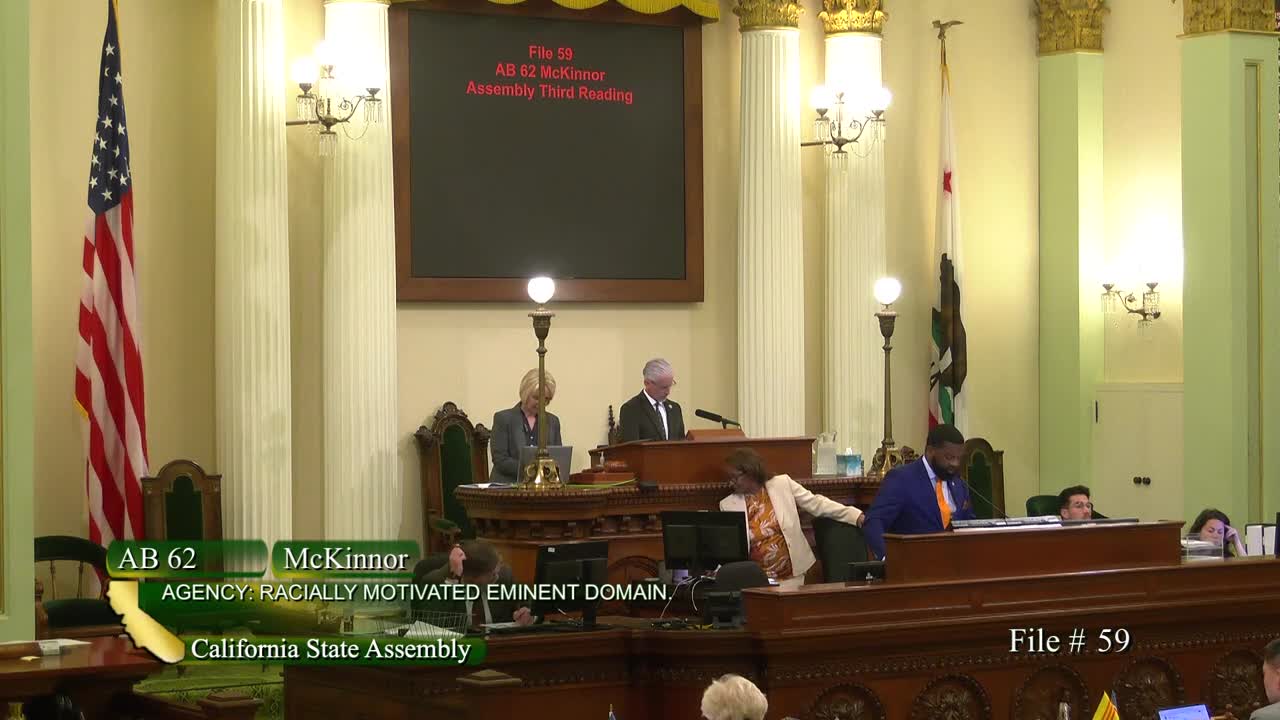 3MIN
Assembly Floor
 4MIN