AB 627: California Health Facilities Financing Authority Act.
- Session Year: 2025-2026
- House: Assembly
- Latest Version Date: 2025-10-06
Current Status:
Passed
(2025-10-06: Chaptered by Secretary of State - Chapter 377, Statutes of 2025.)
Introduced
In Committee
Awaiting First Chamber Vote
Passed First Chamber
In Committee
Awaiting Second Chamber Vote
Passed Second Chamber
Enacted
The California Health Facilities Financing Authority Act authorizes the California Health Facilities Financing Authority to, among other things, make loans from the continuously appropriated California Health Facilities Financing Authority Fund to participating health institutions for financing or refinancing the acquisition, construction, or remodeling of health facilities. Under existing law, participating health institutions are specified entities authorized by state law to provide or operate a health facility and undertake the financing or refinancing of the construction or acquisition of a project or of working capital, as defined. Existing law defines working capital as moneys to be used by, or on behalf of, a participating health institution for specified expenses in connection with the ownership or operation of a health facility, including interest not to exceed 2 years on any loan for working capital made pursuant to these provisions. Existing law requires a participating health institution that is a private nonprofit corporation or association and that borrows money to finance working capital to repay and discharge the loan within 24 months of the loan date.
This bill would change the definition of working capital to remove the 2-year cap on interest on any loan for working capital. The bill would delete the provision requiring a participating health institution that is a private nonprofit corporation or association to repay and discharge a loan for working capital within 24 months.
Existing law requires the authority to establish financial eligibility standards by studying the creditworthiness and earning capacity of each project, together with the amount of pledged revenues, debt service coverage, and basic security.
The bill would also require the authority to establish financial eligibility standards for working capital loans by studying the creditworthiness of a participating health institution, along with the amount of pledged venues, debt service coverage, and basic security. The bill would prohibit a participating health institution that is determined to be in financial distress from being deemed financially eligible.
By expanding the purpose for which the above-described continuously appropriated fund may be used, the bill would make an appropriation from that fund. The bill would make legislative findings relating to the purpose of the bill.
The California Health Facilities Financing Authority Act authorizes the California Health Facilities Financing Authority to, among other things, make loans from the continuously appropriated California Health Facilities Financing Authority Fund to participating health institutions for financing or refinancing the acquisition, construction, or remodeling of health facilities. Under existing law, participating health institutions are specified entities authorized by state law to provide or operate a health facility and undertake the financing or refinancing of the construction or acquisition of a project or of working capital, as defined. Existing law defines working capital as moneys to be used by, or on behalf of, a participating health institution for specified expenses in connection with the ownership or operation of a health facility, including interest not to exceed 2 years on any loan for working capital made pursuant to these provisions. Existing law requires a participating health institution that is a private nonprofit corporation or association and that borrows money to finance working capital to repay and discharge the loan within 24 months of the loan date.
This bill would change the definition of working capital to remove the 2-year cap on interest on any loan for working capital. The bill would delete the provision requiring a participating health institution that is a private nonprofit corporation or association to repay and discharge a loan for working capital within 24 months.
By expanding the purpose for which the above-described continuously appropriated fund may be used, the bill would make an appropriation from that fund. The bill would make legislative findings relating to the purpose of the bill.
The Legislature finds and declares that the purpose of this act is to provide creditworthy nonprofit participating health institutions cost-effective, future financing tools at their disposal.
SEC. 2.Section 15432 of the Government Code is amended to read:15432.As used in this part, the following words and terms shall have the following meanings, unless the context clearly indicates or requires another or different meaning or intent:
(a)Act means the California Health Facilities Financing Authority Act.
(b)Authority means the California Health Facilities Financing Authority created by this part or any board, body, commission, department, or officer succeeding to the principal functions thereof or to which the powers conferred upon the authority by this part shall be given by law.
(c)Cost, as applied to a project or portion of a project financed under this part, means and includes all or any part of the cost of construction and acquisition of all lands, structures, real or personal property, rights, rights-of-way, franchises, easements, and interests acquired or used for a project, the cost of demolishing or removing any buildings or structures on land so acquired, including the cost of acquiring any lands to which those buildings or structures may be moved, the cost of all machinery and equipment, financing charges, interest prior to, during, and for a period not to exceed the later of one year or one year following completion of construction, as determined by the authority, the cost of insurance during construction, the cost of funding or financing noncapital expenses, reserves for principal and interest and for extensions, enlargements, additions, replacements, renovations, and improvements, the cost of engineering, service contracts, reasonable financial and legal services, plans, specifications, studies, surveys, estimates, administrative expenses, and other expenses of funding or financing, that are necessary or incident to determining the feasibility of constructing any project, or that are incident to the construction, acquisition, or financing of any project.
(d)Health facility means a facility, place, or building that is licensed, accredited, or certified and organized, maintained, and operated for the diagnosis, care, prevention, and treatment of human illness, or physical, mental, or developmental disability, including convalescence and rehabilitation and including care during and after pregnancy, or for any one or more of these purposes, for one or more persons, and includes, but is not limited to, all of the following types:
(1)A general acute care hospital that is a health facility having a duly constituted governing body with overall administrative and professional responsibility and an organized medical staff that provides 24-hour inpatient care, including the following basic services: medical, nursing, surgical, anesthesia, laboratory, radiology, pharmacy, and dietary services.
(2)An acute psychiatric hospital that is a health facility having a duly constituted governing body with overall administrative and professional responsibility and an organized medical staff that provides 24-hour inpatient care for mentally disordered, incompetent, or other patients referred to in Division 5 (commencing with Section 5000) or Division 6 (commencing with Section 6000) of the Welfare and Institutions Code, including the following basic services: medical, nursing, rehabilitative, pharmacy, and dietary services.
(3)A skilled nursing facility that is a health facility that provides the following basic services: skilled nursing care and supportive care to patients whose primary need is for availability of skilled nursing care on an extended basis.
(4)An intermediate care facility that is a health facility that provides the following basic services: inpatient care to ambulatory or semiambulatory patients who have recurring need for skilled nursing supervision and need supportive care, but who do not require availability or continuous skilled nursing care.
(5)A special health care facility that is a health facility having a duly constituted governing body with overall administrative and professional responsibility and an organized medical or dental staff that provides inpatient or outpatient, acute or nonacute care, including, but not limited to, medical, nursing, rehabilitation, dental, or maternity.
(6)A clinic that is operated by a tax-exempt nonprofit corporation that is licensed pursuant to Section 1204 or 1204.1 of the Health and Safety Code or a clinic exempt from licensure pursuant to subdivision (b) or (c) of Section 1206 of the Health and Safety Code.
(7)An adult day health center that is a facility, as defined under subdivision (b) of Section 1570.7 of the Health and Safety Code, that provides adult day health care, as defined under subdivision (a) of Section 1570.7 of the Health and Safety Code.
(8)A facility owned or operated by a local jurisdiction for the provision of county health services.
(9)A multilevel facility is an institutional arrangement where a residential care facility for the elderly is operated as a part of, or in conjunction with, an intermediate care facility, a skilled nursing facility, or a general acute care hospital. For purposes of this paragraph, elderly means a person 60 years of age or older.
(10)A child daycare facility operated in conjunction with a health facility. A child daycare facility is a facility, as defined in Section 1596.750 of the Health and Safety Code. For purposes of this paragraph, child means a minor from birth to 18 years of age.
(11)An intermediate care facility/developmentally disabled habilitative that is a health facility, as defined under subdivision (e) of Section 1250 of the Health and Safety Code.
(12)An intermediate care facility/developmentally disabled-nursing that is a health facility, as defined under subdivision (h) of Section 1250 of the Health and Safety Code.
(13)A community care facility that is a facility, as defined under subdivision (a) of Section 1502 of the Health and Safety Code, that provides care, habilitation, rehabilitation, or treatment services to developmentally disabled or mentally impaired persons.
(14)A nonprofit community care facility, as defined in subdivision (a) of Section 1502 of the Health and Safety Code, other than a facility that, as defined in that subdivision, is a foster family agency, a foster family home, a full service adoption agency, or a noncustodial adoption agency.
(15)A nonprofit accredited community work activity program, as specified in subdivision (e) of Section 4851 and Section 4856 of the Welfare and Institutions Code.
(16)A community mental health center, as defined in paragraph (3) of subdivision (b) of Section 5667 of the Welfare and Institutions Code.
(17)A nonprofit speech and hearing center, as defined in Section 1201.5 of the Health and Safety Code.
(18)A blood bank, as defined in Section 1600.2 of the Health and Safety Code, licensed pursuant to Section 1602.5 of the Health and Safety Code, and exempt from federal income taxation pursuant to Section 501(c)(3) of the Internal Revenue Code.
(19)A residential facility for persons with developmental disabilities, as defined in Sections 4688.5 and 4688.6 of the Welfare and Institutions Code, which includes, but is not limited to, a community care facility licensed pursuant to Section 1502 of the Health and Safety Code and a family teaching home as defined in Section 4689.1 of the Welfare and Institutions Code.
(20)(A)A residential care facility for the elderly, as defined in Section 1569.2 of the Health and Safety Code.
(B)This paragraph shall not be construed as affecting the licensing of health facilities under Chapter 2 (commencing with Section 1250) of Division 2 of the Health and Safety Code, or any other provisions relating to health facilities, except as the term health facility is interpreted for purposes of the California Health Facilities Financing Authority Act under this part. The designation of a residential care facility for the elderly as a health facility, as made pursuant to this paragraph, shall apply to this part only.
(21)A nonpublic school that provides educational services in conjunction with a health facility, as defined in paragraphs (1) to (20), inclusive, that otherwise qualifies for financing pursuant to this part, if the nonpublic school is certified pursuant to Sections 56366 and 56366.1 of the Education Code as meeting standards relating to the required special education and specified related services and facilities for individuals with physical, mental, or developmental disabilities.
Health facility includes a clinic that is described in subdivision (l) of Section 1206 of the Health and Safety Code.
Health facility includes information systems equipment and the following facilities, if the equipment and facility is operated in conjunction with or to support the services provided in one or more of the facilities specified in paragraphs (1) to (21), inclusive, of this subdivision: a laboratory, laundry, a nurses or interns residence, housing for staff or employees and their families or patients or relatives of patients, a physicians facility, an administration building, a research facility, a maintenance, storage, or utility facility, an information systems facility, all structures or facilities related to any of the foregoing facilities or required or useful for the operation of a health facility and the necessary and usual attendant and related facilities and equipment, and parking and supportive service facilities or structures required or useful for the orderly conduct of the health facility.
Health facility does not include any institution, place, or building used or to be used primarily for sectarian instruction or study or as a place for devotional activities or religious worship.
(e)Participating health institution means a city, city and county, or county, a district hospital, or a private nonprofit corporation or association, or a limited liability company whose sole member is a nonprofit corporation or association authorized by the laws of this state to provide or operate a health facility or a nonprofit corporation that controls or manages, is controlled or managed by, is under common control or management with, or is affiliated with any of the foregoing, and that, pursuant to this part, undertakes the financing or refinancing of the construction or acquisition of a project or of working capital as provided in this part. Participating health institution also includes, for purposes of the California Health Facilities Revenue Bonds (UCSF-Stanford Health Care) 1998 Series A, the Regents of the University of California.
(f)Project means construction, expansion, remodeling, renovation, furnishing, or equipping, or funding, financing, or refinancing of a health facility or acquisition of a health facility to be financed or refinanced with funds provided in whole or in part pursuant to this part. Project may include reimbursement for the costs of construction, expansion, remodeling, renovation, furnishing, or equipping, or funding, financing, or refinancing of a health facility or acquisition of a health facility. Project may include any combination of one or more of the foregoing undertaken jointly by any participating health institution with one or more other participating health institutions.
(g)Revenue bond or bond means a bond, warrant, note, lease, or installment sale obligation that is evidenced by a certificate of participation or other evidence of indebtedness issued by the authority.
(h)Working capital means moneys to be used by, or on behalf of, a participating health institution to pay or prepay maintenance or operation expenses or any other costs that would be treated as an expense item, under generally accepted accounting principles, in connection with the ownership or operation of a health facility, including, but not limited to, reserves for maintenance or operation expenses, interest on any loan for working capital made pursuant to this part, and reserves for debt service with respect to, and any costs necessary or incidental to, that financing.
SEC. 3.Section 15437 of the Government Code is amended to read:15437.(a)The provisions of this part shall be administered by the authority, which shall have and is hereby vested with all powers reasonably necessary to carry out the powers and responsibilities expressly granted or imposed under this part.
(b)The authority shall establish financial eligibility standards by studying the creditworthiness and earning capacity of each project, together with the amount of pledged revenues, debt service coverage, and basic security.
(c)The authority shall establish financial eligibility standards for working capital loans by studying the creditworthiness of a participating health institution, together with the amount of pledged revenues, debt service coverage, and basic security. A participating health institution that is determined by the authority to be in financial distress shall not be deemed financially eligible.
SEC. 4.Section 15451.5 of the Government Code is repealed.The Legislature finds and declares that the purpose of this act is to provide creditworthy nonprofit participating health institutions cost-effective, future financing tools at their disposal.
SEC. 2.Section 15432 of the Government Code is amended to read:15432.As used in this part, the following words and terms shall have the following meanings, unless the context clearly indicates or requires another or different meaning or intent:
(a)Act means the California Health Facilities Financing Authority Act.
(b)Authority means the California Health Facilities Financing Authority created by this part or any board, body, commission, department, or officer succeeding to the principal functions thereof or to which the powers conferred upon the authority by this part shall be given by law.
(c)Cost, as applied to a project or portion of a project financed under this part, means and includes all or any part of the cost of construction and acquisition of all lands, structures, real or personal property, rights, rights-of-way, franchises, easements, and interests acquired or used for a project, the cost of demolishing or removing any buildings or structures on land so acquired, including the cost of acquiring any lands to which those buildings or structures may be moved, the cost of all machinery and equipment, financing charges, interest prior to, during, and for a period not to exceed the later of one year or one year following completion of construction, as determined by the authority, the cost of insurance during construction, the cost of funding or financing noncapital expenses, reserves for principal and interest and for extensions, enlargements, additions, replacements, renovations, and improvements, the cost of engineering, service contracts, reasonable financial and legal services, plans, specifications, studies, surveys, estimates, administrative expenses, and other expenses of funding or financing, that are necessary or incident to determining the feasibility of constructing any project, or that are incident to the construction, acquisition, or financing of any project.
(d)Health facility means a facility, place, or building that is licensed, accredited, or certified and organized, maintained, and operated for the diagnosis, care, prevention, and treatment of human illness, or physical, mental, or developmental disability, including convalescence and rehabilitation and including care during and after pregnancy, or for any one or more of these purposes, for one or more persons, and includes, but is not limited to, all of the following types:
(1)A general acute care hospital that is a health facility having a duly constituted governing body with overall administrative and professional responsibility and an organized medical staff that provides 24-hour inpatient care, including the following basic services: medical, nursing, surgical, anesthesia, laboratory, radiology, pharmacy, and dietary services.
(2)An acute psychiatric hospital that is a health facility having a duly constituted governing body with overall administrative and professional responsibility and an organized medical staff that provides 24-hour inpatient care for mentally disordered, incompetent, or other patients referred to in Division 5 (commencing with Section 5000) or Division 6 (commencing with Section 6000) of the Welfare and Institutions Code, including the following basic services: medical, nursing, rehabilitative, pharmacy, and dietary services.
(3)A skilled nursing facility that is a health facility that provides the following basic services: skilled nursing care and supportive care to patients whose primary need is for availability of skilled nursing care on an extended basis.
(4)An intermediate care facility that is a health facility that provides the following basic services: inpatient care to ambulatory or semiambulatory patients who have recurring need for skilled nursing supervision and need supportive care, but who do not require availability or continuous skilled nursing care.
(5)A special health care facility that is a health facility having a duly constituted governing body with overall administrative and professional responsibility and an organized medical or dental staff that provides inpatient or outpatient, acute or nonacute care, including, but not limited to, medical, nursing, rehabilitation, dental, or maternity.
(6)A clinic that is operated by a tax-exempt nonprofit corporation that is licensed pursuant to Section 1204 or 1204.1 of the Health and Safety Code or a clinic exempt from licensure pursuant to subdivision (b) or (c) of Section 1206 of the Health and Safety Code.
(7)An adult day health center that is a facility, as defined under subdivision (b) of Section 1570.7 of the Health and Safety Code, that provides adult day health care, as defined under subdivision (a) of Section 1570.7 of the Health and Safety Code.
(8)A facility owned or operated by a local jurisdiction for the provision of county health services.
(9)A multilevel facility is an institutional arrangement where a residential care facility for the elderly is operated as a part of, or in conjunction with, an intermediate care facility, a skilled nursing facility, or a general acute care hospital. Elderly, for the purposes of this paragraph, For purposes of this paragraph, elderly means a person 60 years of age or older.
(10)A child daycare facility operated in conjunction with a health facility. A child daycare facility is a facility, as defined in Section 1596.750 of the Health and Safety Code. For purposes of this paragraph, child means a minor from birth to 18 years of age.
(11)An intermediate care facility/developmentally disabled habilitative that is a health facility, as defined under subdivision (e) of Section 1250 of the Health and Safety Code.
(12)An intermediate care facility/developmentally disabled-nursing that is a health facility, as defined under subdivision (h) of Section 1250 of the Health and Safety Code.
(13)A community care facility that is a facility, as defined under subdivision (a) of Section 1502 of the Health and Safety Code, that provides care, habilitation, rehabilitation, or treatment services to developmentally disabled or mentally impaired persons.
(14)A nonprofit community care facility, as defined in subdivision (a) of Section 1502 of the Health and Safety Code, other than a facility that, as defined in that subdivision, is a foster family agency, a foster family home, a full service adoption agency, or a noncustodial adoption agency.
(15)A nonprofit accredited community work activity program, as specified in subdivision (e) of Section 4851 and Section 4856 of the Welfare and Institutions Code.
(16)A community mental health center, as defined in paragraph (3) of subdivision (b) of Section 5667 of the Welfare and Institutions Code.
(17)A nonprofit speech and hearing center, as defined in Section 1201.5 of the Health and Safety Code.
(18)A blood bank, as defined in Section 1600.2 of the Health and Safety Code, licensed pursuant to Section 1602.5 of the Health and Safety Code, and exempt from federal income taxation pursuant to Section 501(c)(3) of the Internal Revenue Code.
(19)A residential facility for persons with developmental disabilities, as defined in Sections 4688.5 and 4688.6 of the Welfare and Institutions Code, which includes, but is not limited to, a community care facility licensed pursuant to Section 1502 of the Health and Safety Code and a family teaching home as defined in Section 4689.1 of the Welfare and Institutions Code.
(20)(A)A residential care facility for the elderly, as defined in Section 1569.2 of the Health and Safety Code.
(B)This paragraph shall not be construed as affecting the licensing of health facilities under Chapter 2 (commencing with Section 1250) of Division 2 of the Health and Safety Code, or any other provisions relating to health facilities, except as the term health facility is interpreted for purposes of the California Health Facilities Financing Authority Act under this part. The designation of a residential care facility for the elderly as a health facility, as made pursuant to this paragraph, shall apply to this part only.
(21)A nonpublic school that provides educational services in conjunction with a health facility, as defined in paragraphs (1) to (20), inclusive, that otherwise qualifies for financing pursuant to this part, if the nonpublic school is certified pursuant to Sections 56366 and 56366.1 of the Education Code as meeting standards relating to the required special education and specified related services and facilities for individuals with physical, mental, or developmental disabilities.
Health facility includes a clinic that is described in subdivision (l) of Section 1206 of the Health and Safety Code.
Health facility includes information systems equipment and the following facilities, if the equipment and facility is operated in conjunction with or to support the services provided in one or more of the facilities specified in paragraphs (1) to (21), inclusive, of this subdivision: a laboratory, laundry, a nurses or interns residence, housing for staff or employees and their families or patients or relatives of patients, a physicians facility, an administration building, a research facility, a maintenance, storage, or utility facility, an information systems facility, all structures or facilities related to any of the foregoing facilities or required or useful for the operation of a health facility and the necessary and usual attendant and related facilities and equipment, and parking and supportive service facilities or structures required or useful for the orderly conduct of the health facility.
Health facility does not include any institution, place, or building used or to be used primarily for sectarian instruction or study or as a place for devotional activities or religious worship.
(e)Participating health institution means a city, city and county, or county, a district hospital, or a private nonprofit corporation or association, or a limited liability company whose sole member is a nonprofit corporation or association authorized by the laws of this state to provide or operate a health facility or a nonprofit corporation that controls or manages, is controlled or managed by, is under common control or management with, or is affiliated with any of the foregoing, and that, pursuant to this part, undertakes the financing or refinancing of the construction or acquisition of a project or of working capital as provided in this part. Participating health institution also includes, for purposes of the California Health Facilities Revenue Bonds (UCSF-Stanford Health Care) 1998 Series A, the Regents of the University of California.
(f)Project means construction, expansion, remodeling, renovation, furnishing, or equipping, or funding, financing, or refinancing of a health facility or acquisition of a health facility to be financed or refinanced with funds provided in whole or in part pursuant to this part. Project may include reimbursement for the costs of construction, expansion, remodeling, renovation, furnishing, or equipping, or funding, financing, or refinancing of a health facility or acquisition of a health facility. Project may include any combination of one or more of the foregoing undertaken jointly by any participating health institution with one or more other participating health institutions.
(g)Revenue bond or bond means a bond, warrant, note, lease, or installment sale obligation that is evidenced by a certificate of participation or other evidence of indebtedness issued by the authority.
(h)Working capital means moneys to be used by, or on behalf of, a participating health institution to pay or prepay maintenance or operation expenses or any other costs that would be treated as an expense item, under generally accepted accounting principles, in connection with the ownership or operation of a health facility, including, but not limited to, reserves for maintenance or operation expenses, interest on any loan for working capital made pursuant to this part, and reserves for debt service with respect to, and any costs necessary or incidental to, that financing.
SEC. 3.Section 15437 of the Government Code is amended to read:15437.(a)The provisions of this part shall be administered by the authority, which shall have and is hereby vested with all powers reasonably necessary to carry out the powers and responsibilities expressly granted or imposed under this part.
(b)The authority shall establish financial eligibility standards by studying the creditworthiness and earning capacity of each project, together with the amount of pledged revenues, debt service coverage, and basic security.
(c)The authority shall establish financial eligibility standards for working capital loans by studying the creditworthiness of a participating health institution, together with the amount of pledged revenues, debt service coverage, and basic security. A participating health institution that is determined by the authority to be in financial distress shall not be deemed financially eligible.
SEC. 4.Section 15451.5 of the Government Code is repealed.The Legislature finds and declares that the purpose of this act is to provide creditworthy nonprofit participating health institutions cost-effective, future financing tools at their disposal.
SEC. 2.Section 15432 of the Government Code is amended to read:15432.As used in this part, the following words and terms shall have the following meanings, unless the context clearly indicates or requires another or different meaning or intent:
(a)Act means the California Health Facilities Financing Authority Act.
(b)Authority means the California Health Facilities Financing Authority created by this part or any board, body, commission, department, or officer succeeding to the principal functions thereof or to which the powers conferred upon the authority by this part shall be given by law.
(c)Cost, as applied to a project or portion of a project financed under this part, means and includes all or any part of the cost of construction and acquisition of all lands, structures, real or personal property, rights, rights-of-way, franchises, easements, and interests acquired or used for a project, the cost of demolishing or removing any buildings or structures on land so acquired, including the cost of acquiring any lands to which those buildings or structures may be moved, the cost of all machinery and equipment, financing charges, interest prior to, during, and for a period not to exceed the later of one year or one year following completion of construction, as determined by the authority, the cost of insurance during construction, the cost of funding or financing noncapital expenses, reserves for principal and interest and for extensions, enlargements, additions, replacements, renovations, and improvements, the cost of engineering, service contracts, reasonable financial and legal services, plans, specifications, studies, surveys, estimates, administrative expenses, and other expenses of funding or financing, that are necessary or incident to determining the feasibility of constructing any project, or that are incident to the construction, acquisition, or financing of any project.
(d)Health facility means a facility, place, or building that is licensed, accredited, or certified and organized, maintained, and operated for the diagnosis, care, prevention, and treatment of human illness, or physical, mental, or developmental disability, including convalescence and rehabilitation and including care during and after pregnancy, or for any one or more of these purposes, for one or more persons, and includes, but is not limited to, all of the following types:
(1)A general acute care hospital that is a health facility having a duly constituted governing body with overall administrative and professional responsibility and an organized medical staff that provides 24-hour inpatient care, including the following basic services: medical, nursing, surgical, anesthesia, laboratory, radiology, pharmacy, and dietary services.
(2)An acute psychiatric hospital that is a health facility having a duly constituted governing body with overall administrative and professional responsibility and an organized medical staff that provides 24-hour inpatient care for mentally disordered, incompetent, or other patients referred to in Division 5 (commencing with Section 5000) or Division 6 (commencing with Section 6000) of the Welfare and Institutions Code, including the following basic services: medical, nursing, rehabilitative, pharmacy, and dietary services.
(3)A skilled nursing facility that is a health facility that provides the following basic services: skilled nursing care and supportive care to patients whose primary need is for availability of skilled nursing care on an extended basis.
(4)An intermediate care facility that is a health facility that provides the following basic services: inpatient care to ambulatory or semiambulatory patients who have recurring need for skilled nursing supervision and need supportive care, but who do not require availability or continuous skilled nursing care.
(5)A special health care facility that is a health facility having a duly constituted governing body with overall administrative and professional responsibility and an organized medical or dental staff that provides inpatient or outpatient, acute or nonacute care, including, but not limited to, medical, nursing, rehabilitation, dental, or maternity.
(6)A clinic that is operated by a tax-exempt nonprofit corporation that is licensed pursuant to Section 1204 or 1204.1 of the Health and Safety Code or a clinic exempt from licensure pursuant to subdivision (b) or (c) of Section 1206 of the Health and Safety Code.
(7)An adult day health center that is a facility, as defined under subdivision (b) of Section 1570.7 of the Health and Safety Code, that provides adult day health care, as defined under subdivision (a) of Section 1570.7 of the Health and Safety Code.
(8)A facility owned or operated by a local jurisdiction for the provision of county health services.
(9)A multilevel facility is an institutional arrangement where a residential care facility for the elderly is operated as a part of, or in conjunction with, an intermediate care facility, a skilled nursing facility, or a general acute care hospital. Elderly, for the purposes of this paragraph, means a person 60 years of age or older.
(10)A child daycare facility operated in conjunction with a health facility. A child daycare facility is a facility, as defined in Section 1596.750 of the Health and Safety Code. For purposes of this paragraph, child means a minor from birth to 18 years of age.
(11)An intermediate care facility/developmentally disabled habilitative that is a health facility, as defined under subdivision (e) of Section 1250 of the Health and Safety Code.
(12)An intermediate care facility/developmentally disabled-nursing that is a health facility, as defined under subdivision (h) of Section 1250 of the Health and Safety Code.
(13)A community care facility that is a facility, as defined under subdivision (a) of Section 1502 of the Health and Safety Code, that provides care, habilitation, rehabilitation, or treatment services to developmentally disabled or mentally impaired persons.
(14)A nonprofit community care facility, as defined in subdivision (a) of Section 1502 of the Health and Safety Code, other than a facility that, as defined in that subdivision, is a foster family agency, a foster family home, a full service adoption agency, or a noncustodial adoption agency.
(15)A nonprofit accredited community work activity program, as specified in subdivision (e) of Section 4851 and Section 4856 of the Welfare and Institutions Code.
(16)A community mental health center, as defined in paragraph (3) of subdivision (b) of Section 5667 of the Welfare and Institutions Code.
(17)A nonprofit speech and hearing center, as defined in Section 1201.5 of the Health and Safety Code.
(18)A blood bank, as defined in Section 1600.2 of the Health and Safety Code, licensed pursuant to Section 1602.5 of the Health and Safety Code, and exempt from federal income taxation pursuant to Section 501(c)(3) of the Internal Revenue Code.
(19)A residential facility for persons with developmental disabilities, as defined in Sections 4688.5 and 4688.6 of the Welfare and Institutions Code, which includes, but is not limited to, a community care facility licensed pursuant to Section 1502 of the Health and Safety Code and a family teaching home as defined in Section 4689.1 of the Welfare and Institutions Code.
(20)(A)A residential care facility for the elderly, as defined in Section 1569.2 of the Health and Safety Code.
(B)This paragraph shall not be construed as affecting the licensing of health facilities under Chapter 2 (commencing with Section 1250) of Division 2 of the Health and Safety Code, or any other provisions relating to health facilities, except as the term health facility is interpreted for purposes of the California Health Facilities Financing Authority Act under this part. The designation of a residential care facility for the elderly as a health facility, as made pursuant to this paragraph, shall apply to this part only.
(21)A nonpublic school that provides educational services in conjunction with a health facility, as defined in paragraphs (1) to (20), inclusive, that otherwise qualifies for financing pursuant to this part, if the nonpublic school is certified pursuant to Sections 56366 and 56366.1 of the Education Code as meeting standards relating to the required special education and specified related services and facilities for individuals with physical, mental, or developmental disabilities.
Health facility includes a clinic that is described in subdivision (l) of Section 1206 of the Health and Safety Code.
Health facility includes information systems equipment and the following facilities, if the equipment and facility is operated in conjunction with or to support the services provided in one or more of the facilities specified in paragraphs (1) to (21), inclusive, of this subdivision: a laboratory, laundry, a nurses or interns residence, housing for staff or employees and their families or patients or relatives of patients, a physicians facility, an administration building, a research facility, a maintenance, storage, or utility facility, an information systems facility, all structures or facilities related to any of the foregoing facilities or required or useful for the operation of a health facility and the necessary and usual attendant and related facilities and equipment, and parking and supportive service facilities or structures required or useful for the orderly conduct of the health facility.
Health facility does not include any institution, place, or building used or to be used primarily for sectarian instruction or study or as a place for devotional activities or religious worship.
(e)Participating health institution means a city, city and county, or county, a district hospital, or a private nonprofit corporation or association, or a limited liability company whose sole member is a nonprofit corporation or association authorized by the laws of this state to provide or operate a health facility or a nonprofit corporation that controls or manages, is controlled or managed by, is under common control or management with, or is affiliated with any of the foregoing, and that, pursuant to this part, undertakes the financing or refinancing of the construction or acquisition of a project or of working capital as provided in this part. Participating health institution also includes, for purposes of the California Health Facilities Revenue Bonds (UCSF-Stanford Health Care) 1998 Series A, the Regents of the University of California.
(f)Project means construction, expansion, remodeling, renovation, furnishing, or equipping, or funding, financing, or refinancing of a health facility or acquisition of a health facility to be financed or refinanced with funds provided in whole or in part pursuant to this part. Project may include reimbursement for the costs of construction, expansion, remodeling, renovation, furnishing, or equipping, or funding, financing, or refinancing of a health facility or acquisition of a health facility. Project may include any combination of one or more of the foregoing undertaken jointly by any participating health institution with one or more other participating health institutions.
(g)Revenue bond or bond means a bond, warrant, note, lease, or installment sale obligation that is evidenced by a certificate of participation or other evidence of indebtedness issued by the authority.
(h)Working capital means moneys to be used by, or on behalf of, a participating health institution to pay or prepay maintenance or operation expenses or any other costs that would be treated as an expense item, under generally accepted accounting principles, in connection with the ownership or operation of a health facility, including, but not limited to, reserves for maintenance or operation expenses, interest on any loan for working capital made pursuant to this part, and reserves for debt service with respect to, and any costs necessary or incidental to, that financing.
SEC. 3.Section 15437 of the Government Code is amended to read:15437.(a)The provisions of this part shall be administered by the authority, which shall have and is hereby vested with all powers reasonably necessary to carry out the powers and responsibilities expressly granted or imposed under this part.
(b)The authority shall establish financial eligibility standards by studying the creditworthiness and earning capacity of each project, together with the amount of pledged revenues, debt service coverage, and basic security.
(c)The authority shall establish financial eligibility standards for working capital loans by studying the creditworthiness of a participating health institution, together with the amount of pledged revenues, debt service coverage, and basic security. A participating health institution that is determined by the authority to be in financial distress shall not be deemed financially eligible.
SEC. 3.SEC. 4.Section 15451.5 of the Government Code is repealed.The Legislature finds and declares that the purpose of this act is to provide creditworthy nonprofit participating health institutions cost-effective, future financing tools at their disposal.
SEC. 2.Section 15432 of the Government Code is amended to read:15432.As used in this part, the following words and terms shall have the following meanings, unless the context clearly indicates or requires another or different meaning or intent:
(a)Act means the California Health Facilities Financing Authority Act.
(b)Authority means the California Health Facilities Financing Authority created by this part or any board, body, commission, department, or officer succeeding to the principal functions thereof or to which the powers conferred upon the authority by this part shall be given by law.
(c)Cost, as applied to a project or portion of a project financed under this part, means and includes all or any part of the cost of construction and acquisition of all lands, structures, real or personal property, rights, rights-of-way, franchises, easements, and interests acquired or used for a project, the cost of demolishing or removing any buildings or structures on land so acquired, including the cost of acquiring any lands to which those buildings or structures may be moved, the cost of all machinery and equipment, financing charges, interest prior to, during, and for a period not to exceed the later of one year or one year following completion of construction, as determined by the authority, the cost of insurance during construction, the cost of funding or financing noncapital expenses, reserves for principal and interest and for extensions, enlargements, additions, replacements, renovations renovations, and improvements, the cost of engineering, service contracts, reasonable financial and legal services, plans, specifications, studies, surveys, estimates, administrative expenses, and other expenses of funding or financing, that are necessary or incident to determining the feasibility of constructing any project, or that are incident to the construction, acquisition, or financing of any project.
(d)Health facility means a facility, place, or building that is licensed, accredited, or certified and organized, maintained, and operated for the diagnosis, care, prevention, and treatment of human illness, or physical, mental, or developmental disability, including convalescence and rehabilitation and including care during and after pregnancy, or for any one or more of these purposes, for one or more persons, and includes, but is not limited to, all of the following types:
(1)A general acute care hospital that is a health facility having a duly constituted governing body with overall administrative and professional responsibility and an organized medical staff that provides 24-hour inpatient care, including the following basic services: medical, nursing, surgical, anesthesia, laboratory, radiology, pharmacy, and dietary services.
(2)An acute psychiatric hospital that is a health facility having a duly constituted governing body with overall administrative and professional responsibility and an organized medical staff that provides 24-hour inpatient care for mentally disordered, incompetent, or other patients referred to in Division 5 (commencing with Section 5000) or Division 6 (commencing with Section 6000) of the Welfare and Institutions Code, including the following basic services: medical, nursing, rehabilitative, pharmacy, and dietary services.
(3)A skilled nursing facility that is a health facility that provides the following basic services: skilled nursing care and supportive care to patients whose primary need is for availability or of skilled nursing care on an extended basis.
(4)An intermediate care facility that is a health facility that provides the following basic services: inpatient care to ambulatory or semiambulatory patients who have recurring need for skilled nursing supervision and need supportive care, but who do not require availability or continuous skilled nursing care.
(5)A special health care facility that is a health facility having a duly constituted governing body with overall administrative and professional responsibility and an organized medical or dental staff that provides inpatient or outpatient, acute or nonacute care, including, but not limited to, medical, nursing, rehabilitation, dental, or maternity.
(6)A clinic that is operated by a tax-exempt nonprofit corporation that is licensed pursuant to Section 1204 or 1204.1 of the Health and Safety Code or a clinic exempt from licensure pursuant to subdivision (b) or (c) of Section 1206 of the Health and Safety Code.
(7)An adult day health center that is a facility, as defined under subdivision (b) of Section 1570.7 of the Health and Safety Code, that provides adult day health care, as defined under subdivision (a) of Section 1570.7 of the Health and Safety Code.
(8)A facility owned or operated by a local jurisdiction for the provision of county health services.
(9)A multilevel facility is an institutional arrangement where a residential care facility for the elderly is operated as a part of, or in conjunction with, an intermediate care facility, a skilled nursing facility, or a general acute care hospital. Elderly, for the purposes of this paragraph, means a person 60 years of age or older.
(10)A child daycare facility operated in conjunction with a health facility. A child daycare facility is a facility, as defined in Section 1596.750 of the Health and Safety Code. For purposes of this paragraph, child means a minor from birth to 18 years of age.
(11)An intermediate care facility/developmentally disabled habilitative that is a health facility, as defined under subdivision (e) of Section 1250 of the Health and Safety Code.
(12)An intermediate care facility/developmentally disabled-nursing that is a health facility, as defined under subdivision (h) of Section 1250 of the Health and Safety Code.
(13)A community care facility that is a facility, as defined under subdivision (a) of Section 1502 of the Health and Safety Code, that provides care, habilitation, rehabilitation, or treatment services to developmentally disabled or mentally impaired persons.
(14)A nonprofit community care facility, as defined in subdivision (a) of Section 1502 of the Health and Safety Code, other than a facility that, as defined in that subdivision, is a foster family agency, a foster family home, a full service adoption agency, or a noncustodial adoption agency.
(15)A nonprofit accredited community work activity program, as specified in subdivision (e) of Section 4851 and Section 4856 of the Welfare and Institutions Code.
(16)A community mental health center, as defined in paragraph (3) of subdivision (b) of Section 5667 of the Welfare and Institutions Code.
(17)A nonprofit speech and hearing center, as defined in Section 1201.5 of the Health and Safety Code.
(18)A blood bank, as defined in Section 1600.2 of the Health and Safety Code, licensed pursuant to Section 1602.5 of the Health and Safety Code, and exempt from federal income taxation pursuant to Section 501(c)(3) of the Internal Revenue Code.
(19)A residential facility for persons with developmental disabilities, as defined in Sections 4688.5 and 4688.6 of the Welfare and Institutions Code, which includes, but is not limited to, a community care facility licensed pursuant to Section 1502 of the Health and Safety Code and a family teaching home as defined in Section 4689.1 of the Welfare and Institutions Code.
(20)(A)A residential care facility for the elderly, as defined in Section 1569.2 of the Health and Safety Code.
(B)This paragraph shall not be construed as affecting the licensing of health facilities under Chapter 2 (commencing with Section 1250) of Division 2 of the Health and Safety Code, or any other provisions relating to health facilities, except as the term health facility is interpreted for purposes of the California Health Facilities Financing Authority Act under this part. The designation of a residential care facility for the elderly as a health facility, as made pursuant to this paragraph, shall apply to this part only.
(21)A nonpublic school that provides educational services in conjunction with a health facility, as defined in paragraphs (1) to (20), inclusive, that otherwise qualifies for financing pursuant to this part, if the nonpublic school is certified pursuant to Sections 56366 and 56366.1 of the Education Code as meeting standards relating to the required special education and specified related services and facilities for individuals with physical, mental, or developmental disabilities.
Health facility includes a clinic that is described in subdivision (l) of Section 1206 of the Health and Safety Code.
Health facility includes information systems equipment and the following facilities, if the equipment and facility is operated in conjunction with or to support the services provided in one or more of the facilities specified in paragraphs (1) to (21), inclusive, of this subdivision: a laboratory, laundry, a nurses or interns residence, housing for staff or employees and their families or patients or relatives of patients, a physicians facility, an administration building, a research facility, a maintenance, storage, or utility facility, an information systems facility, all structures or facilities related to any of the foregoing facilities or required or useful for the operation of a health facility and the necessary and usual attendant and related facilities and equipment, and parking and supportive service facilities or structures required or useful for the orderly conduct of the health facility.
Health facility does not include any institution, place, or building used or to be used primarily for sectarian instruction or study or as a place for devotional activities or religious worship.
(e)Participating health institution means a city, city and county, or county, a district hospital, or a private nonprofit corporation or association, or a limited liability company whose sole member is a nonprofit corporation or association authorized by the laws of this state to provide or operate a health facility or a nonprofit corporation that controls or manages, is controlled or managed by, is under common control or management with, or is affiliated with any of the foregoing, and that, pursuant to this part, undertakes the financing or refinancing of the construction or acquisition of a project or of working capital as provided in this part. Participating health institution also includes, for purposes of the California Health Facilities Revenue Bonds (UCSF-Stanford Health Care) 1998 Series A, the Regents of the University of California.
(f)Project means construction, expansion, remodeling, renovation, furnishing, or equipping, or funding, financing, or refinancing of a health facility or acquisition of a health facility to be financed or refinanced with funds provided in whole or in part pursuant to this part. Project may include reimbursement for the costs of construction, expansion, remodeling, renovation, furnishing, or equipping, or funding, financing, or refinancing of a health facility or acquisition of a health facility. Project may include any combination of one or more of the foregoing undertaken jointly by any participating health institution with one or more other participating health institutions.
(g)Revenue bond or bond means a bond, warrant, note, lease, or installment sale obligation that is evidenced by a certificate of participation or other evidence of indebtedness issued by the authority.
(h)Working capital means moneys to be used by, or on behalf of, a participating health institution to pay or prepay maintenance or operation expenses or any other costs that would be treated as an expense item, under generally accepted accounting principles, in connection with the ownership or operation of a health facility, including, but not limited to, reserves for maintenance or operation expenses, interest for not to exceed two years on any loan for working capital made pursuant to this part, and reserves for debt service with respect to, and any costs necessary or incidental to, that financing.
SEC. 3.Section 15451.5 of the Government Code is repealed.15451.5.A participating health institution that is a private nonprofit corporation or association and that borrows money to finance working capital pursuant to this part, other than as part of the cost of a project, shall be required to repay and discharge the loan within 24 months of the loan date.|
Date
|
Status
|
|---|---|
| Oct 6, 2025 | Chaptered by Secretary of State - Chapter 377, Statutes of 2025. |
| Oct 6, 2025 | Approved by the Governor. |
| Sep 11, 2025 | Enrolled and presented to the Governor at 4 p.m. |
| Sep 4, 2025 | Senate amendments concurred in. To Engrossing and Enrolling. (Ayes 78. Noes 0. Page 2910.). |
| Sep 2, 2025 | In Assembly. Concurrence in Senate amendments pending. |
| Sep 2, 2025 | Read third time. Passed. Ordered to the Assembly. (Ayes 40. Noes 0. Page 2390.). |
| Jul 7, 2025 | Read second time. Ordered to third reading. |
| Jul 3, 2025 | Read third time and amended. Ordered to second reading. |
| Jul 3, 2025 | Ordered to third reading. |
| Jul 3, 2025 | From Consent Calendar. |
| Jul 1, 2025 | Read second time. Ordered to Consent Calendar. |
| Jun 30, 2025 | From committee: Be ordered to second reading file pursuant to Senate Rule 28.8 and ordered to Consent Calendar. |
| Jun 12, 2025 | From committee: Do pass and re-refer to Com. on APPR. with recommendation: To Consent Calendar. (Ayes 9. Noes 0.) (June 11). Re-referred to Com. on APPR. |
| May 14, 2025 | Referred to Com. on HEALTH. |
| May 1, 2025 | In Senate. Read first time. To Com. on RLS. for assignment. |
| May 1, 2025 | Read third time. Passed. Ordered to the Senate. (Ayes 76. Noes 0. Page 1387.) |
| Apr 24, 2025 | Read second time. Ordered to Consent Calendar. |
| Apr 23, 2025 | From committee: Do pass. To Consent Calendar. (Ayes 15. Noes 0.) (April 23). |
| Apr 8, 2025 | Re-referred to Com. on APPR. |
| Apr 7, 2025 | Read second time and amended. |
| Apr 3, 2025 | From committee: Amend, and do pass as amended and re-refer to Com. on APPR. with recommendation: To Consent Calendar. (Ayes 15. Noes 0.) (April 1). |
| Feb 24, 2025 | Referred to Com. on HEALTH. |
| Feb 14, 2025 | From printer. May be heard in committee March 16. |
| Feb 13, 2025 | Read first time. To print. |
|
Date
|
Description
|
Location
|
Votes
|
|
|---|---|---|---|---|
| Sep 4, 2025 | AB 627 Stefani Concurrence in Senate Amendments | Assembly Floor |
Passed |
|
| Sep 2, 2025 | The committee on EEP recommend that the measure be PASSED, WITH AMENDMENTS | Senate Floor |
Passed |
|
| Jun 11, 2025 | Do pass, but first be re-referred to the Committee on [Appropriations] with the recommendation: To Consent Calendar | Senate Standing Committee on Health |
Passed |
|
| May 1, 2025 | AB 627 Stefani Consent Calendar Second Day Regular Session | Assembly Floor |
Passed |
|
| Apr 23, 2025 | Do pass. To Consent Calendar. | Assembly Standing Committee on Appropriations |
Passed |
|
| Apr 1, 2025 | Do pass as amended, and be re-referred to the Committee on [Appropriations] with recommendation: To Consent Calendar | Assembly Standing Committee on Health |
Passed |
This list shows positions taken on this bill by organizations on the date displayed, which is linked to the original source.
Positions by individuals are not included.
|
Organization
|
Position
|
Date
|
|---|---|---|
| California ChildrenS Hospital Association | ** Support | |
| California Hospital Association (CHA) | ** Support | |
| CALIFORNIA PRIMARY CARE ASSOCIATION ADVOCATES | ** Support | |
| California Special Districts Association | ** Support | |
| California State Treasurer | ** Support | |
| California State Treasurer Fiona Ma | ** Support |
CONCURRENCE IN SENATE AMENDMENTS
CSA1 Bill Id:AB 627
Author:(Stefani)
As Amended Ver:July 3, 2025
Majority vote
SUMMARY
Repeals the requirement that working capital loans made by the California Health Facilities Financing Authority (CHFFA) to health facilities be repaid within two years.
Senate Amendments
Are technical and clarifying and add a co-author.
COMMENTS
Background. Fixed capital refers to the assets or investments required to establish and run a firm, such as property or equipment. Working capital is the cash or other liquid assets that a company utilizes to finance day-to-day activities such as payroll and bill payment.
CHFFA. CHFFA was created to be the state's vehicle for providing financial assistance to public and nonprofit health care providers primarily through loans funded by the issuance of tax-exempt bonds. To this end, CHFFA administers the Bond Financing Program (Program) and the Tax-Exempt Equipment Financing Program. CHFFA also provides direct loans to small and rural health facilities through the Healthcare Expansion Loan Program II Financing Program.
In September of 2021, the Governor signed into law the Non-designated Public Hospital Bridge Loan Program to enable CHFFA to issue up to $40 million in working capital loans at zero interest rate to certain hospitals that are affected by financial delays associated with the transition to the Quality Incentive Program. These Non-designated Public Hospital Bridge Loans are required to be paid back in two years, and are secured by Medi-Cal reimbursements.
By borrowing through CHFFA's tax-exempt bond financing program, health facilities can likely obtain rates that are 20% lower than they would through taxable financing options. Generally, non-profit, licensed health facilities in California, including adult day health centers, community clinics, skilled nursing facilities, developmentally disabled centers, hospitals, and drug and alcohol rehabilitation centers are eligible for CHFFA financing. Proceeds from CHFFA financings may be used primarily for capital improvements such as project-related costs, including: construction; remodeling and renovation; land acquisition (as part of the proposed project); acquisition of existing health facilities; purchase or lease of equipment; refinancing or refunding of prior debt; working capital for start-up facilities; costs of bond issuance; feasibility studies; and, reimbursement of prior expenses. Not for working capital expenses, such as salaries and benefits.
Under statute, savings resulting from issuance of tax-exempt bonds for borrowers must be transferred to the consuming public through lower or contained costs for delivery of health services. CHFFA states that to enforce this requirement, applicants are required to complete a pass-through savings certification as part of its loan application that demonstrates significant community service.
Since its first bond issuance in 1981, CHFFA's Program has issued 646 bonds for an aggregate total of approximately $47.5 billion, with 275 health facilities availing themselves of this financing.
Long-Term Bond Financings. CHFFA serves as a conduit of tax-exempt and taxable bonds under the Program. According to CHFFA, bonds issued by CHFFA are not a debt, liability, or a pledge of the full faith and credit of the taxing power of the state, or any of its political subdivisions, but are payable solely by qualified health facility borrowers ("Borrower" or "Health Facility"). The funding received under the Program is private funding from investors, who are typically sophisticated, and who financially analyze a Borrower's financial positon prior to buying bonds and therefore investing in the Health Facility/Borrower. Borrowers are typically rated by Standard & Poor's Financial Services, Moody's Investor Services, or Fitch Ratings, and based on the credit rating of a Health Facility, an investor would require the terms (including the interest rate) to be paid on the bond funds borrowed by the Borrower (similar to how an individual's interest rate on a loan is determined by their credit score). This Program provides funds to hospitals who are creditworthy.
CHFFA "Competitors." There are other organizations in California that provide bond financing to health facilities. The California Municipal Finance Authority (CMFA) provides tax-exempt bonds similar to CHFFA. The CMFA provide access to this market for qualified borrowers by acting as the conduit issuer, much the same way CHFFA does. Eligible costs for a CMFA financing may include the purchase of land, project design costs, construction, rehabilitation, improvement, equipment purchase and installation, and legal fees. Up to 2% of the proceeds of a CMFA bond offering may be used to pay the cost of issuing bonds, such as for underwriter's and legal fees. Also, the CMFA can issue taxable bonds to cover any additional costs of issuance or for additional undertakings that are not tax-exempt.
The California Infrastructure and Economic Development Bank (I-Bank) was created in 1994 to finance public infrastructure and private development that promote a healthy climate for jobs, contribute to a strong economy and improve the quality of life in California communities. I-Bank has broad authority to issue tax-exempt and taxable revenue bonds, provide financing to public agencies, provide credit enhancements, acquire or lease facilities, and leverage State and Federal funds. Both of these organizations can and do provide financing to health facilities, only at a higher cost than CHFFA.
According to CHFFA, by issuing long-term working capital financings through CHFFA alongside their infrastructure financings, health institutions would experience cost savings as CHFFA's fee is lower than other conduit issuers, and long-term working capital financings would be included in the original fee for infrastructure financings, which is capped. Additionally, allowing health institutions to utilize the same financing team (underwriters, counsels, and advisors) by lumping together the infrastructure and long-term working capital financings would result in cost savings to health institutions, allowing them to utilize those cost savings toward health care delivery and patient outcomes.
AB 1888 (Bronzan), Chapter 1426, Statutes of 1987. AB 1888, among other provisions, permits non-profit private institutions access to CHFFA working capital loans and requires such institutions to repay working capital loans within 15 months. The Department of Finance analysis in opposition to AB 1888 noted that, "Incurring long-term, tax-exempt debt to finance everyday operating (non-capital) expenses is not desirable. Operating expenses should be financed on a "pay-as-you-go" basis. Otherwise, tomorrow's clients' end up paying costs associated with services provided today."
According to the Author
This bill will allow CHFFA to provide long-term working capital financings for private, nonprofit health institutions. CHFFA is a conduit issuer of tax-exempt and taxable bonds to nonprofit participating health institutions. The CHFFA Act authorizes the financing of a broad range of project expenditures, including construction, acquisition, and working capital. Working capital expenses cover costs such as salaries and benefits, operating lease payments, debt service payments, and other essential operational expenses. However, working capital financings under CHFFA's Act are limited to a 24-month term. This restriction means that creditworthy health institutions with longer-term working capital needs cannot utilize this type of financing to address their ongoing requirements. This limitation does not apply to other financing entities under the State Treasurer's Office. This would provide an important financing tool to ensure that private, nonprofit health institutions in California have the resources necessary to navigate future challenges, including catastrophic events.
Arguments in Support
The California Hospital Association (CHA) supports this bill and states that in order to sustain and expand access to high-quality health care services, health care providers sometimes rely on working capital bonds to help finance key aspects of their operations (e.g., salaries, benefits, and leases) and maintain sustainable cash flows. Unfortunately, state law currently restricts CHFFA from issuing such bonds with terms beyond two years, not only limiting the bonds' use and utility, but also causing providers to look elsewhere for long-term working capital finance needs. CHA notes that this bill addresses this problem by allowing CHFFA to issue long-term working capital tax-exempt bonds to nonprofit health institutions. The bill enables CHFFA to serve more effectively as a one-stop shop for hospitals and other providers seeking both short- and long-term financing support. CHA concludes that authorizing CHFFA to issue long-term working capital tax-exempt bonds would align it with other Treasurer's Office financing programs and benefit all participating hospitals, as well as the broader health care ecosystem.
Arguments in Opposition
None.
FISCAL COMMENTS
According to the Senate Appropriations Committee, pursuant to Senate Rule 28.8, negligible state costs.
VOTES:
ASM HEALTH: 15-0-0
YES: Bonta, Chen, Addis, Aguiar-Curry, Arambula, Carrillo, Flora, Mark González, Krell, Patel, Celeste Rodriguez, Sanchez, Schiavo, Sharp-Collins, Stefani
ASM APPROPRIATIONS: 15-0-0
YES: Wicks, Sanchez, Arambula, Calderon, Caloza, Dixon, Elhawary, Fong, Mark González, Hart, Pacheco, Pellerin, Solache, Ta, Tangipa
ASSEMBLY FLOOR: 76-0-3
YES: Addis, Aguiar-Curry, Ahrens, Alanis, Alvarez, Arambula, Ávila Farías, Bains, Bauer-Kahan, Bennett, Berman, Boerner, Bonta, Bryan, Calderon, Caloza, Carrillo, Castillo, Connolly, Davies, DeMaio, Dixon, Elhawary, Ellis, Flora, Fong, Gabriel, Gallagher, Garcia, Gipson, Jeff Gonzalez, Mark González, Hadwick, Haney, Harabedian, Hart, Hoover, Irwin, Jackson, Kalra, Krell, Lackey, Lee, Lowenthal, Macedo, Muratsuchi, Nguyen, Ortega, Pacheco, Patel, Patterson, Pellerin, Petrie-Norris, Quirk-Silva, Ramos, Ransom, Celeste Rodriguez, Michelle Rodriguez, Rogers, Blanca Rubio, Sanchez, Schiavo, Schultz, Sharp-Collins, Solache, Soria, Stefani, Ta, Tangipa, Valencia, Wallis, Ward, Wicks, Wilson, Zbur, Rivas
ABS, ABST OR NV: Chen, McKinnor, Papan
UPDATED
VERSION: July 3, 2025
CONSULTANT: Lara Flynn / HEALTH / (916) 319-2097 FN: 0001524
SENATE COMMITTEE ON HEALTH
Senator Caroline Menjivar, Chair
BILL NO: AB 627
AUTHOR: | Stefani | ||
VERSION: | April 7, 2025 | ||
HEARING DATE: | June 11, 2025 | ||
CONSULTANT: | Vincent D. Marchand | ||
SUBJECT: California Health Facilities Financing Authority Act
SUMMARY:
Repeals the requirement that working capital loans made by the California Health Facilities Financing Authority to health facilities be repaid within two years.
Existing law:
- Establishes the California Health Facilities Financing Authority (CHFFA), consisting of nine members, led by the State Treasurer who serves as the chair, and the executive director, who is appointed by the State Treasurer. States the intent of the Legislature to provide financing to health institutions that can demonstrate the financial feasibility of their projects, and that any savings experienced by the health institution be passed on to the consuming public through lower charges or containment of the rate of increase in hospital rates. [GOV §15430, et seq.]
- Permits CHFFA, among other powers, to make secured or unsecured loans to any participating health institution in connection with the financing of a project or working capital. Requires CHFFA to establish financial eligibility standards by studying creditworthiness and earning capacity of each project, together with the amount of pledged revenues, debt service coverage, and basic security. [GOV §15437 and §15438]
- Defines “participating health institution,” for purposes of being able to participate in CHFFA financing mechanisms, as a city or county, a district hospital, or a nonprofit corporation that operates a health facility (which is broadly defined to include clinics, community care facilities, adult day health centers, and other types of settings), and that undertakes the financing of the construction, renovation, furnishing, or equipping of, or financing or refinancing the acquisition of, a health facility. [GOV §15432(e) and (f)]
- Defines “working capital” as moneys to be used by, or on behalf of, a participating health institution to pay or prepay maintenance or operation expenses or any other costs that would be treated as an expense item, under generally accepted accounting principles, in connection with the ownership or operation of a health facility, including, but not limited to, reserves for maintenance or operation expenses, and interest not to exceed two years on any loan for working capital. [GOV §15432(h)]
- Requires a participating health institution that is a private nonprofit corporation or association and that borrows money to finance working capital, other than as part of the cost of a project, to repay and discharge the loan within 24 months of the loan date. [GOV §15451.5]
- Prohibits revenue bonds issued under CHFFA from being deemed to constitute a debt or liability of the state, or a pledge of the faith and credit of the state. Requires bonds issued by CHFFA to contain a statement to the effect that neither the State of California nor CHFFA shall be obligated to pay the principal, or the interest, except from the revenues of CHFFA. [GOV §15443]
- Establishes the California Educational Facilities Authority for the purpose of issuing revenue bonds to assist private nonprofit institutions of higher learning in the expansion and construction of educational facilities. [EDC §94100, et seq.]
- Establishes the Distressed Hospital Loan Program (DHLP) to provide interest free cash-flow loans to not-for-profit hospitals and public hospitals, as defined, in significant financial distress, or to governmental entities representing closed hospitals, to prevent the closure of, or facilitate the reopening of, those hospitals. Requires the Department of Health Care Access and Information (HCAI) to administer the DHLP and to enter into an interagency agreement with CHFFA to implement the DHLP. [HSC §129380, et seq.]
This bill:
- Repeals the limitation that working capital loans offered by CHFFA be only two years in length.
- Requires CHFFA to establish financial eligibility standards for working capital loans by studying the creditworthiness of a participating health institution, together with the amount of pledged revenues, debt service coverage, and basic security.
- Prohibits a participating health institution that is determined by CHFFA to be in financial distress from being deemed financially eligible for working capital loans.
- Makes a legislative finding and declaration that the purpose of this bill is to provide creditworthy nonprofit participating health institutions, cost-effective, future financing tools at their disposal.
FISCAL EFFECT:
According to the Assembly Appropriations Committee, minor and absorbable costs to CHFFA to establish financial eligibility standards for working capital loans.
PRIOR VOTES:
Assembly Floor: | 76 - 0 |
Assembly Appropriations Committee: | 15 - 0 |
Assembly Health Committee: | 15 - 0 |
COMMENTS:
- Author’s statement. According to the author, this bill will allow CHFFA to provide long-term working capital financings for private, nonprofit health institutions. CHFFA is a conduit issuer of tax-exempt and taxable bonds to nonprofit participating health institutions. The CHFFA Act authorizes the financing of a broad range of project expenditures, including construction, acquisition, and working capital. Working capital expenses cover costs such as salaries and benefits, operating lease payments, debt service payments, and other essential operational expenses. However, working capital financings under CHFFA’s Act are limited to a 24-month term. This restriction means that creditworthy health institutions with longer-term working capital needs cannot utilize this type of financing to address their ongoing requirements through CHFFA. This limitation does not apply to other financing entities under the State Treasurer's Office. This bill would provide an important financing tool to ensure that private, nonprofit health institutions in California have the resources necessary, at a time when it is uncertain how federal policies will impact California’s health system, to reconfigure income streams and adjust practices and to navigate short-term changes in revenue.
- Background on existing CHFFA programs. CHFFA was created to be the state's vehicle for providing financial assistance to public and nonprofit health care providers primarily through loans funded by the issuance of tax-exempt bonds. To this end, CHFFA administers the Bond Financing Program and the Tax-Exempt Equipment Financing Program. CHFFA also provides direct loans to small and rural health facilities through the Healthcare Expansion Loan Program (HELP) II Financing Program. In September of 2021, the Governor signed into law the Nondesignated Public Hospital Bridge Loan Program to enable CHFFA to issue up to $40 million in interest-free, working capital loans to certain hospitals that were affected by financial delays associated with the transition to the Quality Incentive Program. An additional $40 million was allocated as part of the Budget Act of 2022 for a second round of the bridge loans. These Nondesignated Public Hospital Bridge Loans are required to be paid back in two years, and are secured by Medi-Cal reimbursements. Additionally, CHFFA administers several grant programs, including the Children's Hospital Programs, the Community Services Infrastructure Grant Program, and the Investment in Mental Health Wellness Grant Program. Under the Mental Health Wellness grant program, counties can apply for funding to develop a continuum of crisis services to children and youth up to 21 years of age in four categories: crisis residential treatment, crisis stabilization, mobile crisis support teams, and family respite care. There was an initial allocation of about $40 million for this Mental Health Wellness grant program.
By borrowing through CHFFA’s tax-exempt bond financing program, health facilities can generally obtain lower interest rates than they would through conventional bonds. The types of facilities eligible for CHFFA financing are government-run or non-profit, licensed health facilities in California, including adult day health centers, community clinics, skilled nursing facilities, developmentally disabled centers, hospitals, and drug and alcohol rehabilitation centers. Proceeds from CHFFA financing may be used for project-related costs, including: construction; remodeling and renovation; land acquisition (as part of the proposed project); acquisition of existing health facilities; purchase or lease of equipment; refinancing or refunding of prior debt; working capital for start-up facilities; costs of bond issuance; feasibility studies; and reimbursement of prior expenses. Under statute, savings resulting from issuance of tax-exempt bonds for borrowers must be transferred to the consuming public through lower or contained costs for delivery of health services. Since its first bond issuance in 1981, CHFFA’s bond financing program has issued 639 bonds for an aggregate total of approximately $46 billion, with 275 health facilities availing themselves of this financing. - DHLP. The DHLP was established through AB 112 (Committee on Budget, Chapter 6, Statutes of 2023), following the closure of Madera Community Hospital, in an effort to prevent further hospital closures and to help facilitate the reopening of Madera. AB 112 initially funded the DHLP at $150 million, but an additional $150 million was later appropriated to make it a $300 million loan program. After development of an application process and reviewing applications from 30 hospitals, HCAI awarded loans to 17 hospitals. Under the terms of the DHLP, the loans are interest free, and hospitals are to begin making monthly payments 18 months following disbursement of the loan. The loans are required to be repaid within 72 months of the date of the loan. The DHLP also required HCAI to develop, in consultation with CHFFA and upon the approval of the Department of Finance, a process for hospitals who received DHLP loans to request forgiveness or loan modifications. On February 3, 2025, HCAI and CHFFA began accepting applications for loan modifications for a 12-month extension of the loan payment deferral period.
- Background provided by CHFFA. According to CHFFA, working capital financings secured through CHFFA have the potential to provide support to hospitals that need additional financial breathing room to pay for salaries, benefits, debt service payments, lease payments, and other essential operating expenses at a time when it is uncertain how federal policies will impact California’s health system. Working capital financing can help hospitals reconfigure income streams and adjust practices and to navigate short-term changes in revenue. However, a major limitation for long-term planning and flexibility is the limited term for which these financings must be repaid (24 months). Compared to financings available through the California Educational Facilities Authority and other financing entities under the State Treasurer’s Office (which have no time limit on the repayment period), CHFFA is an underutilized tool due to limitations on financing terms. Applicants usually aim for multi-decade repayment timelines to spread the short-term costs across numerous years. Unfortunately, because CHFFA cannot accommodate these applications, credit worthy health facilities must turn to other lenders who typically have higher costs and are less effective and less transparent, leading to larger overall costs. CHFFA’s stakeholders’ most requested financing tool was long-term working capital financing.
- Prior legislation. AB 2098 (Garcia of 2024) would have extended the repayment period for specified bridge loans for district hospitals, made through CHFFA under authorization and funding from the 2022 Budget Act and which are required to be repaid within two years of the date of the loan, to instead require hospitals to make monthly payments within 24 months of the date of the loan, and for the loan to be repaid within 72 months of the date of the loan. AB 2098 was vetoed by Governor Newsom, who stated, “Hospitals are critical to the health and safety of our communities, and it is a priority of my Administration to assist hospitals that are struggling financially. For this reason, together with the Legislature, we funded the Public Hospital Bridge Loan Program II with $40 million, and we authorized $300 million for the DHLP. Many of the hospitals affected by this bill received both. While I support efforts to ensure loan repayment requirements are feasible, this bill would advantage one set of hospital loans above others that did not receive such an extension. Extending the timeline for the repayment will affect our budget structure in the out years, and would be better discussed as part of the annual budget process.”
AB 2637 (Schiavo of 2024) was substantially similar to this bill. AB 2637 was vetoed by Governor Newsom, who stated, “Hospitals are critical to the health and safety of our communities, and it is a priority of my Administration to assist hospitals that are struggling financially. For this reason, together with the Legislature, we authorized $300 million for the DHLP to offer zero-interest loans to eligible financially distressed hospitals. While I support efforts to ensure loan repayment requirements are feasible, this bill would result in an open-ended timeframe without any required end date that loans must be repaid. Extending the timeline for the recoupment of CHFFA loans would be better discussed as a part of the annual budget process.”
AB 112 (Committee on Budget, Chapter 6, Statutes of 2023), established the DHLP to provide interest free cash-flow loans to not-for-profit hospitals and public hospitals, as defined, in significant financial distress, or to governmental entities representing closed hospitals. Requires HCAI to administer the DHLP and to enter into an interagency agreement with CHFFA to implement the DHLP.
SB 45 (Roth of 2023) would have established the California Acute Care Psychiatric Hospital Loan Fund to provide zero-interest loans to qualifying county applicants for the purpose of constructing or renovating acute care psychiatric hospitals or psychiatric health facilities, or renovating or expanding general acute care hospitals in order to add or expand an inpatient psychiatric unit. SB 45 was held on the Assembly Appropriations Committee suspense file.
- Support. This bill is sponsored by California State Treasurer Fiona Ma, who states that under federal tax law, it is possible to issue long-term tax-exempt bonds to finance working capital, but the current CHFFA Act includes restrictions that limit bond repayment terms to 24 months for working capital. CHFFA is able to connect nonprofit health institutions with third party investors for capital/infrastructure projects, but the 24-month limit for working capital has severely limited the ability of this financial tool to support health institutions.
The California Hospital Association (CHA) states that this bill would enable CHFFA to serve more effectively as a one-stop shop for hospitals and other providers seeking both short- and long-term financing support. CPCA Advocates states that health centers and clinics operate on very thin margins, and finances are often one of the major challenges that prevent health centers from expanding care, providing salary increases to their existing workforce, and attempting to attract new workforce. This bill would give community health centers more time and flexibility to repay and discharge a loan to address operational expenses. The California Children’s Hospital Association states in support that their members face periodic cash flow issues due to the timing of Medi-Cal supplemental payments, and they would greatly benefit from being able to access long-term working capital tax-exempt financing through CHFFA to help support operations.
SUPPORT AND OPPOSITION:
Support: California State Treasurer Fiona Ma (sponsor)
California Children’s Hospital Association
California Hospital Association
California Special Districts Association
California Primary Care Association Advocates
Oppose: None received
-- END --
Date of Hearing: April 23, 2025
ASSEMBLY COMMITTEE ON APPROPRIATIONS
Buffy Wicks, Chair
ABPCA Bill Id:AB 627
Author:(Stefani) – As Amended Ver:April 7, 2025
Policy Committee: | Health | Vote: | 15 - 0 |
|
| ||
|
|
Urgency: No State Mandated Local Program: No Reimbursable: No
SUMMARY:
This bill removes the two-year cap on interest for a working capital loan from the California Health Facilities Financing Authority (CHFFA). The bill also requires CHFFA to establish financial eligibility standards for working capital loans by studying the creditworthiness of a participating health institution, pledged revenues, debt service coverage, and basic security, and prohibits a health institution that is in financial distress from being financially eligible.
FISCAL EFFECT:
Minor and absorbable costs to CHFFA to establish financial eligibility standards for working capital loans.
COMMENTS:
- Purpose. This bill is sponsored by California State Treasurer Fiona Ma. According to the author:
Working capital financings under CHFFA’s Act are limited to a 24-month term. This restriction means that creditworthy health institutions with longer-term working capital needs cannot utilize this type of financing to address their ongoing requirements. This limitation does not apply to other financing entities under the State Treasurer's Office. AB 627 would provide an important financing tool to ensure that private, nonprofit health institutions in California have the resources necessary to navigate future challenges, including catastrophic events.
- CHFFA. CHFFA was created to be the state's vehicle for providing financial assistance to public and nonprofit health care providers primarily through loans funded by the issuance of tax-exempt bonds. To this end, CHFFA administers the Bond Financing Program (Program) and the Tax-Exempt Equipment Financing Program. CHFFA also provides direct loans to small and rural health facilities through the Healthcare Expansion Loan Program II Financing Program.
By borrowing through CHFFA’s tax-exempt bond financing program, health facilities obtain rates that may be 20% lower than those for taxable financing options. Generally, non-profit, licensed health facilities in California, including adult day health centers, community clinics, skilled nursing facilities, developmentally disabled centers, hospitals, and drug and alcohol rehabilitation centers are eligible for CHFFA financing. Proceeds from CHFFA financings may be used primarily for capital improvements such as project-related costs, including: construction; remodeling and renovation; land acquisition (as part of the proposed project); acquisition of existing health facilities; purchase or lease of equipment; refinancing or refunding of prior debt; working capital for start-up facilities; costs of bond issuance; feasibility studies; and, reimbursement of prior expenses.
Savings resulting from issuance of tax-exempt bonds for borrowers must be transferred to the consuming public through lower or contained costs for delivery of health services. CHFFA states that to enforce this requirement, applicants are required to complete a pass-through savings certification as part of its loan application that demonstrates significant community service.
Since its first bond issuance in 1981, CHFFA’s Program has issued 646 bonds for an aggregate total of approximately $47.5 billion, with 275 health facilities availing themselves of this financing.
According to CHFFA, this bill will save health institutions money: By removing the two-year cap on interest, this bill enables institutions to obtain long-term financing through CHFFA, which has lower fees than other conduit issuers. CHFFA notes the bill also allows health institutions to combine long-term capital financing with infrastructure financing and pay only the infrastructure financing fee, which is capped. Finally, CHFFA argues this bill allows institutions to use the same financing team for combined infrastructure and long-term working capital financings.
- Prior Legislation. AB 2637 (Schiavo), of the 2023-24 Legislative Session, was substantially similar to this bill. Governor Newsom vetoed AB 2637, stating in part:
Together with the Legislature, we authorized $300 million for the Distressed Hospital Loan Program to offer zero-interest loans to eligible financially distressed hospitals. While I support efforts to ensure loan repayment requirements are feasible, this bill would result in an open-ended timeframe without any required end date that loans must be repaid. Extending the timeline for the recoupment of CHFFA loans would be better discussed as a part of the annual budget process.
Analysis Prepared by: Allegra Kim / APPR. / (916) 319-2081
Date of Hearing: April 1, 2025
ASSEMBLY COMMITTEE ON HEALTH
Mia Bonta, Chair
ABPCA Bill Id:AB 627
Author:(Stefani) – As Introduced Ver:February 13, 2025
SUBJECT: California Health Facilities Financing Authority Act.
SUMMARY: Changes the definition of “working capital” to remove the 2-year cap on interest on any loan for working capital. Deletes existing law requiring a participating health institution that is a private nonprofit corporation or association to repay and discharge a loan for working capital within 24 months.
EXISTING LAW:
- Establishes California Health Facilities Financing Authority (CHFFA) within the office of the State Treasurer to be the State's vehicle for providing financial assistance to public and non-profit health care providers through loans, grants, and tax-exempt bonds. [Government Code (GOV) § 15430 et seq.]
- Defines “health facility,” for purposes of CHFFA eligibility, to mean a facility, place, or building that is licensed, accredited, or certified and organized, maintained, and operated for the diagnosis, care, prevention, and treatment of human illness, or physical, mental, or developmental disability, including convalescence and rehabilitation and including care during and after pregnancy, or for any one or more of these purposes, including, but not limited to, a general acute care hospital that is a health facility having a duly constituted governing body with overall administrative and professional responsibility and an organized medical staff that provides 24-hour inpatient care, including the following basic services: medical, nursing, surgical, anesthesia, laboratory, radiology, pharmacy, and dietary services. [GOV § 15432]
- Defines “working capital” to mean moneys to be used by, or on behalf of, a participating health institution to pay or prepay maintenance or operation expenses or any other costs that would be treated as an expense item, under generally accepted accounting principles, in connection with the ownership or operation of a health facility, including, but not limited to, reserves for maintenance or operation expenses, interest for not to exceed two years on any loan for working capital made pursuant to this part, and reserves for debt service with respect to, and any costs necessary or incidental to, that financing. [GOV § 15432]
- Authorizes CHFFA to make secured or unsecured loans to, or purchase secured or unsecured loans of, any participating health institution in accordance with an agreement between CHFFA and the participating health institution to refinance indebtedness incurred by that participating health institution or a participating health institution that controls or manages, is controlled or managed by, is under common control or management with, or is affiliated with that participating health institution, in connection with projects undertaken or for health facilities acquired or for working capital. [GOV § 15438 (j)]
- Requires a participating health institution that is a private nonprofit corporation or association that borrows money to finance working capital, other than as part of the cost of a project, to repay and discharge the loan within 24 months of the loan date. [GOV § 15451.5]
- Requires CHFFA to establish financial eligibility standards by studying the creditworthiness and earning capacity of each project, together with the amount of pledged revenues, debt service coverage, and basic security. [GOV § 15437]
- Defines working capital for the purposes of the California Educational Facilities Authority Act without a 24-month limitation. [Education Code § 94110]
FISCAL EFFECT: Unknown. This bill has not yet been analyzed by a fiscal committee.
COMMENTS:
- PURPOSE OF THIS BILL. According to the author, this bill will allow CHFFA to provide long-term working capital financings for private, nonprofit health institutions. CHFFA is a conduit issuer of tax-exempt and taxable bonds to nonprofit participating health institutions. The CHFFA Act authorizes the financing of a broad range of project expenditures, including construction, acquisition, and working capital.
Working capital expenses cover costs such as salaries and benefits, operating lease payments, debt service payments, and other essential operational expenses. However, working capital financings under CHFFA’s Act are limited to a 24-month term. This restriction means that creditworthy health institutions with longer-term working capital needs cannot utilize this type of financing to address their ongoing requirements.
This limitation does not apply to other financing entities under the State Treasurer's Office. This would provide an important financing tool to ensure that private, nonprofit health institutions in California have the resources necessary to navigate future challenges, including catastrophic events.
- BACKGROUND. Fixed capital refers to the assets or investments required to establish and run a firm, such as property or equipment. Working capital is the cash or other liquid assets that a company utilizes to finance day-to-day activities such as payroll and bill payment.
- CHFFA. CHFFA was created to be the state's vehicle for providing financial assistance to public and nonprofit health care providers primarily through loans funded by the issuance of tax-exempt bonds. To this end, CHFFA administers the Bond Financing Program (Program) and the Tax-Exempt Equipment Financing Program. CHFFA also provides direct loans to small and rural health facilities through the Healthcare Expansion Loan Program II Financing Program.
In September of 2021, the Governor signed into law the Non-designated Public Hospital Bridge Loan Program to enable CHFFA to issue up to $40 million in working capital loans at zero interest rate to certain hospitals that are affected by financial delays associated with the transition to the Quality Incentive Program. These Non-designated Public Hospital Bridge Loans are required to be paid back in two years, and are secured by Medi-Cal reimbursements.
By borrowing through CHFFA’s tax-exempt bond financing program, health facilities can likely obtain rates that are 20% lower than they would through taxable financing options. Generally, non-profit, licensed health facilities in California, including adult day health centers, community clinics, skilled nursing facilities, developmentally disabled centers, hospitals, and drug and alcohol rehabilitation centers are eligible for CHFFA financing. Proceeds from CHFFA financings may be used primarily for capital improvements such as project-related costs, including: construction; remodeling and renovation; land acquisition (as part of the proposed project); acquisition of existing health facilities; purchase or lease of equipment; refinancing or refunding of prior debt; working capital for start-up facilities; costs of bond issuance; feasibility studies; and, reimbursement of prior expenses. Not for working capital expenses, such as salaries and benefits.
Under statute, savings resulting from issuance of tax-exempt bonds for borrowers must be transferred to the consuming public through lower or contained costs for delivery of health services. CHFFA states that to enforce this requirement, applicants are required to complete a pass-through savings certification as part of its loan application that demonstrates significant community service.
Since its first bond issuance in 1981, CHFFA’s Program has issued 646 bonds for an aggregate total of approximately $47.5 billion, with 275 health facilities availing themselves of this financing.
- Long-Term Bond Financings. CHFFA serves as a conduit of tax-exempt and taxable bonds under the Program. According to CHFFA, bonds issued by CHFFA are not a debt, liability, or a pledge of the full faith and credit of the taxing power of the state, or any of its political subdivisions, but are payable solely by qualified health facility borrowers (“Borrower” or “Health Facility”). The funding received under the Program is private funding from investors, who are typically sophisticated, and who financially analyze a Borrower’s financial positon prior to buying bonds and therefore investing in the Health Facility/Borrower. Borrowers are typically rated by Standard & Poor’s Financial Services, Moody’s Investor Services, or Fitch Ratings, and based on the credit rating of a Health Facility, an investor would require the terms (including the interest rate) to be paid on the bond funds borrowed by the Borrower (similar to how an individual’s interest rate on a loan is determined by their credit score). This Program provides funds to hospitals who are creditworthy.
- CHFFA “Competitors.” There are other organizations in California that provide bond financing to health facilities. The California Municipal Finance Authority (CMFA) provides tax-exempt bonds similar to CHFFA. The CMFA provide access to this market for qualified borrowers by acting as the conduit issuer, much the same way CHFFA does. Eligible costs for a CMFA financing may include the purchase of land, project design costs, construction, rehabilitation, improvement, equipment purchase and installation, and legal fees. Up to 2% of the proceeds of a CMFA bond offering may be used to pay the cost of issuing bonds, such as for underwriter’s and legal fees. Also, the CMFA can issue taxable bonds to cover any additional costs of issuance or for additional undertakings that are not tax-exempt.
The California Infrastructure and Economic Development Bank (I-Bank) was created in 1994 to finance public infrastructure and private development that promote a healthy climate for jobs, contribute to a strong economy and improve the quality of life in California communities. I-Bank has broad authority to issue tax-exempt and taxable revenue bonds, provide financing to public agencies, provide credit enhancements, acquire or lease facilities, and leverage State and Federal funds. Both of these organizations can and do provide financing to health facilities, only at a higher cost than CHFFA.
According to CHFFA, by issuing long-term working capital financings through CHFFA alongside their infrastructure financings, health institutions would experience cost savings as CHFFA’s fee is lower than other conduit issuers, and long-term working capital financings would be included in the original fee for infrastructure financings, which is capped. Additionally, allowing health institutions to utilize the same financing team (underwriters, counsels, and advisors) by lumping together the infrastructure and long-term working capital financings would result in cost savings to health institutions, allowing them to utilize those cost savings toward health care delivery and patient outcomes.
- AB 1888 (Bronzan), Chapter 1426, Statutes of 1987. AB 1888, among other provisions, permits non-profit private institutions access to CHFFA working capital loans and requires such institutions to repay working capital loans within 15 months. The Department of Finance analysis in opposition to AB 1888 noted that, “Incurring long-term, tax-exempt debt to finance everyday operating (non-capital) expenses is not desirable. Operating expenses should be financed on a “pay-as-you-go” basis. Otherwise, tomorrow’s clients’ end up paying costs associated with services provided today.”
- SUPPORT. The California Hospital Association (CHA) supports this bill and states that in order to sustain and expand access to high-quality health care services, health care providers sometimes rely on working capital bonds to help finance key aspects of their operations (e.g., salaries, benefits, and leases) and maintain sustainable cash flows. Unfortunately, state law currently restricts CHFFA from issuing such bonds with terms beyond two years, not only limiting the bonds’ use and utility, but also causing providers to look elsewhere for long-term working capital finance needs. CHA notes that this bill addresses this problem by allowing CHFFA to issue long-term working capital tax-exempt bonds to nonprofit health institutions. The bill enables CHFFA to serve more effectively as a one-stop shop for hospitals and other providers seeking both short- and long-term financing support. CHA concludes that authorizing CHFFA to issue long-term working capital tax-exempt bonds would align it with other Treasurer’s Office financing programs and benefit all participating hospitals, as well as the broader health care ecosystem.
- PREVIOUS LEGISLATION. AB 2637 (Shiavo) of 2024 was substantially similar to this bill. AB 2637 was vetoed by Governor Newsom, who stated in part, “hospitals are critical to the health and safety of our communities, and it is a priority of my Administration to assist hospitals that are struggling financially. For this reason, together with the Legislature, we authorized $300 million for the Distressed Hospital Loan Program to offer zero-interest loans to eligible financially distressed hospitals. While I support efforts to ensure loan repayment requirements are feasible, this bill would result in an open-ended timeframe without any required end date that loans must be repaid. Extending the timeline for the recoupment of CHFFA loans would be better discussed as a part of the annual budget process.”
- SUGGESTED AMENDMENTS. The Committee may wish to amend this bill to require CHFFA to establish financial eligibility standards specific to working capital loans by studying the creditworthiness of a participating health institution, together with the amount of pledged revenues, debt service coverage, and basic security, and, to make a participating health institution that is determined by CHFFA to be in financial distress to be deemed financially ineligible.
REGISTERED SUPPORT / OPPOSITION:
Support
California Hospital Association
California State Treasurer
CPCA Advocates, Subsidiary of The California Primary Care Association
Opposition
None on file.
Analysis Prepared by: Lara Flynn / HEALTH / (916) 319-2097
Discussed in Hearing
View Older Hearings
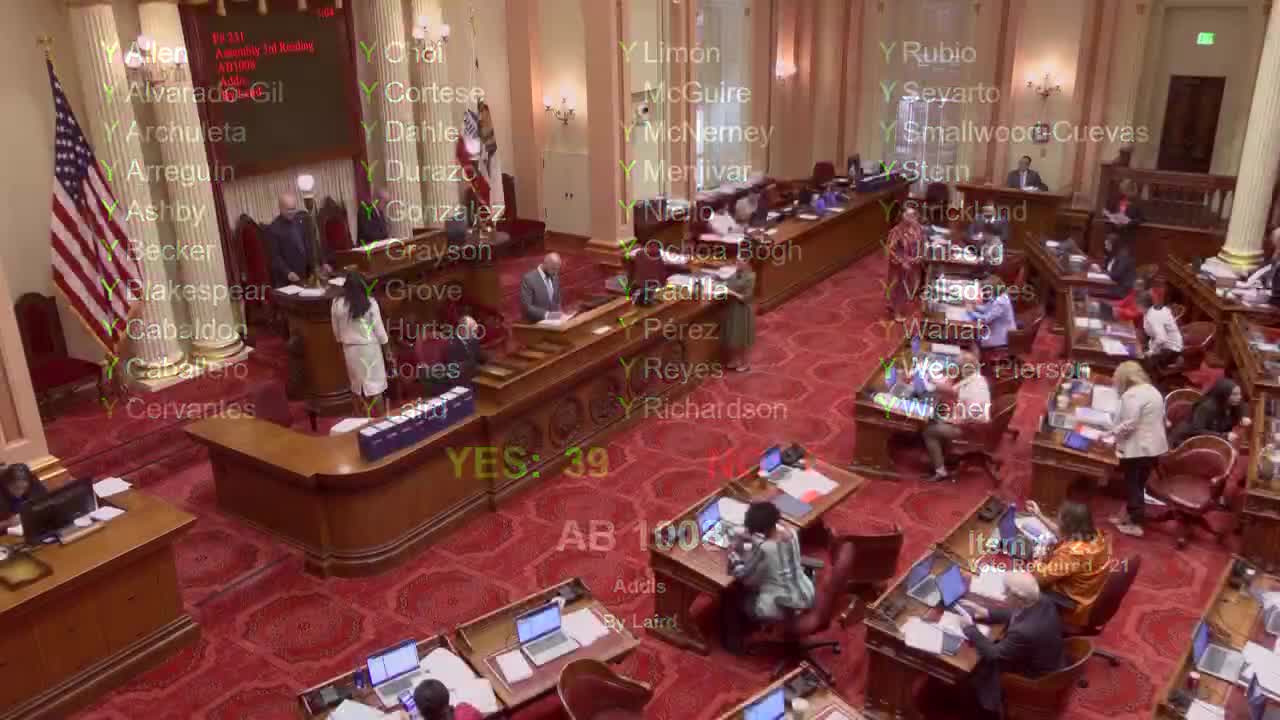
Bill Author

Bill Co-Author(s):
