AB 639: Dams: exceptions.
- Session Year: 2025-2026
- House: Assembly
- Latest Version Date: 2025-10-11
Current Status:
Passed
(2025-10-11: Chaptered by Secretary of State - Chapter 617, Statutes of 2025.)
Introduced
In Committee
Awaiting First Chamber Vote
Passed First Chamber
In Committee
Awaiting Second Chamber Vote
Passed Second Chamber
Enacted
Existing law defines a dam to mean any artificial barrier, together with appurtenant works, that does or may impound or divert water, and meets other specified criteria. Existing law excludes from the definition a barrier that is or will be not in excess of 6 feet in height, regardless of storage capacity, or that has or will have a storage capacity not in excess of 15 acre-feet, regardless of height. Existing law requires the Department of Water Resources to supervise the construction, enlargement, alteration, repair, maintenance, operation, and removal of dams and reservoirs for the protection of life and property.
This bill would additionally exclude from the definition of a dam a barrier that does not impound water above the top of a levee where maximum storage behind the barrier has a minimum of 3 feet of freeboard on the levee and is a weir, as defined, but would apply only to specified weirs named in the bill.
Existing law defines a dam to mean any artificial barrier, together with appurtenant works, that does or may impound or divert water, and meets other specified criteria. Existing law excludes from the definition a barrier that is or will be not in excess of 6 feet in height, regardless of storage capacity, or that has or will have a storage capacity not in excess of 15 acre-feet, regardless of height. Existing law requires the Department of Water Resources to supervise the construction, enlargement, alteration, repair, maintenance, operation, and removal of dams and reservoirs for the protection of life and property.
This bill would additionally exclude from the definition of a dam a barrier that does not impound water above the top of a levee where maximum storage behind the barrier has a minimum of 3 feet of freeboard on the levee and is a weir, as defined. defined, but would apply only to specified weirs named in the bill.
Existing law defines a dam to mean any artificial barrier, together with appurtenant works, that does or may impound or divert water, and meets other specified criteria. Existing law excludes from the definition a barrier that is or will be not in excess of 6 feet in height, regardless of storage capacity, or that has or will have a storage capacity not in excess of 15 acre-feet, regardless of height. Existing law requires the Department of Water Resources to supervise the construction, enlargement, alteration, repair, maintenance, operation, and removal of dams and reservoirs for the protection of life and property.
This bill would additionally exclude from the definition of a dam a barrier that does not impound water above the top of a levee where maximum storage behind the barrier has a minimum of 3 feet of freeboard on the levee and is a weir, as defined, with either mechanically or manually removable flashboards or gates. defined.
Existing law defines a dam to mean any artificial barrier, together with appurtenant works, that does or may impound or divert water, and meets other specified criteria. Existing law excludes from the definition a barrier that is or will be not in excess of 6 feet in height, regardless of storage capacity, or that has or will have a storage capacity not in excess of 15 acre-feet, regardless of height. Existing law requires the Department of Water Resources to supervise the construction, enlargement, alteration, repair, maintenance, operation, and removal of dams and reservoirs for the protection of life and property.
This bill would additionally exclude from the definition of a dam a barrier that does not impound water above the top of a levee where maximum storage behind the barrier has a minimum of 3 feet of freeboard on the levee and is a weir, as defined, with either mechanically or manually removable flashboards or gates.
(a)Any barrier that is or will be not in excess of six feet in height, regardless of storage capacity, or that has or will have a storage capacity not in excess of 15 acre-feet, regardless of height, shall not be considered a dam.
(b)(1)Any barrier that does not impound water above the top of a levee where maximum storage behind the barrier has a minimum of three feet of freeboard on the levee and is a weir shall not be considered a dam.
(2)This subdivision shall apply only to Peoples Weir, Reynolds Weir, Last Chance Weir, Lemoore Diversion Weir, Island Weir, Crescent Weir, Stinson Weir, Empire Weir No. 1, and Empire Weir No. 2.
(c)For purposes of this section, a weir is defined as an agricultural water delivery structure with either mechanically or manually removable flashboards or gates that serves to regulate the flow of water in a stream and that functions as part of a federal flood control system as defined by Part 208 (commencing with Section 208.10) of Chapter II of Title 33 of the Code of Federal Regulations.
(a)Any barrier that is or will be not in excess of six feet in height, regardless of storage capacity, or that has or will have a storage capacity not in excess of 15 acre-feet, regardless of height, shall not be considered a dam.
(b)Any barrier that does not impound water above the top of a levee where maximum storage behind the barrier has a minimum of three feet of freeboard on the levee and is a weir with either mechanically or manually removable flashboards or gates shall not be considered a dam.
(c)For purposes of this section, a weir is defined as an agricultural water delivery structure with removable barriers either mechanically or manually removable flashboards or gates that serves to regulate the flow of water in a stream and that functions as part of a federal flood control system as defined by Part 208 (commencing with Section 208.10) of Chapter II of Title 33 of the Code of Federal Regulations.
(a)Any such barrier which barrier that is or will be not in excess of six feet in height, regardless of storage capacity, or which that has or will have a storage capacity not in excess of 15 acre-feet, regardless of height, shall not be considered a dam.
(b)Any barrier that does not impound water above the top of a levee where maximum storage behind the barrier has a minimum of three feet of freeboard on the levee and is a weir with either mechanically or manually removable flashboards or gates shall not be considered a dam.
(c)For purposes of this section, a weir is defined as an agricultural water delivery structure with removable barriers that serves to regulate the flow of water in a stream and that functions as part of a federal flood control system as defined by Part 208 (commencing with Section 208.10) of Chapter II of Title 33 of the Code of Federal Regulations.
|
Date
|
Status
|
|---|---|
| Oct 11, 2025 | Chaptered by Secretary of State - Chapter 617, Statutes of 2025. |
| Oct 11, 2025 | Approved by the Governor. |
| Sep 11, 2025 | Enrolled and presented to the Governor at 4 p.m. |
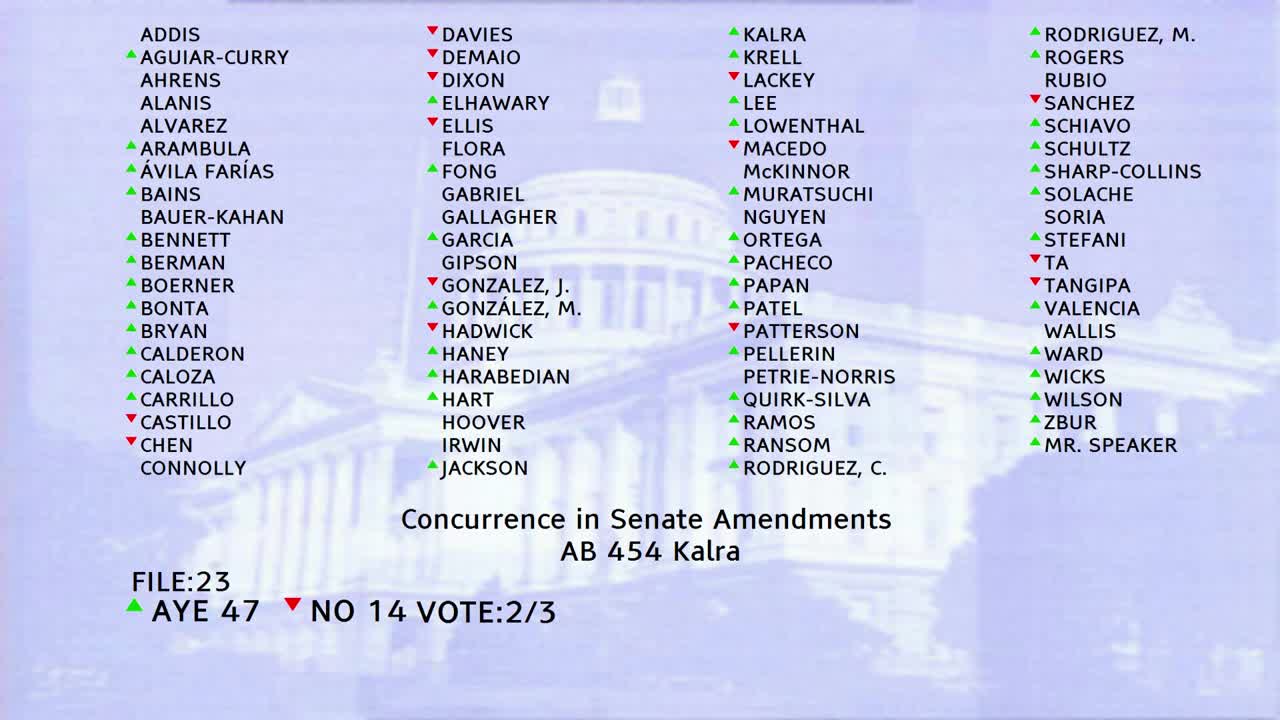
| Sep 4, 2025 | Senate amendments concurred in. To Engrossing and Enrolling. (Ayes 78. Noes 0. Page 2918.). |
| Sep 3, 2025 | In Assembly. Concurrence in Senate amendments pending. |
| Sep 3, 2025 | Read third time. Passed. Ordered to the Assembly. (Ayes 38. Noes 1. Page 2427.). |
| Jun 24, 2025 | Read second time. Ordered to third reading. |
| Jun 23, 2025 | From committee: Be ordered to second reading pursuant to Senate Rule 28.8. |
| Jun 11, 2025 | Read second time and amended. Re-referred to Com. on APPR. |
| Jun 10, 2025 | From committee: Amend, and do pass as amended and re-refer to Com. on APPR. (Ayes 7. Noes 0.) (June 10). |
| May 7, 2025 | Referred to Com. on N.R. & W. |
| Apr 21, 2025 | In Senate. Read first time. To Com. on RLS. for assignment. |
| Apr 21, 2025 | Read third time. Passed. Ordered to the Senate. (Ayes 73. Noes 0. Page 1175.) |
| Apr 10, 2025 | Read second time. Ordered to third reading. |
| Apr 9, 2025 | From committee: Do pass. (Ayes 14. Noes 0.) (April 9). |
| Apr 1, 2025 | Re-referred to Com. on APPR. |
| Mar 28, 2025 | Read second time and amended. |
| Mar 27, 2025 | From committee: Amend, and do pass as amended and re-refer to Com. on APPR. (Ayes 13. Noes 0.) (March 25). |
| Feb 24, 2025 | Referred to Com. on W. P., & W. |
| Feb 14, 2025 | From printer. May be heard in committee March 16. |
| Feb 13, 2025 | Read first time. To print. |
|
Date
|
Description
|
Location
|
Votes
|
|
|---|---|---|---|---|
| Sep 4, 2025 | AB 639 Soria Concurrence in Senate Amendments | Assembly Floor |
Passed |
|
| Sep 3, 2025 | Assembly 3rd Reading AB639 Soria By Caballero | Senate Floor |
Passed |
|
| Jun 10, 2025 | Do pass as amended, but first amend, and re-refer to the Committee on [Appropriations] | Senate Standing Committee on Natural Resources and Water |
Passed |
|
| Apr 21, 2025 | AB 639 Soria Assembly Third Reading | Assembly Floor |
Passed |
|
| Apr 9, 2025 | Do pass. | Assembly Standing Committee on Appropriations |
Passed |
|
| Mar 25, 2025 | Do pass as amended and be re-referred to the Committee on [Appropriations] | Assembly Standing Committee on Water, Parks, and Wildlife |
Passed |
This list shows positions taken on this bill by organizations on the date displayed, which is linked to the original source.
Positions by individuals are not included.
|
Organization
|
Position
|
Date
|
|---|---|---|
| Association Of California Water Agencies | ** Support | |
| California Association Of Realtors | ** Support | |
| California Association Of Winegrape Growers | ** Support | |
| California Farm Bureau | ** Support | |
| Kings River Conservation District (KRCD) | ** Support | |
| Kings River Water Association | ** Support | |
| Rural County Representatives of California | ** Support | |
| Tulare Lake Basin Water Storage District | ** Support | |
| Valley Ag Water Coalition | ** Support | |
| Western Growers Association | ** Support |
CONCURRENCE IN SENATE AMENDMENTS
CSA1 Bill Id:AB 639
Author:(Soria)
As Amended Ver:June 11, 2025
Majority vote
SUMMARY
Exempts specific weirs on the Kings River that have at least three feet of freeboard from regulation and oversight by the Division of Safety of Dams (DSOD) within the Department of Water Resources (DWR).
Senate Amendments
Narrow the exemption in this bill so that it only applies to specific weirs within the Kings River system: Peoples Weir, Reynolds Weir, Last Chance Weir, Lemoore Division Weir, Island Weir, Crescent Weir, Stinson Weir, Empire Weir No. 1, and Empire Weir No. 2.
COMMENTS
Any structure that meets the definition of "dam" is considered a "jurisdictional dam" and is subject to regulation and oversight by DSOD within DWR. There are more than 1,200 jurisdictional dams in California. DSOD ensures dam safety by:
- Reviewing and approving dam enlargements, repairs, alterations, and removals to ensure that the dam appurtenant structures are designed to meet minimum requirements;
- Performing independent analyses to understand dam and appurtenant structures performance. These analyses can include structural, hydrologic, hydraulic, and geotechnical evaluations;
- Overseeing construction to ensure work is being done in accordance with the approved plans and specifications;
- Inspecting each dam on an annual basis to ensure it is safe, performing as intended, and is not developing issues. Roughly one-third of these inspections include in-depth instrumentation reviews of the dam surveillance network data; and
- Periodically reviewing the stability of dams and their major appurtenances in light of improved design approaches and requirements, as well as new findings regarding earthquake hazards and hydrologic estimates in California.
Certain types of structures (e.g., those that are smaller and impound water principally for agricultural purposes) are exempt from oversight by DSOD.
This bill applies to specific weirs on the Kings River that are also part of the federal flood control system. The federal flood control system consists of structures constructed by the U.S. Army Corps of Engineers for local flood protection that are operated and maintained by local agencies post-construction. Such facilities must meet federal standards and are subject to federal flood control regulations.
The weirs exempted from DSOD oversight by this bill were evaluated in a report commissioned by the Kings River Conservation District in November 2024. This evaluation concluded a failure of the flashboards at full storage on each of these structures would not impact any bridge structures crossing the channel downstream and not have any impact to the levees since the flood would be contained in the channel and drop in elevation as it moves downstream.
This bill specifies that to be exempt from DSOD oversight a weir must have three feet of "freeboard." In an open channel, freeboard is the distance measured from the maximum water level to the uppermost watertight portion of a surrounding channel. One might think of "freeboard" as a safety buffer that helps prevent water overtopping a channel by compensating for factors that can contribute to water levels higher than anticipated, such as waves, surges, or splashes.
According to the Author
Water impounding and delivery systems called "weirs" do not typically cross the entirety of rivers or streams, do not impound water above the river levees and are only operated during low-flow periods to pool water for delivery to adjacent farms and ranches. Any spill would be contained entirely within a streambed leading the Department of Water Resources to rate them as very low hazard. Despite this rating, DWR's Division of Safety of Dams includes weirs in their maintenance and inspection schedule and imposes fees of $56,000 on all water impounding structures despite not posing an equivalent safety risk as a dam. This has significantly increased the cost to operate and maintain these weirs with no practical increase in safety for California's residents. AB 639 specifies that these impounding facilities do not count as dams under the Department's inspection program in a very narrow exemption to ensure affordable water deliveries while maintaining California's high safety standards for dams."
Arguments in Support
The Kings River Conservation District (KRCD) supports this bill and states that the study commissioned by KRCD "concluded there is not threat to the public health and safety or property that warrants continued oversight and inspections by [DSOD]." KRCD further maintains that "the weirs characterized by this bill function during low flow periods on affected canals or streams for the exclusive purpose of pooling water for delivery to nearby farms and fields and are considered low hazard facilities."
Arguments in Opposition
None on file.
FISCAL COMMENTS
According to the Assembly Appropriations Committee, this bill would result in an annual reduction in fee revenue of an unknown but likely minor amount offset by a relatively minor reduction in workload resulting from DSOD no longer providing oversight of current and future excluded structures, including annual maintenance inspections, construction oversight, and application reviews.
The Senate Appropriations Committee did not hear this bill and, instead, reported it to the Senate Floor pursuant to Senate Rule 28.8; indicating this bill does not appropriate money, does not result in significant state costs or require the appropriation of funds, and will cause no significant reduction in revenues.
VOTES:
ASM WATER, PARKS, AND WILDLIFE: 13-0-0
YES: Papan, Jeff Gonzalez, Alvarez, Ávila Farías, Bains, Bennett, Boerner, Caloza, Hart, Macedo, Celeste Rodriguez, Rogers, Tangipa
ASM APPROPRIATIONS: 14-0-1
YES: Wicks, Sanchez, Arambula, Calderon, Caloza, Dixon, Elhawary, Fong, Mark González, Hadwick, Hart, Pacheco, Solache, Ta
ABS, ABST OR NV: Pellerin
ASSEMBLY FLOOR: 73-0-6
YES: Addis, Aguiar-Curry, Ahrens, Alanis, Alvarez, Arambula, Ávila Farías, Bains, Bauer-Kahan, Bennett, Berman, Boerner, Bonta, Bryan, Calderon, Caloza, Carrillo, Castillo, Chen, Connolly, Davies, DeMaio, Dixon, Elhawary, Ellis, Flora, Fong, Gabriel, Garcia, Gipson, Jeff Gonzalez, Mark González, Hadwick, Haney, Harabedian, Hart, Hoover, Irwin, Jackson, Kalra, Krell, Lackey, Lee, Lowenthal, Macedo, McKinnor, Muratsuchi, Nguyen, Ortega, Pacheco, Patel, Patterson, Pellerin, Petrie-Norris, Quirk-Silva, Ransom, Celeste Rodriguez, Michelle Rodriguez, Rogers, Blanca Rubio, Sanchez, Schiavo, Solache, Soria, Stefani, Ta, Tangipa, Wallis, Ward, Wicks, Wilson, Zbur, Rivas
ABS, ABST OR NV: Gallagher, Papan, Ramos, Schultz, Sharp-Collins, Valencia
SENATE FLOOR: 38-1-1
YES: Allen, Alvarado-Gil, Archuleta, Arreguín, Ashby, Becker, Blakespear, Cabaldon, Caballero, Cervantes, Choi, Cortese, Dahle, Durazo, Gonzalez, Grayson, Grove, Jones, Laird, Limón, McGuire, McNerney, Menjivar, Niello, Ochoa Bogh, Padilla, Pérez, Reyes, Richardson, Rubio, Seyarto, Smallwood-Cuevas, Stern, Strickland, Umberg, Wahab, Weber Pierson, Wiener
NO: Hurtado
ABS, ABST OR NV: Valladares
UPDATED
VERSION: June 11, 2025
CONSULTANT: Pablo Garza / W., P., & W. / (916) 319-2096 FN: 0001560
SENATE RULES COMMITTEE Office of Senate Floor Analyses (916) 651-1520 Fax: (916) 327-4478 | AB 639 |
THIRD READING
Bill No: AB 639
Author: Soria (D)
Amended: 6/11/25 in Senate
Vote: 21
SENATE NATURAL RES. & WATER COMMITTEE: 7-0, 6/10/25
AYES: Limón, Seyarto, Allen, Grove, Hurtado, Laird, Stern
SENATE APPROPRIATIONS COMMITTEE: Senate Rule 28.8
ASSEMBLY FLOOR: 73-0, 4/21/25 - See last page for vote
SUBJECT: Dams: exceptions
SOURCE: Kings River Conservation District
DIGEST:
This bill exempts specified “weirs,” as defined, that have at least three feet of freeboard from Department of Water Resources (DWR) Division of Safety of Dams (DSOD) regulation and oversight.
ANALYSIS:
Existing law:
- Subjects all dams and reservoirs to regulation and oversight by DSOD within DWR (Water Code (Wat. C.) §6075).
- Defines “dam” as any artificial barrier, together with additional appurtenant structures (including training walls, spillways, outlets, tunnels, channels, pipelines, or dikes) that may impound or divert water and is either (a) 25 feet or greater in height from the natural stream bed to the top of the barrier/maximum storage elevation, or (b) impounds a capacity of 50 acre-feet of water or more (Wat. C. §6002).
- Excludes any barrier not in excess of six feet or a barrier with a storage capacity of 15 acre-feet or less, regardless of height, from the definition of dam (Wat. C. §6003).
- Excludes certain structures from the definition of “dam,” including an obstruction in a canal as a barrier across a stream channel, watercourse, or natural drainage area from consideration as a dam if the structure is no greater than 15 feet in height (Wat. C. §6004).
- Excludes dams owned and operated by the federal government from regulation and oversight by DSOD (Wat. C. §6009).
- Requires DSOD to inspect dams, reservoirs, and appurtenant structures to verify their safety in accordance with a prescribed schedule depending on the hazard classification, as determined by DSOD, of the facility (Wat. C. §6102.5).
This bill:
- Provides that any barrier that does not impound water above the top of a levee where the maximum storage behind the barrier has a minimum of three feet of freeboard on the levee and is a weir is not considered a dam.
- Only applies this exemption to Peoples Weir, Reynolds Weir, Last Chance Weir, Lemoore Diversion Weir, Island Weir, Crescent Weir, Stinson Weir, Empire Weir No. 1, and Empire Weir No. 2.
- Only applies this exemption to Peoples Weir, Reynolds Weir, Last Chance Weir, Lemoore Diversion Weir, Island Weir, Crescent Weir, Stinson Weir, Empire Weir No. 1, and Empire Weir No. 2.
- Defines “weir” as an agricultural water delivery structure with either mechanically or manually removable flashboards or gates that serves to regulate water flow and that functions as part of a federal flood control system.
Background
Division of Safety of Dams. The State has regulated dams since 1929 to prevent failure, safeguard life, and protect property. DSOD provides oversight to the design, construction, and maintenance of over 1,200 jurisdictional sized dams in California. A “dam” is any artificial barrier, together with appurtenant works. If the dam height is more than six feet and it impounds 50 acre-feet or more of water, or if the dam is 25 feet or higher and impounds more than 15 acre-feet of water, it is under the jurisdiction of DSOD (“jurisdictional dams”), unless it is exempted.
DSOD ensures dam safety by:
- Reviewing and approving dam enlargements, repairs, alterations, and removals to ensure that the dam appurtenant structures are designed to meet minimum requirements.
- Performing independent analyses to understand dam and appurtenant structures performance. These analyses can include structural, hydrologic, hydraulic, and geotechnical evaluations.
- Overseeing construction to ensure work is being done in accordance with approved plans and specifications.
- Inspecting each dam on an annual basis to ensure it is safe, performing as intended, and is not developing issues.
- Periodically reviewing the stability of dams and their major appurtenances in light of improved design approaches and requirements.
DSOD’s website contains information about jurisdictional dams, including owner name, dam height, reservoir capacity, dam type, certified status, downstream hazard, condition assessment, and reservoir restrictions. The downstream hazard is based solely on potential downstream impacts to life and property should the dam fail when operating with a full reservoir. There are four categories of downstream hazard: low, significant, high, and extremely high, described below.
Downstream Hazard Potential Classifications | Potential Downstream Impacts to Life and Property |
Low | No probable loss of human life and low economic and environmental losses. Losses are expected to be principally limited to the owner’s property. |
Significant | No probable loss of human life but can cause economic loss, environmental damage, impacts to critical facilities, or other significant impacts. |
High | Expected to cause loss of at least one human life. |
Extremely High | Expected to cause considerable loss of human life or would result in an inundation area with a population of 1,000 or more. |
King’s River Inline Weir Evaluation. In November 2024, Kings River Conservation District used GEI Consultants to evaluate nine inline structures located within the Kings River system, the sites being within Tulare, Fresno, and Kings County. The nine inline structures covered by the report are: Peoples Weir, Reynolds Weir, Last Chance Weir, Lemoore Weir, Island Weir, Crescent Weir, Stinson Weir, Empire Weir No. 1, and Empire Weir No. 2.
According to the report, the purpose of the evaluation was to determine if there would be any upstream or downstream impacts to critical facilities if the inline structure flashboards were to fail during the summer irrigation season. The hydraulic model evaluations assumed full water storage behind each of the inline structures with the flashboards in place. The evaluations also assumed that the inline structures would fail within an hour and the starting water level at the time of failure was set at the top of the flashboard height which provides a minimum of three feet of freeboard below the top of the levee where the water is being impounded.
In an open channel, a freeboard is the distance measured from the maximum water level to the uppermost watertight portion of a surrounding channel. As described by the Assembly Water, Parks, and Wildlife Committee, “one might think of ‘freeboard’ as a safety buffer that helps prevent water overtopping a channel by compensating for factors that can contribute to water levels higher than anticipated, such as waves, surges, or splashes.”
The evaluation concluded that the results for each of the structures shows a failure of the flashboards at full storage would not impact any bridge structures crossing the channel downstream and not have any impact to the levees since the flood is contained in the channel and drops in elevation as it moves downstream. All nine structures have shown the modeled flood wave will have no impacts to the bridge structures and no impacts to any critical facilities, levees or bridge structures within the channel conveyance.”
Further, DSOD’s Downstream Hazard Potential Classification for each of these weirs is “low.”
FISCAL EFFECT: Appropriation: No Fiscal Com.: Yes Local: No
SUPPORT: (Verified 6/23/25)
Kings River Conservation District (source)
Association of California Water Agencies
California Association of Realtors
California Association of Winegrape Growers
California Farm Bureau
Kings River Water Association
Rural County Representatives of California
Tulare Lake Basin Water Storage District
Valley Ag Water Coalition
Western Growers Association
OPPOSITION: (Verified 6/23/25)
None received
ARGUMENTS IN SUPPORT: According to the author, “Water impounding and delivery systems called “weirs” do not typically cross the entirety of rivers or streams, do not impound water above the river levees and are only operated during low-flow periods to pool water for delivery to adjacent farms and ranches. Any spill would be contained entirely within a streambed leading the Department of Water Resources to rate them as very low hazard. Despite this rating, DWR’s Division of Safety of Dams includes weirs in their maintenance and inspection schedule and imposes fees of $56,000 on all water impounding structures despite not posing an equivalent safety risk as a dam. This has significantly increased the cost to operate and maintain these weirs with no practical increase in safety for California’s residents. AB 639 specifies that these impounding facilities do not count as dams under the Department’s inspection program in a very narrow exemption to ensure affordable water deliveries while maintaining California’s high safety standards for dams.”
ASSEMBLY FLOOR: 73-0, 4/21/25
AYES: Addis, Aguiar-Curry, Ahrens, Alanis, Alvarez, Arambula, Ávila Farías, Bains, Bauer-Kahan, Bennett, Berman, Boerner, Bonta, Bryan, Calderon, Caloza, Carrillo, Castillo, Chen, Connolly, Davies, DeMaio, Dixon, Elhawary, Ellis, Flora, Fong, Gabriel, Garcia, Gipson, Jeff Gonzalez, Mark González, Hadwick, Haney, Harabedian, Hart, Hoover, Irwin, Jackson, Kalra, Krell, Lackey, Lee, Lowenthal, Macedo, McKinnor, Muratsuchi, Nguyen, Ortega, Pacheco, Patel, Patterson, Pellerin, Petrie-Norris, Quirk-Silva, Ransom, Celeste Rodriguez, Michelle Rodriguez, Rogers, Blanca Rubio, Sanchez, Schiavo, Solache, Soria, Stefani, Ta, Tangipa, Wallis, Ward, Wicks, Wilson, Zbur, Rivas
NO VOTE RECORDED: Gallagher, Papan, Ramos, Schultz, Sharp-Collins, Valencia
Prepared by: Genevieve Wong / N.R. & W. / (916) 651-4116
6/24/25 16:32:52
**** END ****
SENATE COMMITTEE ON NATURAL RESOURCES AND WATER
Senator Monique Limón, Chair
2025 - 2026 Regular
Bill No: AB 639 Hearing Date: June 10, 2025
Author: | |||
Version: | Amended | ||
Urgency: | Fiscal: | ||
Consultant: | |||
Subject: Dams: exceptions
SUMMARY
This bill would exempt a “weir,” as defined, that has at least three feet of freeboard from Department of Water Resources (DWR) Division of Safety of Dams (DSOD) regulation and oversight.
BACKGROUND AND EXISTING LAW
Division of Safety of Dams. The State has regulated dams since 1929 to prevent failure, safeguard life, and protect property. DSOD provides oversight to the design, construction, and maintenance of over 1,200 jurisdictional sized dams in California. A “dam” is any artificial barrier, together with appurtenant works. If the dam height is more than six feet and it impounds 50 acre-feet or more of water, or if the dam is 25 feet or higher and impounds more than 15 acre-feet of water, it is under the jurisdiction of DSOD (“jurisdictional dams”), unless it is exempted.
DSOD ensures dam safety by:
- Reviewing and approving dam enlargements, repairs, alterations, and removals to ensure that the dam appurtenant structures are designed to meet minimum requirements.
- Performing independent analyses to understand dam and appurtenant structures performance. These analyses can include structural, hydrologic, hydraulic, and geotechnical evaluations.
- Overseeing construction to ensure work is being done in accordance with approved plans and specifications.
- Inspecting each dam on an annual basis to ensure it is safe, performing as intended, and is not developing issues. Roughly one-third of these inspections include in-depth instrumentation reviews of the dam surveillance network data.
- Periodically reviewing the stability of dams and their major appurtenances in light of improved design approaches and requirements, as well as new findings regarding earthquake hazards and hydrologic estimates in California.
DSOD’s website contains information about jurisdictional dams, including owner name, dam height, reservoir capacity, dam type, certified status, downstream hazard, condition assessment, and reservoir restrictions. The downstream hazard is based solely on potential downstream impacts to life and property should the dam fail when operating with a full reservoir. There are four categories of downstream hazard: low, significant, high, and extremely high. The descriptions of these categories are below.
Downstream Hazard Potential Classifications | Potential Downstream Impacts to Life and Property |
Low | No probable loss of human life and low economic and environmental losses. Losses are expected to be principally limited to the owner’s property. |
Significant | No probable loss of human life but can cause economic loss, environmental damage, impacts to critical facilities, or other significant impacts. |
High | Expected to cause loss of at least one human life. |
Extremely High | Expected to cause considerable loss of human life or would result in an inundation area with a population of 1,000 or more. |
King’s River Inline Weir Evaluation. In November 2024, Kings River Conservation District used GEI Consultants to evaluate nine inline structures located within the Kings River system, the sites being within Tulare, Fresno, and Kings County. The nine inline structures covered by the report are: Peoples Weir, Reynolds Weir, Last Chance Weir, Lemoore Weir, Island Weir, Crescent Weir, Stinson Weir, Empire Weir No. 1, and Empire Weir No. 2.
According to the report, the purpose of the evaluation was to determine if there would be any upstream or downstream impacts to critical facilities if the inline structure flashboards were to fail during the summer irrigation season. The hydraulic model evaluations assumed full water storage behind each of the inline structures with the flashboards in place. The evaluations also assumed that the inline structures would fail within an hour and the starting water level at the time of failure was set at the top of the flashboard height which provides a minimum of three feet of freeboard below the top of the levee where the water is being impounded.
In an open channel, a freeboard is the distance measured from the maximum water level to the uppermost watertight portion of a surrounding channel. As described by the Assembly Water, Parks, and Wildlife Committee, “one might think of ‘freeboard’ as a safety buffer that helps prevent water overtopping a channel by compensating for factors that can contribute to water levels higher than anticipated, such as waves, surges, or splashes.”
The evaluation concluded that the results for each of the structures shows a failure of the flashboards at full storage would not impact any bridge structures crossing the channel downstream and not have any impact to the levees since the flood is contained in the channel and drops in elevation as it moves downstream. All nine structures have shown the modeled flood wave will have no impacts to the bridge structures and no impacts to any critical facilities, levees or bridge structures within the channel conveyance.”
Further, DSOD’s Downstream Hazard Potential Classification for each of these weirs is “low.”
Existing law:
- Subjects all dams and reservoirs to regulation and oversight by DSOD within DWR (Water Code (Wat. C.) §6075).
- Defines “dam” as any artificial barrier, together with additional appurtenant structures (including training walls, spillways, outlets, tunnels, channels, pipelines, or dikes) that may impound or divert water and is either (a) 25 feet or greater in height from the natural stream bed to the top of the barrier/maximum storage elevation, or (b) impounds a capacity of 50 acre-feet of water or more (Wat. C. §6002).
- Excludes any barrier not in excess of six feet or a barrier with a storage capacity of 15 acre-feet or less, regardless of height, from the definition of dam (Wat. C. §6003).
- Excludes certain structures from the definition of “dam,” including an obstruction in a canal as a barrier across a stream channel, watercourse, or natural drainage area from consideration as a dam if the structure is no greater than 15 feet in height (Wat. C. §6004).
- Excludes dams owned and operated by the federal government from regulation and oversight by DSOD (Wat. C. §6009).
- Requires DSOD to inspect dams, reservoirs, and appurtenant structures to verify their safety in accordance with a prescribed schedule depending on the hazard classification, as determined by DSOD, of the facility (Wat. C. §6102.5).
PROPOSED LAW
This bill would:
- Provide that any barrier that does not impound water above the top of a levee where the maximum storage behind the barrier has a minimum of three feet of freeboard on the levee and is a weir is not considered a dam.
- Defines “weir” as an agricultural water delivery structure with either mechanically or manually removable flashboards or gates that serves to regulate the flow of water in a stream and that functions as part of a federal flood control system.
ARGUMENTS IN SUPPORT
According to the author, “Water impounding and delivery systems called “weirs” do not typically cross the entirety of rivers or streams, do not impound water above the river levees and are only operated during low-flow periods to pool water for delivery to adjacent farms and ranches. Any spill would be contained entirely within a streambed leading the Department of Water Resources to rate them as very low hazard. Despite this rating, DWR’s Division of Safety of Dams includes weirs in their maintenance and inspection schedule and imposes fees of $56,000 on all water impounding structures despite not posing an equivalent safety risk as a dam. This has significantly increased the cost to operate and maintain these weirs with no practical increase in safety for California’s residents. AB 639 specifies that these impounding facilities do not count as dams under the Department’s inspection program in a very narrow exemption to ensure affordable water deliveries while maintaining California’s high safety standards for dams.”
ARGUMENTS IN OPPOSITION
None received.
COMMENTS
Bill applies to more than Kings River. According to the author and sponsor, this bill is intended to only exempt certain structures on the Kings River from oversight. However, the bill would apply statewide. According to DWR, this bill would also apply to Sack Dam in Madera County. Further, this bill would also apply to future structures that would otherwise be subject to DSOD oversight. It is unknown what the Downstream Hazard Potential Classifications would be for those future structures.
To ensure that this bill only applies to the specific structures intended by the author and sponsor, the committee may wish to amend the bill to specifically limit its application to the weirs that were subject to the Kings River Inline Weir Evaluation. See Amendment 1.
SUGGESTED AMENDMENTS
AMENDMENT 1
Amend Water Code §6003(b) as follows:
(b)(1) Any barrier that does not impound water above the top of a levee where maximum storage behind the barrier has a minimum of three feet of freeboard on the levee and is a weir shall not be considered a dam.
(2) This subdivision shall only apply to Peoples Weir, Reynolds Weir, Last Chance Weir, Lemoore Diversion Weir, Island Weir, Crescent Weir, Stinson Weir, Empire Weir No. 1, and Empire Weir No. 2.
SUPPORT
Kings River Conservation District (sponsor)
Association of California Water Agencies (ACWA)
California Association of Realtors
California Association of Winegrape Growers
California Farm Bureau
Kings River Water Association
Rural County Representatives of California (RCRC)
Tulare Lake Basin Water Storage District
Valley Ag Water Coalition
Western Growers Association
OPPOSITION
None Received
-- END --
ASSEMBLY THIRD READING
ATR Bill Id:AB 639
Author:(Soria)
As Amended Ver:March 28, 2025
Majority vote
SUMMARY
Provides that a ″weir,″ as defined, that has at least three feet of freeboard is not subject to regulation or oversight by the Division of Safety of Dams (DSOD) within the Department of Water Resources (DWR).
Major Provisions
Defines ″weir″ as an agricultural water delivery structure with either mechanically or manually removable flashboards or gates that serves to regulate the flow of water in a stream and that functions as part of a federal flood control system.
COMMENTS
Any structures that meet the definition of ″dam″ are considered ″jurisdictional dams″ and are subject to regulation and oversight by DSOD within DWR. There are more than 1,200 jurisdictional dams in California. DSOD ensures dam safety by:
- Reviewing and approving dam enlargements, repairs, alterations, and removals to ensure that the dam appurtenant structures are designed to meet minimum requirements;
- Performing independent analyses to understand dam and appurtenant structures performance. These analyses can include structural, hydrologic, hydraulic, and geotechnical evaluations;
- Overseeing construction to ensure work is being done in accordance with the approved plans and specifications;
- Inspecting each dam on an annual basis to ensure it is safe, performing as intended, and is not developing issues. Roughly one-third of these inspections include in-depth instrumentation reviews of the dam surveillance network data; and
- Periodically reviewing the stability of dams and their major appurtenances in light of improved design approaches and requirements, as well as new findings regarding earthquake hazards and hydrologic estimates in California.
Certain types of structures (e.g., those that are smaller and impound water principally for agricultural purposes) are exempt from oversight by DSOD.
This bill applies to ″weirs″ that are part of the federal flood control system. The federal flood control system consists of structures constructed by the U.S. Army Corps of Engineers for local flood protection that are operated and maintained by local agencies post-construction. Such facilities must meet federal standards and are subject to federal flood control regulations.
In an open channel, freeboard is the distance measured from the maximum water level to the uppermost watertight portion of a surrounding channel. One might think of ″freeboard″ as a safety buffer that helps prevent water overtopping a channel by compensating for factors that can contribute to water levels higher than anticipated, such as waves, surges, or splashes.
According to the Author
″Water impounding and delivery systems called ′weirs′ do not typically cross the entirety of rivers or streams, do not impound water above the river levees and are only operated during low-flow periods to pool water for delivery to adjacent farms and ranches. Any spill would be contained entirely within a streambed leading [DWR] to rate them as very low hazard. Despite this rating, [DSOD] includes weirs in their maintenance and inspection schedule and imposes fees of $56,000 on all water impounding structures despite not posing an equivalent safety risk as a dam. This has significantly increased the cost to operate and maintain these weirs with no practical increase in safety for California′s residents. [This bill] specifies that these impounding facilities do not count as dams under [DWR′s] inspection program in a very narrow exemption to ensure affordable water deliveries while maintaining California′s high safety standards for dams.″
Arguments in Support
The Kings River Conservation District (KRCD) is the sponsor of this bill and argues that there is ″no threat to the public health and safety or property that warrants continued DSOD oversight and inspections″ of weirs. KRCD notes that ″weirs are operated by the placement of wooden or other mechanical flashboards during those periods when it is vital to pool water for delivery for irrigation purposes on nearby agricultural lands,″ but that these boards are removed during extraordinary weather events so that there is no risk of the barrier failing. Finally, KRCD points out that ″in over one hundred years of operation we are unaware of any structural or operational failure that would have resulted in impacts to adjacent property.″
Arguments in Opposition
None on file.
FISCAL COMMENTS
According to the Assembly Appropriations Committee, this bill will have the following fiscal impact:
Annual reduction in fee revenue of an unknown, but likely minor, amount offset by a relatively minor reduction in workload resulting from DOSD no longer providing oversight of current and future excluded structures, including annual maintenance inspections, construction oversight, and application reviews.
Annual fees paid by dam owners within DWR′s jurisdiction cover DWR′s reasonable regulatory costs in carrying out the supervision of dam safety. According to DWR, this bill would exempt ten barriers from the definition of dam. For fiscal year 2025-26, DWR estimates the annual fees for these dams to be approximately $46,000 (special fund), which is about 0.21% of the total fees billed by DSOD.
VOTES
ASM WATER, PARKS, AND WILDLIFE: 13-0-0
YES: Papan, Jeff Gonzalez, Alvarez, Ávila Farías, Bains, Bennett, Boerner, Caloza, Hart, Macedo, Celeste Rodriguez, Rogers, Tangipa
ASM APPROPRIATIONS: 14-0-1
YES: Wicks, Sanchez, Arambula, Calderon, Caloza, Dixon, Elhawary, Fong, Mark González, Hadwick, Hart, Pacheco, Solache, Ta
ABS, ABST OR NV: Pellerin
UPDATED
VERSION: March 28, 2025
CONSULTANT: Pablo Garza / W., P., & W. / (916) 319-2096 FN: 0000239
Date of Hearing: April 9, 2025
ASSEMBLY COMMITTEE ON APPROPRIATIONS
Buffy Wicks, Chair
ABPCA Bill Id:AB 639
Author:(Soria) – As Amended Ver:March 28, 2025
Policy Committee: | Water, Parks and Wildlife | Vote: | 13 - 0 |
|
| ||
|
|
Urgency: No State Mandated Local Program: No Reimbursable: No
SUMMARY:
This bill provides that any barrier that 1) does not impound water above the top of a levee where maximum storage behind the barrier has a minimum of three feet of freeboard on the levee and 2) is a weir, as defined, shall not be considered a dam.
FISCAL EFFECT:
Annual reduction in fee revenue of an unknown but likely minor amount offset by a relatively minor reduction in workload resulting from the Division of Safety of Dams (DOSD) no longer providing oversight of current and future excluded structures, including annual maintenance inspections, construction oversight, and application reviews.
Annual fees paid by dam owners within the Department of Water Resources’ (DWR) jurisdiction cover the department’s reasonable regulatory costs in carrying out the supervision of dam safety. According to DWR, this bill would exempt 10 barriers from the definition of dam. For fiscal year 2025-26, DWR estimates the annual fees for these dams to be approximately $46,000 (special fund), which is about 0.21% of the total fees billed by DSOD.
COMMENTS:
1) Purpose. According to the author, this bill “specifies that these impounding facilities do not count as dams under [DWR’s] inspection program in a very narrow exemption to ensure affordable water deliveries while maintaining California’s high safety standards for dams.”
2) Background. Since 1929, the state has regulated and supervised dams to prevent failure, safeguard life, and protect property. Any structure that meets the definition of “dam” is considered a “jurisdictional dam” and is subject to regulation and oversight by DSOD within DWR. There are more than 1,200 jurisdictional dams in California. Certain types of structures (for example, those that are smaller and impound water principally for agricultural purposes) are exempt from DSOD oversight.
This bill applies to “weirs” that are part of the federal flood control system. The federal flood control system consists of structures constructed by the U.S. Army Corps of Engineers for local flood protection that are operated and maintained by local agencies post-construction. Such facilities must meet federal standards and are subject to federal flood control regulations.
The Kings River Conservation District, the sponsor of this bill, writes:
AB 639 would remove agricultural impounding facilities, commonly referred to as “weirs”, from State jurisdiction given that they in no way operate as traditional dams. Instead, weirs function during low flow periods on affected canals or streams for the exclusive purpose of pooling water for delivery to nearby farms and fields and are considered low hazard facilities…The sponsors of AB 639 commissioned a study…that concluded there is no threat to the public health and safety or property that warrants continued oversight and inspections by the Department of Water Resources’ Division of Safety of Dams (“DSOD”).
In fact, given that DSOD must monitor and inspect 1,200 dams a good many of which are rated as high hazard, this change would allow for limited resources to be directed where most needed to protect the public health and safety.
Analysis Prepared by: Nikita Koraddi / APPR. / (916) 319-2081
Date of Hearing: March 25, 2025
ASSEMBLY COMMITTEE ON WATER, PARKS, AND WILDLIFE
Diane Papan, Chair
ABPCA Bill Id:AB 639 (
Author:Soria) – As Introduced Ver:February 13, 2025
SUBJECT: Dams: exceptions
SUMMARY: Provides that a “weir,” as defined, that has at least three feet of freeboard is not subject to regulation or oversight by the Division of Safety of Dams (DSOD) within the Department of Water Resources (DWR). Specifically, this bill:
- Provides that any barrier that does not impound water above the top a levee where maximum storage has a minimum of three feet of freeboard and is a weir with either mechanically or manually removable flashboards or gates shall not be considered a dam.
- Defines “weir” as an agricultural water delivery structure with removable barriers that serves to regulate the flow of water in a stream and that functions as part of a federal flood control system.
- Makes technical and clarifying changes.
EXISTING LAW:
- Subjects all dams and reservoirs to regulation and oversight by DSOD within DWR (Water Code § 6075).
- Defines “dam” as any artificial barrier, together with additional appurtenant structures (including training walls, spillways, outlets, tunnels, channels, pipelines, or dikes) that may impound or divert water and is either (a) 25 feet or greater in height from the natural stream bed to the top of the barrier/maximum storage elevation, or (b) impounds a capacity of 50 acre-feet of water or more (Water Code § 6002).
- Excludes any barrier not in excess of six feet or a barrier with a storage capacity of 15 acre-feet or less, regardless of height, from the definition of dam (Water Code § 6003).
- Excludes certain structures from the definition of “dam,” including an obstruction in a canal as a barrier across a stream channel, watercourse, or natural drainage area from consideration as a dam if the structure is no greater than 15 feet in height (Water Code § 6004).
- Excludes dams owned and operated by the federal government from regulation and oversight by DSOD (Water Code § 6009).
- Requires DSOD to inspect dams, reservoirs, and appurtenant structures to verify their safety in accordance with a prescribed schedule depending on the hazard classification, as determined by DSOD, of the facility (Water Code § 6102.5).
FISCAL EFFECT: Unknown. This bill is keyed fiscal.
COMMENTS:
- Purpose of this bill. According to the author, “Water impounding and delivery systems called ‘weirs’ do not typically cross the entirety of rivers or streams, do not impound water above the river levees and are only operated during low-flow periods to pool water for delivery to adjacent farms and ranches. Any spill would be contained entirely within a streambed leading [DWR] to rate them as very low hazard. Despite this rating, [DSOD] includes weirs in their maintenance and inspection schedule and imposes fees of $56,000 on all water impounding structures despite not posing an equivalent safety risk as a dam. This has significantly increased the cost to operate and maintain these weirs with no practical increase in safety for California’s residents. [This bill] specifies that these impounding facilities do not count as dams under [DWR’s] inspection program in a very narrow exemption to ensure affordable water deliveries while maintaining California’s high safety standards for dams.”
- Background. Since 1929, the State of California has regulated and supervised dams to prevent failure, safeguard life, and protect property. Any structures that meet the definition of “dam” (see #2 under Existing Law, above) are considered “jurisdictional dams” and are subject to regulation and oversight by DSOD within DWR. There are more than 1,200 jurisdictional dams in California. DSOD ensures dam safety by:
- Reviewing and approving dam enlargements, repairs, alterations, and removals to ensure that the dam appurtenant structures are designed to meet minimum requirements;
- Performing independent analyses to understand dam and appurtenant structures performance. These analyses can include structural, hydrologic, hydraulic, and geotechnical evaluations;
- Overseeing construction to ensure work is being done in accordance with the approved plans and specifications;
- Inspecting each dam on an annual basis to ensure it is safe, performing as intended, and is not developing issues. Roughly one-third of these inspections include in-depth instrumentation reviews of the dam surveillance network data; and
- Periodically reviewing the stability of dams and their major appurtenances in light of improved design approaches and requirements, as well as new findings regarding earthquake hazards and hydrologic estimates in California.
Certain types of structures (e.g., those that are smaller and impound water principally for agricultural purposes) are exempt from oversight by DSOD.
Federal flood control system. This bill applies to “weirs” that are part of the federal flood control system. The federal flood control system consists of structures constructed by the U.S. Army Corps of Engineers for local flood protection that are operated and maintained by local agencies post-construction. Such facilities must meet federal standards and are subject to federal flood control regulations.
Freeboard. In an open channel, freeboard is the distance measured from the maximum water level to the uppermost watertight portion of a surrounding channel. One might think of “freeboard” as a safety buffer that helps prevent water overtopping a channel by compensating for factors that can contribute to water levels higher than anticipated, such as waves, surges, or splashes.
- Arguments in support. The Kings River Conservation District (KRCD) is the sponsor of this bill and argues that there is “no threat to the public health and safety or property that warrants continued DSOD oversight and inspections” of weirs. KRCD notes that “weirs are operated by the placement of wooden or other mechanical flashboards during those periods when it is vital to pool water for delivery for irrigation purposes on nearby agricultural lands,” but that these boards are removed during extraordinary weather events so that there is no risk of the barrier failing. Finally, KRCD points out that “in over one hundred years of operation we are unaware of any structural or operational failure that would have resulted in impacts to adjacent property.”
- Policy consideration. It is unclear how many dams would be excluded from DSOD oversight by this bill; the goal of the sponsor and author is to exempt certain structures on the Kings River from oversight, but this bill will apply statewide if it is enacted. The Committee may wish to request that the author and sponsor to determine how many jurisdictional dams will be affected by this bill should it advance.
- Technical amendment. The Committee may wish to propose the following technical amendments (in bold italics) to improve clarity:
6003. (a) Any barrier that is or will be not in excess of six feet in height, regardless of storage capacity, or that has or will have a storage capacity not in excess of 15 acre-feet, regardless of height, shall not be considered a dam.
(b) Any barrier that does not impound water above the top of a levee where maximum storage behind the barrier has a minimum of three feet of freeboard on the levee and is a weir with either mechanically or manually removable flashboards or gates shall not be considered a dam.
(c) For purposes of this section, a “weir” is defined as an agricultural water delivery structure with removable barriers either mechanically or manually removable flashboards or gates that serves to regulate the flow of water in a stream and that functions as part of a federal flood control system as defined by Part 208 (commencing with Section 208.10) of Chapter II of Title 33 of the Code of Federal Regulations.
- Related legislation. SB 122 (Committee on Budget and Fiscal Review), Chapter 51, Statutes of 2023, is the public resources trailer bill for the 2023-24 fiscal year. Among other provisions, SB 122 increases the application fee for the enlargement, repair, alteration or removal of an existing dam or reservoir and authorizes DWR to adopt regulations to adjust the application filing fees to ensure the fees cover DWR’s reasonable costs in processing applications.
AB 1164 (Flora), Chapter 943, Statutes of 2022, exempts “regulating basins,” as defined, from regulation and oversight by DSOD.
AB 727 (Flora) of 2019 would have exempted structures that are 20 feet or less in height, owned or operated by a public agency, and used principally for impounding water for agricultural use from regulation and oversight by DSOD. AB 727 was held in the Senate Natural Resources and Water Committee.
AB 1270 (Gallagher), Chapter 3, Statutes of 2018, repealed previous provisions of law related to dam safety and inspection, and instead, among other things, added specific requirements for DSOD to inspect dams, reservoirs, and appurtenant structures on an annual and bi-annual schedule based on hazard classification.
REGISTERED SUPPORT / OPPOSITION:
Support
Kings River Conservation District (sponsor)
Association of California Water Agencies
California Association of Winegrape Growers
California Farm Bureau
Kings River Water Association
Tulare Lake Basin Water Storage District
Valley Ag Water Coalition
Western Growers Association
Opposition
None on file
Analysis Prepared by: Pablo Garza / W., P., & W. / (916) 319-2096
Discussed in Hearing
 1MIN
Assembly Floor
 6MIN
Senate Floor
 5MIN
Senate Standing Committee on Natural Resources and Water
 1MIN
Assembly Floor
 1MIN
Assembly Standing Committee on Appropriations
 14MIN
Assembly Standing Committee on Water, Parks, and Wildlife
Bill Author

Bill Co-Author(s):