AB 645: Emergency medical services: dispatcher training.
- Session Year: 2025-2026
- House: Assembly
- Latest Version Date: 2025-10-03
Current Status:
Passed
(2025-10-03: Chaptered by Secretary of State - Chapter 273, Statutes of 2025.)
Introduced
In Committee
Awaiting First Chamber Vote
Passed First Chamber
In Committee
Awaiting Second Chamber Vote
Passed Second Chamber
Enacted
Existing law, the Emergency Medical Services System and the Prehospital Emergency Medical Care Personnel Act (act), establishes the Emergency Medical Services Authority, which is responsible for the coordination of various state activities concerning emergency medical services (EMS). The act authorizes a county to develop an EMS program by designating a local EMS agency. Existing law also requires the Commission on Emergency Medical Services to review and approve regulations, standards, and guidelines to be developed by the authority. Existing law generally makes a violation of the act a misdemeanor.
This bill would require, by January 1, 2027, a public safety agency that provides 911 call processing services for emergency medical response to provide prearrival medical instructions to 911 callers requiring medical assistance, including, among other things, airway and choking medical instructions for infants, children, and adults and administration of naloxone for narcotics overdoses. The bill would require prearrival medical instructions to be approved by the local EMS agency medical director and implemented consistent with the medical protocols and procedures adopted by the public safety agency. By expanding the scope of a crime, and to the extent that the bill would create new duties for a public safety agency, the bill would impose a state-mandated local program.
The California Constitution requires the state to reimburse local agencies and school districts for certain costs mandated by the state. Statutory provisions establish procedures for making that reimbursement.
This bill would provide that with regard to certain mandates no reimbursement is required by this act for a specified reason.
With regard to any other mandates, this bill would provide that, if the Commission on State Mandates determines that the bill contains costs so mandated by the state, reimbursement for those costs shall be made pursuant to the statutory provisions noted above.
Existing law, the Emergency Medical Services System and the Prehospital Emergency Medical Care Personnel Act (act), establishes the Emergency Medical Services Authority, which is responsible for the coordination of various state activities concerning emergency medical services (EMS). The act authorizes a county to develop an EMS program by designating a local EMS agency. Existing law also requires the Commission on Emergency Medical Services to review and approve regulations, standards, and guidelines to be developed by the authority. Existing law generally makes a violation of the act a misdemeanor.
This bill would require the authority, by January 1, 2027, to develop and, after approval by the commission, adopt minimum standards for emergency medical dispatcher training. The bill would require a public safety dispatcher or public safety telecommunicator, as defined, to complete that training. require, by January 1, 2027, a public safety agency that provides 911 call processing services for emergency medical response to provide prearrival medical instructions to 911 callers requiring medical assistance, including, among other things, airway and choking medical instructions for infants, children, and adults and administration of naloxone for narcotics overdoses. The bill would require prearrival medical instructions to be approved by the local EMS agency medical director and implemented consistent with the medical protocols and procedures adopted by the public safety agency. By expanding the scope of a crime, and to the extent that the bill would create new duties for a public safety dispatcher or public safety telecommunicator, agency, the bill would impose a state-mandated local program.
The California Constitution requires the state to reimburse local agencies and school districts for certain costs mandated by the state. Statutory provisions establish procedures for making that reimbursement.
This bill would provide that with regard to certain mandates no reimbursement is required by this act for a specified reason.
With regard to any other mandates, this bill would provide that, if the Commission on State Mandates determines that the bill contains costs so mandated by the state, reimbursement for those costs shall be made pursuant to the statutory provisions noted above.
Existing law, the Emergency Medical Services System and the Prehospital Emergency Medical Care Personnel Act (act), establishes the Emergency Medical Services Authority, which is responsible for the coordination of various state activities concerning emergency medical services (EMS). The act authorizes a county to develop an EMS program by designating a local EMS agency. Existing law also requires the Commission on Emergency Medical Services to review and approve regulations, standards, and guidelines to be developed by the authority. Existing law generally makes a violation of the act a misdemeanor.
This bill would require the authority to develop, and, authority, by January 1, 2027, to develop and, after approval by the commission, to adopt, adopt minimum standards for emergency medical dispatcher training, and training. The bill would require a public safety dispatcher or public safety telecommunicator telecommunicator, as defined, to complete that training. The bill would define a public safety dispatcher or public safety telecommunicator for these purposes. By expanding the scope of a crime, and to the extent that the bill would create new duties for a public safety dispatcher or public safety telecommunicator, this the bill would impose a state-mandated local program.
The California Constitution requires the state to reimburse local agencies and school districts for certain costs mandated by the state. Statutory provisions establish procedures for making that reimbursement.
This bill would provide that with regard to certain mandates no reimbursement is required by this act for a specified reason.
With regard to any other mandates, this bill would provide that, if the Commission on State Mandates determines that the bill contains costs so mandated by the state, reimbursement for those costs shall be made pursuant to the statutory provisions noted above.
Existing law, the Emergency Medical Services System and the Prehospital Emergency Medical Care Personnel Act (act), establishes the Emergency Medical Services Authority, which is responsible for the coordination of various state activities concerning emergency medical services (EMS). The act authorizes a county to develop an EMS program by designating a local EMS agency. Existing law also requires the Commission on Emergency Medical Services to review and approve regulations, standards, and guidelines to be developed by the authority. Existing law makes a violation of the act a misdemeanor.
This bill would require the authority to develop, and, after approval by the commission, to adopt, minimum standards for emergency medical dispatcher training, and would require a public safety dispatcher or public safety telecommunicator to complete that training. The bill would define a public safety dispatcher or public safety telecommunicator for these purposes. By expanding the scope of a crime, and to the extent that the bill would create new duties for a public safety dispatcher or public safety telecommunicator, this bill would impose a state-mandated local program.
The California Constitution requires the state to reimburse local agencies and school districts for certain costs mandated by the state. Statutory provisions establish procedures for making that reimbursement.
This bill would provide that with regard to certain mandates no reimbursement is required by this act for a specified reason.
With regard to any other mandates, this bill would provide that, if the Commission on State Mandates determines that the bill contains costs so mandated by the state, reimbursement for those costs shall be made pursuant to the statutory provisions noted above.
The Warren-911-Emergency Assistance Act governs the statewide establishment and implementation of the 911-emergency telephone system.This bill would state that it is the intent of the Legislature to enact legislation to require emergency dispatchers to be trained as Emergency Medical Dispatchers.The Warren-911-Emergency Assistance Act governs the statewide establishment and implementation of the 911-emergency telephone system.
This bill would state that it is the intent of the Legislature to enact legislation to require emergency dispatchers to be trained as Emergency Medical Dispatchers.
(a)By January 1, 2027, a public safety agency that provides 911 call processing services for emergency medical response shall provide prearrival medical instructions to 911 callers requiring medical assistance, including, at a minimum, all of the following:
(1)Airway and choking medical instructions for infants, children, and adults.
(2)Automatic external defibrillator (AED) and CPR instructions for children and adults.
(3)Childbirth.
(4)Bleeding control and hemorrhage.
(5)Administration of epinephrine by auto-injector for suspected anaphylaxis.
(6)Administration of naloxone for suspected narcotics overdoses.
(b)A public safety agency may satisfy the requirements of subdivision (a) by contracting with another public safety agency that provides prearrival medical instructions.
(c)Prearrival medical instructions developed pursuant to subdivision (a) or (b) shall be approved by the local EMS agency medical director pursuant to subdivisions (c) and (d) of Section 1797.223 and implemented consistent with the medical protocols and procedures adopted by the public safety agency.
(d)This section does not require a public safety agency to update its policies and procedures if the public safety agency already provides prearrival medical instructions through emergency medical dispatch or other means and those instructions have been approved by the local EMS agency medical director.
(e)A public safety agency dispatching peace officers to the scene of an emergency shall not constitute call processing services for emergency medical response for purposes of this section, even though the peace officers may administer first aid and CPR pursuant to Section 1797.183.
(f)This section shall not be construed to alter, modify, abridge, diminish, enlarge, or constrain the authoritys ability to adopt guidelines or regulations for emergency medical dispatch, including dispatcher training, under existing law, including, but not limited to, Sections 1797.103 and 1797.107.
(g)This section does not supersede Section 1797.201, 1797.223, 1798.6, or 1798.8, or Section 53110 of the Government Code.
SEC. 2.No reimbursement is required by this act pursuant to Section 6 of Article XIIIB of the California Constitution for certain costs that may be incurred by a local agency or school district because, in that regard, this act creates a new crime or infraction, eliminates a crime or infraction, or changes the penalty for a crime or infraction, within the meaning of Section 17556 of the Government Code, or changes the definition of a crime within the meaning of Section 6 of Article XIIIB of the California Constitution.
However, if the Commission on State Mandates determines that this act contains other costs mandated by the state, reimbursement to local agencies and school districts for those costs shall be made pursuant to Part 7 (commencing with Section 17500) of Division 4 of Title 2 of the Government Code.
(a)By January 1, 2027, a public safety agency that provides 911 call processing services for emergency medical response shall provide prearrival medical instructions to 911 callers requiring medical assistance, including, but not limited to, at a minimum, all of the following:
(1)Airway and choking medical instructions for infants, children, and adults.
(2)Automatic external defibrillator (AED) and CPR instructions for children and adults.
(3)Childbirth.
(4)Bleeding control and hemorrhage.
(5)Administration of epinephrine by auto-injector for suspected anaphylaxis.
(6)Administration of naloxone for suspected narcotics overdoses.
(b)A public safety agency may satisfy the requirements of subdivision (a) by contracting with another public safety agency that provides prearrival medical instructions.
(c)Prearrival medical instructions developed pursuant to subdivision (a) or (b) shall be approved by the local EMS agency medical director pursuant to subdivisions (c) and (d) of Section 1797.223 and implemented consistent with the medical protocols and procedures adopted by the public safety agency.
(d)This section does not require a public safety agency to update its policies and procedures if the public safety agency already provides prearrival medical instructions through emergency medical dispatch or other means and those instructions have been approved by the local EMS agency medical director.
(e)A public safety agency dispatching peace officers to the scene of an emergency shall not constitute call processing services for emergency medical response for purposes of this section, even though the peace officers may administer first aid and CPR pursuant to Section 1797.183.
(e)(f)This section shall not be construed to alter, modify, abridge, diminish, enlarge, or constrain the authoritys ability to adopt guidelines or regulations for emergency medical dispatch, including dispatcher training, under existing law, including, but not limited to, Sections 1797.103 and 1797.107.
(f)(g)This section does not supersede Section 1797.201, 1797.223, 1798.6, or 1798.8, or Section 53110 of the Government Code.
SEC. 2.No reimbursement is required by this act pursuant to Section 6 of Article XIIIB of the California Constitution for certain costs that may be incurred by a local agency or school district because, in that regard, this act creates a new crime or infraction, eliminates a crime or infraction, or changes the penalty for a crime or infraction, within the meaning of Section 17556 of the Government Code, or changes the definition of a crime within the meaning of Section 6 of Article XIIIB of the California Constitution.
However, if the Commission on State Mandates determines that this act contains other costs mandated by the state, reimbursement to local agencies and school districts for those costs shall be made pursuant to Part 7 (commencing with Section 17500) of Division 4 of Title 2 of the Government Code.
(a)By January 1, 2027, a public safety agency that provides 911 call processing services for emergency medical response shall provide prearrival medical instructions to 911 callers requiring medical assistance, including, but not limited to, all of the following:
(1)Airway and choking medical instructions for infants, children, and adults.
(2)Automatic external defibrillator (AED) and CPR instructions for children and adults.
(3)Childbirth.
(4)Bleeding control and hemorrhage.
(5)Administration of epinephrine by auto-injector for suspected anaphylaxis.
(6)Administration of naloxone for suspected narcotics overdoses.
(b)A public safety agency may satisfy the requirements of subdivision (a) by contracting with another public safety agency that provides prearrival medical instructions.
(c)Prearrival medical instructions developed pursuant to subdivision (a) or (b) shall be approved by the local EMS agency medical director pursuant to subdivisions (c) and (d) of Section 1797.223 and implemented consistent with the medical protocols and procedures adopted by the public safety agency.
(d)This section does not require a public safety agency to update its policies and procedures if the public safety agency already provides prearrival medical instructions through emergency medical dispatch or other means and those instructions have been approved by the local EMS agency medical director.
(e)This section shall not be construed to alter, modify, abridge, diminish, enlarge, or constrain the authoritys ability to adopt guidelines or regulations for emergency medical dispatch, including dispatcher training, under existing law, including, but not limited to, Sections 1797.103 and 1797.107.
(f)This section does not supersede Section 1797.201, 1797.223, 1798.6, or 1798.8, or Section 53110 of the Government Code.
SEC. 2.No reimbursement is required by this act pursuant to Section 6 of Article XIIIB of the California Constitution for certain costs that may be incurred by a local agency or school district because, in that regard, this act creates a new crime or infraction, eliminates a crime or infraction, or changes the penalty for a crime or infraction, within the meaning of Section 17556 of the Government Code, or changes the definition of a crime within the meaning of Section 6 of Article XIIIB of the California Constitution.
However, if the Commission on State Mandates determines that this act contains other costs mandated by the state, reimbursement to local agencies and school districts for those costs shall be made pursuant to Part 7 (commencing with Section 17500) of Division 4 of Title 2 of the Government Code.
(a)The By January 1, 2027, the authority shall develop and, after approval by the commission pursuant to Section 1799.50, adopt minimum standards for emergency medical dispatcher training.
(b)A public safety dispatcher or public safety telecommunicator shall complete emergency medical dispatcher training that complies with the minimum standards adopted by the authority.
(c)For purposes of this section, public safety dispatcher or public safety telecommunicator means an individual employed by a public safety agency, as the initial first responder, whose primary responsibility is to receive, process, transmit, or dispatch emergency and nonemergency calls for law enforcement, fire, emergency medical, and other public safety services fire or emergency medical services, by telephone, radio, or other communication device, and includes an individual who promotes from this position and supervises individuals who perform these functions.
SEC. 2.No reimbursement is required by this act pursuant to Section 6 of Article XIIIB of the California Constitution for certain costs that may be incurred by a local agency or school district because, in that regard, this act creates a new crime or infraction, eliminates a crime or infraction, or changes the penalty for a crime or infraction, within the meaning of Section 17556 of the Government Code, or changes the definition of a crime within the meaning of Section 6 of Article XIIIB of the California Constitution.
However, if the Commission on State Mandates determines that this act contains other costs mandated by the state, reimbursement to local agencies and school districts for those costs shall be made pursuant to Part 7 (commencing with Section 17500) of Division 4 of Title 2 of the Government Code.
CORRECTIONS: HeadingLine 2.(a)The authority shall develop and, after approval by the commission pursuant to Section 1799.50, adopt minimum standards for emergency medical dispatcher training.
(b)A public safety dispatcher or public safety telecommunicator shall complete emergency medical dispatcher training that complies with the minimum standards adopted by the authority.
(c)For purposes of this section, public safety dispatcher or public safety telecommunicator means an individual employed by a public safety agency, as the initial first responder, whose primary responsibility is to receive, process, transmit, or dispatch emergency and nonemergency calls for law enforcement, fire, emergency medical, and other public safety services by telephone, radio, or other communication device, and includes an individual who promotes from this position and supervises individuals who perform these functions.
SEC. 2.No reimbursement is required by this act pursuant to Section 6 of Article XIIIB of the California Constitution for certain costs that may be incurred by a local agency or school district because, in that regard, this act creates a new crime or infraction, eliminates a crime or infraction, or changes the penalty for a crime or infraction, within the meaning of Section 17556 of the Government Code, or changes the definition of a crime within the meaning of Section 6 of Article XIIIB of the California Constitution.
However, if the Commission on State Mandates determines that this act contains other costs mandated by the state, reimbursement to local agencies and school districts for those costs shall be made pursuant to Part 7 (commencing with Section 17500) of Division 4 of Title 2 of the Government Code.
SECTION 1.It is the intent of the Legislature to enact legislation to require emergency dispatchers to be trained as Emergency Medical Dispatchers. REVISIONS: HeadingLine 2.It is the intent of the Legislature to enact legislation to require emergency dispatchers to be trained as Emergency Medical Dispatchers.
|
Date
|
Status
|
|---|---|
| Oct 3, 2025 | Chaptered by Secretary of State - Chapter 273, Statutes of 2025. |
| Oct 3, 2025 | Approved by the Governor. |
| Sep 15, 2025 | Enrolled and presented to the Governor at 4:30 p.m. |
| Sep 8, 2025 | Senate amendments concurred in. To Engrossing and Enrolling. (Ayes 79. Noes 0. Page 3030.). |
| Sep 4, 2025 | In Assembly. Concurrence in Senate amendments pending. |
| Sep 4, 2025 | Read third time. Passed. Ordered to the Assembly. (Ayes 39. Noes 0. Page 2521.). |
| Sep 2, 2025 | Ordered to special consent calendar. |
| Aug 29, 2025 | Read second time. Ordered to third reading. |
| Aug 29, 2025 | From committee: Do pass. (Ayes 7. Noes 0.) (August 29). |
| Aug 18, 2025 | In committee: Referred to suspense file. |
| Jul 17, 2025 | Read second time and amended. Re-referred to Com. on APPR. |
| Jul 17, 2025 | From committee: Amend, and do pass as amended and re-refer to Com. on APPR. with recommendation: To Consent Calendar. (Ayes 10. Noes 0.) . |
| Jul 7, 2025 | From committee chair, with author's amendments: Amend, and re-refer to committee. Read second time, amended, and re-referred to Com. on HEALTH. |
| May 28, 2025 | Referred to Com. on HEALTH. |
| May 20, 2025 | In Senate. Read first time. To Com. on RLS. for assignment. |
| May 19, 2025 | Read third time. Passed. Ordered to the Senate. (Ayes 70. Noes 0. Page 1603.) |
| May 15, 2025 | Read second time. Ordered to third reading. |
| May 14, 2025 | From committee: Do pass. (Ayes 15. Noes 0.) (May 14). |
| Apr 29, 2025 | From committee: Do pass and re-refer to Com. on APPR. (Ayes 6. Noes 0.) (April 28). Re-referred to Com. on APPR. |
| Apr 29, 2025 | Measure version as amended on April 24 corrected. |
| Apr 28, 2025 | Re-referred to Com. on E.M. |
| Apr 24, 2025 | From committee chair, with author's amendments: Amend, and re-refer to Com. on E.M. Read second time and amended. |
| Apr 23, 2025 | From committee: Do pass and re-refer to Com. on E.M. (Ayes 13. Noes 0.) (April 22). Re-referred to Com. on E.M. |
| Apr 23, 2025 | Coauthors revised. |
| Apr 2, 2025 | In committee: Hearing postponed by committee. |
| Mar 25, 2025 | Re-referred to Com. on HEALTH. |
| Mar 24, 2025 | From committee chair, with author's amendments: Amend, and re-refer to Com. on HEALTH. Read second time and amended. |
| Mar 24, 2025 | Referred to Coms. on HEALTH and E.M. |
| Feb 14, 2025 | From printer. May be heard in committee March 16. |
| Feb 13, 2025 | Read first time. To print. |
|
Date
|
Description
|
Location
|
Votes
|
|
|---|---|---|---|---|
| Sep 8, 2025 | AB 645 Carrillo Concurrence in Senate Amendments | Assembly Floor |
Passed |
|
| Sep 4, 2025 | Special Consent AB645 Carrillo et al. | Senate Floor |
Passed |
|
| Aug 29, 2025 | Do pass | Senate Standing Committee on Appropriations |
Passed |
|
| Aug 18, 2025 | Placed on suspense file | Senate Standing Committee on Appropriations |
Passed |
|
| Jul 16, 2025 | Do pass as amended, but first amend, and re-refer to the Committee on [Appropriations] with the recommendation: To Consent Calendar | Senate Standing Committee on Health |
Passed |
|
| May 19, 2025 | AB 645 Carrillo Assembly Third Reading | Assembly Floor |
Passed |
|
| May 14, 2025 | Do pass. | Assembly Standing Committee on Appropriations |
Passed |
|
| Apr 28, 2025 | Do pass and be re-referred to the Committee on [Appropriations] | Assembly Standing Committee on Emergency Management |
Passed |
|
| Apr 22, 2025 | Do pass and be re-referred to the Committee on [Emergency Management] | Assembly Standing Committee on Health |
Passed |
This list shows positions taken on this bill by organizations on the date displayed, which is linked to the original source.
Positions by individuals are not included.
|
Organization
|
Position
|
Date
|
|---|---|---|
| AmbuServe | ** Support | |
| AMWEST Ambulance | ** Support | |
| California Ambulance Association (CAA) | ** Support | |
| California Chapter of the National Emergency Number Association | ** Against | |
| California Fire Chiefs Association | ** Support | |
| City Ambulance of Eureka | ** Support | |
| Fire Districts Association Of California | ** Support | |
| LifeWest Ambulance | ** Support | |
| Medic Ambulance | ** Support | |
| Norcal Ambulance | ** Support | |
| Riverside County Sheriff’s Office | ** Against | |
| Sierra Emergency Medical Services Alliance | ** Support |
CONCURRENCE IN SENATE AMENDMENTS
CSA1 Bill Id:AB 645
Author:(Carrillo)
As Amended Ver:July 17, 2025
Majority vote
SUMMARY
As it left the Assembly, this bill required the Emergency Medical Services Authority (EMSA) to develop, and, after approval by the Emergency Medical Services Commission (Commission), to adopt minimum standards for emergency medical dispatcher (EMD) training. Requires a public safety dispatcher or telecommunicator, as defined, to complete that training.
Senate Amendments
Require, by January 1, 2027, a public safety agency that provides 911 call processing for services for emergency medical response to provide pre-arrival medical instructions to 911 callers requiring medical assistance, including, among other things, airway and choking medical instructions and administration of naloxone for narcotics overdoses. Requires pre-arrival medical instructions to be approved by the local emergency medical services agency medical director.
COMMENTS
Emergency medical services (EMS).While EMSA is the lead agency and centralized resource to oversee emergency and disaster medical services, day-to-day EMS system management is the responsibility of the local EMS agencies (LEMSAs). California has 33 LEMSA systems that provide EMS for California's 58 counties. Regional systems are usually comprised of small, more rural, less-populated counties and single-county systems generally exist in the larger and more urban counties. There are seven regional EMS agencies comprised of 32 counties and 26 single-county local EMS agencies.
The EMS Act comprehensively regulates emergency medical care in California. Enacted in 1980, the Act provides for the creation of emergency medical procedures and protocols, certification of emergency medical personnel, and coordination of emergency responses by fire departments, ambulance services, hospitals, specialty care centers, and other providers within the local EMS system.
911. The Warren 911 Act authorizes cities and counties to form contracts regulating the implementation of a 911 system. The basic structure of the 911 system is designed to ensure that when a person dials 911, a law enforcement agency serving as a primary Public Safety Answering Point (PSAP) receives 911 requests from the area where the person is calling. If a 911 caller requests emergency medical assistance, the primary PSAP may retain the caller if it directly provides EMS dispatch, or may transfer the caller to a secondary PSAP for emergency medical response. The medical secondary PSAP can be a public agency, public/private partnership, or private EMS provider designated or recognized by the LEMSA as serving the entire EMS area or portion of the EMS area.
Dispatch. There are approximately/over 6,000 911 dispatchers in California. In more urban areas, 911 dispatcher services are usually divided, with police departments having their own dispatch center, and fire and EMS departments having another. In more rural areas with dispersed populations, emergency dispatch services tend to be unified under a centralized public communication center.
According to the Author
Public safety dispatchers play a critical role in emergency response, yet there is no statewide requirement ensuring they are equipped with the training necessary to provide life-saving guidance during medical emergencies. The author states that this bill addresses this gap by ensuring they can deliver effective pre-arrival instructions and allocate appropriate resources. In emergencies like cardiac arrest or choking—especially in rural areas where response times are longer—trained dispatchers can make the difference between life and death. According to the American Heart Association, immediate cardiopulmonary resuscitation (CPR) can double or triple survival rates. The author notes that EMD protocols also improve dispatchers' ability to assess medical situations accurately, ensuring resources are deployed efficiently. The author concludes that this bill improves emergency response, and reduces strain on EMS.
Arguments in Support
California Ambulance Association (CAA) is the sponsor of this bill and states that it seeks to enhance emergency response effectiveness by ensuring that dispatchers have the skills and resources needed to provide life-saving pre-arrival instructions and dispatch appropriate emergency personnel. CAA notes that, in life-threatening situations such as cardiac arrest or choking, immediate intervention is crucial. CAA states that according to the American Heart Association, only 46% of individuals experiencing cardiac arrest receive bystander CPR before emergency responders arrive, significantly reducing their chances of survival. CAA contends that EMD training provides dispatchers with structured protocols to give life-saving pre-arrival instructions.
Arguments in Opposition
None.
FISCAL COMMENTS
According to the Senate Appropriations Committee, EMSA anticipates no fiscal impact to state operations.
Unknown potential costs to local public safety agencies. Cost to local agencies would be potentially reimbursable by the state, subject to a determination by the Commission on State Mandates.
VOTES:
ASM HEALTH: 13-0-3
YES: Bonta, Addis, Aguiar-Curry, Rogers, Carrillo, Flora, Mark González, Krell, Patel, Celeste Rodriguez, Schiavo, Sharp-Collins, Stefani
ABS, ABST OR NV: Chen, Patterson, Sanchez
ASM EMERGENCY MANAGEMENT: 6-0-1
YES: Ransom, Arambula, Bains, Bennett, Calderon, DeMaio
ABS, ABST OR NV: Hadwick
ASM APPROPRIATIONS: 15-0-0
YES: Wicks, Sanchez, Arambula, Calderon, Caloza, Dixon, Elhawary, Fong, Mark González, Hart, Pacheco, Pellerin, Solache, Ta, Tangipa
ASSEMBLY FLOOR: 70-0-9
YES: Addis, Aguiar-Curry, Ahrens, Alanis, Alvarez, Arambula, Ávila Farías, Bains, Bauer-Kahan, Bennett, Berman, Boerner, Bonta, Bryan, Calderon, Caloza, Carrillo, Chen, Connolly, Davies, DeMaio, Elhawary, Ellis, Fong, Gabriel, Gallagher, Garcia, Gipson, Mark González, Haney, Harabedian, Hart, Hoover, Irwin, Jackson, Kalra, Krell, Lee, Lowenthal, McKinnor, Muratsuchi, Nguyen, Ortega, Pacheco, Patel, Patterson, Pellerin, Petrie-Norris, Quirk-Silva, Ramos, Ransom, Celeste Rodriguez, Michelle Rodriguez, Rogers, Blanca Rubio, Schiavo, Schultz, Sharp-Collins, Solache, Soria, Stefani, Ta, Tangipa, Valencia, Wallis, Ward, Wicks, Wilson, Zbur, Rivas
ABS, ABST OR NV: Castillo, Dixon, Flora, Jeff Gonzalez, Hadwick, Lackey, Macedo, Papan, Sanchez
SENATE FLOOR: 39-0-1
YES: Allen, Alvarado-Gil, Archuleta, Arreguín, Ashby, Becker, Blakespear, Cabaldon, Caballero, Cervantes, Choi, Cortese, Dahle, Durazo, Gonzalez, Grayson, Grove, Hurtado, Jones, Laird, Limón, McGuire, McNerney, Menjivar, Niello, Ochoa Bogh, Padilla, Pérez, Richardson, Rubio, Seyarto, Smallwood-Cuevas, Stern, Strickland, Umberg, Valladares, Wahab, Weber Pierson, Wiener
ABS, ABST OR NV: Reyes
UPDATED
VERSION: July 17, 2025
CONSULTANT: Lara Flynn / HEALTH / (916) 319-2097. FN: 0001642
SENATE RULES COMMITTEE Office of Senate Floor Analyses (916) 651-1520 Fax: (916) 327-4478 | AB 645 |
THIRD READING
Bill No: AB 645
Author: Carrillo (D), et al.
Amended: 7/17/25 in Senate
Vote: 21
SENATE HEALTH COMMITTEE: 10-0, 7/16/25
AYES: Menjivar, Valladares, Durazo, Gonzalez, Limón, Padilla, Richardson, Rubio, Weber Pierson, Wiener
NO VOTE RECORDED: Grove
SENATE APPROPRIATIONS COMMITTEE: 7-0, 8/29/25
AYES: Caballero, Seyarto, Cabaldon, Dahle, Grayson, Richardson, Wahab
ASSEMBLY FLOOR: 70-0, 5/19/25 - See last page for vote
SUBJECT: Emergency medical services: dispatcher training
SOURCE: California Ambulance Association
DIGEST:
This bill requires a public safety agency that processes 911 calls for emergency medical response, commencing January 1, 2027, to provide pre-arrival medical instructions to 911 callers requiring medical assistance, including airway and choking instructions, automatic external defibrillator and CPR instructions, childbirth, bleeding control and hemorrhage, administration of epinephrine auto-injectors, and administration of naloxone for suspected overdoses. Requires pre-arrival medical instructions to be approved by the medical director of the local emergency medical services agency.
ANALYSIS:
Existing law:
- Establishes the Emergency Medical Services System and the Prehospital Emergency Medical Care Personnel Act (EMS Act) to provide for a statewide system for emergency medical services (EMS), and establishes the Emergency Medical Services Authority (EMSA), which is responsible for the coordination and integration of all state activities concerning EMS, including the establishment of minimum standards, policies, and procedures. [Health and Safety Code (HSC) §1797, et seq.]
- Authorizes counties to develop an EMS program and designate a local EMS agency (LEMSA) responsible for planning and implementing an EMS system, which includes day-to-day EMS system operations. [HSC §1797.200, et seq.]
- Requires every LEMSA to have a licensed physician as medical director, to assure medical accountability throughout the planning, implementation, and evaluation of the EMS system. Requires the medical direction and management of an EMS system to be under the medical control of the medical director [HSC §1797.202 and HSC §1798]
- Establishes the Warren-911-Emergency Assistance Act, which requires every public agency to have in operation a telephone service, which automatically connects a person dialing the digits “911” to an established public safety answering point. Defines “public agency” to include the state, any city or county, or any public district that provides or has authority to provide firefighting, policy, ambulance, or other emergency services. Prohibits these provisions of law from prohibiting or discouraging the formation of multijurisdictional or regional system. [Government Code (GOV) §53100, et seq.]
- Requires every 911 system to include police, firefighting, and emergency medical and ambulance services. Requires every 911 system, in those areas in which a public safety agency provides ambulance emergency services, to include such public safety agencies. Permits 911 systems to incorporate private ambulance services. [GOV §53110(a)]
- Prohibits a public agency from delegating, assigning, or entering into a contract for 911 call processing services for the dispatch of emergency response resources unless it is with another public agency, with the exception of a delegation, assignment, or contract entered into on or before January 1, 2019, subject to certain limitations. [GOV §53110(b) and (c)]
- Requires a public safety agency implementing an emergency medical dispatch program to be subject to the review and approval of the LEMSA, and to perform 911 call processing services and operate the program in accordance with applicable state guidelines and regulations, and the policies adopted by the LEMSA. [HSC §1797.223(c)]
- Prohibits medical control by a LEMSA medical director, or medical direction and management of an EMS system, from being construed to limit, supplant, prohibit, or otherwise alter a public safety agency’s authority to directly receive and process requests for assistance originating with the public safety agency’s territorial jurisdiction through the emergency 911 system, but specifies that this provision does not supersede the LEMSA’s authority to adopt and implement emergency life-saving instructions or emergency medical dispatch pre-arrival instructions. [HSC §1798.8]
- Permits a committee to be established in any county that desires to establish a unified command structure for patient management at the scene of an emergency within that county, comprised of representatives of the agency responsible for county emergency medical services, the county sheriff’s department, the California Highway Patrol, public prehospital-care provider agencies serving the county, and public fire, police, and other affected emergency service agencies within the county. [HSC §1798.6]
This bill:
- Requires, by January 1, 2027, a public safety agency that provides “911” call processing services for emergency medical response to provide pre-arrival medical instructions to 911 callers requiring medical assistance, including, at a minimum:
- Airway and choking medical instructions for infants, children, and adults;
- Automatic external defibrillator (AED) and CPR instructions for children and adults;
- Childbirth;
- Bleeding control and hemorrhage;
- Administration of epinephrine by auto-injector for suspected anaphylaxis; and,
- Administration of naloxone for suspected narcotics overdoses.
- Permits a public safety agency to satisfy these requirements by contracting with another public safety agency that provides pre-arrival medical instructions.
- Requires pre-arrival medical instructions to be approved by the LEMSA medical director pursuant to provisions of existing law requiring LEMSA approval of emergency medical dispatch programs, and implemented consistent with the medical protocols and procedures adopted by the public safety agency.
- Specifies that this bill does not require a public safety agency to update its policies and procedures if the public safety agency already provides pre-arrival medical instructions through emergency medical dispatch or other means and those instructions have been approved by the LEMSA medical director.
- Specifies that a public safety agency dispatching peace officers to the scene of an emergency does not constitute call processing services for emergency medical response for purposes of this bill, even though the peace officers may administer first aid and CPR pursuant to specified provisions of existing law.
- Prohibits this bill from being construed to alter, modify, abridge, diminish, enlarge, or constrain EMSA’s ability to adopt guidelines or regulations for emergency medical dispatch, including dispatcher training, under existing law.
- Specifies that this bill does not supersede various provisions of law, including the following: a provision of law requiring the administration of prehospital EMS by cities and fire districts providing such services as of June 1, 1980, to be retained by those cities and fire districts; a provision of law governing exclusive operating areas in an EMS plan; a provision of law regarding establishing a unified command structure for patient management at the scene of an emergency within a county; a provision of law prohibiting medical control by a LEMSA from altering a public safety agency’s authority to process requests for assistance from a 911 system; and a provision of law prohibiting a public agency from delegating a contract for 911 call processing services for the dispatch of emergency response resources unless it is with another public agency.
Comments
According to the author of this bill:
When a Californian dials 911 during a medical emergency, the moments before help arrives can be critical. In many cases, dispatchers provide pre-arrival medical instructions: verbal guidance to help stabilize the patient until emergency responders arrive. These instructions can mean the difference between life and death, especially in rural areas where response times are longer. Yet, California currently has no statewide requirement ensuring that callers receive this potentially life-saving assistance. This bill addresses this gap by requiring public safety agencies that provide 911 call processing for medical emergencies to provide pre-arrival medical instructions for common crises, such as choking, cardiac arrest, and childbirth. Research shows that these instructions significantly increase bystander intervention during a medical emergency. When bystanders are guided to act, such as performing CPR or aiding a choking victim, their immediate response can be lifesaving. For example, the American Heart Association reports that immediate CPR can double or even triple a person’s chances of survival following cardiac arrest. This bill ensures that all Californians—regardless of where they live—have access to timely, expert guidance in moments of crisis. By establishing statewide standards for pre-arrival medical instructions, this bill strengthens our emergency response system and brings California in line with 18 other states that already mandate this service.
Background
Background on EMS and the 911 system. While EMSA is the lead agency and centralized resource to oversee emergency and disaster medical services, day-to-day EMS system management is the responsibility of the local and regional EMS agencies. California has 34 LEMSA systems that provide EMS for California's 58 counties. Regional systems are usually comprised of small, more rural, less-populated counties and single-county systems generally exist in the larger and more urban counties. There are seven regional EMS agencies comprised of 31 counties and 27 single-county LEMSAs. The EMS Act comprehensively regulates emergency medical care in California. Enacted in 1980, the Act provides for the creation of emergency medical procedures and protocols, certification of emergency medical personnel, and coordination of emergency responses by fire departments, ambulance services, hospitals, specialty care centers, and other providers within the local EMS system.
The Warren 911 Act authorizes cities and counties to form contracts regulating the implementation of a 911 system. The basic structure of the 911 system is designed to ensure that when a person dials 911, a law enforcement agency serving as a primary Public Safety Answering Point (PSAP) receives 911 requests from the area where the person is calling. If a 911 caller requests emergency medical assistance, the primary PSAP may retain the caller if it directly provides EMS dispatch, or may transfer the caller to a secondary PSAP for emergency medical response. The medical secondary PSAP can be a public agency, public/private partnership, or private EMS provider designated or recognized by the LEMSA as serving the entire EMS area or portion of the EMS area. However, under SB 438 (Hertzberg, Chapter 389, Statutes of 2019), a public agency is prohibited from delegating, assigning, or entering into a contract for 911 call processing services regarding the dispatch of emergency response resources unless it is with another public agency, with certain exceptions, including contracts entered into before January 1, 2019 if the public safety agencies agree to continue those contracts.
Pre-arrival EMS instructions. According to the author, the rationale for this bill is that while most agencies providing EMS dispatch services provide pre-arrival instructions to 911 callers to help them with emergency situations until emergency medical personnel arrive on scene, it is not universal, and there are some areas in the state where 911 callers are not provided with pre-arrival instructions.
According to a September 2019 article published in StatPearls, nearly any circumstance resulting in a call to 911 involves a stressed or alarmed caller seeking help for himself or someone else. The person responsible for answering that call is assigned the crucial task of rapidly identifying the nature of the emergency, its severity, and the necessary resources to deploy, all while keeping the caller calm enough to answer the right questions. When specific life-threatening emergencies are identified, the following actions by the caller and recipient can be the difference between survival and death. “Pre-arrival instruction” refers to specific instructions or guidance provided by 911 dispatchers or public safety answering point call-takers to the individuals making the emergency call. According to this article, the first organized effort to provide pre-arrival instructions was implemented in Phoenix, Arizona in 1974. As of 1988, emergency medical dispatch’s use of pre-arrival instructions has been the standard recommendation of the National Association of Emergency Management Service Physicians. A study published in 2000 revealed that 97% of community members surveyed would call 911 in an emergency, and 67% of respondents expected that calling 911 should result in receiving pre-arrival instructions for choking, a person not breathing, bleeding, and childbirth, when appropriate. At the time, however, many answering points were noted not to provide such instructions. The greatest challenge to providing pre-arrival instructions is determining how to apply life-saving and hands-on interventions through a third party (the caller) without visual aids, all in seconds. Dispatchers can most effectively provide pre-arrival instructions by following scripts and practicing possible scenarios. Scripted instructions are written clearly for any non-medical person to comprehend and perform. While few studies have addressed the provision or efficacy of pre-arrival instructions for bleeding control, choking, respiratory arrest, and childbirth, the most studied emergency for pre-arrival instructions is sudden cardiac arrest. A study in 2008 revealed that even when dispatchers gave 911 callers standard CPR instructions, the majority of calls did not result in cardiac arrest victims receiving proper chest compressions. The recommendations for out-of-hospital bystander resuscitation changed significantly after this study, and shifted to “hands-only CPR” without airway or breathing intervention. In sudden cardiac arrest, pre-arrival instruction for dispatch-assisted CPR is now considered the standard of care, though a 2015 survey of public safety answering points concluded that nearly 50% of systems did not offer dispatcher-assisted instructions for CPR.
It should be noted that stakeholders involved in discussions on this bill agree that the vast majority of 911 emergency medical response dispatching agencies in California already provide pre-arrival instructions.
EMSA planning on doing regulations on emergency medical dispatch. An earlier version of this bill would have focused on establishing minimum standards for the training of emergency medical dispatchers, which generated some controversy from a number of stakeholders. In the context of a version that would have potentially established training requirements, EMSA provided some considerations that it believed was important for the Legislature to consider, including that medical care does not begin when field providers arrive, but it begins at the first point of medical contact, which is often the 911 call. EMSA stated that patient outcomes are directly impacted by the accuracy of call triage and the quality of pre-arrival medical instructions provided by dispatchers. As such, oversight of these functions, and of training and oversight, must remain within the clinical and regulatory framework of medical control. EMSA also stated that ensuring an equitable standard in the delivery of quality care from the moment of first medical contact requires consistent statewide standards, and that EMSA is best positioned to define those standards, with LEMSAs implementing and overseeing them within their jurisdictions under medical direction.
EMSA stated that it intends to begin a regulatory process for emergency medical dispatch before the end of the year. This bill includes a provision prohibiting anything in this bill from being construed to either expand or limit EMSA’s ability, under existing law, to adopt guidelines or regulations for emergency medical dispatch, including dispatcher training.
FISCAL EFFECT: Appropriation: No Fiscal Com.: Yes Local: Yes
According to the Senate Appropriations Committee:
- The Emergency Medical Services Authority (EMSA) anticipates no fiscal impact to state operations.
- Unknown potential costs to local public safety agencies. Cost to local agencies would be potentially reimbursable by the state, subject to a determination by the Commission on State Mandates.
SUPPORT: (Verified 8/1/2025)
California Ambulance Association (source)
AmbuServe
AmWest Ambulance
California Fire Chiefs Association
City Ambulance of Eureka
Fire Districts Association of California
LifeWest Ambulance
Medic Ambulance
NorCal Ambulance
Sierra Emergency Medical Services Alliance
OPPOSITION: (Verified 8/1/2025)
None received
ARGUMENTS IN SUPPORT: This bill is sponsored by the California Ambulance Association (CAA), which states that public safety dispatchers serve as the first point of contract for individuals in crisis, they are responsible for answering emergency calls, assessing the nature and urgency of the situation, and quickly dispatching the appropriate medical, fire, or police personnel. CAA states that dispatchers can guide callers through critical interventions, such as CPR, stop the bleed, or the Heimlich maneuver, increasing survival rates. CAA states that this bill will standardize pre-arrival instruction requirements across the state. A number of ambulance providers submitted letters of support with similar arguments.
ASSEMBLY FLOOR: 70-0, 5/19/25
AYES: Addis, Aguiar-Curry, Ahrens, Alanis, Alvarez, Arambula, Ávila Farías, Bains, Bauer-Kahan, Bennett, Berman, Boerner, Bonta, Bryan, Calderon, Caloza, Carrillo, Chen, Connolly, Davies, DeMaio, Elhawary, Ellis, Fong, Gabriel, Gallagher, Garcia, Gipson, Mark González, Haney, Harabedian, Hart, Hoover, Irwin, Jackson, Kalra, Krell, Lee, Lowenthal, McKinnor, Muratsuchi, Nguyen, Ortega, Pacheco, Patel, Patterson, Pellerin, Petrie-Norris, Quirk-Silva, Ramos, Ransom, Celeste Rodriguez, Michelle Rodriguez, Rogers, Blanca Rubio, Schiavo, Schultz, Sharp-Collins, Solache, Soria, Stefani, Ta, Tangipa, Valencia, Wallis, Ward, Wicks, Wilson, Zbur, Rivas
NO VOTE RECORDED: Castillo, Dixon, Flora, Jeff Gonzalez, Hadwick, Lackey, Macedo, Papan, Sanchez
Prepared by: Vincent D. Marchand / HEALTH / (916) 651-4111
8/29/25 20:47:08
**** END ****
SENATE COMMITTEE ON
Senator Anna Caballero, Chair
2025 - 2026 Regular Session
AB 645 (Carrillo) - Emergency medical services: dispatcher training
Version: | Policy Vote: |
Urgency: | Mandate: |
Hearing Date: | Consultant: |
Bill Summary:
AB 645 would require a public safety agency that provides “911” call processing services for emergency medical response to provide prearrival medical instructions to “911” callers requiring medical assistance, as specified.
Fiscal Impact:
- The Emergency Medical Services Authority (EMSA) anticipates no fiscal impact to state operations.
- Unknown potential costs to local public safety agencies. Cost to local agencies would be potentially reimbursable by the state, subject to a determination by the Commission on State Mandates.
Background:
While the EMSA is the lead agency and centralized resource to oversee emergency and disaster medical services, day-to-day Emergency Medical Services (EMS) system management is the responsibility of the local and regional EMS agencies. California has 34 local EMS agency (LEMSA) systems that provide EMS for California's 58 counties. California’s EMS Act provides for the creation of emergency medical procedures and protocols, certification of emergency medical personnel, and coordination of emergency responses by fire departments, ambulance services, hospitals, specialty care centers, and other providers within the local EMS system.
The Warren 911 Act authorizes cities and counties to form contracts regulating the implementation of a 911 system. The basic structure of the 911 system is designed to ensure that when a person dials 911, a law enforcement agency serving as a primary Public Safety Answering Point (PSAP) receives 911 requests from the area where the person is calling. If a 911 caller requests emergency medical assistance, the primary PSAP may retain the caller if it directly provides EMS dispatch, or may transfer the caller to a secondary PSAP for emergency medical response.
Proposed Law:
Specific provisions of the bill would:
- Require, by January 1, 2027, a public safety agency that provides “911” call processing services for emergency medical response to provide prearrival medical instructions to “911” callers requiring medical assistance, including, at a minimum, all of the following:
- Airway and choking medical instructions for infants, children, and adults.
- Automatic external defibrillator (AED) and CPR instructions for children and adults.
- Childbirth.
- Bleeding control and hemorrhage.
- Administration of epinephrine by auto-injector for suspected anaphylaxis.
- Administration of naloxone for suspected narcotics overdoses.
- Require prearrival medical instructions to be approved by the local EMS agency medical director.
- Provide that a public safety agency is not required to update its policies and procedures if the public safety agency already provides prearrival medical instructions through emergency medical dispatch or other means and those instructions have been approved by the local EMS agency medical director.
-- END --
SENATE COMMITTEE ON HEALTH
Senator Caroline Menjivar, Chair
BILL NO: AB 645
AUTHOR: | Carrillo | ||
VERSION: | July 7, 2025 | ||
HEARING DATE: | July 16, 2025 | ||
CONSULTANT: | Vincent D. Marchand | ||
SUBJECT: Emergency medical services: dispatcher training
SUMMARY:
Requires a public safety agency that processes 911 calls for emergency medical response, commencing January 1, 2027, to provide pre-arrival medical instructions to 911 callers requiring medical assistance, including airway and choking instructions, automatic external defibrillator and CPR instructions, childbirth, bleeding control and hemorrhage, administration of epinephrine auto-injectors, and administration of naloxone for suspected overdoses. Requires pre-arrival medical instructions to be approved by the medical director of the local emergency medical services agency.
Existing law:
- Establishes the Emergency Medical Services System and the Prehospital Emergency Medical Care Personnel Act (EMS Act) to provide for a statewide system for emergency medical services (EMS), and establishes the Emergency Medical Services Authority (EMSA), which is responsible for the coordination and integration of all state activities concerning EMS, including the establishment of minimum standards, policies, and procedures. [HSC §1797, et seq.]
- Authorizes counties to develop an EMS program and designate a local EMS agency (LEMSA) responsible for planning and implementing an EMS system, which includes day-to-day EMS system operations. [HSC §1797.200, et seq.]
- Requires every LEMSA to have a licensed physician as medical director, to assure medical accountability throughout the planning, implementation, and evaluation of the EMS system. Requires the medical direction and management of an EMS system to be under the medical control of the medical director [HSC §1797.202 and HSC §1798]
- Establishes the Warren-911-Emergency Assistance Act, which requires every public agency to have in operation a telephone service, which automatically connects a person dialing the digits “911” to an established public safety answering point. Defines “public agency” to include the state, any city or county, or any public district that provides or has authority to provide firefighting, policy, ambulance, or other emergency services. Prohibits these provisions of law from prohibiting or discouraging the formation of multijurisdictional or regional system. [GOV §53100, et seq.]
- Requires every 911 system to include police, firefighting, and emergency medical and ambulance services. Requires every 911 system, in those areas in which a public safety agency provides ambulance emergency services, to include such public safety agencies. Permits 911 systems to incorporate private ambulance services. [GOV §53110(a)]
- Prohibits a public agency from delegating, assigning, or entering into a contract for 911 call processing services for the dispatch of emergency response resources unless it is with another public agency, with the exception of a delegation, assignment, or contract entered into on or before January 1, 2019, subject to certain limitations. [GOV §53110(b) and (c)]
- Requires a public safety agency implementing an emergency medical dispatch program to be subject to the review and approval of the LEMSA, and to perform 911 call processing services and operate the program in accordance with applicable state guidelines and regulations, and the policies adopted by the LEMSA. [HSC §1797.223(c)]
- Prohibits medical control by a LEMSA medical director, or medical direction and management of an EMS system, from being construed to limit, supplant, prohibit, or otherwise alter a public safety agency’s authority to directly receive and process requests for assistance originating with the public safety agency’s territorial jurisdiction through the emergency 911 system, but specifies that this provision does not supersede the LEMSA’s authority to adopt and implement emergency life-saving instructions or emergency medical dispatch pre-arrival instructions. [HSC §1798.8]
- Permits a committee to be established in any county that desires to establish a unified command structure for patient management at the scene of an emergency within that county, comprised of representatives of the agency responsible for county emergency medical services, the county sheriff’s department, the California Highway Patrol, public prehospital-care provider agencies serving the county, and public fire, police, and other affected emergency service agencies within the county. [HSC §1798.6]
This bill:
- Requires, by January 1, 2027, a public safety agency that provides “911” call processing services for emergency medical response to provide pre-arrival medical instructions to 911 callers requiring medical assistance, including, but not limited to:
- Airway and choking medical instructions for infants, children, and adults;
- Automatic external defibrillator (AED) and CPR instructions for children and adults;
- Childbirth;
- Bleeding control and hemorrhage;
- Administration of epinephrine by auto-injector for suspected anaphylaxis; and,
- Administration of naloxone for suspected narcotics overdoses.
- Permits a public safety agency to satisfy these requirements by contracting with another public safety agency that provides pre-arrival medical instructions.
- Requires pre-arrival medical instructions to be approved by the LEMSA medical director pursuant to provisions of existing law requiring LEMSA approval of emergency medical dispatch programs, and implemented consistent with the medical protocols and procedures adopted by the public safety agency.
- Specifies that this bill does not require a public safety agency to update its policies and procedures if the public safety agency already provides pre-arrival medical instructions through emergency medical dispatch or other means and those instructions have been approved by the LEMSA medical director.
- Prohibits this bill from being construed to alter, modify, abridge, diminish, enlarge, or constrain EMSA’s ability to adopt guidelines or regulations for emergency medical dispatch, including dispatcher training, under existing law.
- Specifies that this bill does not supersede various provisions of law, including the following: a provision of law requiring the administration of prehospital EMS by cities and fire districts providing such services as of June 1, 1980, to be retained by those cities and fire districts; a provision of law governing exclusive operating areas in an EMS plan; a provision of law regarding establishing a unified command structure for patient management at the scene of an emergency within a county; a provision of law prohibiting medical control by a LEMSA from altering a public safety agency’s authority to process requests for assistance from a 911 system; and a provision of law prohibiting a public agency from delegating a contract for 911 call processing services for the dispatch of emergency response resources unless it is with another public agency.
FISCAL EFFECT:
The current version of this bill has not been analyzed by a fiscal committee.
PRIOR VOTES:
Assembly Floor: | 70 - 0 |
Assembly Appropriations Committee: | 15 - 0 |
Assembly Emergency Management Assembly Health Committee: | 6 - 0 13 - 0 |
COMMENTS:
- Author’s statement. According to the author, when a Californian dials 911 during a medical emergency, the moments before help arrives can be critical. In many cases, dispatchers provide pre-arrival medical instructions: verbal guidance to help stabilize the patient until emergency responders arrive. These instructions can mean the difference between life and death, especially in rural areas where response times are longer. Yet, California currently has no statewide requirement ensuring that callers receive this potentially life-saving assistance. This bill addresses this gap by requiring public safety agencies that provide 911 call processing for medical emergencies to provide pre-arrival medical instructions for common crises, such as choking, cardiac arrest, and childbirth. Research shows that these instructions significantly increase bystander intervention during a medical emergency. When bystanders are guided to act, such as performing CPR or aiding a choking victim, their immediate response can be lifesaving. For example, the American Heart Association reports that immediate CPR can double or even triple a person’s chances of survival following cardiac arrest. This bill ensures that all Californians—regardless of where they live—have access to timely, expert guidance in moments of crisis. By establishing statewide standards for pre-arrival medical instructions, this bill strengthens our emergency response system and brings California in line with 18 other states that already mandate this service.
- Background on EMS and the 911 system. While EMSA is the lead agency and centralized resource to oversee emergency and disaster medical services, day-to-day EMS system management is the responsibility of the local and regional EMS agencies. California has 34 LEMSA systems that provide EMS for California's 58 counties. Regional systems are usually comprised of small, more rural, less-populated counties and single-county systems generally exist in the larger and more urban counties. There are seven regional EMS agencies comprised of 31 counties and 27 single-county LEMSAs. The EMS Act comprehensively regulates emergency medical care in California. Enacted in 1980, the Act provides for the creation of emergency medical procedures and protocols, certification of emergency medical personnel, and coordination of emergency responses by fire departments, ambulance services, hospitals, specialty care centers, and other providers within the local EMS system.
The Warren 911 Act authorizes cities and counties to form contracts regulating the implementation of a 911 system. The basic structure of the 911 system is designed to ensure that when a person dials 911, a law enforcement agency serving as a primary Public Safety Answering Point (PSAP) receives 911 requests from the area where the person is calling. If a 911 caller requests emergency medical assistance, the primary PSAP may retain the caller if it directly provides EMS dispatch, or may transfer the caller to a secondary PSAP for emergency medical response. The medical secondary PSAP can be a public agency, public/private partnership, or private EMS provider designated or recognized by the LEMSA as serving the entire EMS area or portion of the EMS area. However, under SB 438 (Hertzberg, Chapter 389, Statutes of 2019), a public agency is prohibited from delegating, assigning, or entering into a contract for 911 call processing services regarding the dispatch of emergency response resources unless it is with another public agency, with certain exceptions, including contracts entered into before January 1, 2019 if the public safety agencies agree to continue those contracts. - Pre-arrival EMS instructions. According to the author, the rationale for this bill is that while most agencies providing EMS dispatch services provide pre-arrival instructions to 911 callers to help them with emergency situations until emergency medical personnel arrive on scene, it is not universal, and there are some areas in the state where 911 callers are not provided with pre-arrival instructions.
According to a September 2019 article published in StatPearls, nearly any circumstance resulting in a call to 911 involves a stressed or alarmed caller seeking help for himself or someone else. The person responsible for answering that call is assigned the crucial task of rapidly identifying the nature of the emergency, its severity, and the necessary resources to deploy, all while keeping the caller calm enough to answer the right questions. When specific life-threatening emergencies are identified, the following actions by the caller and recipient can be the difference between survival and death. “Pre-arrival instruction” refers to specific instructions or guidance provided by 911 dispatchers or public safety answering point call-takers to the individuals making the emergency call. According to this article, the first organized effort to provide pre-arrival instructions was implemented in Phoenix, Arizona in 1974. As of 1988, emergency medical dispatch’s use of pre-arrival instructions has been the standard recommendation of the National Association of Emergency Management Service Physicians. A study published in 2000 revealed that 97% of community members surveyed would call 911 in an emergency, and 67% of respondents expected that calling 911 should result in receiving pre-arrival instructions for choking, a person not breathing, bleeding, and childbirth, when appropriate. At the time, however, many answering points were noted not to provide such instructions. The greatest challenge to providing pre-arrival instructions is determining how to apply life-saving and hands-on interventions through a third party (the caller) without visual aids, all in seconds. Dispatchers can most effectively provide pre-arrival instructions by following scripts and practicing possible scenarios. Scripted instructions are written clearly for any non-medical person to comprehend and perform. While few studies have addressed the provision or efficacy of pre-arrival instructions for bleeding control, choking, respiratory arrest, and childbirth, the most studied emergency for pre-arrival instructions is sudden cardiac arrest. A study in 2008 revealed that even when dispatchers gave 911 callers standard CPR instructions, the majority of calls did not result in cardiac arrest victims receiving proper chest compressions. The recommendations for out-of-hospital bystander resuscitation changed significantly after this study, and shifted to “hands-only CPR” without airway or breathing intervention. In sudden cardiac arrest, pre-arrival instruction for dispatch-assisted CPR is now considered the standard of care, though a 2015 survey of public safety answering points concluded that nearly 50% of systems did not offer dispatcher-assisted instructions for CPR.
It should be noted that stakeholders involved in discussions on this bill agree that the vast majority of 911 emergency medical response dispatching agencies in California already provide pre-arrival instructions. - EMSA planning on doing regulations on emergency medical dispatch. An earlier version of this bill would have focused on establishing minimum standards for the training of emergency medical dispatchers, which generated some controversy from a number of stakeholders. In the context of a version that would have potentially established training requirements, EMSA provided some considerations that it believed was important for the Legislature to consider, including that medical care does not begin when field providers arrive, but it begins at the first point of medical contact, which is often the 911 call. EMSA stated that patient outcomes are directly impacted by the accuracy of call triage and the quality of pre-arrival medical instructions provided by dispatchers. As such, oversight of these functions, and of training and oversight, must remain within the clinical and regulatory framework of medical control. EMSA also stated that ensuring an equitable standard in the delivery of quality care from the moment of first medical contact requires consistent statewide standards, and that EMSA is best positioned to define those standards, with LEMSAs implementing and overseeing them within their jurisdictions under medical direction.
EMSA stated that it intends to begin a regulatory process for emergency medical dispatch before the end of the year. This bill includes a provision prohibiting anything in this bill from being construed to either expand or limit EMSA’s ability, under existing law, to adopt guidelines or regulations for emergency medical dispatch, including dispatcher training. - Prior legislation. SB 438 (Hertzberg, Chapter 389, Statutes of 2019), among other provisions, prohibited a public agency from delegating, assigning, or entering into a contract for 911 call process services regarding the dispatch of emergency medical response resources unless it is with another public agency, with certain exceptions, including allowing contracts in existence at the time to be renewed if public agencies do not object.
- Support. This bill is sponsored by the California Ambulance Association (CAA), which states that public safety dispatchers serve as the first point of contract for individuals in crisis, they are responsible for answering emergency calls, assessing the nature and urgency of the situation, and quickly dispatching the appropriate medical, fire, or police personnel. CAA states that dispatchers can guide callers through critical interventions, such as CPR, stop the bleed, or the Heimlich maneuver, increasing survival rates. CAA states that this bill will standardize pre-arrival instruction requirements across the state. A number of ambulance providers submitted letters of support with similar arguments.
- Amendments.
- Clarification on dispatching peace officers. To address a concern that this bill could unintentionally capture law enforcement dispatchers who are only sending peace officers to the scene of an emergency because those peace officers may render first aid at the scene of an emergency until emergency medical personnel arrive, the author has agreed to add the following language:
“A public safety agency dispatching peace officers to the scene of an emergency shall not constitute call processing services for emergency medical response for purposes of this section, even though peace officers may administer first aid and CPR pursuant to Section 1797.183.”
- Clarifying that the pre-arrival instructions in the bill are the minimum required. To clarify the author’s intent that the listed emergency situations where pre-arrival instructions are required is the minimum, and it is not an open-ended requirement that might extend beyond the listed emergency situations, the author has agreed to the following amendment:
By January 1, 2027, a public safety agency that provides “911” call processing services for emergency medical response shall provide pre-arrival medical instructions to “911” callers requiring medical assistance, including, but not limited to, at a minimum, all of the following:
SUPPORT AND OPPOSITION:
Support: California Ambulance Association (sponsor)
AmbuServe
AmWest Ambulance
California Fire Chiefs Association
City Ambulance of Eureka
Fire Districts Association of California
LifeWest Ambulance
Medic Ambulance
NorCal Ambulance
Sierra Emergency Medical Services Alliance
Oppose: None received
-- END --
ASSEMBLY THIRD READING
ATR Bill Id:AB 645
Author:(Carrillo)
As Amended Ver:April 24, 2025
Majority vote
SUMMARY
Requires the Emergency Medical Services Authority (EMSA) to develop, and, after approval by the Emergency Medical Services Commission (Commission), to adopt minimum standards for emergency medical dispatcher (EMD) training. Requires a public safety dispatcher or telecommunicator, as defined, to complete that training.
Major Provisions
COMMENTS
Emergency medical services (EMS). While EMSA is the lead agency and centralized resource to oversee emergency and disaster medical services, day-to-day EMS system management is the responsibility of the local EMS agencies (LEMSAs). California has 33 LEMSA systems that provide EMS for California's 58 counties. Regional systems are usually comprised of small, more rural, less-populated counties and single-county systems generally exist in the larger and more urban counties. There are seven regional EMS agencies comprised of 32 counties and 26 single-county local EMS agencies.
The EMS Act comprehensively regulates emergency medical care in California. Enacted in 1980, the Act provides for the creation of emergency medical procedures and protocols, certification of emergency medical personnel, and coordination of emergency responses by fire departments, ambulance services, hospitals, specialty care centers, and other providers within the local EMS system.
911. The Warren 911 Act authorizes cities and counties to form contracts regulating the implementation of a 911 system. The basic structure of the 911 system is designed to ensure that when a person dials 911, a law enforcement agency serving as a primary Public Safety Answering Point (PSAP) receives 911 requests from the area where the person is calling. If a 911 caller requests emergency medical assistance, the primary PSAP may retain the caller if it directly provides EMS dispatch, or may transfer the caller to a secondary PSAP for emergency medical response. The medical secondary PSAP can be a public agency, public/private partnership, or private EMS provider designated or recognized by the LEMSA as serving the entire EMS area or portion of the EMS area.
Dispatch. There are approximately/over 6,000 911 dispatchers in California. In more urban areas, 911 dispatcher services are usually divided, with police departments having their own dispatch center, and fire and EMS departments having another. In more rural areas with dispersed populations, emergency dispatch services tend to be unified under a centralized public communication center. The Commission on Peace Officer Standards and Training certifies a Public Safety Dispatchers' Basic Course, which is the entry-level training requirement for dispatchers employed as law enforcement focused dispatchers.
Emergency Medical Dispatcher Standards. EMSA is currently developing standards for EMD training and for the provision of pre-arrival emergency care instructions (emergency medical care advice given over the telephone by EMDs to persons at the scene of a medical emergency for the provision of emergency care until qualified prehospital medical care personnel arrive at the scene and take over care of the patient). EMSA is also working with experts to evaluate the status of EMS communications systems in California and to develop a state plan for EMS communications systems. Responsibilities for emergency medical dispatcher standards and EMS communications systems planning and development include the following:
- Development of statewide training standards for EMDs;
- Development of statewide standards for the provision of pre-arrival emergency care instructions;
- Provision of technical assistance to emergency medical dispatch agencies and dispatchers;
- Assessment of EMS communications systems; and,
- Development of a state EMS communications plan.
According to EMSA, large urban dispatch centers which already do EMD will have little trouble meeting a standard, but there will be work and associated cost for secondary urban and most rural centers to meet a newly defined training standard based on national EMD standards.
Currently, EMSA regulations have no defined EMD training requirements or standard. However, EMSA plans to begin the regulations needed for dispatchers within the next 12 months.
According to the Author
Public safety dispatchers play a critical role in emergency response, yet there is no statewide requirement ensuring they are equipped with the training necessary to provide life-saving guidance during medical emergencies. The author states that this bill addresses this gap by requiring EMD training for dispatchers, ensuring they can deliver effective pre-arrival instructions and allocate appropriate resources. In emergencies like cardiac arrest or choking—especially in rural areas where response times are longer—trained dispatchers can make the difference between life and death. According to the American Heart Association, immediate cardiopulmonary resuscitation (CPR) can double or triple survival rates. The author notes that EMD protocols also improve dispatchers' ability to assess medical situations accurately, ensuring resources are deployed efficiently. The author concludes that by establishing statewide training standards, this bill improves emergency response, reduces strain on EMS, and aligns California with 18 other states that mandate EMD certification.
Arguments in Support
California Ambulance Association (CAA) is the sponsor of this bill and states that it seeks to enhance emergency response effectiveness by requiring all public safety dispatchers to complete EMD training. CAA notes that this will ensure that dispatchers have the skills and resources needed to provide life-saving pre-arrival instructions and dispatch appropriate emergency personnel. CAA notes that, in life-threatening situations such as cardiac arrest or choking, immediate intervention is crucial. CAA states that according to the American Heart Association, only 46% of individuals experiencing cardiac arrest receive bystander CPR before emergency responders arrive, significantly reducing their chances of survival. CAA contends that EMD training provides dispatchers with structured protocols to give life-saving pre-arrival instructions.
Arguments in Opposition
The California Chapter of the National Emergency Number Association (CALNENA) is opposed to this bill and states that requiring law enforcement agencies or other primary PSAPs that do not provide medical instructions to have their dispatchers EMD certified would be unnecessary, expensive, and overly burdensome. Many leading medical dispatch protocols require quality assurance, continuing education, and a minimum call volume that law enforcement dispatchers would be unable to meet. Staffing is always a challenge in 9-1-1 centers and the requirement to send all dispatchers in the state to several days of training would put an unnecessary burden on local, state, and federal agencies alike. CALNENA states they remain concerned about statutory direction that establishes a statewide framework for EMD training for dispatch centers that are processing EMS calls. Decisions about appropriate first response services are best determined at the local level, according the unique structure and arrangement of first responders within their own communities and commensurate with the jurisdictions and responsibilities of responding agencies (sheriff, police, CHP, fire, EMS, JPAs, etc.) and the way they partner to provide emergency response.
FISCAL COMMENTS
According to the Assembly Appropriations Committee, no state costs. EMSA states it is already in the process of updating its regulations, and intends to begin working on dispatch regulations this year. Potential local costs for local public safety dispatchers and telecommunicators to complete the EMD training. If the Commission on State Mandates determines the requirement for local dispatchers to complete the training creates a new program or imposes a higher level of service for which the state must reimburse local costs, local agencies could claim reimbursement from the state. The magnitude of these costs is unknown, but could potentially exceed $150,000 across all local agencies (General Fund).
VOTES
ASM HEALTH: 13-0-3
YES: Bonta, Addis, Aguiar-Curry, Rogers, Carrillo, Flora, Mark González, Krell, Patel, Celeste Rodriguez, Schiavo, Sharp-Collins, Stefani
ABS, ABST OR NV: Chen, Patterson, Sanchez
ASM EMERGENCY MANAGEMENT: 6-0-1
YES: Ransom, Arambula, Bains, Bennett, Calderon, DeMaio
ABS, ABST OR NV: Hadwick
ASM APPROPRIATIONS: 15-0-0
YES: Wicks, Sanchez, Arambula, Calderon, Caloza, Dixon, Elhawary, Fong, Mark González, Hart, Pacheco, Pellerin, Solache, Ta, Tangipa
UPDATED
VERSION: April 24, 2025
CONSULTANT: Lara Flynn / HEALTH / (916) 319-2097 FN: 0000413
Date of Hearing: May 14, 2025
ASSEMBLY COMMITTEE ON APPROPRIATIONS
Buffy Wicks, Chair
ABPCA Bill Id:AB 645
Author:(Carrillo) – As Amended Ver:April 24, 2025
Policy Committee: | Health | Vote: | 13 - 0 |
Emergency Management | 6 - 0 | ||
|
|
Urgency: No State Mandated Local Program: Yes Reimbursable: Yes
SUMMARY:
This bill requires the Emergency Medical Services Authority (EMSA) to develop and, upon approval by the Commission on Emergency Medical Services, adopt minimum standards for emergency medical dispatcher training (EMD). The bill requires a public safety dispatcher or public safety telecommunicator to complete that training.
This bill defines “public safety dispatcher or public safety telecommunicator” as an individual employed by a public safety agency, as the initial first responder, whose primary responsibility is to receive, process, transmit, or dispatch emergency and nonemergency calls for fire or emergency medical services, by telephone, radio, or other communication device, and includes a supervisor of such individuals.
FISCAL EFFECT:
No state costs. EMSA states it is already in the process of updating its regulations, and intends to begin working on dispatch regulations this year.
Potential local costs for local public safety dispatchers and telecommunicators to complete the EMD training. If the Commission on State Mandates determines the requirement for local dispatchers to complete the training creates a new program or imposes a higher level of service for which the state must reimburse local costs, local agencies could claim reimbursement from the state. The magnitude of these costs is unknown, but could potentially exceed $150,000 across all local agencies (General Fund).
COMMENTS:
Purpose. This bill is sponsored by the California Ambulance Association. According to the author:
Public safety dispatchers play a critical role in emergency response, yet there is no statewide requirement ensuring they are equipped with the training necessary to provide life-saving guidance during medical emergencies. [This bill] addresses this gap, ensuring [public safety dispatchers] can deliver effective pre-arrival instructions and allocate appropriate resources. In emergencies like cardiac arrest or choking—especially in rural areas where response times are longer—trained dispatchers can make the difference between life and death. According to the American Heart Association, immediate CPR can double or triple survival rates. EMD protocols also improve dispatchers' ability to assess medical situations accurately, ensuring resources are deployed efficiently. By establishing statewide training standards, this bill improves emergency response, reduces strain on emergency medical services, and aligns California with 18 other states that mandate EMD certification.
EMSA is already developing standards for EMD training and for the provision of pre-arrival emergency care instructions, which means emergency medical care advice given over the telephone by EMDs to persons at the scene of a medical emergency for the provision of emergency care until qualified prehospital medical care personnel arrive at the scene and take over care of the patient. EMSA is also working with experts to evaluate the status of EMS communications systems in California and to develop a state plan for EMS communications systems.
Analysis Prepared by: Allegra Kim / APPR. / (916) 319-2081
Date of Hearing: April 28, 2025
ASSEMBLY COMMITTEE ON EMERGENCY MANAGEMENT
Rhodesia Ransom, Chair
ABPCA Bill Id:AB 645 (
Author:Carrillo) – As Amended Ver:April 24, 2025
SUBJECT: Emergency medical services: dispatcher training
SUMMARY: Requires all public safety dispatchers to complete emergency medical dispatch (EMD) training that complies with minimum standards adopted by the Emergency Medical Services Authority (EMSA). Specifically, this bill:
- Requires EMSA, by January 1, 2027, to develop and, after approval by the Commission, adopt minimum standards for EMD training.
- Requires a public safety dispatcher or public safety telecommunicator to complete EMD training that complies with the minimum standards adopted by EMSA.
- Defines, for purposes of this bill, “public safety dispatcher or public safety telecommunicator” to mean an individual employed by a public safety agency, as the initial first responder, whose primary responsibility is to receive, process, transmit, or dispatch emergency and nonemergency calls for fire or emergency medical services by telephone, radio, or other communication device, and includes an individual who promotes from this position and supervises individuals who perform these functions.
EXISTING LAW:
- Establishes the Warren-911-Emergency Assistance Act, which requires every public agency to have in operation a telephone service which automatically connects a person dialing the digits “911” to an established public safety answering point. Defines public agency to include the state, any city or county, or any public district that provides or has authority to provide firefighting, police, ambulance, or other emergency services. Prohibits these provisions of law from prohibiting or discouraging the formation of multijurisdictional or regional systems. (Government Code Section 53100)
- Requires every 911 system to include police, firefighting, and emergency medical and ambulance services. Requires every 911 system, in those areas in which a public safety agency provides ambulance emergency services, to include such public safety agencies. Permits 911 systems to incorporate private ambulance services. (Government Code Section 53110)
- Establishes the 11-member State 911 Advisory Board, comprised of the Chief of the Public Safety Communications Division, representatives from the California Highway Patrol, California Police Chiefs Association, California State Sheriffs’ Association, and the California Fire Chiefs Association among others. Requires board members to have at least two years of experience as a Public Safety Answering Point (PSAP) manger or county coordinator. Requires the Board to advise on various subjects, including training standards for county coordinators and PSAP managers. (Government Code Sections 53115.1-53115.2)
- Establishes the Emergency Medical Services System and the Prehospital Emergency Medical Care Personnel Act (EMS Act) to provide for a statewide system for emergency medical services (EMS), and establishes EMSA, which is responsible for the coordination and integration of all state activities concerning EMS, including the establishment of minimum standards, policies, and procedures. (Health and Safety Code Section 1797)
- Requires a public safety agency implementing an EMD program to be subject to the review and approval of the local EMS agency, and to perform “911” call processing services and operate the program in accordance with applicable state guidelines and regulations and the policies adopted by the local EMS agency. (Health and Safety Code Section 1797.223)
- Establishes the 19-member Commission on Emergency Medical Services (Commission), within the California Health and Human Services Agency (HHSA). Defines the duties of the Commission to include reviewing regulations, standards, and guidelines developed by EMSA; advising EMSA on a data collection system; advising on emergency facilities and services, emergency communications, medical equipment, personnel training, and various aspects of the EMS system; and, to make recommendations for further development of the EMS system. (Health and Safety Code Section 1799.50)
FISCAL EFFECT: Unknown. This bill has not been analyzed by a fiscal committee.
COMMENTS:
Purpose of the bill: According to the author, “Public safety dispatchers play a critical role in emergency response, yet there is no statewide requirement ensuring they are equipped with the training necessary to provide life-saving guidance during medical emergencies. AB 645 addresses this gap by requiring emergency medical dispatch (EMD) training for dispatchers, ensuring they can deliver effective pre-arrival instructions and allocate appropriate resources. In emergencies like cardiac arrest or choking—especially in rural areas where response times are longer—trained dispatchers can make the difference between life and death. According to the American Heart Association, immediate CPR can double or triple survival rates. EMD protocols also improve dispatchers' ability to assess medical situations accurately, ensuring resources are deployed efficiently. By establishing statewide training standards, this bill improves emergency response, reduces strain on emergency medical services, and aligns California with 18 other states that mandate EMD certification.”
Equity impact: According to the author’s office, “This bill addresses disparities in emergency response in rural vs urban areas. While this bill is intended to help all jurisdictions, we expect it to have the largest positive impact on rural areas, which are less likely than urban areas to already require EMD training for 9-1-1 dispatchers and where it takes longer for emergency responders to arrive to the scene.”
The Emergency Medical Services Authority (EMSA): EMSA is charged with providing leadership in developing and implementing EMS systems throughout California and setting standards for the training and scope of practice of various levels of EMS personnel. The EMS Authority also has responsibility for promoting disaster medical preparedness throughout the state, and, when required, coordinating and supporting the state’s medical response to major disasters. According to EMSA, emergency and disaster medical services in California are rooted in the skills and commitment of the first responders, EMTs, nurses, physicians, and administrators who deliver care to the public and operate the system.
In California, day-to-day EMS system management is the responsibility of the local and regional EMS agencies. It is principally through these agencies that the EMS Authority works to promote quality EMS services statewide. EMS Authority staff also work closely with many local, state and federal agencies and private enterprises with emergency and/or disaster medical services roles and responsibilities.
Local EMS Agencies (LEMSAs): California's EMS Act authorizes each county to develop an EMS program and to designate a LEMSA that oversees the delivery of EMS within that geographic area. This level of governance allows for local control of emergency medical services that is desirable in a state as large and diverse as California. Essential functions performed by local EMS agencies include, among other things: planning, implementing, evaluating, and continually improving local EMS systems including prehospital services and relevant hospital services such as trauma and pediatrics; collaborating with other health officials to ensure a unified, coordinated approach in the delivery of health care; carrying out regulations relative to EMS systems; certifying, accrediting, and authorizing EMS field personnel; developing medical treatment protocols and policies for local EMS service providers (EMTs, paramedics, dispatchers); and designating trauma centers and other specialty care centers.
According to EMSA, “All 33 LEMSAs (single county or multi county regions) have developed an EMS system and plan, implement, and evaluate their EMS systems in accordance with HSC 1797.204. The LEMSAs submit their EMS plans to the Authority for approval. The LEMSAs, upon request, evaluate cities and fire districts for compliance with HSC 1797.201, and create exclusive operating areas pursuant to HSC 1797.224 where applicable. The procedures and provisions for carrying out the responsibilities noted above have been specified in state guidelines and county policies and procedures, and adhered to voluntarily over the years.
The Warren 911 Act: The Warren 911 Act authorizes cities and counties to form contracts regulating the implementation of a 911 system. The basic structure of the 911 system is designed to ensure that when a person dials 911, a law enforcement agency serving as a primary PSAP receives 911 requests from the area where the person is calling. If a 911 caller requests emergency medical assistance, the primary PSAP may retain the caller if it directly provides EMS dispatch, or may transfer the caller to a secondary PSAP for emergency medical response. The medical secondary PSAP can be a public agency, public/private partnership, or private EMS provider designated or recognized by the LEMSA as serving the entire EMS area or portion of the EMS area.
Dispatchers: There are approximately/over 6,000 911 dispatchers in California. In more urban areas, 911 dispatcher services are usually divided, with police departments having their own dispatch center, and fire and EMS departments having another. In more rural areas with dispersed populations, emergency dispatch services tend to be unified under a centralized public communication center. The Commission on Peace Officer Standards and Training certifies a Public Safety Dispatchers’ Basic Course, which is the entry-level training requirement for dispatchers employed as law enforcement focused dispatchers.
Emergency Medical Services Dispatcher Standards: EMSA is currently developing standards for EMD training and for the provision of pre-arrival emergency care instructions (emergency medical care advice given over the telephone by EMDs to persons at the scene of a medical emergency for the provision of emergency care until qualified prehospital medical care personnel arrive at the scene and take over care of the patient). EMSA is also working with experts to evaluate the status of EMS communications systems in California and to develop a state plan for EMS communications systems.
Similar standard in other states: The author’s staff identified 18 other states that require EMD training for 911 dispatchers: Vermont, Indiana, New Hampshire, South Dakota, Utah, Ohio, Wisconsin, West Virginia, Illinois, Rhode Island, Maine, Delaware, Wyoming, Oregon, Connecticut, Pennsylvania, Michigan, and Maryland. For example, in Indiana, SB 158 (2022) required local municipalities to establish public safety telecommunicator training procedures for PSAP by Dec. 31, 2023. The minimum basic training program requirements include a 40-hour telecommunicator course, emergency medical, police and fire dispatch protocol training and a telecommunicator cardiopulmonary resuscitation (T-CPR) course if not provided in dispatch training.
Committee staff comments: Committee staff is aware of ongoing discussions between the author’s staff and advocates for dispatchers, ambulance providers, and emergency medical services. It is committee staff’s understanding that there is a consensus among parties to balance the need for local authority over EMS operations in each local system and the apparent benefit of EMSA developing a model or best practices guidance for training fire and emergency medical service dispatchers on priority calls.
Arguments in support: The California Ambulance Association writes, “Public safety dispatchers serve as the first point of contact for individuals in crisis. They are responsible for answering emergency calls, assessing the nature and urgency of the situation, and quickly dispatching the appropriate medical, fire, or police personnel. While the current system is effective, two key challenges arise in medical emergencies: 1) Time is critical. In life-threatening situations such as cardiac arrest or choking, immediate intervention is crucial. According to the American Heart Association (AHA), only 46% of individuals experiencing cardiac arrest receive bystander CPR before emergency responders arrive, significantly reducing their chances of survival and 2) Efficient resource allocation is essential. Dispatchers must quickly determine the severity of a medical emergency and send the appropriate type and level of response. Without standardized medical protocols, there is a higher risk of under- or over-allocating emergency resources, which can strain emergency medical services and delay care for those in need. AB 645 addresses both challenges by requiring EMD training for all public safety dispatchers.”
Arguments in opposition: The California Chapter of the National Emergency Number Association (CALNENA) writes, “we remain concerned about statutory direction that establishes a statewide framework for EMD training for dispatch centers that are processing EMS calls. Decisions about appropriate first response services are best determined at the local level, according the unique structure and arrangement of first responders within their own communities and commensurate with the jurisdictions and responsibilities of responding agencies (sheriff, police, CHP, fire, EMS, JPAs, etc) and the way they partner to provide emergency response.
Finally, there are multiple standards for EMD certification, including for profit private models. More consideration should be given to which of these models could/should be used to appropriately train dispatchers if this bill were to move forward. Given the timeline in the legislative process, we have not yet had a dialogue with the bill sponsors. We are interested in engaging with them as to the reason why they believe this policy needed to be addressed on a statewide basis, and we reserve the right to update/improve/expand on our policy position on this measure pursuant to those conversations.”
Double referral: This bill passed the Assembly Committee on Health on April 22, 2025 by a 13-0-3 vote.
REGISTERED SUPPORT / OPPOSITION:
Support
California Ambulance Association (sponsor)
Ambuserve
Amwest Ambulance
City Ambulance of Eureka
Lifewest Ambulance
Medic Ambulance
Norcal Ambulance
Sierra Emergency Medical Services Alliance
Opposition
California Chapter of the National Emergency Number Association (CALNENA)
Analysis Prepared by: Mike Dayton / E.M. / (916) 319-3802
Date of Hearing: April 22, 2025
ASSEMBLY COMMITTEE ON HEALTH
Mia Bonta, Chair
ABPCA Bill Id:AB 645
Author:(Carrillo) – As Amended Ver:March 24, 2025
SUBJECT: Emergency medical services: dispatch.
SUMMARY: Requires the Emergency Medical Services Authority (EMSA) to develop, and, after approval by the Emergency Medical Services Commission (Commission), to adopt minimum standards for emergency medical dispatcher (EMD) training. Requires a public safety dispatcher or telecommunicatior to complete that training. Specifically, this bill:
- Requires EMSA to develop and, after approval by the Commission, adopt minimum standards for EMD training.
- Requires a public safety dispatcher or public safety telecommunicator to complete EMD training that complies with the minimum standards adopted by EMSA.
- Defines, for purposes of this bill, “public safety dispatcher or public safety telecommunicator” to mean an individual employed by a public safety agency, as the initial first responder, whose primary responsibility is to receive, process, transmit, or dispatch emergency and nonemergency calls for law enforcement, fire, emergency medical, and other public safety services by telephone, radio, or other communication device, and includes an individual who promotes from this position and supervises individuals who perform these functions.
EXISTING LAW:
- Establishes the Warren-911-Emergency Assistance Act, which requires every public agency to have in operation a telephone service which automatically connects a person dialing the digits “911” to an established public safety answering point. Defines public agency to include the state, any city or county, or any public district that provides or has authority to provide firefighting, police, ambulance, or other emergency services. Prohibits these provisions of law from prohibiting or discouraging the formation of multijurisdictional or regional systems. [Government Code (GOV) § 53100, et seq.]
- Requires every 911 system to include police, firefighting, and emergency medical and ambulance services. Requires every 911 system, in those areas in which a public safety agency provides ambulance emergency services, to include such public safety agencies. Permits 911 systems to incorporate private ambulance services. [GOV § 53110]
- Establishes the 11-member State 911 Advisory Board, comprised of the Chief of the Public Safety Communications Division, representatives from the California Highway Patrol, California Police Chiefs Association, California State Sheriffs’ Association, and the California Fire Chiefs Association among others. Requires board members to have at least two years of experience as a Public Safety Answering Point (PSAP) manger or county coordinator. Requires the Board to advise on various subjects, including training standards for county coordinators and PSAP managers. [GOV § 53115.1 and § 53115.2]
- Establishes the Emergency Medical Services System and the Prehospital Emergency Medical Care Personnel Act (EMS Act) to provide for a statewide system for emergency medical services (EMS), and establishes EMSA, which is responsible for the coordination and integration of all state activities concerning EMS, including the establishment of minimum standards, policies, and procedures. [Health and Safety Code (HSC) § 1797, et seq.]
- Requires a public safety agency implementing an EMD program to be subject to the review and approval of the local EMS agency, and to perform “911” call processing services and operate the program in accordance with applicable state guidelines and regulations and the policies adopted by the local EMS agency. [HSC § 1797.223 (c)]
- Establishes the 19-member Commission on Emergency Medical Services (Commission), within the California Health and Human Services Agency (HHSA). Defines the duties of the Commission to include reviewing regulations, standards, and guidelines developed by EMSA; advising EMSA on a data collection system; advising on emergency facilities and services, emergency communications, medical equipment, personnel training, and various aspects of the EMS system; and, to make recommendations for further development of the EMS system. [HSC § 1799, § 1799.2, § 1799.50]
FISCAL EFFECT: Unknown. This bill has not yet been analyzed by a fiscal committee.
COMMENTS:
- PURPOSE OF THIS BILL. According to the author, public safety dispatchers play a critical role in emergency response, yet there is no statewide requirement ensuring they are equipped with the training necessary to provide life-saving guidance during medical emergencies. The author states that this bill addresses this gap by requiring EMD training for dispatchers, ensuring they can deliver effective pre-arrival instructions and allocate appropriate resources. In emergencies like cardiac arrest or choking—especially in rural areas where response times are longer—trained dispatchers can make the difference between life and death. According to the American Heart Association, immediate CPR can double or triple survival rates. The author notes that EMD protocols also improve dispatchers' ability to assess medical situations accurately, ensuring resources are deployed efficiently. The author concludes that by establishing statewide training standards, this bill improves emergency response, reduces strain on EMS, and aligns California with 18 other states that mandate EMD certification.
- BACKGROUND.
- EMS. While EMSA is the lead agency and centralized resource to oversee emergency and disaster medical services, day-to-day EMS system management is the responsibility of the local EMS agencies (LEMSAs). California has 33 LEMSA systems that provide EMS for California's 58 counties. Regional systems are usually comprised of small, more rural, less-populated counties and single-county systems generally exist in the larger and more urban counties. There are seven regional EMS agencies comprised of 32 counties and 26 single-county local EMS agencies.
The EMS Act comprehensively regulates emergency medical care in California. Enacted in 1980, the Act provides for the creation of emergency medical procedures and protocols, certification of emergency medical personnel, and coordination of emergency responses by fire departments, ambulance services, hospitals, specialty care centers, and other providers within the local EMS system. - 911. The Warren 911 Act authorizes cities and counties to form contracts regulating the implementation of a 911 system. The basic structure of the 911 system is designed to ensure that when a person dials 911, a law enforcement agency serving as a primary PSAP receives 911 requests from the area where the person is calling. If a 911 caller requests emergency medical assistance, the primary PSAP may retain the caller if it directly provides EMS dispatch, or may transfer the caller to a secondary PSAP for emergency medical response. The medical secondary PSAP can be a public agency, public/private partnership, or private EMS provider designated or recognized by the LEMSA as serving the entire EMS area or portion of the EMS area.
- Dispatch. There are approximately/over 6,000 911 dispatchers in California. In more urban areas, 911 dispatcher services are usually divided, with police departments having their own dispatch center, and fire and EMS departments having another. In more rural areas with dispersed populations, emergency dispatch services tend to be unified under a centralized public communication center. The Commission on Peace Officer Standards and Training certifies a Public Safety Dispatchers’ Basic Course, which is the entry-level training requirement for dispatchers employed as law enforcement focused dispatchers.
- Emergency Medical Dispatcher Standards. EMSA is currently developing standards for EMD training and for the provision of pre-arrival emergency care instructions (emergency medical care advice given over the telephone by EMDs to persons at the scene of a medical emergency for the provision of emergency care until qualified prehospital medical care personnel arrive at the scene and take over care of the patient). EMSA is also working with experts to evaluate the status of EMS communications systems in California and to develop a state plan for EMS communications systems. Responsibilities for emergency medical dispatcher standards and EMS communications systems planning and development include the following:
- Development of statewide training standards for EMDs;
- Development of statewide standards for the provision of pre-arrival emergency care instructions;
- Provision of technical assistance to emergency medical dispatch agencies and dispatchers;
- Assessment of EMS communications systems; and,
- Development of a state EMS communications plan.
- EMS. While EMSA is the lead agency and centralized resource to oversee emergency and disaster medical services, day-to-day EMS system management is the responsibility of the local EMS agencies (LEMSAs). California has 33 LEMSA systems that provide EMS for California's 58 counties. Regional systems are usually comprised of small, more rural, less-populated counties and single-county systems generally exist in the larger and more urban counties. There are seven regional EMS agencies comprised of 32 counties and 26 single-county local EMS agencies.
According to EMSA, large urban dispatch centers which already do EMD will have little trouble meeting a standard, but there will be work and associated cost for secondary urban and most rural centers to meet a newly defined training standard based on national EMD standards.
Currently, EMSA regulations have no defined EMD training requirements or standard. However, EMSA plans to begin the regulations needed for dispatchers within the next 12 months.
- SUPPORT. California Ambulance Association (CAA) is the sponsor of this bill and states that it seeks to enhance emergency response effectiveness by requiring all public safety dispatchers to complete EMD training. CAA notes that this will ensure that dispatchers have the skills and resources needed to provide life-saving pre-arrival instructions and dispatch appropriate emergency personnel. CAA notes that, in life-threatening situations such as cardiac arrest or choking, immediate intervention is crucial. CAA states that according to the American Heart Association, only 46% of individuals experiencing cardiac arrest receive bystander CPR before emergency responders arrive, significantly reducing their chances of survival. CAA contends that EMD training provides dispatchers with structured protocols to give life-saving pre-arrival instructions. Dispatchers can guide callers through critical interventions such as CPR or the Heimlich maneuver, increasing survival rates.
- OPPOSITION. The Riverside County Sheriff’s Office (RSO) is opposed to this bill and states that they strongly believe public safety dispatchers handling EMS call should be required to undergo training regulated by EMSA. However, RSO dispatchers do not dispatch EMS calls, this is the sole responsibility of Cal-Fire in their county. RSO concludes that in their opinion, it is a waste of tax dollars and burden their already short-handed staff by requiring more training they do not need and will never use.
The California Chapter of the National Emergency Number Association (CALNENA) is opposed to this bill and states that requiring law enforcement agencies or other primary PSAPs that do not provide medical instructions to have their dispatchers EMD certified would be unnecessary, expensive, and overly burdensome. Many leading medical dispatch protocols require quality assurance, continuing education, and a minimum call volume that law enforcement dispatchers would be unable to meet. Staffing is always a challenge in 9-1-1 centers and the requirement to send all dispatchers in the state to several days of training would put an unnecessary burden on local, state, and federal agencies alike.
CALNENA states that further, they remain concerned about statutory direction that establishes a statewide framework for EMD training for dispatch centers that are processing EMS calls. Decisions about appropriate first response services are best determined at the local level, according the unique structure and arrangement of first responders within their own communities and commensurate with the jurisdictions and responsibilities of responding agencies (sheriff, police, CHP, fire, EMS, JPAs, etc.) and the way they partner to provide emergency response.
- PREVIOUS LEGISLATION.
- SB 438 (Hertzberg), Chapter 438, Statutes of 2019 prohibited a public agency from entering into a contract for 911 call processing services unless the contract is with another public agency, with specified exceptions.
- SB 1250 (McGuire) of 2015 would have required every local public agency to establish within its jurisdiction a basic emergency telephone system that includes, at a minimum, police, firefighting, and emergency medical and ambulance services. AB 1250 was held in the Assembly Rules Committee.
6) AMENDMENTS. The author is proposing to amend this bill to clarify the EMD training requirement only applies to medical dispatchers, not law enforcement, and to tie the timing of implementation of the training requirements to the completion of the EMSA standards discussed above.
REGISTERED SUPPORT / OPPOSITION:
Support
California Ambulance Association (sponsor)
Ambuserve
Amwest Ambulance
City Ambulance of Eureka
Lifewest Ambulance
Medic Ambulance
Norcal Ambulance
Sierra Emergency Medical Services Alliance
Opposition
California Chapter of the National Emergency Number Association
Riverside County Sheriff’s Office
Analysis Prepared by: Lara Flynn / HEALTH / (916) 319-2097
Discussed in Hearing
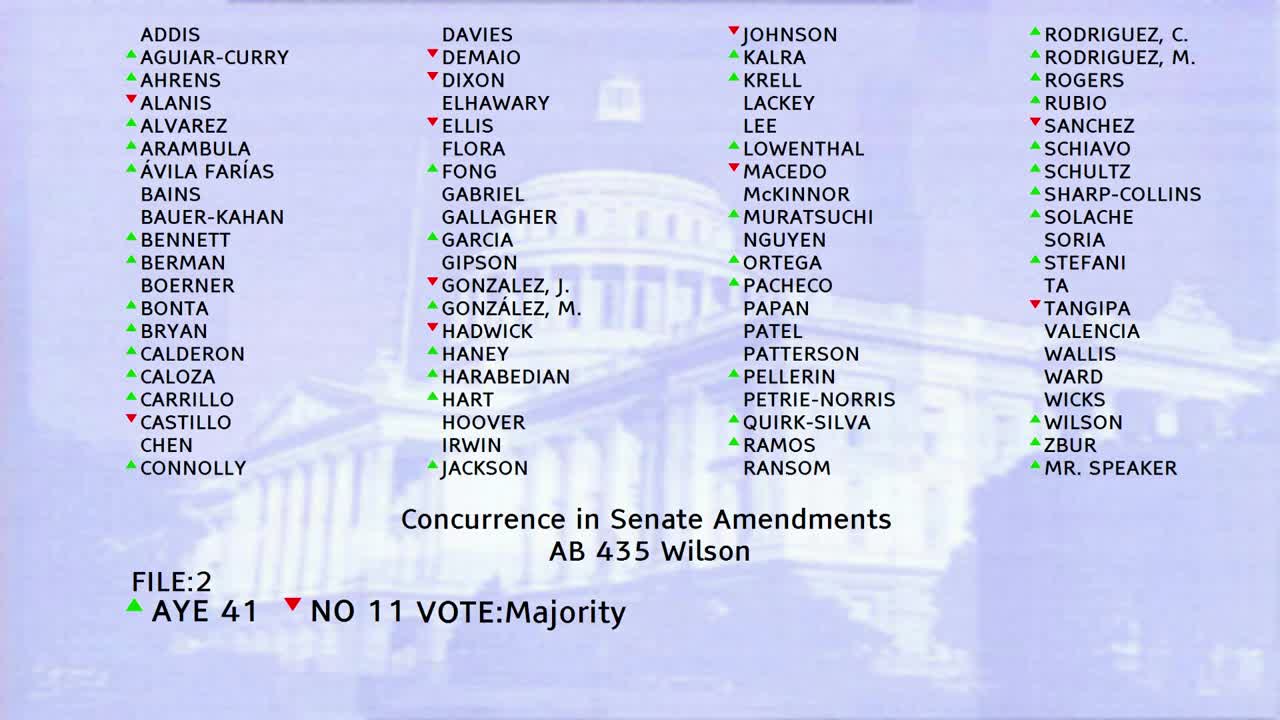 1MIN
Assembly Floor
 26SEC
Senate Standing Committee on Appropriations
 1MIN
Assembly Floor
 52SEC
Assembly Standing Committee on Appropriations
 9MIN
Assembly Standing Committee on Emergency Management
 15MIN
Assembly Standing Committee on Housing and Community Development
 14MIN
Assembly Standing Committee on Health
Bill Author

Bill Co-Author(s):
