AB 655: California-Mexico Border Relations Council.
- Session Year: 2025-2026
- House: Assembly
- Latest Version Date: 2025-07-14
Current Status:
Passed
(2025-07-14: Chaptered by Secretary of State - Chapter 41, Statutes of 2025.)
Introduced
In Committee
Awaiting First Chamber Vote
Passed First Chamber
In Committee
Awaiting Second Chamber Vote
Passed Second Chamber
Enacted
Existing law establishes the California-Mexico Border Relations Council in state government, and prescribes the membership and functions and duties of the council with respect to coordinating the activities of state agencies that are related to cross-border programs, initiatives, projects, and partnerships that exist within state agencies, to improve the effectiveness of state and local efforts that are of concern between California and Mexico.
This bill would authorize the Speaker of the Assembly to appoint a Member of the Assembly and the President pro Tempore to appoint a Member of the Senate who each represent a district that shares a border with Mexico to the council to serve as an ex officio, nonvoting member, as specified.
Existing law establishes the California-Mexico Border Relations Council in state government, and prescribes the membership and functions and duties of the council with respect to coordinating the activities of state agencies that are related to cross-border programs, initiatives, projects, and partnerships that exist within state agencies, to improve the effectiveness of state and local efforts that are of concern between California and Mexico.
This bill would allow authorize the Speaker of the Assembly to appoint a Member of the Assembly who represents and the President pro Tempore to appoint a Member of the Senate who each represent a district that shares a border with Mexico to the council to serve as an ex officio, nonvoting member, as specified.
Existing law establishes the California-Mexico Border Relations Council in state government, and prescribes the membership and functions and duties of the council with respect to coordinating the activities of state agencies that are related to cross-border programs, initiatives, projects, and partnerships that exist within state agencies, to improve the effectiveness of state and local efforts that are of concern between California and Mexico.
This bill would allow the Speaker of the Assembly to appoint a Member of the Assembly who represents a district that shares a border with Mexico to the council to serve as an ex officio, nonvoting member, as specified.
(a)The California-Mexico Border Relations Council is hereby established in state government.
(b)The council shall consist of eight voting members as follows:
(1)The Director of the Governors Office of Business and Economic Development.
(2)The Secretary of the Natural Resources Agency.
(3)The Secretary for Environmental Protection.
(4)The Secretary of California Health and Human Services.
(5)The Secretary of Transportation.
(6)The Secretary of Food and Agriculture.
(7)The Secretary of Business, Consumer Services, and Housing.
(8)The Director of Emergency Services.
(c)The Regional Administrator of the United States Environmental Protection Agency, Region 9, may appoint a representative from their staff to serve as an ex officio, nonvoting member of the council.
(d)The Speaker of the Assembly may appoint a Member of the Assembly and the President pro Tempore may appoint a Member of the Senate who each represent a district that shares a border with Mexico to serve as an ex officio, nonvoting member of the council. The members shall serve at the pleasure of the Speaker of the Assembly or the President pro Tempore, as applicable, and participate in the activities of the council to the extent that their participation is not incompatible with their respective position as a Member of the Legislature.
(e)The Secretary for Environmental Protection shall chair the council.
(a)The California-Mexico Border Relations Council is hereby established in state government.
(b)The council shall consist of eight voting members as follows:
(1)The Director of the Governors Office of Business and Economic Development.
(2)The Secretary of the Natural Resources Agency.
(3)The Secretary for Environmental Protection.
(4)The Secretary of California Health and Human Services.
(5)The Secretary of Transportation.
(6)The Secretary of Food and Agriculture.
(7)The Secretary of Business, Consumer Services, and Housing.
(8)The Director of Emergency Services.
(c)The Regional Administrator of the United States Environmental Protection Agency, Region 9, may appoint a representative from their staff to serve as an ex officio, nonvoting member of the council.
(d)The Speaker of the Assembly may appoint a Member of the Assembly who represents and the President pro Tempore may appoint a Member of the Senate who each represent a district that shares a border with Mexico to serve as an ex officio, nonvoting member of the council. The member members shall serve at the pleasure of the Speaker of the Assembly or the President pro Tempore, as applicable, and participate in the activities of the council to the extent that their participation is not incompatible with their respective position as a Member of the Legislature.
(e)The Secretary for Environmental Protection shall chair the council.
(a)The California-Mexico Border Relations Council is hereby established in state government. The council shall consist of the Director of the Governors Office of Business and Economic Development, the Secretary of the Natural Resources Agency, the Secretary for Environmental Protection, the Secretary of California Health and Human Services, the Secretary of Transportation, the Secretary of Food and Agriculture, the Secretary of State and Consumer Services, and the Director of Emergency Services. The Regional Administrator of the United States Environmental Protection Agency, Region 9, may appoint a representative from his or her staff to serve as an ex-officio, nonvoting member of the council.
(b)The council shall consist of eight voting members as follows:
(1)The Director of the Governors Office of Business and Economic Development.
(2)The Secretary of the Natural Resources Agency.
(3)The Secretary for Environmental Protection.
(4)The Secretary of California Health and Human Services.
(5)The Secretary of Transportation.
(6)The Secretary of Food and Agriculture.
(7)The Secretary of Business, Consumer Services, and Housing.
(8)The Director of Emergency Services.
(c)The Regional Administrator of the United States Environmental Protection Agency, Region 9, may appoint a representative from their staff to serve as an ex officio, nonvoting member of the council.
(d)The Speaker of the Assembly may appoint a Member of the Assembly who represents a district that shares a border with Mexico to serve as an ex officio, nonvoting member of the council. The member shall serve at the pleasure of the Speaker of the Assembly and participate in the activities of the council to the extent that their participation is not incompatible with their respective position as a Member of the Legislature.
(b)(e)The Secretary for Environmental Protection shall chair the council.
|
Date
|
Status
|
|---|---|
| Jul 14, 2025 | Chaptered by Secretary of State - Chapter 41, Statutes of 2025. |
| Jul 14, 2025 | Approved by the Governor. |
| Jul 3, 2025 | Enrolled and presented to the Governor at 11 a.m. |
| Jun 27, 2025 | In Assembly. Ordered to Engrossing and Enrolling. |
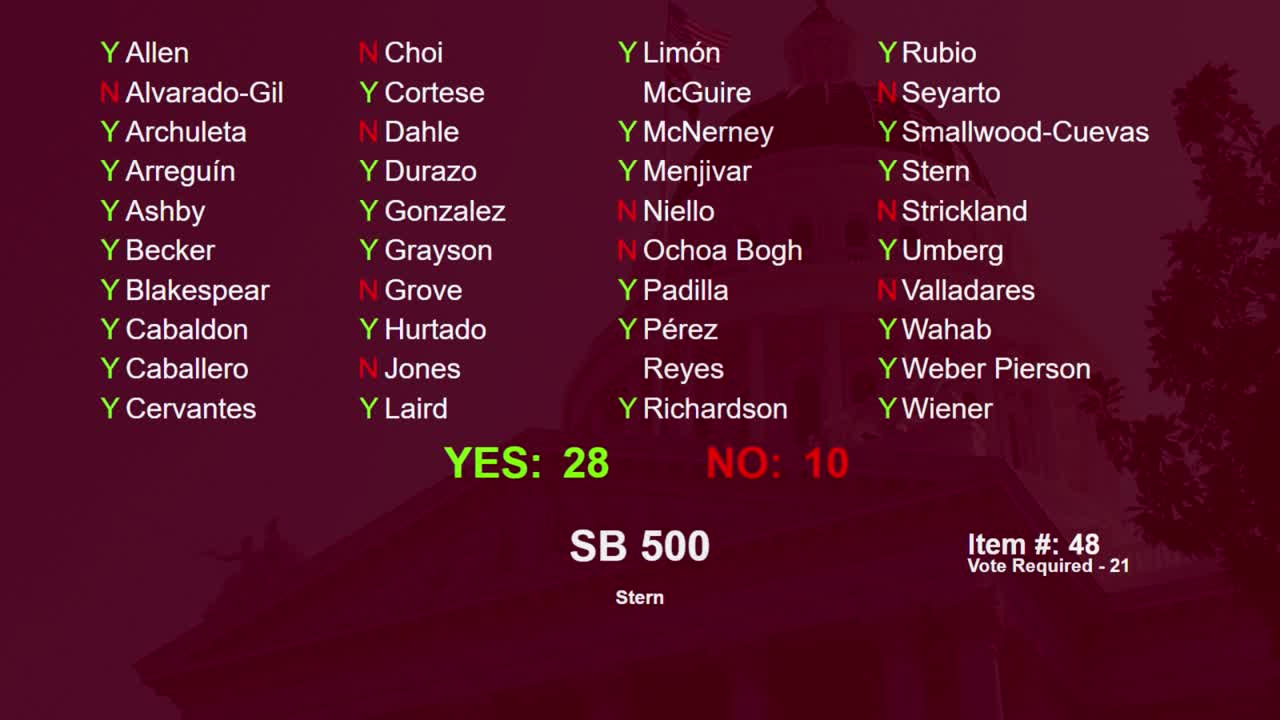
| Jun 27, 2025 | Read third time. Passed. Ordered to the Assembly. (Ayes 38. Noes 0. Page 1809.). |
| Jun 24, 2025 | Read second time. Ordered to Consent Calendar. |
| Jun 23, 2025 | From committee: Be ordered to second reading file pursuant to Senate Rule 28.8 and ordered to Consent Calendar. |
| Jun 9, 2025 | From committee: Do pass and re-refer to Com. on APPR. with recommendation: To Consent Calendar. (Ayes 8. Noes 0.) (June 9). Re-referred to Com. on APPR. |
| May 28, 2025 | Referred to Com. on B. P. & E.D. |
| May 15, 2025 | In Senate. Read first time. To Com. on RLS. for assignment. |
| May 15, 2025 | Read third time. Passed. Ordered to the Senate. (Ayes 69. Noes 0. Page 1569.) |
| May 8, 2025 | Read second time. Ordered to Consent Calendar. |
| May 7, 2025 | From committee: Do pass. To Consent Calendar. (Ayes 15. Noes 0.) (May 7). |
| Apr 22, 2025 | From committee: Do pass and re-refer to Com. on APPR. with recommendation: To Consent Calendar. (Ayes 8. Noes 0.) (April 22). Re-referred to Com. on APPR. |
| Apr 21, 2025 | Re-referred to Com. on E.D., G., & H.I. |
| Apr 10, 2025 | From committee chair, with author's amendments: Amend, and re-refer to Com. on E.D., G., & H.I. Read second time and amended. |
| Mar 17, 2025 | Referred to Com. on E.D., G., & H.I. |
| Feb 14, 2025 | From printer. May be heard in committee March 16. |
| Feb 13, 2025 | Read first time. To print. |
|
Date
|
Description
|
Location
|
Votes
|
|
|---|---|---|---|---|
| Jun 27, 2025 | Consent Calendar 2nd AB655 Alvarez | Senate Floor |
Passed |
|
| Jun 9, 2025 | Do pass, but first be re-referred to the Committee on [Appropriations] with the recommendation: To Consent Calendar | Senate Standing Committee on Business, Professions and Economic Development |
Passed |
|
| May 15, 2025 | AB 655 Alvarez Consent Calendar Second Day Regular Session | Assembly Floor |
Passed |
|
| May 7, 2025 | Do pass. To Consent Calendar. | Assembly Standing Committee on Appropriations |
Passed |
This list shows positions taken on this bill by organizations on the date displayed, which is linked to the original source.
Positions by individuals are not included.
|
Organization
|
Position
|
Date
|
|---|---|---|
| City Of San Diego | ** Support | |
| Otay Mesa Chamber of Commerce | ** Support | |
| San Diego Regional Chamber Of Commerce | ** Support | |
| Southwestern Community College District | ** Support | |
| The Border Group | ** Support |
SENATE RULES COMMITTEE Office of Senate Floor Analyses (916) 651-1520 Fax: (916) 327-4478 | AB 655 |
CONSENT
Bill No: AB 655
Author: Alvarez (D)
Amended: 4/10/25 in Assembly
Vote: 21
SENATE BUS., PROF. & ECON. DEV. COMMITTEE: 8-0, 6/9/25
AYES: Ashby, Choi, Archuleta, Arreguín, Grayson, Niello, Strickland, Umberg
NO VOTE RECORDED: Menjivar, Smallwood-Cuevas, Weber Pierson
SENATE APPROPRIATIONS COMMITTEE: Senate Rule 28.8
ASSEMBLY FLOOR: 69-0, 5/15/25 (Consent) - See last page for vote
SUBJECT: California-Mexico Border Relations Council
SOURCE: Author
DIGEST:
This bill authorizes the Speaker of the Assembly and President pro Tempore to appoint one member of their respective houses of the Legislature to the California-Mexico Border Council (Council) as an ex officio, nonvoting Council member and makes various conforming changes to the statutory establishment of the Council.
ANALYSIS:
Existing law:
- Establishes the Office of California-Mexico Affairs (Office) to serve as a clearinghouse for information and assistance to other state agencies involved with Mexico and develop favorable relations with the State of Baja California, the State of Baja California Sur, other Mexican states bordering on the United States, and the remaining states and territories of Mexico. Requires the office to cooperate with similar organizations and agencies situated within California, the U.S., or Mexico, to further economic development, improve working conditions and living standards, and foster the protection and improvement of the environment in Mexico and California. (Government Code (GC) § 8700 et. seq.)
- Establishes the Council comprised of the Secretary of the Natural Resources Agency, the Secretary for Environmental Protection, the Secretary of Health and Human Services, the Secretary of Transportation, the Secretary of Food and Agriculture, and the Director of Emergency Services, with the Secretary for Environmental Protection serving as Chair. Requires the Council to coordinate activities of state agencies that are related to cross-border programs, initiatives, projects, and partnerships that exist within state government, to improve the effectiveness of state and local efforts that are of concern between California and Mexico. Requires the Council to establish policies to coordinate the collection and sharing of data related to cross-border issues between and among agencies and make recommendations to the Legislature.
(GC § 99520 et. seq.) - Establishes a state point of contact (SPOC), within the executive branch, to act as the liaison between the state and the Office of the U.S. Trade Representative (USTR) on trade-related matters. Provides that the SPOC is often provided the opportunity to review and comment on ongoing trade negotiations and must promptly disseminate correspondence or information from the USTR to the appropriate state agencies and departments and legislative committees and work with the appropriate state agencies and departments, and the Legislature, to review the effects on the California environment, and California businesses, workers, and general lawmaking authority, of any proposed or enacted trade agreement provisions and communicate those findings to the USTR. (GC § 99501)
- Requires the Office of Planning and Research to maintain and update a full and comprehensive list of all state agreements made with foreign governments, updated within 30 days of the effective date of each new agreement.
This bill:
- Authorizes the Speaker of the Assembly and President pro Tempore to appoint one member of their respective houses of the Legislature to the Council as an ex officio, nonvoting Council member. Specifies that the Legislative members shall serve at the pleasure of the Speaker of the Assembly or the President pro Tempore and participate in the activities of the council to the extent that their participation is not incompatible with their respective position as a Member of the Legislature.
- Makes various conforming changes to the statutory establishment of the Council.
Background
Created following the demise of the Technology Trade and Commerce Agency and concern about the lack of a state government structure to provide effective coordination of various state agency efforts, as well as a thoughtful and collaborative assessment of current and future program development that will serve the needs of both California and Mexico in the 21st century, the Council currently operates under the California Environmental Protection Agency (Cal EPA)’s California-Baja California Boarder Environmental Program. In 2006, when the Council was established, there was no entity, despite the numerous programs and initiatives amongst various agencies, to coordinate or collaborate or provide for any information sharing. At that time, the Legislature was focused on mitigating any potential impacts stemming from the recently enacted North America Free Trade Agreement, including challenges in the areas of economic development, labor relations, health care, and environmental protection. Numerous programs at various levels of state government have been established to address these issues.
The Council coordinates cross-border programs, initiatives, projects and partnerships within California state agencies, establishes California state agency policies or the collection and sharing of cross-border data, identifies and recommends changes in the law needed to achieve Council goals and reports annually to the Legislature.
FISCAL EFFECT: Appropriation: No Fiscal Com.: Yes Local: No
SUPPORT: (Verified 6/23/25)
City of San Diego
Otay Mesa Chamber of Commerce
San Diego Regional Chamber of Commerce
Southwestern Community College District
The Border Group
OPPOSITION: (Verified 6/23/25)
None received
ARGUMENTS IN SUPPORT: The City of San Diego writes that the thoughtful step toward more inclusive governance by having legislative appointees ensures that state-level deliberations on issues such as trade, environmental protection, public health, and emergency preparedness are informed by those who live and work along the border.
The San Diego Regional Chamber of Commerce notes this bill would “provide a unique opportunity to elevate local concerns surrounding trade, environmental issues, public health and emergency preparedness for border communities to be more accurately represented. Border communities hold a significant role in California’s economy and cultural ties to Mexico yet are often left out from the policymaking process. The California-Baja California region itself has a regional GDP of nearly $260 billion and is conduit for $71 billion in cross border trade. Regionally, we believe that we are not only trading with Mexico but coproducing together, as components cross our border up to six times before the final product is ready for the consumer. In fact, for every two jobs generated in Baja California, one is generated in San Diego. Additionally, without direct legislative representation, the council risks overlooking the grassroots concerns of nearly 3 million Californians living in these border regions, thereby impeding the development of equitable solutions.”
Supporters additionally note that this bill will help foster accountability, ensuring that the council’s decisions align with the specific needs of border communities which will allow there to be stronger partnerships among state agencies, local governments and Mexican counterparts.
ASSEMBLY FLOOR: 69-0, 5/15/25
AYES: Addis, Aguiar-Curry, Ahrens, Alvarez, Ávila Farías, Bains, Bauer-Kahan, Berman, Boerner, Bonta, Bryan, Calderon, Carrillo, Chen, Connolly, Davies, DeMaio, Dixon, Elhawary, Ellis, Flora, Fong, Gabriel, Gallagher, Garcia, Gipson, Mark González, Hadwick, Haney, Harabedian, Hoover, Irwin, Jackson, Kalra, Krell, Lackey, Lee, Lowenthal, Macedo, McKinnor, Muratsuchi, Nguyen, Ortega, Pacheco, Papan, Patel, Patterson, Pellerin, Petrie-Norris, Ransom, Celeste Rodriguez, Michelle Rodriguez, Rogers, Blanca Rubio, Sanchez, Schiavo, Schultz, Sharp-Collins, Solache, Soria, Ta, Tangipa, Valencia, Wallis, Ward, Wicks, Wilson, Zbur, Rivas
NO VOTE RECORDED: Alanis, Arambula, Bennett, Caloza, Castillo, Jeff Gonzalez, Hart, Quirk-Silva, Ramos, Stefani
Prepared by: Sarah Mason / B., P. & E.D. /
6/26/25 9:03:00
**** END ****
SENATE COMMITTEE ON
BUSINESS, PROFESSIONS AND ECONOMIC DEVELOPMENT
Senator Angelique Ashby, Chair
2025 - 2026 Regular
Bill No: AB 655 Hearing Date: June 9, 2025
Author: | Alvarez | ||
Version: |
| ||
Urgency: | Fiscal: | ||
Consultant: | |||
Subject: California-Mexico Border Relations Council
SUMMARY:
Authorizes the Speaker of the Assembly and President pro Tempore to appoint one member of their respective houses of the Legislature to the California-Mexico Border Council (Council) as an ex officio, nonvoting Council member who meets specified requirements and makes various conforming changes to the statutory establishment of the Council.
Existing law:
- Authorizes public (the State and municipalities) corporations and private corporations to apply to operate and operate a foreign-trade zone in accordance with the terms of the act of Congress (which provided for the establishment, operation and maintenance of foreign-trade zones in ports of entry in the U.S. to expedite and encourage foreign commerce). (Government Code (GC) §§ 6301-6304)
- Authorizes GO-Biz as the lead entity for economic strategy and the marketing of California on issues relating to business development, private sector investment, and economic growth. Authorizes GO-Biz, in this capacity, to coordinate the development of policies and criteria to ensure that federal grants administered or directly expended by state government advance statewide economic goals and objectives. Authorizes GO-Biz to market the business and investment opportunities available in California by working in partnership with local, regional, federal, and other state public and private institutions to encourage business development and investment in the state. Authorizes GO-Biz to support small businesses by providing information about accessing capital, complying with regulations, and supporting state initiatives that support small business. (GC § 12096.3)
- Specifies that GO-Biz is the primary state agency authorized to attract foreign investments, cooperate in international public infrastructure projects, and support California businesses in accessing markets, and requires the Director of GO-Biz to develop an international trade and investment program (ITI Program) attracting employment-producing direct foreign investment to the state and providing support for California businesses in accessing international markets and increasing exports. (GC § 13996.41)
- Authorizes GO-Biz to establish ITI offices outside of the U.S. according to certain requirements. (GC § 13996.42)
- Requires GO-Biz to provide a ITI strategy to the Legislature based on current and emerging market conditions and that identifies the process GO-Biz will use for ongoing evaluation of needs. The strategy, required to be updated once every five years, includes: (GC § 13996.55)
- Policy goals, objectives and recommendations necessary to implement a comprehensive international trade and investment program.
- Measurable outcomes and timelines for the goals, objectives and actions for the program.
- Impediments to achieving goals and objectives.
- Key stakeholder partnerships that will be used to implement the strategy.
- Options for funding.
- An organizational structure for state administration of international trade and investment policies, programs and services.
- Establishes the California Foreign Investment Program, under which GO-Biz serves as the lead state entity for overseeing the state’s participating with the United States Citizenship and Immigration Services’ EB-5 Investment Program; a visa category available to immigrants seeking to enter the U.S. in order to invest in a business or company that will benefit the economy. Permanent-resident status through an EB-5 visa is available to foreign investors who have invested – or are actively in the process of investing – specified amounts into a new commercial enterprise, which can entail: the creation of an original business; the purchase of an existing business and restructuring or reorganizing the business to the extent that a new commercial enterprise results; or a significant expansion of an existing business. (GC § 12100.50 et. seq.)
- Establishes the Office of California-Mexico Affairs (Office) to serve as a clearinghouse for information and assistance to other state agencies involved with Mexico and develop favorable relations with the State of Baja California, the State of Baja California Sur, other Mexican states bordering on the United States, and the remaining states and territories of Mexico. Requires the office to cooperate with similar organizations and agencies situated within California, the U.S., or Mexico, to further economic development, improve working conditions and living standards, and foster the protection and improvement of the environment in Mexico and California. (GC § 8700 et. seq.)
- Establishes the Council comprised of the Secretary of the Natural Resources Agency, the Secretary for Environmental Protection, the Secretary of Health and Human Services, the Secretary of Transportation, the Secretary of Food and Agriculture, and the Director of Emergency Services, with the Secretary for Environmental Protection serving as Chair. Requires the Council to coordinate activities of state agencies that are related to cross-border programs, initiatives, projects, and partnerships that exist within state government, to improve the effectiveness of state and local efforts that are of concern between California and Mexico. Requires the Council to establish policies to coordinate the collection and sharing of data related to cross-border issues between and among agencies and make recommendations to the Legislature.
(GC § 99520 et. seq.) - Provides for the following related to the role of stage agencies with respect to international relations: (GC § 99500)
- The Governor is the primary state officer representing California’s interest in international affairs, to the extent that representation is not in conflict with federal law or the California Constitution.
- The Lieutenant Governor is the Chair of the California Commission for Economic Development, to improve trade opportunities for California. The Legislature finds that the commission has developed international partnerships that provide venues for foreign companies to do business in the state and for California-based companies to access foreign markets.
- The Attorney General is the chief law officer of California and as such assists the federal government in defending against international challenges to California laws.
- The Secretary of State oversees the International Business Relations Program, which aims to develop stronger connections between the international business community and the state by assisting foreign business entities with the various filing processes and procedures in California.
- The Department of Food and Agriculture is the primary state agency for the promotion of California agriculture, fish, and forest exports.
- The Natural Resources Agency and the California Environmental Protection Agency are the primary state agencies for the promotion of international exchange of environmental protection technologies, alternative energy technologies, and the promotion of the transfer of environmental technology to and from the state.
- GO-Biz is the primary state agency responsible for international trade and investment activities in areas other than those covered by the Department of Food and Agriculture.
- Establishes a state point of contact (SPOC), within the executive branch, to act as the liaison between the state and the Office of the U.S. Trade Representative (USTR) on trade-related matters. Provides that the SPOC is often provided the opportunity to review and comment on ongoing trade negotiations and must promptly disseminate correspondence or information from the USTR to the appropriate state agencies and departments and legislative committees and work with the appropriate state agencies and departments, and the Legislature, to review the effects on the California environment, and California businesses, workers, and general lawmaking authority, of any proposed or enacted trade agreement provisions and communicate those findings to the USTR. (GC § 99501)
- Requires the Office of Planning and Research to maintain and update a full and comprehensive list of all state agreements made with foreign governments, updated within 30 days of the effective date of each new agreement.
This bill:
- Authorizes the Speaker of the Assembly and President pro Tempore to appoint one member of their respective houses of the Legislature to the California-Mexico Border Council (Council) as an ex officio, nonvoting Council member. Specifies that the Legislative members shall serve at the pleasure of the Speaker of the Assembly or the President pro Tempore and participate in the activities of the council to the extent that their participation is not incompatible with their respective position as a Member of the Legislature.
- Makes various conforming changes to the statutory establishment of the Council.
FISCAL EFFECT:
This bill is keyed fiscal by Legislative Counsel. According to the Assembly Committee on Appropriations, the bill will result in minor state costs, if any.
COMMENTS:
- Purpose. The Author is the Sponsor of this bill. According to the Author, “AB 655 seeks to incorporate a border-elected Assemblymember and Senator into the council, which would offer a platform for local voices that are often left out in broader state discussions. This Assemblymember and Senator will provide essential insights into the challenges faced by border residents, including environmental hazards, economic development, and emergency management. Moreover, their participation will foster accountability, ensuring that the council's decisions align with the specific needs of border communities. By facilitating stronger partnerships among state agencies, local governments, and Mexican counterparts, AB 655 aims to create policies that are not only informed by but also beneficial to the diverse communities that make up California’s border region. In doing so, it recognizes that this area is more than just a boundary; it is a dynamic hub of culture, commerce, and environmental interdependence.”
The Author notes that Border district representatives have highlighted gaps in addressing cross-border pollution, infrastructure bottlenecks, and emergency preparedness such as sewage spills impacting San Diego beaches. According to the Author, similar councils in other states like the Arizona-Mexico Commission include legislative members to strengthen regional collaboration.
- Background.
GO-Biz. In February 2010, the Little Hoover Commission undertook a review of the state's economic and workforce development programs. In its final report, Making up for Lost Ground: Creating a Governor's Office of Economic Development, it analyzed the status and effectiveness of current programs since the 2003 demise of the Technology, Trade and Commerce Agency and recommended the creation of a new governmental entity to fill the void left by the dismantled agency.
The report called for a single entity that would promote greater economic development, foster job creation, serve as a policy advisor and deliver specific services (i.e., permitting, tax, regulatory, and other information) directly to the California business community. In April 2010, Governor Schwarzenegger issued Executive Order S-05-10 as a means to operationalize the report recommendations, including the creation of the Governor's Office of Economic Development (GOED).
In October 2011, the Governor signed AB 29 (John A. Pérez, Chapter 475, Statutes of 2011), which effectively codified GOED and changed its name to GO-Biz. Since its inception, the office has served thousands of businesses, 95 percent of which are small businesses. The most frequent types of assistance include help with permit streamlining, starting a business, relocation and expansion of businesses, and regulatory challenges.
In March 2012, Governor Brown initiated a reorganization process to realign the state's administrative structure. Key changes include dismantling of the Business, Transportation and Housing Agency and the shifting of a number of key programs to GO-Biz including the Small Business Loan Guarantee Program, the California Travel and Tourism Commission, the California Film Commission, the Film California First Program, and the Infrastructure and Economic Development Bank (IBank). Currently, GO-Biz administers the following programs and units:
- Made In California program for the purpose of encouraging consumer product awareness and to foster the purchases of products manufactured in California.
- The California Inclusive Innovation Hub Program (iHub2) to incubate and/or accelerate technology and science-based firms, with a focus on underserved regions and communities.
- The California Competes Tax Credit Program under which “businesses who want to come to California or stay and grow in California” can receive an income tax credit.
- The California Business Investment Services Unit, which provides no-fee, tailored site selection services to employers and others who may be considering California for relocation or expansion.
- The California Business Portal, which provides information to California businesses about common questions, permitting, financial options, and more.
- The California Community Reinvestment Grants Program, which was included in Proposition 64, authorized GO-Biz to award grants to local health departments and certain nonprofit organizations to support communities disproportionately affected by the War on Drugs.
- OSBA which provides information and assistance to small businesses.
- The Zero Emission Vehicles (ZEV) Infrastructure Unit which works to accelerate the deployment of ZEV infrastructure.
- The International Affairs and Business Development Unit, which serves as California’s primary point of contact for expanding international trade and investment relations. This unit focuses on foreign direct investment (services for foreign investors, foreign investment technical assistance, and the EB-5 Investor Visa Program), international trade promotion (STEP program, trade missions, export assistance, and the California-China Trade Office), and international agreements.
GO-Biz currently has authority for undertaking international trade and foreign investment activities. The International Affairs and Trade Program prepared by GO-Biz in 2023 notes that the International Affairs and Trade team (IAT) advises the Governor on international affairs and trade issues, implements strategies to develop and grow partnerships and engagement with foreign partners, and provides recommendations to promote and expand California’s trade and foreign direct investment. According to the report, IAT works with a robust network of international partners to promote California exports, support small businesses in accessing global markets, and attract inward investment that brings high-quality jobs to Californians. IAT executed several major international events, including a Clean Energy Trade Mission to Japan with over 100 delegates from California’s public and private sectors, a climate-focused gubernatorial visit to China, and a California pavilion at the annual Asia Pacific Economic Cooperation Summit. IAT also successfully implemented trade missions to key markets such as Mexico, China, Japan, and Germany in a variety of strategic sectors, among other efforts and activities.
Council. Created following the demise of TTCA and concern about the lack of a state government structure to provide effective coordination of various state agency efforts, as well as a thoughtful and collaborative assessment of current and future program development that will serve the needs of both California and Mexico in the 21st century, the Council currently operates under the California Environmental Protection Agency (Cal EPA)’s California-Baja California Boarder Environmental Program. In 2006, when the Council was established, there was no entity, despite the numerous programs and initiatives amongst various agencies, to coordinate or collaborate or provide for any information sharing. At that time, the Legislature was focused on mitigating any potential impacts stemming from the recently enacted North America Free Trade Agreement, including challenges in the areas of economic development, labor relations, health care, and environmental protection. Numerous programs at various levels of state government have been established to address these issues.
The Council coordinates cross-border programs, initiatives, projects and partnerships within California state agencies, establishes California state agency policies or the collection and sharing of cross-border data, identifies and recommends changes in the law needed to achieve Council goals and reports annually to the Legislature.
- Arguments in Support. The City of San Diego writes that the thoughtful step toward more inclusive governance by having legislative appointees ensures that state-level deliberations on issues such as trade, environmental protection, public health, and emergency preparedness are informed by those who live and work along the border.
The San Diego Regional Chamber of Commerce notes this bill would “provide a unique opportunity to elevate local concerns surrounding trade, environmental issues, public health and emergency preparedness for border communities to be more accurately represented. Border communities hold a significant role in California’s economy and cultural ties to Mexico yet are often left out from the policymaking process. The California-Baja California region itself has a regional GDP of nearly $260 billion and is conduit for $71 billion in cross border trade. Regionally, we believe that we are not only trading with Mexico but coproducing together, as components cross our border up to six times before the final product is ready for the consumer. In fact, for every two jobs generated in Baja California, one is generated in San Diego. Additionally, without direct legislative representation, the council risks overlooking the grassroots concerns of nearly 3 million Californians living in these border regions, thereby impeding the development of equitable solutions.
Supporters additionally note that this bill will help foster accountability, ensuring that the council’s decisions align with the specific needs of border communities which will allow there to be stronger partnerships among state agencies, local governments and Mexican counterparts.
SUPPORT AND OPPOSITION:
Support:
City of San Diego
Otay Mesa Chamber of Commerce
San Diego Regional Chamber of Commerce
Southwestern Community College District
The Border Group
Opposition:
None received.
-- END --
Date of Hearing: May 7, 2025
ASSEMBLY COMMITTEE ON APPROPRIATIONS
Buffy Wicks, Chair
ABPCA Bill Id:AB 655
Author:(Alvarez) – As Amended Ver:April 10, 2025
Policy Committee: | Economic Development, Growth, and Household Impact | Vote: | 8 - 0 |
|
| ||
|
|
Urgency: No State Mandated Local Program: No Reimbursable: No
SUMMARY:
This bill authorizes the Speaker of the Assembly to appoint a Member of the Assembly and the President pro Tempore to appoint a Member of the Senate, each of who each represents a district that shares a border with Mexico, to serve as an ex officio, nonvoting member of the California-Mexico Border Relations Council.
The bill provides each member of the council described above serves at the pleasure of the Speaker or the President pro Tempore, as appropriate.
FISCAL EFFECT:
Minor state costs, if any.
COMMENTS:
In 2015, the Legislature approved the law that created the California-Mexico Border Relations Council. (See AB 688 (E. Garcia), Chapter 668, Statutes of 2015.) In explaining the need for the council, the Legislature declared:
California needs a formalized trade relationship with Mexico. Establishing an official trade relationship with Mexico will help ensure that the state can improve its global competitiveness and protect California industry, proactively support the expansion and location of businesses in California, provide international business assistance to California businesses, and support their entry and successful participation in the growing Mexican marketplace.
The California-Mexico Border Relations Council provides a focal point in state government to serve as a clearinghouse for information and assistance to other state agencies that are involved with Mexico.
Statute charges the council with the following: (a) coordinate activities of state agencies that are related to cross-border programs, initiatives, projects and partnerships that exist within state government, to improve the effectiveness of state and local efforts that are of concern between California and Mexico; (b) invite representatives of the State of Baja California and the Mexican government to participate in meetings, (c) establish policies to coordinate the collection and sharing of data related to cross-border issues between and among agencies, (d) establish the Border Region Solid Waste Working Group to develop and coordinate long-term solutions to address and remediate problems associated with waste tires, solid waste and excessive sedimentation along the border that cause the degradation of valuable estuarine and riparian habitats, and threaten water quality and public health in the state and (e) identify and recommend to the Legislature changes in law needed to achieve these goals. Statute also directs the council to submit an annual report on its activities to the Legislature.
Statute defines the membership of the council to include the directors of several executive-branch agencies and allows the Regional Administrator of the United States Environmental Protection Agency, Region 9, to appoint a representative from the representative’s staff to serve as an ex-officio, nonvoting member of the council. And statute designates the Secretary for Environmental Protection as chair of the council.
The council includes no elected official on it. The author sees this absence as a deficiency, which the author intends this bill to correct:
California’s border with Mexico is a hub of economic vitality, environmental interdependence, and cultural connection, yet the voices of the communities directly impacted by cross-border policies have been sidelined in critical state decisions. AB 655 corrects this oversight by allowing the Speaker of the Assembly to appoint a border-district legislator as an ex officio, nonvoting member of the California-Mexico Border Relations Council. For too long, this council—tasked with coordinating cross-border initiatives on issues like trade, infrastructure, and environmental protection—has operated without direct input from the elected representatives of border regions. This gap risks policies that are misaligned with the realities faced by families and businesses in these communities, from sewage spills contaminating our beaches to bottlenecks stifling our trade corridors.
Analysis Prepared by: Jay Dickenson / APPR. / (916) 319-2081
Date of Hearing: April 22, 2025
ASSEMBLY COMMITTEE ON ECONOMIC DEVELOPMENT, GROWTH, AND HOUSEHOLD IMPACT
José Solache, Chair
ABPCA Bill Id:AB 655 (
Author:Alvarez) – As Introduced Ver:February 13, 2025
SUBJECT: California-Mexico Border Relations Council
SUMMARY: AB 655 authorizes the Speaker of the Assembly to appoint a Member of the Assembly who represents and the President pro Tempore to appoint a Member of the Senate who each represent a district that shares a border with Mexico to the California-Mexico Border Relations Council to serve as an ex officio and nonvoting member.
Specifically, this bill:
- Authorizes the Speaker of the Assembly to appoint a Member of the Assembly who represents and the President pro Tempore to appoint a Member of the Senate who each represent a district that shares a border with Mexico to the California-Mexico Border Relations Council to serve as an ex officio and nonvoting member.
- Members shall serve at the pleasure of the Speaker of the Assembly or the President pro Tempore, as applicable, and participate in the activities of the council to the extent that their participation is not incompatible with their respective position as a Member of the Legislature.
EXISTING LAW:
- Existing law establishes the California-Mexico Border Relations Council in state government, and prescribes the membership and functions and duties of the council with respect to coordinating the activities of state agencies that are related to cross-border programs, initiatives, projects, and partnerships that exist within state agencies, to improve the effectiveness of state and local efforts that are of concern between California and Mexico.
The council consists of the Director of the Governor’s Office of Business and Economic Development, the Secretary of the Natural Resources Agency, the Secretary for Environmental Protection, the Secretary of California Health and Human Services, the Secretary of Transportation, the Secretary of Food and Agriculture, the Secretary of State and Consumer Services, and the Director of Emergency Services. The Regional Administrator of the United States Environmental Protection Agency, Region 9, may appoint a representative from his or her staff to serve as an ex-officio, nonvoting member of the council. The Secretary for Environmental Protection shall chair the council.
FISCAL EFFECT: According to the author, minor expenses related to travel/per diem for the appointed members.
COMMENTS: The California-Mexico Border Relations Council is a high-level structure for California to engage in a sustained, proactive and collaborative way to address cross sector responses to shared economic, ecological, and social border-region challenges. California shares a 140-mile border with Mexico, including one of the busiest land border crossings in the world (San Ysidro). Coordination on policy, security, infrastructure, and commerce is essential to managing this unique international relationship.
Mexico is one of California’s top trading partners. The Council helps facilitate binational trade and infrastructure projects, which support supply chain flow (especially in agriculture and manufacturing), economic zones like the Cali-Baja Mega Region and small business and workforce development on both sides of the border.
In 2004, the California Research Bureau (CRB) released a report that listed more than 100 California-Mexico programs operating across state agencies, with no organizing entity to coordinate interagency cooperation. In 2006, Assembly Bill 3021 (Núñez, Statutes of 2006) was enacted. It created the California-Mexico Border Relations Council, which serves as the central organizing body that coordinates cross-border programs, initiatives, projects and partnerships.
According to the author, border district representatives have highlighted gaps in addressing cross-border pollution, infrastructure bottlenecks, and emergency preparedness such as reoccurring sewage spills affecting San Diego beaches. According to the San Diego Coast Keeper, “Since October 2023, a staggering 31 billion gallons of raw sewage, polluted storm water and trash have flowed down the Tijuana River into the Tijuana River Valley and the Pacific Ocean, closing numerous San Diego beaches , and sparking major concerns over public health risks, coastal water pollution and the degradation.”
Sewage spills from the Tijuana River, originating from Tijuana, Mexico, have significantly impacted San Diego beaches and the local economy, causing beach closures, health concerns, and economic losses. The contamination, often exacerbated by heavy rains, leads to increased bacterial levels in the water, forcing closures and impacting tourism, property values, and local businesses.
Improved cross-border policies help spur economic growth, streamline trade, assist environmental cleanup efforts, and improve health & safety-benefiting border communities. Similar councils in other states such as the Arizona-Mexico Commission include legislative members to strengthen regional collaboration.
Author’s Statement: “California’s border with Mexico is a hub of economic vitality, environmental interdependence, and cultural connection, yet the voices of the communities directly impacted by cross-border policies have been sidelined in critical state decisions. AB 655 corrects this oversight by allowing the Speaker of the Assembly to appoint a border-district legislator as an ex officio, nonvoting member of the California-Mexico Border Relations Council. For too long, this council—tasked with coordinating cross-border initiatives on issues like trade, infrastructure, and environmental protection—has operated without direct input from the elected representatives of border regions. This gap risks policies that are misaligned with the realities faced by families and businesses in these communities, from sewage spills contaminating our beaches to bottlenecks stifling our trade corridors”.
REGISTERED SUPPORT / OPPOSITION:
Support
City of San Diego
Otay Mesa Chamber of Commerce
San Diego Regional Chamber of Commerce
Southwestern Community College District (UNREG)
The Border Group
Opposition
None on file
Analysis Prepared by: Carla Castilla / E.D., G., & H.I. / (916) 319-2090
Bill Author
Bill Co-Author(s):