AB 661: The California Guaranteed Income Statewide Feasibility Study Act.
- Session Year: 2025-2026
- House: Assembly
- Latest Version Date: 2025-02-14
Current Status:
Failed
(2026-02-02: From committee: Filed with the Chief Clerk pursuant to Joint Rule 56.)
Introduced
In Committee
Awaiting First Chamber Vote
Passed First Chamber
In Committee
Awaiting Second Chamber Vote
Passed Second Chamber
Enacted
Existing law requires the State Department of Social Services, subject to an appropriation for this purpose in the annual Budget Act, to administer the California Guaranteed Income Pilot Program to provide grants to eligible entities for the purpose of administering pilot programs and projects that provide a guaranteed income to participants. Existing law requires the department to prioritize funding for pilot programs and projects that serve California residents who age out of the extended foster care program and pregnant individuals. Existing law requires the department, in consultation with relevant stakeholders, to determine the methodology for, and manner of, distributing those grants, subject to certain requirements. Existing law requires the department to review and evaluate the pilot programs and projects funded pursuant to these provisions, provide a report to the Legislature regarding that review and evaluation, and post a copy of the report on its internet website.
This bill, the California Guaranteed Income Research and Expansion Act, would require the State Department of Social Services to contract with one or more entities, subject to specified requirements, to develop and provide comprehensive recommendations on how to design, fund, and implement a permanent, statewide Guaranteed Income Program. The bill would require the contractor, among other things, to examine the benefits and challenges of scaling up permanent guaranteed income programs to reach a larger proportion of Californias socially and economically vulnerable populations, focusing on regions with a high cost of living and insights from best practices and lessons learned from the California Guaranteed Income Pilot Program. The bill would require specified state departments to disclose necessary data to the State Department of Social Services and require the contractor to convene a steering committee composed of various stakeholders, as provided. The bill would require the department to, on or before January 1, 2028, publish on its internet website and provide a report to the Governor and the Legislature on the feasibility and benefits of expanding the California Guaranteed Income Pilot Program statewide based on the outcomes of the act.
This bill would authorize the State Department of Social Services to implement, interpret, or make specific the act without taking any regulatory action, as specified, and accept and, subject to an appropriation, expend funds to administer and implement the act.
This chapter shall be known, and may be cited, as the Guaranteed Income Research and Expansion Act.
18996.91.(a)The State Department of Social Services shall contract with one or more qualified entities to implement the Guaranteed Income Research and Expansion Act. The contracted entities shall develop and provide comprehensive recommendations to design, fund, and implement a permanent, statewide Guaranteed Income Program that achieves all of the following overarching objectives:
(1)Identify sustainable funding mechanisms to ensure the program's long-term viability and sustainability.
(2)Make recommendations on needed administrative infrastructure and program design, including, but not limited to, all of the following:
(A)State and local department and agency collaboration and necessary data sharing to reach Californians with low incomes.
(B)Determining the duration of the program.
(C)Setting appropriate payment amounts.
(D)Identifying key target populations.
(3)Identify pathways to ensure the program does not threaten eligibility for other social safety net programs, thereby maintaining comprehensive support for participating individuals and families.
(b)The contractor chosen by the department pursuant to subdivision (a) shall do all of the following:
(1)Determine the administrative capacity, infrastructure, and data-sharing requirements, across state and local departments and agencies, that will be necessary to execute a sustainable statewide guaranteed income program, prioritizing populations in greatest need with the goal of scaling the program to reach all low-income Californians.
(2)Examine the benefits and challenges of scaling up a statewide, permanent guaranteed income program to reach a larger proportion of Californias socially and economically vulnerable populations with a focus on both of the following:
(A)Regions with a high cost of living.
(B)Insights from best practices and lessons learned from the California Guaranteed Income Pilot Program established pursuant to Chapter 16 (commencing with Section 18997).
(3)Explore progressive, innovative, and equitable funding mechanisms, partnerships, and sustainable revenue sources to support permanent guaranteed income programs expansion and long-term viability, emphasizing wealth distribution.
(4)Recommend a data-driven approach to identify priority populations, considering the intersections of social, gender, economic, and racial disparities in California, ensuring that the program targets those most in need. Priority populations include, but are not limited to, all of the following:
(A)Single heads of household.
(B)Survivors of intimate partner violence.
(C)Undocumented immigrants.
(D)Seniors experiencing poverty.
(E)CalWORKs recipients.
(F)Formerly incarcerated individuals.
(G)Transition-age foster youth.
(H)LGBTQ+ individuals.
(5)Identify local, state, and federal resources, benefits, and services that seek to prevent and end poverty in California and how to preserve access to those benefits and maintain federal contributions for them under a statewide guaranteed income program, considering how eligibility, income thresholds, and benefits calculations are structured.
(6)Identify necessary data-sharing partnerships among groups and individuals including, but not limited to, local government agencies, participants in the United States Department of Housing and Urban Developments assisted housing, federal agencies, nonprofit, private, and community-based entities working to implement guaranteed income pilot programs, and state agencies and departments, including, but not limited to, the Franchise Tax Board, the Treasurers office, the State Department of Social Services, the County Welfare Directors Association of California, the State Department of Health Care Services, the State Department of Public Health, the Interagency Council on Homelessness, the Employment Development Department, and other statewide institutions that deliver services to low-income Californians.
(7)Identify the need and potential for local, state, and federal entities to coordinate existing funding and applications for competitive funding. Any action taken shall not restructure or change existing allocations or allocation formula.
(8)Present policy and procedural recommendations to legislators and other governmental entities to introduce a permanent statewide guaranteed income program.
(c)Notwithstanding any other state law, each of the following state departments shall disclose necessary data to the department to the extent permitted by federal law, for the purposes of this chapter:
(1)The State Department of Health Care Services.
(2)The State Department of Public Health.
(3)The Employment Development Department.
(4)The Interagency Council on Homelessness.
(5)The Franchise Tax Board.
(d)(1)On or before January 1, 2028, the State Department of Social Services shall publish on its internet website and provide a report to the Governor and the Legislature on the feasibility and benefits of expanding the California Guaranteed Income Pilot Program statewide based on the outcomes of the Guaranteed Income Research and Expansion Act.
(2)(A)The requirement for submitting a report imposed under paragraph (1) is inoperative on January 1, 2029, pursuant to Section 10231.5 of the Government Code.
(B)A report to be submitted pursuant to paragraph (1) shall be submitted in compliance with Section 9795 of the Government Code.
(e)(1)The contractor chosen by the department pursuant to subdivision (a) shall convene a steering committee composed of the following stakeholders:
(A)Three organizations that operate or have operated a local or state-funded guaranteed income pilot program. One person shall be from the northern region, one person shall be from the central region, and one person shall be from the southern region of California.
(B)Nine participants in a current or concluded, California-based guaranteed income program who live in California. At least one person shall have participated in a locally or state-operated guaranteed income program and be from the northern region of California, at least one person shall have participated in a locally or state-operated guaranteed income program and be from the central region of California, and at least one person shall have participated in a locally or state-operated guaranteed income program and be from the southern region of California.
(C)One researcher with knowledge and expertise in social determinants of health who convenes administrators of guaranteed income programs in California and nationally.
(2)The contractor chosen by the department pursuant to subdivision (a) shall select two community-based institutions to facilitate the steering committee. One shall be an independent, community-based administrator of a guaranteed income pilot program with experience with one state-funded guaranteed income program and a minimum of two additional local guaranteed income programs, focusing on the priority populations described in paragraph (4) of subdivision (b), and one shall be an antipoverty and advocacy coalition that advocates for statewide wealth and income redistribution and economic racial justice.
(3)The two facilitating organizations selected pursuant to paragraph (2) shall provide guidance on an equitable process to select steering committee members and assemble the steering committee by July 1, 2026. The steering committee shall meet quarterly, at minimum, until the conclusion of the term of the contract entered into pursuant to subdivision (a).
(f)The contractor chosen by the department pursuant to subdivision (a) shall be limited to academic research institutions based in California with expertise in poverty, such as developing proposals related to poverty that are specific to California and proposals related to basic income. To the extent possible, the contractor shall provide equitable compensation for participants in local guaranteed income pilot programs participating in subparagraph (B) of paragraph (1) of subdivision (e).
18996.92.(a)Notwithstanding any other law, contracts awarded pursuant to this chapter are exempt from the personal services contracting requirements of Article 4 (commencing with Section 19130) of Chapter 5 of Part 2 of Division 5 of Title 2 of the Government Code, the Public Contract Code, and the State Contracting Manual.
(b)Notwithstanding any other law, contracts awarded pursuant to this chapter are not subject to the approval of the Department of General Services or the Department of Technology.
(c)Notwithstanding the rulemaking provisions of the Administrative Procedure Act (Chapter 3.5 (commencing with Section 11340) of Part 1 of Division 3 of Title 2 of the Government Code) or any other law, the department may implement, interpret, or make specific this chapter without taking any regulatory action.
18996.93.Notwithstanding any other law, the department may accept and, subject to an appropriation for this purpose, expend funds from any public or private source to administer this chapter.
18996.94.Implementation of this chapter shall be subject to an appropriation by the Legislature.
|
Date
|
Status
|
|---|---|
| Feb 2, 2026 | From committee: Filed with the Chief Clerk pursuant to Joint Rule 56. |
| Jan 31, 2026 | Died pursuant to Art. IV, Sec. 10(c) of the Constitution. |
| May 23, 2025 | In committee: Held under submission. |
| Apr 9, 2025 | In committee: Set, first hearing. Referred to APPR. suspense file. |
| Mar 26, 2025 | From committee: Do pass and re-refer to Com. on APPR. (Ayes 5. Noes 2.) (March 25). Re-referred to Com. on APPR. |
| Mar 3, 2025 | Referred to Com. on HUM. S. |
| Feb 15, 2025 | From printer. May be heard in committee March 17. |
| Feb 14, 2025 | Read first time. To print. |
|
Date
|
Description
|
Location
|
Votes
|
|
|---|---|---|---|---|
| Mar 25, 2025 | Do pass and be re-referred to the Committee on [Appropriations] | Assembly Standing Committee on Human Services |
Passed |
This list shows positions taken on this bill by organizations on the date displayed, which is linked to the original source.
Positions by individuals are not included.
|
Organization
|
Position
|
Date
|
|---|---|---|
| Alliance for Children's Rights | ** Support | |
| California Association Of Food Banks | ** Support | |
| California Family Resource Association | ** Support | |
| California Taxpayers Association | ** Against | |
| Courage California | ** Support | |
| Destination: Home | ** Support | |
| Disability Rights California | ** Support | |
| Economic Security California Action | ** Support | |
| Friends Committee On Legislation Of California | ** Support | |
| Glide | ** Support | |
| Global Women's Strike | ** Support | |
| Golden State Opportunity | ** Support | |
| GRACE - End Child Poverty in California | ** Support | |
| National Council Of Jewish Women Los Angeles | ** Support | |
| Parent Voices California | ** Support | |
| Sacramento Advisors, LLC | ** Support | |
| Sacred Heart Community Service | ** Support | |
| San Diego for Every Child | ** Support | |
| The Child Abuse Prevention Center And Its Affiliates Safe Kids California, Prevent Child Abuse California And The California Family Resource Association | ** Support | |
| United Way California Capital Region | ** Support | |
| United Ways Of California | ** Support | |
| western center on law & poverty | ** Support |
Date of Hearing: April 9, 2025
ASSEMBLY COMMITTEE ON APPROPRIATIONS
Buffy Wicks, Chair
ABPCA Bill Id:AB 661
Author:(Lee and Schultz) – As Introduced Ver:February 14, 2025
Policy Committee: | Human Services | Vote: | 5 - 2 |
|
| ||
|
|
Urgency: No State Mandated Local Program: No Reimbursable: No
SUMMARY:
This bill, subject to an appropriation, requires the California Department of Social Services (CDSS) to contract with a qualified research entity to develop and provide recommendations to design, fund, and implement a permanent, statewide guaranteed income (GI) program.
Specifically, this bill:
- Requires CDSS, subject to an appropriation by the Legislature, to contract with one or more qualified entities to implement the Guaranteed Income Research and Expansion Act.
- Requires the contracted entities to develop and provide comprehensive recommendations to design, fund, and implement a permanent, statewide GI program that identifies sustainable funding mechanisms to ensure the program’s long-term viability and sustainability, including recommendations on needed administrative infrastructure and program design, as specified.
- Requires the contracted entities to do all of the following, among other duties:
- Determine the administrative capacity, infrastructure, and data-sharing requirements, across state and local departments and agencies, necessary to execute a sustainable, statewide GI program, prioritizing populations in greatest need with the goal of scaling the program to reach all low-income Californians.
- Examine the benefits and challenges of scaling up a statewide, permanent GI program to reach a larger proportion of California’s socially and economically vulnerable populations, as specified.
- Recommend a data-driven approach to identify priority populations, considering the intersections of social, gender, economic, and racial disparities in California, ensuring that the program targets those most in need, as specified.
- Identify local, state, and federal resources, benefits, and services that seek to prevent and end poverty in California and how to preserve access to those benefits and maintain federal contributions for them under a statewide guaranteed income program, as specified.
- Requires specified state departments to disclose necessary data to CDSS to the extent permitted by federal law, for the purposes of this bill.
- Requires CDSS, by January 1, 2028, to publish on its website and provide a report to the Governor and the Legislature on the feasibility and benefits of expanding the California GI pilot program statewide based on the outcomes of the act established by this bill.
- Requires the contracted entities to convene a steering committee composed of specified stakeholders. Requires the steering committee to meet quarterly, at minimum, until the conclusion of the term of the contract.
- Requires the contracted entities to be academic research institutions based in California with expertise in poverty. To the extent possible, requires the contractor to provide equitable compensation for participation in local GI programs.
FISCAL EFFECT:
This bill will likely result in General Fund costs of $1 million to $2 million over two years for contracts with outside entities and necessary staff. These costs are estimated as follows:
- CDSS estimates one-time General Fund (GF) costs in the first year in the mid- to high-hundreds of thousands of dollars to contract with or renew contracts with qualified research entities.
- CDSS estimates GF costs of approximately $500,000 to $700,000 annually for two years for three staff positions to support the contracting process and to perform necessary functions to compile and produce the report to the Governor and Legislature.
The author has submitted a one-time $500,000 GF budget request to support the requirements of this bill.
COMMENTS:
- Purpose. According to the author:
Guaranteed basic income programs have been proven to lift up people and their communities. California must take meaningful action towards establishing a permanent, statewide guaranteed basic income program. This bill will create the blueprint for the Legislature and Governor to develop a fiscally responsible plan that tackles poverty and expands opportunities for all communities.
- Background. To mitigate the effects of poverty, the state offers a variety of social services, including several cash assistance programs, such as the California Work Opportunity and Responsibility to Kids (CalWORKs), the Social Security Income/State Supplementary Program (SSI/SSP), Cash Assistance Program for Immigrants (CAPI), and the Refugee Cash Assistance Program (RCA).
More recently, GI programs, which provide direct cash transfers to individuals and families, have gained traction. Sixteen cities and three counties in California have local GI programs. In addition, AB 153 (Committee on Budget), Chapter 86, Statutes of 2021, established the California Guaranteed Income Program to provide grants to eligible entities to implement pilot programs and projects that offer GI to California residents who are pregnant or are aging out of extended foster care.
The Budget Act of 2021 provided a $35 million GF allocation over five years for the state GI program. CDSS, who administers the program, has directed funds through a competitive process to support seven GI pilot projects across the state. CDSS must assess the impact and implementation of the pilots and provide a report to the Legislature. The report is expected by the summer of 2028.
The Budget Act of 2024 provided an additional $5 million over five years to the state GI program to support additional pilot programs for adults 60 years of age or older who are either eligible for or receiving a means-tested benefit. The application deadline is April 18, 2025, for interested organizations. An evaluation of this effort is expected by June 30, 2030.
This bill requires CDSS, through a research entity, to provide a plan for a permanent, statewide GI program by January 1, 2028.
- Governor’s Veto. AB 2263 (Friedman), of the 2023-24 Legislative Session, was substantially similar to this bill, but was vetoed by Governor Newsom who was concerned the bill was premature, given the existing funding and ongoing pilots, and that funding to implement AB 2263 was not included in the state budget.
- Support and Opposition. This bill is co- sponsored by Grace – End Child Poverty in California, the National Council of Jewish Women Los Angeles, and the Western Center on Law & Poverty and supported by numerous other groups concerned with poverty, hunger, and economic security.
This bill is opposed by the California Taxpayers Association (CalTax) who asserts the pilot projects should conclude and be evaluated prior to the state taking additional action.
- Related Legislation. SB 33 (Cortese), of this legislative session, requires CDSS to establish the California Success, Opportunity, and Academic Resilience (SOAR) GI Program to provide monthly payments for four months to homeless youth in grade 12 who are enrolled in a public high school. SB 33 is pending in the Senate Human Services Committee.
Analysis Prepared by: Jennifer Swenson / APPR. / (916) 319-2081
Date of Hearing: March 25, 2025
ASSEMBLY COMMITTEE ON HUMAN SERVICES
Alex Lee, Chair
ABPCA Bill Id:AB 661 (
Author:Lee) – As Introduced Ver:February 14, 2025
SUBJECT: The California Guaranteed Income Statewide Feasibility Study Act
SUMMARY: Establishes the Guaranteed Income Research and Expansion Act, which requires contracted entities to develop and provide recommendations to design, fund, and implement a permanent, statewide Guaranteed Income Program. Specifically, this bill:
- Requires the California Department of Social Services (CDSS) to contract with one or more qualified entities to implement the Guaranteed Income Research and Expansion Act.
- Requires the contracted entities to develop and provide comprehensive recommendations to design, fund, and implement a permanent, statewide Guaranteed Income Program that achieves all of the following overarching objectives:
- Identify sustainable funding mechanisms to ensure the program’s long-term viability and sustainability;
- Make recommendations on needed administrative infrastructure and program design, including, but not limited to, all of the following:
- State and local department and agency collaboration and necessary data sharing to reach Californians with low incomes;
- Determine the duration of the program;
- Set appropriate payment amounts;
- Identify key target populations; and,
- Identify pathways to ensure the program does not threaten eligibility for other social safety net programs, thereby maintaining comprehensive support for participating individuals and families.
- Requires the contractor chosen by CDSS to do all of the following:
- Determine the administrative capacity, infrastructure, and data-sharing requirements, across state and local departments and agencies, that will be necessary to execute a sustainable statewide guaranteed income (GI) program, prioritizing populations in greatest need with the goal of scaling the program to reach all low-income Californians;
- Examine the benefits and challenges of scaling up a statewide, permanent GI program to reach a larger proportion of California’s socially and economically vulnerable populations with a focus on both of the following:
i) Regions with a high cost of living; and,
- Insights from best practices and lessons learned from the California Guaranteed Income Pilot (GIP) Program;
- Explore progressive, innovative, and equitable funding mechanisms, partnerships, and sustainable revenue sources to support a permanent GI programs’ expansion and long-term viability, emphasizing wealth distribution;
- Recommend a data-driven approach to identify priority populations, considering the intersections of social, gender, economic, and racial disparities in California, ensuring that the program targets those most in need. Priority populations include, but are not limited to, all of the following:
- Single heads of households
- Survivors of intimate partner violence;
- Undocumented immigrants;
- Seniors experiencing poverty;
- California Work Opportunity and Responsibility to Kids (CalWORKs) recipients;
- Formerly incarcerated individuals;
- Transition-age foster youth; and,
- LGBTQ+ individuals.
- Identify local, state, and federal resources, benefits, and services that seek to prevent and end poverty in California and how to preserve access to those benefits and maintain federal contributions for them under a statewide guaranteed income program, considering how eligibility, income thresholds, and benefits calculations are structured;
- Identify necessary data-sharing partnerships among groups and individuals including, but not limited to, local government agencies, and participants in the United States (U.S.) Department of Housing Urban Development’s assisted housing, federal agencies, nonprofit, private, and community-based entities working to implement GIP programs, and state agencies and departments, including, but not limited to, the Franchise Tax Board (FTB), the Treasurer’s Office, CDSS, the County Welfare Directors Association of California, the State Department of Health Care Services (DHC), the State Department of Public Health (CDPH), the Interagency Council on Homelessness, the Employment Development Department (EDD), and other statewide institutions that deliver services to low-income Californians;
- Identify the need and potential for local, state, and federal entities to coordinate existing funding and applications for competitive funding. Clarifies that any action taken shall not restructure or change existing allocations or allocation formula; and,
- Present policy and procedural recommendations to legislators and other governmental entities to introduce a permanent statewide GI program.
- Requires, notwithstanding any other state law, DHCS, CDPH, EDD, the Interagency Council on Homelessness, and FTB to disclose necessary data to CDSS to the extent permitted by federal law, for the purpose of this bill.
- Requires CDSS, on or before January 1, 2028, to publish on its website and provide a report to the Governor and the Legislature on the feasibility and benefits of expanding the California Guaranteed Income Pilot Program statewide based on the outcomes of the Guaranteed Income Research and Expansion Act.
- Require the contractor to convene a steering committee composed of the following stakeholders:
- Three organizations, from northern, central, and southern region, that operate or have operated a local or state-funded GIP program.
- Nine participants in a current or concluded, California-based guaranteed income program who live in California. Requires at least one person to have participated in a locally or state-operated guaranteed income program and be from the northern region of California, at least one person to have participated in a locally or state-operated GI program and be from the central region of California, and at least one person to have participated in a locally or state-operated GI program and be from the southern region of California; and,
- One researcher with knowledge and expertise in social determinants of health who convenes administrators of guaranteed income programs in California and nationally.
- Requires the contractor to select two community-based institutions to facilitate the steering committee. Requires one to be an independent, community-based administrator of a GIP program with experience with one state-funded guaranteed income program and a minimum of two additional local guaranteed income programs, focusing on the priority populations described earlier, and one to be an antipoverty and advocacy coalition that advocates for statewide wealth and income redistribution and economic racial justice.
- Requires the two facilitating organizations described in 7) above to provide guidance on an equitable process to select steering committee members and assemble the steering committee by July 1, 2026. Further, requires the steering committee to meet quarterly, at minimum, until the conclusion of the term of the contract entered.
- Requires the contractor chosen by CDSS to be limited to academic research institutions based in California with expertise in poverty, such as developing proposals related to poverty that are specific to California and proposals related to basic income. To the extent possible, requires the contractor to provide equitable compensation for participation in local GIP programs.
- Exempts, notwithstanding any other law, contracts awarded from the personal services contracting requirements of Article 4 (commencing with Section 19130) of Chapter 5 of Part 2 of Division 5 of Title 2 of the Government Code, the Public Contract Code, and the State Contracting Manual.
- Specifies that, notwithstanding any other law, contracts awarded are not subject to the approval of the Department of General Services or the Department of Technology.
- Permits CDSS, notwithstanding the rulemaking provisions of the Administrative Procedure Act or any other law, to implement, interpret, or make specific this chapter without taking any regulatory action.
- Permits CDSS, notwithstanding any other law, to accept and, subject to an appropriation for this purpose, expend funds from any public or private source to administer this bill.
- Requires implementation of this bill to be subject to an appropriation by the Legislature.
EXISTING LAW:
- Requires CDSS, subject to an appropriation for the purpose in the annual Budget Act, to administer the California GIP Program to provide grants to eligible entities for the purpose of administering pilot programs and projects that serve California residents who age out of the extended foster care program at or after 21 years of age or who are pregnant individuals. (Welfare and Institutions Code [WIC] § 18997(a))
- Requires CDSS, in consultation with relevant stakeholders, to determine the methodology for, and manner of, distributing grants awarded. Requires CDSS, in determining the methodology for, and manner of, distributing grants, to ensure that grant funds are awarded in an equitable manner to eligible entities in both rural and urban counties and in proportion to the number of individuals anticipated to be served by an eligible entity’s pilot or program. (WIC § 18997(a))
- Requires, notwithstanding any other law, GI payments received by an individual from a funded pilot program or project to not be considered income or resources for purposes of determining the individual’s, or any member of their household’s, eligibility for benefits or assistance, or the amount or extend of benefits or assistance, under any state or local benefit or assistance program. (WIC § 18997 (c)(1))
- Requires CDSS to identify federal benefit and assistance programs that require an exemption or waiver in order for a GI payment funded with a grant provided through the GIP Program to be excluded from consideration as income or resources for purposes of the federal program. Exempts the state’s failure to be granted a federal exemption or waiver to not affect CDSS’ ability to administer the GIP Program, and permits CDSS to consider alternatives to prevent adverse consequences for participants. (WIC § 18997(c)(2))
- Requires CDSS to review and evaluate the funded pilot programs and projects to determine, at a minimum, the economic impact of the programs and projects and their impact on the outcomes of individuals who receive GI payments. Requires the evaluation to include the applicability of the lessons learned from the pilot program for the state’s CalWORKs program, with the objective of reaching the goals of improved outcomes for families and children living in poverty. (WIC § 18997(e)(1))
- Requires CDSS to submit a report to the Legislature regarding the review and evaluation conducted in 5) above and to post a copy of the report on its internet website. (WIC § 18997(e)(2))
- Defines “eligible entity” to mean either of the following:
- A city, county, city and county, tribe, consortium of tribes, or tribal organization, or any combination thereof; or,
- A nonprofit organization that is exempt from federal income taxable under Section 501(c)(3) or 501(c)(5) of the Internal Revenue Code of 1968 and that provides a letter of support for its pilot or project from any county or city and county in which the organization will operate its pilot or project. (WIC § 18997(g))
- Authorizes CDSS to establish an appropriate method, process, and structure for grant management, fiscal accountability, payments to GIP program participants, and technical assistance and supports for grantees that ensure transparency and accountability in the use of state funds. (WIC § 18997.2(a))
- Requires the California GIP Program to become inoperative on July 1, 2028, and, as of January 1, 2029, is repealed. (WIC § 18997.4)
FISCAL EFFECT: Unknown, this bill has not been analyzed by a fiscal committee.
COMMENTS:
Background: Poverty in California. Despite being the fifth largest economy in the world, the state has profound income disparities, with millions of residents struggling to make a living wage amidst rising costs of living and stagnant wages. According to the findings of the California Poverty Measure by the Public Policy Institute of California (PPIC), which accounts for housing costs and safety net benefits, poverty rose from 11.7% in 2021 to 13.2% in 2023 in California, equating to about 5 million individuals who did not have enough resources to fulfill their basic needs. Moreover, the PPIC’s analysis for 2023 revealed the following:
- Poverty rates were notably higher among seniors, standing at 15.2%, compared to 13% for children, and 12.6% for adults 18 to 64 years of age. This represents a departure from pre-pandemic levels, where child poverty was the highest;
- The poverty rate for Latinos increased to 16.9% (up from 13.5% in 2021). Latinos continue to be disproportionately affected by poverty, accounting for 50.7% of California's impoverished population while comprising only 39.7% of the overall population;
- Approximately 13.6% of African Americans, 11.5% of Asian Americans/Pacific Islanders, and 10.2% of Whites were in poverty;
- Over two-thirds (76%) of poor Californians resided in households with at least one employed adult, excluding those comprised solely of individuals 65 years of age and older; and,
- Without safety-net programs, an additional 3.2 million Californians (representing 8.4% of the population) would have fallen into poverty.
Overall, poverty levels increased in 2023 after the end of several temporary COVID-19 pandemic benefits, which amplified inequalities and disproportionately impacted marginalized communities.
Contributing factors of poverty include the high cost of living in many parts of the state, particularly in urban centers like Los Angeles (L.A.) and San Francisco, which is among the highest in the nation. Housing affordability also poses a significant challenge, with skyrocketing rents and home prices placing a heavy burden on low-income households. Additionally, as reported by CalMatters in March 2024, inflation has surged significantly over the last several years, resulting in a 20% spike in prices for food and other goods, while wages have only seen a 15% growth.
Cash Assistance Programs. Access to social services and financial support is key to mitigating the effects of living in poverty. While California has multiple cash safety-net benefits, these means-tested programs often require that individuals meet strict eligibility criteria, which results in lower participation rates. Examples of cash assistance programs include, but are not limited to the following:
- CalWORKs is a combined federal and state program that provides cash grants and supportive services, such as mental health counseling, substance use disorder, or domestic violence services, aimed at helping individuals secure education, training, and employment to low-income households;
- Social Security Income/State Supplementary Program is a combined federal and state assistance program designed to provide financial support to elderly, blind, and disabled individuals with limited income and resources; and,
- Cash Assistance Program for Immigrants is a state-funded program that provides monthly cash grants to noncitizens who are aged, blind, or disabled.
While California offers these social safety-net programs, individuals and families report that navigating these systems can be complex and daunting. As such, enrollment processes for cash assistance programs can pose significant barriers to access for eligible individuals, particularly those facing socioeconomic disadvantages or limited literacy. For many eligible individuals, barriers include a lack of awareness about program eligibility and benefits, stigma associated with receiving public assistance, complex application procedures, language barriers, lack of internet access, and fear of losing benefits from other social services programs. Counties often cite that for county workers who process applications, manual enrollment processes require substantial administrative resources, including staffing, paperwork processing, and verification procedures, which can strain agency capacities and prolong wait times for applicants, especially for large counties like L.A. County that processed at least 1.4 million applications in 2020.
In addition to cash safety-net benefits that provide monthly cash benefits, the Legislature has made strides to mitigate intergenerational poverty by building wealth through various means, including, but not limited to:
- HOPE for Children Trust Account, which was established through AB 156 (Committee on Budget), Chapter 569, Statutes of 2022, aimed at closing the racial wealth gap and confronting the issue of intergenerational poverty by providing trust accounts for eligible children who had a parent, Indian custodian, or legal guardian dies due to the COVID-19 pandemic;
- Reparations via Task Force Recommendations was established through AB 3121 (Weber), Chapter 319, Statutes of 2020, to make recommendations on the form that reparations might take for Black and African Americans who face/faced structural racism; and,
- CalSavers, established through SB 1234 (de León), Chapter 734, Statutes of 2012, and
SB 923 (de León), Chapter 737, Statutes of 2012, is California’s retirement savings program for workers who do not have a way to save for retirement at work by contributing a portion of each paycheck to an Individual Retirement Account that belongs to them.
Local-Level Guaranteed Income Pilots. The concept of GI is rooted in principles of social justice and economic security aimed at addressing the structural inequalities that perpetuate poverty and hinder upward mobility for millions of individuals and families. GI programs, which provide direct cash transfers to individuals and families, have gained traction as a promising approach to poverty alleviation.
For example, a network of mayors nationwide launched Mayors for a GI, advocating for GI to ensure that all Americans have an income floor. Within California, of the 36 mayors who have advocated for GI in their cities, 16 pursued pilots, including the following cities: Compton, L.A, Oakland, Long Beach, National City, San Diego, San Francisco, Sacramento, South San Francisco, Stockton, Alameda, West Sacramento, Long Beach, Healdsburg, Oakland, and Sunnyvale. Further detailed information on select city GIPs are outlined below:
- Compton Pledge provided 800 city residents with $300-$600 for 24 months;
- L.A. Economic Assistance Pilot provided 3,204 households $1,000 a month for 12 months to parents of children under 18 years of age and under 24 years of age if the child is a student, or pregnant individuals;
- Oakland Resilient Families provided 600 low-income families with at least one child under 18 years of age $500 per month for at least 18 months;
- Stockton Economic Empowerment Demonstration (SEED) launched in 2019, which provided 125 randomly selected residents with $500 per month in the form of unconditional cash payments for 24 months; and,
- San Francisco’s Abundant Birth Project provided 150 pregnant low-income Black and Pacific Islander people $1,000 for the duration of pregnancy and up to six months after birth.
In addition to cities running GIPs, a coalition of county elected officials from across the U.S. launched Counties for a GI to ensure all Americans have an income floor. In California, of the five counties that backed GI, three pursued pilots, including L.A., Santa Clara, and Sacramento. Additional information on county pilots are as follows:
- L.A. County Breathe provided 1,000 eligible low-income residents with $1,000 per month for three years starting in 2021. In 2023, the program was extended to 200 eligible foster youth who will receive $1,000 per month for two years;
- Santa Clara has at least four GI projects: 1) served unhoused high school seniors by providing $1,000 per month; 2) Silicon Valley GI Project served 150 county families experiencing or at risk of homelessness with $1,000 per month for two years; 3) provided 50 homeless high school students $1,200 for three months; 4) allocated $2 million in American Rescue Plan Act funds for 100 justice-involved individuals, scheduled to launch in summer 2024; and 5) provided 72 foster youth aging out of the system with $1,000 for 12 months; and,
- Sacramento County’s Family First Economic Support Pilot launched in July 2024 to provide low-income participants with $725 per month for 12 months, including parents/legal guardians of Black/African American and American Indian/Alaska Native children between 0 and 5 years of age.
Research demonstrates that GI significantly contributes to economic stability. A preliminary analysis of SEED’s first year found that GI effectively mitigated the month-to-month income fluctuations experienced by households. Recipients reported an increased ability to secure full-time employment, as well as a reduction in financial strain. Additionally, recipients experienced improved health outcomes, with decreased levels of depression and anxiety, and an overall enhancement in well-being. Moreover, the majority of individuals allocated their funds towards necessities such as rent, food, household items, utilities, and transportation expenses. Women in particular, who often shoulder the burden of unpaid caregiving responsibilities, were able to prioritize their own needs in ways previously inaccessible to them. This included purchasing feminine hygiene products and addressing overdue dental and preventative medical care needs that had been deferred for months or even years.
California Guaranteed Income Pilot Program. The first state-funded California GIP Program received an allocation of $35 million over five years through the 2021 Budget Act to provide grants to eligible entities to administer pilot programs that provide $600-$1,200 per month to pregnant individuals and former foster youth for 12-18 months. All pilots have launched and enrollment has concluded. Through a competitive application process, the grants were awarded to seven organizations:
- Expecting Justice (launched in January 2024) provides 415 pregnant individuals who are at high risk for pre-term birth with $600-$1,000 per month for 12-18 months, depending on the county, in Alameda, Contra Costa, Los Angeles, and Riverside Counties.
- Inland Southern California United Way Pilot (launched January 2024) supports 409 pregnant individuals in Riverside County with $600 per month for 12 months and 35 former foster youth in Riverside and San Bernardino Counties with $750 per month for 18 months.
- iFoster, Inc. (launched November 2023) provides 354 former foster youth statewide with $750 per month for 18 months.
- Los Angeles Section National Council of Jewish Women, Inc. (launched April 2024) provides 180 pregnant individuals in Los Angeles County with $1,000 per month for 18 months.
- City and County of San Francisco Pilot (launched October 2023) supports 150 former foster youth in San Francisco County with $1,200 per month for 18 months.
- McKinleyville Community Collaborative Pilot (launched December 2023) provides 150 pregnant individuals in Humboldt County with $920 per month for 18 months.
- Ventura County Human Services Agency Pilot (launched October 2023) will provide 150 former foster youth in Ventura County with $1,000 per month for 18 months.
Evaluation findings for this pilot are expected by summer 2028. The California GIP Program received an additional $5 million over five years through the 2024 Budget Act to support adults 60 years of age or older who are either eligible for or receiving a means-tested benefit. This pilot is currently in the early planning stage, with an application deadline of April 18, 2025, for interested organizations. The recommended minimum payment is $500 per month for at least six months, with each grantee serving a minimum of 200 participants. Evaluation findings for this pilot are expected by June 30, 2030.
Pursuant to state law, payments from the California GIP Program are excluded as income and resources when determining CalWORKs eligibility and grant amounts. Additionally, these payments are not counted as income but may count as resources for CalFresh eligibility, provided they include at least some non-governmental funding, as clarified in the All County Welfare Directors Letter issued on July 21, 2023. To help participants understand how the program may affect their benefits, GIP Program grantees provide “benefits counseling,” allowing individuals to make informed decisions about their participation.
This bill requires CDSS to contract with research institutions specializing in poverty to develop recommendations for implementing a permanent statewide guaranteed income program, with the objective of exploring funding mechanisms, administrative infrastructure, and program design and ensuring participants do no lose eligibility for other social safety-net programs. This bill prioritizes serving vulnerable populations, including single parents, survivors of intimate partner violence, undocumented immigrants, seniors, CalWORKs recipients, formerly incarcerated individuals, foster youth, and LGBTQ+ individuals. This bill further requires a steering committee composed of guaranteed income program participants and researchers, and be facilitated by advocacy groups. Lastly, this bill requires CDSS to publish a report on expanding the California Guaranteed Income Pilot Program statewide by January 1, 2028, based on the outcomes of this Act.
Governor’s Veto Message. This bill is substantially similar to AB 2263 (Friedman) of 2023, which was vetoed by Governor Newsom. The Governor’s veto message stated:
“This bill would require the State Department of Social Services (DSS) to develop a California Guaranteed Income Statewide Feasibility Study to report on the feasibility and benefits of a statewide Guaranteed Income Program, by July 1, 2027, and would create a steering committee to inform the study.
“The 2021-22 Budget Act provided $35 million over five years for grants to administer a Guaranteed Income Pilot Program, which began enrollment in 2023. Additionally, the 2024-25 Budget Act provided another $5 million for eligible adults 60 years of age or older. Considering that there is existing funding provided and ongoing activity with the current guaranteed income pilots, this bill is premature. Further, the funding necessary to implement AB 2263 is not included in the budget.”
Author’s Statement: According to the Author, “Guaranteed basic income (GBI) programs have been proven to lift up people and their communities. California must take meaningful action towards establishing a permanent, statewide GBI program. This bill will create the blueprint for the Legislature and Governor to develop a fiscally responsible plan that tackles poverty and expands opportunities for all communities.”
Equity Implications: This bill works to be a step forward in addressing the challenges of poverty and income inequality within the state. Recognizing the limitations of traditional social welfare approaches in meeting the complex needs of disadvantaged individuals, this bill requires a study that will provide recommendations on program design and administrative infrastructure, explore funding mechanisms, and identify priority populations for a permanent statewide GI program. Additionally, it ensures that participation does not impact eligibility for other social safety-net programs.
Past GI pilots have shown that direct cash support improves economic well-being and provides broad benefits, including better health outcomes, greater income security, and increased employment opportunities. These programs have primarily supported historically marginalized and underserved communities, such as foster youth, pregnant individuals Black, Indigenous, and people of color, individuals experiencing or at risk of homelessness, and low-income populations.
While GI programs offer immediate relief to those facing financial hardship, they do not directly address the root causes of poverty and inequality. Systemic barriers – such as limited access to affordable housing, healthcare, education, and employment opportunities – continue to drive economic disparities, underscoring the need for comprehensive, intersectional solutions. Despite these challenges, this bill has the potential to promote equity by providing direct financial support to those most in need.
RELATED AND PRIOR LEGISLATION:
SB 33 (Cortese) of the current legislative session, requires, upon appropriation by the Legislature and until January 1, 2029, that CDSS establish the California Success, Opportunity, and Academic Resilience (SOAR) Guaranteed Income Program to provide monthly payments for four months to homeless youth in grade 12 who are enrolled in a public high school. SB 33 is pending in the Senate Human Services Committee.
AB 2263 (Friedman) of 2024, would have established the California Guaranteed Income Statewide Feasibility Study Act, upon appropriation, to assess administrative needs, explore funding mechanisms, and identify priority populations for a permanent statewide guaranteed income program. AB 2263 was vetoed by Governor Newsom.
SB 333 (Cortese) of 2024, would have established, subject to appropriation, the California SOAR GIP Program and the California SOAR GI Fund for purposes of awarding monthly payments to twelfth grade students who are homeless from April 1, 2025, to August 1, 2025.
SB 333 was held on the Assembly Appropriation suspense file.
AB 120 (Committee on Budget), Chapter 43, Statutes of 2023, exempted all GI payments from consideration as income or resources for purposes of the CalWORKs program.
AB 156 (Committee on Budget), Chapter 569, Statutes of 2022, see comments above.
SB 187 (Committee on Budget and Fiscal Review), Chapter 50, Statutes of 2022, excluded, until July 1, 2026, any payments received by an individual from a GIP program or project from the gross income of recipients for personal income tax purposes.
SB 1341 (Cortese) of 2022, was similar to SB 333 above and would have created the SOAR GIP for homeless students in twelfth grade, as provided. SB 1341 failed passage in the Assembly Higher Education Committee.
AB 65 (Low) of 2021, would have created a Universal Basic Income (UBI) program administered by the FTB. AB 65 was held on the Assembly Appropriations Committee suspense file.
AB 128 (Committee on Budget), Chapter 21, Statutes of 2021, appropriated funds for the California UBI Pilot Program to provide grant funding to local county or city pilots, as provided.
AB 153 (Committee on Budget), Chapter 86, Statutes of 2021, established the California GIP Program.
SB 112 (Committee on Budget and Fiscal Review) of 2021, would have appropriated funds for the California UBI Pilot Program to provide grant funding to local county or city pilots, as provided. SB 112 was referred to the Senate Budget and Fiscal Review Committee but was not set to be heard.
SB 739 (Cortese) of 2021, see comments above. SB 739 was substantially amended on June 13, 2022, such that it no longer fell under the jurisdiction of this committee and became a bill relative to land use.
AB 2712 (Low) of 2020, would have required, among other things, and upon appropriation, the FTB to administer the CalUBI program to issue monthly $1,000 payments to electing eligible individuals, as specified. AB 2712 was referred to the Assembly Human Services Committee but was not set to be heard.
AB 3121 (Weber), Chapter 319, Statutes of 2020, see comments above.
SB 1234 (de León), Chapter 734, Statutes of 2012, see comments above.
SB 923 (de León), Chapter 737, Statutes of 2012, see comments above.
REGISTERED SUPPORT / OPPOSITION:
Support
Grace - End Child Poverty in California (Co-Sponsor)
National Council of Jewish Women Los Angeles (Co-Sponsor)
Western Center on Law & Poverty (Co-Sponsor)
Alliance for Children's Rights
California Association of Food Banks
California Family Resource Association
Child Abuse Prevention Center and Its Affiliates Safe Kids California, Prevent Child Abuse California and The California Family Resource Association
Courage California
Destination: Home
Disability Rights California
Economic Security California Action
Friends Committee on Legislation of California
GLIDE
Global Women's Strike
Golden State Opportunity
Parent Voices California
Sacramento Advisors, LLC
Sacred Heart Community Service
San Diego for Every Child
United Way California Capital Region
United Ways of California (UWCA)
Opposition
California Taxpayers Association
Analysis Prepared by: Bri-Ann Hernández-Mengual / HUM. S. / (916) 319-2089
Discussed in Hearing
 10MIN
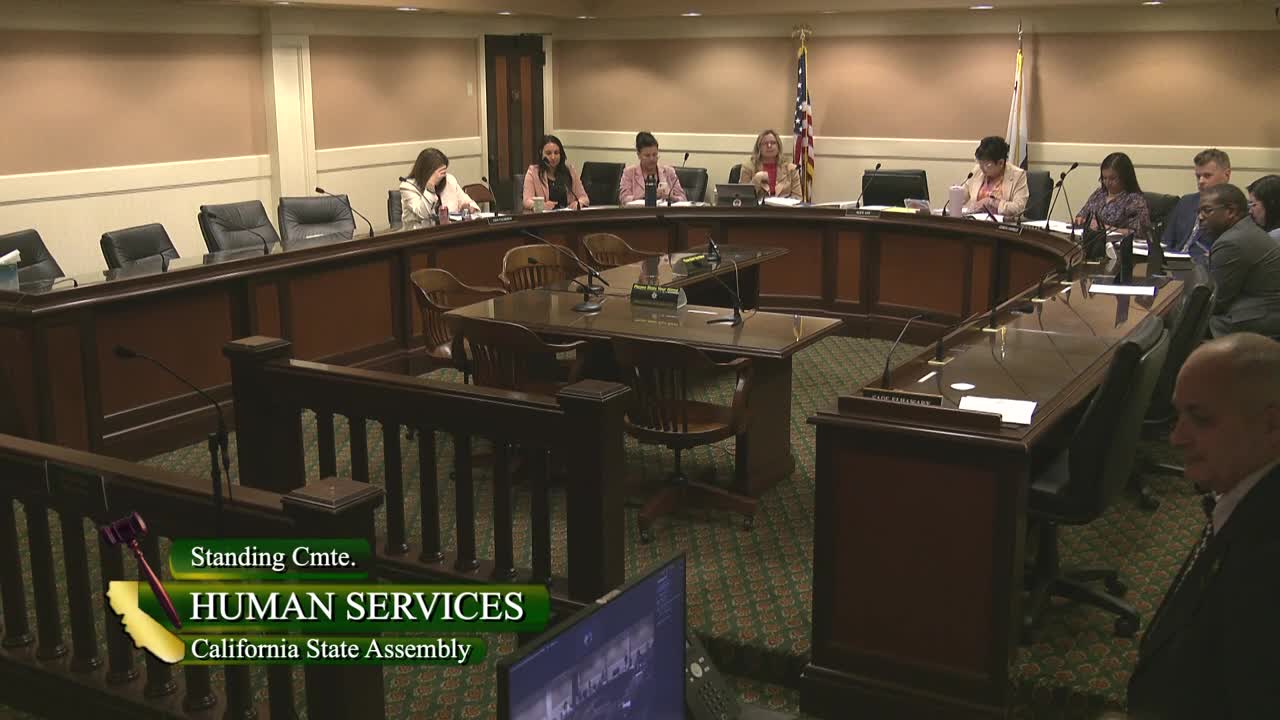
Assembly Standing Committee on Human Services


Bill Co-Author(s):