AB 668: Alcoholic beverage control: large outdoor events: drink spiking.
- Session Year: 2025-2026
- House: Assembly
- Latest Version Date: 2025-07-09
Current Status:
In Progress
(2025-08-29: In committee: Held under submission.)
Introduced
In Committee
Awaiting First Chamber Vote
Passed First Chamber
In Committee
Awaiting Second Chamber Vote
Passed Second Chamber
Enacted
Existing law, the Alcoholic Beverage Control Act, administered by the Department of Alcoholic Beverage Control, regulates the application for, the issuance of, the suspension of, and the conditions imposed upon, various alcoholic beverage licenses. Existing law generally makes a violation of the act a misdemeanor and grounds for suspension or revocation of a license, except as specified. Existing law, until January 1, 2027, requires an applicant for a new permanent on-sale general public premises (Type 48) license and the holder of an existing Type 48 license to offer drug testing devices and drink lids to their customers and to post a related notice, as specified. Existing law also requires those applicants and licensees to contact and provide specified information to law enforcement or emergency medical services when they are notified by a customer that the customer or another customer believes they have been a victim of drink spiking, as specified.
This bill would, commencing July 1, 2026, until January 1, 2029, require any person who obtains a catering authorization or daily on-sale license for the sale of alcoholic beverages at a large outdoor event, as defined, to comply with the above-described drink spiking requirements. The bill would require a licensee to comply with all manufacturer instructions relating to testing devices, as specified, and would specify that a licensee who complies with the manufacturers instructions shall not be held liable for a defective test or inaccurate test result. The bill would specify that a violation of its provisions is not a crime. crime and would specify that a first violation would result only in a warning by the department.
Existing law, the Alcoholic Beverage Control Act, administered by the Department of Alcoholic Beverage Control, regulates the application for, the issuance of, the suspension of, and the conditions imposed upon, various alcoholic beverage licenses. Existing law generally makes a violation of the act a misdemeanor and grounds for suspension or revocation of a license, except as specified. Existing law, until January 1, 2027, requires an applicant for a new permanent on-sale general public premises (Type 48) license and the holder of an existing Type 48 license to offer drug testing devices and drink lids to their customers and to post a related notice, as specified. Existing law also requires those applicants and licensees to contact and provide specified information to law enforcement or emergency medical services when they are notified by a customer that the customer or another customer believes they have been a victim of drink spiking, as specified.
This bill would, commencing July 1, 2026, until January 1, 2029, require any person who obtains a catering authorization or daily on-sale license for the sale of alcoholic beverages at a large outdoor event, as defined, to comply with the above-described drink spiking requirements. The bill would specify that a violation of its provisions is not a crime.
Existing law, the Alcoholic Beverage Control Act, administered by the Department of Alcoholic Beverage Control, regulates the application for, the issuance of, the suspension of, and the conditions imposed upon, various alcoholic beverage licenses. Existing law generally makes a violation of the act a misdemeanor and grounds for suspension or revocation of a license, except as specified. Existing law, until January 1, 2027, requires an applicant for a new permanent on-sale general public premises (Type 48) license and the holder of an existing Type 48 license to offer drug testing devices and drink lids to their customers and to post a related notice, as specified. Existing law also requires those applicants and licensees to contact and provide specified information to law enforcement or emergency medical services when they are notified by a customer that the customer or another customer believes they have been a victim of drink spiking, as specified.
This bill would require the promoter of would, commencing July 1, 2026, until January 1, 2029, require any person who obtains a catering authorization or daily on-sale license for the sale of alcoholic beverages at a large outdoor event, as those terms are defined, who applies for any license to serve alcoholic beverages at that event to comply with the above-described drink spiking requirements. The bill would specify that a violation of its provisions is not a crime.
Existing law, the Alcoholic Beverage Control Act, administered by the Department of Alcoholic Beverage Control, regulates the application for, the issuance of, the suspension of, and the conditions imposed upon, various alcoholic beverage licenses. Existing law generally makes a violation of the act a misdemeanor and grounds for suspension or revocation of a license, except as specified. Existing law, until January 1, 2027, requires an applicant for a new permanent on-sale general public premises (Type 48) license and the holder of an existing Type 48 license to offer drug testing devices and drink lids to their customers and to post a related notice, as specified. Existing law also requires those applicants and licensees to contact and provide specified information to law enforcement or emergency medical services when they are notified by a customer that the customer or another customer believes they have been a victim of drink spiking, as specified.
This bill would require the promoter of a large outdoor event, as those terms are defined, who applies for any license to serve alcoholic beverages at that event to comply with the above-described drink spiking requirements. The bill would specify that a violation of its provisions is not a crime.
Existing law sets forth a comprehensive plan for the conservation of the waters of the San Francisco Bay and the development of its shoreline and delegates to the San Francisco Bay Conservation and Development Commission authority to implement the plan. Existing law makes legislative findings on water-oriented land uses along the San Francisco Bays shoreline and public access to its shoreline and waters.This bill would make nonsubstantive changes to the legislative findings.Existing law sets forth a comprehensive plan for the conservation of the waters of the San Francisco Bay and the development of its shoreline and delegates to the San Francisco Bay Conservation and Development Commission authority to implement the plan. Existing law makes legislative findings on water-oriented land uses along the San Francisco Bays shoreline and public access to its shoreline and waters.
This bill would make nonsubstantive changes to the legislative findings.
(a)For purposes of this section, the following definitions shall apply:
(1)Controlled substances includes, but is not limited to, flunitrazepam, ketamine, and gamma hydroxybutyric acid, also known by other names, including GHB, gamma hydroxybutyrate, 4-hydroxybutyrate, 4-hydroxybutanoic acid, sodium oxybate, and sodium oxybutyrate.
(2)Drink spiking, also known as roofied, includes, but is not limited to, adding a controlled substance or alcohol to a persons drink without the knowledge or consent of that person.
(3)Drug testing devices means test strips, stickers, straws, and other devices designed to detect the presence of controlled substances in a drink.
(4)Large outdoor event means an organized outdoor event that is held in a nonpermanent venue featuring performances on one or more stages that has an estimated attendance level of more than 10,000 participants per day.
(5)Lid means a removable cover of any size that attaches to the rim of a beverage.
(b)Any person who obtains a catering authorization or daily on-sale license pursuant to this division for the sale of alcoholic beverages at a large outdoor event shall comply with all of the following requirements:
(1)Offer for sale to their customers drug testing devices at a cost not to exceed a reasonable amount based on the wholesale cost of those devices.
(A)This paragraph does not prevent a licensee subject to this section from offering drug testing devices to their customers free of charge.
(B)A licensee subject to this section who complies with the requirements of subparagraph (C) shall not be held liable for a defective test or inaccurate test result, including, but not limited to, a false positive or false negative test result.
(C)A licensee subject to this section shall comply with all manufacturer instructions related to testing devices offered to consumers, including instructions for storing the devices, and shall ensure that all testing devices offered to customers have not exceeded their expiration date or recommended period of use, according to the product label, product packaging, or otherwise recommended by the manufacturer.
(2)Upon request, provide a lid with a customers drink. The lid is not required to fit all containers in which alcoholic beverages are served at the event but shall fit at least one.
(A)A licensee subject to this section may charge an additional fee for providing a lid with a customers drink, which shall not exceed a reasonable amount based on the wholesale cost of those lids.
(B)This paragraph does not prevent a licensee subject to this section from offering lids to their customers free of charge.
(3)Contact and provide any of the following information to law enforcement or emergency medical services when they are notified by a customer that the customer or another customer believes they have been a victim of drink spiking:
(A)A positive test result from a drug testing device.
(B)Observation of someone tampering with a customers drink.
(C)Verbal communication to staff that a customer has been drugged.
(D)Observation of symptoms associated with the effects of drink spiking or the controlled substances used for drink spiking.
(E)Upon contacting law enforcement or emergency medical services, the licensee or a member of the staff shall, to the best of their ability, follow any instructions provided by law enforcement or emergency medical services personnel, and, to the best of their ability, monitor the customer until law enforcement or emergency medical services arrive at the premises to assess the customer.
(4)Post the following notice in a prominent and conspicuous location at alcohol dispensing points:
Dont get roofied! Drink lids and drink spiking drug test kits available here. Ask a staff member for details.
(c)Notwithstanding Section 25617, a violation of this section is not a crime.
(d)A first violation of this section shall result only in a warning by the department.
(d)(e)The department shall post on its internet website a link to a page that contains information about the requirements of this section, including, but not limited to, the signage that is required to be posted and the types of drug testing devices that are required to be available on a licensed premises.
(e)(f)This section shall become operative July 1, 2026, and shall remain in effect only until January 1, 2029, and as of that date is repealed.
(a)For purposes of this section, the following definitions shall apply:
(1)Controlled substances includes, but is not limited to, flunitrazepam, ketamine, and gamma hydroxybutyric acid, also known by other names, including GHB, gamma hydroxybutyrate, 4-hydroxybutyrate, 4-hydroxybutanoic acid, sodium oxybate, and sodium oxybutyrate.
(2)Drink spiking, also known as roofied, includes, but is not limited to, adding a controlled substance or alcohol to a persons drink without the knowledge or consent of that person.
(3)Drug testing devices means test strips, stickers, straws, and other devices designed to detect the presence of controlled substances in a drink.
(4)Large outdoor event means an organized outdoor event that is held in a nonpermanent venue featuring performances on one or more stages that has an estimated attendance level of more than 10,000 participants per day.
(5)Lid means a removable cover of any size that attaches to the rim of a beverage.
(b)Any person who obtains a catering authorization or daily on-sale license pursuant to this division for the sale of alcoholic beverages at a large outdoor event shall comply with all of the following requirements:
(1)Offer for sale to their customers drug testing devices at a cost not to exceed a reasonable amount based on the wholesale cost of those devices.
(A)This paragraph does not prevent a licensee subject to this section from offering drug testing devices to their customers free of charge.
(B)A licensee subject to this section shall not be held liable for a defective test or inaccurate test result, including, but not limited to, a false positive or false negative test result.
(C)A licensee subject to this section shall ensure that all testing devices offered to customers have not exceeded their expiration date or recommended period of use, according to the product label, product packaging, or otherwise recommended by the manufacturer.
(2)Upon request, provide a lid with a customers drink. The lid is not required to fit all containers in which alcoholic beverages are served at the event but shall fit at least one.
(A)A licensee subject to this section may charge an additional fee for providing a lid with a customers drink, which shall not exceed a reasonable amount based on the wholesale cost of those lids.
(B)This paragraph does not prevent a licensee subject to this section from offering lids to their customers free of charge.
(3)Contact and provide any of the following information to law enforcement or emergency medical services when they are notified by a customer that the customer or another customer believes they have been a victim of drink spiking:
(A)A positive test result from a drug testing device.
(B)Observation of someone tampering with a customers drink.
(C)Verbal communication to staff that a customer has been drugged.
(D)Observation of symptoms associated with the effects of drink spiking or the controlled substances used for drink spiking.
(E)Upon contacting law enforcement or emergency medical services, the licensee or a member of the staff shall, to the best of their ability, follow any instructions provided by law enforcement or emergency medical services personnel, and, to the best of their ability, monitor the customer until law enforcement or emergency medical services arrive at the premises to assess the customer.
(4)Post the following notice in a prominent and conspicuous location at alcohol dispensing points:
Dont get roofied! Drink lids and drink spiking drug test kits available here. Ask a staff member for details.
(c)Notwithstanding Section 25617, a violation of this section is not a crime.
(d)The department shall post on its internet website a link to a page that contains information about the requirements of this section, including, but not limited to, the signage that is required to be posted and the types of drug testing devices that are required to be available on a licensed premises.
(e)This section shall become operative July 1, 2026, and shall remain in effect only until January 1, 2029, and as of that date is repealed.
(a)For purposes of this section, the following definitions apply:
(1)Controlled substances includes, but is not limited to, flunitrazepam, ketamine, and gamma hydroxybutyric acid, also known by other names, including GHB, gamma hydroxybutyrate, 4-hydroxybutyrate, 4-hydroxybutanoic acid, sodium oxybate, and sodium oxybutyrate.
(2)Drink spiking, also known as roofied, includes, but is not limited to, adding a controlled substance or alcohol to a persons drink without the knowledge or consent of that person.
(3)Drug testing devices means test strips, stickers, straws, and other devices designed to detect the presence of controlled substances in a drink.
(4)Large outdoor event means an organized outdoor event that is held in a nonpermanent venue featuring performances on one or more stages that has an estimated attendance level of more than 10,000 participants per day.
(5)Lid means a removable cover of any size that attaches to the rim of a beverage.
(6)Promoter means an individual, association, corporation, partnership, or other organization that arranges, holds, organizes, or otherwise conducts a large outdoor event.(b)A promoter of a large outdoor event who applies for any license under this division to serve alcohol at the event shall comply with all of the following requirements:(b)Any person who obtains a catering authorization or daily on-sale license pursuant to this division for the sale of alcoholic beverages at a large outdoor event shall comply with all of the following requirements:
(1)Offer for sale to their customers drug testing devices at a cost not to exceed a reasonable amount based on the wholesale cost of those devices.
(A)This paragraph does not prevent a licensee subject to this section from offering drug testing devices to their customers free of charge.
(B)A licensee subject to this section shall not be held liable for a defective test or inaccurate test result, including, but not limited to, a false positive or false negative test result.
(C)A licensee subject to this section shall ensure that all testing devices offered to customers have not exceeded their expiration date or recommended period of use, according to the product label, product packaging, or otherwise recommended by the manufacturer.
(2)Upon request, provide a lid with a customers drink. The lid is not required to fit all containers in which alcoholic beverages are served at the event but shall fit at least one.
(A)A licensee subject to this section may charge an additional fee for providing a lid with a customers drink, which shall not exceed a reasonable amount based on the wholesale cost of those lids.
(B)This paragraph does not prevent a licensee subject to this section from offering lids to their customers free of charge.
(3)Contact and provide any of the following information to law enforcement or emergency medical services when they are notified by a customer that the customer or another customer believes they have been a victim of drink spiking:
(A)A positive test result from a drug testing device.
(B)Observation of someone tampering with a customers drink.
(C)Verbal communication to staff that a customer has been drugged.
(D)Observation of symptoms associated with the effects of drink spiking or the controlled substances used for drink spiking.
(E)Upon contacting law enforcement or emergency medical services, the licensee or a member of the staff shall, to the best of their ability, follow any instructions provided by law enforcement or emergency medical services personnel, and, to the best of their ability, monitor the customer until law enforcement or emergency medical services arrive at the premises to assess the customer.
(4)Post the following notice in a prominent and conspicuous location: location at alcohol dispensing points:
Dont get roofied! Drink lids and drink spiking drug test kits available here. Ask a staff member for details.
(c)Notwithstanding Section 25617, a violation of this section is not a crime.
(d)The department shall post on its internet website a link to a page that contains information about the requirements of this section, including, but not limited to, the signage that is required to be posted and the types of drug testing devices that are required to be available on a licensed premises.
(e)This section shall become operative July 1, 2026, and shall remain in effect only until January 1, 2029, and as of that date is repealed.
REVISIONS: HeadingLine 2.(a)For purposes of this section, the following definitions apply:
(1)Controlled substances includes, but is not limited to, flunitrazepam, ketamine, and gamma hydroxybutyric acid, also known by other names, including GHB, gamma hydroxybutyrate, 4-hydroxybutyrate, 4-hydroxybutanoic acid, sodium oxybate, and sodium oxybutyrate.
(2)Drink spiking, also known as roofied, includes, but is not limited to, adding a controlled substance or alcohol to a persons drink without the knowledge or consent of that person.
(3)Drug testing devices means test strips, stickers, straws, and other devices designed to detect the presence of controlled substances in a drink.
(4)Large outdoor event means an organized outdoor event that is held in a nonpermanent venue featuring performances on one or more stages that has an estimated attendance level of more than 10,000 participants per day.
(5)Lid means a removable cover of any size that attaches to the rim of a beverage.
(6)Promoter means an individual, association, corporation, partnership, or other organization that arranges, holds, organizes, or otherwise conducts a large outdoor event.
(b)A promoter of a large outdoor event who applies for any license under this division to serve alcohol at the event shall comply with all of the following requirements:
(1)Offer for sale to their customers drug testing devices at a cost not to exceed a reasonable amount based on the wholesale cost of those devices.
(2)Upon request, provide a lid with a customers drink. The lid is not required to fit all containers in which alcoholic beverages are served at the event but shall fit at least one.
(3)Contact and provide any of the following information to law enforcement or emergency medical services when they are notified by a customer that the customer or another customer believes they have been a victim of drink spiking:
(A)A positive test result from a drug testing device.
(B)Observation of someone tampering with a customers drink.
(C)Verbal communication to staff that a customer has been drugged.
(D)Observation of symptoms associated with the effects of drink spiking or the controlled substances used for drink spiking.
(E)Upon contacting law enforcement or emergency medical services, the licensee or a member of the staff shall, to the best of their ability, follow any instructions provided by law enforcement or emergency medical services personnel, and, to the best of their ability, monitor the customer until law enforcement or emergency medical services arrive at the premises to assess the customer.
(4)Post the following notice in a prominent and conspicuous location:
Dont get roofied! Drink lids and drink spiking drug test kits available here. Ask a staff member for details.
(c)Notwithstanding Section 25617, a violation of this section is not a crime.
SECTION 1.Section 66602 of the Government Code is amended to read:66602.The Legislature further finds and declares all of the following:(a)That certain water-oriented land uses along the San Francisco Bays shoreline are essential to the public welfare of the bay area.(b)That the water-oriented land uses include ports, water-related industries, airports, wildlife refuges, water-oriented recreation and public assembly, desalinization plants, upland dredged material disposal sites, and powerplants requiring large amounts of water for cooling purposes. (c)That the San Francisco Bay Plan should provide for adequate and suitable locations for all of these water-oriented land uses, thereby minimizing the necessity for future bay fill to create new sites for these uses.(d)That existing public access to the San Francisco Bays shoreline and waters is inadequate.(e)That maximum feasible public access to the San Francisco Bays shoreline and waters, consistent with a proposed project, should be provided.The Legislature further finds and declares that all of the following:
(a)That certain water-oriented land uses along the bay San Francisco Bays shoreline are essential to the public welfare of the bay area, and that these area.
(b)That the water-oriented land uses include ports, water-related industries, airports, wildlife refuges, water-oriented recreation and public assembly, desalinization plants, upland dredged material disposal sites, and powerplants requiring large amounts of water for cooling purposes; that purposes.
(c)That the San Francisco Bay Plan should make provision provide for adequate and suitable locations for all these of these water-oriented land uses, thereby minimizing the necessity for future bay fill to create new sites for these uses; that uses.
(d)That existing public access to the San Francisco Bays shoreline and waters of the San Francisco Bay is inadequate and that inadequate.
(e)That maximum feasible public access, access to the San Francisco Bays shoreline and waters, consistent with a proposed project, should be provided.
|
Date
|
Status
|
|---|---|
| Aug 29, 2025 | In committee: Held under submission. |
| Aug 18, 2025 | In committee: Referred to suspense file. |
| Jul 16, 2025 | From committee: Do pass and re-refer to Com. on APPR. (Ayes 13. Noes 0.) (July 15). Re-referred to Com. on APPR. |
| Jul 9, 2025 | Read second time and amended. Re-referred to Com. on JUD. |
| Jul 8, 2025 | From committee: Amend, and do pass as amended and re-refer to Com. on JUD. (Ayes 15. Noes 0.) (July 8). |
| Jun 23, 2025 | In committee: Hearing postponed by committee. |
| May 29, 2025 | From committee chair, with author's amendments: Amend, and re-refer to committee. Read second time, amended, and re-referred to Com. on G.O. |
| May 21, 2025 | Referred to Coms. on G.O. and JUD. |
| May 13, 2025 | In Senate. Read first time. To Com. on RLS. for assignment. |
| May 12, 2025 | Read third time. Passed. Ordered to the Senate. (Ayes 77. Noes 0. Page 1509.) |
| Apr 24, 2025 | Read second time. Ordered to third reading. |
| Apr 23, 2025 | From committee: Do pass. (Ayes 15. Noes 0.) (April 23). |
| Apr 3, 2025 | From committee: Do pass and re-refer to Com. on APPR. (Ayes 20. Noes 0.) (April 2). Re-referred to Com. on APPR. |
| Apr 3, 2025 | Coauthors revised. |
| Mar 28, 2025 | Re-referred to Com. on G.O. |
| Mar 27, 2025 | From committee chair, with author's amendments: Amend, and re-refer to Com. on G.O. Read second time and amended. |
| Mar 18, 2025 | Re-referred to Com. on G.O. |
| Mar 17, 2025 | From committee chair, with author's amendments: Amend, and re-refer to Com. on G.O. Read second time and amended. |
| Mar 17, 2025 | Referred to Com. on G.O. |
| Feb 15, 2025 | From printer. May be heard in committee March 17. |
| Feb 14, 2025 | Read first time. To print. |
|
Date
|
Description
|
Location
|
Votes
|
|
|---|---|---|---|---|
| Aug 18, 2025 | Placed on suspense file | Senate Standing Committee on Appropriations |
Passed |
|
| Jul 15, 2025 | Do pass, but first be re-referred to the Committee on [Appropriations] | Senate Standing Committee on Judiciary |
Passed |
|
| Jul 8, 2025 | Do pass as amended, but first amend, and re-refer to the Committee on [Judiciary] | Senate Standing Committee on Governmental Organization |
Passed |
|
| May 12, 2025 | AB 668 Lowenthal Assembly Third Reading | Assembly Floor |
Passed |
|
| Apr 23, 2025 | Do pass. | Assembly Standing Committee on Appropriations |
Passed |
|
| Apr 2, 2025 | Do pass and be re-referred to the Committee on [Appropriations] | Assembly Standing Committee on Governmental Organization |
Passed |
This list shows positions taken on this bill by organizations on the date displayed, which is linked to the original source.
Positions by individuals are not included.
|
Organization
|
Position
|
Date
|
|---|---|---|
| Alcohol Justice | ** Support | |
| California Alcohol Policy Alliance | ** Support | |
| National Independent Venue Association Of California | ** Against |
SENATE COMMITTEE ON APPROPRIATIONS
Senator Anna Caballero, Chair
2025 - 2026 Regular Session
AB 668 (Lowenthal) - Alcoholic beverage control: large outdoor events: drink spiking
Version: July 9, 2025 | Policy Vote: G.O. 15 - 0, JUD. 13 - 0 |
Urgency: No | Mandate: No |
Hearing Date: August 18, 2025 | Consultant: Janelle Miyashiro |
Bill Summary:
AB 668 requires, beginning July 1, 2026 and until January 1, 2029, any person who obtains a catering authorization or daily on-sale license for the sale of alcoholic beverages at a large outdoor event to offer drug testing devices, provide drink lids upon request, and comply with notification and signage requirements related to drink spiking, as specified.
Fiscal Impact:
Unknown, potentially significant fiscal impact to the Department of Alcoholic Beverage Control (ABC) to investigate complaints related to incidents of alleged drink spiking during large outdoor events involving catering authorization or daily on-sale license holders. For context, the Department of ABC issued 318 daily on-sale licenses and 113 catering authorizations for events with more than 10,000 participants in 2024. If 10 percent of these events resulted in complaint investigations under this bill, this would be 43 investigations. Actual costs to the department will depend on, among other things, the extent that the department may absorb the enforcement activities related to this bill in its regular investigatory activities for incidents involving drink spiking.
It is unknown if the Department of ABC would be required to develop regulations or produce other guidance. The bill is unclear about the number of drug testing devices that licensees should have available for purchase, whether devices must be available at all locations at the event alcohol is being served, or for storage and retention requirements for devices to comply with the mandates of this bill. To the extent the department would need to develop regulations or guidance, there may be additional administrative costs.
Staff notes that the Department of ABC’s activities are funded by regulatory and license fees and generally the department does not receive support from the General Fund. New legislative mandates, although modest in scope, may in totality create new cost pressures and impact the department’s operating costs and future budget requests.
Background:
The Department of ABC carries out business inspections through its Informed Merchants Preventing Alcohol-Related Crime Tendencies (IMPACT) Program. The Department of ABC created IMPACT in 1984 as a preventative and educational program. It employs a community-oriented policing strategy that involves local businesses in deterring crime. IMPACT teams select and survey licensed outlets at random. During their visits, IMPACT teams remind licensees of the responsibilities and accountability associated with the sale of alcohol. The officers also inspect licensed premises for compliance with State and local laws. The officers may look for loitering, litter, graffiti, posted signs, slot machines, lack of food service in restaurants, illegal weapons, or other violations. Although education is the main goal, if any major violations are discovered during the inspections, officers will act. A checklist is used to note any violations observed, and it is given to the licensee. Any issues must then be fixed by the licensee.
Proposed Law:
- Requires any person who obtains a catering authorization or daily on-sale license for the sale of alcoholic beverages at a large outdoor event to comply with all of the following:
- Offer drug testing devices to their customers at a cost not to exceed a reasonable amount based on the wholesale cost of those devices. Provides that a licensee may offer drug testing devices to their customers for free. Provides that a licensee is not liable for a defective test or inaccurate test result. Requires licensees to comply with all manufacturer storage instructions.
- Upon request, provide a lid with a customer’s drink. Provides that the lid is not required to fit all containers in which alcoholic beverages are served at the event, but must fit at least one. Authorizes a licensee to charge an additional fee for providing a lid, not to exceed a reasonable amount based on the wholesale cost of those lids. Provides a licensee can offer lids for free.
- Contact and provide the following information to law enforcement or emergency medical services when the licensee is notified by a customer that the customer or another customer believes they have been a victim of drink spiking: a positive test result from a testing device, observation of someone tampering with a customer’s drink, verbal communication to staff that a customer has been drugged, or observation of symptoms associated with the effects of drink spiking. Requires the licensee or a member of staff, to the best of their ability, to follow any instructions provided by law enforcement or emergency medical services personnel and monitor that customer until law enforcement or medical services personnel arrive to assess the customer.
- Post the following notice in a prominent and conspicuous location at alcohol dispensing points:
“Don’t get roofied! Drink lids and drink spiking drug test kits available here. Ask a staff member for details.”
- Provides that a first violation of the provisions of this bill result only in a warning by the department.
- Requires the department to post a link on its website to a page that contains information about the requirements of this bill.
- Defines “drink spiking,” also known as “roofied,” to include but not be limited to, adding a controlled substance or alcohol to a person’s drink without the knowledge or consent of that person.
- Defines “controlled substance” to include, but not be limited to, flunitrazepam, ketamine, and gamma hydroxybutyric acid, also known by other names, including GHB, gamma hydroxybutyrate, 4-hydroxybutyrate, 4-hydroxybutanoic acid, sodium oxybate, and sodium oxybutyrate.
- Defines “drug testing devices,” to mean test strips, stickers, straws, and other devices designed to detect the presence of controlled substances in a drink.
- Defines “large outdoor event” as an organized outdoor event that is held in a nonpermanent venue featuring performances on one or more stages that has an estimated attendance level of more than 10,000 participants per day.
- Defines “lid” as a removable cover of any size that attaches to the rim of a beverage.
- Makes the provisions of this bill operative on July 1, 2026, and until January 1, 2029.
-- END --
Senator Thomas Umberg, Chair
2025-2026 Regular Session
Bill No: AB 668 (Author:Lowenthal)
Version: July 9, 2025
Hearing Date: July 15, 2025
Fiscal: Yes
Urgency: No
Consultant: AWM
SUBJECT
Alcoholic beverage control: large outdoor events: drink spiking
DIGEST
This bill requires, until January 1, 2029, any person who obtains a catering authorization or daily on-sale license for the sale of alcoholic beverages at large outdoor events to offer drug testing devices for sale to their customers and to provide, upon request, a lid with a customer’s drink, as specified.
EXECUTIVE SUMMARY
A person commits “drink-spiking” when they put a controlled substance or alcohol in the drink of another person without that person’s knowledge or consent. Adulterating another’s drink is, in and of itself, illegal, but a drink-spiker usually engages in drink-spiking with the goal of perpetrating another crime on the victim—often sexual assault or rape. The most common method of spiking is placing the unwanted substance in another person’s drink, though food can also be spiked. Current law requires, until 2027, licensed bars and clubs to make drug-testing devices and lids available for sale to patrons, and to post specified signage relating to the availability of tests.
This bill requires, until January 1, 2029, any person who obtains a catering authorization or daily on-sale license for the sale of alcoholic beverages at large outdoor events to offer drug testing devices for sale to their customers and to provide, upon request, a lid with a customer’s drink. The person may charge for the test or drink. The bill also requires the person to post the same signage as a bar or club licensee. The bill provides that the person is immune from liability for a defective test or inaccurate test result, provided that the test is within its expiration period and the person complied with all of the manufacturer’s instructions related to the test.
This bill is sponsored by the author and is supported by Alcohol Justice and the California Alcohol Policy Alliance. The Committee has not received timely opposition to this bill. The Senate Governmental Organization Committee passed this bill with a vote of 15-0.
PROPOSED CHANGES TO THE LAW
Existing law:
- Provides that every person is responsible, not only for the result of their willful acts, but also for an injury occasioned to another by their want of ordinary care or skill in the management of their property or person, except so far as the latter has, willfully or by want of ordinary care, brought the injury upon themselves. (Civ. Code, § 1714(a).)
- Establishes the Alcoholic Beverage Control Act (ABCA), which governs the manufacture, sale, and disposition of alcoholic beverages in the state, and is administrated by the Department of Alcoholic Beverage Control (ABC). (Bus. & Prof. Code, div. 9, §§ 23000 et seq.)
- Requires a person to obtain a license from the ABC to engage in specified alcoholic-beverage-related commercial activities. (Bus. & Prof. Code, div. 9, ch. 3, §§ 23300 et seq.)
- Establishes the Type 48 license, which authorizes the sale of alcoholic beverages at venues where the service of alcohol is not incidental to food service and minors are not allowed to enter and remain (i.e., bars and nightclubs). (Bus. & Prof. Code, §§ 23320, 25665, 23825.)
- Defines the following terms:
- “Drug testing devices” means test strips, stickers, straws, and other devices designed to detect the presence of controlled substances in a drink. (Bus. & Prof. Code, § 25624(a).)
- “Controlled substances” includes, but is not limited to, flunitrazepam, ketamine, and gamma hydroxybutyric acid, also known by other names, including GHB, gamma hydroxybutyrate, 4-hydroxybutyrate, 4-hydroxybutanoic acid, sodium oxybate, and sodium oxybutyrate. (Bus. & Prof. Code, § 25624(a).)
- “Drink spiking,” also known as “roofied,” includes, but is not limited to, adding a controlled substance or alcohol to a person’s drink without the knowledge or consent of that person. (Bus. & Prof. Code, § 25624.5(a)(3).)
- Requires the holder of a Type 48 license to do all of the following:
- Offer for sale to their customers drug testing devices at a cost not to exceed a reasonable amount based on the wholesale cost of those devices. (Bus. & Prof. Code, § 25624(b).)
- Ensure that all testing devices offered to customers under (1) have not exceeded their expiration date or recommended period of prior use, according to the product label, product packaging, or as otherwise recommended by the manufacturer. (Bus. & Prof., § 25624(f).)
- Post a notice that states “Don’t get roofied! Drink lids and drink spiking drug test kits available here. Ask a staff member for details.” in a prominent and conspicuous location. (Bus. & Prof. Code, § 25624(c).)
- Contact and provide specified information to law enforcement or emergency medical services (EMS) when they are notified by a customer that the customer or another customer believes that they have been a victim of drink spiking and, to the best of their ability, follow any instructions provided by law enforcement or EMS personnel and monitor the customer until law enforcement or EMS arrive at the premises to assess the customer. (Bus. & Prof. Code, § 25624.5(b).)
- Beginning July 1, 2025, provide a lid for a customer’s drink upon request; the licensee may charge a fee for providing a lid, which shall not exceed a reasonable amount based on the wholesale cost of those lids. (AB 2375 (Lowenthal, Ch. 714, Stats. 2024); Bus. & Prof. Code § 25625 (effective July 1, 2025).)
- Provides that a licensee shall not be held liable for a defective test or inaccurate test result, including, but not limited to, a false positive or false negative test result, from a test provided pursuant to 6)(a). (Bus. & Prof. Code, § 25624(e).)
- Provides that the obligations to provide drug-testing devices for sale, to post notices, and to provide a lid pursuant to 6) sunset on January 1, 2027. (Bus. & Prof. Code, § 25624(i).)
This bill:
- Defines the following terms:
- “Controlled substances” includes, but is not limited to, flunitrazepam, ketamine, and gamma hydroxybutyric acid, also known by other names, including GHB, gamma hydroxybutyrate, 4-hydroxybutyrate, 4-hydroxybutanoic acid, sodium oxybate, and sodium oxybutyrate.
- “Drink spiking,” also known as “roofied,” includes, but is not limited to, adding a controlled substance or alcohol to a person’s drink without the knowledge or consent of the person.
- “Drug testing devices” means test strips, stickers, straws, and other devices designed to detect the presence of controlled substances in a drink.
- “Large outdoor event” means an organized outdoor event that is held in a nonpermanent venue featuring performances on one or more stages that has an estimated attendance level of more than 10,000 participants per day.
- “Lid” means a removable cover of any size that attaches to the rim of a beverage.
- Requires any person who obtains a catering authorization or daily on-sale license pursuant to the ABCA for the sale of alcoholic beverages at a large outdoor event to comply with all of the following requirements:
- Offer for sale to their customers drug-testing devices at a cost not to exceed a reasonable amount based on the wholesale cost of those devices, or provide such devices to customers free of charge.
- Provide a customer a lid for their drink upon request; the lid is not required to fit all containers in which alcoholic beverages are served at the event but shall fit at least one. The person may charge an additional fee for providing a lid with a customer’s drink, which shall not exceed a reasonable amount based on the wholesale cost of those lids, or may offer the lids free of charge.
- Contact and provide the following information to law enforcement or EMS when they are notified by a customer that the customer or another customer believes they have been a victim of drink spiking:
- A positive test result from a drug-testing device.
- Observation of someone tampering with a customer’s drink.
- Verbal communications to staff that a customer has been drugged.
- Observation of symptoms associated with the effects of drink spiking or the controlled substances used for drink spiking.
- Upon contacting law enforcement or EMS pursuant to (c), to the best of their ability, follow any instructions provided by law enforcement or EMS personnel and monitor the customer until law enforcement or EMS arrives at the premises to assess the customer. A member of the licensee’s staff may also satisfy this requirement.
- Post a notice that states “Don’t get roofied! Drink lids and drink spiking drug test kits available here. Ask a staff member for details.” In a prominent and conspicuous location.
- Provides that a licensee who provides a drug-testing device pursuant to 2)(a) shall not be held liable for a defective test or inaccurate test result, including, but not limited to, a false positive or false negative test result, provided that they complied with the requirements of 4), below.
- Requires a licensee required to provide a drug-testing device pursuant to 2)(a) to comply with all manufacturer instructions related to testing devices offered to consumers, including instructions for storing the devices, and to ensure that all testing devices offered to customers have not exceeded their expiration date or recommended period of use, according to the product label, product packaging, or otherwise recommended by the manufacturer.
- Requires the ABC to post on its website a link to a page that contains information about the requirements of 1)-4), including, but not limited to, the signage that is required to be posted and the types of drug-testing devices that are required to be available on a licensed premises.
- Provides that a violation of 2)(a) is not a crime, and a first violation shall result only in a warning from the ABC.
- Provides that 1)-6) become operative on July 1, 2026, and will sunset on January 1, 2029.
COMMENTS
- Author’s comment
According to the author:
The ongoing and often underreported epidemic of drink spiking, commonly known as “roofying” continues to plague California and the world. Drink spiking, drugging, or “roofying” can be perpetrated in almost any setting, but a common location for this activity to take place is in chaotic environments where alcoholic beverages are being sold, and recreational drugs are being used. AB 668 establishes simple and effective measures to both increase vigilance at California’s large music festivals, and prevent roofying and in turn the horrific crimes that too often follow, such as sexual assault, and rape. In creating a safer environment, music festival goers will have the peace of mind to further enjoy themselves at these vibrant and much celebrated events.
2. Civil liability and immunity
As a general rule, California law provides that persons are responsible, not only for the result of their willful acts, but also for an injury occasioned to another by their want of ordinary care or skill in the management of their property or person, except so far as the latter has, willfully or by want of ordinary care, brought the injury upon themselves.[1] Liability has the primary effect of ensuring that some measure of recourse exists for those persons injured by the negligent or willful acts of others; the risk of that liability has the primary effect of ensuring parties act reasonably to avoid harm to those to whom they owe a duty.
Conversely, immunity from liability disincentivizes careful planning and acting on the part of individuals and entities. Granting a person immunity from civil liability relieves them of the responsibility to act with due regard and an appropriate level of care in the conduct of its activities. Immunity provisions are also disfavored because they, by definition, preclude parties from recovering when they are injured, thereby forcing injured parties to absorb losses for which they are not responsible. Liability acts not only to allow a victim to be made whole, but also to encourage appropriate compliance with legal requirements.
Although immunity provisions are rarely preferable, the Legislature has in limited scenarios approved measured immunity from liability (as opposed to blanket immunities) to promote other policy goals that could benefit the public. Immunities are generally afforded when needed to ensure the willingness of individuals to continue taking on certain roles that may involve some risk and to incentivize certain conduct, such as the provision of life-saving or other critical services.[2] As discussed below in Comment 3, the Legislature has also provided limited immunity for licensees who provide drug-testing devices at bars and nightclubs.
3. Background on drink-spiking and recent efforts to protect potential victims
A person commits “drink-spiking” when they put a controlled substance or alcohol in the drink of another person without that person’s knowledge or consent. Adulterating another’s drink is, in and of itself, illegal, but a drink-spiker usually engages in drink-spiking with the goal of perpetrating another crime on the victim—often sexual assault or rape. The most common method of spiking is placing the unwanted substance in another person’s drink,[3] though food can also be spiked. Research shows that women of all sexualities are more likely than men to have their drinks spiked—with bisexual women reporting the highest rates of drink-spiking—though sexual minority men are far more likely than straight men to have experienced drink-spiking.[4]
Reliable data on drink-spiking are difficult to come by, in part because the symptoms of drink-spiking can be difficult to distinguish from (or written off as) the symptoms of intoxication from alcohol, including blackout and temporary amnesia that can lead the victim to be unaware of what happened to them while the drugs were in effect.[5] Also—as is common with crimes commonly perpetrated against women and gender minorities—there is a tendency among some to disbelieve that a person spiked a victim’s drink. As explained in one study, “[m]any bartending participants explain[ed] that they believe that the majority of those who say they have been spiked have just consumed too much alcohol and do not wish to be held accountable.”[6] Anti-spiking efforts also generally tend to focus on the behavior of potential spiking victims, rather than the spiker; “[f]rom a feminist perspective, it appears that these awareness campaigns are holding women personally accountable for their victimization and giving them the responsibility of preventing an attack.”[7]
As explained by the Senate Governmental Organization Committee’s analysis of this bill, the state has taken steps in the past 10 years to help protect persons from would-be drink spikers:
In 2017, Governor Brown signed AB 1221 (Gonzalez Fletcher, Chapter 847, Statutes of 2017) which required the Department of ABC, to develop, implement, and administer a curriculum for [a responsible beverage service (RBS)] training program. The bill requires anyone that is employed at an ABC on-premises licensed establishment who is responsible for checking identifications, taking customer orders, and pouring or delivering alcoholic beverages to have a valid RBS certification from the Department of ABC by July 1, 2021. This date would be delayed by the Department of ABC until August 31, 2022, after issues arose with individuals being able to access RBS training in a timely manner and a lack of training courses in languages other than English. When announcing this extension, the Department of ABC made it clear that even after the August 31, 2022, deadline; the department would focus on an education first approach rather than seeking administrative fines on licensees.
RBS training requires servers and their managers to register in the RBS Portal, take RBS training from an approved training provider, and pass the department’s RBS exam within 60 days of their first date of employment. On-premises locations include, but are not limited to, bars, restaurants, tasting rooms, clubs, stadiums, movie theaters, hotels, and caterers. Covered licensees are required to maintain records of their various certifications, and violators are subject to unspecified “disciplinary action.”
The RBS training is currently available in English, Chinese, Hindi, Korean, Punjabi, Spanish, Tagalog, and Vietnamese. RBS certifications are valid for three years. RBS servers and license administrators with an RBS server roster will receive email notifications prior to the server’s expiration date.
Last year, Governor Newsom signed AB 2402 (Lowenthal, Chapter 829, Statutes of 2024) to require RBS training courses, on or before July 1, 2027, to include best practices on how to prevent or protect a person from drink spiking, as specified.
Additionally, the Legislature has enacted three other drink-spiking measures that apply specifically to bars and clubs. AB 1013 requires holders of Type 48 licenses (required for bars and clubs) to offer for sale drug testing devices at reasonable prices, until 2027.[8] AB 2375 requires the same licensees to provide patrons with a drink lid upon request, also until 2027.[9] And finally, AB 2389 requires the same licensees to take specified steps upon receiving a report that a patron believes someone has spiked their drink.[10]
4. This bill requires drug-testing tests and lids to be made available by certain drink providers at large music festivals
This bill requires, until January 1, 2029, any person who obtains a catering authorization or daily on-sale license for the sale of alcoholic beverages at large outdoor events to offer drug-testing devices for sale to their customers and to provide, upon request, a lid with a customer’s drink. The Senate Governmental Organization Committee passed this bill with a vote of 15-0 but expressed concerns about the potential scope of the bill, as explained in that Committee’s analysis:
As currently drafted, the bill does not provide any guidance to the Department of ABC or to licensees as to what is expected in terms of the number of drug testing devices that licensees should have available for purchase. Given that the bill defines “large outdoor events” as events that have an estimated attendance level of more than 10,000 participants per day, licensees and the Department of ABC could interpret that to mean that licensees must purchase a minimum of 10,000 drug testing devices per day.
A quick online search of such drug testing devices shows that these products at the low end tend to cost at least $1 dollar per test if not more. If licensees are required to purchase 10,000 of these tests, it could result in a significant cost to licensees. It should also be noted that these tests do expire. Since many of these festivals are yearly events, licensees might be unable to reuse unused tests. Also it’s important to note that while requirements to provide these test kits at bars currently exist, there is very limited data as to how often they are requested by patrons throughout California. Furthermore, unlike music festivals which are temporary, bars can continue to use drug testing kits day after day.
For purposes of this Committee’s jurisdiction, the relevant question is whether the bill’s immunity provision is appropriately tailored. The bill provides that the person or entity providing a drug-testing device shall not be held liable for a defective or inaccurate test, provided that they complied with all of the manufacturer’s instructions relating to the test, including storing the test properly and not providing a test past the expiration date. The possible consequences of a false negative are severe, and providing a poorly maintained test—which could give the drinker a false sense of security—is arguably worse than no test at all. Because this immunity provision holds a person or an entity liable for their own carelessness, while immunizing it from incorrect results outside of their control, this immunity provision appears reasonably narrowly tailored to achieve the overall policy aim of making drug-testing devices available to attendees at large music festivals.
5. Arguments in support
According to the California Alcohol Policy Alliance:
“Drink spiking” is an underreported but consistently present hazard for people who drink. Whether it leads to assault, robbery, or simply loss of control, it can create lasting trauma. Last year’s bills established a baseline of responsibility for bars, including providing testing, lids, and training to prevent harm to bargoers. We applaud [Assemblymember]. Lowenthal’s refusal to stop there, and extend it to music festivals and other major outdoor events as well.
The attendees at music festivals are likely to be younger, less affluent, and less capable of accessing mental health care and emergency support than bar patrons. This, combined with the fact that large outdoor events create conditions where it is nearly impossible to constantly monitor the people nearby, makes it all the more critical to put these common-sense drink-spiking prevention measures into effect there.
SUPPORT
Alcohol Justice
California Alcohol Policy Alliance
OPPOSITION
None received[11]
RELATED LEGISLATION
Pending legislation: AB 1081 (Macedo, 2025) expands the requirement for Type 48 licensees to offer customers drug-testing devices to include tests for carfentanil and fentanyl. AB 1081 is pending before the Assembly Governmental Organization Committee.
Prior legislation:
AB 2402 (Lowenthal, Ch. 829, Stats. 2024) required, beginning on or before January 1, 2027, courses taught by the ABC’s Responsible Beverage Training Service to include best practices on how to prevent or protect a person from drink-spiking and best practices if the person believes they have, or know someone has, been drugged as a result of drink-spiking. AB 2402 is discussed in Comment 3 of this analysis.
AB 2389 (Lowenthal, Ch. 310, Stats. 2024) required the holder of a Type 48 license to contact law enforcement and take specified steps when they are notified by a customer that a customer has been a victim of drink-spiking. AB 2389 is discussed in Comment 3 of this analysis.
AB 2375 (Lowenthal, Ch. 714, Stats. 2024) required the holder of a Type 48 license to, upon request, provide a lid for a customer’s drink and post specified notices relating to drink-spiking, beginning July 1, 2025, and until January 1, 2027. AB 2375 is discussed in Comment 3 of this analysis.
AB 1013 (Lowenthal, Ch. 353, Stats. 2023) required Type 48 licensees to provide drug-testing devices to their customers and to post specified notices, until January 1, 2027. AB 1013 is discussed in Comment 3 of this analysis.
PRIOR VOTES:
Senate Governmental Organization Committee (Ayes 15, Noes 0)
Assembly Floor (Ayes 77, Noes 0)
Assembly Appropriations Committee (Ayes 15, Noes 0)
Assembly Governmental Organization Committee (Ayes 20, Noes 0)
**************
Civ. Code, § 1714(a). ↑
See, e.g., Civ. Code, §§ 1714.2 (use of CPR); 1714.21 (use of an automated external defibrillator); 1714.22 (use of opiate overdose treatment). ↑
Stephenson, et al., ‘No One Believed Me, and I Have No proof’: An Exploration into the Experiences of Spiking Victims (Spet. 22, 2023) Deviant Behavior, Vol. 45, Iss. 5. ↑
Schramm, et al., Prevalence and Risk of Drugging Victimization Among Sexual Minority and Heterosexual College Students (Dec. 18, 2017) Criminal Justice Review, Vol. 43, Iss. 1. The report did not cover the experiences of nonbinary individuals. ↑
‘No One Believed Me, and I Have No proof’: An Exploration into the Experiences of Spiking Victims, supra. ↑
Ibid. ↑
Ibid. For example, between the two support letters received by this Committee, the closest either came to referring to the perpetrators of drink spiking was to note that this bill’s measures might “reduce the temptation to engage in it.” ↑
AB 1013 (Lowenthal, Ch. 353, Stats. 2023). ↑
AB 2375 (Lowenthal, Ch. 714, Stats. 2024). ↑
AB 2389 (Lowenthal, Ch. 310, Stats. 2024). ↑
The National Independent Venue Association of California was, at one point, in opposition to this bill, but has since changed its position to neutral. ↑
ASSEMBLY THIRD READING
ATR Bill Id:AB 668
Author:(Lowenthal)
As Amended Ver:March 27, 2025
Majority vote
SUMMARY
This bill requires, from July 1, 2026, until January 1, 2029, a person who obtains a Department of Alcoholic Beverage Control (ABC) catering authorization or a daily on-sale license to host a large outdoor event (more than 10,000 participants per day) to comply with anti-drink spiking requirements.
Major Provisions
- Provides any person who obtains a catering authorization or daily on-sale license, as defined, for the sale of alcoholic beverages at a large outdoor event (more than 10,000 participants per day) shall comply with all of the following requirements:
- Offer for sale to their customers drug testing devices at a cost not to exceed a reasonable amount based on the wholesale cost of those devices. This does not prevent a licensee from offering drug testing devices to their customers free of charge.
- A licensee subject to this measure shall not be held liable for a defective test or inaccurate test result, including, but not limited to, a false positive or false negative test result.
- A licensee shall ensure that all testing devices offered to customers have not exceeded their expiration date or recommended period of use, according to the product label, product packaging, or otherwise recommended by the manufacturer.
- Provides, upon request, provide a lid with a customer's drink. The lid is not required to fit all containers in which alcoholic beverages are served at the event but shall fit at least one. A licensee may charge an additional fee for providing a lid with a customer's drink, which shall not exceed a reasonable amount based on the wholesale cost of those lids. A licensee would not be prevented from offering lids to their customers free of charge.
- Provides a licensee shall contact and provide any of the following information to law enforcement or emergency medical services when they are notified by a customer that the customer or another customer believes they have been a victim of drink spiking:
- A positive test result from a drug testing device.
- Observation of someone tampering with a customer's drink.
- Verbal communication to staff that a customer has been drugged.
- Observation of symptoms associated with the effects of drink spiking or the controlled substances used for drink spiking.
- Upon contacting law enforcement or emergency medical services, the licensee or a member of the staff shall, to the best of their ability, follow any instructions provided by law enforcement or emergency medical services personnel, and, to the best of their ability, monitor the customer until law enforcement or emergency medical services arrive at the premises to assess the customer.
- Provides that a violation is not a crime.
- Provides that the following noticed shall be posted in a prominent and conspicuous location at alcohol dispensing points: "Don't get roofied! Drink lids and drink spiking drug test kits available here. Ask a staff member for details."
- Provides the ABC shall post on its internet website a link to a page that contains information about the requirements of this bill, including, but not limited to, the signage that is required to be posted and the types of drug testing devices that are required to be available on a licensed premises.
- Provides for the purposes of this bill, the following definitions apply:
- "Drug testing devices" means test strips, stickers, straws, and other devices designed to detect the presence of controlled substances in a drink.
- "Large outdoor event" means an organized outdoor event that is held in a nonpermanent venue featuring performances on one or more stages that has an estimated attendance level of more than 10,000 participants per day.
- "Lid" means a removable cover of any size that attaches to the rim of a beverage.
- Provides this bill shall become operative July 1, 2026, and shall remain in effect only until January 1, 2029, and as of that date is repealed.
COMMENTS
Background.
Existing law allows certain licensees to apply for an ABC caterer's permit, which authorizes the licensee to cater alcoholic beverages at an ABC-approved location in the state. Licensees must also obtain prior written catering authorization from ABC for each event, such as a convention, sports match, or other social gathering. The daily fee for a catering authorization is separate from the annual caterer's permit fee and is dependent on the estimated attendance size of the catered event.
Under existing law, certain organizations, including charitable and religious groups, may apply for an ABC daily on-sale general license. This license authorizes the sale of alcoholic beverages for on-premises consumption during fundraising events. In some cases, ABC may require applicants to obtain prior written approval from the local law enforcement agency. The fee for a daily on-sale general license is $75 per day.
A licensee operating or participating in a large outdoor event must apply for a catering authorization or daily license to sell alcohol at the event.
Drink Spiking. Bar and nightclub patrons are often reminded to never leave a drink unattended and make sure a drink is served directly by the bartender. To better guard against drink spiking, AB 1013 (Lowenthal), Chapter 353, Statutes of 2023, requires, until January 1, 2027, bars and nightclubs to provide or sell drug testing devices to customers. Additionally, AB 2375 (Lowenthal), Chapter 714, Statutes of 2024, will require, beginning July 1, 2025, until January 1, 2027, bars and nightclubs to provide a lid with a customer's drink upon request. AB 2389 (Lowenthal), Chapter 310, Statutes of 2024, requires bars and nightclubs to contact law enforcement or emergency medical services when a customer notifies the licensee that drink spiking is believed to have occurred. This bill extends the requirements from these three statutes to apply to a person who obtains a catering authorization or daily on-sale license to sell alcohol at a large outdoor event.
According to the Author
According to the author's office, "The ongoing and often underreported epidemic of drink spiking, commonly known as "roofying" continues to plague California and the world. Drink spiking, drugging, or "roofying" can be perpetrated in almost any setting, but a common location for this activity to take place is in chaotic environments where alcoholic beverages are being sold, and recreational drugs are being used. AB 668 establishes simple and effective measures to both increase vigilance at California's large music festivals, and prevent roofying and in turn the horrific crimes that too often follow, such as sexual assault, and rape. In creating a safer environment, music festival goers will have the peace of mind to further enjoy themselves at these vibrant and much celebrated events."
Arguments in Support
This bill is supported by the California Alcohol Policy Alliance and member organizations, arguing, "the fact that large outdoor events create conditions where it is nearly impossible to constantly monitor the people nearby, makes it all the more critical to put these common-sense drink-spiking prevention measures into effect there."
Arguments in Opposition
This bill is opposed by the National Independent Venue Association of California, arguing, "Our objection is not to the spirit of your bill – but to the very real challenges of implementing it in a way that's scalable, effective, and actually helpful to victims."
FISCAL COMMENTS
According to the Assembly Committee on Appropriations analysis, "Likely minor and absorbable costs to ABC to update its website and provide anti-drink spiking education and enforcement to large outdoor event licensees. ABC notes that education and enforcement of this bill's requirements would be carried out during the usual course of an agent's investigations or inspections, or upon the filing of a complaint with ABC.
This committee sees a wide array of bills that propose to modify the scope of alcohol laws. Generally, the majority of proposals do not generate significant new workload for ABC, but taken together, these proposals could lead to significant new costs and future budget requests. In this case, however, large outdoor events occur relatively infrequently."
VOTES
ASM GOVERNMENTAL ORGANIZATION: 20-0-2
YES: Blanca Rubio, Davies, Alvarez, Berman, Bryan, Dixon, Fong, Gabriel, Gipson, McKinnor, Nguyen, Pacheco, Ramos, Michelle Rodriguez, Sanchez, Solache, Soria, Ta, Valencia, Wallis
ABS, ABST OR NV: Carrillo, DeMaio
ASM APPROPRIATIONS: 15-0-0
YES: Wicks, Sanchez, Arambula, Calderon, Caloza, Dixon, Elhawary, Fong, Mark González, Hart, Pacheco, Pellerin, Solache, Ta, Tangipa
UPDATED
VERSION: March 27, 2025
CONSULTANT: Eric Johnson / G.O. / (916) 319-2531 FN: 0000289
Date of Hearing: April 23, 2025
ASSEMBLY COMMITTEE ON APPROPRIATIONS
Buffy Wicks, Chair
ABPCA Bill Id:AB 668
Author:(Lowenthal) – As Amended Ver:March 27, 2025
Policy Committee: | Governmental Organization | Vote: | 20 - 0 |
|
| ||
|
|
Urgency: No State Mandated Local Program: No Reimbursable: No
SUMMARY:
This bill requires, from July 1, 2026, until January 1, 2029, a person who obtains a Department of Alcoholic Beverage Control (ABC) catering authorization or a daily on-sale license to host a large outdoor event to comply with anti-drink spiking requirements.
Specifically, this bill:
- Defines a “large outdoor event” to mean an organized outdoor event held in a non-permanent venue, featuring performances on one or more stages, with an estimated attendance level of more than 10,000 participants per day.
- Requires a person who obtains a catering authorization or daily on-sale license for the sale of alcoholic beverages at a large outdoor event to: (a) offer drug testing devices for sale to a customer, (b) provide drink lids upon the request of a customer, (c) contact and provide information to law enforcement or emergency medical services when the person is notified that a customer believes drink spiking has occurred, and (d) post a notice about the availability of drink lids and drug test kits at the venue.
- Requires ABC’s website to link to information about this bill’s requirements.
FISCAL EFFECT:
Likely minor and absorbable costs to ABC to update its website and provide anti-drink spiking education and enforcement to large outdoor event licensees. ABC notes that education and enforcement of this bill’s requirements would be carried out during the usual course of an agent’s investigations or inspections, or upon the filing of a complaint with ABC.
This committee sees a wide array of bills that propose to modify the scope of alcohol laws. Generally, the majority of proposals do not generate significant new workload for ABC, but taken together, these proposals could lead to significant new costs and future budget requests. In this case, however, large outdoor events occur relatively infrequently.
COMMENTS:
- Purpose. According to the author:
Drinking spiking, drugging, or “roofying” can be perpetrated in almost any setting, but a common location for this activity to take place is in chaotic environments where alcoholic beverages are being sold, and recreational drugs are being used. AB 668 establishes simple and effective measures to both increase vigilance at California’s large music festivals, and prevent roofying and in turn the horrific crimes that too often follow, such as sexual assault, and rape.
- Background.
ABC Event Licenses. Existing law allows certain licensees to apply for an ABC caterer’s permit, which authorizes the licensee to cater alcoholic beverages at an ABC-approved location in the state. Licensees must also obtain prior written catering authorization from ABC for each event, such as a convention, sports match, or other social gathering. The daily fee for a catering authorization is separate from the annual caterer’s permit fee and is dependent on the estimated attendance size of the catered event.
Existing law also allows certain organizations, such as a charitable or religious organization, to apply for an ABC daily on-sale general license, which grants the licensee authorization to sell alcoholic beverages for on-premises consumption at a fundraising event. In some instances, ABC may require the applicant to obtain prior written approval from the local law enforcement agency. The fee for a daily on-sale general license is $75 per day.
A licensee operating or participating in a large outdoor event must apply for a catering authorization or daily license to sell alcohol at the event.
Drink Spiking. Bar and nightclub patrons are often reminded to never leave a drink unattended and make sure a drink is served directly by the bartender. To better guard against drink spiking, AB 1013 (Lowenthal), Chapter 353, Statutes of 2023, requires, until January 1, 2027, bars and nightclubs to provide or sell drug testing devices to customers. Additionally, AB 2375 (Lowenthal), Chapter 714, Statutes of 2024, will require, beginning July 1, 2025, until January 1, 2027, bars and nightclubs to provide a lid with a customer’s drink upon request. AB 2389 (Lowenthal), Chapter 310, Statutes of 2024, requires bars and nightclubs to contact law enforcement or emergency medical services when a customer notifies the licensee that drink spiking is believed to have occurred. This bill extends the requirements from these three statutes to apply to a person who obtains a catering authorization or daily on-sale license to sell alcohol at a large outdoor event.
- Support and Opposition. This bill is supported by the California Alcohol Policy Alliance and member organizations, arguing, “the fact that large outdoor events create conditions where it is nearly impossible to constantly monitor the people nearby, makes it all the more critical to put these common-sense drink-spiking prevention measures into effect there.”
This bill is opposed by the National Independent Venue Association of California, arguing, “Our objection is not to the spirit of your bill – but to the very real challenges of implementing it in a way that’s scalable, effective, and actually helpful to victims.”
- Prior Legislation. AB 1524 (Lowenthal), Chapter 679, Statutes of 2024, requires certain college campuses to stock free anti-drink spiking test devices at campus health centers.
AB 2402 (Lowenthal), Chapter 829, Statutes of 2024, requires a Responsible Beverage Service training course to include best practices to prevent or protect a person from drink spiking, and what to do if a person believes drink spiking has occurred.
Analysis Prepared by: Irene Ho / APPR. / (916) 319-2081
Date of Hearing: April 2, 2025
ASSEMBLY COMMITTEE ON GOVERNMENTAL ORGANIZATION
Blanca Rubio, Chair
ABPCA Bill Id:AB 668 (
Author:Lowenthal) – As Amended Ver:March 27, 2025
SUBJECT: Alcoholic beverage control: large outdoor events: drink spiking
SUMMARY: This bill would, commencing July 1, 2026, until January 1, 2029, require any applicant who obtains a catering authorization or daily on-sale license for the sale of alcoholic beverages at a large outdoor event (estimated attendance level of more than 10,000 participants per day) to comply with defined “drink spiking” requirements. Specifically, this bill:
1) Provides any person who obtains a catering authorization or daily on-sale license, as defined, for the sale of alcoholic beverages at a large outdoor event shall comply with all of the following requirements:
- Offer for sale to their customers drug testing devices at a cost not to exceed a reasonable amount based on the wholesale cost of those devices. This does not prevent a licensee from offering drug testing devices to their customers free of charge.
- A licensee subject to this measure shall not be held liable for a defective test or inaccurate test result, including, but not limited to, a false positive or false negative test result.
- A licensee shall ensure that all testing devices offered to customers have not exceeded their expiration date or recommended period of use, according to the product label, product packaging, or otherwise recommended by the manufacturer.
2) Provides, upon request, provide a lid with a customer’s drink. The lid is not required to fit all containers in which alcoholic beverages are served at the event but shall fit at least one. A licensee may charge an additional fee for providing a lid with a customer’s drink, which shall not exceed a reasonable amount based on the wholesale cost of those lids. A licensee would not be prevented from offering lids to their customers free of charge.
3) Provides a licensee shall contact and provide any of the following information to law enforcement or emergency medical services when they are notified by a customer that the customer or another customer believes they have been a victim of drink spiking:
- A positive test result from a drug testing device.
- Observation of someone tampering with a customer’s drink.
- Verbal communication to staff that a customer has been drugged.
- Observation of symptoms associated with the effects of drink spiking or the controlled substances used for drink spiking.
- Upon contacting law enforcement or emergency medical services, the licensee or a member of the staff shall, to the best of their ability, follow any instructions provided by law enforcement or emergency medical services personnel, and, to the best of their ability, monitor the customer until law enforcement or emergency medical services arrive at the premises to assess the customer.
- Provides that a violation is not a crime.
4) Provides that the following noticed shall be posted in a prominent and conspicuous location at alcohol dispensing points: “Don’t get roofied! Drink lids and drink spiking drug test kits available here. Ask a staff member for details.”
5) Provides the Department of Alcoholic Beverage Control (ABC) shall post on its internet website a link to a page that contains information about the requirements of this bill, including, but not limited to, the signage that is required to be posted and the types of drug testing devices that are required to be available on a licensed premises.
6) Provides for the purposes of this bill, the following definitions apply:
- “Controlled substances” includes, but is not limited to, flunitrazepam, ketamine, and gamma hydroxybutyric acid, also known by other names, including GHB, gamma hydroxybutyrate, 4-hydroxybutyrate, 4-hydroxybutanoic acid, sodium oxybate, and sodium oxybutyrate.
- “Drink spiking,” also known as “roofied,” includes, but is not limited to, adding a controlled substance or alcohol to a person’s drink without the knowledge or consent of that person.
- “Drug testing devices” means test strips, stickers, straws, and other devices designed to detect the presence of controlled substances in a drink.
- “Large outdoor event” means an organized outdoor event that is held in a nonpermanent venue featuring performances on one or more stages that has an estimated attendance level of more than 10,000 participants per day.
- “Lid” means a removable cover of any size that attaches to the rim of a beverage.
7) Provides this bill shall become operative July 1, 2026, and shall remain in effect only until January 1, 2029, and as of that date is repealed.
EXISTING LAW:
1) Establishes the ABC and grants it exclusive authority to administer the provisions of the Alcoholic Beverage Control Act (Act) in accordance with laws enacted by the Legislature. This involves licensing individuals and businesses associated with the manufacture, importation, and sale of alcoholic beverages and the collection of license fees for this purpose.
2) Provides, under the Act, for the issuance of various alcoholic beverage licenses, including the imposition of fees, conditions, and restrictions in connection with the issuance of those licenses. Generally provides that a violation of the Act is a misdemeanor.
3) Defines an “on-sale” license as authorizing the sale of all types of alcoholic beverages; namely, beer, wine, and distilled spirits, for consumption on the premises (such as restaurants or bar). An ‘off-sale” license authorizes the sale of all types of alcoholic beverages for consumption off the premises in original sealed containers.
4) Provides that Type 42, 48, and 61 licensees must maintain a sign reading, "No Person Under 21 Allowed" at or near each public entrance. The sign must be visible from the exterior. In addition, a sign of like size and content must be posted at a prominent place inside the licensed premises, as defined. (Rule 107, California Code of Regulations)
5) Requires an applicant for a new permanent on-sale general public premises license (Type 48) or the holder of an existing license to offer for sale to their customers drug testing devices at a cost not to exceed a reasonable amount based on the wholesale cost of those devices. Prohibits a licensee from being held liable for a defective test or inaccurate test result. States that a violation of its provisions is not a crime. This provision shall be operative on July 1, 2024, and shall be repealed on January 1, 2027.
6) Requires each community college district and each campus of California State University to provide drug testing devices at no cost to their campus population at a location on campus. Requests the University of California, independent institutions, and private postsecondary education institutions to provide drug testing devices at no cost to their campus population at a location on campus.
7) Requires on-sale general public premises licensees to offer for sale to their customers, upon request, a lid with a customer's drink, as specified.
8) Requires on-sale public premises licensees to contact and provide specified information to law enforcement or emergency medical services when they are notified by a customer that the customer or another customer believes they have been a victim of drink spiking, as specified.
9) Requires, beginning January 1, 2027, Responsible Beverage Service (RBS) training to include best practices on how to prevent or protect a person from drink spiking and best practices if a person has been drugged from drink spiking. “Drink spiking” means putting alcohol or drugs into another person’s drink without their knowing and express consent, also known as roofying.
10) Provides that every person who willfully mingles any poison or harmful substance with any food, drink, medicine, or pharmaceutical product or who willfully places any poison or harmful substance in any spring, well, reservoir, or public water supply, where the person knows or should have known that the same would be taken by any human being to his or her injury, is guilty of a felony punishable by imprisonment in the state prison for two, four, or five years. Any violation involving the use of a poison or harmful substance that may cause death if ingested or that causes the infliction of great bodily injury on any person shall be punished by an additional term of three years. (Penal Code § 347)
FISCAL EFFECT: This bill is keyed fiscal by Legislative Counsel.
COMMENTS:
Purpose of the bill. According to the author’s office, “The ongoing and often underreported epidemic of drink spiking, commonly known as “roofying” continues to plague California and the world. Drink spiking, drugging, or “roofying” can be perpetrated in almost any setting, but a common location for this activity to take place is in chaotic environments where alcoholic beverages are being sold, and recreational drugs are being used. AB 668 establishes simple and effective measures to both increase vigilance at California’s large music festivals, and prevent roofying and in turn the horrific crimes that too often follow, such as sexual assault, and rape. In creating a safer environment, music festival goers will have the peace of mind to further enjoy themselves at these vibrant and much celebrated events.”
What problem does this bill solve? According to information provided by the author’s office, Music festivals and other large outdoor events create an extraordinarily chaotic environment for alcohol sales and drug use. The crowding, noise, and distractions may both facilitate the action of drink spiking and inhibit efforts from staff and security personnel to intervene. Even if the only result of consuming a spiked drink is unwanted extreme intoxication, the experience can be deeply upsetting, with feelings of anxiety or mistrust that last for years. That is not always the only outcome. In addition to acquaintance rape and other forms of sexual assault, individuals may face humiliation, robbery, and physical injury. Even more alarming is the potential risk of death. The most common additives—benzodiazepines, GHB, or other hypnotics—synergize with alcohol, significantly lowering the threshold for life-threatening alcohol poisoning. Furthermore, recent changes in the illegal drug supply have heightened the danger, as substances like fentanyl or other lethal adulterants may be present in the so-called 'roofies.' Coupled with the challenges of monitoring individuals in large outdoor events, this underscores the urgent need to implement the common-sense drink-spiking prevention measures outlined in this bill.”
Background.
Drink Spiking. Drink spiking, defined as the unsolicited addition of a drug to a drink consumed in a social setting, is a relatively common and growing issue in this country. The term 'getting roofied' typically refers to being dosed with Rohypnol (flunitrazepam) or a similar drug. Since roofies are tasteless, odorless, colorless, and easily dissolvable, perpetrators often use them to drug victims by spiking their drinks. Alongside Rohypnol, other common date rape drugs include Ketamine (Special K) and Gamma-Hydroxybutyrate (GHB).
It is difficult to find comprehensive, up-to-date statistics on the prevalence of drink-spiking/drugging but various state officials and police departments from across the country have stated that it is a problem that needs to be addressed. For example, the Boston Police Department (BPD) issued a statement warning the public to be mindful of alcohol consumption while in the city's bars and clubs. This was after the department said it's "become aware of numerous social media posts from various individuals who state that they were victims of drink spiking at local area bars.” These drugs can cause disorientation, confusion, and temporary paralysis or loss of consciousness, according to the BPD. The drugs can also make potential victims vulnerable to the intentions of a suspect. BPD officials reminded anyone going out to bars or clubs in the city to be aware of where your drink is at all times, never leaving it unattended. They also suggest making sure a drink is served directly by the bartender or server.
In California, in recent years, the Long Beach Department has received an average of 25 reports annually from individuals who suspected they had been drugged while out with friends, potentially by substances slipped into their drinks. In response, the city launched a pilot program offering free test strips to detect certain drugs in beverages. The initiative includes both the distribution of drug-detection test strips and educational outreach efforts. To use the test strips, individuals simply apply a small amount of beverage fluid onto them; if a drug is present, the strip changes to a specific color. The program is managed by the city's Health Department.
Following reports of people feeling as though they had been drugged (or "roofied") at West Hollywood nightlife establishments, the City of West Hollywood launched a program that included outreach and distribution of disposable test kits that check for illegal substances in drinks.
It should be noted that over the years, the ABC has developed community-oriented policing approaches involving local merchants in deterring crime. It is designed in a manner that fosters and protects the health, safety, welfare, and economic well-being of the people of the State of California. This bill seems to be in-line with that directive.
Anti-Tampering Devices. Anti-tampering alcohol drink devices are devices designed to prevent unwanted access or tampering with an individual’s alcoholic beverages. These type of devices can be used in bars and clubs and can take different forms such as bottle seals, lids with tamper-evident features, or special locking mechanisms. The purposes of these devices is to ensure the integrity and safety of alcoholic beverages by deterring and detecting any attempts to tamper with the drink. In doing so, they provide reassurance that the drink has not been tampered with. Such devices are particularly useful in environments where the security of an alcoholic drink is a concern, such as bars and nightclubs, where a drink can be left unattended or in situations where an individual wants to safeguard their alcoholic drink.
New Requirements on Alcohol Licensees. In 2023, the Legislature passed and Governor Newsom signed AB 1013 (Lowenthal) that required Type 48 (bars and nightclubs) licensees, beginning July 1, 2024 and until January 1, 2027, to comply with all of the following: 1) Offer drug testing devices (such as test strips, stickers, straws, or other devices that are designed to detect the presence of controlled substances in a drink), which have not exceeded their expiration date or recommended period of use, that test for “controlled substances” commonly used to spike drinks. These drugs may include, but are not limited to, flunitrazepam, ketamine, and gamma hydroxybutyric acid, also known by other names, including GHB, gamma-hydroxybutyrate, 4-hydroxybutyrate, 4-hydroxybutanoic acid, sodium oxybate, and sodium oxybutyrate; 2) The drug testing devices shall be available for sale to customers, at a price not to exceed a reasonable amount based on the wholesale cost. Alternatively, they may be given to customers free of charge; and 3) Post the following notice in a prominent and conspicuous location: “Don’t get roofied! Drink spiking drug test kits available here. Ask a staff member for details.”
The law impacted approximately 2,400 businesses statewide. An ABC licensee are not liable for a defective test or inaccurate test result. Failure to make those products available could result in possible fines and violations by ABC. While the department generally takes an educational approach, including multiple warnings to licensees before any fines and violations are issued, licensees would nonetheless be responsible for ensuring these particular products are always available for purchase. ABC will not sell or provide kits, and does not recommend or endorse any specific company that does.
In 2024, the Legislature passed and Governor Newsom signed three bills aimed at strengthening protections against drink spiking in designed venues licensed by the ABC. Authored by Assemblymember Lowenthal, the three chaptered bills (AB 2375, AB 2389, and AB 2402) addressed the following concepts:
- Offering drink lids: Required on-sale general public premises licensees (Type 48 – Bar, Nightclub) to provide lids for customers’ drinks upon request.
- Notification of authorities: Mandated on-sale public premises licensees (Type 48 – Bar, Nightclub) to contact law enforcement or emergency medical services and provide specified information when a customer reports or suspects they or another individual may have been a victim of drink spiking.
- Expanded RBS training: Beginning January 1, 2027, Responsible Beverage Service (RBS) training must include best practices for preventing drink spiking, protecting individuals from it, and responding effectively if a person has been drugged through drink spiking.
These measures were designed to enhance safety and increase awareness within venues licensed by the ABC. According to the author, this bill builds upon earlier, related legislative efforts on the subject.
ABC Type 48 License (On-Sale General Public Premises (Bar, Night Club). Authorizes the sale of beer, wine and distilled spirits for consumption on the premises where sold. Authorizes the sale of beer and wine for consumption off the premises where sold. Minors may not enter and remain. Food service is not required. According to ABC’s website there are approximately 2,497 Type 48 licenses in the state.
Responsible Beverage Service (RBS) Training. Anyone that is employed at an ABC on-premises licensed establishment who is responsible for checking identifications, taking customer orders, and pouring or delivering alcoholic beverages must have a valid RBS certification from ABC. Servers and their managers must register in the RBS Portal, take RBS training from an approved training provider, and pass the ABC RBS exam within 60 days of their first date of employment. On-premises locations include, but are not limited to, bars, restaurants, tasting rooms, clubs, stadiums, movie theaters, hotels, and caterers. Covered licensees are required to maintain records of their various certifications, and violators are subject to unspecified “disciplinary action.” The RBS training is currently available in several different languages.
Retail Operating Standards apply to stores (License Types 20 & 21), bars, and taverns (License Type 40, 42, 48 and 61). They do not apply to bona fide eating places (License Types 41, 47 or 75), convention centers, exhibit halls, auditoriums, ballparks, stadiums, coliseums, hotels, motels, certain marine parks, wineries or beer manufacturers.
ABC LEAD Program. ABC offers free and voluntary four-hour classes, called Licensee Education on Alcohol and Drugs, or LEAD, for retail licensees, their employees, and applicants. In 1991, the program began due to a grant from the California Office of Traffic Safety. The LEAD Program provides the licensee and applicant with practical information and instruction on checking various forms of identification, detecting and preventing illegal activity, and reducing liability. At the conclusion of the class, an exam is given on the material that was covered. Each person who fulfills all of the training requirements receives a certificate certifying that they successfully completed a LEAD training course.
In support. Alcohol Justice writes, “In the past two years, a suite of bills mandating drink testing, disposable cup covers, and additional staff training to mitigate the harm of spiking incidents in bars. This mitigation does not just protect individuals who have been victims of drink spiking, it also helps and to reduce the temptation to engage in it—and considering the frequency with which victims of drink spiking are not believed by authorities, an ounce of prevention is worth a pound of police paperwork. Extending these policies to music festival promoters is essential to ensure the mental and physical safety of attendees, and to change the culture so that engaging in drink spiking is never even considered.”
The California Alcohol Policy Alliance writes, “Drink spiking is an underreported but consistently present hazard for people who drink. Whether it leads to assault, robbery, or simply loss of control, it can create lasting trauma. The attendees at music festivals are likely to be younger, less affluent, and less capable of accessing mental health care and emergency support than bar patrons. This, combined with the fact that large outdoor events create conditions where it is nearly impossible to constantly monitor the people nearby, makes it all the more critical to put these common-sense drink-spiking prevention measures into effect there.”
In opposition. The National Independent Venue Association of California (NIVAC) maintains an oppose, unless amended position for this measure. NIVAC writes, “Independent venues and festivals are already taking proactive measures: robust security staffing, partnerships with local agencies, and on-site harm-reduction education, including materials around consent and safety. Our objection is not to the spirit of your bill—but to the very real challenges of implementing it in a way that’s scalable, effective, and actually helpful to victims. AB 668, as drafted, unintentionally threatens the viability of small and mid-sized festivals that are often lifelines for local economies and artistic expression.”
Prior legislation. AB 1524 (Lowenthal), Chapter 679, Statutes of 2024. Required each community college district and each campus of California State University to provide drug testing devices at no cost to their campus population at a location on campus. Requests the University of California, independent institutions, and private postsecondary education institutions to provide drug testing devices at no cost to their campus population at a location on campus.
AB 2375 (Lowenthal), Chapter 714, Statutes of 2024. Commencing July 1, 2025, until January 1, 2027, required an applicant for a new permanent Type 48 license and the holder of an existing Type 48 license (Type 48 – Bar, Night club) to, upon request, provide a lid with a customer’s drink. The bill authorized the licensee to charge an additional fee for providing a lid with a customer’s drink and would prohibit the fee from exceeding the reasonable cost of providing the lid, as specified.
AB 2389 (Lowenthal), Chapter 310, Statutes of 2024. Required on-sale public premises (Type 48 – Bar, Night club) licensees to contact and provide specified information to law enforcement or emergency medical services when they are notified by a customer that the customer or another customer believes they have been a victim of drink spiking.
AB 2402 (Lowenthal), Chapter 829, Statutes of 2024. Required, beginning January 1, 2027, Responsible Beverage Service training to include best practices on how to prevent or protect a person from drink spiking and best practices if a person has been drugged from drink spiking. For purposes of this bill, “drink spiking” means putting alcohol or drugs into another person’s drink without their knowing and express consent, also known as roofying.
AB 1013, (Lowenthal), Chapter 353, Statutes of 2023. Required an on-sale general public premises (Type 48) licensee to offer for sale to their customers drug testing devices at a cost not to exceed a reasonable amount based on the wholesale cost of those devices. A Type 48 licensee shall not be held liable for a defective test or inaccurate test result, including, but not limited to, a false positive or false negative test result.
AB 1221 (Gonzalez Fletcher), Chapter 847, Statutes of 2017. Established the RBS Training Program Act of 2017, and requires ABC, on or before January 1, 2020, to develop, implement, and administer a curriculum for an RBS training program, as specified. Additionally, the bill requires, beginning July 1, 2021, an alcohol server, as defined, to successfully complete an RBS training course offered or authorized by ABC.
SB 1182 (Galgiani), Chapter 893, Statutes of 2016. Made make it a felony, punishable by imprisonment in a county jail for 16 months, or 2 or 3 years, to possess ketamine, flunitrazepam (Rohypnol), or hydroxybutyric acid (GHB), with the intent to commit a sex crime, as defined.
REGISTERED SUPPORT / OPPOSITION:
Support
Alcohol Justice
California Alcohol Policy Alliance
Oppose Unless Amended
National Independent Venue Association of California
Analysis Prepared by: Eric Johnson / G.O. / (916) 319-2531
Discussed in Hearing
 4MIN
Senate Standing Committee on Judiciary
 14MIN
Senate Standing Committee on Governmental Organization
 2MIN
Assembly Floor
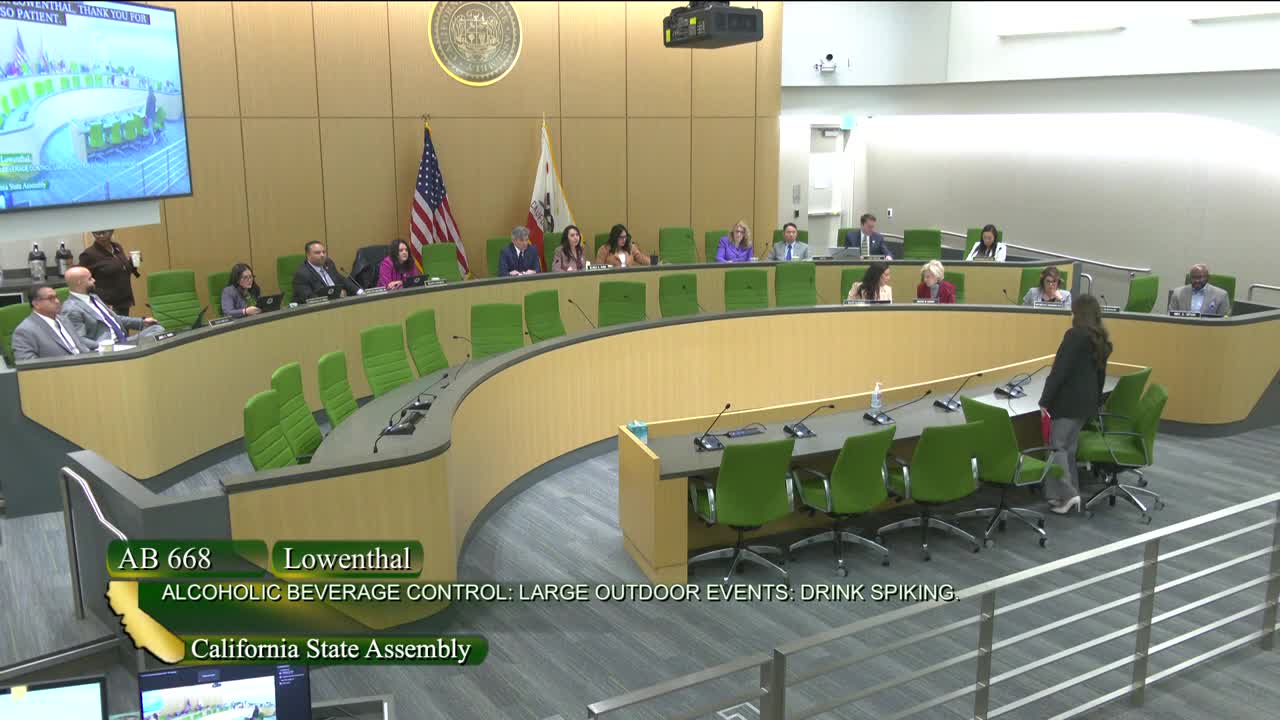 16MIN
Assembly Standing Committee on Governmental Organization


Bill Co-Author(s):