AB 669: Substance use disorder coverage.
- Session Year: 2025-2026
- House: Assembly
- Latest Version Date: 2025-07-15
Current Status:
In Progress
(2025-08-29: In committee: Held under submission.)
Introduced
In Committee
Awaiting First Chamber Vote
Passed First Chamber
In Committee
Awaiting Second Chamber Vote
Passed Second Chamber
Enacted
Existing law, the Knox-Keene Health Care Service Plan Act of 1975, provides for the licensure and regulation of health care service plans by the Department of Managed Health Care, and makes a willful violation of the act a crime. Existing law provides for the regulation of health insurers by the Department of Insurance. Existing law generally authorizes a health care service plan or health insurer to use prior authorization and other utilization management functions, under which a licensed physician or a licensed health care professional who is competent to evaluate specific clinical issues may approve, modify, delay, or deny requests for health care services based on medical necessity. Existing law requires health care service plan contracts and health insurance policies that provide hospital, medical, or surgical coverage and are issued, amended, or renewed on or after January 1, 2021, to provide coverage for medically necessary treatment of mental health and substance use disorders under the same terms and conditions applied to other medical conditions, as specified.
On and after January 1, 2027, this bill would prohibit concurrent or retrospective review of medical necessity of in-network health care services and benefits (1) for the first 28 days of an a treatment plan for inpatient or residential substance use disorder stay at a specified licensed facility during each plan or policy year or (2) for outpatient services provided by specified certified programs for substance use disorder visits, except as specified. The bill would authorize, after the 29th day, in-network health care services and benefits for inpatient or residential substance use disorder care to be subject to concurrent review. On and after January 1, 2027, the bill would prohibit retrospective review of medical necessity for the first 28 days of intensive outpatient or partial hospitalization services for substance use disorder, but would require specified authorize concurrent or retrospective review for day 29 and days thereafter of that stay or service. On and after January 1, 2027, the bill would prohibit the imposition of prior authorization or other prospective utilization management requirements for in-network coverage of outpatient prescription drugs to treat substance use disorder that are determined medically necessary by the enrollees or insureds prescribing physician or psychiatrist. With respect to health care service plans, the bill would specify that its provisions do not apply to Medi-Cal behavioral health delivery systems or Medi-Cal managed care plan contracts. Because a willful violation of the bills requirements by a health care service plan would be a crime, the bill would impose a state-mandated local program.
The California Constitution requires the state to reimburse local agencies and school districts for certain costs mandated by the state. Statutory provisions establish procedures for making that reimbursement.
This bill would provide that no reimbursement is required by this act for a specified reason.
Existing law, the Knox-Keene Health Care Service Plan Act of 1975, provides for the licensure and regulation of health care service plans by the Department of Managed Health Care, and makes a willful violation of the act a crime. Existing law provides for the regulation of health insurers by the Department of Insurance. Existing law generally authorizes a health care service plan or health insurer to use prior authorization and other utilization management functions, under which a licensed physician or a licensed health care professional who is competent to evaluate specific clinical issues may approve, modify, delay, or deny requests for health care services based on medical necessity. Existing law requires health care service plan contracts and health insurance policies that provide hospital, medical, or surgical coverage and are issued, amended, or renewed on or after January 1, 2021, to provide coverage for medically necessary treatment of mental health and substance use disorders under the same terms and conditions applied to other medical conditions, as specified.
On and after January 1, 2027, this bill would prohibit concurrent or retrospective review of medical necessity of in-network health care services and benefits (1) for the first 28 days of an inpatient or residential substance use disorder stay during each plan or policy year or (2) for outpatient substance use disorder visits, except as specified. The bill would authorize, after the 29th day, in-network health care services and benefits for inpatient or residential substance use disorder care to be subject to concurrent review. On and after January 1, 2027, the bill would prohibit retrospective review of medical necessity for the first 28 days of intensive outpatient or partial hospitalization services for substance use disorder, but would require specified review for day 29 and days thereafter of that stay or service. On and after January 1, 2027, the bill would prohibit the imposition of prior authorization or other prospective utilization management requirements for in-network coverage of outpatient prescription drugs to treat substance use disorder that are determined medically necessary by the enrollees or insureds prescribing physician or psychiatrist. With respect to health care service plans, the bill would specify that its provisions do not apply to Medi-Cal behavioral health delivery systems or Medi-Cal managed care plan contracts. Because a willful violation of the bills requirements by a health care service plan would be a crime, the bill would impose a state-mandated local program.
The California Constitution requires the state to reimburse local agencies and school districts for certain costs mandated by the state. Statutory provisions establish procedures for making that reimbursement.
This bill would provide that no reimbursement is required by this act for a specified reason.
Existing law, the Knox-Keene Health Care Service Plan Act of 1975, provides for the licensure and regulation of health care service plans by the Department of Managed Health Care, and makes a willful violation of the act a crime. Existing law provides for the regulation of health insurers by the Department of Insurance. Existing law generally authorizes a health care service plan or health insurer to use prior authorization and other utilization management functions, under which a licensed physician or a licensed health care professional who is competent to evaluate specific clinical issues may approve, modify, delay, or deny requests for health care services based on medical necessity. Existing law requires health care service plan contracts and health insurance policies that provide hospital, medical, or surgical coverage and are issued, amended, or renewed on or after January 1, 2021, to provide coverage for medically necessary treatment of mental health and substance use disorders under the same terms and conditions applied to other medical conditions, as specified.
On and after January 1, 2027, this bill would prohibit concurrent or retrospective review of medical necessity of in-network health care services and benefits (1) for the first 28 days of an inpatient substance use disorder stay during each plan or policy year or (2) for outpatient substance use disorder visits, except as specified. The bill would authorize, after the 29th day, in-network health care services and benefits for inpatient substance use disorder care to be subject to concurrent review. On and after January 1, 2027, the bill would prohibit retrospective review of medical necessity for the first 28 days of intensive outpatient or partial hospitalization services for substance use disorder, but would require specified review for day 29 and days thereafter of that stay or service. On and after January 1, 2027, the bill would prohibit the imposition of prior authorization or other prospective utilization management requirements for in-network coverage of outpatient prescription drugs to treat substance use disorder that are determined medically necessary by the enrollees or insureds physician or psychiatrist. Because a willful violation of the bills requirements by a health care service plan would be a crime, the bill would impose a state-mandated local program.
The California Constitution requires the state to reimburse local agencies and school districts for certain costs mandated by the state. Statutory provisions establish procedures for making that reimbursement.
This bill would provide that no reimbursement is required by this act for a specified reason.
Existing law, the Knox-Keene Health Care Service Plan Act of 1975, provides for the licensure and regulation of health care service plans by the Department of Managed Health Care, and makes a willful violation of the act a crime. Existing law provides for the regulation of health insurers by the Department of Insurance. Existing law generally authorizes a health care service plan or health insurer to use prior authorization and other utilization management functions, under which a licensed physician or a licensed health care professional who is competent to evaluate specific clinical issues may approve, modify, delay, or deny requests for health care services based on medical necessity. Existing law requires health care service plan contracts and health insurance policies that provide hospital, medical, or surgical coverage and are issued, amended, or renewed on or after January 1, 2021, to provide coverage for medically necessary treatment of mental health and substance use disorders under the same terms and conditions applied to other medical conditions, as specified.
On and after January 1, 2027, this bill would prohibit concurrent or retrospective review of medical necessity of in-network health care services and benefits (1) for the first 28 days of an inpatient substance use disorder stay during each plan or policy year, and year or (2) for outpatient substance use disorder visits, except as specified. On and after January 1, 2027, the bill would prohibit retrospective review of medical necessity for the first 28 days of intensive outpatient or partial hospitalization services for substance use disorder, but would require specified review for day 29 and days thereafter of that stay or service. On and after January 1, 2027, the bill would prohibit the imposition of prior authorization or other prospective utilization management requirements for in-network coverage of outpatient prescription drugs to treat substance use disorder that are determined medically necessary by the enrollees or insureds physician, psychologist, physician or psychiatrist. Because a willful violation of the bills requirements by a health care service plan would be a crime, the bill would impose a state-mandated local program.
The California Constitution requires the state to reimburse local agencies and school districts for certain costs mandated by the state. Statutory provisions establish procedures for making that reimbursement.
This bill would provide that no reimbursement is required by this act for a specified reason.
Existing law, the Knox-Keene Health Care Service Plan Act of 1975, provides for the licensure and regulation of health care service plans by the Department of Managed Health Care, and makes a willful violation of the act a crime. Existing law provides for the regulation of health insurers by the Department of Insurance. Existing law generally authorizes a health care service plan or health insurer to use prior authorization and other utilization management functions, under which a licensed physician or a licensed health care professional who is competent to evaluate specific clinical issues may approve, modify, delay, or deny requests for health care services based on medical necessity. Existing law requires health care service plan contracts and health insurance policies that provide hospital, medical, or surgical coverage and are issued, amended, or renewed on or after January 1, 2021, to provide coverage for medically necessary treatment of mental health and substance use disorders under the same terms and conditions applied to other medical conditions, as specified.
On and after January 1, 2027, this bill would prohibit concurrent or retrospective review of medical necessity for the first 28 days of an inpatient substance use disorder stay during each plan or policy year, and would prohibit retrospective review of medical necessity for the first 28 days of intensive outpatient or partial hospitalization services for substance use disorder, but would require specified review for day 29 and days thereafter of that stay or service. On and after January 1, 2027, the bill would prohibit the imposition of prior authorization or other prospective utilization management requirements for outpatient prescription drugs to treat substance use disorder that are determined medically necessary by the enrollees or insureds physician, psychologist, or psychiatrist. Because a willful violation of the bills requirements by a health care service plan would be a crime, the bill would impose a state-mandated local program.
The California Constitution requires the state to reimburse local agencies and school districts for certain costs mandated by the state. Statutory provisions establish procedures for making that reimbursement.
This bill would provide that no reimbursement is required by this act for a specified reason.
(a)On and after January 1, 2027:
(1)The in-network health care services and benefits for the first 28 days of an a treatment plan for inpatient or residential substance use disorder stay at a facility licensed by the State Department of Health Care Services pursuant to Chapter 7.5 (commencing with Section 11834.01) of Part 2 of Division 10.5, or by the State Department of Public Health pursuant to Section 1250.3, during each plan year shall not be subject to concurrent or retrospective review of medical necessity. Medical necessity shall be as determined by the enrollees physician, and shall be consistent with the standards in subdivision (b) of Section 1374.33 and Section 1374.72. necessity, but may be subject to prior authorization for the 28-day initial treatment period, consistent with the standards in Sections 1374.30 and 1374.76 and subdivision (b) of Section 1374.72.
(2)The treatment plan subject to paragraph (1) is not required to include a specific number of days of any level of care. The initial treatment plan may include any number of days, for any level of care, including inpatient, residential, partial hospitalization, or intensive outpatient therapy, as determined by medical necessity, consistent with the standards in Sections 1371.8, 1374.72, and 1374.721 and subdivision (b) of Section 1374.33.
(3)If a program physician determines that a level of care is no longer appropriate for an enrollee, or an enrollee voluntarily leaves a program to seek a different level of care, paragraph (1) does not apply to a subsequent treatment episode.
(4)An additional treatment episode that begins within 180 days after admission for the first episode of treatment is not subject to paragraph (1).
(2)(5)The in-network health care services and benefits for inpatient or residential substance use disorder care after day 29 may be subject to concurrent review. Any authorization request for approval of inpatient or residential substance use disorder care beyond the first 28 days shall be submitted for review by the provider before the expiration of the previously approved treatment period.
(3)(6)After 28 days, a health care service plan shall not initiate concurrent review more frequently than at two-week intervals. If a health care service plan determines that continued inpatient or residential substance use disorder care in a facility is no longer medically necessary, the health care service plan shall, within 24 hours, provide written notice to the enrollee and the enrollees physician of its decision and the right to file an expedited internal appeal of the determination.
(4)(7)A health care service plan shall review and make a determination with respect to the internal appeal within 24 hours and communicate the determination and the right to appeal that determination to the enrollee and the enrollees physician. If the determination is to uphold the denial, the enrollee and the enrollees physician have the right to file an expedited external appeal with the department pursuant to Article 5.55 (commencing with Section 1374.30) of the Health and Safety Code. 1374.30), if filed with the department within 72 hours of receipt of the determination.
(5)(8)If the health care service plans determination is upheld by the department, the health care service plan shall continue benefit coverage for 24 hours after the determination is made. The enrollee shall only be responsible for any facility shall not bill the enrollee for an amount more than the enrollees applicable copayment, deductible, and coinsurance as applicable under the contract.
(6)(9)Unless the enrollee chooses to leave the inpatient or residential facility, the enrollee shall not be discharged or released from the inpatient or residential facility until all internal and department appeals are exhausted.
(10)Before discharge, the facility shall provide the enrollee and the health care service plan with a written discharge plan describing the arrangements for additional services needed following discharge using The ASAM Criteria: Treatment Criteria for Addictive, Substance-Related and Co-occurring Conditions by the American Society of Addiction Medicine (ASAM), or subsequent nationally adopted placement criteria.
(11)For purposes of this section, all medical necessity review shall, consistent with Section 1374.721, utilize The ASAM Criteria: Treatment Criteria for Addictive, Substance-Related, and Co-occurring Conditions by ASAM, or subsequent nationally adopted placement criteria.
(b)For purposes of this section:
(1)Concurrent review includes any utilization review, as defined in Section 1374.721, that takes place concurrent with the provision of health care services to enrollees.
(2)Intensive outpatient services and partial hospitalization services have the same meanings as defined in the ASAM Levels of Care.
(2)(3)Medically necessary has the same meaning as medically necessary treatment of a mental health or substance use disorder as defined in Section 1374.72.
(3)(4)Prior authorization includes any utilization review, as defined in Section 1374.721, that takes place before the provision of health care services to enrollees.
(4)(5)Retrospective review includes any utilization review, as defined in Section 1374.721, that takes place after the completion of health care services to enrollees.
(5)(6)Substance use disorders has the same meaning as defined in Section 1374.72.
(6)(7)Utilization review has the same meaning as defined in Section 1374.721.
(c)This section does not apply to Medi-Cal behavioral health delivery systems, as defined in subdivision (i) of Section 14184.101 of the Welfare and Institutions Code, or Medi-Cal managed care plans that contract with the State Department of Health Care Services pursuant to Chapter 7 (commencing with Section 14000) of, Chapter 8 (commencing with Section 14200) of, or Chapter 8.75 (commencing with Section 14591) of, Part 3 of Division 9 of the Welfare and Institutions Code.
(d)The in-network health care services and benefits required by this section shall be provided to all enrollees with a diagnosis of substance use disorder. The presence of additional related or unrelated diagnoses shall not be a basis to reduce or deny the benefits required by this section.
SEC. 2.Section 1367.048 is added to the Health and Safety Code, to read:1367.048.On and after January 1, 2027:
(a)Except as provided in subdivision (b), for in-network health care services and benefits for outpatient services provided at programs certified pursuant to Chapter 7.1 (commencing with Section 11832) of Part 2 of Division 10.5, substance use disorder visits shall not be subject to concurrent or retrospective review of medical necessity or any other utilization management review.
(b)(1)The in-network health care services and benefits for the first 28 days of intensive outpatient or partial hospitalization services for substance use disorder shall not be subject to retrospective review of medical necessity. Medical necessity shall be as determined by the enrollees physician. necessity, but may be subject to prior authorization for the 28-day initial treatment period, consistent with the standards in Sections 1374.30 and 1374.76 and subdivision (b) of Section 1374.72.
(2)The treatment plan subject to paragraph (1) is not required to include a specific number of days of any level of care. The initial treatment plan may include any number of days, for any level of care, including inpatient, residential, partial hospitalization, or intensive outpatient therapy, as determined by medical necessity, consistent with the standards in Sections 1371.8, 1374.72, and 1374.721 and subdivision (b) of Section 1374.33.
(3)If a program physician determines that a level of care is no longer appropriate for an enrollee, or an enrollee voluntarily leaves a program to seek a different level of care, paragraph (1) does not apply to a subsequent treatment episode.
(4)An additional treatment episode that begins within 180 days after admission for the first episode of treatment is not subject to paragraph (1).
(c)The in-network health care services and benefits for day 29 and days thereafter of intensive outpatient or partial hospitalization services for substance use disorder shall may be subject to a concurrent or retrospective review of the medical necessity of the services. Medical necessity review shall utilize the American Society of Addiction Medicine criteria and guidelines. services, consistent with the standards in Sections 1374.30 and 1374.76 and subdivision (b) of Section 1374.72.
(d)The in-network health care services and benefits required by this section shall be provided to all enrollees with a diagnosis of substance use disorder. The presence of additional related or unrelated diagnoses shall not be a basis to reduce or deny the benefits required by this section.
(e)The facility shall not bill the enrollee for an amount more than the enrollees applicable copayment, deductible, and coinsurance as applicable under the contract.
(f)For purposes of this section, all medical necessity review shall, consistent with Section 1374.721, utilize The ASAM Criteria: Treatment Criteria for Addictive, Substance-Related, and Co-occurring Conditions by the American Society of Addiction Medicine, or subsequent nationally adopted placement criteria.
(e)(g)This section does not apply to Medi-Cal behavioral health delivery systems, as defined in subdivision (i) of Section 14184.101 of the Welfare and Institutions Code, or Medi-Cal managed care plans that contract with the State Department of Health Care Services pursuant to Chapter 7 (commencing with Section 14000) of, Chapter 8 (commencing with Section 14200) of, or Chapter 8.75 (commencing with Section 14591) of, Part 3 of Division 9 of the Welfare and Institutions Code.
SEC. 3.Section 1367.049 is added to the Health and Safety Code, to read:1367.049.On and after January 1, 2027:(a)In-network coverage for outpatient prescription drugs to treat substance use disorder shall be provided when determined medically necessary by the enrollees prescribing physician or psychiatrist, without the imposition of prior authorization or other prospective utilization management requirements.(b)The presence of additional related or unrelated diagnoses shall not be a basis to reduce or deny the benefits required by this section.(c)This section does not apply to Medi-Cal behavioral health delivery systems, as defined in subdivision (i) of Section 14184.101 of the Welfare and Institutions Code, or Medi-Cal managed care plans that contract with the State Department of Health Care Services pursuant to Chapter 7 (commencing with Section 14000) of, Chapter 8 (commencing with Section 14200) of, or Chapter 8.75 (commencing with Section 14591) of, Part 3 of Division 9 of the Welfare and Institutions Code.SEC. 4.SEC. 3.Section 10144.521 is added to the Insurance Code, to read:10144.521.(a)On and after January 1, 2027:
(1)The in-network health care services and benefits for the first 28 days of an a treatment plan for inpatient or residential substance use disorder stay at a facility licensed by the State Department of Health Care Services pursuant to Chapter 7.5 (commencing with Section 11834.01) of Part 2 of Division 10.5 of the Health and Safety Code, or by the State Department of Public Health pursuant to Section 1250.3 of the Health and Safety Code, during each policy year shall not be subject to concurrent or retrospective review of medical necessity. Medical necessity shall be as determined by the insureds physician, and shall be consistent with the standards in Section 10144.5 and necessity, but may be subject to prior authorization for the 28-day initial treatment period, consistent with the standards in Sections 796.04, 10144.5, and 10144.52 and subdivision (b) of Section 10169.3.
(2)The treatment plan subject to paragraph (1) is not required to include a specific number of days of any level of care. The initial treatment plan may include any number of days, for any level of care, including inpatient, residential, partial hospitalization, or intensive outpatient therapy, as determined by medical necessity, consistent with the standards in Sections 796.04, 10144.5, and 10144.52 and subdivision (b) of Section 10169.3.
(3)If a program physician determines that a level of care is no longer appropriate for an insured, or an insured voluntarily leaves a program to seek a different level of care, paragraph (1) does not apply to a subsequent treatment episode.
(4)An additional treatment episode that begins within 180 days after admission for the first episode of treatment is not subject to paragraph (1).
(2)(5)The in-network health care services and benefits for inpatient or residential substance use disorder care after day 29 may be subject to concurrent review. Any authorization request for approval of inpatient or residential substance use disorder care beyond the first 28 days shall be submitted for review by the provider before the expiration of the previously approved treatment period.
(3)(6)After 28 days, a health insurer shall not initiate concurrent review more frequently than at two-week intervals. If a health insurer determines that continued inpatient or residential substance use disorder care in a facility is no longer medically necessary, the health insurer shall, within 24 hours, provide written notice to the insured and the insureds physician of its decision and the right to file an expedited internal appeal of the determination.
(4)(7)A health insurer shall review and make a determination with respect to the internal appeal within 24 hours and communicate the determination and the right to appeal that determination to the insured and the insureds physician. If the determination is to uphold the denial, the insured and the insureds physician have the right to file an expedited external appeal with the department pursuant to Article 3.5 (commencing with Section 10169). 10169), if filed with the department within 72 hours of receipt of the determination.
(5)(8)If the health insurers determination is upheld by the department, the health insurer shall continue benefit coverage for 24 hours after the determination is made. The insured shall only be responsible for any facility shall not bill the insured for an amount more than the insureds applicable copayment, deductible, and coinsurance as applicable under the policy.
(6)(9)Unless the insured chooses to leave the inpatient or residential facility, the insured shall not be discharged or released from the inpatient or residential facility until all internal and department appeals are exhausted.
(10)Before discharge, the facility shall provide the insured and the insurer with a written discharge plan describing the arrangements for additional services needed following discharge using The ASAM Criteria: Treatment Criteria for Addictive, Substance-Related and Co-occurring Conditions by the American Society of Addiction Medicine (ASAM), or subsequent nationally adopted placement criteria.
(11)For purposes of this section, all medical necessity review shall, consistent with Section 1374.721, utilize The ASAM Criteria: Treatment Criteria for Addictive, Substance-Related, and Co-occurring Conditions by ASAM, or subsequent nationally adopted placement criteria.
(b)For purposes of this section:
(1)Concurrent review includes any utilization review, as defined in Section 10144.52, that takes place concurrent with the provision of health care services to insureds.
(2)Intensive outpatient services and partial hospitalization services have the same meanings as defined in the ASAM Levels of Care.
(2)(3)Medically necessary has the same meaning as medically necessary treatment of a mental health or substance use disorder as defined in Section 10144.5.
(3)(4)Prior authorization includes any utilization review, as defined in Section 10144.52, that takes place before the provision of health care services to insureds.
(4)(5)Retrospective review includes any utilization review, as defined in Section 10144.52, that takes place after the completion of health care services to insureds.
(5)(6)Substance use disorders has the same meaning as defined in Section 10144.5.
(6)(7)Utilization review has the same meaning as defined in Section 10144.52.
(c)The in-network health care services and benefits required by this section shall be provided to all insureds with a diagnosis of substance use disorder. The presence of additional related or unrelated diagnoses shall not be a basis to reduce or deny the benefits required by this section.
SEC. 5.SEC. 4.Section 10144.522 is added to the Insurance Code, to read:10144.522.On and after January 1, 2027:
(a)Except as provided in subdivision (b), for in-network health care services and benefits for outpatient services provided at programs certified pursuant to Chapter 7.1 (commencing with Section 11832) of Part 2 of Division 10.5, substance use disorder visits shall not be subject to concurrent or retrospective review of medical necessity or any other utilization management review.
(b)(1)The in-network health care services and benefits for the first 28 days of intensive outpatient or partial hospitalization services for substance use disorder shall not be subject to retrospective review of medical necessity. Medical necessity shall be as determined by the insureds physician. necessity, but may be subject to prior authorization for the 28-day initial treatment period, consistent with the standards in Sections 10144.4 and 10144.5 and subdivision (b) of Section 10169.3.
(2)The treatment plan subject to paragraph (1) is not required to include a specific number of days of any level of care. The initial treatment plan may include any number of days, for any level of care, including inpatient, residential, partial hospitalization, or intensive outpatient therapy, as determined by medical necessity, consistent with the standards in Sections 796.04, 10144.5, and 10144.52 and subdivision (b) of Section 10169.3.
(3)If a program physician determines that a level of care is no longer appropriate for an insured, or an insured voluntarily leaves a program to seek a different level of care, paragraph (1) does not apply to a subsequent treatment episode.
(4)An additional treatment episode that begins within 180 days after admission for the first episode of treatment is not subject to paragraph (1).
(c)The in-network health care services and benefits for day 29 and days thereafter of intensive outpatient or partial hospitalization services for substance use disorder shall may be subject to a concurrent or retrospective review of the medical necessity of the services. Medical necessity review shall utilize the American Society of Addiction Medicine criteria and guidelines. services, consistent with the standards in Sections 796.04, 10144.4, 10144.5, and 10144.52 and subdivision (b) of Section 10169.3.
(d)The in-network health care services and benefits required by this section shall be provided to all insureds with a diagnosis of substance use disorder. The presence of additional related or unrelated diagnoses shall not be a basis to reduce or deny the benefits required by this section.
(e)The facility shall not bill the insured for an amount more than the insureds applicable copayment, deductible, and coinsurance as applicable under the contract.
(f)For purposes of this section, all medical necessity review shall, consistent with Section 1374.721, utilize The ASAM Criteria: Treatment Criteria for Addictive, Substance-Related, and Co-occurring Conditions by the American Society of Addiction Medicine, or subsequent nationally adopted placement criteria.
SEC. 6.Section 10144.523 is added to the Insurance Code, to read:10144.523.On and after January 1, 2027:(a)In-network coverage for outpatient prescription drugs to treat substance use disorder shall be provided when determined medically necessary by the insureds prescribing physician or psychiatrist, without the imposition of prior authorization or other prospective utilization management requirements.(b)The presence of additional related or unrelated diagnoses shall not be a basis to reduce or deny the benefits required by this section.SEC. 7.SEC. 5.No reimbursement is required by this act pursuant to Section 6 of Article XIIIB of the California Constitution because the only costs that may be incurred by a local agency or school district will be incurred because this act creates a new crime or infraction, eliminates a crime or infraction, or changes the penalty for a crime or infraction, within the meaning of Section 17556 of the Government Code, or changes the definition of a crime within the meaning of Section 6 of Article XIIIB of the California Constitution.
(a)On and after January 1, 2027:
(1)The in-network health care services and benefits for the first 28 days of an inpatient or residential substance use disorder stay during each plan year shall not be subject to concurrent or retrospective review of medical necessity. Medical necessity shall be as determined by the enrollees physician, and shall be consistent with the standards in subdivision (b) of Section 1374.33 and Section 1374.72.
(2)The in-network health care services and benefits for inpatient or residential substance use disorder care after day 29 may be subject to concurrent review. Any authorization request for approval of inpatient or residential substance use disorder care beyond the first 28 days shall be submitted for review by the provider before the expiration of the previously approved treatment period.
(3)After 28 days, a health care service plan shall not initiate concurrent review more frequently than at two-week intervals. If a health care service plan determines that continued inpatient or residential substance use disorder care in a facility is no longer medically necessary, the health care service plan shall, within 24 hours, provide written notice to the enrollee and the enrollees physician of its decision and the right to file an expedited internal appeal of the determination.
(4)A health care service plan shall review and make a determination with respect to the internal appeal within 24 hours and communicate the determination to the enrollee and the enrollees physician. If the determination is to uphold the denial, the enrollee and the enrollees physician have the right to file an expedited external appeal with the department pursuant to Article 5.55 (commencing with Section 1374.30) of the Health and Safety Code.
(5)If the health care service plans determination is upheld by the department, the health care service plan shall continue benefit coverage for 24 hours after the determination is made. The enrollee shall only be responsible for any applicable copayment, deductible, and coinsurance as applicable under the contract.
(A)(6)Unless the enrollee chooses to leave the inpatient or residential facility, the enrollee shall not be discharged or released from the inpatient or residential facility until all internal and department appeals are exhausted.
(B)For any costs incurred 24 hours after the departments determination until the day of discharge, the enrollee shall only be responsible for any applicable cost sharing, and any additional charges shall be paid by the facility or provider.(b)For purposes of this section:
(1)Concurrent review includes any utilization review, as defined in Section 1374.721, that takes place concurrent with the provision of health care services to enrollees.
(2)Medically necessary has the same meaning as medically necessary treatment of a mental health or substance use disorder as defined in Section 1374.72.
(3)Prior authorization includes any utilization review, as defined in Section 1374.721, that takes place before the provision of health care services to enrollees.
(4)Retrospective review includes any utilization review, as defined in Section 1374.721, that takes place after the completion of health care services to enrollees.
(5)Substance use disorders has the same meaning as defined in Section 1374.72.
(6)Utilization review has the same meaning as defined in Section 1374.721.
(c)This section does not apply to a county Drug Medi-Cal organized delivery system, as authorized under the Medi-Cal 2020 Demonstration Project Act pursuant to Article 5.5 (commencing with Section 14184) of Chapter 7 of Part 3 of Division 9 of the Welfare and Institutions Code, under the California Advancing and Innovating Medi-Cal (CalAIM) Terms and Conditions as described in Section 14184.401 of the Welfare and Institutions Code, or under any successors.(c)This section does not apply to Medi-Cal behavioral health delivery systems, as defined in subdivision (i) of Section 14184.101 of the Welfare and Institutions Code, or Medi-Cal managed care plans that contract with the State Department of Health Care Services pursuant to Chapter 7 (commencing with Section 14000) of, Chapter 8 (commencing with Section 14200) of, or Chapter 8.75 (commencing with Section 14591) of, Part 3 of Division 9 of the Welfare and Institutions Code.
(d)The in-network health care services and benefits required by this section shall be provided to all enrollees with a diagnosis of substance use disorder. The presence of additional related or unrelated diagnoses shall not be a basis to reduce or deny the benefits required by this section.
SEC. 2.Section 1367.048 is added to the Health and Safety Code, to read:1367.048.On and after January 1, 2027:
(a)Except as provided in subdivision (b), in-network health care services and benefits for outpatient substance use disorder visits shall not be subject to concurrent or retrospective review of medical necessity or any other utilization management review.
(b)The in-network health care services and benefits for the first 28 days of intensive outpatient or partial hospitalization services for substance use disorder shall not be subject to retrospective review of medical necessity. Medical necessity shall be as determined by the enrollees physician.
(c)The in-network health care services and benefits for day 29 and days thereafter of intensive outpatient or partial hospitalization services for substance use disorder shall be subject to a retrospective review of the medical necessity of the services. Medical necessity review shall utilize the American Society of Addiction Medicine criteria and guidelines.
(d)The in-network health care services and benefits required by this section shall be provided to all enrollees with a diagnosis of substance use disorder. The presence of additional related or unrelated diagnoses shall not be a basis to reduce or deny the benefits required by this section.
(e)This section does not apply to a county Drug Medi-Cal organized delivery system, as authorized under the Medi-Cal 2020 Demonstration Project Act pursuant to Article 5.5 (commencing with Section 14184) of Chapter 7 of Part 3 of Division 9 of the Welfare and Institutions Code, under the California Advancing and Innovating Medi-Cal (CalAIM) Terms and Conditions as described in Section 14184.401 of the Welfare and Institutions Code, or under any successors.(e)This section does not apply to Medi-Cal behavioral health delivery systems, as defined in subdivision (i) of Section 14184.101 of the Welfare and Institutions Code, or Medi-Cal managed care plans that contract with the State Department of Health Care Services pursuant to Chapter 7 (commencing with Section 14000) of, Chapter 8 (commencing with Section 14200) of, or Chapter 8.75 (commencing with Section 14591) of, Part 3 of Division 9 of the Welfare and Institutions Code.
SEC. 3.Section 1367.049 is added to the Health and Safety Code, to read:1367.049.On and after January 1, 2027:
(a)In-network coverage for outpatient prescription drugs to treat substance use disorder shall be provided when determined medically necessary by the enrollees prescribing physician or psychiatrist, without the imposition of prior authorization or other prospective utilization management requirements.
(b)The presence of additional related or unrelated diagnoses shall not be a basis to reduce or deny the benefits required by this section.
(c)This section does not apply to a county Drug Medi-Cal organized delivery system, as authorized under the Medi-Cal 2020 Demonstration Project Act pursuant to Article 5.5 (commencing with Section 14184) of Chapter 7 of Part 3 of Division 9 of the Welfare and Institutions Code, under the California Advancing and Innovating Medi-Cal (CalAIM) Terms and Conditions as described in Section 14184.401 of the Welfare and Institutions Code, or under any successors.(c)This section does not apply to Medi-Cal behavioral health delivery systems, as defined in subdivision (i) of Section 14184.101 of the Welfare and Institutions Code, or Medi-Cal managed care plans that contract with the State Department of Health Care Services pursuant to Chapter 7 (commencing with Section 14000) of, Chapter 8 (commencing with Section 14200) of, or Chapter 8.75 (commencing with Section 14591) of, Part 3 of Division 9 of the Welfare and Institutions Code.
SEC. 4.Section 10144.521 is added to the Insurance Code, to read:10144.521.(a)On and after January 1, 2027:
(1)The in-network health care services and benefits for the first 28 days of an inpatient or residential substance use disorder stay during each policy year shall not be subject to concurrent or retrospective review of medical necessity. Medical necessity shall be as determined by the insureds physician, and shall be consistent with the standards in Section 10144.5 and subdivision (b) of Section 10169.3.
(2)The in-network health care services and benefits for inpatient or residential substance use disorder care after day 29 may be subject to concurrent review. Any authorization request for approval of inpatient or residential substance abuse use disorder care beyond the first 28 days shall be submitted for review by the provider before the expiration of the previously approved treatment period.
(3)After 28 days, a health insurer shall not initiate concurrent review more frequently than at two-week intervals. If a health insurer determines that continued inpatient or residential substance use disorder care in a facility is no longer medically necessary, the health insurer shall, within 24 hours, provide written notice to the insured and the insureds physician of its decision and the right to file an expedited internal appeal of the determination.
(4)A health insurer shall review and make a determination with respect to the internal appeal within 24 hours and communicate the determination to the insured and the insureds physician. If the determination is to uphold the denial, the insured and the insureds physician have the right to file an expedited external appeal with the department pursuant to Article 3.5 (commencing with Section 10169).
(5)If the health insurers determination is upheld by the department, the health insurer shall continue benefit coverage for 24 hours after the determination is made. The insured shall only be responsible for any applicable copayment, deductible, and coinsurance as applicable under the policy.
(A)(6)Unless the insured chooses to leave the inpatient or residential facility, the insured shall not be discharged or released from the inpatient or residential facility until all internal and department appeals are exhausted.
(B)For any costs incurred 24 hours after the departments determination until the day of discharge, the insured shall only be responsible for any applicable cost sharing, and any additional charges shall be paid by the facility or provider.(b)For purposes of this section:
(1)Concurrent review includes any utilization review, as defined in Section 10144.52, that takes place concurrent with the provision of health care services to insureds.
(2)Medically necessary has the same meaning as medically necessary treatment of a mental health or substance use disorder as defined in Section 10144.5.
(3)Prior authorization includes any utilization review, as defined in Section 10144.52, that takes place before the provision of health care services to insureds.
(4)Retrospective review includes any utilization review, as defined in Section 10144.52, that takes place after the completion of health care services to insureds.
(5)Substance use disorders has the same meaning as defined in Section 10144.5.
(6)Utilization review has the same meaning as defined in Section 10144.52.
(c)The in-network health care services and benefits required by this section shall be provided to all insureds with a diagnosis of substance use disorder. The presence of additional related or unrelated diagnoses shall not be a basis to reduce or deny the benefits required by this section.
SEC. 5.Section 10144.522 is added to the Insurance Code, to read:10144.522.On and after January 1, 2027:
(a)Except as provided in subdivision (b), in-network health care services and benefits for outpatient substance use disorder visits shall not be subject to concurrent or retrospective review of medical necessity or any other utilization management review.
(b)The in-network health care services and benefits for the first 28 days of intensive outpatient or partial hospitalization services for substance use disorder shall not be subject to retrospective review of medical necessity. Medical necessity shall be as determined by the insureds physician.
(c)The in-network health care services and benefits for day 29 and days thereafter of intensive outpatient or partial hospitalization services for substance use disorder shall be subject to a retrospective review of the medical necessity of the services. Medical necessity review shall utilize the American Society of Addiction Medicine criteria and guidelines.
(d)The in-network health care services and benefits required by this section shall be provided to all insureds with a diagnosis of substance use disorder. The presence of additional related or unrelated diagnoses shall not be a basis to reduce or deny the benefits required by this section.
SEC. 6.Section 10144.523 is added to the Insurance Code, to read:10144.523.On and after January 1, 2027:
(a)In-network coverage for outpatient prescription drugs to treat substance use disorder shall be provided when determined medically necessary by the insureds prescribing physician or psychiatrist, without the imposition of prior authorization or other prospective utilization management requirements.
(b)The presence of additional related or unrelated diagnoses shall not be a basis to reduce or deny the benefits required by this section.
SEC. 7.No reimbursement is required by this act pursuant to Section 6 of Article XIIIB of the California Constitution because the only costs that may be incurred by a local agency or school district will be incurred because this act creates a new crime or infraction, eliminates a crime or infraction, or changes the penalty for a crime or infraction, within the meaning of Section 17556 of the Government Code, or changes the definition of a crime within the meaning of Section 6 of Article XIIIB of the California Constitution.
(a)On and after January 1, 2027:
(1)The in-network health care services and benefits for the first 28 days of an inpatient substance use disorder stay during each plan year shall not be subject to concurrent or retrospective review of medical necessity. Medical necessity shall be as determined by the enrollees physician, and shall be consistent with the standards in subdivision (b) of Section 1374.33 and Section 1374.72.
(2)The in-network health care services and benefits for day 29 and days thereafter of inpatient substance use disorder care after day 29 may be subject to concurrent review. A request for approval of inpatient care beyond the first 28 days shall be submitted for concurrent review before the expiration of the initial 28-day period. A request for approval of inpatient care beyond a period that is approved under concurrent review shall be submitted within the period that was previously approved. Any authorization request for approval of inpatient substance use disorder care beyond the first 28 days shall be submitted for review by the provider before the expiration of the previously approved treatment period.
(3)After 28 days, a health care service plan shall not initiate concurrent review more frequently than at two-week intervals. If a health care service plan determines that continued inpatient substance use disorder care in a facility is no longer medically necessary, the health care service plan shall, within 24 hours, provide written notice to the enrollee and the enrollees physician of its decision and the right to file an expedited internal appeal of the determination.
(4)A health care service plan shall review and make a determination with respect to the internal appeal within 24 hours and communicate the determination to the enrollee and the enrollees physician. If the determination is to uphold the denial, the enrollee and the enrollees physician have the right to file an expedited external appeal with the department pursuant to Article 5.55 (commencing with Section 1374.30) of the Health and Safety Code. If
(5)If the health care service plans determination is upheld and it is determined continued inpatient substance use disorder care is not medically necessary, by the department, the health care service plan shall remain responsible to provide benefits for the inpatient care through the day following the date the determination is made and the continue benefit coverage for 24 hours after the determination is made. The enrollee shall only be responsible for any applicable copayment, deductible, and coinsurance for the stay through that date, as applicable under the contract. The
(A)Unless the enrollee chooses to leave the inpatient facility, the enrollee shall not be discharged or released from the inpatient facility until all internal and department appeals are exhausted. For
(B)For any costs incurred after the day following the date of 24 hours after the departments determination until the day of discharge, the enrollee shall only be responsible for any applicable cost sharing, and any additional charges shall be paid by the facility or provider.
(b)For purposes of this section:
(1)Concurrent review includes any utilization review, as defined in Section 1374.721, that takes place concurrent with the provision of health care services to enrollees.
(2)Medically necessary has the same meaning as medically necessary treatment of a mental health or substance use disorder as defined in Section 1374.72.
(3)Prior authorization includes any utilization review, as defined in Section 1374.721, that takes place before the provision of health care services to enrollees.
(4)Retrospective review includes any utilization review, as defined in Section 1374.721, that takes place after the completion of health care services to enrollees.
(5)Substance use disorders has the same meaning as defined in Section 1374.72.
(6)Utilization review has the same meaning as defined in Section 1374.721.
(c)This section does not apply to a county Drug Medi-Cal organized delivery system, as authorized under the Medi-Cal 2020 Demonstration Project Act pursuant to Article 5.5 (commencing with Section 14184) of Chapter 7 of Part 3 of Division 9 of the Welfare and Institutions Code, under the California Advancing and Innovating Medi-Cal (CalAIM) Terms and Conditions as described in Section 14184.401 of the Welfare and Institutions Code, or under any successors.
SEC. 2.Section 1367.048 is added to the Health and Safety Code, to read:1367.048.On and after January 1, 2027:
(a)Except as provided in subdivision (b), in-network health care services and benefits for outpatient substance use disorder visits shall not be subject to concurrent or retrospective review of medical necessity or any other utilization management review.
(b)The in-network health care services and benefits for the first 28 days of intensive outpatient or partial hospitalization services for substance use disorder shall not be subject to retrospective review of medical necessity. Medical necessity shall be as determined by the enrollees physician.
(c)The in-network health care services and benefits for day 29 and days thereafter of intensive outpatient or partial hospitalization services for substance use disorder shall be subject to a retrospective review of the medical necessity of the services. Medical necessity review shall utilize the American Society of Addiction Medicine criteria and guidelines.
(d)The in-network health care services and benefits required by this section shall be provided to all enrollees with a diagnosis of substance use disorder. The presence of additional related or unrelated diagnoses shall not be a basis to reduce or deny the benefits required by this section.
(e)This section does not apply to a county Drug Medi-Cal organized delivery system, as authorized under the Medi-Cal 2020 Demonstration Project Act pursuant to Article 5.5 (commencing with Section 14184) of Chapter 7 of Part 3 of Division 9 of the Welfare and Institutions Code, under the California Advancing and Innovating Medi-Cal (CalAIM) Terms and Conditions as described in Section 14184.401 of the Welfare and Institutions Code, or under any successors.
SEC. 3.Section 1367.049 is added to the Health and Safety Code, to read:1367.049.On and after January 1, 2027:
(a)In-network coverage for outpatient prescription drugs to treat substance use disorder shall be provided when determined medically necessary by the enrollees physician or psychiatrist, without the imposition of prior authorization or other prospective utilization management requirements.
(b)The presence of additional related or unrelated diagnoses shall not be a basis to reduce or deny the benefits required by this section.
(c)This section does not apply to a county Drug Medi-Cal organized delivery system, as authorized under the Medi-Cal 2020 Demonstration Project Act pursuant to Article 5.5 (commencing with Section 14184) of Chapter 7 of Part 3 of Division 9 of the Welfare and Institutions Code, under the California Advancing and Innovating Medi-Cal (CalAIM) Terms and Conditions as described in Section 14184.401 of the Welfare and Institutions Code, or under any successors.
SEC. 4.Section 10144.521 is added to the Insurance Code, to read:10144.521.(a)On and after January 1, 2027:
(1)The in-network health care services and benefits for the first 28 days of an inpatient substance use disorder stay during each policy year shall not be subject to concurrent or retrospective review of medical necessity. Medical necessity shall be as determined by the insureds physician, and shall be consistent with the standards in Section 10144.5 and subdivision (b) of Section 10169.3.
(2)The in-network health care services and benefits for day 29 and days thereafter of inpatient substance use disorder care after day 29 may be subject to concurrent review. A request for approval of inpatient care beyond the first 28 days shall be submitted for concurrent review before the expiration of the initial 28-day period. A request for approval of inpatient care beyond a period that is approved under concurrent review shall be submitted within the period that was previously approved. Any authorization request for approval of inpatient substance abuse disorder care beyond the first 28 days shall be submitted for review by the provider before the expiration of the previously approved treatment period.
(3)After 28 days, a health insurer shall not initiate concurrent review more frequently than at two-week intervals. If a health insurer determines that continued inpatient substance use disorder care in a facility is no longer medically necessary, the health insurer shall, within 24 hours, provide written notice to the insured and the insureds physician of its decision and the right to file an expedited internal appeal of the determination.
(4)A health insurer shall review and make a determination with respect to the internal appeal within 24 hours and communicate the determination to the insured and the insureds physician. If the determination is to uphold the denial, the insured and the insureds physician have the right to file an expedited external appeal with the department pursuant to Article 3.5 (commencing with Section 10169). If
(5)If the health insurers determination is upheld and it is determined continued inpatient substance use disorder care is not medically necessary, by the department, the health insurer shall remain responsible to provide benefits for the inpatient care through the day following the date the determination is made and the continue benefit coverage for 24 hours after the determination is made. The insured shall only be responsible for any applicable copayment, deductible, and coinsurance for the stay through that date, as applicable under the policy. The
(A)Unless the insured chooses to leave the inpatient facility, the insured shall not be discharged or released from the inpatient facility until all internal and department appeals are exhausted. For
(B)For any costs incurred after the day following the date of 24 hours after the departments determination until the day of discharge, the insured shall only be responsible for any applicable cost sharing, and any additional charges shall be paid by the facility or provider.
(b)For purposes of this section:
(1)Concurrent review includes any utilization review, as defined in Section 10144.52, that takes place concurrent with the provision of health care services to insureds.
(2)Medically necessary has the same meaning as medically necessary treatment of a mental health or substance use disorder as defined in Section 10144.5.
(3)Prior authorization includes any utilization review, as defined in Section 10144.52, that takes place before the provision of health care services to insureds.
(4)Retrospective review includes any utilization review, as defined in Section 10144.52, that takes place after the completion of health care services to insureds.
(5)Substance use disorders has the same meaning as defined in Section 10144.5.
(6)Utilization review has the same meaning as defined in Section 10144.52.
SEC. 5.Section 10144.522 is added to the Insurance Code, to read:10144.522.On and after January 1, 2027:
(a)Except as provided in subdivision (b), in-network health care services and benefits for outpatient substance use disorder visits shall not be subject to concurrent or retrospective review of medical necessity or any other utilization management review.
(b)The in-network health care services and benefits for the first 28 days of intensive outpatient or partial hospitalization services for substance use disorder shall not be subject to retrospective review of medical necessity. Medical necessity shall be as determined by the insureds physician.
(c)The in-network health care services and benefits for day 29 and days thereafter of intensive outpatient or partial hospitalization services for substance use disorder shall be subject to a retrospective review of the medical necessity of the services. Medical necessity review shall utilize the American Society of Addiction Medicine criteria and guidelines.
(d)The in-network health care services and benefits required by this section shall be provided to all insureds with a diagnosis of substance use disorder. The presence of additional related or unrelated diagnoses shall not be a basis to reduce or deny the benefits required by this section.
SEC. 6.Section 10144.523 is added to the Insurance Code, to read:10144.523.On and after January 1, 2027:
(a)In-network coverage for outpatient prescription drugs to treat substance use disorder shall be provided when determined medically necessary by the insureds physician or psychiatrist, without the imposition of prior authorization or other prospective utilization management requirements.
(b)The presence of additional related or unrelated diagnoses shall not be a basis to reduce or deny the benefits required by this section.
SEC. 7.No reimbursement is required by this act pursuant to Section 6 of Article XIIIB of the California Constitution because the only costs that may be incurred by a local agency or school district will be incurred because this act creates a new crime or infraction, eliminates a crime or infraction, or changes the penalty for a crime or infraction, within the meaning of Section 17556 of the Government Code, or changes the definition of a crime within the meaning of Section 6 of Article XIIIB of the California Constitution.
(a)On and after January 1, 2027:
(1)The covered in-network health care services and benefits for the first 28 days of an inpatient substance use disorder stay during each plan year shall not be subject to concurrent or retrospective review of medical necessity. Medical necessity shall be as determined by the enrollees physician. physician, and shall be consistent with the standards in subdivision (b) of Section 1374.33 and Section 1374.72.
(2)The covered in-network health care services and benefits for day 29 and days thereafter of inpatient substance use disorder care shall may be subject to concurrent review. A request for approval of inpatient care beyond the first 28 days shall be submitted for concurrent review before the expiration of the initial 28-day period. A request for approval of inpatient care beyond a period that is approved under concurrent review shall be submitted within the period that was previously approved.
(3)After 28 days, a health care service plan shall not initiate concurrent review more frequently than at two-week intervals. If a health care service plan determines that continued inpatient substance use disorder care in a facility is no longer medically necessary, the health care service plan shall, within 24 hours, provide written notice to the enrollee and the enrollees physician of its decision and the right to file an expedited internal appeal of the determination.
(4)A health care service plan shall review and make a determination with respect to the internal appeal within 24 hours and communicate the determination to the enrollee and the enrollees physician. If the determination is to uphold the denial, the enrollee and the enrollees physician have the right to file an expedited external appeal with the department pursuant to Article 5.55 (commencing with Section 1374.30) of the Health and Safety Code. Notwithstanding any other law, the department shall make a determination within 24 hours. If the health care service plans determination is upheld and it is determined continued inpatient substance use disorder care is not medically necessary, the health care service plan shall remain responsible to provide benefits for the inpatient care through the day following the date the determination is made and the enrollee shall only be responsible for any applicable copayment, deductible, and coinsurance for the stay through that date, as applicable under the contract. The enrollee shall not be discharged or released from the inpatient facility until all internal and department appeals are exhausted. For any costs incurred after the day following the date of determination until the day of discharge, the enrollee shall only be responsible for any applicable cost sharing, and any additional charges shall be paid by the facility or provider.
(b)For purposes of this section, concurrent review means inpatient care is reviewed as it is provided by medically qualified reviewers monitoring appropriateness of the care, the setting, and patient progress, and, as appropriate, the discharge plans. section:
(1)Concurrent review includes any utilization review, as defined in Section 1374.721, that takes place concurrent with the provision of health care services to enrollees.
(2)Medically necessary has the same meaning as medically necessary treatment of a mental health or substance use disorder as defined in Section 1374.72.
(3)Prior authorization includes any utilization review, as defined in Section 1374.721, that takes place before the provision of health care services to enrollees.
(4)Retrospective review includes any utilization review, as defined in Section 1374.721, that takes place after the completion of health care services to enrollees.
(5)Substance use disorders has the same meaning as defined in Section 1374.72.
(6)Utilization review has the same meaning as defined in Section 1374.721.
(c)This section does not apply to a county Drug Medi-Cal organized delivery system, as authorized under the Medi-Cal 2020 Demonstration Project Act pursuant to Article 5.5 (commencing with Section 14184) of Chapter 7 of Part 3 of Division 9 of the Welfare and Institutions Code, under the California Advancing and Innovating Medi-Cal (CalAIM) Terms and Conditions as described in Section 14184.401 of the Welfare and Institutions Code, or under any successors.
SEC. 2.Section 1367.048 is added to the Health and Safety Code, to read:1367.048.On and after January 1, 2027:
(a)The covered Except as provided in subdivision (b), in-network health care services and benefits for outpatient substance use disorder visits shall not be subject to concurrent or retrospective review of medical necessity or any other utilization management review.
(b)The covered in-network health care services and benefits for the first 28 days of intensive outpatient or partial hospitalization services for substance use disorder shall not be subject to retrospective review of medical necessity. Medical necessity shall be as determined by the enrollees physician.
(c)The covered in-network health care services and benefits for day 29 and days thereafter of intensive outpatient or partial hospitalization services for substance use disorder shall be subject to a retrospective review of the medical necessity of the services. Medical necessity review shall utilize the American Society of Addiction Medicine criteria and guidelines. The benefits for outpatient prescription drugs to treat substance use disorder shall be provided when determined medically necessary by the enrollees physician, psychologist, or psychiatrist, without the imposition of prior authorization or other prospective utilization management requirements.
(d)The covered in-network health care services and benefits required by this section shall be provided to all enrollees with a diagnosis of substance use disorder. The presence of additional related or unrelated diagnoses shall not be a basis to reduce or deny the benefits required by this section.
(e)This section does not apply to a county Drug Medi-Cal organized delivery system, as authorized under the Medi-Cal 2020 Demonstration Project Act pursuant to Article 5.5 (commencing with Section 14184) of Chapter 7 of Part 3 of Division 9 of the Welfare and Institutions Code, under the California Advancing and Innovating Medi-Cal (CalAIM) Terms and Conditions as described in Section 14184.401 of the Welfare and Institutions Code, or under any successors.
SEC. 3.Section 1367.049 is added to the Health and Safety Code, to read:1367.049.On and after January 1, 2027:
(a)The covered benefits In-network coverage for outpatient prescription drugs to treat substance use disorder shall be provided when determined medically necessary by the enrollees physician, psychologist, physician or psychiatrist, without the imposition of prior authorization or other prospective utilization management requirements.
(b)The covered benefits required by this section shall be provided to all enrollees with a diagnosis of substance use disorder. The presence of additional related or unrelated diagnoses shall not be a basis to reduce or deny the benefits required by this section.
(c)This section does not apply to a county Drug Medi-Cal organized delivery system, as authorized under the Medi-Cal 2020 Demonstration Project Act pursuant to Article 5.5 (commencing with Section 14184) of Chapter 7 of Part 3 of Division 9 of the Welfare and Institutions Code, under the California Advancing and Innovating Medi-Cal (CalAIM) Terms and Conditions as described in Section 14184.401 of the Welfare and Institutions Code, or under any successors.
SEC. 4.Section 10123.1937 is added to the Insurance Code, to read:10123.1937.SEC. 4.Section 10144.521 is added to the Insurance Code, to read:10144.521.(a)On and after January 1, 2027:
(1)The covered in-network health care services and benefits for the first 28 days of an inpatient substance use disorder stay during each policy year shall not be subject to concurrent or retrospective review of medical necessity. Medical necessity shall be as determined by the insureds physician. physician, and shall be consistent with the standards in Section 10144.5 and subdivision (b) of Section 10169.3.
(2)The covered in-network health care services and benefits for day 29 and days thereafter of inpatient substance use disorder care shall may be subject to concurrent review. A request for approval of inpatient care beyond the first 28 days shall be submitted for concurrent review before the expiration of the initial 28-day period. A request for approval of inpatient care beyond a period that is approved under concurrent review shall be submitted within the period that was previously approved.
(3)After 28 days, a health insurer shall not initiate concurrent review more frequently than at two-week intervals. If a health insurer determines that continued inpatient substance use disorder care in a facility is no longer medically necessary, the health insurer shall, within 24 hours, provide written notice to the insured and the insureds physician of its decision and the right to file an expedited internal appeal of the determination.
(4)A health insurer shall review and make a determination with respect to the internal appeal within 24 hours and communicate the determination to the insured and the insureds physician. If the determination is to uphold the denial, the insured and the insureds physician have the right to file an expedited external appeal with the department pursuant to Article 5.55 3.5 (commencing with Section 1374.30). Notwithstanding any other law, the department shall make a determination within 24 hours. 10169). If the health insurers determination is upheld and it is determined continued inpatient substance use disorder care is not medically necessary, the health insurer shall remain responsible to provide benefits for the inpatient care through the day following the date the determination is made and the insured shall only be responsible for any applicable copayment, deductible, and coinsurance for the stay through that date, as applicable under the policy. The insured shall not be discharged or released from the inpatient facility until all internal and department appeals are exhausted. For any costs incurred after the day following the date of determination until the day of discharge, the insured shall only be responsible for any applicable cost sharing, and any additional charges shall be paid by the facility or provider.
(b)For purposes of this section, concurrent review means inpatient care is reviewed as it is provided by medically qualified reviewers monitoring appropriateness of the care, the setting, and patient progress, and, as appropriate, the discharge plans. section:
(1)Concurrent review includes any utilization review, as defined in Section 10144.52, that takes place concurrent with the provision of health care services to insureds.
(2)Medically necessary has the same meaning as medically necessary treatment of a mental health or substance use disorder as defined in Section 10144.5.
(3)Prior authorization includes any utilization review, as defined in Section 10144.52, that takes place before the provision of health care services to insureds.
(4)Retrospective review includes any utilization review, as defined in Section 10144.52, that takes place after the completion of health care services to insureds.
(5)Substance use disorders has the same meaning as defined in Section 10144.5.
(6)Utilization review has the same meaning as defined in Section 10144.52.
SEC. 5.Section 10123.1938 is added to the Insurance Code, to read:SEC. 5.Section 10144.522 is added to the Insurance Code, to read:10123.1938.10144.522.On and after January 1, 2027:
(a)The covered Except as provided in subdivision (b), in-network health care services and benefits for outpatient substance use disorder visits shall not be subject to concurrent or retrospective review of medical necessity or any other utilization management review.
(b)The covered in-network health care services and benefits for the first 28 days of intensive outpatient or partial hospitalization services for substance use disorder shall not be subject to retrospective review of medical necessity. Medical necessity shall be as determined by the insureds physician.
(c)The covered in-network health care services and benefits for day 29 and days thereafter of intensive outpatient or partial hospitalization services for substance use disorder shall be subject to a retrospective review of the medical necessity of the services. Medical necessity review shall utilize the American Society of Addiction Medicine criteria and guidelines. The benefits for outpatient prescription drugs to treat substance use disorder shall be provided when determined medically necessary by the insureds physician, psychologist, or psychiatrist, without the imposition of prior authorization or other prospective utilization management requirements.
(d)The covered in-network health care services and benefits required by this section shall be provided to all insureds with a diagnosis of substance use disorder. The presence of additional related or unrelated diagnoses shall not be a basis to reduce or deny the benefits required by this section.
SEC. 6.Section 10123.1939 is added to the Insurance Code, to read:10123.1939.SEC. 6.Section 10144.523 is added to the Insurance Code, to read:10144.523.On and after January 1, 2027:
(a)The covered benefits In-network coverage for outpatient prescription drugs to treat substance use disorder shall be provided when determined medically necessary by the insureds physician, psychologist, physician or psychiatrist, without the imposition of prior authorization or other prospective utilization management requirements.
(b)The covered benefits required by this section shall be provided to all insureds with a diagnosis of substance use disorder. The presence of additional related or unrelated diagnoses shall not be a basis to reduce or deny the benefits required by this section.
SEC. 7.No reimbursement is required by this act pursuant to Section 6 of Article XIIIB of the California Constitution because the only costs that may be incurred by a local agency or school district will be incurred because this act creates a new crime or infraction, eliminates a crime or infraction, or changes the penalty for a crime or infraction, within the meaning of Section 17556 of the Government Code, or changes the definition of a crime within the meaning of Section 6 of Article XIIIB of the California Constitution.
(a)On and after January 1, 2027:
(1)The covered benefits for the first 28 days of an inpatient substance use disorder stay during each plan year shall not be subject to concurrent or retrospective review of medical necessity. Medical necessity shall be as determined by the enrollees physician.
(2)The covered benefits for day 29 and days thereafter of inpatient substance use disorder care shall be subject to concurrent review. A request for approval of inpatient care beyond the first 28 days shall be submitted for concurrent review before the expiration of the initial 28-day period. A request for approval of inpatient care beyond a period that is approved under concurrent review shall be submitted within the period that was previously approved.
(3)After 28 days, a health care service plan shall not initiate concurrent review more frequently than at two-week intervals. If a health care service plan determines that continued inpatient substance use disorder care in a facility is no longer medically necessary, the health care service plan shall, within 24 hours, provide written notice to the enrollee and the enrollees physician of its decision and the right to file an expedited internal appeal of the determination.
(4)A health care service plan shall review and make a determination with respect to the internal appeal within 24 hours and communicate the determination to the enrollee and the enrollees physician. If the determination is to uphold the denial, the enrollee and the enrollees physician have the right to file an expedited external appeal with the department pursuant to Article 5.55 (commencing with Section 1374.30) of the Health and Safety Code. Notwithstanding any other law, the department shall make a determination within 24 hours. If the health care service plans determination is upheld and it is determined continued inpatient substance use disorder care is not medically necessary, the health care service plan shall remain responsible to provide benefits for the inpatient care through the day following the date the determination is made and the enrollee shall only be responsible for any applicable copayment, deductible, and coinsurance for the stay through that date, as applicable under the contract. The enrollee shall not be discharged or released from the inpatient facility until all internal and department appeals are exhausted. For any costs incurred after the day following the date of determination until the day of discharge, the enrollee shall only be responsible for any applicable cost sharing, and any additional charges shall be paid by the facility or provider.
(b)For purposes of this section, concurrent review means inpatient care is reviewed as it is provided by medically qualified reviewers monitoring appropriateness of the care, the setting, and patient progress, and, as appropriate, the discharge plans.
SEC. 2.Section 1367.048 is added to the Health and Safety Code, to read:1367.048.On and after January 1, 2027:
(a)The covered benefits for outpatient substance use disorder visits shall not be subject to concurrent or retrospective review of medical necessity or any other utilization management review.
(b)The covered benefits for the first 28 days of intensive outpatient or partial hospitalization services for substance use disorder shall not be subject to retrospective review of medical necessity. Medical necessity shall be as determined by the enrollees physician.
(c)The covered benefits for day 29 and days thereafter of intensive outpatient or partial hospitalization services for substance use disorder shall be subject to a retrospective review of the medical necessity of the services. Medical necessity review shall utilize the American Society of Addiction Medicine guidelines. The benefits for outpatient prescription drugs to treat substance use disorder shall be provided when determined medically necessary by the enrollees physician, psychologist, or psychiatrist, without the imposition of prior authorization or other prospective utilization management requirements.
(d)The covered benefits required by this section shall be provided to all enrollees with a diagnosis of substance use disorder. The presence of additional related or unrelated diagnoses shall not be a basis to reduce or deny the benefits required by this section.
SEC. 3.Section 1367.049 is added to the Health and Safety Code, to read:1367.049.On and after January 1, 2027:
(a)The covered benefits for outpatient prescription drugs to treat substance use disorder shall be provided when determined medically necessary by the enrollees physician, psychologist, or psychiatrist, without the imposition of prior authorization or other prospective utilization management requirements.
(b)The covered benefits required by this section shall be provided to all enrollees with a diagnosis of substance use disorder. The presence of additional related or unrelated diagnoses shall not be a basis to reduce or deny the benefits required by this section.
SEC. 4.Section 10123.1937 is added to the Insurance Code, to read:10123.1937.(a)On and after January 1, 2027:
(1)The covered benefits for the first 28 days of an inpatient substance use disorder stay during each policy year shall not be subject to concurrent or retrospective review of medical necessity. Medical necessity shall be as determined by the insureds physician.
(2)The covered benefits for day 29 and days thereafter of inpatient substance use disorder care shall be subject to concurrent review. A request for approval of inpatient care beyond the first 28 days shall be submitted for concurrent review before the expiration of the initial 28-day period. A request for approval of inpatient care beyond a period that is approved under concurrent review shall be submitted within the period that was previously approved.
(3)After 28 days, a health insurer shall not initiate concurrent review more frequently than at two-week intervals. If a health insurer determines that continued inpatient substance use disorder care in a facility is no longer medically necessary, the health insurer shall, within 24 hours, provide written notice to the insured and the insureds physician of its decision and the right to file an expedited internal appeal of the determination.
(4)A health insurer shall review and make a determination with respect to the internal appeal within 24 hours and communicate the determination to the insured and the insureds physician. If the determination is to uphold the denial, the insured and the insureds physician have the right to file an expedited external appeal with the department pursuant to Article 5.55 (commencing with Section 1374.30). Notwithstanding any other law, the department shall make a determination within 24 hours. If the health insurers determination is upheld and it is determined continued inpatient substance use disorder care is not medically necessary, the health insurer shall remain responsible to provide benefits for the inpatient care through the day following the date the determination is made and the insured shall only be responsible for any applicable copayment, deductible, and coinsurance for the stay through that date, as applicable under the policy. The insured shall not be discharged or released from the inpatient facility until all internal and department appeals are exhausted. For any costs incurred after the day following the date of determination until the day of discharge, the insured shall only be responsible for any applicable cost sharing, and any additional charges shall be paid by the facility or provider.
(b)For purposes of this section, concurrent review means inpatient care is reviewed as it is provided by medically qualified reviewers monitoring appropriateness of the care, the setting, and patient progress, and, as appropriate, the discharge plans.
SEC. 5.Section 10123.1938 is added to the Insurance Code, to read:10123.1938.On and after January 1, 2027:
(a)The covered benefits for outpatient substance use disorder visits shall not be subject to concurrent or retrospective review of medical necessity or any other utilization management review.
(b)The covered benefits for the first 28 days of intensive outpatient or partial hospitalization services for substance use disorder shall not be subject to retrospective review of medical necessity. Medical necessity shall be as determined by the insureds physician.
(c)The covered benefits for day 29 and days thereafter of intensive outpatient or partial hospitalization services for substance use disorder shall be subject to a retrospective review of the medical necessity of the services. Medical necessity review shall utilize the American Society of Addiction Medicine guidelines. The benefits for outpatient prescription drugs to treat substance use disorder shall be provided when determined medically necessary by the insureds physician, psychologist, or psychiatrist, without the imposition of prior authorization or other prospective utilization management requirements.
(d)The covered benefits required by this section shall be provided to all insureds with a diagnosis of substance use disorder. The presence of additional related or unrelated diagnoses shall not be a basis to reduce or deny the benefits required by this section.
SEC. 6.Section 10123.1939 is added to the Insurance Code, to read:10123.1939.On and after January 1, 2027:
(a)The covered benefits for outpatient prescription drugs to treat substance use disorder shall be provided when determined medically necessary by the insureds physician, psychologist, or psychiatrist, without the imposition of prior authorization or other prospective utilization management requirements.
(b)The covered benefits required by this section shall be provided to all insureds with a diagnosis of substance use disorder. The presence of additional related or unrelated diagnoses shall not be a basis to reduce or deny the benefits required by this section.
SEC. 7.No reimbursement is required by this act pursuant to Section 6 of Article XIIIB of the California Constitution because the only costs that may be incurred by a local agency or school district will be incurred because this act creates a new crime or infraction, eliminates a crime or infraction, or changes the penalty for a crime or infraction, within the meaning of Section 17556 of the Government Code, or changes the definition of a crime within the meaning of Section 6 of Article XIIIB of the California Constitution.
|
Date
|
Status
|
|---|---|
| Aug 29, 2025 | In committee: Held under submission. |
| Aug 18, 2025 | In committee: Referred to suspense file. |
| Jul 15, 2025 | Read second time and amended. Re-referred to Com. on APPR. |
| Jul 14, 2025 | From committee: Amend, and do pass as amended and re-refer to Com. on APPR. (Ayes 10. Noes 1.) (July 9). |
| Jun 30, 2025 | From committee chair, with author's amendments: Amend, and re-refer to committee. Read second time, amended, and re-referred to Com. on HEALTH. |
| Jun 18, 2025 | Referred to Com. on HEALTH. |
| Jun 4, 2025 | In Senate. Read first time. To Com. on RLS. for assignment. |
| Jun 3, 2025 | Read third time. Passed. Ordered to the Senate. (Ayes 64. Noes 5. Page 1977.) |
| May 27, 2025 | Read second time. Ordered to third reading. |
| May 23, 2025 | From committee: Do pass. (Ayes 11. Noes 1.) (May 23). |
| May 7, 2025 | In committee: Set, first hearing. Referred to APPR. suspense file. |
| Apr 29, 2025 | Re-referred to Com. on APPR. |
| Apr 28, 2025 | Read second time and amended. |
| Apr 24, 2025 | From committee: Amend, and do pass as amended and re-refer to Com. on APPR. (Ayes 13. Noes 0.) (April 22). |
| Apr 21, 2025 | Re-referred to Com. on HEALTH. |
| Apr 10, 2025 | From committee chair, with author's amendments: Amend, and re-refer to Com. on HEALTH. Read second time and amended. |
| Mar 3, 2025 | Referred to Com. on HEALTH. |
| Feb 15, 2025 | From printer. May be heard in committee March 17. |
| Feb 14, 2025 | Read first time. To print. |
|
Date
|
Description
|
Location
|
Votes
|
|
|---|---|---|---|---|
| Aug 18, 2025 | Placed on suspense file | Senate Standing Committee on Appropriations |
Passed |
|
| Jul 9, 2025 | Do pass as amended, but first amend, and re-refer to the Committee on [Appropriations] | Senate Standing Committee on Health |
Passed |
|
| Jun 3, 2025 | AB 669 Haney Assembly Third Reading | Assembly Floor |
Passed |
|
| May 23, 2025 | Do pass. | Assembly Standing Committee on Appropriations |
Passed |
|
| Apr 22, 2025 | Do pass as amended and be re-referred to the Committee on [Appropriations] | Assembly Standing Committee on Health |
Passed |
This list shows positions taken on this bill by organizations on the date displayed, which is linked to the original source.
Positions by individuals are not included.
|
Organization
|
Position
|
Date
|
|---|---|---|
| Addiction Recovery Communities of California | ** Support | |
| Addiction Treatment Advocacy Coalition | ** Support | |
| Advanced Therapeutic Services | ** Support | |
| Anaheim Family Chiropractic | ** Support | |
| A New PATH | ** Support | |
| Asana Recovery | ** Support | |
| Association for Behavioral Health and Wellness | ** Against | |
| Association Of California Life & Health Insurance Companies | ** Against | |
| AToN Center | ** Support | |
| Beginnings Treatment Centers | ** Support | |
| Breathe Life Healing Centers | ** Support | |
| California Alliance for State Advocacy | ** Support | |
| California Association Of Health Plans | ** Against | |
| California Behavioral Health Association | ** Support | |
| California Chamber Of Commerce | ** Against | |
| California Consortium of Addiction Programs and Professionals | ** Support | |
| California Hospital Association | ** Support | |
| California Recovery Center | ** Support | |
| California State Board of Pharmacy | ** Support | |
| Cambridge Healthcare Management Services | ** Support | |
| Cambridge Healthcare Management Services, LLC | ** Support | |
| Central Valley Recovery Services, Inc. | ** Support | |
| Community Social Model Advocates, Inc. | ** Support | |
| Covenant Hills Treatment Centers | ** Support | |
| Davis Healthcare Management Group | ** Support | |
| Design for Change | ** Support | |
| Drug Policy Alliance | ** Support | |
| Experience Recovery | ** Support | |
| First Responder Wellness | ** Support | |
| First Steps Recovery | ** Support | |
| Harmony Place | ** Support | |
| Health Access California | ** Support | |
| Healthcare Services, Inc. | ** Support | |
| Iris Healing Retreat | ** Support | |
| JMG Investments, Harmony Place | ** Support | |
| LA Fuente Hollywood Treatment Center | ** Support | |
| Mission Recovery Home | ** Support | |
| Mountain Vista Farm | ** Support | |
| New Found Life Treatment Center | ** Support | |
| New U Therapy | ** Support | |
| Oceanrock Health | ** Support | |
| Orange County Recovery Collaboration | ** Support | |
| Pacific Sands Recovery Center | ** Support | |
| Parents for Addiction Treatment and Healing/A New PATH | ** Support | |
| Peninsula Health Center | ** Support | |
| R.E.S.T | ** Support | |
| R.E.S.T. | ** Support | |
| Safe and Sound Treatment | ** Support | |
| Safe & Sound | ** Support | |
| san francisco marin medical society | ** Support | |
| Socal Detox | ** Support | |
| South Coast Counseling | ** Support | |
| Stairway Recovery | ** Support | |
| Sun Street Centers | ** Support | |
| Sustain Recovery | ** Support | |
| The Lakes Treatment Center | ** Support | |
| The Purpose of Recovery | ** Support | |
| United Hospital Association | ** Support | |
| Valley Restoration Center | ** Support | |
| Young People In Recovery | ** Support |
SENATE COMMITTEE ON APPROPRIATIONS
Senator Anna Caballero, Chair
2025 - 2026 Regular Session
AB 669 (Haney) - Substance use disorder coverage
Version: July 15, 2025 | Policy Vote: HEALTH 10 - 1 |
Urgency: No | Mandate: Yes |
Hearing Date: August 18, 2025 | Consultant: Agnes Lee |
Bill Summary:
AB 669 would require health plans and insurers to cover specified services related to substance use disorder treatment without utilization review, as specified.
Fiscal Impact:
- The Department of Managed Health Care (DMHC) estimates costs of approximately $626,000 in 2025-26, $2,072,000 in 2026-27, $2,293,000 in 2027-28, and $2,286,000 annually thereafter for state administration (Managed Care Fund).
- The California Department of Insurance (CDI) estimates costs of $16,000 in 2025-26 and $67,000 in 2026-27 for state administration (Insurance Fund).
Background:
Current law authorizes health plans and insurers to use prior authorization, which is a form of utilization review or utilization management, to determine whether to authorize, modify, or deny health care services. Utilization review can occur prospectively, retrospectively, or concurrently, and a health plan or insurer can approve, modify, delay or deny in whole or in part a request based on its medical necessity.
Current law requires every health plan contract and insurance policy that provides hospital, medical, or surgical coverage to provide coverage for medically necessary treatment of mental health and substance use disorders under the same terms and conditions applied to other medical conditions, as specified. Current law defines medically necessary treatment of mental health or substance use disorder to include that the service or product is in accordance with generally accepted standards of mental health or substance use disorder care, and clinically appropriate in terms of type, frequency, extent, site, and duration. In conducting utilization review of all covered services and benefits for the diagnosis, prevention, and treatment of mental health and substance use disorders, health plans and insurers must apply the criteria and guidelines in the most recent versions of treatment criteria developed by the nonprofit professional association for the relevant clinical specialty.
Proposed Law:
Specific provisions of the bill would:
- Prohibit the in-network health care services and benefits for the first 28 days of a treatment plan for inpatient or residential substance use disorder stay at specified facilities from being subject to concurrent or retrospective review of medical necessity; permit prior authorization for the 28-day initial treatment period; and permit concurrent review after day 29.
- Prohibit, for in-network health care services and benefits for outpatient services provided at specified certified programs, substance use disorder visits from being subject to concurrent or retrospective review of medical necessity or any other utilization management review.
- Prohibit the in-network health care services and benefits for the first 28 days of intensive outpatient or partial hospitalization services for substance use disorder from being subject to retrospective review of medical necessity; permit prior authorization for the 28-day initial treatment period; and permit concurrent or retrospective review for day 29 and days thereafter.
- Exempt Medi-Cal plans.
-- END --
SENATE COMMITTEE ON HEALTH
Senator Caroline Menjivar, Chair
BILL NO: AB 669
AUTHOR: | Haney | ||
VERSION: | June 30, 2025 | ||
HEARING DATE: | July 9, 2025 | ||
CONSULTANT: | Teri Boughton | ||
SUBJECT: Substance use disorder coverage
SUMMARY:
Requires health plans and insurers to cover the first 28 days of in-network inpatient, residential, or outpatient substance use disorder treatment without concurrent or retrospective utilization review. Requires health plans and insurers to cover outpatient prescription drugs to treat a substance use disorder when medically necessary as determined by the enrollee’s or insured’s physician without prior authorization.
Existing law:
- Establishes the Department of Managed Health Care (DMHC) to regulate health plans under the Knox-Keene Health Care Services Plan Act of 1975; the California Department of Insurance (CDI) to regulate health and other insurers; the Department of Health Care Services (DHCS) to administer the Medi-Cal program. [HSC §1340, et seq., INS §106, et seq. and WIC §14000, et seq.]
- Requires the criteria or guidelines used by health plans and insurers, or any entities with which plans or insurers contract for utilization review or utilization management functions, to determine whether to authorize, modify, or deny health care services to:
- Be developed with involvement from actively practicing health care providers;
b) Be consistent with sound clinical principles and processes;
c) Be evaluated, and updated if necessary, at least annually;
d) If used as the basis of a decision to modify, delay, or deny services in a specified
case review, be disclosed to the provider and the enrollee or insured in that specified case; and,
- Be available to the public upon request. [HSC §1363.5 and INS §10123.135]
- Requires health plans and insurers, and any contracted entity that performs utilization review or utilization management functions, prospectively, retrospectively, or concurrently, based on medical necessity requests to comply with specified requirements, including a decision within five business days of receiving reasonable information to make a decision, conducting retrospective review within 30 days and decisions associated with imminent and serious threat within 72 hours or sooner. [HSC §1367.01 and INS §10123.135]
- Prohibits any individual, other than a licensed physician or a licensed health care professional who is competent to evaluate the specific clinical issues involved in the health care services requested by the provider, from denying or modifying requests for authorization of services for an enrollee or insured for reasons of medical necessity. Requires the decision to be communicated to the provider within 24 hours of the decision, and the enrollee or insured (in writing) within two business days of the decision. In the case of concurrent review, prohibits discontinuance of care until the treating provider has been notified and has agreed to a care plan that is appropriate for the medical needs of the patient. [HSC §1367.01 and INS §10123.135]
- Establishes requirements for health plans and insurers that use an artificial intelligence (AI), algorithm, or other software tool for utilization review or utilization management functions, and prohibits the AI, algorithm, or other software tool from denying, delaying, or modifying health care services based in whole or in part on medical necessity. [HSC §1367.01 and INS §10123.135]
- Prohibits a health plan that authorizes a specific type of treatment by a provider from rescinding or modifying this authorization after the provider renders the health care service in good faith and pursuant to the authorization for any reason, including, but not limited to, the plan’s subsequent rescission, cancellation, or modification of the enrollee’s or subscriber’s contract or the plan’s subsequent determination that it did not make an accurate determination of the enrollee’s or subscriber’s eligibility. [HSC §1371.8 and INS §796.04]
- Requires every health plan contract and insurance policy that provides hospital, medical, or surgical coverage to provide coverage for medically necessary treatment of mental health and substance use disorders under the same terms and conditions applied to other medical conditions, as specified. Defines medically necessary treatment of mental health or substance use disorder to include that the service or product is in accordance with generally accepted standards of mental health or substance use disorder care, clinically appropriate in terms of type, frequency, extent, site, and duration. [HSC §1374.72 and INS §10144.5]
- Requires the plans and insurers that offer contracts and policies described in 7) above to base any medical necessity determination or utilization review criteria used to determine medical necessity on current generally accepted standards of mental health and substance use disorder care. Requires the utilization review criteria and guidelines to be based on the most recent versions of treatment guidelines for the specialty; and, prohibits, for those decisions involving level of care placement or other patient care within this scope of care, from applying different, additional, conflicting, or more restrictive utilization review criteria, as specified. [HSC §1374.721 and INS §10144.52]
- Defines generally accepted standards of mental health and substance use disorder care to mean standards of care and clinical practice that are generally recognized by health care providers practicing in relevant clinical specialties such as psychiatry, psychology, clinical sociology, addiction medicine and counseling, and behavioral health treatment. Valid, evidence-based sources establishing generally accepted standards of mental health and substance use disorder care include peer-reviewed scientific studies and medical literature, clinical practice guidelines and recommendations of nonprofit health care provider professional associations, specialty societies and federal government agencies, and drug labeling approved by the United States Food and Drug Administration. [HSC §1374.721 and INS §10144.52]
- Establishes, in DMHC and CDI, the Independent Medical Review (IMR) System which reviews disputed health care services that a plan, or one of its contracting entities, or insurer determines is not medically necessary. Permits enrollees and insureds to apply for IMR when all of the following conditions are met:
- The provider has recommended a health care service as medically necessary;
- The enrollee or insured has received urgent care or emergency services that a provider determined was medically necessary; or, has been seen by an in-plan provider for the diagnosis or treatment of the medical condition;
- The disputed health care service has been denied, modified, or delayed by the plan, or by one of its contracting providers, or insurer based on a decision that it is not medically necessary; and,
- The enrollee or insured has filed a grievance with the plan, provider, or insurer and the decision was upheld or remains unresolved after 30 days. Permits a grievance requiring expedited review to go to IMR after three days of the grievance process. [HSC §1374.30 and INS §10169]
- Requires the IMR reviewer or reviewers to determine whether the disputed health care service was medically necessary based on the specific medical needs of the enrollee or insured and any of the following:
- Peer-reviewed scientific and medical evidence regarding the effectiveness of the disputed service;
- Nationally recognized professional standards;
- Expert opinion;
- Generally accepted standards of medical practice; or,
- Treatments that are likely to provide a benefit to a patient for conditions for which other treatments are not clinically efficacious. [HSC §1374.33 and §10169.3]
This bill:
Inpatient or residential substance use disorder treatment
- Prohibits in-network health care services and benefits for the first 28 days of an inpatient or residential substance use disorder stay during each plan year from being subject to concurrent or retrospective review of medical necessity. Requires medical necessity to be as determined by the enrollee’s or insured’s physician, and consistent with the standards in law related to IMR and mental health and substance use disorder parity requirements.
- Permits the in-network health care services and benefits for inpatient or residential substance use disorder care, after day 29 to be subject to concurrent review. Requires any authorization request for approval of inpatient or residential substance use disorder care beyond the first 28 days to be submitted for review by the provider before the expiration of the previously approved treatment period.
- Prohibits, after 28 days, a health plan or insurer from initiating concurrent review more frequently than at two-week intervals. If a health plan determines that continued inpatient or residential substance use disorder care in a facility is no longer medically necessary, requires the health plan or insurer to, within 24 hours, provide written notice to the enrollee or insured and the enrollee’s or insured’s physician of its decision and the right to file an expedited internal appeal of the determination.
- Requires a health plan or insurer to review and make a determination with respect to the internal appeal within 24 hours and communicate the determination to the enrollee or insured and the enrollee’s or insured’s physician. Requires if the determination is to uphold the denial, the enrollee or insured and the enrollee’s or insured’s physician to have the right to file an expedited external appeal pursuant to IMR.
- Requires if the health plan’s or health insurer’s determination is upheld through IMR, the health plan or insurer to continue benefit coverage for 24 hours after the determination is made. Requires the enrollee or insured to only be responsible for any applicable copayment, deductible, and coinsurance as applicable under the contract.
- Prohibits, unless the enrollee or insured chooses to leave the inpatient or residential facility, the enrollee or insured from being discharged or released from the inpatient or residential facility until all internal and IMR appeals are exhausted.
Outpatient substance disorder treatment
- Prohibits on or after January 1, 2027, in-network coverage for outpatient substance use disorder visits from being subject to concurrent or retrospective review of medical necessity or any other utilization management review, except for prior authorization for the first 28 days of intensive outpatient or partial hospitalization services.
- Requires medical necessity to be determined by the enrollee’s or insured’s physician.
- Requires intensive outpatient or partial hospitalization services for day 29 or later to be subject to a retrospective review of medical necessity. Requires the medical necessity review to utilize the American Society of Addiction Medicine (ASAM) criteria and guidelines.
Outpatient prescription drugs
- Requires on or after January 1, 2027 in-network coverage for outpatient prescription drugs to treat substance use disorder to be provided when determined medically necessary by the enrollee’s or insured’s prescribing physician or psychiatrist, without the imposition of prior authorization or other prospective utilization management requirements.
Other
- Exempts from the bill, Medi-Cal behavioral health delivery systems, as specified, or Medi-Cal manage care plans, as specified.
- Requires these inpatient, residential, outpatient, and partial hospitalization benefits to be provided to all enrollees or insureds with a diagnosis of substance use disorder. Prohibits the presence of additional related or unrelated diagnoses from being a basis to reduce or deny these benefits.
FISCAL EFFECT:
According to the Assembly Appropriations Committee:
- CDI anticipates no costs associate with this bill.
- DMHC anticipates significant costs to manage an increased volume of consumer and provider complaints, assess plan compliance, take enforcement actions, provide administrative and information technology services. DMHC estimates total costs to be $644,000 in fiscal year (FY) 2025-26, $2.28 million in FY 2026-27, and $2.56 million in FY 2027-28 and annually thereafter (Managed Care Fund).
PRIOR VOTES:
Assembly Floor: | 64 - 5 |
Assembly Appropriations Committee: | 11 - 1 |
Assembly Health Committee: | 13 - 0 |
COMMENTS:
- Author’s statement. According to the author, insurance companies are denying addiction treatment, not based on medical need, but on their own bottom line. They use corporate review panels to rubber-stamp denials, even when real doctors say treatment is still necessary. This means families who pay every month for insurance are left without care when they need it most. Research shows that longer treatment stays lead to better recovery outcomes, yet insurers frequently cut off coverage after just a few days. More than 40% of opioid overdose deaths occur within two weeks of early treatment discharge, highlighting the deadly consequences of premature insurance denials. This bill closes this loophole by stopping insurance companies from cutting off addiction treatment early based on their own insurer-appointed reviewers' recommendations.
- ASAM. According to the federal Substance Abuse and Mental Health Services Administration, ASAM criteria is the most widely used and comprehensive set of guidelines for placement, continued stay and transfer/discharge of patients with addiction and co-occurring conditions. Core components of the criteria include a level of care assessment which informs level of care recommendations and initial treatment needs and all sub dimensions are considered for treatment planning purposes. The six dimensions are used to summarize a person’s needs, define severity and develop a treatment plan. Clinicians use the dimensions to identify problems, goals and treatment plan objectives.
- Dimension 1 – Intoxication, withdrawal, and addiction medications
- Dimension 2 – Biomedical conditions (physical health, pregnancy, sleep issues)
- Dimension 3 – Psychiatric and cognitive conditions (active psychiatric concerns, persistent disability, cognitive functioning, trauma exposure and related needs, psychiatric and cognitive history)
- Dimension 4 – Substance use related risk or readiness to change
- Dimension 5 – Recovery environment interactions (ability to function in current environment, safety in current environment, support in current environment, cultural perceptions of substance use)
- Dimension 6 – Person-centered considerations (patient preferences, barriers to care, need for motivational enhancement, living arrangement)
- Continuum of care. There are generally four levels of care for adult treatment with gradients in between:
- Level .5: Early intervention
- Level 1 Outpatient: long-term monitoring, outpatient therapy and medically managed outpatient
- Level 2 Intensive or high intensive outpatient: intensive outpatient, high-intensity outpatient is partial hospitalization, medically managed intensive outpatient
- Level 3 Residential: clinically managed low-intensity residential, clinically managed high-intensive residential, medically managed residential
- Level 4 Inpatient: medically managed inpatient in a hospital setting
- Treatment type: A 2014 report (revised in 2018), “Principles of Drug Addiction Treatment: A Research-Based Guide (Third Addition),” published by the National Institute on Drug Abuse, offers health professionals and other stakeholders information on principles of effective drug addiction treatment, and indicates that treatment must address the individual’s needs. The report says, “Research indicates that most addicted individuals need at least three months in treatment to significantly reduce or stop their drug use and that the best outcomes occur with longer duration of treatment.” Detoxification and medically managed withdrawal is typically the first stage in treatment and does not address the psychosocial, social, and behavioral problems associated with addiction. Long-term residential treatment provides 24 hour a day care, in a non-hospital setting. Planned length of stays in the therapeutic model are between six and 12 months. Short-term residential provides intensive treatment for a period of three to six weeks. Outpatient treatment programs vary but generally serve people with jobs or extensive social supports. Individualized drug counseling helps with reducing or stopping drug or alcohol use and other areas of impaired functioning. An addiction counselor usually encourages 12-step participation (Alcoholics Anonymous or other similar drug programs) at least one or two times per week and makes referrals for supplemental services. Group counseling focuses on social reinforcement and peer discussions and when paired with individualized drug counseling or formatted with cognitive-behavioral therapy or contingency management are believed to have positive outcomes.
- Other states. Background information provided by the author, indicates New York, Massachusetts, New Jersey, Delaware, Illinois, and Washington have passed laws regarding authorizations for substance use disorder treatment. Time frames for prohibited reviews range from 30 days to two depending upon the type of treatment (such as inpatient vs. detox). A March 2023 report of related Massachusetts legislation found evidence that shorter lengths of stay for substance use disorders might increase the likelihood for readmission. The Massachusetts legislation adds medically necessary transitional support services to already mandated coverage for up to 30 consecutive days without prior authorization of acute treatment services and medically necessary clinical stabilization services for substance use disorder. Existing law required 14 days coverage without prior authorization for acute transitional or crisis stabilization. Specifically, based on Massachusetts data when the length of inpatient treatment was reduced by two days, the likelihood of readmission increased by 18%. A shorter stay created pressure on arranging the coordination of care at a time that the patient’s condition was more acute and resulted in a demand for more services as a result of an earlier discharge.
- Prior legislation. AB 1842 (Reyes, Chapter 633, Statutes of 2024) requires a group or individual health plan or health insurer to provide coverage without prior authorization or step therapy, or utilization review for at least one medication approved by the United States Food and Drug Administration (FDA) in each of four specified categories.
- Support. The California Alliance for State Advocacy writes, “This bill creates transparency for patients, families, and communities by limiting concurrent reviews for the first 28 days of treatment, and does not require a specific level or duration of treatment, which is the purview of the in-network treating physician. The in-network treating physician is a medical professional the health insurer has credentialed to provide services to their subscribers. Both the treatment provider and the health insurer are required to follow the ASAM Criteria in determining the appropriate level of care and length of treatment. ASAM is an objective, national standard.” The California Behavioral Health Association writes this bill provides the stability necessary for early recovery, reducing the risk of relapse, hospitalization, and overdose—especially in the era of fentanyl and rising overdose deaths. The California Hospital Association writes this bill would save lives by requiring health plans to cover medically necessary prescription drugs, outpatient services, and the first 28 days of inpatient, intensive outpatient, or partial hospitalization treatment for substance use disorders without prior authorization. The Addiction Treatment Advocacy Coalition writes those seeking treatment for substance use disorder need our support to ensure their episode of care is not arbitrarily ended by a health insurer during early recovery. A New Path believes this bill will help so many families who have been struggling to access and maintain the level of care that their loved one needs to find and sustain recovery. A New Path says the pain and frustration that parents experience knowing that early discharge can often lead to a relapse that can be deadly will be reduced with this smart and appropriate bill.
- Opposition. The Association for Behavioral Health and Wellness (ABHW) writes utilization management is essential to ensure medical necessity, support individualized treatment planning consistent with ASAM criteria, and facilitate effective discharge and recovery transitions. Without these safeguards, patient outcomes may worsen, costs will escalate, and the continuum of care will fracture. ABHW emphasizes that case management services must continue without interruption during the inpatient stay. The California Chamber of Commerce writes, that their “concern stems from past fraud and abuse in the substance use disorder space where patients are brought to California by unscrupulous providers, a health plan is purchased for them, and they enroll in a 30-day program. At the end of the program (or for however long the health insurance covers the service while only paying a single month’s premium), the patient is left on the street in the community with no resources or pathway home. This practice proliferated when there were less utilization controls in place and ran up costs in the hundreds of millions of dollars to insurers and untold costs on communities in the form of increased homelessness. The bill, as it currently appears, would lessen the ability for insurers to curtail this type of fraud that can happen when utilization review is lifted. The utilization review process is intended and designed not just to limit avoidable expenses, but also ensure patients receive quality healthcare. Evidence-based clinical guidelines are applied to providers’ requests to make sure they’re in line with current medical science and best medical practices.”
- Oppose unless amended. The California Association of Health Plans (CAHP) and the Association of California Life and Health Insurance Companies (ACLHIC) write that they are concerned this bill could result in a system where individuals are placed in higher-level inpatient or residential care settings longer than necessary. CAHP and ACLHIC propose an initial seven days of inpatient substance use disorder stay not be subject to concurrent or retrospective review (instead of 28 days). Concurrent or retrospective reviews would be permitted within 180 days following an earlier inpatient stay for the same condition. They suggest removing section three related to prescription drugs because current law already requires insurers to provide coverage for at least one FDA-approved medication without enforcement of prior authorization, step therapy, or utilization review.
- Amendments. The author requests the committee adopt some of the amendments request by CAHP and ACLHIC to clarify that the first 28 days of treatment in the plan does not necessarily require 28 days of that specific treatment, and that a non-consecutive additional treatment episode occurring prior to 180 days of admission for the first episode of treatment would be subject to concurrent or retrospective review. Some additional clarifying amendments suggested from CDI are also requested by the author.
- Policy comment. The approach in this bill to ensure health plans and insurers honor a treatment plan authorized by the plan or insurer for an enrollee or insured seeking substance use disorder treatment seems reasonable. What is unclear is if an enrollee or insured is transitioning treatment types within the 28 day period and the plan or insurer is not managing the transition, who is responsible for the enrollee’s or insured’s case? If the enrollee or insured will remain in inpatient care or residential treatment for 28 days than clearly the facility will manage the care but it seems less clear when the enrollee or insured moves to different care models within the 28 day period. The Massachusetts study described above indicated average length of stays of approximately 5 days for acute transitional services and 7-14 days for crisis stabilization and 26 days for transitional support services which is described as “short-term, residential support services…usually following clinical stabilization services, that provide a safe and structured environment to support adults or adolescents through the addiction recovery process and the transition to outpatient or other step-down addiction recovery care.”
SUPPORT AND OPPOSITION:
Support: California Consortium of Addiction Programs and Professionals (co-sponsor)
California Behavioral Health Association (co-sponsor)
Addiction Treatment Advocacy Coalition (co-sponsor)
Parents for Addiction Treatment and Healing/A New PATH (co-sponsor)
Addiction Recovery Communities of California
Advanced Therapeutic Services
Anaheim Family Chiropractic
Asana Recovery
Aton Center
Beginnings Treatment Centers
Breathe Life Healing Centers
California Alliance for State Advocacy
California Hospital Association
California Recovery Center
California State Board of Pharmacy
Cambridge Healthcare Management Services
Central Valley Recovery Services, Inc.
Community Social Model Advocates, Inc.
Covenant Hills Treatment Center
Davis Healthcare Management Group
Design for Changes
Drug Policy Alliance
Experience Recovery
First Responder Wellness
First Steps Recovery
Harmony Place
Health Access California
Healthcare Services, Inc.
Iris Healing Retreat
La Fuente Hollywood Treatment Center
Mission Recovery Home
Mountain Vista Farm
New Found Life Treatment Center
New U Therapy
OceanRock Health
Orange County Recovery Collaboration
Pacific Sands Recovery Center
Peninsula Health Center
R.E.S.T
Safe and Sound Treatment
San Francisco Marin Medical Society
SoCal Detox
South Coast Counseling
Stairway Recovery
Sun Street Centers
Sustain Recovery
The Lakes Treatment Center
The Purpose of Recovery
United Hospital Association
Valley Restoration Center
Young People in Recovery
One individual
Oppose: Association for Behavioral Health and Wellness
Association of California Life & Health Insurance Companies (unless amended)
California Association of Health Plans (unless amended)
California Chamber of Commerce
-- END --
ASSEMBLY THIRD READING
ATR Bill Id:AB 669
Author:(Haney)
As Amended Ver:April 28, 2025
Majority vote
SUMMARY
Prohibits concurrent or retrospective review of medical necessity for the first 28 days of in-network inpatient substance use disorder (SUD) stay. Prohibits concurrent or retrospective review of medical necessity of in-network outpatient SUD visits. Prohibits retrospective review of medical necessity for the first 28 days of in-network intensive outpatient or partial hospitalization SUD services, as specified. Prohibits prior authorization for in-network coverage of medically necessary outpatient prescription drugs to treat SUD.
Major Provisions
COMMENTS
Prevalence of SUD in California. A 2024 publication from Health Management Associates and the California Health Care Foundation titled, "Substance Use Disorder in California — a Focused Landscape Analysis" reported that approximately 9% of Californians ages 12 years and older met the criteria for SUD in 2022. According to the report, the prevalence of SUD among individuals 12 years of age and older increased to 8.8% in 2022 from 8.1% in 2015. While the health care system is moving toward acknowledging SUD as a chronic illness, only 6% of Americans and 10% of Californians ages 12 and older with an SUD received treatment for their condition in 2021. More than 19,335 Californians ages 12 years and older died from the effects of alcohol from 2020 to 2021, and the total annual number of alcohol-related deaths increased by approximately 18% in the state from 2020 and 2021. Overdose deaths from both opioids and psychostimulants (such as amphetamines), are soaring. This issue, compounded by the increased availability of fentanyl, has resulted in a 10-fold increase in fentanyl related deaths between 2015 and 2019. According to the California Department of Public Health's Overdose Prevention Initiative, 7,847 opioid-related overdose deaths occurred in California in 2023. In the first two quarters of 2024, 2,975 opioid-related overdose deaths were recorded in California.
Levels of SUD care. The American Society of Addiction Medicine (ASAM) developed a set of criteria that treatment providers can use in the assessment of a person to help determine the most appropriate level of care. ASAM established a six dimension assessment (the ASAM criteria) and a corresponding continuum of care with five broad levels of care (zero to four). These guidelines are the most comprehensive and widely-used criteria to determine placement in treatment, as well as patients' transfer and discharge from treatment programs. The ASAM levels of care include:
- Level 1 - outpatient treatment, consists of treatment for substance use that is less than nine hours a week. Level 1 is appropriate for people with less severe disorders, or as a step-down from more intensive services.
- Level 2.1 - intensive outpatient services, consists of at least nine and no more than 20 hours per week of treatment. These programs typically offer medical care 24 hours a day by phone or within 72 hours in person.
- Level 2.5 - partial hospitalization, which is at least 20 hours a week but is less than 24-hour care. This level of care provides structure, and daily oversight for people who need daily monitoring, but not 24/7 care.
- Level 3.1 - clinically managed low-intensity residential treatment, residential services at this level consist of a setting, such as a group home, where people live. However, treatment is only required to be five hours per week, which helps people with such topics as relapse management.
- Level 3.3 - clinically managed high-intensity and population-specific services, which are programs targeted for providing treatment designed to move at a slower pace, for people with cognitive functioning issues, including people with traumatic brain injuries, the elderly, or people with developmental disabilities.
- Level 3.5 - clinically managed residential services, which are designed for people with serious psychological or social issues who need 24-hour oversight and are at risk of imminent harm.
- Level 3.7 - medically managed high-intensity inpatient treatment, for people who need intensive medical or psychological monitoring in a 24-hour setting but do not need daily physician interaction.
- Level 4 - 24-hour nursing care and daily physician visits, people in this level of care need daily physician monitoring, along with 24-hour oversight.
While ASAM provides assessment criteria and levels of care, there is no standard set of days that a person is recommended to undergo SUD treatment. The appropriate duration for an individual will depend on the type and degree of their SUD. However, addiction research has shown that remaining in treatment for an adequate amount of time is critical to improving outcomes. The National Institute on Drug Abuse (NIDA) states that research indicates most individuals need at least three months of SUD treatment to significantly reduce or stop their drug use and that the best outcomes occur with longer durations of treatment. According to the NIDA, recovery from SUD is a long-term process and frequently requires multiple episodes of treatment. As with other chronic illnesses, relapses to drug use can occur and should signal a need for treatment to be reinstated or adjusted. The NIDA recommends that strategies be pursued to keep patients in treatment.
Utilization Management (UM) and Utilization Review (UR). UM and UR are processes used by health plans to evaluate and manage the use of health care services. UR can occur prospectively, retrospectively, or concurrently and a plan can approve, modify, delay or deny in whole or in part a request based on its medical necessity. Prior authorization is a UR technique used by health plans that requires patients to obtain approval of a service or medication before care is provided. Prior authorization is intended to allow plans to evaluate whether care that has been prescribed is medically necessary for purposes of coverage. Concurrent review occurs throughout the course of a patient's treatment. Concurrent review is intended to enable a plan to scrutinize the necessity for the plan, level, and setting of care while care is being delivered. Retrospective review occurs after care was delivered and after the bill for that care was submitted. Retrospective review seeks to confirm that the care that was delivered was appropriate and provided at the most efficient and effective level.
Impact of UM on SUD care. There is limited data and evidence of the impact of UM on access to care. In 2023, the California Health Benefits Review Program (CHBRP) published a report to help the Legislature better understand the ways in which prior authorization, a type of UM, is used in California. CHBRP found that evidence is limited as to the extent in which health insurance uses prior authorization and its impact on the performance of the health care system, patient access to appropriate care, and the health and financial interests of the general public. Despite the limited evidence, there is clear frustration from both patients and providers regarding prior authorization practices. According to CHBRP, people with disabilities, younger patients, African Americans, and people with lower incomes are more likely to report administrative burdens, including delays in care, due to prior authorization.
While evidence is limited, there is increasing scrutiny from the public and press on the impact of UM on patients' ability to maintain access to medically necessary care – especially for SUD. A recent CalMatters article, "He wanted to live. After his insurance rejected coverage, he died of a fentanyl overdose," tells the story of Ryan Matlock, who despite being recommended 90 days at an inpatient treatment facility by his physician, found his coverage revoked after just a three day stay. Despite pleas with his health plan and submitting an appeal of their denial, Matlock was discharged early. Within days of being discharged, Matlock passed away of an overdose.
Patients who are denied treatment authorization can first appeal to their health plans; this can involve a review of available records as well as a peer-to-peer review that includes a phone conversation between the patient's clinician and a reviewer working on behalf of the health plan. Under state law, if a patient's issue has not been resolved or they are not satisfied with the decision of their plan after 30-days, they are able to pursue Independent Medical Review System (IMR) through Department of Managed Health Care (DMHC) or California Department of Insurance (CDI), in which outside experts review cases for the state and determine whether a health plan rightfully denied treatment. The entire grievance process can be time consuming and onerous for patients to navigate. However, according to CalMatters when state regulators do get involved, they overwhelmingly side with patients. For 2023 and the first eight months of 2024, in appeals related to residential treatment denials, DMHC overturned health plans' medical necessity decisions 76% of the time.
Other state efforts to protect access to SUD care. Several states have implemented laws that ensure a protected period of access to SUD treatment. New Jersey passed legislation in 2017 that prohibits concurrent or retrospective review for 28 days of inpatient SUD treatment, restricts the usage of prior authorization for certain SUD treatment services, and enacts patient protections throughout appeal processes. The author and sponsors state this bill is heavily modeled off New Jersey's law. New York prohibited prior authorization for SUD treatment and concurrent review for the first 28 days of inpatient SUD treatment through laws passed in 2017 and 2019. Massachusetts, Delaware, Illinois, and Washington State have similarly passed laws that prohibit or limit an insurer's ability to utilize UM to deny or terminate various types of SUD treatment.
According to the Author
Insurance companies are denying addiction treatment, not based on medical need, but on their own bottom line. The author states that insurers use corporate review panels to rubber-stamp denials, even when real doctors say treatment is still necessary. The author continues that this means families who pay every month for insurance are left without care when they need it most. The author notes that research shows that longer treatment stays lead to better recovery outcomes, yet insurers frequently cut off coverage after just a few days. The author continues that more than 40% of opioid overdose deaths occur within two weeks of early treatment discharge, highlighting the deadly consequences of premature insurance denials. The author argues that this bill closes this loophole by stopping insurance companies from cutting off addiction treatment early based on their own insurer-appointed reviewers' recommendations.
Arguments in Support
The Addiction Treatment Advocacy Coalition (ATAC), a co-sponsor of this bill, states that AB 669 is designed to ensure that those seeking treatment for SUD are provided adequate treatment days based upon the opinion of the treating physician. ATAC continues that this bill ensures that patients will not be prematurely discharged, resulting in potential relapses, or dangerous overdoses. ATAC notes that this bill does not require a specific level or duration of treatment, which is the purview of the in-network treating physician. ATAC states that the treating physician is best equipped to determine the required care of the patient and in California both the provider and the health insurer are required to follow ASAM criteria, an objective national standard, in determining the appropriate level of care and length of treatment. ATAC continues that the treatment plan developed by the in-network treatment provider will determine the course of treatment for the first 28 days of the treatment episode. ATAC concludes that those seeking treatment for SUD need our support to ensure their episode of care is not arbitrarily ended by a health insurer during early recovery.
Arguments in Opposition
The California Association of Health Plans (CAHP) and Association of California Life and Health Insurance Companies (ACLHIC) oppose this bill, citing concerns about the implications of removing accountability within the system without improving the quality of care. CAHP and ACLHIC state that if passed, this bill could result in a system where individuals are placed in higher-level inpatient or residential care treatment settings for longer than necessary. CAHP and ACLHIC continue that this bill fails to contemplate the issue of provider quality, including the potential for patients to be subjected to non-evidence-based treatments. CAHP and ACLHIC argue this is particularly troubling given the vulnerability of this population and the general need for clinical care oversight in an area of healthcare where licensure and oversight standards are often less stringent. CAHP and ACLHIC state that rather than addressing these concerns, this bill would make it nearly impossible for health plans/insurers to prevent patients from falling victim to the unscrupulous practices of some substance-use rehabilitation-related facilities, that are putting patients at risk and driving up the cost of care. CAHP and ACLHIC continue that eliminating the plans/insurer's ability to review prescription drugs for addiction treatment in outpatient settings would significantly limit a plan's ability to substitute cost effective generic alternatives in place of costly brand-name drugs which will inevitably drive up the cost of care without providing any measurable improvement to the quality of care the patient is receiving.
FISCAL COMMENTS
According to the Assembly Appropriations Committee:
- The California Department of Insurance anticipates no costs associate with this bill.
- DMHC anticipates significant costs to manage an increased volume of consumer and provider complaints, assess plan compliance, take enforcement actions, provide administrative and information technology services. DMHC estimates total costs to be $644,000 in fiscal year (FY) 2025-26, $2.28 million in FY 2026-27, and $2.56 million in FY 2027-28 and annually thereafter (Managed Care Fund).
VOTES
ASM HEALTH: 13-0-3
YES: Bonta, Addis, Aguiar-Curry, Rogers, Carrillo, Mark González, Krell, Patel, Patterson, Celeste Rodriguez, Schiavo, Sharp-Collins, Stefani
ABS, ABST OR NV: Chen, Flora, Sanchez
ASM APPROPRIATIONS: 11-1-3
YES: Wicks, Arambula, Calderon, Caloza, Elhawary, Fong, Mark González, Hart, Pacheco, Pellerin, Solache
NO: Dixon
ABS, ABST OR NV: Sanchez, Ta, Tangipa
UPDATED
VERSION: April 28, 2025
CONSULTANT: Riana King / HEALTH / (916) 319-2097 FN: 0000661
Date of Hearing: May 7, 2025
ASSEMBLY COMMITTEE ON APPROPRIATIONS
Buffy Wicks, Chair
ABPCA Bill Id:AB 669
Author:(Haney) – As Amended Ver:April 28, 2025
Policy Committee: | Health | Vote: | 13 - 0 |
|
| ||
|
|
Urgency: No State Mandated Local Program: Yes Reimbursable: No
SUMMARY:
This bill, beginning January 1, 2027, prohibits a health care service plan (health plan) or health insurer from applying concurrent or retrospective review of medical necessity of in-network health care services and benefits for the first 28 days of an inpatient substance use disorder (SUD) stay during each plan or policy year, or for outpatient SUD treatment visits. Clarifies medical necessity is determined by the enrollee’s physician, as specified.
This bill also:
- After the first 28 days of a stay, prohibits a health plan or insurer from initiating concurrent review more frequently than at two-week intervals.
- Prohibits a health plan or insurer from imposing prior authorization for in-network coverage of outpatient prescription drugs that an enrollee’s physician or psychiatrist deems medically necessary to treat SUD.
- Provides for an internal and external appeal process if a health plan or insurer determines SUD care is no longer necessary after the first 28 days.
- Specifies that retrospective review of the medical necessity after day 28 days of intensive outpatient or partial hospitalization services for SUD services must conform with criteria and guidelines from the American Society of Addiction Medicine.
- Exempts a county Drug Medi-Cal organized delivery system from the provisions of this bill.
- Defines various terms and includes other provisions.
FISCAL EFFECT:
The California Department of Insurance anticipates no costs associate with this bill.
The Department of Managed Health Care (DMHC) anticipates significant costs to manage an increased volume of consumer and provider complaints, assess plan compliance, take enforcement actions, provide administrative and information technology services. DMHC estimates total costs to be $644,000 in fiscal year (FY) 2025-26, $2.28 million in FY 2026-27, and $2.56 million in FY 2027-28 and annually thereafter (Managed Care Fund).
COMMENTS:
- Purpose. This bill is sponsored by The Addiction Treatment Advocacy Coalition (ATAC), California Consortium of Addiction Programs and Professionals, California Behavioral Health Association, and A New PATH (Parents for Addiction Treatment and Healing).
Insurance companies are denying addiction treatment, not based on medical need, but on their own bottom line..., even when real doctors say treatment is still necessary. This means families who pay every month for insurance are left without care when they need it most. Research shows that longer treatment stays lead to better recovery outcomes, yet insurers frequently cut off coverage after just a few days. More than 40% of opioid overdose deaths occur within two weeks of early treatment discharge, highlighting the deadly consequences of premature insurance denials. [This bill stops] insurance companies from cutting off addiction treatment early based on their own insurer-appointed reviewers' recommendations.
- Related and Prior Legislation. AB 384 (Connolly), pending in this committee, prohibits a health plan, health insurer, or Medi-Cal from requiring prior authorization for an individual to be admitted to medically necessary 24-hour inpatient settings for mental health and SUDs and for any medically necessary health care services provided to an individual while admitted for that care.
Numerous other bills under consideration address forms of utilization review, including AB 510 (Addis), AB 512 (Harabedian), AB 539 (Schiavo), AB 574 (Mark González), and SB 306 (Becker). Several bills introduced in previous legislative sessions attempted to make larger, more systematic changes to utilization management practices, but were not enacted. These bills include SB 516 (Skinner) and SB 598 (Skinner), of the 2023-24 Legislative Session, and SB 250 (Pan) and AB 1880 (Arambula), of the 2021-22 Legislative Session.
Analysis Prepared by: Allegra Kim / APPR. / (916) 319-2081
Date of Hearing: April 22, 2025
ASSEMBLY COMMITTEE ON HEALTH
Mia Bonta, Chair
ABPCA Bill Id:AB 669
Author:(Haney) – As Amended Ver:April 10, 2025
SUBJECT: Substance use disorder coverage.
SUMMARY: Prohibits concurrent or retrospective review of medical necessity for the first 28 days of in-network inpatient substance use disorder (SUD) stay. Prohibits concurrent or retrospective review of medical necessity of in-network outpatient SUD visits. Prohibits retrospective review of medical necessity for the first 28 days of in-network intensive outpatient or partial hospitalization SUD services, as specified. Prohibits prior authorization for in-network coverage of medically necessary outpatient prescription drugs to treat SUD. Specifically, this bill:
- Prohibits concurrent or retrospective review of medical necessity for in-network services and benefits for the first 28 days of an inpatient SUD stay. Specifies medical necessity is determined by the enrollee’s physician and consistent with existing standards defined in law.
- Permits concurrent review of in-network health care services and benefits for day 29 thereafter of inpatient SUD care. Requires a request for approval of inpatient care beyond the first 28 days to be submitted for concurrent review before the expiration of the initial 28 day period. Requires a request for approval of inpatient care beyond a period that is approved under concurrent review to be submitted within the period that was previously approved.
- Prohibits a health care service plan (health plan) or health insurer from initiating concurrent review for inpatient SUD care more frequently than two-week intervals after the initial 28 days. Requires, if a health plan or health insurer determines that continued inpatient SUD care in a facility is no longer medically necessary, the health plan or insurer to provide written notice to the enrollee and enrollee’s physician of its decision and the right to file an expedited internal appeal of the determination within 24 hours.
- Requires a health plan or health insurer to review and make a determination of an appeal submitted pursuant to 3) above within 24 hours and communicate the determination to the enrollee and the enrollee’s physician. Requires, if the determination is to uphold the denial, that the enrollee and enrollee’s physician have the right to file an expedited appeal with the Department of Managed Health Care (DMHC) or Department of Insurance (CDI). Requires, if the health plan or health insurer’s determination is upheld and it is determined that continued inpatient SUD care is not medically necessary, the health plan or health insurer to remain responsible for providing benefits for inpatient care through the day following the date the determination is made. Requires the enrollee to only be responsible for any applicable copayment, deductible, and coinsurance for the stay through the final date of coverage.
- Prohibits an enrollee from being discharged or released from the inpatient facility, until all internal and DMHC or CDI appeals are exhausted. Requires costs incurred after the day following the date of determination until the day of discharge to be paid for by the facility or provider, excluding applicable enrollee cost sharing.
- Prohibits concurrent or retrospective review of medical necessity or any other utilization management (UM) review of in-network services and benefits for outpatient SUD visits.
- Prohibits retrospective review of medical necessity for the first 28 days of in-network services and benefits for intensive outpatient or partial hospitalization SUD services. Specifies medical necessity is determined by the enrollee’s physician.
- Requires concurrent review of in-network intensive outpatient or partial hospitalization services for SUD after 29 days. Specifies medical necessity determinations utilize the American Society of Addiction Medicine (ASAM) criteria and guidelines.
- Requires in-network services and benefits for outpatient, intensive outpatient, and partial hospitalization SUD services to be provided to all enrollees with a SUD diagnosis. Prohibits the presence of additional related or unrelated diagnoses from being used to reduce or deny benefits.
- Prohibits prior authorization or other prospective UM requirements for in-network coverage of medically necessary outpatient prescription drugs to treat SUD. Prohibits the presence of additional related or unrelated diagnoses from being used to reduce or deny benefits.
- Specifies that the provisions of this bill do not apply to a county Drug Medi-Cal organized delivery system.
EXISTING LAW:
- Establishes the DMHC to regulate health plans under the Knox-Keene Health Care Service Plan Act of 1975 and CDI to regulate health insurers. [Health and Safety Code (HSC) §1340, et seq., and Insurance Code (INS) § 106, et seq.]
- Establishes California's Essential Health Benefits (EHBs) benchmark under the Patient Protection and Affordable Care Act (ACA) as the Kaiser Small Group Health Maintenance Organization. Establishes existing California health insurance mandates and the 10 ACA mandated benefits, including mental health and substance use disorder coverage. [HSC § 1367.005 and INS § 10112.27]
- Requires every disability insurance policy and health plan that provides hospital, medical, or surgical coverage to provide coverage for medically necessary treatment of mental health (MH) and SUDs, under the same terms and conditions applied to other medical conditions, as specified. [HSC § 1374.72 and INS § 10144.5]
- Defines medically necessary treatment of MH or SUD including that the service or product is in accordance with generally accepted standards of MH or SUD care, clinically appropriate in terms of type, frequency, extent, site, and duration. [HSC § 1374.72 and INS § 10144.5]
- Requires a health plan or insurer that provides hospital, medical, or surgical coverage to base any medical necessity determination or the utilization review (UR) criteria on current generally accepted standards of MH and SUD care, as specified. Requires medical necessity determinations concerning service intensity, level of care placement, continued stay, and transfer or discharge of enrollees diagnosed with MH and SUDs to be conducted in accordance with the requirements in 6) below. [HSC § 1374.72 and INS § 10144.5]
- Requires a health plan or insurer that provides hospital, medical, or surgical coverage to base any medical necessity determination or the UR criteria that the plan, and any entity acting on the plan’s behalf, applies to determine the medical necessity of health care services and benefits for the diagnosis, prevention, and treatment of MH and SUDs on current generally accepted standards of MH and SUD care, as specified. Requires a health plan or insurer to apply the criteria and guidelines set forth in the most recent versions of treatment criteria developed by the nonprofit professional association for the relevant clinical specialty in conducting UR of all covered health care services and benefits for the diagnosis, prevention, and treatment of MH and SUDs in children, adolescents, and adults. [HSC § 1374.721 and INS § 10144.52]
- Requires the criteria or guidelines used by health plans and insurers, or any entities with which plans or insurers contract for UR or utilization management (UM) functions, to determine whether to authorize, modify, or deny health care services to:
- Be developed with involvement from actively practicing health care providers;
- Be consistent with sound clinical principles and processes;
- Be evaluated, and updated if necessary, at least annually;
- If used as the basis of a decision to modify, delay, or deny services in a specified case under review, be disclosed to the provider and the enrollee or insured in that specified case; and,
- Be available to the public upon request. [HSC § 1363.5 and INS § 10123.135]
- Requires health plans to demonstrate that medical decisions are rendered by qualified medical providers, unhindered by fiscal and administrative management. [HSC § 1367]
- Requires health plans and disability insurers and any contracted entity that performs UR or UM functions, prospectively, retrospectively, or concurrently, based on medical necessity requests to comply with specified requirements. [HSC § 1367.01 and INS § 10123.135]
- Prohibits any individual, other than a licensed physician or a licensed health care professional who is competent to evaluate the specific clinical issues involved in the health care services requested by the provider, from denying or modifying requests for authorization of health care services for an enrollee or insured for reasons of medical necessity. Requires the decision to be communicated to the provider within 24 hours of the decision, and the enrollee (in writing) within two business days of the decision. Prohibits, in the case of concurrent review, discontinuance of care until the treating provider has been notified and has agreed to a care plan that is appropriate for the medical needs of the patient. [HSC § 1367.01 and INS § 10123.135]
- Requires every health plan to establish and maintain a grievance system approved by DMHC under which enrollees may submit grievances to the plan. Requires a plan’s response to also comply with federal requirements. Requires, in regulations, that a plan’s grievance system be established in writing and provide for procedures that will receive, review and resolve grievances within 30 calendar days of receipt by the plan, or any provider or entity with delegated authohrity to administrer and resolve the plan’s grievance system. Defines grievance as a written or oral expression of dissatisfaction regarding the plan and/or provider. [HSC § 1368]
- Allows for appeal of a denial of an exception request for coverage of a nonformulary drug, prior authorization request, or step therapy exception request by filing an internal appeal pursuant to federal law and any subsequent rules or regulations issued thereunder. [INS § 10123.201]
- Establishes, in DMHC and CDI, the Independent Medical Review System (IMR) which reviews disputed health care services that a plan, or one of its contracting entities, or insurer determines is not medically necessary or is experimental or investigational. [HSC § 1374.30-1374.36 and INS § 10169]
- Requires, if there is an imminent and serious threat to the health of the insured or enrollee, all necessary information and documents to be delivered to an IMR organization within 24 hours of approval of the request for review. Requires the use of medical and scientific evidence from specified sources. [INS § 10145.3, § 10169 and HSC § 1370.4]
- Requires CDI or DMHC to expeditiously review IMR requests and immediately notify the insured or enrollee if the request has been approved, in whole or in part, and, if not, the reasons for the denial. Requires the insurer or plan to promptly issue a notification to the insured or enrollee, after submitting all of the required material to the IMR organization, including an annotated list of documents submitted and offer the insured or enrollee the opportunity to request copies of those documents. Requires any request for IMR not approved by CDI or DMHC to be treated as an immediate request for CDI or DMHC to review the grievance. [HSC § 1374.31 and INS § 10169.1]
- Requires, upon receipt of information and documents related to a case, the IMR medical professional reviewer or reviewers to promptly review all pertinent medical, provider reports, or any other information provided. Requires, if reviewers request information from any of the parties, a copy of the request and the response to be provided to all of the parties. [HSC § 1374.33 and INS § 10169.3]
FISCAL EFFECT: Unknown. This bill has not yet been analyzed by a fiscal committee.
COMMENTS:
- PURPOSE OF THIS BILL. According to the author, insurance companies are denying addiction treatment, not based on medical need, but on their own bottom line. The author states that insurers use corporate review panels to rubber-stamp denials, even when real doctors say treatment is still necessary. The author continues that this means families who pay every month for insurance are left without care when they need it most. The author notes that research shows that longer treatment stays lead to better recovery outcomes, yet insurers frequently cut off coverage after just a few days. The author continues that more than 40% of opioid overdose deaths occur within two weeks of early treatment discharge, highlighting the deadly consequences of premature insurance denials. The author argues that this bill closes this loophole by stopping insurance companies from cutting off addiction treatment early based on their own insurer-appointed reviewers’ recommendations.
- BACKGROUND.
- Prevalence of SUD in California. A 2024 publication from Health Management Associates and the California Health Care Foundation titled, “Substance Use Disorder in California — a Focused Landscape Analysis” reported that approximately 9% of Californians ages 12 years and older met the criteria for SUD in 2022. According to the report, the prevalence of SUD among individuals 12 years of age and older increased to 8.8% in 2022 from 8.1% in 2015. While the health care system is moving toward acknowledging SUD as a chronic illness, only 6% of Americans and 10% of Californians ages 12 and older with an SUD received treatment for their condition in 2021. More than 19,335 Californians ages 12 years and older died from the effects of alcohol from 2020 to 2021, and the total annual number of alcohol-related deaths increased by approximately 18% in the state from 2020 and 2021. Overdose deaths from both opioids and psychostimulants (such as amphetamines), are soaring. This issue, compounded by the increased availability of fentanyl, has resulted in a 10-fold increase in fentanyl related deaths between 2015 and 2019. According to the California Department of Public Health’s Overdose Prevention Initiative, 7,847 opioid-related overdose deaths occurred in California in 2023. In the first two quarters of 2024, 2,975 opioid-related overdose deaths were recorded in California.
- Levels of SUD care. ASAM developed a set of criteria that treatment providers can use in the assessment of a person to help determine the most appropriate level of care. ASAM established a six dimension assessment (the ASAM criteria) and a corresponding continuum of care with five broad levels of care (zero to four). These guidelines are the most comprehensive and widely-used criteria to determine placement in treatment, as well as patients’ transfer and discharge from treatment programs. The ASAM levels of care include:
- Level 1 - outpatient treatment, consists of treatment for substance use that is less than 9 hours a week. Level 1 is appropriate for people with less severe disorders, or as a step-down from more intensive services.
- Level 2.1 - intensive outpatient services, consists of at least 9 and no more than 20 hours per week of treatment. These programs typically offer medical care 24 hours a day by phone or within 72 hours in person.
- Level 2.5 - partial hospitalization, which is at least 20 hours a week but is less than 24-hour care. This level of care provides structure, and daily oversight for people who need daily monitoring, but not 24/7 care.
- Level 3.1 - clinically managed low-intensity residential treatment, residential services at this level consist of a setting, such as a group home, where people live. However, treatment is only required to be 5 hours per week, which helps people with such topics as relapse management.
- Level 3.3 - clinically managed high-intensity and population-specific services, which are programs targeted for providing treatment designed to move at a slower pace, for people with cognitive functioning issues, including people with traumatic brain injuries, the elderly, or people with developmental disabilities.
- Level 3.5 - clinically managed residential services, which are designed for people with serious psychological or social issues who need 24-hour oversight and are at risk of imminent harm.
- Level 3.7 - medically managed high-intensity inpatient treatment, for people who need intensive medical or psychological monitoring in a 24-hour setting but do not need daily physician interaction.
- Level 4 - 24-hour nursing care and daily physician visits, people in this level of care need daily physician monitoring, along with 24-hour oversight.
While ASAM provides assessment criteria and levels of care, there is no standard set of days that a person is recommended to undergo SUD treatment. The appropriate duration for an individual will depend on the type and degree of their SUD. However, addiction research has shown that remaining in treatment for an adequate amount of time is critical to improving outcomes. The National Institute on Drug Abuse (NIDA) states that research indicates most individuals need at least three months of SUD treatment to significantly reduce or stop their drug use and that the best outcomes occur with longer durations of treatment. According to the NIDA, recovery from SUD is a long-term process and frequently requires multiple episodes of treatment. As with other chronic illnesses, relapses to drug use can occur and should signal a need for treatment to be reinstated or adjusted. The NIDA recommends that strategies be pursued to keep patients in treatment.
- UM and UR. UM and UR are processes used by health plans to evaluate and manage the use of health care services. UR can occur prospectively, retrospectively, or concurrently and a plan can approve, modify, delay or deny in whole or in part a request based on its medical necessity. Prior authorization is a UR technique used by health plans that requires patients to obtain approval of a service or medication before care is provided. Prior authorization is intended to allow plans to evaluate whether care that has been prescribed is medically necessary for purposes of coverage. Concurrent review occurs throughout the course of a patient’s treatment. Concurrent review is intended to enable a plan to scrutinize the necessity for the plan, level, and setting of care while care is being delivered. Retrospective review occurs after care was delivered and after the bill for that care was submitted. Retrospective review seeks to confirm that the care that was delivered was appropriate and provided at the most efficient and effective level.
- Impact of UM on SUD care. There is limited data and evidence of the impact of UM on access to care. In 2023, the California Health Benefits Review Program (CHBRP) published a report to help the Legislature better understand the ways in which prior authorization, a type of UM, is used in California. CHBRP found that evidence is limited as to the extent in which health insurance uses prior authorization and its impact on the performance of the health care system, patient access to appropriate care, and the health and financial interests of the general public. Despite the limited evidence, there is clear frustration from both patients and providers regarding prior authorization practices. According to CHBRP, people with disabilities, younger patients, African Americans, and people with lower incomes are more likely to report administrative burdens, including delays in care, due to prior authorization.
While evidence is limited, there is increasing scrutiny from the public and press on the impact of UM on patients’ ability to maintain access to medically necessary care – especially for SUD. A recent Calmatters article, “He wanted to live. After his insurance rejected coverage, he died of a fentanyl overdose,” tells the story of Ryan Matlock, who despite being recommended 90 days at an inpatient treatment facility by his physician, found his coverage revoked after just a three day stay. Despite pleas with his health plan and submitting an appeal of their denial, Matlock was discharged early. Within days of being discharged, Matlock passed away of an overdose.
Patients who are denied treatment authorization can first appeal to their health plans; this can involve a review of available records as well as a peer-to-peer review that includes a phone conversation between the patient’s clinician and a reviewer working on behalf of the health plan. Under state law, if a patient’s issue has not been resolved or they are not satisfied with the decision of their plan after 30-days, they are able to pursue IMR through DMHC or CDI, in which outside experts review cases for the state and determine whether a health plan rightfully denied treatment. The entire grievance process can be time consuming and onerous for patients to navigate. However, according to CalMatters when state regulators do get involved, they overwhelmingly side with patients. For 2023 and the first eight months of 2024, in appeals related to residential treatment denials, DMHC overturned health plans’ medical necessity decisions 76% of the time.
- Other state efforts to protect access to SUD care. Several states have implemented laws that ensure a protected period of access to SUD treatment. New Jersey passed legislation in 2017 that prohibits concurrent or retrospective review for 28 days of inpatient SUD treatment, restricts the usage of prior authorization for certain SUD treatment services, and enacts patient protections throughout appeal processes. The author and sponsors state this bill is heavily modeled off New Jersey’s law. New York prohibited prior authorization for SUD treatment and concurrent review for the first 28 days of inpatient SUD treatment through laws passed in 2017 and 2019. Massachusetts, Delaware, Illinois, and Washington State have similarly passed laws that prohibit or limit an insurer’s ability to utilize UM to deny or terminate various types of SUD treatment.
- SUPPORT. The Addiction Treatment Advocacy Coalition (ATAC), a co-sponsor of this bill, states that AB 669 is designed to ensure that those seeking treatment for SUD are provided adequate treatment days based upon the opinion of the treating physician. ATAC continues that this bill ensures that patients will not be prematurely discharged, resulting in potential relapses, or dangerous overdoses. ATAC notes that this bill does not require a specific level or duration of treatment, which is the purview of the in-network treating physician. ATAC states that the treating physician is best equipped to determine the required care of the patient and in California both the provider and the health insurer are required to follow ASAM criteria, an objective national standard, in determining the appropriate level of care and length of treatment. ATAC continues that the treatment plan developed by the in-network treatment provider will determine the course of treatment for the first 28 days of the treatment episode. ATAC concludes that those seeking treatment for SUD need our support to ensure their episode of care is not arbitrarily ended by a health insurer during early recovery.
- OPPOSITION. The California Association of Health Plans (CAHP) and Association of California Life and Health Insurance Companies (ACLHIC) oppose this bill, citing concerns about the implications of removing accountability within the system without improving the quality of care. CAHP and ACLHIC state that if passed, this bill could result in a system where individuals are placed in higher-level inpatient or residential care treatment settings for longer than necessary. CAHP and ACLHIC continue that this bill fails to contemplate the issue of provider quality, including the potential for patients to be subjected to non-evidence-based treatments. CAHP and ACLHIC argue this is particularly troubling given the vulnerability of this population and the general need for clinical care oversight in an area of healthcare where licensure and oversight standards are often less stringent. CAHP and ACLHIC state that rather than addressing these concerns, this bill would make it nearly impossible for health plans/insurers to prevent patients from falling victim to the unscrupulous practices of some substance-use rehabilitation-related facilities, that are putting patients at risk and driving up the cost of care. CAHP and ACLHIC continue that eliminating the plans/insurer's ability to review prescription drugs for addiction treatment in outpatient settings would significantly limit a plan's ability to substitute cost effective generic alternatives in place of costly brand-name drugs which will inevitably drive up the cost of care without providing any measurable improvement to the quality of care the patient is receiving.
- RELATED LEGISLATION.
- AB 384 (Connolly) would prohibit a health plan, health insurer, or Medi-Cal from requiring prior authorization for an individual to be admitted to medically necessary 24-hour inpatient settings for mental health and substance use disorders (SUDs) and for any medically necessary health care services provided to an individual while admitted for that care. AB 384 is currently pending in the Assembly Health Committee.
- AB 510 (Addis) would require, upon request, an appeal or grievance regarding a decision by a health plan or health insurer delaying, denying, or modifying a health care service based in whole or in part on medical necessity, to be reviewed by a peer physician or health care professional of the same or similar specialty as the requesting provider. AB 510 is currently pending in the Assembly Health Committee.
- AB 512 (Harabedian) would shortens the timeline for prior authorization requests to be no longer than 48 hours for standard requests or 24 hours for urgent requests. AB 512 is currently pending in the Assembly Health Committee.
- AB 539 (Schiavo) would require a prior authorization for a health care service to remain valid for a period of at least one year from the date of approval. AB 539 is currently pending in the Assembly Health Committee.
- AB 574 (Mark González) would prohibit a health plan or health insurer that provides coverage for physical therapy (PT) from requiring prior authorization for the initial 12 treatment visits for a new episode of care for PT.
- SB 306 (Becker) would prohibit a health plan or health insurer, or an entity with which the plan or insurer contracts, from imposing prior authorization or prior notification for one calendar year on a covered service that was approved 90% or more of the time in the prior calendar year. SB 306 is currently pending in the Senate Health Committee.
- PREVIOUS LEGISLATION.
- SB 238 (Wiener) of 2023, would have required a health plan or a disability insurer that modifies, delays, or denies a health care service, based in whole or in part on medical necessity, to automatically submit within 24 hours a decision regarding a disputed health care service to the IMR System, as specified, if the decision is to deny, modify, or delay specified services relating to MH or SUD conditions for an enrollee or insured up to 26 years of age. SB 238 was held on the Assembly Appropriations suspense file.
- AB 1451 (Jackson) of 2023, would have required a health plan contract or health insurance policy issued, amended, renewed, or delivered on or after January 1, 2024, to provide coverage for treatment of urgent and emergency MH and SUD without preauthorization. AB 1451 was vetoed by Governor Newsom who stated in part:
“I share the author's concern regarding the importance of accessible behavioral health services statewide, as evidenced by the billions of dollars we have invested to enhance access to timely and necessary behavioral health care, as well as the programs and reforms implemented to improve our delivery system. Existing law already prohibits prior authorization for emergency care, and requires mental health and substance use disorder services to meet timely access standards. The requirements in this bill would result in significant costs in the tens of millions of dollars, to the state General Fund and to consumers through health plan premium increases. These impacts should be considered as part of the annual budget process.”
- SB 221 (Wiener), Chapter 724, Statutes of 2021, codifies existing timely access to care standards for health plans and insurers, applies these requirements to Medi-Cal Managed Care plans, and adds a standard for non-urgent follow-up appointments for nonphysician MH care or SUD providers that is within 10 business days of the prior appointment.
- SB 855 (Wiener), Chapter 151, Statutes of 2020, revises and recasts California’s MH Parity provisions, and requires a health plan contract or disability insurance policy issued, amended, or renewed on or after January 1, 2021, to provide coverage for medically necessary treatment of MH and SUD, as defined, under the same terms and conditions applied to other medical conditions and prohibits a health plan or disability insurer from limiting benefits or coverage for MH and SUD to short-term or acute treatment. Specifies that if services for the medically necessary treatment of a MH and SUD are not available in network within the geographic and timely access standards in existing law, the health plan or insurer is required to arrange coverage to ensure the delivery of medically necessary out of network services and any medically necessary follow up services, as specified.
- TECHNICAL AMENDMENTS. The committee may wish to adopt technical amendments to help clarify the provisions of this bill.
- POLICY COMMENT. This committee is reviewing a number of bills aiming to address the problems that current UR and UM processes create in terms of access to care and physician burden. The volume of bills introduced on the topic demonstrate the level of Legislative determination to improve UR and UM processes for Californians. However, there is a divide on how to best approach such improvements. Some bills aim to address UR and UM processes through systemic level changes such as speeding up processing times, reducing the overall volume of services that require prior authorization, or extending authorization periods. Others aim to tackle problems at a more individual level by removing or altering UM and UR processes for specific services or conditions. While there is a clear need and desire for progress on improving the UR and UM experience, the Legislature will need to consider what the best approach is for all Californians. Altering structural processes? Or removing barriers for priority services and conditions?
REGISTERED SUPPORT / OPPOSITION:
Support
A New Path (co-sponsor)
Addiction Treatment Advocacy Coalition (co-sponsor)
California Behavioral Health Association (co-sponsor)
California Consortium of Addiction Programs and Professionals (co-sponsor)
Addiction Recovery Communities of California
Advanced Therapeutic Services
Anaheim Family Chiropractic
Asana Recovery
Aton Center
Beginnings Treatment Centers
Breathe Life Healing Centers
California Alliance for State Advocacy
California Hospital Association
California Recovery Center
Cambridge Healthcare Management Services, LLC
Community Social Model Advocates, Inc.
Covenant Hills Treatment Center
Davis Healthcare Management Group
Design for Changes
Drug Policy Alliance
Experience Recovery
First Responder Wellness
First Steps Recovery
Healthcare Services, Inc.
Iris Healing Retreat
JMG Investments, Harmony Place
LA Fuente Hollywood Treatment Center
Mission Recovery Home
Mountain Vista Farm
New Found Life Treatment Center
New U Therapy
Oceanrock Health
Orange County Recovery Collaboration
Pacific Sands Recovery Center
Peninsula Health Center
R.E.S.T.
Safe & Sound
Socal Detox
South Coast Counseling
Stairway Recovery
Sun Street Centers
Sustain Recovery
The Lakes Treatment Center
The Purpose of Recovery
United Hospital Association
Valley Restoration Center
Young People in Recovery
10 individuals
Opposition
Association of California Life & Health Insurance Companies
California Association of Health Plans
California Chamber of Commerce
Analysis Prepared by: Riana King / HEALTH / (916) 319-2097
Discussed in Hearing
 16MIN
Senate Standing Committee on Health
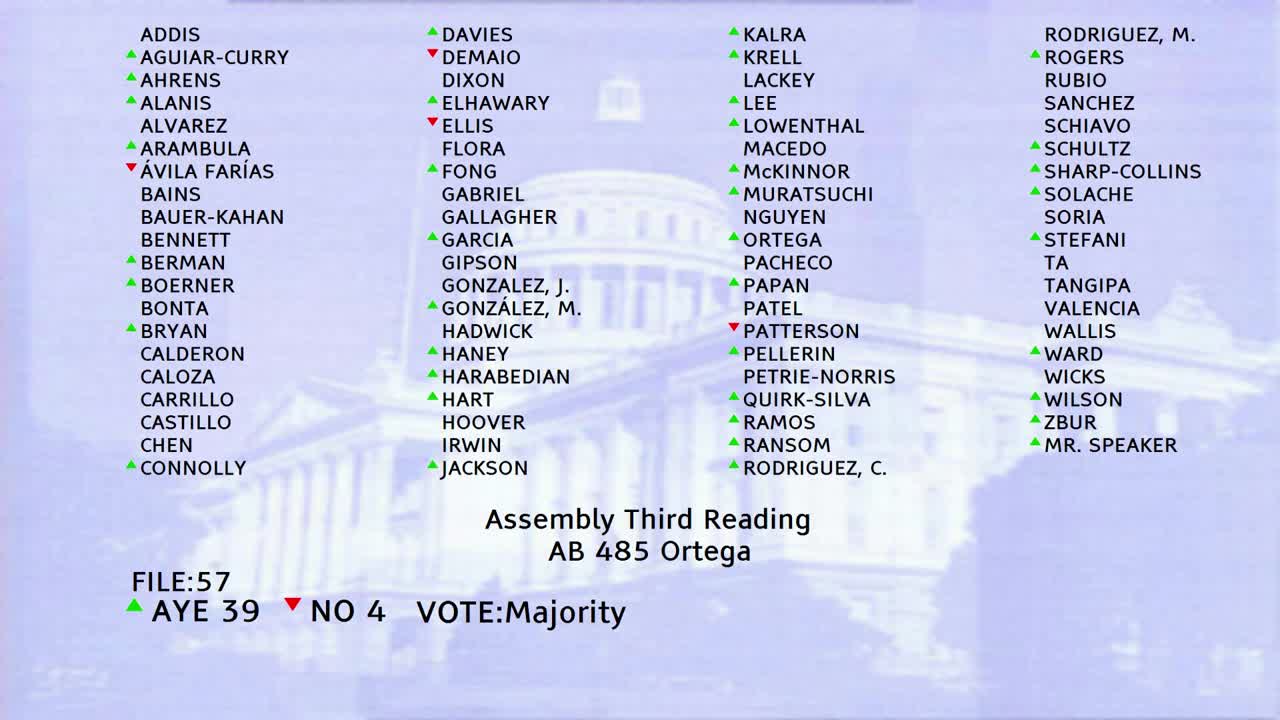 1MIN
Assembly Floor
 17MIN
Assembly Standing Committee on Health
Bill Author

Bill Co-Author(s):