AB 672: Real property tax: welfare exemption: community land trusts.
- Session Year: 2025-2026
- House: Assembly
- Latest Version Date: 2026-09-30
Current Status:
Passed
(2026-09-30: Chaptered by Secretary of State - Chapter 868, Statutes of 2026.)
Introduced
In Committee
Awaiting First Chamber Vote
Passed First Chamber
In Committee
Awaiting Second Chamber Vote
Passed Second Chamber
Enacted
Existing property tax law, pursuant to constitutional authorization, provides for a welfare exemption for property used exclusively for religious, hospital, scientific, or charitable purposes and that is owned or operated by certain types of nonprofit entities, if certain qualifying criteria are met.
Existing law also provides, until January 1, 2027, that property is within the welfare exemption if that property is owned by a community land trust, as defined, otherwise qualifying for the welfare exemption, and specified conditions are met, including that the property is being or will be developed or rehabilitated as housing, as specified. Existing law, however, makes community land trusts liable for property tax for the years for which the property was exempt from taxation if the property was not developed or rehabilitated, or if the development or rehabilitation is not in the course of construction, by January 1, 2027, for property acquired before January 1, 2022, or within 5 years of the lien date following acquisition of the property, for property acquired on and after January 1, 2022.
This bill would extend the operation of these provisions until January 1, 2032. The bill would make various conforming changes, including with respect to the lien dates for which the exemption applies.
Existing law requires any bill authorizing a new tax expenditure to contain, among other things, specific goals, purposes, and objectives that the tax expenditure will achieve, detailed performance indicators, and data collection requirements.
This bill would state that it is the intent of the Legislature to apply those requirements to the above-described exemption and would set forth specified information relating to those requirements. In that regard, the bill would require the assessor to provide the State Board of Equalization with certain information and would require the assessor to retain that information, as specified.
By imposing additional duties on local tax officials, the bill would impose a state-mandated local program.
The California Constitution requires the state to reimburse local agencies and school districts for certain costs mandated by the state. Statutory provisions establish procedures for making that reimbursement.
This bill would provide that, if the Commission on State Mandates determines that the bill contains costs mandated by the state, reimbursement for those costs shall be made pursuant to the statutory provisions noted above.
Existing law requires the state to reimburse local agencies annually for certain property tax revenues lost as a result of any exemption or classification of property for purposes of ad valorem property taxation.
This bill would provide that, notwithstanding those provisions, no appropriation is made and the state shall not reimburse local agencies for property tax revenues lost by them pursuant to the bill.
This bill would take effect immediately as a tax levy.
Existing property tax law, pursuant to constitutional authorization, provides for a welfare exemption for property used exclusively for religious, hospital, scientific, or charitable purposes and that is owned or operated by certain types of nonprofit entities, if certain qualifying criteria are met.
Existing law also provides, until January 1, 2027, that property is within the welfare exemption if that property is owned by a community land trust, as defined, otherwise qualifying for the welfare exemption, and specified conditions are met, including that the property is being or will be developed or rehabilitated as housing, as specified. Existing law, however, makes community land trusts liable for property tax for the years for which the property was exempt from taxation if the property was not developed or rehabilitated, or if the development or rehabilitation is not in the course of construction, by January 1, 2027, for property acquired before January 1, 2022, or within 5 years of the lien date following acquisition of the property, for property acquired on and after January 1, 2022.
This bill would extend the operation of these provisions until January 1, 2032. The bill would make various conforming changes, including with respect to the lien dates for which the exemption applies. By imposing additional duties on local tax officials, the bill would impose a state-mandated local program.
The California Constitution requires the state to reimburse local agencies and school districts for certain costs mandated by the state. Statutory provisions establish procedures for making that reimbursement.
This bill would provide that, if the Commission on State Mandates determines that the bill contains costs mandated by the state, reimbursement for those costs shall be made pursuant to the statutory provisions noted above.
Existing law requires the state to reimburse local agencies annually for certain property tax revenues lost as a result of any exemption or classification of property for purposes of ad valorem property taxation.
This bill would provide that, notwithstanding those provisions, no appropriation is made and the state shall not reimburse local agencies for property tax revenues lost by them pursuant to the bill.
This bill would take effect immediately as a tax levy.
(1)Existing law establishes the Public Employment Relations Board (PERB) in state government as a means of resolving disputes and enforcing the statutory duties and rights of specified public employers and employees under various acts regulating collective bargaining. Under existing law, PERB has the power and duty to investigate an unfair practice charge and to determine whether the charge is justified and the appropriate remedy for the unfair practice. This bill would require a plaintiff or petitioner filing a civil action seeking injunctive relief against a strike, work stoppage, or other labor action by public employees whose labor relations are regulated by PERB, if PERB is not a party to the action, to serve a copy of the petition or complaint by electronic mail on the general counsel of PERB, in accordance with certain procedures. The bill would also require a plaintiff or petitioner that intends to apply to a superior court for a temporary restraining order to enjoin a strike, work stoppage, or other labor action by public employees whose labor relations are regulated by PERB, if PERB is not a party to the action, to give notice by electronic mail to the general counsel of PERB of the application when the plaintiff or petitioner provides that notice to the defendant or respondent. The bill would specify that the above-described provisions do not authorize a plaintiff or petitioner to seek relief in court without first exhausting administrative remedies before PERB when exhaustion is required by statute, regulation, or case law.This bill would grant PERB the right, upon timely application, to intervene in a civil action arising from a labor dispute that involves public employees whose labor relations are regulated by PERB and that PERB claims implicate the constitutionality, interpretation, or enforcement of a statute administered by PERB.(2)Existing law, the Trial Court Employment Protection and Governance Act, establishes procedures regulating, among other matters, court employee classification and compensation, labor relations, and employment protection. Existing law requires the Judicial Council to adopt rules of court that provide a mechanism for the establishment of a panel of court of appeal justices who are qualified to hear certain petitions relating to arbitration and writ applications and from which a single justice is required to be assigned to hear the matter in the superior court, as prescribed.This bill would require the Judicial Council to adopt rules of court that provide a mechanism for the establishment of a panel of court of appeal justices who would be qualified to hear actions that seek to enjoin strikes, work stoppages, or other labor activity by trial court employees, from which a single justice would be assigned to hear the matter in the superior court in accordance with certain procedures.(1)Existing law establishes the Public Employment Relations Board (PERB) in state government as a means of resolving disputes and enforcing the statutory duties and rights of specified public employers and employees under various acts regulating collective bargaining. Under existing law, PERB has the power and duty to investigate an unfair practice charge and to determine whether the charge is justified and the appropriate remedy for the unfair practice.
This bill would require a plaintiff or petitioner filing a civil action seeking injunctive relief against a strike, work stoppage, or other labor action by public employees whose labor relations are regulated by PERB, if PERB is not a party to the action, to serve a copy of the petition or complaint by electronic mail on the general counsel of PERB, in accordance with certain procedures. The bill would also require a plaintiff or petitioner that intends to apply to a superior court for a temporary restraining order to enjoin a strike, work stoppage, or other labor action by public employees whose labor relations are regulated by PERB, if PERB is not a party to the action, to give notice by electronic mail to the general counsel of PERB of the application when the plaintiff or petitioner provides that notice to the defendant or respondent. The bill would specify that the above-described provisions do not authorize a plaintiff or petitioner to seek relief in court without first exhausting administrative remedies before PERB when exhaustion is required by statute, regulation, or case law.
(2)ThisThis bill would grant PERB the right, upon timely application, to intervene in a civil action arising from a labor dispute that involves public employees whose labor relations are regulated by PERB and that PERB claims implicate the constitutionality, interpretation, or enforcement of a statute administered by PERB.
Existing(2)Existing law, the Trial Court Employment Protection and Governance Act, establishes procedures regulating, among other matters, court employee classification and compensation, labor relations, and employment protection. Existing law requires the Judicial Council to adopt rules of court that provide a mechanism for the establishment of a panel of court of appeal justices who are qualified to hear certain petitions relating to arbitration and writ applications and from which a single justice is required to be assigned to hear the matter in the superior court, as prescribed.
This bill would require the Judicial Council to adopt rules of court that provide a mechanism for the establishment of a panel of court of appeal justices who would be qualified to hear actions that seek to enjoin strikes, work stoppages, or other labor activity by trial court employees, from which a single justice would be assigned to hear the matter in the superior court in accordance with certain procedures.
(1)Existing law establishes the Public Employment Relations Board (PERB) in state government as a means of resolving disputes and enforcing the statutory duties and rights of specified public employers and employees under various acts regulating collective bargaining. Under existing law, PERB has the power and duty to investigate an unfair practice charge and to determine whether the charge is justified and the appropriate remedy for the unfair practice.
This bill would require a plaintiff or petitioner filing a civil action seeking injunctive relief against a strike, work stoppage, or other labor action by public employees whose labor relations are regulated by PERB, if PERB is not a party to the action, to serve a copy of the petition or complaint by electronic mail on the general counsel of PERB, in accordance with certain procedures. The bill would also require a plaintiff or petitioner that intends to apply to a superior court for a temporary restraining order to enjoin a strike, work stoppage, or other labor action by public employees whose labor relations are regulated by PERB, if PERB is not a party to the action, to give notice by electronic mail to the general counsel of PERB of the application when the plaintiff or petitioner provides that notice to the defendant or respondent.
(2)This bill would grant PERB the right, upon timely application, to intervene in a civil action arising from a labor dispute that involves public employees whose labor relations are regulated by PERB and that PERB claims implicate the constitutionality, interpretation, or enforcement of a statute administered by PERB.
Existing law, the Trial Court Employment Protection and Governance Act, establishes procedures regulating, among other matters, court employee classification and compensation, labor relations, and employment protection. Existing law requires the Judicial Council to adopt rules of court that provide a mechanism for the establishment of a panel of court of appeal justices who are qualified to hear certain petitions relating to arbitration and writ applications and from which a single justice is required to be assigned to hear the matter in the superior court, as prescribed.
This bill would require the Judicial Council to adopt rules of court that provide a mechanism for the establishment of a panel of court of appeal justices who would be qualified to hear actions that seek to enjoin strikes, work stoppages, or other labor activity by trial court employees, from which a single justice would be assigned to hear the matter in the superior court in accordance with certain procedures.
(a)Property is within the exemption provided by Sections 4 and 5 of Article XIII of the California Constitution if the property is owned by a community land trust, otherwise qualifying for exemption under Section 214, and all of the following conditions are met:
(1)The property is being or will be developed or rehabilitated as any of the following:
(A)An owner-occupied single-family dwelling.
(B)As an owner-occupied unit in a multifamily dwelling.
(C)As a member-occupied unit in a limited equity housing cooperative.
(D)As a rental housing development.
(2)Improvements on the property are or will be available for use and ownership or for rent by qualified persons.
(3)(A)A deed restriction or other instrument, requiring a contract or contracts serving as an enforceable restriction on the sale or resale value of owner-occupied units or on the affordability of rental units is recorded on or before the lien date following the acquisition of the property by the community land trust.
(B)For purposes of this section:
(i)A contract or contracts serving as an enforceable restriction on the sale or resale value of owner-occupied units means a contract described in paragraph (11) of subdivision (a) of Section 402.1.
(ii)A contract or contracts serving as an enforceable restriction on the affordability of rental units means an enforceable and verifiable agreement with a public agency, a recorded deed restriction, or other legal document described in subparagraph (A) of paragraph (2) of subdivision (g) of Section 214.
(C)A copy of the deed restriction or other instrument shall be provided to the assessor.
(b)(1)Subject to subdivision (d), the exemption provided by subdivision (a) shall not be denied to a property on the basis that the property does not currently contain a single-family dwelling, a unit in a multifamily dwelling, a unit in a limited equity housing cooperative, or a rental housing development that is in the course of construction.
(2)Once property that is a rental housing development is in the course of construction, the property shall be deemed to qualify for the exemption provided under Section 214 and on subsequent lien dates the property shall qualify for exemption pursuant to Section 214.
(c)For purposes of this section, all of the following definitions shall apply:
(1)Community land trust has the same meaning as that term is defined in clause (ii) of subparagraph (C) of paragraph (11) of subdivision (a) of Section 402.1.
(2)Course of construction has the same meaning as the term facilities in the course of construction, as used and defined in Sections 214.1 and 214.2.
(3)Limited equity housing cooperative has the same meaning as that term is defined in Section 817 of the Civil Code.
(4)Persons and families of low income has the same meaning as the term lower income households, as defined in Section 50079.5 of the Health and Safety Code.
(5)Persons and families of low or moderate income has the same meaning as that term is defined in Section 50093 of the Health and Safety Code.
(6)Qualified persons means the following:
(A)In the case of property developed for owner-occupied housing, as described in subparagraphs (A), (B), and (C) of paragraph (1) of subdivision (a), persons and families of low or moderate income, including persons and families of low or moderate income that own a dwelling or unit collectively as member occupants or resident shareholders of a limited equity housing cooperative.
(B)In the case of property developed for rental housing, as described in subparagraph (D) of paragraph (1) of subdivision (a), persons and families of low income.
(7)Rental housing development means a rental housing development in which all of the residential units in the development, other than units provided to property managers, are required to be rented to, and occupied by, persons and families of low or moderate income, at rents that do not exceed an affordable rent as described in Section 50053 of the Health and Safety Code.
(d)(1)Notwithstanding any other law, the community land trust shall be liable for property tax for the years for which the property was exempt from taxation pursuant to this section if the property was not developed or rehabilitated, or if the development or rehabilitation is not in the course of construction, in accordance with paragraph (1) of subdivision (a) as follows:
(A)In the case of property acquired by the community land trust before January 1, 2022, by January 1, 2027.
(B)In the case of property acquired by the community land trust on and after January 1, 2022, and before January 1, 2032, within five years of the lien date following the acquisition of the property by the community land trust.
(2)The community land trust shall notify the assessor of the county in which the property is located if property owned by the community land trust granted an exemption pursuant to this section is not in the course of construction by the dates specified in paragraph (1).
(e)Property shall be eligible for exemption pursuant to this section as follows:
(1)In the case of property acquired by the community land trust before January 1, 2022, for lien dates occurring on and after January 1, 2020, and before January 1, 2027.
(2)(A)In the case of property acquired by the community land trust on and after January 1, 2022, and before January 1, 2032, for the first five lien dates following the acquisition of the property by the community land trust.
(B)Property shall be eligible for exemption for the lien dates specified in subparagraph (A) regardless of the repeal of this section.
(f)(1)It is the intent of the Legislature to apply the requirements of Section 41 to the exemption provided by this section. Therefore, the Legislature finds and declares the following with respect to the exemption provided by this section:
(A)The specific goals, purposes, and objectives of the exemption are to do both the following:
(i)Facilitate the acquisition, development, rehabilitation, and financing of ownership and rental housing for persons and families of low and moderate income.
(ii)To facilitate development and rehabilitation of restricted affordable dwellings and units.
(B)The detailed performance indicators for the Legislature to use in determining whether the exemption provided by this section meet the goals, purposes, and objectives described in subparagraph (A) shall be both of the following:
(i)The annual amount of assessed value exempted.
(ii)The number of owner-occupied dwelling units or rental units, or both, created by community land trusts granted this exemption.
(2)(A)The State Board of Equalization shall annually collect data from county assessors to quantify the amount of assessed value exempted and the number of owner-occupied dwelling units or rental units, or both, created by community land trusts granted this exemption.
(B)On or before January 1, 2031, the State Board of Equalization shall submit to the Legislature, in accordance with Section 9795 of the Government Code, a report summarizing the information collected pursuant to this subdivision.
(3)(A)To facilitate the information reporting requirement imposed pursuant to this subdivision, community land trusts claiming the exemption provided by this section shall provide to the assessor the information described in paragraph (2) in the form and manner prescribed by the assessor.
(B)The assessor shall provide the State Board of Equalization with the relevant information, to the extent available, needed to comply with the reporting requirement imposed pursuant to subparagraph (B) of paragraph (2) and shall retain that information to the extent necessary.
(g)This section shall remain in effect only until January 1, 2032, and as of that date is repealed.
SEC. 2.If the Commission on State Mandates determines that this act contains costs mandated by the state, reimbursement to local agencies and school districts for those costs shall be made pursuant to Part 7 (commencing with Section 17500) of Division 4 of Title 2 of the Government Code.
SEC. 3.Notwithstanding Section 2229 of the Revenue and Taxation Code, no appropriation is made by this act and the state shall not reimburse any local agency for any property tax revenues lost by it pursuant to this act.
SEC. 4.This act provides for a tax levy within the meaning of Article IV of the California Constitution and shall go into immediate effect.
(a)Property is within the exemption provided by Sections 4 and 5 of Article XIII of the California Constitution if the property is owned by a community land trust, otherwise qualifying for exemption under Section 214, and all of the following conditions are met:
(1)The property is being or will be developed or rehabilitated as any of the following:
(A)An owner-occupied single-family dwelling.
(B)As an owner-occupied unit in a multifamily dwelling.
(C)As a member-occupied unit in a limited equity housing cooperative.
(D)As a rental housing development.
(2)Improvements on the property are or will be available for use and ownership or for rent by qualified persons.
(3)(A)A deed restriction or other instrument, requiring a contract or contracts serving as an enforceable restriction on the sale or resale value of owner-occupied units or on the affordability of rental units is recorded on or before the lien date following the acquisition of the property by the community land trust.
(B)For purposes of this section:
(i)A contract or contracts serving as an enforceable restriction on the sale or resale value of owner-occupied units means a contract described in paragraph (11) of subdivision (a) of Section 402.1.
(ii)A contract or contracts serving as an enforceable restriction on the affordability of rental units means an enforceable and verifiable agreement with a public agency, a recorded deed restriction, or other legal document described in subparagraph (A) of paragraph (2) of subdivision (g) of Section 214.
(C)A copy of the deed restriction or other instrument shall be provided to the assessor.
(b)(1)Subject to subdivision (d), the exemption provided by subdivision (a) shall not be denied to a property on the basis that the property does not currently contain a single-family dwelling, a unit in a multifamily dwelling, a unit in a limited equity housing cooperative, or a rental housing development that is in the course of construction.
(2)Once property that is a rental housing development is in the course of construction, the property shall be deemed to qualify for the exemption provided under Section 214 and on subsequent lien dates the property shall qualify for exemption pursuant to Section 214.
(c)For purposes of this section, all of the following definitions shall apply:
(1)Community land trust has the same meaning as that term is defined in clause (ii) of subparagraph (C) of paragraph (11) of subdivision (a) of Section 402.1.
(2)Course of construction has the same meaning as the term facilities in the course of construction, as used and defined in Sections 214.1 and 214.2.
(3)Limited equity housing cooperative has the same meaning as that term is defined in Section 817 of the Civil Code.
(4)Persons and families of low income has the same meaning as the term lower income households, as defined in Section 50079.5 of the Health and Safety Code.
(5)Persons and families of low or moderate income has the same meaning as that term is defined in Section 50093 of the Health and Safety Code.
(6)Qualified persons means the following:
(A)In the case of property developed for owner-occupied housing, as described in subparagraphs (A), (B), and (C) of paragraph (1) of subdivision (a), persons and families of low or moderate income, including persons and families of low or moderate income that own a dwelling or unit collectively as member occupants or resident shareholders of a limited equity housing cooperative.
(B)In the case of property developed for rental housing, as described in subparagraph (D) of paragraph (1) of subdivision (a), persons and families of low income.
(7)Rental housing development means a rental housing development in which all of the residential units in the development, other than units provided to property managers, are required to be rented to, and occupied by, persons and families of low or moderate income, at rents that do not exceed an affordable rent as described in Section 50053 of the Health and Safety Code.
(d)(1)Notwithstanding any other law, the community land trust shall be liable for property tax for the years for which the property was exempt from taxation pursuant to this section if the property was not developed or rehabilitated, or if the development or rehabilitation is not in the course of construction, in accordance with paragraph (1) of subdivision (a) as follows:
(A)In the case of property acquired by the community land trust before January 1, 2022, by January 1, 2027.
(B)In the case of property acquired by the community land trust on and after January 1, 2022, and before January 1, 2032, within five years of the lien date following the acquisition of the property by the community land trust.
(2)The community land trust shall notify the assessor of the county in which the property is located if property owned by the community land trust granted an exemption pursuant to this section is not in the course of construction by the dates specified in paragraph (1).
(e)Property shall be eligible for exemption pursuant to this section as follows:
(1)In the case of property acquired by the community land trust before January 1, 2022, for lien dates occurring on and after January 1, 2020, and before January 1, 2027.
(2)(A)In the case of property acquired by the community land trust on and after January 1, 2022, and before January 1, 2032, for the first five lien dates following the acquisition of the property by the community land trust.
(B)Property shall be eligible for exemption for the lien dates specified in subparagraph (A) regardless of the repeal of this section.
(f)(1)It is the intent of the Legislature to apply the requirements of Section 41 to the exemption provided by this section. Therefore, the Legislature finds and declares the following with respect to the exemption provided by this section:
(A)The specific goals, purposes, and objectives of the exemption are to do both the following:
(i)Facilitate the acquisition, development, rehabilitation, and financing of ownership and rental housing for persons and families of low and moderate income.
(ii)To facilitate development and rehabilitation of restricted affordable dwellings and units.
(B)The detailed performance indicators for the Legislature to use in determining whether the exemption provided by this section meet the goals, purposes, and objectives described in subparagraph (A) shall be both of the following:
(i)The annual amount of assessed value exempted.
(ii)The number of owner-occupied dwelling units or rental units, or both, created by community land trusts granted this exemption.
(2)(A)The State Board of Equalization shall annually collect data from county assessors to quantify the amount of assessed value exempted and the number of owner-occupied dwelling units or rental units, or both, created by community land trusts granted this exemption.
(B)On or before January 1, 2031, the State Board of Equalization shall submit to the Legislature, in accordance with Section 9795 of the Government Code, a report summarizing the information collected pursuant to this subdivision.
(3)(A)To facilitate the information reporting requirement imposed pursuant to this subdivision, community land trusts claiming the exemption provided by this section shall provide to the assessor the information described in paragraph (2) in the form and manner prescribed by the assessor.
(B)The assessor shall provide the State Board of Equalization with the relevant information, to the extent available, needed to comply with the reporting requirement imposed pursuant to subparagraph (B) of paragraph (2) and shall retain that information to the extent necessary.
(f)(g)This section shall remain in effect only until January 1, 2032, and as of that date is repealed.
SEC. 2.If the Commission on State Mandates determines that this act contains costs mandated by the state, reimbursement to local agencies and school districts for those costs shall be made pursuant to Part 7 (commencing with Section 17500) of Division 4 of Title 2 of the Government Code.
SEC. 3.Notwithstanding Section 2229 of the Revenue and Taxation Code, no appropriation is made by this act and the state shall not reimburse any local agency for any property tax revenues lost by it pursuant to this act.
SEC. 4.This act provides for a tax levy within the meaning of Article IV of the California Constitution and shall go into immediate effect.
(a)Property is within the exemption provided by Sections 4 and 5 of Article XIII of the California Constitution if the property is owned by a community land trust, otherwise qualifying for exemption under Section 214, and all of the following conditions are met:
(1)The property is being or will be developed or rehabilitated as any of the following:
(A)An owner-occupied single-family dwelling.
(B)As an owner-occupied unit in a multifamily dwelling.
(C)As a member-occupied unit in a limited equity housing cooperative.
(D)As a rental housing development.
(2)Improvements on the property are or will be available for use and ownership or for rent by qualified persons.
(3)(A)A deed restriction or other instrument, requiring a contract or contracts serving as an enforceable restriction on the sale or resale value of owner-occupied units or on the affordability of rental units is recorded on or before the lien date following the acquisition of the property by the community land trust.
(B)For purposes of this section:
(i)A contract or contracts serving as an enforceable restriction on the sale or resale value of owner-occupied units means a contract described in paragraph (11) of subdivision (a) of Section 402.1.
(ii)A contract or contracts serving as an enforceable restriction on the affordability of rental units means an enforceable and verifiable agreement with a public agency, a recorded deed restriction, or other legal document described in subparagraph (A) of paragraph (2) of subdivision (g) of Section 214.
(C)A copy of the deed restriction or other instrument shall be provided to the assessor.
(b)(1)Subject to subdivision (d), the exemption provided by subdivision (a) shall not be denied to a property on the basis that the property does not currently contain a single-family dwelling, a unit in a multifamily dwelling, a unit in a limited equity housing cooperative, or a rental housing development that is in the course of construction.
(2)Once property that is a rental housing development is in the course of construction, the property shall be deemed to qualify for the exemption provided under Section 214 and on subsequent lien dates the property shall qualify for exemption pursuant to Section 214.
(c)For purposes of this section, all of the following definitions shall apply:
(1)Community land trust has the same meaning as that term is defined in clause (ii) of subparagraph (C) of paragraph (11) of subdivision (a) of Section 402.1.
(2)Course of construction has the same meaning as the term facilities in the course of construction, as used and defined in Sections 214.1 and 214.2.
(3)Limited equity housing cooperative has the same meaning as that term is defined in Section 817 of the Civil Code.
(4)Persons and families of low income has the same meaning as the term lower income households, as defined in Section 50079.5 of the Health and Safety Code.
(5)Persons and families of low or moderate income has the same meaning as that term is defined in Section 50093 of the Health and Safety Code.
(6)Qualified persons means the following:
(A)In the case of property developed for owner-occupied housing, as described in subparagraphs (A), (B), and (C) of paragraph (1) of subdivision (a), persons and families of low or moderate income, including persons and families of low or moderate income that own a dwelling or unit collectively as member occupants or resident shareholders of a limited equity housing cooperative.
(B)In the case of property developed for rental housing, as described in subparagraph (D) of paragraph (1) of subdivision (a), persons and families of low income.
(7)Rental housing development means a rental housing development in which all of the residential units in the development, other than units provided to property managers, are required to be rented to, and occupied by, persons and families of low or moderate income, at rents that do not exceed an affordable rent as described in Section 50053 of the Health and Safety Code.
(d)(1)Notwithstanding any other law, the community land trust shall be liable for property tax for the years for which the property was exempt from taxation pursuant to this section if the property was not developed or rehabilitated, or if the development or rehabilitation is not in the course of construction, in accordance with paragraph (1) of subdivision (a) as follows:
(A)In the case of property acquired by the community land trust before January 1, 2022, by January 1, 2027.
(B)In the case of property acquired by the community land trust on and after January 1, 2022, and before January 1, 2027, 2032, within five years of the lien date following the acquisition of the property by the community land trust.
(2)The community land trust shall notify the assessor of the county in which the property is located if property owned by the community land trust granted an exemption pursuant to this section is not in the course of construction by the dates specified in paragraph (1).
(e)Property shall be eligible for exemption pursuant to this section as follows:
(1)In the case of property acquired by the community land trust before January 1, 2022, for lien dates occurring on and after January 1, 2020, and before January 1, 2027.
(2)(A)In the case of property acquired by the community land trust on and after January 1, 2022, and before January 1, 2027, 2032, for the first five lien dates following the acquisition of the property by the community land trust.
(B)Property shall be eligible for exemption for the lien dates specified in subparagraph (A) regardless of the repeal of this section.
(f)This section shall remain in effect only until January 1, 2027, 2032, and as of that date is repealed.SEC. 2.If the Commission on State Mandates determines that this act contains costs mandated by the state, reimbursement to local agencies and school districts for those costs shall be made pursuant to Part 7 (commencing with Section 17500) of Division 4 of Title 2 of the Government Code.
SEC. 3.Notwithstanding Section 2229 of the Revenue and Taxation Code, no appropriation is made by this act and the state shall not reimburse any local agency for any property tax revenues lost by it pursuant to this act.
SEC. 4.This act provides for a tax levy within the meaning of Article IV of the California Constitution and shall go into immediate effect.
SECTION 1.Chapter 12.7 (commencing with Section 3599.90) is added to Division 4 of Title 1 of the Government Code, to read:12.7.Notification of Civil Actions and Right of Intervention3599.90.(a)A plaintiff or petitioner filing a civil action seeking injunctive relief against a strike, work stoppage, or other labor action by public employees whose labor relations are regulated by the Public Employment Relations Board shall, if the board is not a party to the action, serve a copy of the petition or complaint by electronic mail on the general counsel of the board. Service of the complaint or petition shall be made on the same day the petition or complaint is filed. Proof of service on the general counsel shall be filed promptly in the civil action.(b)A plaintiff or petitioner that intends to apply to a superior court for a temporary restraining order to enjoin a strike, work stoppage, or other labor action by public employees whose labor relations are regulated by the board shall, if the board is not a party to the action, give notice, by electronic mail to the general counsel of the board, of the application when the plaintiff or petitioner provides that notice to the defendant or respondent.(c)This section does not authorize a plaintiff or petitioner to seek relief in court without first exhausting administrative remedies before the board when exhaustion is required by a statute, regulation, or case law.3599.91.The board shall have the right, upon timely application, to intervene in any civil action arising from a labor dispute that involves public employees whose labor relations are regulated by the board and that the board claims implicates the constitutionality, interpretation, or enforcement of a statute administered by the board.SEC. 2.Section 71639.7 is added to the Government Code, to read:71639.7.The Judicial Council shall adopt rules of court that shall provide a mechanism for the establishment of a panel of court of appeal justices who shall be qualified to hear actions that seek to enjoin strikes, work stoppages, or other labor activity by trial court employees, from which a single justice shall be assigned to hear the matter in the superior court. The rules of court shall provide that these matters shall be heard in the superior court, and to the extent permitted by law, shall provide that any justice assigned to hear the matter in the superior court shall not be from the court of appeal district in which the action is filed, and shall further provide that appeals in these matters shall be heard in the court of appeal district where the matter was filed.(a)A plaintiff or petitioner filing a civil action seeking injunctive relief against a strike, work stoppage, or other labor action by public employees whose labor relations are regulated by the Public Employment Relations Board shall, if the board is not a party to the action, serve a copy of the petition or complaint by electronic mail on the general counsel of the board. Service of the complaint or petition shall be made on the same day the petition or complaint is filed. Proof of service on the general counsel shall be filed promptly in the civil action.
(b)A plaintiff or petitioner that intends to apply to a superior court for a temporary restraining order to enjoin a strike, work stoppage, or other labor action by public employees whose labor relations are regulated by the board shall, if the board is not a party to the action, give notice, by electronic mail to the general counsel of the board, of the application when the plaintiff or petitioner provides that notice to the defendant or respondent.
(c)This section does not authorize a plaintiff or petitioner to seek relief in court without first exhausting administrative remedies before the board when exhaustion is required by a statute, regulation, or case law.
3599.91.The board shall have the right, upon timely application, to intervene in any civil action arising from a labor dispute that involves public employees whose labor relations are regulated by the board and that the board claims implicates the constitutionality, interpretation, or enforcement of a statute administered by the board.
SEC. 2.Section 71639.7 is added to the Government Code, to read:71639.7.The Judicial Council shall adopt rules of court that shall provide a mechanism for the establishment of a panel of court of appeal justices who shall be qualified to hear actions that seek to enjoin strikes, work stoppages, or other labor activity by trial court employees, from which a single justice shall be assigned to hear the matter in the superior court. The rules of court shall provide that these matters shall be heard in the superior court, and to the extent permitted by law, shall provide that any justice assigned to hear the matter in the superior court shall not be from the court of appeal district in which the action is filed, and shall further provide that appeals in these matters shall be heard in the court of appeal district where the matter was filed.
(a)A plaintiff or petitioner filing a civil action seeking injunctive relief against a strike, work stoppage, or other labor action by public employees whose labor relations are regulated by the Public Employment Relations Board shall, if the board is not a party to the action, serve a copy of the petition or complaint by electronic mail on the general counsel of the board. Service of the complaint or petition shall be made on the same day the petition or complaint is filed. Proof of service on the general counsel shall be filed promptly in the civil action.
(b)A plaintiff or petitioner that intends to apply to a superior court for a temporary restraining order to enjoin a strike, work stoppage, or other labor action by public employees whose labor relations are regulated by the board shall, if the board is not a party to the action, give notice, by electronic mail to the general counsel of the board, of the application when the plaintiff or petitioner provides that notice to the defendant or respondent.
3599.91.The board shall have the right, upon timely application, to intervene in any civil action arising from a labor dispute that involves public employees whose labor relations are regulated by the board and that the board claims implicates the constitutionality, interpretation, or enforcement of a statute administered by the board.
SEC. 2.Section 71639.7 is added to the Government Code, to read:71639.7.The Judicial Council shall adopt rules of court that shall provide a mechanism for the establishment of a panel of court of appeal justices who shall be qualified to hear actions that seek to enjoin strikes, work stoppages, or other labor activity by trial court employees, from which a single justice shall be assigned to hear the matter in the superior court. The rules of court shall provide that these matters shall be heard in the superior court, and to the extent permitted by law, shall provide that any justice assigned to hear the matter in the superior court shall not be from the court of appeal district in which the action is filed, and shall further provide that appeals in these matters shall be heard in the court of appeal district where the matter was filed.
|
Date
|
Status
|
|---|---|
| Sep 30, 2026 | Chaptered by Secretary of State - Chapter 868, Statutes of 2026. |
| Sep 30, 2026 | Approved by the Governor. |
| Sep 4, 2026 | Enrolled and presented to the Governor at 4 p.m. |
| Aug 27, 2026 | Senate amendments concurred in. To Engrossing and Enrolling. (Ayes 75. Noes 0. Page 6736.). |
| Aug 27, 2026 | Senate amendments concurred in. To Engrossing and Enrolling. (Ayes 75. Noes 0.). |
| Aug 27, 2026 | From committee: That the Senate amendments be concurred in. (Ayes 7. Noes 0.) (August 27). |
| Aug 26, 2026 | Joint Rule 62(a), file notice suspended. (Page 6563.) |
| Aug 26, 2026 | Joint Rule 62(a), file notice suspended. |
| Aug 25, 2026 | Re-referred to Com. on REV. & TAX. pursuant to Assembly Rule 77.2. |
| Aug 25, 2026 | In Assembly. Concurrence in Senate amendments pending. |
| Aug 25, 2026 | Read third time. Passed. Ordered to the Assembly. (Ayes 39. Noes 0. Page 5752.). |
| Aug 25, 2026 | Read third time. Passed. Ordered to the Assembly. (Ayes 37. Noes 0.). |
| Aug 24, 2026 | Read second time. Ordered to third reading. |
| Aug 20, 2026 | Read third time and amended. Ordered to second reading. |
| Aug 13, 2026 | Read second time. Ordered to third reading. |
| Aug 13, 2026 | From committee: Do pass. (Ayes 7. Noes 0.) (August 13). |
| Jun 22, 2026 | In committee: Referred to APPR. suspense file. |
| Jun 10, 2026 | From committee: Do pass and re-refer to Com. on APPR. (Ayes 5. Noes 0.) (June 10). Re-referred to Com. on APPR. |
| May 13, 2026 | Re-referred to Com. on REV. & TAX. |
| Apr 30, 2026 | Re-referred to Com. on RLS. pursuant to Senate Rule 29.10(c). |
| Apr 29, 2026 | Read second time. Ordered to third reading. |
| Apr 28, 2026 | Read second time and amended. Ordered returned to second reading. |
| Apr 28, 2026 | Ordered to second reading. |
| Apr 28, 2026 | From inactive file. |
| Aug 25, 2025 | Ordered to inactive file at the request of Senator Durazo. |
| Aug 20, 2025 | Read second time. Ordered to third reading. |
| Aug 19, 2025 | From committee: Be ordered to second reading pursuant to Senate Rule 28.8. |
| Jul 16, 2025 | From committee: Do pass and re-refer to Com. on APPR. (Ayes 11. Noes 2.) (July 15). Re-referred to Com. on APPR. |
| Jun 25, 2025 | From committee: Do pass and re-refer to Com. on JUD. (Ayes 4. Noes 1.) (June 25). Re-referred to Com. on JUD. |
| Jun 18, 2025 | From committee chair, with author's amendments: Amend, and re-refer to committee. Read second time, amended, and re-referred to Com. on L., P.E. & R. |
| Jun 18, 2025 | Referred to Coms. on L., P.E. & R. and JUD. |
| May 15, 2025 | In Senate. Read first time. To Com. on RLS. for assignment. |
| May 15, 2025 | Read third time. Passed. Ordered to the Senate. (Ayes 62. Noes 4. Page 1562.) |
| May 8, 2025 | Read second time. Ordered to third reading. |
| May 7, 2025 | From committee: Do pass. (Ayes 11. Noes 0.) (May 7). |
| Apr 8, 2025 | From committee: Do pass and re-refer to Com. on APPR. (Ayes 9. Noes 0.) (April 8). Re-referred to Com. on APPR. |
| Mar 19, 2025 | From committee: Do pass and re-refer to Com. on JUD. (Ayes 6. Noes 0.) (March 19). Re-referred to Com. on JUD. |
| Mar 3, 2025 | Referred to Coms. on P. E. & R. and JUD. |
| Feb 15, 2025 | From printer. May be heard in committee March 17. |
| Feb 14, 2025 | Read first time. To print. |
|
Date
|
Description
|
Location
|
Votes
|
|
|---|---|---|---|---|
| Aug 27, 2026 | AB 672 Caloza Concurrence in Senate Amendments | Assembly Floor |
Passed |
|
| Aug 27, 2026 | With recommendation: That Senate amendments be concurred in. | Assembly Standing Committee on Revenue and Taxation |
Passed |
|
| Aug 25, 2026 | Assembly 3rd Reading AB672 Caloza By Grayson | Senate Floor |
Passed |
|
| Aug 13, 2026 | Do pass | Senate Standing Committee on Appropriations |
Passed |
|
| Jun 22, 2026 | Placed on suspense file | Senate Standing Committee on Appropriations |
Passed |
|
| Jun 10, 2026 | Do pass, but first be re-referred to the Committee on [Appropriations] | Senate Standing Committee on Revenue and Taxation |
Passed |
|
| Jul 15, 2025 | Do pass, but first be re-referred to the Committee on [Appropriations] | Senate Standing Committee on Judiciary |
Passed |
|
| Jun 25, 2025 | Do pass, but first be re-referred to the Committee on [Judiciary] | Senate Standing Committee on Labor, Public Employment and Retirement |
Passed |
|
| May 15, 2025 | AB 672 Caloza Assembly Third Reading | Assembly Floor |
Passed |
|
| May 7, 2025 | Do pass. | Assembly Standing Committee on Appropriations |
Passed |
|
| Apr 8, 2025 | Do pass and be re-referred to the Committee on [Appropriations] | Assembly Standing Committee on Judiciary |
Passed |
|
| Mar 19, 2025 | Do pass and be re-referred to the Committee on [Judiciary] | Assembly Standing Committee on Public Employment and Retirement |
Passed |
This list shows positions taken on this bill by organizations on the date displayed, which is linked to the original source.
Positions by individuals are not included.
|
Organization
|
Position
|
Date
|
|---|---|---|
| American Federation of State, County and Municipal Employees | ** Support | |
| American Federation of State, County and Municipal Employees (Co-source) | ** Support | |
| Bay Area Community Land Trust | ** Support | |
| Beverly-Vermont Community Land Trust | ** Support | |
| California Assessors’ Association | ** Support | |
| California Community Land Trust Network | ** Support | |
| California Community Land Trust Network | ** Support | |
| California Federation of Labor Unions | ** Support | |
| California Professional Firefighters | ** Support | |
| California School Employees Association | ** Support | |
| California Teachers Association | ** Support | |
| CARE Community Land Trust | ** Support | |
| Council Of Uc Faculty Associations | ** Support | |
| El Sereno Community Land Trust | ** Support | |
| ENTERPRISE COMMUNITY PARTNERS, INC. | ** Support | |
| Housing Land Trust of the North Bay | ** Support | |
| Inland Empire Prism Collective | ** Support | |
| Inland Equity Community Land Trusts | ** Support | |
| Irvine Community Land Trust | ** Support | |
| Long Beach Community Land Trust | ** Support | |
| Oakland Community Land Trust | ** Support | |
| Orange County Employees Association | ** Support | |
| Richmond Land | ** Support | |
| Ruchell “Cinque” Magee Community Land Trust | ** Support | |
| Ruchell Cinque Magee Community Land Trust | ** Support | |
| Sacramento Community Land Trust | ** Support | |
| Saint Joseph Community Land Trust | ** Support | |
| San Francisco Community Land Trust | ** Support | |
| San Gabriel Valley Casita | ** Support | |
| San Gabriel Valley Community Land Trust | ** Support | |
| Service Employees International Union, California | ** Support | |
| Service Employees International Union, California (Co-source) | ** Support | |
| Starting Over Strong | ** Support | |
| Tierras Indigenas Community Land Trust | ** Support | |
| Two Valleys Community Land Trust | ** Support |
CONCURRENCE IN SENATE AMENDMENTS
CSA2 Bill Id:AB 672
Author:(Caloza)
As Amended Ver:August 20, 2026
Majority vote
SUMMARY
Original Committee of Reference: Committee on Public Employment and Retirement.
As approved by the Assembly, required a plaintiff or petitioner filing a civil action seeking injunctive relief against certain specified labor actions, and which public employment labor relations are regulated by the Public Employment Relations Board (PERB), to provide notice to PERB. On April 28th, the author amended the bill to delete those provisions and insert the current provisions.
Senate Amendments
Current Committee Recommendation: Concur in Senate Amendments.
- Delete the prior contents of the bill.
- Extend, from January 1, 2027, to January 1, 2032, the lien date prior to which the property must be acquired to receive the CLT welfare property tax exemption.
- Finds and declares the following for purpose of complying with Revenue and Taxation Code (R&TC) Section 41:
- The specific goals, purposes, and objectives of the exemption are the following:
- Facilitate the acquisition, development, rehabilitation, and financing of ownership and rental housing for persons and families of low and moderate income; and,
- To facilitate development and rehabilitation of restricted affordable dwellings and units.
- The performance indicators for the Legislature to use in determining whether this exemption meets the goals, purposes, and objectives outlined above are:
- The annual amount of assessed value exempted; and,
- The number of owner-occupied dwelling units or rental units, or both, created by CLTs granted this exemption.
- Requires the following:
- CLTs claiming the exemption to provide performance indicator information described above to their county assessor in the form and manner prescribed by the assessor;
- County assessors to provide, to the extent available, the State Board of Equalization (BOE) with the performance indicator information; and,
- The BOE to annually collect data from county assessors to quantify the performance indicators and, on or before January 1, 2031, submit a report to the Legislature summarizing the information.
- The specific goals, purposes, and objectives of the exemption are the following:
COMMENTS
- What is a "tax expenditure"? Existing law provides various credits, deductions, exclusions, and exemptions for particular taxpayer groups. In the late 1960s, United States Treasury officials began arguing that these features of the tax law should be referred to as "expenditures" since they are generally enacted to accomplish some governmental purpose and there is a determinable cost associated with each of them (in the form of forgone revenues). This bill would extend an existing property tax expenditure under the welfare exemption, thereby constituting a tax expenditure.
- Committee's tax expenditure policy: SB 1335 (Leno), Chapter 845, Statutes of 2014, added R&TC Section 41, which recognized that the Legislature should apply the same level of review used for government spending programs to tax credits introduced on or after January 1, 2015. AB 263 (Burke), Chapter 743, Statutes of 2019, extended the requirements in R&TC Section 41 to all tax expenditure measures under the Personal Income Tax Law, the Corporation Tax Law, and the Sales and Use Tax Law introduced on or after January 1, 2020. This Committee's policy is to treat all tax expenditures similarly and requires that all proposed property tax expenditures likewise comply with R&TC Section 41.
A tax expenditure proposal must outline specific goals, purposes, and objectives that the tax expenditure will achieve, along with detailed performance indicators for the Legislature to use when measuring whether the tax expenditure meets those stated goals, purposes, and objectives. In addition to the R&TC Section 41 requirements, this Committee's policy also requires that all tax expenditure proposals contain an appropriate sunset provision to be eligible for a vote. Sunsets are required because eliminating a tax expenditure generally requires a 2/3rd vote. These requirements must be satisfied before a bill can receive a vote in this Committee. This bill contains a five-year sunset and complies with the requirements of R&TC Section 41.
- Results so far: After enacting the CLT exemption in SB 196, which took effect January 1, 2020, and ended January 1, 2025, the Legislature preemptively extended it for two years in 2022. As part of both measures, the Legislature required CLTs to report data to assessors for subsequent reporting to BOE. In 2025, the BOE requested data from the 58 county assessors, but received only 33 responses, of which only eight counties specified the number of parcels owned by CLTs. Five counties reported parcels owned by CLTs with an estimated assessed value of $10.3 million. While the above data implies that the exemption is seldom claimed in California, it may be instead that it is being claimed in the 25 counties that did not respond to BOE’s survey. The bill’s proponents argue that even though the exemption does not apply to many properties, it has provided a significant financial benefit for several important CLT projects, including 68 for the Irvine CLT. The Committee may wish to consider whether the CLT exemption is accomplishing its goals of expanding affordable housing in the state.
- Related legislation:
- AB 1668 (Pellerin), would extend the sunset date of the welfare property tax exemption for property used exclusively for the preservation of specified natural resources and open-space lands by five years. AB 1668 passed the Senate Floor on Special Consent on August 20, 2026, and is currently pending before the Governor.
- AB 1294 (Haney) would, for lien dates commencing on or after January 1, 2027, and before January 1, 2030, provide a partial welfare exemption in the case of certain residential rental property used for low- and moderate-income households. AB 1294 is currently pending on the Senate Floor.
- AB 1668 (Pellerin), would extend the sunset date of the welfare property tax exemption for property used exclusively for the preservation of specified natural resources and open-space lands by five years. AB 1668 passed the Senate Floor on Special Consent on August 20, 2026, and is currently pending before the Governor.
- Results so far: After enacting the CLT exemption in SB 196, which took effect January 1, 2020, and ended January 1, 2025, the Legislature preemptively extended it for two years in 2022. As part of both measures, the Legislature required CLTs to report data to assessors for subsequent reporting to BOE. In 2025, the BOE requested data from the 58 county assessors, but received only 33 responses, of which only eight counties specified the number of parcels owned by CLTs. Five counties reported parcels owned by CLTs with an estimated assessed value of $10.3 million. While the above data implies that the exemption is seldom claimed in California, it may be instead that it is being claimed in the 25 counties that did not respond to BOE’s survey. The bill’s proponents argue that even though the exemption does not apply to many properties, it has provided a significant financial benefit for several important CLT projects, including 68 for the Irvine CLT. The Committee may wish to consider whether the CLT exemption is accomplishing its goals of expanding affordable housing in the state.
According to the Author
Community land trusts are a powerful tool to expand affordable housing, making our neighborhoods more equitable and accessible. Property tax policy should support—not hinder—efforts to create stable, affordable homes for low-income families. AB 672 protects existing provisions for community land trusts to ensure they can continue developing affordable housing without disruption, helping more Californians build security, mobility, and opportunity through homeownership.
Arguments in Support
According to the California Community Land Trust Network:
Today, there are 50 emerging and established CLTs in California, in all regions of the state, serving urban, rural, and suburban communities. CLTs are community-controlled nonprofit organizations that steward land to provide permanently affordable homes and community facilities, housing thousands of low-income Californians. While many other forms of affordable housing place income restrictions on their properties which expire after some period of time, CLTs keep properties permanently affordable while providing stability to residents and stewarding scarce public resources efficiently.
Arguments in Opposition
None on file.
FISCAL COMMENTS
According to the Senate Committee on Appropriations:
- The BOE indicates that it would incur minor, one-time administrative costs to implement the provisions of the bill.
- The BOE indicates that this bill would result in lower property taxes relative to current law; however, the magnitude of the decline is unknown. Reductions in local property tax revenues, in turn, can increase General Fund Proposition 98 spending by up to roughly 50% (the exact amount depends on the specific amount of the annual Proposition 98 guarantee, which in turns depends upon a variety of economic, demographic and budgetary factors).
- By changing the manner in which assessors value real property, this bill creates a state-mandated local program. To the extent the Commission on State Mandates determines that the provisions of this bill create a new program or impose a higher level of service on local agencies, local agencies could claim reimbursement of those costs (General Fund). The magnitude of these costs is unknown.
VOTES
ASM PUBLIC EMPLOYMENT AND RETIREMENT: 6-0-1
YES: McKinnor, Alanis, Boerner, Elhawary, Garcia, Nguyen
ABS, ABST OR NV: Lackey
ASM JUDICIARY: 9-0-3
YES: Kalra, Wicks, Bryan, Connolly, Harabedian, Pacheco, Papan, Stefani, Zbur
ABS, ABST OR NV: Dixon, Sanchez, Tangipa
ASM APPROPRIATIONS: 11-0-4
YES: Wicks, Arambula, Calderon, Caloza, Elhawary, Fong, Mark González, Hart, Pacheco, Pellerin, Solache
ABS, ABST OR NV: Sanchez, Dixon, Ta, Tangipa
ASSEMBLY FLOOR: 62-4-13
YES: Addis, Aguiar-Curry, Ahrens, Alvarez, Ávila Farías, Bains, Bauer-Kahan, Bennett, Berman, Boerner, Bonta, Bryan, Calderon, Caloza, Carrillo, Chen, Connolly, Davies, Dixon, Elhawary, Flora, Fong, Gabriel, Garcia, Gipson, Mark González, Haney, Harabedian, Hart, Hoover, Irwin, Jackson, Kalra, Krell, Lee, Lowenthal, McKinnor, Muratsuchi, Nguyen, Ortega, Pacheco, Papan, Patel, Pellerin, Petrie-Norris, Ramos, Ransom, Celeste Rodriguez, Michelle Rodriguez, Rogers, Blanca Rubio, Schiavo, Schultz, Sharp-Collins, Solache, Valencia, Wallis, Ward, Wicks, Wilson, Zbur, Rivas
NO: DeMaio, Ellis, Gallagher, Patterson
ABS, ABST OR NV: Alanis, Arambula, Castillo, Jeff Gonzalez, Hadwick, Lackey, Macedo, Quirk-Silva, Sanchez, Soria, Stefani, Ta, Tangipa
SENATE FLOOR: 39-0-1
YES: Allen, Alvarado-Gil, Archuleta, Arreguín, Ashby, Becker, Blakespear, Cabaldon, Caballero, Cervantes, Choi, Cortese, Dahle, Durazo, Gonzalez, Grayson, Grove, Hurtado, Jones, Laird, Limón, McGuire, McNerney, Menjivar, Niello, Ochoa Bogh, Padilla, Pérez, Reyes, Richardson, Rubio, Seyarto, Smallwood-Cuevas, Stern, Strickland, Umberg, Wahab, Weber Pierson, Wiener
ABS, ABST OR NV: Valladares
ASM REVENUE AND TAXATION: 7-0-0
YES: Gipson, Sanchez, Carrillo, DeMaio, Mark González, Quirk-Silva, Michelle Rodriguez
UPDATED
VERSION: August 20, 2026
CONSULTANT: Wesley Whitaker / REV. & TAX. / (916) 319-2098 FN: 0004377
CONCURRENCE IN SENATE AMENDMENTS
CSA2 Bill Id:AB 672
Author:(Caloza)
As Amended Ver:August 20, 2026
Majority vote
SUMMARY
Original Committee of Reference: Committee on Public Employment and Retirement.
As approved by the Assembly, required a plaintiff or petitioner filing a civil action seeking injunctive relief against certain specified labor actions, and which public employment labor relations are regulated by the Public Employment Relations Board (PERB), to provide notice to PERB. On April 28th, the author amended the bill to delete those provisions and insert the current provisions.
Senate Amendments
Current Committee Recommendation: Concur in Senate Amendments.
- Delete the prior contents of the bill.
- Extend, from January 1, 2027, to January 1, 2032, the lien date prior to which the property must be acquired to receive the Community Land Trust (CLT) welfare property tax exemption.
- Finds and declares the following for purpose of complying with Revenue and Taxation Code (R&TC) Section 41:
- The specific goals, purposes, and objectives of the exemption are the following:
- Facilitate the acquisition, development, rehabilitation, and financing of ownership and rental housing for persons and families of low and moderate income; and,
- To facilitate development and rehabilitation of restricted affordable dwellings and units.
- The performance indicators for the Legislature to use in determining whether this exemption meets the goals, purposes, and objectives outlined above are:
- The annual amount of assessed value exempted; and,
- The number of owner-occupied dwelling units or rental units, or both, created by CLTs granted this exemption.
- Requires the following:
- CLTs claiming the exemption to provide performance indicator information described above to their county assessor in the form and manner prescribed by the assessor;
- County assessors to provide, to the extent available, the State Board of Equalization (BOE) with the performance indicator information; and,
- The BOE to annually collect data from county assessors to quantify the performance indicators and, on or before January 1, 2031, submit a report to the Legislature summarizing the information.
- The specific goals, purposes, and objectives of the exemption are the following:
COMMENTS
- What is a "tax expenditure"? Existing law provides various credits, deductions, exclusions, and exemptions for particular taxpayer groups. In the late 1960s, United States Treasury officials began arguing that these features of the tax law should be referred to as "expenditures" since they are generally enacted to accomplish some governmental purpose and there is a determinable cost associated with each of them (in the form of forgone revenues). This bill would extend an existing property tax expenditure under the welfare exemption, thereby constituting a tax expenditure.
- Committee's tax expenditure policy: SB 1335 (Leno), Chapter 845, Statutes of 2014, added R&TC Section 41, which recognized that the Legislature should apply the same level of review used for government spending programs to tax credits introduced on or after January 1, 2015. AB 263 (Burke), Chapter 743, Statutes of 2019, extended the requirements in R&TC Section 41 to all tax expenditure measures under the Personal Income Tax Law, the Corporation Tax Law, and the Sales and Use Tax Law introduced on or after January 1, 2020. This Committee's policy is to treat all tax expenditures similarly and requires that all proposed property tax expenditures likewise comply with R&TC Section 41.
A tax expenditure proposal must outline specific goals, purposes, and objectives that the tax expenditure will achieve, along with detailed performance indicators for the Legislature to use when measuring whether the tax expenditure meets those stated goals, purposes, and objectives. In addition to the R&TC Section 41 requirements, this Committee's policy also requires that all tax expenditure proposals contain an appropriate sunset provision to be eligible for a vote. Sunsets are required because eliminating a tax expenditure generally requires a 2/3rd vote. These requirements must be satisfied before a bill can receive a vote in this Committee. This bill contains a five-year sunset and complies with the requirements of R&TC Section 41.
- Results so far: After enacting the CLT exemption in SB 196, which took effect January 1, 2020, and ended January 1, 2025, the Legislature preemptively extended it for two years in 2022. As part of both measures, the Legislature required CLTs to report data to assessors for subsequent reporting to BOE. In 2025, the BOE requested data from the 58 county assessors, but received only 33 responses, of which only eight counties specified the number of parcels owned by CLTs. Five counties reported parcels owned by CLTs with an estimated assessed value of $10.3 million. While the above data implies that the exemption is seldom claimed in California, it may be instead that it is being claimed in the 25 counties that did not respond to BOE's survey. The bill's proponents argue that even though the exemption does not apply to many properties, it has provided a significant financial benefit for several important CLT projects, including 68 for the Irvine CLT. The Committee may wish to consider whether the CLT exemption is accomplishing its goals of expanding affordable housing in the state.
- Related legislation:
- AB 1668 (Pellerin), of the current legislative session, would extend the sunset date of the welfare property tax exemption for property used exclusively for the preservation of specified natural resources and open-space lands by five years. AB 1668 passed the Senate Floor on Special Consent on August 20, 2026, and is currently pending before the Governor.
- AB 1294 (Haney) would, for lien dates commencing on or after January 1, 2027, and before January 1, 2030, provide a partial welfare exemption in the case of certain residential rental property used for low- and moderate-income households. AB 1294 is currently pending on the Senate Floor.
According to the Author
Community land trusts are a powerful tool to expand affordable housing, making our neighborhoods more equitable and accessible. Property tax policy should support—not hinder—efforts to create stable, affordable homes for low-income families. AB 672 protects existing provisions for community land trusts to ensure they can continue developing affordable housing without disruption, helping more Californians build security, mobility, and opportunity through homeownership.
Arguments in Support
According to the California Community Land Trust Network:
Today, there are 50 emerging and established CLTs in California, in all regions of the state, serving urban, rural, and suburban communities. CLTs are community-controlled nonprofit organizations that steward land to provide permanently affordable homes and community facilities, housing thousands of low-income Californians. While many other forms of affordable housing place income restrictions on their properties which expire after some period of time, CLTs keep properties permanently affordable while providing stability to residents and stewarding scarce public resources efficiently.
Arguments in Opposition
None on file.
FISCAL COMMENTS
According to the Senate Committee on Appropriations:
- The BOE indicates that it would incur minor, one-time administrative costs to implement the provisions of the bill.
- The BOE indicates that this bill would result in lower property taxes relative to current law; however, the magnitude of the decline is unknown. Reductions in local property tax revenues, in turn, can increase General Fund Proposition 98 spending by up to roughly 50% (the exact amount depends on the specific amount of the annual Proposition 98 guarantee, which in turns depends upon a variety of economic, demographic and budgetary factors).
- By changing the manner in which assessors value real property, this bill creates a state-mandated local program. To the extent the Commission on State Mandates determines that the provisions of this bill create a new program or impose a higher level of service on local agencies, local agencies could claim reimbursement of those costs (General Fund). The magnitude of these costs is unknown.
VOTES
ASM PUBLIC EMPLOYMENT AND RETIREMENT: 6-0-1
YES: McKinnor, Alanis, Boerner, Elhawary, Garcia, Nguyen
ABS, ABST OR NV: Lackey
ASM JUDICIARY: 9-0-3
YES: Kalra, Wicks, Bryan, Connolly, Harabedian, Pacheco, Papan, Stefani, Zbur
ABS, ABST OR NV: Dixon, Sanchez, Tangipa
ASM APPROPRIATIONS: 11-0-4
YES: Wicks, Arambula, Calderon, Caloza, Elhawary, Fong, Mark González, Hart, Pacheco, Pellerin, Solache
ABS, ABST OR NV: Sanchez, Dixon, Ta, Tangipa
ASSEMBLY FLOOR: 62-4-13
YES: Addis, Aguiar-Curry, Ahrens, Alvarez, Ávila Farías, Bains, Bauer-Kahan, Bennett, Berman, Boerner, Bonta, Bryan, Calderon, Caloza, Carrillo, Chen, Connolly, Davies, Dixon, Elhawary, Flora, Fong, Gabriel, Garcia, Gipson, Mark González, Haney, Harabedian, Hart, Hoover, Irwin, Jackson, Kalra, Krell, Lee, Lowenthal, McKinnor, Muratsuchi, Nguyen, Ortega, Pacheco, Papan, Patel, Pellerin, Petrie-Norris, Ramos, Ransom, Celeste Rodriguez, Michelle Rodriguez, Rogers, Blanca Rubio, Schiavo, Schultz, Sharp-Collins, Solache, Valencia, Wallis, Ward, Wicks, Wilson, Zbur, Rivas
NO: DeMaio, Ellis, Gallagher, Patterson
ABS, ABST OR NV: Alanis, Arambula, Castillo, Jeff Gonzalez, Hadwick, Lackey, Macedo, Quirk-Silva, Sanchez, Soria, Stefani, Ta, Tangipa
SENATE FLOOR: 39-0-1
YES: Allen, Alvarado-Gil, Archuleta, Arreguín, Ashby, Becker, Blakespear, Cabaldon, Caballero, Cervantes, Choi, Cortese, Dahle, Durazo, Gonzalez, Grayson, Grove, Hurtado, Jones, Laird, Limón, McGuire, McNerney, Menjivar, Niello, Ochoa Bogh, Padilla, Pérez, Reyes, Richardson, Rubio, Seyarto, Smallwood-Cuevas, Stern, Strickland, Umberg, Wahab, Weber Pierson, Wiener
ABS, ABST OR NV: Valladares
ASM REVENUE AND TAXATION: 7-0-0
YES: Gipson, Sanchez, Carrillo, DeMaio, Mark González, Quirk-Silva, Michelle Rodriguez
UPDATED
VERSION: August 20, 2026
CONSULTANT: Wesley Whitaker / REV. & TAX. / (916) 319-2098 FN: 0004370
SENATE RULES COMMITTEE Office of Senate Floor Analyses (916) 651-4171 | AB 672 |
THIRD READING
Bill No: AB 672
Author: Caloza (D)
Amended: 8/20/26 in Senate
Vote: 21
SENATE REVENUE AND TAXATION COMMITTEE: 5-0, 6/10/26
AYES: McNerney, Alvarado-Gil, Ashby, Becker, Grayson
SENATE APPROPRIATIONS COMMITTEE: 7-0, 8/13/26
AYES: Cervantes, Seyarto, Cabaldon, Dahle, Grayson, Richardson, Wahab
ASSEMBLY FLOOR: 62-4, 5/15/25 - See last page for vote
SUBJECT: Real property tax: welfare exemption: community land trusts
SOURCE: The California Community Land Trust Network
DIGEST:
This bill extends the Community Land Trust welfare exemption from property tax until January 1, 2032.
Senate Floor Amendments of 8/20/26 add legislative findings and declarations to comply with Section 41 of the Revenue and Taxation Code
ANALYSIS:
Existing law:
- Provides that all property is taxable unless explicitly exempted by the Constitution or federal law (California Constitution, Article XIII, Section One).
- Allows the Legislature to exempt property used exclusively for charitable purposes so long as it is owned by non-profit entities organized and operated for charitable purposes, such as universities, hospitals, and libraries (California Constitution, Article XIII, Section Four), commonly known as the “welfare exemption.”
- Permits the welfare exemption to apply to property used for rental housing, if it meets several requirements, including that there is an enforceable and verifiable agreement with a public agency, a recorded deed restriction, or other legal document that restricts the project’s usage.
- Enacts a specific “Habitat for Humanity” exemption to allow the welfare exemption to property:
- Owned and operated by a nonprofit corporation, which is organized and operated for the specific and primary purpose of building and rehabilitating single or multifamily residences for sale at cost to low-income families, and
- The sale of which is financed by a zero-interest rate loan, without regard to religion, race, national origin, or the sex of the head of household.
- Directs assessors to consider the value impact of enforceable restrictions imposed by Community Land Trusts (CLTs), and defines a CLT. Among the requirements of the definition is that all units on the land owned by the CLT are sold or rented to persons or families of low to moderate income, and the land is subject to a 99-year ground lease.
- Provides that property owned by a CLT, as defined, qualifies for the welfare exemption from property tax for a five-year period if the property is being developed, will be developed, or is rehabilitated as housing, among other requirements (SB 196, Beall, Chapter 669, Statutes of 2019). To be eligible for the exemption, the property must be, or will be, developed or rehabilitated into:
- An owner-occupied single-family dwelling;
- An owner-occupied unit in a multifamily dwelling;
- A member-occupied unit in a limited equity housing cooperative; or
- A rental housing development.
- States that to be eligible for the exemption, improvements on the property must be available for use and ownership or rent by qualified persons, defined to mean those of low income for rental housing or limited equity housing cooperatives, or low or moderate incomes for owner-occupied housing, by reference to the Health and Safety Code.
- Requires that a restriction or other instrument requiring a contract (or contracts) serving as an enforceable restriction on the sale or resale value of owner-occupied units, or on the affordability of rental units, be recorded on or before the lien date following the CLT’s acquisition of the property for it to be eligible for the exemption.
- Prohibits the assessor from denying the exemption on vacant land because construction of an eligible use of the property has not yet commenced, and deems rental housing eligible for the exemption as of the date construction commences.
- Makes a CLT liable for unpaid taxes during the term of the exemption if the property was not developed or rehabilitated, or if the development or rehabilitation is not in the course of construction, generally within five years of acquisition.
- Sunsets the CLT exemption on January 1, 2027.
This bill:
- Extends the CLT welfare exemption from property tax until January 1, 2032.
- Includes legislative findings and declarations to comply with Section 41 of the Revenue & Taxation Code.
Background
Community Land Trusts (CLTs). Formed by local agencies, employers, nonprofits, or grassroots organizations, CLTs are typically sponsored by non-profit organizations seeking to promote affordable housing by acquiring and retaining ownership of real property in a specific geographic area using capital or land from private donations or public sources. While the first CLTs were formed in rural areas in the 1970s, nearly 208 exist nationwide today, with approximately 50 in California, according to the Lincoln Institute of Land Policy. CLTs provide both owner-occupied and rental housing, and under federal law, must:
- Not be sponsored by a for-profit organization.
- Be established to acquire parcels of land, held in perpetuity, primarily for conveyance under long-term ground leases; transfer ownership of any structural improvements located on such leased parcels to the lessees; and retain a preemptive option to purchase any such structural improvement at a price determined by a formula designed to ensure the improvement remains affordable to low- and moderate-income families in perpetuity.
- Have a corporate membership that is open to any adult resident of a particular geographic area specified in the bylaws of the organization, and whose board of directors must be equally comprised of leaseholders, community representatives, and other individuals representing the public interest.
CLTs provide an affordable housing model to help low- and moderate-income households that may not otherwise be able to purchase homes. The CLT acquires and develops properties for sale to income-qualified households, but then retains ownership of the underlying land and leases the land to the homeowner for a nominal fee through a long-term ground lease (usually a 99-year term). As a result, the home is more affordable because the homeowner is only buying the building and leasing the land underneath. If the homeowner decides to sell the property, the home must be resold to another income-qualified household, and the original owner will only be eligible for a smaller share of the gain based on the appreciated value. Since the CLT is the owner of the land, it is a party to all future sales and enforces resale restrictions.
Comment
Assessing performance. After enacting the CLT exemption, which took effect January 1, 2020, and ended January 1, 2025, the Legislature preemptively extended it for two years in 2022. The Legislature required CLTs to report data to assessors for subsequent reporting to BOE. In 2025, the BOE requested data from the 58 county assessors, but received only 33 responses, of which only eight counties specified the number of parcels owned by CLTs. Five counties reported parcels owned by CLTs with an estimated assessed value of $10.3 million. While the above data implies that the exemption is seldom claimed in California, it may be instead that it is being claimed in the 25 counties that did not respond to BOE’s survey. The bill’s proponents argue that even though the exemption does not apply to many properties, it has provided a significant financial benefit for several important CLT projects, including 68 properties owned by the Irvine CLT.
FISCAL EFFECT: Appropriation: No Fiscal Com.: Yes Local: Yes
According to the Senate Appropriations Committee:
- The Board of Equalization (BOE) indicates that it would incur minor, one-time administrative costs to implement the provisions of the bill.
- BOE indicates that this bill would result in lower property taxes relative to current law; however, the magnitude of the decline is unknown (See Staff Comments). Reductions in local property tax revenues, in turn, can increase General Fund Proposition 98 spending by up to roughly 50 percent (the exact amount depends on the specific amount of the annual Proposition 98 guarantee, which in turns depends upon a variety of economic, demographic and budgetary factors).
- By changing the manner in which assessors value real property, this bill creates a state-mandated local program. To the extent the Commission on State Mandates determines that the provisions of this bill create a new program or impose a higher level of service on local agencies, local agencies could claim reimbursement of those costs (General Fund). The magnitude of these costs is unknown.
SUPPORT: (Verified 8/20/26)
California Community Land Trust Network (Source)
Bay Area Community Land Trust
Beverly-Vermont Community Land Trust
California Assessors’ Association
CARE Community Land Trust
El Sereno Community Land Trust
Enterprise Community Partners, Inc.
Housing Land Trust of the North Bay
Inland Empire Prism Collective
Inland Equity Community Land Trusts
Irvine Community Land Trust
Long Beach Community Land Trust
Oakland Community Land Trust
Richmond Land
Ruchell Cinque Magee Community Land Trust
Sacramento Community Land Trust
Saint Joseph Community Land Trust
San Francisco Community Land Trust
San Gabriel Valley Casita
San Gabriel Valley Community Land Trust
Starting Over Strong
Tierras Indigenas Community Land Trust
Two Valleys Community Land Trust
Seven Individuals
OPPOSITION: (Verified 8/20/26)
None received
ARGUMENTS IN SUPPORT: According to the author, “Community land trusts are a powerful tool to expand affordable housing, making our neighborhoods more equitable and accessible. Property tax policy should support—not hinder—efforts to create stable, affordable homes for low-income families. AB 672 protects existing provisions for community land trusts to ensure they can continue developing affordable housing without disruption, helping more Californians build security, mobility, and opportunity through homeownership.”
ASSEMBLY FLOOR: 62-4, 5/15/25
AYES: Addis, Aguiar-Curry, Ahrens, Alvarez, Ávila Farías, Bains, Bauer-Kahan, Bennett, Berman, Boerner, Bonta, Bryan, Calderon, Caloza, Carrillo, Chen, Connolly, Davies, Dixon, Elhawary, Flora, Fong, Gabriel, Garcia, Gipson, Mark González, Haney, Harabedian, Hart, Hoover, Irwin, Jackson, Kalra, Krell, Lee, Lowenthal, McKinnor, Muratsuchi, Nguyen, Ortega, Pacheco, Papan, Patel, Pellerin, Petrie-Norris, Ramos, Ransom, Celeste Rodriguez, Michelle Rodriguez, Rogers, Blanca Rubio, Schiavo, Schultz, Sharp-Collins, Solache, Valencia, Wallis, Ward, Wicks, Wilson, Zbur, Rivas
NOES: DeMaio, Ellis, Gallagher, Patterson
NO VOTE RECORDED: Alanis, Arambula, Castillo, Jeff Gonzalez, Hadwick, Lackey, Macedo, Quirk-Silva, Sanchez, Soria, Stefani, Ta, Tangipa
Prepared by: Colin Grinnell / REV. & TAX. / (916) 651-4117
8/24/26 12:24:49
**** END ****
SENATE RULES COMMITTEE Office of Senate Floor Analyses (916) 651-4171 | AB 672 |
THIRD READING
Bill No: AB 672
Author: Caloza (D)
Amended: 4/28/26 in Senate
Vote: 21
PRIOR SENATE VOTES NOT RELEVANT PURSUANT TO SENATE RULE 29.10(c)
SENATE REVENUE AND TAXATION COMMITTEE: 5-0, 6/10/26
AYES: McNerney, Alvarado-Gil, Ashby, Becker, Grayson
SENATE APPROPRIATIONS COMMITTEE: 7-0, 8/13/26
AYES: Cervantes, Seyarto, Cabaldon, Dahle, Grayson, Richardson, Wahab
SENATE REVENUE AND TAXATION COMMITTEE: 5-0, 6/10/26
AYES: McNerney, Alvarado-Gil, Ashby, Becker, Grayson
ASSEMBLY FLOOR: 62-4, 5/15/25 - See last page for vote
SUBJECT: Real property tax: welfare exemption: community land trusts
SOURCE: The California Community Land Trust Network
DIGEST:
This bill extends the Community Land Trust welfare exemption from property tax until January 1, 2032.
ANALYSIS:
Existing law:
- Provides that all property is taxable unless explicitly exempted by the Constitution or federal law (California Constitution, Article XIII, Section One).
- Allows the Legislature to exempt property used exclusively for charitable purposes so long as it is owned by non-profit entities organized and operated for charitable purposes, such as universities, hospitals, and libraries (California Constitution, Article XIII, Section Four), commonly known as the “welfare exemption.”
- Permits the welfare exemption to apply to property used for rental housing, if it meets several requirements, including that there is an enforceable and verifiable agreement with a public agency, a recorded deed restriction, or other legal document that restricts the project’s usage.
- Enacts a specific “Habitat for Humanity” exemption to allow the welfare exemption to property:
- Owned and operated by a nonprofit corporation, which is organized and operated for the specific and primary purpose of building and rehabilitating single or multifamily residences for sale at cost to low-income families, and
- The sale of which is financed by a zero-interest rate loan, without regard to religion, race, national origin, or the sex of the head of household.
- Directs assessors to consider the value impact of enforceable restrictions imposed by Community Land Trusts (CLTs), and defines a CLT. Among the requirements of the definition is that all units on the land owned by the CLT are sold or rented to persons or families of low to moderate income, and the land is subject to a 99-year ground lease.
- Provides that property owned by a CLT, as defined, qualifies for the welfare exemption from property tax for a five-year period if the property is being developed, will be developed, or is rehabilitated as housing, among other requirements (SB 196, Beall, Chapter 669, Statutes of 2019). To be eligible for the exemption, the property must be, or will be, developed or rehabilitated into:
- An owner-occupied single-family dwelling;
- An owner-occupied unit in a multifamily dwelling;
- A member-occupied unit in a limited equity housing cooperative; or
- A rental housing development.
- States that to be eligible for the exemption, improvements on the property must be available for use and ownership or rent by qualified persons, defined to mean those of low income for rental housing or limited equity housing cooperatives, or low or moderate incomes for owner-occupied housing, by reference to the Health and Safety Code.
- Requires that a restriction or other instrument requiring a contract (or contracts) serving as an enforceable restriction on the sale or resale value of owner-occupied units, or on the affordability of rental units, be recorded on or before the lien date following the CLT’s acquisition of the property for it to be eligible for the exemption.
- Prohibits the assessor from denying the exemption on vacant land because construction of an eligible use of the property has not yet commenced, and deems rental housing eligible for the exemption as of the date construction commences.
- Makes a CLT liable for unpaid taxes during the term of the exemption if the property was not developed or rehabilitated, or if the development or rehabilitation is not in the course of construction, generally within five years of acquisition.
- Sunsets the CLT exemption on January 1, 2027.
This bill extends the CLT welfare exemption from property tax until January 1, 2032.
Background
Community Land Trusts (CLTs). Formed by local agencies, employers, nonprofits, or grassroots organizations, CLTs are typically sponsored by non-profit organizations seeking to promote affordable housing by acquiring and retaining ownership of real property in a specific geographic area using capital or land from private donations or public sources. While the first CLTs were formed in rural areas in the 1970s, nearly 208 exist nationwide today, with approximately 50 in California, according to the Lincoln Institute of Land Policy. CLTs provide both owner-occupied and rental housing, and under federal law, must:
- Not be sponsored by a for-profit organization.
- Be established to acquire parcels of land, held in perpetuity, primarily for conveyance under long-term ground leases; transfer ownership of any structural improvements located on such leased parcels to the lessees; and retain a preemptive option to purchase any such structural improvement at a price determined by a formula designed to ensure the improvement remains affordable to low- and moderate-income families in perpetuity.
- Have a corporate membership that is open to any adult resident of a particular geographic area specified in the bylaws of the organization, and whose board of directors must be equally comprised of leaseholders, community representatives, and other individuals representing the public interest.
CLTs provide an affordable housing model to help low- and moderate-income households that may not otherwise be able to purchase homes. The CLT acquires and develops properties for sale to income-qualified households, but then retains ownership of the underlying land and leases the land to the homeowner for a nominal fee through a long-term ground lease (usually a 99-year term). As a result, the home is more affordable because the homeowner is only buying the building and leasing the land underneath. If the homeowner decides to sell the property, the home must be resold to another income-qualified household, and the original owner will only be eligible for a smaller share of the gain based on the appreciated value. Since the CLT is the owner of the land, it is a party to all future sales and enforces resale restrictions.
Comments
Assessing performance. After enacting the CLT exemption, which took effect January 1, 2020, and ended January 1, 2025, the Legislature preemptively extended it for two years in 2022. The Legislature required CLTs to report data to assessors for subsequent reporting to BOE. In 2025, the BOE requested data from the 58 county assessors, but received only 33 responses, of which only eight counties specified the number of parcels owned by CLTs. Five counties reported parcels owned by CLTs with an estimated assessed value of $10.3 million. While the above data implies that the exemption is seldom claimed in California, it may be instead that it is being claimed in the 25 counties that did not respond to BOE’s survey. This bill’s proponents argue that even though the exemption does not apply to many properties, it has provided a significant financial benefit for several important CLT projects, including 68 properties owned by the Irvine CLT.
FISCAL EFFECT: Appropriation: No Fiscal Com.: Yes Local: Yes
According to the Senate Appropriations Committee:
- The Board of Equalization (BOE) indicates that it would incur minor, one-time administrative costs to implement the provisions of the bill.
- BOE indicates that this bill would result in lower property taxes relative to current law; however, the magnitude of the decline is unknown (See Staff Comments). Reductions in local property tax revenues, in turn, can increase General Fund Proposition 98 spending by up to roughly 50 percent (the exact amount depends on the specific amount of the annual Proposition 98 guarantee, which in turns depends upon a variety of economic, demographic and budgetary factors).
- By changing the manner in which assessors value real property, this bill creates a state-mandated local program. To the extent the Commission on State Mandates determines that the provisions of this bill create a new program or impose a higher level of service on local agencies, local agencies could claim reimbursement of those costs (General Fund). The magnitude of these costs is unknown.
SUPPORT: (Verified 8/13/26)
California Community Land Trust Network (Source)
Bay Area Community Land Trust
Beverly-Vermont Community Land Trust
California Assessors’ Association
CARE Community Land Trust
El Sereno Community Land Trust
Enterprise Community Partners, Inc.
Housing Land Trust of the North Bay
Inland Empire Prism Collective
Inland Equity Community Land Trusts
Irvine Community Land Trust
Long Beach Community Land Trust
Oakland Community Land Trust
Richmond Land
Ruchell Cinque Magee Community Land Trust
Sacramento Community Land Trust
Saint Joseph Community Land Trust
San Francisco Community Land Trust
San Gabriel Valley Casita
San Gabriel Valley Community Land Trust
Starting Over Strong
Tierras Indigenas Community Land Trust
Two Valleys Community Land Trust
Seven Individuals
OPPOSITION: (Verified 8/13/26)
None received
ARGUMENTS IN SUPPORT: According to the author, “Community land trusts are a powerful tool to expand affordable housing, making our neighborhoods more equitable and accessible. Property tax policy should support—not hinder—efforts to create stable, affordable homes for low-income families. AB 672 protects existing provisions for community land trusts to ensure they can continue developing affordable housing without disruption, helping more Californians build security, mobility, and opportunity through homeownership.”
ASSEMBLY FLOOR: 62-4, 5/15/25
AYES: Addis, Aguiar-Curry, Ahrens, Alvarez, Ávila Farías, Bains, Bauer-Kahan, Bennett, Berman, Boerner, Bonta, Bryan, Calderon, Caloza, Carrillo, Chen, Connolly, Davies, Dixon, Elhawary, Flora, Fong, Gabriel, Garcia, Gipson, Mark González, Haney, Harabedian, Hart, Hoover, Irwin, Jackson, Kalra, Krell, Lee, Lowenthal, McKinnor, Muratsuchi, Nguyen, Ortega, Pacheco, Papan, Patel, Pellerin, Petrie-Norris, Ramos, Ransom, Celeste Rodriguez, Michelle Rodriguez, Rogers, Blanca Rubio, Schiavo, Schultz, Sharp-Collins, Solache, Valencia, Wallis, Ward, Wicks, Wilson, Zbur, Rivas
NOES: DeMaio, Ellis, Gallagher, Patterson
NO VOTE RECORDED: Alanis, Arambula, Castillo, Jeff Gonzalez, Hadwick, Lackey, Macedo, Quirk-Silva, Sanchez, Soria, Stefani, Ta, Tangipa
Prepared by: Colin Grinnell / REV. & TAX. / (916) 651-4117
8/14/26 11:19:49
**** END ****
SENATE COMMITTEE ON
Senator Sabrina Cervantes, Chair
2025 - 2026 Regular Session
AB 672 (Caloza) - Real property tax: welfare exemption: community land trusts
Version: | Policy Vote: |
Urgency: | Mandate: |
Hearing Date: | Consultant: |
Bill Summary:
AB 672 would extend the Community Land Trust welfare exemption from property tax until January 1, 2032.
Fiscal Impact:
- The Board of Equalization (BOE) indicates that it would incur minor, one-time administrative costs to implement the provisions of the bill.
- BOE indicates that this bill would result in lower property taxes relative to current law; however, the magnitude of the decline is unknown (See Staff Comments). Reductions in local property tax revenues, in turn, can increase General Fund Proposition 98 spending by up to roughly 50 percent (the exact amount depends on the specific amount of the annual Proposition 98 guarantee, which in turns depends upon a variety of economic, demographic and budgetary factors).
- By changing the manner in which assessors value real property, this bill creates a state-mandated local program. To the extent the Commission on State Mandates determines that the provisions of this bill create a new program or impose a higher level of service on local agencies, local agencies could claim reimbursement of those costs (General Fund). The magnitude of these costs is unknown.
Background:
The California Constitution generally requires all property to be taxed unless specifically exempted by the Constitution or federal law. It also authorizes the Legislature to exempt property used exclusively for charitable purposes and owned by qualifying nonprofit organizations. Pursuant to this authority, the Legislature established the welfare exemption, which reflects the longstanding public policy that charitable organizations should be able to devote their resources to public-serving activities rather than property tax obligations.
The welfare exemption extends to certain affordable housing developments operated by nonprofit organizations. To qualify, a project generally must be subject to enforceable affordability restrictions through agreements with public agencies, recorded deed restrictions, or similar legal instruments. Eligible projects include those financed through public funding sources and affordable housing programs, such as tax-exempt bond financing, government grants, and federal Low-Income Housing Tax Credits. For mixed-income developments, the exemption may be applied on a proportional basis to the share of units serving lower-income households.
The Legislature has also created targeted welfare exemption provisions for organizations that develop affordable homeownership opportunities. For example, property owned by qualifying Habitat for Humanity organizations may receive the exemption when used to construct or rehabilitate housing sold at cost to lower-income households and financed through zero-interest loans.
Community Land Trusts (CLTs) are nonprofit organizations that promote long-term housing affordability by acquiring and retaining ownership of land while facilitating affordable homeownership and rental opportunities. Established by local governments, nonprofit organizations, employers, or community groups, CLTs have become an increasingly common affordable housing model, with approximately 50 operating in California and more than 200 nationwide.
Under the CLT model, the trust retains ownership of the underlying land and leases it to income-qualified homeowners through long-term ground leases. By separating ownership of the land from ownership of the structure, CLTs reduce the upfront cost of homeownership while preserving affordability for future generations. Resale restrictions ensure that homes remain affordable over time, and the CLT retains an ongoing role in enforcing affordability requirements.
Federal law establishes governance and operational requirements for CLTs, including nonprofit sponsorship, perpetual stewardship of land for affordable housing purposes, and community-based governance structures that balance the interests of residents, community members, and the public.
Recognizing the role of CLTs in expanding affordable housing opportunities, the Legislature has enacted several measures to support their operation. These actions include requiring assessors to recognize the value impacts of CLT affordability restrictions, clarifying eligibility standards for affordable housing tax benefits, and modernizing statutory definitions to accommodate CLTs operating within common-interest developments.
In 2019, the Legislature enacted SB 196 (Beall), which extended the welfare exemption to certain properties owned by qualifying CLTs during the development or rehabilitation process. The exemption applies to owner-occupied housing, limited-equity cooperative units, rental housing developments, and other affordable housing projects intended for occupancy by low- and moderate-income households.
To qualify, properties must be subject to recorded affordability restrictions that ensure long-term affordability and occupancy by income-qualified households. The measure also provides treatment similar to that afforded under the Habitat for Humanity exemption by allowing vacant land and properties under construction to qualify before housing units are completed.
To safeguard against misuse, SB 196 requires repayment of forgone property taxes if a project is not developed, rehabilitated, or actively under construction within prescribed timeframes. Similar provisions were later incorporated into broader affordable housing welfare exemption statutes applicable to charitable housing developers.
The exemption was originally scheduled to sunset on January 1, 2025, but was extended by the Legislature through January 1, 2027.
Proposed Law:
This bill would extend the CLT welfare exemption from property tax until January 1, 2032.
Related Legislation:
- AB 2651 (Petrie Norris, Chapter 656, Statutes of 2022) extended the CLT welfare exemption by two years, to January 1, 2027.
- SB 196 (Beall, Chapter 669, Statutes of 2019) provided that property owned by a CLT, as defined, qualifies for the welfare exemption for a five-year period if the property is being developed, will be developed, or is rehabilitated as housing, among other requirements. SB 196 provided that the exemption would sunset on January 1, 2025.
Staff Comments: The revenue loss resulting from this bill would depend on (1) the number of properties that would qualify, (2) the taxable value of the properties, and (3) the location of these properties. BOE notes that its staff cannot estimate the number of CLTs that would qualify under this bill. Staff also does not know the location and value of those properties. Consequently, this bill’s revenue loss is indeterminable.
-- END --
SENATE COMMITTEE ON REVENUE AND TAXATION
Senator Jerry McNerney, Chair
2025 - 2026 Regular
Bill No: | AB 672 | Hearing Date: | 6/10/26 |
Author: | Caloza | Tax Levy: | Yes |
Version: | 4/28/26 Amended | Fiscal: | Yes |
Consultant: | Grinnell | ||
Real property tax: welfare exemption: community land trusts
Extends the Community Land Trust welfare exemption from property tax until January 1, 2032.
Background
Property taxation. The California Constitution provides that all property is taxable unless explicitly exempted by the Constitution or federal law, but also allows the Legislature to exempt property used exclusively for charitable purposes so long as it is owned by non-profit entities organized and operated for charitable purposes, such as universities, hospitals, and libraries. The Legislature enacted this exemption, commonly known as the “welfare exemption.” The welfare exemption has a similar policy genesis as tax-exempt status for charitable groups: revenues paid in tax to the government divert needed resources away from the organization’s good works.
The welfare exemption applies to property used for rental housing if it meets several requirements, including that there is an enforceable and verifiable agreement with a public agency, a recorded deed restriction, or other legal document that restricts the project’s usage. The exemption also provides that the units designated for use by lower-income households must be continuously available to or occupied by lower-income households. The exemption can include property used for rental housing when the housing is financed by tax-exempt mortgage revenue bonds; general obligation bonds; federal, state, or local grants; or federal Low Income Housing Tax Credits (LIHTCs). For projects with both low-income and market-rate units, the owner can claim a partial exemption equal to the percentage of the value of the number of units serving lower-income households.
Additionally, the Legislature enacted a specific “Habitat for Humanity” exemption to allow the welfare exemption to property (AB 1559, Wiggins, 1999):
- Owned and operated by a nonprofit corporation, which is organized and operated for the specific and primary purpose of building and rehabilitating single or multifamily residences for sale at cost to low-income families, and
- The sale of which is financed by a zero-interest rate loan, without regard to religion, race, national origin, or the sex of the head of household.
Community Land Trusts (CLTs). Formed by local agencies, employers, nonprofits, or grassroots organizations, CLTs are typically sponsored by non-profit organizations seeking to promote affordable housing by acquiring and retaining ownership of real property in a specific geographic area using capital or land from private donations or public sources. While the first CLTs were formed in rural areas in the 1970s, nearly 208 exist nationwide today, with approximately 50 in California, according to the Lincoln Institute of Land Policy.[1] CLTs provide both owner-occupied and rental housing, and under federal law, must:
- Not be sponsored by a for-profit organization.
- Be established to acquire parcels of land, held in perpetuity, primarily for conveyance under long-term ground leases; transfer ownership of any structural improvements located on such leased parcels to the lessees; and retain a preemptive option to purchase any such structural improvement at a price determined by a formula designed to ensure the improvement remains affordable to low- and moderate-income families in perpetuity.
- Have a corporate membership that is open to any adult resident of a particular geographic area specified in the bylaws of the organization, and whose board of directors must be equally comprised of leaseholders, community representatives, and other individuals representing the public interest.
CLTs provide an affordable housing model to help low- and moderate-income households that may not otherwise be able to purchase homes. The CLT acquires and develops properties for sale to income-qualified households, but then retains ownership of the underlying land and leases the land to the homeowner for a nominal fee through a long-term ground lease (usually a 99-year term). As a result, the home is more affordable because the homeowner is only buying the building and leasing the land underneath. If the homeowner decides to sell the property, the home must be resold to another income-qualified household, and the original owner will only be eligible for a smaller share of the gain based on the appreciated value. Since the CLT is the owner of the land, it is a party to all future sales and enforces resale restrictions.
The Legislature has acted several times to provide favorable property tax treatment for properties owned by CLTs, among them:
- In 2016, the Legislature required assessors to consider the value impact of CLT-imposed enforceable restrictions, and added a definition of a CLT into property tax law (AB 2818, Chiu). Among the requirements of the definition is that all units on the land owned by the CLT are sold or rented to persons or families of low to moderate income, and the land is subject to a 99-year ground lease.
- The Legislature also adopted a provision applied to other affordable housing projects that continue to treat a unit as occupied by a lower-income household when the income of those occupants increases (AB 1206, Bennett, 2022).
- In 2024, the Legislature modified the current definition of CLT to remove the requirement that property be subject to a 99-year ground lease when a CLT is part of a condominium, cooperative, or other common interest development under which the land is owned by a homeowners’ association or person other than the community land trust (AB 2897, Connolly). Instead of the 99-year ground lease, an affordability covenant of at least 99 years must be recorded against the unit or interest.
SB 196. In 2019, the Legislature provided that property owned by a CLT, as defined by AB 2818, qualifies for the welfare exemption for a five-year period if the property is being developed, will be developed, or is rehabilitated as housing, among other requirements (SB 196, Beall). To be eligible for the exemption, the property must be, or will be, developed or rehabilitated into:
- An owner-occupied single-family dwelling;
- An owner-occupied unit in a multifamily dwelling;
- A member-occupied unit in a limited equity housing cooperative; or
- A rental housing development.
To be eligible for SB 196’s exemption, improvements on the property must be available for use and ownership or rent by qualified persons. The bill then defined qualified persons to mean those of low income for rental housing or limited equity housing cooperatives, or low or moderate incomes for owner-occupied housing, by reference to the Health and Safety Code. A deed restriction or other instrument requiring a contract (or contracts) serving as an enforceable restriction on the sale or resale value of owner-occupied units, or on the affordability of rental units, must be recorded on or before the lien date following the CLT’s acquisition of the property.
Similar to the Habitat for Humanity exemption, the CLT exemption prohibits the assessor from denying the exemption on vacant land because construction of an eligible use of the property has not yet commenced, and deems rental housing eligible for the exemption as of the date construction commences. SB 196 also contained a mechanism that made a CLT liable for unpaid taxes during the term of the exemption if the property was not developed or rehabilitated, or if the development or rehabilitation is not in the course of construction, generally within five years of acquisition. The Legislature also incorporated eligibility for vacant land and the repayment requirement in AB 1933 (Friedman, 2022), which enacted a similar exemption for charitable organizations that develop affordable housing, subject to a recorded agreement with a local agency.
SB 196 was set to sunset the CLT welfare exemption on January 1, 2025. In 2022, the Legislature extended it by two years (AB 2651, Petrie Norris); it’s now set to sunset on January 1, 2027. The California Community Land Trust Network wants to extend it for another five years.
Proposed Law
Assembly Bill 672 extends the CLT welfare exemption from property tax until January 1, 2032.
State Revenue Impact
According to the State Board of Equalization, “Staff cannot estimate the number of CLTs that would qualify under this bill as the location and value of those properties are not known. Revenue impact depends on: (1) the number of properties that would qualify under this bill, (2) the taxable value of the property, and (3) the location of these properties. At this time, based on these unknown factors, the revenue loss is indeterminable.”
Comments
1. Purpose of the bill. According to the author, “Community land trusts are a powerful tool to expand affordable housing, making our neighborhoods more equitable and accessible. Property tax policy should support—not hinder—efforts to create stable, affordable homes for low-income families. AB 672 protects existing provisions for community land trusts to ensure they can continue developing affordable housing without disruption, helping more Californians build security, mobility, and opportunity through homeownership.”
2. Assessing performance. After enacting the CLT exemption in SB 196, which took effect January 1, 2020, and ended January 1, 2025, the Legislature preemptively extended it for two years in 2022. As part of both measures, the Legislature required CLTs to report data to assessors for subsequent reporting to BOE. In 2025, the BOE requested data from the 58 county assessors, but received only 33 responses, of which only eight counties specified the number of parcels owned by CLTs. Five counties reported parcels owned by CLTs with an estimated assessed value of $10.3 million. While the above data implies that the exemption is seldom claimed in California, it may be instead that it is being claimed in the 25 counties that did not respond to BOE’s survey. The bill’s proponents argue that even though the exemption does not apply to many properties, it has provided a significant financial benefit for several important CLT projects, including 68 for the Irvine CLT. The Committee may wish to consider whether the CLT exemption is accomplishing its goals of expanding affordable housing in the state.
3. Community benefit. The welfare exemption has two explicit Constitutional requirements: the property must be owned by charitable organizations, and used exclusively for exempt purposes. The welfare exemption applies to many forms of properties, but generally requires the activity on the property to “benefit the community as a whole or an unascertainable and indefinite portion thereof” in Stockton Civic Theatre v. Board of Supervisors, 66 Cal.2d. 13, (1967). However, it is unclear how vacant land can be considered to be used exclusively for a community benefit. Many nonprofit organizations own and pay taxes on land they intend to develop for exempt purposes (churches, hospitals, private universities), which then become exempt when construction commences. Land that will be developed for affordable rental housing that is eligible for the welfare exemption is similarly taxable. Given the state’s general shortage of housing, and acute shortage of affordable housing, AB 672 extends the exemption enacted by SB 196, which justified its exemption for vacant land by stating that the activities of a CLT qualitatively differ from other organization in that the land they own is held in perpetuity for persons and families of low and moderate income, and is central to those entities’ exempt purposes and activities. This kind of exemption is not without precedent – the Legislature made similar findings in AB 1559 and AB 1933.
4. Gut and amend. As approved by the Assembly, AB 672 required a plaintiff or petitioner filing a civil action seeking injunctive relief against certain specified labor actions, and which public employment labor relations are regulated by the Public Employment Relations Board (PERB), to provide notice to PERB. On April 28th, the author amended the bill to delete those provisions and insert the current ones.
5. Mandate. The California Constitution requires the state to reimburse local governments for the costs of new or expanded state mandated local programs. Because AB 672 changes the way assessors value real property by extending a welfare exemption from property tax, Legislative Counsel says that this bill imposes a new state mandate. The measure provides that the state shall not reimburse local agencies for property tax revenue losses, instead stating that, should the Commission on State Mandates determine that the bill imposes a reimbursable mandate, reimbursement must be made pursuant to existing statutory provisions.
Assembly Actions
Not relevant to this version of the bill.
Support and Opposition
(6/5/26)
Support: Bay Area Community Land Trust
Beverly-Vermont Community Land Trust
California Community Land Trust Network
CARE Community Land Trust
El Sereno Community Land Trust
Enterprise Community Partners, Inc.
Housing Land Trust of the North Bay
Inland Empire Prism Collective
Inland Equity Community Land Trusts
Irvine Community Land Trust
Long Beach Community Land Trust
Oakland Community Land Trust
Richmond Land
Ruchell “Cinque” Magee Community Land Trust
Sacramento Community Land Trust
Saint Joseph Community Land Trust
San Francisco Community Land Trust
San Gabriel Valley Casita
San Gabriel Valley Community Land Trust
Starting Over Strong
Tierras Indígenas Community Land Trust
Two Valleys Community Land Trust
Seven Individuals
Opposition: None received.
-- END --
Jon Emmeus Davis and Kristin King-Ries, “Preserving Affordable Home Ownership: Multiple Partnerships with Community Land Trusts,” Lincoln Institute of Land Policy, 2024: https://go.lincolninst.edu/preserving-affordable-homeownership-full.pdf ↑
SENATE RULES COMMITTEE Office of Senate Floor Analyses (916) 651-1520 Fax: (916) 327-4478 | AB 672 |
THIRD READING
Bill No: AB 672
Author: Caloza (D)
Amended: 6/18/25 in Senate
Vote: 21
SENATE LABOR, PUB. EMP. & RET. COMMITTEE: 4-1, 6/25/25
AYES: Smallwood-Cuevas, Cortese, Durazo, Laird
NOES: Strickland
SENATE JUDICIARY COMMITTEE: 11-2, 7/15/25
AYES: Umberg, Allen, Arreguín, Ashby, Caballero, Durazo, Laird, Stern, Wahab, Weber Pierson, Wiener
NOES: Niello, Valladares
ASSEMBLY FLOOR: 62-4, 5/15/25 - See last page for vote
SUBJECT: Public employment: notifications and right of intervention
SOURCE: American Federation of State, County and Municipal Employees Service Employees International Union, California
DIGEST:
This bill requires plaintiffs who seek to prevent a public employee strike by petitioning a superior court for an injunction against the strike to notify the Public Employment Relations Board (PERB) of their petition to superior court; authorizes PERB to intervene in the plaintiffs’ civil action in superior court; grants PERB the right to also intervene in injunctive relief petitions involving trial court employees; and requires the Judicial Council to adopt rules to prevent appellate judges from adjudicating petitions for injunctive relief from their own district’s employees’ labor actions and instead attempts to require the Judicial Council to provide judges from other districts to adjudicate those petitions.
ANALYSIS:
Existing law:
- Governs collective bargaining in the private sector under the federal National Labor Relations Act (NLRA) but leaves to the states the regulation of collective bargaining in their respective public sectors. While the NLRA and the decisions of its National Labor Relations Board often provide persuasive precedent in interpreting state collective bargaining law, public employees generally have no collective bargaining rights absent specific statutory authority establishing those rights (29 United State Code §151 et seq.).
- Provides several statutory frameworks under California law to provide public employees collective bargaining rights, govern public employer-employee relations, and limit labor strife and economic disruption in the public sector through a reasonable method of resolving disputes regarding wages, hours and other terms and conditions of employment between public employers and recognized public employee organizations or their exclusive representatives. These include the Meyers-Milias-Brown Act (MMBA) which provides for public employer-employee relations between local government employers and their employees, including some, but not all public transit districts. (Government Code §3500 et seq.)
- Establishes PERB, a quasi-judicial administrative agency charged with administering certain statutory frameworks governing employer-employee relations, resolving disputes, and enforcing the statutory duties and rights of public agency employers and employee organizations. (Government Code §3541)
- Establishes, under the Trial Court Employment Protection and Governance Act (TCEPGA), procedures regulating court employee classification and compensation, labor relations, and employment protection. (Government Code §71600 et seq.)
- Provides that any written agreements reached through negotiations held pursuant to TCEPGA are binding upon the parties, as specified, and the parties may enforce them by petitioning the superior court for relief pursuant to Section 1085 or 1103 of the Code of Civil Procedure. (Government Code §71639.5)
- Requires the Judicial Council to adopt rules of court that provide a mechanism for the establishment of a panel of court of appeal justices who are qualified to hear petitions relating to arbitration and writ applications and from which a single justice is required to be assigned to hear the matter in the superior court. (Government Code §71639.5 and §71825.2)
- Requires that parties regulated by the MMBA[1] must exhaust their administrative remedies and first petition PERB for determination and resolution of unfair labor practices unless exhausting administrative remedies are inadequate, would cause irreparable harm or are futile.[2] (City of San Jose v. Operating Engineers, Local 3 (2010) 49 Cal. 4th 597)
- Provides under regulations promulgated by PERB under authority of the MMBA, that a party requesting PERB to enjoin a labor action first ask PERB's general counsel to have the board apply to the court for injunctive relief. The regulations require the general counsel to initiate an investigation and make a recommendation to the board within specified timeframes and requires the board, upon advice of the general counsel, to decide whether to seek injunctive relief in court. If the board is unable to apply for the injunction within twenty-four hours of receiving the general counsel's recommendation, the general counsel may apply to the court for an injunction if the general counsel has reasonable cause to believe that such action is in accordance with board policy and that legal grounds for injunctive relief are present. (8 CCR §§32450 to 32470)[3]
This bill:
- Requires a party filing a civil action seeking injunctive relief against a strike, work stoppage, or other labor action regulated by PERB to serve a copy of the action to PERB, as specified.
- Requires a party that intends to apply to a superior court for a temporary restraining order to enjoin a strike, work stoppage, or other labor action regulated by PERB to give notice to PERB, as specified.
- Clarifies that this bill does not authorize a party to seek relief in court without first exhausting administrative remedies before PERB when a statute, regulation, or case law requires exhaustion of administrative remedies.
- Grants PERB the right, upon timely application, to intervene in any civil action arising from a labor dispute that involves public employees whose labor relations PERB regulate and that PERB claims implicates the constitutionality, interpretation, or enforcement of a statute it administers.
- Requires the Judicial Council to adopt rules of court to provide a mechanism for the establishment of a panel of court of appeal justices qualified to hear actions that seek to enjoin strikes, work stoppages, or other labor activity by trial court employees, from which the panel will assign a single justice to hear the matter in the superior court.
- Requires the Judicial Council to adopt rules to provide a mechanism for the establishment of a panel of court of appeal justices qualified to hear actions that seek to enjoin strikes, work stoppages, or other labor activity by trial court employees, under which the court would assign a single justice to hear the matter in superior court following certain procedures. The assigned justice must not be from the court of appeal district in which the parties file the action.
Background
This bill would essentially hold the judicial branch accountable to the same process that applies to most other public employers by ensuring that trial court judges must first petition PERB for injunctive relief against strikes and other labor actions initiated by their employees, rather than filing and adjudicating those petitions themselves to enjoin actions by their own employees.
Need for this bill? According to the author: “As California’s expert labor relations agency, PERB has developed its own body of case law. The courts, however, deal with a wide range of matters, and few judges, if any, can match PERB’s expertise in public sector labor law. Occasionally, public employers circumvent PERB’s jurisdiction by filing requests for injunctive relief directly in a Superior Court. This practice, known as forum shopping, undermines the law and the rights of public employees.
Additionally, in October 2024, the San Francisco Superior Court threatened to skip PERB when requesting injunctive relief from a strike of its own employees. In February 2025, the Alameda County Superior Court entirely skipped PERB and obtained a temporary restraining order to prevent certain of its employees from striking, and then obtained injunctive relief to do the same even though there was no pending strike threat.”
Related/Prior Legislation
AB 283 (Haney, 2025) would establish the In-Home Supportive Services (IHSS) Employer-Employee Relations Act to shift collective bargaining with IHSS providers from the county or public authority to the state and provide PERB jurisdiction of labor relations between the state and IHSS workers. This bill is currently pending before the Senate Appropriations Committee.
AB 288 (McKinnor, 2025) would attempt to create state jurisdiction for the Public Employment Relations Board over unfair labor practice charges by private sector employees regulated by the National Relations Labor Act. This bill is currently pending before the Senate Appropriations Committee.
AB 1340 (Wicks, 2025) would establish the Transportation Network Company (TNC) Drivers Labor Relations Act and require the Public Employment Relations Board (PERB) to protect TNC drivers’ collective bargaining rights under the Act. This bill is currently pending before the Senate Appropriations Committee.
AB 1510 (Assembly Committee on Public Employment and Retirement, 2025) would provide Santa Clara Valley Transportation Authority (VTA), its unions, and intervenors the right to appeal decisions of the Public Employment Relations Board (PERB), as specified. This bill is pending consideration on the Senate Floor.
AB 2524 (Kalra, Chapter 789, Statutes of 2022) authorized PERB jurisdiction over disputes relating to employer-employee relations of the VTA for those exclusive representatives that have elected to move one or more of its bargaining units to the jurisdiction of the PERB for unfair practice charges.
SB 957 (Laird, Chapter 240, Statutes of 2022) transferred jurisdiction over unfair labor practice charges involving the Santa Cruz Metropolitan Transit District from the judicial system to PERB.
FISCAL EFFECT: Appropriation: No Fiscal Com.: Yes Local: No
SUPPORT: (Verified 8/18/25)
American Federation of State, County and Municipal Employees (Co-source)
Service Employees International Union, California (Co-source)
California Federation of Labor Unions
California Professional Firefighters
California School Employees Association
California Teachers Association
Council of UC Faculty Associations
Orange County Employees Association
OPPOSITION: (Verified 8/18/25)
None received
ARGUMENTS IN SUPPORT:
According to Service Employees International Union, California:
“This bill does not prohibit employers from pursuing civil actions in court, nor does it expand PERB’s jurisdictional authority. It merely requires public employers to provide PERB with notice and grants the agency the right to inform the court on the interpretation and application of California’s labor laws.”
According to the American Federation of State, County and Municipal Employees:
“AB 672 would provide PERB with the necessary notification of injunctive relief requests and prevents a conflict of interest by requiring the assignment of outside judges to hear trial court employer requests for injunctive relief. It would also give PERB the right to intervene as a party in those instances to help maintain the consistent application and enforcement of public employee protections and protecting the rights of trial court employees.”
ASSEMBLY FLOOR: 62-4, 5/15/25
AYES: Addis, Aguiar-Curry, Ahrens, Alvarez, Ávila Farías, Bains, Bauer-Kahan, Bennett, Berman, Boerner, Bonta, Bryan, Calderon, Caloza, Carrillo, Chen, Connolly, Davies, Dixon, Elhawary, Flora, Fong, Gabriel, Garcia, Gipson, Mark González, Haney, Harabedian, Hart, Hoover, Irwin, Jackson, Kalra, Krell, Lee, Lowenthal, McKinnor, Muratsuchi, Nguyen, Ortega, Pacheco, Papan, Patel, Pellerin, Petrie-Norris, Ramos, Ransom, Celeste Rodriguez, Michelle Rodriguez, Rogers, Blanca Rubio, Schiavo, Schultz, Sharp-Collins, Solache, Valencia, Wallis, Ward, Wicks, Wilson, Zbur, Rivas
NOES: DeMaio, Ellis, Gallagher, Patterson
NO VOTE RECORDED: Alanis, Arambula, Castillo, Jeff Gonzalez, Hadwick, Lackey, Macedo, Quirk-Silva, Sanchez, Soria, Stefani, Ta, Tangipa
Prepared by: Glenn Miles / L., P.E. & R. / (916) 651-1556
8/20/25 23:15:52
**** END ****
The MMBA does not regulate Trial Court employees and it remains unclear to what extent, if any, the PERB regulations cited here or the Supreme Court case holding in Operating Engineers applies to petitions to enjoin strikes and labor actions at the trial courts. ↑
According to the court, “Whenever possible, labor disputes asserting unfair labor practices under the MMBA should be submitted first to PERB rather than a court. If an exception to the doctrine of exhaustion of administrative remedies is claimed, the trial court should afford due deference to PERB and issue injunctive relief only when it is clearly shown that PERB’s remedy would be inadequate.” ↑
See FN 1. ↑
Senator Thomas Umberg, Chair
2025-2026 Regular Session
Bill No: AB 672 (Author:Caloza)
Version: June 18, 2025
Hearing Date: July 15, 2025
Fiscal: Yes
Urgency: No
Consultant: ID
SUBJECT
Public employment: notifications and right of intervention
DIGEST
This bill requires public employers who seek an injunction or temporary restraining order against a strike, work stoppage, or other labor action to provide notice of the action to the Public Employment Relations Board, provides the board the right to intervene in such an action, and requires Judicial Council to create a mechanism by which a panel of appellate court justices may hear cases related to a strike, work stoppage, or other labor action of court employees.
EXECUTIVE SUMMARY
The right of workers to organize and engage in bargaining with their employer collectively is an important, fundamental right. Included in that right is the right to strike. Public employees’ rights to organize and join unions are covered by a number of different statutes, which generally provide a right to form, join, and participate in the activities of unions of their own choosing, and also provide these public employees the right to refuse to join or participate in the activities of unions. These various statutes provide the primary authority to adjudicate disputes between public employers and their employees, and the determination of union elections, to the Public Employment Relations Board (PERB). However, according to the author, some public employers, including courts, are going directly to a superior court to seek an injunction or temporary restraining order from an employee strike.
AB 672 requires a public employer seeking injunctive relief or a temporary restraining order against a strike, work stoppage, or other labor action by public employees to notify PERB of the action, and provides PERB the right to intervene in the action. AB 672 also would require Judicial Council to adopt rules that provide a mechanism by which a panel of court of appeal justices would hear actions that seek to enjoin strikes, work stoppages, or other labor activities by trial court employees, as specified.
AB 672 is sponsored by SEIU California, and is supported by a number of other labor organizations, including the Federation of California Labor Unions, AFL-CIO. The Committee has received no timely letters of opposition. It previously passed out of the Senate Labor, Public Employment, and Retirement Committee by a vote of 4 to 1.
PROPOSED CHANGES TO THE LAW
Existing law:
- Provides several statutory frameworks under California law to provide public employees collective bargaining rights, govern public employer-employee relations, and limit labor strife and economic disruption in the public sector through a reasonable method of resolving disputes regarding wages, hours, and other terms and conditions of employment between public employers and recognized public employee organizations or their exclusive representatives. Establishes the Meyers-Milias-Brown Act (MMBA), which governs employer-employee relations for local public employers and their employees. (Gov. Code §§ 3500 et seq.)
- Establishes the Public Employment Relations Board (PERB), a quasi-judicial administrative agency charged with administering certain statutory frameworks governing California state and local public employer-employee relations, resolving disputes, and enforcing the statutory duties and rights of public agency employers, employees, and employee organizations. (Gov. Code §§ 3541 et seq.)
- Establishes the Prohibition on Public Employers Deterring or Discouraging Union Membership (PEDD), which makes it unlawful for public employers to deter or discourage public employees or applicants to be public employees from: a) becoming or remaining members of an employee organization; b) authorizing representation by an employee; or, c) authorizing dues or fee deductions to an employee organization. (Gov. Code §§ 3550 et seq.)
- Establishes, under the Trial Court Employment Protection and Governance Act (TCEPGA), procedures regulating court employee classification and compensation, labor relations, and employment protection. (Government Code §§ 71600 et seq.)
- Provides trial court employees the right to form, join, and participate in the activities of employee organizations of their own choosing, or to refuse to join or participate in the activities of employee organizations and represent themselves individually. (Gov. Code § 71631.)
- Prohibits trial courts and employee organizations from interfering with, intimidating, restraining, coercing, or discriminating against a court employee because of their exercise of their rights under (5). (Gov. Code § 71635.1.)
- Provides that the powers and duties of PERB described in the MMBA apply to the TCEPGA, including the power to order elections, conduct any election, and to adopt rules to apply in areas where a trial court has no rules. Specifies that, in a complaint alleging a violation of the TCEPGA, PERB must process the complaint as an unfair labor practice charge, and provides PERB the initial exclusive jurisdiction to hear such matters. (Gov. Code § 71639.1.)
- Provides that any written agreements reached through negotiations held pursuant to TCEPGA are binding upon the parties, as specified, and the parties may enforce them by petitioning the superior court for relief pursuant to Sections 1085 or 1103 of the Code of Civil Procedure. (Gov. Code § 71639.5)
- Requires the Judicial Council to adopt rules of court that provide a mechanism for the establishment of a panel of court of appeal justices who are qualified to hear petitions relating to arbitration and writ applications and from which a single justice is required to be assigned to hear the matter in the superior court. (Gov. Code §§ 71639.5; 71825.2)
- Provides that a party requesting PERB to enjoin a labor action first submit a request to PERB's general counsel to have the board apply to the court for injunctive relief. Requires the general counsel to initiate an investigation and make a recommendation to the board within specified time frames, and requires the board, upon advice of the general counsel, to decide whether to seek injunctive relief in court. Specifies that, if the board is unable to apply for the injunction within twenty-four hours of receiving the general counsel's recommendation, the general counsel may apply to the court for an injunction if the general counsel has reasonable cause to believe that such action is in accordance with board policy and that legal grounds for injunctive relief are present. (8 Cal. Code Regs. §§ 32450-32470.)
This bill:
- Requires a plaintiff or petitioner filing a civil action seeking injunctive relief against a strike, work stoppage, or other labor action by public employees who are regulated by PERB to serve a copy of the petition or complaint by electronic mail on the general counsel of PERB, if PERB is not a party to the action. Specifies that service of the complaint or petition shall be made on the same day that the petition or complaint is filed, and requires proof of service be filed in the civil action promptly.
- Requires a plaintiff or petitioner that intends to apply to a superior court for a restraining order to enjoin a strike, work stoppage, or other labor action by public employees who are regulated by PERB to give notice to the general counsel of PERB of the application for a restraining order by electronic mail, unless PERB is a party to the action. Requires notice be provided when the plaintiff or petitioner provides notice to the defendant or respondent.
- Specifies that its provisions do not authorize a plaintiff or petitioner to seek relief in court without first exhausting administrative remedies before PERB when administrative exhaustion is required by statute, regulation, or case law.
- Provides PERB the right, upon timely application, to intervene in any civil action arising from a labor dispute that involves public employees covered by PERB, when PERB claims the action implicates the constitutionality, interpretation, or enforcement of a statute administered by PERB.
- Requires Judicial Council to adopt rules of court that provide a mechanism for the establishment of a panel of court of appeal justices who shall be qualified to hear actions that seek to enjoin strikes, work stoppages, or other labor activity by trial court employees, from which a single justice must be assigned to hear the matter in the superior court. Specifies that these rules of court must provide that these matters must be heard in the superior court, and to the extent permitted by law, must provide that any justice assigned to hear the matter may not be from the court of appeal district in which the action is filed. Requires that appeals in these matters must be heard in the court of appeal district where the matter was filed.
COMMENTS
- Author’s statement
According to the author:
PERB was created as part of a broader effort to improve the working conditions of public employees by ensuring they had a voice in the workplace through collective bargaining. Today, the agency helps maintain efficiency, consistency, and fairness in resolving public sector labor disputes. When public employers skip PERB and engage in “forum shopping,” they undermine the labor laws enacted by the Legislature to protect public employees. They also waste the limited resources available for public services on costly litigation rather than resolving matters at the administrative level.
- Public employees’ labor rights and PERB
The right of workers to organize and engage in bargaining with their employer collectively is an important, fundamental right. For private employees, this right is enshrined in the National Labor Relations Act, which states that employees “shall have the right to self-organization, to form, join, or assist labor organizations, to bargain collectively through representatives of their own choosing, and to engage in other concerted activities for the purpose of collective bargaining or other mutual aid or protection.” (29 U.S.C. § 157.) While the NLRA regulates private employers throughout the states, regulation of employer-employee relations between state or local public employers and their employees is left to the states.
In California, public employees’ rights to organize and join unions is covered by a number of different statutes that cover different public sector employers. The primary statute is the Meyers-Milias-Brown Act (MMBA), which governs employer-employee relations between local government employers and their employees. (Gov. Code §§ 3500 et seq.) The MMBA provides covered public employees the right to form, join, and participate in the activities of unions of their own choosing, and also provides these public employees the right to refuse to join or participate in the activities of unions. (Gov. Code § 3502.) Public employers may not retaliate against or try to prevent or discourage a public employee from exercising these rights. (Gov. Code § 3506.) The MMBA also includes provisions requiring public employers to meet and confer with employee unions in good faith regarding the wages, hours, and other terms and conditions of employment, and provides a process for mediating disputes between employers and their employees.
Employees of superior courts are specifically excluded from the MMBA. (Gov. Code § 3501.5.) Instead, the employer-employee relations between superior court employees and the court is governed by provisions of the Trial Court Employment Protection and Governance Act (TCEPGA). (Gov. Code §§ 71600 et seq.) Those provisions also provide the employees of superior courts the right to form, join, and participate in the activities of unions of their own choosing, as well as the right to refuse to join or participate in the activities of unions. (Gov. Code § 71631.) Court employees are also protected from retaliation and pressure to not exercise these rights. (Gov. Code § 71635.1.) However, the employer-employee relations provisions relating to court employees do exclude certain matters from the scope of representation of any employee union that relate to operation of the courts or delivery of court services. (Gov. Code § 71634.) A separate statute, the Trial Court Interpreter Employment and Labor Relations Act, also includes similar employer-employee provisions specific to court interpreters. (Gov. Code §§ 71800 et seq.)
These statutes all provide the primary authority to adjudicate disputes between public employers and their employees, and the determination of union elections, to the Public Employment Relations Board (PERB). PERB is a quasi-judicial agency tasked with overseeing union elections, investigating and remedying unfair labor practices, and mediating disputes between public employers and their employees. It may also bring civil actions in court to enforce its decisions. For court employees, PERB adjudicates any alleged violation of the TCEPGA’s labor relations provisions as unfair labor practices, and the TCEPGA provides PERB the exclusive authority over initial determinations of unfair labor practices. (Gov. Code §§ 71639.1; 71825.)
- The right of employees to strike
While the MMBA or the labor relations provisions of the TCEPGA do not include specific provisions related to employee strikes, it has long been recognized that public employees have the right to strike. In County Sanitation District No. 2 v. Los Angeles County Employees’ Association, the California Supreme Court found that public employees have a legal right to strike, unless such strikes create a substantial and imminent threat to the health or safety of the public. (County Sanitation Dist. No. 2 v. Los Angeles County Employees’ Association (1985) 38 Cal. 3d 564, 586.)
Yet whether a strike is lawful or can be enjoined under those exceptions to the right has since been a point of dispute. In a number of instances in recent years, public employers sought an injunction in court against employees’ strikes on public safety grounds, but these disputes have raised the question of the appropriate venue for such a challenge. In 2010, the California Supreme Court held that PERB has the “exclusive jurisdiction” over requests by public agencies to enjoin labor strikes, as it has the initial authority to determine unfair labor practices. (City of San Jose v. Operating Engineers, Local 3 (2010) 49 Cal. 4th 597.) Thus, a public employer must generally exhaust their administrative remedy through PERB before they can sue in court. However, this rule is not absolute; the court permitted an exception when exhaustion of the administrative remedies would be inadequate, such as because irreparable harm would result or because doing so would be futile. (City of San Jose 49 Cal. 4th 609.)
Under its broad authority under the MMBA and the court employer-employee relations provisions, PERB has issued rules relating to requests by parties that it seek injunctive relief in court. Under those regulations, a party may request, after giving the opposing party 24 hours’ notice, that PERB apply to the court for injunctive relief. (8 Cal. Code Regs. § 32450.) After receiving such a request, PERB’s general counsel must investigate and make a recommendation to PERB within 120 hours, or within 24 hours if the request is made during a work stoppage or lockout. (8 Cal. Code Regs. § 32460.) PERB then decides whether to seek an injunction in court.
- AB 672 would require any party requesting a court enjoin a strike to file notices with PERB
According to the author, public employers still sometimes circumvent PERB by filing directly with a superior court for injunctive relief against a strike. In one particular instance cited by the author, the dispute was between the Alameda County Superior Court and its employees, and the court as plaintiff sought injunctive relief before its own court.
In order to protect against this kind of circumventing of the authority of PERB, AB 672 proposes a number of requirements for when a public entity seeks injunctive relief in court. It first requires that the plaintiff of petitioner seeking injunctive relief or a temporary restraining order against a strike against public employees covered by PERB serve a copy of the petition or complaint on PERB’s general counsel. It would require these documents to be served to PERB on the same day that the petition or complaint for injunctive relief is filed, or for a notice of a request for a temporary restraining order, when served upon the defendant, with proof of service filed with the court promptly thereafter. AB 672 would provide PERB the right, upon timely application, to intervene in any civil action involving public employees that PERB regulates when PERB believes it implicates the constitutionality, interpretation, or enforcement of a statute administered by PERB.
AB 672 also clarifies that it does not authorize a plaintiff or petitioner to seek relief in court without first exhausting administrative remedies before PERB when administrative exhaustion is required.
To address concerns related to when a court seeks an injunction against a strike by its own employees, AB 672 also includes provisions that require such a request be reviewed by a panel of appellate justices. It requires the Judicial Council to adopt a Rule of Court that will establish a mechanism by which a panel of appellate court justices, from which a single justice could be assigned, may hear actions that seek to enjoin strikes or other labor actions carried out by court employees. This provision ensures that the trial courts are not hearing cases to which they are a party, and thus is meant to prevent conflicts of interest. It also requires that the appellate justice assigned to hear the case may not be from the court of appeal district in which the action is filed. These provisions mirror the language in provisions related to adjudicating arbitrations and writs of mandate in a court employee dispute. (Gov. Code §§ 71639.5; 71825.2.)
- Arguments in support
According to California Federation of Unions, AFL-CIO, which supports AB 672:
The courts deal with a wide range of matters, and few judges, if any, can match PERB’s expertise in public sector labor law. At times, public employers have attempted to circumvent PERB’s jurisdiction by filing requests for injunctive relief directly in a Superior Court. This practice, known as forum shopping, undermines the law and the rights of public employees, and puts an unnecessary burden on the courts. As employers, trial courts have threatened to grant their own requests for injunctive relief to halt strikes by workers. These threats are intended to deter employees from exercising their rights.
AB 672 will require public employers to notify PERB if they file a court action involving the statutes PERB administers. AB 672 will also give PERB the right to intervene as a party in those instances to help maintain the consistent application and enforcement of public employee protections.
AB 672 prevents forum shopping to protect the rights of California’s public employees and employers.
SUPPORT
SEIU California
California Federation of Labor Unions, AFL-CIO
California Professional Firefighters
California School Employees Association
California Teachers Association
OPPOSITION
None received
RELATED LEGISLATION
Pending Legislation:
AB 1510 (Assembly Committee on Public Employment and Retirement, 2025) provides Santa Clara Valley Transportation Authority (VTA), its unions, and intervenors the right to appeal decisions of the Public Employment Relations Board (PERB), as specified. AB 1510 is currently pending on the Senate Floor.
AB 1340 (Wicks, 2025) establishes the Transportation Network Company (TNC) Drivers Labor Relations Act and requires the Public Employment Relations Board (PERB) to protect TNC drivers’ collective bargaining rights under the Act. AB 1340 is currently pending before the Senate Appropriations Committee.
AB 283 (Haney, 2025) establishes the In-Home Supportive Services (IHSS) Employer-Employee Relations Act to shift collective bargaining with IHSS providers from the county or public authority to the state and provide PERB jurisdiction of labor relations between the state and IHSS workers. This bill is currently pending before the Senate Appropriations Committee.
AB 288 (McKinnor, 2025) provides state jurisdiction for the Public Employment Relations Board over unfair labor practice charges by private sector employees regulated by the National Relations Labor Act when the National Labor Relations Board cannot function, as specified. This bill is currently pending before the Senate Appropriations Committee.
Prior Legislation: AB 1240 (Burton, Ch. 1010, Stats. 2000) established a new trial court employee personnel system, and provided various governing provisions, including for labor relations between the trial courts and their employees.
PRIOR VOTES:
Senate Labor, Public Employment and Retirement Committee (Ayes 4, Noes 1)
Assembly Floor (Ayes 62, Noes 4)
Assembly Appropriations Committee (Ayes 11, Noes 0)
Assembly Judiciary Committee (Ayes 9, Noes 0)
Assembly Public Employment and Retirement Committee (Ayes 6, Noes 0)
**************
SENATE COMMITTEE ON LABOR, PUBLIC EMPLOYMENT AND RETIREMENT
Senator Lola Smallwood-Cuevas, Chair
2025 - 2026 Regular
Bill No: AB 672 Hearing Date: June 25, 2025
Author: | Caloza | ||
Version: | February 14, 2025 | ||
Urgency: | No | Fiscal: | Yes |
Consultant: | Glenn Miles | ||
SUBJECT: Public employment: notifications and right of intervention.
KEY ISSUE
This bill does the following:
- Requires plaintiffs who seek to prevent a public employee strike by petitioning a superior court for an injunction against the strike to notify the Public Employment Relations Board (PERB) of their petition to superior court.
- Authorizes PERB to intervene in the plaintiffs’ civil action in superior court.
- Grants PERB the right to also intervene in injunctive relief petitions involving trial court employees.
- Requires the Judicial Council to adopt rules to prevent appellate judges from adjudicating petitions for injunctive relief from their own district’s employees’ labor actions and instead attempts to require the Judicial Council to provide judges from other districts to adjudicate those petitions.
ANALYSIS
Existing law:
- Governs collective bargaining in the private sector under the federal National Labor Relations Act (NLRA) but leaves to the states the regulation of collective bargaining in their respective public sectors. While the NLRA and the decisions of its National Labor Relations Board (NLRB) often provide persuasive precedent in interpreting state collective bargaining law, public employees generally have no collective bargaining rights absent specific statutory authority establishing those rights (29 United State Code §151 et seq.).
- Provides several statutory frameworks under California law to provide public employees collective bargaining rights, govern public employer-employee relations, and limit labor strife and economic disruption in the public sector through a reasonable method of resolving disputes regarding wages, hours and other terms and conditions of employment between public employers and recognized public employee organizations or their exclusive representatives. These include the Meyers-Milias-Brown Act (MMBA) which provides for public employer-employee relations between local government employers and their employees, including some, but not all public transit districts. (Government Code §3500 et seq.)
- Establishes PERB, a quasi-judicial administrative agency charged with administering certain statutory frameworks governing employer-employee relations, resolving disputes, and enforcing the statutory duties and rights of public agency employers and employee organizations. (Government Code §3541)
- Establishes, under the Trial Court Employment Protection and Governance Act (TCEPGA), procedures regulating court employee classification and compensation, labor relations, and employment protection. (Government Code §71600 et seq.)
- Provides that any written agreements reached through negotiations held pursuant to TCEPGA are binding upon the parties, as specified, and the parties may enforce them by petitioning the superior court for relief pursuant to Section 1085 or 1103 of the Code of Civil Procedure. (Government Code §71639.5)
- Requires the Judicial Council to adopt rules of court that provide a mechanism for the establishment of a panel of court of appeal justices who are qualified to hear petitions relating to arbitration and writ applications and from which a single justice is required to be assigned to hear the matter in the superior court. (Government Code §71639.5 and §71825.2)
- Requires that parties regulated by the MMBA[1] must exhaust their administrative remedies and first petition PERB for determination and resolution of unfair labor practices unless exhausting administrative remedies are inadequate, would cause irreparable harm or are futile.[2] (City of San Jose v. Operating Engineers, Local 3 (2010) 49 Cal. 4th 597)
- Provides under regulations promulgated by PERB under authority of the MMBA, that a party requesting PERB to enjoin a labor action first ask PERB's general counsel to have the board apply to the court for injunctive relief. The regulations require the general counsel to initiate an investigation and make a recommendation to the board within specified time frames and requires the board, upon advice of the general counsel, to decide whether to seek injunctive relief in court. If the board is unable to apply for the injunction within twenty-four hours of receiving the general counsel's recommendation, the general counsel may apply to the court for an injunction if the general counsel has reasonable cause to believe that such action is in accordance with board policy and that legal grounds for injunctive relief are present. (8 CCR §§32450 to 32470)[3]
This bill:
- Requires a party filing a civil action seeking injunctive relief against a strike, work stoppage, or other labor action regulated by PERB to serve a copy of the action to PERB, as specified.
- Requires a party that intends to apply to a superior court for a temporary restraining order to enjoin a strike, work stoppage, or other labor action regulated by PERB to give notice to PERB, as specified.
- Clarifies that this bill does not authorize a party to seek relief in court without first exhausting administrative remedies before PERB when a statute, regulation, or case law requires exhaustion of administrative remedies.
- Grants PERB the right, upon timely application, to intervene in any civil action arising from a labor dispute that involves public employees whose labor relations PERB regulate and that PERB claims implicates the constitutionality, interpretation, or enforcement of a statute it administers.
- Requires the Judicial Council to adopt rules of court to provide a mechanism for the establishment of a panel of court of appeal justices qualified to hear actions that seek to enjoin strikes, work stoppages, or other labor activity by trial court employees, from which the panel will assign a single justice to hear the matter in the superior court.
- Requires the Judicial Council to adopt rules to provide a mechanism for the establishment of a panel of court of appeal justices qualified to hear actions that seek to enjoin strikes, work stoppages, or other labor activity by trial court employees, under which a single justice would be assigned to hear the matter in superior court following certain procedures. The assigned justice must not be from the court of appeal district in which the parties file the action is filed.
COMMENTS
1. Background:
This bill would essentially hold the judicial branch accountable to the same process that applies to most other public employers by ensuring that trial court judges must first petition PERB for injunctive relief against strikes and other labor actions initiated by their employees, rather than filing and adjudicating those petitions themselves to enjoin actions by their own employees.
2. Need for this bill?
According to the author:
“As California’s expert labor relations agency, PERB has developed its own body of case law. The courts, however, deal with a wide range of matters, and few judges, if any, can match PERB’s expertise in public sector labor law. Occasionally, public employers circumvent PERB’s jurisdiction by filing requests for injunctive relief directly in a Superior Court. This practice, known as forum shopping, undermines the law and the rights of public employees.
Additionally, in October 2024, the San Francisco Superior Court threatened to skip PERB when requesting injunctive relief from a strike of its own employees. In February 2025, the Alameda County Superior Court entirely skipped PERB and obtained a temporary restraining order to prevent certain of its employees from striking, and then obtained injunctive relief to do the same even though there was no pending strike threat.”
3. Proponent Arguments:
According to Service Employees International Union, California:
“This bill does not prohibit employers from pursuing civil actions in court, nor does it expand PERB’s jurisdictional authority. It merely requires public employers to provide PERB with notice and grants the agency the right to inform the court on the interpretation and application of California’s labor laws.”
According to the American Federation of State, County and Municipal Employees:
“AB 672 would provide PERB with the necessary notification of injunctive relief requests and prevents a conflict of interest by requiring the assignment of outside judges to hear trial court employer requests for injunctive relief. It would also give PERB the right to intervene as a party in those instances to help maintain the consistent application and enforcement of public employee protections and protecting the rights of trial court employees.”
4. Opponent Arguments:
None received.
5. Dual Referral:
The Senate Rules Committee referred this bill to the Senate Public Employment and Retirement Committee and the Senate Judiciary Committee.
6. Related Legislation:
AB 283 (Haney, 2025) would establish the In-Home Supportive Services (IHSS) Employer-Employee Relations Act to shift collective bargaining with IHSS providers from the county or public authority to the state and provide PERB jurisdiction of labor relations between the state and IHSS workers. This bill is currently pending before the Senate Judiciary Committee.
AB 288 (McKinnor, 2025) would attempt to create state jurisdiction for the Public Employment Relations Board over unfair labor practice charges by private sector employees regulated by the National Relations Labor Act. This bill is currently pending before the Senate Judiciary Committee.
AB 1340 (Wicks) would establish the Transportation Network Company (TNC) Drivers Labor Relations Act and require the Public Employment Relations Board (PERB) to protect TNC drivers’ collective bargaining rights under the Act. This bill is pending consideration in the Senate Labor, Public Employment and Retirement Committee.
AB 1510 (Assembly Committee on Public Employment and Retirement, 2025) would provide Santa Clara Valley Transportation Authority (VTA), its unions, and intervenors the right to appeal decisions of the Public Employment Relations Board (PERB), as specified. This bill is pending consideration in the Senate Labor, Public Employment and Retirement Committee.
AB 2524 (Kalra, Chapter 789, Statutes of 2022) authorized PERB jurisdiction over disputes relating to employer-employee relations of the VTA for those exclusive representatives that have elected to move one or more of its bargaining units to the jurisdiction of the PERB for unfair practice charges.
SB 957 (Laird, Chapter 240, Statutes of 2022) transferred jurisdiction over unfair labor practice charges involving the Santa Cruz Metropolitan Transit District from the judicial system to PERB.
SUPPORT
American Federation of State, County and Municipal Employees (Co-sponsor)
Service Employees International Union, California (Co-sponsor)
California Federation of Labor Unions
California Professional Firefighters
California School Employees Association
California Teachers Association
Council of UC Faculty Associations
Orange County Employees Association
OPPOSITION
None received.
-- END --
The MMBA does not regulate Trial Court employees and it remains unclear to what extent, if any, the PERB regulations cited here or the Supreme Court case holding in Operating Engineers applies to petitions to enjoin strikes and labor actions at the trial courts. ↑
According to the court, “Whenever possible, labor disputes asserting unfair labor practices under the MMBA should be submitted first to PERB rather than a court. If an exception to the doctrine of exhaustion of administrative remedies is claimed, the trial court should afford due deference to PERB and issue injunctive relief only when it is clearly shown that PERB’s remedy would be inadequate.” ↑
See FN 1. ↑
ASSEMBLY THIRD READING
ATR Bill Id:AB 672
Author:(Caloza)
As Introduced Ver:February 14, 2025
Majority vote
SUMMARY
Requires a plaintiff or petitioner filing a civil action seeking injunctive relief against certain specified labor actions, and which public employment labor relations are regulated by the Public Employment Relations Board (PERB), to provide written notice to the PERB, among other provisions.
Major Provisions
- Require a plaintiff or petitioner who files a civil action seeking injunctive relief against a strike, work stoppage, or other labor action by public employees whose labor relations are regulated by the PERB, to serve a copy of the petition or complaint by electronic mail on the PERB's general counsel, if the PERB is not a party to the action.
- Require service of the petition or complaint to be made on the same day that it is filed, and proof of service on the PERB general counsel must promptly be filed in the civil action.
- Provide that, if the PERB is not a party to the action, and a plaintiff or petitioner intends to apply to a superior court for a temporary restraining order to enjoin an aforementioned labor action, they must give notice by electronic mail to the PERB general counsel of the application when notice is provided to the defendant or respondent.
- Grant the PERB, upon timely application, the right to intervene in a civil action arising from a labor dispute that involves public employees whose labor relations are regulated by the PERB, and that the PERB claims an implication of the constitutionality, interpretation, or enforcement of a statute it administers.
- Require the Judicial Council to: a) adopt Rules of Court that must provide a mechanism for establishing a panel of appellate court justices who must be qualified to hear actions that seek to enjoin the aforementioned labor activity by trial court employees, and where a single justice must be assigned to hear the matter in superior court, and b) the Rules of Court to provide that such matters: i) be heard in superior court; ii) to the extent permitted by law, also provide that any justice assigned to hear the matter in superior court not be from an appellate district where the action is filed; and, iii) provide that appeals in these matters are to be heard in the appellate court district where the matter was filed.
COMMENTS
Brief Background Regarding the PERB
The PERB is a quasi-judicial agency charged with administering each if the state's statutes governing public employer-employee relations. Under this authority, the PERB is vested with a broad range of other rights and responsibilities, including authority to determine appropriate bargaining units; determining in disputed cases whether a certain item is within the scope of representation; arranging for, supervising, and certifying election results of union representation; establishing a list of individuals available to serve as mediators, arbitrators, or factfinders; establishing procedural rules and regulations to effectuate the purposes of the respective statues within its administrative jurisdiction; holding hearings and ordering investigations as needed to enforce laws within its jurisdiction; bringing actions to courts of law to enforce its orders, decisions or rulings; and, taking any other actions necessary to discharge its powers and duties.
Generally, the PERB has limited authority to enforce such laws if an unfair practice has been committed. However, among its other powers and duties, it may issue remedies, including cease and desist orders or certain affirmative remedies (e.g., reinstatement of employees with or without back-pay), to the extent that it effectuates the provisions established by the applicable public sector labor relations statute.
Forum Shopping and Circumventing the PERB
What is "forum shopping?" Also commonly referred to as "judge-shopping," forum shopping is the practice of choosing the most favorable jurisdiction or court in which a claim might be heard. A plaintiff might engage in forum shopping, for example, by filing suit in a jurisdiction with a reputation for high jury awards or by filing several similar suits and keeping the one with the preferred judge. While still permitted under limited circumstances, the practice is generally discouraged in the modern legal system. (Ref. the Erie Doctrine and judicial conflict of law rules.)
As examples of what may constitute as forum shopping, and where the PERB's jurisdictional authority was implicated relating to the purposes of this bill, in overruling the trial court, the Court of Appeal, Fourth Appellate District, ruled, inter alia, that the PERB had exclusive jurisdiction under the Meyers-Milias-Brown Act (MMBA) local public employment relations statute in adjudicating unfair practice charges, and opined that, 1) litigating the matter in court vs. the PERB runs the risk of conflicting decisions in two competing forums; () the employer's claims were preempted; and, 3) the trial court lacked subject matter jurisdiction over the litigation. (Palomar Health v. National Nurses United, et al. (2023) 97 Cal.App.5th 1189.) In City of San Jose v. Operating Engineers Local Union No. (2010) 49 Cal.4th 597, the California Supreme Court held that a claim by a public entity that a proposed strike (arguably, a prohibited or protected activity under the MMBA) included employees who performed essential services was generally subject to the initial jurisdiction of the PERB under the MMBA.
Bill Seems Consistent with, and Perhaps Even More Limited Than, Existing Law
To the extent that this bill requires a plaintiff (public employer) to serve notice on the PERB if they seek to enjoin a work action, it arguably restates existing law. One might argue that existing regulations, if not the pertinent statutes, require an even greater role for the PERB and more protection for collective action by public employees. In 2010, on the heels of several instances in which public agencies enjoined public employee strikes on alleged public safety grounds, the California Supreme Court held that the PERB has "exclusive jurisdiction" over requests by public agencies for labor injunctions. Relying on the regulations that implement the public employee relations statutes, the Court held that public agencies should not seek a labor injunction directly in court, but should first file unfair practice charges with the PERB, which would have initial authority to determine whether or not to seek an injunction. The Supreme Court did, however, leave open the possibility that a public agency could go directly to court for an injunction, but only if it could show that exhaustion of the PERB's administrative remedies should not be required because special circumstances require an immediate injunction. Absent those special circumstances, however, the regulations cited by the court spell out a process by which an employer as a general rule must first request an injunction from the board, and allow the board to act, before taking any action on their own. (City of San Jose v. Operating Engineers, Local 3 (2010) 49 Cal. 4th 597.)
Under regulations cited by the court, a party may, after giving notice to the opposing party, ask the PERB's general counsel to have the PERB apply to the court for injunctive relief. The general counsel then initiates an investigation and must make a recommendation to the PERB within 120 hours after the receipt of a request, unless the request is made during a work stoppage or lockout, in which case the general counsel must make the recommendation within twenty-four hours after the request is received. On the advice of the general counsel, the PERB then decides whether to seek injunctive relief in court. If the PERB is unable to apply for the injunction within twenty-four hours of receiving the general counsel's recommendation, the general counsel may apply to the court for an injunction if they have reasonable cause to believe that such action is in accordance with board policy and that legal grounds for injunctive relief are present. (Title 8, Cal. Code Regs., Sections 32450 to 32470.)
In sum, the existing regulations, as interpreted by the California Supreme Court, appear to require the party to do what they are required to do under this bill, if not more. Under the regulations, the employer must first request PERB to seek the injunction, which PERB will do only after its general counsel has conducted an investigation into the appropriateness of an injunction. This bill only requires the party to serve notice on PERB general counsel on the same day that it files a petition with the court; meaning, it can serve notice on PERB after it files for the injunction. Because the specific process set forth in the regulations is not in the statute, the process could be more explicitly set forth in statute. To a certain extent, this bill does that. However, the process set forth in this bill seems weaker than what is already in existing regulations. While it is true that the California Supreme Court, as noted above, suggested that an employer may bypass the PERB process if there were "special circumstances" requiring an immediate injunction, this bill applies to all situations, not just those with special circumstances. Thus in most cases, the process set forth in the regulations will offer more protection to public employees because it requires the party seeking to enjoin the strike or work stoppage to ask the PERB to issue an injunction before the employer can take any action on its own; while this bill requires the party to serve notice on PERB only after it has already filed an action in the court.
Right to Intervene "Upon Timely Application"
After the party seeking the restraining order serves notice on the PERB general counsel, this bill grants the PERB the right to intervene in the civil action "upon timely application." While the bill does not define "upon timely application," it is not alone in this. This exact phrase is used in the intervention statute (Section 387, Code of Civ. Procedure) but is not defined; and, in California Rule of Court 3.932(b) on intervention, which says nothing about the time for filing a motion to intervene. However, both the statute and the rule of court make it clear that the court must always "grant leave" for a party to intervene. Thus the determination of what is "timely" is ultimately at the discretion of the courts. The case law reaffirms this judicial discretion, holding that "the right intervene . . . should generally be asserted within a reasonable time and intervenor must not be guilty of unreasonable delay after knowledge of the suit." (In re Yokahoma Specie Bank Ltd. (1948) 86 Cal. App. 2d 545.) Although a court considers the "totality of the circumstances" in considering with the grant leave to intervene, the touchstone of the rule is that "prejudice to existing parties is the most important consideration in deciding whether motion for intervention is timely." (Crestwood Behavior Health v Lacy (2021) 285 Cal. Rptr. 3d 477.)
Please see the respective policy committee analyses for a full discussion of this bill.
According to the Author
"[The] PERB was created as part of a broader effort to improve the working conditions of public employees by ensuring they had a voice in the workplace. When public sector workers make the difficult decision to strike, they do so to avoid living paycheck to paycheck or to provide better lives for their families. Public employers who circumvent [the] PERB's jurisdiction seek to undermine California's collective bargaining laws and workers' right to fight for better working conditions."
Arguments in Support
In part, the American Federation of State, County and Municipal Employees, AFL-CIO, states that, the PERB protects public employee collective bargaining rights and prevents disruptions to public services by offering quick and effective dispute resolution. The agency also evaluates employer requests for injunctive relief by applying legal tests, conducting investigations, and considering potential impacts on public services. If injunctive relief is necessary, PERB petitions the Superior Court on behalf of employers. Superior Court employees are also protected by collective bargaining laws administered by PERB. However, unlike other public employers, trial court employers can grant their own requests for injunctive relief, which creates a conflict of interest that compromises court employee rights. The courts deal with a wide range of matters, and few judges, if any, can match PERB's expertise in public sector labor law. Occasionally, public employers circumvent PERB's jurisdiction by filing requests for injunctive relief directly in a Superior Court. This practice, known as ["forum shopping"], undermines the law and the rights of public employees. As employers, trial courts have threatened to grant their own requests for injunctive relief from an employee strike. These threats are intended to deter employees from exercising their rights. [This bill] would provide PERB with the necessary notification of injunctive relief requests and prevents a conflict of interest by requiring the assignment of outside judges to hear trial court employer requests for injunctive relief. It would also give PERB the right to intervene as a party in those instances to help maintain the consistent application and enforcement of public employee protections and protecting the rights of trial court employees."
Others offer similar statements in support of this bill.
Arguments in Opposition
None.
FISCAL COMMENTS
The Assembly Committee on Appropriations states that this bill would result in the following:
- Potential minor cost savings to PERB to receive notice of legal proceedings filed in court. PERB notes that it must currently petition a trial court to be added to a case as a party when a case implicating PERB's jurisdiction and laws are adjudicated in court.
- Likely absorbable costs to the Judicial Council to adopt the specified rules of court. However, since there are fewer appellate judges than trial judges, the Judicial Council notes that requiring an appellate judge to hear trial court employee labor actions may create workload cost pressures across the court system, potentially causing delays and impacting access to justice for other parties.
VOTES
ASM PUBLIC EMPLOYMENT AND RETIREMENT: 6-0-1
YES: McKinnor, Alanis, Boerner, Elhawary, Garcia, Nguyen
ABS, ABST OR NV: Lackey
ASM JUDICIARY: 9-0-3
YES: Kalra, Wicks, Bryan, Connolly, Harabedian, Pacheco, Papan, Stefani, Zbur
ABS, ABST OR NV: Dixon, Sanchez, Tangipa
ASM APPROPRIATIONS: 11-0-4
YES: Wicks, Arambula, Calderon, Caloza, Elhawary, Fong, Mark González, Hart, Pacheco, Pellerin, Solache
ABS, ABST OR NV: Sanchez, Dixon, Ta, Tangipa
UPDATED
VERSION: February 14, 2025
CONSULTANT: Michael Bolden / P. E. & R. / (916) 319-3957 FN: 0000353
Date of Hearing: May 7, 2025
ASSEMBLY COMMITTEE ON APPROPRIATIONS
Buffy Wicks, Chair
ABPCA Bill Id:AB 672
Author:(Caloza) – As Introduced Ver:February 14, 2025
Policy Committee: | Public Employment and Retirement | Vote: | 6 - 0 |
Judiciary | 9 - 0 | ||
|
|
Urgency: No State Mandated Local Program: No Reimbursable: No
SUMMARY:
This bill requires a plaintiff or petitioner undertaking legal action to prevent a strike by public employees to notify the Public Employment Relations Board (PERB) and authorizes PERB to intervene in the civil action.
Specifically, this bill:
- Requires a plaintiff or petitioner that files a civil action for injunctive relief against a work stoppage, or other labor action by public employees regulated by PERB to electronically serve a copy of the petition or complaint to PERB’s general counsel. A plaintiff or petitioner that intends to apply for a temporary restraining order to enjoin a strike, work stoppage, or other labor action must similarly notify PERB.
- Grants PERB the right, upon timely application, to intervene in a civil action arising from a labor dispute involving public employees that PERB claims implicates the constitutionality, interpretation, or enforcement of a statute administered by PERB.
- Requires the Judicial Council to adopt rules of court that provide a mechanism for the establishment of a panel of court of appeal justices qualified to hear actions that seek to enjoin strikes, work stoppages, or other labor activity by trial court employees. Under this mechanism, a single justice would be assigned to hear the matter in superior court following certain procedures. The assigned justice must not be from the court of appeal district in which the action is filed.
FISCAL EFFECT:
- Potential minor cost savings to PERB to receive notice of legal proceedings filed in court. PERB notes that it must currently petition a trial court to be added to a case as a party when a case implicating PERB’s jurisdiction and laws are adjudicated in court.
- Likely absorbable costs to the Judicial Council to adopt the specified rules of court. However, since there are fewer appellate judges than trial judges, the Judicial Council notes that requiring an appellate judge to hear trial court employee labor actions may create workload cost pressures across the court system, potentially causing delays and impacting access to justice for other parties.
COMMENTS:
- Purpose. According to the author:
[PERB] helps maintain efficiency, consistency, and fairness in resolving public sector labor disputes. When public employers skip PERB and engage in “forum shopping,” they undermine the labor laws enacted by the Legislature to protect public employees. They also waste the limited resources available for public services on costly litigation rather than resolving matters at the administrative level.
This bill is sponsored by SEIU California, co-sponsored by AFSCME, and supported by other labor organizations.
- Background.
PERB Intervention. PERB is a quasi-judicial agency that administers over a dozen collective bargaining statutes covering public employees in state and local government, including public schools and universities. Among its duties, PERB investigates and remedies unfair labor practices and brings court actions to enforce PERB’s decisions and rulings. Thus, PERB generally serves a function for public employees similar to the National Labor Relations Board for private sector employees. Although public employees have rights similar to private sector employees, because a strike by public employees can disrupt the operation of schools and other essential government services, PERB’s mission is to promote the efficient resolution of public labor disputes. PERB does not represent either employers or employees, but serves as a neutral entity to protect the rights and enforce the statutory obligations of both sides.
Existing regulations, as interpreted by the California Supreme Court, hold that PERB has “exclusive jurisdiction” over a request by a public agency to enjoin a public employee strike and a public agency should not seek a labor injunction directly in court, but should first file an unfair practice charge with PERB, which would have initial authority to determine whether or not to seek an injunction. This bill requires a plaintiff or petitioner seeking to enjoin a strike, work stoppage, or other labor action to provide such notice to PERB and provides PERB the right to intervene in that civil action. In response to concerns raised in the Assembly Judiciary Committee’s analysis of this bill that this bill requires an employer to “serve notice on PERB after it files for an injunction” instead of first requesting PERB to seek the injunction, the author intends to clarify that this bill does not authorize a plaintiff or petitioner to seek relief in court without first exhausting remedies as required by existing statutes, regulations, and case law. Thus, this bill would require an employer to provide notice to PERB after an action is filed in court, regardless of the whether the employer is filing after exhausting the regulatory intervention process or prematurely filing without following the regulatory intervention process.
Judicial Council Rule of Court. Existing law requires the Judicial Council to adopt rules of court that establish a panel of appellate justices to hear petitions relating to arbitration and writ applications, from which a single justice is assigned to hear a petition in superior court. This bill establishes a similar panel of appellate justices, from which a single justice is assigned to hear an action seeking to enjoin a strike, work stoppage, or other labor activity by trial court employees. The assigned justice must not be from the court of appeal district in which the action is filed. The author intends this mechanism to ensure that a trial court is not hearing a case in which the court is effectively a party.
Analysis Prepared by: Irene Ho / APPR. / (916) 319-2081
Date of Hearing: April 8, 2025
ASSEMBLY COMMITTEE ON JUDICIARY
Ash Kalra, Chair
ABPCA Bill Id:AB 672
Author:(Caloza) – As Introduced Ver:February 14, 2025
SUBJECT: Public employment: notifications and right of intervention
KEY ISSUES:
- should a plaintiff or petitioner who seeks an injunctIon against a labor action by public employees be required to first serve notice upon the Public EMployee relations Board; and should the board have the right to timely intervene in the civil Action?
- should there be a special panel of appellate court justices from which a single justice could be assigned to hear matters that seek to enjoin a labor action by trial court employees?
SYNOPSIS
California’s Public Employee Relations Board (PERB or board) is a quasi-judicial agency that administers over a dozen collective bargaining statutes covering public employees in state and local government, including employees of public schools, colleges, and universities. Among its duties, PERB oversees union representation elections, investigates and remedies unfair labor practices, and brings court actions to enforce its decisions and rulings. Because work stoppages by public employees can disrupt the operation of schools and other essential government services, the board’s mission is to promote the efficient resolution of public labor disputes. PERB does not represent either employers or employees, but is rather a neutral entity that protects the rights and enforces the statutory obligations of both sides.
This bill seeks to respect the board’s well-established and exclusive jurisdiction over public labor relations by requiring any plaintiff or petitioner that seeks injunctive relief against a labor strike, work stoppage, or other labor action by public employees to, on the same day, serve a copy of the complaint or petition on the general counsel of the board. Once served, the board would have the right to intervene in the action, assuming the dispute involves public employees covered by one of the statutes under the board’s jurisdiction. In short, the bill seeks to ensure that public employers will not circumvent PERB by going directly to the courts without notifying the board and giving it an opportunity to intervene. As noted in the analysis, existing regulations arguably go even further than this bill, for rather than authorizing the party to seek an injunction, they require the party to request PERB to file for the injunction, which PERB may do if, upon investigation, it deems it appropriate. In addition, for court employees in particular, the bill seeks to prevent conflicts of interest by establishing a panel of appellate court justices to hear attempts to enjoin labor actions carried out by court employees, so that the trial courts are not hearing cases in which they are effectively a party.
The bill is co-sponsored by SEIU and AFSCME and supported by other labor organizations. There is no registered opposition to this bill at the time of this writing.
SUMMARY: Requires a plaintiff or petitioner seeking to enjoin a work action by public employees to serve a copy of the complaint or petition upon the general counsel of the Public Employee Relations Board (PERB or board) and gives the board the opportunity to intervene in the civil action. Specifically, this bill:
- Requires a plaintiff or petitioner filing a civil action seeking injunctive relief against a strike, work stoppage, or other labor action by public employees whose labor relations are regulated by the Public Employment Relations Board [board] to serve a copy of the petition or complaint upon the general counsel of the board, as specified. This provision does not apply if the board is party to the action.
- Grants the board the right, upon timely application, to intervene in a civil action arising from a labor dispute that involves public employees whose labor relations are regulated by the board and which implicate the constitutionality, interpretation, or enforcement of a statute administered by the board.
- Requires the Judicial Council to adopt rules of court that provide a mechanism for the establishment of a panel of court of appeal justices who shall be qualified to hear actions that seek to enjoin strikes, work stoppages, or other labor activity by trial court employees, from which a single justice shall be assigned to hear the matter in superior court.
- Requires the rules of court noted above to provide that these matters are to be heard in the superior court, and to the extent permitted by law, are required to provide that any justice assigned to hear the matter in superior court are not from the court of appeal district in which the action is filed, and are further required to provide that appeals in these matters are heard in the court of appeal district where the matter was filed.
EXISTING LAW:
- Grants employees in the private sector the right to engage in concerted activities, including lawful strike actions, for the purpose of collective bargaining or other mutual aid or protection, and the right to refrain from any or all such activities. (29 U.S.C Section 157.)
- Establishes the Public Employment Relations Board as a means of resolving disputes and enforcing the statutory duties and rights of specified public employers and employees under various acts regulating collective bargaining. Grants PERB the power and duty to investigate an unfair practice charge and to determine whether the charge is justified and the appropriate remedy for the unfair practice. (Government Code Sections 3509 and 3541 et seq.)
- Establishes, under the Trial Court Employment Protection and Governance Act, procedures regulating court employee classification and compensation, labor relations, and employment protection. (Government Code Section 71600 et seq.)
- Requires the Judicial Council to adopt rules of court that provide a mechanism for the establishment of a panel of court of appeal justices who are qualified to hear petitions relating to arbitration and writ applications and from which a single justice is required to be assigned to hear the matter in the superior court. (Government Code Sections 71639.5 and 71825.2.)
- Sets a forth regulations that require a party seeking to enjoin a labor action by public employees to first ask PERB's general counsel to have the board apply to the court for injunctive relief. Requires the general counsel to initiate an investigation and make a recommendation to the board within specified time frames. Requires the board, upon advice of the general counsel, to decide whether to seek injunctive relief in court. If the board is unable to apply for the injunction within twenty-four hours of receiving the general counsel's recommendation, the general counsel may apply to the court for an injunction if the general counsel has reasonable cause to believe that such action is in accordance with board policy and that legal grounds for injunctive relief are present. (8 CCR Sections 32450 to 32470.)
FISCAL EFFECT: As currently in print this bill is keyed fiscal.
COMMENTS: According to the author, “PERB was created as part of a broader effort to improve the working conditions of public employees by ensuring they had a voice in the workplace through collective bargaining. Today, the agency helps maintain efficiency, consistency, and fairness in resolving public sector labor disputes. When public employers skip PERB and engage in “forum shopping,” they undermine the labor laws enacted by the Legislature to protect public employees. They also waste the limited resources available for public services on costly litigation rather than resolving matters at the administrative level.”
Background. California’s Public Employee Relations Board (PERB or board) is a quasi-judicial agency that administers over a dozen collective bargaining statutes covering public employees in state and local government, including employees of public schools, colleges, and universities. Among its duties, PERB oversees union representation elections, investigates and remedies unfair labor practices, and brings court actions to enforce its decisions and rulings. In general, PERB serves a function similar to that performed by the National Labor Relations Board in the private sector. Indeed, the California courts have typically applied to PERB the same rules the federal courts have adopted with respect to the National Labor Relations Board.
Although public employees and their unions have rights similar to those in the private sector, strikes by public employees often have a greater impact on the public. PERB does not represent either side in the dispute; its mission is to serve the public interest by promoting the efficient resolution of public labor disputes, as well as protecting the rights of public employees to engage in collective bargaining and the forms of collective action that reasonably serve that purpose. The inherent public interest in public employment disputes justifies a central role for PERB.
Bill seems consistent with, and perhaps even more limited than, existing law. To the extent that this bill requires a plaintiff (public employer) to serve notice on PERB if they seek to enjoin a work action, it arguably restates existing law. In fact, one might argue that existing regulations, if not the pertinent statutes, require an even greater role for PERB and more protection for collective action by public employees. In 2010, on the heels of several instances in which public agencies enjoined public employee strikes on alleged public safety grounds, the California Supreme Court held that PERB has “exclusive jurisdiction” over requests by public agencies for labor injunctions. Relying on the regulations that implement the public employee relations statutes, the Court held that public agencies should not seek a labor injunction directly in court, but should first file unfair practice charges with PERB, which would have initial authority to determine whether or not to seek an injunction. The Supreme Court did, however, leave open the possibility that a public agency could go directly to court for an injunction, but only if it could show that exhaustion of PERB’s administrative remedies should not be required because special circumstances require an immediate injunction. Absent those special circumstances, however, the regulations cited by the court spell out a process by which an employer as a general rule must first request an injunction from the board, and allow the board to act, before taking any action on their own. (City of San Jose v. Operating Engineers, Local 3 (2010) 49 Cal. 4th 597.)
Under regulations cited by the court, a party may, after giving notice to the opposing party, ask PERB's general counsel to have the board apply to the court for injunctive relief. The general counsel then initiates an investigation and must make a recommendation to the board within 120 hours after the receipt of a request, unless the request is made during a work stoppage or lockout, in which case the general counsel must make the recommendation within twenty-four hours after the request is received. On the advice of the general counsel, the board then decides whether to seek injunctive relief in court. If the board is unable to apply for the injunction within twenty-four hours of receiving the general counsel's recommendation, the general counsel may apply to the court for an injunction if they have reasonable cause to believe that such action is in accordance with board policy and that legal grounds for injunctive relief are present. (8 CCR Sections 32450 to 32470.)
In sum, the existing regulations, as interpreted by the California Supreme Court, appear to require the party to do what they are required to do under this bill, if not more. Under the regulations, the employer must first request PERB to seek the injunction, which PERB will do only after its general counsel has conducted an investigation into the appropriateness of an injunction. This bill only requires the party to serve notice on PERB general counsel on the same day that it files a petition with the court – meaning it can serve notice on PERB after it files for the injunction. To be sure, the examples cited by the author and sponsors indicate that some public employers are circumventing PERB and going directly to the court. If this is so, then they have clearly violated PERB’s regulations. Because the specific process set forth in the regulations is not in the statute, then perhaps the process should be more explicitly set forth in statute. To a certain extent, this bill does that. However, given the author’s aims, the process set forth in the bill seems weaker than what is already in existing regulations. While it is true that the California Supreme Court, as noted above, suggested that an employer may bypass the PERB process if there were “special circumstances” requiring an immediate injunction, this bill applies to all situations, not just those with special circumstances. Thus in most cases, the process set forth in the regulations will offer more protection to public employees, because it requires the party seeking to enjoin the strike or work stoppage to ask PERB to issue an injunction before the employer can take any action on its own; while this bill requires the party to serve notice on PERB only after it has already filed an action in the court.
If the bill moves out of this Committee, the author may wish to consider amending it’s current language to replicate the stronger elements in the code of regulations. That is, rather than requiring the public entity to merely serve notice on PERB general counsel on the same day that it files for the injunction, the bill could instead require the public entity to request PERB to file an injunction, which PERB would only do if persuaded by its general counsel that an injunction was appropriate. Alternatively, the author could add a provision expressly stating that nothing in the bill would authorize a public employer to seek relief in court in a manner inconsistent with what is required in any existing statute or regulation, including, especially, the process set forth in Title 8 of the California Code of Regulations, Sections 32450 to 32470.
Right to intervene “upon timely application.” As noted, after the party seeking the restraining order serves notice on the general counsel of the board, this bill grants the board the right to intervene in the civil action “upon timely application.” The bill does not define “upon timely application,” but it is not alone in this. This exact phrase is used in the intervention statute (Code of Civil Procedure Section 387) but is not defined; and in California Rule of Court 3.932(b) on intervention, which says nothing about the time for filing a motion to intervene. However, both the statute and the rule of court make it clear that the court must always “grant leave” for a party to intervene. Thus the determination of what is “timely” is ultimately at the discretion of the courts. The case law reaffirms this judicial discretion, holding that “the right intervene . . . should generally be asserted within a reasonable time and intervenor must not be guilty of unreasonable delay after knowledge of the suit.” (In re Yokahoma Specie Bank Ltd. (1948) 86 Cal. App. 2d 545). Although a court considers the “totality of the circumstances” in considering with the grant leave to intervene, the touchstone of the rule is that “prejudice to existing parties is the most important consideration in deciding whether motion for intervention is timely.” (Crestwood Behavior Health v Lacy (2021) 285 Cal. Rptr. 3d 477.)
Provisions relating to labor actions by court employees. The final section of this bill amends the Trial Court Employment Protection and Governance Act in order to prevent conflicts of interest when an injunction is sought against court employees, in particular. The bill does this by requiring the Judicial Council to adopt a Rule of Court that will establish a mechanism by which a panel of appellate court justices, from which a single justice could be assigned, to hear actions that seek to enjoin strikes or other labor actions carried out by court employees. This would ensure that the trial courts are not hearing cases in which effectively they are a party. The bill would also specify that the justice assigned to hear the matter in the superior court shall not be from the court of appeal district in which the action is filed. This is not a novel provision. Existing law, with nearly identical language, provides for such panels to hear certain actions relating to arbitration and writs of mandate. (Government Code Sections 71639.5 and 71825.2.)
According to the author and sponsors, the provision relating to court employees was prompted by a situation in October of last year, when the San Francisco County Superior Court filed a request for injunctive relief in their own court, violating an ancient maxim of jurisprudence: nemo iudex causa sua (no one can be a judge in their own cause.)
ARGUMENTS IN SUPPORT: AFSCME, one of the co-sponsors of this bill, writes:
PERB protects public employee collective bargaining rights and prevents disruptions to public services by offering quick and effective dispute resolution. The agency also evaluates employer requests for injunctive relief by applying legal tests, conducting investigations, and considering potential impacts on public services. If injunctive relief is necessary, PERB petitions the Superior Court on behalf of employers. Superior Court employees are also protected by collective bargaining laws administered by PERB. However, unlike other public employers, trial court employers can grant their own requests for injunctive relief, which creates a conflict of interest that compromises court employee rights.
The courts deal with a wide range of matters, and few judges, if any, can match PERB’s expertise in public sector labor law. Occasionally, public employers circumvent PERB’s jurisdiction by filing requests for injunctive relief directly in a Superior Court. This practice, known as forum shopping, undermines the law and the rights of public employees. As employers, trial courts have threatened to grant their own requests for injunctive relief from an employee strike. These threats are intended to deter employees from exercising their rights.
AB 672 would provide PERB with the necessary notification of injunctive relief requests and prevents a conflict of interest by requiring the assignment of outside judges to hear trial court employer requests for injunctive relief. It would also give PERB the right to intervene as a party in those instances to help maintain the consistent application and enforcement of public employee protections and protecting the rights of trial court employees.
REGISTERED SUPPORT / OPPOSITION:
Support
American Federation of State, County and Municipal Employees (AFSCME) (co-sponsor)
California State Council of Service Employees International Union (SEIU) (co-sponsor)
California Labor Federation, AFL-CIO
California School Employees Association
Council of UC Faculty Associations
Orange County Employees Association
Opposition
None on file
Analysis Prepared by: Tom Clark / JUD. / (916) 319-2334
Date of Hearing: March 19, 2025
ASSEMBLY COMMITTEE ON PUBLIC EMPLOYMENT AND RETIREMENT
Tina S. McKinnor, Chair
ABPCA Bill Id:AB 672 (
Author:Caloza) – As Introduced Ver:February 14, 2025
SUBJECT: Public employment: notifications and right of intervention
SUMMARY: Requires a plaintiff or petitioner filing a civil action seeking injunctive relief against certain specified labor actions, and which public employment labor relations are regulated by the Public Employment Relations Board (PERB), to provide written notice to the PERB, among other provisions. Specifically, this bill:
- Requires a plaintiff or petitioner who files a civil action seeking injunctive relief against a strike, work stoppage, or other labor action by public employees whose labor relations are regulated by the PERB, to serve a copy of the petition or complaint by electronic mail on the PERB’s general counsel, if the PERB is not a party to the action.
- Requires service of the petition or complaint to be made on the same that it is filed, and proof of service on the PERB general counsel must promptly be filed in the civil action.
- Provides that, if the PERB is not a party to the action, and a plaintiff or petitioner intends to apply to a superior court for a temporary restraining order to enjoin an aforementioned labor action, they must give notice by electronic mail to the PERB general counsel of the application when notice is provided to the defendant or respondent.
- Grants the PERB, upon timely application, the right to intervene in a civil action arising from a labor dispute that involves public employees whose labor relations are regulated by the PERB, and that the PERB claims an implication of the constitutionality, interpretation, or enforcement of a statute it administers.
- Includes the following provisions regarding the Judicial Council:
- Requires the Judicial Council to adopt Rules of Court that must provide a mechanism for establishing a panel of appellate court justices who must be qualified to hear actions that seek to enjoin the aforementioned labor activity by trial court employees, and where a single justice must be assigned to hear the matter in superior court.
- Requires the Rules of Court to provide that such matters: (a) be heard in superior court; (b) and to the extent permitted by law, also provide that any justice assigned to hear the matter in superior court not be from an appellate district where the action is filed; and, (c) provide that appeals in these matters are to be heard in the appellate court district where the matter was filed.
EXISTING LAW:
- Governs collective bargaining in the private sector under the federal National Labor Relations Act (NLRA), but leaves to the states the regulation of collective bargaining in their respective public sectors. (Sections 151 et seq., Title 29, United States Code.)
While the NLRA and the decisions of its National Labor Relations Board (NLRB) often provide persuasive precedent in interpreting state collective bargaining law, public employees generally have no collective bargaining rights absent specific statutory authority establishing those rights.
- Provides several statutory frameworks under California law to provide public employees collective bargaining rights, govern public employer-employee relations, and limit labor strife and economic disruption in the public sector through a reasonable method of resolving disputes regarding wages, hours, and other terms and conditions of employment between public employers and recognized public employee organizations or their exclusive representatives.
- Establishes the PERB, a quasi-judicial administrative agency, to administer the various statewide collective bargaining statutes and other laws covering public employees, including the adjudication of unfair labor practice claims, but provides the City and County of Los Angeles a local alternative to PERB oversight. (Sections 3541 et seq. of the Government (Gov.) Code.)
- Expressly grants the PERB certain authority, including, but not limited to:
- Authority to hold hearings; subpoena witnesses; administer oaths; take testimony or deposition of persons; and, issue subpoenas duces tecum (meaning, a subpoena for production of evidence) to require the production and examination of employer or employee organization records, books, or papers relating to any matter within its jurisdiction. (Section 3541.3 (h) of the Gov. Code.)
- Authority to investigate unfair practice charges or alleged violations…, and to take any action and make any determinations in respect of the charges or alleged violations as it deems necessary. However, in actions to recover damages due to an unlawful strike, the PERB does not have authority to award strike-preparation expenses as damages, nor authority to award damages for costs, expenses, or revenue losses during, or as a consequence, of an unlawful strike. (Section 3541.3 (i) of the Gov. Code.)
- Authority to bring an action in a court of competent jurisdiction to enforce any of its orders, decisions, or rulings or to enforce the refusal to obey a subpoena, and to petition the court for appropriate temporary relief or restraining order upon the issuance of a complaint charging that any person has engage in, or is engaging, an unfair practice. (Section 3541.3 (j) of the Gov. Code.)
- Authority to take any other action as it deems necessary to discharge its powers and duties to effectuate its purposes. (Section 3541.3 (n) of the Gov. Code.)
- As its exclusive jurisdiction, make the initial determination as to whether the charges of unfair practices are justified, and if so, what remedy is necessary to effectuate its purposes. (Section 3541.5 of the Gov. Code.)
- Authority to issue a decision and order directing an offending party to cease and desist from the unfair practice, and to take affirmative actions […]. (Section 3541.5 (c) of the Gov. Code.)
- Establishes that any person who willfully resists, prevents, impedes, or interferes with a PERB member or any of its agents in the performance of duties, must be guilty of a misdemeanor, and upon conviction, sentenced to pay a fine of no more than one thousand dollars ($1,000). (Section 3514.4 of the Gov. Code.)
- Establishes the Administrative Adjudication Bill of Rights that governs the procedures by which an agency conducts an adjudicative proceeding. (Section 11425.10 of the Gov. Code.)
FISCAL EFFECT: Unknown. This bill is flagged as fiscal by Legislative Counsel.
COMMENTS:
- Dual Referral
The committee is informed that this bill is also referred to the Assembly Committee on Judiciary. This analysis only discusses matters germane to the jurisdiction of this committee, and defers to the Assembly Committee on Judiciary as to matters within its jurisdiction.
- Brief Background Regarding the PERB
As previously stated, the PERB is a quasi-judicial agency charged with administering each if the state’s statutes governing public employer-employee relations. Under this authority, the PERB is vested with a broad range of other rights and responsibilities, including authority to determine appropriate bargaining units; determining in disputed cases whether a certain item is within the scope of representation; arranging for, supervising, and certifying election results of union representation; establishing a list of individuals available to serve as mediators, arbitrators, or factfinders; establishing procedural rules and regulations to effectuate the purposes of the respective statues within its administrative jurisdiction; holding hearings and ordering investigations as needed to enforce laws within its jurisdiction; bringing actions to courts of law to enforce its orders, decisions or rulings; and, taking any other actions necessary to discharge its powers and duties.
Generally, the PERB has limited authority to enforce such laws and if an unfair practice has been committed. However, among its other powers and duties, it may issue remedies, including cease and desist orders or certain affirmative remedies (e.g., reinstatement of employees with or without back-pay), to the extent that it effectuates the provisions established by the applicable public sector labor relations statute.
- The Obligations of Public Employers and Employee Organizations in Labor Relations
Generally, under the various public sector collective bargaining statues and other laws administered by the PERB, it is unlawful for a public employer to interfere with the exercise of statutory rights conferred by the statutes; deny unions rights conferred upon them by the various acts; refuse or fail to bargain with the exclusive representative; interfere with, dominate, or discriminate among unions; refuse to participate in good faith in the impasse procedure provided by the act, and consult with any other employee group, as provided, on matters within the scope of representation where the employees are represented by an exclusive representative or where a request for recognition or certification by a union is active. Similar statutory prohibitions also apply to employee organizations representing public employees in their relations with their employer.
In sum, these well-developed and well-established statutes confer both rights and obligations on public employers, employee organizations, and employees relating to employment relations, and neither may infringe on the rights or obligations of the other.
- Forum Shopping and Circumventing the PERB
What is “forum shopping?” Also commonly referred to as “judge-shopping,” forum shopping is the practice of choosing the most favorable jurisdiction or court in which a claim might be heard. A plaintiff might engage in forum shopping, for example, by filing suit in a jurisdiction with a reputation for high jury awards or by filing several similar suits and keeping the one with the preferred judge. While still permitted under limited circumstances, the practice is generally discouraged in the modern legal system.[1]
As examples of what may constitute as forum shopping, and where the PERB’s jurisdictional authority was implicated relating to the purposes of this bill, in overruling the trial court, the Court of Appeal, Fourth Appellate District, ruled, inter alia, that the PERB had exclusive jurisdiction under the Meyers-Milias-Brown Act (MMBA) local public employment relations statute in adjudicating unfair practice charges, and opined that, (1) litigating the matter in court vs. the PERB runs the risk of conflicting decisions in two competing forums; (2) the employer’s claims were preempted; and, (3) the trial court lacked subject matter jurisdiction over the litigation. (Palomar Health v. National Nurses United, et al. (2023) 97 Cal.App.5th 1189.) In City of San Jose v. Operating Engineers Local Union No. (2010) 49 Cal.4th 597, the California Supreme Court held that a claim by a public entity that a proposed strike (arguably, a prohibited or protected activity under the MMBA) included employees who performed essential services was generally subject to the initial jurisdiction of the PERB under the MMBA.
- Jurisdictional Variation in Handling and Deciding Alleged Public Employment Workplace Violations
The committee is informed of recent legislative history of enacted bills that expand the PERB’s jurisdiction relating to alleged public employment workplace violations. (Emphasis.)
As to the following examples, the rationale for the overwhelming majority of those bills stems from concerns regarding court litigation costs; a deficiency of judicial expertise in the public employment relations subject matter (in comparison to the PERB); deficiency of timeliness in judicial adjudication (in comparison to the PERB); and, that judicial decisions risk being inconsistent with the PERB’s decisions, to name a few.
- Chapter 789, Statutes of 2022 (Assembly Bill 2524, Kalra) gives, upon election by one or more of its bargaining units, the PERB jurisdiction over disputes relating to employer-employee relations of the Santa Clara Valley Transportation Authority, among other provisions.
- Chapter 492, Statutes of 2021 (Senate Bill 598, Pan) gives exclusive employee organizations the option of transferring jurisdiction over unfair labor practices for their represented bargaining units within the Sacramento Regional Transit District from the judicial system to the PERB.
- Chapter 293, Statutes of 2020 (Assembly Bill 2850, Low) granted the PERB jurisdiction over disputes relating to employer-employee relations between the San Francisco Bay Area Rapid Transit District and its employees, among other provisions.
- Chapter 713, Statutes of 2019 (Assembly Bill 355, Daly) requires employers and employees of the Orange County Transit District Authority to adjudicate charges of unfair practice before the PERB, among other provisions.
Courts have held that the MMBA does not apply to public transit districts that have a statutorily prescribed method of administering employer-employee relations that existed at the time the MMBA was enacted. Since the MMBA does not cover all public transit districts by common collective statute, the PERB is not the forum for alleged workplace violation recourse. Instead, many transit districts and their employees must rely upon the courts for a remedy.[2] This jurisdictional variation for handling and deciding workplace violations served, among other stated reasons, as the impetus for the above-described statutes. Nevertheless, while some may find curious as to the necessity for that history, recognizing the PERB’s expertise and resources, Chapter 315, Statutes of 2024 (Assembly Bill 2889, Zbur) further expands the PERB’s jurisdiction to include certain actions involving the City and County of Los Angeles’ employment relations bodies, respectively, among other provisions. (Emphasis.)
- This Bill
It is noted that this bill does not expand the PERB’s administrative jurisdiction, nor excise judicial review and authority over certain matters relating to public employment relations, as courts will continue to serve an important role regarding such matters.[3] As an example, the Court of Appeal, Fifth Appellate District, held that there was concurrent jurisdiction between the trial court and the PERB as to tort and contract violations. (Fresno Unified School Dist. v. National Education Assn. (1981) 125 Cal.App.3d 259.) It is further noted that while the discussions above offer examples of specific public employer-employee relations statutes, this bill is not limited in its application to them.
Finally, as noted in information provided by the author, “[this bill] would require public employers to notify [the] PERB if they file a court action involving the statutes [it] administers. It would also give PERB the right to intervene as a party in those instances to help maintain the consistent application and enforcement of public employee protections.” In addition, “[…] to protect the rights of trial court employees, [this bill] prevents a conflict of interest by requiring the assignment of outside judges to hear trial court employer requests for injunctive relief.”
- Statement by the Author
“[The] PERB was created as part of a broader effort to improve the working conditions of public employees by ensuring they had a voice in the workplace. When public sector workers make the difficult decision to strike, they do so to avoid living paycheck to paycheck or to provide better lives for their families. Public employers who circumvent [the] PERB’s jurisdiction seek to undermine California’s collective bargaining laws and workers’ right to fight for better working conditions.
- Comments by Supporters
In part, the American Federation of State, County and Municipal Employees, AFL-CIO states that, “[the] PERB protects public employee collective bargaining rights and prevents disruptions to public services by offering quick and effective dispute resolution. The [board] also evaluates employer requests for injunctive relief by applying legal tests, conducting investigations, and considering potential impacts on public services. If injunctive relief is necessary, [the] PERB petitions the Superior Court on behalf of employers. Superior Court employees are also protected by collective bargaining laws administered by [the] PERB. However, unlike other public employers, trial court employers can grant their own requests for injunctive relief, which creates a conflict of interest that compromises court employee rights. The courts deal with a wide range of matters, and few judges, if any, can match [the] PERB’s expertise in public sector labor law. Occasionally, public employers circumvent [the] PERB’s jurisdiction by filing requests for injunctive relief directly in a Superior Court. This practice, known as forum shopping, undermines the law and the rights of public employees. As employers, trial courts have threatened to grant their own requests for injunctive relief from an employee strike. These threats are intended to deter employees from exercising their rights. [This bill] would provide [the] PERB with the necessary notification of injunctive relief requests and prevents a conflict of interest by requiring the assignment of outside judges to hear trial court employer requests for injunctive relief.”
- Comments by Opponents
None.
- Prior or Related Legislation
Please see the discussion above.
REGISTERED SUPPORT / OPPOSITION:
Support
Service Employees International Union, California (Sponsor)
American Federation of State, County and Municipal Employees (Co-Sponsor)
California Federation of Labor Unions, AFL-CIO
Opposition
None on file.
Analysis Prepared by: Michael Bolden / P. E. & R. / (916) 319-3957
Ref. the Erie Doctrine and judicial conflict of law rules. ↑
It is noted that the Transit Employer-Employee Relations Act, established in 2003, governing employer-employee relations for supervisory employees of the Los Angeles Metropolitan Transportation Authority, was the exception prior to enactment of the specific public transit/transportation employment relations statutes discussed. ↑
As examples among several not reference here, see Section 3520 and 3541.5 (b) of the Gov. Code. ↑
Discussed in Hearing
 5MIN
Assembly Standing Committee on Revenue and Taxation
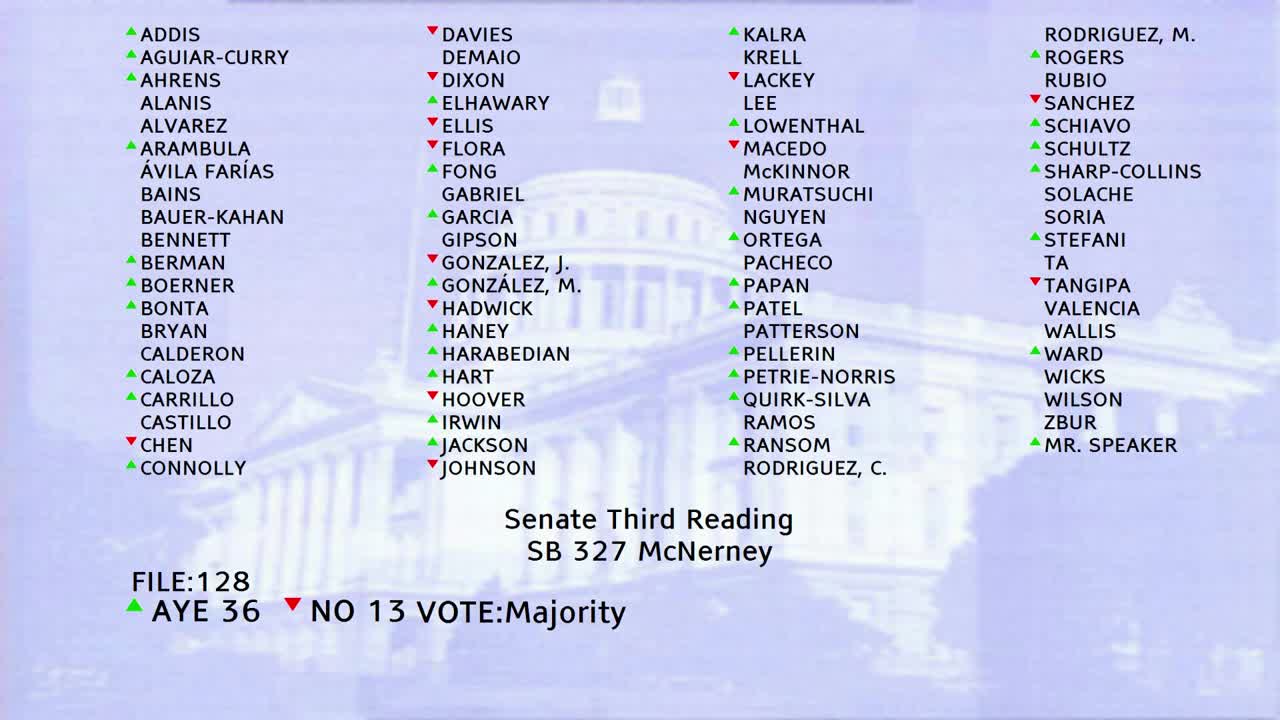 1MIN
Assembly Floor
 3MIN
Senate Floor
 10MIN
Senate Standing Committee on Revenue and Taxation
 7MIN
Senate Standing Committee on Judiciary
 2MIN
Senate Standing Committee on Labor, Public Employment and Retirement
 4MIN
Assembly Floor
 5MIN
Assembly Standing Committee on Judiciary
Bill Author

Bill Co-Author(s):