AB 678: Interagency Council on Homelessness.
- Session Year: 2025-2026
- House: Assembly
- Latest Version Date: 2025-10-10
Current Status:
Passed
(2025-10-10: Chaptered by Secretary of State - Chapter 495, Statutes of 2025.)
Introduced
In Committee
Awaiting First Chamber Vote
Passed First Chamber
In Committee
Awaiting Second Chamber Vote
Passed Second Chamber
Enacted
Existing law requires the Governor to create an Interagency Council on Homelessness, consisting of specified members. Among other goals, existing law requires the council to serve as a facilitator and create partnerships among federal, state, and local governments, nonprofit entities working to end homelessness, homeless services providers, and the private sector, for the purpose of arriving at specific strategies to end homelessness. Existing law also requires the council to make policy and procedural recommendations to legislators and other governmental entities.
This bill would require the council to coordinate with representatives from LGBTQ+ communities to identify recommended policies and best practices for providing inclusive and culturally competent services to LGBTQ+ people experiencing homelessness and develop recommendations to, among other things, expand data collection to understand the needs and experiences of LGBTQ+ people in state homelessness programs, as defined. The bill would require the council, on or before July 1, 2027, to submit a report to specific committees of the Legislature on these recommendations.
Existing law requires the Governor to create an Interagency Council on Homelessness, consisting of specified members. Among other goals, existing law requires the council to serve as a facilitator and create partnerships among federal, state, and local governments, nonprofit entities working to end homelessness, homeless services providers, and the private sector, for the purpose of arriving at specific strategies to end homelessness. Existing law also requires the council to make policy and procedural recommendations to legislators and other governmental entities.
This bill would require the council to coordinate with representatives from LGBTQ+ communities to identify recommended policies and best practices for providing inclusive and culturally competent services to LGBTQ+ people experiencing homelessness and develop recommendations to, among other things, expand data collection to understand the needs and experiences of LGBTQ+ people in state homelessness programs, as defined. The bill would require the council, on or before January July 1, 2027, to submit a report to specific committees of the Legislature on these recommendations.
Existing law requires the Governor to create an Interagency Council on Homelessness, consisting of specified members. Among other goals, existing law requires the council to serve as a facilitator and create partnerships among federal, state, and local governments, nonprofit entities working to end homelessness, homeless services providers, and the private sector, for the purpose of arriving at specific strategies to end homelessness. Existing law also requires the council to make policy and procedural recommendations to legislators and other governmental entities.
This bill would require the council to coordinate with representatives from LGBTQ+ communities to identify recommended policies and best practices for providing inclusive and culturally competent services to LGBTQ+ people experiencing homelessness and develop recommendations to, among other things, expand data collection to understand the needs and experiences of LGBTQ+ people in state homelessness programs, as defined. The bill would require the council, on or before January 1, 2027, to submit a report to specific committees of the Legislature on these recommendations.
(a)The council shall coordinate with representatives from LGBTQ+ communities, including, but not limited to, housing providers, nonprofit organizations, advocates, and researchers, to do all of the following:
(1)Identify recommended policies and best practices for providing inclusive and culturally competent services to LGBTQ+ people experiencing homelessness.
(2)Develop recommendations to do all of the following:
(A)Provide education, training, and resources to improve culturally competent services for LGBTQ+ people in state homelessness programs.
(B)Expand data collection to understand the needs and experiences of LGBTQ+ people in state homelessness programs.
(C)Prevent discrimination, harassment, and violence against members of the LGBTQ+ community in state homelessness programs.
(b)For purposes of this section, state homelessness programs means those programs that are funded, in whole or in part, by the state with the express purpose of addressing or preventing homelessness or providing services to people experiencing homelessness.
(c)Notwithstanding Section 9795 of the Government Code, on or before July 1, 2027, the council shall submit a report on the recommendations required by subdivision (a) to the Assembly Committee on Housing and Community Development and the Senate Committee on Housing, or their successor committees.
(a)The council shall coordinate with representatives from LGBTQ+ communities, including, but not limited to, housing providers, nonprofit organizations, advocates, and researchers, to do all of the following:
(1)Identify recommended policies and best practices for providing inclusive and culturally competent services to LGBTQ+ people experiencing homelessness.
(2)Develop recommendations to do all of the following:
(A)Provide education, training, and resources to improve culturally competent services for LGBTQ+ people in state homelessness programs.
(B)Expand data collection to understand the needs and experiences of LGBTQ+ people in state homelessness programs.
(C)Prevent discrimination, harassment, and violence against members of the LGBTQ+ community in state homelessness programs.
(b)For purposes of this section, state homelessness programs means those programs that are funded, in whole or in part, by the state with the express purpose of addressing or preventing homelessness or providing services to people experiencing homelessness.
(c)Notwithstanding Section 9795 of the Government Code, on or before January July 1, 2027, the council shall submit a report on the recommendations required by subdivision (a) to the Assembly Committee on Housing and Community Development and the Senate Committee on Housing, or their successor committees.
(a)The council shall coordinate with representatives from LGBTQ+ communities, including, but not limited to, housing providers, nonprofit organizations, advocates, and researchers, to do all of the following:
(1)Identify recommended policies and best practices for providing inclusive and culturally competent services to LGBTQ+ people experiencing homelessness.
(2)Develop recommendations to do all of the following:
(A)Provide education, training, and resources to improve culturally competent services for LGBTQ+ people in state homelessness programs.
(B)Expand data collection to understand the needs and experiences of LGBTQ+ people in state homelessness programs.
(C)Prevent discrimination, harassment, and violence against members of the LGBTQ+ community in state homelessness programs.
(b)For purposes of this section, state homelessness programs means those programs that are funded, in whole or in part, by the state with the express purpose of addressing or preventing homelessness or providing services to people experiencing homelessness.
(c)Notwithstanding Section 9795 of the Government Code, on or before January 1, 2027, the council shall submit a report on the recommendations required by subdivision (a) to the Assembly Committee on Housing and Community Development and the Senate Committee on Housing, or their successor committees.
REVISIONS: HeadingLine 2.|
Date
|
Status
|
|---|---|
| Oct 10, 2025 | Chaptered by Secretary of State - Chapter 495, Statutes of 2025. |
| Oct 10, 2025 | Approved by the Governor. |
| Sep 23, 2025 | Enrolled and presented to the Governor at 4 p.m. |
| Sep 11, 2025 | Senate amendments concurred in. To Engrossing and Enrolling. (Ayes 67. Noes 0. Page 3298.). |
| Sep 10, 2025 | In Assembly. Concurrence in Senate amendments pending. |
| Sep 10, 2025 | Read third time. Passed. Ordered to the Assembly. (Ayes 40. Noes 0. Page 2833.). |
| Sep 8, 2025 | Read second time. Ordered to third reading. |
| Sep 4, 2025 | Read third time and amended. Ordered to second reading. |
| Aug 29, 2025 | Read second time. Ordered to third reading. |
| Aug 29, 2025 | From committee: Do pass. (Ayes 7. Noes 0.) (August 29). |
| Aug 18, 2025 | In committee: Referred to suspense file. |
| Jul 16, 2025 | From committee: Do pass and re-refer to Com. on APPR. (Ayes 10. Noes 0.) (July 15). Re-referred to Com. on APPR. |
| Jul 1, 2025 | From committee: Do pass and re-refer to Com. on HOUSING. (Ayes 5. Noes 0.) (June 30). Re-referred to Com. on HOUSING. |
| Jun 11, 2025 | Referred to Coms. on HUMAN S. and HOUSING. |
| Jun 3, 2025 | In Senate. Read first time. To Com. on RLS. for assignment. |
| Jun 2, 2025 | Read third time. Passed. Ordered to the Senate. (Ayes 67. Noes 0. Page 1844.) |
| May 27, 2025 | Read second time. Ordered to third reading. |
| May 23, 2025 | From committee: Do pass. (Ayes 11. Noes 0.) (May 23). |
| May 7, 2025 | In committee: Set, first hearing. Referred to APPR. suspense file. |
| Apr 28, 2025 | From committee: Do pass and re-refer to Com. on APPR. (Ayes 10. Noes 0.) (April 24). Re-referred to Com. on APPR. |
| Apr 28, 2025 | Coauthors revised. |
| Mar 3, 2025 | Referred to Com. on H. & C.D. |
| Feb 15, 2025 | From printer. May be heard in committee March 17. |
| Feb 14, 2025 | Read first time. To print. |
|
Date
|
Description
|
Location
|
Votes
|
|
|---|---|---|---|---|
| Sep 11, 2025 | AB 678 Lee Concurrence in Senate Amendments | Assembly Floor |
Passed |
|
| Sep 10, 2025 | Assembly 3rd Reading AB678 Lee et al. By Arreguín | Senate Floor |
Passed |
|
| Aug 29, 2025 | Do pass | Senate Standing Committee on Appropriations |
Passed |
|
| Aug 18, 2025 | Placed on suspense file | Senate Standing Committee on Appropriations |
Passed |
|
| Jul 15, 2025 | Do pass, but first be re-referred to the Committee on [Appropriations] | Senate Standing Committee on Housing |
Passed |
|
| Jun 30, 2025 | Do pass, but first be re-referred to the Committee on [Housing] | Senate Standing Committee on Human Services |
Passed |
|
| Jun 2, 2025 | AB 678 Lee Assembly Third Reading | Assembly Floor |
Passed |
|
| May 23, 2025 | Do pass. | Assembly Standing Committee on Appropriations |
Passed |
|
| Apr 24, 2025 | Do pass and be re-referred to the Committee on [Appropriations] | Assembly Standing Committee on Housing and Community Development |
Passed |
This list shows positions taken on this bill by organizations on the date displayed, which is linked to the original source.
Positions by individuals are not included.
|
Organization
|
Position
|
Date
|
|---|---|---|
| Aclu California Action | ** Support | |
| Aids Healthcare Foundation | ** Support | |
| Alliance for Children's Rights | ** Support | |
| Alliance for Transyouth Liberation | ** Support | |
| Asian Americans Advancing Justice Southern California | ** Support | |
| Black Leadership Council | ** Support | |
| California Coalition For Youth | ** Support | |
| California Legislative LGBTQ Caucus | ** Support | |
| California LGBTQ Health and Human Services Network | ** Support | |
| California Teachers Association | ** Support | |
| Central Coast Coalition for Inclusive Schools | ** Support | |
| Children'S Hospital Los Angeles | ** Support | |
| Courage California | ** Support | |
| Disability Rights California | ** Support | |
| East Bay Community Law Center | ** Support | |
| El/La Para TransLatinas | ** Support | |
| Equality California | ** Support | |
| Hmong Innovating Politics | ** Support | |
| Housing California | ** Support | |
| Inmind Care | ** Support | |
| LGBTQ+ Inclusivity, Visibility, and Empowerment | ** Support | |
| Los Angeles LGBT Center | ** Support | |
| National Alliance to End Homelessness | ** Support | |
| PFLAG Clayton-Concord | ** Support | |
| PFLAG Los Angeles | ** Support | |
| PFLAG Oakland-East Bay | ** Support | |
| PFLAG Sacramento | ** Support | |
| Public Counsel - TAY | ** Support | |
| Rainbow Families Action Bay Area | ** Support | |
| Sacramento LGBT Community Center | ** Support | |
| Sage | ** Support | |
| San Francisco Aids Foundation | ** Support | |
| Santa Clara County Office Of Education | ** Support | |
| The Fresno Collective for Inclusive Medicine INC. | ** Support | |
| the san diego lgbt community center | ** Support | |
| The Source Lgbt+ Center | ** Support | |
| The Translatin@ Coalition | ** Support | |
| Viet Rainbow of Orange County | ** Support | |
| Youth Leadership Institute | ** Support |
CONCURRENCE IN SENATE AMENDMENTS
CSA1 Bill Id:AB 678
Author:(Lee)
As Amended Ver:September 4, 2025
Majority vote
SUMMARY
Requires California Interagency Council on Homelessness (CA-ICH) to identify policies and best practices for culturally competent services for LGBTQ+ people experiencing homelessness.
Major Provisions
- Requires CA-ICH to coordinate with representatives from LGBTQ+ communities, including, but not limited to, housing providers, nonprofit organizations, advocates, and researchers, to do all of the following:
- Identify and recommended policies and best practices for providing inclusive and culturally competent services to LGBTQ+ people experiencing homelessness; and
- Develop recommendations to do all of the following:
- Provide education, training, and resources to improve culturally competent services for LGBTQ+ people in state homelessness programs;
- Expand data collection to understand the needs and experiences of LGBTQ+ people in state homelessness programs; and
- Prevent discrimination, harassment, and violence against members of the LGBTQ+ community in state homelessness programs.
- Defines "state homelessness programs" to mean those programs that are funded, in whole or in part, by the state with the express purpose of addressing or preventing homelessness or providing services to people experiencing homelessness.
- Requires CA-ICH, on or before July 1, 2027, to submit a report on the recommendations to the Assembly Committee on Housing and Community Development and the Senate Committee on Housing, or their successor committees.
Senate Amendments
Move the date that CA-ICH must submit the required report from January 1, 2027 to July 1, 2027.
COMMENTS
CA-ICH: In 2016, SB 1380 (Mitchell), Chapter 847, created the Homelessness Coordinating and Financing Council which was renamed the California Interagency Council on Homelessness (CA-ICH) in 2021 (AB 1220 (L. Rivas), Chapter 398) to coordinate the state's response to homelessness. CA-ICH was created to oversee the implementation of "Housing First" policies, guidelines, and regulations to reduce the prevalence and duration of homelessness in California. Housing First is an evidence-based model that focuses on the idea that homeless individuals should be provided shelter and stability before underlying issues can be successfully addressed. Housing First utilizes a tenant screening process that promotes accepting applicants regardless of their sobriety, use of substances or participation in services. CA-ICH also manages the state's Homelessness Information Data System (HDIS) which captures local data collected by Continuums of Care (COCs) through Homelessness Management Information Systems (HMIS) to help coordinate the state's response to homelessness. All 44 CoCs in the state have entered into contracts to provide their HMIS data to CA-ICH. HDIS is intended to give the state a more accurate picture of the local homelessness response system and inform the state's response to homelessness. AB 977 (Gabriel), Chapter 397, Statues of 2021 required grantees of state homelessness programs to enter data to the local HMIS system to help coordinate the state's response to homelessness. The ultimate goal of HDIS is to match data on homelessness to programs impacting homeless recipients of state programs, such as the Medi-Cal program and CalWORKs. CA-ICH is required to set goals to prevent and end homelessness among youth, including integrating and coordinating efforts to prevent homelessness among youth in the child welfare system and juvenile justice system.
CA-ICH also developed a five year Action Plan For Preventing and Ending Homelessness in 2020 and just updated the plan for 2025-2027. Currently, according to HDIS data, for every five individuals who access homelessness services in California, only one is able to access permanent housing that year, leaving a gap of four people who continue to experience homelessness. Over the course of this Plan, calendar years 2025 through 2027, CA-ICH aims to reduce that gap in half, so that for every five people served, three people are placed in housing during the year. The Action Plan sets out goals intended to measure progress toward our north star of providing housing and services to everyone experiencing homelessness. The goals include:
- Increase the annual percentage of people who move into emergency shelter, transitional housing, or permanent housing after experiencing unsheltered homelessness, from 42% to at least 70%.
- Increase the annual percentage of people existing homelessness into permanent housing from 18% to at least 60%.
- Ensure that at least 95% of people who move into permanent housing do not experience homelessness within six months.
- Increase access to publicly-funded health and social safety net services for people at-risk of homelessness in order to address health and economic vulnerabilities.
- Permit more than 1.5 million homes, with no less than 710,000 of those meeting the needs of low- and very low-income households.
Funding for Homeless Youth: Since 2018, the budget has included funding for the Homeless Housing, Assistance and Prevention Program (HHAP) to assist big cities (with a population over 300,000), counties, and CoCs to assist the local response system. Ten percent of funds from HHAP goes to addressing youth homelessness. Between 2018-2022, $276 million went to supporting local efforts to reduce youth homelessness. Based on the Point-in-Time (PIT) count Homelessness among unaccompanied and parenting youth went down 21% from 2020-2022, while overall homelessness rose by 6%. In 2022, unaccompanied and parenting homeless youth comprised 6% of the total homeless population in California, the lowest percentage since the U.S. Department of Housing and Urban Development started to measure youth homelessness in 2015. California's decrease in youth homelessness is 2.6 times greater than the reduction in all other states.
The 2024 California Point-in-Time (PIT) count does not provide a specific number for LGBTQ+ individuals experiencing homelessness. However, LGBTQ+ identifying people and particularly LGBTQ+ youth, are disproportionately affected by homelessness. Estimates suggest that up to 40% of homeless youth identify as LGBTQ+, compared to only 10% of the overall youth population. LGBTQ+ youth may be rejected or expelled from their homes due to their sexual orientation or gender identity. A significant percentage of homeless LGBTQ+ youth report being forced to leave their homes due to mistreatment or fear of mistreatment based on their identity.
This bill would require CA-ICH to develop policies and best practices inclusive and culturally competent services to LGBTQ+ people experiencing homelessness.
According to the Author
"LGBTQ+ Californians experience homelessness and housing insecurity at disproportionally high rates. LGBTQ+ youth are 120% more likely to experience homelessness than their peers, 48% of older same-sex couples faced discrimination when seeking housing, and nearly one in three transgender people report experiencing homelessness at some point in their lives. Due to bias and systemic barriers in housing and shelter programs, maintaining safe, stable, and affordable housing remains a challenge, This problem is compounded by the rise of anti-LGBTQ+ rhetoric, legislation, and violence both in California and across the country, disproportionately impacting transgender and non-binary individuals. AB 678 will require the California Interagency Council on Homelessness to work with LGBTQ+ advocates and service providers to identify and recommend best practices and policies to local agencies administering homelessness programs."
Arguments in Support
According to Housing California, "by ensuring California's homelessness services are inclusive and affirming, we can improve housing outcomes for LGBTQ+ Californians, help connect people to stable housing, and reduce the risk of LGBTQ+ residents returning to homelessness. This bill strengthens the state's broader efforts to reduce homelessness while ensuring all Californians, regardless of sexual orientation or gender identity, have equitable access to safe and supportive housing."
Arguments in Opposition
None on file.
FISCAL COMMENTS
According to the Assembly Committee on Appropriations, Cal ICH anticipates one-time costs of an unknown amount, but likely over $150,000, to conduct stakeholder engagement and coordinate with members of the LGBTQ+ community experiencing homelessness to develop and provide meaningful recommendations. Regardless of the cost, and in keeping with this committee's custom and practice, any bill that has the primary purpose of creating a "workgroup" will move to the suspense file.
VOTES:
ASM HOUSING AND COMMUNITY DEVELOPMENT: 10-0-2
YES: Haney, Patterson, Ávila Farías, Caloza, Garcia, Kalra, Lee, Quirk-Silva, Wicks, Wilson
ABS, ABST OR NV: Ta, Tangipa
ASM APPROPRIATIONS: 11-0-4
YES: Wicks, Arambula, Calderon, Caloza, Elhawary, Fong, Mark González, Hart, Pacheco, Pellerin, Solache
ABS, ABST OR NV: Sanchez, Dixon, Ta, Tangipa
ASSEMBLY FLOOR: 67-0-12
YES: Addis, Aguiar-Curry, Ahrens, Alanis, Alvarez, Arambula, Ávila Farías, Bains, Bauer‑Kahan, Bennett, Berman, Boerner, Bonta, Bryan, Calderon, Caloza, Carrillo, Connolly, Davies, DeMaio, Elhawary, Flora, Fong, Gabriel, Garcia, Gipson, Mark González, Haney, Harabedian, Hart, Hoover, Irwin, Jackson, Kalra, Krell, Lee, Lowenthal, McKinnor, Muratsuchi, Nguyen, Ortega, Pacheco, Papan, Patel, Patterson, Pellerin, Petrie-Norris, Quirk-Silva, Ramos, Ransom, Celeste Rodriguez, Michelle Rodriguez, Rogers, Blanca Rubio, Schiavo, Schultz, Sharp-Collins, Solache, Soria, Stefani, Valencia, Wallis, Ward, Wicks, Wilson, Zbur, Rivas
ABS, ABST OR NV: Castillo, Chen, Dixon, Ellis, Gallagher, Jeff Gonzalez, Hadwick, Lackey, Macedo, Sanchez, Ta, Tangipa
UPDATED
VERSION: September 4, 2025
CONSULTANT: Lisa Engel / H. & C.D. / (916) 319-2085 FN: 0002008
SENATE RULES COMMITTEE Office of Senate Floor Analyses (916) 651-1520 Fax: (916) 327-4478 | AB 678 |
THIRD READING
Bill No: AB 678
Author: Lee (D), et al.
Amended: 9/3/25
Vote: 21
SENATE HUMAN SERVICES COMMITTEE: 5-0, 6/30/25
AYES: Arreguín, Ochoa Bogh, Becker, Limón, Pérez
SENATE HOUSING COMMITTEE: 10-0, 7/15/25
AYES: Wahab, Seyarto, Arreguín, Caballero, Cortese, Durazo, Gonzalez, Grayson, Ochoa Bogh, Padilla
NO VOTE RECORDED: Cabaldon
SENATE APPROPRIATIONS COMMITTEE: 7-0, 8/29/25
AYES: Caballero, Seyarto, Cabaldon, Dahle, Grayson, Richardson, Wahab
ASSEMBLY FLOOR: 67-0, 6/2/25 - See last page for vote
SUBJECT: Interagency Council on Homelessness
SOURCE: Author
DIGEST:
This bill requires the California Interagency Council on Homelessness (Cal-ICH) to coordinate with representatives of LGBTQ+ groups to identify best practices and develop recommendations to serve LGBTQ+ people experiencing homelessness, as specified. The bill also requires Cal-ICH to submit a report on those recommendations.
Senate Floor Amendments of 9/3/25 change the data the Interagency Council on Homelessness must submit a report, as required by this bill, to the Legislature from January 1, 2027 to July 1, 2027.
ANALYSIS:
Existing law:
- Creates Cal-ICH and requires it to set and measure progress towards goals to prevent and end homelessness in California. (Welfare and Institutions Code (WIC) § 8255)
- Defines “state programs” as any programs a California state agency or department funds, implements, or administers for the purpose of providing emergency shelter, interim housing, housing, or housing-based services to people experiencing homelessness or at risk of homelessness, with the exception of federally funded programs with requirements inconsistent with state law. (WIC § 8255(e))
- Requires grantees and operators of certain state homelessness programs to enter required data into its local Homeless Management Information System as a condition of receiving state funds. (WIC § 8256(d))
- Requires CA-ICH to seek guidance from and meet with an advisory committee twice a year that includes the following:
- A survivor of gender-based violence who formerly experienced homelessness;
- Representatives of local agencies or organizations that participate in the United States Department of Housing and Urban Development’s Continuum of Care Program;
- Stakeholders with expertise in solutions to homelessness and best practices from other states;
- Representatives of committees of African Americans, youth, and survivors of gender-based violence;
- A current or formerly homeless person who lives in California; and
- A current of formerly homeless youth who lives in California. (WIC § 8257)
- Requires Cal-ICH to set and measure progress towards goals to prevent and end homelessness among youth in California by:
- Setting specific, measurable goals aimed at preventing and ending homelessness among youth in the state.
- Defining outcome measures and gathering data related to the goals. (WIC § 8261)
- Requires Cal-ICH to set and measure progress toward goals to prevent and end homelessness among domestic violence survivors, their children, and unaccompanied women. Requires those goals to include measurably decreasing the number of homeless domestic violence survivors and their children, decreasing the duration of homelessness experienced by domestic abuse survivors and their children, decreasing barriers to services by increasing cross sector partnerships to expedite access to services including social services, domestic violence services, regional center services, housing services, and mental health services. (WIC § 8266(a))
This bill:
- Requires Cal-ICH to coordinate with representatives from LGBTQ+ communities, including, but not limited to, housing providers, nonprofit organizations, advocates, and researchers to:
- Identify and recommended policies and best practices for providing inclusive and culturally competent services to LGBTQ+ people experiencing homelessness.
- Develop recommendations to:
- Provide education, training, and resources to improve culturally competent services for LGBTQ+ people in state homelessness programs.
- Expand data collection to understand the needs and experiences of LGBTQ+ people in state homelessness programs.
- Prevent discrimination, harassment, and violence against members of the LGBTQ+ community in state homelessness programs.
- Defines “state homelessness programs” to mean programs that are funded, in whole or in part, by the state with the express purpose of addressing or preventing homelessness or providing services to people experiencing homelessness.
- Requires Cal-ICH to submit a report on the recommendations required by this bill to the Assembly Committee on Housing and Community Development and the Senate Committee on Housing, on or before July 1, 2027.
Comments
According to the author, “LGBTQ+ Californians experience homelessness and housing insecurity at disproportionally high rates. LGBTQ+ youth are 120% more likely to experience homelessness than their peers, 48% of older same-sex couples faced discrimination when seeking housing, and nearly 1 in 3 transgender people report experiencing homelessness at some point in their lives. Due to bias and systemic barriers in housing and shelter programs, maintaining safe, stable, and affordable housing remains a challenge, This problem is compounded by the rise of anti-LGBTQ+ rhetoric, legislation, and violence both in California and across the country, disproportionately impacting transgender and non-binary individuals. AB 678 will require the California Interagency Council on Homelessness to work with LGBTQ+ advocates and service providers to identify and recommend best practices and policies to local agencies administering homelessness programs.”
California Interagency Council on Homelessness (Cal-ICH). Cal-ICH was created in 2021 by AB 1220 (Rivas, Chapter 398) as a successor to the Homeless Coordinating and Financing Council to address the coordination and oversight of homelessness programs. The bill also made changes to the membership of the Cal-ICH and provided the Cal-ICH with additional authority to access information from other departments. To ensure the Cal-ICH has access to information about homelessness programs throughout state agencies, the Cal-ICH is allowed to require state departments that have homelessness programs to participate in Cal-ICH workgroups or other collaborative work. They can also require those departments or agencies to provide the Cal-ICH data on those programs. Unlike the Housing Coordinating and Financing Council, the Cal-ICH also requires department directors, agency secretaries, and executive directors to participate on the council rather than their representatives.
In addition to improving coordination between agencies, the Cal-ICH is also charged with coordinating existing and competitive funding for homelessness initiatives, find new funding initiatives, make policy recommendations, broker agreements between state agencies, increase accountability, create reports for the Governor and Legislature, and create a statewide database for local homelessness data.
Cal-ICH published a three-year Action Plan for Preventing and Ending Homeless in California in December 2024 to fulfill its mandate to meet statutorily defined goals. The Action Plan outlines five action plan goals that will guide Cal-ICH’s funding and strategic efforts. Those goals are: (1) help more people leave unsheltered homelessness; (2) help more people move into housing; (3) ensure people do not experience homelessness again; (4) prevent more people from experiencing homelessness, (5) create more housing.
Each goal comes with more specific goals and targets, such as increasing access to publicly-funded health and social safety net services for people at-risk of homelessness and permitting 1.5 million new homes. The Action Plan also highlights that the Homeless Data Integration System has gaps in its data gathering, because of limited information sources. The plan identifies one of those limitations as information about intersectionality. For example, the impact of current services on populations that identify and LGBTQ+ but also live with a disability. According to Cal-ICH, improved data gathering is an important part of its mission for the following reasons:
- Informed Decision-Making: Accurate data enables policymakers to identify the scale and demographics of homelessness, ensuring targeted and efficient allocation of resources.
- Tracking Progress: Data helps monitor the impact of programs and strategies, allowing for adjustments and improvements based on evidence.
- Tailored Interventions: Subpopulation-specific data (e.g., on youth, veterans, or families) helps design programs that address the unique needs of different groups.
- Collaboration and Coordination: Data facilitates collaboration by creating a shared understanding of the issue.[1]
AB 678 requires Cal-ICH to collaborate with subject matter experts on the various challenges facing LGBTQ+ people who are facing or experiencing homelessness to, among other things, expand data collection to understand the needs and experiences of LGBTQ+ people in state homelessness programs. The bill also requires Cal-ICH to identify policies and best practices to provide inclusive and culturally competent services to LGBTQ+ people experiencing homelessness.
LGBTQ+ Community and Homelessness. According to the National Coalition for the Homeless, “LGBTQ individuals, especially youth, are highly overrepresented in the homeless population”. The LGBTQ+ community faces unique challenges when navigating and trying to exit homelessness. Some of those challenges include feeling unsafe in shelters, being harassed, and in the case of transgender individuals, being turned away from shelters based on their gender identity. The challenges faced by LGBTQ+ youth are even more pronounced. LGBTQ+ youth are 120% more likely to experience homelessness than their non-LGBTQ+ peers, and nearly one in three transgender adults have experienced homelessness at some point in their lives. Twenty-six percent of homeless LGBTQ+ youth report being forced out of their homes solely because of their sexual orientation or gender identity. LGBTQ+ homeless youth attempt suicide at much higher rates (62%) than heterosexual homeless youth (29%).[2] According to the Trevor Project, “Better data is needed to understand the full scope and impact of LGBTQ youth homelessness in the United States. Questions about both LGBTQ identity and housing status should be added to population surveys of youth and young adults.” This bill requires Cal-ICH to work with the LGBTQ+ community to develop recommendations to collect better data and decrease discrimination against the LGBTQ+ community.
Related/Prior Legislation
SB 914 (Rubio, Chapter 665, Statutes of 2022) created Homeless Equity for Left Behind Populations or HELP Act, which required cities, counties, and continuums of care receiving state funding to include within the vulnerable populations that receive homeless services and housing delivery: families, people fleeing or attempting to flee domestic violence, and unaccompanied women. The bill also required Cal-ICH to establish initial goals to prevent and end homelessness among domestic violence survivors, their children and unaccompanied women, by January 1, 2025, and update these goals as needed every two years thereafter.
AB 1220 (Rivas, L., Chapter 398, Statutes of 2021) renames the Housing Coordinating and Financing Council to Cal-ICH, and makes changes to the membership of the Council, as provided.
AB SB 1380 (Mitchell, Chapter 847, Statutes of 2016) created the Housing Coordinating and Financing Council to coordinate the state’s homeless response in order to implement Housing First policies throughout the state, as provided.
FISCAL EFFECT: Appropriation: No Fiscal Com.: Yes Local: No
According to the Senate Appropriations Committee, the California Interagency Council on Homelessness estimates that in order to coordinate with members of the LGBTQ+ community and develop recommendations, it would require $1.5 million (General Fund) in one-time contractor costs to conduct extensive community engagement, contract with facilitators, travel reimbursement, participant stipends, translation services, and project management support, for meaningful, statewide engagement.
SUPPORT: (Verified 9/3/25)
ACLU California Action
Aids Healthcare Foundation
Alliance for Children's Rights
Alliance for Transyouth Liberation
Asian Americans Advancing Justice-southern California
California Coalition for Youth
California Legislative Lgbtq Caucus
California Lgbtq Health and Human Services Network
California Teachers Association
Central Coast Coalition for Inclusive Schools
Children's Hospital Los Angeles
Courage California
Disability Rights California
East Bay Community Law Center
El/la Para Translatinas
Equality California
Hmong Innovating Politics
Housing California
Lgbtq+ Inclusivity, Visibility, and Empowerment
Los Angeles Lgbt Center
Pflag Clayton-concord
Pflag Los Angeles
Pflag Oakland-east Bay
Pflag Sacramento
Public Counsel - Tay
Rainbow Families Action Bay Area
Sacramento Lgbt Community Center
San Francisco Aids Foundation
The Fresno Collective for Inclusive Medicine INC.
The San Diego Lgbt Community Center
The Source Lgbt+ Center
The Translatin@ Coalition
Viet Rainbow of Orange County
Youth Leadership Institute
OPPOSITION: (Verified 9/3/25)
None received
ASSEMBLY FLOOR: 67-0, 6/2/25
AYES: Addis, Aguiar-Curry, Ahrens, Alanis, Alvarez, Arambula, Ávila Farías, Bains, Bauer-Kahan, Bennett, Berman, Boerner, Bonta, Bryan, Calderon, Caloza, Carrillo, Connolly, Davies, DeMaio, Elhawary, Flora, Fong, Gabriel, Garcia, Gipson, Mark González, Haney, Harabedian, Hart, Hoover, Irwin, Jackson, Kalra, Krell, Lee, Lowenthal, McKinnor, Muratsuchi, Nguyen, Ortega, Pacheco, Papan, Patel, Patterson, Pellerin, Petrie-Norris, Quirk-Silva, Ramos, Ransom, Celeste Rodriguez, Michelle Rodriguez, Rogers, Blanca Rubio, Schiavo, Schultz, Sharp-Collins, Solache, Soria, Stefani, Valencia, Wallis, Ward, Wicks, Wilson, Zbur, Rivas
NO VOTE RECORDED: Castillo, Chen, Dixon, Ellis, Gallagher, Jeff Gonzalez, Hadwick, Lackey, Macedo, Sanchez, Ta, Tangipa
Prepared by: Naima Ford Antal / HUMAN S. / (916) 651-1524
9/8/25 21:18:49
**** END ****
SENATE RULES COMMITTEE Office of Senate Floor Analyses (916) 651-1520 Fax: (916) 327-4478 | AB 678 |
THIRD READING
Bill No: AB 678
Author: Lee (D), et al.
Introduced: 2/14/25
Vote: 21
SENATE HUMAN SERVICES COMMITTEE: 5-0, 6/30/25
AYES: Arreguín, Ochoa Bogh, Becker, Limón, Pérez
SENATE HOUSING COMMITTEE: 10-0, 7/15/25
AYES: Wahab, Seyarto, Arreguín, Caballero, Cortese, Durazo, Gonzalez, Grayson, Ochoa Bogh, Padilla
NO VOTE RECORDED: Cabaldon
SENATE APPROPRIATIONS COMMITTEE: 7-0, 8/29/25
AYES: Caballero, Seyarto, Cabaldon, Dahle, Grayson, Richardson, Wahab
ASSEMBLY FLOOR: 67-0, 6/2/25 - See last page for vote
SUBJECT: Interagency Council on Homelessness
SOURCE: Author
DIGEST:
This bill requires the California Interagency Council on Homelessness (Cal-ICH) to coordinate with representatives of LGBTQ+ groups to identify best practices and develop recommendations to serve LGBTQ+ people experiencing homelessness, as specified. The bill also requires Cal-ICH to submit a report on those recommendations.
ANALYSIS:
Existing Law:
- Creates Cal-ICH and requires it to set and measure progress towards goals to prevent and end homelessness in California. (Welfare and Institutions Code (WIC) § 8255)
- Defines “state programs” as any programs a California state agency or department funds, implements, or administers for the purpose of providing emergency shelter, interim housing, housing, or housing-based services to people experiencing homelessness or at risk of homelessness, with the exception of federally funded programs with requirements inconsistent with state law. (WIC § 8255(e))
- Requires grantees and operators of certain state homelessness programs to enter required data into its local Homeless Management Information System as a condition of receiving state funds. (WIC § 8256(d))
- Requires CA-ICH to seek guidance from and meet with an advisory committee twice a year that includes the following:
- A survivor of gender-based violence who formerly experienced homelessness;
- Representatives of local agencies or organizations that participate in the United States Department of Housing and Urban Development’s Continuum of Care Program;
- Stakeholders with expertise in solutions to homelessness and best practices from other states;
- Representatives of committees of African Americans, youth, and survivors of gender-based violence;
- A current or formerly homeless person who lives in California; and
- A current of formerly homeless youth who lives in California. (WIC § 8257)
- Requires Cal-ICH to set and measure progress towards goals to prevent and end homelessness among youth in California by:
- Setting specific, measurable goals aimed at preventing and ending homelessness among youth in the state.
- Defining outcome measures and gathering data related to the goals. (WIC § 8261)
- Requires Cal-ICH to set and measure progress toward goals to prevent and end homelessness among domestic violence survivors, their children, and unaccompanied women. Requires those goals to include measurably decreasing the number of homeless domestic violence survivors and their children, decreasing the duration of homelessness experienced by domestic abuse survivors and their children, decreasing barriers to services by increasing cross sector partnerships to expedite access to services including social services, domestic violence services, regional center services, housing services, and mental health services. (WIC § 8266(a))
This Bill:
- Requires Cal-ICH to coordinate with representatives from LGBTQ+ communities, including, but not limited to, housing providers, nonprofit organizations, advocates, and researchers to:
- Identify and recommended policies and best practices for providing inclusive and culturally competent services to LGBTQ+ people experiencing homelessness.
- Develop recommendations to:
- Provide education, training, and resources to improve culturally competent services for LGBTQ+ people in state homelessness programs.
- Expand data collection to understand the needs and experiences of LGBTQ+ people in state homelessness programs.
- Prevent discrimination, harassment, and violence against members of the LGBTQ+ community in state homelessness programs.
- Defines “state homelessness programs” to mean programs that are funded, in whole or in part, by the state with the express purpose of addressing or preventing homelessness or providing services to people experiencing homelessness.
- Requires Cal-ICH to submit a report on the recommendations required by this bill to the Assembly Committee on Housing and Community Development and the Senate Committee on Housing, on or before January 1, 2027.
Comments
According to the author, “LGBTQ+ Californians experience homelessness and housing insecurity at disproportionally high rates. LGBTQ+ youth are 120% more likely to experience homelessness than their peers, 48% of older same-sex couples faced discrimination when seeking housing, and nearly 1 in 3 transgender people report experiencing homelessness at some point in their lives. Due to bias and systemic barriers in housing and shelter programs, maintaining safe, stable, and affordable housing remains a challenge, This problem is compounded by the rise of anti-LGBTQ+ rhetoric, legislation, and violence both in California and across the country, disproportionately impacting transgender and non-binary individuals. AB 678 will require the California Interagency Council on Homelessness to work with LGBTQ+ advocates and service providers to identify and recommend best practices and policies to local agencies administering homelessness programs.”
California Interagency Council on Homelessness (Cal-ICH). Cal-ICH was created in 2021 by AB 1220 (Rivas, Chapter 398) as a successor to the Homeless Coordinating and Financing Council to address the coordination and oversight of homelessness programs. The bill also made changes to the membership of the Cal-ICH and provided the Cal-ICH with additional authority to access information from other departments. To ensure the Cal-ICH has access to information about homelessness programs throughout state agencies, the Cal-ICH is allowed to require state departments that have homelessness programs to participate in Cal-ICH workgroups or other collaborative work. They can also require those departments or agencies to provide the Cal-ICH data on those programs. Unlike the Housing Coordinating and Financing Council, the Cal-ICH also requires department directors, agency secretaries, and executive directors to participate on the council rather than their representatives.
In addition to improving coordination between agencies, the Cal-ICH is also charged with coordinating existing and competitive funding for homelessness initiatives, find new funding initiatives, make policy recommendations, broker agreements between state agencies, increase accountability, create reports for the Governor and Legislature, and create a statewide database for local homelessness data.
Cal-ICH published a three-year Action Plan for Preventing and Ending Homeless in California in December 2024 to fulfill its mandate to meet statutorily defined goals. The Action Plan outlines five action plan goals that will guide Cal-ICH’s funding and strategic efforts. Those goals are: (1) help more people leave unsheltered homelessness; (2) help more people move into housing; (3) ensure people do not experience homelessness again; (4) prevent more people from experiencing homelessness, (5) create more housing.
Each goal comes with more specific goals and targets, such as increasing access to publicly-funded health and social safety net services for people at-risk of homelessness and permitting 1.5 million new homes. The Action Plan also highlights that the Homeless Data Integration System has gaps in its data gathering, because of limited information sources. The plan identifies one of those limitations as information about intersectionality. For example, the impact of current services on populations that identify and LGBTQ+ but also live with a disability. According to Cal-ICH, improved data gathering is an important part of its mission for the following reasons:
- Informed Decision-Making: Accurate data enables policymakers to identify the scale and demographics of homelessness, ensuring targeted and efficient allocation of resources.
- Tracking Progress: Data helps monitor the impact of programs and strategies, allowing for adjustments and improvements based on evidence.
- Tailored Interventions: Subpopulation-specific data (e.g., on youth, veterans, or families) helps design programs that address the unique needs of different groups.
- Collaboration and Coordination: Data facilitates collaboration by creating a shared understanding of the issue.[1]
AB 678 requires Cal-ICH to collaborate with subject matter experts on the various challenges facing LGBTQ+ people who are facing or experiencing homelessness to, among other things, expand data collection to understand the needs and experiences of LGBTQ+ people in state homelessness programs. The bill also requires Cal-ICH to identify policies and best practices to provide inclusive and culturally competent services to LGBTQ+ people experiencing homelessness.
LGBTQ+ Community and Homelessness. According to the National Coalition for the Homeless, “LGBTQ individuals, especially youth, are highly overrepresented in the homeless population”. The LGBTQ+ community faces unique challenges when navigating and trying to exit homelessness. Some of those challenges include feeling unsafe in shelters, being harassed, and in the case of transgender individuals, being turned away from shelters based on their gender identity. The challenges faced by LGBTQ+ youth are even more pronounced. LGBTQ+ youth are 120% more likely to experience homelessness than their non-LGBTQ+ peers, and nearly one in three transgender adults have experienced homelessness at some point in their lives. Twenty-six percent of homeless LGBTQ+ youth report being forced out of their homes solely because of their sexual orientation or gender identity. LGBTQ+ homeless youth attempt suicide at much higher rates (62%) than heterosexual homeless youth (29%).[2] According to the Trevor Project, “Better data is needed to understand the full scope and impact of LGBTQ youth homelessness in the United States. Questions about both LGBTQ identity and housing status should be added to population surveys of youth and young adults.” This bill requires Cal-ICH to work with the LGBTQ+ community to develop recommendations to collect better data and decrease discrimination against the LGBTQ+ community.
Related/Prior Legislation
SB 914 (Rubio, Chapter 665, Statutes of 2022) created Homeless Equity for Left Behind Populations or HELP Act, which required cities, counties, and continuums of care receiving state funding to include within the vulnerable populations that receive homeless services and housing delivery: families, people fleeing or attempting to flee domestic violence, and unaccompanied women. The bill also required Cal-ICH to establish initial goals to prevent and end homelessness among domestic violence survivors, their children and unaccompanied women, by January 1, 2025, and update these goals as needed every two years thereafter.
AB 1220 (Rivas, L., Chapter 398, Statutes of 2021) renames the Housing Coordinating and Financing Council to Cal-ICH, and makes changes to the membership of the Council, as provided.
AB SB 1380 (Mitchell, Chapter 847, Statutes of 2016) created the Housing Coordinating and Financing Council to coordinate the state’s homeless response in order to implement Housing First policies throughout the state, as provided.
FISCAL EFFECT: Appropriation: No Fiscal Com.: Yes Local: No
According to the Senate Appropriations Committee, the California Interagency Council on Homelessness estimates that in order to coordinate with members of the LGBTQ+ community and develop recommendations, it would require $1.5 million (General Fund) in one-time contractor costs to conduct extensive community engagement, contract with facilitators, travel reimbursement, participant stipends, translation services, and project management support, for meaningful, statewide engagement.
SUPPORT: (Verified 8/29/25)
ACLU California Action
Aids Healthcare Foundation
Alliance for Children's Rights
Alliance for Transyouth Liberation
Asian Americans Advancing Justice-southern California
California Coalition for Youth
California Legislative Lgbtq Caucus
California Lgbtq Health and Human Services Network
California Teachers Association
Central Coast Coalition for Inclusive Schools
Children's Hospital Los Angeles
Courage California
Disability Rights California
East Bay Community Law Center
El/la Para Translatinas
Equality California
Hmong Innovating Politics
Housing California
Lgbtq+ Inclusivity, Visibility, and Empowerment
Los Angeles Lgbt Center
Pflag Clayton-concord
Pflag Los Angeles
Pflag Oakland-east Bay
Pflag Sacramento
Public Counsel - Tay
Rainbow Families Action Bay Area
Sacramento Lgbt Community Center
San Francisco Aids Foundation
The Fresno Collective for Inclusive Medicine INC.
The San Diego Lgbt Community Center
The Source Lgbt+ Center
The Translatin@ Coalition
Viet Rainbow of Orange County
Youth Leadership Institute
OPPOSITION: (Verified 8/29/25)
None received
ASSEMBLY FLOOR: 67-0, 6/2/25
AYES: Addis, Aguiar-Curry, Ahrens, Alanis, Alvarez, Arambula, Ávila Farías, Bains, Bauer-Kahan, Bennett, Berman, Boerner, Bonta, Bryan, Calderon, Caloza, Carrillo, Connolly, Davies, DeMaio, Elhawary, Flora, Fong, Gabriel, Garcia, Gipson, Mark González, Haney, Harabedian, Hart, Hoover, Irwin, Jackson, Kalra, Krell, Lee, Lowenthal, McKinnor, Muratsuchi, Nguyen, Ortega, Pacheco, Papan, Patel, Patterson, Pellerin, Petrie-Norris, Quirk-Silva, Ramos, Ransom, Celeste Rodriguez, Michelle Rodriguez, Rogers, Blanca Rubio, Schiavo, Schultz, Sharp-Collins, Solache, Soria, Stefani, Valencia, Wallis, Ward, Wicks, Wilson, Zbur, Rivas
NO VOTE RECORDED: Castillo, Chen, Dixon, Ellis, Gallagher, Jeff Gonzalez, Hadwick, Lackey, Macedo, Sanchez, Ta, Tangipa
Prepared by: Naima Ford Antal / HUMAN S. / (916) 651-1524
8/29/25 20:47:10
**** END ****
SENATE COMMITTEE ON APPROPRIATIONS
Senator Anna Caballero, Chair
2025 - 2026 Regular Session
AB 678 (Lee) - Interagency Council on Homelessness
Version: February 14, 2025 | Policy Vote: HUMAN S. 5 - 0, HOUSING 10 - 0 |
Urgency: No | Mandate: No |
Hearing Date: August 18, 2025 | Consultant: Agnes Lee |
Bill Summary:
AB 678 would require the California Interagency Council on Homelessness to identify recommended policies and best practices for providing inclusive and culturally competent services to LGBTQ+ people experiencing homelessness.
Fiscal Impact:
The California Interagency Council on Homelessness estimates that in order to coordinate with members of the LGBTQ+ community and develop recommendations, it would require $1.5 million (General Fund) in one-time contractor costs to conduct extensive community engagement, contract with facilitators, travel reimbursement, participant stipends, translation services, and project management support, for meaningful, statewide engagement.
Background:
The California Interagency Council on Homelessness (Cal ICH) was established to coordinate the state's response to homelessness. Cal ICH was created to oversee the implementation of “Housing First” policies, guidelines, and regulations to reduce the prevalence and duration of homelessness in California. Housing First is an evidence-based model that focuses on the idea that homeless individuals should be provided shelter and stability before underlying issues can be successfully addressed. Housing First utilizes a tenant screening process that promotes accepting applicants regardless of their sobriety, use of substances or participation in services. Cal ICH also manages the state’s Homeless Data Integration System (HDIS) which captures local data collected by Continuums of Care (COCs) through Homelessness Management Information Systems (HMIS) to help coordinate the state’s response to homelessness.
Proposed Law:
Specific provisions of the bill would:
- Require Cal ICH to coordinate with representatives from LGBTQ+ communities, including, but not limited to, housing providers, nonprofit organizations, advocates, and researchers, to do all of the following:
- Identify recommended policies and best practices for providing inclusive and culturally competent services to LGBTQ+ people experiencing homelessness.
- Develop recommendations to do all of the following:
- Provide education, training, and resources to improve culturally competent services for LGBTQ+ people in state homelessness programs.
- Expand data collection to understand the needs and experiences of LGBTQ+ people in state homelessness programs.
- Prevent discrimination, harassment, and violence against members of the LGBTQ+ community in state homelessness programs.
- Require Cal ICH, on or before January 1, 2027, to submit a report on the recommendations required above, to the Assembly Committee on Housing and Community Development and the Senate Committee on Housing, or their successor committees.
-- END --
SENATE COMMITTEE ON HOUSING
Senator Aisha Wahab, Chair
2025 - 2026 Regular
Bill No: AB 678 Hearing Date: 7/15/25
Author: | Lee | ||
Version: | 2/14/2025 Introduced | ||
Urgency: | No | Fiscal: | Yes |
Consultant: | Erin Riches | ||
SUBJECT: Interagency Council on Homelessness
DIGEST: This bill requires the California Interagency Council on Homelessness (Cal-ICH) to coordinate with representatives from LGBTQ+ communities to identify recommended policies and best practices, and develop recommendations, to provide services, collect data, and prevent discrimination, harassment, and violence against members of the LGBTQ+ community in state homelessness programs.
ANALYSIS:
Existing law:
- Establishes the Homeless Housing, Assistance, and Prevention Program (HHAPP) under the state Department of Housing and Community Development (HCD) to provide jurisdictions with one-time grant funds to support regional coordination and expand or develop local capacity to address their immediate homelessness challenges informed by a best-practices framework focused on moving homeless individuals and families into permanent housing and supporting the efforts of those individuals and families to maintain their permanent housing.
- Establishes the Homeless Equity for Left Behind Populations (HELP) Act, which:
- Requires cities, counties, and Continuums of Care (CoCs) that receive state homeless funding to include families, people fleeing or attempting to flee domestic violence, and unaccompanied women, within the vulnerable populations for whom specific supports are developed to maintain homeless services and housing delivery. Also requires cities, counties, and CoCs to complete analyses and goals pursuant to specified guidelines, including working with victim service providers.
- Requires Cal-ICH to set and measure progress toward goals to prevent and end homelessness among domestic violence survivors and their children and among unaccompanied women, as specified.
- Establishes the Homeless Youth Act of 2018, which:
- Requires Cal-ICH to set specific, measurable goals aimed at preventing and ending homelessness among youth in the state, as specified, and to define outcome measures and gather data related to those goals.
- Requires Cal-ICH, in order to inform policy, practices, and programs, to coordinate with young people experiencing homelessness, the state Department of Social Services, appropriate state and county agencies and departments, the state advisory group established pursuant to current law related to runaway and homeless youth, and relevant stakeholders.
- Requires Cal-ICH to provide technical assistance and program development support, subject to funding availability, to increase capacity among new and existing service providers to best meet statewide needs, particularly in areas where services to youth experiencing homelessness have not yet been established, and provide support to service providers in making evidence-informed and data-driven decisions.
This bill:
- Requires Cal-ICH to coordinate with representatives from LGBTQ+ communities, including but not limited to housing providers, nonprofit organizations, advocates, and researchers, to do all of the following:
- Identify recommended policies and best practices for providing inclusive and culturally competent services to LTBTQ+ individuals experiencing homelessness.
- Develop recommendations to: provide education, training, and resources to improve culturally competent services for LGBTQ+ individuals in state homelessness programs; expand data collection to understand the needs and experiences of LGBTQ+ individuals in state homelessness programs; and prevent discrimination, harassment, and violence against members of the LGBTQ+ community in state homelessness programs.
- Requires Cal-ICH to submit a report to the Senate and Assembly Housing committees, on or before January 1, 2027, on these recommendations.
Background
HHAPP. The HHAPP Program was created to provide jurisdictions with one-time grant funds to expand or develop local capacity to address immediate homelessness challenges. Program funds can be used for services for those experiencing homelessness or at risk of homelessness, such as rapid rehousing, operating subsidies, street outreach, services coordination, delivery of permanent and innovative housing solutions, and homelessness prevention. HHAPP replaced a prior program, the Homeless Emergency Aid Program (HEAP), which also provided block grants to large cities and Continuums of Care (CoCs) for a variety of solutions addressing homelessness. HHAPP was administered by the Interagency Council on Homelessness (Cal-ICH) until July 2024, when it was transferred to HCD.
Cal-ICH. Cal-ICH, formerly known as the Homeless Coordinating and Financing Council (HCFC), was created to oversee the implementation of “Housing First” policies, guidelines, and regulations to reduce the prevalence and duration of homelessness in California. Housing First is an evidence-based model that focuses on the idea that homeless individuals should be provided shelter and stability before underlying issues can be successfully addressed. Housing First utilizes a tenant screening process that promotes accepting applicants regardless of their sobriety, use of substances or participation in services. As the state’s homelessness crisis has worsened, the role of Cal-ICH has significantly increased, as it has been charged with administering two significant programs dedicated to addressing homelessness, the Homeless Emergency Aid Program (HEAP) and the Homeless Housing Assistance and Prevention Program (HHAPP).
Comments
- Author statement. "LGBTQ+ Californians experience homelessness and housing insecurity at disproportionally high rates. LGBTQ+ youth are 120% more likely to experience homelessness than their peers, 48% of older same-sex couples faced discrimination when seeking housing, and nearly 1 in 3 transgender people report experiencing homelessness at some point in their lives. Due to bias and systemic barriers in housing and shelter programs, maintaining safe, stable, and affordable housing remains a challenge. This problem is compounded by the rise of anti-LGBTQ+ rhetoric, legislation, and violence both in California and across the country, disproportionately impacting transgender and non-binary individuals. AB 678 will require the California Interagency Council on Homelessness to work with LGBTQ+ advocates and service providers to identify and recommend best practices and policies to local agencies administering homelessness programs.”
- Why call out vulnerable populations? In its 2025 action plan, Cal-ICH notes that 22% of individuals accessing homeless services in 2023 reported having experienced domestic violence.[1] Nationally, on just one day in 2020, 5,591 survivors received services, and there were 984 unmet requests for services; 65% of these unmet requests were for housing or emergency shelter.[2] The need for safe housing and the economic resources to maintain safe housing are two of the most pressing concerns among abused women who are planning to or have recently left the person causing that harm.[3] For this reason, the HELP Act , established by SB 914 (Rubio, Chapter 665, Statutes of 2022), requires cities, counties, and CoCs that receive state homeless funding to include families, people fleeing or attempting to flee domestic violence, and unaccompanied women within the vulnerable populations for whom they develop specific supports for homeless and housing services.
The Cal-ICH action plan also notes that 13% of individuals accessing homeless services in 2023 were unaccompanied youth (age 24 or younger). Transition aged youth (TAY) are unlikely to utilize adult services, for a variety of reasons; for example, according to service providers, youth tend to choose to stay in unsheltered locations or with friends because they are often victimized in adult shelters. Unfortunately, youth experiencing homelessness are also at an unusually high risk for several life-threatening conditions including “not having their basic food and shelter needs met, untreated mental health disorders, substance use, sexually transmitted diseases and HIV infection, sexual trafficking, physical and sexual abuse, and suicide.”[4] For this reason, HHAPP includes a set-aside specifically for youth homelessness. Between 2018-2022, $276 million in HHAPP funding supported local efforts to reduce youth homelessness.
- Homeless youth. Annual Point-in-Time (PIT) estimates of homelessness are conducted by CoCs and reported to the US Department of Housing and Urban Development (HUD). PIT counts offer a snapshot of experiences of homelessness – both sheltered and unsheltered – on a single night. PIT counts also provide an estimate of the number of people experiencing homelessness within particular populations. PIT counts, however, likely undercount the true numbers of people experiencing homelessness due to limitations on administrative capacity, homelessness cycling, demographic variation, access to homelessness services, and methodological variation, among other things.
The 2024 PIT count indicates that 38,170 unaccompanied youth were experiencing homelessness in the US. After decreasing steadily between 2017 and 2020, the number of unaccompanied youth experiencing homelessness has risen post-pandemic. Between 2022 and 2023, the number of unaccompanied youth in the US increased by 15%; this number increased again by 10% between 2023 and 2024. In California, 9,052 unaccompanied youth experienced homelessness, of which 60% were unsheltered.[5]
- Homeless LGBTQ+ individuals. The PIT count does not provide a specific number for LGBTQ+ individuals experiencing homelessness. However, LGBTQ+ identifying individuals, and particularly LGBTQ+ youth, are disproportionately affected by homelessness. Estimates suggest that up to 40% of homeless youth identify as LGBTQ+, compared to only 10% of the overall youth population. LGBTQ+ youth may be rejected or expelled from their homes due to their sexual orientation or gender identity. A significant percentage of homeless LGBTQ+ youth report being forced to leave their homes due to mistreatment, or fear of mistreatment, based on their identity. In addition, members of the LGBTQ+ community are often harassed in shelters by peers or staff and therefore feel uncomfortable and unsafe seeking help.
This bill requires Cal-ICH to identify policies and best practices for culturally
competent services for LGBTQ+ people experiencing homelessness.
- Incoming! This bill was heard in the Senate Human Services Committee on July 1, 2025, which approved it on a 5-0 vote.
Related/Prior Legislation
SB 914 (Rubio, Chapter 665, Statutes of 2022) – established the Homeless Equity for Left Behind Populations (HELP) Act. Requires cities, counties, and CoCs that receive state homeless funding to take specific actions to address the needs of unaccompanied homeless women, and in particular domestic violence survivors, as specified.
SB 918 (Wiener, Chapter 841, Statutes of 2018) – established the Homeless Youth Act of 2018 to better serve the state’s homeless youth population and requires Cal-ICH to take on additional related responsibilities to address the needs of youth experiencing homelessness.
FISCAL EFFECT: Appropriation: No Fiscal Com.: Yes Local: No
POSITIONS: (Communicated to the committee before noon on Wednesday,
July 9, 2025.)
SUPPORT:
Alliance for Transyouth Liberation
Asian Americans Advancing Justice-Southern California
California Coalition for Youth
California Legislative LGBTQ Caucus
California LGBTQ Health and Human Services Network
California Teachers Association
Central Coast Coalition for Inclusive Schools
Children's Hospital Los Angeles
Courage California
Disability Rights California
East Bay Community Law Center
El/la Para Translatinas
Equality California
Hmong Innovating Politics
Housing California
Lgbtq+ Inclusivity, Visibility, and Empowerment (LIVE)
Los Angeles LGBT Center
Pflag Clayton-Concord
Pflag Los Angeles
Pflag Oakland-East Bay
Pflag Sacramento
Rainbow Families Action Bay Area
Sacramento LGBT Community Center
San Francisco Aids Foundation
The Fresno Collective for Inclusive Medicine INC.
The San Diego LGBT Community Center
The Source LGBT+ Center
The Translatin@ Coalition
Viet Rainbow of Orange County
Youth Leadership Institute
OPPOSITION:
None received
-- END --
Cal-ICH, Action Plan for Preventing and Ending Homelessness in California, December 2024, Cal ICH Action Plan for Preventing and Ending Homelessness. ↑
National Network to End Domestic Violence (2021). 15th Annual Domestic Violence Counts Report. Washington, DC. Retrieved from: https://nnedv.org/wp-content/uploads/2021/05/15th-Annual-DV-Counts-Report-California-Summary.pdf ↑
Clough, A., Draughon, J. E., Njie-Carr, V., Rollins, C., & Glass, N. (2014). “Having housing made everything else possible”: Affordable, safe and stable housing for women survivors of violence. Qualitative Social Work, 13(5), 671-688. ↑
On the COVID-19 Front Line and Hurting: Addressing the Needs of Providers for Youth Experiencing Homelessness in Berkeley and Alameda County, UC Berkeley Public Health, (May 2020). ↑
Senate Housing Committee fact sheet at Microsoft Word - Homelessness in CA - Updated JAN 2025 ↑
SENATE COMMITTEE ON HUMAN SERVICES
Senator Arreguín, Chair
2025 - 2026 Regular
Bill No: | AB 678 | ||
Author: | Lee | ||
Version: | February 14, 2025 | Hearing Date: | June 30, 2025 |
Urgency: | No | Fiscal: | Yes |
Consultant: | Naima Ford Antal | ||
Subject: Interagency Council on Homelessness
SUMMARY
This bill requires the California Interagency Council on Homelessness (Cal-ICH) to coordinate with representatives of LGBTQ+ groups to identify best practices and develop recommendations to serve LGBTQ+ people experiencing homelessness, as specified. The bill also requires Cal- ICH to submit a report on those recommendations.
ABSTRACT
Existing Law:
- Creates Cal-ICH and requires it to set and measure progress towards goals to prevent and end homelessness in California. (Welfare and Institutions Code (WIC) 8255)
- Defines “state programs” as any programs a California state agency or department funds, implements, or administers for the purpose of providing emergency shelter, interim housing, housing, or housing-based services to people experiencing homelessness or at risk of homelessness, with the exception of federally funded programs with requirements inconsistent with state law. (WIC 8255(e))
- Requires grantees and operators of certain state homelessness programs to enter required data into its local Homeless Management Information System as a condition of receiving state funds. (WIC 8256(d))
- Requires CA-ICH to seek guidance from and meet with an advisory committee twice a year that includes the following:
- A survivor of gender-based violence who formerly experienced homelessness;
- Representatives of local agencies or organizations that participate in the United States Department of Housing and Urban Development’s Continuum of Care Program;
- Stakeholders with expertise in solutions to homelessness and best practices from other states;
- Representatives of committees of African Americans, youth, and survivors of gender-based violence;
- A current or formerly homeless person who lives in California; and
- A current of formerly homeless youth who lives in California. (WIC 8257)
- Requires Cal-ICH to set and measure progress towards goals to prevent and end homelessness among youth in California by:
- Setting specific, measurable goals aimed at preventing and ending homelessness among youth in the state.
- Defining outcome measures and gathering data related to the goals. (WIC 8261)
- Requires Cal-ICH to set and measure progress toward goals to prevent and end homelessness among domestic violence survivors, their children, and unaccompanied women. Requires those goals to include measurably decreasing the number of homeless domestic violence survivors and their children, decreasing the duration of homelessness experienced by domestic abuse survivors and their children, decreasing barriers to services by increasing cross sector partnerships to expedite access to services including social services, domestic violence services, regional center services, housing services, and mental health services. (WIC 8266(a))
This Bill:
- Requires Cal-ICH to coordinate with representatives from LGBTQ+ communities, including, but not limited to, housing providers, nonprofit organizations, advocates, and researchers to:
- Identify and recommended policies and best practices for providing inclusive and culturally competent services to LGBTQ+ people experiencing homelessness.
- Develop recommendations to:
- Provide education, training, and resources to improve culturally competent services for LGBTQ+ people in state homelessness programs.
- Expand data collection to understand the needs and experiences of LGBTQ+ people in state homelessness programs.
- Prevent discrimination, harassment, and violence against members of the LGBTQ+ community in state homelessness programs.
- Defines “state homelessness programs” to mean programs that are funded, in whole or in part, by the state with the express purpose of addressing or preventing homelessness or providing services to people experiencing homelessness.
- Requires Cal-ICH to submit a report on the recommendations required by this bill to the Assembly Committee on Housing and Community Development and the Senate Committee on Housing, on or before January 1, 2027.
FISCAL IMPACT
According to the Assembly Appropriations Committee, “Cal ICH anticipates one-time costs of an unknown amount, but likely over $150,000, to conduct stakeholder engagement and coordinate with members of the LGBTQ+ community experiencing homelessness to develop and provide meaningful recommendations. Regardless of the cost, and in keeping with this committee’s custom and practice, any bill that has the primary purpose of creating a “workgroup” will move to the suspense file.”
BACKGROUND AND DISCUSSION
Purpose of the Bill:
According to the author, “LGBTQ+ Californians experience homelessness and housing insecurity at disproportionally high rates. LGBTQ+ youth are 120% more likely to experience homelessness than their peers, 48% of older same-sex couples faced discrimination when seeking housing, and nearly 1 in 3 transgender people report experiencing homelessness at some point in their lives. Due to bias and systemic barriers in housing and shelter programs, maintaining safe, stable, and affordable housing remains a challenge, This problem is compounded by the rise of anti-LGBTQ+ rhetoric, legislation, and violence both in California and across the country, disproportionately impacting transgender and non-binary individuals. AB 678 will require the California Interagency Council on Homelessness to work with LGBTQ+ advocates and service providers to identify and recommend best practices and policies to local agencies administering homelessness programs.”
California Interagency Council on Homelessness (Cal-ICH)
The Cal-ICH was created in 2021 by AB 1220 (Rivas, Chapter 398) as a successor to the Homeless Coordinating and Financing Council to address the coordination and oversight of homelessness programs. The bill also made changes to the membership of the Cal-ICH and provided the Cal-ICH with additional authority to access information from other departments. To ensure the Cal-ICH has access to information about homelessness programs throughout state agencies, the Cal-ICH is allowed to require state departments that have homelessness programs to participate in Cal-ICH workgroups or other collaborative work. They can also require those departments or agencies to provide the Cal-ICH data on those programs. Unlike the Housing Coordinating and Financing Council, the Cal-ICH also requires department directors, agency secretaries, and executive directors to participate on the council rather than their representatives.
In addition to improving coordination between agencies, the Cal-ICH is also charged with coordinating existing and competitive funding for homelessness initiatives, find new funding initiatives, make policy recommendations, broker agreements between state agencies, increase accountability, create reports for the Governor and Legislature, and create a statewide database for local homelessness data.
Cal-ICH published a three-year Action Plan for Preventing and Ending Homeless in California in December 2024 to fulfill its mandate to meet statutorily defined goals. The Action Plan outlines five action plan goals that will guide Cal-ICH’s funding and strategic efforts. Those goals are:
- Help more people leave unsheltered homelessness
- Help more people move into housing
- Ensure people do not experience homelessness again
- Prevent more people from experiencing homelessness
- Create more housing
Each goal comes with more specific goals and targets, such as increasing access to publicly-funded health and social safety net services for people at-risk of homelessness and permitting 1.5 million new homes. The Action Plan also highlights that the Homeless Data Integration System has gaps in its data gathering, because of limited information sources. The plan identifies one of those limitations as information about intersectionality. For example, the impact of current services on populations that identify and LGBTQ+ but also live with a disability. According to Cal-ICH, improved data gathering is an important part of its mission for the following reasons:
- Informed Decision-Making: Accurate data enables policymakers to identify the scale and demographics of homelessness, ensuring targeted and efficient allocation of resources.
- Tracking Progress: Data helps monitor the impact of programs and strategies, allowing for adjustments and improvements based on evidence.
- Tailored Interventions: Subpopulation-specific data (e.g., on youth, veterans, or families) helps design programs that address the unique needs of different groups.
- Collaboration and Coordination: Data facilitates collaboration by creating a shared understanding of the issue.[1]
AB 678 requires Cal-ICH to collaborate with subject matter experts on the various challenges facing LGBTQ+ people who are facing or experiencing homelessness to, among other things, expand data collection to understand the needs and experiences of LGBTQ+ people in state homelessness programs. The bill also requires Cal-ICH to identify policies and best practices to provide inclusive and culturally competent services to LGBTQ+ people experiencing homelessness.
LGBTQ+ Community and Homelessness
According to the National Coalition for the Homeless, “LGBTQ individuals, especially youth, are highly overrepresented in the homeless population”. The LGBTQ+ community faces unique challenges when navigating and trying to exit homelessness. Some of those challenges include feeling unsafe in shelters, being harassed, and in the case of transgender individuals, being turned away from shelters based on their gender identity. The challenges faced by LGBTQ+ youth are even more pronounced. LGBTQ+ youth are 120% more likely to experience homelessness than their non-LGBTQ+ peers, and nearly one in three transgender adults have experienced homelessness at some point in their lives. Twenty-six percent of homeless LGBTQ+ youth report being forced out of their homes solely because of their sexual orientation or gender identity. LGBTQ+ homeless youth attempt suicide at much higher rates (62%) than heterosexual homeless youth (29%).[2] According to the Trevor Project, “Better data is needed to understand the full scope and impact of LGBTQ youth homelessness in the United States. Questions about both LGBTQ identity and housing status should be added to population surveys of youth and young adults.” This bill requires Cal-ICH to work with the LGBTQ+ community to develop recommendations to collect better data and decrease discrimination against the LGBTQ+ community.
Related/Prior Legislation:
SB 814 (Rubio, 2025) requires Cal-ICH to review its goals to prevent and end homelessness among domestic violence survivors, their children, and unaccompanied women once a year. This bill was held on the Senate Appropriations committee suspense file.
SB 914 (Rubio, Chapter 665, Statutes of 2022) created Homeless Equity for Left Behind Populations or HELP Act, which required cities, counties, and continuums of care receiving state funding to include within the vulnerable populations that receive homeless services and housing delivery: families, people fleeing or attempting to flee domestic violence, and unaccompanied women. The bill also required Cal-ICH to establish initial goals to prevent and end homelessness among domestic violence survivors, their children and unaccompanied women, by January 1, 2025, and update these goals as needed every two years thereafter.
AB 140 (Committee on Budget, Chapter 111, Statutes of 2021) requires Cal-ICH to issue a standard agreement for cities, counties and continuums of care applying for state homelessness funds to submit an application that includes a local homelessness action plan and specific outcome goals to prevent and reduce homelessness.
AB 1220 (Rivas, L., Chapter 398, Statutes of 2021) renames the Housing Coordinating and Financing Council to Cal-ICH, and makes changes to the membership of the Council, as provided.
AB 1845 (Luz Rivas, 2020) would have created the Governor’s Office to End Homelessness under the Direction of the Secretary of Homelessness and would have moved the Housing Coordinating and Financing Council from the Business Consumer Services and Housing Agency into the Governor’s Office to End Homelessness. This bill was vetoed by the Governor.
AB SB 1380 (Mitchell, Chapter 847, Statutes of 2016) created the Housing Coordinating and Financing Council to coordinate the state’s homeless response in order to implement Housing First policies throughout the state, as provided.
COMMENTS
This bill creates a more coordinated effort to track and serve individuals who identify as LBGTQ+ and are experiencing homelessness. Cal-ICH published a three-year Action Plan for Preventing and Ending Homeless in California in December 2024 to fulfill its mandate to set and meet statutorily defined goals, which includes ensuring “interventions are equitable, culturally responsive, and effectively address the unique challenges faced by marginalized communities”[3] which includes the LGBTQ+ community. This bill takes important steps towards filling in the information gaps that prevent more effective interventions from being promoted.
Double Referral: This bill has been double-referred. Should this bill pass out of this Committee, it will be referred to the Senate Committee on Housing.
PRIOR VOTES
| |
Assembly Floor: | 67 - 0 |
Assembly Appropriations Committee: | 11 - 0 |
Assembly Housing and Community Development Committee: | 10 - 0 |
POSITIONS
Support:
Equality California (Co-Sponsor)
ACLU California Action
Aids Healthcare Foundation
Alliance for Children's Rights
Alliance for Transyouth Liberation
California Coalition for Youth
California Lgbtq Health and Human Services Network
California Teachers Association
Central Coast Coalition for Inclusive Schools
Children's Hospital Los Angeles
Courage California
Disability Rights California
East Bay Community Law Center
Housing California
Lgbtq+ Inclusivity, Visibility, and Empowerment (LIVE)
Pflag Clayton-concord
Pflag Los Angeles
Pflag Oakland-east Bay
Pflag Sacramento
Public Counsel - Tay
Rainbow Families Action Bay Area
Sacramento Lgbt Community Center
San Francisco Aids Foundation
The Fresno Collective for Inclusive Medicine INC.
The San Diego Lgbt Community Center
The Source Lgbt+ Center
The Translatin@ Coalition
Viet Rainbow of Orange County
Youth Leadership Institute
Oppose:
None received
-- END --
ASSEMBLY THIRD READING
ATR Bill Id:AB 678
Author:(Lee)
As Introduced Ver:February 14, 2025
Majority vote
SUMMARY
Requires California Interagency Council on Homelessness (CA-ICH) to identify policies and best practices for culturally competent services for LGBTQ+ people experiencing homelessness.
Major Provisions
- Requires CA-ICH to coordinate with representatives from LGBTQ+ communities, including, but not limited to, housing providers, nonprofit organizations, advocates, and researchers, to do all of the following:
- Identify and recommended policies and best practices for providing inclusive and culturally competent services to LGBTQ+ people experiencing homelessness; and
- Develop recommendations to do all of the following:
- Provide education, training, and resources to improve culturally competent services for LGBTQ+ people in state homelessness programs;
- Expand data collection to understand the needs and experiences of LGBTQ+ people in state homelessness programs; and
- Prevent discrimination, harassment, and violence against members of the LGBTQ+ community in state homelessness programs.
- Defines ″state homelessness programs″ to mean those programs that are funded, in whole or in part, by the state with the express purpose of addressing or preventing homelessness or providing services to people experiencing homelessness.
- Requires CA-ICH, on or before January 1, 2027, to submit a report on the recommendations to the Assembly Committee on Housing and Community Development and the Senate Committee on Housing, or their successor committees.
COMMENTS
CA-ICH: In 2016, SB 1380 (Mitchell), Chapter 847, Statutes of 2016 created the Homelessness Coordinating and Financing Council which was renamed the California Interagency Council on Homelessness (CA-ICH) in 2021 (AB 1220 (L. Rivas), Chapter 398) to coordinate the state′s response to homelessness. CA-ICH was created to oversee the implementation of ″Housing First″ policies, guidelines, and regulations to reduce the prevalence and duration of homelessness in California. Housing First is an evidence-based model that focuses on the idea that homeless individuals should be provided shelter and stability before underlying issues can be successfully addressed. Housing First utilizes a tenant screening process that promotes accepting applicants regardless of their sobriety, use of substances or participation in services. CA-ICH also manages the state′s Homelessness Information Data System (HDIS) which captures local data collected by Continuums of Care (COCs) through Homelessness Management Information Systems (HMIS) to help coordinate the state′s response to homelessness. All 44 CoCs in the state have entered into contracts to provide their HMIS data to CA-ICH. HDIS is intended to give the state a more accurate picture of the local homelessness response system and inform the state′s response to homelessness. AB 977 (Gabriel), Chapter 397, Statues of 2021 required grantees of state homelessness programs to enter data to the local HMIS system to help coordinate the state′s response to homelessness. The ultimate goal of HDIS is to match data on homelessness to programs impacting homeless recipients of state programs, such as the Medi-Cal program and CalWORKs. CA-ICH is required to set goals to prevent and end homelessness among youth, including integrating and coordinating efforts to prevent homelessness among youth in the child welfare system and juvenile justice system.
CA-ICH also developed a 5-year Action Plan For Preventing and Ending Homelessness in 2020 and just updated the plan for 2025-2027. Currently, according to HDIS data, for every five individuals who access homelessness services in California, only one is able to access permanent housing that year, leaving a gap of four people who continue to experience homelessness. Over the course of this Plan, calendar years 2025 through 2027, CA-ICH aims to reduce that gap in half, so that for every five people served, three people are placed in housing during the year. The Action Plan sets out goals intended to measure progress toward our north star of providing housing and services to everyone experiencing homelessness. The goals include:
- Increase the annual percentage of people who move into emergency shelter, transitional housing, or permanent housing after experiencing unsheltered homelessness, from 42% to at least 70%.
- Increase the annual percentage of people existing homelessness into permanent housing from 18% to at least 60%.
- Ensure that at least 95% of people who move into permanent housing do not experience homelessness within six months.
- Increase access to publicly-funded health and social safety net services for people at-risk of homelessness in order to address health and economic vulnerabilities.
- Permit more than 1.5 million homes, with no less than 710,000 of those meeting the needs of low- and very low-income households.
Funding for Homeless Youth: Since 2018, the budget has included funding for the Homeless Housing, Assistance and Prevention Program (HHAP) to assist big cities (with a population over 300,000), counties, and CoCs to assist the local response system. Ten percent of funds from HHAP goes to addressing youth homelessness. Between 2018-2022, $276 million went to supporting local efforts to reduce youth homelessness. Based on the Point-in-Time (PIT) count Homelessness among unaccompanied and parenting youth went down 21% from 2020-2022, while overall homelessness rose by 6%. In 2022, unaccompanied and parenting homeless youth comprised 6% of the total homeless population in California, the lowest percentage since the U.S. Department of Housing and Urban Development started to measure youth homelessness in 2015. California′s decrease in youth homelessness is 2.6 times greater than the reduction in all other states.
The 2024 California Point-in-Time (PIT) count does not provide a specific number for LGBTQ+ individuals experiencing homelessness. However, LGBTQ+ identifying people and particularly LGBTQ+ youth, are disproportionately affected by homelessness. Estimates suggest that up to 40% of homeless youth identify as LGBTQ+, compared to only 10% of the overall youth population. LGBTQ+ youth may be rejected or expelled from their homes due to their sexual orientation or gender identity. A significant percentage of homeless LGBTQ+ youth report being forced to leave their homes due to mistreatment or fear of mistreatment based on their identity.
This bill would require CA-ICH to develop policies and best practices inclusive and culturally competent services to LGBTQ+ people experiencing homelessness.
According to the Author
″LGBTQ+ Californians experience homelessness and housing insecurity at disproportionally high rates. LGBTQ+ youth are 120% more likely to experience homelessness than their peers, 48% of older same-sex couples faced discrimination when seeking housing, and nearly 1 in 3 transgender people report experiencing homelessness at some point in their lives. Due to bias and systemic barriers in housing and shelter programs, maintaining safe, stable, and affordable housing remains a challenge, This problem is compounded by the rise of anti-LGBTQ+ rhetoric, legislation, and violence both in California and across the country, disproportionately impacting transgender and non-binary individuals. AB 678 will require the California Interagency Council on Homelessness to work with LGBTQ+ advocates and service providers to identify and recommend best practices and policies to local agencies administering homelessness programs.″
Arguments in Support
According to Housing California, ″by ensuring California′s homelessness services are inclusive and affirming, we can improve housing outcomes for LGBTQ+ Californians, help connect people to stable housing, and reduce the risk of LGBTQ+ residents returning to homelessness. This bill strengthens the state′s broader efforts to reduce homelessness while ensuring all Californians, regardless of sexual orientation or gender identity, have equitable access to safe and supportive housing.″
Arguments in Opposition
None on file.
FISCAL COMMENTS
According to the Assembly Committee on Appropriations, Cal ICH anticipates one-time costs of an unknown amount, but likely over $150,000, to conduct stakeholder engagement and coordinate with members of the LGBTQ+ community experiencing homelessness to develop and provide meaningful recommendations. Regardless of the cost, and in keeping with this committee′s custom and practice, any bill that has the primary purpose of creating a ″workgroup″ will move to the suspense file.
VOTES
ASM HOUSING AND COMMUNITY DEVELOPMENT: 10-0-2
YES: Haney, Patterson, Ávila Farías, Caloza, Garcia, Kalra, Lee, Quirk-Silva, Wicks, Wilson
ABS, ABST OR NV: Ta, Tangipa
ASM APPROPRIATIONS: 11-0-4
YES: Wicks, Arambula, Calderon, Caloza, Elhawary, Fong, Mark González, Hart, Pacheco, Pellerin, Solache
ABS, ABST OR NV: Sanchez, Dixon, Ta, Tangipa
UPDATED
VERSION: February 14, 2025
CONSULTANT: Lisa Engel / H. & C.D. / (916) 319-2085 FN: 0000606
Date of Hearing: May 7, 2025
ASSEMBLY COMMITTEE ON APPROPRIATIONS
Buffy Wicks, Chair
ABPCA Bill Id:AB 678
Author:(Lee) – As Introduced Ver:February 14, 2025
Policy Committee: | Housing and Community Development | Vote: | 10 - 0 |
|
| ||
|
|
Urgency: No State Mandated Local Program: No Reimbursable: No
SUMMARY:
This bill requires California Interagency Council on Homelessness (CA ICH) to identify policies and best practices for providing culturally competent services for LGBTQ+ people experiencing homelessness.
Specifically, this bill:
- Requires CA-ICH to coordinate with representatives from LGBTQ+ communities, including, but not limited to, housing providers, nonprofit organizations, advocates, and researchers, to do all of the following:
- Identify and recommended policies and best practices for providing inclusive and culturally competent services to LGBTQ+ people experiencing homelessness.
- Develop recommendations to do all of the following:
- Provide education, training, and resources to improve culturally competent services for LGBTQ+ people in state homelessness programs.
- Expand data collection to understand the needs and experiences of LGBTQ+ people in state homelessness programs.
- Prevent discrimination, harassment, and violence against members of the LGBTQ+ community in state homelessness programs.
- Requires CA ICH, by January 1, 2027, to submit a report on the recommendations to the Assembly Committee on Housing and Community Development and the Senate Committee on Housing.
FISCAL EFFECT:
Cal ICH anticipates one-time costs of an unknown amount, but likely over $150,000, to conduct stakeholder engagement and coordinate with members of the LGBTQ+ community experiencing homelessness to develop and provide meaningful recommendations. Regardless of the cost, and in keeping with this committee’s custom and practice, any bill that has the primary purpose of creating a “workgroup” will move to the suspense file.
COMMENTS:
- Purpose. According to the author:
LGBTQ+ Californians experience homelessness and housing insecurity at disproportionally high rates. LGBTQ+ youth are 120% more likely to experience homelessness than their peers, 48% of older same-sex couples faced discrimination when seeking housing, and nearly 1 in 3 transgender people report experiencing homelessness at some point in their lives.
Due to bias and systemic barriers in housing and shelter programs, maintaining safe, stable, and affordable housing remains a challenge. This problem is compounded by the rise of anti-LGBTQ+ rhetoric, legislation, and violence both in California and across the country, disproportionately impacting transgender and non-binary individuals. [This bill] will require Cal ICH to work with LGBTQ+ advocates and service providers to identify and recommend best practices and policies to local agencies administering homelessness programs.
- Background. In 2016, SB 1380 (Mitchell), Chapter 847, created the Homelessness Coordinating and Financing Council, which was renamed CA ICH in 2021, to coordinate the state's response to homelessness. CA ICH was created to oversee the implementation of “Housing First” policies, guidelines, and regulations to reduce the prevalence and duration of homelessness in California. CA ICH also manages the state’s Homelessness Information Data System (HDIS), which captures local data collected by Continuums of Care (COCs) through Homelessness Management Information Systems (HMIS). In 2020, CA ICH developed a 5-year Action Plan for Preventing and Ending Homelessness and recently updated the plan for 2025-2027.
The 2024 California Point-in-Time (PIT) count of homelessness does not provide a specific number for LGBTQ+ individuals experiencing homelessness. However, LGBTQ+ identifying people, and particularly LGBTQ+ youth, are disproportionately affected by homelessness. Estimates suggest that up to 40% of homeless youth identify as LGBTQ+, compared to only 10% of the overall youth population. LGBTQ+ youth may be rejected or expelled from their homes due to their sexual orientation or gender identity. A significant percentage of homeless LGBTQ+ youth report being forced to leave their homes due to mistreatment or fear of mistreatment based on their identity.
This bill requires CA ICH to develop policies and best practices for inclusive and culturally competent services to LGBTQ+ people experiencing homelessness.
Analysis Prepared by: Jennifer Swenson / APPR. / (916) 319-2081
Date of Hearing: April 24, 2025
ASSEMBLY COMMITTEE ON HOUSING AND COMMUNITY DEVELOPMENT
Matt Haney, Chair
ABPCA Bill Id:AB 678 (
Author:Lee) – As Introduced Ver:February 14, 2025
SUBJECT: Interagency Council on Homelessness
SUMMARY: Requires California Interagency Council on Homelessness (CA-ICH) to identify policies and best practices for culturally competent services for LGBTQ+ people experiencing homelessness. Specifically, this bill:
- Requires CA-ICH to coordinate with representatives from LGBTQ+ communities, including, but not limited to, housing providers, nonprofit organizations, advocates, and researchers, to do all of the following:
- Identify and recommended policies and best practices for providing inclusive and culturally competent services to LGBTQ+ people experiencing homelessness; and
- Develop recommendations to do all of the following:
- Provide education, training, and resources to improve culturally competent services for LGBTQ+ people in state homelessness programs;
- Expand data collection to understand the needs and experiences of LGBTQ+ people in state homelessness programs; and
- Prevent discrimination, harassment, and violence against members of the LGBTQ+ community in state homelessness programs.
- Defines “state homelessness programs” to mean those programs that are funded, in whole or in part, by the state with the express purpose of addressing or preventing homelessness or providing services to people experiencing homelessness.
- Requires CA-ICH, on or before January 1, 2027, to submit a report on the recommendations to the Assembly Committee on Housing and Community Development and the Senate Committee on Housing, or their successor committees.
EXISTING LAW:
- Defines “Housing First” as the evidence-based model that uses housing as a tool, rather than a reward, for recovery and that centers on providing or connecting homeless people to permanent housing as quickly as possible. Housing First providers offer services as needed and requested on a voluntary basis and that do not make housing contingent on participation in services. (Welfare and Intuitions Code (WIC) Section 8255)
- Establishes CA-ICH to coordinate the State’s response to homelessness using Housing First practices with a number of goals including, but not limited to:
- Creating partnerships among state agencies and departments;
- Promoting systems integration to increase efficiency and effectiveness;
- Coordinating existing funding and application for competitive funding;
- To set goals to prevent and end homelessness among California’s youth;
- To improve the safety, health, and welfare of young people experiencing homelessness in the state;
- To increase system integration and coordinating efforts to prevent homelessness among youth who are currently or formerly involved in the child welfare system or the juvenile justice system;
- To lead efforts to coordinate a spectrum of funding, policy, and practice efforts related to young people experiencing homelessness;
- To identify best practices to ensure homeless minors who may have experienced maltreatment, as described in Section 300, are appropriately referred to, or have the ability to self-refer to, the child welfare system; and
- To collect, compile, and make available to the public financial data provided to the council from all state-funded homelessness programs. (WIC 8257)
- Establishes the Secretary of the Business, Consumer Services and Housing Agency and the Secretary of the California Health and Human Services Agency as co-chairs of CA-ICH, which consists of 20 other members:
- The Director of Transportation;
- The Director of Housing and Community Development;
- The Director of Social Services;
- The Director of the California Finance Agency;
- The Director or the State Medicaid Director of Health Care Services;
- The Secretary of Veterans Affairs;
- The Secretary of the Department of Corrections and Rehabilitation;
- The Executive Director of the California Tax Credit Allocation Committee in the State Treasurer’s Office;
- The State Public Health Officer;
- The Director of the California Department of Aging;
- The Director of Rehabilitation;
- The Director of State Hospitals;
- The Executive Director of the California Workforce Development Board;
- The Director of the Office of Emergency Services;
- A representative from the State Department of Education;
- A representative of the state public higher education system from one of the following:
- The California Community Colleges;
- The University of California; or
- The California State University.
- The Senate Committee of Rules and the Speaker of the Assembly shall each appoint one member to the council from two different stakeholder organizations. (WIC 8257)
- Requires CA-ICH to have a public meeting at least once every quarter and authorizes CA-ICH to invite stakeholders, members of the philanthropic community, experts, and individuals who have experienced homelessness. (WIC 8257)
- Requires CA-ICH council staff to collect fiscal and outcome data, including exists from homelessness, from state agencies and departments administering state homelessness programs with a grantee or entity from the state Homelessness Data Information System (HDIS). (WIC 8257)
- Requires CA-ICH to seek guidance from and meet, at least twice a year, with an advisory committee that include the following:
- A survivor of gender-based violence who formerly experienced homelessness;
- Representatives of local agencies or organizations that participate in the United States Department of Housing and Urban Development’s Continuum of Care Program;
- Stakeholders with expertise in solutions to homelessness and best practices from other states;
- Representatives of committees of African Americans, youth, and survivors of gender-based violence;
- A current or formerly homeless person who lives in California; and
- A current of formerly homeless youth who lives in California. (WIC 8257)
FISCAL EFFECT: Unknown.
COMMENTS:
Author’s Statement: According to the author, “LGBTQ+ Californians experience homelessness and housing insecurity at disproportionally high rates. LGBTQ+ youth are 120% more likely to experience homelessness than their peers, 48% of older same-sex couples faced discrimination when seeking housing, and nearly 1 in 3 transgender people report experiencing homelessness at some point in their lives. Due to bias and systemic barriers in housing and shelter programs, maintaining safe, stable, and affordable housing remains a challenge, This problem is compounded by the rise of anti-LGBTQ+ rhetoric, legislation, and violence both in California and across the country, disproportionately impacting transgender and non-binary individuals. AB 678 will require the California Interagency Council on Homelessness to work with LGBTQ+ advocates and service providers to identify and recommend best practices and policies to local agencies administering homelessness programs.”
CA-ICH: In 2016, SB 1380 (Mitchell), Chapter 847, created the Homelessness Coordinating and Financing Council which was renamed the California Interagency Council on Homelessness (CA-ICH) in 2021 (AB 1220 (L. Rivas), Chapter 398) to coordinate the state's response to homelessness. CA-ICH was created to oversee the implementation of “Housing First” policies, guidelines, and regulations to reduce the prevalence and duration of homelessness in California. Housing First is an evidence-based model that focuses on the idea that homeless individuals should be provided shelter and stability before underlying issues can be successfully addressed. Housing First utilizes a tenant screening process that promotes accepting applicants regardless of their sobriety, use of substances or participation in services. CA-ICH also manages the state’s Homelessness Information Data System (HDIS) which captures local data collected by Continuums of Care (COCs) through Homelessness Management Information Systems (HMIS) to help coordinate the state’s response to homelessness. All 44 CoCs in the state have entered into contracts to provide their HMIS data to CA-ICH. HDIS is intended to give the state a more accurate picture of the local homelessness response system and inform the state’s response to homelessness. AB 977 (Gabriel), Chapter 397, Statues of 2021 required grantees of state homelessness programs to enter data to the local HMIS system to help coordinate the state’s response to homelessness. The ultimate goal of HDIS is to match data on homelessness to programs impacting homeless recipients of state programs, such as the Medi-Cal program and CalWORKs. CA-ICH is required to set goals to prevent and end homelessness among youth, including integrating and coordinating efforts to prevent homelessness among youth in the child welfare system and juvenile justice system.
CA-ICH also developed a 5-year Action Plan For Preventing and Ending Homelessness in 2020 and just updated the plan for 2025-2027. Currently, according to HDIS data, for every five individuals who access homelessness services in California, only one is able to access permanent housing that year, leaving a gap of four people who continue to experience homelessness. Over the course of this Plan, calendar years 2025 through 2027, CA-ICH aims to reduce that gap in half, so that for every five people served, three people are placed in housing during the year. The Action Plan sets out goals intended to measure progress toward our north star of providing housing and services to everyone experiencing homelessness. The goals include:
- Increase the annual percentage of people who move into emergency shelter, transitional housing, or permanent housing after experiencing unsheltered homelessness, from 42% to at least 70%.
- Increase the annual percentage of people existing homelessness into permanent housing from 18% to at least 60%.
- Ensure that at least 95% of people who move into permanent housing do not experience homelessness within six months.
- Increase access to publicly-funded health and social safety net services for people at-risk of homelessness in order to address health and economic vulnerabilities.
- Permit more than 1.5 million homes, with no less than 710,000 of those meeting the needs of low- and very low-income households.
Funding for Homeless Youth: Since 2018, the budget has included funding for the Homeless Housing, Assistance and Prevention Program (HHAP) to assist big cities (with a population over 300,000), counties, and CoCs to assist the local response system. Ten percent of funds from HHAP goes to addressing youth homelessness. Between 2018-2022, $276 million went to supporting local efforts to reduce youth homelessness. Based on the Point-in-Time (PIT) count Homelessness among unaccompanied and parenting youth went down 21% from 2020-2022, while overall homelessness rose by 6%. In 2022, unaccompanied and parenting homeless youth comprised 6% of the total homeless population in California, the lowest percentage since the U.S. Department of Housing and Urban Development started to measure youth homelessness in 2015. California’s decrease in youth homelessness is 2.6 times greater than the reduction in all other states.
The 2024 California Point-in-Time (PIT) count does not provide a specific number for LGBTQ+ individuals experiencing homelessness. However, LGBTQ+ identifying people and particularly LGBTQ+ youth, are disproportionately affected by homelessness. Estimates suggest that up to 40% of homeless youth identify as LGBTQ+, compared to only 10% of the overall youth population. LGBTQ+ youth may be rejected or expelled from their homes due to their sexual orientation or gender identity. A significant percentage of homeless LGBTQ+ youth report being forced to leave their homes due to mistreatment or fear of mistreatment based on their identity.
This bill would require CA-ICH to develop policies and best practices inclusive and culturally competent services to LGBTQ+ people experiencing homelessness.
Arguments in Support: According to Housing California, “by ensuring California’s homelessness services are inclusive and affirming, we can improve housing outcomes for LGBTQ+ Californians, help connect people to stable housing, and reduce the risk of LGBTQ+ residents returning to homelessness. This bill strengthens the state’s broader efforts to reduce homelessness while ensuring all Californians, regardless of sexual orientation or gender identity, have equitable access to safe and supportive housing.”
Arguments in Opposition: None on file.
REGISTERED SUPPORT / OPPOSITION:
Support
Equality California (Co-Sponsor)
SAGE (Co-Sponsor)
ACLU California Action
Alliance for Children's Rights
Asian Americans Advancing Justice-Southern California
Black Leadership Council
California Legislative LGBTQ Caucus
California Teachers Association
Courage California
El/La Para TransLatinas
Housing California
inMind Care
LGBTQ+ Inclusivity, Visibility, and Empowerment (LIVE)
National Alliance to End Homelessness
PFLAG Los Angeles
PFLAG Sacramento
Rainbow Families Action Bay Area
San Francisco Aids Foundation
Santa Clara County Office of Education
The Translatin@ Coalition
Viet Rainbow of Orange Count
Individuals - 4
Opposition
None on file.
Analysis Prepared by: Lisa Engel / H. & C.D. / (916) 319-2085
Discussed in Hearing
 1MIN
Assembly Floor
 2MIN
Senate Floor
 5MIN
Senate Standing Committee on Housing
 10MIN
Senate Standing Committee on Human Services
 46SEC
Assembly Floor
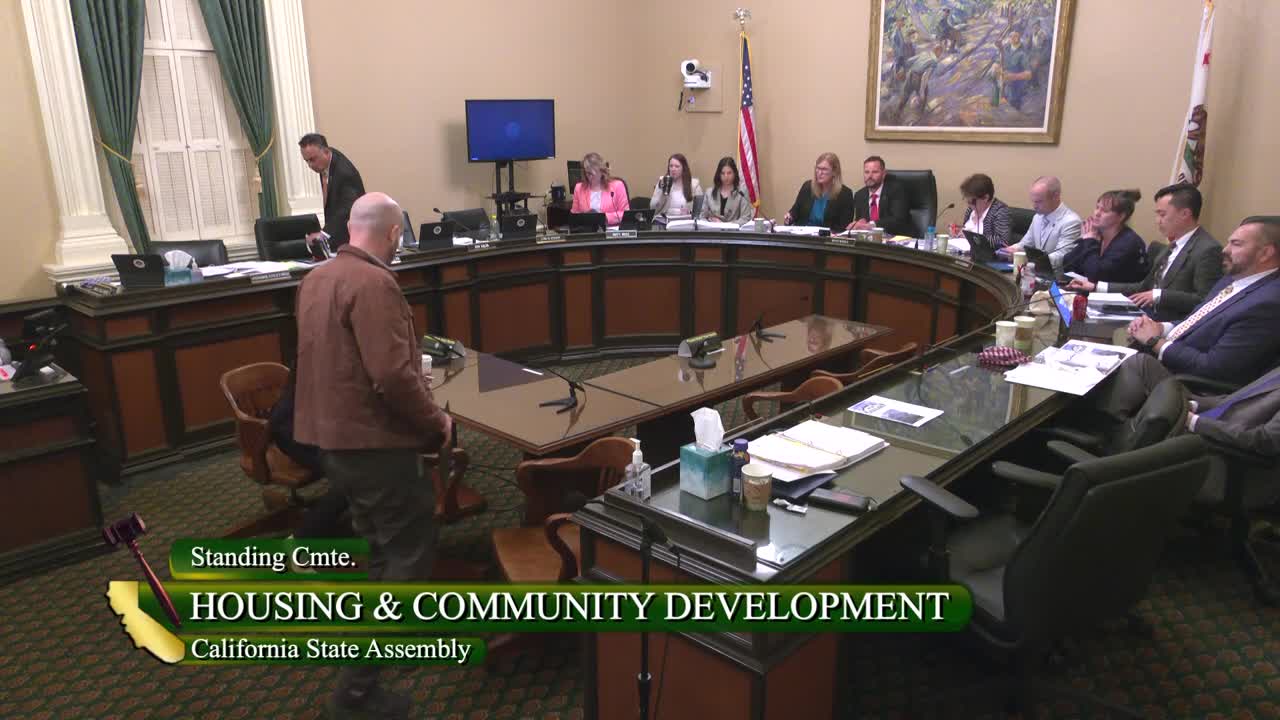 5MIN
Assembly Standing Committee on Housing and Community Development
Bill Author

Bill Co-Author(s):
