AB 681: California DREAM Loan Program: limits.
- Session Year: 2025-2026
- House: Assembly
- Latest Version Date: 2025-10-13
Current Status:
Passed
(2025-10-13: Chaptered by Secretary of State - Chapter 702, Statutes of 2025.)
Introduced
In Committee
Awaiting First Chamber Vote
Passed First Chamber
In Committee
Awaiting Second Chamber Vote
Passed Second Chamber
Enacted
Existing law establishes the California DREAM Loan Program, which authorizes a student attending a participating campus of the University of California or California State University to receive a loan, referred to as a DREAM loan, if the student satisfies certain requirements. Existing law prohibits a student from borrowing more than $4,000 within a single academic year and more than $40,000 in the aggregate under the program. Existing law prohibits a student enrolled in an undergraduate program from borrowing more than $20,000 as an undergraduate student and prohibits a student enrolled in a graduate program from borrowing more than $20,000 as a graduate student.
This bill would instead prohibit a student enrolled in an undergraduate program from borrowing more than $4,000 within a single academic year, and a student enrolled in a graduate program from borrowing more than $20,500 within a single academic year. The bill would increase the aggregate limit under the program for a student enrolled in a graduate program to $118,500 as a graduate student, while maintaining the $20,000 aggregate limit under the program for a student enrolled in an undergraduate program, thereby increasing the overall aggregate limit under the program for a student who receives a DREAM loan for both undergraduate and graduate enrollment to $138,500.
(a)The amount of a DREAM loan offered to an individual student by a participating institution shall be determined by the institution, subject to the following provisions:
(1)The loan may not exceed the financial need of the student.
(2)(A)A student who is enrolled in an undergraduate program may not borrow more than four thousand dollars ($4,000) under this program within a single academic year.
(B)A student who is enrolled in a graduate program may not borrow more than twenty thousand five hundred dollars ($20,500) under this program within a single academic year.
(3)(A)A student who is enrolled in an undergraduate program may not borrow, as an undergraduate student, more than twenty thousand dollars ($20,000) in the aggregate under the program.
(B)A student who is enrolled in a graduate program may not borrow, as a graduate student, more than one hundred eighteen thousand five hundred dollars ($118,500) in the aggregate under the program.
(C)A student may not borrow more than one hundred thirty-eight thousand five hundred dollars ($138,500) in the aggregate under the program, consistent with the limitations specified in subparagraphs (A) and (B).
(4)The proportion of program funding used for instructional programs and for graduate programs shall be determined at the discretion of the participating institution. Priority shall be given to loans for instructional programs.
(b)The interest rate for loans issued under the program shall be the same as the then-current interest rate for undergraduate loans under the William D. Ford Federal Direct Loan Program (20 U.S.C. Sec. 1087a et seq.).
(c)Except as provided in subdivision (d), the standard repayment term for a DREAM loan shall be 10 years. Repayment shall commence following a six-month grace period that begins when a student graduates or ceases to maintain at least half-time enrollment in a degree or certificate program.
(d)On or before January 1, 2020, a participating institution shall adopt procedures allowing a borrower to select an income-based repayment plan for the repayment of a DREAM loan, in accordance with the standards set forth in the William D. Ford Federal Direct Loan Program for income-based repayment plans.
(e)Interest shall not accrue on a DREAM loan during periods of at least half-time enrollment in a degree or certificate program or during the six-month grace period specified in subdivision (c).
(f)Eligibility for deferment, discharge, or forbearance of a DREAM loan shall be determined by the participating institution in accordance with the standards set forth in the William D. Ford Federal Direct Loan Program.
(g)On or before January 1, 2024, a participating institution shall establish loan forgiveness options for borrowers who receive a DREAM loan with similar standards as those set forth in the Federal Perkins Loan Program.
(h)(1)A borrower shall qualify for administrative relief consistent with the standards set forth in the Federal Direct Loan Program during periods of national emergency declared by the President of the United States.
(2)A borrower shall qualify for any state of emergency administrative forbearance on student loans that is provided by the Governor by executive order or the participating institution.
(3)A borrower shall be granted administrative relief for 90 days if the borrower lives or works where a natural disaster has occurred upon notification by the borrower, a member of the borrowers family, or another reliable source that the borrower has been affected by the natural disaster.
(i)Participating institutions shall use a common promissory note, approved by the Treasurer, to issue DREAM loans.
(a)The amount of a DREAM loan offered to an individual student by a participating institution shall be determined by the institution, subject to the following provisions:
(1)The loan may not exceed the financial need of the student.
(2)(A)A student who is enrolled in an undergraduate program may not borrow more than four thousand dollars ($4,000) under this program within a single academic year.
(B)A student who is enrolled in a graduate program may not borrow more than twenty thousand five hundred dollars ($20,500) under this program within a single academic year.
(3)A student may not borrow more than forty thousand dollars ($40,000) in the aggregate under the program.(4)(3)(A)A student who is enrolled in an undergraduate program may not borrow, as an undergraduate student, more than twenty thousand dollars ($20,000) in the aggregate under the program.
(5)(B)A student who is enrolled in a graduate program may not borrow, as a graduate student, more than twenty thousand dollars ($20,000) one hundred eighteen thousand five hundred dollars ($118,500) in the aggregate under the program.
(C)A student may not borrow more than one hundred thirty-eight thousand five hundred dollars ($138,500) in the aggregate under the program, consistent with the limitations specified in subparagraphs (A) and (B).
(6)(4)The proportion of program funding used for instructional programs and for graduate programs shall be determined at the discretion of the participating institution. Priority shall be given to loans for instructional programs.
(b)The interest rate for loans issued under the program shall be the same as the then-current interest rate for undergraduate loans under the William D. Ford Federal Direct Loan Program (20 U.S.C. Sec. 1087a et seq.).
(c)Except as provided in subdivision (d), the standard repayment term for a DREAM loan shall be 10 years. Repayment shall commence following a six-month grace period that begins when a student graduates or ceases to maintain at least half-time enrollment in a degree or certificate program.
(d)On or before January 1, 2020, a participating institution shall adopt procedures allowing a borrower to select an income-based repayment plan for the repayment of a DREAM loan, in accordance with the standards set forth in the William D. Ford Federal Direct Loan Program for income-based repayment plans.
(e)Interest shall not accrue on a DREAM loan during periods of at least half-time enrollment in a degree or certificate program or during the six-month grace period specified in subdivision (c).
(f)Eligibility for deferment, discharge, or forbearance of a DREAM loan shall be determined by the participating institution in accordance with the standards set forth in the William D. Ford Federal Direct Loan Program.
(g)On or before January 1, 2024, a participating institution shall establish loan forgiveness options for borrowers who receive a DREAM loan with similar standards as those set forth in the Federal Perkins Loan Program.
(h)(1)A borrower shall qualify for administrative relief consistent with the standards set forth in the Federal Direct Loan Program during periods of national emergency declared by the President of the United States.
(2)A borrower shall qualify for any state of emergency administrative forbearance on student loans that is provided by the Governor by executive order or the participating institution.
(3)A borrower shall be granted administrative relief for 90 days if the borrower lives or works where a natural disaster has occurred upon notification by the borrower, a member of the borrowers family, or another reliable source that the borrower has been affected by the natural disaster.
(i)Participating institutions shall use a common promissory note, approved by the Treasurer, to issue DREAM loans.
|
Date
|
Status
|
|---|---|
| Oct 13, 2025 | Chaptered by Secretary of State - Chapter 702, Statutes of 2025. |
| Oct 13, 2025 | Approved by the Governor. |
| Sep 11, 2025 | Enrolled and presented to the Governor at 4 p.m. |
| Sep 4, 2025 | In Assembly. Ordered to Engrossing and Enrolling. |
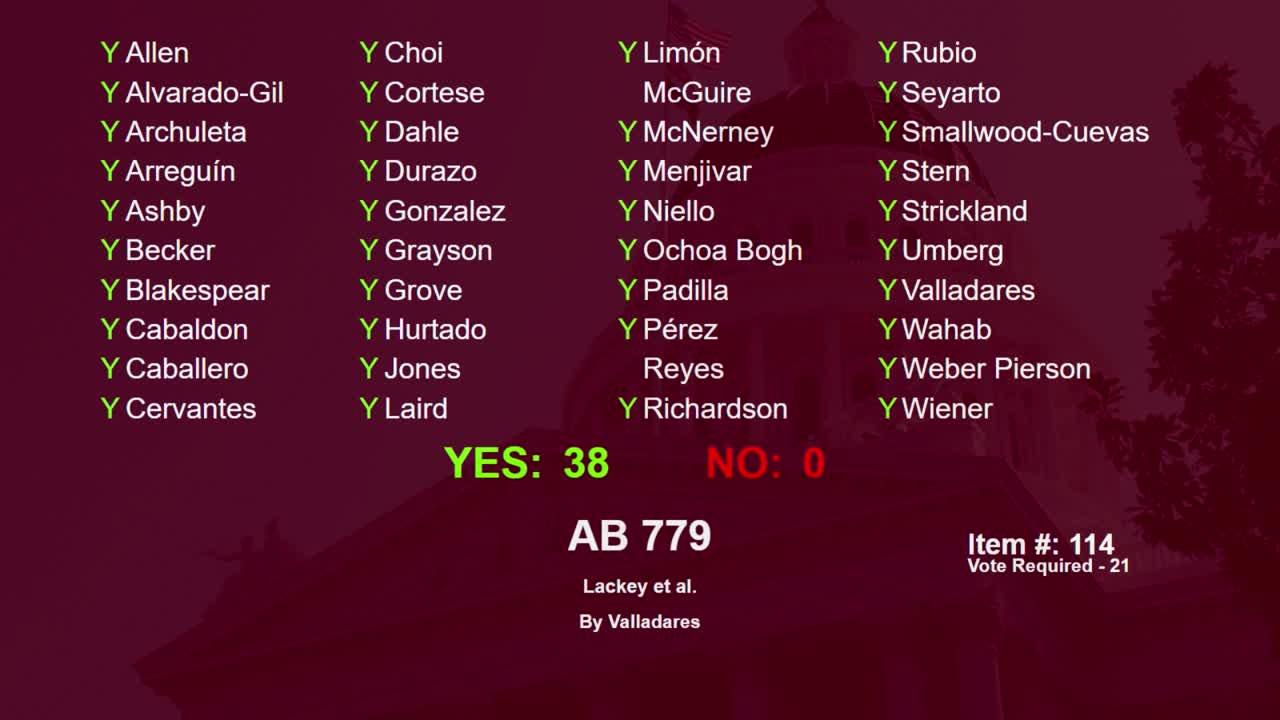
| Sep 4, 2025 | Read third time. Passed. Ordered to the Assembly. (Ayes 30. Noes 9. Page 2516.). |
| Aug 29, 2025 | Read second time. Ordered to third reading. |
| Aug 29, 2025 | From committee: Do pass. (Ayes 5. Noes 2.) (August 29). |
| Jun 23, 2025 | In committee: Referred to suspense file. |
| Jun 11, 2025 | From committee: Do pass and re-refer to Com. on APPR. (Ayes 5. Noes 1.) (June 11). Re-referred to Com. on APPR. |
| May 14, 2025 | Referred to Com. on ED. |
| May 6, 2025 | In Senate. Read first time. To Com. on RLS. for assignment. |
| May 5, 2025 | Read third time. Passed. Ordered to the Senate. (Ayes 61. Noes 10. Page 1419.) |
| Apr 10, 2025 | Read second time. Ordered to third reading. |
| Apr 9, 2025 | From committee: Do pass. (Ayes 10. Noes 4.) (April 9). |
| Mar 19, 2025 | From committee: Do pass and re-refer to Com. on APPR. (Ayes 8. Noes 2.) (March 18). Re-referred to Com. on APPR. |
| Mar 3, 2025 | Referred to Com. on HIGHER ED. |
| Feb 15, 2025 | From printer. May be heard in committee March 17. |
| Feb 14, 2025 | Read first time. To print. |
|
Date
|
Description
|
Location
|
Votes
|
|
|---|---|---|---|---|
| Sep 4, 2025 | Assembly 3rd Reading AB681 Elhawary By Pérez | Senate Floor |
Passed |
|
| Aug 29, 2025 | Do pass | Senate Standing Committee on Appropriations |
Passed |
|
| Jun 23, 2025 | Placed on suspense file | Senate Standing Committee on Appropriations |
Passed |
|
| Jun 11, 2025 | Do pass, but first be re-referred to the Committee on [Appropriations] | Senate Standing Committee on Education |
Passed |
|
| May 5, 2025 | AB 681 Elhawary Assembly Third Reading | Assembly Floor |
Passed |
|
| Apr 9, 2025 | Do pass. | Assembly Standing Committee on Appropriations |
Passed |
|
| Mar 18, 2025 | Do pass and be re-referred to the Committee on [Appropriations] | Assembly Standing Committee on Higher Education |
Passed |
This list shows positions taken on this bill by organizations on the date displayed, which is linked to the original source.
Positions by individuals are not included.
|
Organization
|
Position
|
Date
|
|---|---|---|
| Asian Americans Advancing Justice Southern California | ** Support | |
| California Chamber Of Commerce | ** Support | |
| California Faculty Association | ** Support | |
| California State University, Office Of The Chancellor | ** Support | |
| Hispanas Organized for Political Equality | ** Support | |
| Hispanic Association Of Colleges And Universities | ** Support | |
| Los Angeles County Taxpayers Association | ** Against | |
| University of California Graduate and Professional Council | ** Support | |
| University of California Office of the President (Source) | ** Support | |
| University of California (Sponsor) | ** Support | |
| University Of California Student Association | ** Support |
SENATE RULES COMMITTEE Office of Senate Floor Analyses (916) 651-1520 Fax: (916) 327-4478 | AB 681 |
THIRD READING
Bill No: AB 681
Author: Elhawary (D)
Introduced: 2/14/25
Vote: 21
SENATE EDUCATION COMMITTEE: 5-1, 6/11/25
AYES: Pérez, Ochoa Bogh, Cabaldon, Cortese, Laird
NOES: Choi
NO VOTE RECORDED: Gonzalez
SENATE APPROPRIATIONS COMMITTEE: 5-2, 8/29/25
AYES: Caballero, Cabaldon, Grayson, Richardson, Wahab
NOES: Seyarto, Dahle
ASSEMBLY FLOOR: 61-10, 5/5/25 - See last page for vote
SUBJECT: California DREAM Loan Program: limits
SOURCE: University of California Office of the President
DIGEST:
This bill increases the amount a graduate student may borrow under the California DREAM Loan Program in a single academic year, in the aggregate, and establishes an overall borrowing limit in the aggregate for both undergraduate and graduate programs.
ANALYSIS:
Existing law:
1) Establishes the California Student Aid Commission (CSAC) for the purpose
of administering specified student financial aid programs. (Education Code (EC) § 69510, et seq.)
2) Authorizes, beginning January 1, 2013, AB 540 students to be eligible to
apply for, and participate in, any student financial aid program administered by the State of California to the full extent permitted by federal law. (EC § 66021.6)
3) Authorizes, AB 540 students attending University of California (UC), California State University (CSU), or the California Community Colleges (CCC) to be eligible to receive a scholarship derived from nonstate funds, as received by the respective segment for the purpose of scholarships. (EC § 66021.7)
4) Establishes the DREAM Loan Program at UC and CSU campuses that elect to participate in the program. Under the program, an AB 540 student meeting specified requirements, including demonstrating financial need, may obtain a loan of up to $4,000 per academic year, up to a maximum of $20,000 as an undergraduate student; and, no more than $20,000 as a graduate student. The repayment term for the loan is 10 years, and repayment commences following a six-month grace period beginning when the student graduates or ceases to maintain at least half-time enrollment. Eligibility for deferment or forbearance of loan repayments is consistent with the federal direct student loan program. (EC § 70033)
5) Specifies that the proportion of program funding used for instructional programs and for graduate programs be determined at the discretion of the participating institution and that priority be given to loans for instructional programs. Current law further defines “instructional programs” to mean a program of study that results in the award of a baccalaureate degree or undergraduate certificate, or undergraduate coursework in a program of study leading directly to a first professional degree for which no baccalaureate degree or undergraduate degree is awarded. (EC § 70032 (i) and § 70034 (a)(6))
6) Requires, by January 1, 2020, UC and the CSU campuses participating in the
state DREAM Loan Program to adopt procedures allowing a borrower to select an income-based repayment plan for the repayment of a DREAM Loan. (EC § 70034 (d)).
7) Requires the annual Budget Act to allocate funding to participating institutions based on the number of AB 540 students who applied for state financial aid in the prior academic year. Participating institutions must at least match the state allocation using the institution's discretionary funds. Both the state and local funding is deposited into a DREAM revolving fund. Loan repayments are also deposited into the revolving fund and are intended to reduce the annual state and campus contributions equally. (EC § 70035).
8) Authorizes, commencing with the 2024-25 academic year, a CSU or UC campus that participates in the DREAM Loan Program to award DREAM grants to eligible students if that campus has unawarded funds in the institution’s DREAM Loan revolving fund that were new state, institutional matching, or loan repayment funds deposited during the previous academic year. (EC § 70035.5)
This bill:
- Increases the borrowing limit under the DREAM Loan Program for a student who is enrolled in a graduate program from up to $4,000 to up to $20,500 within a single academic year.
- Increases the aggregate borrowing limit under the DREAM Loan Program for a student enrolled in a graduate program from no more than $20,000 to no more than $118,500.
- Establishes a $138,000 overall borrowing limit under the DREAM Loan Program for both undergraduate and graduate programs.
Comments
- Need for this bill. According to the author, “The DREAM Loan Program helps undergraduate students but doesn’t account for the higher costs of graduate education. As a result, many undocumented students are forced to take on private loans or forgo graduate school altogether.
“AB 681 expands loan limits, making the DREAM Loan a more viable option for undocumented graduate students and more closely aligning it with federal loan programs they cannot access. This change will create greater access to higher education and career advancement, empowering individuals to achieve the American Dream.”
- California DREAM Loan program. Existing law establishes the California DREAM Loan Program, a voluntary campus-based student loan program patterned after the Federal Direct Loan Program. Both the state and the university are to contribute (1:1 match) to the loan fund until the program becomes self-sustaining. This program serves undocumented AB 540 students at UC and CSU who, under the terms of the California Dream Act, became eligible for state and institutional grant programs but are ineligible for federal student loan programs. The Legislature provided $2.5 million in UC’s annual budget for the program, which has been matched by UC each year. Since 2016-17, the state has not allocated funding for the loan program in the budget to CSU. Instead, to maintain the program, CSU rolled over unexpended funds from the 2015-16 academic year and funded the difference with lottery funds. During the 2023-2024 academic year, 351 CSU undergraduates received an average award of $3,329, and 89 graduate students received an average of $3,570. For the UC, in the 2023-2024 academic year, 603 recipients received an average award of $3,183 for both undergraduate and graduate students. Under current law, a student can borrow up to $4,000 annually, not to exceed $40,000 in the aggregate. This bill attempts to increase borrowing limits significantly by five times more for graduate students.
- Loan program undersubscribed. As noted in the Assembly Appropriations Committee analysis, the DREAM loan revolving fund is divided for use by the UC and CSU. For the UC, the fund contains $2.5 million in state contributions and $2.5 million in matching funds from the UC. The UC Office of the President reports, of the total $5 million available to prospective applicants each year, an average of $2.4 million in loan funds went un-awarded in fiscal years 2021-22 through 2023-24. At CSU, the fund contains a total of $2 million available for loans across the entire system. In fiscal year 2023-24, the CSU awarded a total of $299,870 in DREAM loans to graduate students and $1.47 million total for undergraduate and graduate students. It is not clear to Senate Committee staff why the program is undersubscribed. However, UC notes in their letter of support that graduate programs range in cost from $45,000 to $115,000 annually. The current DREAM loan limit is set at $4,000 per year, or $40,000 for the entirety of the program, including undergraduate and graduate degrees. UC asserts that these graduate students are left to pursue private loan options, and that the proposed limits more closely mirror federal loan limits for graduate students. The 2024-25 Federal Student Aid Handbook cites the annual and aggregate federal loan limits as $20,500 (subsidized) and $138,500 (subsidized and unsubsidized).
- DREAM loan to grant option. Under existing law, established by SB 633 (Gonzalez, Chapter 622, Statutes of 2023), a campus may establish a grant program with unused DREAM loan funds. Each participating institution determines the award amounts for their students, not to exceed the student’s remaining financial need associated with the total cost of college attendance. Under existing law, a DREAM grant awarded to a student does not count against the annual or aggregate borrowing limits established for the DREAM Loan program. The CSU has not utilized the grant program option because the institution relies heavily on the revolving nature of the loan funds to sustain the program. UC used the option, and in its first year of implementation, six UC campuses reported that approximately 1,311 students received a DREAM grant award, with an average total amount of $2,965 per student across those campuses. Since the grant program relies on unused funds from the loan program, it is unclear how the proposed increases in the loan limits outlined in this bill would affect its development.
FISCAL EFFECT: Appropriation: No Fiscal Com.: Yes Local: No
According to the Senate Appropriations Committee, this bill would have the following fiscal impact:
- While the UC and CSU both estimate that the existing funds in the program’s revolving loan fund are sufficient for the increased loan amounts, this bill could result in additional, unknown cost pressures to the extent that the program becomes oversubscribed in future years. The UC currently receives $2.5 million (General Fund) from the state each year and matches that with its own institutional funds. However, the UC and CSU indicate that the population of eligible students is not high and therefore, they do not believe the bill would have a significant impact on the amount of funds that are currently available in the revolving loan fund.
- Any administrative costs to process and administer additional loan applications for the UC and CSU are anticipated to be minor and absorbable within existing resources.
SUPPORT: (Verified 8/29/25)
University of California Office of the President (Source)
University of California (Sponsor)
University of California Graduate and Professional Council
Asian Americans Advancing Justice Southern California
California Chamber of Commerce
California Faculty Association
California State University, Office of the Chancellor
Hispanas Organized for Political Equality
Hispanic Association of Colleges and Universities
University of California Student Association
OPPOSITION: (Verified 8/29/25)
Los Angeles County Taxpayers Association
3 Individuals
ASSEMBLY FLOOR: 61-10, 5/5/25
AYES: Addis, Aguiar-Curry, Ahrens, Alanis, Alvarez, Arambula, Ávila Farías, Bauer-Kahan, Bennett, Berman, Boerner, Bonta, Bryan, Calderon, Caloza, Carrillo, Connolly, Davies, Elhawary, Fong, Gabriel, Garcia, Gipson, Jeff Gonzalez, Mark González, Haney, Harabedian, Hart, Irwin, Jackson, Kalra, Krell, Lee, Lowenthal, McKinnor, Muratsuchi, Nguyen, Ortega, Pacheco, Papan, Patel, Pellerin, Quirk-Silva, Ramos, Ransom, Celeste Rodriguez, Michelle Rodriguez, Rogers, Blanca Rubio, Schultz, Sharp-Collins, Solache, Soria, Stefani, Valencia, Wallis, Ward, Wicks, Wilson, Zbur, Rivas
NOES: DeMaio, Dixon, Gallagher, Hadwick, Lackey, Macedo, Patterson, Sanchez, Ta, Tangipa
NO VOTE RECORDED: Bains, Castillo, Chen, Ellis, Flora, Hoover, Petrie-Norris, Schiavo
Prepared by: Olgalilia Ramirez / ED. / (916) 651-4105
8/29/25 20:52:54
**** END ****
SENATE COMMITTEE ON
Senator Anna Caballero, Chair
2025 - 2026 Regular Session
AB 681 (Elhawary) - California DREAM Loan Program: limits
Version: | Policy Vote: |
Urgency: | Mandate: |
Hearing Date: | Consultant: |
Bill Summary:
This bill increases the borrowing amounts for graduate students under the California DREAM Loan Program in a single academic year, as specified, and also establishes an overall borrowing limit in the aggregate for both undergraduate and graduate programs.
Fiscal Impact:
- While the UC and CSU both estimate that the existing funds in the program’s revolving loan fund are sufficient for the increased loan amounts, this bill could result in additional, unknown cost pressures to the extent that the program becomes oversubscribed in future years. The UC currently receives $2.5 million (General Fund) from the state each year and matches that with its own institutional funds. However, the UC and CSU indicate that the population of eligible students is not high and therefore, they do not believe the bill would have a significant impact on the amount of funds that are currently available in the revolving loan fund.
- Any administrative costs to process and administer additional loan applications for the UC and CSU are anticipated to be minor and absorbable within existing resources.
Background:
Existing law establishes the DREAM Loan Program at UC and CSU campuses that elect to participate in the program. Under the program, an AB 540 student meeting specified requirements, including demonstrating financial need, may obtain a loan of up to $4,000 per academic year, up to a maximum of $20,000 as an undergraduate student; and, no more than $20,000 as a graduate student. The repayment term for the loan is 10 years, and repayment commences following a six-month grace period beginning when the student graduates or ceases to maintain at least half-time enrollment. Eligibility for deferment or forbearance of loan repayments is consistent with the federal direct student loan program.
Existing law provides that the annual Budget Act shall allocate funding to participating institutions based on the number of AB 540 students who applied for state financial aid in the prior academic year. Participating institutions must at least match the state allocation using the institution's discretionary funds. Both the state and local funding is deposited into a DREAM revolving fund. Loan repayments are also deposited into the revolving fund and are intended to reduce the annual state and campus contributions equally.
Existing law authorizes, commencing with the 2024-25 academic year, a CSU or UC campus that participates in the DREAM Loan Program to award DREAM grants to eligible students if that campus has unawarded funds in the institution’s DREAM Loan revolving fund that were new state, institutional matching, or loan repayment funds deposited during the previous academic year.
Proposed Law:
This bill increases the borrowing limit under the DREAM Loan Program for a student who is enrolled in a graduate program from up to $4,000 to up to $20,500 within a single academic year. The bill also increases the aggregate borrowing limit under the DREAM Loan Program for a student enrolled in a graduate program from no more than $20,000 to no more than $118,500. Further, the bill establishes a $138,000 overall borrowing limit under the DREAM Loan Program for both undergraduate and graduate programs.
Staff Comments:
The California DREAM Loan Program is a voluntary campus-based student loan program patterned after the Federal Direct Loan Program. Both the state and the university are to contribute (1:1 match) to the loan fund until the program becomes self-sustaining. This program serves undocumented AB 540 students at UC and CSU who, under the terms of the California Dream Act, became eligible for state and institutional grant programs but are ineligible for federal student loan programs. The UC Office of the President reports that of the total $5 million available to prospective applicants each year, an average of $2.4 million in loan funds went un-awarded in fiscal years 2021-22 through 2023-24. At CSU, the fund contains a total of $2 million available for loans across the entire system, and that in the 2023-24 fiscal year, the CSU awarded a total of about $300,000 in DREAM loans to graduate students and $1.47 million total for undergraduate and graduate students. The UC indicates that graduate programs range in cost from $45,000 to $115,000 annually. However, the current DREAM loan limit is set at $4,000 per year, or $40,000 for the entirety of the program, including undergraduate and graduate degrees.
-- END --
SENATE COMMITTEE ON EDUCATION
Senator Sasha Renée Pérez, Chair
2025 - 2026 Regular
Bill No: Hearing Date: June 11, 2025
Author: | Elhawary | ||
Version: |
| ||
Urgency: | Fiscal: | ||
Consultant: | |||
Subject: .
SUMMARY
This bill increases the amount a graduate student may borrow under the California DREAM Loan Program in a single academic year, in the aggregate, and establishes an overall borrowing limit in the aggregate for both undergraduate and graduate programs.
BACKGROUND
Existing law:
1) Establishes the California Student Aid Commission (CSAC) for the purpose of
administering specified student financial aid programs. (Education Code (EC) § 69510, et seq.)
2) Authorizes, beginning January 1, 2013, AB 540 students to be eligible to apply
for, and participate in, any student financial aid program administered by the State of California to the full extent permitted by federal law. (EC § 66021.6)
3) Authorizes, AB 540 students attending University of California (UC), California State University (CSU), or the California Community Colleges (CCC) to be eligible to receive a scholarship derived from nonstate funds, as received by the respective segment for the purpose of scholarships. (EC § 66021.7)
4) Establishes the DREAM Loan Program at UC and CSU campuses that elect to participate in the program. Under the program, an AB 540 student meeting specified requirements, including demonstrating financial need, may obtain a loan of up to $4,000 per academic year, up to a maximum of $20,000 as an undergraduate student; and, no more than $20,000 as a graduate student. The repayment term for the loan is 10 years, and repayment commences following a six-month grace period beginning when the student graduates or ceases to maintain at least half-time enrollment. Eligibility for deferment or forbearance of loan repayments is consistent with the federal direct student loan program. (EC § 70033)
5) Specifies that the proportion of program funding used for instructional programs
and for graduate programs be determined at the discretion of the participating institution and that priority be given to loans for instructional programs. Current law further defines “instructional programs” to mean a program of study that results in the award of a baccalaureate degree or undergraduate certificate, or undergraduate coursework in a program of study leading directly to a first professional degree for which no baccalaureate degree or undergraduate degree is awarded. (EC § 70032 (i) and § 70034 (a)(6))
6) Requires, by January 1, 2020, UC and the CSU campuses participating in the
state DREAM Loan Program to adopt procedures allowing a borrower to select an income-based repayment plan for the repayment of a DREAM Loan. (EC § 70034 (d)).
7) Requires the annual Budget Act to allocate funding to participating institutions
based on the number of AB 540 students who applied for state financial aid in the prior academic year. Participating institutions must at least match the state allocation using the institution's discretionary funds. Both the state and local funding is deposited into a DREAM revolving fund. Loan repayments are also deposited into the revolving fund and are intended to reduce the annual state and campus contributions equally. (EC § 70035).
8) Authorizes, commencing with the 2024-25 academic year, a CSU or UC campus that participates in the DREAM Loan Program to award DREAM grants to eligible students if that campus has unawarded funds in the institution’s DREAM Loan revolving fund that were new state, institutional matching, or loan repayment funds deposited during the previous academic year. (EC § 70035.5)
ANALYSIS
This bill:
- Increases the borrowing limit under the DREAM Loan Program for a student who is enrolled in a graduate program from up to $4,000 to up to $20,500 within a single academic year.
- Increases the aggregate borrowing limit under the DREAM Loan Program for a student enrolled in a graduate program from no more than $20,000 to no more than $118,500.
- Establishes a $138,000 overall borrowing limit under the DREAM Loan Program for both undergraduate and graduate programs.
STAFF COMMENTS
- Need for the bill. According to the author, “The DREAM Loan Program helps undergraduate students but doesn’t account for the higher costs of graduate education. As a result, many undocumented students are forced to take on private loans or forgo graduate school altogether.
“AB 681 expands loan limits, making the DREAM Loan a more viable option for undocumented graduate students and more closely aligning it with federal loan programs they cannot access. This change will create greater access to higher education and career advancement, empowering individuals to achieve the American Dream.”
- California DREAM Loan program. Existing law establishes the California DREAM Loan Program, a voluntary campus-based student loan program patterned after the Federal Direct Loan Program. Both the state and the university are to contribute (1:1 match) to the loan fund until the program becomes self-sustaining. This program serves undocumented AB 540 students at UC and CSU who, under the terms of the California Dream Act, became eligible for state and institutional grant programs but are ineligible for federal student loan programs. The Legislature provided $2.5 million in UC’s annual budget for the program, which has been matched by UC each year. Since 2016-17, the state has not allocated funding for the loan program in the budget to CSU. Instead, to maintain the program, CSU rolled over unexpended funds from the 2015-16 academic year and funded the difference with lottery funds. During the 2023-2024 academic year, 351 CSU undergraduates received an average award of $3,329, and 89 graduate students received an average of $3,570. For the UC, in the 2023-2024 academic year, 603 recipients received an average award of $3,183 for both undergraduate and graduate students. Under current law, a student can borrow up to $4,000 annually, not to exceed $40,000 in the aggregate. This bill attempts to increase borrowing limits significantly by five times more for graduate students.
- Loan program undersubscribed. As noted in the Assembly Appropriations Committee analysis, the DREAM loan revolving fund is divided for use by the UC and CSU. For the UC, the fund contains $2.5 million in state contributions and $2.5 million in matching funds from the UC. The UC Office of the President reports, of the total $5 million available to prospective applicants each year, an average of $2.4 million in loan funds went un-awarded in fiscal years 2021-22 through 2023-24. At CSU, the fund contains a total of $2 million available for loans across the entire system. In fiscal year 2023-24, the CSU awarded a total of $299,870 in DREAM loans to graduate students and $1.47 million total for undergraduate and graduate students. It is not clear to Senate Committee staff why the program is undersubscribed. However, UC notes in their letter of support that graduate programs range in cost from $45,000 to $115,000 annually. The current DREAM loan limit is set at $4,000 per year, or $40,000 for the entirety of the program, including undergraduate and graduate degrees. UC asserts that these graduate students are left to pursue private loan options, and that the proposed limits more closely mirror federal loan limits for graduate students. The 2024-25 Federal Student Aid Handbook cites the annual and aggregate federal loan limits as $20,500 (subsidized) and $138,500 (subsidized and unsubsidized).
- DREAM loan to grant option. Under existing law, established by SB 633 (Gonzalez, Chapter 622, Statutes of 2023), a campus may establish a grant program with unused DREAM loan funds. Each participating institution determines the award amounts for their students, not to exceed the student’s remaining financial need associated with the total cost of college attendance. Under existing law, a DREAM grant awarded to a student does not count against the annual or aggregate borrowing limits established for the DREAM Loan program. The CSU has not utilized the grant program option because the institution relies heavily on the revolving nature of the loan funds to sustain the program. UC used the option, and in its first year of implementation, six UC campuses reported that approximately 1,311 students received a DREAM grant award, with an average total amount of $2,965 per student across those campuses. Since the grant program relies on unused funds from the loan program, it is unclear how the proposed increases in the loan limits outlined in this bill would affect its development.
SUPPORT
University of California (Sponsor)
Asian Americans Advancing Justice Southern California
California Chamber of Commerce
California Faculty Association
California State University, Office of the Chancellor
Hispanas Organized for Political Equality
Hispanic Association of Colleges and Universities
University of California Student Association
OPPOSITION
Los Angeles County Taxpayers Association
Two individuals
-- END --
ASSEMBLY THIRD READING
ATR Bill Id:AB 681
Author:(Elhawary)
As Introduced Ver:February 14, 2025
Majority vote
SUMMARY
Prohibits a student enrolled in an undergraduate program from borrowing more than $4,000 within a single academic year, and a student enrolled in a graduate program from borrowing more than $20,500 within a single academic year. Additionally, the measure increases the aggregate limit under the program for a student enrolled in a graduate program to $118,500 as a graduate student, while maintaining the $20,000 aggregate limit under the program for a student enrolled in an undergraduate program, thereby increasing the overall aggregate limit under the program for a student who receives a DREAM loan for both undergraduate and graduate enrollment to $138,500.
Major Provisions
See "the Summary" above.
COMMENTS
Background. In 2014, the Legislature enacted SB 1210 (Lara), Chapter 754, Statutes of 2014, which established the California DREAM Loan Program, an affordable loan option that is offered at UC and CSU for undergraduate AB 540 [(Firebaugh), Chapter 814, Statutes of 2001] students to assist in financing their education. The loan was designed to mirror federal student loan programs with including provisions that placed a cap on loan amounts and provided low interest rates.
In 2019, the Legislature enacted SB 354 (Durazo), Chapter 526, Statutes of 2019, which expanded the provisions of the DREAM Loan Program to include eligible graduate students seeking a graduate or professional degree program.
Since the enactment of AB 540, several legislative measures have modified or expanded eligibility for the exemption from nonresident tuition in order to better accommodate the diverse student population.
Under current law, CSAC is only permitted to provide undocumented students with state financial aid if they apply for aid through the California Dream Act Application (CADAA).
The CADAA. In 2011, AB 131 (Cedillo), Chapter 604, Statutes of 2011, allowed students with AB 540 status to apply and be eligible for state financial aid such as the Cal Grant. AB 131 also charged CSAC with establishing and administering procedures and forms to enable eligible undocumented students' access to state aid. As a result, CSAC developed the CADAA and made it available to students in Fall 2012. Aid was dispersed for CADAA applicants in the Summer of 2013.
Existing numbers at the UC and CSU. According to the UC the following tables provide data on the DREAM Loan borrowers from the 2023-24 Academic Year (AY):
Cumulative Dream Loan Debt at Graduation for 2023-24 Graduate CADAA Students Table 1. By Degree Type, 2023-24 |
| ||||
Grad Degree Type | Loans | # Borrowers | Avg Loan | Total Graduates | Percent |
Grad Academic | $12,000 | 3 | $4,000 | 14 | 21% |
Grad Professional | $85,000 | 12 | $7,083 | 33 | 36% |
All Grad Students | $97,000 | 15 | $6,467 | 47 | 32% |
|
|
|
|
|
|
Table 2. Academic Graduate Programs by Broad Discipline, 2023-24 |
| ||||
Broad Discipline | Loans | # Borrowers | Avg loan | Total # Graduates | Percent |
Engineering/Computer Sciences | $4,000 | 1 | $4,000 | 6 | 17% |
Health Professional & Clinical Sciences | $4,000 | 1 | $4,000 | 1 | 100% |
Professional Fields | $4,000 | 1 | $4,000 | 1 | 100% |
All Grad Academic Programs | $12,000 | 3 | $4,000 | 14 | 21% |
| |||||
Table 3. Graduate Professional Programs by Discipline, 2023-24 |
| ||||
Professional Discipline | Loans | # Borrowers | Avg Loan | Total Graduates | Percent |
Law | $32,000 | 3 | $10,667 | 3 | 100% |
Other Health | $17,000 | 3 | $5,667 | 4 | 75% |
Other Non-Health | $36,000 | 6 | $6,000 | 24 | 25% |
All Grad Professional Programs | $85,000 | 12 | $7,083 | 33 | 36% |
**Loan amounts may include borrowing from previous academic years. These numbers reflect total borrowing.
According to the CSU, in the 2023-24 AY, the CSU had 435 DREAM Loan borrowers, who, collectively received $1,469,349 (an average of $3,376 per student). Of the 435 awardees, 351 were undergraduate students, and collectively received $1,168,479 (an average of $3,329 per student. Of the 435 awardees, 84 were graduate students, and collectively received $299,870 (an average of $3,570 per student).
According to the Author
According to the author, "the DREAM Loan Program helps undergraduate students, but doesn't account for the higher costs of graduate education. As a result, many undocumented students are forced to take on private loans or forgo graduate school altogether."
The author states that, "AB 681 expands loan limits, making the DREAM Loan a more viable option for undocumented graduate students and more closely aligning it with federal loan programs they cannot access. This change will create greater access to higher education and career advancement, empowering individuals to achieve the American Dream."
Arguments in Support
According to the UC, sponsors of this measure, "graduate and undergraduate students have a variety of financial aid options when it comes to pursuing higher education, including grant aid through Cal Grants, Pell Grants, or institutional aid. Where direct aid doesn't fully cover tuition and other fees, loans are available through the U.S. Department of Education and private lenders. However, undocumented students are not eligible for federal loans. In 2021-22, data from the California Student Aid Commission shows that only 14% of undocumented students receive financial aid."
The UC states that, "in 2014, the California DREAM Loan Program was created to provide a loan option for undocumented students and the program has subsequently expanded eligibility to graduate students. However, graduate programs range in costs from $45,000 to $115,000 annually; the loan limit is currently set at $4,000 per year, or $40,000 for the entirety of the program, including undergraduate and graduate degrees. Undocumented graduate students are left to pursue private loan options, which typically have higher interest rates and less favorable repayment options. AB 681 would increase the loan limit of the DREAM Loan Program for graduate students from $4,000 per year to $20,500 per year. The total cap on the loan program would be $118,500 for graduate students, and $138,500 if the student also utilized the program for their undergraduate degree. These limits more closely mirror federal loan limits for graduate students."
Further, according to the California Chamber of Commerce, "AB 681 would raise the caps on funding available to an individual student who receives a DREAM loan for both undergraduate and graduate schooling to $138,500. We view this as a small but well-reasoned adjustment to the DREAM loan program – as it will not add costs to the program but will add some flexibility for existing funds to be utilized to support students whose overall needs may not be met by the present limits on loan amounts."
Arguments in Opposition
None on file.
FISCAL COMMENTS
According to the Assembly Committee on Appropriations:
- Minor and absorbable ongoing General Fund costs to the University of California (UC) and California State University (CSU) to process and administer any additional program applications and loan awards resulting from the increased borrowing limit for graduate students.
- The UC and CSU both indicate additional funds are available for loans in the program's revolving fund allowing for both additional subscription to the program and increased award amounts for graduate students. To the extent loans provided to borrowers exceed available funds due to increased borrowing limits, loan amounts would be prorated.
VOTES
ASM HIGHER EDUCATION: 8-2-0
YES: Fong, Boerner, Jeff Gonzalez, Jackson, Muratsuchi, Patel, Celeste Rodriguez, Sharp-Collins
NO: DeMaio, Essayli
ASM APPROPRIATIONS: 10-4-1
YES: Wicks, Arambula, Calderon, Caloza, Elhawary, Fong, Mark González, Hart, Pacheco, Solache
NO: Sanchez, Dixon, Hadwick, Ta
ABS, ABST OR NV: Pellerin
UPDATED
VERSION: February 14, 2025
CONSULTANT: Jeanice Warden / HIGHER ED. / (916) 319-3960 FN: 0000228
Date of Hearing: April 9, 2025
ASSEMBLY COMMITTEE ON APPROPRIATIONS
Buffy Wicks, Chair
ABPCA Bill Id:AB 681
Author:(Elhawary) – As Introduced Ver:February 14, 2025
Policy Committee: | Higher Education | Vote: | 8 - 2 |
|
| ||
|
|
Urgency: No State Mandated Local Program: No Reimbursable: No
SUMMARY:
This bill increases the amount graduate students may borrow under the California DREAM Loan Program (program) in a single academic year, in the aggregate, and in the aggregate under the program for both undergraduate and graduate studies combined.
Specifically, this bill limits the amount an undergraduate student may borrow under the program to $4,000 per academic year and the amount a graduate student may borrow to $20,500 per academic year. The bill increases the aggregate amount a graduate student may borrow under the program, from $20,000, as under current law, to $118,500, and to $138,500 when combined with any other loans the student received from the program for undergraduate study.
FISCAL EFFECT:
Minor and absorbable ongoing General Fund costs to the University of California (UC) and California State University (CSU) to process and administer any additional program applications and loan awards resulting from the increased borrowing limit for graduate students.
The UC and CSU both indicate additional funds are available for loans in the program’s revolving fund allowing for both additional subscription to the program and increased award amounts for graduate students. To the extent loans provided to borrowers exceed available funds due to increased borrowing limits, loan amounts would be prorated.
COMMENTS:
Background
Program Purpose. Established in 2014, the DREAM Loan Program provides affordable loan options to students eligible for the California Nonresident Tuition Exemption at the UC and CSU and is funded through the Dream Loan revolving fund. Both state and local funding is deposited into the DREAM Loan revolving fund. Loan repayments are also deposited into the revolving fund and reduce the annual state and campus contributions equally. Originally only undergraduate students were eligible and the program was later expanded to include graduate students.
The program mirrors federal student loan programs which cap loan amounts and provide low interest rates. Current law places the same limit on loans to both undergraduate and graduate students, $4,000 per single academic year, and $20,000 in the aggregate. Proponents of this bill claim the limit does not account for the higher cost of graduate education.
Existing Loan Program Not Fully Subscribed. The DREAM loan revolving fund is divided for use by the UC and CSU. For the UC, the fund contains $2.5 million in state contribution and $2.5 million in matching funds from the UC. According to the UC Office of the President, of the total $5 million available to prospective applicants each year, there was an average of $2.4 million in loan funds un-awarded in fiscal years 2021-22 through 2023-24. In fiscal year 2023-24 the UC awarded a total of $1.9 million in loans to 603 applicants with an average loan amount of $3,183 for both undergraduate and graduate students.
The state has not contributed to the CSU’s portion of the loan revolving fund since fiscal year 2015-16. CSU maintains the fund by rolling over unexpended monies to the following year and supplementing with state lottery funding, for a total of $2 million available for loans across the entire CSU system. In fiscal year 2023-24 the CSU awarded a total of $299,870 in DREAM loans to 84 graduate students and $1.47 million total for undergraduate and graduate students.
Analysis Prepared by: Aaron Heredia / APPR. / (916) 319-2081
Date of Hearing: March 18, 2025
ASSEMBLY COMMITTEE ON HIGHER EDUCATION
Mike Fong, Chair
ABPCA Bill Id:AB 681 (
Author:Elhawary) – As Introduced Ver:February 14, 2025
SUBJECT: California DREAM Loan Program: limits.
SUMMARY: Prohibits a student enrolled in an undergraduate program from borrowing more than $4,000 within a single academic year, and a student enrolled in a graduate program from borrowing more than $20,500 within a single academic year. Additionally, the measure increases the aggregate limit under the program for a student enrolled in a graduate program to $118,500 as a graduate student, while maintaining the $20,000 aggregate limit under the program for a student enrolled in an undergraduate program, thereby increasing the overall aggregate limit under the program for a student who receives a DREAM loan for both undergraduate and graduate enrollment to $138,500.
EXISTING LAW:
- Establishes the California Student Aid Commission (CSAC) for the purpose of administering specified student financial aid programs (Education Code (EC) Section 69510, et seq.).
- Authorizes, beginning January 1, 2013, AB 540 students to be eligible to apply for, and participate in, any student financial aid program administered by the State of California to the full extent permitted by federal law (EC Section 66021.6).
- Authorizes, AB 540 students attending University of California (UC), California State University (CSU), or the California Community Colleges (CCC) to be eligible to receive a scholarship derived from nonstate funds, as received by the respective segment for the purpose of scholarships (EC Section 66021.7).
- Establishes the DREAM Loan Program at UC and CSU campuses that elect to participate in the program. Under the program, an AB 540 student meeting specified requirements, including demonstrating financial need, may obtain a loan of up to $4,000 per academic year, up to a maximum of $20,000 as an undergraduate student; and, no more than $20,000 as a graduate student. The repayment term for the loan is 10 years, and repayment commences following a six-month grace period beginning when the student graduates or ceases to maintain at least half-time enrollment. Eligibility for deferment or forbearance of loan repayments is consistent with the federal direct student loan program (EC Section 70033).
- Specifies that the proportion of program funding used for instructional programs and for graduate programs be determined at the discretion of the participating institution and that priority be given to loans for instructional programs. Current law further defines “instructional programs” to mean a program of study that results in the award of a baccalaureate degree or undergraduate certificate, or undergraduate coursework in a program of study leading directly to a first professional degree for which no baccalaureate degree or undergraduate degree is awarded (EC Section 70032 (i) and 70034 (a)(6)).
- Requires, by January 1, 2020, a UC and the CSU campuses participating in the state DREAM Loan Program to adopt procedures allowing a borrower to select an income-based repayment plan for the repayment of a DREAM Loan (EC Section 70034 (d)).
- Requires the annual Budget Act to allocate funding to participating institutions based on the number of AB 540 students who applied for state financial aid in the prior academic year. Participating institutions must at least match the state allocation using the institution's discretionary funds. Both the state and local funding is deposited into a DREAM revolving fund. Loan repayments are also deposited into the revolving fund and are intended to reduce the annual state and campus contributions equally (EC Section 70035).
- Authorizes, commencing with the 2024-25 academic year, a CSU or UC campus that participates in the DREAM Loan Program to award DREAM grants to eligible students if that campus has unawarded funds in the institution’s DREAM Loan revolving fund that were new state, institutional matching, or loan repayment funds deposited during the previous academic year (EC Section 70035.5).
FISCAL EFFECT: Unknown
COMMENTS: Background. In 2014, the Legislature enacted SB 1210 (Lara), Chapter 754, Statutes of 2014, which established the California DREAM Loan Program, an affordable loan option that is offered at UC and CSU for undergraduate AB 540 [(Firebaugh), Chapter 814, Statutes of 2001] students to assist in financing their education. The loan was designed to mirror federal student loan programs with including provisions that placed a cap on loan amounts and provided low interest rates.
In 2019, the Legislature enacted SB 354 (Durazo), Chapter 526, Statutes of 2019, which expanded the provisions of the DREAM Loan Program to include eligible graduate students seeking a graduate or professional degree program.
Since the enactment of AB 540, several legislative measures have modified or expanded eligibility for the exemption from nonresident tuition in order to better accommodate the diverse student population.
Under current law, CSAC is only permitted to provide undocumented students with state financial aid if they apply for aid through the California Dream Act Application (CADAA).
The CADAA. In 2011, AB 131 (Cedillo), Chapter 604, Statutes of 2011, allowed students with AB 540 status to apply and be eligible for state financial aid such as the Cal Grant. AB 131 also charged CSAC with establishing and administering procedures and forms to enable eligible undocumented students' access to state aid. As a result, CSAC developed the CADAA and made it available to students in Fall 2012. Aid was dispersed for CADAA applicants in the Summer of 2013.
Need for the measure. According to the author, “the DREAM Loan Program helps undergraduate students, but doesn’t account for the higher costs of graduate education. As a result, many undocumented students are forced to take on private loans or forgo graduate school altogether.”
The author states that, “AB 681 expands loan limits, making the DREAM Loan a more viable option for undocumented graduate students and more closely aligning it with federal loan programs they cannot access. This change will create greater access to higher education and career advancement, empowering individuals to achieve the American Dream.”
Existing numbers at the UC and CSU. According to the UC the following tables provide data on the DREAM Loan borrowers from the 2023-24 Academic Year (AY):
Cumulative Dream Loan Debt at Graduation for 2023-24 Graduate CADAA Students Table 1. By Degree Type, 2023-24 |
| ||||
Grad Degree Type | Loans | # Borrowers | Avg Loan | Total Graduates | Percent |
Grad Academic | $12,000 | 3 | $4,000 | 14 | 21% |
Grad Professional | $85,000 | 12 | $7,083 | 33 | 36% |
All Grad Students | $97,000 | 15 | $6,467 | 47 | 32% |
|
|
|
|
|
|
Table 2. Academic Graduate Programs by Broad Discipline, 2023-24 |
| ||||
Broad Discipline | Loans | # Borrowers | Avg loan | Total # Graduates | Percent |
Engineering/Computer Sciences | $4,000 | 1 | $4,000 | 6 | 17% |
Health Professional & Clinical Sciences | $4,000 | 1 | $4,000 | 1 | 100% |
Professional Fields | $4,000 | 1 | $4,000 | 1 | 100% |
All Grad Academic Programs | $12,000 | 3 | $4,000 | 14 | 21% |
| |||||
Table 3. Graduate Professional Programs by Discipline, 2023-24 |
| ||||
Professional Discipline | Loans | # Borrowers | Avg Loan | Total Graduates | Percent |
Law | $32,000 | 3 | $10,667 | 3 | 100% |
Other Health | $17,000 | 3 | $5,667 | 4 | 75% |
Other Non-Health | $36,000 | 6 | $6,000 | 24 | 25% |
All Grad Professional Programs | $85,000 | 12 | $7,083 | 33 | 36% |
**Loan amounts may include borrowing from previous academic years. These numbers reflect total borrowing.
According to the CSU, in the 2023-24 AY, the CSU had 435 DREAM Loan borrowers, who, collectively received $1,469,349 (an average of $3,376 per student). Of the 435 awardees, 351 were undergraduate students, and collectively received $1,168,479 (an average of $3,329 per student. Of the 435 awardees, 84 were graduate students, and collectively received $299,870 (an average of $3,570 per student).
Arguments in support. According to the UC, sponsors of this measure, “graduate and undergraduate students have a variety of financial aid options when it comes to pursuing higher education, including grant aid through Cal Grants, Pell Grants, or institutional aid. Where direct aid doesn’t fully cover tuition and other fees, loans are available through the U.S. Department of Education and private lenders. However, undocumented students are not eligible for federal loans. In 2021-22, data from the California Student Aid Commission shows that only 14 percent of undocumented students receive financial aid.”
The UC states that, “in 2014, the California DREAM Loan Program was created to provide a loan option for undocumented students and the program has subsequently expanded eligibility to graduate students. However, graduate programs range in costs from $45,000 to $115,000 annually; the loan limit is currently set at $4,000 per year, or $40,000 for the entirety of the program, including undergraduate and graduate degrees. Undocumented graduate students are left to pursue private loan options, which typically have higher interest rates and less favorable repayment options. AB 681 would increase the loan limit of the DREAM Loan Program for graduate students from $4,000 per year to $20,500 per year. The total cap on the loan program would be $118,500 for graduate students, and $138,500 if the student also utilized the program for their undergraduate degree. These limits more closely mirror federal loan limits for graduate students.”
Further, according to the California Chamber of Commerce, “AB 681 would raise the caps on funding available to an individual student who receives a DREAM loan for both undergraduate and graduate schooling to $138,500. We view this as a small but well-reasoned adjustment to the DREAM loan program – as it will not add costs to the program but will add some flexibility for existing funds to be utilized to support students whose overall needs may not be met by the present limits on loan amounts.”
Prior legislation. SB 633 (Gonzalez), Chapter 622, Statutes of 2023, in part, authorizes, commencing with the 2024-25 academic year, a CSU or UC campus that participates in the DREAM Loan Program to award DREAM grants to eligible students, as defined, if that campus has unawarded funds in the institution’s DREAM Loan revolving fund.
SB 354 (Durazo), Chapter 526, Statutes of 2019, in part, expands eligibility for the California DREAM Loan Program at the CSU and UC to students who are enrolled in programs leading to a professional or graduate degree.
SB 1210 (Lara), Chapter 754, Statutes of 2014, in part, establishes the California DREAM Loan Program for purposes of extending loans to students who meet specified requirements and have financial need, and authorizes any campus of the UC and the CSU to participate, as specified.
REGISTERED SUPPORT / OPPOSITION:
Support
Asian Americans Advancing Justice Southern California
California Chamber of Commerce
University of California (Sponsor)
Opposition
None on file.
Analysis Prepared by: Jeanice Warden / HIGHER ED. / (916) 319-3960

Bill Author

Bill Co-Author(s):