AB 694: Department of Industrial Relations: advisory committee: occupational safety and health.
- Session Year: 2025-2026
- House: Assembly
- Latest Version Date: 2025-06-11
Current Status:
In Progress
(2025-08-29: In committee: Held under submission.)
Introduced
In Committee
Awaiting First Chamber Vote
Passed First Chamber
In Committee
Awaiting Second Chamber Vote
Passed Second Chamber
Enacted
Existing law establishes the Division of Occupational Safety and Health in the Department of Industrial Relations, and charges the division with the enforcement of various laws affecting safe working conditions, including the California Occupational Safety and Health Act of 1973. Existing law requires the Director of Industrial Relations to prepare and submit to the Legislature an annual report on the activities of the Division of Occupational Safety and Health, as specified.
Existing law establishes the University of California, under the administration of the Regents of the University of California, as one of the segments of postsecondary education in the state. Existing law requires the Department of Industrial Relations to contract with the University of California, Los Angeles Labor Center, to conduct a study evaluating opportunities to improve worker safety and safeguard employment rights, as specified, and to convene an advisory committee to make recommendations regarding the scope of the study, as described.
This bill would require the department, upon appropriation by the Legislature, to contract with the University of California, Berkeley Labor Occupational Health Program and the University of California, Los Angeles Labor Occupational Safety and Health Program to conduct a study to evaluate the understaffing and vacancies within the division and make recommendations to the department, the Department of Human Resources, and the Legislature on policies the state shall use to inform the consideration and establishment of career pathways to the Compliance Safety and Health Officer classification. The bill would authorize the University of California to subcontract the responsibility for conducting the study to other specified entities. The bill would require the University of California and its subcontractors, if any, to issue a report that includes certain information about the understaffing and vacancies of Compliance Safety and Health Officers within the division. The bill would further require the University of California to convene an advisory committee consisting of members from specified state agencies, worker advocacy organizations, and other academic institutions, and other entities, as specified, to make recommendations regarding the scope of the above-described study, and provide specified findings and recommendations to the division, as prescribed. The bill would require the advisory committee, within 60 days of entering into the contract the University of California, to hold at least one meeting, and the department, 18 months after entering into the contract with the University of California, to post the completed report on the divisions internet website and to forward the completed report to the members of the advisory committee, the Governor, and specified legislative committee chairs. The bill would define terms for these purposes, and include finding and declaration relating to these provisions.
Existing law establishes the Division of Occupational Safety and Health in the Department of Industrial Relations, and charges the division with the enforcement of various laws affecting safe working conditions, including the California Occupational Safety and Health Act of 1973. Existing law requires the Director of Industrial Relations to prepare and submit to the Legislature an annual report on the activities of the Division of Occupational Safety and Health, as specified.
Existing law establishes the University of California, under the administration of the Regents of the University of California, as one of the segments of postsecondary education in the state. Existing law requires the Department of Industrial Relations to contract with the University of California, Los Angeles Labor Center, to conduct a study evaluating opportunities to improve worker safety and safeguard employment rights, as specified, and to convene an advisory committee to make recommendations regarding the scope of the study, as described.
This bill would require the department, upon appropriation by the Legislature, to contract with the University of California, Berkeley Labor Occupational Health Program and the University of California, Los Angeles Labor Occupational Safety and Health Program to conduct a study to evaluate the understaffing and vacancies within the division and make recommendations to the department, the Department of Human Resources, and the Legislature on policies the state shall use to inform the consideration and establishment of career pathways to the Compliance Safety and Health Officer classification. The bill would authorize the University of California to subcontract the responsibility for conducting the study to other specified entities. The bill would require the University of California and its subcontractors, if any, to issue a report that includes certain information about the understaffing and vacancies of Compliance Safety and Health Officers within the division. The bill would further require the University of California to convene an advisory committee consisting of members from specified state agencies, worker advocacy organizations, and other academic institutions institutions, as specified, to make recommendations regarding the scope of the above-described study, and provide specified findings and recommendations to the division, as prescribed. The bill would require the advisory committee, within 60 days of entering into the contract the University of California, to hold at least one meeting, and the department, 18 months after entering into the contract with the University of California, to post the completed report on the divisions website and to forward the completed report to the members of the advisory committee, the Governor, and specified legislative committee chairs. The bill would define terms for these purposes, and include finding and declaration relating to these provisions.
Existing law establishes the Division of Occupational Safety and Health in the Department of Industrial Relations, and charges the division with the enforcement of various laws affecting safe working conditions, including the California Occupational Safety and Health Act of 1973. Existing law requires the Director of Industrial Relations to prepare and submit to the Legislature an annual report on the activities of the Division of Occupational Safety and Health, as specified.
Existing law establishes the University of California, under the administration of the Regents of the University of California, as one of the segments of postsecondary education in the state. Existing law requires the Department of Industrial Relations to contract with the University of California, Los Angeles Labor Center, to conduct a study evaluating opportunities to improve worker safety and safeguard employment rights, as specified, and to convene an advisory committee to make recommendations regarding the scope of the study, as described.
This bill would require the department, upon appropriation by the Legislature, to contract with the University of California, Berkeley Labor Occupational Health Program and the University of California, Los Angeles Labor Occupational Safety and Health Program to conduct a study evaluating to evaluate the understaffing and vacancies within the division and recommending an effective strategy to establish a workforce training program for safety inspectors. make recommendations to the department, the Department of Human Resources, and the Legislature on policies the state shall use to inform the consideration and establishment of career pathways to the Compliance Safety and Health Officer classification. The bill would authorize the University of California to subcontract the responsibility for conducting the study to other specified entities. The bill would require the University of California and its subcontractors, if any, to issue a report that includes certain information about the understaffing and vacancies of Compliance Safety and Health Officers within the division. The bill would further require the University of California to convene an advisory committee consisting of members from specified state agencies, worker advocacy organizations, and other academic institutions to make recommendations regarding the scope of the above-described study, and provide specified findings and recommendations to the division, as prescribed. The bill would require the advisory committee, within 60 days of entering into the contract the University of California, to hold at least one meeting, and the department, 18 months after entering into the contract with the University of California, to post the completed report on the divisions website and to forward the completed report to the members of the advisory committee, the Governor, and specified legislative committee chairs. The bill would define terms for these purposes, and include finding and declaration relating to these provisions.
Existing law establishes the Division of Occupational Safety and Health in the Department of Industrial Relations, and charges the division with the enforcement of various laws affecting safe working conditions, including the California Occupational Safety and Health Act of 1973. Existing law requires the Director of Industrial Relations to prepare and submit to the Legislature an annual report on the activities of the Division of Occupational Safety and Health, as specified.
Existing law establishes the University of California, under the administration of the Regents of the University of California, as one of the segments of postsecondary education in the state. Existing law requires the Department of Industrial Relations to contract with the University of California, Los Angeles Labor Center, to conduct a study evaluating opportunities to improve worker safety and safeguard employment rights, as specified, and to convene an advisory committee to make recommendations regarding the scope of the study, as described.
This bill would require the department, upon appropriation by the Legislature, to contract with the University of California, Berkeley Labor Occupational Health Program and the University of California, Los Angeles Labor Occupational Safety and Health Program to conduct a study evaluating the understaffing and vacancies within the division and recommending an effective strategy to establish a workforce training program for safety inspectors. The bill would authorize the University of California to subcontract the responsibility for conducting the study to other specified entities. The bill would require the University of California and its subcontractors, if any, to issue a report that includes certain information about the understaffing and vacancies within the division. The bill would further require the University of California to convene an advisory committee consisting of members from specified state agencies, worker advocacy organizations, and other academic institutions to make recommendations regarding the scope of the above-described study, as prescribed. The bill would require the department, 18 months after entering into the contract with the University of California, to post the completed report on the divisions website and to forward the completed report to the members of the advisory committee, the Governor, and specified legislative committee chairs.
(a)The Legislature finds and declares all of the following:
(1)The Division of Occupational Safety and Health has had an ongoing, multiyear understaffing and vacancy crisis, particularly in their enforcement division.
(2)The Division of Occupational Safety and Health reported in November 2024 that their ratio of Compliance Safety and Health Officers to workers is 1 inspector to every 120,102 workers in the State of California. This compares to ratios of 1 to 26,000 in the state of Washington, and 1 to 24,000 in the state of Oregon.
(3)As of November 2024, the enforcement division for the Division of Occupational Safety and Health has a 42.5 percent vacancy rate, with eight regional enforcement offices reporting vacancy rates above 50 percent.
(4)The ratio of inspectors to workers and the high vacancy rate in the Division of Occupational Safety and Health disproportionately impact certain industries, sectors, and geographic regions of the state.
(4)(5)As of November 2024, only 10 Compliance Safety and Health Officers statewide are certified bilingual, while 5 million of the states 19 million workers speak languages other than English and one in three employed workers are immigrants.
(5)(6)This gap in language access creates communication barriers that reduce the ability of workers with limited English proficiency to report health and safety violations.
(6)(7)Amidst this chronic vacancy issue, the Division of Occupational Safety and Health opened 12 percent fewer inspections and issued 12 percent fewer citations during the first three quarters of 2024 than during the same period in 2023. The cited violations for this period in 2024 were 50 percent lower than in 2022.
(7)(8)The health and safety of California workers depends on a fully staffed Division of Occupational Safety and Health. California must enact new and urgent strategies to address the ongoing staffing vacancies with the goal of increasing and diversifying the pool of candidates for enforcement positions that can serve Californias diverse workforce.
(b)Therefore, it is the intent of the Legislature to develop recommendations for the design of a Division of Occupational Safety and Health Compliance Safety and Health Officer workforce development pipeline program, and any relevant policy improvements to aid in the effective implementation of that program, in order to expand and diversify the candidates who may fill these positions and therefore improve health and safety enforcement outcomes in the state of California. This effort is intended as part of a multipronged strategy that should complement, and in no way delay, current and ongoing efforts to address staffing issues of the Division of Occupational Safety and Health.
SEC. 2.Section 6330.1 is added to the Labor Code, to read:6330.1.(a)(1)The department shall contract with the University of California, Berkeley Labor Occupational Health Program and the University of California, Los Angeles Labor Occupational Safety and Health Program, within 120 days of an appropriation by the Legislature, to conduct a study to evaluate the understaffing and vacancies within the division and make recommendations to the department, the Department of Human Resources, and the Legislature on policies the state shall use to inform the consideration and establishment of career pathways to the Compliance Safety and Health Officer classification.
(2)The University of California may subcontract, in whole or in part, the responsibility for conducting the study to another academic institution.
(b)(1)The entity or entities with which a contract or subcontract is entered into pursuant to subdivision (a) shall conduct the study in the manner described in this section.
(2) The University of California and its subcontractors, if any, shall issue a report that includes, but is not limited to, all of the following:
(A)Literature review compiling existing research related to the divisions understaffing and vacancy problem problem, impacts of these problems at statewide, regional, or industry levels, and models for workforce development programs that could increase the career pathways for Compliance Safety and Health Officers.
(B)An analysis to identify primary causes of the divisions Compliance Safety and Health Officer vacancies.
(C)Recommendations to address the divisions Compliance Safety and Health Officer understaffing and vacancies, including recommended timeline and strategies to implement a workforce training program. In making these recommendations, the study and committee shall consider all of the following:
(i)How to improve the effectiveness of hiring and retention and decrease the hiring time for the divisions Compliance Safety and Health Officer positions.
(ii)A summary of all relevant division Compliance Safety and Health Officer position responsibilities, skills, and tasks, as provided by the division or through interviews with certified safety and health officials.
(iii)An analysis of different workforce development and training models including third-party certification and apprenticeship.
(iv)Identification of current programs, institutions, or organizations in the field that could partner in a new workforce development training program and what role they could play.
(v)An analysis of external workforce populations who may have matching skill sets and experience that would make them effective candidates for a Compliance Safety and Health Officer workforce training program, including linguistic and cultural competencies that match the diverse California workforce. This may include an analysis of the level of fit between these candidates and current minimum qualifications.
(vi)Recommendations on Compliance Safety and Health Officer qualities and skills that would encourage worker engagement with the division based on data collected from low-wage and immigrant workers.
(vii)Identification of core curriculum components for the eventual development of a workforce training program for Compliance Safety and Health Officers.
(c)(1)The University of California shall convene an advisory committee to make recommendations regarding the scope of the study required pursuant to subdivision (b), and provide the findings and recommendations described in subparagraph (C) of paragraph (2) of subdivision (b) to the division.
(2)The advisory committee shall meet at least once while the study is being conducted, and at least two times to review findings and recommendations. The committee shall hold at least one public meeting while the study is being conducted and one additional public meeting to gather input on recommendations and findings. The division, Department of Human Resources, and the Division of Apprenticeship Standards shall provide timely responses to requests for information from the committee.
(d)The advisory committee shall be composed of at least 14, 15, and not more than 17, members, including at least 2 members who are representatives from central California, and shall include all of the following members:
(1)One member from the division.
(2)One member from the Department of Human Resources.
(3)One member from the Division of Apprenticeship Standards.
(4)One member for each representing union of the divisions enforcement and administrative classifications, including one member for the representing union for safety engineers, one member for the representing union for industrial hygienists, and one member for the representing union for administrative staff in Bargaining Unit 1.
(5)One member from a statewide organization that represents labor unions in the high-risk industries of the building and construction trades, and one member for the representing union for proprietary workers from California refineries to advise on the Division of Occupational Safety and Health Process Safety Management Unit.
(6)One member from a statewide organization representing public and private sector unions whose membership includes workers subject to the occupational health and safety provisions of the Labor Code.
(7)Three members from community-based nonprofit organizations that have at least five years of experience advocating on behalf of workers to address health and safety issues in the workplace, and represent diverse geographies.
(8)One member from the California Community Colleges with experience in workforce development training for health and safety-related careers.
(9)One member from an academic institution.
(10)One member who has worked for or on behalf of employers in California related to compliance with occupational health and safety provisions of the Labor Code and related regulations for more than five years, and who has more than five years of experience in either interacting with or working with division staff.
(e)At least two members of the membership described in subdivision (d) shall represent areas of the state with high proportions of workers who are at high risk of unhealthy or unsafe working conditions due to immigration status, language barriers, geographic isolation, and high violation industries, as determined by the University of California, including, but not limited to, the San Joaquin Valley area.
(e)(f)(1)The division, Department of Human Resources, and Division of Apprenticeship Standards shall appoint the members in paragraphs (1) to (3), inclusive, of subdivision (d) from their respective agency.
(2)The representing labor organizations shall appoint the members in paragraph (4) of subdivision (d) from their respective organizations.
(3)The University of California shall appoint the organizations in paragraphs (5) and (6) of subdivision (d) to the committee, and those organizations shall appoint their designated members.
(4)The University of California shall appoint the members in paragraphs (7) to (9), (10), inclusive, of subdivision (d) to the committee by selecting an individual who submits an application with, and developed by, the University of California.
(f)(g)(1)Within 60 days of entering into the contract with the University of California pursuant to subdivision (a), the advisory committee shall hold at least one meeting.
(2)Eighteen months after entering into the contract with the University of California pursuant to subdivision (a), the report shall be completed and the department shall post the completed report described in subdivision (b) on the divisions internet website and forward the completed report to the members of the advisory committee, the Governor, and the Chairs of the Assembly Committee on Labor and Employment and the Senate Committee on Labor, Public Employment and Retirement.
(3)The report shall be submitted in compliance with Section 9795 of the Government Code.
(g)(h)In conducting the study required pursuant to subdivision (b), the University of California and any subcontractors shall consider and be guided by the recommendations of the advisory committee, if any, only so long as the recommendations would not substantially increase the cost of the study or cause the report to be issued after the required submission date pursuant to subdivision (b).
(h)(i)Implementation of this section shall be subject to an appropriation made by the Legislature for the express purpose of this section.
(i)(j)For purposes of this section, the following terms apply:
(1)Academic institution means a public college or university accredited by a commission recognized by the United States Department of Education.
(2)Compliance Safety and Health Officers means personnel in the safety engineer and industrial hygienist classifications of the Division of Occupational Safety and Health.
(3)Department means the Department of Industrial Relations.
(4)Division means the Division of Occupational Safety and Health.
(5)The University of California means the University of California, Berkeley Labor Occupational Health Program and the University of California, Los Angeles Labor Occupational Safety and Health Program.
(a)The Legislature finds and declares all of the following:
(1)The Division of Occupational Safety and Health has had an ongoing, multi-year multiyear understaffing and vacancy crisis, particularly in their enforcement division.
(2)The Division of Occupational Safety and Health reported in November 2024 that their ratio of Compliance Safety and Health Officers to workers is 1 inspector to every 120,102 workers in the State of California. This compares to ratios of 1 to 26,000 in the state of Washington, and 1 to 24,000 in the state of Oregon.
(3)As of November 2024, the enforcement division for the Division of Occupational Safety and Health has a 42.5 percent vacancy rate, with eight regional enforcement offices reporting vacancy rates above 50 percent.
(4)As of November 2024, only 10 Compliance Safety and Health Officers statewide are certified bilingual, while 5 million of the states 19 million workers speak languages other than English and one in three employed workers are immigrants.
(5)This gap in language access creates communication barriers that reduce the ability of workers with limited English proficiency to report health and safety violations.
(6)Amidst this chronic vacancy issue, the Division of Occupational Safety and Health opened 12 percent fewer inspections and issued 12 percent fewer citations during the first three quarters of 2024 than during the same period in 2023. The cited violations for this period in 2024 were 50 percent lower than in 2022.
(7)The health and safety of California workers depends on a fully staffed the Division of Occupational Safety and Health. California must enact new and urgent strategies to address the ongoing staffing vacancies with the goal of increasing and diversifying the pool of candidates for enforcement positions that can serve Californias diverse workforce.
(b)Therefore, it is the intent of the Legislature to develop recommendations for the design of a Division of Occupational Safety and Health Compliance Safety and Health Officer workforce development pipeline program, and any relevant policy improvements to aid in the effective implementation of that program, in order to expand and diversify the candidates who may fill these positions and therefore improve health and safety enforcement outcomes in the state of California. This effort is intended as part of a multi-pronged multipronged strategy that should complement, and in no way delay, current and ongoing efforts to address staffing issues of the Division of Occupational Safety and Health.
SEC. 2.Section 6330.1 is added to the Labor Code, to read:6330.1.(a)(1)The department shall contract with the University of California, Berkeley Labor Occupational Health Program and the University of California, Los Angeles Labor Occupational Safety and Health Program, within 120 days of an appropriation by the Legislature, to conduct a study to evaluate the understaffing and vacancies within the division and make recommendations to the department, the Department of Human Resources, and the Legislature on policies the state shall use to inform the consideration and establishment of career pathways to the Compliance Safety and Health Officer classification.
(2)The University of California may subcontract, in whole or in part, the responsibility for conducting the study to another academic institution.
(b)(1)The entity or entities with which a contract or subcontract is entered into pursuant to subdivision (a) shall conduct the study in the manner described in this section.
(2) The University of California and its subcontractors, if any, shall issue a report that includes, but is not limited to, all of the following:
(A)Literature review compiling existing research related to the divisions understaffing and vacancy problem and models for workforce development programs that could increase the career pathways for Compliance Safety and Health Officers.
(B)An analysis to identify primary causes of the divisions Compliance Safety and Health Officer vacancies.
(C)Recommendations to address the divisions Compliance Safety and Health Officer understaffing and vacancies, including recommended timeline and strategies to implement a workforce training program. In making these recommendations, the study and committee shall consider all of the following:
(i)How to improve the effectiveness of hiring and retention and decrease the hiring time for the divisions Compliance Safety and Health Officer positions.
(ii)A summary of all relevant division Compliance Safety and Health Officer position responsibilities, skills, and tasks, as provided by the division or through interviews with certified safety and health officials.
(iii)An analysis of different workforce development and training models including third-party certification and apprenticeship.
(iv)Identification of current programs, institutions, or organizations in the field that could partner in a new workforce development training program and what role they could play.
(v)An analysis of external workforce populations who may have matching skill sets and experience that would make them effective candidates for a Compliance Safety and Health Officer workforce training program, including linguistic and cultural competencies that match the diverse California workforce. This may include an analysis of the level of fit between these candidates and current minimum qualifications.
(vi)Recommendations on Compliance Safety and Health Officer qualities and skills that would encourage worker engagement with the division based on data collected from low-wage and immigrant workers.
(vii)Identification of core curriculum components for the eventual development of a workforce training program for Compliance Safety and Health Officers.
(c)(1)The University of California shall convene an advisory committee to make recommendations regarding the scope of the study required pursuant to subdivision (b), and provide the findings and recommendations described in subparagraph (C) of paragraph (2) of subdivision (b) to the division.
(2)The advisory committee shall meet at least once while the study is being conducted, and at least two times to review findings and recommendations. The committee shall hold at least one public meeting while the study is being conducted and one additional public meeting to gather input on recommendations and findings. The division, Department of Human Resources, and the Division of Apprenticeship Standards shall provide timely responses to requests for information from the committee.
(d)The advisory committee shall be composed of at least 14, and not more than 17, members, including at least 2 members who are representatives from central California, and shall include all of the following members:
(1)One member from the division.
(2)One member from the Department of Human Resources.
(3)One member from the Division of Apprenticeship Standards.
(4)One member for each representing union of the divisions enforcement and administrative classifications, including one member for the representing union for safety engineers, one member for the representing union for industrial hygienists, and one member for the representing union for administrative staff in Bargaining Unit 1.
(5)One member from a statewide organization that represents labor unions in the high risk high-risk industries of the building and construction trades, and one member for the representing union for proprietary workers from California refineries to advise on the Division of Occupational Safety and Health Process Safety Management Unit.
(6)One member from a statewide organization representing public and private sector unions whose membership includes workers subject to the occupational health and safety provisions of the Health and Safety Labor Code.
(7)Three members from community-based nonprofit organizations that have at least five years of experience advocating on behalf of workers to address health and safety issues in the workplace, and represent diverse geographies.
(8)One member from the California Community Colleges with experience in workforce development training for health and safety-related careers.
(9)One member from an academic institution.
(e)(1)The division, Department of Human Resources, and Division of Apprenticeship Standards shall appoint the members in paragraphs (1) to (3), inclusive, of subdivision (d) from their respective agency.
(2)The representing labor organizations shall appoint the members in paragraph (4) of subdivision (d) from their respective organizations.
(3)The University of California shall appoint the organizations in paragraphs (5) and (6) of subdivision (d) to the committee, and those organizations shall appoint their designated members.
(4)The University of California shall appoint the members in paragraphs (7) to (9), inclusive, of subdivision (d) to the committee by selecting an individual who submits an application with, and developed by, the University of California.
(f)(1)Within 60 days of entering into the contract with the University of California pursuant to subdivision (a), the advisory committee shall hold at least one meeting.
(2)Eighteen months after entering into the contract with the University of California pursuant to subdivision (a), the report shall be completed and the department shall post the completed report described in subdivision (b) on the divisions website and forward the completed report to the members of the advisory committee, the Governor, and the Chairs of the Assembly Committee on Labor and Employment and the Senate Committee on Labor, Public Employment and Retirement.
(3)The report shall be submitted in compliance with Section 9795 of the Government Code.
(g)In conducting the study required pursuant to subdivision (b), the University of California and any subcontractors shall consider and be guided by the recommendations of the advisory committee, if any, only so long as the recommendations would not substantially increase the cost of the study or cause the report to be issued after the required submission date pursuant to subdivision (b).
(h)Implementation of this section shall be subject to an appropriation made by the Legislature for the express purpose of this section.
(i)For purposes of this section, the following terms apply:
(1)Academic institution means a public college or university accredited by a commission recognized by the United States Department of Education.
(2)Compliance Safety and Health Officers means personnel in the safety engineer and industrial hygienist classifications of the Division of Occupational Safety and Health.
(3)Department means the Department of Industrial Relations.
(4)Division means the Division of Occupational Safety and Health.
(5)The University of California means the University of California, Berkeley Labor Occupational Health Program and the University of California, Los Angeles Labor Occupational Safety and Health Program.
(a)The Legislature finds and declares all of the following:
(1)The Division of Occupational Safety and Health has had an ongoing, multi-year understaffing and vacancy crisis, particularly in their enforcement division.
(2)The Division of Occupational Safety and Health reported in November 2024 that their ratio of Compliance Safety and Health Officers to workers is 1 inspector to every 120,102 workers in the State of California. This compares to ratios of 1 to 26,000 in the state of Washington, and 1 to 24,000 in the state of Oregon.
(3)As of November 2024, the enforcement division for the Division of Occupational Safety and Health has a 42.5 percent vacancy rate, with eight regional enforcement offices reporting vacancy rates above 50 percent.
(4)As of November 2024, only 10 Compliance Safety and Health Officers statewide are certified bilingual, while 5 million of the states 19 million workers speak languages other than English and one in three employed workers are immigrants.
(5)This gap in language access creates communication barriers that reduce the ability of workers with limited English proficiency to report health and safety violations.
(6)Amidst this chronic vacancy issue, the Division of Occupational Safety and Health opened 12 percent fewer inspections and issued 12 percent fewer citations during the first three quarters of 2024 than during the same period in 2023. The cited violations for this period in 2024 were 50 percent lower than in 2022.
(7)The health and safety of California workers depends on a fully staffed the Division of Occupational Safety and Health. California must enact new and urgent strategies to address the ongoing staffing vacancies with the goal of increasing and diversifying the pool of candidates for enforcement positions that can serve Californias diverse workforce.
(b)Therefore, it is the intent of the Legislature to develop recommendations for the design of a Division of Occupational Safety and Health Compliance Safety and Health Officer workforce development pipeline program, and any relevant policy improvements to aid in the effective implementation of that program, in order to expand and diversify the candidates who may fill these positions and therefore improve health and safety enforcement outcomes in the state of California. This effort is intended as part of a multi-pronged strategy that should complement, and in no way delay, current and ongoing efforts to address staffing issues of the Division of Occupational Safety and Health.
SECTION 1.SEC. 2.Section 6330.1 is added to the Labor Code, to read:6330.1.(a)(1)The department shall contract with the University of California, Berkeley Labor Occupational Health Program and the University of California, Los Angeles Labor Occupational Safety and Health Program, within 120 days of an appropriation by the Legislature, to conduct a study evaluating to evaluate the understaffing and vacancies within the division and recommending an effective strategy to establish a workforce training program for safety inspectors. make recommendations to the department, the Department of Human Resources, and the Legislature on policies the state shall use to inform the consideration and establishment of career pathways to the Compliance Safety and Health Officer classification.
(2)The University of California may subcontract, in whole or in part, the responsibility for conducting the study to another academic institution.
(b)(1)The entity or entities with which a contract or subcontract is entered into pursuant to subdivision (a) shall conduct the study in the manner described in this section.
(2) The University of California and its subcontractors, if any, shall issue a report that includes, but is not limited to, all of the following:
(A)Literature review compiling existing research related to the divisions understaffing and vacancy problem and models for workforce development programs that could support development of safety inspectors. increase the career pathways for Compliance Safety and Health Officers.
(B)An analysis to identify primary causes of the divisions safety inspector Compliance Safety and Health Officer vacancies.
(C)Recommendations to address the divisions Compliance Safety and Health Officer understaffing and vacancies, including recommended timeline and strategies to implement a workforce training program. In making these recommendations, the study and committee shall consider all of the following:
(i)How to improve the effectiveness of hiring and retention and decrease the hiring time for the divisions safety inspector Compliance Safety and Health Officer positions.
(ii)A summary of all relevant division safety inspector Compliance Safety and Health Officer position responsibilities, skills, and tasks, as provided by the division or through interviews with certified safety and health officials.
(iii)An analysis of different workforce development and training models including third-party certification and apprenticeship.
(iv)Identification of current programs, institutions, or organizations in the field that could partner in a new workforce development training program and what role they could play.
(v)An analysis of external workforce populations who may have matching skill sets and experience that would make them effective candidates for a safety inspector Compliance Safety and Health Officer workforce training program, including linguistic and cultural competencies that match the diverse California workforce. This may include an analysis of the level of fit between these candidates and current minimum qualifications.
(vi)Recommendations, as identified through primary data collection with low-wage and immigrant workers, on inspector qualities and skills that would encourage engagement with the division.(vi)Recommendations on Compliance Safety and Health Officer qualities and skills that would encourage worker engagement with the division based on data collected from low-wage and immigrant workers.
(vii)Identification of core curriculum components for the eventual development of a workforce training program. program for Compliance Safety and Health Officers.
(c)(1)The University of California shall convene an advisory committee to make recommendations regarding the scope of the study required pursuant to subdivision (b). (b), and provide the findings and recommendations described in subparagraph (C) of paragraph (2) of subdivision (b) to the division.
(2)The advisory committee shall meet at least once while the study is being conducted, and at least two times to review findings and recommendations. The committee shall hold at least one public meeting while the study is being conducted and one additional public meeting to gather input on recommendations and findings. The division division, Department of Human Resources, and the Division of Apprenticeship Standards shall provide timely responses to requests for information from the committee.
(d)The advisory committee shall be composed of at least 11, 14, and not more than 14, 17, members, and shall include all of the following members:
(1)One member from the division.
(2)One member from the Department of Human Resources.
(3)One member from the Division of Apprenticeship Standards.
(4)One member for each representing union of the divisions enforcement and administrative classifications, including the Professional Engineers in California Government (PECG), the California Association of Professional Scientists (CAPS), and the Service Employees International Union Local 1000 (SEIU Local 1000). one member for the representing union for safety engineers, one member for the representing union for industrial hygienists, and one member for the representing union for administrative staff in Bargaining Unit 1.
(5)One member from a statewide organization that represents labor unions in the high risk industries of the building and construction trades, and one member for the representing union for proprietary workers from California refineries to advise on the Division of Occupational Safety and Health Process Safety Management Unit.
(6)One member from a statewide organization representing public and private sector unions whose membership includes workers subject to provisions of the Health and Safety Code.
(5)(7)Three members from community-based nonprofit organizations that have at least five years of experience advocating on behalf of workers to address health and safety issues in the workplace, and represent diverse geographies.
(6)(8)One member from the California Community Colleges with experience in workforce development training for health and safety-related careers.
(7)(9)One member from an academic institution.
(e)(1)The division, Department of Human Resources, and Division of Apprenticeship Standards shall appoint the members in paragraphs (1) to (3), inclusive, of subdivision (d) from their respective agency.
(2)The representing labor organizations shall appoint the members in paragraph (4) of subdivision (d) from their respective organizations.
(3)The University of California shall appoint the organizations in paragraphs (5) and (6) of subdivision (d) to the committee, and those organizations shall appoint their designated members.
(2)(4)The University of California shall appoint the members in paragraphs (4) to (7), (7) to (9), inclusive, of subdivision (d) to the committee by selecting an individual who submits an application with with, and developed by, the University of California.
(f)(1)Within 60 days of entering into the contract with the University of California pursuant to subdivision (a), the advisory committee shall hold at least one meeting.
(f)(1)(2)Eighteen months after entering into the contract with the University of California pursuant to subdivision (a), the report shall be completed and the department shall post the completed report described in subdivision (b) on the divisions website and forward the completed report to the members of the advisory committee, the Governor, and the Chairs of the Assembly Committee on Labor and Employment and the Senate Committee on Labor, Public Employment and Retirement.
(2)(3)The report shall be submitted in compliance with Section 9795 of the Government Code.
(g)In conducting the study required pursuant to subdivision (b), the University of California and any subcontractors shall consider and be guided by the recommendations of the advisory committee, if any, only so long as the recommendations would not substantially increase the cost of the study or cause the report to be issued after the required submission date pursuant to subdivision (b).
(h)Implementation of this section shall be subject to an appropriation made by the Legislature for the express purpose of this section.
(i)For purposes of this section, the following terms apply:
(1)Academic institution means a public college or university accredited by a commission recognized by the United States Department of Education.
(2)Compliance Safety and Health Officers means personnel in the safety engineer and industrial hygienist classifications of the Division of Occupational Safety and Health.
(2)(3)Department means the Department of Industrial Relations.
(3)(4)Division means the Division of Occupational Safety and Health.
(4)(5)The University of California means the University of California, Berkeley Labor Occupational Health Program and the University of California, Los Angeles Labor Occupational Safety and Health Program.
(a)(1)The department shall contract with the University of California, Berkeley Labor Occupational Health Program and the University of California, Los Angeles Labor Occupational Safety and Health Program, within 120 days of an appropriation by the Legislature, to conduct a study evaluating the understaffing and vacancies within the division and recommending an effective strategy to establish a workforce training program for safety inspectors.
(2)The University of California may subcontract, in whole or in part, the responsibility for conducting the study to another academic institution.
(b)(1)The entity or entities with which a contract or subcontract is entered into pursuant to subdivision (a) shall conduct the study in the manner described in this section.
(2) The University of California and its subcontractors, if any, shall issue a report that includes, but is not limited to, all of the following:
(A)Literature review compiling existing research related to the divisions understaffing and vacancy problem and models for workforce development programs that could support development of safety inspectors.
(B)An analysis to identify primary causes of the divisions safety inspector vacancies.
(C)Recommendations to address the divisions understaffing and vacancies, including recommended timeline and strategies to implement a workforce training program. In making these recommendations, the study and committee shall consider all of the following:
(i)How to improve the effectiveness of hiring and retention and decrease the hiring time for the divisions safety inspector positions.
(ii)A summary of all relevant division safety inspector position responsibilities, skills, and tasks, as provided by the division or through interviews with certified safety and health officials.
(iii)An analysis of different workforce development and training models including third-party certification and apprenticeship.
(iv)Identification of current programs, institutions, or organizations in the field that could partner in a new workforce development training program and what role they could play.
(v)An analysis of external workforce populations who may have matching skill sets and experience that would make them effective candidates for a safety inspector workforce training program, including linguistic and cultural competencies that match the diverse California workforce. This may include an analysis of the level of fit between these candidates and current minimum qualifications.
(vi)Recommendations, as identified through primary data collection with low-wage and immigrant workers, on inspector qualities and skills that would encourage engagement with the division.
(vii)Identification of core curriculum components for the eventual development of a workforce training program.
(c)(1)The University of California shall convene an advisory committee to make recommendations regarding the scope of the study required pursuant to subdivision (b).
(2)The advisory committee shall meet at least once while the study is being conducted, and at least two times to review findings and recommendations. The committee shall hold at least one public meeting while the study is being conducted and one additional public meeting to gather input on recommendations and findings. The division shall provide timely responses to requests for information from the committee.
(d)The advisory committee shall be composed of at least 11, and not more than 14, members, and shall include all of the following members:
(1)One member from the division.
(2)One member from the Department of Human Resources.
(3)One member from the Division of Apprenticeship Standards.
(4)One member for each representing union of the divisions classifications, including the Professional Engineers in California Government (PECG), the California Association of Professional Scientists (CAPS), and the Service Employees International Union Local 1000 (SEIU Local 1000).
(5)Three members from community-based nonprofit organizations that have at least five years of experience advocating on behalf of workers to address health and safety issues in the workplace, and represent diverse geographies.
(6)One member from the California Community Colleges with experience in workforce development training for health and safety-related careers.
(7)One member from an academic institution.
(e)(1)The division, Department of Human Resources, and Division of Apprenticeship Standards shall appoint the members in paragraphs (1) to (3), inclusive, of subdivision (d) from their respective agency.
(2)The University of California shall appoint the members in paragraphs (4) to (7), inclusive, of subdivision (d) to the committee by selecting an individual who submits an application with the University of California.
(f)(1)Eighteen months after entering into the contract with the University of California pursuant to subdivision (a), the department shall post the completed report described in subdivision (b) on the divisions website and forward the completed report to the members of the advisory committee, the Governor, and the Chairs of the Assembly Committee on Labor and Employment and the Senate Committee on Labor, Public Employment and Retirement.
(2)The report shall be submitted in compliance with Section 9795 of the Government Code.
(g)In conducting the study required pursuant to subdivision (b), the University of California and any subcontractors shall consider and be guided by the recommendations of the advisory committee, if any, only so long as the recommendations would not substantially increase the cost of the study or cause the report to be issued after the required submission date pursuant to subdivision (b).
(h)Implementation of this section shall be subject to an appropriation made by the Legislature for the express purpose of this section.
(i)For purposes of this section, the following terms apply:
(1)Academic institution means a public college or university accredited by a commission recognized by the United States Department of Education.
(2)Department means the Department of Industrial Relations.
(3)Division means the Division of Occupational Safety and Health.
(4)The University of California means the University of California, Berkeley Labor Occupational Health Program and the University of California, Los Angeles Labor Occupational Safety and Health Program.
|
Date
|
Status
|
|---|---|
| Aug 29, 2025 | In committee: Held under submission. |
| Jul 14, 2025 | In committee: Referred to APPR. suspense file. |
| Jul 2, 2025 | From committee: Do pass and re-refer to Com. on APPR. (Ayes 6. Noes 1.) (July 2). Re-referred to Com. on APPR. |
| Jun 18, 2025 | From committee: Do pass and re-refer to Com. on ED. (Ayes 4. Noes 1.) (June 18). Re-referred to Com. on ED. |
| Jun 11, 2025 | From committee chair, with author's amendments: Amend, and re-refer to committee. Read second time, amended, and re-referred to Com. on L., P.E. & R. |
| Jun 11, 2025 | Referred to Coms. on L., P.E. & R. and ED. |
| Jun 3, 2025 | In Senate. Read first time. To Com. on RLS. for assignment. |
| Jun 2, 2025 | Read third time. Passed. Ordered to the Senate. (Ayes 76. Noes 1. Page 1846.) |
| May 27, 2025 | Read second time. Ordered to third reading. |
| May 23, 2025 | From committee: Do pass. (Ayes 14. Noes 0.) (May 23). |
| May 14, 2025 | In committee: Set, first hearing. Referred to suspense file. |
| Apr 30, 2025 | From committee: Do pass and re-refer to Com. on APPR. (Ayes 9. Noes 0.) (April 29). Re-referred to Com. on APPR. |
| Apr 22, 2025 | Re-referred to Com. on HIGHER ED. |
| Apr 21, 2025 | From committee chair, with author's amendments: Amend, and re-refer to Com. on HIGHER ED. Read second time and amended. |
| Apr 3, 2025 | From committee: Do pass and re-refer to Com. on HIGHER ED. with recommendation: To Consent Calendar. (Ayes 7. Noes 0.) (April 2). Re-referred to Com. on HIGHER ED. |
| Mar 25, 2025 | Re-referred to Com. on L. & E. |
| Mar 24, 2025 | From committee chair, with author's amendments: Amend, and re-refer to Com. on L. & E. Read second time and amended. |
| Mar 10, 2025 | In committee: Hearing postponed by committee. |
| Mar 3, 2025 | Referred to Coms. on L. & E. and HIGHER ED. |
| Feb 15, 2025 | From printer. May be heard in committee March 17. |
| Feb 14, 2025 | Read first time. To print. |
|
Date
|
Description
|
Location
|
Votes
|
|
|---|---|---|---|---|
| Jul 14, 2025 | Placed on suspense file | Senate Standing Committee on Appropriations |
Passed |
|
| Jul 2, 2025 | Do pass, but first be re-referred to the Committee on [Appropriations] | Senate Standing Committee on Education |
Passed |
|
| Jun 18, 2025 | Do pass, but first be re-referred to the Committee on [Education] | Senate Standing Committee on Labor, Public Employment and Retirement |
Passed |
|
| Jun 2, 2025 | AB 694 McKinnor Assembly Third Reading | Assembly Floor |
Passed |
|
| May 23, 2025 | Do pass. | Assembly Standing Committee on Appropriations |
Passed |
|
| Apr 29, 2025 | Do pass and be re-referred to the Committee on [Appropriations] | Assembly Standing Committee on Higher Education |
Passed |
|
| Apr 2, 2025 | Do pass and be re-referred to the Committee on [Higher Education] with recommendation: To Consent Calendar | Assembly Standing Committee on Labor and Employment |
Passed |
This list shows positions taken on this bill by organizations on the date displayed, which is linked to the original source.
Positions by individuals are not included.
|
Organization
|
Position
|
Date
|
|---|---|---|
| 350 Bay Area Action | ** Support | |
| Alchemist CDC | ** Support | |
| American Federation Of State, County And Municipal Employees, Afl-Cio | ** Support | |
| asian pacific islander forward movement | ** Support | |
| Brotherhood of Locomotive Engineers and Trainmen | ** Support | |
| California Association Of Professional Scientists | ** Support | |
| California Association of Professional Scientists, UAW Local 1115 | ** Support | |
| California Certified Organic Farmers | ** Support | |
| California Climate & Agriculture Network | ** Support | |
| California Coalition For Worker Power | ** Support | |
| California Farmworker Coalition | ** Support | |
| California Federation of Teachers – Union of Educators & Classified Professionals | ** Support | |
| California Food and Farming Network | ** Support | |
| California Immigrant Policy Center | ** Support | |
| California Labor for Climate Jobs | ** Support | |
| California League of United Latin American Citizens | ** Support | |
| California Nurses Association | ** Support | |
| California Nurses for Environmental Health & Justice | ** Support | |
| California School Employees Association | ** Support | |
| California Teachers Association | ** Support | |
| Center for Ecoliteracy | ** Support | |
| Center For Food Safety | ** Support | |
| Central California Environmental Justice Network | ** Support | |
| Central Coast Alliance United for a Sustainable Economy | ** Support | |
| centro binacional para el desarrollo indigena oaxaqueno | ** Support | |
| Ceres Community Project | ** Support | |
| CLEAN Carwash Worker Center | ** Support | |
| Climate and Society Center Professor Clair Brown, UC Berkeley | ** Support | |
| Climate and Society Center, UC Berkeley | ** Support | |
| Communities for a Better Environment | ** Support | |
| Community Alliance With Family Farmers | ** Support | |
| Farms2People | ** Support | |
| Food Access LA | ** Support | |
| Food & Water Watch | ** Support | |
| Fullwell | ** Support | |
| Greenpeace | ** Support | |
| Heal Food Alliance | ** Support | |
| Industrious Labs | ** Support | |
| LA Food Policy Council | ** Support | |
| Latino Coalition for a Healthy California | ** Support | |
| Leadership Counsel Action | ** Support | |
| Lideres Campesinas | ** Support | |
| Lideres Campesinas, California | ** Support | |
| Marin Food Policy Council | ** Support | |
| Mixteco Indigenous Community Organizing Project | ** Support | |
| national council for occupational safety and health | ** Support | |
| National Employment Law Project | ** Support | |
| National Union Of Healthcare Workers | ** Support | |
| North Bay Jobs with Justice | ** Support | |
| Nurse Alliance of SEIU California | ** Support | |
| Pesticide Action & Agroecology Network | ** Support | |
| Professional Engineers In California Government | ** Support | |
| Roots of Change | ** Support | |
| San Francisco Bay Physicians for Social Responsibility | ** Support | |
| Santa Clara County Wage Theft Coalition | ** Support | |
| SEIU California | ** Support | |
| Service Employees International Union, Local 1000 | ** Support | |
| Sierra Harvest | ** Support | |
| SMART - Transportation Division | ** Support | |
| Southern California Coalition for Occupational Safety and Health | ** Support | |
| Stand.earth | ** Support | |
| Strippers United INC | ** Support | |
| Sunflower Alliance | ** Support | |
| TODEC Legal Center | ** Support | |
| United Auto Workers Region 6 | ** Support | |
| United Food and Commercial Workers Union, Western States Council | ** Support | |
| United Steelworkers District 12 | ** Support | |
| UNITED STEELWORKERS LOCAL 675 | ** Support | |
| What We All Deserve | ** Support | |
| Worksafe | ** Support |
SENATE COMMITTEE ON
Senator Anna Caballero, Chair
2025 - 2026 Regular Session
AB 694 (McKinnor) - Department of Industrial Relations: advisory committee: occupational safety and health
Version: | Policy Vote: |
Urgency: | Mandate: |
Hearing Date: | Consultant: |
Bill Summary:
AB 694 would, upon an appropriation, (1) require the Department of Industrial Relations (DIR) to contract with specified academic institutions to conduct a study to evaluate the understaffing and vacancies within its Division of Occupational Safety and Health (Cal/OSHA), and (2) require the academic institutions to convene an advisory committee to advise on the study and provide findings and recommendations, as specified.
Fiscal Impact:
- This bill would result in a cost pressure to the Department of Industrial Relations. Specifically, DIR indicates that it would incur first-year administrative costs of $1.14 million, and $1.07 million annually thereafter, to implement the provisions of the bill (Occupational Safety and Health Fund).
- The University of California would incur a one-time General Fund cost of $800,000 to conduct the bill’s required study and convene the advisory group. Specifically, UC would need $400,000 for the UCLA Labor Occupational Safety and Health Program (LOSH), and $400,000 for the UC Berkeley Labor Occupational Health Program (LOHP). UC notes that the programs do not have existing resources to perform this work; consequently, UC would need an appropriation or reimbursement by DIR to execute the contract. UC’s costs are not included in the DIR figures noted above. This bill’s study provision is contingent upon an appropriation; however, the advisory committee provision is not, and thus would need to be convened even if no funds are appropriated.
- The California Department of Human Resources (CalHR) and the California Community Colleges (CCC) would incur minor and absorbable costs to participate on the advisory committee.
Background:
Cal/OSHA is tasked with protecting and improving the health and safety of workers in California through, among other things, the setting and enforcement of standards, providing outreach, education and assistance to workers and employers, as well as issuing permits and approvals for various things. A key element of Cal/OSHA’s responsibilities is the enforcement of health and safety standards which are investigated based on the following: (1) complaints filed by workers, reports of serious violations received from law enforcement, or reports of accidents resulting in a serious injury or illness or death, (2) targeted and programmed inspections in high hazard industries with high rates of preventable injuries and illnesses, (3) citations, special orders, and orders to take special actions after an investigation of hazards in a workplace, and (4) orders prohibiting use where there is an imminent hazard.
Cal/OSHA continues to struggle with significant understaffing and high turnover, particularly in Cal/OSHA’s enforcement division. The CSHO position, which conducts field investigations of worker complaints about health and safety violations, has one of the highest vacancy rates across Cal/OSHA. According to DIR data, as of August 2024, Cal/OSHA had 124 vacant CSHO positions, constituting a 46% vacancy rate. The vacancy rate is even higher in certain geographic areas. For example, the Santa Ana office had a 73% vacancy rate and the San Francisco office had a 66% vacancy rate. As a result, the ratio of active CSHOs to workers in California is 7.7 CSHOs per one million workers.
Cal/OSHA’s staffing crisis has affected its ability to conduct inspections and effectively enforce the health and safety laws designed to protect workers. A 2022 annual evaluation of Cal/OSHA’s programs, conducted by federal OSHA, found that the division is failing to proactively inspect workplaces and prevent work-related accidents. According to the evaluation, ’Cal/OSHA cannot conduct planned inspections of high hazard employers at the national average ’ due to short staffing. Only 18.5 percent of Cal/OSHA’s inspections are programmed compared to a national average of 40 percent. The lack of proactive inspections can contribute to dire outcomes for workers—from preventable injuries to death. In fact, over 500 workers in California were killed on the job in 2022. ”
Proposed Law:
This bill would, among other things and upon an appropriation, do the following:
- Define, among others, the following terms:
- “Academic institution” means a public college or university accredited by a commission recognized by the United States Department of Education.
- “Compliance Safety and Health Officers” means personnel in the safety engineer and industrial hygienist classifications of the Division of Occupational Safety and Health.
- “The University of California” means the University of California, Berkeley Labor Occupational Health Program and the University of California, Los Angeles Labor Occupational Safety and Health Program.
- Require DIR to contract with the University of California, Berkeley Labor Occupational Health Program and the University of California, Los Angeles Labor Occupational Safety and Health Program (UC), within 120 days of an appropriation by the Legislature, to conduct a study to evaluate the understaffing and vacancies within the division and make recommendations to DIR, CalHR, and the Legislature on policies the state shall use to establish career pathways to the CSHO classification.
- Authorize UC to subcontract, in whole or in part, the responsibility for conducting the study to another academic institution.
- Require the UC and its subcontractors, if any, to conduct the study and issue a report that includes, but is not limited to, all of the following:
- Literature review related to Cal/OSHA’s understaffing and vacancy problem, impacts of these problems at statewide, regional, or industry levels and models for workforce development programs that could increase the career pathways for CSHOs.
- An analysis to identify primary causes of Cal/OSHA’s CSHO vacancies.
- Recommendations to address CSHO understaffing and vacancies, including recommended timeline and strategies to implement a workforce training program. In making these recommendations, the study and committee shall consider all of the following:
- How to improve the effectiveness of hiring and retention and decrease the hiring time for the CSHO positions.
- A summary of relevant Cal/OSHA CSHO position responsibilities, skills, and tasks, as specified.
- An analysis of different workforce development and training models including third-party certification and apprenticeship.
- Identification of current programs, institutions, or organizations in the field that could partner in a new workforce development training program, as specified.
- An analysis of external workforce populations who may have matching skill sets and experience that would make them effective candidates for a CSHO workforce training program, including linguistic and cultural competencies that match the diverse California workforce, as specified.
- Recommendations on CSHO qualities and skills that would encourage worker engagement with Cal/OSHA, as specified.
- Identification of core curriculum components for the eventual development of a workforce training program for CSHOs.
- Require UC to convene an advisory committee to make recommendations regarding the scope of the study and provide the findings and recommendations described above to Cal/OSHA.
- Require the advisory committee to meet at least once while the study is being conducted, and at least two times to review findings and recommendations.
- Require the committee to hold at least one public meeting while the study is being conducted and one additional public meeting to gather input on recommendations and findings.
- Require Cal/OSHA, CalHR, and the Division of Apprenticeship Standards to provide timely responses to requests for information from the committee.
- Provide that the advisory committee be composed with members meeting specified requirements.
- Prescribe entities responsible for appointing the members of the advisory committee, as specified, including requiring the UC to appoint specified members by selecting from individual who submits an application with, and developed by, the UC.
- Require the advisory committee to hold at least one meeting within 60 days of DIR entering into the contract with UC.
- Require, eighteen months after entering into the contract with the UC, the report to be completed and the DIR to post the completed report on Cal/OSHA’s internet website and forward the completed report to the members of the advisory committee, the Governor, and the Chairs of the Assembly Committee on Labor and Employment and the Senate Committee on Labor, Public Employment and Retirement.
- Require UC and any of its subcontractors, in conducting the study, to consider and be guided by the recommendations of the advisory committee, if any, only so long as the recommendations would not substantially increase the cost of the study or cause the report to be issued after the required submission.
Staff Comments:
As noted above, this bill would require DIR to contract with specified UC labor programs to conduct a study evaluating Cal/OSHA understaffing and vacancies and make recommendations to inform the consideration and establishment of CSHO career pathways. The latter requirement would result in a cost pressure to DIR and CalHR to establish career pathways to the CSHO classification, per the study’s required recommendations. The magnitude of the cost pressure in unknown.
-- END --
SENATE COMMITTEE ON LABOR, PUBLIC EMPLOYMENT AND RETIREMENT
Senator Lola Smallwood-Cuevas, Chair
2025 - 2026 Regular
Bill No: AB 694 Hearing Date: June 18, 2025
Author: | McKinnor | ||
Version: | June 11, 2025 | ||
Urgency: | No | Fiscal: | Yes |
Consultant: | Alma Perez-Schwab | ||
SUBJECT: Department of Industrial Relations: advisory committee: occupational safety and health
KEY ISSUE
This bill requires the Department of Industrial Relations (DIR) to contract with specified academic institutions to conduct a study to evaluate the understaffing and vacancies within the Division of Occupational Safety and Health (Cal/OSHA) and requires the academic institutions to convene an advisory committee to advise on the study and provide findings and recommendations to DIR, the Governor, and the Legislature.
ANALYSIS
Existing law:
- The California Occupational Safety and Health Act, assures safe and healthful working conditions for all California workers by authorizing the enforcement of effective standards, assisting and encouraging employers to maintain safe and healthful working conditions, and by providing for research, information, education, training, and enforcement in the field of occupational safety and health. (Labor Code §6300-6413.5)
- Establishes the Division of Occupational Safety and Health (known as Cal/OSHA) within the Department of Industrial Relations (DIR) to, among other things, propose, administer, and enforce occupational safety and health standards. (Labor Code §6300 et seq.)
- Establishes the Occupational Safety and Health Standards Board, within DIR, to promote, adopt, and maintain reasonable and enforceable standards that will ensure a safe and healthful workplace for workers. (Labor Code §140-147.6)
- Establishes the University of California (UC) as a public trust to be administered by the Regents of the UC; and, grants the Regents full powers of organization and government, subject only to such legislative control as may be necessary to ensure security of its funds, compliance with the terms of its endowments, statutory requirements around competitive bidding and contracts, sales of property and the purchase of materials, goods and services (Article IX, Section (9)(a) of the California Constitution).
- Requires the DIR to contract with the University of California, Los Angeles Labor Center to conduct a study evaluating opportunities to improve worker safety and safeguard employment rights in the janitorial industry. Authorizes the university to subcontract the responsibility for conducting the study to other specified entities. (Labor Code §1429.6)
- Requires the University of California, Los Angeles Labor Center and its subcontractors, if any, to issue a report no later than May 1, 2026, that includes information on the janitorial workforce such as data on injuries, demographics, workers’ compensation, and production rates based on cleaning frequency. (Labor Code §1429.6)
This bill:
- Makes findings and declarations relevant to Cal/OSHA’s ongoing, multiyear understaffing and vacancy crisis, particularly in their enforcement division, and the fact that the health and safety of California workers depends on a fully staffed Cal/OSHA, therefore, California needs to enact new and urgent strategies to address the ongoing staffing vacancies with the goal of increasing and diversifying the pool of candidates for enforcement positions.
- States it is the intent of the Legislature to develop recommendations for the design of a Cal/OSHA Compliance Safety and Health Officer (CSHO) workforce development pipeline program, and any relevant policy improvements to aid in the effective implementation of that program, in order to expand and diversify the candidates who may fill these positions.
- Defines, among others, the following terms:
- “Academic institution” means a public college or university accredited by a commission recognized by the United States Department of Education.
- “Compliance Safety and Health Officers” means personnel in the safety engineer and industrial hygienist classifications of the Division of Occupational Safety and Health.
- “The University of California” means the University of California, Berkeley Labor Occupational Health Program and the University of California, Los Angeles Labor Occupational Safety and Health Program.
- Requires the DIR to contract with the University of California, Berkeley Labor Occupational Health Program and the University of California, Los Angeles Labor Occupational Safety and Health Program (UC), within 120 days of an appropriation by the Legislature, to conduct a study to evaluate the understaffing and vacancies within the division and make recommendations to DIR, the Department of Human Resources (CalHR), and the Legislature on policies the state shall use to establish career pathways to the CSHO classification.
- Authorizes the UC to subcontract, in whole or in part, the responsibility for conducting the study to another academic institution.
- Requires the UC and its subcontractors, if any, to conduct the study and issue a report that includes, but is not limited to, all of the following:
- Literature review related to Cal/OSHA’s understaffing and vacancy problem, impacts of these problems at statewide, regional, or industry levels and models for workforce development programs that could increase the career pathways for CSHOs.
- An analysis to identify primary causes of Cal/OSHA’s CSHO vacancies.
- Recommendations to address CSHO understaffing and vacancies, including recommended timeline and strategies to implement a workforce training program. In making these recommendations, the study and committee shall consider all of the following:
- How to improve the effectiveness of hiring and retention and decrease the hiring time for the CSHO positions.
- A summary of relevant Cal/OSHA CSHO position responsibilities, skills, and tasks, as specified.
- An analysis of different workforce development and training models including third-party certification and apprenticeship.
- Identification of current programs, institutions, or organizations in the field that could partner in a new workforce development training program, as specified.
- An analysis of external workforce populations who may have matching skill sets and experience that would make them effective candidates for a CSHO workforce training program, including linguistic and cultural competencies that match the diverse California workforce, as specified.
- Recommendations on CSHO qualities and skills that would encourage worker engagement with Cal/OSHA, as specified.
- Identification of core curriculum components for the eventual development of a workforce training program for CSHOs.
- Requires the UC to convene an advisory committee to make recommendations regarding the scope of the study and provide the findings and recommendations described above to Cal/OSHA.
- Requires the advisory committee to meet at least once while the study is being conducted, and at least two times to review findings and recommendations.
- Requires the committee to hold at least one public meeting while the study is being conducted and one additional public meeting to gather input on recommendations and findings.
- Requires Cal/OSHA, CalHR, and the Division of Apprenticeship Standards to provide timely responses to requests for information from the committee.
- Provides that the advisory committee be composed of at least 15, and not more than 17, members and shall include all of the following members:
- One member from Cal/OSHA.
- One member from CalHR.
- One member from the Division of Apprenticeship Standards.
- One member for each representing union of Cal/OSHA’s enforcement and administrative classifications, including one member from the union representing safety engineers, one member from the union representing industrial hygienists, and one member from the union representing administrative staff in Bargaining Unit 1.
- One member from a statewide organization that represents labor unions in the high-risk industries of the building and construction trades, and one member for the representing union for proprietary workers from refineries, as specified.
- One member from a statewide organization representing public and private sector unions, as specified.
- Three members from community-based nonprofit organizations that have at least five years of experience advocating on behalf of workers to address health and safety issues in the workplace, and represent diverse geographies.
- One member from the California Community Colleges with experience in workforce development training for health and safety-related careers.
- One member from an academic institution.
- One member who has worked for or on behalf of employers in California related to compliance with occupational health and safety provisions of the Labor Code and related regulations for more than five years, and who has more than five years of experience in either interacting with or working with Cal/OSHA staff.
- At least two members shall represent areas of the state with high proportions of workers who are at high risk of unhealthy or unsafe working conditions due to immigration status, language barriers, geographic isolation, and high violation industries, as determined by the UC, including, but not limited to, the San Joaquin Valley area.
- Prescribes entities responsible for appointing the members of the advisory committee, as specified, including requiring the UC to appoint specified members by selecting from individual who submits an application with, and developed by, the UC.
- Requires the advisory committee to hold at least one meeting within 60 days of DIR entering into the contract with the UC.
- Requires, eighteen months after entering into the contract with the UC, the report to be completed and the DIR to post the completed report on Cal/OSHA’s internet website and forward the completed report to the members of the advisory committee, the Governor, and the Chairs of the Assembly Committee on Labor and Employment and the Senate Committee on Labor, Public Employment and Retirement.
- Requires the UC and any of its subcontractors, in conducting the study, to consider and be guided by the recommendations of the advisory committee, if any, only so long as the recommendations would not substantially increase the cost of the study or cause the report to be issued after the required submission.
- Specifies that implementation of these provisions be subject to an appropriation made by the Legislature for these express purposes.
COMMENTS
1. Background:
Cal/OSHA Duties and Responsibilities:
Cal/OSHA is tasked with protecting and improving the health and safety of workers in California through, among other things, the setting and enforcement of standards, providing outreach, education and assistance to workers and employers, as well as issuing permits and approvals for various things. A key element of Cal/OSHA’s responsibilities is the enforcement of health and safety standards which are investigated based on the following:
- Complaints filed by workers, reports of serious violations received from law enforcement, or reports of accidents resulting in a serious injury or illness or death.
- Targeted and programmed inspections in high hazard industries with high rates of preventable injuries and illnesses.
- Citations, special orders, and orders to take special actions after an investigation of hazards in a workplace.
- Orders prohibiting use where there is an imminent hazard.
Cal/OSHA Vacancies and Understaffing:
Like many state departments in recent years, DIR has been struggling to fill staff vacancies for some of their divisions including Cal/OSHA. As noted by the Assembly Labor and Employment Committee analysis of this bill:
“Cal/OSHA continues to suffer from significant understaffing and high turnover, particularly in its enforcement division. The CSHO position—critical for conducting field investigations of worker complaints of health and safety violations-- has one of the highest vacancy rates across the division. According to DIR’s internal data, as of August 2024, Cal/OSHA had 124 vacant CSHO positions, constituting a 46% vacancy rate. The vacancy rate is even higher in certain geographic areas. For example, the Santa Ana office had a 73% vacancy rate while the San Francisco office had a 66% vacancy rate. Even more troubling is the ratio of CSHO to worker in California—1 inspector to every 130,000 workers. This ratio is much higher than in the neighboring states of Washington and Oregon, which have ratios of 1 to 26,000 workers and 1 to 24,000 workers, respectively. To put it another way, perhaps more starkly, California employs 7.7 CSHOs per million workers.
Cal/OSHA’s staffing crisis has affected its ability to conduct inspections and effectively enforce the health and safety laws designed to protect workers. A 2022 annual evaluation of Cal/OSHA’s programs, conducted by federal OSHA, found that the division is failing to proactively inspect workplaces and prevent work-related accidents. According to the evaluation, ’Cal/OSHA cannot conduct planned inspections of high hazard employers at the national average[1]’ due to short staffing. Only 18.5 percent of Cal/OSHA’s inspections are programmed compared to a national average of 40 percent.[2] The lack of proactive inspections can contribute to dire outcomes for workers—from preventable injuries to death. In fact, over 500 workers in California were killed on the job in 2022.[3]”
Cal/OSHA Pending State Audit:
The impact of DIR’s staff vacancies were highlighted through a May 2024 State Auditor report on the Labor Commissioner’s Office (LCO) titled, “Inadequate Staffing and Poor Oversight Have Weakened Protections for Workers.”[4] Among other things, the State Auditor reported that field offices have insufficient staffing to process wage claims – some offices had a vacancy rate of 30 percent or more. The Auditor estimated that the LCO needs hundreds of additional positions under its existing processes to resolve its backlog and that contributing to the high vacancy rate is an ineffective and lengthy hiring process and non-competitive salaries for several positions.
In response to similar issues facing Cal/OSHA, the chair of the Assembly Labor and Employment Committee, Assemblymember Liz Ortega, submitted an audit request to the Joint Legislative Audit Committee (JLAC) to examine the urgent staffing crisis at Cal/OSHA. The audit was approved by JLAC and is expected to be completed sometime this summer.
Among other things, the Cal/OSHA audit will include a review of the following:
- The nature and number of complaints that Cal/OSHA receives;
- The number of workplace complaints that Cal/OSHA investigated;
- The number of complaints investigated that resulted in a citation and resulting fines and amounts actually collected;
- The average time from the receipt of a complaint to initiating an investigation and to closing the complaint;
- Whether the fines serve as an effective tool to encourage compliance with health and safety laws; and
- A review of Cal/OSHA’s staff vacancies.
The results of this audit could help inform the University of California study and the advisory committee process, proposed by this bill, as they study the staffing issues at Cal/OSHA and make recommendations for creating more effective pipelines into the CSHO classification.
2. Need for this bill?
According to the author:
“California's health and safety enforcement agency, Cal/OSHA, is facing a severe staffing crisis, with a 46% vacancy rate in its enforcement division as of August 2024. As a result, California’s inspector to worker ratio is 1:121,000, compared to neighboring Oregon’s 1:24,000 and Washington’s 1:26,000. This results in a dramatic decrease in citations issued and a decline in workplace safety enforcement as fewer citations are issued and more letters are sent to employers instead of inspections. In addition, only 11 Compliance Safety and Health Officers (CSHOs) statewide are certified bilingual–while 5 million of the state's 19 million workers speak languages other than English. Ultimately, these staffing issues are a direct threat to the health and safety of California’s diverse workers who largely report feeling abandoned by Cal/OSHA.
AB 694 will address these issues by creating an advisory committee and study tasked with assessing and developing recommendations to increase and diversify Cal/OSHA’s CSHO workforce, including a training program that will create a pathway for people without college degrees to enter enforcement jobs. This initiative will also assess how to recruit workers from diverse industries as a means to increase the cultural, linguistic and worksite specific knowledge of the workforce. The bill will leverage partnerships between labor unions, worker advocacy organizations, and academic institutions to successfully implement the recommendations.”
3. Proponent Arguments:
According to proponents:
“Because of occupational segregation, Black and Latinx immigrant workers have historically been funneled into occupations with poor working conditions and continue to encounter higher injury, illnesses, and fatality rates. For workers in these dangerous and low-paying industries—warehousing and manufacturing, meatpacking and poultry-processing, and agriculture—where the workforce consists overwhelmingly of immigrant non-English speakers, having a resourced and capacitated agency is critically important. When our most vulnerable workers can’t rely on the department to enforce existing health and safety standards, let alone new groundbreaking ones, all workers’ health and safety is impacted negatively.
To end the years-long Cal/OSHA safety inspector understaffing crisis, the Department must go beyond current recruitment approaches and instead address the underlying causes of these vacancies. The Department’s inability to hire and retain enforcement staff is a consequence of the current minimum qualifications and lack of viable workforce pipeline pathways. These core barriers keep experienced, dedicated and diverse California workers from filling these positions. AB 694 will address these issues by creating an advisory committee and study tasked with assessing and developing recommendations to increase and diversify Cal/OSHA’s Compliance Safety and Health Officer workforce, including a training program that will create a pathway for people without college degrees. This initiative will also assess how to recruit workers from diverse industries, and partner with labor unions, worker advocacy organizations, and academic institutions to successfully implement the recommendations….
We need a strong and functional Cal/OSHA now more than ever. These vacancies threaten workers cleaning up toxic wildfire zones in Los Angeles, Martinez oil refinery workers who experienced another explosion this month, avian flu spreading among California dairy workers, and the States’ ability to enforce new regulations coming online to protect California workers from construction falls, workplace violence, lead, and indoor heat. It is critical to remember that the Cal/OSHA understaffing crisis is a direct threat to the health, safety and very life of California workers.”
4. Opponent Arguments:
None received.
5. Double Referral:
This bill has been double referred and if approved by this Committee today, will be sent to Senate Education Committee for a hearing.
SUPPORT
California Farmworker Coalition (Co-Sponsor)
California Labor for Climate Jobs (Co-Sponsor)
Southern California Coalition for Occupational Safety and Health (Co-Sponsor)
Alchemist CDC
American Federation of State, County and Municipal Employees, AFL-CIO
Asian Pacific Islander Forward Movement
Brotherhood of Locomotive Engineers and Trainmen
California Association of Professional Scientists, UAW Local 1115
California Certified Organic Farmers
California Climate & Agriculture Network
California Coalition for Worker Power
California Federation of Teachers, A Union of Educators & Classified Professionals
California Food and Farming Network
California Immigrant Policy Center
California League of United Latin American Citizens
California Nurses Association
California Nurses for Environmental Health & Justice
California School Employees Association
California Teachers Association
Center for Ecoliteracy
Center for Food Safety
Central California Environmental Justice Network
Central Coast Alliance United for a Sustainable Economy
Centro Binacional Para El Desarrollo Indigena Oaxaqueño (CBDIO)
Ceres Community Project
CLEAN Carwash Worker Center
Climate and Society Center Professor Clair Brown, UC Berkeley
Communities for a Better Environment
Community Alliance With Family Farmers
Farms2people
Food & Water Watch
Food Access LA
Food & Water Watch
Fullwell
Greenpeace
HEAL Food Alliance
Industrious Labs
LA Food Policy Council
Latino Coalition for a Healthy California
Leadership Counsel Action
Lideres Campesinas, California
Marin Food Policy Council
Mixteco Indigenous Community Organizing Project
National Council for Occupational Safety and Health
National Employment Law Project
National Union of Healthcare Workers
North Bay Jobs With Justice
Nurses Alliance of SEIU California
Pesticide Action & Agroecology Network
Professional Engineers in California Government
Roots of Change
San Francisco Bay Physicians for Social Responsibility
Santa Clara County Wage Theft Coalition
SEIU California
Service Employees International Union, Local 1000
Sierra Harvest
SMART - Transportation Division
Stand.earth
Strippers United INC
Sunflower Alliance
TODEC Legal Center
United Auto Workers Region 6
United Food and Commercial Workers Union, Western States Council
United Steelworkers District 12
United Steelworkers Local 675
What We All Deserve
Worksafe
350 Bay Area Action
OPPOSITION
None received.
-- END --
Miller, Maya. “Overworked and Underprotected: Cal/OSHA is experiencing a staffing crisis. Here’s how that endangers California workers.” Sacramento Bee, February 22, 2024, updated January 7, 2025. ↑
Ibid. ↑
U.S. Bureau of Labor Statistics, Fatal Work Injuries in California- 2022. ↑
https://www.auditor.ca.gov/wp-content/uploads/2024/05/2023-104-Report.pdf ↑
ASSEMBLY THIRD READING
ATR Bill Id:AB 694
Author:(McKinnor)
As Amended Ver:April 21, 2025
Majority vote
SUMMARY
Requires the Department of Industrial Relations (DIR) to contract with specified academic institutions to conduct a study to evaluate the understaffing and vacancies within the Division of Occupational Safety and Health (Cal/OSHA) and requires the academic institutions to convene an advisory committee to advise on the study and provide findings and recommendations to Cal/OSHA.
Major Provisions
- Makes findings and declarations regarding the high number of Compliance Safety and Health Officer (CSHO) vacancies in the enforcement division of Cal/OSHA.
- States it is the intent of the Legislature to develop recommendations for the design of a Cal/OSHA CSHO workforce development pipeline program, and any relevant policy improvements to aid in the effective implementation of that program, in order to expand and diversify the candidates who may fill these positions.
- Defines CSHOs to mean personnel in the safety engineer and industrial hygienist classifications of Cal/OSHA.
- Requires the DIR to contract with the University of California, Berkeley Labor Occupational Health Program and the University of California, Los Angeles Labor Occupational Safety and Health Program (University of California) to conduct a study to evaluate the understaffing and vacancies within the division and make recommendations to DIR, the Department of Human Resources (CalHR), and the Legislature on policies the state shall use to establish career pathways to the CSHO classification.
- Authorizes the University of California to subcontract, in whole or in part, the responsibility for conducting the study to another academic institution.
- Requires the University of California and its subcontractors, if any, to issue a report that includes, but is not limited to, the following:
- Literature review related to Cal/OSHA's understaffing and vacancy problem and models for workforce development programs that could increase the career pathways for CSHOs.
- Recommendations to address the CSHO understaffing and vacancies, including recommended timeline and strategies to implement a workforce training program. In making these recommendations, the study and committee shall consider, among other things, the following:
- How to improve the effectiveness of hiring and retention and decrease the hiring time for the CSHO position.
- A summary of all relevant Cal/OSHA CSHO position responsibilities, skills, and tasks, as specified.
- An analysis of different workforce development and training models including third-party certification and apprenticeship.
- An analysis of external workforce populations who may have matching skill sets and experience that would make them effective candidates for a CSHO workforce training program, including linguistic and cultural competencies that match the diverse California workforce.
- Identification of core curriculum components for the development of a workforce training program for CSHOs.
- Requires the University of California to convene an advisory committee to make recommendations regarding the scope of the study and provide the findings and recommendations described in (6)(b) above to Cal/OSHA. The committee shall hold a meeting within 60 days of DIR executing the contract with the University of California.
- Requires the advisory committee to meet at least once while the study is being conducted, and at least two times to review findings and recommendations.
- The committee shall hold at least one public meeting while the study is being conducted and one additional public meeting to gather input on recommendations and findings.
- Provides that the advisory committee shall be composed of at least 14 and not more than 17, members, including at least two members from central California, and shall include all of the following members:
- One member from Cal/OSHA.
- One member from CalHR.
- One member from a union of Cal/OSHA's enforcement and administrative classifications, including, one member from the union representing safety engineers, one member from the union representing industrial hygienists, and one member from the union representing administrative staff in bargaining unit one.
- One member from a statewide organization that represents labor unions in the high-risk industries of the building and construction trades, and one member from the union representing proprietary workers from refineries to advise on Cal/OSHA's Process Safety Management Unit.
- One member from a statewide organization representing public and private sector unions whose membership includes workers subject to the occupational health and safety provisions of the Labor Code.
- Three members from community-based nonprofit organizations that have at least five years of experience advocating on behalf of workers to address health and safety issues in the workplace, and represent diverse geographies.
- One member from the California Community Colleges with experience in workforce development training for health and safety-related careers.
- One member from an academic institution.
- Requires, eighteen months after entering into the contract with the University of California, the report to be completed and the DIR to post the report on Cal/OSHA's website and forward the report to the members of the advisory committee, the Governor, and the Chairs of the Assembly Committee on Labor and Employment and the Senate Committee on Labor, Public Employment and Retirement.
- Requires, in conducting the study, the University of California and any subcontractors to consider and be guided by the recommendations of the advisory committee, if any, only so long as the recommendations would not substantially increase the cost of the study or cause the report to be issued after the required submission date.
- Requires implementation of the above provisions to be subject to an appropriation made by the Legislature for the express purpose of this section.
COMMENTS
Cal/OSHA continues to suffer from significant understaffing and high turnover, particularly in its enforcement division. The CSHO position—critical for conducting field investigations of worker complaints of health and safety violations-- has one of the highest vacancy rates across the division. According to DIR's internal data, as of August 2024, Cal/OSHA had 124 vacant CSHO positions, constituting a 46% vacancy rate. The vacancy rate is even higher in certain geographic areas. For example, the Santa Ana office had a 73% vacancy rate while the San Francisco office had a 66% vacancy rate. Even more troubling is the ratio of CSHO to worker in California—1 inspector to every 130,000 workers. This ratio is much higher than in the neighboring states of Washington and Oregon, which have ratios of one to 26,000 workers and one to 24,000 workers, respectively. To put it another way, perhaps more starkly, California employs 7.7 CSHOs per million workers.
Cal/OSHA's staffing crisis has affected its ability to conduct inspections and effectively enforce the health and safety laws designed to protect workers. A 2022 annual evaluation of Cal/OSHA's programs, conducted by federal OSHA, found that the division is failing to proactively inspect workplaces and prevent work-related accidents. According to the evaluation, "Cal/OSHA cannot conduct planned inspections of high hazard employers at the national average[1]" due to short staffing.
According to the Author
According to the author, "Ensuring workplace safety starts with having the necessary enforcement personnel to protect workers from hazardous conditions. Cal/OSHA's staffing shortages have weakened enforcement, leaving workers, especially those in high-risk industries, without adequate oversight and protection.
AB 694 takes a critical step toward strengthening workplace safety by assessing how to recruit and train a more diverse and experienced inspector workforce. By creating pathways for new safety inspectors and expanding language access, this bill helps ensure Cal/OSHA can effectively serve all workers, regardless of industry or background."
Arguments in Support
The California Farmworker Coalition, a sponsor of the bill, states, "To end the years-long Cal/OSHA safety inspector understaffing crisis, the Department must go beyond current recruitment approaches and instead address the underlying causes of these vacancies. The Department's inability to hire and retain enforcement staff is a consequence of the current minimum qualifications and lack of viable workforce pipeline pathways. These core barriers keep experienced, dedicated and diverse California workers from filling these positions. AB 694 will address these issues by creating an advisory committee and study tasked with assessing and developing recommendations to increase and diversify Cal/OSHA's Compliance Safety and Health Officer workforce, including a training program that will create a pathway for people without college degrees."
Arguments in Opposition
The California Chamber of Commerce, is opposed unless amended, and states, "Many private sector safety professionals have expertise working with Cal/OSHA staff and dealing with the results of understaffing. Many are former Cal/OSHA staff or are attorneys and subject matter experts who work with Cal/OSHA staff on a regular basis. These private sector experts are critical stakeholders for Cal/OSHA activities, and have valuable long-term knowledge related to Cal/OSHA's operations. As such, we would urge the author to consider including at least one voice for the institutional knowledge that long-term private sector stakeholders could bring to AB 694's important advisory committee."
FISCAL COMMENTS
According to the Assembly Appropriations Committee,
- One-time cost pressures of $1.25 million to appropriate funds to DIR for the study and related advisory committee (General Fund or Occupational Safety and Health Fund). The author is requesting a one-time $1.25 million appropriation from the Occupational Safety and Health Fund for this purpose in the 2025-26 state budget.
- For its part, UC estimates one-time costs of approximately $800,000, split between the two labor programs, to conduct the study and convene and manage the advisory committee. UC notes that the programs do not have existing resources to fund this work, so UC would need an appropriation or be reimbursed by DIR to execute the contract. Additionally, costs of an unknown amount to DIR to execute the contract with UC and participate on the advisory committee (Cal/OSHA and DAS are organized under DIR).
- Minor and absorbable costs to CalHR and CCC to participate on the advisory committee.
- Cost pressures of an unknown amount to DIR and CalHR to establish career pathways to the CSHO classification, per the study's required recommendations.
VOTES
ASM LABOR AND EMPLOYMENT: 7-0-0
YES: Ortega, Flora, Chen, Elhawary, Kalra, Lee, Ward
ASM HIGHER EDUCATION: 9-0-1
YES: Fong, Boerner, Jeff Gonzalez, Jackson, Muratsuchi, Patel, Celeste Rodriguez, Sharp-Collins, Tangipa
ABS, ABST OR NV: DeMaio
ASM APPROPRIATIONS: 14-0-1
YES: Wicks, Arambula, Calderon, Caloza, Dixon, Elhawary, Fong, Mark González, Hart, Pacheco, Pellerin, Solache, Ta, Tangipa
ABS, ABST OR NV: Sanchez
UPDATED
VERSION: April 21, 2025
CONSULTANT: Megan Lane / L. & E. / (916) 319-2091 FN: 0000771
Miller, Maya. "Overworked and Underprotected: Cal/OSHA is experiencing a staffing crisis. Here's how that endangers California workers." Sacramento Bee, February 22, 2024, updated January 7, 2025. ↑
Date of Hearing: May 14, 2025
ASSEMBLY COMMITTEE ON APPROPRIATIONS
Buffy Wicks, Chair
ABPCA Bill Id:AB 694
Author:(McKinnor) – As Amended Ver:April 21, 2025
Policy Committee: | Labor and Employment | Vote: | 7 - 0 |
Higher Education | 9 - 0 | ||
|
|
Urgency: No State Mandated Local Program: No Reimbursable: No
SUMMARY:
This bill requires the Department of Industrial Relations (DIR) to contract with programs at the University of California (UC) to conduct a study to evaluate the understaffing and vacancies within the Division of Occupational Safety and Health (Cal/OSHA).
Specifically, this bill:
- Requires DIR, within 120 days of an appropriation, to contract with UC Berkeley Labor Occupational Health Program and the University of California, Los Angeles (UCLA) Labor Occupational Safety and Health Program to conduct a study evaluating Cal/OSHA understaffing and vacancies and make recommendations to DIR, the Department of Human Resources (CalHR), and the Legislature on policies the state must use to inform the consideration and establishment of career pathways to the Compliance Safety and Health Officer (CSHO) classification. The UC may subcontract this responsibility to another academic institution.
- Requires the UC to convene an advisory committee consisting of at least 14 members from specified state agencies (Cal/OSHA, CalHR, Division of Apprenticeship Standards (DAS), and California Community Colleges (CCC)), worker advocacy organizations, and other academic institutions to make recommendations regarding the scope of the study.
- Requires the advisory committee to hold at least one meeting within 60 days of entering into the contract with the UC, as well as at other specified times, and requires the study be completed within 18 months and posted on Cal/OSHA’s website.
FISCAL EFFECT:
- One-time cost pressures of $1.25 million to appropriate funds to DIR for the study and related advisory committee (General Fund or Occupational Safety and Health Fund). The author is requesting a one-time $1.25 million appropriation from the Occupational Safety and Health Fund for this purpose in the 2025-26 state budget.
For its part, UC estimates one-time costs of approximately $800,000, split between the two labor programs, to conduct the study and convene and manage the advisory committee. UC notes that the programs do not have existing resources to fund this work, so UC would need an appropriation or be reimbursed by DIR to execute the contract. Additionally, costs of an unknown amount to DIR to execute the contract with UC and participate on the advisory committee (Cal/OSHA and DAS are organized under DIR). Although this bill’s study provision is contingent upon an appropriation, the advisory committee provision is not. Thus, the advisory committee would need to be convened even if no funds are appropriated.
- Minor and absorbable costs to CalHR and CCC to participate on the advisory committee.
- Cost pressures of an unknown amount to DIR and CalHR to establish career pathways to the CSHO classification, per the study’s required recommendations.
COMMENTS:
- Purpose. According to the author:
Cal/OSHA’s staffing shortages have weakened enforcement, leaving workers, especially those in high-risk industries, without adequate oversight and protection. AB 694 takes a critical step toward strengthening workplace safety by assessing how to recruit and train a more diverse and experienced inspector workforce.
- Cal/OSHA Vacancies. Cal/OSHA continues to suffer from significant understaffing and high turnover, particularly in Cal/OSHA’s enforcement division. The CSHO position, which conducts field investigations of worker complaints about health and safety violations, has one of the highest vacancy rates across Cal/OSHA. According to DIR data, as of August 2024, Cal/OSHA had 124 vacant CSHO positions, constituting a 46% vacancy rate. The vacancy rate is even higher in certain geographic areas. For example, the Santa Ana office had a 73% vacancy rate and the San Francisco office had a 66% vacancy rate. As a result, the ratio of active CSHOs to workers in California is 7.7 CSHOs per one million workers. This bill requires DIR to contract with specified UC labor programs to conduct a study evaluating Cal/OSHA understaffing and vacancies and make recommendations to inform the consideration and establishment of CSHO career pathways.
- Support and Opposition. This bill is supported by a large coalition of worker advocacy groups, led by the California Association of Professional Scientists, which argues, “This bill addresses a chronic understaffing crisis at [Cal/OSHA], which is leaving California’s most vulnerable workers unprotected and California’s workplace safety protections unenforced.”
This bill is opposed by the California Chamber of Commerce, unless amended to “include a member of the regulated business community” on the advisory committee.
Analysis Prepared by: Irene Ho / APPR. / (916) 319-2081
Date of Hearing: April 29, 2025
ASSEMBLY COMMITTEE ON HIGHER EDUCATION
Mike Fong, Chair
ABPCA Bill Id:AB 694 (
Author:McKinnor) – As Amended Ver:April 21, 2025
SUBJECT: Department of Industrial Relations: advisory committee: occupational safety and health
SUMMARY: Requires the Department of Industrial Relations (DIR) to contract with specified academic institutions to conduct a study to evaluate the understaffing and vacancies within the Division of Occupational Safety and Health (Cal/OSHA) and requires the academic institutions to convene an advisory committee to advise on the study and provide findings and recommendations to Cal/OSHA. Specifically, this bill:
- Makes findings and declarations regarding the high number of Compliance Safety and Health Officer (CSHO) vacancies in the enforcement division of Cal/OSHA.
- States it is the intent of the Legislature to develop recommendations for the design of a Cal/OSHA CSHO workforce development pipeline program, and any relevant policy improvements to aid in the effective implementation of that program, in order to expand and diversify the candidates who may fill these positions.
- Defines CSHOs to mean personnel in the safety engineer and industrial hygienist classifications of Cal/OSHA.
- Requires the DIR to contract with the University of California (UC), Berkeley Labor Occupational Health Program and the UC, Los Angeles (UCLA) Labor Occupational Safety and Health Program to conduct a study to evaluate the understaffing and vacancies within the division and make recommendations to DIR, the Department of Human Resources (CalHR), and the Legislature on policies the state will use to establish career pathways to the CSHO classification.
- Authorizes the UC to subcontract, in whole or in part, the responsibility for conducting the study to another academic institution.
- Requires the UC and its subcontractors, if any, to issue a report that includes, but is not limited to, the following:
- Literature review related to Cal/OSHA’s understaffing and vacancy problem and models for workforce development programs that could increase the career pathways for CSHOs; and,
- Recommendations to address the CSHO understaffing and vacancies, including recommended timeline and strategies to implement a workforce training program. In making these recommendations, the study and committee shall consider, among other things, the following:
- How to improve the effectiveness of hiring and retention and decrease the hiring time for the CSHO position;
- A summary of all relevant Cal/OSHA CSHO position responsibilities, skills, and tasks, as specified;
- An analysis of different workforce development and training models including third-party certification and apprenticeship;
- An analysis of external workforce populations who may have matching skill sets and experience that would make them effective candidates for a CSHO workforce training program, including linguistic and cultural competencies that match the diverse California workforce; and,
- Identification of core curriculum components for the development of a workforce training program for CSHOs.
- Requires the UC to convene an advisory committee to make recommendations regarding the scope of the study and provide the findings and recommendations described in (6)(b) above to Cal/OSHA. The committee will hold a meeting within 60 days of DIR executing the contract with the UC.
- Requires the advisory committee to meet at least once while the study is being conducted, and at least two times to review findings and recommendations, and requires the committee to hold at least one public meeting while the study is being conducted and one additional public meeting to gather input on recommendations and findings.
- Provides that the advisory committee will be composed of at least 14 and not more than 17, members, including at least 2 members who are representatives from central California, and will include all of the following members:
- One member from Cal/OSHA;
- One member from CalHR;
- One member from the Division of Apprenticeship Standards;
- One member from a union of Cal/OSHA’s enforcement and administrative classifications, including, one member from the union representing safety engineers, one member from the union representing industrial hygienists, and one member from the union representing administrative staff in Bargaining Unit 1;
- One member from a statewide organization that represents labor unions in the high-risk industries of the building and construction trades, and one member from the union representing proprietary workers from refineries to advise on Cal/OSHA’s Process Safety Management Unit;
- One member from a statewide organization representing public and private sector unions whose membership includes workers subject to the occupational health and safety provisions of the Labor Code;
- Three members from community-based nonprofit organizations that have at least five years of experience advocating on behalf of workers to address health and safety issues in the workplace, and represent diverse geographies;
- One member from the California Community Colleges with experience in workforce development training for health and safety-related careers; and,
- One member from an academic institution.
- Requires, eighteen months after entering into the contract with the UC, the report to be completed and the DIR to post the report on Cal/OSHA’s website and forward the report to the members of the advisory committee, the Governor, and the Chairs of the Assembly Committee on Labor and Employment and the Senate Committee on Labor, Public Employment and Retirement.
- Requires, in conducting the study, the UC and any subcontractors to consider and be guided by the recommendations of the advisory committee, if any, only so long as the recommendations would not substantially increase the cost of the study or cause the report to be issued after the required submission date.
- Requires implementation of the above provisions to be subject to an appropriation made by the Legislature for the express purpose of this section.
EXISTING LAW:
- Establishes the UC as a public trust to be administered by the Regents of the UC; and, grants the Regents full powers of organization and government, subject only to such legislative control as may be necessary to ensure security of its funds, compliance with the terms of its endowments, statutory requirements around competitive bidding and contracts, sales of property and the purchase of materials, goods and services (Article IX, Section (9)(a) of the California Constitution).
- Establishes Cal/OSHA within the DIR to, among other things, propose, administer, and enforce occupational safety and health standards. (Labor Code Section 6300 et seq.)
- Requires, under the California Occupational Safety and Health Act, an employer to:
- Furnish employment and a place of employment that is safe and healthful for its employees;
- Furnish and use safety devices and safeguards, and to adopt and use practices, means, methods, operations, and processes, which are reasonably adequate to render employment and the place of employment safe and healthful; and.
- Do everything reasonably necessary to protect the life, safety, and health of employees. (Labor Code Section 6300 et seq.)
- Requires the DIR to contract with the UCLA Labor Center to conduct a study evaluating opportunities to improve worker safety and safeguard employment rights in the janitorial industry. Authorizes UCLA to subcontract the responsibility for conducting the study to other specified entities. (Labor Code Section 1429.6(a))
- Requires the UCLA Labor Center and its subcontractors, if any, to issue a report no later than May 1, 2026, that includes information on the janitorial workforce such as data on injuries, demographics, workers’ compensation, and production rates based on cleaning frequency. (Labor Code Section 1429.6(b))
FISCAL EFFECT: Unknown.
COMMENTS: Double-referral. AB 694 (McKinnor) was heard in the Assembly Committee on Labor and Employment on April 2, 2025, passing with a unanimous 7-0 vote.
Purpose. According to the author, “ensuring workplace safety starts with having the necessary enforcement personnel to protect workers from hazardous conditions. Cal/OSHA’s staffing shortages have weakened enforcement, leaving workers, especially those in high-risk industries, without adequate oversight and protection. AB 694 takes a critical step toward strengthening workplace safety by assessing how to recruit and train a more diverse and experienced inspector workforce. By creating pathways for new safety inspectors and expanding language access, this bill helps ensure Cal/OSHA can effectively serve all workers, regardless of industry or background.”
Background. Cal/OSHA continues to suffer from significant understaffing and high turnover, particularly in its enforcement division. The CSHO position—critical for conducting field investigations of worker complaints of health and safety violations-- has one of the highest vacancy rates across the division. According to DIR’s internal data, as of August 2024, Cal/OSHA had 124 vacant CSHO positions, constituting a 46% vacancy rate. The vacancy rate is even higher in certain geographic areas. For example, the Santa Ana office had a 73% vacancy rate while the San Francisco office had a 66% vacancy rate. Even more troubling is the ratio of CSHO to worker in California - one inspector to every 130,000 workers. This ratio is much higher than in the neighboring states of Washington and Oregon, which have ratios of 1 to 26,000 workers and 1 to 24,000 workers, respectively. To put it another way, perhaps more starkly, California employs 7.7 CSHOs per million workers.
Cal/OSHA’s staffing crisis has affected its ability to conduct inspections and effectively enforce the health and safety laws designed to protect workers. A 2022 annual evaluation of Cal/OSHA’s programs, conducted by federal OSHA, found that the division is failing to proactively inspect workplaces and prevent work-related accidents. According to the evaluation, “Cal/OSHA cannot conduct planned inspections of high hazard employers at the national average” due to short staffing. Only 18.5% of Cal/OSHA’s inspections are programmed compared to a national average of 40%. The lack of proactive inspections can contribute to dire outcomes for workers—from preventable injuries to death. In fact, over 500 workers in California were killed on the job in 2022.
The pervasive staffing and turnover issues at Cal/OSHA led to an audit request of the division in March 2024. The audit was subsequently approved by the Joint Legislative Audit Committee and the final report is expected to be complete sometime this summer. The request covers a number of issues relevant to this bill, including the rate that complaints are investigated over the last five years, a review of the demographics of workers who file complaints, and the average time it takes from the date of filing a complaint to resolution by Cal/OSHA. The results of this audit could help inform the UC study and the advisory committee process as they study the staffing issues at Cal/OSHA and make recommendations for creating more effective pipelines into the CSHO classification.
UC Labor Centers. The UC Berkeley Center for Labor Research and Education is a public service and outreach program of the Institute for Research on Labor and Employment. Founded in 1964, the Labor Center conducts research and education on issues related to labor and employment. The Labor Center’s curricula and leadership trainings serve to educate a diverse new generation of labor leaders. The Labor Center carries out research on topics such as job quality and workforce development issues, and works with unions, government, and employers to develop innovative policy perspectives and programs. The UC Berkeley Labor and Occupational Health Program was launched in 1974 by the Center for Labor Research and Education to assist the Northern California labor movement in understanding and exercising their rights under OSHA.
In 1964, the Center for Labor Research and Education was established within the UCLA Institute of Industrial Relations (now the UCLA Institute for Research on Labor and Employment) by a statewide joint labor-university committee. Authors of the institute guidelines highlighted key issues of the day deserving of labor-university collaboration: job displacement, the needs of white-collar unions, reducing hours of work, and the problems of the unemployed. In 1978, the Labor Center expanded its programs in the area of health and safety, leading to the creation of its sister program, the Labor Occupational Safety and Health (LOSH) Program. LOSH engages in training and education initiatives, worker leadership development, community-engaged research, and assessment of policies related to worker health, labor rights, and environmental justice. LOSH’s efforts focus on workers in high-hazard industries and those in low-wage and informal labor markets.
Arguments in support. The California Farmworker Coalition, a sponsor of AB 694, wrote that “Cal/OSHA’s chronic understaffing issue has reached crisis levels, according to the latest data released by the Department of Industrial Relations, with an October 2024 vacancy rate of 43% among field enforcement inspectors. California’s inspector to worker ratio is 1:121,000, compared to neighboring Oregon’s 1:24,000 and Washington’s 1:26,000. These staffing shortages have led to a drop in the issuance of significant citations that hold the most egregious and repeat offenders accountable. Fewer citations lead to lower civil penalties, and therefore less deterrence for violating employers. California’s farmworkers are responsible for helping to supply 3/4ths of the country's fruits and nuts. However, they experience occupational injuries at nearly double the rate of other private sector workers and die at higher rates as well.”
“To end the years-long Cal/OSHA safety inspector understaffing crisis, the Department must go beyond current recruitment approaches and instead address the underlying causes of these vacancies. The Department’s inability to hire and retain enforcement staff is a consequence of the current minimum qualifications and lack of viable workforce pipeline pathways. These core barriers keep experienced, dedicated and diverse California workers from filling these positions. AB 694 will address these issues by creating an advisory committee and study tasked with assessing and developing recommendations to increase and diversify Cal/OSHA’s Compliance Safety and Health Officer workforce, including a training program that will create a pathway for people without college degrees. This initiative will also assess how to recruit workers from diverse industries, and partner with labor unions, worker advocacy organizations, and academic institutions to successfully implement the recommendations.”
REGISTERED SUPPORT / OPPOSITION:
Support
Alchemist CDC
American Federation of State, County and Municipal Employees, AFL-CIO
Asian Pacific Islander Forward Movement
Brotherhood of Locomotive Engineers and Trainmen
California Association of Professional Scientists
California Certified Organic Farmers (CCOF)
California Climate & Agriculture Network (CALCAN)
California Coalition for Worker Power
California Farmworker Coalition
California Food and Farming Network
California Labor for Climate Jobs
California Nurses Association
California Nurses for Environmental Health & Justice
California School Employees Association
California Teachers Association
Center for Ecoliteracy
Center for Food Safety
Central California Environmental Justice Network
Central Coast Alliance United for a Sustainable Economy
Centro Binacional Para El Desarrollo Indígena Oaxaqueño
Ceres Community Project
CFT- a Union of Educators & Classified Professionals, AFT, AFL-CIO
Clean Carwash Worker Center
Climate and Society Center, UC Berkeley
Communities for a Better Environment
Community Alliance With Family Farmers
Farm2people
Food Access LA
Food and Water Watch
Fullwell
Heal Food Alliance
Industrious Labs
LA Food Policy Council
Latino Coalition for a Healthy California
Leadership Counsel Action
Lideres Campesinas
National Council for Occupational Safety and Health (COSH)
National Employment Law Project
National Union of Healthcare Workers (NUHW)
North Bay Jobs With Justice
Nurse Alliance of Seiu California
Pesticide Action & Agroecology Network
Professional Engineers in California Government (PECG)
Roots of Change
San Francisco Bay Physicians for Social Responsibility
Santa Clara County Wage Theft Coalition
SEIU California
Service Employees International Union, Local 1000
Smart - Transportation Division
Southern California Coalition for Occupational Safety and Health (SOCALCOSH)
Stand.earth
Strippers United INC
Sunflower Alliance
Todec Legal Center
UFCW - Western States Council
United Auto Workers
United Food and Commercial Workers Union, Western States Council
United Steelworkers District 12
United Steelworkers Local 675
What We All Deserve (WWAD)
Worksafe
Mixteco Indigena Community Organizing Project (MICOP)
Opposition
None on file
Analysis Prepared by: Kevin J. Powers / HIGHER ED. / (916) 319-3960
Date of Hearing: April 2, 2025
ASSEMBLY COMMITTEE ON LABOR AND EMPLOYMENT
Liz Ortega, Chair
ABPCA Bill Id:AB 694 (
Author:McKinnor) – As Amended Ver:March 24, 2025
SUBJECT: Department of Industrial Relations: advisory committee: occupational safety and health
SUMMARY: Requires the Department of Industrial Relations (DIR) to contract with specified academic institutions to conduct a study to evaluate the understaffing and vacancies within the Division of Occupational Safety and Health (Cal/OSHA) and requires the academic institutions to convene an advisory committee to advise on the study and provide findings and recommendations to Cal/OSHA. Specifically, this bill:
- Makes findings and declarations regarding the high number of Compliance Safety and Health Officer (CSHO) vacancies in the enforcement division of Cal/OSHA.
- States it is the intent of the Legislature to develop recommendations for the design of a Cal/OSHA CSHO workforce development pipeline program, and any relevant policy improvements to aid in the effective implementation of that program, in order to expand and diversify the candidates who may fill these positions.
- Defines CSHOs to mean personnel in the safety engineer and industrial hygienist classifications of Cal/OSHA.
- Requires the DIR to contract with the University of California, Berkeley Labor Occupational Health Program and the University of California, Los Angeles Labor Occupational Safety and Health Program (University of California) to conduct a study to evaluate the understaffing and vacancies within the division and make recommendations to DIR, the Department of Human Resources (CalHR), and the Legislature on policies the state shall use to establish career pathways to the CSHO classification.
- Authorizes the University of California to subcontract, in whole or in part, the responsibility for conducting the study to another academic institution.
- Requires the University of California and its subcontractors, if any, to issue a report that includes, but is not limited to, the following:
- Literature review related to Cal/OSHA’s understaffing and vacancy problem and models for workforce development programs that could increase the career pathways for CSHOs.
- Recommendations to address the CSHO understaffing and vacancies, including recommended timeline and strategies to implement a workforce training program. In making these recommendations, the study and committee shall consider, among other things, the following:
- How to improve the effectiveness of hiring and retention and decrease the hiring time for the CSHO position.
- A summary of all relevant Cal/OSHA CSHO position responsibilities, skills, and tasks, as specified.
- An analysis of different workforce development and training models including third-party certification and apprenticeship.
- An analysis of external workforce populations who may have matching skill sets and experience that would make them effective candidates for a CSHO workforce training program, including linguistic and cultural competencies that match the diverse California workforce.
- Identification of core curriculum components for the development of a workforce training program for CSHOs.
- Requires the University of California to convene an advisory committee to make recommendations regarding the scope of the study and provide the findings and recommendations described in (6)(b) above to Cal/OSHA. The committee shall hold a meeting within 60 days of DIR executing the contract with the University of California.
- Requires the advisory committee to meet at least once while the study is being conducted, and at least two times to review findings and recommendations.
- The committee shall hold at least one public meeting while the study is being conducted and one additional public meeting to gather input on recommendations and findings.
- Provides that the advisory committee shall be composed of at least 14 and not more than 17, members, and shall include all of the following members:
- One member from Cal/OSHA.
- One member from CalHR.
- One member from a union of Cal/OSHA’s enforcement and administrative classifications, including, one member from the union representing safety engineers, one member from the union representing industrial hygienists, and one member from the union representing administrative staff in bargaining unit 1.
- One member from a statewide organization that represents labor unions in the high risk industries of the building and construction trades, and one member from the union representing proprietary workers from refineries to advise on Cal/OSHA’s Process Safety Management Unit.
- One member from a statewide organization representing public and private sector unions whose membership includes workers subject to provisions of the Health and Safety Code.
- Three members from community-based nonprofit organizations that have at least five years of experience advocating on behalf of workers to address health and safety issues in the workplace, and represent diverse geographies.
- One member from the California Community Colleges with experience in workforce development training for health and safety-related careers.
- One member from an academic institution.
- Requires, eighteen months after entering into the contract with the University of California, the report to be completed and the DIR to post the report on Cal/OSHA’s website and forward the report to the members of the advisory committee, the Governor, and the Chairs of the Assembly Committee on Labor and Employment and the Senate Committee on Labor, Public Employment and Retirement.
- Requires, in conducting the study, the University of California and any subcontractors to consider and be guided by the recommendations of the advisory committee, if any, only so long as the recommendations would not substantially increase the cost of the study or cause the report to be issued after the required submission date.
- Requires implementation of the above provisions to be subject to an appropriation made by the Legislature for the express purpose of this section.
EXISTING LAW:
- Establishes Cal/OSHA within the DIR to, among other things, propose, administer, and enforce occupational safety and health standards. Labor Code §6300 et seq.
- Requires, under the California Occupational Safety and Health Act, an employer to:
- Furnish employment and a place of employment that is safe and healthful for its employees.
- Furnish and use safety devices and safeguards, and to adopt and use practices, means, methods, operations, and processes, which are reasonably adequate to render employment and the place of employment safe and healthful.
- Do everything reasonably necessary to protect the life, safety, and health of employees. Lab. Code, § 6300 et seq.
- Requires the DIR to contract with the University of California, Los Angeles Labor Center to conduct a study evaluating opportunities to improve worker safety and safeguard employment rights in the janitorial industry. Authorizes the university to subcontract the responsibility for conducting the study to other specified entities. Labor Code §1429.69(a).
- Requires the University of California, Los Angeles Labor Center and its subcontractors, if any, to issue a report no later than May 1, 2026, that includes information on the janitorial workforce such as data on injuries, demographics, workers’ compensation, and production rates based on cleaning frequency. Labor Code §1429.69(b).
FISCAL EFFECT: Unknown
COMMENTS: Note: This bill is double-referred to the Assembly Higher Education Committee upon passage out of this Committee.
Cal/OSHA continues to suffer from significant understaffing and high turnover, particularly in its enforcement division. The CSHO position—critical for conducting field investigations of worker complaints of health and safety violations-- has one of the highest vacancy rates across the division. According to DIR’s internal data, as of August 2024, Cal/OSHA had 124 vacant CSHO positions, constituting a 46% vacancy rate. The vacancy rate is even higher in certain geographic areas. For example, the Santa Ana office had a 73% vacancy rate while the San Francisco office had a 66% vacancy rate. Even more troubling is the ratio of CSHO to worker in California—1 inspector to every 130,000 workers. This ratio is much higher than in the neighboring states of Washington and Oregon, which have ratios of 1 to 26,000 workers and 1 to 24,000 workers, respectively. To put it another way, perhaps more starkly, California employs 7.7 CSHOs per million workers.
Cal/OSHA’s staffing crisis has affected its ability to conduct inspections and effectively enforce the health and safety laws designed to protect workers. A 2022 annual evaluation of Cal/OSHA’s programs, conducted by federal OSHA, found that the division is failing to proactively inspect workplaces and prevent work-related accidents. According to the evaluation, “Cal/OSHA cannot conduct planned inspections of high hazard employers at the national average[1]” due to short staffing. Only 18.5 percent of Cal/OSHA’s inspections are programmed compared to a national average of 40 percent.[2] The lack of proactive inspections can contribute to dire outcomes for workers—from preventable injuries to death. In fact, over 500 workers in California were killed on the job in 2022.[3]
The pervasive staffing and turnover issues at Cal/OSHA led the chair of this committee, Assemblymember Liz Ortega, to request an urgent audit of the division in March 2024. The audit was subsequently approved by the Joint Legislative Audit Committee and is expected to be complete sometime this summer. The request covers a number of issues relevant to this bill, including the rate that complaints are investigated over the last five years, a review of the demographics of workers who file complaints, and the average time it takes from the date of filing a complaint to resolution by Cal/OSHA. The results of this audit could help inform the University of California study and the advisory committee process as they study the staffing issues at Cal/OSHA and make recommendations for creating more effective pipelines into the CSHO classification.
According to the author, “Ensuring workplace safety starts with having the necessary enforcement personnel to protect workers from hazardous conditions. Cal/OSHA’s staffing shortages have weakened enforcement, leaving workers, especially those in high-risk industries, without adequate oversight and protection.
AB 694 takes a critical step toward strengthening workplace safety by assessing how to recruit and train a more diverse and experienced inspector workforce. By creating pathways for new safety inspectors and expanding language access, this bill helps ensure Cal/OSHA can effectively serve all workers, regardless of industry or background.”
The author continues, “Because of occupational segregation, Black and Latinx immigrant workers have historically been funneled into occupations with poor working conditions and continue to encounter higher injury, illnesses, and fatality rates. For workers in these dangerous and low-paying industries—warehousing and manufacturing, meatpacking and poultry-processing, and agriculture—where the workforce consists overwhelmingly of immigrant non-English speakers, having a resourced and capacitated agency is critically important. When our most vulnerable workers can’t rely on the department to enforce existing health and safety standards, let alone new groundbreaking ones, all workers’ health and safety is impacted negatively.
In addition, the end goal of the study and advisory committee process is to design a workforce development pipeline program that diversifies the pool of applicants to Cal/OSHA safety inspector positions. This process aims to increase the cultural and linguistic diversity of safety inspectors in a way that accurately reflects the makeup of the California workforce. The trusted messenger model, which has been piloted through other worker outreach programs like the California Worker Outreach Project, has proven that the ability to connect and communicate with workers, especially marginalized or politically targeted individuals such as immigrants, is dependent on having representation from within the community. This bill aims to build a program that can bring more culturally competent and trusted inspectors into the department and therefore improve the ability of inspectors to enforce health and safety law in partnership with workers.”
Arguments in Support
The California Farmworker Coalition, a sponsor of the bill, states, “To end the years-long Cal/OSHA safety inspector understaffing crisis, the Department must go beyond current recruitment approaches and instead address the underlying causes of these vacancies. The Department’s inability to hire and retain enforcement staff is a consequence of the current minimum qualifications and lack of viable workforce pipeline pathways. These core barriers keep experienced, dedicated and diverse California workers from filling these positions. AB 694 will address these issues by creating an advisory committee and study tasked with assessing and developing recommendations to increase and diversify Cal/OSHA’s Compliance Safety and Health Officer workforce, including a training program that will create a pathway for people without college degrees. This initiative will also assess how to recruit workers from diverse industries, and partner with labor unions, worker advocacy organizations, and academic institutions to successfully implement the recommendations.”
Arguments in Opposition
None on file.
REGISTERED SUPPORT / OPPOSITION:
Support
California Farmworker Coalition (Co-Sponsor)
California Labor for Climate Jobs (Co-Sponsor)
Southern California Coalition for Occupational Safety and Health (Co-Sponsor)
Alchemist CDC
Asian Pacific Islander Forward Movement
Brotherhood of Locomotive Engineers and Trainmen
California Association of Professional Scientists
California Certified Organic Farmers
California Coalition for Worker Power
California Food and Farming Network
California Immigrant Policy Center
California Nurses Association
California School Employees Association
Central California Environmental Justice Network
Central Coast Alliance United for A Sustainable Economy
Centro Binacional Para El Desarrollo Indigena Oaxaqueño
Ceres Community Project
CFT- a Union of Educators & Classified Professionals
Clean Carwash Worker Center
Communities for A Better Environment
Community Alliance With Family Farmers
Farm2people
Food Access LA
Food and Water Watch
Fullwell
Heal Food Alliance
Latino Coalition for A Healthy California
Leadership Counsel Action
Lideres Campesinas
Marin Food Policy Council
Mixteco Indigena Community Organizing Project
National Council for Occupational Safety and Health
National Employment Law Project
National Union of Healthcare Workers
North Bay Jobs With Justice
Nurse Alliance of SEIU California
Pesticide Action & Agroecology Network
Physicians for Social Responsibility - San Francisco Bay Area Chapter
Professional Engineers in California Government
Santa Clara County Wage Theft Coalition
SEIU California
Service Employees International Union, Local 1000
Sierra Harvest
Smart - Transportation Division
Stand.Earth
Sunflower Alliance
The United Food and Commercial Workers Western States Council
Todec Legal Center
United Auto Workers
United Steelworkers District 12
Worksafe
Mixteco Indigena Community Organizing Project
Opposition
None on file.
Analysis Prepared by: Megan Lane / L. & E. /
Discussed in Hearing
 1MIN
Senate Standing Committee on Appropriations
 16MIN
Senate Standing Committee on Education
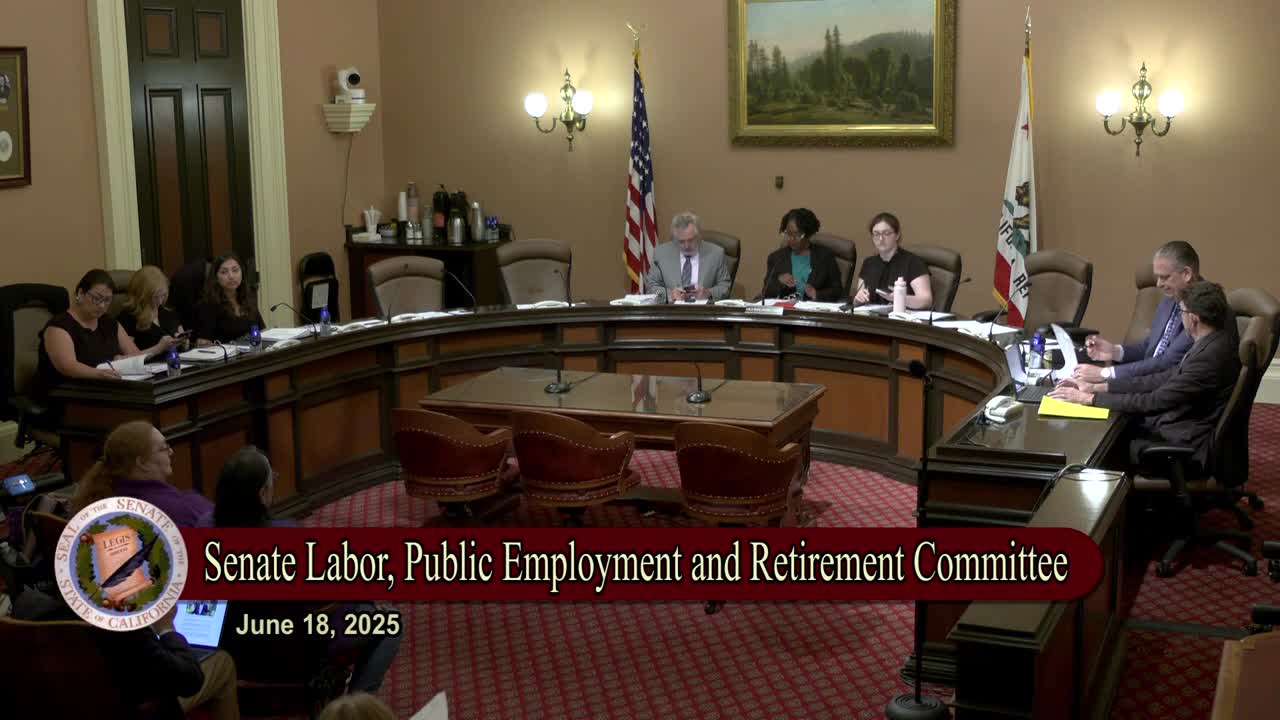 10MIN
Senate Standing Committee on Labor, Public Employment and Retirement
 1MIN
Assembly Floor
 12MIN
Assembly Standing Committee on Higher Education
1MIN
Assembly Standing Committee on Higher Education
Bill Author