AB 7: Postsecondary education: admissions preference: descendants of slavery.
- Session Year: 2025-2026
- House: Assembly
- Latest Version Date: 2025-09-16
Current Status:
Failed
(2026-01-22: Consideration of Governor's veto stricken from file.)
Introduced
In Committee
Awaiting First Chamber Vote
Passed First Chamber
In Committee
Awaiting Second Chamber Vote
Passed Second Chamber
Enacted
The California Constitution prohibits the state from discriminating against, or granting preferential treatment to, any individual or group on the basis of race, sex, color, ethnicity, or national origin in the operation of public employment, public education, or public contracting.
The Donahoe Higher Education Act sets forth, among other things, the missions and functions of Californias public and independent segments of higher education and their respective institutions of higher education. A provision of the act applies to the University of California only to the extent that the Regents of the University of California, by appropriate resolution, act to make the provision applicable.
This bill would state that the California State University, the University of California, independent institutions of higher education, and private postsecondary educational institutions may consider providing a preference in admissions to an applicant who is a descendant of slavery, as defined, to the extent it does not conflict with federal law.
(a)The California State University, the University of California, independent institutions of higher education, as defined in Section 66010, and private postsecondary educational institutions, as defined in Section 94858, may consider providing a preference in admissions to an applicant who is a descendant of slavery. This subdivision shall be implemented only to the extent that it does not conflict with federal law.
(b)For purposes of this section, descendant of slavery means an individual who can establish direct lineage to a person who, before 1900, was subjected to American chattel slavery and meets at least one of the following criteria:
(1)Was emancipated through legal or extralegal means, including self-purchase, manumission, legislative action, military service, or judicial ruling.
(2)Obtained freedom through gradual abolition statutes or constitutional amendments.
(3)Was classified as a fugitive from bondage under federal or state law.
(4)Was deemed contraband by military authorities.
(5)Rendered military or civic service while subject to legal restrictions based on ancestry historically associated with slavery.
(a)The California State University, the University of California, independent institutions of higher education, as defined in Section 66010, and private postsecondary educational institutions, as defined in Section 94858, may consider providing a preference in admissions to an applicant who is a descendant of slavery. This subdivision shall be implemented only to the extent that it does not conflict with federal law.
(b)For purposes of this section, descendant of slavery means a person who, based on lineage, is a descendant of a chattel enslaved person of American chattel slavery. an individual who can establish direct lineage to a person who, before 1900, was subjected to American chattel slavery and meets at least one of the following criteria:
(1)Was emancipated through legal or extralegal means, including self-purchase, manumission, legislative action, military service, or judicial ruling.
(2)Obtained freedom through gradual abolition statutes or constitutional amendments.
(3)Was classified as a fugitive from bondage under federal or state law.
(4)Was deemed contraband by military authorities.
(5)Rendered military or civic service while subject to legal restrictions based on ancestry historically associated with slavery.
(a)The California State University, the University of California, independent institutions of higher education, as defined in Section 66010, and private postsecondary educational institutions, as defined in Section 94858, may consider providing a preference in admissions to an applicant who is a descendant of slavery. This subdivision shall be implemented only to the extent that it does not conflict with federal law.
(b)For purposes of this section, descendant of slavery means a person who, based on lineage, is a descendant of a chattel enslaved person of American chattel slavery.
CORRECTIONS: HeadingLine 4. REVISIONS: HeadingLines 4 and 5.|
Date
|
Status
|
|---|---|
| Jan 22, 2026 | Consideration of Governor's veto stricken from file. |
| Oct 13, 2025 | Consideration of Governor's veto pending. |
| Oct 13, 2025 | Vetoed by Governor. |
| Sep 24, 2025 | Enrolled and presented to the Governor at 3 p.m. |
| Sep 12, 2025 | Senate amendments concurred in. To Engrossing and Enrolling. (Ayes 55. Noes 18. Page 3363.). |
| Sep 9, 2025 | In Assembly. Concurrence in Senate amendments pending. |
| Sep 9, 2025 | Read third time. Passed. Ordered to the Assembly. (Ayes 30. Noes 10. Page 2744.). |
| Aug 29, 2025 | Read second time. Ordered to third reading. |
| Aug 29, 2025 | From committee: Do pass. (Ayes 5. Noes 2.) (August 29). |
| Aug 18, 2025 | In committee: Referred to suspense file. |
| Jul 16, 2025 | From committee: Do pass and re-refer to Com. on APPR. (Ayes 11. Noes 2.) (July 15). Re-referred to Com. on APPR. |
| Jul 9, 2025 | From committee: Do pass and re-refer to Com. on JUD. (Ayes 5. Noes 2.) (July 9). Re-referred to Com. on JUD. |
| Jul 3, 2025 | From committee chair, with author's amendments: Amend, and re-refer to committee. Read second time, amended, and re-referred to Com. on ED. |
| Jun 18, 2025 | Referred to Coms. on ED. and JUD. |
| Jun 4, 2025 | In Senate. Read first time. To Com. on RLS. for assignment. |
| Jun 3, 2025 | Read third time. Passed. Ordered to the Senate. (Ayes 54. Noes 17. Page 1965.) |
| May 27, 2025 | Read second time. Ordered to third reading. |
| May 23, 2025 | From committee: Do pass. (Ayes 11. Noes 3.) (May 23). |
| May 14, 2025 | In committee: Set, first hearing. Referred to suspense file. |
| Apr 30, 2025 | From committee: Do pass and re-refer to Com. on APPR. (Ayes 8. Noes 2.) (April 29). Re-referred to Com. on APPR. |
| Apr 30, 2025 | Coauthors revised. |
| Apr 23, 2025 | From committee: Do pass and re-refer to Com. on JUD. (Ayes 6. Noes 3.) (April 22). Re-referred to Com. on JUD. |
| Apr 23, 2025 | Coauthors revised. |
| Feb 18, 2025 | Referred to Coms. on HIGHER ED. and JUD. |
| Dec 3, 2024 | From printer. May be heard in committee January 2. |
| Dec 2, 2024 | Read first time. To print. |
|
Date
|
Description
|
Location
|
Votes
|
|
|---|---|---|---|---|
| Sep 12, 2025 | AB 7 Bryan Concurrence in Senate Amendments | Assembly Floor |
Passed |
|
| Sep 9, 2025 | Assembly 3rd Reading AB7 Bryan et al. By Richardson | Senate Floor |
Passed |
|
| Aug 29, 2025 | Do pass | Senate Standing Committee on Appropriations |
Passed |
|
| Aug 18, 2025 | Placed on suspense file | Senate Standing Committee on Appropriations |
Passed |
|
| Jul 15, 2025 | Do pass, but first be re-referred to the Committee on [Appropriations] | Senate Standing Committee on Judiciary |
Passed |
|
| Jul 9, 2025 | Do pass, but first be re-referred to the Committee on [Judiciary] | Senate Standing Committee on Education |
Passed |
|
| Jun 3, 2025 | AB 7 Bryan Assembly Third Reading | Assembly Floor |
Passed |
|
| May 23, 2025 | Do pass. | Assembly Standing Committee on Appropriations |
Passed |
|
| Apr 29, 2025 | Do pass and be re-referred to the Committee on [Appropriations] | Assembly Standing Committee on Judiciary |
Passed |
|
| Apr 22, 2025 | Do pass and be re-referred to the Committee on [Judiciary] | Assembly Standing Committee on Higher Education |
Passed |
This list shows positions taken on this bill by organizations on the date displayed, which is linked to the original source.
Positions by individuals are not included.
|
Organization
|
Position
|
Date
|
|---|---|---|
| 7 Individuals | ** Support | |
| ADOS Advocacy Foundation California Chapter | ** Support | |
| African American Community Services Agency | ** Support | |
| Bay Area Regional Health Inequity Initiative | ** Support | |
| Black Leadership Council | ** Support | |
| Black Lives Matter California | ** Support | |
| Black Women Organized for Political Action | ** Support | |
| Board of Supervisors for the City and County of San Francisco | ** Support | |
| Brotherhood of Elders Network | ** Support | |
| California Association of Black Lawyers | ** Support | |
| California Association Of Christian Colleges And Universities | ** Support | |
| California Black Power Network | ** Support | |
| California Faculty Association | ** Support | |
| California-Hawaii State Conference Of The Naacp | ** Support | |
| Californians for Equal Rights Foundation | ** Against | |
| California Pan - Ethnic Health Network | ** Support | |
| Cal Voices | ** Support | |
| Carlsbad Citizens for Community Oversight | ** Against | |
| CFT- a Union of Educators & Classified Professionals, Aft, Afl-cio | ** Support | |
| City of Alameda | ** Support | |
| City Of Oakland | ** Support | |
| Community Coalition | ** Support | |
| Community Housing Development Corporation | ** Support | |
| Council on American-Islamic Relations California | ** Support | |
| Culver City Democratic Club | ** Support | |
| Fannie Lou Hamer Institute | ** Support | |
| Healthy Black Families | ** Support | |
| Individuals | ** Against | |
| Magdalena's Daughters | ** Support | |
| Magdalena’s Daughters | ** Support | |
| Pacific Legal Foundation | ** Against | |
| Prevention Institute | ** Support | |
| San Diego Asian Americans for Equality | ** Against | |
| Santa Monica Democratic Club | ** Support | |
| Several individuals | ** Support | |
| Sonoma County Black Forum | ** Support | |
| Students Deserve | ** Support | |
| The Brotherhood of Elders Network | ** Support | |
| UC Student Association | ** Support | |
| western center on law & poverty | ** Support |
GOVERNOR′S VETO
GV Bill Id:AB 7
Author:(Bryan)
As Enrolled Ver:September 16, 2025
2/3 vote
SUMMARY
States that the California State University (CSU), the University of California (UC), independent institutions of higher education, and private postsecondary educational institutions may consider providing a preference in admissions to an applicant who is a descendant of slavery, as defined, to the extent it does not conflict with federal law.
If using ATR, include Major Provisions; If using CSA, include Senate Amendments; If using ACC, include Conference Committee Amendments (note: remove these lines).
Senate Amendments
- Define ″descendant of slavery″ to mean an individual who can establish direct lineage to a person who, before 1900, was subjected to American chattel slavery and meets at least one of the following criteria:
- Was emancipated through legal or extralegal means, including self-purchase, manumission, legislative action, military service, or judicial ruling;
- Obtained freedom through gradual abolition statutes or constitutional amendments;
- Was classified as a fugitive from bondage under federal or state law;
- Was deemed contraband by military authorities; and/or,
- Rendered military or civic service while subject to legal restrictions based on ancestry historically associated with slavery.
Governor′s Veto Message
This bill clarifies, to the extent permitted by federal law, that California public and private postsecondary educational institutions may consider providing a preference in admissions to an applicant who is a descendant of slavery.
I thank the author for his deep commitment to addressing disparities in education stemming from the legacy of slavery. These institutions already have the authority to determine whether to provide admissions preferences like this one, and accordingly, this bill is unnecessary. I encourage the institutions referenced in this bill to review and determine how, when, and if this type of preference can be adopted.
For this reason, I cannot sign this bill.
COMMENTS
Education attainment levels of Black Students in the State. The Campaign for College Opportunity released a report in February 2019, entitled, State of Higher Education for Black Californians. The report noted several facts, notably:
- California high schools graduate Black students at lower rates than all other racial/ethnic groups and have failed to address the significantly lower percentages of Black students who are offered and complete the college preparatory curriculum - a 17-percentage point gap in A-G completion between Black and White students exists.
- Of the 25,000 Black high school graduates in 2017, only 9,000 completed the coursework necessary to be eligible for California′s public four-year universities.
- CCC transfer only 3% of Black students within two years, and only 35% within six years.
- Sixty-three percent of Black community college students do not earn a degree, certificate, or transfer within six years.
- Fifty-seven percent of Black freshmen at CSU do not complete a degree within six years and only 9% do so in four years.
- Ninety-three percent of Black for-profit college students do not complete a degree within six years.
- Almost half of all Black students who attended college left without a degree.
Further, the California Task Force to Study and Develop Reparation Proposals for African Americans, released its final report, commonly referenced as, The California Reparations Report, on June 29, 2023. This report, in part, found that in recent years, the academic achievement gap between all student groups has steadily decreased, except for the gap between Black and White students, which has widened. The report contends said data point confirms the ongoing existence of ″deeply-rooted racial disparities in the nation′s education system.″ Additionally, the report found that there was a 60% decline in Black student enrollment at America′s most selective colleges and universities from the span of 2000-2020.
Proposition 209 and 16. On November 5, 1996, California voters passed (54.55%) Proposition 209, which, in part, eliminated the consideration of race, in public education admissions, regardless of long-standing practices institutions of higher education may have had in place.
Since 1996, there have been various legislative attempts to either repeal or reduce the scope of Proposition 209 on public contracting, public education, and public employment. Of the attempts, one successfully made it onto the ballot. In 2020, ACA 5 (Shirley Weber), Chapter 23, Statues of 2020, (which became Proposition 16), sought to repeal the provisions of Proposition 209. Proposition 16 was deemed an opportunity for California to reintroduce affirmative action by allowing policymakers to consider race and gender–without quotas–when making decisions about contracts, hiring, and education to eliminate systemic discrimination and remedy past harm.
Proposition 16 failed with more than the majority (57.2%) of Californians voting to uphold the existing ban on discrimination and preferential treatment in State operations of public employment, public contracting, and public education.
As drafted, this measure authorizes the CSU, the UC, and independent institutions of higher education, and private postsecondary institutions, to consider providing a preference in admissions to an applicant who is a descendant of slavery, to the extent that it does not conflict with federal law.
Though the language of this measure is permissive, it remains unclear how it would be fully implemented. Policy questions exist - these questions include, but are not limited to, the following:
- How many generations do applicants have to go back in order to be eligible?
- Additionally, what documentation will potentially eligible applicants need to present when seeking to benefit from the preference in admissions?
- How will campus enrollment offices know how to ascertain if provided documents are in fact authentic?
In 2023, the U.S. Supreme Court determined the admissions programs at Harvard College and the University of North Carolina violated the equal protections clause of the 14th Amendment of the U.S. Constitution when colleges considered race as a criteria in admission decisions.[1] The decision effectively ended affirmative action in admissions across the United States; except for in California, where Proposition 209 already prohibited the public university systems from using race as a criteria for admissions. However, it is presently unclear if this measure violates the provisions of state and federal law.
According to the Pacific Legal Foundation, ″AB 7′s use of race and ancestry to provide an admission preference would be subject to strict scrutiny. The Equal Protection Clause of the Fourteenth Amendment to the United States Constitution states that ″[n]o state shall . . . deny to any person within its jurisdiction the equal protection of the laws.″ U.S. Const. amend. XIV, Section 1. Likewise, the California Constitution provides, ″A person may not be . . . denied equal protection of the laws.″ Cal. Const. art. I, Section 7(a). The Supreme Court was clear in Students for Fair Admissions, Inc. v. President and Fellows of Harvard College, 600 U.S. 181, 208 (2023), that the Constitution rarely tolerates race-based state action. And when it does, it is only within the confines of narrow restrictions. Id. at 214. AB 7 is no exception.″
According to the Author
According to the author, ″for decades, universities gave preferential admission treatment to legacy donors and their family members, while ignoring admission outcomes for applicants directly impacted by legacies of harm and exclusion. These intentional decisions have resulted in stark and measurable achievement differences that have documented ties back to slavery in the United States.″
The author further states that, ″AB 7 provides a legal mechanism for California′s colleges and universities to address educational inequities tied directly to slavery and its lasting effects. By allowing institutions to consider an applicant′s lineage as a factor in admissions decisions, the bill aims to increase institutional access for students who research has shown still experience the greatest educational attainment and achievement disadvantages.″
Arguments in Support
According to the UC Student Association (UCSA), ″AB 7 is a critical step toward equity and restorative justice, one that acknowledges and seeks to correct historical and systemic barriers that have impacted descendants of slavery, a lineage that has disproportionately hindered college access for African-American communities and Black students across generations due to the legacy of slavery, Jim Crow segregation laws and institutionalized racial discrimination.″
Additionally, UCSA states that, ″for many students, pursuit of a higher education is simply out of reach, oftentimes due to factors out of their control: Lack of access to college advisors, little to no support with A-G completion, dual enrollment or FAFSA, and affordability. Obstacles that threaten students′ dreams of their college and career goals are disturbingly more pronounced for Black students, who are enrolled in California′s public colleges and universities at disproportionately lower rates due to long-standing inequities in our K-12 and higher education systems.″
Arguments in Opposition
According to the Californians for Equal Rights Foundation (CFER), ″California State Constitution Article I Section 31(a) was established by the passage of Proposition 209, or the California Civil Rights Initiative in 1996. It unequivocally states: ″The state shall not discriminate against, or grant preferential treatment to, any individual or group on the basis of race, sex, color, ethnicity, or national origin in the operation of public employment, public education, or public contracting.″ This principle was overwhelmingly reaffirmed on the November 2020 ballot when 57.2% of California voters rejected Proposition 16, which would have repealed Prop 209.″
The CFER contends that, ″AB 7′s implementation would certainly lead to de facto racial preferences without facilitating any meaningful changes to ameliorate structural problems at the K-12 level including declines in academic performance and the persistent achievement gaps among different demographic groups.″
FISCAL COMMENTS
According to the Senate Committee on Appropriations:
- The California State University (CSU) estimates General Fund (GF) costs of about $3.0 million for campuses to review and determine the appropriate documentation necessary to verify descendants of slavery and update admissions applications. This estimate assumes that all 23 campuses would elect to provide preferential admissions to descendants, and that each campus would require one new position at a cost of $130,104 each year to perform these duties.
- The University of California (UC) estimates General Fund costs in the tens of thousands of dollars each year to verify descendants of slavery and update admissions applications. The UC also cites multiple pending lawsuits for its admissions practices and that the bill would likely be challenged in the courts. To the extent that the bill results in litigation involving UC as a party, it could add unknown but potentially significant GF costs in the high hundreds of thousands of dollars.
VOTES
ASM HIGHER EDUCATION: 6-3-1
YES: Fong, Boerner, Jackson, Muratsuchi, Celeste Rodriguez, Sharp-Collins
NO: DeMaio, Jeff Gonzalez, Tangipa
ABS, ABST OR NV: Patel
ASM JUDICIARY: 8-2-2
YES: Kalra, Bryan, Connolly, Harabedian, Pacheco, Papan, Stefani, Zbur
NO: Macedo, Sanchez
ABS, ABST OR NV: Dixon, Bauer-Kahan
ASM APPROPRIATIONS: 11-3-1
YES: Wicks, Arambula, Calderon, Caloza, Elhawary, Fong, Mark González, Hart, Pacheco, Pellerin, Solache
NO: Dixon, Ta, Tangipa
ABS, ABST OR NV: Sanchez
ASSEMBLY FLOOR: 54-17-8
YES: Addis, Aguiar-Curry, Ahrens, Alvarez, Arambula, Ávila Farías, Bennett, Berman, Boerner, Bonta, Bryan, Calderon, Caloza, Carrillo, Connolly, Elhawary, Fong, Gabriel, Garcia, Gipson, Mark González, Haney, Harabedian, Hart, Jackson, Kalra, Krell, Lee, Lowenthal, McKinnor, Muratsuchi, Nguyen, Ortega, Pacheco, Papan, Pellerin, Quirk-Silva, Ramos, Ransom, Celeste Rodriguez, Michelle Rodriguez, Rogers, Blanca Rubio, Schultz, Sharp-Collins, Solache, Soria, Stefani, Valencia, Ward, Wicks, Wilson, Zbur, Rivas
NO: Castillo, Chen, Davies, DeMaio, Dixon, Ellis, Flora, Gallagher, Jeff Gonzalez, Hadwick, Hoover, Macedo, Patterson, Sanchez, Ta, Tangipa, Wallis
ABS, ABST OR NV: Alanis, Bains, Bauer-Kahan, Irwin, Lackey, Patel, Petrie-Norris, Schiavo
SENATE FLOOR: 30-10-0
YES: Allen, Archuleta, Arreguín, Ashby, Becker, Blakespear, Cabaldon, Caballero, Cervantes, Cortese, Durazo, Gonzalez, Grayson, Hurtado, Laird, Limón, McGuire, McNerney, Menjivar, Padilla, Pérez, Reyes, Richardson, Rubio, Smallwood-Cuevas, Stern, Umberg, Wahab, Weber Pierson, Wiener
NO: Alvarado-Gil, Choi, Dahle, Grove, Jones, Niello, Ochoa Bogh, Seyarto, Strickland, Valladares
ASM HIGHER EDUCATION: 6-3-1
YES: Fong, Boerner, Jackson, Muratsuchi, Celeste Rodriguez, Sharp-Collins
NO: DeMaio, Jeff Gonzalez, Tangipa
ABS, ABST OR NV: Patel
ASM JUDICIARY: 8-2-2
YES: Kalra, Bryan, Connolly, Harabedian, Pacheco, Papan, Stefani, Zbur
NO: Macedo, Sanchez
ABS, ABST OR NV: Dixon, Bauer-Kahan
ASM APPROPRIATIONS: 11-3-1
YES: Wicks, Arambula, Calderon, Caloza, Elhawary, Fong, Mark González, Hart, Pacheco, Pellerin, Solache
NO: Dixon, Ta, Tangipa
ABS, ABST OR NV: Sanchez
ASSEMBLY FLOOR: 55-18-7
YES: Addis, Aguiar-Curry, Ahrens, Alvarez, Arambula, Ávila Farías, Bennett, Berman, Boerner, Bonta, Bryan, Calderon, Caloza, Carrillo, Connolly, Elhawary, Fong, Gabriel, Garcia, Gipson, Mark González, Haney, Harabedian, Hart, Irwin, Jackson, Kalra, Krell, Lee, Lowenthal, McKinnor, Muratsuchi, Nguyen, Ortega, Pacheco, Papan, Pellerin, Quirk-Silva, Ramos, Ransom, Celeste Rodriguez, Michelle Rodriguez, Rogers, Blanca Rubio, Schultz, Sharp-Collins, Solache, Soria, Stefani, Valencia, Ward, Wicks, Wilson, Zbur, Rivas
NO: Alanis, Castillo, Chen, Davies, DeMaio, Dixon, Ellis, Gallagher, Jeff Gonzalez, Hadwick, Hoover, Johnson, Macedo, Patterson, Sanchez, Ta, Tangipa, Wallis
ABS, ABST OR NV: Bains, Bauer-Kahan, Flora, Lackey, Patel, Petrie-Norris, Schiavo
UPDATED
VERSION: September 16, 2025
CONSULTANT: Jeanice Warden / HIGHER ED. / (916) 319-3960 FN: 0002173
https://www.scotusblog.com/case-files/cases/students-for-fair-admissions-inc-v-president-fellows-of-harvard-college/ ↑
CONCURRENCE IN SENATE AMENDMENTS
CSA1 Bill Id:AB 7
Author:(Bryan)
As Amended Ver:July 3, 2025
Majority vote
SUMMARY
States that the California State University (CSU), the University of California (UC), independent institutions of higher education, and private postsecondary educational institutions may consider providing a preference in admissions to an applicant who is a descendant of slavery, as defined, to the extent it does not conflict with federal law.
Senate Amendments
- Define "descendant of slavery" to mean an individual who can establish direct lineage to a person who, before 1900, was subjected to American chattel slavery and meets at least one of the following criteria:
- Was emancipated through legal or extralegal means, including self-purchase, manumission, legislative action, military service, or judicial ruling;
- Obtained freedom through gradual abolition statutes or constitutional amendments;
- Was classified as a fugitive from bondage under federal or state law;
- Was deemed contraband by military authorities; and/or,
- Rendered military or civic service while subject to legal restrictions based on ancestry historically associated with slavery.
COMMENTS
Education attainment levels of Black Students in the State. The Campaign for College Opportunity released a report in February 2019, entitled, State of Higher Education for Black Californians. The report noted several facts, notably:
- California high schools graduate Black students at lower rates than all other racial/ethnic groups and have failed to address the significantly lower percentages of Black students who are offered and complete the college preparatory curriculum - a 17% point gap in A-G completion between Black and White students exists.
- Of the 25,000 Black high school graduates in 2017, only 9,000 completed the coursework necessary to be eligible for California's public four-year universities.
- CCC transfer only 3% of Black students within two years, and only 35% within six years.
- Sixty-three percent of Black community college students do not earn a degree, certificate, or transfer within six years.
- Fifty-seven percent of Black freshmen at CSU do not complete a degree within six years and only 9% do so in four years.
- Ninety-three percent of Black for-profit college students do not complete a degree within six years.
- Almost half of all Black students who attended college left without a degree.
Further, the California Task Force to Study and Develop Reparation Proposals for African Americans, released its final report, commonly referenced as, The California Reparations Report, on June 29, 2023. This report, in part, found that in recent years, the academic achievement gap between all student groups has steadily decreased, except for the gap between Black and White students, which has widened. The report contends said data point confirms the ongoing existence of "deeply-rooted racial disparities in the nation's education system." Additionally, the report found that there was a 60% decline in Black student enrollment at America's most selective colleges and universities from the span of 2000-2020.
Proposition 209 and 16. On November 5, 1996, California voters passed (54.55%) Proposition 209, which, in part, eliminated the consideration of race, in public education admissions, regardless of long-standing practices institutions of higher education may have had in place.
Since 1996, there have been various legislative attempts to either repeal or reduce the scope of Proposition 209 on public contracting, public education, and public employment. Of the attempts, one successfully made it onto the ballot. In 2020, ACA 5 (Shirley Weber), Chapter 23, Statues of 2020, (which became Proposition 16), sought to repeal the provisions of Proposition 209. Proposition 16 was deemed an opportunity for California to reintroduce affirmative action by allowing policymakers to consider race and gender–without quotas–when making decisions about contracts, hiring, and education to eliminate systemic discrimination and remedy past harm.
Proposition 16 failed with more than the majority (57.2%) of Californians voting to uphold the existing ban on discrimination and preferential treatment in State operations of public employment, public contracting, and public education.
As drafted, this measure authorizes the CSU, the UC, and independent institutions of higher education, and private postsecondary institutions, to consider providing a preference in admissions to an applicant who is a descendant of slavery, to the extent that it does not conflict with federal law.
Though the language of this measure is permissive, it remains unclear how it would be fully implemented. Policy questions exist - these questions include, but are not limited to, the following:
- How many generations do applicants have to go back in order to be eligible?
- Additionally, what documentation will potentially eligible applicants need to present when seeking to benefit from the preference in admissions?
- How will campus enrollment offices know how to ascertain if provided documents are in fact authentic?
In 2023, the U.S. Supreme Court determined the admissions programs at Harvard College and the University of North Carolina violated the equal protections clause of the 14th Amendment of the U.S. Constitution when colleges considered race as a criteria in admission decisions.[1] The decision effectively ended affirmative action in admissions across the United States; except for in California, where Proposition 209 already prohibited the public university systems from using race as a criteria for admissions. However, it is presently unclear if this measure violates the provisions of state and federal law.
According to the Pacific Legal Foundation, "AB 7's use of race and ancestry to provide an admission preference would be subject to strict scrutiny. The Equal Protection Clause of the Fourteenth Amendment to the United States Constitution states that "[n]o state shall . . . deny to any person within its jurisdiction the equal protection of the laws." U.S. Const. amend. XIV, Section 1. Likewise, the California Constitution provides, "A person may not be . . . denied equal protection of the laws." Cal. Const. art. I, Section 7(a). The Supreme Court was clear in Students for Fair Admissions, Inc. v. President and Fellows of Harvard College, 600 U.S. 181, 208 (2023), that the Constitution rarely tolerates race-based state action. And when it does, it is only within the confines of narrow restrictions. Id. at 214. AB 7 is no exception."
According to the Author
According to the author, "for decades, universities gave preferential admission treatment to legacy donors and their family members, while ignoring admission outcomes for applicants directly impacted by legacies of harm and exclusion. These intentional decisions have resulted in stark and measurable achievement differences that have documented ties back to slavery in the United States."
The author further states that, "AB 7 provides a legal mechanism for California's colleges and universities to address educational inequities tied directly to slavery and its lasting effects. By allowing institutions to consider an applicant's lineage as a factor in admissions decisions, the bill aims to increase institutional access for students who research has shown still experience the greatest educational attainment and achievement disadvantages."
Arguments in Support
According to the UC Student Association (UCSA), "AB 7 is a critical step toward equity and restorative justice, one that acknowledges and seeks to correct historical and systemic barriers that have impacted descendants of slavery, a lineage that has disproportionately hindered college access for African-American communities and Black students across generations due to the legacy of slavery, Jim Crow segregation laws and institutionalized racial discrimination."
Additionally, UCSA states that, "for many students, pursuit of a higher education is simply out of reach, oftentimes due to factors out of their control: Lack of access to college advisors, little to no support with A-G completion, dual enrollment or FAFSA, and affordability. Obstacles that threaten students' dreams of their college and career goals are disturbingly more pronounced for Black students, who are enrolled in California's public colleges and universities at disproportionately lower rates due to long-standing inequities in our K-12 and higher education systems."
Arguments in Opposition
According to the Californians for Equal Rights Foundation (CFER), "California State Constitution Article I Section 31(a) was established by the passage of Proposition 209, or the California Civil Rights Initiative in 1996. It unequivocally states: "The state shall not discriminate against, or grant preferential treatment to, any individual or group on the basis of race, sex, color, ethnicity, or national origin in the operation of public employment, public education, or public contracting." This principle was overwhelmingly reaffirmed on the November 2020 ballot when 57.2% of California voters rejected Proposition 16, which would have repealed Prop 209."
The CFER contends that, "AB 7's implementation would certainly lead to de facto racial preferences without facilitating any meaningful changes to ameliorate structural problems at the K-12 level including declines in academic performance and the persistent achievement gaps among different demographic groups."
FISCAL COMMENTS
According to the Senate Committee on Appropriations:
- The California State University (CSU) estimates General Fund (GF) costs of about $3.0 million for campuses to review and determine the appropriate documentation necessary to verify descendants of slavery and update admissions applications. This estimate assumes that all 23 campuses would elect to provide preferential admissions to descendants, and that each campus would require one new position at a cost of $130,104 each year to perform these duties.
- The University of California (UC) estimates General Fund costs in the tens of thousands of dollars each year to verify descendants of slavery and update admissions applications. The UC also cites multiple pending lawsuits for its admissions practices and that the bill would likely be challenged in the courts. To the extent that the bill results in litigation involving UC as a party, it could add unknown but potentially significant GF costs in the high hundreds of thousands of dollars.
VOTES:
ASM HIGHER EDUCATION: 6-3-1
YES: Fong, Boerner, Jackson, Muratsuchi, Celeste Rodriguez, Sharp-Collins
NO: DeMaio, Jeff Gonzalez, Tangipa
ABS, ABST OR NV: Patel
ASM JUDICIARY: 8-2-2
YES: Kalra, Bryan, Connolly, Harabedian, Pacheco, Papan, Stefani, Zbur
NO: Macedo, Sanchez
ABS, ABST OR NV: Dixon, Bauer-Kahan
ASM APPROPRIATIONS: 11-3-1
YES: Wicks, Arambula, Calderon, Caloza, Elhawary, Fong, Mark González, Hart, Pacheco, Pellerin, Solache
NO: Dixon, Ta, Tangipa
ABS, ABST OR NV: Sanchez
ASSEMBLY FLOOR: 54-17-8
YES: Addis, Aguiar-Curry, Ahrens, Alvarez, Arambula, Ávila Farías, Bennett, Berman, Boerner, Bonta, Bryan, Calderon, Caloza, Carrillo, Connolly, Elhawary, Fong, Gabriel, Garcia, Gipson, Mark González, Haney, Harabedian, Hart, Jackson, Kalra, Krell, Lee, Lowenthal, McKinnor, Muratsuchi, Nguyen, Ortega, Pacheco, Papan, Pellerin, Quirk-Silva, Ramos, Ransom, Celeste Rodriguez, Michelle Rodriguez, Rogers, Blanca Rubio, Schultz, Sharp-Collins, Solache, Soria, Stefani, Valencia, Ward, Wicks, Wilson, Zbur, Rivas
NO: Castillo, Chen, Davies, DeMaio, Dixon, Ellis, Flora, Gallagher, Jeff Gonzalez, Hadwick, Hoover, Macedo, Patterson, Sanchez, Ta, Tangipa, Wallis
ABS, ABST OR NV: Alanis, Bains, Bauer-Kahan, Irwin, Lackey, Patel, Petrie-Norris, Schiavo
UPDATED
VERSION: July 3, 2025
CONSULTANT: Jeanice Warden / HIGHER ED. / (916) 319-3960 FN: 0001917
https://www.scotusblog.com/case-files/cases/students-for-fair-admissions-inc-v-president-fellows-of-harvard-college/ ↑
SENATE RULES COMMITTEE Office of Senate Floor Analyses (916) 651-1520 Fax: (916) 327-4478 | AB 7 |
THIRD READING
Bill No: AB 7
Author: Bryan (D), et al.
Amended: 7/3/25 in Senate
Vote: 21
SENATE EDUCATION COMMITTEE: 5-2, 7/9/25
AYES: Pérez, Cabaldon, Cortese, Gonzalez, Laird
NOES: Ochoa Bogh, Choi
SENATE JUDICIARY COMMITTEE: 11-2, 7/15/25
AYES: Umberg, Allen, Arreguín, Ashby, Caballero, Durazo, Laird, Stern, Wahab, Weber Pierson, Wiener
NOES: Niello, Valladares
SENATE APPROPRIATIONS COMMITTEE: 5-2, 8/29/25
AYES: Caballero, Cabaldon, Grayson, Richardson, Wahab
NOES: Seyarto, Dahle
ASSEMBLY FLOOR: 54-17, 6/3/25 - See last page for vote
SUBJECT: Postsecondary education: admissions preference: descendants of slavery
SOURCE: Author
DIGEST:
This bill authorizes, to the extent permitted by federal law, California public and private postsecondary educational institutions to consider providing a preference in admissions to an applicant who is a descendant of slavery.
ANALYSIS:
Existing Federal law:
- Provides that no state “shall make or enforce any law which shall abridge the privileges or immunities of citizens of the United States; nor shall any state deprive any person of life, liberty, or property, without due process of law; nor deny to any person within its jurisdiction the equal protection of the laws.” This article is also known as the Equal Protection Clause. (U.S. Constitution (USC), Article 14)
- Provides that “the use of race in admissions decisions to further a compelling interest in obtaining the educational benefits that flow from a diverse student body is not prohibited by the Equal Protection Clause.” (Grutter v. Bollinger, 539 U.S. 306 (2003))
- Prohibits the use of racial quotas in the admissions decisions, and provides that the use of race in admissions decision must be individualized, narrowly tailored, and cannot be decisive. (Regents of the University of California v. Bakke, (438 U.S. 265 (1978)) and Gratz v. Bollinger, 539 U.S. 244 (2003))
- Decrees that no person in the United States will, on the basis of sex, be excluded from participation in, be denied the benefits of, or be subjected to discrimination under any education program or activity receiving Federal financial assistance except for specified circumstances including membership of fraternities and sororities. (20 USC Sections 1681-1688 (Title IX))
- Prohibits discrimination on the basis of race, color, and/or national origin in programs and activities receiving federal assistance. (42 USC 2000d, et seq. (Title VI of the Civil Rights Act of 1964))
- Prohibits discrimination in employment based on race, color, religion, sex or national origin and prohibits retaliation against employees who invoke their rights under Title VII of the Civil Rights Act of 1964. (42 USC 2000e (Title VII of the Civil Rights Act))
Existing State law:
- Prohibits the State, in the operation of public employment, public education, or public contracting, from discriminating against or granting preferential treatment to any individual or any group on the basis of race, sex, color, ethnicity, or national origin. Stipulates the implementation is to comply with federal laws and the U.S. Constitution. Defines the “State” to include, but not necessarily be limited to, the State itself, any city, county, city and county, public university system, including the University of California (UC), California Community College (CCC) district, school district, special district, or any other political subdivision or governmental instrumentality of or within the State. Stipulates that nothing in the section is to be interpreted as:
- Prohibiting bona fide qualifications based on sex, which are reasonably necessary to the normal operation of public employment, public education, or public contracting;
- Invalidating any court order or consent decree, which is in force as the effective date of the section; and,
- Prohibiting action which must be taken to establish or maintain eligibility for any federal program, where ineligibility would result in a loss of federal funds to the State.
- For the purposes of this section, the remedies available for violations of this section must be the same, regardless of the injured party’s race, sex, color, ethnicity, or national origin, as are otherwise available for violations of then-existing California antidiscrimination law.
- Stipulates that this section must be self-executing. If any part or parts of this section are found to be in conflict with federal law or the U.S. Constitution, the section must be implemented to the maximum extent that federal law and the U.S. Constitution permit. Any provision held invalid shall be severable from the remaining portions of this section. (California Constitution Article I § 31 (also known as Proposition 209))
- Establishes the California State University (CSU), under the administration of the CSU Trustees, the UC, under the administration of the UC Regents of, the CCC, under the administration of the CCC Board of Governors, and independent institutions of higher education, as defined, as four segments of postsecondary education in the state. (Education Code (EDC) § 66010.4, et seq.)
- Stipulates that no person is to be subjected to discrimination on the basis of disability, gender, gender identity, gender expression, nationality, race or ethnicity, religion, sexual orientation, or any characteristic listed or defined, including immigration status. States the prohibition on the discrimination on the basis of the listed characteristics is extended to programs or activities conducted by any postsecondary education institution that receives or benefits from, state financial assistance or enrolls students who receive state financial aid. (EDC § 66270)
This bill:
- Authorizes CSU, UC, independent institutions of higher education, and private postsecondary educational institutions to consider providing a preference in admissions to an applicant who is a descendant of slavery to the extent that it does not conflict with federal law.
- Defines “descendant of slavery” to mean an individual who can establish direct lineage to a person who, before 1900, was subjected to American chattel slavery and meets at least one of the following criteria:
- Was emancipated through legal or extralegal means, including self-
purchase, manumission, legislative action, military service, or judicial ruling.
- Obtained freedom through gradual abolition statutes or constitutional
amendments.
- Was classified as a fugitive from bondage under federal or state law.
- Was deemed contraband by military authorities.
- Rendered military or civic service while subject to legal restrictions
based on ancestry historically associated with slavery.
Comments
- Need for this bill. According to the author, “For decades, universities gave preferential admission treatment to legacy donors and their family members, while ignoring admission outcomes for applicants directly impacted by legacies of harm and exclusion. These intentional decisions have resulted in stark and measurable achievement differences that have documented ties back to slavery in the United States.
“AB 7 provides a legal mechanism for California's colleges and universities to address educational inequities tied directly to slavery and its lasting effects. By allowing institutions to consider an applicant’s lineage as a factor in admissions decisions, the bill aims to increase institutional access for students who research has shown still experience the greatest educational attainment and achievement disadvantages.”
- Education attainment levels of Black students in the State. The Campaign for College Opportunity released a report in February 2019, State of Higher Education for Black Californians. The report noted several facts, notably:
- California high schools graduate Black students at lower rates than all other racial/ethnic groups and have failed to address the significantly lower percentages of Black students who are offered and complete the college preparatory curriculum–a 17-percentage point gap in A-G completion between Black and White students exists.
- Of the 25,000 Black high school graduates in 2017, only 9,000 completed the coursework necessary to be eligible for California’s public four-year universities.
- CCC transfers only 3% of Black students within two years and only 35% within six years.
- 63% of Black community college students do not earn a degree, certificate, or transfer within six years.
- 57% of Black freshmen at CSU do not complete a degree within six years, and only 9% do so in four years.
- 93% of Black for-profit college students do not complete a degree within six years.
- Almost half of all Black students who attended college left without a degree.
Further, the California Task Force to Study and Develop Reparation Proposals for African Americans released its final report, commonly referenced as the California Reparations Report, on June 29, 2023. The report, in part, found that in recent years, the academic achievement gap between all student groups has steadily decreased, except for the gap between Black and White students, which has widened. The report contends said data point confirms the ongoing existence of “deeply-rooted racial disparities in the nation’s education system.” Additionally, the report found that there was a 60% decline in Black student enrollment at America’s most selective colleges and universities from the span of 2000-2020.
- Propositions 209 and 16. On November 5, 1996, California voters passed (54.55%) Proposition 209, which, in part, eliminated the consideration of race, in public education admissions, regardless of long-standing practices institutions of higher education may have had in place.
Since 1996, there have been various legislative attempts to either repeal or reduce the scope of Proposition 209 on public contracting, public education, and public employment. Of the attempts, one successfully made it onto the ballot. In 2020, ACA 5 (Shirley Weber, Chapter 23, Statutes of 2020)—which became Proposition 16, sought to repeal the provisions of Proposition 209. Proposition 16 was deemed an opportunity for California to reintroduce affirmative action by allowing policymakers to consider race and gender–without quotas–when making decisions about contracts, hiring, and education to eliminate systemic discrimination and remedy past harm.
Proposition 16 failed with more than the majority (57.2%) of Californians voting to uphold the existing ban on discrimination and preferential treatment in State operations of public employment, public contracting, and public education.
- Recent Supreme Court decision has implications for private institutions. In 2023, the U.S. Supreme Court determined the admissions programs at Harvard College and the University of North Carolina violated the equal protections clause of the 14th Amendment of the U.S. Constitution when colleges considered race as a criterion in admission decisions. The decision effectively ended affirmative action in college admissions at both public and private institutions across the U.S. with the exception of California, where Proposition 209 already prohibited the public university systems from using race as a criterion for admissions. However, the Proposition 209 restriction did not apply to California private colleges. The recent ruling now extends these restrictions to California private colleges that accept federal aid, significantly changing how diversity goals are pursued in admissions at those colleges. This bill is permissive—it authorizes institutions to consider giving preference in admissions to an applicant who is a descendant of slavery. The impact of this bill will depend on whether or how institutions choose to implement its provisions to the extent that it does not conflict with state or federal law.
- Holistic review. The CSU system generally admits all students who are California residents that graduate from high school, meet grade point average requirements, and complete the A-G pattern of courses with a grade of C or higher for admission as a first-time freshman. The CSU authorizes campuses to use supplementary admission criteria or multifactor review to screen applications, which may consist of other factors such as being a first-generation college student and extracurricular involvement. At UC, applicants are evaluated using the Comprehensive Review process. Campuses use 13 selection criteria, based upon academic achievement, including grade point average in all completed A-G course pattern and others based on factors such as special talents and accomplishments, creativity, leadership, community service, and life experiences to make admissions decisions. Holistic review policies recognize multifactor including the value of considering personal hardships or life challenges in admissions. However, it is not clear whether specific factors have greater weight over others.
- Descendant status verification. This bill does not specify how students would demonstrate eligibility or what documentation would be required. However related legislation, SB 437 (Weber-Pierson, 2025) requires, among other things, the CSU to explore options for confirming an individual’s descendant status and to establish a process for conducting genealogical research to confirm eligibility for reparative claims. Additionally, it requires that the CSU commence the work of establishing the process by the 2026–27 academic year. The definition of “descendant of slavery” in this bill mirrors the definition included in SB 437. This alignment positions this bill to integrate with an emerging eligibility verification system, though details about the practical administration of this system remains unclear.
FISCAL EFFECT: Appropriation: No Fiscal Com.: Yes Local: No
According to the Senate Appropriations analysis, this bill would have the following fiscal impact:
• The (CSU) estimates General Fund costs of about $3.0 million for campuses to review and determine the appropriate documentation necessary to verify descendants of slavery and update admissions applications. This estimate assumes that all 23 campuses would elect to provide preferential admissions to descendants, and that each campus would require one new position at a cost of $130,104 each year to perform these duties.
• The (UC) estimates General Fund costs in the tens of thousands of dollars each year to verify descendants of slavery and update admissions applications. The UC also cites multiple pending lawsuits for its admissions practices and that the bill would likely be challenged in the courts. To the extent that the bill results in litigation involving UC as a party, it could add unknown but potentially significant General Fund costs in the high hundreds of thousands of dollars.
SUPPORT: (Verified 8/28/25)
ADOS Advocacy Foundation California Chapter
African American Community Service Agency
Bay Area Regional Health Inequity Initiative
Black Leadership Council
Board of Supervisors for the City and County of San Francisco
Cal Voices
California Association of Black Lawyers
California Association of Christian Colleges and Universities
California Black Power Network
California Faculty Association
California Pan - Ethnic Health Network
California-Hawaii State Conference of the NAACP
CFT - A Union of Educators & Classified Professionals, AFT, AFL-CIO
City of Alameda
City of Oakland
Community Housing Development Corporation
Council on American-Islamic Relations California
Culver City Democratic Club
Magdalena's Daughters
Prevention Institute
Santa Monica Democratic Club
Sonoma County Black Forum
Students Deserve
The Brotherhood of Elders Network
University of California Student Association
Western Center on Law & Poverty
7 Individuals
OPPOSITION: (Verified 8/28/25)
None received
ASSEMBLY FLOOR: 54-17, 6/3/25
AYES: Addis, Aguiar-Curry, Ahrens, Alvarez, Arambula, Ávila Farías, Bennett, Berman, Boerner, Bonta, Bryan, Calderon, Caloza, Carrillo, Connolly, Elhawary, Fong, Gabriel, Garcia, Gipson, Mark González, Haney, Harabedian, Hart, Jackson, Kalra, Krell, Lee, Lowenthal, McKinnor, Muratsuchi, Nguyen, Ortega, Pacheco, Papan, Pellerin, Quirk-Silva, Ramos, Ransom, Celeste Rodriguez, Michelle Rodriguez, Rogers, Blanca Rubio, Schultz, Sharp-Collins, Solache, Soria, Stefani, Valencia, Ward, Wicks, Wilson, Zbur, Rivas
NOES: Castillo, Chen, Davies, DeMaio, Dixon, Ellis, Flora, Gallagher, Jeff Gonzalez, Hadwick, Hoover, Macedo, Patterson, Sanchez, Ta, Tangipa, Wallis
NO VOTE RECORDED: Alanis, Bains, Bauer-Kahan, Irwin, Lackey, Patel, Petrie-Norris, Schiavo
Prepared by: Olgalilia Ramirez / ED. / (916) 651-4105
8/29/25 20:24:07
**** END ****
SENATE COMMITTEE ON
Senator Anna Caballero, Chair
2025 - 2026 Regular Session
AB 7 (Bryan) - Postsecondary education: admissions preference: descendants of slavery
Version: | Policy Vote: |
Urgency: | Mandate: |
Hearing Date: | Consultant: |
Bill Summary:
This bill authorizes public and private postsecondary educational institutions to consider providing a preference in admissions to an applicant who is a descendant of slavery.
Fiscal Impact:
- The California State University (CSU) estimates General Fund costs of about $3.0 million for campuses to review and determine the appropriate documentation necessary to verify descendants of slavery and update admissions applications. This estimate assumes that all 23 campuses would elect to provide preferential admissions to descendants, and that each campus would require one new position at a cost of $130,104 each year to perform these duties.
- The University of California (UC) estimates General Fund costs in the tens of thousands of dollars each year to verify descendants of slavery and update admissions applications. The UC also cites multiple pending lawsuits for its admissions practices and that the bill would likely be challenged in the courts. To the extent that the bill results in litigation involving UC as a party, it could add unknown but potentially significant General Fund costs in the high hundreds of thousands of dollars.
Background:
The California Constitution prohibits the State, in the operation of public employment, public education, or public contracting, from discriminating against or granting preferential treatment to any individual or any group on the basis of race, sex, color, ethnicity, or national origin. It stipulates that the implementation is to comply with federal laws and the U.S. Constitution. The law defines the “State” to include, but not necessarily be limited to, the State itself, any city, county, city and county, public university system, including the University of California (UC), California Community College (CCC) district, school district, special district, or any other political subdivision or governmental instrumentality of or within the State. The law stipulates that nothing in the section is to be interpreted as:
- Prohibiting bona fide qualifications based on sex, which are reasonably necessary to the normal operation of public employment, public education, or public contracting;
- Invalidating any court order or consent decree, which is in force as the effective date of the section; and,
- Prohibiting action which must be taken to establish or maintain eligibility for any federal program, where ineligibility would result in a loss of federal funds to the State.
Proposed Law:
This bill authorizes CSU, UC, independent institutions of higher education, and private postsecondary educational institutions to consider providing a preference in admissions to an applicant who is a descendant of slavery to the extent that it does not conflict with federal law.
This bill defines “descendant of slavery” to mean an individual who can establish direct lineage to a person who, before 1900, was subjected to American chattel slavery and meets at least one of the following criteria:
- Was emancipated through legal or extralegal means, including self-purchase, manumission, legislative action, military service, or judicial ruling.
- Obtained freedom through gradual abolition statutes or constitutional amendments.
- Was classified as a fugitive from bondage under federal or state law.
- Was deemed contraband by military authorities.
- Rendered military or civic service while subject to legal restrictions based on ancestry historically associated with slavery.
Related Legislation:
SB 437 (Weber-Pierson, 2025) authorizes up to $6 million of funds appropriated in the 2024 Budget act to enable CSU to conduct research to support the recommendations of the Task Force to Study and Develop Reparation Proposals for African Americans. The bill is pending in the Assembly Appropriations Committee.
AB 697 (Ting, Chapter 514, Statutes of 2019) requires the CSU Trustees, the UC Regents, and the appropriate governing bodies of each independent institution of higher education that provide preferential treatment in admissions to applicants with a relationship to donors or alumni, to annually report information about those admissions to the Legislature.
AB 2047 (Hernandez, 2010) would have authorized the CSU and the UC to consider geographic origin, household income, race, gender, ethnicity and national origin along with other relevant factors, in undergraduate and graduate admissions, and required and requested the CSU and UC, respectively, to report on the implementation of these provisions to the Legislature and Governor by November 1, 2012, as specified. AB 2047 was ultimately vetoed by the Governor with the following message:
“The UC and CSU systems are aware of and supportive of the important goal of student diversity and make every attempt through its comprehensive review admissions process. That process considers many of the factors contained in this legislation, but do so within current constitutional restrictions. The intent of this bill would be more appropriately addressed through a constitutional change of those current restrictions.”
Staff Comments:
On November 5, 1996, California voters passed Proposition 209, which, in part, eliminated the consideration of race, in public education admissions, regardless of long-standing practices institutions of higher education may have had in place. Since 1996, there have been various legislative attempts to repeal or reduce the scope of Proposition 209 on public contracting, public education, and public employment, including ACA 5 (Shirley Weber, Chapter 23, Statutes of 2020) which became Proposition 16 and proposed to repeal the provisions of Proposition 209 and reintroduce affirmative action in the state. Voters failed to pass Proposition 16, effectively upholding the existing ban on discrimination and preferential treatment in state public employment, public contracting, and public education.
This bill would authorize the public segments of higher education and private postsecondary educational institutions to consider providing a preference in admissions to an applicant who is a descendant of slavery to the extent that it does not conflict with federal law. According to the author, “For decades, universities gave preferential admission treatment to legacy donors and their family members, while ignoring admission outcomes for applicants directly impacted by legacies of harm and exclusion. These intentional decisions have resulted in stark and measurable achievement differences that have documented ties back to slavery in the United States.
“AB 7 provides a legal mechanism for California's colleges and universities to address educational inequities tied directly to slavery and its lasting effects. By allowing institutions to consider an applicant’s lineage as a factor in admissions decisions, the bill aims to increase institutional access for students who research has shown still experience the greatest educational attainment and achievement disadvantages.”
-- END --
Senator Thomas Umberg, Chair
2025-2026 Regular Session
Bill No: AB 7 (Author:Bryan)
Version: July 3, 2025
Hearing Date: July 15, 2025
Fiscal: Yes
Urgency: No
Consultant: AWM
SUBJECT
Postsecondary education: admissions preference: descendants of slavery
DIGEST
This bill permits the California State University (CSU), University of California (UC), independent institutions of higher education, and private postsecondary educational institutions to consider providing a preference in admissions to an applicant who is a descendant of slavery, as defined.
EXECUTIVE SUMMARY
In 2020, the Legislature passed, and the Governor signed, SB 3121 (Weber, Ch. 319, Stats. 2020), which established the first-in-the nation Task Force to Study and Develop Reparation Proposals for African Americans, with a Special Consideration for African Americans Who are Descendants of Persons Enslaved in the United States (Task Force) to study and develop reparations proposals for California’s role in accommodating and facilitating slavery, perpetuating the vestiges of enslavement, enforcing state-sanctioned discrimination, and permitting pervasive, systematic structures of discrimination against African Americans. The Task Force completed its work and issued its final report in 2023. The report contains a number of recommended remedies the state could implement in order to atone for its decades of state-sanctioned white supremacy.
This bill is intended to further the Task Force’s goals by specifying that the CSU, the UC, independent institutions of higher education, as defined, and private postsecondary educational institutions, as defined, may consider providing an admissions preference to an applicant who is a descendant of a person who was subjected to chattel slavery in America. While it is not clear that this bill is strictly necessary—the bill does not require the schools to adopt or apply any preference, and schools generally do not need guidance from the state on how to handle admissions—the bill affirms that institutions of higher education can decide for themselves whether to engage in reparatory admissions practices. The bill also provides that it may be implemented only to the extent that it is consistent with federal law.
This bill is sponsored by the author and is supported by over 20 private organizations and public entities, as well as 15 individuals. This bill is opposed by the Carlsbad Citizens for Community Oversight. The Senate Education Committee passed this bill with a vote of 5-2.
PROPOSED CHANGES TO THE LAW
Existing constitutional law:
- Provides that the U.S. Constitution, and the Laws of the United States, are the supreme law of the land. (U.S. Const., art. VI, cl. 2.)
- Provides for equal protection under the law as follows:
- Under the United States Constitution, provides that no state shall deny to any person within its jurisdiction the equal protection of the laws. (U.S. Const., 14th Amend., § 1.)
- Under the California Constitution, provides that a person may not be denied the equal protection of the laws, and that a citizen or class of citizens may not be granted privileges or immunities not granted on the same terms to all citizens. (Cal. Const., art. I, § 7.)
- Provides that the State shall not discriminate against, or grant preferential treatment to, any individual or group on the basis of race, sex, color, ethnicity, or national origin in the operation of public employment, public education, or public contracting. (Cal. Const., art. I, § 31, added by initiative, Gen Elec. (Nov. 5, 1996) (Proposition 209).)
Existing state law:
- Provides that it is the policy of this state to afford all persons in public schools equal rights and opportunities in the educational institutions of this state, regardless of their actual or perceived disability, gender, gender identity, gender expression, nationality, race or ethnicity, religion, sexual orientation, immigration status, or association with a person or group with one or more of these actual or perceived characteristics. (Ed. Code, §§ 200, 210.2.)
- Defines the following relevant terms:
- “Independent institutions of higher education” means those nonprofit higher education institutions that grant undergraduate degrees, graduate degrees, or both, and that are formed as nonprofit corporations in this state and are accredited by an agency recognized by the United States Department of Education. (Ed. Code, § 66010.)
- “Postsecondary education” means a formal institutional education program whose instruction is designed primarily for students who have completed or terminated their secondary education or are beyond the compulsory age of secondary education, including programs whose purpose is academic, vocational, or continuing professional education. (Ed. Code, § 94857.)
- “Private postsecondary educational institution” means a private entity with a physical presence in this state that offers postsecondary education to the public for an institutional charge. (Ed. Code, § 94858.)
- Provides that it is the policy of this state to afford all persons, regardless of disability, gender, gender identity, gender expression, nationality, race or ethnicity, religion, sexual orientation, and immigration status, equal rights and opportunities in the postsecondary educational institutions of the state. (Ed. Code, § 66251.)
- Establishes the Equity in Higher Education Act, which provides that all students have the right to participate fully in the educational process, free from discrimination and harassment, in any program or activity conducted by any postsecondary educational institution that receives, or benefits from, state financial assistance or enrolls students who receive state student financial aid. (Ed. Code, tit. 3, div. 5, pt. 40, ch. 4.5, §§ 66250 et seq.)
- Provides that no person in the State of California shall, on the basis of sex, race, color, religion, ancestry, national origin, ethnic group identification, age, mental disability, physical disability, medical condition, genetic information, marital status, or sexual orientation, be unlawfully denied full and equal access to the benefits of, or be unlawfully subjected to discrimination under, any program or activity that is conducted, operated, or administered by the state or by any state agency, is funded directly by the state, or receives any financial assistance from the state, including the CSU.
Former state law established the Task Force to develop reparations proposals for African Americans, with special consideration for African Americans who are descended from persons enslaved in the United States, and provided that the Task Force statutes would remain in effect until July 1, 2023, and as of that date be repealed. (former Gov. Code, §§ 8301-8301.7, repealed by Gov. Code § 8301.7.)
This bill:
- States that the CSU, the UC, independent institutions of higher education, as defined, and private postsecondary educational institutions, as defined, may consider providing a preference in admissions to an applicant who is a descendant of slavery.
- Provides that 1) shall be implemented only to the extent that it does not conflict with federal law.
- Defines “descendant of slavery” for purposes of 1) as an individual who can establish direct lineage to a person who, prior to 1900, was subjected to American chattel slavery and meets at least one of the following criteria:
- Was emancipated through legal or extralegal means, including self-purchase, manumission, legislative action, military service, or judicial ruling.
- Obtained freedom through gradual abolition statutes or constitutional amendments.
- Was classified as a fugitive from bondage under federal or state law.
- Was deemed contraband by military authorities.
- Rendered military or civic service while subject to legal restrictions based on ancestry historically associated with slavery.
COMMENTS
- Author’s comment
According to the author:
For decades, universities have given preferential admission treatment to donors and their family members, while ignoring those directly impacted by legacies of harm. We have a moral responsibility to do all we can to right those wrongs.
2. The Task Force’s report and recommendations
In 2020, the Legislature enacted AB 3121 (Weber, Ch. 319, Stats. 2020), which created the first-in-the-nation Task Force to explore options for providing reparations to African Americans, and particularly the descendants of enslaved persons, in recognition of California’s role in the heinous institution of slavery and the post-abolition perpetuation of racist institutions.[1] The Task Force released an interim report on June 1, 2022, which provided the Task Force’s preliminary findings regarding the ongoing and compounding harms caused by federal, state, and local governments from slavery and the “ ‘badges and incidents of slavery’ ” that continued to be imposed on African Americans long after slavery was formally abolished.[2] The report notes that, because “the effects of slavery infected every aspect of American society over the last 400 years…it is nearly impossible to identify every ‘badge and incident of slavery,’ to include every piece of evidence, or describe every harm done to African Americans.”[3]
On June 29, 2023, the Task Force issued its final report to the California Legislature, known as the California Reparations Report.[4] The California Reparations Report incorporates and updates the interim report and recommends appropriate remedies, including compensation, for African Americans as recompense for the State’s gross human rights violations against African Americans and their descendants.[5] The California Reparations Report explains:
[T]he harms inflicted upon African Americans have not been incidental or accidental—they have been by design. They are the result of an all-encompassing web of discriminatory laws, regulations, and policies enacted by government. These laws and policies have enabled government officials and private individuals and entities to perpetuate the legacy of slavery by subjecting African Americans as a group to discrimination, exclusion, neglect, and violence in every facet of American life. And there has been no comprehensive effort to disrupt and dismantle institutionalized racism, stop the harm, and redress the specific injuries caused to descendants and the larger African American community.[6]
The Task Force developed its recommendations for reparations taking into account this willful infliction of harm and applying international standards and principles for the remedy of wrongs and injuries caused by a government.[7] The Task Force made a number of recommendations relating to access to education;[8] according to the author, this bill builds on those recommendations.
3. California’s long history of racially discriminatory educational practices
Before slavery was largely abolished in the United States through the ratification of the Thirteenth Amendment,[9] California was officially a free state.[10] In practice, however, chattel enslavement was practiced in California.[11] The California Supreme Court upheld the 1852 Fugitive Slave Act, affirming that enslavers who brought enslaved persons from other states were not affected by the anti-slavery clause in the constitution.[12] After the Civil War, the California Legislature refused to ratify the Fourteenth Amendment (which established birthright citizenship and equal protection under the laws) and the Fifteenth Amendment (which granted the right to vote regardless of race, color, or previous condition of servitude).[13] In the latter half of the Nineteenth Century, California imposed poll taxes and literacy tests to prevent people of color from voting.[14]
This background is provided as context for a description of the racial inequalities of California’s educational system. The United States Supreme Court approved “separate but equal” segregation in Plessy v. Ferguson,[15] and while most of the popular images of school segregation come from the American South, California—with its long history of white supremacy—was also an enthusiastic proponent. The California Supreme Court upheld the establishment of separate schools for white children and schools for people of color in 1874;[16] even after the Legislature ostensibly banned racial segregation for African American students in 1880, African American students were still subjected to manifestly unequal treatment, such as when “the Visalia School District built a new two-story school for white students and forced African American students to attend school in a barn.”[17] School segregation was also enforced through discriminatory housing practices, such as redlining and racially restrictive housing covenants, and by zoning school districts to deliberately keep students of different races in different schools.[18]
Following Brown v Board of Education, which prohibited “separate but equal” public schools,[19] many Californians fought desegregation efforts.[20] In response to various busing plans to alleviate the effects of de jure and de facto school segregation, Californians in 1979 voted to adopt Proposition 1, which prohibited courts from imposing desegregation plans except to remedy a violation of the Equal Protection Clause of the 14th Amendment or unless a federal court would be empowered to impose the same order.[21] The law, which was upheld by the United States Supreme Court,[22] curtailed mandatory busing and limited the state’s ability to combat de facto segregation.[23] As a result:
[I]n the vast majority of California school districts, schools either re-segregated or were never integrated, and so segregated schooling persists today. As of 2003, California was one of the four most segregated states for African American students. As of 2014, California was identified as the third-most segregated states for African American students, and a state where African American and Latino students are strongly concentrated in schools that have far lower quality and resources than their white and Asian peers. As of 2020, California remained in the top 10 most segregated states for Black students.[24]
The longstanding racial inequities in education have led to unequal outcomes in higher education for Black students. As explained by the Senate Education Committee’s analysis of this bill:
The Campaign for College Opportunity released a report in February 2019, State of Higher Education for Black Californians. The report noted several facts, notably:
- California high schools graduate Black students at lower rates than all other racial/ethnic groups and have failed to address the significantly lower percentages of Black students who are offered and complete the college preparatory curriculum–a 17-percentage point gap in A-G completion between Black and White students exists.
- Of the 25,000 Black high school graduates in 2017, only 9,000 completed the coursework necessary to be eligible for California’s public four-year universities.
- CCC transfers only 3% of Black students within two years and only 35% within six years.
- Sixty-three percent of Black community college students do not earn a degree, certificate, or transfer within six years.
- Fifty-seven percent of Black freshmen at CSU do not complete a degree within six years, and only 9% do so in four years.
- Ninety-three percent of Black for-profit college students do not complete a degree within six years.
- Almost half of all Black students who attended college left without a degree.
4. This bill provides that California’s colleges and universities may consider providing an admissions preference to applicants who are descendants of enslaved persons
This bill provides that the CSU, the UC, independent institutions of higher education, and private postsecondary educational institutions may consider providing a preference in admissions to an applicant who is a descendant of slavery. There is no requirement that they provide such a preference, or even a requirement that they consider granting such a preference; the bill merely puts the option on the table. The bill does not prescribe how an institution of higher education must adopt such a preference, instead giving institutions the discretion to implement a preference based on their specific circumstances and needs.
The bill defines a “descendant” as a person who can establish that they are the direct lineal descendant of a person who, prior to 1900, was subjected to American chattel slavery and meets at least one of the following criteria:
- They were emancipated through legal or extralegal means, including self-purchase, manumission, legislative action, military service, or judicial ruling.
- They obtained freedom through gradual abolition statutes or constitutional amendments.
- They were classified as a fugitive from bondage under federal or state law.
- They were deemed contraband by military authorities.
- They rendered military or civic service while subject to legal restrictions based on ancestry historically associated with slavery.
This definition is consistent with the definition of “descendant” adopted in other pending bills relating to descendant status, including SB 518 (Weber Pierson, 2025).
Finally, the bill provides that its provisions shall be implemented only to the extent that it does not conflict with federal law. This really goes without saying: the Supremacy Clause of the United States Constitution makes the U.S. Constitution, and federal law, the law of the land, and conflicting state laws are preempted.[25] The possible preemption issues, along with issues raised by the California Constitution, are discussed below.
5. Constitutional issues
In one, very technical, sense, this bill presents no constitutional issues because it does not actually require any action. The bill states only that an institution of higher education “may consider” granting an admissions preference to descendants of a chattel enslaved person in the United States. This dual layer of deference—schools “may” decide to “consider” adopting a new practice in the future—arguably doesn’t allow the schools to do anything they can’t do already.
In a more pragmatic sense, however, the implications of the bill are clear: the state is giving its blessing to an institution of higher education that wishes to give an admissions preference to descendants. Opponents of the bill argue that the bill violates both the Equal Protection Clause of the Fourteenth Amendment and Proposition 209, so it is worth discussing why this is not the case. The shifting Supreme Court precedent on the Equal Protection Clause is relevant to the Proposition 209 analysis.
The Equal Protection Clause provides that no state shall deny to any person within its jurisdiction the equal protection of the laws.[26] While the text of the clause has not changed since its ratification, the clause’s application has shifted dramatically over the past 60 years along with the changing membership of the United States Supreme Court. In the 1960s, race-conscious laws intended to undo the harmful effects of segregation and white supremacy had some support from the federal government and the Supreme Court.[27] By the 1970s, however, the same backlash that led Californians to adopt Proposition 1, discussed above in Comment 3, led to attacks on race-based admissions in colleges and universities. In Regents of University of California v. Bakke,[28] however, a fractured Supreme Court approved the use of affirmative actions in admissions but held that express racial quotas violated the Equal Protection Clause.[29] But there was no majority opinion; the nine justices collectively issued six opinions that sharply disagreed on the boundaries of the Equal Protection Clause and federal antidiscrimination law.[30] Race-based admissions practices thus continued in California and elsewhere.
Seventeen years after Bakke, the California voters approved Proposition 209, which added an amendment to the California Constitution prohibiting discrimination, or granting preferential treatment to, “any individual or group on the basis of race, sex, color, ethnicity, or national origin in the operation of public employment, public education, or public contracting.”[31] The proponents of the measure were open about the goal of ending affirmative action programs for historically marginalized individuals, arguing that they amounted to “reverse discrimination.”[32] With the adoption of Proposition 209, “the California electorate ‘set a different course’ from that chartered by the [federal] courts,”[33] by prohibiting remedial race-conscious programs that were still permitted under federal law.
Since 1996, however, the federal courts have taken a hard right turn, and race-conscious admissions is one of the casualties. In 2003, the Supreme Court held that a public school admissions system that expressly granted a set number of points to applicants of underrepresented racial minorities violated the Equal Protection Clause,[34] but approved of a system in which race was considered as a “plus factor” as part of an individualized assessment of the student as a whole— with a qualifier: “It has been 25 years since Justice Powell first approved the use of race to further an interest in student body diversity in the context of public higher education…We expect that 25 years from now, the use of racial preferences will no longer be necessary to further the interest approved today.”[35] Ten years later, the Court called into question, but did not prohibit, the consideration of race as a “plus factor” in admissions.[36] And ten years after that, in 2023, the Roberts Court held that virtually any consideration of race in school admissions violates the Equal Protection Clause.[37] The Court did, however, leave open the possibility of race-based considerations for “remediating specific, identified instances of past discrimination that violated the Constitution or a statute.”[38]
The bill’s opponents argue that this bill should be analyzed as a race-based classification subject to Proposition 209 and the Supreme Court’s current application of the Equal Protection Clause. This begs the question, though, of whether “descendant” status, as defined in the bill, is tantamount to, or a proxy for, a race-based classification. A closer examination reveals that this is not the case. Race—specifically, Blackness—is neither necessary nor sufficient to qualify as a descendant. Many Black persons living in the United States today are not descended from chattel enslaved persons, but are rather immigrants themselves or are descended from immigrants who came to the United States in the 20th century; they would not qualify as descendants.[39] Second, because race is, fundamentally, a social construct dependent in part on phenotypical generalizations, it is a virtual certainty that multiracial individuals who do not “look Black” will qualify as descendants.[40]
6. Arguments in support
According to the University of California Student Association:
AB 7 is a critical step toward equity and restorative justice, one that acknowledges and seeks to correct historical and systemic barriers that have impacted descendants of slavery, a lineage that has disproportionately hindered college access for African-American communities and Black students across generations due to the legacy of slavery, Jim Crow segregation laws and institutionalized racial discrimination.
For many students, pursuit of a higher education is simply out of reach, oftentimes due to factors out of their control: Lack of access to college advisors, little to no support with A-G completion, dual enrollment or FAFSA, and affordability. Obstacles that threaten students’ dreams of their college and career goals are disturbingly more pronounced for Black students, who are enrolled in California’s public colleges and universities at disproportionately lower rates due to long-standing inequities in our K-12 and higher education systems…
For years, college admissions have benefited the wealthy and well-connected, as seen in admissions scandals cases at Ivy Leagues and UCLA, while Black student enrollment saw sharp declines after Prop 209 with little to no supports at the K-12 level to equitably support Black student success, resulting in A-G completion rate disparities.
Failing to provide college access support pushes far too many students from underserved backgrounds away from college—through no fault of their own. This in turn creates economic disparities and contributes to the long-term racial inequities faced by African Americans and Black communities. Despite efforts to expand dual enrollment to underserved school districts, increase A-G and FAFSA completion rates, and support Black college students with targeted recruitment and retention programs, every tool should be leveraged in the fight to pursue racial and socio-economic equity in our state. The institutional failures caused by neglect and racism demands our urgent and bold response.
AB 7 offers that response—By establishing priority admission for descendants of slavery, the bill acknowledges the compounded effects of systemic exclusion and seeks to repair a fraction of the harm through improved access to higher education. California’s public colleges and universities have a responsibility to be engines of equity, not perpetrators of disparity. This bill moves us closer to fulfilling that promise.
7. Arguments in opposition
According to Carlsbad Citizens for Community Oversight:
On behalf of Carlsbad Citizens for Community Oversight, I am writing to express our opposition to AB 7 Postsecondary education: admissions preference: descendants of slavery. This bill will give admissions preference to descendants of enslaved people.
The California Constitution prohibits discrimination against, or granting preferential treatment to, any individual or group on the basis of race, sex, color, ethnicity, or national origin in the operation of public employment, public education, or public contracting. We should not start a practice of preferential treatment based on immutable characteristics but return to merit based college admittance
SUPPORT
African American Community Service Agency
Black Leadership Council
Black Lives Matter California
Brotherhood of Elders Network
Cal Voices
California Association of Black Lawyers
California Association of Christian Colleges and Universities
California Black Power Network
California Faculty Association
California Pan-Ethnic Health Network
CFT – A Union of Educators & Classified Professionals, AFT, AFL-CIO
City of Alameda
Community Coalition
Community Housing Development Corporation
Fannie Lou Hamer Institute
Magdalena’s Daughters
NAACP California-Hawai’i State Conference
Santa Monica Democratic Club
Sonoma County Black Forum
Students Deserve
University of California Student Association
Western Center on Law & Poverty
15 individuals
OPPOSITION
Carlsbad Citizens for Community Oversight
RELATED LEGISLATION
Pending legislation:
SB 518 (Weber Pierson, 2025) establishes the Bureau for Descendants of American Slavery within state government, contingent upon an appropriation by the Legislature, and establishes the Bureau’s duties relating to determining an individual’s status as a descendant, as defined, and to reviewing and investigating complaints of property taken as a result of racially motivated eminent domain. SB 518 is pending before the Assembly Appropriations Committee.
ACA 7 (Jackson, 2025) creates a ballot measure that deletes Proposition 209’s reference to “education” and replaces it with “higher education admissions and enrollment.” ACA 7 is pending before the Assembly Appropriations Committee.
Prior legislation:
ACA 7 (Jackson, 2024) would have created a ballot measure to limit Proposition 209 to harmful discrimination, as described. ACA 7 was never set for a hearing by the author and died in this Committee.
AB 3121 (Weber, Ch. 319, Stats. 2020) established the Task Force and its mission, with a sunset date of July 1, 2023.
ACA 5 (Weber, Ch. Res. 23, Stats. 2020) created a ballot measure, placed on the ballot in the November 2024 general election, to repeal Proposition 209. ACA 5 was defeated by the voters.
PRIOR VOTES:
Senate Education Committee (Ayes 5, Noes 2)
Assembly Floor (Ayes 54, Noes 17)
Assembly Appropriations Committee (Ayes 11, Noes 3)
Assembly Judiciary Committee (Ayes 8, Noes 2)
Assembly Higher Education Committee (Ayes 6, Noes 3)
**************
HR 40 (Pressley, 119th Cong., 2025-2026), a federal bill to create a federal commission to study the effects of slavery and discrimination on African Americans and devise reparations proposals, is pending before the House Committee on Judiciary. The bill has been introduced every year since 1989. ↑
California Task Force to Study and Develop Reparation Proposals for African Americans, Interim Report (June 1, 2022), available at https://oag.ca.gov/ab3121/reports. All links in this analysis are current as of July 10, 2025. ↑
Id. at p. 5. ↑
See generally California Reparations Report (2023), available at https://oag.ca.gov/ab3121/reports. ↑
Id. at p. 4. ↑
Id. at p. 48. ↑
Id. at p. 512. ↑
Id. at pp. 715-728. ↑
U.S. Const., 13th amend. The Thirteenth Amendment permits involuntary servitude for persons convicted of crimes; this exception was, and continues to be, used to keep Black Americans in forced labor conditions. (E.g., Blackmon, Slavery by Another Name (2008) pp. 53-54, 63-64.) ↑
See Cal. Const. of 1849, art. I, § 18. ↑
E.g., Smith, Remaking Slavery in a Free State: Masters and Slaves in Gold Rush California (Feb. 2011) Pac. Historical Review, Vol. 80. No. 1. ↑
In re Perkins (1852) 2 Cal. 424, 437-441, 454-457. ↑
Bottoms, An Aristocracy of Color: Race and Reconstruction in California and the West, 1850-1890 (2013) pp. 86, 92-93. California did not ratify the Fourteenth Amendment until 1959 and the Fifteenth Amendment until 1962. (Constitution Annotated, Intro.6.4 Civil War Amendments, https://constitution.congress.gov/browse/essay/intro.6-4/ALDE_00000388/.) ↑
California Reparations Report, supra, at p. 191. ↑
(1896) 163 U.S. 537, overruled by Brown v. Board of Ed. of Topeka (1954) 347 U.S. 483. ↑
Ward v. Flood (1874) 48 Cal. 36. ↑
California Reparations Report supra, at p. 265. ↑
Id. at p. 266. ↑
Brown, supra, 347 U.S. at p. 493. ↑
California Reparations Report, supra, at p. 266. ↑
See Cal. Const., art. I, § 7; School Assignment and Transportation of Pupils, California Proposition1 (1979), available at https://repository.uchastings.edu/cgi/viewcontent.cgi?article=1860&context=ca_ballot_props. ↑
Crawford v. Bd. of Educ. (1982) 458 U.S. 527, 535-536. ↑
California Reparations Report, supra, at p. 266. ↑
Ibid. ↑
See U.S. Const., art. VI, cl. 2. ↑
U.S. Const., 14th amend, ↑
See, e.g., McDaniel v. Barresi (1971) 402 U.S. 39, 41-42 (desegregation plan that explicitly took race into account when drawing attendance lines did not violate the Equal Protection Clause); Exec. Order No. 11246, 30 Fed. Reg. 12319 (Sept. 24, 1965), rescinded by Exec. Order No. 14172, 90 Fed. Reg. 8633 (Jan. 21, 2025); see also, e.g., North Carolina State Bd. of Education v. Swann (1971) 402 U.S. 43, 45-46 (striking down law forbidding the assignment of any student to a school on the basis of race because it would prevent desegregation). ↑
(1978) 438 U.S. 265. ↑
Id. at pp. 318-320 (lead opn. of Powell, J.). ↑
See id. at p. 324 (conc. & dis. opn. of Brennan, J.); id. at p. 379 (conc. opn. of White, J.); id. at p. 387 (conc. opn. of Marshall, J.); id. at p. 402 (conc. opn. of Blackmun, J.); id at p. 408 (conc. & dis. opn. of Stevens, J.). ↑
See Cal. Const., art. I, § 31, added by initiative, Gen Elec. (Nov. 5, 1996). ↑
E.g., California 1996 Gen. Elec. Voter Guide, Proposition 209, Argument in Favor of Proposition 209 (signed by Governor Pete Wilson, Ward Connerly, and Pamela Lewis), available at https://vigarchive.sos.ca.gov/1996/general/pamphlet/209yesarg.htm. ↑
Hi-Voltage Wire Works, Inc. v. City of San Jose (2000 24 Ca.4th 537, 561. ↑
Gratz v. Bollinger (2003) 539 U.S. 244, 270-271. ↑
Grutter v. Bollinger (2003) 539 U.S. 306, 337, 343. ↑
Fisher at University of Texas (2013) 570 U.S. 297, 314-316. ↑
Students for Fair Admissions, Inc. v. Harvard (2023) 600 U.S. 181, 213. ↑
Id. at p. 207. ↑
For example, immigrants from countries in Africa were not given the right to become naturalized U.S. citizens until 1952. (See 66 Stat. 163 (1952) (the Immigration and Nationality Act of 1952, or the McCarran-Walter Act).) ↑
A substantial portion of the Black people in America have so-called “white” ancestry because their ancestors were enslavers who raped enslaved women with impunity. (California Reparations Report, supra, at p. 436.) ↑
SENATE COMMITTEE ON EDUCATION
Senator Sasha Renée Pérez, Chair
2025 - 2026 Regular
Bill No: AB 7 Hearing Date: July 9, 2025
Author: | |||
Version: | July 3, 2025 | ||
Urgency: | No | Fiscal: | Yes |
Consultant: | Olgalilia Ramirez | ||
Subject: Postsecondary education: admissions preference: descendants of slavery.
NOTE: This bill has been referred to the Committees on Education and Judiciary. A “do pass” motion should include referral to the Committee on Judiciary.
SUMMARY
This bill authorizes, to the extent permitted by federal law, California public and private postsecondary educational institutions to consider providing a preference in admissions to an applicant who is a descendant of slavery.
BACKGROUND
Existing Federal law:
- Provides that no state “shall make or enforce any law which shall abridge the privileges or immunities of citizens of the United States; nor shall any state deprive any person of life, liberty, or property, without due process of law; nor deny to any person within its jurisdiction the equal protection of the laws.” This article is also known as the Equal Protection Clause. (U.S. Constitution (USC), Article 14)
- Provides that “the use of race in admissions decisions to further a compelling interest in obtaining the educational benefits that flow from a diverse student body is not prohibited by the Equal Protection Clause.” (Grutter v. Bollinger, 539 U.S. 306 (2003))
- Prohibits the use of racial quotas in the admissions decisions, and provides that the use of race in admissions decision must be individualized, narrowly tailored, and cannot be decisive. (Regents of the University of California v. Bakke, (438 U.S. 265 (1978)) and Gratz v. Bollinger, 539 U.S. 244 (2003))
- Decrees that no person in the United States will, on the basis of sex, be excluded from participation in, be denied the benefits of, or be subjected to discrimination under any education program or activity receiving Federal financial assistance except for specified circumstances including membership of fraternities and sororities. (20 USC Sections 1681-1688 (Title IX))
- Prohibits discrimination on the basis of race, color, and/or national origin in programs and activities receiving federal assistance. (42 USC 2000d, et seq. (Title VI of the Civil Rights Act of 1964))
- Prohibits discrimination in employment based on race, color, religion, sex or national origin and prohibits retaliation against employees who invoke their rights under Title VII of the Civil Rights Act of 1964. (42 USC 2000e (Title VII of the Civil Rights Act))
Existing State law:
- Prohibits the State, in the operation of public employment, public education, or public contracting, from discriminating against or granting preferential treatment to any individual or any group on the basis of race, sex, color, ethnicity, or national origin. Stipulates the implementation is to comply with federal laws and the U.S. Constitution. Defines the “State” to include, but not necessarily be limited to, the State itself, any city, county, city and county, public university system, including the University of California (UC), California Community College (CCC) district, school district, special district, or any other political subdivision or governmental instrumentality of or within the State. Stipulates that nothing in the section is to be interpreted as:
- Prohibiting bona fide qualifications based on sex, which are reasonably necessary to the normal operation of public employment, public education, or public contracting;
- Invalidating any court order or consent decree, which is in force as the effective date of the section; and,
- Prohibiting action which must be taken to establish or maintain eligibility for any federal program, where ineligibility would result in a loss of federal funds to the State.
For the purposes of this section, the remedies available for violations of this section must be the same, regardless of the injured party’s race, sex, color, ethnicity, or national origin, as are otherwise available for violations of then-existing California antidiscrimination law.
Stipulates that this section must be self-executing. If any part or parts of this section are found to be in conflict with federal law or the U.S. Constitution, the section must be implemented to the maximum extent that federal law and the U.S. Constitution permit. Any provision held invalid shall be severable from the remaining portions of this section. (California Constitution Article I § 31 (also known as Proposition 209))
- Establishes the California State University (CSU), under the administration of the CSU Trustees, the UC, under the administration of the UC Regents of, the CCC, under the administration of the CCC Board of Governors, and independent institutions of higher education, as defined, as four segments of postsecondary education in the state. (Education Code (EC) § 66010.4, et seq.)
- Stipulates that no person is to be subjected to discrimination on the basis of disability, gender, gender identity, gender expression, nationality, race or ethnicity, religion, sexual orientation, or any characteristic listed or defined, including immigration status. States the prohibition on the discrimination on the basis of the listed characteristics is extended to programs or activities conducted by any postsecondary education institution that receives or benefits from, state financial assistance or enrolls students who receive state financial aid. (EC § 66270)
ANALYSIS
This bill:
- Authorizes CSU, UC, independent institutions of higher education, and private postsecondary educational institutions to consider providing a preference in admissions to an applicant who is a descendant of slavery to the extent that it does not conflict with federal law.
- Defines “descendant of slavery” to mean an individual who can establish direct lineage to a person who, before 1900, was subjected to American chattel slavery and meets at least one of the following criteria:
- Was emancipated through legal or extralegal means, including self-
purchase, manumission, legislative action, military service, or judicial ruling.
- Obtained freedom through gradual abolition statutes or constitutional
amendments.
- Was classified as a fugitive from bondage under federal or state law.
- Was deemed contraband by military authorities.
- Rendered military or civic service while subject to legal restrictions based
on ancestry historically associated with slavery.
STAFF COMMENTS
- Need for the bill. According to the author, “For decades, universities gave preferential admission treatment to legacy donors and their family members, while ignoring admission outcomes for applicants directly impacted by legacies of harm and exclusion. These intentional decisions have resulted in stark and measurable achievement differences that have documented ties back to slavery in the United States.
“AB 7 provides a legal mechanism for California's colleges and universities to address educational inequities tied directly to slavery and its lasting effects. By allowing institutions to consider an applicant’s lineage as a factor in admissions decisions, the bill aims to increase institutional access for students who research has shown still experience the greatest educational attainment and achievement disadvantages.”
- Education attainment levels of Black students in the State. The Campaign for College Opportunity released a report in February 2019, State of Higher Education for Black Californians. The report noted several facts, notably:
- California high schools graduate Black students at lower rates than all other racial/ethnic groups and have failed to address the significantly lower percentages of Black students who are offered and complete the college preparatory curriculum–a 17-percentage point gap in A-G completion between Black and White students exists.
- Of the 25,000 Black high school graduates in 2017, only 9,000 completed the coursework necessary to be eligible for California’s public four-year universities.
- CCC transfers only 3% of Black students within two years and only 35% within six years.
- Sixty-three percent of Black community college students do not earn a degree, certificate, or transfer within six years.
- Fifty-seven percent of Black freshmen at CSU do not complete a degree within six years, and only 9% do so in four years.
- Ninety-three percent of Black for-profit college students do not complete a degree within six years.
- Almost half of all Black students who attended college left without a degree.
Further, the California Task Force to Study and Develop Reparation Proposals for African Americans released its final report, commonly referenced as the California Reparations Report, on June 29, 2023. The report, in part, found that in recent years, the academic achievement gap between all student groups has steadily decreased, except for the gap between Black and White students, which has widened. The report contends said data point confirms the ongoing existence of “deeply-rooted racial disparities in the nation’s education system.” Additionally, the report found that there was a 60% decline in Black student enrollment at America’s most selective colleges and universities from the span of 2000-2020.
- Propositions 209 and 16. On November 5, 1996, California voters passed (54.55%) Proposition 209, which, in part, eliminated the consideration of race, in public education admissions, regardless of long-standing practices institutions of higher education may have had in place.
Since 1996, there have been various legislative attempts to either repeal or reduce the scope of Proposition 209 on public contracting, public education, and public employment. Of the attempts, one successfully made it onto the ballot. In 2020, ACA 5 (Shirley Weber, Chapter 23, Statutes of 2020)—which became Proposition 16, sought to repeal the provisions of Proposition 209. Proposition 16 was deemed an opportunity for California to reintroduce affirmative action by allowing policymakers to consider race and gender–without quotas–when making decisions about contracts, hiring, and education to eliminate systemic discrimination and remedy past harm.
Proposition 16 failed with more than the majority (57.2%) of Californians voting to uphold the existing ban on discrimination and preferential treatment in State operations of public employment, public contracting, and public education.
- Recent Supreme Court decision has implications for private institutions. In 2023, the U.S. Supreme Court determined the admissions programs at Harvard College and the University of North Carolina violated the equal protections clause of the 14th Amendment of the U.S. Constitution when colleges considered race as a criterion in admission decisions. The decision effectively ended affirmative action in college admissions at both public and private institutions across the U.S. with the exception of California, where Proposition 209 already prohibited the public university systems from using race as a criterion for admissions. However, the Proposition 209 restriction did not apply to California private colleges. The recent ruling now extends these restrictions to California private colleges that accept federal aid, significantly changing how diversity goals are pursued in admissions at those colleges. This bill is permissive—it authorizes institutions to consider giving preference in admissions to an applicant who is a descendant of slavery. The impact of this bill will depend on whether or how institutions choose to implement its provisions to the extent that it does not conflict with state or federal law.
- Holistic review. The CSU system generally admits all students who are California residents that graduate from high school, meet grade point average requirements, and complete the A-G pattern of courses with a grade of C or higher for admission as a first-time freshman. The CSU authorizes campuses to use supplementary admission criteria or multifactor review to screen applications, which may consist of other factors such as being a first-generation college student and extracurricular involvement. At UC, applicants are evaluated using the Comprehensive Review process. Campuses use 13 selection criteria, based upon academic achievement, including grade point average in all completed A-G course pattern and others based on factors such as special talents and accomplishments, creativity, leadership, community service, and life experiences to make admissions decisions. Holistic review policies recognize multifactor including the value of considering personal hardships or life challenges in admissions. However, it is not clear whether specific factors have greater weight over others.
- Descendant status verification. This bill does not specify how students would demonstrate eligibility or what documentation would be required. This Committee heard and approved SB 437 (Weber-Pierson, 2025) on March 26, 2025, which, among other things, requires the CSU to explore options for confirming an individual’s descendant status and to establish a process for conducting genealogical research to confirm eligibility for reparative claims. Additionally, it requires that the CSU commence the work of establishing the process by the 2026–27 academic year. Recent amendments to SB 437 further clarify the definition of “descendant of slavery.” Given that a potential verification process could be developed based on this definition, recent amendments incorporate it into this bill.
- Related and prior legislation.
SB 437 (Weber-Pierson, 2025) authorizes up to $6 million of funds appropriated in the 2024 Budget act for purposes of enabling CSU to conduct research to support the recommendations of the Task Force to Study and Develop Reparation Proposals for African Americans, with a Special Consideration for African Americans Who are Descendants of Persons Enslaved in the United States. It also requires that the CSU annually submit a report to the Legislature and Governor on pending and completed research projects along with a final report that includes recommendations for statewide implementation. SB 437 is pending in the Assembly Judiciary Committee.
AB 697 (Ting, Chapter 514, Statutes of 2019) in part, requires, by June 30 of each year from 2021 to 2024, the CSU Trustees, the UC Regents, and the appropriate governing bodies of each independent institution of higher education that is a qualifying institution as defined under the Cal Grant Program that provides preferential treatment in admissions to applicants with a relationship to donors or alumni, to annually report information about those admissions to the Legislature.
AB 2047 (Hernandez, 2010) would have authorized the CSU and the UC to consider geographic origin, household income, race, gender, ethnicity and national origin along with other relevant factors, in undergraduate and graduate admissions, and required and requested the CSU and UC, respectively, to report on the implementation of these provisions to the Legislature and Governor by November 1, 2012, as specified. AB 2047 was ultimately vetoed by the Governor, whose veto message read, in pertinent part:
“The UC and CSU systems are aware of and supportive of the important goal of student diversity and make every attempt through its comprehensive review admissions process. That process considers many of the factors contained in this legislation, but do so within current constitutional restrictions. The intent of this bill would be more appropriately addresse through a constitutional change of those current restrictions.”
ACA 23 (Hernandez, 2009) would have exempted public education institutions from the constitutional prohibitions established by Proposition 209 for the purposes of implementing student recruitment and selection programs at public postsecondary education institutions. The proposed constitutional amendment passed the Assembly Higher Education Committee by a vote of 6-1 in July 2009 and was referred to the Assembly Judiciary Committee, but was never heard.
AB 2387 (Firebaugh, 2004) would have authorized the UC and the CSU to consider culture, race, gender, ethnicity, national origin, geographic origin, and household income, along with other relevant factors, as specified, in undergraduate and graduate admissions, so long as no preference is given. AB 2387 was vetoed by the Governor, whose veto message read, in pertinent part:
“The practical implementation of the provisions of this bill would be contrary to the expressed will of the people who voted to approve Proposition 209 in 1996. Therefore, since the provisions of this bill would likely be ruled as unconstitutional, they would be more appropriately addressed through a change to the State Constitution.”
SB 185 (Hernandez, 2011) stated the Legislature’s intent to authorize CSU and UC to consider race, gender, ethnicity and national origin, geographic origin, and household income, along with other relevant factors, in undergraduate and graduate admissions, as specified, and required the CSU and requested the UC to report on the implementation of these provisions to the Legislature and Governor by November 1, 2013, as specified. SB 185 was vetoed by the Governor whose veto message read:
“I wholeheartedly agree with the goal of this legislation. Proposition 209 should be interpreted to allow UC and CSU to consider race and other relevant factors in their admissions policies to the extent permitted under the Fourteenth Amendment of the United States Constitution. In fact, I have submitted briefs in my capacities as both Governor and Attorney General strongly urging the courts to adopt such an interpretation.
“But while I agree with the goal of this legislation, I must return the bill without my signature. Our constitutional system of separation of powers requires that the courts -- not the Legislature -- determine the limits of Proposition 209. Indeed, there is already a court case pending in the 9th Circuit against the State and the UC on the same issues addressed in this bill. Signing this bill is unlikely to impact how Proposition 209 is ultimately interpreted by the courts; it will just encourage the 209 advocates to file more costly and confusing lawsuits.”
AB1452 (Núñez, 2005) authorized the UC and CSU to consider race, ethnicity, national origin, geographic origin, and household income, along with other relevant factors, in undergraduate and graduate admissions, so long as no preference is given and such consideration takes place if and when the university, campus, college, school, or program is attempting to obtain educational benefit through the recruitment of a multi-factored, diverse student body. This bill was subsequently amended to address an unrelated subject.
SUPPORT
African American Community Service Agency
Bay Area Regional Health Inequity Initiative
Black Leadership Council
Cal Voices
California Association of Christian Colleges and Universities
California Black Power Network
California Faculty Association
California Pan - Ethnic Health Network
California-Hawaii State Conference of the NAACP
CFT - A Union of Educators & Classified Professionals, AFT, AFL-CIO
City of Alameda
Community Housing Development Corporation
Council on American-Islamic Relations California
Magdalena’s Daughters
Prevention Institute
Santa Monica Democratic Club
Sonoma County Black Forum
Students Deserve
The Brotherhood of Elders Network
University of California Student Association
Western Center on Law & Poverty
Several individuals
OPPOSITION
None received
-- END --
ASSEMBLY THIRD READING
ATR Bill Id:AB 7
Author:(Bryan)
As Introduced Ver:December 2, 2024
Majority vote
SUMMARY
States that the California State University (CSU), the University of California (UC), independent institutions of higher education, and private postsecondary educational institutions may consider providing a preference in admissions to an applicant who is a descendant of slavery, as defined, to the extent it does not conflict with federal law.
Major Provisions
- Authorizes the CSU, the UC, and independent institutions of higher education, and private postsecondary institutions, to consider providing a preference in admissions to an applicant who is a descendant of slavery, to the extent that it does not conflict with federal law.
- Defines "descendant of slavery" for purposes of this measure, to mean a person who, based on lineage, is a descendant of a chattel enslaved person of American chattel slavery.
COMMENTS
Education attainment levels of Black Students in the State. The Campaign for College Opportunity released a report in February 2019, entitled, State of Higher Education for Black Californians. The report noted several facts, notably:
- California high schools graduate Black students at lower rates than all other racial/ethnic groups and have failed to address the significantly lower percentages of Black students who are offered and complete the college preparatory curriculum - a 17% point gap in A-G completion between Black and White students exists.
- Of the 25,000 Black high school graduates in 2017, only 9,000 completed the coursework necessary to be eligible for California's public four-year universities.
- CCC transfer only 3% of Black students within two years, and only 35% within six years.
- Sixty-three percent of Black community college students do not earn a degree, certificate, or transfer within six years.
- Fifty-seven percent of Black freshmen at CSU do not complete a degree within six years and only 9% do so in four years.
- Ninety-three percent of Black for-profit college students do not complete a degree within six years.
- Almost half of all Black students who attended college left without a degree.
Further, the California Task Force to Study and Develop Reparation Proposals for African Americans, released its final report, commonly referenced as, The California Reparations Report, on June 29, 2023. This report, in part, found that in recent years, the academic achievement gap between all student groups has steadily decreased, except for the gap between Black and White students, which has widened. The report contends said data point confirms the ongoing existence of "deeply-rooted racial disparities in the nation's education system." Additionally, the report found that there was a 60% decline in Black student enrollment at America's most selective colleges and universities from the span of 2000-2020.
Proposition 209 and 16. On November 5, 1996, California voters passed (54.55%) Proposition 209, which, in part, eliminated the consideration of race, in public education admissions, regardless of long-standing practices institutions of higher education may have had in place.
Since 1996, there have been various legislative attempts to either repeal or reduce the scope of Proposition 209 on public contracting, public education, and public employment. Of the attempts, one successfully made it onto the ballot. In 2020, ACA 5 (Shirley Weber), Chapter 23, Statues of 2020, (which became Proposition 16), sought to repeal the provisions of Proposition 209. Proposition 16 was deemed an opportunity for California to reintroduce affirmative action by allowing policymakers to consider race and gender–without quotas–when making decisions about contracts, hiring, and education to eliminate systemic discrimination and remedy past harm.
Proposition 16 failed with more than the majority (57.2%) of Californians voting to uphold the existing ban on discrimination and preferential treatment in State operations of public employment, public contracting, and public education.
As drafted, this measure authorizes the CSU, the UC, and independent institutions of higher education, and private postsecondary institutions, to consider providing a preference in admissions to an applicant who is a descendant of slavery, to the extent that it does not conflict with federal law.
Though the language of this measure is permissive, it remains unclear how it would be fully implemented. Several policy questions exist - these questions include, but are not limited to, the following:
- How will potentially eligible applicants prove they are descendants of chattel enslaved people of American chattel slavery?
- How many generations do applicants have to go back in order to be eligible?
- Additionally, what documentation will potentially eligible applicants need to present when seeking to benefit from the preference in admissions?
- How will campus enrollment offices know how to ascertain if provided documents are in fact authentic?
In 2023, the U.S. Supreme Court determined the admissions programs at Harvard College and the University of North Carolina violated the equal protections clause of the 14th Amendment of the U.S. Constitution when colleges considered race as a criteria in admission decisions.[1] The decision effectively ended affirmative action in admissions across the United States; except for in California, where Proposition 209 already prohibited the public university systems from using race as a criteria for admissions. However, it is presently unclear if this measure violates the provisions of state and federal law.
According to the Pacific Legal Foundation, "AB 7's use of race and ancestry to provide an admission preference would be subject to strict scrutiny. The Equal Protection Clause of the Fourteenth Amendment to the United States Constitution states that "[n]o state shall . . . deny to any person within its jurisdiction the equal protection of the laws." U.S. Const. amend. XIV, Section 1. Likewise, the California Constitution provides, "A person may not be . . . denied equal protection of the laws." Cal. Const. art. I, Section 7(a). The Supreme Court was clear in Students for Fair Admissions, Inc. v. President and Fellows of Harvard College, 600 U.S. 181, 208 (2023), that the Constitution rarely tolerates race-based state action. And when it does, it is only within the confines of narrow restrictions. Id. at 214. AB 7 is no exception."
According to the Author
According to the author, "for decades, universities gave preferential admission treatment to legacy donors and their family members, while ignoring admission outcomes for applicants directly impacted by legacies of harm and exclusion. These intentional decisions have resulted in stark and measurable achievement differences that have documented ties back to slavery in the United States."
The author further states that, "AB 7 provides a legal mechanism for California's colleges and universities to address educational inequities tied directly to slavery and its lasting effects. By allowing institutions to consider an applicant's lineage as a factor in admissions decisions, the bill aims to increase institutional access for students who research has shown still experience the greatest educational attainment and achievement disadvantages."
Arguments in Support
According to the UC Student Association (UCSA), "AB 7 is a critical step toward equity and restorative justice, one that acknowledges and seeks to correct historical and systemic barriers that have impacted descendants of slavery, a lineage that has disproportionately hindered college access for African-American communities and Black students across generations due to the legacy of slavery, Jim Crow segregation laws and institutionalized racial discrimination."
Additionally, UCSA states that, "for many students, pursuit of a higher education is simply out of reach, oftentimes due to factors out of their control: Lack of access to college advisors, little to no support with A-G completion, dual enrollment or FAFSA, and affordability. Obstacles that threaten students' dreams of their college and career goals are disturbingly more pronounced for Black students, who are enrolled in California's public colleges and universities at disproportionately lower rates due to long-standing inequities in our K-12 and higher education systems."
Arguments in Opposition
According to the Californians for Equal Rights Foundation (CFER), "California State Constitution Article I Section 31(a) was established by the passage of Proposition 209, or the California Civil Rights Initiative in 1996. It unequivocally states: "The state shall not discriminate against, or grant preferential treatment to, any individual or group on the basis of race, sex, color, ethnicity, or national origin in the operation of public employment, public education, or public contracting." This principle was overwhelmingly reaffirmed on the November 2020 ballot when 57.2% of California voters rejected Proposition 16, which would have repealed Prop 209."
The CFER contends that, "AB 7's implementation would certainly lead to de facto racial preferences without facilitating any meaningful changes to ameliorate structural problems at the K-12 level including declines in academic performance and the persistent achievement gaps among different demographic groups."
FISCAL COMMENTS
According to the Assembly Committee on Appropriations:
- Ongoing General Fund (GF) cost pressures of an unknown amount, possibly in the tens of thousands of dollars, for the UC and CSU to verify descendants of slavery and update admissions applications should either institution elect to provide preferential admissions to applicants who are a descendant of slavery.
- Additionally, the UC cites multiple pending lawsuits against the UC for its admissions practices. Should this bill pass, the Assembly Judiciary Committee's analysis noted that the bill would "almost certainly" be challenged in the courts, which the UC states would add unknown but potentially significant GF costs in the high hundreds of thousands of dollars if the bill results in litigation involving the UC as a party.
VOTES
ASM HIGHER EDUCATION: 6-3-1
YES: Fong, Boerner, Jackson, Muratsuchi, Celeste Rodriguez, Sharp-Collins
NO: DeMaio, Jeff Gonzalez, Tangipa
ABS, ABST OR NV: Patel
ASM JUDICIARY: 8-2-2
YES: Kalra, Bryan, Connolly, Harabedian, Pacheco, Papan, Stefani, Zbur
NO: Macedo, Sanchez
ABS, ABST OR NV: Dixon, Bauer-Kahan
ASM APPROPRIATIONS: 11-3-1
YES: Wicks, Arambula, Calderon, Caloza, Elhawary, Fong, Mark González, Hart, Pacheco, Pellerin, Solache
NO: Dixon, Ta, Tangipa
ABS, ABST OR NV: Sanchez
UPDATED
VERSION: December 2, 2024
CONSULTANT: Jeanice Warden / HIGHER ED. / (916) 319-3960 FN: 0000726
https://www.scotusblog.com/case-files/cases/students-for-fair-admissions-inc-v-president-fellows-of-harvard-college/ ↑
Date of Hearing: May 14, 2025
ASSEMBLY COMMITTEE ON APPROPRIATIONS
Buffy Wicks, Chair
ABPCA Bill Id:AB 7
Author:(Bryan) – As Introduced Ver:December 2, 2024
Policy Committee: | Higher Education | Vote: | 6 - 3 |
Judiciary | 8 - 2 | ||
|
|
Urgency: No State Mandated Local Program: No Reimbursable: No
SUMMARY:
This bill authorizes the California State University (CSU), the University of California (UC), independent institutions of higher education, and private postsecondary educational institutions to provide a preference in admissions to an applicant who is a descendant of slavery.
Specifically, this bill defines “descendant of slavery” as a person who, based on lineage, is a descendant of a chattel enslaved person of American chattel slavery.
FISCAL EFFECT:
Ongoing General Fund cost pressures of an unknown amount, possibly in the tens of thousands of dollars, for the UC and CSU to verify descendants of slavery and update admissions applications should either institution elect to provide preferential admissions to applicants who are a descendant of slavery.
Additionally, the UC cites multiple pending lawsuits against the UC for its admissions practices. Should this bill pass, the Assembly Judiciary Committee’s analysis noted that the bill would “almost certainly” be challenged in the courts, which the UC states would add unknown but potentially significant General Fund costs in the high hundreds of thousands of dollars if the bill results in litigation involving the UC as a party.
COMMENTS:
- Purpose. According to the author:
AB 7 provides a legal mechanism for California's colleges and universities to address educational inequities tied directly to slavery and its lasting effects. By allowing institutions to consider an applicant’s lineage as a factor in admissions decisions, the bill aims to increase institutional access for students who research has shown still experience the greatest educational attainment and achievement disadvantages.
- Background. Disparities in Black Student Achievement. According to the Campaign for College Opportunity, California high schools graduate Black students at lower rates than all other racial and ethnic groups and have failed to address the significantly lower percentages of Black students who are offered and complete the college preparatory curriculum, a 17% gap in A-G completion between Black and White students exists. Further, of the 25,000 Black high school graduates in 2017, only 9,000 completed the coursework necessary to be eligible for California’s public four-year universities. Additionally, the California Task Force to Study and Develop Reparation Proposals for African Americans’ 2023 report found that in recent years, the academic achievement gap between all student groups has steadily decreased, except for the gap between Black and White students, which has widened. The report contends this data point confirms the ongoing existence of “deeply-rooted racial disparities in the nation’s education system.”
Proposition 209 and Racial Preference. On November 5, 1996, California voters passed Proposition 209, which, in part, eliminated the consideration of race, in public education admissions, regardless of long-standing practices institutions of higher education may have had in place.
Since 1996, there have been various legislative attempts to either repeal or reduce the scope of Proposition 209 on public contracting, public education, and public employment, with one successfully making it onto the ballot. In 2020, ACA 5 (Weber), Chapter 23, Statues of 2020, (which became Proposition 16), sought to repeal the provisions of Proposition 209. Proposition 16 was deemed an opportunity for California to reintroduce affirmative action by allowing policymakers to consider race and gender–without quotas–when making decisions about contracts, hiring and education to eliminate systemic discrimination and remedy past harm.
Proposition 16 failed with 57.2% of Californians voting to uphold the existing ban on discrimination and preferential treatment in state operations of public employment, public contracting, and public education.
While this bill does not explicitly provide for preference of a specific racial group, the Californians for Equal Rights Foundation argues that the bill “would certainly lead to de facto racial preferences without facilitating any meaningful changes to ameliorate structural problems at the K-12 level.” Alternatively, the UC Student Association contends the bill “acknowledges and seeks to correct historical and systemic barriers that have impacted descendants of slavery, a lineage that has disproportionately hindered college access for African-American communities and Black students.” Notably, the bill does not address how a student would prove their lineage as a descendant of slavery or how an institution of higher education would verify a student’s documentation.
Analysis Prepared by: Aaron Heredia / APPR. / (916) 319-2081
Date of Hearing: April 29, 2025
ASSEMBLY COMMITTEE ON JUDICIARY
Ash Kalra, Chair
ABPCA Bill Id:AB 7
Author:(Bryan) – As Introduced Ver:December 2, 2024
SUBJECT: Postsecondary education: admissions preference: descendants of slavery
KEY ISSUE: Should the California’s pubLic and private colleges and universities be permitted to consider providing a preference in admissions to an applicant who is a descendant of slavery, as defined?
SYNOPSIS
Like many of the bills growing out of the Reparations Task Force, this bill would grant a reparative benefit to a person who is a “descendant” of an enslaved person. Specifically, the bill would permit any college or university in the California – public or private – to consider giving a preference in admissions to an applicant who is a “descendant of slavery,” which is in turn defined as “a person who, based on lineage, is a descendant of a chattel enslaved person of American chattel slavery.”
This bill walks close to, and arguably may cross, a line drawn in Article I, Section 31 of the California Constitution. Adopted by the voters as Proposition 209 in 1996, this section of the state constitution provides that the state shall not “discriminate against, or grant preferential treatment to, any individual or group on the basis of race, sex, color, ethnicity, or national origin in the operation of public employment, public education, or public contracting.” In addition, the equal protection clause of the 14th Amendment to the U.S. Constitution, as recently interpreted the U.S. Supreme Court, prohibits almost any admission’s policy that uses a racial classification.
Whether one is considering Proposition 209 or the equal protection clause, the critical question is whether “descendant of slavery,” as defined in this bill, is a racial classification. If so, then the bill almost certainly violates Proposition 209, and it most likely violates the equal protection clause as interpreted by the current majority of the U.S. Supreme Court. If it is not a racial classification, it would not violate Proposition 209, and it would likely pass muster under the equal protection clause so long there is a “rational basis” for the classification.
This analysis cannot answer this threshold question. The bill will almost certainly be challenged on both Proposition 209 and equal protection grounds; and the courts will ultimately decide. This analysis will simply attempt to lay out the constitutional principles that are implicated by the bill. Like a court viewing evidence in a light most favorable to the non-moving party in a motion for summary judgment, the analysis will consider constitutional principles in a light most favorable to the bill’s overriding purpose: restorative justice.
This bill recently passed out of the Assembly Higher Education Committee on a 6-3 vote with one member not voting. It is supported by several civil rights groups. It is opposed by the Pacific Legal Foundation, Californians for Equal Rights Foundation, and San Diego Asian Americans for Equality.
SUMMARY: Permits institutions of higher learning in California to grant preferences to applicants who are descendants of slavery. Specifically, this bill:
- Permits the California State University, the University of California, independent institutions of higher education, as defined, and private postsecondary educational institutions, as defined to consider providing a preference in admissions to an applicant who is a descendant of slavery. Specifies that this provision shall be implemented only to the extent that it does not conflict with federal law.
- Defines “descendant of slavery” to mean a person who, based on lineage, is a descendant of a chattel enslaved person of American chattel slavery.
EXISTING LAW:
- Prohibits any state entity from discriminating against, or granting preference to, any individual or group on the basis of race, sex, color, ethnicity, or national origin in the operation of public employment, public education, or public contracting. (California Constitution Article I, Section 31, added by Proposition 209 in 1996.)
- Provides under the Equity in Higher Education Act, a part of the Donahoe Higher Education Act, that all students have the right to participate fully in the educational process, free from discrimination and harassment, and that California’s postsecondary educational institutions have an affirmative obligation to combat racism, sexism, and other forms of bias, and a responsibility of provide equal educational opportunity. (Education Code Section 66252.)
- Provides that no person in the State of California shall, on the basis of sex, race, color, religion, ancestry, national origin, ethnic group identification, age, mental disability, physical disability, medical condition, genetic information, marital status, or sexual orientation, be unlawfully denied full and equal access to the benefits of, or be unlawfully subjected to discrimination under, any program or activity that is conducted, operated, or administered by the state or by any state agency, is funded directly by the state, or receives any financial assistance from the state. (Government Code Section 11135.)
FISCAL EFFECT: As currently in print this bill is keyed fiscal.
COMMENTS: According to the author, for many years “universities have given preferential admission treatment to donors and their family members, while ignoring those directly impacted by legacies of harm. We have a moral responsibility to do all we can to right those wrongs.” The author hopes that AB 7 will “address the sharp [and documented] decline in Black admissions to selective colleges following the ban on affirmative action.” The author contends that, as of 2023, “Black students remain vastly underrepresented in California's public universities, comprising only 4% of CSU’s student population and 4.7% at UC. These disparities,” the author contends, “stem from historical and structural inequities, particularly for those descended from formerly enslaved people. The bill aims to provide a redress mechanism to address these injustices and promote equitable access to higher education.” The author concedes that existing law “prohibits racial preferences in college admissions under Proposition 209.” However, the author maintains that this bill will “provide a legal framework allowing institutions to consider an applicant’s lineage rather than race as a basis for admissions preference while ensuring compliance with federal law.”
The demographics of college admissions in California. Most of the debate about affirmative action has often, perhaps too often, centered on admission to the most elite colleges and universities. In California, this means that much of the discourse about affirmative action is about who gets in to the University of California at Berkeley, the state’s flagship public university. By no means do the demographics of the incoming freshman class at Berkeley reflect the population in California at large.
Using data on U.C. Berkeley’s 2024 entering class (not counting transfer students) and the 2023 estimates of the U.S. Census Bureau, one can compare a particular racial group’s percentage of the California population with its percentage of the entering class. Persons who identify as Hispanic or Latinx constitute about 40% of the California population, and about 22% of freshmen class admitted at U.C. Berkeley in 2024. Persons who identify as white or Caucasian constitute about 35% of the state population, and about 30% of the freshman class. Persons who identify as Asian American or Pacific Islander represent about 16% of the California population, and about 51% of the freshman class. Persons who identify as Black or African American constitute about 6% of the state population, but only about 4% of the freshman class. Persons who identify as Native American or indigenous constitute about 1.8% of the state population, and about 2% of the freshman class.
Beyond Berkeley, the UC system as a whole had the following ratio: Hispanic or Latinx (40% of the state population, 26.7% of the UC-wide student population); White or Caucasian (35% of the state population, 20% of the UC-wide population); Asian American and Pacific Islander (16% of the state population; 36.5% of the UC-wide population); Black or African American (6% of the state population; 4.8% of the UC-wide population); Native American or indigenous (1.8% of the state population; 0.6% of the UC-wide population).
The population/student ratio for CSU students is a bit more reflective of the state’s population: Hispanic or Latinx (40% of the state population, 49% of the CSU student population); White or Caucasian (35% of the state population, 20% of the CSU population); Asian American and Pacific Islander (16% of the state population; 15.5% of the CSU population); Black or African American (6% of the state population; 4.1% of the CSU population); Native American or indigenous (1.8% of the state population; 0.2 % of the CSU population).
Although numbers for private colleges in California are harder to come by, most reports suggest that white or Caucasian students – who are underrepresented in the public universities – constitute the majority of students at nonprofit private colleges. According to a June 2024 report by the Public Policy Institute of California (PPIC) projecting future trends: “Increases in college participation among Latinos will help narrow racial/ethnic gaps in college enrollment and completion. By 2035, Latinos will make up about half of students at CSU and the community colleges. Asian students will remain the largest group at UC, and white students will remain the largest group at private nonprofit colleges.” The PPIC report projected that African Americans as a percentage of California college students will remain about the same between now and 2040, but that is because increasing rates of participation will be offset by African Americans becoming a smaller percentage of the California population. This is not because African Americans are leaving California or declining in absolute numbers, but because other groups are growing more rapidly. (Hans Johnson and Cesar Alesi Perez, The Future of Higher Education Enrollment in California, Public Policy Institute of California, June 2024.)
It should be stressed, however, that the statistics on race and college admissions is sometimes difficult to analyze and contested, in part because the numbers are necessarily based on self-identification. Moreover, an increasing number of students are self-identifying as mixed race or “other,” or they are simply choosing not to answer the question. In any event, most people who have looked at the numbers would agree with the author’s assessment: “As of 2023 Black students remain vastly underrepresented in California’s public universities, comprising only 4% of CSU’s student population and 4.7% at UC. These disparities stem from historical and structural inequities, particularly for those descended from formerly enslaved people. The bill aims to provide a redress mechanism to address these injustices and promote equitable access to higher education.”
Does this bill violate Proposition 209? Article I, Section 31 of the California Constitution, usually known as Proposition 209, was adopted by the voters in 1996 in the midst of a conservative reaction to “affirmative action” in the state and around the nation. This constitutional provision provides that the state shall not “discriminate against, or grant preferential treatment to, any individual or group on the basis of race, sex, color, ethnicity, or national origin in the operation of public employment, public education, or public contracting.” The language prohibiting “discrimination” was largely superfluous, given that state and federal law, as well as the equal protection clause of the 14th Amendment, already prohibited such discrimination. What Proposition 209 did, therefore, was to prohibit “preferential treatment.” Although the measure did not define “preferential treatment,” the courts have held that it means “to give priority or advantage to one person . . . over others.” [Hi-Voltage Wire Works v San Jose (2000) 24 Cal. 4th 537, 559, quoting Webster’ New World Dictionary (3d Ed. 1988).] While a dictionary is a good place to start, it often defers rather than settles the meaning of word. What is clear from the debates about Proposition 209 at the time, most people understood that it would all but ban “affirmative action,” and that was generally understood to mean either setting “quotas” or, less objectionably, considering race as a “factor” in an applicant’s qualifications.
Does granting a preference to “descendants of slavery” violate Proposition 209 because it provides a preference based on race, color, or ethnicity? Some of the most thoughtful letters of support argue that the bill is “compatible” with Proposition 209, because “descendants” of slavery is not a “racial classification.” For example, one of the supporters of this bill writes: “Prop 209 prohibits public institutions from granting preferential treatment based on race, sex, color, ethnicity, or national origin. AB 7’s focus on ancestry—a category not covered by Prop 209—means it avoids triggering its prohibition while still addressing systemic exclusion tied to slavery.” This argument assumes that “ancestry” is distinct from “race, color, ethnicity, or national origin,” and that slavery in America was not exclusively tied to race. According to the online Oxford English Dictionary “ancestry” means a “line of descent,” and it defines an “ancestor” as “a person from whom one is descended.” The same dictionary defines “race” in multiple ways, but perhaps most relevantly as “a categorization of humans based on shared physical or social qualities.” While ancestry refers to an individual’s direct lineage and line of descent, “race” is a social construct that categorizes groups of people who share some trait, and most prominently in American usage, by the color of one’s skin. In theory, then, a person could be a “descendant of slavery” without necessarily identifying with any particular race.
The more relevant classification for this bill is neither “ancestry” nor “race,” but whether one is a “descendant of slavery,” which the bill defines as “a person who, based on lineage, is a descendant of a chattel enslaved person of American chattel slavery.” The question then becomes, what is “American chattel slavery?” If the definition did not mention “chattel,” but simply used the term “descendant of an enslaved person,” then the category would not be restricted to African Americans, since many indigenous people were subject to slavery in the Colonial United States, including parts of California. However, “American chattel slavery” denotes a narrower meaning in which people were defined, by law, as property. The early efforts to enslave Native Americans in colonial America, including California, did not literally entail codifying Native Americans as property. However much other marginalized groups may have been treated “like property,” to this writer’s knowledge, in American history, only Blacks were defined by law as “chattel” or property. Thus, to this extent, one could argue – as the opponents of this bill do – that “descendant of slavery” is simply a way to say “African American” with other words, and a classification based on “lineage” is simply a proxy for a racial classification.
The association between being a descendant of slavery and being African American is also suggested by other bills following the recommendations of the Reparations Task Force, such as AB 742, which is also before this Committee. AB 742, which would require state licensing boards to “prioritize” applicants who are descendants of slavery, is contingently linked to SB 518 (Weber Pierson). That bill, if enacted, will create a “Bureau for the Descendants of American Slavery.” Among the central duties of this new agency will be to “determine how an individual’s status as a descendant shall be confirmed.” SB 518 then defines “descendants” to mean “descendants of an African American chattel enslaved person in the United States, or descendants of a free Black person living in the United States prior to the end of the 19th century.”
However, this bill does not link its definition of “descendant” to SB 518, nor does it use the word “race,” “African American,” or any similar term. Instead, it speaks in terms of the “lineage” from persons who were enslaved in the United States. Many “white” people in the United States who have paid a company like “23 and Me” to analyze their DNA are sometimes surprised to learn that they share some portion of their DNA with persons of African descent, even though they have identified as white their entire life, and continue to do so even after they learn this information. Such a person could be a “descendant” of an enslaved person but still identify as white. Conversely, former President Barak Obama identified as African American but was not a descendent of American chattel slavery because his father came to this country from Africa long after slavery had ended. This does not necessarily mean that a person who has identified as white their entire life, but has a Black ancestor several generations removed, would benefit from the preference created by this bill. The bill does not require a college to give a preference to an applicant who is a descendant of slavery; it says a college may consider granting a preference to such a person. The applicant’s status as a descendant of slavery would be one factor among many that the college may consider.
Other ways to challenge Proposition 209: The “Hunter/Seattle” Doctrine. Whether the classification used by this bill is a proxy for a racial classification – as the groups that oppose this bill contend – the question will ultimately be decided by the courts. While it may not be the prevailing view of the courts, several years ago a number of groups attempted to challenge Proposition 209 as itself unconstitutional. Although the effort ultimately failed, the arguments did enjoy some success and earned the respect of many legal scholars. Though the arguments did not succeed at that time, they may at least be worthy of thoughtful reconsideration. To be sure, the U.S. Supreme Court rulings ultimately matter, and the author of this bill no doubt understands that. But it is sometimes worthwhile to think beyond the status quo as an exercise in thinking about what might be possible.
The day after voters approved Proposition 209, several individuals and groups representing the interests of women and people of color filed a complaint in federal district court alleging (1) that Proposition 209 denied woman and people of color the equal protection of the laws guaranteed by the 14th Amendment; and (2) that Proposition 209 was preempted under the Supremacy Clause because it conflicted with Titles VI and VII of the Civil Rights Act of 1964, as well as Title IX of the Educational Amendments of 1972. The trial court judge granted a preliminary injunction against implementation of Proposition 209 pending trial, finding that the plaintiffs had a strong probability of prevailing on the merits, would be irreparably harmed if the injunction were not granted, while the harm to the state in delaying implementation would be minimal. (Coalition of Economic Equity v. Wilson (1997) 122 F.3d 692.)
Both the plaintiffs and the trial court in Coalition of Economic Equity relied in large part on the "political structure doctrine,” also known as Hunter/Seattle doctrine, set forth in two earlier U.S. Supreme Court cases: Hunter v. Erickson (1969) 393 U.S. 385 and Washington v. Seattle School District (1982) 458 U.S. 457. The Hunter/Seattle doctrine states that any "political structure that treats all individuals as equals . . . yet more subtly distorts governmental processes in such a way as to place a special burden on the ability of minority groups to achieve beneficial legislation," violates the equal protection clause.
In Hunter, a realtor refused to show homes to a prospective African American buyer. The prospective buyer sued under the city's fair housing ordinance. In response to publicity over the case, Akron voters repealed the fair housing ordinance and amended the city charter to require that any future anti-discrimination ordinance require a referendum. The U.S. Supreme Court held that the charter amendment contained an unconstitutional racial classification (it only applied to anti-discrimination ordinances that prohibited housing discrimination on racial grounds). The Court further held that by requiring a referendum to enact a new anti-discrimination ordinance, the new law placed a special burden on minority voters’ ability to enact legislation beneficial to their interests. The later Seattle decision, citing Hunter, struck down a constitutional amendment that prohibited busing for purposes of achieving racial desegregation in schools.
The plaintiffs challenging Proposition 209 argued that the California ballot measure was essentially the same as the charter Amendment in Hunter or the constitutional amendment in Seattle, and the federal district court agreed. In short, Proposition 209 placed an obstacle in the way of a minority group's ability to obtain beneficial affirmative action legislation, given that a constitutional amendment can only be modified or removed by another initiative. In addition, the plaintiffs claimed that because Title VI and Title VII required remedial action in some instances, the Civil Rights Act preempted Proposition 209. On appeal, the Ninth Circuit rejected the analogies and upheld Proposition 209. (Coalition to Defend Affirmative Action v. Brown (9th Cir. 2012) 674 F.3d 1128.) To be sure, the current political moment may not seem like an apt moment for challenging Proposition 209 as a violation of the equal protection clause, and the opposition’s confidence that courts will find that the bill violates Proposition 209 may be warranted. But in the long run, Constitutional interpretations and doctrines change. They do not change because Supreme Court justices suddenly have a change of heart, but because people who did not want to accept the constitutional status quo challenged it. Arguably, that is what this bill is doing.
Does this bill violate the equal protection clause of the 14thAmendment? As with the question of Proposition 209, whether this bill would survive a challenge under the equal protection clause of the 14th Amendment will depend largely upon whether “descendant of slavery” is a racial classification. If a court finds that it is not a racial classification, then the state would only need to show that the statute passed the more deferential “rational basis” test. Rational basis requires that a statute serve a “legitimate governmental interest” and the means used are “reasonably related” to that interest. The legitimate governmental interest in this bill appears to be restorative justice that remedies the harms of past laws and policies. One of the first pieces of legislation to act upon the recommendations of the Reparations Task Force acknowledged and issued a formal apology for the state’s role in reinforcing slavery and its ongoing legacy of racial discrimination and inequality. (AB 3089, Chap.624, Stats. 2024) The formal apology ended with a promise: “The State of California affirms its role in protecting the descendants of enslaved people . . . [and] acknowledges and affirms its responsibility to end ongoing harm. The State of California commits to restore and repair affected peoples with actions beyond this apology.” Using the rational basis test, the state clearly has a “legitimate governmental interest” in honoring its promise “to restore and repair affected peoples,” and permitting a college to consider someone’s status as a descendant of slavery seems “reasonably related” to that legitimate interest.
Of course, the opponents of this measure are correct that if “descendant of slavery” is seen as a proxy for race, then it will not be enough to show that there is a “rational basis” for the law. They may also be correct that courts will find that “descendant of slavery” is a racial classification given the history of chattel slavery in America and the history of the Reparations Task Force and its connection to the package of bills sponsored by the Black Legislative Caucus. However, perhaps we should not so easily concede the argument and look to some of the arguments made by Justice Clarence Thomas in his concurring opinion in Students for Fair Admissions, Inc. v. Harvard College (2023) 600 U.S. 181.
Before getting to Justice Thomas’s concurring opinion, however, it is necessary to consider how much Students for Fair Admission unsettled nearly 50 years of case law, as further evidence that constitutional laws changes, sometimes abruptly. In Bakke v. UC Regents (1978) 438 U.S. 265, a divided U.S. Supreme Court held that affirmative action programs that established a “quota” (that is an automatic “set aside” for members of a particular group) violated the equal protection clause because it did not allow for an individualized assessment of each candidate. However, the Court held that considering race as one “factor” among many was constitutionally permissible. As late as 2003, the Court reaffirmed the Bakke distinction between permissible “factors” and impermissible “quotas.” (Grutter v Bollinger (2003) 539 U.S. 306 and Gratz v. Bollinger (2003) 539 U.S. 244.) These two later cases also reaffirmed a distinction between what constituted a constitutionally acceptable purpose for affirmative action programs: using affirmative action to remedy past “societal” or “generalized” discrimination is not constitutionally permissible; however, using affirmative action to promote “diversity” is a constitutionally permissible purpose. However, in Students for Fair Admission the Court held that Harvard (and the University of North Carolina in a consolidated case) could not show a “compelling state interest” in any measurable way. The Court did provide a slight opening for affirmative action when it conceded that a college could consider an applicant’s discussion of how race affected the applicant’s life. But the overall message of the Court was best summarized when, quoting prior case law, the majority wrote: “distinctions between citizens solely because of their ancestry are by their very nature odious to a free people whose institutions are founded upon the doctrine of equality.” (Students for Fair Admissions 600 U.S. 181, quoting Rice v. Cayetano (2000) 528 U.S. 495, which in turn was quoting Hirabayashi v. United States (1943) 320 U.S. 81.) Thus, it would prohibit setting quotas as well as using factors.
While Justice Thomas concurred with the majority that Harvard’s affirmative action violated the 14th Amendment, he wrote separately to provide a lengthy historical argument that attempted to counter the two dissenting opinions by Justice Sotomayor and Justice Jackson, respectively. The dissents argued, in part, that the framers of the 14th Amendment did not assume that the equal protection clause of the 14th Amendment prohibited laws that relied upon a racial classification; in fact, contemporaneous laws suggest that they believed that the 14th Amendment permitted consideration of race when necessary to attain its goals. The same Congress that drafted the 14th Amendments and sent it out to the states for ratification also enacted laws like the Freedman’s Bureau Act, which quite explicitly provided legal and other services to recently emancipated slaves. For example, the Act allowed the Freedman’s Bureau to issue “provisions, clothing, and fuel” to “freedman and their wives and families.” The Act also provided that abandoned, confiscated, or purchased land could be set aside for “loyal refugees and freedman.”
In an effort to rebut the argument of the dissenters that such laws showed that the framers of the 14th Amendment accepted laws that provided benefits to African American freedman, Justice Thomas argued that “freedman” was a “formally race-neutral category,” and he quoted approvingly from a scholar who wrote that “’Freedman’ was a decidedly under-inclusive proxy for race.” In short, in countering the dissenters’ argument that the Freedman’s Bureau showed the framers of the 14th Amendment did not object to considering race, Thomas argued that the term “freedman” was not a proxy for race. Thomas, of course, did not deny that everyone at the time assumed that when people spoke of “Freedman” they meant formerly-enslaved African Americans. [Students for Fair Housing, at 246-248 (Thomas, J. concurring).] The following passage from Thomas’s concurring opinion is especially relevant to this bill:
Thus while this [Freedman’s Bureau] legislation appears to have a race-based benefit, its aim – to prohibit race-based exploitation – may not have been possible at the time without using a racial screen. In other words, the statute’s racial classifications may well have survived strict scrutiny. . . These laws – even if targeting race as such – likely were also permissible examples of action “undoing the effects of past discrimination in [a way] that does not involve classification by race,” even though they had a “racially disproportionate impact.” [Students for Fair Housing, at 248-259 (Thomas J. concurring, at 248-250, quoting Justice Scalia’s opinion in Richmond v J.A. Crosson (1989) 488 U.S. 469, 526.)]
To be clear, it is important to stress that Justice Thomas wrote the above passage in the context of concurring with a decision that all but banned affirmative action in college admissions. It is also important to stress that Thomas would have distinguished “Freedman” from “Descendants of Slavery” because the laws of the 1860s were benefitting Freedman who had personally been enslaved, while this bill would benefit descendants of slavery, not those who had themselves been enslaved. Nonetheless, Justice Thomas’ historically-informed analysis does lend some support to the argument that “descendants of slavery” is not a racial classification, even though it disproportionately, and even overwhelmingly, would only apply to African Americans. After all, if “freedman” was a race-neutral term, then perhaps “descendants of slavery” is also a race-neutral term. If “freedman” may well have “survived strict scrutiny,” as Justice Thomas claimed, then perhaps “descendant of slavery” would also survive strict scrutiny.
In conclusion, it seems likely, if not inevitable, that if this bill becomes law it will be challenged as a violation of Proposition 209, or the equal protection clause of the 14th Amendment, or both. This will depend upon whether “descendant of slavery” is a race-neutral term – in the same way that Justice Thomas suggested “freedman” was a race neutral term – or if it is, as the opponents claim, a mere “proxy for race.” However, if the Legislature is truly committed to reparations beyond words and apologies and remedy past wrongs, then it may need to think outside of the constitutional status quo.
ARGUMENTS IN SUPPORT: The University of California Student Association (UCSA) supports AB 7 as “a critical step toward equity and restorative justice, one that acknowledges and seeks to correct historical and systemic barriers that have impacted descendants of slavery, a lineage that has disproportionately hindered college access for African-American communities and Black students across generations due to the legacy of slavery, Jim Crow segregation laws and institutionalized racial discrimination.” UCSA argues that for years “college admissions have benefited the wealthy and well-connected, as seen in admissions scandals cases at Ivy Leagues and UCLA, while Black student enrollment saw sharp declines after Prop 209 with little to no supports at the K-12 level to equitably support Black student success, resulting in A-G completion rate disparities.”
Black Women Organized for Political Action (BWOPA) write in support:
In 2020, the University of California Student Association issued a stark warning: UC campuses were failing underrepresented students. Seven out of nine undergraduate campuses received D or F grades for access and inclusion. This crisis underscores a systemic failure and highlights the urgent need for redress and equity-driven solutions in postsecondary admissions.
AB 7 offers a legal and targeted path forward. It enables California institutions to consider the lineage-based harm experienced by descendants of enslaved individuals—a group that continues to face entrenched structural barriers to higher education access. AB 7 is carefully crafted to comply with both California’s Proposition 209 and the U.S. Supreme Court’s decision in Students for Fair Admissions v. Harvard (2023). . . AB 7 represents a principled step forward in California’s journey toward equity in education. It reflects a commitment to repairing past harms while respecting present-day legal constraints. The bill offers a responsible, constitutionally sound mechanism for institutions to account for the ongoing impact of slavery on today’s students.
By enacting AB 7, California affirms that addressing injustice and adhering to legal precedent are not mutually exclusive goals. We can—and must—create space for historically excluded students, including the descendants of enslaved Americans, to access opportunity without violating constitutional principles. AB 7 is a targeted, legally sound response to a specific historical injustice. It does not reintroduce race-based preferences but instead offers a lineage-based tool for promoting fairness and remedying the lasting consequences of enslavement and systemic exclusion.
ARGUMENTS IN OPPOSITION: The Pacific Legal Foundation (PLF) opposes AB 7 because they believe it likely violates both Article I, Section 31, of the California Constitution (Proposition 209) and the equal protection clause of the 14th Amendment of the U.S. Constitution. PLF points to the California Constitution, as amended by Proposition 209, “categorically prohibits the state, including the University of California, public university system, and any community college district, from discriminating against or granting preferential treatment to any individual or group on the basis of race, sex, color, ethnicity, or national origin in the operation of public employment, public education, or public contracting.” PLF argues that, unlike the equal protection clause of the 14th Amendment, the state constitution prohibits such discrimination “even when the government has a compelling interest in such actions or narrowly tailors them in satisfaction of strict scrutiny.”
PLF also contends that even though the bill permit preferences applicants who are descendants of enslaved persons and “omits any direct reference to race or ethnicity, its context, purpose, and effect demonstrate that it is a proxy for race.” PLF notes, for example, that this bill grew out of the recommendations of Reparations Task Force which “studied and developed reparations proposals specifically for African Americans.” Even if the bill did not violate Proposition 209, it would likely violate the equal protection clause of the 14th Amendment, especially in light of the U.S. Supreme Court’s opinion in Students for Fair Admissions, Inc. v. President and Fellows of Harvard College (2023), which PLF contends held that “the Constitution rarely tolerates race-based state action. And when it does, it is only within the confines of narrow restrictions.”
PLF argues that AB 7 does “not assert a compelling interest to provide a preference based on race and ancestry. The only compelling interest that the state can have in enacting AB 7’s race- and ancestry-based preferences is in remedying specific, identified instances of past discrimination that violated the Constitution or a statute [citation omitted]. The state has not demonstrated such an interest in the text of AB 7.” PLC contends that a “generalized assertion of past discrimination in a particular industry or region is not adequate because it ‘provides no guidance for a legislative body to determine the precise scope of the injury it seeks to remedy.’” PLF adds that “as with much of the legislation arising out of the Reparations Task Force recommendations, AB 7 ultimately attempts to remedy societal discrimination and not individual discriminatory injuries.” Finally, PLF argues that “even if the state has a compelling interest in enacting AB 7, the legislation fails narrow tailoring,” primarily because it does not consider any “race-neutral alternatives” and “does not have a limited duration.”
REGISTERED SUPPORT / OPPOSITION:
Support
Bay Area Regional Health Inequity Initiative
Black Women Organized for Political Action (BWOPA)
Brotherhood of Elders Network
California Pan - Ethnic Health Network
Culver City Democratic Club
Healthy Black Families
PRC/Black Leadership Council
Santa Monica Democratic Club
University of California Student Association
Western Center on Law & Poverty
Opposition
Californians for Equal Rights Foundation
Pacific Legal Foundation
San Diego Asian Americans for Equality
Analysis Prepared by: Tom Clark / JUD. / (916) 319-2334
Date of Hearing: April 22, 2025
ASSEMBLY COMMITTEE ON HIGHER EDUCATION
Mike Fong, Chair
ABPCA Bill Id:AB 7 (
Author:Bryan) – As Introduced Ver:December 2, 2024
[Note: This bill is double referred to the Assembly Committee on Judiciary and will be heard by that Committee as it relates to issues under its jurisdiction.]
SUBJECT: Postsecondary education: admissions preference: descendants of slavery.
SUMMARY: States that the California State University (CSU), the University of California (UC), independent institutions of higher education, and private postsecondary educational institutions may consider providing a preference in admissions to an applicant who is a descendant of slavery, as defined, to the extent it does not conflict with federal law. Specifically, this bill:
- Authorizes the CSU, the UC, and independent institutions of higher education, and private postsecondary institutions, to consider providing a preference in admissions to an applicant who is a descendant of slavery, to the extent that it does not conflict with federal law.
- Defines “descendant of slavery” for purposes of this measure, to mean a person who, based on lineage, is a descendant of a chattel enslaved person of American chattel slavery.
EXISTING LAW:
Federal law.
- Provides that no state “shall make or enforce any law which shall abridge the privileges or immunities of citizens of the United States; nor shall any state deprive any person of life, liberty, or property, without due process of law; nor deny to any person within its jurisdiction the equal protection of the laws.” This article is also known as the Equal Protection Clause (U.S. Constitution, Article 14).
- Provides that “the use of race in admissions decisions to further a compelling interest in obtaining the educational benefits that flow from a diverse student body is not prohibited by the Equal Protection Clause” (Grutter v. Bollinger, 539 U.S. 306 (2003)).
- Prohibits the use of racial quotas in the admission decisions, and provides that the use of race in admissions decision must be individualized, narrowly tailored, and cannot be decisive. (Regents of the University of California v. Bakke, (438 U.S. 265 (1978)) and Gratz v. Bollinger, 539 U.S. 244 (2003))
- Decrees that no person in the United States will, on the basis of sex, be excluded from participation in, be denied the benefits of, or be subjected to discrimination under any education program or activity receiving Federal financial assistance except for specified circumstances including membership of fraternities and sororities (20 USC Sections 1681-1688 (Title IX)).
- Prohibits discrimination on the basis of race, color, or/and national origin in programs and activities receiving federal assistance (42 USC 2000d, et seq. (Title VI of the Civil Rights Act of 1964)).
- Prohibits discrimination in employment based on race, color, religion, sex or national origin and prohibits retaliation against employees who invoke their rights under Title VII of the Civil Rights Act of 1964 (42 USC 2000e (Title VII of the Civil Rights Act)).
State law.
- Prohibits the State, in the operation of public employment, public education, or public contracting, from discriminating against or granting preferential treatment to any individual or any group on the basis of race, sex, color, ethnicity, national origin. Stipulates the implementation is to comply with federal laws and the U.S. Constitution. Defines the “State” to include, but not necessarily be limited to, the State itself, any city, county, city and county, public university system, including the UC, California Community College (CCC) district, school district, special district, or any other political subdivision or governmental instrumentality of or within the State. Stipulates that nothing in the section is to be interpreted as:
- Prohibiting bona fide qualifications based on sex, which are reasonably necessary to the normal operation of public employment, public education, or public contracting;
- Invalidating any court order or consent decree, which is in force as the effective date of the section; and,
- Prohibiting action which must be taken to establish or maintain eligibility for any federal program, where ineligibility would result in a loss of federal funds to the State.
For the purposes of this section, the remedies available for violations of this section must be the same, regardless of the injured party’s race, sex, color, ethnicity, or national origin, as are otherwise available for violations of then-existing California antidiscrimination law.
Stipulates that this section must be self-executing. If any part or parts of this section are found to be in conflict with federal law or the U.S. Constitution, the section must be implemented to the maximum extent that federal law and the U.S. Constitution permit. Any provision held invalid shall be severable from the remaining portions of this section (CA Constitution Article I Section 31 (also known as Proposition 209)).
- Establishes the CSU, under the administration of the CSU Trustees, the UC, under the administration of the UC Regents of, the CCC, under the administration of the CCC Board of Governors, and independent institutions of higher education, as defined, as four segments of postsecondary education in the state (Education Code (EC) Section 66010.4, et seq.).
- Stipulates that no person is to be subjected to discrimination on the basis of disability, gender, gender identity, gender expression, nationality, race or ethnicity, religion, sexual orientation, or any characteristic listed or defined, including immigration status. States the prohibition on the discrimination on the basis of the listed characteristics is extended to programs or activities conducted by any postsecondary education institution that receives or benefits from, state financial assistance or enrolls students who receive state financial aid (EC Section 66270).
FISCAL EFFECT: Unknown
COMMENTS: Purpose of the measure. According to the author, “for decades, universities gave preferential admission treatment to legacy donors and their family members, while ignoring admission outcomes for applicants directly impacted by legacies of harm and exclusion. These intentional decisions have resulted in stark and measurable achievement differences that have documented ties back to slavery in the United States.”
The author further states that, “AB 7 provides a legal mechanism for California's colleges and universities to address educational inequities tied directly to slavery and its lasting effects. By allowing institutions to consider an applicant’s lineage as a factor in admissions decisions, the bill aims to increase institutional access for students who research has shown still experience the greatest educational attainment and achievement disadvantages.”
Education attainment levels of Black Students in the State. The Campaign for College Opportunity released a report in February 2019, entitled, State of Higher Education for Black Californians. The report noted several facts, notably:
- California high schools graduate Black students at lower rates than all other racial/ethnic groups and have failed to address the significantly lower percentages of Black students who are offered and complete the college preparatory curriculum - a 17-percentage point gap in A-G completion between Black and White students exists.
- Of the 25,000 Black high school graduates in 2017, only 9,000 completed the coursework necessary to be eligible for California’s public four-year universities.
- CCC transfer only 3% of Black students within two years, and only 35% within six years.
- Sixty-three percent of Black community college students do not earn a degree, certificate, or transfer within six years.
- Fifty-seven percent of Black freshmen at CSU do not complete a degree within six years and only 9% do so in four years.
- Ninety-three percent of Black for-profit college students do not complete a degree within six years.
- Almost half of all Black students who attended college left without a degree.
Further, the California Task Force to Study and Develop Reparation Proposals for African Americans, released its final report, commonly referenced as, The California Reparations Report, on June 29, 2023. The report, in part, found that in recent years, the academic achievement gap between all student groups has steadily decreased, except for the gap between Black and White students, which has widened. The report contends said data point confirms the ongoing existence of “deeply-rooted racial disparities in the nation’s education system.” Additionally, the report found that there was a 60% decline in Black student enrollment at America’s most selective colleges and universities from the span of 2000-2020.
Proposition 209 and 16. On November 5, 1996, California voters passed (54.55%) Proposition 209, which, in part, eliminated the consideration of race, in public education admissions, regardless of long-standing practices institutions of higher education may have had in place.
Since 1996, there have been various legislative attempts to either repeal or reduce the scope of Proposition 209 on public contracting, public education, and public employment. Of the attempts, one successfully made it onto the ballot. In 2020, ACA 5 (Shirley Weber), Chapter 23, Statues of 2020, (which became Proposition 16), sought to repeal the provisions of Proposition 209. Proposition 16 was deemed an opportunity for California to reintroduce affirmative action by allowing policymakers to consider race and gender–without quotas–when making decisions about contracts, hiring and education to eliminate systemic discrimination and remedy past harm.
Proposition 16 failed with more than the majority (57.2%) of Californians voting to uphold the existing ban on discrimination and preferential treatment in State operations of public employment, public contracting, and public education.
Committee comments. As drafted, this measure authorizes the CSU, the UC, and independent institutions of higher education, and private postsecondary institutions, to consider providing a preference in admissions to an applicant who is a descendant of slavery, to the extent that it does not conflict with federal law.
Though the language of this measure is permissive, it remains unclear how it would be fully implemented. Several policy questions exist - these questions include, but are not limited to, the following:
- How will potentially eligible applicants prove they are descendants of chattel enslaved people of American chattel slavery?
- How many generations do applicants have to go back in order to be eligible?
- Additionally, what documentation will potentially eligible applicants need to present when seeking to benefit from the preference in admissions?
- How will campus enrollment offices know how to ascertain if provided documents are in fact authentic?
Moving forward, the author may wish to work with appropriate stakeholders in order to provide specificity in how the preference in admission will be implemented.
In 2023, the U.S. Supreme Court determined the admissions programs at Harvard College and the University of North Carolina violated the equal protections clause of the 14th Amendment of the U.S. Constitution when colleges considered race as a criteria in admission decisions.[1] The decision effectively ended affirmative action in admissions across the United States; except for in California, where Proposition 209 already prohibited the public university systems from using race as a criteria for admissions. However, it is presently unclear if this measure violates the provisions of state and federal law.
According to the Pacific Legal Foundation, “AB 7’s use of race and ancestry to provide an admission preference would be subject to strict scrutiny. The Equal Protection Clause of the Fourteenth Amendment to the United States Constitution states that “[n]o state shall . . . deny to any person within its jurisdiction the equal protection of the laws.” U.S. Const. amend. XIV, § 1. Likewise, the California Constitution provides, “A person may not be . . . denied equal protection of the laws.” Cal. Const. art. I, § 7(a). The Supreme Court was clear in Students for Fair Admissions, Inc. v. President and Fellows of Harvard College, 600 U.S. 181, 208 (2023), that the Constitution rarely tolerates race-based state action. And when it does, it is only within the confines of narrow restrictions. Id. at 214. AB 7 is no exception.”
Arguments in support. According to the UC Student Association (UCSA), “AB 7 is a critical step toward equity and restorative justice, one that acknowledges and seeks to correct historical and systemic barriers that have impacted descendants of slavery, a lineage that has disproportionately hindered college access for African-American communities and Black students across generations due to the legacy of slavery, Jim Crow segregation laws and institutionalized racial discrimination.”
Additionally, UCSA states that, “for many students, pursuit of a higher education is simply out of reach, oftentimes due to factors out of their control: Lack of access to college advisors, little to no support with A-G completion, dual enrollment or FAFSA, and affordability. Obstacles that threaten students’ dreams of their college and career goals are disturbingly more pronounced for Black students, who are enrolled in California’s public colleges and universities at disproportionately lower rates due to long-standing inequities in our K-12 and higher education systems.”
Arguments in opposition. According to the Californians for Equal Rights Foundation (CFER), “California State Constitution Article I Section 31(a) was established by the passage of Proposition 209, or the California Civil Rights Initiative in 1996. It unequivocally states: “The state shall not discriminate against, or grant preferential treatment to, any individual or group on the basis of race, sex, color, ethnicity, or national origin in the operation of public employment, public education, or public contracting.” This principle was overwhelmingly reaffirmed on the November 2020 ballot when 57.2% of California voters rejected Proposition 16, which would have repealed Prop 209.”
The CFER contends that, “AB 7’s implementation would certainly lead to de facto racial preferences without facilitating any meaningful changes to ameliorate structural problems at the K-12 level including declines in academic performance and the persistent achievement gaps among different demographic groups.”
Prior legislation. AB 679 (Ting), Chapter 514, Statutes of 2019, in part, requires, by June 30 of each year from 2021 to 2024, the CSU Trustees, the UC Regents, and the appropriate governing bodies of each independent institution of higher education that is a qualifying institution as defined under the Cal Grant Program that provides preferential treatment in admissions to applicants with a relationship to donors or alumni, to annually report information about those admissions to the Legislature.
Senate Constitutional Amendment 5 (Hernández, 2013) was introduced which proposed a constitutional amendment to be placed before the voters that removed provisions implemented through the enactment of Proposition 209 relating to public education. This measure was passed by the Senate (27-9), and after submittal to the Assembly for consideration, was ordered (i.e., returned) to the Senate without a vote of the Assembly. SCA 5 was then held in the Senate without further consideration by the Legislature; thus, failed to be passed.
Senate Bill 185 (Hernández, 2011) stated legislative intent to authorize the CSU and the UC to consider race, gender, ethnicity and national origin, geographic origin, and household income, along with other relevant factors, in undergraduate and graduate admissions, as specified, and required the CSU and requests the UC to report on the implementation of these provisions to the Legislature and Governor by November 1, 2013, as specified. This measure was vetoed by the Governor who stated:
“I wholeheartedly agree with the goal of this legislation. Proposition 209 should be interpreted to allow UC and CSU to consider race and other relevant factors in their admissions policies to the extent permitted under the Fourteenth Amendment of the United States Constitution. In fact, I have submitted briefs in my capacities as both Governor and Attorney General strongly urging the courts to adopt such an interpretation.
“But while I agree with the goal of this legislation, I must return the bill without my signature. Our constitutional system of separation of powers requires that the courts -- not the Legislature -- determine the limits of Proposition 209. Indeed, there is already a court case pending in the 9th Circuit against the State and the UC on the same issues addressed in this bill. Signing this bill is unlikely to impact how Proposition 209 is ultimately interpreted by the courts; it will just encourage the 209 advocates to file more costly and confusing lawsuits.”
Assembly Constitutional Amendment 23 (Hernández, 2009) established an exemption from the California Constitutional prohibition granting preferential treatment to any individual or group on the basis of race, sex, color, ethnicity, or national origin in public education for the purposes of implementing student recruitment and selection programs at public postsecondary education institutions that are permissible under the Equal Protection Clause of the Fourteenth Amendment of the U.S. Constitution. This measure passed the Assembly Committee on Higher Education (6-1), but subsequently received no further action.
Assembly Bill 1452 (Núñez, 2005) authorized the UC and CSU to consider race, ethnicity, national origin, geographic origin, and household income, along with other relevant factors, in undergraduate and graduate admissions, so long as no preference is given and such consideration takes place if and when the university, campus, college, school, or program is attempting to obtain educational benefit through the recruitment of a multi-factored, diverse student body. This bill was subsequently amended to address an unrelated subject.
Assembly Bill 2387 (Firebaugh, 2003) was substantially similar to AB 1452 prior to that bill being amended to address an entirely different subject. Assembly Bill 2387 was vetoed by the Governor who stated that the provisions of this bill would likely be ruled as unconstitutional.
REGISTERED SUPPORT / OPPOSITION:
Support
Bay Area Regional Health Inequity Initiative
California Pan - Ethnic Health Network
Culver City Democratic Club
PRC/Black Leadership Council
Santa Monica Democratic Club
University of California Student Association
Western Center on Law & Poverty, Inc.
Opposition
Californians for Equal Rights Foundation
Pacific Legal Foundation
San Diego Asian Americans for Equality
Individuals (8)
Analysis Prepared by: Jeanice Warden / HIGHER ED. / (916) 319-3960
https://www.scotusblog.com/case-files/cases/students-for-fair-admissions-inc-v-president-fellows-of-harvard-college/ ↑
Discussed in Hearing
 4MIN
Assembly Floor
 6MIN
Senate Floor
 1MIN
Senate Standing Committee on Appropriations
 19MIN
Senate Standing Committee on Judiciary
 27MIN
Senate Standing Committee on Education
 51SEC
Assembly Floor
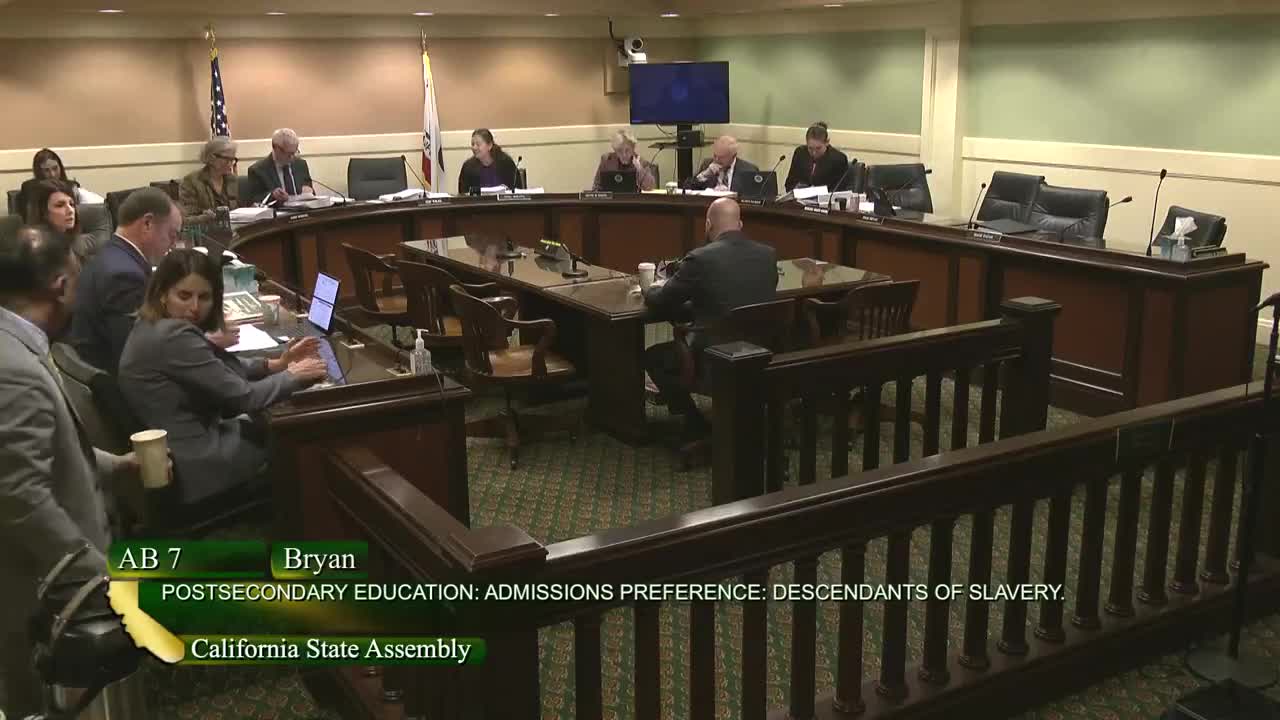 14MIN
Assembly Standing Committee on Judiciary
 40MIN
Assembly Standing Committee on Higher Education
Bill Author