AB 704: Criminal records: destruction.
- Session Year: 2025-2026
- House: Assembly
- Latest Version Date: 2025-03-20
Current Status:
In Progress
(2025-08-29: In committee: Held under submission.)
Introduced
In Committee
Awaiting First Chamber Vote
Passed First Chamber
In Committee
Awaiting Second Chamber Vote
Passed Second Chamber
Enacted
Existing law allows a person who was arrested or convicted of a nonviolent offense while they were a victim of human trafficking to petition the court, under penalty of perjury, for vacatur relief. Existing law requires a court that issues an order for relief pursuant to these provisions to also order specified law enforcement agencies to seal and destroy their records of the offense.
This bill would authorize a person arrested for or convicted of an eligible offense, as defined, before the person was 26 years of age to petition the court to have their records of that conviction or arrest sealed and destroyed if 4 years have elapsed since the date on which the person was arrested or completed any terms of incarceration, probation, mandatory supervision, postrelease community supervision, or parole associated with the record, whichever was later, during which the person has not been convicted of a new offense. The bill would require a court granting this relief to also order specified law enforcement agencies to seal and destroy their records. By increasing duties on local law enforcement, this bill would impose a state-mandated local program. The bill would define an eligible offense as any offense that is not a violent felony or a sex offense, as specified. exclude specified offenses from being considered an eligible offense, including, among others, a serious or violent felony, a sex offense, or an offense that may be plead and proved as a prior offense for purposes of imposing an increased sentence or enhancement upon conviction.
The California Constitution requires the state to reimburse local agencies and school districts for certain costs mandated by the state. Statutory provisions establish procedures for making that reimbursement.
This bill would provide that, if the Commission on State Mandates determines that the bill contains costs mandated by the state, reimbursement for those costs shall be made pursuant to the statutory provisions noted above.
Existing law allows a person who was arrested or convicted of a nonviolent offense while they were a victim of human trafficking to petition the court, under penalty of perjury, for vacatur relief. Existing law requires a court that issues an order for relief pursuant to these provisions to also order specified law enforcement agencies to seal and destroy their records of the offense.
This bill would authorize a person arrested for or convicted of an eligible offense, as defined, before the person was 26 years of age to petition the court to have their records of that conviction or arrest sealed and destroyed if 4 years have elapsed since the date on which the person was arrested or completed any terms of incarceration, probation, mandatory supervision, postrelease community supervision, or parole associated with the record, whichever was later, during which the person has not been convicted of a new offense. The bill would require a court granting this relief to also order specified law enforcement agencies to seal and destroy their records. By increasing duties on local law enforcement, this bill would impose a state-mandated local program. The bill would define an eligible offense as any offense that is not a violent felony or a sex offense, as specified.
The California Constitution requires the state to reimburse local agencies and school districts for certain costs mandated by the state. Statutory provisions establish procedures for making that reimbursement.
This bill would provide that, if the Commission on State Mandates determines that the bill contains costs mandated by the state, reimbursement for those costs shall be made pursuant to the statutory provisions noted above.
(a)If a person was arrested for or convicted of an eligible offense before the person was 26 years of age, and the requirements in subdivision (b) are met, the person may petition the court for sealing and destruction relief of their convictions and arrests under this section. Records of arrest that did not result in a conviction are eligible for sealing and destruction relief if any of the following are true:
(1)The statute of limitations has run on every offense upon which the arrest was based and the prosecuting attorney of the city or county that would have had jurisdiction over the offense or offenses upon which the arrest was based has not filed an accusatory pleading based on the arrest.
(2)The prosecuting attorney filed an accusatory pleading based on the arrest, but, with respect to all charges, one or more of the following has occurred:
(A)No conviction occurred, the charge has been dismissed, and the charge may not be refiled.
(B)No conviction occurred and the arrestee has been acquitted of the charges.
(C)A conviction occurred, but has been vacated or reversed on appeal, all appellate remedies have been exhausted, and the charge may not be refiled.
(3)The person successfully completed a diversion program, including, but not limited to, a program listed in subparagraph (D) of paragraph (2) of subdivision (a) of Section 851.93.
(b)If a person is arrested for or convicted of an eligible offense, the court may order sealing and destruction relief if four years have elapsed since the date on which the defendant was arrested or completed any terms of incarceration, probation, mandatory supervision, postrelease community supervision, or parole associated with the record, whichever occurred later, during which the defendant has not been convicted of a new offense.
(c)The petition for sealing and destruction relief and supporting documentation shall be served on the state or local prosecutorial agency that obtained the conviction for which sealing and destruction is sought or with the jurisdiction over charging decisions with regard to the arrest. The state or local prosecutorial agency shall have 45 days from the date of receipt of service to respond to the petition for relief.
(d)The court may, with the agreement of the petitioner and all of the involved state or local prosecutorial agencies, consolidate into one hearing a petition with multiple convictions from different jurisdictions.
(e)If the petition is opposed, or if the court otherwise deems it necessary, the court shall schedule a hearing on the petition. The hearing may consist of the following:
(1)Testimony by the petitioner, which may be required in support of the petition.
(2)Evidence and supporting documentation in support of the petition.
(3)Opposition evidence presented by any of the involved state or local prosecutorial agencies that obtained the conviction.
(f)After considering the totality of the evidence presented, the court may order sealing and destruction relief if it finds it is in the best interest of justice.
(g)A sealing and destruction order granted by the court under this section shall do all of the following:
(1)Set aside the arrest, finding of guilt, or the adjudication and dismiss the accusation or information against the petitioner.
(2)Set forth a finding that the arrest, conviction, or adjudication has been granted sealing and destruction relief and is deemed to have not occurred.
(3)Notify the Department of Justice that sealing and destruction relief has been ordered.
(h)Notwithstanding subdivision (g), a petitioner shall not be relieved of petition shall not be granted if the petitioner has not paid any financial restitution order that directly benefits the victim of a crime unless it has already been paid. crime. With the exception of restitution, the collection of fines imposed as a result of an offense that is the subject of the petition shall be stayed while the petition is pending.
(i)(1)If the court issues a sealing and destruction order under this section, the court shall also order all of the following agencies to seal and destroy their records:
(A)Any law enforcement agency having jurisdiction over the offense.
(B)The Department of Justice.
(C)Any law enforcement agency that arrested the petitioner.
(D)Any law enforcement agency that participated in the arrest of the petitioner.
(E)Any law enforcement agency that has taken action or maintains records because of the offense, including, but not limited to, departments of probation, rehabilitation, corrections, and parole.
(2)Any government agency described in paragraph (1) shall seal its records of arrest, conviction, and the court order to seal and destroy the records within 90 days after the court order is granted. The agency shall thereafter destroy their records of the arrest, conviction, and court order to seal and destroy those records within one year of the date of the court order.
(3)The court shall provide the petitioner and petitioners counsel a certified copy of any court order concerning the sealing and destruction of the records subject to the order. The court shall provide the petitioner and petitioners counsel a copy of any form that the court submits to any agency, including the Department of Justice, related to the sealing and destruction of the arrest and conviction records.
(4)Upon destroying the records as described in paragraph (2), the Department of Justice shall forward the order to the Federal Bureau of Investigation and request the deletion of any records of the arrest or conviction subject to the order.(5)(4)The Department of Justice shall notify the petitioner and the petitioners counsel that the department has complied with the order to seal and destroy the arrest or conviction records by the applicable deadline. within the timeline required pursuant to paragraph (2).
(j)Notwithstanding any other law, the court shall maintain a sealed copy of the sealing and destruction order and a sealed copy of the records subject to the order granted under this section, which shall not be distributed to any recipient except the petitioner and the petitioners counsel.
(k)Notwithstanding any other law, a petitioner who has obtained an order pursuant to this section is released from all penalties and disabilities resulting from the arrest or conviction and may lawfully deny or refuse to acknowledge an arrest or conviction that is granted sealing and destruction relief pursuant to the order.
(l)The record of a proceeding related to a petition pursuant to this section that is accessible by the public shall not disclose the petitioners full name.
(m)A court that grants relief pursuant to this section may take additional action as appropriate under the circumstances to carry out the purposes of this section.
(n)Notwithstanding any other provision of this section, a conviction record shall not be sealed or destroyed if that sealing or destruction would conflict with a penalty scheme required to be imposed under the terms of an initiative statute.(o)(n)For the purposes of this section, the following definitions apply:
(1)Eligible offense means any offense other than an means an offense that is not one of the following:
(A)An offense listed in subdivision (c) of Section 667.5 or for which the person is required to register pursuant to Section 290.
(B)Any offense specified in subdivision (c) of Section 1192.7.
(C)Any felony offense specified in subdivision (a) of Section 273.5
(D)Any offense specified in subdivision (a) or (b) of Section 23152 of the Vehicle Code.
(E)Any offense specified in subdivision (a) or (b) of Section 23153 of the Vehicle Code.
(F)Any offense that may be plead and proved as a prior offense for purposes of imposing an increased sentence or enhancement upon conviction.
(2)Sealing and destruction relief means that the arrest and any adjudications or convictions suffered by the petitioner are deemed not to have occurred and that all records in the case are sealed and destroyed pursuant to this section. The court shall inform the petitioner that they may thereafter state that they were not arrested for the charge, or adjudicated or convicted of the charge that was granted relief.
SEC. 2.If the Commission on State Mandates determines that this act contains costs mandated by the state, reimbursement to local agencies and school districts for those costs shall be made pursuant to Part 7 (commencing with Section 17500) of Division 4 of Title 2 of the Government Code.
(a)If a person was arrested for or convicted of an eligible offense before the person was 26 years of age, and the requirements in subdivision (b) are met, the person may petition the court for sealing and destruction relief of their convictions and arrests under this section. Records of arrest that did not result in a conviction are eligible for sealing and destruction relief if any of the following are true:
(1)The statute of limitations has run on every offense upon which the arrest was based and the prosecuting attorney of the city or county that would have had jurisdiction over the offense or offenses upon which the arrest was based has not filed an accusatory pleading based on the arrest.
(2)The prosecuting attorney filed an accusatory pleading based on the arrest, but, with respect to all charges, one or more of the following has occurred:
(A)No conviction occurred, the charge has been dismissed, and the charge may not be refiled.
(B)No conviction occurred and the arrestee has been acquitted of the charges.
(C)A conviction occurred, but has been vacated or reversed on appeal, all appellate remedies have been exhausted, and the charge may not be refiled.
(3)The person successfully completed a diversion program, including, but not limited to, a program listed in subparagraph (D) of paragraph (2) of subdivision (a) of Section 851.93.
(b)If a person is arrested for or convicted of an eligible offense, the court may order sealing and destruction relief if four years have elapsed since the date on which the defendant was arrested or completed any terms of incarceration, probation, mandatory supervision, postrelease community supervision, or parole associated with the record, whichever occurred later, during which the defendant has not been convicted of a new offense.
(c)The petition for sealing and destruction relief and supporting documentation shall be served on the state or local prosecutorial agency that obtained the conviction for which sealing and destruction is sought or with the jurisdiction over charging decisions with regard to the arrest. The state or local prosecutorial agency shall have 45 days from the date of receipt of service to respond to the petition for relief.
(d)The court may, with the agreement of the petitioner and all of the involved state or local prosecutorial agencies, consolidate into one hearing a petition with multiple convictions from different jurisdictions.
(e)If the petition is opposed, or if the court otherwise deems it necessary, the court shall schedule a hearing on the petition. The hearing may consist of the following:
(1)Testimony by the petitioner, which may be required in support of the petition.
(2)Evidence and supporting documentation in support of the petition.
(3)Opposition evidence presented by any of the involved state or local prosecutorial agencies that obtained the conviction.
(f)After considering the totality of the evidence presented, the court may order sealing and destruction relief if it finds it is in the best interest of justice.
(g)A sealing and destruction order granted by the court under this section shall do all of the following:
(1)Set aside the arrest, finding of guilt, or the adjudication and dismiss the accusation or information against the petitioner.
(2)Set forth a finding that the arrest, conviction, or adjudication has been granted sealing and destruction relief and is deemed to have not occurred.
(3)Notify the Department of Justice that sealing and destruction relief has been ordered.
(h)Notwithstanding subdivision (g), a petitioner shall not be relieved of any financial restitution order that directly benefits the victim of a crime unless it has already been paid. With the exception of restitution, the collection of fines imposed as a result of an offense that is the subject of the petition shall be stayed while the petition is pending.
(i)(1)If the court issues a sealing and destruction order under this section, the court shall also order all of the following agencies to seal and destroy their records:
(A)Any law enforcement agency having jurisdiction over the offense.
(B)The Department of Justice.
(C)Any law enforcement agency that arrested the petitioner.
(D)Any law enforcement agency that participated in the arrest of the petitioner.
(E)Any law enforcement agency that has taken action or maintains records because of the offense, including, but not limited to, departments of probation, rehabilitation, corrections, and parole.
(2)Any government agency described in paragraph (1) shall seal its records of arrest, conviction, and the court order to seal and destroy the records within 90 days after the court order is granted. The agency shall thereafter destroy their records of the arrest, conviction, and court order to seal and destroy those records within one year of the date of the court order.
(3)The court shall provide the petitioner and petitioners counsel a certified copy of any court order concerning the sealing and destruction of the records subject to the order. The court shall provide the petitioner and petitioners counsel a copy of any form that the court submits to any agency, including the Department of Justice, related to the sealing and destruction of the arrest and conviction records.
(4)Upon destroying the records as described in paragraph (2), the Department of Justice shall forward the order to the Federal Bureau of Investigation and request the deletion of any records of the arrest or conviction subject to the order.
(5)The Department of Justice shall notify the petitioner and the petitioners counsel that the department has complied with the order to seal and destroy the arrest or conviction records by the applicable deadline.
(j)Notwithstanding any other law, the court shall maintain a sealed copy of the sealing and destruction order and a sealed copy of the records subject to the order granted under this section, which shall not be distributed to any recipient except the petitioner and the petitioners counsel.
(k)Notwithstanding any other law, a petitioner who has obtained an order pursuant to this section is released from all penalties and disabilities resulting from the arrest or conviction and may lawfully deny or refuse to acknowledge an arrest or conviction that is granted sealing and destruction relief pursuant to the order.
(l)The record of a proceeding related to a petition pursuant to this section that is accessible by the public shall not disclose the petitioners full name.
(m)A court that grants relief pursuant to this section may take additional action as appropriate under the circumstances to carry out the purposes of this section.
(n)Notwithstanding any other provision of this section, a conviction record shall not be sealed or destroyed if that sealing or destruction would conflict with a penalty scheme required to be imposed under the terms of an initiative statute.
(o)For the purposes of this section, the following definitions apply:
(1)Eligible offense means any offense other than an offense listed in subdivision (c) of Section 667.5 or for which the person is required to register pursuant to Section 290.
(2)Sealing and destruction relief means that the arrest and any adjudications or convictions suffered by the petitioner are deemed not to have occurred and that all records in the case are sealed and destroyed pursuant to this section. The court shall inform the petitioner that they may thereafter state that they were not arrested for the charge, or adjudicated or convicted of the charge that was granted relief.
SEC. 2.If the Commission on State Mandates determines that this act contains costs mandated by the state, reimbursement to local agencies and school districts for those costs shall be made pursuant to Part 7 (commencing with Section 17500) of Division 4 of Title 2 of the Government Code.
|
Date
|
Status
|
|---|---|
| Aug 29, 2025 | In committee: Held under submission. |
| Aug 18, 2025 | In committee: Referred to suspense file. |
| Jul 8, 2025 | From committee: Do pass and re-refer to Com. on APPR. (Ayes 5. Noes 1.) (July 8). Re-referred to Com. on APPR. |
| Jun 18, 2025 | Referred to Com. on PUB. S. |
| Jun 5, 2025 | In Senate. Read first time. To Com. on RLS. for assignment. |
| Jun 4, 2025 | Read third time. Passed. Ordered to the Senate. (Ayes 47. Noes 17. Page 2057.) |
| May 27, 2025 | Read second time. Ordered to third reading. |
| May 23, 2025 | From committee: Do pass. (Ayes 11. Noes 3.) (May 23). |
| Apr 30, 2025 | In committee: Set, first hearing. Referred to suspense file. |
| Mar 26, 2025 | From committee: Do pass and re-refer to Com. on APPR. (Ayes 7. Noes 0.) (March 25). Re-referred to Com. on APPR. |
| Mar 24, 2025 | Re-referred to Com. on PUB. S. |
| Mar 20, 2025 | From committee chair, with author's amendments: Amend, and re-refer to Com. on PUB. S. Read second time and amended. |
| Mar 3, 2025 | Referred to Com. on PUB. S. |
| Feb 15, 2025 | From printer. May be heard in committee March 17. |
| Feb 14, 2025 | Read first time. To print. |
|
Date
|
Description
|
Location
|
Votes
|
|
|---|---|---|---|---|
| Aug 18, 2025 | Placed on suspense file | Senate Standing Committee on Appropriations |
Passed |
|
| Jul 8, 2025 | Do pass, but first be re-referred to the Committee on [Appropriations] | Senate Standing Committee on Public Safety |
Passed |
|
| Jun 4, 2025 | AB 704 Lowenthal Assembly Third Reading | Assembly Floor |
Passed |
|
| May 23, 2025 | Do pass. | Assembly Standing Committee on Appropriations |
Passed |
|
| Mar 25, 2025 | Do pass and be re-referred to the Committee on [Appropriations] | Assembly Standing Committee on Public Safety |
Passed |
This list shows positions taken on this bill by organizations on the date displayed, which is linked to the original source.
Positions by individuals are not included.
|
Organization
|
Position
|
Date
|
|---|---|---|
| Aclu California Action | ** Support | |
| California Academy of Child and Adolescent Psychiatry | ** Support | |
| California Alliance Of Child And Family Services | ** Support | |
| California Attorneys For Criminal Justice | ** Support | |
| California Civil Liberties Advocacy | ** Support | |
| California District Attorneys Association | ** Against | |
| California for Safety and Justice | ** Support | |
| Californians United for a Responsible Budget | ** Support | |
| California Police Chiefs Association | ** Against | |
| California Public Defenders Association | ** Support | |
| Center for Employment Opportunities | ** Support | |
| Ella Baker Center For Human Rights | ** Support | |
| Felony Murder Elimination Project | ** Support | |
| Initiate Justice | ** Support | |
| Initiate Justice Action | ** Support | |
| Justice2jobs Coalition | ** Support | |
| LA Defensa | ** Support | |
| Legal Services for Prisoners with Children | ** Support | |
| San Francisco Public Defender | ** Support | |
| Smart Justice California, a project of Tides Advocacy | ** Support | |
| Vera Institute Of Justice | ** Support |
SENATE COMMITTEE ON APPROPRIATIONS
Senator Anna Caballero, Chair
2025 - 2026 Regular Session
AB 704 (Lowenthal) - Criminal records: destruction
Version: March 20, 2025 | Policy Vote: PUB. S. 5 - 1 |
Urgency: No | Mandate: Yes |
Hearing Date: August 18, 2025 | Consultant: Liah Burnley |
Bill Summary:
AB 704 establishes a process for individuals who were arrested or convicted of a crime before they were 26 years old to seal and destroy records of their convictions and arrests.
Fiscal Impact:
- Unknown, potentially significant workload cost pressures to the state funded trial courts (General Fund, Trial Court Trust Fund) likely in the millions of dollars annually. Depending on the number of petitions filed, this ill could result in a significant impact on court calendars. This bill would require court clerks to seal the court records.
- Likely reimbursable costs (local funds, General Fund) of an unknown amount to local law enforcement agencies to destroy arrest records upon a court order. Actual costs will depend on the number of orders issued and the amount of staff time needed to comply with each order. General Fund costs will depend on whether the duties imposed by this bill constitute a reimbursable state mandate, as determined by the Commission on State Mandates.
- The California Department of Corrections and Rehabilitation (CDCR) estimates likely costs of $500,000 with roughly half in one-time expenditures and half in ongoing costs (General Fund). CDCR anticipates significant workload impacts for Case Records and Enterprise Information Services (EIS) staff to process court orders for the sealing and destruction of records. To implement the requirements of AB 704, CDCR expects to contract with a vendor to modify its information technology systems, creating a process to batch, seal, and destroy records identified by the courts. In addition, CDCR anticipates the need for at least two ongoing positions to monitor and execute the sealing and destruction process. It is difficult to determine the number of individuals who would potentially seek this relief, but CDCR notes approximately 19,000 individuals were released from prison between January 1, 2020, and December 31, 2024, who were under the age of 26 at the time of their conviction, excluding those convicted of specified serious, violent, or sex offenses.
- The Department of Justice (DOJ) anticipates a fiscal impact of approximately $2.5 million or less (General Fund). DOJ notes that implementation of this bill will be dependent upon the appropriation of funds. DOJ will be unable to absorb the costs to comply with or implement the requirements of the bill within existing budgeted resources. DOJ reports that beginning January 1, 2026, AB 704 would require the DOJ to perform database enhancements, updates, and modifications to the following systems: ACHS, CJDE, DP, BP, Record Sealing Application, AFIS, AAS, and CPIV. To implement the mandates of AB 704, the Hawkins Data Center (HDC) would require the following resources:
- Systems Analyst Consultant: Term 9/1/2026 – 2/29/2028: The Systems Analyst would perform the following duties including, but not limited to: Collaborate with business and technical staff to gather and document technical system rules, review and interpret functional/non-functional requirements, assess operational feasibility of new capabilities, and collaborate with the technical team to align business processes impacts with technical systems.
- JAVA/SQL Developer Consultants: Term 3/1/2027 – 2/29/2028: The JAVA/SQL Developer would perform the following duties including, but not limited to: Build new notification reports for completed sealing orders, enhance Disposition Processor to process new seal subsequent action transactions to be sent for update to ACHS, enhance Batch Processor for the processing of new seal subsequent action updates to ACHS, and test the new and updated and functionality.
- 1.0 Information Technology Specialist (ITS) I – Permanent beginning 7/1/2026:The ITS I would perform the following duties including, but not limited to: Review project plan, road map and other relevant project documentation. Collaborate with technical state staff and consultants to gather and document technical system rules. Provide technical system process subject matter expertise for design sessions.
- 1.0 ITS I – Permanent beginning 7/1/2026:The ITS I would perform the following duties including, but not limited to: Provide ACHS PL/SQL subject matter expertise to consultants through research, analysis, and by attending meetings. Provide ACHS PL/SQL subject matter expertise for design sessions. Review and approve technical deliverable documents.
- 1.0 ITS I – Permanent beginning 1/1/2027:The ITS I would perform the following duties including, but not limited to: Develop the interface for the system to successfully receive imported records. Develop the user interface to modify imported records. Develop the user roles/permissions of the site and data input. Application and performance testing.
- IT Consultant (JAVA/SQL Developer): Term 7/1/2028 – 7/31/2028 (160 hours): The JAVA/SQL Developer would perform the following duties: Development and component modification, quality assurance, and project management.
- 1.0 ITS I – Temporary Help Hours (240 in FY 2026-27 and 168 in FY 2027-28): The ITS I would be responsible for developing the CPIV Web reports, resolving defects, and providing post implementation support. The ITS I would also be responsible for writing functional requirements, updating documentation, providing analysis, testing, and post implementation support for the AFIS, AAS and CPIV applications.
- 1.0 ITS II – Permanent beginning 1/1/2026: The ITS II would perform the following duties including, but not limited to: Review, understand, and develop methodologies and processes for defining and applying the most viable and beneficial solutions and System Development Life Cycle approaches that will allow DOJ-CJIS to achieve the implementation of mandated/ approved requirements within mandated/ approved timelines and costs.
- Business Analyst Consultant: Term 1/1/2026 – 12/31/2027: The Business Analyst would perform the following duties including: Support the development of business and functional requirements for the automation of sealings and destructions pursuant to AB 704. Also, support user acceptance testing and implementation of the AB 704 automation.
- To implement the mandates of this bill, BCIA would require 1.0 24-month limited term Crime Analyst (CA) II. The CA II would serve as the business subject matter expert in support of the development of automation of sealings and destructions pursuant to AB 704. The CA II would also support the development of training and outreach materials for internal and external stakeholders.
- Systems Analyst Consultant: Term 9/1/2026 – 2/29/2028: The Systems Analyst would perform the following duties including, but not limited to: Collaborate with business and technical staff to gather and document technical system rules, review and interpret functional/non-functional requirements, assess operational feasibility of new capabilities, and collaborate with the technical team to align business processes impacts with technical systems.
Background:
According to the author:
Giving transitional age youth the opportunity for a clean slate once they have reached developmental maturity can enable them to once again engage in society without the loss of civil rights, public benefits, employment opportunities, housing eligibility, and freedom to live and work without restriction that these convictions too often cause. These sanctions and disqualifications cause long-lasting effects not just to the individual, but to the entire community. Because when people are disenfranchised from work, school, family life and civic participation, the overall health of a community declines.
Proposed Law:
- If a person was arrested for or convicted of an eligible offense before they were 26 years old, they may petition the court for sealing and destruction relief of their convictions and arrests.
- Records of arrest that did not result in a conviction are eligible for sealing and destruction relief if any of the following are true:
- The statute of limitations has run on every offense upon which the arrest was based and the prosecuting attorney of the city or county that would have had jurisdiction over the offense or offenses upon which the arrest was based has not filed an accusatory pleading based on the arrest;
- The prosecuting attorney filed an accusatory pleading based on the arrest, but, with respect to all charges, one or more of the following has occurred:
- No conviction occurred, the charge has been dismissed, and the charge may not be refiled;
- No conviction occurred and the arrestee has been acquitted of the charges; or,
- A conviction occurred, but has been vacated or reversed on appeal, all appellate remedies have been exhausted, and the charge may not be refiled;
- No conviction occurred, the charge has been dismissed, and the charge may not be refiled;
- The person successfully completed a diversion program.
- The statute of limitations has run on every offense upon which the arrest was based and the prosecuting attorney of the city or county that would have had jurisdiction over the offense or offenses upon which the arrest was based has not filed an accusatory pleading based on the arrest;
- If a person is arrested for or convicted of an eligible offense, the court may order sealing and destruction relief if four years have elapsed since the date on which the defendant was arrested or completed any terms of incarceration, probation, mandatory supervision, postrelease community supervision, or parole associated with the record, whichever occurred later, during which the defendant has not been convicted of a new offense.
- The petition for sealing and destruction relief and supporting documentation shall be served on the state or local prosecutorial agency that obtained the conviction for which sealing and destruction is sought or with the jurisdiction over charging decisions with regard to the arrest. The state or local prosecutorial agency shall have 45 days from the date of receipt of service to respond to the petition for relief.
- The court may, with the agreement of the petitioner and all of the involved state or local prosecutorial agencies, consolidate into one hearing a petition with multiple convictions from different jurisdictions.
- If the petition is opposed, or if the court otherwise deems it necessary, the court shall schedule a hearing on the petition. The hearing may consist of the following:
- Testimony by the petitioner, which may be required in support of the petition;
- Evidence and supporting documentation in support of the petition; and,
- Opposition evidence presented by any of the involved state or local prosecutorial agencies that obtained the conviction.
- Testimony by the petitioner, which may be required in support of the petition;
- After considering the totality of the evidence presented, the court may order sealing and destruction relief if it finds it is in the best interest of justice. A sealing and destruction order granted by the court under this section shall do all of the following:
- Set aside the arrest, finding of guilt, or the adjudication and dismiss the accusation or information against the petitioner;
- Set forth a finding that the arrest, conviction, or adjudication has been granted sealing and destruction relief and is deemed to have not occurred; and,
- Notify the Department of Justice that sealing and destruction relief has been ordered.
- Set aside the arrest, finding of guilt, or the adjudication and dismiss the accusation or information against the petitioner;
- A petition shall not be granted if the petitioner has not paid any financial restitution order that directly benefits the victim of a crime. With the exception of restitution, the collection of fines imposed as a result of an offense that is the subject of the petition shall be stayed while the petition is pending.
- If the court issues a sealing and destruction order, the court shall also order all of the following agencies to seal and destroy their records:
- Any law enforcement agency having jurisdiction over the offense;
- The Department of Justice;
- Any law enforcement agency that arrested the petitioner;
- Any law enforcement agency that participated in the arrest of the petitioner; and,
- Any law enforcement agency that has taken action or maintains records because of the offense, including, but not limited to, departments of probation, rehabilitation, corrections, and parole.
- Any law enforcement agency having jurisdiction over the offense;
- Any government agency shall seal its records of arrest, conviction, and the court order to seal and destroy the records within 90 days after the court order is granted. The agency shall thereafter destroy their records of the arrest, conviction, and court order to seal and destroy those records within one year of the date of the court order.
- The court shall provide the petitioner and petitioner’s counsel a certified copy of any court order concerning the sealing and destruction of the records subject to the order. The court shall provide the petitioner and petitioner’s counsel a copy of any form that the court submits to any agency, including the Department of Justice, related to the sealing and destruction of the arrest and conviction records. The Department of Justice shall notify the petitioner and the petitioner’s counsel that the department has complied with the order to seal and destroy the arrest or conviction records within the timeline required.
- The court shall maintain a sealed copy of the sealing and destruction order and a sealed copy of the records subject to the order granted under this section, which shall not be distributed to any recipient except the petitioner and the petitioner’s counsel.
- A petitioner who has obtained an order is released from all penalties and disabilities resulting from the arrest or conviction and may lawfully deny or refuse to acknowledge an arrest or conviction that is granted sealing and destruction relief pursuant to the order.
- The record of a proceeding related to a petition that is accessible by the public shall not disclose the petitioner’s full name.
- A court that grants relief pursuant to this section may take additional action as appropriate under the circumstances to carry out the purposes of this section.
- The following definitions apply:
- “Eligible offense” means an offense that is not one of the following:
- An offense listed in subdivision (c) of Section 667.5 or for which the person is required to register pursuant to Section 290;
- Any offense specified in subdivision (c) of Section 1192.7;
- Any felony offense specified in subdivision (a) of Section 273.5;
- Any offense specified in subdivision (a) or (b) of Section 23152 of the Vehicle Code;
- Any offense specified in subdivision (a) or (b) of Section 23153 of the Vehicle Code; and,
- Any offense that may be plead and proved as a prior offense for purposes of imposing an increased sentence or enhancement upon conviction
- An offense listed in subdivision (c) of Section 667.5 or for which the person is required to register pursuant to Section 290;
- “Sealing and destruction relief” means that the arrest and any adjudications or convictions suffered by the petitioner are deemed not to have occurred and that all records in the case are sealed and destroyed pursuant to this section. The court shall inform the petitioner that they may thereafter state that they were not arrested for the charge, or adjudicated or convicted of the charge that was granted relief.
- “Eligible offense” means an offense that is not one of the following:
-- END --
ASSEMBLY THIRD READING
ATR Bill Id:AB 704
Author:(Lowenthal)
As Amended Ver:March 20, 2025
Majority vote
SUMMARY
Authorizes a person arrested for or convicted of an eligible offense, as defined, before the person was 26 years of age, to petition the court to have their records of that conviction or arrest sealed and destroyed.
Major Provisions
- States any record of arrest that did not result in a conviction are eligible for sealing and destruction, if:
- The statute of limitations has run on every offense upon which the arrest was based and the prosecuting attorney has not filed an accusatory pleading based on that arrest.
- The prosecuting attorney filed an accusatory pleading based on the arrest, but, with respect to all charges, one or more of the following are true:
- No conviction occurred, the charge was dismissed, and the charge may not be re-filed;
- No conviction occurred and the arrestee has been acquitted of the chares; or
- A conviction occurred and the arrestee has been vacated or reversed on appeal, all appellate remedies have been exhausted, and the charge may not be re-filed.
- The person successfully completed a diversion program, as specified.
- Provides that if a person is arrest for, or convicted of an eligible offense, a court may order sealing and destruction relief if four years have elapsed since the date on which the defendant was arrested or completed any terms of incarceration, probation, mandatory supervision, post-released community supervision, or parole associated with the record, whichever occurred later, during which the defendant has not been convicted of a new offense.
- Requires that the petition for sealing and destruction relief and supporting documentation be served on the state or local prosecuting agency that obtained the conviction for, or charged the offense for which the person was arrested.
- States a prosecuting agency shall have 45 days from the date of receipt of the petition to respond.
- Authorizes the court, with the agreement of all prosecuting agencies and the petitioner, consolidate multiple petitions to seal and destroy multiple convictions from different jurisdictions.
- Mandates the court schedule a hearing on the petition if the petition is opposed, or if the court deems it necessary.
- States a hearing may consist of the following:
- Testimony by the petitioner, which may be required in support of the petition
- Evidence and supporting documentation in support of the petition;
- Opposition evidence presented by any of the involved state or local prosecutorial agencies that obtained the conviction.
- States that after considering the totality of the evidence presented, the court may order sealing and destruction relief if it finds it is in the best interest of justice.
- Requires that any sealing and destruction relief if it finds it is in the best interest of justice do all the following:
- Set aside the arrest, finding of guilt, or the adjudication and dismiss the accusation or information against the petitioner.
- Set forth a finding that the arrest, conviction, or adjudication has been granted sealing and destruction relief and is deemed to have not occurred.
- Notify the Department of Justice (DOJ) that sealing and destruction relief has been ordered.
- Mandates that when ordering the sealing and destruction relief, the must also order the following agencies to seal and destroy their records:
- Any law enforcement agency (LEA) having jurisdiction over the offense.
- The DOJ.
- Any LEA that arrested the petitioner.
- Any LEA that participated in the arrest of the petitioner.
- Any LEA that has taken action or maintains records because of the offense, including, but not limited to, departments of probation, rehabilitation, corrections, and parole.
- States any agency required to destroy sealed records must seal its records of arrest, conviction, and the court order to seal and destroy the records within 90 days after the court order is granted. The agency shall thereafter destroy their records of conviction, and court order to seal and destroy those records within one year of the date of the court order.
- Requires the court to provide the petitioner and their counsel a certified copy of any court order concerning the sealing and destruction of the records subject to the order. The court shall provide the petitioner and their counsel of any form that the court submits to any agency, including the DOJ, related to the sealing and destruction of the arrest and conviction records.
- States a petition shall not be granted if the petitioner has not paid any financial restitution order that directly benefits the victim of a crime. With the exception of restitution, the collection of fines imposed as a result of an offense that is the subject of the petition shall be stayed while the petition is pending.
- Mandates the DOJ notify the petitioner and their counsel that the DOJ has complied with the order to seal and destroy the arrest or conviction records by the applicable deadline.
- States the court must maintain a sealed copy of the sealing and destruction order and a sealed copy of the records subject to the order to seal and destroy records, which may not be distributed to any recipient except the petitioner and their counsel.
- States that a petitioner who has obtained an order for the sealing and destruction of records, is released from all penalties and disabilities resulting from the arrest or conviction and may lawfully deny or refuse to acknowledge an arrest or conviction that is granted sealing and destruction relief.
- Provides that any record of a proceeding to seal and destroy records that is accessible to the public shall not disclose the petitioner’s full name.
- Authorizes a court that grants a petition to seal and destroy an arrest and conviction record may take additional action as appropriate under the circumstances to carry out its order.
- Provides the following definitions:
- ′″Eligible offense′″ does not include any of the following:
- Any offense listed on the violent felonies list or for which the person is required to register as a sex offender.
- Any offense listed on the serious felonies list.
- Any felony offense of domestic violence.
- Any offense of driving under the influence with and without injury.
- Any offense that may be plead and proved as a prior offense for purposes of imposing an increased sentence or enhancement upon conviction.
- ′″Sealing and destruction relief′″ means that the arrest and any adjudication or convictions suffered by the petitioner are deemed not to have occurred and that all records in the case are sealed and destroyed. The court shall inform the petitioner that they may thereafter state that they were not arrested for the charge, or adjudicated or convicted of the charge that was granted relief.
- ′″Eligible offense′″ does not include any of the following:
COMMENTS
According to the Author
′″Giving transitional age youth the opportunity for a clean slate once they have reached developmental maturity can enable them to once again engage in society without the loss of civil rights, public benefits, employment opportunities, housing eligibility, and freedom to live and work without restriction that these convictions too often cause. These sanctions and disqualifications cause long-lasting effects not just to the individual, but to the entire community. Because when people are disenfranchised from work, school, family life and civic participation, the overall health of a community declines.
′″Criminal convictions too often act as scarlet letters for people who have fulfilled all penalties associated with crimes they have committed. Criminal convictions leave a lasting scar, long after fines have been payed, time has been served, probation completed etc. Today, it is normal practice for courts to grant expungements (guilty plea withdrawn, and case dismissal) to persons with low level or misdemeanor convictions. Before the days of internet, this was generally sufficient in allowing persons to re-assimilate into society without much restriction. However, today it is very simple for members of the public to attain the criminal records of a person, even if it has been expunged, creating this dilemma where even though the individual has been forgiven by our judicial system, they have not been forgiven by society as a whole. This causes long lasting disenfranchisement that in turn effects whole communities. Because when people are disenfranchised from work, school, family life and civic participation, the overall health of a community declines. AB 704 will allow individuals who have been arrested for, or convicted of eligible crimes, before the age of 26, the opportunity to petition the courts to seal, and destroy their records.
′″This bill does not automatically trigger any petition or any record sealing or destruction. Rather, it only allows the person the opportunity to petition the courts for their records sealed and destroyed. A court that receives such a request is vested with the authority to grant this relief if they find the request to be in the interest of justice and equity. It is the petitioner who has the burden of proof in showing that this relief should be granted.
′″Transitional age youth should be treated differently in the criminal justice system as studies show that their developmental stage is not fully mature. This means they may lack the capacity to fully understand the consequences of their actions, potentially requiring a more rehabilitative approach rather than purely punitive measures; this includes factors like impulsivity, susceptibility to peer pressure, and limited cognitive abilities to weigh risks and rewards compared to adults. Giving transitional age youth the opportunity for a clean slate once they have reached developmental maturity aligns with our understanding of youth brain development. They should not be burdened for a lifetime with the barriers to employment, housing and community engagement that were a result of these factors.′″
Arguments in Support
According to the California Public Defenders Association: AB 704 would allow a person who was under age 26 at the time of their arrest or conviction for eligible offenses to petition the court to have their records sealed and destroyed if certain criteria are met. Records of arrests and convictions, especially for young people, often serve as barriers to education, employment, and housing.
These barriers often lead to poverty, not just for the young person, but their families including their children which can lead to negative generational outcomes. Additionally, record sealing and destruction enhances public safety because the existence of criminal records and their collateral consequences often lead to recidivism in the face of extreme difficulty securing housing and employment. AB 704 offers a pathway to redemption. It will allow young people to live successful and fulfilling lives while also ensuring true opportunity and dignity in their future endeavors.
Arguments in Opposition
According to the California District Attorneys Association: ′″While we recognize the importance of rehabilitation and reintegration, we have significant concerns about the broad impact of this bill. Existing law already provides avenues for relief, such as record sealing and expungement under Penal Code Sections 851.91 and 1203.4. AB 704, however, goes further by mandating the destruction of records, eliminating law enforcement and prosecutorial access that is essential for ensuring public safety.
′″The ability to access prior criminal records is critical for enforcing laws, identifying patterns of criminal behavior, and fulfilling constitutional obligations under Brady v. Maryland to disclose exculpatory evidence. This bill would hinder the ability of prosecutors to fulfill these legal duties and could prevent the introduction of relevant, admissible evidence in court proceedings. Additionally, AB 704 imposes new mandates on law enforcement agencies, requiring them to seal and destroy records, further straining already limited resources. While the bill acknowledges state reimbursement obligations, the practical difficulties of obtaining such funding leave local agencies to bear the financial burden.
FISCAL COMMENTS
According to the Assembly Appropriations Committee:
- Cost pressures (Trial Court Trust Fund, General Fund) of an unknown but potentially significant amount to the courts. The bill requires a court that receives a petition for sealing and destruction relief to make specified notifications, hold a hearing if the petition is opposed, and maintain copies of certain sealed records. Actual costs will depend on the number of petitions filed, the amount of court time needed to adjudicate each petition, and the court resources needed for sealing and maintaining records. Although courts are not funded on the basis of workload, increased pressure on the Trial Court Trust Fund may create a demand for increased funding for courts from the General Fund. The fiscal year 2024-25 state budget provides $37.3 million ongoing General Fund to backfill declining revenue to the Trial Court Trust Fund.
- Costs (General Fund) to DOJ of an unknown but potentially significant amount to seal records and make required notifications. Actual costs to DOJ will depend on the number of petitions granted by the courts and the amount of workload associated with each petition.
- Likely reimbursable costs (local funds, General Fund) of an unknown amount to local law enforcement agencies to destroy arrest records upon a court order. Actual costs will depend on the number of orders issued and the amount of staff time needed to comply with each order. General Fund costs will depend on whether the duties imposed by this bill constitute a reimbursable state mandate, as determined by the Commission on State Mandates.
VOTES
ASM PUBLIC SAFETY: 7-0-2
YES: Schultz, Mark González, Haney, Harabedian, Nguyen, Ramos, Sharp-Collins
ABS, ABST OR NV: Alanis, Lackey
ASM APPROPRIATIONS: 11-3-1
YES: Wicks, Arambula, Calderon, Caloza, Elhawary, Fong, Mark González, Hart, Pacheco, Pellerin, Solache
NO: Dixon, Ta, Tangipa
ABS, ABST OR NV: Sanchez
UPDATED
VERSION: March 20, 2025
CONSULTANT: Kimberly Horiuchi / PUB. S. / (916) 319-3744 FN: 0000721
Date of Hearing: April 30, 2025
ASSEMBLY COMMITTEE ON APPROPRIATIONS
Buffy Wicks, Chair
ABPCA Bill Id:AB 704
Author:(Lowenthal) – As Amended Ver:March 20, 2025
Policy Committee: | Public Safety | Vote: | 7 - 0 |
|
| ||
|
|
Urgency: No State Mandated Local Program: Yes Reimbursable: Yes
SUMMARY:
This bill authorizes a person who was arrested for or convicted of certain offenses when the person was 25 years old or younger (the “petitioner”) to petition a court for record sealing and destruction relief.
This bill does not allow record sealing and destruction relief for arrests and convictions for, among others, offenses that appear on the violent or serious felony lists, offenses that require sex offender registration, felony domestic violence, or driving under the influence offenses. An offense is eligible for sealing and record relief only if four years has passed since the arrest or the petitioner’s incarceration for the offense, and the petitioner has not been convicted of any other offenses since then, and the petitioner does not owe any financial restitution to the victim of the offense.
Among other provisions, this bill:
- Requires a court to hold a hearing on a petition for sealing and destruction relief if the petition is opposed, and establishes procedures for notifying the prosecuting agency of a petition, consolidating petitions for offenses from different jurisdictions, and conducting a hearing.
- Allows a court to order sealing and destruction relief if, after considering the totality of the evidence, the court finds such relief is in the best interest of justice.
- Requires the court to order specified law enforcement agencies and the Department of Justice (DOJ) to seal and destroy applicable records, specifies a timeline for destruction of records, and requires DOJ to notify the petitioner when destruction is complete.
- Requires the court to maintain a sealed copy of its order granting relief and a copy of the records subject to the order, which may not be distributed to anyone except the petitioner and their attorney.
FISCAL EFFECT:
- Cost pressures (Trial Court Trust Fund, General Fund) of an unknown but potentially significant amount to the courts. The bill requires a court that receives a petition for sealing and destruction relief to make specified notifications, hold a hearing if the petition is opposed, and maintain copies of certain sealed records. Actual costs will depend on the number of petitions filed, the amount of court time needed to adjudicate each petition, and the court resources needed for sealing and maintaining records. Although courts are not funded on the basis of workload, increased pressure on the Trial Court Trust Fund may create a demand for increased funding for courts from the General Fund. The fiscal year 2024-25 state budget provides $37.3 million ongoing General Fund to backfill declining revenue to the Trial Court Trust Fund.
- Costs (General Fund) to DOJ of an unknown but potentially significant amount to seal records and make required notifications. Actual costs to DOJ will depend on the number of petitions granted by the courts and the amount of workload associated with each petition.
- Likely reimbursable costs (local funds, General Fund) of an unknown amount to local law enforcement agencies to destroy arrest records upon a court order. Actual costs will depend on the number of orders issued and the amount of staff time needed to comply with each order. General Fund costs will depend on whether the duties imposed by this bill constitute a reimbursable state mandate, as determined by the Commission on State Mandates.
COMMENTS:
- Purpose. According to the author:
Criminal convictions leave a lasting scar, long after fines have been payed, time has been served, probation completed etc. Today, it is normal practice for courts to grant expungements (guilty plea withdrawn, and case dismissal) to persons with low level or misdemeanor convictions. Before the days of internet, this was generally sufficient in allowing persons to re-assimilate into society without much restriction. However, today it is very simple for members of the public to attain the criminal records of a person, even if it has been expunged, creating this dilemma where even though the individual has been forgiven by our judicial system, they have not been forgiven by society as a whole.
- Background. Expungement is a legal process by which a court may set aside and dismiss a person’s arrest and criminal conviction. However, even offenses that are expunged from a person’s criminal record may be accessed by some employers, licensing agencies, and credit agencies. According to supporters of this measure, people whose records have been expunged still experience significant difficulty obtaining employment, housing, and acceptance in the community due to their criminal histories.
This bill establishes a process by which a person who was arrested for or convicted of a qualifying offense when they were 25 years old or younger may petition the court to seal and destroy all records associated with the offense. The bill contains a number of exceptions relating to the types of offenses, the age of the petitioner, and the amount of time that has passed since the offense that must be satisfied before a petition qualifies for relief.
- Prior Legislation. AB 2420 (Lowenthal), of the 2023-24 legislative session, would have authorized any person who had their arrest or conviction set aside and dismissed under existing law to petition the court to have related records sealed. AB 2420 was held on this committee’s suspense file.
Analysis Prepared by: Annika Carlson / APPR. / (916) 319-2081
Date of Hearing:
Counsel: Kimberly Horiuchi
ASSEMBLY COMMITTEE ON PUBLIC SAFETY
Nick Schultz, Chair
ABPCA Bill Id:AB 704
Author:(Lowenthal) – As Amended Ver:March 20, 2025
SUMMARY:
Authorizes a person arrested for or convicted of an eligible offense, as defined, before the person was 26 years of age, to petition the court to have their records of that conviction or arrest sealed and destroyed. Specifically, this bill:
- States any record of arrest that did not result in a conviction are eligible for sealing and destruction, if:
- The statute of limitations has run on every offense upon which the arrest was based and the prosecuting attorney has not filed an accusatory pleading based on that arrest.
- The prosecuting attorney filed an accusatory pleading based on the arrest, but, with respect to all charges, one or more of the following are true:
- No conviction occurred, the charge was dismissed, and the charge may not be re-filed;
- No conviction occurred and the arrestee has been acquitted of the chares; or
- A conviction occurred and the arrestee has been vacated or reversed on appeal, all appellate remedies have been exhausted, and the charge may not be re-filed.
- No conviction occurred, the charge was dismissed, and the charge may not be re-filed;
- The person successfully completed a diversion program, as specified.
- The statute of limitations has run on every offense upon which the arrest was based and the prosecuting attorney has not filed an accusatory pleading based on that arrest.
- Provides that if a person is arrest for, or convicted of an eligible offense, a court may order sealing and destruction relief if four years have elapsed since the date on which the defendant was arrested or completed any terms of incarceration, probation, mandatory supervision, post-released community supervision, or parole associated with the record, whichever occurred later, during which the defendant has not been convicted of a new offense.
- Requires that the petition for sealing and destruction relief and supporting documentation be served on the state or local prosecuting agency that obtained the conviction for, or charged the offense for which the person was arrested.
- States a prosecuting agency shall have 45 days from the date of receipt of the petition to respond.
- Authorizes the court, with the agreement of all prosecuting agencies and the petitioner, consolidate multiple petitions to seal and destroy multiple convictions from different jurisdictions.
- Mandates the court schedule a hearing on the petition if the petition is opposed, or if the court deems it necessary.
- States a hearing may consist of the following:
- Testimony by the petitioner, which may be required in support of the petition
- Evidence and supporting documentation in support of the petition;
- Opposition evidence presented by any of the involved state or local prosecutorial agencies that obtained the conviction.
- Testimony by the petitioner, which may be required in support of the petition
- States that after considering the totality of the evidence presented, the court may order sealing and destruction relief if it finds it is in the best interest of justice.
- Requires that any sealing and destruction relief if it finds it is in the best interest of justice do all the following:
- Set aside the arrest, finding of guilt, or the adjudication and dismiss the accusation or information against the petitioner.
- Set forth a finding that the arrest, conviction, or adjudication has been granted sealing and destruction relief and is deemed to have not occurred.
- Notify the Department of Justice (DOJ) that sealing and destruction relief has been ordered.
- Set aside the arrest, finding of guilt, or the adjudication and dismiss the accusation or information against the petitioner.
- Mandates that when ordering the sealing and destruction relief, the must also order the following agencies to seal and destroy their records:
- Any law enforcement agency (LEA) having jurisdiction over the offense.
- The DOJ.
- Any LEA that arrested the petitioner.
- Any LEA that participated in the arrest of the petitioner.
- Any LEA that has taken action or maintains records because of the offense, including, but not limited to, departments of probation, rehabilitation, corrections, and parole.
- Any law enforcement agency (LEA) having jurisdiction over the offense.
- States any agency required to destroy sealed records must seal its records of arrest, conviction, and the court order to seal and destroy the records within 90 days after the court order is granted. The agency shall thereafter destroy their records of conviction, and court order to seal and destroy those records within one year of the date of the court order.
- Requires the court to provide the petitioner and their counsel a certified copy of any court order concerning the sealing and destruction of the records subject to the order. The court shall provide the petitioner and their counsel of any form that the court submits to any agency, including the DOJ, related to the sealing and destruction of the arrest and conviction records.
- States a petition shall not be granted if the petitioner has not paid any financial restitution order that directly benefits the victim of a crime. With the exception of restitution, the collection of fines imposed as a result of an offense that is the subject of the petition shall be stayed while the petition is pending.
- Mandates the DOJ notify the petitioner and their counsel that the DOJ has complied with the order to seal and destroy the arrest or conviction records by the applicable deadline.
- States the court must maintain a sealed copy of the sealing and destruction order and a sealed copy of the records subject to the order to seal and destroy records, which may not be distributed to any recipient except the petitioner and their counsel.
- States that a petitioner who has obtained an order for the sealing and destruction of records, is released from all penalties and disabilities resulting from the arrest or conviction and may lawfully deny or refuse to acknowledge an arrest or conviction that is granted sealing and destruction relief.
- Provides that any record of a proceeding to seal and destroy records that is accessible to the public shall not disclose the petitioner’s full name.
- Authorizes a court that grants a petition to seal and destroy an arrest and conviction record may take additional action as appropriate under the circumstances to carry out its order.
- Provides the following definitions:
- “Eligible offense” does not include any of the following:
- Any offense listed on the violent felonies list or for which the person is required to register as a sex offender.
- Any offense listed on the serious felonies list.
- Any felony offense of domestic violence.
- Any offense of driving under the influence with and without injury.
- Any offense that may be plead and proved as a prior offense for purposes of imposing an increased sentence or enhancement upon conviction.
- Any offense listed on the violent felonies list or for which the person is required to register as a sex offender.
- “Sealing and destruction relief” means that the arrest and any adjudication or convictions suffered by the petitioner are deemed not to have occurred and that all records in the case are sealed and destroyed. The court shall inform the petitioner that they may thereafter state that they were not arrested for the charge, or adjudicated or convicted of the charge that was granted relief.
- “Eligible offense” does not include any of the following:
EXISTING LAW:
- Provides that five years or more after the jurisdiction of the juvenile court has terminated over a person adjudged a ward of the court or after a minor appeared before a probation officer, or, in any case, at any time after the person has reached the age of 18, the person or county probation officer, with specified exceptions, may petition the juvenile court for sealing of the records, including arrest records, relating to the person’s case, in the custody of the juvenile court, the probation officer, or any other agency or public official. (Welf. & Inst. Code, § 781, subd. (a)(1)(A).)
- Provides that if a petition to commence juvenile court proceedings or adjudge a person a ward of the juvenile court is not filed, five years or more after the person was cited to appear before a probation officer, as specified, or was taken before any officer of a law enforcement agency, or, if, at any time after the person has reached 18 years of age, a petition may be filed for sealing of the records. (Welf. & Inst. Code, § 781, subd. (a)(1)(A).)
- Provides that the court may, after a hearing, order the records sealed if it finds that the person has not been convicted of a crime involving moral turpitude since jurisdiction or other action, as specified, ended, and rehabilitation has been attained to the satisfaction of the court. (Welf. & Inst. Code, § 781, subd. (a)(1)(A).)
- States that once the court has ordered the person’s records sealed, the proceedings in the case shall be deemed never to have occurred, and the person may reply accordingly to any inquiry about the events. (Welf. & Inst. Code, § 781, subd. (a)(1)(A).) An order sealing the record relieves the minor of the obligation to register as a sex offender. (Welf. & Inst. Code, § 781, subd. (a)(1)(C).)
- Prohibits, notwithstanding any other provision of law, the court from ordering a person’s records sealed in any case in which the person has been found to have committed a specified serious or violent offense when the individual was 14 years of age or older. (Welf. & Inst. Code, § 781, subd. (a)(1)(D).)
- Prohibits the court from ordering a person’s records sealed if he or she was convicted of the specified serious or violent offense in adult court. (Welf. & Inst. Code, § 781, subd. (f).)
- Permits the court to access a file that has been sealed for the limited purpose of verifying the prior jurisdictional status of the ward who is petitioning the court to resume its jurisdiction, as specified. This access is not to be deemed an unsealing of the records. (Welf. & Inst. Code, § 781, subd. (e).)
- Provides that, if a minor satisfactorily completes an informal program of supervision, probation as specified, or a term of probation, then the court shall order the petition dismissed and shall order sealed all records pertaining to the dismissed petition in the custody of the juvenile court, and in the custody of law enforcement agencies, the probation department, or the Department of Justice. (Welf. & Inst. Code, § 786, subd. (a).)
- Prohibits court-initiated sealing upon probation completion if the petition was sustained on the basis of a specified serious or violent offense committed when the individual was 14 years of age or older, unless the finding on the offense was dismissed or reduced to a lesser non-serious and non-violent offense. (Welf. & Inst. Code, § 786, subd. (d).)
- States that upon the order of dismissal under the court-initiated sealing process, the arrest and other proceedings in the case must be deemed not to have occurred and the person who was the subject of the petition may reply accordingly to an inquiry by employers, educational institutions, or other persons or entities regarding the arrest and proceedings in the case. (Welf. & Inst. Code, § 786, subd. (b).)
- Allows the court, the prosecuting attorney, the probation department, the person whose record has been sealed, and a child welfare agency to access a record that was sealed by the court-initiated process for limited purposes, as specified. (Welf. & Inst. Code, § 786, subd. (f)(1)(A)-(H).) Access shall not be deemed an unsealing of the record and shall not require notice to any other agency. (Welf. & Inst. Code, § 786, subd. (f)(2).)
- Specifies that records sealed via either the petition or court-initiated process will not prevent a court from enforcing an unpaid judgment for civil restitution. A minor is not relieved of the obligation to pay victim restitution, restitution fines, and court-ordered fines and fees. (Welf. & Inst. Code, §§ 781, subd. (g) & 786, subd. (g)(1).)
- Allows a judge of the juvenile court to dismiss a filed petition, or set aside the findings and dismiss the petition, in the interests of justice and welfare of the subject of the petition, or if the court finds that the subject does not need treatment or rehabilitation, as specified. (Welf. & Inst. Code, § 782.)
FISCAL EFFECT:
Unknown
COMMENTS:
- Author's Statement: According to the author, “Giving transitional age youth the opportunity for a clean slate once they have reached developmental maturity can enable them to once again engage in society without the loss of civil rights, public benefits, employment opportunities, housing eligibility, and freedom to live and work without restriction that these convictions too often cause. These sanctions and disqualifications cause long-lasting effects not just to the individual, but to the entire community. Because when people are disenfranchised from work, school, family life and civic participation, the overall health of a community declines.
“Criminal convictions too often act as scarlet letters for people who have fulfilled all penalties associated with crimes they have committed. Criminal convictions leave a lasting scar, long after fines have been payed, time has been served, probation completed etc. Today, it is normal practice for courts to grant expungements (guilty plea withdrawn, and case dismissal) to persons with low level or misdemeanor convictions. Before the days of internet, this was generally sufficient in allowing persons to re-assimilate into society without much restriction. However, today it is very simple for members of the public to attain the criminal records of a person, even if it has been expunged, creating this dilemma where even though the individual has been forgiven by our judicial system, they have not been forgiven by society as a whole. This causes long lasting disenfranchisement that in turn effects whole communities. Because when people are disenfranchised from work, school, family life and civic participation, the overall health of a community declines. AB 704 will allow individuals who have been arrested for, or convicted of eligible crimes, before the age of 26, the opportunity to petition the courts to seal, and destroy their records.
“This bill does not automatically trigger any petition or any record sealing or destruction. Rather, it only allows the person the opportunity to petition the courts for their records sealed and destroyed. A court that receives such a request is vested with the authority to grant this relief if they find the request to be in the interest of justice and equity. It is the petitioner who has the burden of proof in showing that this relief should be granted.
“Transitional age youth should be treated differently in the criminal justice system as studies show that their developmental stage is not fully mature. This means they may lack the capacity to fully understand the consequences of their actions, potentially requiring a more rehabilitative approach rather than purely punitive measures; this includes factors like impulsivity, susceptibility to peer pressure, and limited cognitive abilities to weigh risks and rewards compared to adults. Giving transitional age youth the opportunity for a clean slate once they have reached developmental maturity aligns with our understanding of youth brain development. They should not be burdened for a lifetime with the barriers to employment, housing and community engagement that were a result of these factors.”
- Sealing Juvenile Records: Minors adjudicated delinquent in juvenile court proceedings may petition the court to have their records sealed. (Welf. & Inst. Code, § 781.) To seal a juvenile court record by petition, either the minor or the probation department must petition the court. (Ibid.) Juvenile court jurisdiction must have lapsed five years previously, or the person must be at least 18 years old. (Welf. & Inst. Code, § 781, subd. (a)(1)(A).) A court must also find that the person has not been convicted of a felony or a misdemeanor involving moral turpitude since the jurisdiction of the juvenile court ended. (Ibid.)[1]
In limited circumstances, a person convicted of a violent crime pursuant to Welfare and Institutions Code section 707, subdivision (b) after turning 14 years of age may have their records sealed. If the person was sentenced to the former Division of Juvenile Facilities[2] and has turned 21, or if the person was not committed to the former Division of Juvenile Facilities and has turned 18. (Welf. & Instit. § 781, subd. (a)(1)(D).) However, there are several instances where the prosecutor may still access 707(b) records for purposes of charging decisions and providing all relevant and exculpatory evidence pursuant to Brady v. Maryland. (Welf. & Inst. Code, § 781, subd. (a)(1)(D)(ii).)
This bill also proposes to grant the sealing and destruction of criminal records in specific circumstances, but is not limited to just juveniles. It creates a broad remedy for sealing and destroying arrest or conviction records for any person 26 years of age or younger. Juveniles are those who committed an offense before turning 18 and who were subsequently adjudicated as minors – even though they may be sentenced to a juvenile facility until the age of 25. (See Welf. & Inst. Code, § 208.5.)
- Expungement: As a general matter, expungement is a more narrow remedy than the sealing and destruction of records. Expungement is a court-ordered dismissal of pending charges or, in some cases, may involve dismissal after a conviction. (See Pen. Code, § 1203.4, subd. (a).) Additionally, Penal Code section 1203.425 extends automatic record relief to misdemeanor convictions where the sentence has been successfully completed following a revocation of probation. (Pen Code, § 1203.425, subd. (a)(1).)
However, in actual practice, the effects of a dismissal are often severely restricted. (52 Ops. Cal. Atty. Gen. 118, 118–119 (1969) [dismissal of criminal conviction does not release person from responsibility of registering as sex offender when civilly committed].) The effects are limited to reinstatement of voting rights relief from criminal registration statutes or relief from impeachment, except when testifying as a criminal defendant. Sealing and the destruction of records are allowable in several different situations.[3]
Pursuant to Penal Code section 1203.4, a person must be released from penalties and disabilities resulting from conviction in any case in which the person has been granted and successfully completed probation and by fulfilling the conditions of probation for the entire period. (People v. Chandler (1988) 203 Cal. App. 3d 782, 788–90.) The court has discretion to grant an expungement in the interests of justice in other probation cases. Penal Code section 1203.4, subdivision (a) expungement is not available from a conviction for certain sex offenses, certain misdemeanor offenses under the Vehicle Code, and certain infractions. (See Pen. Code, § 261.5, subd. (d); and Veh. Code, §§ 12810, subd. (a) and 42002.1.)
This bill expands the ability of a person up to the age of 26 to petition the court to seal and destroy any record of arrest or conviction except for serious and violent felonies, any offense for which a person is required to register as a sex offender, any felony domestic violence offense, any driving under the influence offense, and any offense for which a prior conviction may result in an aggravated sentence.
In order for an arrest to be sealed and destroyed, the statute of limitations must have run, but no conviction occurred, the charges were dismissed, or the arrestee was acquitted. Penal Code section 851.91 allows for the sealing and destruction of arrest records in certain circumstances, but has numerous restrictions: (a) they may still be charged with any of the offenses upon which the arrest was based; (b) any of the arrest charges, is a charge of murder or any other offense for which there is no statute of limitations, except when the person has been acquitted or found factually innocent of the charge; (c) the petitioner intentionally evaded law enforcement efforts to prosecute the arrest, including by absconding from the jurisdiction in which the arrest occurred (the existence of bench warrants or failures to appear that were adjudicated before the case closed with no conviction does not establish intentional evasion); and (d) petitioner intentionally evaded law enforcement efforts to prosecute the arrest by engaging in identity fraud and was subsequently charged with a crime for that act of identity fraud. (See Pen. Code, § 851.91, subd. (a)(2).)
For a conviction, four years must have elapsed since the date on which the defendant was arrested or completed any terms of incarceration, probation, mandatory supervision, post-released community supervision, or parole associated with the record, whichever occurred later, during which the defendant has not been convicted of a new offense. Welfare and Institutions Code section 781 requires a minimum of five years before a person may seek to seal and destroy their juvenile record.
- Collateral Consequences: Collateral consequences are legal disabilities imposed by law as a result of a criminal conviction regardless of whether a convicted individual serves any time incarcerated. (See Description, National Inventory of Collateral Consequences.)[4] These consequences create social and economic barriers for people reentering society following incarceration. Collateral consequences are known to adversely affect adoptions, housing, welfare, immigration, employment, professional licensure, property rights, mobility, and other opportunities—the collective effect of which increases recidivism and undermines meaningful reentry of the convicted for a lifetime. (See Michael Pinard, Reflections and Perspectives on Reentry and Collateral Consequences (2010) 100 J.L & Criminology 1213, 1220.)
Moreover, collateral consequences disproportionately affect Black, Indigenous, and People of Color as well as people from historically marginalized communities. (American Bar Association (2015) Collateral Consequences of Criminal Convictions Judicial Bench Book, National Inventory of Collateral Consequences of Criminal Convictions, p. 4.)[5] Despite the sweeping adverse consequences flowing from any criminal conviction, defendants are generally not entitled, as a matter of due process, to be warned of these consequences, either before accepting a plea or upon conviction. Although the U.S. Supreme Court has required consideration of certain immigration consequences of a criminal conviction, the Court left open what other disenfranchisements might rise to the level requiring constitutional protection. (See Padilla v. Kentucky (2010) 559 U.S.356.)
The negative impact of collateral consequences on a returning citizen’s chances of successful re-entry into their community are clear and well-documented. Consider barriers to employment: 87% of employers conduct background checks, and recent surveys indicate that most employers are unwilling to hire applicants who have served time in prison. According to the ABA Judicial Bench Book on Collateral Consequences in 2015:
For those who do find work, the resultant pay cuts are staggering: formerly incarcerated men take home 40% less pay annually, resulting in an average earnings loss of nearly $179,000 by age 48. The nation as a whole suffers from this unfortunate reality. In 2008, the Center for Economic Policy Research estimated that the loss in GDP due to employment barriers for people with criminal records was as much as $65 billion annually—higher than the GDPs of more than half the world’s nations—and employers are losing qualified and motivated workers as a result of the stigma associated with prior incarceration.
For many returning citizens, collateral-consequence laws put public housing out of reach. Federal law includes a mandatory ban on access to public housing for people with certain types of convictions and grants discretion to local housing authorities to deny housing based on any criminal activity. Entire households may be evicted based on the arrest or pending criminal charge of one household member. This one-strike provision has a profound impact on family structure. Many families residing in public housing have to sign agreements that returning citizens’ family members cannot live with or even visit them at their public housing unit. Private housing is not easy to come by either. Most landlords use background and credit checks to screen out prospective tenants with criminal records. It is no wonder, then, that nearly one-third of individuals released from incarceration expect to go to homeless shelters, which are more often than not unsafe. Obviously, lack of stable housing undoubtedly contributes to increased recidivism. (American Bar Association (2015) Collateral Consequences of Criminal Convictions Judicial Bench Book, National Inventory of Collateral Consequences of Criminal Convictions, p. 4).
This bill allows a defendant an avenue to seal and destroy arrest or conviction records preventing the impact of collateral consequences by ensuring the information is not accessible. Existing law already allows people who had a matter dismissed following expungement to seal their conviction and DOJ, subject to a budget appropriation, is required to update its databases to reflect a reduction from a felony to a misdemeanor or if the matter was dismissed. (Pen. Code, § 1203.425, subd. (a)(3)(A).) This bill proposes a more direct process for sealing and destruction records rather than having to file for expungement and then a petition to seal and destroy records.
- Argument in Support: According to the California Public Defenders Association: AB 704 would allow a person who was under age 26 at the time of their arrest or conviction for eligible offenses to petition the court to have their records sealed and destroyed if certain criteria are met. Records of arrests and convictions, especially for young people, often serve as barriers to education, employment, and housing.
These barriers often lead to poverty, not just for the young person, but their families including their children which can lead to negative generational outcomes. Additionally, record sealing and destruction enhances public safety because the existence of criminal records and their collateral consequences often lead to recidivism in the face of extreme difficulty securing housing and employment. AB 704 offers a pathway to redemption. It will allow young people to live successful and fulfilling lives while also ensuring true opportunity and dignity in their future endeavors.
- Argument in Opposition: According to the California District Attorneys Association: “While we recognize the importance of rehabilitation and reintegration, we have significant concerns about the broad impact of this bill. Existing law already provides avenues for relief, such as record sealing and expungement under Penal Code sections 851.91 and 1203.4. AB 704, however, goes further by mandating the destruction of records, eliminating law enforcement and prosecutorial access that is essential for ensuring public safety.
“The ability to access prior criminal records is critical for enforcing laws, identifying patterns of criminal behavior, and fulfilling constitutional obligations under Brady v. Maryland to disclose exculpatory evidence. This bill would hinder the ability of prosecutors to fulfill these legal duties and could prevent the introduction of relevant, admissible evidence in court proceedings. Additionally, AB 704 imposes new mandates on law enforcement agencies, requiring them to seal and destroy records, further straining already limited resources. While the bill acknowledges state reimbursement obligations, the practical difficulties of obtaining such funding leave local agencies to bear the financial burden.
- Prior Legislation:
- AB 2420 (Lowenthal), of the 2023-24 Legislative Session, would have authorized any person who had their arrest or conviction set aside and dismissed pursuant to existing law related to expungements to petition the court to have their arrest and related records sealed. AB 2420 was held on the Assembly Appropriations Committee suspense file.
- AB 1038 (Ting), of the 2021-2022 Legislative Session, would have required DOJ, on a monthly basis, to review the records in the statewide criminal justice databases and to identify persons who are eligible for arrest record relief or automatic conviction record relief by having their arrest records, or their criminal conviction records, withheld from disclosure or modified, as specified, for all convictions that occurred on or after January 1, 1973, rather than just those that occurred on or after January 1, 2021. AB 1038 was not heard in the Senate Public Safety Committee.
- AB 88 (Committee on Budget), of the 2019-2020 Legislative Session, would have adjusted the timeline for implementation of AB 1076 (Ting), Chapter 578, Statutes of 2019. AB 88 died on the Senate inactive file.
- AB 1076 (Ting), Chapter 578, Statutes of 2019, requires the DOJ, as of January 1, 2021, and subject to an appropriation, to review its criminal justice databases on a weekly basis, identify persons who are eligible for relief by having either their arrest records or conviction records withheld from disclosure, with specified exceptions, and required the DOJ to grant that relief to the eligible person without a petition or motion to being filed on the person's behalf.
- SB 763 (Durazo), of the 2023-24 Legislative Session, would apply automatic conviction record relief to specified felony convictions occurring on or after January 1, 1973, instead of on or after January 1, 2005. SB 763 was held on the Senate Appropriations suspense file.
- SB 731 (Durazo), Chapter 814, Statutes 2022, as relevant here, expanded automatic arrest record and conviction relief to additional felony offenses, as specified.
- SB 118 (Committee on Budget and Fiscal Review), Chapter 29, Statutes of 2020, adjusted the timeline for implementation of AB 1076 (Ting), Chapter 578, Statutes of 2019.
- AB 2420 (Lowenthal), of the 2023-24 Legislative Session, would have authorized any person who had their arrest or conviction set aside and dismissed pursuant to existing law related to expungements to petition the court to have their arrest and related records sealed. AB 2420 was held on the Assembly Appropriations Committee suspense file.
REGISTERED SUPPORT / OPPOSITION:
Support
ACLU California Action
California Academy of Child and Adolescent Psychiatry
California Alliance of Child and Family Services
California Attorneys for Criminal Justice
California Civil Liberties Advocacy
California for Safety and Justice
California Public Defenders Association (CPDA)
Californians United for A Responsible Budget
Center for Employment Opportunities
Ella Baker Center for Human Rights
Felony Murder Elimination Project
Initiate Justice
Initiate Justice Action
Justice2jobs Coalition
LA Defensa
Legal Services for Prisoners With Children
San Francisco Public Defender
Smart Justice California, a Project of Tides Advocacy
Vera Institute of Justice
Oppose
California District Attorneys Association
California Police Chiefs Association
Analysis Prepared by:
Kimberly Horiuchi / PUB. S. / (916) 319-3744
However, there is also an exception to this general rule if the person’s convictions for either a felony or a misdemeanor of moral turpitude was vacated, dismissed, or reduced to misdemeanors that do not involve moral turpitude. (Welf. & Instit. Code, § 781, subd. (a)(1)(G).) ↑
The Division of Juvenile Facilities was a division of the California Department of Corrections and Rehabilitation and was closed in 2022. Minors are now held in county facilities. ↑
See Penal Code §§ 851.8 (sealing and destroying arrest records of factually innocent person never tried for offense), 851.85 (sealing record of person found factually innocent after acquittal), 851.86 (sealing record of person whose conviction was set aside based on determination of factual innocence), 851.87 (sealing arrest records after completion of pre-filing diversion program), 851.81 (A person who has suffered an arrest that did not result in a conviction may petition the court to have their records sealed), 1000.4 (confidentiality of records after dismissal of charges under pretrial diversion program), 1001.9, 1001.33 (sealing arrest records of various pretrial diversion programs); Health & Safety Code § 11361.5 (sealing and destroying record of certain minor narcotics offenses).) ↑
http://www.abacollateralconsequences.org/description (last accessed March 14, 2024).
↑https://www.ojp.gov/pdffiles1/nij/grants/251583.pdf (last accessed March 14, 2024.) ↑
Discussed in Hearing
 1MIN
Senate Standing Committee on Appropriations
 21MIN
Senate Standing Committee on Public Safety
 3MIN
Assembly Floor
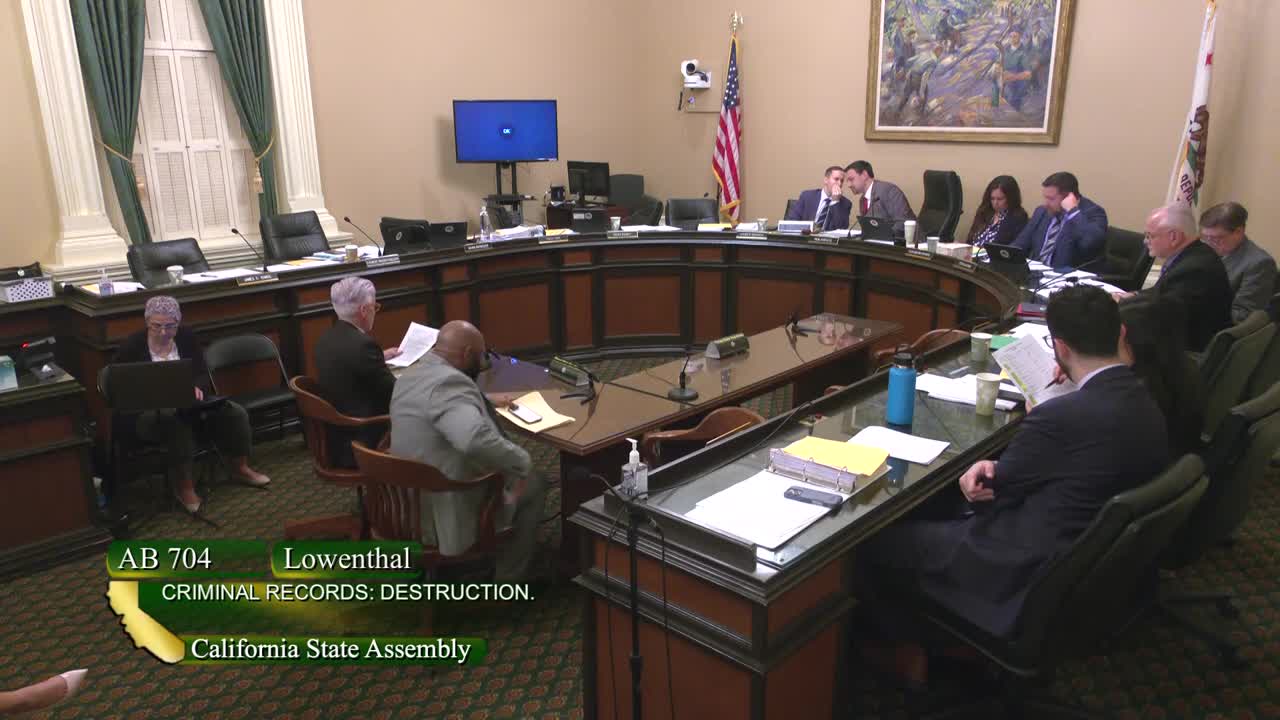 20MIN
Assembly Standing Committee on Public Safety
Bill Author

Bill Co-Author(s):