AB 730: Public postsecondary education: University of California, Merced: medical education.
- Session Year: 2025-2026
- House: Assembly
- Latest Version Date: 2025-03-28
Current Status:
Failed
(2026-02-02: From committee: Filed with the Chief Clerk pursuant to Joint Rule 56.)
Introduced
In Committee
Awaiting First Chamber Vote
Passed First Chamber
In Committee
Awaiting Second Chamber Vote
Passed Second Chamber
Enacted
Existing law establishes the University of California, under the administration of the Regents of the University of California, as one of the segments of public postsecondary education in this state. The University of California provides instruction and performs research at the 10 campuses it operates and maintains in Berkeley, Davis, Irvine, Los Angeles, Merced, Riverside, San Diego, San Francisco, Santa Barbara, and Santa Cruz.
The bill would, on or before July 1, 2026, and each July 1 thereafter, appropriate $15,000,000 from the General Fund to the Regents of the University of California for allocation to the University of California, Merced, Medical Education Collaborative, as defined. The bill would require the University of California, Merced, Medical Education Collaborative, as a condition of receiving the appropriation, to develop a program, consistent with its mission, and in conjunction with the health facilities of its medical residency programs, to identify eligible medical residents and to assist those medical residents in applying for physician retention programs, as specified.
Existing law establishes the Expanded Learning Opportunities Program and requires school districts and eligible charter schools, as a condition of receipt of specified program funds, to offer to all pupils in classroom-based instructional programs in kindergarten and grades 1 to 6, inclusive, access to expanded learning opportunity programs, as described. Existing law requires those local educational agencies, as a condition of receipt of those specified funds, to provide access to any pupil whose parent or guardian requests their placement in a program.This bill would state the intent of the Legislature to enact subsequent legislation that would authorize school districts and eligible charter schools to use Expanded Learning Opportunities Program funding to fund supplementary academic instruction and high-impact tutoring to pupils under the direction of a certificated employee at their schoolsite.Existing law establishes the Expanded Learning Opportunities Program and requires school districts and eligible charter schools, as a condition of receipt of specified program funds, to offer to all pupils in classroom-based instructional programs in kindergarten and grades 1 to 6, inclusive, access to expanded learning opportunity programs, as described. Existing law requires those local educational agencies, as a condition of receipt of those specified funds, to provide access to any pupil whose parent or guardian requests their placement in a program.
This bill would state the intent of the Legislature to enact subsequent legislation that would authorize school districts and eligible charter schools to use Expanded Learning Opportunities Program funding to fund supplementary academic instruction and high-impact tutoring to pupils under the direction of a certificated employee at their schoolsite.
As used in this article, the following definitions apply:
(a)SJVPP means the San Joaquin Valley PRIME+.
(b)UCM means the University of California, Merced.
(c)UCM Medical Education Collaborative means the medical school at the UCM, which is a branch campus of the University of California, San Francisco School of Medicine.
(d)UCSF means the University of California, San Francisco.
92607.1.The Legislature finds and declares all of the following:
(a)Californias supply of primary care physicians is below what is considered sufficient to meet patient needs.
(b)In the rapidly growing and ethnically diverse area of Californias San Joaquin Valley, the shortage of primary care physicians is particularly severe, with just 47 primary care physicians per 100,000 patients, which is far fewer than the recommended range of 60 to 80 primary care physicians per 100,000 patients.
(c)LatinX, African Americans, and Native Americans are vastly underrepresented in the physician workforce.
(d)According to statistics published by the Association of American Medical Colleges, California lags substantially in the number of medical school students per capita, having just 21.1 students per 100,000 persons, compared to the United States average of 37.9 students per 100,000 persons. California ranks number 43 out of 46 states for medical student enrollment per capita.
(e)According to the California Health Care Foundation, 72 percent of Californias 58 counties have an undersupply of primary care physicians, with primary care physicians making up just 34 percent of Californias physician workforce.
(f)The UCM has launched the SJVPP bachelor of science degree to medical doctor degree pathway.
(g)In 2023, the inaugural class of SJVPP students entered the bachelor of science degree program at UCM. The first combined SJVPP class will enter medical school at the UCM Medical Education Collaborative in 2027, and graduate in 2031.
(h)To meet the health care needs of the patient population of the San Joaquin Valley, it is UCMs long-term goal to develop an independent medical school. However, launching a medical school requires substantial time, financial support, faculty development, and a strong foundation of clinical partnerships for student rotations.
(i)The UCM Medical Education Collaborative allows UCM to immediately start training the future physicians that the San Joaquin Valley needs.
(j)In the meantime, the UCM Medical Education Collaborative will enable UCM to gain expertise in medical education, to begin hiring expert medical education faculty, to build clinical partnerships, and to start laying the foundation to someday increase class size and become an independent medical school.
(k)As a community-based medical school with a public mission to expand and diversify the San Joaquin Valleys physician workforce and to improve the health of people living in the San Joaquin Valley, the UCM Medical Education Collaborative has made a commitment to underserved patient populations.
(l)There are two principal determinants of where a physician practices: (1) where the person grew up, and (2) where the person completes residency training following medical school graduation.
(m)The UCM Medical Education Collaborative has strategies to capitalize on both of the factors described in subdivision (l).
(n)The UCM Medical Education Collaboratives strategies described in subdivision (m) include, but are not limited to, all of the following: (1) developing student pipeline programs, such as SJVPP, that inspire more young people in the San Joaquin Valley to pursue careers in medicine and other allied health professions and recruiting them to the UCM Medical Education Collaborative; (2) using a holistic review of medical school applicants that takes into account diverse life experiences in addition to academic performance; (3) teaching a curriculum that emphasizes key competencies for primary care medicine, including wellness and prevention, evidence-based medicine, and chronic disease management; (4) creating new residency training programs in primary care medicine and those short-supply specialties that are most needed in the San Joaquin Valley; and (5) continuing UCMs commitment to the recruitment, retention, and advancement of talented students, faculty, and staff from historically excluded populations who are currently underrepresented in medical education and the practice of medicine.
92607.2.On or before July 1, 2026, and each July 1 thereafter, the sum of fifteen million dollars ($15,000,000) is hereby appropriated from the General Fund to the Regents of the University of California for allocation to the UCM Medical Education Collaborative for purposes of this article.
92607.3.As a condition of receiving an appropriation pursuant to Section 92607.2, the UCM Medical Education Collaborative shall develop a program, consistent with its mission, and in conjunction with the health facilities of its medical residency programs, to identify eligible medical residents and to assist those medical residents to apply for physician retention programs, including, but not limited to, the Steven M. Thompson Physician Corps Loan Repayment Program established pursuant to Article 5 (commencing with Section 128550) of Chapter 5 of Part 3 of Division 107 of the Health and Safety Code.
SECTION 1.It is the intent of the Legislature to enact subsequent legislation that would authorize school districts and eligible charter schools to use funding from the Expanded Learning Opportunities Program established in Section 46120 of the Education Code to fund supplementary academic instruction and high-impact tutoring to pupils under the direction of a certificated employee at their schoolsite.It is the intent of the Legislature to enact subsequent legislation that would authorize school districts and eligible charter schools to use funding from the Expanded Learning Opportunities Program established in Section 46120 of the Education Code to fund supplementary academic instruction and high-impact tutoring to pupils under the direction of a certificated employee at their schoolsite.
|
Date
|
Status
|
|---|---|
| Feb 2, 2026 | From committee: Filed with the Chief Clerk pursuant to Joint Rule 56. |
| Jan 31, 2026 | Died pursuant to Art. IV, Sec. 10(c) of the Constitution. |
| May 23, 2025 | In committee: Held under submission. |
| May 14, 2025 | In committee: Set, first hearing. Referred to suspense file. |
| Apr 30, 2025 | From committee: Do pass and re-refer to Com. on APPR. (Ayes 9. Noes 0.) (April 29). Re-referred to Com. on APPR. |
| Apr 1, 2025 | Re-referred to Com. on HIGHER ED. |
| Mar 28, 2025 | From committee chair, with author's amendments: Amend, and re-refer to Com. on HIGHER ED. Read second time and amended. |
| Mar 28, 2025 | Referred to Com. on HIGHER ED. |
| Feb 19, 2025 | From printer. May be heard in committee March 21. |
| Feb 18, 2025 | Read first time. To print. |
|
Date
|
Description
|
Location
|
Votes
|
|
|---|---|---|---|---|
| Apr 29, 2025 | Do pass and be re-referred to the Committee on [Appropriations] | Assembly Standing Committee on Higher Education |
Passed |
This list shows positions taken on this bill by organizations on the date displayed, which is linked to the original source.
Positions by individuals are not included.
Date of Hearing: May 14, 2025
ASSEMBLY COMMITTEE ON APPROPRIATIONS
Buffy Wicks, Chair
ABPCA Bill Id:AB 730
Author:(Arambula) – As Amended Ver:March 28, 2025
Policy Committee: | Higher Education | Vote: | 9 - 0 |
|
| ||
|
|
Urgency: No State Mandated Local Program: No Reimbursable: No
SUMMARY:
This bill appropriates $15 million General Fund annually, beginning July 1, 2026, to the Regents of the University of California (UC) for allocation to the UC Merced (UCM) Medical Education Collaborative.
Specifically, this bill requires, as a condition of receipt of funds, UCM to develop a program to identify eligible medical residents and to assist those medical residents to apply for physician retention programs.
FISCAL EFFECT:
Ongoing General Fund costs of $15 million to provide an annual appropriation to the UC for the UCM Medical Education Collaborative.
COMMENTS:
- Purpose. According to the author:
California has a primary care physician shortage, with the rapidly growing Central Valley experiencing particularly severe consequences as a result. Establishing a world-class medical school in the Central Valley will help address the long-standing shortage of physicians in the region.
- Background. San Joaquin Valley PRIME+ Program. Established in 1975, the UC San Francisco (UCSF) Fresno is a graduate medical education campus of the UCSF School of Medicine positioned to address the severe shortage of physicians in the SJV. According to the 2022-23 UCSF Fresno Annual Report, “Improving Health in the San Joaquin Valley,” UCSF Fresno is now the largest academic physician training program in between San Francisco, Sacramento, and Los Angeles. Further, to facilitate UCM building partnerships with existing UC medical schools and its involvement with academic medicine, UCM partnered with the UC Davis (UCD) School of Medicine to help develop a new medical education program focusing on the health needs of the region. UCSF Fresno, UCM, and UCD partnered to launch the SJV Program in Medical Education (PRIME+) in 2011 to recruit and prepare students for future careers in medicine in the SJV. PRIME+ students complete their basic sciences/pre-clinical education at UCD, then complete most of their required third-year core clerkships at UCSF Fresno, with options for selecting the amount of time spent in the fourth year at UCSF Fresno or UCD.
UCM Medical Campus. The Budget Act of 2019 provided the UC the authority to construct a medical education facility on or near the UCM campus. The accompanying provisional language indicated that the state would cover the associated debt service. In November 2023, the UC Regents gave final approval to the new, 203,000-square-foot building, for construction on UCM’s campus. The UC estimates $300 million to complete the project, with an estimated opening date of fall 2026. Of this amount, the state will cover $243 million with General Fund, gift funds cover $45 million, and campus funds cover $12 million. The building will support the medical education program, allied healthcare-related programs developed in partnership with community colleges, house the Health Sciences Research Institute, and include a range of medical education and general assignment learning environments, and specialty learning spaces for medical education, general assignment classrooms, and class laboratories to support several new and existing academic programs.
The state currently provides $27 million ongoing GF to support operating costs at the UC Riverside School of Medicine, and $6.5 million ongoing GF to support debt service costs for a new medical education building that opened on the Riverside campus in fall 2023. The UC Riverside School of Medicine received accreditation in 2017, and currently enrolls 361 medical students, 40 Ph.D. students, 31 students receiving a master’s degree in Biomedical Sciences, and 127 medical residents.
According to the Legislative Analyst’s Office, the UCM project has the highest state-supported cost of any single capital project ever approved for UC. As mentioned above, the Riverside medical school building had a state-supported cost of $94 million, compared to the $243 million in state support UC is seeking for the Merced building.
Medical Professionals in the San Joaquin Valley (SJV). According to a CalMatters article from 2024 entitled, “A UC Merced Medical Program is Slowly Taking Shape,” the SJV is home to approximately 4.3 million people. The area is also known for having unhealthy air quality, high levels of chronic disease like diabetes and obesity, and insufficient medical providers. The SJV has 47 primary care doctors for every 100,000 residents, in contrast to the San Francisco Bay Area with 80 primary care physicians for every 100,000 people. Similarly, 81 specialists per 100,000 people work in SJV, but the Bay Area has more than twice that number. The article also found that some residents of the SJV schedule medical appointments over a year in advance because of the lack of doctors available to see them.
- Prior and Related Legislation. AB 1361 (Bains) of the current legislative session, requires the UC, upon an appropriation by the Legislature, to complete a feasibility study for the establishment of a UC medical school branch campus in Kern County. The bill was placed on the suspense file in this committee.
AB 58 (Arambula) of the current legislative session, requests the UC submit a report to the Legislature, on or before August 31, 2026, regarding the financial requirements necessary to expand the San Joaquin Valley PRIME+ medical education collaboration program and transition it into a fully independent medical school operated by UCM.
AB 2357 (Bains), Chapter 959, Statutes of 2024, established the UC Kern County Medical Education Endowment Fund for the purposes of supporting the operating costs associated with establishing a branch campus of an existing UC medical school in Kern County.
Analysis Prepared by: Aaron Heredia / APPR. / (916) 319-2081
Date of Hearing: April 29, 2025
ASSEMBLY COMMITTEE ON HIGHER EDUCATION
Mike Fong, Chair
ABPCA Bill Id:AB 730 (
Author:Arambula) – As Amended Ver:March 28, 2025
SUBJECT: Public postsecondary education: University of California, Merced: medical education.
SUMMARY: Appropriates $15 million from the General Fund (GF) to the Regents of the University of California (UC) on or before July 1, 2026, and each July 1 thereafter, for allocation to the UC Merced (UCM) Medical Education Collaborative, and requires UCM Medical Education Collaborative, as a condition of receiving the appropriation, to develop a program, consistent with its mission, and in conjunction with the health facilities of its medical residency programs, to identify eligible medical residents and to assist those medical residents in applying for physician retention programs. Specifically, this bill:
- Finds and declares, in part, the following of the Legislature:
- California’s supply of primary care physicians is below what is considered sufficient to meet patient needs;
- In the rapidly growing and ethnically diverse area of California’s San Joaquin Valley (SJV), the shortage of primary care physicians is particularly severe, with just 47 primary care physicians per 100,000 patients, which is far fewer than the recommended range of 60 to 80 primary care physicians per 100,000 patients;
- Black, Latinx, and Native Americans are vastly underrepresented in the physician workforce;
- According to statistics published by the Association of American Medical Colleges, California lags substantially in the number of medical school students per capita, having just 21.1 students per 100,000 persons, compared to the United States average of 37.9 students per 100,000 persons. California ranks number 43 out of 46 states for medical student enrollment per capita;
- According to the California Health Care Foundation, 72% of California’s 58 counties have an undersupply of primary care physicians, with primary care physicians making up just 34% of California’s physician workforce;
- UCM has launched the SJV Valley PRIME+ bachelor of science (BS) degree to medical doctor degree (MD) pathway (SJVPP);
- In 2023, the inaugural class of SJVPP students entered the Bachelor of Science degree program at UCM. The first combined SJVPP class will enter medical school at the UCM Medical Education Collaborative in 2027, and graduate in 2031;
- The UCM Medical Education Collaborative allows UC Merced to immediately start training the future physicians that the San Joaquin Valley needs;
- As a community-based medical school with a public mission to expand and diversify the San Joaquin Valley’s physician workforce and to improve the health of people living in the SJV, the UC Merced Medical Education Collaborative has made a commitment to underserved patient populations; and,
- UCM Medical Education Collaborative’s strategies include, but are not limited to, all of the following: (1) developing student pipeline programs, such as SJVPP, that inspire more young people in the San Joaquin Valley to pursue careers in medicine and other allied health professions and recruiting them to the UCM Medical Education Collaborative; (2) using a holistic review of medical school applicants that takes into account diverse life experiences in addition to academic performance; (3) teaching a curriculum that emphasizes key competencies for primary care medicine, including wellness and prevention, evidence-based medicine, and chronic disease management; (4) creating new residency training programs in primary care medicine and those short-supply specialties that are most needed in the San Joaquin Valley; and, (5) continuing UCM’s commitment to the recruitment, retention, and advancement of talented students, faculty, and staff from historically excluded populations who are currently underrepresented in medical education and the practice of medicine.
- Appropriates, on or before July 1, 2026, and each July 1 thereafter, the sum of $15 million from the GF to the UC Regents for allocation to the UCM Medical Education Collaborative.
- Stipulates that as a condition of receiving an appropriation, the UCM Medical Education Collaborative must develop a program, consistent with its mission, and in conjunction with the health facilities of its medical residency programs, to identify eligible medical residents and to assist those medical residents to apply for physician retention programs, including, but not limited to, the Steven M. Thompson Physician Corps Loan Repayment Program.
- Defines the following terms:
- “SJVPP” to mean the San Joaquin Valley PRIME+;
- “UCM” to mean the UC Merced;
- “UCM Medical Education Collaborative” to mean the medical school at the UCM, which is a branch campus of the UCSF School of Medicine; and,
- “UCSF” to mean the University of California, San Francisco.
EXISTING LAW:
- Establishes the UC as a public trust to be administered by the Regents of the UC; and, grants the Regents full powers of organization and government, subject only to such legislative control as may be necessary to insure security of its funds, compliance with the terms of its endowments, statutory requirements around competitive bidding and contracts, sales of property and the purchase of materials, goods and services (Article IX, Section (9)(a) of the California Constitution).
- Creates the UCSF, San Joaquin Valley Regional Campus Medical Education Endowment Fund. Stipulates that upon appropriation by the Legislature, moneys in the endowment fund must be allocated to the UC to support the annual operating costs for the development, operation, and maintenance of a branch campus of the UCSF School of Medicine in the San Joaquin Valley;
- Requires, upon appropriation by the Legislature and a determination by the Controller of sufficient funds in the endowment fund, moneys in the fund to be used to cover the UC’s estimated costs of applying for and obtaining approval and accreditation from the Liaison Committee on Medical Education (LCME) as provided; and,
- Requires moneys in the endowment fund to initially be invested with the goal of achieving capital appreciation to create a balance of $500 hundred million to generate ongoing earnings to cover the estimated annual operating costs associated with the development, operation, and maintenance of the branch campus, and, upon the determination of the Controller that the endowment fund balance is $500 hundred million, requires moneys in the endowment fund to be invested to generate earnings to fund annual operating costs associated with the development, operation, and maintenance of the branch campus (Education Code Section 92162, et seq.).
- Establishes the UC Kern County Medical Education Endowment Fund for the purposes of supporting the operating costs associated with establishing a branch campus of an existing UC Medical School in Kern County. Stipulates that moneys in the endowment fund must be allocated to the UC, upon appropriation by the Legislature, to support the annual operating costs for the development, operation, and maintenance of a branch campus of an existing UC School of Medicine in the County of Kern, to conduct a feasibility study related to that branch campus, and to generate funding through investment earnings for the support of medical education in the San Joaquin Valley. Further, existing law requires that any funds public or private, received for or generated by the endowment fund shall supplement, not supplant, any current or future funding. Any funds allocated from the endowment fund shall supplement, not supplant, the UC budget allocations for any fiscal year (EC Section 92168, et seq.).
FISCAL EFFECT: Unknown
COMMENTS: Need for the measure. According to the author, “California has a primary care physician shortage, with the rapidly growing Central Valley experiencing particularly severe consequences as a result. Establishing a world-class medical school in the Central Valley will help address the long-standing shortage of physicians in the region.”
Further, the author states that, “due to limited opportunities to complete medical education in largely rural communities like the Central Valley, only 1.1% of medical students reported a plan to practice in rural areas after graduating. As a result, [Central] Valley residents often experience longer wait times and travel longer distances for care if they don’t forgo it entirely. I saw this firsthand as an emergency room physician and later as a medical director who struggled to recruit enough doctors to come to the Valley.”
Lastly, the author contends that, “despite Latinx comprising almost 18% of the U.S. population, only 6.3% of physicians in the country are Latinx, and Latinas make up a mere 2.4% of the physician population. Alarmingly, in California, where Latinx make up 39% of the population, only 6.4% of physicians are Latinx, and Latinas represent just 2.7% of the physician population.”
This measure, on or before July 1, 2026, and each July 1 thereafter, appropriates $15 million from the GF to the UC Regents for allocation to the UCM Medical Education Collaborative, as defined. Further, this measure requires the UCM Medical Education Collaborative, as a condition of receiving the appropriation, to develop a program, consistent with its mission, and in conjunction with the health facilities of its medical residency programs, to identify eligible medical residents and to assist those medical residents in applying for physician retention programs, as specified.
San Joaquin Valley (SJV). The SJV is defined as encompassing the Fresno, Kern, Kings, Madera, Merced, San Joaquin, Stanislaus, and Tulare counties. According to a report by the UC, entitled, Improving Health Care Access in the San Joaquin Valley – A Regional Approach through Collaboration and Innovation, the SJV has long-standing shortages of physicians and other health care professionals. A health workforce assessment of the SJV conducted by the UC found that the region has the lowest ratios of licensed MDs, DOs, NPs, RNs, marriage and family therapists, licensed counselors, and licensed social workers per 100,000 population in California and the second lowest ratios of PAs, CNs, and psychologists per capita. These and other findings show that action will be needed to ensure that the SJV has sufficient supplies of health professionals for meeting its future needs.
Further, according to an article entitled, “A UC Merced Medical Program is Slowly Taking Shape,” published by CalMatters on July 8, 2024, the SJV is home to approximately 4.3 million people. The area is also known for having terrible air quality, high levels of chronic disease, like diabetes and obesity, and insufficient medical providers. It is found that the SJV has 47 primary care doctors for every 100,000 residents. Comparing that data point to the San Francisco Bay Area as a whole, it is found that said area has 80 primary care physicians for every 100,000 people; and, when it comes to specialty care, 81 specialists per 100,000 people work in SJV, but the Bay Area has more than twice that number. The article also found that some residents of the SJV schedule medical appointments over a year in advance because of the lack of doctors available to see them.
San Joaquin Valley PRIME+ (SJVPP) BS to MD pathway in 2023. According to UCM, to meet the healthcare needs of the patient population of the SJV, it is UCM’s long-term goal to develop an independent medical school. However, launching a medical school requires substantial time, financial support, faculty development, and a strong foundation of clinical partnerships for student rotations. Starting off as a branch campus of UC San Francisco (UCSF) School of Medicine allows UCM to immediately start training the future physicians that the SJV needs. In the meantime, as branch campus of UCSF School of Medicine, UCM will gain expertise in medical education, begin hiring expert medical education faculty, build clinical partnerships, and start laying the foundation to someday increase class size and become an independent medical school.
In September 2023, UCM launched the SJVPP BS to MD pathway. This pathway will have approximately 12-15 new students per year. The inaugural class of SJVPP students will enter medical school at UCM in 2027. They will be supported by medical education faculty and mentors, have access to medical library services, and have a new medical education building. The goal is for the first class of SJV doctors to graduate by 2031. UCM aspires that the SJVPP will truly help establish UCM as an outstanding institution for pre-health careers. As a pipeline program, that SJVPP will help attract diverse students from all areas of the SJV, provide mentors and role models, and inspire their interest in health care.
The chart below from UCM, provides a timeline of the first medical education cohort at UCM.

Committee comments. The 2019-20 Budget Act authorized the UC to pursue a medical school project at UC Merced. Then the 2020-21 Budget Act established $15 million in ongoing funding for the UC Merced Medical Education Collaborative. However, additional funding is needed to increase class sizes and allow UC Merced to become an independent medical school. While this measure appears to fulfill the next necessary steps for UC Merced to be home to an independent medical school, by appropriating an additional $15 million from the GF to the UC Regents on or before July 1, 2026, and each July 1 thereafter, for allocation to the UCM Medical Education Collaborative, with the existing condition of the State’s budget, it is unclear where the moneys to implement this measure would come from.
Committee Staff understands that the author did not submit a budget request to correspond with the fiscal earmark contained in this measure.
Related legislation. AB 58 (Soria), which is scheduled to be heard by this Committee on April 29, 2025, in part, requests the UC to submit a report to the Legislature, on or before August 31, 2026, on the financial requirements necessary to expand the current UCSF and UCM medical education collaboration, the San Joaquin Valley PRIME+ program, and to transition the program into a fully independent medical school operated by the UCM.
AB 1361 (Bains), which unanimously passed out of this Committee on April 8, 2025, and, as of April 23, 2025, is currently on the Suspense File in the Assembly Committee on Appropriations, in part, establishes the County of Kern Grow Our Own Medical School Feasibility Study Act. The Act, in part, requires the UC, on or before January 1, 2027, to complete a feasibility study, as specified, to determine the steps necessary to establishing a branch campus of an existing UC medical school in Kern County.
Prior legislation. AB 2357 (Bains), Chapter 959, Statutes of 2024, in part, establishes the UC San Joaquin Valley Regional Campus Medical Education Endowment Fund.
AB 3081 (Arambula), of the 2023-24 Legislative Session, which was held on the Suspense File in the Assembly Committee on Appropriations, was substantially similar in nature to this measure.
Prior legislation. AB 2202 (Gray), Chapter 756, Statutes of 2018, which, in part, established the UCSF San Joaquin Valley Regional Campus Medical Education Endowment Fund to support the annual operating costs of a branch campus of UCSF School of Medicine in the SJV.
AB 2232 (Gray) of 2014, AB 174 (Gray) of 2015, SB 841 (Cannella) of 2014, and SB 131 (Cannella) of 2015, all of which appropriated funds for the SJV PRIME Program, were held on the Suspense File in the Senate Committee on Appropriations.
REGISTERED SUPPORT / OPPOSITION:
Support
None on file.
Opposition
None on file.
Analysis Prepared by: Jeanice Warden / HIGHER ED. / (916) 319-3960
Discussed in Hearing
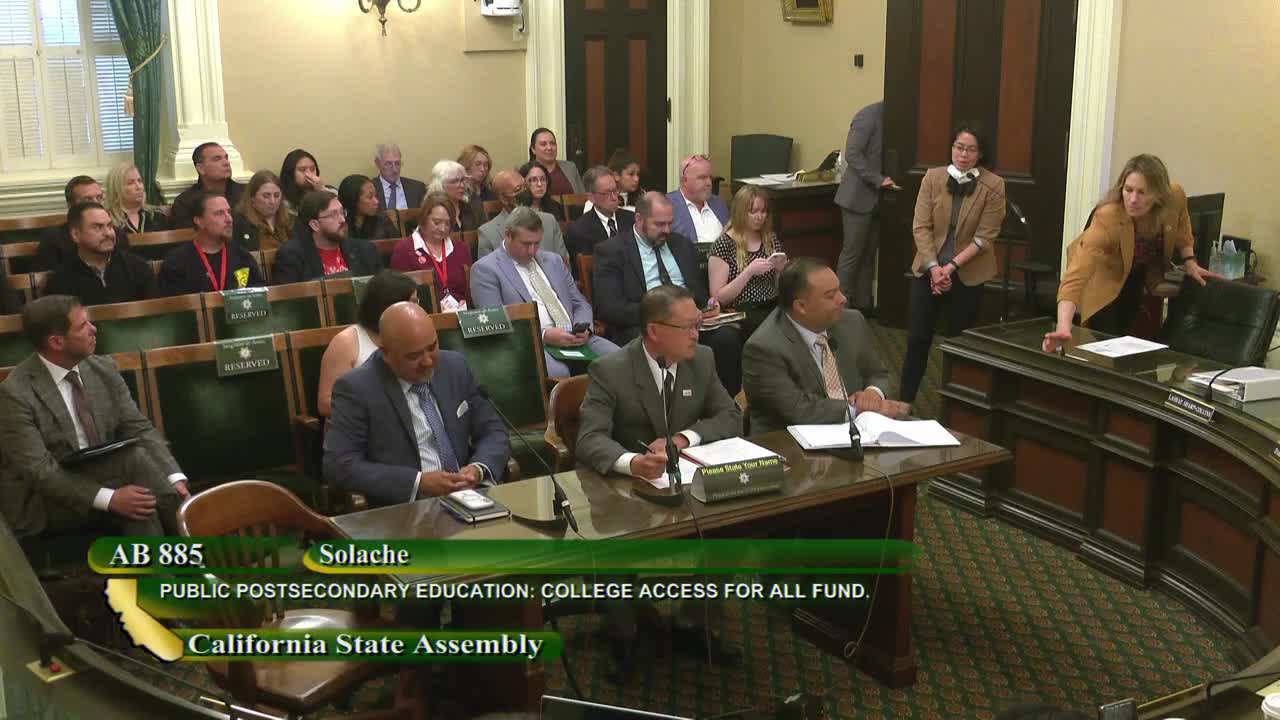 2MIN
Assembly Standing Committee on Higher Education
Bill Author

Bill Co-Author(s):