AB 737: Energy: building decarbonization: notice and recordation of a decarbonization charge.
- Session Year: 2025-2026
- House: Assembly
- Latest Version Date: 2025-10-03
Current Status:
Passed
(2025-10-03: Chaptered by Secretary of State - Chapter 276, Statutes of 2025.)
Introduced
In Committee
Awaiting First Chamber Vote
Passed First Chamber
In Committee
Awaiting Second Chamber Vote
Passed Second Chamber
Enacted
Existing law requires the Public Utilities Commission, or the governing board of a local publicly owned electric utility or electrical cooperative, to require an energy supplier, defined as an electrical corporation, local publicly owned electric utility, electric service provider, community choice aggregator, or electrical cooperative, administering a decarbonization upgrade program or initiative, to record, no later than 30 days after funding a decarbonization upgrade, a notice of decarbonization charge, as defined, with the county recorder of the county where the property subject to the decarbonization charge is located, as specified. Existing law requires, among other things, an energy supplier, within 30 days of full cost recovery of the outstanding charges related to the recorded notice of decarbonization charge, to record a notice of the full cost recovery and removal of the decarbonization charge with the county recorder of the county where the property subject to the decarbonization charge is located.
This bill would add gas corporations to the definition of energy supplier for purposes of the above-described provisions and make conforming changes.
Under existing law, a violation of any order, decision, rule, direction, demand, or requirement of the commission is a crime.
Because a violation of a commission action implementing the above provisions would be a crime, this bill would impose a state-mandated local program.
The California Constitution requires the state to reimburse local agencies and school districts for certain costs mandated by the state. Statutory provisions establish procedures for making that reimbursement.
This bill would provide that no reimbursement is required by this act for a specified reason.
Existing law requires the Public Utilities Commission, or the governing board of a local publicly owned electric utility or electrical cooperative, to require an energy supplier, defined as an electrical corporation, local publicly owned electric utility, electric service provider, community choice aggregator, or electrical cooperative, administering a decarbonization upgrade program or initiative, to record, no later than 30 days after funding a decarbonization upgrade, a notice of decarbonization charge, as defined, with the county recorder of the county where the property subject to the decarbonization charge is located, as specified. Existing law requires, among other things, an energy supplier, within 30 days of full cost recovery of the outstanding charges related to the recorded notice of decarbonization charge, to record a notice of the full cost recovery and removal of the decarbonization charge with the county recorder of the county where the property subject to the decarbonization charge is located.
This bill would additionally add gas corporations to the definition of energy supplier for purposes of the above-described provisions. provisions and make conforming changes.
Under existing law, a violation of any order, decision, rule, direction, demand, or requirement of the commission is a crime.
Because a violation of a commission action implementing the above provisions would be a crime, this bill would impose a state-mandated local program.
The California Constitution requires the state to reimburse local agencies and school districts for certain costs mandated by the state. Statutory provisions establish procedures for making that reimbursement.
This bill would provide that no reimbursement is required by this act for a specified reason.
Existing law requires the Public Utilities Commission, or the governing board of a local publicly owned electric utility or electrical cooperative, to require an energy supplier, defined as an electrical corporation, local publicly owned electric utility, electric service provider, community choice aggregator, or electrical cooperative, administering a decarbonization upgrade program or initiative, to record, no later than 30 days after funding a decarbonization upgrade, a notice of decarbonization charge, as defined, with the county recorder of the county where the property subject to the decarbonization charge is located, as specified. Existing law requires, among other things, an energy supplier, within 30 days of full cost recovery of the outstanding charges related to the recorded notice of decarbonization charge, to record a notice of the full cost recovery and removal of the decarbonization charge with the county recorder of the county where the property subject to the decarbonization charge is located.
This bill would additionally add gas corporations to the definition of energy supplier for purposes of the above-described provisions.
Under existing law, a violation of any order, decision, rule, direction, demand, or requirement of the commission is a crime.
Because a violation of a commission action implementing the above provisions would be a crime, this bill would impose a state-mandated local program.
The California Constitution requires the state to reimburse local agencies and school districts for certain costs mandated by the state. Statutory provisions establish procedures for making that reimbursement.
This bill would provide that no reimbursement is required by this act for a specified reason.
(a)It is the intent of the Legislature to establish transparency for renters and home buyers regarding the existence of a decarbonization charge associated with a decarbonization upgrade located on a property.
(b)The Legislature finds and declares that the act of an energy supplier, including, but not limited to, a gas corporation, recording a notice of decarbonization charge pursuant to this chapter does not constitute a debt collection.
SEC. 2.Section 8376 of the Public Utilities Code is amended to read:8376.For purposes of this chapter, the following definitions apply:
(a)(1)Decarbonization charge means a charge that is added to the billing for service associated with the electrical meter, or other measuring device, under the control of an energy supplier located at the subscriber property where a decarbonization upgrade is located, and that is collected in order to pay for a decarbonization upgrade.
(2)If an energy supplier is a gas corporation, as defined in Section 222, decarbonization charge shall be limited to a charge for measures that provide a measurable reduction in natural gas consumption and associated greenhouse gas emissions.
(b)Decarbonization upgrade means all of the following:
(1)A change to a subscriber property that reduces the demand for energy from an energy supplier.
(2)A change to a subscriber property that allows for storage of energy.
(3)A change to a subscriber property that reduces the use of fossil fuels.
(4)A change to a subscriber property that converts water, wind, or sunlight to usable electricity.
(c)Energy supplier means any of the following:
(1)An entity that offers an electricity product for sale to retail consumers in California, including an electrical corporation, local publicly owned electric utility, electric service provider, and community choice aggregator.
(2)Any private corporation or association organized for purposes of transmitting or distributing electricity exclusively to its stockholders or members at cost, including an electrical cooperative.
(3)A gas corporation, as defined in Section 222.
(d)Subscriber means a person or entity that purchases energy or energy services from an energy supplier and is billed for the energy or energy services by the energy supplier, either directly or by another entity on behalf of the energy supplier.
(e)Subscriber property means residential, commercial, industrial, agricultural, or other real property owned, leased, or licensed for occupancy by the subscriber.
SEC. 3.Section 8377 of the Public Utilities Code is amended to read:8377.(a)This chapter shall apply to any program or initiative administered by an energy supplier that has all of the following attributes:
(1)The program or initiative makes a site-specific investment to fund the installation of decarbonization upgrades on subscriber properties.
(2)The program or initiative recovers any portion of the site-specific investment through decarbonization charges associated with one or more electrical meters, or other measuring devices, associated with those upgraded subscriber properties.
(3)The program or initiative imposes a duty to pay the decarbonization charge that arises from, and is evidenced by, a written agreement executed relative to the installation of the decarbonization upgrade on the subscriber property between the property owner, or all current property owners of record, if different than the subscriber, and the energy supplier.
(4)Under the program or initiative, the subscribers obligation to pay the decarbonization charge is associated with the electrical meter, or other measuring device, located at the subscribers property on which the decarbonization upgrade is located and is transferable to any successor subscriber who subsequently receives energy service at the property.
(b)The commission, or the governing board of a local publicly owned electric utility or electrical cooperative, as applicable, shall require an energy supplier, in administering the program or initiative, to facilitate proper notification of upgrades and decarbonization charge obligations to successor subscribers by completing all of the following:
(1)The energy supplier shall record, no later than 30 days after funding a decarbonization upgrade, a notice of decarbonization charge with the county recorder of the county where the property subject to the decarbonization charge is located. A county recorder, upon recording a notice of decarbonization charge, shall index the notice of decarbonization charge in the general index by the name of the owner of the real property where the electrical meter, or other measuring device, affected by the decarbonization charge will be located. The notice shall be entitled NOTICE OF DECARBONIZATION CHARGE and shall comply with Section 27324 of the Government Code. The recordation of the notice of decarbonization charge shall be considered sufficient notice to a subsequent subscriber at a property with installed decarbonization upgrades of the subscribers obligation to pay the decarbonization charge for installed measures.
(2)The recorded notice of decarbonization charge shall contain all of the following information:
(A)The address or legal description, the assessors parcel number, and the name of the owner, of the real property where the electrical meter, or other measuring device, affected by the decarbonization charge will be located.
(B)The decarbonization charge amount and payment period.
(C)A description of the decarbonization upgrades funded with the decarbonization charge.
(D)Contact information for the person or entity authorized to provide a prompt and accurate written statement of the outstanding charges and payoff amounts related to the decarbonization charge for which the notice of decarbonization charge was recorded.
(3)Within 30 days of full cost recovery of the outstanding charges related to the recorded notice of decarbonization charge, the energy supplier shall record a notice of the full cost recovery and removal of the decarbonization charge with the county recorder of the county where the property subject to the decarbonization charge is located. The notice of the full cost recovery and removal of the decarbonization charge shall include a reference to the recorded notice of decarbonization charge.
(4)Within 30 days of a decision by the energy supplier to cease collection of the charge, the energy supplier shall record a notice of removal of the decarbonization charge with the county recorder of the county where the property subject to the decarbonization charge is located. The notice of the removal of the decarbonization charge shall include a reference to the recorded notice of the decarbonization charge.
(5)When the subscriber property is not owner-occupied, the written agreement between the energy supplier and the property owner executed relative to the installation of the decarbonization upgrade shall incorporate a requirement that the property owner shall cause the obligation to pay the decarbonization charge to appear in the terms through which the subscriber leases or licenses the property for occupancy. This paragraph shall only apply to written agreements executed after January 1, 2023.
SEC. 4.No reimbursement is required by this act pursuant to Section 6 of Article XIIIB of the California Constitution because the only costs that may be incurred by a local agency or school district will be incurred because this act creates a new crime or infraction, eliminates a crime or infraction, or changes the penalty for a crime or infraction, within the meaning of Section 17556 of the Government Code, or changes the definition of a crime within the meaning of Section 6 of Article XIIIB of the California Constitution.
(a)It is the intent of the Legislature to establish transparency for renters and home buyers regarding the existence of a decarbonization charge associated with a decarbonization upgrade located on a property.
(b)The Legislature finds and declares that the act of an energy supplier supplier, including, but not limited to, a gas corporation, recording a notice of decarbonization charge pursuant to this chapter does not constitute a debt collection.
SECTION 1.SEC. 2.Section 8376 of the Public Utilities Code is amended to read:8376.For purposes of this chapter, the following definitions apply:
(a)(1)Decarbonization charge means a charge that is added to the billing for service associated with the electrical meter, or other measuring device, under the control of an energy supplier located at the subscriber property where a decarbonization upgrade is located, and that is collected in order to pay for a decarbonization upgrade.
(2)If an energy supplier is a gas corporation, as defined in Section 222, decarbonization charge shall be limited to a charge for measures that provide a measurable reduction in natural gas consumption and associated greenhouse gas emissions.
(b)Decarbonization upgrade means all of the following:
(1)A change to a subscriber property that reduces the demand for electricity energy from an energy supplier.
(2)A change to a subscriber property that allows for storage of energy.
(3)A change to a subscriber property that reduces the use of fossil fuels.
(4)A change to a subscriber property that converts water, wind, or sunlight to usable electricity.
(c)Energy supplier means any of the following:
(1)An entity that offers an electricity product for sale to retail consumers in California, including an electrical corporation, local publicly owned electric utility, electric service provider, and community choice aggregator.
(2)Any private corporation or association organized for purposes of transmitting or distributing electricity exclusively to its stockholders or members at cost, including an electrical cooperative.
(3)A gas corporation, as defined in Section 222.
(d)Subscriber means a person or entity that purchases electricity or electrical grid energy or energy services from an energy supplier and is billed for the electricity or electrical grid energy or energy services by the energy supplier, either directly or by another entity on behalf of the energy supplier.
(e)Subscriber property means residential, commercial, industrial, agricultural, or other real property owned, leased, or licensed for occupancy by the subscriber.
SEC. 3.Section 8377 of the Public Utilities Code is amended to read:8377.(a)This chapter shall apply to any program or initiative administered by an energy supplier that has all of the following attributes:
(1)The program or initiative makes a site-specific investment to fund the installation of decarbonization upgrades on subscriber properties.
(2)The program or initiative recovers any portion of the site-specific investment through decarbonization charges associated with one or more electrical meters meters, or other measuring devices, associated with those upgraded subscriber properties.
(3)The program or initiative imposes a duty to pay the decarbonization charge that arises from, and is evidenced by, a written agreement executed relative to the installation of the decarbonization upgrade on the subscriber property between the property owner, or all current property owners of record, if different than the subscriber, and the energy supplier.
(4)Under the program or initiative, the subscribers obligation to pay the decarbonization charge is associated with the electrical meter meter, or other measuring device, located at the subscribers property on which the decarbonization upgrade is located and is transferable to any successor subscriber who subsequently receives electrical energy service at the property.
(b)The commission, or the governing board of a local publicly owned electric utility or electrical cooperative, as applicable, shall require an energy supplier, in administering the program or initiative, to facilitate proper notification of upgrades and decarbonization charge obligations to successor subscribers by completing all of the following:
(1)The energy supplier shall record, no later than 30 days after funding a decarbonization upgrade, a notice of decarbonization charge with the county recorder of the county where the property subject to the decarbonization charge is located. A county recorder, upon recording a notice of decarbonization charge, shall index the notice of decarbonization charge in the general index by the name of the owner of the real property where the meter electrical meter, or other measuring device, affected by the decarbonization charge will be located. The notice shall be entitled NOTICE OF DECARBONIZATION CHARGE and shall comply with Section 27324 of the Government Code. The recordation of the notice of decarbonization charge shall be considered sufficient notice to a subsequent subscriber at a property with installed decarbonization upgrades of the subscribers obligation to pay the decarbonization charge for installed measures.
(2)The recorded notice of decarbonization charge shall contain all of the following information:
(A)The address or legal description, the assessors parcel number, and the name of the owner, of the real property where the electrical meter meter, or other measuring device, affected by the decarbonization charge will be located.
(B)The decarbonization charge amount and payment period.
(C)A description of the decarbonization upgrades funded with the decarbonization charge.
(D)Contact information for the person or entity authorized to provide a prompt and accurate written statement of the outstanding charges and payoff amounts related to the decarbonization charge for which the notice of decarbonization charge was recorded.
(3)Within 30 days of full cost recovery of the outstanding charges related to the recorded notice of decarbonization charge, the energy supplier shall record a notice of the full cost recovery and removal of the decarbonization charge with the county recorder of the county where the property subject to the decarbonization charge is located. The notice of the full cost recovery and removal of the decarbonization charge shall include a reference to the recorded notice of decarbonization charge.
(4)Within 30 days of a decision by the energy supplier to cease collection of the charge, the energy supplier shall record a notice of removal of the decarbonization charge with the county recorder of the county where the property subject to the decarbonization charge is located. The notice of the removal of the decarbonization charge shall include a reference to the recorded notice of the decarbonization charge.
(5)When the subscriber property is not owner-occupied, the written agreement between the energy supplier and the property owner executed relative to the installation of the decarbonization upgrade shall incorporate a requirement that the property owner shall cause the obligation to pay the decarbonization charge to appear in the terms through which the subscriber leases or licenses the property for occupancy. This paragraph shall only apply to written agreements executed after January 1, 2023.
SEC. 2.SEC. 4.No reimbursement is required by this act pursuant to Section 6 of Article XIIIB of the California Constitution because the only costs that may be incurred by a local agency or school district will be incurred because this act creates a new crime or infraction, eliminates a crime or infraction, or changes the penalty for a crime or infraction, within the meaning of Section 17556 of the Government Code, or changes the definition of a crime within the meaning of Section 6 of Article XIIIB of the California Constitution.
For purposes of this chapter, the following definitions apply:
(a)Decarbonization charge means a charge that is added to the billing for service associated with the electrical meter, or other measuring device, under the control of an energy supplier located at the subscriber property where a decarbonization upgrade is located, and that is collected in order to pay for a decarbonization upgrade.
(b)Decarbonization upgrade means all of the following:
(1)A change to a subscriber property that reduces the demand for electricity from an energy supplier.
(2)A change to a subscriber property that allows for storage of energy.
(3)A change to a subscriber property that reduces the use of fossil fuels.
(4)A change to a subscriber property that converts water, wind, or sunlight to usable electricity.
(c)Energy supplier means either any of the following:
(1)An entity that offers an electricity product for sale to retail consumers in California, including an electrical corporation, local publicly owned electric utility, electric service provider, and community choice aggregator.
(2)Any private corporation or association organized for purposes of transmitting or distributing electricity exclusively to its stockholders or members at cost, including an electrical cooperative.
(3)A gas corporation, as defined in Section 222.
(d)Subscriber means a person or entity that purchases electricity or electrical grid services from an energy supplier and is billed for the electricity or electrical grid services by the energy supplier, either directly or by another entity on behalf of the energy supplier.
(e)Subscriber property means residential, commercial, industrial, agricultural, or other real property owned, leased, or licensed for occupancy by the subscriber.
SEC. 2.No reimbursement is required by this act pursuant to Section 6 of Article XIIIB of the California Constitution because the only costs that may be incurred by a local agency or school district will be incurred because this act creates a new crime or infraction, eliminates a crime or infraction, or changes the penalty for a crime or infraction, within the meaning of Section 17556 of the Government Code, or changes the definition of a crime within the meaning of Section 6 of Article XIIIB of the California Constitution.
|
Date
|
Status
|
|---|---|
| Oct 3, 2025 | Chaptered by Secretary of State - Chapter 276, Statutes of 2025. |
| Oct 3, 2025 | Approved by the Governor. |
| Sep 22, 2025 | Enrolled and presented to the Governor at 3 p.m. |
| Sep 10, 2025 | Senate amendments concurred in. To Engrossing and Enrolling. (Ayes 68. Noes 0. Page 3235.). |
| Sep 9, 2025 | In Assembly. Concurrence in Senate amendments pending. |
| Sep 9, 2025 | Read third time. Passed. Ordered to the Assembly. (Ayes 35. Noes 1. Page 2698.). |
| Aug 20, 2025 | Read second time. Ordered to third reading. |
| Aug 19, 2025 | From committee: Be ordered to second reading pursuant to Senate Rule 28.8. |
| Jul 8, 2025 | Read second time and amended. Re-referred to Com. on APPR. |
| Jul 7, 2025 | From committee: Amend, and do pass as amended and re-refer to Com. on APPR. (Ayes 15. Noes 1.) (July 1). |
| Jun 17, 2025 | In committee: Set, first hearing. Hearing canceled at the request of author. |
| May 21, 2025 | Referred to Com. on E., U & C. |
| May 8, 2025 | In Senate. Read first time. To Com. on RLS. for assignment. |
| May 8, 2025 | Read third time. Passed. Ordered to the Senate. (Ayes 69. Noes 0. Page 1486.) |
| May 1, 2025 | Read second time. Ordered to Consent Calendar. |
| Apr 30, 2025 | From committee: Do pass. To Consent Calendar. (Ayes 14. Noes 0.) (April 30). |
| Apr 3, 2025 | From committee: Do pass and re-refer to Com. on APPR. with recommendation: To Consent Calendar. (Ayes 18. Noes 0.) (April 2). Re-referred to Com. on APPR. |
| Mar 3, 2025 | Referred to Com. on U. & E. |
| Feb 19, 2025 | From printer. May be heard in committee March 21. |
| Feb 18, 2025 | Read first time. To print. |
|
Date
|
Description
|
Location
|
Votes
|
|
|---|---|---|---|---|
| Sep 10, 2025 | AB 737 Quirk-Silva Concurrence in Senate Amendments | Assembly Floor |
Passed |
|
| Sep 9, 2025 | Assembly 3rd Reading AB737 Quirk-Silva By Caballero | Senate Floor |
Passed |
|
| Jul 1, 2025 | Do pass as amended, but first amend, and re-refer to the Committee on [Appropriations] | Senate Standing Committee on Energy, Utilities and Communications |
Passed |
|
| May 8, 2025 | AB 737 Quirk-Silva Consent Calendar Second Day Regular Session | Assembly Floor |
Passed |
|
| Apr 30, 2025 | Do pass. To Consent Calendar. | Assembly Standing Committee on Appropriations |
Passed |
|
| Apr 2, 2025 | Do pass and be re-referred to the Committee on [Appropriations] with recommendation: To Consent Calendar | Assembly Standing Committee on Utilities and Energy |
Passed |
This list shows positions taken on this bill by organizations on the date displayed, which is linked to the original source.
Positions by individuals are not included.
|
Organization
|
Position
|
Date
|
|---|---|---|
| Earthjustice | ** Against | |
| Natural Resources Defense Council | ** Against | |
| Sierra Club California | ** Against | |
| Southern California Gas Company (SoCalGas) | ** Support |
CONCURRENCE IN SENATE AMENDMENTS
CSA1 Bill Id:AB 737
Author:(Quirk-Silva)
As Amended Ver:July 8, 2025
Majority vote
SUMMARY
Adds "gas corporations" to the entities required to provide notification of any utility charges associated with a property – usually for an energy efficiency upgrade – for new tenants or homeowners to review, known in statute as a "decarbonization charge." These charges would be a financial obligation on the new tenant or homeowner.
Senate Amendments
- Clarifies within the statutory declarations (Public Utilities Code Section 8375) that energy suppliers include gas corporations, for the purposes of the decarbonization charge requirements. The version of this bill when last in the Assembly only had this clarification in the statutory definitions, not the declarations.
- Clarifies "other measuring devices," rather than just electrical meters, may be used to assess and track program participation and thus be associated with the decarbonization charges.
- Limits eligible decarbonization charges for gas corporations to only those measures that provide a measurable reduction in natural gas consumption or association greenhouse gas (GHG) emissions.
COMMENTS
California's energy utilities offer different financing options to help customers make upgrades to the properties they own or rent. These upgrades – such as efficient air conditioners, heat pumps, insulation, or solar panels – often require high upfront costs but can reduce long-term energy bills.
Some financing options attach the repayment obligation to the individual who approved the upgrade. In that case, the obligation remains with that person, even if they move or sell the property.
Other financing options tie repayment to the property itself, through the utility meter. Under this arrangement, if the property changes hands, the next occupant continues making payments through the utility bill. This model is known as "tariff on-bill" (TOB) financing. Because TOB is commonly used for energy efficiency and renewable upgrades, it is often called a "decarbonization charge."
Current law sets rules for decarbonization charges. Utilities (or other energy suppliers) must record the obligation in property records so that future buyers or tenants know about it. The law also specifies that this record is not treated as debt collection.
However, these requirements currently apply only to electric utilities, not gas utilities. This bill would extend the same requirements to gas corporations, ensuring they also record decarbonization charge obligations in property records.
According to the Author
According to the author, "AB 737 is about making clean energy accessible to all Californians. The fight for a sustainable future is not just about reducing emissions but ensuring affordability and equity. By leveling the playing field for gas and electric utilities, this bill removes the barriers that prevent families and businesses from lowering their energy costs while building a cleaner, more resilient California for generations to come."
Arguments in Support
This bill is supported by Southern California Gas Company (SoCalGas) who note the bill is "technical in nature" and in response to requirements from the California Public Utilities Commission to have them participate in TOB programs, even though the existing statutory protections related to debt collection in TOB programs only apply to electric corporations, not gas corporations.
Arguments in Opposition
This bill is opposed by the environmental groups Earthjustice, Sierra Club California, and the Natural Resources Defense Council (NRDC is oppose unless amended). All three cite concern with including gas utilities in the list of entities eligible for decarbonization charges, as it could enable the use of these TOB financing schemes to fund new fossil fuel appliances. The bill now includes a provision adopted in the Senate to specify that decarbonization charges for gas corporations must provide a measurable reduction in natural gas consumption and associated GHG emissions, largely in line with the requested amendment from NRDC. However, Earthjustice and Sierra Club California note this specification does not go far enough to satisfy their concerns, stating: "…GHG emission reductions …may be 'measurable' while still being highly polluting and counter to the state's climate goals," citing SoCalGas’s efforts to use TOB to switch customers to natural gas tankless water heaters.
FISCAL COMMENTS
According to the Senate Committee on Appropriations, this bill would result in negligible new state costs, and was thus recommended to the floor pursuant to Senate Rule 28.8.
VOTES:
ASM UTILITIES AND ENERGY: 18-0-0
YES: Petrie-Norris, Patterson, Boerner, Calderon, Chen, Davies, Mark González, Harabedian, Hart, Irwin, Kalra, Papan, Rogers, Schiavo, Schultz, Ta, Wallis, Zbur
ASM APPROPRIATIONS: 14-0-1
YES: Wicks, Sanchez, Arambula, Calderon, Caloza, Dixon, Elhawary, Fong, Mark González, Hart, Pacheco, Solache, Ta, Alanis
ABS, ABST OR NV: Pellerin
ASSEMBLY FLOOR: 69-0-10
YES: Addis, Aguiar-Curry, Ahrens, Alanis, Alvarez, Ávila Farías, Bains, Bauer-Kahan, Bennett, Berman, Bonta, Bryan, Calderon, Caloza, Castillo, Chen, Connolly, Davies, DeMaio, Dixon, Elhawary, Ellis, Fong, Gabriel, Garcia, Gipson, Mark González, Hadwick, Haney, Harabedian, Hart, Hoover, Jackson, Kalra, Krell, Lackey, Lee, Lowenthal, Macedo, McKinnor, Muratsuchi, Nguyen, Ortega, Pacheco, Papan, Patel, Patterson, Pellerin, Petrie-Norris, Quirk‑Silva, Ramos, Ransom, Michelle Rodriguez, Rogers, Blanca Rubio, Schiavo, Schultz, Sharp-Collins, Solache, Soria, Stefani, Ta, Tangipa, Valencia, Ward, Wicks, Wilson, Zbur, Rivas
ABS, ABST OR NV: Arambula, Boerner, Carrillo, Flora, Gallagher, Jeff Gonzalez, Irwin, Celeste Rodriguez, Sanchez, Wallis
UPDATED
VERSION: July 8, 2025
CONSULTANT: Laura Shybut / U. & E. / (916) 319-2083 FN: 0001956
SENATE RULES COMMITTEE Office of Senate Floor Analyses (916) 651-1520 Fax: (916) 327-4478 | AB 737 |
THIRD READING
Bill No: AB 737
Author: Quirk-Silva (D)
Amended: 7/8/25 in Senate
Vote: 21
SENATE ENERGY, U. & C. COMMITTEE: 15-1, 7/1/25
AYES: Becker, Ochoa Bogh, Allen, Archuleta, Ashby, Caballero, Dahle, Gonzalez, Grove, Hurtado, Limón, McNerney, Rubio, Strickland, Wahab
NOES: Stern
NO VOTE RECORDED: Arreguín
SENATE APPROPRIATIONS COMMITTEE: Senate Rule 28.8
ASSEMBLY FLOOR: 69-0, 5/8/25 (Consent) - See last page for vote
SUBJECT: Energy: building decarbonization: notice and recordation of a decarbonization charge
SOURCE: Southern California Gas Company
DIGEST:
This bill clarifies that a gas corporation is an energy supplier for the purposes of notifications for recording a decarbonization charge that finances an upgrade made to a specific property. This bill also clarifies that a gas corporation may only assess decarbonization charges for upgrades that provide measurable reductions to natural gas consumption and associated greenhouse gas (GHG) emissions.
ANALYSIS:
Existing law:
- Defines a gas corporation as a corporation or person owning, controlling, operating, or managing any gas plant for compensation within this state, except where gas is made or produced on and distributed by the maker or producer through private property alone solely for his own use or the use of his tenants and not for sale to others. (Public Utilities Code §222)
- States legislative intent that the act of an energy supplier recording a notice of decarbonization charge pursuant to this chapter does not constitute a debt collection. (Public Utilities Code §8375)
- Defines an energy supplier as an entity that conducts retail electric sales in California, including, but not limited to, an electrical corporation, local electric publicly owned utility (POU), electric service provider, and community choice aggregator. An electrical cooperative is also considered an energy supplier for the purposes of this bill. (Public Utilities Code §8376)
- Defines a “decarbonization upgrade” as a change to a subscriber property that does any of the following:
- Reduces electric demand.
- Stores energy.
- Reduces the use of fossil fuels.
- Converts water, wind, or sunlight to usable electricity. (Public Utilities Code §8376)
- Defines a “decarbonization charge” as a charge added by an energy supplier to a bill for electrical service to pay for a decarbonization upgrade to the subscriber’s property. (Public Utilities Code §8376)
- Requires the California Public Utilities Commission (CPUC), a POU governing board, or an electrical cooperative governing board to ensure that energy suppliers comply with the following regarding decarbonization upgrades financed by the energy supplier through decarbonization charges:
- Sets a 30-day deadline for an energy supplier to provide a notice to the applicable county recorder for the property after a decarbonization upgrade has been installed at the property. The county recorder must include a specified record of the notice under the name of the property owner. This bill deems the record of the decarbonization charge as a sufficient notice to subsequent subscribers at that address of an obligation to pay the decarbonization charge.
- Requires an energy supplier to provide specified notices within 30 days of recovering outstanding costs for a decarbonization upgrade or when ceasing to collect a decarbonization charge.
- Specifies that an agreement for a decarbonization upgrade must include a requirement that the owner of the property must disclose the decarbonization charge in lease and rental agreements. This requirement applies only to decarbonization upgrade agreements executed after January 1, 2023. (Public Utilities Code §8377)
This bill:
- Adds gas corporations to the list of entities included in the definition of an “energy supplier” for the purposes of notification requirements for recording decarbonization charges.
- Clarifies that decarbonization charges assessed by gas corporations are limited to charges for decarbonization upgrades that produce a measurable reduction in natural gas consumption and associated GHG emissions.
Background
A Brief History of CPUC’s Clean Energy Financing Proceeding. In 2019, the CPUC opened a proceeding (R. 19-01-011) to implement SB 1477 (Stern, Chapter 378, Statutes of 2018), which required the CPUC to establish and allocate funding for the Building Initiative for Low-Emissions Development (BUILD) and Technology and Equipment for Clean Heating (TECH) programs to deploy low and zero-emission building decarbonization technologies. In addition to establishing rules for the BUILD and TECH programs, the CPUC also used this proceeding to explore additional policies for building decarbonization. During the CPUC’s building decarbonization proceeding, the CPUC noted that barriers to financing energy efficiency upgrades remained. To address these concerns, the CPUC opened a new proceeding (R. 20-08-022), known as the Clean Energy Financing proceeding. The initial scoping memo for this proceeding notes how the CPUC’s existing building decarbonization decisions raised issues about affordable financing options:
In the course of the proceeding, financing options have been discussed as a potential mechanism to encourage more building decarbonization. On the scale that will be necessary to meet the SB 350 and SB 100 goals, as well as the many other state environmental goals, mechanisms beyond incentives will almost certainly be necessary and there is a strong nexus between our building decarbonization work and the financing mechanisms we intend to explore in this proceeding.
The CPUC has established multiple phases for the Clean Energy Financing Proceeding to establish different policies and financing options for clean energy and decarbonization strategies. Below is a description of these phases:
- Phase 1: Address the California Alternative Energy and Advanced Transportation Financing Authority (CAEATFA)’s existing California Hub for Energy Efficiency Financing programs.
- Phase 2: Examine financing structures that the CPUC could expand or modify to increase the scale of clean energy investments.
- Phase 3: Consider clean energy financing proposals from utilities and other parties and evaluate the most cost-effective financing mechanisms.
The CPUC completed Phase 1 in 2021 by extending and supplementing funding for CAEATFA programs. In July 2025, the CPUC extended the statutory deadline for the completion of the Clean Energy Financing proceeding to provide additional time to complete Phases 2 and 3 of the proceeding.
SB 1112 and Decarbonization Charges. In November 2021, the CPUC issued a new ruling in the Clean Energy Financing proceeding. This ruling identified multiple forms of new energy efficiency financing options the CPUC will consider, including tariffed on-bill (TOB) financing and TOB repayment. TOB financing allows renters and property owners to fund energy efficiency improvements without out-of-pocket expenses or relying on incurring personal debt. A utility serves as the conduit for providing up-front funding for upgrades and generally collects repayment through a fixed charge associated with the property address. Repayment is generally collected through the customer’s utility bill. TOB repayment can be an attractive option for lower income consumers to finance upgrades because the process can enable consumers with limited credit history to obtain upgrades without qualifying for a loan or providing significant up-front cash. On-bill financing repayment obligations generally stay with an address.
In 2021, no consistent process existed to record on-bill charges associated with an address and ensure that renters and homebuyers are notified about on-bill financing obligations before renting or buying a property. Additionally, under California’s Debt Collection Licensing Act (Financial Code §100000 et. seq.) it was possible to interpret utilities’ notifications to a consumer regarding decarbonization charges associated with a property as “debt collection.” In 2022, the Legislature passed SB 1112 (Becker, Chapter 834, Statutes of 2022) to address these issues. SB 1112 created a notification framework for recording and notifying consumers about decarbonization charges. The bill also clarified that the Legislature does not intend for utilities’ notifications about decarbonization charges to constitute a debt collection. SB 1112 did not require the establishment of decarbonization charges; however, it removed barriers to the CPUC’s ability to create these repayment options through the Clean Energy Financing proceeding.
Southern California Gas’s TOB Pilot Project. In August 2023, the CPUC issued a decision (D. 23-08-026) as part of the Clean Energy Financing proceeding. This decision expanded existing non-residential on-bill financing programs and directed the large investor-owned utilities (IOUs), including gas corporations, to collectively file a joint TOB proposal for energy efficiency measures. This decision also noted that expansions of existing on-bill financing programs were contingent on the IOUs obtaining approval from the Department of Financial Protection and Innovation (DFPI) to operate a TOB program without being classified as a debt collector. In May 2024, the joint utilities filed proposals for their TOB pilot programs. As part of the utility proposals, Southern California Gas (SoCalGas) filed a proposal to replace existing storage tank water heaters with high-efficiency tankless water heaters in single family owner-occupied residences within certain geographic areas.
SB 1112 created a framework for TOB notifications – but only for electric utilities. While energy efficiency upgrades can include measures that reduce GHG emissions through the deployment of more efficient natural gas appliances, most of the framework for decarbonization charges focuses on energy efficiency of electrical end uses and building decarbonization through fuel switching from natural gas to electric appliances. SoCalGas’s proposal to the CPUC acknowledged that SB 1112 applied only to electric energy suppliers. As a result, SoCalGas indicated that legislation was needed to clarify SoCalGas’s status as an energy supplier under SB 1112.
Current status of SoCalGas’s TOB proposal. Since the utilities filed their proposals, the CPUC has published an assessment of the TOB programs conducted by Dunsky Energy and Climate Advisors with Market Logics. This assessment proposed further refining the utilities’ proposed TOB programs to limit unnecessary ratepayer costs and expand renters’ access to these programs. The assessment recommended approving SoCalGas’s proposed TOB pilot with certain modifications, including expanding the pilot to renters and including electrification equipment in projects that can be financed by SoCalGas TOB charges. In April 2025, an Administrative Law Judge issued a ruling seeking additional comments on the proposed TOB programs in light of the Dunsky assessment’s recommendations.
Currently, SoCalGas’s participation in the TOB programs is in the form of a pilot focused on energy efficiency that may reduce consumption of natural gas and associated GHG emissions. However, CPUC’s inclusion of gas corporations in TOB programs opens the possibility that in the future, gas utilities could use TOB as a mechanism to finance building upgrades that include additional natural gas end uses. This bill limits the use of gas corporations’ ability to use TOB to finance upgrades that could increase natural gas use. Under this bill, only those natural gas corporation programs that finance upgrades that provide measurable reductions in natural gas consumption and associated GHG emissions are eligible for TOB. This restriction allows gas corporations to proceed with its proposed high-efficiency water heater replacement proposal; however, it would prevent gas corporations from using TOB to install new natural gas end uses or install appliances that fail to limit natural gas consumption.
Bill addresses gas utilities’ ability to participate in certain Clean Energy Financing programs without qualifying as a debt collector. This bill would add gas corporations to the definition of an energy supplier for the purposes of SB 1112’s notification framework. However, this bill does not necessarily conform all the provisions of law established by SB 1112 to fully reflect gas corporations’ eligibility to participate in TOB programs. As the CPUC has already directed SoCalGas to file proposals for TOB programs, the CPUC has indicated that gas corporations are eligible for participation in these programs even without statutory changes. Nevertheless, additional clarity is likely needed in statute to ensure that SoCalGas can obtain approval from DFPI for its on-bill financing programs.
Related/Prior Legislation
SB 1112 (Becker, Chapter 834, Statutes of 2022) established a notification framework for recording decarbonization charges associated with decarbonization upgrades made to a property. The bill also included a legislative declaration that energy suppliers’ notification of a decarbonization charge does not constitute a debt collection.
SB 31 (Cortese) of 2020, would have required the California Energy Commission (CEC) to fund the development and deployment of building decarbonization technology through the Electric Program Investment Charge program. The bill was held in the Senate Appropriations Committee.
SB 1477 (Stern, Chapter 378, Statutes of 2018) required the CPUC to establish and allocate funding for the BUILD and TECH programs to deploy low and zero-emission building decarbonization technologies.
AB 3232 (Friedman, Chapter, Statutes of 2018) required the CEC to develop a plan to ensure that all new residential and nonresidential buildings are zero-emission buildings. The bill also required the CEC to develop a strategy to reduce GHG emissions from existing buildings 40% below 1990 levels by 2030.
SB 350 (De León, Chapter 547, Statutes of 2015) and SB 100 (De León, Chapter 312, Statutes of 2018) established and increased California’s Renewable Portfolio Standard procurement goals and required the CEC to develop targets to double energy efficiency savings from electric and natural gas end uses. SB 350 also required the CEC to study low-income communities’ barriers to energy efficiency investments.
FISCAL EFFECT: Appropriation: No Fiscal Com.: Yes Local: Yes
SUPPORT: (Verified 8/18/25)
Southern California Gas Company (Source)
OPPOSITION: (Verified 8/18/25)
Earthjustice
Natural Resources Defense Council
Sierra Club California
ARGUMENTS IN SUPPORT: According to the author:
AB 737 is about making clean energy accessible to all Californians. The fight for a sustainable future is not just about reducing emissions but ensuring affordability and equity. By leveling the playing field for gas and electric utilities, this bill removes the barriers that prevent families and businesses from lowering their energy costs while building a cleaner, more resilient California for generations to come.
ARGUMENTS IN OPPOSITION: In opposition, Earthjustice states:
The California Energy Commission’s (CEC) Building Decarbonization Assessment found that “aggressive electrification,” which assumes 100 percent electrification in new construction, 90 percent replacement on burnout and 70 percent early retirement, is necessary to reduce the direct emissions from buildings in line with California’s 2045 carbon-neutrality goal. The CEC also warned that investments in gas appliances could be unrecouped and drive up the overall cost of decarbonization. By enabling a new financing strategy to deploy long-lived polluting appliances, AB 737 acts at cross purposes with these findings and the urgency of transitioning off fossil fuels.
ASSEMBLY FLOOR: 69-0, 5/8/25
AYES: Addis, Aguiar-Curry, Ahrens, Alanis, Alvarez, Ávila Farías, Bains, Bauer-Kahan, Bennett, Berman, Bonta, Bryan, Calderon, Caloza, Castillo, Chen, Connolly, Davies, DeMaio, Dixon, Elhawary, Ellis, Fong, Gabriel, Garcia, Gipson, Mark González, Hadwick, Haney, Harabedian, Hart, Hoover, Jackson, Kalra, Krell, Lackey, Lee, Lowenthal, Macedo, McKinnor, Muratsuchi, Nguyen, Ortega, Pacheco, Papan, Patel, Patterson, Pellerin, Petrie-Norris, Quirk-Silva, Ramos, Ransom, Michelle Rodriguez, Rogers, Blanca Rubio, Schiavo, Schultz, Sharp-Collins, Solache, Soria, Stefani, Ta, Tangipa, Valencia, Ward, Wicks, Wilson, Zbur, Rivas
NO VOTE RECORDED: Arambula, Boerner, Carrillo, Flora, Gallagher, Jeff Gonzalez, Irwin, Celeste Rodriguez, Sanchez, Wallis
Prepared by: Sarah Smith / E., U. & C. / (916) 651-4107
8/20/25 23:15:57
**** END ****
SENATE COMMITTEE ON ENERGY, UTILITIES AND COMMUNICATIONS
Senator Josh Becker, Chair
2025 - 2026 Regular
Bill No: Hearing Date: 7/1/2025
Author: | |||
Version: | Introduced | ||
Urgency: | Fiscal: | ||
Consultant: | |||
SUBJECT:
DIGEST: This bill clarifies that a gas corporation is an energy supplier for the purposes of notifications for recording a decarbonization charge that finances an upgrade made to a specific property.
ANALYSIS:
Existing law:
- Defines a gas corporation as a corporation or person owning, controlling, operating, or managing any gas plant for compensation within this state, except where gas is made or produced on and distributed by the maker or producer through private property alone solely for his own use or the use of his tenants and not for sale to others. (Public Utilities Code §222)
- States legislative intent that the act of an energy supplier recording a notice of decarbonization charge pursuant to this chapter does not constitute a debt collection. (Public Utilities Code §8375)
- Defines an energy supplier as an entity that conducts retail electric sales in California, including, but not limited to, an electrical corporation, local electric publicly owned utility (POU), electric service provider, and community choice aggregator. An electrical cooperative is also considered an energy supplier for the purposes of this bill. (Public Utilities Code §8376)
- Defines a “decarbonization upgrade” as a change to a subscriber property that does any of the following:
- Reduces electric demand.
- Stores energy.
- Reduces the use of fossil fuels.
- Converts water, wind, or sunlight to usable electricity. (Public Utilities Code §8376)
- Defines a “decarbonization charge” as a charge added by an energy supplier to a bill for electrical service to pay for a decarbonization upgrade to the subscriber’s property. (Public Utilities Code §8376)
- Requires the California Public Utilities Commission (CPUC), a POU governing board, or an electrical cooperative governing board to ensure that energy suppliers comply with the following regarding decarbonization upgrades financed by the energy supplier through decarbonization charges:
- Sets a 30-day deadline for an energy supplier to provide a notice to the applicable county recorder for the property after a decarbonization upgrade has been installed at the property. The county recorder must include a specified record of the notice under the name of the property owner. This bill deems the record of the decarbonization charge as a sufficient notice to subsequent subscribers at that address of an obligation to pay the decarbonization charge.
- Requires an energy supplier to provide specified notices within 30 days of recovering outstanding costs for a decarbonization upgrade or when ceasing to collect a decarbonization charge.
- Specifies that an agreement for a decarbonization upgrade must include a requirement that the owner of the property must disclose the decarbonization charge in lease and rental agreements. This requirement applies only to decarbonization upgrade agreements executed after January 1, 2023. (Public Utilities Code §8377)
This bill adds gas corporations to the list of entities included in the definition of an “energy supplier” for the purposes of notification requirements for recording decarbonization charges.
Background
A Brief History of CPUC’s Clean Energy Financing Proceeding. In 2019, the CPUC opened a proceeding (R. 19-01-011) to implement SB 1477 (Stern, Chapter 378, Statutes of 2018), which required the CPUC to establish and allocate funding for the Building Initiative for Low-Emissions Development (BUILD) and Technology and Equipment for Clean Heating (TECH) programs to deploy low and zero-emission building decarbonization technologies. In addition to establishing rules for the BUILD and TECH programs, the CPUC also used this proceeding to explore additional policies for building decarbonization. During the CPUC’s building decarbonization proceeding, the CPUC noted that barriers to financing energy efficiency upgrades remained. To address these concerns, the CPUC opened a new proceeding (R. 20-08-022), known as the Clean Energy Financing proceeding. The initial scoping memo for this proceeding notes how the CPUC’s existing building decarbonization decisions raised issues about affordable financing options:
In the course of the proceeding, financing options have been discussed as a potential mechanism to encourage more building decarbonization. On the scale that will be necessary to meet the SB 350 and SB 100 goals, as well as the many other state environmental goals, mechanisms beyond incentives will almost certainly be necessary and there is a strong nexus between our building decarbonization work and the financing mechanisms we intend to explore in this proceeding.
SB 1112 and Decarbonization Charges. In November 2021, the CPUC issued a new ruling in the Clean Energy Financing proceeding. This ruling identified multiple forms of new energy efficiency financing options the CPUC will consider, including tariffed on-bill (TOB) financing and TOB repayment. TOB financing allows renters and property owners to fund energy efficiency improvements without out-of-pocket expenses or relying on incurring personal debt. A utility serves as the conduit for providing up-front funding for upgrades and generally collects repayment through a fixed charge associated with the property address. Repayment is generally collected through the customer’s utility bill. TOB repayment can be an attractive option for lower income consumers to finance upgrades because the process can enable consumers with limited credit history to obtain upgrades without qualifying for a loan or providing significant up-front cash. On-bill financing repayment obligations generally stay with an address.
In 2021, no consistent process existed to record on-bill charges associated with an address and ensure that renters and homebuyers are notified about on-bill financing obligations before renting or buying a property. Additionally, under California’s Debt Collection Licensing Act (Financial Code §100000 et. seq.) it was possible to interpret utilities’ notifications to a consumer regarding decarbonization charges associated with a property as “debt collection.” In 2022, the Legislature passed SB 1112 (Becker, Chapter 834, Statutes of 2022) to address these issues. SB 1112 created a notification framework for recording and notifying consumers about decarbonization charges. The bill also clarified that the Legislature does not intend for utilities’ notifications about decarbonization charges to constitute a debt collection. SB 1112 did not require the establishment of decarbonization charges; however, it removed barriers to the CPUC’s ability to create these repayment options through the Clean Energy Financing proceeding.
Southern California Gas’s TOB Pilot Project. In August 2023, the CPUC issued a decision (D. 23-08-026) as part of the Clean Energy Financing proceeding. This decision expanded existing non-residential on-bill financing programs and directed the large investor-owned utilities (IOUs), including gas corporations, to collectively file a joint TOB proposal for energy efficiency measures. This decision also noted that expansions of existing on-bill financing programs were contingent on the IOUs obtaining approval from the Department of Financial Protection and Innovation (DFPI) to operate a TOB program without being classified as a debt collector. In May 2024, the joint utilities filed proposals for their TOB pilot programs. As part of the utility proposals, Southern California Gas (SoCalGas) filed a proposal to replace existing storage tank water heaters with high-efficiency tankless water heaters in single family owner-occupied residences within certain geographic areas.
SB 1112 created a framework for TOB notifications – but only for electric utilities. While energy efficiency upgrades can include measures that reduce greenhouse gas (GHG) emissions through the deployment of more efficient natural gas appliances, most of the framework for decarbonization charges focuses on energy efficiency of electrical end uses and building decarbonization through fuel switching from natural gas to electric appliances. SoCalGas’s proposal to the CPUC acknowledged that SB 1112 applied only to electric energy suppliers. As a result, SoCalGas indicated that legislation was needed to clarify SoCalGas’s status as an energy supplier under SB 1112.
Current status of SoCalGas’s TOB proposal. Since the utilities filed their proposals, the CPUC has published an assessment of the TOB programs conducted by Dunsky Energy and Climate Advisors with Market Logics. This assessment proposed further refining the utilities’ proposed TOB programs to limit unnecessary ratepayer costs and expand renters’ access to these programs. The assessment recommended approving SoCalGas’s proposed TOB pilot with certain modifications, including expanding the pilot to renters and including electrification equipment in projects that can be financed by SoCalGas TOB charges. In April 2025, an Administrative Law Judge issued a ruling seeking additional comments on the proposed TOB programs in light of the Dunsky assessment’s recommendations.
Currently, SoCalGas’s participation in the TOB programs is in the form of a pilot focused on energy efficiency that may reduce consumption of natural gas and associated GHG emissions. However, CPUC’s inclusion of gas corporations in TOB programs opens the possibility that in the future, gas utilities could use TOB as a mechanism to finance building upgrades that include additional natural gas end uses.
Bill addresses gas utilities’ ability to participate in certain Clean Energy Financing programs without qualifying as a debt collector. This bill would add gas corporations to the definition of an energy supplier for the purposes of SB 1112’s notification framework. However, this bill does not necessarily conform all the provisions of law established by SB 1112 to fully reflect gas corporations’ eligibility to participate in TOB programs. As the CPUC has already directed SoCalGas to file proposals for TOB programs, the CPUC has indicated that gas corporations are eligible for participation in these programs even without statutory changes. Nevertheless, additional clarity is likely needed in statute to ensure that SoCalGas can obtain approval from DFPI for its on-bill financing programs.
Need for amendments. As currently written, this bill clarifies that gas corporations are energy suppliers for the purposes of TOB notification standards. To the extent that the author and committee wish to more fully clarify that SoCalGas should be eligible for approval from DFPI for a TOB program, the author and committee may wish to amend legislative declarations in Public Utilities Code §8375 to clarify that energy suppliers include gas corporations.
While neither this bill or existing law require gas corporations to participate in TOB building decarbonization programs, the CPUC’s inclusion of gas corporations in these programs raises the possibility that future phases of the CPUC’s proceeding may offer more on-bill financing options for natural gas end uses beyond energy efficiency measures that reduce energy consumption. This expansion would be inconsistent with the intent of building decarbonization and SB 1112. To the extent that the author and committee wish to limit the participation of gas corporations in TOB decarbonization programs that are not focused on energy efficiency measures, the author and committee may wish to amend this bill to clarify that the CPUC may only direct gas corporations to file applications for TOB programs that achieve measurable reductions in natural gas consumption and associated GHG emissions.
Prior/Related Legislation
SB 1112 (Becker, Chapter 834, Statutes of 2022) established a notification framework for recording decarbonization charges associated with decarbonization upgrades made to a property. The bill also included a legislative declaration that energy suppliers’ notification of a decarbonization charge does not constitute a debt collection.
SB 31 (Cortese) of 2020, would have required the California Energy Commission (CEC) to fund the development and deployment of building decarbonization technology through the Electric Program Investment Charge program. The bill was held in the Senate Appropriations Committee.
SB 1477 (Stern, Chapter 378, Statutes of 2018) required the CPUC to establish and allocate funding for the BUILD and TECH programs to deploy low and zero-emission building decarbonization technologies.
AB 3232 (Friedman, Chapter, Statutes of 2018) required the CEC to develop a plan to ensure that all new residential and nonresidential buildings are zero-emission buildings. The bill also required the CEC to develop a strategy to reduce GHG emissions from existing buildings 40% below 1990 levels by 2030.
SB 350 (De León, Chapter 547, Statutes of 2015) and SB 100 (De León, Chapter 312, Statutes of 2018) established and increased California’s Renewable Portfolio Standard procurement goals and required the CEC to develop targets to double energy efficiency savings from electric and natural gas end uses. SB 350 also required the CEC to study low-income communities’ barriers to energy efficiency investments.
FISCAL EFFECT: Appropriation: Fiscal Com.: Local:
SUPPORT:
Southern California Gas Company (Sponsor)
OPPOSITION:
Earthjustice
Sierra Club California
ARGUMENTS IN SUPPORT: According to the author:
AB 737 is about making clean energy accessible to all Californians. The fight for a sustainable future is not just about reducing emissions but ensuring affordability and equity. By leveling the playing field for gas and electric utilities, this bill removes the barriers that prevent families and businesses from lowering their energy costs while building a cleaner, more resilient California for generations to come.
ARGUMENTS IN OPPOSITION: In opposition, Earthjustice states:
The California Energy Commission’s (CEC) Building Decarbonization Assessment found that “aggressive electrification,” which assumes 100 percent electrification in new construction, 90 percent replacement on burnout and 70 percent early retirement, is necessary to reduce the direct emissions from buildings in line with California’s 2045 carbon-neutrality goal.2 The CEC also warned that investments in gas appliances could be unrecouped and drive up the overall cost of decarbonization. By enabling a new financing strategy to deploy long-lived polluting appliances, AB 737 acts at cross purposes with these findings and the urgency of transitioning off fossil fuels.
-- END --
SENATE COMMITTEE ON ENERGY, UTILITIES AND COMMUNICATIONS
Senator Josh Becker, Chair
2025 - 2026 Regular
Bill No: Hearing Date: 6/17/2025
Author: | |||
Version: | Introduced | ||
Urgency: | Fiscal: | ||
Consultant: | |||
SUBJECT:
DIGEST: This bill clarifies that a gas corporation is an energy supplier for the purposes of notifications for recording a decarbonization charge that finances an upgrade made to a specific property.
ANALYSIS:
Existing law:
- Defines a gas corporation as a corporation or person owning, controlling, operating, or managing any gas plant for compensation within this state, except where gas is made or produced on and distributed by the maker or producer through private property alone solely for his own use or the use of his tenants and not for sale to others. (Public Utilities Code §222)
- States legislative intent that the act of an energy supplier recording a notice of decarbonization charge pursuant to this chapter does not constitute a debt collection. (Public Utilities Code §8375)
- Defines an energy supplier as an entity that conducts retail electric sales in California, including, but not limited to, an electrical corporation, local electric publicly owned utility (POU), electric service provider, and community choice aggregator. An electrical cooperative is also considered an energy supplier for the purposes of this bill. (Public Utilities Code §8376)
- Defines a “decarbonization upgrade” as a change to a subscriber property that does any of the following:
- Reduces electric demand.
- Stores energy.
- Reduces the use of fossil fuels.
- Converts water, wind, or sunlight to usable electricity. (Public Utilities Code §8376)
- Defines a “decarbonization charge” as a charge added by an energy supplier to a bill for electrical service to pay for a decarbonization upgrade to the subscriber’s property. (Public Utilities Code §8376)
- Requires the California Public Utilities Commission (CPUC), a POU governing board, or an electrical cooperative governing board to ensure that energy suppliers comply with the following regarding decarbonization upgrades financed by the energy supplier through decarbonization charges:
- Sets a 30-day deadline for an energy supplier to provide a notice to the applicable county recorder for the property after a decarbonization upgrade has been installed at the property. The county recorder must include a specified record of the notice under the name of the property owner. This bill deems the record of the decarbonization charge as a sufficient notice to subsequent subscribers at that address of an obligation to pay the decarbonization charge.
- Requires an energy supplier to provide specified notices within 30 days of recovering outstanding costs for a decarbonization upgrade or when ceasing to collect a decarbonization charge.
- Specifies that an agreement for a decarbonization upgrade must include a requirement that the owner of the property must disclose the decarbonization charge in lease and rental agreements. This requirement applies only to decarbonization upgrade agreements executed after January 1, 2023. (Public Utilities Code §8377)
This bill adds gas corporations to the list of entities included in the definition of an “energy supplier” for the purposes of notification requirements for recording decarbonization charges.
Background
A Brief History of CPUC’s Clean Energy Financing Proceeding. In 2019, the CPUC opened a proceeding (R. 19-01-011) to implement SB 1477 (Stern, Chapter 378, Statutes of 2018), which required the CPUC to establish and allocate funding for the Building Initiative for Low-Emissions Development (BUILD) and Technology and Equipment for Clean Heating (TECH) programs to deploy low and zero-emission building decarbonization technologies. In addition to establishing rules for the BUILD and TECH programs, the CPUC also used this proceeding to explore additional policies for building decarbonization. During the CPUC’s building decarbonization proceeding, the CPUC noted that barriers to financing energy efficiency upgrades remained. To address these concerns, the CPUC opened a new proceeding (R. 20-08-022), known as the Clean Energy Financing proceeding. The initial scoping memo for this proceeding notes how the CPUC’s existing building decarbonization decisions raised issues about affordable financing options:
In the course of the proceeding, financing options have been discussed as a potential mechanism to encourage more building decarbonization. On the scale that will be necessary to meet the SB 350 and SB 100 goals, as well as the many other state environmental goals, mechanisms beyond incentives will almost certainly be necessary and there is a strong nexus between our building decarbonization work and the financing mechanisms we intend to explore in this proceeding.
SB 1112 and Decarbonization Charges. In November 2021, the CPUC issued a new ruling in the Clean Energy Financing proceeding. This ruling identified multiple forms of new energy efficiency financing options the CPUC will consider, including tariffed on-bill (TOB) financing and TOB repayment. TOB financing allows renters and property owners to fund energy efficiency improvements without out-of-pocket expenses or relying on incurring personal debt. A utility serves as the conduit for providing up-front funding for upgrades and generally collects repayment through a fixed charge associated with the property address. Repayment is generally collected through the customer’s utility bill. TOB repayment can be an attractive option for lower income consumers to finance upgrades because the process can enable consumers with limited credit history to obtain upgrades without qualifying for a loan or providing significant up-front cash. On-bill financing repayment obligations generally stay with an address.
In 2021, no consistent process existed to record on-bill charges associated with an address and ensure that renters and homebuyers are notified about on-bill financing obligations before renting or buying a property. Additionally, under California’s Debt Collection Licensing Act (Financial Code §100000 et. seq.) it was possible to interpret utilities’ notifications to a consumer regarding decarbonization charges associated with a property as “debt collection.” In 2022, the Legislature passed SB 1112 (Becker, Chapter 834, Statutes of 2022) to address these issues. SB 1112 created a notification framework for recording and notifying consumers about decarbonization charges. The bill also clarified that the Legislature does not intend for utilities’ notifications about decarbonization charges to constitute a debt collection. SB 1112 did not require the establishment of decarbonization charges; however, it removed barriers to the CPUC’s ability to create these repayment options through the Clean Energy Financing proceeding.
Southern California Gas’s TOB Pilot Project. In August 2023, the CPUC issued a decision (D. 23-08-026) as part of the Clean Energy Financing proceeding. This decision expanded existing non-residential on-bill financing programs and directed the large investor-owned utilities (IOUs), including gas corporations, to collectively file a joint TOB proposal for energy efficiency measures. This decision also noted that expansions of existing on-bill financing programs were contingent on the IOUs obtaining approval from the Department of Financial Protection and Innovation (DFPI) to operate a TOB program without being classified as a debt collector. In May 2024, the joint utilities filed proposals for their TOB pilot programs. As part of the utility proposals, Southern California Gas (SoCalGas) filed a proposal to replace existing storage tank water heaters with high-efficiency tankless water heaters in single family owner-occupied residences within certain geographic areas.
SB 1112 created a framework for TOB notifications – but only for electric utilities. While energy efficiency upgrades can include measures that reduce greenhouse gas (GHG) emissions through the deployment of more efficient natural gas appliances, most of the framework for decarbonization charges focuses on energy efficiency of electrical end uses and building decarbonization through fuel switching from natural gas to electric appliances. SoCalGas’s proposal to the CPUC acknowledged that SB 1112 applied only to electric energy suppliers. As a result, SoCalGas indicated that legislation was needed to clarify SoCalGas’s status as an energy supplier under SB 1112.
Current status of SoCalGas’s TOB proposal. Since the utilities filed their proposals, the CPUC has published an assessment of the TOB programs conducted by Dunsky Energy and Climate Advisors with Market Logics. This assessment proposed further refining the utilities’ proposed TOB programs to limit unnecessary ratepayer costs and expand renters’ access to these programs. The assessment recommended approving SoCalGas’s proposed TOB pilot with certain modifications, including expanding the pilot to renters and including electrification equipment in projects that can be financed by SoCalGas TOB charges. In April 2025, an Administrative Law Judge issued a ruling seeking additional comments on the proposed TOB programs in light of the Dunsky assessment’s recommendations.
Currently, SoCalGas’s participation in the TOB programs is in the form of a pilot focused on energy efficiency that may reduce consumption of natural gas and associated GHG emissions. However, CPUC’s inclusion of gas corporations in TOB programs opens the possibility that in the future, gas utilities could use TOB as a mechanism to finance building upgrades that include additional natural gas end uses.
Bill addresses gas utilities’ ability to participate in certain Clean Energy Financing programs without qualifying as a debt collector. This bill would add gas corporations to the definition of an energy supplier for the purposes of SB 1112’s notification framework. However, this bill does not necessarily conform all the provisions of law established by SB 1112 to fully reflect gas corporations’ eligibility to participate in TOB programs. As the CPUC has already directed SoCalGas to file proposals for TOB programs, the CPUC has indicated that gas corporations are eligible for participation in these programs even without statutory changes. Nevertheless, additional clarity is likely needed in statute to ensure that SoCalGas can obtain approval from DFPI for its on-bill financing programs.
Need for amendments. As currently written, this bill clarifies that gas corporations are energy suppliers for the purposes of TOB notification standards. To the extent that the author and committee wish to more fully clarify that SoCalGas should be eligible for approval from DFPI for a TOB program, the author and committee may wish to amend legislative declarations in Public Utilities Code §8375 to clarify that energy suppliers include gas corporations.
While neither this bill or existing law require gas corporations to participate in TOB building decarbonization programs, the CPUC’s inclusion of gas corporations in these programs raises the possibility that future phases of the CPUC’s proceeding may offer more on-bill financing options for natural gas end uses beyond energy efficiency measures that reduce energy consumption. This expansion would be inconsistent with the intent of building decarbonization and SB 1112. To the extent that the author and committee wish to limit the participation of gas corporations in TOB decarbonization programs that are not focused on energy efficiency measures, the author and committee may wish to amend this bill to clarify that the CPUC may only direct gas corporations to file applications for TOB programs that achieve measurable reductions in natural gas consumption and associated GHG emissions.
Prior/Related Legislation
SB 1112 (Becker, Chapter 834, Statutes of 2022) established a notification framework for recording decarbonization charges associated with decarbonization upgrades made to a property. The bill also included a legislative declaration that energy suppliers’ notification of a decarbonization charge does not constitute a debt collection.
SB 31 (Cortese) of 2020, would have required the California Energy Commission (CEC) to fund the development and deployment of building decarbonization technology through the Electric Program Investment Charge program. The bill was held in the Senate Appropriations Committee.
SB 1477 (Stern, Chapter 378, Statutes of 2018) required the CPUC to establish and allocate funding for the BUILD and TECH programs to deploy low and zero-emission building decarbonization technologies.
AB 3232 (Friedman, Chapter, Statutes of 2018) required the CEC to develop a plan to ensure that all new residential and nonresidential buildings are zero-emission buildings. The bill also required the CEC to develop a strategy to reduce GHG emissions from existing buildings 40% below 1990 levels by 2030.
SB 350 (De León, Chapter 547, Statutes of 2015) and SB 100 (De León, Chapter 312, Statutes of 2018) established and increased California’s Renewable Portfolio Standard procurement goals and required the CEC to develop targets to double energy efficiency savings from electric and natural gas end uses. SB 350 also required the CEC to study low-income communities’ barriers to energy efficiency investments.
FISCAL EFFECT: Appropriation: Fiscal Com.: Local:
SUPPORT:
Southern California Gas Company (Sponsor)
OPPOSITION:
Earthjustice
ARGUMENTS IN SUPPORT: According to the author:
AB 737 is about making clean energy accessible to all Californians. The fight for a sustainable future is not just about reducing emissions but ensuring affordability and equity. By leveling the playing field for gas and electric utilities, this bill removes the barriers that prevent families and businesses from lowering their energy costs while building a cleaner, more resilient California for generations to come.
ARGUMENTS IN OPPOSITION: In opposition, Earthjustice states:
The California Energy Commission’s (CEC) Building Decarbonization Assessment found that “aggressive electrification,” which assumes 100 percent electrification in new construction, 90 percent replacement on burnout and 70 percent early retirement, is necessary to reduce the direct emissions from buildings in line with California’s 2045 carbon-neutrality goal.2 The CEC also warned that investments in gas appliances could be unrecouped and drive up the overall cost of decarbonization. By enabling a new financing strategy to deploy long-lived polluting appliances, AB 737 acts at cross purposes with these findings and the urgency of transitioning off fossil fuels.
-- END --
Date of Hearing: April 30, 2025
ASSEMBLY COMMITTEE ON APPROPRIATIONS
Buffy Wicks, Chair
ABPCA Bill Id:AB 737
Author:(Quirk-Silva) – As Introduced Ver:February 18, 2025
Policy Committee: | Utilities and Energy | Vote: | 18 - 0 |
|
| ||
|
|
Urgency: No State Mandated Local Program: Yes Reimbursable: No
SUMMARY:
This bill adds “gas corporation” to the entities statute defines as an “energy supplier” for purposes of existing laws governing notice and recordation of a decarbonization charge.
FISCAL EFFECT:
Negligible new state costs, if any.
COMMENTS:
California energy utilities use a variety of financing mechanisms to enable their customers to make upgrades to the properties they own or rent. These upgrades include the installation of energy efficient appliances and applications—like certain air conditioners and heat pumps, building insulation and solar panels—that are expensive up front but, potentially, lower customer costs associated with use of the appliance or application. Some of these financing mechanisms tie the obligation of repayment to the person who approved installation of the upgrade, and the obligation remains that person’s obligation, even if the person sells the property that benefits from the upgrade or moves out of it.
In other cases, the financing mechanism ties the obligation of repayment to the utility billing meter of the property at which the upgrade was installed. In such a case, if the person who approved the upgrade sells the property or moves out of it, the person who next occupies the building inherits the obligation through payments placed on the utility meter that services the property. This latter financing arrangement is commonly referred to as “tariff on-bill” financing, or TOB. Because TOB is often used to finance energy efficiency upgrades and renewable energy infrastructure, it is often called a “decarbonization charge.”
Existing law makes a number of provisions regarding decarbonization charges. Specifically, statue requires a utility, or any other applicable “energy supplier,” to record the decarbonization charge obligation in property records so that those considering purchasing or occupying the property subsequent to the person who originally agreed to the decarbonization charge will be aware of the charge and the associated obligation to pay it. Existing law also states that such a recordation does not constitute debt collection.
However, existing law governing decarbonization charges applies to electrical utilities only, but not to gas utilities. This bill includes a “gas corporation” among the entities that are obligated to record a decarbonization charge obligation in property records.
Writing in support of the bill, the gas corporation Southern California Gas (SoCalGas) notes that the California Public Utilities Commission has required gas corporations to propose TOB financing programs, despite the exclusion of gas corporations from statute governing decarbonization charges. SoCalGas describes the bill as creating parity among electrical and gas corporations:
The CPUC in 2023 required gas utilities to propose what are called tariff on bill financing programs, which tied energy efficiency related repayment obligations to customer utility meters. SoCalGas proposed energy efficiency programs to help customers adopt more efficient heating technology. [AB 737] adds programs offered by gas utilities to the same intent provisions in section 8375 of the public utilities code. More importantly, AB 737…does not prohibit the Department of Financial Protection and Innovation (DFPI) from asserting jurisdiction over who is a debt collector if they determine utility financing programs fall within their jurisdiction. AB 737 gives gas utility programs the same benefit of the doubt that electric utilities enjoy under current law.
Analysis Prepared by: Jay Dickenson / APPR. / (916) 319-2081
Date of Hearing: April 2, 2025
ASSEMBLY COMMITTEE ON UTILITIES AND ENERGY
Cottie Petrie-Norris, Chair
ABPCA Bill Id:AB 737 (
Author:Quirk-Silva) – As Introduced Ver:February 18, 2025
SUBJECT: Energy: building decarbonization: notice and recordation of a decarbonization charge
SUMMARY: Requires gas corporations to provide notification of any utility charges associated with a property – usually for an energy efficiency upgrade – for new tenants or homeowners to review. These charges would be a financial obligation on the new tenant or homeowner.
EXISTING LAW:
- Establishes requirements for notifications that electric utilities must provide when adding a decarbonization charge as part of a program financing energy efficiency upgrades to an existing property. Specifically declares that energy suppliers recording notices of decarbonization charges does not constitute debt collection. (Public Utilities Code §§ 8375-8377)
- Creates a charge on electricity and natural gas consumption to fund cost-effective energy efficiency and conservation activities. (Public Utilities Code § 381 and § 890)
- Requires the California Public Utilities Commission (CPUC) to identify all potentially achievable, cost-effective electricity and natural gas efficiency savings and establish energy efficiency targets and ratepayer-funded programs for investor-owned utilities (IOUs). Gas corporations must first meet its unmet resource needs through all available natural gas efficiency and demand reduction resources that are cost effective, reliable, and feasible. (Public Utilities Code § 454.55 and § 454.56.)
- Requires the CPUC to authorize an IOU to provide incentives for the cost of energy efficiency programs based on all estimated energy savings, including energy savings from bringing existing buildings into compliance with mandatory energy efficiency codes for existing buildings issued by the California Energy Commission (CEC), and authorizes an IOU to recover the costs in rates. (Public Utilities Code § 381.2)
- Establishes the Building Initiative for Low-Emissions Development (BUILD) program by requiring the CPUC to provide incentives to eligible applicants for the deployment of near-zero-emission building technologies to significantly reduce the emissions of greenhouse gases (GHG) from those buildings below the minimum projected emissions that would be achieved through building codes. Existing law authorizes the CEC to serve as the BUILD program’s third-party administrator. (Public Utilities Code § 921)
- Establishes the Technology and Equipment for Clean Heating (TECH) program by requiring the CPUC to direct gas corporations to provide incentives for the installation of low-emission space and water heating equipment in new and existing buildings. Existing law authorizes the CEC to serve as the TECH program’s third-party administrator. (Public Utilities Code § 922)
- Requires the CEC to publish by January 1, 2017, a study on low-income Californians’ barriers to energy efficiency and weatherization investments and make recommendations on how to address these barriers. (Public Resources Code § 25327)
- Requires the CEC to assess and report by January 1, 2021, on California’s potential to reduce GHG emissions in the state’s residential and commercial building stock by at least 40% below 1990 levels by January 1, 2030. Existing law requires this report to include specified assessments, including an assessment of potential ratepayer impacts and challenges associated with reducing GHG emissions from certain housing sectors. (Public Resources Code § 25403)
BACKGROUND:
Fusing split incentives – As California aims to decarbonize the retail delivery of electricity by the year 2045, as articulated in Senate Bill 100 (De León, Chapter 312, Statutes of 2018) and SB 1020 (Laird, Chapter 361, Statutes of 2022), many of the state’s economy-wide policies[1] rely on electrifying otherwise fuel-intensive sectors such as transportation or housing. This bill principally focuses on decarbonizing the housing sector through financing strategies to make costly upgrades more approachable. The decarbonization upgrades present in this bill include rooftop solar panels, electric water heaters, in-home batteries, electric vehicle charging equipment, better insulation, and many other improvements. However, one of the key barriers to building decarbonization efforts is the split incentive gap – where landlords pay for the building energy efficiency upgrades, while the tenants benefit from lower energy costs. Various financing strategies seek to encourage investment by targeting the split incentive gap, such as having a charge associated with a customer meter that slowly pays for the cost of the improvement (initially paid by the utility), rather than the homeowner or tenant paying the cost in an initial lump sum.
Financing through customer charges has been suggested to help incentivize adoption of decarbonization upgrades in rental units and in multi-family buildings. In these properties, split incentives are common; this occurs when the property owner doesn’t experience ratepayer benefits, such as lower utility bills, associated with the upgrade; and the renter can’t authorize upgrades or obtain some of the financial incentives from upgrade programs like rebates. In cases of strong split incentives, the CEC has identified significant barriers to incentivizing energy efficiency and distributed energy resource (DER) upgrades.[2] In the Clean Energy in Low-Income Multifamily Buildings Action Plan, the CEC noted that these upgrades can require large upfront costs for building-wide upgrades, and multifamily properties can have more complex ownership systems that pose challenges to linking investments to rates from customers’ meters.[3]
Getting TOB billing – This bill contemplates a specific type of decarbonization arrangement called Tariff On-Bill (TOB), or synonymously, Tariff-Based Recovery (TBR). In these arrangements, upgrades are paid via a charge that is added to the customer bill associated with one or more electrical meters (or other measuring devices). If the customer relocates, the charge is transferred to any successor who receives electrical service at that location.
TOB is an opt-in tariff that allows renters and property owners to have improvements made without any out-of-pocket expenses or incurring any debt. In this mechanism, the utility finances qualifying projects, usually using its own capital.[4] When the utility uses its own capital, the investment in the energy performance of homes and buildings is recognized as a system reliability investment and the utility utilizes its authority to add tariffs (i.e., charges) to customer bills as the collection mechanism. A tariff is not categorized as a loan to the customer; therefore, it does not add to the debt profile of the property owner in the way that a bank loan would. TOB repayment can be an attractive option for lower-income consumers to finance upgrades because the process can enable consumers with limited credit history to obtain upgrades without qualifying for a loan or providing significant up-front cash. However, TOB financing repayment obligations generally stay with an address, and only recent statutory[5] changes have required notifications to raise awareness for renters and homebuyers that these obligations exist at the specified properties before buying or renting. Critically these statutory protections only apply to electric utilities; no such statutory protection exists for natural gas utility programs.
No notice required – There are other financing options that do result in a charge on a customer’s utility bill but would not trigger the notification requirement detailed in this bill or existing statute[6] because the charge is not transferrable to the next customer at the property. On-Bill Financing (OBF) is an arrangement where a utility uses ratepayer funds to provide the upfront capital for an upgrade which is then repaid through a fixed monthly installment on the customer’s utility bill. In cases in which a third-party lender provides the up-front funds for the improvement and the utility collects repayment on the customer’s utility bill, the mechanism is called On-Bill Repayment (OBR). With OBF and OBR, the customer is responsible for the loan and it is not tied to a utility meter or building. Each of the three large IOUs in California administers an OBF program, limited to energy efficiency upgrades. In these programs, if the customer closes a utility account or moves, then the customer is required to pay off the loan. If the customer can’t pay the loan, it must settle the debt with the utility, but no successor building owner or tenant owes that loan.
Regulatory Action to Date – The CPUC has a long history of utilizing electricity and natural gas ratepayer funds to encourage customers to invest in energy-related equipment, including equipment that this bill classifies as decarbonization upgrades. The Clean Energy Financing (CEF) proceeding, or rulemaking proceeding (R. 20-08-022), is designed specifically to examine financing options that encourage larger-scale and deeper investments in one or more clean energy resources at customer sites. The CPUC notes that financing strategies will become increasingly important as California pursues its climate goal, particularly relying on electricity to decarbonize transportation and housing.[7]
As part of the CEF proceeding, the CPUC identified multiple energy efficiency financing options, including TOB financing and on-bill repayment.[8] In November 2021, the CPUC ordered the IOUs – including natural gas IOU, Southern California Gas (SoCalGas) – to file proposals for new/and or expanded CEF options by April 2022.[9] In 2022, the Legislature adopted SB 1112 (Becker, Chapter 834, Statutes of 2022) which required specified notifications for properties obligated with TOB arrangements. In August 2023, the CPUC issued Decision 23-08-026 to expand the existing non-residential IOU OBF programs to support projects beyond energy efficiency.[10] The decision also required Pacific Gas and Electric, Silicon Valley Clean Energy Authority, Southern California Edison, San Diego Gas & Electric, and SoCalGas (the “Joint Filers”), to “establish a TOB working group within 45 days after the issuance” of the decision and to “file a joint finalized TOB Proposal…within 270 days” from the date of the decision.[11] On May 14, 2024, the Joint Filers submitted their TOB proposal which recommended two-year pilots to “test the viability and the efficacy of the TOB model in California.”[12] The TOB pilot proposals included notification provisions in keeping with SB 1112 (Becker, 2022), as well as a letter sent by the participating utility to the new customer outlining the benefits and obligations of the TOB that applies to the location.[13] SoCalGas’s TOB Pilot Proposal was inadvertently not included, and filed a few days later;[14] their proposal, while not directly implicated in SB 1112 still adhered to the notification requirements of electric IOUs in statute. As of December 2024, the CPUC was still in the “process of reviewing the proposals.”[15] The committee is unaware of any TOB pilots underway.
FISCAL EFFECT: Unknown. This bill is keyed fiscal and will be referred to the Assembly Committee on Appropriations for its review.
CONSUMER COST IMPACTS: Unknown, likely negligible.
COMMENTS:
- Author’s Statement. According to the author, “AB 737 is about making clean energy accessible to all Californians. The fight for a sustainable future is not just about reducing emissions but ensuring affordability and equity. By leveling the playing field for gas and electric utilities, this bill removes the barriers that prevent families and businesses from lowering their energy costs while building a cleaner, more resilient California for generations to come.”
- Purpose of Bill. SoCalGas, while subject to the CPUC’s order to file TOB pilots, is not subject to the notification requirements in statute for TOB programs. Moreover, gas utilities are not included in the legislative declaration that such TOB programs do not constitute debt collection. During the discussion of SB 1112 (Becker, 2022), some IOUs brought forward the concern that the recording of the TOB notice requirement would lead to an energy supplier possibly being construed as a “debt collector” and then subject to an array of additional licensing laws and obligations that are applicable to banks and other “debt collectors,” but well outside an IOU’s business. This Committee, in consultation with the Assembly Committee on Banking, established statutory clarification that the TOB notification requirements are not secured by the property and therefore do not constitute a debt collection. This bill subjects gas utilities to both the statutory TOB notification requirements as well as the statutory no-debt-collector protections. This seems a prudent and timely inclusion as the CPUC is currently reviewing outstanding TOB pilots, including from gas utilities.
- Prior Legislation.
SB 1112 (Becker) establishes requirements for notifications that electric utilities must provide when adding a decarbonization charge as part of a program financing energy efficiency upgrades to an existing property. Status: Chapter 834, Statutes of 2022.
SB 31 (Cortese, 2020) would have required the CEC to fund the development and deployment of building decarbonization technology through the Electric Program Investment Charge (EPIC) program. Status – held in the Senate Appropriations Committee.
SB 1477 (Stern) required the CPUC to establish and allocate funding for the BUILD and TECH programs to deploy low and zero-emission building decarbonization technologies. Status: Chapter 378, Statutes of 2018.
AB 3232 (Friedman) required the CEC to develop a plan to ensure that all new residential and nonresidential buildings are zero-emission buildings. The bill also required the CEC to develop a strategy to reduce GHG emissions from existing buildings 40 percent below 1990 levels by 2030. Status: Chapter 373, Statutes of 2018.
SB 564 (McGuire) authorized specified joint power authorities to provide funding for water efficiency improvements while establishing a cost recovery agreement in the form of on-bill payments associated with the meter at the customer property. The bill also required notice of the efficiency charge to be recorded with the county recorder as specified. Status: Chapter 430, Statutes of 2017.
SB 350 (De León) increased California’s Renewable Portfolio Standard procurement goals and required the CEC to develop targets to double energy efficiency savings from electric and natural gas end uses. The bill also required the CEC to study low-income communities’ barriers to energy efficiency investments. Status: Chapter 547, Statutes of 2015.
REGISTERED SUPPORT / OPPOSITION:
Support
Southern California Gas Company
Opposition
None on file.
Analysis Prepared by: Laura Shybut / U. & E. / (916) 319-2083
As dictated in Governor Brown, Executive Order B-55-18 to Achieve Carbon Neutrality, September 10, 2018, https://archive.gov.ca.gov/archive/gov39/wp-content/uploads/2018/09/9.10.18-Executive-Order.pdf and AB 1279 (Muratsuchi, Chapter 337, Statutes of 2022) ↑
California Energy Commission. Low-Income Barriers Study, Part A: Overcoming Barriers to Energy Efficiency and Renewables for Low-Income Customers and Small Business Contracting Opportunities in Disadvantaged Communities. December 2016. ↑
California Energy Commission. Clean Energy in Low-Income Multifamily Buildings Action Plan. August 2018. ↑
Some financial arrangements permit using third-party investment capital ↑
SB 1112 (Becker, Chapter 834, Statutes of 2022) ↑
Public Utilities Code §§ 8375-8377 ↑
Pg. 2, CPUC, Order Instituting Rulemaking to Investigate and Design CEF Options for Electricity and Natural Gas Customers; R. 20-08-022; September 4, 2020; http://docs.cpuc.ca.gov/PublishedDocs/Published/G000/M346/K361/346361154.PDF ↑
California Public Utilities Commission. Order Instituting Rulemaking to Investigate and Design Clean Energy Financing Options for Electricity and Natural Gas Customers. (R.) 20-08-022. September 4, 2020. ↑
CPUC, Assigned Commissioner’s Amended Scoping Memo and Ruling, R. 20-08-022, November, 19, 2021; http://docs.cpuc.ca.gov/PublishedDocs/Efile/G000/M424/K114/424114102.PDF ↑
CPUC, Decision 23-08-026; Decision on Clean Energy Financing Proposals; R. 20-08-022, August 18, 2023; http://docs.cpuc.ca.gov/PublishedDocs/Published/G000/M517/K717/517717993.PDF ↑
Ordering paragraphs 9&10; pg. 121, Ibid, D. 23-08-026 ↑
Pg. 10, Joint Filers; Joint Proposal for a Tariff On-Bill Site-Specific Investment Pilot, May 14, 2024; http://docs.cpuc.ca.gov/PublishedDocs/Efile/G000/M531/K700/531700925.PDF ↑
Pg. 29-30, Joint Filers, Ibid. ↑
Ismael Bautista, Jr.; SoCalGas (U 904 G) Notice of Errata on Joint TOB Proposal, R. 20-08-022; May 22, 2024; http://docs.cpuc.ca.gov/PublishedDocs/Efile/G000/M532/K849/532849407.PDF ↑
Pg. 4, CPUC, Decision 24-12-049, Order Extending Statutory Deadline; R. 20-08-022; December 23, 2024; http://docs.cpuc.ca.gov/PublishedDocs/Published/G000/M550/K481/550481344.PDF ↑
Discussed in Hearing
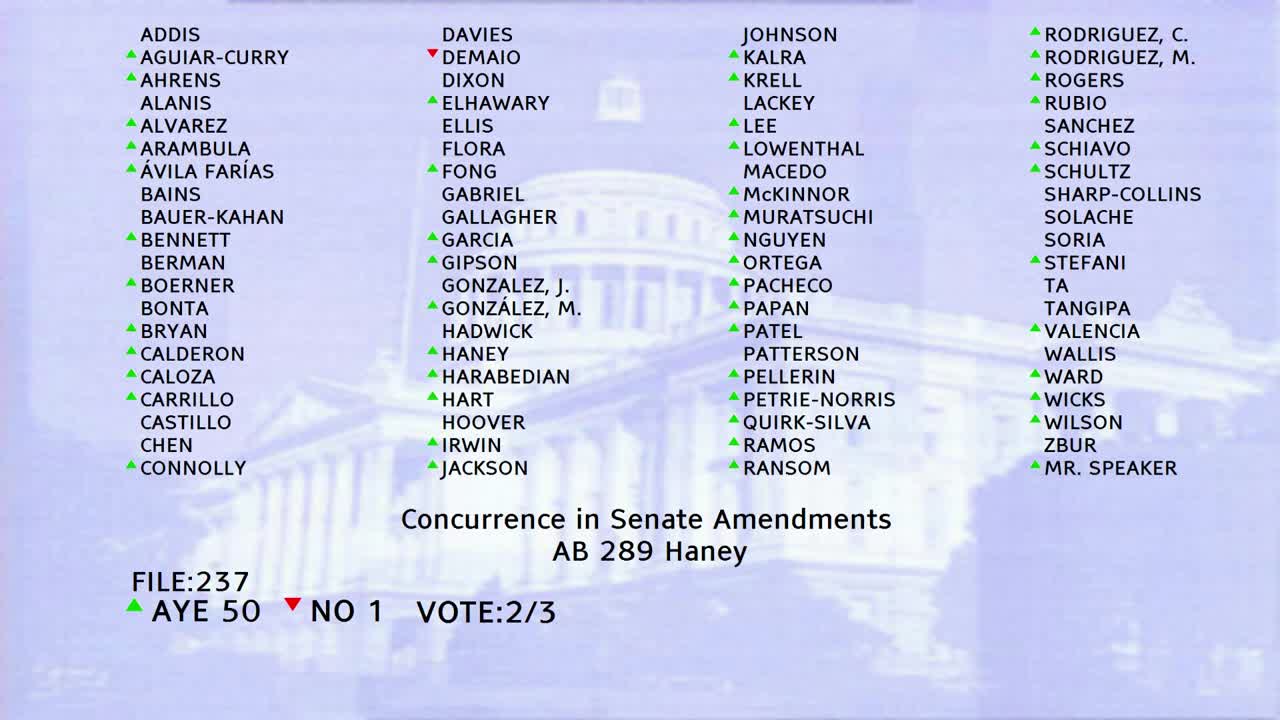 50SEC
Assembly Floor
 3MIN
Senate Floor
 12MIN
Senate Standing Committee on Energy, Utilities and Communications
Bill Author

Bill Co-Author(s):