AB 738: Energy: building standards: photovoltaic requirements.
- Session Year: 2025-2026
- House: Assembly
- Latest Version Date: 2025-09-15
Current Status:
Failed
(2026-01-22: Consideration of Governor's veto stricken from file.)
Introduced
In Committee
Awaiting First Chamber Vote
Passed First Chamber
In Committee
Awaiting Second Chamber Vote
Passed Second Chamber
Enacted
Existing law authorizes the State Energy Resources Conservation and Development Commission to prescribe, by regulation, lighting, insulation, climate control system, and other building design and construction standards that increase efficiency in the use of energy and water for new residential and new nonresidential buildings, and energy and water conservation design standards for new residential and new nonresidential buildings. Pursuant to this authority, the commission has adopted regulations requiring solar-ready buildings and for the installation of photovoltaic systems meeting certain requirements for low-rise residential buildings built on or after January 1, 2020.
This bill would, until January 1, 2028, require residential construction intended to repair, restore, or replace a residential building damaged or destroyed as a result of a disaster in an area in which a state of emergency has been proclaimed by the Governor to comply only with the requirements regarding photovoltaic systems pursuant to those regulations, if any, that were in effect at the time the damaged or destroyed building was originally constructed and would prohibit that construction from being required to comply with any additional or conflicting photovoltaic system requirements in effect at the time of repair, restoration, or replacement. The bill would only apply to the construction of a building if certain conditions are met with respect to the building owners income and insurance coverage and to the location and square footage of the construction.
Because a local agency would be required to determine whether any older applicable photovoltaic requirements are met, this bill would impose a state-mandated local program.
The California Constitution requires the state to reimburse local agencies and school districts for certain costs mandated by the state. Statutory provisions establish procedures for making that reimbursement.
This bill would provide that no reimbursement is required by this act for a specified reason.
Existing law authorizes the State Energy Resources Conservation and Development Commission to prescribe, by regulation, lighting, insulation, climate control system, and other building design and construction standards that increase efficiency in the use of energy and water for new residential and new nonresidential buildings, and energy and water conservation design standards for new residential and new nonresidential buildings. Pursuant to this authority, the commission has adopted regulations requiring solar-ready buildings and for the installation of photovoltaic systems meeting certain requirements for low-rise residential buildings built on or after January 1, 2020.
This bill would, until January 1, 2029, 2028, require residential construction intended to repair, restore, or replace a residential building damaged or destroyed as a result of a disaster in an area in which a state of emergency has been proclaimed by the Governor to comply only with the requirements regarding photovoltaic systems pursuant to those regulations, if any, that were in effect at the time the damaged or destroyed building was originally constructed and would prohibit that construction from being required to comply with any additional or conflicting photovoltaic system requirements in effect at the time of repair, restoration, or replacement. The bill would only apply to the construction of a building if certain conditions are met with respect to the building owners income and insurance coverage, coverage and to the location and square footage of the construction.
Because a local agency would be required to determine whether any older applicable photovoltaic requirements are met, this bill would impose a state-mandated local program.
The California Constitution requires the state to reimburse local agencies and school districts for certain costs mandated by the state. Statutory provisions establish procedures for making that reimbursement.
This bill would provide that no reimbursement is required by this act for a specified reason.
Existing law authorizes the State Energy Resources Conservation and Development Commission to prescribe, by regulation, lighting, insulation, climate control system, and other building design and construction standards that increase efficiency in the use of energy and water for new residential and new nonresidential buildings, and energy and water conservation design standards for new residential and new nonresidential buildings. Pursuant to this authority, the commission has adopted regulations requiring solar-ready buildings and for the installation of photovoltaic systems meeting certain requirements for low-rise residential buildings built on or after January 1, 2020.
This bill would, until January 1, 2029, require residential construction intended to repair, restore, or replace a residential building damaged or destroyed as a result of a disaster in an area in which a state of emergency has been proclaimed by the Governor to comply only with the requirements regarding photovoltaic systems pursuant to those regulations, if any, that were in effect at the time the damaged or destroyed building was originally constructed and would prohibit that construction from being required to comply with any additional or conflicting photovoltaic system requirements in effect at the time of repair, restoration, or replacement. The bill would only apply to the construction of a building if certain conditions are met with respect to the building owners income and insurance coverage, and to the location and square footage of the construction.
Because a local agency would be required to determine whether any older applicable photovoltaic requirements are met, this bill would impose a state-mandated local program.
The California Constitution requires the state to reimburse local agencies and school districts for certain costs mandated by the state. Statutory provisions establish procedures for making that reimbursement.
This bill would provide that no reimbursement is required by this act for a specified reason.
(a)Notwithstanding other law, residential construction intended to repair, restore, or replace a residential building damaged or destroyed as a result of a disaster in an area in which a state of emergency has been proclaimed by the Governor pursuant to Chapter 7 (commencing with Section 8550) of Division 1 of Title 2 of the Government Code shall comply with requirements regarding photovoltaic systems pursuant to regulations prescribed pursuant to subdivisions (a) and (b) of Section 25402, if any, that were in effect at the time the damaged or destroyed residential building was originally constructed and shall not be required to comply with any additional or conflicting photovoltaic system requirements in effect at the time of repair, restoration, or replacement.
(b)This section only applies when all of the following conditions are met:
(1)The income of the owner of the residential building is at or below the median income for the county in which the residential building is located as determined by the Department of Housing and Community Development state income limits.
(2)The square footage of the residential building after the new construction will not exceed the square footage of the residential building at the time it was damaged or destroyed.
(3)The new construction is located on the site of the residential building that was damaged or destroyed.
(4)The owner of the residential building did not have code upgrade insurance at the time the residential building was damaged or destroyed.
(c)This section shall remain in effect only until January 1, 2028, and as of that date is repealed.
SEC. 2.No reimbursement is required by this act pursuant to Section 6 of Article XIIIB of the California Constitution because a local agency or school district has the authority to levy service charges, fees, or assessments sufficient to pay for the program or level of service mandated by this act, within the meaning of Section 17556 of the Government Code.
(a)Notwithstanding other law, residential construction intended to repair, restore, or replace a residential building damaged or destroyed as a result of a disaster in an area in which a state of emergency has been proclaimed by the Governor pursuant to Chapter 7 (commencing with Section 8550) of Division 1 of Title 2 of the Government Code shall comply with requirements regarding photovoltaic systems pursuant to regulations prescribed pursuant to subdivisions (a) and (b) of Section 25402, if any, that were in effect at the time the damaged or destroyed residential building was originally constructed and shall not be required to comply with any additional or conflicting photovoltaic system requirements in effect at the time of repair, restoration, or replacement.
(b)This section only applies when all of the following conditions are met:
(1)The income of the owner of the residential building is at or below the median income for the county in which the residential building is located as determined by the Department of Housing and Community Development state income limits.
(2)The square footage of the residential building after the new construction will not exceed the square footage of the residential building at the time it was damaged or destroyed.
(3)The new construction is located on the site of the residential building that was damaged or destroyed.
(4)The owner of the residential building did not have code upgrade insurance at the time the residential building was damaged or destroyed.
(c)This section shall remain in effect only until January 1, 2029, 2028, and as of that date is repealed.
SEC. 2.No reimbursement is required by this act pursuant to Section 6 of Article XIIIB of the California Constitution because a local agency or school district has the authority to levy service charges, fees, or assessments sufficient to pay for the program or level of service mandated by this act, within the meaning of Section 17556 of the Government Code.
(a)Notwithstanding other law, residential construction intended to repair, restore, or replace a residential building damaged or destroyed as a result of a disaster in an area in which a state of emergency has been proclaimed by the Governor pursuant to Chapter 7 (commencing with Section 8550) of Division 1 of Title 2 of the Government Code shall comply with requirements regarding photovoltaic systems pursuant to regulations prescribed pursuant to subdivisions (a) and (b) of Section 25402, if any, that were in effect at the time the damaged or destroyed residential building was originally constructed and shall not be required to comply with any additional or conflicting photovoltaic system requirements in effect at the time of repair, restoration, or replacement.
(b)This section only applies when all of the following conditions are met:
(1)The income of the owner of the residential building is at or below the median income for the county in which the residential building is located as determined by the Department of Housing and Community Development state income limits.
(2)The square footage of the residential building after the new construction will not exceed the square footage of the residential building at the time it was damaged or destroyed.
(3)The new construction is located on the site of the residential building that was damaged or destroyed.
(4)The owner of the residential building did not have code upgrade insurance at the time the residential building was damaged or destroyed.
(c)This section shall remain in effect only until January 1, 2029, and as of that date is repealed.
SEC. 2.No reimbursement is required by this act pursuant to Section 6 of Article XIIIB of the California Constitution because a local agency or school district has the authority to levy service charges, fees, or assessments sufficient to pay for the program or level of service mandated by this act, within the meaning of Section 17556 of the Government Code.
|
Date
|
Status
|
|---|---|
| Jan 22, 2026 | Consideration of Governor's veto stricken from file. |
| Oct 6, 2025 | Consideration of Governor's veto pending. |
| Oct 6, 2025 | Vetoed by Governor. |
| Sep 23, 2025 | Enrolled and presented to the Governor at 4 p.m. |
| Sep 12, 2025 | In Assembly. Ordered to Engrossing and Enrolling. |
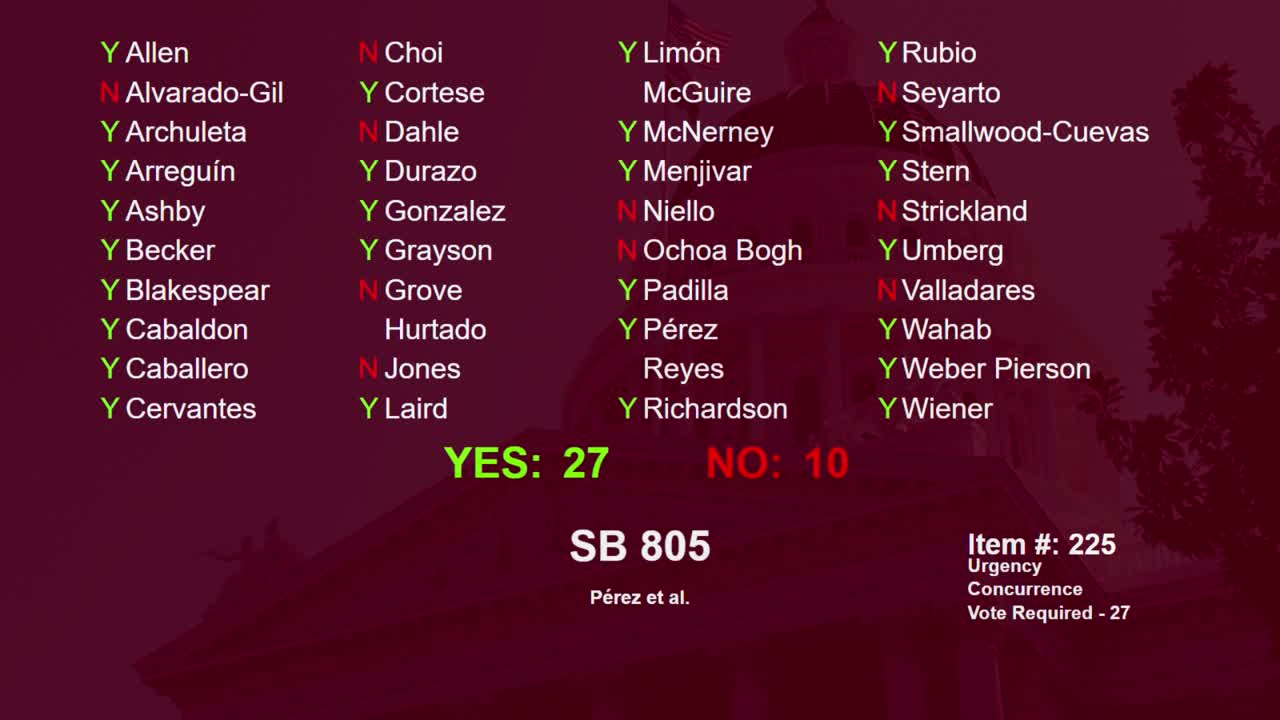
| Sep 11, 2025 | Read third time. Passed. Ordered to the Assembly. (Ayes 34. Noes 3. Page 2919.). |
| Aug 20, 2025 | Read second time. Ordered to third reading. |
| Aug 19, 2025 | From committee: Be ordered to second reading pursuant to Senate Rule 28.8. |
| Jul 8, 2025 | From committee: Do pass and re-refer to Com. on APPR. (Ayes 14. Noes 1.) (July 7). Re-referred to Com. on APPR. |
| May 28, 2025 | Referred to Com. on E., U & C. |
| May 20, 2025 | In Senate. Read first time. To Com. on RLS. for assignment. |
| May 19, 2025 | Read third time. Passed. Ordered to the Senate. (Ayes 56. Noes 3. Page 1589.) |
| Apr 24, 2025 | Read second time. Ordered to third reading. |
| Apr 23, 2025 | From committee: Do pass. (Ayes 14. Noes 0.) (April 23). |
| Apr 10, 2025 | Re-referred to Com. on APPR. |
| Apr 9, 2025 | Read second time and amended. |
| Apr 8, 2025 | From committee: Amend, and do pass as amended and re-refer to Com. on APPR. (Ayes 10. Noes 1.) (April 7). |
| Mar 3, 2025 | Referred to Com. on NAT. RES. |
| Feb 19, 2025 | From printer. May be heard in committee March 21. |
| Feb 18, 2025 | Read first time. To print. |
|
Date
|
Description
|
Location
|
Votes
|
|
|---|---|---|---|---|
| Sep 11, 2025 | Assembly 3rd Reading AB738 Tangipa et al. By Grove | Senate Floor |
Passed |
|
| Jul 7, 2025 | Do pass, but first be re-referred to the Committee on [Appropriations] | Senate Standing Committee on Energy, Utilities and Communications |
Passed |
|
| May 19, 2025 | AB 738 Tangipa Assembly Third Reading | Assembly Floor |
Passed |
|
| Apr 23, 2025 | Do pass. | Assembly Standing Committee on Appropriations |
Passed |
|
| Apr 7, 2025 | Do pass as amended and be re-referred to the Committee on [Appropriations] | Assembly Standing Committee on Natural Resources |
Passed |
This list shows positions taken on this bill by organizations on the date displayed, which is linked to the original source.
Positions by individuals are not included.
|
Organization
|
Position
|
Date
|
|---|---|---|
| California Apartment Association | ** Support | |
| California Solar & Storage Association | ** Against | |
| CALSSA | ** Against | |
| Rural County Representatives of California | ** Support |
GOVERNOR'S VETO
GV Bill Id:AB 738
Author:(Tangipa and Patterson)
As Enrolled Ver:September 15, 2025
2/3 vote
SUMMARY
Specifies that residential construction to repair, restore, or replace homes damaged or destroyed during a disaster shall comply with the solar photovoltaic (PV) requirements that were in existence at the time the home was originally constructed.
Major Provisions
- Requires residential construction intended to repair, restore, or replace a residential building damaged or destroyed as a result of a disaster in an area for which a state of emergency has been proclaimed to comply with requirements for PV systems, if any, that were in effect when the building was originally constructed.
- Specifies that this bill only applies when:
- The income of the owner of the residential building is at or below the median income for the county in which the residential building is located, as determined by Housing and Community Development (HCD) state income limits;
- The square footage of the residential building after the new construction will not exceed the square footage of the residential building at the time is was damaged or destroyed; and,
- The new construction is located on the site of the residential building that was damaged or destroyed.
- Sunsets the bill's provisions on January 1, 2028.
Governor's Veto Message
This bill would exempt, until January 1, 2028, minimum solar photovoltaic (PV) requirements for residential buildings damaged or destroyed because of a disaster from the California Building Energy Efficiency Standards.
The minimum solar PV requirement is an innovative and forward-leaning policy that has been in place for five years, requiring new residential buildings to include cost-effective solar PV systems to reduce long-term homeowner energy costs, improve energy resiliency, and reduce greenhouse gas emissions. Codifying the broad exemption in this bill would permanently nullify these positive outcomes for homeowners while failing to consider the unique circumstances that influence rebuilding costs and efforts in different communities following disasters.
In July 2025, I issued Executive Order (EO) N-29-25, which provided a targeted, one-time exemption from the minimum solar PV and associated battery storage requirements for areas in Los Angeles recovering from the historic, catastrophic wildfires earlier this year. This EO, along with others I issued this year, recognized the scale of devastation and the need to accelerate and support local recovery efforts by providing limited and targeted exemptions from a variety of state requirements. These EOs were carefully coordinated and calibrated to facilitate rebuilding, while maintaining key safety requirements and environmental considerations. Importantly, EO N-29-25 did not exempt rebuilt structures from specified solar PV ready requirements to ensure that homes rebuilt following the fires are equipped to support future solar PV system installation. The balanced approach enshrined in these EOs has been pivotal in delivering the expeditious recovery and rebuild of resilient and safe residential buildings and structures, and should be retained.
COMMENTS
California's solar standards. The 2019 Building Energy Efficiency Standards went into effect on January 1, 2020. The standards were the first in the nation to require PV systems for new construction. The standards also include improved thermal building envelope standards (i.e., insulating the interior), residential and nonresidential ventilation requirements, and nonresidential lighting requirements. For residential buildings, the standards are expected to result in about 53% less energy use than under the 2016 standards. The CEC further estimates that the new standards will reduce GHG emissions by 700,000 metric tons over three years.
Statute requires that CEC's standards must be "cost-effective." Moreover, unlike other building standards, solar earns money for homeowners as their homes generate electricity. CEC estimates that based on a 30-year mortgage, the new standards will add about $40 per month in costs and result in about $80 per month in reduced energy costs. On average, a solar system adds about $9,500 to the cost of a new home and will result in a savings of $19,000 in energy costs over 30 years. The up-front costs for solar are expected to continue to decrease.
CEC established a few exemptions to the new solar requirement. Primarily, homes that are shaded by trees, hills, other structures, etc. are not required to install solar. This may exclude a number of homes impacted by fires in wooded areas. Homeowners in areas with community solar programs are also exempt from the requirement. Additionally, reduced system size is permitted for low-rise residential with two stories and for low-rise multifamily or single-family homes with three or more stories.
Emergency declarations. California has had a large number of emergency declarations over the last several years, primarily due to fires. In recent years, California has faced an alarming increase in destructive wildfires. Some of the largest and most devastating fires have taken place within the last decade. For example, the 2017 Tubbs Fire, at the time the most destructive wildfire in California history, killed 22 people and destroyed 5,000 homes. In 2018, the Camp Fire replaced the Tubbs Fire as the most destructive fires in state history, with nearly 19,000 structures destroyed and 85 deaths, including the near total destruction of the town of Paradise. The 2021 Caldor Fire burned more than 200,000 acres and destroyed 782 homes. On January 7 of this year, multiple wildfires erupted concurrently in Los Angeles that burned an area nearly the size of Washington, D.C., killed 28 people, and damaged or destroyed nearly 16,000 structures, according to CAL FIRE. Estimates for the economic losses range from $250 billion to more than $350 billion.
This bill. This bill would allow any home damaged or destroyed in a disaster in an area in which the Governor has declared a state of emergency to comply with the PV requirements in effect at the time the home was constructed, rather than those in place at the time of the repair, restoration, or rebuild.
According to the Author
Californians Rebuilding after a natural disaster is financially challenging, with rising construction costs and insurance gaps making recovery difficult. While solar energy is an essential option for many, the upfront cost is a major obstacle for those trying to rebuild after losing their homes. Assembly Bill 738 provides relief by temporarily waiving the solar installation mandate for homes that did not previously have solar, ensuring families can rebuild without additional financial burdens. This targeted exemption balances financial flexibility with our state's renewable energy goals.
Arguments in Support
The Rural County Representatives of California (RCRC) argue, among other things, that the solar requirement adds significant cost to the price of rebuilding for homeowners who already lack the resources to rebuild their homes, particularly homeowners who are underinsured. RCRC also contends that merely having solar panels on one's home will not keep the lights on when there is a power outage. According to RCRC, "To actually achieve the resiliency benefits those claim the CEC mandate provides, homeowners will also have to install even more expensive energy storage systems that can add an extra $10,000-$20,000 to the cost of rebuilding."
Arguments in Opposition
Writing in opposition, the California Solar and Storage Association (CALSSA) argues that this bill works against the state's goals of reducing global warming pollutants from buildings and expanding the benefits of clean energy to all Californians. CALSSA contends solar energy helps lower utility bills, and AB 738 would drive up housing costs, particularly as California moves toward electrification, because rooftop solar "reduces the need for more wholesale generation and transmission lines, and readies the grid for electric vehicles and natural gas-free buildings."
FISCAL COMMENTS
According to the Assembly Appropriations Committee, this bill has minor, if any, state costs.
VOTES
ASM NATURAL RESOURCES: 10-1-3
YES: Bryan, Alanis, Connolly, Ellis, Flora, Haney, Hoover, Muratsuchi, Schultz, Wicks
NO: Garcia
ABS, ABST OR NV: Kalra, Pellerin, Zbur
ASM APPROPRIATIONS: 14-0-1
YES: Wicks, Sanchez, Arambula, Calderon, Caloza, Dixon, Elhawary, Fong, Mark González, Pacheco, Pellerin, Solache, Ta, Tangipa
ABS, ABST OR NV: Hart
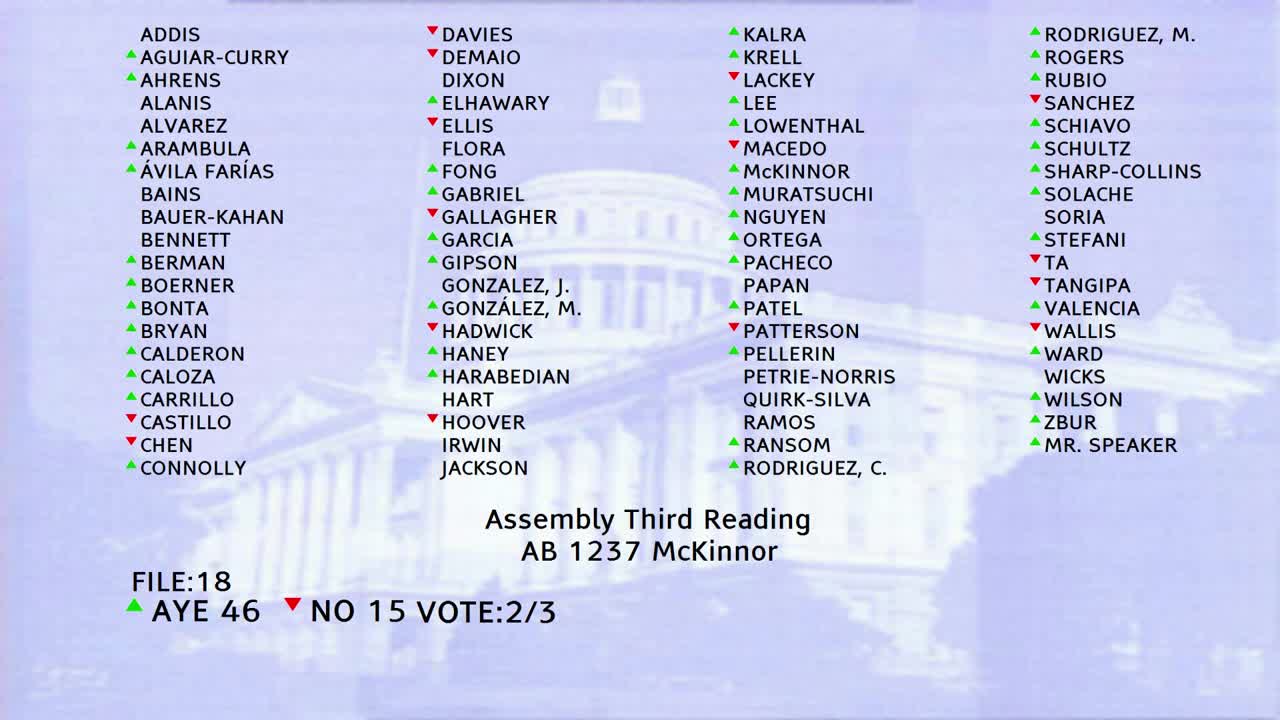
ASSEMBLY FLOOR: 56-3-20
YES: Aguiar-Curry, Ahrens, Alanis, Alvarez, Arambula, Ávila Farías, Bains, Bauer-Kahan, Berman, Bryan, Carrillo, Castillo, Chen, Connolly, Davies, DeMaio, Elhawary, Ellis, Fong, Gallagher, Gipson, Mark González, Hadwick, Harabedian, Hoover, Krell, Lackey, Lowenthal, Macedo, McKinnor, Muratsuchi, Nguyen, Pacheco, Patel, Patterson, Petrie-Norris, Quirk-Silva, Ransom, Celeste Rodriguez, Michelle Rodriguez, Blanca Rubio, Sanchez, Schiavo, Sharp-Collins, Solache, Soria, Stefani, Ta, Tangipa, Valencia, Wallis, Ward, Wicks, Wilson, Zbur, Rivas
NO: Boerner, Garcia, Rogers
ABS, ABST OR NV: Addis, Bennett, Bonta, Calderon, Caloza, Dixon, Flora, Gabriel, Jeff Gonzalez, Haney, Hart, Irwin, Jackson, Kalra, Lee, Ortega, Papan, Pellerin, Ramos, Schultz
SENATE FLOOR: 34-3-3
YES: Alvarado-Gil, Archuleta, Ashby, Becker, Caballero, Cervantes, Choi, Cortese, Dahle, Durazo, Gonzalez, Grayson, Grove, Hurtado, Jones, Laird, Limón, McGuire, McNerney, Menjivar, Niello, Ochoa Bogh, Padilla, Pérez, Reyes, Richardson, Rubio, Seyarto, Smallwood-Cuevas, Strickland, Umberg, Valladares, Wahab, Weber Pierson
NO: Allen, Stern, Wiener
ABS, ABST OR NV: Arreguín, Blakespear, Cabaldon
UPDATED
VERSION: September 15, 2025
CONSULTANT: Elizabeth MacMillan / NAT. RES. / (916) 319-2092 FN: 0002181
SENATE RULES COMMITTEE Office of Senate Floor Analyses (916) 651-1520 Fax: (916) 327-4478 | AB 738 |
THIRD READING
Bill No: AB 738
Author: Tangipa (R) and Patterson (R)
Amended: 4/9/25 in Assembly
Vote: 21
SENATE ENERGY, U. & C. COMMITTEE: 14-1, 7/7/25
AYES: Becker, Ochoa Bogh, Archuleta, Arreguín, Ashby, Caballero, Gonzalez, Grove, Hurtado, Limón, McNerney, Rubio, Strickland, Wahab
NOES: Stern
NO VOTE RECORDED: Allen, Dahle
SENATE APPROPRIATIONS COMMITTEE: Senate Rule 28.8
ASSEMBLY FLOOR: 56-3, 5/19/25 - See last page for vote
SUBJECT: Energy: building standards: photovoltaic requirements
SOURCE: Author
DIGEST:
This bill requires, by January 1, 2028, residential construction intended to repair, restore, or replace a residential building damaged or destroyed as a result of a declared disaster to comply with any requirements for solar photovoltaic (PV) at the time the building was originally constructed, if certain conditions are met.
ANALYSIS:
Existing law:
- Authorizes the State Energy Resources Conservation and Development Commission (CEC) to prescribe, by regulation, lighting, insulation, climate control system, and other building design and construction standards that increase efficiency in the use of energy and water for new residential and new nonresidential buildings, and energy and water conservation design standards for new residential and new nonresidential buildings. (Public Resources Code §25402)
- Requires the CEC to establish building design and construction standards that increase the efficiency in the use of energy and water for new residential and new nonresidential buildings. The CEC must periodically update the standards. Six months after the CEC certifies an energy conservation manual, cities, counties, and state agencies are prohibited from issuing a building permit for a building that does not comply with the current standards created by the CEC. (Public Resources Code §25402(a)(1))
- Requires the CEC and the Department of Housing and Community Development (HCD) to issue a joint finding that a building water efficiency standard is equivalent or superior in performance, safety, and for the protection of life, health, and general welfare to existing standards. The finding must also ensure that the standard does not unreasonably or unnecessarily impact Californians’ ability to purchase or rent affordable house by taking into account the overall benefit derived from the standard. (Public Resources Code §25402(a)(2))
- Requires the CEC’s building efficiency standards to be cost-effective when taken in their entirety and amortized over the economic life of the structure compared with historic practice. When determining cost-effectiveness, the CEC must consider the value of the water or energy saved, impact on product efficacy for the consumer, and the life-cycle cost of complying with the standard. The CEC must consider other relevant factors, including, but not limited to the standards’ cost on house costs, the total statewide costs and benefits of the standard over its lifetime, economic impacts on California businesses, and alternative approaches and their associated costs. (Public Resources Code §25402(b)(3))
- Requires electric utilities to procure 60% of their retail sales of electricity from renewable energy by 2030. This is known as the Renewable Portfolio Standard. (Public Utilities Code §399.11 et seq.)
- Requires every electric utility (other than a local public owned utilities that serves more than 750,000 customers and that also conveys water to its customers) to offer net energy metering (NEM) to eligible customer-generators, upon request, on a first-come-first-served basis until the total rated generating capacity used by eligible customer-generators exceeds five percent of the electric utility’s aggregate customer peak demand. (Public Utilities Code §2827)
- Directs the California Public Utilities Commission (CPUC) to develop a standard tariff or contract, known as the “successor tariff,” for eligible customer-generators with a renewable electrical generation facility no later than December 31, 2015. Requires, for each large electrical corporation, using the successor tariff, to continue to offer NEM to its customers on July 1, 2017, or upon reaching the five-percent NEM program limit, whichever is earlier. (Public Utilities Code §2827.1)
This bill:
- Requires, until January 1, 2028, residential construction intended to repair, restore, or replace a residential building damaged or destroyed as a result of a disaster in an area in which a state of emergency has been proclaimed by the Governor to comply only with the requirements regarding photovoltaic systems pursuant to those regulations, if any, that were in effect at the time the damaged or destroyed building was originally constructed and would prohibit that construction from being required to comply with any additional or conflicting photovoltaic system requirements in effect at the time of repair, restoration, or replacement.
- Applies this bill to the construction of a building if certain conditions are met, specifically:
- The income of the owner of the residential building is at or below the median income for the county in which the residential building is located, as determined by HCD state income limits;
- The square footage of the residential building after the new construction will not exceed the square footage of the residential building at the time is was damaged or destroyed; and,
- The new construction is located on the site of the residential building that was damaged or destroyed.
- Sunsets this bill’s provisions on January 1, 2028.
- Imposes a state-mandated local program because a local agency would be required to determine whether any older applicable PV requirements are met. Provides that no reimbursement is required by this act, pursuant to Article XIIIB of the California Constitution, because a local agency or school district has the authority to levy service charges, fees, or assessments sufficient to pay for the program or level of service mandated by this bill.
Background
California’s building energy efficiency standards. California’s building energy efficiency standards are updated on roughly every three years cycle. The CEC adopted the 2019 Building Energy Efficiency Standards, which went into effect on January 1, 2020. The standards are the first in the nation to require solar PV systems for new construction. The standards also include improved thermal building envelope standards (i.e., insulating the interior), residential and nonresidential ventilation requirements, and nonresidential lighting requirements. For residential buildings, according to the CEC, the standards will result in about 53% less energy use than under the 2016 standards. The CEC further estimates that the new standards will reduce greenhouse gas emissions by 700,000 metric tons over three years. The CEC’s energy efficiency standards are adopted by Building Standards Commission as part of the California Building Standards Code, which serves as the basis for building and construction in California. The CEC first adopted building energy efficiency standards in 1977 under the authority of the Warren-Alquist Act. The CEC reports that the energy efficiency building standards have saved Californians billions of dollars since their first adoption, avoided the need for powerplants and transmission lines, and helped keep California’s per-capita energy consumption flat. The CEC has since adopted the 2022 Building Energy Efficiency Standards which, after January 1, 2023, require newly constructed residential buildings to be electric-ready (including 240-volt outlets and space for electric appliances to replace installed gas appliances). The 2022 standards also allow exceptions to the solar PV standards when roof area is not available. The standards also establish combined solar PV and battery storage standards for select businesses. The CEC has more recently updated the standards for 2025 Energy Code, at their September 2024 business meeting, which is scheduled to take effect January 1, 2026. The 2025 Energy Code updates solar PV and energy storage standards for assembly buildings, including religious worship, sport, and recreation buildings.
Statute requires that CEC’s standards must be “cost-effective.” CEC had estimated that based on a 30-year mortgage, the 2019 standards add about $40 per month in costs and result in about $80 per month in reduced energy costs. According to the CEC, on average, a solar system adds about $9,500 to the cost of a new home and will result in a savings of $19,000 in energy costs over 30 years (largely based on pre-COVID numbers). Although current prices tend to range in $15,000 to $20,000 based on news reports. The CEC established a few exemptions to the solar PV requirement. Primarily, homes that are shaded by trees, hills, other structures, etc. are not required to install solar. This may exclude a number of homes impacted by fires in wooded areas. Homeowners in areas with community solar programs are also exempt from the requirement. Additionally, reduced system size is permitted for low-rise residential with two stories and for low-rise multifamily or single-family homes with three or more stories. As noted above, the CEC made additional changes in the 2022 Energy Code Update.
Emergency declarations. Unfortunately, California has been no stranger to disasters in recent years, with the Governor making over three dozen emergency declarations in recent years. Many of these declarations are in response to wildfires which have destroyed tens of thousands of homes across many communities. These fires include the Tubbs and North Bay fires in Sonoma and Napa counties in 2017, the 2018 Camp Fires in Butte County, and the 2021 Caldor Fire in El Dorado, Alpine and Amador Counties. In January of this year, multiple wildfires erupted concurrently in Los Angeles County that killed 28 people, and damaged or destroyed nearly 16,000 structures, according to CalFire, in the Altadena and Palisades areas.
Incentives for residential solar and storage. The state Legislature and Governor have budgeted $280 million to fund incentives for low-income residents to install solar and storage for eligible low-income residents across the state. The program is administered by the CPUC, pursuant to AB 209 (Committee on Budget, Chapter 251, Statutes of 2022) and budget appropriations in AB 102 (Committee on Budget, Chapter 28, Statutes of 2023), though future funding may be affected by state budget negotiations. Additionally, the compensation for solar energy exports to the electric grid have been adjusted by the CPUC under a new version of the NEM tariff adopted in December 2022. As a result, customers with solar installations who export electricity back to the electric grid receive a reduced amount of compensation from systems that were installed prior to April 15, 2023. The CPUC decision revises the NEM tariff to improve price signals by better aligning them with the electric grid’s conditions, both day and night. The updated billing structure of the tariff is designed to optimize grid use by the tariff’s customers and incentivize adoption of combined solar and storage systems. The CPUC intends for the changes to help meet California’s climate goals and increase reliability, while promoting affordability across all income levels. However, opponents to the CPUC Decision filed a lawsuit which is currently pending at the California Supreme Court, with a possible decision within the next 90 days.
Comments
Exemptions from solar requirements. This bill would provide that homes that are being rebuilt due to a disaster will not be required to install the rooftop solar if all the condition are met, including: that the homeowner’s income is below the county’s average median income (AMI), the homeowner lacked code upgrade insurance coverage, the home is being built on the same location as the home that was destroyed, and the size of the new home is the same as the destroyed home. With regards to the AMI, the HCD establishes the annual state income limits. The AMI for each county varies, as an example the AMI for Lassen County is $87,900 for a four-person household and $186,600 in Marin County. This bill would require the local building permitting agency to account for these requirements. In the case of the size of the home and whether the new home is on the same land as the destroyed home, the building permitting agency could easily verify this information. However, in the case of the income and lack of insurance coverage for code upgrades, the building permitting agency would likely need to provide a self-certification document for the resident to attest to the information.
Cost-effectiveness depends on many variables. While the costs of solar had been declining rather dramatically over the past 10 years or so, more recently, COVID supply constraints, federal tariff issues, and labor costs may have increased the costs for solar PV. The price of solar installations will depend on variables including national trade tariffs policy, marketing and permitting costs, and the costs of the labor and hardware. It is widely assumed that solar installations on new residential construction can be less expensive as compared to on an existing home. However, these savings may be more limited if solar PV is installed on individual new residential construction, not afforded the economies of scales of a housing development with multiple new homes. Additionally, savings from solar installations may also depend on the NEM tariffs afforded by the respective utility which allow solar customers to sell excess energy to the grid, as well as any fees or charges on the systems. The NEM tariff rates have been declining in compensation from the original tariffs which were more generous as they were intended to help spur the solar market.
Protecting victims. This bill attempts to reduce the burden on victims of disasters when they rebuild or repair their homes. As the author notes, there are many challenges for victims to rebuild their homes after a disaster, including the impacts of lacking sufficient insurance coverage to replace the damaged properties. Similar to recent bills that were vetoed by the Governor which require all four conditions are met before the local permitting agency can allow a residential building owner to rebuild without the solar requirement. While the solar PV installation may provide savings to the resident in the long term, the initial costs would increase the costs to rebuild by about $10,000 (and likely more). As such, it seems reasonable to provide these victims with the option to forgo these costs as they attempt to rebuild their lives, while still preserving the building owner’s option to install solar PV.
Prior/Related Legislation
AB 2787 (Joe Patterson) of 2024, would have exempted, until January 1, 2028, from the Solar Mandate, as part of the state’s building standards, residential construction to repair or replace a residential building destroyed or damaged as a result of a disaster, where the Governor has declared a state of emergency, and instead requires residential construction to comply with the state’s requirement for PV systems that were in effect at the time the building was originally constructed. The bill was vetoed.
AB 1918 (Wood) of 2024, would have exempted a building constructed in the service territory of the Trinity Public Utility District from the building standards requirements that such a building be solar-ready or have PV and battery storage systems installed. The bill was vetoed.
AB 704 (Jim Patterson) of 2023, was substantially similar to this bill. The bill was held in the Assembly Appropriations Committee.
AB 1078 (Patterson) of 2022, would have extended the exemption established by AB 178 for one year, until January 1, 2024. The bill was vetoed.
AB 178 (Dahle, Chapter 259, Statutes of 2019) exempted, until January 1, 2023, residential construction from complying with the solar requirements in the recently adopted building standards when the construction is in response to a disaster in an area in which a state of emergency has been proclaimed by the Governor.
AB 693 (Eggman, Chapter 582, Statutes of 2016) created the Multifamily Affordable Housing Solar Roofs Program, to provide financial incentives–up to $100 million annually, for qualified solar installations at multifamily affordable housing properties funded from IOU greenhouse gas allowances.
AB 217 (Bradford and De León, Chapter 609, Statutes of 2013) extended the low-income programs of the California Solar Initiative from 2016 until 2021, authorizes the collection of an additional $108 million for these programs, and adds additional standards to the program, as specified.
AB 327 (Perea, Chapter 611, Statutes of 2013) restructured the rate design for residential electric customers and revised the NEM program.
SB 1 (Murray, Chapter 132, Statutes of 2006) established the electric portion of the CSI with a 10-year budget of $2.2 billion collected from ratepayers.
FISCAL EFFECT: Appropriation: No Fiscal Com.: Yes Local: Yes
SUPPORT: (Verified 8/18/25)
California Apartment Association
Rural County Representatives of California
OPPOSITION: (Verified 8/18/25)
None received
ARGUMENTS IN SUPPORT: The California Apartment Association states:
Since 2020, California has required PV systems on all new construction. Additionally, the 2019 Building Energy Efficiency Standards include improved thermal building envelope standards, residential and nonresidential ventilation requirements, and nonresidential lighting requirements. Older homes were not subject to these requirements when they were built and thus were not insured to cover the costs associated with these building materials. AB 738 would provide homeowners devastated by disaster with an exemption from these energy efficiency requirements upon repair saving them thousands of dollars in building costs. This is a crucial policy to help homeowners quickly rebuild after utter devastation.
ASSEMBLY FLOOR: 56-3, 5/19/25
AYES: Aguiar-Curry, Ahrens, Alanis, Alvarez, Arambula, Ávila Farías, Bains, Bauer-Kahan, Berman, Bryan, Carrillo, Castillo, Chen, Connolly, Davies, DeMaio, Elhawary, Ellis, Fong, Gallagher, Gipson, Mark González, Hadwick, Harabedian, Hoover, Krell, Lackey, Lowenthal, Macedo, McKinnor, Muratsuchi, Nguyen, Pacheco, Patel, Patterson, Petrie-Norris, Quirk-Silva, Ransom, Celeste Rodriguez, Michelle Rodriguez, Blanca Rubio, Sanchez, Schiavo, Sharp-Collins, Solache, Soria, Stefani, Ta, Tangipa, Valencia, Wallis, Ward, Wicks, Wilson, Zbur, Rivas
NOES: Boerner, Garcia, Rogers
NO VOTE RECORDED: Addis, Bennett, Bonta, Calderon, Caloza, Dixon, Flora, Gabriel, Jeff Gonzalez, Haney, Hart, Irwin, Jackson, Kalra, Lee, Ortega, Papan, Pellerin, Ramos, Schultz
Prepared by: Nidia Bautista / E., U. & C. / (916) 651-4107
8/20/25 23:22:44
**** END ****
ASSEMBLY THIRD READING
ATR Bill Id:AB 738
Author:(Tangipa and Patterson)
As Amended Ver:April 9, 2025
Majority vote
SUMMARY
Specifies that residential construction to repair, restore, or replace homes damaged or destroyed during a disaster shall comply with the solar photovoltaic (PV) requirements that were in existence at the time the home was originally constructed.
Major Provisions
- Requires residential construction intended to repair, restore, or replace a residential building damaged or destroyed as a result of a disaster in an area for which a state of emergency has been proclaimed to comply with requirements for PV systems, if any, that were in effect when the building was originally constructed.
- Specifies that this bill only applies when:
- The income of the owner of the residential building is at or below the median income for the county in which the residential building is located, as determined by Housing and Community Development (HCD) state income limits;
- The square footage of the residential building after the new construction will not exceed the square footage of the residential building at the time is was damaged or destroyed; and,
- The new construction is located on the site of the residential building that was damaged or destroyed.
- Sunsets the bill's provisions on January 1, 2028.
COMMENTS
California's solar standards. The 2019 Building Energy Efficiency Standards went into effect on January 1, 2020. The standards were the first in the nation to require PV systems for new construction. The standards also include improved thermal building envelope standards (i.e., insulating the interior), residential and nonresidential ventilation requirements, and nonresidential lighting requirements. For residential buildings, the standards are expected to result in about 53% less energy use than under the 2016 standards. The CEC further estimates that the new standards will reduce GHG emissions by 700,000 metric tons over three years.
Statute requires that CEC's standards must be "cost-effective." Moreover, unlike other building standards, solar earns money for homeowners as their homes generate electricity. CEC estimates that based on a 30-year mortgage, the new standards will add about $40 per month in costs and result in about $80 per month in reduced energy costs. On average, a solar system adds about $9,500 to the cost of a new home and will result in a savings of $19,000 in energy costs over 30 years. The up-front costs for solar are expected to continue to decrease.
CEC established a few exemptions to the new solar requirement. Primarily, homes that are shaded by trees, hills, other structures, etc. are not required to install solar. This may exclude a number of homes impacted by fires in wooded areas. Homeowners in areas with community solar programs are also exempt from the requirement. Additionally, reduced system size is permitted for low-rise residential with two stories and for low-rise multifamily or single-family homes with three or more stories.
Emergency declarations. California has had a large number of emergency declarations over the last several years, primarily due to fires. In recent years, California has faced an alarming increase in destructive wildfires. Some of the largest and most devastating fires have taken place within the last decade. For example, the 2017 Tubbs Fire, at the time the most destructive wildfire in California history, killed 22 people and destroyed 5,000 homes. In 2018, the Camp Fire replaced the Tubbs Fire as the most destructive fires in state history, with nearly 19,000 structures destroyed and 85 deaths, including the near total destruction of the town of Paradise. The 2021 Caldor Fire burned more than 200,000 acres and destroyed 782 homes. On January 7 of this year, multiple wildfires erupted concurrently in Los Angeles that burned an area nearly the size of Washington, D.C., killed 28 people, and damaged or destroyed nearly 16,000 structures, according to CAL FIRE. Estimates for the economic losses range from $250 billion to more than $350 billion.
This bill. This bill would allow any home damaged or destroyed in a disaster in an area in which the Governor has declared a state of emergency to comply with the PV requirements in effect at the time the home was constructed, rather than those in place at the time of the repair, restoration, or rebuild.
According to the Author
Rebuilding after a natural disaster is financially challenging, with rising construction costs and insurance gaps making recovery difficult. While solar energy is an essential option for many Californians, the upfront cost is a major obstacle for those trying to rebuild after losing their homes. Assembly Bill 738 provides relief by temporarily waiving the solar installation mandate for homes that did not previously have solar, ensuring families can rebuild without additional financial burdens. This targeted exemption balances financial flexibility with our state's renewable energy goals.
Arguments in Support
The Rural County Representatives of California (RCRC) argue, among other things, that the solar requirement adds significant cost to the price of rebuilding for homeowners who already lack the resources to rebuild their homes, particularly homeowners who are underinsured. RCRC also contends that merely having solar panels on one's home will not keep the lights on when there is a power outage. According to RCRC, "To actually achieve the resiliency benefits those claim the CEC mandate provides, homeowners will also have to install even more expensive energy storage systems that can add an extra $10,000-$20,000 to the cost of rebuilding."
Arguments in Opposition
Writing in opposition, the California Solar and Storage Association (CALSSA) argues that this bill works against the state's goals of reducing global warming pollutants from buildings and expanding the benefits of clean energy to all Californians. CALSSA contends solar energy helps lower utility bills, and AB 738 would drive up housing costs, particularly as California moves toward electrification, because rooftop solar "reduces the need for more wholesale generation and transmission lines, and readies the grid for electric vehicles and natural gas-free buildings."
FISCAL COMMENTS
According to the Assembly Appropriations Committee, this bill has minor, if any, state costs.
VOTES
ASM NATURAL RESOURCES: 10-1-3
YES: Bryan, Alanis, Connolly, Ellis, Flora, Haney, Hoover, Muratsuchi, Schultz, Wicks
NO: Garcia
ABS, ABST OR NV: Kalra, Pellerin, Zbur
ASM APPROPRIATIONS: 14-0-1
YES: Wicks, Sanchez, Arambula, Calderon, Caloza, Dixon, Elhawary, Fong, Mark González, Pacheco, Pellerin, Solache, Ta, Tangipa
ABS, ABST OR NV: Hart
UPDATED
VERSION: April 9, 2025
CONSULTANT: Elizabeth MacMillan / NAT. RES. / (916) 319-2092 FN: 0000263
Date of Hearing: April 23, 2025
ASSEMBLY COMMITTEE ON APPROPRIATIONS
Buffy Wicks, Chair
ABPCA Bill Id:AB 738
Author:(Tangipa) – As Amended Ver:April 9, 2025
Policy Committee: | Natural Resources | Vote: | 10 - 1 |
|
| ||
|
|
Urgency: No State Mandated Local Program: Yes Reimbursable: >
SUMMARY:
This bill requires residential construction intended to repair, restore, or replace a residential building that was damaged or destroyed as a result of a disaster in an area in which the Governor has declared a state of emergency to comply with the state’s requirement for photovoltaic (PV) systems, if any, that were in effect at the time the building was originally constructed.
In addition, this bill, which sunsets on January 1, 2028, specifies that its provisions apply only when all of the following conditions are met:
- The income of the owner of the building is at or below the median income for the county in which the residential building is located, as determined by the Department of Housing and Community Development state income limits.
- The square footage of the residential building after the new construction will not exceed the square footage of the residential building at the time it was damaged or destroyed.
- The new construction is located on the site of the residential building that was damaged or destroyed.
- The owner of the residential building did not have code upgrade insurance at the time the residential building was damaged or destroyed.
FISCAL EFFECT:
Minor, if any, state costs.
COMMENTS:
1) Purpose. According to the author:
Rebuilding after a natural disaster is financially challenging, with rising construction costs and insurance gaps making recovery difficult. While solar energy is an essential option for many Californians, the upfront cost is a major obstacle for those trying to rebuild after losing their homes. Assembly Bill 738 provides relief by temporarily waiving the solar installation mandate for homes that did not previously have solar, ensuring families can rebuild without additional financial burdens. This targeted exemption balances financial flexibility with our state’s renewable energy goals.
2) Background. The 2019 Building Energy Efficiency Standards went into effect on January 1, 2020. The standards were the first in the nation to, among other things, require PV systems for most newly constructed low-rise residential buildings, with certain exceptions. The California Energy Commission (CEC) acknowledges the solar PV requirement will oftentimes increase home construction costs. However, the CEC contends the solar PV requirement will, in most cases, save homeowners money. This is because, the CEC concludes, the PV requirement will generally reduce monthly energy bills by an amount that exceeds any increase in monthly mortgage costs. CEC also contends that homes with solar PV systems typically have higher property values.
Writing in support, the Rural County Representatives of California (RCRC) argues, among other things, that the solar requirement adds significant cost to the price of rebuilding for homeowners who already lack the resources to rebuild their homes, particularly homeowners who are underinsured. RCRC also contends that merely having solar panels on one’s home will not keep the lights on when there is a power outage. According to RCRC, “To actually achieve the resiliency benefits those claim the CEC mandate provides, homeowners will also have to install even more expensive energy storage systems that can add an extra $10,000-$20,000 to the cost of rebuilding.”
Writing in opposition, the California Solar and Storage Association (CALSSA) argues that this bill works against the state’s goals of reducing global warming pollutants from buildings and expanding the benefits of clean energy to all Californians. CALSSA contends solar energy helps lower utility bills, and AB 738 would drive up housing costs, particularly as California moves toward electrification, because rooftop solar “reduces the need for more wholesale generation and transmission lines, and readies the grid for electric vehicles and natural gas-free buildings.” CALSSA further argues that this bill is an attack on solar:
Homes rebuilt after fires still need to follow the rest of the building standards – including today’s requirements for attic insulation, double-paned windows, and energy efficient appliances – many of which carry high price tags. Singling out rooftop solar as a burden to rebuilding homes while continuing to require new energy efficiency features for rebuilt homes is unjustified. In reality, rooftop solar makes housing more affordable by allowing the homeowner or tenant to buy less electricity from the utility, thus lowering their energy bills.
3) Prior Legislation. AB 2787 (Joe Patterson), of the 2023-24 Legislative Session, was substantially similar to this bill and was vetoed by the Governor.
AB 704 (Jim Patterson), of the 2023-24 Legislative Session, was substantially similar to this bill and additionally required the CEC to collect data from local permitting agencies as well as submit a report to the Legislature on the use and application of the bill’s provisions. AB 704 was held in this committee.
AB 1078 (Jim Patterson), of the 2021-22 Legislative Session, would have extended the exemption established by AB 178 (see below) for one year, until January 1, 2024. AB 1078 was vetoed by the Governor.
AB 178 (Dahle), Chapter 259, Statutes of 2019, was substantially similar to this bill. However, while this bill applies only when all the specified conditions in the bill are met, AB 178 and AB 1078 allowed for the exemption if one or more of the conditions were met.
Analysis Prepared by: Nikita Koraddi / APPR. / (916) 319-2081
Date of Hearing: April 7, 2025
ASSEMBLY COMMITTEE ON NATURAL RESOURCES
Isaac G. Bryan, Chair
ABPCA Bill Id:AB 738 (
Author:Tangipa) – As Introduced Ver:February 18, 2025
SUBJECT: Energy: building standards: photovoltaic requirements
SUMMARY: Specifies that residential construction to repair, restore, or replace homes damaged or destroyed during a disaster shall comply with the solar photovoltaic (PV) requirements that were in existence at the time the home was originally constructed.
EXISTING LAW:
- Requires the Air Resources Board (ARB), pursuant to California Global Warming Solutions Act of 2006 [AB 32 (Núñez), Chapter 488, Statutes of 2006], to adopt a statewide greenhouse gas (GHG) emissions limit equivalent to 1990 levels by 2020 and adopt regulations to achieve maximum technologically feasible and cost-effective GHG emission reductions. AB 32 authorizes ARB to permit the use of market-based compliance mechanisms to comply with GHG reduction regulations once specified conditions are met. Requires ARB to approve a statewide GHG emissions limit equivalent to 85% below the 1990 level by 2045. (Health and Safety Code 38500-38599.11)
- Requires the California Energy Commission (CEC) to establish energy efficiency standards for new residential and new nonresidential buildings. (Public Resources Code (PRC) 25402 et seq.)
- Pursuant to the California Residential Building Code, specifies that any work, addition to, remodel, repair, renovation, or alteration of any building or structure may be defined as “new construction” when 50% or more of the exterior weight bearing walls are removed or demolished. (Part 2.5 of Title 24 of the California Code of Regulations)
- Requires CEC to establish regulations to develop and implement a comprehensive program to achieve greater energy savings in California's existing residential and nonresidential building stock. The program is targeted at buildings that "fall significantly below" the current Title 24 energy efficiency standards. Requires the program to minimize the overall costs of establishing and implementing the energy efficiency program requirements. For residential buildings, specifies that the regulations ensure that the energy efficiency assessments, ratings, or improvements do not unreasonably or unnecessarily affect the home purchasing process or the ability of individuals to rent housing. (PRC 25943)
- Requires CEC to establish annual targets for statewide energy efficiency savings and demand reduction that will achieve a cumulative doubling of statewide energy efficiency savings in electricity and natural gas final end uses by January 1, 2030. (PRC 25310)
- Exempted, until January 1, 2023, residential construction intended to “repair, restore, or replace” a residential building that was damaged or destroyed as a result of a disaster in an area in which the Governor has declared a state of emergency before 2020 from the state’s requirement for PV systems, if:
- The income of the owner of the residential building is at or below the median income for the county in which the building is located;
- The construction does not exceed the square footage of the property at the time it was damaged;
- The new construction is located at the site of the home that was damaged; or,
- The owner of the residential building did not have code upgrade insurance at the time the property was damaged. (PRC 25402.13)
- The income of the owner of the residential building is at or below the median income for the county in which the building is located;
THIS BILL:
- Specifies that residential construction intended to repair, restore, or replace a residential building damaged or destroyed as a result of a disaster in an area for which a state of emergency has been proclaimed shall comply with requirements for PV systems that were in effect when the building was originally constructed and are not required to comply with any PV requirements in effect at the time of the repair, restoration, or replacement.
- Specifies that this bill only applies when:
- The income of the owner of the residential building is at or below the median income for the county in which the residential building is located, as determined by Housing and Community Development (HCD) state income limits;
- The square footage of the residential building after the new construction will not exceed the square footage of the residential building at the time is was damaged or destroyed; and,
- The new construction is located on the site of the residential building that was damaged or destroyed.
- Sunsets the bill’s provisions on January 1, 2028.
- Specifies that no reimbursement is required by this bill pursuant to Section 6 of Article XIIIB of the California Constitution because a local agency or school district has the authority to levy service charges, fees, or assessments sufficient to pay for the program or level of service mandated by the bill.
FISCAL EFFECT: Unknown; however, for a similar bill last session (AB 2787, Patterson), the Senate Appropriations Committee identified negligible state costs.
COMMENTS:
- California’s solar standards. The 2019 Building Energy Efficiency Standards went into effect on January 1, 2020. The standards were the first in the nation to require PV systems for new construction. The standards also include improved thermal building envelope standards (i.e., insulating the interior), residential and nonresidential ventilation requirements, and nonresidential lighting requirements. For residential buildings, the standards are expected to result in about 53% less energy use than under the 2016 standards. The CEC further estimates that the new standards will reduce GHG emissions by 700,000 metric tons over three years.
Statute requires that CEC’s standards must be “cost-effective.” Moreover, unlike other building standards, solar earns money for homeowners as their homes generate electricity. CEC estimates that based on a 30-year mortgage, the new standards will add about $40 per month in costs and result in about $80 per month in reduced energy costs. On average, a solar system adds about $9,500 to the cost of a new home and will result in a savings of $19,000 in energy costs over 30 years. The up-front costs for solar are expected to continue to decrease.
CEC established a few exemptions to the new solar requirement. Primarily, homes that are shaded by trees, hills, other structures, etc. are not required to install solar. This may exclude a number of homes impacted by fires in wooded areas. Homeowners in areas with community solar programs are also exempt from the requirement. Additionally, reduced system size is permitted for low-rise residential with two stories and for low-rise multifamily or single-family homes with three or more stories.
- Emergency declarations. California has had a large number of emergency declarations over the last several years, primarily due to fires. In recent years, California has faced an alarming increase in destructive wildfires. Some of the largest and most devastating fires have taken place within the last decade. For example, the 2017 Tubbs Fire, at the time the most destructive wildfire in California history, killed 22 people and destroyed 5,000 homes. In 2018, the Camp Fire replaced the Tubbs Fire as the most destructive fires in state history, with nearly 19,000 structures destroyed and 85 deaths, including the near total destruction of the town of Paradise. The 2021 Caldor Fire burned more than 200,000 acres and destroyed 782 homes. On January 7 of this year, multiple wildfires erupted concurrently in Los Angeles that burned an area nearly the size of Washington, D.C., killed 28 people, and damaged or destroyed nearly 16,000 structures, according to CAL FIRE. Estimates for the economic losses range from $250 billion to more than $350 billion. This bill would allow any home damaged or destroyed in a disaster in an area in which the Governor has declared a state of emergency to comply with the PV requirements in effect at the time the home was constructed, rather than those in place at the time of the repair, restoration, or rebuild.
- Author’s statement:
Rebuilding after a natural disaster is financially challenging, with rising construction costs and insurance gaps making recovery difficult. While solar energy is an essential option for many Californians, the upfront cost is a major obstacle for those trying to rebuild after losing their homes. Assembly Bill 738 provides relief by temporarily waiving the solar installation mandate for homes that did not previously have solar, ensuring families can rebuild without additional financial burdens. This targeted exemption balances financial flexibility with our state’s renewable energy goals.
- Suggested amendment. The Committee may wish to amend the bill to shorten the sunset from 2029 to 2028.
- Previous legislation:
AB 2787 (Joe Patterson, 2024) was substantially similar to this bill. AB 2787 was vetoed by the Governor.
AB 704 (Jim Patterson, 2023) was substantially similar to this bill. AB 704 was held in the Assembly Appropriations Committee.
AB 1078 (Patterson, 2022) would have extended the exemption established by AB 178 for one year, until January 1, 2024. This bill was vetoed by the Governor.
AB 178 (Dahle), Chapter 259, Statutes of 2019, exempted, until January 1, 2023, residential construction from complying with the solar requirements in the recently adopted building standards when the construction is in response to a disaster in an area in which a state of emergency has been proclaimed by the Governor.
REGISTERED SUPPORT / OPPOSITION:
Support
Rural County Representatives of California
Opposition
California Solar & Storage Association
Analysis Prepared by: Elizabeth MacMillan / NAT. RES. /
Discussed in Hearing
 2MIN
Senate Floor
 4MIN
Assembly Floor
 1MIN
Assembly Standing Committee on Appropriations
 9MIN
Assembly Standing Committee on Natural Resources


Bill Co-Author(s):