AB 739: Common interest developments: managing agent fees.
- Session Year: 2025-2026
- House: Assembly
- Latest Version Date: 2026-09-27
Current Status:
Passed
(2026-09-27: Chaptered by Secretary of State - Chapter 506, Statutes of 2026.)
Introduced
In Committee
Awaiting First Chamber Vote
Passed First Chamber
In Committee
Awaiting Second Chamber Vote
Passed Second Chamber
Enacted
Existing law, the Davis-Stirling Common Interest Development Act, governs the formation and operation of common interest developments, and requires a common interest development to be managed by an association, as specified. Existing law, unless otherwise provided by the governing documents, authorizes the board of directors of the association to hire a managing agent, defined as a person who, for compensation or in expectation of compensation, exercises control over the assets of a common interest development. Existing law requires, unless the governing documents impose more stringent requirements, the board of directors of the association to review various financial documents and statements on a monthly basis. Existing law requires an association to make association records available for inspection and copying by a member of the association or the members designated representative, as specified.
This bill would require the board of directors of the association to review, on an annual basis, a statement of fees charged by the managing agent, as specified. The bill would include this statement of fees as association records.
This bill would incorporate additional changes to Section 5200 of the Civil Code proposed by SB 1238 to be operative only if this bill and SB 1238 are enacted and this bill is enacted last.
Existing law, the Davis-Stirling Common Interest Development Act, governs the formation and operation of common interest developments, and requires a common interest development to be managed by an association, as specified. Existing law, unless otherwise provided by the governing documents, authorizes the board of directors of the association to hire a managing agent, defined as a person who, for compensation or in expectation of compensation, exercises control over the assets of a common interest development. Existing law requires, unless the governing documents impose more stringent requirements, the board of directors of the association to review various financial documents and statements on a monthly basis. Existing law requires an association to make association records available for inspection and copying by a member of the association or the members designated representative, as specified.
This bill would require the board of directors of the association to review, on an annual basis, a statement of fees charged by the managing agent, as specified. The bill would require the association to deliver through electronic means a statement of these fees upon written request by a member. The bill would include this statement of fees as association records.
Existing law, the Davis-Stirling Common Interest Development Act, governs the formation and operation of common interest developments, and requires a common interest development to be managed by an association, as specified. Existing law, unless otherwise provided by the governing documents, authorizes the board of directors of the association to hire a managing agent, defined as a person who, for compensation or in expectation of compensation, exercises control over the assets of a common interest development. Existing law requires the association to distribute an annual policy statement, containing certain information, to the members within 30 to 90 days before the end of the fiscal year. Existing law requires, unless the governing documents impose more stringent requirements, the board of directors of the association to review various financial documents and statements on a monthly basis.
This bill would require the annual policy statement to include a statement of all fees charged by the managing agent. (2)Existing law requires the Department of Consumer Affairs and the Department of Real Estate, to the extent existing funds are available, to develop an online education course for the board of directors of an association regarding the role, duties, laws, and responsibilities of directors and prospective directors, and the nonjudicial foreclosure process.This bill would require the Department of Real Estate to develop an education course for executive officers, as defined, of the association that is validated by the Secretary of State on specified review requirements, fiduciary duties, management duties, and the fine details of the Davis-Stirling Common Interest Development Act. Commencing on the date of the development of the education course, the bill would require an executive officer to complete 12 hours of the education course within a specified timeframe.This bill would require the board of directors of the association to review, on an annual basis, fees charged by the managing agent, as specified. The bill would require the association to deliver through electronic means a statement of these fees upon written request by a member.
(1)Existing law, the Davis-Stirling Common Interest Development Act, governs the formation and operation of common interest developments, and requires a common interest development to be managed by an association, as specified. Existing law, unless otherwise provided by the governing documents, authorizes the board of directors of the association to hire a managing agent, defined as a person who, for compensation or in expectation of compensation, exercises control over the assets of a common interest development. Existing law requires a prospective managing agent to make certain disclosures to the board, including whether or not the prospective managing agent currently holds any relevant licenses, including a real estate license, or any relevant professional certifications or designations, as specified. Existing law requires the association to distribute an annual policy statement, containing certain information, to the members within 30 to 90 days before the end of the fiscal year.
Existing law, the Real Estate Law, establishes the Department of Real Estate and sets forth its powers and duties regarding, among other things, the licensure and regulation of real estate brokers. That law generally defines a real estate broker as a person who, for compensation, assists with buying, selling, or renting real property, as specified.This bill would require a managing agent of a common interest development to hold a real estate broker license issued by the state.This bill would require the annual policy statement to include a statement of all fees charged by the managing agent.
(2)Existing law requires the Department of Consumer Affairs and the Department of Real Estate, to the extent existing funds are available, to develop an online education course for the board of directors of an association regarding the role, duties, laws, and responsibilities of directors and prospective directors, and the nonjudicial foreclosure process.
This bill would require the Department of Real Estate to develop an education course for executive officers, as defined, of the association that is validated by the Secretary of State on specified review requirements, fiduciary duties, management duties, and the fine details of the Davis-Stirling Common Interest Development Act. Commencing on the date of the development of the education course, the bill would require an executive officer to complete 12 hours of the education course within a specified timeframe.
Existing law, the Davis-Stirling Common Interest Development Act, governs the formation and operation of common interest developments, and requires a common interest development to be managed by an association, as specified. Existing law, unless otherwise provided by the governing documents, authorizes the board of directors of the association to hire a managing agent, defined as a person who, for compensation or in expectation of compensation, exercises control over the assets of a common interest development. Existing law requires a prospective managing agent to make certain disclosures to the board, including whether or not the prospective managing agent currently holds any relevant licenses, including a real estate license, or any relevant professional certifications or designations, as specified.
Existing law, the Real Estate Law, establishes the Department of Real Estate and sets forth its powers and duties regarding, among other things, the licensure and regulation of real estate brokers. That law generally defines a real estate broker as a person who, for compensation, assists with buying, selling, or renting real property, as specified.
This bill would require a managing agent of a common interest development to hold a real estate broker license issued by the state.
For the purposes of this article, the following definitions shall apply:
(a)Association records means all of the following:
(1)Any financial document required to be provided to a member in Article 7 (commencing with Section 5300) or in Sections 5565 and 5810.
(2)Any financial document or statement required to be provided in Article 2 (commencing with Section 4525) of Chapter 4.
(3)Interim financial statements, periodic or as compiled, containing any of the following:
(A)Balance sheet.
(B)Income and expense statement.
(C)Budget comparison.
(D)General ledger. A general ledger is a report that shows all transactions that occurred in an association account over a specified period of time.
The records described in this paragraph shall be prepared in accordance with an accrual or modified accrual basis of accounting.
(4)Executed contracts not otherwise privileged under law.
(5)Written board approval of vendor or contractor proposals or invoices.
(6)State and federal tax returns.
(7)Reserve account balances and records of payments made from reserve accounts.
(8)Agendas and minutes of meetings of the members, the board, and any committees appointed by the board pursuant to Section 7212 of the Corporations Code; excluding, however, minutes and other information from executive sessions of the board as described in Article 2 (commencing with Section 4900).
(9)Membership lists, including name, property address, mailing address, email address, as collected by the association in accordance with Section 4041 where applicable, but not including information for members who have opted out pursuant to Section 5220.
(10)Check registers.
(11)The governing documents.
(12)An accounting prepared pursuant to subdivision (b) of Section 5520.
(13)An enhanced association record as defined in subdivision (b).
(14)Association election materials as defined in subdivision (c).
(15)All inspectors reports compiled pursuant to Section 5551.
(16)Statements of fees charged by the managing agent pursuant to subdivision (g) of Section 5500.
(b)Enhanced association records means invoices, receipts, and canceled checks for payments made by the association, purchase orders approved by the association, bank account statements for bank accounts in which assessments are deposited or withdrawn, credit card statements for credit cards issued in the name of the association, statements for services rendered, and reimbursement requests submitted to the association.
(c)Association election materials means returned ballots, signed voter envelopes, the voter list of names, parcel numbers, and voters to whom ballots were to be sent, proxies, the candidate registration list, and the tally sheet of votes cast by electronic secret ballot. Signed voter envelopes may be inspected but may not be copied. An association shall maintain association election materials for one year after the date of the election.
SEC. 1.5.Section 5200 of the Civil Code is amended to read:5200.For the purposes of this article, the following definitions shall apply:
(a)Association records means all of the following:
(1)Any financial document required to be provided to a member in Article 7 (commencing with Section 5300) or in Sections 5565 and 5810.
(2)Any financial document or statement required to be provided in Article 2 (commencing with Section 4525) of Chapter 4.
(3)Interim financial statements, periodic or as compiled, containing any of the following:
(A)Balance sheet.
(B)Income and expense statement.
(C)Budget comparison.
(D)General ledger. A general ledger is a report that shows all transactions that occurred in an association account over a specified period of time.
The records described in this paragraph shall be prepared in accordance with an accrual or modified accrual basis of accounting.
(4)Executed contracts not otherwise privileged under law.
(5)Written board approval of vendor or contractor proposals or invoices.
(6)State and federal tax returns.
(7)Reserve study pursuant to Section 5550, reserve account balances, and records of payments made from reserve accounts.
(8)Agendas and minutes of meetings of the members, the board, and any committees appointed by the board pursuant to Section 7212 of the Corporations Code; excluding, however, minutes and other information from executive sessions of the board as described in Article 2 (commencing with Section 4900).
(9)Membership lists, including name, property address, mailing address, email address, as collected by the association in accordance with Section 4041 where applicable, but not including information for members who have opted out pursuant to Section 5220.
(10)Check registers.
(11)The governing documents.
(12)An accounting prepared pursuant to subdivision (b) of Section 5520.
(13)An enhanced association record as defined in subdivision (b).
(14)Association election materials as defined in subdivision (c).
(15)All inspectors reports compiled pursuant to Section 5551.
(16)Statements of fees charged by the managing agent pursuant to subdivision (g) of Section 5500.
(b)Enhanced association records means invoices, receipts, and canceled checks for payments made by the association, purchase orders approved by the association, bank account statements for bank accounts in which assessments are deposited or withdrawn, credit card statements for credit cards issued in the name of the association, statements for services rendered, and reimbursement requests submitted to the association.
(c)Association election materials means returned ballots, signed voter envelopes, the voter list of names, parcel numbers, and voters to whom ballots were to be sent, proxies, the candidate registration list, and the tally sheet of votes cast by electronic secret ballot. Signed voter envelopes may be inspected but may not be copied. An association shall maintain association election materials for one year after the date of the election.
SEC. 2.Section 5500 of the Civil Code is amended to read:5500.Unless the governing documents impose more stringent standards, the board shall do all of the following:
(a)Review, on a monthly basis, a current reconciliation of the associations operating accounts.
(b)Review, on a monthly basis, a current reconciliation of the associations reserve accounts.
(c)Review, on a monthly basis, the current years actual operating revenues and expenses compared to the current years budget.
(d)Review, on a monthly basis, the latest account statements prepared by the financial institutions where the association has its operating and reserve accounts.
(e)Review, on a monthly basis, an income and expense statement for the associations operating and reserve accounts.
(f)Review, on a monthly basis, the check register, monthly general ledger, and delinquent assessment receivable reports.
(g)Review, on an annual basis, a statement of fees charged by the managing agent, which shall include the following:
(1)The time period covered by the statement of fees.
(2)The total number of separate interests in the association during the time period covered by the statement of fees.
(3)The total amount billed and paid by the association to the managing agent during the time period covered by the statement of fees.
(4)The breakdown of the total amount described in paragraph (3) into the following categories:
(A)Base management fees, which include amounts paid pursuant to fixed or recurring compensation specified in the management agreement.
(B)Fee schedule charges, which include amounts paid for additional or optional services provided by the managing agent pursuant to a fee schedule adopted by the board of directors as part of the management agreement.
(C)Reimbursable expenses, which include amounts paid to reimburse the managing agent for third-party costs or expenses incurred on behalf of the association.
(h)For the purposes of this section, managing agent does not include an employee of the association.
SEC. 3.Section 1.5 of this bill incorporates amendments to Section 5200 of the Civil Code proposed by both this bill and Senate Bill 1238. That section of this bill shall only become operative if (1) both bills are enacted and become effective on or before January 1, 2027, (2) each bill amends Section 5200 of the Civil Code, and (3) this bill is enacted after Senate Bill 1238, in which case Section 1 of this bill shall not become operative.
For the purposes of this article, the following definitions shall apply:
(a)Association records means all of the following:
(1)Any financial document required to be provided to a member in Article 7 (commencing with Section 5300) or in Sections 5565 and 5810.
(2)Any financial document or statement required to be provided in Article 2 (commencing with Section 4525) of Chapter 4.
(3)Interim financial statements, periodic or as compiled, containing any of the following:
(A)Balance sheet.
(B)Income and expense statement.
(C)Budget comparison.
(D)General ledger. A general ledger is a report that shows all transactions that occurred in an association account over a specified period of time.
The records described in this paragraph shall be prepared in accordance with an accrual or modified accrual basis of accounting.
(4)Executed contracts not otherwise privileged under law.
(5)Written board approval of vendor or contractor proposals or invoices.
(6)State and federal tax returns.
(7)Reserve account balances and records of payments made from reserve accounts.
(8)Agendas and minutes of meetings of the members, the board, and any committees appointed by the board pursuant to Section 7212 of the Corporations Code; excluding, however, minutes and other information from executive sessions of the board as described in Article 2 (commencing with Section 4900).
(9)Membership lists, including name, property address, mailing address, email address, as collected by the association in accordance with Section 4041 where applicable, but not including information for members who have opted out pursuant to Section 5220.
(10)Check registers.
(11)The governing documents.
(12)An accounting prepared pursuant to subdivision (b) of Section 5520.
(13)An enhanced association record as defined in subdivision (b).
(14)Association election materials as defined in subdivision (c).
(15)All inspectors reports compiled pursuant to Section 5551.
(16)Statements of fees charged by the managing agent pursuant to subdivision (g) of Section 5500.
(b)Enhanced association records means invoices, receipts, and canceled checks for payments made by the association, purchase orders approved by the association, bank account statements for bank accounts in which assessments are deposited or withdrawn, credit card statements for credit cards issued in the name of the association, statements for services rendered, and reimbursement requests submitted to the association.
(c)Association election materials means returned ballots, signed voter envelopes, the voter list of names, parcel numbers, and voters to whom ballots were to be sent, proxies, the candidate registration list, and the tally sheet of votes cast by electronic secret ballot. Signed voter envelopes may be inspected but may not be copied. An association shall maintain association election materials for one year after the date of the election.
SEC. 1.5.Section 5200 of the Civil Code is amended to read:5200.For the purposes of this article, the following definitions shall apply:
(a)Association records means all of the following:
(1)Any financial document required to be provided to a member in Article 7 (commencing with Section 5300) or in Sections 5565 and 5810.
(2)Any financial document or statement required to be provided in Article 2 (commencing with Section 4525) of Chapter 4.
(3)Interim financial statements, periodic or as compiled, containing any of the following:
(A)Balance sheet.
(B)Income and expense statement.
(C)Budget comparison.
(D)General ledger. A general ledger is a report that shows all transactions that occurred in an association account over a specified period of time.
The records described in this paragraph shall be prepared in accordance with an accrual or modified accrual basis of accounting.
(4)Executed contracts not otherwise privileged under law.
(5)Written board approval of vendor or contractor proposals or invoices.
(6)State and federal tax returns.
(7)Reserve account balances study pursuant to Section 5550, reserve account balances, and records of payments made from reserve accounts.
(8)Agendas and minutes of meetings of the members, the board, and any committees appointed by the board pursuant to Section 7212 of the Corporations Code; excluding, however, minutes and other information from executive sessions of the board as described in Article 2 (commencing with Section 4900).
(9)Membership lists, including name, property address, mailing address, email address, as collected by the association in accordance with Section 4041 where applicable, but not including information for members who have opted out pursuant to Section 5220.
(10)Check registers.
(11)The governing documents.
(12)An accounting prepared pursuant to subdivision (b) of Section 5520.
(13)An enhanced association record as defined in subdivision (b).
(14)Association election materials as defined in subdivision (c).
(15)All inspectors reports compiled pursuant to Section 5551.
(16)Statements of fees charged by the managing agent pursuant to subdivision (g) of Section 5500.
(b)Enhanced association records means invoices, receipts, and canceled checks for payments made by the association, purchase orders approved by the association, bank account statements for bank accounts in which assessments are deposited or withdrawn, credit card statements for credit cards issued in the name of the association, statements for services rendered, and reimbursement requests submitted to the association.
(c)Association election materials means returned ballots, signed voter envelopes, the voter list of names, parcel numbers, and voters to whom ballots were to be sent, proxies, the candidate registration list, and the tally sheet of votes cast by electronic secret ballot. Signed voter envelopes may be inspected but may not be copied. An association shall maintain association election materials for one year after the date of the election.
SEC. 2.Section 5500 of the Civil Code is amended to read:5500.Unless the governing documents impose more stringent standards, the board shall do all of the following:
(a)Review, on a monthly basis, a current reconciliation of the associations operating accounts.
(b)Review, on a monthly basis, a current reconciliation of the associations reserve accounts.
(c)Review, on a monthly basis, the current years actual operating revenues and expenses compared to the current years budget.
(d)Review, on a monthly basis, the latest account statements prepared by the financial institutions where the association has its operating and reserve accounts.
(e)Review, on a monthly basis, an income and expense statement for the associations operating and reserve accounts.
(f)Review, on a monthly basis, the check register, monthly general ledger, and delinquent assessment receivable reports.
(g)Review, on an annual basis, a statement of fees charged by the managing agent, which shall include the following:
(1)The time period covered by the statement of fees.
(2)The total number of separate interests in the association during the time period covered by the statement of fees.
(3)The total amount billed and paid by the association to the managing agent during the time period covered by the statement of fees.
(4)The breakdown of the total amount described in paragraph (3) into the following categories:
(A)Base management fees, which include amounts paid pursuant to fixed or recurring compensation specified in the management agreement.
(B)Fee schedule charges, which include amounts paid for additional or optional services provided by the managing agent pursuant to a fee schedule adopted by the board of directors as part of the management agreement.
(C)Reimbursable expenses, which include amounts paid to reimburse the managing agent for third-party costs or expenses incurred on behalf of the association.
(h)For the purposes of this section, managing agent does not include an employee of the association.
SEC. 3.Section 1.5 of this bill incorporates amendments to Section 5200 of the Civil Code proposed by both this bill and Senate Bill 1238. That section of this bill shall only become operative if (1) both bills are enacted and become effective on or before January 1, 2027, (2) each bill amends Section 5200 of the Civil Code, and (3) this bill is enacted after Senate Bill 1238, in which case Section 1 of this bill shall not become operative.
For the purposes of this article, the following definitions shall apply:
(a)Association records means all of the following:
(1)Any financial document required to be provided to a member in Article 7 (commencing with Section 5300) or in Sections 5565 and 5810.
(2)Any financial document or statement required to be provided in Article 2 (commencing with Section 4525) of Chapter 4.
(3)Interim financial statements, periodic or as compiled, containing any of the following:
(A)Balance sheet.
(B)Income and expense statement.
(C)Budget comparison.
(D)General ledger. A general ledger is a report that shows all transactions that occurred in an association account over a specified period of time.
The records described in this paragraph shall be prepared in accordance with an accrual or modified accrual basis of accounting.
(4)Executed contracts not otherwise privileged under law.
(5)Written board approval of vendor or contractor proposals or invoices.
(6)State and federal tax returns.
(7)Reserve account balances and records of payments made from reserve accounts.
(8)Agendas and minutes of meetings of the members, the board, and any committees appointed by the board pursuant to Section 7212 of the Corporations Code; excluding, however, minutes and other information from executive sessions of the board as described in Article 2 (commencing with Section 4900).
(9)Membership lists, including name, property address, mailing address, email address, as collected by the association in accordance with Section 4041 where applicable, but not including information for members who have opted out pursuant to Section 5220.
(10)Check registers.
(11)The governing documents.
(12)An accounting prepared pursuant to subdivision (b) of Section 5520.
(13)An enhanced association record as defined in subdivision (b).
(14)Association election materials as defined in subdivision (c).
(15)All inspectors reports compiled pursuant to Section 5551.
(16)Statements of fees charged by the managing agent pursuant to subdivision (g) of Section 5500.
(b)Enhanced association records means invoices, receipts, and canceled checks for payments made by the association, purchase orders approved by the association, bank account statements for bank accounts in which assessments are deposited or withdrawn, credit card statements for credit cards issued in the name of the association, statements for services rendered, and reimbursement requests submitted to the association.
(c)Association election materials means returned ballots, signed voter envelopes, the voter list of names, parcel numbers, and voters to whom ballots were to be sent, proxies, the candidate registration list, and the tally sheet of votes cast by electronic secret ballot. Signed voter envelopes may be inspected but may not be copied. An association shall maintain association election materials for one year after the date of the election.
SEC. 2.Section 5500 of the Civil Code is amended to read:5500.Unless the governing documents impose more stringent standards, the board shall do all of the following:
(a)Review, on a monthly basis, a current reconciliation of the associations operating accounts.
(b)Review, on a monthly basis, a current reconciliation of the associations reserve accounts.
(c)Review, on a monthly basis, the current years actual operating revenues and expenses compared to the current years budget.
(d)Review, on a monthly basis, the latest account statements prepared by the financial institutions where the association has its operating and reserve accounts.
(e)Review, on a monthly basis, an income and expense statement for the associations operating and reserve accounts.
(f)Review, on a monthly basis, the check register, monthly general ledger, and delinquent assessment receivable reports.
(g)Review, on an annual basis, a statement of fees charged by the managing agent, including which shall include the following:
(1)The reporting time period covered by the disclosure. statement of fees.
(2)The total number of residential units separate interests in the association during the reporting period. time period covered by the statement of fees.
(3)The total amount billed and paid by the association to the management company managing agent during the reporting period. time period covered by the statement of fees.
(4)The breakdown of the total amount described in paragraph (3) into the following categories:
(A)Base management fees, which include amounts paid pursuant to fixed or recurring compensation specified in the management agreement.
(B)Fee schedule charges, which include amounts paid for additional or optional services provided by the managing agent pursuant to a fee schedule adopted by the board of directors as part of the management agreement.
(C)Reimbursable expenses, which include amounts paid to reimburse the management company managing agent for third-party costs or expenses incurred on behalf of the association.
(h)For the purposes of this section, managing agent does not include an employee of the association.
The association shall deliver through electronic means a statement of fees charged by the managing agent as, as described in subdivision (g) of Section 5500, upon written request by a member.
SEC. 2.Section 5500 of the Civil Code is amended to read:5500.Unless the governing documents impose more stringent standards, the board shall do all of the following:
(a)Review, on a monthly basis, a current reconciliation of the associations operating accounts.
(b)Review, on a monthly basis, a current reconciliation of the associations reserve accounts.
(c)Review, on a monthly basis, the current years actual operating revenues and expenses compared to the current years budget.
(d)Review, on a monthly basis, the latest account statements prepared by the financial institutions where the association has its operating and reserve accounts.
(e)Review, on a monthly basis, an income and expense statement for the associations operating and reserve accounts.
(f)Review, on a monthly basis, the check register, monthly general ledger, and delinquent assessment receivable reports.
(g)Review, on an annual basis, a statement of fees charged by the managing agent, including the following:
(1)The reporting period covered by the disclosure.
(2)The total number of residential units in the association during the reporting period.
(3)The total amount billed and paid by the association to the management company during the reporting period.
(4)The breakdown of the total amount described in paragraph (3) into the following categories:
(A)Base management fees, which include amounts paid pursuant to fixed or recurring compensation specified in the management agreement.
(B)Fee schedule charges, which include amounts paid for additional or optional services provided pursuant to a fee schedule adopted by the board of directors as part of the management agreement.
(C)Reimbursable expenses, which include amounts paid to reimburse the management company for third-party costs or expenses incurred on behalf of the association.
SECTION 1.Section 5310 of the Civil Code is amended to read:5310.(a)Within 30 to 90 days before the end of its fiscal year, the board shall distribute an annual policy statement that provides the members with information about association policies. The annual policy statement shall include all of the following information:(1)The name and address of the person designated to receive official communications to the association, pursuant to Section 4035.(2)A statement explaining that a member may submit a request to have notices sent to up to two different specified addresses, pursuant to Section 4040.(3)The location, if any, designated for posting of a general notice, pursuant to subdivision (a) of Section 4045.(4)Notice of a members option to receive general notices by individual delivery, pursuant to subdivision (b) of Section 4045.(5)Notice of a members right to receive copies of meeting minutes, pursuant to subdivision (b) of Section 4950.(6)The statement of assessment collection policies required by Section 5730.(7)A statement describing the associations policies and practices in enforcing lien rights or other legal remedies for default in the payment of assessments.(8)A statement describing the associations discipline policy, if any, including any schedule of penalties for violations of the governing documents pursuant to Section 5850.(9)A summary of dispute resolution procedures, pursuant to Sections 5920 and 5965.(10)A summary of any requirements for association approval of a physical change to property, pursuant to Section 4765.(11)The mailing address for overnight payment of assessments, pursuant to Section 5655.(12)A statement of all fees charged by the managing agent.(13)Any other information that is required by law or the governing documents or that the board determines to be appropriate for inclusion.(b)The annual policy statement shall be made available to the members pursuant to Section 5320.SEC. 2.Section 5403 is added to the Civil Code, to read:5403.(a)The Department of Real Estate shall develop an education course for executive officers that is validated by the Secretary of State regarding all of the following:(1)Information on the review requirements of Section 5500.(2)Fiduciary duties.(3)Management duties.(4)All other applicable provisions of this part.(b)Commencing on the date of the development of the education course pursuant to subdivision (a), the applicable of the following shall apply:(1)An executive officer appointed or elected on or before the date of development of the education course pursuant to subdivision (a) shall complete 12 hours of the education course within two years of the date of the development of the education course.(2)An executive officer appointed or elected after the date of the development of the education course pursuant to subdivision (a) shall complete 12 hours of the education course within two years of appointment or election.(c)For the purposes of this section, executive officer means the president, vice president, secretary, or treasurer of the association.(a)Within 30 to 90 days before the end of its fiscal year, the board shall distribute an annual policy statement that provides the members with information about association policies. The annual policy statement shall include all of the following information:
(1)The name and address of the person designated to receive official communications to the association, pursuant to Section 4035.
(2)A statement explaining that a member may submit a request to have notices sent to up to two different specified addresses, pursuant to Section 4040.
(3)The location, if any, designated for posting of a general notice, pursuant to subdivision (a) of Section 4045.
(4)Notice of a members option to receive general notices by individual delivery, pursuant to subdivision (b) of Section 4045.
(5)Notice of a members right to receive copies of meeting minutes, pursuant to subdivision (b) of Section 4950.
(6)The statement of assessment collection policies required by Section 5730.
(7)A statement describing the associations policies and practices in enforcing lien rights or other legal remedies for default in the payment of assessments.
(8)A statement describing the associations discipline policy, if any, including any schedule of penalties for violations of the governing documents pursuant to Section 5850.
(9)A summary of dispute resolution procedures, pursuant to Sections 5920 and 5965.
(10)A summary of any requirements for association approval of a physical change to property, pursuant to Section 4765.
(11)The mailing address for overnight payment of assessments, pursuant to Section 5655.
(12)A statement of all fees charged by the managing agent.
(12)(13)Any other information that is required by law or the governing documents or that the board determines to be appropriate for inclusion.
(b)The annual policy statement shall be made available to the members pursuant to Section 5320.
SEC. 2.Section 5403 is added to the Civil Code, to read:5403.(a)The Department of Real Estate shall develop an education course for executive officers that is validated by the Secretary of State regarding all of the following:
(1)Information on the review requirements of Section 5500.
(2)Fiduciary duties.
(3)Management duties.
(4)All other applicable provisions of this part.
(b)Commencing on the date of the development of the education course pursuant to subdivision (a), the applicable of the following shall apply:
(1)An executive officer appointed or elected on or before the date of development of the education course pursuant to subdivision (a) shall complete 12 hours of the education course within two years of the date of the development of the education course.
(2)An executive officer appointed or elected after the date of the development of the education course pursuant to subdivision (a) shall complete 12 hours of the education course within two years of appointment or election.
(c)For the purposes of this section, executive officer means the president, vice president, secretary, or treasurer of the association.
SECTION 1.Section 5378 is added to the Civil Code, to read:5378.A managing agent of a common interest development shall hold a real estate broker license issued by this state.A managing agent of a common interest development shall hold a real estate broker license issued by this state.
|
Date
|
Status
|
|---|---|
| Sep 27, 2026 | Chaptered by Secretary of State - Chapter 506, Statutes of 2026. |
| Sep 27, 2026 | Approved by the Governor. |
| Sep 3, 2026 | Enrolled and presented to the Governor at 4 p.m. |
| Aug 26, 2026 | Senate amendments concurred in. To Engrossing and Enrolling. (Ayes 79. Noes 0. Page 6561.). |
| Aug 26, 2026 | Senate amendments concurred in. To Engrossing and Enrolling. (Ayes 79. Noes 0.). |
| Aug 25, 2026 | In Assembly. Concurrence in Senate amendments pending. |
| Aug 25, 2026 | Read third time. Passed. Ordered to the Assembly. (Ayes 38. Noes 0. Page 5790.). |
| Aug 25, 2026 | Read third time. Passed. Ordered to the Assembly. (Ayes 38. Noes 0.). |
| Aug 24, 2026 | Read second time. Ordered to third reading. |
| Aug 21, 2026 | Read third time and amended. Ordered to second reading. |
| Aug 18, 2026 | Read second time. Ordered to third reading. |
| Aug 17, 2026 | Read third time and amended. Ordered to second reading. |
| Jun 25, 2026 | Ordered to third reading. |
| Jun 25, 2026 | From Consent Calendar. |
| Jun 18, 2026 | Read second time. Ordered to Consent Calendar. |
| Jun 17, 2026 | From committee: Do pass. To Consent Calendar. (Ayes 11. Noes 0.) (June 16). |
| Jun 11, 2026 | From committee: Do pass and re-refer to Com. on JUD. with recommendation: To Consent Calendar. (Ayes 10. Noes 0.) (June 10). Re-referred to Com. on JUD. |
| May 6, 2026 | Referred to Coms. on HOUSING and JUD. |
| Jan 29, 2026 | In Senate. Read first time. To Com. on RLS. for assignment. |
| Jan 29, 2026 | Read third time. Passed. Ordered to the Senate. (Ayes 75. Noes 0. Page 3873.) |
| Jan 26, 2026 | Read second time. Ordered to third reading. |
| Jan 22, 2026 | Ordered to second reading. |
| Jan 22, 2026 | Withdrawn from committee. |
| Jan 16, 2026 | Re-referred to Com. on APPR. |
| Jan 15, 2026 | Read second time and amended. |
| Jan 14, 2026 | From committee: Amend, and do pass as amended and re-refer to Com. on APPR. (Ayes 11. Noes 0.) (January 14). |
| Jan 13, 2026 | From committee: Do pass and re-refer to Com. on H. & C.D. (Ayes 17. Noes 0.) (January 13). Re-referred to Com. on H. & C.D. |
| Jan 8, 2026 | (Pending re-refer to Com. on H. & C. D.) |
| Jan 8, 2026 | Assembly Rule 56 suspended. (Page 3717.) |
| Jan 5, 2026 | Re-referred to Coms. on B. & P. and H. & C.D. pursuant to Assembly Rule 96. |
| Jan 5, 2026 | Re-referred to Com. on H. & C.D. |
| Jan 5, 2026 | From committee chair, with author's amendments: Amend, and re-refer to Com. on H. & C.D. Read second time and amended. |
| Mar 17, 2025 | Referred to Coms. on H. & C.D. and B. & P. |
| Feb 19, 2025 | From printer. May be heard in committee March 21. |
| Feb 18, 2025 | Read first time. To print. |
|
Date
|
Description
|
Location
|
Votes
|
|
|---|---|---|---|---|
| Aug 26, 2026 | AB 739 Jackson Concurrence in Senate Amendments | Assembly Floor |
Passed |
|
| Aug 25, 2026 | Assembly 3rd Reading AB739 Jackson By Arreguín | Senate Floor |
Passed |
|
| Jun 16, 2026 | Do pass and be ordered to the Consent Calendar | Senate Standing Committee on Judiciary |
Passed |
|
| Jun 10, 2026 | Do pass, but first be re-referred to the Committee on [Judiciary] with the recommendation: To Consent Calendar | Senate Standing Committee on Housing |
Passed |
|
| Jan 29, 2026 | AB 739 Jackson Assembly Third Reading | Assembly Floor |
Passed |
|
| Jan 14, 2026 | Do pass as amended and be re-referred to the Committee on [Appropriations] | Assembly Standing Committee on Housing and Community Development |
Passed |
|
| Jan 13, 2026 | Do pass and be re-referred to the Committee on [Housing and Community Development] | Assembly Standing Committee on Business and Professions |
Passed |
This list shows positions taken on this bill by organizations on the date displayed, which is linked to the original source.
Positions by individuals are not included.
|
Organization
|
Position
|
Date
|
|---|---|---|
| California Association of Community Managers (CACM) | ** Against | |
| California Association Of Realtors | ** Support | |
| California Desert Association of Realtors | ** Support | |
| community associations institute california legislative action committee | ** Against | |
| Greater Palm Springs Realtors | ** Support | |
| Inland Valley Association of Realtors | ** Support | |
| Inland Valleys Association of Realtors | ** Support |
CONCURRENCE IN SENATE AMENDMENTS
CSA1 Bill Id:AB 739
Author:(Jackson)
As Amended Ver:August 21, 2026
Majority vote
SUMMARY
Requires the board of a homeowners' association (HOA) to review, on an annual basis, a statement of fees charged by a managing agent, as specified, and makes statements of fees charged by a managing agent part of an HOA's association records.
Senate Amendments
- Delete the provision requiring an HOA to deliver a statement of fees charged by a managing agent through electronic means upon written request by a member.
- Revise the definition of "association record" to include statements of fees charged by the managing agent, as specified.
- Make other technical changes.
COMMENTS
Common Interest Developments (CIDs): There are over 50,000 CIDs in the state, ranging in size from three to 27,000 units, with the average CID having 286 residents. CIDs make up roughly 4.7 million housing units, and 36% of Californians (over 14 million Californians) live in a CID. These rates are even higher for homeowners, with approximately 65% of homeowners living in a CID. CIDs include condominiums, community apartment projects, housing cooperatives, and planned unit developments. They are characterized by a separate ownership of dwelling space coupled with an undivided interest in a common property, restricted by covenants and conditions that limit the use of common area, and the separate ownership interests and the management of common property and enforcement of restrictions by an HOA. CIDs are governed by the Davis-Stirling Common Interest Development Act (the Act) as well as the governing documents of the association, including bylaws, declaration, and operating rules.
Davis-Stirling Common Interest Development Act: The Act went into effect in 1986 and is the primary body of law governing CIDs in California. The Act provides the legal framework for the creation and management of HOAs, including rules related to governance, assessments, dispute resolution, maintenance responsibilities, and member rights. The Act aims to balance the authority of HOAs with the rights of individual property owners, ensuring that communities are managed efficiently and fairly.
Over time, the Act has been amended to address the evolving needs of CIDs and to increase transparency, accountability, and consumer protection. Key provisions include requirements for open meetings, financial disclosures, election procedures, and architectural review processes. The Act also provides mechanisms for resolving disputes, including internal dispute resolution and alternative dispute resolution, before certain legal actions can proceed. As CIDs continue to represent a significant portion of California's housing stock, the Act play as critical role in shaping the living environment and governance of millions of residents across the state
Annual reports: Under the Act, HOAs must distribute an annual budget report to the association's members 30 to 90 days before the end of the HOA's fiscal year. The budget report must include, unless the governing documents impose more stringent standards, 12 specified elements related to the HOA's fiscal condition. These elements include, among other provisions: a pro forma operating budget showing the estimated revenues and expenses on an accrual basis, a summary of the HOA's reserves, a summary of the reserve funding plan, a statement as to the mechanism by which the HOA will fund reserves to repair or replace major components (e.g., assessments, borrowing, etc.), and a summary of the HOA's various insurance policies and related policy limits and deductible amounts. An HOA must make its annual budget report available to all members in one of two forms – either the full report or a summary. If the HOA provides a summary of the report, the summary must include a general description of the content of the report and instructions regarding how to request a complete copy of the report. A member can always request to receive all reports in full, at no cost to the member, rather than a summary of the report.
This Bill: Though members receive an annual budget report, which includes a pro forma operating budget showing the estimated expenses on an accrual basis, this bill specifies the scope of the review of statements of fees charged by a managing agent to be conducted by an HOA board. An HOA's review must include the time period covered by the statement of fees, the total number of separate interests in the HOA during the time period covered by the statement of fees, and the total amount billed and paid by the HOA to the managing agent. This bill also requires the review to include a breakdown of the total amount in the following categories:
- Base management fees, which include amounts paid pursuant to fixed or recurring compensation specified in the management agreement;
- Fee schedule charges, which include amounts paid for additional or optional services provided by the managing agent pursuant to a fee schedule adopted by the HOA's board of directors as part of the management agreement; and
- Reimbursable expenses, which include amounts paid to reimburse the managing agent for third-party costs or expenses incurred on behalf of the HOA.
Additionally, this bill revises the definition of "association records" to include statements of fees charged by the managing agent. The Act requires HOAs to make available association records for specified time periods and within specified timeframes for inspection and copying by a member of the HOA.
According to the Author
"Fees charged by HOA managing agents are often complex and confusing for association members who want to understand exactly what they are paying and want insight into third-party vendors. AB 739 is a transparency measure to require a summary of HOA fee information be provided to the association's board members while guaranteeing homeowners the right to access this information. Providing HOA members with clear, digestible fee information is critical to ensure they can make informed decisions about their communities."
Arguments in Support
According to the California Association of Realtors (CAR), "CAR supports AB 739 which simply requires that the HOA management companies, in the HOA's mandated annual report, included a summarized receipt to the community that paid the bills of the total costs and fees collected by the management companies from the HOA and individually from community members."
Arguments in Opposition
None on file.
FISCAL COMMENTS
Unknown. This bill is keyed non-fiscal by the Legislative Counsel.
VOTES:
ASM BUSINESS AND PROFESSIONS: 17-0-1
YES: Berman, Ahrens, Alanis, Bains, Bauer-Kahan, Caloza, Chen, Elhawary, Hadwick, Haney, Irwin, Jackson, Krell, Lowenthal, Macedo, Nguyen, Pellerin
ABS, ABST OR NV: Johnson
ASM HOUSING AND COMMUNITY DEVELOPMENT: 11-0-1
YES: Haney, Patterson, Ávila Farías, Caloza, Garcia, Kalra, Lee, Quirk-Silva, Ta, Tangipa, Wicks
ABS, ABST OR NV: Wilson
ASSEMBLY FLOOR: 75-0-5
YES: Addis, Aguiar-Curry, Ahrens, Alanis, Alvarez, Ávila Farías, Bains, Bauer-Kahan, Bennett, Berman, Boerner, Bonta, Bryan, Calderon, Caloza, Carrillo, Castillo, Chen, Connolly, Davies, DeMaio, Dixon, Elhawary, Ellis, Flora, Fong, Gabriel, Gallagher, Garcia, Jeff Gonzalez, Mark González, Hadwick, Haney, Harabedian, Hart, Hoover, Irwin, Jackson, Johnson, Kalra, Krell, Lackey, Lee, Lowenthal, Macedo, McKinnor, Muratsuchi, Nguyen, Ortega, Pacheco, Papan, Patel, Patterson, Pellerin, Petrie-Norris, Quirk-Silva, Ramos, Michelle Rodriguez, Rogers, Blanca Rubio, Sanchez, Schiavo, Schultz, Sharp-Collins, Solache, Soria, Stefani, Ta, Tangipa, Wallis, Ward, Wicks, Wilson, Zbur, Rivas
ABS, ABST OR NV: Arambula, Gipson, Ransom, Celeste Rodriguez, Valencia
UPDATED
VERSION: August 21, 2026
CONSULTANT: Juan Reyes / H. & C.D. / (916) 319-2085 FN: 0004173
SENATE RULES COMMITTEE Office of Senate Floor Analyses (916) 651-4171 | AB 739 |
THIRD READING
Bill No: AB 739
Author: Jackson (D)
Amended: 8/21/26 in Senate
Vote: 21
SENATE HOUSING COMMITTEE: 10-0, 6/10/26
AYES: Arreguín, Seyarto, Cabaldon, Caballero, Cortese, Durazo, Grayson, Ochoa Bogh, Padilla, Pérez
SENATE JUDICIARY COMMITTEE: 11-0, 6/16/26
AYES: Umberg, Niello, Allen, Caballero, Durazo, Laird, Reyes, Stern, Valladares, Wahab, Wiener
NO VOTE RECORDED: Ashby, Weber Pierson
ASSEMBLY FLOOR: 75-0, 1/29/26 - See last page for vote
SUBJECT: Common interest developments: managing agent fees
SOURCE: Author
DIGEST:
This bill requires a homeowner’s association (HOA) board to review the fees charged by a managing agent on an annual basis, and provide an electronic copy of the fees upon written request of an association member.
Senate Floor Amendments of 8/21/26 address chaptering conflicts with SB 1238 (Wahab).
ANALYSIS:
Existing law:
- Requires an HOA board to distribute an annual budget report and policy statement 30-90 days before the end of the fiscal year, that provides members with information about association policies and includes all of the following information:
- The name and address of the person designated to receive official communications to the HOA;
- A statement explaining that an HOA member can request to have notices sent to up to two different addresses;
- The location, if any, designated by the HOA for the posting of any general notices;
- Notice that a member may receive general notices by individual delivery;
- Notice of a member’s right to receive copies of any meeting minutes;
- The statement of HOA assessment collection policies;
- A statement describing the HOA’s policies and practices in enforcing lien rights or other legal remedies for default in the payment of assessments;
- A statement describing the HOA’s discipline policy, if any, including any schedule of penalties for violations of the governing documents;
- A summary of HOA dispute resolution procedures;
- A summary of any requirements for association approval of a physical change to property; and,
- The mailing address for overnight payment of assessments.
- Requires an HOA Board, notwithstanding more stringent standards, to review all of the following on a monthly basis:
- A current reconciliation of the association’s operating accounts.
- A current reconciliation of the association’s reserve accounts.
- The current year’s actual operating revenues and expenses compared to the current year’s budget.
- The latest account statements prepared by the financial institutions where the association has its operating and reserve accounts.
- An income and expense statement for the association’s operating and reserve accounts.
- The check register, monthly general ledger, and delinquent assessment receivable reports.
- Allows an HOA member to inspect association records, including management contracts and corresponding invoices.
This bill:
- Requires an HOA to deliver, through electronic means, a statement of fees charged by the managing agent, upon written request by a member.
- Requires an HOA Board, notwithstanding more stringent standards, to review a statement of fees charged by the managing agent on an annual basis, including:
- The reporting period covered by the disclosure.
- The total number of separate interests in the association during the time period covered by the statement of fees.
- The total amount billed and paid by the association to the managing agent during the time period covered by the statement of fees.
- The breakdown of the total amount described in (c) into the following categories:
- Base management fees, which include amounts paid pursuant to fixed or recurring compensation specified in the management agreement.
- Fee schedule charges, which include amounts paid for additional or optional services provided pursuant to a fee schedule adopted by the board of directors as part of the management agreement.
- Reimbursable expenses, which include amounts paid to reimburse the managing agent for third-party costs or expenses incurred on behalf of the association.
Background
Davis-Stirling Act (Act). The Act went into effect in 1986 and is the primary state law governing Common Interest Developments (CIDs) CIDs and HOAs in California. The Act provides the legal framework for the creation and management of HOAs, including rules related to governance, assessments, dispute resolution, maintenance responsibilities, and member rights. The law aims to balance the authority of HOAs with the rights of individual property owners, ensuring that communities are managed efficiently and fairly. Over time, the Act has been amended to address the evolving needs of CIDs and HOAs, including increased transparency, accountability, and consumer protections. Key provisions of the Act include requirements for open meetings, financial disclosures, election procedures, and architectural review processes. The Act also provides mechanisms for resolving disputes, including internal dispute resolution and alternative dispute resolution before certain legal actions can proceed. As the majority of new housing construction in California is part of an HOA, the Act plays a critical role in shaping the environment and governance of these communities and the tens of millions of residents who reside in them.
Annual Policy Statements and Budget Reports. Under the Davis-Stirling Act, each HOA must provide an annual policy statement and annual budget report to each member before the end of each fiscal year, as specified. Where the annual policy statement summarizes key rules, procedures, and member rights, the annual budget report includes the association’s pro forma operating budget, a summary of its reserves, and a variety of financial statements, as specified. The combination of these two documents are intended to promote transparency and good governance within associations and ensure members receive the information they need.
Comments
- Author’s statement. “Fees charged by HOA managing agents are often complex and confusing for association members who want to understand exactly what they are paying and want insight into third-party vendors. AB 739 is a transparency measure to require a summary of HOA fee information be provided to the association’s board members while guaranteeing homeowners the right to access this information. Providing HOA members with clear, digestible fee information is critical to ensure they can make informed decisions about their communities.”
- Promoting clarity in statute. Existing law already requires the fees charged by a managing agent to be included in an association’s pro forma operating budget and/or its annual budget report. Additionally, association members are already permitted to inspect association records, including management contracts and corresponding invoices. The existing provisions are intended to address concerns that managing agent fees are unchecked and difficult to find. This bill additionally requires an association to deliver an electronic statement of managing fees to any member, upon written request. Further, this bill details the kinds of financial information related to managing agents that HOA Boards should be reviewing on a regular basis. These proposals appear narrowly tailored to achieve the impact of greater transparency in HOAs when an association contracts with a managing agent for their services.
- Double-referred. This bill was heard in the Senate Judiciary Committee on June 16th, where it received a vote of 11-0.
FISCAL EFFECT: Appropriation: No Fiscal Com.: No Local: No
SUPPORT: (Verified 8/21/26)
California Association of Realtors
OPPOSITION: (Verified 8/21/26)
None received.
ARGUMENTS IN SUPPORT: The California Association of Realtors write in support of this bill, stating that it will help increase transparency in HOAs and ensure homeowners are more informed about the duties and responsibilities of the HOA management company they pay for.
ARGUMENTS IN OPPOSITION: None received.
ASSEMBLY FLOOR: 75-0, 1/29/26
AYES: Addis, Aguiar-Curry, Ahrens, Alanis, Alvarez, Ávila Farías, Bains, Bauer-Kahan, Bennett, Berman, Boerner, Bonta, Bryan, Calderon, Caloza, Carrillo, Castillo, Chen, Connolly, Davies, DeMaio, Dixon, Elhawary, Ellis, Flora, Fong, Gabriel, Gallagher, Garcia, Jeff Gonzalez, Mark González, Hadwick, Haney, Harabedian, Hart, Hoover, Irwin, Jackson, Johnson, Kalra, Krell, Lackey, Lee, Lowenthal, Macedo, McKinnor, Muratsuchi, Nguyen, Ortega, Pacheco, Papan, Patel, Patterson, Pellerin, Petrie-Norris, Quirk-Silva, Ramos, Michelle Rodriguez, Rogers, Blanca Rubio, Sanchez, Schiavo, Schultz, Sharp-Collins, Solache, Soria, Stefani, Ta, Tangipa, Wallis, Ward, Wicks, Wilson, Zbur, Rivas
NO VOTE RECORDED: Arambula, Gipson, Ransom, Celeste Rodriguez, Valencia
Prepared by: Ryan Hardmeyer / HOUSING / (916) 651-4124
8/24/26 12:12:10
**** END ****
SENATE RULES COMMITTEE Office of Senate Floor Analyses (916) 651-4171 | AB 739 |
THIRD READING
Bill No: AB 739
Author: Jackson (D)
Amended: 8/17/26 in Senate
Vote: 21
SENATE HOUSING COMMITTEE: 10-0, 6/10/26
AYES: Arreguín, Seyarto, Cabaldon, Caballero, Cortese, Durazo, Grayson, Ochoa Bogh, Padilla, Pérez
SENATE JUDICIARY COMMITTEE: 11-0, 6/16/26
AYES: Umberg, Niello, Allen, Caballero, Durazo, Laird, Reyes, Stern, Valladares, Wahab, Wiener
NO VOTE RECORDED: Ashby, Weber Pierson
ASSEMBLY FLOOR: 75-0, 1/29/26 - See last page for vote
SUBJECT: Common interest developments: managing agent fees
SOURCE: Author
DIGEST:
This bill requires a homeowner’s association (HOA) board to review the fees charged by a managing agent on an annual basis, and provide an electronic copy of the fees upon written request of an association member.
Senate Floor Amendments of 8/17/26 make clarifying changes to this bill and are informed by technical assistance from the Department of Real Estate.
ANALYSIS:
Existing law:
- Requires an HOA board to distribute an annual budget report and policy statement 30-90 days before the end of the fiscal year, that provides members with information about association policies and includes all of the following information:
- The name and address of the person designated to receive official communications to the HOA;
- A statement explaining that an HOA member can request to have notices sent to up to two different addresses;
- The location, if any, designated by the HOA for the posting of any general notices;
- Notice that a member may receive general notices by individual delivery;
- Notice of a member’s right to receive copies of any meeting minutes;
- The statement of HOA assessment collection policies;
- A statement describing the HOA’s policies and practices in enforcing lien rights or other legal remedies for default in the payment of assessments;
- A statement describing the HOA’s discipline policy, if any, including any schedule of penalties for violations of the governing documents;
- A summary of HOA dispute resolution procedures;
- A summary of any requirements for association approval of a physical change to property; and,
- The mailing address for overnight payment of assessments.
- Requires an HOA Board, notwithstanding more stringent standards, to review all of the following on a monthly basis:
- A current reconciliation of the association’s operating accounts.
- A current reconciliation of the association’s reserve accounts.
- The current year’s actual operating revenues and expenses compared to the current year’s budget.
- The latest account statements prepared by the financial institutions where the association has its operating and reserve accounts.
- An income and expense statement for the association’s operating and reserve accounts.
- The check register, monthly general ledger, and delinquent assessment receivable reports.
- Allows an HOA member to inspect association records, including management contracts and corresponding invoices.
This bill:
- Requires an HOA to deliver, through electronic means, a statement of fees charged by the managing agent, upon written request by a member.
- Requires an HOA Board, notwithstanding more stringent standards, to review a statement of fees charged by the managing agent on an annual basis, including:
- The reporting period covered by the disclosure.
- The total number of separate interests in the association during the time period covered by the statement of fees.
- The total amount billed and paid by the association to the managing agent during the time period covered by the statement of fees.
- The breakdown of the total amount described in (c) into the following categories:
- Base management fees, which include amounts paid pursuant to fixed or recurring compensation specified in the management agreement.
- Fee schedule charges, which include amounts paid for additional or optional services provided pursuant to a fee schedule adopted by the board of directors as part of the management agreement.
- Reimbursable expenses, which include amounts paid to reimburse the managing agent for third-party costs or expenses incurred on behalf of the association.
Background
Davis-Stirling Act (Act). The Act went into effect in 1986 and is the primary state law governing Common Interest Developments (CIDs) CIDs and HOAs in California. The Act provides the legal framework for the creation and management of HOAs, including rules related to governance, assessments, dispute resolution, maintenance responsibilities, and member rights. The law aims to balance the authority of HOAs with the rights of individual property owners, ensuring that communities are managed efficiently and fairly. Over time, the Act has been amended to address the evolving needs of CIDs and HOAs, including increased transparency, accountability, and consumer protections. Key provisions of the Act include requirements for open meetings, financial disclosures, election procedures, and architectural review processes. The Act also provides mechanisms for resolving disputes, including internal dispute resolution and alternative dispute resolution before certain legal actions can proceed. As the majority of new housing construction in California is part of an HOA, the Act plays a critical role in shaping the environment and governance of these communities and the tens of millions of residents who reside in them.
Annual Policy Statements and Budget Reports. Under the Davis-Stirling Act, each HOA must provide an annual policy statement and annual budget report to each member before the end of each fiscal year, as specified. Where the annual policy statement summarizes key rules, procedures, and member rights, the annual budget report includes the association’s pro forma operating budget, a summary of its reserves, and a variety of financial statements, as specified. The combination of these two documents are intended to promote transparency and good governance within associations and ensure members receive the information they need.
Comments
- Author’s statement. “Fees charged by HOA managing agents are often complex and confusing for association members who want to understand exactly what they are paying and want insight into third-party vendors. AB 739 is a transparency measure to require a summary of HOA fee information be provided to the association’s board members while guaranteeing homeowners the right to access this information. Providing HOA members with clear, digestible fee information is critical to ensure they can make informed decisions about their communities.”
- Promoting clarity in statute. Existing law already requires the fees charged by a managing agent to be included in an association’s pro forma operating budget and/or its annual budget report. Additionally, association members are already permitted to inspect association records, including management contracts and corresponding invoices. The existing provisions are intended to address concerns that managing agent fees are unchecked and difficult to find. This bill additionally requires an association to deliver an electronic statement of managing fees to any member, upon written request. Further, this bill details the kinds of financial information related to managing agents that HOA Boards should be reviewing on a regular basis. These proposals appear narrowly tailored to achieve the impact of greater transparency in HOAs when an association contracts with a managing agent for their services.
- Double-referred. This bill was heard in the Senate Judiciary Committee on June 16th, where it received a vote of 11-0.
FISCAL EFFECT: Appropriation: No Fiscal Com.: No Local: No
SUPPORT: (Verified 8/13/26)
California Association of Realtors
OPPOSITION: (Verified 8/13/26)
None received.
ARGUMENTS IN SUPPORT: The California Association of Realtors write in support of this bill, stating that it will help increase transparency in HOAs and ensure homeowners are more informed about the duties and responsibilities of the HOA management company they pay for.
ASSEMBLY FLOOR: 75-0, 1/29/26
AYES: Addis, Aguiar-Curry, Ahrens, Alanis, Alvarez, Ávila Farías, Bains, Bauer-Kahan, Bennett, Berman, Boerner, Bonta, Bryan, Calderon, Caloza, Carrillo, Castillo, Chen, Connolly, Davies, DeMaio, Dixon, Elhawary, Ellis, Flora, Fong, Gabriel, Gallagher, Garcia, Jeff Gonzalez, Mark González, Hadwick, Haney, Harabedian, Hart, Hoover, Irwin, Jackson, Johnson, Kalra, Krell, Lackey, Lee, Lowenthal, Macedo, McKinnor, Muratsuchi, Nguyen, Ortega, Pacheco, Papan, Patel, Patterson, Pellerin, Petrie-Norris, Quirk-Silva, Ramos, Michelle Rodriguez, Rogers, Blanca Rubio, Sanchez, Schiavo, Schultz, Sharp-Collins, Solache, Soria, Stefani, Ta, Tangipa, Wallis, Ward, Wicks, Wilson, Zbur, Rivas
NO VOTE RECORDED: Arambula, Gipson, Ransom, Celeste Rodriguez, Valencia
Prepared by: Ryan Hardmeyer / HOUSING / (916) 651-4124
8/18/26 16:10:54
**** END ****
SENATE RULES COMMITTEE Office of Senate Floor Analyses (916) 651-4171 | AB 739 |
THIRD READING
Bill No: AB 739
Author: Jackson (D)
Amended: 1/15/26 in Assembly
Vote: 21
SENATE HOUSING COMMITTEE: 10-0, 6/10/26
AYES: Arreguín, Seyarto, Cabaldon, Caballero, Cortese, Durazo, Grayson, Ochoa Bogh, Padilla, Pérez
SENATE JUDICIARY COMMITTEE: 11-0, 6/16/26
AYES: Umberg, Niello, Allen, Caballero, Durazo, Laird, Reyes, Stern, Valladares, Wahab, Wiener
NO VOTE RECORDED: Ashby, Weber Pierson
ASSEMBLY FLOOR: 75-0, 1/29/26 - See last page for vote
SUBJECT: Common interest developments: managing agent fees
SOURCE: Author
DIGEST:
This bill requires a homeowner’s association (HOA) board to review the fees charged by a managing agent on an annual basis, and provide an electronic copy of the fees upon written request of an association member.
ANALYSIS:
Existing law:
- Requires an HOA board to distribute an annual budget report and policy statement 30-90 days before the end of the fiscal year, that provides members with information about association policies and includes all of the following information:
- The name and address of the person designated to receive official communications to the HOA;
- A statement explaining that an HOA member can request to have notices sent to up to two different addresses;
- The location, if any, designated by the HOA for the posting of any general notices;
- Notice that a member may receive general notices by individual delivery;
- Notice of a member’s right to receive copies of any meeting minutes;
- The statement of HOA assessment collection policies;
- A statement describing the HOA’s policies and practices in enforcing lien rights or other legal remedies for default in the payment of assessments;
- A statement describing the HOA’s discipline policy, if any, including any schedule of penalties for violations of the governing documents;
- A summary of HOA dispute resolution procedures;
- A summary of any requirements for association approval of a physical change to property; and,
- The mailing address for overnight payment of assessments.
- Requires an HOA Board, notwithstanding more stringent standards, to review all of the following on a monthly basis:
- A current reconciliation of the association’s operating accounts.
- A current reconciliation of the association’s reserve accounts.
- The current year’s actual operating revenues and expenses compared to the current year’s budget.
- The latest account statements prepared by the financial institutions where the association has its operating and reserve accounts.
- An income and expense statement for the association’s operating and reserve accounts.
- The check register, monthly general ledger, and delinquent assessment receivable reports.
- Allows an HOA member to inspect association records, including management contracts and corresponding invoices.
This bill:
- Requires an HOA to deliver, through electronic means, a statement of fees charged by the managing agent, upon written request by a member.
- Requires an HOA Board, notwithstanding more stringent standards, to review a statement of fees charged by the managing agent on an annual basis, including:
- The reporting period covered by the disclosure.
- The total number of residential units in the association during the reporting period.
- The total amount billed and paid by the association to the management company during the reporting period.
- The breakdown of the total amount described in (c) into the following categories:
- Base management fees, which include amounts paid pursuant to fixed or recurring compensation specified in the management agreement.
- Fee schedule charges, which include amounts paid for additional or optional services provided pursuant to a fee schedule adopted by the board of directors as part of the management agreement.
- Reimbursable expenses, which include amounts paid to reimburse the management company for third-party costs or expenses incurred on behalf of the association.
Background
Davis-Stirling Act (Act). The Act went into effect in 1986 and is the primary state law governing Common Interest Developments (CIDs) CIDs and HOAs in California. The Act provides the legal framework for the creation and management of HOAs, including rules related to governance, assessments, dispute resolution, maintenance responsibilities, and member rights. The law aims to balance the authority of HOAs with the rights of individual property owners, ensuring that communities are managed efficiently and fairly. Over time, the Act has been amended to address the evolving needs of CIDs and HOAs, including increased transparency, accountability, and consumer protections. Key provisions of the Act include requirements for open meetings, financial disclosures, election procedures, and architectural review processes. The Act also provides mechanisms for resolving disputes, including internal dispute resolution and alternative dispute resolution before certain legal actions can proceed. As the majority of new housing construction in California is part of an HOA, the Act plays a critical role in shaping the environment and governance of these communities and the tens of millions of residents who reside in them.
Annual Policy Statements and Budget Reports. Under the Davis-Stirling Act, each HOA must provide an annual policy statement and annual budget report to each member before the end of each fiscal year, as specified. Where the annual policy statement summarizes key rules, procedures, and member rights, the annual budget report includes the association’s pro forma operating budget, a summary of its reserves, and a variety of financial statements, as specified. The combination of these two documents are intended to promote transparency and good governance within associations and ensure members receive the information they need.
Comments
- Author’s statement. “Fees charged by HOA managing agents are often complex and confusing for association members who want to understand exactly what they are paying and want insight into third-party vendors. AB 739 is a transparency measure to require a summary of HOA fee information be provided to the association’s board members while guaranteeing homeowners the right to access this information. Providing HOA members with clear, digestible fee information is critical to ensure they can make informed decisions about their communities.”
- Promoting clarity in statute. Existing law already requires the fees charged by a managing agent to be included in an association’s pro forma operating budget and/or its annual budget report. Additionally, association members are already permitted to inspect association records, including management contracts and corresponding invoices. The existing provisions are intended to address concerns that managing agent fees are unchecked and difficult to find. This bill additionally requires an association to deliver an electronic statement of managing fees to any member, upon written request. Further, this bill details the kinds of financial information related to managing agents that HOA Boards should be reviewing on a regular basis. These proposals appear narrowly tailored to achieve the impact of greater transparency in HOAs when an association contracts with a managing agent for their services.
- Double-referred. This bill was heard in the Senate Judiciary Committee on June 16th, where it received a vote of 11-0.
FISCAL EFFECT: Appropriation: No Fiscal Com.: No Local: No
SUPPORT: (Verified 6/18/26)
California Association of Realtors
OPPOSITION: (Verified 6/18/26)
None received.
ARGUMENTS IN SUPPORT: The California Association of Realtors write in support of this bill, stating that it will help increase transparency in HOAs and ensure homeowners are more informed about the duties and responsibilities of the HOA management company they pay for.
ASSEMBLY FLOOR: 75-0, 1/29/26
AYES: Addis, Aguiar-Curry, Ahrens, Alanis, Alvarez, Ávila Farías, Bains, Bauer-Kahan, Bennett, Berman, Boerner, Bonta, Bryan, Calderon, Caloza, Carrillo, Castillo, Chen, Connolly, Davies, DeMaio, Dixon, Elhawary, Ellis, Flora, Fong, Gabriel, Gallagher, Garcia, Jeff Gonzalez, Mark González, Hadwick, Haney, Harabedian, Hart, Hoover, Irwin, Jackson, Johnson, Kalra, Krell, Lackey, Lee, Lowenthal, Macedo, McKinnor, Muratsuchi, Nguyen, Ortega, Pacheco, Papan, Patel, Patterson, Pellerin, Petrie-Norris, Quirk-Silva, Ramos, Michelle Rodriguez, Rogers, Blanca Rubio, Sanchez, Schiavo, Schultz, Sharp-Collins, Solache, Soria, Stefani, Ta, Tangipa, Wallis, Ward, Wicks, Wilson, Zbur, Rivas
NO VOTE RECORDED: Arambula, Gipson, Ransom, Celeste Rodriguez, Valencia
Prepared by: Ryan Hardmeyer / HOUSING / (916) 651-4124
6/25/26 11:39:27
**** END ****
SENATE RULES COMMITTEE Office of Senate Floor Analyses (916) 651-4171 | AB 739 |
CONSENT
Bill No: AB 739
Author: Jackson (D)
Amended: 1/15/26 in Assembly
Vote: 21
SENATE HOUSING COMMITTEE: 10-0, 6/10/26
AYES: Arreguín, Seyarto, Cabaldon, Caballero, Cortese, Durazo, Grayson, Ochoa Bogh, Padilla, Pérez
SENATE JUDICIARY COMMITTEE: 11-0, 6/16/26
AYES: Umberg, Niello, Allen, Caballero, Durazo, Laird, Reyes, Stern, Valladares, Wahab, Wiener
NO VOTE RECORDED: Ashby, Weber Pierson
ASSEMBLY FLOOR: 75-0, 1/29/26 - See last page for vote
SUBJECT: Common interest developments: managing agent fees
SOURCE: Author
DIGEST:
This bill requires a homeowner’s association (HOA) board to review the fees charged by a managing agent on an annual basis, and provide an electronic copy of the fees upon written request of an association member.
ANALYSIS:
Existing law:
- Requires an HOA board to distribute an annual budget report and policy statement 30-90 days before the end of the fiscal year, that provides members with information about association policies and includes all of the following information:
- The name and address of the person designated to receive official communications to the HOA;
- A statement explaining that an HOA member can request to have notices sent to up to two different addresses;
- The location, if any, designated by the HOA for the posting of any general notices;
- Notice that a member may receive general notices by individual delivery;
- Notice of a member’s right to receive copies of any meeting minutes;
- The statement of HOA assessment collection policies;
- A statement describing the HOA’s policies and practices in enforcing lien rights or other legal remedies for default in the payment of assessments;
- A statement describing the HOA’s discipline policy, if any, including any schedule of penalties for violations of the governing documents;
- A summary of HOA dispute resolution procedures;
- A summary of any requirements for association approval of a physical change to property; and,
- The mailing address for overnight payment of assessments.
- Requires an HOA Board, notwithstanding more stringent standards, to review all of the following on a monthly basis:
- A current reconciliation of the association’s operating accounts.
- A current reconciliation of the association’s reserve accounts.
- The current year’s actual operating revenues and expenses compared to the current year’s budget.
- The latest account statements prepared by the financial institutions where the association has its operating and reserve accounts.
- An income and expense statement for the association’s operating and reserve accounts.
- The check register, monthly general ledger, and delinquent assessment receivable reports.
- Allows an HOA member to inspect association records, including management contracts and corresponding invoices.
This bill:
- Requires an HOA to deliver, through electronic means, a statement of fees charged by the managing agent, upon written request by a member.
- Requires an HOA Board, notwithstanding more stringent standards, to review a statement of fees charged by the managing agent on an annual basis, including:
- The reporting period covered by the disclosure.
- The total number of residential units in the association during the reporting period.
- The total amount billed and paid by the association to the management company during the reporting period.
- The breakdown of the total amount described in (c) into the following categories:
- Base management fees, which include amounts paid pursuant to fixed or recurring compensation specified in the management agreement.
- Fee schedule charges, which include amounts paid for additional or optional services provided pursuant to a fee schedule adopted by the board of directors as part of the management agreement.
- Reimbursable expenses, which include amounts paid to reimburse the management company for third-party costs or expenses incurred on behalf of the association.
Background
Davis-Stirling Act (Act). The Act went into effect in 1986 and is the primary state law governing Common Interest Developments (CIDs) CIDs and HOAs in California. The Act provides the legal framework for the creation and management of HOAs, including rules related to governance, assessments, dispute resolution, maintenance responsibilities, and member rights. The law aims to balance the authority of HOAs with the rights of individual property owners, ensuring that communities are managed efficiently and fairly. Over time, the Act has been amended to address the evolving needs of CIDs and HOAs, including increased transparency, accountability, and consumer protections. Key provisions of the Act include requirements for open meetings, financial disclosures, election procedures, and architectural review processes. The Act also provides mechanisms for resolving disputes, including internal dispute resolution and alternative dispute resolution before certain legal actions can proceed. As the majority of new housing construction in California is part of an HOA, the Act plays a critical role in shaping the environment and governance of these communities and the tens of millions of residents who reside in them.
Annual Policy Statements and Budget Reports. Under the Davis-Stirling Act, each HOA must provide an annual policy statement and annual budget report to each member before the end of each fiscal year, as specified. Where the annual policy statement summarizes key rules, procedures, and member rights, the annual budget report includes the association’s pro forma operating budget, a summary of its reserves, and a variety of financial statements, as specified. The combination of these two documents are intended to promote transparency and good governance within associations and ensure members receive the information they need.
Comments
- Author’s statement. “Fees charged by HOA managing agents are often complex and confusing for association members who want to understand exactly what they are paying and want insight into third-party vendors. AB 739 is a transparency measure to require a summary of HOA fee information be provided to the association’s board members while guaranteeing homeowners the right to access this information. Providing HOA members with clear, digestible fee information is critical to ensure they can make informed decisions about their communities.”
- Promoting clarity in statute. Existing law already requires the fees charged by a managing agent to be included in an association’s pro forma operating budget and/or its annual budget report. Additionally, association members are already permitted to inspect association records, including management contracts and corresponding invoices. The existing provisions are intended to address concerns that managing agent fees are unchecked and difficult to find. This bill additionally requires an association to deliver an electronic statement of managing fees to any member, upon written request. Further, this bill details the kinds of financial information related to managing agents that HOA Boards should be reviewing on a regular basis. These proposals appear narrowly tailored to achieve the impact of greater transparency in HOAs when an association contracts with a managing agent for their services.
- Double-referred. This bill was heard in the Senate Judiciary Committee on June 16th, where it received a vote of 11-0.
FISCAL EFFECT: Appropriation: No Fiscal Com.: No Local: No
SUPPORT: (Verified 6/18/26)
California Association of Realtors
OPPOSITION: (Verified 6/18/26)
None received.
ARGUMENTS IN SUPPORT: The California Association of Realtors write in support of this bill, stating that it will help increase transparency in HOAs and ensure homeowners are more informed about the duties and responsibilities of the HOA management company they pay for.
ASSEMBLY FLOOR: 75-0, 1/29/26
AYES: Addis, Aguiar-Curry, Ahrens, Alanis, Alvarez, Ávila Farías, Bains, Bauer-Kahan, Bennett, Berman, Boerner, Bonta, Bryan, Calderon, Caloza, Carrillo, Castillo, Chen, Connolly, Davies, DeMaio, Dixon, Elhawary, Ellis, Flora, Fong, Gabriel, Gallagher, Garcia, Jeff Gonzalez, Mark González, Hadwick, Haney, Harabedian, Hart, Hoover, Irwin, Jackson, Johnson, Kalra, Krell, Lackey, Lee, Lowenthal, Macedo, McKinnor, Muratsuchi, Nguyen, Ortega, Pacheco, Papan, Patel, Patterson, Pellerin, Petrie-Norris, Quirk-Silva, Ramos, Michelle Rodriguez, Rogers, Blanca Rubio, Sanchez, Schiavo, Schultz, Sharp-Collins, Solache, Soria, Stefani, Ta, Tangipa, Wallis, Ward, Wicks, Wilson, Zbur, Rivas
NO VOTE RECORDED: Arambula, Gipson, Ransom, Celeste Rodriguez, Valencia
Prepared by: Ryan Hardmeyer / HOUSING / (916) 651-4124
6/18/26 16:33:39
**** END ****
Senator Thomas Umberg, Chair
2025-2026 Regular Session
Bill No: AB 739 (Author:Jackson)
Version: January 15, 2026
Hearing Date: June 16, 2026
Fiscal: No
Urgency: No
Consultant: ID
SUBJECT
Common interest developments: managing agent fees
DIGEST
This bill requires the board of directors of a homeowners’ association of a common interest development to review, on an annual basis, fees charged by the association’s managing agent, as specified, and requires the association to deliver through electronic means a statement of these fees upon written request of a member.
EXECUTIVE SUMMARY
Common Interest Developments (CIDs) are self-governing housing developments comprised of individually-owned housing units and common space that all homeowners and residents of the CID can enjoy. CIDs are managed and governed by homeowner associations (HOAs), of which every owner within the CID is a member. State law requires an HOA to provide its members with an annual budget report with specified information, and requires the HOA board of directors to review on a monthly basis a number of financial documents and accounts related to the HOA’s funds. However, many CIDs are managed by a managing agent or company that handles the day-to-day operations for the HOA’s board, and the fees that HOAs pay for the managing agent may not be clear or easy to discern for individual HOA members or the board. To increase transparency, AB 739 requires the HOA board to review, on an annual basis, the fees charged by the HOA’s managing agent, as specified, and other specified information. In addition, AB 739 requires an HOA to deliver, by electronic means, a statement of fees, as defined, charged by the HOA’s managing agent upon written request of an HOA member.
AB 739 is author-sponsored. It is supported by the California Association of Realtors, and the Committee has received no timely letters of opposition. AB 739 previously passed out of the Senate Housing Committee by a vote of 10 to 0.
PROPOSED CHANGES TO THE LAW
Existing law:
- Establishes the Davis-Stirling Common Interest Development Act, providing rules and regulations governing the establishment and operation of residential common interest developments (CIDs) and the rights and responsibilities of a CID’s homeowner association (HOA) and its members. (Civ. Code §§ 4000 et seq.)
- Specifies that a CID is created whenever a separate interest coupled with an interest in a common area or membership in an association is conveyed, provided that a declaration of Covenants, Conditions, and Restrictions (CC&Rs), condominium plan, if any, and a final map or parcel map are recorded. (Civ. Code § 4200.)
- Requires an HOA to distribute to its members an annual budget report 30 to 90 days before the end of the fiscal year, and requires that this report include specified information, including a pro forma operating budget showing the estimated revenue and expenses on an accrual basis. (Civ. Code § 5300.)
- Requires the board to distribute to members within 30 to 90 days before the end of the fiscal year an annual policy statement that includes specified information. (Civ. Code § 5310.)
- Specifies that, when a report is prepared pursuant to (3) or (4), above, the HOA must deliver to all members by individual delivery either the full report or a summary of the report that includes, on the first page, a general description of the content of the report and instructions on how to request the full report. (Civ. Code § 5320.)
- Prohibits the board of the HOA from imposing annual increases in regular assessments unless it has provided members with the required information in the annual budget report, or has obtained approval from a majority of a quorum of members at a member meeting or election. (Civ. Code § 5605.)
- Requires the HOA board, unless the governing documents of the HOA impose more stringent standards, to review, on a monthly basis: a current reconciliation of the HOA’s operating accounts; a current reconciliation of the HOA’s reserve accounts; the current year’s actual operating revenues and expenses compared to the current year’s budget; the latest account statements prepared by the financial institutions where the association has its operating and reserve accounts; an income and expense statement from the HOA’s operating and reserve accounts; and the check register, monthly general ledger, and delinquent assessment receivable reports. (Civ. Code § 5500.)
- Permits the reviews required by (7), above, to be met when every individual member of the board, or a subcommittee consisting of the treasurer and at least one other board member, reviews the documents and statements independent of a board meeting, as long as the review is ratified at the next board meeting and the ratification is reflected in the minutes of that board meeting. (Civ. Code § 5501.)
This bill:
- Requires the HOA, upon written request of a member, to deliver through electronic means, a statement of fees, as described in 2) below, charged by the managing agent of the HOA.
- Requires the HOA board to, unless the governing documents impose more stringent standards, review on an annual basis, a statement of fees charged by the managing agent of the HOA, including:
- the reporting period covered by this disclosure;
- the total number of residential units in the HOA during the reporting period;
- the total amount billed and paid by the HOA to the management company during the reporting period;
- a breakdown of the total amount billed and paid by the HOA to the management company by:
- base management fees, including amounts paid pursuant to fixed or recurring compensation specified in the management agreement;
- fee schedule charges, including amounts paid for additional or optional services provided pursuant to a fee schedule adopted by the board as part of the management agreement; and
- reimbursable expenses, including amounts paid to reimburse the management company for third-party costs or expenses incurred on behalf of the HOA.
COMMENTS
- Author’s statement
According to the author:
Fees charged by HOA managing agents are often complex and confusing for association members who want to understand exactly what they are paying and want insight into third-party vendors. AB 739 is a transparency measure to require a summary of HOA fee information be provided to the association’s board members while guaranteeing homeowners the right to access this information. Providing HOA members with clear, digestible fee information is critical to ensure they can make informed decisions about their communities.
- Common Interest Developments in California
Common Interest Developments (CIDs) are self-governing housing developments comprised of individually-owned housing units and common space that all homeowners and residents of the CID can enjoy. Arrangements of CIDs can vary widely, from condominiums, townhouses, and detached single-family homes, to apartment-like high rises. They may be comprised of only a few housing units, or thousands. CIDs are commonly referred to as homeowner associations, or HOAs, for the body that provides for the CID’s self-governance. There are an estimated 51,700 CIDs in the state, housing an estimated 14,489,000 Californians.[1]
The laws that regulate CIDs are encompassed in the Davis-Sterling Common Interest Development Act (Civ. Code §§ 4000 et seq.). Many of the rules and structural elements of the CID are determined by the Declaration of Covenants, Conditions, and Restrictions (CC&Rs) that are filed with the county recorder when the CID is established. The CC&Rs apply to each members’ individual units and the common areas and “run with the land,” meaning that they encumber the property from one owner to the next. The CC&Rs identify the CID’s common area, the HOA’s responsibilities, the obligation of the HOA to collect assessments from homeowners to cover the HOA’s expenses, and a variety of other topics.
All homeowners in the CID are members of the HOA, which provides for the self-governance of the CID, managing and maintaining the common space of the CID, setting the rules for the CID, and resolving disputes. The HOA elects a board of directors, and usually has bylaws outlining the governance rules of the HOA and its board of directors (board). The board has a number of duties and powers for the management of the community, including setting the regular, monthly assessments that members must pay in order to cover communal expenses. When a homeowner in the CID does not pay their assessments, the HOA board has the authority to impose a lien and foreclose on the individual’s property. (Civ. Code §§ 5660, 5700.) Because HOA board members are volunteer members of the HOA and the rules governing CIDs are complex, HOAs often hire an HOA management company or manager to help manage the HOA and conduct the HOA’s day-to-day operations.
One of the responsibilities of the board is to prepare and provide to members an annual budget report for the HOA. This budget report must include: a pro forma operating budget that shows the estimated revenue and expenses for the HOA; a summary of the HOA’s reserve funds and reserve funding plan; statements regarding whether the HOA will defer specified major repairs or replacements, whether the board plans to levy any special assessments, and whether the HOA has any outstanding loans; and a summary of the HOA’s insurance policies, among other items. (Civ. Code § 5300.) The board must provide this annual budget report 30 to 90 days before the end of the fiscal year.
The board must also conduct monthly reviews of the HOA’s finances. The board must review a reconciliation of the HOA’s operating and reserve accounts, the current revenues and expenditures in comparison to the budgeted revenues and expenses, and delinquent assessment receivable reports. (Civ. Code § 5500.)
- AB 739 requires the HOA board to deliver specified documents to a member upon request, and to review annually the fees charged by the HOA’s manager
According to the author, issues have arisen in HOAs regarding the transparency of fees that HOAs pay to the manager of the HOA. They assert that management companies have recently shifted their fees to a series of rising “fee-per-service” fees, which makes it difficult for HOA members to understand and determine what their assessments are paying for and how much the HOA is paying the HOA manager. The author also asserts that HOA boards, as volunteer board members, often heavily rely upon the HOA manager or management company, preventing them from making fully informed decisions about the best interest of the HOA.
To increase transparency, AB 739 requires the HOA board to review, on an annual basis, a statement of fees charged by the managing agent. This statement of fees must include: the reporting period covered by the disclosure; the total number of residential units in the association during the reporting period; the total amount billed and paid by the HOA to the management company during the reporting period; and a breakdown of the total amount billed and paid by: base management fees, such as fixed or recurring compensation; fee schedule charges, including amounts paid for additional or optional services provided pursuant to a fee schedule; and reimbursable expenses, including amounts paid to reimburse management for third-party costs or expenses.
In addition, AB 739 requires the HOA to deliver through electronic means, upon written request by an HOA member, the statement of fees charged by the managing agent described above.
It should be noted that, while the California Association of Community Managers and the Community Associations Institute – California Legislative Action Committee were both previously opposed to AB 739, recent amendments moved both organizations to neutral.
SUPPORT
California Association of Realtors
OPPOSITION
None received
RELATED LEGISLATION
Pending Legislation:
SB 1238 (Wahab, 2026) makes various changes to the laws regarding common interest developments (CIDs), including by: requiring homeowners association (HOA) managers to maintain fiduciary duties to the HOA and its members; expanding the information required in exterior elevated element (EEE) inspection reports; prohibiting the use of HOA reserve funds for any litigation, except as permitted; and expanding the information that a seller of a unit within a CID must provide a prospective buyer regarding the CID’s EEEs. SB 1238 is currently pending before the Assembly Housing and Community Development Committee.
AB 2439 (Blanca Rubio, 2026) among other things, makes an HOA board liable to a member for the reconveyance fee and any costs to the owner associated with the HOA’s failure to comply with the procedures of the Davis-Sterling Act and for a civil penalty of $1,000 when the HOA fails to comply with the procedures required by the Davis-Sterling Act. AB 2439 is currently pending before the Senate Housing Committee.
AB 2050 (Caloza, 2026) requires, beginning January 1, 2032, the reserve study to include the minimum reserve contribution level needed to prevent the projected reserve account from falling below zero, and requires the HOA to fund the reserve account on an annual basis, as specified. AB 2050 is currently pending before the Senate Housing Committee.
Prior Legislation:
AB 130 (Committee on Budget, Ch. 22, Stats. 2025) enacted statutory changes to facilitate implementation of the Budget Act of 2025 as it relates to housing and homelessness, and capped HOA monetary fines at $100 and required that HOAs provide members an opportunity to cure the violation before a fine may be imposed.
AB 690 (Quirk-Silva, Ch. 127, Stats. 2017) required the annual budget report that an HOA board must provide members to include specified information relating to charges for requesting copies of certain documents from the HOA.
(Sterling, Ch. 874, Stats. 1985.) established the Davis-Sterling Common Interest Development Act, and included a 10 percent cap on annual increases in HOA dues that do not require approval by the members, subject to exceptions.
PRIOR VOTES:
Senate Housing Committee (Ayes 10, Noes 0)
Assembly Floor (Ayes 75, Noes 0)
Assembly Housing and Community Development Committee (Ayes 11, Noes 0)
Assembly Business and Professions Committee (Ayes 17, Noes 0)
**************
Foundation for Community Association Research, Community Association Fact Book 2025: 2025 U.S. National and State Statistical Review (2025). ↑
SENATE COMMITTEE ON HOUSING
Senator Jesse Arreguín, Chair
2025 - 2026 Regular
Bill No: AB 739 Hearing Date: 6/10/2026
Author: | Jackson | ||
Version: | 1/15/2026 Amended | ||
Urgency: | No | Fiscal: | No |
Consultant: | Ryan Hardmeyer | ||
SUBJECT: Common interest developments: managing agent fees
DIGEST: This bill requires a homeowner’s association (HOA) board to review the fees charged by a managing agent on an annual basis, and provide an electronic copy of the fees upon written request of an association member.
ANALYSIS:
Existing law:
- Requires an HOA board to distribute an annual budget report and policy statement 30-90 days before the end of the fiscal year, that provides members with information about association policies and includes all of the following information:
- The name and address of the person designated to receive official communications to the HOA;
- A statement explaining that an HOA member can request to have notices sent to up to two different addresses;
- The location, if any, designated by the HOA for the posting of any general notices;
- Notice that a member may receive general notices by individual delivery;
- Notice of a member’s right to receive copies of any meeting minutes;
- The statement of HOA assessment collection policies;
- A statement describing the HOA’s policies and practices in enforcing lien rights or other legal remedies for default in the payment of assessments;
- A statement describing the HOA’s discipline policy, if any, including any schedule of penalties for violations of the governing documents;
- A summary of HOA dispute resolution procedures;
- A summary of any requirements for association approval of a physical change to property; and,
- The mailing address for overnight payment of assessments.
- Requires an HOA Board, notwithstanding more stringent standards, to review all of the following on a monthly basis:
- A current reconciliation of the association’s operating accounts.
- A current reconciliation of the association’s reserve accounts.
- The current year’s actual operating revenues and expenses compared to the current year’s budget.
- The latest account statements prepared by the financial institutions where the association has its operating and reserve accounts.
- An income and expense statement for the association’s operating and reserve accounts.
- The check register, monthly general ledger, and delinquent assessment receivable reports.
- Allows an HOA member to inspect association records, including management contracts and corresponding invoices.
This bill:
- Requires an HOA to deliver, through electronic means, a statement of fees charged by the managing agent, upon written request by a member.
- Requires an HOA Board, notwithstanding more stringent standards, to review a statement of fees charged by the managing agent on an annual basis, including:
- The reporting period covered by the disclosure.
- The total number of residential units in the association during the reporting period.
- The total amount billed and paid by the association to the management company during the reporting period.
- The breakdown of the total amount described in (c) into the following categories:
- Base management fees, which include amounts paid pursuant to fixed or recurring compensation specified in the management agreement.
- Fee schedule charges, which include amounts paid for additional or optional services provided pursuant to a fee schedule adopted by the board of directors as part of the management agreement.
- Reimbursable expenses, which include amounts paid to reimburse the management company for third-party costs or expenses incurred on behalf of the association.
Background
Davis-Stirling Act (Act). The Act went into effect in 1986 and is the primary state law governing Common Interest Developments (CIDs) CIDs and HOAs in California. The Act provides the legal framework for the creation and management of HOAs, including rules related to governance, assessments, dispute resolution, maintenance responsibilities, and member rights. The law aims to balance the authority of HOAs with the rights of individual property owners, ensuring that communities are managed efficiently and fairly. Over time, the Act has been amended to address the evolving needs of CIDs and HOAs, including increased transparency, accountability, and consumer protections. Key provisions of the Act include requirements for open meetings, financial disclosures, election procedures, and architectural review processes. The Act also provides mechanisms for resolving disputes, including internal dispute resolution and alternative dispute resolution before certain legal actions can proceed. As the majority of new housing construction in California is part of an HOA, the Act plays a critical role in shaping the environment and governance of these communities and the tens of millions of residents who reside in them.
Annual Policy Statements and Budget Reports. Under the Davis-Stirling Act, each HOA must provide an annual policy statement and annual budget report to each member before the end of each fiscal year, as specified. Where the annual policy statement summarizes key rules, procedures, and member rights, the annual budget report includes the association’s pro forma operating budget, a summary of its reserves, and a variety of financial statements, as specified. The combination of these two documents are intended to promote transparency and good governance within associations and ensure members receive the information they need.
Comments
- Author’s statement. “Fees charged by HOA managing agents are often complex and confusing for association members who want to understand exactly what they are paying and want insight into third-party vendors. AB 739 is a transparency measure to require a summary of HOA fee information be provided to the association’s board members while guaranteeing homeowners the right to access this information. Providing HOA members with clear, digestible fee information is critical to ensure they can make informed decisions about their communities.”
- Promoting clarity in statute. Existing law already requires the fees charged by a managing agent to be included in an association’s pro forma operating budget and/or its annual budget report. Additionally, association members are already permitted to inspect association records, including management contracts and corresponding invoices. The existing provisions are intended to address concerns that managing agent fees are unchecked and difficult to find. This bill would additionally require an association to deliver an electronic statement of managing fees to any member, upon written request. Further, this bill would detail the kinds of financial information related to managing agents that HOA Boards should be reviewing on a regular basis. These proposals appear narrowly tailored to achieve the impact of greater transparency in HOAs when an association contracts with a managing agent for their services.
- Double-referred. This bill is also referred to the Senate Judiciary Committee.
Related/Prior Legislation
SB 1007 (Menjivar, 2026) — adds reporting requirements to an HOA’s annual budget report, lowers the cap on regular assessment increases, and requires an HOA, when seeking specified monetary penalties from a member, to provide the physical evidence used to determine the violation to the member, as specified. This bill is pending referral in the Assembly.
SB 392 (Archuleta, Chapter 640, Statutes of 2021) — required, on and after January 1, 2023, an HOA to deliver documents required by individual delivery, or notice, in accordance with the preferred delivery method specified by the member or, if the member has not provided a preferred delivery method, by traditional mail.
SB 981 (Archuleta, 2020) — requires an HOA to deliver its documents, on and after January 1, 2022, to association members by email, unless a member has not provided an email address, or has opted-out, in which case, then by traditional mail. This bill died in the Senate Rules Committee without further action.
FISCAL EFFECT: Appropriation: Fiscal Com.: Local:
POSITIONS: (Communicated to the committee before noon on Wednesday, June 3rd, 2026.)
SUPPORT:
California Association of Realtors
OPPOSITION:
None Received.
-- END --
ASSEMBLY THIRD READING
ATR Bill Id:AB 739
Author:(Jackson)
As Amended Ver:January 15, 2026
Majority vote
SUMMARY
Requires a homeowner's association (HOA) to electronically deliver a statement of fees charged by the HOA managing agents (property managers), upon the written request of a HOA member, and requires the HOA board to review the statement of fees on an annual basis.
Major Provisions
- Requires the HOA to electronically deliver a statement of fees charged by the property manager to any HOA member upon written request.
- Requires the HOA board to annually review a statement of fees charged by the property manager, which includes the following:
- The reporting period covered by the fee disclosure;
- The total number of homes in the HOA during the reporting period;
- The total amount billed and paid by the HOA to the management company during the reporting period;
- A breakdown of the total amount in 2) c), in the following categories:
- Base management fees, which include amounts paid pursuant to fixed or recurring compensation specified in the management agreement;
- Fee schedule charges, which include amounts paid for additional or optional services provided pursuant to a fee schedule adopted by the board of directors as part of the management agreement; and
- Reimbursable expenses, which include amounts paid to reimburse the management company for third-party costs or expenses incurred on behalf of the association.
COMMENTS
Common Interest Developments (CIDs): There are over 50,000 CIDs in the state that range in size from three to 27,000 units, with the average CID having 286 residents. CIDs make up roughly 4.7 million housing units, and 36% of Californians (over 14 million Californians) live in a CID. These rates are even higher for homeowners, with approximately 65% of homeowners living in a CID. CIDs include condominiums, community apartment projects, housing cooperatives, and planned unit developments. They are characterized by a separate ownership of dwelling space coupled with an undivided interest in a common property, restricted by covenants and conditions that limit the use of common area, and the separate ownership interests and the management of common property and enforcement of restrictions by an HOA. CIDs are governed by the Davis-Stirling Common Interest Development Act (the Act) as well as the governing documents of the association, including bylaws, declaration, and operating rules.
Davis-Stirling Common Interest Development Act: The Act went into effect in 1986 and is the primary body of law governing CIDs in California. The Act provides the legal framework for the creation and management of HOAs, including rules related to governance, assessments, dispute resolution, maintenance responsibilities, and member rights. The law aims to balance the authority of HOAs with the rights of individual property owners, ensuring that communities are managed efficiently and fairly.
Over time, the Davis-Stirling Act has been amended to address the evolving needs of CIDs and to increase transparency, accountability, and consumer protections. Key provisions include requirements for open meetings, financial disclosures, election procedures, and architectural review processes. The Act also provides mechanisms for resolving disputes, including internal dispute resolution and alternative dispute resolution before certain legal actions can proceed. As CIDs continue to represent a significant portion of California's housing stock, the Davis-Stirling Act plays a critical role in shaping the living environment and governance of millions of residents across the state.
HOA Transparency: Under the Act, each HOA board must provide all HOA members with an Annual Policy Statement (Statement) before the end of each fiscal year, summarizing key HOA rules, procedures, and member rights. The Statement functions as a practical, consolidated reference for how the HOA operates. It must include basic contact and notice information, explain members' options for receiving official HOA communications and meeting materials, and outline core governance policies like assessment collection and enforcement, lien and legal remedies for nonpayment, disciplinary and penalty policies, dispute resolution procedures, and any requirements for obtaining HOA approval for physical changes made to a member's property. The Statement must also identify where HOA general notices are posted and must provide the address where members can send overnight payments of assessments. The Statement is meant to promote transparency and ensure members have clear, accessible information about their rights and the HOA's day-to-day practices.
HOAs are also required to annually provide all members with the budget and year-end financial statements each fiscal year, which include the fees charged by the managing agent, through the Annual Budget Report. Homeowners are also currently allowed to inspect HOA records, which include property management contracts and corresponding invoices, under current law. There are generally three types of fees that a property management company may charge to an HOA: base management fees, fee schedule charges, and reimbursable expenses. Base management fees include amounts paid pursuant to fixed or recurring compensation specified in the property management contract. A property management company may also charge one-off fees, known as fee schedule charges, which include amounts paid for additional or optional services provided pursuant to a fee schedule adopted by the board of directors as part of the property management agreement. Lastly, a property management company may charge a HOA for reimbursable expenses, such as expenses for third party costs or expenses paid for by the property manager on behalf of the HOA.
This bill seeks to increase transparency regarding fees charged to HOAs by property managers. It would require the HOA board to annual review a statement of fees charged to the HOA by the property manager, which must include the following information:
- The reporting period covered by the fee disclosure;
- The total number of homes in the HOA during the reporting period;
- The total amount billed to and paid by the HOA to the management company;
- A breakdown of the total amount paid by the following charges:
- Base management fee;
- Fee schedule charges; and
- Reimbursable expenses.
Under this bill, any member of the HOA can request this schedule of property management fees in writing, and the HOA must electronically deliver it to the requestor.
According to the Author
"Fees charged by HOA managing agents are often complex and confusing for association members who want to understand exactly what they are paying and want insight into third-party vendors. AB 739 is a transparency measure to require a summary of HOA fee information be provided to the association's board members while guaranteeing homeowners the right to access this information. Providing HOA members with clear, digestible fee information is critical to ensure they can make informed decisions about their communities."
Arguments in Support
The California Association of REALTORS, the California Desert Association of REALTORS, Inland Valley Association of REALTORS, and the Greater Palm Springs REALTORS, write in support: "All of the information that AB 739 would require should technically be available to HOA board members and their community members under existing regulations and practices. However, until that information is required to be provided in a simplified, usable form, it will remain elusive. In conclusion, AB 739 is a modest measure which represents a straightforward, common-sense step toward greater transparency and accountability in California's HOAs. By requiring an annual, easy-to-understand disclosure of all management fees—both base and additional charges—this legislation empowers boards and homeowners to make informed decisions about their communities."
Arguments in Opposition
None on file for current bill version.
FISCAL COMMENTS
None.
VOTES
ASM BUSINESS AND PROFESSIONS: 17-0-1
YES: Berman, Ahrens, Alanis, Bains, Bauer-Kahan, Caloza, Chen, Elhawary, Hadwick, Haney, Irwin, Jackson, Krell, Lowenthal, Macedo, Nguyen, Pellerin
ABS, ABST OR NV: Johnson
ASM HOUSING AND COMMUNITY DEVELOPMENT: 11-0-1
YES: Haney, Patterson, Ávila Farías, Caloza, Garcia, Kalra, Lee, Quirk-Silva, Ta, Tangipa, Wicks
ABS, ABST OR NV: Wilson
UPDATED
VERSION: January 15, 2026
CONSULTANT: Dori Ganetsos / H. & C.D. / (916) 319-2085 FN: 0002216
Date of Hearing: January 14, 2026
ASSEMBLY COMMITTEE ON HOUSING AND COMMUNITY DEVELOPMENT
Matt Haney, Chair
ABPCA Bill Id:AB 739 (
Author:Jackson) – As Amended Ver:January 5, 2026
SUBJECT: Common interest developments: managing agent fees: executive officer training
SUMMARY: Requires the annual policy statement of common interest developments (CIDs) to include a statement of all fees charged by a homeowner’s association’s (HOA’s) managing agent and requires the Department of Real Estate (DRE) to develop an education course for HOA executive officers. Specifically, this bill:
- Adds a statement of all fees charged by the HOA managing agent (property manager) to the list of required materials to be included in an HOA board’s annual policy statement, which is provided to all HOA members within 30 to 90 days before the end of each fiscal year.
- Requires DRE to develop an education course for HOA executive officers that is validated by the Secretary of State. The education course must include training on:
- Information on the duties of the HOA board, including the board’s role in reviewing all major financial statements and account activity.
- Fiduciary duties;
- Management duties; and
- All other applicable provisions of the Davis-Stirling Act.
- Requires an executive officer to complete the education course in 2), consisting of 12 hours of education, within one of the following timeframes:
- Two years of the date of the development of the education course for executive officers appointed or elected before the date of the development of the course; or
- Two years of appointment or election for executive officers appointed or elected after the course is developed.
- Defines “executive officer” as the president, vice president, secretary, or treasurer of the HOA.
EXISTING LAW:
- Requires each HOA board to distribute an annual policy statement that provides members with information about association policies within 30-90 days before the end of the fiscal year that includes all of the following information:
- The name and address of the person designated to receive official communications to the HOA;
- A statement explaining that an HOA member can request to have notices sent to up to two different addresses;
- The location, if any, designated by the HOA for the posting of any general notices;
- Notice that a member may receive general notices by individual delivery;
- Notice of a member’s right to receive copies of any meeting minutes;
- The statement of HOA assessment collection policies;
- A statement describing the HOA’s policies and practices in enforcing lien rights or other legal remedies for default in the payment of assessments;
- A statement describing the HOA’s discipline policy, if any, including any schedule of penalties for violations of the governing documents;
- A summary of HOA dispute resolution procedures;
- A summary of any requirements for association approval of a physical change to property; and
- The mailing address for overnight payment of assessments. (Civil Code (CIV) 5310)
- Requires an HOA to distribute an annual budget report within 30-90 days of the end of the fiscal year. (CIV 5300).
- Allows an HOA member to inspect association records, including management contracts and corresponding invoices. (CIV 5200 & 5210)
- Establishes an optional certification program for “certified common interest development manager(s).” Business and Professions Code (BCP) 11502.
FISCAL EFFECT: Unknown.
COMMENTS:
Author’s Statement: According to the author, “Fees charged by HOA managing agents are often complex and confusing for association members who want to understand exactly what they are paying and want insight into third-party vendors. AB 739 is a transparency measure to require a summary of HOA fee information be provided to the association’s board members while guaranteeing homeowners the right to access this information. Providing HOA members with clear, digestible fee information is critical to ensure they can make informed decisions about their communities.”
Common Interest Developments: There are over 50,000 CIDs in the state that range in size from three to 27,000 units, with the average CID having 286 residents. CIDs make up roughly 4.7 million housing units, and 36% of Californians (over 14 million Californians) live in a CID. These rates are even higher for homeowners, with approximately 65% of homeowners living in a CID. CIDs include condominiums, community apartment projects, housing cooperatives, and planned unit developments. They are characterized by a separate ownership of dwelling space coupled with an undivided interest in a common property, restricted by covenants and conditions that limit the use of common area, and the separate ownership interests and the management of common property and enforcement of restrictions by an HOA. CIDs are governed by the Davis-Stirling Common Interest Development Act (the Act) as well as the governing documents of the association, including bylaws, declaration, and operating rules.
Davis-Stirling Common Interest Development Act: The Act went into effect in 1986 and is the primary body of law governing CIDs in California. The Act provides the legal framework for the creation and management of HOAs, including rules related to governance, assessments, dispute resolution, maintenance responsibilities, and member rights. The law aims to balance the authority of HOAs with the rights of individual property owners, ensuring that communities are managed efficiently and fairly.
Over time, the Davis-Stirling Act has been amended to address the evolving needs of CIDs and to increase transparency, accountability, and consumer protections. Key provisions include requirements for open meetings, financial disclosures, election procedures, and architectural review processes. The Act also provides mechanisms for resolving disputes, including internal dispute resolution and alternative dispute resolution before certain legal actions can proceed. As CIDs continue to represent a significant portion of California’s housing stock, the Davis-Stirling Act plays a critical role in shaping the living environment and governance of millions of residents across the state.
Annual Policy Statements and Budget Reports: Under the Act, each HOA board must provide all HOA members with an Annual Policy Statement (Statement) before the end of each fiscal year, summarizing key HOA rules, procedures, and member rights. The Statement functions as a practical, consolidated reference for how the HOA operates. It must include basic contact and notice information, explain members’ options for receiving official HOA communications and meeting materials, and outline core governance policies like assessment collection and enforcement, lien and legal remedies for nonpayment, disciplinary and penalty policies, dispute resolution procedures, and any requirements for obtaining HOA approval for physical changes made to a member’s property. The Statement must also identify where HOA general notices are posted and must provide the address where members can send overnight payments of assessments. The Statement is meant to promote transparency and ensure members have clear, accessible information about their rights and the HOA’s day-to-day practices.
This bill would add a requirement for the Statement to include a list of all fees charged to the HOA by the HOA property manager. In doing so, this bill seeks to increase transparency for HOA members on how their money is being spent. However, under current law, HOAs are already required to annually provide all members with the budget and year-end financial statements each fiscal year, which include the fees charged by the managing agent, through the Annual Budget Report. Homeowners are also currently allowed to inspect HOA records, which include property management contracts and corresponding invoices, under current law.
In light of the existing requirements under the Davis-Stirling Act, the Committee may wish to consider whether the Annual Policy Statement is the appropriate place for HOA members to receive access to this information, and whether all members of each HOA across the state will want that level of detail on property management fees included in their Policy Statement. The Committee may instead wish to consider alternative ways to expand member access to details of fees charged to the HOA by the management company, such as a requirement to make a detailed fee breakdown available for electronic delivery upon member request. This approach may strike a better balance between increased transparency (providing a member with the requested information without them having to search through all HOA records) and feasibility for the HOA (reducing the burden of preparing Annual Policy Statements and avoiding providing members with information that may not be useful to them).
Mandatory Certification through DRE: This bill would add a new certification requirement to the Davis-Stirling Act, requiring all HOA “executive officers,” defined as the president, vice president, secretary, or treasurer of the HOA, to obtain a mandatory certification developed and administered by DRE. Currently, DRE’s primary involvement with HOAs comes through the Subdivided Lands Act as part of its subdivision public report approval process. When a developer creates a CID, DRE must review and issue a Subdivision Public Report before sales occur. To secure this report, the developer must disclose detailed information about the formation, structure, financial obligations, and projected operations of the HOA. This gives DRE a front-end regulatory role, ensuring that the HOA is set up transparently and that consumers are warned about financial or governance issues before homes are sold. After formation, DRE does not regulate HOA operations; that authority shifts to Davis-Stirling (Civil Code) and local enforcement mechanisms. As such, DRE’s involvement is consumer protection at the point of home sale, not ongoing HOA oversight.
All executive officers would be expected to complete this new 12-hour training within either two years of DRE’s development of the training for existing officers, or two years of election for officers elected after the training is developed. The training developed by DRE would be required to cover the duties of the HOA board, fiduciary duties, management duties, and training on all other applicable provisions of the Act.
Requiring this training may increase each HOA’s compliance with the Act and could help ensure that HOA Boards have a baseline understanding of their legal, fiduciary, and management obligations under the Act. At the same time, the requirement may impose new administrative and cost burdens on associations and volunteer board members, particularly for small or self-managed HOAs with limited resources. The 12-hour training requirement could discourage participation in HOA leadership roles or exacerbate existing vacancies in executive officer positions. Furthermore, this requirement would shift DRE’s involvement in HOAs from a front-end regulatory role at the point of sale, to an ongoing role in regulating HOA governance and training the executive board. As such, the Committee may wish to consider striking the requirement for mandatory certification of HOA executive officers through DRE from the bill.
Arguments in Support: The California Association of REALTORS, the California Desert Association of REALTORS, Inland Valley Association of REALTORS, and the Greater Palm Springs REALTORS, write in support: “All of the information that AB 739 would require should technically be available to HOA board members and their community members under existing regulations and practices. However, until that information is required to be provided in a simplified, usable form, it will remain elusive. In conclusion, AB 739 is a modest measure which represents a straightforward, common-sense step toward greater transparency and accountability in California’s HOAs. By requiring an annual, easy-to-understand disclosure of all management fees—both base and additional charges—this legislation empowers boards and homeowners to make informed decisions about their communities.”
Arguments in Opposition: The California Association of Community Managers (CACM) writes in an oppose unless amended position: “CACM agrees that the board of directors should have clear visibility into the fees charged by managing agents, and that homeowners also have a right to access this information. Current law requires the association to annually provide all homeowners with the budget and year-end financial statements, which show the fees charged by the managing agent. Current law also allows homeowners to inspect association records, which include the management contract, as well as corresponding invoices.
Accordingly, we respectfully oppose AB 739 unless it is amended to:
1. Clarify that the fees to be provided to the board are the total base fee, fee schedule charges and reimbursable expenses.
2. Allow homeowners to receive this information upon request.”
Committee Amendments: To address the policy considerations outlined in this analysis, the committee may wish to consider the following amendments:
- Strike all existing provisions from the bill.
- Create the following new Civil Code Section 5378:
5378. The association shall deliver through electronic means a statement of fees charged by the managing agent as, as described in subparagraph (e) of Section 5500, upon written request by a member.
- Amend CIV 5500 as follows:
5500. Unless the governing documents impose more stringent standards, the board shall do all of the following:
…
(e) Review, on an annual basis, a statement of fees charged by the managing agent, including the following:
(1) The reporting period covered by the disclosure.
(2) The total number of residential units in the association during the reporting
period.
(3) The total amount billed and paid by the association to the management
company during the reporting period.
(4) A breakdown of the total amount described in (3), into the following categories:
(i) Base management fee, which include amounts paid pursuant to fixed or
recurring compensation specified in the management agreement.
(ii) Fee-schedule charges, which include amounts paid for additional or
optional services provided pursuant to a fee schedule adopted by the board
of directors as part of the management agreement.
(iii) Reimbursable expenses, which include amounts paid to reimburse the management company for third-party costs or expenses incurred on behalf of the association
Double Referred: This bill was also referred to the Committee on Business and Professions, where it will be heard on January 13, 2026.
REGISTERED SUPPORT / OPPOSITION:
Support
California Association of Realtors
California Desert Association of Realtors
Greater Palm Springs Realtors
Inland Valleys Association of Realtors
Opposition
California Association of Community Managers (CACM)
Community Associations Institute California Legislative Action Committee
Analysis Prepared by: Dori Ganetsos / H. & C.D. / (916) 319-2085
Date of Hearing:
ASSEMBLY COMMITTEE ON BUSINESS AND PROFESSIONS
Marc Berman, Chair
ABPCA Bill Id:AB 739
Author:(Jackson) – As Amended Ver:January 5, 2026
NOTE: This bill is double referred and if passed by this Committee will be re-referred to the Assembly Committee on Housing and Community Development.
SUBJECT: Common interest developments: managing agent fees: executive officer training.
SUMMARY: Requires that the annual policy statement sent to members of a common interest development by a homeowners’ association (HOA) include a statement of all fees charged by the managing agent employed by the association, requires the Department of Real Estate (DRE) to develop an education course for executive officers of the association that is validated by the Secretary of State, and requires that executive officers complete 12 hours of education within a specified timeframe.
EXISTING LAW:
- Establishes the Real Estate Law to provide for regulation of real estate salespersons, real estate brokers, transactions associated with the purchase or lease new homes or subdivided interests, and the sales of timeshare interests to consumers in California. (Business and Professions Code (BPC) §§ 10000 et seq.)
- Establishes the DRE to administer the Real Estate Law. (BPC § 10004)
- Provides for the DRE’s administration of the Subdivided Lands Act and the Vacation Ownership and Timeshare Act of 2004. (BPC §§ 11000 et seq. and 11240 et seq.)
- Requires that any person intending to offer subdivided lands in California for sale or lease to file an application for a public report with the DRE consisting of a notice of intention and a completed questionnaire that includes specified information related to the proposed project. (BPC § 11010)
- Requires that, upon issuance of a public report, a copy shall be given to the prospective purchaser by the owner, subdivider or agent. (BPC § 11018.1(a))
- Requires that, if the subdivision is a common interest development, the owner shall give a statement to the prospective purchaser at the same time that a copy of the public report is given detailing their rights and obligations as a member of a common interest development. (BPC § 11018.1(c))
- Defines a “common interest development manager” as an individual who for compensation, or in expectation of compensation, provides or contracts to provide management or financial services, or represents himself or herself to act in the capacity of providing management or financial services to a [homeowners’] association. (BPC § 11501(a))
- Clarifies that a “common interest development manager” also means:
- An individual who is a partner in a partnership, a shareholder or officer in a corporation, or who, in any other business entity acts in a capacity to advise, supervise, and direct the activity of a registrant or provisional registrant, or who acts as a principal on behalf of a company that provides the services of a common interest development manager.
- An individual operating under a fictitious business name who provides the services of a common interest development manager.
- (BPC § 11501(b))
- Establishes that a person may only call themselves a “certified common interest development manager” if they meet certain qualifications and training requirements. (BPC §§ 11592-11506)
- Establishes the Davis-Stirling Common Interest Development Act, which governs the formation, development, and maintenance of common interest development properties in California. (Civil Code (CIV) §§ 4000 et. seq.)
- Requires the board of an HOA to send an annual policy statement to its members, within 30 to 90 days before the end of its fiscal year, containing information about association policies that includes specified information. (CIV § 5310)
- Requires that, to the extent funds are available, the Department of Consumer Affairs and the DRE shall develop an online education course for HOA board members regarding the role, duties, laws, and responsibilities of directors and prospective directors, and the nonjudicial foreclosure process. (CIV § 5400)
- Requires that, unless their governing documents impose a more stringent standard, the board of an HOA shall review the following on a monthly basis:
- A current reconciliation of the HOA’s operating accounts;
- A current reconciliation of the HOA’s reserve accounts;
- The current year’s actual operating revenues and expenses compared to the current year’s budget;
- The latest account statements prepared by the financial institutions where the HOA has its operating and reserve accounts;
- An income and expense statement for the HOA’s operating and reserve accounts; and
- The check register, monthly general ledger, and delinquent assessment receivable reports.
- (BPC § 5500)
THIS BILL:
- Requires that the annual policy statement sent by a board of an HOA to its membership also include a statement of all fees charged by the managing agent.
- Requires the DRE to develop an education course for executive officers of an HOA that is validated by the Secretary of State and includes content regarding all of the following:
- Information on the monthly review requirements for board members;
- Fiduciary duties;
- Management duties; and
- All other applicable provisions of the Davis-Sterling Act.
- Requires each of the following, commencing on the date of the development of the education course:
- An executive officer appointed or elected on or before the date of development of the education course shall complete 12 hours of the education course within two years of the date of the development; and
- An executive officer appointed or elected after the date of the development of the education course shall complete 12 hours of the course within two years of appointment or election to their officer position.
- Clarifies that, for purposes of this bill, “executive officer” means the president, vice-president, treasurer, or secretary of the HOA.
FISCAL EFFECT: Unknown; this bill is keyed fiscal by the Legislative Counsel.
COMMENTS:
Purpose. This bill is sponsored by the author. According to the author:
Fees charged by HOA managing agents are often complex and confusing for association members who want to understand exactly what they are paying and want insight into third-party vendors. AB 739 is a transparency measure to require a summary of HOA fee information be provided to the association’s board members while guaranteeing homeowners the right to access this information. Providing HOA members with clear, digestible fee information is critical to ensure they can make informed decisions about their communities.
Background.
Department of Real Estate. In 1917, the Legislature passed the Real Estate Law and created the California Real Estate Commission. Following a lengthy constitutional challenge in the courts, the 1919 Realty Act created the State Real Estate Department, which became operational in November of 1919. The current DRE, the successor entity of that earlier department, is empowered to enforce the Real Estate Law (Business and Professions Code (BPC) § 10000 et seq.), the Subdivided Lands Act (BPC § 11000 et seq.), and the Vacation Ownership and Timeshare Act of 2004 (BPC § 11240 et seq.). DRE regulations are found in Title 10 of the California Code of Regulations (10 CCR), § 2705 et seq.
The Real Estate Law requires licensure of persons who: 1) represent sellers and buyers of real property or business opportunities; 2) represent tenants and landlords in the rental or leasing of real property or business opportunities; 3) assist persons involved in land transactions with the federal or state government; 4) solicit for, negotiate, or service mortgage loans; and 5) represent buyers and sellers in exchanges of real property sales contracts and provides services to those who are contract holders.
The Subdivided Lands Act protects consumers who purchase or lease new homes or subdivided interests in California. This law requires the developer of subdivided interests to seek and obtain a Subdivision Public Report from DRE. This report is designed by law to protect the public from fraud and misrepresentation by documenting the developer’s commitments to consumers. The Vacation Ownership and Timeshare Act of 2004 provides parallel consumer protections relating to the sales of timeshare interests to consumers in California.
Pursuant to these required public reports, developers must disclose a host of specific information related to the size, scope, impact, and estimated costs of the proposed project to DRE. Specific to common interest developments (CID)s, these reports must include details regarding the proposed HOA that will manage the development, estimated operational expenses to continually maintain the CID, and other relevant information including “any unusual or potentially harmful financial or conveyance arrangements[1]”.
Common Interest Developments. Common interest developments (CIDs) are property developments characterized by a separate, private ownership of dwelling space coupled with an undivided interest in a common property, restricted by covenants and conditions that limit the use of common area, and the separate ownership interests and the management of common property and enforcement of restrictions by an HOA. There are over 50,000 CIDs in the state that range in size from three to 27,000 units, with the average CID having 286 residents. CIDs make up roughly 4.7 million housing units, and 36% of Californians (over 14 million Californians) live in a CID. These rates are even higher for homeowners, with approximately 65% of homeowners living in a CID. CIDs include condominiums, community apartment projects, housing cooperatives, and planned unit developments. CIDs must abide by the Davis-Stirling Common Interest Development Act as well as the governing documents of the HOAs, including bylaws, declaration, and operating rules.
Davis-Stirling Common Interest Development Act. The Davis-Stirling Act went into effect in 1986 and is the primary body of law governing CIDs in California. The Act provides the legal framework for the creation and management of HOAs, including rules related to governance, assessments, dispute resolution, maintenance responsibilities, and member rights. The law aims to balance the authority of HOAs with the rights of individual property owners, ensuring that communities are managed efficiently and fairly.
Over time, the Davis-Stirling Act has been amended to address the evolving needs of CIDs and to increase transparency, accountability, and consumer protections. Key provisions include requirements for open meetings, financial disclosures, election procedures, and architectural review processes. The Act also provides mechanisms for resolving disputes, including internal dispute resolution and alternative dispute resolution before certain legal actions can proceed. As CIDs continue to represent a significant portion of California’s housing stock, the Davis-Stirling Act plays a critical role in shaping the living environment and governance of millions of residents across the state.
HOAs and Community Managers. HOAs are governed by volunteer board members and are comprised of residents of the CID. Often, an individual buying property in a CID are obligated to join the HOA as part of their condition of sale. HOAs are responsible with setting and enforcing rules or restrictions over the CID, maintaining the common areas of the property, communicating with property owners within the CID, and collecting dues or fees from members of the CID.
In order to facilitate the day-to-day operations of a common interest community, HOAs will often contract with outside entities and professionals such as attorneys, CPAs, landscapers, and property management companies. There are even many individuals and companies serving as full-suite “common interest development managers”, or “community managers”, that HOAs can contract with to handle the majority of responsibilities for managing a CID. Among other duties, they organize and attend board meetings, prepare board agendas and accompanying materials, prepare and provide notices on behalf of the association, enforce disciplinary actions, handle requests from vendors, and maintain general accounting.
Moreover, the Business and Professions Code provides a title-protected pathway for a person to become a “certified common interest development manager”. The certification program requires a certified common interest development manager to successfully complete at least 30 hours of education in laws relevant to CIDs such as the Davis-Stirling Act, the Unruh Civil Rights Act, the California Fair Employment and Housing Act, and the American Disabilities Act. It also requires training in managerial and business skills such as risk management, insurance coverage, contract negotiation, ethics and professional conduct, supervision of employees, and more. These trainings are administered by professional associations that must meet a number of qualifications, and these associations may require additional trainings or education requirements for their respective certification program. For example, the California Association for Certified Managers (CACM) requires 30 hours of continuing education every three years for all individuals they certify to maintain current status, and offers a “master” certification program that can be obtained through an additional 20 hours of continuing education.
There has been increasing controversy surrounding the relationship between HOAs and managing agents, particularly in the author’s district. According to the author, concerns from homeowners have arisen regarding management of their respective HOA, including the managing and transparency of finances. Some homeowners, and even HOA board members, allege that management companies obfuscate the fees they charge for services rendered, passing on higher costs to the HOA and members of the community. While language contained in the Davis-Stirling Act gives homeowners the right to inquire about all fees, contracts, and operations conducted by their respective HOA—and, resultantly, the management company the HOA works with—the author contends that the complexity of searching for this information disincentivizes Californians from using this right.
Consequently, the author has amended this measure, which previously required community managers to obtain a real estate broker license, to instead bring greater transparency and up-to-date information to HOA board members and homeowners alike. This bill would require that “a statement of all fees charged by the managing agent” be included in the annual policy statement that HOAs send to homeowners. Additionally, this bill would require the DRE to develop an education course, validated by the Secretary of State, for executive officers of HOAs that includes information related to the fiduciary, management, and reporting duties of the association. The bill requires that, upon development of the education course, executive officers of HOAs shall complete a mandatory 12 hours of training, either within two years of the creation of the course (for executive officers appointed or elected prior to the course development), or within two years of appointment or election of a new executive officer.
Current Related Legislation. None on file.
Prior Related Legislation. AB 130 (Committee on Budget), Chapter 22, Statutes of 2025, enacted statutory changes to facilitate implementation of the Budget Act of 2025 as it relates to housing and homelessness, including capping HOA disciplinary fines and adding electronic voting rules.
AB 1410 (Rodriguez), Chapter 858, Statutes of 2022, made various updates and changes to the Davis-Sterling Common Interest Development Act, including imposing limits on scenarios under which HOA boards may take disciplinary action against members.
ARGUMENTS IN SUPPORT:
This bill is supported by the California Association of Realtors, the Inland Valleys Association of Realtors, the Greater Palm Springs Realtors, and the California Desert Association of Realtors. In a joint letter of support, they write: “AB 739 seeks to provide a very basic level of transparency to help HOA boards as well as community members understand what they are paying for their professional management. It’s truly not much more than a law that requires a simple, yearly, summarized receipt to the community that paid the bills.”
ARGUMENTS IN OPPOSITION:
The California Association of Community Managers are opposed to this bill unless it is amended to “clarify that the fees to be provided to the board are the total base fee, fee schedule charges and reimbursable expenses,” and to “allow homeowners to receive this information upon request.”
The Community Associations Institute is opposed to this bill unless it is amended to “remove the mandatory training requirement” and requests the author “work with stakeholders on alternative approaches that support, rather that hinder, volunteer board service.”
POLICY ISSUE(S) FOR CONSIDERATION:
Barriers to Board Recruitment. As described in the analysis, the board of an HOA is entirely comprised of volunteers from the community. In a letter to this committee, the Community Associations Institute—which represents roughly 55,000 CIDs and their respective HOAs—notes that recruitment of willing residents to serve on the board of an HOA is already a difficult process. Service on the board of an HOA is not only a time commitment to attend meetings and conduct business, but many board members must often handle additional requests, communications, or grievances from community residents. Requiring 12 hours of mandatory training in order to serve as an executive officer may further hinder board recruitment, and particularly make it harder for HOAs to recruit young and diverse members of the community that can offer valuable perspective.
The bill also does not clarify what party would be responsible for paying for training. It is unreasonable to place additional financial burden on individuals volunteering to serve on the board. At the same time, if the HOA itself must pay for the training, this would increase housing costs by passing down increased administrative cost of the HOA to homeowners.
Education Course Development and Administration. This bill tasks the DRE with developing and administering the mandatory education course for HOA executive officers. This would be an unprecedented shift in the DRE’s responsibilities; typically, the DRE approves or certifies required trainings, but the actual courses are developed and administered by outside entities, typically third-party vendors or nonprofit trade associations.
Additionally, the wider topic of community interest developments and HOAs are generally outside of the scope of the DRE. Beyond initial approval of a public report by developers, where the DRE has insight into the operational and financial structure of a proposed HOA, the DRE has little oversight of CIDs, HOAs, or community managers. In fact, the Davis-Stirling Act is largely enforced through private legal action.
AMENDMENTS:
To address the policy concerns raised in this analysis, strike Section 2 from the bill, with amendments to be adopted in the Assembly Committee on Housing and Community Development.
REGISTERED SUPPORT:
California Association of Realtors
California Desert Association of Realtors
Greater Palm Springs Realtors
Inland Valleys Association of Realtors
REGISTERED OPPOSITION:
California Association of Community Managers (unless amended)
Community Associations Institute - California Legislative Action Committee (unless amended)
Analysis Prepared by: Edward Franco / B. & P. / (916) 319-3301
California Department of Real Estate, Subdivision Public Report Application Guide, June 2011. ↑
Discussed in Hearing
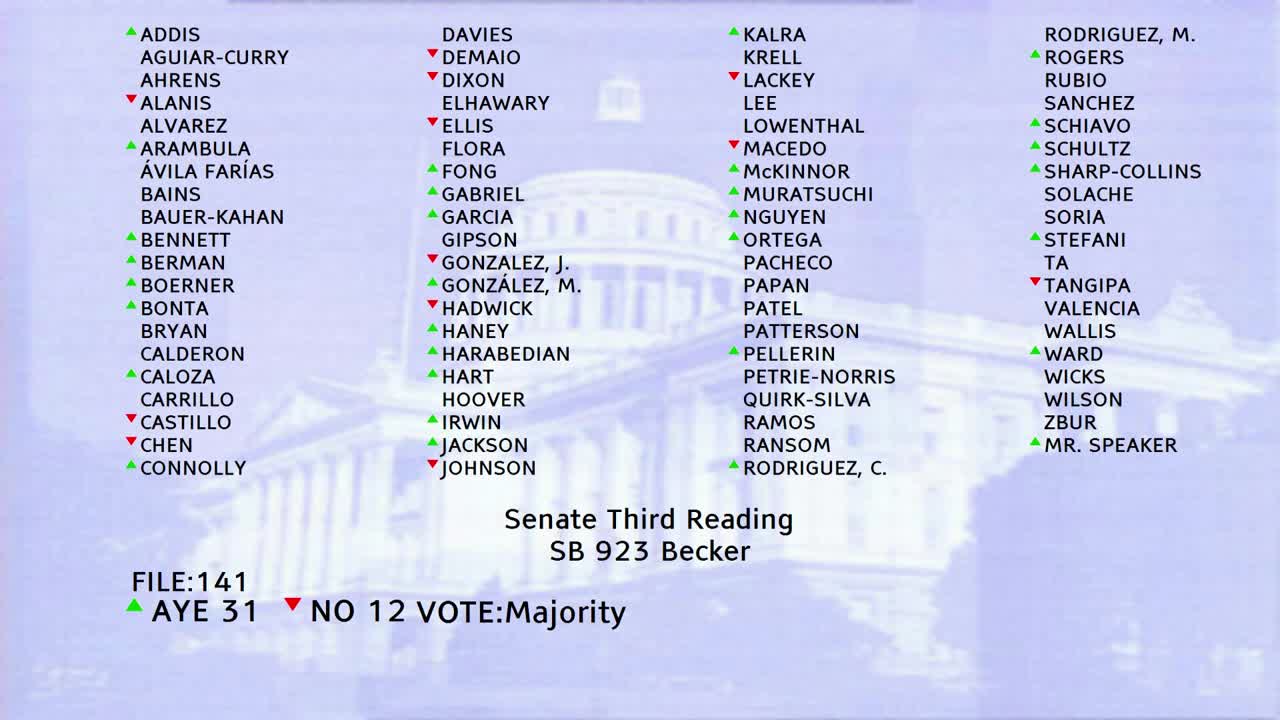 1MIN
Assembly Floor
 46SEC
Assembly Floor
 12MIN
Assembly Standing Committee on Business and Professions
Bill Author

Bill Co-Author(s):