AB 740: Virtual power plants: load shifting: integrated energy policy report.
- Session Year: 2025-2026
- House: Assembly
- Latest Version Date: 2025-09-15
Current Status:
Failed
(2026-01-22: Consideration of Governor's veto stricken from file.)
Introduced
In Committee
Awaiting First Chamber Vote
Passed First Chamber
In Committee
Awaiting Second Chamber Vote
Passed Second Chamber
Enacted
Existing law requires the State Energy Resources Conservation and Development Commission (Energy Commission), in consultation with specified entities, to adopt a biennial integrated energy policy report containing certain information, including an overview of major energy trends and issues facing the state.
This bill would require the Energy Commission, in the next update to the biennial integrated energy policy report after January 1, 2027, and subject to available funding, to adopt a virtual power plant deployment plan. The bill would require the Energy Commission, in developing the plan, to take certain actions, and would require that the plan meet specified requirements.
Existing law requires the Energy Commission, in consultation with the Public Utilities Commission and the Independent System Operator, to adopt a goal for load shifting to reduce net peak electrical demand and adjust this target in each biennial integrated energy policy report thereafter.
This bill would require each electrical corporation to annually report to the Energy Commission its contribution towards meeting that load-shift goal.
Existing law requires the State Energy Resources Conservation and Development Commission (Energy Commission), in consultation with specified entities, to adopt a biennial integrated energy policy report containing certain information, including an overview of major energy trends and issues facing the state.
This bill would require the Energy Commission, on or before November 1, 2026, in the next update to the biennial integrated energy policy report after January 1, 2027, and subject to available funding, to adopt a virtual power plant deployment plan. The bill would require the Energy Commission, in developing the plan, to take certain actions, and would require that the plan meet specified requirements. The bill would require the plan adopted pursuant to these provisions to be included in the above-described integrated energy policy report.
Existing law requires the Energy Commission, in consultation with the Public Utilities Commission and the Independent System Operator, to adopt a goal for load shifting to reduce net peak electrical demand and adjust this target in each biennial integrated energy policy report thereafter.
This bill would require each electrical corporation to annually report to the Energy Commission its contribution towards meeting that load-shift goal.
Existing law requires the State Energy Resources Conservation and Development Commission (Energy Commission), in consultation with specified entities, to adopt a biennial integrated energy policy report containing certain information, including an overview of major energy trends and issues facing the state.
This bill would require the Energy Commission, on or before November 1, 2026, and subject to available funding, to adopt a virtual power plant deployment plan. The bill would require the Energy Commission, in developing the plan, to take certain actions, and would require that the plan meet specified requirements. The bill would require the plan adopted pursuant to these provisions to be included in the above-described integrated energy policy report.
Existing law requires the Energy Commission, in consultation with the Public Utilities Commission and the Independent System Operator, to adopt a goal for load shifting to reduce net peak electrical demand and adjust this target in each biennial integrated energy policy report thereafter.
This bill would require each electrical corporation to annually report to the Energy Commission its contribution towards meeting that load-shift goal.
Existing law requires the State Energy Resources Conservation and Development Commission (Energy Commission), in consultation with specified entities, to adopt a biennial integrated energy policy report containing certain information, including an overview of major energy trends and issues facing the state.
This bill would require the Energy Commission, on or before November 1, 2026, to adopt a virtual power plant deployment plan. The bill would require the Energy Commission, in developing the plan, to take certain actions, and would require that the plan meet specified requirements. The bill would require the plan adopted pursuant to these provisions to be included in the above-described integrated energy policy report.
Existing law requires the Energy Commission, in consultation with the Public Utilities Commission and the Independent System Operator, to adopt a goal for load shifting to reduce net peak electrical demand and adjust this target in each biennial integrated energy policy report thereafter.
This bill would require each electrical corporation to annually report to the Energy Commission its contribution towards meeting that load-shift goal.
Existing law requires the State Energy Resources Conservation and Development Commission (Energy Commission), in consultation with specified entities, to adopt a biennial integrated energy policy report containing certain information, including an overview of major energy trends and issues facing the state.
This bill would require the Energy Commission, on or before November 1, 2026, to adopt a strategy to enable virtual power plants to be deployed at scale, as specified. plant deployment plan. The bill would require the Energy Commission, in developing the strategy, plan, to take certain actions, and would require that the strategy plan meet specified requirements. The bill would require the strategy plan adopted pursuant to these provisions to be included in the above-described integrated energy policy report.
This bill would require the Energy Commission, on or before July 1, 2026, to complete a study that includes 2030, 2035, and 2045 scenarios of the effects of virtual power plant deployment at scale on electrical system costs, rate reduction, and the reduction of greenhouse gas emissions, as specified. The bill would require the Energy Commission to report the results of the study to the Legislature within 30 days of its completion.Existing law requires the Energy Commission, in consultation with the Public Utilities Commission and the Independent System Operator, to adopt a goal for load shifting to reduce net peak electrical demand and adjust this target in each biennial integrated energy policy report thereafter.
This bill would require each electrical corporation to annually report to the Energy Commission its contribution towards meeting that load-shift goal.
Existing law requires the State Energy Resources Conservation and Development Commission (Energy Commission), in consultation with specified entities, to adopt a biennial integrated energy policy report containing certain information, including an overview of major energy trends and issues facing the state. Existing
This bill would require the Energy Commission, on or before November 1, 2026, to adopt a strategy to enable virtual power plants to be deployed at scale, as specified. The bill would require the Energy Commission, in developing the strategy, to take certain actions, and would require that the strategy meet specified requirements. The bill would require the strategy adopted pursuant to these provisions to be included in the above-described integrated energy policy report.
This bill would require the Energy Commission, on or before July 1, 2026, to complete a study that includes 2030, 2035, and 2045 scenarios of the effects of virtual power plant deployment at scale on electrical system costs, rate reduction, and the reduction of greenhouse gas emissions, as specified. The bill would require the Energy Commission to report the results of the study to the Legislature within 30 days of its completion.
Existing law requires the Energy Commission, in consultation with the Public Utilities Commission and the Independent System Operator, to adopt a goal for load shifting to reduce net peak electrical demand and adjust this target in each biennial integrated energy policy report thereafter.
This bill would require the Energy Commission, as part of the integrated energy policy report, to include modeling of the effects of virtual power plants on electricity costs and rate reduction and to submit to the Legislature a virtual power plant implementation plan that includes goals and milestones. The bill would require each electrical corporation to annually report to the commission Energy Commission its contribution towards meeting the that load-shift goal.
Existing law requires the State Energy Resources Conservation and Development Commission (Energy Commission), in consultation with specified entities, to adopt a biennial integrated energy policy report containing certain information, including an overview of major energy trends and issues facing the state. Existing law requires the Energy Commission, in consultation with the Public Utilities Commission and the Independent System Operator, to adopt a goal for load shifting to reduce net peak electrical demand and adjust this target in each biennial integrated energy policy report thereafter.
This bill would require the Energy Commission, as part of the integrated energy policy report, to include modeling of the effects of virtual power plants on electricity costs and rate reduction and to submit to the Legislature a virtual power plant implementation plan that includes goals and milestones. The bill would require each electrical corporation to annually report to the commission its contribution towards meeting the load-shift goal.
Each electrical corporation, as defined in Section 218 of the Public Utilities Code, shall annually report to the commission its contribution towards meeting the load-shift goal adopted pursuant to Section 25302.7.
SEC. 2.Chapter 6.6 (commencing with Section 25560) is added to Division 15 of the Public Resources Code, to read:6.6.Virtual Power Plants25560.For purposes of this chapter, all of the following definitions apply:
(a)Smart means a device or appliance that adjusts its energy use, is internet connected, is able to be controlled remotely, with explicit customer consent, by the consumer, the manufacturer, or an aggregator, provides information about its operating status, and enables the customer to enable or disable the smart features.
(b)Virtual power plant means an actively coordinated aggregation of behind-the-meter distributed energy resources, including, but not limited to, electric vehicles and chargers, electric water heaters, smart thermostats, smart plugs, smart buildings and their controls, battery storage systems like those installed with rooftop solar systems, and flexible commercial and industrial loads, that are dispatchable and can balance electricity demand and supply and reduce or shift demand.
25561.(a)In the next update to the biennial integrated energy policy report adopted pursuant to Section 25302 after January 1, 2027, and subject to available funding, the commission shall adopt a virtual power plant deployment plan.
(b)In developing the plan adopted pursuant to subdivision (a), the commission shall do all of the following:
(1)Consult and collaborate with the Public Utilities Commission, the Independent System Operator, and the disadvantaged community advisory group established pursuant to Section 400 of the Public Utilities Code.
(2)Hold no less than two public workshops to solicit public input on the development of the plan.
(3)Convene stakeholder sessions to solicit input from organizations representing industry, the affected workforce, ratepayer organizations, consumer organizations, load-serving entities, as defined in Section 380 of the Public Utilities Code, and local publicly owned electric utilities, as defined in Section 224.3 of the Public Utilities Code.
(c)The commission shall ensure that the plan adopted pursuant to subdivision (a) does all of the following:
(1)Identifies the resources, policies, and timelines needed for virtual power plants to help meet the statewide load-shift goals adopted pursuant to Section 25302.7.
(2)(A)Identifies the barriers and opportunities for virtual power plant resources to qualify for resource adequacy.
(B)Includes an assessment of virtual power plant resources that are currently eligible for resource adequacy pursuant to Section 380 of the Public Utilities Code.
(C)Includes recommendations to resolve the barriers identified in subparagraph (A).
(D)Estimates the cost of virtual power plants relative to alternative sources of resource adequacy qualifying capacity.
(E)Assesses the data needs for state agencies and the Independent System Operator to fully value virtual power plant resources for resource adequacy.
(3)(A)Identifies the barriers and opportunities for virtual power plant resources to act as load-modifying resources that reduce a load-serving entitys resource adequacy obligations.
(B)Includes recommendations to resolve the barriers identified in subparagraph (A).
(C)Estimates the cost to the load-serving entity of load-modifying virtual power plants relative to the cost of other load-modifying resources to reduce a load-serving entitys resource adequacy obligations.
(D)Identifies which virtual power plant resources are the most cost effective as load-modifying resources.
(E)Assesses the data needs for state agencies and the Independent System Operator to fully account for virtual power plant resources to reduce a load-serving entitys resource adequacy obligations.
(4)Assesses the barriers to customer energy data access limiting the operation and value of virtual power plants and recommended ways to address them.
(5)(A)Evaluates how the operational configuration of virtual power plants can be optimized to support specific objectives, including maximizing cost savings to participating and nonparticipating ratepayers, and maximizing electrical grid system benefits, such as reduction of greenhouse gas emissions and easing of local congestion.
(B)Provides recommendations on how to align incentive structures that maximize both electrical grid system benefits and cost savings to participating and nonparticipating ratepayers.
(C)Ensures the recommendations of subparagraph (B) do not result in increased costs for any nonparticipating ratepayers as a result of virtual power plant deployment.
Each electrical corporation, as defined in Section 218 of the Public Utilities Code, shall annually report to the commission its contribution towards meeting the load-shift goal adopted pursuant to Section 25302.7.
SEC. 2.Chapter 6.6 (commencing with Section 25560) is added to Division 15 of the Public Resources Code, to read:6.6.Virtual Power Plants25560.For purposes of this chapter, all of the following definitions apply:
(a)Smart means a device or appliance that adjusts its energy use, is internet connected, is able to be controlled remotely, with explicit customer consent, by the consumer, the manufacturer, or an aggregator, provides information about its operating status, and enables the customer to enable or disable the smart features.
(b)Virtual power plant means an actively coordinated aggregation of behind-the-meter distributed energy resources, including, but not limited to, electric vehicles and chargers, electric water heaters, smart thermostats, smart plugs, smart buildings and their controls, battery storage systems like those installed with rooftop solar systems, and flexible commercial and industrial loads, that are dispatchable and can balance electricity demand and supply and reduce or shift demand.
25561.(a)On or before November 1, 2026, and subject to available funding, the commission, at a publicly noticed voting meeting, In the next update to the biennial integrated energy policy report adopted pursuant to Section 25302 after January 1, 2027, and subject to available funding, the commission shall adopt a virtual power plant deployment plan.
(b)In developing the plan adopted pursuant to subdivision (a), the commission shall do all of the following:
(1)Consult and collaborate with the Public Utilities Commission, the Independent System Operator, and the disadvantaged community advisory group established pursuant to Section 400 of the Public Utilities Code.
(2)Hold no less than two public workshops to solicit public input on the development of the plan.
(3)Convene stakeholder sessions to solicit input from organizations representing industry, the affected workforce, ratepayer organizations, consumer organizations, load-serving entities, as defined in Section 380 of the Public Utilities Code, and local publicly owned electric utilities, as defined in Section 224.3 of the Public Utilities Code.
(c)The commission shall ensure that the plan adopted pursuant to subdivision (a) does all of the following:
(1)Identifies the resources, policies, and timelines needed for virtual power plants to help meet the statewide load-shift goals adopted pursuant to Section 25302.7.
(2)(A)Identifies the barriers and opportunities for virtual power plant resources to qualify for resource adequacy.
(B)Includes an assessment of virtual power plant resources that are currently eligible for resource adequacy pursuant to Section 380 of the Public Utilities Code.
(C)Includes recommendations to resolve the barriers identified in subparagraph (A).
(D)Estimates the cost of virtual power plants relative to alternative sources of resource adequacy qualifying capacity.
(E)Assesses the data needs for state agencies and the Independent System Operator to fully value virtual power plant resources for resource adequacy.
(3)(A)Identifies the barriers and opportunities for virtual power plant resources to act as load-modifying resources that reduce a load-serving entitys resource adequacy obligations.
(B)Includes recommendations to resolve the barriers identified in subparagraph (A).
(C)Estimates the cost to the load-serving entity of load-modifying virtual power plants relative to the cost of other load-modifying resources to reduce a load-serving entitys resource adequacy obligations.
(D)Identifies which virtual power plant resources are the most cost effective as load-modifying resources.
(E)Assesses the data needs for state agencies and the Independent System Operator to fully account for virtual power plant resources to reduce a load-serving entitys resource adequacy obligations.
(4)Assesses the barriers to customer energy data access limiting the operation and value of virtual power plants and recommended ways to address them.
(5)(A)Evaluates how the operational configuration of virtual power plants can be optimized to support specific objectives, including maximizing cost savings to participating and nonparticipating ratepayers, and maximizing electrical grid system benefits, such as reduction of greenhouse gas emissions and easing of local congestion.
(B)Provides recommendations on how to align incentive structures that maximize both electrical grid system benefits and cost savings to participating and nonparticipating ratepayers.
(C)Ensures the recommendations of subparagraph (B) do not result in increased costs for any nonparticipating ratepayers as a result of virtual power plant deployment.
(d)The plan adopted pursuant to subdivision (a) shall be included in the report prepared pursuant to Section 25302.Each electrical corporation, as defined in Section 218 of the Public Utilities Code, shall annually report to the commission its contribution towards meeting the load-shift goal adopted pursuant to Section 25302.7.
SEC. 2.Chapter 6.6 (commencing with Section 25560) is added to Division 15 of the Public Resources Code, to read:6.6.Virtual Power Plants25560.For purposes of this chapter, all of the following definitions apply:
(a)Smart means a device or appliance that adjusts its energy use, is internet connected, is able to be controlled remotely, with explicit customer consent, by the consumer, the manufacturer, or an aggregator, provides information about its operating status, and enables the customer to enable or disable the smart features.
(b)Virtual power plant means an actively coordinated aggregation of behind-the-meter distributed energy resources, including, but not limited to, electric vehicles and chargers, electric water heaters, smart thermostats, smart plugs, smart buildings and their controls, battery storage systems like those installed with rooftop solar systems, and flexible commercial and industrial loads, that are dispatchable and can balance electricity demand and supply and reduce or shift demand.
25561.(a)On or before November 1, 2026, and subject to available funding, the commission, at a publicly noticed voting meeting, shall adopt a virtual power plant deployment plan.
(b)In developing the plan adopted pursuant to subdivision (a), the commission shall do all of the following:
(1)Consult and collaborate with the Public Utilities Commission, the Independent System Operator, and the disadvantaged community advisory group established pursuant to Section 400 of the Public Utilities Code.
(2)Hold no less than two public workshops to solicit public input on the development of the plan.
(3)Convene stakeholder sessions to solicit input from organizations representing industry, the affected workforce, ratepayer organizations, consumer organizations, load-serving entities, as defined in Section 380 of the Public Utilities Code, and local publicly owned electric utilities, as defined in Section 224.3 of the Public Utilities Code.
(c)The commission shall ensure that the plan adopted pursuant to subdivision (a) does all of the following:
(1)Identifies the resources, policies, and timelines needed for virtual power plants to help meet the statewide load-shift goals adopted pursuant to Section 25302.7.
(2)(A)Identifies the barriers and opportunities for virtual power plant resources to qualify for resource adequacy.
(B)Includes an assessment of virtual power plant resources that are currently eligible for resource adequacy pursuant to Section 380 of the Public Utilities Code.
(C)Includes recommendations to resolve the barriers identified in subparagraph (A).
(D)Estimates the cost of virtual power plants relative to alternative sources of resource adequacy qualifying capacity.
(E)Assesses the data needs for state agencies and the Independent System Operator to fully value virtual power plant resources for resource adequacy.
(3)(A)Identifies the barriers and opportunities for virtual power plant resources to act as load-modifying resources that reduce a load-serving entitys resource adequacy obligations.
(B)Includes recommendations to resolve the barriers identified in subparagraph (A).
(C)Estimates the cost to the load-serving entity of load-modifying virtual power plants relative to the cost of other load-modifying resources to reduce a load-serving entitys resource adequacy obligations.
(D)Identifies which virtual power plant resources are the most cost effective as load-modifying resources.
(E)Assesses the data needs for state agencies and the Independent System Operator to fully account for virtual power plant resources to reduce a load-serving entitys resource adequacy obligations.
(4)Assesses the barriers to customer energy data access limiting the operation and value of virtual power plants and recommended ways to address them.
(5)(A)Evaluates how the operational configuration of virtual power plants can be optimized to support specific objectives, including maximizing cost savings to participating and nonparticipating ratepayers, and maximizing electrical grid system benefits, such as reduction of greenhouse gas emissions and easing of local congestion.
(B)Provides recommendations on how to align incentive structures that maximize both electrical grid system benefits and cost savings to participating and nonparticipating ratepayers.
(C)Ensures the recommendations of subparagraph (B) do not result in increased costs for any nonparticipating ratepayers as a result of virtual power plant deployment.
(d)The plan adopted pursuant to subdivision (a) shall be included in the report prepared pursuant to Section 25302.
Each electrical corporation, as defined in Section 218 of the Public Utilities Code, shall annually report to the commission its contribution towards meeting the load-shift goal adopted pursuant to Section 25302.7.
SEC. 2.Chapter 6.6 (commencing with Section 25560) is added to Division 15 of the Public Resources Code, to read:6.6.Virtual Power Plants25560.For purposes of this chapter, all of the following definitions apply:
(a)Smart means a device or appliance that adjusts its energy use, is internet connected, is able to be controlled remotely, with explicit customer consent, by the consumer, the manufacturer, or an aggregator, provides information about its operating status, and enables the customer to enable or disable the smart features.
(b)Virtual power plant means an actively coordinated aggregation of behind-the-meter distributed energy resources, including, but not limited to, electric vehicles and chargers, electric water heaters, smart thermostats, smart plugs, smart buildings and their controls, battery storage systems like those installed with rooftop solar systems, and flexible commercial and industrial loads, that are dispatchable and can balance electricity demand and supply and reduce or shift demand.
25561.(a)On or before November 1, 2026, the commission, at a publicly noticed voting meeting, shall adopt a virtual power plant deployment plan.
(b)In developing the plan adopted pursuant to subdivision (a), the commission shall do all of the following:
(1)Consult and collaborate with the Public Utilities Commission, the Independent System Operator, and the disadvantaged community advisory group established pursuant to Section 400 of the Public Utilities Code.
(2)Hold no less than two public workshops to solicit public input on the development of the plan.
(3)Convene stakeholder sessions to solicit input from organizations representing industry, the affected workforce, ratepayer organizations, consumer organizations, load-serving entities, as defined in Section 380 of the Public Utilities Code, and local publicly owned electric utilities, as defined in Section 224.3 of the Public Utilities Code.
(c)The commission shall ensure that the plan adopted pursuant to subdivision (a) does all of the following:
(1)Identifies the resources, policies, and timelines needed for virtual power plants to help meet the statewide load-shift goals adopted pursuant to Section 25302.7.
(2)(A)Identifies the barriers and opportunities for virtual power plant resources to qualify for resource adequacy.
(B)Includes an assessment of virtual power plant resources that are currently eligible for resource adequacy pursuant to Section 380 of the Public Utilities Code.
(C)Includes recommendations to resolve the barriers identified in subparagraph (A).
(D)Estimates the cost of virtual power plants relative to alternative sources of resource adequacy qualifying capacity.
(E)Assesses the data needs for state agencies and the Independent System Operator to fully value virtual power plant resources for resource adequacy.
(3)(A)Identifies the barriers and opportunities for virtual power plant resources to act as load-modifying resources that reduce a load-serving entitys resource adequacy obligations.
(B)Includes recommendations to resolve the barriers identified in subparagraph (A).
(C)Estimates the cost to the load-serving entity of load-modifying virtual power plants relative to the cost of other load-modifying resources to reduce a load-serving entities entitys resource adequacy obligations.
(D)Identifies which virtual power plant resources are the most cost-effective cost effective as load-modifying resources.
(E)Assesses the data needs for state agencies and the Independent System Operator to fully account for virtual power plant resources to reduce a load-serving entitys resource adequacy obligations.
(4)Assesses the barriers to customer energy data access limiting the operation and value of virtual power plants and recommended ways to address them.
(5)(A)Evaluates how the operational configuration of virtual power plants can be optimized to support specific objectives, including maximizing cost savings to participating and nonparticipating ratepayers, and maximizing electrical grid system benefits, such as reduction of greenhouse gas emissions and easing of local congestion.
(B)Provides recommendations on how to align incentive structures that maximize both electrical grid system benefits and cost-savings cost savings to participating and nonparticipation nonparticipating ratepayers.
(C)Ensures the recommendations of subparagraph (B) do not result in increased costs for any nonparticipating ratepayers as a result of virtual power plant deployment.
(d)The plan adopted pursuant to subdivision (a) shall be included in the report prepared pursuant to Section 25302.
Each electrical corporation, as defined in Section 218 of the Public Utilities Code, shall annually report to the commission its contribution towards meeting the load-shift goal adopted pursuant to Section 25302.7.
SEC. 2.Chapter 6.6 (commencing with Section 25560) is added to Division 15 of the Public Resources Code, to read:6.6.Virtual Power Plants25560.For purposes of this chapter, all of the following definitions apply:
(a)Smart means a device or appliance that adjusts its energy use, is internet connected, is able to be controlled remotely, with explicit customer consent, by the consumer, the manufacturer, or an aggregator, provides information about its operating status, and enables the customer to enable or disable the smart features.
(b)Virtual power plant means an actively coordinated aggregation of behind-the-meter distributed energy resources, including, but not limited to, electric vehicles and chargers, electric water heaters, smart thermostats, smart plugs, smart buildings and their controls, battery storage systems like those installed with rooftop solar systems, and flexible commercial and industrial loads, that are dispatchable and can balance electricity demand and supply and reduce or shift demand.
25561.(a)On or before November 1, 2026, the commission, at a publicly noticed voting meeting, shall adopt a strategy, with milestones, to enable virtual power plants to be deployed at scale. plant deployment plan.
(b)In developing the strategy plan adopted pursuant to subdivision (a), the commission shall do all of the following:
(1)Consult and collaborate with the Public Utilities Commission, the Independent System Operator, and the disadvantaged community advisory group established pursuant to Section 400 of the Public Utilities Code.
(2)Hold no less than two public workshops to solicit public input on the development of the strategy. plan.
(3)Convene stakeholder sessions to solicit input from organizations representing industry, the affected workforce, ratepayer organizations, consumer organizations, load-serving entities, as defined in Section 380 of the Public Utilities Code, and local publicly owned electric utilities, as defined in Section 224.3 of the Public Utilities Code.
(c)The commission shall ensure that the strategy plan adopted pursuant to subdivision (a) does all of the following:
(1)Estimates the size of the resource potential of virtual power plant resources by 2030, 2035, and 2045.(1)Identifies the resources, policies, and timelines needed for virtual power plants to help meet the statewide load-shift goals adopted pursuant to Section 25302.7.
(2)(A)Identifies the existing and potential policy and regulatory barriers and opportunities for virtual power plant resources to qualify for or reduce resource adequacy obligations. adequacy.
(3)Includes a recommended pathway and policy and regulatory changes to resolve the policy and regulatory barriers identified in paragraph (2).(4)Includes an assessment of virtual power plant resources that are currently eligible for resource adequacy pursuant to Section 380 of the Public Utilities Code, and estimates of how this resource type would change if the policy changes identified in paragraph (3) are made.(5)Includes recommendations on the compensation framework for virtual power plants.(B)Includes an assessment of virtual power plant resources that are currently eligible for resource adequacy pursuant to Section 380 of the Public Utilities Code.
(C)Includes recommendations to resolve the barriers identified in subparagraph (A).
(D)Estimates the cost of virtual power plants relative to alternative sources of resource adequacy qualifying capacity.
(E)Assesses the data needs for state agencies and the Independent System Operator to fully value virtual power plant resources for resource adequacy.
(3)(A)Identifies the barriers and opportunities for virtual power plant resources to act as load-modifying resources that reduce a load-serving entitys resource adequacy obligations.
(B)Includes recommendations to resolve the barriers identified in subparagraph (A).
(C)Estimates the cost to the load-serving entity of load-modifying virtual power plants relative to the cost of other load-modifying resources to reduce a load-serving entities resource adequacy obligations.
(D)Identifies which virtual power plant resources are the most cost-effective as load-modifying resources.
(E)Assesses the data needs for state agencies and the Independent System Operator to fully account for virtual power plant resources to reduce a load-serving entitys resource adequacy obligations.
(6)(4)Assesses the barriers to customer energy data access necessary for the creation and limiting the operation and value of virtual power plants at scale and recommended ways to address them.
(7)Maximizes cost savings to ratepayers.(5)(A)Evaluates how the operational configuration of virtual power plants can be optimized to support specific objectives, including maximizing cost savings to participating and nonparticipating ratepayers, and maximizing electrical grid system benefits, such as reduction of greenhouse gas emissions and easing of local congestion.
(B)Provides recommendations on how to align incentive structures that maximize both electrical grid system benefits and cost-savings to participating and nonparticipation ratepayers.
(C)Ensures the recommendations of subparagraph (B) do not result in increased costs for any nonparticipating ratepayers as a result of virtual power plant deployment.
(d)The strategy plan adopted pursuant to subdivision (a) shall be included in the report prepared pursuant to Section 25302.
25562.(a)On or before July 1, 2026, the commission shall complete a study that includes 2030, 2035, and 2045 scenarios of the effects of virtual power plant deployment at scale on electrical system costs, rate reduction, and the reduction of greenhouse gas emissions. The study shall include, but not be limited to, both of the following:(1)The avoided transmission, distribution, and generation costs.(2)The impacts on greenhouse gas emissions.(b)(1)The commission shall report the results of the study to the Legislature within 30 days of its completion.(2)The report submitted pursuant to paragraph (1) shall be in compliance with Section 9795 of the Government Code.Each electrical corporation corporation, as defined in Section 218 of the Public Utilities Code, shall annually report to the commission its contribution towards meeting the load-shift goal adopted pursuant to Section 25302.7.
SEC. 2.Chapter 6.6 (commencing with Section 25560) is added to Division 15 of the Public Resources Code, to read:6.6.Virtual Power Plants25560.For purposes of this chapter, all of the following definitions apply:
(a)Smart means a device or appliance that adjusts its energy use, is internet connected, is able to be controlled remotely, with explicit customer consent, by the consumer, the manufacturer, or an aggregator, provides information about its operating status, and enables the customer to enable or disable the smart features.
(b)Virtual power plant means an actively coordinated aggregation of behind-the-meter distributed energy resources, including, but not limited to, electric vehicles and chargers, electric water heaters, smart thermostats, smart plugs, smart buildings and their controls, battery storage systems like those installed with rooftop solar systems, and flexible commercial and industrial loads, that are dispatchable and can balance electricity demand and supply and reduce or shift demand.
25561.(a)On or before November 1, 2026, the commission, at a publicly noticed voting meeting, shall adopt a strategy, with milestones, to enable virtual power plants to be deployed at scale.
(b)In developing the strategy adopted pursuant to subdivision (a), the commission shall do all of the following:
(1)Consult and collaborate with the Public Utilities Commission, the Independent System Operator, and the disadvantaged community advisory group established pursuant to Section 400 of the Public Utilities Code.
(2)Hold no less than two public workshops to solicit public input on the development of the strategy.
(3)Convene stakeholder sessions to solicit input from organizations representing industry, the affected workforce, ratepayer organizations, consumer organizations, load-serving entities, as defined in Section 380 of the Public Utilities Code, and local publicly owned electric utilities, as defined in Section 224.3 of the Public Utilities Code.
(c)The commission shall ensure that the strategy adopted pursuant to subdivision (a) does all of the following:
(1)Estimates the size of the resource potential of virtual power plant resources by 2030, 2035, and 2045.
(2)Identifies the existing and potential policy and regulatory barriers and opportunities for virtual power plant resources to qualify for or reduce resource adequacy obligations.
(3)Includes a recommended pathway and policy and regulatory changes to resolve the policy and regulatory barriers identified in paragraph (2).
(4)Includes an assessment of virtual power plant resources that are currently eligible for resource adequacy pursuant to Section 380 of the Public Utilities Code, and estimates of how this resource type would change if the policy changes identified in paragraph (3) are made.
(5)Includes recommendations on the compensation framework for virtual power plants.
(6)Assesses the barriers to data access necessary for the creation and operation of virtual power plants at scale and recommended ways to address them.
(7)Maximizes cost savings to ratepayers.
(d)The strategy adopted pursuant to subdivision (a) shall be included in the report prepared pursuant to Section 25302.
25562.(a)On or before July 1, 2026, the commission shall complete a study that includes 2030, 2035, and 2045 scenarios of the effects of virtual power plant deployment at scale on electrical system costs, rate reduction, and the reduction of greenhouse gas emissions. The study shall include, but not be limited to, both of the following:
(1)The avoided transmission, distribution, and generation costs.
(2)The impacts on greenhouse gas emissions.
(b)(1)The commission shall report the results of the study to the Legislature within 30 days of its completion.
(2)The report submitted pursuant to paragraph (1) shall be in compliance with Section 9795 of the Government Code.
(a)As part of the report prepared pursuant to Section 25302, the commission shall do both of the following:
(1)Include modeling of the effects of virtual power plants on electricity costs and rate reduction.
(2)(A)Submit to the Legislature a virtual power plant implementation plan that includes goals and milestones.
(B)The report submitted pursuant to subparagraph (A) shall be submitted in compliance with Section 9795 of the Government Code.
(b)Each electrical corporation shall annually report to the commission its contribution towards meeting the load-shift goal adopted pursuant to Section 25302.7.
|
Date
|
Status
|
|---|---|
| Jan 22, 2026 | Consideration of Governor's veto stricken from file. |
| Oct 3, 2025 | Consideration of Governor's veto pending. |
| Oct 3, 2025 | Vetoed by Governor. |
| Sep 23, 2025 | Enrolled and presented to the Governor at 4 p.m. |
| Sep 11, 2025 | Senate amendments concurred in. To Engrossing and Enrolling. (Ayes 78. Noes 0. Page 3299.). |
| Sep 10, 2025 | In Assembly. Concurrence in Senate amendments pending. |
| Sep 10, 2025 | Read third time. Passed. Ordered to the Assembly. (Ayes 39. Noes 1. Page 2808.). |
| Sep 8, 2025 | Read second time. Ordered to third reading. |
| Sep 4, 2025 | Read third time and amended. Ordered to second reading. |
| Sep 2, 2025 | Read second time. Ordered to third reading. |
| Aug 29, 2025 | Read second time and amended. Ordered returned to second reading. |
| Aug 29, 2025 | From committee: Amend, and do pass as amended. (Ayes 7. Noes 0.) (August 29). |
| Aug 25, 2025 | In committee: Referred to suspense file. |
| Aug 18, 2025 | (Ayes 27. Noes 0. Page 2171.) |
| Aug 18, 2025 | From committee chair, with author's amendments: Amend, and re-refer to committee. Read second time, amended, and re-referred to Com. on APPR. |
| Aug 7, 2025 | In committee: Hearing postponed by committee. |
| Jul 16, 2025 | From committee: Do pass and re-refer to Com. on APPR. (Ayes 16. Noes 0.) (July 15). Re-referred to Com. on APPR. |
| Jun 11, 2025 | Referred to Com. on E., U & C. |
| Jun 3, 2025 | In Senate. Read first time. To Com. on RLS. for assignment. |
| Jun 2, 2025 | Read third time. Passed. Ordered to the Senate. (Ayes 79. Noes 0. Page 1850.) |
| May 27, 2025 | Read second time. Ordered to third reading. |
| May 23, 2025 | From committee: Do pass. (Ayes 14. Noes 0.) (May 23). |
| May 14, 2025 | In committee: Set, first hearing. Referred to suspense file. |
| Apr 29, 2025 | Re-referred to Com. on APPR. |
| Apr 28, 2025 | Read second time and amended. |
| Apr 24, 2025 | From committee: Amend, and do pass as amended and re-refer to Com. on APPR. with recommendation: To Consent Calendar. (Ayes 18. Noes 0.) (April 23). |
| Apr 2, 2025 | In committee: Hearing postponed by committee. |
| Mar 13, 2025 | Re-referred to Com. on U. & E. |
| Mar 12, 2025 | From committee chair, with author's amendments: Amend, and re-refer to Com. on U. & E. Read second time and amended. |
| Mar 3, 2025 | Referred to Com. on U. & E. |
| Feb 19, 2025 | From printer. May be heard in committee March 21. |
| Feb 18, 2025 | Read first time. To print. |
|
Date
|
Description
|
Location
|
Votes
|
|
|---|---|---|---|---|
| Sep 11, 2025 | AB 740 Harabedian Concurrence in Senate Amendments | Assembly Floor |
Passed |
|
| Sep 10, 2025 | Assembly 3rd Reading AB740 Harabedian et al. By Stern | Senate Floor |
Passed |
|
| Aug 29, 2025 | Do pass as amended | Senate Standing Committee on Appropriations |
Passed |
|
| Aug 25, 2025 | Placed on suspense file | Senate Standing Committee on Appropriations |
Passed |
|
| Jul 15, 2025 | Do pass, but first be re-referred to the Committee on [Appropriations] | Senate Standing Committee on Energy, Utilities and Communications |
Passed |
|
| Jun 2, 2025 | AB 740 Harabedian Assembly Third Reading | Assembly Floor |
Passed |
|
| May 23, 2025 | Do pass. | Assembly Standing Committee on Appropriations |
Passed |
|
| Apr 23, 2025 | Do pass as amended, and be re-referred to the Committee on [Appropriations] with recommendation: To Consent Calendar | Assembly Standing Committee on Utilities and Energy |
Passed |
This list shows positions taken on this bill by organizations on the date displayed, which is linked to the original source.
Positions by individuals are not included.
|
Organization
|
Position
|
Date
|
|---|---|---|
| 301 Organics | ** Support | |
| 350 Bay Area Action | ** Support | |
| 350 Humboldt | ** Support | |
| 350 South Bay Los Angeles | ** Support | |
| Advanced Energy United | ** Support | |
| Ban SUP | ** Support | |
| Building Owners and Managers Association | ** Support | |
| California Alliance for Community Energy | ** Support | |
| California Apartment Association | ** Support | |
| California Building Industry Association | ** Support | |
| California Business Properties Association | ** Support | |
| California Community Choice Association | ** Support | |
| California Energy Storage Alliance | ** Support | |
| California Environmental Voters | ** Support | |
| California Real Energy Solution Coalition | ** Support | |
| California Solar & Storage Association | ** Support | |
| Center For Biological Diversity | ** Support | |
| Ceres, Inc. | ** Support | |
| Citizen's Climate Lobby LA West | ** Support | |
| Clean Coalition | ** Support | |
| Clean Power Alliance | ** Support | |
| Clean Power Campaign | ** Support | |
| Climate Action California | ** Support | |
| Climate Health Now | ** Support | |
| Coalition For Clean Air | ** Support | |
| Collective Resilience | ** Support | |
| Courage California | ** Support | |
| Democrats of Rossmoor | ** Support | |
| Eaton Fire Residents United | ** Support | |
| Environmental Defense Fund | ** Support | |
| Environmental Energy Consulting | ** Support | |
| Environment California | ** Support | |
| Habitable Designs | ** Support | |
| Indivisible Alta Pasadena | ** Support | |
| Linde Center for Science, Society, and Policy at Caltech | ** Support | |
| Naiop California | ** Support | |
| PearlX | ** Support | |
| Reclaim Our Power, Utility Justice Campaign | ** Support | |
| Renew Home | ** Support | |
| Resilient Palisades | ** Support | |
| Rewiring America | ** Support | |
| San Diego 350 | ** Support | |
| San Diego Community Power | ** Support | |
| San Jose Clean Energy | ** Support | |
| Santa Cruz Climate Action Network | ** Support | |
| Schneider Electric | ** Support | |
| Solar Energy Industries Association | ** Support | |
| Solar United Neighbors Action | ** Support | |
| Sustainable Rossmoor | ** Support | |
| Technet | ** Support | |
| The Climate Center | ** Support | |
| The Climate Reality Project Chapters: Bay Area, California State Coalition, Los Angeles, Orange County, Riverside County, Sacramento, San Fernando Valley CA, and Silicon Valley Chapter | ** Support | |
| Union Of Concerned Scientists | ** Support | |
| Urban Ecology Project | ** Support | |
| Vote Solar | ** Support | |
| Western Region Ceres | ** Support |
GOVERNOR'S VETO
GV Bill Id:AB 740
Author:(Harabedian)
As Enrolled Ver:September 15, 2025
2/3 vote
SUMMARY
Requires the California Energy Commission (CEC) to adopt a virtual power plant (VPP) deployment plan by January 1, 2027. The bill specifies the process for the CEC to generate the plan and outlines the priorities of the plan. The bill also requires the CEC to include the VPP deployment plan in its integrated energy policy report (the IEPR).
Senate Amendments
- Makes the CEC requirements of the bill subject to available funding.
- Changes the date of the publication of the plan from November 1, 2026 to the next update of the biennial integrated energy policy report after January 1, 2027.
Governor's Veto Message
This bill would require the CEC to adopt a virtual power plant deployment plan in the 2027 update of the IEPR. This bill would also require each electric investor-owned utility to annually report to the CEC its contribution toward meeting the state's load-shift goal.
California has enacted many policies over the past decade to facilitate the deployment of cost-effective distributed energy resources and seamlessly integrate them into our evolving and dynamic electric grid. These energy resources have the potential to lower customer electric bills, improve electric grid reliability and resiliency, and lower electric grid emissions. Virtual power plants represent one of the latest advances in coupling the output and controllability of solar photovoltaic and battery energy storage systems to deliver on these outcomes.
While I support efforts to realize the potential of these energy resources and others, this bill results in costs to the CEC's primary operating fund, which is currently facing an ongoing structural deficit, thereby exacerbating the fund's structural imbalance.
COMMENTS
VPPs consist of a network of decentralized, medium scale power generating units and flexible loads, such as batteries, EVs, smart appliances, and flexible heating and cooling loads that can be effectively managed to the benefit of grid operators. A primary function of VPPs is to orchestrate aggregates of distributed energy resources (DERs). DERs are located on or near the site of end-use and are typically connected to the distribution grid. They fall into three categories: demand flexibility, electricity generation, and storage.
In 2020, the Federal Energy Regulatory Commission released Order No. 2222, which enabled distributed energy resources to better participate in electricity markets run by regional grid operators, primarily mediated by a distributed energy resource aggregator (a VPP or the utility itself). Despite this federal permission structure, how virtual power plants should integrate into CAISO is still unclear. In addition, there remains ambiguity as to how aggregators are classified relative to utilities, how they will be regulated by the CPUC, and how these programs can be deployed at scale.
In 2021, the CPUC approved the creation of the Emergency Load Reduction Program (ELRP) as a pilot program for a demand response approach to help avoid rotating outages during peak summer electricity use. ELRP incentivizes load reduction and is administered by the 3 IOUs. Virtual Power Plants are permitted to participate in this program.
The CEC established a Load-Shift goal of 7,000 MW by 2030 and has been seeking solutions to meet this goal. In 2022, AB 205 (Budget) Chapter 61, Statutes of 2022 passed, establishing the Demand Side Grid Support (DSGS) program administered by the CEC. The goal of the DSGS program is to offer incentives to electric customers that provide load reduction and backup generation to support the state's electrical grid during extreme events, reducing the risk of blackouts. The current DSGS program guidelines includes two VPP pilot programs.
In 2023 the CEC established load management standards that require utilities to develop and standardize the communication of time varying rates, intending to allow third parties to participate in demand response and VPPs. In 2024, the CEC released the Virtual Power Plant Approaches for Demand Flexibility solicitation, which provides $15,000,000 in grants to fund demonstrations of community-based VPP approaches that increase demand flexibility.
According to the Author
"As Californians face high energy bills, virtual power plants offer a simple solution - using clean energy already in our homes and businesses to stabilize the grid, lower costs, and strengthen our future. I'm proud to partner with Advanced Energy United, Environment California, and The Climate Center to make energy cleaner and more affordable in our state."
Arguments in Support
The bill is supported by a number of environmental organizations, solar industry organizations and trade groups, several building industry associations, as well as the Linde Center for Science, Society and Policy at Caltech. A coalition of environmental and clean energy advocacy groups writes that "VPPs are one key tool of load flexibility—the ability to shift electricity consumption away from times when electricity is expensive, scarce, and highly polluting towards times when it is inexpensive, plentiful, and clean." The building industry associations write in support arguing that, "this bill will empower households to reduce energy expenses while enhancing grid reliability and clean energy adoption…A recent Brattle Group Report found widespread VPP adoption could save Californians $750 million annually."
Arguments in Opposition
None on file.
FISCAL COMMENTS
According to the Assembly Committee on Appropriations, this bill would create significant new analytical work for the CEC; therefore, it will need significant new resources for a limited time, likely in the hundreds of thousands of dollars.
The CEC estimates one-time costs of $191,309 and ongoing costs of $114,976 annually (Energy Resources Program Account [ERPA]) for one temporary and one permanent position to execute the required analysis within less than a year. The permanent position would continue in future fiscal years. The CEC notes an ongoing structural deficit within the ERPA fund, its main operational funding source.
VOTES
ASM UTILITIES AND ENERGY: 18-0-0
YES: Petrie-Norris, Patterson, Boerner, Calderon, Chen, Davies, Mark González, Harabedian, Hart, Irwin, Kalra, Papan, Rogers, Schiavo, Schultz, Ta, Wallis, Zbur
ASM APPROPRIATIONS: 14-0-1
YES: Wicks, Arambula, Calderon, Caloza, Dixon, Elhawary, Fong, Mark González, Hart, Pacheco, Pellerin, Solache, Ta, Tangipa
ABS, ABST OR NV: Sanchez
ASSEMBLY FLOOR: 79-0-0
YES: Addis, Aguiar-Curry, Ahrens, Alanis, Alvarez, Arambula, Ávila Farías, Bains, Bauer-Kahan, Bennett, Berman, Boerner, Bonta, Bryan, Calderon, Caloza, Carrillo, Castillo, Chen, Connolly, Davies, DeMaio, Dixon, Elhawary, Ellis, Flora, Fong, Gabriel, Gallagher, Garcia, Gipson, Jeff Gonzalez, Mark González, Hadwick, Haney, Harabedian, Hart, Hoover, Irwin, Jackson, Kalra, Krell, Lackey, Lee, Lowenthal, Macedo, McKinnor, Muratsuchi, Nguyen, Ortega, Pacheco, Papan, Patel, Patterson, Pellerin, Petrie-Norris, Quirk-Silva, Ramos, Ransom, Celeste Rodriguez, Michelle Rodriguez, Rogers, Blanca Rubio, Sanchez, Schiavo, Schultz, Sharp-Collins, Solache, Soria, Stefani, Ta, Tangipa, Valencia, Wallis, Ward, Wicks, Wilson, Zbur, Rivas
SENATE FLOOR: 39-1-0
YES: Allen, Alvarado-Gil, Archuleta, Arreguín, Ashby, Becker, Blakespear, Cabaldon, Caballero, Cervantes, Choi, Cortese, Dahle, Durazo, Gonzalez, Grayson, Grove, Hurtado, Laird, Limón, McGuire, McNerney, Menjivar, Niello, Ochoa Bogh, Padilla, Pérez, Reyes, Richardson, Rubio, Seyarto, Smallwood-Cuevas, Stern, Strickland, Umberg, Valladares, Wahab, Weber Pierson, Wiener
NO: Jones
ASSEMBLY FLOOR: 78-0-2
YES: Addis, Aguiar-Curry, Ahrens, Alanis, Alvarez, Arambula, Ávila Farías, Bains, Bauer-Kahan, Bennett, Berman, Boerner, Bonta, Bryan, Calderon, Caloza, Carrillo, Castillo, Connolly, Davies, DeMaio, Dixon, Elhawary, Ellis, Fong, Gabriel, Gallagher, Garcia, Gipson, Jeff Gonzalez, Mark González, Hadwick, Haney, Harabedian, Hart, Hoover, Irwin, Jackson, Johnson, Kalra, Krell, Lackey, Lee, Lowenthal, Macedo, McKinnor, Muratsuchi, Nguyen, Ortega, Pacheco, Papan, Patel, Patterson, Pellerin, Petrie-Norris, Quirk-Silva, Ramos, Ransom, Celeste Rodriguez, Michelle Rodriguez, Rogers, Blanca Rubio, Sanchez, Schiavo, Schultz, Sharp-Collins, Solache, Soria, Stefani, Ta, Tangipa, Valencia, Wallis, Ward, Wicks, Wilson, Zbur, Rivas
ABS, ABST OR NV: Chen, Flora
UPDATED
VERSION: September 15, 2025
CONSULTANT: Laura Shybut / U. & E. / (916) 319-2083 FN: 0002159
CONCURRENCE IN SENATE AMENDMENTS
CSA1 Bill Id:AB 740
Author:(Harabedian)
As Amended Ver:September 4, 2025
Majority vote
SUMMARY
Requires the California Energy Commission (CEC) to adopt a virtual power plant (VPP) deployment plan by January 1, 2027. The bill specifies the process for the CEC to generate the plan and outlines the priorities of the plan. The bill also requires the CEC to include the VPP deployment plan in its integrated energy policy report (the IEPR)
Senate Amendments
- Makes the CEC requirements of the bill subject to available funding.
- Changes the date of the publication of the plan from November 1, 2026 to the next update of the biennial integrated energy policy report after January 1, 2027.
COMMENTS
VPPs consist of a network of decentralized, medium scale power generating units and flexible loads, such as batteries, EVs, smart appliances, and flexible heating and cooling loads that can be effectively managed to the benefit of grid operators. A primary function of VPPs is to orchestrate aggregates of distributed energy resources (DERs). DERs are located on or near the site of end-use and are typically connected to the distribution grid. They fall into three categories: demand flexibility, electricity generation, and storage.
In 2020, the Federal Energy Regulatory Commission released Order No. 2222, which enabled distributed energy resources to better participate in electricity markets run by regional grid operators, primarily mediated by a distributed energy resource aggregator (a VPP or the utility itself). Despite this federal permission structure, how virtual power plants should integrate into CAISO is still unclear. In addition, there remains ambiguity as to how aggregators are classified relative to utilities, how they will be regulated by the CPUC, and how these programs can be deployed at scale.
In 2021, the CPUC approved the creation of the Emergency Load Reduction Program (ELRP) as a pilot program for a demand response approach to help avoid rotating outages during peak summer electricity use. ELRP incentivizes load reduction and is administered by the three IOUs. Virtual Power Plants are permitted to participate in this program.
The CEC established a Load-Shift goal of 7,000 MW by 2030 and has been seeking solutions to meet this goal. In 2022, AB 205 passed, establishing the Demand Side Grid Support (DSGS) program administered by the CEC. The goal of the DSGS program is to offer incentives to electric customers that provide load reduction and backup generation to support the state's electrical grid during extreme events, reducing the risk of blackouts. The current DSGS program guidelines includes two VPP pilot programs.
In 2023 the CEC established load management standards that require utilities to develop and standardize the communication of time varying rates, intending to allow third parties to participate in demand response and VPPs. In 2024, the CEC released the Virtual Power Plant Approaches for Demand Flexibility solicitation, which provides $15,000,000 in grants to fund demonstrations of community-based VPP approaches that increase demand flexibility.
According to the Author
"As Californians face high energy bills, virtual power plants offer a simple solution - using clean energy already in our homes and businesses to stabilize the grid, lower costs, and strengthen our future. I'm proud to partner with Advanced Energy United, Environment California, and The Climate Center to make energy cleaner and more affordable in our state."
Arguments in Support
The bill is supported by a number of environmental organizations, solar industry organizations and trade groups, several building industry associations, as well as the Linde Center for Science, Society and Policy at Caltech. A coalition of environmental and clean energy advocacy groups writes that "VPPs are one key tool of load flexibility—the ability to shift electricity consumption away from times when electricity is expensive, scarce, and highly polluting towards times when it is inexpensive, plentiful, and clean." The building industry associations write in support arguing that, "this bill will empower households to reduce energy expenses while enhancing grid reliability and clean energy adoption…A recent Brattle Group Report found widespread VPP adoption could save Californians $750 million annually."
Arguments in Opposition
No opposition on file.
FISCAL COMMENTS
According to the Assembly Committee on Appropriations, this bill would create significant new analytical work for the CEC; therefore, it will need significant new resources for a limited time, likely in the hundreds of thousands of dollars.
The CEC estimates one-time costs of $191,309 and ongoing costs of $114,976 annually (Energy Resources Program Account [ERPA]) for one temporary and one permanent position to execute the required analysis within less than a year. The permanent position would continue in future fiscal years. The CEC notes an ongoing structural deficit within the ERPA fund, its main operational funding source.
VOTES:
ASM UTILITIES AND ENERGY: 18-0-0
YES: Petrie-Norris, Patterson, Boerner, Calderon, Chen, Davies, Mark González, Harabedian, Hart, Irwin, Kalra, Papan, Rogers, Schiavo, Schultz, Ta, Wallis, Zbur
ASM APPROPRIATIONS: 14-0-1
YES: Wicks, Arambula, Calderon, Caloza, Dixon, Elhawary, Fong, Mark González, Hart, Pacheco, Pellerin, Solache, Ta, Tangipa
ABS, ABST OR NV: Sanchez
ASSEMBLY FLOOR: 79-0-0
YES: Addis, Aguiar-Curry, Ahrens, Alanis, Alvarez, Arambula, Ávila Farías, Bains, Bauer-Kahan, Bennett, Berman, Boerner, Bonta, Bryan, Calderon, Caloza, Carrillo, Castillo, Chen, Connolly, Davies, DeMaio, Dixon, Elhawary, Ellis, Flora, Fong, Gabriel, Gallagher, Garcia, Gipson, Jeff Gonzalez, Mark González, Hadwick, Haney, Harabedian, Hart, Hoover, Irwin, Jackson, Kalra, Krell, Lackey, Lee, Lowenthal, Macedo, McKinnor, Muratsuchi, Nguyen, Ortega, Pacheco, Papan, Patel, Patterson, Pellerin, Petrie-Norris, Quirk-Silva, Ramos, Ransom, Celeste Rodriguez, Michelle Rodriguez, Rogers, Blanca Rubio, Sanchez, Schiavo, Schultz, Sharp-Collins, Solache, Soria, Stefani, Ta, Tangipa, Valencia, Wallis, Ward, Wicks, Wilson, Zbur, Rivas
UPDATED
VERSION: September 4, 2025
CONSULTANT: Kristen Koenig / U. & E. / (916) 319-2083 FN: 0001963
SENATE RULES COMMITTEE Office of Senate Floor Analyses (916) 651-1520 Fax: (916) 327-4478 | AB 740 |
THIRD READING
Bill No: AB 740
Author: Harabedian (D), et al.
Amended: 9/4/25 in Senate
Vote: 21
SENATE ENERGY, U. & C. COMMITTEE: 16-0, 7/15/25
AYES: Becker, Ochoa Bogh, Allen, Archuleta, Arreguín, Caballero, Dahle, Gonzalez, Grove, Hurtado, Limón, McNerney, Rubio, Stern, Strickland, Wahab
NO VOTE RECORDED: Ashby
SENATE APPROPRIATIONS COMMITTEE: 7-0, 8/29/25
AYES: Caballero, Seyarto, Cabaldon, Dahle, Grayson, Richardson, Wahab
ASSEMBLY FLOOR: 79-0, 6/2/25 - See last page for vote
SUBJECT: Virtual power plants: load shifting: integrated energy policy report
SOURCE: Advanced Energy United
Environment California
The Climate Center
DIGEST:
This bill requires the California Energy Commission (CEC), subject to available funding, to adopt a virtual power plant (VPP) deployment plan.
Senate Floor Amendments of 9/3/25 change the date by when the CEC must adopt the deployment plan from November 1, 2026 to after January 1, 2027 within the Integrated Energy Policy Report (IEPR).
ANALYSIS:
Existing law:
- Establishes and vests the California Public Utilities Commission (CPUC) with regulatory jurisdiction over public utilities, including electrical corporations. (Article XII of the California Constitution)
- Requires the CPUC to adopt a process for each load-serving entity (LSE) to develop an Integrated Resources Plans (IRP) that among its requirements considers the role of existing renewable generation, grid operational efficiencies, energy storage, and distributed energy resources (DERs), including energy efficiency, in helping to ensure each LSE entity meets energy needs and reliability needs in hours to encompass the hour of peak demand of electricity. (Public Utilities Code §454.52(a)(1)(3))
- Requires the governing board of a local publicly owned electric utility (POU) to develop an IRP that considers the role of existing renewable generation, grid operational efficiencies, energy storage, and DERs, including energy efficiency, in helping to ensure each utility meets energy needs and reliability needs in hours to encompass the hour of peak demand of electricity. (Public Utilities Code §9621)
- Mandates the California Air Resources Board (CARB), in consultation with the CEC and the CPUC, to require battery electric vehicles (BEVs) to be bidirectional-capable, allowing electric vehicles (EVs) to support the grid. (Health and Safety Code §44269)
- Requires the CEC, in consultation with specified entities, to adopt a biennial IEPR containing certain information, including an overview of major energy trends and issues facing the state. (Public Resources Code §25302)
- Requires the CEC, in consultation with the CPUC, and the California Independent System Operator (CAISO), to adopt a goal for load shifting to reduce net peak electrical demand and adjust this target in each biennial IEPR thereafter. (Public Resources Code §25302.7)
- Allows funds from the safe drinking water, wildfire prevention, drought preparedness and clean air bond to be spent on zero-emissions distributed energy backup assets, VPP, and demand side grid support (DSGS). (Public Resources Code §94530)
- Establishes the disadvantaged community group to consisting of representatives from disadvantaged communities identified pursuant to Section 39711 of the Health and Safety Code. Requires the disadvantaged community advisory group to review and provide advice on programs proposed to achieve clean energy and pollution reduction and determine whether those proposed programs will be effective and useful in disadvantaged communities. (Public Utilities Code §400)
This bill:
- Defines “virtual power plant” to mean an actively coordinated aggregation of behind-the-meter DERs, including, but not limited to, EVs and chargers, electric water heaters, smart thermostats, smart plugs, smart buildings and their controls, battery storage systems like those installed with rooftop solar systems, and flexible commercial and industrial loads, that are dispatchable and can balance electricity demand and supply and reduce or shift demand.
- Requires the CEC, after January 1, 2027 as part of the next biennial update of the IEPR, and subject to available funding, to adopt a VPP deployment plan.
- Requires the CEC, in developing the plan, to take certain actions in developing the plan, including:
- Consult and collaborate with the CPUC, the CAISO, and the disadvantaged community advisory group.
- Hold no less than two public workshops to solicit public input on the development of the strategy.
- Convene stakeholder sessions to solicit input from organizations representing various sectors.
- Requires that the plan meet specified requirements, including:
- Identifies the resources, policies, and timelines needed for VPP to help meet the statewide load-shift goals adopted pursuant to Public Resources Code §25302.7.
- Identifies barriers and opportunities for VPP resources to qualify for resource adequacy (RA) obligations.
- Identifies the barriers and opportunities for VPP resources to act as load-modifying resources that reduce a LSE’s RA obligations.
- Requires the plan adopted pursuant to these provisions to be included in the CEC’s IEPR.
- Requires each electrical corporation to annually report to the CEC its contribution towards meeting the load-shift goal.
Background
About virtual power plants. VPPs, generally considered a connected aggregation of DER technologies, can offer deeper integration of renewables and demand flexibility, which in turn offers more customers cleaner and more affordable power. At its core, a VPP is comprised of hundreds or thousands of households and businesses that offer the latent potential of their thermostats, EVs, appliances, batteries, and solar arrays to support the grid. These devices can be flexibly charged, discharged, or managed to meet grid needs. When these devices are aggregated and coordinated, they can provide many of the same energy services (capacity, energy, ancillary services) as a traditional power plant.
Virtual power plants in California. In 2020, the Federal Energy Regulatory Commission released Order No. 2222, which enabled DERs to better participate in electricity markets run by regional grid operators, primarily mediated by a DER aggregator (a VPP or the utility itself). Despite this federal permission structure, how VPPs should integrate into CAISO is still unclear. In addition, there remains ambiguity as to how aggregators are classified relative to utilities, how they will be regulated by the CPUC, and how these programs can be deployed at scale.
- In 2021, the CPUC approved the creation of the Emergency Load Reduction Program (ELRP) as a pilot program for a demand response (DR) approach to help avoid rotating outages during peak summer electricity use. ELRP incentivizes load reduction and is administered by the three large electric Investor-owned Utilities (IOUs). VPPs are permitted to participate in this program.
- Pursuant to the requirements from SB 846 (Dodd, Chapter 239, Statutes of 2022), the CEC established a Load-Shift goal of 7,000 megawatts (MW) by 2030 and has been seeking solutions to meet this goal. In 2022, AB 205 (Ting, Chapter 61, Statutes of 2022) passed, establishing the DSGS program administered by the CEC. The goal of the DSGS program is to offer incentives to electric customers that provide load reduction and backup generation to support the state’s electrical grid during extreme events, reducing the risk of blackouts. The current DSGS program guidelines includes two VPP pilot programs.
- Multiple grants have been made in the DSGS Program including to Tesla, Sunrun, and OhmConnect. All large electric IOUs in California offer limited membership to VPPs. For example, Southern California Edison offers membership to VPPs through agreements with AutoGrid, Generac, SunPower, Sunrun and Swell Energy.
- In 2023 the CEC established load management standards that require utilities to develop and standardize the communication of time varying rates, intending to allow third parties to participate in DR and VPPs. In 2024, the CEC released the Virtual Power Plant Approaches for Demand Flexibility solicitation, which provides $15,000,000 in grants to fund demonstrations of community-based VPP approaches that increase demand flexibility.
CEC IEPR. Senate Bill 1389 (Bowen, Chapter 568, Statutes of 2002) required the CEC to prepare a biennial IEPR. The report contains an integrated assessment of major energy trends and issues facing California’s electricity, natural gas, and transportation fuel sectors. The IEPR provides policy recommendations to conserve resources, protect the environment, ensure reliable, secure, and diverse energy supplies, enhance the state’s economy, and protect public health and safety. The CEC is in the midst of finalizing the 2025 IEPR, subsequently, an update is likely in 2026 and the next full IEPR in 2027.
Comments
Need for this bill. VPPs have been identified as a way meet California’s load-shift goals. It remains unclear how VPPs should be implemented on a statewide level that would be safe, effective and cost effective for the grid and for ratepayers. The goal of this bill is to assess the costs and benefits of VPPs to Californians and better outline an implementation plan. Importantly, the VPP Implementation Plan that the CEC develops per the direction of this bill will likely provide recommendations on how to deploy VPPs across all utility service territories and customer service areas, but would not inherently start any new programs or tariffs.
Impacts to ratepayers. There’s been growing interest about the use of VPPs to support the electric grid and help address some of the current challenges, including affordability, RA, flexibility, and others. As with all resources, costs relative to benefits is of concern. An April 2024 report by the Brattle Group, Virtual Power Plants Can Be a Solution for California’s Growing Need for Affordable Capacity, projected that VPPs at scale could avoid $750 million per year in traditional power system costs by 2035. The Brattle Group projected roughly $500 million of those savings being paid to VPP participants and overall system savings for customers of $50 million per year. The study also identified the potential of 7,500 MW of VPP in California by 2035 (about 15% of the state’s current peak demand).
Potential, but more study needed. VPPs offer the potential for ratepayer savings, reliability services and other energy system needs, however, these outcomes are not a given. California is already piloting and exploring opportunities for further deployment of VPPs which could help reduce load at critical times that could reduce the need for electric grid investments. However, VPPs need further study and understanding of how they can better be deployed to help the state. This bill requires the CEC to develop such a plan and requires specified considerations, particularly related to VPPs and their ability to meet RA as part of the CEC’s next IEPR after January 2027, subject to available funding.
Related/Prior Legislation
AB 44 (Schultz, 2025) requires the CEC to create and share methods for adjusting LSEs’ energy demand forecasts. These methods will be based on the use of technologies and programs that reliably reduce or shift electricity use, as agreed upon by the CEC, the CPUC, and the CAISO. The bill is pending before the full Senate.
SB 541 (Becker, 2025) requires the CEC to establish the incremental load shifting needed to meet the statewide load-shifting goal in the annual IEPR. The bill is pending before the full Assembly.
SB 59 (Skinner, Chapter 765, Statutes of 2024) authorized CARB, in consultation with the CEC and the CPUC, to require BEVs to be bidirectional-capable if it determines that there is a sufficiently compelling benefit to the BEV operator and the electrical grid.
AB 205 (Ting, Chapter 61, Statutes of 2022) authorized funding and changes in many energy focused programs, including the DSGS Program and appropriated $200 million to the CEC to run the Program.
SB 846 (Dodd, Chapter 239, Statutes of 2022) primarily extended the operations of the Diablo Canyon Powerplant. The bill also directed the CEC to establish a statewide goal for load shifting and to incorporate the goal in each IEPR.
FISCAL EFFECT: Appropriation: No Fiscal Com.: Yes Local: No
According to the Senate Appropriations Committee, the CEC estimates one-time costs of $191,309 and ongoing costs of $114,976 annually (Energy Resources Program Account [ERPA]) for one temporary and one permanent position to execute the required analysis within less than a year. The permanent position would continue in future fiscal years. The CEC notes an ongoing structural deficit within the ERPA fund, its main operational funding source.
SUPPORT: (Verified 9/4/25)
Advanced Energy United (Co-source)
Environment California (Co-source)
The Climate Center (Co-source)
301 Organics
350 Bay Area Action
350 Humboldt
350 South Bay Los Angeles
Ban SUP
Building Owners and Managers Association
California Alliance for Community Energy
California Apartment Association
California Building Industry Association
California Business Properties Association
California Community Choice Association
California Energy Storage Alliance
California Real Energy Solution Coalition
California Solar & Storage Association
Center for Biological Diversity
Ceres, Inc.
Citizen's Climate Lobby LA West
Clean Coalition
Clean Power Alliance
Clean Power Campaign
Climate Action California
Coalition for Clean Air
Collective Resilience
Courage California
Democrats of Rossmoor
Eaton Fire Residents United
Environmental & Energy Consulting
Environmental Defense Fund
Habitable Designs
Indivisible Alta Pasadena
Linde Center for Science, Society, and Policy At Caltech
NAIOP California
PearlX
Reclaim Our Power Utility Justice Campaign
Renew Home
Resilient Palisades
Rewiring America
San Diego 350
San Diego Community Power
San Jose Clean Energy
Santa Cruz Climate Action Network
Schneider Electric
Solar Energy Industries Association
Solar United Neighbors Action
Sustainable Rossmoor
TechNet
The Climate Reality Project Chapters: Bay Area, California State Coalition, Los
Angeles, Orange County, Riverside County, Sacramento, San Diego, San
Fernando Valley CA, and Silicon Valley Chapter
Union of Concerned Scientists
Urban Ecology Project
Vote Solar
OPPOSITION: (Verified 9/4/25)
None received
ARGUMENTS IN SUPPORT: The sponsors of this bill, Environment California, The Climate Center, and Advanced Energy United, state:
California needs more clean energy, quickly to meet rising electricity demand and cut pollution from backup fossil fuel plants that run when demand spikes. More utility-scale clean, renewable energy capacity including solar, wind and battery storage is coming online to meet those needs, but the time it takes to approve and build those projects along with new grid infrastructure raises costs for California ratepayers, when local clean energy solutions can dramatically reduce those costs. …AB 740 would kick-start the process to achieve the full benefits of VPPs at scale. Specifically, the bill would require the California Energy Commission to develop a VPP implementation plan for the state with goals and milestones, which would include finding strategies to tackle major barriers like resource adequacy qualification and data access needs.
ASSEMBLY FLOOR: 79-0, 6/2/25
AYES: Addis, Aguiar-Curry, Ahrens, Alanis, Alvarez, Arambula, Ávila Farías, Bains, Bauer-Kahan, Bennett, Berman, Boerner, Bonta, Bryan, Calderon, Caloza, Carrillo, Castillo, Chen, Connolly, Davies, DeMaio, Dixon, Elhawary, Ellis, Flora, Fong, Gabriel, Gallagher, Garcia, Gipson, Jeff Gonzalez, Mark González, Hadwick, Haney, Harabedian, Hart, Hoover, Irwin, Jackson, Kalra, Krell, Lackey, Lee, Lowenthal, Macedo, McKinnor, Muratsuchi, Nguyen, Ortega, Pacheco, Papan, Patel, Patterson, Pellerin, Petrie-Norris, Quirk-Silva, Ramos, Ransom, Celeste Rodriguez, Michelle Rodriguez, Rogers, Blanca Rubio, Sanchez, Schiavo, Schultz, Sharp-Collins, Solache, Soria, Stefani, Ta, Tangipa, Valencia, Wallis, Ward, Wicks, Wilson, Zbur, Rivas
Prepared by: Nidia Bautista / E., U. & C. / (916) 651-4107
9/8/25 21:21:16
**** END ****
SENATE RULES COMMITTEE Office of Senate Floor Analyses (916) 651-1520 Fax: (916) 327-4478 | AB 740 |
THIRD READING
Bill No: AB 740
Author: Harabedian (D), et al.
Amended: 8/29/25 in Senate
Vote: 21
SENATE ENERGY, U. & C. COMMITTEE: 16-0, 7/15/25
AYES: Becker, Ochoa Bogh, Allen, Archuleta, Arreguín, Caballero, Dahle, Gonzalez, Grove, Hurtado, Limón, McNerney, Rubio, Stern, Strickland, Wahab
NO VOTE RECORDED: Ashby
SENATE APPROPRIATIONS COMMITTEE: 7-0, 8/29/25
AYES: Caballero, Seyarto, Cabaldon, Dahle, Grayson, Richardson, Wahab
ASSEMBLY FLOOR: 79-0, 6/2/25 - See last page for vote
SUBJECT: Virtual power plants: load shifting: integrated energy policy report
SOURCE: Advanced Energy United
Environment California
The Climate Center
DIGEST:
This bill requires the California Energy Commission (CEC), on or before November 1, 2026, and subject to available funding, to adopt a virtual power plant (VPP) deployment plan.
ANALYSIS:
Existing law:
- Establishes and vests the California Public Utilities Commission (CPUC) with regulatory jurisdiction over public utilities, including electrical corporations. (Article XII of the California Constitution)
- Requires the CPUC to adopt a process for each load-serving entity (LSE) to develop an Integrated Resources Plans (IRP) that among its requirements considers the role of existing renewable generation, grid operational efficiencies, energy storage, and distributed energy resources (DERs), including energy efficiency, in helping to ensure each LSE entity meets energy needs and reliability needs in hours to encompass the hour of peak demand of electricity. (Public Utilities Code § 454.52(a)(1)(3))
- Requires the governing board of a local publicly owned electric utility (POU) to develop an IRP that considers the role of existing renewable generation, grid operational efficiencies, energy storage, and DERs, including energy efficiency, in helping to ensure each utility meets energy needs and reliability needs in hours to encompass the hour of peak demand of electricity. (Public Utilities Code § 9621)
- Mandates the California Air Resources Board (CARB), in consultation with the CEC and the CPUC, to require battery electric vehicles (BEVs) to be bidirectional-capable, allowing electric vehicles (EVs) to support the grid. (Health and Safety Code § 44269)
- Requires the CEC, in consultation with specified entities, to adopt a biennial integrated energy policy report (IEPR) containing certain information, including an overview of major energy trends and issues facing the state. (Public Resources Code § 25302)
- Requires the CEC, in consultation with the CPUC, and the California Independent System Operator (CAISO), to adopt a goal for load shifting to reduce net peak electrical demand and adjust this target in each biennial IEPR thereafter. (Public Resources Code § 25302.7)
- Allows funds from the safe drinking water, wildfire prevention, drought preparedness and clean air bond to be spent on zero-emissions distributed energy backup assets, VPP, and demand side grid support (DSGS). (Public Resources Code § 94530)
- Establishes the disadvantaged community group to consisting of representatives from disadvantaged communities identified pursuant to Section 39711 of the Health and Safety Code. Requires the disadvantaged community advisory group to review and provide advice on programs proposed to achieve clean energy and pollution reduction and determine whether those proposed programs will be effective and useful in disadvantaged communities. (Public Utilities Code § 400)
This bill:
- Defines “virtual power plant” to mean an actively coordinated aggregation of behind-the-meter DERs, including, but not limited to, EVs and chargers, electric water heaters, smart thermostats, smart plugs, smart buildings and their controls, battery storage systems like those installed with rooftop solar systems, and flexible commercial and industrial loads, that are dispatchable and can balance electricity demand and supply and reduce or shift demand.
- Requires the CEC, on or before November 1, 2026, and subject to available funding, to adopt a VPP deployment plan.
- Requires the CEC, in developing the plan, to take certain actions in developing the plan, including:
- Consult and collaborate with the CPUC, the CAISO, and the disadvantaged community advisory group.
- Hold no less than two public workshops to solicit public input on the development of the strategy.
- Convene stakeholder sessions to solicit input from organizations representing various sectors.
- Requires that the plan meet specified requirements, including:
- Identifies the resources, policies, and timelines needed for VPP to help meet the statewide load-shift goals adopted pursuant to Public Resources Code § 25302.7.
- Identifies barriers and opportunities for VPP resources to qualify for resource adequacy (RA) obligations.
- Identifies the barriers and opportunities for VPP resources to act as load-modifying resources that reduce a LSE’s RA obligations.
- Requires the plan adopted pursuant to these provisions to be included in the CEC’s IEPR.
- Requires each electrical corporation to annually report to the CEC its contribution towards meeting the load-shift goal.
Background
About virtual power plants. VPPs, generally considered a connected aggregation of DER technologies, can offer deeper integration of renewables and demand flexibility, which in turn offers more customers cleaner and more affordable power. At its core, a VPP is comprised of hundreds or thousands of households and businesses that offer the latent potential of their thermostats, EVs, appliances, batteries, and solar arrays to support the grid. These devices can be flexibly charged, discharged, or managed to meet grid needs. When these devices are aggregated and coordinated, they can provide many of the same energy services (capacity, energy, ancillary services) as a traditional power plant.
Virtual power plants in California. In 2020, the Federal Energy Regulatory Commission released Order No. 2222, which enabled DERs to better participate in electricity markets run by regional grid operators, primarily mediated by a DER aggregator (a VPP or the utility itself). Despite this federal permission structure, how VPPs should integrate into CAISO is still unclear. In addition, there remains ambiguity as to how aggregators are classified relative to utilities, how they will be regulated by the CPUC, and how these programs can be deployed at scale.
- In 2021, the CPUC approved the creation of the Emergency Load Reduction Program (ELRP) as a pilot program for a demand response (DR) approach to help avoid rotating outages during peak summer electricity use. ELRP incentivizes load reduction and is administered by the three large electric Investor-owned Utilities (IOUs). VPPs are permitted to participate in this program.
- Pursuant to the requirements from SB 846 (Dodd, Chapter 239, Statutes of 2022), the CEC established a Load-Shift goal of 7,000 megawatts (MW) by 2030 and has been seeking solutions to meet this goal. In 2022, AB 205 passed, establishing the DSGS program administered by the CEC. The goal of the DSGS program is to offer incentives to electric customers that provide load reduction and backup generation to support the state’s electrical grid during extreme events, reducing the risk of blackouts. The current DSGS program guidelines includes two VPP pilot programs.
- Multiple grants have been made in the DSGS Program including to Tesla, Sunrun, and OhmConnect. All large electric IOUs in California offer limited membership to VPPs. For example, Southern California Edison offers membership to VPPs through agreements with AutoGrid, Generac, SunPower, Sunrun and Swell Energy.
- In 2023 the CEC established load management standards that require utilities to develop and standardize the communication of time varying rates, intending to allow third parties to participate in DR and VPPs. In 2024, the CEC released the Virtual Power Plant Approaches for Demand Flexibility solicitation, which provides $15,000,000 in grants to fund demonstrations of community-based VPP approaches that increase demand flexibility.
Comments
Need for this bill. VPPs have been identified as a way meet California’s load-shift goals. It remains unclear how VPPs should be implemented on a statewide level that would be safe, effective and cost effective for the grid and for ratepayers. The goal of this bill is to assess the costs and benefits of VPPs to Californians and better outline an implementation plan. Importantly, the VPP Implementation Plan that the CEC develops per the direction of this bill will likely provide recommendations on how to deploy VPPs across all utility service territories and customer service areas, but would not inherently start any new programs or tariffs.
Impacts to ratepayers. There’s been growing interest about the use of VPPs to support the electric grid and help address some of the current challenges, including affordability, RA, flexibility, and others. As with all resources, costs relative to benefits is of concern. An April 2024 report by the Brattle Group, Virtual Power Plants Can Be a Solution for California’s Growing Need for Affordable Capacity, projected that VPPs at scale could avoid $750 million per year in traditional power system costs by 2035. The Brattle Group projected roughly $500 million of those savings being paid to VPP participants and overall system savings for customers of $50 million per year. The study also identified the potential of 7,500 megawatts (MW) of VPP in California by 2035 (about 15% of the state’s current peak demand).
Potential, but more study needed. VPPs offer the potential for ratepayer savings, reliability services and other energy system needs, however, these outcomes are not a given. California is already piloting and exploring opportunities for further deployment of VPPs which could help reduce load at critical times that could reduce the need for electric grid investments. However, VPPs need further study and understanding of how they can better be deployed to help the state. This bill requires the CEC to develop such a plan and requires specified considerations, particularly related to VPPs and their ability to meet RA.
Related/Prior Legislation
AB 44 (Schultz) of 2025, requires the CEC to create and share methods for adjusting LSEs’ energy demand forecasts. These methods will be based on the use of technologies and programs that reliably reduce or shift electricity use, as agreed upon by the CEC, the CPUC, and the CAISO. The bill is pending before the full Senate.
SB 541 (Becker) of 2025, requires the CEC to establish the incremental load shifting needed to meet the statewide load-shifting goal in the annual IEPR. The bill is pending before the full Assembly.
SB 59 (Skinner, Chapter 765, Statutes of 2024) authorized CARB, in consultation with the CEC and the CPUC, to require BEVs to be bidirectional-capable if it determines that there is a sufficiently compelling benefit to the BEV operator and the electrical grid.
AB 205 (Ting, Chapter 61, Statutes of 2022) authorized funding and changes in many energy focused programs, including the DSGS Program and appropriated $200 million to the CEC to run the Program.
SB 846 (Dodd, Chapter 239, Statutes of 2022) primarily extended the operations of the Diablo Canyon Powerplant. The bill also directed the CEC to establish a statewide goal for load shifting and to incorporate the goal in each IEPR.
FISCAL EFFECT: Appropriation: No Fiscal Com.: Yes Local: No
According to the Senate Appropriations Committee, the CEC estimates one-time costs of $191,309 and ongoing costs of $114,976 annually (Energy Resources Program Account [ERPA]) for one temporary and one permanent position to execute the required analysis within less than a year. The permanent position would continue in future fiscal years. The CEC notes an ongoing structural deficit within the ERPA fund, its main operational funding source.
SUPPORT: (Verified 8/29/25)
Advanced Energy United (Co-source)
Environment California (Co-source)
The Climate Center (Co-source)
301 Organics
350 Bay Area Action
350 Humboldt
350 South Bay Los Angeles
Ban SUP
Building Owners and Managers Association
California Alliance for Community Energy
California Apartment Association
California Building Industry Association
California Business Properties Association
California Community Choice Association
California Energy Storage Alliance
California Real Energy Solution Coalition
California Solar & Storage Association
Center for Biological Diversity
Ceres, Inc.
Citizen's Climate Lobby LA West
Clean Coalition
Clean Power Alliance
Clean Power Campaign
Climate Action California
Coalition for Clean Air
Collective Resilience
Courage California
Democrats of Rossmoor
Eaton Fire Residents United
Environmental & Energy Consulting
Environmental Defense Fund
Habitable Designs
Indivisible Alta Pasadena
Linde Center for Science, Society, and Policy At Caltech
NAIOP California
PearlX
Reclaim Our Power Utility Justice Campaign
Renew Home
Resilient Palisades
Rewiring America
San Diego 350
San Diego Community Power
San Jose Clean Energy
Santa Cruz Climate Action Network
Schneider Electric
Solar Energy Industries Association
Solar United Neighbors Action
Sustainable Rossmoor
TechNet
The Climate Reality Project - Silicon Valley Chapter
The Climate Reality Project Orange County Chapter
The Climate Reality Project San Diego Chapter
The Climate Reality Project, Bay Area Chapter
The Climate Reality Project, California State Coalition
The Climate Reality Project, Los Angeles Chapter
The Climate Reality Project, Riverside County Chapter
The Climate Reality Project, Sacramento Chapter
The Climate Reality Project, San Fernando Valley CA Chapter
Union of Concerned Scientists
Urban Ecology Project
Vote Solar
OPPOSITION: (Verified 8/29/25)
None received
ARGUMENTS IN SUPPORT: The sponsors of this bill, Environment California, The Climate Center, and Advanced Energy United, state:
California needs more clean energy, quickly to meet rising electricity demand and cut pollution from backup fossil fuel plants that run when demand spikes. More utility-scale clean, renewable energy capacity including solar, wind and battery storage is coming online to meet those needs, but the time it takes to approve and build those projects along with new grid infrastructure raises costs for California ratepayers, when local clean energy solutions can dramatically reduce those costs. …AB 740 would kick-start the process to achieve the full benefits of VPPs at scale. Specifically, the bill would require the California Energy Commission to develop a VPP implementation plan for the state with goals and milestones, which would include finding strategies to tackle major barriers like resource adequacy qualification and data access needs.
ASSEMBLY FLOOR: 79-0, 6/2/25
AYES: Addis, Aguiar-Curry, Ahrens, Alanis, Alvarez, Arambula, Ávila Farías, Bains, Bauer-Kahan, Bennett, Berman, Boerner, Bonta, Bryan, Calderon, Caloza, Carrillo, Castillo, Chen, Connolly, Davies, DeMaio, Dixon, Elhawary, Ellis, Flora, Fong, Gabriel, Gallagher, Garcia, Gipson, Jeff Gonzalez, Mark González, Hadwick, Haney, Harabedian, Hart, Hoover, Irwin, Jackson, Kalra, Krell, Lackey, Lee, Lowenthal, Macedo, McKinnor, Muratsuchi, Nguyen, Ortega, Pacheco, Papan, Patel, Patterson, Pellerin, Petrie-Norris, Quirk-Silva, Ramos, Ransom, Celeste Rodriguez, Michelle Rodriguez, Rogers, Blanca Rubio, Sanchez, Schiavo, Schultz, Sharp-Collins, Solache, Soria, Stefani, Ta, Tangipa, Valencia, Wallis, Ward, Wicks, Wilson, Zbur, Rivas
Prepared by: Nidia Bautista / E., U. & C. / (916) 651-4107
9/2/25 18:04:46
**** END ****
SENATE COMMITTEE ON
Senator Anna Caballero, Chair
2025 - 2026 Regular Session
AB 740 (Harabedian) - Virtual power plants: load shifting: integrated energy policy report
Version: | Policy Vote: |
Urgency: | Mandate: |
Hearing Date: | Consultant: |
Bill Summary:
This bill would require the California Energy Commission (CEC), on or before November 1, 2026, to adopt a virtual power plant (VPP) deployment plan.
*********** ANALYSIS ADDENDUM – SUSPENSE FILE ***********
The following information is revised to reflect amendments
adopted by the committee on August 29, 2025
Fiscal Impact:
- The CEC estimates one-time costs of $191,309 and ongoing costs of $114,976 annually (Energy Resources Program Account [ERPA]) for one temporary and one permanent position to execute the required analysis within less than a year. The permanent position would continue in future fiscal years. The CEC notes an ongoing structural deficit within the ERPA fund, its main operational funding source.
Committee Amendments:
These amendments would make the CEC requirements of the bill subject to available funding.
-- END --
SENATE COMMITTEE ON APPROPRIATIONS
Senator Anna Caballero, Chair
2025 - 2026 Regular Session
AB 740 (Harabedian) - Virtual power plants: load shifting: integrated energy policy report
Version: August 18, 2025 | Policy Vote: E., U. & C. 16 - 0 |
Urgency: No | Mandate: No |
Hearing Date: August 25, 2025 | Consultant: Ashley Ames |
Bill Summary:
This bill would require the California Energy Commission (CEC), on or before November 1, 2026, to adopt a virtual power plant (VPP) deployment plan.
Fiscal Impact:
- The CEC estimates one-time costs of $191,309 and ongoing costs of $114,976 annually (Energy Resources Program Account [ERPA]) for one temporary and one permanent position to execute the required analysis within less than a year. The permanent position would continue in future fiscal years. The CEC notes an ongoing structural deficit within the ERPA fund, its main operational funding source.
Background:
VPPs, generally considered a connected aggregation of DER technologies, can offer deeper integration of renewables and demand flexibility, which in turn offers more customers cleaner and more affordable power. At its core, a VPP is comprised of hundreds or thousands of households and businesses that offer the latent potential of their thermostats, EVs, appliances, batteries, and solar arrays to support the grid. These devices can be flexibly charged, discharged, or managed to meet grid needs. When these devices are aggregated and coordinated, they can provide many of the same energy services (capacity, energy, ancillary services) as a traditional power plant.
In 2020, the Federal Energy Regulatory Commission released Order No. 2222, which enabled DERs to better participate in electricity markets run by regional grid operators, primarily mediated by a DER aggregator (a VPP or the utility itself). Despite this federal permission structure, how VPPs should integrate into CAISO is still unclear. In addition, there remains ambiguity as to how aggregators are classified relative to utilities, how they will be regulated by the CPUC, and how these programs can be deployed at scale.
Proposed Law:
This bill would:
- Define “virtual power plant” to mean an actively coordinated aggregation of behind-the-meter DERs, including, but not limited to, EVs and chargers, electric water heaters, smart thermostats, smart plugs, smart buildings and their controls, battery storage systems like those installed with rooftop solar systems, and flexible commercial and industrial loads, that are dispatchable and can balance electricity demand and supply and reduce or shift demand.
- Require the CEC, on or before November 1, 2026, to adopt a VPP deployment plan.
- Require the CEC, in developing the plan, to take certain actions in developing the plan, including:
- Consult and collaborate with the CPUC, the CAISO, and the disadvantaged community advisory group.
- Hold no less than two public workshops to solicit public input on the development of the strategy.
- Convene stakeholder sessions to solicit input from organizations representing various sectors.
- Require that the plan meet specified requirements, including identifying:
- The resources, policies, and timelines needed for VPP to help meet the statewide load-shift goals adopted pursuant to §25302.7.
- Barriers and opportunities for VPP resources to qualify for resource adequacy (RA) obligations.
- Barriers and opportunities for VPP resources to act as load-modifying resources that reduce a LSE’s RA obligations.
- Require the plan adopted pursuant to these provisions to be included in the CEC’s IEPR.
- Require each electrical corporation to annually report to the CEC its contribution towards meeting the load-shift goal.
Related Legislation:
AB 44 (Schultz) of 2025, would require the CEC to create and share methods for adjusting LSEs’ energy demand forecasts. These methods will be based on the use of technologies and programs that reliably reduce or shift electricity use, as agreed upon by the CEC, the CPUC, and the CAISO.
SB 541 (Becker) of 2025, would require the CEC to establish the incremental load shifting needed to meet the statewide load-shifting goal in the annual IEPR.
SB 59 (Skinner, Chapter 765, Statutes of 2024) authorized CARB, in consultation with the CEC and the CPUC, to require BEVs to be bidirectional-capable if it determines that there is a sufficiently compelling benefit to the BEV operator and the electrical grid.
AB 205 (Ting, Chapter 61, Statutes of 2022) authorized funding and changes in many energy focused programs, including the DSGS Program and appropriated $200 million to the CEC to run the Program.
SB 846 (Dodd, Chapter 239, Statutes of 2022) primarily extended the operations of the Diablo Canyon Powerplant. The bill also directed the CEC to establish a statewide goal for load shifting and to incorporate the goal in each IEPR.
Staff Comments:
There’s been growing interest about the use of VPPs to support the electric grid and help address some of the current challenges, including affordability, RA, flexibility, and others. As with all resources, costs relative to benefits is of concern. An April 2024 report by the Brattle Group, Virtual Power Plants Can Be a Solution for California’s Growing Need for Affordable Capacity, projected that VPPs at scaled could avoid $750 million per year in traditional power system costs by 2035. The Brattle Group projected roughly $500 million of those savings being paid to VPP participants and overall system savings for customers of $50 million per year. The study also identified the potential of 7,500 MW of VPP in California by 2035 (about 15% of the state’s current peak demand).
VPPs offer the potential for ratepayer savings, reliability services and other energy system needs, however, these outcomes are not a given. California is already piloting and exploring opportunities for further deployment of VPPs which could help reduce load at critical times that could reduce the need for electric grid investments. However, VPPs need further study and understanding of how they can better be deployed to help the state. This bill requires the CEC to develop such a plan and requires specified considerations, particularly related to VPPs and their ability to meet RA.
-- END --
SENATE COMMITTEE ON ENERGY, UTILITIES AND COMMUNICATIONS
Senator Josh Becker, Chair
2025 - 2026 Regular
Bill No: Hearing Date: 7/15/2025
Author: | |||
Version: | Amended | ||
Urgency: | Fiscal: | ||
Consultant: | |||
SUBJECT:
DIGEST: This bill requires the California Energy Commission (CEC), on or before November 1, 2026, to adopt a virtual power plant (VPP) deployment plan.
ANALYSIS:
Existing law:
- Establishes and vests the California Public Utilities Commission (CPUC) with regulatory jurisdiction over public utilities, including electrical corporations. (Article XII of the California Constitution)
- Requires the CPUC to adopt a process for each load-serving entity (LSE) to develop an Integrated Resources Plans (IRP) that among its requirements considers the role of existing renewable generation, grid operational efficiencies, energy storage, and distributed energy resources (DERS), including energy efficiency, in helping to ensure each LSE entity meets energy needs and reliability needs in hours to encompass the hour of peak demand of electricity. (Public Utilities Code §454.52(a)(1)(3))
- Requires the governing board of a local publicly owned electric utility (POU) to develop an IRP that considers the role of existing renewable generation, grid operational efficiencies, energy storage, and DERs, including energy efficiency, in helping to ensure each utility meets energy needs and reliability needs in hours to encompass the hour of peak demand of electricity. (Public Utilities Code §9621)
- Mandates the California Air Resources Board (CARB), in consultation with the CEC and the CPUC, to require battery electric vehicles (BEVs) to be bidirectional-capable, allowing EVs to support the grid. (Health and Safety Code §44269)
- Requires the CEC, in consultation with specified entities, to adopt a biennial integrated energy policy report (IEPR) containing certain information, including an overview of major energy trends and issues facing the state. (Public Resources Code §25302)
- Requires the CEC, in consultation with the CPUC, and the California Independent System Operator (CAISO), to adopt a goal for load shifting to reduce net peak electrical demand and adjust this target in each biennial IEPR thereafter. (Public Resources Code §25302.7)
- Allows funds from the safe drinking water, wildfire prevention, drought preparedness and clean air bond to be spent on zero-emissions distributed energy backup assets, VPP, and demand side grid support (DSGS). (Public Resources Code §94530)
- Establishes the disadvantaged community group to consisting of representatives from disadvantaged communities identified pursuant to Section 39711 of the Health and Safety Code. Requires the disadvantaged community advisory group to review and provide advice on programs proposed to achieve clean energy and pollution reduction and determine whether those proposed programs will be effective and useful in disadvantaged communities. (Public Utilities Code §400)
This bill:
- Defines “virtual power plant” to mean an actively coordinated aggregation of behind-the-meter DERs, including, but not limited to, EVs and chargers, electric water heaters, smart thermostats, smart plugs, smart buildings and their controls, battery storage systems like those installed with rooftop solar systems, and flexible commercial and industrial loads, that are dispatchable and can balance electricity demand and supply and reduce or shift demand.
- Requires the CEC, on or before November 1, 2026, to adopt a VPP deployment plan.
- Requires the CEC, in developing the plan, to take certain actions in developing the plan, including:
- Consult and collaborate with the CPUC, the CAISO, and the disadvantaged community advisory group.
- Hold no less than two public workshops to solicit public input on the development of the strategy.
- Convene stakeholder sessions to solicit input from organizations representing various sectors.
- Require that the plan meet specified requirements, including:
- Identifies the resources, policies, and timelines needed for VPP to help meet the statewide load-shift goals adopted pursuant to §25302.7.
- Identifies barriers and opportunities for VPP resources to qualify for resource adequacy (RA) obligations.
- Identifies the barriers and opportunities for VPP resources to act as load-modifying resources that reduce a LSE’s RA obligations.
- Requires the plan adopted pursuant to these provisions to be included in the CEC’s IEPR.
- Requires each electrical corporation to annually report to the CEC its contribution towards meeting the load-shift goal.
Background
About virtual power plants. VPPs, generally considered a connected aggregation of DER technologies, can offer deeper integration of renewables and demand flexibility, which in turn offers more customers cleaner and more affordable power. At its core, a VPP is comprised of hundreds or thousands of households and businesses that offer the latent potential of their thermostats, EVs, appliances, batteries, and solar arrays to support the grid. These devices can be flexibly charged, discharged, or managed to meet grid needs. When these devices are aggregated and coordinated, they can provide many of the same energy services (capacity, energy, ancillary services) as a traditional power plant.
Virtual power plants in California. In 2020, the Federal Energy Regulatory Commission released Order No. 2222, which enabled DERs to better participate in electricity markets run by regional grid operators, primarily mediated by a DER aggregator (a VPP or the utility itself). Despite this federal permission structure, how VPPs should integrate into CAISO is still unclear. In addition, there remains ambiguity as to how aggregators are classified relative to utilities, how they will be regulated by the CPUC, and how these programs can be deployed at scale.
- In 2021, the CPUC approved the creation of the Emergency Load Reduction Program (ELRP) as a pilot program for a demand response (DR) approach to help avoid rotating outages during peak summer electricity use. ELRP incentivizes load reduction and is administered by the three large electric Investor-owned Utilities (IOUs). VPPs are permitted to participate in this program.
- Pursuant to the requirements from SB 846 (Dodd, Chapter 239, Statutes of 2022), the CEC established a Load-Shift goal of 7,000 megawatts (MW) by 2030 and has been seeking solutions to meet this goal. In 2022, AB 205 passed, establishing the DSGS program administered by the CEC. The goal of the DSGS program is to offer incentives to electric customers that provide load reduction and backup generation to support the state’s electrical grid during extreme events, reducing the risk of blackouts. The current DSGS program guidelines includes two VPP pilot programs.
- Multiple grants have been made in the DSGS Program including to Tesla, Sunrun, and OhmConnect. All large electric IOUs in California offer limited membership to VPPs. For example, Southern California Edison offers membership to VPPs through agreements with AutoGrid, Generac, SunPower, Sunrun and Swell Energy.
- In 2023 the CEC established load management standards that require utilities to develop and standardize the communication of time varying rates, intending to allow third parties to participate in DR and VPPs. In 2024, the CEC released the Virtual Power Plant Approaches for Demand Flexibility solicitation, which provides $15,000,000 in grants to fund demonstrations of community-based VPP approaches that increase demand flexibility.
Comments
Need for this bill. VPPs have been identified as a way meet California’s load-shift goals. It remains unclear how VPPs should be implemented on a statewide level that would be safe, effective and cost effective for the grid and for ratepayers. The goal of this bill is to assess the costs and benefits of VPPs to Californians and better outline an implementation plan. Importantly, the VPP Implementation Plan that the CEC develops per the direction of this bill will likely provide recommendations on how to deploy VPPs across all utility service territories and customer service areas, but would not inherently start any new programs or tariffs.
Impacts to ratepayers. There’s been growing interest about the use of VPPs to support the electric grid and help address some of the current challenges, including affordability, RA, flexibility, and others. As with all resources, costs relative to benefits is of concern. An April 2024 report by the Brattle Group, Virtual Power Plants Can Be a Solution for California’s Growing Need for Affordable Capacity, projected that VPPs at scaled could avoid $750 million per year in traditional power system costs by 2035. The Brattle Group projected roughly $500 million of those savings being paid to VPP participants and overall system savings for customers of $50 million per year. The study also identified the potential of 7,500 MW of VPP in California by 2035 (about 15% of the state’s current peak demand).
Potential, but more study needed. VPPs offer the potential for ratepayer savings, reliability services and other energy system needs, however, these outcomes are not a given. California is already piloting and exploring opportunities for further deployment of VPPs which could help reduce load at critical times that could reduce the need for electric grid investments. However, VPPs need further study and understanding of how they can better be deployed to help the state. This bill requires the CEC to develop such a plan and requires specified considerations, particularly related to VPPs and their ability to meet RA.
Prior/Related Legislation
AB 44 (Schultz) of 2025, requires the CEC to create and share methods for adjusting LSEs’ energy demand forecasts. These methods will be based on the use of technologies and programs that reliably reduce or shift electricity use, as agreed upon by the CEC, the CPUC, and the CAISO. The bill is pending in this committee.
SB 541 (Becker) of 2025, requires the CEC to establish the incremental load shifting needed to meet the statewide load-shifting goal in the annual IEPR. The bill is pending in the Assembly Utilities and Energy Committee.
SB 59 (Skinner, Chapter 765, Statutes of 2024) authorized CARB, in consultation with the CEC and the CPUC, to require BEVs to be bidirectional-capable if it determines that there is a sufficiently compelling benefit to the BEV operator and the electrical grid.
AB 205 (Ting, Chapter 61, Statutes of 2022) authorized funding and changes in many energy focused programs, including the DSGS Program and appropriated $200 million to the CEC to run the Program.
SB 846 (Dodd, Chapter 239, Statutes of 2022) primarily extended the operations of the Diablo Canyon Powerplant. The bill also directed the CEC to establish a statewide goal for load shifting and to incorporate the goal in each IEPR.
FISCAL EFFECT: Appropriation: Fiscal Com.: Local:
SUPPORT:
Advanced Energy United (Co-Sponsor)
Environment California (Co-Sponsor)
The Climate Center (Co-Sponsor)
350 Bay Area Action
350 Humboldt
Building Owners and Managers Association
California Apartment Association
California Building Industry Association
California Business Properties Association
California Community Choice Association
California Energy Storage Alliance
California Solar & Storage Association, if amended
Center for Biological Diversity
Ceres, Inc.
Clean Coalition
Clean Power Campaign
Climate Action California
Coalition for Clean Air
Collective Resilience
Democrats of Rossmoor
Environmental Defense Fund
NAIOP California
PearlX
Renew Home
Rewiring America
San Diego Community Power
San Jose Clean Energy
Solar Energy Industries Association
Solar United Neighbors Action
Sustainable Rossmoor
TechNet
The Climate Reality Project - Silicon Valley Chapter
Union of Concerned Scientists
Vote Solar
OPPOSITION:
None received
ARGUMENTS IN SUPPORT: The sponsors of the bill, Environment California, The Climate Center, and Advanced Energy United, state:
California needs more clean energy, quickly to meet rising electricity demand and cut pollution from backup fossil fuel plants that run when demand spikes. More utility-scale clean, renewable energy capacity including solar, wind and battery storage is coming online to meet those needs, but the time it takes to approve and build those projects along with new grid infrastructure raises costs for California ratepayers, when local clean energy solutions can dramatically reduce those costs. …AB 740 would kick-start the process to achieve the full benefits of VPPs at scale. Specifically, the bill would require the California Energy Commission to develop a VPP implementation plan for the state with goals and milestones, which would include finding strategies to tackle major barriers like resource adequacy qualification and data access needs.
-- END --
ASSEMBLY THIRD READING
ATR Bill Id:AB 740
Author:(Harabedian)
As Amended Ver:April 28, 2025
Majority vote
SUMMARY
Requires the California Energy Commission (CEC) to adopt a virtual power plant deployment plan by November 1, 2026. The bill specifies the process for the CEC to generate the plan and outlines the priorities of the plan, including evaluating VPPs as resource adequacy and load-modifying resources. The bill also requires the CEC to include the virtual power plant deployment plan in its integrated energy policy report (the IEPR).
Major Provisions
COMMENTS
VPPs consist of a network of decentralized, medium scale power generating units and flexible loads, such as batteries, EVs, smart appliances, and flexible heating and cooling loads that can be effectively managed to the benefit of grid operators. A primary function of VPPs is to orchestrate aggregates of distributed energy resources (DERs). DERs are located on or near the site of end-use and are typically connected to the distribution grid. They fall into three categories: demand flexibility, electricity generation, and storage.
Potential Benefits of VPPs
- VPPs may provide increased grid reliability and resilience during emergencies.
- VPPs may shift the daily peak load, potentially shaving 10-20%.
- This could decrease use of highly polluting peak gas power plants in the state.
- This could decrease the cost of energy at the daily peak for ratepayers
- Increasing resource adequacy through VPP efficiency as opposed to building expensive infrastructure and new generation could decrease the cost of electricity for all ratepayers. The Brattle group predicts this could be $15- $35 billion by 2033 nationally.
Potential Problems of VPPs
- Orchestrating the control and coordination of DERs in a circuit by circuit manner is extremely complex and has not yet been successfully implemented at scale.
- There can be difficulties in interoperability and compatibility with a diversity of DERs.
- Data collection and network connectivity is fundamental to VPP function. This makes VPPs vulnerable to cyber threats and consumers vulnerable to trespasses in privacy.
- The requirement for smart appliances, solar panels and electric vehicles as well as network connectivity will exclude moderate to low income customers from participating in these programs without assistance
In 2020, the Federal Energy Regulatory Commission released Order No. 2222, which enabled distributed energy resources to better participate in electricity markets run by regional grid operators, primarily mediated by a distributed energy resource aggregator (a VPP or the utility itself). Despite this federal permission structure, how virtual power plants should integrate into CAISO is still unclear. In addition, there remains ambiguity as to how aggregators are classified relative to utilities, how they will be regulated by the California Public Utilities Commission, and how these programs can be deployed at scale.
Virtual Power Plants have been identified as a way meet California's load shift goals. It remains unclear how VPPs should be implemented on a statewide level that would be safe, effective and cost effective for the grid and for ratepayers. The goal of this bill is to assess the costs and benefits of VPPs to Californians and better outline an implementation plan.
According to the Author
"As Californians face high energy bills, virtual power plants offer a simple solution - using clean energy already in our homes and businesses to stabilize the grid, lower costs, and strengthen our future. I'm proud to partner with Advanced Energy United, Environment California, and The Climate Center to make energy cleaner and more affordable in our state."
Arguments in Support
The bill is supported by a number of environmental organizations, solar industry organizations and trade groups, several building industry associations, as well as the Linde Center for Science, Society and Policy at Caltech. A coalition of environmental and clean energy advocacy groups writes that "VPPs are one key tool of load flexibility—the ability to shift electricity consumption away from times when electricity is expensive, scarce, and highly polluting towards times when it is inexpensive, plentiful, and clean." The building industry associations write in support arguing that, "this bill will empower households to reduce energy expenses while enhancing grid reliability and clean energy adoption…A recent Brattle Group Report found widespread VPP adoption could save Californians $750 million annually."
Arguments in Opposition
No opposition on file
FISCAL COMMENTS
According to the Assembly Committee on Appropriations, this bill would create significant new analytical work for the CEC; therefore, it will need significant new resources for a limited time, likely in the hundreds of thousands of dollars.
The CEC estimates it will need one temporary position (an energy generation systems specialist at a one-time annual cost of $191,309) and one permanent position (an energy analyst at an annual cost of $114,976). The appropriate funding sources for these costs is the Energy Resources Programs Account (ERPA), which faces an ongoing structural deficit.
VOTES
ASM UTILITIES AND ENERGY: 18-0-0
YES: Petrie-Norris, Patterson, Boerner, Calderon, Chen, Davies, Mark González, Harabedian, Hart, Irwin, Kalra, Papan, Rogers, Schiavo, Schultz, Ta, Wallis, Zbur
ASM APPROPRIATIONS: 14-0-1
YES: Wicks, Arambula, Calderon, Caloza, Dixon, Elhawary, Fong, Mark González, Hart, Pacheco, Pellerin, Solache, Ta, Tangipa
ABS, ABST OR NV: Sanchez
UPDATED
VERSION: April 28, 2025
CONSULTANT: Kristen Koenig / U. & E. / (916) 319-2083 FN: 0000677
Date of Hearing: May 14, 2025
ASSEMBLY COMMITTEE ON APPROPRIATIONS
Buffy Wicks, Chair
ABPCA Bill Id:AB 740
Author:(Harabedian) – As Amended Ver:April 28, 2025
Policy Committee: | Utilities and Energy | Vote: | 18 - 0 |
|
| ||
|
|
Urgency: No State Mandated Local Program: No Reimbursable: No
SUMMARY:
This bill directs the California Energy Commission (CEC) to adopt a virtual power plant deployment plan.
Specifically, this bill requires the CEC to adopt a virtual power plant deployment plan (VPP DP) by November 1, 2026, and specifies the process the CEC is to follow, and considerations it is to make, in doing so.
Finally, the bill requires the CEC include the VPP DP in its integrated energy policy report (the IEPR), which existing statute obligates the CEC to regularly produce and update.
FISCAL EFFECT:
This bill creates significant new analytical work for the CEC; therefore, it will need significant new resources for a limited time, likely in the hundreds of thousands of dollars.
The CEC estimates it will need one temporary position (an energy generation systems specialist at a one-time annual cost of $191,309) and one permanent position (an energy analyst at an annual cost of $114,976) to produce the analysis required by AB 740 in less than a year. The CEC describes the temporary work as the design of the overall methodology of the analysis stakeholder outreach and collaboration, while ongoing tasks include developing and maintaining the CEC guidelines for utility reporting of electrical load flexibility goals.
The appropriate funding sources for these costs is the Energy Resources Programs Account (ERPA), which faces an ongoing structural deficit.
COMMENTS:
- Purpose. The author concludes this bill will help the state achieve its clean energy goals more cheaply. According to the author:
As Californians face high energy bills, virtual power plants offer a simple solution - using clean energy already in our homes and businesses to stabilize the grid, lower costs, and strengthen our future. I'm proud to partner with Advanced Energy United, Environment California, and The Climate Center to make energy cleaner and more affordable in our state.
- Background. A virtual power plant, very generally speaking, is a networked system of energy resources that can reduce demand on the electrical grid. In 2022, the CEC announced funding for virtual power plant demonstration projects as part of the Electricity Program Investment Charge 2021-2025 Investment Plan, which described a virtual power plant as “a network of decentralized, medium-scale power generating units and flexible loads, such as batteries, EVs, smart appliances, and flexible heating and cooling loads that can be effectively managed to the benefit of grid operations.” Similarly, the CEC, in a press release from last October, described its Demand Side Grid Support Program as including:
one of the largest storage virtual power plants in the world with a capacity exceeding 200 MW. The virtual power plant works by tapping into a network of customer-owned battery storage systems, which are typically paired with solar. Together, the individual devices provide power back to the grid.
There is hope among many that virtual power plants, enabled with automated technology, will play a much greater role in meeting and managing California’s demand for electricity, and, in doing so, reduce costs. For example, several building industry associations write in support of this bill, “this bill will empower households to reduce energy expenses while enhancing grid reliability and clean energy adoption…A recent Brattle Group Report found widespread VPP adoption could save Californians $750 million annually.” Similarly, a coalition of environmental and clean energy advocacy groups writes “[virtual power plants] at scale could provide more than 7,500MW of capacity cost-effectively—that is over 15% of California’s peak demand and more than twice the peak capacity currently provided by the six highly polluting Once-Through-Cooling ‘peaker’ power plants.”
The committee is unaware of opposition to this bill.
Analysis Prepared by: Jay Dickenson / APPR. / (916) 319-2081
Date of Hearing: April 23, 2025
ASSEMBLY COMMITTEE ON UTILITIES AND ENERGY
Cottie Petrie-Norris, Chair
ABPCA Bill Id:AB 740 (
Author:Harabedian) – As Amended Ver:March 12, 2025
SUBJECT: Virtual power plants: load shifting: integrated energy policy report
SUMMARY: Requires the California Energy Commission (CEC) to create a strategy and perform a study to better understand the impact Virtual Power Plants (VPP) would have on the grid and to develop a framework for VPP implementation.
Specifically, this bill:
- Requires the CEC to develop a strategy in consultation with the California Public Utilities Commission (CPUC), California Independent System Operator (CAISO), and the disadvantaged community advisory group. The strategy must:
- Estimate the VPP resource potential in 2030, 2035, and 2045.
- Identify barriers for VPPs to help with resource adequacy (RA) obligations and propose a pathway and policy changes to address the barriers.
- Include an assessment of the VPP resources currently eligible for RA and how this would change if the policies addressing the barriers were adopted.
- Include recommendations on the compensation framework for VPPs.
- Assess the barriers to data access necessary for VPP operation at scale.
- Maximize cost savings to ratepayers.
- Requires the CEC to create a study by July 1, 2026 to better understand the impact of the implementation of Virtual Power Plants on energy cost and greenhouse gas (GHG) emissions by 2030, 2035, and 2045.
EXISTING LAW:
- Requires the CPUC to consider the role of existing renewable generation, grid operational efficiencies, energy storage, and distributed energy resources, including energy efficiency, in helping to ensure each load-serving entity meets energy needs and reliability needs in hours to encompass the hour of peak demand of electricity. (PUC § 454.52(a)(3))
- Requires the governing board of a local publicly owned electric utility to consider the role of existing renewable generation, grid operational efficiencies, energy storage, and distributed energy resources, including energy efficiency, in helping to ensure each utility meets energy needs and reliability needs in hours to encompass the hour of peak demand of electricity. (PUC § 9621)
- Mandates the California Air Resources Board (CARB), in consultation with the CEC and the CPUC, to require battery electric vehicles to be bidirectional-capable, allowing EVs to support the grid. (HSC § 44269)
- Directed the CEC to establish a statewide goal for load shifting and to adjust the goal in each biennial integrated energy policy report (IEPR). (Public Resources Code § 25302.7)
- Allows funds from the safe drinking water, wildfire prevention, drought preparedness and clean air bond to be spent on zero-emissions distributed energy backup assets, virtual power plants, and demand side grid support. (PRC § 94530)
FISCAL EFFECT: Unknown. This bill is keyed fiscal and will be referred to the Committee on Appropriations for its review.
CONSUMER COST IMPACTS: Unknown.
BACKGROUND:
What is a Virtual Power Plant?—According to the CEC, VPPs consist of a network of decentralized, medium scale power generating units and flexible loads, such as batteries, EVs, smart appliances, and flexible heating and cooling loads that can be effectively managed to the benefit of grid operators.[1] A primary function of VPPs is to orchestrate aggregates of distributed energy resources (DERs). DERs are located on or near the site of end-use and are typically connected to the distribution grid. They fall into three categories: demand flexibility, electricity generation, and storage.[2] Common DERs are listed in Figure 1.
Potential Benefits and Problems Presented by the Implementation of Virtual Power Plants –
These lists are not exhaustive.
Potential Benefits of VPPs
- VPPs may provide increased grid reliability and resilience during emergencies.
VPPs may shift the daily peak load, potentially shaving 10-20%.[3]
- This could decrease use of highly polluting peak gas power plants in the state.
- This could decrease the cost of energy at the daily peak
- Increasing resource adequacy through VPP efficiency as opposed to building expensive infrastructure and new generation could decrease the cost of electricity for all ratepayers. The Brattle group predicts this could be $15- $35 billion by 2033 nationally.[4]
Potential Problems of VPPs
- Orchestrating the control and coordination of DERs in a circuit by circuit manner is extremely complex and has not yet been successfully implemented at scale.
- There can be difficulties in interoperability and compatibility with a diversity of DERs.
- Data collection and network connectivity is fundamental to VPP function. This makes VPPs vulnerable to cyber threats and consumers vulnerable to trespasses in privacy.
- The requirement for smart appliances, solar panels and electric vehicles as well as network connectivity will exclude moderate to low income customers from participating in these programs without assistance.
Figure 1[5]

Virtual Power Plants in the State of California – In 2020, the Federal Energy Regulatory Commission released Order No. 2222, which enabled distributed energy resources to better participate in electricity markets run by regional grid operators, primarily mediated by a distributed energy resource aggregator (a VPP or the utility itself).[6] Despite this federal permission structure, how virtual power plants should integrate into CAISO is still unclear. In addition, there remains ambiguity as to how aggregators are classified relative to utilities, how they will be regulated by the CPUC, and how these programs can be deployed at scale.
In 2021, the CPUC approved the creation of the Emergency Load Reduction Program (ELRP) as a pilot program for a demand response approach to help avoid rotating outages during peak summer electricity use. ELRP incentivizes load reduction and is administered by the 3 IOUs. Virtual Power Plants are permitted to participate in this program.
The CEC established a Load-Shift goal of 7,000 MW by 2030 and has been seeking solutions to meet this goal. In 2022, AB 205 passed, establishing the Demand Side Grid Support (DSGS) program administered by the CEC. The goal of the DSGS program is to offer incentives to electric customers that provide load reduction and backup generation to support the state’s electrical grid during extreme events, reducing the risk of blackouts. The current DSGS program guidelines includes two VPP pilot programs.[7] These programs will eventually be evaluated for performance and cost effectiveness. Below are the two VPP pilot program guidelines:
- Market-Aware Storage Virtual Power Plant (VPP) Pilot offers a capacity payment for behind-the-meter storage VPPs based on demonstrated capacity. Program events are triggered based on day-ahead California ISO energy market prices exceeding a specified price threshold, but the VPP capacity is not actually bid into the energy market. An energy incentive is available for VPPs that respond to a day-of emergency.
- Emergency Load Flexibility VPP Pilot offers capacity-based compensation for load reduction capacity committed by dispatchable VPPs composed of aggregated smart thermostat-controlled HVAC systems, electric water heaters, electric vehicle supply equipment (EVSE), stationary batteries, and residential “smart electrical panels.” Program events are triggered based on energy emergency alerts issued by a California balancing authority.
Multiple grants have been made in the DSGS program including to Tesla, Sunrun, and OhmConnect.[8] All IOUs in California now offer limited membership to VPPs. For example, Southern California Edison offers membership to VPPs through agreements with AutoGrid, Generac, SunPower, Sunrun and Swell Energy.[9]
In 2023 the CEC established load management standards that require utilities to develop and standardize the communication of time varying rates, intending to allow third parties to participate in demand response and VPPs. In 2024, the CEC released the Virtual Power Plant Approaches for Demand Flexibility solicitation, which provides $15,000,000 in grants to fund demonstrations of community-based virtual power plant (VPP) approaches that increase demand flexibility.[10]
COMMENTS:
- Author’s Statement. According to the author, “As Californians face high energy bills, virtual power plants offer a simple solution - using clean energy already in our homes and businesses to stabilize the grid, lower costs, and strengthen our future. I'm proud to partner with Advanced Energy United, Environment California, and The Climate Center to make energy cleaner and more affordable in our state.”
- The Goal of the Bill. Virtual Power Plants have been identified as a way meet California’s load shift goals. It remains unclear how VPPs should be implemented on a statewide level that would be safe, effective and cost effective for the grid and for ratepayers. The goal of this bill is to assess the costs and benefits of VPPs to Californians and better outline an implementation plan.
- Clarifying the goal to understand how VPPs will qualify for resource adequacy. “Resource adequacy” is how California utilities, community choice aggregators and other power providers refer to the process of securing enough grid resources to meet peak demand in future years. It is thought that VPPs should be able to help meet peak demand. There are currently regulatory barriers to implementation of VPPs statewide and for VPPs to gain access to appropriate statewide incentive programs and qualify for mandates. In alignment with the author’s stated intentions, the committee recommends including language to identify barriers and clarify the interagency communication required to assess VPPs’ resource adequacy qualifications.
- Clarifying the goal to understand how VPPs will act as load-modifying resources that reduce a Load Serving Entity's Resource Adequacy obligations. DERs have traditionally been “visible” to CAISO as load reduction resources, where their deployment reduces the overall system demand for an LSE. For example, behind-the-meter rooftop solar reduces the need for alternative resources during the sunniest parts of the day and year. For VPPs that don’t qualify as a resource adequacy resource soutright, there is still value in the VPP if the CEC considers them “load-reducing.” Such valuation enables LSEs to use these demand-side resources to reduce their IEPR demand forecast, and subsequently their RA obligations. In alignment with the author’s stated intentions, committee recommends including language to identify barriers and clarify the interagency communication required to allow VPP resources to reduce a load serving entities’ resource adequacy obligations.
- Evaluating cost savings. The bill currently mandates that the strategy must maximize cost savings to ratepayers. However, VPPs can impact cost in many ways. The committee recommends including an evaluation of cost savings and a recommendation of an incentive structure that will maximize benefits to participating and non-participating ratepayers, as well as the grid. In addition, the committee recommends including language that ensures that the incentive structure does not result in increased costs for nonparticipating ratepayers as a result of VPP deployment.
- Removes the creation of a redundant plan. After clarifying the goals of the original “strategy” defined in the bill, the committee finds that the additional study is redundant. The committee recommends removing the mandate for this addition study (Section 25562 of bill).
- Additional Amendments. The bill requires additional clean-up or reorganization for clarity. The committee recommends accepting all of these changes.
- Related Legislation.
AB 1117 (Zbur) Creates optional, dynamic electricity rates for large investor-owned utility (IOU) customers. These rates would change based on real-time conditions of the electricity grid and market prices. Participation in these dynamic pricing plans would be voluntary. The bill also aims to ensure that adopting these new rates doesn’t unfairly shift costs between different customer groups. Status: Pending hearing the Assembly Committee on Appropriations, after passing the Assembly Committee on Utilities and Energy on a 14-0-0 vote.
AB 44 (Schultz) Requires the CEC to create and share methods for adjusting load-serving entities’ energy demand forecasts. These methods will be based on the use of technologies and programs that reliably reduce or shift electricity use, as agreed upon by the CEC, the CPUC, and the California Independent System Operator. Status: Pending hearing in the Committee on Utilities and Energy on April 23, 2025.
SB 541 (Becker) requires the CEC to establish the incremental load shifting needed to meet the statewide load-shifting goal in the annual integrate energy policy report. The bill would also establish rules for evaluating load-shifting strategies and require all utilities to provide dynamic pricing tariffs. Status: Pending hearing in the Senate Committee on Energy, Utility and Communications on April 21, 2025.
- Prior Legislation.
SB 1305 (Stern) would require the CPUC, in coordination with the State Energy Resources Conservation and Development Commission and the Independent System Operator, to take begin a proceeding to determine targets for virtual power plants procurement and require IOUs to report on their progress to meeting these targets. Status: Held in the Senate Committee on Energy, Utility and Communications in 2024
SB 867 (Allen) enacted the Safe Drinking Water, Wildfire Prevention, Drought Preparedness, and Clean Air Bond Act of 2024, if approved by the voters. The bill would authorize the issuance of $10,000,000,000 in bonds to finance projects for safe drinking water, drought, flood, and water resilience, wildfire and forest resilience, coastal resilience, extreme heat mitigation, biodiversity and nature-based climate solutions, climate-smart, sustainable, and resilient farms, ranches, and working lands, park creation and outdoor access, and clean air programs. Status: Chapter 83, Statutes of 2024
SB 59 (Skinner) authorizes the California Air Resources Board (CARB), in consultation with the CEC and the CPUC, to require battery electric vehicles to be bidirectional-capable if it determines that there is a sufficiently compelling benefit to the BEV operator and the electrical grid. Status: Chapter 765, Statutes of 2024.
AB 205 (Ting) authorized funding and changes in many energy focused programs, including the Demand Side Grid Support Program and appropriated $200,000,000 to the CEC to run the Program. Status: Chapter 61, Statutes of 2022.
SB 846 (Dodd) primarily extended the operations of the Diablo Canyon Powerplant. The bill also directed the CEC to establish a statewide goal for load shifting and to incorporate the goal in each biennial integrated energy policy report. Status: Chapter 239, Statutes of 2022.
SB 49 (Skinner) Expands the California Energy Commission’s (CEC) authority to develop standards for appliances to facilitate the deployment of flexible demand technologies. Status: Chapter 697, Statutes of 2019.
REGISTERED SUPPORT / OPPOSITION:
Support
350 Bay Area Action
350 Humboldt: Grass Roots Climate Action
Advanced Energy United
Boma California
California Apartment Association
California Building Industry Association
California Business Properties Association
California Energy Storage Alliance
California Environmental Voters (formerly Clcv)
California Solar & Storage Association
Center for Biological Diversity
Ceres, INC.
Clean Coalition
Clean Power Campaign
Climate Center; the
Climate Health Now
Coalition for Clean Air
Collective Resilience
Courage California
Democrats of Rossmoor
Environment California
Environmental Defense Fund
Naiop California
Pearlx
Renew Home
Rewiring America
Solar United Neighbors Action
Sustainable Rossmoor
Technet
The Climate Reality Project Orange County Chapter
The Climate Reality Project San Diego Chapter
The Climate Reality Project, Bay Area Chapter
The Climate Reality Project, California State Coalition
The Climate Reality Project, Los Angeles Chapter
The Climate Reality Project, Riverside County Chapter
The Climate Reality Project, Sacramento Chapter
The Climate Reality Project, San Fernando Valley CA Chapter
Union of Concerned Scientists
Vote Solar
Western Region Ceres
Opposition
None on file.
Analysis Prepared by: Kristen Koenig / U. & E. / (916) 319-2083
Angela Long, Ryan Long, Natalie Mims “Virtual Power Plant Profiles and Inventory”, Rockcress Consulting and Lawrence Berkeley Labs, January 2025. ↑
Department of Energy, Pathways to Commercial Liftoff: Virtual Power Plants, September 2023. ↑
Department of Energy, “Pathways to Commercial Liftoff: Virtual Power Plants 2025 update”, January 2025. ↑
Ryan Hledik, Kate Peters, Real Reliability: The Value of Virtual Power, May 2023 ↑
Department of Energy, Pathways to Commercial Liftoff: Virtual Power Plants, September 2023. ↑
https://www.ferc.gov/ferc-order-no-2222-explainer-facilitating-participation-electricity-markets-distributed-energy, accessed April 20, 2025 ↑
CEC, “Demand Side Grid Support (DSGS) Program Guidelines”, Fourth Edition, April 2025 CEC-300-2024-021-CMF ↑
Brattle, “California’s Virtual Power Potential: How Five Consumer Technologies Could Improve the State’s Energy Affordability,” April 2024. ↑
https://energized.edison.com/stories/virtual-power-plants-energy-reserves-for-home-and-the-grid, Accessed April 4 2020. ↑
CEC, GFO-23-309 Pre-Application Workshop, March 28, 2024 ↑
Discussed in Hearing
 1MIN
Assembly Floor
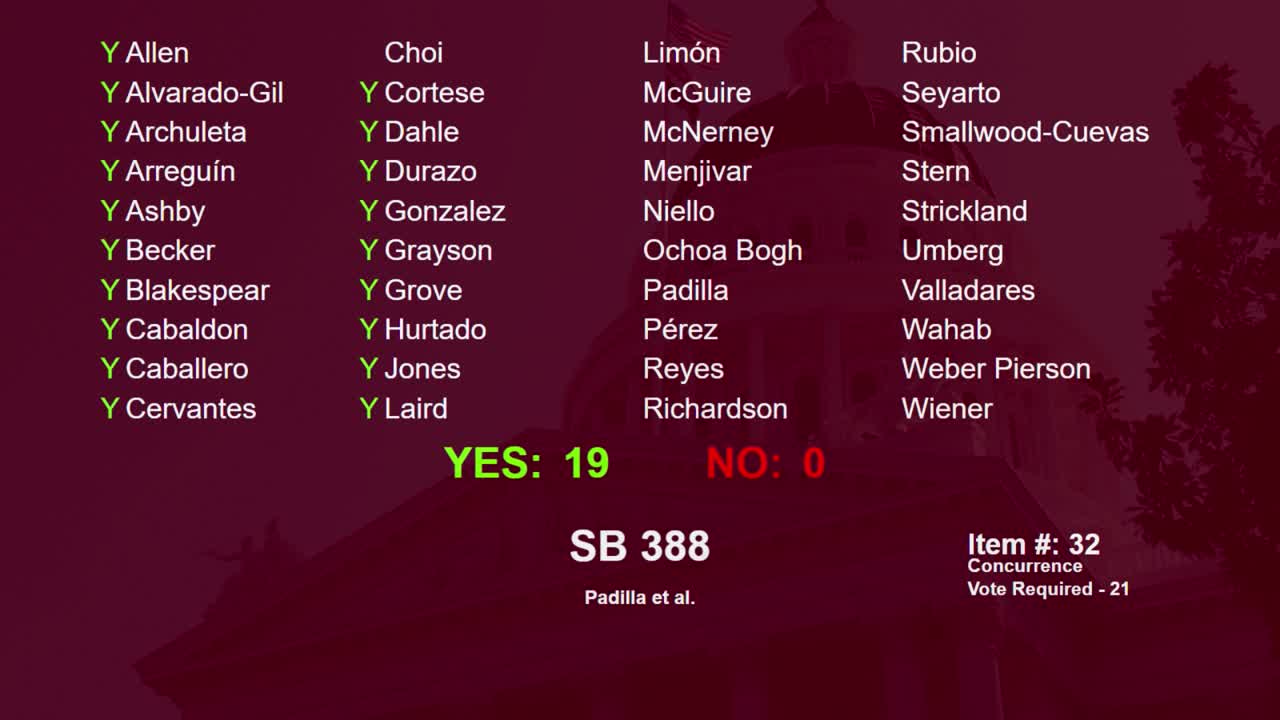 2MIN
Senate Floor
 10MIN
Senate Standing Committee on Energy, Utilities and Communications
 57SEC
Assembly Floor
Bill Author