AB 752: Child daycare facilities.
- Session Year: 2025-2026
- House: Assembly
- Latest Version Date: 2025-10-01
Current Status:
Passed
(2025-10-01: Chaptered by Secretary of State - Chapter 164, Statutes of 2025.)
Introduced
In Committee
Awaiting First Chamber Vote
Passed First Chamber
In Committee
Awaiting Second Chamber Vote
Passed Second Chamber
Enacted
Existing law, the California Child Day Care Facilities Act, provides for the licensure and regulation of daycare centers and family daycare homes by the State Department of Social Services. Under existing law, the use of a home as a small or large family daycare home is considered a residential use of property and a use by right for the purposes of all local ordinances, including zoning ordinances, and a local jurisdiction is prohibited from imposing a business license, fee, or tax for the privilege of operating a small or large family daycare home. Existing law also exempts small and large family daycare homes from the provisions of the California Environmental Quality Act.
This bill would similarly require a daycare center, as defined, when colocated with multifamily housing, to be considered a residential use of property and a use by right, as defined. The bill would similarly prohibit a local jurisdiction from imposing a charge, tax, or fee for a business license, equivalent instrument, or permit for the privilege of operating a daycare center that is colocated with multifamily housing.
The bill would include findings that changes proposed by this bill address a matter of statewide concern rather than a municipal affair and, therefore, apply to all cities, including charter cities.
Existing law, the California Child Day Care Facilities Act, provides for the licensure and regulation of daycare centers and family daycare homes by the State Department of Social Services. Under existing law, the use of a home as a small or large family daycare home is considered a residential use of property and a use by right for the purposes of all local ordinances, including zoning ordinances, and a local jurisdiction is prohibited from imposing a business license, fee, or tax for the privilege of operating a small or large family daycare home. Existing law also exempts small and large family daycare homes from the provisions of the California Environmental Quality Act.
This bill would similarly require a daycare center, as defined, when colocated with multifamily housing or legally established community amenities, housing, to be considered a residential use of property and a use by right, as defined. The bill would similarly prohibit a local jurisdiction from imposing a charge, tax, or fee for a business license, equivalent instrument, or permit for the privilege of operating a daycare center that is colocated with multifamily housing or legally established community amenities, and would exempt a daycare center colocated with multifamily housing or legally established community amenities. housing.
The bill would include findings that changes proposed by this bill address a matter of statewide concern rather than a municipal affair and, therefore, apply to all cities, including charter cities.
Existing law, the California Child Day Care Facilities Act, provides for the licensure and regulation of daycare centers and family daycare homes by the State Department of Social Services. Under existing law, the use of a home as a small or large family daycare home is considered a residential use of property and a use by right for the purposes of all local ordinances, including zoning ordinances, and a local jurisdiction is prohibited from imposing a business license, fee, or tax for the privilege of operating a small or large family daycare home. Existing law also exempts small and large family daycare homes from the provisions of the California Environmental Quality Act.
This bill would similarly require a daycare center, as defined, when colocated with multifamily housing or legally established community amenities, to be considered a residential use of property and a use by right for the purposes of all local ordinances. right, as defined. The bill would similarly prohibit a local jurisdiction from imposing a business license, fee, or tax charge, tax, or fee for a business license, equivalent instrument, or permit for the privilege of operating a daycare center that is colocated with multifamily housing or legally established community amenities, and would exempt a daycare center colocated with multifamily housing or legally established community amenities from the provisions of the California Environmental Quality Act. amenities.
The bill would include findings that changes proposed by this bill address a matter of statewide concern rather than a municipal affair and, therefore, apply to all cities, including charter cities.
Existing law, the California Child Day Care Facilities Act, provides for the licensure and regulation of daycare centers and family daycare homes by the State Department of Social Services. Under existing law, the use of a home as a small or large family daycare home is considered a residential use of property and a use by right for the purposes of all local ordinances, including zoning ordinances, and a local jurisdiction is prohibited from imposing a business license, fee, or tax for the privilege of operating a small or large family daycare home. Existing law also exempts small and large family daycare homes from the provisions of the California Environmental Quality Act.
This bill would similarly require a daycare center, as defined, when colocated with multifamily housing or legally established community amenities, to be considered a residential use of property and a use by right for the purposes of all local ordinances. The bill would similarly prohibit a local jurisdiction from imposing a business license, fee, or tax for the privilege of operating a daycare center that is colocated with multifamily housing or legally established community amenities, and would exempt a daycare center colocated with multifamily housing or legally established community amenities from the provisions of the California Environmental Quality Act.
Under existing law, the California Child Day Care Facilities Act, the State Department of Social Services licenses and regulates child daycare facilities, as defined, and family daycare homes. Existing law requires a licensed child daycare center that is located in a building that was constructed before January 1, 2010, to have its drinking water tested for lead contamination levels on a specified schedule and to notify parents or legal guardians of children enrolled in the daycare center of the requirement to test the drinking water and the results of the test.This bill would make technical, nonsubstantive changes to that provision.Under existing law, the California Child Day Care Facilities Act, the State Department of Social Services licenses and regulates child daycare facilities, as defined, and family daycare homes. Existing law requires a licensed child daycare center that is located in a building that was constructed before January 1, 2010, to have its drinking water tested for lead contamination levels on a specified schedule and to notify parents or legal guardians of children enrolled in the daycare center of the requirement to test the drinking water and the results of the test.
This bill would make technical, nonsubstantive changes to that provision.
(a)When colocated with multifamily housing, the use of a daycare center shall be considered a residential use of property and a use by right.
(b)A local jurisdiction shall not impose a charge, tax, or fee for a business license, equivalent instrument, or permit for the privilege of operating a daycare center that is colocated with multifamily housing.
(c)This section does not preclude a local jurisdiction from doing any of the following:
(1)Placing restrictions on building heights, setback, or lot dimensions of a daycare center, as long as those restrictions are identical to those applied to multifamily housing colocated with that daycare center.
(2)Enacting a local ordinance related to health and safety, building standards, environmental impact standards, or any other matter within the jurisdiction of a local public entity, as long as the local ordinance, as applied to a daycare center, are identical to those applied to multifamily housing colocated with the daycare center.
(3)Enacting a local ordinance to abate nuisances. However, ordinances or nuisance abatement measures shall not distinguish a daycare center from the multifamily housing colocated with the daycare center.
(d)This section shall not relieve a daycare center from complying with all requirements under the California Building Standards Code, the California Fire Code, and other state laws relating to life and fire safety in daycare centers.
(e)This section shall not relieve a daycare center from complying with all state licensing laws and requirements.
(f)For purposes of this section, the following definitions shall apply:
(1)Daycare center has the same meaning as day care center, as defined in Section 1596.76.
(2)Multifamily housing means residential housing with five units or more.
(3)Colocated means operating within, or on the same grounds as, multifamily housing.
(4)Local jurisdiction means a city, county, or city and county.
(5)Use by right means that a local governments review of a daycare center may not require a conditional use permit, planned unit development permit, or any other discretionary local government review or approval that would constitute a project for purposes of Division 13 (commencing with Section 21000) of the Public Resources Code. A local ordinance may provide that use by right does not exempt the use from design review. However, that design review shall not constitute a project for purposes of Division 13 (commencing with Section 21000) of the Public Resources Code.
(g)The Legislature finds and declares that this section addresses a matter of statewide concern rather than a municipal affair as that term is used in Section 5 of Article XI of the California Constitution. Therefore, this section applies to all cities, including charter cities.
(a)When colocated with multifamily housing or legally established community amenities, housing, the use of a daycare center shall be considered a residential use of property and a use by right.
(b)A local jurisdiction shall not impose a charge, tax, or fee for a business license, equivalent instrument, or permit for the privilege of operating a daycare center that is colocated with multifamily housing or legally established community amenities. housing.
(c)This section does not preclude a local jurisdiction from doing any of the following:
(1)Placing restrictions on building heights, setback, or lot dimensions of a daycare center, as long as those restrictions are identical to those applied to the legally established community amenities or multifamily housing colocated with that daycare center.
(2)Enacting a local ordinance related to health and safety, building standards, environmental impact standards, or any other matter within the jurisdiction of a local public entity, as long as the local ordinance, as applied to a daycare center, are identical to those applied to the legally established community amenities or multifamily housing colocated with the daycare center.
(3)Enacting a local ordinance to abate nuisances. However, ordinances or nuisance abatement measures shall not distinguish a daycare center from the legally established community amenities or multifamily housing colocated with the daycare center.
(d)This section shall not relieve a daycare center from complying with all requirements under the California Building Standards Code, the California Fire Code, and other state laws relating to life and fire safety in daycare centers.
(e)This section shall not relieve a daycare center from complying with all state licensing laws and requirements.
(d)(f)For purposes of this section, the following definitions shall apply:
(1)Daycare center has the same meaning as that term is day care center, as defined in Section 1596.76.
(2)Multifamily housing means residential housing with five units or more.
(3)Colocated means operating within, or on the same grounds as, multifamily housing or legally established community amenities. housing.
(4)Legally established community amenities means civic centers, community centers, public recreational centers, public parks, places of worship, schools, colleges, and libraries.(5)(4)Local jurisdiction means a city, county, or city and county.
(6)(5)Use by right means that a local governments review of a daycare center may not require a conditional use permit, planned unit development permit, or any other discretionary local government review or approval that would constitute a project for purposes of Division 13 (commencing with Section 21000) of the Public Resources Code. A local ordinance may provide that use by right does not exempt the use from design review. However, that design review shall not constitute a project for purposes of Division 13 (commencing with Section 21000) of the Public Resources Code.
(e)(g)The Legislature finds and declares that this section addresses a matter of statewide concern rather than a municipal affair as that term is used in Section 5 of Article XI of the California Constitution. Therefore, this section applies to all cities, including charter cities.
(a)When colocated with multifamily housing or legally established community amenities, the use of a daycare center shall be considered a residential use of property and a use by right for the purposes of all local ordinances, including, but not limited to, zoning ordinances. right.
(b)A local jurisdiction shall not impose a business license, fee, or tax charge, tax, or fee for a business license, equivalent instrument, or permit for the privilege of operating a daycare center that is colocated with multifamily housing or legally established community amenities.
(c)A daycare center colocated with multifamily housing or legally established community amenities shall not be subject to the provisions of Division 13 (commencing with Section 21000) of the Public Resources Code.(d)(c)This section does not preclude a city, county, or other local public entity from placing local jurisdiction from doing any of the following:
(1)Placing restrictions on building heights, setback, or lot dimensions of a daycare center, as long as those restrictions are identical to those applied to the legally established community amenities or multifamily housing colocated with that daycare center. This section does not preclude a
(2)Enacting a local ordinance related to health and safety, building standards, environmental impact standards, or any other matter within the jurisdiction of a local public entity, as long as the local ordinance, as applied to a daycare center, are identical to those applied to the legally established community amenities or multifamily housing colocated with the daycare center. This section does not prohibit or restrict the abatement of nuisances by a city, county, or city and county. However,
(3)Enacting a local ordinance to abate nuisances. However, ordinances or nuisance abatement measures shall not distinguish a daycare center from the legally established community amenities or multifamily housing colocated with the daycare center, except as otherwise provided in this chapter. center.
(e)(d)For purposes of this section, the following definitions shall apply:
(1)Daycare center has the same meaning as that term is defined in Section 1596.76.
(2)Multifamily housing means residential housing with a minimum density of five units or more.
(3)Colocated means operating within, or on the same grounds as, multifamily housing or legally established community amenities.
(4)Legally established community amenities means sites that are publicly or privately operated within a residential zone that provide services to the community including, but not limited to, civic centers, community centers, public recreational centers, public parks, places of worship, schools, colleges, and libraries.
(5)Local jurisdiction means a city, county, or city and county.
(6)Use by right means that a local governments review of a daycare center may not require a conditional use permit, planned unit development permit, or any other discretionary local government review or approval that would constitute a project for purposes of Division 13 (commencing with Section 21000) of the Public Resources Code. A local ordinance may provide that use by right does not exempt the use from design review. However, that design review shall not constitute a project for purposes of Division 13 (commencing with Section 21000) of the Public Resources Code.
(e)The Legislature finds and declares that this section addresses a matter of statewide concern rather than a municipal affair as that term is used in Section 5 of Article XI of the California Constitution. Therefore, this section applies to all cities, including charter cities.
(a)When colocated with multifamily housing or legally established community amenities, the use of a daycare center shall be considered a residential use of property and a use by right for the purposes of all local ordinances, including, but not limited to, zoning ordinances.
(b)A local jurisdiction shall not impose a business license, fee, or tax for the privilege of operating a daycare center that is colocated with multifamily housing or legally established community amenities.
(c)A daycare center colocated with multifamily housing or legally established community amenities shall not be subject to the provisions of Division 13 (commencing with Section 21000) of the Public Resources Code.
(d)This section does not preclude a city, county, or other local public entity from placing restrictions on building heights, setback, or lot dimensions of a daycare center, as long as those restrictions are identical to those applied to the legally established community amenities or multifamily housing colocated with that daycare center. This section does not preclude a local ordinance related to health and safety, building standards, environmental impact standards, or any other matter within the jurisdiction of a local public entity, as long as the local ordinance, as applied to a daycare center, are identical to those applied to the legally established community amenities or multifamily housing colocated with the daycare center. This section does not prohibit or restrict the abatement of nuisances by a city, county, or city and county. However, ordinances or nuisance abatement measures shall not distinguish a daycare center from the legally established community amenities or multifamily housing colocated with the daycare center, except as otherwise provided in this chapter.
(e)For purposes of this section, the following definitions shall apply:
(1)Daycare center has the same meaning as that term is defined in Section 1596.76.
(2)Multifamily housing means residential housing with a minimum density of five units or more.
(3)Colocated means operating within, or on the same grounds as, multifamily housing or legally established community amenities.
(4)Legally established community amenities means sites that are publicly or privately operated within a residential zone that provide services to the community including, but not limited to, civic centers, community centers, public recreational centers, public parks, places of worship, schools, colleges, and libraries.
SECTION 1.Section 1597.16 of the Health and Safety Code is amended to read:1597.16.(a)(1)A licensed child daycare center, as defined in Section 1596.76, that is located in a building that was constructed before January 1, 2010, shall have its drinking water tested for lead contamination levels on or after January 1, 2020, but no later than January 1, 2023, and every five years after the date of the initial test.(2)(A)A licensed child daycare center subject to paragraph (1) shall collect and submit drinking water samples to a laboratory accredited pursuant to Article 3 (commencing with Section 100825) of Chapter 4 of Part 1 of Division 101. A laboratory receiving a drinking water sample pursuant to this paragraph shall, in a timely manner, electronically submit its test results to the State Water Resources Control Board using lead data submission methods that are acceptable to the State Water Resources Control Board. If the test results show elevated lead levels, the State Water Resources Control Board shall, in a timely manner, report the results for the affected licensed child daycare center to the department.(B)The State Water Resources Control Board shall do both of the following:(i)Notify the department if there is a change to the recommended action level for lead in water.(ii)Post all test results received pursuant to subparagraph (A) on its internet website in a timely manner. The posted test results shall be readily accessible to the public.(3)Upon notification of elevated lead levels, an affected licensed child daycare center shall immediately make inoperable and cease using the fountains and faucets where elevated lead levels may exist and shall obtain a potable source of water for children and staff at that location. Any licensed child daycare center that fails to take that action is subject to the temporary suspension of their license pursuant to Section 1596.886.(4)A licensed child daycare center shall notify the parents or legal guardians of children enrolled in the daycare center of the requirement to test a facilitys drinking water and of the test results.(b)(1)The department shall, in consultation with the State Water Resources Control Board, adopt regulations for the implementation of the requirements of this section no later than January 1, 2021. The regulations shall include requirements to ensure the collection and submission of valid water samples.(2)In adopting regulations under this section, the department shall include a public stakeholder process.(3)Notwithstanding the Administrative Procedure Act (Chapter 3.5 (commencing with Section 11340) of Part 1 of Division 3 of Title 2 of the Government Code), the department may implement and administer the changes made by this section through all-county letters or similar written instructions until regulations are adopted.(a)(1)A licensed child day care daycare center, as defined in Section 1596.76, that is located in a building that was constructed before January 1, 2010, shall have its drinking water tested for lead contamination levels on or after January 1, 2020, but no later than January 1, 2023, and every five years after the date of the initial test.
(2)(A)A licensed child day care daycare center subject to paragraph (1) shall collect and submit drinking water samples to a laboratory accredited pursuant to Article 3 (commencing with Section 100825) of Chapter 4 of Part 1 of Division 101. A laboratory receiving a drinking water sample pursuant to this paragraph shall, in a timely manner, electronically submit its test results to the State Water Resources Control Board using lead data submission methods that are acceptable to the State Water Resources Control Board. If the test results show elevated lead levels, the State Water Resources Control Board shall, in a timely manner, report the results for the affected licensed child day care daycare center to the department.
(B)The State Water Resources Control Board shall do both of the following:
(i)Notify the department if there is a change to the recommended action level for lead in water.
(ii)Post all test results received pursuant to subparagraph (A) on its Internet Web site internet website in a timely manner. The posted test results shall be readily accessible to the public.
(3)Upon notification of elevated lead levels, an affected licensed child day care daycare center shall immediately make inoperable and cease using the fountains and faucets where elevated lead levels may exist and shall obtain a potable source of water for children and staff at that location. Any licensed child day care daycare center that fails to take that action is subject to the temporary suspension of their license pursuant to Section 1596.886.
(4)A licensed day care child daycare center shall notify the parents or legal guardians of children enrolled in the day care daycare center of the requirement to test a facilitys drinking water and of the test results.
(b)(1)The department shall, in consultation with the State Water Resources Control Board, adopt regulations for the implementation of the requirements of this section no later than January 1, 2021. The regulations shall include requirements to ensure the collection and submission of valid water samples.
(2)In adopting regulations under this section, the department shall include a public stakeholder process.
(3)Notwithstanding the Administrative Procedure Act (Chapter 3.5 (commencing with Section 11340) of Part 1 of Division 3 of Title 2 of the Government Code), the department may implement and administer the changes made by this section through all-county letters or similar written instructions until regulations are adopted.
|
Date
|
Status
|
|---|---|
| Oct 1, 2025 | Chaptered by Secretary of State - Chapter 164, Statutes of 2025. |
| Oct 1, 2025 | Approved by the Governor. |
| Sep 22, 2025 | Enrolled and presented to the Governor at 3 p.m. |
| Sep 10, 2025 | Senate amendments concurred in. To Engrossing and Enrolling. (Ayes 78. Noes 1. Page 3227.). |
| Sep 9, 2025 | In Assembly. Concurrence in Senate amendments pending. |
| Sep 9, 2025 | Read third time. Passed. Ordered to the Assembly. (Ayes 40. Noes 0. Page 2661.). |
| Sep 2, 2025 | Read second time. Ordered to third reading. |
| Aug 29, 2025 | Read third time and amended. Ordered to second reading. |
| Jul 17, 2025 | Read second time and amended. Ordered to third reading. |
| Jul 16, 2025 | From committee: Amend, and do pass as amended. (Ayes 7. Noes 0.) (July 16). |
| Jun 17, 2025 | From committee: Do pass and re-refer to Com. on L. GOV. with recommendation: To Consent Calendar. (Ayes 5. Noes 0.) (June 16). Re-referred to Com. on L. GOV. |
| May 28, 2025 | Referred to Coms. on HUMAN S. and L. GOV. |
| May 15, 2025 | In Senate. Read first time. To Com. on RLS. for assignment. |
| May 15, 2025 | Read third time. Passed. Ordered to the Senate. (Ayes 72. Noes 1. Page 1557.) |
| May 1, 2025 | Read second time. Ordered to third reading. |
| Apr 30, 2025 | From committee: Do pass. (Ayes 7. Noes 0.) (April 29). |
| Mar 25, 2025 | Re-referred to Com. on HUM. S. |
| Mar 24, 2025 | From committee chair, with author's amendments: Amend, and re-refer to Com. on HUM. S. Read second time and amended. |
| Mar 24, 2025 | Referred to Com. on HUM. S. |
| Feb 19, 2025 | From printer. May be heard in committee March 21. |
| Feb 18, 2025 | Read first time. To print. |
|
Date
|
Description
|
Location
|
Votes
|
|
|---|---|---|---|---|
| Sep 10, 2025 | AB 752 Ávila Farías Concurrence in Senate Amendments | Assembly Floor |
Passed |
|
| Sep 9, 2025 | Assembly 3rd Reading AB752 Ávila Farías By Arreguín | Senate Floor |
Passed |
|
| Jul 16, 2025 | Do pass as amended | Senate Standing Committee on Local Government |
Passed |
|
| Jun 16, 2025 | Do pass, but first be re-referred to the Committee on [Local Government] with the recommendation: To Consent Calendar | Senate Standing Committee on Human Services |
Passed |
|
| May 15, 2025 | AB 752 Ávila Farías Assembly Third Reading | Assembly Floor |
Passed |
|
| Apr 29, 2025 | Do pass. | Assembly Standing Committee on Human Services |
Passed |
This list shows positions taken on this bill by organizations on the date displayed, which is linked to the original source.
Positions by individuals are not included.
|
Organization
|
Position
|
Date
|
|---|---|---|
| 223 Individuals | ** Support | |
| 4 private citizens | ** Support | |
| Abundance Network | ** Support | |
| Brion Economics, Inc. | ** Support | |
| Build Up California | ** Support | |
| California Child Care Resource and Referral Network | ** Support | |
| California Coalition for Community Investment | ** Support | |
| California State PTA | ** Support | |
| CAMEO Network | ** Support | |
| Child Action, Inc. | ** Support | |
| City Of San Diego | ** Support | |
| Community Systems Consulting | ** Support | |
| Cross Cultural Family Center | ** Support | |
| Early Care And Education Consortium | ** Support | |
| Family Connections Centers | ** Support | |
| First 5 Alameda County | ** Support | |
| Instituto Familiar de la Raza | ** Support | |
| Kai Ming Head Start | ** Support | |
| Kids Konnect Preschools | ** Support | |
| LA Raza Community Resource Center | ** Support | |
| Lift To Rise | ** Support | |
| Little Acorns Grow | ** Support | |
| Little Tokyo Service Center | ** Support | |
| Low Income Investment Fund | ** Support | |
| Mercy Housing California | ** Support | |
| Mnc Inspiring Success | ** Support | |
| Optimal Solutions Consulting | ** Support | |
| Pacific Islander Community Partnership | ** Support | |
| Precious Lambs Early Learning Academy | ** Support | |
| Safe & Sound | ** Support | |
| San Francisco Family Services Alliance | ** Support | |
| San Jose Grail Family Services | ** Support | |
| Silicon Valley Community Foundation | ** Support | |
| Tandem, Partners in Early Learning | ** Support | |
| Tribal Child Care Association of California | ** Support | |
| Wu Yee Children's Services | ** Support | |
| YMCA of San Diego County | ** Support |
CONCURRENCE IN SENATE AMENDMENTS
CSA1 Bill Id:AB 752
Author:(Ávila Farías)
As Amended Ver:August 29, 2025
Majority vote
SUMMARY
Revises provisions governing colocated daycare centers (centers) by clarifying use by right, prohibiting local charges or fees, striking CEQA exemptions and references to "legally established community amenities," maintaining compliance with state safety and licensing laws, and updating definitions of multifamily housing, colocated, local jurisdiction, and use by right.
Senate Amendments
- Revise the consideration of colocated daycare centers as a residential use of property and a use of by right by striking for the purposes of all local ordinances, including, but not limited to, zoning ordinances.
- Clarify that a local jurisdiction shall not impose a charge, tax, or fee for a business license, equivalent instrument, or permit for the privilege of operating a colocated daycare center.
- Strike the exemption that a center colocated with multifamily housing or legally established communities to not be subject to CEQA.
- Prohibit this section from relieving a daycare center from complying with all requirements under the California Building Standards Code, the California Fire Code, and other state laws relating to life and fire safety in daycare centers.
- Prohibit this section from relieving a daycare center from complying with all state licensing law and requirements.
- Revise the following definitions:
- "Multifamily housing" means residential housing with five units or more.
- "Colocated" means operating within, or on the same grounds as multifamily housing.
- Add the following definitions:
- "Local jurisdiction" to mean a city, county, or city and county.
- "Use by right" to mean that a local government’s review of a daycare center may not require a conditional use permit, planned unit development permit, or any other discretionary local government review or approval that would constitute a "project" for purposes of CEQA. A local ordinance may provide that "use by right" does not exempt the use from design review. However, that design review shall not constitute a "project" for purposes of CEQA.
- Strike references to, and the definition of, "legally established community amenities" to mean sites that are publicly or privately operated within a residential zone that provide services to the community.
- Provide that the Legislature finds and declares that these provisions addresses a matter of statewide concern rather than a municipal affair as that term is used in the California Constitution. Therefore, this section applies to all cities, including charter cities.
COMMENTS
Licensed Childcare. The California Child Day Care Facilities Act governs the licensure, maintenance, and operation of centers and family daycare homes (FCCHs) in the state. This law and the associated regulations found in Title 22 of the California Code of Regulations establish, among other things, general health and safety requirements, staff-to-child ratios, and provider training requirements. The California Department of Social Services' (CDSS) Community Care Licensing Division has the responsibility of licensing and monitoring the state's childcare facilities, which includes centers and FCCHs.
FCCH Protections from Local Restrictions. While FCCHs and centers are required to comply with a range of health, safety, and building standards established in the California Child Day Care Facilities Act and Title 22 regulations, their ability to operate is often shaped by local land use policies.
Until the passage of SB 234 (Skinner), Chapter 244, Statutes of 2019, only small FCCHs were afforded full protection under state law. These homes were required to be considered residential uses for local zoning purposes and were exempted from local business license requirements and fees. Large FCCHs faced more complex rules, and distinct zoning and safety requirements. Although state law required that they be allowed in single-family zones, local jurisdictions could regulate them through one of three paths: treating them as a permitted use, issuing a nondiscretionary permit if standards were met, or requiring a permit under specified conditions. The State Fire Marshal was also required to adopt fire and life safety standards specific to large FCCHs, which otherwise must be treated as single-family residences under building codes.
Presently, both small and large FCCHs are recognized as residential uses by right, which means an FCCH operating in a residentially zoned area must be treated as a residential use and not considered to alter the character of the neighborhood. FCCHs are also exempt from business license fees and environmental review under CEQA. While these protections limit local interference, existing law clarifies that cities and counties may still enforce regulations related to building heights, setbacks, lot dimensions, health and safety, and other matters – provided that these are applied uniformly to all residences within the same zoning designation. Nuisance laws also remain in effect, but cannot target FCCHs differently than other homes in the same zoning category.
Barriers Faced by Childcare Center Facilities. In contrast to FCCHs, center-based childcare facilities continue to face substantial regulatory burdens that limit their integration into neighborhoods, despite strong community need. These facilities are often subjected to lengthy discretionary permitting, inconsistent zoning rules, and full CEQA review, which requires an environmental review for projects that may have a significant impact on the environment, all of which can delay development and increase costs. Local jurisdictions may also impose business taxes or fees that can deter small, community-based operators from opening or expanding services.
These challenges are particularly acute when providers attempt to colocate childcare centers within affordable housing developments. As highlighted in A Community Win-Win, a 2023 report on colocation in San Diego County, the misalignment of land use regulations, building codes, and childcare licensing processes creates significant uncertainty and expense. Developers frequently abandon plans to include childcare due to permitting delays or additional approval requirements like conditional use permits, barriers that also jeopardize their ability to qualify for housing funds such as Low-Income Housing Tax Credits. Together, these layers of regulations can deter the integration of childcare into multifamily housing, despite growing demand for accessible, neighborhood-based early care options.
This bill extends these same protections and streamlining processes afforded to small and large FCCHs to centers that are colocated with multifamily housing. This approach mirrors existing provisions for FCCHs, aiming to reduce regulatory barriers and promote the integration of childcare services within residential settings. Under this bill, such colocated centers are to be treated as a residential use of property and a use by right. This designation prevents local jurisdictions from imposing additional charges, taxes, or fees for a business license, equivalent instrument, or permit, specifically on these facilities.
This bill also ensures that any local regulations concerning building heights, setbacks, or lot dimensions applied to these centers must be identical to those applied to the colocated multifamily housing. This uniformity in regulation attempts to prevent discriminatory practices and encourages the development of centers in areas where families live and gather.
Equity Implications: Colocating child daycare centers with multifamily housing presents a strategic opportunity to expand access to early care and education, particularly in underserved neighborhoods. Integrating centers into residential developments allows families to access childcare where they live, reducing transportation barriers and enhancing convenience for working parents. This bill aims to support family stability and strengthens community ties by embedding essential services within walkable, familiar settings.
According to the Author
"Solving the child care crisis in our state will require multiple approaches, one of which is reducing barriers to developing new child care facilities. We know child care providers and housing developers need more funding to build new facilities and expand and renovate existing ones. In addition, they need the state to reduce the regulatory barriers that exist that slow down development or make it unbearably expensive. Child care providers as well as multi-family housing developers have named restrictive, burdensome, and expensive zoning requirements as a critical barrier to address. Child care centers are typically a conditional use in residential zones. These permits frequently have additional land use requirements, such as extra documentation or studies, higher fees, or infrastructure improvements. [This bill] will make child care facilities that are colocated with multi-family housing developments by right in residential zones, helping to solve the child care crisis and spurring the development of new high-quality facilities for our children throughout the state."
Arguments in Support
According to Low Income Investment Fund and Build Up California, "Co-locating child care centers with multi-family housing developments and other community amenities is a promising strategy to support all families in California. Co-location recognizes that quality early care and education is both a critical source of support for families and a broader community amenity that contributes to the strength of the local economy. Co-located development is rooted in evidence of what young children and their families need to thrive, but it has broad benefits beyond individual households. In addition to the well-established ways access to stable, reliable child care and housing supports child development and family economic stability, infusing housing resources into the child care sector also opens up new opportunities for the predominantly women- and women of color-owned small businesses that provide most child care in California. Parents who have access to high-quality childcare and affordable housing also have an easier time balancing work and meeting the diverse demands of raising a family. Locating child care centers within residential developments is also a direct climate resilience intervention, reducing long commutes and increasing abilities of residents to walk, bike, or take public transit to bring their children to care."
Arguments in Opposition
No opposition on file.
FISCAL COMMENTS
This bill was keyed non-fiscal by the Legislative Counsel.
VOTES:
ASM HUMAN SERVICES: 7-0-0
YES: Lee, Castillo, Calderon, Elhawary, Jackson, Celeste Rodriguez, Tangipa
ASSEMBLY FLOOR: 72-1-6
YES: Addis, Aguiar-Curry, Ahrens, Alvarez, Ávila Farías, Bains, Bauer-Kahan, Bennett, Berman, Bonta, Bryan, Calderon, Caloza, Carrillo, Chen, Connolly, Davies, DeMaio, Dixon, Elhawary, Ellis, Flora, Fong, Gabriel, Gallagher, Garcia, Gipson, Jeff Gonzalez, Mark González, Hadwick, Haney, Harabedian, Hart, Hoover, Irwin, Jackson, Kalra, Krell, Lackey, Lee, Lowenthal, Macedo, McKinnor, Muratsuchi, Nguyen, Ortega, Pacheco, Patel, Patterson, Pellerin, Petrie-Norris, Ramos, Ransom, Celeste Rodriguez, Michelle Rodriguez, Rogers, Blanca Rubio, Sanchez, Schiavo, Schultz, Sharp-Collins, Solache, Soria, Ta, Tangipa, Valencia, Wallis, Ward, Wicks, Wilson, Zbur, Rivas
NO: Boerner
ABS, ABST OR NV: Alanis, Arambula, Castillo, Papan, Quirk-Silva, Stefani
UPDATED
VERSION: August 29, 2025
CONSULTANT: Bri-Ann Hernández-Mengual / HUM. S. / (916) 319-2089 FN: 0001932
SENATE RULES COMMITTEE Office of Senate Floor Analyses (916) 651-1520 Fax: (916) 327-4478 | AB 752 |
THIRD READING
Bill No: AB 752
Author: Ávila Farías (D)
Amended: 8/29/25 in Senate
Vote: 21
SENATE HUMAN SERVICES COMMITTEE: 5-0, 6/16/25
AYES: Arreguín, Ochoa Bogh, Becker, Limón, Wahab
SENATE LOCAL GOVERNMENT COMMITTEE: 7-0, 7/16/25
AYES: Durazo, Choi, Arreguín, Cabaldon, Laird, Seyarto, Wiener
ASSEMBLY FLOOR: 72-1, 5/15/25 - See last page for vote
SUBJECT: Child daycare facilities
SOURCE: Build Up California - Early Learning and Care Facilities
Low Income Investment Fund
DIGEST:
This bill provides that a daycare center that is colocated with multifamily housing shall be considered a residential use of property and a use by right.
Senate Floor Amendments of 8/29/25 strike references to legally established community amenities; specify colocated daycare centers must still adhere to building standards and fire code requirements, per author’s office agreement with Department of Social Services.
ANALYSIS:
Existing law:
- Establishes the California Child Day Care Facilities Act to create a separate licensing category for child day care centers and family day care homes within the existing licensing structure at the California Department of Social Services (CDSS). (Health and Safety Code (HSC) § 1596.70 et seq.)
- Defines “child day care facility” to mean a facility that provides nonmedical care to children under 18 years of age in need of personal services, supervision, or assistance essential for sustaining the activities of daily living or for the protection of the individual on less than a 24-hour basis. Child day care facilities include day care centers, employer-sponsored child care centers, and family day care homes. (HSC § 1596.750)
- Defines “day care center” as a child day care facility other than a family day care home, and includes infant centers, preschools, extended day care facilities, and schoolage child care centers, and includes child care centers with a single license. (HSC § 1596.76)
- Prohibits any person or entity operating a child day care facility from providing care or supervision without a valid license from CDSS. (22 California Code of Regulations (CCR) § 101156(a))
- Declares that the state building code, fire code, and regulations promulgated pursuant to those provisions, shall preempt local laws, regulations, and rules governing the use and occupancy of family day care homes. Provides that local laws, regulations, or rules shall not directly or indirectly prohibit or restrict the use of a facility as a family daycare home, including, but not limited to, precluding the operation of a family daycare home. (HSC § 1597.40)
- Provides that the use of a home as a family daycare home, operated under the standards of state law, in a residentially zoned area shall be considered a residential use of property for the purposes of all local ordinances, regulations, and rules, and shall not fundamentally alter the nature of the underlying residential use. (HSC § 1597.42)
- Provides that the use of a home as a family daycare home shall be considered a residential use of property and a use by right for the purposes of all local ordinances, including, but not limited to, zoning ordinances. (HSC § 1597.45(a))
- Provides that a local jurisdiction shall not impose a business license, fee, or tax for the privilege of operating a family daycare home. (HSC § 1597.45(b))
- Provides that a family daycare home shall not be subject to the California Environmental Quality Act (CEQA). (HSC § 1597.45(d))
- Provides that a city, county, other local public entity, or local ordinance shall not be precluded from placing specified restrictions on a family daycare center, as long as those restrictions are identical to those applied to all other residences with the same zoning designation as the family daycare home. Provides that this section does not prohibit or restrict the abatement of nuisances by a city, county, or city and county; however, ordinances or nuisance abatement measures shall not distinguish a family daycare center from other homes with the same zoning designation, except as otherwise provided. (HSC 1597.45(e))
- Establishes CEQA, which governs environmental review processes for public and private projects in California and outlines requirements and procedures for assessing and mitigating environmental impacts. (Public Resources Code § 21000 et seq.)
This bill:
- Defines the following terms for purposes of this bill:
- “Daycare center” has the same meaning as (2) above.
- “Multifamily housing” means residential housing with five units or more.
- “Colocated” means operating within, or on the same grounds as, multifamily housing.
- “Local jurisdiction” means a city, county, or city and county.
- “Use by right” means that a local government’s review of a daycare center may not require a conditional use permit, planned unit development permit, or any other discretionary local government review or approval that would constitute a “project” for purposes of CEQA. A local ordinance may provide that “use by right” does not exempt the use from design review. However, that design review shall not constitute a “project” for purposes of CEQA.
- Provides that, when a daycare center is colocated with multifamily housing, the use of a daycare center shall be considered a residential use of property and a use by right.
- Provides that a local jurisdiction shall not impose a charge, tax, or fee for a business license, equivalent instrument, or permit for the privilege of operating a daycare center that is colocated with multifamily housing.
- Provides that this bill does not preclude a local jurisdiction from doing any of the following:
- Placing specified restrictions on a daycare center, as long as those restrictions are identical to those applied to the colocated multifamily housing.
- Enacting local ordinances, as specified, as long as the ordinance, as applied to a daycare center, is identical to those applied to the colocated multifamily housing.
- Enacting local ordinances to abate nuisances. However, ordinances or nuisance abatement measures must not distinguish a daycare center from the colocated multifamily housing.
- Provides that this section shall not relieve a daycare center from complying with all requirements under the California Building Standards Code, the California Fire Code, and other state laws relating to life and fire safety in daycare centers.
- Provides that this section shall not relieve a daycare center from complying with all state licensing laws and requirements.
- Provides that the Legislature finds and declares that this bill addresses a matter of statewide concern rather than a municipal affair. Therefore, this bill applies to all cities, including charter cities.
Background
Purpose of this Bill. According to the author, “Solving the child care crisis in our state will require multiple approaches, one of which is reducing barriers to developing new child care facilities. Child care providers as well as multi-family housing developers have named restrictive, burdensome, and expensive zoning requirements as a critical barrier to address. Child care centers are typically a conditional use in residential zones. These permits frequently have additional land use requirements, such as extra documentation or studies, higher fees, or infrastructure improvements. AB 752 will make child care facilities that are co-located with multi-family housing developments use by right in residential zones, helping to solve the child care crisis and spurring the development of new high-quality facilities for our children throughout the state.”
Child Care Facilities. A family child care home is a child care business that is operated in the licensee’s own home. Families might choose family child care because the family child care home is close to where they live or because they prefer a home-like setting. Small family child care homes may care for up to eight children, and large family child care homes may care for up to 14 children.
Statute defines a child care center as a child care facility other than a family child care home. Child care centers are usually located in commercial buildings. Child care centers may have multiple classrooms, enabling them to serve more children than family child care homes. Families who choose center-based care might do so because the center is close to where they live or work. State licensing regulations require child care centers to adhere to teacher-child ratios, which set a maximum number of children who may be served.
As of June 2024, there were 27,563 licensed family child care homes in California with a total capacity to serve 298,871 children; and 9,887 licensed child care centers with a total capacity to serve 589,525. According to CDSS, the state gained 43,295 licensed child care facilities between April 2024 and April 2025, with the capacity to serve over 1 million additional children.
Colocation and Local Zoning Laws. Colocation is the inclusion of family child care homes and/or child care centers in housing development. A 2021 report by the Low Income Investment Fund (LIIF) presented the colocation of child care facilities with affordable housing developments as a promising strategy to promote housing stability and economic mobility for low income families. Given that family child care is provided in a licensee’s own home, family child care is a straightforward choice to be colocated with housing developments. This bill proposes to consider child care centers colocated with multifamily housing a residential use of property and a use by right as a strategy to increase families’ access to child care within residential zones.
SB 234 (Skinner, Chapter 244, Statutes of 2019) made all family child care homes a residential use of property and a use by right for purposes of all local ordinances, and prohibited all family child care homes from being subject to a business license, tax, or fee. Prior to SB 234, large family child care homes were subject to local zoning requirements, while small family child care homes were exempt. This bill would apply similar exemptions to a child care center when it is colocated with multifamily housing. In a recent survey conducted by LIIF of five cities in two California counties, permit-related fees imposed on child care centers can range between $875 and $9,324. Jurisdictions may also charge fees for planning, business license, and fire clearance and inspection.
Related/Prior Legislation
SB 234 (Skinner, Chapter 244, Statutes of 2019) required a large family daycare home to be treated as a residential use of property for purposes of all local ordinances, among other things.
AB 131 (Committee on Budget, Chapter 116, Statutes of 2021), a budget trailer bill, established the Child Care and Development Infrastructure Grant Program at CDSS to expand access to child care and preschool opportunities for children up to five years of age by providing resources to build new facilities or retrofit, renovate, repair, or expand existing facilities. AB 131 also established a timeline to phase in 200,000 new slots to the state’s subsidized child care system.
Comments
This bill seeks to alleviate startup and ongoing costs for child care centers colocated with multifamily housing by considering these centers a residential use of property and a use by right. The practice of colocating child care with housing has been shown to be a promising practice for increasing access to child care, which is closely associated with families’ job stability and well-being.
[NOTE: See the Senate Local Government Committee analysis for additional background on this bill.]
FISCAL EFFECT: Appropriation: No Fiscal Com.: No Local: No
SUPPORT: (Verified 8/29/25)
Build Up California - Early Learning and Care Facilities (Sponsor)
Low Income Investment Fund (Sponsor)
23 Individuals
Abundance Network
Brion Economics, INC.
California Child Care Resource and Referral Network
California Coalition for Community Investment
California State PTA
Cameo Network
Child Action, INC.
City of San Diego
Community Systems Consulting
Cross Cultural Family Center
Early Care and Education Consortium
Family Connections Centers
First 5 Alameda County
Instituto Familiar De LA Raza
Kai Ming Head Start
Kids Konnect Preschools
LA Raza Community Resource Center
Lift to Rise
Little Acorns Grow
Little Tokyo Service Center
Mercy Housing California
Mnc Inspiring Success
Optimal Solutions Consulting
Pacific Islander Community Partnership
Precious Lambs Early Learning Academy
Safe & Sound
San Francisco Family Services Alliance
San Jose Grail Family Services
Tandem, Partners in Early Learning
Tribal Child Care Association of California
Wu Yee Children's Services
YMCA of San Diego County
OPPOSITION: (Verified 8/29/25)
None received
ASSEMBLY FLOOR: 72-1, 5/15/25
AYES: Addis, Aguiar-Curry, Ahrens, Alvarez, Ávila Farías, Bains, Bauer-Kahan, Bennett, Berman, Bonta, Bryan, Calderon, Caloza, Carrillo, Chen, Connolly, Davies, DeMaio, Dixon, Elhawary, Ellis, Flora, Fong, Gabriel, Gallagher, Garcia, Gipson, Jeff Gonzalez, Mark González, Hadwick, Haney, Harabedian, Hart, Hoover, Irwin, Jackson, Kalra, Krell, Lackey, Lee, Lowenthal, Macedo, McKinnor, Muratsuchi, Nguyen, Ortega, Pacheco, Patel, Patterson, Pellerin, Petrie-Norris, Ramos, Ransom, Celeste Rodriguez, Michelle Rodriguez, Rogers, Blanca Rubio, Sanchez, Schiavo, Schultz, Sharp-Collins, Solache, Soria, Ta, Tangipa, Valencia, Wallis, Ward, Wicks, Wilson, Zbur, Rivas
NOES: Boerner
NO VOTE RECORDED: Alanis, Arambula, Castillo, Papan, Quirk-Silva, Stefani
Prepared by: Diana Dominguez / HUMAN S. / (916) 651-1524
9/2/25 18:27:21
**** END ****
SENATE RULES COMMITTEE Office of Senate Floor Analyses (916) 651-1520 Fax: (916) 327-4478 | AB 752 |
THIRD READING
Bill No: AB 752
Author: Ávila Farías (D)
Amended: 7/17/25 in Senate
Vote: 21
SENATE HUMAN SERVICES COMMITTEE: 5-0, 6/16/25
AYES: Arreguín, Ochoa Bogh, Becker, Limón, Wahab
SENATE LOCAL GOVERNMENT COMMITTEE: 7-0, 7/16/25
AYES: Durazo, Choi, Arreguín, Cabaldon, Laird, Seyarto, Wiener
ASSEMBLY FLOOR: 72-1, 5/15/25 - See last page for vote
SUBJECT: Child daycare facilities
SOURCE: Build Up California - Early Learning and Care Facilities
Low Income Investment Fund
DIGEST:
This bill provides that the use of a daycare center that is colocated with multifamily housing or legally established community amenities shall be considered a residential use of property and a use by right, as defined.
ANALYSIS:
Existing Law:
- Establishes the California Child Day Care Facilities Act to create a separate licensing category for child day care centers and family day care homes within the existing licensing structure at the California Department of Social Services (CDSS). (Health and Safety Code (HSC) Section 1596.70 et seq.)
- Defines “child day care facility” to mean a facility that provides nonmedical care to children under 18 years of age in need of personal services, supervision, or assistance essential for sustaining the activities of daily living or for the protection of the individual on less than a 24-hour basis. Child day care facilities include day care centers, employer-sponsored child care centers, and family day care homes. (HSC Section 1596.750)
- Defines “day care center” as a child day care facility other than a family day care home, and includes infant centers, preschools, extended day care facilities, and schoolage child care centers, and includes child care centers with a single license. (HSC 1596.76)
- Prohibits any person or entity operating a child day care facility from providing care or supervision without a valid license from CDSS. (22 CCR 101156(a))
- Declares that the state building code, fire code, and regulations promulgated pursuant to those provisions, shall preempt local laws, regulations, and rules governing the use and occupancy of family day care homes. Provides that local laws, regulations, or rules shall not directly or indirectly prohibit or restrict the use of a facility as a family daycare home, including, but not limited to, precluding the operation of a family daycare home. (HSC 1597.40)
- Provides that the use of a home as a family daycare home, operated under the standards of state law, in a residentially zoned area shall be considered a residential use of property for the purposes of all local ordinances, regulations, and rules, and shall not fundamentally alter the nature of the underlying residential use. (HSC 1597.42)
- Provides that the use of a home as a family daycare home shall be considered a residential use of property and a use by right for the purposes of all local ordinances, including, but not limited to, zoning ordinances. (HSC 1597.45(a))
- Provides that a local jurisdiction shall not impose a business license, fee, or tax for the privilege of operating a family daycare home. (HSC 1597.45(b))
- Provides that a family daycare home shall not be subject to the California Environmental Quality Act (CEQA). (HSC 1597.45(d))
- Provides that a city, county, other local public entity, or local ordinance shall not be precluded from placing specified restrictions on a family daycare center, as long as those restrictions are identical to those applied to all other residences with the same zoning designation as the family daycare home. Provides that this section does not prohibit or restrict the abatement of nuisances by a city, county, or city and county; however, ordinances or nuisance abatement measures shall not distinguish a family daycare center from other homes with the same zoning designation, except as otherwise provided. (HSC 1597.45(e))
- Establishes CEQA, which governs environmental review processes for public and private projects in California and outlines requirements and procedures for assessing and mitigating environmental impacts. (Public Resources Code 21000 et seq.)
This bill
- Defines the following terms for purposes of this bill:
- “Daycare center” has the same meaning as (2) above.
- “Multifamily housing” means residential housing with five units or more.
- “Colocated” means operating within, or on the same grounds as, multifamily housing or legally established community amenities.
- “Legally established community amenities” means civic centers, community centers, public recreational centers, public parks, places of worship, schools, colleges, and libraries.
- “Local jurisdiction” means a city, county, or city and county.
- “Use by right” means that a local government’s review of a daycare center may not require a conditional use permit, planned unit development permit, or any other discretionary local government review or approval that would constitute a “project” for purposes of CEQA. A local ordinance may provide that “use by right” does not exempt the use from design review. However, that design review shall not constitute a “project” for purposes of CEQA.
- Provides that, when a daycare center is colocated with multifamily housing or legally established community amenities, the use of a daycare center shall be considered a residential use of property and a use by right.
- Provides that a local jurisdiction shall not impose a charge, tax, or fee for a business license, equivalent instrument, or permit for the privilege of operating a daycare center that is colocated with multifamily housing or legally established community amenities.
- Provides that this bill does not preclude a local jurisdiction from doing any of the following:
- Placing specified restrictions on a daycare center, as long as those restrictions are identical to those applied to the colocated multifamily housing or legally established community amenities.
- Enacting local ordinances, as specified, as long as the ordinance, as applied to a daycare center, is identical to those applied to the colocated multifamily housing or legally established community amenities.
- Enacting local ordinances to abate nuisances. However, ordinances or nuisance abatement measures must not distinguish a daycare center from the colocated multifamily housing or legally established community amenities.
- Provides that the Legislature finds and declares that this bill addresses a matter of statewide concern rather than a municipal affair. Therefore, this bill applies to all cities, including charter cities.
Background
Purpose of this Bill. According to the author, “Solving the child care crisis in our state will require multiple approaches, one of which is reducing barriers to developing new child care facilities. Child care providers as well as multi-family housing developers have named restrictive, burdensome, and expensive zoning requirements as a critical barrier to address. Child care centers are typically a conditional use in residential zones. These permits frequently have additional land use requirements, such as extra documentation or studies, higher fees, or infrastructure improvements. AB 752 will make child care facilities that are co-located with multi-family housing developments or other community amenities by right in residential zones, helping to solve the child care crisis and spurring the development of new high-quality facilities for our children throughout the state.”
Child Care Facilities. A family child care home is a child care business that is operated in the licensee’s own home. Families might choose family child care because the family child care home is close to where they live or because they prefer a home-like setting. Small family child care homes may care for up to eight children, and large family child care homes may care for up to 14 children.
Statute defines a child care center as a child care facility other than a family child care home. Child care centers are usually located in commercial buildings. Child care centers may have multiple classrooms, enabling them to serve more children than family child care homes. Families who choose center-based care might do so because the center is close to where they live or work. State licensing regulations require child care centers to adhere to teacher-child ratios, which set a maximum number of children who may be served.
As of June 2024, there were 27,563 licensed family child care homes in California with a total capacity to serve 298,871 children; and 9,887 licensed child care centers with a total capacity to serve 589,525. According to CDSS, the state gained 43,295 licensed child care facilities between April 2024 and April 2025, with the capacity to serve over 1 million additional children.
Colocation and Local Zoning Laws. Colocation is the inclusion of family child care homes and/or child care centers in housing development. A 2021 report by the Low Income Investment Fund (LIIF) presented the colocation of child care facilities with affordable housing developments as a promising strategy to promote housing stability and economic mobility for low income families. Given that family child care is provided in a licensee’s own home, family child care is a straightforward choice to be colocated with housing developments. This bill proposes to exempt child care centers colocated with multifamily housing and other community amenities from local ordinances, including local zoning laws, as a strategy to increase families’ access to child care within residential zones.
SB 234 (Skinner, Chapter 244, Statutes of 2019) made all family child care homes a residential use of property and a use by right for purposes of all local ordinances, and prohibited all family child care homes from being subject to a business license, tax, or fee. Prior to SB 234, large family child care homes were subject to local zoning requirements, while small family child care homes were exempt. This bill would apply similar exemptions to a child care center when it is colocated with multifamily housing or legally established community amenities, defined as civic centers, public parks, places of worship, schools and colleges, and libraries. In a recent survey conducted by LIIF of five cities in two California counties, permit-related fees imposed on child care centers can range between $875 and $9,324. Jurisdictions may also charge fees for planning, business license, and fire clearance and inspection.
Comments
This bill seeks to alleviate startup and ongoing costs for child care centers colocated with multifamily housing and community amenities by exempting these centers from local ordinances. The practice of colocating child care with housing has been shown to be a promising practice for increasing access to child care, which is closely associated with families’ job stability and well-being.
[NOTE: See the Senate Local Government Committee analysis for additional background on this bill.]
Related/Prior Legislation
SB 234 (Skinner, Chapter 244, Statutes of 2019) required a large family daycare home to be treated as a residential use of property for purposes of all local ordinances, among other things.
AB 131 (Committee on Budget, Chapter 116, Statutes of 2021), a budget trailer bill, established the Child Care and Development Infrastructure Grant Program at CDSS to expand access to child care and preschool opportunities for children up to five years of age by providing resources to build new facilities or retrofit, renovate, repair, or expand existing facilities. AB 131 also established a timeline to phase in 200,000 new slots to the state’s subsidized child care system.
FISCAL EFFECT: Appropriation: No Fiscal Com.: No Local: No
SUPPORT: (Verified 8/13/25)
Build Up California - Early Learning and Care Facilities (Source)
Low Income Investment Fund (Source)
23 Individuals
Abundance Network
Brion Economics, INC.
California Child Care Resource and Referral Network
California Coalition for Community Investment
California State PTA
Cameo Network
Child Action, INC.
City of San Diego
Community Systems Consulting
Cross Cultural Family Center
Early Care and Education Consortium
Family Connections Centers
First 5 Alameda County
Instituto Familiar De LA Raza
Kai Ming Head Start
Kids Konnect Preschools
LA Raza Community Resource Center
Lift to Rise
Little Acorns Grow
Little Tokyo Service Center
Mercy Housing California
Mnc Inspiring Success
Optimal Solutions Consulting
Pacific Islander Community Partnership
Precious Lambs Early Learning Academy
Safe & Sound
San Francisco Family Services Alliance
San Jose Grail Family Services
Tandem, Partners in Early Learning
Tribal Child Care Association of California
Wu Yee Children's Services
YMCA of San Diego County
OPPOSITION: (Verified 8/13/25)
None received
ASSEMBLY FLOOR: 72-1, 5/15/25
AYES: Addis, Aguiar-Curry, Ahrens, Alvarez, Ávila Farías, Bains, Bauer-Kahan, Bennett, Berman, Bonta, Bryan, Calderon, Caloza, Carrillo, Chen, Connolly, Davies, DeMaio, Dixon, Elhawary, Ellis, Flora, Fong, Gabriel, Gallagher, Garcia, Gipson, Jeff Gonzalez, Mark González, Hadwick, Haney, Harabedian, Hart, Hoover, Irwin, Jackson, Kalra, Krell, Lackey, Lee, Lowenthal, Macedo, McKinnor, Muratsuchi, Nguyen, Ortega, Pacheco, Patel, Patterson, Pellerin, Petrie-Norris, Ramos, Ransom, Celeste Rodriguez, Michelle Rodriguez, Rogers, Blanca Rubio, Sanchez, Schiavo, Schultz, Sharp-Collins, Solache, Soria, Ta, Tangipa, Valencia, Wallis, Ward, Wicks, Wilson, Zbur, Rivas
NOES: Boerner
NO VOTE RECORDED: Alanis, Arambula, Castillo, Papan, Quirk-Silva, Stefani
Prepared by: Diana Dominguez / HUMAN S. / (916) 651-1524
8/14/25 16:22:52
**** END ****
SENATE COMMITTEE ON LOCAL GOVERNMENT
Senator María Elena Durazo, Chair
2025 - 2026 Regular
Bill No: | AB 752 | Hearing Date: | 7/16/25 |
Author: | Ávila Farías | Fiscal: | No |
Version: | 3/24/25 | Consultant: | Peterson |
Child daycare facilities
Limits the ability for local agencies to regulate child daycare facilities when those facilities are colocated with multifamily housing or other specified community amenities.
Background
The California Constitution allows cities and counties to “make and enforce within its limits, all local, police, sanitary and other ordinances and regulations not in conflict with general laws.” It is from this fundamental power (commonly called the police power) that cities and counties derive their authority to regulate behavior to preserve the health, safety, and welfare of the public—including land use authority.
Planning and Zoning Law. State law provides additional powers and duties for cities and counties regarding land use. The Planning and Zoning Law requires every county and city to adopt a general plan that sets out planned uses for all of the area covered by the plan. A general plan must include specified mandatory “elements,” including a housing element that establishes the locations and densities of housing, and a land use element that describes the general categories of uses (such as multifamily residential, single family residential, retail commercial, and open space) that are allowed in specific portions of a jurisdiction. Cities’ and counties’ major land use decisions—including zoning ordinances and other aspects of development permitting—must be consistent with their general plans. General plans also include policies, standards, and mitigation measures that developments must comply with, to protect against flood hazards, fire hazards, and climate change, and to further environmental justice, among other state goals.
Local governments use their police power to enact zoning ordinances that establish the types of land uses that are allowed or authorized in an area. Zoning ordinances also contain provisions to physically shape development and impose other requirements, such as setting maximum heights and densities for housing units, minimum numbers of required parking spaces, setbacks, and lot coverage ratios. These ordinances can also include conditions on development to address aesthetics, community impacts, or other particular site-specific considerations.
Child day care facilities. The California Child Day Care Facilities Act governs the licensure, maintenance, and operation of child day care facilities in the state. This law and the associated regulations adopted by the California Department of Social Services’ (CDSS) establish, among other things, general health and safety requirements, staff-to-child ratios, and provider training requirements. The CDSS Community Care Licensing Division has the responsibility of licensing and monitoring the state’s child day care facilities.
There are different types of child day care facilities:
- Family daycare homes are operated in the licensee’s own home, which may be rented, leased, or owned, and are permitted to be in a mobile home park or an apartment. These homes provide non-medical care and supervision in a family-like setting with all the daily activities associated with home. Family daycare homes are further categorized into small (eight or fewer children) and large homes (as many as 14) based on the size of the childcare group and the ages of the children.
- Child care centers are child day care facilities other than a family daycare home. Child care may be part of a large childcare corporation or locally owned and are usually located in commercial buildings, schools, religious facilities, public buildings, or private buildings. Centers can accommodate infants, toddlers, preschoolers, and school-age children. Separate licenses are required to care for infants, preschoolers, and school-age children, although a center may be licensed to care for all three age groups at one site. Depending on their age, children receive care in separate areas at the center for safety and activity reasons.
SB 234 (Skinner, 2019) made all family daycare homes a residential use of property and a use by right for purposes of all local ordinances, and prohibited all family daycare homes from being subject to a business license, tax, or fee. Prior to SB 234, large family child care homes were subject to local zoning requirements, while small family daycare homes were exempt.
Daycare center providers want the Legislature to grant an exemption from local zoning and business license provisions similar to the one SB 234 provided to child care homes.
Proposed Law
Assembly Bill 752 requires local jurisdictions to consider a daycare center colocated with multifamily housing, meaning density of five units or more, or legally established community amenities to be a residential use of property and a use by right for the purposes of all local ordinances. Additionally, the measure prohibits a local jurisdiction from imposing a business license, fee, or tax on a daycare center colocated with multifamily or legally established community amenities for the privilege of operating a daycare center. Finally, the measure includes an exemption from the California Environmental Quality Act for these facilities.
AB 752 provides that it does not prohibit or preclude a city, county, or other local public entity from:
- Placing restrictions on building heights, setbacks, or lot dimensions as long as those restrictions are identical to those applied to the legally established community amenities of multifamily housing colocated with the daycare center;
- Enacting a local ordinance related to health and safety, building standards, environmental impact standards, or other matters in their jurisdiction if it is applied identically to the legally established community amenities of multifamily housing colocated with the daycare center; or
- Abating nuisances if the nuisance abatement measure or ordinance does not distinguish a daycare center from the legally established community amenities or multifamily housing colocated with the daycare center.
The measure defines “legally established community amenities” to mean publicly or privately operated sites within a residential zone that provide services to the community including, but not limited to, civic centers, community centers, public recreational centers, public parks, places of worship, schools, colleges, and libraries.
Comments
1. Purpose of the bill. According to the author, “Solving the child care crisis in our state will require multiple approaches, one of which is reducing barriers to developing new child care facilities. We know child care providers and housing developers need more funding to build new facilities and expand and renovate existing ones. In addition they need the state to reduce the regulatory barriers that exist that slow down development or make it unbearably expensive. Child care providers as well as multi-family housing developers have named restrictive, burdensome, and expensive zoning requirements as a critical barrier to address. Child care centers are typically a conditional use in residential zones. These permits frequently have additional land use requirements, such as extra documentation or studies, higher fees, or infrastructure improvements. AB 752 will make child care facilities that are co-located with multi-family housing developments or other community amenities by right in residential zones, helping to solve the child care crisis and spurring the development of new high-quality facilities for our children throughout the state.”
2. Home rule. A fundamental principle of zoning since the United States Supreme Court upheld an early zoning ordinance in 1926 (Village of Euclid v. Ambler Realty Co., 272 U.S. 365 (1926)) has been that allowing some uses in one area but prohibiting others can be integral to protecting the public welfare. Local governments have historically separated uses to avoid siting incompatible activities, such as industrial and residential activity, near one another. This approach also mitigates potential public health issues, such as air pollution impacts from heavy industrial uses on nearby residents. AB 752 creates a by right approval process for daycare centers colocated with multifamily housing or other community amenities which could contravene this principle in some cases. When attached to a multifamily housing complex, a daycare center could increase much needed childcare opportunities. However, AB 752 also allows daycare centers by right if constructed with a “community amenity.” Since AB 752 does not limit its list of community amenities, daycare center operators could argue that the local government must approve the facility even if it undermines the planning decisions made by local officials to ensure that daycare facilities are developed safely. The Committee may wish to consider amending the bill to limit the types of community benefits AB 752 applies to.
3. Special treatment. Not only does AB 752 create a by right approval process for daycare centers, it also prohibits local agencies from requiring imposing a business license, fee, or tax on a daycare center colocated with multifamily or legally established community amenities for the privilege of operating a daycare center. This could mean that daycare centers do not have to pay business license fees that all other businesses have to pay. Additionally, AB 752 says that daycare centers do not have to pay taxes for the privilege of operating a daycare center. While there may not be a tax specifically for the privilege of operating a daycare center, it is unclear whether this would exempt daycare centers from all local taxes that a business must pay. While daycare centers are unquestionably important to the community, so are many other types of businesses that still have to pay for a business license or tax. AB 752 gives daycare centers a benefit these other businesses do not enjoy. The Committee may wish to consider amending the bill to clarify the measure’s exemption from business licenses, fees, and taxes for these daycare centers.
4. Charter city. The California Constitution allows cities that adopt charters to control their own “municipal affairs.” In all other matters, charter cities must follow the general, statewide laws. Because the Constitution does not define “municipal affairs,” the courts determine whether a topic is a municipal affair or whether it is an issue of statewide concern. AB 752 does not specify whether or not it is supposed to apply to charter cities. The Committee may to consider amending the bill to specify that its provisions apply to charter cities.
5. Let’s be clear. The Committee may wish to consider the following clarifying and technical amendments to AB 752 to improve the bill’s function:
- AB 752 makes approval of a daycare center by-right. However, the measure does not define what by right means in the context of a daycare center. The Committee may wish to consider amending the bill to define by-right approval for purposes of a daycare center.
- AB 752 has provisions that apply to local jurisdictions, cities and counties, as well as other local public entities. Only cities and counties permit development, so to prevent confusion about the bill’s requirements, the Committee may wish to consider amending the bill to refer only to cities and counties.
- AB 752 applies to projects with densities of five units or more. However, the measure does not clarify whether this means projects with five units or more versus projects with density of five units or more per acre. The Committee may wish to consider amending the bill to clarify this condition.
6. Incoming! The Senate Rules Committee has ordered a double referral of AB 752: first to the Committee on Human Services, which approved AB 752 at its June 16th hearing on a vote of 5-0, and second to the Committee on Local Government.
Assembly Actions
Assembly Human Services Committee: 7-0
Assembly Floor: 72-1
Support and Opposition
(7/11/25)
Support: Build Up California - Early Learning and Care Facilities (Co-Sponsor)
Low Income Investment Fund (Co-Sponsor)
Abundance Network
Brion Economics, INC.
California Child Care Resource and Referral Network
California Coalition for Community Investment
California State Pta
Cameo Network
Child Action, INC.
City of San Diego
Community Systems Consulting
Cross Cultural Family Center
Early Care and Education Consortium
Family Connections Centers
First 5 Alameda County
Instituto Familiar De LA Raza
Kai Ming Head Start
Kids Konnect Preschools
LA Raza Community Resource Center
Lift to Rise
Little Acorns Grow
Little Tokyo Service Center
Mercy Housing California
Mnc Inspiring Success
Optimal Solutions Consulting
Pacific Islander Community Partnership
Precious Lambs Early Learning Academy
Safe & Sound
San Francisco Family Services Alliance
San Jose Grail Family Services
Silicon Valley Community Foundation
Tandem, Partners in Early Learning
Tribal Child Care Association of California
Wu Yee Children's Services
YMCA of San Diego County
23 Individuals
Opposition: None Submitted
-- END --
SENATE COMMITTEE ON HUMAN SERVICES
Senator Arreguín, Chair
2025 - 2026 Regular
Bill No: | AB 752 | ||
Author: | Ávila Farías | ||
Version: | March 24, 2025 | Hearing Date: | June 16, 2025 |
Urgency: | No | Fiscal: | No |
Consultant: | Diana Dominguez | ||
Subject: Child daycare facilities
SUMMARY
This bill provides that the use of a daycare center that is colocated with multifamily housing or legally established community amenities shall be considered a residential use of property and a use by right for purposes of all local ordinances, including zoning ordinances.
ABSTRACT
Existing Law:
- Establishes the California Child Day Care Facilities Act to create a separate licensing category for child day care centers and family day care homes within the existing licensing structure at the California Department of Social Services (CDSS). (HSC 1596.70 et seq.)
- Defines “child day care facility” to mean a facility that provides nonmedical care to children under 18 years of age in need of personal services, supervision, or assistance essential for sustaining the activities of daily living or for the protection of the individual on less than a 24-hour basis. Child day care facilities include day care centers, employer-sponsored child care centers, and family day care homes. (HSC 1596.750)
- Defines “day care center” as a child day care facility other than a family day care home, and includes infant centers, preschools, extended day care facilities, and schoolage child care centers, and includes child care centers with a single license. (HSC 1596.76)
- Prohibits any person or entity operating a child day care facility from providing care or supervision without a valid license from CDSS. (22 CCR 101156(a))
- Declares that the state building code, fire code, and regulations promulgated pursuant to those provisions, shall preempt local laws, regulations, and rules governing the use and occupancy of family day care homes. Provides that local laws, regulations, or rules shall not directly or indirectly prohibit or restrict the use of a facility as a family daycare home, including, but not limited to, precluding the operation of a family daycare home. (HSC 1597.40)
- Provides that the use of a home as a family daycare home, operated under the standards of state law, in a residentially zoned area shall be considered a residential use of property for the purposes of all local ordinances, regulations, and rules, and shall not fundamentally alter the nature of the underlying residential use. (HSC 1597.42)
- Provides that the use of a home as a family daycare home shall be considered a residential use of property and a use by right for the purposes of all local ordinances, including, but not limited to, zoning ordinances. (HSC 1597.45(a))
- Provides that a local jurisdiction shall not impose a business license, fee, or tax for the privilege of operating a family daycare home. (HSC 1597.45(b))
- Provides that a family daycare home shall not be subject to the California Environmental Quality Act (CEQA). (HSC 1597.45(d))
- Provides that a city, county, other local public entity, or local ordinance shall not be precluded from placing specified restrictions on a family daycare center, as long as those restrictions are identical to those applied to all other residences with the same zoning designation as the family daycare home. Provides that this section does not prohibit or restrict the abatement of nuisances by a city, county, or city and county; however, ordinances or nuisance abatement measures shall not distinguish a family daycare center from other homes with the same zoning designation, except as otherwise provided. (HSC 1597.45(e))
- Establishes CEQA, which governs environmental review processes for public and private projects in California and outlines requirements and procedures for assessing and mitigating environmental impacts. (Public Resources Code 21000 et seq.)
This Bill:
- Defines the following terms for purposes of this bill:
- “Daycare center” has the same meaning as (2) above.
- “Multifamily housing” means residential housing with a minimum density of five units or more.
- “Colocated” means operating within, or on the same grounds as, multifamily housing or legally established community amenities.
- “Legally established community amenities” means sites that are publicly or privately operated within a residential zone that provide services to the community including, but not limited to, civic centers, community centers, public recreational centers, public parks, places of worship, schools, colleges, and libraries.
- Provides that, when a daycare center is colocated with multifamily housing or legally established community amenities, the use of a daycare center shall be considered a residential use of property and a use by right for purposes of all local ordinances, including, but not limited to, zoning ordinances.
- Provides that a local jurisdiction shall not impose a business license, fee, or tax for the privilege of operating a daycare center that is colocated with multifamily housing or legally established community amenities.
- Provides that a daycare center colocated with multifamily housing or legally established community amenities shall not be subject to CEQA.
- Provides that this bill does not preclude a city, county, other local public entity, or local ordinance from placing specified restrictions on a daycare center, as long as those restrictions are identical to those applied to the multifamily housing or legally established community amenities. Provides that this bill does not prohibit or restrict the abatement of nuisances by a city, county, or city and county, however, ordinances or nuisance abatement measures shall not distinguish a daycare center from the multifamily housing or legally established community amenities colocated with the daycare center.
FISCAL IMPACT
This bill has been keyed as non-fiscal by Legislative Counsel.
BACKGROUND AND DISCUSSION
Purpose of the Bill:
According to the author, “Solving the child care crisis in our state will require multiple approaches, one of which is reducing barriers to developing new child care facilities. We know child care providers and housing developers need more funding to build new facilities and expand and renovate existing ones. In addition they need the state to reduce the regulatory barriers that exist that slow down development or make it unbearably expensive. Child care providers as well as multi-family housing developers have named restrictive, burdensome, and expensive zoning requirements as a critical barrier to address. Child care centers are typically a conditional use in residential zones. These permits frequently have additional land use requirements, such as extra documentation or studies, higher fees, or infrastructure improvements. AB 752 will make child care facilities that are co-located with multi-family housing developments or other community amenities by right in residential zones, helping to solve the child care crisis and spurring the development of new high-quality facilities for our children throughout the state.”
Child Care Facilities
A family child care home is a child care business that is operated in the licensee’s own home. Families might choose family child care because the family child care home is close to where they live or because they prefer a home-like setting. Small family child care homes may care for up to eight children, and large family child care homes may care for up to 14 children.
Statute defines a child care center as a child care facility other than a family child care home. Child care centers are usually located in commercial buildings. Child care centers may have multiple classrooms, enabling them to serve more children than family child care homes. Families who choose center-based care might do so because the center is close to where they live or work. State licensing regulations require child care centers to adhere to teacher-child ratios, which set a maximum number of children who may be served.
As of June 2024, there were 27,563 licensed family child care homes in California with a total capacity to serve 298,871 children; and 9,887 licensed child care centers with a total capacity to serve 589,525.[1] According to CDSS[2], the state gained 43,295 licensed child care facilities between April 2024 and April 2025, with the capacity to serve over 1 million additional children.
Colocation and Local Zoning Laws
Colocation is the inclusion of family child care homes and/or child care centers in housing development. A 2021 report[3] by the Low Income Investment Fund (LIIF) presented the colocation of child care facilities with affordable housing developments as a promising strategy to promote housing stability and economic mobility for low income families. Given that family child care is provided in a licensee’s own home, family child care is a straightforward choice to be colocated with housing developments. This bill proposes to exempt child care centers colocated with multifamily housing and other community amenities from local ordinances, including local zoning laws, as a strategy to increase families’ access to child care within residential zones.
SB 234 (Skinner, Chapter 244, Statutes of 2019) made all family child care homes a residential use of property and a use by right for purposes of all local ordinances, and prohibited all family child care homes from being subject to a business license, tax, or fee. Prior to SB 234, large family child care homes were subject to local zoning requirements, while small family child care homes were exempt. This bill would apply those same exemptions to a child care center when it is colocated with multifamily housing or legally established community amenities, which may include civic centers, public parks, places of worship, schools and colleges, and libraries. In a recent survey conducted by LIIF of five cities in two California counties, permit-related fees imposed on child care centers can range between $875 and $9,324. Jurisdictions may also charge fees for planning, business license, and fire clearance and inspection.
Related/Prior Legislation:
SB 234 (Skinner, Chapter 244, Statutes of 2019) required a large family daycare home to be treated as a residential use of property for purposes of all local ordinances, among other things.
AB 131 (Committee on Budget, Chapter 116, Statutes of 2021), a budget trailer bill, established the Child Care and Development Infrastructure Grant Program at CDSS to expand access to child care and preschool opportunities for children up to five years of age by providing resources to build new facilities or retrofit, renovate, repair, or expand existing facilities. AB 131 also established a timeline to phase in 200,000 new slots to the state’s subsidized child care system.
COMMENTS
This bill seeks to alleviate startup and ongoing costs for child care centers colocated with multifamily housing and community amenities by exempting these centers from local ordinances. The practice of colocating child care with housing has been shown to be a promising practice for increasing access to child care, which is closely associated with families’ job stability and well-being.
Double Referral: This bill has been double-referred. Should this bill pass out of this Committee, it will be referred to the Senate Committee on Local Government.
PRIOR VOTES
Assembly Floor: | 72 - 1 |
Assembly Human Services Committee: | 7 - 0 |
POSITIONS
Support:
Build Up California - Early Learning and Care Facilities (Sponsor)
Low Income Investment Fund (Sponsor)
23 Individuals
Abundance Network
Brion Economics, INC.
California Child Care Resource and Referral Network
California Coalition for Community Investment
California State Pta
Cameo Network
Child Action, INC.
City of San Diego
Community Systems Consulting
Cross Cultural Family Center
Early Care and Education Consortium
Family Connections Centers
First 5 Alameda County
Instituto Familiar De LA Raza
Kai Ming Head Start
Kids Konnect Preschools
LA Raza Community Resource Center
Lift to Rise
Little Acorns Grow
Little Tokyo Service Center
Mercy Housing California
Mnc Inspiring Success
Optimal Solutions Consulting
Pacific Islander Community Partnership
Precious Lambs Early Learning Academy
Safe & Sound
San Francisco Family Services Alliance
San Jose Grail Family Services
Tandem, Partners in Early Learning
Tribal Child Care Association of California
Wu Yee Children's Services
YMCA of San Diego County
Oppose:
None received
-- END --
https://cdss.ca.gov/Portals/9/CCLD/CCLD%20Facility%20and%20Capacity%20Data%202017-24.pdf?ver=2024-09-19-093650-383 ↑
https://cdss.ca.gov/Portals/9/CCLD/CCLD%20Data/Heat%20Maps%20and%20Language%20for%20Internet%20
%20-%20doc%20for%20posting.pdf?ver=A_zaaoLdeZFiKeuWjWHhtg%3d%3d ↑
https://www.ncfn.org/building-better-for-families ↑
ASSEMBLY THIRD READING
ATR Bill Id:AB 752
Author:(Ávila Farías)
As Amended Ver:March 24, 2025
Majority vote
SUMMARY
Streamlines the development of childcare centers (centers) that are colocated with multifamily housing or community amenities by considering them as residential uses by right under local zoning, exempting centers from the California Environmental Quality Act (CEQA), and prohibiting local fees or business license requirements.
Major Provisions
- Requires, when colocated with multifamily housing or legally established community amenities, the use of a center to be considered a residential use of property and a use by right for the purposes of all local ordinances, including, but not limited to, zoning ordinances.
- Provides that a local jurisdiction shall not impose a business license, fee, or tax for the privilege of operating a center that is colocated with multifamily housing or legally established community amenities.
- Provides that a center colocated with multifamily housing or legally established community amenities shall not be subject to CEQA, described in existing law in 8), below.
- Provides that these provisions do not preclude a city, county, or other local public entity from placing restrictions on building heights, setback, or lot dimensions of a center, as long as those restrictions are identical to those applied to the legally established community amenities or multifamily housing colocated with that center.
- Provides that these provisions do not preclude a local ordinance related to health and safety, building standards, environmental impact standards, or any other matter within the jurisdiction of a local public entity, as long as the local ordinance, as applied to a center, are identical to those applied to the legally established community amenities or multifamily housing colocated with the center.
- Provides that these provisions do not prohibit or restrict the abatement of nuisances by a city, county, or city and county. However, ordinances or nuisance abatement measures shall not distinguish a center from the legally established community amenities or multifamily housing colocated with the center, except as otherwise provided under existing law related to centers.
- Defines, for the purpose of this bill, the following:
- "Daycare center" as a child daycare facility other than a family daycare home (FCCH), and includes infant centers, preschools, extended daycare facilities, schoolage childcare centers, and includes licensed childcare centers;
- "Multifamily housing" means residential housing with a minimum density of five units or more;
- "Colocated" means operating within, or on the same grounds as, multifamily housing or legally established community amenities.
- "Legally established community amenities" means sites that are publicly or privately operated within a residential zone that provide services to the community including, but not limited to, civic centers, community centers, public recreational centers, public parks, places of worship, schools, colleges, and libraries.
COMMENTS
Background: Licensed Childcare. The California Child Day Care Facilities Act governs the licensure, maintenance, and operation of centers and FCCHs in the state. This law and the associated regulations found in Title 22 of the California Code of Regulations establish, among other things, general health and safety requirements, staff-to-child ratios, and provider training requirements. The California Department of Social Services' (CDSS) Community Care Licensing Division has the responsibility of licensing and monitoring the state's childcare facilities, which includes centers and FCCHs.
FCCH Protections from Local Restrictions. While FCCHs and centers are required to comply with a range of health, safety, and building standards established in the California Child Day Care Facilities Act and Title 22 regulations, their ability to operate is often shaped by local land use policies.
Until the passage of SB 234 (Skinner), Chapter 244, Statutes of 2019, only small FCCHs were afforded full protection under state law. These homes were required to be considered residential uses for local zoning purposes and were exempted from local business license requirements and fees. Large FCCHs faced more complex rules, and distinct zoning and safety requirements. Although state law required that they be allowed in single-family zones, local jurisdictions could regulate them through one of three paths: treating them as a permitted use, issuing a nondiscretionary permit if standards were met, or requiring a permit under specified conditions. The State Fire Marshal was also required to adopt fire and life safety standards specific to large FCCHs, which otherwise must be treated as single-family residences under building codes.
Presently, both small and large FCCHs are recognized as residential uses by right, which means an FCCH operating in a residentially zoned area must be treated as a residential use and not considered to alter the character of the neighborhood. FCCHs are also exempt from business license fees and environmental review under CEQA. While these protections limit local interference, existing law clarifies that cities and counties may still enforce regulations related to building heights, setbacks, lot dimensions, health and safety, and other matters – provided that these are applied uniformly to all residences within the same zoning designation. Nuisance laws also remain in effect, but cannot target FCCHs differently than other homes in the same zoning category.
Barriers Faced by Childcare Center Facilities. In contrast to FCCHs, center-based childcare facilities continue to face substantial regulatory burdens that limit their integration into neighborhoods, despite strong community need. These facilities are often subjected to lengthy discretionary permitting, inconsistent zoning rules, and full CEQA review, which requires an environmental review for projects that may have a significant impact on the environment, all of which can delay development and increase costs. Local jurisdictions may also impose business taxes or fees that can deter small, community-based operators from opening or expanding services.
These challenges are particularly acute when providers attempt to colocate childcare centers within affordable housing developments or community-serving infrastructure, such as schools or libraries. As highlighted in A Community Win-Win, a 2023 report on colocation in San Diego County, the misalignment of land use regulations, building codes, and childcare licensing processes creates significant uncertainty and expense. Developers frequently abandon plans to include childcare due to permitting delays or additional approval requirements like conditional use permits—barriers that also jeopardize their ability to qualify for housing funds such as Low-Income Housing Tax Credits. Together, these layers of regulations can deter the integration of childcare into multifamily housing or community-based infrastructure, despite growing demand for accessible, neighborhood-based early care options.
This bill extends these same protections and streamlining processes afforded to small and large FCCHs to centers that are colocated with multifamily housing or legally established community amenities. This approach mirrors existing provisions for FCCHs, aiming to reduce regulatory barriers and promote the integration of childcare services within residential and community settings. Under this bill, such colocated centers are to be treated as a residential use of property and a use by right for all local ordinances, including zoning laws. This designation prevents local jurisdictions from imposing additional business licenses, fees, or taxes specifically on these facilities.
Furthermore, these centers would be exempt from CEQA, eliminating the need for extensive environmental reviews that can delay or deter the establishment of new childcare services. This bill also ensures that any local regulations concerning building heights, setbacks, or lot dimensions applied to these centers must be identical to those applied to the colocated multifamily housing or community amenities. This uniformity in regulation attempts to prevent discriminatory practices and encourages the development of centers in areas where families live and gather.
Equity Implications: Colocating child daycare centers with multifamily housing or community amenities presents a strategic opportunity to expand access to early care and education, particularly in underserved neighborhoods. Integrating centers into residential developments allows families to access childcare where they live, reducing transportation barriers and enhancing convenience for working parents. This bill aims to support family stability and strengthens community ties by embedding essential services within walkable, familiar settings.
Similarly, colocating childcare with community amenities – such as schools, parks, libraries, community centers, and places of worship – leverages existing infrastructure and trusted institutions to create more welcoming, accessible environments for families. These sites often have space, foot traffic, and community presence that make them well-suited for supporting childcare operations. By recognizing these settings as appropriate and compatible with daycare use, this bill can help overcome land use barriers and promote a more integrated, family-centered approach to early childhood services delivery.
Additionally, by recognizing colocated daycare centers as a residential use and exempting them from business fees, zoning hurdles, and CEQA review, this bill creates equity in how it treats all daycare centers. This bill would reduce startup costs and administrative delays for childcare providers – particularly providers of color who encounter systemic barriers related to housing, property ownership, and access to capital. This could encourage more providers to establish or expand services in areas of high need. Over time, these changes may contribute to improved child development outcomes, increased workforce participation, particularly among women, and greater economic stability for families.
According to the Author
According to the Author, "Solving the child care crisis in our state will require multiple approaches, one of which is reducing barriers to developing new child care facilities. We know child care providers and housing developers need more funding to build new facilities and expand and renovate existing ones. In addition, they need the state to reduce the regulatory barriers that exist that slow down development or make it unbearably expensive. Child care providers as well as multi-family housing developers have named restrictive, burdensome, and expensive zoning requirements as a critical barrier to address. Child care centers are typically a conditional use in residential zones. These permits frequently have additional land use requirements, such as extra documentation or studies, higher fees, or infrastructure improvements. [This bill] will make child care facilities that are colocated with multi-family housing developments or other community amenities by right in residential zones, helping to solve the child care crisis and spurring the development of new high-quality facilities for our children throughout the state."
Arguments in Support
According to Low Income Investment Fund and Build Up California, "Co-locating child care centers with multi-family housing developments and other community amenities is a promising strategy to support all families in California. Co-location recognizes that quality early care and education is both a critical source of support for families and a broader community amenity that contributes to the strength of the local economy. Co-located development is rooted in evidence of what young children and their families need to thrive, but it has broad benefits beyond individual households. In addition to the well-established ways access to stable, reliable child care and housing supports child development and family economic stability, infusing housing and community development resources into the child care sector also opens up new opportunities for the predominantly women- and women of colorowned small businesses that provide most child care in California. Parents who have access to high-quality child care and affordable housing also have an easier time balancing work and meeting the diverse demands of raising a family. Locating child care centers within residential and community developments is also a direct climate resilience intervention, reducing long commutes and increasing abilities of residents to walk, bike, or take public transit to bring their children to care."
Arguments in Opposition
None on file.
FISCAL COMMENTS
This bill was keyed non-fiscal by the Legislative Counsel.
VOTES
ASM HUMAN SERVICES: 7-0-0
YES: Lee, Castillo, Calderon, Elhawary, Jackson, Celeste Rodriguez, Tangipa
UPDATED
VERSION: March 24, 2025
CONSULTANT: Bri-Ann Hernández-Mengual / HUM. S. / (916) 319-2089 FN: 0000324
Date of Hearing: April 29, 2025
ASSEMBLY COMMITTEE ON HUMAN SERVICES
Alex Lee, Chair
ABPCA Bill Id:AB 752 (
Author:Ávila Farías) – As Amended Ver:March 24, 2025
SUBJECT: Child daycare facilities
SUMMARY: Streamlines the development of childcare centers (centers) that are colocated with multifamily housing or community amenities by considering them as residential uses by right under local zoning, exempting centers from the California Environmental Quality Act (CEQA), and prohibiting local fees or business license requirements. Specifically, this bill:
- Requires, when colocated with multifamily housing or legally established community amenities, the use of a center to be considered a residential use of property and a use by right for the purposes of all local ordinances, including, but not limited to, zoning ordinances.
- Provides that a local jurisdiction shall not impose a business license, fee, or tax for the privilege of operating a center that is colocated with multifamily housing or legally established community amenities.
- Provides that a center colocated with multifamily housing or legally established community amenities shall not be subject to CEQA, described in existing law in 8) below.
- Provides that these provisions do not preclude a city, county, or other local public entity from placing restrictions on building heights, setback, or lot dimensions of a center, as long as those restrictions are identical to those applied to the legally established community amenities or multifamily housing colocated with that center.
- Provides that these provisions do not preclude a local ordinance related to health and safety, building standards, environmental impact standards, or any other matter within the jurisdiction of a local public entity, as long as the local ordinance, as applied to a center, are identical to those applied to the legally established community amenities or multifamily housing colocated with the center.
- Provides that these provisions do not prohibit or restrict the abatement of nuisances by a city, county, or city and county. However, ordinances or nuisance abatement measures shall not distinguish a center from the legally established community amenities or multifamily housing colocated with the center, except as otherwise provided under existing law related to centers.
- Defines, for the purpose of this bill, the following:
- “Daycare center” as a child daycare facility other than a family daycare home (FCCH), and includes infant centers, preschools, extended daycare facilities, schoolage childcare centers, and includes licensed childcare centers;
- “Multifamily housing” means residential housing with a minimum density of five units or more;
- “Colocated” means operating within, or on the same grounds as, multifamily housing or legally established community amenities.
- “Legally established community amenities” means sites that are publicly or privately operated within a residential zone that provide services to the community including, but not limited to, civic centers, community centers, public recreational centers, public parks, places of worship, schools, colleges, and libraries.
EXISTING LAW:
- Specifies the purposes of the California Child Day Care Facilities Act, which include streamlining the administration of childcare licensing and thereby increasing the efficiency and effectiveness of this system; and, encouraging the development of licensing staff with knowledge and understanding of children and childcare needs. (Health and Safety Code [HSC] § 1596.73)
- States legislative declaration that the state building code, and the fire code, and regulations promulgated, shall preempt local laws, regulations, and rules governing the use and occupancy of FCCHs. Provides that local laws, regulations, or rules shall not directly or indirectly prohibit or restrict the use of a facility as an FCCH, including, but not limited to, precluding the operation of an FCCH. (HSC § 1597.40(b))
- Requires the use of an FCCH, operated under the standards of state law, in a residentially zoned area to be considered a residential use of property for the purposes of all local ordinances, regulations, and rules, and shall not fundamentally alter the nature of underlying residential use. (HSC § 1597.42)
- Requires the use of a home as a small or large FCCH to be considered a residential use of property and a use by right for the purposes of all local ordinances, including, but not limited to, zoning ordinances. (HSC § 1597.45(a))
- Provides that a local jurisdiction shall not impose a business license, fee, or tax for the privilege of operating a small or large FCCH. (HSC § 1597.45(b))
- Provides that a small or large FCCH shall not be subject to CEQA, as described in 8) below. (HSC § 1597.45(d))
- Provides that 4) through 6) above, do not preclude a city, county, or other local public entity from placing restrictions on building heights, setback, or lot dimensions of an FCCH, as long as those restrictions are identical to those applied to all other residences with the same zoning designation as the FCCH. Further provides that 4) through 6) above, does not preclude a local ordinance that deals with health and safety, building standards, environmental impact standards, or any other matter within the jurisdiction of a local public entity, as long as the local ordinance is identical to those applied to all other residences with the same zoning designation as the FCCH. Also provides that 4) through 6) above, does not prohibit or restrict the abatement of nuisances by a city, county, or city and county. However, the ordinance or nuisance abatement shall not distinguish FCCHs from other homes with the same zoning designation, except as otherwise provided. (HSC § 1597.45(e))
- Establishes CEQA, which governs environmental review processes for public and private projects in California and outlines requirements and procedures for assessing and mitigating environmental impacts. (Public Resources Code § 21000 et seq.)
FISCAL EFFECT: This bill was keyed non-fiscal by the Legislative Counsel.
COMMENTS:
Background: Licensed Childcare. The California Child Day Care Facilities Act governs the licensure, maintenance, and operation of centers and FCCHs in the state. This law and the associated regulations found in Title 22 of the California Code of Regulations establish, among other things, general health and safety requirements, staff-to-child ratios, and provider training requirements. The California Department of Social Services’ (CDSS) Community Care Licensing Division has the responsibility of licensing and monitoring the state’s childcare facilities, which includes centers and FCCHs.
Centers may be part of a large childcare corporation or locally owned and are usually located in commercial buildings, schools, religious facilities, public buildings, or private buildings. Centers can accommodate infants, toddlers, preschoolers, and school-age children. Separate licenses are required to care for infants, preschoolers, and school-age children, although a center may be licensed to care for all three age components at one site. Depending on their age, children receive care in separate areas at the center for safety and activity reasons.
FCCHs are operated in the licensee’s own home, which may be rented, leased, or owned, and are permitted to be in a mobile home park or an apartment. FCCHs provide non-medical care and supervision in a family-like setting with all the daily activities associated with home. FCCHs are further categorized into small (eight or fewer children) and large homes (as many as 14) based on the size of the childcare group and the ages of the children.
The January 2024 CDSS Child Care Transition Quarterly Report found that 158,959 Californian children were enrolled in FCCHs, and an additional 124,708 were served in a center in fiscal year 2022-23.
FCCH Protections from Local Restrictions. While FCCHs and centers are required to comply with a range of health, safety, and building standards established in the California Child Day Care Facilities Act and Title 22 regulations, their ability to operate is often shaped by local land use policies.
Until the passage of SB 234 (Skinner), Chapter 244, Statutes of 2019, only small FCCHs were afforded full protection under state law. These homes were required to be considered residential uses for local zoning purposes and were exempted from local business license requirements and fees. Large FCCHs faced more complex rules, and distinct zoning and safety requirements. Although state law required that they be allowed in single-family zones, local jurisdictions could regulate them through one of three paths: treating them as a permitted use, issuing a nondiscretionary permit if standards were met, or requiring a permit under specified conditions. The State Fire Marshal was also required to adopt fire and life safety standards specific to large FCCHs, which otherwise must be treated as single-family residences under building codes.
Presently, both small and large FCCHs are recognized as residential uses by right, which means an FCCH operating in a residentially zoned area must be treated as a residential use and not considered to alter the character of the neighborhood. FCCHs are also exempt from business license fees and environmental review under CEQA. While these protections limit local interference, existing law clarifies that cities and counties may still enforce regulations related to building heights, setbacks, lot dimensions, health and safety, and other matters – provided that these are applied uniformly to all residences within the same zoning designation. Nuisance laws also remain in effect, but cannot target FCCHs differently than other homes in the same zoning category.
Barriers Faced by Childcare Center Facilities. In contrast to FCCHs, center-based childcare facilities continue to face substantial regulatory burdens that limit their integration into neighborhoods – despite strong community need. These facilities are often subjected to lengthy discretionary permitting, inconsistent zoning rules, and full CEQA review, which requires an environmental review for projects that may have a significant impact on the environment – all of which can delay development and increase costs. Local jurisdictions may also impose business taxes or fees that can deter small, community-based operators from opening or expanding services.
These challenges are particularly acute when providers attempt to colocate childcare centers within affordable housing developments or community-serving infrastructure, such as schools or libraries. As highlighted in A Community Win-Win, a 2023 report on colocation in San Diego County, the misalignment of land use regulations, building codes, and childcare licensing processes creates significant uncertainty and expense. Developers frequently abandon plans to include childcare due to permitting delays or additional approval requirements like conditional use permits—barriers that also jeopardize their ability to qualify for housing funds such as Low-Income Housing Tax Credits. Together, these layers of regulations can deter the integration of childcare into multifamily housing or community-based infrastructure, despite growing demand for accessible, neighborhood-based early care options.
This bill extends these same protections and streamlining processes afforded to small and large FCCHs to centers that are colocated with multifamily housing or legally established community amenities. This approach mirrors existing provisions for FCCHs, aiming to reduce regulatory barriers and promote the integration of childcare services within residential and community settings. Under this bill, such colocated centers are to be treated as a residential use of property and a use by right for all local ordinances, including zoning laws. This designation prevents local jurisdictions from imposing additional business licenses, fees, or taxes specifically on these facilities.
Furthermore, these centers would be exempt from CEQA, eliminating the need for extensive environmental reviews that can delay or deter the establishment of new childcare services. This bill also ensures that any local regulations concerning building heights, setbacks, or lot dimensions applied to these centers must be identical to those applied to the colocated multifamily housing or community amenities. This uniformity in regulation attempts to prevent discriminatory practices and encourages the development of centers in areas where families live and gather.
Author’s Statement: According to the Author, “Solving the child care crisis in our state will require multiple approaches, one of which is reducing barriers to developing new child care facilities. We know child care providers and housing developers need more funding to build new facilities and expand and renovate existing ones. In addition they need the state to reduce the regulatory barriers that exist that slow down development or make it unbearably expensive. Child care providers as well as multi-family housing developers have named restrictive, burdensome, and expensive zoning requirements as a critical barrier to address. Child care centers are typically a conditional use in residential zones. These permits frequently have additional land use requirements, such as extra documentation or studies, higher fees, or infrastructure improvements. [This bill] will make child care facilities that are colocated with multi-family housing developments or other community amenities by right in residential zones, helping to solve the child care crisis and spurring the development of new high-quality facilities for our children throughout the state.”
Equity Implications: Colocating child daycare centers with multifamily housing or community amenities presents a strategic opportunity to expand access to early care and education, particularly in underserved neighborhoods. Integrating centers into residential developments allows families to access childcare where they live, reducing transportation barriers and enhancing convenience for working parents. This bill aims to support family stability and strengthens community ties by embedding essential services within walkable, familiar settings.
Similarly, colocating childcare with community amenities – such as schools, parks, libraries, community centers, and places of worship – leverages existing infrastructure and trusted institutions to create more welcoming, accessible environments for families. These sites often have space, foot traffic, and community presence that make them well-suited for supporting childcare operations. By recognizing these settings as appropriate and compatible with daycare use, this bill can help overcome land use barriers and promote a more integrated, family-centered approach to early childhood services delivery.
Additionally, by recognizing colocated daycare centers as a residential use and exempting them from business fees, zoning hurdles, and CEQA review, this bill creates equity in how it treats all daycare centers. This bill would reduce startup costs and administrative delays for childcare providers – particularly providers of color who encounter systemic barriers related to housing, property ownership, and access to capital. This could encourage more providers to establish or expand services in areas of high need. Over time, these changes may contribute to improved child development outcomes, increased workforce participation, particularly among women, and greater economic stability for families.
RELATED AND PRIOR LEGISLATION:
SB 234 (Skinner), Chapter 244, Statutes of 2019, revised statutes regarding licensed FCCHs pertaining to local zoning laws and housing protections.
REGISTERED SUPPORT / OPPOSITION:
Support
Build Up California - Early Learning and Care Facilities (Co-Sponsor)
Low Income Investment Fund (Co-Sponsor)
Brion Economics, INC.
Child Action, INC.
Cross Cultural Family Center
Family Connections Centers
Kai Ming Head Start
Kids Konnect Preschools
Little Acorns Grow
Little Tokyo Service Center
Mercy Housing California
Optimal Solutions Consulting
San Jose Grail Family Services
Tribal Child Care Association of California
Wu Yee Children's Services
YMCA of San Diego County
24 private citizens
Opposition
None on file.
Analysis Prepared by: Bri-Ann Hernández-Mengual / HUM. S. / (916) 319-2089
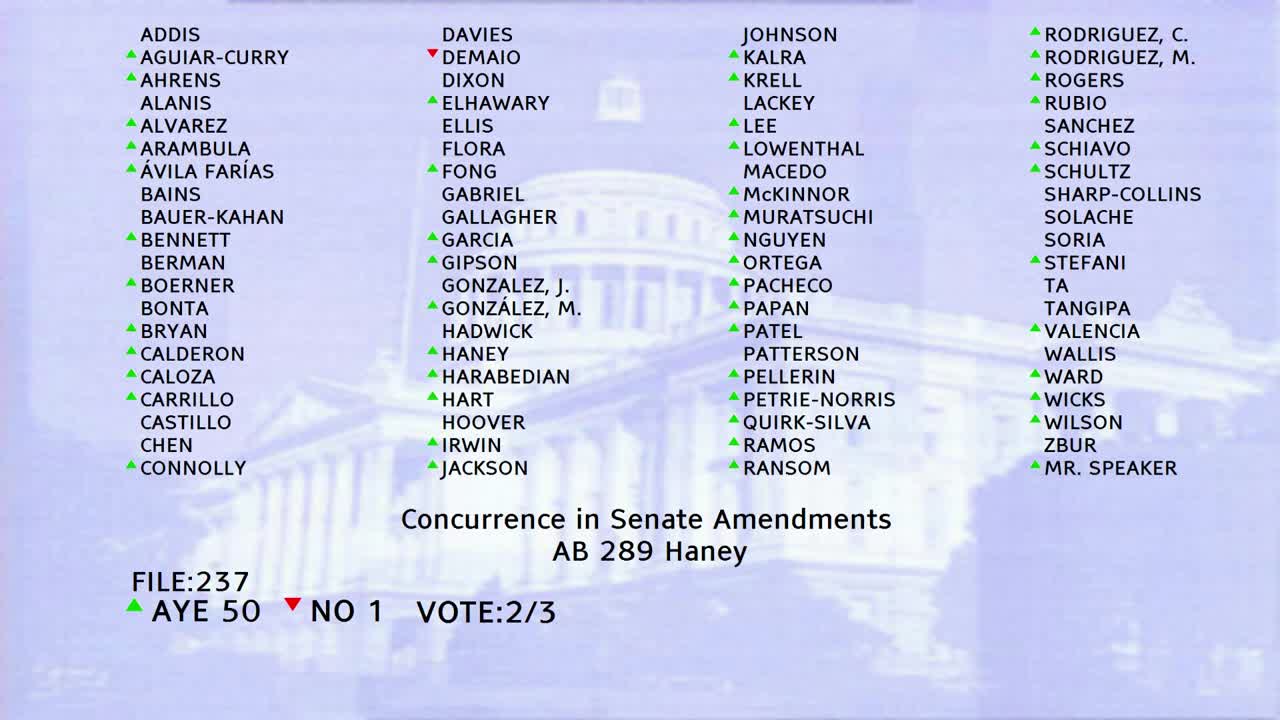

Bill Author
Bill Co-Author(s):