AB 753: Childcare: facility licensure: teacher requirements.
- Session Year: 2025-2026
- House: Assembly
- Latest Version Date: 2025-10-01
Current Status:
Passed
(2025-10-01: Chaptered by Secretary of State - Chapter 165, Statutes of 2025.)
Introduced
In Committee
Awaiting First Chamber Vote
Passed First Chamber
In Committee
Awaiting Second Chamber Vote
Passed Second Chamber
Enacted
Existing law, the Child Care and Development Services Act, administered by the State Department of Social Services, requires the department to administer childcare and development programs that offer a full range of services to eligible children from infancy to 13 years of age, inclusive.
Existing law, the Early Education Act, requires the Superintendent of Public Instruction to provide an inclusive and cost-effective preschool program.
Those acts authorize a person to serve in an instructional capacity in a childcare and development program or a preschool program if they possess a current credential issued by the Commission on Teacher Credentialing authorizing teaching service in elementary school or a single-subject credential in home economics, and 12 units in early childhood education or child development, or both, or 2 years experience in early childhood education or a childcare and development program.
This bill would, notwithstanding these provisions, authorize the commission to issue an assistant teacher permit that authorizes the permitholder to assist in the care, development, and instruction of children, subject to specified supervision requirements. The bill would require the applicant to meet specified requirements, including, among others, having at least 6 units from an accredited institution of higher education in early childhood education, child development, or human development, or a combination thereof. The bill would require a contracting agency that employs a person who holds an assistant teacher permit to maintain a copy of the permitholders education plan in their employee file. The bill would prohibit the number of assistant teacher permitholders employed by a contracting agency at one site from exceeding 50% of the number of classrooms at that site. The bill would prohibit a contracting agency from assigning more than one assistant teacher to each classroom. The bill would make these permits valid for no more than 2 years and would prohibit their renewal. The bill would require the commission to implement these provisions by no later than January 30, 2026.
This bill would make these provisions inoperative one year after the implementation of the commissions revised child development permit matrix, or January 1, 2029, whichever is later, and would repeal these provisions as of that date.
The bill would authorize the Superintendent of Public Instruction and the Director of Social Services, respectively, to require a contracting agency that employs a person who holds an assistant teacher permit to provide data on the number of employees who have been issued an assistant teacher permit pursuant to the above-described provisions, or who qualified for waivers, as specified. The bill would authorize the collection of this data by survey or by another collection method and require the data be provided as part the contracting agencys annual plan for its program self-evaluation process, or as part of an existing reporting process, as specified. The bill would also make certain findings and declarations.
This bill would declare that it is to take effect immediately as an urgency statute.
Existing law, the Child Care and Development Services Act, administered by the State Department of Social Services, requires the department to administer childcare and development programs that offer a full range of services to eligible children from infancy to 13 years of age, inclusive.
Existing law, the Early Education Act, requires the Superintendent of Public Instruction to provide an inclusive and cost-effective preschool program.
Those acts authorize a person to serve in an instructional capacity in a childcare and development program or a preschool program if they possess a current credential issued by the Commission on Teacher Credentialing authorizing teaching service in elementary school or a single-subject credential in home economics, and 12 units in early childhood education or child development, or both, or 2 years experience in early childhood education or a childcare and development program.
This bill would, notwithstanding these provisions, authorize the commission to issue an assistant teacher permit that authorizes the permitholder to assist in the care, development, and instruction of children, subject to specified supervision requirements. The bill would require the applicant to meet specified requirements, including, among others, having at least 6 units from an accredited institution of higher education in early childhood education, child development, or human development, or a combination thereof. The bill would require the employer of a contracting agency that employs a person who holds an assistant teacher permit to maintain a copy of the permitholders education plan in their employee file. The bill would prohibit the number of assistant teacher permitholders employed by a contracting agency at one site from exceeding 50% of the number of classrooms at that site. The bill would prohibit a contracting agency from assigning more than one assistant teacher to each classroom. The bill would make these permits valid for no more than 2 years and would prohibit their renewal. The bill would require the commission to implement these provisions by no later than January 30, 2026.
This bill would make these provisions inoperative on upon one year after the implementation of the commissions revised child development permit matrix, or January 1, 2029, whichever is later, and would repeal it as of January 1 of the following year. these provisions as of that date.
The bill would authorize the Superintendent of Public Instruction and the Director of Social Services, respectively, to require a contracting agency that employs a person who holds an assistant teacher permit to provide data on the number of employees who have been issued an assistant teacher permit pursuant to the above-described provisions, or who have qualified for waivers, as specified, specified. The bill would authorize the collection of this data by survey or by another collection method and require the data be provided as part the contracting agencys annual plan for its program self-evaluation process or process, or as part of an existing reporting process, as specified. The bill would also make certain findings and declarations.
This bill would declare that it is to take effect immediately as an urgency statute.
Existing law, the Child Care and Development Services Act, administered by the State Department of Social Services, requires the department to administer childcare and development programs that offer a full range of services to eligible children from infancy to 13 years of age, inclusive.
Existing law, the Early Education Act, requires the Superintendent of Public Instruction to provide an inclusive and cost-effective preschool program.
Those acts authorize a person to serve in an instructional capacity in a childcare and development program or a preschool program if they possess a current credential issued by the Commission on Teacher Credentialing authorizing teaching service in elementary school or a single-subject credential in home economics, and 12 units in early childhood education or child development, or both, or 2 years experience in early childhood education or a childcare and development program.
This bill would, notwithstanding those provisions, commencing July 1, 2026, authorize a California state preschool program or a general childcare and development program to allow 2 years from an interim associate teachers date of hire in one of those programs to pursue necessary credentials or complete additional coursework to obtain a Child Development Associate Teacher Permit, or equivalent permit, if certain conditions are met, including, among others, that no more than one interim associate teacher per classroom is allowed to work toward their credential or complete additional coursework pursuant to this provision. The bill would make these provisions inoperative on July 1, 2029.This bill would, notwithstanding these provisions, authorize the commission to issue an assistant teacher permit that authorizes the permitholder to assist in the care, development, and instruction of children, subject to specified supervision requirements. The bill would require the applicant to meet specified requirements, including, among others, having at least 6 units from an accredited institution of higher education in early childhood education, child development, or human development, or a combination thereof. The bill would require the employer of a person who holds an assistant teacher permit to maintain a copy of the permitholders education plan in their employee file. The bill would make these permits valid for no more than 2 years and would prohibit their renewal. The bill would require the commission to implement these provisions by no later than January 30, 2026.
This bill would make these provisions inoperative on upon the implementation of the commissions revised child development permit matrix, and would repeal it as of January 1 of the following year.
The bill would authorize the Superintendent of Public Instruction and the Director of Social Services, respectively, to require a contracting agency to provide data on the number of employees who have been issued an assistant teacher permit pursuant to the above-described provisions, or who have qualified for waivers, as specified, as part the contracting agencys annual plan for its program self-evaluation process or as part of an existing reporting process, as specified. The bill would also make certain findings and declarations.
This bill would declare that it is to take effect immediately as an urgency statute.
Existing law, the Child Care and Development Services Act, administered by the State Department of Social Services, requires the department to administer childcare and development programs that offer a full range of services to eligible children from infancy to 13 years of age, inclusive.
Existing law, the Early Education Act, requires the Superintendent of Public Instruction to provide an inclusive and cost-effective preschool program.
Those acts authorize a person to serve in an instructional capacity in a childcare and development program or a preschool program if they possess a current credential issued by the Commission on Teacher Credentialing authorizing teaching service in elementary school or a single-subject credential in home economics, and 12 units in early childhood education or child development, or both, or 2 years experience in early childhood education or a childcare and development program.
This bill would, notwithstanding those provisions, commencing July 1, 2026, authorize a California state preschool program or a general childcare and development program to allow 2 years from an interim associate teachers date of hire in one of those programs to pursue necessary credentials or complete additional coursework to obtain a Child Development Associate Teacher Permit, or equivalent permit, if certain conditions are met, including, among others, that no more than one interim associate teacher per classroom is allowed to work toward their credential or complete additional coursework pursuant to this provision. The bill would make these provisions inoperative on July 1, 2029.
Existing law, the California Child Day Care Facilities Act, provides for the licensure and regulation of daycare centers by the State Department of Social Services. The act authorizes the department to issue provisional licenses to operate daycare facilities if the Director of Social Services determines the facility is in substantial compliance with licensure requirements, provided that no life safety risks are involved. The act prohibits a person, firm, partnership, association, or corporation from operating, establishing, managing, conducting, or maintaining a child daycare facility without a current valid license.This bill would deem a California state preschool program, migrant childcare and development program, or general childcare and development program, if that provider is licensed as a child daycare facility to provide services to preschool children, to be operating under a license that permits the provision of services to infants or toddlers, or both, if the facilitys existing license is not on probation, the provider has submitted a complete application to the department for licensure to provide services to infants or toddlers, or both, and the provider has certified to the department by affidavit that the facility meets specified regulatory requirements to serve infants or toddlers, or both. The bill would provide that this authority expires when the department either issues or denies a license or 2 years after the facility began operating under this authority. The bill would make these provisions inoperative on July 1, 2029.Existing law, the Child Care and Development Services Act, administered by the State Department of Social Services, requires the department to administer childcare and development programs that offer a full range of services to eligible children from infancy to 13 years of age, inclusive.
Existing law, the Early Education Act, requires the Superintendent of Public Instruction to provide an inclusive and cost-effective preschool program.
Those acts authorize a person to serve in an instructional capacity in a childcare and development program or a preschool program if they possess a current credential issued by the Commission on Teacher Credentialing authorizing teaching service in elementary school or a single-subject credential in home economics, and 12 units in early childhood education or child development, or both, or 2 years experience in early childhood education or a childcare and development program.
This bill would, notwithstanding those provisions, commencing July 1, 2026, require authorize a California state preschool program or a general childcare and development program to allow 2 years from an individuals interim associate teachers date of hire as a teacher in one of those programs to pursue necessary credentials or complete additional coursework to meet the requirements of their position obtain a Child Development Associate Teacher Permit, or equivalent permit, if certain conditions are met, including, among others, that no more than one interim associate teacher per classroom is allowed to work toward their credential or complete additional coursework pursuant to this provision. The bill would make these provisions inoperative on July 1, 2029.
Existing law, the California Child Day Care Facilities Act, provides for the licensure and regulation of daycare centers by the State Department of Social Services. The act authorizes the department to issue provisional licenses to operate daycare facilities if the Director of Social Services determines the facility is in substantial compliance with licensure requirements, provided that no life safety risks are involved. The act prohibits a person, firm, partnership, association, or corporation from operating, establishing, managing, conducting, or maintaining a child daycare facility without a current valid license.
This bill would deem a California state preschool program or Head Start provider, program, migrant childcare and development program, or general childcare and development program, if that provider is licensed as a child daycare facility to provide services to preschool children, to be operating under a license that permits the provision of services to infants, infants or toddlers, or both, if the facilitys existing license is not on probation and probation, the provider has submitted a complete application to the department for licensure to provide services to infants, infants or toddlers, or both. both, and the provider has certified to the department by affidavit that the facility meets specified regulatory requirements to serve infants or toddlers, or both. The bill would provide that this authority expires when the department either issues or denies a license or 2 years after the facility began operating under this authority. The bill would make these provisions inoperative on July 1, 2029.
Existing law, the Child Care and Development Services Act, administered by the State Department of Social Services, requires the department to administer childcare and development programs that offer a full range of services to eligible children from infancy to 13 years of age, inclusive.
Existing law, the Early Education Act, requires the Superintendent of Public Instruction to provide an inclusive and cost-effective preschool program.
Those acts authorize a person to serve in an instructional capacity in a childcare and development program or a preschool program if they possess a current credential issued by the Commission on Teacher Credentialing authorizing teaching service in elementary school or a single-subject credential in home economics, and 12 units in early childhood education or child development, or both, or 2 years experience in early childhood education or a childcare and development program.
This bill would, notwithstanding those provisions, commencing July 1, 2026, require a California state preschool program or a childcare and development program to allow 2 years from an individuals date of hire as a teacher in one of those programs to pursue necessary credentials or complete additional coursework to meet the requirements of their position if certain conditions are met, including, among others, that no more than one teacher per classroom is allowed to work toward their credential or complete additional coursework pursuant to this provision. The bill would make these provisions inoperative on July 1, 2029.
Existing law, the California Child Day Care Facilities Act, provides for the licensure and regulation of daycare centers by the State Department of Social Services. The act authorizes the department to issue provisional licenses to operate daycare facilities if the Director of Social Services determines the facility is in substantial compliance with licensure requirements, provided that no life safety risks are involved. The act prohibits a person, firm, partnership, association, or corporation from operating, establishing, managing, conducting, or maintaining a child daycare facility without a current valid license.
This bill would deem a California state preschool program or Head Start provider, if that provider is licensed as a child daycare facility to provide services to preschool children, to be operating under a license that permits the provision of services to infants, toddlers, or both, if the facilitys existing license is not on probation and the provider has submitted a complete application to the department for licensure to provide services to infants, toddlers, or both. The bill would provide that this authority expires when the department either issues or denies a license or 2 years after the facility began operating under this authority. The bill would make these provisions inoperative on July 1, 2029.
The Legislature finds and declares all of the following:
(a)Californias early learning and childcare system is currently facing a dire staffing shortage, impacting the availability of quality care for children from birth to five years of age, inclusive.
(b)Quality childcare provides a setting where children can engage in educational and social activities that foster cognitive, emotional, and social development. Without these opportunities, children may miss out on critical learning experiences that prepare them for school and life.
(c)When families cannot access childcare, their economic mobility is often limited.
(d)Given the demographics of the families who primarily utilize these services, a lack of early learning and childcare services can exacerbate the existing opportunity and achievement gap.
(e)Eradicating barriers for Californians to enter the early learning and childcare profession is important for families, children, and the economy. Therefore, this measure is necessary to address the systems dire staffing crisis that limits options for working families.
SEC. 2.Section 8231.5 is added to the Education Code, to read:8231.5.(a)The Superintendent may require a contracting agency that employs a person who holds an assistant teacher permit pursuant to Section 8301.1 to provide the department with data that includes the number of employees in its program who hold an assistant teacher permit pursuant to Section 8301.1 or who qualified for waivers pursuant to subdivision (d) of Section 8298. The data may be collected by survey or by another collection method. The data shall be provided to the department as part of the contracting agencys annual plan for its program self-evaluation process as required by Section 17709 of Title 5 of the California Code of Regulations or a successor statute or regulation, or as part of an existing reporting process determined by the Superintendent.
(b)Notwithstanding Section 33308.5 of this code and Chapter 3.5 (commencing with Section 11340) of Part 1 of Division 3 of Title 2 of the Government Code, the Superintendent may develop informal directives and bulletins to implement this section.
SEC. 3.Section 8301.1 is added to the Education Code, to read:8301.1.(a)Notwithstanding Sections 8295 and 8301, the Commission on Teacher Credentialing may issue an assistant teacher permit that authorizes the permitholder to assist in the care, development, and instruction of children, subject to the supervision requirements described in subdivision (b). This assistance may include temporarily supervising children independently for no more than 120 minutes per day while the supervising employee leaves the classroom for purposes of offering flexibility for classroom support, during breaks, or escorting children outside of the classroom. The commission may issue a permit under this section provided that all of the following requirements are met:
(1)The applicant has at least six units from an accredited institution of higher education in early childhood education, child development, or human development, or a combination thereof.
(2)The applicant has an education plan updated each academic year and is enrolled in a course or courses to meet the requirements for the next level permit.
(3)The applicant is sponsored by an employer who has a current contract with the State Department of Education to be a California state preschool program provider.
(b)An employee who holds an assistant teacher permit pursuant to subdivision (a) shall be under the supervision of an employee who holds a valid commission-issued child development permit at the teacher level, or at an equivalent or higher permit level.
(c)A contracting agency that employs a person who holds an assistant teacher permit pursuant to subdivision (a) shall maintain a copy of the permitholders current education plan in their employee file.
(d)A permit issued pursuant to subdivision (a) shall be valid for no more than two years from the date of issuance and shall not be renewed.
(e)The number of assistant teacher permitholders employed by a contracting agency at one site shall not exceed 50 percent of the number of classrooms at that site. The contracting agency shall not assign more than one assistant teacher to each classroom.
(f)This section shall not be construed to grant to a person issued with an assistant teacher permit pursuant to this section with the rights and responsibilities of an associate teacher permitholder, or equivalent permitholder, or higher permitholder.
(g)Notwithstanding Chapter 3.5 (commencing with Section 11340) of Part 1 of Division 3 of Title 2 of the Government Code, the department may implement this section by means of management bulletins or similar instructions until regulations are adopted.
(h)The commission shall implement this section by no later than January 30, 2026.
(i)This section shall become inoperative one year after the implementation of the commissions revised child development permit matrix, or January 1, 2029, whichever is later, and, as of that date, is repealed.
SEC. 4.Section 10267.6 is added to the Welfare and Institutions Code, to read:10267.6.(a)The director may require a contracting agency that employs a person who holds an assistant teacher permit pursuant to Section 8301.1 to provide the department with data that includes the number of employees in its program who hold an assistant teacher permit pursuant to Section 8301.1 or who qualified for waivers pursuant to subdivision (d) of Section 10242. The data may be collected by survey or by another collection method. The data shall be provided to the department as part the contracting agencys annual plan for its program self-evaluation process as required by Section 17709 of Title 5 of the California Code of Regulations or a successor statute or regulation, or as part of an existing reporting process determined by the director.
(b)Notwithstanding Chapter 3.5 (commencing with Section 11340) of Part 1 of Division 3 of Title 2 of the Government Code, the director may develop informal directives and bulletins to implement this section.
SEC. 5.Section 10383.1 is added to the Welfare and Institutions Code, to read:10383.1.(a)Notwithstanding Sections 10380 and 10383, the Commission on Teacher Credentialing may issue an assistant teacher permit that authorizes the permitholder to assist in the care, development, and instruction of children, subject to the supervision requirements described in subdivision (b). This assistance may include temporarily supervising children independently for no more than 120 minutes per day while the supervising employee leaves the classroom for purposes of offering flexibility for classroom support, during breaks, or escorting children outside of the classroom. The commission may issue a permit under this section provided that all of the following requirements are met:
(1)The applicant has at least six units from an accredited institution of higher education in early childhood education, child development, or human development, or a combination thereof.
(2)The applicant has an education plan updated each academic year and is enrolled in a course or courses to meet the requirements for the next level permit.
(3)The applicant is sponsored by an employer who has a current contract with the State Department of Social Services to be a child development program provider.
(b)An employee who holds an assistant teacher permit pursuant to subdivision (a) shall be under the supervision of an employee who holds a valid commission-issued child development permit at the teacher level, or at an equivalent or higher permit level.
(c)A contracting agency that employs a person who holds an assistant teacher permit pursuant to subdivision (a) shall maintain a copy of the permitholders current education plan in their employee file.
(d)A permit issued pursuant to subdivision (a) shall be valid for no more than two years from the date of issuance and shall not be renewed.
(e)The number of assistant teacher permitholders employed by a contracting agency at one site shall not exceed 50 percent of the number of classrooms at that site. The contracting agency shall not assign more than one assistant teacher to each classroom.
(f)This section shall not be construed to grant to a person issued with an assistant teacher permit pursuant to this section with the rights and responsibilities of an associate teacher permitholder, or equivalent permitholder, or higher permitholder.
(g)Notwithstanding Chapter 3.5 (commencing with Section 11340) of Part 1 of Division 3 of Title 2 of the Government Code, the department may implement this section by means of childcare bulletins or similar instructions until regulations are adopted.
(h)The commission shall implement this section by no later than January 30, 2026.
(i)This section shall become inoperative one year after the implementation of the commissions revised child development permit matrix, or January 1, 2029, whichever is later, and, as of that date, is repealed.
SEC. 6.This act is an urgency statute necessary for the immediate preservation of the public peace, health, or safety within the meaning of Article IV of the California Constitution and shall go into immediate effect. The facts constituting the necessity are:
To address the dire staffing shortage faced by Californias early learning and childcare system, it is necessary for this act to take immediate effect.
The Legislature finds and declares all of the following:
(a)Californias early learning and childcare system is currently facing a dire staffing shortage, impacting the availability of quality care for children from birth to five years of age, inclusive.
(b)Quality childcare provides a setting where children can engage in educational and social activities that foster cognitive, emotional, and social development. Without these opportunities, children may miss out on critical learning experiences that prepare them for school and life.
(c)When families cannot access childcare, their economic mobility is often limited.
(d)Given the demographics of the families who primarily utilize these services, a lack of early learning and childcare services can exacerbate the existing opportunity and achievement gap.
(e)Eradicating barriers for Californians to enter the early learning and childcare profession is important for families, children, and the economy. Therefore, this measure is necessary to address the systems dire staffing crisis that limits options for working families.
SEC. 2.Section 8231.5 is added to the Education Code, to read:8231.5.(a)The Superintendent may require a contracting agency to provide the department with data on the number of employees who have been issued an assistant teacher permit pursuant to Section 8301.1 that employs a person who holds an assistant teacher permit pursuant to Section 8301.1 to provide the department with data that includes the number of employees in its program who hold an assistant teacher permit pursuant to Section 8301.1 or who have qualified for waivers pursuant to subdivision (d) of Section 8298 as part 8298. The data may be collected by survey or by another collection method. The data shall be provided to the department as part of the contracting agencys annual plan for its program self-evaluation process as required by Section 17709 of Title 5 of the California Code of Regulations or a successor statute or regulation, or as part of an existing reporting process determined by the Superintendent.
(b)Notwithstanding Section 33308.5 of this code and Chapter 3.5 (commencing with Section 11340) of Part 1 of Division 3 of Title 2 of the Government Code, the Superintendent may develop informal directives and bulletins to implement this section.
SEC. 3.Section 8301.1 is added to the Education Code, to read:8301.1.(a)Notwithstanding Sections 8295 and 8301, the Commission on Teacher Credentialing may issue an assistant teacher permit that authorizes the permitholder to assist in the care, development, and instruction of children, subject to the supervision requirements described in subdivision (b). This assistance may include temporarily supervising children independently for no more than 120 minutes per day while the supervising employee leaves the classroom for purposes of offering flexibility for classroom support, during breaks, or escorting children outside of the classroom. The commission may issue a permit under this section provided that all of the following requirements are met:
(1)The applicant has at least six units from an accredited institution of higher education in early childhood education, child development, or human development, or a combination thereof.
(2)The applicant has an education plan updated each academic year and is enrolled in a course or courses to meet the requirements for the next level permit.
(3)The applicant is sponsored by an employer who has a current contract with the State Department of Education to be a California state preschool program provider.
(b)An employee who holds an assistant teacher permit pursuant to subdivision (a) shall be under the supervision of an employee who holds a valid commission-issued child development permit at the teacher level, or at an equivalent or higher permit level.
(c)The employer of A contracting agency that employs a person who holds an assistant teacher permit pursuant to subdivision (a) shall maintain a copy of the permitholders current education plan in their employee file.
(d)A permit issued pursuant to subdivision (a) shall be valid for no more than two years from the date of issuance and shall not be renewed.
(e)The number of assistant teacher permitholders employed by a contracting agency at one site shall not exceed 50 percent of the number of classrooms at that site. The contracting agency shall not assign more than one assistant teacher to each classroom.
(e)(f)This section shall not be construed to grant to a person issued with an assistant teacher permit pursuant to this section with the rights and responsibilities of an associate teacher permitholder, or equivalent permitholder, or higher permitholder.
(g)Notwithstanding Chapter 3.5 (commencing with Section 11340) of Part 1 of Division 3 of Title 2 of the Government Code, the department may implement this section by means of management bulletins or similar instructions until regulations are adopted.
(f)(h)The commission shall implement this section by no later than January 30, 2026.
(g)(i)This section shall become inoperative upon one year after the implementation of the commissions revised child development permit matrix, and, as of January 1 of the following year, is repealed. or January 1, 2029, whichever is later, and, as of that date, is repealed.
SEC. 4.Section 10267.6 is added to the Welfare and Institutions Code, to read:10267.6.(a)The director may require a contracting agency to provide the department with data on the number of employees who have an assistant teacher permit pursuant to Section 10383.1 that employs a person who holds an assistant teacher permit pursuant to Section 8301.1 to provide the department with data that includes the number of employees in its program who hold an assistant teacher permit pursuant to Section 8301.1 or who have qualified for waivers pursuant to subdivision (d) of Section 10242 10242. The data may be collected by survey or by another collection method. The data shall be provided to the department as part the contracting agencys annual plan for its program self-evaluation process as required by Section 17709 of Title 5 of the California Code of Regulations or a successor statute or regulation, or as part of an existing reporting process determined by the director.
(b)Notwithstanding Chapter 3.5 (commencing with Section 11340) of Part 1 of Division 3 of Title 2 of the Government Code, the director may develop informal directives and bulletins to implement this section.
SEC. 5.Section 10383.1 is added to the Welfare and Institutions Code, to read:10383.1.(a)Notwithstanding Sections 10380 and 10383, the Commission on Teacher Credentialing may issue an assistant teacher permit that authorizes the permitholder to assist in the care, development, and instruction of children, subject to the supervision requirements described in subdivision (b). This assistance may include temporarily supervising children independently for no more than 120 minutes per day while the supervising employee leaves the classroom for purposes of offering flexibility for classroom support, during breaks, or escorting children outside of the classroom. The commission may issue a permit under this section provided that all of the following requirements are met:
(1)The applicant has at least six units from an accredited institution of higher education in early childhood education, child development, or human development, or a combination thereof.
(2)The applicant has an education plan updated each academic year and is enrolled in a course or courses to meet the requirements for the next level permit.
(3)The applicant is sponsored by an employer who has a current contract with the State Department of Social Services to be a child development program provider.
(b)An employee who holds an assistant teacher permit pursuant to subdivision (a) shall be under the supervision of an employee who holds a valid commission-issued child development permit at the teacher level, or at an equivalent or higher permit level.
(c)The employer of A contracting agency that employs a person who holds an assistant teacher permit pursuant to subdivision (a) shall maintain a copy of the permitholders current education plan in their employee file.
(d)A permit issued pursuant to subdivision (a) shall be valid for no more than two years from the date of issuance and shall not be renewed.
(e)The number of assistant teacher permitholders employed by a contracting agency at one site shall not exceed 50 percent of the number of classrooms at that site. The contracting agency shall not assign more than one assistant teacher to each classroom.
(e)(f)This section shall not be construed to grant to a person issued with an assistant teacher permit pursuant to this section with the rights and responsibilities of an associate teacher permitholder, or equivalent permitholder, or higher permitholder.
(g)Notwithstanding Chapter 3.5 (commencing with Section 11340) of Part 1 of Division 3 of Title 2 of the Government Code, the department may implement this section by means of childcare bulletins or similar instructions until regulations are adopted.
(f)(h)The commission shall implement this section by no later than January 30, 2026.
(g)(i)This section shall become inoperative upon one year after the implementation of the commissions revised child development permit matrix, and, as of January 1 of the following year, is repealed. or January 1, 2029, whichever is later, and, as of that date, is repealed.
SEC. 6.This act is an urgency statute necessary for the immediate preservation of the public peace, health, or safety within the meaning of Article IV of the California Constitution and shall go into immediate effect. The facts constituting the necessity are:
To address the dire staffing shortage faced by Californias early learning and childcare system, it is necessary for this act to take immediate effect.
The Legislature finds and declares all of the following:
(a)Californias early learning and childcare system is currently facing a dire staffing shortage, impacting the availability of quality care for children from birth to five years of age, inclusive.
(b)Quality childcare provides a setting where children can engage in educational and social activities that foster cognitive, emotional, and social development. Without these opportunities, children may miss out on critical learning experiences that prepare them for school and life.
(c)When families cannot access childcare, their economic mobility is often limited.
(d)Given the demographics of the families who primarily utilize these services, a lack of early learning and childcare services can exacerbate the existing opportunity and achievement gap.
(e)Eradicating barriers for Californians to enter the early learning and childcare profession is important for families, children, and the economy. Therefore, this measure is necessary to address the systems dire staffing crisis that limits options for working families.
SEC. 2.Section 8231.5 is added to the Education Code, to read:8231.5.(a)The Superintendent may require a contracting agency to provide the department with data on the number of employees who have been issued an assistant teacher permit pursuant to Section 8301.1 or who have qualified for waivers pursuant to subdivision (d) of Section 8298 as part the contracting agencys annual plan for its program self-evaluation process as required by Section 17709 of Title 5 of the California Code of Regulations or a successor statute or regulation, or as part of an existing reporting process determined by the Superintendent.
(b)Notwithstanding Section 33308.5 of this code and Chapter 3.5 (commencing with Section 11340) of Part 1 of Division 3 of Title 2 of the Government Code, the Superintendent may develop informal directives and bulletins to implement this section.
SEC. 3.Section 8301.1 is added to the Education Code, to read:8301.1.(a)Notwithstanding Sections 8295 and 8301, the Commission on Teacher Credentialing may issue an assistant teacher permit that authorizes the permitholder to assist in the care, development, and instruction of children, subject to the supervision requirements described in subdivision (b). This assistance may include temporarily supervising children independently while the supervising employee leaves the classroom for purposes of offering flexibility for classroom support, during breaks, or escorting children outside of the classroom. The commission may issue a permit under this section provided that all of the following requirements are met:
(1)The applicant has at least six units from an accredited institution of higher education in early childhood education, child development, or human development, or a combination thereof.
(2)The applicant has an education plan updated each academic year and is enrolled in a course or courses to meet the requirements for the next level permit.
(3)The applicant is sponsored by an employer who has a current contract with the State Department of Education to be a California state preschool program provider.
(b)An employee who holds an assistant teacher permit pursuant to subdivision (a) shall be under the supervision of an employee who holds a valid commission-issued child development permit at the teacher level, or at an equivalent or higher permit level.
(c)The employer of a person who holds an assistant teacher permit pursuant to subdivision (a) shall maintain a copy of the permitholders current education plan in their employee file.
(d)A permit issued pursuant to subdivision (a) shall be valid for no more than two years from the date of issuance and shall not be renewed.
(e)This section shall not be construed to grant to a person issued with an assistant teacher permit pursuant to this section with the rights and responsibilities of an associate teacher permitholder, or equivalent permitholder, or higher permitholder.
(f)The commission shall implement this section by no later than January 30, 2026.
(g)This section shall become inoperative upon the implementation of the commissions revised child development permit matrix, and, as of January 1 of the following year, is repealed.
SEC. 4.Section 10267.6 is added to the Welfare and Institutions Code, to read:10267.6.(a)The director may require a contracting agency to provide the department with data on the number of employees who have an assistant teacher permit pursuant to Section 10383.1 or who have qualified for waivers pursuant to subdivision (d) of Section 10242 as part the contracting agencys annual plan for its program self-evaluation process as required by Section 17709 of Title 5 of the California Code of Regulations or a successor statute or regulation, or as part of an existing reporting process determined by the director.
(b)Notwithstanding Chapter 3.5 (commencing with Section 11340) of Part 1 of Division 3 of Title 2 of the Government Code, the director may develop informal directives and bulletins to implement this section.
SEC. 5.Section 10383.1 is added to the Welfare and Institutions Code, to read:10383.1.(a)Notwithstanding Sections 10380 and 10383, the Commission on Teacher Credentialing may issue an assistant teacher permit that authorizes the permitholder to assist in the care, development, and instruction of children, subject to the supervision requirements described in subdivision (b). This assistance may include temporarily supervising children independently while the supervising employee leaves the classroom for purposes of offering flexibility for classroom support, during breaks, or escorting children outside of the classroom. The commission may issue a permit under this section provided that all of the following requirements are met:
(1)The applicant has at least six units from an accredited institution of higher education in early childhood education, child development, or human development, or a combination thereof.
(2)The applicant has an education plan updated each academic year and is enrolled in a course or courses to meet the requirements for the next level permit.
(3)The applicant is sponsored by an employer who has a current contract with the State Department of Social Services to be a child development program provider.
(b)An employee who holds an assistant teacher permit pursuant to subdivision (a) shall be under the supervision of an employee who holds a valid commission-issued child development permit at the teacher level, or at an equivalent or higher permit level.
(c)The employer of a person who holds an assistant teacher permit pursuant to subdivision (a) shall maintain a copy of the permitholders current education plan in their employee file.
(d)A permit issued pursuant to subdivision (a) shall be valid for no more than two years from the date of issuance and shall not be renewed.
(e)This section shall not be construed to grant to a person issued with an assistant teacher permit pursuant to this section with the rights and responsibilities of an associate teacher permitholder, or equivalent permitholder, or higher permitholder.
(f)The commission shall implement this section by no later than January 30, 2026.
(g)This section shall become inoperative upon the implementation of the commissions revised child development permit matrix, and, as of January 1 of the following year, is repealed.
SEC. 6.This act is an urgency statute necessary for the immediate preservation of the public peace, health, or safety within the meaning of Article IV of the California Constitution and shall go into immediate effect. The facts constituting the necessity are:
To address the dire staffing shortage faced by Californias early learning and childcare system, it is necessary for this act to take immediate effect.
SECTION 1.Section 8296 is added to the Education Code, to read:8296.(a)Notwithstanding Section 8295, and commencing July 1, 2026, a California state preschool program may allow two years from the date of hire of an interim associate teacher in a preschool program to pursue necessary credentials or complete additional coursework to obtain a Child Development Associate Teacher Permit, or equivalent permit, from the Commission on Teacher Credentialing, if the following conditions are met:(1)No more than one interim associate teacher per classroom is allowed to work toward their credential or complete additional coursework, as described in this section.(2)The interim associate teacher meets all requirements enumerated in Section 101216 of Title 22 of the California Code of Regulations.(3)The interim associate teacher has at least six units from an accredited institution of higher education in early childhood education, child development, or human development, or a combination thereof.(4)The interim associate teacher remains enrolled in courses to meet the requirements for the position.(5)The contracting agency employing the interim associate teacher documents and keeps in the employees file the following information:(A)The date that the interim associate teacher is required to complete requirements to remain in the teaching position. The date to complete all requirements shall not be more than two years after the interim associate teachers date of hire.(B)The coursework or applicable requirements the interim associate teacher shall complete.(b)(1)Notwithstanding any other law, an interim associate teacher who is pursuing necessary credentials or completing additional coursework while employed pursuant to this section shall not be in violation of any law requiring that they be certified or permitted prior to working in an instructional capacity in a preschool program.(2)Notwithstanding any other law, a California state preschool program shall not be penalized for employing an individual as an interim associate teacher if it is in compliance with this section.(c)For purposes of this section, interim associate teacher means an employee who is authorized to provide program supervision and instruction that includes supervision of aides, volunteers, and groups of children.(d)This section shall become inoperative on July 1, 2029, and, as of January 1, 2030, is repealed.SEC. 2.Section 10380.2 is added to the Welfare and Institutions Code, to read:10380.2.(a)Notwithstanding Section 10380, and commencing July 1, 2026, a general childcare and development program may allow two years from the date of hire of an interim associate teacher in a general childcare and development program to pursue necessary credentials or complete additional coursework to obtain a Child Development Associate Teacher Permit, or equivalent permit, from the Commission on Teacher Credentialing, if the following conditions are met:(1)No more than one interim associate teacher per classroom is allowed to work toward their credential or complete additional coursework, as described in this section.(2)The interim associate teacher meets all requirements enumerated in Section 101216 of Title 22 of the California Code of Regulations.(3)The interim associate teacher has at least six units from an accredited institution of higher education in early childhood education, child development, or human development, or a combination thereof.(4)The interim associate teacher remains enrolled in courses to meet the requirements for the position.(5)The contracting agency employing the interim associate teacher documents and keeps in the employees file the following information:(A)The date that the interim associate teacher is required to complete requirements to remain in the teaching position. The date to complete all requirements shall not be more than two years after the interim associate teachers date of hire.(B)The coursework or applicable requirements the interim associate teacher shall complete.(b)(1)Notwithstanding any other law, an interim associate teacher who is pursuing necessary credentials or completing additional coursework while employed pursuant to this section shall not be in violation of any law requiring that they be certified or permitted prior to working in an instructional capacity in a childcare and development program.(2)Notwithstanding any other law, a general childcare and development program shall not be penalized for employing an individual as an interim associate teacher if it is in compliance with this section.(c)For purposes of this section, interim associate teacher means an employee who is authorized to provide program supervision and instruction that includes supervision of aides, volunteers, and groups of children.(d)This section shall become inoperative on July 1, 2029, and, as of January 1, 2030, is repealed.(a)Notwithstanding Section 8295, and commencing July 1, 2026, a California state preschool program may allow two years from the date of hire of an interim associate teacher in a preschool program to pursue necessary credentials or complete additional coursework to obtain a Child Development Associate Teacher Permit, or equivalent permit, from the Commission on Teacher Credentialing, if the following conditions are met:
(1)No more than one interim associate teacher per classroom is allowed to work toward their credential or complete additional coursework, as described in this section.
(2)The interim associate teacher meets all requirements enumerated in Section 101216 of Title 22 of the California Code of Regulations.
(3)The interim associate teacher has at least six units from an accredited institution of higher education in early childhood education, child development, or human development, or a combination thereof.
(4)The interim associate teacher remains enrolled in courses to meet the requirements for the position.
(5)The contracting agency employing the interim associate teacher documents and keeps in the employees file the following information:
(A)The date that the interim associate teacher is required to complete requirements to remain in the teaching position. The date to complete all requirements shall not be more than two years after the interim associate teachers date of hire.
(B)The coursework or applicable requirements the interim associate teacher shall complete.
(b)(1)Notwithstanding any other law, an interim associate teacher who is pursuing necessary credentials or completing additional coursework while employed pursuant to this section shall not be in violation of any law requiring that they be certified or permitted prior to working in an instructional capacity in a preschool program.
(2)Notwithstanding any other law, a California state preschool program shall not be penalized for employing an individual as an interim associate teacher if it is in compliance with this section.
(c)For purposes of this section, interim associate teacher means an employee who is authorized to provide program supervision and instruction that includes supervision of aides, volunteers, and groups of children.
(d)This section shall become inoperative on July 1, 2029, and, as of January 1, 2030, is repealed.
SEC. 2.Section 1596.8791 is added to the Health and Safety Code, immediately following Section 1596.879, to read:1596.8791.(a)If a California state preschool program, migrant childcare and development program, or general childcare and development program is licensed as child daycare facility to serve preschool children and also desires to serve infants or toddlers, or both, the provider shall be deemed to be operating under a license that permits the provision of services to infants or toddlers, or both, if all of the following conditions are met:(1)The facilitys existing license is not currently on probation, as defined in Section 1596.773.(2)The provider has submitted a complete application to the department for licensure to provide services to infants or toddlers, or both.(3)The provider has certified to the department by affidavit that the facility meets all requirements to serve infants or toddlers, or both, under Chapter 1 (commencing with Section 101151) of Division 12 of Title 22 of the California Code of Regulations, including, but not limited to, all of the following:(A)The provider has attended or will attend orientations, as directed by the department.(B)The provider has an emergency and disaster plan.(C)The provider has and will provide, upon request, a personnel report.(D)The provider has and will provide, upon request, a facility sketch showing all areas to be used, with dimensions of all rooms and yard areas, including bathrooms.(E)The provider has and will provide, upon request, any waiver requests submitted.(F)The provider has control of the property for any additional rooms or yard, if not included as part of the original license.(G)If applicable, certification by the district superintendent for any schoolage programs functioning on schoolsites for exemptions from square footage, fencing, and bathroom requirements.(H)The provider has and will provide, upon request, a current admissions agreement.(I)The provider has and will provide, upon request, a current parent handbook.(J)The provider has and will provide, upon request, current job descriptions for all personnel.(b)Authority to provide services pursuant to subdivision (a) expires when either of the following occurs:(1)Upon the issuance or denial of the license by the department.(2)Two years after the facility first began providing services under the authority of subdivision (a).(c)This section shall become inoperative on July 1, 2029, and, as of January 1, 2030, is repealed.SEC. 3.SEC. 2.Section 10380.2 is added to the Welfare and Institutions Code, to read:10380.2.(a)Notwithstanding Section 10380, and commencing July 1, 2026, a general childcare and development program may allow two years from the date of hire of an interim associate teacher in a general childcare and development program to pursue necessary credentials or complete additional coursework to obtain a Child Development Associate Teacher Permit, or equivalent permit, from the Commission on Teacher Credentialing, if the following conditions are met:
(1)No more than one interim associate teacher per classroom is allowed to work toward their credential or complete additional coursework, as described in this section.
(2)The interim associate teacher meets all requirements enumerated in Section 101216 of Title 22 of the California Code of Regulations.
(3)The interim associate teacher has at least six units from an accredited institution of higher education in early childhood education, child development, or human development, or a combination thereof.
(4)The interim associate teacher remains enrolled in courses to meet the requirements for the position.
(5)The contracting agency employing the interim associate teacher documents and keeps in the employees file the following information:
(A)The date that the interim associate teacher is required to complete requirements to remain in the teaching position. The date to complete all requirements shall not be more than two years after the interim associate teachers date of hire.
(B)The coursework or applicable requirements the interim associate teacher shall complete.
(b)(1)Notwithstanding any other law, an interim associate teacher who is pursuing necessary credentials or completing additional coursework while employed pursuant to this section shall not be in violation of any law requiring that they be certified or permitted prior to working in an instructional capacity in a childcare and development program.
(2)Notwithstanding any other law, a general childcare and development program shall not be penalized for employing an individual as an interim associate teacher if it is in compliance with this section.
(c)For purposes of this section, interim associate teacher means an employee who is authorized to provide program supervision and instruction that includes supervision of aides, volunteers, and groups of children.
(d)This section shall become inoperative on July 1, 2029, and, as of January 1, 2030, is repealed.
(a)Notwithstanding Section 8295, and commencing July 1, 2026, a California state preschool program shall may allow two years from the date of hire of an individual employed as a teacher interim associate teacher in a preschool program to pursue necessary credentials or complete additional coursework to meet the requirements of their position, as outlined in the Commission on Teacher Credentialing Child Development Permit Matrix, obtain a Child Development Associate Teacher Permit, or equivalent permit, from the Commission on Teacher Credentialing, if the following conditions are met:
(1)No more than one teacher interim associate teacher per classroom is allowed to work toward their credential or complete additional coursework, as described in this section.
(2)The individual interim associate teacher meets all requirements enumerated in Section 101216 of Title 22 of the California Code of Regulations.
(3)The interim associate teacher has at least six units from an accredited institution of higher education in early childhood education, child development, or human development, or a combination thereof.
(3)(4)The individual interim associate teacher remains enrolled in courses to meet the requirements for the position.
(4)(5)The contracting agency employing the individual interim associate teacher documents and keeps in the employees file the following information:
(A)The date, two years from the individuals start date, that the individual date that the interim associate teacher is required to complete requirements to remain in the teaching position. The date to complete all requirements shall not be more than two years after the interim associate teachers date of hire.
(B)The coursework or applicable requirements the individual interim associate teacher shall complete.
(b)(1)Notwithstanding any other law, a an interim associate teacher who is pursuing necessary credentials or completing additional coursework while employed as a teacher pursuant to this section shall not be in violation of any law requiring that they be certified or permitted prior to working as a teacher in an instructional capacity in a preschool program.
(2)Notwithstanding any other law, a California state preschool program shall not be penalized for employing an individual as an interim associate teacher if it is in compliance with this section.
(c)For purposes of this section, interim associate teacher means an employee who is authorized to provide program supervision and instruction that includes supervision of aides, volunteers, and groups of children.
(c)(d)This section shall become inoperative on July 1, 2029, and, as of January 1, 2030, is repealed.
SEC. 2.Section 1596.8791 is added to the Health and Safety Code, immediately following Section 1596.879, to read:1596.8791.(a)If a California state preschool program or Head Start provider program, migrant childcare and development program, or general childcare and development program is licensed as child daycare facility to serve preschool children and also desires to serve infants, infants or toddlers, or both, the provider shall be deemed to be operating under a license that permits the provision of services to infants, infants or toddlers, or both, if both all of the following conditions are met:
(1)The facilitys existing license is not currently on probation, as defined in Section 1596.773.
(2)The provider has submitted a complete application to the department for licensure to provide services to infants, infants or toddlers, or both.
(3)The provider has certified to the department by affidavit that the facility meets all requirements to serve infants or toddlers, or both, under Chapter 1 (commencing with Section 101151) of Division 12 of Title 22 of the California Code of Regulations, including, but not limited to, all of the following:
(A)The provider has attended or will attend orientations, as directed by the department.
(B)The provider has an emergency and disaster plan.
(C)The provider has and will provide, upon request, a personnel report.
(D)The provider has and will provide, upon request, a facility sketch showing all areas to be used, with dimensions of all rooms and yard areas, including bathrooms.
(E)The provider has and will provide, upon request, any waiver requests submitted.
(F)The provider has control of the property for any additional rooms or yard, if not included as part of the original license.
(G)If applicable, certification by the district superintendent for any schoolage programs functioning on schoolsites for exemptions from square footage, fencing, and bathroom requirements.
(H)The provider has and will provide, upon request, a current admissions agreement.
(I)The provider has and will provide, upon request, a current parent handbook.
(J)The provider has and will provide, upon request, current job descriptions for all personnel.
(b)Authority to provide services pursuant to subdivision (a) expires when either of the following occurs:
(1)Upon the issuance or denial of the license by the department.
(2)Two years after the facility first began providing services under the authority of subdivision (a).
(c)This section shall become inoperative on July 1, 2029, and, as of January 1, 2030, is repealed.
SEC. 3.Section 10380.2 is added to the Welfare and Institutions Code, to read:10380.2.(a)Notwithstanding Section 10380, and commencing July 1, 2026, a childcare and development program shall general childcare and development program may allow two years from the date of hire of an individual employed as a teacher in a childcare and development interim associate teacher in a general childcare and development program to pursue necessary credentials or complete additional coursework to meet the requirements of their position, as outlined in the Commission on Teacher Credentialing Child Development Permit Matrix, obtain a Child Development Associate Teacher Permit, or equivalent permit, from the Commission on Teacher Credentialing, if the following conditions are met:
(1)No more than one teacher interim associate teacher per classroom is allowed to work toward their credential or complete additional coursework, as described in this section.
(2)The individual interim associate teacher meets all requirements enumerated in Section 101216 of Title 22 of the California Code of Regulations.
(3)The interim associate teacher has at least six units from an accredited institution of higher education in early childhood education, child development, or human development, or a combination thereof.
(3)(4)The individual interim associate teacher remains enrolled in courses to meet the requirements for the position.
(4)(5)The contracting agency employing the individual interim associate teacher documents and keeps in the employees file the following information:
(A)The date, two years from the individuals start date, that the individual date that the interim associate teacher is required to complete requirements to remain in the teaching position. The date to complete all requirements shall not be more than two years after the interim associate teachers date of hire.
(B)The coursework or applicable requirements the individual interim associate teacher shall complete.
(b)(1)Notwithstanding any other law, a an interim associate teacher who is pursuing necessary credentials or completing additional coursework while employed as a teacher pursuant to this section shall not be in violation of any law requiring that they be certified or permitted prior to working as a teacher in an instructional capacity in a childcare and development program.
(2)Notwithstanding any other law, a general childcare and development program shall not be penalized for employing an individual as an interim associate teacher if it is in compliance with this section.
(c)For purposes of this section, interim associate teacher means an employee who is authorized to provide program supervision and instruction that includes supervision of aides, volunteers, and groups of children.
(c)(d)This section shall become inoperative on July 1, 2029, and, as of January 1, 2030, is repealed.
(a)Notwithstanding Section 8295, and commencing July 1, 2026, a California state preschool program shall allow two years from the date of hire of an individual employed as a teacher in a preschool program to pursue necessary credentials or complete additional coursework to meet the requirements of their position, as outlined in the Commission on Teacher Credentialing Child Development Permit Matrix, if the following conditions are met:
(1)No more than one teacher per classroom is allowed to work toward their credential or complete additional coursework, as described in this section.
(2)The individual meets all requirements enumerated in Section 101216 of Title 22 of the California Code of Regulations.
(3)The individual remains enrolled in courses to meet the requirements for the position.
(4)The contracting agency employing the individual documents and keeps in the employees file the following information:
(A)The date, two years from the individuals start date, that the individual is required to complete requirements to remain in the teaching position.
(B)The coursework or applicable requirements the individual shall complete.
(b)Notwithstanding any other law, a teacher who is pursuing necessary credentials or completing additional coursework while employed as a teacher pursuant to this section shall not be in violation of any law requiring that they be certified or permitted prior to working as a teacher in a preschool program.
(c)This section shall become inoperative on July 1, 2029, and, as of January 1, 2030, is repealed.
SEC. 2.Section 1596.8791 is added to the Health and Safety Code, immediately following Section 1596.879, to read:1596.8791.(a)If a California state preschool program or Head Start provider is licensed as child daycare facility to serve preschool children and also desires to serve infants, toddlers, or both, the provider shall be deemed to be operating under a license that permits the provision of services to infants, toddlers, or both, if both of the following conditions are met:
(1)The facilitys existing license is not currently on probation, as defined in Section 1596.773.
(2)The provider has submitted a complete application to the department for licensure to provide services to infants, toddlers, or both.
(b)Authority to provide services pursuant to subdivision (a) expires when either of the following occurs:
(1)Upon the issuance or denial of the license by the department.
(2)Two years after the facility first began providing services under the authority of subdivision (a).
(c)This section shall become inoperative on July 1, 2029, and, as of January 1, 2030, is repealed.
SEC. 3.Section 10380.2 is added to the Welfare and Institutions Code, to read:10380.2.(a)Notwithstanding Section 10380, and commencing July 1, 2026, a childcare and development program shall allow two years from the date of hire of an individual employed as a teacher in a childcare and development program to pursue necessary credentials or complete additional coursework to meet the requirements of their position, as outlined in the Commission on Teacher Credentialing Child Development Permit Matrix, if the following conditions are met:
(1)No more than one teacher per classroom is allowed to work toward their credential or complete additional coursework, as described in this section.
(2)The individual meets all requirements enumerated in Section 101216 of Title 22 of the California Code of Regulations.
(3)The individual remains enrolled in courses to meet the requirements for the position.
(4)The contracting agency employing the individual documents and keeps in the employees file the following information:
(A)The date, two years from the individuals start date, that the individual is required to complete requirements to remain in the teaching position.
(B)The coursework or applicable requirements the individual shall complete.
(b)Notwithstanding any other law, a teacher who is pursuing necessary credentials or completing additional coursework while employed as a teacher pursuant to this section shall not be in violation of any law requiring that they be certified or permitted prior to working as a teacher in a childcare and development program.
(c)This section shall become inoperative on July 1, 2029, and, as of January 1, 2030, is repealed.
|
Date
|
Status
|
|---|---|
| Oct 1, 2025 | Chaptered by Secretary of State - Chapter 165, Statutes of 2025. |
| Oct 1, 2025 | Approved by the Governor. |
| Sep 22, 2025 | Enrolled and presented to the Governor at 3 p.m. |
| Sep 10, 2025 | Urgency clause adopted. Senate amendments concurred in. To Engrossing and Enrolling. (Ayes 79. Noes 0. Page 3201.). |
| Sep 9, 2025 | In Assembly. Concurrence in Senate amendments pending. |
| Sep 9, 2025 | Read third time. Urgency clause adopted. Passed. Ordered to the Assembly. (Ayes 40. Noes 0. Page 2730.). |
| Sep 8, 2025 | Read second time. Ordered to third reading. |
| Sep 5, 2025 | Read third time and amended. Ordered to second reading. |
| Sep 3, 2025 | Ordered to third reading. |
| Sep 3, 2025 | From special consent calendar. |
| Sep 2, 2025 | Ordered to special consent calendar. |
| Aug 29, 2025 | Read second time. Ordered to third reading. |
| Aug 29, 2025 | From committee: Do pass. (Ayes 7. Noes 0.) (August 29). |
| Aug 25, 2025 | In committee: Referred to suspense file. |
| Aug 19, 2025 | From committee chair, with author's amendments: Amend, and re-refer to committee. Read second time, amended, and re-referred to Com. on APPR. |
| Aug 7, 2025 | In committee: Set, first hearing. Hearing canceled at the request of author. |
| Jul 8, 2025 | From committee: Do pass and re-refer to Com. on APPR. with recommendation: To Consent Calendar. (Ayes 5. Noes 0.) (July 7). Re-referred to Com. on APPR. |
| Jun 18, 2025 | From committee: Do pass and re-refer to Com. on HUMAN S. (Ayes 7. Noes 0.) (June 18). Re-referred to Com. on HUMAN S. |
| Jun 4, 2025 | Referred to Coms. on ED. and HUMAN S. |
| May 23, 2025 | In Senate. Read first time. To Com. on RLS. for assignment. |
| May 23, 2025 | Read third time. Passed. Ordered to the Senate. (Ayes 71. Noes 0. Page 1662.) |
| May 15, 2025 | Read second time. Ordered to Consent Calendar. |
| May 14, 2025 | From committee: Do pass. To Consent Calendar. (Ayes 15. Noes 0.) (May 14). |
| May 1, 2025 | From committee: Do pass and re-refer to Com. on APPR. with recommendation: To Consent Calendar. (Ayes 9. Noes 0.) (April 30). Re-referred to Com. on APPR. |
| Apr 21, 2025 | Re-referred to Com. on ED. |
| Apr 10, 2025 | Read second time and amended. |
| Apr 9, 2025 | From committee: Amend, and do pass as amended and re-refer to Com. on ED. (Ayes 6. Noes 0.) (April 8). |
| Mar 28, 2025 | Re-referred to Com. on HUM. S. |
| Mar 27, 2025 | From committee chair, with author's amendments: Amend, and re-refer to Com. on HUM. S. Read second time and amended. |
| Mar 17, 2025 | Referred to Coms. on HUM. S. and ED. |
| Feb 19, 2025 | From printer. May be heard in committee March 21. |
| Feb 18, 2025 | Read first time. To print. |
|
Date
|
Description
|
Location
|
Votes
|
|
|---|---|---|---|---|
| Sep 10, 2025 | AB 753 Garcia Concurrence - Urgency Added | Assembly Floor |
Passed |
|
| Sep 9, 2025 | Assembly 3rd Reading AB753 Garcia By Reyes Urgency Clause | Senate Floor |
Passed |
|
| Aug 29, 2025 | Do pass | Senate Standing Committee on Appropriations |
Passed |
|
| Aug 25, 2025 | Placed on suspense file | Senate Standing Committee on Appropriations |
Passed |
|
| Jul 7, 2025 | Do pass, but first be re-referred to the Committee on [Appropriations] with the recommendation: To Consent Calendar | Senate Standing Committee on Human Services |
Passed |
|
| Jun 18, 2025 | Do pass, but first be re-referred to the Committee on [Human Services] | Senate Standing Committee on Education |
Passed |
|
| May 23, 2025 | AB 753 Garcia Consent Calendar Second Day Regular Session | Assembly Floor |
Passed |
|
| May 14, 2025 | Do pass. To Consent Calendar. | Assembly Standing Committee on Appropriations |
Passed |
|
| Apr 30, 2025 | Do pass and be re-referred to the Committee on [Appropriations] with recommendation: To Consent Calendar | Assembly Standing Committee on Education |
Passed |
|
| Apr 8, 2025 | Do pass as amended and be re-referred to the Committee on [Education] | Assembly Standing Committee on Human Services |
Passed |
This list shows positions taken on this bill by organizations on the date displayed, which is linked to the original source.
Positions by individuals are not included.
|
Organization
|
Position
|
Date
|
|---|---|---|
| Alameda County Office Of Education | ** Support | |
| All for Kids | ** Support | |
| California Child Care Resource and Referral Network | ** Support | |
| Californians Together | ** Support | |
| California School Employees Association | ** Support | |
| Child Action | ** Support | |
| Child Care Alliance of Los Angeles | ** Support | |
| Child Care Resource Center | ** Support | |
| City and County of San Francisco | ** Support | |
| Early Care And Education Consortium | ** Support | |
| Early Edge California | ** Support | |
| Family Resource and Referral Center of San Joaquin | ** Support | |
| First 5 Alameda County | ** Support | |
| Head Start California | ** Support | |
| Inland Empire Children's Cabinet | ** Support | |
| Kidango | ** Support | |
| Los Angeles County Office Of Education | ** Support | |
| Oakland Unified School District | ** Support | |
| Para Los Ninos | ** Support | |
| Santa Clara County Office Of Education | ** Support | |
| Silicon Valley Community Foundation | ** Support | |
| Thriving Families California | ** Support | |
| Two individuals | ** Support | |
| United Administrators of Southern California | ** Support | |
| Unite-LA | ** Support |
CONCURRENCE IN SENATE AMENDMENTS
CSA1 Bill Id:AB 753
Author:(Garcia)
As Amended Ver:September 5, 2025
Majority vote. Urgency
SUMMARY
Authorizes the Superintendent of Public Instruction and the California Department of Social Services (CDSS) director to require contracting agencies to provide data on the number of assistant teacher permits or waivers to the California Department of Education (CDE) and CDSS, and to issue informal directives to implement this requirement. Authorizes the Commission on Teacher Credentialing (Commission) to issue a nonrenewable, two-year assistant teacher permit that allows the permitholder to assist in the care, development, and instruction of children, including temporary independent supervision for up to 120 minutes per day under teacher-level oversight. Requires implementation by January 30, 2026, sunsets these requirements one year after the adoption of the revised child development permit matrix, and adds an urgency statute.
Senate Amendments delete the Assembly version of the bill and instead:
- Authorize the Superintendent and the CDSS director to require a contracting agency that employs a person who holds an assistant teacher permit to provide CDE and CDSS with data that includes the number of employees in its program who hold an assistant teacher permit or who qualified for waivers.
- Authorize the data in a) above, to be collected by survey or by another collection method and clarifies that this data is required to be provided to CDE and CDSS as part the contracting agency's annual plan for its program self-evaluation process as required by state regulations or a successor statute or regulation, or as part of an existing reporting process determined by the Superintendent and director.
- Authorize the Superintendent and CDSS director, notwithstanding existing law, to develop informal directives and bulletins to implement a) through b) above.
- Authorize the Commission, notwithstanding existing law, to issue an assistant teacher permit that authorizes the permitholder to assist in the care, development, and instruction of children, subject to the supervision requirements described in 5) below. Clarifies that this assistance includes temporarily supervising children independently for no more than 120 minutes per day while the supervising employee leaves the classroom for purposes of offering flexibility for classroom support, during breaks, or escorting children outside of the classroom. Allows the Commission to issue a permit under this section provided that all of the following requirements are met:
- The applicant has at least six units from an accredited institution of higher education in early childhood education (ECE), child development, or human development, or a combination thereof;
- ii) The applicant has an education plan updated each academic year and is enrolled in a course or courses to meet the requirements for the next level permit; and,
- iii) The applicant is sponsored by an employer who has a current contract with CDE or CDSS to be a CSPP provider or to be a child development program provider.
- Requires an employee who holds an assistant teacher permit to be under the supervision of an employee who holds a valid Commission-issued child development permit at the teacher level, or at an equivalent or higher permit level.
- Require a contracting agency that employs a person who holds an assistant teacher permit to maintain a copy of the permitholder's current education plan in their employee file.
- Require a permit issued to be valid for no more than two years from the date of issuance and prohibits permit renewal.
- Require the number of assistant teacher permitholders employed by a contracting agency at one site to not exceed 50% of the number of classrooms at that site. Requires the contracting agency to not assign more than one assistant teacher to each classroom.
- Prohibit this section from being construed to grant to a person issued with an assistant teacher permit with the rights and responsibilities of an associate teacher permitholder, or equivalent permitholder, or higher permitholder.
- Authorize CDE and CDSS, notwithstanding existing law related to administrative regulations and rulemaking, to implement d) through l) above, by means of management bulletins or similar instructions until regulations are adopted.
- Require the Commission to implement this section by no later than January 30, 2026.
- Sunset the above one year after the implementation of the Commission's revised child development permit matrix, or January 1, 2029, whichever is later, and, as of that date, is repealed.
- Adds findings and declarations.
- Adds an urgency clause.
COMMENTS
Associate Teacher Permit. The Child Development Permit Matrix outlines the licensing requirements for ECE teachers. It includes six permit levels: Assistant, Associate Teacher, Teacher, Master Teacher, Site Supervisor, and Program Director. Each permit level specifies the required education, experience, and alternative qualifications, as well as the holder's authorized duties and the renewal requirements for the five-year permit cycle.
To qualify for an Associate Teacher permit, an applicant must complete 12 units of ECE or child development coursework, including core courses, and have at least 50 days of experience working more than three hours per day within a two-year period. Alternatively, applicants may qualify by holding a nationally transferable Child Development Associate Credential. Associate Teacher permitholders are authorized to provide instruction and supervise Assistant-level permitholders. Under Title 22 regulations, they are also recognized as "fully qualified teachers" for the purposes of meeting teacher-to-child ratio requirements.
Child Development Permit Workgroup. In August 2023, the Commission convened a workgroup to review and update the permit matrix in response to the state's Master Plan for Early Learning and Care and the Department of Education's Pre-Kindergarten initiatives. The workgroup concluded its meetings on June 12, 2024, and presented its recommendations at the Commission's October 2024 meeting. In February 2025, the Commission published a field survey update and formally approved the workgroup's final recommendations.
The updated permit matrix adopted by the Commission on February 6, 2025, establishes five levels: Early Childhood Educator I, II, and III, and Early Childhood Administrator I and II. The requirements for an Early Childhood Educator I permit remain the same as those for the current Associate Teacher permit. However, the new matrix introduces an option for provisional certification for candidates who have completed at least six units of relevant coursework, are sponsored by their employer, and are employed in a position requiring an Educator I permit. This provisional certification is valid for up to two years and cannot be renewed.
This bill would allow the Commission to issue an assistant teacher permit that allows an individual with at least six units of ECE, child development, or human development coursework to assist in the care, development, and instruction of children under supervision, including temporarily supervising children independently when a supervising teacher steps out of the classroom. To qualify, an applicant must maintain an annual education plan, be enrolled in coursework toward the next permit level, and be sponsored by an employer contracted with CDE or CDSS to provide CSPP or general childcare and development services.
This bill further requires employers to keep a copy of the permitholder's education plan on file, and permitholders are required to work under the supervision of a teacher-level or higher permitholder. The permit is valid for up to two years, cannot be renewed, and does not confer the rights of higher-level permits. This bill takes immediate effect as an urgency statute and will remain in place until the Commission's revised Child Development Permit Matrix is implemented, after which it becomes inoperative and is repealed the following January.
According to the Author
"Our childcare industry is in crisis. Programs are being forced to shut down and staff are leaving the field to find better wages and benefits elsewhere. With over two million children in the state currently awaiting care, an urgent solution is needed. [This bill] provides a temporary fix by expediting lengthy permit processes and providing a pathway for early childhood education teachers, ensuring programs can remain open, are fully staffed and able to better serve our children."
Arguments in Support
According to Child Action, Child Care Resource Center, Early Edge California, Kidango, and Unite-LA, "The ongoing staffing crisis in ECE programs across California threatens the stability and availability of care for families with young children. Childcare programs are struggling with insufficient staff for existing classrooms, let alone the additional classrooms needed to ensure that every California family has access to high-quality ECE opportunities. [This bill] addresses these barriers to meet the urgent needs of California families."
Arguments in Opposition
No opposition on file.
FISCAL COMMENTS
According to the Senate Appropriations Committee on August 25, 2025:
- This bill could potentially result in additional General Fund costs to the California Department of Education (CDE) to increase its monitoring capacity and ensure that CSPP contractors employing assistant teachers are complying with state statute and providing quality classroom environments. The extent of these costs is unknown and would primarily be driven by the need to conduct in-person program monitoring reviews to ensure compliance.
- The CTC and Department of Social Services (DSS) do not anticipate additional costs as a result of this measure.
VOTES:
ASM HUMAN SERVICES: 6-0-0
YES: Lee, Castillo, Calderon, Elhawary, Jackson, Celeste Rodriguez
ASM EDUCATION: 9-0-0
YES: Muratsuchi, Hoover, Addis, Alvarez, Bonta, Castillo, Garcia, Lowenthal, Patel
ASM APPROPRIATIONS: 15-0-0
YES: Wicks, Sanchez, Arambula, Calderon, Caloza, Dixon, Elhawary, Fong, Mark González, Hart, Pacheco, Pellerin, Solache, Ta, Tangipa
ASSEMBLY FLOOR: 71-0-8
YES: Addis, Aguiar-Curry, Ahrens, Alanis, Alvarez, Arambula, Ávila Farías, Bains, Bauer-Kahan, Bennett, Berman, Boerner, Bonta, Calderon, Caloza, Carrillo, Castillo, Connolly, Davies, DeMaio, Dixon, Elhawary, Flora, Fong, Gabriel, Gallagher, Garcia, Gipson, Jeff Gonzalez, Mark González, Hadwick, Haney, Harabedian, Hart, Hoover, Irwin, Jackson, Kalra, Krell, Lackey, Lee, Lowenthal, Macedo, McKinnor, Muratsuchi, Ortega, Pacheco, Papan, Patel, Patterson, Pellerin, Petrie-Norris, Quirk-Silva, Ramos, Ransom, Celeste Rodriguez, Michelle Rodriguez, Rogers, Blanca Rubio, Schiavo, Solache, Soria, Stefani, Ta, Tangipa, Valencia, Wallis, Ward, Wilson, Zbur, Rivas
ABS, ABST OR NV: Bryan, Chen, Ellis, Nguyen, Sanchez, Schultz, Sharp-Collins, Wicks
UPDATED
VERSION: September 5, 2025
CONSULTANT: Bri-Ann Hernández-Mengual / HUM. S. / (916) 319-2089 FN: 0001885
SENATE RULES COMMITTEE Office of Senate Floor Analyses (916) 651-1520 Fax: (916) 327-4478 | AB 753 |
THIRD READING
Bill No: AB 753
Author: Garcia (D)
Amended: 9/4/25 in Senate
Vote: 27 - Urgency
SENATE EDUCATION COMMITTEE: 7-0, 6/18/25
AYES: Pérez, Ochoa Bogh, Cabaldon, Choi, Cortese, Laird, Limón
SENATE HUMAN SERVICES COMMITTEE: 5-0, 7/7/25
AYES: Arreguín, Ochoa Bogh, Becker, Durazo, Limón
SENATE APPROPRIATIONS COMMITTEE: 7-0, 8/29/25
AYES: Caballero, Seyarto, Cabaldon, Dahle, Grayson, Richardson, Wahab
ASSEMBLY FLOOR: 71-0, 5/23/25 (Consent) - See last page for vote
SUBJECT: Childcare: facility licensure: teacher requirements
SOURCE: Child Action, Inc.
Child Care Resource Center
Early Edge California
Kidango
Unite-LA
DIGEST:
This bill authorizes the Commission on Teacher Credentialing (CTC) to issue an assistant teacher permit that authorizes the permit holder to assist in the care, development, and instruction of children, subject to specified supervision requirements and qualifications.
Senate Floor Amendments of 9/4/25 (1) limit the minutes per day that a permit holder may independently supervise children; (2) prohibits a contracting agency from employing permit holders for more than 50% of a site’s classrooms and limits the assignment of permit holders to one person per classroom; (3) clarifies how data is to be collected and reported on the number of employees who have been hired on this type of permit; (4) authorizes the California Department of Education (CDE) and Department of Social Services (DSS) to implement this bill by means of management bulletin or similar instructions from the departments until regulations are developed; and, (6) extend the operative date.
ANALYSIS:
Existing law:
- Establishes the Child Care and Development Services Act to provide childcare and development services as part of a comprehensive, coordinated, and cost-effective system serving children from birth to 13 years of age and their parents, including a full range of supervision, health, and support services through full- and part-time programs. (Welfare and Institutions Code (WIC) § 10207 et seq.)
- Establishes the Early Education Act to provide an inclusive and cost-effective preschool program that provides high-quality learning experiences, coordinated services, and referrals for families to access health and social-emotional support services through full- and part-day programs. (Education Code (EC) § 8200 et seq.)
- Requires the CTC to issue the Child Development Permit for service in child care and development programs at the following levels:
- Child Development Assistant Permit.
- Child Development Associate Teacher Permit.
- Child Development Teacher Permit.
- Child Development Master Teacher Permit.
- Child Development Site Supervisor Permit.
- Child Development Program Director Permit. (California Code of Regulations (CCR), Title 5, § 80109)
- Child Development Assistant Permit.
- Requires applicants for a Child Development Associate Teacher Permit to meet one of the following:
- Completion of a minimum of 12 units in early childhood education (ECE)/child development and 50 days of experience in an instructional capacity in a childcare and development program, working at least three hours per day within the last two years;
- Completion of the Child Development Associate Credential; or,
- Completion of equivalent training approved by the CTC, which may include traditional college coursework and CTC-approved alternative education programs. (5 CCR § 80111)
- Completion of a minimum of 12 units in early childhood education (ECE)/child development and 50 days of experience in an instructional capacity in a childcare and development program, working at least three hours per day within the last two years;
- Authorizes the holder of a Child Development Associate Teacher Permit to provide service in the care, development, and instruction of children in a childcare and development program, and to supervise a Child Development Assistant Permit Holder and an aide. (5 CCR § 80111)
This bill:
- Authorizes the CTC to issue an assistant teacher permit that authorizes the permit holder to assist in the care, development, and instruction of children, subject to the supervision requirements described in 4) below. Authorizes this permit to be valid for up to two years from the date of issuance, and prohibits this permit from being renewed.
- Authorizes this assistance to include temporarily supervising children independently for no more than 120 minutes per day while the supervising employee leaves the classroom for purposes of offering flexibility for classroom support, during breaks, or escorting children outside of the classroom.
- Authorizes the CTC to issue such a permit provided that all of the following requirements are met:
- The applicant has at least six units from an accredited institution of higher education in early childhood education, child development, or human development, or a combination thereof.
- The applicant has an education plan updated each academic year and is enrolled in a course or courses to meet the requirement for the next level permit.
- The applicant is sponsored by an employer who has a current contract with the CDE to be a California state preschool program provider or with the DSS to be a child development program provider.
- The applicant has at least six units from an accredited institution of higher education in early childhood education, child development, or human development, or a combination thereof.
- Requires the CTC to implement the provisions of this bill by January 30, 2026, and repeals the provisions of this bill one year following the implementation of CTC’s revised child development permit matrix, or January 1, 2029, whichever is later.
- Authorizes CDE and DSS to implement this bill by means of management bulletins or similar instructions until regulations are adopted.
- Requires an employee who holds an assistant teacher permit pursuant to # 1 to be under the supervision of an employee who holds a valid CTC-issued child development permit at the teacher level, or at an equivalent or higher permit level.
- Requires the employer of a person who holds an assistant teacher permit pursuant to 1) to maintain a copy of the permit holder’s current education plan in their employee file.
- Prohibits a contracting agency from employing assistant teacher permit holders for more than 50% of a site’s classrooms and limits the assignment of permit holders to one person per classroom.
- Provides that this bill shall not be construed to grant to a person issued with an assistant teacher permit with the rights and responsibilities of an associate teacher permit holder, or equivalent permit holder, or higher permit holder.
- Authorizes the Superintendent of Public Instruction (SPI) and director of DSS to require a contracting agency who employs an assistant teacher permit holder to provide CDE, or DSS as appropriate, with data that includes the number of employees in its program who hold an assistant teacher permit, as part of the contracting agency’s annual plan for its program self-evaluation process or as part of an existing reporting process determined by the SPI or director of DSS.
- Authorizes the SPI and director of DSS to develop informal directives and bulletins to implement 8) above.
- Includes an urgency clause to address the dire staffing shortage faced by California’s early learning and child care system.
Comment
Child Development Permit Matrix. The Child Development Permit Matrix serves as a reference for ECE teacher licensing requirements. The permit matrix has six levels: a) Assistant, b) Associate, c) Teacher, d) Master Teacher, e) Site Supervisor, and f) Program Director. Each permit level includes requirements for education, experience, and alternative qualifications. Each level also specifies the authorization for each permit (which services the holder may provide and under what supervision), and requirements for renewal of the permit at the five-year mark.
Title | Education Requirements | Experience Requirements | Authorization | 5-year Renewal |
|---|---|---|---|---|
Assistant | 6 units of or child development (CD) | None | Assist in the instruction of children under supervision of Associate Teacher or above | 105 hours of professional growth |
Associate Teacher | 12 units ECE/CD | 50 days of 3+ hours/day within 2 years | May provide instruction and supervise Assistant | Prior to April 30, 2025: One renewal with 15 units; must meet Teacher Permit requirements within 10 years After April 30, 2025: 105 hours of professional growth |
Teacher | 24 units ECE/CD, + 16 units GE | 175 days of 3+ hours/day within 4 years | May provide instruction and supervise all above
| 105 hours of professional growth |
Master Teacher | 24 units ECE/CD +16 units GE + 5 units specialization + 2 units adult supervision | 350 days of 3+ hours/day within 4 years | May provide instruction and supervise all above May also serve as coordinator of curriculum & staff development | 105 hours of professional growth |
Site Supervisor | AA with 24 units ECE/CD + 6 units admin + 2 units adult supervision | 350 days of 3+ hours/day within 4 years, including 100+ days of supervising adults | May supervise single-site program, provide instruction; and serve as coordinator of curriculum & staff development. | 105 hours of professional growth |
Program Director | BA with 24 units ECE/CD + 6 units admin + 2 units adult supervision | Site supervisor status and one program year of site supervisor experience. | May supervise multiple-site program; provide instruction; and serve as coordinator of curriculum & staff development | 105 hours of professional growth |
As noted in the Assembly Education Committee’s analysis, the Child Development Permit Matrix was established in 1993 and has only been updated once (in 2002), when the School Age Emphasis was added for holders serving children up to 14 years of age in before- and after-school programs.
In August 2023, the CTC established a Child Development Permit Workgroup to reexamine the Permit Matrix after the release of the Master Plan for Early Learning and Care and the California Department of Education’s Pre-Kindergarten initiatives. The workgroup released proposed changes in October 2024, aimed at simplifying the permit structure, which included, but were not limited to:
- Eliminating the current entry-level position of Assistant, thereby reducing the number of permit levels from six to five;
- Changing titles from descriptive (e.g., Associate Teacher) to numeric levels (e.g., ECE 1, ECE 2, etc.);
- Updating the scope of authorizations for all permit levels; and,
- Increasing the requirements for most permit levels. file:///C:/Users/lorberlr/Downloads/2024-10-4b.pdf
Also noted in the Assembly Education Committee’s analysis is that the Master Plan for Early Learning and Care identifies the “need to enhance educator competencies to optimally support child learning and development, by incentivizing and funding career pathways, and implementing supportive program standards.” However, the Master Plan, as well as a large body of research, highlights the importance of compensation being commensurate with levels of competency and training. The Master Plan notes a need to link the Child Development Permit matrix to the reimbursement rate model, including linking the rate structure to increased workforce competencies. Unfortunately, there is no link between the CTC’s changes to the matrix (and its increased minimum qualifications) and compensation.
The CTC’s changes to the Child Development Permit matrix will eliminate the current entry-level position of Assistant, leaving the Associate Teacher position (with higher minimum qualifications) as the entry-level position. This bill creates a temporary new entry-level assistant teacher permit essentially to act as an “emergency permit” that allows staff time to gain the additional qualifications necessary to meet the qualifications for the Associate Teacher position.
FISCAL EFFECT: Appropriation: No Fiscal Com.: Yes Local: No
According to the Senate Appropriations Committee:
- This bill could potentially result in additional General Fund costs to CDE to increase its monitoring capacity and ensure that state preschool program contractors employing assistant teachers are complying with state statute and providing quality classroom environments. The extent of these costs is unknown and would primarily be driven by the need to conduct in-person program monitoring reviews to ensure compliance.
- The CTC and DSS do not anticipate additional costs as a result of this measure.
FISCAL EFFECT: Appropriation: No Fiscal Com.: Yes Local: No
SUPPORT: (Verified 9/4/25)
Child Action, Inc. (co-source)
Child Care Resource Center (co-source)
Early Edge California (co-source)
Kidango (co-source)
Unite-LA (co-source)
Alameda County Office of Education
All for Kids
California School Employees Association
Californians Together
Child Care Alliance of Los Angeles
City and County of San Francisco
Early Care and Education Consortium
First 5 Alameda County
Inland Empire Children's Cabinet
Los Angeles County Office of Education
Oakland Unified School District
Para Los Ninos
Santa Clara County Office of Education
Silicon Valley Community Foundation
Thriving Families California
United Administrators of Southern California
Two Individuals
OPPOSITION: (Verified 9/4/25)
None received
ASSEMBLY FLOOR: 71-0, 5/23/25
AYES: Addis, Aguiar-Curry, Ahrens, Alanis, Alvarez, Arambula, Ávila Farías, Bains, Bauer-Kahan, Bennett, Berman, Boerner, Bonta, Calderon, Caloza, Carrillo, Castillo, Connolly, Davies, DeMaio, Dixon, Elhawary, Flora, Fong, Gabriel, Gallagher, Garcia, Gipson, Jeff Gonzalez, Mark González, Hadwick, Haney, Harabedian, Hart, Hoover, Irwin, Jackson, Kalra, Krell, Lackey, Lee, Lowenthal, Macedo, McKinnor, Muratsuchi, Ortega, Pacheco, Papan, Patel, Patterson, Pellerin, Petrie-Norris, Quirk-Silva, Ramos, Ransom, Celeste Rodriguez, Michelle Rodriguez, Rogers, Blanca Rubio, Schiavo, Solache, Soria, Stefani, Ta, Tangipa, Valencia, Wallis, Ward, Wilson, Zbur, Rivas
NO VOTE RECORDED: Bryan, Chen, Ellis, Nguyen, Sanchez, Schultz, Sharp-Collins, Wicks
Prepared by: Lynn Lorber / ED. / (916) 651-4105
9/8/25 21:21:18
**** END ****
SENATE RULES COMMITTEE Office of Senate Floor Analyses (916) 651-1520 Fax: (916) 327-4478 | AB 753 |
THIRD READING
Bill No: AB 753
Author: Garcia (D)
Amended: 8/19/25 in Senate
Vote: 27 - Urgency
SENATE EDUCATION COMMITTEE: 7-0, 6/18/25
AYES: Pérez, Ochoa Bogh, Cabaldon, Choi, Cortese, Laird, Limón
SENATE HUMAN SERVICES COMMITTEE: 5-0, 7/7/25
AYES: Arreguín, Ochoa Bogh, Becker, Durazo, Limón
SENATE APPROPRIATIONS COMMITTEE: 7-0, 8/29/25
AYES: Caballero, Seyarto, Cabaldon, Dahle, Grayson, Richardson, Wahab
ASSEMBLY FLOOR: 71-0, 5/23/25 (Consent) - See last page for vote
SUBJECT: Childcare: facility licensure: teacher requirements
SOURCE: Child Action, Inc.
Child Care Resource Center
Early Edge California
Kidango
Unite-LA
DIGEST:
This bill authorizes the Commission on Teacher Credentialing (CTC) to issue an assistant teacher permit that authorizes the permit holder to assist in the care, development, and instruction of children, subject to specified supervision requirements and qualifications.
ANALYSIS:
Existing law:
- Establishes the Child Care and Development Services Act to provide childcare and development services as part of a comprehensive, coordinated, and cost-effective system serving children from birth to 13 years of age and their parents, including a full range of supervision, health, and support services through full- and part-time programs. (Welfare and Institutions Code (WIC) § 10207 et seq.)
- Establishes the Early Education Act to provide an inclusive and cost-effective preschool program that provides high-quality learning experiences, coordinated services, and referrals for families to access health and social-emotional support services through full- and part-day programs. (Education Code (EC) § 8200 et seq.)
- Requires the Commission on Teacher Credentialing (CTC) to issue the Child Development Permit for service in child care and development programs at the following levels:
- Child Development Assistant Permit.
- Child Development Associate Teacher Permit.
- Child Development Teacher Permit.
- Child Development Master Teacher Permit.
- Child Development Site Supervisor Permit.
- Child Development Program Director Permit. (California Code of Regulations (CCR), Title 5, § 80109)
- Child Development Assistant Permit.
- Requires applicants for a Child Development Associate Teacher Permit to meet one of the following:
- Completion of a minimum of 12 units in early childhood education (ECE)/child development and 50 days of experience in an instructional capacity in a childcare and development program, working at least three hours per day within the last two years;
- Completion of the Child Development Associate Credential; or,
- Completion of equivalent training approved by the CTC, which may include traditional college coursework and CTC-approved alternative education programs. (5 CCR § 80111)
- Completion of a minimum of 12 units in early childhood education (ECE)/child development and 50 days of experience in an instructional capacity in a childcare and development program, working at least three hours per day within the last two years;
- Authorizes the holder of a Child Development Associate Teacher Permit to provide service in the care, development, and instruction of children in a childcare and development program, and to supervise a Child Development Assistant Permit Holder and an aide. (5 CCR § 80111)
This bill:
- Authorizes the CTC to issue an assistant teacher permit that authorizes the permit holder to assist in the care, development, and instruction of children, subject to the supervision requirements described in #5 below. Authorizes this permit to be valid for up to two years from the date of issuance, and prohibits this permit from being renewed.
- Authorizes this assistance to include temporarily supervising children independently while the supervising employee leaves the classroom for purposes of offering flexibility for classroom support, during breaks, or escorting children outside of the classroom.
- Authorizes the CTC to issue such a permit provided that all of the following requirements are met:
- The applicant has at least six units from an accredited institution of higher education in early childhood education, child development, or human development, or a combination thereof.
- The applicant has an education plan updated each academic year and is enrolled in a course or courses to meet the requirement for the next level permit.
- The applicant is sponsored by an employer who has a current contract with the California Department of Education (CDE) to be a California state preschool program provider or with the Department of Social Services (DSS) to be a child development program provider.
- The applicant has at least six units from an accredited institution of higher education in early childhood education, child development, or human development, or a combination thereof.
- Requires the CTC to implement the provisions of this bill by January 30, 2026, and sunsets the provisions of this bill upon the implementation of CTC’s revised child development permit matrix.
- Requires an employee who holds an assistant teacher permit pursuant to # 1 to be under the supervision of an employee who holds a valid CTC-issued child development permit at the teacher level, or at an equivalent or higher permit level.
- Requires the employer of a person who holds an assistant teacher permit pursuant to # 1 to maintain a copy of the permit holder’s current education plan in their employee file.
- Provides that this bill shall not be construed to grant to a person issued with an assistant teacher permit with the rights and responsibilities of an associate teacher permit holder, or equivalent permit holder, or higher permit holder.
- Authorizes the SPI and director of DSS to require a contracting agency to provide CDE or DSS with data on the number of employees who have been issued an assistant teacher permit pursuant to # 1, or who have qualified for an existing waiver, as part of the contracting agency’s annual plan for its program self-evaluation process or as part of an existing reporting process determined by the SPI or director of DSS.
- Authorizes the SPI and director of DSS to develop informal directives and bulletins to implement # 8 above.
- Includes an urgency clause to address the dire staffing shortage faced by California’s early learning and child care system.
Comments
Child Development Permit Matrix. The Child Development Permit Matrix serves as a reference for ECE teacher licensing requirements. The permit matrix has six levels: a) Assistant, b) Associate, c) Teacher, d) Master Teacher, e) Site Supervisor, and f) Program Director. Each permit level includes requirements for education, experience, and alternative qualifications. Each level also specifies the authorization for each permit (which services the holder may provide and under what supervision), and requirements for renewal of the permit at the five-year mark.
Title | Education Requirements | Experience Requirements | Authorization | 5-year Renewal |
|---|---|---|---|---|
Assistant | 6 units of or child development (CD) | None | Assist in the instruction of children under supervision of Associate Teacher or above | 105 hours of professional growth |
Associate Teacher | 12 units ECE/CD | 50 days of 3+ hours/day within 2 years | May provide instruction and supervise Assistant | Prior to April 30, 2025: One renewal with 15 units; must meet Teacher Permit requirements within 10 years After April 30, 2025: 105 hours of professional growth |
Teacher | 24 units ECE/CD, + 16 units GE | 175 days of 3+ hours/day within 4 years | May provide instruction and supervise all above
| 105 hours of professional growth |
Master Teacher | 24 units ECE/CD +16 units GE + 5 units specialization + 2 units adult supervision | 350 days of 3+ hours/day within 4 years | May provide instruction and supervise all above May also serve as coordinator of curriculum & staff development | 105 hours of professional growth |
Site Supervisor | AA with 24 units ECE/CD + 6 units admin + 2 units adult supervision | 350 days of 3+ hours/day within 4 years, including 100+ days of supervising adults | May supervise single-site program, provide instruction; and serve as coordinator of curriculum & staff development. | 105 hours of professional growth |
Program Director | BA with 24 units ECE/CD + 6 units admin + 2 units adult supervision | Site supervisor status and one program year of site supervisor experience. | May supervise multiple-site program; provide instruction; and serve as coordinator of curriculum & staff development | 105 hours of professional growth |
As noted in the Assembly Education Committee’s analysis, the Child Development Permit Matrix was established in 1993 and has only been updated once (in 2002), when the School Age Emphasis was added for holders serving children up to 14 years of age in before- and after-school programs.
In August 2023, the CTC established a Child Development Permit Workgroup to reexamine the Permit Matrix after the release of the Master Plan for Early Learning and Care and the California Department of Education’s Pre-Kindergarten initiatives. The workgroup released proposed changes in October 2024, aimed at simplifying the permit structure, which included, but were not limited to:
- Eliminating the current entry-level position of Assistant, thereby reducing the number of permit levels from six to five;
- Changing titles from descriptive (e.g., Associate Teacher) to numeric levels (e.g., ECE 1, ECE 2, etc.);
- Updating the scope of authorizations for all permit levels; and,
- Increasing the requirements for most permit levels. file:///C:/Users/lorberlr/Downloads/2024-10-4b.pdf
Also noted in the Assembly Education Committee’s analysis is that the Master Plan for Early Learning and Care identifies the “need to enhance educator competencies to optimally support child learning and development, by incentivizing and funding career pathways, and implementing supportive program standards.” However, the Master Plan, as well as a large body of research, highlights the importance of compensation being commensurate with levels of competency and training. The Master Plan notes a need to link the Child Development Permit matrix to the reimbursement rate model, including linking the rate structure to increased workforce competencies. Unfortunately, there is no link between the CTC’s changes to the matrix (and its increased minimum qualifications) and compensation.
The CTC’s changes to the Child Development Permit matrix will eliminate the current entry-level position of Assistant, leaving the Associate Teacher position (with higher minimum qualifications) as the entry-level position. This bill creates a temporary new entry-level assistant teacher permit essentially to act as an “emergency permit” that allows staff time to gain the additional qualifications necessary to meet the qualifications for the Associate Teacher position.
FISCAL EFFECT: Appropriation: No Fiscal Com.: Yes Local: No
According to the Senate Appropriations Committee:
- This bill could potentially result in additional General Fund costs to CDE to increase its monitoring capacity and ensure that state preschool program contractors employing assistant teachers are complying with state statute and providing quality classroom environments. The extent of these costs is unknown and would primarily be driven by the need to conduct in-person program monitoring reviews to ensure compliance.
- The CTC and DSS do not anticipate additional costs as a result of this measure.
SUPPORT: (Verified 8/29/25)
Child Action, Inc. (Co-Source)
Child Care Resource Center (Co-Source)
Early Edge California (Co-Source)
Kidango (Co-Source)
Unite-LA (Co-Source)
Alameda County Office of Education
All for Kids
California School Employees Association
Californians Together
Child Care Alliance of Los Angeles
City and County of San Francisco
Early Care and Education Consortium
First 5 Alameda County
Inland Empire Children's Cabinet
Kidango, INC.
Los Angeles County Office of Education
Oakland Unifed School District
Para Los Ninos
Santa Clara County Office of Education
Silicon Valley Community Foundation
Thriving Families California
United Administrators of Southern California
OPPOSITION: (Verified 8/29/25)
None received
ASSEMBLY FLOOR: 71-0, 5/23/25
AYES: Addis, Aguiar-Curry, Ahrens, Alanis, Alvarez, Arambula, Ávila Farías, Bains, Bauer-Kahan, Bennett, Berman, Boerner, Bonta, Calderon, Caloza, Carrillo, Castillo, Connolly, Davies, DeMaio, Dixon, Elhawary, Flora, Fong, Gabriel, Gallagher, Garcia, Gipson, Jeff Gonzalez, Mark González, Hadwick, Haney, Harabedian, Hart, Hoover, Irwin, Jackson, Kalra, Krell, Lackey, Lee, Lowenthal, Macedo, McKinnor, Muratsuchi, Ortega, Pacheco, Papan, Patel, Patterson, Pellerin, Petrie-Norris, Quirk-Silva, Ramos, Ransom, Celeste Rodriguez, Michelle Rodriguez, Rogers, Blanca Rubio, Schiavo, Solache, Soria, Stefani, Ta, Tangipa, Valencia, Wallis, Ward, Wilson, Zbur, Rivas
NO VOTE RECORDED: Bryan, Chen, Ellis, Nguyen, Sanchez, Schultz, Sharp-Collins, Wicks
Prepared by: Lynn Lorber / ED. / (916) 651-4105
8/30/25 19:43:38
**** END ****
SENATE COMMITTEE ON APPROPRIATIONS
Senator Anna Caballero, Chair
2025 - 2026 Regular Session
AB 753 (Garcia) - Childcare: facility licensure: teacher requirements
Version: April 10, 2025 | Policy Vote: ED. 7 - 0, HUMAN S. 5 - 0 |
Urgency: No | Mandate: No |
Hearing Date: August 25, 2025 | Consultant: Lenin Del Castillo |
Bill Summary:
This bill, an urgency measure, would authorize the Commission on Teacher Credentialing (CTC) to issue an assistant teacher permit for California State Preschool Program (CSPP) and general childcare programs for a limit of two years, subject to specified supervision and coursework requirements.
Fiscal Impact:
- This bill could potentially result in additional General Fund costs to the California Department of Education (CDE) to increase its monitoring capacity and ensure that CSPP contractors employing assistant teachers are complying with state statute and providing quality classroom environments. The extent of these costs is unknown and would primarily be driven by the need to conduct in-person program monitoring reviews to ensure compliance.
- The CTC and Department of Social Services (DSS) do not anticipate additional costs as a result of this measure.
Background:
Existing law requires the CTC to issue the Child Development Permit for service in child care and development programs at the following levels:
- Child Development Assistant Permit.
- Child Development Associate Teacher Permit.
- Child Development Teacher Permit.
- Child Development Master Teacher Permit.
- Child Development Site Supervisor Permit.
- Child Development Program Director Permit.
Existing law requires applicants for a Child Development Associate Teacher Permit to meet one of the following:
- Completion of a minimum of 12 units in early childhood education (ECE)/child development and 50 days of experience in an instructional capacity in a childcare and development program, working at least three hours per day within the last two years;
- Completion of the Child Development Associate Credential; or,
- Completion of equivalent training approved by the CTC, which may include traditional college coursework and CTC-approved alternative education programs.
Existing law authorizes the holder of a Child Development Associate Teacher Permit to provide service in the care, development, and instruction of children in a childcare and development program, and to supervise a Child Development Assistant Permit Holder and an aide.
Proposed Law:
This bill provides that the CTC, no later than January 30, 2026, may issue an assistant teacher permit that authorizes the permitholder to assist in the care, development, and instruction of children, subject to specified supervision requirements. This assistance may include temporarily supervising children independently while the supervising employee leaves the classroom for purposes of offering flexibility for classroom support, during breaks, or escorting children outside of the classroom. The bill provides that CTC may issue a permit provided that all of the following requirements are met:
- The applicant has at least six units from an accredited institution of higher education in early childhood education, child development, or human development, or a combination thereof.
- The applicant has an education plan updated each academic year and is enrolled in a course or courses to meet the requirements for the next level permit.
- The applicant is sponsored by an employer who has a current contract with the CDE to be a CSPP provider.
- An employee who holds an assistant teacher permit shall be under the supervision of an employee who holds a valid commission-issued child development permit at the teacher level, or at an equivalent or higher permit level.
- The employer of a person who holds an assistant teacher permit shall maintain a copy of the permitholder’s current education plan in their employee file.
- A permit issued shall be valid for no more than two years from the date of issuance and shall not be renewed.
The bill provides that it shall not be construed to grant to a person issued with an assistant teacher permit with the rights and responsibilities of an associate teacher permitholder, or equivalent permitholder, or higher permitholder. The bill also provides that it shall become inoperative upon the implementation of the commission’s revised child development permit matrix, and, as of January 1 of the following year, is repealed.
This bill provides that the SPI may require a contracting agency to provide CDE with data on the number of employees who have been issued an assistant teacher permit or who have qualified for waivers, as specified, as part the contracting agency’s annual plan for its program self-evaluation process or as part of an existing reporting process determined by the Superintendent. The SPI may develop informal directives and bulletins to implement this provision. The bill also provides that DSS may require a contracting agency to provide CDE with data specified above.
Related Legislation:
AB 1930 (Reyes, Chapter 687, Statutes of 2024) required the CTC to authorize a holder of a Child Development Associate Teacher Permit to renew their permit without a limitation on the number of renewals if the permit holder completes specified hours of professional growth activities.
Staff Comments: In August 2023, the CTC established a Child Development Permit Workgroup to reexamine the permit matrix after the release of the Master Plan for Early Learning and Care and the Department of Education’s Pre-Kindergarten initiatives. The workgroup held its final meeting on June 12, 2024 and the workgroup’s recommendations were presented at the October 2024 commission meeting. The matrix adopted by the commission on February 6, 2025 has five levels: Early Childhood Educator levels I, II, and III; and Early Childhood Administrator levels I and II. The requirements to earn an Early Childhood Educator I permit are identical to those currently required to earn an Associate Teacher permit. However, the new matrix adds the option for a provisional certification for candidates who have a minimum of 6 units of coursework, have employer sponsorship, and are employed in a role requiring an Early Childhood Educator I permit.
This bill would allow the CTC to issue an assistant teacher permit that authorizes the permitholder to teach in a CSPP or a general child care and development program if specified conditions are met. This bill seeks to increase the number of teachers able to work in those programs by allowing applicants who have already made progress toward their Associate Teacher Permit to work in a classroom. The applicant would be required to meet certain requirements which are established in law as the minimum requirements for a teacher prior to employment. The bill seems to align with the revised Child Development Permit Matrix, which would allow for provisional certification for an Early Childhood Educator I permit. The CTC estimates the revised matrix will go into effect no later than January 2029. This bill is meant to serve as a “bridge” between the current and revised matrix, to begin allowing an assistant teacher permit for no more than two years. The permits would be prohibited from being renewed.
-- END --
SENATE COMMITTEE ON EDUCATION
Senator Sasha Renée Pérez, Chair
2025 - 2026 Regular
Bill No: AB 753 Hearing Date: June 18, 2025
Author: | |||
Version: | April 10, 2025 | ||
Urgency: | No | Fiscal: | Yes |
Consultant: | Lynn Lorber | ||
Subject: Childcare: facility licensure: teacher requirements.
NOTE: This bill has been referred to the Committees on Education and Human Services. A “do pass” motion should include referral to the Committee on Human Services.
SUMMARY
This bill temporarily authorizes state preschool programs and general childcare and development programs to allow two years from the date of hire of an interim associate teacher to pursue necessary credentials or complete additional coursework to obtain a Child Development Associate Teacher Permit, or equivalent permit, from the Commission on Teacher Credentialing (CTC), if specified conditions are met.
BACKGROUND
Existing law:
- Establishes the Child Care and Development Services Act to provide childcare and development services as part of a comprehensive, coordinated, and cost-effective system serving children from birth to 13 years of age and their parents, including a full range of supervision, health, and support services through full- and part-time programs. (Welfare and Institutions Code (WIC) § 10207 et seq.)
- Establishes the Early Education Act to provide an inclusive and cost-effective preschool program that provides high-quality learning experiences, coordinated services, and referrals for families to access health and social-emotional support services through full- and part-day programs. (Education Code (EC) § 8200 et seq.)
- Requires the CTC to issue the Child Development Permit for service in child care and development programs at the following levels:
- Child Development Assistant Permit.
- Child Development Associate Teacher Permit.
- Child Development Teacher Permit.
- Child Development Master Teacher Permit.
- Child Development Site Supervisor Permit.
- Child Development Program Director Permit. (California Code of Regulations (CCR), Title 5, § 80109)
- Child Development Assistant Permit.
- Requires applicants for a Child Development Associate Teacher Permit to meet one of the following:
- Completion of a minimum of 12 units in early childhood education (ECE)/child development and 50 days of experience in an instructional capacity in a childcare and development program, working at least three hours per day within the last two years;
- Completion of the Child Development Associate Credential; or,
- Completion of equivalent training approved by the CTC, which may include traditional college coursework and CTC-approved alternative education programs. (5 CCR § 80111)
- Completion of a minimum of 12 units in early childhood education (ECE)/child development and 50 days of experience in an instructional capacity in a childcare and development program, working at least three hours per day within the last two years;
- Authorizes the holder of a Child Development Associate Teacher Permit to provide service in the care, development, and instruction of children in a childcare and development program, and to supervise a Child Development Assistant Permit Holder and an aide. (5 CCR § 80111)
ANALYSIS
This bill:
- Authorizes, until July 1, 2029, state preschool programs and general childcare and development programs, beginning July 1, 2026, to allow two years from the date of hire of an interim associate teacher to pursue necessary credentials or complete additional coursework to obtain a Child Development Associate Teacher Permit, or equivalent permit, from the CTC, if the following conditions are met:
- No more than one interim associate teacher per classroom is allowed to work toward their credential or complete additional coursework.
- The interim associate teacher meets specified personnel requirements (be at least 18 years old, be given on-the-job training or have related experience, be in good health and physically/mentally capable, be subject to a criminal record review).
- The interim associate teacher has at least six units from an accredited institution of higher education in ECE, child development, or human development, or a combination thereof.
- The interim associate teacher remains enrolled in courses to meet the requirements for the position.
- The contracting agency employing the interim associate teacher documents and keeps in the employee’s file the following information:
- The date that the interim associate teacher is required to complete requirements to remain in the teaching position. The date to complete all requirements shall not be more than two years after the interim associate teacher’s date of hire.
- The coursework or applicable requirements the interim associate teacher shall complete.
- The date that the interim associate teacher is required to complete requirements to remain in the teaching position. The date to complete all requirements shall not be more than two years after the interim associate teacher’s date of hire.
- No more than one interim associate teacher per classroom is allowed to work toward their credential or complete additional coursework.
- Prohibits an interim associate teacher who is pursuing necessary credentials or completing additional coursework while employed pursuant to this bill from being in violation of any law requiring that they be certified or permitted prior to working in an instructional capacity.
- Prohibits a California state preschool program or a general childcare and development program from being penalized for employing an individual as an interim associate teacher if it is in compliance with this bill.
- Sunsets the provisions of this bill on July 1, 2029.
STAFF COMMENTS
- Need for the bill. According to the author, “Our childcare industry is in crisis. Programs are being forced to shut down and staff are leaving the field to find better wages and benefits elsewhere. With over 2 million children in the state currently awaiting care, an urgent solution is needed. AB 753 provides a temporary fix by expediting lengthy permit processes and providing a pathway for early childhood education teachers, ensuring programs can remain open, are fully staffed and able to better serve our children.”
- Child Development Permit Matrix. The Child Development Permit Matrix serves as a reference for ECE teacher licensing requirements. The permit matrix has six levels: a) Assistant, b) Associate, c) Teacher, d) Master Teacher, e) Site Supervisor, and f) Program Director. Each permit level includes requirements for education, experience, and alternative qualifications. Each level also specifies the authorization for each permit (which services the holder may provide and under what supervision), and requirements for renewal of the permit at the five-year mark.
Title | Education Requirements | Experience Requirements | Authorization | 5-year Renewal |
|---|---|---|---|---|
Assistant | 6 units of or child development (CD) | None | Assist in the instruction of children under supervision of Associate Teacher or above | 105 hours of professional growth |
Associate Teacher | 12 units ECE/CD | 50 days of 3+ hours/day within 2 years | May provide instruction and supervise Assistant | Prior to April 30, 2025: One renewal with 15 units; must meet Teacher Permit requirements within 10 years After April 30, 2025: 105 hours of professional growth |
Teacher | 24 units ECE/CD, + 16 units GE | 175 days of 3+ hours/day within 4 years | May provide instruction and supervise all above
| 105 hours of professional growth |
Master Teacher | 24 units ECE/CD +16 units GE + 5 units specialization + 2 units adult supervision | 350 days of 3+ hours/day within 4 years | May provide instruction and supervise all above May also serve as coordinator of curriculum & staff development | 105 hours of professional growth |
Site Supervisor | AA with 24 units ECE/CD + 6 units admin + 2 units adult supervision | 350 days of 3+ hours/day within 4 years, including 100+ days of supervising adults | May supervise single-site program, provide instruction; and serve as coordinator of curriculum & staff development. | 105 hours of professional growth |
Program Director | BA with 24 units ECE/CD + 6 units admin + 2 units adult supervision | Site supervisor status and one program year of site supervisor experience. | May supervise multiple-site program; provide instruction; and serve as coordinator of curriculum & staff development | 105 hours of professional growth |
As noted in the Assembly Education Committee’s analysis, the Child Development Permit Matrix was established in 1993 and has only been updated once (in 2002), when the School Age Emphasis was added for holders serving children up to 14 years of age in before- and after-school programs.
In August 2023, the CTC established a Child Development Permit Workgroup to reexamine the Permit Matrix after the release of the Master Plan for Early Learning and Care and the California Department of Education’s Pre-Kindergarten initiatives. The workgroup released proposed changes in October 2024, aimed at simplifying the permit structure, which included, but were not limited to:
- Eliminating the current entry-level position of Assistant, thereby reducing the number of permit levels from six to five;
- Changing titles from descriptive (e.g., Associate Teacher) to numeric levels (e.g., ECE 1, ECE 2, etc.);
- Updating the scope of authorizations for all permit levels; and,
- Increasing the requirements for most permit levels. file:///C:/Users/lorberlr/Downloads/2024-10-4b.pdf
- Eliminating the current entry-level position of Assistant, thereby reducing the number of permit levels from six to five;
Also noted in the Assembly Education Committee’s analysis is that the Master Plan for Early Learning and Care identifies the “need to enhance educator competencies to optimally support child learning and development, by incentivizing and funding career pathways, and implementing supportive program standards.” However, the Master Plan, as well as a large body of research, highlights the importance of compensation being commensurate with levels of competency and training. The Master Plan notes a need to link the Child Development Permit matrix to the reimbursement rate model, including linking the rate structure to increased workforce competencies. Unfortunately, there is no link between the CTC’s changes to the matrix (and its increased minimum qualifications) and compensation.
The CTC’s changes to the Child Development Permit matrix will eliminate the current entry-level position of Assistant, leaving the Associate Teacher position (with higher minimum qualifications) as the entry-level position. This bill essentially creates a temporary new entry-level position of Interim Associate Teacher to act as an “emergency permit” that allows staff time to gain the additional qualifications necessary to meet the qualifications for the Associate Teacher position.
- Prior legislation.
AB 1930 (Reyes, Chapter 687, Statutes of 2024) required the CTC to authorize a holder of a Child Development Associate Teacher Permit to renew their permit without a limitation on the number of renewals if the permit holder completes specified hours of professional growth activities.
SUPPORT
Child Action, Inc. (Co-Sponsor)
Child Care Resource Center (Co-Sponsor)
Early Edge California (Co-Sponsor)
Kidango (Co-Sponsor)
Unite-LA (Co-Sponsor)
Alameda County Office of Education
All for Kids
California School Employees Association
Californians Together
Child Care Alliance of Los Angeles
Early Care and Education Consortium
First 5 Alameda County
Los Angeles County Office of Education
Thriving Families California
United Administrators of Southern California
OPPOSITION
None received
-- END --
Date of Hearing: May 14, 2025
ASSEMBLY COMMITTEE ON APPROPRIATIONS
Buffy Wicks, Chair
ABPCA Bill Id:AB 753
Author:(Garcia) – As Amended Ver:April 10, 2025
Policy Committee: | Human Services | Vote: | 6 - 0 |
Education | 9 - 0 | ||
|
|
Urgency: No State Mandated Local Program: No Reimbursable: No
SUMMARY:
This bill, for three years beginning July 1, 2026, allows interim associate teachers in preschool and childcare programs up to two years from the date of hire to obtain required credentials while remaining employed. The bill clarifies that preschool and childcare programs that are in compliance would not face penalties, and interim associate teachers would not be considered in violation of certification laws while pursuing their credentials.
Specifically, this bill:
- Authorizes a California state preschool program (CSPP) and a general childcare and development (CCTR) program, beginning July 1, 2026, to allow two years from the date of hire of an interim associate teacher to pursue necessary credentials or complete additional coursework to obtain a Child Development Associate Teacher Permit, or equivalent permit, from the Commission on Teacher Credentialing (CTC) if the following conditions are met:
- No more than one interim associate teacher per classroom is permitted to work toward their credential or complete additional coursework.
- The interim associate teacher meets all requirements enumerated in state regulations regarding childcare center personnel requirements.
- The interim associate teacher has at least six units from an accredited institution of higher education in early childhood education (ECE), child development, or human development, or a combination thereof.
- The interim associate teacher remains enrolled in courses to meet the requirements for the position.
- The contracting agency employing the interim associate teacher documents and keeps in the employee’s file the date the interim associate teacher is required to complete requirements to remain in the teaching position and the coursework or applicable requirements the interim associate teacher must complete.
- Provides that an interim associate teacher who is pursuing necessary credentials or completing additional coursework while employed not be in violation of any law requiring they be certified or permitted prior to in an instructional capacity in a CSPP or a CCTR program.
- Prohibits a CSPP or CCTR program from being penalized for employing an individual as an interim associate teacher in compliance with items 1 and 2, above.
- Provides the bill’s provisions become inoperative on July 1, 2029.
FISCAL EFFECT:
The California Department of Social Services and the CTC indicate negligible costs.
COMMENTS:
- Purpose. According to the author:
Our childcare industry is in crisis. Programs are being forced to shut down and staff are leaving the field to find better wages and benefits elsewhere. With over 2 million children in the state currently awaiting care, an urgent solution is needed. [This bill] provides a temporary fix by expediting lengthy permit processes and providing a pathway for early childhood education teachers, ensuring programs can remain open, are fully staffed and are able to better serve our children.
- Background. The Child Development Permit Matrix (Permit Matrix) serves as a foundational reference for early childhood education teacher licensing requirements. The permit matrix has six levels: (a) Assistant, (b) Associate Teacher, (c) Teacher, (d)) Master Teacher, (e) Site Supervisor, and (f) Program Director. Each permit level includes requirements for education, experience, and alternative qualifications. Each level also specifies what authorization the permit holder has, and requirements for renewal of the permit at the five-year mark.
In August 2023, the CTC established a Child Development Permit Workgroup to reexamine the Permit Matrix after the release of the Master Plan for Early Learning and Care and the Department of Education’s Pre-Kindergarten initiatives.
The workgroup released proposed changes in October 2024 aimed at simplifying the permit structure. These changes included, among others, reducing the number of permit levels from six to five, changing titles from descriptive (e.g. Assistant Teacher) to numeric levels (e.g. ECE 1), updating the scope of authorizations for all permit levels, and notably for this bill, “designating the current Assistant Teacher level as a provisional certification entry point for individuals with six units of ECE coursework in ECE 1.”
The author notes that this change, when implemented in the future, will help to relieve California’s ECE staffing challenges, but notes the CTC estimates it could take five years to implement the changes to the permit.
This bill aligns with the workgroup’s recommendation by temporarily allowing an individual with at least six ECE or child development coursework to serve as an interim Associate Teacher for two years while earning the required credits to qualify as an Associate Teacher. This provision allows programs to hire individuals who are not yet fully qualified under the Permit Matrix, without facing penalties.
Advocates assert this bill help address the teacher shortage by expanding the workforce while promoting progress toward full certification. According to Kidango, a co-sponsor of the bill:
[This bill] provides workforce pathways for professionals aspiring to become ECE educators by allowing them to work while earning the credits and experience they need to acquire their permit from the CTC. The ongoing staffing crisis in ECE programs across California threatens the stability and availability of care for families with young children. Childcare programs are struggling with insufficient staff for existing classrooms, let alone the additional classrooms needed to ensure that every California family has access to high-quality ECE opportunities.
Analysis Prepared by: Jennifer Swenson / APPR. / (916) 319-2081
Date of Hearing: April 30, 2025
ASSEMBLY COMMITTEE ON EDUCATION
Al Muratsuchi, Chair
ABPCA Bill Id:AB 753 (
Author:Garcia) – As Amended Ver:April 10, 2025
[Note: This bill was double referred to the Assembly Human Services Committee and was heard by that Committee as it relates to issues under its jurisdiction.]
SUBJECT: Childcare: facility licensure: teacher requirements
SUMMARY: Commencing July 1, 2026, provides temporary flexibility for preschool and childcare programs by allowing interim associate teachers up to two years from the date of hire to obtain required credentials while remaining employed. Clarifies that preschool and childcare programs that are in compliance would not face penalties, and interim associate teachers would not be considered in violation of certification laws while pursuing their credentials. Specifically, this bill:
- Authorizes a California state preschool program (CSPP) and a general childcare and development (CCTR) program, commencing July 1, 2026, to allow two years from the date of hire of an interim associate teacher to pursue necessary credentials or complete additional coursework to obtain a Child Development Associate Teacher Permit, or equivalent permit, from the Commission on Teacher Credentialing (CTC) if the following conditions are met:
- No more than one interim associate teacher per classroom is permitted to work toward their credential or complete additional coursework;
- The interim associate teacher meets all requirements enumerated in state regulations regarding childcare center personnel requirements;
- The interim associate teacher has at least six units from an accredited institution of higher education in early childhood education (ECE), child development, or human development, or a combination thereof;
- The interim associate teacher remains enrolled in courses to meet the requirements for the position; and,
- The contracting agency employing the interim associate teacher documents and keeps in the employee’s file the following information:
- The date that the interim associate teacher is required to complete requirements to remain in the teaching position not more than two years after their date of hire; and,
- The coursework or applicable requirements the interim associate teacher must complete.
- Provides that an interim associate teacher who is pursuing necessary credentials or completing additional coursework while employed not be in violation of any law requiring that they be certified or permitted prior to in an instructional capacity in a CSPP or a CCTR program.
- Prohibits a CSPP or CCTR program from being penalized for employing an individual as an interim associate teacher in compliance with 1) and 2) above.
- Defines “interim associate teacher” to mean an employee who is authorized to provide program supervision and instruction that includes supervision of aides, volunteers, and groups of children.
- Provides that the provisions of this bill become inoperative on July 1, 2029, and, as of
January 1, 2030, are repealed.
EXISTING LAW:
- Establishes the Child Care and Development Services Act to provide childcare and development services as part of a comprehensive, coordinated, and cost-effective system serving children from birth to 13 years of age and their parents, including a full range of supervision, health, and support services through full- and part-time programs. (Welfare and Institutions Code (WIC) 10207 et seq.)
- Establishes the Early Education Act to provide high quality, inclusive and culturally responsive preschool to eligible children. (Education Code (EC) 8200 et seq.)
- Requires the CTC to establish the requirements for the following:
- The issuance and the renewal of permits authorizing service and supervision in the care, development, and instruction of children in childcare and development programs, as well as the issuance of emergency permits for this purpose; and
- The periods of duration of the permits. (WIC 10383; EC 8301)
- Requires applicants for a Child Development Permit of any type, or any renewal, to submit an application to the CTC, or to the county office of education (COE) in which they are employed, and requires the application to be accompanied by a fingerprint clearance, the applicable fees, transcripts, verification of training completed through CTC-approved non-college based training, if appropriate. (5 CCR 80107)
- Requires applicants for a Child Development Associate Teacher Permit to comply with the application requirements specified and requires the applicant to meet one of the following:
- Completion of a minimum of 12 units in ECE/child development and 50 days of experience in an instructional capacity in a childcare and development program, working at least three hours per day within the last two years;
- Completion of the Child Development Associate Credential; or
- Completion of equivalent training approved by the CTC, which may include traditional college coursework and CTC-approved alternative education programs. (5 CCR 80111)
- Authorizes the holder of a Child Development Associate Teacher Permit to provide service in the care, development, and instruction of children in a childcare and development program, and to supervise a Child Development Assistant Permit Holder and an aide. (5 CCR 80111)
- To be a fully qualified teacher requires an individual to have one of the following:
- Completed 12 postsecondary semesters or equivalent quarter units in ECE or child development, as specified, with passing grades, at an accredited or approved college or university; and at least six months of work experience in a licensed center or comparable group childcare program, as specified;
- A current and valid Child Development Associate credential with the appropriate age-level endorsement issued by the National Credentialing Program of the Council for Early Childhood Professional Recognition, as specified; and at least six months of on-the-job training and/or work experience in a licensed center or comparable group childcare program, as specified; or,
- One of the following Child Development Permits issued by the CTC:
- Child Development Associate Teacher Permit;
- Child Development Teacher Permit; or
- Child Development Master Teacher Permit. (22 CCR 101216.1)
FISCAL EFFECT: Unknown
COMMENTS:
Need for the bill. According to the author, “Our childcare industry is in crisis. Programs are being forced to shut down and staff are leaving the field to find better wages and benefits elsewhere. With over 2 million children in the state currently awaiting care, an urgent solution is needed. AB 753 provides a temporary fix by expediting lengthy permit processes and providing a pathway for early childhood education teachers, ensuring programs can remain open, are fully staffed and are able to better serve our children.”
Key provisions of this bill. AB 753 would allow an individual to serve as an interim Associate Teacher for two years while they are earning the required credits to qualify as an Associate Teacher, given certain conditions. This would allow the individual to serve in an instructional capacity and supervise assistants as an Associate Teacher is qualified to do, without the individual or the program facing any penalties as long as they are under the direct supervision of a fully qualified lead teacher and meet other specified conditions.
Child Development Permit Matrix. The Permit Matrix serves as a foundational reference for ECE teacher licensing requirements. The permit matrix has six levels: 1) Assistant, 2) Associate Teacher, 3) Teacher, 4) Master Teacher, 5) Site Supervisor, and 6) Program Director. Each permit level includes requirements for education, experience, and alternative qualifications. Each level also specifies what authorization the permit holder has, and requirements for renewal of the permit at the five-year mark.
The Permit Matrix was established in 1993 and has only been updated once, in 2002, when the School Age Emphasis was added for holders serving children up to 14 years of age in before- and after-school programs. In August 2023, the CTC established a Child Development Permit Workgroup to reexamine the Permit Matrix after the release of the Master Plan for Early Learning and Care and the Department of Education’s Pre-Kindergarten initiatives. The workgroup released proposed changes in October 2024 aimed at simplifying the permit structure, which included, but were not limited to:
- Reducing the number of permit levels from six to five;
- Changing titles from descriptive (e.g. Assistant Teacher) to numeric levels (e.g., ECE 1, ECE 2, etc.);
- Updating the scope of authorizations for all permit levels; and
- Increasing the requirements for most permit levels and incorporating entry pathways that reflect current Child Develop Permit-standards.
CTC Child Development Permit Matrix:
Title | Education Requirements | Experience Requirements | Authorization | 5-year Renewal |
|---|---|---|---|---|
Assistant | 6 units of or child development (CD) | None | Assist in the instruction of children under supervision of Associate Teacher or above | 105 hours of professional growth |
Associate Teacher | 12 units ECE/CD | 50 days of 3+ hrs/day within 2 years | May provide instruction and supervise Assistant | Prior to April 30, 2025: One renewal with 15 units; must meet Teacher Permit requirements within 10 yrs After April 30 2025: 105 hours of professional growth |
Teacher | 24 units ECE/CD, + 16 units GE | 175 days of 3+ hrs/day within 4 years | May provide instruction and supervise all above
| 105 hours of professional growth |
Master Teacher | 24 units ECE/CD +16 units GE + 5 units specialization + 2 units adult supervision | 350 days of 3+ hrs/day within 4 years | May provide instruction and supervise all above May also serve as coordinator of curriculum & staff development | 105 hours of professional growth |
Site Supervisor | AA with 24 units ECE/CD + 6 units admin + 2 units adult supervision | 350 days of 3+ hrs/day within 4 years, including 100+ days of supervising adults | May supervise single-site program, provide instruction; and serve as coordinator of curriculum & staff development. | 105 hours of professional growth |
Program Director | BA with 24 units ECE/CD + 6 units admin + 2 units adult supervision | Site supervisor status and one program year of site supervisor experience. | May supervise multiple-site program; provide instruction; and serve as coordinator of curriculum & staff development | 105 hours of professional growth |
The author notes that, “the CTC recently approved significant changes to the Child Development Permit Matrix that, when implemented in the future, will help to relieve California’s ECE staffing challenges. Among the changes approved by the CTC is the opportunity for aspiring staff to work in child care and preschool settings while earning credits and gaining the requisite experience to obtain their permit. The CTC estimates that it could take 5 years to implement the changes to the permit. In the meanwhile, staffing challenges require urgent attention by state policymakers.”
Status of existing ECE workforce. In California, women of color make up about two thirds (65%) of the ECE workforce, largely mirroring the racial and ethnic backgrounds of the children and families they serve. Despite the crucial role early educators play in young children’s development, the field has always struggled with poor compensation and inadequate support (McLean, 2021). Educators from various racial and ethnic backgrounds are not represented equitably across job roles relative to their population within the workforce. Black educators are overrepresented among FCC providers, and in center director positions, Latina educators are underrepresented, and White educators are overrepresented. (Center for the Study of Child Care Employment, 2024)
The Committee may wish to consider whether it would be helpful to require contractors to report to the CDSS and the CDE on the number of individuals being hired under the provisions of this bill, and whether the bill should more clearly state that the interim Associate Teacher must be under the direct supervision of a fully permitted teacher.
Arguments in support. Kidango, one of the co-sponsors writes, “AB 753 provides workforce pathways for professionals aspiring to become ECE educators by allowing them to work while earning the credits and experience they need to acquire their permit from the CTC.
The ongoing staffing crisis in ECE programs across California threatens the stability and availability of care for families with young children. Childcare programs are struggling with insufficient staff for existing classrooms, let alone the additional classrooms needed to ensure that every California family has access to high-quality ECE opportunities. Furthermore, child care providers are facing increasingly long wait times for licensing approval to serve younger children. Without action, California families will continue to struggle to access care, which impacts their ability to remain in the workforce, maintain financial stability, and secure high-quality ECE opportunities for their infants and toddlers. AB 753 addresses these barriers to meet the urgent needs of California families.”
Related legislation. AB 1930 (Reyes), Chapter 687, Statutes of 2024, required the CTC to authorize a holder of a Child Development Associate Teacher Permit authorized to serve in a CSPP to renew their permit without a limitation on the number of renewals if the permit holder completes specified hours of professional growth activities.
AB 1245 (McCarty) of the 2023-24 Session would have required a community college district to provide a fee waiver for students who are employed as a childcare provider for courses related to early childhood education or courses offered in an approved educational program leading to an associate degree or an associate degree for transfer. This bill was held in the Assembly Appropriations Committee.
REGISTERED SUPPORT / OPPOSITION:
Support
Alameda County Office of Education
All for Kids
California Child Care Resource and Referral Network
California School Employees Association
Californians Together
Child Action
Child Care Alliance of Los Angeles
Child Care Resource Center
Early Edge California
Family Resource and Referral Center of San Joaquin
Head Start California
Inland Empire Children's Cabinet
Kidango
Santa Clara County Office of Education
Thriving Families California
Unite-LA
5 individuals
Opposition
None on file
Analysis Prepared by: Debbie Look / ED. / (916) 319-2087
Date of Hearing: April 8, 2025
ASSEMBLY COMMITTEE ON HUMAN SERVICES
Alex Lee, Chair
ABPCA Bill Id:AB 753 (
Author:Garcia) – As Amended Ver:March 27, 2025
SUBJECT: Childcare: facility licensure: teacher requirements
SUMMARY: Commencing July 1, 2026, provides temporary flexibility for preschool and childcare programs by allowing interim associate teachers up to two years from the date of hire to obtain required credentials while remaining employed. Authorize child daycare facilities that serve preschool children wishing to expand to serve infants, toddlers, or both to provide provisional childcare services without an issued license if specified conditions are met. Clarifies that preschool and childcare programs that are in compliance will not face penalties, and interim associate teachers will not be considered in violation of certification laws while pursuing their credentials. Specifically, this bill:
- Authorizes a California state preschool program (CSPP) and a general childcare and development program, notwithstanding the Early Education Act and the Child Care and Development Services Act, and commencing July 1, 2026, to allow two years from the date of hire of an interim associate teacher in a preschool program to pursue necessary credentials or complete additional coursework to obtain a Child Development Associate Teacher Permit, or equivalent permit, from the Commission on Teacher Credentialing (CTC) if the following conditions are met:
- No more than one interim associate teacher per classroom is allowed to work toward their credential or complete additional coursework;
- The interim associate teacher meets all requirements enumerated in state regulations regarding childcare center (center) personnel requirements;
- The interim associate teacher has at least six units from an accredited institution of higher education in early childhood education, child development, or human development, or a combination thereof;
- The interim associate teacher remains enrolled in courses to meet the requirements for the position; and,
- The contracting agency employing the interim associate teacher documents and keeps in the employee’s file the following information:
- The date that the interim associate teacher is required to complete requirements to remain in the teaching position. The date to complete all requirements shall not be more than two years after the interim associate teacher’s date of hire; and,
- The coursework or applicable requirements the interim associate teacher shall complete.
- Provides that, notwithstanding any other law, an interim associate teacher who is pursuing necessary credentials or completing additional coursework while employed shall not be in violation of any law requiring that they be certified or permitted prior to in an instructional capacity in a preschool program, or a childcare and development program.
- Prohibits, notwithstanding any other law, a CSPP or a general childcare and development program from being penalized for employing an individual as an interim associate teacher if it is in compliance of 1) and 2) above.
- Defines “interim associate teacher” to mean an employee who is authorized to provide program supervision and instruction that includes supervision of aides, volunteers, and groups of children.
- Requires the provider, if a CSPP, migrant childcare and development program, or general childcare and development program is licensed as a child daycare facility, to serve preschool children and also desires to serve infants or toddlers, or both, to be deemed to be operating under a license that permits the provision of services to infants or toddlers, or both, if all of the following conditions are met:
- The facility’s existing license is not currently on probation, defined as the period of time that a licensed child daycare facility is required to comply with specific terms and conditions set forth by the California Department of Social Services (CDSS) in order to stay or postpone the revocation of the facility’s license.
- The provider has submitted a complete application to CDSS for licensure to provide services to infants, toddlers, or both;
- The provider has certified to CDSS by affidavit that the facility meets all requirements to serve infants or toddlers, or both, under state regulations governing centers including, but not limited to, all of the following:
- The provider has attended or will attend orientations, as directed by CDSS;
- The provider has an emergency and disaster plan;
- The provider has and will provide, upon request, a personnel report;
- The provider has and will provide, upon request, a facility sketch showing all areas to be used, with dimensions of all rooms and yard areas, including bathrooms;
- The provider has and will provide, upon request, any waiver requests submitted;
- The provider has control of the property for any additional rooms or yard, if not included as part of the original license;
- If applicable, certification by the district superintendent for any school-age programs functioning on school sites for exemptions from square footage, fencing, and bathroom requirements;
- The provider has and will provide, upon request, a current admissions agreement;
- The provider has and will provide, upon request, a current parent handbook; and,
- The provider has and will provide, upon request, current job descriptions for all personnel.
- Provides that authority to provide services pursuant to 5) above, expires when either of the following occurs:
- Upon the issuance or denial of the license by CDSS; or,
- Two years after the facility began providing services under the authority of 5) above.
- Provides that the provisions of this bill become inoperative on July 1, 2029, and, as of
January 1, 2030, repealed.
EXISTING LAW:
- Establishes the Child Care and Development Services Act to provide childcare and development services as part of a comprehensive, coordinated, and cost-effective system serving children from birth to 13 years of age and their parents, including a full range of supervision, health, and support services through full- and part-time programs. (Welfare and Institutions Code [WIC] § 10207 et seq.)
- Specifies the purposes of the California Child Day Care Facilities Act, which include streamlining the administration of childcare licensing and thereby increase the efficiency and effectiveness of this system; and, encouraging the development of licensing staff with knowledge and understanding of children and childcare needs. (Health and Safety Code [HSC] § 1596.73)
- Requires any person or entity operating, as specified, a child daycare facility in California to have a current valid license from CDSS. (22 California Code of Regulations [CCR] § 101156(a))
- Authorizes CDSS to issue provisional licenses to operate daycare facilities, which the director determines are in substantial compliance with the provisions of the licensure requirements and the rules and regulations adopted pursuant thereto, provided that no life safety risks are involved, as determined by the director. Requires the director, in determining whether any life safety risks are involved, the completion of all applicable fire clearances and criminal record clearances as otherwise required by CDSS’ rules and regulations. (WIC § 1596.84; 22 CCR § 101181(a)(1))
- Requires the provisional license described in 12) above, to expire six months from the date of issuance, or at such earlier times as the director may determine. Permits the director to extend the term of a provisional license for an additional six months time, if it is determined that more than six months will be required to achieve full compliance with licensing standards due to circumstances beyond the control of the applicant, provided all other requirements for a license have been met. Specifies that in no case shall a provisional license be issued for more than 12 months. (WIC § 1596.84)
- Requires CDSS to issue a provisional license for otherwise qualified applicants who are not in compliance with completing health and safety training. Specifies that the provisional license shall expire 90 days after the date of issuance and shall not be extended. (WIC § 1596.866(b)(3); 22 CCR § 101181(c); 22 CCR § 102368(d))
- Permits CDSS during the provisional license period, if CDSS discovers any deficiencies that threaten the physical health, mental health, safety or welfare of the children, to have the authority to institute administrative action or civil proceedings, or to refer the case for criminal prosecution. (22 CCR § 101181(d))
- Specifies that a provisional license terminates on the date specified on the provisional license or upon denial of the application, whichever is earlier. Further specifies that if CDSS determines after its review that the provisional license does not meet licensing requirements, the application shall be denied; the provisional license shall immediately terminate; and, operation shall immediately cease. (22 CCR § 101181(e)-(f))
- Requires licensees requesting the addition of a new infant, toddler, preschool school-age or mildly ill child component to their single license center to submit an amended Application for a Child Care Center License form (LIC 200A [3/23]), which is incorporated by reference; a program description; a sketch of the center showing where the children in each age component will be located; a schedule of outdoor activities; and if necessary, a fire clearance. (22 CCR § 101169(a)(1)(A))
- Permits the licensee of a center, when a licensee proposes a change in capacity, a change in the number of children, ages of children, or a change in location, to, in lieu of filing an entirely new Application Booklet (LIC 281A [12/96]) and supporting documents, as specified, transfer documents from an existing application to a new application. In such a case, the new application documents must include: an Application for a Child Day Care Center License (LIC 200A [3/23]); a fire clearance, if necessary; and, an update of existing application documents affected by the change, as determined by CDSS. (22 CCR § 101185(b))
- Defines “completed application” to mean all required information and documentation that has been provided to CDSS, including the completed application form, an approved fire clearance, if appropriate, and a criminal record clearance on the applicant and any other individuals associated with the facility; and that a site visit has been completed by CDSS. (22 CCR 101152; 22 CCR § 102352(c)(6))
- Establishes the Early Education Act to provide high quality, inclusive and culturally responsive preschool to eligible children. (Education Code [EC] § 8200 et seq.)
- Requires the CTC to establish the requirements for the following:
- The issuance and the renewal of permits authorizing service and supervision in the care, development, and instruction of children in childcare and development programs, as well as the issuance of emergency permits for this purpose; and,
- The periods of duration of the permits. (WIC § 10383; EC § 8301)
- Requires applicants for a Child Development Permit of any type, or any renewal, to submit an application to the CTC, or to the county office of education in which they are employed, and requires the application to be accompanied by a fingerprint clearance, the applicable fees, transcripts, verification of training completed through CTC-approved non-college based training, if appropriate. (5 CCR § 80107)
- Requires applicants for a Child Development Associate Teacher Permit to comply with the application requirements specified in 15) above, and in addition, requires the applicant to meet one of the following:
- Completion of a minimum of 12 units in early childhood education/child development and 50 days of experience in an instructional capacity in a childcare and development program, working at least three hours per day within the last two years;
- Completion of the Child Development Associate Credential; or,
- Completion of equivalent training approved by the CTC, which may include traditional college coursework and CTC-approved alternative education programs. (5 CCR § 80111(a))
- Authorizes the holder of a Child Development Associate Teacher Permit to provide service in the care, development, and instruction of children in a childcare and development program, and to supervise a Child Development Assistant Permit Holder and an aide. (5 CCR § 80111(d))
- To be a fully qualified teacher, requires an individual to have one of the following:
- Completed 12 postsecondary semesters or equivalent quarter units in early childhood education or child development, as specified, with passing grades, at an accredited or approved college or university; and at least six months of work experience in a licensed center or comparable group childcare program, as specified;
- A current and valid Child Development Associate credential with the appropriate age-level endorsement issued by the National Credentialing Program of the Council for Early Childhood Professional Recognition, as specified; and at least six months of on-the-job training and/or work experience in a licensed center or comparable group childcare program, as specified; or,
- One of the following Child Development Permits issued by the CTC:
- Child Development Associate Teacher Permit;
- Child Development Teacher Permit; or,
- Child Development Master Teacher Permit. (22 CCR § 101216.1(c))
FISCAL EFFECT: Unknown, this bill has not been analyzed by a fiscal committee.
COMMENTS: This analysis only discusses policy issues germane to the jurisdiction of the Assembly Committee on Human Services.
Background: Licensed Childcare. The California Child Day Care Facilities Act governs the licensure, maintenance, and operation of child daycare centers and family daycare homes in the state. This law and the associated regulations found in Title 22 of the CCR establish, among other things, general health and safety requirements, staff-to-child ratios, and provider training requirements. CDSS’ Community Care Licensing Division has the responsibility of licensing and monitoring the state’s childcare facilities, which includes centers and family childcare homes (FCCHs).
Centers may be part of a large childcare corporation or locally owned and are usually located in commercial buildings, schools, religious facilities, public buildings, or private buildings. Centers can accommodate infants, toddlers, preschoolers, and school-age children. Separate licenses are required to care for infants, preschoolers, and school-age children, although a center may be licensed to care for all three age groups at one site. Depending on their age, children receive care in separate areas at the center for safety and activity reasons.
FCCHs are operated in the licensee’s own home, which may be rented, leased, or owned, and is permitted to be in a mobile home park or an apartment. FCCHs provide non-medical care and supervision in a family-like setting with all the daily activities associated with home. FCCHs are further categorized into small (eight or fewer children) and large homes (as many as 14) based on the size of the childcare group and the ages of the children.
The January 2024 CDSS Child Care Transition Quarterly Report found that 158,959 Californian children were enrolled in FCCHs, and an additional 124,708 were served in a center in fiscal year 2022-23. Furthermore, 70% of children served in a center are Latinx, while 75% of children enrolled in an FCCH are Latinx, according to 2019 data by the Children’s Equity Project.
Provisional Licenses. California law and regulations requires that all childcare facilities operating within the state must hold a valid license issued by CDSS. CDSS, along with any local agency it contracts for childcare licensing, is required to approve or deny a license application within 30 days of receiving all required licensing application materials, as determined by CDSS, following a site visit that confirms the facility’s compliance with licensing standards.
If an applicant fails to submit all required materials within 90 days of CDSS’ receipt of the application, CDSS will notify an applicant of the missing items. If the applicant does not complete the application within 30 days of the notice, it is considered withdrawn unless CDSS has already denied it. CDSS issues licenses for a specific maximum capacity of children based on factors such as fire clearance, compliance with regulations, physical space, staff availability, and any category-specific restrictions.
To accommodate facilities in the process of meeting full compliance, CDSS is authorized to issue provisional licenses to facilities that substantially comply with licensing requirements, provided there are no identified life safety risks. This determination of safety requires the completion of all applicable fire and criminal record clearances. Provisional licenses are generally valid for six months, but may be extended for an additional six months if compliance efforts are ongoing and the delay is beyond the control of the applicant, though no provisional license can exceed a total period of 12 months.
Additionally, provisional licenses may be granted to applicants who are otherwise qualified, but have not completed health and safety training, with these licenses expiring after 90 days and not subject to extension. During the provisional license period, CDSS retains the authority to take administrative or legal action if deficiencies are found that pose a risk to the health, safety, or welfare of children. If, after review, CDSS determines that a provisional license does not meet the necessary requirements, the application is denied, the provisional license is immediately terminated, and operations must end.
Facilities seeking to expand their services by adding new components, such as infant, toddler, preschool, school age, or mildly ill childcare, must submit an amended application, including program descriptions, a layout sketch of outdoor activity schedules, and an approved fire clearance. In cases where a center proposes changes in capacity, age groups served, or location, CDSS allows the transfer of existing application documents to a new application, streamlining the process while ensuring that any updated requirements are met. A completed application is defined as one that includes all required documentation, approved fire clearance, criminal record clearances for the applicant and individuals associated with the facility and a completed site visit by CDSS.
Once a completed application has been submitted and it has been determined that all licensing requirements have been satisfied for all approved program age components, CDSS issues a license to an applicant. If a license is granted for fewer children than requested, the licensee is notified in writing with appeal rights. CDSS can reduce the capacity if conditions change or restrict care to specific individuals, providing written notice and appeal options.
This bill aims to authorize licensed facilities that offer CSPP, migrant childcare, and general childcare programs to temporarily expand their services to include infants, toddlers, or both, under the facility’s existing license that is approved to serve preschool children while awaiting final approval from CDSS.
Child Development Permit Matrix (Permit Matrix). The Permit Matrix serves as a foundational reference for early childhood education teacher licensing requirements. The permit matrix has six levels: 1) Assistant, 2) Associate Teacher, 3) Teacher, 4) Master Teacher, 5) Site Supervisor, and 6) Program Director. Each permit level includes requirements for education, experience, and alternative qualifications. Each level also specifies what authorization the permit holder has, and requirements for renewal of the permit at the five-year mark.
The Permit Matrix was established in 1993 and has only been updated once, in 2002, when the School Age Emphasis was added for holders serving children up to 14 years of age in before- and after-school programs. In August 2023, the CTC established a Child Development Permit Workgroup to reexamine the Permit Matrix after the release of the Master Plan for Early Learning and Care and the Department of Education’s Pre-Kindergarten initiatives. The workgroup released proposed changes in October 2024 aimed at simplifying the permit structure, which included:
- Reduce the number of permit levels from six to five;
- Change titles from descriptive (e.g. Assistant Teacher) to numeric levels (e.g., early childhood education (ECE) 1, ECE 2, etc.;
- Update the scope of authorizations for all permit levels;
- Designate the current Assistant Teacher level as a provisional certification entry point for individuals with six units of ECE coursework in ECE 1;
- Modify the scope of authorization for individuals with 12 ECE units, limiting them to instructional support roles rather than teacher roles;
- Increase the requirements for most permit levels and incorporate entry pathways that reflect current Child Develop Permit-standards; and,
- Introduce limited-term provisional certification at select levels to support dual enrollment and apprenticeship programs, while also providing flexibility for those needing additional time to meet the proposed permit requirement.
Title | Education Requirements | Experience Requirements | Authorization | 5-year Renewal |
|---|---|---|---|---|
Assistant | 6 units of or child development (CD) | None | Assist in the instruction of children under supervision of Associate Teacher or above | 105 hours of professional growth |
Associate Teacher | 12 units ECE/CD | 50 days of 3+ hrs/day within 2 years | May provide instruction and supervise Assistant | Prior to April 30, 2025: One renewal with 15 units; must meet Teacher Permit requirements within 10 yrs After April 30 2025: 105 hours of professional growth |
Teacher | 24 units ECE/CD, + 16 units GE | 175 days of 3+ hrs/day within 4 years | May provide instruction and supervise all above
| 105 hours of professional growth |
Master Teacher | 24 units ECE/CD +16 units GE + 5 units specialization + 2 units adult supervision | 350 days of 3+ hrs/day within 4 years | May provide instruction and supervise all above May also serve as coordinator of curriculum & staff development | 105 hours of professional growth |
Site Supervisor | AA with 24 units ECE/CD + 6 units admin + 2 units adult supervision | 350 days of 3+ hrs/day within 4 years, including 100+ days of supervising adults | May supervise single-site program, provide instruction; and serve as coordinator of curriculum & staff development. | 105 hours of professional growth |
Program Director | BA with 24 units ECE/CD + 6 units admin + 2 units adult supervision | Site supervisor status and one program year of site supervisor experience. | May supervise multiple-site program; provide instruction; and serve as coordinator of curriculum & staff development | 105 hours of professional growth |
This bill aligns with the workgroup’s recommendations by allowing individuals with at least six units of ECE/CD coursework (like the Assistant Permit) to be employed as an interim associate teacher while they work towards meeting the 12-unit requirement. This creates a bridge between the Assistant Permit and the Associate Teacher Permit, allowing those with partial qualifications to gain experience providing instruction and supervision (like the Associate Permit), and progress towards full certification without violating certification laws. While the Permit Matrix requires certification before working as an Associate Teacher, this bill would allow individuals to be employed without certification as long as they are actively working towards obtaining their permit for up to two years. This provision allows programs to hire individuals who are not yet fully qualified under the Permit Matrix, without facing penalties.
Overall, this bill aims to provide a temporary exemption from certification requirements for individuals who meet the Assistant Permit standard (6 ECE/CD units), but have not yet achieved the Associate Teacher standard (12 ECE/CD units). While the existing Permit Matrix requires certification before assuming an Associate Teacher role, this bill allows individuals to work in instructional capacities while actively pursuing their credentials, thereby expanding the workforce and promoting progress toward full certification.
This bill further specifies that programs may hire only one interim associate teacher per classroom and requires employers to document the interim associate teacher’s progress, including coursework and deadlines, ensuring all requirements are completed within two years of the hire date. These provisions become inoperative on July 1, 2029.
Author’s Statement: According to the Author, “Our childcare industry is in crisis. Programs are being forced to shut down and staff are leaving the field to find better wages and benefits elsewhere. With over 2 million children in the state currently awaiting care, an urgent solution is needed. [This bill] provides a temporary fix by expediting lengthy permit processes and providing a pathway for early childhood education teachers, ensuring programs can remain open, are fully staffed and able to better serve our children.”
Equity Implications: This bill aims to address inequities within California’s ECE system by tackling workforce shortages, and the lack of adequate childcare options, particularly for infants and toddlers, which continues to perpetuate systematic disparities affecting low-income families and communities of color.
Only 14% of eligible children currently have access to ECE programs, leaving nearly 2 million children without adequate care and disproportionately affecting low-income families and communities of color. Research has consistently shown that early learning opportunities are essential for narrowing achievement gaps and supporting economic mobility. Children who lack access to high-quality education are more likely to struggle academically and socially, perpetuating cycles of poverty and inequity.
Furthermore, limited childcare options severely restrict parents’ workforce participation, especially for women, single parents, and those employed in low-wage sectors. When families cannot access affordable, high-quality childcare, their economic mobility is hindered, perpetuating poverty. According to a 2024 report by ReadyNation, inadequate childcare for working parents of young children could cost California an estimated $17 billion annually due to lost productivity and reduced workforce participation.
The ECE workforce are predominately composed of women of color who are underpaid and face limited opportunities for career advancement. Low wages and poor benefits drive high turnover rate, making it challenging to maintain a stable, experienced workforce. Additionally, the existing Permit Matrix requires specific coursework and experience, which can be financially and logistically prohibitive for individuals from disadvantaged backgrounds. This bill’s proposal to introduce an interim associate teacher pathway offers a more inclusive entry point by allowing individuals with partial qualifications to work while pursuing further credentials.
Policy Considerations: The bill’s provision allowing childcare facilities with existing preschool licenses to serve infants and toddlers under a temporary authority raises significant concerns regarding compliance, oversight, and child safety. Specifically, the bill permits facilities to submit an affidavit certifying compliance with Title 22 regulations as a means of establishing eligibility to provide infant and toddler care. This approach is intended to streamline the process of expanding childcare services; however, it effectively bypasses critical oversight mechanisms administered by CDSS.
Under standard procedures, CDSS may grant a provisional license to facilities that demonstrate substantial compliance with applicable laws and regulations. Such licenses are generally limited to six months but may be extended for an additional six months if the facility shows progress toward full compliance. The total duration of a standard provisional license cannot exceed 12 months, when this bill aims to allow two years of operations without CDSS approval. Additionally, CDSS conducts site visits and inspections to verify that facilities meet health, safety, and operational standards before issuing approval. This process ensures that facilities that seek to expand services to infants and toddlers are appropriately equipped and staffed to care for these age groups who have unique needs that differ from those of preschool-aged children.
Under this bill, it is unclear whether the provision regarding a provider being “deemed to be operating under a license that permits the provision of services to infants or toddlers, both” means that these facilities are allowed to operate under their existing preschool license while waiting for CDSS approval, or if this bill is creating a new type of “temporary” license. If it is the intent of the former, the bill suggests that a preschool license is sufficient to cover infant and toddler care during the application process. This suggests that the facility can legally provide care to infants and toddlers before CDSS completes its standard review process, including site visits and verification of compliance. If it is the intent of the latter, the bill appears to be creating a new mechanism that allows providers to self-designate their existing preschool license as sufficient for serving infants and toddlers, without requiring the provisional approval process that CDSS typical administers.
Further complicating the issue, the bill requires a provider with this license to submit an affidavit certifying that they meet all Title 22 regulations for providing infant and toddler care. This affidavit-based approach implies that the facility is considered qualified to serve infants and toddlers based solely on their own certification of compliance without undergoing a formal site visit or receiving provisional approval from CDSS. Relying on self-certification through affidavit undermines the state’s regulatory framework by allowing facilities to assert compliance without independent verification. Allowing facilities to operate under such an approach introduces significant risks, as there is no guarantee that essential health, safety, and operational standards are being met prior to serving infants and toddlers.
In summary, the primary concerns associated with this approach include:
- Insufficient Verification of Compliance: Facilities could be serving infants and toddlers under the presumption of compliance on paper (via affidavit), but actual adherence to health and safety standards may not be verified until CDSS conducts a site visit. This gap creates potential risks for child safety, particularly for infants and toddlers who require specialized care.
- Bypassing Provisional Licensing Standards: Facilities that may not meet the qualifications for provisional licensing under standard procedures are allowed to operate under this bill’s provisional authority, potentially undermining the integrity of the licensing process. It would also further fragment the childcare system by creating different licensing standards.
- Delayed Enforcement and Risk Mitigation: Allowing facilities to operate for up to two years before formal licensure approval increases the likelihood of unaddressed deficiencies that could pose health and safety risks to children.
- Lack of Accountability: Without site visits or CDSS review prior to approval, there is limited accountability for facilities that fail to meet regulatory standards. This approach may incentivize providers to certify compliance without making necessary adjustments to their facilities or operations.
Should this bill move forward, the Author may wish to consider striking all provisions related to allowing CSPP, migrant childcare, or general childcare programs with existing preschool licenses to temporarily serve infants or toddlers, or both, for up to two years based on self-certification through an affidavit and meeting additional specified conditions.
Proposed Committee Amendments: The Committee proposes amendments to address policy considerations stated above:
- Strike all provisions related to allowing CSPP, migrant childcare, or general childcare programs with existing preschool licenses to temporarily serve infants or toddlers, or both, for up to two years based on self-certification through an affidavit and meeting additional specified conditions.
Double referral: This bill will be referred to the Assembly Committee on Education should it pass out of this committee.
RELATED AND PRIOR LEGISLATION:
AB 1930 (Reyes), Chapter 687, Statutes of 2024, required the CTC to authorize a holder of a Child Development Associate Teacher Permit authorized to serve in a CSPP to renew their permit without a limitation on the number of renewals if the permit holder completes specified hours of professional growth activities.
AB 2206 (Addis) of 2024, would have required the State Fire Marshal or a local fire enforcing agency to conduct a pre-inspection of a prospective applicant for childcare licensure and to verify whether the facility is authorized to enroll ambulatory children only, or both ambulatory and nonambulatory children, as defined, and would have exempted a child daycare facility from obtaining a revised fire clearance for the subsequent addition of nonambulatory children once approved. AB 2206 was held on the Assembly Committee on Appropriations suspense file.
REGISTERED SUPPORT / OPPOSITION:
Support
Child Action INC (Co-Sponsor)
Child Care Resource Center (Co-Sponsor)
Early Edge California (Co-Sponsor)
Kidango (Co-Sponsor)
Unite-LA, INC. (Co-Sponsor)
Alameda County Office of Education
All for Kids
California Child Care Resource and Referral Network
California School Employees Association
Californians Together
Family Resource and Referral Center of San Joaquin
Head Start California
Inland Empire Children's Cabinet
Thriving Families California (TFC)
Opposition
None on file.
Analysis Prepared by: Bri-Ann Hernández-Mengual / HUM. S. / (916) 319-2089
Date of Hearing: April 8, 2025
ASSEMBLY COMMITTEE ON HUMAN SERVICES
Alex Lee, Chair
ABPCA Bill Id:AB 753 (
Author:Garcia) – As Introduced Ver:February 18, 2025
SUBJECT: Childcare: facility licensure: teacher requirements
SUMMARY: Commencing July 1, 2026, provides temporary flexibility for preschool and childcare programs by allowing interim associate teachers up to two years from the date of hire to obtain required credentials while remaining employed. Authorize child daycare facilities that serve preschool children wishing to expand to serve infants, toddlers, or both to provide provisional childcare services without an issued license if specified conditions are met. Clarifies that preschool and childcare programs that are in compliance will not face penalties, and interim associate teachers will not be considered in violation of certification laws while pursuing their credentials. Specifically, this bill:
- Authorizes a California state preschool program (CSPP) and a general childcare and development program, notwithstanding the Early Education Act and the Child Care and Development Services Act, and commencing July 1, 2026, to allow two years from the date of hire of an interim associate teacher in a preschool program to pursue necessary credentials or complete additional coursework to obtain a Child Development Associate Teacher Permit, or equivalent permit, from the Commission on Teacher Credentialing (CTC) if the following conditions are met:
- No more than one interim associate teacher per classroom is allowed to work toward their credential or complete additional coursework;
- The interim associate teacher meets all requirements enumerated in state regulations regarding childcare center (center) personnel requirements;
- The interim associate teacher has at least six units from an accredited institution of higher education in early childhood education, child development, or human development, or a combination thereof;
- The interim associate teacher remains enrolled in courses to meet the requirements for the position; and,
- The contracting agency employing the interim associate teacher documents and keeps in the employee’s file the following information:
- The date that the interim associate teacher is required to complete requirements to remain in the teaching position. The date to complete all requirements shall not be more than two years after the interim associate teacher’s date of hire; and,
- The coursework or applicable requirements the interim associate teacher shall complete.
- Provides that, notwithstanding any other law, an interim associate teacher who is pursuing necessary credentials or completing additional coursework while employed shall not be in violation of any law requiring that they be certified or permitted prior to in an instructional capacity in a preschool program, or a childcare and development program.
- Prohibits, notwithstanding any other law, a CSPP or a general childcare and development program from being penalized for employing an individual as an interim associate teacher if it is in compliance of 1) and 2) above.
- Defines “interim associate teacher” to mean an employee who is authorized to provide program supervision and instruction that includes supervision of aides, volunteers, and groups of children.
- Requires the provider, if a CSPP, migrant childcare and development program, or general childcare and development program is licensed as a child daycare facility, to serve preschool children and also desires to serve infants or toddlers, or both, to be deemed to be operating under a license that permits the provision of services to infants or toddlers, or both, if all of the following conditions are met:
- The facility’s existing license is not currently on probation, defined as the period of time that a licensed child daycare facility is required to comply with specific terms and conditions set forth by the California Department of Social Services (CDSS) in order to stay or postpone the revocation of the facility’s license.
- The provider has submitted a complete application to CDSS for licensure to provide services to infants, toddlers, or both;
- The provider has certified to CDSS by affidavit that the facility meets all requirements to serve infants or toddlers, or both, under state regulations governing centers including, but not limited to, all of the following:
- The provider has attended or will attend orientations, as directed by CDSS;
- The provider has an emergency and disaster plan;
- The provider has and will provide, upon request, a personnel report;
- The provider has and will provide, upon request, a facility sketch showing all areas to be used, with dimensions of all rooms and yard areas, including bathrooms;
- The provider has and will provide, upon request, any waiver requests submitted;
- The provider has control of the property for any additional rooms or yard, if not included as part of the original license;
- If applicable, certification by the district superintendent for any school-age programs functioning on school sites for exemptions from square footage, fencing, and bathroom requirements;
- The provider has and will provide, upon request, a current admissions agreement;
- The provider has and will provide, upon request, a current parent handbook; and,
- The provider has and will provide, upon request, current job descriptions for all personnel.
- Provides that authority to provide services pursuant to 5) above, expires when either of the following occurs:
- Upon the issuance or denial of the license by CDSS; or,
- Two years after the facility began providing services under the authority of 5) above.
- Provides that the provisions of this bill become inoperative on July 1, 2029, and, as of
January 1, 2030, repealed.
EXISTING LAW:
- Establishes the Child Care and Development Services Act to provide childcare and development services as part of a comprehensive, coordinated, and cost-effective system serving children from birth to 13 years of age and their parents, including a full range of supervision, health, and support services through full- and part-time programs. (Welfare and Institutions Code [WIC] § 10207 et seq.)
- Specifies the purposes of the California Child Day Care Facilities Act, which include streamlining the administration of childcare licensing and thereby increase the efficiency and effectiveness of this system; and, encouraging the development of licensing staff with knowledge and understanding of children and childcare needs. (Health and Safety Code [HSC] § 1596.73)
- Requires any person or entity operating, as specified, a child daycare facility in California to have a current valid license from CDSS. (22 California Code of Regulations [CCR] § 101156(a))
- Authorizes CDSS to issue provisional licenses to operate daycare facilities, which the director determines are in substantial compliance with the provisions of the licensure requirements and the rules and regulations adopted pursuant thereto, provided that no life safety risks are involved, as determined by the director. Requires the director, in determining whether any life safety risks are involved, the completion of all applicable fire clearances and criminal record clearances as otherwise required by CDSS’ rules and regulations. (WIC § 1596.84; 22 CCR § 101181(a)(1))
- Requires the provisional license described in 12) above, to expire six months from the date of issuance, or at such earlier times as the director may determine. Permits the director to extend the term of a provisional license for an additional six months time, if it is determined that more than six months will be required to achieve full compliance with licensing standards due to circumstances beyond the control of the applicant, provided all other requirements for a license have been met. Specifies that in no case shall a provisional license be issued for more than 12 months. (WIC § 1596.84)
- Requires CDSS to issue a provisional license for otherwise qualified applicants who are not in compliance with completing health and safety training. Specifies that the provisional license shall expire 90 days after the date of issuance and shall not be extended. (WIC § 1596.866(b)(3); 22 CCR § 101181(c); 22 CCR § 102368(d))
- Permits CDSS during the provisional license period, if CDSS discovers any deficiencies that threaten the physical health, mental health, safety or welfare of the children, to have the authority to institute administrative action or civil proceedings, or to refer the case for criminal prosecution. (22 CCR § 101181(d))
- Specifies that a provisional license terminates on the date specified on the provisional license or upon denial of the application, whichever is earlier. Further specifies that if CDSS determines after its review that the provisional license does not meet licensing requirements, the application shall be denied; the provisional license shall immediately terminate; and, operation shall immediately cease. (22 CCR § 101181(e)-(f))
- Requires licensees requesting the addition of a new infant, toddler, preschool school-age or mildly ill child component to their single license center to submit an amended Application for a Child Care Center License form (LIC 200A [3/23]), which is incorporated by reference; a program description; a sketch of the center showing where the children in each age component will be located; a schedule of outdoor activities; and if necessary, a fire clearance. (22 CCR § 101169(a)(1)(A))
- Permits the licensee of a center, when a licensee proposes a change in capacity, a change in the number of children, ages of children, or a change in location, to, in lieu of filing an entirely new Application Booklet (LIC 281A [12/96]) and supporting documents, as specified, transfer documents from an existing application to a new application. In such a case, the new application documents must include: an Application for a Child Day Care Center License (LIC 200A [3/23]); a fire clearance, if necessary; and, an update of existing application documents affected by the change, as determined by CDSS. (22 CCR § 101185(b))
- Defines “completed application” to mean all required information and documentation that has been provided to CDSS, including the completed application form, an approved fire clearance, if appropriate, and a criminal record clearance on the applicant and any other individuals associated with the facility; and that a site visit has been completed by CDSS. (22 CCR 101152; 22 CCR § 102352(c)(6))
- Establishes the Early Education Act to provide high quality, inclusive and culturally responsive preschool to eligible children. (Education Code [EC] § 8200 et seq.)
- Requires the CTC to establish the requirements for the following:
- The issuance and the renewal of permits authorizing service and supervision in the care, development, and instruction of children in childcare and development programs, as well as the issuance of emergency permits for this purpose; and,
- The periods of duration of the permits. (WIC § 10383; EC § 8301)
- Requires applicants for a Child Development Permit of any type, or any renewal, to submit an application to the CTC, or to the county office of education in which they are employed, and requires the application to be accompanied by a fingerprint clearance, the applicable fees, transcripts, verification of training completed through CTC-approved non-college based training, if appropriate. (5 CCR § 80107)
- Requires applicants for a Child Development Associate Teacher Permit to comply with the application requirements specified in 15) above, and in addition, requires the applicant to meet one of the following:
- Completion of a minimum of 12 units in early childhood education/child development and 50 days of experience in an instructional capacity in a childcare and development program, working at least three hours per day within the last two years;
- Completion of the Child Development Associate Credential; or,
- Completion of equivalent training approved by the CTC, which may include traditional college coursework and CTC-approved alternative education programs. (5 CCR § 80111(a))
- Authorizes the holder of a Child Development Associate Teacher Permit to provide service in the care, development, and instruction of children in a childcare and development program, and to supervise a Child Development Assistant Permit Holder and an aide. (5 CCR § 80111(d))
- To be a fully qualified teacher, requires an individual to have one of the following:
- Completed 12 postsecondary semesters or equivalent quarter units in early childhood education or child development, as specified, with passing grades, at an accredited or approved college or university; and at least six months of work experience in a licensed center or comparable group childcare program, as specified;
- A current and valid Child Development Associate credential with the appropriate age-level endorsement issued by the National Credentialing Program of the Council for Early Childhood Professional Recognition, as specified; and at least six months of on-the-job training and/or work experience in a licensed center or comparable group childcare program, as specified; or,
- One of the following Child Development Permits issued by the CTC:
- Child Development Associate Teacher Permit;
- Child Development Teacher Permit; or,
- Child Development Master Teacher Permit. (22 CCR § 101216.1(c))
FISCAL EFFECT: Unknown, this bill has not been analyzed by a fiscal committee.
COMMENTS: This analysis only discusses policy issues germane to the jurisdiction of the Assembly Committee on Human Services.
Background: Licensed Childcare. The California Child Day Care Facilities Act governs the licensure, maintenance, and operation of child daycare centers and family daycare homes in the state. This law and the associated regulations found in Title 22 of the CCR establish, among other things, general health and safety requirements, staff-to-child ratios, and provider training requirements. CDSS’ Community Care Licensing Division has the responsibility of licensing and monitoring the state’s childcare facilities, which includes centers and family childcare homes (FCCHs).
Centers may be part of a large childcare corporation or locally owned and are usually located in commercial buildings, schools, religious facilities, public buildings, or private buildings. Centers can accommodate infants, toddlers, preschoolers, and school-age children. Separate licenses are required to care for infants, preschoolers, and school-age children, although a center may be licensed to care for all three age groups at one site. Depending on their age, children receive care in separate areas at the center for safety and activity reasons.
FCCHs are operated in the licensee’s own home, which may be rented, leased, or owned, and is permitted to be in a mobile home park or an apartment. FCCHs provide non-medical care and supervision in a family-like setting with all the daily activities associated with home. FCCHs are further categorized into small (eight or fewer children) and large homes (as many as 14) based on the size of the childcare group and the ages of the children.
The January 2024 CDSS Child Care Transition Quarterly Report found that 158,959 Californian children were enrolled in FCCHs, and an additional 124,708 were served in a center in fiscal year 2022-23. Furthermore, 70% of children served in a center are Latinx, while 75% of children enrolled in an FCCH are Latinx, according to 2019 data by the Children’s Equity Project.
Provisional Licenses. California law and regulations requires that all childcare facilities operating within the state must hold a valid license issued by CDSS. CDSS, along with any local agency it contracts for childcare licensing, is required to approve or deny a license application within 30 days of receiving all required licensing application materials, as determined by CDSS, following a site visit that confirms the facility’s compliance with licensing standards.
If an applicant fails to submit all required materials within 90 days of CDSS’ receipt of the application, CDSS will notify an applicant of the missing items. If the applicant does not complete the application within 30 days of the notice, it is considered withdrawn unless CDSS has already denied it. CDSS issues licenses for a specific maximum capacity of children based on factors such as fire clearance, compliance with regulations, physical space, staff availability, and any category-specific restrictions.
To accommodate facilities in the process of meeting full compliance, CDSS is authorized to issue provisional licenses to facilities that substantially comply with licensing requirements, provided there are no identified life safety risks. This determination of safety requires the completion of all applicable fire and criminal record clearances. Provisional licenses are generally valid for six months, but may be extended for an additional six months if compliance efforts are ongoing and the delay is beyond the control of the applicant, though no provisional license can exceed a total period of 12 months.
Additionally, provisional licenses may be granted to applicants who are otherwise qualified, but have not completed health and safety training, with these licenses expiring after 90 days and not subject to extension. During the provisional license period, CDSS retains the authority to take administrative or legal action if deficiencies are found that pose a risk to the health, safety, or welfare of children. If, after review, CDSS determines that a provisional license does not meet the necessary requirements, the application is denied, the provisional license is immediately terminated, and operations must end.
Facilities seeking to expand their services by adding new components, such as infant, toddler, preschool, school age, or mildly ill childcare, must submit an amended application, including program descriptions, a layout sketch of outdoor activity schedules, and an approved fire clearance. In cases where a center proposes changes in capacity, age groups served, or location, CDSS allows the transfer of existing application documents to a new application, streamlining the process while ensuring that any updated requirements are met. A completed application is defined as one that includes all required documentation, approved fire clearance, criminal record clearances for the applicant and individuals associated with the facility and a completed site visit by CDSS.
Once a completed application has been submitted and it has been determined that all licensing requirements have been satisfied for all approved program age components, CDSS issues a license to an applicant. If a license is granted for fewer children than requested, the licensee is notified in writing with appeal rights. CDSS can reduce the capacity if conditions change or restrict care to specific individuals, providing written notice and appeal options.
This bill aims to authorize licensed facilities that offer CSPP, migrant childcare, and general childcare programs to temporarily expand their services to include infants, toddlers, or both, under the facility’s existing license that is approved to serve preschool children while awaiting final approval from CDSS.
Child Development Permit Matrix (Permit Matrix). The Permit Matrix serves as a foundational reference for early childhood education teacher licensing requirements. The permit matrix has six levels: 1) Assistant, 2) Associate Teacher, 3) Teacher, 4) Master Teacher, 5) Site Supervisor, and 6) Program Director. Each permit level includes requirements for education, experience, and alternative qualifications. Each level also specifies what authorization the permit holder has, and requirements for renewal of the permit at the five-year mark.
The Permit Matrix was established in 1993 and has only been updated once, in 2002, when the School Age Emphasis was added for holders serving children up to 14 years of age in before- and after-school programs. In August 2023, the CTC established a Child Development Permit Workgroup to reexamine the Permit Matrix after the release of the Master Plan for Early Learning and Care and the Department of Education’s Pre-Kindergarten initiatives. The workgroup released proposed changes in October 2024 aimed at simplifying the permit structure, which included:
- Reduce the number of permit levels from six to five;
- Change titles from descriptive (e.g. Assistant Teacher) to numeric levels (e.g., early childhood education (ECE) 1, ECE 2, etc.;
- Update the scope of authorizations for all permit levels;
- Designate the current Assistant Teacher level as a provisional certification entry point for individuals with six units of ECE coursework in ECE 1;
- Modify the scope of authorization for individuals with 12 ECE units, limiting them to instructional support roles rather than teacher roles;
- Increase the requirements for most permit levels and incorporate entry pathways that reflect current Child Develop Permit-standards; and,
- Introduce limited-term provisional certification at select levels to support dual enrollment and apprenticeship programs, while also providing flexibility for those needing additional time to meet the proposed permit requirement.
Title | Education Requirements | Experience Requirements | Authorization | 5-year Renewal |
|---|---|---|---|---|
Assistant | 6 units of or child development (CD) | None | Assist in the instruction of children under supervision of Associate Teacher or above | 105 hours of professional growth |
Associate Teacher | 12 units ECE/CD | 50 days of 3+ hrs/day within 2 years | May provide instruction and supervise Assistant | Prior to April 30, 2025: One renewal with 15 units; must meet Teacher Permit requirements within 10 yrs After April 30 2025: 105 hours of professional growth |
Teacher | 24 units ECE/CD, + 16 units GE | 175 days of 3+ hrs/day within 4 years | May provide instruction and supervise all above
| 105 hours of professional growth |
Master Teacher | 24 units ECE/CD +16 units GE + 5 units specialization + 2 units adult supervision | 350 days of 3+ hrs/day within 4 years | May provide instruction and supervise all above May also serve as coordinator of curriculum & staff development | 105 hours of professional growth |
Site Supervisor | AA with 24 units ECE/CD + 6 units admin + 2 units adult supervision | 350 days of 3+ hrs/day within 4 years, including 100+ days of supervising adults | May supervise single-site program, provide instruction; and serve as coordinator of curriculum & staff development. | 105 hours of professional growth |
Program Director | BA with 24 units ECE/CD + 6 units admin + 2 units adult supervision | Site supervisor status and one program year of site supervisor experience. | May supervise multiple-site program; provide instruction; and serve as coordinator of curriculum & staff development | 105 hours of professional growth |
This bill aligns with the workgroup’s recommendations by allowing individuals with at least six units of ECE/CD coursework (like the Assistant Permit) to be employed as an interim associate teacher while they work towards meeting the 12-unit requirement. This creates a bridge between the Assistant Permit and the Associate Teacher Permit, allowing those with partial qualifications to gain experience providing instruction and supervision (like the Associate Permit), and progress towards full certification without violating certification laws. While the Permit Matrix requires certification before working as an Associate Teacher, this bill would allow individuals to be employed without certification as long as they are actively working towards obtaining their permit for up to two years. This provision allows programs to hire individuals who are not yet fully qualified under the Permit Matrix, without facing penalties.
Overall, this bill aims to provide a temporary exemption from certification requirements for individuals who meet the Assistant Permit standard (6 ECE/CD units), but have not yet achieved the Associate Teacher standard (12 ECE/CD units). While the existing Permit Matrix requires certification before assuming an Associate Teacher role, this bill allows individuals to work in instructional capacities while actively pursuing their credentials, thereby expanding the workforce and promoting progress toward full certification.
This bill further specifies that programs may hire only one interim associate teacher per classroom and requires employers to document the interim associate teacher’s progress, including coursework and deadlines, ensuring all requirements are completed within two years of the hire date. These provisions become inoperative on July 1, 2029.
Author’s Statement: According to the Author, “Our childcare industry is in crisis. Programs are being forced to shut down and staff are leaving the field to find better wages and benefits elsewhere. With over 2 million children in the state currently awaiting care, an urgent solution is needed. [This bill] provides a temporary fix by expediting lengthy permit processes and providing a pathway for early childhood education teachers, ensuring programs can remain open, are fully staffed and able to better serve our children.”
Equity Implications: This bill aims to address inequities within California’s ECE system by tackling workforce shortages, and the lack of adequate childcare options, particularly for infants and toddlers, which continues to perpetuate systematic disparities affecting low-income families and communities of color.
Only 14% of eligible children currently have access to ECE programs, leaving nearly 2 million children without adequate care and disproportionately affecting low-income families and communities of color. Research has consistently shown that early learning opportunities are essential for narrowing achievement gaps and supporting economic mobility. Children who lack access to high-quality education are more likely to struggle academically and socially, perpetuating cycles of poverty and inequity.
Furthermore, limited childcare options severely restrict parents’ workforce participation, especially for women, single parents, and those employed in low-wage sectors. When families cannot access affordable, high-quality childcare, their economic mobility is hindered, perpetuating poverty. According to a 2024 report by ReadyNation, inadequate childcare for working parents of young children could cost California an estimated $17 billion annually due to lost productivity and reduced workforce participation.
The ECE workforce are predominately composed of women of color who are underpaid and face limited opportunities for career advancement. Low wages and poor benefits drive high turnover rate, making it challenging to maintain a stable, experienced workforce. Additionally, the existing Permit Matrix requires specific coursework and experience, which can be financially and logistically prohibitive for individuals from disadvantaged backgrounds. This bill’s proposal to introduce an interim associate teacher pathway offers a more inclusive entry point by allowing individuals with partial qualifications to work while pursuing further credentials.
Policy Considerations: The bill’s provision allowing childcare facilities with existing preschool licenses to serve infants and toddlers under a temporary authority raises significant concerns regarding compliance, oversight, and child safety. Specifically, the bill permits facilities to submit an affidavit certifying compliance with Title 22 regulations as a means of establishing eligibility to provide infant and toddler care. This approach is intended to streamline the process of expanding childcare services; however, it effectively bypasses critical oversight mechanisms administered by CDSS.
Under standard procedures, CDSS may grant a provisional license to facilities that demonstrate substantial compliance with applicable laws and regulations. Such licenses are generally limited to six months but may be extended for an additional six months if the facility shows progress toward full compliance. The total duration of a standard provisional license cannot exceed 12 months, when this bill aims to allow two years of operations without CDSS approval. Additionally, CDSS conducts site visits and inspections to verify that facilities meet health, safety, and operational standards before issuing approval. This process ensures that facilities that seek to expand services to infants and toddlers are appropriately equipped and staffed to care for these age groups who have unique needs that differ from those of preschool-aged children.
Under this bill, it is unclear whether the provision regarding a provider being “deemed to be operating under a license that permits the provision of services to infants or toddlers, both” means that these facilities are allowed to operate under their existing preschool license while waiting for CDSS approval, or if this bill is creating a new type of “temporary” license. If it is the intent of the former, the bill suggests that a preschool license is sufficient to cover infant and toddler care during the application process. This suggests that the facility can legally provide care to infants and toddlers before CDSS completes its standard review process, including site visits and verification of compliance. If it is the intent of the latter, the bill appears to be creating a new mechanism that allows providers to self-designate their existing preschool license as sufficient for serving infants and toddlers, without requiring the provisional approval process that CDSS typical administers.
Further complicating the issue, the bill requires a provider with this license to submit an affidavit certifying that they meet all Title 22 regulations for providing infant and toddler care. This affidavit-based approach implies that the facility is considered qualified to serve infants and toddlers based solely on their own certification of compliance without undergoing a formal site visit or receiving provisional approval from CDSS. Relying on self-certification through affidavit undermines the state’s regulatory framework by allowing facilities to assert compliance without independent verification. Allowing facilities to operate under such an approach introduces significant risks, as there is no guarantee that essential health, safety, and operational standards are being met prior to serving infants and toddlers.
In summary, the primary concerns associated with this approach include:
- Insufficient Verification of Compliance: Facilities could be serving infants and toddlers under the presumption of compliance on paper (via affidavit), but actual adherence to health and safety standards may not be verified until CDSS conducts a site visit. This gap creates potential risks for child safety, particularly for infants and toddlers who require specialized care.
- Bypassing Provisional Licensing Standards: Facilities that may not meet the qualifications for provisional licensing under standard procedures are allowed to operate under this bill’s provisional authority, potentially undermining the integrity of the licensing process. It would also further fragment the childcare system by creating different licensing standards.
- Delayed Enforcement and Risk Mitigation: Allowing facilities to operate for up to two years before formal licensure approval increases the likelihood of unaddressed deficiencies that could pose health and safety risks to children.
- Lack of Accountability: Without site visits or CDSS review prior to approval, there is limited accountability for facilities that fail to meet regulatory standards. This approach may incentivize providers to certify compliance without making necessary adjustments to their facilities or operations.
Should this bill move forward, the Author may wish to consider striking all provisions related to allowing CSPP, migrant childcare, or general childcare programs with existing preschool licenses to temporarily serve infants or toddlers, or both, for up to two years based on self-certification through an affidavit and meeting additional specified conditions.
Proposed Committee Amendments: The Committee proposes amendments to address policy considerations stated above:
- Strike all provisions related to allowing CSPP, migrant childcare, or general childcare programs with existing preschool licenses to temporarily serve infants or toddlers, or both, for up to two years based on self-certification through an affidavit and meeting additional specified conditions.
Double referral: This bill will be referred to the Assembly Committee on Education should it pass out of this committee.
RELATED AND PRIOR LEGISLATION:
AB 1930 (Reyes), Chapter 687, Statutes of 2024, required the CTC to authorize a holder of a Child Development Associate Teacher Permit authorized to serve in a CSPP to renew their permit without a limitation on the number of renewals if the permit holder completes specified hours of professional growth activities.
AB 2206 (Addis) of 2024, would have required the State Fire Marshal or a local fire enforcing agency to conduct a pre-inspection of a prospective applicant for childcare licensure and to verify whether the facility is authorized to enroll ambulatory children only, or both ambulatory and nonambulatory children, as defined, and would have exempted a child daycare facility from obtaining a revised fire clearance for the subsequent addition of nonambulatory children once approved. AB 2206 was held on the Assembly Committee on Appropriations suspense file.
REGISTERED SUPPORT / OPPOSITION:
Support
Child Action INC (Co-Sponsor)
Child Care Resource Center (Co-Sponsor)
Early Edge California (Co-Sponsor)
Kidango (Co-Sponsor)
Unite-LA, INC. (Co-Sponsor)
Alameda County Office of Education
All for Kids
California Child Care Resource and Referral Network
California School Employees Association
Californians Together
Family Resource and Referral Center of San Joaquin
Head Start California
Inland Empire Children's Cabinet
Thriving Families California (TFC)
Opposition
None on file.
Analysis Prepared by: Bri-Ann Hernández-Mengual / HUM. S. / (916) 319-2089
Discussed in Hearing
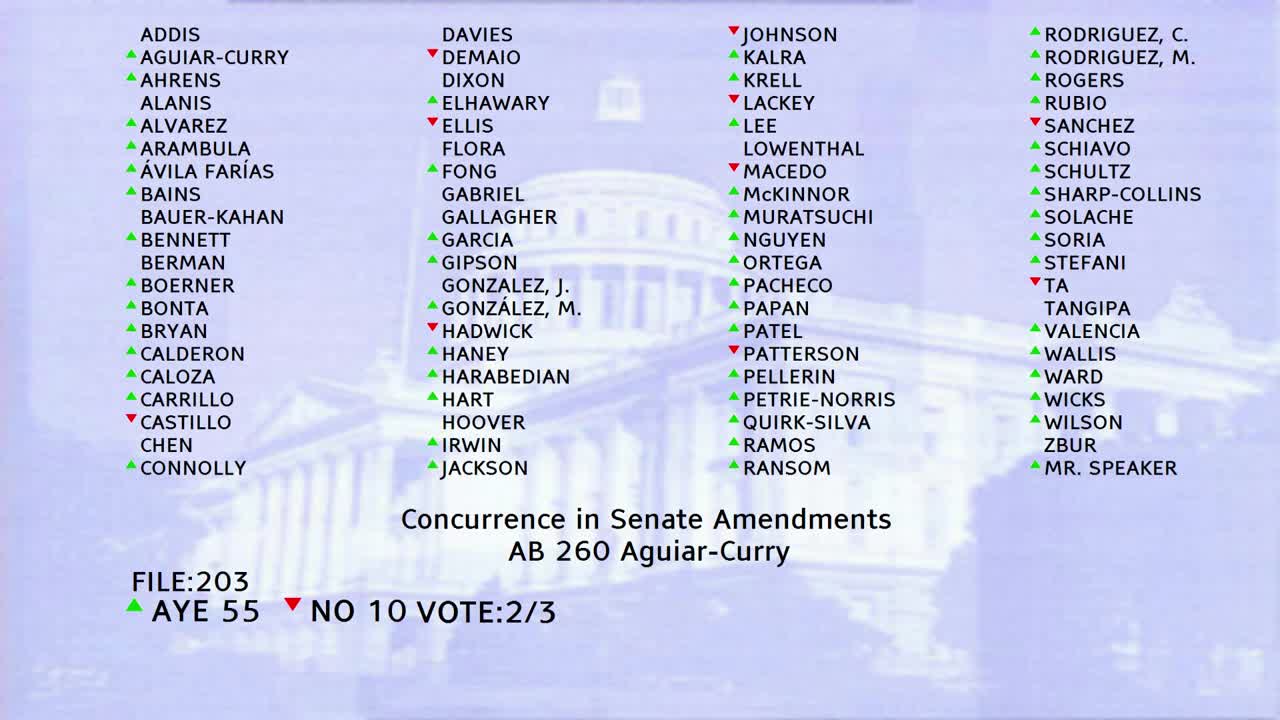 1MIN
Assembly Floor
 1MIN
Senate Floor
 18MIN
Senate Standing Committee on Education
 7MIN
Assembly Standing Committee on Human Services
Bill Author

Bill Co-Author(s):