AB 764: Birds and mammals: nongame birds: mute swans.
- Session Year: 2025-2026
- House: Assembly
- Latest Version Date: 2025-10-07
Current Status:
Passed
(2025-10-07: Chaptered by Secretary of State - Chapter 441, Statutes of 2025.)
Introduced
In Committee
Awaiting First Chamber Vote
Passed First Chamber
In Committee
Awaiting Second Chamber Vote
Passed Second Chamber
Enacted
Existing law provides for taking and possession of listed nongame birds without a hunting license if taken in compliance with specified requirements.
This bill would allow, until January 1, 2031, a mute swan to be taken or possessed under similar circumstances as other listed nongame birds. The bill would encourage a person to report to the Department of Fish and Wildlife when they take or possess a mute swan. The bill would require the department to collect information about enforcement actions, taken by department personnel, associated with the take and possession of a mute swan.
Existing law provides for taking and possession of listed nongame birds without a hunting license if taken in compliance with specified requirements.
This bill would allow allow, until January 1, 2031, a mute swans swan to be taken or possessed under the same similar circumstances as other listed nongame birds. The bill would encourage a person to report to the Department of Fish and Wildlife when they take or possess a mute swan. The bill would require the department to collect information about enforcement actions, taken by department personnel, associated with the take and possession of a mute swan.
Existing law provides for taking and possession of listed nongame birds without a hunting license if taken in compliance with specified requirements.
This bill would allow mute swans to be taken or possessed under the same circumstances as other listed nongame birds.
(a)Except as provided in Section 3000 and this section, the following nongame birds may be taken or possessed at any time:
(1)English sparrow (Passer domesticus).
(2)Starling (Sturnus vulgaris).
(3)(A)Mute swan (Cygnus olor).
(i)A person taking or possessing a mute swan shall be encouraged to report to the department when they take or possess a mute swan.
(ii)The department shall collect information about enforcement actions, taken by department personnel, associated with the take and possession of a mute swan.
(B)This paragraph shall become inoperative on January 1, 2031.
(b)Notwithstanding Section 3007 or any other provision of this code or regulation adopted pursuant to this code requiring the possession of a hunting license, a landowner or lessee, or an agent of either in immediate possession of written authority from the landowner or lessee, shall not be required to obtain a hunting license or a depredation permit to take nongame birds listed in subdivision (a) on land owned or leased by the landowner or lessee.
(c)All other persons taking a nongame bird listed in subdivision (a) shall be licensed pursuant to Section 3007.
(a)Except as provided in Section 3000 and this section, the following nongame birds may be taken or possessed at any time:
(1)English sparrow (Passer domesticus).
(2)Starling (Sturnus vulgaris).
(3)(A)Mute swans swan (Cygnus olor).
(i)A person taking or possessing a mute swan shall be encouraged to report to the department when they take or possess a mute swan.
(ii)The department shall collect information about enforcement actions, taken by department personnel, associated with the take and possession of a mute swan.
(B)This paragraph shall become inoperative on January 1, 2031.
(b)Notwithstanding Section 3007 or any other provision of this code or regulation adopted pursuant to this code requiring the possession of a hunting license, a landowner or lessee, or an agent of either in immediate possession of written authority from the landowner or lessee, shall not be required to obtain a hunting license or a depredation permit to take nongame birds listed in subdivision (a) on land owned or leased by the landowner or lessee.
(c)All other persons taking a nongame bird listed in subdivision (a) shall be licensed pursuant to Section 3007.
(a)Except as provided in Section 3000 and this section, the following nongame birds may be taken or possessed at any time:
(1)English sparrow (Passer domesticus).
(2)Starling (Sturnus vulgaris).
(3)Mute swans (Cygnus olor).
(b)Notwithstanding Section 3007 or any other provision of this code or regulation adopted pursuant to this code requiring the possession of a hunting license, a landowner or lessee, or an agent of either in immediate possession of written authority from the landowner or lessee, shall not be required to obtain a hunting license or a depredation permit to take nongame birds listed in subdivision (a) on land owned or leased by the landowner or lessee.
(c)All other persons taking a nongame bird listed in subdivision (a) shall be licensed pursuant to Section 3007.
|
Date
|
Status
|
|---|---|
| Oct 7, 2025 | Chaptered by Secretary of State - Chapter 441, Statutes of 2025. |
| Oct 7, 2025 | Approved by the Governor. |
| Sep 24, 2025 | Enrolled and presented to the Governor at 3 p.m. |
| Sep 13, 2025 | Joint Rules 62(a)(14) and 51(a)(4) suspended. (Ayes 59. Noes 20. Page 3413.) |
| Sep 13, 2025 | Senate amendments concurred in. To Engrossing and Enrolling. (Ayes 72. Noes 0. Page 3493.). |
| Sep 8, 2025 | In Assembly. Concurrence in Senate amendments pending. |
| Sep 8, 2025 | Read third time. Passed. Ordered to the Assembly. (Ayes 39. Noes 0. Page 2614.). |
| Aug 29, 2025 | Read second time. Ordered to third reading. |
| Aug 29, 2025 | From committee: Do pass. (Ayes 7. Noes 0.) (August 29). |
| Jul 7, 2025 | In committee: Referred to APPR. suspense file. |
| Jun 25, 2025 | Read second time and amended. Re-referred to Com. on APPR. |
| Jun 24, 2025 | From committee: Amend, and do pass as amended and re-refer to Com. on APPR. with recommendation: To Consent Calendar. (Ayes 7. Noes 0.) (June 24). |
| May 7, 2025 | Referred to Com. on N.R. & W. |
| Apr 24, 2025 | In Senate. Read first time. To Com. on RLS. for assignment. |
| Apr 24, 2025 | Read third time. Passed. Ordered to the Senate. (Ayes 73. Noes 0. Page 1277.) |
| Apr 10, 2025 | Read second time. Ordered to third reading. |
| Apr 9, 2025 | From committee: Do pass. (Ayes 14. Noes 0.) (April 9). |
| Mar 25, 2025 | From committee: Do pass and re-refer to Com. on APPR. (Ayes 13. Noes 0.) (March 25). Re-referred to Com. on APPR. |
| Mar 3, 2025 | Referred to Com. on W. P., & W. |
| Feb 19, 2025 | From printer. May be heard in committee March 21. |
| Feb 18, 2025 | Read first time. To print. |
|
Date
|
Description
|
Location
|
Votes
|
|
|---|---|---|---|---|
| Sep 13, 2025 | AB 764 Jeff Gonzalez Concurrence in Senate Amendments | Assembly Floor |
Passed |
|
| Sep 8, 2025 | Assembly 3rd Reading AB764 Jeff Gonzalez By Cortese | Senate Floor |
Passed |
|
| Aug 29, 2025 | Do pass | Senate Standing Committee on Appropriations |
Passed |
|
| Jul 7, 2025 | Placed on suspense file | Senate Standing Committee on Appropriations |
Passed |
|
| Jun 24, 2025 | Do pass as amended, but first amend, and re-refer to the Committee on [Appropriations] with the recommendation: To Consent Calendar | Senate Standing Committee on Natural Resources and Water |
Passed |
|
| Apr 24, 2025 | AB 764 Jeff Gonzalez Assembly Third Reading | Assembly Floor |
Passed |
|
| Apr 9, 2025 | Do pass. | Assembly Standing Committee on Appropriations |
Passed |
|
| Mar 25, 2025 | Do pass and be re-referred to the Committee on [Appropriations] | Assembly Standing Committee on Water, Parks, and Wildlife |
Passed |
This list shows positions taken on this bill by organizations on the date displayed, which is linked to the original source.
Positions by individuals are not included.
|
Organization
|
Position
|
Date
|
|---|---|---|
| American Bird Conservancy | ** Support | |
| Backcountry Hunters Anglers | ** Support | |
| California Waterfowl Association | ** Support | |
| Cal-Ore Wetlands and Waterfowl Council | ** Support | |
| Delta Waterfowl | ** Support | |
| Friends of Animals | ** Against | |
| Grassland Water District | ** Support | |
| Social Compassion In Legislation | ** Against | |
| Suisun Resource Conservation District | ** Support | |
| The Black Brant Group | ** Support | |
| Tulare Basin Wetlands Association | ** Support |
CONCURRENCE IN SENATE AMENDMENTS
CSA1 Bill Id:AB 764
Author:(Jeff Gonzalez)
As Amended Ver:June 25, 2025
Majority vote
SUMMARY
Includes the mute swan (Cygnus olor) in the list of nongame bird species that may be taken or possessed at any time, until January 1, 2031.
Senate Amendments
- Require the Department of Fish and Wildlife (CDFW) to collect information about enforcement actions related to the take of mute swans, encourage individuals to report their take of mute swans to CDFW.
- Sunset the provisions of this bill on January 1, 2031.
COMMENTS
Mute swan (Cygnus olor) are very large birds weighing 25–30 pounds and measuring four to 5.5 feet in length, with a wingspan of nearly eight feet. Adult mute swan are solid white with a black face-patch and black to grayish-pink legs with webbed feet. As their name may suggest, mute swan are not very vocal, but will grunt, snort, or hiss to communicate, especially if they feel threatened.
Every year since 1948, CDFW has conducted a Waterfowl Breeding Population Survey. CDFW began monitoring for feral mute swan in 2007. The 2024 survey estimates a 71% increase in mute swan numbers since 2023 and a 535% increase above their 16-year average. CDFW also reports an increase in public sightings of mute swan.
CDFW's factsheet reports that mute swan are voracious feeders, with each adult swan consuming up to eight pounds of submerged aquatic vegetation (SAV) per day, and destroying much more in the process. SAV is an important part of aquatic ecosystems as it provides food and shelter for native waterfowl, fish, and invertebrates. By consuming massive amounts of SAV, mute swan negatively impact the structure and function of aquatic habitats that native species depend upon. Additionally, mute swan are aggressive towards other birds, as well as people. Mute swan disrupt nesting activity of native waterfowl by chasing birds from their nests and have been reported to physically injure, or even kill, other birds. Mute swan have been reported to attack people and, in some cases, have critically injured children and pets.
This bill proposes to add mute swan to a list of three other birds that may be taken at any time: English sparrow, starling, and rock dove (note, rock dove is included in regulation, not code, see above). It is likely that other species may accidentally be taken when targeting those three nongame species, and these species do not benefit from the size of swan, which should only make identification easier.
It is important to note that it is still unlawful to hunt or discharge a firearm within 150 yards of a building without permission of the landowner and still unlawful to willfully discharge a firearm in a grossly negligent manner that could result in injury or death of a person. This bill does not create any exception for those laws.
According to the Author
"[This bill] is an essential step in protecting California's native wildlife, habitats, and ecosystems. As environmental challenges and invasive species put increasing pressure on our state's biodiversity, this legislation promotes common-sense conservation efforts that safeguard vital habitats and protect species at risk."
Arguments in Support
A number of groups write in support citing the aggressive and destructive nature of the mute swan. They claim that this bill will provide another tool in combating the invasive mute swan, similar to the state's treatment of other invasive species: nutria, starling, house sparrow, and rock pigeon. They add that mute swan "are not found on [CDFW] lands, and private lands and other areas provide significant habitat for them. Thus, any meaningful control efforts must necessarily include other landowners."
Arguments in Opposition
Social Compassion in Legislation has raised concerns about the use of lethal control measures, advocating instead for alternatives such as those implemented in New York (e.g., nest destruction and relocating of birds to wildlife facilities). They also request improved reporting mechanisms to better track the number of mute swans removed in the state.
FISCAL COMMENTS
According to the Senate Appropriations Committee, CDFW anticipates unknown, but potentially significant costs (General Fund or Fish and Game Preservation Fund) for CDFW to collect specified information until provisions of the bill sunset on January 1, 2031.
VOTES:
ASM WATER, PARKS, AND WILDLIFE: 13-0-0
YES: Papan, Jeff Gonzalez, Alvarez, Ávila Farías, Bains, Bennett, Boerner, Caloza, Hart, Macedo, Celeste Rodriguez, Rogers, Tangipa
ASM APPROPRIATIONS: 14-0-1
YES: Wicks, Sanchez, Arambula, Calderon, Caloza, Dixon, Elhawary, Fong, Mark González, Hadwick, Hart, Pacheco, Solache, Ta
ABS, ABST OR NV: Pellerin
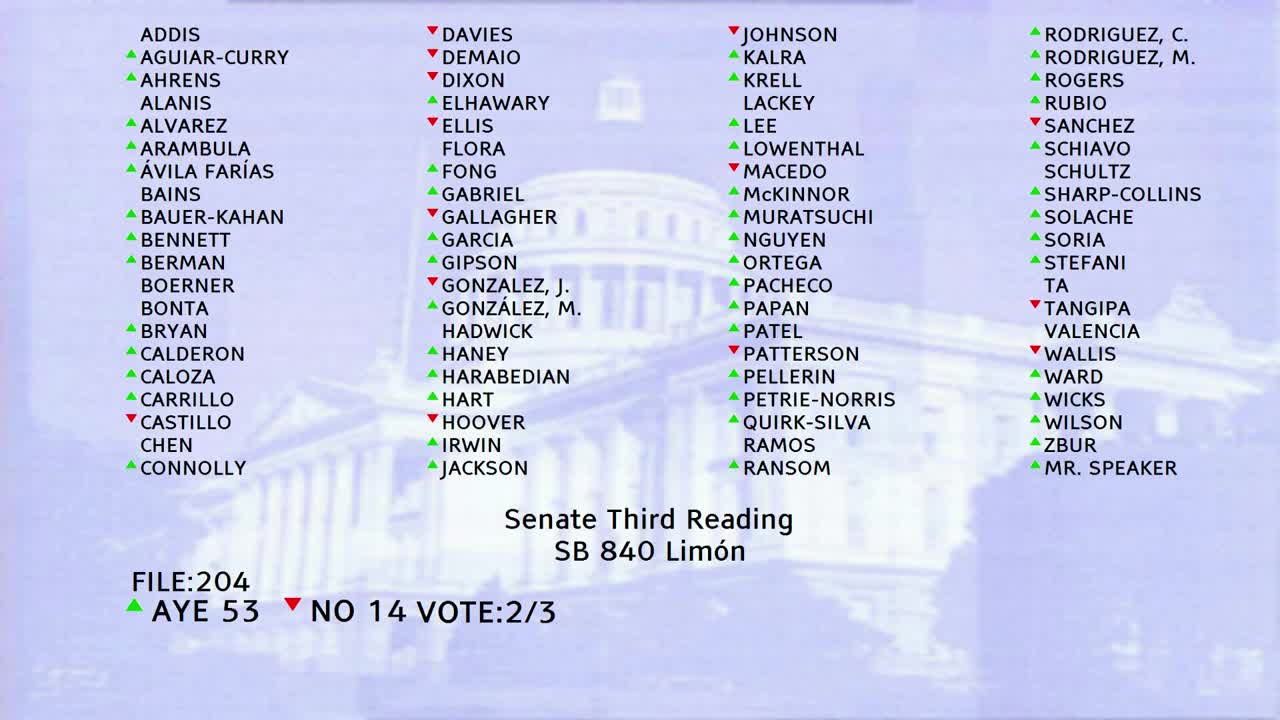
ASSEMBLY FLOOR: 73-0-6
YES: Addis, Aguiar-Curry, Ahrens, Alanis, Alvarez, Arambula, Ávila Farías, Bains, Bauer‑Kahan, Bennett, Berman, Boerner, Bonta, Bryan, Calderon, Caloza, Castillo, Chen, Connolly, Davies, DeMaio, Dixon, Elhawary, Ellis, Flora, Fong, Gabriel, Garcia, Gipson, Jeff Gonzalez, Mark González, Hadwick, Haney, Hart, Hoover, Irwin, Jackson, Krell, Lowenthal, Macedo, McKinnor, Muratsuchi, Nguyen, Ortega, Pacheco, Papan, Patel, Patterson, Pellerin, Petrie-Norris, Quirk-Silva, Ramos, Ransom, Celeste Rodriguez, Michelle Rodriguez, Rogers, Blanca Rubio, Sanchez, Schiavo, Schultz, Sharp-Collins, Solache, Soria, Stefani, Ta, Tangipa, Valencia, Wallis, Ward, Wicks, Wilson, Zbur, Rivas
ABS, ABST OR NV: Carrillo, Gallagher, Harabedian, Kalra, Lackey, Lee
UPDATED
VERSION: June 25, 2025
CONSULTANT: Stephanie Mitchell / W., P., & W. / (916) 319-2096 FN: 0001868
SENATE RULES COMMITTEE Office of Senate Floor Analyses (916) 651-1520 Fax: (916) 327-4478 | AB 764 |
THIRD READING
Bill No: AB 764
Author: Jeff Gonzalez (R)
Amended: 6/25/25 in Senate
Vote: 21
SENATE NATURAL RES. & WATER COMMITTEE: 7-0, 6/24/25
AYES: Limón, Seyarto, Allen, Grove, Hurtado, Laird, Stern
SENATE APPROPRIATIONS COMMITTEE: 7-0, 8/29/25
AYES: Caballero, Seyarto, Cabaldon, Dahle, Grayson, Richardson, Wahab
ASSEMBLY FLOOR: 73-0, 4/24/25 - See last page for vote
SUBJECT: Birds and mammals: nongame birds: mute swans
SOURCE: California Waterfowl Association
DIGEST:
This bill adds mute swans (Cygnus olor) to the list of nongame birds that may be taken and possessed at any time if taken or possessed in compliance with certain requirements, requires the California Department of Fish and Wildlife to collect information about enforcement actions associated with the take and possession of mute swans, and sunsets on January 1, 2031, as provided.
ANALYSIS:
Existing law:
- Establishes the California Department of Fish and Wildlife (CDFW) and the Fish and Game Commission (commission) in the California Natural Resources Agency. In general, CDFW implements and enforces the regulations set by the commission and provides data and expertise to inform the commission’s decision making.
- States that all birds occurring naturally in California that are not resident game birds, migratory game birds, or fully protected birds are nongame birds. Makes it unlawful to take any nongame birds except as provided by law or in accordance with regulations set by the commission (Fish and Game Code (FGC) §3800).
- Makes it unlawful to take a bird or mammal without a license or entitlement (FGC §3007).
- Defines “take” to mean to hunt, pursue, catch, capture, or kill, or attempt to hunt, pursue, capture, or kill (FGC §86).
- Makes is unlawful to take any bird or mammal, except a nongame mammal, between one-half hour after sunset and one-half hour before sunrise of the following day at the place of taking (FGC §3000).
- Authorizes the take or possession of two nongame birds, the English sparrow (Passer domesticus) and starling (Sturnus vulgaris) at any time during daylight hunting hours. Authorizes landowners or those with permission from landowners to take the listed birds without a hunting license or depredation permit on that land. Requires all other individuals to have a hunting license (FGC §3801).
- Authorizes nongame birds not covered by the Migratory Bird Treaty Act which are found to be injuring growing crops or property to be taken by the owner or tenant of the premises or by officers or employees of the Department of Food and Agriculture or county when acting in their official capacities (FGC §3801.5).
This bill:
- Adds mute swans (Cygnus olor) to the list of nongame birds (i.e. English sparrow and starling) that may be taken and possessed at any time subject to the following conditions:
- By a licensed hunter during daylight hunting hours.
- By a landowner or lessee or an agent of either in possession of written authority from the landowner or lessee without a hunting license or depredation permit during daylight hunting hours on the land owned or leased by the landowner or lessee.
- Encourages a person taking or possessing a mute swan to report to CDFW when a mute swan is taken or possessed.
- Requires CDFW to collect information about enforcement actions associated with the take and possession of a mute swan, as provided.
- Sunsets on January 1, 2031.
[NOTE: See the Senate Natural Resources and Water Committee analysis for additional information regarding this bill.]
FISCAL EFFECT: Appropriation: No Fiscal Com.: Yes Local: No
According to the Senate Appropriations Committee:
- Unknown, potentially significant costs (General Fund or Fish and Game Preservation Fund [FGPF]) for DFW to collect specified information until provisions of the bill sunset on January 1, 2031.
SUPPORT: (Verified 8/29/25)
California Waterfowl Association (source)
American Bird Conservancy
Backcountry Hunters & Anglers
Cal-Ore Wetlands and Waterfowl Council
Delta Waterfowl
Grassland Water District
Suisun Resource Conservation District
The Black Brant Group
Tulare Basin Wetlands Association
OPPOSITION: (Verified 8/29/25)
Friends of Animals
Social Compassion in Legislation
ARGUMENTS IN SUPPORT: According to the author, this bill “is an essential step in protecting California’s native wildlife, habitats, and ecosystems. As environmental challenges and invasive species put increasing pressure on our state’s biodiversity, this legislation promotes commonsense conservation efforts that safeguard vital habitats and protect species at risk.”
The California Waterfowl Association adds that CDFW “needs as much flexibility as possible to lethally remove established populations,” and notes that most mute swans are not found on CDFW lands so control efforts must include private lands.
ARGUMENTS IN OPPOSITION: According to Social Compassion in Legislation, “While we appreciate that invasive species may have negative effects on native species and habitat, we do not believe that recreational hunting is the tool that will solve the perceived problems posed by mute swans.”
They note that there “are a multitude of non-lethal methods to control mute swan populations which have been successfully implemented in other states,” argue that hunters should be mandated to report take to ensure accurate data collection, note the inconsistency of taking mute swans to protect habitat for species at risk whose populations are reduced by hunting, and argue that the commission should regulate the taking of mute swans in a controlled and non-lethal manner, if needed.
ASSEMBLY FLOOR: 73-0, 4/24/25
AYES: Addis, Aguiar-Curry, Ahrens, Alanis, Alvarez, Arambula, Ávila Farías, Bains, Bauer-Kahan, Bennett, Berman, Boerner, Bonta, Bryan, Calderon, Caloza, Castillo, Chen, Connolly, Davies, DeMaio, Dixon, Elhawary, Ellis, Flora, Fong, Gabriel, Garcia, Gipson, Jeff Gonzalez, Mark González, Hadwick, Haney, Hart, Hoover, Irwin, Jackson, Krell, Lowenthal, Macedo, McKinnor, Muratsuchi, Nguyen, Ortega, Pacheco, Papan, Patel, Patterson, Pellerin, Petrie-Norris, Quirk-Silva, Ramos, Ransom, Celeste Rodriguez, Michelle Rodriguez, Rogers, Blanca Rubio, Sanchez, Schiavo, Schultz, Sharp-Collins, Solache, Soria, Stefani, Ta, Tangipa, Valencia, Wallis, Ward, Wicks, Wilson, Zbur, Rivas
NO VOTE RECORDED: Carrillo, Gallagher, Harabedian, Kalra, Lackey, Lee
Prepared by: Katharine Moore / N.R. & W. / (916) 651-4116
8/29/25 20:57:06
**** END ****
SENATE COMMITTEE ON NATURAL RESOURCES AND WATER
Senator Monique Limón, Chair
2025 - 2026 Regular
Bill No: AB Hearing Date: June 24, 2025
Author: | Jeff Gonzalez | ||
Version: | February 18, 2025 Introduced | ||
Urgency: | No | Fiscal: | Yes |
Consultant: | Katharine Moore | ||
Subject: Birds and mammals: nongame birds
SUMMARY
This bill would add mute swans (Cygnus olor) to the list of nongame birds that may be taken and possessed at any time if taken or possessed in compliance with certain requirements, as provided.
BACKGROUND AND EXISTING LAW
Mute swans (Cygnus olor)
Mute swans are a non-native invasive species, originally brought to North America for ornamental purposes – such as to be decorative waterfowl for parks, zoos, and private estates – in the late 1800s. Mute swans subsequently escaped from captivity, and populations became established in the wild.
Mute swans are very large waterfowl with adults averaging about 48 – 66 inches in length, about 25 - 30 pounds in weight and a wingspan of up to 8 feet. Their plumage is white. According to the California Department of Fish and Wildlife (CDFW), they can be distinguished from other swan species by their orange bill with a black knob, long tail feathers, and their long “S” shaped necks. Increasing populations of mute swans in an area can have significant impacts on food availability and the local ecosystem to the detriment of native species, including other waterfowl. For example, adult mute swans can consume 6 – 8 pounds of aquatic vegetation daily when feeding in wetland habitats, and have, in some locations and seasons, been observed to act aggressively towards other birds, and, sometimes, children and pets.
Due to burgeoning mute swan populations along the US East Coast’s Atlantic Flyway – an increase in population from 6,300 to over 14,000 from 1986 – 2002 – the Atlantic Flyway Council adopted a Mute Swan Management Plan in 2003 in an effort to reduce the detrimental impact of mute swan populations on Flyway wetlands and the species that depend upon them. Many states along the Atlantic Flyway implemented management programs which reduced the population by about 35% to 9,000 birds by 2011.
The annual California waterfowl breeding population survey conducted by CDFW in 2024 yielded an estimated population of mute swans in California of 6,912, an estimated increase of 2,867 since the 2023 estimate of 4,045. These estimates are somewhat uncertain as the reported standard error in the population estimates is 55% in 2024 and 29% in 2023, respectively. There is no uncertainty reported for the average population of 1,147 estimated for the time period 2003 – 2024. These estimates nevertheless suggest that the population of wild mute swans in the state has likely increased substantially over the last 21 years through 2024, and may present an enhanced risk to the other native waterfowl who depend upon the Pacific Flyway for habitat and food.
Currently, CDFW asks that wild mute swan sightings be reported to them. Two other invasive nongame birds present in the state – the starling (Sturnus vulgaris) and English sparrow (Passer domesticus) – can be taken or possessed at any time, even without a hunting license in some circumstances, due to the risk they pose to native wildlife.
Existing law:
- Establishes CDFW and the Fish and Game Commission (commission) in the California Natural Resources Agency. In general, CDFW implements and enforces the regulations set by the commission and provides data and expertise to inform the commission’s decision making.
- States that all birds occurring naturally in California that are not resident game birds, migratory game birds, or fully protected birds are nongame birds. Makes it unlawful to take any nongame birds except as provided by law or in accordance with regulations set by the commission (Fish and Game Code (FGC) §3800).
- Makes it unlawful to take a bird or mammal without a license or entitlement (FGC §3007).
- Defines “take” to mean to hunt, pursue, catch, capture, or kill, or attempt to hunt, pursue, capture, or kill (FGC §86).
- Makes is unlawful to take any bird or mammal, except a nongame mammal, between one-half hour after sunset and one-half hour before sunrise of the following day at the place of taking (FGC §3000).
- Authorizes the take or possession of two nongame birds, the English sparrow (Passer domesticus) and starling (Sturnus vulgaris) at any time during daylight hunting hours. Authorizes landowners or those with permission from landowners to take the listed birds without a hunting license or depredation permit on that land. Requires all other individuals to have a hunting license (FGC §3801).
- Authorizes nongame birds not covered by the Migratory Bird Treaty Act which are found to be injuring growing crops or property to be taken by the owner or tenant of the premises or by officers or employees of the Department of Food and Agriculture or county when acting in their official capacities (FGC §3801.5).
PROPOSED LAW
This bill would:
- Add mute swans (Cygnus olor) to the list of nongame birds (i.e. English sparrow and starling) that may be taken and possessed at any time subject to the following conditions:
- By a licensed hunter during daylight hunting hours.
- By a landowner or lessee or an agent of either in possession of written authority from the landowner or lessee without a hunting license or depredation permit during daylight hunting hours on the land owned or leased by the landowner or lessee.
ARGUMENTS IN SUPPORT
According to the author, this bill “is an essential step in protecting California’s native wildlife, habitats, and ecosystems. As environmental challenges and invasive species put increasing pressure on our state’s biodiversity, this legislation promotes commonsense conservation efforts that safeguard vital habitats and protect species at risk.”
ARGUMENTS IN OPPOSITION
None received
COMMENTS
Wild mute swan populations present a risk to native species. There is ample evidence from research studies that wild mute swan populations can negatively impact native species through, for example, out-competing them for food or nesting sites. Other states – such as those along the Atlantic Flyway – have taken steps to reduce wild mute swan populations due to these risks. In California, mute swans are already on the list of not normally domesticated species that cannot be imported, transported or possessed alive within the state without a Restricted Species permit due to their potential detrimental impacts on native wildlife, agricultural interests, or public health and safety (see Title 14, California Code of Regulations, §§671 et seq.).
This bill proposes to authorize the take and possession of invasive mute swans without limit, subject to certain conditions, in order to help protect native species. The annual waterfowl breeding population survey should help to provide information on the impact of this proposed change in law. There is merit, however, in collecting information about the hunting effort and providing an opportunity for future assessment.
In view of this, the Committee may wish to amend the bill to add a 5 year sunset, encourage reporting of mute swan take and possession, and require CDFW to track any associated enforcement. [Amendment #1]
The mute swan is readily distinguishable from native swans. California has two native species of swan – the tundra swan (Cygnus columbianus columbianus) and trumpeter swan (Cygnus buccinators). Both of these swans are protected under the federal Migratory Bird Treaty Act, and the trumpeter swan is a fully protected species under state law (FGC §3511). The mute swan’s long tail feathers, orange bill with a large black knob, and larger size visibly distinguish it from the other two species (photos from the Assembly Water, Parks, and Wildlife bill analysis).
SUGGESTED AMENDMENTS
AMENDMENT 1
- Add a 5 year sunset date.
- Encourage the reporting to CDFW of the take and possession of mute swans.
- Require CDFW to collect information about any enforcement actions by CDFW personnel associated with the take and possession of mute swans.
SUPPORT
California Waterfowl Association (sponsor)
American Bird Conservancy
Backcountry Hunters & Anglers
Cal-Ore Wetlands and Waterfowl Council
Delta Waterfowl
Grassland Water District
Suisun Resource Conservation District
The Black Brant Group
Tulare Basin Wetlands Association
OPPOSITION
None received
-- END --
ASSEMBLY THIRD READING
ATR Bill Id:AB 764
Author:(Jeff Gonzalez)
As Introduced Ver:February 18, 2025
Majority vote
SUMMARY
Includes the mute swan (Cygnus olor) in the list of nongame bird species that may be taken or possessed at any time.
Major Provisions
COMMENTS
Mute swan (Cygnus olor) are very large birds weighing 25–30 pounds and measuring 4–5.5 feet in length, with a wingspan up to nearly eight feet. Adult mute swan are solid white with a black face-patch and black to grayish-pink legs with webbed feet. As their name may suggest, mute swan are not very vocal, but will grunt, snort, or hiss to communicate, especially if they feel threatened.Every year since 1948, Department of Fish and Wildlife′s (CDFW) has conducted a Waterfowl Breeding Population Survey. CDFW began monitoring for feral mute swan in 2007. The 2024 survey estimates a 71% increase in mute swan since 2023 and a 535% increase above their 16-year average. CDFW also reports an increase in public sightings of mute swan.CDFW′s Factsheet reports that mute swan are voracious feeders, with each adult swan consuming up to eight pounds of submerged aquatic vegetation (SAV) per day, and destroying much more in the process. SAV is an important part of aquatic ecosystems as it provides food and shelter for native waterfowl, fish, and invertebrates. By consuming massive amounts of SAV, mute swan negatively impact the structure and function of aquatic habitats that native species depend upon. Additionally, mute swan are aggressive towards other birds, as well as people. Mute swan disrupt nesting activity of native waterfowl by chasing birds from their nests and have been reported to physically injure, or even kill, other birds. Mute swan have been reported to attack people and, in some cases, have critically injured children and pets.
This bill proposes to add mute swan to a list of three other birds that may be taken at any time: English sparrow, starling, and rock dove (note, rock dove is included in regulation, not code, see above). It is likely that other species may accidentally be taken when targeting those three nongame species, and these species do not benefit from the size of swan, which should only make identification easier.It is important to note that it is still unlawful to hunt or discharge a firearm within 150 yards of a building without permission of the landowner and still unlawful to willfully discharge a firearm in a grossly negligent manner that could result in injury or death of a person. This bill does not create any exception for those laws.
According to the Author
″This bill] is an essential step in protecting California′s native wildlife, habitats, and ecosystems. As environmental challenges and invasive species put increasing pressure on our state′s biodiversity, this legislation promotes commonsense conservation efforts that safeguard vital habitats and protect species at risk.″
Arguments in Support
A number of groups write in support citing the aggressive and destructive nature of the mute swan. They claim that this bill will provide another tool in combating the invasive mute swan, similar to the state′s treatment of other invasive species: nutria, starling, house sparrow, and rock pigeon. They add that mute swan ″are not found on DFW lands, and private lands and other areas provide significant habitat for them. Thus, any meaningful control efforts must necessarily include other landowners.″
Arguments in Opposition
None on file.
FISCAL COMMENTS
According to the Assembly Appropriations Committee, CDFW anticipates minor and absorbable, if any, costs.
VOTES
ASM WATER, PARKS, AND WILDLIFE: 13-0-0
YES: Papan, Jeff Gonzalez, Alvarez, Ávila Farías, Bains, Bennett, Boerner, Caloza, Hart, Macedo, Celeste Rodriguez, Rogers, Tangipa
ASM APPROPRIATIONS: 14-0-1
YES: Wicks, Sanchez, Arambula, Calderon, Caloza, Dixon, Elhawary, Fong, Mark González, Hadwick, Hart, Pacheco, Solache, Ta
ABS, ABST OR NV: Pellerin
UPDATED
VERSION: February 18, 2025
CONSULTANT: Stephanie Mitchell / W., P., & W. / (916) 319-2096 FN: 0000238
Date of Hearing: April 9, 2025
ASSEMBLY COMMITTEE ON APPROPRIATIONS
Buffy Wicks, Chair
ABPCA Bill Id:AB 764
Author:(Jeff Gonzalez) – As Introduced Ver:February 18, 2025
Policy Committee: | Water, Parks and Wildlife | Vote: | 13 - 0 |
|
| ||
|
|
Urgency: No State Mandated Local Program: No Reimbursable: No
SUMMARY:
This bill adds mute swans (Cygnus olor) to the list of nongame bird species in the Fish and Game Code that may be taken or possessed at any time.
FISCAL EFFECT:
The California Department of Fish and Wildlife (CDFW) anticipates minor and absorbable, if any, costs.
COMMENTS:
1) Purpose. According to the author:
[This bill] is an essential step in protecting California's native wildlife, habitats, and ecosystems. As environmental challenges and invasive species put increasing pressure on our state’s biodiversity, this legislation promotes commonsense conservation efforts that safeguard vital habitats and protect species at risk.
2) Background. According to CDFW’s 2024 Waterfowl Breeding Population Survey, the department estimates a 71% increase in mute swans since 2023 and a 535% increase above the 16-year average. CDFW also reports an increase in public sightings of mute swans. According to a coalition of organizations writing in support of this bill, mute swans are considered a highly invasive, aggressive, and territorial resource competitor to native waterfowl in North America, are not granted any protections under federal migratory bird laws, and are designated as a restricted (detrimental) species in California.
According to the Assembly Water, Parks, and Wildlife Committee analysis of this bill, mute swans are voracious feeders, with each adult swan consuming up to eight pounds of submerged aquatic vegetation (SAV) per day, and destroying much more in the process. SAV is an important part of aquatic ecosystems as it provides food and shelter for native waterfowl, fish, and invertebrates. By consuming massive amounts of SAV, mute swans harm the structure and function of aquatic habitats that native species depend upon. Additionally, mute swans are aggressive towards other birds and people.
Because the mute swan population has increased quickly and the species competes with native species, a few states, such as New Jersey, New York, Maryland, Ohio, and Michigan, have developed mute swan population reduction plans or have initiated culling practices. Additionally, the Atlantic Flyway Mute Swan Management Plan, which is a cooperative plan between the U.S. Fish and Wildlife Service, Canadian Wildlife Service, and Mexico, includes strategies to reduce mute swan numbers through hunting, egg treatment, prohibiting release, and amending state laws to allow for greater control.
Currently, Fish and Game Code section 3801 – which this bill amends – allows listed nongame birds (specifically English sparrow and starling) to be taken or possessed at any time during daylight hunting hours. This section also allows landowners, or those with permission from landowners, to take the listed birds without a hunting license or depredation permit on that land. It does, however, require all other individuals to have a hunting license. A few years ago, the Fish and Game Commission amended its regulations to add the rock dove to the aforementioned list of nongame birds that may be taken at any time.
The support coalition writes:
[This bill adds] mute swans (Cygnus olor) to the list of exotic nongame birds that can be legally taken in order to reduce and better control their populations in California…To help prevent or minimize continued spread and establishment of mute swan populations, DFW needs as much flexibility as possible to lethally remove established populations. Similar approaches have been taken to remove other nonnative, invasive species such as nutria, starlings, house sparrow, and rock pigeons. Note that most mute swans, however, are not found on DFW lands, and private lands and other areas provide significant habitat for them. Thus, any meaningful control efforts must necessarily include other landowners.
Analysis Prepared by: Nikita Koraddi / APPR. / (916) 319-2081
Date of Hearing: March 25, 2025
ASSEMBLY COMMITTEE ON WATER, PARKS, AND WILDLIFE
Diane Papan, Chair
ABPCA Bill Id:AB 764 (
Author:Jeff Gonzalez) – As Introduced Ver:February 18, 2025
SUBJECT: Birds and mammals: nongame birds
SUMMARY: Includes the mute swan (Cygnus olor) in the list of nongame bird species that may be taken or possessed at any time.
EXISTING LAW:
- Allows two nongame birds, the English sparrow (Passer domesticus) and starling (Sturnus vulgaris), to be taken or possessed at any time during daylight hunting hours. Allows landowners or those with permission from landowners to take the listed birds without hunting license or depredation permit on that land. Requires all other individuals to have a hunting license [Fish and Game Code (FGC) § 3801].
- Makes it unlawful to take any bird or mammal, except a nongame mammal, between one-half hour after sunset and one-half hour before sunrise of the following day at the place of taking (FGC § 3000).
- Makes it unlawful to take a bird or mammal without a license or entitlement (FGC § 3007).
- Defines “take” to mean to hunt, pursue, catch, capture, or kill, or attempt to hunt, pursue, catch, capture, or kill (FGC § 86).
- States that all birds occurring naturally in California that are not resident game birds, migratory game birds, or fully protected birds are nongame birds. Makes it unlawful to take any nongame bird except as provided in the FGC or in accordance with regulations of the Fish and Game Commission (the Commission) (FGC § 3800).
- Allows nongame birds not covered by the Migratory Bird Treaty Act, which are found to be injuring growing crops or property, to be taken by the owner or tenant of the premises or by officers or employees of the Department of Food and Agriculture or county when acting in their official capacities (FGC § 3801.5).
- Allows the take of English sparrow, starling, domestic pigeon (Columba livia) except as prohibited in FGC § 3680, coyote, weasels, skunks, opossum, moles and rodents at any time of year and in any number, except has prohibited in regulation [14 California Code of Regulation (CCR) § 472].
- Makes it unlawful to import, transport, or possess any live animal listed within that section, including the mute swan, except by permit and subject to conditions and restrictions designated by the California Department of Fish and Wildlife (CDFW) (14 CCR § 671).
FISCAL EFFECT: Unknown. This bill is keyed fiscal.
COMMENTS:
- Purpose of this bill. This bill adds mute swan to the list of nongame birds that may be taken or possessed at any time. According to the author, “[This bill] is an essential step in protecting California's native wildlife, habitats, and ecosystems. As environmental challenges and invasive species put increasing pressure on our state’s biodiversity, this legislation promotes commonsense conservation efforts that safeguard vital habitats and protect species at risk.”
- Background. Mute swan (Cygnus olor) are very large birds weighing 25–30 pounds and measuring 4–5.5 feet in length, with a wingspan up to nearly 8 feet. Adult mute swan are solid white with a black face-patch and black to grayish-pink legs with webbed feet. As their name may suggest, mute swan are not very vocal, but will grunt, snort, or hiss to communicate, especially if they feel threatened.
According to the CDFW’s Invasive Species Factsheet: Mute swan (Cygnus olor), mute swan were introduced to the United States, specifically to New York State, from Western Europe during the late 1800s. They were intentionally brought to the United States by private breeders for display at zoos, parks, and private estates. A small number of these swans escaped captivity and others are believed to have been intentionally released. They have been reported to occur in numerous states from Washington to New Hampshire and south to Florida, with substantial breeding populations in Chesapeake Bay, Long Island Sound, and the Great Lakes. Mute swan continue to be purchased in many states for aesthetic purposes, control of algae and aquatic plants, and to manage nuisance populations of waterfowl. They have been observed in the wild in Suisun Marsh (Solano County) and Petaluma Marsh Wildlife Area (Marin and Sonoma Counties) because of their preference for shallow, coastal and freshwater habitats such as estuaries, bays, wetlands, ponds, and lakes.
Every year since 1948, CDFW has conducted a Waterfowl Breeding Population Survey. CDFW began monitoring for feral mute swan in 2007. The 2024 survey estimates a 71% increase in mute swan since 2023 and a 535% increase above their 16-year average. CDFW also reports an increase in public sightings of mute swan.
A brute swan. CDFW’s Factsheet reports that mute swan are voracious feeders, with each adult swan consuming up to 8 pounds of submerged aquatic vegetation (SAV) per day, and destroying much more in the process. SAV is an important part of aquatic ecosystems as it provides food and shelter for native waterfowl, fish, and invertebrates. By consuming massive amounts of SAV, mute swan negatively impact the structure and function of aquatic habitats that native species depend upon. Additionally, mute swan are aggressive towards other birds, as well as people. Mute swan disrupt nesting activity of native waterfowl by chasing birds from their nests and have been reported to physically injure, or even kill, other birds. Mute swan have been reported to attack people and, in some cases, have critically injured children and pets.
Because the mute swan population has increased quickly and the species competes with native species, a few states, such as New Jersey, New York, Maryland, Ohio, and Michigan, have population reduction plans or initiated culling practices. Additionally, there is an Atlantic Flyway Mute Swan Management Plan, which is a cooperative plan between the U.S. Fish and Wildlife Service, Canadian Wildlife Service, and Mexico. This Plan includes strategies to reduce mute swan numbers through hunting, egg treatment, prohibiting release, and amending state laws to allow for greater control.
Code and regulation. FGC § 3801 was added to statute in 1971 (Chapter 1470, § 15) and originally included English sparrow, crows, American magpie, California scrub jay, Steller’s jay, and, as declared by a county board of supervisors, for a 61 day window, yellow-billed magpie. The language of the statute indicates that yellow-billed magpies were available for take due to crop damage. This list was later amended in 1974 to only include English sparrow and starling (Chapter 1129, § 1). Note, all species removed from FGC § 3801 were native to the state and removed because their take conflicted with federal regulation.
Currently, FGC § 3801 allows listed nongame birds (i.e., English sparrow and starling) to be taken or possessed at any time during daylight hunting hours. This section also allows landowners, or those with permission from landowners, to take the listed birds without a hunting license or depredation permit on that land. It does, however, require all other individuals to have a hunting license.
A previous committee bill (AB 1729, 2007) authored by this committee and sponsored by CDFW also attempted to extend the list of nongame birds that may be taken at any time in FGC § 3801. AB 1729 proposed to add rock dove, also known as the domestic pigeon, to the list due to their over-population, property damage, and non-native status. Opposition arose to including this bird species because of concern that the pigeons would be used in dog training, so this provision was removed. However, to reduce confusion and enforcement issues, the Commission adopted changes to 14 CCR § 472 that added rock dove to be included as nongame birds (i.e., English Sparrow and starling) that may be taken at any time. All three species are not native to California.
CDFW and the Commission maintain a list of species that are unlawful to import, transport, or possess while alive except through CDFW’s Restricted Species Permit (14 CCR § 671). The Commission has determined the listed animals are not normally domesticated in this state. Mute swan are on this list. They are termed “detrimental animals” and designated by the letter “D” next to their listing, indicating that they pose a threat to native wildlife, agriculture interests of the state, or public health or safety. According to CDFW, no restricted species permits have been issued for mute swan since they were added to the list in 2008.
Case of mistaken identity? California has two native species of swan: tundra swan (Cygnus columbianus columbianus) and trumpeter swan (Cygnus buccinators). California enjoys a wintering population of tundra swan that may be seen in fall and winter in the Central Valley. The trumpeter swan is classified as a “fully protected species” under FGC § 3511. Both the Tundra swan and trumpeter swan are protected under the federal Migratory Bird Treaty Act (MBTA). The mute swan is usually easily distinguishable from its non-native counterparts. Mute swan can be distinguished from other swan species by their orange bill with fleshy, black knob, long “S” shaped neck, and long tail feathers. The mute swan is not covered under the MBTA because it is not native to the U.S.


Photo: Tundra swan (left), mute swan (middle), and trumpeter swan (right).
This bill proposes to add mute swan to a list of three other birds that may be taken at any time: English sparrow, starling, and rock dove (note, rock dove is included in regulation, not code, see above). It is likely that other species may accidentally be taken when targeting those three nongame species, and these species do not benefit from the size of swan, which should only make identification easier.
It is important to note that it is still unlawful to hunt or discharge a firearm within 150 yards of a building without permission of the landowner (FGC § 3004) and still unlawful to willfully discharge a firearm in a grossly negligent manner that could result in injury or death of a person (Penal Code § 246.3). This bill does not create any exception for those laws.
- Arguments in support. A number of groups write in support citing the aggressive and destructive nature of the mute swan. They claim that this bill will provide another tool in combating the invasive mute swan, similar to the state’s treatment of other invasive species: nutria, starling, house sparrow, and rock pigeon. They add that mute swan “are not found on DFW lands, and private lands and other areas provide significant habitat for them. Thus, any meaningful control efforts must necessarily include other landowners.”
- Related legislation. AB 1729 (Committee on Water, Parks, and Wildlife), Chapter 285, Statutes of 2007, made numerous technical and substantive changes to FGC. AB 1729 originally contained a provision including rock dove (i.e., domestic pigeon) to FGC § 3801, which was removed from the bill before chaptering.
REGISTERED SUPPORT / OPPOSITION:
Support
California Waterfowl Association (Sponsor)
American Bird Conservancy
Backcountry Hunters and Anglers, California Chapter
Black Brant Group, the
Cal-Ore Wetlands and Waterfowl Council
Delta Waterfowl
Grassland Water District
Suisun Resource Conservation District
Tulare Basin Wetlands Association
Opposition
None on file
Analysis Prepared by: Stephanie Mitchell / W., P., & W. / (916) 319-2096
Discussed in Hearing
 36SEC
Assembly Floor
 2MIN
Senate Floor
 2MIN
Assembly Floor
 5MIN
Assembly Standing Committee on Water, Parks, and Wildlife
Bill Author

Bill Co-Author(s):