AB 769: Regional park and open-space districts.
- Session Year: 2025-2026
- House: Assembly
- Latest Version Date: 2025-10-01
Current Status:
Passed
(2025-10-01: Chaptered by Secretary of State - Chapter 166, Statutes of 2025.)
Introduced
In Committee
Awaiting First Chamber Vote
Passed First Chamber
In Committee
Awaiting Second Chamber Vote
Passed Second Chamber
Enacted
Existing law establishes procedures for the formation of regional park, park and open-space, and open-space districts and prescribes the powers, functions, and duties of those districts.
Existing law requires the board of directors of these districts to appoint a general manager as chief administrative officer of the district and a controller and authorizes appointment of other subordinate officers, as provided.
This bill would consolidate and modify roles and compensation of board-appointed officers, as specified.
Existing law prohibits a district from validly conveying land actually dedicated and used for park or open-space purposes without the consent of a majority of the districts voters voting at a special election when the lease of the land exceeds 25 years.
This bill would require, for the conveyance described above to occur, the consent of the districts voters voting at a special election when the lease of the land exceeds 50 years.
Existing law authorizes a district to exchange park and open-space land by a unanimous vote of the board if the new park and open-space land is equal or greater in value and needed for park or open-space purposes. Existing law authorizes the East Bay Regional Park District, the Midpeninsula Regional Open Space District, and the Sonoma County Agricultural Preservation and Open Space District to exchange up to 40 acres of district-owned park or open-space land in a calendar year.
This bill would instead authorize the exchange of park or open-space land by a 2/3 vote of the board, and would authorize the East Bay Regional Park District when a compatible and comparable exchange is not feasible, to accept compensation in an exchange with a public agency, provided that compensation is used to purchase park and open-space land. The bill would authorize the above-listed districts to exchange up to 80 acres of district-owned land in a calendar year.
This bill would make other changes related to park and open-space districts, including, among others, repealing specified authorizations and requirements regarding the East Bay Regional Park District.
Existing law generally authorizes the general manager of a regional park, park and open space, and open-space district, with district board approval, to bind the district, in accordance with board policy, and without advertising, for the payment for supplies, materials, labor, or other valuable consideration for any purpose in amounts not exceeding $50,000. Existing law authorizes the district, by action of the board in an open meeting, to increase the amount by which the general manager of the district may bind the district above that limit.
This bill would authorize a general manager of a district with a population of 200,000 or more, with the approval of the board, to bind the district, in accordance with board policy that has been adopted in an open meeting, for the payment for equipment, supplies, and materials for any purpose, including new construction of a building, structure, or improvement, excluding labor and services, when the annual aggregate cost does not exceed $150,000, as provided.
This bill would make legislative findings and declarations as to the necessity of a special statute for the East Bay Regional Park District.
Existing law establishes procedures for the formation of regional park, park and open-space, and open-space districts and prescribes the powers, functions, and duties of those districts.
Existing law requires the board of directors of these districts to appoint a general manager as chief administrative officer of the district and a controller and authorizes appointment of other subordinate officers, as provided.
This bill would consolidate and modify roles and compensation of board-appointed officers, as specified.
Existing law prohibits a district from validly conveying land actually dedicated and used for park or open-space purposes without the consent of a majority of the districts voters voting at a special election when the lease of the land exceeds 25 years.
This bill would require, for the conveyance described above to occur, the consent of the districts voters voting at a special election when the lease of the land exceeds 50 years.
Existing law authorizes a district to exchange park and open-space land by a unanimous vote of the board if the new park and open-space land is equal or greater in value and needed for park or open-space purposes. Existing law authorizes the East Bay Regional Park District, the Midpeninsula Regional Open Space District, and the Sonoma County Agricultural Preservation and Open Space District to exchange up to 40 acres of district-owned park or open-space land in a calendar year.
This bill would instead authorize the exchange of park or open-space land by a 2/3 vote of the board, and would authorize the East Bay Regional Park District when a compatible and comparable exchange is not feasible, to accept compensation in an exchange with a public agency, provided that compensation is used to purchase park and open-space land. The bill would authorize the above-listed districts to exchange up to 80 acres of district-owned land in a calendar year.
This bill would make other changes related to park and open-space districts, including, among others, repealing specified authorizations and requirements regarding the East Bay Regional Park District.
Existing law generally authorizes the general manager of a regional park, park and open space, and open-space district, with district board approval, to bind the district, in accordance with board policy, and without advertising, for the payment for supplies, materials, labor, or other valuable consideration for any purpose in amounts not exceeding $50,000. Existing law authorizes the district, by action of the board in an open meeting, to increase the amount by which the general manager of the district may bind the district above that limit.
This bill would authorize a general manager of a district with a population of 200,000 or more, with the approval of the board, to bind the district, in accordance with board policy that has been adopted in an open meeting, for the payment for equipment, supplies, and materials for any purpose, including new construction of a building, structure, or improvement, excluding labor and services, when the annual aggregate cost does not exceed a specified amount, $150,000, as provided.
This bill would make legislative findings and declarations as to the necessity of a special statute for the East Bay Regional Park District.
Existing law establishes procedures for the formation of regional park, park and open-space, and open-space districts and prescribes the powers, functions, and duties of those districts. Existing law authorizes the board of directors of those districts to provide, by ordinance or resolution, each board member no more than $100 for each attendance at a board meeting, and prohibits a board member from receiving compensation for more than 6 board meetings in a calendar month, unless the board increases the amount by specified ordinance. Existing law requires a district that compensates its members for more than 5 meetings in a calendar month to adopt a specified written policy.
This bill, as an alternative to the above-described board compensation, would authorize the board to provide, by ordinance or resolution, board compensation of no more than $1,000 on a monthly basis. The bill would make other changes related to board compensation, including requiring the daily or monthly amount to be increased by 5 percent each calendar year unless waived by the board, as provided.Existing law requires the board of directors of these districts to appoint a general manager as chief administrative officer of the district and a controller and authorizes appointment of other subordinate officers, as provided.
This bill would consolidate and modify roles and compensation of board-appointed officers, as specified.
Existing law prohibits a district from validly conveying land actually dedicated and used for park or open-space purposes without the consent of a majority of the districts voters voting at a special election when the lease of the land exceeds 25 years.
This bill would require, for the conveyance described above to occur, the consent of the districts voters voting at a special election when the lease of the land exceeds 50 years.
Existing law authorizes a district to exchange park and open-space land by a unanimous vote of the board if the new park and open-space land is equal or greater in value and needed for park or open-space purposes. Existing law authorizes the East Bay Regional Park District, the Midpeninsula Regional Open Space District, and the Sonoma County Agricultural Preservation and Open Space District to exchange up to 40 acres of district-owned park or open-space land in a calendar year.
This bill would instead authorize the exchange of park or open-space land by a 2/3 vote of the board, and would authorize the East Bay Regional Park District when a compatible and comparable exchange is not feasible, to accept compensation in an exchange with a public agency, provided that compensation is used to purchase park and open-space land. The bill would authorize the above-listed districts to exchange up to 80 acres of district-owned land in a calendar year.
This bill would make other changes related to park and open-space districts, including, among others, repealing specified authorizations and requirements regarding the East Bay Regional Park District.
Existing law requires contracts for furnishing materials, district maintenance projects, or district construction projects exceeding a specified amount to be awarded to the lowest responsible bidder after a public notice inviting bids is published in a local newspaper at least one week before bid submission.This bill would require notice inviting bids to be published on the districts internet website rather than in a local newspaper.Existing law generally authorizes the general manager of a regional park, park and open space, and open-space district, with district board approval, to bind the district, in accordance with board policy, and without advertising, for the payment for supplies, materials, labor, or other valuable consideration for any purpose in amounts not exceeding $50,000. Existing law authorizes the district, by action of the board in an open meeting, to increase the amount by which the general manager of the district may bind the district above that limit.
This bill would authorize a general manager of a district with a population of 200,000 or more, with the approval of the board, to bind the district, in accordance with board policy that has been adopted in an open meeting, for the payment for equipment, supplies, and materials for any purpose, including new construction of a building, structure, or improvement, excluding labor and services, when the annual aggregate cost does not exceed a specified amount, as provided.
This bill would make legislative findings and declarations as to the necessity of a special statute for the East Bay Regional Park District.
Existing law establishes procedures for the formation of regional park, park and open-space, and open-space districts and prescribes the powers, functions, and duties of those districts. Existing law authorizes the board of directors of those districts to provide, by ordinance or resolution, each board member no more than $100 for each attendance at a board meeting, and prohibits a board member from receiving compensation for more than 6 board meetings in a calendar month, unless the board increases the amount by specified ordinance. Existing law requires a district that compensates its members for more than 5 meetings in a calendar month to adopt a specified written policy.
This bill, as an alternative to the above-described board compensation, would authorize the board to provide, by ordinance or resolution, board compensation of no more than $1,000 on a monthly basis. The bill would make other changes related to board compensation, including requiring the daily or monthly amount to be increased by 5 percent each calendar year unless waived by the board, as provided.
Existing law requires the board to appoint a general manager as chief administrative officer of the district and a controller and authorizes appointment of other subordinate officers, as provided.
This bill would consolidate and modify roles and compensation of board-appointed officers, as specified.
Existing law prohibits a district from validly conveying land actually dedicated and used for park or open-space purposes without the consent of a majority of the districts voters voting at a special election when the lease of the land exceeds 25 years.
This bill would require, for the conveyance described above to occur, the consent of the districts voters voting at a special election when the lease of the land exceeds 50 years.
Existing law authorizes a district to exchange park and open-space land by a unanimous vote of the board if the new park and open-space land is equal or greater in value and needed for park or open-space purposes. Existing law authorizes the East Bay Regional Park District, the Midpeninsula Regional Open Space District, and the Sonoma County Agricultural Preservation and Open Space District to exchange up to 40 acres of district-owned park or open-space land in a calendar year.
This bill would instead authorize the exchange of park or open-space land by a 2/3 vote of the board, and would authorize the East Bay Regional Park District when a compatible and comparable exchange is not feasible, to accept compensation in an exchange with a public agency, provided that compensation is used to purchase park and open-space land. The bill would authorize the above-listed districts to exchange up to 80 acres of district-owned land in a calendar year.
This bill would make other changes related to park and open-space districts, including, among others, repealing specified authorizations and requirements regarding the East Bay Regional Park District.
Existing law requires contracts for furnishing materials, district maintenance projects, or district construction projects exceeding a specified amount to be awarded to the lowest responsible bidder after a public notice inviting bids is published in a local newspaper at least one week before bid submission.
This bill would require notice inviting bids to be published on the districts internet website rather than in a local newspaper.
Existing law generally authorizes the general manager of a regional park, park and open space, and open-space district, with district board approval, to bind the district, in accordance with board policy, and without advertising, for the payment for supplies, materials, labor, or other valuable consideration for any purpose in amounts not exceeding $50,000. Existing law authorizes the district, by action of the board in an open meeting, to increase the amount by which the general manager of the district may bind the district above that limit.
This bill would authorize a general manager of a district with a population of 200,000 or more, with the approval of the board, to bind the district, in accordance with board policy that has been adopted in an open meeting, for the payment for equipment, supplies, and materials for any purpose, including new construction of a building, structure, or improvement, excluding labor and services, when the annual aggregate cost does not exceed a specified amount, as provided.
This bill would make legislative findings and declarations as to the necessity of a special statute for the East Bay Regional Park District.
Existing law establishes procedures for the formation of regional park, park and open-space, and open-space districts and prescribes the powers, functions, and duties of those districts. Existing law authorizes the board of directors of those districts to provide, by ordinance or resolution, each board member no more than $100 for each attendance at a board meeting, and prohibits a board member from receiving compensation for more than 6 board meetings in a calendar month, unless the board increases the amount by specified ordinance. Existing law requires a district that compensates its members for more than 5 meetings in a calendar month to adopt a specified written policy.
This bill, as an alternative to the above-described board compensation, would authorize the board to provide, by ordinance or resolution, board compensation of no more than $1,000 on a monthly basis. The bill would make other changes related to board compensation, including requiring the daily or monthly amount to be increased by 5 percent each calendar year unless waived by the board, as provided.
Existing law requires the board to appoint a general manager as chief administrative officer of the district and a controller and authorizes appointment of other subordinate officers, as provided.
This bill would consolidate and modify roles and compensation of board-appointed officers, as specified.
Existing law prohibits a district from validly conveying land actually dedicated and used for park or open-space purposes without the consent of a majority of the districts voters voting at a special election when the lease of the land exceeds 25 years.
This bill would require, for the conveyance described above to occur, the consent of the districts voters voting at a special election when the lease of the land exceeds 50 years.
Existing law authorizes a district to exchange park and open-space land by a unanimous vote of the board if the new park and open-space land is equal or greater in value and needed for park or open-space purposes. Existing law authorizes the East Bay Regional Park District, the Midpeninsula Regional Open Space District, and the Sonoma County Agricultural Preservation and Open Space District to exchange up to 40 acres of district-owned park or open-space land in a calendar year.
This bill would instead authorize the exchange of park or open-space land by a 2/3 vote of the board, and would authorize the East Bay Regional Park District when a compatible and comparable exchange is not feasible, to accept compensation in an exchange with a public agency, provided that compensation is used to purchase park and open-space land. The bill would authorize the above-listed districts to exchange up to 80 acres of district-owned land in a calendar year.
This bill would make other changes related to park and open-space districts, including, among others, repealing specified authorizations and requirements regarding the East Bay Regional Park District.
Existing law requires contracts for furnishing materials, district maintenance projects, or district construction projects exceeding a specified amount to be awarded to the lowest responsible bidder after a public notice inviting bids is published in a local newspaper at least one week before bid submission.
This bill would require notice inviting bids to be published on the districts internet website rather than in a local newspaper.
This bill would make legislative findings and declarations as to the necessity of a special statute for the East Bay Regional Park District.
Existing law provides a procedure for the formation of a regional park district, regional park and open-space district, or a regional open-space district.This bill would make nonsubstantive changes to one of those provisions.Existing law provides a procedure for the formation of a regional park district, regional park and open-space district, or a regional open-space district.
This bill would make nonsubstantive changes to one of those provisions.
As used in this article, the following definitions apply:
(a)District means any regional park district, regional park and open-space district, or regional open-space district formed pursuant to this article.
(b)He or he or she means they.
(c)Him or him or her means them.
(d)His or his or her means their.
SEC. 2.Section 5538 of the Public Resources Code is amended to read:5538.(a)The board shall appoint a general manager, who shall be the chief administrative officer of the district. For appointed roles, the board shall fix their compensation and duties. These appointees shall hold office at the pleasure of the board and shall issue bonds in amounts as the board may require. The board may consolidate appointed offices in one person. The board may also provide for an assistant to any officer of the district, who, when appointed by the board, may perform any act that the assistants principal may perform, when authorized to do so by the board.
(b)The board may from time to time contract for or employ any professional services required by the district, or by the board, or by any officers of the district.
SEC. 3.Section 5540 of the Public Resources Code is amended to read:5540.(a)A district may take by grant, appropriation, purchase, gift, devise, condemnation, or lease, and may hold, use, enjoy, and lease or dispose of real and personal property of every kind, and rights in real and personal property, within or without the district, necessary to the full exercise of its powers.
(b)Lands subject to the grant of an open-space easement executed and accepted by the district in accordance with this article are enforceably restricted within the meaning of Section 8 of Article XIII of the California Constitution. An easement or other interest in real property may be dedicated for park or open-space purposes, or both, by the adoption of a resolution by the board of directors, and any interest so dedicated may be conveyed only as provided in this section.
(c)A district shall not validly convey any interest in any real property actually dedicated and used for park or open-space purposes, or both, without the consent of a majority of the voters of the district voting at a special election called by the board and held for that purpose. Consent does not need to be obtained for a lease of any real property for a period not exceeding 50 years; and consent does not need to be obtained for a conveyance of any real property if the Legislature, by concurrent resolution, authorizes a conveyance after a resolution of intention has been adopted by at least a two-thirds vote of the board of directors of the district, specifically describing the property to be conveyed.
SEC. 4.Section 5540.5 of the Public Resources Code is amended to read:5540.5.(a)Notwithstanding Section 5540, a district, with the approval by a two-thirds vote of the members of its board of directors, may exchange real property or an interest in real property dedicated and used for park or open-space purposes, or both park and open-space purposes, for real property or an interest in real property that the board of directors determines to be of equal or greater value and necessary to be acquired for park or open-space purposes, or both park and open-space purposes.
(b)If a proposed exchange of real property or an interest in real property pursuant to subdivision (a) is not feasible due to inability to identify a compatible or comparable exchange on an equal or greater value basis or for park or open-space purposes under subdivision (a), the East Bay Regional Park District may accept monetary compensation concluded by a highest and best market value determined and documented by a certified, licensed appraiser. The acceptance of monetary compensation under this subdivision is only permissible when the real property or interest in real property exchange is with another public agency. Monetary compensation accepted pursuant to this subdivision shall be used to purchase real property or an interest in real property for park and open-space purposes.
(c)A district shall not in a calendar year exchange more than 10 acres of district-owned real property or an interest in real property pursuant to this section for other real property or an interest in real property, and the real property or interest in real property acquired by the district shall be adjacent to other real property owned by the district.
(d)Notwithstanding subdivision (c), the East Bay Regional Park District, the Midpeninsula Regional Open Space District, and the Sonoma County Agricultural Preservation and Open Space District may exchange up to a maximum of 80 acres of district-owned real property or an interest in real property in a calendar year pursuant to this section for other real property or an interest in real property, and real property or an interest in real property acquired pursuant to this section by the district shall be adjacent to other real property owned by the district.
SEC. 5.Section 5545.5 of the Public Resources Code is repealed.SEC. 6.Section 5549 of the Public Resources Code is amended to read:5549.(a)The general manager has the following administrative and executive functions, powers, and duties. The general manager shall do all of the following:
(1)Enforce this article and all ordinances and regulations of the district.
(2)Appoint and remove subordinates, clerks, and other employees, and exercise supervision and control over all departments and offices of the district, subject to the personnel rules, civil service or merit system, and policies adopted by the board.
(3)Attend all meetings of the board unless excused by the board.
(4)Submit to the board for adoption any measures, ordinances, and regulations the general manager deems necessary or expedient.
(5)Enforce all terms and conditions imposed in favor of the district or its inhabitants in any contract and report any violations to the board or the police department, as appropriate.
(6)Prepare and submit the annual budget to the board and perform all other duties imposed by this article or by the board.
(b)(1)With the approval of the board, the general manager may bind the district, in accordance with board policy that has been adopted in an open meeting, and without advertising, for the payment for supplies, materials, labor, or other valuable consideration for any purpose, including new construction of a building, structure, or improvement, in amounts not exceeding fifty thousand dollars ($50,000). All expenditures shall be reported to the board of directors at its next regular meeting.
(2)A district may, by action of the board in an open meeting, increase the amount by which the general manager may bind the district above the fifty-thousand-dollar ($50,000) limit established in paragraph (1). An increase made pursuant to this paragraph shall not exceed an amount equal to 2 percent, for each fiscal year following the operative date of the last adjustment, of the amount in effect when the boards action is adopted.
(c)(1)Notwithstanding subdivision (b), in a district with a population of 200,000 or more, and with the approval of the board, the general manager may bind the district, in accordance with board policy that has been adopted in an open meeting, for the payment for equipment, supplies, and materials for any purpose, including new construction of a building, structure, or improvement, excluding labor and services, when the annual aggregate cost does not exceed one hundred fifty thousand dollars ($150,000).
(2)This subdivision applies only to the procurement of tangible equipment, supplies, and materials and shall not be interpreted to authorize the general manager to bind the district for labor or services, in an amount not exceeding one hundred fifty thousand dollars ($150,000), that are customarily or historically performed by district employees.
SEC. 7.Section 5558.1 of the Public Resources Code is repealed.SEC. 8.Section 5563.5 of the Public Resources Code is amended to read:5563.5.Notwithstanding Sections 5540 and 5563, the Board of Directors of the Midpeninsula Regional Open Space District may, and the Board of Directors of the East Bay Regional Park District may, without obtaining the consent of the voters, lease real property for a term not exceeding 99 years. A lease entered into pursuant to this section shall be authorized by a resolution adopted by the affirmative votes of at least two-thirds of the members of the board, upon making an express finding that the purpose of the lease is for park or open-space purposes, or for an historic preservation, recreation, climate-resiliency, social equity, or agricultural purpose that is compatible with public use and enjoyment of the real property.
SEC. 9.Section 5563.7 of the Public Resources Code is repealed.SEC. 10.Section 5564 of the Public Resources Code is amended to read:5564.(a)If it is necessary or advisable to acquire or construct any works, structures, or embankments, including nature-based and built, in order to protect the property of the district from damage by flood or storm waters, the board may acquire or construct those works, structures, or embankments.
(b)If the works, structures, or embankments are necessary or advisable not only to protect the property of the district, but other property not owned by the district as well, the board may enter into contracts with any flood control district or other municipal or public corporation, and may grant rights of way, for such periods of time as it shall determine, over the property of the district to such flood control district or other municipal or public corporation, whereby the flood control district or other municipal or public corporation may be permitted to construct such works, structures, or embankments.
SEC. 11.In regard to Section 4, of this act, the Legislature finds and declares that a special statute is necessary and that a general statute cannot be made applicable within the meaning of Section 16 of Article IV of the California Constitution because of the unique circumstances concerning the East Bay Regional Park Districts exchange of real property or interests in real property for park and open-space purposes.
As used in this article, the following definitions apply:
(a)District means any regional park district, regional park and open-space district, or regional open-space district formed pursuant to this article.
(b)He or he or she means they.
(c)Him or him or her means them.
(d)His or his or her means their.
SEC. 2.Section 5538 of the Public Resources Code is amended to read:5538.(a)The board shall appoint a general manager, who shall be the chief administrative officer of the district. For appointed roles, the board shall fix their compensation and duties. These appointees shall hold office at the pleasure of the board and shall issue bonds in amounts as the board may require. The board may consolidate appointed offices in one person. The board may also provide for an assistant to any officer of the district, who, when appointed by the board, may perform any act that the assistants principal may perform, when authorized to do so by the board.
(b)The board may from time to time contract for or employ any professional services required by the district, or by the board, or by any officers of the district.
SEC. 3.Section 5540 of the Public Resources Code is amended to read:5540.(a)A district may take by grant, appropriation, purchase, gift, devise, condemnation, or lease, and may hold, use, enjoy, and lease or dispose of real and personal property of every kind, and rights in real and personal property, within or without the district, necessary to the full exercise of its powers.
(b)Lands subject to the grant of an open-space easement executed and accepted by the district in accordance with this article are enforceably restricted within the meaning of Section 8 of Article XIII of the California Constitution. An easement or other interest in real property may be dedicated for park or open-space purposes, or both, by the adoption of a resolution by the board of directors, and any interest so dedicated may be conveyed only as provided in this section.
(c)A district shall not validly convey any interest in any real property actually dedicated and used for park or open-space purposes, or both, without the consent of a majority of the voters of the district voting at a special election called by the board and held for that purpose. Consent does not need to be obtained for a lease of any real property for a period not exceeding 50 years; and consent does not need to be obtained for a conveyance of any real property if the Legislature, by concurrent resolution, authorizes a conveyance after a resolution of intention has been adopted by at least a two-thirds vote of the board of directors of the district, specifically describing the property to be conveyed.
SEC. 4.Section 5540.5 of the Public Resources Code is amended to read:5540.5.(a)Notwithstanding Section 5540, a district, with the approval by a two-thirds vote of the members of its board of directors, may exchange real property or an interest in real property dedicated and used for park or open-space purposes, or both park and open-space purposes, for real property or an interest in real property that the board of directors determines to be of equal or greater value and necessary to be acquired for park or open-space purposes, or both park and open-space purposes.
(b)If a proposed exchange of real property or an interest in real property pursuant to subdivision (a) is not feasible due to inability to identify a compatible or comparable exchange on an equal or greater value basis or for park or open-space purposes under subdivision (a), the East Bay Regional Park District may accept monetary compensation concluded by a highest and best market value determined and documented by a certified, licensed appraiser. The acceptance of monetary compensation under this subdivision is only permissible when the real property or interest in real property exchange is with another public agency. Monetary compensation accepted pursuant to this subdivision shall be used to purchase real property or an interest in real property for park and open-space purposes.
(c)A district shall not in a calendar year exchange more than 10 acres of district-owned real property or an interest in real property pursuant to this section for other real property or an interest in real property, and the real property or interest in real property acquired by the district shall be adjacent to other real property owned by the district.
(d)Notwithstanding subdivision (c), the East Bay Regional Park District, the Midpeninsula Regional Open Space District, and the Sonoma County Agricultural Preservation and Open Space District may exchange up to a maximum of 80 acres of district-owned real property or an interest in real property in a calendar year pursuant to this section for other real property or an interest in real property, and real property or an interest in real property acquired pursuant to this section by the district shall be adjacent to other real property owned by the district.
SEC. 5.Section 5545.5 of the Public Resources Code is repealed.SEC. 6.Section 5549 of the Public Resources Code is amended to read:5549.(a)The general manager has the following administrative and executive functions, powers, and duties. The general manager shall do all of the following:
(1)Enforce this article and all ordinances and regulations of the district.
(2)Appoint and remove subordinates, clerks, and other employees, and exercise supervision and control over all departments and offices of the district, subject to the personnel rules, civil service or merit system, and policies adopted by the board.
(3)Attend all meetings of the board unless excused by the board.
(4)Submit to the board for adoption any measures, ordinances, and regulations the general manager deems necessary or expedient.
(5)Enforce all terms and conditions imposed in favor of the district or its inhabitants in any contract and report any violations to the board or the police department, as appropriate.
(6)Prepare and submit the annual budget to the board and perform all other duties imposed by this article or by the board.
(b)(1)With the approval of the board, the general manager may bind the district, in accordance with board policy that has been adopted in an open meeting, and without advertising, for the payment for supplies, materials, labor, or other valuable consideration for any purpose, including new construction of a building, structure, or improvement, in amounts not exceeding fifty thousand dollars ($50,000). All expenditures shall be reported to the board of directors at its next regular meeting.
(2)A district may, by action of the board in an open meeting, increase the amount by which the general manager may bind the district above the fifty-thousand-dollar ($50,000) limit established in paragraph (1). An increase made pursuant to this paragraph shall not exceed an amount equal to 2 percent, for each fiscal year following the operative date of the last adjustment, of the amount in effect when the boards action is adopted.
(c)(1)Notwithstanding subdivision (b), in a district with a population of 200,000 or more, and with the approval of the board, the general manager may bind the district, in accordance with board policy that has been adopted in an open meeting, for the payment for equipment, supplies, and materials for any purpose, including new construction of a building, structure, or improvement, excluding labor and services, when the annual aggregate cost does not exceed the amount provided in Section 25502.5 of the Government Code. one hundred fifty thousand dollars ($150,000).
(2)This subdivision applies only to the procurement of tangible equipment, supplies, and materials and shall not be interpreted to authorize the general manager to bind the district for labor or services, in the an amount provided in Section 25502.5 of the Government Code, not exceeding one hundred fifty thousand dollars ($150,000), that are customarily or historically performed by district employees.
SEC. 7.Section 5558.1 of the Public Resources Code is repealed.SEC. 8.Section 5563.5 of the Public Resources Code is amended to read:5563.5.Notwithstanding Sections 5540 and 5563, the Board of Directors of the Midpeninsula Regional Open Space District may, and the Board of Directors of the East Bay Regional Park District may, without obtaining the consent of the voters, lease real property for a term not exceeding 99 years. A lease entered into pursuant to this section shall be authorized by a resolution adopted by the affirmative votes of at least two-thirds of the members of the board, upon making an express finding that the purpose of the lease is for park or open-space purposes, or for an historic preservation, recreation, climate-resiliency, social equity, or agricultural purpose that is compatible with public use and enjoyment of the real property.
SEC. 9.Section 5563.7 of the Public Resources Code is repealed.SEC. 10.Section 5564 of the Public Resources Code is amended to read:5564.(a)If it is necessary or advisable to acquire or construct any works, structures, or embankments, including nature-based and built, in order to protect the property of the district from damage by flood or storm waters, the board may acquire or construct those works, structures, or embankments.
(b)If the works, structures, or embankments are necessary or advisable not only to protect the property of the district, but other property not owned by the district as well, the board may enter into contracts with any flood control district or other municipal or public corporation, and may grant rights of way, for such periods of time as it shall determine, over the property of the district to such flood control district or other municipal or public corporation, whereby the flood control district or other municipal or public corporation may be permitted to construct such works, structures, or embankments.
SEC. 11.In regard to Section 4, of this act, the Legislature finds and declares that a special statute is necessary and that a general statute cannot be made applicable within the meaning of Section 16 of Article IV of the California Constitution because of the unique circumstances concerning the East Bay Regional Park Districts exchange of real property or interests in real property for park and open-space purposes.
As used in this article, the following definitions apply:
(a)District means any regional park district, regional park and open-space district, or regional open-space district formed pursuant to this article.
(b)He or he or she means they.
(c)Him or him or her means them.
(d)His or his or her means their.
SEC. 2.Section 5536 of the Public Resources Code is amended to read:5536.(a)The board shall establish rules for its proceedings.(b)The board may provide, by ordinance or resolution, that each of its members may receive an amount not to exceed one hundred dollars ($100) per day for each attendance at a meeting of the board. For purposes of this section, a meeting of the board includes, but is not limited to, closed sessions of the board, board field trips, district public hearings, or meetings of a committee of the board. The maximum compensation allowable to a board member on any given day shall be one hundred dollars ($100). Board members shall not receive compensation for more than six meetings of the board in a calendar month, except that board members of the East Bay Regional Park District may receive compensation for not more than 10 days in any one calendar month. A board member may elect to waive the per diem.(c)As an alternative to the compensation set forth in subdivision (b), the board may provide, by ordinance or resolution, that each of its members may receive compensation of one thousand dollars ($1,000) per month for their service as a board member. For purposes of calculating compensation, service on a board for at least 14 days shall constitute a month of service. A board member may elect to waive the monthly compensation.(d)In addition, the board may provide, by ordinance or resolution, that each of its members who are not otherwise eligible for an employer-paid or partially employer-paid group medical or group dental plan, or both, may participate in any of those plans available to permanent employees of the district on the same terms available to those district employees or on terms and conditions as the board may determine. A board member who elects to participate in any plan may also elect to have the premium for the plan charged against their per diem or monthly compensation and may further elect to waive the balance of their per diem or monthly compensation. Commencing January 1, 2019, if the district compensates its members for more than five meetings in a calendar month, the board shall annually adopt a written policy describing, based on a finding supported by substantial evidence, why more than five meetings per month are necessary for the effective operation of the district.(e)Commencing January 1, 2026, the amount of per diem or monthly compensation received by a board member pursuant to subdivision (b) or (c) shall be increased by 5 percent each calendar year unless the board, by ordinance or resolution, waives the increase or implements an increase that is less than 5 percent.(f)All vacancies on the board shall be filled in accordance with the requirements of Section 1780 of the Government Code, except that, in the case of vacancies caused by the creation of new wards or subdistricts, the directors shall, prior to the vacancies being filled, determine by lot, for the purpose of fixing the terms of the first directors to be elected to the wards or subdistricts, which ward or subdistrict shall have a four-year term and which ward or subdistrict shall have a two-year term. The persons who fill the vacancies caused by the establishment of new wards or subdistricts shall hold office until the next general election and until their successors are elected and qualified for the terms previously determined by lot.(g)For purposes of this section, the determination of whether a directors activities on any specific day are compensable shall be made pursuant to Article 2.3 (commencing with Section 53232) of Chapter 2 of Part 1 of Division 2 of Title 5 of the Government Code.SEC. 3.SEC. 2.Section 5538 of the Public Resources Code is amended to read:5538.(a)The board shall appoint a general manager, who shall be the chief administrative officer of the district. For appointed roles, the board shall fix their compensation and duties. These appointees shall hold office at the pleasure of the board and shall issue bonds in amounts as the board may require. The board may consolidate appointed offices in one person. The board may also provide for an assistant to any officer of the district, who, when appointed by the board, may perform any act that the assistants principal may perform, when authorized to do so by the board.
(b)The board may from time to time contract for or employ any professional services required by the district, or by the board, or by any officers of the district.
SEC. 4.SEC. 3.Section 5540 of the Public Resources Code is amended to read:5540.(a)A district may take by grant, appropriation, purchase, gift, devise, condemnation, or lease, and may hold, use, enjoy, and lease or dispose of real and personal property of every kind, and rights in real and personal property, within or without the district, necessary to the full exercise of its powers.
(b)Lands subject to the grant of an open-space easement executed and accepted by the district in accordance with this article are enforceably restricted within the meaning of Section 8 of Article XIII of the California Constitution. An easement or other interest in real property may be dedicated for park or open-space purposes, or both, by the adoption of a resolution by the board of directors, and any interest so dedicated may be conveyed only as provided in this section.
(c)A district shall not validly convey any interest in any real property actually dedicated and used for park or open-space purposes, or both, without the consent of a majority of the voters of the district voting at a special election called by the board and held for that purpose. Consent does not need to be obtained for a lease of any real property for a period not exceeding 50 years; and consent does not need to be obtained for a conveyance of any real property if the Legislature, by concurrent resolution, authorizes a conveyance after a resolution of intention has been adopted by at least a two-thirds vote of the board of directors of the district, specifically describing the property to be conveyed.
SEC. 5.SEC. 4.Section 5540.5 of the Public Resources Code is amended to read:5540.5.(a)Notwithstanding Section 5540, a district, with the approval by a two-thirds vote of the members of its board of directors, may exchange real property or an interest in real property dedicated and used for park or open-space purposes, or both park and open-space purposes, for real property or an interest in real property that the board of directors determines to be of equal or greater value and necessary to be acquired for park or open-space purposes, or both park and open-space purposes.
(b)If a proposed exchange of real property or an interest in real property pursuant to subdivision (a) is not feasible due to inability to identify a compatible or comparable exchange on an equal or greater value basis or for park or open-space purposes under subdivision (a), the East Bay Regional Park District may accept monetary compensation concluded by a highest and best market value determined and documented by a certified, licensed appraiser. The acceptance of monetary compensation under this subdivision is only permissible when the real property or interest in real property exchange is with another public agency. Monetary compensation accepted pursuant to this subdivision shall be used to purchase real property or an interest in real property for park and open-space purposes.
(c)A district shall not in a calendar year exchange more than 10 acres of district-owned real property or an interest in real property pursuant to this section for other real property or an interest in real property, and the real property or interest in real property acquired by the district shall be adjacent to other real property owned by the district.
(d)Notwithstanding subdivision (c), the East Bay Regional Park District, the Midpeninsula Regional Open Space District, and the Sonoma County Agricultural Preservation and Open Space District may exchange up to a maximum of 80 acres of district-owned real property or an interest in real property in a calendar year pursuant to this section for other real property or an interest in real property, and real property or an interest in real property acquired pursuant to this section by the district shall be adjacent to other real property owned by the district.
SEC. 6.Section 5541 of the Public Resources Code is amended to read:5541.(a)A district may plan, adopt, lay out, plant, develop, and otherwise improve, extend, control, operate, and maintain a system of public parks, playgrounds, golf courses, beaches, trails, natural areas, ecological and open space preserves, parkways, scenic drives, boulevards, and other facilities for public recreation, for the use and enjoyment of all the inhabitants of the district. The district may select, designate, and acquire land, or rights in land, within or without the district, to be used and appropriated for these purposes. The district may cause trails, parkways, scenic drives, and boulevards to be opened, altered, widened, extended, graded or regraded, paved or repaved, planted or replanted, repaired, and otherwise improved. The district may conduct programs and classes in outdoor science education and conservation education, and may do all other things necessary or convenient to carry out the purposes of this article. In order to effectuate the purposes of this article, a districts authority under this section shall not be subject to the regulations, permitting requirements, or other requirements of municipalities and counties that would delay, restrict, or otherwise interfere with the activities authorized by this section.(b)The board of directors of a district shall not interfere with control of any of the situations under subdivision (a) or other public property, that are existing, owned, or controlled by a municipality or county in the district, except with the consent of the governing body of the municipality, or of the county if the same is in unincorporated territory, and upon the terms as may be mutually agreed upon between the board of directors of the district and the governing body.SEC. 7.SEC. 5.Section 5545.5 of the Public Resources Code is repealed.SEC. 8.SEC. 6.Section 5549 of the Public Resources Code is amended to read:5549.(a)The general manager has the following administrative and executive functions, powers, and duties. The general manager shall do all of the following:
(1)Enforce this article and all ordinances and regulations of the district.
(2)Appoint and remove subordinates, clerks, and other employees, and exercise supervision and control over all departments and offices of the district, subject to the personnel rules, civil service or merit system, and policies adopted by the board.
(3)Attend all meetings of the board unless excused by the board.
(4)Submit to the board for adoption any measures, ordinances, and regulations the general manager deems necessary or expedient.
(5)Enforce all terms and conditions imposed in favor of the district or its inhabitants in any contract and report any violations to the board or the police department, as appropriate.
(6)Prepare and submit the annual budget to the board and perform all other duties imposed by this article or by the board.
(b)(1)With the approval of the board, the general manager may bind the district, in accordance with board policy that has been adopted in an open meeting, and without advertising, for the payment for supplies, materials, labor, or other valuable consideration for any purpose, including new construction of a building, structure, or improvement, in amounts not exceeding fifty thousand dollars ($50,000). All expenditures shall be reported to the board of directors at its next regular meeting.
(2)A district may, by action of the board in an open meeting, increase the amount by which the general manager may bind the district above the fifty-thousand-dollar ($50,000) limit established in paragraph (1). An increase made pursuant to this paragraph shall not exceed an amount equal to 2 percent, for each fiscal year following the operative date of the last adjustment, of the amount in effect when the boards action is adopted.
(c)(1)Notwithstanding subdivision (b), in a district with a population of 200,000 or more, and with the approval of the board, the general manager may bind the district, in accordance with board policy that has been adopted in an open meeting, for the payment for equipment, supplies, and materials for any purpose, including new construction of a building, structure, or improvement, excluding labor and services, when the annual aggregate cost does not exceed the amount provided in Section 25502.5 of the Government Code.
(2)This subdivision applies only to the procurement of tangible equipment, supplies, and materials and shall not be interpreted to authorize the general manager to bind the district for labor or services, in the amount provided in Section 25502.5 of the Government Code, that are customarily or historically performed by district employees.
SEC. 9.SEC. 7.Section 5558.1 of the Public Resources Code is repealed.SEC. 10.SEC. 8.Section 5563.5 of the Public Resources Code is amended to read:5563.5.Notwithstanding Sections 5540 and 5563, the Board of Directors of the Midpeninsula Regional Open Space District may, and the Board of Directors of the East Bay Regional Park District may, without obtaining the consent of the voters, lease real property for a term not exceeding 99 years. A lease entered into pursuant to this section shall be authorized by a resolution adopted by the affirmative votes of at least two-thirds of the members of the board, upon making an express finding that the purpose of the lease is for park or open-space purposes, or for an historic preservation, recreation, climate-resiliency, social equity, or agricultural purpose that is compatible with public use and enjoyment of the real property.
SEC. 11.SEC. 9.Section 5563.7 of the Public Resources Code is repealed.SEC. 12.SEC. 10.Section 5564 of the Public Resources Code is amended to read:5564.(a)If it is necessary or advisable to acquire or construct any works, structures, or embankments, including nature-based and built, in order to protect the property of the district from damage by flood or storm waters, the board may acquire or construct those works, structures, or embankments.
(b)If the works, structures, or embankments are necessary or advisable not only to protect the property of the district, but other property not owned by the district as well, the board may enter into contracts with any flood control district or other municipal or public corporation, and may grant rights of way, for such periods of time as it shall determine, over the property of the district to such flood control district or other municipal or public corporation, whereby the flood control district or other municipal or public corporation may be permitted to construct such works, structures, or embankments.
SEC. 13.Section 5594 of the Public Resources Code is amended to read:5594.All contracts for furnishing supplies, materials, labor, or other valuable consideration furnished the district, for maintenance projects involving contractor services to preserve, maintain, or repair any existing building, structure, or improvement, or for constructing any new building, structure, or improvement, when the expenditures will exceed the applicable amount specified in Section 5549, shall be let to the lowest responsible bidder, after notice inviting bids, published on the districts internet website at least one week before the time of receiving bids. The board of directors may reject all bids and readvertise, or by a five-sevenths vote may elect to purchase the materials or supplies in the open market, or to construct the building, structure, or improvement by force account.SEC. 14.SEC. 11.In regard to Section 5 4, of this act, the Legislature finds and declares that a special statute is necessary and that a general statute cannot be made applicable within the meaning of Section 16 of Article IV of the California Constitution because of the unique circumstances concerning the East Bay Regional Park Districts exchange of real property or interests in real property for park and open-space purposes.
As used in this article, the following definitions apply:
(a)District means any regional park district, regional park and open-space district, or regional open-space district formed pursuant to this article.
(b)He or he or she means they.
(c)Him or him or her means them.
(d)His or his or her means their.
SEC. 2.Section 5536 of the Public Resources Code is amended to read:5536.(a)The board shall establish rules for its proceedings.
(b)The board may provide, by ordinance or resolution, that each of its members may receive an amount not to exceed one hundred dollars ($100) per day for each attendance at a meeting of the board. For purposes of this section, a meeting of the board includes, but is not limited to, closed sessions of the board, board field trips, district public hearings, or meetings of a committee of the board. The maximum compensation allowable to a board member on any given day shall be one hundred dollars ($100). Board members shall not receive compensation for more than six meetings of the board in a calendar month, except that board members of the East Bay Regional Park District may receive compensation for not more than 10 days in any one calendar month. A board member may elect to waive the per diem.
(c)As an alternative to the compensation set forth in subdivision (b), the board may provide, by ordinance or resolution, that each of its members may receive compensation of one thousand dollars ($1,000) per month for their service as a board member. For purposes of calculating compensation, service on a board for at least 14 days shall constitute a month of service. A board member may elect to waive the monthly compensation.
(d)In addition, the board may provide, by ordinance or resolution, that each of its members who are not otherwise eligible for an employer-paid or partially employer-paid group medical or group dental plan, or both, may participate in any of those plans available to permanent employees of the district on the same terms available to those district employees or on terms and conditions as the board may determine. A board member who elects to participate in any plan may also elect to have the premium for the plan charged against their per diem or monthly compensation and may further elect to waive the balance of their per diem or monthly compensation. Commencing January 1, 2019, if the district compensates its members for more than five meetings in a calendar month, the board shall annually adopt a written policy describing, based on a finding supported by substantial evidence, why more than five meetings per month are necessary for the effective operation of the district.
(e)Commencing January 1, 2026, the amount of per diem or monthly compensation received by a board member pursuant to subdivision (b) or (c) shall be increased by 5 percent each calendar year unless the board, by ordinance or resolution, waives the increase or implements an increase that is less than 5 percent.
(f)All vacancies on the board shall be filled in accordance with the requirements of Section 1780 of the Government Code, except that, in the case of vacancies caused by the creation of new wards or subdistricts, the directors shall, prior to the vacancies being filled, determine by lot, for the purpose of fixing the terms of the first directors to be elected to the wards or subdistricts, which ward or subdistrict shall have a four-year term and which ward or subdistrict shall have a two-year term. The persons who fill the vacancies caused by the establishment of new wards or subdistricts shall hold office until the next general election and until their successors are elected and qualified for the terms previously determined by lot.
(g)For purposes of this section, the determination of whether a directors activities on any specific day are compensable shall be made pursuant to Article 2.3 (commencing with Section 53232) of Chapter 2 of Part 1 of Division 2 of Title 5 of the Government Code.
SEC. 3.Section 5538 of the Public Resources Code is amended to read:5538.(a)The board shall appoint a general manager, who shall be the chief administrative officer of the district. For appointed roles, the board shall fix their compensation and duties. These appointees shall hold office at the pleasure of the board and shall issue bonds in amounts as the board may require. The board may consolidate appointed offices in one person. The board may also provide for an assistant to any officer of the district, who, when appointed by the board, may perform any act that the assistants principal may perform, when authorized to do so by the board.
(b)The board may from time to time contract for or employ any professional services required by the district, or by the board, or by any officers of the district.
SEC. 4.Section 5540 of the Public Resources Code is amended to read:5540.(a)A district may take by grant, appropriation, purchase, gift, devise, condemnation, or lease, and may hold, use, enjoy, and lease or dispose of real and personal property of every kind, and rights in real and personal property, within or without the district, necessary to the full exercise of its powers.
(b)Lands subject to the grant of an open-space easement executed and accepted by the district in accordance with this article are enforceably restricted within the meaning of Section 8 of Article XIII of the California Constitution. An easement or other interest in real property may be dedicated for park or open-space purposes, or both, by the adoption of a resolution by the board of directors, and any interest so dedicated may be conveyed only as provided in this section.
(c)A district shall not validly convey any interest in any real property actually dedicated and used for park or open-space purposes, or both, without the consent of a majority of the voters of the district voting at a special election called by the board and held for that purpose. Consent does not need to be obtained for a lease of any real property for a period not exceeding 50 years; and consent does not need to be obtained for a conveyance of any real property if the Legislature, by concurrent resolution, authorizes a conveyance after a resolution of intention has been adopted by at least a two-thirds vote of the board of directors of the district, specifically describing the property to be conveyed.
SEC. 5.Section 5540.5 of the Public Resources Code is amended to read:5540.5.(a)Notwithstanding Section 5540, a district, with the approval by a two-thirds vote of the members of its board of directors, may exchange real property or an interest in real property dedicated and used for park or open-space purposes, or both park and open-space purposes, for real property or an interest in real property that the board of directors determines to be of equal or greater value and necessary to be acquired for park or open-space purposes, or both park and open-space purposes.
(b)If a proposed exchange of real property or an interest in real property pursuant to subdivision (a) is not feasible due to inability to identify a compatible or comparable exchange on an equal or greater value basis or for park or open-space purposes under subdivision (a), the East Bay Regional Park District may accept monetary compensation concluded by a highest and best market value determined and documented by a certified, licensed appraiser. The acceptance of monetary compensation under this subdivision is only permissible when the real property or interest in real property exchange is with another public agency. Monetary compensation accepted pursuant to this subdivision shall be used to purchase real property or an interest in real property for park and open-space purposes.
(c)A district shall not in a calendar year exchange more than 10 acres of district-owned real property or an interest in real property pursuant to this section for other real property or an interest in real property, and the real property or interest in real property acquired by the district shall be adjacent to other real property owned by the district.
(d)Notwithstanding subdivision (c), the East Bay Regional Park District, the Midpeninsula Regional Open Space District, and the Sonoma County Agricultural Preservation and Open Space District may exchange up to a maximum of 80 acres of district-owned real property or an interest in real property in a calendar year pursuant to this section for other real property or an interest in real property, and real property or an interest in real property acquired pursuant to this section by the district shall be adjacent to other real property owned by the district.
SEC. 6.Section 5541 of the Public Resources Code is amended to read:5541.(a)A district may plan, adopt, lay out, plant, develop, and otherwise improve, extend, control, operate, and maintain a system of public parks, playgrounds, golf courses, beaches, trails, natural areas, ecological and open space preserves, parkways, scenic drives, boulevards, and other facilities for public recreation, for the use and enjoyment of all the inhabitants of the district. The district may select, designate, and acquire land, or rights in land, within or without the district, to be used and appropriated for these purposes. The district may cause trails, parkways, scenic drives, and boulevards to be opened, altered, widened, extended, graded or regraded, paved or repaved, planted or replanted, repaired, and otherwise improved. The district may conduct programs and classes in outdoor science education and conservation education, and may do all other things necessary or convenient to carry out the purposes of this article. In order to effectuate the purposes of this article, a districts authority under this section shall not be subject to the regulations, permitting requirements, or other requirements of municipalities and counties that would delay, restrict, or otherwise interfere with the activities authorized by this section.
(b)The board of directors of a district shall not interfere with control of any of the situations under subdivision (a) or other public property, that are existing, owned, or controlled by a municipality or county in the district, except with the consent of the governing body of the municipality, or of the county if the same is in unincorporated territory, and upon the terms as may be mutually agreed upon between the board of directors of the district and the governing body.
SEC. 7.Section 5545.5 of the Public Resources Code is repealed.SEC. 8.Section 5549 of the Public Resources Code is amended to read:5549.(a)The general manager has the following administrative and executive functions, powers, and duties. The general manager shall do all of the following:
(1)Enforce this article and all ordinances and regulations of the district.
(2)Appoint and remove subordinates, clerks, and other employees, and exercise supervision and control over all departments and offices of the district, subject to the personnel rules, civil service or merit system, and policies adopted by the board.
(3)Attend all meetings of the board unless excused by the board.
(4)Submit to the board for adoption any measures, ordinances, and regulations he or she the general manager deems necessary or expedient.
(5)Enforce all terms and conditions imposed in favor of the district or its inhabitants in any contract and report any violations to the board or the police department, as appropriate.
(6)Prepare and submit the annual budget to the board and perform all other duties imposed by this article or by the board.
(b)(1)With the approval of the board, the general manager may bind the district, in accordance with board policy that has been adopted in an open meeting, and without advertising, for the payment for supplies, materials, labor, or other valuable consideration for any purpose, including new construction of a building, structure, or improvement, in amounts not exceeding fifty thousand dollars ($50,000). All expenditures shall be reported to the board of directors at its next regular meeting.
(2)A district may, by action of the board in an open meeting, increase the amount by which the general manager may bind the district above the fifty-thousand-dollar ($50,000) limit established in paragraph (1). An increase made pursuant to this paragraph shall not exceed an amount equal to 2 percent, for each fiscal year following the operative date of the last adjustment, of the amount in effect when the boards action is adopted.
(c)(1)Notwithstanding subdivision (b), in a district with a population of 200,000 or more, and with the approval of the board, the general manager may bind the district, in accordance with board policy that has been adopted in an open meeting, for the payment for equipment, supplies, and materials for any purpose, including new construction of a building, structure, or improvement, excluding labor and services, when the annual aggregate cost does not exceed the amount provided in Section 25502.5 of the Government Code.
(2)This subdivision applies only to the procurement of tangible equipment, supplies, and materials and shall not be interpreted to authorize the general manager to bind the district for labor or services, in the amount provided in Section 25502.5 of the Government Code, that are customarily or historically performed by district employees.
SEC. 8.SEC. 9.Section 5558.1 of the Public Resources Code is repealed.SEC. 9.SEC. 10.Section 5563.5 of the Public Resources Code is amended to read:5563.5.Notwithstanding Sections 5540 and 5563, the Board of Directors of the Midpeninsula Regional Open Space District may, and the Board of Directors of the East Bay Regional Park District may, without obtaining the consent of the voters, lease real property for a term not exceeding 99 years. A lease entered into pursuant to this section shall be authorized by a resolution adopted by the affirmative votes of at least two-thirds of the members of the board, upon making an express finding that the purpose of the lease is for park or open-space purposes, or for an historic preservation, recreation, climate-resiliency, social equity, or agricultural purpose that is compatible with public use and enjoyment of the real property.
SEC. 10.SEC. 11.Section 5563.7 of the Public Resources Code is repealed.SEC. 11.SEC. 12.Section 5564 of the Public Resources Code is amended to read:5564.(a)If it is necessary or advisable to acquire or construct any works, structures, or embankments, including nature-based and built, in order to protect the property of the district from damage by flood or storm waters, the board may acquire or construct those works, structures, or embankments.
(b)If the works, structures, or embankments are necessary or advisable not only to protect the property of the district, but other property not owned by the district as well, the board may enter into contracts with any flood control district or other municipal or public corporation, and may grant rights of way, for such periods of time as it shall determine, over the property of the district to such flood control district or other municipal or public corporation, whereby the flood control district or other municipal or public corporation may be permitted to construct such works, structures, or embankments.
SEC. 12.SEC. 13.Section 5594 of the Public Resources Code is amended to read:5594.All contracts for furnishing supplies, materials, labor, or other valuable consideration furnished the district, for maintenance projects involving contractor services to preserve, maintain, or repair any existing building, structure, or improvement, or for constructing any new building, structure, or improvement, when the expenditures will exceed the applicable amount specified in Section 5549, shall be let to the lowest responsible bidder, after notice inviting bids, published on the districts internet website at least one week before the time of receiving bids. The board of directors may reject all bids and readvertise, or by a five-sevenths vote may elect to purchase the materials or supplies in the open market, or to construct the building, structure, or improvement by force account.
SEC. 13.SEC. 14.In regard to Section 5 of this act, the Legislature finds and declares that a special statute is necessary and that a general statute cannot be made applicable within the meaning of Section 16 of Article IV of the California Constitution because of the unique circumstances concerning the East Bay Regional Park Districts exchange of real property or interests in real property for park and open-space purposes.
As used in this article, the following definitions apply:
(a)District means any regional park district, regional park and open-space district, or regional open-space district formed pursuant to this article.
(b)He or he or she means they.
(c)Him or him or her means them.
(d)His or his or her means their.
SEC. 2.Section 5536 of the Public Resources Code is amended to read:5536.(a)The board shall establish rules for its proceedings.
(b)The board may provide, by ordinance or resolution, that each of its members may receive an amount not to exceed one hundred dollars ($100) per day for each attendance at a meeting of the board. For purposes of this section, a meeting of the board includes, but is not limited to, closed sessions of the board, board field trips, district public hearings, or meetings of a committee of the board. The maximum compensation allowable to a board member on any given day shall be one hundred dollars ($100). Board members shall not receive compensation for more than six meetings of the board in a calendar month, except that board members of the East Bay Regional Park District may receive compensation for not more than 10 days in any one calendar month. A board member may elect to waive the per diem.
(c)As an alternative to the compensation set forth in subdivision (b), the board may provide, by ordinance or resolution, that each of its members may receive compensation of one thousand dollars ($1,000) per month for their service as a board member. For purposes of calculating compensation, service on a board for at least 14 days shall constitute a month of service. A board member may elect to waive the monthly compensation.
In(d)In addition, the board may provide, by ordinance or resolution, that each of its members who are not otherwise eligible for an employer-paid or partially employer-paid group medical or group dental plan, or both, may participate in any of those plans available to permanent employees of the district on the same terms available to those district employees or on terms and conditions as the board may determine. A board member who elects to participate in any plan may also elect to have the premium for the plan charged against his or her their per diem or monthly compensation and may further elect to waive the balance of the their per diem. diem or monthly compensation. Commencing January 1, 2019, if the district compensates its members for more than five meetings in a calendar month, the board shall annually adopt a written policy describing, based on a finding supported by substantial evidence, why more than five meetings per month are necessary for the effective operation of the district.
(c)The board of directors, by ordinance adopted pursuant to Chapter 2 (commencing with Section 20200) of Division 10 of the Water Code, may increase the(e)Commencing January 1, 2026, the amount of per diem or monthly compensation received for attending meetings of the board. by a board member pursuant to subdivision (b) or (c) shall be increased by 5 percent each calendar year unless the board, by ordinance or resolution, waives the increase or implements an increase that is less than 5 percent.
(d)(f)All vacancies on the board shall be filled in accordance with the requirements of Section 1780 of the Government Code, except that, in the case of vacancies caused by the creation of new wards or subdistricts, the directors shall, prior to the vacancies being filled, determine by lot, for the purpose of fixing the terms of the first directors to be elected to the wards or subdistricts, which ward or subdistrict shall have a four-year term and which ward or subdistrict shall have a two-year term. The persons who fill the vacancies caused by the establishment of new wards or subdistricts shall hold office until the next general election and until their successors are elected and qualified for the terms previously determined by lot.
(e)(g)For purposes of this section, the determination of whether a directors activities on any specific day are compensable shall be made pursuant to Article 2.3 (commencing with Section 53232) of Chapter 2 of Part 1 of Division 2 of Title 5 of the Government Code.
SEC. 3.Section 5538 of the Public Resources Code is amended to read:5538.(a)The board shall appoint a general manager, who shall be the chief administrative officer of the district, and a controller, and may appoint other subordinate officers, and district. For appointed roles, the board shall fix their compensation and duties. Such These appointees shall hold office at the pleasure of the board. They board and shall give such issue bonds and in such amounts as the board may require. The board may consolidate any of such appointed offices in one person. The board may also provide for an assistant to any officer of the district, who, when appointed by the board, may perform any act that his the assistants principal may perform, when authorized so to do so by the board.
The(b)The board may from time to time contract for or employ any professional services required by the district, or by the board, or by any officers of the district.
SEC. 4.Section 5540 of the Public Resources Code is amended to read:5540.(a)A district may take by grant, appropriation, purchase, gift, devise, condemnation, or lease, and may hold, use, enjoy, and lease or dispose of real and personal property of every kind, and rights in real and personal property, within or without the district, necessary to the full exercise of its powers.
Lands(b)Lands subject to the grant of an open-space easement executed and accepted by the district in accordance with this article are enforceably restricted within the meaning of Section 8 of Article XIII of the California Constitution. An easement or other interest in real property may be dedicated for park or open-space purposes, or both, by the adoption of a resolution by the board of directors, and any interest so dedicated may be conveyed only as provided in this section.
A(c)A district may shall not validly convey any interest in any real property actually dedicated and used for park or open-space, open-space purposes, or both, purposes without the consent of a majority of the voters of the district voting at a special election called by the board and held for that purpose. Consent need does not first need to be obtained for a lease of any real property for a period not exceeding 25 50 years; and consent need does not first need to be obtained for a conveyance of any real property if the Legislature, by concurrent resolution, authorizes a conveyance after a resolution of intention has been adopted by at least a two-thirds vote of the board of directors of the district, specifically describing the property to be conveyed.
SEC. 5.Section 5540.5 of the Public Resources Code is amended to read:5540.5.(a)Notwithstanding Section 5540, a district, with the approval by a unanimous two-thirds vote of the members of its board of directors, may exchange real property, property or an interest in real property, property dedicated and used for park or open-space purposes, or both park and open-space purposes, for real property, property or an interest in real property, property that the board of directors determines to be of equal or greater value and is necessary to be acquired for park or open-space purposes, or both park and open-space purposes.
(b)If a proposed exchange of real property or an interest in real property pursuant to subdivision (a) is not feasible due to inability to identify a compatible or comparable exchange on an equal or greater value basis or for park or open-space purposes under subdivision (a), the East Bay Regional Park District may accept monetary compensation concluded by a highest and best market value determined and documented by a certified, licensed appraiser. The acceptance of monetary compensation under this subdivision is only permissible when the real property or interest in real property exchange is with another public agency. Monetary compensation accepted pursuant to this subdivision shall be used to purchase real property or an interest in real property for park and open-space purposes.
(b)(c)A district shall not in a calendar year exchange more than 10 acres of district-owned real property, property or an interest in real property, property pursuant to this section for other real property, property or an interest in real property, and the real property, property or interest in real property, property acquired by the district shall be adjacent to other real property owned by the district.
(c)(d)Notwithstanding subdivision (b), (c), the East Bay Regional Park District, the Midpeninsula Regional Open Space District, and the Sonoma County Agricultural Preservation and Open Space District may exchange up to a maximum of 40 acres, 80 acres of district-owned real property or an interest in real property in a calendar year pursuant to this section, section for other real property or an interest in real property, and real property or an interest in real property so acquired pursuant to this section by the district shall be adjacent to other real property owned by the district.
SEC. 6.Section 5541 of the Public Resources Code is amended to read:5541.(a)A district may plan, adopt, lay out, plant, develop, and otherwise improve, extend, control, operate, and maintain a system of public parks, playgrounds, golf courses, beaches, trails, natural areas, ecological and open space preserves, parkways, scenic drives, boulevards, and other facilities for public recreation, for the use and enjoyment of all the inhabitants of the district, and it district. The district may select, designate, and acquire land, or rights in land, within or without the district, to be used and appropriated for such these purposes. It The district may cause such trails, parkways, scenic drives, and boulevards to be opened, altered, widened, extended, graded or regraded, paved or repaved, planted or replanted, repaired, and otherwise improved, improved. The district may conduct programs and classes in outdoor science education and conservation education, and may do all other things necessary or convenient to carry out the purposes of this article. In order to effectuate the purposes of this article, a districts authority under this section shall not be subject to the regulations, permitting requirements, or other requirements of municipalities and counties that would delay, restrict, or otherwise interfere with the activities authorized by this section.
The(b)The board of directors of a district shall not interfere with control of any of the foregoing situations under subdivision (a) or other public property, that are existing, owned owned, or controlled by a municipality or county in the district, except with the consent of the governing body of the municipality, or of the county if the same is in unincorporated territory, and upon such the terms as may be mutually agreed upon between the board of directors of the district and the governing body.
SEC. 7.Section 5545.5 of the Public Resources Code is repealed.5545.5.(a)In addition to the tax authorized by Section 5545, the East Bay Regional Park District may, beginning with the fiscal year 19721973, levy and collect, or cause to be levied and collected, a tax of five cents ($0.05) on each one hundred dollars ($100) of the assessed value of all real and personal property within the district. The revenue from this tax shall be spent as follows:(1)The revenue from four cents ($0.04) per one hundred dollars ($100) shall be spent exclusively for acquisition of new park lands.(2)The revenue from one cent ($0.01) per one hundred dollars ($100) shall be spent exclusively for the development and operation of such park lands.(b)Beginning with the fiscal year 19741975, the East Bay Regional Park District may levy and collect, or cause to be levied and collected, an additional tax of five cents ($0.05) on each one hundred dollars ($100) of the assessed value of all real and personal property within the district. This tax shall be in addition to the tax authorized by subdivision (a) and may be levied only if, prior to the beginning of the 19741975 fiscal year, the district has prepared and adopted a master plan which identifies the districts policies and goals with regard to the acquisition of new park lands and lists the general type and quantity of such lands proposed to be acquired and the estimated cost thereof. The revenue from this tax shall be divided in the same ratio, and shall be used for the same purposes, as the revenues from the tax authorized by subdivision (a).(c)Beginning with the fiscal year 19821983, the taxes authorized by subdivisions (a) and (b) may be levied to carry out any of the objects or purposes of the district or to pay the obligations of the district. If the district board finds and determines that the full amount of the taxes authorized by subdivisions (a) and (b) will not be needed to carry out the objects and purposes of the district, it need not levy, or cause to be levied, the full amount of the taxes which would otherwise be authorized by subdivisions (a) and (b). These taxes shall be in addition to those authorized by Section 5545.(d)Any tax imposed pursuant to this section shall be imposed by ordinance of the district board. In the first fiscal year in which any tax authorized by subdivision (a), (b), or (c) is imposed, the ordinance imposing the tax shall not go into effect until 30 days after its final passage, and, notwithstanding Section 9141 of the Elections Code, the ordinance shall be subject to referendum pursuant to Section 9340 of the Elections Code. If it is lawfully possible, the district board shall consolidate the referendum election with another regular or special election.SEC. 8.Section 5558.1 of the Public Resources Code is repealed.5558.1.The Board of Directors of the East Bay Regional Park District shall superintend, control, and make available to all of the inhabitants of the district, subject to its rules and regulations, all vehicular recreational areas and trails belonging to the district or under its control.The Board of Directors of the East Bay Regional Park District shall regulate, restrain, and control the kind of vehicles, and the time and conditions of travel or parking on such vehicular recreational areas and trails.SEC. 9.Section 5563.5 of the Public Resources Code is amended to read:5563.5.Notwithstanding Sections 5540 and 5563, the Board of Directors of the Midpeninsula Regional Open Space District may, and the Board of Directors of the East Bay Regional Park District with respect to the Alameda Creek Quarries located within the County of Alameda may, without obtaining the consent of the voters, lease real property for a term not exceeding 50 99 years. A lease entered into pursuant to this section shall be authorized by a resolution adopted by the affirmative votes of at least two-thirds of the members of the board, upon making an express finding that the purpose of the lease is for park or open-space purposes, or for an historic preservation, recreation, climate-resiliency, social equity, or agricultural purpose which that is compatible with public use and enjoyment of the real property.
SEC. 10.Section 5563.7 of the Public Resources Code is repealed.5563.7.Notwithstanding Sections 5540 and 5563, the Board of Directors of the East Bay Regional Park District may, without obtaining the consent of the voters, lease real property for a term not exceeding 50 years for the San Leandro Bay Restaurant Project. The lease entered into pursuant to this section shall be authorized by a resolution adopted by the affirmative votes of at least two-thirds of the members of the board and shall require the lessee and any successor in interest to construct and maintain facilities, which are in addition to the premises leased for restaurant operations and which will provide for the safety and convenience of the general public in the use and enjoyment of adjacent and nearby property of the district.SEC. 11.Section 5564 of the Public Resources Code is amended to read:5564.Whenever (a)If it is necessary or advisable to acquire or construct any works, structures, or embankments, including nature-based and built, in order to protect the property of the district from damage by flood or storm waters, the board may acquire or construct such those works, structures, or embankments.
If(b)If the works, structures, or embankments are necessary or advisable not only to protect the property of the district, but other property not owned by the district as well, the board may enter into contracts with any flood control district or other municipal or public corporation, and may grant rights of way, for such periods of time as it shall determine, over the property of the district to such flood control district or other municipal or public corporation, whereby the flood control district or other municipal or public corporation may be permitted to construct such works, structures, or embankments.
SEC. 12.Section 5594 of the Public Resources Code is amended to read:5594.All contracts for furnishing supplies, materials, labor, or other valuable consideration furnished the district, for maintenance projects involving contractor services to preserve, maintain, or repair any existing building, structure, or improvement, or for constructing any new building, structure, or improvement, when the expenditures will exceed the applicable amount specified in Section 5549, shall be let to the lowest responsible bidder, after notice inviting bids, published in a newspaper in the district on the districts internet website at least one week before the time of receiving bids. The board of directors may reject all bids and readvertise, or by a five-sevenths vote may elect to purchase the materials or supplies in the open market, or to construct the building, structure, or improvement by force account.
SEC. 13.In regard to Section 5 of this act, the Legislature finds and declares that a special statute is necessary and that a general statute cannot be made applicable within the meaning of Section 16 of Article IV of the California Constitution because of the unique circumstances concerning the East Bay Regional Park Districts exchange of real property or interests in real property for park and open-space purposes.
SECTION 1.Section 5503 of the Public Resources Code is amended to read:5503.When forming a district pursuant to this article, a petition requesting the creation and maintenance of a district, and describing the exterior boundaries of the proposed district shall be signed by at least 5,000 electors residing within the territory proposed to be included in the district. The petition shall be presented to the board of supervisors of the county containing the largest area within the proposed district.Whenever it is desired to form When forming a district, district pursuant to this article, a petition requesting the creation and maintenance of a district, and describing the exterior boundaries of the proposed district shall be signed by at least 5,000 electors residing within the territory proposed to be included in the district and district. The petition shall be presented to the board of supervisors of the county containing the largest area within the proposed district.
|
Date
|
Status
|
|---|---|
| Oct 1, 2025 | Chaptered by Secretary of State - Chapter 166, Statutes of 2025. |
| Oct 1, 2025 | Approved by the Governor. |
| Sep 15, 2025 | Enrolled and presented to the Governor at 4:30 p.m. |
| Sep 8, 2025 | Senate amendments concurred in. To Engrossing and Enrolling. (Ayes 79. Noes 0. Page 3016.). |
| Sep 3, 2025 | In Assembly. Concurrence in Senate amendments pending. |
| Sep 3, 2025 | Read third time. Passed. Ordered to the Assembly. (Ayes 40. Noes 0. Page 2459.). |
| Jul 17, 2025 | Read second time and amended. Ordered to third reading. |
| Jul 16, 2025 | From committee: Amend, and do pass as amended. (Ayes 7. Noes 0.) (July 16). |
| May 21, 2025 | Referred to Com. on L. GOV. |
| May 13, 2025 | In Senate. Read first time. To Com. on RLS. for assignment. |
| May 12, 2025 | Read third time. Passed. Ordered to the Senate. (Ayes 78. Noes 0. Page 1515.) |
| May 6, 2025 | Read second time. Ordered to third reading. |
| May 5, 2025 | Read second time and amended. Ordered returned to second reading. |
| May 1, 2025 | From committee: Amend, and do pass as amended. (Ayes 10. Noes 0.) (April 30). |
| Apr 8, 2025 | Re-referred to Com. on L. GOV. |
| Apr 7, 2025 | From committee chair, with author's amendments: Amend, and re-refer to Com. on L. GOV. Read second time and amended. |
| Apr 1, 2025 | Re-referred to Com. on L. GOV. |
| Mar 28, 2025 | From committee chair, with author's amendments: Amend, and re-refer to Com. on L. GOV. Read second time and amended. |
| Mar 28, 2025 | Referred to Com. on L. GOV. |
| Feb 19, 2025 | From printer. May be heard in committee March 21. |
| Feb 18, 2025 | Read first time. To print. |
|
Date
|
Description
|
Location
|
Votes
|
|
|---|---|---|---|---|
| Sep 8, 2025 | AB 769 Wilson Concurrence in Senate Amendments | Assembly Floor |
Passed |
|
| Sep 3, 2025 | Assembly 3rd Reading AB769 Wilson By Arreguín | Senate Floor |
Passed |
|
| Jul 16, 2025 | Do pass as amended | Senate Standing Committee on Local Government |
Passed |
|
| May 12, 2025 | AB 769 Wilson Assembly Third Reading | Assembly Floor |
Passed |
|
| Apr 30, 2025 | Do pass as amended. | Assembly Standing Committee on Local Government |
Passed |
This list shows positions taken on this bill by organizations on the date displayed, which is linked to the original source.
Positions by individuals are not included.
|
Organization
|
Position
|
Date
|
|---|---|---|
| California Association Of Recreation & Park Districts | ** Support | |
| California Special Districts Association | ** Support | |
| East Bay Regional Park District (EBRPD) | ** Support | |
| Midpeninsula Regional Open Space District | ** Support |
CONCURRENCE IN SENATE AMENDMENTS
CSA1 Bill Id:AB 769
Author:(Wilson)
As Amended Ver:July 17, 2025
Majority vote
SUMMARY
Makes numerous changes to the laws governing regional park and open-space districts (RPOSDs).
Senate Amendments
- Specify that, in a RPSOD with a population of 200,000 or more, and with the approval of the board, the general manager may bind the district, in accordance with board policy that has been adopted in an open meeting, for the payment for equipment, supplies, and materials for any purpose, including new construction of a building, structure, or improvement, excluding labor and services, when the annual aggregate cost does not exceed $150,000, instead of $200,000.
- Specify that 1), above, applies only to the procurement of tangible equipment, supplies, and materials and shall not be interpreted to authorize the general manager to bind the district for labor or services, in an amount not exceeding one hundred fifty $150,000, instead of $200,000, that are customarily or historically performed by district employees.
COMMENTS
RPOSDs. The Legislature first authorized the creation of regional park districts in 1933 'for the purpose of acquiring, improving, and maintaining parks, playgrounds, beaches, parkways, scenic drives, boulevards, and other facilities for public recreation. [AB 1114 (Roland), Chapter 1043, Statutes of 1933]. To provide these services, RPOSDs can use special taxes, benefit assessments, and general obligation bonds to acquire property by purchase or eminent domain.
Some RPOSDs are classified as independent and have their own directly-elected boards of directors with fixed terms. Independent special districts are a separate, autonomous form of government not controlled by a city or county. Other special districts are defined as dependent and act more comparable to a county or city department. For a dependent RPOSDs, the relevant board of supervisors serves as the district's board of directors.
RPOSDs have broad authority to develop, improve, and control their property for the purposes of parks, playgrounds, golf courses, trails, open space preserves, among others. RPOSDs may also select, designate, and acquire land and conduct programs and classes. The Public Resources Code authorizes RPSODs to do all other things necessary or convenient to carry out the purposes for which they were created.
Lease and Exchange of Property. RPOSDs must currently receive consent of the voters to convey an interest in real property dedicated and used for park or open-space purposes. However, consent of the voters is not needed for a lease of real property for up to 25 years. An exception to the 25-year limitation has been provided to the East Bay Regional Park District (EBRPD), with respect to the Alameda Creek Quarries located in Alameda County, and Midepeninsula Regional Open Space District (MROSD) for the lease of property. These RPOSDs are authorized to lease such properties for up to 50 years without consent of the voters.
In order to exchange property that is dedicated and used for park or open-space purposes a RPSOD must first obtain unanimous approval of its board of directors. No RPOSD can exchange more than 10 acres of RPOSD-owned property; except, the EBRPD, MROSD, and the Sonoma County Agricultural Preservation and Open Space District (SCAPOSD) may exchange up to 40 acres per calendar year.
Contracting. Prior law sets bid limits for these districts at $10,000 for non-construction work, and $25,000 for construction contracts. However, the Legislature allowed exceptions to these thresholds for three districts: EBRPD, MROSD, and SCAPOSD. These districts were allowed to contract for any purpose for up to $25,000 without bidding. These exceptions were based on a recognition that public bidding may not be cost-effective in all cases, particularly when the costs of time delays and resources expended on contract preparation and bidding are disproportionate to a contract's scope and total cost.
AB 745 (Levine), Chapter 42, Statutes of 2014, raised the limit to $25,000 for all park and open space districts for all purposes, both construction and non-construction, resulting in a uniform statute for all of these districts. However, two subsequent bills – AB 495 (Gordon), Chapter 149, Statutes of 2015, and SB 1082 (McGuire), Chapter 52, Statutes of 2016 – once again created exceptions for EBRPD, MROSD, and the SCAPOSD by raising their bid thresholds for both construction and non-construction contracts to $50,000. AB 2137 (Mayes), Chapter 278, Statutes of 2018, increased, from $25,000 to $50,000, the amount for which all RPOSDs may enter into contracts without a formal bid process. A RPOSD may increase the $50,000 limit up to 2% each fiscal year.
According to the Author
"The East Bay Regional Park District and Midpeninsula Regional Open Space District, along with similar agencies, play a critical role in preserving natural spaces while also providing valuable recreational opportunities for millions of Californians. However, existing applicable provisions in the Public Resources Code are increasingly outdated and do not fully address the current demands of land management, governance, or sustainable environmental practices. Over time, challenges such as climate change, equity in access to open space, and the need for more efficient administrative processes have become more pronounced. This bill's proposed amendments aim to address these issues through select updates of Article 3 of the Public Resources Code (PRC)."
Arguments in Support
According to EBRPD, "Existing laws governing the East Bay Regional Park District and similar agencies are increasingly outdated and do not fully address the current demands of land management, governance, or sustainable environmental practices. Over time, challenges such as climate change, equity in access to open space, and the need for more efficient administrative processes have become more pronounced.
"AB 769 addresses the challenges facing regional park districts by:
- Updating administrative and governance practices to increase inclusivity, efficiency and responsiveness.
- Incorporating considerations such as climate change, extreme weather events, and the need for equitable, sustainable management of open space.
- Including gender-inclusive language.
- Updating outdated provisions regarding land management, including restrictive property lease terms and acreage limits for land exchanges.
- Providing administrative flexibility for procurement in specified circumstances.
These updates will provide administrative flexibility and adaptability to environmental and social changes, and safeguard the long-term sustainability of regional park resources.
Arguments in Opposition
None on file.
FISCAL COMMENTS
None.
VOTES:
ASM LOCAL GOVERNMENT: 10-0-0
YES: Carrillo, Ta, Hoover, Pacheco, Ramos, Ransom, Blanca Rubio, Stefani, Ward, Wilson
ASSEMBLY FLOOR: 78-0-1
YES: Addis, Aguiar-Curry, Ahrens, Alanis, Alvarez, Arambula, Ávila Farías, Bains, Bauer-Kahan, Bennett, Berman, Boerner, Bonta, Bryan, Calderon, Caloza, Carrillo, Castillo, Chen, Connolly, Davies, DeMaio, Dixon, Elhawary, Ellis, Flora, Fong, Gabriel, Gallagher, Garcia, Gipson, Jeff Gonzalez, Mark González, Hadwick, Haney, Harabedian, Hart, Hoover, Irwin, Jackson, Kalra, Krell, Lackey, Lee, Lowenthal, Macedo, McKinnor, Muratsuchi, Nguyen, Ortega, Pacheco, Papan, Patel, Patterson, Pellerin, Petrie-Norris, Quirk-Silva, Ramos, Ransom, Celeste Rodriguez, Michelle Rodriguez, Rogers, Blanca Rubio, Sanchez, Schiavo, Schultz, Sharp-Collins, Solache, Soria, Ta, Tangipa, Valencia, Wallis, Ward, Wicks, Wilson, Zbur, Rivas
ABS, ABST OR NV: Stefani
SENATE FLOOR: 40-0-0
YES: Allen, Alvarado-Gil, Archuleta, Arreguín, Ashby, Becker, Blakespear, Cabaldon, Caballero, Cervantes, Choi, Cortese, Dahle, Durazo, Gonzalez, Grayson, Grove, Hurtado, Jones, Laird, Limón, McGuire, McNerney, Menjivar, Niello, Ochoa Bogh, Padilla, Pérez, Reyes, Richardson, Rubio, Seyarto, Smallwood-Cuevas, Stern, Strickland, Umberg, Valladares, Wahab, Weber Pierson, Wiener
UPDATED
VERSION: July 17, 2025
CONSULTANT: Jimmy MacDonald / L. GOV. / (916) 319-3958 FN: 0001555
SENATE RULES COMMITTEE Office of Senate Floor Analyses (916) 651-1520 Fax: (916) 327-4478 | AB 769 |
THIRD READING
Bill No: AB 769
Author: Wilson (D)
Amended: 7/17/25 in Senate
Vote: 21
SENATE LOCAL GOVERNMENT COMMITTEE: 7-0, 7/16/25
AYES: Durazo, Choi, Arreguín, Cabaldon, Laird, Seyarto, Wiener
ASSEMBLY FLOOR: 78-0, 5/12/25 - See last page for vote
SUBJECT: Regional park and open-space districts
SOURCE: East Bay Regional Park District
DIGEST:
This bill makes numerous changes to the laws governing regional park and open space districts.
ANALYSIS:
Existing law:
- Establishes procedures for the formation of regional park, park and open-space, and open-space districts and prescribes the powers, functions, and duties of those districts.
- Requires the board of directors of these districts to appoint a general manager as chief administrative officer of the district and a controller and authorizes appointment of other subordinate officers.
- Prohibits a district from validly conveying land actually dedicated and used for park or open-space purposes without the consent of a majority of the district’s voters voting at a special election when the lease of the land exceeds 25 years.
- Authorizes a district to exchange park and open-space land by a unanimous vote of the board if the new park and open-space land is equal or greater in value and needed for park or open-space purposes.
- Authorizes the East Bay Regional Park District, the Midpeninsula Regional Open Space District, and the Sonoma County Agricultural Preservation and Open Space District to exchange up to 40 acres of district-owned park or open-space land in a calendar year.
- Authorizes the general manager of a regional park, park and open space, and open-space district, with district board approval, to bind the district, in accordance with board policy, and without advertising, for the payment for supplies, materials, labor, or other valuable consideration for any purpose in amounts not exceeding $50,000.
- Authorizes the district, by action of the board in an open meeting, to increase the amount by which the general manager of the district may bind the district above that limit.
This bill:
- Removes the requirement that a Regional Park and Open Space District shall appoint a controller.
- Specifies that consent of a majority of voters does not need to be obtained for a lease of any real property for a period not exceeding 50 years, instead of 25 years.
- Provides that a Regional Park and Open Space District, with approval by a two-thirds vote, instead of a unanimous vote of the members of its board of directors, may exchange real property or an interest in real property for real property or an interest in real property of equal or greater value, as specified.
- Specifies that, if a proposed exchange of real property or an interest in real property is not feasible due to inability to identify a compatible or comparable exchange on an equal or greater value basis or for park or open-space, the East Bay Regional Park District (EBRPD) may accept monetary compensation concluded by a highest and best market value determined and documented by a certified, licensed appraiser.
- Provides that the acceptance of monetary compensation only permissible when the real property or interest in real property exchange is with another public agency.
- Monetary compensation accepted shall be used to purchase real property or an interest in real property for park and open-space purposes.
- Specifies that the EBRPD, the Midpeninsula Regional Open Space District (MROSD), and the Sonoma County Agricultural Preservation and Open Space District may exchange up to a maximum of 80 acres, instead of 40 acres, of district-owned real property or an interest in real property in a calendar year for other real property or an interest in real property, and real property or an interest in real property acquired by each district shall be adjacent to other real property owned by each district.
- Specifies that, in a Regional Park and Open Space District with a population of 200,000 or more, and with the approval of the board, the general manager may bind the district, in accordance with board policy that has been adopted in an open meeting, for the payment for equipment, supplies, and materials for any purpose, including new construction of a building, structure, or improvement, excluding labor and services, when the annual aggregate cost does not exceed $150,000.
- Applies only to the procurement of tangible equipment, supplies, and materials and shall not be interpreted to authorize the general manager to bind the district for labor or services that are customarily or historically performed by district employees.
- Authorizes the MROSD and the EBRPD, without the consent of the voters to lease any property for a term not exceeding 99 years, instead of 50 years.
Background
Regional park and open space districts. The Legislature first authorized the creation of regional park districts in 1933 for the purpose of acquiring improving, and maintaining parks, playgrounds, beaches, parkways, scenic drives, boulevards, and other facilities for public recreation (AB 1114, Roland). State law governs the formation, powers, and governance, of regional park and open space districts. The principal act for these districts allows them to acquire and preserve regional greenbelts of open space land, as well as protect and restore the natural environment. Regional park and open space districts can be governed by a directly-elected board, or the county supervisors, or a board appointed by the county board of supervisors.
Regional parks and open space can acquire and preserve regional open space land, protect and restore the natural environment, and provide opportunities for ecologically sensitive public enjoyment and education. To provide these services, districts can use special taxes, benefit assessments, and general obligation bonds to acquire property by purchase or eminent domain.
Some regional park and open space districts are independent special districts, meaning they are a separate autonomous form of government outside of the control of the city or county, and have their own directly-elected boards of directors with fixed terms. Other special districts are dependent special districts, meaning the relevant board of supervisors serves as the district’s board of directors, and the district acts more comparable to a county or city department.
Property. Regional park and open space districts can acquire real and personal property, including property rights. The seven regional parks and open space districts use this statutory authority to buy land and acquire conservation easements and open space easements. Before it can convey any real property interest in park or open space land, a district needs majority-voter approval. However, with the unanimous approval of its board of directors, a district can exchange park or open space property or property interests for other real property or property interests of equal or greater value. State law limits these exchanges to 10 acres a year.
However, the East Bay Regional Park District, Midpeninsula Regional Open Space District, and Sonoma County Agricultural Preservation and Open Space District can exchange up to 40 acres a year that is dedicated and used for park or open-space purposes.
Additionally, districts do not need voter approval for a lease of real property for up to 25 years. The Midpeninsula Regional Open Space District can lease property for up to 50 years without voter approval, and so can the East Bay Regional Park District with respect to the Alameda Creek Quarries located in Alameda County.
Contracting. Regional park and open space districts must advertise contracts for supplies, materials, labor, and construction and award them to the lowest responsible bidder. With the board of directors' approval, a district's general manager can award smaller jobs without advertising and without written contracts. The manager must report this spending at the board's next regular meeting.
When the Legislature created open space districts in 1933, the threshold for advertising bids was $500. In 2014, the Legislature approved nearly to all open space districts can spend up to $25,000 for non-construction supplies, materials, and labor, and up to $25,000 on new construction projects without going through a formal bidding process AB 745 (Levine, Chapter 42, Statutes of 2014). Then in 2015, AB 495 (Gordon, Chapter 149, Statutes of 2015) allowed East Bay Regional Parks District and Midpeninsula Regional Open Space District to sign contracts for any purpose of up to $50,000 without bidding. In addition to requiring to board approval, AB 495 required the district’s general manager to report any expenditures in this manner to the board. The Legislature subsequently increased the bid threshold to $50,000 for an additional open space district in 2016: the Sonoma County Agricultural Preservation and Open Space District. Then in 2018, the Legislature approved AB 2137 (Mayes, Chapter 278, Statutes of 2018) which allowed all regional park districts to raise their threshold to $50,000 and automatic adjustments to reflect increases in construction costs up to 2% each fiscal year.
Comments
Purpose of this bill. According to the author, “The East Bay Regional Park District and Midpeninsula Regional Open Space District, along with similar agencies, play a critical role in preserving natural spaces while also providing valuable recreational opportunities for millions of Californians. However, existing applicable provisions in the Public Resources Code are increasingly outdated and do not fully address the current demands of land management, governance, or sustainable environmental practices. Over time, challenges such as climate change, equity in access to open space, and the need for more efficient administrative processes have become more pronounced. This bill’s proposed amendments aim to address these issues through select updates of Article 3 of the Public Resources Code (PRC).”
So many changes. AB 769’s changes intend to strengthen protections for park and open space lands while also granting park districts greater flexibility in long-term leasing and clearly outlining legal pathways for the conveyance of property. For example, the East Bay Regional Park District indicated that CalFire expressed interest in leasing parkland to build a new firehouse. However, under current law, CalFire was unable to move forward with the contract because the maximum lease term of 25 years was too short to support their long term investment. AB 769 addresses this barrier by allowing longer lease terms under specific conditions, potentially reopening discussions with CalFire and enabling critical infrastructure projects that benefit both public safety.
FISCAL EFFECT: Appropriation: No Fiscal Com.: No Local: No
SUPPORT: (Verified 8/8/25)
East Bay Regional Park District (Source)
California Association of Recreation & Park Districts
California Special Districts Association
Midpeninsula Regional Open Space District
OPPOSITION: (Verified 8/8/25)
None received
ASSEMBLY FLOOR: 78-0, 5/12/25
AYES: Addis, Aguiar-Curry, Ahrens, Alanis, Alvarez, Arambula, Ávila Farías, Bains, Bauer-Kahan, Bennett, Berman, Boerner, Bonta, Bryan, Calderon, Caloza, Carrillo, Castillo, Chen, Connolly, Davies, DeMaio, Dixon, Elhawary, Ellis, Flora, Fong, Gabriel, Gallagher, Garcia, Gipson, Jeff Gonzalez, Mark González, Hadwick, Haney, Harabedian, Hart, Hoover, Irwin, Jackson, Kalra, Krell, Lackey, Lee, Lowenthal, Macedo, McKinnor, Muratsuchi, Nguyen, Ortega, Pacheco, Papan, Patel, Patterson, Pellerin, Petrie-Norris, Quirk-Silva, Ramos, Ransom, Celeste Rodriguez, Michelle Rodriguez, Rogers, Blanca Rubio, Sanchez, Schiavo, Schultz, Sharp-Collins, Solache, Soria, Ta, Tangipa, Valencia, Wallis, Ward, Wicks, Wilson, Zbur, Rivas
NO VOTE RECORDED: Stefani
Prepared by: Itzel Vargas / L. GOV. / (916) 651-4119
8/14/25 16:22:52
**** END ****
SENATE COMMITTEE ON LOCAL GOVERNMENT
Senator María Elena Durazo, Chair
2025 - 2026 Regular
Bill No: | AB 769 | Hearing Date: | 7/16/25 |
Author: | Wilson | Fiscal: | No |
Version: | 5/5/25 | Consultant: | Vargas |
Regional park and open-space districts
Makes numerous changes to the laws governing regional park and open-space districts.
Background
Regional park and open space districts. The Legislature first authorized the creation of regional park districts in 1933 for the purpose of acquiring improving, and maintaining parks, playgrounds, beaches, parkways, scenic drives, boulevards, and other facilities for public recreation (AB 1114, Roland). State law governs the formation, powers, and governance, of regional park and open space districts. The principal act for these districts allows them to acquire and preserve regional greenbelts of open space land, as well as protect and restore the natural environment. Regional park and open space districts can be governed by a directly-elected board, or the county supervisors, or a board appointed by the county board of supervisors.
Regional parks and open space can acquire and preserve regional open space land, protect and restore the natural environment, and provide opportunities for ecologically sensitive public enjoyment and education. To provide these services, districts can use special taxes, benefit assessments, and general obligation bonds to acquire property by purchase or eminent domain.
Some regional park and open space districts are independent special districts, meaning they are a separate autonomous form of government outside of the control of the city or county, and have their own directly-elected boards of directors with fixed terms. Other special districts are dependent special districts, meaning the relevant board of supervisors serves as the district’s board of directors, and the district acts more comparable to a county or city department.
Property. Regional park and open space districts can acquire real and personal property, including property rights. The seven regional parks and open space districts use this statutory authority to buy land and acquire conservation easements and open space easements. Before it can convey any real property interest in park or open space land, a district needs majority-voter approval. However, with the unanimous approval of its board of directors, a district can exchange park or open space property or property interests for other real property or property interests of equal or greater value. State law limits these exchanges to 10 acres a year.
However, the East Bay Regional Park District, Midpeninsula Regional Open Space District, and Sonoma County Agricultural Preservation and Open Space District can exchange up to 40 acres a year that is dedicated and used for park or open-space purposes.
Additionally, districts do not need voter approval for a lease of real property for up to 25 years. The Midpeninsula Regional Open Space District can lease property for up to 50 years without voter approval, and so can the East Bay Regional Park District with respect to the Alameda Creek Quarries located in Alameda County.
Contracting. Regional park and open space districts must advertise contracts for supplies, materials, labor, and construction and award them to the lowest responsible bidder. With the board of directors' approval, a district's general manager can award smaller jobs without advertising and without written contracts. The manager must report this spending at the board's next regular meeting.
When the Legislature created open space districts in 1933, the threshold for advertising bids was $500. In 2014, the Legislature approved nearly to all open space districts can spend up to $25,000 for non-construction supplies, materials, and labor, and up to $25,000 on new construction projects without going through a formal bidding process (AB 745, Levine). Then in 2015, AB 495 (Gordon) allowed East Bay Regional Parks District and Midpeninsula Regional Open Space District to sign contracts for any purpose of up to $50,000 without bidding. In addition to requiring to board approval, AB 495 required the district’s general manager to report any expenditures in this manner to the board. The Legislature subsequently increased the bid threshold to $50,000 for an additional open space district in 2016: the Sonoma County Agricultural Preservation and Open Space District. Then in 2018, the Legislature approved AB 2137 (Mayes) which allowed all regional park districts to raise their threshold to $50,000 and automatic adjustments to reflect increases in construction costs up to 2% each fiscal year.
East Bay Regional Park District indicates that various provisions of their principal act are outdated and do not reflect modern conditions and requirements. It wants the Legislature to update provisions in the Regional Park and Open Space Act.
Proposed Law
Assembly Bill 769 makes numerous changes to the laws governing regional park and open-space districts.
First, AB 769 outlines new rules allowing certain park and open space districts to exchange land under specific conditions. Specifically, the bill allows:
- A district to lease property that is dedicated and used for park or open space purposes for up to 50 years (instead of 25 years under current law) without requiring voter approval;
- The Midpeninsula Regional Open Space District and East Bay Regional Park District to lease any real property for up to 99 years without voter approval for park or open space, historic preservation, recreation, climate resiliency, social equity, or agricultural purposes and removing the limitation of Alameda Creek Quarries for Easy Bay Regional Park District;
- A district to exchange land dedicated to park or open space use for other property equal or greater value with approval by a two-thirds vote instead of a unanimous vote of the members of its board of directors;
- The East Bay Regional Park District to, accept monetary compensation if a proposed exchange of real property isn’t feasible as long as the exchange is with another public agency and the funds are used to acquire other park or open space land; and
- The East Bay Regional Park District, Midpeninsula Regional Open Space District, and Sonoma County Agricultural Preservation and Open Space District to exchange up to 80 acres annually, instead of 40 acres, of district-owned property or an interest in property.
Second, AB 769 increases the dollar threshold, from $50,000 to $200,000, under which a regional park or open space district with a population of 200,000 or more can delegate contracting authority to its general manager for equipment, supplies, and materials, but excluding labor and services.
Finally, AB 769 also:
- Updates gender-inclusive language;
- Removes the requirement that an RPOSD to appoint a controller and consolidates the controller’s duties with the general manager;
- Repeals section about tax authorization due to Proposition 13 passage;
- Repeals the requirement that the East Bay Regional Park District regulate recreational vehicles on property and trails; and
- Repeals the special authority East Bay Regional Park district has to lease the San Leandro Bay Restaurant project.
Comments
1. Purpose of the bill. According to the author, “The East Bay Regional Park District and Midpeninsula Regional Open Space District, along with similar agencies, play a critical role in preserving natural spaces while also providing valuable recreational opportunities for millions of Californians. However, existing applicable provisions in the Public Resources Code are increasingly outdated and do not fully address the current demands of land management, governance, or sustainable environmental practices. Over time, challenges such as climate change, equity in access to open space, and the need for more efficient administrative processes have become more pronounced. This bill’s proposed amendments aim to address these issues through select updates of Article 3 of the Public Resources Code (PRC).”
2. So many people. State law imposes a variety of limitations on the ability of local governments to delegate contracting authority to staff, including to cap the maximum value of contracts. These limitations ensure that public dollars are spent visibly and wisely. Among other changes, AB 769 proposes to allow the general manager of a district with a population of 200,000 or greater to contract for equipment, supplies, and materials of up to $200,000. It does so by cross-referencing the contracting threshold for counties with similar population size. This implicitly equates the responsibilities of large park districts with counties. However, despite having comparable population sizes, these entities deliver very different types of services. While park districts focus on providing parks and open space, counties provide a wide range of services: overseeing departments and programs, approving annual budgets, supervising county officers and employees, managing county property, and allocating funding for resident services. County governments are also more recognizable to the average citizen than a park district, and therefore are subject to much greater scrutiny of their expenditures. Given this distinction, the Committee may wish to consider lowering the procurement contract threshold to better reflect inflation adjustments and the differing scopes in service.
3. So many changes. AB 769’s changes intend to strengthen protections for park and open space lands while also granting park districts greater flexibility in long-term leasing and clearly outlining legal pathways for the conveyance of property. For example, the East Bay Regional Park District indicated that CalFire expressed interest in leasing parkland to build a new firehouse. However, under current law, CalFire was unable to move forward with the contract because the maximum lease term of 25 years was too short to support their long term investment. AB 769 addresses this barrier by allowing longer lease terms under specific conditions, potentially reopening discussions with CalFire and enabling critical infrastructure projects that benefit both public safety.
4. Special legislation. The California Constitution prohibits special legislation when a general law can apply (Article IV, §16). AB 769 contains findings and declarations explaining the need for legislation that applies only to the East Bay Regional Park.
Assembly Actions
Assembly Local Government Committee: 10-0
Assembly Floor: 78-0
Support and Opposition
(7/11/25)
Support: East Bay Regional Park District (Sponsor)
California Association of Recreation & Park Districts
California Special Districts Association
Midpeninsula Regional Open Space District
Opposition: None Submitted
-- END --
ASSEMBLY THIRD READING
ATR Bill Id:AB 769
Author:(Wilson)
As Amended Ver:May 5, 2025
Majority vote
SUMMARY
Makes numerous changes to the laws governing Regional park and open-space districts (RPOSDs).
Major Provisions
- Removes the requirement that an RPOSD shall appoint a controller.
- Specifies that consent of a majority of voters does not need to be obtained for a lease of any real property for a period not exceeding 50 years, instead of 25 years.
- Provides that a RPOSD, with approval by a two-thirds vote, instead of a unanimous vote of the members of its board of directors, may exchange real property or an interest in real property for real property or an interest in real property of equal or greater value, as specified.
- Specifies that, if a proposed exchange of real property or an interest in real property is not feasible due to inability to identify a compatible or comparable exchange on an equal or greater value basis or for park or open-space, the East Bay Regional Park District (EBRPD) may accept monetary compensation concluded by a highest and best market value determined and documented by a certified, licensed appraiser.
- Provides that the acceptance of monetary compensation under 4), above, is only permissible when the real property or interest in real property exchange is with another public agency. Monetary compensation accepted pursuant 4), above, shall be used to purchase real property or an interest in real property for park and open-space purposes.
- Specifies that the EBRPD, the Midpeninsula Regional Open Space District (MROSD), and the Sonoma County Agricultural Preservation and Open Space District (SCAPOSD) may exchange up to a maximum of 80 acres, instead of 40 acres, of district-owned real property or an interest in real property in a calendar year for other real property or an interest in real property, and real property or an interest in real property acquired by each district shall be adjacent to other real property owned by each district.
- Specifies that, in a RPOSDs with a population of 200,000 or more, and with the approval of the board, the general manager may bind the district, in accordance with board policy that has been adopted in an open meeting, for the payment for equipment, supplies, and materials for any purpose, including new construction of a building, structure, or improvement, excluding labor and services, when the annual aggregate cost does not exceed $200,000.
- Provides that 7), above, applies only to the procurement of tangible equipment, supplies, and materials and shall not be interpreted to authorize the general manager to bind the district for labor or services that are customarily or historically performed by district employees.
- Authorizes the MROSD and the EBRPD, without the consent of the voters to lease any property for a term not exceeding 99 years, instead of 50 years.
COMMENTS
RPOSDs. The Legislature first authorized the creation of regional park districts in 1933 'for the purpose of acquiring, improving, and maintaining parks, playgrounds, beaches, parkways, scenic drives, boulevards, and other facilities for public recreation. [AB 1114 (Roland), Chapter 1043, Statutes of 1933]. To provide these services, RPOSDs can use special taxes, benefit assessments, and general obligation bonds to acquire property by purchase or eminent domain.
Some RPOSDs are classified as independent and have their own directly-elected boards of directors with fixed terms. Independent special districts are a separate, autonomous form of government not controlled by a city or county. Other special districts are defined as dependent and act more comparable to a county or city department. For a dependent RPOSDs, the relevant board of supervisors serves as the district's board of directors.
RPOSDs have broad authority to develop, improve, and control their property for the purposes of parks, playgrounds, golf courses, trails, open space preserves, among others. RPOSDs may also select, designate, and acquire land and conduct programs and classes. The Public Resources Code authorizes RPSODs to do all other things necessary or convenient to carry out the purposes for which they were created.
Lease and Exchange of Property. RPOSDs must currently receive consent of the voters to convey an interest in real property dedicated and used for park or open-space purposes. However, consent of the voters is not needed for a lease of real property for up to 25 years. An exception to the 25-year limitation has been provided to the EBRPD, with respect to the Alameda Creek Quarries located in Alameda County, and MROSD for the lease of property. These RPOSDs are authorized to lease such properties for up to 50 years without consent of the voters.
In order to exchange property that is dedicated and used for park or open-space purposes a RPSOD must first obtain unanimous approval of its board of directors. No RPOSD can exchange more than 10 acres of RPOSD-owned property; except, the EBRPD, MROSD, and the SCAPOSD may exchange up to 40 acres per calendar year.
Contracting. Prior law sets bid limits for these districts at $10,000 for non-construction work, and $25,000 for construction contracts. However, the Legislature allowed exceptions to these thresholds for three districts: EBRPD, MROSD, and SCAPOSD. These districts were allowed to contract for any purpose for up to $25,000 without bidding. These exceptions were based on a recognition that public bidding may not be cost-effective in all cases, particularly when the costs of time delays and resources expended on contract preparation and bidding are disproportionate to a contract's scope and total cost.
AB 745 (Levine), Chapter 42, Statutes of 2014, raised the limit to $25,000 for all park and open space districts for all purposes, both construction and non-construction, resulting in a uniform statute for all of these districts. However, two subsequent bills – AB 495 (Gordon), Chapter 149, Statutes of 2015, and SB 1082 (McGuire), Chapter 52, Statutes of 2016 – once again created exceptions for EB RPD, MROSD, and the SC APOSD by raising their bid thresholds for both construction and non-construction contracts to $50,000. AB 2137 (Mayes), Chapter 278, Statutes of 2018, increased, from $25,000 to $50,000, the amount for which all RPOSDs may enter into contracts without a formal bid process. A RPOSD may increase the $50,000 limit up to 2% each fiscal year.
According to the Author
"The East Bay Regional Park District and Midpeninsula Regional Open Space District, along with similar agencies, play a critical role in preserving natural spaces while also providing valuable recreational opportunities for millions of Californians. However, existing applicable provisions in the Public Resources Code are increasingly outdated and do not fully address the current demands of land management, governance, or sustainable environmental practices. Over time, challenges such as climate change, equity in access to open space, and the need for more efficient administrative processes have become more pronounced. This bill's proposed amendments aim to address these issues through select updates of Article 3 of the Public Resources Code (PRC)."
Arguments in Support
According to EBRPD, MROSD, and the California Association of Recreation and Park Districts on a previous version of this bill, "Existing laws governing Park and Open Space districts are increasingly outdated and do not fully address the current demands of land management, governance, or sustainable environmental practices. Over time, challenges such as climate change, equity in access to open space, and the need for more efficient administrative processes have become more pronounced.
"AB 769 addresses the challenges facing regional park districts by:
- Updating administrative and governance practices to increase inclusivity, efficiency and responsiveness.
- Incorporating considerations such as climate change, extreme weather events, and the need for equitable, sustainable management of open space.
- Including gender-inclusive language.
- Updating outdated provisions regarding land management, including restrictive property lease terms and acreage limits for land exchanges.
- Providing administrative flexibility for procurement in specified circumstances.
"These updates will provide administrative flexibility and adaptability to environmental and social changes, and safeguard the long-term sustainability of regional park resources."
Arguments in Opposition
None on file.
FISCAL COMMENTS
None.
VOTES
ASM LOCAL GOVERNMENT: 10-0-0
YES: Carrillo, Ta, Hoover, Pacheco, Ramos, Ransom, Blanca Rubio, Stefani, Ward, Wilson
UPDATED
VERSION: May 5, 2025
CONSULTANT: Jimmy MacDonald / L. GOV. / (916) 319-3958 FN: 0000332
Date of Hearing: April 30, 2025
ASSEMBLY COMMITTEE ON LOCAL GOVERNMENT
Juan Carrillo, Chair
ABPCA Bill Id:AB 769 (
Author:Wilson) – As Amended Ver:April 7, 2025
SUBJECT: Regional park and open-space districts
SUMMARY: Makes numerous changes to the laws governing Regional park and open-space districts (RPOSDs). Specifically, this bill:
- Specifies that as an alternative to the compensation authorized in existing law, the board of a RPOSD may provide, by ordinance or resolution, that each of its members may receive compensation of $1,000 per month for their service as a board members. For purposes of calculating compensation, service on a board for at least 14 days shall constitute a month of service. A board member may elect to waive the monthly compensation.
- Provides that, commencing January 1, 2026, the amount of per diem or monthly compensation received by a board member shall be increased by 5% each calendar year unless the board, by ordinance or resolution, waives the increase or implements an increase that is less than 5%.
- Removes the requirement that an RPOSD shall appoint a controller.
- Specifies that consent of a majority of voters does not need to be obtained for a lease of any real property for a period not exceeding 50 years, instead of 25 years.
- Provides that a RPOSD, with approval by a two-thirds vote, instead of a unanimous vote of the members of its board of directors, may exchange real property or an interest in real property for real property or an interest in real property of equal or greater value, as specified.
- Specifies that, if a proposed exchange of real property or an interest in real property is not feasible due to inability to identify a compatible or comparable exchange on an equal or greater value basis or for park or open-space, the East Bay Regional Park District (EBRPD) may accept monetary compensation concluded by a highest and best market value determined and documented by a certified, licensed appraiser.
- Provides that the acceptance of monetary compensation under 6), above, is only permissible when the real property or interest in real property exchange is with another public agency. Monetary compensation accepted pursuant 6), above, shall be used to purchase real property or an interest in real property for park and open-space purposes.
- Specifies that the EBRPD, the Midpeninsula Regional Open Space District (MROSD), and the Sonoma County Agricultural Preservation and Open Space District (SCAPOSD) may exchange up to a maximum of 80 acres, instead of 40 acres, of district-owned real property or an interest in real property in a calendar year for other real property or an interest in real property, and real property or an interest in real property acquired by each district shall be adjacent to other real property owned by each district.
- Provides that, in order to effectuate the purposes of RPOSD Law, the RPOSD’s broad authorization to improve, extend, control, operate and maintain facilities for public recreation shall not be subject to the regulations, permitting requirements, or other requirements of municipalities and counties that would delay, restrict, or otherwise interfere with the specified activities under this authorization.
- Deletes provisions related to EBRPD’s authority to levy and collect taxes if the assessed value of real and personal property within EBRPD.
- Specifies that, in a RPOSDs with a population of 200,000 or more, and with the approval of the board, the general manager may bind the district, in accordance with board policy that has been adopted in an open meeting, for the payment for equipment, supplies, and materials for any purpose, including new construction of a building, structure, or improvement, excluding labor and services, when the annual aggregate cost does not exceed $200,000.
- Provides that 11), above, applies only to the procurement of tangible equipment, supplies, and materials and shall not be interpreted to authorize the general manager to bind the district for labor or services that are customarily or historically performed by district employees.
- Deletes provision related to EBRPD’s authority to superintend, control, and make available vehicular recreational areas and trails.
- Authorizes the MROSD and the EBRPD, without the consent of the voters to lease any property for a term not exceeding 99 years, instead of 50 years.
- Removes a provision pertaining to EBRPD’s authority to lease real property for the San Leandro Bay Restaurant Project.
- Requires all contracts for furnishing supplies, material, labor, or other valuable consideration furnished the district, for maintenance projects involving contractor services to preserve, maintain, or repair any existing building, structure, or improvement, or for constructing any new building, structure, or improvement, as specified, to be noticed on the RPOSD’s internet website instead of in a newspaper in the RPOSD.
- Makes numerous technical, clarifying, and conforming changes.
- Provides that, in regard to 6) and 7), above, the Legislature declares that a special statute is necessary and that a general statute cannot be made applicable because of the unique circumstances concerning EBRPD’s exchange of real property or interests in real property for park and open-space purposes.
FISCAL EFFECT: None.
COMMENTS:
- RPOSDs. The Legislature first authorized the creation of regional park districts in 1933 ‘for the purpose of acquiring, improving, and maintaining parks, playgrounds, beaches, parkways, scenic drives, boulevards, and other facilities for public recreation. [AB 1114 (Roland), Chapter 1043, Statutes of 1933]. To provide these services, RPOSDs can use special taxes, benefit assessments, and general obligation bonds to acquire property by purchase or eminent domain.
Some RPOSDs are classified as independent and have their own directly-elected boards of directors with fixed terms. Independent special districts are a separate, autonomous form of government not controlled by a city or county. Other special districts are defined as dependent and act more comparable to a county or city department. For a dependent RPOSDs, the relevant board of supervisors serves as the district’s board of directors.
RPOSDs have broad authority to develop, improve, and control their property for the purposes of parks, playgrounds, golf courses, trails, open space preserves, among others. RPOSDs may also select, designate, and acquire land and conduct programs and classes. The Public Resources Code authorizes RPSODs to do all other things necessary or convenient to carry out the purposes for which they were created.
- Board Member Compensation. Currently, a RPOSD board can provide, by ordinance or resolution, that each of its members receive a maximum of $100 per day for each attendance at a meeting of the board. However, an ordinance can be adopted to increase the amount of by 5% each calendar year. A meeting of a RPOSD board includes, but is not limited to, closed sessions of the board, board field trips, district public hearings, or meetings of a committee of the board. RPOSD board members cannot receive compensation for more than six meetings of the board in a calendar month, except that board members of the EBRPD may receive compensation for up to 10 days in any one calendar month.
- Lease and Exchange of Property. RPOSDs must currently receive consent of the voters to convey an interest in real property dedicated and used for park or open-space purposes. However, consent of the voters is not needed for a lease of real property for up to 25 years. An exception to the 25-year limitation has been provided to the EBRPD, with respect to the Alameda Creek Quarries located in Alameda County, and MROSD for the lease of property. These RPOSDs are authorized to lease such properties for up to 50 years without consent of the voters.
In order to exchange property that is dedicated and used for park or open-space purposes a RPSOD must first obtain unanimous approval of its board of directors. No RPOSD can exchange more than 10 acres of RPOSD-owned property; except, the EBRPD, MROSD, and the SCAPOSD may exchange up to 40 acres per calendar year.
- Contracting. Prior law sets bid limits for these districts at $10,000 for non-construction work, and $25,000 for construction contracts. However, the Legislature allowed exceptions to these thresholds for three districts: EBRPD, MROSD, and SCAPOSD. These districts were allowed to contract for any purpose for up to $25,000 without bidding. These exceptions were based on a recognition that public bidding may not be cost-effective in all cases, particularly when the costs of time delays and resources expended on contract preparation and bidding are disproportionate to a contract's scope and total cost.
AB 745 (Levine), Chapter 42, Statutes of 2014, raised the limit to $25,000 for all park and open space districts for all purposes, both construction and non-construction, resulting in a uniform statute for all of these districts. However, two subsequent bills – AB 495 (Gordon), Chapter 149, Statutes of 2015, and SB 1082 (McGuire), Chapter 52, Statutes of 2016 – once again created exceptions for EB RPD, MROSD, and the SC APOSD by raising their bid thresholds for both construction and non-construction contracts to $50,000. AB 2137 (Mayes), Chapter 278, Statutes of 2018, increased, from $25,000 to $50,000, the amount for which all RPOSDs may enter into contracts without a formal bid process. A RPOSD may increase the $50,000 limit up to 2% each fiscal year.
- Public Notice. According to the Public Notice Resource Center, "The purpose of public notice is to display information in places where the public is likely to come into notice. The important premise is that information about government activities must be accessible in order for people to make well-informed decisions. Public notice laws in this country serve to outline the most effective method of reaching the public. Before a state designates a newspaper to publish public notices, states generally require the newspaper to have a paid circulation, a minimum percentage of news content, a local publishing address, and a continuous publishing history. The latter requirement ensures stability in the venue for public notices, so that the public will have a reliable place to search for public notices.
"There is a long tradition that there are four elements that mark a valid public notice. The notice must be published from an independent party, the publication must be archivable, the publication must be accessible, and the publication must be verifiable. If any one of these elements is absent, the public loses and the notice itself may be challenged."
The Public Notice Resource Center further expands on the four elements of valid public notices, as follows:
- Public Notice Must Be Published by an Independent Third Party. A public notice must be published in a forum independent of the government, typically in a local newspaper. An independent and neutral third party has an economic and civic interest in ensuring that the notice delivery requirements are followed.
- Public Notice Must Be Archivable. A public notice must be archived in a secure and publicly available format. Print newspapers have always fulfilled this element because a public notice published in a newspaper is easily archivable, and can be archived now, in several different places, formats, and without wait. Newspapers are usually archived by the publishing company and by libraries. These archiving venues provide the public with the option to retrieve the notices for years after date of publication.
- Public Notice Must Be Accessible. A public notice must be capable of being accessed by all segments of society.
- Public Notice Must Be Verifiable. The public must be able to verify that the public notice was not altered once published. In a newspaper notice, an affidavit is provided by the publisher, which can be used in an evidentiary proceeding to demonstrate that a true copy was published as well as the exact wording that was used.
"Thousands of laws in all 50 states of our nation require governmental and non-governmental entities to publish public notices. The types of notices required to be published range from public budgets, to notices of public hearings, to notices informing creditors of dissolving corporations. While these laws vary greatly with regard to the details of publication, they all share the same goal: to ensure that the public is adequately informed of the actions of its government and other entities in their communities…(There are) an estimated 30,000 public notice laws between the states and federal government."
- RPOSDs and Public Notices. As noted above, California law contains dozens if not hundreds of requirements for public notices of various types and by various entities. Public notices typically require publication in a newspaper, and often contain a set number of times the notice must be published, a time frame during which the notice must be published, the size of the notice, and specifications regarding the content of the notice. RPOSDs are specifically required to publish notices in a newspaper. For instance, RPOSD law provides that all ordinances shall be published once within 30 days after adoption, in a newspaper of general circulation printed, published, and circulated in the district. In regards to contracts, RPOSDs are also required to publish, in a newspaper within the RPOSD, all contracts above a certain amount for furnishing supplies, materials, or labor or repair or construct buildings, structures, or improvements for at least one week before receiving bids. A RPOSD may reject all bids and readvertise, or by a five-sevenths vote may choose to purchase the materials or supplies in the open market or construct the building, structure, or improvement by force account.
- Bill Summary. This bill makes numerous changes to laws pertaining to RPOSDs including:
- As an alternative to existing board compensation requirements, authorizes the board to provide board compensation of no more than $1,000 on a monthly basis. This bill also makes other changes related to board compensation, including requiring the daily or monthly amount to be increased by 5% each calendar year unless waived by the board.
- Requires the consent of the district’s voters voting at a special election when the lease of the land exceeds 50 years, instead of 25 years.
- Provides that a RPOSD, with approval by a two-thirds vote, instead of a unanimous vote of the members of its board of directors, may exchange real property.
- Authorizes EBRPD to accept monetary compensation in an exchange of real property and specifies the conditions EBRPD must meet.
- Specifies that the EBRPD, the MROSD, and the SCAPOSD may exchange up to a maximum of 80 acres, instead of 40 acres, of district-owned real property in a calendar year.
- Provides that, in order to effectuate the purposes of RPOSD Law, the RPOSD’s broad authorization to improve, extend, control, operate and maintain facilities for public recreation shall not be subject to the regulations, permitting requirements, or other requirements of municipalities and counties that would delay, restrict, or otherwise interfere with the specified activities under this authorization.
- Deletes provisions related to EBRPD’s authority to levy and collect taxes if the assessed value of real and personal property within EBRPD.
- Specifies that, in RPOSDs with a population of 200,000 or more, the general manager may bind the district, for the payment for equipment, supplies, and materials for any purpose, including new construction of a building, structure, or improvement, excluding labor and services, when the annual aggregate cost does not exceed $200,000.
- Authorizes the MROSD and the EBRPD, without the consent of the voters to lease any property for a term not exceeding 99 years, instead of 50 years.
- Requires contracts for furnishing supplies, material, labor, or other valuable consideration furnished the district, for maintenance projects to be noticed on the RPOSD’s internet website instead of in a newspaper in the RPOSD.
- Makes numerous technical and clarifying changes.
- As an alternative to existing board compensation requirements, authorizes the board to provide board compensation of no more than $1,000 on a monthly basis. This bill also makes other changes related to board compensation, including requiring the daily or monthly amount to be increased by 5% each calendar year unless waived by the board.
The East Bay Regional Park District is the sponsor of this bill.
- Author’s Statement. According to the author, “The East Bay Regional Park District and Midpeninsula Regional Open Space District, along with similar agencies, play a critical role in preserving natural spaces while also providing valuable recreational opportunities for millions of Californians. However, existing applicable provisions in the Public Resources Code are increasingly outdated and do not fully address the current demands of land management, governance, or sustainable environmental practices. Over time, challenges such as climate change, equity in access to open space, and the need for more efficient administrative processes have become more pronounced. This bill’s proposed amendments aim to address these issues through select updates of Article 3 of the Public Resources Code (PRC).”
- Policy Considerations. The Committee may wish to consider the following:
- Too Broad? This bill adds the following language to RPOSD: “In order to effectuate the purposes of this article, a district’s authority under this section shall not be subject to the regulations, permitting requirements, or other requirements of municipalities and counties that would delay, restrict, or otherwise interfere with the activities authorized by this section.” The sponsors state that this is “intended as clarifying language and stems from the California Court of appeals opinion in Save Lafayette Trees v. East Bay Regional Parks District, 66 Cal. App. 5th 21 (2021). That case clarified that a city ordinance requiring landowners to obtain city tree removal permits is preempted and did not apply to a regional park and open space district because such a local ordinance interferes with the RPOSD’s broad grant of authority found in Section 5541 to manage its parklands and recreational resources.”
While there may be instances where a RPOSD authority may supersede a local ordinance as detailed in Lafayette, the application of this provision is ultimately unclear. For instance, Government Code Section 53090 et seq. generally require local agencies to comply with "all applicable building ordinances and zoning ordinances of the county or city in which the territory of the local agency is situated", subject to certain exceptions. It is not known how many other provisions this might provide an exemption for, or at least be in conflict with, RPOSDs. Would this provision exempt RPOSDs from local taxes and fees or laws that cities and counties are required to implement by mandate of state law like health and safety requirements? Would it exempt RPOSDs from a county or city’s land use authority? The Committee may wish to consider the impact this provision may have on requirements RPOSDs are currently required to follow.
- Compensation. This bill authorizes RPOSDs to provide their board member a monthly stipend of $1,000 per month for their service as a board member when they are currently limited to $100 per day for conducting district business and can only be compensation for 6 days per month (except EBRPD can compensate its board members for up to 10 days per month). This change to law would seemingly guarantee RPSOD board members up to $1,000 per month with no assurance that service is being provided. While some local governments, like cities and counties, can receive a salary for serving as an elected official, it is unclear if any other special district has this same authority. Given the many differences between cities, counties, and special districts, the committee may wish to consider if similar compensation authority should be given to RPOSDs?
Additionally, this bill would allow RPOSDs to increase their board member compensation up to 5% per year without having to adopt an ordinance or resolution in a public meeting. Instead, RPOSD board member compensation would increase automatically every year unless the increase is waived. The sponsors explain that the reason for this change is to streamline compensation increases for efficiency purposes; however, it is unknown if any other type of local agency can increase its board member compensation without adopting an ordinance or resolution, that is on an agenda, in a public meeting where residents are able to provide public comment. To ensure that residents remain informed of every salary increase, the Committee may wish to consider if the authority for automatic increases should be given to RPOSDs.
- Contracting Thresholds. State law regulating local contracting attempts to balance the goals of accountability and efficiency. For decisions to be accountable, public officials must spend the public’s money in full view. Inviting bids and awarding contracts to the lowest possible bidder is an effective method of ensuring transparency for the expenditures of public funds. While increasing the limits on the amount for which districts may contract without the formal bid process allows for greater efficiency in local government spending, it may also result in a loss of accountability and transparency on the use of public funds.
This bill would increase the contract amount a general manager may bind a RPOSD with a population of 200,000 or more to $200,000. According to the sponsors, only two RPOSDs meet the 200,000 resident threshold: EBRPD and MROSD. Legislation in recent years to raise contracting thresholds have typically limited increases based on the Consumer Price Index (CPI). Such increases help local agencies’ ability to contract to keep pace with the rising costs of materials and labor. If a CPI increase was applied to EBRPD and MROSD based upon the last time their thresholds were increased in 2016, it would amount to approximately $68,000. In order to keep consistent with past legislative effort, the Committee may wish to consider if the contracting threshold should be increased to $200,000.
- Public Notice Protections in Existing Law. As noted above, publication in a newspaper of general circulation offers protections for the public that are not necessarily replicated with web-based notification. While this bill is limited to the publication of bid notices by RPOSDs, it raises a broader policy debate regarding the purpose of public notices – to provide notice to the public – and the most appropriate and effective venue for notifying the public of the activities of its government. It might be appropriate to require local governments to provide more information on their websites – indeed, the Legislature has increasingly been doing so in recent years. However, the Committee may wish to consider if web-based notification proposed by this bill, provide enough assurances that notice to the public will be independent, archivable, accessible and verifiable.
- Committee Amendments. In order to respond to the above policy considerations, the Committee may wish to consider amending the bill as follows:
- Remove the addition of PRC 5536(c).
- Remove the automatic increase for compensation in PRC 5536(e)
- Remove this addition in PRC 5541: “In order to effectuate the purposes of this article, a district’s authority under this section shall not be subject to the regulations, permitting requirements, or other requirements of municipalities and counties that would delay, restrict, or otherwise interfere with the activities authorized by this section.”
- Remove change regarding publishing in a newspaper in PRC 5594.
- Arguments in Support. EBRPD, MROSD, and the California Association of Recreation and Park Districts state, “Existing laws governing Park and Open Space districts are increasingly outdated and do not fully address the current demands of land management, governance, or sustainable environmental practices. Over time, challenges such as climate change, equity in access to open space, and the need for more efficient administrative processes have become more pronounced.
“AB 769 addresses the challenges facing regional park districts by:
- Updating administrative and governance practices to increase inclusivity, efficiency and responsiveness.
- Incorporating considerations such as climate change, extreme weather events, and the need for equitable, sustainable management of open space.
- Including gender-inclusive language.
- Updating outdated provisions regarding land management, including restrictive property lease terms and acreage limits for land exchanges.
- Providing administrative flexibility for procurement in specified circumstances.
“These updates will provide administrative flexibility and adaptability to environmental and social changes, and safeguard the long-term sustainability of regional park resources.”
- Arguments in Opposition. None on file.
REGISTERED SUPPORT / OPPOSITION:
Support
East Bay Regional Parks District [SPONSOR]
California Association of Recreation and Park Districts
Midpeninsula Regional Open Space District
Opposition
None on file
Analysis Prepared by: Jimmy MacDonald / L. GOV. / (916) 319-3958
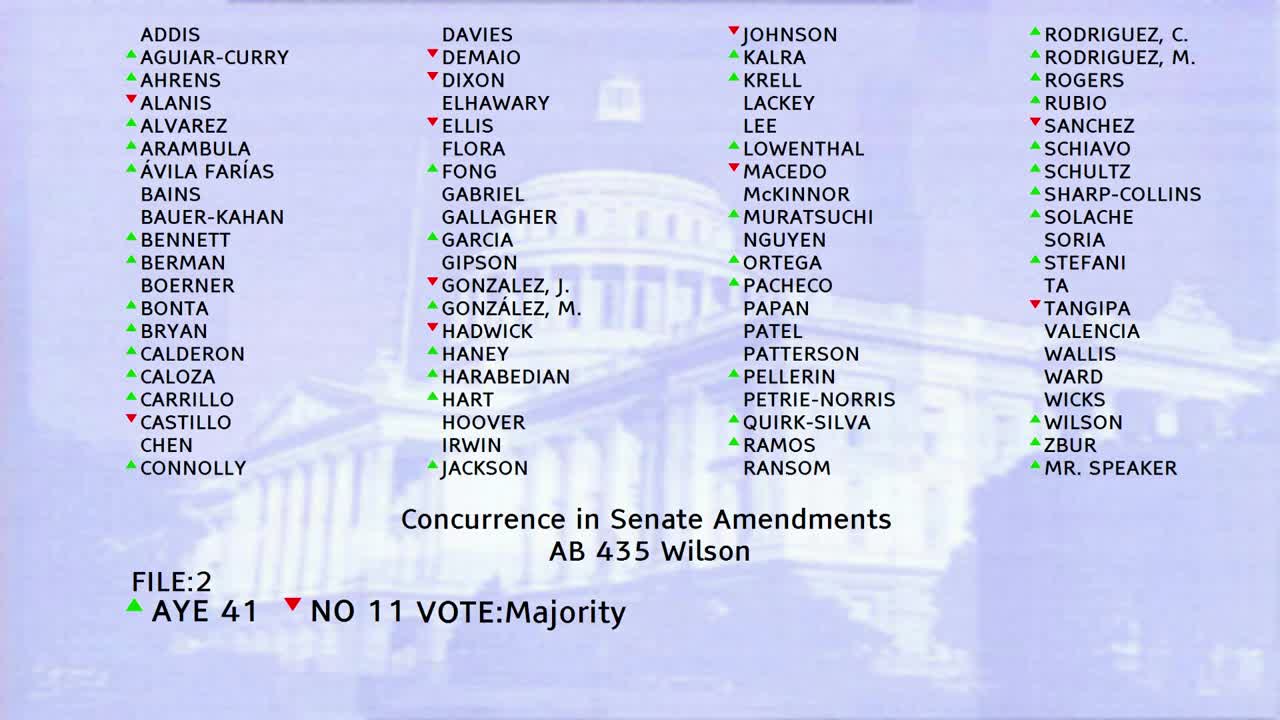
Bill Author

Bill Co-Author(s):