AB 786: California Pollution Control Financing Authority: name change.
- Session Year: 2025-2026
- House: Assembly
- Latest Version Date: 2025-10-13
Current Status:
Passed
(2025-10-13: Chaptered by Secretary of State - Chapter 710, Statutes of 2025.)
Introduced
In Committee
Awaiting First Chamber Vote
Passed First Chamber
In Committee
Awaiting Second Chamber Vote
Passed Second Chamber
Enacted
Existing law establishes the California Pollution Control Financing Authority, which consists of 3 members: the Director of Finance, the Treasurer, and the Controller. Existing law requires the authority to provide the maximum opportunity for the use of the authoritys financing by individuals, businesses engaged in agricultural operations, and small businesses or corporations by providing information, assistance, and coordination to facilitate financing for small projects and other financing that benefits the environment and the economy of the state, as specified.
This bill would rename the authority as the Capital Programs and Climate Financing Authority.
This bill would incorporate additional changes to Section 42652.5 of the Public Resources Code proposed by AB 70 to be operative only if this bill and AB 70 are enacted and this bill is enacted last.
Existing law establishes the California Pollution Control Financing Authority, which consists of 3 members: the Director of Finance, the Treasurer, and the Controller. Existing law requires the authority to provide the maximum opportunity for the use of the authoritys financing by individuals, businesses engaged in agricultural operations, and small businesses or corporations by providing information, assistance, and coordination to facilitate financing for small projects and other financing that benefits the environment and the economy of the state, as specified.
This bill would rename the authority as the Capital Programs and Climate Financing Authority. The bill would also revise related findings and declarations and make clarifying and conforming changes.
Existing law establishes the California Pollution Control Financing Authority, which consists of 3 members: the Director of Finance, the Treasurer, and the Controller. Existing law requires the authority to provide the maximum opportunity for the use of the authoritys financing by individuals, businesses engaged in agricultural operations, and small businesses or corporations by providing information, assistance, and coordination to facilitate financing for small projects and other financing that benefits the environment and the economy of the state, as specified.
This bill would rename the authority as the Capital Programs and Climate Financing Authority.
(a)An authority whose financing activities are limited to financing utility projects and projects for the use or benefit of public agencies providing water, wastewater, or electrical service may finance utility projects as provided in this section, including the issuance of rate reduction bonds and the imposition and adjustment of utility project charges.
(b)(1)A local agency that owns and operates a publicly owned utility may apply to an authority specified in subdivision (a) to finance costs of a utility project for the publicly owned utility with the proceeds of rate reduction bonds if at the time of application, bonds payable from revenues of the publicly owned utility are, or upon issuance would be, rated investment grade by a nationally recognized rating agency. In its application to an authority for the financing or refinancing, the local agency shall specify the utility project to be financed by the rate reduction bonds, the maximum principal amount, the maximum interest rate, and the maximum stated terms of the rate reduction bonds.
(2)(A)In order to allow the state to review the issuance of rate reduction bonds, collect data, ensure transparency, and conduct an independent analysis of the effectiveness of the use of rate reduction bonds pursuant to this section, the Capital Programs and Climate Financing Authority, as defined in Section 44504 of the Health and Safety Code, shall review each issue of bonds and shall determine whether the issue is qualified for issuance under the provisions of this section. The Capital Programs and Climate Financing Authority shall determine that an issue of rate reduction bonds is qualified for issuance under this section, if the issuance satisfies all of the following:
(i)The issuance meets the criteria specified in paragraphs (1) to (3), inclusive, of subdivision (c), or, if the local agency elects to make a determination under paragraph (4) of subdivision (c), meets the criteria specified in paragraphs (1), (2), and (4) of subdivision (c).
(ii)The projected financing costs fall within the normal range of financing costs for comparable types of debt issuance.
(B)The Capital Programs and Climate Financing Authority shall determine that an issue of rate reduction bonds is qualified for issuance pursuant to subparagraph (A) solely on the basis of the submitted documentation referred to in subparagraph (A), and the determination shall not be conditional in any respect, including conditional on the submission or review of additional material after the determination.
(3)The Capital Programs and Climate Financing Authority shall establish procedures for the expeditious review of a proposed issuance pursuant to this section, including, but not limited to, the establishment of reasonable application fees to reimburse the Capital Programs and Climate Financing Authority for costs incurred in administering this section. The Capital Programs and Climate Financing Authority may charge additional fees in an amount equal to the amount of any additional expenses incurred by the authority in retaining an independent financial advisor to review the application under circumstances involving the verification of all requirements of this section. Any fees for review and processing of the application shall be nonrefundable.
(4)The Capital Programs and Climate Financing Authority shall provide an explanation in writing for any refusal to qualify a proposed issuance but may not alter or modify any term or condition related to the utility project property.
(5)The Capital Programs and Climate Financing Authority shall take action on any completed application submitted to it pursuant to this section no later than the next meeting of the Capital Programs and Climate Financing Authority that occurs after at least 60 days following receipt of the application.
(6)The review and qualification pursuant to this section may be concurrent with an authoritys processing of an application for financing or refinancing so as to allow for the issuance of rate reduction bonds as quickly as feasible.
(7)Notwithstanding any other law, the Capital Programs and Climate Financing Authority may adopt regulations relating to this section as emergency regulations in accordance with Chapter 3.5 (commencing with Section 11340) of Part 1 of Division 3. For purposes of that chapter, including Section 11349.6, the adoption of the regulations shall be considered by the Office of Administrative Law to be necessary for the immediate preservation of the public peace, health and safety, and general welfare.
(8)(A)Annually, no later than March 31, the Capital Programs and Climate Financing Authority shall submit to the Legislature, including to the relevant legislative policy committees having jurisdiction over energy and public utilities issues, a report of its activities pursuant to this section for the preceding calendar year ending December 31. The Capital Programs and Climate Financing Authority shall require information from applicants to ensure that the necessary data is available to complete this report. The report may be submitted as a part of the report required pursuant to Section 44538 of the Health and Safety Code. The report shall include all of the following:
(i)A listing of applications received.
(ii)A listing of proposed issuances qualified under the provisions of this section.
(iii)A report of bonds sold, the interest rates on the bonds, whether the bond sales were pursuant to public bid or were negotiated, and any rating given the bonds by a nationally recognized securities rating organization.
(iv)A specification of proposed issuances qualified but not yet issued.
(v)A comparison of the interest rates and transactional costs on issuances qualified under this section with interest rates on comparable types of debt issuance occurring at or near the same time as the issuances.
(B)A report to be submitted pursuant to this paragraph shall be submitted in compliance with Section 9795.
(9)The provisions of paragraphs (2) to (8), inclusive, shall not apply to the issuance of rate reduction bonds for a publicly owned utility if the determinations of the local agency pursuant to subdivision (c) are subject to review by a ratepayer advocate or similar entity whose function is to provide public independent analysis of a public utilitys actions as they relate to water, wastewater, or electric rates.
(c)A local agency shall not apply to an authority for financing or refinancing of a utility project pursuant to this section unless the legislative body of the local agency has determined all of the following:
(1)The project to be financed or refinanced is a utility project.
(2)The local agency is electing to finance or refinance costs of the utility project pursuant to this section and the financing costs associated with the financing or refinancing are to be paid from utility project property, including the utility project charge for the rate reduction bonds issued for the utility project in accordance with this section.
(3)Based on information available to, and projections used by, the legislative body, the rates of the publicly owned utility plus the utility project charge resulting from the financing or refinancing of the utility project with rate reduction bonds are expected to be lower than the rates of the publicly owned utility if the utility project was financed or refinanced with bonds payable from revenues of the publicly owned utility.
(4)A local agency with a publicly owned utility having 500,000 or more retail customers may, in lieu of making the determination in paragraph (3), determine that the use of rate reduction bonds to finance or refinance utility projects provides substantial benefits to the publicly owned utility. These benefits may include, but are not limited to, lower interest rates on rate reduction bonds and more favorable capitalization and debt service coverage ratio treatment that results in gross or present value lifetime savings for the publicly owned utility.
(d)(1)Subject to the requirements of Article XIII D of the California Constitution, to the extent applicable, an authority financing the costs of a utility project or projects for a local agencys publicly owned utility with rate reduction bonds is authorized and directed to impose and collect a utility project charge with respect to the rate reduction bonds as provided in this section. The imposition of the utility project charge shall be made and evidenced by the adoption of a financing resolution by the governing body of the authority. Upon the issuance of rate reduction bonds, the financing resolution adopted in connection with the issuance of rate reduction bonds shall be irrevocable. The financing resolution with respect to financing or refinancing a utility project or projects with rate reduction bonds for a publicly owned utility shall include all of the following:
(A)The addition of a separate charge to the bill of each customer of the publicly owned utility in the class or classes of customers specified in the financing resolution.
(B)A description of the financial calculation, formula, or other method that the authority is to use to determine the utility project charge. The calculation, formula, or other method shall include a periodic adjustment method to the then current utility project charge, to be applied at least annually, that shall be used by the authority to correct for any overcollection or undercollection of financing costs from the utility project charge or any other adjustment necessary to ensure timely payment of the financing costs of the rate reduction bonds, including, but not limited to, the adjustment of the utility project charge to pay any debt service coverage requirement for the rate reduction bonds. The financial calculation, formula, or other method, including the periodic adjustment method, established in the financing resolution pursuant to this section, and the allocation of utility project charges to, and among, customers of the publicly owned utility shall be decided solely by the governing body of the authority and shall be final and conclusive. In no event shall the periodic adjustment method established in the financing resolution be applied less frequently than required by the financing resolution and the documents relating to the applicable rate reduction bonds. Once the financial calculation, formula, or other method for determining the utility project charge, and the periodic adjustment method, have been established in the financing resolution and have become final and conclusive as provided in this section, they shall not be changed.
(C)Notwithstanding any other provision of this section, the imposition of a utility project charge shall comply with the requirements of Article XIIID of the California Constitution, to the extent applicable, including, but not limited to, the provision of a notice containing the initial amount of the proposed utility project charge and the periodic adjustment method by which the utility project charge amount could subsequently change.
(D)A requirement that the authority enter into a servicing agreement for the collection of the utility project charge with the local agency for which the financing is undertaken or its publicly owned utility and the local agency or its publicly owned utility shall act as a servicing agent for purposes of collecting the utility project charge as long as the servicing agreement remains in effect. Moneys collected by the local agency or its publicly owned utility, acting as a servicing agent on behalf of the authority, as a utility project charge shall be held in trust for the exclusive benefit of the persons entitled to the financing costs to be paid, directly or indirectly, from the utility project charge and shall not lose their character as revenues of the authority by virtue of possession by the local agency or its publicly owned utility. The local agency or its publicly owned utility shall provide the authority with the information as to estimated sales of water, wastewater, or electrical services and any other information concerning the publicly owned utility required by the authority in connection with the initial establishment and the adjustment of the utility project charge.
(2)The determination of the legislative body of the local agency that a project to be financed with rate reduction bonds is a utility project shall be final and conclusive and the rate reduction bonds issued to finance the utility project and the utility project charge imposed relating to the rate reduction bonds shall be valid and enforceable in accordance with the terms of the financing resolution and the documents relating to the rate reduction bonds. The authority shall require, in its financing resolution with respect to a utility project charge, that as long as a customer in the class or classes of customers specified in the financing resolution receive water or electricity or discharge wastewater through the facilities of the publicly owned utility, the customer shall pay the utility project charge regardless of whether or not the customer has an agreement to purchase water or electricity or discharge wastewater from a person or entity other than the publicly owned utility. The utility project charge shall be a nonbypassable charge to all customers of the publicly owned utility in the class or classes of customers specified in the financing resolution at the time of adoption of the financing resolution and all future customers in that class or classes. If a customer of the publicly owned utility that is subject to a utility project charge enters into an agreement to purchase water or electricity or discharge wastewater from a person or entity other than the publicly owned utility, the customer shall remain liable for the payment of its share of the utility project charge as if it had not entered into the agreement. The liability may be discharged by the continued payment of its share of the utility project charge as it accrues or by a one-time payment, as determined by the authority. All provisions of a financing resolution adopted pursuant to this subdivision shall be binding on the authority.
(3)The timely and complete payment of all utility project charges by a person liable for the charges shall be a condition of receiving water, wastewater, or electrical service, as applicable, from the publicly owned utility of the local agency and each of the local agencies and their publicly owned utilities is authorized to use its established collection policies and all rights and remedies provided by law to enforce payment and collection of the utility project charge. In no event shall a person liable for a utility project charge be entitled or authorized to withhold payment, in whole or in part, of the utility project charge for any reason.
(4)The authority shall determine whether adjustments to the utility project charge relating to rate reduction bonds are required upon the issuance of the rate reduction bonds and at least annually, and at additional intervals as may be provided for in the financing resolution or the documents relating to the rate reduction bonds. Each adjustment shall be made and put into effect in accordance with the financial calculation, formula, or other method that the authority is to use to determine the utility project charge pursuant to the financing resolution expeditiously after the authoritys determination that the adjustment is required.
(5)All revenues with respect to utility project property related to rate reduction bonds, including payments of the utility project charge, shall be applied first to the payment of the financing costs of the related rate reduction bonds then due, including the funding of reserves for the rate reduction bonds, with any excess being applied as determined by the authority for the benefit of the utility for which the rate reduction bonds were issued.
(6)The authority shall be obligated to impose and collect the utility project charge relating to rate reduction bonds in amounts, based on estimates of water or electricity usage or wastewater discharge subject to the utility project charge, sufficient to pay on a timely basis the financing costs associated with the rate reduction bonds when due. The pledge of a utility project charge to secure the payment of rate reduction bonds shall be irrevocable, and the State of California, the authority, or any limited liability company acting pursuant to subdivision (j) shall not reduce, impair, or otherwise adjust the utility project charge, except that the authority shall implement the periodic adjustments to the utility project charge relating to rate reduction bonds as required by the applicable financing resolution and the documents relating to the rate reduction bonds. Revenue from a utility project charge shall be deemed special revenue of the authority and shall not constitute revenue of the local agency or its publicly owned utility for any purpose, including, without limitation, any dedication, commitment, or pledge of revenue, receipts, or other income that the local agency or its publicly owned utility has made or will make for the security of any of its obligations.
(7)A utility project charge shall constitute utility project property when, and to the extent that, a financing resolution authorizing the utility project charge has become effective in accordance with its terms, and the utility project property shall thereafter continuously exist as property for all purposes with all of the rights and privileges of this section for the period, and to the extent, provided in the financing resolution, but in any event until all financing costs with respect to the related rate reduction bonds are paid in full, including all arrearages thereon.
(8)Utility project property shall constitute a current property right notwithstanding that the value of the property right will depend on consumers using water, wastewater, or electrical services or, in those instances where consumers are customers of the publicly owned utility, the publicly owned utility performing certain services.
(9)If a local agency for which rate reduction bonds have been issued and remain outstanding ceases to operate a water, wastewater, or electric utility, either directly or through its publicly owned utility, references in this section to the local agency or to its publicly owned utility shall be to the entity providing water, wastewater, or electrical services in lieu of the local agency and the entity shall assume and perform all obligations of the local agency and its publicly owned utility required by this section and the servicing agreement with the local agency while the rate reduction bonds remain outstanding.
(e)(1)Rate reduction bonds shall be within the parameters of the financing or refinancing set forth by the local agency pursuant to subdivision (b) in connection with the rate reduction bonds and the proceeds of the rate reduction bonds made available to the local agency or its publicly owned utility shall be used for the utility project identified in the application for financing or refinancing of the utility project or projects pursuant to subdivision (b).
(2)An authority shall authorize the issuance of rate reduction bonds by a resolution of its governing body. An authority issuing rate reduction bonds shall include in its preliminary notice and final report for the rate reduction bonds submitted to the California Debt and Investment Advisory Commission pursuant to Section 8855 a statement that the rate reduction bonds are being issued pursuant to this section. An authority issuing rate reduction bonds shall include in its final report for the rate reduction bonds submitted to the California Debt and Investment Advisory Commission pursuant to Section 8855 the estimated savings or local agency benefit, if applicable pursuant to paragraph (4) of subdivision (c), realized by issuing the rate reduction bonds rather than bonds payable from the revenues of the publicly owned utility for whose benefit the rate reduction bonds were issued. Rate reduction bonds shall be nonrecourse to the credit or any assets of the local agency and the publicly owned utility for which the utility project is financed and shall be payable from, and secured by a pledge of, the utility project property relating to the rate reduction bonds and any additional security or credit enhancement specified in the documents relating to the rate reduction bonds.
(3)An authority issuing rate reduction bonds shall pledge the utility project property relating to the rate reduction bonds as security for the payment of the rate reduction bonds, which pledge shall be made pursuant to, and with the effect set forth in Section 5451. All rights of an authority with respect to utility project property pledged as security for the payment of rate reduction bonds shall be for the benefit of, and enforceable by, the beneficiaries of the pledge to the extent provided in the documents relating to the rate reduction bonds.
(4)To the extent that any interest in utility project property is pledged as security for the payment of rate reduction bonds, the applicable local agency or its publicly owned utility shall contract with the authority, which contract shall be part of the utility project property, that the local agency or its publicly owned utility will continue to operate its publicly owned utility system that includes the financed utility project to provide service to its customers, will, as servicer, collect amounts in respect of the utility project charge for the benefit and account of the authority and the beneficiaries of the pledge of the utility project charge and will account for and remit these amounts to, or for the account of, the authority.
(5)Notwithstanding any other law, any requirement under this section, a financing resolution, any other resolution of the authority, or the provisions of the documents relating to rate reduction bonds to the effect that the authority shall take action with respect to the utility project property relating to the rate reduction bonds shall be binding upon the authority, as its governing body may be constituted from time to time, and the authority shall have no power or right to rescind, alter, or amend any resolution or document containing the requirement.
(6)Notwithstanding any other law, except as otherwise provided in this section with respect to adjustments to a utility project charge, the recovery of the financing costs for the rate reduction bonds from the utility project charge shall be irrevocable and the authority shall not have the power either by rescinding, altering, or amending the applicable financing resolution or otherwise, to revalue or revise for ratemaking purposes the financing costs of rate reduction bonds, determine that the financing costs for the related rate reduction bonds or the utility project charge is unjust or unreasonable, or in any way reduce or impair the value of utility project property that includes the utility project charge, either directly or indirectly; nor shall the amount of revenues arising with respect to the financing costs for the related rate reduction bonds or the utility project charge be subject to reduction, impairment, postponement, or termination for any reason until all financing costs to be paid from the utility project charge are fully met and discharged. Except as otherwise provided in this section with respect to adjustments to a utility project charge, the State of California does hereby pledge and agree with the owners of rate reduction bonds that the State of California shall neither limit nor alter the financing costs or the utility project property, including the utility project charge, relating to the rate reduction bonds, or any rights in, to, or under, the utility project property until all financing costs with respect to the rate reduction bonds are fully met and discharged. This section does not preclude limitation or alteration if and when adequate provision shall be made by law for the protection of the owners. The authority is authorized to include this pledge and undertaking by the State of California in the governing documents for rate reduction bonds. Notwithstanding any other provision of this section, the authority shall make the adjustments to the utility project charge relating to rate reduction bonds provided by this section and the documents related to those rate reduction bonds as may be necessary to ensure timely payment of all financing costs with respect to the rate reduction bonds. The adjustments shall not impose the utility project charge upon classes of customers that were not subject to the utility project charge pursuant to the financing resolution imposing the utility project charge.
(f)(1)Financing costs in connection with rate reduction bonds do not constitute a debt or liability of the State of California or of any political subdivision thereof, other than the special obligation of the authority, and do not constitute a pledge of the full faith and credit of the State of California or any of its political subdivisions, including the authority, but are payable solely from the funds provided therefor under this section and in the documents relating to the rate reduction bonds. This subdivision shall in no way preclude guarantees or credit enhancements in connection with rate reduction bonds. All the rate reduction bonds shall contain on the face thereof a statement to the following effect:
Neither the full faith and credit nor the taxing power of the State of California or any political subdivision thereof is pledged to the payment of the principal of, or interest on, this bond.
(2)The issuance of rate reduction bonds shall not directly, indirectly, or contingently obligate the State of California or any political subdivision thereof to levy or to pledge any form of taxation to pay the rate reduction bonds or to make any appropriation for their payment.
(g)(1)Utility project property shall constitute property for all purposes, including for contracts securing rate reduction bonds, whether or not the revenues and proceeds arising with respect thereto have accrued.
(2)Subject to the terms of the pledge document with respect to a pledge of utility project property, the validity and relative priority of a pledge created or authorized under this section is not defeated or adversely affected by the commingling of revenues arising with respect to the utility project property with other funds of the local agency or the publicly owned utility collecting a utility project charge on behalf of an authority.
(h)(1)There shall exist a statutory lien on the utility project property relating to rate reduction bonds. Upon the effective date of the financing resolution relating to rate reduction bonds, there shall exist a first priority statutory lien on all utility project property, then existing or, thereafter arising, to secure the payment of the rate reduction bonds. This lien shall arise pursuant to law by operation of this section automatically without any action on the part of the authority, the local agency or its publicly owned utility, or any other person. This lien shall secure the payment of all financing costs, then existing or subsequently arising, to the holders of the rate reduction bonds, the trustee or representative for the holders of the rate reduction bonds, and any other entity specified in the financing resolution or the documents relating to the rate reduction bonds. This lien shall attach to the utility project property regardless of who shall own, or shall subsequently be determined to own, the utility project property including any local agency or its publicly owned utility, the authority, or any other person. This lien shall be valid and enforceable against the owner of the utility project property and all third parties upon the effectiveness of the financing resolution without any further public notice.
(2)The statutory lien on utility project property created by this section is a continuously perfected lien on all revenues and proceeds arising with respect thereto, whether or not the revenues or proceeds have accrued. Utility project property shall constitute property for all purposes, including for contracts securing rate reduction bonds, whether or not the revenues or proceeds arising with respect thereto have accrued.
(3)In addition, the authority may require, in a financing resolution creating utility project property, that, in the event of default by the local agency or its publicly owned utility, in payment of revenues arising with respect to the utility project property, any court in the state, upon the application by the beneficiaries of the statutory lien, and without limiting any other remedies available to the beneficiaries by reason of the default, shall order the sequestration and payment to the beneficiaries of revenues arising with respect to the utility project property.
(i)Notwithstanding any other law, an authority or a limited liability company acting pursuant to subdivision (j) that has financed a utility project through the issuance of rate reduction bonds is not authorized, and no governmental officer or organization shall be empowered to authorize the authority, to become a debtor in a case under the United States Bankruptcy Code (11 U.S.C. Sec. 101 et seq.) or to become the subject of any similar case or proceeding under any other law, whether federal or State of California, as long as any payment obligation from utility project property remains with respect to the rate reduction bonds.
(j)An authority may elect to implement a financing of a utility project pursuant to this section by forming a single member limited liability company and by authorizing the company to adopt the financing resolution. The authority may issue rate reduction bonds payable from, and secured by a pledge of, amounts paid by the company to the authority from the applicable utility project property pursuant to an agreement. The provisions of subdivisions (g) and (h) shall apply to and be the exclusive method of perfecting a pledge of utility project property by the company securing the payment of financing costs under any agreement of the company in connection with the issuance of rate reduction bonds. Reference to the authority in this section and in all related defined terms shall mean or include the company as necessary to implement this subdivision.
(k)After December 31, 2036, the authority to issue rate reduction bonds under this section terminates.
SEC. 2.Section 7924.505 of the Government Code is amended to read:7924.505.(a)Except as provided in Sections 7924.510, 7924.700, and 7929.610, this division does not require the disclosure of financial data contained in an application for financing under Division 27 (commencing with Section 44500) of the Health and Safety Code, if an authorized officer of the Capital Programs and Climate Financing Authority determines that disclosure of the financial data would be competitively injurious to the applicant and the data is required in order to obtain a guarantee from the United States Small Business Administration.
(b)The Capital Programs and Climate Financing Authority shall adopt rules for review of individual requests for confidentiality under this section and for making available to the public those portions of an application that are subject to disclosure under this division.
SEC. 3.Section 12100.33 of the Government Code is amended to read:12100.33.(a)Upon appropriation by the Legislature, CalOSBA shall establish the California Employee Ownership Hub, administered by an Employee Ownership Hub Manager, appointed by the advocate.
(b)The manager shall administer the Employee Ownership Hub, and may be responsible for the following duties:
(1)Work with all California state agencies whose regulations and programs affect employee-owned companies, and businesses with the potential to become employee-owned, to enhance opportunities and reduce barriers.
(2)Partner with relevant private, nonprofit, and public organizations including, but not limited to, professional and trade associations, financial institutions, labor unions, worker centers, Small Business Development Centers, economic and workforce development organizations, and nonprofit entities to educate business owners and employees about the benefits of employee ownership and employee ownership transition succession models.
(3)Share materials regarding employee ownership benefits and employee ownership transition succession models.
(4)Provide a referral service to help business owners, labor unions, workers, and worker centers find appropriate legal, financial, and technical employee ownership resources and services to assist in employee ownership transitions and the growth of employee-owned businesses.
(5)Work with the California Infrastructure and Economic Development Bank, the Capital Programs and Climate Financing Authority, and related entities to develop recommendations and enhance the ability of broad-based employee ownership vehicles to access California capital programs. Those recommendations shall only apply to ESOPs to the extent that the ESOPs satisfy one of the following conditions:
(A)The ESOP has appointed an independent ESOP trustee.
(B)The ESOP has, as a trustee, a person or entity that has completed education on ESOP trustee best practices.
(6)Report to the Legislature, in accordance with Section 9795, on activities undertaken by the hub during the prior fiscal year, including recommendations for improvement.
(A)The first report shall be due on January 15, following the first fiscal year in which funding is provided to implement any portion of this article.
(B)This reporting requirement may be met separately or the information may be included in the annual report required by subdivision (b) of Section 12098.4.
(C)CalOSBA shall also post the report to its internet website.
(7)Report employee ownership transition related concerns and recommendations to the advocate.
SEC. 4.Section 40448.6 of the Health and Safety Code is amended to read:40448.6.The Legislature hereby finds and declares all of the following:
(a)It is necessary to increase the availability of financial assistance to small businesses that are subject to the rules and regulations of the south coast district, in order to minimize economic dislocation and adverse socioeconomic impacts.
(b)It is in the public interest that a portion of the funds collected by the south coast district from violators of air pollution regulations be allocated for the purpose of guaranteeing or otherwise reducing the financial risks of providing financial assistance to small businesses which face increased borrowing requirements in order to comply with air pollution control requirements.
(c)Public agencies and private lenders have a variety of methods available for providing financing assistance to small businesses and other employers, including taxable bonds, composite or pooled financing instruments, loan guarantees, and credit insurance, which could be utilized in combination with the penalties collected by the south coast district to expand the availability and reduce the cost of financing assistance.
(d)The Capital Programs and Climate Financing Authority has funds set aside from previous bond issues, which could be used to guarantee the issuance of bonds or other financing for small businesses for the purchase and installation of pollution control equipment.
(e)The Governors Office of Business and Economic Development, through the small business financial development corporations established pursuant to Chapter 1 (commencing with Section 14000) of Part 5 of Division 3 of Title 1 of the Corporations Code, has the ability to provide state loan guarantees and technical assistance to small businesses needing financial assistance.
(f)The Job Training Partnership Division of the Employment Development Department makes funds available for job training programs, including funds for dislocated workers, through the federal Job Training Partnership Act (29 U.S.C. Sec. 1501 et seq.).
(g)It is the policy of the state that the Job Training Partnership Division of the Employment Development Department, in cooperation with the districts and the state board, are encouraged to provide job training programs for workers who, as determined by the department or the local private industry council, have been laid off or dislocated as a result of actions resulting from air quality regulations.
(h)It is the policy of the state that the Capital Programs and Climate Financing Authority and other state agencies implementing small business assistance programs, in cooperation with the districts and the state board, are encouraged to provide technical and financial assistance to small businesses to facilitate compliance with air quality regulations.
SEC. 5.Section 41503.6 of the Health and Safety Code is amended to read:41503.6.(a) The Legislature finds and declares that the Capital Programs and Climate Financing Authority, working with the south coast district, has established successful programs to assist small businesses in complying with district rules and financing the purchase of pollution control equipment.
(b) The Treasurer and the Capital Programs and Climate Financing Authority shall work with, and provide all feasible assistance to, districts to increase opportunities for small businesses to comply with the rules and regulations of the district. That assistance may include loans, loan guarantees, and other forms of financial assistance.
SEC. 6.Section 44391.4 of the Health and Safety Code is amended to read:44391.4.(a)(1)Funds made available pursuant to an appropriation from the Greenhouse Gas Reduction Fund to reduce mobile and stationary sources of criteria air pollutants or toxic air contaminants consistent with the community emissions reduction programs developed pursuant to Section 44391.2 shall be available to districts, as distributed by the state board, and shall be used for projects that complement and further the rules and regulatory requirements that the state board or districts have established or are in the process of developing to reduce or mitigate emissions from mobile or stationary sources in affected communities pursuant to Section 44391.2. The funds shall be allocated for projects that are intended to benefit communities that the state board has selected or is considering for selection in future years pursuant to Section 44391.2.
(2)Funds shall be allocated to projects consistent with priorities identified by the affected community in a transparent meaningful public process.
(3)Funds shall only be allocated to projects that will provide emission reductions that are in excess of those otherwise required by law or regulation.
(b)Projects eligible for funding include the following:
(1)Projects that provide financial assistance for the purchase of cleaner technologies with a priority on zero-emission equipment either through the Community Air Protection Funds Moyer Guidelines Supplement or in accordance with the state boards guidelines for the Highway Safety, Traffic Reduction, Air Quality, and Port Security Bond Act of 2006 (Chapter 12.49 (commencing with Section 8879.20) of Division 1 of Title 2 of the Government Code) relative to funding amount and truck evaluation.
(2)Zero-emission charging infrastructure projects with a priority toward infrastructure that supports medium- and heavy-duty vehicles.
(3)(A) Projects that provide financial assistance to owners of stationary sources that are not subject to the requirements adopted by the state board pursuant to subdivision (c) of Section 38562 for replacement of equipment with technologies that will result in direct emission reductions of toxic air contaminants and criteria air pollution, including zero-emission technologies.
(B)The state board may contract with the State Treasurer to expend funds for purposes of this paragraph through programs implemented by the State Treasurer or the Capital Programs and Climate Financing Authority.
(c)In addition to subdivision (b), the state board may also fund a program developed by a district, with community input through a public process, that is consistent with actions identified in the applicable community emissions reduction program developed pursuant to Section 44391.2.
(d)(1) Notwithstanding Section 10231.5 of the Government Code, by March 1 of each year, the state board shall report to the Legislature on the use, in the prior fiscal year, of funds that are subject to this section. The report shall include all of the following:
(A)A list of projects funded.
(B)An identification of the communities designed to be benefited by the projects.
(C)The anticipated reduction in the emissions of criteria pollutants, toxic air contaminants, and greenhouse gases resulting from the projects.
(D)How the projects further the relevant community emissions reduction program.
(2)The report required by paragraph (1) may be submitted as a part of the annual report required pursuant to Section 39720.
SEC. 7.Section 44500 of the Health and Safety Code is amended to read:44500.This division may be cited as the Capital Programs and Climate Financing Authority Act.
SEC. 8.Section 44501 of the Health and Safety Code is amended to read:44501.The Legislature finds and declares all of the following:
(a)It is necessary and essential that the state, in cooperation with the federal government, use all practical means and measures to control, remediate, and eliminate pollution hazards to the environment, provide clean water, and enable alternative and renewable sources of energy. Industry within this state utilizes processes and facilities that have significant environmental impact. These processes and facilities need to be modified and supplemented to meet the quality standards established, and to be established, for the control and remediation of environmental pollution. Industry needs and requires new methods to finance the capital outlays required for the devices, equipment, and facilities utilized in pollution control if they are to rapidly comply with the quality standards established by the state and federal governments, and if they are to rapidly remediate contaminated properties so that those properties can be reused for economically beneficial purposes.
(b)The disposal of waste products by methods such as incineration and landfill pollute the environment by degrading air and water quality. In order to reduce the environmental pollution that currently occurs in connection with the disposal of waste products, there is a need to develop new and alternative processes and facilities that provide for the disposal of those waste products in ways that prevent or reduce environmental degradation. Those new and alternative processes and facilities include those that recover resources and energy from waste products. In order to prevent further environmental degradation resulting from contamination caused by the release of waste products and hazardous materials, there is a need to encourage the remediation of that contamination of properties with the potential for economically beneficial reuse.
(c)The alternate method of financing provided in this division is in the public interest and serves a public purpose and will promote the health, welfare, and safety of the citizens of the state.
(d)California is expected to undergo tremendous population growth by the addition of millions of new jobs, new residents, and new households. This constitutes more rapid growth than California experienced during the 1950s, 1960s, and 1970s, combined. As a result of this unprecedented growth, the long-term environmental quality of the state depends, in part, on altering current growth patterns by adopting policies and programs that promote new forms of sustainable development and that will help reduce pollution and the degradation of the environment. A key element of sustainable development is infill development and the revitalization of existing communities. Sustainable development will result in the remediation of brownfields, reduce traffic and auto pollution, and help preserve open spaces. Many communities in California do not have the resources or expertise to identify and compete for state, federal, or private assistance in order to develop and implement environmentally sensitive growth policies and programs for economically struggling neighborhoods. Assisting economically distressed counties and cities to develop and implement sustainable and environmentally sensitive growth policies and programs that increase the utilization of unproductive properties within existing communities will help reduce environmental hazards created by brownfields and traffic congestion, while aiding in the revitalization of economically struggling neighborhoods and the preservation of open space at the urban edges. The grant and loan program provided in this division is in the public interest, serves a public purpose, and will promote the health, welfare, and safety of the citizens of the state.
(e)Real property contaminated with hazardous substances is a continuing blight on communities. Estimates suggest there are between 67,000 and 119,000 contaminated sites, commonly referred to as brownfields, throughout the state. Located in existing communities, many of these sites are abandoned, idle, or underutilized due to a combination of factors, including legal liability concerns, regulatory issues, and the costs of pollution cleanup. Additionally, many of the undeveloped brownfields in the state are located within communities with depressed land values and pressing economic need, communities often characterized by a lack of capital investment. The remediation and development of brownfields is an important component of revitalizing existing communities and supporting sustainable growth patterns. While remediation and development activities should focus on brownfield sites that, although contaminated, have the potential for economically beneficial reuse, there currently exist few, if any, sources for financing the assessment, planning, and reporting activities that are the necessary first steps toward determining whether a site has the potential for economically beneficial reuse.
(f)The Capital Programs and Climate Financing Authority should work in conjunction with public and private sector entities, including, but not limited to, cities, counties, school districts, redevelopment agencies, and financial institutions, to assist in financing, through loans, the cost of performing or obtaining site assessments, remedial action plans technical assistance, and reports, and where it is determined that a site has the potential for economically beneficial reuse, the cleanup, remediation, or development of brownfield sites. The loan program provided by this division is in the public interest, serves a public purpose, and will promote the health, welfare, and safety of the citizens of the state.
SEC. 9.Section 44504 of the Health and Safety Code is amended to read:44504.Authority means the Capital Programs and Climate Financing Authority established pursuant to Section 44515 and any board, commission, department, or officer succeeding to the functions thereof or to whom the powers conferred upon the authority by this division shall be given by law.
SEC. 10.Section 44515 of the Health and Safety Code is amended to read:44515.There is in the state government the Capital Programs and Climate Financing Authority. The authority constitutes a public instrumentality and a political subdivision of the State of California, and the exercise by the authority of the powers conferred by this division shall be deemed and held to be the performance of an essential public function. The authority shall consist of three members: the Director of Finance, the State Treasurer, and the State Controller.
The Director of Finance may designate a deputy or other official in the Department of Finance to act for him or her and represent him or her at all meetings of the authority.
The first meeting of the authority shall be convened by the Director of Finance.
SEC. 11.Section 44558 of the Health and Safety Code is amended to read:44558.For purposes of this article:
(a)Administration expenses means the reasonable and necessary expenses incurred by the authority in the administration of this article, including, without limitation, the fees and costs of attorneys, consultants, and other individuals.
(b)Applicant means an eligible applicant that applies to the authority for a grant pursuant to this article.
(c)Authority means the Capital Programs and Climate Financing Authority.
(d)Community development financial institution means any community development financial institution certified by the federal Community Development Financial Institutions Fund under Part 1805 (commencing with Section 1805.100) of Chapter XVIII of Title 12 of the Code of Federal Regulations.
(e)Disadvantaged community means a census tract in which the median household income is less than 80 percent of the statewide or county annual median household income level, whichever is less.
(f)Eligible applicant means a community development financial institution for which all of the following applies:
(1)The applicant shall have a current certification pursuant to Section 1805 of Title 12 of the Code of Federal Regulations.
(2)The applicant shall have a minimum net worth of twenty-five thousand dollars ($25,000) as indicated on its financial statements prepared in accordance with generally accepted accounting principles.
(3)The applicant shall have made a minimum of five loans in the 12 months prior to submitting its application.
(4)Either of the following applies:
(A)The community development financial institution has a principal office in California, the officers of which are domiciled in California.
(B)The community development financial institution has a record of lending in this state, based on either of the following:
(i)At least 25 percent of the community development financial institutions loan portfolio, at the time of the application, provides financial assistance to persons or projects located in this state.
(ii)The community development financial institution has provided financing assistance in this state totaling at least ten million dollars ($10,000,000) in the three years prior to its application.
(g)Executive director means the Executive Director of the Capital Programs and Climate Financing Authority.
(h)Fund means the California Investment and Innovation Fund created in subdivision (b) of Section 44558.1.
(i)Low-income communities has the same meaning as defined in Section 39713 of the Health and Safety Code.
(j)Lower income household has the same meaning as defined in Section 50079.5 of the Health and Safety Code.
(k)Program means the California Investment and Innovation Program established in subdivision (a) of Section 44558.1.
(l)Small and emerging community development financial institution means a community development financial institution that has less than ten million dollars ($10,000,000) in assets.
SEC. 12.Section 44559.1 of the Health and Safety Code is amended to read:44559.1.As used in this article, unless the context requires otherwise, all of the following terms have the following meanings:
(a)Authority means the Capital Programs and Climate Financing Authority.
(b)California Capital Access Fund means a fund created within the authority to be used for purposes of the program.
(c)Executive director means the Executive Director of the Capital Programs and Climate Financing Authority.
(d)(1)Financial institution means a federal- or state-chartered bank, savings association, credit union, not-for-profit community development financial institution certified under Part 1805 (commencing with Section 1805.100) of Chapter XVIII of Title 12 of the Code of Federal Regulations, or a consortium of these entities. A consortium of those entities may include a nonfinancial corporation, if the percentage of capitalization by all nonfinancial corporations in the consortium does not exceed 49 percent.
(2)(A)Financial institution also includes a lending institution that has executed a participation agreement with the Small Business Administration under the guaranteed loan program pursuant to Part 120 (commencing with Section 120.1) of Chapter I of Title 13 of the Code of Federal Regulations and meets the requirements of Section 120.410 of Chapter I of Title 13 of the Code of Federal Regulations, a small business investment company licensed pursuant to Part 107 (commencing with Section 107.20) of Chapter I of Title 13 of the Code of Federal Regulations, and a small business financial development corporation, as defined in Chapter 1 (commencing with Section 14000) of Part 5 of Division 3 of Title 1 of the Corporations Code, or microbusiness lender, as defined in Section 12100 of the Government Code, that meets standards that shall be established by the authority. For loans where all or part of the fees and matching contributions are paid by an entity participating in the program pursuant to subdivision (e) of Section 44559.2, financial institution also includes financial lenders, as defined in Section 22009 of the Financial Code, making commercial loans, as defined in Section 22502 of the Financial Code.
(B)A financial institution described in this paragraph shall be domiciled or have its principal office in the State of California.
(3)Financial institution also includes an insured depository institution, insured credit union, or community development financial institution, as these terms are defined in Section 4702 of Title 12 of the United States Code.
(e)Loss reserve account means an account in the State Treasury or any financial institution that is established and maintained by the authority for the benefit of a financial institution participating in the Capital Access Loan Program established pursuant to this article for the purposes of the following:
(1)Depositing all required fees paid by the participating financial institution and the qualified business.
(2)Depositing contributions made by the state and, if applicable, the federal government or other sources.
(3)Covering losses on enrolled qualified loans sustained by the participating financial institution by disbursing funds accumulated in the loss reserve account.
(f)Participating financial institution means a financial institution that has been approved by the authority to enroll qualified loans in the program and has agreed to all terms and conditions set forth in this article and as may be required by any applicable federal law providing matching funding.
(g)Passive real estate ownership means ownership of real estate for the purpose of deriving income from speculation, trade, or rental, but does not include any of the following:
(1)The ownership of that portion of real estate being used or intended to be used for the operation of the business of the owner of the real estate.
(2)The ownership of real estate for the purpose of construction or renovation, until the completion of the construction or renovation phase.
(h)Program means the Capital Access Loan Program created pursuant to this article.
(i)Qualified business means a small business concern that meets both of the following criteria, regardless of whether the small business concern has operations that affect the environment:
(1)It is a corporation, partnership, cooperative, or other entity, whether that entity is a nonprofit entity or an entity established for profit, that is authorized to conduct business in the state.
(2)It has its primary business location within the boundaries of the state.
(j)(1)Qualified loan means a loan or a portion of a loan made by a participating financial institution to a qualified business for any business activity that has its primary economic effect in California. A qualified loan may be made in the form of a line of credit, in which case the participating financial institution shall specify the amount of the line of credit to be covered under the program, which may be equal to the maximum commitment under the line of credit or an amount that is less than that maximum commitment. A qualified loan made under the program may be made with the interest rates, fees, and other terms and conditions agreed upon by the participating financial institution and the borrower.
(2)Qualified loan does not include any of the following:
(A)A loan for the construction or purchase of residential housing.
(B)A loan to finance passive real estate ownership.
(C)A loan for the refinancing of an existing loan when and to the extent that the outstanding balance is not increased.
(D)A loan, the proceeds of which will be used in any manner that could cause the interest on any bonds previously issued by the authority to become subject to federal income tax.
(k)Severely affected community means any area classified as an enterprise zone pursuant to the Enterprise Zone Act (Chapter 12.8 (commencing with Section 7070) of Division 7 of Title 1 of the Government Code), any area, as designated by the executive director, contiguous to the boundaries of a military base designated for closure pursuant to Section 2687 of Title 10 of the United States Code, as amended, and any other comparable economically distressed geographic area so designated by the executive director from time to time.
(l) Small Business Assistance Fund means a fund created within the authority pursuant to Section 44548.
(m)Small business concern has the same meaning as in Section 632 of Title 15 of the United States Code, or as otherwise provided in regulations of the authority.
SEC. 13.Section 44559.13 of the Health and Safety Code is amended to read:44559.13.(a)It is the intent of the Legislature in this act to create and fund the California Americans with Disabilities Act Small Business Capital Access Loan Program to assist small businesses in complying with the Americans with Disabilities Act. It is not the intent of the Legislature to assist the physical expansion of small businesses that includes modifications that comply with the Americans with Disabilities Act. The program shall be administered by the Capital Programs and Climate Financing Authority and follow the terms and conditions for the Capital Access Loan Program for Small Businesses in this article with the additional program requirements specified under this section.
(b)For purposes of this section, unless the context requires otherwise, the following words and terms shall have the following meanings:
(1)Americans with Disabilities Act means the federal Americans with Disabilities Act of 1990 (42 U.S.C. Sec. 12101 et seq.) and amendments thereto.
(2)California Americans with Disabilities Act Small Business Capital Access Loan Program Fund or fund means a fund established and administered by the authority pursuant to Sections 44548 and 44549 to be used for purposes of this program.
(3)(A)Eligible cost means and includes all or any part of the price of construction, purchase price of real or personal property, the price of demolishing or removing any buildings or structures, the price of all machinery and equipment, the amount of financing charges and interest before, during, and for a period not to exceed the later of one year or one year following completion of construction, as determined by the authority, the price of insurance during construction, the amount of funding or financing noncapital expenses, the amount of reserves for principal and interest and for extensions, enlargements, additions, replacements, renovations, and improvements, the price of engineering, financial, and legal services and other service contracts, the price of plans, specifications, studies, surveys, estimates, administrative expenses, and any other expenses of funding or financing, that are necessary and allocable to the eligible project.
(B)Eligible cost shall not include costs not directly related to physical alterations necessary for compliance with the Americans with Disabilities Act.
(4)Eligible project means the physical alterations or retrofits to an existing small business facility of less than 10,000 square feet necessary to ensure that facility is in compliance with the Americans with Disabilities Act, and the financing necessary to pay eligible costs of the project.
(5)Qualified loan means a loan or portion of a loan as defined in subdivision (j) of Section 44559.1, where the proceeds of the loan or portion of the loan are limited to the eligible costs for an eligible project under this program, and where the loan or portion of the loan does not exceed fifty thousand dollars ($50,000).
(6)Small business or qualified business means a business that is independently owned and operated and not dominant in its field that meets both of the following additional criteria:
(A)It has 30 or fewer full-time equivalent employees, or it has less than five million dollars ($5,000,000) in total gross annual income from all sources.
(B)It does not provide overnight accommodations.
(c)(1)The California Americans with Disabilities Act Small Business Capital Access Loan Program Fund is established in the State Treasury for, and shall be administered by the authority pursuant to Sections 44548 and 44549 for, this program. Notwithstanding Section 13340 of the Government Code, all money in the fund is continuously appropriated to the authority for carrying out the purposes of this section. The authority may divide the fund into separate accounts. All moneys accruing to the authority pursuant to this section from any source shall be deposited into the fund.
(2)All moneys in the fund derived from any source shall be held in trust for the life of this program, subject to the program expenditures and costs of administering this section, as follows:
(A)Program expenditures shall include all of the following:
(i)Contributions paid by the authority in support of qualified loans.
(ii)Payments made to borrowers enrolling loans to participate in the program, to the extent that moneys other than the initial appropriation are deposited into the fund by the authority and are authorized for that use pursuant to paragraph (3) of subdivision (d).
(iii)Reasonable costs to educate the small business community and participating lenders about the program, including travel within the state.
(B)Administrative expenditures shall be limited to 5 percent of the initial appropriation plus 5 percent of all moneys recaptured, and shall include all of the following:
(i)Personnel costs.
(ii)Service and vending contracts necessary to carry out the program.
(iii)Other reasonable direct and indirect administrative costs.
(3)The authority may direct the Treasurer to invest moneys in the fund that are not required for its current needs in the eligible securities specified in Section 16430 of the Government Code as the authority shall designate. The authority may direct the Treasurer to deposit moneys in interest-bearing accounts in state or national banks or other financial institutions having principal offices located in the state. The authority may alternatively require the transfer of moneys in the fund to the Surplus Money Investment Fund for investment pursuant to Article 4 (commencing with Section 16470) of Chapter 3 of Part 2 of Division 4 of Title 2 of the Government Code. All interest or other increment resulting from an investment or deposit shall be deposited into the fund, notwithstanding Section 16305.7 of the Government Code. Moneys in the fund shall not be subject to transfer to any other fund pursuant to any provision of Part 2 (commencing with Section 16300) of Division 4 of Title 2 of the Government Code, excepting the Surplus Money Investment Fund.
(d)The authority shall adopt regulations pursuant to subdivision (c) of Section 44520 to implement the program, including provisions specific to this program as described in this section and further including provisions to:
(1)Establish a new loss reserve account for each participating lender enrolling loans in this program.
(2)Obtain a certification from each participating lender and small business upon enrollment of a qualified loan that the proceeds of the loan will be used for the eligible costs of an eligible project.
(3)Contribute an additional incentive from the fund for each loan enrolled for a qualified business located in a severely affected community, or make nonreimbursable payments from other moneys to participating borrowers to offset all or a portion of the reasonable costs of architectural inspections obtained from a person who is certified as an access specialist pursuant to the program described in Section 4459.5 of the Government Code.
(4)Restrict the enrollment of a qualified loan in any other Capital Access Loan Program for small business offered by the authority as long as funds are available for this program.
(5)Limit the term of loss coverage for each qualified loan to no more than five years.
(6)Recapture from the loss reserve account the authoritys contribution for each enrolled loan upon the maturation of such loan or after five years from the date of enrollment, whichever happens first, to be deposited in the fund and applied to future program and administrative expenditures.
SEC. 14.Section 44559.14 of the Health and Safety Code is amended to read:44559.14.(a)(1)It is the intent of the Legislature in enacting the act adding this section to create and fund a program to assist residential property owners and small business owners in seismically retrofitting residences and small businesses with a priority on soft-story buildings and unreinforced brick and concrete buildings. It is not the intent of the Legislature to assist the physical expansion of small businesses and residences.
(2)The Legislature hereby establishes the California Seismic Safety Capital Access Loan Program. The program shall cover losses on qualified loans by participating lenders to qualified residential property owners or qualified small businesses for eligible projects, as specified under this section. The program shall be administered by the Capital Programs and Climate Financing Authority and follow the terms and conditions for the Capital Access Loan Program in this article with the additional program requirements specified under this section.
(b)For purposes of this section, unless the context requires otherwise, the following words and terms shall have the following meanings:
(1)Seismic retrofit construction means alteration performed on or after January 1, 2017, of a qualified building or its components to substantially mitigate seismic damage. Seismic retrofit construction includes, but is not limited to, all of the following:
(A)Anchoring the structure to the foundation.
(B)Bracing cripple walls.
(C)Bracing hot water heaters.
(D)Installing automatic gas shutoff valves.
(E)Repairing or reinforcing the foundation to improve the integrity of the foundation against seismic damage.
(F)Anchoring fuel storage.
(G)Installing an earthquake-resistant bracing system for mobilehomes that are registered with the Department of Housing and Community Development.
(H)Strengthening a buildings lateral load resisting system.
(2)Eligible costs means the costs paid or incurred on or after January 1, 2017, for an eligible project, including any engineering or architectural design work necessary to permit or complete the eligible project less the amount of any grant provided by a public entity for the eligible project. Eligible costs do not include costs paid or incurred for any of the following:
(A)Maintenance, including abatement of deferred or inadequate maintenance, and correction of violations unrelated to the seismic retrofit construction.
(B)Repair, including repair of earthquake damage.
(C)Seismic retrofit construction required by local building codes as a result of addition, repair, building relocation, or change of use or occupancy.
(D)Other work or improvement required by local building or planning codes as a result of the intended seismic retrofit construction.
(E)Rent reductions or other associated compensation, compliance actions, or other related coordination involving the qualified residential property owner or qualified small business and any other party, including a tenant, insurer, or lender.
(F)Replacement of existing building components, including equipment, except as needed to complete the seismic retrofit construction.
(G)Bracing or securing nonpermanent building contents.
(H)The offset of costs, reimbursements, or other costs transferred from the qualified residential property owner or qualified small business to others.
(3)Eligible project means seismic retrofit construction that is necessary to ensure that the qualified building is capable of substantially mitigating seismic damage, and the financing necessary to pay eligible costs of the project.
(4)Qualified building means a residential or commercial building that is identified by the local building code official for the jurisdiction in which the building is located as a building in need of seismic retrofitting and is either a building of a type that is potentially vulnerable in the event of a catastrophic earthquake or a building constructed before 1981.
(5)Qualified loan means a loan or portion of a loan as defined in subdivision (j) of Section 44559.1, where the proceeds of the loan or portion of the loan are limited to the eligible costs for an eligible project under this program, and where the loan or portion of the loan does not exceed two hundred fifty thousand dollars ($250,000).
(6)Qualified small business means a business referred to in subdivisions (i) and (m) of Section 44559.1 that owns a qualified building regardless of owner occupancy, notwithstanding the restriction on passive real estate ownership in subparagraph (B) of paragraph (2) of subdivision (j) of Section 44559.1.
(7)Qualified residential property owner means either an owner of a residential building that is a qualified building or a qualified small business that owns one or more residential buildings, including a multiunit housing building, that is a qualified building, notwithstanding the restriction on passive real estate ownership in subparagraph (B) of paragraph (2) of subdivision (j) of Section 44559.1.
(c)(1)The California Seismic Safety Capital Access Loan Program Fund is established in the State Treasury and shall be administered by the authority pursuant to Sections 44548 and 44549 for this program. For purposes of this section, the references in Sections 44548 and 44549 to small business shall include qualified residential property owner, as defined in this section. Notwithstanding Section 13340 of the Government Code, all moneys in the fund are continuously appropriated to the authority for carrying out this section. The authority may divide the fund into separate accounts. All moneys accruing to the authority pursuant to this section from any source shall be deposited into the fund.
(2)All moneys in the fund derived from any source shall be held in trust for the life of this program, for program expenditures and costs of administering this section, as follows:
(A)Program expenditures shall include both of the following:
(i)Contributions paid by the authority in support of qualified loans.
(ii)Costs for a qualified expert to validate that the proceeds of the loans are eligible costs, as defined under this section.
(iii)Reasonable costs to educate the small business community, residential property owners, and participating lenders about the program, including travel within the state.
(B)Administrative expenditures shall be limited to 5 percent of the initial appropriation plus 5 percent of all moneys recaptured, and shall include all of the following:
(i)Personnel costs.
(ii)Service and vending contracts, other than program expenditures described in subparagraph (A), that are necessary to carry out the program.
(iii)Other reasonable direct and indirect administrative costs.
(3)The authority may direct the Treasurer to invest moneys in the fund that are not required for its current needs in the eligible securities specified in Section 16430 of the Government Code as the authority shall designate. The authority may direct the Treasurer to deposit moneys in interest-bearing accounts in state or national banks or other financial institutions having principal offices located in the state. The authority may alternatively require the transfer of moneys in the fund to the Surplus Money Investment Fund for investment pursuant to Article 4 (commencing with Section 16470) of Chapter 3 of Part 2 of Division 4 of Title 2 of the Government Code. All interest or other increment resulting from an investment or deposit shall be deposited into the fund, notwithstanding Section 16305.7 of the Government Code. Moneys in the fund shall not be subject to transfer to any other fund pursuant to any provision of Part 2 (commencing with Section 16300) of Division 4 of Title 2 of the Government Code, excepting the Surplus Money Investment Fund.
(d)The authority shall adopt regulations pursuant to Section 44520 to implement the program, including, but not limited to, provisions to:
(1)Establish a new loss reserve account for each participating lender enrolling loans in this program.
(2)Obtain a certification from each participating lender and qualified small business or qualified residential property owner upon enrollment of a qualified loan that the proceeds of the loan will be used for the eligible costs of an eligible project.
(3)Contribute an additional incentive from the fund for each loan enrolled for a qualified small business or qualified residential property owner located in a severely affected community.
(4)Restrict the enrollment of a qualified loan in any other Capital Access Loan Program for a qualified small business or qualified residential property owner offered by the authority as long as funds are available for this program.
(5)Limit the term of loss coverage for each qualified loan to no more than 10 years.
(6)Recapture from the loss reserve account the authoritys contribution for each enrolled loan upon the maturation of that loan or after 10 years from the date of enrollment, whichever happens first, to be deposited in the fund and applied to future program and administrative expenditures.
(e)The authority may adopt regulations relating to residential property owner or small business financing as emergency regulations in accordance with Chapter 3.5 (commencing with Section 11340) of Part 1 of Division 3 of Title 2 of the Government Code. For purposes of that Chapter 3.5, including Section 11349.6 of the Government Code, the adoption of the regulations shall be considered by the Office of Administrative Law to be necessary for the immediate preservation of the public peace, health and safety, and general welfare. The regulations shall be repealed 180 days after their effective date, unless the adopting authority or agency complies with that Chapter 3.5.
SEC. 15.Section 53545.14 of the Health and Safety Code is amended to read:53545.14.(a)Upon appropriation of funds by the Legislature for purposes of implementing paragraph (2) of subdivision (b) of Section 53545, the Capital Programs and Climate Financing Authority, in consultation with the Department of Housing and Community Development, shall administer loans or grants under the California Recycle Underutilized Sites (CALReUSE) program established under Article 9 (commencing with Section 8090) of Division 11 of Title 4 of the California Code of Regulations, for the purpose of brownfield cleanup that promotes infill residential and mixed-used development, consistent with regional and local land use plans.
(b)For each fiscal year covering the duration of the program, the authority shall include within its report to the Legislature, pursuant to Section 44525.7, information on its activities relating to the program. At a minimum, the report shall include a summary of the projects that receive loans or grants pursuant to this section for each fiscal year loans or grants are awarded. The report shall include the description, location and estimation of completion for each recipient project. The report shall also include an update on the status of each project and the number of infill housing units facilitated by the program.
SEC. 16.Section 14584 of the Public Resources Code is amended to read:14584.(a)Operators of reverse vending machines or processors may apply to the Capital Programs and Climate Financing Authority for financing pursuant to Section 44526 of the Health and Safety Code, as a means of obtaining capital for establishment of a convenience network. For purposes of Section 44508 of the Health and Safety Code, project includes the establishing of a recycling location pursuant to the division.
(b)Corporations, companies, or individuals may apply for loan and grant funds from the Energy Technologies Research, Development, and Demonstration Account specified in Section 25683 by applying to the State Energy Resources Conservation and Development Commission for the purpose of demonstrating equipment for enhancing recycling opportunities.
SEC. 17.Section 42652.5 of the Public Resources Code is amended to read:42652.5.(a)The department, in consultation with the State Air Resources Board, shall adopt regulations to achieve the organic waste reduction goals for 2020 and 2025 established in Section 39730.6 of the Health and Safety Code. The regulations shall comply with all of the following:
(1)May require local jurisdictions to impose requirements on generators or other relevant entities within their jurisdiction and may authorize local jurisdictions to impose penalties on generators for noncompliance.
(2)(A)Shall include requirements intended to meet the goal that not less than 20 percent of edible food that is currently disposed of is recovered for human consumption by 2025.
(B)The department shall evaluate ways to maximize the local benefits of edible food recovery programs, and explore circumstances in which recovered food may be more suitable for use in local animal feed operations.
(3)Shall not establish a numeric organic waste disposal limit for individual landfills.
(4)Shall evaluate ways to incentivize carbon farming that advances healthy soils.
(5)May include different levels of requirements for local jurisdictions and phased timelines based upon their progress in meeting the organic waste reduction goals for 2020 and 2025 established in Section 39730.6 of the Health and Safety Code. The department shall base its determination of progress on relevant factors, including, but not limited to, reviews conducted pursuant to Section 41825, the amount of organic waste disposed compared to the 2014 level, per capita disposal rates, the review required by Section 42653, and other relevant information provided by a local jurisdiction.
(6)(A)May include penalties to be imposed by the department for noncompliance. If penalties are included, they shall not exceed the amount authorized pursuant to Section 41850.
(B)Notwithstanding any other law, administrative civil penalties for a local jurisdiction that fails to procure a quantity of recovered organic waste products that meets or exceeds its recovered organic waste product procurement target established by the department pursuant to Section 18993.1 of Title 14 of the California Code of Regulations shall be imposed pursuant to the following schedule:
(i)On or after January 1, 2023, each jurisdiction shall procure a quantity of recovered organic waste products that meets or exceeds 30 percent of its recovered organic waste product procurement target.
(ii)On or after January 1, 2024, each jurisdiction shall procure a quantity of recovered organic waste products that meets or exceeds 65 percent of its recovered organic waste product procurement target.
(iii)On or after January 1, 2025, each jurisdiction shall procure a quantity of recovered organic waste products that meets or exceeds 100 percent of its recovered organic waste product procurement target.
(7)Shall take effect on or after January 1, 2022, except the imposition of penalties pursuant to paragraph (1) shall not take effect until two years after the effective date of the regulations.
(8)For purposes of determining a jurisdictions recovered organic waste procurement target pursuant to Section 18993.1 of Title 14 of the California Code of Regulations, the jurisdictions population shall not include the number of residents included in low population or elevation waivers granted by the department pursuant to Section 18984.12 of Title 14 of the California Code of Regulations.
(9)Recognizing the continued economic and logistical challenges of organic waste recycling and procurement in rural jurisdictions, a jurisdiction in possession of a rural exemption pursuant to subdivision (c) of Section 18984.12 of Title 14 of the California Code of Regulations, as that section read on January 1, 2024, shall remain exempt from complying with the organic waste collection services requirements specified in Article 3 (commencing with Section 18984) of, and the procurement requirements specified in Article 12 (commencing with Section 18993.1) of, Chapter 12 of Division 7 of Title 14 of the California Code of Regulations until January 1, 2037. The department shall adopt regulations to establish a process to renew the exemptions after that date for periods of up to five years.
(10)Specify that bear bins are not required to comply with the lid color requirements established by Chapter 12 (commencing with Section 18981.1) of Division 7 of Title 14 of the California Code of Regulations.
(11)The department may, in its discretion, create an adjusted recovered organic waste product procurement target schedule, not to exceed the requirements of the schedule set forth in this subdivision, which shall be exempt from the Administrative Procedure Act (Chapter 3.5 (commencing with Section 11340) of Part 1 of Division 3 of Title 2 of the Government Code).
(b)A local jurisdiction may charge and collect fees to recover the local jurisdictions costs incurred in complying with the regulations adopted pursuant to this section.
(c)A local jurisdiction facing continuing violations of the regulations adopted pursuant to subdivision (a) that commence during the 2022 calendar year may submit to the department a notification of intent to comply, as described in this section. Upon approval by the department, and implementation by the local jurisdiction, of a notification of intent to comply that meets the requirements of subdivision (e), a local jurisdiction may be eligible for both of the following:
(1)Administrative civil penalty relief for the 2022 calendar year pursuant to subdivision (d).
(2)A corrective action plan pursuant to Section 18996.2 of Title 14 of the California Code of Regulations.
(d)(1)For violations of the regulations that are disclosed in a notification of intent to comply that is approved by the department as meeting the requirements of subdivision (e), the department shall waive administrative civil penalties under paragraph (6) of subdivision (a) during the 2022 calendar year if, and administrative civil penalties shall not accrue under paragraph (6) of subdivision (a) during the 2022 calendar year if, the local jurisdiction implements the proposed actions according to the schedule proposed pursuant to paragraph (4) of subdivision (e).
(2)For violations that commence during the 2022 calendar year and continue into the 2023 calendar year, administrative civil penalties may begin accruing as of January 1, 2023. Those administrative civil penalties accruing on and after January 1, 2023, shall be waived upon complete compliance with the terms of a corrective action plan pursuant to Section 18996.2 of Title 14 of the California Code of Regulations.
(3)If a local jurisdiction fails to adhere to the proposed actions and schedule described in a notification of intent to comply pursuant to paragraph (4) of subdivision (e), the department may revoke its approval of the notification of intent to comply and impose administrative civil penalties for violations occurring during the 2022 calendar year retroactive to the date of violation.
(4)Notwithstanding any proposed actions and schedule provided by a local jurisdiction in an approved notification of intent to comply pursuant to paragraph (4) of subdivision (e), the department may instead address through a corrective action plan any violations disclosed in that notification that may take more than 180 days to correct. Under those circumstances, the proposed actions and schedule provided pursuant to an approved notification of intent to comply pursuant to paragraph (4) of subdivision (e) shall control until a corrective action plan is finalized.
(e)The department shall approve a notification of intent to comply if the department determines the notification meets the requirements of this subdivision. A notification of intent to comply shall be in writing, adopted by formal resolution by the governing body of the local jurisdiction, and filed with the department no later than March 1, 2022. The notification of intent to comply shall include, at a minimum, all of the following:
(1)A description, with specificity, of the continuing violations.
(2)A detailed explanation of the reasons, supported by documentation, why the local jurisdiction is unable to comply.
(3)A description of the impacts of the COVID-19 pandemic on compliance.
(4)A description of the proposed actions the local jurisdiction will take to remedy the violations within the timelines established in Section 18996.2 of Title 14 of the California Code of Regulations with a proposed schedule for doing so. The proposed actions shall be tailored to remedy the violations in a timely manner.
(f)The department shall respond in writing to a local jurisdiction within 45 business days of receiving a notification of intent to comply with an approval, disapproval, request for additional information, or timeline for a decision on approval or disapproval. If the department disapproves the notification of intent to comply due to the notification not meeting the requirements of subdivision (e), the department shall include in the response a justification for the disapproval.
(g)Notwithstanding Section 18996.2 of Title 14 of the California Code of Regulations, the department may establish any maximum compliance deadline in a corrective action plan that it determines to be necessary and appropriate under the circumstances for the correction of a violation of the regulations adopted pursuant to subdivision (a).
(h)A local jurisdiction may be credited for the procurement of recovered organic waste products without executing a direct service provider agreement with end users of recovered organic waste products if all of the following conditions are met:
(1)The use of the recovered organic waste product by any entity is a result of the jurisdictions adoption or enforcement of ordinances, regulations, resolutions, or policies.
(2)The jurisdiction complied with all other recordkeeping and reporting requirements related to procurement targets, including verification, as determined by the department, that an entity is procuring on behalf of the jurisdiction.
(3)The recovered organic waste product is not applied to the recovered organic waste product procurement target of another jurisdiction.
(i)(1)A local jurisdiction may count compost produced and procured from the following compost operations, as described in Section 17852 of Title 14 of the California Code of Regulations, as it read on January 1, 2024, towards its recovered organic waste procurement target:
(A)Vermicomposting operations.
(B)Operations composting green material, agricultural material, food material, and vegetative food material, if the total amount of feedstock and compost onsite at any one time does not exceed 100 cubic yards and 750 square feet.
(C)Mushroom compost. Mushroom compost means the composted growing substrate that remains after a crop has been harvested to completion.
(2)Paragraph (1) applies if a local jurisdiction adopts an ordinance or other enforceable mechanism requiring compost and vermicompost procured by the jurisdiction to comply with this subdivision and to be used in a manner that meets the definition of land application in subparagraph (A) of paragraph (24.5) of subdivision (a) of Section 17852 of Title 14 of the California Code of Regulations and that meets the pathogen, metals, and physical contamination limits that apply to existing composting facilities.
(j)A local jurisdiction may count up to 10 percent of its recovered organic waste product procurement target with both of the following recovered organic waste products:
(1)Mulch produced from tree trimming operations conducted by the jurisdiction or a service provider operating under contract to the jurisdiction when applied to landscape areas owned or managed by the jurisdiction or given away to residents, if the local jurisdiction does both of the following:
(A)The local jurisdiction provides documentation of the amount of mulch used and distributed, and where it was applied.
(B)The local jurisdiction adopts an ordinance or other enforceable mechanism requiring that mulch be used in a manner that meets the definition of land application in subparagraph (A) of paragraph (24.5) of subdivision (a) of Section 17852 of Title 14 of the California Code of Regulations and that meets the pathogen, metals, and physical contamination limits that apply to existing composting facilities.
(2)Edible food recovered in compliance with Section 18991.1 of Title 14 of the California Code of Regulations generated from a commercial food generator located within the jurisdiction. The conversion factor to be used to convert tonnage in the annual recovered organic waste product procurement target for each jurisdiction to equivalent amounts of recovered organic waste product shall be one ton of edible food for each ton of organic waste in a recovered organic waste product procurement target.
(3)Nothing in this paragraph shall be construed to limit the proportion of recovered organic waste products described in subdivision (f) of Section 18993.1 of Title 14 of the California Code of Regulations, as it read on January 1, 2024, that a jurisdiction can count toward its recovered organic waste procurement target.
(k)To count recovered organic waste products listed in subdivisions (i) and (j) toward its recovered organic waste product procurement target, a local jurisdiction shall comply with applicable regulations.
(l)(1)Subject to paragraph (2), and until December 31, 2035, the following direct expenditures by a local jurisdiction may count towards its recovered organic waste product procurement target:
(A)Investments for community composting operations serving the jurisdiction, including, but not limited to, an investment made to establish or expand a compostable materials handling operation or community composting operation.
(B)Equipment that is used only to apply compost or mulch, including, and limited to, compost spreaders, drag harrows, chippers, stump grinders, and blowers, if the jurisdiction uses the equipment to spread compost or mulch in compliance with procurement requirements during the same year that the purchase expense is applied toward its recovered organic waste product procurement target.
(C)Development of compost or mulch distribution sites to make free compost and mulch accessible and available to residents.
(2)(A)The department may determine, in regulations, the appropriate conversion factors for the direct expenditures in paragraph (1). The expenditures may count for up to 10 percent of a jurisdictions total procurement target.
(B)Prior to the departments adoption of regulations to implement this section, the conversion factor shall be twenty-one dollars and thirty-eight cents ($21.38) for each ton of organic waste in a product procurement target.
(m)(1)One or more local jurisdictions within the same county may determine a local per capita procurement target using information from a local waste characterization study for a period not to exceed five years after the completion of the study. A waste characterization study shall be performed by the local jurisdiction or jurisdictions, which shall apply the results of a study to the total amount of landfill disposal attributed to the local jurisdiction or jurisdictions by the departments Recycling and Disposal Reporting System.
(2)A waste characterization study may be used if it meets all of the following criteria:
(A)It was performed within the prior five years. This subparagraph does not require a jurisdiction to conduct a local waste characterization study within a specified five-year cycle or to wait for a recalculation of the annual recovered organic waste product procurement target pursuant to subdivision (b) of Section 18993.1 of Title 14 of the California Code of Regulations.
(B)It includes all categories of organic waste used in the departments most recent waste characterization study that was available at the time the waste characterization local study was performed.
(C)It includes a statistically significant sampling of solid waste disposed by the local jurisdiction or jurisdictions for which the local per capita procurement target will be determined.
(D)The geographic boundaries within which the study is conducted shall match the geographic boundaries of the jurisdiction or jurisdictions the local per capita procurement target will be applied to.
(E)It uses the most recent formula for the per capita procurement target developed by the department.
(F)The results of the study are submitted to the department in a form and manner determined by the department.
(3)The department may establish in regulations criteria for approving the methodology of a local waste characterization study.
(n)Commencing January 1, 2027, a local jurisdiction may procure a quantity of recovered organic waste products that meets or exceeds a five-year recovered organic waste product procurement target if the following conditions are met:
(1)On or before January 1, 2027, and on or before January 1 every five years thereafter, the jurisdictions five-year recovered organic waste procurement requirement target is calculated by multiplying the annual procurement target by five. The department may grant a jurisdiction approval to begin the five-year period on any January 1 after January 1, 2027.
(2)On or before January 1, 2027, the jurisdiction has notified the department that it intends to comply using a five-year target.
(o)In adopting and revising regulations to implement this section, the department may consider both of the following:
(1)The development and adoption of a conversion factor for one ton of organic waste and one ton of compost applied locally to count towards a local jurisdictions organic waste procurement target.
(2)Other pathways to prioritize local use of compost.
(p)(1)The department may adopt regulations it determines to be necessary to implement and enforce the changes made to this section by Chapter 508 of the Statutes of 2021 as emergency regulations.
(2)Emergency regulations adopted pursuant to paragraph (1) shall be adopted in accordance with Chapter 3.5 (commencing with Section 11340) of Part 1 of Division 3 of Title 2 of the Government Code, and for purposes of that chapter, including Section 11349.6 of the Government Code, the adoption of these regulations is an emergency and shall be considered by the Office of Administrative Law as necessary for the immediate preservation of the public peace, health, safety, and general welfare. Notwithstanding Chapter 3.5 (commencing with Section 11340) of Part 1 of Division 3 of Title 2 of the Government Code, emergency regulations adopted by the department pursuant to paragraph (1) shall be filed with, but not be repealed by, the Office of Administrative Law and shall remain in effect until January 1, 2024.
(q)In order to reduce emissions from solid waste facilities that may be a potential source of methane emissions, the department, in conjunction with the Capital Programs and Climate Financing Authority and the California Infrastructure and Economic Development Bank, may provide information to the owners and operators of those facilities about financing that may be available to fund facility improvements to increase the capture, or reduce the escape, of methane emissions.
(r)Consistent with the decisions in Scott v. Bd. of Equalization (1996) 50 Cal.App.4th 1597 and Schettler v. County of Santa Clara (1977) 74 Cal.App.3d 990, the free provision, or granting of incentive payments for use, of compost or mulch by a jurisdiction constitutes a public purpose resulting in the public benefits of reducing greenhouse gas emissions, increasing soil productivity and water retention, and facilitating diversion of organic waste and so shall not be construed to be gifts of public funds in violation of Section 6 of Article XVI of the California Constitution. This subdivision does not constitute a change in, but is declaratory of, existing law.
SEC. 17.5.Section 42652.5 of the Public Resources Code is amended to read:42652.5.(a)The department, in consultation with the State Air Resources Board, shall adopt regulations to achieve the organic waste reduction goals for 2020 and 2025 established in Section 39730.6 of the Health and Safety Code. The regulations shall comply with all of the following:
(1)May require local jurisdictions to impose requirements on generators or other relevant entities within their jurisdiction and may authorize local jurisdictions to impose penalties on generators for noncompliance.
(2)(A)Shall include requirements intended to meet the goal that not less than 20 percent of edible food that is currently disposed of is recovered for human consumption by 2025.
(B)The department shall evaluate ways to maximize the local benefits of edible food recovery programs, and explore circumstances in which recovered food may be more suitable for use in local animal feed operations.
(3)Shall not establish a numeric organic waste disposal limit for individual landfills.
(4)Shall evaluate ways to incentivize carbon farming that advances healthy soils.
(5)May include different levels of requirements for local jurisdictions and phased timelines based upon their progress in meeting the organic waste reduction goals for 2020 and 2025 established in Section 39730.6 of the Health and Safety Code. The department shall base its determination of progress on relevant factors, including, but not limited to, reviews conducted pursuant to Section 41825, the amount of organic waste disposed compared to the 2014 level, per capita disposal rates, the review required by Section 42653, and other relevant information provided by a local jurisdiction.
(6)(A)May include penalties to be imposed by the department for noncompliance. If penalties are included, they shall not exceed the amount authorized pursuant to Section 41850.
(B)Notwithstanding any other law, administrative civil penalties for a local jurisdiction that fails to procure a quantity of recovered organic waste products that meets or exceeds its recovered organic waste product procurement target established by the department pursuant to Section 18993.1 of Title 14 of the California Code of Regulations shall be imposed pursuant to the following schedule:
(i)On or after January 1, 2023, each jurisdiction shall procure a quantity of recovered organic waste products that meets or exceeds 30 percent of its recovered organic waste product procurement target.
(ii)On or after January 1, 2024, each jurisdiction shall procure a quantity of recovered organic waste products that meets or exceeds 65 percent of its recovered organic waste product procurement target.
(iii)On or after January 1, 2025, each jurisdiction shall procure a quantity of recovered organic waste products that meets or exceeds 100 percent of its recovered organic waste product procurement target.
(7)Shall take effect on or after January 1, 2022, except the imposition of penalties pursuant to paragraph (1) shall not take effect until two years after the effective date of the regulations.
(8)For purposes of determining a jurisdictions recovered organic waste procurement target pursuant to Section 18993.1 of Title 14 of the California Code of Regulations, the jurisdictions population shall not include the number of residents included in low population or elevation waivers granted by the department pursuant to Section 18984.12 of Title 14 of the California Code of Regulations.
(9)Recognizing the continued economic and logistical challenges of organic waste recycling and procurement in rural jurisdictions, a jurisdiction in possession of a rural exemption pursuant to subdivision (c) of Section 18984.12 of Title 14 of the California Code of Regulations, as that section read on January 1, 2024, shall remain exempt from complying with the organic waste collection services requirements specified in Article 3 (commencing with Section 18984) of, and the procurement requirements specified in Article 12 (commencing with Section 18993.1) of, Chapter 12 of Division 7 of Title 14 of the California Code of Regulations until January 1, 2037. The department shall adopt regulations to establish a process to renew the exemptions after that date for periods of up to five years.
(10)Specify that bear bins are not required to comply with the lid color requirements established by Chapter 12 (commencing with Section 18981.1) of Division 7 of Title 14 of the California Code of Regulations.
(11)The department may, in its discretion, create an adjusted recovered organic waste product procurement target schedule, not to exceed the requirements of the schedule set forth in this subdivision, which shall be exempt from the Administrative Procedure Act (Chapter 3.5 (commencing with Section 11340) of Part 1 of Division 3 of Title 2 of the Government Code).
(12)No later than January 1, 2027, the department shall amend subdivision (f) of Section 18993.1 of Title 14 of the California Code of Regulations to include in the recovered organic waste products that a jurisdiction may procure to comply with Article 12 (commencing with Section 18993.1) of Chapter 12 of Division 7 of Title 14 of the California Code of Regulations pipeline biomethane converted exclusively from organic waste that is diverted from a landfill pursuant to Section 39730.6 of the Health and Safety Code and is consistent with Article 10 (commencing with Section 650) of Chapter 3 of Part 1 of Division 1 of the Public Utilities Code.
(b)A local jurisdiction may charge and collect fees to recover the local jurisdictions costs incurred in complying with the regulations adopted pursuant to this section.
(c)A local jurisdiction facing continuing violations of the regulations adopted pursuant to subdivision (a) that commence during the 2022 calendar year may submit to the department a notification of intent to comply, as described in this section. Upon approval by the department, and implementation by the local jurisdiction, of a notification of intent to comply that meets the requirements of subdivision (e), a local jurisdiction may be eligible for both of the following:
(1)Administrative civil penalty relief for the 2022 calendar year pursuant to subdivision (d).
(2)A corrective action plan pursuant to Section 18996.2 of Title 14 of the California Code of Regulations.
(d)(1)For violations of the regulations that are disclosed in a notification of intent to comply that is approved by the department as meeting the requirements of subdivision (e), the department shall waive administrative civil penalties under paragraph (6) of subdivision (a) during the 2022 calendar year if, and administrative civil penalties shall not accrue under paragraph (6) of subdivision (a) during the 2022 calendar year if, the local jurisdiction implements the proposed actions according to the schedule proposed pursuant to paragraph (4) of subdivision (e).
(2)For violations that commence during the 2022 calendar year and continue into the 2023 calendar year, administrative civil penalties may begin accruing as of January 1, 2023. Those administrative civil penalties accruing on and after January 1, 2023, shall be waived upon complete compliance with the terms of a corrective action plan pursuant to Section 18996.2 of Title 14 of the California Code of Regulations.
(3)If a local jurisdiction fails to adhere to the proposed actions and schedule described in a notification of intent to comply pursuant to paragraph (4) of subdivision (e), the department may revoke its approval of the notification of intent to comply and impose administrative civil penalties for violations occurring during the 2022 calendar year retroactive to the date of violation.
(4)Notwithstanding any proposed actions and schedule provided by a local jurisdiction in an approved notification of intent to comply pursuant to paragraph (4) of subdivision (e), the department may instead address through a corrective action plan any violations disclosed in that notification that may take more than 180 days to correct. Under those circumstances, the proposed actions and schedule provided pursuant to an approved notification of intent to comply pursuant to paragraph (4) of subdivision (e) shall control until a corrective action plan is finalized.
(e)The department shall approve a notification of intent to comply if the department determines the notification meets the requirements of this subdivision. A notification of intent to comply shall be in writing, adopted by formal resolution by the governing body of the local jurisdiction, and filed with the department no later than March 1, 2022. The notification of intent to comply shall include, at a minimum, all of the following:
(1)A description, with specificity, of the continuing violations.
(2)A detailed explanation of the reasons, supported by documentation, why the local jurisdiction is unable to comply.
(3)A description of the impacts of the COVID-19 pandemic on compliance.
(4)A description of the proposed actions the local jurisdiction will take to remedy the violations within the timelines established in Section 18996.2 of Title 14 of the California Code of Regulations with a proposed schedule for doing so. The proposed actions shall be tailored to remedy the violations in a timely manner.
(f)The department shall respond in writing to a local jurisdiction within 45 business days of receiving a notification of intent to comply with an approval, disapproval, request for additional information, or timeline for a decision on approval or disapproval. If the department disapproves the notification of intent to comply due to the notification not meeting the requirements of subdivision (e), the department shall include in the response a justification for the disapproval.
(g)Notwithstanding Section 18996.2 of Title 14 of the California Code of Regulations, the department may establish any maximum compliance deadline in a corrective action plan that it determines to be necessary and appropriate under the circumstances for the correction of a violation of the regulations adopted pursuant to subdivision (a).
(h)A local jurisdiction may be credited for the procurement of recovered organic waste products without executing a direct service provider agreement with end users of recovered organic waste products if all of the following conditions are met:
(1)The use of the recovered organic waste product by any entity is a result of the jurisdictions adoption or enforcement of ordinances, regulations, resolutions, or policies.
(2)The jurisdiction complied with all other recordkeeping and reporting requirements related to procurement targets, including verification, as determined by the department, that an entity is procuring on behalf of the jurisdiction.
(3)The recovered organic waste product is not applied to the recovered organic waste product procurement target of another jurisdiction.
(i)(1)A local jurisdiction may count compost produced and procured from the following compost operations, as described in Section 17852 of Title 14 of the California Code of Regulations, as it read on January 1, 2024, towards its recovered organic waste procurement target:
(A)Vermicomposting operations.
(B)Operations composting green material, agricultural material, food material, and vegetative food material, if the total amount of feedstock and compost onsite at any one time does not exceed 100 cubic yards and 750 square feet.
(C)Mushroom compost. Mushroom compost means the composted growing substrate that remains after a crop has been harvested to completion.
(2)Paragraph (1) applies if a local jurisdiction adopts an ordinance or other enforceable mechanism requiring compost and vermicompost procured by the jurisdiction to comply with this subdivision and to be used in a manner that meets the definition of land application in subparagraph (A) of paragraph (24.5) of subdivision (a) of Section 17852 of Title 14 of the California Code of Regulations and that meets the pathogen, metals, and physical contamination limits that apply to existing composting facilities.
(j)A local jurisdiction may count up to 10 percent of its recovered organic waste product procurement target with both of the following recovered organic waste products:
(1)Mulch produced from tree trimming operations conducted by the jurisdiction or a service provider operating under contract to the jurisdiction when applied to landscape areas owned or managed by the jurisdiction or given away to residents, if the local jurisdiction does both of the following:
(A)The local jurisdiction provides documentation of the amount of mulch used and distributed, and where it was applied.
(B)The local jurisdiction adopts an ordinance or other enforceable mechanism requiring that mulch be used in a manner that meets the definition of land application in subparagraph (A) of paragraph (24.5) of subdivision (a) of Section 17852 of Title 14 of the California Code of Regulations and that meets the pathogen, metals, and physical contamination limits that apply to existing composting facilities.
(2)Edible food recovered in compliance with Section 18991.1 of Title 14 of the California Code of Regulations generated from a commercial food generator located within the jurisdiction. The conversion factor to be used to convert tonnage in the annual recovered organic waste product procurement target for each jurisdiction to equivalent amounts of recovered organic waste product shall be one ton of edible food for each ton of organic waste in a recovered organic waste product procurement target.
(3)Nothing in this paragraph shall be construed to limit the proportion of recovered organic waste products described in subdivision (f) of Section 18993.1 of Title 14 of the California Code of Regulations, as it read on January 1, 2024, that a jurisdiction can count toward its recovered organic waste procurement target.
(k)To count recovered organic waste products listed in subdivisions (i) and (j) toward its recovered organic waste product procurement target, a local jurisdiction shall comply with applicable regulations.
(l)(1)Subject to paragraph (2), and until December 31, 2035, the following direct expenditures by a local jurisdiction may count towards its recovered organic waste product procurement target:
(A)Investments for community composting operations serving the jurisdiction, including, but not limited to, an investment made to establish or expand a compostable materials handling operation or community composting operation.
(B)Equipment that is used only to apply compost or mulch, including, and limited to, compost spreaders, drag harrows, chippers, stump grinders, and blowers, if the jurisdiction uses the equipment to spread compost or mulch in compliance with procurement requirements during the same year that the purchase expense is applied toward its recovered organic waste product procurement target.
(C)Development of compost or mulch distribution sites to make free compost and mulch accessible and available to residents.
(2)(A)The department may determine, in regulations, the appropriate conversion factors for the direct expenditures in paragraph (1). The expenditures may count for up to 10 percent of a jurisdictions total procurement target.
(B)Prior to the departments adoption of regulations to implement this section, the conversion factor shall be twenty-one dollars and thirty-eight cents ($21.38) for each ton of organic waste in a product procurement target.
(m)(1)One or more local jurisdictions within the same county may determine a local per capita procurement target using information from a local waste characterization study for a period not to exceed five years after the completion of the study. A waste characterization study shall be performed by the local jurisdiction or jurisdictions, which shall apply the results of a study to the total amount of landfill disposal attributed to the local jurisdiction or jurisdictions by the departments Recycling and Disposal Reporting System.
(2)A waste characterization study may be used if it meets all of the following criteria:
(A)It was performed within the prior five years. This subparagraph does not require a jurisdiction to conduct a local waste characterization study within a specified five-year cycle or to wait for a recalculation of the annual recovered organic waste product procurement target pursuant to subdivision (b) of Section 18993.1 of Title 14 of the California Code of Regulations.
(B)It includes all categories of organic waste used in the departments most recent waste characterization study that was available at the time the waste characterization local study was performed.
(C)It includes a statistically significant sampling of solid waste disposed by the local jurisdiction or jurisdictions for which the local per capita procurement target will be determined.
(D)The geographic boundaries within which the study is conducted shall match the geographic boundaries of the jurisdiction or jurisdictions the local per capita procurement target will be applied to.
(E)It uses the most recent formula for the per capita procurement target developed by the department.
(F)The results of the study are submitted to the department in a form and manner determined by the department.
(3)The department may establish in regulations criteria for approving the methodology of a local waste characterization study.
(n)Commencing January 1, 2027, a local jurisdiction may procure a quantity of recovered organic waste products that meets or exceeds a five-year recovered organic waste product procurement target if the following conditions are met:
(1)On or before January 1, 2027, and on or before January 1 every five years thereafter, the jurisdictions five-year recovered organic waste procurement requirement target is calculated by multiplying the annual procurement target by five. The department may grant a jurisdiction approval to begin the five-year period on any January 1 after January 1, 2027.
(2)On or before January 1, 2027, the jurisdiction has notified the department that it intends to comply using a five-year target.
(o)In adopting and revising regulations to implement this section, the department may consider both of the following:
(1)The development and adoption of a conversion factor for one ton of organic waste and one ton of compost applied locally to count towards a local jurisdictions organic waste procurement target.
(2)Other pathways to prioritize local use of compost.
(p)(1)The department may adopt regulations it determines to be necessary to implement and enforce the changes made to this section by Chapter 508 of the Statutes of 2021 as emergency regulations.
(2)Emergency regulations adopted pursuant to paragraph (1) shall be adopted in accordance with Chapter 3.5 (commencing with Section 11340) of Part 1 of Division 3 of Title 2 of the Government Code, and for purposes of that chapter, including Section 11349.6 of the Government Code, the adoption of these regulations is an emergency and shall be considered by the Office of Administrative Law as necessary for the immediate preservation of the public peace, health, safety, and general welfare. Notwithstanding Chapter 3.5 (commencing with Section 11340) of Part 1 of Division 3 of Title 2 of the Government Code, emergency regulations adopted by the department pursuant to paragraph (1) shall be filed with, but not be repealed by, the Office of Administrative Law and shall remain in effect until January 1, 2024.
(q)In order to reduce emissions from solid waste facilities that may be a potential source of methane emissions, the department, in conjunction with the Capital Programs and Climate Financing Authority and the California Infrastructure and Economic Development Bank, may provide information to the owners and operators of those facilities about financing that may be available to fund facility improvements to increase the capture, or reduce the escape, of methane emissions.
(r)Consistent with the decisions in Scott v. Bd. of Equalization (1996) 50 Cal.App.4th 1597 and Schettler v. County of Santa Clara (1977) 74 Cal.App.3d 990, the free provision, or granting of incentive payments for use, of compost or mulch by a jurisdiction constitutes a public purpose resulting in the public benefits of reducing greenhouse gas emissions, increasing soil productivity and water retention, and facilitating diversion of organic waste and so shall not be construed to be gifts of public funds in violation of Section 6 of Article XVI of the California Constitution. This subdivision does not constitute a change in, but is declaratory of, existing law.
SEC. 18.Section 201.5 of the Revenue and Taxation Code is amended to read:201.5.(a)Possessory interests in property acquired by or for the Capital Programs and Climate Financing Authority pursuant to Division 27 (commencing with Section 44500) of the Health and Safety Code, whether in real or personal property, shall be subject to taxation under this code.
(b)If the amount determined pursuant to subdivision (a) is less than the amount of tax which would have been imposed if the participating party owned the pollution control facility, the contract or lease between the Capital Programs and Climate Financing Authority and such party shall provide that the difference between the amount of tax paid pursuant to subdivision (a) and the amount determined on the basis of the full cash value of the property shall be paid by such party to the tax collector for the taxing agency at the same time as the property tax is paid.
SEC. 19.Section 6010.10 of the Revenue and Taxation Code is amended to read:6010.10.(a)Sale and purchase, for the purposes of this part, do not include any transfer of title of tangible personal property constituting any project or pollution control facility to the Capital Programs and Climate Financing Authority by any participating party, nor any lease or transfer of title of tangible personal property constituting any project or pollution control facility by the authority to any participating party, when the transfer or lease is made pursuant to Division 27 (commencing with Section 44500) of the Health and Safety Code. The terms project, pollution control facility, and participating party as used in this section have the meanings ascribed to them in Sections 44506 and 44508 of the Health and Safety Code.
(b)This section shall only apply to a project or pollution control facility that is a project or pollution control facility as defined in Section 44508 of the Health and Safety Code as amended by Chapter 756 of the Statutes of 1999.
(c)This section shall not apply to a project for which the authority refunds bonds or evidences of indebtedness not originally issued by the authority, and the authority makes a finding that the project being refinanced qualifies as a project under Division 27 (commencing with Section 44500) of the Health and Safety Code.
SEC. 20.Section 17.5 of this bill incorporates amendments to Section 42652.5 of the Public Resources Code proposed by both this bill and Assembly Bill 70. That section of this bill shall only become operative if (1) both bills are enacted and become effective on or before January 1, 2026, (2) each bill amends Section 42652.5 of the Public Resources Code, and (3) this bill is enacted after Assembly Bill 70, in which case Section 17 of this bill shall not become operative.
(a)An authority whose financing activities are limited to financing utility projects and projects for the use or benefit of public agencies providing water, wastewater, or electrical service may finance utility projects as provided in this section, including the issuance of rate reduction bonds and the imposition and adjustment of utility project charges.
(b)(1)A local agency that owns and operates a publicly owned utility may apply to an authority specified in subdivision (a) to finance costs of a utility project for the publicly owned utility with the proceeds of rate reduction bonds if at the time of application, bonds payable from revenues of the publicly owned utility are, or upon issuance would be, rated investment grade by a nationally recognized rating agency. In its application to an authority for the financing or refinancing, the local agency shall specify the utility project to be financed by the rate reduction bonds, the maximum principal amount, the maximum interest rate, and the maximum stated terms of the rate reduction bonds.
(2)(A)In order to allow the state to review the issuance of rate reduction bonds, collect data, ensure transparency, and conduct an independent analysis of the effectiveness of the use of rate reduction bonds pursuant to this section, the Capital Programs and Climate Financing Authority, as defined in Section 44504 of the Health and Safety Code, shall review each issue of bonds and shall determine whether the issue is qualified for issuance under the provisions of this section. The Capital Programs and Climate Financing Authority shall determine that an issue of rate reduction bonds is qualified for issuance under this section, if the issuance satisfies all of the following:
(i)The issuance meets the criteria specified in paragraphs (1) to (3), inclusive, of subdivision (c), or, if the local agency elects to make a determination under paragraph (4) of subdivision (c), meets the criteria specified in paragraphs (1), (2), and (4) of subdivision (c).
(ii)The projected financing costs fall within the normal range of financing costs for comparable types of debt issuance.
(B)The Capital Programs and Climate Financing Authority shall determine that an issue of rate reduction bonds is qualified for issuance pursuant to subparagraph (A) solely on the basis of the submitted documentation referred to in subparagraph (A), and the determination shall not be conditional in any respect, including conditional on the submission or review of additional material after the determination.
(3)The Capital Programs and Climate Financing Authority shall establish procedures for the expeditious review of a proposed issuance pursuant to this section, including, but not limited to, the establishment of reasonable application fees to reimburse the Capital Programs and Climate Financing Authority for costs incurred in administering this section. The Capital Programs and Climate Financing Authority may charge additional fees in an amount equal to the amount of any additional expenses incurred by the authority in retaining an independent financial advisor to review the application under circumstances involving the verification of all requirements of this section. Any fees for review and processing of the application shall be nonrefundable.
(4)The Capital Programs and Climate Financing Authority shall provide an explanation in writing for any refusal to qualify a proposed issuance but may not alter or modify any term or condition related to the utility project property.
(5)The Capital Programs and Climate Financing Authority shall take action on any completed application submitted to it pursuant to this section no later than the next meeting of the Capital Programs and Climate Financing Authority that occurs after at least 60 days following receipt of the application.
(6)The review and qualification pursuant to this section may be concurrent with an authoritys processing of an application for financing or refinancing so as to allow for the issuance of rate reduction bonds as quickly as feasible.
(7)Notwithstanding any other law, the Capital Programs and Climate Financing Authority may adopt regulations relating to this section as emergency regulations in accordance with Chapter 3.5 (commencing with Section 11340) of Part 1 of Division 3. For purposes of that chapter, including Section 11349.6, the adoption of the regulations shall be considered by the Office of Administrative Law to be necessary for the immediate preservation of the public peace, health and safety, and general welfare.
(8)(A)Annually, no later than March 31, the Capital Programs and Climate Financing Authority shall submit to the Legislature, including to the relevant legislative policy committees having jurisdiction over energy and public utilities issues, a report of its activities pursuant to this section for the preceding calendar year ending December 31. The Capital Programs and Climate Financing Authority shall require information from applicants to ensure that the necessary data is available to complete this report. The report may be submitted as a part of the report required pursuant to Section 44538 of the Health and Safety Code. The report shall include all of the following:
(i)A listing of applications received.
(ii)A listing of proposed issuances qualified under the provisions of this section.
(iii)A report of bonds sold, the interest rates on the bonds, whether the bond sales were pursuant to public bid or were negotiated, and any rating given the bonds by a nationally recognized securities rating organization.
(iv)A specification of proposed issuances qualified but not yet issued.
(v)A comparison of the interest rates and transactional costs on issuances qualified under this section with interest rates on comparable types of debt issuance occurring at or near the same time as the issuances.
(B)A report to be submitted pursuant to this paragraph shall be submitted in compliance with Section 9795.
(9)The provisions of paragraphs (2) to (8), inclusive, shall not apply to the issuance of rate reduction bonds for a publicly owned utility if the determinations of the local agency pursuant to subdivision (c) are subject to review by a ratepayer advocate or similar entity whose function is to provide public independent analysis of a public utilitys actions as they relate to water, wastewater, or electric rates.
(c)A local agency shall not apply to an authority for financing or refinancing of a utility project pursuant to this section unless the legislative body of the local agency has determined all of the following:
(1)The project to be financed or refinanced is a utility project.
(2)The local agency is electing to finance or refinance costs of the utility project pursuant to this section and the financing costs associated with the financing or refinancing are to be paid from utility project property, including the utility project charge for the rate reduction bonds issued for the utility project in accordance with this section.
(3)Based on information available to, and projections used by, the legislative body, the rates of the publicly owned utility plus the utility project charge resulting from the financing or refinancing of the utility project with rate reduction bonds are expected to be lower than the rates of the publicly owned utility if the utility project was financed or refinanced with bonds payable from revenues of the publicly owned utility.
(4)A local agency with a publicly owned utility having 500,000 or more retail customers may, in lieu of making the determination in paragraph (3), determine that the use of rate reduction bonds to finance or refinance utility projects provides substantial benefits to the publicly owned utility. These benefits may include, but are not limited to, lower interest rates on rate reduction bonds and more favorable capitalization and debt service coverage ratio treatment that results in gross or present value lifetime savings for the publicly owned utility.
(d)(1)Subject to the requirements of Article XIII D of the California Constitution, to the extent applicable, an authority financing the costs of a utility project or projects for a local agencys publicly owned utility with rate reduction bonds is authorized and directed to impose and collect a utility project charge with respect to the rate reduction bonds as provided in this section. The imposition of the utility project charge shall be made and evidenced by the adoption of a financing resolution by the governing body of the authority. Upon the issuance of rate reduction bonds, the financing resolution adopted in connection with the issuance of rate reduction bonds shall be irrevocable. The financing resolution with respect to financing or refinancing a utility project or projects with rate reduction bonds for a publicly owned utility shall include all of the following:
(A)The addition of a separate charge to the bill of each customer of the publicly owned utility in the class or classes of customers specified in the financing resolution.
(B)A description of the financial calculation, formula, or other method that the authority is to use to determine the utility project charge. The calculation, formula, or other method shall include a periodic adjustment method to the then current utility project charge, to be applied at least annually, that shall be used by the authority to correct for any overcollection or undercollection of financing costs from the utility project charge or any other adjustment necessary to ensure timely payment of the financing costs of the rate reduction bonds, including, but not limited to, the adjustment of the utility project charge to pay any debt service coverage requirement for the rate reduction bonds. The financial calculation, formula, or other method, including the periodic adjustment method, established in the financing resolution pursuant to this section, and the allocation of utility project charges to, and among, customers of the publicly owned utility shall be decided solely by the governing body of the authority and shall be final and conclusive. In no event shall the periodic adjustment method established in the financing resolution be applied less frequently than required by the financing resolution and the documents relating to the applicable rate reduction bonds. Once the financial calculation, formula, or other method for determining the utility project charge, and the periodic adjustment method, have been established in the financing resolution and have become final and conclusive as provided in this section, they shall not be changed.
(C)Notwithstanding any other provision of this section, the imposition of a utility project charge shall comply with the requirements of Article XIIID of the California Constitution, to the extent applicable, including, but not limited to, the provision of a notice containing the initial amount of the proposed utility project charge and the periodic adjustment method by which the utility project charge amount could subsequently change.
(D)A requirement that the authority enter into a servicing agreement for the collection of the utility project charge with the local agency for which the financing is undertaken or its publicly owned utility and the local agency or its publicly owned utility shall act as a servicing agent for purposes of collecting the utility project charge as long as the servicing agreement remains in effect. Moneys collected by the local agency or its publicly owned utility, acting as a servicing agent on behalf of the authority, as a utility project charge shall be held in trust for the exclusive benefit of the persons entitled to the financing costs to be paid, directly or indirectly, from the utility project charge and shall not lose their character as revenues of the authority by virtue of possession by the local agency or its publicly owned utility. The local agency or its publicly owned utility shall provide the authority with the information as to estimated sales of water, wastewater, or electrical services and any other information concerning the publicly owned utility required by the authority in connection with the initial establishment and the adjustment of the utility project charge.
(2)The determination of the legislative body of the local agency that a project to be financed with rate reduction bonds is a utility project shall be final and conclusive and the rate reduction bonds issued to finance the utility project and the utility project charge imposed relating to the rate reduction bonds shall be valid and enforceable in accordance with the terms of the financing resolution and the documents relating to the rate reduction bonds. The authority shall require, in its financing resolution with respect to a utility project charge, that as long as a customer in the class or classes of customers specified in the financing resolution receive water or electricity or discharge wastewater through the facilities of the publicly owned utility, the customer shall pay the utility project charge regardless of whether or not the customer has an agreement to purchase water or electricity or discharge wastewater from a person or entity other than the publicly owned utility. The utility project charge shall be a nonbypassable charge to all customers of the publicly owned utility in the class or classes of customers specified in the financing resolution at the time of adoption of the financing resolution and all future customers in that class or classes. If a customer of the publicly owned utility that is subject to a utility project charge enters into an agreement to purchase water or electricity or discharge wastewater from a person or entity other than the publicly owned utility, the customer shall remain liable for the payment of its share of the utility project charge as if it had not entered into the agreement. The liability may be discharged by the continued payment of its share of the utility project charge as it accrues or by a one-time payment, as determined by the authority. All provisions of a financing resolution adopted pursuant to this subdivision shall be binding on the authority.
(3)The timely and complete payment of all utility project charges by a person liable for the charges shall be a condition of receiving water, wastewater, or electrical service, as applicable, from the publicly owned utility of the local agency and each of the local agencies and their publicly owned utilities is authorized to use its established collection policies and all rights and remedies provided by law to enforce payment and collection of the utility project charge. In no event shall a person liable for a utility project charge be entitled or authorized to withhold payment, in whole or in part, of the utility project charge for any reason.
(4)The authority shall determine whether adjustments to the utility project charge relating to rate reduction bonds are required upon the issuance of the rate reduction bonds and at least annually, and at additional intervals as may be provided for in the financing resolution or the documents relating to the rate reduction bonds. Each adjustment shall be made and put into effect in accordance with the financial calculation, formula, or other method that the authority is to use to determine the utility project charge pursuant to the financing resolution expeditiously after the authoritys determination that the adjustment is required.
(5)All revenues with respect to utility project property related to rate reduction bonds, including payments of the utility project charge, shall be applied first to the payment of the financing costs of the related rate reduction bonds then due, including the funding of reserves for the rate reduction bonds, with any excess being applied as determined by the authority for the benefit of the utility for which the rate reduction bonds were issued.
(6)The authority shall be obligated to impose and collect the utility project charge relating to rate reduction bonds in amounts, based on estimates of water or electricity usage or wastewater discharge subject to the utility project charge, sufficient to pay on a timely basis the financing costs associated with the rate reduction bonds when due. The pledge of a utility project charge to secure the payment of rate reduction bonds shall be irrevocable, and the State of California, the authority, or any limited liability company acting pursuant to subdivision (j) shall not reduce, impair, or otherwise adjust the utility project charge, except that the authority shall implement the periodic adjustments to the utility project charge relating to rate reduction bonds as required by the applicable financing resolution and the documents relating to the rate reduction bonds. Revenue from a utility project charge shall be deemed special revenue of the authority and shall not constitute revenue of the local agency or its publicly owned utility for any purpose, including, without limitation, any dedication, commitment, or pledge of revenue, receipts, or other income that the local agency or its publicly owned utility has made or will make for the security of any of its obligations.
(7)A utility project charge shall constitute utility project property when, and to the extent that, a financing resolution authorizing the utility project charge has become effective in accordance with its terms, and the utility project property shall thereafter continuously exist as property for all purposes with all of the rights and privileges of this section for the period, and to the extent, provided in the financing resolution, but in any event until all financing costs with respect to the related rate reduction bonds are paid in full, including all arrearages thereon.
(8)Utility project property shall constitute a current property right notwithstanding that the value of the property right will depend on consumers using water, wastewater, or electrical services or, in those instances where consumers are customers of the publicly owned utility, the publicly owned utility performing certain services.
(9)If a local agency for which rate reduction bonds have been issued and remain outstanding ceases to operate a water, wastewater, or electric utility, either directly or through its publicly owned utility, references in this section to the local agency or to its publicly owned utility shall be to the entity providing water, wastewater, or electrical services in lieu of the local agency and the entity shall assume and perform all obligations of the local agency and its publicly owned utility required by this section and the servicing agreement with the local agency while the rate reduction bonds remain outstanding.
(e)(1)Rate reduction bonds shall be within the parameters of the financing or refinancing set forth by the local agency pursuant to subdivision (b) in connection with the rate reduction bonds and the proceeds of the rate reduction bonds made available to the local agency or its publicly owned utility shall be used for the utility project identified in the application for financing or refinancing of the utility project or projects pursuant to subdivision (b).
(2)An authority shall authorize the issuance of rate reduction bonds by a resolution of its governing body. An authority issuing rate reduction bonds shall include in its preliminary notice and final report for the rate reduction bonds submitted to the California Debt and Investment Advisory Commission pursuant to Section 8855 a statement that the rate reduction bonds are being issued pursuant to this section. An authority issuing rate reduction bonds shall include in its final report for the rate reduction bonds submitted to the California Debt and Investment Advisory Commission pursuant to Section 8855 the estimated savings or local agency benefit, if applicable pursuant to paragraph (4) of subdivision (c), realized by issuing the rate reduction bonds rather than bonds payable from the revenues of the publicly owned utility for whose benefit the rate reduction bonds were issued. Rate reduction bonds shall be nonrecourse to the credit or any assets of the local agency and the publicly owned utility for which the utility project is financed and shall be payable from, and secured by a pledge of, the utility project property relating to the rate reduction bonds and any additional security or credit enhancement specified in the documents relating to the rate reduction bonds.
(3)An authority issuing rate reduction bonds shall pledge the utility project property relating to the rate reduction bonds as security for the payment of the rate reduction bonds, which pledge shall be made pursuant to, and with the effect set forth in Section 5451. All rights of an authority with respect to utility project property pledged as security for the payment of rate reduction bonds shall be for the benefit of, and enforceable by, the beneficiaries of the pledge to the extent provided in the documents relating to the rate reduction bonds.
(4)To the extent that any interest in utility project property is pledged as security for the payment of rate reduction bonds, the applicable local agency or its publicly owned utility shall contract with the authority, which contract shall be part of the utility project property, that the local agency or its publicly owned utility will continue to operate its publicly owned utility system that includes the financed utility project to provide service to its customers, will, as servicer, collect amounts in respect of the utility project charge for the benefit and account of the authority and the beneficiaries of the pledge of the utility project charge and will account for and remit these amounts to, or for the account of, the authority.
(5)Notwithstanding any other law, any requirement under this section, a financing resolution, any other resolution of the authority, or the provisions of the documents relating to rate reduction bonds to the effect that the authority shall take action with respect to the utility project property relating to the rate reduction bonds shall be binding upon the authority, as its governing body may be constituted from time to time, and the authority shall have no power or right to rescind, alter, or amend any resolution or document containing the requirement.
(6)Notwithstanding any other law, except as otherwise provided in this section with respect to adjustments to a utility project charge, the recovery of the financing costs for the rate reduction bonds from the utility project charge shall be irrevocable and the authority shall not have the power either by rescinding, altering, or amending the applicable financing resolution or otherwise, to revalue or revise for ratemaking purposes the financing costs of rate reduction bonds, determine that the financing costs for the related rate reduction bonds or the utility project charge is unjust or unreasonable, or in any way reduce or impair the value of utility project property that includes the utility project charge, either directly or indirectly; nor shall the amount of revenues arising with respect to the financing costs for the related rate reduction bonds or the utility project charge be subject to reduction, impairment, postponement, or termination for any reason until all financing costs to be paid from the utility project charge are fully met and discharged. Except as otherwise provided in this section with respect to adjustments to a utility project charge, the State of California does hereby pledge and agree with the owners of rate reduction bonds that the State of California shall neither limit nor alter the financing costs or the utility project property, including the utility project charge, relating to the rate reduction bonds, or any rights in, to, or under, the utility project property until all financing costs with respect to the rate reduction bonds are fully met and discharged. This section does not preclude limitation or alteration if and when adequate provision shall be made by law for the protection of the owners. The authority is authorized to include this pledge and undertaking by the State of California in the governing documents for rate reduction bonds. Notwithstanding any other provision of this section, the authority shall make the adjustments to the utility project charge relating to rate reduction bonds provided by this section and the documents related to those rate reduction bonds as may be necessary to ensure timely payment of all financing costs with respect to the rate reduction bonds. The adjustments shall not impose the utility project charge upon classes of customers that were not subject to the utility project charge pursuant to the financing resolution imposing the utility project charge.
(f)(1)Financing costs in connection with rate reduction bonds do not constitute a debt or liability of the State of California or of any political subdivision thereof, other than the special obligation of the authority, and do not constitute a pledge of the full faith and credit of the State of California or any of its political subdivisions, including the authority, but are payable solely from the funds provided therefor under this section and in the documents relating to the rate reduction bonds. This subdivision shall in no way preclude guarantees or credit enhancements in connection with rate reduction bonds. All the rate reduction bonds shall contain on the face thereof a statement to the following effect:
Neither the full faith and credit nor the taxing power of the State of California or any political subdivision thereof is pledged to the payment of the principal of, or interest on, this bond.
(2)The issuance of rate reduction bonds shall not directly, indirectly, or contingently obligate the State of California or any political subdivision thereof to levy or to pledge any form of taxation to pay the rate reduction bonds or to make any appropriation for their payment.
(g)(1)Utility project property shall constitute property for all purposes, including for contracts securing rate reduction bonds, whether or not the revenues and proceeds arising with respect thereto have accrued.
(2)Subject to the terms of the pledge document with respect to a pledge of utility project property, the validity and relative priority of a pledge created or authorized under this section is not defeated or adversely affected by the commingling of revenues arising with respect to the utility project property with other funds of the local agency or the publicly owned utility collecting a utility project charge on behalf of an authority.
(h)(1)There shall exist a statutory lien on the utility project property relating to rate reduction bonds. Upon the effective date of the financing resolution relating to rate reduction bonds, there shall exist a first priority statutory lien on all utility project property, then existing or, thereafter arising, to secure the payment of the rate reduction bonds. This lien shall arise pursuant to law by operation of this section automatically without any action on the part of the authority, the local agency or its publicly owned utility, or any other person. This lien shall secure the payment of all financing costs, then existing or subsequently arising, to the holders of the rate reduction bonds, the trustee or representative for the holders of the rate reduction bonds, and any other entity specified in the financing resolution or the documents relating to the rate reduction bonds. This lien shall attach to the utility project property regardless of who shall own, or shall subsequently be determined to own, the utility project property including any local agency or its publicly owned utility, the authority, or any other person. This lien shall be valid and enforceable against the owner of the utility project property and all third parties upon the effectiveness of the financing resolution without any further public notice.
(2)The statutory lien on utility project property created by this section is a continuously perfected lien on all revenues and proceeds arising with respect thereto, whether or not the revenues or proceeds have accrued. Utility project property shall constitute property for all purposes, including for contracts securing rate reduction bonds, whether or not the revenues or proceeds arising with respect thereto have accrued.
(3)In addition, the authority may require, in a financing resolution creating utility project property, that, in the event of default by the local agency or its publicly owned utility, in payment of revenues arising with respect to the utility project property, any court in the state, upon the application by the beneficiaries of the statutory lien, and without limiting any other remedies available to the beneficiaries by reason of the default, shall order the sequestration and payment to the beneficiaries of revenues arising with respect to the utility project property.
(i)Notwithstanding any other law, an authority or a limited liability company acting pursuant to subdivision (j) that has financed a utility project through the issuance of rate reduction bonds is not authorized, and no governmental officer or organization shall be empowered to authorize the authority, to become a debtor in a case under the United States Bankruptcy Code (11 U.S.C. Sec. 101 et seq.) or to become the subject of any similar case or proceeding under any other law, whether federal or State of California, as long as any payment obligation from utility project property remains with respect to the rate reduction bonds.
(j)An authority may elect to implement a financing of a utility project pursuant to this section by forming a single member limited liability company and by authorizing the company to adopt the financing resolution. The authority may issue rate reduction bonds payable from, and secured by a pledge of, amounts paid by the company to the authority from the applicable utility project property pursuant to an agreement. The provisions of subdivisions (g) and (h) shall apply to and be the exclusive method of perfecting a pledge of utility project property by the company securing the payment of financing costs under any agreement of the company in connection with the issuance of rate reduction bonds. Reference to the authority in this section and in all related defined terms shall mean or include the company as necessary to implement this subdivision.
(k)After December 31, 2036, the authority to issue rate reduction bonds under this section terminates.
SEC. 2.Section 7924.505 of the Government Code is amended to read:7924.505.(a)Except as provided in Sections 7924.510, 7924.700, and 7929.610, this division does not require the disclosure of financial data contained in an application for financing under Division 27 (commencing with Section 44500) of the Health and Safety Code, if an authorized officer of the Capital Programs and Climate Financing Authority determines that disclosure of the financial data would be competitively injurious to the applicant and the data is required in order to obtain a guarantee from the United States Small Business Administration.
(b)The Capital Programs and Climate Financing Authority shall adopt rules for review of individual requests for confidentiality under this section and for making available to the public those portions of an application that are subject to disclosure under this division.
SEC. 3.Section 12100.33 of the Government Code is amended to read:12100.33.(a)Upon appropriation by the Legislature, CalOSBA shall establish the California Employee Ownership Hub, administered by an Employee Ownership Hub Manager, appointed by the advocate.
(b)The manager shall administer the Employee Ownership Hub, and may be responsible for the following duties:
(1)Work with all California state agencies whose regulations and programs affect employee-owned companies, and businesses with the potential to become employee-owned, to enhance opportunities and reduce barriers.
(2)Partner with relevant private, nonprofit, and public organizations including, but not limited to, professional and trade associations, financial institutions, labor unions, worker centers, Small Business Development Centers, economic and workforce development organizations, and nonprofit entities to educate business owners and employees about the benefits of employee ownership and employee ownership transition succession models.
(3)Share materials regarding employee ownership benefits and employee ownership transition succession models.
(4)Provide a referral service to help business owners, labor unions, workers, and worker centers find appropriate legal, financial, and technical employee ownership resources and services to assist in employee ownership transitions and the growth of employee-owned businesses.
(5)Work with the California Infrastructure and Economic Development Bank, the Capital Programs and Climate Financing Authority, and related entities to develop recommendations and enhance the ability of broad-based employee ownership vehicles to access California capital programs. Those recommendations shall only apply to ESOPs to the extent that the ESOPs satisfy one of the following conditions:
(A)The ESOP has appointed an independent ESOP trustee.
(B)The ESOP has, as a trustee, a person or entity that has completed education on ESOP trustee best practices.
(6)Report to the Legislature, in accordance with Section 9795, on activities undertaken by the hub during the prior fiscal year, including recommendations for improvement.
(A)The first report shall be due on January 15, following the first fiscal year in which funding is provided to implement any portion of this article.
(B)This reporting requirement may be met separately or the information may be included in the annual report required by subdivision (b) of Section 12098.4.
(C)CalOSBA shall also post the report to its internet website.
(7)Report employee ownership transition related concerns and recommendations to the advocate.
SEC. 4.Section 40448.6 of the Health and Safety Code is amended to read:40448.6.The Legislature hereby finds and declares all of the following:
(a)It is necessary to increase the availability of financial assistance to small businesses that are subject to the rules and regulations of the south coast district, in order to minimize economic dislocation and adverse socioeconomic impacts.
(b)It is in the public interest that a portion of the funds collected by the south coast district from violators of air pollution regulations be allocated for the purpose of guaranteeing or otherwise reducing the financial risks of providing financial assistance to small businesses which face increased borrowing requirements in order to comply with air pollution control requirements.
(c)Public agencies and private lenders have a variety of methods available for providing financing assistance to small businesses and other employers, including taxable bonds, composite or pooled financing instruments, loan guarantees, and credit insurance, which could be utilized in combination with the penalties collected by the south coast district to expand the availability and reduce the cost of financing assistance.
(d)The Capital Programs and Climate Financing Authority has funds set aside from previous bond issues, which could be used to guarantee the issuance of bonds or other financing for small businesses for the purchase and installation of pollution control equipment.
(e)The Governors Office of Business and Economic Development, through the small business financial development corporations established pursuant to Chapter 1 (commencing with Section 14000) of Part 5 of Division 3 of Title 1 of the Corporations Code, has the ability to provide state loan guarantees and technical assistance to small businesses needing financial assistance.
(f)The Job Training Partnership Division of the Employment Development Department makes funds available for job training programs, including funds for dislocated workers, through the federal Job Training Partnership Act (29 U.S.C. Sec. 1501 et seq.).
(g)It is the policy of the state that the Job Training Partnership Division of the Employment Development Department, in cooperation with the districts and the state board, are encouraged to provide job training programs for workers who, as determined by the department or the local private industry council, have been laid off or dislocated as a result of actions resulting from air quality regulations.
(h)It is the policy of the state that the Capital Programs and Climate Financing Authority and other state agencies implementing small business assistance programs, in cooperation with the districts and the state board, are encouraged to provide technical and financial assistance to small businesses to facilitate compliance with air quality regulations.
SEC. 5.Section 41503.6 of the Health and Safety Code is amended to read:41503.6.(a) The Legislature finds and declares that the Capital Programs and Climate Financing Authority, working with the south coast district, has established successful programs to assist small businesses in complying with district rules and financing the purchase of pollution control equipment.
(b) The Treasurer and the Capital Programs and Climate Financing Authority shall work with, and provide all feasible assistance to, districts to increase opportunities for small businesses to comply with the rules and regulations of the district. That assistance may include loans, loan guarantees, and other forms of financial assistance.
SEC. 6.Section 44391.4 of the Health and Safety Code is amended to read:44391.4.(a)(1)Funds made available pursuant to an appropriation from the Greenhouse Gas Reduction Fund to reduce mobile and stationary sources of criteria air pollutants or toxic air contaminants consistent with the community emissions reduction programs developed pursuant to Section 44391.2 shall be available to districts, as distributed by the state board, and shall be used for projects that complement and further the rules and regulatory requirements that the state board or districts have established or are in the process of developing to reduce or mitigate emissions from mobile or stationary sources in affected communities pursuant to Section 44391.2. The funds shall be allocated for projects that are intended to benefit communities that the state board has selected or is considering for selection in future years pursuant to Section 44391.2.
(2)Funds shall be allocated to projects consistent with priorities identified by the affected community in a transparent meaningful public process.
(3)Funds shall only be allocated to projects that will provide emission reductions that are in excess of those otherwise required by law or regulation.
(b)Projects eligible for funding include the following:
(1)Projects that provide financial assistance for the purchase of cleaner technologies with a priority on zero-emission equipment either through the Community Air Protection Funds Moyer Guidelines Supplement or in accordance with the state boards guidelines for the Highway Safety, Traffic Reduction, Air Quality, and Port Security Bond Act of 2006 (Chapter 12.49 (commencing with Section 8879.20) of Division 1 of Title 2 of the Government Code) relative to funding amount and truck evaluation.
(2)Zero-emission charging infrastructure projects with a priority toward infrastructure that supports medium- and heavy-duty vehicles.
(3)(A) Projects that provide financial assistance to owners of stationary sources that are not subject to the requirements adopted by the state board pursuant to subdivision (c) of Section 38562 for replacement of equipment with technologies that will result in direct emission reductions of toxic air contaminants and criteria air pollution, including zero-emission technologies.
(B)The state board may contract with the State Treasurer to expend funds for purposes of this paragraph through programs implemented by the State Treasurer or the Capital Programs and Climate Financing Authority.
(c)In addition to subdivision (b), the state board may also fund a program developed by a district, with community input through a public process, that is consistent with actions identified in the applicable community emissions reduction program developed pursuant to Section 44391.2.
(d)(1) Notwithstanding Section 10231.5 of the Government Code, by March 1 of each year, the state board shall report to the Legislature on the use, in the prior fiscal year, of funds that are subject to this section. The report shall include all of the following:
(A)A list of projects funded.
(B)An identification of the communities designed to be benefited by the projects.
(C)The anticipated reduction in the emissions of criteria pollutants, toxic air contaminants, and greenhouse gases resulting from the projects.
(D)How the projects further the relevant community emissions reduction program.
(2)The report required by paragraph (1) may be submitted as a part of the annual report required pursuant to Section 39720.
SEC. 7.Section 44500 of the Health and Safety Code is amended to read:44500.This division may be cited as the Capital Programs and Climate Financing Authority Act.
SEC. 8.Section 44501 of the Health and Safety Code is amended to read:44501.The Legislature finds and declares all of the following:
(a)It is necessary and essential that the state, in cooperation with the federal government, use all practical means and measures to control, remediate, and eliminate pollution hazards to the environment, provide clean water, and enable alternative and renewable sources of energy. Industry within this state utilizes processes and facilities that have significant environmental impact. These processes and facilities need to be modified and supplemented to meet the quality standards established, and to be established, for the control and remediation of environmental pollution. Industry needs and requires new methods to finance the capital outlays required for the devices, equipment, and facilities utilized in pollution control if they are to rapidly comply with the quality standards established by the state and federal governments, and if they are to rapidly remediate contaminated properties so that those properties can be reused for economically beneficial purposes.
(b)The disposal of waste products by methods such as incineration and landfill pollute the environment by degrading air and water quality. In order to reduce the environmental pollution that currently occurs in connection with the disposal of waste products, there is a need to develop new and alternative processes and facilities that provide for the disposal of those waste products in ways that prevent or reduce environmental degradation. Those new and alternative processes and facilities include those that recover resources and energy from waste products. In order to prevent further environmental degradation resulting from contamination caused by the release of waste products and hazardous materials, there is a need to encourage the remediation of that contamination of properties with the potential for economically beneficial reuse.
(c)The alternate method of financing provided in this division is in the public interest and serves a public purpose and will promote the health, welfare, and safety of the citizens of the state.
(d)California is expected to undergo tremendous population growth by the addition of millions of new jobs, new residents, and new households. This constitutes more rapid growth than California experienced during the 1950s, 1960s, and 1970s, combined. As a result of this unprecedented growth, the long-term environmental quality of the state depends, in part, on altering current growth patterns by adopting policies and programs that promote new forms of sustainable development and that will help reduce pollution and the degradation of the environment. A key element of sustainable development is infill development and the revitalization of existing communities. Sustainable development will result in the remediation of brownfields, reduce traffic and auto pollution, and help preserve open spaces. Many communities in California do not have the resources or expertise to identify and compete for state, federal, or private assistance in order to develop and implement environmentally sensitive growth policies and programs for economically struggling neighborhoods. Assisting economically distressed counties and cities to develop and implement sustainable and environmentally sensitive growth policies and programs that increase the utilization of unproductive properties within existing communities will help reduce environmental hazards created by brownfields and traffic congestion, while aiding in the revitalization of economically struggling neighborhoods and the preservation of open space at the urban edges. The grant and loan program provided in this division is in the public interest, serves a public purpose, and will promote the health, welfare, and safety of the citizens of the state.
(e)Real property contaminated with hazardous substances is a continuing blight on communities. Estimates suggest there are between 67,000 and 119,000 contaminated sites, commonly referred to as brownfields, throughout the state. Located in existing communities, many of these sites are abandoned, idle, or underutilized due to a combination of factors, including legal liability concerns, regulatory issues, and the costs of pollution cleanup. Additionally, many of the undeveloped brownfields in the state are located within communities with depressed land values and pressing economic need, communities often characterized by a lack of capital investment. The remediation and development of brownfields is an important component of revitalizing existing communities and supporting sustainable growth patterns. While remediation and development activities should focus on brownfield sites that, although contaminated, have the potential for economically beneficial reuse, there currently exist few, if any, sources for financing the assessment, planning, and reporting activities that are the necessary first steps toward determining whether a site has the potential for economically beneficial reuse.
(f)The Capital Programs and Climate Financing Authority should work in conjunction with public and private sector entities, including, but not limited to, cities, counties, school districts, redevelopment agencies, and financial institutions, to assist in financing, through loans, the cost of performing or obtaining site assessments, remedial action plans technical assistance, and reports, and where it is determined that a site has the potential for economically beneficial reuse, the cleanup, remediation, or development of brownfield sites. The loan program provided by this division is in the public interest, serves a public purpose, and will promote the health, welfare, and safety of the citizens of the state.
SEC. 9.Section 44504 of the Health and Safety Code is amended to read:44504.Authority means the Capital Programs and Climate Financing Authority established pursuant to Section 44515 and any board, commission, department, or officer succeeding to the functions thereof or to whom the powers conferred upon the authority by this division shall be given by law.
SEC. 10.Section 44515 of the Health and Safety Code is amended to read:44515.There is in the state government the Capital Programs and Climate Financing Authority. The authority constitutes a public instrumentality and a political subdivision of the State of California, and the exercise by the authority of the powers conferred by this division shall be deemed and held to be the performance of an essential public function. The authority shall consist of three members: the Director of Finance, the State Treasurer, and the State Controller.
The Director of Finance may designate a deputy or other official in the Department of Finance to act for him or her and represent him or her at all meetings of the authority.
The first meeting of the authority shall be convened by the Director of Finance.
SEC. 11.Section 44558 of the Health and Safety Code is amended to read:44558.For purposes of this article:
(a)Administration expenses means the reasonable and necessary expenses incurred by the authority in the administration of this article, including, without limitation, the fees and costs of attorneys, consultants, and other individuals.
(b)Applicant means an eligible applicant that applies to the authority for a grant pursuant to this article.
(c)Authority means the Capital Programs and Climate Financing Authority.
(d)Community development financial institution means any community development financial institution certified by the federal Community Development Financial Institutions Fund under Part 1805 (commencing with Section 1805.100) of Chapter XVIII of Title 12 of the Code of Federal Regulations.
(e)Disadvantaged community means a census tract in which the median household income is less than 80 percent of the statewide or county annual median household income level, whichever is less.
(f)Eligible applicant means a community development financial institution for which all of the following applies:
(1)The applicant shall have a current certification pursuant to Section 1805 of Title 12 of the Code of Federal Regulations.
(2)The applicant shall have a minimum net worth of twenty-five thousand dollars ($25,000) as indicated on its financial statements prepared in accordance with generally accepted accounting principles.
(3)The applicant shall have made a minimum of five loans in the 12 months prior to submitting its application.
(4)Either of the following applies:
(A)The community development financial institution has a principal office in California, the officers of which are domiciled in California.
(B)The community development financial institution has a record of lending in this state, based on either of the following:
(i)At least 25 percent of the community development financial institutions loan portfolio, at the time of the application, provides financial assistance to persons or projects located in this state.
(ii)The community development financial institution has provided financing assistance in this state totaling at least ten million dollars ($10,000,000) in the three years prior to its application.
(g)Executive director means the Executive Director of the Capital Programs and Climate Financing Authority.
(h)Fund means the California Investment and Innovation Fund created in subdivision (b) of Section 44558.1.
(i)Low-income communities has the same meaning as defined in Section 39713 of the Health and Safety Code.
(j)Lower income household has the same meaning as defined in Section 50079.5 of the Health and Safety Code.
(k)Program means the California Investment and Innovation Program established in subdivision (a) of Section 44558.1.
(l)Small and emerging community development financial institution means a community development financial institution that has less than ten million dollars ($10,000,000) in assets.
SEC. 12.Section 44559.1 of the Health and Safety Code is amended to read:44559.1.As used in this article, unless the context requires otherwise, all of the following terms have the following meanings:
(a)Authority means the Capital Programs and Climate Financing Authority.
(b)California Capital Access Fund means a fund created within the authority to be used for purposes of the program.
(c)Executive director means the Executive Director of the Capital Programs and Climate Financing Authority.
(d)(1)Financial institution means a federal- or state-chartered bank, savings association, credit union, not-for-profit community development financial institution certified under Part 1805 (commencing with Section 1805.100) of Chapter XVIII of Title 12 of the Code of Federal Regulations, or a consortium of these entities. A consortium of those entities may include a nonfinancial corporation, if the percentage of capitalization by all nonfinancial corporations in the consortium does not exceed 49 percent.
(2)(A)Financial institution also includes a lending institution that has executed a participation agreement with the Small Business Administration under the guaranteed loan program pursuant to Part 120 (commencing with Section 120.1) of Chapter I of Title 13 of the Code of Federal Regulations and meets the requirements of Section 120.410 of Chapter I of Title 13 of the Code of Federal Regulations, a small business investment company licensed pursuant to Part 107 (commencing with Section 107.20) of Chapter I of Title 13 of the Code of Federal Regulations, and a small business financial development corporation, as defined in Chapter 1 (commencing with Section 14000) of Part 5 of Division 3 of Title 1 of the Corporations Code, or microbusiness lender, as defined in Section 12100 of the Government Code, that meets standards that shall be established by the authority. For loans where all or part of the fees and matching contributions are paid by an entity participating in the program pursuant to subdivision (e) of Section 44559.2, financial institution also includes financial lenders, as defined in Section 22009 of the Financial Code, making commercial loans, as defined in Section 22502 of the Financial Code.
(B)A financial institution described in this paragraph shall be domiciled or have its principal office in the State of California.
(3)Financial institution also includes an insured depository institution, insured credit union, or community development financial institution, as these terms are defined in Section 4702 of Title 12 of the United States Code.
(e)Loss reserve account means an account in the State Treasury or any financial institution that is established and maintained by the authority for the benefit of a financial institution participating in the Capital Access Loan Program established pursuant to this article for the purposes of the following:
(1)Depositing all required fees paid by the participating financial institution and the qualified business.
(2)Depositing contributions made by the state and, if applicable, the federal government or other sources.
(3)Covering losses on enrolled qualified loans sustained by the participating financial institution by disbursing funds accumulated in the loss reserve account.
(f)Participating financial institution means a financial institution that has been approved by the authority to enroll qualified loans in the program and has agreed to all terms and conditions set forth in this article and as may be required by any applicable federal law providing matching funding.
(g)Passive real estate ownership means ownership of real estate for the purpose of deriving income from speculation, trade, or rental, but does not include any of the following:
(1)The ownership of that portion of real estate being used or intended to be used for the operation of the business of the owner of the real estate.
(2)The ownership of real estate for the purpose of construction or renovation, until the completion of the construction or renovation phase.
(h)Program means the Capital Access Loan Program created pursuant to this article.
(i)Qualified business means a small business concern that meets both of the following criteria, regardless of whether the small business concern has operations that affect the environment:
(1)It is a corporation, partnership, cooperative, or other entity, whether that entity is a nonprofit entity or an entity established for profit, that is authorized to conduct business in the state.
(2)It has its primary business location within the boundaries of the state.
(j)(1)Qualified loan means a loan or a portion of a loan made by a participating financial institution to a qualified business for any business activity that has its primary economic effect in California. A qualified loan may be made in the form of a line of credit, in which case the participating financial institution shall specify the amount of the line of credit to be covered under the program, which may be equal to the maximum commitment under the line of credit or an amount that is less than that maximum commitment. A qualified loan made under the program may be made with the interest rates, fees, and other terms and conditions agreed upon by the participating financial institution and the borrower.
(2)Qualified loan does not include any of the following:
(A)A loan for the construction or purchase of residential housing.
(B)A loan to finance passive real estate ownership.
(C)A loan for the refinancing of an existing loan when and to the extent that the outstanding balance is not increased.
(D)A loan, the proceeds of which will be used in any manner that could cause the interest on any bonds previously issued by the authority to become subject to federal income tax.
(k)Severely affected community means any area classified as an enterprise zone pursuant to the Enterprise Zone Act (Chapter 12.8 (commencing with Section 7070) of Division 7 of Title 1 of the Government Code), any area, as designated by the executive director, contiguous to the boundaries of a military base designated for closure pursuant to Section 2687 of Title 10 of the United States Code, as amended, and any other comparable economically distressed geographic area so designated by the executive director from time to time.
(l) Small Business Assistance Fund means a fund created within the authority pursuant to Section 44548.
(m)Small business concern has the same meaning as in Section 632 of Title 15 of the United States Code, or as otherwise provided in regulations of the authority.
SEC. 13.Section 44559.13 of the Health and Safety Code is amended to read:44559.13.(a)It is the intent of the Legislature in this act to create and fund the California Americans with Disabilities Act Small Business Capital Access Loan Program to assist small businesses in complying with the Americans with Disabilities Act. It is not the intent of the Legislature to assist the physical expansion of small businesses that includes modifications that comply with the Americans with Disabilities Act. The program shall be administered by the Capital Programs and Climate Financing Authority and follow the terms and conditions for the Capital Access Loan Program for Small Businesses in this article with the additional program requirements specified under this section.
(b)For purposes of this section, unless the context requires otherwise, the following words and terms shall have the following meanings:
(1)Americans with Disabilities Act means the federal Americans with Disabilities Act of 1990 (42 U.S.C. Sec. 12101 et seq.) and amendments thereto.
(2)California Americans with Disabilities Act Small Business Capital Access Loan Program Fund or fund means a fund established and administered by the authority pursuant to Sections 44548 and 44549 to be used for purposes of this program.
(3)(A)Eligible cost means and includes all or any part of the price of construction, purchase price of real or personal property, the price of demolishing or removing any buildings or structures, the price of all machinery and equipment, the amount of financing charges and interest before, during, and for a period not to exceed the later of one year or one year following completion of construction, as determined by the authority, the price of insurance during construction, the amount of funding or financing noncapital expenses, the amount of reserves for principal and interest and for extensions, enlargements, additions, replacements, renovations, and improvements, the price of engineering, financial, and legal services and other service contracts, the price of plans, specifications, studies, surveys, estimates, administrative expenses, and any other expenses of funding or financing, that are necessary and allocable to the eligible project.
(B)Eligible cost shall not include costs not directly related to physical alterations necessary for compliance with the Americans with Disabilities Act.
(4)Eligible project means the physical alterations or retrofits to an existing small business facility of less than 10,000 square feet necessary to ensure that facility is in compliance with the Americans with Disabilities Act, and the financing necessary to pay eligible costs of the project.
(5)Qualified loan means a loan or portion of a loan as defined in subdivision (j) of Section 44559.1, where the proceeds of the loan or portion of the loan are limited to the eligible costs for an eligible project under this program, and where the loan or portion of the loan does not exceed fifty thousand dollars ($50,000).
(6)Small business or qualified business means a business that is independently owned and operated and not dominant in its field that meets both of the following additional criteria:
(A)It has 30 or fewer full-time equivalent employees, or it has less than five million dollars ($5,000,000) in total gross annual income from all sources.
(B)It does not provide overnight accommodations.
(c)(1)The California Americans with Disabilities Act Small Business Capital Access Loan Program Fund is established in the State Treasury for, and shall be administered by the authority pursuant to Sections 44548 and 44549 for, this program. Notwithstanding Section 13340 of the Government Code, all money in the fund is continuously appropriated to the authority for carrying out the purposes of this section. The authority may divide the fund into separate accounts. All moneys accruing to the authority pursuant to this section from any source shall be deposited into the fund.
(2)All moneys in the fund derived from any source shall be held in trust for the life of this program, subject to the program expenditures and costs of administering this section, as follows:
(A)Program expenditures shall include all of the following:
(i)Contributions paid by the authority in support of qualified loans.
(ii)Payments made to borrowers enrolling loans to participate in the program, to the extent that moneys other than the initial appropriation are deposited into the fund by the authority and are authorized for that use pursuant to paragraph (3) of subdivision (d).
(iii)Reasonable costs to educate the small business community and participating lenders about the program, including travel within the state.
(B)Administrative expenditures shall be limited to 5 percent of the initial appropriation plus 5 percent of all moneys recaptured, and shall include all of the following:
(i)Personnel costs.
(ii)Service and vending contracts necessary to carry out the program.
(iii)Other reasonable direct and indirect administrative costs.
(3)The authority may direct the Treasurer to invest moneys in the fund that are not required for its current needs in the eligible securities specified in Section 16430 of the Government Code as the authority shall designate. The authority may direct the Treasurer to deposit moneys in interest-bearing accounts in state or national banks or other financial institutions having principal offices located in the state. The authority may alternatively require the transfer of moneys in the fund to the Surplus Money Investment Fund for investment pursuant to Article 4 (commencing with Section 16470) of Chapter 3 of Part 2 of Division 4 of Title 2 of the Government Code. All interest or other increment resulting from an investment or deposit shall be deposited into the fund, notwithstanding Section 16305.7 of the Government Code. Moneys in the fund shall not be subject to transfer to any other fund pursuant to any provision of Part 2 (commencing with Section 16300) of Division 4 of Title 2 of the Government Code, excepting the Surplus Money Investment Fund.
(d)The authority shall adopt regulations pursuant to subdivision (c) of Section 44520 to implement the program, including provisions specific to this program as described in this section and further including provisions to:
(1)Establish a new loss reserve account for each participating lender enrolling loans in this program.
(2)Obtain a certification from each participating lender and small business upon enrollment of a qualified loan that the proceeds of the loan will be used for the eligible costs of an eligible project.
(3)Contribute an additional incentive from the fund for each loan enrolled for a qualified business located in a severely affected community, or make nonreimbursable payments from other moneys to participating borrowers to offset all or a portion of the reasonable costs of architectural inspections obtained from a person who is certified as an access specialist pursuant to the program described in Section 4459.5 of the Government Code.
(4)Restrict the enrollment of a qualified loan in any other Capital Access Loan Program for small business offered by the authority as long as funds are available for this program.
(5)Limit the term of loss coverage for each qualified loan to no more than five years.
(6)Recapture from the loss reserve account the authoritys contribution for each enrolled loan upon the maturation of such loan or after five years from the date of enrollment, whichever happens first, to be deposited in the fund and applied to future program and administrative expenditures.
SEC. 14.Section 44559.14 of the Health and Safety Code is amended to read:44559.14.(a)(1)It is the intent of the Legislature in enacting the act adding this section to create and fund a program to assist residential property owners and small business owners in seismically retrofitting residences and small businesses with a priority on soft-story buildings and unreinforced brick and concrete buildings. It is not the intent of the Legislature to assist the physical expansion of small businesses and residences.
(2)The Legislature hereby establishes the California Seismic Safety Capital Access Loan Program. The program shall cover losses on qualified loans by participating lenders to qualified residential property owners or qualified small businesses for eligible projects, as specified under this section. The program shall be administered by the Capital Programs and Climate Financing Authority and follow the terms and conditions for the Capital Access Loan Program in this article with the additional program requirements specified under this section.
(b)For purposes of this section, unless the context requires otherwise, the following words and terms shall have the following meanings:
(1)Seismic retrofit construction means alteration performed on or after January 1, 2017, of a qualified building or its components to substantially mitigate seismic damage. Seismic retrofit construction includes, but is not limited to, all of the following:
(A)Anchoring the structure to the foundation.
(B)Bracing cripple walls.
(C)Bracing hot water heaters.
(D)Installing automatic gas shutoff valves.
(E)Repairing or reinforcing the foundation to improve the integrity of the foundation against seismic damage.
(F)Anchoring fuel storage.
(G)Installing an earthquake-resistant bracing system for mobilehomes that are registered with the Department of Housing and Community Development.
(H)Strengthening a buildings lateral load resisting system.
(2)Eligible costs means the costs paid or incurred on or after January 1, 2017, for an eligible project, including any engineering or architectural design work necessary to permit or complete the eligible project less the amount of any grant provided by a public entity for the eligible project. Eligible costs do not include costs paid or incurred for any of the following:
(A)Maintenance, including abatement of deferred or inadequate maintenance, and correction of violations unrelated to the seismic retrofit construction.
(B)Repair, including repair of earthquake damage.
(C)Seismic retrofit construction required by local building codes as a result of addition, repair, building relocation, or change of use or occupancy.
(D)Other work or improvement required by local building or planning codes as a result of the intended seismic retrofit construction.
(E)Rent reductions or other associated compensation, compliance actions, or other related coordination involving the qualified residential property owner or qualified small business and any other party, including a tenant, insurer, or lender.
(F)Replacement of existing building components, including equipment, except as needed to complete the seismic retrofit construction.
(G)Bracing or securing nonpermanent building contents.
(H)The offset of costs, reimbursements, or other costs transferred from the qualified residential property owner or qualified small business to others.
(3)Eligible project means seismic retrofit construction that is necessary to ensure that the qualified building is capable of substantially mitigating seismic damage, and the financing necessary to pay eligible costs of the project.
(4)Qualified building means a residential or commercial building that is identified by the local building code official for the jurisdiction in which the building is located as a building in need of seismic retrofitting and is either a building of a type that is potentially vulnerable in the event of a catastrophic earthquake or a building constructed before 1981.
(5)Qualified loan means a loan or portion of a loan as defined in subdivision (j) of Section 44559.1, where the proceeds of the loan or portion of the loan are limited to the eligible costs for an eligible project under this program, and where the loan or portion of the loan does not exceed two hundred fifty thousand dollars ($250,000).
(6)Qualified small business means a business referred to in subdivisions (i) and (m) of Section 44559.1 that owns a qualified building regardless of owner occupancy, notwithstanding the restriction on passive real estate ownership in subparagraph (B) of paragraph (2) of subdivision (j) of Section 44559.1.
(7)Qualified residential property owner means either an owner of a residential building that is a qualified building or a qualified small business that owns one or more residential buildings, including a multiunit housing building, that is a qualified building, notwithstanding the restriction on passive real estate ownership in subparagraph (B) of paragraph (2) of subdivision (j) of Section 44559.1.
(c)(1)The California Seismic Safety Capital Access Loan Program Fund is established in the State Treasury and shall be administered by the authority pursuant to Sections 44548 and 44549 for this program. For purposes of this section, the references in Sections 44548 and 44549 to small business shall include qualified residential property owner, as defined in this section. Notwithstanding Section 13340 of the Government Code, all moneys in the fund are continuously appropriated to the authority for carrying out this section. The authority may divide the fund into separate accounts. All moneys accruing to the authority pursuant to this section from any source shall be deposited into the fund.
(2)All moneys in the fund derived from any source shall be held in trust for the life of this program, for program expenditures and costs of administering this section, as follows:
(A)Program expenditures shall include both of the following:
(i)Contributions paid by the authority in support of qualified loans.
(ii)Costs for a qualified expert to validate that the proceeds of the loans are eligible costs, as defined under this section.
(iii)Reasonable costs to educate the small business community, residential property owners, and participating lenders about the program, including travel within the state.
(B)Administrative expenditures shall be limited to 5 percent of the initial appropriation plus 5 percent of all moneys recaptured, and shall include all of the following:
(i)Personnel costs.
(ii)Service and vending contracts, other than program expenditures described in subparagraph (A), that are necessary to carry out the program.
(iii)Other reasonable direct and indirect administrative costs.
(3)The authority may direct the Treasurer to invest moneys in the fund that are not required for its current needs in the eligible securities specified in Section 16430 of the Government Code as the authority shall designate. The authority may direct the Treasurer to deposit moneys in interest-bearing accounts in state or national banks or other financial institutions having principal offices located in the state. The authority may alternatively require the transfer of moneys in the fund to the Surplus Money Investment Fund for investment pursuant to Article 4 (commencing with Section 16470) of Chapter 3 of Part 2 of Division 4 of Title 2 of the Government Code. All interest or other increment resulting from an investment or deposit shall be deposited into the fund, notwithstanding Section 16305.7 of the Government Code. Moneys in the fund shall not be subject to transfer to any other fund pursuant to any provision of Part 2 (commencing with Section 16300) of Division 4 of Title 2 of the Government Code, excepting the Surplus Money Investment Fund.
(d)The authority shall adopt regulations pursuant to Section 44520 to implement the program, including, but not limited to, provisions to:
(1)Establish a new loss reserve account for each participating lender enrolling loans in this program.
(2)Obtain a certification from each participating lender and qualified small business or qualified residential property owner upon enrollment of a qualified loan that the proceeds of the loan will be used for the eligible costs of an eligible project.
(3)Contribute an additional incentive from the fund for each loan enrolled for a qualified small business or qualified residential property owner located in a severely affected community.
(4)Restrict the enrollment of a qualified loan in any other Capital Access Loan Program for a qualified small business or qualified residential property owner offered by the authority as long as funds are available for this program.
(5)Limit the term of loss coverage for each qualified loan to no more than 10 years.
(6)Recapture from the loss reserve account the authoritys contribution for each enrolled loan upon the maturation of that loan or after 10 years from the date of enrollment, whichever happens first, to be deposited in the fund and applied to future program and administrative expenditures.
(e)The authority may adopt regulations relating to residential property owner or small business financing as emergency regulations in accordance with Chapter 3.5 (commencing with Section 11340) of Part 1 of Division 3 of Title 2 of the Government Code. For purposes of that Chapter 3.5, including Section 11349.6 of the Government Code, the adoption of the regulations shall be considered by the Office of Administrative Law to be necessary for the immediate preservation of the public peace, health and safety, and general welfare. The regulations shall be repealed 180 days after their effective date, unless the adopting authority or agency complies with that Chapter 3.5.
SEC. 15.Section 53545.14 of the Health and Safety Code is amended to read:53545.14.(a)Upon appropriation of funds by the Legislature for purposes of implementing paragraph (2) of subdivision (b) of Section 53545, the Capital Programs and Climate Financing Authority, in consultation with the Department of Housing and Community Development, shall administer loans or grants under the California Recycle Underutilized Sites (CALReUSE) program established under Article 9 (commencing with Section 8090) of Division 11 of Title 4 of the California Code of Regulations, for the purpose of brownfield cleanup that promotes infill residential and mixed-used development, consistent with regional and local land use plans.
(b)For each fiscal year covering the duration of the program, the authority shall include within its report to the Legislature, pursuant to Section 44525.7, information on its activities relating to the program. At a minimum, the report shall include a summary of the projects that receive loans or grants pursuant to this section for each fiscal year loans or grants are awarded. The report shall include the description, location and estimation of completion for each recipient project. The report shall also include an update on the status of each project and the number of infill housing units facilitated by the program.
SEC. 16.Section 14584 of the Public Resources Code is amended to read:14584.(a)Operators of reverse vending machines or processors may apply to the Capital Programs and Climate Financing Authority for financing pursuant to Section 44526 of the Health and Safety Code, as a means of obtaining capital for establishment of a convenience network. For purposes of Section 44508 of the Health and Safety Code, project includes the establishing of a recycling location pursuant to the division.
(b)Corporations, companies, or individuals may apply for loan and grant funds from the Energy Technologies Research, Development, and Demonstration Account specified in Section 25683 by applying to the State Energy Resources Conservation and Development Commission for the purpose of demonstrating equipment for enhancing recycling opportunities.
SEC. 17.Section 42652.5 of the Public Resources Code is amended to read:42652.5.(a)The department, in consultation with the State Air Resources Board, shall adopt regulations to achieve the organic waste reduction goals for 2020 and 2025 established in Section 39730.6 of the Health and Safety Code. The regulations shall comply with all of the following:
(1)May require local jurisdictions to impose requirements on generators or other relevant entities within their jurisdiction and may authorize local jurisdictions to impose penalties on generators for noncompliance.
(2)(A)Shall include requirements intended to meet the goal that not less than 20 percent of edible food that is currently disposed of is recovered for human consumption by 2025.
(B)The department shall evaluate ways to maximize the local benefits of edible food recovery programs, and explore circumstances in which recovered food may be more suitable for use in local animal feed operations.
(3)Shall not establish a numeric organic waste disposal limit for individual landfills.
(4)Shall evaluate ways to incentivize carbon farming that advances healthy soils.
(5)May include different levels of requirements for local jurisdictions and phased timelines based upon their progress in meeting the organic waste reduction goals for 2020 and 2025 established in Section 39730.6 of the Health and Safety Code. The department shall base its determination of progress on relevant factors, including, but not limited to, reviews conducted pursuant to Section 41825, the amount of organic waste disposed compared to the 2014 level, per capita disposal rates, the review required by Section 42653, and other relevant information provided by a local jurisdiction.
(6)(A)May include penalties to be imposed by the department for noncompliance. If penalties are included, they shall not exceed the amount authorized pursuant to Section 41850.
(B)Notwithstanding any other law, administrative civil penalties for a local jurisdiction that fails to procure a quantity of recovered organic waste products that meets or exceeds its recovered organic waste product procurement target established by the department pursuant to Section 18993.1 of Title 14 of the California Code of Regulations shall be imposed pursuant to the following schedule:
(i)On or after January 1, 2023, each jurisdiction shall procure a quantity of recovered organic waste products that meets or exceeds 30 percent of its recovered organic waste product procurement target.
(ii)On or after January 1, 2024, each jurisdiction shall procure a quantity of recovered organic waste products that meets or exceeds 65 percent of its recovered organic waste product procurement target.
(iii)On or after January 1, 2025, each jurisdiction shall procure a quantity of recovered organic waste products that meets or exceeds 100 percent of its recovered organic waste product procurement target.
(7)Shall take effect on or after January 1, 2022, except the imposition of penalties pursuant to paragraph (1) shall not take effect until two years after the effective date of the regulations.
(8)For purposes of determining a jurisdictions recovered organic waste procurement target pursuant to Section 18993.1 of Title 14 of the California Code of Regulations, the jurisdictions population shall not include the number of residents included in low population or elevation waivers granted by the department pursuant to Section 18984.12 of Title 14 of the California Code of Regulations.
(9)Recognizing the continued economic and logistical challenges of organic waste recycling and procurement in rural jurisdictions, a jurisdiction in possession of a rural exemption pursuant to subdivision (c) of Section 18984.12 of Title 14 of the California Code of Regulations, as that section read on January 1, 2024, shall remain exempt from complying with the organic waste collection services requirements specified in Article 3 (commencing with Section 18984) of, and the procurement requirements specified in Article 12 (commencing with Section 18993.1) of, Chapter 12 of Division 7 of Title 14 of the California Code of Regulations until January 1, 2037. The department shall adopt regulations to establish a process to renew the exemptions after that date for periods of up to five years.
(10)Specify that bear bins are not required to comply with the lid color requirements established by Chapter 12 (commencing with Section 18981.1) of Division 7 of Title 14 of the California Code of Regulations.
(11)The department may, in its discretion, create an adjusted recovered organic waste product procurement target schedule, not to exceed the requirements of the schedule set forth in this subdivision, which shall be exempt from the Administrative Procedure Act (Chapter 3.5 (commencing with Section 11340) of Part 1 of Division 3 of Title 2 of the Government Code).
(b)A local jurisdiction may charge and collect fees to recover the local jurisdictions costs incurred in complying with the regulations adopted pursuant to this section.
(c)A local jurisdiction facing continuing violations of the regulations adopted pursuant to subdivision (a) that commence during the 2022 calendar year may submit to the department a notification of intent to comply, as described in this section. Upon approval by the department, and implementation by the local jurisdiction, of a notification of intent to comply that meets the requirements of subdivision (e), a local jurisdiction may be eligible for both of the following:
(1)Administrative civil penalty relief for the 2022 calendar year pursuant to subdivision (d).
(2)A corrective action plan pursuant to Section 18996.2 of Title 14 of the California Code of Regulations.
(d)(1)For violations of the regulations that are disclosed in a notification of intent to comply that is approved by the department as meeting the requirements of subdivision (e), the department shall waive administrative civil penalties under paragraph (6) of subdivision (a) during the 2022 calendar year if, and administrative civil penalties shall not accrue under paragraph (6) of subdivision (a) during the 2022 calendar year if, the local jurisdiction implements the proposed actions according to the schedule proposed pursuant to paragraph (4) of subdivision (e).
(2)For violations that commence during the 2022 calendar year and continue into the 2023 calendar year, administrative civil penalties may begin accruing as of January 1, 2023. Those administrative civil penalties accruing on and after January 1, 2023, shall be waived upon complete compliance with the terms of a corrective action plan pursuant to Section 18996.2 of Title 14 of the California Code of Regulations.
(3)If a local jurisdiction fails to adhere to the proposed actions and schedule described in a notification of intent to comply pursuant to paragraph (4) of subdivision (e), the department may revoke its approval of the notification of intent to comply and impose administrative civil penalties for violations occurring during the 2022 calendar year retroactive to the date of violation.
(4)Notwithstanding any proposed actions and schedule provided by a local jurisdiction in an approved notification of intent to comply pursuant to paragraph (4) of subdivision (e), the department may instead address through a corrective action plan any violations disclosed in that notification that may take more than 180 days to correct. Under those circumstances, the proposed actions and schedule provided pursuant to an approved notification of intent to comply pursuant to paragraph (4) of subdivision (e) shall control until a corrective action plan is finalized.
(e)The department shall approve a notification of intent to comply if the department determines the notification meets the requirements of this subdivision. A notification of intent to comply shall be in writing, adopted by formal resolution by the governing body of the local jurisdiction, and filed with the department no later than March 1, 2022. The notification of intent to comply shall include, at a minimum, all of the following:
(1)A description, with specificity, of the continuing violations.
(2)A detailed explanation of the reasons, supported by documentation, why the local jurisdiction is unable to comply.
(3)A description of the impacts of the COVID-19 pandemic on compliance.
(4)A description of the proposed actions the local jurisdiction will take to remedy the violations within the timelines established in Section 18996.2 of Title 14 of the California Code of Regulations with a proposed schedule for doing so. The proposed actions shall be tailored to remedy the violations in a timely manner.
(f)The department shall respond in writing to a local jurisdiction within 45 business days of receiving a notification of intent to comply with an approval, disapproval, request for additional information, or timeline for a decision on approval or disapproval. If the department disapproves the notification of intent to comply due to the notification not meeting the requirements of subdivision (e), the department shall include in the response a justification for the disapproval.
(g)Notwithstanding Section 18996.2 of Title 14 of the California Code of Regulations, the department may establish any maximum compliance deadline in a corrective action plan that it determines to be necessary and appropriate under the circumstances for the correction of a violation of the regulations adopted pursuant to subdivision (a).
(h)A local jurisdiction may be credited for the procurement of recovered organic waste products without executing a direct service provider agreement with end users of recovered organic waste products if all of the following conditions are met:
(1)The use of the recovered organic waste product by any entity is a result of the jurisdictions adoption or enforcement of ordinances, regulations, resolutions, or policies.
(2)The jurisdiction complied with all other recordkeeping and reporting requirements related to procurement targets, including verification, as determined by the department, that an entity is procuring on behalf of the jurisdiction.
(3)The recovered organic waste product is not applied to the recovered organic waste product procurement target of another jurisdiction.
(i)(1)A local jurisdiction may count compost produced and procured from the following compost operations, as described in Section 17852 of Title 14 of the California Code of Regulations, as it read on January 1, 2024, towards its recovered organic waste procurement target:
(A)Vermicomposting operations.
(B)Operations composting green material, agricultural material, food material, and vegetative food material, if the total amount of feedstock and compost onsite at any one time does not exceed 100 cubic yards and 750 square feet.
(C)Mushroom compost. Mushroom compost means the composted growing substrate that remains after a crop has been harvested to completion.
(2)Paragraph (1) applies if a local jurisdiction adopts an ordinance or other enforceable mechanism requiring compost and vermicompost procured by the jurisdiction to comply with this subdivision and to be used in a manner that meets the definition of land application in subparagraph (A) of paragraph (24.5) of subdivision (a) of Section 17852 of Title 14 of the California Code of Regulations and that meets the pathogen, metals, and physical contamination limits that apply to existing composting facilities.
(j)A local jurisdiction may count up to 10 percent of its recovered organic waste product procurement target with both of the following recovered organic waste products:
(1)Mulch produced from tree trimming operations conducted by the jurisdiction or a service provider operating under contract to the jurisdiction when applied to landscape areas owned or managed by the jurisdiction or given away to residents, if the local jurisdiction does both of the following:
(A)The local jurisdiction provides documentation of the amount of mulch used and distributed, and where it was applied.
(B)The local jurisdiction adopts an ordinance or other enforceable mechanism requiring that mulch be used in a manner that meets the definition of land application in subparagraph (A) of paragraph (24.5) of subdivision (a) of Section 17852 of Title 14 of the California Code of Regulations and that meets the pathogen, metals, and physical contamination limits that apply to existing composting facilities.
(2)Edible food recovered in compliance with Section 18991.1 of Title 14 of the California Code of Regulations generated from a commercial food generator located within the jurisdiction. The conversion factor to be used to convert tonnage in the annual recovered organic waste product procurement target for each jurisdiction to equivalent amounts of recovered organic waste product shall be one ton of edible food for each ton of organic waste in a recovered organic waste product procurement target.
(3)Nothing in this paragraph shall be construed to limit the proportion of recovered organic waste products described in subdivision (f) of Section 18993.1 of Title 14 of the California Code of Regulations, as it read on January 1, 2024, that a jurisdiction can count toward its recovered organic waste procurement target.
(k)To count recovered organic waste products listed in subdivisions (i) and (j) toward its recovered organic waste product procurement target, a local jurisdiction shall comply with applicable regulations.
(l)(1)Subject to paragraph (2), and until December 31, 2035, the following direct expenditures by a local jurisdiction may count towards its recovered organic waste product procurement target:
(A)Investments for community composting operations serving the jurisdiction, including, but not limited to, an investment made to establish or expand a compostable materials handling operation or community composting operation.
(B)Equipment that is used only to apply compost or mulch, including, and limited to, compost spreaders, drag harrows, chippers, stump grinders, and blowers, if the jurisdiction uses the equipment to spread compost or mulch in compliance with procurement requirements during the same year that the purchase expense is applied toward its recovered organic waste product procurement target.
(C)Development of compost or mulch distribution sites to make free compost and mulch accessible and available to residents.
(2)(A)The department may determine, in regulations, the appropriate conversion factors for the direct expenditures in paragraph (1). The expenditures may count for up to 10 percent of a jurisdictions total procurement target.
(B)Prior to the departments adoption of regulations to implement this section, the conversion factor shall be twenty-one dollars and thirty-eight cents ($21.38) for each ton of organic waste in a product procurement target.
(m)(1)One or more local jurisdictions within the same county may determine a local per capita procurement target using information from a local waste characterization study for a period not to exceed five years after the completion of the study. A waste characterization study shall be performed by the local jurisdiction or jurisdictions, which shall apply the results of a study to the total amount of landfill disposal attributed to the local jurisdiction or jurisdictions by the departments Recycling and Disposal Reporting System.
(2)A waste characterization study may be used if it meets all of the following criteria:
(A)It was performed within the prior five years. This subparagraph does not require a jurisdiction to conduct a local waste characterization study within a specified five-year cycle or to wait for a recalculation of the annual recovered organic waste product procurement target pursuant to subdivision (b) of Section 18993.1 of Title 14 of the California Code of Regulations.
(B)It includes all categories of organic waste used in the departments most recent waste characterization study that was available at the time the waste characterization local study was performed.
(C)It includes a statistically significant sampling of solid waste disposed by the local jurisdiction or jurisdictions for which the local per capita procurement target will be determined.
(D)The geographic boundaries within which the study is conducted shall match the geographic boundaries of the jurisdiction or jurisdictions the local per capita procurement target will be applied to.
(E)It uses the most recent formula for the per capita procurement target developed by the department.
(F)The results of the study are submitted to the department in a form and manner determined by the department.
(3)The department may establish in regulations criteria for approving the methodology of a local waste characterization study.
(n)Commencing January 1, 2027, a local jurisdiction may procure a quantity of recovered organic waste products that meets or exceeds a five-year recovered organic waste product procurement target if the following conditions are met:
(1)On or before January 1, 2027, and on or before January 1 every five years thereafter, the jurisdictions five-year recovered organic waste procurement requirement target is calculated by multiplying the annual procurement target by five. The department may grant a jurisdiction approval to begin the five-year period on any January 1 after January 1, 2027.
(2)On or before January 1, 2027, the jurisdiction has notified the department that it intends to comply using a five-year target.
(o)In adopting and revising regulations to implement this section, the department may consider both of the following:
(1)The development and adoption of a conversion factor for one ton of organic waste and one ton of compost applied locally to count towards a local jurisdictions organic waste procurement target.
(2)Other pathways to prioritize local use of compost.
(p)(1)The department may adopt regulations it determines to be necessary to implement and enforce the changes made to this section by Chapter 508 of the Statutes of 2021 as emergency regulations.
(2)Emergency regulations adopted pursuant to paragraph (1) shall be adopted in accordance with Chapter 3.5 (commencing with Section 11340) of Part 1 of Division 3 of Title 2 of the Government Code, and for purposes of that chapter, including Section 11349.6 of the Government Code, the adoption of these regulations is an emergency and shall be considered by the Office of Administrative Law as necessary for the immediate preservation of the public peace, health, safety, and general welfare. Notwithstanding Chapter 3.5 (commencing with Section 11340) of Part 1 of Division 3 of Title 2 of the Government Code, emergency regulations adopted by the department pursuant to paragraph (1) shall be filed with, but not be repealed by, the Office of Administrative Law and shall remain in effect until January 1, 2024.
(q)In order to reduce emissions from solid waste facilities that may be a potential source of methane emissions, the department, in conjunction with the Capital Programs and Climate Financing Authority and the California Infrastructure and Economic Development Bank, may provide information to the owners and operators of those facilities about financing that may be available to fund facility improvements to increase the capture, or reduce the escape, of methane emissions.
(r)Consistent with the decisions in Scott v. Bd. of Equalization (1996) 50 Cal.App.4th 1597 and Schettler v. County of Santa Clara (1977) 74 Cal.App.3d 990, the free provision, or granting of incentive payments for use, of compost or mulch by a jurisdiction constitutes a public purpose resulting in the public benefits of reducing greenhouse gas emissions, increasing soil productivity and water retention, and facilitating diversion of organic waste and so shall not be construed to be gifts of public funds in violation of Section 6 of Article XVI of the California Constitution. This subdivision does not constitute a change in, but is declaratory of, existing law.
SEC. 17.5.Section 42652.5 of the Public Resources Code is amended to read:42652.5.(a)The department, in consultation with the State Air Resources Board, shall adopt regulations to achieve the organic waste reduction goals for 2020 and 2025 established in Section 39730.6 of the Health and Safety Code. The regulations shall comply with all of the following:
(1)May require local jurisdictions to impose requirements on generators or other relevant entities within their jurisdiction and may authorize local jurisdictions to impose penalties on generators for noncompliance.
(2)(A)Shall include requirements intended to meet the goal that not less than 20 percent of edible food that is currently disposed of is recovered for human consumption by 2025.
(B)The department shall evaluate ways to maximize the local benefits of edible food recovery programs, and explore circumstances in which recovered food may be more suitable for use in local animal feed operations.
(3)Shall not establish a numeric organic waste disposal limit for individual landfills.
(4)Shall evaluate ways to incentivize carbon farming that advances healthy soils.
(5)May include different levels of requirements for local jurisdictions and phased timelines based upon their progress in meeting the organic waste reduction goals for 2020 and 2025 established in Section 39730.6 of the Health and Safety Code. The department shall base its determination of progress on relevant factors, including, but not limited to, reviews conducted pursuant to Section 41825, the amount of organic waste disposed compared to the 2014 level, per capita disposal rates, the review required by Section 42653, and other relevant information provided by a local jurisdiction.
(6)(A)May include penalties to be imposed by the department for noncompliance. If penalties are included, they shall not exceed the amount authorized pursuant to Section 41850.
(B)Notwithstanding any other law, administrative civil penalties for a local jurisdiction that fails to procure a quantity of recovered organic waste products that meets or exceeds its recovered organic waste product procurement target established by the department pursuant to Section 18993.1 of Title 14 of the California Code of Regulations shall be imposed pursuant to the following schedule:
(i)On or after January 1, 2023, each jurisdiction shall procure a quantity of recovered organic waste products that meets or exceeds 30 percent of its recovered organic waste product procurement target.
(ii)On or after January 1, 2024, each jurisdiction shall procure a quantity of recovered organic waste products that meets or exceeds 65 percent of its recovered organic waste product procurement target.
(iii)On or after January 1, 2025, each jurisdiction shall procure a quantity of recovered organic waste products that meets or exceeds 100 percent of its recovered organic waste product procurement target.
(7)Shall take effect on or after January 1, 2022, except the imposition of penalties pursuant to paragraph (1) shall not take effect until two years after the effective date of the regulations.
(8)For purposes of determining a jurisdictions recovered organic waste procurement target pursuant to Section 18993.1 of Title 14 of the California Code of Regulations, the jurisdictions population shall not include the number of residents included in low population or elevation waivers granted by the department pursuant to Section 18984.12 of Title 14 of the California Code of Regulations.
(9)Recognizing the continued economic and logistical challenges of organic waste recycling and procurement in rural jurisdictions, a jurisdiction in possession of a rural exemption pursuant to subdivision (c) of Section 18984.12 of Title 14 of the California Code of Regulations, as that section read on January 1, 2024, shall remain exempt from complying with the organic waste collection services requirements specified in Article 3 (commencing with Section 18984) of, and the procurement requirements specified in Article 12 (commencing with Section 18993.1) of, Chapter 12 of Division 7 of Title 14 of the California Code of Regulations until January 1, 2037. The department shall adopt regulations to establish a process to renew the exemptions after that date for periods of up to five years.
(10)Specify that bear bins are not required to comply with the lid color requirements established by Chapter 12 (commencing with Section 18981.1) of Division 7 of Title 14 of the California Code of Regulations.
(11)The department may, in its discretion, create an adjusted recovered organic waste product procurement target schedule, not to exceed the requirements of the schedule set forth in this subdivision, which shall be exempt from the Administrative Procedure Act (Chapter 3.5 (commencing with Section 11340) of Part 1 of Division 3 of Title 2 of the Government Code).
(12)No later than January 1, 2027, the department shall amend subdivision (f) of Section 18993.1 of Title 14 of the California Code of Regulations to include in the recovered organic waste products that a jurisdiction may procure to comply with Article 12 (commencing with Section 18993.1) of Chapter 12 of Division 7 of Title 14 of the California Code of Regulations pipeline biomethane converted exclusively from organic waste that is diverted from a landfill pursuant to Section 39730.6 of the Health and Safety Code and is consistent with Article 10 (commencing with Section 650) of Chapter 3 of Part 1 of Division 1 of the Public Utilities Code.
(b)A local jurisdiction may charge and collect fees to recover the local jurisdictions costs incurred in complying with the regulations adopted pursuant to this section.
(c)A local jurisdiction facing continuing violations of the regulations adopted pursuant to subdivision (a) that commence during the 2022 calendar year may submit to the department a notification of intent to comply, as described in this section. Upon approval by the department, and implementation by the local jurisdiction, of a notification of intent to comply that meets the requirements of subdivision (e), a local jurisdiction may be eligible for both of the following:
(1)Administrative civil penalty relief for the 2022 calendar year pursuant to subdivision (d).
(2)A corrective action plan pursuant to Section 18996.2 of Title 14 of the California Code of Regulations.
(d)(1)For violations of the regulations that are disclosed in a notification of intent to comply that is approved by the department as meeting the requirements of subdivision (e), the department shall waive administrative civil penalties under paragraph (6) of subdivision (a) during the 2022 calendar year if, and administrative civil penalties shall not accrue under paragraph (6) of subdivision (a) during the 2022 calendar year if, the local jurisdiction implements the proposed actions according to the schedule proposed pursuant to paragraph (4) of subdivision (e).
(2)For violations that commence during the 2022 calendar year and continue into the 2023 calendar year, administrative civil penalties may begin accruing as of January 1, 2023. Those administrative civil penalties accruing on and after January 1, 2023, shall be waived upon complete compliance with the terms of a corrective action plan pursuant to Section 18996.2 of Title 14 of the California Code of Regulations.
(3)If a local jurisdiction fails to adhere to the proposed actions and schedule described in a notification of intent to comply pursuant to paragraph (4) of subdivision (e), the department may revoke its approval of the notification of intent to comply and impose administrative civil penalties for violations occurring during the 2022 calendar year retroactive to the date of violation.
(4)Notwithstanding any proposed actions and schedule provided by a local jurisdiction in an approved notification of intent to comply pursuant to paragraph (4) of subdivision (e), the department may instead address through a corrective action plan any violations disclosed in that notification that may take more than 180 days to correct. Under those circumstances, the proposed actions and schedule provided pursuant to an approved notification of intent to comply pursuant to paragraph (4) of subdivision (e) shall control until a corrective action plan is finalized.
(e)The department shall approve a notification of intent to comply if the department determines the notification meets the requirements of this subdivision. A notification of intent to comply shall be in writing, adopted by formal resolution by the governing body of the local jurisdiction, and filed with the department no later than March 1, 2022. The notification of intent to comply shall include, at a minimum, all of the following:
(1)A description, with specificity, of the continuing violations.
(2)A detailed explanation of the reasons, supported by documentation, why the local jurisdiction is unable to comply.
(3)A description of the impacts of the COVID-19 pandemic on compliance.
(4)A description of the proposed actions the local jurisdiction will take to remedy the violations within the timelines established in Section 18996.2 of Title 14 of the California Code of Regulations with a proposed schedule for doing so. The proposed actions shall be tailored to remedy the violations in a timely manner.
(f)The department shall respond in writing to a local jurisdiction within 45 business days of receiving a notification of intent to comply with an approval, disapproval, request for additional information, or timeline for a decision on approval or disapproval. If the department disapproves the notification of intent to comply due to the notification not meeting the requirements of subdivision (e), the department shall include in the response a justification for the disapproval.
(g)Notwithstanding Section 18996.2 of Title 14 of the California Code of Regulations, the department may establish any maximum compliance deadline in a corrective action plan that it determines to be necessary and appropriate under the circumstances for the correction of a violation of the regulations adopted pursuant to subdivision (a).
(h)A local jurisdiction may be credited for the procurement of recovered organic waste products without executing a direct service provider agreement with end users of recovered organic waste products if all of the following conditions are met:
(1)The use of the recovered organic waste product by any entity is a result of the jurisdictions adoption or enforcement of ordinances, regulations, resolutions, or policies.
(2)The jurisdiction complied with all other recordkeeping and reporting requirements related to procurement targets, including verification, as determined by the department, that an entity is procuring on behalf of the jurisdiction.
(3)The recovered organic waste product is not applied to the recovered organic waste product procurement target of another jurisdiction.
(i)(1)A local jurisdiction may count compost produced and procured from the following compost operations, as described in Section 17852 of Title 14 of the California Code of Regulations, as it read on January 1, 2024, towards its recovered organic waste procurement target:
(A)Vermicomposting operations.
(B)Operations composting green material, agricultural material, food material, and vegetative food material, if the total amount of feedstock and compost onsite at any one time does not exceed 100 cubic yards and 750 square feet.
(C)Mushroom compost. Mushroom compost means the composted growing substrate that remains after a crop has been harvested to completion.
(2)Paragraph (1) applies if a local jurisdiction adopts an ordinance or other enforceable mechanism requiring compost and vermicompost procured by the jurisdiction to comply with this subdivision and to be used in a manner that meets the definition of land application in subparagraph (A) of paragraph (24.5) of subdivision (a) of Section 17852 of Title 14 of the California Code of Regulations and that meets the pathogen, metals, and physical contamination limits that apply to existing composting facilities.
(j)A local jurisdiction may count up to 10 percent of its recovered organic waste product procurement target with both of the following recovered organic waste products:
(1)Mulch produced from tree trimming operations conducted by the jurisdiction or a service provider operating under contract to the jurisdiction when applied to landscape areas owned or managed by the jurisdiction or given away to residents, if the local jurisdiction does both of the following:
(A)The local jurisdiction provides documentation of the amount of mulch used and distributed, and where it was applied.
(B)The local jurisdiction adopts an ordinance or other enforceable mechanism requiring that mulch be used in a manner that meets the definition of land application in subparagraph (A) of paragraph (24.5) of subdivision (a) of Section 17852 of Title 14 of the California Code of Regulations and that meets the pathogen, metals, and physical contamination limits that apply to existing composting facilities.
(2)Edible food recovered in compliance with Section 18991.1 of Title 14 of the California Code of Regulations generated from a commercial food generator located within the jurisdiction. The conversion factor to be used to convert tonnage in the annual recovered organic waste product procurement target for each jurisdiction to equivalent amounts of recovered organic waste product shall be one ton of edible food for each ton of organic waste in a recovered organic waste product procurement target.
(3)Nothing in this paragraph shall be construed to limit the proportion of recovered organic waste products described in subdivision (f) of Section 18993.1 of Title 14 of the California Code of Regulations, as it read on January 1, 2024, that a jurisdiction can count toward its recovered organic waste procurement target.
(k)To count recovered organic waste products listed in subdivisions (i) and (j) toward its recovered organic waste product procurement target, a local jurisdiction shall comply with applicable regulations.
(l)(1)Subject to paragraph (2), and until December 31, 2035, the following direct expenditures by a local jurisdiction may count towards its recovered organic waste product procurement target:
(A)Investments for community composting operations serving the jurisdiction, including, but not limited to, an investment made to establish or expand a compostable materials handling operation or community composting operation.
(B)Equipment that is used only to apply compost or mulch, including, and limited to, compost spreaders, drag harrows, chippers, stump grinders, and blowers, if the jurisdiction uses the equipment to spread compost or mulch in compliance with procurement requirements during the same year that the purchase expense is applied toward its recovered organic waste product procurement target.
(C)Development of compost or mulch distribution sites to make free compost and mulch accessible and available to residents.
(2)(A)The department may determine, in regulations, the appropriate conversion factors for the direct expenditures in paragraph (1). The expenditures may count for up to 10 percent of a jurisdictions total procurement target.
(B)Prior to the departments adoption of regulations to implement this section, the conversion factor shall be twenty-one dollars and thirty-eight cents ($21.38) for each ton of organic waste in a product procurement target.
(m)(1)One or more local jurisdictions within the same county may determine a local per capita procurement target using information from a local waste characterization study for a period not to exceed five years after the completion of the study. A waste characterization study shall be performed by the local jurisdiction or jurisdictions, which shall apply the results of a study to the total amount of landfill disposal attributed to the local jurisdiction or jurisdictions by the departments Recycling and Disposal Reporting System.
(2)A waste characterization study may be used if it meets all of the following criteria:
(A)It was performed within the prior five years. This subparagraph does not require a jurisdiction to conduct a local waste characterization study within a specified five-year cycle or to wait for a recalculation of the annual recovered organic waste product procurement target pursuant to subdivision (b) of Section 18993.1 of Title 14 of the California Code of Regulations.
(B)It includes all categories of organic waste used in the departments most recent waste characterization study that was available at the time the waste characterization local study was performed.
(C)It includes a statistically significant sampling of solid waste disposed by the local jurisdiction or jurisdictions for which the local per capita procurement target will be determined.
(D)The geographic boundaries within which the study is conducted shall match the geographic boundaries of the jurisdiction or jurisdictions the local per capita procurement target will be applied to.
(E)It uses the most recent formula for the per capita procurement target developed by the department.
(F)The results of the study are submitted to the department in a form and manner determined by the department.
(3)The department may establish in regulations criteria for approving the methodology of a local waste characterization study.
(n)Commencing January 1, 2027, a local jurisdiction may procure a quantity of recovered organic waste products that meets or exceeds a five-year recovered organic waste product procurement target if the following conditions are met:
(1)On or before January 1, 2027, and on or before January 1 every five years thereafter, the jurisdictions five-year recovered organic waste procurement requirement target is calculated by multiplying the annual procurement target by five. The department may grant a jurisdiction approval to begin the five-year period on any January 1 after January 1, 2027.
(2)On or before January 1, 2027, the jurisdiction has notified the department that it intends to comply using a five-year target.
(o)In adopting and revising regulations to implement this section, the department may consider both of the following:
(1)The development and adoption of a conversion factor for one ton of organic waste and one ton of compost applied locally to count towards a local jurisdictions organic waste procurement target.
(2)Other pathways to prioritize local use of compost.
(p)(1)The department may adopt regulations it determines to be necessary to implement and enforce the changes made to this section by Chapter 508 of the Statutes of 2021 as emergency regulations.
(2)Emergency regulations adopted pursuant to paragraph (1) shall be adopted in accordance with Chapter 3.5 (commencing with Section 11340) of Part 1 of Division 3 of Title 2 of the Government Code, and for purposes of that chapter, including Section 11349.6 of the Government Code, the adoption of these regulations is an emergency and shall be considered by the Office of Administrative Law as necessary for the immediate preservation of the public peace, health, safety, and general welfare. Notwithstanding Chapter 3.5 (commencing with Section 11340) of Part 1 of Division 3 of Title 2 of the Government Code, emergency regulations adopted by the department pursuant to paragraph (1) shall be filed with, but not be repealed by, the Office of Administrative Law and shall remain in effect until January 1, 2024.
(q)In order to reduce emissions from solid waste facilities that may be a potential source of methane emissions, the department, in conjunction with the California Pollution Control Capital Programs and Climate Financing Authority and the California Infrastructure and Economic Development Bank, may provide information to the owners and operators of those facilities about financing that may be available to fund facility improvements to increase the capture, or reduce the escape, of methane emissions.
(r)Consistent with the decisions in Scott v. Bd. of Equalization (1996) 50 Cal.App.4th 1597 and Schettler v. County of Santa Clara (1977) 74 Cal.App.3d 990, the free provision, or granting of incentive payments for use, of compost or mulch by a jurisdiction constitutes a public purpose resulting in the public benefits of reducing greenhouse gas emissions, increasing soil productivity and water retention, and facilitating diversion of organic waste and so shall not be construed to be gifts of public funds in violation of Section 6 of Article XVI of the California Constitution. This subdivision does not constitute a change in, but is declaratory of, existing law.
SEC. 18.Section 201.5 of the Revenue and Taxation Code is amended to read:201.5.(a)Possessory interests in property acquired by or for the Capital Programs and Climate Financing Authority pursuant to Division 27 (commencing with Section 44500) of the Health and Safety Code, whether in real or personal property, shall be subject to taxation under this code.
(b)If the amount determined pursuant to subdivision (a) is less than the amount of tax which would have been imposed if the participating party owned the pollution control facility, the contract or lease between the Capital Programs and Climate Financing Authority and such party shall provide that the difference between the amount of tax paid pursuant to subdivision (a) and the amount determined on the basis of the full cash value of the property shall be paid by such party to the tax collector for the taxing agency at the same time as the property tax is paid.
SEC. 19.Section 6010.10 of the Revenue and Taxation Code is amended to read:6010.10.(a)Sale and purchase, for the purposes of this part, do not include any transfer of title of tangible personal property constituting any project or pollution control facility to the Capital Programs and Climate Financing Authority by any participating party, nor any lease or transfer of title of tangible personal property constituting any project or pollution control facility by the authority to any participating party, when the transfer or lease is made pursuant to Division 27 (commencing with Section 44500) of the Health and Safety Code. The terms project, pollution control facility, and participating party as used in this section have the meanings ascribed to them in Sections 44506 and 44508 of the Health and Safety Code.
(b)This section shall only apply to a project or pollution control facility that is a project or pollution control facility as defined in Section 44508 of the Health and Safety Code as amended by Chapter 756 of the Statutes of 1999.
(c)This section shall not apply to a project for which the authority refunds bonds or evidences of indebtedness not originally issued by the authority, and the authority makes a finding that the project being refinanced qualifies as a project under Division 27 (commencing with Section 44500) of the Health and Safety Code.
SEC. 20.Section 17.5 of this bill incorporates amendments to Section 42652.5 of the Public Resources Code proposed by both this bill and Assembly Bill 70. That section of this bill shall only become operative if (1) both bills are enacted and become effective on or before January 1, 2026, (2) each bill amends Section 42652.5 of the Public Resources Code, and (3) this bill is enacted after Assembly Bill 70, in which case Section 17 of this bill shall not become operative.
(a)An authority whose financing activities are limited to financing utility projects and projects for the use or benefit of public agencies providing water, wastewater, or electrical service may finance utility projects as provided in this section, including the issuance of rate reduction bonds and the imposition and adjustment of utility project charges.
(b)(1)A local agency that owns and operates a publicly owned utility may apply to an authority specified in subdivision (a) to finance costs of a utility project for the publicly owned utility with the proceeds of rate reduction bonds if at the time of application, bonds payable from revenues of the publicly owned utility are, or upon issuance would be, rated investment grade by a nationally recognized rating agency. In its application to an authority for the financing or refinancing, the local agency shall specify the utility project to be financed by the rate reduction bonds, the maximum principal amount, the maximum interest rate, and the maximum stated terms of the rate reduction bonds.
(2)(A)In order to allow the state to review the issuance of rate reduction bonds, collect data, ensure transparency, and conduct an independent analysis of the effectiveness of the use of rate reduction bonds pursuant to this section, the California Pollution Control Financing Authority, Capital Programs and Climate Financing Authority, as defined in Section 44504 of the Health and Safety Code, shall review each issue of bonds and shall determine whether the issue is qualified for issuance under the provisions of this section. The California Pollution Control Financing Authority Capital Programs and Climate Financing Authority shall determine that an issue of rate reduction bonds is qualified for issuance under this section, if the issuance satisfies all of the following:
(i)The issuance meets the criteria specified in paragraphs (1) to (3), inclusive, of subdivision (c), or, if the local agency elects to make a determination under paragraph (4) of subdivision (c), meets the criteria specified in paragraphs (1), (2), and (4) of subdivision (c).
(ii)The projected financing costs fall within the normal range of financing costs for comparable types of debt issuance.
(B)The California Pollution Control Financing Authority Capital Programs and Climate Financing Authority shall determine that an issue of rate reduction bonds is qualified for issuance pursuant to subparagraph (A) solely on the basis of the submitted documentation referred to in subparagraph (A), and the determination shall not be conditional in any respect, including conditional on the submission or review of additional material after the determination.
(3)The California Pollution Control Financing Authority Capital Programs and Climate Financing Authority shall establish procedures for the expeditious review of a proposed issuance pursuant to this section, including, but not limited to, the establishment of reasonable application fees to reimburse the California Pollution Control Financing Authority Capital Programs and Climate Financing Authority for costs incurred in administering this section. The California Pollution Control Financing Authority Capital Programs and Climate Financing Authority may charge additional fees in an amount equal to the amount of any additional expenses incurred by the authority in retaining an independent financial advisor to review the application under circumstances involving the verification of all requirements of this section. Any fees for review and processing of the application shall be nonrefundable.
(4)The California Pollution Control Financing Authority Capital Programs and Climate Financing Authority shall provide an explanation in writing for any refusal to qualify a proposed issuance but may not alter or modify any term or condition related to the utility project property.
(5)The California Pollution Control Financing Authority Capital Programs and Climate Financing Authority shall take action on any completed application submitted to it pursuant to this section no later than the next meeting of the California Pollution Control Financing Authority Capital Programs and Climate Financing Authority that occurs after at least 60 days following receipt of the application.
(6)The review and qualification pursuant to this section may be concurrent with an authoritys processing of an application for financing or refinancing so as to allow for the issuance of rate reduction bonds as quickly as feasible.
(7)Notwithstanding any other law, the California Pollution Control Financing Authority Capital Programs and Climate Financing Authority may adopt regulations relating to this section as emergency regulations in accordance with Chapter 3.5 (commencing with Section 11340) of Part 1 of Division 3. For purposes of that chapter, including Section 11349.6, the adoption of the regulations shall be considered by the Office of Administrative Law to be necessary for the immediate preservation of the public peace, health and safety, and general welfare.
(8)(A)Annually, no later than March 31, the California Pollution Control Financing Authority Capital Programs and Climate Financing Authority shall submit to the Legislature, including to the relevant legislative policy committees having jurisdiction over energy and public utilities issues, a report of its activities pursuant to this section for the preceding calendar year ending December 31. The California Pollution Control Financing Authority Capital Programs and Climate Financing Authority shall require information from applicants to ensure that the necessary data is available to complete this report. The report may be submitted as a part of the report required pursuant to Section 44538 of the Health and Safety Code. The report shall include all of the following:
(i)A listing of applications received.
(ii)A listing of proposed issuances qualified under the provisions of this section.
(iii)A report of bonds sold, the interest rates on the bonds, whether the bond sales were pursuant to public bid or were negotiated, and any rating given the bonds by a nationally recognized securities rating organization.
(iv)A specification of proposed issuances qualified but not yet issued.
(v)A comparison of the interest rates and transactional costs on issuances qualified under this section with interest rates on comparable types of debt issuance occurring at or near the same time as the issuances.
(B)A report to be submitted pursuant to this paragraph shall be submitted in compliance with Section 9795.
(9)The provisions of paragraphs (2) to (8), inclusive, shall not apply to the issuance of rate reduction bonds for a publicly owned utility if the determinations of the local agency pursuant to subdivision (c) are subject to review by a ratepayer advocate or similar entity whose function is to provide public independent analysis of a public utilitys actions as they relate to water, wastewater, or electric rates.
(c)A local agency shall not apply to an authority for financing or refinancing of a utility project pursuant to this section unless the legislative body of the local agency has determined all of the following:
(1)The project to be financed or refinanced is a utility project.
(2)The local agency is electing to finance or refinance costs of the utility project pursuant to this section and the financing costs associated with the financing or refinancing are to be paid from utility project property, including the utility project charge for the rate reduction bonds issued for the utility project in accordance with this section.
(3)Based on information available to, and projections used by, the legislative body, the rates of the publicly owned utility plus the utility project charge resulting from the financing or refinancing of the utility project with rate reduction bonds are expected to be lower than the rates of the publicly owned utility if the utility project was financed or refinanced with bonds payable from revenues of the publicly owned utility.
(4)A local agency with a publicly owned utility having 500,000 or more retail customers may, in lieu of making the determination in paragraph (3), determine that the use of rate reduction bonds to finance or refinance utility projects provides substantial benefits to the publicly owned utility. These benefits may include, but are not limited to, lower interest rates on rate reduction bonds and more favorable capitalization and debt service coverage ratio treatment that results in gross or present value lifetime savings for the publicly owned utility.
(d)(1)Subject to the requirements of Article XIII D of the California Constitution, to the extent applicable, an authority financing the costs of a utility project or projects for a local agencys publicly owned utility with rate reduction bonds is authorized and directed to impose and collect a utility project charge with respect to the rate reduction bonds as provided in this section. The imposition of the utility project charge shall be made and evidenced by the adoption of a financing resolution by the governing body of the authority. Upon the issuance of rate reduction bonds, the financing resolution adopted in connection with the issuance of rate reduction bonds shall be irrevocable. The financing resolution with respect to financing or refinancing a utility project or projects with rate reduction bonds for a publicly owned utility shall include all of the following:
(A)The addition of a separate charge to the bill of each customer of the publicly owned utility in the class or classes of customers specified in the financing resolution.
(B)A description of the financial calculation, formula, or other method that the authority is to use to determine the utility project charge. The calculation, formula, or other method shall include a periodic adjustment method to the then current utility project charge, to be applied at least annually, that shall be used by the authority to correct for any overcollection or undercollection of financing costs from the utility project charge or any other adjustment necessary to ensure timely payment of the financing costs of the rate reduction bonds, including, but not limited to, the adjustment of the utility project charge to pay any debt service coverage requirement for the rate reduction bonds. The financial calculation, formula, or other method, including the periodic adjustment method, established in the financing resolution pursuant to this section, and the allocation of utility project charges to, and among, customers of the publicly owned utility shall be decided solely by the governing body of the authority and shall be final and conclusive. In no event shall the periodic adjustment method established in the financing resolution be applied less frequently than required by the financing resolution and the documents relating to the applicable rate reduction bonds. Once the financial calculation, formula, or other method for determining the utility project charge, and the periodic adjustment method, have been established in the financing resolution and have become final and conclusive as provided in this section, they shall not be changed.
(C)Notwithstanding any other provision of this section, the imposition of a utility project charge shall comply with the requirements of Article XIIID of the California Constitution, to the extent applicable, including, but not limited to, the provision of a notice containing the initial amount of the proposed utility project charge and the periodic adjustment method by which the utility project charge amount could subsequently change.
(D)A requirement that the authority enter into a servicing agreement for the collection of the utility project charge with the local agency for which the financing is undertaken or its publicly owned utility and the local agency or its publicly owned utility shall act as a servicing agent for purposes of collecting the utility project charge as long as the servicing agreement remains in effect. Moneys collected by the local agency or its publicly owned utility, acting as a servicing agent on behalf of the authority, as a utility project charge shall be held in trust for the exclusive benefit of the persons entitled to the financing costs to be paid, directly or indirectly, from the utility project charge and shall not lose their character as revenues of the authority by virtue of possession by the local agency or its publicly owned utility. The local agency or its publicly owned utility shall provide the authority with the information as to estimated sales of water, wastewater, or electrical services and any other information concerning the publicly owned utility required by the authority in connection with the initial establishment and the adjustment of the utility project charge.
(2)The determination of the legislative body of the local agency that a project to be financed with rate reduction bonds is a utility project shall be final and conclusive and the rate reduction bonds issued to finance the utility project and the utility project charge imposed relating to the rate reduction bonds shall be valid and enforceable in accordance with the terms of the financing resolution and the documents relating to the rate reduction bonds. The authority shall require, in its financing resolution with respect to a utility project charge, that as long as a customer in the class or classes of customers specified in the financing resolution receive water or electricity or discharge wastewater through the facilities of the publicly owned utility, the customer shall pay the utility project charge regardless of whether or not the customer has an agreement to purchase water or electricity or discharge wastewater from a person or entity other than the publicly owned utility. The utility project charge shall be a nonbypassable charge to all customers of the publicly owned utility in the class or classes of customers specified in the financing resolution at the time of adoption of the financing resolution and all future customers in that class or classes. If a customer of the publicly owned utility that is subject to a utility project charge enters into an agreement to purchase water or electricity or discharge wastewater from a person or entity other than the publicly owned utility, the customer shall remain liable for the payment of its share of the utility project charge as if it had not entered into the agreement. The liability may be discharged by the continued payment of its share of the utility project charge as it accrues or by a one-time payment, as determined by the authority. All provisions of a financing resolution adopted pursuant to this subdivision shall be binding on the authority.
(3)The timely and complete payment of all utility project charges by a person liable for the charges shall be a condition of receiving water, wastewater, or electrical service, as applicable, from the publicly owned utility of the local agency and each of the local agencies and their publicly owned utilities is authorized to use its established collection policies and all rights and remedies provided by law to enforce payment and collection of the utility project charge. In no event shall a person liable for a utility project charge be entitled or authorized to withhold payment, in whole or in part, of the utility project charge for any reason.
(4)The authority shall determine whether adjustments to the utility project charge relating to rate reduction bonds are required upon the issuance of the rate reduction bonds and at least annually, and at additional intervals as may be provided for in the financing resolution or the documents relating to the rate reduction bonds. Each adjustment shall be made and put into effect in accordance with the financial calculation, formula, or other method that the authority is to use to determine the utility project charge pursuant to the financing resolution expeditiously after the authoritys determination that the adjustment is required.
(5)All revenues with respect to utility project property related to rate reduction bonds, including payments of the utility project charge, shall be applied first to the payment of the financing costs of the related rate reduction bonds then due, including the funding of reserves for the rate reduction bonds, with any excess being applied as determined by the authority for the benefit of the utility for which the rate reduction bonds were issued.
(6)The authority shall be obligated to impose and collect the utility project charge relating to rate reduction bonds in amounts, based on estimates of water or electricity usage or wastewater discharge subject to the utility project charge, sufficient to pay on a timely basis the financing costs associated with the rate reduction bonds when due. The pledge of a utility project charge to secure the payment of rate reduction bonds shall be irrevocable, and the State of California, the authority, or any limited liability company acting pursuant to subdivision (j) shall not reduce, impair, or otherwise adjust the utility project charge, except that the authority shall implement the periodic adjustments to the utility project charge relating to rate reduction bonds as required by the applicable financing resolution and the documents relating to the rate reduction bonds. Revenue from a utility project charge shall be deemed special revenue of the authority and shall not constitute revenue of the local agency or its publicly owned utility for any purpose, including, without limitation, any dedication, commitment, or pledge of revenue, receipts, or other income that the local agency or its publicly owned utility has made or will make for the security of any of its obligations.
(7)A utility project charge shall constitute utility project property when, and to the extent that, a financing resolution authorizing the utility project charge has become effective in accordance with its terms, and the utility project property shall thereafter continuously exist as property for all purposes with all of the rights and privileges of this section for the period, and to the extent, provided in the financing resolution, but in any event until all financing costs with respect to the related rate reduction bonds are paid in full, including all arrearages thereon.
(8)Utility project property shall constitute a current property right notwithstanding that the value of the property right will depend on consumers using water, wastewater, or electrical services or, in those instances where consumers are customers of the publicly owned utility, the publicly owned utility performing certain services.
(9)If a local agency for which rate reduction bonds have been issued and remain outstanding ceases to operate a water, wastewater, or electric utility, either directly or through its publicly owned utility, references in this section to the local agency or to its publicly owned utility shall be to the entity providing water, wastewater, or electrical services in lieu of the local agency and the entity shall assume and perform all obligations of the local agency and its publicly owned utility required by this section and the servicing agreement with the local agency while the rate reduction bonds remain outstanding.
(e)(1)Rate reduction bonds shall be within the parameters of the financing or refinancing set forth by the local agency pursuant to subdivision (b) in connection with the rate reduction bonds and the proceeds of the rate reduction bonds made available to the local agency or its publicly owned utility shall be used for the utility project identified in the application for financing or refinancing of the utility project or projects pursuant to subdivision (b).
(2)An authority shall authorize the issuance of rate reduction bonds by a resolution of its governing body. An authority issuing rate reduction bonds shall include in its preliminary notice and final report for the rate reduction bonds submitted to the California Debt and Investment Advisory Commission pursuant to Section 8855 a statement that the rate reduction bonds are being issued pursuant to this section. An authority issuing rate reduction bonds shall include in its final report for the rate reduction bonds submitted to the California Debt and Investment Advisory Commission pursuant to Section 8855 the estimated savings or local agency benefit, if applicable pursuant to paragraph (4) of subdivision (c), realized by issuing the rate reduction bonds rather than bonds payable from the revenues of the publicly owned utility for whose benefit the rate reduction bonds were issued. Rate reduction bonds shall be nonrecourse to the credit or any assets of the local agency and the publicly owned utility for which the utility project is financed and shall be payable from, and secured by a pledge of, the utility project property relating to the rate reduction bonds and any additional security or credit enhancement specified in the documents relating to the rate reduction bonds.
(3)An authority issuing rate reduction bonds shall pledge the utility project property relating to the rate reduction bonds as security for the payment of the rate reduction bonds, which pledge shall be made pursuant to, and with the effect set forth in Section 5451. All rights of an authority with respect to utility project property pledged as security for the payment of rate reduction bonds shall be for the benefit of, and enforceable by, the beneficiaries of the pledge to the extent provided in the documents relating to the rate reduction bonds.
(4)To the extent that any interest in utility project property is pledged as security for the payment of rate reduction bonds, the applicable local agency or its publicly owned utility shall contract with the authority, which contract shall be part of the utility project property, that the local agency or its publicly owned utility will continue to operate its publicly owned utility system that includes the financed utility project to provide service to its customers, will, as servicer, collect amounts in respect of the utility project charge for the benefit and account of the authority and the beneficiaries of the pledge of the utility project charge and will account for and remit these amounts to, or for the account of, the authority.
(5)Notwithstanding any other law, any requirement under this section, a financing resolution, any other resolution of the authority, or the provisions of the documents relating to rate reduction bonds to the effect that the authority shall take action with respect to the utility project property relating to the rate reduction bonds shall be binding upon the authority, as its governing body may be constituted from time to time, and the authority shall have no power or right to rescind, alter, or amend any resolution or document containing the requirement.
(6)Notwithstanding any other law, except as otherwise provided in this section with respect to adjustments to a utility project charge, the recovery of the financing costs for the rate reduction bonds from the utility project charge shall be irrevocable and the authority shall not have the power either by rescinding, altering, or amending the applicable financing resolution or otherwise, to revalue or revise for ratemaking purposes the financing costs of rate reduction bonds, determine that the financing costs for the related rate reduction bonds or the utility project charge is unjust or unreasonable, or in any way reduce or impair the value of utility project property that includes the utility project charge, either directly or indirectly; nor shall the amount of revenues arising with respect to the financing costs for the related rate reduction bonds or the utility project charge be subject to reduction, impairment, postponement, or termination for any reason until all financing costs to be paid from the utility project charge are fully met and discharged. Except as otherwise provided in this section with respect to adjustments to a utility project charge, the State of California does hereby pledge and agree with the owners of rate reduction bonds that the State of California shall neither limit nor alter the financing costs or the utility project property, including the utility project charge, relating to the rate reduction bonds, or any rights in, to, or under, the utility project property until all financing costs with respect to the rate reduction bonds are fully met and discharged. This section does not preclude limitation or alteration if and when adequate provision shall be made by law for the protection of the owners. The authority is authorized to include this pledge and undertaking by the State of California in the governing documents for rate reduction bonds. Notwithstanding any other provision of this section, the authority shall make the adjustments to the utility project charge relating to rate reduction bonds provided by this section and the documents related to those rate reduction bonds as may be necessary to ensure timely payment of all financing costs with respect to the rate reduction bonds. The adjustments shall not impose the utility project charge upon classes of customers that were not subject to the utility project charge pursuant to the financing resolution imposing the utility project charge.
(f)(1)Financing costs in connection with rate reduction bonds do not constitute a debt or liability of the State of California or of any political subdivision thereof, other than the special obligation of the authority, and do not constitute a pledge of the full faith and credit of the State of California or any of its political subdivisions, including the authority, but are payable solely from the funds provided therefor under this section and in the documents relating to the rate reduction bonds. This subdivision shall in no way preclude guarantees or credit enhancements in connection with rate reduction bonds. All the rate reduction bonds shall contain on the face thereof a statement to the following effect:
Neither the full faith and credit nor the taxing power of the State of California or any political subdivision thereof is pledged to the payment of the principal of, or interest on, this bond.
(2)The issuance of rate reduction bonds shall not directly, indirectly, or contingently obligate the State of California or any political subdivision thereof to levy or to pledge any form of taxation to pay the rate reduction bonds or to make any appropriation for their payment.
(g)(1)Utility project property shall constitute property for all purposes, including for contracts securing rate reduction bonds, whether or not the revenues and proceeds arising with respect thereto have accrued.
(2)Subject to the terms of the pledge document with respect to a pledge of utility project property, the validity and relative priority of a pledge created or authorized under this section is not defeated or adversely affected by the commingling of revenues arising with respect to the utility project property with other funds of the local agency or the publicly owned utility collecting a utility project charge on behalf of an authority.
(h)(1)There shall exist a statutory lien on the utility project property relating to rate reduction bonds. Upon the effective date of the financing resolution relating to rate reduction bonds, there shall exist a first priority statutory lien on all utility project property, then existing or, thereafter arising, to secure the payment of the rate reduction bonds. This lien shall arise pursuant to law by operation of this section automatically without any action on the part of the authority, the local agency or its publicly owned utility, or any other person. This lien shall secure the payment of all financing costs, then existing or subsequently arising, to the holders of the rate reduction bonds, the trustee or representative for the holders of the rate reduction bonds, and any other entity specified in the financing resolution or the documents relating to the rate reduction bonds. This lien shall attach to the utility project property regardless of who shall own, or shall subsequently be determined to own, the utility project property including any local agency or its publicly owned utility, the authority, or any other person. This lien shall be valid and enforceable against the owner of the utility project property and all third parties upon the effectiveness of the financing resolution without any further public notice.
(2)The statutory lien on utility project property created by this section is a continuously perfected lien on all revenues and proceeds arising with respect thereto, whether or not the revenues or proceeds have accrued. Utility project property shall constitute property for all purposes, including for contracts securing rate reduction bonds, whether or not the revenues or proceeds arising with respect thereto have accrued.
(3)In addition, the authority may require, in a financing resolution creating utility project property, that, in the event of default by the local agency or its publicly owned utility, in payment of revenues arising with respect to the utility project property, any court in the state, upon the application by the beneficiaries of the statutory lien, and without limiting any other remedies available to the beneficiaries by reason of the default, shall order the sequestration and payment to the beneficiaries of revenues arising with respect to the utility project property.
(i)Notwithstanding any other law, an authority or a limited liability company acting pursuant to subdivision (j) that has financed a utility project through the issuance of rate reduction bonds is not authorized, and no governmental officer or organization shall be empowered to authorize the authority, to become a debtor in a case under the United States Bankruptcy Code (11 U.S.C. Sec. 101 et seq.) or to become the subject of any similar case or proceeding under any other law, whether federal or State of California, as long as any payment obligation from utility project property remains with respect to the rate reduction bonds.
(j)An authority may elect to implement a financing of a utility project pursuant to this section by forming a single member limited liability company and by authorizing the company to adopt the financing resolution. The authority may issue rate reduction bonds payable from, and secured by a pledge of, amounts paid by the company to the authority from the applicable utility project property pursuant to an agreement. The provisions of subdivisions (g) and (h) shall apply to and be the exclusive method of perfecting a pledge of utility project property by the company securing the payment of financing costs under any agreement of the company in connection with the issuance of rate reduction bonds. Reference to the authority in this section and in all related defined terms shall mean or include the company as necessary to implement this subdivision.
(k)After December 31, 2036, the authority to issue rate reduction bonds under this section terminates.
SEC. 2.Section 7924.505 of the Government Code is amended to read:7924.505.(a)Except as provided in Sections 7924.510, 7924.700, and 7929.610, this division does not require the disclosure of financial data contained in an application for financing under Division 27 (commencing with Section 44500) of the Health and Safety Code, if an authorized officer of the California Pollution Control Financing Authority Capital Programs and Climate Financing Authority determines that disclosure of the financial data would be competitively injurious to the applicant and the data is required in order to obtain a guarantee from the United States Small Business Administration.
(b)The California Pollution Control Financing Authority Capital Programs and Climate Financing Authority shall adopt rules for review of individual requests for confidentiality under this section and for making available to the public those portions of an application that are subject to disclosure under this division.
SEC. 3.Section 12100.33 of the Government Code is amended to read:12100.33.(a)Upon appropriation by the Legislature, CalOSBA shall establish the California Employee Ownership Hub, administered by an Employee Ownership Hub Manager, appointed by the advocate.
(b)The manager shall administer the Employee Ownership Hub, and may be responsible for the following duties:
(1)Work with all California state agencies whose regulations and programs affect employee-owned companies, and businesses with the potential to become employee-owned, to enhance opportunities and reduce barriers.
(2)Partner with relevant private, nonprofit, and public organizations including, but not limited to, professional and trade associations, financial institutions, labor unions, worker centers, Small Business Development Centers, economic and workforce development organizations, and nonprofit entities to educate business owners and employees about the benefits of employee ownership and employee ownership transition succession models.
(3)Share materials regarding employee ownership benefits and employee ownership transition succession models.
(4)Provide a referral service to help business owners, labor unions, workers, and worker centers find appropriate legal, financial, and technical employee ownership resources and services to assist in employee ownership transitions and the growth of employee-owned businesses.
(5)Work with the California Infrastructure and Economic Development Bank, the California Pollution Control Financing Authority, Capital Programs and Climate Financing Authority, and related entities to develop recommendations and enhance the ability of broad-based employee ownership vehicles to access California capital programs. Those recommendations shall only apply to ESOPs to the extent that the ESOPs satisfy one of the following conditions:
(A)The ESOP has appointed an independent ESOP trustee.
(B)The ESOP has, as a trustee, a person or entity that has completed education on ESOP trustee best practices.
(6)Report to the Legislature, in accordance with Section 9795, on activities undertaken by the hub during the prior fiscal year, including recommendations for improvement.
(A)The first report shall be due on January 15, following the first fiscal year in which funding is provided to implement any portion of this article.
(B)This reporting requirement may be met separately or the information may be included in the annual report required by subdivision (b) of Section 12098.4.
(C)CalOSBA shall also post the report to its internet website.
(7)Report employee ownership transition related concerns and recommendations to the advocate.
SEC. 4.Section 40448.6 of the Health and Safety Code is amended to read:40448.6.The Legislature hereby finds and declares all of the following:
(a)It is necessary to increase the availability of financial assistance to small businesses that are subject to the rules and regulations of the south coast district, in order to minimize economic dislocation and adverse socioeconomic impacts.
(b)It is in the public interest that a portion of the funds collected by the south coast district from violators of air pollution regulations be allocated for the purpose of guaranteeing or otherwise reducing the financial risks of providing financial assistance to small businesses which face increased borrowing requirements in order to comply with air pollution control requirements.
(c)Public agencies and private lenders have a variety of methods available for providing financing assistance to small businesses and other employers, including taxable bonds, composite or pooled financing instruments, loan guarantees, and credit insurance, which could be utilized in combination with the penalties collected by the south coast district to expand the availability and reduce the cost of financing assistance.
(d)The California Pollution Control Financing Authority Capital Programs and Climate Financing Authority has funds set aside from previous bond issues, which could be used to guarantee the issuance of bonds or other financing for small businesses for the purchase and installation of pollution control equipment.
(e)The Governors Office of Business and Economic Development, through the small business financial development corporations established pursuant to Chapter 1 (commencing with Section 14000) of Part 5 of Division 3 of Title 1 of the Corporations Code, has the ability to provide state loan guarantees and technical assistance to small businesses needing financial assistance.
(f)The Job Training Partnership Division of the Employment Development Department makes funds available for job training programs, including funds for dislocated workers, through the federal Job Training Partnership Act (29 U.S.C. Sec. 1501 et seq.).
(g)It is the policy of the state that the Job Training Partnership Division of the Employment Development Department, in cooperation with the districts and the state board, are encouraged to provide job training programs for workers who, as determined by the department or the local private industry council, have been laid off or dislocated as a result of actions resulting from air quality regulations.
(h)It is the policy of the state that the California Pollution Control Financing Authority Capital Programs and Climate Financing Authority and other state agencies implementing small business assistance programs, in cooperation with the districts and the state board, are encouraged to provide technical and financial assistance to small businesses to facilitate compliance with air quality regulations.
SEC. 5.Section 41503.6 of the Health and Safety Code is amended to read:41503.6.(a) The Legislature finds and declares that the California Pollution Control Financing Authority, Capital Programs and Climate Financing Authority, working with the south coast district, has established successful programs to assist small businesses in complying with district rules and financing the purchase of pollution control equipment.
(b) The Treasurer and the California Pollution Control Financing Authority Capital Programs and Climate Financing Authority shall work with, and provide all feasible assistance to, districts to increase opportunities for small businesses to comply with the rules and regulations of the district. That assistance may include loans, loan guarantees, and other forms of financial assistance.
SEC. 6.Section 44391.4 of the Health and Safety Code is amended to read:44391.4.(a)(1)Funds made available pursuant to an appropriation from the Greenhouse Gas Reduction Fund to reduce mobile and stationary sources of criteria air pollutants or toxic air contaminants consistent with the community emissions reduction programs developed pursuant to Section 44391.2 shall be available to districts, as distributed by the state board, and shall be used for projects that complement and further the rules and regulatory requirements that the state board or districts have established or are in the process of developing to reduce or mitigate emissions from mobile or stationary sources in affected communities pursuant to Section 44391.2. The funds shall be allocated for projects that are intended to benefit communities that the state board has selected or is considering for selection in future years pursuant to Section 44391.2.
(2)Funds shall be allocated to projects consistent with priorities identified by the affected community in a transparent meaningful public process.
(3)Funds shall only be allocated to projects that will provide emission reductions that are in excess of those otherwise required by law or regulation.
(b)Projects eligible for funding include the following:
(1)Projects that provide financial assistance for the purchase of cleaner technologies with a priority on zero-emission equipment either through the Community Air Protection Funds Moyer Guidelines Supplement or in accordance with the state boards guidelines for the Highway Safety, Traffic Reduction, Air Quality, and Port Security Bond Act of 2006 (Chapter 12.49 (commencing with Section 8879.20) of Division 1 of Title 2 of the Government Code) relative to funding amount and truck evaluation.
(2)Zero-emission charging infrastructure projects with a priority toward infrastructure that supports medium- and heavy-duty vehicles.
(3)(A) Projects that provide financial assistance to owners of stationary sources that are not subject to the requirements adopted by the state board pursuant to subdivision (c) of Section 38562 for replacement of equipment with technologies that will result in direct emission reductions of toxic air contaminants and criteria air pollution, including zero-emission technologies.
(B)The state board may contract with the State Treasurer to expend funds for purposes of this paragraph through programs implemented by the State Treasurer or the California Pollution Control Financing Authority. Capital Programs and Climate Financing Authority.
(c)In addition to subdivision (b), the state board may also fund a program developed by a district, with community input through a public process, that is consistent with actions identified in the applicable community emissions reduction program developed pursuant to Section 44391.2.
(d)(1) Notwithstanding Section 10231.5 of the Government Code, by March 1 of each year, the state board shall report to the Legislature on the use, in the prior fiscal year, of funds that are subject to this section. The report shall include all of the following:
(A)A list of projects funded.
(B)An identification of the communities designed to be benefited by the projects.
(C)The anticipated reduction in the emissions of criteria pollutants, toxic air contaminants, and greenhouse gases resulting from the projects.
(D)How the projects further the relevant community emissions reduction program.
(2)The report required by paragraph (1) may be submitted as a part of the annual report required pursuant to Section 39720.
SEC. 7.Section 44500 of the Health and Safety Code is amended to read:44500.This division may be cited as the California Pollution Control Financing Authority Capital Programs and Climate Financing Authority Act.
SEC. 8.Section 44501 of the Health and Safety Code is amended to read:44501.The Legislature finds and declares all of the following:
(a)It is necessary and essential that the state, in cooperation with the federal government, use all practical means and measures to control, remediate, and eliminate pollution hazards to the environment, provide clean water, and enable alternative and renewable sources of energy. Industry within this state utilizes processes and facilities that have significant environmental impact. These processes and facilities need to be modified and supplemented to meet the quality standards established, and to be established, for the control and remediation of environmental pollution. Industry needs and requires new methods to finance the capital outlays required for the devices, equipment, and facilities utilized in pollution control if they are to rapidly comply with the quality standards established by the state and federal governments, and if they are to rapidly remediate contaminated properties so that those properties can be reused for economically beneficial purposes.
(b)The disposal of waste products by methods such as incineration and landfill pollute the environment by degrading air and water quality. In order to reduce the environmental pollution that currently occurs in connection with the disposal of waste products, there is a need to develop new and alternative processes and facilities that provide for the disposal of those waste products in ways that prevent or reduce environmental degradation. Those new and alternative processes and facilities include those that recover resources and energy from waste products. In order to prevent further environmental degradation resulting from contamination caused by the release of waste products and hazardous materials, there is a need to encourage the remediation of that contamination of properties with the potential for economically beneficial reuse.
(c)The alternate method of financing provided in this division is in the public interest and serves a public purpose and will promote the health, welfare, and safety of the citizens of the state.
(d)California is expected to undergo tremendous population growth by the addition of millions of new jobs, new residents, and new households. This constitutes more rapid growth than California experienced during the 1950s, 1960s, and 1970s, combined. As a result of this unprecedented growth, the long-term environmental quality of the state depends, in part, on altering current growth patterns by adopting policies and programs that promote new forms of sustainable development and that will help reduce pollution and the degradation of the environment. A key element of sustainable development is infill development and the revitalization of existing communities. Sustainable development will result in the remediation of brownfields, reduce traffic and auto pollution, and help preserve open spaces. Many communities in California do not have the resources or expertise to identify and compete for state, federal, or private assistance in order to develop and implement environmentally sensitive growth policies and programs for economically struggling neighborhoods. Assisting economically distressed counties and cities to develop and implement sustainable and environmentally sensitive growth policies and programs that increase the utilization of unproductive properties within existing communities will help reduce environmental hazards created by brownfields and traffic congestion, while aiding in the revitalization of economically struggling neighborhoods and the preservation of open space at the urban edges. The grant and loan program provided in this division is in the public interest, serves a public purpose, and will promote the health, welfare, and safety of the citizens of the state.
(e)Real property contaminated with hazardous substances is a continuing blight on communities. Estimates suggest there are between 67,000 and 119,000 contaminated sites, commonly referred to as brownfields, throughout the state. Located in existing communities, many of these sites are abandoned, idle, or underutilized due to a combination of factors, including legal liability concerns, regulatory issues, and the costs of pollution cleanup. Additionally, many of the undeveloped brownfields in the state are located within communities with depressed land values and pressing economic need, communities often characterized by a lack of capital investment. The remediation and development of brownfields is an important component of revitalizing existing communities and supporting sustainable growth patterns. While remediation and development activities should focus on brownfield sites that, although contaminated, have the potential for economically beneficial reuse, there currently exist few, if any, sources for financing the assessment, planning, and reporting activities that are the necessary first steps toward determining whether a site has the potential for economically beneficial reuse.
(f)The California Pollution Control Financing Authority Capital Programs and Climate Financing Authority should work in conjunction with public and private sector entities, including, but not limited to, cities, counties, school districts, redevelopment agencies, and financial institutions, to assist in financing, through loans, the cost of performing or obtaining site assessments, remedial action plans technical assistance, and reports, and where it is determined that a site has the potential for economically beneficial reuse, the cleanup, remediation, or development of brownfield sites. The loan program provided by this division is in the public interest, serves a public purpose, and will promote the health, welfare, and safety of the citizens of the state.
SEC. 9.Section 44504 of the Health and Safety Code is amended to read:44504.Authority means the California Pollution Control Financing Authority Capital Programs and Climate Financing Authority established pursuant to Section 44515 and any board, commission, department, or officer succeeding to the functions thereof or to whom the powers conferred upon the authority by this division shall be given by law.
SEC. 10.Section 44515 of the Health and Safety Code is amended to read:44515.There is in the state government the California Pollution Control Financing Authority. Capital Programs and Climate Financing Authority. The authority constitutes a public instrumentality and a political subdivision of the State of California, and the exercise by the authority of the powers conferred by this division shall be deemed and held to be the performance of an essential public function. The authority shall consist of three members: the Director of Finance, the State Treasurer, and the State Controller.
The Director of Finance may designate a deputy or other official in the Department of Finance to act for him or her and represent him or her at all meetings of the authority.
The first meeting of the authority shall be convened by the Director of Finance.
SEC. 11.Section 44558 of the Health and Safety Code is amended to read:44558.For purposes of this article:
(a)Administration expenses means the reasonable and necessary expenses incurred by the authority in the administration of this article, including, without limitation, the fees and costs of attorneys, consultants, and other individuals.
(b)Applicant means an eligible applicant that applies to the authority for a grant pursuant to this article.
(c)Authority means the California Pollution Control Financing Authority Capital Programs and Climate Financing Authority.
(d)Community development financial institution means any community development financial institution certified by the federal Community Development Financial Institutions Fund under Part 1805 (commencing with Section 1805.100) of Chapter XVIII of Title 12 of the Code of Federal Regulations.
(e)Disadvantaged community means a census tract in which the median household income is less than 80 percent of the statewide or county annual median household income level, whichever is less.
(f)Eligible applicant means a community development financial institution for which all of the following applies:
(1)The applicant shall have a current certification pursuant to Section 1805 of Title 12 of the Code of Federal Regulations.
(2)The applicant shall have a minimum net worth of twenty-five thousand dollars ($25,000) as indicated on its financial statements prepared in accordance with generally accepted accounting principles.
(3)The applicant shall have made a minimum of five loans in the 12 months prior to submitting its application.
(4)Either of the following applies:
(A)The community development financial institution has a principal office in California, the officers of which are domiciled in California.
(B)The community development financial institution has a record of lending in this state, based on either of the following:
(i)At least 25 percent of the community development financial institutions loan portfolio, at the time of the application, provides financial assistance to persons or projects located in this state.
(ii)The community development financial institution has provided financing assistance in this state totaling at least ten million dollars ($10,000,000) in the three years prior to its application.
(g)Executive director means the Executive Director of the California Pollution Control Financing Authority. Capital Programs and Climate Financing Authority.
(h)Fund means the California Investment and Innovation Fund created in subdivision (b) of Section 44558.1.
(i)Low-income communities has the same meaning as defined in Section 39713 of the Health and Safety Code.
(j)Lower income household has the same meaning as defined in Section 50079.5 of the Health and Safety Code.
(k)Program means the California Investment and Innovation Program established in subdivision (a) of Section 44558.1.
(l)Small and emerging community development financial institution means a community development financial institution that has less than ten million dollars ($10,000,000) in assets.
SEC. 12.Section 44559.1 of the Health and Safety Code is amended to read:44559.1.As used in this article, unless the context requires otherwise, all of the following terms have the following meanings:
(a)Authority means the California Pollution Control Financing Authority. Capital Programs and Climate Financing Authority.
(b)California Capital Access Fund means a fund created within the authority to be used for purposes of the program.
(c)Executive director means the Executive Director of the California Pollution Control Financing Authority. Capital Programs and Climate Financing Authority.
(d)(1)Financial institution means a federal- or state-chartered bank, savings association, credit union, not-for-profit community development financial institution certified under Part 1805 (commencing with Section 1805.100) of Chapter XVIII of Title 12 of the Code of Federal Regulations, or a consortium of these entities. A consortium of those entities may include a nonfinancial corporation, if the percentage of capitalization by all nonfinancial corporations in the consortium does not exceed 49 percent.
(2)(A)Financial institution also includes a lending institution that has executed a participation agreement with the Small Business Administration under the guaranteed loan program pursuant to Part 120 (commencing with Section 120.1) of Chapter I of Title 13 of the Code of Federal Regulations and meets the requirements of Section 120.410 of Chapter I of Title 13 of the Code of Federal Regulations, a small business investment company licensed pursuant to Part 107 (commencing with Section 107.20) of Chapter I of Title 13 of the Code of Federal Regulations, and a small business financial development corporation, as defined in Chapter 1 (commencing with Section 14000) of Part 5 of Division 3 of Title 1 of the Corporations Code, or microbusiness lender, as defined in Section 12100 of the Government Code, that meets standards that shall be established by the authority. For loans where all or part of the fees and matching contributions are paid by an entity participating in the program pursuant to subdivision (e) of Section 44559.2, financial institution also includes financial lenders, as defined in Section 22009 of the Financial Code, making commercial loans, as defined in Section 22502 of the Financial Code.
(B)A financial institution described in this paragraph shall be domiciled or have its principal office in the State of California.
(3)Financial institution also includes an insured depository institution, insured credit union, or community development financial institution, as these terms are defined in Section 4702 of Title 12 of the United States Code.
(e)Loss reserve account means an account in the State Treasury or any financial institution that is established and maintained by the authority for the benefit of a financial institution participating in the Capital Access Loan Program established pursuant to this article for the purposes of the following:
(1)Depositing all required fees paid by the participating financial institution and the qualified business.
(2)Depositing contributions made by the state and, if applicable, the federal government or other sources.
(3)Covering losses on enrolled qualified loans sustained by the participating financial institution by disbursing funds accumulated in the loss reserve account.
(f)Participating financial institution means a financial institution that has been approved by the authority to enroll qualified loans in the program and has agreed to all terms and conditions set forth in this article and as may be required by any applicable federal law providing matching funding.
(g)Passive real estate ownership means ownership of real estate for the purpose of deriving income from speculation, trade, or rental, but does not include any of the following:
(1)The ownership of that portion of real estate being used or intended to be used for the operation of the business of the owner of the real estate.
(2)The ownership of real estate for the purpose of construction or renovation, until the completion of the construction or renovation phase.
(h)Program means the Capital Access Loan Program created pursuant to this article.
(i)Qualified business means a small business concern that meets both of the following criteria, regardless of whether the small business concern has operations that affect the environment:
(1)It is a corporation, partnership, cooperative, or other entity, whether that entity is a nonprofit entity or an entity established for profit, that is authorized to conduct business in the state.
(2)It has its primary business location within the boundaries of the state.
(j)(1)Qualified loan means a loan or a portion of a loan made by a participating financial institution to a qualified business for any business activity that has its primary economic effect in California. A qualified loan may be made in the form of a line of credit, in which case the participating financial institution shall specify the amount of the line of credit to be covered under the program, which may be equal to the maximum commitment under the line of credit or an amount that is less than that maximum commitment. A qualified loan made under the program may be made with the interest rates, fees, and other terms and conditions agreed upon by the participating financial institution and the borrower.
(2)Qualified loan does not include any of the following:
(A)A loan for the construction or purchase of residential housing.
(B)A loan to finance passive real estate ownership.
(C)A loan for the refinancing of an existing loan when and to the extent that the outstanding balance is not increased.
(D)A loan, the proceeds of which will be used in any manner that could cause the interest on any bonds previously issued by the authority to become subject to federal income tax.
(k)Severely affected community means any area classified as an enterprise zone pursuant to the Enterprise Zone Act (Chapter 12.8 (commencing with Section 7070) of Division 7 of Title 1 of the Government Code), any area, as designated by the executive director, contiguous to the boundaries of a military base designated for closure pursuant to Section 2687 of Title 10 of the United States Code, as amended, and any other comparable economically distressed geographic area so designated by the executive director from time to time.
(l) Small Business Assistance Fund means a fund created within the authority pursuant to Section 44548.
(m)Small business concern has the same meaning as in Section 632 of Title 15 of the United States Code, or as otherwise provided in regulations of the authority.
SEC. 13.Section 44559.13 of the Health and Safety Code is amended to read:44559.13.(a)It is the intent of the Legislature in this act to create and fund the California Americans with Disabilities Act Small Business Capital Access Loan Program to assist small businesses in complying with the Americans with Disabilities Act. It is not the intent of the Legislature to assist the physical expansion of small businesses that includes modifications that comply with the Americans with Disabilities Act. The program shall be administered by the California Pollution Control Financing Authority Capital Programs and Climate Financing Authority and follow the terms and conditions for the Capital Access Loan Program for Small Businesses in this article with the additional program requirements specified under this section.
(b)For purposes of this section, unless the context requires otherwise, the following words and terms shall have the following meanings:
(1)Americans with Disabilities Act means the federal Americans with Disabilities Act of 1990 (42 U.S.C. Sec. 12101 et seq.) and amendments thereto.
(2)California Americans with Disabilities Act Small Business Capital Access Loan Program Fund or fund means a fund established and administered by the authority pursuant to Sections 44548 and 44549 to be used for purposes of this program.
(3)(A)Eligible cost means and includes all or any part of the price of construction, purchase price of real or personal property, the price of demolishing or removing any buildings or structures, the price of all machinery and equipment, the amount of financing charges and interest before, during, and for a period not to exceed the later of one year or one year following completion of construction, as determined by the authority, the price of insurance during construction, the amount of funding or financing noncapital expenses, the amount of reserves for principal and interest and for extensions, enlargements, additions, replacements, renovations, and improvements, the price of engineering, financial, and legal services and other service contracts, the price of plans, specifications, studies, surveys, estimates, administrative expenses, and any other expenses of funding or financing, that are necessary and allocable to the eligible project.
(B)Eligible cost shall not include costs not directly related to physical alterations necessary for compliance with the Americans with Disabilities Act.
(4)Eligible project means the physical alterations or retrofits to an existing small business facility of less than 10,000 square feet necessary to ensure that facility is in compliance with the Americans with Disabilities Act, and the financing necessary to pay eligible costs of the project.
(5)Qualified loan means a loan or portion of a loan as defined in subdivision (j) of Section 44559.1, where the proceeds of the loan or portion of the loan are limited to the eligible costs for an eligible project under this program, and where the loan or portion of the loan does not exceed fifty thousand dollars ($50,000).
(6)Small business or qualified business means a business that is independently owned and operated and not dominant in its field that meets both of the following additional criteria:
(A)It has 30 or fewer full-time equivalent employees, or it has less than five million dollars ($5,000,000) in total gross annual income from all sources.
(B)It does not provide overnight accommodations.
(c)(1)The California Americans with Disabilities Act Small Business Capital Access Loan Program Fund is established in the State Treasury for, and shall be administered by the authority pursuant to Sections 44548 and 44549 for, this program. Notwithstanding Section 13340 of the Government Code, all money in the fund is continuously appropriated to the authority for carrying out the purposes of this section. The authority may divide the fund into separate accounts. All moneys accruing to the authority pursuant to this section from any source shall be deposited into the fund.
(2)All moneys in the fund derived from any source shall be held in trust for the life of this program, subject to the program expenditures and costs of administering this section, as follows:
(A)Program expenditures shall include all of the following:
(i)Contributions paid by the authority in support of qualified loans.
(ii)Payments made to borrowers enrolling loans to participate in the program, to the extent that moneys other than the initial appropriation are deposited into the fund by the authority and are authorized for that use pursuant to paragraph (3) of subdivision (d).
(iii)Reasonable costs to educate the small business community and participating lenders about the program, including travel within the state.
(B)Administrative expenditures shall be limited to 5 percent of the initial appropriation plus 5 percent of all moneys recaptured, and shall include all of the following:
(i)Personnel costs.
(ii)Service and vending contracts necessary to carry out the program.
(iii)Other reasonable direct and indirect administrative costs.
(3)The authority may direct the Treasurer to invest moneys in the fund that are not required for its current needs in the eligible securities specified in Section 16430 of the Government Code as the authority shall designate. The authority may direct the Treasurer to deposit moneys in interest-bearing accounts in state or national banks or other financial institutions having principal offices located in the state. The authority may alternatively require the transfer of moneys in the fund to the Surplus Money Investment Fund for investment pursuant to Article 4 (commencing with Section 16470) of Chapter 3 of Part 2 of Division 4 of Title 2 of the Government Code. All interest or other increment resulting from an investment or deposit shall be deposited into the fund, notwithstanding Section 16305.7 of the Government Code. Moneys in the fund shall not be subject to transfer to any other fund pursuant to any provision of Part 2 (commencing with Section 16300) of Division 4 of Title 2 of the Government Code, excepting the Surplus Money Investment Fund.
(d)The authority shall adopt regulations pursuant to subdivision (c) of Section 44520 to implement the program, including provisions specific to this program as described in this section and further including provisions to:
(1)Establish a new loss reserve account for each participating lender enrolling loans in this program.
(2)Obtain a certification from each participating lender and small business upon enrollment of a qualified loan that the proceeds of the loan will be used for the eligible costs of an eligible project.
(3)Contribute an additional incentive from the fund for each loan enrolled for a qualified business located in a severely affected community, or make nonreimbursable payments from other moneys to participating borrowers to offset all or a portion of the reasonable costs of architectural inspections obtained from a person who is certified as an access specialist pursuant to the program described in Section 4459.5 of the Government Code.
(4)Restrict the enrollment of a qualified loan in any other Capital Access Loan Program for small business offered by the authority as long as funds are available for this program.
(5)Limit the term of loss coverage for each qualified loan to no more than five years.
(6)Recapture from the loss reserve account the authoritys contribution for each enrolled loan upon the maturation of such loan or after five years from the date of enrollment, whichever happens first, to be deposited in the fund and applied to future program and administrative expenditures.
SEC. 14.Section 44559.14 of the Health and Safety Code is amended to read:44559.14.(a)(1)It is the intent of the Legislature in enacting the act adding this section to create and fund a program to assist residential property owners and small business owners in seismically retrofitting residences and small businesses with a priority on soft-story buildings and unreinforced brick and concrete buildings. It is not the intent of the Legislature to assist the physical expansion of small businesses and residences.
(2)The Legislature hereby establishes the California Seismic Safety Capital Access Loan Program. The program shall cover losses on qualified loans by participating lenders to qualified residential property owners or qualified small businesses for eligible projects, as specified under this section. The program shall be administered by the California Pollution Control Financing Authority Capital Programs and Climate Financing Authority and follow the terms and conditions for the Capital Access Loan Program in this article with the additional program requirements specified under this section.
(b)For purposes of this section, unless the context requires otherwise, the following words and terms shall have the following meanings:
(1)Seismic retrofit construction means alteration performed on or after January 1, 2017, of a qualified building or its components to substantially mitigate seismic damage. Seismic retrofit construction includes, but is not limited to, all of the following:
(A)Anchoring the structure to the foundation.
(B)Bracing cripple walls.
(C)Bracing hot water heaters.
(D)Installing automatic gas shutoff valves.
(E)Repairing or reinforcing the foundation to improve the integrity of the foundation against seismic damage.
(F)Anchoring fuel storage.
(G)Installing an earthquake-resistant bracing system for mobilehomes that are registered with the Department of Housing and Community Development.
(H)Strengthening a buildings lateral load resisting system.
(2)Eligible costs means the costs paid or incurred on or after January 1, 2017, for an eligible project, including any engineering or architectural design work necessary to permit or complete the eligible project less the amount of any grant provided by a public entity for the eligible project. Eligible costs do not include costs paid or incurred for any of the following:
(A)Maintenance, including abatement of deferred or inadequate maintenance, and correction of violations unrelated to the seismic retrofit construction.
(B)Repair, including repair of earthquake damage.
(C)Seismic retrofit construction required by local building codes as a result of addition, repair, building relocation, or change of use or occupancy.
(D)Other work or improvement required by local building or planning codes as a result of the intended seismic retrofit construction.
(E)Rent reductions or other associated compensation, compliance actions, or other related coordination involving the qualified residential property owner or qualified small business and any other party, including a tenant, insurer, or lender.
(F)Replacement of existing building components, including equipment, except as needed to complete the seismic retrofit construction.
(G)Bracing or securing nonpermanent building contents.
(H)The offset of costs, reimbursements, or other costs transferred from the qualified residential property owner or qualified small business to others.
(3)Eligible project means seismic retrofit construction that is necessary to ensure that the qualified building is capable of substantially mitigating seismic damage, and the financing necessary to pay eligible costs of the project.
(4)Qualified building means a residential or commercial building that is identified by the local building code official for the jurisdiction in which the building is located as a building in need of seismic retrofitting and is either a building of a type that is potentially vulnerable in the event of a catastrophic earthquake or a building constructed before 1981.
(5)Qualified loan means a loan or portion of a loan as defined in subdivision (j) of Section 44559.1, where the proceeds of the loan or portion of the loan are limited to the eligible costs for an eligible project under this program, and where the loan or portion of the loan does not exceed two hundred fifty thousand dollars ($250,000).
(6)Qualified small business means a business referred to in subdivisions (i) and (m) of Section 44559.1 that owns a qualified building regardless of owner occupancy, notwithstanding the restriction on passive real estate ownership in subparagraph (B) of paragraph (2) of subdivision (j) of Section 44559.1.
(7)Qualified residential property owner means either an owner of a residential building that is a qualified building or a qualified small business that owns one or more residential buildings, including a multiunit housing building, that is a qualified building, notwithstanding the restriction on passive real estate ownership in subparagraph (B) of paragraph (2) of subdivision (j) of Section 44559.1.
(c)(1)The California Seismic Safety Capital Access Loan Program Fund is established in the State Treasury and shall be administered by the authority pursuant to Sections 44548 and 44549 for this program. For purposes of this section, the references in Sections 44548 and 44549 to small business shall include qualified residential property owner, as defined in this section. Notwithstanding Section 13340 of the Government Code, all moneys in the fund are continuously appropriated to the authority for carrying out this section. The authority may divide the fund into separate accounts. All moneys accruing to the authority pursuant to this section from any source shall be deposited into the fund.
(2)All moneys in the fund derived from any source shall be held in trust for the life of this program, for program expenditures and costs of administering this section, as follows:
(A)Program expenditures shall include both of the following:
(i)Contributions paid by the authority in support of qualified loans.
(ii)Costs for a qualified expert to validate that the proceeds of the loans are eligible costs, as defined under this section.
(iii)Reasonable costs to educate the small business community, residential property owners, and participating lenders about the program, including travel within the state.
(B)Administrative expenditures shall be limited to 5 percent of the initial appropriation plus 5 percent of all moneys recaptured, and shall include all of the following:
(i)Personnel costs.
(ii)Service and vending contracts, other than program expenditures described in subparagraph (A), that are necessary to carry out the program.
(iii)Other reasonable direct and indirect administrative costs.
(3)The authority may direct the Treasurer to invest moneys in the fund that are not required for its current needs in the eligible securities specified in Section 16430 of the Government Code as the authority shall designate. The authority may direct the Treasurer to deposit moneys in interest-bearing accounts in state or national banks or other financial institutions having principal offices located in the state. The authority may alternatively require the transfer of moneys in the fund to the Surplus Money Investment Fund for investment pursuant to Article 4 (commencing with Section 16470) of Chapter 3 of Part 2 of Division 4 of Title 2 of the Government Code. All interest or other increment resulting from an investment or deposit shall be deposited into the fund, notwithstanding Section 16305.7 of the Government Code. Moneys in the fund shall not be subject to transfer to any other fund pursuant to any provision of Part 2 (commencing with Section 16300) of Division 4 of Title 2 of the Government Code, excepting the Surplus Money Investment Fund.
(d)The authority shall adopt regulations pursuant to Section 44520 to implement the program, including, but not limited to, provisions to:
(1)Establish a new loss reserve account for each participating lender enrolling loans in this program.
(2)Obtain a certification from each participating lender and qualified small business or qualified residential property owner upon enrollment of a qualified loan that the proceeds of the loan will be used for the eligible costs of an eligible project.
(3)Contribute an additional incentive from the fund for each loan enrolled for a qualified small business or qualified residential property owner located in a severely affected community.
(4)Restrict the enrollment of a qualified loan in any other Capital Access Loan Program for a qualified small business or qualified residential property owner offered by the authority as long as funds are available for this program.
(5)Limit the term of loss coverage for each qualified loan to no more than 10 years.
(6)Recapture from the loss reserve account the authoritys contribution for each enrolled loan upon the maturation of that loan or after 10 years from the date of enrollment, whichever happens first, to be deposited in the fund and applied to future program and administrative expenditures.
(e)The authority may adopt regulations relating to residential property owner or small business financing as emergency regulations in accordance with Chapter 3.5 (commencing with Section 11340) of Part 1 of Division 3 of Title 2 of the Government Code. For purposes of that Chapter 3.5, including Section 11349.6 of the Government Code, the adoption of the regulations shall be considered by the Office of Administrative Law to be necessary for the immediate preservation of the public peace, health and safety, and general welfare. The regulations shall be repealed 180 days after their effective date, unless the adopting authority or agency complies with that Chapter 3.5.
SEC. 15.Section 53545.14 of the Health and Safety Code is amended to read:53545.14.(a)Upon appropriation of funds by the Legislature for purposes of implementing paragraph (2) of subdivision (b) of Section 53545, the California Pollution Control Financing Authority, Capital Programs and Climate Financing Authority, in consultation with the Department of Housing and Community Development, shall administer loans or grants under the California Recycle Underutilized Sites (CALReUSE) program established under Article 9 (commencing with Section 8090) of Division 11 of Title 4 of the California Code of Regulations, for the purpose of brownfield cleanup that promotes infill residential and mixed-used development, consistent with regional and local land use plans.
(b)For each fiscal year covering the duration of the program, the authority shall include within its report to the Legislature, pursuant to Section 44525.7, information on its activities relating to the program. At a minimum, the report shall include a summary of the projects that receive loans or grants pursuant to this section for each fiscal year loans or grants are awarded. The report shall include the description, location and estimation of completion for each recipient project. The report shall also include an update on the status of each project and the number of infill housing units facilitated by the program.
SEC. 16.Section 14584 of the Public Resources Code is amended to read:14584.(a)Operators of reverse vending machines or processors may apply to the California Pollution Control Financing Authority Capital Programs and Climate Financing Authority for financing pursuant to Section 44526 of the Health and Safety Code, as a means of obtaining capital for establishment of a convenience network. For purposes of Section 44508 of the Health and Safety Code, project includes the establishing of a recycling location pursuant to the division.
(b)Corporations, companies, or individuals may apply for loan and grant funds from the Energy Technologies Research, Development, and Demonstration Account specified in Section 25683 by applying to the State Energy Resources Conservation and Development Commission for the purpose of demonstrating equipment for enhancing recycling opportunities.
SEC. 17.Section 42652.5 of the Public Resources Code is amended to read:42652.5.(a)The department, in consultation with the State Air Resources Board, shall adopt regulations to achieve the organic waste reduction goals for 2020 and 2025 established in Section 39730.6 of the Health and Safety Code. The regulations shall comply with all of the following:
(1)May require local jurisdictions to impose requirements on generators or other relevant entities within their jurisdiction and may authorize local jurisdictions to impose penalties on generators for noncompliance.
(2)(A)Shall include requirements intended to meet the goal that not less than 20 percent of edible food that is currently disposed of is recovered for human consumption by 2025.
(B)The department shall evaluate ways to maximize the local benefits of edible food recovery programs, and explore circumstances in which recovered food may be more suitable for use in local animal feed operations.
(3)Shall not establish a numeric organic waste disposal limit for individual landfills.
(4)Shall evaluate ways to incentivize carbon farming that advances healthy soils.
(5)May include different levels of requirements for local jurisdictions and phased timelines based upon their progress in meeting the organic waste reduction goals for 2020 and 2025 established in Section 39730.6 of the Health and Safety Code. The department shall base its determination of progress on relevant factors, including, but not limited to, reviews conducted pursuant to Section 41825, the amount of organic waste disposed compared to the 2014 level, per capita disposal rates, the review required by Section 42653, and other relevant information provided by a local jurisdiction.
(6)(A)May include penalties to be imposed by the department for noncompliance. If penalties are included, they shall not exceed the amount authorized pursuant to Section 41850.
(B)Notwithstanding any other law, administrative civil penalties for a local jurisdiction that fails to procure a quantity of recovered organic waste products that meets or exceeds its recovered organic waste product procurement target established by the department pursuant to Section 18993.1 of Title 14 of the California Code of Regulations shall be imposed pursuant to the following schedule:
(i)On or after January 1, 2023, each jurisdiction shall procure a quantity of recovered organic waste products that meets or exceeds 30 percent of its recovered organic waste product procurement target.
(ii)On or after January 1, 2024, each jurisdiction shall procure a quantity of recovered organic waste products that meets or exceeds 65 percent of its recovered organic waste product procurement target.
(iii)On or after January 1, 2025, each jurisdiction shall procure a quantity of recovered organic waste products that meets or exceeds 100 percent of its recovered organic waste product procurement target.
(7)Shall take effect on or after January 1, 2022, except the imposition of penalties pursuant to paragraph (1) shall not take effect until two years after the effective date of the regulations.
(8)For purposes of determining a jurisdictions recovered organic waste procurement target pursuant to Section 18993.1 of Title 14 of the California Code of Regulations, the jurisdictions population shall not include the number of residents included in low population or elevation waivers granted by the department pursuant to Section 18984.12 of Title 14 of the California Code of Regulations.
(9)Recognizing the continued economic and logistical challenges of organic waste recycling and procurement in rural jurisdictions, a jurisdiction in possession of a rural exemption pursuant to subdivision (c) of Section 18984.12 of Title 14 of the California Code of Regulations, as that section read on January 1, 2024, shall remain exempt from complying with the organic waste collection services requirements specified in Article 3 (commencing with Section 18984) of, and the procurement requirements specified in Article 12 (commencing with Section 18993.1) of, Chapter 12 of Division 7 of Title 14 of the California Code of Regulations until January 1, 2037. The department shall adopt regulations to establish a process to renew the exemptions after that date for periods of up to five years.
(10)Specify that bear bins are not required to comply with the lid color requirements established by Chapter 12 (commencing with Section 18981.1) of Division 7 of Title 14 of the California Code of Regulations.
(11)The department may, in its discretion, create an adjusted recovered organic waste product procurement target schedule, not to exceed the requirements of the schedule set forth in this subdivision, which shall be exempt from the Administrative Procedure Act (Chapter 3.5 (commencing with Section 11340) of Part 1 of Division 3 of Title 2 of the Government Code).
(b)A local jurisdiction may charge and collect fees to recover the local jurisdictions costs incurred in complying with the regulations adopted pursuant to this section.
(c)A local jurisdiction facing continuing violations of the regulations adopted pursuant to subdivision (a) that commence during the 2022 calendar year may submit to the department a notification of intent to comply, as described in this section. Upon approval by the department, and implementation by the local jurisdiction, of a notification of intent to comply that meets the requirements of subdivision (e), a local jurisdiction may be eligible for both of the following:
(1)Administrative civil penalty relief for the 2022 calendar year pursuant to subdivision (d).
(2)A corrective action plan pursuant to Section 18996.2 of Title 14 of the California Code of Regulations.
(d)(1)For violations of the regulations that are disclosed in a notification of intent to comply that is approved by the department as meeting the requirements of subdivision (e), the department shall waive administrative civil penalties under paragraph (6) of subdivision (a) during the 2022 calendar year if, and administrative civil penalties shall not accrue under paragraph (6) of subdivision (a) during the 2022 calendar year if, the local jurisdiction implements the proposed actions according to the schedule proposed pursuant to paragraph (4) of subdivision (e).
(2)For violations that commence during the 2022 calendar year and continue into the 2023 calendar year, administrative civil penalties may begin accruing as of January 1, 2023. Those administrative civil penalties accruing on and after January 1, 2023, shall be waived upon complete compliance with the terms of a corrective action plan pursuant to Section 18996.2 of Title 14 of the California Code of Regulations.
(3)If a local jurisdiction fails to adhere to the proposed actions and schedule described in a notification of intent to comply pursuant to paragraph (4) of subdivision (e), the department may revoke its approval of the notification of intent to comply and impose administrative civil penalties for violations occurring during the 2022 calendar year retroactive to the date of violation.
(4)Notwithstanding any proposed actions and schedule provided by a local jurisdiction in an approved notification of intent to comply pursuant to paragraph (4) of subdivision (e), the department may instead address through a corrective action plan any violations disclosed in that notification that may take more than 180 days to correct. Under those circumstances, the proposed actions and schedule provided pursuant to an approved notification of intent to comply pursuant to paragraph (4) of subdivision (e) shall control until a corrective action plan is finalized.
(e)The department shall approve a notification of intent to comply if the department determines the notification meets the requirements of this subdivision. A notification of intent to comply shall be in writing, adopted by formal resolution by the governing body of the local jurisdiction, and filed with the department no later than March 1, 2022. The notification of intent to comply shall include, at a minimum, all of the following:
(1)A description, with specificity, of the continuing violations.
(2)A detailed explanation of the reasons, supported by documentation, why the local jurisdiction is unable to comply.
(3)A description of the impacts of the COVID-19 pandemic on compliance.
(4)A description of the proposed actions the local jurisdiction will take to remedy the violations within the timelines established in Section 18996.2 of Title 14 of the California Code of Regulations with a proposed schedule for doing so. The proposed actions shall be tailored to remedy the violations in a timely manner.
(f)The department shall respond in writing to a local jurisdiction within 45 business days of receiving a notification of intent to comply with an approval, disapproval, request for additional information, or timeline for a decision on approval or disapproval. If the department disapproves the notification of intent to comply due to the notification not meeting the requirements of subdivision (e), the department shall include in the response a justification for the disapproval.
(g)Notwithstanding Section 18996.2 of Title 14 of the California Code of Regulations, the department may establish any maximum compliance deadline in a corrective action plan that it determines to be necessary and appropriate under the circumstances for the correction of a violation of the regulations adopted pursuant to subdivision (a).
(h)A local jurisdiction may be credited for the procurement of recovered organic waste products without executing a direct service provider agreement with end users of recovered organic waste products if all of the following conditions are met:
(1)The use of the recovered organic waste product by any entity is a result of the jurisdictions adoption or enforcement of ordinances, regulations, resolutions, or policies.
(2)The jurisdiction complied with all other recordkeeping and reporting requirements related to procurement targets, including verification, as determined by the department, that an entity is procuring on behalf of the jurisdiction.
(3)The recovered organic waste product is not applied to the recovered organic waste product procurement target of another jurisdiction.
(i)(1)A local jurisdiction may count compost produced and procured from the following compost operations, as described in Section 17852 of Title 14 of the California Code of Regulations, as it read on January 1, 2024, towards its recovered organic waste procurement target:
(A)Vermicomposting operations.
(B)Operations composting green material, agricultural material, food material, and vegetative food material, if the total amount of feedstock and compost onsite at any one time does not exceed 100 cubic yards and 750 square feet.
(C)Mushroom compost. Mushroom compost means the composted growing substrate that remains after a crop has been harvested to completion.
(2)Paragraph (1) applies if a local jurisdiction adopts an ordinance or other enforceable mechanism requiring compost and vermicompost procured by the jurisdiction to comply with this subdivision and to be used in a manner that meets the definition of land application in subparagraph (A) of paragraph (24.5) of subdivision (a) of Section 17852 of Title 14 of the California Code of Regulations and that meets the pathogen, metals, and physical contamination limits that apply to existing composting facilities.
(j)A local jurisdiction may count up to 10 percent of its recovered organic waste product procurement target with both of the following recovered organic waste products:
(1)Mulch produced from tree trimming operations conducted by the jurisdiction or a service provider operating under contract to the jurisdiction when applied to landscape areas owned or managed by the jurisdiction or given away to residents, if the local jurisdiction does both of the following:
(A)The local jurisdiction provides documentation of the amount of mulch used and distributed, and where it was applied.
(B)The local jurisdiction adopts an ordinance or other enforceable mechanism requiring that mulch be used in a manner that meets the definition of land application in subparagraph (A) of paragraph (24.5) of subdivision (a) of Section 17852 of Title 14 of the California Code of Regulations and that meets the pathogen, metals, and physical contamination limits that apply to existing composting facilities.
(2)Edible food recovered in compliance with Section 18991.1 of Title 14 of the California Code of Regulations generated from a commercial food generator located within the jurisdiction. The conversion factor to be used to convert tonnage in the annual recovered organic waste product procurement target for each jurisdiction to equivalent amounts of recovered organic waste product shall be one ton of edible food for each ton of organic waste in a recovered organic waste product procurement target.
(3)Nothing in this paragraph shall be construed to limit the proportion of recovered organic waste products described in subdivision (f) of Section 18993.1 of Title 14 of the California Code of Regulations, as it read on January 1, 2024, that a jurisdiction can count toward its recovered organic waste procurement target.
(k)To count recovered organic waste products listed in subdivisions (i) and (j) toward its recovered organic waste product procurement target, a local jurisdiction shall comply with applicable regulations.
(l)(1)Subject to paragraph (2), and until December 31, 2035, the following direct expenditures by a local jurisdiction may count towards its recovered organic waste product procurement target:
(A)Investments for community composting operations serving the jurisdiction, including, but not limited to, an investment made to establish or expand a compostable materials handling operation or community composting operation.
(B)Equipment that is used only to apply compost or mulch, including, and limited to, compost spreaders, drag harrows, chippers, stump grinders, and blowers, if the jurisdiction uses the equipment to spread compost or mulch in compliance with procurement requirements during the same year that the purchase expense is applied toward its recovered organic waste product procurement target.
(C)Development of compost or mulch distribution sites to make free compost and mulch accessible and available to residents.
(2)(A)The department may determine, in regulations, the appropriate conversion factors for the direct expenditures in paragraph (1). The expenditures may count for up to 10 percent of a jurisdictions total procurement target.
(B)Prior to the departments adoption of regulations to implement this section, the conversion factor shall be twenty-one dollars and thirty-eight cents ($21.38) for each ton of organic waste in a product procurement target.
(m)(1)One or more local jurisdictions within the same county may determine a local per capita procurement target using information from a local waste characterization study for a period not to exceed five years after the completion of the study. A waste characterization study shall be performed by the local jurisdiction or jurisdictions, which shall apply the results of a study to the total amount of landfill disposal attributed to the local jurisdiction or jurisdictions by the departments Recycling and Disposal Reporting System.
(2)A waste characterization study may be used if it meets all of the following criteria:
(A)It was performed within the prior five years. This subparagraph does not require a jurisdiction to conduct a local waste characterization study within a specified five-year cycle or to wait for a recalculation of the annual recovered organic waste product procurement target pursuant to subdivision (b) of Section 18993.1 of Title 14 of the California Code of Regulations.
(B)It includes all categories of organic waste used in the departments most recent waste characterization study that was available at the time the waste characterization local study was performed.
(C)It includes a statistically significant sampling of solid waste disposed by the local jurisdiction or jurisdictions for which the local per capita procurement target will be determined.
(D)The geographic boundaries within which the study is conducted shall match the geographic boundaries of the jurisdiction or jurisdictions the local per capita procurement target will be applied to.
(E)It uses the most recent formula for the per capita procurement target developed by the department.
(F)The results of the study are submitted to the department in a form and manner determined by the department.
(3)The department may establish in regulations criteria for approving the methodology of a local waste characterization study.
(n)Commencing January 1, 2027, a local jurisdiction may procure a quantity of recovered organic waste products that meets or exceeds a five-year recovered organic waste product procurement target if the following conditions are met:
(1)On or before January 1, 2027, and on or before January 1 every five years thereafter, the jurisdictions five-year recovered organic waste procurement requirement target is calculated by multiplying the annual procurement target by five. The department may grant a jurisdiction approval to begin the five-year period on any January 1 after January 1, 2027.
(2)On or before January 1, 2027, the jurisdiction has notified the department that it intends to comply using a five-year target.
(o)In adopting and revising regulations to implement this section, the department may consider both of the following:
(1)The development and adoption of a conversion factor for one ton of organic waste and one ton of compost applied locally to count towards a local jurisdictions organic waste procurement target.
(2)Other pathways to prioritize local use of compost.
(p)(1)The department may adopt regulations it determines to be necessary to implement and enforce the changes made to this section by Chapter 508 of the Statutes of 2021 as emergency regulations.
(2)Emergency regulations adopted pursuant to paragraph (1) shall be adopted in accordance with Chapter 3.5 (commencing with Section 11340) of Part 1 of Division 3 of Title 2 of the Government Code, and for purposes of that chapter, including Section 11349.6 of the Government Code, the adoption of these regulations is an emergency and shall be considered by the Office of Administrative Law as necessary for the immediate preservation of the public peace, health, safety, and general welfare. Notwithstanding Chapter 3.5 (commencing with Section 11340) of Part 1 of Division 3 of Title 2 of the Government Code, emergency regulations adopted by the department pursuant to paragraph (1) shall be filed with, but not be repealed by, the Office of Administrative Law and shall remain in effect until January 1, 2024.
(q)In order to reduce emissions from solid waste facilities that may be a potential source of methane emissions, the department, in conjunction with the California Pollution Control Financing Authority Capital Programs and Climate Financing Authority and the California Infrastructure and Economic Development Bank, may provide information to the owners and operators of those facilities about financing that may be available to fund facility improvements to increase the capture, or reduce the escape, of methane emissions.
(r)Consistent with the decisions in Scott v. Bd. of Equalization (1996) 50 Cal.App.4th 1597 and Schettler v. County of Santa Clara (1977) 74 Cal.App.3d 990, the free provision, or granting of incentive payments for use, of compost or mulch by a jurisdiction constitutes a public purpose resulting in the public benefits of reducing greenhouse gas emissions, increasing soil productivity and water retention, and facilitating diversion of organic waste and so shall not be construed to be gifts of public funds in violation of Section 6 of Article XVI of the California Constitution. This subdivision does not constitute a change in, but is declaratory of, existing law.
SEC. 18.Section 201.5 of the Revenue and Taxation Code is amended to read:201.5.(a)Possessory interests in property acquired by or for the California Pollution Control Financing Authority Capital Programs and Climate Financing Authority pursuant to Division 27 (commencing with Section 44500) of the Health and Safety Code, whether in real or personal property, shall be subject to taxation under this code.
(b)If the amount determined pursuant to subdivision (a) is less than the amount of tax which would have been imposed if the participating party owned the pollution control facility, the contract or lease between the California Pollution Control Financing Authority Capital Programs and Climate Financing Authority and such party shall provide that the difference between the amount of tax paid pursuant to subdivision (a) and the amount determined on the basis of the full cash value of the property shall be paid by such party to the tax collector for the taxing agency at the same time as the property tax is paid.
SEC. 19.Section 6010.10 of the Revenue and Taxation Code is amended to read:6010.10.(a)Sale and purchase, for the purposes of this part, do not include any transfer of title of tangible personal property constituting any project or pollution control facility to the California Pollution Control Financing Authority Capital Programs and Climate Financing Authority by any participating party, nor any lease or transfer of title of tangible personal property constituting any project or pollution control facility by the authority to any participating party, when the transfer or lease is made pursuant to Division 27 (commencing with Section 44500) of the Health and Safety Code. The terms project, pollution control facility, and participating party as used in this section have the meanings ascribed to them in Sections 44506 and 44508 of the Health and Safety Code.
(b)This section shall only apply to a project or pollution control facility that is a project or pollution control facility as defined in Section 44508 of the Health and Safety Code as amended by Chapter 756 of the Statutes of 1999.
(c)This section shall not apply to a project for which the authority refunds bonds or evidences of indebtedness not originally issued by the authority, and the authority makes a finding that the project being refinanced qualifies as a project under Division 27 (commencing with Section 44500) of the Health and Safety Code.
All matter omitted in this version of the bill appears in the bill as amended in the Senate, June 3, 2025. (JR11)(a)An authority whose financing activities are limited to financing utility projects and projects for the use or benefit of public agencies providing water, wastewater, or electrical service may finance utility projects as provided in this section, including the issuance of rate reduction bonds and the imposition and adjustment of utility project charges.
(b)(1)A local agency that owns and operates a publicly owned utility may apply to an authority specified in subdivision (a) to finance costs of a utility project for the publicly owned utility with the proceeds of rate reduction bonds if at the time of application, bonds payable from revenues of the publicly owned utility are, or upon issuance would be, rated investment grade by a nationally recognized rating agency. In its application to an authority for the financing or refinancing, the local agency shall specify the utility project to be financed by the rate reduction bonds, the maximum principal amount, the maximum interest rate, and the maximum stated terms of the rate reduction bonds.
(2)(A)In order to allow the state to review the issuance of rate reduction bonds, collect data, ensure transparency, and conduct an independent analysis of the effectiveness of the use of rate reduction bonds pursuant to this section, the Capital Programs and Climate Financing Authority, as defined in Section 44504 of the Health and Safety Code, shall review each issue of bonds and shall determine whether the issue is qualified for issuance under the provisions of this section. The Capital Programs and Climate Financing Authority shall determine that an issue of rate reduction bonds is qualified for issuance under this section, if the issuance satisfies all of the following:
(i)The issuance meets the criteria specified in paragraphs (1) to (3), inclusive, of subdivision (c), or, if the local agency elects to make a determination under paragraph (4) of subdivision (c), meets the criteria specified in paragraphs (1), (2), and (4) of subdivision (c).
(ii)The projected financing costs fall within the normal range of financing costs for comparable types of debt issuance.
(B)The Capital Programs and Climate Financing Authority shall determine that an issue of rate reduction bonds is qualified for issuance pursuant to subparagraph (A) solely on the basis of the submitted documentation referred to in subparagraph (A), and the determination shall not be conditional in any respect, including conditional on the submission or review of additional material after the determination.
(3)The Capital Programs and Climate Financing Authority shall establish procedures for the expeditious review of a proposed issuance pursuant to this section, including, but not limited to, the establishment of reasonable application fees to reimburse the Capital Programs and Climate Financing Authority for costs incurred in administering this section. The Capital Programs and Climate Financing Authority may charge additional fees in an amount equal to the amount of any additional expenses incurred by the authority in retaining an independent financial advisor to review the application under circumstances involving the verification of all requirements of this section. Any fees for review and processing of the application shall be nonrefundable.
(4)The Capital Programs and Climate Financing Authority shall provide an explanation in writing for any refusal to qualify a proposed issuance but may not alter or modify any term or condition related to the utility project property.
(5)The Capital Programs and Climate Financing Authority shall take action on any completed application submitted to it pursuant to this section no later than the next meeting of the Capital Programs and Climate Financing Authority that occurs after at least 60 days following receipt of the application.
(6)The review and qualification pursuant to this section may be concurrent with an authoritys processing of an application for financing or refinancing so as to allow for the issuance of rate reduction bonds as quickly as feasible.
(7)Notwithstanding any other law, the Capital Programs and Climate Financing Authority may adopt regulations relating to this section as emergency regulations in accordance with Chapter 3.5 (commencing with Section 11340) of Part 1 of Division 3. For purposes of that chapter, including Section 11349.6, the adoption of the regulations shall be considered by the Office of Administrative Law to be necessary for the immediate preservation of the public peace, health and safety, and general welfare.
(8)(A)Annually, no later than March 31, the Capital Programs and Climate Financing Authority shall submit to the Legislature, including to the relevant legislative policy committees having jurisdiction over energy and public utilities issues, a report of its activities pursuant to this section for the preceding calendar year ending December 31. The Capital Programs and Climate Financing Authority shall require information from applicants to ensure that the necessary data is available to complete this report. The report may be submitted as a part of the report required pursuant to Section 44538 of the Health and Safety Code. The report shall include all of the following:
(i)A listing of applications received.
(ii)A listing of proposed issuances qualified under the provisions of this section.
(iii)A report of bonds sold, the interest rates on the bonds, whether the bond sales were pursuant to public bid or were negotiated, and any rating given the bonds by a nationally recognized securities rating organization.
(iv)A specification of proposed issuances qualified but not yet issued.
(v)A comparison of the interest rates and transactional costs on issuances qualified under this section with interest rates on comparable types of debt issuance occurring at or near the same time as the issuances.
(B)A report to be submitted pursuant to this paragraph shall be submitted in compliance with Section 9795.
(9)The provisions of paragraphs (2) to (8), inclusive, shall not apply to the issuance of rate reduction bonds for a publicly owned utility if the determinations of the local agency pursuant to subdivision (c) are subject to review by a ratepayer advocate or similar entity whose function is to provide public independent analysis of a public utilitys actions as they relate to water, wastewater, or electric rates.
(c)A local agency shall not apply to an authority for financing or refinancing of a utility project pursuant to this section unless the legislative body of the local agency has determined all of the following:
(1)The project to be financed or refinanced is a utility project.
(2)The local agency is electing to finance or refinance costs of the utility project pursuant to this section and the financing costs associated with the financing or refinancing are to be paid from utility project property, including the utility project charge for the rate reduction bonds issued for the utility project in accordance with this section.
(3)Based on information available to, and projections used by, the legislative body, the rates of the publicly owned utility plus the utility project charge resulting from the financing or refinancing of the utility project with rate reduction bonds are expected to be lower than the rates of the publicly owned utility if the utility project was financed or refinanced with bonds payable from revenues of the publicly owned utility.
(4)A local agency with a publicly owned utility having 500,000 or more retail customers may, in lieu of making the determination in paragraph (3), determine that the use of rate reduction bonds to finance or refinance utility projects provides substantial benefits to the publicly owned utility. These benefits may include, but are not limited to, lower interest rates on rate reduction bonds and more favorable capitalization and debt service coverage ratio treatment that results in gross or present value lifetime savings for the publicly owned utility.
(d)(1)Subject to the requirements of Article XIII D of the California Constitution, to the extent applicable, an authority financing the costs of a utility project or projects for a local agencys publicly owned utility with rate reduction bonds is authorized and directed to impose and collect a utility project charge with respect to the rate reduction bonds as provided in this section. The imposition of the utility project charge shall be made and evidenced by the adoption of a financing resolution by the governing body of the authority. Upon the issuance of rate reduction bonds, the financing resolution adopted in connection with the issuance of rate reduction bonds shall be irrevocable. The financing resolution with respect to financing or refinancing a utility project or projects with rate reduction bonds for a publicly owned utility shall include all of the following:
(A)The addition of a separate charge to the bill of each customer of the publicly owned utility in the class or classes of customers specified in the financing resolution.
(B)A description of the financial calculation, formula, or other method that the authority is to use to determine the utility project charge. The calculation, formula, or other method shall include a periodic adjustment method to the then current utility project charge, to be applied at least annually, that shall be used by the authority to correct for any overcollection or undercollection of financing costs from the utility project charge or any other adjustment necessary to ensure timely payment of the financing costs of the rate reduction bonds, including, but not limited to, the adjustment of the utility project charge to pay any debt service coverage requirement for the rate reduction bonds. The financial calculation, formula, or other method, including the periodic adjustment method, established in the financing resolution pursuant to this section, and the allocation of utility project charges to, and among, customers of the publicly owned utility shall be decided solely by the governing body of the authority and shall be final and conclusive. In no event shall the periodic adjustment method established in the financing resolution be applied less frequently than required by the financing resolution and the documents relating to the applicable rate reduction bonds. Once the financial calculation, formula, or other method for determining the utility project charge, and the periodic adjustment method, have been established in the financing resolution and have become final and conclusive as provided in this section, they shall not be changed.
(C)Notwithstanding any other provision of this section, the imposition of a utility project charge shall comply with the requirements of Article XIIID of the California Constitution, to the extent applicable, including, but not limited to, the provision of a notice containing the initial amount of the proposed utility project charge and the periodic adjustment method by which the utility project charge amount could subsequently change.
(D)A requirement that the authority enter into a servicing agreement for the collection of the utility project charge with the local agency for which the financing is undertaken or its publicly owned utility and the local agency or its publicly owned utility shall act as a servicing agent for purposes of collecting the utility project charge as long as the servicing agreement remains in effect. Moneys collected by the local agency or its publicly owned utility, acting as a servicing agent on behalf of the authority, as a utility project charge shall be held in trust for the exclusive benefit of the persons entitled to the financing costs to be paid, directly or indirectly, from the utility project charge and shall not lose their character as revenues of the authority by virtue of possession by the local agency or its publicly owned utility. The local agency or its publicly owned utility shall provide the authority with the information as to estimated sales of water, wastewater, or electrical services and any other information concerning the publicly owned utility required by the authority in connection with the initial establishment and the adjustment of the utility project charge.
(2)The determination of the legislative body of the local agency that a project to be financed with rate reduction bonds is a utility project shall be final and conclusive and the rate reduction bonds issued to finance the utility project and the utility project charge imposed relating to the rate reduction bonds shall be valid and enforceable in accordance with the terms of the financing resolution and the documents relating to the rate reduction bonds. The authority shall require, in its financing resolution with respect to a utility project charge, that as long as a customer in the class or classes of customers specified in the financing resolution receive water or electricity or discharge wastewater through the facilities of the publicly owned utility, the customer shall pay the utility project charge regardless of whether or not the customer has an agreement to purchase water or electricity or discharge wastewater from a person or entity other than the publicly owned utility. The utility project charge shall be a nonbypassable charge to all customers of the publicly owned utility in the class or classes of customers specified in the financing resolution at the time of adoption of the financing resolution and all future customers in that class or classes. If a customer of the publicly owned utility that is subject to a utility project charge enters into an agreement to purchase water or electricity or discharge wastewater from a person or entity other than the publicly owned utility, the customer shall remain liable for the payment of its share of the utility project charge as if it had not entered into the agreement. The liability may be discharged by the continued payment of its share of the utility project charge as it accrues or by a one-time payment, as determined by the authority. All provisions of a financing resolution adopted pursuant to this subdivision shall be binding on the authority.
(3)The timely and complete payment of all utility project charges by a person liable for the charges shall be a condition of receiving water, wastewater, or electrical service, as applicable, from the publicly owned utility of the local agency and each of the local agencies and their publicly owned utilities is authorized to use its established collection policies and all rights and remedies provided by law to enforce payment and collection of the utility project charge. In no event shall a person liable for a utility project charge be entitled or authorized to withhold payment, in whole or in part, of the utility project charge for any reason.
(4)The authority shall determine whether adjustments to the utility project charge relating to rate reduction bonds are required upon the issuance of the rate reduction bonds and at least annually, and at additional intervals as may be provided for in the financing resolution or the documents relating to the rate reduction bonds. Each adjustment shall be made and put into effect in accordance with the financial calculation, formula, or other method that the authority is to use to determine the utility project charge pursuant to the financing resolution expeditiously after the authoritys determination that the adjustment is required.
(5)All revenues with respect to utility project property related to rate reduction bonds, including payments of the utility project charge, shall be applied first to the payment of the financing costs of the related rate reduction bonds then due, including the funding of reserves for the rate reduction bonds, with any excess being applied as determined by the authority for the benefit of the utility for which the rate reduction bonds were issued.
(6)The authority shall be obligated to impose and collect the utility project charge relating to rate reduction bonds in amounts, based on estimates of water or electricity usage or wastewater discharge subject to the utility project charge, sufficient to pay on a timely basis the financing costs associated with the rate reduction bonds when due. The pledge of a utility project charge to secure the payment of rate reduction bonds shall be irrevocable, and the State of California, the authority, or any limited liability company acting pursuant to subdivision (j) shall not reduce, impair, or otherwise adjust the utility project charge, except that the authority shall implement the periodic adjustments to the utility project charge relating to rate reduction bonds as required by the applicable financing resolution and the documents relating to the rate reduction bonds. Revenue from a utility project charge shall be deemed special revenue of the authority and shall not constitute revenue of the local agency or its publicly owned utility for any purpose, including, without limitation, any dedication, commitment, or pledge of revenue, receipts, or other income that the local agency or its publicly owned utility has made or will make for the security of any of its obligations.
(7)A utility project charge shall constitute utility project property when, and to the extent that, a financing resolution authorizing the utility project charge has become effective in accordance with its terms, and the utility project property shall thereafter continuously exist as property for all purposes with all of the rights and privileges of this section for the period, and to the extent, provided in the financing resolution, but in any event until all financing costs with respect to the related rate reduction bonds are paid in full, including all arrearages thereon.
(8)Utility project property shall constitute a current property right notwithstanding that the value of the property right will depend on consumers using water, wastewater, or electrical services or, in those instances where consumers are customers of the publicly owned utility, the publicly owned utility performing certain services.
(9)If a local agency for which rate reduction bonds have been issued and remain outstanding ceases to operate a water, wastewater, or electric utility, either directly or through its publicly owned utility, references in this section to the local agency or to its publicly owned utility shall be to the entity providing water, wastewater, or electrical services in lieu of the local agency and the entity shall assume and perform all obligations of the local agency and its publicly owned utility required by this section and the servicing agreement with the local agency while the rate reduction bonds remain outstanding.
(e)(1)Rate reduction bonds shall be within the parameters of the financing or refinancing set forth by the local agency pursuant to subdivision (b) in connection with the rate reduction bonds and the proceeds of the rate reduction bonds made available to the local agency or its publicly owned utility shall be used for the utility project identified in the application for financing or refinancing of the utility project or projects pursuant to subdivision (b).
(2)An authority shall authorize the issuance of rate reduction bonds by a resolution of its governing body. An authority issuing rate reduction bonds shall include in its preliminary notice and final report for the rate reduction bonds submitted to the California Debt and Investment Advisory Commission pursuant to Section 8855 a statement that the rate reduction bonds are being issued pursuant to this section. An authority issuing rate reduction bonds shall include in its final report for the rate reduction bonds submitted to the California Debt and Investment Advisory Commission pursuant to Section 8855 the estimated savings or local agency benefit, if applicable pursuant to paragraph (4) of subdivision (c), realized by issuing the rate reduction bonds rather than bonds payable from the revenues of the publicly owned utility for whose benefit the rate reduction bonds were issued. Rate reduction bonds shall be nonrecourse to the credit or any assets of the local agency and the publicly owned utility for which the utility project is financed and shall be payable from, and secured by a pledge of, the utility project property relating to the rate reduction bonds and any additional security or credit enhancement specified in the documents relating to the rate reduction bonds.
(3)An authority issuing rate reduction bonds shall pledge the utility project property relating to the rate reduction bonds as security for the payment of the rate reduction bonds, which pledge shall be made pursuant to, and with the effect set forth in Section 5451. All rights of an authority with respect to utility project property pledged as security for the payment of rate reduction bonds shall be for the benefit of, and enforceable by, the beneficiaries of the pledge to the extent provided in the documents relating to the rate reduction bonds.
(4)To the extent that any interest in utility project property is pledged as security for the payment of rate reduction bonds, the applicable local agency or its publicly owned utility shall contract with the authority, which contract shall be part of the utility project property, that the local agency or its publicly owned utility will continue to operate its publicly owned utility system that includes the financed utility project to provide service to its customers, will, as servicer, collect amounts in respect of the utility project charge for the benefit and account of the authority and the beneficiaries of the pledge of the utility project charge and will account for and remit these amounts to, or for the account of, the authority.
(5)Notwithstanding any other law, any requirement under this section, a financing resolution, any other resolution of the authority, or the provisions of the documents relating to rate reduction bonds to the effect that the authority shall take action with respect to the utility project property relating to the rate reduction bonds shall be binding upon the authority, as its governing body may be constituted from time to time, and the authority shall have no power or right to rescind, alter, or amend any resolution or document containing the requirement.
(6)Notwithstanding any other law, except as otherwise provided in this section with respect to adjustments to a utility project charge, the recovery of the financing costs for the rate reduction bonds from the utility project charge shall be irrevocable and the authority shall not have the power either by rescinding, altering, or amending the applicable financing resolution or otherwise, to revalue or revise for ratemaking purposes the financing costs of rate reduction bonds, determine that the financing costs for the related rate reduction bonds or the utility project charge is unjust or unreasonable, or in any way reduce or impair the value of utility project property that includes the utility project charge, either directly or indirectly; nor shall the amount of revenues arising with respect to the financing costs for the related rate reduction bonds or the utility project charge be subject to reduction, impairment, postponement, or termination for any reason until all financing costs to be paid from the utility project charge are fully met and discharged. Except as otherwise provided in this section with respect to adjustments to a utility project charge, the State of California does hereby pledge and agree with the owners of rate reduction bonds that the State of California shall neither limit nor alter the financing costs or the utility project property, including the utility project charge, relating to the rate reduction bonds, or any rights in, to, or under, the utility project property until all financing costs with respect to the rate reduction bonds are fully met and discharged. This section does not preclude limitation or alteration if and when adequate provision shall be made by law for the protection of the owners. The authority is authorized to include this pledge and undertaking by the State of California in the governing documents for rate reduction bonds. Notwithstanding any other provision of this section, the authority shall make the adjustments to the utility project charge relating to rate reduction bonds provided by this section and the documents related to those rate reduction bonds as may be necessary to ensure timely payment of all financing costs with respect to the rate reduction bonds. The adjustments shall not impose the utility project charge upon classes of customers that were not subject to the utility project charge pursuant to the financing resolution imposing the utility project charge.
(f)(1)Financing costs in connection with rate reduction bonds do not constitute a debt or liability of the State of California or of any political subdivision thereof, other than the special obligation of the authority, and do not constitute a pledge of the full faith and credit of the State of California or any of its political subdivisions, including the authority, but are payable solely from the funds provided therefor under this section and in the documents relating to the rate reduction bonds. This subdivision shall in no way preclude guarantees or credit enhancements in connection with rate reduction bonds. All the rate reduction bonds shall contain on the face thereof a statement to the following effect:
Neither the full faith and credit nor the taxing power of the State of California or any political subdivision thereof is pledged to the payment of the principal of, or interest on, this bond.
(2)The issuance of rate reduction bonds shall not directly, indirectly, or contingently obligate the State of California or any political subdivision thereof to levy or to pledge any form of taxation to pay the rate reduction bonds or to make any appropriation for their payment.
(g)(1)Utility project property shall constitute property for all purposes, including for contracts securing rate reduction bonds, whether or not the revenues and proceeds arising with respect thereto have accrued.
(2)Subject to the terms of the pledge document with respect to a pledge of utility project property, the validity and relative priority of a pledge created or authorized under this section is not defeated or adversely affected by the commingling of revenues arising with respect to the utility project property with other funds of the local agency or the publicly owned utility collecting a utility project charge on behalf of an authority.
(h)(1)There shall exist a statutory lien on the utility project property relating to rate reduction bonds. Upon the effective date of the financing resolution relating to rate reduction bonds, there shall exist a first priority statutory lien on all utility project property, then existing or, thereafter arising, to secure the payment of the rate reduction bonds. This lien shall arise pursuant to law by operation of this section automatically without any action on the part of the authority, the local agency or its publicly owned utility, or any other person. This lien shall secure the payment of all financing costs, then existing or subsequently arising, to the holders of the rate reduction bonds, the trustee or representative for the holders of the rate reduction bonds, and any other entity specified in the financing resolution or the documents relating to the rate reduction bonds. This lien shall attach to the utility project property regardless of who shall own, or shall subsequently be determined to own, the utility project property including any local agency or its publicly owned utility, the authority, or any other person. This lien shall be valid and enforceable against the owner of the utility project property and all third parties upon the effectiveness of the financing resolution without any further public notice.
(2)The statutory lien on utility project property created by this section is a continuously perfected lien on all revenues and proceeds arising with respect thereto, whether or not the revenues or proceeds have accrued. Utility project property shall constitute property for all purposes, including for contracts securing rate reduction bonds, whether or not the revenues or proceeds arising with respect thereto have accrued.
(3)In addition, the authority may require, in a financing resolution creating utility project property, that, in the event of default by the local agency or its publicly owned utility, in payment of revenues arising with respect to the utility project property, any court in the state, upon the application by the beneficiaries of the statutory lien, and without limiting any other remedies available to the beneficiaries by reason of the default, shall order the sequestration and payment to the beneficiaries of revenues arising with respect to the utility project property.
(i)Notwithstanding any other law, an authority or a limited liability company acting pursuant to subdivision (j) that has financed a utility project through the issuance of rate reduction bonds is not authorized, and no governmental officer or organization shall be empowered to authorize the authority, to become a debtor in a case under the United States Bankruptcy Code (11 U.S.C. Sec. 101 et seq.) or to become the subject of any similar case or proceeding under any other law, whether federal or State of California, as long as any payment obligation from utility project property remains with respect to the rate reduction bonds.
(j)An authority may elect to implement a financing of a utility project pursuant to this section by forming a single member limited liability company and by authorizing the company to adopt the financing resolution. The authority may issue rate reduction bonds payable from, and secured by a pledge of, amounts paid by the company to the authority from the applicable utility project property pursuant to an agreement. The provisions of subdivisions (g) and (h) shall apply to and be the exclusive method of perfecting a pledge of utility project property by the company securing the payment of financing costs under any agreement of the company in connection with the issuance of rate reduction bonds. Reference to the authority in this section and in all related defined terms shall mean or include the company as necessary to implement this subdivision.
(k)After December 31, 2036, the authority to issue rate reduction bonds under this section terminates.
SEC. 2.Section 7924.505 of the Government Code is amended to read:7924.505.(a)Except as provided in Sections 7924.510, 7924.700, and 7929.610, this division does not require the disclosure of financial data contained in an application for financing participation under Division 27 (commencing with Section 44500) of the Health and Safety Code, if an authorized officer of the Capital Programs and Climate Financing Authority determines that disclosure of the financial data would be competitively injurious to the applicant and the data is required in order to obtain a guarantee from the United States Small Business Administration. participate in a program administered by the Capital Programs and Climate Financing Authority.
(b)The Capital Programs and Climate Financing Authority shall adopt rules for review of individual requests for confidentiality under this section and for making available to the public those portions of an application that are subject to disclosure under this division.
SEC. 3.Section 12100.32 of the Government Code is amended to read:12100.32.For purposes of this article, the following definitions apply:
(a)Advocate means the Small Business Advocate.
(b)Broad-based employee ownership vehicle means any of the following:
(1)An employee-owned corporation, as that term is defined in subdivision (c) of Section 91502.1.
(2)An eligible worker-owned cooperative, as defined in subdivision (e).
(3)A business wherein the majority of stock is owned by an employee stock ownership plan, as defined in subdivision (f), or by another trust on behalf of the companys employees.
(4)A business wherein the majority of which is owned by a trust that has the purposes of creating employee ownership and of promoting the financial and nonfinancial interests of all employees.
(5)A worker cooperative or employment cooperative, as defined in subdivision (k).
(6)A member-owned organization that includes workers as members and where the voting interest or stock is held by members, and the majority of the governing body is elected by the members on the basis of one vote per member.
(c)California capital programs means state programs offering capital assistance to businesses, including, but not limited to, the Small Business Loan Guarantee Program, the State Small Business Credit Initiative, the California Rebuilding Fund, and the California Capital Access Program. and the California Rebuilding Fund, both administered by the California Infrastructure and Economic Development Bank (IBank), the California Capital Access Program (CalCAP) administered by the Capital Programs and Climate Financing Authority (CPCFA), and other programs funded by the State Small Business Credit Initiative.
(d)CalOSBA or office means the Office of Small Business Advocate within the Governors Office of Business and Economic Development.
(e)Eligible worker-owned cooperative has the same definition as that term is defined in paragraph (2) of subsection (c) of Section 1042 of the Internal Revenue Code, as that provision read on January 1, 2022.
(f)Employee stock ownership plan or ESOP has the same definition as that term is defined in paragraph (7) of subsection (e) of Section 4975 of the Internal Revenue Code, as that provision read on January 1, 2022.
(g)Employee ownership transition means the process of a business entering a broad-based employee ownership vehicle.
(h)Feasibility assessment means a financial assessment of a companys debt capacity and other factors that will determine viable employee ownership transition scenarios.
(i)Independent ESOP trustee means an ESOP trustee that is unrelated to the company, its officers, and its shareholders, and is in the business of serving as an ESOP fiduciary.
(j)Manager means the Employee Ownership Hub Manager.
(k)Worker cooperative or employment cooperative has the same definition as those terms are defined in Section 12253.5 of the Corporations Code.
SEC. 3.SEC. 4.Section 12100.33 of the Government Code is amended to read:12100.33.(a)Upon appropriation by the Legislature, CalOSBA shall establish the California Employee Ownership Hub, administered by an Employee Ownership Hub Manager, appointed by the advocate.
(b)The manager shall administer the Employee Ownership Hub, and may be responsible for the following duties:
(1)Work with all California state agencies whose regulations and programs affect employee-owned companies, and businesses with the potential to become employee-owned, to enhance opportunities and reduce barriers.
(2)Partner with relevant private, nonprofit, and public organizations including, but not limited to, professional and trade associations, financial institutions, labor unions, worker centers, Small Business Development Centers, economic and workforce development organizations, and nonprofit entities to educate business owners and employees about the benefits of employee ownership and employee ownership transition succession models.
(3)Share materials regarding employee ownership benefits and employee ownership transition succession models.
(4)Provide a referral service to help business owners, labor unions, workers, and worker centers find appropriate legal, financial, and technical employee ownership resources and services to assist in employee ownership transitions and the growth of employee-owned businesses.
(5)Work with the California Infrastructure and Economic Development Bank, the Capital Programs and Climate Financing Authority, and related entities to develop recommendations and enhance the ability of broad-based employee ownership vehicles to access California capital programs. Those recommendations shall only apply to ESOPs to the extent that the ESOPs satisfy one of the following conditions:
(A)The ESOP has appointed an independent ESOP trustee.
(B)The ESOP has, as a trustee, a person or entity that has completed education on ESOP trustee best practices.
(6)Report to the Legislature, in accordance with Section 9795, on activities undertaken by the hub during the prior fiscal year, including recommendations for improvement.
(A)The first report shall be due on January 15, following the first fiscal year in which funding is provided to implement any portion of this article.
(B)This reporting requirement may be met separately or the information may be included in the annual report required by subdivision (b) of Section 12098.4.
(C)CalOSBA shall also post the report to its internet website.
(7)Report employee ownership transition related concerns and recommendations to the advocate.
SEC. 4.SEC. 5.Section 40448.6 of the Health and Safety Code is amended to read:40448.6.The Legislature hereby finds and declares all of the following:
(a)It is necessary to increase the availability of financial assistance to small businesses that are subject to the rules and regulations of the south coast district, in order to minimize economic dislocation and adverse socioeconomic impacts.
(b)It is in the public interest that a portion of the funds collected by the south coast district from violators of air pollution regulations be allocated for the purpose of guaranteeing or otherwise reducing the financial risks of providing financial assistance to small businesses which that face increased borrowing requirements in order to comply with air pollution control requirements.
(c)Public agencies and private lenders have a variety of methods available for providing financing assistance to small businesses and other employers, including taxable bonds, composite or pooled financing instruments, loan guarantees, and credit insurance, which could be utilized in combination with the penalties collected by the south coast district to expand the availability and reduce the cost of financing assistance.
(d)The Capital Programs and Climate Financing Authority has funds set aside from previous bond issues, which could be used to guarantee the issuance of bonds or other financing for small businesses for the purchase and installation of pollution control equipment.(d)The Capital Programs and Climate Financing Authority has the ability to provide several mechanisms to encourage lenders to make loans to small businesses for a variety of business needs as established in Article 8 (commencing with Section 44559) of Chapter 1 of Division 27. In addition, the Capital Programs and Climate Financing Authority issues federally tax-exempt private activity bonds and provides financial assistance with costs of issuance for small businesses with eligible projects as established in Article 5 (commencing with Section 44540) of Chapter 1 of Division 27.
(e)The Governors Office of Business and Economic Development, through the small business financial development corporations established pursuant to Chapter 1 (commencing with Section 14000) of Part 5 of Division 3 of Title 1 of the Corporations Code, has the ability to provide state loan guarantees and and, through the network of small business advisors maintained by the California Office of the Small Business Advocate, technical assistance to small businesses needing financial assistance.
(f)The Job Training Partnership Division of the Employment Development Department makes funds available for job training programs, including funds for dislocated workers, through the federal Job Training Partnership Act (29 U.S.C. Sec. 1501 et seq.).
(g)It is the policy of the state that the Job Training Partnership Division of the Employment Development Department, in cooperation with the districts and the state board, are encouraged to provide job training programs for workers who, as determined by the department or the local private industry council, have been laid off or dislocated as a result of actions resulting from air quality regulations.
(h)It is the policy of the state that the Capital Programs and Climate Financing Authority and other state agencies implementing small business assistance programs, in cooperation with the districts and the state board, are encouraged to provide technical and financial assistance to small businesses to facilitate compliance with air quality regulations.SEC. 5.SEC. 6.Section 41503.6 of the Health and Safety Code is amended to read:41503.6.(a) The Legislature finds and declares that the Capital Programs and Climate Financing Authority, working with the south coast district, has established successful programs to assist small businesses in complying with district rules and financing the purchase of pollution control equipment. chaired by the State Treasurer, has the ability to provide a variety of mechanisms to encourage lenders to make loans to small businesses for a variety of business needs as established in Article 8 (commencing with Section 44559) of Chapter 1 of Division 27. In addition, the Capital Programs and Climate Financing Authority issues federally tax-exempt private activity bonds and provides financial assistance with costs of issuance for small businesses with eligible projects as established in Article 5 (commencing with Section 44540) of Chapter 1 of Division 27.
(b) The Treasurer and the Capital Programs and Climate Financing Authority shall work with, and provide all feasible assistance to, districts to increase opportunities for small businesses to comply with the rules and regulations of the district. That assistance may include loans, loan guarantees, and other forms of financial assistance.SEC. 6.SEC. 7.Section 44391.4 of the Health and Safety Code is amended to read:44391.4.(a)(1)Funds made available pursuant to an appropriation from the Greenhouse Gas Reduction Fund to reduce mobile and stationary sources of criteria air pollutants or toxic air contaminants consistent with the community emissions reduction programs developed pursuant to Section 44391.2 shall be available to districts, as distributed by the state board, and shall be used for projects that complement and further the rules and regulatory requirements that the state board or districts have established or are in the process of developing to reduce or mitigate emissions from mobile or stationary sources in affected communities pursuant to Section 44391.2. The funds shall be allocated for projects that are intended to benefit communities that the state board has selected or is considering for selection in future years pursuant to Section 44391.2.
(2)Funds shall be allocated to projects consistent with priorities identified by the affected community in a transparent meaningful public process.
(3)Funds shall only be allocated to projects that will provide emission reductions that are in excess of those otherwise required by law or regulation.
(b)Projects eligible for funding include the following:
(1)Projects that provide financial assistance for the purchase of cleaner technologies with a priority on zero-emission equipment either through the Community Air Protection Funds Moyer Guidelines Supplement or in accordance with the state boards guidelines for the Highway Safety, Traffic Reduction, Air Quality, and Port Security Bond Act of 2006 (Chapter 12.49 (commencing with Section 8879.20) of Division 1 of Title 2 of the Government Code) relative to funding amount and truck evaluation.
(2)Zero-emission charging infrastructure projects with a priority toward infrastructure that supports medium- and heavy-duty vehicles.
(3)(A) Projects that provide financial assistance to owners of stationary sources that are not subject to the requirements adopted by the state board pursuant to subdivision (c) of Section 38562 for replacement of equipment with technologies that will result in direct emission reductions of toxic air contaminants and criteria air pollution, including zero-emission technologies.
(B)The state board may contract with the State Treasurer to expend funds for purposes of this paragraph through programs implemented by the State Treasurer or the Capital Programs and Climate Financing Authority.
(c)In addition to subdivision (b), the state board may also fund a program developed by a district, with community input through a public process, that is consistent with actions identified in the applicable community emissions reduction program developed pursuant to Section 44391.2.
(d)(1) Notwithstanding Section 10231.5 of the Government Code, by March 1 of each year, the state board shall report to the Legislature on the use, in the prior fiscal year, of funds that are subject to this section. The report shall include all of the following:
(A)A list of projects funded.
(B)An identification of the communities designed to be benefited by the projects.
(C)The anticipated reduction in the emissions of criteria pollutants, toxic air contaminants, and greenhouse gases resulting from the projects.
(D)How the projects further the relevant community emissions reduction program.
(2)The report required by paragraph (1) may be submitted as a part of the annual report required pursuant to Section 39720.
SEC. 8.The heading of Chapter 1 (commencing with Section 44500) of Division 27 of the Health and Safety Code is amended to read:1.California Pollution Control Capital Programs and Climate Financing AuthoritySEC. 9.The heading of Division 27 (commencing with Section 44500) of the Health and Safety Code is amended to read:27.CALIFORNIA POLLUTION CONTROL Capital Programs and Climate FINANCING AUTHORITY ACTSEC. 7.SEC. 10.Section 44500 of the Health and Safety Code is amended to read:44500.This division may be cited as the Capital Programs and Climate Financing Authority Act.
SEC. 8.SEC. 11.Section 44501 of the Health and Safety Code is amended to read:44501.The Legislature finds and declares all of the following:
(a)It is necessary and essential that the state, in cooperation with the federal government, use all practical means and measures to control, remediate, and eliminate pollution hazards to the environment, provide clean water, and enable alternative and renewable sources of energy. minimize and prevent climate change, including decarbonization. Industry within this state utilizes processes and facilities that have significant environmental impact.These processes and facilities need to be modified and supplemented to meet the quality standards established, and to be established, for the control and remediation of environmental pollution. climate impact and potential for decarbonization. Industry needs and requires new methods to finance the capital outlays required for the devices, equipment, and facilities utilized in pollution control if they are to rapidly timely comply with the quality standards established by the state and federal governments, and if they are to rapidly remediate contaminated properties so that those properties can be reused for economically beneficial purposes. governments. To that end, the Legislature assigned a financing authority to issue tax-exempt private activity bonds in relevant federally defined categories. Historically, the first category was pollution control and the financing authority was named California Pollution Control Financing Authority, which was approved by the Legislature in 1972 and began taking action in 1973. Over time, other categories were added to the federal definitions, the original pollution control category was removed from the federal definition, and the Legislature assigned different categories to California Pollution Control Financing Authority in Section 44508. The current categories, such as solid waste, wastewater, and carbon dioxide capture, intersect with climate goals. In addition, the Legislature has assigned programs beyond the original bond issuance function to the authority, including the California Investment and Innovation Program and the Capital Access Loan Program for Small Businesses in Article 7 (commencing with Section 44558) and Article 8 (commencing with Section 44559), respectively.
(b)The disposal of waste products by methods such as incineration and landfill pollute the environment by degrading air and water quality. In order to reduce the environmental pollution that currently occurs in connection with the disposal of waste products, there is a need to develop new and alternative processes and facilities that provide for the disposal of those waste products in ways that prevent or reduce environmental degradation. Those new and alternative processes and facilities include those that recover resources and energy from waste products. In order to prevent further environmental degradation resulting from contamination caused by the release of waste products and hazardous materials, there is a need to encourage the remediation of that contamination of properties with the potential for economically beneficial reuse.(c)The alternate method of financing provided in this division is in the public interest and serves a public purpose and will promote the health, welfare, and safety of the citizens of the state.(b)In addition to the programs in Article 7 (commencing with Section 44558) and Article 8 (commencing with Section 44559), the Legislature identified the need to encourage the remediation of contamination of properties with the potential for economically beneficial reuse and, for that reason, created the California Recycle Underutilized Sites (CALReUSE) Program, which piloted the approach later used in the Cleanup in Vulnerable Communities Initiative (CVCI). CALReUSE Assessment includes forgivable loans and CALReUSE Remediation includes loans and grants. Real property contaminated with hazardous substances is a continuing blight on communities. There are thousands of contaminated sites, commonly referred to as brownfields, throughout the state. Located in existing communities, many of these sites are abandoned, idle, or underutilized due to a combination of factors, including legal liability concerns, regulatory issues, and the costs of pollution cleanup. Additionally, many of the undeveloped brownfields in the state are located within communities with depressed land values and pressing economic need, communities often characterized by a lack of capital investment. The remediation and development of brownfields is an important component of revitalizing existing communities and supporting sustainable growth patterns. Through work in conjunction with public and private sector entities, including, but not limited to, cities, counties, school districts, redevelopment agencies, and financial institutions, to assist in financing, through loans, the cost of performing or obtaining site assessments, remedial action plans technical assistance, and reports, and where it is determined that a site has the potential for economically beneficial reuse, the cleanup, remediation, or development of brownfield sites, the alternate methods of financing provided in this division are in the public interest and serve a public purpose and will promote the health, welfare, and safety of the citizens of the state.
(d)California is expected to undergo tremendous population growth by the addition of millions of new jobs, new residents, and new households. This constitutes more rapid growth than California experienced during the 1950s, 1960s, and 1970s, combined.(c)Further, in addition to the programs in Article 7 (commencing with Section 44558) and Article 8 (commencing with Section 44559), and acknowledging that many communities in California do not have the resources or expertise to identify and compete for state, federal, or private assistance in order to develop and implement climate sensitive growth policies and programs for economically struggling neighborhoods, the Legislature directed the authority to implement the Sustainable Communities Grant and Loan Program, which began work now carried on by the California Strategic Growth Council with programs, such as Transformative Climate Communities. Since the 1950s, California has undergone tremendous population growth. As a result of this unprecedented growth, the long-term environmental quality of the state depends, in part, on altering current shaping growth patterns by adopting policies and programs that promote new forms of sustainable development and that will help reduce pollution and the degradation of the environment. development. A key element of sustainable development is infill development and the revitalization of existing communities. Sustainable development will result in the remediation of brownfields, reduce traffic and auto pollution, and help preserve open spaces. Many communities in California do not have the resources or expertise to identify and compete for state, federal, or private assistance in order to develop and implement environmentally sensitive growth policies and programs for economically struggling neighborhoods. Assisting economically distressed counties and cities to develop and implement sustainable and environmentally climate sensitive growth policies and programs that increase the utilization of unproductive properties within existing communities will help reduce environmental hazards created by brownfields and traffic congestion, while aiding in the revitalization of economically struggling neighborhoods and the preservation of open space at the urban edges. The grant and loan program provided in this division is in the public interest, serves a public purpose, and will promote the health, welfare, and safety of the citizens of the state.
(e)Real property contaminated with hazardous substances is a continuing blight on communities. Estimates suggest there are between 67,000 and 119,000 contaminated sites, commonly referred to as brownfields, throughout the state. Located in existing communities, many of these sites are abandoned, idle, or underutilized due to a combination of factors, including legal liability concerns, regulatory issues, and the costs of pollution cleanup. Additionally, many of the undeveloped brownfields in the state are located within communities with depressed land values and pressing economic need, communities often characterized by a lack of capital investment. The remediation and development of brownfields is an important component of revitalizing existing communities and supporting sustainable growth patterns. While remediation and development activities should focus on brownfield sites that, although contaminated, have the potential for economically beneficial reuse, there currently exist few, if any, sources for financing the assessment, planning, and reporting activities that are the necessary first steps toward determining whether a site has the potential for economically beneficial reuse.(f)The Capital Programs and Climate Financing Authority should work in conjunction with public and private sector entities, including, but not limited to, cities, counties, school districts, redevelopment agencies, and financial institutions, to assist in financing, through loans, the cost of performing or obtaining site assessments, remedial action plans technical assistance, and reports, and where it is determined that a site has the potential for economically beneficial reuse, the cleanup, remediation, or development of brownfield sites. The loan program provided by this division is in the public interest, serves a public purpose, and will promote the health, welfare, and safety of the citizens of the state.(d)In recognition of the array of tax-exempt private activity bond categories and the array of other programs administered by the authority, the Legislature hereby changes the name California Pollution Control Financing Authority (CPCFA) to Capital Programs and Climate Financing Authority (CPCFA).
SEC. 12.Section 44502 of the Health and Safety Code is amended to read:44502.It is the purpose of this division to carry out and make effective the findings of the Legislature and to that end to do all of the following, to the mutual benefit of the people of the state and to protect their health and welfare:
(a)To provide industry within the state, irrespective of company size, with an alternative method of financing in providing, acquiring, enlarging, or installing facilities for establishing pollution control, management of organic or inorganic solid waste and recycling, management of wastewater providing supplies of clean water, and producing energy from alternative or renewable sources, storing carbon dioxide, and other climate-sensitive goals that may be included in Section 142(a) of Title 26 of the United States Code that are needed to accomplish the purposes of this division.
(b)To assist economically distressed counties and cities to develop and implement growth policies and programs that reduce pollution hazards and the degradation of the environment or promote infill development.
(c)To assist with the financing of the costs of assessment, remedial planning and reporting, technical assistance, and the cleanup, remediation, or development of brownfield sites, or other similar or related costs.
SEC. 9.SEC. 13.Section 44504 of the Health and Safety Code is amended to read:44504.Authority means the Capital Programs and Climate Financing Authority established pursuant to Section 44515 and any board, commission, department, or officer succeeding to the functions thereof or to whom the powers conferred upon the authority by this division shall be given by law.
SEC. 14.Section 44508 of the Health and Safety Code is amended to read:44508.Project and pollution control facility, facility, respectively, mean any land, building, structure, improvement thereto, work, real or personal property, vehicle, or equipment providing or designed to provide for the control, reduction, abatement, elimination, remediation, or prevention of pollution, improvement of air, water, or soil quality, ensure the safe handling, recycling, or disposal of materials that might otherwise be improperly disposed of, or provide for environmental restoration, cleanup, or enhancement. Eligible projects include, but are not limited to, any type of project described in this section that is authorized pursuant to federal law for tax-exempt or tax credit financing. Eligible projects may also include any facility described in Section 142(a)(4), (5), (6), (8), (9), (10), (12), (14), or (17) of Title 26 of the United States Code. Other categories of Section 142(a) of Title 26 of the United States Code are assigned to other state-level financing authorities.
SEC. 15.Section 44510 of the Health and Safety Code is amended to read:44510.Revenues means all rents, receipts, purchase payments and all other income or receipts derived by the authority from the sale, lease, or other disposition of pollution control facilities, loan repayments under any loans made in connection with financing pollution control facilities, and any income or revenue derived from the investment of any money in any fund or account of the authority.
SEC. 10.SEC. 16.Section 44515 of the Health and Safety Code is amended to read:44515.There is in the state government the Capital Programs and Climate Financing Authority. The authority constitutes a public instrumentality and a political subdivision of the State of California, and the exercise by the authority of the powers conferred by this division shall be deemed and held to be the performance of an essential public function. The authority shall consist of three members: the Director of Finance, the State Treasurer, and the State Controller.
The Director of Finance may designate a deputy or other official in the Department of Finance to act for him or her and represent him or her as the directors representative and represent the director at all meetings of the authority.
The first meeting of the authority shall be convened by the Director of Finance.SEC. 17.Section 44525.7 of the Health and Safety Code, as added by Section 7 of Chapter 915 of the Statutes of 2000, is repealed.44525.7.(a)Commencing in 2002, and annually thereafter, the authority shall submit a report to the Legislature regarding the loan program described in subdivision (g) of Section 44526.(b)This section shall not become operative if Assembly Bill 779 of the 19992000 Regular Session is enacted.SEC. 18.Section 44526 of the Health and Safety Code is amended to read:44526.The authority is authorized to do any of the following:
(a)To determine the location and character of any project to be financed under the provisions of this division, to lend financial assistance to any participating party, to construct, reconstruct, renovate, replace, lease, as lessor or lessee, and regulate the same, and to enter into contracts for the sale of any pollution control facilities, including installment sales or sales under conditional sales contracts, and to make loans to participating parties to lend financial assistance in the acquisition, construction, or installation of a project.
(b)To issue bonds, notes, bond anticipation notes, and other obligations of the authority for any of its corporate purposes, and to fund or refund the same, all as provided in this division.
(c)To fix fees and charges for pollution control facilities, or for the loan of moneys to finance pollution control facilities, and to revise from time to time those fees and charges, and to collect rates, rents, fees, loan repayments, and charges for the use of and for any facilities or services furnished, or to be furnished, by a project or any part thereof and to contract with any person, partnership, association, corporation, or public agency with respect thereto, and to fix the terms and conditions upon which any pollution control facilities may be sold or disposed of, whether upon installment sales contracts or otherwise.
(d)To employ and fix the compensation of bond counsel, financial consultants, and advisers as may be necessary in its judgment in connection with the issuance and sale of any bonds, notes, bond anticipation notes, or other obligations of the authority; to contract for engineering, architectural, accounting, or other services of appropriate agencies as may be necessary in the judgment of the authority for the successful development of any project; and to pay the reasonable costs of consulting engineers, architects, accountants, and construction experts employed by any participating party if, in the judgment of the authority, those services are necessary to the successful development of any project, and those services are not obtainable from any public agency.
(e)To receive and accept loans, contributions, or grants, of money, property, labor, or other things of value, for, or in aid of, the authority in carrying out the purposes of this division, from any source, including, but not limited to, the federal government, the state, or any agency of the state, any local government or agency thereof, or any nonprofit or for-profit private entity or individual.
(f)To apply for, and accept, subventions, grants, loans, advances, and contributions from any source, of money, property, labor, or other things of value. The sources may include, but are not limited to, bond proceeds, dedicated taxes, state appropriations, federal appropriations, federal grant and loan funds, public and private sector retirement system funds, and proceeds of loans from the Pooled Money Investment Account.
(g)To provide grants and loans to any city or county deemed eligible by the authority. The grants and loans shall be used to assist California neighborhoods suffering from high poverty or unemployment levels, or from low-income levels, to assist cities and counties in developing and implementing growth policies and programs that reduce pollution hazards and the degradation of the environment, or to promote infill development to revitalize these communities. The grants and loans may be used to employ the technical expertise necessary to identify, assess, and complete applications for state, federal, and private economic assistance programs that develop and implement sustainable development and sound environmental policies and programs. Priority shall be given to applicants lacking the resources to identify, assess, and complete applications to economic assistance, and for those lacking the resources to develop and implement sustainable growth and other sound environmental policies and programs. The authority shall fund these grants and loans from any funds available to the authority or set aside for the authoritys administrative expenses. The authority may not award more than seven million five hundred thousand dollars ($7,500,000) in grants and loans pursuant to this subdivision. This subdivision shall remain operative only until January 1, 2012.
(h)(1)To provide a loan directly, or indirectly through one or more public or private sector intermediaries, to any city, county, school district, redevelopment agency, financial institution, as defined in subdivision (d) of Section 44559.1, for-profit or not-for-profit organization, or participating party, as defined in Section 44506, to assist in financing, among other things, the costs of performing or obtaining brownfield site assessments, remedial action plans and reports, technical assistance, the cleanup, remediation, or development of brownfield sites, or any other similar or related costs, subject to all applicable federal, state, and local laws, procedures, and regulations.
(2)The authority shall establish standards and criteria to ensure that a recipient of direct or indirect financing for cleanup or remediation pursuant to this subdivision has the necessary financial resources and expertise to successfully and appropriately complete the cleanup or remediation of the property.
(3)The authority may pay all, or a portion, of the associated program development and implementation costs of any public or private sector intermediaries through which a loan is made. A loan authorized by this subdivision is subject to both of the following:
(A)A loan may be used in connection with a brownfield site prior to a determination of whether the site has a reasonable potential for economically beneficial reuse.
(B)A loan may be made upon the terms determined by the authority and may provide for any rate of interest or no interest.
(4)The authority shall fund a loan made pursuant to this subdivision from any funds available to it, from any funds set aside for the authoritys administrative expenses, or from any small business assistance fund established for these purposes pursuant to Section 44548.
(5)The authority may waive repayment of all, or a portion, of any loan made pursuant to this subdivision upon conditions to be determined by the authority, and the amount so waived shall be deemed a grant to the recipient.
(i)To provide grants to enhance the capacity of community development financial institutions, as defined in Section 44558, to provide technical assistance and capital access to economically disadvantaged communities in this state, pursuant to Article 7. 7 (commencing with Section 44558).
(j)To do all things generally necessary or convenient to carry out the purposes of this division.
SEC. 19.Section 44536 of the Health and Safety Code is amended to read:44536.The authority may approve financing for a pollution control facility, or equipment for a facility, that is not owned by the applicant if the facility or equipment is a component of an approved tradeoff package to achieve air quality standards. The authority may also approve financing for projects where the owner of the project enters into a lease or operating agreement with another entity that will use the project. In either case both the owner and the user shall be treated as participating parties.
SEC. 20.Section 44548 of the Health and Safety Code is amended to read:44548.(a)(1)Subject to any prior contractual obligations to any of its bondholders, the authority may establish one or more small business assistance funds in order to do any of the following:
(A)Assist small businesses to achieve financing of pollution control facilities. facilities pursuant to Section 44508.
(B)Assist with the financing of the costs of, among other things, assessment, remedial planning and reporting, technical assistance, cleanup, remediation, and development of brownfield sites, and with other similar or related costs, by providing loans pursuant to subdivision (h) of Section 44526.
(C)Fund a capital access program for small businesses pursuant to Article 8 (commencing with Section 44559), including nonreimbursable payments made directly to borrowers in furtherance of the program described in Section 44559.13.
(2)For the purpose of establishing and maintaining small business assistance funds as it determines to be necessary or desirable to secure its bonds or any issuance thereof or for other authorized purposes, the authority, pursuant to its contracts with participating parties, may levy fees or other charges on, or require deposits from, participating parties receiving financing for a project under this division. The total amount of these fees, charges, and deposits with respect to a single issue of bonds shall not exceed 3 percent of the principal amount of that issue of bonds.
(3)Before levying any fees or charges or requiring deposits, the authority shall adopt regulations for the operation of the small business assistance funds, the amounts and any payment schedule for the fees, charges, or deposits, eligibility standards for small businesses desiring to use or benefit from the small business assistance funds, and any other matters the authority determines to be necessary for the establishment and maintenance of small business assistance funds. The regulations may provide for differential fees from participating parties based upon the size of a project financed by the authority or other factors determined to be relevant by the authority, and the regulations may restrict any benefits to those eligible small businesses specified in the regulations.
(4)The authority may transfer any funds available to it or set aside for its administrative expenses to any small business assistance fund established under this section.
(b)(1)The forms of financial assistance that the authority may provide under this section include, but are not limited to, all of the following:
(A)Payments to reduce, but not eliminate, the interest rate on loans.
(B)Payments of part or all of the cost of acquiring letters of credit.
(C)Payments of part or all of the cost of acquiring insurance.
(D)Payments of part or all of the cost of acquiring guarantees.
(E)Payments of part or all of the cost of acquiring other forms of credit support.
(F)Payments of part or all of the authoritys expenses in issuing revenue bonds or providing other assistance.
(G)Nonreimbursable payments made directly to borrowers in furtherance of the program described in Section 44559.13 and administered pursuant to Article 8 (commencing with Section 44559).
(2)The authority may also pledge any small business assistance fund, on an individual or pooled basis, to repay, directly or indirectly, the principal of, or interest or premium on, any issue of bonds of the authority or any loan made or acquired pursuant to this section.
(3)The authority may also use moneys in a small business assistance fund to assist in the financing of the costs of assessment of, remedial planning and reporting for, technical assistance for, and the cleanup, remediation, or development of, brownfield sites, and of other similar or related costs, by providing loans, pursuant to, and under the terms permitted by, subdivision (h) of Section 44526.
(4)In addition to other purposes set forth in this section, the authority may use moneys in a small business assistance fund to make or acquire loans or guarantee commercial loans to participating parties eligible for assistance from those funds.
(5)Any moneys repaid or returned to the authority in connection with or as a result of any loan or financial assistance made pursuant to this section shall be deposited in the small business assistance fund from which the loan or assistance was originally provided.
(6)The authority may contract with qualified financial institutions, including, but not limited to, banks, investment and mortgage bankers, insurance companies, sureties, and guarantors, to provide any necessary assistance in the granting of credit for these purposes.
(c)Each small business assistance fund established pursuant to this section shall be deposited in a special account that the Controller shall create. Notwithstanding any other law, and subject to any requirements of federal tax law or regulations relative to maintaining the tax-exempt status of the obligations of the authority, all interest or other gains earned by investment or deposit of money in the special account pursuant to any provision of Part 2 (commencing with Section 16300) of Division 4 of Title 2 of the Government Code or pursuant to any other provision of law shall be credited to, and deposited in, the account.
(d)In carrying out this section, the authority shall participate with the air pollution control districts and air quality management districts in providing financial assistance in its lending programs.
SEC. 21.Section 44551 of the Health and Safety Code is amended to read:44551.The authority may, as lessor or lessee, enter into leases and agreements with any participating party relating to the acquisition, construction, and installation of any project, including real property, buildings, equipment, and pollution control facilities pursuant to Section 44508 of any kind or character. The terms and conditions of such those leases may be as mutually agreed upon. Any such The lease may provide the means or methods by which title shall vest in a participating party upon the termination of the lease and shall contain such any other terms and conditions as the authority may determine. The authority is authorized to fix, revise, charge, and collect rates, rents, fees, and charges for each project. Such The rates, rents, fees, and charges shall be fixed and adjusted in respect of the aggregate of rates, rents, fees, and charges from all projects so as to provide funds sufficient with other revenues and moneys available therefor, if any, to do all of the following:
(a) Pay the principal of and the interest on outstanding bonds, notes, or other evidences of indebtedness of the authority financing such the project as the same shall become due and payable.
(b) Create and maintain reserves required or provided for in any resolution authorizing, or trust agreement securing, such the bonds, notes, or other evidences of indebtedness. A sufficient amount of the revenues derived from a project may be set aside at such regular intervals as may be provided in such the resolution or trust agreement in a sinking or other similar fund which that is hereby pledged to, and charged with, the payment of the principal of and interest on such the bonds, notes, or other evidences of indebtedness as the same shall become due, and the redemption price or the purchase price of bonds, notes, or other evidences of indebtedness retired by call or purchase as therein provided. Such The pledge shall be valid and binding from the time when the pledge is made; the rates, rents, fees, and charges and other revenues or other moneys so pledged and thereafter received by the authority shall immediately be subject to the lien of such the pledge without any physical delivery thereof or further act, and the lien of any such the pledge shall be valid and binding as against all parties having claims of any kind in tort, contract, or otherwise against the authority, irrespective of whether such the parties have notice thereof. Neither the resolution nor any trust agreement nor any other agreement nor any lease by which a pledge is created need be filed or recorded except in the records of the authority. The use and disposition of moneys to the credit of such the sinking or other similar fund shall be subject to the provisions of the resolution authorizing the issuance of such the bonds or of such the trust agreement. Except as may otherwise be provided in such the resolution or such the trust agreement, such the sinking or other similar fund may be a fund for all bonds, notes, or other evidences of indebtedness of the authority financing projects of a particular participating party without distinction or priority of one over another; provided, that the authority in any such the resolution or trust agreement may provide that such the sinking or other similar fund shall be the fund for a particular project or projects and for the bonds financing a particular project or projects and may, additionally, permit and provide for the issuance of bonds having a subordinate lien in respect of the security herein authorized to other bonds, notes, or other evidences of indebtedness of the authority, and, in such that case, the authority may create separate sinking or other similar funds in respect of such those subordinate lien bonds, notes, or other evidences of indebtedness.
(c) Pay operating and administrative costs of the authority.
SEC. 11.SEC. 22.Section 44558 of the Health and Safety Code is amended to read:44558.For purposes of this article:
(a)Administration expenses means the reasonable and necessary expenses incurred by the authority in the administration of this article, including, without limitation, the fees and costs of attorneys, consultants, and other individuals.
(b)Applicant means an eligible applicant that applies to the authority for a grant pursuant to this article.
(c)Authority means the Capital Programs and Climate Financing Authority.
(d)Community development financial institution means any community development financial institution certified by the federal Community Development Financial Institutions Fund under Part 1805 (commencing with Section 1805.100) of Chapter XVIII of Title 12 of the Code of Federal Regulations.
(e)Disadvantaged community means a census tract in which the median household income is less than 80 percent of the statewide or county annual median household income level, whichever is less.
(f)Eligible applicant means a community development financial institution for which all of the following applies:
(1)The applicant shall have a current certification pursuant to Section 1805 of Title 12 of the Code of Federal Regulations.
(2)The applicant shall have a minimum net worth of twenty-five thousand dollars ($25,000) as indicated on its financial statements prepared in accordance with generally accepted accounting principles.
(3)The applicant shall have made a minimum of five loans in the 12 months prior to submitting its application.
(4)Either of the following applies:
(A)The community development financial institution has a principal office in California, the officers of which are domiciled in California.
(B)The community development financial institution has a record of lending in this state, based on either of the following:
(i)At least 25 percent of the community development financial institutions loan portfolio, at the time of the application, provides financial assistance to persons or projects located in this state.
(ii)The community development financial institution has provided financing assistance in this state totaling at least ten million dollars ($10,000,000) in the three years prior to its application.
(g)Executive director means the Executive Director of the Capital Programs and Climate Financing Authority.
(h)Fund means the California Investment and Innovation Fund created in subdivision (b) of Section 44558.1.
(i)Low-income communities has the same meaning as defined in Section 39713 of the Health and Safety Code.
(j)Lower income household has the same meaning as defined in Section 50079.5 of the Health and Safety Code.
(k)Program means the California Investment and Innovation Program established in subdivision (a) of Section 44558.1.
(l)Small and emerging community development financial institution means a community development financial institution that has less than ten million dollars ($10,000,000) in assets.
SEC. 12.SEC. 23.Section 44559.1 of the Health and Safety Code is amended to read:44559.1.As used in this article, unless the context requires otherwise, all of the following terms have the following meanings:
(a)Authority means the Capital Programs and Climate Financing Authority.
(b)California Capital Access Fund means a fund created within the authority to be used for purposes of the program.
(c)Executive director means the Executive Director of the Capital Programs and Climate Financing Authority.
(d)(1)Financial institution means a federal- or state-chartered bank, savings association, credit union, not-for-profit community development financial institution certified under Part 1805 (commencing with Section 1805.100) of Chapter XVIII of Title 12 of the Code of Federal Regulations, or a consortium of these entities. A consortium of those entities may include a nonfinancial corporation, if the percentage of capitalization by all nonfinancial corporations in the consortium does not exceed 49 percent.
(2)(A)Financial institution also includes a lending institution that has executed a participation agreement with the Small Business Administration under the guaranteed loan program pursuant to Part 120 (commencing with Section 120.1) of Chapter I of Title 13 of the Code of Federal Regulations and meets the requirements of Section 120.410 of Chapter I of Title 13 of the Code of Federal Regulations, a small business investment company licensed pursuant to Part 107 (commencing with Section 107.20) of Chapter I of Title 13 of the Code of Federal Regulations, and a small business financial development corporation, as defined in Chapter 1 (commencing with Section 14000) of Part 5 of Division 3 of Title 1 of the Corporations Code, or microbusiness lender, as defined in Section 12100 of the Government Code, that meets standards that shall be established by the authority. For loans where all or part of the fees and matching contributions are paid by an entity participating in the program pursuant to subdivision (e) of Section 44559.2, financial institution also includes financial lenders, as defined in Section 22009 of the Financial Code, making commercial loans, as defined in Section 22502 of the Financial Code.
(B)A financial institution described in this paragraph shall be domiciled or have its principal office in the State of California.
(3)Financial institution also includes an insured depository institution, insured credit union, or community development financial institution, as these terms are defined in Section 4702 of Title 12 of the United States Code.
(e)Loss reserve account means an account in the State Treasury or any financial institution that is established and maintained by the authority for the benefit of a financial institution participating in the Capital Access Loan Program established pursuant to this article for the purposes of the following:
(1)Depositing all required fees paid by the participating financial institution and the qualified business.
(2)Depositing contributions made by the state and, if applicable, the federal government or other sources.
(3)Covering losses on enrolled qualified loans sustained by the participating financial institution by disbursing funds accumulated in the loss reserve account.
(f)Participating financial institution means a financial institution that has been approved by the authority to enroll qualified loans in the program and has agreed to all terms and conditions set forth in this article and as may be required by any applicable federal law providing matching funding.
(g)Passive real estate ownership means ownership of real estate for the purpose of deriving income from speculation, trade, or rental, but does not include any of the following:
(1)The ownership of that portion of real estate being used or intended to be used for the operation of the business of the owner of the real estate.
(2)The ownership of real estate for the purpose of construction or renovation, until the completion of the construction or renovation phase.
(h)Program means the Capital Access Loan Program created pursuant to this article.
(i)Qualified business means a small business concern that meets both of the following criteria, regardless of whether the small business concern has operations that affect the environment:
(1)It is a corporation, partnership, cooperative, or other entity, whether that entity is a nonprofit entity or an entity established for profit, that is authorized to conduct business in the state.
(2)It has its primary business location within the boundaries of the state.
(j)(1)Qualified loan means a loan or a portion of a loan made by a participating financial institution to a qualified business for any business activity that has its primary economic effect in California. A qualified loan may be made in the form of a line of credit, in which case the participating financial institution shall specify the amount of the line of credit to be covered under the program, which may be equal to the maximum commitment under the line of credit or an amount that is less than that maximum commitment. A qualified loan made under the program may be made with the interest rates, fees, and other terms and conditions agreed upon by the participating financial institution and the borrower.
(2)Qualified loan does not include any of the following:
(A)A loan for the construction or purchase of residential housing.
(B)A loan to finance passive real estate ownership.
(C)A loan for the refinancing of an existing loan when and to the extent that the outstanding balance is not increased.
(D)A loan, the proceeds of which will be used in any manner that could cause the interest on any bonds previously issued by the authority to become subject to federal income tax.
(k)Severely affected community means any area classified as an enterprise zone pursuant to the Enterprise Zone Act (Chapter 12.8 (commencing with Section 7070) of Division 7 of Title 1 of the Government Code), any area, as designated by the executive director, contiguous to the boundaries of a military base designated for closure pursuant to Section 2687 of Title 10 of the United States Code, as amended, and any other comparable economically distressed geographic area so designated by the executive director from time to time.
(l) Small Business Assistance Fund means a fund created within the authority pursuant to Section 44548.
(m)Small business concern has the same meaning as in Section 632 of Title 15 of the United States Code, or as otherwise provided in regulations of the authority.
SEC. 13.SEC. 24.Section 44559.13 of the Health and Safety Code is amended to read:44559.13.(a)It is the intent of the Legislature in this act to create and fund the California Americans with Disabilities Act Small Business Capital Access Loan Program to assist small businesses in complying with the Americans with Disabilities Act. It is not the intent of the Legislature to assist the physical expansion of small businesses that includes modifications that comply with the Americans with Disabilities Act. The program shall be administered by the Capital Programs and Climate Financing Authority and follow the terms and conditions for the Capital Access Loan Program for Small Businesses in this article with the additional program requirements specified under this section.
(b)For purposes of this section, unless the context requires otherwise, the following words and terms shall have the following meanings:
(1)Americans with Disabilities Act means the federal Americans with Disabilities Act of 1990 (42 U.S.C. Sec. 12101 et seq.) and amendments thereto.
(2)California Americans with Disabilities Act Small Business Capital Access Loan Program Fund or fund means a fund established and administered by the authority pursuant to Sections 44548 and 44549 to be used for purposes of this program.
(3)(A)Eligible cost means and includes all or any part of the price of construction, purchase price of real or personal property, the price of demolishing or removing any buildings or structures, the price of all machinery and equipment, the amount of financing charges and interest before, during, and for a period not to exceed the later of one year or one year following completion of construction, as determined by the authority, the price of insurance during construction, the amount of funding or financing noncapital expenses, the amount of reserves for principal and interest and for extensions, enlargements, additions, replacements, renovations, and improvements, the price of engineering, financial, and legal services and other service contracts, the price of plans, specifications, studies, surveys, estimates, administrative expenses, and any other expenses of funding or financing, that are necessary and allocable to the eligible project.
(B)Eligible cost shall not include costs not directly related to physical alterations necessary for compliance with the Americans with Disabilities Act.
(4)Eligible project means the physical alterations or retrofits to an existing small business facility of less than 10,000 square feet necessary to ensure that facility is in compliance with the Americans with Disabilities Act, and the financing necessary to pay eligible costs of the project.
(5)Qualified loan means a loan or portion of a loan as defined in subdivision (j) of Section 44559.1, where the proceeds of the loan or portion of the loan are limited to the eligible costs for an eligible project under this program, and where the loan or portion of the loan does not exceed fifty thousand dollars ($50,000).
(6)Small business or qualified business means a business that is independently owned and operated and not dominant in its field that meets both of the following additional criteria:
(A)It has 30 or fewer full-time equivalent employees, or it has less than five million dollars ($5,000,000) in total gross annual income from all sources.
(B)It does not provide overnight accommodations.
(c)(1)The California Americans with Disabilities Act Small Business Capital Access Loan Program Fund is established in the State Treasury for, and shall be administered by the authority pursuant to Sections 44548 and 44549 for, this program. Notwithstanding Section 13340 of the Government Code, all money in the fund is continuously appropriated to the authority for carrying out the purposes of this section. The authority may divide the fund into separate accounts. All moneys accruing to the authority pursuant to this section from any source shall be deposited into the fund.
(2)All moneys in the fund derived from any source shall be held in trust for the life of this program, subject to the program expenditures and costs of administering this section, as follows:
(A)Program expenditures shall include all of the following:
(i)Contributions paid by the authority in support of qualified loans.
(ii)Payments made to borrowers enrolling loans to participate in the program, to the extent that moneys other than the initial appropriation are deposited into the fund by the authority and are authorized for that use pursuant to paragraph (3) of subdivision (d).
(iii)Reasonable costs to educate the small business community and participating lenders about the program, including travel within the state.
(B)Administrative expenditures shall be limited to 5 percent of the initial appropriation plus 5 percent of all moneys recaptured, and shall include all of the following:
(i)Personnel costs.
(ii)Service and vending contracts necessary to carry out the program.
(iii)Other reasonable direct and indirect administrative costs.
(3)The authority may direct the Treasurer to invest moneys in the fund that are not required for its current needs in the eligible securities specified in Section 16430 of the Government Code as the authority shall designate. The authority may direct the Treasurer to deposit moneys in interest-bearing accounts in state or national banks or other financial institutions having principal offices located in the state. The authority may alternatively require the transfer of moneys in the fund to the Surplus Money Investment Fund for investment pursuant to Article 4 (commencing with Section 16470) of Chapter 3 of Part 2 of Division 4 of Title 2 of the Government Code. All interest or other increment resulting from an investment or deposit shall be deposited into the fund, notwithstanding Section 16305.7 of the Government Code. Moneys in the fund shall not be subject to transfer to any other fund pursuant to any provision of Part 2 (commencing with Section 16300) of Division 4 of Title 2 of the Government Code, excepting the Surplus Money Investment Fund.
(d)The authority shall adopt regulations pursuant to subdivision (c) of Section 44520 to implement the program, including provisions specific to this program as described in this section and further including provisions to:
(1)Establish a new loss reserve account for each participating lender enrolling loans in this program.
(2)Obtain a certification from each participating lender and small business upon enrollment of a qualified loan that the proceeds of the loan will be used for the eligible costs of an eligible project.
(3)Contribute an additional incentive from the fund for each loan enrolled for a qualified business located in a severely affected community, or make nonreimbursable payments from other moneys to participating borrowers to offset all or a portion of the reasonable costs of architectural inspections obtained from a person who is certified as an access specialist pursuant to the program described in Section 4459.5 of the Government Code.
(4)Restrict the enrollment of a qualified loan in any other Capital Access Loan Program for small business offered by the authority as long as funds are available for this program.
(5)Limit the term of loss coverage for each qualified loan to no more than five years.
(6)Recapture from the loss reserve account the authoritys contribution for each enrolled loan upon the maturation of such the loan or after five years from the date of enrollment, whichever happens first, to be deposited in the fund and applied to future program and administrative expenditures.
SEC. 14.SEC. 25.Section 44559.14 of the Health and Safety Code is amended to read:44559.14.(a)(1)It is the intent of the Legislature in enacting the act adding this section to create and fund a program to assist residential property owners and small business owners in seismically retrofitting residences and small businesses with a priority on soft-story buildings and unreinforced brick and concrete buildings. It is not the intent of the Legislature to assist the physical expansion of small businesses and residences.
(2)The Legislature hereby establishes the California Seismic Safety Capital Access Loan Program. The program shall cover losses on qualified loans by participating lenders to qualified residential property owners or qualified small businesses for eligible projects, as specified under this section. The program shall be administered by the Capital Programs and Climate Financing Authority and follow the terms and conditions for the Capital Access Loan Program in this article with the additional program requirements specified under this section.
(b)For purposes of this section, unless the context requires otherwise, the following words and terms shall have the following meanings:
(1)Seismic retrofit construction means alteration performed on or after January 1, 2017, of a qualified building or its components to substantially mitigate seismic damage. Seismic retrofit construction includes, but is not limited to, all of the following:
(A)Anchoring the structure to the foundation.
(B)Bracing cripple walls.
(C)Bracing hot water heaters.
(D)Installing automatic gas shutoff valves.
(E)Repairing or reinforcing the foundation to improve the integrity of the foundation against seismic damage.
(F)Anchoring fuel storage.
(G)Installing an earthquake-resistant bracing system for mobilehomes that are registered with the Department of Housing and Community Development.
(H)Strengthening a buildings lateral load resisting system.
(2)Eligible costs means the costs paid or incurred on or after January 1, 2017, for an eligible project, including any engineering or architectural design work necessary to permit or complete the eligible project less the amount of any grant provided by a public entity for the eligible project. Eligible costs do not include costs paid or incurred for any of the following:
(A)Maintenance, including abatement of deferred or inadequate maintenance, and correction of violations unrelated to the seismic retrofit construction.
(B)Repair, including repair of earthquake damage.
(C)Seismic retrofit construction required by local building codes as a result of addition, repair, building relocation, or change of use or occupancy.
(D)Other work or improvement required by local building or planning codes as a result of the intended seismic retrofit construction.
(E)Rent reductions or other associated compensation, compliance actions, or other related coordination involving the qualified residential property owner or qualified small business and any other party, including a tenant, insurer, or lender.
(F)Replacement of existing building components, including equipment, except as needed to complete the seismic retrofit construction.
(G)Bracing or securing nonpermanent building contents.
(H)The offset of costs, reimbursements, or other costs transferred from the qualified residential property owner or qualified small business to others.
(3)Eligible project means seismic retrofit construction that is necessary to ensure that the qualified building is capable of substantially mitigating seismic damage, and the financing necessary to pay eligible costs of the project.
(4)Qualified building means a residential or commercial building that is identified by the local building code official for the jurisdiction in which the building is located as a building in need of seismic retrofitting and is either a building of a type that is potentially vulnerable in the event of a catastrophic earthquake or a building constructed before 1981.
(5)Qualified loan means a loan or portion of a loan as defined in subdivision (j) of Section 44559.1, where the proceeds of the loan or portion of the loan are limited to the eligible costs for an eligible project under this program, and where the loan or portion of the loan does not exceed two hundred fifty thousand dollars ($250,000).
(6)Qualified small business means a business referred to in subdivisions (i) and (m) of Section 44559.1 that owns a qualified building regardless of owner occupancy, notwithstanding the restriction on passive real estate ownership in subparagraph (B) of paragraph (2) of subdivision (j) of Section 44559.1.
(7)Qualified residential property owner means either an owner of a residential building that is a qualified building or a qualified small business that owns one or more residential buildings, including a multiunit housing building, that is a qualified building, notwithstanding the restriction on passive real estate ownership in subparagraph (B) of paragraph (2) of subdivision (j) of Section 44559.1.
(c)(1)The California Seismic Safety Capital Access Loan Program Fund is established in the State Treasury and shall be administered by the authority pursuant to Sections 44548 and 44549 for this program. For purposes of this section, the references in Sections 44548 and 44549 to small business shall include qualified residential property owner, as defined in this section. Notwithstanding Section 13340 of the Government Code, all moneys in the fund are continuously appropriated to the authority for carrying out this section. The authority may divide the fund into separate accounts. All moneys accruing to the authority pursuant to this section from any source shall be deposited into the fund.
(2)All moneys in the fund derived from any source shall be held in trust for the life of this program, for program expenditures and costs of administering this section, as follows:
(A)Program expenditures shall include both of the following:
(i)Contributions paid by the authority in support of qualified loans.
(ii)Costs for a qualified expert to validate that the proceeds of the loans are eligible costs, as defined under this section.
(iii)Reasonable costs to educate the small business community, residential property owners, and participating lenders about the program, including travel within the state.
(B)Administrative expenditures shall be limited to 5 percent of the initial appropriation plus 5 percent of all moneys recaptured, and shall include all of the following:
(i)Personnel costs.
(ii)Service and vending contracts, other than program expenditures described in subparagraph (A), that are necessary to carry out the program.
(iii)Other reasonable direct and indirect administrative costs.
(3)The authority may direct the Treasurer to invest moneys in the fund that are not required for its current needs in the eligible securities specified in Section 16430 of the Government Code as the authority shall designate. The authority may direct the Treasurer to deposit moneys in interest-bearing accounts in state or national banks or other financial institutions having principal offices located in the state. The authority may alternatively require the transfer of moneys in the fund to the Surplus Money Investment Fund for investment pursuant to Article 4 (commencing with Section 16470) of Chapter 3 of Part 2 of Division 4 of Title 2 of the Government Code. All interest or other increment resulting from an investment or deposit shall be deposited into the fund, notwithstanding Section 16305.7 of the Government Code. Moneys in the fund shall not be subject to transfer to any other fund pursuant to any provision of Part 2 (commencing with Section 16300) of Division 4 of Title 2 of the Government Code, excepting the Surplus Money Investment Fund.
(d)The authority shall adopt regulations pursuant to Section 44520 to implement the program, including, but not limited to, provisions to:
(1)Establish a new loss reserve account for each participating lender enrolling loans in this program.
(2)Obtain a certification from each participating lender and qualified small business or qualified residential property owner upon enrollment of a qualified loan that the proceeds of the loan will be used for the eligible costs of an eligible project.
(3)Contribute an additional incentive from the fund for each loan enrolled for a qualified small business or qualified residential property owner located in a severely affected community.
(4)Restrict the enrollment of a qualified loan in any other Capital Access Loan Program for a qualified small business or qualified residential property owner offered by the authority as long as funds are available for this program.
(5)Limit the term of loss coverage for each qualified loan to no more than 10 years.
(6)Recapture from the loss reserve account the authoritys contribution for each enrolled loan upon the maturation of that loan or after 10 years from the date of enrollment, whichever happens first, to be deposited in the fund and applied to future program and administrative expenditures.
(e)The authority may adopt regulations relating to residential property owner or small business financing as emergency regulations in accordance with Chapter 3.5 (commencing with Section 11340) of Part 1 of Division 3 of Title 2 of the Government Code. For purposes of that Chapter 3.5, including Section 11349.6 of the Government Code, the adoption of the regulations shall be considered by the Office of Administrative Law to be necessary for the immediate preservation of the public peace, health and safety, and general welfare. The regulations shall be repealed 180 days after their effective date, unless the adopting authority or agency complies with that Chapter 3.5.
SEC. 15.SEC. 26.Section 53545.14 of the Health and Safety Code is amended to read:53545.14.(a)Upon appropriation of funds by the Legislature for purposes of implementing paragraph (2) of subdivision (b) of Section 53545, the Capital Programs and Climate Financing Authority, in consultation with the Department of Housing and Community Development, shall administer loans or grants under the California Recycle Underutilized Sites (CALReUSE) program established under Article 9 (commencing with Section 8090) of Division 11 of Title 4 of the California Code of Regulations, for the purpose of brownfield cleanup that promotes infill residential and mixed-used development, consistent with regional and local land use plans.
(b)For each fiscal year covering the duration of the program, the authority shall include within its report to the Legislature, pursuant to Section 44525.7, information on its activities relating to the program. At a minimum, the report shall include a summary of the projects that receive loans or grants pursuant to this section for each fiscal year loans or grants are awarded. The report shall include the description, location and estimation of completion for each recipient project. The report shall also include an update on the status of each project and the number of infill housing units facilitated by the program.
SEC. 16.SEC. 27.Section 14584 of the Public Resources Code is amended to read:14584.(a)Operators of reverse vending machines or processors may apply to the use programs administered by the Capital Programs and Climate Financing Authority for financing pursuant to Section 44526 of the Health and Safety Code, as a means of obtaining capital for establishment of a convenience network. For purposes of Section 44508 of the Health and Safety Code, project includes the establishing of a recycling location pursuant to the division. The Capital Programs and Climate Financing Authority, chaired by the State Treasurer, has the ability to provide a variety of mechanisms to encourage lenders to make loans to small businesses for a variety of business needs as established in Article 8 (commencing with Section 44559) of Chapter 1 of Division 27 of the Health and Safety Code. In addition, the Capital Programs and Climate Financing Authority issues federally tax-exempt private activity bonds and provides financial assistance with costs of issuance for small businesses with eligible projects as established in Article 5 (commencing with Section 44540) of Chapter 1 of Division 27 of the Health and Safety Code.
(b)Corporations, companies, or individuals may apply for loan and grant funds from the Energy Technologies Research, Development, and Demonstration Account specified in Section 25683 by applying to the State Energy Resources Conservation and Development Commission for the purpose of demonstrating equipment for enhancing recycling opportunities.
SEC. 17.SEC. 28.Section 42652.5 of the Public Resources Code is amended to read:42652.5.(a)The department, in consultation with the State Air Resources Board, shall adopt regulations to achieve the organic waste reduction goals for 2020 and 2025 established in Section 39730.6 of the Health and Safety Code. The regulations shall comply with all of the following:
(1)May require local jurisdictions to impose requirements on generators or other relevant entities within their jurisdiction and may authorize local jurisdictions to impose penalties on generators for noncompliance.
(2)(A)Shall include requirements intended to meet the goal that not less than 20 percent of edible food that is currently disposed of is recovered for human consumption by 2025.
(B)The department shall evaluate ways to maximize the local benefits of edible food recovery programs, and explore circumstances in which recovered food may be more suitable for use in local animal feed operations.
(3)Shall not establish a numeric organic waste disposal limit for individual landfills.
(4)Shall evaluate ways to incentivize carbon farming that advances healthy soils.
(5)May include different levels of requirements for local jurisdictions and phased timelines based upon their progress in meeting the organic waste reduction goals for 2020 and 2025 established in Section 39730.6 of the Health and Safety Code. The department shall base its determination of progress on relevant factors, including, but not limited to, reviews conducted pursuant to Section 41825, the amount of organic waste disposed compared to the 2014 level, per capita disposal rates, the review required by Section 42653, and other relevant information provided by a local jurisdiction.
(6)(A)May include penalties to be imposed by the department for noncompliance. If penalties are included, they shall not exceed the amount authorized pursuant to Section 41850.
(B)Notwithstanding any other law, administrative civil penalties for a local jurisdiction that fails to procure a quantity of recovered organic waste products that meets or exceeds its recovered organic waste product procurement target established by the department pursuant to Section 18993.1 of Title 14 of the California Code of Regulations shall be imposed pursuant to the following schedule:
(i)On or after January 1, 2023, each jurisdiction shall procure a quantity of recovered organic waste products that meets or exceeds 30 percent of its recovered organic waste product procurement target.
(ii)On or after January 1, 2024, each jurisdiction shall procure a quantity of recovered organic waste products that meets or exceeds 65 percent of its recovered organic waste product procurement target.
(iii)On or after January 1, 2025, each jurisdiction shall procure a quantity of recovered organic waste products that meets or exceeds 100 percent of its recovered organic waste product procurement target.
(7)Shall take effect on or after January 1, 2022, except the imposition of penalties pursuant to paragraph (1) shall not take effect until two years after the effective date of the regulations.
(8)For purposes of determining a jurisdictions recovered organic waste procurement target pursuant to Section 18993.1 of Title 14 of the California Code of Regulations, the jurisdictions population shall not include the number of residents included in low population or elevation waivers granted by the department pursuant to Section 18984.12 of Title 14 of the California Code of Regulations.
(9)Recognizing the continued economic and logistical challenges of organic waste recycling and procurement in rural jurisdictions, a jurisdiction in possession of a rural exemption pursuant to subdivision (c) of Section 18984.12 of Title 14 of the California Code of Regulations, as that section read on January 1, 2024, shall remain exempt from complying with the organic waste collection services requirements specified in Article 3 (commencing with Section 18984) of, and the procurement requirements specified in Article 12 (commencing with Section 18993.1) of, Chapter 12 of Division 7 of Title 14 of the California Code of Regulations until January 1, 2037. The department shall adopt regulations to establish a process to renew the exemptions after that date for periods of up to five years.
(10)Specify that bear bins are not required to comply with the lid color requirements established by Chapter 12 (commencing with Section 18981.1) of Division 7 of Title 14 of the California Code of Regulations.
(11)The department may, in its discretion, create an adjusted recovered organic waste product procurement target schedule, not to exceed the requirements of the schedule set forth in this subdivision, which shall be exempt from the Administrative Procedure Act (Chapter 3.5 (commencing with Section 11340) of Part 1 of Division 3 of Title 2 of the Government Code).
(b)A local jurisdiction may charge and collect fees to recover the local jurisdictions costs incurred in complying with the regulations adopted pursuant to this section.
(c)A local jurisdiction facing continuing violations of the regulations adopted pursuant to subdivision (a) that commence during the 2022 calendar year may submit to the department a notification of intent to comply, as described in this section. Upon approval by the department, and implementation by the local jurisdiction, of a notification of intent to comply that meets the requirements of subdivision (e), a local jurisdiction may be eligible for both of the following:
(1)Administrative civil penalty relief for the 2022 calendar year pursuant to subdivision (d).
(2)A corrective action plan pursuant to Section 18996.2 of Title 14 of the California Code of Regulations.
(d)(1)For violations of the regulations that are disclosed in a notification of intent to comply that is approved by the department as meeting the requirements of subdivision (e), the department shall waive administrative civil penalties under paragraph (6) of subdivision (a) during the 2022 calendar year if, and administrative civil penalties shall not accrue under paragraph (6) of subdivision (a) during the 2022 calendar year if, the local jurisdiction implements the proposed actions according to the schedule proposed pursuant to paragraph (4) of subdivision (e).
(2)For violations that commence during the 2022 calendar year and continue into the 2023 calendar year, administrative civil penalties may begin accruing as of January 1, 2023. Those administrative civil penalties accruing on and after January 1, 2023, shall be waived upon complete compliance with the terms of a corrective action plan pursuant to Section 18996.2 of Title 14 of the California Code of Regulations.
(3)If a local jurisdiction fails to adhere to the proposed actions and schedule described in a notification of intent to comply pursuant to paragraph (4) of subdivision (e), the department may revoke its approval of the notification of intent to comply and impose administrative civil penalties for violations occurring during the 2022 calendar year retroactive to the date of violation.
(4)Notwithstanding any proposed actions and schedule provided by a local jurisdiction in an approved notification of intent to comply pursuant to paragraph (4) of subdivision (e), the department may instead address through a corrective action plan any violations disclosed in that notification that may take more than 180 days to correct. Under those circumstances, the proposed actions and schedule provided pursuant to an approved notification of intent to comply pursuant to paragraph (4) of subdivision (e) shall control until a corrective action plan is finalized.
(e)The department shall approve a notification of intent to comply if the department determines the notification meets the requirements of this subdivision. A notification of intent to comply shall be in writing, adopted by formal resolution by the governing body of the local jurisdiction, and filed with the department no later than March 1, 2022. The notification of intent to comply shall include, at a minimum, all of the following:
(1)A description, with specificity, of the continuing violations.
(2)A detailed explanation of the reasons, supported by documentation, why the local jurisdiction is unable to comply.
(3)A description of the impacts of the COVID-19 pandemic on compliance.
(4)A description of the proposed actions the local jurisdiction will take to remedy the violations within the timelines established in Section 18996.2 of Title 14 of the California Code of Regulations with a proposed schedule for doing so. The proposed actions shall be tailored to remedy the violations in a timely manner.
(f)The department shall respond in writing to a local jurisdiction within 45 business days of receiving a notification of intent to comply with an approval, disapproval, request for additional information, or timeline for a decision on approval or disapproval. If the department disapproves the notification of intent to comply due to the notification not meeting the requirements of subdivision (e), the department shall include in the response a justification for the disapproval.
(g)Notwithstanding Section 18996.2 of Title 14 of the California Code of Regulations, the department may establish any maximum compliance deadline in a corrective action plan that it determines to be necessary and appropriate under the circumstances for the correction of a violation of the regulations adopted pursuant to subdivision (a).
(h)A local jurisdiction may be credited for the procurement of recovered organic waste products without executing a direct service provider agreement with end users of recovered organic waste products if all of the following conditions are met:
(1)The use of the recovered organic waste product by any entity is a result of the jurisdictions adoption or enforcement of ordinances, regulations, resolutions, or policies.
(2)The jurisdiction complied with all other recordkeeping and reporting requirements related to procurement targets, including verification, as determined by the department, that an entity is procuring on behalf of the jurisdiction.
(3)The recovered organic waste product is not applied to the recovered organic waste product procurement target of another jurisdiction.
(i)(1)A local jurisdiction may count compost produced and procured from the following compost operations, as described in Section 17852 of Title 14 of the California Code of Regulations, as it read on January 1, 2024, towards its recovered organic waste procurement target:
(A)Vermicomposting operations.
(B)Operations composting green material, agricultural material, food material, and vegetative food material, if the total amount of feedstock and compost onsite at any one time does not exceed 100 cubic yards and 750 square feet.
(C)Mushroom compost. Mushroom compost means the composted growing substrate that remains after a crop has been harvested to completion.
(2)Paragraph (1) applies if a local jurisdiction adopts an ordinance or other enforceable mechanism requiring compost and vermicompost procured by the jurisdiction to comply with this subdivision and to be used in a manner that meets the definition of land application in subparagraph (A) of paragraph (24.5) of subdivision (a) of Section 17852 of Title 14 of the California Code of Regulations and that meets the pathogen, metals, and physical contamination limits that apply to existing composting facilities.
(j)A local jurisdiction may count up to 10 percent of its recovered organic waste product procurement target with both of the following recovered organic waste products:
(1)Mulch produced from tree trimming operations conducted by the jurisdiction or a service provider operating under contract to the jurisdiction when applied to landscape areas owned or managed by the jurisdiction or given away to residents, if the local jurisdiction does both of the following:
(A)The local jurisdiction provides documentation of the amount of mulch used and distributed, and where it was applied.
(B)The local jurisdiction adopts an ordinance or other enforceable mechanism requiring that mulch be used in a manner that meets the definition of land application in subparagraph (A) of paragraph (24.5) of subdivision (a) of Section 17852 of Title 14 of the California Code of Regulations and that meets the pathogen, metals, and physical contamination limits that apply to existing composting facilities.
(2)Edible food recovered in compliance with Section 18991.1 of Title 14 of the California Code of Regulations generated from a commercial food generator located within the jurisdiction. The conversion factor to be used to convert tonnage in the annual recovered organic waste product procurement target for each jurisdiction to equivalent amounts of recovered organic waste product shall be one ton of edible food for each ton of organic waste in a recovered organic waste product procurement target.
(3)Nothing in this paragraph shall be construed to limit the proportion of recovered organic waste products described in subdivision (f) of Section 18993.1 of Title 14 of the California Code of Regulations, as it read on January 1, 2024, that a jurisdiction can count toward its recovered organic waste procurement target.
(k)To count recovered organic waste products listed in subdivisions (i) and (j) toward its recovered organic waste product procurement target, a local jurisdiction shall comply with applicable regulations.
(l)(1)Subject to paragraph (2), and until December 31, 2035, the following direct expenditures by a local jurisdiction may count towards its recovered organic waste product procurement target:
(A)Investments for community composting operations serving the jurisdiction, including, but not limited to, an investment made to establish or expand a compostable materials handling operation or community composting operation.
(B)Equipment that is used only to apply compost or mulch, including, and limited to, compost spreaders, drag harrows, chippers, stump grinders, and blowers, if the jurisdiction uses the equipment to spread compost or mulch in compliance with procurement requirements during the same year that the purchase expense is applied toward its recovered organic waste product procurement target.
(C)Development of compost or mulch distribution sites to make free compost and mulch accessible and available to residents.
(2)(A)The department may determine, in regulations, the appropriate conversion factors for the direct expenditures in paragraph (1). The expenditures may count for up to 10 percent of a jurisdictions total procurement target.
(B)Prior to the departments adoption of regulations to implement this section, the conversion factor shall be twenty-one dollars and thirty-eight cents ($21.38) for each ton of organic waste in a product procurement target.
(m)(1)One or more local jurisdictions within the same county may determine a local per capita procurement target using information from a local waste characterization study for a period not to exceed five years after the completion of the study. A waste characterization study shall be performed by the local jurisdiction or jurisdictions, which shall apply the results of a study to the total amount of landfill disposal attributed to the local jurisdiction or jurisdictions by the departments Recycling and Disposal Reporting System.
(2)A waste characterization study may be used if it meets all of the following criteria:
(A)It was performed within the prior five years. This subparagraph does not require a jurisdiction to conduct a local waste characterization study within a specified five-year cycle or to wait for a recalculation of the annual recovered organic waste product procurement target pursuant to subdivision (b) of Section 18993.1 of Title 14 of the California Code of Regulations.
(B)It includes all categories of organic waste used in the departments most recent waste characterization study that was available at the time the waste characterization local study was performed.
(C)It includes a statistically significant sampling of solid waste disposed by the local jurisdiction or jurisdictions for which the local per capita procurement target will be determined.
(D)The geographic boundaries within which the study is conducted shall match the geographic boundaries of the jurisdiction or jurisdictions the local per capita procurement target will be applied to.
(E)It uses the most recent formula for the per capita procurement target developed by the department.
(F)The results of the study are submitted to the department in a form and manner determined by the department.
(3)The department may establish in regulations criteria for approving the methodology of a local waste characterization study.
(n)Commencing January 1, 2027, a local jurisdiction may procure a quantity of recovered organic waste products that meets or exceeds a five-year recovered organic waste product procurement target if the following conditions are met:
(1)On or before January 1, 2027, and on or before January 1 every five years thereafter, the jurisdictions five-year recovered organic waste procurement requirement target is calculated by multiplying the annual procurement target by five. The department may grant a jurisdiction approval to begin the five-year period on any January 1 after January 1, 2027.
(2)On or before January 1, 2027, the jurisdiction has notified the department that it intends to comply using a five-year target.
(o)In adopting and revising regulations to implement this section, the department may consider both of the following:
(1)The development and adoption of a conversion factor for one ton of organic waste and one ton of compost applied locally to count towards a local jurisdictions organic waste procurement target.
(2)Other pathways to prioritize local use of compost.
(p)(1)The department may adopt regulations it determines to be necessary to implement and enforce the changes made to this section by Chapter 508 of the Statutes of 2021 as emergency regulations.
(2)Emergency regulations adopted pursuant to paragraph (1) shall be adopted in accordance with Chapter 3.5 (commencing with Section 11340) of Part 1 of Division 3 of Title 2 of the Government Code, and for purposes of that chapter, including Section 11349.6 of the Government Code, the adoption of these regulations is an emergency and shall be considered by the Office of Administrative Law as necessary for the immediate preservation of the public peace, health, safety, and general welfare. Notwithstanding Chapter 3.5 (commencing with Section 11340) of Part 1 of Division 3 of Title 2 of the Government Code, emergency regulations adopted by the department pursuant to paragraph (1) shall be filed with, but not be repealed by, the Office of Administrative Law and shall remain in effect until January 1, 2024.
(q)In order to reduce emissions from solid waste facilities that may be a potential source of methane emissions, the department, in conjunction with the Capital Programs and Climate Financing Authority and the California Infrastructure and Economic Development Bank, may provide information to the owners and operators of those facilities about financing that may be available to fund facility improvements to increase the capture, or reduce the escape, of methane emissions.
(r)Consistent with the decisions in Scott v. Bd. of Equalization (1996) 50 Cal.App.4th 1597 and Schettler v. County of Santa Clara (1977) 74 Cal.App.3d 990, the free provision, or granting of incentive payments for use, of compost or mulch by a jurisdiction constitutes a public purpose resulting in the public benefits of reducing greenhouse gas emissions, increasing soil productivity and water retention, and facilitating diversion of organic waste and so shall not be construed to be gifts of public funds in violation of Section 6 of Article XVI of the California Constitution. This subdivision does not constitute a change in, but is declaratory of, existing law.
SEC. 18.SEC. 29.Section 201.5 of the Revenue and Taxation Code is amended to read:201.5.(a)Possessory interests in property acquired by or for the Capital Programs and Climate Financing Authority pursuant to Division 27 (commencing with Section 44500) of the Health and Safety Code, whether in real or personal property, shall be subject to taxation under this code.
(b)If the amount determined pursuant to subdivision (a) is less than the amount of tax which that would have been imposed if the participating party owned the pollution control facility, the contract or lease between the Capital Programs and Climate Financing Authority and such the party shall provide that the difference between the amount of tax paid pursuant to subdivision (a) and the amount determined on the basis of the full cash value of the property shall be paid by such the party to the tax collector for the taxing agency at the same time as the property tax is paid.
SEC. 19.SEC. 30.Section 6010.10 of the Revenue and Taxation Code is amended to read:6010.10.(a)Sale and purchase, for the purposes of this part, do not include any transfer of title of tangible personal property constituting any project or pollution control facility to the Capital Programs and Climate Financing Authority by any participating party, nor any lease or transfer of title of tangible personal property constituting any project or pollution control facility by the authority to any participating party, when the transfer or lease is made pursuant to Division 27 (commencing with Section 44500) of the Health and Safety Code. The terms project, pollution control facility, facility, and participating party as used in this section have the meanings ascribed to them in Sections 44506 and 44508 of the Health and Safety Code.
(b)This section shall only apply to a project or pollution control facility that is a project or pollution control facility facility as defined in Section 44508 of the Health and Safety Code as amended by Chapter 756 of the Statutes of 1999.
(c)This section shall not apply to a project for which the authority refunds bonds or evidences of indebtedness not originally issued by the authority, and the authority makes a finding that the project being refinanced qualifies as a project under Division 27 (commencing with Section 44500) of the Health and Safety Code.
(a)An authority whose financing activities are limited to financing utility projects and projects for the use or benefit of public agencies providing water, wastewater, or electrical service may finance utility projects as provided in this section, including the issuance of rate reduction bonds and the imposition and adjustment of utility project charges.
(b)(1)A local agency that owns and operates a publicly owned utility may apply to an authority specified in subdivision (a) to finance costs of a utility project for the publicly owned utility with the proceeds of rate reduction bonds if at the time of application, bonds payable from revenues of the publicly owned utility are, or upon issuance would be, rated investment grade by a nationally recognized rating agency. In its application to an authority for the financing or refinancing, the local agency shall specify the utility project to be financed by the rate reduction bonds, the maximum principal amount, the maximum interest rate, and the maximum stated terms of the rate reduction bonds.
(2)(A)In order to allow the state to review the issuance of rate reduction bonds, collect data, ensure transparency, and conduct an independent analysis of the effectiveness of the use of rate reduction bonds pursuant to this section, the California Pollution Control Financing Authority, Capital Programs and Climate Financing Authority, as defined in Section 44504 of the Health and Safety Code, shall review each issue of bonds and shall determine whether the issue is qualified for issuance under the provisions of this section. The California Pollution Control Financing Authority Capital Programs and Climate Financing Authority shall determine that an issue of rate reduction bonds is qualified for issuance under this section, if the issuance satisfies all of the following:
(i)The issuance meets the criteria specified in paragraphs (1) to (3), inclusive, of subdivision (c), or, if the local agency elects to make a determination under paragraph (4) of subdivision (c), meets the criteria specified in paragraphs (1), (2), and (4) of subdivision (c).
(ii)The projected financing costs fall within the normal range of financing costs for comparable types of debt issuance.
(B)The California Pollution Control Financing Authority Capital Programs and Climate Financing Authority shall determine that an issue of rate reduction bonds is qualified for issuance pursuant to subparagraph (A) solely on the basis of the submitted documentation referred to in subparagraph (A), and the determination shall not be conditional in any respect, including conditional on the submission or review of additional material after the determination.
(3)The California Pollution Control Financing Authority Capital Programs and Climate Financing Authority shall establish procedures for the expeditious review of a proposed issuance pursuant to this section, including, but not limited to, the establishment of reasonable application fees to reimburse the California Pollution Control Financing Authority Capital Programs and Climate Financing Authority for costs incurred in administering this section. The California Pollution Control Financing Authority Capital Programs and Climate Financing Authority may charge additional fees in an amount equal to the amount of any additional expenses incurred by the authority in retaining an independent financial advisor to review the application under circumstances involving the verification of all requirements of this section. Any fees for review and processing of the application shall be nonrefundable.
(4)The California Pollution Control Financing Authority Capital Programs and Climate Financing Authority shall provide an explanation in writing for any refusal to qualify a proposed issuance but may not alter or modify any term or condition related to the utility project property.
(5)The California Pollution Control Financing Authority Capital Programs and Climate Financing Authority shall take action on any completed application submitted to it pursuant to this section no later than the next meeting of the California Pollution Control Financing Authority Capital Programs and Climate Financing Authority that occurs after at least 60 days following receipt of the application.
(6)The review and qualification pursuant to this section may be concurrent with an authoritys processing of an application for financing or refinancing so as to allow for the issuance of rate reduction bonds as quickly as feasible.
(7)Notwithstanding any other law, the California Pollution Control Financing Authority Capital Programs and Climate Financing Authority may adopt regulations relating to this section as emergency regulations in accordance with Chapter 3.5 (commencing with Section 11340) of Part 1 of Division 3. For purposes of that chapter, including Section 11349.6, the adoption of the regulations shall be considered by the Office of Administrative Law to be necessary for the immediate preservation of the public peace, health and safety, and general welfare.
(8)(A)Annually, no later than March 31, the California Pollution Control Financing Authority Capital Programs and Climate Financing Authority shall submit to the Legislature, including to the relevant legislative policy committees having jurisdiction over energy and public utilities issues, a report of its activities pursuant to this section for the preceding calendar year ending December 31. The California Pollution Control Financing Authority Capital Programs and Climate Financing Authority shall require information from applicants to ensure that the necessary data is available to complete this report. The report may be submitted as a part of the report required pursuant to Section 44538 of the Health and Safety Code. The report shall include all of the following:
(i)A listing of applications received.
(ii)A listing of proposed issuances qualified under the provisions of this section.
(iii)A report of bonds sold, the interest rates on the bonds, whether the bond sales were pursuant to public bid or were negotiated, and any rating given the bonds by a nationally recognized securities rating organization.
(iv)A specification of proposed issuances qualified but not yet issued.
(v)A comparison of the interest rates and transactional costs on issuances qualified under this section with interest rates on comparable types of debt issuance occurring at or near the same time as the issuances.
(B)A report to be submitted pursuant to this paragraph shall be submitted in compliance with Section 9795.
(9)The provisions of paragraphs (2) to (8), inclusive, shall not apply to the issuance of rate reduction bonds for a publicly owned utility if the determinations of the local agency pursuant to subdivision (c) are subject to review by a ratepayer advocate or similar entity whose function is to provide public independent analysis of a public utilitys actions as they relate to water, wastewater, or electric rates.
(c)A local agency shall not apply to an authority for financing or refinancing of a utility project pursuant to this section unless the legislative body of the local agency has determined all of the following:
(1)The project to be financed or refinanced is a utility project.
(2)The local agency is electing to finance or refinance costs of the utility project pursuant to this section and the financing costs associated with the financing or refinancing are to be paid from utility project property, including the utility project charge for the rate reduction bonds issued for the utility project in accordance with this section.
(3)Based on information available to, and projections used by, the legislative body, the rates of the publicly owned utility plus the utility project charge resulting from the financing or refinancing of the utility project with rate reduction bonds are expected to be lower than the rates of the publicly owned utility if the utility project was financed or refinanced with bonds payable from revenues of the publicly owned utility.
(4)A local agency with a publicly owned utility having 500,000 or more retail customers may, in lieu of making the determination in paragraph (3), determine that the use of rate reduction bonds to finance or refinance utility projects provides substantial benefits to the publicly owned utility. These benefits may include, but are not limited to, lower interest rates on rate reduction bonds and more favorable capitalization and debt service coverage ratio treatment that results in gross or present value lifetime savings for the publicly owned utility.
(d)(1)Subject to the requirements of Article XIII D of the California Constitution, to the extent applicable, an authority financing the costs of a utility project or projects for a local agencys publicly owned utility with rate reduction bonds is authorized and directed to impose and collect a utility project charge with respect to the rate reduction bonds as provided in this section. The imposition of the utility project charge shall be made and evidenced by the adoption of a financing resolution by the governing body of the authority. Upon the issuance of rate reduction bonds, the financing resolution adopted in connection with the issuance of rate reduction bonds shall be irrevocable. The financing resolution with respect to financing or refinancing a utility project or projects with rate reduction bonds for a publicly owned utility shall include all of the following:
(A)The addition of a separate charge to the bill of each customer of the publicly owned utility in the class or classes of customers specified in the financing resolution.
(B)A description of the financial calculation, formula, or other method that the authority is to use to determine the utility project charge. The calculation, formula, or other method shall include a periodic adjustment method to the then current utility project charge, to be applied at least annually, that shall be used by the authority to correct for any overcollection or undercollection of financing costs from the utility project charge or any other adjustment necessary to ensure timely payment of the financing costs of the rate reduction bonds, including, but not limited to, the adjustment of the utility project charge to pay any debt service coverage requirement for the rate reduction bonds. The financial calculation, formula, or other method, including the periodic adjustment method, established in the financing resolution pursuant to this section, and the allocation of utility project charges to, and among, customers of the publicly owned utility shall be decided solely by the governing body of the authority and shall be final and conclusive. In no event shall the periodic adjustment method established in the financing resolution be applied less frequently than required by the financing resolution and the documents relating to the applicable rate reduction bonds. Once the financial calculation, formula, or other method for determining the utility project charge, and the periodic adjustment method, have been established in the financing resolution and have become final and conclusive as provided in this section, they shall not be changed.
(C)Notwithstanding any other provision of this section, the imposition of a utility project charge shall comply with the requirements of Article XIIID of the California Constitution, to the extent applicable, including, but not limited to, the provision of a notice containing the initial amount of the proposed utility project charge and the periodic adjustment method by which the utility project charge amount could subsequently change.
(D)A requirement that the authority enter into a servicing agreement for the collection of the utility project charge with the local agency for which the financing is undertaken or its publicly owned utility and the local agency or its publicly owned utility shall act as a servicing agent for purposes of collecting the utility project charge as long as the servicing agreement remains in effect. Moneys collected by the local agency or its publicly owned utility, acting as a servicing agent on behalf of the authority, as a utility project charge shall be held in trust for the exclusive benefit of the persons entitled to the financing costs to be paid, directly or indirectly, from the utility project charge and shall not lose their character as revenues of the authority by virtue of possession by the local agency or its publicly owned utility. The local agency or its publicly owned utility shall provide the authority with the information as to estimated sales of water, wastewater, or electrical services and any other information concerning the publicly owned utility required by the authority in connection with the initial establishment and the adjustment of the utility project charge.
(2)The determination of the legislative body of the local agency that a project to be financed with rate reduction bonds is a utility project shall be final and conclusive and the rate reduction bonds issued to finance the utility project and the utility project charge imposed relating to the rate reduction bonds shall be valid and enforceable in accordance with the terms of the financing resolution and the documents relating to the rate reduction bonds. The authority shall require, in its financing resolution with respect to a utility project charge, that as long as a customer in the class or classes of customers specified in the financing resolution receive water or electricity or discharge wastewater through the facilities of the publicly owned utility, the customer shall pay the utility project charge regardless of whether or not the customer has an agreement to purchase water or electricity or discharge wastewater from a person or entity other than the publicly owned utility. The utility project charge shall be a nonbypassable charge to all customers of the publicly owned utility in the class or classes of customers specified in the financing resolution at the time of adoption of the financing resolution and all future customers in that class or classes. If a customer of the publicly owned utility that is subject to a utility project charge enters into an agreement to purchase water or electricity or discharge wastewater from a person or entity other than the publicly owned utility, the customer shall remain liable for the payment of its share of the utility project charge as if it had not entered into the agreement. The liability may be discharged by the continued payment of its share of the utility project charge as it accrues or by a one-time payment, as determined by the authority. All provisions of a financing resolution adopted pursuant to this subdivision shall be binding on the authority.
(3)The timely and complete payment of all utility project charges by a person liable for the charges shall be a condition of receiving water, wastewater, or electrical service, as applicable, from the publicly owned utility of the local agency and each of the local agencies and their publicly owned utilities is authorized to use its established collection policies and all rights and remedies provided by law to enforce payment and collection of the utility project charge. In no event shall a person liable for a utility project charge be entitled or authorized to withhold payment, in whole or in part, of the utility project charge for any reason.
(4)The authority shall determine whether adjustments to the utility project charge relating to rate reduction bonds are required upon the issuance of the rate reduction bonds and at least annually, and at additional intervals as may be provided for in the financing resolution or the documents relating to the rate reduction bonds. Each adjustment shall be made and put into effect in accordance with the financial calculation, formula, or other method that the authority is to use to determine the utility project charge pursuant to the financing resolution expeditiously after the authoritys determination that the adjustment is required.
(5)All revenues with respect to utility project property related to rate reduction bonds, including payments of the utility project charge, shall be applied first to the payment of the financing costs of the related rate reduction bonds then due, including the funding of reserves for the rate reduction bonds, with any excess being applied as determined by the authority for the benefit of the utility for which the rate reduction bonds were issued.
(6)The authority shall be obligated to impose and collect the utility project charge relating to rate reduction bonds in amounts, based on estimates of water or electricity usage or wastewater discharge subject to the utility project charge, sufficient to pay on a timely basis the financing costs associated with the rate reduction bonds when due. The pledge of a utility project charge to secure the payment of rate reduction bonds shall be irrevocable, and the State of California, the authority, or any limited liability company acting pursuant to subdivision (j) shall not reduce, impair, or otherwise adjust the utility project charge, except that the authority shall implement the periodic adjustments to the utility project charge relating to rate reduction bonds as required by the applicable financing resolution and the documents relating to the rate reduction bonds. Revenue from a utility project charge shall be deemed special revenue of the authority and shall not constitute revenue of the local agency or its publicly owned utility for any purpose, including, without limitation, any dedication, commitment, or pledge of revenue, receipts, or other income that the local agency or its publicly owned utility has made or will make for the security of any of its obligations.
(7)A utility project charge shall constitute utility project property when, and to the extent that, a financing resolution authorizing the utility project charge has become effective in accordance with its terms, and the utility project property shall thereafter continuously exist as property for all purposes with all of the rights and privileges of this section for the period, and to the extent, provided in the financing resolution, but in any event until all financing costs with respect to the related rate reduction bonds are paid in full, including all arrearages thereon.
(8)Utility project property shall constitute a current property right notwithstanding that the value of the property right will depend on consumers using water, wastewater, or electrical services or, in those instances where consumers are customers of the publicly owned utility, the publicly owned utility performing certain services.
(9)If a local agency for which rate reduction bonds have been issued and remain outstanding ceases to operate a water, wastewater, or electric utility, either directly or through its publicly owned utility, references in this section to the local agency or to its publicly owned utility shall be to the entity providing water, wastewater, or electrical services in lieu of the local agency and the entity shall assume and perform all obligations of the local agency and its publicly owned utility required by this section and the servicing agreement with the local agency while the rate reduction bonds remain outstanding.
(e)(1)Rate reduction bonds shall be within the parameters of the financing or refinancing set forth by the local agency pursuant to subdivision (b) in connection with the rate reduction bonds and the proceeds of the rate reduction bonds made available to the local agency or its publicly owned utility shall be used for the utility project identified in the application for financing or refinancing of the utility project or projects pursuant to subdivision (b).
(2)An authority shall authorize the issuance of rate reduction bonds by a resolution of its governing body. An authority issuing rate reduction bonds shall include in its preliminary notice and final report for the rate reduction bonds submitted to the California Debt and Investment Advisory Commission pursuant to Section 8855 a statement that the rate reduction bonds are being issued pursuant to this section. An authority issuing rate reduction bonds shall include in its final report for the rate reduction bonds submitted to the California Debt and Investment Advisory Commission pursuant to Section 8855 the estimated savings or local agency benefit, if applicable pursuant to paragraph (4) of subdivision (c), realized by issuing the rate reduction bonds rather than bonds payable from the revenues of the publicly owned utility for whose benefit the rate reduction bonds were issued. Rate reduction bonds shall be nonrecourse to the credit or any assets of the local agency and the publicly owned utility for which the utility project is financed and shall be payable from, and secured by a pledge of, the utility project property relating to the rate reduction bonds and any additional security or credit enhancement specified in the documents relating to the rate reduction bonds.
(3)An authority issuing rate reduction bonds shall pledge the utility project property relating to the rate reduction bonds as security for the payment of the rate reduction bonds, which pledge shall be made pursuant to, and with the effect set forth in Section 5451. All rights of an authority with respect to utility project property pledged as security for the payment of rate reduction bonds shall be for the benefit of, and enforceable by, the beneficiaries of the pledge to the extent provided in the documents relating to the rate reduction bonds.
(4)To the extent that any interest in utility project property is pledged as security for the payment of rate reduction bonds, the applicable local agency or its publicly owned utility shall contract with the authority, which contract shall be part of the utility project property, that the local agency or its publicly owned utility will continue to operate its publicly owned utility system that includes the financed utility project to provide service to its customers, will, as servicer, collect amounts in respect of the utility project charge for the benefit and account of the authority and the beneficiaries of the pledge of the utility project charge and will account for and remit these amounts to, or for the account of, the authority.
(5)Notwithstanding any other law, any requirement under this section, a financing resolution, any other resolution of the authority, or the provisions of the documents relating to rate reduction bonds to the effect that the authority shall take action with respect to the utility project property relating to the rate reduction bonds shall be binding upon the authority, as its governing body may be constituted from time to time, and the authority shall have no power or right to rescind, alter, or amend any resolution or document containing the requirement.
(6)Notwithstanding any other law, except as otherwise provided in this section with respect to adjustments to a utility project charge, the recovery of the financing costs for the rate reduction bonds from the utility project charge shall be irrevocable and the authority shall not have the power either by rescinding, altering, or amending the applicable financing resolution or otherwise, to revalue or revise for ratemaking purposes the financing costs of rate reduction bonds, determine that the financing costs for the related rate reduction bonds or the utility project charge is unjust or unreasonable, or in any way reduce or impair the value of utility project property that includes the utility project charge, either directly or indirectly; nor shall the amount of revenues arising with respect to the financing costs for the related rate reduction bonds or the utility project charge be subject to reduction, impairment, postponement, or termination for any reason until all financing costs to be paid from the utility project charge are fully met and discharged. Except as otherwise provided in this section with respect to adjustments to a utility project charge, the State of California does hereby pledge and agree with the owners of rate reduction bonds that the State of California shall neither limit nor alter the financing costs or the utility project property, including the utility project charge, relating to the rate reduction bonds, or any rights in, to, or under, the utility project property until all financing costs with respect to the rate reduction bonds are fully met and discharged. This section does not preclude limitation or alteration if and when adequate provision shall be made by law for the protection of the owners. The authority is authorized to include this pledge and undertaking by the State of California in the governing documents for rate reduction bonds. Notwithstanding any other provision of this section, the authority shall make the adjustments to the utility project charge relating to rate reduction bonds provided by this section and the documents related to those rate reduction bonds as may be necessary to ensure timely payment of all financing costs with respect to the rate reduction bonds. The adjustments shall not impose the utility project charge upon classes of customers that were not subject to the utility project charge pursuant to the financing resolution imposing the utility project charge.
(f)(1)Financing costs in connection with rate reduction bonds do not constitute a debt or liability of the State of California or of any political subdivision thereof, other than the special obligation of the authority, and do not constitute a pledge of the full faith and credit of the State of California or any of its political subdivisions, including the authority, but are payable solely from the funds provided therefor under this section and in the documents relating to the rate reduction bonds. This subdivision shall in no way preclude guarantees or credit enhancements in connection with rate reduction bonds. All the rate reduction bonds shall contain on the face thereof a statement to the following effect:
Neither the full faith and credit nor the taxing power of the State of California or any political subdivision thereof is pledged to the payment of the principal of, or interest on, this bond.
(2)The issuance of rate reduction bonds shall not directly, indirectly, or contingently obligate the State of California or any political subdivision thereof to levy or to pledge any form of taxation to pay the rate reduction bonds or to make any appropriation for their payment.
(g)(1)Utility project property shall constitute property for all purposes, including for contracts securing rate reduction bonds, whether or not the revenues and proceeds arising with respect thereto have accrued.
(2)Subject to the terms of the pledge document with respect to a pledge of utility project property, the validity and relative priority of a pledge created or authorized under this section is not defeated or adversely affected by the commingling of revenues arising with respect to the utility project property with other funds of the local agency or the publicly owned utility collecting a utility project charge on behalf of an authority.
(h)(1)There shall exist a statutory lien on the utility project property relating to rate reduction bonds. Upon the effective date of the financing resolution relating to rate reduction bonds, there shall exist a first priority statutory lien on all utility project property, then existing or, thereafter arising, to secure the payment of the rate reduction bonds. This lien shall arise pursuant to law by operation of this section automatically without any action on the part of the authority, the local agency or its publicly owned utility, or any other person. This lien shall secure the payment of all financing costs, then existing or subsequently arising, to the holders of the rate reduction bonds, the trustee or representative for the holders of the rate reduction bonds, and any other entity specified in the financing resolution or the documents relating to the rate reduction bonds. This lien shall attach to the utility project property regardless of who shall own, or shall subsequently be determined to own, the utility project property including any local agency or its publicly owned utility, the authority, or any other person. This lien shall be valid and enforceable against the owner of the utility project property and all third parties upon the effectiveness of the financing resolution without any further public notice.
(2)The statutory lien on utility project property created by this section is a continuously perfected lien on all revenues and proceeds arising with respect thereto, whether or not the revenues or proceeds have accrued. Utility project property shall constitute property for all purposes, including for contracts securing rate reduction bonds, whether or not the revenues or proceeds arising with respect thereto have accrued.
(3)In addition, the authority may require, in a financing resolution creating utility project property, that, in the event of default by the local agency or its publicly owned utility, in payment of revenues arising with respect to the utility project property, any court in the state, upon the application by the beneficiaries of the statutory lien, and without limiting any other remedies available to the beneficiaries by reason of the default, shall order the sequestration and payment to the beneficiaries of revenues arising with respect to the utility project property.
(i)Notwithstanding any other law, an authority or a limited liability company acting pursuant to subdivision (j) that has financed a utility project through the issuance of rate reduction bonds is not authorized, and no governmental officer or organization shall be empowered to authorize the authority, to become a debtor in a case under the United States Bankruptcy Code (11 U.S.C. Sec. 101 et seq.) or to become the subject of any similar case or proceeding under any other law, whether federal or State of California, as long as any payment obligation from utility project property remains with respect to the rate reduction bonds.
(j)An authority may elect to implement a financing of a utility project pursuant to this section by forming a single member limited liability company and by authorizing the company to adopt the financing resolution. The authority may issue rate reduction bonds payable from, and secured by a pledge of, amounts paid by the company to the authority from the applicable utility project property pursuant to an agreement. The provisions of subdivisions (g) and (h) shall apply to and be the exclusive method of perfecting a pledge of utility project property by the company securing the payment of financing costs under any agreement of the company in connection with the issuance of rate reduction bonds. Reference to the authority in this section and in all related defined terms shall mean or include the company as necessary to implement this subdivision.
(k)After December 31, 2036, the authority to issue rate reduction bonds under this section terminates.
SEC. 2.Section 7924.505 of the Government Code is amended to read:7924.505.(a)Except as provided in Sections 7924.510, 7924.700, and 7929.610, this division does not require the disclosure of financial data contained in an application for financing under Division 27 (commencing with Section 44500) of the Health and Safety Code, if an authorized officer of the California Pollution Control Financing Authority Capital Programs and Climate Financing Authority determines that disclosure of the financial data would be competitively injurious to the applicant and the data is required in order to obtain a guarantee from the United States Small Business Administration.
(b)The California Pollution Control Financing Authority Capital Programs and Climate Financing Authority shall adopt rules for review of individual requests for confidentiality under this section and for making available to the public those portions of an application that are subject to disclosure under this division.
SEC. 3.Section 12100.33 of the Government Code is amended to read:12100.33.(a)Upon appropriation by the Legislature, CalOSBA shall establish the California Employee Ownership Hub, administered by an Employee Ownership Hub Manager, appointed by the advocate.
(b)The manager shall administer the Employee Ownership Hub, and may be responsible for the following duties:
(1)Work with all California state agencies whose regulations and programs affect employee-owned companies, and businesses with the potential to become employee-owned, to enhance opportunities and reduce barriers.
(2)Partner with relevant private, nonprofit, and public organizations including, but not limited to, professional and trade associations, financial institutions, labor unions, worker centers, Small Business Development Centers, economic and workforce development organizations, and nonprofit entities to educate business owners and employees about the benefits of employee ownership and employee ownership transition succession models.
(3)Share materials regarding employee ownership benefits and employee ownership transition succession models.
(4)Provide a referral service to help business owners, labor unions, workers, and worker centers find appropriate legal, financial, and technical employee ownership resources and services to assist in employee ownership transitions and the growth of employee-owned businesses.
(5)Work with the California Infrastructure and Economic Development Bank, the California Pollution Control Financing Authority, Capital Programs and Climate Financing Authority, and related entities to develop recommendations and enhance the ability of broad-based employee ownership vehicles to access California capital programs. Those recommendations shall only apply to ESOPs to the extent that the ESOPs satisfy one of the following conditions:
(A)The ESOP has appointed an independent ESOP trustee.
(B)The ESOP has, as a trustee, a person or entity that has completed education on ESOP trustee best practices.
(6)Report to the Legislature, in accordance with Section 9795, on activities undertaken by the hub during the prior fiscal year, including recommendations for improvement.
(A)The first report shall be due on January 15, following the first fiscal year in which funding is provided to implement any portion of this article.
(B)This reporting requirement may be met separately or the information may be included in the annual report required by subdivision (b) of Section 12098.4.
(C)CalOSBA shall also post the report to its internet website.
(7)Report employee ownership transition related concerns and recommendations to the advocate.
SEC. 4.Section 40448.6 of the Health and Safety Code is amended to read:40448.6.The Legislature hereby finds and declares all of the following:
(a)It is necessary to increase the availability of financial assistance to small businesses that are subject to the rules and regulations of the south coast district, in order to minimize economic dislocation and adverse socioeconomic impacts.
(b)It is in the public interest that a portion of the funds collected by the south coast district from violators of air pollution regulations be allocated for the purpose of guaranteeing or otherwise reducing the financial risks of providing financial assistance to small businesses which face increased borrowing requirements in order to comply with air pollution control requirements.
(c)Public agencies and private lenders have a variety of methods available for providing financing assistance to small businesses and other employers, including taxable bonds, composite or pooled financing instruments, loan guarantees, and credit insurance, which could be utilized in combination with the penalties collected by the south coast district to expand the availability and reduce the cost of financing assistance.
(d)The California Pollution Control Financing Authority Capital Programs and Climate Financing Authority has funds set aside from previous bond issues, which could be used to guarantee the issuance of bonds or other financing for small businesses for the purchase and installation of pollution control equipment.
(e)The Governors Office of Business and Economic Development, through the small business financial development corporations established pursuant to Chapter 1 (commencing with Section 14000) of Part 5 of Division 3 of Title 1 of the Corporations Code, has the ability to provide state loan guarantees and technical assistance to small businesses needing financial assistance.
(f)The Job Training Partnership Division of the Employment Development Department makes funds available for job training programs, including funds for dislocated workers, through the federal Job Training Partnership Act (29 U.S.C. Sec. 1501 et seq.).
(g)It is the policy of the state that the Job Training Partnership Division of the Employment Development Department, in cooperation with the districts and the state board, are encouraged to provide job training programs for workers who, as determined by the department or the local private industry council, have been laid off or dislocated as a result of actions resulting from air quality regulations.
(h)It is the policy of the state that the California Pollution Control Financing Authority Capital Programs and Climate Financing Authority and other state agencies implementing small business assistance programs, in cooperation with the districts and the state board, are encouraged to provide technical and financial assistance to small businesses to facilitate compliance with air quality regulations.
SEC. 5.Section 41503.6 of the Health and Safety Code is amended to read:41503.6.(a) The Legislature finds and declares that the California Pollution Control Financing Authority, Capital Programs and Climate Financing Authority, working with the south coast district, has established successful programs to assist small businesses in complying with district rules and financing the purchase of pollution control equipment.
(b) The Treasurer and the California Pollution Control Financing Authority Capital Programs and Climate Financing Authority shall work with, and provide all feasible assistance to, districts to increase opportunities for small businesses to comply with the rules and regulations of the district. That assistance may include loans, loan guarantees, and other forms of financial assistance.
SEC. 6.Section 44391.4 of the Health and Safety Code is amended to read:44391.4.(a)(1)Funds made available pursuant to an appropriation from the Greenhouse Gas Reduction Fund to reduce mobile and stationary sources of criteria air pollutants or toxic air contaminants consistent with the community emissions reduction programs developed pursuant to Section 44391.2 shall be available to districts, as distributed by the state board, and shall be used for projects that complement and further the rules and regulatory requirements that the state board or districts have established or are in the process of developing to reduce or mitigate emissions from mobile or stationary sources in affected communities pursuant to Section 44391.2. The funds shall be allocated for projects that are intended to benefit communities that the state board has selected or is considering for selection in future years pursuant to Section 44391.2.
(2)Funds shall be allocated to projects consistent with priorities identified by the affected community in a transparent meaningful public process.
(3)Funds shall only be allocated to projects that will provide emission reductions that are in excess of those otherwise required by law or regulation.
(b)Projects eligible for funding include the following:
(1)Projects that provide financial assistance for the purchase of cleaner technologies with a priority on zero-emission equipment either through the Community Air Protection Funds Moyer Guidelines Supplement or in accordance with the state boards guidelines for the Highway Safety, Traffic Reduction, Air Quality, and Port Security Bond Act of 2006 (Chapter 12.49 (commencing with Section 8879.20) of Division 1 of Title 2 of the Government Code) relative to funding amount and truck evaluation.
(2)Zero-emission charging infrastructure projects with a priority toward infrastructure that supports medium- and heavy-duty vehicles.
(3)(A) Projects that provide financial assistance to owners of stationary sources that are not subject to the requirements adopted by the state board pursuant to subdivision (c) of Section 38562 for replacement of equipment with technologies that will result in direct emission reductions of toxic air contaminants and criteria air pollution, including zero-emission technologies.
(B)The state board may contract with the State Treasurer to expend funds for purposes of this paragraph through programs implemented by the State Treasurer or the California Pollution Control Financing Authority. Capital Programs and Climate Financing Authority.
(c)In addition to subdivision (b), the state board may also fund a program developed by a district, with community input through a public process, that is consistent with actions identified in the applicable community emissions reduction program developed pursuant to Section 44391.2.
(d)(1) Notwithstanding Section 10231.5 of the Government Code, by March 1 of each year, the state board shall report to the Legislature on the use, in the prior fiscal year, of funds that are subject to this section. The report shall include all of the following:
(A)A list of projects funded.
(B)An identification of the communities designed to be benefited by the projects.
(C)The anticipated reduction in the emissions of criteria pollutants, toxic air contaminants, and greenhouse gases resulting from the projects.
(D)How the projects further the relevant community emissions reduction program.
(2)The report required by paragraph (1) may be submitted as a part of the annual report required pursuant to Section 39720.
SEC. 7.Section 44500 of the Health and Safety Code is amended to read:44500.This division may be cited as the California Pollution Control Financing Authority Capital Programs and Climate Financing Authority Act.
SEC. 8.Section 44501 of the Health and Safety Code is amended to read:44501.The Legislature finds and declares all of the following:
(a)It is necessary and essential that the state, in cooperation with the federal government, use all practical means and measures to control, remediate, and eliminate pollution hazards to the environment, provide clean water, and enable alternative and renewable sources of energy. Industry within this state utilizes processes and facilities that have significant environmental impact. These processes and facilities need to be modified and supplemented to meet the quality standards established, and to be established, for the control and remediation of environmental pollution. Industry needs and requires new methods to finance the capital outlays required for the devices, equipment, and facilities utilized in pollution control if they are to rapidly comply with the quality standards established by the state and federal governments, and if they are to rapidly remediate contaminated properties so that those properties can be reused for economically beneficial purposes.
(b)The disposal of waste products by methods such as incineration and landfill pollute the environment by degrading air and water quality. In order to reduce the environmental pollution that currently occurs in connection with the disposal of waste products, there is a need to develop new and alternative processes and facilities that provide for the disposal of those waste products in ways that prevent or reduce environmental degradation. Those new and alternative processes and facilities include those that recover resources and energy from waste products. In order to prevent further environmental degradation resulting from contamination caused by the release of waste products and hazardous materials, there is a need to encourage the remediation of that contamination of properties with the potential for economically beneficial reuse.
(c)The alternate method of financing provided in this division is in the public interest and serves a public purpose and will promote the health, welfare, and safety of the citizens of the state.
(d)California is expected to undergo tremendous population growth by the addition of millions of new jobs, new residents, and new households. This constitutes more rapid growth than California experienced during the 1950s, 1960s, and 1970s, combined. As a result of this unprecedented growth, the long-term environmental quality of the state depends, in part, on altering current growth patterns by adopting policies and programs that promote new forms of sustainable development and that will help reduce pollution and the degradation of the environment. A key element of sustainable development is infill development and the revitalization of existing communities. Sustainable development will result in the remediation of brownfields, reduce traffic and auto pollution, and help preserve open spaces. Many communities in California do not have the resources or expertise to identify and compete for state, federal, or private assistance in order to develop and implement environmentally sensitive growth policies and programs for economically struggling neighborhoods. Assisting economically distressed counties and cities to develop and implement sustainable and environmentally sensitive growth policies and programs that increase the utilization of unproductive properties within existing communities will help reduce environmental hazards created by brownfields and traffic congestion, while aiding in the revitalization of economically struggling neighborhoods and the preservation of open space at the urban edges. The grant and loan program provided in this division is in the public interest, serves a public purpose, and will promote the health, welfare, and safety of the citizens of the state.
(e)Real property contaminated with hazardous substances is a continuing blight on communities. Estimates suggest there are between 67,000 and 119,000 contaminated sites, commonly referred to as brownfields, throughout the state. Located in existing communities, many of these sites are abandoned, idle, or underutilized due to a combination of factors, including legal liability concerns, regulatory issues, and the costs of pollution cleanup. Additionally, many of the undeveloped brownfields in the state are located within communities with depressed land values and pressing economic need, communities often characterized by a lack of capital investment. The remediation and development of brownfields is an important component of revitalizing existing communities and supporting sustainable growth patterns. While remediation and development activities should focus on brownfield sites that, although contaminated, have the potential for economically beneficial reuse, there currently exist few, if any, sources for financing the assessment, planning, and reporting activities that are the necessary first steps toward determining whether a site has the potential for economically beneficial reuse.
(f)The California Pollution Control Financing Authority Capital Programs and Climate Financing Authority should work in conjunction with public and private sector entities, including, but not limited to, cities, counties, school districts, redevelopment agencies, and financial institutions, to assist in financing, through loans, the cost of performing or obtaining site assessments, remedial action plans technical assistance, and reports, and where it is determined that a site has the potential for economically beneficial reuse, the cleanup, remediation, or development of brownfield sites. The loan program provided by this division is in the public interest, serves a public purpose, and will promote the health, welfare, and safety of the citizens of the state.
SEC. 9.Section 44504 of the Health and Safety Code is amended to read:44504.Authority means the California Pollution Control Financing Authority Capital Programs and Climate Financing Authority established pursuant to Section 44515 and any board, commission, department, or officer succeeding to the functions thereof or to whom the powers conferred upon the authority by this division shall be given by law.
SEC. 10.Section 44515 of the Health and Safety Code is amended to read:44515.There is in the state government the California Pollution Control Financing Authority. Capital Programs and Climate Financing Authority. The authority constitutes a public instrumentality and a political subdivision of the State of California, and the exercise by the authority of the powers conferred by this division shall be deemed and held to be the performance of an essential public function. The authority shall consist of three members: the Director of Finance, the State Treasurer, and the State Controller.
The Director of Finance may designate a deputy or other official in the Department of Finance to act for him or her and represent him or her at all meetings of the authority.
The first meeting of the authority shall be convened by the Director of Finance.
SEC. 11.Section 44558 of the Health and Safety Code is amended to read:44558.For purposes of this article:
(a)Administration expenses means the reasonable and necessary expenses incurred by the authority in the administration of this article, including, without limitation, the fees and costs of attorneys, consultants, and other individuals.
(b)Applicant means an eligible applicant that applies to the authority for a grant pursuant to this article.
(c)Authority means the California Pollution Control Financing Authority Capital Programs and Climate Financing Authority.
(d)Community development financial institution means any community development financial institution certified by the federal Community Development Financial Institutions Fund under Part 1805 (commencing with Section 1805.100) of Chapter XVIII of Title 12 of the Code of Federal Regulations.
(e)Disadvantaged community means a census tract in which the median household income is less than 80 percent of the statewide or county annual median household income level, whichever is less.
(f)Eligible applicant means a community development financial institution for which all of the following applies:
(1)The applicant shall have a current certification pursuant to Section 1805 of Title 12 of the Code of Federal Regulations.
(2)The applicant shall have a minimum net worth of twenty-five thousand dollars ($25,000) as indicated on its financial statements prepared in accordance with generally accepted accounting principles.
(3)The applicant shall have made a minimum of five loans in the 12 months prior to submitting its application.
(4)Either of the following applies:
(A)The community development financial institution has a principal office in California, the officers of which are domiciled in California.
(B)The community development financial institution has a record of lending in this state, based on either of the following:
(i)At least 25 percent of the community development financial institutions loan portfolio, at the time of the application, provides financial assistance to persons or projects located in this state.
(ii)The community development financial institution has provided financing assistance in this state totaling at least ten million dollars ($10,000,000) in the three years prior to its application.
(g)Executive director means the Executive Director of the California Pollution Control Financing Authority. Capital Programs and Climate Financing Authority.
(h)Fund means the California Investment and Innovation Fund created in subdivision (b) of Section 44558.1.
(i)Low-income communities has the same meaning as defined in Section 39713 of the Health and Safety Code.
(j)Lower income household has the same meaning as defined in Section 50079.5 of the Health and Safety Code.
(k)Program means the California Investment and Innovation Program established in subdivision (a) of Section 44558.1.
(l)Small and emerging community development financial institution means a community development financial institution that has less than ten million dollars ($10,000,000) in assets.
SEC. 12.Section 44559.1 of the Health and Safety Code is amended to read:44559.1.As used in this article, unless the context requires otherwise, all of the following terms have the following meanings:
(a)Authority means the California Pollution Control Financing Authority. Capital Programs and Climate Financing Authority.
(b)California Capital Access Fund means a fund created within the authority to be used for purposes of the program.
(c)Executive director means the Executive Director of the California Pollution Control Financing Authority. Capital Programs and Climate Financing Authority.
(d)(1)Financial institution means a federal- or state-chartered bank, savings association, credit union, not-for-profit community development financial institution certified under Part 1805 (commencing with Section 1805.100) of Chapter XVIII of Title 12 of the Code of Federal Regulations, or a consortium of these entities. A consortium of those entities may include a nonfinancial corporation, if the percentage of capitalization by all nonfinancial corporations in the consortium does not exceed 49 percent.
(2)(A)Financial institution also includes a lending institution that has executed a participation agreement with the Small Business Administration under the guaranteed loan program pursuant to Part 120 (commencing with Section 120.1) of Chapter I of Title 13 of the Code of Federal Regulations and meets the requirements of Section 120.410 of Chapter I of Title 13 of the Code of Federal Regulations, a small business investment company licensed pursuant to Part 107 (commencing with Section 107.20) of Chapter I of Title 13 of the Code of Federal Regulations, and a small business financial development corporation, as defined in Chapter 1 (commencing with Section 14000) of Part 5 of Division 3 of Title 1 of the Corporations Code, or microbusiness lender, as defined in Section 12100 of the Government Code, that meets standards that shall be established by the authority. For loans where all or part of the fees and matching contributions are paid by an entity participating in the program pursuant to subdivision (e) of Section 44559.2, financial institution also includes financial lenders, as defined in Section 22009 of the Financial Code, making commercial loans, as defined in Section 22502 of the Financial Code.
(B)A financial institution described in this paragraph shall be domiciled or have its principal office in the State of California.
(3)Financial institution also includes an insured depository institution, insured credit union, or community development financial institution, as these terms are defined in Section 4702 of Title 12 of the United States Code.
(e)Loss reserve account means an account in the State Treasury or any financial institution that is established and maintained by the authority for the benefit of a financial institution participating in the Capital Access Loan Program established pursuant to this article for the purposes of the following:
(1)Depositing all required fees paid by the participating financial institution and the qualified business.
(2)Depositing contributions made by the state and, if applicable, the federal government or other sources.
(3)Covering losses on enrolled qualified loans sustained by the participating financial institution by disbursing funds accumulated in the loss reserve account.
(f)Participating financial institution means a financial institution that has been approved by the authority to enroll qualified loans in the program and has agreed to all terms and conditions set forth in this article and as may be required by any applicable federal law providing matching funding.
(g)Passive real estate ownership means ownership of real estate for the purpose of deriving income from speculation, trade, or rental, but does not include any of the following:
(1)The ownership of that portion of real estate being used or intended to be used for the operation of the business of the owner of the real estate.
(2)The ownership of real estate for the purpose of construction or renovation, until the completion of the construction or renovation phase.
(h)Program means the Capital Access Loan Program created pursuant to this article.
(i)Qualified business means a small business concern that meets both of the following criteria, regardless of whether the small business concern has operations that affect the environment:
(1)It is a corporation, partnership, cooperative, or other entity, whether that entity is a nonprofit entity or an entity established for profit, that is authorized to conduct business in the state.
(2)It has its primary business location within the boundaries of the state.
(j)(1)Qualified loan means a loan or a portion of a loan made by a participating financial institution to a qualified business for any business activity that has its primary economic effect in California. A qualified loan may be made in the form of a line of credit, in which case the participating financial institution shall specify the amount of the line of credit to be covered under the program, which may be equal to the maximum commitment under the line of credit or an amount that is less than that maximum commitment. A qualified loan made under the program may be made with the interest rates, fees, and other terms and conditions agreed upon by the participating financial institution and the borrower.
(2)Qualified loan does not include any of the following:
(A)A loan for the construction or purchase of residential housing.
(B)A loan to finance passive real estate ownership.
(C)A loan for the refinancing of an existing loan when and to the extent that the outstanding balance is not increased.
(D)A loan, the proceeds of which will be used in any manner that could cause the interest on any bonds previously issued by the authority to become subject to federal income tax.
(k)Severely affected community means any area classified as an enterprise zone pursuant to the Enterprise Zone Act (Chapter 12.8 (commencing with Section 7070) of Division 7 of Title 1 of the Government Code), any area, as designated by the executive director, contiguous to the boundaries of a military base designated for closure pursuant to Section 2687 of Title 10 of the United States Code, as amended, and any other comparable economically distressed geographic area so designated by the executive director from time to time.
(l) Small Business Assistance Fund means a fund created within the authority pursuant to Section 44548.
(m)Small business concern has the same meaning as in Section 632 of Title 15 of the United States Code, or as otherwise provided in regulations of the authority.
SEC. 13.Section 44559.13 of the Health and Safety Code is amended to read:44559.13.(a)It is the intent of the Legislature in this act to create and fund the California Americans with Disabilities Act Small Business Capital Access Loan Program to assist small businesses in complying with the Americans with Disabilities Act. It is not the intent of the Legislature to assist the physical expansion of small businesses that includes modifications that comply with the Americans with Disabilities Act. The program shall be administered by the California Pollution Control Financing Authority Capital Programs and Climate Financing Authority and follow the terms and conditions for the Capital Access Loan Program for Small Businesses in this article with the additional program requirements specified under this section.
(b)For purposes of this section, unless the context requires otherwise, the following words and terms shall have the following meanings:
(1)Americans with Disabilities Act means the federal Americans with Disabilities Act of 1990 (42 U.S.C. Sec. 12101 et seq.) and amendments thereto.
(2)California Americans with Disabilities Act Small Business Capital Access Loan Program Fund or fund means a fund established and administered by the authority pursuant to Sections 44548 and 44549 to be used for purposes of this program.
(3)(A)Eligible cost means and includes all or any part of the price of construction, purchase price of real or personal property, the price of demolishing or removing any buildings or structures, the price of all machinery and equipment, the amount of financing charges and interest before, during, and for a period not to exceed the later of one year or one year following completion of construction, as determined by the authority, the price of insurance during construction, the amount of funding or financing noncapital expenses, the amount of reserves for principal and interest and for extensions, enlargements, additions, replacements, renovations, and improvements, the price of engineering, financial, and legal services and other service contracts, the price of plans, specifications, studies, surveys, estimates, administrative expenses, and any other expenses of funding or financing, that are necessary and allocable to the eligible project.
(B)Eligible cost shall not include costs not directly related to physical alterations necessary for compliance with the Americans with Disabilities Act.
(4)Eligible project means the physical alterations or retrofits to an existing small business facility of less than 10,000 square feet necessary to ensure that facility is in compliance with the Americans with Disabilities Act, and the financing necessary to pay eligible costs of the project.
(5)Qualified loan means a loan or portion of a loan as defined in subdivision (j) of Section 44559.1, where the proceeds of the loan or portion of the loan are limited to the eligible costs for an eligible project under this program, and where the loan or portion of the loan does not exceed fifty thousand dollars ($50,000).
(6)Small business or qualified business means a business that is independently owned and operated and not dominant in its field that meets both of the following additional criteria:
(A)It has 30 or fewer full-time equivalent employees, or it has less than five million dollars ($5,000,000) in total gross annual income from all sources.
(B)It does not provide overnight accommodations.
(c)(1)The California Americans with Disabilities Act Small Business Capital Access Loan Program Fund is established in the State Treasury for, and shall be administered by the authority pursuant to Sections 44548 and 44549 for, this program. Notwithstanding Section 13340 of the Government Code, all money in the fund is continuously appropriated to the authority for carrying out the purposes of this section. The authority may divide the fund into separate accounts. All moneys accruing to the authority pursuant to this section from any source shall be deposited into the fund.
(2)All moneys in the fund derived from any source shall be held in trust for the life of this program, subject to the program expenditures and costs of administering this section, as follows:
(A)Program expenditures shall include all of the following:
(i)Contributions paid by the authority in support of qualified loans.
(ii)Payments made to borrowers enrolling loans to participate in the program, to the extent that moneys other than the initial appropriation are deposited into the fund by the authority and are authorized for that use pursuant to paragraph (3) of subdivision (d).
(iii)Reasonable costs to educate the small business community and participating lenders about the program, including travel within the state.
(B)Administrative expenditures shall be limited to 5 percent of the initial appropriation plus 5 percent of all moneys recaptured, and shall include all of the following:
(i)Personnel costs.
(ii)Service and vending contracts necessary to carry out the program.
(iii)Other reasonable direct and indirect administrative costs.
(3)The authority may direct the Treasurer to invest moneys in the fund that are not required for its current needs in the eligible securities specified in Section 16430 of the Government Code as the authority shall designate. The authority may direct the Treasurer to deposit moneys in interest-bearing accounts in state or national banks or other financial institutions having principal offices located in the state. The authority may alternatively require the transfer of moneys in the fund to the Surplus Money Investment Fund for investment pursuant to Article 4 (commencing with Section 16470) of Chapter 3 of Part 2 of Division 4 of Title 2 of the Government Code. All interest or other increment resulting from an investment or deposit shall be deposited into the fund, notwithstanding Section 16305.7 of the Government Code. Moneys in the fund shall not be subject to transfer to any other fund pursuant to any provision of Part 2 (commencing with Section 16300) of Division 4 of Title 2 of the Government Code, excepting the Surplus Money Investment Fund.
(d)The authority shall adopt regulations pursuant to subdivision (c) of Section 44520 to implement the program, including provisions specific to this program as described in this section and further including provisions to:
(1)Establish a new loss reserve account for each participating lender enrolling loans in this program.
(2)Obtain a certification from each participating lender and small business upon enrollment of a qualified loan that the proceeds of the loan will be used for the eligible costs of an eligible project.
(3)Contribute an additional incentive from the fund for each loan enrolled for a qualified business located in a severely affected community, or make nonreimbursable payments from other moneys to participating borrowers to offset all or a portion of the reasonable costs of architectural inspections obtained from a person who is certified as an access specialist pursuant to the program described in Section 4459.5 of the Government Code.
(4)Restrict the enrollment of a qualified loan in any other Capital Access Loan Program for small business offered by the authority as long as funds are available for this program.
(5)Limit the term of loss coverage for each qualified loan to no more than five years.
(6)Recapture from the loss reserve account the authoritys contribution for each enrolled loan upon the maturation of such loan or after five years from the date of enrollment, whichever happens first, to be deposited in the fund and applied to future program and administrative expenditures.
SEC. 14.Section 44559.14 of the Health and Safety Code is amended to read:44559.14.(a)(1)It is the intent of the Legislature in enacting the act adding this section to create and fund a program to assist residential property owners and small business owners in seismically retrofitting residences and small businesses with a priority on soft-story buildings and unreinforced brick and concrete buildings. It is not the intent of the Legislature to assist the physical expansion of small businesses and residences.
(2)The Legislature hereby establishes the California Seismic Safety Capital Access Loan Program. The program shall cover losses on qualified loans by participating lenders to qualified residential property owners or qualified small businesses for eligible projects, as specified under this section. The program shall be administered by the California Pollution Control Financing Authority Capital Programs and Climate Financing Authority and follow the terms and conditions for the Capital Access Loan Program in this article with the additional program requirements specified under this section.
(b)For purposes of this section, unless the context requires otherwise, the following words and terms shall have the following meanings:
(1)Seismic retrofit construction means alteration performed on or after January 1, 2017, of a qualified building or its components to substantially mitigate seismic damage. Seismic retrofit construction includes, but is not limited to, all of the following:
(A)Anchoring the structure to the foundation.
(B)Bracing cripple walls.
(C)Bracing hot water heaters.
(D)Installing automatic gas shutoff valves.
(E)Repairing or reinforcing the foundation to improve the integrity of the foundation against seismic damage.
(F)Anchoring fuel storage.
(G)Installing an earthquake-resistant bracing system for mobilehomes that are registered with the Department of Housing and Community Development.
(H)Strengthening a buildings lateral load resisting system.
(2)Eligible costs means the costs paid or incurred on or after January 1, 2017, for an eligible project, including any engineering or architectural design work necessary to permit or complete the eligible project less the amount of any grant provided by a public entity for the eligible project. Eligible costs do not include costs paid or incurred for any of the following:
(A)Maintenance, including abatement of deferred or inadequate maintenance, and correction of violations unrelated to the seismic retrofit construction.
(B)Repair, including repair of earthquake damage.
(C)Seismic retrofit construction required by local building codes as a result of addition, repair, building relocation, or change of use or occupancy.
(D)Other work or improvement required by local building or planning codes as a result of the intended seismic retrofit construction.
(E)Rent reductions or other associated compensation, compliance actions, or other related coordination involving the qualified residential property owner or qualified small business and any other party, including a tenant, insurer, or lender.
(F)Replacement of existing building components, including equipment, except as needed to complete the seismic retrofit construction.
(G)Bracing or securing nonpermanent building contents.
(H)The offset of costs, reimbursements, or other costs transferred from the qualified residential property owner or qualified small business to others.
(3)Eligible project means seismic retrofit construction that is necessary to ensure that the qualified building is capable of substantially mitigating seismic damage, and the financing necessary to pay eligible costs of the project.
(4)Qualified building means a residential or commercial building that is identified by the local building code official for the jurisdiction in which the building is located as a building in need of seismic retrofitting and is either a building of a type that is potentially vulnerable in the event of a catastrophic earthquake or a building constructed before 1981.
(5)Qualified loan means a loan or portion of a loan as defined in subdivision (j) of Section 44559.1, where the proceeds of the loan or portion of the loan are limited to the eligible costs for an eligible project under this program, and where the loan or portion of the loan does not exceed two hundred fifty thousand dollars ($250,000).
(6)Qualified small business means a business referred to in subdivisions (i) and (m) of Section 44559.1 that owns a qualified building regardless of owner occupancy, notwithstanding the restriction on passive real estate ownership in subparagraph (B) of paragraph (2) of subdivision (j) of Section 44559.1.
(7)Qualified residential property owner means either an owner of a residential building that is a qualified building or a qualified small business that owns one or more residential buildings, including a multiunit housing building, that is a qualified building, notwithstanding the restriction on passive real estate ownership in subparagraph (B) of paragraph (2) of subdivision (j) of Section 44559.1.
(c)(1)The California Seismic Safety Capital Access Loan Program Fund is established in the State Treasury and shall be administered by the authority pursuant to Sections 44548 and 44549 for this program. For purposes of this section, the references in Sections 44548 and 44549 to small business shall include qualified residential property owner, as defined in this section. Notwithstanding Section 13340 of the Government Code, all moneys in the fund are continuously appropriated to the authority for carrying out this section. The authority may divide the fund into separate accounts. All moneys accruing to the authority pursuant to this section from any source shall be deposited into the fund.
(2)All moneys in the fund derived from any source shall be held in trust for the life of this program, for program expenditures and costs of administering this section, as follows:
(A)Program expenditures shall include both of the following:
(i)Contributions paid by the authority in support of qualified loans.
(ii)Costs for a qualified expert to validate that the proceeds of the loans are eligible costs, as defined under this section.
(iii)Reasonable costs to educate the small business community, residential property owners, and participating lenders about the program, including travel within the state.
(B)Administrative expenditures shall be limited to 5 percent of the initial appropriation plus 5 percent of all moneys recaptured, and shall include all of the following:
(i)Personnel costs.
(ii)Service and vending contracts, other than program expenditures described in subparagraph (A), that are necessary to carry out the program.
(iii)Other reasonable direct and indirect administrative costs.
(3)The authority may direct the Treasurer to invest moneys in the fund that are not required for its current needs in the eligible securities specified in Section 16430 of the Government Code as the authority shall designate. The authority may direct the Treasurer to deposit moneys in interest-bearing accounts in state or national banks or other financial institutions having principal offices located in the state. The authority may alternatively require the transfer of moneys in the fund to the Surplus Money Investment Fund for investment pursuant to Article 4 (commencing with Section 16470) of Chapter 3 of Part 2 of Division 4 of Title 2 of the Government Code. All interest or other increment resulting from an investment or deposit shall be deposited into the fund, notwithstanding Section 16305.7 of the Government Code. Moneys in the fund shall not be subject to transfer to any other fund pursuant to any provision of Part 2 (commencing with Section 16300) of Division 4 of Title 2 of the Government Code, excepting the Surplus Money Investment Fund.
(d)The authority shall adopt regulations pursuant to Section 44520 to implement the program, including, but not limited to, provisions to:
(1)Establish a new loss reserve account for each participating lender enrolling loans in this program.
(2)Obtain a certification from each participating lender and qualified small business or qualified residential property owner upon enrollment of a qualified loan that the proceeds of the loan will be used for the eligible costs of an eligible project.
(3)Contribute an additional incentive from the fund for each loan enrolled for a qualified small business or qualified residential property owner located in a severely affected community.
(4)Restrict the enrollment of a qualified loan in any other Capital Access Loan Program for a qualified small business or qualified residential property owner offered by the authority as long as funds are available for this program.
(5)Limit the term of loss coverage for each qualified loan to no more than 10 years.
(6)Recapture from the loss reserve account the authoritys contribution for each enrolled loan upon the maturation of that loan or after 10 years from the date of enrollment, whichever happens first, to be deposited in the fund and applied to future program and administrative expenditures.
(e)The authority may adopt regulations relating to residential property owner or small business financing as emergency regulations in accordance with Chapter 3.5 (commencing with Section 11340) of Part 1 of Division 3 of Title 2 of the Government Code. For purposes of that Chapter 3.5, including Section 11349.6 of the Government Code, the adoption of the regulations shall be considered by the Office of Administrative Law to be necessary for the immediate preservation of the public peace, health and safety, and general welfare. The regulations shall be repealed 180 days after their effective date, unless the adopting authority or agency complies with that Chapter 3.5.
SEC. 15.Section 53545.14 of the Health and Safety Code is amended to read:53545.14.(a)Upon appropriation of funds by the Legislature for purposes of implementing paragraph (2) of subdivision (b) of Section 53545, the California Pollution Control Financing Authority, Capital Programs and Climate Financing Authority, in consultation with the Department of Housing and Community Development, shall administer loans or grants under the California Recycle Underutilized Sites (CALReUSE) program established under Article 9 (commencing with Section 8090) of Division 11 of Title 4 of the California Code of Regulations, for the purpose of brownfield cleanup that promotes infill residential and mixed-used development, consistent with regional and local land use plans.
(b)For each fiscal year covering the duration of the program, the authority shall include within its report to the Legislature, pursuant to Section 44525.7, information on its activities relating to the program. At a minimum, the report shall include a summary of the projects that receive loans or grants pursuant to this section for each fiscal year loans or grants are awarded. The report shall include the description, location and estimation of completion for each recipient project. The report shall also include an update on the status of each project and the number of infill housing units facilitated by the program.
SEC. 16.Section 14584 of the Public Resources Code is amended to read:14584.(a)Operators of reverse vending machines or processors may apply to the California Pollution Control Financing Authority Capital Programs and Climate Financing Authority for financing pursuant to Section 44526 of the Health and Safety Code, as a means of obtaining capital for establishment of a convenience network. For purposes of Section 44508 of the Health and Safety Code, project includes the establishing of a recycling location pursuant to the division.
(b)Corporations, companies, or individuals may apply for loan and grant funds from the Energy Technologies Research, Development, and Demonstration Account specified in Section 25683 by applying to the State Energy Resources Conservation and Development Commission for the purpose of demonstrating equipment for enhancing recycling opportunities.
SEC. 17.Section 42652.5 of the Public Resources Code is amended to read:42652.5.(a)The department, in consultation with the State Air Resources Board, shall adopt regulations to achieve the organic waste reduction goals for 2020 and 2025 established in Section 39730.6 of the Health and Safety Code. The regulations shall comply with all of the following:
(1)May require local jurisdictions to impose requirements on generators or other relevant entities within their jurisdiction and may authorize local jurisdictions to impose penalties on generators for noncompliance.
(2)(A)Shall include requirements intended to meet the goal that not less than 20 percent of edible food that is currently disposed of is recovered for human consumption by 2025.
(B)The department shall evaluate ways to maximize the local benefits of edible food recovery programs, and explore circumstances in which recovered food may be more suitable for use in local animal feed operations.
(3)Shall not establish a numeric organic waste disposal limit for individual landfills.
(4)Shall evaluate ways to incentivize carbon farming that advances healthy soils.
(5)May include different levels of requirements for local jurisdictions and phased timelines based upon their progress in meeting the organic waste reduction goals for 2020 and 2025 established in Section 39730.6 of the Health and Safety Code. The department shall base its determination of progress on relevant factors, including, but not limited to, reviews conducted pursuant to Section 41825, the amount of organic waste disposed compared to the 2014 level, per capita disposal rates, the review required by Section 42653, and other relevant information provided by a local jurisdiction.
(6)(A)May include penalties to be imposed by the department for noncompliance. If penalties are included, they shall not exceed the amount authorized pursuant to Section 41850.
(B)Notwithstanding any other law, administrative civil penalties for a local jurisdiction that fails to procure a quantity of recovered organic waste products that meets or exceeds its recovered organic waste product procurement target established by the department pursuant to Section 18993.1 of Title 14 of the California Code of Regulations shall be imposed pursuant to the following schedule:
(i)On or after January 1, 2023, each jurisdiction shall procure a quantity of recovered organic waste products that meets or exceeds 30 percent of its recovered organic waste product procurement target.
(ii)On or after January 1, 2024, each jurisdiction shall procure a quantity of recovered organic waste products that meets or exceeds 65 percent of its recovered organic waste product procurement target.
(iii)On or after January 1, 2025, each jurisdiction shall procure a quantity of recovered organic waste products that meets or exceeds 100 percent of its recovered organic waste product procurement target.
(7)Shall take effect on or after January 1, 2022, except the imposition of penalties pursuant to paragraph (1) shall not take effect until two years after the effective date of the regulations.
(8)For purposes of determining a jurisdictions recovered organic waste procurement target pursuant to Section 18993.1 of Title 14 of the California Code of Regulations, the jurisdictions population shall not include the number of residents included in low population or elevation waivers granted by the department pursuant to Section 18984.12 of Title 14 of the California Code of Regulations.
(9)Recognizing the continued economic and logistical challenges of organic waste recycling and procurement in rural jurisdictions, a jurisdiction in possession of a rural exemption pursuant to subdivision (c) of Section 18984.12 of Title 14 of the California Code of Regulations, as that section read on January 1, 2024, shall remain exempt from complying with the organic waste collection services requirements specified in Article 3 (commencing with Section 18984) of, and the procurement requirements specified in Article 12 (commencing with Section 18993.1) of, Chapter 12 of Division 7 of Title 14 of the California Code of Regulations until January 1, 2037. The department shall adopt regulations to establish a process to renew the exemptions after that date for periods of up to five years.
(10)Specify that bear bins are not required to comply with the lid color requirements established by Chapter 12 (commencing with Section 18981.1) of Division 7 of Title 14 of the California Code of Regulations.
(11)The department may, in its discretion, create an adjusted recovered organic waste product procurement target schedule, not to exceed the requirements of the schedule set forth in this subdivision, which shall be exempt from the Administrative Procedure Act (Chapter 3.5 (commencing with Section 11340) of Part 1 of Division 3 of Title 2 of the Government Code).
(b)A local jurisdiction may charge and collect fees to recover the local jurisdictions costs incurred in complying with the regulations adopted pursuant to this section.
(c)A local jurisdiction facing continuing violations of the regulations adopted pursuant to subdivision (a) that commence during the 2022 calendar year may submit to the department a notification of intent to comply, as described in this section. Upon approval by the department, and implementation by the local jurisdiction, of a notification of intent to comply that meets the requirements of subdivision (e), a local jurisdiction may be eligible for both of the following:
(1)Administrative civil penalty relief for the 2022 calendar year pursuant to subdivision (d).
(2)A corrective action plan pursuant to Section 18996.2 of Title 14 of the California Code of Regulations.
(d)(1)For violations of the regulations that are disclosed in a notification of intent to comply that is approved by the department as meeting the requirements of subdivision (e), the department shall waive administrative civil penalties under paragraph (6) of subdivision (a) during the 2022 calendar year if, and administrative civil penalties shall not accrue under paragraph (6) of subdivision (a) during the 2022 calendar year if, the local jurisdiction implements the proposed actions according to the schedule proposed pursuant to paragraph (4) of subdivision (e).
(2)For violations that commence during the 2022 calendar year and continue into the 2023 calendar year, administrative civil penalties may begin accruing as of January 1, 2023. Those administrative civil penalties accruing on and after January 1, 2023, shall be waived upon complete compliance with the terms of a corrective action plan pursuant to Section 18996.2 of Title 14 of the California Code of Regulations.
(3)If a local jurisdiction fails to adhere to the proposed actions and schedule described in a notification of intent to comply pursuant to paragraph (4) of subdivision (e), the department may revoke its approval of the notification of intent to comply and impose administrative civil penalties for violations occurring during the 2022 calendar year retroactive to the date of violation.
(4)Notwithstanding any proposed actions and schedule provided by a local jurisdiction in an approved notification of intent to comply pursuant to paragraph (4) of subdivision (e), the department may instead address through a corrective action plan any violations disclosed in that notification that may take more than 180 days to correct. Under those circumstances, the proposed actions and schedule provided pursuant to an approved notification of intent to comply pursuant to paragraph (4) of subdivision (e) shall control until a corrective action plan is finalized.
(e)The department shall approve a notification of intent to comply if the department determines the notification meets the requirements of this subdivision. A notification of intent to comply shall be in writing, adopted by formal resolution by the governing body of the local jurisdiction, and filed with the department no later than March 1, 2022. The notification of intent to comply shall include, at a minimum, all of the following:
(1)A description, with specificity, of the continuing violations.
(2)A detailed explanation of the reasons, supported by documentation, why the local jurisdiction is unable to comply.
(3)A description of the impacts of the COVID-19 pandemic on compliance.
(4)A description of the proposed actions the local jurisdiction will take to remedy the violations within the timelines established in Section 18996.2 of Title 14 of the California Code of Regulations with a proposed schedule for doing so. The proposed actions shall be tailored to remedy the violations in a timely manner.
(f)The department shall respond in writing to a local jurisdiction within 45 business days of receiving a notification of intent to comply with an approval, disapproval, request for additional information, or timeline for a decision on approval or disapproval. If the department disapproves the notification of intent to comply due to the notification not meeting the requirements of subdivision (e), the department shall include in the response a justification for the disapproval.
(g)Notwithstanding Section 18996.2 of Title 14 of the California Code of Regulations, the department may establish any maximum compliance deadline in a corrective action plan that it determines to be necessary and appropriate under the circumstances for the correction of a violation of the regulations adopted pursuant to subdivision (a).
(h)A local jurisdiction may be credited for the procurement of recovered organic waste products without executing a direct service provider agreement with end users of recovered organic waste products if all of the following conditions are met:
(1)The use of the recovered organic waste product by any entity is a result of the jurisdictions adoption or enforcement of ordinances, regulations, resolutions, or policies.
(2)The jurisdiction complied with all other recordkeeping and reporting requirements related to procurement targets, including verification, as determined by the department, that an entity is procuring on behalf of the jurisdiction.
(3)The recovered organic waste product is not applied to the recovered organic waste product procurement target of another jurisdiction.
(i)(1)A local jurisdiction may count compost produced and procured from the following compost operations, as described in Section 17852 of Title 14 of the California Code of Regulations, as it read on January 1, 2024, towards its recovered organic waste procurement target:
(A)Vermicomposting operations.
(B)Operations composting green material, agricultural material, food material, and vegetative food material, if the total amount of feedstock and compost onsite at any one time does not exceed 100 cubic yards and 750 square feet.
(C)Mushroom compost. Mushroom compost means the composted growing substrate that remains after a crop has been harvested to completion.
(2)Paragraph (1) applies if a local jurisdiction adopts an ordinance or other enforceable mechanism requiring compost and vermicompost procured by the jurisdiction to comply with this subdivision and to be used in a manner that meets the definition of land application in subparagraph (A) of paragraph (24.5) of subdivision (a) of Section 17852 of Title 14 of the California Code of Regulations and that meets the pathogen, metals, and physical contamination limits that apply to existing composting facilities.
(j)A local jurisdiction may count up to 10 percent of its recovered organic waste product procurement target with both of the following recovered organic waste products:
(1)Mulch produced from tree trimming operations conducted by the jurisdiction or a service provider operating under contract to the jurisdiction when applied to landscape areas owned or managed by the jurisdiction or given away to residents, if the local jurisdiction does both of the following:
(A)The local jurisdiction provides documentation of the amount of mulch used and distributed, and where it was applied.
(B)The local jurisdiction adopts an ordinance or other enforceable mechanism requiring that mulch be used in a manner that meets the definition of land application in subparagraph (A) of paragraph (24.5) of subdivision (a) of Section 17852 of Title 14 of the California Code of Regulations and that meets the pathogen, metals, and physical contamination limits that apply to existing composting facilities.
(2)Edible food recovered in compliance with Section 18991.1 of Title 14 of the California Code of Regulations generated from a commercial food generator located within the jurisdiction. The conversion factor to be used to convert tonnage in the annual recovered organic waste product procurement target for each jurisdiction to equivalent amounts of recovered organic waste product shall be one ton of edible food for each ton of organic waste in a recovered organic waste product procurement target.
(3)Nothing in this paragraph shall be construed to limit the proportion of recovered organic waste products described in subdivision (f) of Section 18993.1 of Title 14 of the California Code of Regulations, as it read on January 1, 2024, that a jurisdiction can count toward its recovered organic waste procurement target.
(k)To count recovered organic waste products listed in subdivisions (i) and (j) toward its recovered organic waste product procurement target, a local jurisdiction shall comply with applicable regulations.
(l)(1)Subject to paragraph (2), and until December 31, 2035, the following direct expenditures by a local jurisdiction may count towards its recovered organic waste product procurement target:
(A)Investments for community composting operations serving the jurisdiction, including, but not limited to, an investment made to establish or expand a compostable materials handling operation or community composting operation.
(B)Equipment that is used only to apply compost or mulch, including, and limited to, compost spreaders, drag harrows, chippers, stump grinders, and blowers, if the jurisdiction uses the equipment to spread compost or mulch in compliance with procurement requirements during the same year that the purchase expense is applied toward its recovered organic waste product procurement target.
(C)Development of compost or mulch distribution sites to make free compost and mulch accessible and available to residents.
(2)(A)The department may determine, in regulations, the appropriate conversion factors for the direct expenditures in paragraph (1). The expenditures may count for up to 10 percent of a jurisdictions total procurement target.
(B)Prior to the departments adoption of regulations to implement this section, the conversion factor shall be twenty-one dollars and thirty-eight cents ($21.38) for each ton of organic waste in a product procurement target.
(m)(1)One or more local jurisdictions within the same county may determine a local per capita procurement target using information from a local waste characterization study for a period not to exceed five years after the completion of the study. A waste characterization study shall be performed by the local jurisdiction or jurisdictions, which shall apply the results of a study to the total amount of landfill disposal attributed to the local jurisdiction or jurisdictions by the departments Recycling and Disposal Reporting System.
(2)A waste characterization study may be used if it meets all of the following criteria:
(A)It was performed within the prior five years. This subparagraph does not require a jurisdiction to conduct a local waste characterization study within a specified five-year cycle or to wait for a recalculation of the annual recovered organic waste product procurement target pursuant to subdivision (b) of Section 18993.1 of Title 14 of the California Code of Regulations.
(B)It includes all categories of organic waste used in the departments most recent waste characterization study that was available at the time the waste characterization local study was performed.
(C)It includes a statistically significant sampling of solid waste disposed by the local jurisdiction or jurisdictions for which the local per capita procurement target will be determined.
(D)The geographic boundaries within which the study is conducted shall match the geographic boundaries of the jurisdiction or jurisdictions the local per capita procurement target will be applied to.
(E)It uses the most recent formula for the per capita procurement target developed by the department.
(F)The results of the study are submitted to the department in a form and manner determined by the department.
(3)The department may establish in regulations criteria for approving the methodology of a local waste characterization study.
(n)Commencing January 1, 2027, a local jurisdiction may procure a quantity of recovered organic waste products that meets or exceeds a five-year recovered organic waste product procurement target if the following conditions are met:
(1)On or before January 1, 2027, and on or before January 1 every five years thereafter, the jurisdictions five-year recovered organic waste procurement requirement target is calculated by multiplying the annual procurement target by five. The department may grant a jurisdiction approval to begin the five-year period on any January 1 after January 1, 2027.
(2)On or before January 1, 2027, the jurisdiction has notified the department that it intends to comply using a five-year target.
(o)In adopting and revising regulations to implement this section, the department may consider both of the following:
(1)The development and adoption of a conversion factor for one ton of organic waste and one ton of compost applied locally to count towards a local jurisdictions organic waste procurement target.
(2)Other pathways to prioritize local use of compost.
(p)(1)The department may adopt regulations it determines to be necessary to implement and enforce the changes made to this section by Chapter 508 of the Statutes of 2021 as emergency regulations.
(2)Emergency regulations adopted pursuant to paragraph (1) shall be adopted in accordance with Chapter 3.5 (commencing with Section 11340) of Part 1 of Division 3 of Title 2 of the Government Code, and for purposes of that chapter, including Section 11349.6 of the Government Code, the adoption of these regulations is an emergency and shall be considered by the Office of Administrative Law as necessary for the immediate preservation of the public peace, health, safety, and general welfare. Notwithstanding Chapter 3.5 (commencing with Section 11340) of Part 1 of Division 3 of Title 2 of the Government Code, emergency regulations adopted by the department pursuant to paragraph (1) shall be filed with, but not be repealed by, the Office of Administrative Law and shall remain in effect until January 1, 2024.
(q)In order to reduce emissions from solid waste facilities that may be a potential source of methane emissions, the department, in conjunction with the California Pollution Control Financing Authority Capital Programs and Climate Financing Authority and the California Infrastructure and Economic Development Bank, may provide information to the owners and operators of those facilities about financing that may be available to fund facility improvements to increase the capture, or reduce the escape, of methane emissions.
(r)Consistent with the decisions in Scott v. Bd. of Equalization (1996) 50 Cal.App.4th 1597 and Schettler v. County of Santa Clara (1977) 74 Cal.App.3d 990, the free provision, or granting of incentive payments for use, of compost or mulch by a jurisdiction constitutes a public purpose resulting in the public benefits of reducing greenhouse gas emissions, increasing soil productivity and water retention, and facilitating diversion of organic waste and so shall not be construed to be gifts of public funds in violation of Section 6 of Article XVI of the California Constitution. This subdivision does not constitute a change in, but is declaratory of, existing law.
SEC. 18.Section 201.5 of the Revenue and Taxation Code is amended to read:201.5.(a)Possessory interests in property acquired by or for the California Pollution Control Financing Authority Capital Programs and Climate Financing Authority pursuant to Division 27 (commencing with Section 44500) of the Health and Safety Code, whether in real or personal property, shall be subject to taxation under this code.
(b)If the amount determined pursuant to subdivision (a) is less than the amount of tax which would have been imposed if the participating party owned the pollution control facility, the contract or lease between the California Pollution Control Financing Authority Capital Programs and Climate Financing Authority and such party shall provide that the difference between the amount of tax paid pursuant to subdivision (a) and the amount determined on the basis of the full cash value of the property shall be paid by such party to the tax collector for the taxing agency at the same time as the property tax is paid.
SEC. 19.Section 6010.10 of the Revenue and Taxation Code is amended to read:6010.10.(a)Sale and purchase, for the purposes of this part, do not include any transfer of title of tangible personal property constituting any project or pollution control facility to the California Pollution Control Financing Authority Capital Programs and Climate Financing Authority by any participating party, nor any lease or transfer of title of tangible personal property constituting any project or pollution control facility by the authority to any participating party, when the transfer or lease is made pursuant to Division 27 (commencing with Section 44500) of the Health and Safety Code. The terms project, pollution control facility, and participating party as used in this section have the meanings ascribed to them in Sections 44506 and 44508 of the Health and Safety Code.
(b)This section shall only apply to a project or pollution control facility that is a project or pollution control facility as defined in Section 44508 of the Health and Safety Code as amended by Chapter 756 of the Statutes of 1999.
(c)This section shall not apply to a project for which the authority refunds bonds or evidences of indebtedness not originally issued by the authority, and the authority makes a finding that the project being refinanced qualifies as a project under Division 27 (commencing with Section 44500) of the Health and Safety Code.
|
Date
|
Status
|
|---|---|
| Oct 13, 2025 | Chaptered by Secretary of State - Chapter 710, Statutes of 2025. |
| Oct 13, 2025 | Approved by the Governor. |
| Sep 22, 2025 | Enrolled and presented to the Governor at 3 p.m. |
| Sep 10, 2025 | Senate amendments concurred in. To Engrossing and Enrolling. (Ayes 79. Noes 0. Page 3236.). |
| Sep 9, 2025 | In Assembly. Concurrence in Senate amendments pending. |
| Sep 9, 2025 | Read third time. Passed. Ordered to the Assembly. (Ayes 40. Noes 0. Page 2704.). |
| Sep 8, 2025 | Read second time. Ordered to third reading. |
| Sep 5, 2025 | Read third time and amended. Ordered to second reading. |
| Sep 2, 2025 | Read second time. Ordered to third reading. |
| Aug 29, 2025 | Read third time and amended. Ordered to second reading. |
| Aug 29, 2025 | Ordered to third reading. |
| Aug 29, 2025 | Action rescinded whereby the bill was read third time, passed, and to Assembly. |
| Aug 21, 2025 | In Senate. Held at Desk. |
| Aug 21, 2025 | Ordered to the Senate. |
| Aug 21, 2025 | Action rescinded whereby the bill was re-referred to Com. on B. & F. pursuant to Assembly Rule 77.2. |
| Aug 20, 2025 | In committee: Set, first hearing. Hearing canceled at the request of author. |
| Jun 30, 2025 | Re-referred to Com. on B. & F. pursuant to Assembly Rule 77.2. |
| Jun 27, 2025 | In Assembly. Concurrence in Senate amendments pending. |
| Jun 27, 2025 | Read third time. Passed. Ordered to the Assembly. (Ayes 38. Noes 0. Page 1809.). |
| Jun 24, 2025 | Read second time. Ordered to Consent Calendar. |
| Jun 23, 2025 | From committee: Be ordered to second reading file pursuant to Senate Rule 28.8 and ordered to Consent Calendar. |
| Jun 9, 2025 | From committee: Do pass and re-refer to Com. on APPR. with recommendation: To Consent Calendar. (Ayes 8. Noes 0.) (June 9). Re-referred to Com. on APPR. |
| Jun 3, 2025 | From committee chair, with author's amendments: Amend, and re-refer to committee. Read second time, amended, and re-referred to Com. on B. P. & E.D. |
| May 28, 2025 | Referred to Com. on B. P. & E.D. |
| May 15, 2025 | In Senate. Read first time. To Com. on RLS. for assignment. |
| May 15, 2025 | Read third time. Passed. Ordered to the Senate. (Ayes 69. Noes 0. Page 1569.) |
| May 8, 2025 | Read second time. Ordered to Consent Calendar. |
| May 7, 2025 | From committee: Do pass. To Consent Calendar. (Ayes 15. Noes 0.) (May 7). |
| Apr 28, 2025 | Re-referred to Com. on APPR. pursuant to Assembly Rule 97. |
| Apr 23, 2025 | Read second time. Ordered to Consent Calendar. |
| Apr 22, 2025 | From committee: Do pass. To Consent Calendar. (Ayes 9. Noes 0.) (April 21). |
| Mar 17, 2025 | Referred to Com. on B.&F. |
| Feb 19, 2025 | From printer. May be heard in committee March 21. |
| Feb 18, 2025 | Read first time. To print. |
|
Date
|
Description
|
Location
|
Votes
|
|
|---|---|---|---|---|
| Sep 10, 2025 | AB 786 Solache Concurrence in Senate Amendments | Assembly Floor |
Passed |
|
| Sep 9, 2025 | Assembly 3rd Reading AB786 Solache By Gonzalez | Senate Floor |
Passed |
|
| Jun 27, 2025 | Consent Calendar 2nd AB786 Solache | Senate Floor |
Passed |
|
| Jun 9, 2025 | Do pass, but first be re-referred to the Committee on [Appropriations] with the recommendation: To Consent Calendar | Senate Standing Committee on Business, Professions and Economic Development |
Passed |
|
| May 15, 2025 | AB 786 Solache Consent Calendar Second Day Regular Session | Assembly Floor |
Passed |
|
| May 7, 2025 | Do pass. To Consent Calendar. | Assembly Standing Committee on Appropriations |
Passed |
|
| Apr 21, 2025 | Do pass. To Consent Calendar. | Assembly Standing Committee on Banking and Finance |
Passed |
This list shows positions taken on this bill by organizations on the date displayed, which is linked to the original source.
Positions by individuals are not included.
|
Organization
|
Position
|
Date
|
|---|---|---|
| California State Treasurer | ** Support | |
| State Treasurer Fiona Ma | ** Support |
CONCURRENCE IN SENATE AMENDMENTS
CSA1 Bill Id:AB 786
Author:(Solache)
As Amended Ver:September 05, 2025
Majority vote
SUMMARY
Changes the name of the California Pollution Control Financing Agency to the Capital Programs and Climate Financing Authority.
Senate Amendments
Chaptering amendments related to both AB 786 (Solache) and AB 70 (Aguiar-Curry) have been added. Specifically:
- AB 70 provides: Sec. 17.5 Section 42652.5 of the Public Resources Code is amended to read:
…(12)No later than January 1, 2027, the department shall amend subdivision (f) of Section 18993.1 of Title 14 of the California Code of Regulations to include in the recovered organic waste products that a jurisdiction may procure to comply with Article 12 (commencing with Section 18993.1) of Chapter 12 of Division 7 of Title 14 of the California Code of Regulations pipeline biomethane converted exclusively from organic waste that is diverted from a landfill pursuant to Section 39730.6 of the Health and Safety Code and is consistent with Article 10 (commencing with Section 650) of Chapter 3 of Part 1 of Division 1 of the Public Utilities Code.
- Sec. 20. Section 17.5 of this bill incorporates amendments to Section 42652.5 of the Public Resources Code proposed by both this bill and Assembly Bill 70. That section of this bill shall only become operative if (1) both bills are enacted and become effective on or before January 1, 2026, (2) each bill amends Section 42652.5 of the Public Resources Code, and (3) this bill is enacted after Assembly Bill 70, in which case Section 17 of this bill shall not become operative.
COMMENTS
California Pollution Control Financing Authority (CPCFA). Created in 1972, the CPCFA is under the State Treasurer′s Office. It originally supported private activity bond financing for projects mitigating industrial air and water pollution. Over time, CPCFA′s mission has expanded to align with evolving state and federal policy goals that foster sustainable development, support small businesses, and revitalize communities.
CPCFA′s mission has expanded from supporting pollution control to promoting broader economic development through programs like the Small Business Assistance Fund (SBAF), the California Capital Access Program (CalCAP), and the California Investment & Innovation Program (Cal IIP), which supports certified community development financial institutions (CDFIs).[1]
To avoid confusion with their prior mission, staff have begun using CPCFA instead of referring to the full name - California Pollution Control Financing Authority.
- Programs[2]
- The Small Business Assistance Fund (SBAF) provides cost of issuance financial assistance to qualified small business borrowers.
- The California Capital Access Program (CalCAP) for Small Businesses was established in 1994. CalCAP provides credit enhancement to encourage financial institutions to lend to small businesses. CalCAP operates through two primary mechanisms: loan loss reserve and cash pledge, both of which reduce lender risk and expand access to capital. The program has evolved over the years to include multiple variants, including state and federally funded programs, as well as specialized initiatives in partnership with independent contributors.
In December 2024, Treasurer Ma announced receiving $203.5 million for California small business programs. Specifically, the funds support the State Small Business Credit Initiative 2.0 (SSBCI 2.0) which is designed to increase small businesses′ access to capital, including businesses in the manufacturing sector, businesses owned by socially and economically disadvantaged individuals (SEDI), and very small businesses (VSB) characterized as having fewer than 10 employees. For every $1 in SSBCI 2.0 funds pledged as collateral, $10 in small business lending is enabled.[3]
- The CALReUSE program supported the redevelopment of underutilized, potentially contaminated properties by addressing funding and information gaps in brownfield cleanup. Although all program funds have been awarded, CPCFA continues to oversee open grants to ensure project compliance and completion. The program′s $60 million investment has helped create 2,310 housing units across 30 California communities, with 80% designated as affordable housing.
- The Alternative Financing Programs allows CPCFA to develop alternative financing models to assist sister agencies with achieving the state′s environmental goals. CPCFA is authorized to receive and accept contributions from other sources (″Independent Contributors″) including federal and state agencies to carry out the purposes of its statutory authority.
- As part of this program, CPCFA collaborates with the California Air Resources Board (CARB) to implement a zero emissions loan loss reserve program focusing on Zero-Emissions equipment and infrastructure.
- The CalCAP/ADA program, established in 2015, helps very small businesses finance ADA-compliant tenant improvements by encouraging lenders to make qualifying loans. CPCFA was allocated $10 million to administer the program using the CalCAP credit enhancement model. It also provides borrowers with a rebate to offset the cost of a Certified Access Specialist (CAS) Report.
- The California Investment and Innovation Program (Cal IIP), established in 2022 provides grants to federally certified Community Development Financial Institutions (CDFIs) to support economically disadvantaged communities. These grants enhance CDFIs′ ability to deliver technical assistance and capital access while attracting additional funding. In 2024, Cal IIP awarded $14.2 million to 63 recipients, with up to $15 million available for distribution annually.
According to the Author
AB 786 will change the name of the ″California Pollution Control Financing Authority″ (authority) to ″Capital Programs and Climate Financing Authority;″ a necessary update that will eliminate confusion by more accurately reflecting its current scope of work. Importantly, this name change will increase transparency and accessibility.
When established in the early 1970s, the CPCFA was originally named in reference to its original conduit bond projects addressing industrial air and water pollution. Today, the CPCFA′s role has evolved significantly to administer various programs which incentivize capital investment. The outdated name is misleading, suggesting oversight roles in air pollution control that do not apply and fall under the jurisdiction of other state agencies. This confusion reduces transparency for constituents, other public agencies, and policymakers alike.
Arguments in Support (Verified 9/8/2025)
State Treasurer, Fiona Ma writes:
″…Renaming the CPCFA to Capital Programs and Climate Financing Authority would not only allow the continuity of the same acronym, but would also reference the access to capital which CalCAP [California Capital Access Program] and Cal IIP [California Investment & Innovation Program] provide, as well as the climate impacts of tax-exempt private activity bond projects. It is also broad enough to include future programs which the Legislature may designate for CPCFA…″
Arguments in Opposition (Verified 9/8/2025)
None on file.
FISCAL COMMENTS
Absorbable costs to the State Treasurer′s Office (STO) to update the authority′s name on the STO′s website, printed publications, and other internal and external informational materials.
VOTES:
ASM BANKING AND FINANCE: 9-0-0
YES: Valencia, Chen, Dixon, Fong, Krell, Michelle Rodriguez, Blanca Rubio, Schiavo, Soria
ASM APPROPRIATIONS: 15-0-0
YES: Wicks, Sanchez, Arambula, Calderon, Caloza, Dixon, Elhawary, Fong, Mark González, Hart, Pacheco, Pellerin, Solache, Ta, Tangipa
ASSEMBLY FLOOR: 69-0-10
YES: Addis, Aguiar-Curry, Ahrens, Alvarez, Ávila Farías, Bains, Bauer-Kahan, Berman, Boerner, Bonta, Bryan, Calderon, Carrillo, Chen, Connolly, Davies, DeMaio, Dixon, Elhawary, Ellis, Flora, Fong, Gabriel, Gallagher, Garcia, Gipson, Mark González, Hadwick, Haney, Harabedian, Hoover, Irwin, Jackson, Kalra, Krell, Lackey, Lee, Lowenthal, Macedo, McKinnor, Muratsuchi, Nguyen, Ortega, Pacheco, Papan, Patel, Patterson, Pellerin, Petrie-Norris, Ransom, Celeste Rodriguez, Michelle Rodriguez, Rogers, Blanca Rubio, Sanchez, Schiavo, Schultz, Sharp-Collins, Solache, Soria, Ta, Tangipa, Valencia, Wallis, Ward, Wicks, Wilson, Zbur, Rivas
ABS, ABST OR NV: Alanis, Arambula, Bennett, Caloza, Castillo, Jeff Gonzalez, Hart, Quirk-Silva, Ramos, Stefani
SENATE FLOOR: 38-0-2
YES: Allen, Alvarado-Gil, Archuleta, Arreguín, Ashby, Becker, Blakespear, Cabaldon, Caballero, Cervantes, Choi, Cortese, Dahle, Durazo, Gonzalez, Grayson, Grove, Hurtado, Laird, Limón, McGuire, McNerney, Menjivar, Niello, Ochoa Bogh, Padilla, Pérez, Richardson, Rubio, Seyarto, Smallwood-Cuevas, Stern, Strickland, Umberg, Valladares, Wahab, Weber Pierson, Wiener
ABS, ABST OR NV: Jones, Reyes
UPDATED
VERSION: September 05, 2025
CONSULTANT: Desiree Nguyen Orth / B. & F. / (916) 319-3081 FN: 0001908
SENATE RULES COMMITTEE Office of Senate Floor Analyses (916) 651-1520 Fax: (916) 327-4478 | AB 786 |
THIRD READING
Bill No: AB 786
Author: Solache (D)
Amended: 9/5/25 in Senate
Vote: 21
SENATE BUS., PROF. & ECON. DEV. COMMITTEE: 8-0, 6/9/25
AYES: Ashby, Choi, Archuleta, Arreguín, Grayson, Niello, Strickland, Umberg
NO VOTE RECORDED: Menjivar, Smallwood-Cuevas, Weber Pierson
SENATE APPROPRIATIONS COMMITTEE: Senate Rule 28.8
SENATE FLOOR: 38-0, 6/27/25 (Consent)
AYES: Allen, Alvarado-Gil, Archuleta, Arreguín, Ashby, Becker, Blakespear, Cabaldon, Caballero, Cervantes, Choi, Cortese, Dahle, Durazo, Gonzalez, Grayson, Grove, Hurtado, Laird, Limón, McGuire, McNerney, Menjivar, Niello, Ochoa Bogh, Padilla, Pérez, Richardson, Rubio, Seyarto, Smallwood-Cuevas, Stern, Strickland, Umberg, Valladares, Wahab, Weber Pierson, Wiener
NO VOTE RECORDED: Jones, Reyes
ASSEMBLY FLOOR: 69-0, 5/15/25 (Consent) - See last page for vote
SUBJECT: California Pollution Control Financing Authority: name change
SOURCE: Author
DIGEST:
This bill renames the California Pollution Control Financing Authority (CPCFA) the Capital Programs and Climate Financing Authority (Authority).
Senate Floor Amendments of 9/5/25 resolve chaptering conflicts with AB 70 (Aguiar-Curry).
Senate Floor Amendments of 8/28/25 revert the bill to the introduced version by striking changes made to various findings and declarations.
ANALYSIS:
Existing law establishes CPCFA within the Office of the Treasurer to provide low-cost financing to California businesses. (Health and Safety Code § 44500 et. seq.)
This bill renames CPCFA the Authority, updates findings and declarations, and makes various other technical and conforming changes.
Background
According to its website, CPCFA administers programs which incentivize capital investment in specific economic activities reflecting state and federal policy goals. Programs include:
- Tax-Exempt Bond Financing Program facilitates low cost capital through private activity, tax-exempt bonds. The securities pay for acquisition, construction or installation of qualified pollution control, water furnishing, waste disposal, waste recovery facilities and equipment. CPCFA notes it is issuing Green Bonds to environmental projects meeting commonly accepted standards for climate investments
- California Capital Access Programs (CalCAP) programs incentivize participating financial institutions to make loans for a wide array of small business borrower financing needs, as well as very specific small business capital needs. CalCAP programs include
- Cal IIP provides grants to enhance the capacity and ability of community development financial institutions to provide programs, including technical assistance and access to capital, to economically disadvantaged communities throughout the state.
- Water and Wastewater Rate Reduction Bond Program issues rate reduction bonds to finance publicly owned utility projects finance and/or refinance water and wastewater utility projects that are approved by joint powers authorities. These issuances allow California local agencies that own and operate water and wastewater utilities to access low-cost financing through rate reduction bonds.
- Industrial Development Bond Financing Program allows CPCFA to issue industrial development bonds for projects that involve a pollution control facility and also feature a manufacturing component.
- California Recycle Underutilized Sites Program turnds railyards, auto repair facilities, and contaminated properties into community assets.
FISCAL EFFECT: Appropriation: No Fiscal Com.: No Local: No
SUPPORT: (Verified 9/5/25)
None received
OPPOSITION: (Verified 9/5/25)
None received
ASSEMBLY FLOOR: 69-0, 5/15/25
AYES: Addis, Aguiar-Curry, Ahrens, Alvarez, Ávila Farías, Bains, Bauer-Kahan, Berman, Boerner, Bonta, Bryan, Calderon, Carrillo, Chen, Connolly, Davies, DeMaio, Dixon, Elhawary, Ellis, Flora, Fong, Gabriel, Gallagher, Garcia, Gipson, Mark González, Hadwick, Haney, Harabedian, Hoover, Irwin, Jackson, Kalra, Krell, Lackey, Lee, Lowenthal, Macedo, McKinnor, Muratsuchi, Nguyen, Ortega, Pacheco, Papan, Patel, Patterson, Pellerin, Petrie-Norris, Ransom, Celeste Rodriguez, Michelle Rodriguez, Rogers, Blanca Rubio, Sanchez, Schiavo, Schultz, Sharp-Collins, Solache, Soria, Ta, Tangipa, Valencia, Wallis, Ward, Wicks, Wilson, Zbur, Rivas
NO VOTE RECORDED: Alanis, Arambula, Bennett, Caloza, Castillo, Jeff Gonzalez, Hart, Quirk-Silva, Ramos, Stefani
Prepared by: Sarah Mason / B., P. & E.D. /
9/8/25 21:21:21
**** END ****
SENATE RULES COMMITTEE Office of Senate Floor Analyses (916) 651-1520 Fax: (916) 327-4478 | AB 786 |
THIRD READING
Bill No: AB 786
Author: Solache (D)
Amended: 8/29/25 in Senate
Vote: 21
SENATE BUS., PROF. & ECON. DEV. COMMITTEE: 8-0, 6/9/25
AYES: Ashby, Choi, Archuleta, Arreguín, Grayson, Niello, Strickland, Umberg
NO VOTE RECORDED: Menjivar, Smallwood-Cuevas, Weber Pierson
SENATE APPROPRIATIONS COMMITTEE: Senate Rule 28.8
SENATE FLOOR: 38-0, 6/27/25 (Consent)
AYES: Allen, Alvarado-Gil, Archuleta, Arreguín, Ashby, Becker, Blakespear, Cabaldon, Caballero, Cervantes, Choi, Cortese, Dahle, Durazo, Gonzalez, Grayson, Grove, Hurtado, Laird, Limón, McGuire, McNerney, Menjivar, Niello, Ochoa Bogh, Padilla, Pérez, Richardson, Rubio, Seyarto, Smallwood-Cuevas, Stern, Strickland, Umberg, Valladares, Wahab, Weber Pierson, Wiener
NO VOTE RECORDED: Jones, Reyes
ASSEMBLY FLOOR: 69-0, 5/15/25 (Consent) - See last page for vote
SUBJECT: California Pollution Control Financing Authority: name change
SOURCE: State Treasurer Fiona Ma
DIGEST:
This bill renames the California Pollution Control Financing Authority (CPCFA) the Capital Programs and Climate Financing Authority (Authority).
Senate Floor Amendments of 8/28/25 revert this bill to the introduced version by striking changes made to various findings and declarations.
ANALYSIS:
Existing law establishes CPCFA within the Office of the Treasurer to provide low-cost financing to California businesses. (Health and Safety Code § 44500 et. seq.)
This bill renames CPCFA the Authority, updates findings and declarations, and makes various other technical and conforming changes.
Background
According to its website, CPCFA administers programs which incentivize capital investment in specific economic activities reflecting state and federal policy goals. Programs include:
- Tax-Exempt Bond Financing Program facilitates low cost capital through private activity, tax-exempt bonds. The securities pay for acquisition, construction or installation of qualified pollution control, water furnishing, waste disposal, waste recovery facilities and equipment. CPCFA notes it is issuing Green Bonds to environmental projects meeting commonly accepted standards for climate investments
- California Capital Access Programs (CalCAP) programs incentivize participating financial institutions to make loans for a wide array of small business borrower financing needs, as well as very specific small business capital needs. CalCAP programs include
- Cal IIP provides grants to enhance the capacity and ability of community development financial institutions to provide programs, including technical assistance and access to capital, to economically disadvantaged communities throughout the state.
- Water and Wastewater Rate Reduction Bond Program issues rate reduction bonds to finance publicly owned utility projects finance and/or refinance water and wastewater utility projects that are approved by joint powers authorities. These issuances allow California local agencies that own and operate water and wastewater utilities to access low-cost financing through rate reduction bonds.
- Industrial Development Bond Financing Program allows CPCFA to issue industrial development bonds for projects that involve a pollution control facility and also feature a manufacturing component.
- California Recycle Underutilized Sites Program turnds railyards, auto repair facilities, and contaminated properties into community assets.
FISCAL EFFECT: Appropriation: No Fiscal Com.: No Local: No
SUPPORT: (Verified 8/28/25)
State Treasurer Fiona Ma (source)
OPPOSITION: (Verified 8/28/25)
None received
ASSEMBLY FLOOR: 69-0, 5/15/25
AYES: Addis, Aguiar-Curry, Ahrens, Alvarez, Ávila Farías, Bains, Bauer-Kahan, Berman, Boerner, Bonta, Bryan, Calderon, Carrillo, Chen, Connolly, Davies, DeMaio, Dixon, Elhawary, Ellis, Flora, Fong, Gabriel, Gallagher, Garcia, Gipson, Mark González, Hadwick, Haney, Harabedian, Hoover, Irwin, Jackson, Kalra, Krell, Lackey, Lee, Lowenthal, Macedo, McKinnor, Muratsuchi, Nguyen, Ortega, Pacheco, Papan, Patel, Patterson, Pellerin, Petrie-Norris, Ransom, Celeste Rodriguez, Michelle Rodriguez, Rogers, Blanca Rubio, Sanchez, Schiavo, Schultz, Sharp-Collins, Solache, Soria, Ta, Tangipa, Valencia, Wallis, Ward, Wicks, Wilson, Zbur, Rivas
NO VOTE RECORDED: Alanis, Arambula, Bennett, Caloza, Castillo, Jeff Gonzalez, Hart, Quirk-Silva, Ramos, Stefani
Prepared by: Sarah Mason / B., P. & E.D. /
9/2/25 18:27:23
**** END ****
SENATE RULES COMMITTEE Office of Senate Floor Analyses (916) 651-1520 Fax: (916) 327-4478 | AB 786 |
CONSENT
Bill No: AB 786
Author: Solache (D)
Amended: 6/3/25 in Senate
Vote: 21
SENATE BUS., PROF. & ECON. DEV. COMMITTEE: 8-0, 6/9/25
AYES: Ashby, Choi, Archuleta, Arreguín, Grayson, Niello, Strickland, Umberg
NO VOTE RECORDED: Menjivar, Smallwood-Cuevas, Weber Pierson
ASSEMBLY FLOOR: 69-0, 5/15/25 (Consent) - See last page for vote
SENATE APPROPRIATIONS COMMITTEE: Senate Rule 28.8
SUBJECT: California Pollution Control Financing Authority: name change
SOURCE: State Treasurer Fiona Ma
DIGEST:
This bill renames the California Pollution Control Financing Authority (CPCFA) the Capital Programs and Climate Financing Authority (Authority).
ANALYSIS:
Existing law establishes CPCFA within the Office of the Treasurer to provide low-cost financing to California businesses. (Health and Safety Code § 44500 et. seq.)
This bill renames CPCFA the Authority, updates findings and declarations, and makes various other technical and conforming changes.
Background
According to its website, CPCFA administers programs which incentivize capital investment in specific economic activities reflecting state and federal policy goals. Programs include:
- Tax-Exempt Bond Financing Program facilitates low cost capital through private activity, tax-exempt bonds. The securities pay for acquisition, construction or installation of qualified pollution control, water furnishing, waste disposal, waste recovery facilities and equipment. CPCFA notes it is issuing Green Bonds to environmental projects meeting commonly accepted standards for climate investments
- California Capital Access Programs (CalCAP) programs incentivize participating financial institutions to make loans for a wide array of small business borrower financing needs, as well as very specific small business capital needs. CalCAP programs include
- Cal IIP provides grants to enhance the capacity and ability of community development financial institutions to provide programs, including technical assistance and access to capital, to economically disadvantaged communities throughout the state.
- Water and Wastewater Rate Reduction Bond Program issues rate reduction bonds to finance publicly owned utility projects finance and/or refinance water and wastewater utility projects that are approved by joint powers authorities. These issuances allow California local agencies that own and operate water and wastewater utilities to access low-cost financing through rate reduction bonds.
- Industrial Development Bond Financing Program allows CPCFA to issue industrial development bonds for projects that involve a pollution control facility and also feature a manufacturing component.
- California Recycle Underutilized Sites Program turnds railyards, auto repair facilities, and contaminated properties into community assets.
FISCAL EFFECT: Appropriation: No Fiscal Com.: Yes Local: No
SUPPORT: (Verified 6/23/25)
State Treasurer Fiona Ma (Source)
OPPOSITION: (Verified 6/23/25)
None received
ARGUMENTS IN SUPPORT: State Treasurer Fiona Ma writes that renaming CPCFA to the Authority “would not only allow the continuity of the same acronym, but would also reference the access to capital [programs] provide, as well as the climate impacts of tax-exempt private activity bond projects. It is also broad enough to include future programs which the Legislature may designate for CPCFA.”
ASSEMBLY FLOOR: 69-0, 5/15/25
AYES: Addis, Aguiar-Curry, Ahrens, Alvarez, Ávila Farías, Bains, Bauer-Kahan, Berman, Boerner, Bonta, Bryan, Calderon, Carrillo, Chen, Connolly, Davies, DeMaio, Dixon, Elhawary, Ellis, Flora, Fong, Gabriel, Gallagher, Garcia, Gipson, Mark González, Hadwick, Haney, Harabedian, Hoover, Irwin, Jackson, Kalra, Krell, Lackey, Lee, Lowenthal, Macedo, McKinnor, Muratsuchi, Nguyen, Ortega, Pacheco, Papan, Patel, Patterson, Pellerin, Petrie-Norris, Ransom, Celeste Rodriguez, Michelle Rodriguez, Rogers, Blanca Rubio, Sanchez, Schiavo, Schultz, Sharp-Collins, Solache, Soria, Ta, Tangipa, Valencia, Wallis, Ward, Wicks, Wilson, Zbur, Rivas
NO VOTE RECORDED: Alanis, Arambula, Bennett, Caloza, Castillo, Jeff Gonzalez, Hart, Quirk-Silva, Ramos, Stefani
Prepared by: Sarah Mason / B., P. & E.D. /
6/26/25 9:03:02
**** END ****
SENATE COMMITTEE ON
BUSINESS, PROFESSIONS AND ECONOMIC DEVELOPMENT
Senator Angelique Ashby, Chair
2025 - 2026 Regular
Bill No: Hearing Date: June 9, 2025
Author: | |||
Version: | June 3, 2025 | ||
Urgency: | No | Fiscal: | Yes |
Consultant: | Sarah Mason | ||
Subject:
SUMMARY:
Renames the California Pollution Control Financing Authority (CPCFA) the Capital Programs and Climate Financing Authority (Authority).
Existing law establishes CPCFA within the Office of the Treasurer to provide low-cost financing to California businesses. (Health and Safety Code § 44500 et. seq.)
This bill renames CPCFA the Authority, updates findings and declarations, and makes various other technical and conforming changes.
FISCAL EFFECT:
This bill is keyed fiscal by Legislative Counsel. According to the Assembly Committee on Appropriations, the bill will result in absorbable costs to the State Treasurer’s Office to update the authority’s name on the website, printed publications, and other internal and external informational materials.
COMMENTS:
- Purpose. This bill is sponsored by State Treasurer Fiona Ma. According to the Author, CPCFA was named after a category of federal tax-exemption for private activity bonds which no longer exists, and the name only reflects the work it did 50 years ago, which is quite different from the work it does today. The Author explains that after federal tax code was amended to remove the “pollution control” category, the Legislature began assigning CPCFA other categories in which to issue private activity bonds, currently including solid waste, water furnishing, wastewater, and carbon dioxide capture, all of which engage with climate goals. The Author adds that in the 1990s, the Legislature began establishing other programs at CPCFA, including California Capital Access which encourages lenders to loan to small businesses by providing risk management tools distinct from those offered by the United States Small Business Administration and the Small Business Loan Guarantee program administered by IBank. Most recently, a grant program for community development financial institutions, the California Investment & Innovation Program (Cal IIP), was established at CPCFA in the 2021-2022 session. The Author states that CPCFA’s role has evolved significantly to administer various programs which incentivize capital investment. The outdated name is misleading, suggesting oversight roles in air pollution control that do not apply and fall under the jurisdiction of other state agencies. This confusion reduces transparency for constituents, other public agencies, and policymakers alike.
- Background. According to its website, CPCFA administers programs which incentivize capital investment in specific economic activities reflecting state and federal policy goals. Programs include:
- Tax-Exempt Bond Financing Program facilitates low cost capital through private activity, tax-exempt bonds. The securities pay for acquisition, construction or installation of qualified pollution control, water furnishing, waste disposal, waste recovery facilities and equipment. CPCFA notes it is issuing Green Bonds to environmental projects meeting commonly accepted standards for climate investments
- California Capital Access Programs (CalCAP) programs incentivize participating financial institutions to make loans for a wide array of small business borrower financing needs, as well as very specific small business capital needs. CalCAP programs include
- Cal IIP provides grants to enhance the capacity and ability of community development financial institutions to provide programs, including technical assistance and access to capital, to economically disadvantaged communities throughout the state.
- Water and Wastewater Rate Reduction Bond Program issues rate reduction bonds to finance publicly owned utility projects finance and/or refinance water and wastewater utility projects that are approved by joint powers authorities. These issuances allow California local agencies that own and operate water and wastewater utilities to access low-cost financing through rate reduction bonds.
- Industrial Development Bond Financing Program allows CPCFA to issue industrial development bonds for projects that involve a pollution control facility and also feature a manufacturing component.
- California Recycle Underutilized Sites Program turnds railyards, auto repair facilities, and contaminated properties into community assets.
- Arguments in Support. State Treasurer Fiona Ma writes that renaming CPCFA to the Authority “would not only allow the continuity of the same acronym, but would also reference the access to capital [programs] provide, as well as the climate impacts of tax-exempt private activity bond projects. It is also broad enough to include future programs which the Legislature may designate for CPCFA.”
SUPPORT AND OPPOSITION:
Support:
State Treasurer Fiona Ma
Opposition:
None received
-- END --
Date of Hearing: May 7, 2025
ASSEMBLY COMMITTEE ON APPROPRIATIONS
Buffy Wicks, Chair
ABPCA Bill Id:AB 786
Author:(Solache) – As Introduced Ver:February 18, 2025
Policy Committee: | Banking and Finance | Vote: | 9 - 0 |
|
| ||
|
|
Urgency: No State Mandated Local Program: No Reimbursable: No
SUMMARY:
This bill renames the “California Pollution Control Financing Authority (CPCFA)” as the “Capital Programs and Climate Financing Authority.”
FISCAL EFFECT:
Absorbable costs to the State Treasurer’s Office (STO) to update the authority’s name on the STO’s website, printed publications, and other internal and external informational materials.
COMMENTS:
- Purpose. According to author:
When established in the 1970s, the CPCFA was originally named in reference to its original conduit bond projects addressing industrial air and water pollution. Today, the CPCFA’s role has evolved significantly to administer various programs which incentivize capital investment. The outdated name is misleading, suggesting oversight roles in air pollution control that do not apply and fall under the jurisdiction of other state agencies. This confusion reduces transparency for constituents, other public agencies, and policymakers alike.
This bill is sponsored by State Treasurer Fiona Ma.
- CPCFA. Established under the STO in 1972, the CPCFA originally supported private activity bond financing for projects mitigating industrial air and water pollution. The State Treasurer serves as the chairperson, with the State Controller and Department of Finance director serving as the other two authority members. Today, CPCFA’s mission has expanded to align with evolving state and federal policy goals that foster sustainable development, support small businesses, and revitalize communities, such as the Small Business Assistance Fund and California Capital Access Program. This bill renames the CPCFA as the “Capital Programs and Climate Financing Authority.”
Analysis Prepared by: Irene Ho / APPR. / (916) 319-2081
Date of Hearing: April 21, 2025
ASSEMBLY COMMITTEE ON BANKING AND FINANCE
Avelino Valencia, Chair
ABPCA Bill Id:AB 786 (
Author:Solache) – As Introduced Ver:February 18, 2025
SUBJECT: California Pollution Control Financing Authority: name change
SUMMARY: Changes the name of the California Pollution Control Financing Agency to the Capital Programs and Climate Financing Authority.
EXISTING LAW:
1) Establishes the California Pollution Control Financing Agency (CPCFA) within the Office of the Treasurer to provide low-cost financing to California businesses. (Health & Safety Code § 44500 et. seq.)
FISCAL EFFECT: This bill is keyed non-fiscal.
COMMENTS:
- Purpose. According to the author:
AB 786 will change the name of the “California Pollution Control Financing Authority” (authority) to “Capital Programs and Climate Financing Authority;” a necessary update that will eliminate confusion by more accurately reflecting its current scope of work. Importantly, this name change will increase transparency and accessibility.
When established in the early 1970s, the CPCFA was originally named in reference to its original conduit bond projects addressing industrial air and water pollution. Today, the CPCFA’s role has evolved significantly to administer various programs which incentivize capital investment. The outdated name is misleading, suggesting oversight roles in air pollution control that do not apply and fall under the jurisdiction of other state agencies. This confusion reduces transparency for constituents, other public agencies, and policymakers alike.
- California Pollution Control Financing Authority (CPCFA). Created in 1972, the CPCFA is under the State Treasurer’s Office. It originally supported private activity bond financing for projects mitigating industrial air and water pollution. Over time, CPCFA's mission has expanded to align with evolving state and federal policy goals that foster sustainable development, support small businesses, and revitalize communities.
CPCFA’s mission has expanded from supporting pollution control to promoting broader economic development through programs like the Small Business Assistance Fund (SBAF), the California Capital Access Program (CalCAP), and the California Investment & Innovation Program (Cal IIP), which supports certified community development financial institutions (CDFIs). [1]
To avoid confusion with their prior mission, staff have begun using CPCFA instead of referring to the full name - California Pollution Control Financing Authority. - Members. The CPCFA consists of the State Treasurer (Chairperson), the State Controller, and the Director of the Department of Finance.
- Programs[2]
- The Small Business Assistance Fund (SBAF) provides cost of issuance financial assistance to qualified small business borrowers.
- The California Capital Access Program (CalCAP) for Small Businesses was established in 1994. CalCAP provides credit enhancement to encourage financial institutions to lend to small businesses. CalCAP operates through two primary mechanisms: loan loss reserve and cash pledge, both of which reduce lender risk and expand access to capital. The program has evolved over the years to include multiple variants, including state and federally funded programs, as well as specialized initiatives in partnership with independent contributors.
In December 2024, Treasurer Ma announced receiving $203.5 million for California small business programs. Specifically, the funds support the State Small Business Credit Initiative 2.0 (SSBCI 2.0) which is designed to increase small businesses’ access to capital, including businesses in the manufacturing sector, businesses owned by socially and economically disadvantaged individuals (SEDI), and very small businesses (VSB) characterized as having fewer than ten employees. For every $1 in SSBCI 2.0 funds pledged as collateral, $10 in small business lending is enabled.[3] - The CALReUSE program supported the redevelopment of underutilized, potentially contaminated properties by addressing funding and information gaps in brownfield cleanup. Although all program funds have been awarded, CPCFA continues to oversee open grants to ensure project compliance and completion. The program’s $60 million investment has helped create 2,310 housing units across 30 California communities, with 80% designated as affordable housing.
- The Alternative Financing Programs allows CPCFA to develop alternative financing models to assist sister agencies with achieving the state's environmental goals. CPCFA is authorized to receive and accept contributions from other sources ("Independent Contributors") including federal and state agencies to carry out the purposes of its statutory authority.
As part of this program, CPCFA collaborates with the California Air Resources Board (CARB) to implement a zero emissions loan loss reserve program focusing on Zero-Emissions equipment and infrastructure. - The CalCAP/ADA program, established in 2015, helps very small businesses finance ADA-compliant tenant improvements by encouraging lenders to make qualifying loans. CPCFA was allocated $10 million to administer the program using the CalCAP credit enhancement model. It also provides borrowers with a rebate to offset the cost of a Certified Access Specialist (CAS) Report.
- The California Investment and Innovation Program (Cal IIP), established in 2022 provides grants to federally certified Community Development Financial Institutions (CDFIs) to support economically disadvantaged communities. These grants enhance CDFIs’ ability to deliver technical assistance and capital access while attracting additional funding. In 2024, Cal IIP awarded $14.2 million to 63 recipients, with up to $15 million available for distribution annually.
- The Small Business Assistance Fund (SBAF) provides cost of issuance financial assistance to qualified small business borrowers.
- Future Amendments. The author’s office is working with Legislative Counsel to identify all places in statute that need to be updated with the new name. This bill is expected to be amended in the future.
REGISTERED SUPPORT / OPPOSITION:
Support
California State Treasurer (Sponsor)
Opposition
None on file.
Analysis Prepared by: Darci Sears / B. & F. / (916) 319-3081
Discussed in Hearing
View Older Hearings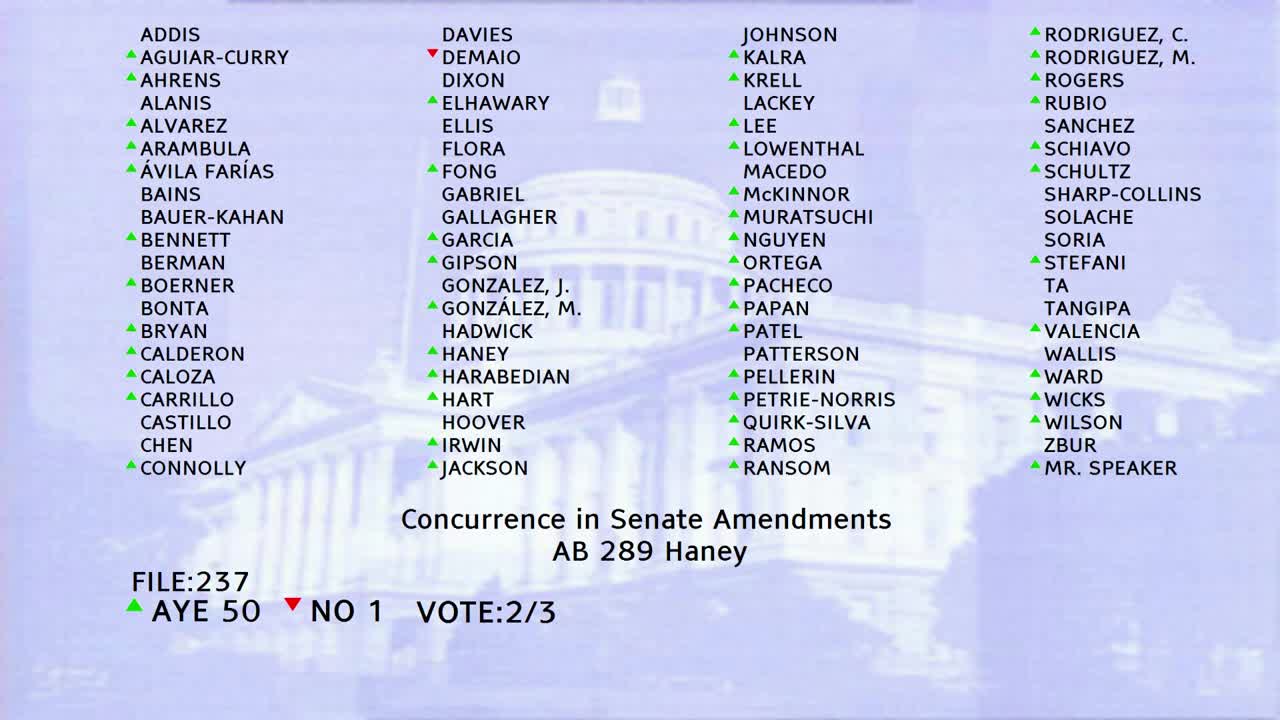
Bill Author

Bill Co-Author(s):