AB 825: Independent System Operator: independent regional organization.
- Session Year: 2025-2026
- House: Assembly
- Latest Version Date: 2025-09-19
Current Status:
Passed
(2025-09-19: Chaptered by Secretary of State - Chapter 116, Statutes of 2025.)
Introduced
In Committee
Awaiting First Chamber Vote
Passed First Chamber
In Committee
Awaiting Second Chamber Vote
Passed Second Chamber
Enacted
(1)Existing law provides for the establishment of an Independent System Operator (ISO) as a nonprofit public benefit corporation and requires the ISO to ensure efficient use and reliable operation of the electrical transmission grid consistent with achieving planning and operating reserve criteria no less stringent than those established by the Western Electricity Coordinating Council and the North American Electric Reliability Council. Existing law, the Clean Energy and Pollution Reduction Act of 2015, provides for the transformation of the ISO into a regional organization, with the approval of the Legislature, pursuant to a specified process. That process provides that modifications to the ISOs governance structure, through changes to its bylaws or other corporate governance documents, will not become effective until the ISO, the Public Utilities Commission (PUC), the State Energy Resources Conservation and Development Commission (Energy Commission), the State Air Resources Board (state board), the Governor, and the Legislature take specified actions on or before January 1, 2019.
This bill would delete the above-described provisions providing for the transformation of the ISO into a regional organization. The bill would authorize the ISO and the electrical corporations that are participating transmission owners whose transmission systems are operated by the ISO to use voluntary energy markets governed by an independent regional organization, only if specified requirements are satisfied. The bill would authorize the ISO, on or after January 1, 2028, to implement tariff modifications accepted by the Federal Energy Regulatory Commission to operate the energy markets whose rules are governed by an independent regional organization if the governing board of the ISO has adopted a resolution, as specified, finding that each of the specified requirements have been, or will be, adopted by the independent regional organization. The bill would require the PUC to make a determination through a formal decision in an existing or new proceeding that these requirements have been satisfied before electrical corporations participate in an energy market governed by an independent regional organization. The bill would require the ISO to maintain the necessary technical capability to operate energy markets, as specified, and would require the ISO to continue its functions and responsibilities as a balancing authority, as provided.
This bill would require the ISO to develop, publish, and annually update a report on certain activities of the ISO and, if applicable, an independent regional organization, as provided. The bill would require the chair of the board of governors and the chief executive officer of the ISO to annually appear before the appropriate policy committees of the Legislature to present the report, as specified.
(2)Existing law establishes the California Renewables Portfolio Standard Program, which requires the PUC to establish a renewables portfolio standard requiring all retail sellers, as defined, to procure a minimum quantity of electricity products from eligible renewable energy resources, as defined, at specified percentages of the total kilowatthours sold to their retail end-customers during specified compliance periods. The program, consistent with the goals of procuring the least-cost and best-fit eligible renewable energy resources that meet project viability principles, requires that all retail sellers procure a balanced portfolio of electricity products from eligible renewable energy resources, as specified, referred to as the portfolio content category requirements.
This bill would require the PUC and the Energy Commission to coordinate to revise any relevant rules, regulations, or guidance to ensure that the transition to a regional energy market governed by the ISO or the independent regional organization does not expand the types of transactions that meet the portfolio content category requirements, as compared to the transactions that would otherwise meet those requirements on December 31, 2025.
(3)Existing law requires the Power Exchange to provide an efficient competitive auction, open on a nondiscriminatory basis to all suppliers, that meets the loads of all exchange customers at efficient prices, and authorizes the Power Exchange governing board to form appropriate technical advisory committees composed of market and nonmarket participants to advise the governing board on relevant issues.
This bill would delete these provisions.
(4)Under existing law, a violation of the Public Utilities Act or any order, decision, rule, direction, demand, or requirement of the PUC is a crime.
Because certain provisions of this bill would be part of the act and a violation of a PUC action implementing the bills requirements would be a crime, the bill would impose a state-mandated local program.
The California Constitution requires the state to reimburse local agencies and school districts for certain costs mandated by the state. Statutory provisions establish procedures for making that reimbursement.
This bill would provide that no reimbursement is required by this act for a specified reason.
The Bergeson-Peace Infrastructure and Economic Development Bank Act establishes the California Infrastructure and Economic Development Bank (I-Bank) in the Governors Office of Business and Economic Development. Existing law, among other things, authorizes the I-Bank to make loans, issue bonds, and provide financial assistance for various types of projects that qualify as economic development or public development facilities.This bill would create the Public Transmission Financing Fund within the State Treasury for the purpose of financing eligible transmission projects, as defined, and projects that are necessary to meet the states clean energy goals to reduce or offset ratepayer costs associated with the public benefits of transmission projects. The bill would make the moneys in the fund, except as specified, continuously appropriated, without regard to fiscal year, for the support of eligible entities, as defined, and available for expenditure for the above-described purpose. By establishing a continuously appropriated fund, the bill would make an appropriation.This bill would require the I-Bank to administer the Public Transmission Financing Program to provide financial assistance and financing for eligible transmission projects, sponsored or owned, in whole or in part, by a public transmission sponsor, as defined. The bill would authorize the I-Bank to provide financial assistance under the program to any public transmission sponsor or participating party, as defined, either directly or to a lending or financial institution, in connection with the financing or refinancing of a transmission project owned or financed, in whole or in part, by a public transmission sponsor, in accordance with an agreement or agreements, between the I-Bank and the public transmission sponsor either as a sole lender or in participation or syndication with other lenders. The bill would authorize the I-Bank to issue taxable or tax-exempt bonds, as specified, loan the proceeds to a public transmission sponsor, and deposit the proceeds into the Public Transmission Financing Fund or use the proceeds to refund bonds previously issued, as provided. The bill would prohibit the I-Bank from providing financing or other support for eligible transmission projects that will recover costs through an authorized revenue requirement approved by the Federal Energy Regulatory Commission (FERC) unless the public transmission sponsor makes specified commitments. The bill would prohibit the I-Bank from financing an eligible transmission project unless certain conditions are met for the construction and maintenance of the transmission project and the transmission project complies with General Order 95 of the Public Utilities Commission (PUC).Existing law establishes the Wildfire Fund to pay eligible claims arising from a covered wildfire, as provided. Existing law requires the PUC to direct an electrical corporation participating in the Wildfire Fund to collect a nonbypassable charge from the electrical corporations ratepayers to support the Wildfire Fund.This bill would require a public transmission sponsor of a transmission project that receives benefits from the Public Transmission Financing Program to participate in the Wildfire Fund, as provided.The California Consumer Power and Conservation Financing Authority Act creates the California Consumer Power and Conservation Financing Authority. The act authorizes the authority, before January 1, 2007, to establish, finance, purchase, lease, own, operate, acquire, or construct generating facilities and other projects and enterprises, or provide financial assistance for projects or programs by participating parties, to supplement private and public sector power supplies, to ensure a sufficient and reliable supply of electricity for Californias consumers at just and reasonable rates, to finance programs for consumers and businesses to invest in cost-effective energy efficient appliances, renewable energy projects, and other programs that will reduce the demand for energy in California, to finance natural gas transportation and storage projects, to achieve an adequate energy reserve capacity in California, and to provide financing for owners of aged, inefficient, electric powerplants to perform necessary retrofits to improve the efficiency and environmental performances of those powerplants. This bill would authorize the authority to sponsor, finance, purchase, lease, own, operate, acquire, or construct eligible transmission projects. The bill would, for those eligible transmission projects, authorize the authority to either seek a revenue requirement from FERC for any eligible transmission project that will be operated by the Independent System Operator, as provided, or charge private generators, subscribers, and customers contracting for capacity on the eligible transmission project that is not under FERCs jurisdiction, as provided. For a transmission project owned, developed, or financed by the authority, the bill would authorize the authority to take certain actions. The bill would authorize the authority to seek financing assistance from any entity eligible to access the Public Transmission Financing Fund.Existing law authorizes the authority to incur indebtedness and to issue securities of any kind or class, at public or private sale by the Treasurer, and to renew the same, if the indebtedness is payable solely from revenues. Existing law authorizes the authority to issue bonds, as specified, in an amount not to exceed $5,000,000,000, exclusive of any refunds.This bill would delete that $5,000,000,000 limit.Existing law prohibits the authority from financing or approving any new program, enterprise, or project on or after January 1, 2007, unless authority to approve such an activity is granted by statute enacted on or before January 1, 2007.This bill would repeal that provision.Existing law vests the PUC with regulatory authority over public utilities, including electrical corporations.This bill would require the PUC, for any retail bill credits provided to customers of an electrical corporation by a public transmission sponsor pursuant to the above-described provisions, to determine the allocation of the retail bill credits among customer classes and to require the credits to be displayed as a separate line item on the customer bill indicating the source of the credit.Existing law prohibits an electrical corporation from beginning construction of a line, plant, or system, including a transmission system, without having first obtained from the PUC a certificate that the present or future public convenience and necessity requires or will require the construction.This bill would require an electrical corporation, in a proceeding evaluating the issuance of a certificate for a proposed transmission project, to identify any public transmission sponsor that can provide public financing and assume a minority ownership interest in the project and evaluate the ratepayer savings that could be achieved through the use of a public transmission sponsor. The bill would require the PUC to direct the electrical corporation to include a public transmission sponsor in the financing and ownership of the proposed transmission project if a sponsor is available and the ratepayer savings would be material. The bill would require the PUC, on or before June 30, 2026, to open a proceeding to evaluate the benefits of using public transmission sponsors to partner with electrical corporations in the development of new transmission projects and to develop a standard methodology for determining ratepayer benefits. The bill would require the PUC, on or before December 31, 2027, to submit a report to the Legislature that includes recommendations for statutory changes to support the successful use of public financing for transmission projects that provides maximum savings to ratepayers.Existing law requires electrical corporations to construct, maintain, and operate their electrical lines and equipment in a manner that will minimize the risk of catastrophic wildfire posed by those electrical lines and equipment.This bill would require those actions to take into account the time required to implement the proposed mitigation and the amount of risk reduced for the cost and risk remaining.Existing law requires electrical corporations to annually prepare and submit their wildfire mitigation plans to the Office of Energy Infrastructure Safety for review and approval. Existing law requires the wildfire mitigation plans to include, among other things, a description of preventive strategies and programs to minimize the risk of catastrophic wildfire, including consideration of dynamic climate change risks, a list that identifies, describes, and prioritizes all wildfire risks, and drivers for those risks, throughout the electrical corporations service territory, and a description of where and how the electrical corporation considered undergrounding electrical distribution lines within those areas of its service territory with the highest wildfire risk, as specified.This bill would revise those wildfire mitigation plan requirements to, among other things, require electrical corporations to submit their wildfire mitigation plans at least once every 4 years and to submit a preliminary wildfire plan at the earliest date one year before the filing of its general rate case application or concurrent with the filing of its Risk Assessment Mitigation Phase application, require the list identifying wildfire risks and drivers for those risks to also include particular risks and risk drivers associated with the speed in which wildfire risk mitigation measures can and will be deployed by the electrical corporation and a value of cost-per-avoided ignition for each risk or an explanation on why the value could be assigned to a particular risk, and require the presentation of certain cost-effectiveness measures adopted by the commission.Existing law authorizes an electrical corporation to file an application requesting the PUC to issue a financing order to authorize the recovery of certain costs and expenses, including those related to a catastrophic wildfire and fire risk mitigation capital expenditures, through the issuance of bonds by the electrical corporation that are secured by a rate component, as provided. Existing law, until December 31, 2035, authorizes the PUC to issue the financing order. Existing law requires the PUC to prohibit a large electrical corporation from including in its equity rate base its share for the first $5,000,000,000 expended in aggregate by large electrical corporations on fire risk mitigation capital expenditures, as provided, and authorizes those expenditures to be financed through the financing order.This bill would, in addition to the amount of fire risk mitigation capital expenditure described above, require the PUC to prohibit a large electrical corporation from including in its equity rate base its share of the first $15,000,000,000 expended in aggregate by large electrical corporations on infrastructure undergrounding projects, as defined. The bill would require an electrical corporation to finance its share of those expenditures through a financing order, as specified.Existing law requires the State Energy Resources Conservation and Development Commission (Energy Commission) and the PUC to submit a joint Reliability Planning Assessment to the Legislature on a quarterly basis. Existing law requires that assessment to report on significant delays or barriers affecting the timely deployment of renewable energy and zero-carbon resources, including, among other things, permitting processes. Existing law also requires the Energy Commission, upon appropriation, to grant certain moneys to qualified counties for the development or revision of rules and policies that facilitate the processing of permits for eligible renewable energy resources, as specified.This bill would create the Permitting Local Assistance for Clean Energy Program, to be administered by the Energy Commission, to facilitate and expedite the permitting of clean energy projects by local governments through the voluntary participation of project applicants and local permitting authorities. The bill would require the program, among other things, to establish a central pool of subject matter experts or consultants with experience in project siting and permitting that will be available to local permitting authorities upon request of those authorities, to establish a program fee range, as provided, to be paid by the project applicant to the local permitting authority participating in the program that is in lieu of any other applicable fee charged by the local permitting authority, and to establish permitting timelines to be met by the local permitting authority participating program in order to receive additional state moneys through the program, as provided. The bill would specify that a project applicant participating in the program is deemed to be in compliance with all applicable community benefits, labor, and developer agreement requirements imposed by law. The bill would establish the Permitting Local Assistance for Clean Energy Fund in the State Treasury and authorize moneys in the fund, upon appropriation by the Legislature, to be used for purposes of the program, including to support a local permitting authority by providing matching funds to offset the costs associated with local permit review and issuance, including the training or addition of permitting staff.Existing law requires the PUC to review and accept, modify, or reject a procurement plan for each electrical corporation in accordance with specified requirements and objectives. Existing law requires the electrical corporation, among other things, to include a showing in the procurement plan that the electrical corporation will first meet its unmet resource needs through all available energy efficiency and demand reduction resources that are cost effective, reliable, and feasible. In determining the availability of cost-effective, reliable, and feasible demand reduction resources, existing law requires the PUC to consider the findings regarding technically and economically achievable demand reduction in a specified study, as provided.This bill would establish the Statewide Demand Side Management Program Review Task Force within the Energy Commission and would require the task force to identify all energy efficiency and demand response programs and evaluate the efficacy of those programs in advancing certain objectives. The bill would require the task force, on or before July 1, 2026, to establish simple and objective rules to clarify when projects are eligible for energy efficiency and demand response investments and would require agencies and program administrators of those programs, on or before January 1, 2027, to update program rules to reflect those simple and objective rules after a period of public comment. The bill would require the task force, on or before July 31, 2026, to recommend program consolidation or closure of programs that do not advance those objectives, as provided, and would require the agencies and program administrators, on or before January 1, 2027, to consolidate or close programs recommended after a period of public comment and appeal.This bill would require the PUC, in determining the availability of cost-effective, reliable, and feasible energy efficiency and demand reduction resources in an electrical corporations procurement plan, to implement the recommendations made by the task force.Existing law generally requires an operator of a subsurface installation to become a member of, participate in, and share in the costs of, a regional notification center. Existing law requires a record of all notifications by an excavator or operator to the regional notification center to be maintained for a period of not less than 3 years and available for inspection, as specified. Existing law requires an operator to maintain certain records on subsurface installations. Existing law establishes prescribed notification procedures for an excavator who discovers or damages a subsurface installation. Existing law requires a regional notification center to quarterly provide notification records to the California Underground Facilities Safe Excavation Board and to provide notifications of damage to the board within 5 business days of receipt at the regional notification center.This bill would require a regional notification center to facilitate the exchange of planning and design information for electrical infrastructure undergrounding projects, as defined, and would require operators of a subsurface installation to participate in this exchange, as provided. The bill would require a regional notification center, upon request, to notify a California Native American tribe of proposed excavations within the geographic area with which the tribe is traditionally and culturally affiliated. The bill would require the California Underground Facilities Safe Excavation Board to report to the Legislature on the advantages, barriers, and funding options for the development of an internet web-based planning and design platform for accomplishing the exchange of planning and design information and for allowing tribes to view plans for projects and to communicate with plan submitters.Under existing law, a violation of the Public Utilities Act or an order, decision, rule, direction, demand, or requirement of the PUC is a crime.Because certain of the above provisions would be part of the act and a violation of an action of the PUC implementing the bills requirements would be a crime, this bill would impose a state-mandated local program.The California Constitution requires the state to reimburse local agencies and school districts for certain costs mandated by the state. Statutory provisions establish procedures for making that reimbursement.This bill would provide that no reimbursement is required by this act for a specified reason.The Bergeson-Peace Infrastructure and Economic Development Bank Act establishes the California Infrastructure and Economic Development Bank (I-Bank) in the Governors Office of Business and Economic Development. Existing law, among other things, authorizes the I-Bank to make loans, issue bonds, and provide financial assistance for various types of projects that qualify as economic development or public development facilities.
This bill would create the Public Transmission Financing Fund within the State Treasury for the purpose of financing eligible transmission projects, as defined, and projects that are necessary to meet the states clean energy goals to reduce or offset ratepayer costs associated with the public benefits of transmission projects. The bill would make the moneys in the fund, except as specified, continuously appropriated, without regard to fiscal year, for the support of eligible entities, as defined, and available for expenditure for the above-described purpose. By establishing a continuously appropriated fund, the bill would make an appropriation.
This bill would require the I-Bank to administer the Public Transmission Financing Program to provide financial assistance and financing for eligible transmission projects, sponsored or owned, in whole or in part, by a public transmission sponsor, as defined. The bill would authorize the I-Bank to provide financial assistance under the Public Transmission Financing Program program to any public transmission sponsor or participating party, as defined, either directly or to a lending or financial institution, in connection with the financing or refinancing of a transmission project owned or financed, in whole or in part, by a public transmission sponsor, in accordance with an agreement or agreements, between the I-Bank and the public transmission sponsor either as a sole lender or in participation or syndication with other lenders. The bill would authorize the I-Bank to issue taxable or tax-exempt bonds, as specified, loan the proceeds to a public transmission sponsor, and deposit the proceeds into the Public Transmission Financing Fund or use the proceeds to refund bonds previously issued, as provided. The bill would prohibit the I-Bank from providing financing or other support for eligible transmission projects that will recover costs through an authorized revenue requirement approved by the Federal Energy Regulatory Commission (FERC) unless the public transmission sponsor makes specified commitments. The bill would prohibit the I-Bank from financing an eligible transmission project unless certain conditions are met for the construction and maintenance of the transmission project and the transmission project complies with General Order 95 of the Public Utilities Commission (PUC).
Existing law establishes the Wildfire Fund to pay eligible claims arising from a covered wildfire, as provided. Existing law requires the PUC to direct an electrical corporation participating in the Wildfire Fund to collect a nonbypassable charge from the electrical corporations ratepayers to support the Wildfire Fund.
This bill would require a public transmission sponsor of a transmission project that receives benefits from the Public Transmission Financing Program to participate in the Wildfire Fund, as provided.
The California Consumer Power and Conservation Financing Authority Act creates the California Consumer Power and Conservation Financing Authority. The act authorizes the authority, before January 1, 2007, to establish, finance, purchase, lease, own, operate, acquire, or construct generating facilities and other projects and enterprises, or provide financial assistance for projects or programs by participating parties, to supplement private and public sector power supplies, to ensure a sufficient and reliable supply of electricity for Californias consumers at just and reasonable rates, to finance programs for consumers and businesses to invest in cost-effective energy efficient appliances, renewable energy projects, and other programs that will reduce the demand for energy in California, to finance natural gas transportation and storage projects, to achieve an adequate energy reserve capacity in California, and to provide financing for owners of aged, inefficient, electric powerplants to perform necessary retrofits to improve the efficiency and environmental performances of those powerplants.
This bill would authorize the authority to sponsor, finance, purchase, lease, own, operate, acquire, or construct new transmission projects that may include upgrades or improvements to existing transmission assets or new projects located on a right-of-way owned by the electrical corporation undertaken by a partnership between a public transmission sponsor and an electrical corporation involving shared ownership and financing of those new eligible transmission projects. The bill would, for those eligible transmission projects identified pursuant to that provision, projects, authorize the authority to either request seek a revenue requirement from the Federal Energy Regulatory Commission (FERC) FERC for any eligible transmission project that will be operated by the ISO, Independent System Operator, as provided, or charge private generators, subscribers, and customers contracting for capacity on a new the eligible transmission project that is not under FERCs jurisdiction, as provided. The For a transmission project owned, developed, or financed by the authority, the bill would authorize the authority to enter into partnerships with electrical corporations or other private entities under which the authority would purchase a long-term entitlement to a portion of the transmission asset that establishes eligibility to receive revenues from the ISO. take certain actions. The bill would authorize the authority to seek financing assistance from any entity eligible to access the Public Transmission Financing Fund.
Existing law authorizes the authority to incur indebtedness and to issue securities of any kind or class, at public or private sale by the Treasurer, and to renew the same, if the indebtedness is payable solely from revenues. Existing law authorizes the authority to issue bonds, as specified, in an amount not to exceed $5,000,000,000, exclusive of any refunds.
This bill would delete that $5,000,000,000 limit.
Existing law prohibits the authority from financing or approving any new program, enterprise, or project on or after January 1, 2007, unless authority to approve such an activity is granted by statute enacted on or before January 1, 2007.
This bill would repeal that provision.
Existing law vests the PUC with regulatory authority over public utilities, including electrical corporations.
This bill would require the PUC, for any retail bill credits provided to customers of an electrical corporation by a public transmission sponsor pursuant to the above-described provisions, to determine the allocation of the retail bill credits among customer classes and to require the credits to be displayed as a separate line item on the customer bill indicating the source of the credit.
Existing law prohibits an electrical corporation from beginning construction of a line, plant, or system, including a transmission system, without having first obtained from the PUC a certificate that the present or future public convenience and necessity requires or will require the construction.
This bill would require an electrical corporation, in a proceeding evaluating the issuance of a certificate for a proposed transmission project, to identify any public transmission sponsor that can provide public financing and assume a minority ownership interest in the project and evaluate the ratepayer savings that could be achieved through the use of a public transmission sponsor. The bill would require the PUC to direct the electrical corporation to include a public transmission sponsor in the financing and ownership of the proposed transmission project if a sponsor is available and the ratepayer savings would be material. The bill would require the PUC, on or before June 30, 2026, to open a proceeding to evaluate the benefits of using public transmission sponsors to partner with electrical corporations in the development of new transmission projects and to develop a standard methodology for determining ratepayer benefits. The bill would require the PUC, on or before December 31, 2027, to submit a report to the Legislature that includes recommendations for statutory changes to support the successful use of public financing for transmission projects that provides maximum savings to ratepayers.
Existing law requires electrical corporations to construct, maintain, and operate their electrical lines and equipment in a manner that will minimize the risk of catastrophic wildfire posed by those electrical lines and equipment.
This bill would require those actions to take into account both the time required to implement the proposed mitigation and the amount of risk reduced for the cost and risk remaining.
Existing law requires electrical corporations to annually prepare and submit their wildfire mitigation plan plans to the Office of Energy Infrastructure Safety for review and approval. Existing law requires the wildfire mitigation plans to include, among other things, a description of preventive strategies and programs to minimize the risk of catastrophic wildfire, including consideration of dynamic climate change risk, risks, a list that identifies, describes, and prioritizes all wildfire risks, and drivers for those risks, throughout the electrical corporations service territory, and a description of where and how the electrical corporation considered undergrounding electrical distribution lines within those areas of its service territory with the highest wildfire risk, as specified.
This bill would revise those wildfire mitigation plan requirements to, among other things, require electrical corporations to submit their wildfire mitigation plans at least once every 4 years and to submit a preliminary wildfire plan at the earliest date one year before the filing of its general rate case application or concurrent with the filing of its Risk Assessment Mitigation Phase application, require the list identifying wildfire risks and drivers for those risks to also include particular risks and risk drivers associated with the speed in which wildfire risk mitigation measures can and will be deployed by the electrical corporation and a value of cost-per-avoided ignition for each risk or an explanation on why the value could be assigned to a particular risk, and require the presentation of certain cost-effectiveness measures adopted by the commission.
Existing law authorizes an electrical corporation to file an application requesting the PUC to issue a financing order to authorize the recovery of certain costs and expenses, including those related to a catastrophic wildfire and fire risk mitigation capital expenditures, through the issuance of bonds by the electrical corporation that are secured by a rate component, as provided. Existing law, until December 31, 2035, authorizes the PUC to issue the financing order. Existing law requires the PUC to prohibit a large electrical corporation from including in its equity rate base its share for the first $5,000,000,000 expended in aggregate by large electrical corporations on fire risk mitigation capital expenditures, as provided, and authorizes those expenditures to be financed through the financing order.
This bill would, in addition to the amount of fire risk mitigation capital expenditure described above, require the PUC to prohibit a large electrical corporation from including in its equity rate base its share of the first $15,000,000,000 expended in aggregate by large electrical corporations on infrastructure undergrounding projects, as defined. The bill would require an electrical corporation to finance its share of those expenditures through a financing order, as specified.
Existing law requires the State Energy Resources Conservation and Development Commission (Energy Commission) and the PUC to submit a joint Reliability Planning Assessment to the Legislature on a quarterly basis. Existing law requires that assessment to report on significant delays or barriers affecting the timely deployment of renewable energy and zero-carbon resources, including, among other things, permitting processes. Existing law also requires the Energy Commission, upon appropriation, to grant certain moneys to qualified counties for the development or revision of rules and policies that facilitate the processing of permits for eligible renewable energy resources, as specified.
This bill would establish create the Permitting Local Assistance for Clean Energy Program, to be administered by the Energy Commission Commission, to facilitate and expedite the permitting of clean energy projects by local governments through the voluntary participation of project applicants and local permitting authorities. The bill would require the program, among other things, to establish a central pool of subject matter experts or consultants with experience in project siting and permitting that will be available to local permitting authorities upon request of those authorities, to establish a program fee range, as provided, to be paid by the project applicant to the local permitting authority participating in the program that is in lieu of any other applicable application fee otherwise charged by the local permitting authority, and to establish permitting timelines to be met by the local permitting authority participating program in order to receive additional state moneys through the program, as provided. The bill would specify that a project applicant participating in the program is deemed to be in compliance with all applicable community benefits, labor, and developer agreement requirements imposed by law. The bill would establish the Permitting Local Assistance for Clean Energy Fund in the State Treasury and authorize moneys in the fund, upon appropriation by the Legislature, to be used for purposes of the program, including to support a local permitting authority by providing matching funds to offset the costs associated with local permit review and issuance, including the training or addition of permitting staff.
Existing law requires the PUC to review and accept, modify, or reject a procurement plan for each electrical corporation in accordance with specified requirements and objectives. Existing law requires the electrical corporation, among other things, to include a showing in the procurement plan that the electrical corporation will first meet its unmet resource needs through all available energy efficiency and demand reduction resources that are cost effective, reliable, and feasible. In determining the availability of cost-effective, reliable, and feasible demand reduction resources, existing law requires the commission PUC to consider the findings regarding technically and economically achievable demand reduction in a specified study, as provided.
This bill would establish the Statewide Demand Side Management Program Review Task Force within the Energy Commission and would require the task force to identify all energy efficiency and demand response programs and evaluate the efficacy of those programs in advancing certain objectives. The bill would require the task force, on or before July 1, 2026, to establish simple and objective rules to clarify when projects are eligible for energy efficiency and demand response investments and would require agencies and program administrators of those programs, on or before January 1, 2027, to update program rules to reflect those simple and objective rules after a period of public comment. The bill would require the task force, on or before July 31, 2026, to recommend program consolidation or closure of programs that do not advance those objectives, as provided, and would require the agencies and program administrators, on or before January 1, 2027, to consolidate or close programs recommended after a period of public comment and appeal.
This bill would require the PUC, in determining the availability of cost-effective, reliable, and feasible energy efficiency and demand reduction resources in an electrical corporations procurement plan, to implement the recommendations made by the task force.
Existing law generally requires an operator of a subsurface installation to become a member of, participate in, and share in the costs of, a regional notification center. Existing law requires a record of all notifications by an excavator or operator to the regional notification center to be maintained for a period of not less than 3 years and available for inspection, as specified. Existing law requires an operator to maintain certain records on subsurface installations. Existing law establishes prescribed notification procedures for an excavator who discovers or damages a subsurface installation. Existing law requires a regional notification center to quarterly provide notification records to the California Underground Facilities Safe Excavation Board and to provide notifications of damage to the board within 5 business days of receipt at the regional notification center.
This bill would require a regional notification center to facilitate the exchange of planning and design information for electrical infrastructure undergrounding projects, as defined, and would require operators of a subsurface installation to participate in this exchange, as provided. The bill would require a regional notification center, upon request, to notify a California Native American tribe of proposed excavation excavations within the geographic area with which the tribe is traditionally and culturally affiliated. The bill would require the California Underground Facilities Safe Excavation Board to report to the Legislature on the advantages, barriers, and funding options for the development of an internet web-based planning and design platform for accomplishing the exchange of planning and design information and for allow allowing tribes to view plans for projects and to communicate with plan submitters.
Under existing law, a violation of the Public Utilities Act or an order, decision, rule, direction, demand, or requirement of the PUC is a crime.
Because certain of the above provisions would be part of the act and a violation of an action of the PUC implementing the bills requirements would be a crime, this bill would impose a state-mandated local program.
The California Constitution requires the state to reimburse local agencies and school districts for certain costs mandated by the state. Statutory provisions establish procedures for making that reimbursement.
This bill would provide that no reimbursement is required by this act for a specified reason.
The Bergeson-Peace Infrastructure and Economic Development Bank Act, Act establishes the California Infrastructure and Economic Development Bank (I-Bank) in the Governors Office of Business and Economic Development. Existing law, among other things, authorizes the I-Bank to make loans, issue bonds, and provide financial assistance for various types of projects that qualify as economic development or public development facilities.
The Safe Drinking Water, Wildfire Prevention, Drought Preparedness, and Clean Air Bond Act of 2024 (act), approved by the voters as Proposition 4 at the November 5, 2024, statewide general election, authorized the issuance of bonds in the amount of $10,000,000,000 pursuant to the State General Obligation Bond Law to finance projects for safe drinking water, drought, flood, and water resilience, wildfire and forest resilience, coastal resilience, extreme heat mitigation, biodiversity and nature-based climate solutions, climate-smart, sustainable, and resilient farms, ranches, and working lands, park creation and outdoor access, and clean air programs. Of these funds, the act made $850,000,000 available, upon appropriation by the Legislature, for clean energy projects, including, among other things, by making $325,000,000 available, upon appropriation by the Legislature, to the I-Bank, the State Energy Resources Conservation and Development Commission, or any other entity chosen by the Legislature, upon appropriation by the Legislature, for the public financing of clean energy transmission projects that are necessary to meet the states clean energy goals to reduce or offset ratepayer costs associated with the public benefits of transmission projects. The act requires the proceeds of the bonds issued and sold pursuant to the above-described provisions, as specified, to be deposited in the Safe Drinking Water, Wildfire Prevention, Drought Preparedness, and Clean Air Fund and requires the moneys in the fund to be available, upon appropriation by the Legislature, for the purposes of the act.This bill would create the Public Transmission Financing Fund within the State Treasury for the purpose of financing eligible transmission projects, as defined, that are necessary to meet the states clean energy goals to reduce or offset ratepayer costs associated with the public benefits of transmission projects. The bill would make the moneys in the fund, except as specified, continuously appropriated, without regard to fiscal year, for the support of eligible entities, as defined, and available for expenditure for the above-described purpose. By establishing a continuously appropriated fund, the bill would make an appropriation.
This bill would require the I-Bank to administer the Public Transmission Financing Program to provide financial assistance and financing for eligible transmission projects, sponsored or owned, in whole or in part, by a public transmission sponsor, as defined. The bill would authorize the I-Bank to provide financial assistance under the Public Transmission Financing Program to any public transmission sponsor or participating party, as defined, either directly or to a lending or financial institution, in connection with the financing or refinancing of a transmission project owned or financed, in whole or in part, by a public transmission sponsor, in accordance with an agreement or agreements, between the I-Bank and the public transmission sponsor either as a sole lender or in participation or syndication with other lenders. The bill would authorize the I-Bank to issue taxable or tax-exempt bonds, as specified, loan the proceeds to a public transmission sponsor, and deposit the proceeds into the Public Transmission Financing Fund or use the proceeds to refund bonds previously issued, as provided. The bill would prohibit the I-Bank from providing financing or other support for eligible transmission projects that will recover costs through an authorized revenue requirement approved by the Federal Energy Regulatory Commission unless the public transmission sponsor makes specified commitments. The bill would prohibit the I-Bank from financing an eligible transmission project unless the public transmission sponsor has entered into a project labor agreement that, at a minimum, meets specified requirements and includes specified information. certain conditions are met for the construction and maintenance of the transmission project and the transmission project complies with General Order 95 of the Public Utilities Commission (PUC).
(2)TheThe California Consumer Power and Conservation Financing Authority Act creates the California Consumer Power and Conservation Financing Authority. The act authorizes the authority, before January 1, 2007, to establish, finance, purchase, lease, own, operate, acquire, or construct generating facilities and other projects and enterprises, or provide financial assistance for projects or programs by participating parties, to supplement private and public sector power supplies, to ensure a sufficient and reliable supply of electricity for Californias consumers at just and reasonable rates, to finance programs for consumers and businesses to invest in cost-effective energy efficient appliances, renewable energy projects, and other programs that will reduce the demand for energy in California, to finance natural gas transportation and storage projects, to achieve an adequate energy reserve capacity in California, and to provide financing for owners of aged, inefficient, electric powerplants to perform necessary retrofits to improve the efficiency and environmental performances of those powerplants.
This bill would authorize the authority to sponsor, finance, purchase, lease, own, operate, acquire, or construct new transmission projects that may include upgrades or improvements to existing transmission assets or new projects located on a right-of-way owned by the electrical corporation undertaken by a partnership between a public transmission sponsor and an electrical corporation involving shared ownership and financing of a those new transmission project that may include upgrades or improvements to existing transmission assets or new projects located on a right-of-way owned by the electrical corporation. projects. The bill would, for transmission projects identified pursuant to that provision, authorize the commission authority to either request a revenue requirement from the Federal Energy Regulatory Commission (FERC) for any transmission project that will be operated by the Independent System Operator, ISO, as provided, or charge private generators, subscribers, and customers contracting for capacity on a new transmission project, project that is not under FERCs jurisdiction, as provided. The bill would authorize the authority to enter into partnerships with electrical corporations or other private entities under which the authority would purchase a long-term entitlement to a portion of the transmission asset that establishes eligibility to receive revenues from the Independent System Operator. ISO. The bill would authorize the authority to seek financing assistance from any entity eligible to access the Public Transmission Financing Fund.
(3)ExistingExisting law authorizes the authority to incur indebtedness and to issue securities of any kind or class, at public or private sale by the Treasurer, and to renew the same, if the indebtedness is payable solely from revenues. Existing law authorizes the authority to issue bonds, as specified, in an amount not to exceed $5,000,000,000, exclusive of any refunds.
This bill would delete that $5,000,000,000 limit.
(4)ExistingExisting law prohibits the authority from financing or approving any new program, enterprise, or project on or after January 1, 2007, unless authority to approve such an activity is granted by statute enacted on or before January 1, 2007.
This bill would repeal that provision.
(5)ExistingExisting law vests the Public Utilities Commission PUC with regulatory authority over public utilities, including electrical corporations.
This bill would require the commission, PUC, for any retail bill credits provided to customers of an electrical corporation by a public transmission sponsor pursuant to the above-described provisions, to require the credits to be displayed as a separate line item on the customer bill indicating the source of the credit.
Existing law requires electrical corporations to construct, maintain, and operate their electrical lines and equipment in a manner that will minimize the risk of catastrophic wildfire posed by those electrical lines and equipment.
This bill would require those actions to take into account both the time required to implement the proposed mitigation and the amount of risk reduced for the cost and risk remaining.
Existing law requires electrical corporations to annually prepare and submit their wildfire mitigation plan to the Office of Energy Infrastructure Safety for review and approval. Existing law requires the wildfire mitigation plans to include, among other things, a description of preventive strategies and programs to minimize the risk of catastrophic wildfire, including consideration of dynamic climate change risk, a list that identifies, describes, and prioritizes all wildfire risks, and drivers for those risks, throughout the electrical corporations service territory, and a description of where and how the electrical corporation considered undergrounding electrical distribution lines within those areas of its service territory with the highest wildfire risk, as specified.
This bill would revise those wildfire mitigation plan requirements to, among other things, require electrical corporations to submit their wildfire mitigation plans at least once every 4 years and to submit a preliminary wildfire plan at the earliest date one year before the filing of its general rate case application or concurrent with the filing of its Risk Assessment Mitigation Phase application, require the list identifying wildfire risks and drivers for those risks to also include particular risks and risk drivers associated with the speed in which wildfire risk mitigation measures can and will be deployed by the electrical corporation and a value of cost-per-avoided ignition for each risk or an explanation on why the value could be assigned to a particular risk, and require the presentation of certain cost-effectiveness measures adopted by the commission.
Existing law authorizes an electrical corporation to file an application requesting the PUC to issue a financing order to authorize the recovery of certain costs and expenses, including those related to a catastrophic wildfire and fire risk mitigation capital expenditures, through the issuance of bonds by the electrical corporation that are secured by a rate component, as provided. Existing law, until December 31, 2035, authorizes the PUC to issue the financing order. Existing law requires the PUC to prohibit a large electrical corporation from including in its equity rate base its share for the first $5,000,000,000 expended in aggregate by large electrical corporations on fire risk mitigation capital expenditures, as provided, and authorizes those expenditures to be financed through the financing order.
This bill would, in addition to the amount of fire risk mitigation capital expenditure described above, require the PUC to prohibit a large electrical corporation from including in its equity rate base its share of the first $15,000,000,000 expended in aggregate by large electrical corporations on infrastructure undergrounding projects, as defined. The bill would require an electrical corporation to finance its share of those expenditures through a financing order, as specified.
Existing law requires the Energy Commission and the PUC to submit a joint Reliability Planning Assessment to the Legislature on a quarterly basis. Existing law requires that assessment to report on significant delays or barriers affecting the timely deployment of renewable energy and zero-carbon resources, including, among other things, permitting processes. Existing law also requires the Energy Commission, upon appropriation, to grant certain moneys to qualified counties for the development or revision of rules and policies that facilitate the processing of permits for eligible renewable energy resources, as specified.
This bill would establish the Permitting Local Assistance for Clean Energy Program, to be administered by the Energy Commission to facilitate and expedite the permitting of clean energy projects by local governments through the voluntary participation of project applicants and local permitting authorities. The bill would require the program, among other things, to establish a central pool of subject matter experts or consultants with experience in project siting and permitting that will be available to local permitting authorities upon request of those authorities, to establish a program fee range, as provided, to be paid by the project applicant to the local permitting authority participating in the program that is in lieu of any applicable application fee otherwise charged by the local permitting authority, and to establish permitting timelines to be met by the local permitting authority participating program in order to receive additional state moneys through the program, as provided. The bill would specify that a project applicant participating in the program is deemed to be in compliance with all applicable community benefits, labor, and developer agreement requirements imposed by law. The bill would establish the Permitting Local Assistance for Clean Energy Fund in the State Treasury and authorize moneys in the fund, upon appropriation by the Legislature, to be used for purposes of the program, including to support a local permitting authority by providing matching funds to offset the costs associated with local permit review and issuance, including the training or addition of permitting staff.
Existing law requires the PUC to review and accept, modify, or reject a procurement plan for each electrical corporation in accordance with specified requirements and objectives. Existing law requires the electrical corporation, among other things, to include a showing in the procurement plan that the electrical corporation will first meet its unmet resource needs through all available energy efficiency and demand reduction resources that are cost effective, reliable, and feasible. In determining the availability of cost-effective, reliable, and feasible demand reduction resources, existing law requires the commission to consider the findings regarding technically and economically achievable demand reduction in a specified study, as provided.
This bill would establish the Statewide Demand Side Management Program Review Task Force within the Energy Commission and would require the task force to identify energy efficiency and demand response programs and evaluate the efficacy of those programs in advancing certain objectives. The bill would require the task force, on or before July 1, 2026, to establish simple and objective rules to clarify when projects are eligible for energy efficiency and demand response investments and would require agencies and program administrators of those programs, on or before January 1, 2027, to update program rules to reflect those simple and objective rules after a period of public comment. The bill would require the task force, on or before July 31, 2026, to recommend program consolidation or closure of programs that do not advance those objectives, as provided, and would require the agencies and program administrators, on or before January 1, 2027, to consolidate or close programs recommended after a period of public comment and appeal.
This bill would require the PUC, in determining the availability of cost-effective, reliable, and feasible energy efficiency and demand reduction resources in an electrical corporations procurement plan, to implement the recommendations made by the task force.
Existing law generally requires an operator of a subsurface installation to become a member of, participate in, and share in the costs of, a regional notification center. Existing law requires a record of all notifications by an excavator or operator to the regional notification center to be maintained for a period of not less than 3 years and available for inspection, as specified. Existing law requires an operator to maintain certain records on subsurface installations. Existing law establishes prescribed notification procedures for an excavator who discovers or damages a subsurface installation. Existing law requires a regional notification center to quarterly provide notification records to the California Underground Facilities Safe Excavation Board and to provide notifications of damage to the board within 5 business days of receipt at the regional notification center.
This bill would require a regional notification center to facilitate the exchange of planning and design information for electrical infrastructure undergrounding projects, as defined, and would require operators of a subsurface installation to participate in this exchange, as provided. The bill would require a regional notification center, upon request, to notify a California Native American tribe of proposed excavation within the geographic area with which the tribe is traditionally and culturally affiliated. The bill would require the California Underground Facilities Safe Excavation Board to report to the Legislature on the advantages, barriers, and funding options for the development of an internet web-based planning and design platform for accomplishing the exchange of planning and design information and for allow tribes to view plans for projects and to communicate with plan submitters.
(6)UnderUnder existing law, a violation of the Public Utilities Act or an order, decision, rule, direction, demand, or requirement of the commission PUC is a crime.
Because certain of the above provisions would be part of the act and a violation of a commission an action of the PUC implementing this the bills requirements would be a crime, the this bill would impose a state-mandated local program.
The California Constitution requires the state to reimburse local agencies and school districts for certain costs mandated by the state. Statutory provisions establish procedures for making that reimbursement.
This bill would provide that no reimbursement is required by this act for a specified reason.
(1)Existing law, the Bergeson-Peace Infrastructure and Economic Development Bank Act, establishes the California Infrastructure and Economic Development Bank (I-Bank) in the Governors Office of Business and Economic Development. Existing law, among other things, authorizes the I-Bank to make loans, issue bonds, and provide financial assistance for various types of projects that qualify as economic development or public development facilities.
The Safe Drinking Water, Wildfire Prevention, Drought Preparedness, and Clean Air Bond Act of 2024 (act), approved by the voters as Proposition 4 at the November 5, 2024, statewide general election, authorized the issuance of bonds in the amount of $10,000,000,000 pursuant to the State General Obligation Bond Law to finance projects for safe drinking water, drought, flood, and water resilience, wildfire and forest resilience, coastal resilience, extreme heat mitigation, biodiversity and nature-based climate solutions, climate-smart, sustainable, and resilient farms, ranches, and working lands, park creation and outdoor access, and clean air programs. Of these funds, the act made $850,000,000 available, upon appropriation by the Legislature, for clean energy projects, including, among other things, by making $325,000,000 available, upon appropriation by the Legislature, to the I-Bank, the State Energy Resources Conservation and Development Commission, or any other entity chosen by the Legislature, upon appropriation by the Legislature, for the public financing of clean energy transmission projects that are necessary to meet the states clean energy goals to reduce or offset ratepayer costs associated with the public benefits of transmission projects. The act requires the proceeds of the bonds issued and sold pursuant to the above-described provisions, as specified, to be deposited in the Safe Drinking Water, Wildfire Prevention, Drought Preparedness, and Clean Air Fund and requires the moneys in the fund to be available, upon appropriation by the Legislature, for the purposes of the act.
This bill would create the Public Transmission Financing Fund within the State Treasury for the purpose of financing eligible transmission projects, as defined, that are necessary to meet the states clean energy goals to reduce or offset ratepayer costs associated with the public benefits of transmission projects. The bill would state the intent of the Legislature to enact subsequent legislation that would appropriate $325,000,000 from the Safe Drinking Water, Wildfire Prevention, Drought Preparedness, and Clean Air Fund to the Public Transmission Financing Fund. The bill would make the moneys in the fund, except as specified, continuously appropriated, without regard to fiscal year, for the support of eligible entities, as defined, and available for expenditure for the above-described purpose. By establishing a continuously appropriated fund, the bill would make an appropriation.
This bill would require the I-Bank to administer the Public Transmission Financing Program to provide financial assistance and financing for eligible transmission projects, sponsored or owned, in whole or in part, by a public transmission sponsor, as defined. The bill would authorize the I-Bank to provide financial assistance under the Public Transmission Financing Program to any public transmission sponsor or participating party, as defined, either directly or to a lending or financial institution, in connection with the financing or refinancing of a transmission project owned or financed, in whole or in part, by a public transmission sponsor, in accordance with an agreement or agreements, between the I-Bank and the public transmission sponsor either as a sole lender or in participation or syndication with other lenders. The bill would authorize the I-Bank to issue taxable or tax-exempt bonds, as specified, loan the proceeds to a public transmission sponsor, and deposit the proceeds into the Public Transmission Financing Fund or use the proceeds to refund bonds previously issued, as provided. The bill would prohibit the I-Bank from providing financing or other support for eligible transmission projects that will recover costs through an authorized revenue requirement approved by the Federal Energy Regulatory Commission unless the public transmission sponsor makes specified commitments. The bill would prohibit the I-Bank from financing an eligible transmission project unless the public transmission sponsor has entered into a project labor agreement that, at a minimum, meets specified requirements and includes specified information.
(2)The California Consumer Power and Conservation Financing Authority Act creates the California Consumer Power and Conservation Financing Authority. The act authorizes the authority, before January 1, 2007, to establish, finance, purchase, lease, own, operate, acquire, or construct generating facilities and other projects and enterprises, or provide financial assistance for projects or programs by participating parties, to supplement private and public sector power supplies, to ensure a sufficient and reliable supply of electricity for Californias consumers at just and reasonable rates, to finance programs for consumers and businesses to invest in cost-effective energy efficient appliances, renewable energy projects, and other programs that will reduce the demand for energy in California, to finance natural gas transportation and storage projects, to achieve an adequate energy reserve capacity in California, and to provide financing for owners of aged, inefficient, electric powerplants to perform necessary retrofits to improve the efficiency and environmental performances of those powerplants.
This bill would authorize the authority to sponsor, finance, purchase, lease, own, operate, acquire, or construct a partnership between a public transmission sponsor and an electrical corporation involving shared ownership and financing of a new transmission project that may include upgrades or improvements to existing transmission assets or new projects located on a right-of-way owned by the electrical corporation. The bill would, for transmission projects identified pursuant to that provision, authorize the commission to either request a revenue requirement from the Federal Energy Regulatory Commission for any transmission project that will be operated by the Independent System Operator, as provided, or charge private generators, subscribers, and customers contracting for capacity on a new transmission project, as provided. The bill would authorize the authority to enter into partnerships with electrical corporations or other private entities under which the authority would purchase a long-term entitlement to a portion of the transmission asset that establishes eligibility to receive revenues from the Independent System Operator. The bill would authorize the authority to seek financing assistance from any entity eligible to access the Public Transmission Financing Fund.
(3)Existing law authorizes the authority to incur indebtedness and to issue securities of any kind or class, at public or private sale by the Treasurer, and to renew the same, if the indebtedness is payable solely from revenues. Existing law authorizes the authority to issue bonds, as specified, in an amount not to exceed $5,000,000,000, exclusive of any refunds.
This bill would delete that $5,000,000,000 limit.
(4)Existing law prohibits the authority from financing or approving any new program, enterprise, or project on or after January 1, 2007, unless authority to approve such an activity is granted by statute enacted on or before January 1, 2007.
This bill would repeal that provision.
(5)Existing law vests the Public Utilities Commission with regulatory authority over public utilities, including electrical corporations.
This bill would require the commission, for any retail bill credits provided to customers of an electrical corporation by a public transmission sponsor pursuant to the above-described provisions, to require the credits to be displayed as a separate line item on the customer bill indicating the source of the credit.
(6)This bill would state the intent of the Legislature to enact subsequent legislation that would appropriate $5,000,000 to the California Consumer Power and Conservation Financing Authority for the purposes of hiring staff and consultants to support efforts relating to the public financing and ownership of new electric transmission infrastructure, as provided.(7)(6)Under existing law, a violation of the Public Utilities Act or an order, decision, rule, direction, demand, or requirement of the commission is a crime.
Because certain of the above provisions would be part of the act and a violation of a commission action implementing this bills requirements would be a crime, the bill would impose a state-mandated local program.
The California Constitution requires the state to reimburse local agencies and school districts for certain costs mandated by the state. Statutory provisions establish procedures for making that reimbursement.
This bill would provide that no reimbursement is required by this act for a specified reason.
(1)Existing law, the Bergeson-Peace Infrastructure and Economic Development Bank Act, establishes the California Infrastructure and Economic Development Bank (I-Bank) in the Governors Office of Business and Economic Development. Existing law, among other things, authorizes the I-Bank to make loans, issue bonds, and provide financial assistance for various types of projects that qualify as economic development or public development facilities.
The Safe Drinking Water, Wildfire Prevention, Drought Preparedness, and Clean Air Bond Act of 2024 (act), approved by the voters as Proposition 4 at the November 5, 2024, statewide general election, authorized the issuance of bonds in the amount of $10,000,000,000 pursuant to the State General Obligation Bond Law to finance projects for safe drinking water, drought, flood, and water resilience, wildfire and forest resilience, coastal resilience, extreme heat mitigation, biodiversity and nature-based climate solutions, climate-smart, sustainable, and resilient farms, ranches, and working lands, park creation and outdoor access, and clean air programs. Of these funds, the act made $850,000,000 available, upon appropriation by the Legislature, for clean energy projects, including, among other things, by making $325,000,000 available, upon appropriation by the Legislature, to the I-Bank, the State Energy Resources Conservation and Development Commission, or any other entity chosen by the Legislature, upon appropriation by the Legislature, for the public financing of clean energy transmission projects that are necessary to meet the states clean energy goals to reduce or offset ratepayer costs associated with the public benefits of transmission projects. The act requires the proceeds of the bonds issued and sold pursuant to the above-described provisions, as specified, to be deposited in the Safe Drinking Water, Wildfire Prevention, Drought Preparedness, and Clean Air Fund and requires the moneys in the fund to be available, upon appropriation by the Legislature, for the purposes of the act.
This bill would create the Public Transmission Financing Fund within the State Treasury for the purpose of financing eligible transmission projects, as defined, that are necessary to meet the states clean energy goals to reduce or offset ratepayer costs associated with the public benefits of transmission projects. The bill would state the intent of the Legislature to enact subsequent legislation that would appropriate $325,000,000 from the Safe Drinking Water, Wildfire Prevention, Drought Preparedness, and Clean Air Fund to the Public Transmission Financing Fund. The bill would make the moneys in the fund, except as specified, continuously appropriated, without regard to fiscal year, for the support of eligible entities, as defined, and available for expenditure for the above-described purpose. By establishing a continuously appropriated fund, the bill would make an appropriation.
This bill would require the I-Bank to administer the Public Transmission Financing Program to provide financial assistance and financing for eligible transmission projects, sponsored or owned, in whole or in part, by a public transmission sponsor, as defined. The bill would authorize the I-Bank to provide financial assistance under the Public Transmission Financing Program to any public transmission sponsor or participating party, as defined, either directly or to a lending or financial institution, in connection with the financing or refinancing of a transmission project owned or financed, in whole or in part, by a public transmission sponsor, in accordance with an agreement or agreements, between the I-Bank and the public transmission sponsor either as a sole lender or in participation or syndication with other lenders. The bill would authorize the I-Bank to issue taxable or tax-exempt bonds, as specified, loan the proceeds to a public transmission sponsor, and deposit the proceeds into the Public Transmission Financing Fund or use the proceeds to refund bonds previously issued, as provided. The bill would prohibit the I-Bank from providing financing or other support for eligible transmission projects that will recover costs through an authorized revenue requirement approved by the Federal Energy Regulatory Commission unless the public transmission sponsor makes specified commitments. The bill would prohibit the I-Bank from financing an eligible transmission project unless the public transmission sponsor has entered into a project labor agreement that, at a minimum, meets specified requirements and includes specified information.
(2)The California Consumer Power and Conservation Financing Authority Act creates the California Consumer Power and Conservation Financing Authority. The act authorizes the authority, before January 1, 2007, to establish, finance, purchase, lease, own, operate, acquire, or construct generating facilities and other projects and enterprises, or provide financial assistance for projects or programs by participating parties, to supplement private and public sector power supplies, to ensure a sufficient and reliable supply of electricity for Californias consumers at just and reasonable rates, to finance programs for consumers and businesses to invest in cost-effective energy efficient appliances, renewable energy projects, and other programs that will reduce the demand for energy in California, to finance natural gas transportation and storage projects, to achieve an adequate energy reserve capacity in California, and to provide financing for owners of aged, inefficient, electric powerplants to perform necessary retrofits to improve the efficiency and environmental performances of those powerplants.
This bill would authorize the authority to sponsor, finance, purchase, lease, own, operate, acquire, or construct a partnership between a public transmission sponsor and an electrical corporation involving shared ownership and financing of a new transmission project that may include upgrades or improvements to existing transmission assets or new projects located on a right-of-way owned by the electrical corporation. The bill would, for transmission projects identified pursuant to that provision, authorize the commission to either request a revenue requirement from the Federal Energy Regulatory Commission for any transmission project that will be operated by the Independent System Operator, as provided, or charge private generators, subscribers, and customers contracting for capacity on a new transmission project, as provided. The bill would authorize the authority to enter into partnerships with electrical corporations or other private entities under which the authority would purchase a long-term entitlement to a portion of the transmission asset that establishes eligibility to receive revenues from the Independent System Operator. The bill would authorize the authority to seek financing assistance from any entity eligible to access the Public Transmission Financing Fund.
(3)Existing law authorizes the authority to incur indebtedness and to issue securities of any kind or class, at public or private sale by the Treasurer, and to renew the same, if the indebtedness is payable solely from revenues. Existing law authorizes the authority to issue bonds, as specified, in an amount not to exceed $5,000,000,000, exclusive of any refunds.
This bill would delete that $5,000,000,000 limit.
(4)Existing law prohibits the authority from financing or approving any new program, enterprise, or project on or after January 1, 2007, unless authority to approve such an activity is granted by statute enacted on or before January 1, 2007.
This bill would repeal that provision.
(5)Existing law vests the Public Utilities Commission with regulatory authority over public utilities, including electrical corporations.
This bill would require the commission, for any retail bill credits provided to customers of an electrical corporation by a public transmission sponsor pursuant to the above-described provisions, to require the credits to be displayed as a separate line item on the customer bill indicating the source of the credit.
(6)This bill would state the intent of the Legislature to enact subsequent legislation that would appropriate $5,000,000 to the California Consumer Power and Conservation Financing Authority for the purposes of hiring staff and consultants to support efforts relating to the public financing and ownership of new electric transmission infrastructure, as provided.
(7)Under existing law, a violation of the Public Utilities Act or an order, decision, rule, direction, demand, or requirement of the commission is a crime.
Because certain of the above provisions would be part of the act and a violation of a commission action implementing this bills requirements would be a crime, the bill would impose a state-mandated local program.
The California Constitution requires the state to reimburse local agencies and school districts for certain costs mandated by the state. Statutory provisions establish procedures for making that reimbursement.
This bill would provide that no reimbursement is required by this act for a specified reason.
Existing law requires, on or before December 31, 2026, the Public Utilities Commission (PUC), in consultation with the State Energy Resources Conservation and Development Commission, to develop a framework for assessing, tracking, and analyzing total annual energy costs paid by residential households, as specified, and requires the PUC to submit a report to the Legislature containing the framework. Existing law authorizes the PUC to use the framework for purposes of evaluating any request by an electrical corporation and gas corporation to track new spending eligible for recovery or to adjust a revenue requirement. Existing law requires the PUC, in evaluating the request, to consider whether the electrical corporation and gas corporation should take additional actions to achieve certain reductions in total annual energy costs specified in the framework.This bill would require the PUC to submit an update to that report to the Legislature every two years following the initial submission, providing an evaluation of the implementation and impact of the framework, and the usage of the framework, identifying the specific requests by an electrical corporation or gas corporation for which the framework was employed by the PUC in evaluating the requests.Existing law requires, on or before December 31, 2026, the Public Utilities Commission (PUC), in consultation with the State Energy Resources Conservation and Development Commission, to develop a framework for assessing, tracking, and analyzing total annual energy costs paid by residential households, as specified, and requires the PUC to submit a report to the Legislature containing the framework. Existing law authorizes the PUC to use the framework for purposes of evaluating any request by an electrical corporation and gas corporation to track new spending eligible for recovery or to adjust a revenue requirement. Existing law requires the PUC, in evaluating the request, to consider whether the electrical corporation and gas corporation should take additional actions to achieve certain reductions in total annual energy costs specified in the framework.
This bill would require the PUC to submit an update to that report to the Legislature every two years following the initial submission, providing an evaluation of the implementation and impact of the framework, and the usage of the framework, identifying the specific requests by an electrical corporation or gas corporation for which the framework was employed by the PUC in evaluating the requests.
(a)The Independent System Operator governing board shall comprise a five-member independent governing board of directors appointed by the Governor and subject to confirmation by the Senate. Any reference in this chapter or in any other provision of law to the Independent System Operator governing board means the independent governing board appointed under this subdivision.
(b)A member of the independent governing board appointed under subdivision (a) may not be affiliated with any actual or potential participant in any market administered by the Independent System Operator.
(c)(1)All appointments shall be for three-year terms.
(2)There is no limit on the number of terms that may be served by any member.
(d)The Oversight Board shall require the articles of incorporation and bylaws of the Independent System Operator to be revised in accordance with this section, and shall make filings with the Federal Energy Regulatory Commission as the Oversight Board determines to be necessary.
(e)For purposes of the initial appointments to the Independent System Operator governing board, as provided in subdivision (a), the Governor shall appoint one member to a one-year term, two members to a two-year term, and two members to a three-year term.
SEC. 2.Section 345.1 is added to the Public Utilities Code, to read:345.1.The chair of the board of governors and the chief executive officer of the Independent System Operator shall appear annually before the appropriate policy committees of the Assembly and Senate to present the report required pursuant to Section 345.2.
SEC. 3.Section 345.2 is added to the Public Utilities Code, to read:345.2.(a)The Independent System Operator shall develop, publish, and annually update a report that includes all of the following information:
(1)Any changes to its federal tariff sought, and those changes approved, by the Federal Energy Regulatory Commission.
(2)The status of policy initiatives and recurring processes considered by the Independent System Operator during the prior year.
(3)Actions undertaken by the Independent System Operator governing board and, if applicable, the governing board of an independent regional organization whose electricity market California entities participate in.
(4)An assessment of market activity during the prior year by any independent market monitor and, if applicable, independent market analysis maintained by an independent regional organization used by the Independent System Operator.
(5)Actions undertaken within the transmission planning process of the Independent System Operator and the implementation of projects approved in that process.
(b)If the Independent System Operator uses a voluntary energy market governed by an independent regional organization, that organization shall provide the Independent System Operator with the information required for the report required by this section, as applicable.
(c)(1)The Independent System Operator shall submit the report required pursuant to subdivision (a) to the Governor and the Legislature, in compliance with Section 9795 of the Government Code, no later than February 1 of each year.
(2)The Independent System Operator shall post the report in a conspicuous area of its internet website and shall have a program to disseminate the information in the report using computer mailing lists to provide regular updates on the information to those members of the public and organizations that request that information.
SEC. 4.Section 345.6 is added to the Public Utilities Code, to read:345.6.(a)Notwithstanding the requirements related to energy markets in subdivision (b) of Section 345.5, the Independent System Operator and the electrical corporations that are participating transmission owners whose transmission systems are operated by the Independent System Operator may use voluntary energy markets governed by an independent regional organization only if all of the following requirements are satisfied:
(1)The independent regional organization is a nonprofit corporation whose governance documents, and the tariff approved by the Federal Energy Regulatory Commission, include a requirement to respect the authority of each state that has a load-serving entity or balancing authority participating in the market to set its own procurement, resource adequacy, environmental, reliability, and other public interest policies and exercise oversight over its regulated entities.
(2)The governing board of the independent regional organization maintains a public policy committee consisting of members of the governing board of the independent regional organization that engages with states, local power authorities, and federal power marketing administrations about potential impacts to state, local, or federal policies before it approves a tariff change for filing at the Federal Energy Regulatory Commission.
(3)The governing board of the independent regional organization maintains a relationship with and seeks input from a body of state regulators or similar body to receive the views of state regulators.
(4)The independent regional organization makes funding available for a consumer advocate organization that represents the interests of one or more consumer advocate offices authorized in state law, including the Public Advocates Office of the Public Utilities Commission, and facilitates engagement by those offices with the independent regional organization.
(5)The independent regional organization maintains an office of public participation to provide information and education to members of the public about issues and initiatives at the independent regional organization, including facilitating engagement in those processes.
(6)In addition to any independent market monitoring activity required by a Federal Energy Regulatory Commission order, the independent regional organization maintains access to independent market analysis for the governing board of the independent regional organization on the impacts of market dynamics or rule changes to minimize overall costs to end-use consumers.
(7)Subject to reasonable confidentiality provisions, market data is available to the commission and the Public Advocates Office of the Public Utilities Commission, and other states commissions and public advocate offices, to the same or greater extent as existed on December 31, 2024, for the markets governed by the Independent System Operator.
(8)There is a stakeholder process designed to provide nonbinding advice to the governing board of the independent regional organization.
(9)The independent regional organization is obligated to conduct meetings and make decisions in an open process with transparent, documented rationales, and all meetings of the governing board of the independent regional organization are publicly noticed and, excluding executive sessions, are available to remote participants, recorded and posted on the independent regional organizations internet website, open to the public, and subject to open record requirements. The obligations in this paragraph shall be substantially similar to those that apply to the Independent System Operator at the time a resolution is adopted pursuant to subdivision (b).
(10)The Independent System Operator continues to operate the energy markets, subject to the market rules determined by the independent regional organization as accepted by the Federal Energy Regulatory Commission.
(11)The market rules of the independent regional organization provide greenhouse gas emissions information and protocols sufficient to enable compliance with the requirements of any state agency.
(12)All independent regional organization services are offered on a voluntary basis with each participant retaining its decisionmaking autonomy regarding the extent of its participation.
(13)The tariff approved by the Federal Energy Regulatory Commission for the independent regional organization provides a procedure for unilateral withdrawal from the independent regional organizations energy markets by any participant on their own accord, or as required by an applicable regulatory authority or state statute, with reasonable prior notice and without any penalties, unreasonable costs, or further discretionary approvals.
(b)On or after January 1, 2028, the Independent System Operator may implement tariff modifications accepted by the Federal Energy Regulatory Commission to operate the energy markets whose rules are governed by an independent regional organization, as provided in subdivision (a), if the governing board of the Independent System Operator has adopted a resolution finding that each of the requirements of paragraphs (1) to (13), inclusive, of subdivision (a) have been or will be adopted by the independent regional organization. The governing board of the Independent System Operator may adopt the resolution if the Independent System Operator satisfies all of the following requirements before adopting the resolution:
(1)The meeting is open to the public, available to remote participants, recorded, and posted on the Independent System Operators internet website.
(2)The Independent System Operator issues a notice of the meeting and proposed findings not less than 90 days before the meeting.
(3)The notice explains the basis for finding that each requirement of paragraphs (1) to (13), inclusive, of subdivision (a) will be met.
(4)The notice provides an opportunity for written comments on the proposed findings.
(5)The Independent System Operator issues written responses to any comments not less than 20 days before the meeting.
(6)After issuing the written responses described in paragraph (5), but before adopting the resolution, the Independent System Operator shall offer to provide testimony to the legislative committee in each house of the Legislature with primary jurisdiction over electrical corporations on its proposed findings and responses and shall provide testimony to hearings of those committees if those committees request testimony.
(7)The Independent System Operator receives and accepts written comments from the commission, Public Advocates Office, and Energy Commission provided pursuant to paragraph (4) regarding the proposed findings.
(c)The commission shall make a determination through a formal decision in an existing or new proceeding that the requirements in subdivisions (a) and (b) have been satisfied before electrical corporations participate in an energy market governed by an independent regional organization.
(d)This section does not diminish the commissions authority to direct an electrical corporation to withdraw from an energy market governed by an independent regional organization. The commission may direct an electrical corporation to withdraw from an energy market governed by an independent regional organization on its own volition through a proceeding or any other commission process, including if the commission identifies any activities of the independent regional organization that would undermine or jeopardize the commissions authority regarding resource adequacy, integrated resource planning, or procuring resources under Section 380, 454.51, or 454.52.
(e)(1)The Independent System Operator shall maintain the necessary technical capability to operate energy markets in a manner that enables California electrical corporations, local publicly owned electric utilities, and other applicable market participants to withdraw from the markets governed by the independent regional organization and instead the Independent System Operator would provide separate market services for those entities.
(2)Beginning one year after the implementation of the independent regional organizations markets, and annually thereafter, the Independent System Operator, in consultation with the independent regional organization, shall report to the commission, Energy Commission, and the legislative committees with primary jurisdiction over electrical corporations, in compliance with Section 9795 of the Government Code, on the status of the development and compliance with this section.
(3)The commission and Energy Commission shall review each report required pursuant to paragraph (2) and shall publicly post an acknowledgment to their internet websites that they have reviewed the contents of each report.
(f)(1)The Independent System Operator shall conduct a study of the impacts of implementing subdivision (a) on the creation or retention of jobs in California. The study shall specifically include the impact on jobs constructing and maintaining powerplants in California.
(2)The Independent System Operator shall host public workshops on the study methodology and the results of the study.
(3)The Independent System Operator shall complete the study on or before December 31, 2026. Upon completion, the Independent System Operator shall provide the study to the legislative committee in each house of the Legislature with primary jurisdiction over electrical corporations.
(4)The results of the study shall be included in the Independent System Operators findings and resolution described in subdivision (b).
(5)The study submitted pursuant to paragraph (3) shall be in compliance with Section 9795 of the Government Code.
(g)(1)The Independent System Operator shall continue its functions and responsibilities as a balancing authority as they existed before enactment of this section, and maintain compliance with applicable reliability standards as developed, adopted, and enforced by the North American Electric Reliability Corporation, the Western Electricity Coordinating Council, or the Federal Energy Regulatory Commission.
(2)The Independent System Operator shall not change its balancing authority area from that which existed on December 31, 2024, except as follows:
(A)Standard addition or removal of transmission lines, substations, and other equipment by participating transmission owners or other asset owners.
(B)The Independent System Operator may combine its balancing authority area with another California balancing authority if the combination is mutually agreed upon.
(C)The Independent System Operator may use its subscriber participating transmission owner tariff.
(3)Except as provided in subdivision (a) with respect to managing energy markets as provided in this section, this section does not change the responsibilities of the Independent System Operator under Section 345.5, including managing the transmission grid, planning for transmission expansion, reliability, resource adequacy, and complying with Section 25308 of the Public Resources Code.
(h)(1)(A)This section does not change any requirement related to the California Renewables Portfolio Standard Program as provided in Article 16 (commencing with Section 399.11).
(B)The independent regional organization is not a California balancing authority.
(C)The geographic footprint of the independent regional organization is not a balancing authority area.
(2)This section does not change the policy of the state to reach specified targets by specified dates for supplying eligible renewable energy resources and zero-carbon resources as provided in subdivision (a) of Section 454.53.
(3)This section does not change the authority of the commission regarding resource adequacy, integrated resource planning, or procuring resources under Section 380, 454.51, 454.52, or any other law.
(4)This section does not change the authority of the commission over an electrical corporations participation in any additional products or services offered by the independent regional organization and the electrical corporations shall not participate in any additional products and services offered by the independent regional organization unless authorized by the commission.
(i)The Independent System Operator may act as a vendor, through a contract with the independent regional organization, of market operation services, generation dispatch services, transmission operation services, transmission planning services, reliability coordination, balancing authority compliance or operation services, or other electrical system services.
(j)This section does not prohibit the independent regional organization from offering additional products or services on a voluntary basis, including, but not limited to, cooptimization of ancillary services, administration of a resource adequacy program, or transmission planning or service.
(k)For purposes of this section, both of the following definitions apply:
(1)Balancing authority, balancing authority area, and California balancing authority have the same meanings as provided in Section 399.12.
(2)Load-serving entity has the same meaning as provided in Section 380.
SEC. 5.Section 352 of the Public Utilities Code is repealed.SEC. 6.Article 4 (commencing with Section 355) of Chapter 2.3 of Part 1 of Division 1 of the Public Utilities Code is repealed.SEC. 7.Article 5 (commencing with Section 359) of Chapter 2.3 of Part 1 of Division 1 of the Public Utilities Code is repealed.SEC. 8.Article 5.5 (commencing with Section 359.5) of Chapter 2.3 of Part 1 of Division 1 of the Public Utilities Code is repealed.SEC. 9.Section 399.16.5 is added to the Public Utilities Code, to read:399.16.5.The commission and the Energy Commission shall coordinate to revise any relevant rules, regulations, or guidance to ensure that the transition to a regional energy market governed by the Independent System Operator or the independent regional organization described in Section 345.6 does not expand the types of transactions that meet the portfolio content category requirements of paragraph (1) of subdivision (b) of Section 399.16, as compared to the transactions that would meet those requirements on December 31, 2025.
SEC. 10.No reimbursement is required by this act pursuant to Section 6 of Article XIIIB of the California Constitution because the only costs that may be incurred by a local agency or school district will be incurred because this act creates a new crime or infraction, eliminates a crime or infraction, or changes the penalty for a crime or infraction, within the meaning of Section 17556 of the Government Code, or changes the definition of a crime within the meaning of Section 6 of Article XIIIB of the California Constitution.
(a)The Independent System Operator governing board shall be composed of comprise a five-member independent governing board of directors appointed by the Governor and subject to confirmation by the Senate. Any reference in this chapter or in any other provision of law to the Independent System Operator governing board means the independent governing board appointed under this subdivision.
(b)A member of the independent governing board appointed under subdivision (a) may not be affiliated with any actual or potential participant in any market administered by the Independent System Operator.
(c)(1)All appointments shall be for three-year terms.
(2)There is no limit on the number of terms that may be served by any member.
(d)The Oversight Board shall require the articles of incorporation and bylaws of the Independent System Operator to be revised in accordance with this section, and shall make filings with the Federal Energy Regulatory Commission as the Oversight Board determines to be necessary.
(e)For the purposes of the initial appointments to the Independent System Operator governing board, as provided in subdivision (a), the Governor shall appoint one member to a one-year term, two members to a two-year term, and two members to a three-year term.
(f)This section becomes inoperative on the date on which the governance modifications set forth in Section 359.5 become effective and is repealed on January 1 of the following year. SEC. 2.Section 345.1 is added to the Public Utilities Code, to read:345.1.The chair of the board of governors and the chief executive officer of the Independent System Operator shall appear annually before the appropriate policy committees of the Assembly and Senate to present the report required pursuant to Section 345.2.
SEC. 3.Section 345.2 is added to the Public Utilities Code, to read:345.2.(a)The Independent System Operator shall develop, publish, and annually update a report that includes all of the following information:
(1)Any changes to its federal tariff sought, and those changes approved, by the Federal Energy Regulatory Commission.
(2)The status of policy initiatives and recurring processes considered by the Independent System Operator during the prior year.
(3)Actions undertaken by the Independent System Operator governing board and, if applicable, the governing board of an independent regional organization whose electricity market California entities participate in.
(4)An assessment of market activity during the prior year by any independent market monitor and, if applicable, independent market analysis maintained by an independent regional organization used by the Independent System Operator.
(5)Actions undertaken within the transmission planning process of the Independent System Operator and the implementation of projects approved in that process.
(b)If the Independent System Operator uses a voluntary energy market governed by an independent regional organization, that organization shall provide the Independent System Operator with the information required for the report required by this section, as applicable.
(c)(1)The Independent System Operator shall submit the report required pursuant to subdivision (a) to the Governor and the Legislature, in compliance with Section 9795 of the Government Code, no later than February 1 of each year.
(2)The Independent System Operator shall post the report in a conspicuous area of its internet website and shall have a program to disseminate the information in the report using computer mailing lists to provide regular updates on the information to those members of the public and organizations that request that information.
SEC. 4.Section 345.6 is added to the Public Utilities Code, to read:345.6.(a)Notwithstanding the requirements related to energy markets in subdivision (b) of Section 345.5, the Independent System Operator and the electrical corporations that are participating transmission owners whose transmission systems are operated by the Independent System Operator may use voluntary energy markets governed by an independent regional organization only if all of the following requirements are satisfied:
(1)The independent regional organization is a nonprofit corporation whose governance documents, and the tariff approved by the Federal Energy Regulatory Commission, include a requirement to respect the authority of each state that has a load-serving entity or balancing authority participating in the market to set its own procurement, resource adequacy, environmental, reliability, and other public interest policies and exercise oversight over its regulated entities.
(2)The governing board of the independent regional organization maintains a public policy committee consisting of members of the governing board of the independent regional organization that engages with states, local power authorities, and federal power marketing administrations about potential impacts to state, local, or federal policies before it approves a tariff change for filing at the Federal Energy Regulatory Commission.
(3)The governing board of the independent regional organization maintains a relationship with and seeks input from a body of state regulators or similar body to receive the views of state regulators.
(4)The independent regional organization makes funding available for a consumer advocate organization that represents the interests of one or more consumer advocate offices authorized in state law, including the Public Advocates Office of the Public Utilities Commission, and facilitates engagement by those offices with the independent regional organization.
(5)The independent regional organization maintains an office of public participation to provide information and education to members of the public about issues and initiatives at the independent regional organization, including facilitating engagement in those processes.
(6)In addition to any independent market monitoring activity required by a Federal Energy Regulatory Commission order, the independent regional organization maintains access to independent market analysis for the governing board of the independent regional organization on the impacts of market dynamics or rule changes to minimize overall costs to end-use consumers.
(7)Subject to reasonable confidentiality provisions, market data is available to the commission and the Public Advocates Office of the Public Utilities Commission, and other states commissions and public advocate offices, to the same or greater extent as existed on December 31, 2024, for the markets governed by the Independent System Operator.
(8)There is a stakeholder process designed to provide nonbinding advice to the governing board of the independent regional organization.
(9)The independent regional organization is obligated to conduct meetings and make decisions in an open process with transparent, documented rationales, and all meetings of the governing board of the independent regional organization are publicly noticed and, excluding executive sessions, are available to remote participants, recorded and posted on the independent regional organizations internet website, open to the public, and subject to open record requirements. The obligations in this paragraph shall be substantially similar to those that apply to the Independent System Operator at the time a resolution is adopted pursuant to subdivision (b).
(10)The Independent System Operator continues to operate the energy markets, subject to the market rules determined by the independent regional organization as accepted by the Federal Energy Regulatory Commission.
(11)The market rules of the independent regional organization provide greenhouse gas emissions information and protocols sufficient to enable compliance with the requirements of any state agency.
(12)All independent regional organization services are offered on a voluntary basis with each participant retaining its decisionmaking autonomy regarding the extent of its participation.
(13)The tariff approved by the Federal Energy Regulatory Commission for the independent regional organization provides a procedure for unilateral withdrawal from the independent regional organizations energy markets by any participant on their own accord, or as required by an applicable regulatory authority or state statute, with reasonable prior notice and without any penalties, unreasonable costs, or further discretionary approvals.
(b)On or after January 1, 2028, the Independent System Operator may implement tariff modifications accepted by the Federal Energy Regulatory Commission to operate the energy markets whose rules are governed by an independent regional organization, as provided in subdivision (a), if the governing board of the Independent System Operator has adopted a resolution finding that each of the requirements of paragraphs (1) to (13), inclusive, of subdivision (a) have been or will be adopted by the independent regional organization. The governing board of the Independent System Operator may adopt the resolution if the Independent System Operator satisfies all of the following requirements before adopting the resolution:
(1)The meeting is open to the public, available to remote participants, recorded, and posted on the Independent System Operators internet website.
(2)The Independent System Operator issues a notice of the meeting and proposed findings not less than 90 days before the meeting.
(3)The notice explains the basis for finding that each requirement of paragraphs (1) to (13), inclusive, of subdivision (a) will be met.
(4)The notice provides an opportunity for written comments on the proposed findings.
(5)The Independent System Operator issues written responses to any comments not less than 20 days before the meeting.
(6)After issuing the written responses described in paragraph (5), but before adopting the resolution, the Independent System Operator shall offer to provide testimony to the legislative committee in each house of the Legislature with primary jurisdiction over electrical corporations on its proposed findings and responses and shall provide testimony to hearings of those committees if those committees request testimony.
(7)The Independent System Operator receives and accepts written comments from the commission, Public Advocates Office, and Energy Commission provided pursuant to paragraph (4) regarding the proposed findings.
(c)The commission shall make a determination through a formal decision in an existing or new proceeding that the requirements in subdivisions (a) and (b) have been satisfied before electrical corporations participate in an energy market governed by an independent regional organization.
(d)This section does not diminish the commissions authority to direct an electrical corporation to withdraw from an energy market governed by an independent regional organization. The commission may direct an electrical corporation to withdraw from an energy market governed by an independent regional organization on its own volition through a proceeding or any other commission process, including if the commission identifies any activities of the independent regional organization that would undermine or jeopardize the commissions authority regarding resource adequacy, integrated resource planning, or procuring resources under Section 380, 454.51, or 454.52.
(e)(1)The Independent System Operator shall maintain the necessary technical capability to operate energy markets in a manner that enables California electrical corporations, local publicly owned electric utilities, and other applicable market participants to withdraw from the markets governed by the independent regional organization and instead the Independent System Operator would provide separate market services for those entities.
(2)Beginning one year after the implementation of the independent regional organizations markets, and annually thereafter, the Independent System Operator, in consultation with the independent regional organization, shall report to the commission, Energy Commission, and the legislative committees with primary jurisdiction over electrical corporations, in compliance with Section 9795 of the Government Code, on the status of the development and compliance with this section.
(3)The commission and Energy Commission shall review each report required pursuant to paragraph (2) and shall publicly post an acknowledgment to their internet websites that they have reviewed the contents of each report.
(f)(1)The Independent System Operator shall conduct a study of the impacts of implementing subdivision (a) on the creation or retention of jobs in California. The study shall specifically include the impact on jobs constructing and maintaining powerplants in California.
(2)The Independent System Operator shall host public workshops on the study methodology and the results of the study.
(3)The Independent System Operator shall complete the study on or before December 31, 2026. Upon completion, the Independent System Operator shall provide the study to the legislative committee in each house of the Legislature with primary jurisdiction over electrical corporations.
(4)The results of the study shall be included in the Independent System Operators findings and resolution described in subdivision (b).
(5)The study submitted pursuant to paragraph (3) shall be in compliance with Section 9795 of the Government Code.
(g)(1)The Independent System Operator shall continue its functions and responsibilities as a balancing authority as they existed before enactment of this section, and maintain compliance with applicable reliability standards as developed, adopted, and enforced by the North American Electric Reliability Corporation, the Western Electricity Coordinating Council, or the Federal Energy Regulatory Commission.
(2)The Independent System Operator shall not change its balancing authority area from that which existed on December 31, 2024, except as follows:
(A)Standard addition or removal of transmission lines, substations, and other equipment by participating transmission owners or other asset owners.
(B)The Independent System Operator may combine its balancing authority area with another California balancing authority if the combination is mutually agreed upon.
(C)The Independent System Operator may use its subscriber participating transmission owner tariff.
(3)Except as provided in subdivision (a) with respect to managing energy markets as provided in this section, this section does not change the responsibilities of the Independent System Operator under Section 345.5, including managing the transmission grid, planning for transmission expansion, reliability, resource adequacy, and complying with Section 25308 of the Public Resources Code.
(h)(1)(A)This section does not change any requirement related to the California Renewables Portfolio Standard Program as provided in Article 16 (commencing with Section 399.11).
(B)The independent regional organization is not a California balancing authority.
(C)The geographic footprint of the independent regional organization is not a balancing authority area.
(2)This section does not change the policy of the state to reach specified targets by specified dates for supplying eligible renewable energy resources and zero-carbon resources as provided in subdivision (a) of Section 454.53.
(3)This section does not change the authority of the commission regarding resource adequacy, integrated resource planning, or procuring resources under Section 380, 454.51, 454.52, or any other law.
(4)This section does not change the authority of the commission over an electrical corporations participation in any additional products or services offered by the independent regional organization and the electrical corporations shall not participate in any additional products and services offered by the independent regional organization unless authorized by the commission.
(i)The Independent System Operator may act as a vendor, through a contract with the independent regional organization, of market operation services, generation dispatch services, transmission operation services, transmission planning services, reliability coordination, balancing authority compliance or operation services, or other electrical system services.
(j)This section does not prohibit the independent regional organization from offering additional products or services on a voluntary basis, including, but not limited to, cooptimization of ancillary services, administration of a resource adequacy program, or transmission planning or service.
(k)For purposes of this section, both of the following definitions apply:
(1)Balancing authority, balancing authority area, and California balancing authority have the same meanings as provided in Section 399.12.
(2)Load-serving entity has the same meaning as provided in Section 380.
SEC. 5.Section 352 of the Public Utilities Code is repealed.352.(a)The Independent System Operator may not enter into a multistate entity or a regional organization as authorized in Section 359 unless that entry is approved by the Oversight Board.(b)This section becomes inoperative on the date on which the governance modifications set forth in Section 359.5 become effective and is repealed on January 1 of the following year.SEC. 6.Article 4 (commencing with Section 355) of Chapter 2.3 of Part 1 of Division 1 of the Public Utilities Code is repealed.SEC. 7.Article 5 (commencing with Section 359) of Chapter 2.3 of Part 1 of Division 1 of the Public Utilities Code is repealed.SEC. 8.Article 5.5 (commencing with Section 359.5) of Chapter 2.3 of Part 1 of Division 1 of the Public Utilities Code is repealed.SEC. 9.Section 399.16.5 is added to the Public Utilities Code, to read:399.16.5.The commission and the Energy Commission shall coordinate to revise any relevant rules, regulations, or guidance to ensure that the transition to a regional energy market governed by the Independent System Operator or the independent regional organization described in Section 345.6 does not expand the types of transactions that meet the portfolio content category requirements of paragraph (1) of subdivision (b) of Section 399.16, as compared to the transactions that would meet those requirements on December 31, 2025.
SEC. 10.No reimbursement is required by this act pursuant to Section 6 of Article XIIIB of the California Constitution because the only costs that may be incurred by a local agency or school district will be incurred because this act creates a new crime or infraction, eliminates a crime or infraction, or changes the penalty for a crime or infraction, within the meaning of Section 17556 of the Government Code, or changes the definition of a crime within the meaning of Section 6 of Article XIIIB of the California Constitution.
SECTION 1.Section 4216.1 of the Government Code is amended to read:4216.1.(a)Every operator of a subsurface installation, except the Department of Transportation, shall become a member of, participate in, and share in the costs of, a regional notification center. Operators of subsurface installations who are members of, participate in, and share in, the costs of a regional notification center, including, but not limited to, the Underground Service AlertNorthern California or the Underground Service AlertSouthern California are in compliance with this section and Section 4216.9. A regional notification center shall not charge a fee to a person for notifying the regional notification center to obtain a ticket or to renew a ticket.(b)(1)A regional notification center shall facilitate the exchange of planning and design information for electrical infrastructure undergrounding projects and every operator of that subsurface installation, except the Department of Transportation shall participate in this information exchange. The board shall determine through regulation the appropriate timelines and standard processes associated with this information exchange, the information required to be shared, and any requirements that excavators and operators are required to fulfill to accomplish this information exchange.(2)To facilitate the expedient and efficient implementation of electrical infrastructure undergrounding projects, the board shall determine through regulation whether and under what circumstances an excavator is required to notify the regional notification center more than two working days before the legal excavation start date and time, if the excavator is submitting a volume of concurrent notifications in excess of the capacity of the operators in the area to complete their responsibilities under paragraph (1) of subdivision (a) of Section 4216.3 within the minimum legal excavation start date and time. The board shall not implement regulations that would do either of the following:(A)Restrict the ability of the excavator to submit a notification pursuant to subdivision (b) of Section 4216.2.(B)Restrict the ability of the excavator to submit notifications for emergency excavations.(3)On or before December 31, 2026, the board shall adopt regulations implementing paragraphs (1) and (2).(4)Before implementing procedures to implement this subdivision, a regional notification center shall submit its procedures to the board for review and approval, including before implementing any substantive changes to these procedures. The board shall engage with affected stakeholder groups and allow for public comment before approving the procedures.(5)For purposes of this subdivision, electrical infrastructure undergrounding project includes, but is not limited to, undergrounding projects in an electrical corporations or local publicly owned electric utilitys distribution undergrounding and wildfire mitigation plans submitted pursuant to Sections 8386, 8387, and 8388.5 of the Public Utilities Code.(c)Upon request by a federally recognized or nonfederally recognized California Native American tribe, a regional notification center shall notify the tribe of proposed excavations pursuant to subdivision (b) of this section and pursuant to subdivision (b) of Section 4216.2 within the geographic area with which the tribe is traditionally and culturally affiliated.(d)The board shall report to the Legislature, in accordance with Section 9795, on the advantages, barriers, and funding options for the development of an internet web-based planning and design platform for accomplishing the communication processes identified in subdivision (b) and for allowing tribes to view plans for projects and to communicate with plan submitters.SEC. 2.Article 11.5 (commencing with Section 63049.80) is added to Chapter 2 of Division 1 of Title 6.7 of the Government Code, to read:11.5.Public Transmission Financing63049.80.For purposes of this article, the following definitions apply:(a)Bank means the California Infrastructure and Economic Development Bank.(b)Competitive transmission project means a new electric transmission line located, at least in part, within the state and identified by the Independent System Operator in its transmission planning process as a project subject to competitive bidding.(c)Electrical corporation has the same meaning as defined in Section 218 of the Public Utilities Code.(d)Eligible entities means entities able to access the Public Transmission Financing Fund, including the bank, public transmission sponsors, or any other entity selected by the Legislature.(e)Eligible transmission project means a competitive transmission project, merchant transmission project, or utility transmission project.(f)Local publicly owned electric utility has the same meaning as defined in Section 224.3 of the Public Utilities Code.(g)Merchant transmission project means an electric transmission project where the costs are not eligible for recovery through the Independent System Operator transmission access charge, including projects to maintain system reliability, projects to connect multiple generation projects to the transmission network, and network upgrades that would otherwise be paid by an electric generating facility.(h)Participating party has the same meaning as defined in subdivision (o) of Section 63010.(i)Public Transmission Financing Program or program means the program of that name to administer the Public Transmission Financing Fund and to provide financial assistance and financing for eligible transmission projects sponsored or owned, in whole or in part, by a public transmission sponsor.(j)Public transmission sponsor means any public owner of any portion of a new electric transmission project pursuant to this act, including a state agency designated by the Governor, the Department of Water Resources, the California Consumer Power and Conservation Financing Authority, local public agencies, tribal organizations, or joint powers authorities.(k)Utility transmission project means an electric transmission project where an electrical corporation or local publicly owned electric utility has the primary responsibility for construction and ownership.63049.82.(a)The bank shall administer the Public Transmission Financing Program to provide financial assistance and financing for eligible transmission projects sponsored or owned, in whole or in part, by a public transmission sponsor.(b)(1)The bank shall respond to requests from public transmission sponsors to evaluate, and consult on, the financing of proposed eligible transmission projects.(2)Consultation on, or evaluation of, an eligible transmission project by the bank shall not indicate the banks approval.(3)The bank shall consider the credit and financial aspects of the eligible transmission project before determining whether to approve and finance the eligible transmission project.(c)(1)The bank is hereby authorized and empowered to provide financial assistance under the program to any public transmission sponsor or participating party either directly or to a lending or financial institution, in connection with the financing or refinancing of an eligible transmission project owned or financed, in whole or in part, by a public transmission sponsor, in accordance with an agreement or agreements, between the bank and the public transmission sponsor either as a sole lender or in participation or syndication with other lenders.(2)The financial assistance may include direct funding, debt financing, and the issuance of revenue bonds pursuant to subdivision (e).(d)(1)The bank may issue taxable or tax-exempt bonds pursuant to Chapter 5 (commencing with Section 63070) and may loan the proceeds thereof to a public transmission sponsor and deposit the proceeds into the Public Transmission Financing Fund or use the proceeds to refund bonds previously issued under this article.(2)Bond proceeds may also be used to fund necessary reserves, capitalized interest, credit enhancement costs, or costs of issuance.(e)(1)Notwithstanding this division, the financing of costs incurred by a public transmission sponsor for an eligible transmission project shall be deemed to be in the public interest and eligible for financing by the bank or by a special purpose trust established pursuant to this division.(2)The financing shall be treated as financing of an economic development facility for purposes of this division, except that Article 3 (commencing with Section 63040) and Article 5 (commencing with Section 63043) shall not apply to any such financing.(f)Bonds or other indebtedness issued pursuant to this article shall not be deemed to constitute a debt or liability of the state or of any political subdivision of the state other than the bank or any special purpose trust established pursuant to this division, but shall be payable solely from the funds of, and any security provided by, the public transmission sponsor.(g)The bank shall not provide financing or other support for eligible transmission projects that recover costs through an authorized revenue requirement approved by the Federal Energy Regulatory Commission unless the public transmission sponsor makes either of the following commitments:(1)(A)The public transmission sponsor requests a revenue requirement at the Federal Energy Regulatory Commission that only reflects its actual capital structure, the actual cost of capital, necessary financial reserves, project overhead and administration, wildfire liability, and costs related to operations and maintenance to minimize the costs collected through the transmission access charge.(B)In the event that the Federal Energy Regulatory Commission approves a higher revenue requirement than required by the public transmission sponsor, the requirements of paragraph (2) shall apply.(2)(A)Any revenues in excess of the costs associated with supporting the actual capital structure, the actual cost of capital for the eligible transmission project, necessary financial reserves, eligible transmission project overhead and administration, wildfire liability, and costs related to operations and maintenance shall be refunded through a bill credit to retail customers.(B)The allocation and distribution of any bill credits to load-serving entities subject to the jurisdiction of the Public Utilities Commission shall be determined pursuant to Section 748 of the Public Utilities Code.(C)Bill credits shall be provided by the public transmission owner to each local publicly owned electric utility located within the balancing authority area of the Independent System Operator. Each local publicly owned electric utility shall use the bill credits to reduce customer bills.(h)The bank shall not finance an eligible transmission project unless both of the following conditions are met:(1)For the construction of the transmission project, either of the following has occurred:(A)The electrical corporation or local publicly owned electric utility has selected, for construction of the transmission project, the employees of the electrical corporation or local publicly owned electric utility.(B)The public transmission sponsor has selected, for construction of the transmission project, only a prime contractor who has served as a prime contractor for at least two transmission projects in California during the prior 10 years.(2)For any contracted-out maintenance of the transmission project, the electrical corporation, local publicly owned electric utility, or public transmission sponsor has only selected a contractor who has frequently performed electrical transmission infrastructure maintenance work for an electrical corporation during the prior 10 years.(i)The bank shall not finance an eligible transmission project unless the project complies with the Public Utilities Commissions General Order 95.63049.83.(a)There is hereby created the Public Transmission Financing Fund in the State Treasury for the purpose of financing projects pursuant to this section and Section 94520 of the Public Resources Code.(b)Any eligible entity may access the Public Transmission Financing Fund.(c)The Public Transmission Financing Fund shall be eligible to receive funding from other sources determined by the Legislature if those other sources do not contain moneys that are derived from proceeds of a tax.(d)Revenues of, and all other income collected by, eligible entities to support the Public Transmission Financing Program shall be deposited into the Public Transmission Financing Fund.(e)Proceeds of revenue bonds issued pursuant to this article shall be deposited into the Public Transmission Financing Fund.(f)Eligible entities may use moneys in the Public Transmission Financing Fund for any of the following purposes:(1)Supporting the costs of eligible transmission projects incurred by public transmission sponsors.(2)Costs incurred by eligible entities pursuant to this section for their operations and administration.(3)Debt service and other costs associated with bonds issued pursuant to this section.(4)Administrative costs incurred in implementing this article in an amount determined by the California Consumer Power and Conservation Financing Authority and approved by the Department of Finance.(5)Other costs to further the purpose of this article.(g)Eligible entities receiving any moneys from the fund shall comply with the requirements of subdivisions (h) and (i) of Section 63049.82.(h)(1)Eligible entities may pledge any or all of the moneys in the Public Transmission Financing Fund as security for payment of the principal of, and interest on, any particular issuance of bonds issued for purposes of this article.(2)The bank may use any or all of the moneys in the Public Transmission Financing Fund to retain or purchase for retention or sale, subordinated bonds issued by the bank, by a special purpose trust, or by a sponsor, all in connection with the purposes of this article.(i)(1)Notwithstanding Section 13340, moneys, except as provided in paragraphs (2) and (3), in the Public Transmission Financing Fund are continuously appropriated, without regard to fiscal year, for the support of eligible entities and shall be available for expenditure for the purposes stated in this article.(2)Moneys in the Public Transmission Financing Fund received pursuant to a federal appropriation are available for expenditure only upon appropriation by the Legislature.(3)Moneys in the Public Transmission Financing Fund shall be available for expenditure to support administrative costs only upon appropriation by the Legislature.63049.84.(a)A public transmission sponsor of an eligible transmission project that receives benefits from the program shall participate in the Wildfire Fund created pursuant to Section 3284 of the Public Utilities Code. Participation in the Wildfire Fund by the public transmission sponsor shall be limited to the eligible transmission project receiving benefits from the program.(b)A public transmission sponsor participating in the Wildfire Fund pursuant to subdivision (a) may seek payment for an eligible claim that results from a covered wildfire, as defined in Section 3280 of the Public Utilities Code, consistent with the relevant requirements applicable to electrical corporations and subject to all of the following requirements:(1)The Wildfire Fund Administrator shall determine the timing and amount of contributions by a public transmission sponsor to the Wildfire Fund. In making this determination, the administrator shall evaluate the proportional number of miles of transmission lines owned by the public transmission sponsor in high fire-threat districts as a proportion of the total miles of all transmission and distribution lines in high fire-threat districts that participate in the Wildfire Fund.(2)A public transmission sponsor shall maintain reasonable insurance coverage as required by the Wildfire Fund Administrator.(3)A public transmission sponsor shall submit regular wildfire mitigation plans to the Office of Energy Infrastructure Safety and take all actions required by the office to achieve maximum feasible risk reductions.(4)The costs of participating in the Wildfire Fund and complying with wildfire mitigation plan requirements may be recovered in a transmission revenue requirement filed with the Federal Energy Regulatory Commission.(c)The Office of Energy Infrastructure Safety shall review and approve wildfire mitigation plans relating to public transmission sponsors submitted pursuant to paragraph (3) of subdivision (b) and shall oversee wildfire safety performance by public transmission sponsors.SEC. 3.Chapter 7.7 (commencing with Section 25670) is added to Division 15 of the Public Resources Code, to read:7.7.Permitting Local Assistance for Clean Energy25670.This chapter shall be known, and may be cited, as the Permitting Local Assistance for Clean Energy Act.25671.The Legislature finds and declares all of the following:(a)Section 12 of Chapter 239 of the Statutes of 2022 (Senate Bill 846), upon appropriation by the Legislature, makes available a total of one billion dollars ($1,000,000,000) in the 202324, 202425, and 202526 fiscal years to support a Clean Energy Reliability Investment Plan developed by the commission that supports programs and projects that accelerate the deployment of clean energy resources.(b)The Budget Act of 2023 appropriated one hundred million dollars ($100,000,000) of the Clean Energy Reliability Investment Plan for various purposes.(c)The Budget Act of 2024 had to delay and shift funding appropriated for the 202425 fiscal year, significantly delaying appropriations for the Clean Energy Reliability Investment Plan, with the intent to appropriate fifty million dollars ($50,000,000) in the 20252026 fiscal year, one hundred fifty million dollars ($150,000,000) in the 20262027 fiscal year, fifty million dollars ($50,000,000) in the 20272028 fiscal year, and six hundred fifty million dollars ($650,000,000) in the 20282029 fiscal year.(d)There remains nine hundred million dollars ($900,000,000) in funding intended to be appropriated pursuant to Senate Bill 846.(e)Supporting the work of local governments in permitting new clean energy resources would be a use of funds consistent with requirements for the Clean Energy Reliability Investment Plan.25672.For purposes of this chapter, all of the following definitions apply:(a)Applicant means a person seeking a permit or other authorization from a local government for the development of a clean energy project.(b)Fund means the Permitting Local Assistance for Clean Energy Fund established pursuant to Section 25676.(c)Program means the Permitting Local Assistance for Clean Energy Program created pursuant to Section 25673.25673.The Permitting Local Assistance for Clean Energy Program is hereby created and shall be administered by the commission to facilitate and expedite the permitting of clean energy projects by local governments through the voluntary participation of the applicant and the local permitting authority. The program shall do all of the following:(a)Establish a central pool of subject matter experts or consultants with experience in project siting and permitting that will be available to a local permitting authority upon request of that authority.(b)Establish a fee for the use of the central pool of subject matter experts that is charged to an applicant if both of the following conditions are met:(1)There is insufficient moneys in the fund for the continued support of the central pool.(2)The local permitting authority has made a request to the commission for the use of the central pool.(c)Establish, in consultation with local permitting authorities, a program fee range to be paid by the applicant to a local permitting authority, and establish a matching funds amount to be provided through the program to the local permitting authority. The sum of the program fee paid by the applicant to the local permitting authority, the matching funds amount provided to the local permitting authority, and the fee established pursuant to subdivision (b), if applicable, shall not exceed the applicable fee charged by the local permitting authority for a permit or authorization for a clean energy project that is not permitted through the program.(d)Develop a process for a local permitting authority participating in the program to propose individualized program requirements.(e)Develop verification procedures that ensure a local permitting authority has complied with all program requirements before making an award pursuant to Section 25675.(f)Establish permitting timelines to be met by a local permitting authority to receive an award pursuant to Section 25675.25674.(a)An applicant shall notify a local permitting authority of its election to participate in the program by submitting a program fee established pursuant to subdivision (c) of Section 25673 and a written notification of its election with the application for a permit or authorization for the clean energy project.(b)(1)If the local permitting authority elects to participate in the program, it shall provide written notification of its election to the applicant and to the commission. The payment of the program fee shall be in lieu of any other applicable fee charged by the local permitting authority for the clean energy project. The local permitting agency shall not impose any other charge on the applicant, except as provided in this chapter.(2)If the local permitting authority elects not to participate in the program, it shall provide written notification of its election and return the fee and application to the applicant.25675.(a)A local permitting authority participating in the program shall receive an appropriate amount, as determined by the commission, for each 100 megawatts of electrical generation capacity cumulatively generated by clean energy projects participating in the program that met the permitting timelines established pursuant to subdivision (f) of Section 25673.(b)For an applicant participating in the program, the applicant is deemed to be in compliance with all applicable community benefits, labor, and developer agreement requirements required by law.25676.(a)There is hereby established in the State Treasury the Permitting Local Assistance for Clean Energy Fund. Moneys in the fund shall be available, upon appropriation by the Legislature, for any of the following purposes:(1)To support a local permitting authority by providing matching funds to offset the costs associated with local permit review and issuance, including the training or addition of permitting staff.(2)The costs of maintaining the central pool of subject matter experts pursuant to subdivision (a) of Section 25673.(3)To provide compensation to a local permitting authority pursuant to Section 25675.(b)Moneys made available pursuant to Section 12 of Chapter 239 of the Statutes of 2022 may be deposited into the fund.25677.The commission may develop guidelines for the program to implement this chapter.SEC. 4.Chapter 10.9 (commencing with Section 25945) is added to Division 15 of the Public Resources Code, to read:10.9.Statewide Demand Side Management Program Review25945.For purposes of this chapter, all of the following definitions apply:(a)Load-serving entity has the same meaning as defined in Section 380 of the Public Utilities Code.(b)Local publicly owned electric utility has the same meaning as defined in Section 224.3 of the Public Utilities Code.25945.1.(a)There is hereby established a Statewide Demand Side Management Program Review Task Force within the commission, consisting of seven members as follows:(1)A representative from the commission.(2)A representative from the Public Utilities Commission.(3)A representative from the Department of Community Services and Development.(4)A representative from the State Air Resources Board.(5)A representative from the California Alternative Energy and Advanced Transportation Financing Authority.(6)A member of the Assembly appointed by the Speaker of the Assembly serving as an ex-officio, nonvoting member.(7)A member of the Senate appointed by the Senate Committee on Rules serving as an ex-officio, nonvoting member.(b)The first meeting of the task force shall occur on or before January 31, 2026.(c)The task force shall convene 12 meetings over a period of 12 months between January 31, 2026, and December 31, 2026.(d)The task force shall consult with load-serving entities, local publicly owned electric utilities, community-based organizations, demand side management implementation firms, ratepayer advocates, and demand side management contractors and installers in the development of the recommendations pursuant to this chapter.(e)Beginning January 1, 2027, the task force shall meet annually to review progress in meeting the statewide targets established pursuant to Section 25310, to evaluate programs, to recommend potential program consolidation or closure, to recommend the establishment of new programs, and to ensure the statewide targets established pursuant to Section 25310 will be met as economically as possible.25945.2.(a)The task force shall do all of the following:(1)Identify all energy efficiency and demand response programs deployed throughout the state, both ratepayer funded and through alternative funding sources, including, but not limited to, all of the following:(A)Those programs used by local publicly owned electric utilities to meet the requirements of subparagraph (A) of paragraph (1) of subdivision (d) of Section 9621 of the Public Utilities Code.(B)Those programs used by electrical corporations to meet the requirements of clause (i) of subparagraph (C) of paragraph (9) of subdivision (b) of Section 454.5 of the Public Utilities Code.(C)Those programs authorized or identified pursuant to subdivision (d) of Section 25310 of, and Sections 25402.10 and 25942 of, this code, and Sections 381, 381.1, 381.2, 384.5, 454.55, 454.56, and 9615 of the Public Utilities Code.(2)Evaluate each program identified pursuant to paragraph (1) to identify and determine all of the following, as applicable:(A)Program description.(B)Target population.(C)Projected and actual energy savings.(D)Projected and actual bill savings.(E)Cost-effectiveness analysis, such as a total resource cost test.(F)Public interest impacts.(G)Customers served.(H)Net peak demand reduction.(3)Identify whether each program identified pursuant to paragraph (1) individually advances statewide clean energy and air goals, creates customer bill savings, creates energy usage reductions, reduces net peak demand, or reaches target populations.(4)Identify whether duplicate or substantially similar programs reaching the same or similar target populations exist across administrators.(5)(A)On or before July 1, 2026, establish simple and objective rules to clarify when projects are eligible for energy efficiency and demand response investment. The rules should be consistent across agencies, administrators, and utility service territories. The task force may recommend that a publicly-accessible rulebook be adopted to ensure these rules are readily accessible, standardized, and reasonably applied.(B)On or before January 1, 2027, agencies or program administrators shall update program rules to reflect the outcomes of subparagraph (A), after a period of public comment.(6)(A)On or before July 31, 2026, recommend consolidation of programs identified pursuant to paragraph (4) or closure of programs that do not meet any or all of the criteria of paragraph (3) or that are identified pursuant to paragraph (4). The recommendations shall consider the impact of program consolidation or closure on meeting the statewide targets established pursuant to Section 25310, and shall ensure the targets will be met as economically as possible.(B)On or before January 1, 2027, agencies or program administrators shall consolidate or close programs recommended pursuant to subparagraph (A), after a period of public comment and appeal.(7)Recommend the creation of programs or eligible projects to meet an identified need or to reach a target population.(b)(1)On or before December 31, 2027, the task force shall submit a written report of its findings and recommendations to the Legislature.(2)(A)The requirement for submitting a report imposed under this subdivision is inoperative on January 1, 2031, pursuant to Section 10231.5 of the Government Code.(B)A report to be submitted pursuant to this subdivision shall be submitted in compliance with Section 9795 of the Government Code.(c)(1)Actions, including the adoption, amendment, or repeal of rules and regulations, taken by the task force or other public agencies to implement paragraph (5) or (6) of subdivision (a) constitute an emergency regulation for purposes of the Administrative Procedure Act (Chapter 3.5 (commencing with Section 11340) of Part 1 of Division 3 of Title 2 of the Government Code).(2)(A)This subdivision shall become inoperative on January 1, 2027.(B)A rule or regulation adopted pursuant to this section before January 1, 2027, shall remain in effect on and after January 1, 2027, until the rule or regulation is subsequently amended.25946.This chapter does not limit the authority of a local publicly owned electric utility or community choice aggregator to set rates and establish programs available to its ratepayers.SEC. 5.Section 454.5 of the Public Utilities Code is amended to read:454.5.(a)The commission shall specify the allocation of electricity, including quantity, characteristics, and duration of electricity delivery, that the Department of Water Resources shall provide under its power purchase agreements to the customers of each electrical corporation, which shall be reflected in the electrical corporations proposed procurement plan. Each electrical corporation shall file a proposed procurement plan with the commission not later than 60 days after the commission specifies the allocation of electricity. The proposed procurement plan shall specify the date that the electrical corporation intends to resume procurement of electricity for its retail customers, consistent with its obligation to serve. After the commissions adoption of a procurement plan, the commission shall allow not less than 60 days before the electrical corporation resumes procurement pursuant to this section.(b)An electrical corporations proposed procurement plan shall include, but not be limited to, all of the following:(1)An assessment of the price risk associated with the electrical corporations portfolio, including any utility-retained generation, existing power purchase and exchange contracts, and proposed contracts or purchases under which an electrical corporation will procure electricity, electricity demand reductions, and electricity-related products and the remaining open position to be served by spot market transactions.(2)A definition of each electricity product, electricity-related product, and procurement-related financial product, including support and justification for the product type and amount to be procured under the plan.(3)The duration of the plan.(4)The duration, timing, and range of quantities of each product to be procured.(5)A competitive procurement process under which the electrical corporation may request bids for procurement-related services, including the format and criteria of that procurement process.(6)An incentive mechanism, if any incentive mechanism is proposed, including the type of transactions to be covered by that mechanism, their respective procurement benchmarks, and other parameters needed to determine the sharing of risks and benefits.(7)The upfront standards and criteria by which the acceptability and eligibility for rate recovery of a proposed procurement transaction will be known by the electrical corporation before execution of the transaction. This shall include an expedited approval process for the commissions review of proposed contracts and subsequent approval or rejection of a contract. The electrical corporation shall propose alternative procurement choices in the event a contract is rejected.(8)Procedures for updating the procurement plan.(9)A showing that the procurement plan will achieve the following:(A)The electrical corporation, in order to fulfill its unmet resource needs, shall procure resources from eligible renewable energy resources in an amount sufficient to meet its procurement requirements pursuant to the California Renewables Portfolio Standard Program (Article 16 (commencing with Section 399.11) of Chapter 2.3).(B)The electrical corporation shall create or maintain a diversified procurement portfolio consisting of both short-term and long-term electricity and electricity-related and demand reduction products.(C)(i)The electrical corporation shall first meet its unmet resource needs through all available energy efficiency and demand reduction resources that are cost effective, reliable, and feasible.(ii)In determining the availability of cost-effective, reliable, and feasible energy efficiency and demand reduction resources, the commission shall implement the recommendations made by the Statewide Demand Side Management Program Review Task Force pursuant to paragraph (6) of subdivision (a) of Section 25945.2 of the Public Resources Code.(D)(i)The electrical corporation, in soliciting bids for new gas-fired generating units, shall actively seek bids for resources that are not gas-fired generating units located in communities that suffer from cumulative pollution burdens, including, but not limited to, high emission levels of toxic air contaminants, criteria air pollutants, and greenhouse gases.(ii)In considering bids for, or negotiating contracts for, new gas-fired generating units, the electrical corporation shall provide greater preference to resources that are not gas-fired generating units located in communities that suffer from cumulative pollution burdens, including, but not limited to, high emission levels of toxic air contaminants, criteria air pollutants, and greenhouse gases.(iii)This subparagraph does not apply to contracts signed by an electrical corporation and approved by the commission before January 1, 2017.(10)The electrical corporations risk management policy, strategy, and practices, including specific measures of price stability.(11)A plan to achieve appropriate increases in diversity of ownership and diversity of fuel supply of nonutility electrical generation.(12)A mechanism for recovery of reasonable administrative costs related to procurement in the generation component of rates.(c)The commission shall review and accept, modify, or reject each electrical corporations procurement plan and any amendments or updates to the plan. The commission shall ensure that the plan contains the elements required by this section, including the elements described in subparagraphs (C) and (D) of paragraph (9) of subdivision (b). The commissions review shall consider each electrical corporations individual procurement situation, and shall give strong consideration to that situation in determining which one or more of the features set forth in this subdivision shall apply to that electrical corporation. A procurement plan approved by the commission shall contain one or more of the following features, provided that the commission shall not approve a feature or mechanism for an electrical corporation if it finds that the feature or mechanism would impair the restoration of an electrical corporations creditworthiness or would lead to a deterioration of an electrical corporations creditworthiness:(1)A competitive procurement process under which the electrical corporation may request bids for procurement-related services. The commission shall specify the format of that procurement process and criteria to ensure that the auction process is open and adequately subscribed. A purchase made in compliance with the commission-authorized process shall be recovered in the generation component of rates.(2)An incentive mechanism that establishes a procurement benchmark or benchmarks and authorizes the electrical corporation to procure from the market, subject to comparing the electrical corporations performance to the commission-authorized benchmark or benchmarks. The incentive mechanism shall be clear, achievable, and contain quantifiable objectives and standards. The incentive mechanism shall contain balanced risk and reward incentives that limit the risk and reward of an electrical corporation.(3)Upfront achievable standards and criteria by which the acceptability and eligibility for rate recovery of a proposed procurement transaction will be known by the electrical corporation before the execution of the bilateral contract for the transaction. The commission shall provide for expedited review and either approve or reject the individual contracts submitted by the electrical corporation to ensure compliance with its procurement plan. To the extent the commission rejects a proposed contract pursuant to this criteria, the commission shall designate alternative procurement choices obtained in the procurement plan that will be recoverable for ratemaking purposes.(d)A procurement plan approved by the commission shall accomplish each of the following objectives:(1)Enable the electrical corporation to fulfill its obligation to serve its customers at just and reasonable rates.(2)Eliminate the need for after-the-fact reasonableness reviews of an electrical corporations actions in compliance with an approved procurement plan, including resulting electricity procurement contracts, practices, and related expenses. However, the commission may establish a regulatory process to verify and ensure that each contract was administered in accordance with the terms of the contract, and contract disputes that may arise are reasonably resolved.(3)Ensure timely recovery of prospective procurement costs incurred pursuant to an approved procurement plan. The commission shall establish rates based on forecasts of procurement costs adopted by the commission, actual procurement costs incurred, or a combination thereof, as determined by the commission. The commission shall establish power procurement balancing accounts to track the differences between recorded revenues and costs incurred pursuant to an approved procurement plan. The commission shall review the power procurement balancing accounts, not less than semiannually, and shall adjust rates or order refunds, as necessary, to promptly amortize a balancing account, according to a schedule determined by the commission. Until January 1, 2006, the commission shall ensure that any overcollection or undercollection in the power procurement balancing account does not exceed 5 percent of the electrical corporations actual recorded generation revenues for the prior calendar year excluding revenues collected for the Department of Water Resources. The commission shall determine the schedule for amortizing the overcollection or undercollection in the balancing account to ensure that the 5-percent threshold is not exceeded. After January 1, 2006, this adjustment shall occur when deemed appropriate by the commission consistent with the objectives of this section.(4)Moderate the price risk associated with serving its retail customers, including the price risk embedded in its long-term supply contracts, by authorizing an electrical corporation to enter into financial and other electricity-related product contracts.(5)Provide for just and reasonable rates, with an appropriate balancing of price stability and price level in the electrical corporations procurement plan.(e)The commission shall provide for the periodic review and prospective modification of an electrical corporations procurement plan.(f)The commission may engage an independent consultant or advisory service to evaluate risk management and strategy. The reasonable cost of any consultant or advisory service is a reimbursable expense and eligible for funding pursuant to Section 631.(g)The commission shall adopt appropriate procedures to ensure the confidentiality of market sensitive information submitted in an electrical corporations proposed procurement plan or resulting from or related to its approved procurement plan, including, but not limited to, proposed or executed power purchase agreements, data request responses, or consultant reports, or any combination of these, provided that the Public Advocates Office of the Public Utilities Commission and other consumer groups that are nonmarket participants shall be provided access to this information under confidentiality procedures authorized by the commission.(h)This section does not alter, modify, or amend the commissions oversight of affiliate transactions under its rules and decisions or the commissions existing authority to investigate and penalize an electrical corporations alleged fraudulent activities, or to disallow costs incurred as a result of gross incompetence, fraud, abuse, or similar grounds. This section does not expand, modify, or limit the Energy Commissions existing authority and responsibilities as set forth in Sections 25216, 25216.5, and 25323 of the Public Resources Code.(i)An electrical corporation that serves less than 500,000 electric retail customers within the state may file with the commission a request for exemption from this section, which the commission shall grant upon a showing of good cause.(j)(1)Before its approval pursuant to Section 851 of any divestiture of generation assets owned by an electrical corporation on or after September 24, 2002, the commission shall determine the impact of the proposed divestiture on the electrical corporations procurement rates and shall approve a divestiture only to the extent it finds, taking into account the effect of the divestiture on procurement rates, that the divestiture is in the public interest and will result in net ratepayer benefits.(2)Any electrical corporations procurement necessitated as a result of the divestiture of generation assets on or after September 24, 2002, shall be subject to the mechanisms and procedures set forth in this section only if its actual cost is less than the recent historical cost of the divested generation assets.(3)Notwithstanding paragraph (2), the commission may deem proposed procurement eligible to use the procedures in this section upon its approval of asset divestiture pursuant to Section 851.(k)The commission shall direct electrical corporations to include in their proposed procurement plans the integration costs described and determined pursuant to clause (v) of subparagraph (A) of paragraph (5) of subdivision (a) of Section 399.13.(l)Before approving an electrical corporations contract for a new gas-fired generating unit, the commission shall require the electrical corporation to demonstrate compliance with its approved procurement plan.SEC. 6.Section 748 is added to the Public Utilities Code, to read:748.For any retail bill credits provided to customers of an electrical corporation by a public transmission sponsor pursuant to Article 11.5 (commencing with Section 63049.80) of Chapter 2 of Division 1 of Title 6.7 of the Government Code or subdivision (a) of Section 3341.7, the commission shall determine the allocation of the retail bill credits among customer classes and require the retail bill credits to be displayed as a separate line item on each customer bill indicating the source of the retail bill credit.SEC. 7.Section 750 of the Public Utilities Code is amended to read:750.The commission shall develop formal procedures to consider safety in a rate case application by an electrical corporation or gas corporation. The procedures shall include a means by which safety information acquired by the commission or other entities, including academic institutions, through monitoring, data tracking and analysis, accident investigations, and audits of an applicants safety programs may inform the commissions consideration of the application.SEC. 8.Section 850 of the Public Utilities Code is amended to read:850.(a)This article applies in any of the following circumstances:(1)If an electrical corporation applies to the commission for recovery of costs and expenses related to a catastrophic wildfire and the commission finds some or all of the costs and expenses to be reasonable pursuant to Section 451.1, or for the amount of costs and expenses determined pursuant to subdivision (c) of Section 451.2, then the electrical corporation may file an application requesting the commission to issue a financing order to authorize these costs and expenses to be recovered through fixed recovery charges pursuant to this article.(2)If an electrical corporation submits an application for recovery of costs and expenses related to catastrophic wildfires, including fire risk mitigation capital expenditures identified in subdivision (e) of Section 8386.3, in a proceeding to recover costs and expenses in rates and the commission finds that some or all of the costs and expenses identified in the electrical corporations application are just and reasonable pursuant to Section 451, the electrical corporation may file an application requesting the commission to issue a financing order to authorize the recovery of those just and reasonable costs and expenses by means of a financing order, with those costs and expenses being recovered through a fixed charge pursuant to this article. This paragraph does not apply for costs and expenses incurred by the electrical corporation after December 31, 2035.(3)(A)An electrical corporation may file an application requesting the commission to issue a financing order to authorize the recovery of verified incremental undercollection amounts for calendar year 2020 through fixed recovery charges pursuant to this article, if an electrical corporations annual true-up advice letter is accepted and either or both of the following incremental undercollection amounts are verified for calendar year 2020:(i)An incremental undercollection amount equal to the difference between the forecasted amount of billed revenues for that year, based on the authorized sales forecast, and the revenues actually billed by an electrical corporation with respect to all revenue balancing accounts, if the incremental amount as a percent of the forecasted amount of billed revenues for that year is at least 5 percent.(ii)An incremental undercollection amount equal to the residential and small business customer bad debt expense recorded for that year that exceeds the bad debt expense for that year that was adopted by the commission in the general rate case, if the incremental undercollection amount is otherwise eligible for recovery in rates.(B)The incremental undercollection amounts subject to a commission-approved financing order shall be prohibited from being recovered through any other cost recovery application, mechanism, or request by the electrical corporation.(C)The commission shall ensure any costs included in incremental undercollections described in this paragraph and subject to a financing order are just and reasonable consistent with the requirements of subdivision (a) of Section 850.1.(D)In resolving a request for the issuance of a financing order, the commission may assign cost recovery to each customer class based on their contribution to the incremental undercollection described in this paragraph.(4)If an electrical corporation submits an application for the recovery of costs and expenses incurred for infrastructure undergrounding projects, as defined in Section 8386.10, in a proceeding seeking recovery of those costs and expenses in rates, and the commission finds that those costs and expenditures are just and reasonable pursuant to Section 451, the electrical corporation may file an application requesting the commission to issue a financing order to authorize the recovery of those costs and expenses through fixed recovery charges pursuant to this article. This paragraph does not apply to costs and expenses incurred by an electrical corporation after December 31, 2035.(b)For purposes of this article, the following terms shall have the following meanings:(1)Ancillary agreement means a bond insurance policy, letter of credit, reserve account, surety bond, swap arrangement, hedging arrangement, liquidity or credit support arrangement, or other similar agreement or arrangement entered into in connection with the issuance of recovery bonds that is designed to promote the credit quality and marketability of the bonds or to mitigate the risk of an increase in interest rates.(2)Catastrophic wildfire amounts means the portion of costs and expenses the commission finds to be just and reasonable pursuant to Section 451.1 or the amount determined pursuant to subdivision (c) of Section 451.2.(3)Consumer means any individual, governmental body, trust, business entity, or nonprofit organization that consumes electricity that has been transmitted or distributed by means of electric transmission or distribution facilities, whether those electric transmission or distribution facilities are owned by the consumer, the electrical corporation, or any other party.(4)Financing costs means the costs to issue, service, repay, or refinance recovery bonds, whether incurred or paid upon issuance of the recovery bonds or over the life of the recovery bonds, if they are approved for recovery by the commission in a financing order. Financing costs may include any of the following:(A)Principal, interest, and redemption premiums that are payable on recovery bonds.(B)A payment required under an ancillary agreement.(C)An amount required to fund or replenish reserve accounts or other accounts established under an indenture, ancillary agreement, or other financing document relating to the recovery bonds.(D)Taxes, franchise fees, or license fees imposed on fixed recovery charges.(E)Costs related to issuing and servicing recovery bonds or the application for a financing order, including, without limitation, servicing fees and expenses, trustee fees and expenses, legal fees and expenses, accounting fees, administrative fees, underwriting and placement fees, financial advisory fees, original issue discount, capitalized interest, rating agency fees, and any other related costs that are approved for recovery in the financing order.(F)Other costs as specifically authorized by a financing order.(5)Financing entity means the electrical corporation or any subsidiary or affiliate of the electrical corporation that is authorized by the commission to issue recovery bonds or acquire recovery property, or both.(6)Financing order means an order of the commission adopted in accordance with this article, which shall include, without limitation, a procedure to require the expeditious approval by the commission of periodic adjustments to fixed recovery charges and to any associated fixed recovery tax amounts included in that financing order to ensure recovery of all recovery costs and the costs associated with the proposed recovery, financing, or refinancing thereof, including the costs of servicing and retiring the recovery bonds contemplated by the financing order.(7)Fixed recovery charges means those nonbypassable rates and other charges, including, but not limited to, distribution, connection, disconnection, and termination rates and charges, that are authorized by the commission in a financing order to recover both of the following:(A)Recovery costs specified in the financing order.(B)The costs of recovering, financing, or refinancing those recovery costs through a plan approved by the commission in the financing order, including the costs of servicing and retiring recovery bonds.(8)Fixed recovery tax amounts means those nonbypassable rates and other charges, including, but not limited to, distribution, connection, disconnection, and termination rates and charges, that are needed to recover federal and State of California income and franchise taxes associated with fixed recovery charges authorized by the commission in a financing order, but are not approved as financing costs financed from proceeds of recovery bonds.(9)Recovery bonds means bonds, notes, certificates of participation or beneficial interest, or other evidences of indebtedness or ownership, issued pursuant to an executed indenture or other agreement of a financing entity, the proceeds of which are used, directly or indirectly, to recover, finance, or refinance recovery costs, and that are directly or indirectly secured by, or payable from, recovery property.(10)Recovery costs means any of the following:(A)The catastrophic wildfire amounts or costs pursuant to paragraph (2) of subdivision (a) authorized by the commission in a financing order for recovery.(B)The incremental undercollection amounts that the commission authorizes for recovery in a financing order pursuant to paragraph (3) of subdivision (a).(C)The infrastructure undergrounding amounts authorized by the commission in a financing order for recovery pursuant to paragraph (4) of subdivision (a).(D)Federal and State of California income and franchise taxes associated with recovery of the amounts pursuant to subparagraph (A) or (B).(E)Financing costs.(F)Professional fees, consultant fees, redemption premiums, tender premiums, and other costs incurred by the electrical corporation in using proceeds of recovery bonds to acquire outstanding securities of the electrical corporation, as authorized by the commission in a financing order.(11)(A)Recovery property means the property right created pursuant to this article, including, without limitation, the right, title, and interest of the electrical corporation or its transferee:(i)In and to the fixed recovery charges established pursuant to a financing order, including all rights to obtain adjustments to the fixed recovery charges in accordance with Section 850.1 and the financing order.(ii)To be paid the amount that is determined in a financing order to be the amount that the electrical corporation or its transferee is lawfully entitled to receive pursuant to the provisions of this article and the proceeds thereof, and in and to all revenues, collections, claims, payments, moneys, or proceeds of or arising from the fixed recovery charges that are the subject of a financing order.(B)Recovery property shall not include a right to be paid fixed recovery tax amounts.(C)Recovery property shall constitute a current property right, notwithstanding the fact that the value of the property right will depend on consumers using electricity or, in those instances where consumers are customers of the electrical corporation, the electrical corporation performing certain services.(12)(A)Revenue balancing account means a balancing account reflecting the balance between the electrical corporations authorized revenue requirements relating to the volumetric sale of electricity and billed revenues associated with those sales. A revenue balancing account includes accounts reflecting the balance between the electrical corporations authorized distribution base revenue requirements and recorded billed revenues from authorized distribution rates, and accounts reflecting the difference between the amount of the discount provided to consumers enrolled in the California Alternative Rates for Energy (CARE) program and the CARE surcharge charged to non-CARE consumers.(B)Revenue balancing account shall not include amounts reflecting the balance between costs and expenses relating to fuel and purchased electricity by the electrical corporation.(13)Service territory means the geographical area that the electrical corporation provides with electric distribution service.(14)True-up adjustment means a formulaic adjustment to the fixed recovery charges as they appear on customer bills that is necessary to correct for any overcollection or undercollection of the fixed recovery charges authorized by a financing order and to otherwise ensure the timely and complete payment and recovery of recovery costs over the authorized repayment term.SEC. 9.Section 1001.2 is added to the Public Utilities Code, to read:1001.2.(a)In a proceeding evaluating the issuance of a certificate of public convenience and necessity for a proposed transmission project, the electrical corporation shall do both of the following:(1)Identify any public transmission sponsors, as defined in Section 63049.80 of the Government Code, that can provide public financing and assume a minority ownership interest in the project.(2)Evaluate the ratepayer savings that could be achieved through the use of a public transmission sponsor as a minority owner of the project.(b)The commission shall direct an electrical corporation to include a public transmission sponsor in the financing and ownership of a proposed transmission project if a public transmission sponsor is available and the ratepayer savings are determined to be material.SEC. 10.Section 1001.3 is added to the Public Utilities Code, to read:1001.3.(a)On or before June 30, 2026, the commission shall open a proceeding to evaluate the benefits of using public transmission sponsors, as defined in Section 63049.80 of the Government Code, to partner with electrical corporations in the development of new transmission projects. The proceeding shall develop a standard methodology for determining ratepayer benefits pursuant to subdivision (a) of Section 1001.2.(b)(1)On or before December 31, 2027, the commission shall, in accordance with Section 9795 of the Government Code, submit a report to the Legislature that includes recommendations for any statutory changes to support the successful use of public financing for transmission projects in a manner that provides maximum savings to ratepayers.(2)Pursuant to Section 10231.5 of the Government Code, this subdivision shall become inoperative on December 31, 2031.SEC. 11.Section 3310 of the Public Utilities Code is amended to read:3310.The authority may only exercise its powers pursuant to Article 4 (commencing with Section 3340) of Chapter 3 for the following purposes:(a)Establish, finance, purchase, lease, own, operate, acquire, or construct generating facilities and other projects and enterprises, on its own or through agreements with public and private third parties or joint ventures with public or private entities, or provide financial assistance for projects or programs by participating parties, to supplement private and public sector power supplies, taking into account generation facilities in operation or under development as of August 13, 2001, and to ensure a sufficient and reliable supply of electricity for Californias consumers at just and reasonable rates.(b)Sponsor, finance, purchase, lease, own, operate, acquire, or construct an eligible transmission project, as defined in Section 63049.80 of the Government Code.(c)Finance programs, administered by the Energy Commission, the commission, and other approved participating parties for consumers and businesses to invest in cost-effective energy efficient appliances, renewable energy projects, and other programs that will reduce the demand for energy in California.(d)Finance natural gas transportation and storage projects under Article 7 (commencing with Section 3368) of Chapter 3.(e)Achieve an adequate energy reserve capacity in California within five years of August 13, 2001.(f)Provide financing for owners of aged, inefficient, electric powerplants to perform necessary retrofits to improve the efficiency and environmental performances of those powerplants.SEC. 12.Section 3341.7 is added to the Public Utilities Code, to read:3341.7.(a)For purposes of a transmission project described in subdivision (b) of Section 3310, the authority may do either of the following:(1)Seek a revenue requirement from the Federal Energy Regulatory Commission for a transmission project that will be operated by the Independent System Operator. The authority shall ensure that the revenue requirement satisfies one of the following conditions:(A)The revenue requirement requested from the Federal Energy Regulatory Commission only reflects the projects actual capital structure, the actual cost of capital, necessary financial reserves, project overhead and administration, wildfire liability, and costs related to operations and maintenance to minimize the costs collected through the transmission access charge. If the Federal Energy Regulatory Commission approves a higher revenue requirement than required by the authority, the requirements of subparagraph (B) shall apply.(B)(i)Revenues in excess of the costs associated with supporting the actual capital structure, the actual cost of capital for the project, necessary financial reserves, project overhead and administration, wildfire liability, and costs related to operations and maintenance will be refunded through a bill credit to retail customers.(ii)The allocation and distribution of any bill credits to load-serving entities subject to the jurisdiction of the commission shall be determined pursuant to Section 748.(iii)Bill credits shall be provided by the authority to each local publicly owned electric utility located within the balancing authority area of the Independent System Operator. Each local publicly owned electric utility shall use the bill credits to reduce customer bills.(2)Charge private generators, subscribers, and customers contracting for capacity on the transmission project that is not under the jurisdiction of the Federal Energy Regulatory Commission in an amount that does not exceed the reasonable costs incurred by the authority in providing financial support for the project.(b)For a transmission project owned, developed, or financed by the authority, the authority may do any of the following:(1)Partner with other public entities to develop, construct, finance, or operate the transmission project.(2)Contract with private parties, including electrical corporations, for the development and construction of the transmission project.(3)Contract with private parties, including electrical corporations, for operation and maintenance of the transmission project.(4)Enter into partnerships with electrical corporations or other private entities under which the authority would purchase a long-term entitlement to a portion of the transmission asset that establishes eligibility to receive revenues from the Independent System Operator.SEC. 13.Section 3380.1 of the Public Utilities Code is amended to read:3380.1.For purposes of this division, the authority may incur indebtedness and issue securities of any kind or class, at public or private sale by the Treasurer, and to renew the same, if all such indebtedness, howsoever evidenced, shall be payable solely from revenues.SEC. 14.Section 3380.2 of the Public Utilities Code is amended to read:3380.2.In connection with the issuance of bonds, in addition to the powers otherwise provided in this division, the authority may do all of the following:(a)Issue, from time to time, bonds payable from and secured by a pledge of all or any part of the revenues in order to finance the activities authorized by this division, including, without limitation, an enterprise or multiple enterprises, a single project for a single participating party, a series of projects for a single participating party, a single project for several participating parties, or several projects for several participating parties, and to sell those bonds at public or private sale by the Treasurer, in the form and on those terms and conditions as the Treasurer, as agent for sale, shall approve.(b)Pledge all or any part of the revenues to secure bonds and any repayment or reimbursement obligations of the authority to any provider of insurance or a guarantee of liquidity or credit facility entered into to provide for the payment or debt service on any bond.(c)Employ and compensate bond counsel, financial consultants, underwriters, and other advisers determined necessary and appointed by the Treasurer in connection with the issuance and sale of any bond.(d)Issue bonds to refund or purchase or otherwise acquire bonds on terms and conditions as the Treasurer, as agent for sale, shall approve.(e)Perform all acts that relate to the function and purpose of the authority under this division, whether or not specifically designated in this chapter.(f)Seek financial assistance from any entity eligible to access the Public Transmission Financing Fund pursuant to Section 63049.82 of the Government Code.SEC. 15.Section 3384 of the Public Utilities Code is repealed.SEC. 16.Section 8386 of the Public Utilities Code is amended to read:8386.(a)Each electrical corporation shall construct, maintain, and operate its electrical lines and equipment in a manner that will minimize the risk of catastrophic wildfire posed by those electrical lines and equipment, taking into account both the time required to implement the proposed mitigation and the amount of risk reduced for the cost and risk remaining.(b)Each electrical corporation shall submit a wildfire mitigation plan to the office for review at least once every four years. The office shall establish a schedule for the submission of subsequent comprehensive wildfire mitigation plans, which may allow for the staggering of evaluation and performance periods for each electrical corporation.(c)(1)Beginning January 1, 2026, each electrical corporation shall submit a preliminary wildfire mitigation plan to the office at the earliest date of one year before the filing of its general rate case application or concurrent with the filing of its Risk Assessment Mitigation Phase application with the commission. The wildfire mitigation plan shall cover the same period as the general rate case period.(2)Paragraph (1) does not apply to independent transmission owners.(d)The wildfire mitigation plan shall include all of the following:(1)An accounting of the responsibilities of persons responsible for executing the plan.(2)The objectives of the plan.(3)A description of the preventive strategies and programs to be adopted by the electrical corporation to minimize the risk of its electrical lines and equipment causing catastrophic wildfires, including consideration of their cost-effectiveness, calculated consistently with the direction provided by the most recent safety model assessment proceeding pursuant to Application 15-05-002 and Rulemaking 20-07-013, Order Instituting Rulemaking to Further Develop a Risk-Based Decision-Making Framework for Electric and Gas Utilities, or subsequent safety model assessment proceedings, the relative reduction of exposure to wildfire risk caused by variations in implementation timelines for preventative strategies and programs, and dynamic climate change risks.(4)A description of the metrics the electrical corporation plans to use to measure and track the implementation of the plan and the assumptions that underlie the use of those metrics.(5)A discussion of how the application of previously identified metrics to previous plan performances has informed the plan.(6)A description of the electrical corporations protocols for disabling reclosers and deenergizing portions of the electrical distribution system that consider the associated impacts on public safety. As part of these protocols, each electrical corporation shall include protocols related to mitigating the public safety impacts of disabling reclosers and deenergizing portions of the electrical distribution system that consider the impacts on all of the following:(A)Critical first responders.(B)Health and communication infrastructure.(C)Customers who receive medical baseline allowances pursuant to subdivision (c) of Section 739. The electrical corporation may deploy backup electrical resources or provide financial assistance for backup electrical resources to a customer receiving a medical baseline allowance for a customer who meets all of the following requirements:(i)The customer relies on life-support equipment that operates on electricity to sustain life.(ii)The customer demonstrates financial need, including through enrollment in the California Alternate Rates for Energy program continued pursuant to Section 739.1.(iii)The customer is not eligible for backup electrical resources provided through medical services, medical insurance, or community resources.(D)Subparagraph (C) does not prevent an electrical corporation from deploying backup electrical resources or providing financial assistance for backup electrical resources under any other authority.(7)A description of the electrical corporations appropriate and feasible procedures for notifying a customer who may be impacted by the deenergizing of electrical lines, including procedures for those customers receiving medical baseline allowances as described in paragraph (6). The procedures shall direct notification to all public safety offices, critical first responders, health care facilities, and operators of telecommunications infrastructure with premises within the footprint of potential deenergization for a given event. The procedures shall comply with any orders of the commission regarding notifications of deenergization events.(8)Identification of circuits that have frequently been deenergized pursuant to a deenergization event to mitigate the risk of wildfire and the measures taken, or planned to be taken, by the electrical corporation to reduce the need for, and impact of, future deenergization of those circuits, including, but not limited to, the estimated annual decline in circuit deenergization and deenergization impact on customers, and replacing, hardening, or undergrounding any portion of the circuit or of upstream transmission or distribution lines.(9)Plans for vegetation management.(10)Plans for inspections of the electrical corporations electrical infrastructure.(11)A description of the electrical corporations protocols for the deenergization of the electrical corporations transmission infrastructure, for instances when the deenergization may impact customers who, or entities that, are dependent upon the infrastructure. The protocols shall comply with any order of the commission regarding deenergization events.(12)A list that identifies, describes, and prioritizes all wildfire risks, and drivers for those risks, throughout the electrical corporations service territory, including all relevant wildfire risk and risk mitigation information that is required by the commissions risk-based decisionmaking framework established in commission Application 15-05-002 or Rulemaking 20-07-013, or subsequent safety model assessment proceedings, and the Risk Assessment Mitigation Phase filings. The list shall include, but not be limited to, all of the following:(A)Risks and risk drivers associated with design, construction, operations, and maintenance of the electrical corporations equipment and facilities.(B)Particular risks and risk drivers associated with topographic and climatological risk factors throughout the different parts of the electrical corporations service territory.(C)Particular risks and risk drivers associated with the speed with which wildfire risk mitigation measures can and will be deployed by an electrical corporation within its service territory.(D)A value of cost-per-avoided ignition for each risk, or an explanation on why such a value could not be assigned to a particular risk.(13)A description of how the plan accounts for the wildfire risk identified in the electrical corporations Risk Assessment Mitigation Phase filing, if applicable.(14)A description of the actions the electrical corporation will take to ensure its system will achieve the highest level of safety, reliability, and resiliency, taking into account the cost and time required to achieve those benefits, and to ensure that its system is prepared for a major event, including hardening and modernizing its infrastructure with improved engineering, system design, standards, equipment, and facilities, such as undergrounding, insulating of distribution wires, and replacing poles. The electrical corporation shall present the cost-effective measures adopted by the commission, calculated consistently with the direction provided by the commissions most recent risk-based decisionmaking framework proceeding, for at least two reasonable mitigation alternatives for a given identified wildfire risk.(15)A description of where and how the electrical corporation considered undergrounding electrical distribution lines within those areas of its service territory identified to have the highest wildfire risk in a commission fire threat map.(16)A showing that the electrical corporation has an adequately sized and trained workforce to promptly restore service after a major event, taking into account employees of other utilities pursuant to mutual aid agreements and employees of entities that have entered into contracts with the electrical corporation.(17)Identification of any geographic area in the electrical corporations service territory that is a higher wildfire threat than is currently identified in a commission fire threat map, and where the commission should consider expanding the high fire threat district based on new information or changes in the environment.(18)A methodology for identifying and presenting enterprisewide safety risk and wildfire-related risk that is consistent with the methodology used by other electrical corporations unless the commission determines otherwise.(19)A description of how the plan is consistent with the electrical corporations disaster and emergency preparedness plan prepared pursuant to Section 768.6, including both of the following:(A)Plans to prepare for, and to restore service after, a wildfire, including workforce mobilization and prepositioning equipment and employees.(B)Plans for community outreach and public awareness before, during, and after a wildfire, including language notification in English, Spanish, and the top three primary languages used in the state other than English or Spanish, as determined by the commission based on the United States Census data.(20)A statement of how the electrical corporation will restore service after a wildfire.(21)Protocols for compliance with requirements adopted by the commission regarding activities to support customers during and after a wildfire, outage reporting, support for low-income customers, billing adjustments, deposit waivers, extended payment plans, suspension of disconnection and nonpayment fees, repair processing and timing, access to electrical corporation representatives, and emergency communications.(22)A description of the processes and procedures the electrical corporation will use to do all of the following:(A)Monitor and audit the implementation of the plan.(B)Identify any deficiencies in the plan or the plans implementation and correct those deficiencies.(C)Monitor and audit the effectiveness of electrical line and equipment inspections, including inspections performed by contractors, carried out under the plan and other applicable statutes and commission rules.(23)Any other information that the office may require.(e)The office shall post all wildfire mitigation plans submitted pursuant to this section on the offices internet website for no less than two months before the offices decision regarding approval of the plan. The office shall accept comments on each plan from the public, other local and state agencies, and interested parties, and verify that the plan complies with all applicable rules, regulations, and standards, as appropriate.SEC. 17.Section 8386.3 of the Public Utilities Code is amended to read:8386.3.(a)The office shall approve or deny each wildfire mitigation plan within three months of its submission, unless the office makes a written determination, which shall include reasons supporting the determination, that the three-month deadline cannot be met. Each electrical corporations approved plan shall remain in effect until the office approves the electrical corporations subsequent plan. The office shall consult with the Office of the State Fire Marshal on the review of each wildfire mitigation plan and update. In rendering its decision, the office shall consider comments submitted pursuant to subdivision (e) of Section 8386. Before approval, the office may require modifications of the plan. After approval by the office, the commission shall ratify the action of the division.(b)The offices approval of a plan is not a defense to any enforcement action by the office or for a violation of a commission enforcement action, decision, order, or rule.(c)Following approval of a wildfire mitigation plan, the office shall oversee compliance with the plan consistent with all of the following:(1)Three months after the end of an electrical corporations initial compliance period, as established by the office pursuant to subdivision (b) of Section 8386, and annually thereafter, each electrical corporation shall file with the office a report addressing the electrical corporations compliance with the plan during the prior calendar year.(2)(A)Before March 1, 2021, and before each March 1 thereafter, the office, in consultation with the Office of the State Fire Marshal, shall make available a list of qualified independent evaluators with experience in assessing the safe operation of electrical infrastructure.(B)(i)Each electrical corporation shall engage an independent evaluator listed pursuant to subparagraph (A) to review and assess the electrical corporations compliance with its plan. The engaged independent evaluator shall consult with, and operate under the direction of, the office. The independent evaluator shall issue a report on July 1 of each year in which a report required by paragraph (1) is filed. As a part of the independent evaluators report, the independent evaluator shall determine whether the electrical corporation failed to fund any activities included in its plan.(ii)The office shall consider the independent evaluators findings, but the independent evaluators findings are not binding on the office, except as otherwise specified.(iii)The independent evaluators findings shall be used by the office to carry out its obligations under Article 1 (commencing with Section 451) of Chapter 3 of Part 1 of Division 1.(iv)The independent evaluators findings do not apply to events that occurred before the initial plan is approved for the electrical corporation.(3)The commission shall authorize the electrical corporation to recover in rates the costs of the independent evaluator.(4)The office shall complete its compliance review within 18 months after the submission of the electrical corporations compliance report.(5)(A)An electrical corporation shall notify the office, within one month after it completes a substantial portion of the vegetation management requirements in its wildfire mitigation plan, of the completion. Upon receiving the notice from the electrical corporation, the office shall, consistent with its authority pursuant to paragraph (1) of subdivision (a) of Section 326, promptly audit the work performed by, or on behalf of, the electrical corporation. The audit shall specify any failure of the electrical corporation to fully comply with the vegetation management requirements in the wildfire mitigation plan. The office shall provide the audit to the electrical corporation. The electrical corporation shall have a reasonable time, as determined by the office, to correct and eliminate any deficiency specified in the audit.(B)The office may engage its own independent evaluator, who shall be a certified arborist and shall have any other qualifications determined appropriate by the division, to conduct the audit specified in subparagraph (A). The independent evaluator shall consult with, and operate under the direction of, the office.(C)Within one year of the expiration of the time period for an electrical corporation to correct and eliminate any deficiency identified in the audit, the independent evaluator shall issue a report to the electrical corporation, the office, and the Safety and Enforcement Division of the commission specifically describing any failure of the electrical corporation to substantially comply with the substantial portion of the vegetation management requirements in the electrical corporations wildfire mitigation plan. The report shall be made publicly available. The office shall include the report in its compliance review prepared pursuant to paragraph (4).(6)Each electrical corporation shall reimburse the office for the offices costs to implement this section with respect to that electrical corporation.(d)(1)An electrical corporation shall not divert revenues authorized by the commission to implement the wildfire mitigation plan to any activities or investments outside of the plan. An electrical corporation shall notify the commission by advice letter of both of the following:(A)The date when the electrical corporation projects that it will have spent, or incurred obligations to spend, its entire annual revenue requirement for vegetation management in its wildfire mitigation plan not less than 30 days before that date.(B)A detailed summary of the electrical corporations workforce development efforts completed in compliance with the Office of Federal Contract Compliance Programs, including, but not limited to, all of the following:(i)A description of and data on the extent to which the electrical corporation advertises job openings to members of California Conservation Corps crews and members of community conservation corps, as defined in Section 14507.5 of the Public Resources Code.(ii)A description of and data on the extent to which the electrical corporation, in seeking to develop potential members of its workforce, has links to or otherwise works with community-based or other organizations that work with current members of California Conservation Corps crews and current members of community conservation corps, as defined in Section 14507.5 of the Public Resources Code, and formerly incarcerated conservation crew members.(iii)A description of the extent to which the electrical corporation supports skill-development efforts that would assist current and former members of California Conservation Corps crews, members of community conservation corps, as defined in Section 14507.5 of the Public Resources Code, formerly incarcerated conservation crew members, and others with similar skillsets in acquiring skills needed to complete work on or near electrical facilities. This clause does not alter the requirements imposed on an employer pursuant to Section 12952 of the Government Code.(2)An electrical corporation shall provide to the office a copy of the advice letter pursuant to paragraph (1) at the same time the advice letter is submitted to the commission.(e)The commission shall not allow a large electrical corporation to include in its equity rate base its share, as determined pursuant to the Wildfire Fund allocation metric specified in Section 3280, of the first five billion dollars ($5,000,000,000) expended in aggregate by large electrical corporations on fire risk mitigation capital expenditures included in the electrical corporations approved wildfire mitigation plans. An electrical corporations share of the fire risk mitigation capital expenditures and the debt financing costs of these fire risk mitigation capital expenditures may be financed through a financing order pursuant to Section 850.1 subject to the requirements of that financing order.(f)This section does not impose any liability on the office regarding the performance of its duties.SEC. 18.Section 8386.10 is added to the Public Utilities Code, to read:8386.10.(a)(1)For purposes of this section, infrastructure undergrounding project means an undergrounding project identified in a distribution infrastructure undergrounding plan submitted pursuant to Section 8388.5 or an undergrounding project included in an approved wildfire mitigation plan of a large electrical corporation, as defined in Section 3280.(2)Infrastructure undergrounding project does not include a project for the undergrounding of utility infrastructure for purposes of urban beautification or providing service to new developments.(b)The commission shall not allow a large electrical corporation to include in its equity rate base its share, as determined pursuant to the Wildfire Fund allocation metric defined in Section 3280, of the first fifteen billion dollars ($15,000,000,000) expended in aggregate by large electrical corporations for infrastructure undergrounding projects. A large electrical corporation shall finance its share of those expenditures through a financing order issued pursuant to Article 5.8 (commencing with Section 850) of Chapter 4 of Part 1 of Division 1.(c)Subdivision (b) does not apply to an expenditure made after December 31, 2035.SEC. 19.No reimbursement is required by this act pursuant to Section 6 of Article XIIIB of the California Constitution because the only costs that may be incurred by a local agency or school district will be incurred because this act creates a new crime or infraction, eliminates a crime or infraction, or changes the penalty for a crime or infraction, within the meaning of Section 17556 of the Government Code, or changes the definition of a crime within the meaning of Section 6 of Article XIIIB of the California Constitution.(a)Every operator of a subsurface installation, except the Department of Transportation, shall become a member of, participate in, and share in the costs of, a regional notification center. Operators of subsurface installations who are members of, participate in, and share in, the costs of a regional notification center, including, but not limited to, the Underground Service AlertNorthern California or the Underground Service AlertSouthern California are in compliance with this section and Section 4216.9. A regional notification center shall not charge a fee to a person for notifying the regional notification center to obtain a ticket or to renew a ticket.
(b)(1)A regional notification center shall facilitate the exchange of planning and design information for electrical infrastructure undergrounding projects and every operator of that subsurface installation, except the Department of Transportation shall participate in this information exchange. The board shall determine through regulation the appropriate timelines and standard processes associated with this information exchange, the information required to be shared, and any requirements that excavators and operators are required to fulfill to accomplish this information exchange.
(2)To facilitate the expedient and efficient implementation of electrical infrastructure undergrounding projects, the board shall determine through regulation whether and under what circumstances an excavator is required to notify the regional notification center more than two working days before the legal excavation start date and time, if the excavator is submitting a volume of concurrent notifications in excess of the capacity of the operators in the area to complete their responsibilities under paragraph (2) (1) of subdivision (a) of Section 4216.3 within the minimum legal excavation start date and time. The board shall not implement regulations that would do either of the following:
(A)Restrict the ability of the excavator to submit a notification pursuant to subdivision (b) of Section 4216.2.
(B)Restrict the ability of the excavator to submit notifications for emergency excavations.
(3)On or before December 31, 2026, the board shall adopt regulations implementing paragraphs (1) and (2).
(4)Before implementing procedures to implement this subdivision, a regional notification center shall submit its procedures to the board for review and approval, including before implementing any substantive changes to these procedures. The board shall engage with affected stakeholder groups and allow for public comment before approving the procedures.
(5)For purposes of this subdivision, electrical infrastructure undergrounding project includes, but is not limited to, undergrounding projects in an electrical corporations or local publicly owned electric utilitys distribution undergrounding and wildfire mitigation plans submitted pursuant to Sections 8386, 8387, and 8388.5 of the Public Utilities Code.
(c)Upon request by a federally recognized or nonfederally recognized California Native American tribe, a regional notification center shall notify the tribe of proposed excavations pursuant to subdivision (b) of this section and pursuant to subdivision (b) of Section 4216.2 within the geographic area with which the tribe is traditionally and culturally affiliated.
(d)The board shall report to the Legislature, in accordance with Section 9795, on the advantages, barriers, and funding options for the development of an internet web-based planning and design platform for accomplishing the communication processes identified in subdivision (b) and for allowing tribes to view plans for projects and to communicate with plan submitters.
SEC. 2.Article 11.5 (commencing with Section 63049.80) is added to Chapter 2 of Division 1 of Title 6.7 of the Government Code, to read:11.5.Public Transmission Financing63049.80.For purposes of this article, the following definitions apply:
(a)Bank means the California Infrastructure and Economic Development Bank.
(b)Competitive transmission project means a new electric transmission line located, at least in part, within the state and identified by the Independent System Operator in its transmission planning process as a project subject to competitive bidding.
(b)(c)Electrical corporation has the same meaning as defined in Section 218 of the Public Utilities Code.
(c)(d)Eligible entities means entities able to access the Public Transmission Financing Fund, including the bank, public transmission sponsors, or any other entity selected by the Legislature.
(d)(e)Eligible transmission project means any electric transmission project where an electrical corporation or local publicly owned electric utility has the primary responsibility for construction and ownership. a competitive transmission project, merchant transmission project, or utility transmission project.
(e)(f)Local publicly owned electric utility has the same meaning as defined in Section 224.3 of the Public Utilities Code.
(g)Merchant transmission project means an electric transmission project where the costs are not eligible for recovery through the Independent System Operator transmission access charge, including projects to maintain system reliability, projects to connect multiple generation projects to the transmission network, and network upgrades that would otherwise be paid by an electric generating facility.
(f)(h)Participating party has the same meaning as defined in subdivision (o) of Section 63010.
(g)(i)Public Transmission Financing Program or program means the program of that name to administer the Public Transmission Financing Fund and to provide financial assistance and financing for eligible transmission projects sponsored or owned, in whole or in part, by a public transmission sponsor.
(h)(j)Public transmission sponsor means any public owner of any portion of a new electric transmission project pursuant to this act, including a state agency designated by the Governor, the Department of Water Resources, the California Consumer Power and Conservation Financing Authority, local public agencies, tribal organizations, or joint powers authorities.
(k)Utility transmission project means an electric transmission project where an electrical corporation or local publicly owned electric utility has the primary responsibility for construction and ownership.
63049.82.(a)The bank shall administer the Public Transmission Financing Program to provide financial assistance and financing for eligible transmission projects sponsored or owned, in whole or in part, by a public transmission sponsor.
(b)(1)The bank shall respond to requests from public transmission sponsors to evaluate, and consult on, the financing of proposed eligible transmission projects.
(2)Consultation on, or evaluation of, an eligible transmission project by the bank shall not indicate the banks approval.
(3)The bank shall consider the credit and financial aspects of the eligible transmission project before determining whether to approve and finance the eligible transmission project.
(c)(1)The bank is hereby authorized and empowered to provide financial assistance under the Public Transmission Financing Program program to any public transmission sponsor or participating party either directly or to a lending or financial institution, in connection with the financing or refinancing of a an eligible transmission project owned or financed, in whole or in part, by a public transmission sponsor, in accordance with an agreement or agreements, between the bank and the public transmission sponsor either as a sole lender or in participation or syndication with other lenders.
(2)The financial assistance may include direct funding, debt financing, and the issuance of revenue bonds pursuant to subdivision (e).
(d)(1)The bank may issue taxable or tax-exempt bonds pursuant to Chapter 5 (commencing with Section 63070) and may loan the proceeds thereof to a public transmission sponsor and deposit the proceeds into the Public Transmission Financing Fund or use the proceeds to refund bonds previously issued under this article.
(2)Bond proceeds may also be used to fund necessary reserves, capitalized interest, credit enhancement costs, or costs of issuance.
(e)(1)Notwithstanding this division, the financing of costs incurred by a public transmission sponsor for a an eligible transmission project shall be deemed to be in the public interest and eligible for financing by the bank or by a special purpose trust established pursuant to this division.
(2)The financing shall be treated as financing of an economic development facility for purposes of this division, except that Article 3 (commencing with Section 63040) and Article 5 (commencing with Section 63043) shall not apply to any such financing.
(f)Bonds or other indebtedness issued pursuant to this article shall not be deemed to constitute a debt or liability of the state or of any political subdivision of the state other than the bank or any special purpose trust established pursuant to this division, but shall be payable solely from the funds of, and any security provided by, the public transmission sponsor.
(g)The bank shall not provide financing or other support for eligible transmission projects that recover costs through an authorized revenue requirement approved by the Federal Energy Regulatory Commission unless the public transmission sponsor makes either of the following commitments:
(1)(A)The public transmission sponsor requests a revenue requirement at the Federal Energy Regulatory Commission that only reflects its actual capital structure, the actual cost of capital, necessary financial reserves, project overhead and administration, wildfire liability, and costs related to operations and maintenance to minimize the costs collected through the transmission access charge.
(B)In the event that the Federal Energy Regulatory Commission approves a higher revenue requirement than required by the public transmission sponsor, the requirements of paragraph (2) shall apply.
(2)(A)Any revenues in excess of the costs associated with supporting the actual capital structure, the actual cost of capital for the eligible transmission project, necessary financial reserves, eligible transmission project overhead and administration, wildfire liability, and costs related to operations and maintenance shall be refunded through either the transmission access charge or a bill credit to retail customers.
(B)The allocation and distribution of any bill credits to load-serving entities subject to the jurisdiction of the Public Utilities Commission shall be determined pursuant to Section 748 of the Public Utilities Code.
(C)Bill credits shall be provided by the public transmission owner to each local publicly owned electric utility located within the balancing authority area of the Independent System Operator. Each local publicly owned electric utility shall use the bill credits to reduce customer bills.
(h)The bank shall not finance an eligible transmission project unless both of the following conditions are met:
(1)For the construction of the transmission project, either of the following has occurred:
(A)The electrical corporation or local publicly owned electric utility has selected, for construction of the transmission project, the employees of the electrical corporation or local publicly owned electric utility.
(B)The public transmission sponsor has selected, for construction of the transmission project, only a prime contractor who has served as a prime contractor for at least two transmission projects in California during the prior 10 years.
(2)For any contracted-out maintenance of the transmission project, the electrical corporation, local publicly owned electric utility, or public transmission sponsor has only selected a contractor who has frequently performed electrical transmission infrastructure maintenance work for an electrical corporation during the prior 10 years.
(i)The bank shall not finance an eligible transmission project unless the project complies with the Public Utilities Commissions General Order 95.
63049.83.(a)There is hereby created the Public Transmission Financing Fund in the State Treasury for the purpose of financing projects pursuant to this section and Section 94520 of the Public Resources Code.
(b)Any eligible entity may access the Public Transmission Financing Fund.
(c)The Public Transmission Financing Fund shall be eligible to receive funding from other sources determined by the Legislature if those other sources do not contain moneys that are derived from proceeds of a tax.
(d)Revenues of, and all other income collected by, eligible entities to support the Public Transmission Financing Program shall be deposited into the Public Transmission Financing Fund.
(e)Proceeds of revenue bonds issued pursuant to this division article shall be deposited into the Public Transmission Financing Fund.
(f)Eligible entities may use moneys in the Public Transmission Financing Fund for any of the following purposes:
(1)Supporting the costs of eligible transmission projects incurred by public transmission sponsors.
(2)Costs incurred by eligible entities pursuant to this section for their operations and administration.
(3)Debt service and other costs associated with bonds issued pursuant to this section.
(4)Administrative costs incurred in implementing this article in an amount determined by the California Consumer Power and Conservation Financing Authority and approved by the Department of Finance.
(5)Other costs to further the purpose of this article.
(g)Eligible entities receiving any moneys from the fund shall comply with the requirements of subdivisions (h) and (i) of Section 63049.82.
(h)(1)Eligible entities may pledge any or all of the moneys in the Public Transmission Financing Fund as security for payment of the principal of, and interest on, any particular issuance of bonds issued for the purposes of this article.
(2)The bank may use any or all of the moneys in the Public Transmission Financing Fund to retain or purchase for retention or sale, subordinated bonds issued by the bank, by a special purpose trust, or by a sponsor, all in connection with the purposes of this article.
(i)(1)Notwithstanding Section 13340, moneys, except as provided in paragraphs (2) and (3), in the Public Transmission Financing Fund are continuously appropriated, without regard to fiscal year, for the support of eligible entities and shall be available for expenditure for the purposes as stated in this article.
(2)Moneys in the Public Transmission Financing Fund received pursuant to a federal appropriation are available for expenditure only upon appropriation by the Legislature.
(3)Moneys in the Public Transmission Financing Fund shall be available for expenditure to support administrative costs only upon appropriation by the Legislature.
63049.84.(a)A public transmission sponsor of an eligible transmission project that receives benefits from the program shall participate in the Wildfire Fund created pursuant to Section 3284 of the Public Utilities Code. Participation in the Wildfire Fund by the public transmission sponsor shall be limited to the eligible transmission project receiving benefits from the program.
(b)A public transmission sponsor participating in the Wildfire Fund pursuant to subdivision (a) may seek payment for an eligible claim that results from a covered wildfire, as defined in Section 3280 of the Public Utilities Code, consistent with the relevant requirements applicable to electrical corporations and subject to all of the following requirements:
(1)The Wildfire Fund Administrator shall determine the timing and amount of contributions by a public transmission sponsor to the Wildfire Fund. In making this determination, the administrator shall evaluate the proportional number of miles of transmission lines owned by the public transmission sponsor in high fire-threat districts as a proportion of the total miles of all transmission and distribution lines in high fire-threat districts that participate in the Wildfire Fund.
(2)A public transmission sponsor shall maintain reasonable insurance coverage as required by the Wildfire Fund Administrator.
(3)A public transmission sponsor shall submit regular wildfire mitigation plans to the Office of Energy Infrastructure Safety and take all actions required by the office to achieve maximum feasible risk reductions.
(4)The costs of participating in the Wildfire Fund and complying with wildfire mitigation plan requirements may be recovered in a transmission revenue requirement filed with the Federal Energy Regulatory Commission.
(c)The Office of Energy Infrastructure Safety shall review and approve wildfire mitigation plans relating to public transmission sponsors submitted pursuant to paragraph (3) of subdivision (b) and shall oversee wildfire safety performance by public transmission sponsors.
SEC. 3.Chapter 7.7 (commencing with Section 25670) is added to Division 15 of the Public Resources Code, to read:7.7.Permitting Local Assistance for Clean Energy25670.This chapter shall be known, and may be cited, as the Permitting Local Assistance for Clean Energy Act.
25671.The Legislature finds and declares all of the following:
(a)Section 12 of Chapter 239 of the Statutes of 2022 (Senate Bill 846), upon appropriation by the Legislature, makes available a total of one billion dollars ($1,000,000,000) in the 202324, 202425, and 202526 fiscal years to support a Clean Energy Reliability Investment Plan developed by the commission that supports programs and projects that accelerate the deployment of clean energy resources.
(b)The Budget Act of 2023 appropriated one hundred million dollars ($100,000,000) of the Clean Energy Reliability Investment Plan for various purposes.
(c)The Budget Act of 2024 had to delay and shift funding appropriated for the 202425 fiscal year, significantly delaying appropriations for the Clean Energy Reliability Investment Plan, with the intent to appropriate fifty million dollars ($50,000,000) in the 20252026 fiscal year, one hundred fifty million dollars ($150,000,000) in the 20262027 fiscal year, fifty million dollars ($50,000,000) in the 20272028 fiscal year, and six hundred fifty million dollars ($650,000,000) in the 20282029 fiscal year.
(d)There remains nine hundred million dollars ($900,000,000) in funding intended to be appropriated pursuant to Senate Bill 846.
(e)Supporting the work of local governments in permitting new clean energy resources would be a use of funds consistent with requirements for the Clean Energy Reliability Investment Plan.
25672.For purposes of this chapter, all of the following definitions apply:
(a)Applicant means a person seeking a permit or other authorization from a local government for the development of a clean energy project.
(b)Fund means the Permitting Local Assistance for Clean Energy Fund established pursuant to Section 25676.
(c)Program means the Permitting Local Assistance for Clean Energy Program created pursuant to Section 25673.
25673.The Permitting Local Assistance for Clean Energy Program is hereby created and shall be administered by the commission to facilitate and expedite the permitting of clean energy projects by local governments through the voluntary participation of the applicant and the local permitting authority. The program shall do all of the following:
(a)Establish a central pool of subject matter experts or consultants with experience in project siting and permitting that will be available to a local permitting authority upon request of that authority.
(b)Establish a fee for the use of the central pool of subject matter experts that is charged to an applicant if both of the following conditions are met:
(1)There is insufficient moneys in the fund for the continued support of the central pool.
(2)The local permitting authority has made a request to the commission for the use of the central pool.
(c)Establish, in consultation with local permitting authorities, a program fee range to be paid by the applicant to a local permitting authority, and establish a matching funds amount to be provided through the program to the local permitting authority. The sum of the program fee paid by the applicant to the local permitting authority, the matching funds amount provided to the local permitting authority, and the fee established pursuant to subdivision (b), if applicable, shall not exceed the applicable fee charged by the local permitting authority for a permit or authorization for a clean energy project that is not permitted through the program.
(d)Develop a process for a local permitting authority participating in the program to propose individualized program requirements.
(e)Develop verification procedures that ensure a local permitting authority has complied with all program requirements before making an award pursuant to Section 25675.
(f)Establish permitting timelines to be met by a local permitting authority to receive an award pursuant to Section 25675.
25674.(a)An applicant shall notify a local permitting authority of its election to participate in the program by submitting a program fee established pursuant to subdivision (c) of Section 25673 and a written notification of its election with the application for a permit or authorization for the clean energy project.
(b)(1)If the local permitting authority elects to participate in the program, it shall provide written notification of its election to the applicant and to the commission. The payment of the program fee shall be in lieu of any other applicable fee charged by the local permitting authority for the clean energy project. The local permitting agency shall not impose any other charge on the applicant, except as provided in this chapter.
(2)If the local permitting authority elects not to participate in the program, it shall provide written notification of its election and return the fee and application to the applicant.
25675.(a)A local permitting authority participating in the program shall receive an appropriate amount, as determined by the commission, for each 100 megawatts of electrical generation capacity cumulatively generated by clean energy projects participating in the program that met the permitting timelines established pursuant to subdivision (f) of Section 25673.
(b)For an applicant participating in the program, the applicant is deemed to be in compliance with all applicable community benefits, labor, and developer agreement requirements required by law.
25676.(a)There is hereby established in the State Treasury the Permitting Local Assistance for Clean Energy Fund. Moneys in the fund shall be available, upon appropriation by the Legislature, for any of the following purposes:
(1)To support a local permitting authority by providing matching funds to offset the costs associated with local permit review and issuance, including the training or addition of permitting staff.
(2)The costs of maintaining the central pool of subject matter experts pursuant to subdivision (a) of Section 25673.
(3)To provide compensation to a local permitting authority pursuant to Section 25675.
(b)Moneys made available pursuant to Section 12 of Chapter 239 of the Statutes of 2022 may be deposited into the fund.
25677.The commission may develop guidelines for the program to implement this chapter.
SEC. 4.Chapter 10.9 (commencing with Section 25945) is added to Division 15 of the Public Resources Code, to read:10.9.Statewide Demand Side Management Program Review25945.For purposes of this chapter, all of the following definitions apply:
(a)Load-serving entity has the same meaning as defined in Section 380 of the Public Utilities Code.
(b)Local publicly owned electric utility has the same meaning as defined in Section 224.3 of the Public Utilities Code.
25945.1.(a)There is hereby established a Statewide Demand Side Management Program Review Task Force within the commission, consisting of seven members as follows:
(1)A representative from the commission.
(2)A representative from the Public Utilities Commission.
(3)A representative from the Department of Community Services and Development.
(4)A representative from the State Air Resources Board.
(5)A representative from the California Alternative Energy and Advanced Transportation Financing Authority.
(6)A member of the Assembly appointed by the Speaker of the Assembly serving as an ex-officio, nonvoting member.
(7)A member of the Senate appointed by the Senate Committee on Rules serving as an ex-officio, nonvoting member.
(b)The first meeting of the task force shall occur on or before January 31, 2026.
(c)The task force shall convene 12 meetings over a period of 12 months between January 31, 2026, and December 31, 2026.
(d)The task force shall consult with load-serving entities, local publicly owned electric utilities, community-based organizations, demand side management implementation firms, ratepayer advocates, and demand side management contractors and installers in the development of the recommendations pursuant to this chapter.
(e)Beginning January 1, 2027, the task force shall meet annually to review progress in meeting the statewide targets established pursuant to Section 25310, to evaluate programs, to recommend potential program consolidation or closure, to recommend the establishment of new programs, and to ensure the statewide targets established pursuant to Section 25310 will be met as economically as possible.
25945.2.(a)The task force shall do all of the following:
(1)Identify all energy efficiency and demand response programs deployed throughout the state, both ratepayer funded and through alternative funding sources, including, but not limited to, all of the following:
(A)Those programs used by local publicly owned electric utilities to meet the requirements of subparagraph (A) of paragraph (1) of subdivision (d) of Section 9621 of the Public Utilities Code.
(B)Those programs used by electrical corporations to meet the requirements of clause (i) of subparagraph (C) of paragraph (9) of subdivision (b) of Section 454.5 of the Public Utilities Code.
(C)Those programs authorized or identified pursuant to subdivision (d) of Section 25310 of, and Sections 25402.10 and 25942 of, this code, and Sections 381, 381.1, 381.2, 384.5, 454.55, 454.56, and 9615 of the Public Utilities Code.
(2)Evaluate each program identified pursuant to paragraph (1) to identify and determine all of the following, as applicable:
(A)Program description.
(B)Target population.
(C)Projected and actual energy savings.
(D)Projected and actual bill savings.
(E)Cost-effectiveness analysis, such as a total resource cost test.
(F)Public interest impacts.
(G)Customers served.
(H)Net peak demand reduction.
(3)Identify whether each program identified pursuant to paragraph (1) individually advances statewide clean energy and air goals, creates customer bill savings, creates energy usage reductions, reduces net peak demand, or reaches target populations.
(4)Identify whether duplicate or substantially similar programs reaching the same or similar target populations exist across administrators.
(5)(A)On or before July 1, 2026, establish simple and objective rules to clarify when projects are eligible for energy efficiency and demand response investment. The rules should be consistent across agencies, administrators, and utility service territories. The task force may recommend that a publicly-accessible rulebook be adopted to ensure these rules are readily accessible, standardized, and reasonably applied.
(B)On or before January 1, 2027, agencies or program administrators shall update program rules to reflect the outcomes of subparagraph (A), after a period of public comment.
(6)(A)On or before July 31, 2026, recommend consolidation of programs identified pursuant to paragraph (4) or closure of programs that do not meet any or all of the criteria of paragraph (3) or that are identified pursuant to paragraph (4). The recommendations shall consider the impact of program consolidation or closure on meeting the statewide targets established pursuant to Section 25310, and shall ensure the targets will be met as economically as possible.
(B)On or before January 1, 2027, agencies or program administrators shall consolidate or close programs recommended pursuant to subparagraph (A), after a period of public comment and appeal.
(7)Recommend the creation of programs or eligible projects to meet an identified need or to reach a target population.
(b)(1)On or before December 31, 2027, the task force shall submit a written report of its findings and recommendations to the Legislature.
(2)(A)The requirement for submitting a report imposed under this subdivision is inoperative on January 1, 2031, pursuant to Section 10231.5 of the Government Code.
(B)A report to be submitted pursuant to this subdivision shall be submitted in compliance with Section 9795 of the Government Code.
(c)(1)Actions, including the adoption, amendment, or repeal of rules and regulations, taken by the task force or other public agencies to implement paragraph (5) or (6) of subdivision (a) constitute an emergency regulation for purposes of the Administrative Procedure Act (Chapter 3.5 (commencing with Section 11340) of Part 1 of Division 3 of Title 2 of the Government Code).
(2)(A)This subdivision shall become inoperative on January 1, 2027.
(B)A rule or regulation adopted pursuant to this section before January 1, 2027, shall remain in effect on and after January 1, 2027, until the rule or regulation is subsequently amended.
25946.This chapter does not limit the authority of a local publicly owned electric utility or community choice aggregator to set rates and establish programs available to its ratepayers.
SEC. 5.Section 454.5 of the Public Utilities Code is amended to read:454.5.(a)The commission shall specify the allocation of electricity, including quantity, characteristics, and duration of electricity delivery, that the Department of Water Resources shall provide under its power purchase agreements to the customers of each electrical corporation, which shall be reflected in the electrical corporations proposed procurement plan. Each electrical corporation shall file a proposed procurement plan with the commission not later than 60 days after the commission specifies the allocation of electricity. The proposed procurement plan shall specify the date that the electrical corporation intends to resume procurement of electricity for its retail customers, consistent with its obligation to serve. After the commissions adoption of a procurement plan, the commission shall allow not less than 60 days before the electrical corporation resumes procurement pursuant to this section.
(b)An electrical corporations proposed procurement plan shall include, but not be limited to, all of the following:
(1)An assessment of the price risk associated with the electrical corporations portfolio, including any utility-retained generation, existing power purchase and exchange contracts, and proposed contracts or purchases under which an electrical corporation will procure electricity, electricity demand reductions, and electricity-related products and the remaining open position to be served by spot market transactions.
(2)A definition of each electricity product, electricity-related product, and procurement-related financial product, including support and justification for the product type and amount to be procured under the plan.
(3)The duration of the plan.
(4)The duration, timing, and range of quantities of each product to be procured.
(5)A competitive procurement process under which the electrical corporation may request bids for procurement-related services, including the format and criteria of that procurement process.
(6)An incentive mechanism, if any incentive mechanism is proposed, including the type of transactions to be covered by that mechanism, their respective procurement benchmarks, and other parameters needed to determine the sharing of risks and benefits.
(7)The upfront standards and criteria by which the acceptability and eligibility for rate recovery of a proposed procurement transaction will be known by the electrical corporation before execution of the transaction. This shall include an expedited approval process for the commissions review of proposed contracts and subsequent approval or rejection of a contract. The electrical corporation shall propose alternative procurement choices in the event a contract is rejected.
(8)Procedures for updating the procurement plan.
(9)A showing that the procurement plan will achieve the following:
(A)The electrical corporation, in order to fulfill its unmet resource needs, shall procure resources from eligible renewable energy resources in an amount sufficient to meet its procurement requirements pursuant to the California Renewables Portfolio Standard Program (Article 16 (commencing with Section 399.11) of Chapter 2.3).
(B)The electrical corporation shall create or maintain a diversified procurement portfolio consisting of both short-term and long-term electricity and electricity-related and demand reduction products.
(C)(i)The electrical corporation shall first meet its unmet resource needs through all available energy efficiency and demand reduction resources that are cost effective, reliable, and feasible.
(ii)In determining the availability of cost-effective, reliable, and feasible energy efficiency and demand reduction resources, the commission shall implement the recommendations made by the Statewide Demand Side Management Program Review Task Force pursuant to paragraph (6) of subdivision (a) of Section 25945.2 of the Public Resources Code.
(D)(i)The electrical corporation, in soliciting bids for new gas-fired generating units, shall actively seek bids for resources that are not gas-fired generating units located in communities that suffer from cumulative pollution burdens, including, but not limited to, high emission levels of toxic air contaminants, criteria air pollutants, and greenhouse gases.
(ii)In considering bids for, or negotiating contracts for, new gas-fired generating units, the electrical corporation shall provide greater preference to resources that are not gas-fired generating units located in communities that suffer from cumulative pollution burdens, including, but not limited to, high emission levels of toxic air contaminants, criteria air pollutants, and greenhouse gases.
(iii)This subparagraph does not apply to contracts signed by an electrical corporation and approved by the commission before January 1, 2017.
(10)The electrical corporations risk management policy, strategy, and practices, including specific measures of price stability.
(11)A plan to achieve appropriate increases in diversity of ownership and diversity of fuel supply of nonutility electrical generation.
(12)A mechanism for recovery of reasonable administrative costs related to procurement in the generation component of rates.
(c)The commission shall review and accept, modify, or reject each electrical corporations procurement plan and any amendments or updates to the plan. The commission shall ensure that the plan contains the elements required by this section, including the elements described in subparagraphs (C) and (D) of paragraph (9) of subdivision (b). The commissions review shall consider each electrical corporations individual procurement situation, and shall give strong consideration to that situation in determining which one or more of the features set forth in this subdivision shall apply to that electrical corporation. A procurement plan approved by the commission shall contain one or more of the following features, provided that the commission shall not approve a feature or mechanism for an electrical corporation if it finds that the feature or mechanism would impair the restoration of an electrical corporations creditworthiness or would lead to a deterioration of an electrical corporations creditworthiness:
(1)A competitive procurement process under which the electrical corporation may request bids for procurement-related services. The commission shall specify the format of that procurement process and criteria to ensure that the auction process is open and adequately subscribed. A purchase made in compliance with the commission-authorized process shall be recovered in the generation component of rates.
(2)An incentive mechanism that establishes a procurement benchmark or benchmarks and authorizes the electrical corporation to procure from the market, subject to comparing the electrical corporations performance to the commission-authorized benchmark or benchmarks. The incentive mechanism shall be clear, achievable, and contain quantifiable objectives and standards. The incentive mechanism shall contain balanced risk and reward incentives that limit the risk and reward of an electrical corporation.
(3)Upfront achievable standards and criteria by which the acceptability and eligibility for rate recovery of a proposed procurement transaction will be known by the electrical corporation before the execution of the bilateral contract for the transaction. The commission shall provide for expedited review and either approve or reject the individual contracts submitted by the electrical corporation to ensure compliance with its procurement plan. To the extent the commission rejects a proposed contract pursuant to this criteria, the commission shall designate alternative procurement choices obtained in the procurement plan that will be recoverable for ratemaking purposes.
(d)A procurement plan approved by the commission shall accomplish each of the following objectives:
(1)Enable the electrical corporation to fulfill its obligation to serve its customers at just and reasonable rates.
(2)Eliminate the need for after-the-fact reasonableness reviews of an electrical corporations actions in compliance with an approved procurement plan, including resulting electricity procurement contracts, practices, and related expenses. However, the commission may establish a regulatory process to verify and ensure that each contract was administered in accordance with the terms of the contract, and contract disputes that may arise are reasonably resolved.
(3)Ensure timely recovery of prospective procurement costs incurred pursuant to an approved procurement plan. The commission shall establish rates based on forecasts of procurement costs adopted by the commission, actual procurement costs incurred, or a combination thereof, as determined by the commission. The commission shall establish power procurement balancing accounts to track the differences between recorded revenues and costs incurred pursuant to an approved procurement plan. The commission shall review the power procurement balancing accounts, not less than semiannually, and shall adjust rates or order refunds, as necessary, to promptly amortize a balancing account, according to a schedule determined by the commission. Until January 1, 2006, the commission shall ensure that any overcollection or undercollection in the power procurement balancing account does not exceed 5 percent of the electrical corporations actual recorded generation revenues for the prior calendar year excluding revenues collected for the Department of Water Resources. The commission shall determine the schedule for amortizing the overcollection or undercollection in the balancing account to ensure that the 5-percent threshold is not exceeded. After January 1, 2006, this adjustment shall occur when deemed appropriate by the commission consistent with the objectives of this section.
(4)Moderate the price risk associated with serving its retail customers, including the price risk embedded in its long-term supply contracts, by authorizing an electrical corporation to enter into financial and other electricity-related product contracts.
(5)Provide for just and reasonable rates, with an appropriate balancing of price stability and price level in the electrical corporations procurement plan.
(e)The commission shall provide for the periodic review and prospective modification of an electrical corporations procurement plan.
(f)The commission may engage an independent consultant or advisory service to evaluate risk management and strategy. The reasonable cost of any consultant or advisory service is a reimbursable expense and eligible for funding pursuant to Section 631.
(g)The commission shall adopt appropriate procedures to ensure the confidentiality of market sensitive information submitted in an electrical corporations proposed procurement plan or resulting from or related to its approved procurement plan, including, but not limited to, proposed or executed power purchase agreements, data request responses, or consultant reports, or any combination of these, provided that the Public Advocates Office of the Public Utilities Commission and other consumer groups that are nonmarket participants shall be provided access to this information under confidentiality procedures authorized by the commission.
(h)This section does not alter, modify, or amend the commissions oversight of affiliate transactions under its rules and decisions or the commissions existing authority to investigate and penalize an electrical corporations alleged fraudulent activities, or to disallow costs incurred as a result of gross incompetence, fraud, abuse, or similar grounds. This section does not expand, modify, or limit the Energy Commissions existing authority and responsibilities as set forth in Sections 25216, 25216.5, and 25323 of the Public Resources Code.
(i)An electrical corporation that serves less than 500,000 electric retail customers within the state may file with the commission a request for exemption from this section, which the commission shall grant upon a showing of good cause.
(j)(1)Before its approval pursuant to Section 851 of any divestiture of generation assets owned by an electrical corporation on or after September 24, 2002, the commission shall determine the impact of the proposed divestiture on the electrical corporations procurement rates and shall approve a divestiture only to the extent it finds, taking into account the effect of the divestiture on procurement rates, that the divestiture is in the public interest and will result in net ratepayer benefits.
(2)Any electrical corporations procurement necessitated as a result of the divestiture of generation assets on or after September 24, 2002, shall be subject to the mechanisms and procedures set forth in this section only if its actual cost is less than the recent historical cost of the divested generation assets.
(3)Notwithstanding paragraph (2), the commission may deem proposed procurement eligible to use the procedures in this section upon its approval of asset divestiture pursuant to Section 851.
(k)The commission shall direct electrical corporations to include in their proposed procurement plans the integration costs described and determined pursuant to clause (v) of subparagraph (A) of paragraph (5) of subdivision (a) of Section 399.13.
(l)Before approving an electrical corporations contract for a new gas-fired generating unit, the commission shall require the electrical corporation to demonstrate compliance with its approved procurement plan.
SEC. 6.Section 748 is added to the Public Utilities Code, to read:748.For any retail bill credits provided to customers of an electrical corporation by a public transmission sponsor pursuant to Article 11.5 (commencing with Section 63049.80) of Chapter 2 of Division 1 of Title 6.7 of the Government Code or subdivision (a) of Section 3441.7, 3341.7, the commission shall determine the allocation of the retail bill credits among customer classes and require the retail bill credits to be displayed as a separate line item on each customer bill indicating the source of the retail bill credit.
SEC. 7.Section 750 of the Public Utilities Code is amended to read:750.The commission shall develop formal procedures to consider safety in a rate case application by an electrical corporation or gas corporation. The procedures shall include a means by which safety information acquired by the commission or other entities, including academic institutions, through monitoring, data tracking and analysis, accident investigations, and audits of an applicants safety programs may inform the commissions consideration of the application.
SEC. 8.Section 850 of the Public Utilities Code is amended to read:850.(a)This article applies in any of the following circumstances:
(1)If an electrical corporation applies to the commission for recovery of costs and expenses related to a catastrophic wildfire and the commission finds some or all of the costs and expenses to be reasonable pursuant to Section 451.1, or for the amount of costs and expenses determined pursuant to subdivision (c) of Section 451.2, then the electrical corporation may file an application requesting the commission to issue a financing order to authorize these costs and expenses to be recovered through fixed recovery charges pursuant to this article.
(2)If an electrical corporation submits an application for recovery of costs and expenses related to catastrophic wildfires, including fire risk mitigation capital expenditures identified in subdivision (e) of Section 8386.3, in a proceeding to recover costs and expenses in rates and the commission finds that some or all of the costs and expenses identified in the electrical corporations application are just and reasonable pursuant to Section 451, the electrical corporation may file an application requesting the commission to issue a financing order to authorize the recovery of those just and reasonable costs and expenses by means of a financing order, with those costs and expenses being recovered through a fixed charge pursuant to this article. This paragraph does not apply for costs and expenses incurred by the electrical corporation after December 31, 2035.
(3)(A)An electrical corporation may file an application requesting the commission to issue a financing order to authorize the recovery of verified incremental undercollection amounts for calendar year 2020 through fixed recovery charges pursuant to this article, if an electrical corporations annual true-up advice letter is accepted and either or both of the following incremental undercollection amounts are verified for calendar year 2020:
(i)An incremental undercollection amount equal to the difference between the forecasted amount of billed revenues for that year, based on the authorized sales forecast, and the revenues actually billed by an electrical corporation with respect to all revenue balancing accounts, if the incremental amount as a percent of the forecasted amount of billed revenues for that year is at least 5 percent.
(ii)An incremental undercollection amount equal to the residential and small business customer bad debt expense recorded for that year that exceeds the bad debt expense for that year that was adopted by the commission in the general rate case, if the incremental undercollection amount is otherwise eligible for recovery in rates.
(B)The incremental undercollection amounts subject to a commission-approved financing order shall be prohibited from being recovered through any other cost recovery application, mechanism, or request by the electrical corporation.
(C)The commission shall ensure any costs included in incremental undercollections described in this paragraph and subject to a financing order are just and reasonable consistent with the requirements of subdivision (a) of Section 850.1.
(D)In resolving a request for the issuance of a financing order, the commission may assign cost recovery to each customer class based on their contribution to the incremental undercollection described in this paragraph.
(4)If an electrical corporation submits an application for the recovery of costs and expenses incurred for infrastructure undergrounding projects, as defined in Section 8386.10, in a proceeding seeking recovery of those costs and expenses in rates, and the commission finds that those costs and expenditures are just and reasonable pursuant to Section 451, the electrical corporation may file an application requesting the commission to issue a financing order to authorize the recovery of those costs and expenses through fixed recovery charges pursuant to this article. This paragraph does not apply to costs and expenses incurred by an electrical corporation after December 31, 2035.
(b)For purposes of this article, the following terms shall have the following meanings:
(1)Ancillary agreement means a bond insurance policy, letter of credit, reserve account, surety bond, swap arrangement, hedging arrangement, liquidity or credit support arrangement, or other similar agreement or arrangement entered into in connection with the issuance of recovery bonds that is designed to promote the credit quality and marketability of the bonds or to mitigate the risk of an increase in interest rates.
(2)Catastrophic wildfire amounts means the portion of costs and expenses the commission finds to be just and reasonable pursuant to Section 451.1 or the amount determined pursuant to subdivision (c) of Section 451.2.
(3)Consumer means any individual, governmental body, trust, business entity, or nonprofit organization that consumes electricity that has been transmitted or distributed by means of electric transmission or distribution facilities, whether those electric transmission or distribution facilities are owned by the consumer, the electrical corporation, or any other party.
(4)Financing costs means the costs to issue, service, repay, or refinance recovery bonds, whether incurred or paid upon issuance of the recovery bonds or over the life of the recovery bonds, if they are approved for recovery by the commission in a financing order. Financing costs may include any of the following:
(A)Principal, interest, and redemption premiums that are payable on recovery bonds.
(B)A payment required under an ancillary agreement.
(C)An amount required to fund or replenish reserve accounts or other accounts established under an indenture, ancillary agreement, or other financing document relating to the recovery bonds.
(D)Taxes, franchise fees, or license fees imposed on fixed recovery charges.
(E)Costs related to issuing and servicing recovery bonds or the application for a financing order, including, without limitation, servicing fees and expenses, trustee fees and expenses, legal fees and expenses, accounting fees, administrative fees, underwriting and placement fees, financial advisory fees, original issue discount, capitalized interest, rating agency fees, and any other related costs that are approved for recovery in the financing order.
(F)Other costs as specifically authorized by a financing order.
(5)Financing entity means the electrical corporation or any subsidiary or affiliate of the electrical corporation that is authorized by the commission to issue recovery bonds or acquire recovery property, or both.
(6)Financing order means an order of the commission adopted in accordance with this article, which shall include, without limitation, a procedure to require the expeditious approval by the commission of periodic adjustments to fixed recovery charges and to any associated fixed recovery tax amounts included in that financing order to ensure recovery of all recovery costs and the costs associated with the proposed recovery, financing, or refinancing thereof, including the costs of servicing and retiring the recovery bonds contemplated by the financing order.
(7)Fixed recovery charges means those nonbypassable rates and other charges, including, but not limited to, distribution, connection, disconnection, and termination rates and charges, that are authorized by the commission in a financing order to recover both of the following:
(A)Recovery costs specified in the financing order.
(B)The costs of recovering, financing, or refinancing those recovery costs through a plan approved by the commission in the financing order, including the costs of servicing and retiring recovery bonds.
(8)Fixed recovery tax amounts means those nonbypassable rates and other charges, including, but not limited to, distribution, connection, disconnection, and termination rates and charges, that are needed to recover federal and State of California income and franchise taxes associated with fixed recovery charges authorized by the commission in a financing order, but are not approved as financing costs financed from proceeds of recovery bonds.
(9)Recovery bonds means bonds, notes, certificates of participation or beneficial interest, or other evidences of indebtedness or ownership, issued pursuant to an executed indenture or other agreement of a financing entity, the proceeds of which are used, directly or indirectly, to recover, finance, or refinance recovery costs, and that are directly or indirectly secured by, or payable from, recovery property.
(10)Recovery costs means any of the following:
(A)The catastrophic wildfire amounts or costs pursuant to paragraph (2) of subdivision (a) authorized by the commission in a financing order for recovery.
(B)The incremental undercollection amounts that the commission authorizes for recovery in a financing order pursuant to paragraph (3) of subdivision (a).
(C)The infrastructure undergrounding amounts authorized by the commission in a financing order for recovery pursuant to paragraph (4) of subdivision (a).
(D)Federal and State of California income and franchise taxes associated with recovery of the amounts pursuant to subparagraph (A) or (B).
(E)Financing costs.
(F)Professional fees, consultant fees, redemption premiums, tender premiums, and other costs incurred by the electrical corporation in using proceeds of recovery bonds to acquire outstanding securities of the electrical corporation, as authorized by the commission in a financing order.
(11)(A)Recovery property means the property right created pursuant to this article, including, without limitation, the right, title, and interest of the electrical corporation or its transferee:
(i)In and to the fixed recovery charges established pursuant to a financing order, including all rights to obtain adjustments to the fixed recovery charges in accordance with Section 850.1 and the financing order.
(ii)To be paid the amount that is determined in a financing order to be the amount that the electrical corporation or its transferee is lawfully entitled to receive pursuant to the provisions of this article and the proceeds thereof, and in and to all revenues, collections, claims, payments, moneys, or proceeds of or arising from the fixed recovery charges that are the subject of a financing order.
(B)Recovery property shall not include a right to be paid fixed recovery tax amounts.
(C)Recovery property shall constitute a current property right, notwithstanding the fact that the value of the property right will depend on consumers using electricity or, in those instances where consumers are customers of the electrical corporation, the electrical corporation performing certain services.
(12)(A)Revenue balancing account means a balancing account reflecting the balance between the electrical corporations authorized revenue requirements relating to the volumetric sale of electricity and billed revenues associated with those sales. A revenue balancing account includes accounts reflecting the balance between the electrical corporations authorized distribution base revenue requirements and recorded billed revenues from authorized distribution rates, and accounts reflecting the difference between the amount of the discount provided to consumers enrolled in the California Alternative Rates for Energy (CARE) program and the CARE surcharge charged to non-CARE consumers.
(B)Revenue balancing account shall not include amounts reflecting the balance between costs and expenses relating to fuel and purchased electricity by the electrical corporation.
(13)Service territory means the geographical area that the electrical corporation provides with electric distribution service.
(14)True-up adjustment means a formulaic adjustment to the fixed recovery charges as they appear on customer bills that is necessary to correct for any overcollection or undercollection of the fixed recovery charges authorized by a financing order and to otherwise ensure the timely and complete payment and recovery of recovery costs over the authorized repayment term.
SEC. 9.Section 1001.2 is added to the Public Utilities Code, to read:1001.2.(a)In a proceeding evaluating the issuance of a certificate of public convenience and necessity for a proposed transmission project, the electrical corporation shall do both of the following:
(1)Identify any public transmission sponsors, as defined in Section 63049.80 of the Government Code, that can provide public financing and assume a minority ownership interest in the project.
(2)Evaluate the ratepayer savings that could be achieved through the use of a public transmission sponsor as a minority owner of the project.
(b)The commission shall direct an electrical corporation to include a public transmission sponsor in the financing and ownership of a proposed transmission project if a public transmission sponsor is available and the ratepayer savings are determined to be material.
SEC. 10.Section 1001.3 is added to the Public Utilities Code, to read:1001.3.(a)On or before June 30, 2026, the commission shall open a proceeding to evaluate the benefits of using public transmission sponsors, as defined in Section 63049.80 of the Government Code, to partner with electrical corporations in the development of new transmission projects. The proceeding shall develop a standard methodology for determining ratepayer benefits pursuant to subdivision (a) of Section 1001.2.
(b)(1)On or before December 31, 2027, the commission shall, in accordance with Section 9795 of the Government Code, submit a report to the Legislature that includes recommendations for any statutory changes to support the successful use of public financing for transmission projects in a manner that provides maximum savings to ratepayers.
(2)Pursuant to Section 10231.5 of the Government Code, this subdivision shall become inoperative on December 31, 2031.
SEC. 9.SEC. 11.Section 3310 of the Public Utilities Code is amended to read:3310.The authority may only exercise its powers pursuant to Article 4 (commencing with Section 3340) of Chapter 3 for the following purposes:
(a)Establish, finance, purchase, lease, own, operate, acquire, or construct generating facilities and other projects and enterprises, on its own or through agreements with public and private third parties or joint ventures with public or private entities, or provide financial assistance for projects or programs by participating parties, to supplement private and public sector power supplies, taking into account generation facilities in operation or under development as of August 13, 2001, and to ensure a sufficient and reliable supply of electricity for Californias consumers at just and reasonable rates.
(b)Sponsor, finance, purchase, lease, own, operate, acquire, or construct new transmission projects that may include an upgrade or improvement to an existing transmission asset or new project located on a right-of-way owned by the electrical corporation undertaken by a partnership between a public transmission sponsor and an electrical corporation involving shared ownership and financing of the new transmission projects. an eligible transmission project, as defined in Section 63049.80 of the Government Code.
(c)Finance programs, administered by the Energy Commission, the commission, and other approved participating parties for consumers and businesses to invest in cost-effective energy efficient appliances, renewable energy projects, and other programs that will reduce the demand for energy in California.
(d)Finance natural gas transportation and storage projects under Article 7 (commencing with Section 3368) of Chapter 3.
(e)Achieve an adequate energy reserve capacity in California within five years of August 13, 2001.
(f)Provide financing for owners of aged, inefficient, electric powerplants to perform necessary retrofits to improve the efficiency and environmental performances of those powerplants.
SEC. 10.SEC. 12.Section 3341.7 is added to the Public Utilities Code, to read:3341.7.(a)For purposes of a transmission project described in subdivision (b) of Section 3310, the authority may do either of the following:
(1)Seek a revenue requirement from the Federal Energy Regulatory Commission for a transmission project that will be operated by the Independent System Operator. The authority shall ensure that the revenue requirement satisfies one of the following conditions:
(A)The revenue requirement requested from the Federal Energy Regulatory Commission only reflects the projects actual capital structure, the actual cost of capital, necessary financial reserves, project overhead and administration, wildfire liability, and costs related to operations and maintenance to minimize the costs collected through the Transmission Access Charge. transmission access charge. If the Federal Energy Regulatory Commission approves a higher revenue requirement than required by the authority, the requirements of subparagraph (B) shall apply.
(B)(i)Revenues in excess of the costs associated with supporting the actual capital structure, the actual cost of capital for the project, necessary financial reserves, project overhead and administration, wildfire liability, and costs related to operations and maintenance will be refunded through either the Transmission Access Charge or a bill credit to retail customers.
(ii)The allocation and distribution of any bill credits to load-serving entities subject to the jurisdiction of the commission shall be determined pursuant to Section 748.
(iii)Bill credits shall be provided by the authority to each local publicly owned electric utility located within the balancing authority area of the Independent System Operator. Each local publicly owned electric utility shall use the bill credits to reduce customer bills.
(2)Charge private generators, subscribers, and customers contracting for capacity on a new the transmission project that is not under the jurisdiction of the Federal Energy Regulatory Commission in an amount that does not exceed the reasonable costs incurred by the authority in providing financial support for the project.
(b)The authority may enter into partnerships with electrical corporations or other private entities under which the authority would purchase a long-term entitlement to a portion of the transmission asset that establishes eligibility to receive revenues from the Independent System Operator.(b)For a transmission project owned, developed, or financed by the authority, the authority may do any of the following:
(1)Partner with other public entities to develop, construct, finance, or operate the transmission project.
(2)Contract with private parties, including electrical corporations, for the development and construction of the transmission project.
(3)Contract with private parties, including electrical corporations, for operation and maintenance of the transmission project.
(4)Enter into partnerships with electrical corporations or other private entities under which the authority would purchase a long-term entitlement to a portion of the transmission asset that establishes eligibility to receive revenues from the Independent System Operator.
SEC. 11.SEC. 13.Section 3380.1 of the Public Utilities Code is amended to read:3380.1.For purposes of this division, the authority may incur indebtedness and issue securities of any kind or class, at public or private sale by the Treasurer, and to renew the same, if all such indebtedness, howsoever evidenced, shall be payable solely from revenues.
SEC. 12.SEC. 14.Section 3380.2 of the Public Utilities Code is amended to read:3380.2.In connection with the issuance of bonds, in addition to the powers otherwise provided in this division, the authority may do all of the following:
(a)Issue, from time to time, bonds payable from and secured by a pledge of all or any part of the revenues in order to finance the activities authorized by this division, including, without limitation, an enterprise or multiple enterprises, a single project for a single participating party, a series of projects for a single participating party, a single project for several participating parties, or several projects for several participating parties, and to sell those bonds at public or private sale by the Treasurer, in the form and on those terms and conditions as the Treasurer, as agent for sale, shall approve.
(b)Pledge all or any part of the revenues to secure bonds and any repayment or reimbursement obligations of the authority to any provider of insurance or a guarantee of liquidity or credit facility entered into to provide for the payment or debt service on any bond.
(c)Employ and compensate bond counsel, financial consultants, underwriters, and other advisers determined necessary and appointed by the Treasurer in connection with the issuance and sale of any bond.
(d)Issue bonds to refund or purchase or otherwise acquire bonds on terms and conditions as the Treasurer, as agent for sale, shall approve.
(e)Perform all acts that relate to the function and purpose of the authority under this division, whether or not specifically designated in this chapter.
(f)Seek financing financial assistance from any entity eligible to access the Public Transmission Financing Fund pursuant to Section 63049.82 of the Government Code.
SEC. 13.SEC. 15.Section 3384 of the Public Utilities Code is repealed.SEC. 14.SEC. 16.Section 8386 of the Public Utilities Code is amended to read:8386.(a)Each electrical corporation shall construct, maintain, and operate its electrical lines and equipment in a manner that will minimize the risk of catastrophic wildfire posed by those electrical lines and equipment, taking into account both the time required to implement the proposed mitigation and the amount of risk reduced for the cost and risk remaining.
(b)Each electrical corporation shall submit a wildfire mitigation plan to the office for review at least once every four years. The office shall establish a schedule for the submission of subsequent comprehensive wildfire mitigation plans, which may allow for the staggering of evaluation and performance periods for each electrical corporation.
(c)(1)Beginning January 1, 2026, each electrical corporation shall submit a preliminary wildfire mitigation plan to the office at the earliest date of one year before the filing of its general rate case application or concurrent with the filing of its Risk Assessment Mitigation Phase application with the commission. The wildfire mitigation plan shall cover the same period as the general rate case period.
(2)Paragraph (1) does not apply to independent transmission owners.
(d)The wildfire mitigation plan shall include all of the following:
(1)An accounting of the responsibilities of persons responsible for executing the plan.
(2)The objectives of the plan.
(3)A description of the preventive strategies and programs to be adopted by the electrical corporation to minimize the risk of its electrical lines and equipment causing catastrophic wildfires, including consideration of their cost-effectiveness, calculated consistently with the direction provided by the most recent safety model assessment proceeding pursuant to Application 15-05-002 and Rulemaking 20-07-013, Order Instituting Rulemaking to Further Develop a Risk-Based Decision-Making Framework for Electric and Gas Utilities, or subsequent safety model assessment proceedings, the relative reduction of exposure to wildfire risk caused by variations in implementation timelines for preventative strategies and programs, and dynamic climate change risks.
(4)A description of the metrics the electrical corporation plans to use to measure and track the implementation of the plan and the assumptions that underlie the use of those metrics.
(5)A discussion of how the application of previously identified metrics to previous plan performances has informed the plan.
(6)A description of the electrical corporations protocols for disabling reclosers and deenergizing portions of the electrical distribution system that consider the associated impacts on public safety. As part of these protocols, each electrical corporation shall include protocols related to mitigating the public safety impacts of disabling reclosers and deenergizing portions of the electrical distribution system that consider the impacts on all of the following:
(A)Critical first responders.
(B)Health and communication infrastructure.
(C)Customers who receive medical baseline allowances pursuant to subdivision (c) of Section 739. The electrical corporation may deploy backup electrical resources or provide financial assistance for backup electrical resources to a customer receiving a medical baseline allowance for a customer who meets all of the following requirements:
(i)The customer relies on life-support equipment that operates on electricity to sustain life.
(ii)The customer demonstrates financial need, including through enrollment in the California Alternate Rates for Energy program continued pursuant to Section 739.1.
(iii)The customer is not eligible for backup electrical resources provided through medical services, medical insurance, or community resources.
(D)Subparagraph (C) does not prevent an electrical corporation from deploying backup electrical resources or providing financial assistance for backup electrical resources under any other authority.
(7)A description of the electrical corporations appropriate and feasible procedures for notifying a customer who may be impacted by the deenergizing of electrical lines, including procedures for those customers receiving medical baseline allowances as described in paragraph (6). The procedures shall direct notification to all public safety offices, critical first responders, health care facilities, and operators of telecommunications infrastructure with premises within the footprint of potential deenergization for a given event. The procedures shall comply with any orders of the commission regarding notifications of deenergization events.
(8)Identification of circuits that have frequently been deenergized pursuant to a deenergization event to mitigate the risk of wildfire and the measures taken, or planned to be taken, by the electrical corporation to reduce the need for, and impact of, future deenergization of those circuits, including, but not limited to, the estimated annual decline in circuit deenergization and deenergization impact on customers, and replacing, hardening, or undergrounding any portion of the circuit or of upstream transmission or distribution lines.
(9)Plans for vegetation management.
(10)Plans for inspections of the electrical corporations electrical infrastructure.
(11)A description of the electrical corporations protocols for the deenergization of the electrical corporations transmission infrastructure, for instances when the deenergization may impact customers who, or entities that, are dependent upon the infrastructure. The protocols shall comply with any order of the commission regarding deenergization events.
(12)A list that identifies, describes, and prioritizes all wildfire risks, and drivers for those risks, throughout the electrical corporations service territory, including all relevant wildfire risk and risk mitigation information that is required by the commissions risk-based decisionmaking framework established in commission Application 15-05-002 or Rulemaking 20-07-013, or subsequent safety model assessment proceedings, and the Risk Assessment Mitigation Phase filings. The list shall include, but not be limited to, all of the following:
(A)Risks and risk drivers associated with design, construction, operations, and maintenance of the electrical corporations equipment and facilities.
(B)Particular risks and risk drivers associated with topographic and climatological risk factors throughout the different parts of the electrical corporations service territory.
(C)Particular risks and risk drivers associated with the speed with which wildfire risk mitigation measures can and will be deployed by an electrical corporation within its service territory.
(D)A value of cost-per-avoided ignition for each risk, or an explanation on why such a value could not be assigned to a particular risk.
(13)A description of how the plan accounts for the wildfire risk identified in the electrical corporations Risk Assessment Mitigation Phase filing, if applicable.
(14)A description of the actions the electrical corporation will take to ensure its system will achieve the highest level of safety, reliability, and resiliency, taking into account the cost and time required to achieve those benefits, and to ensure that its system is prepared for a major event, including hardening and modernizing its infrastructure with improved engineering, system design, standards, equipment, and facilities, such as undergrounding, insulating of distribution wires, and replacing poles. The electrical corporation shall present the cost-effective measures adopted by the commission, calculated consistently with the direction provided by the commissions most recent risk-based decisionmaking framework proceeding proceeding, for at least two reasonable mitigation alternatives for a given identified wildfire risk.
(15)A description of where and how the electrical corporation considered undergrounding electrical distribution lines within those areas of its service territory identified to have the highest wildfire risk in a commission fire threat map.
(16)A showing that the electrical corporation has an adequately sized and trained workforce to promptly restore service after a major event, taking into account employees of other utilities pursuant to mutual aid agreements and employees of entities that have entered into contracts with the electrical corporation.
(17)Identification of any geographic area in the electrical corporations service territory that is a higher wildfire threat than is currently identified in a commission fire threat map, and where the commission should consider expanding the high fire threat district based on new information or changes in the environment.
(18)A methodology for identifying and presenting enterprisewide safety risk and wildfire-related risk that is consistent with the methodology used by other electrical corporations unless the commission determines otherwise.
(19)A description of how the plan is consistent with the electrical corporations disaster and emergency preparedness plan prepared pursuant to Section 768.6, including both of the following:
(A)Plans to prepare for, and to restore service after, a wildfire, including workforce mobilization and prepositioning equipment and employees.
(B)Plans for community outreach and public awareness before, during, and after a wildfire, including language notification in English, Spanish, and the top three primary languages used in the state other than English or Spanish, as determined by the commission based on the United States Census data.
(20)A statement of how the electrical corporation will restore service after a wildfire.
(21)Protocols for compliance with requirements adopted by the commission regarding activities to support customers during and after a wildfire, outage reporting, support for low-income customers, billing adjustments, deposit waivers, extended payment plans, suspension of disconnection and nonpayment fees, repair processing and timing, access to electrical corporation representatives, and emergency communications.
(22)A description of the processes and procedures the electrical corporation will use to do all of the following:
(A)Monitor and audit the implementation of the plan.
(B)Identify any deficiencies in the plan or the plans implementation and correct those deficiencies.
(C)Monitor and audit the effectiveness of electrical line and equipment inspections, including inspections performed by contractors, carried out under the plan and other applicable statutes and commission rules.
(23)Any other information that the office may require.
(e)The office shall post all wildfire mitigation plans submitted pursuant to this section on the offices internet website for no less than two months before the offices decision regarding approval of the plan. The office shall accept comments on each plan from the public, other local and state agencies, and interested parties, and verify that the plan complies with all applicable rules, regulations, and standards, as appropriate.
SEC. 15.SEC. 17.Section 8386.3 of the Public Utilities Code is amended to read:8386.3.(a)The office shall approve or deny each wildfire mitigation plan within three months of its submission, unless the office makes a written determination, which shall include reasons supporting the determination, that the three-month deadline cannot be met. Each electrical corporations approved plan shall remain in effect until the office approves the electrical corporations subsequent plan. The office shall consult with the Office of the State Fire Marshal on the review of each wildfire mitigation plan and update. In rendering its decision, the office shall consider comments submitted pursuant to subdivision (e) of Section 8386. Before approval, the office may require modifications of the plan. After approval by the office, the commission shall ratify the action of the division.
(b)The offices approval of a plan is not a defense to any enforcement action by the office or for a violation of a commission enforcement action, decision, order, or rule.
(c)Following approval of a wildfire mitigation plan, the office shall oversee compliance with the plan consistent with all of the following:
(1)Three months after the end of an electrical corporations initial compliance period, as established by the office pursuant to subdivision (b) of Section 8386, and annually thereafter, each electrical corporation shall file with the office a report addressing the electrical corporations compliance with the plan during the prior calendar year.
(2)(A)Before March 1, 2021, and before each March 1 thereafter, the office, in consultation with the Office of the State Fire Marshal, shall make available a list of qualified independent evaluators with experience in assessing the safe operation of electrical infrastructure.
(B)(i)Each electrical corporation shall engage an independent evaluator listed pursuant to subparagraph (A) to review and assess the electrical corporations compliance with its plan. The engaged independent evaluator shall consult with, and operate under the direction of, the office. The independent evaluator shall issue a report on July 1 of each year in which a report required by paragraph (1) is filed. As a part of the independent evaluators report, the independent evaluator shall determine whether the electrical corporation failed to fund any activities included in its plan.
(ii)The office shall consider the independent evaluators findings, but the independent evaluators findings are not binding on the office, except as otherwise specified.
(iii)The independent evaluators findings shall be used by the office to carry out its obligations under Article 1 (commencing with Section 451) of Chapter 3 of Part 1 of Division 1.
(iv)The independent evaluators findings do not apply to events that occurred before the initial plan is approved for the electrical corporation.
(3)The commission shall authorize the electrical corporation to recover in rates the costs of the independent evaluator.
(4)The office shall complete its compliance review within 18 months after the submission of the electrical corporations compliance report.
(5)(A)An electrical corporation shall notify the office, within one month after it completes a substantial portion of the vegetation management requirements in its wildfire mitigation plan, of the completion. Upon receiving the notice from the electrical corporation, the office shall, consistent with its authority pursuant to paragraph (1) of subdivision (a) of Section 326, promptly audit the work performed by, or on behalf of, the electrical corporation. The audit shall specify any failure of the electrical corporation to fully comply with the vegetation management requirements in the wildfire mitigation plan. The office shall provide the audit to the electrical corporation. The electrical corporation shall have a reasonable time, as determined by the office, to correct and eliminate any deficiency specified in the audit.
(B)The office may engage its own independent evaluator, who shall be a certified arborist and shall have any other qualifications determined appropriate by the division, to conduct the audit specified in subparagraph (A). The independent evaluator shall consult with, and operate under the direction of, the office.
(C)Within one year of the expiration of the time period for an electrical corporation to correct and eliminate any deficiency identified in the audit, the independent evaluator shall issue a report to the electrical corporation, the office, and the Safety and Enforcement Division of the commission specifically describing any failure of the electrical corporation to substantially comply with the substantial portion of the vegetation management requirements in the electrical corporations wildfire mitigation plan. The report shall be made publicly available. The office shall include the report in its compliance review prepared pursuant to paragraph (4).
(6)Each electrical corporation shall reimburse the office for the offices costs to implement this section with respect to that electrical corporation.
(d)(1)An electrical corporation shall not divert revenues authorized by the commission to implement the wildfire mitigation plan to any activities or investments outside of the plan. An electrical corporation shall notify the commission by advice letter of both of the following:
(A)The date when the electrical corporation projects that it will have spent, or incurred obligations to spend, its entire annual revenue requirement for vegetation management in its wildfire mitigation plan not less than 30 days before that date.
(B)A detailed summary of the electrical corporations workforce development efforts completed in compliance with the Office of Federal Contract Compliance Programs, including, but not limited to, all of the following:
(i)A description of and data on the extent to which the electrical corporation advertises job openings to members of California Conservation Corps crews and members of community conservation corps, as defined in Section 14507.5 of the Public Resources Code.
(ii)A description of and data on the extent to which the electrical corporation, in seeking to develop potential members of its workforce, has links to or otherwise works with community-based or other organizations that work with current members of California Conservation Corps crews and current members of community conservation corps, as defined in Section 14507.5 of the Public Resources Code, and formerly incarcerated conservation crew members.
(iii)A description of the extent to which the electrical corporation supports skill-development efforts that would assist current and former members of California Conservation Corps crews, members of community conservation corps, as defined in Section 14507.5 of the Public Resources Code, formerly incarcerated conservation crew members, and others with similar skillsets in acquiring skills needed to complete work on or near electrical facilities. This clause does not alter the requirements imposed on an employer pursuant to Section 12952 of the Government Code.
(2)An electrical corporation shall provide to the office a copy of the advice letter pursuant to paragraph (1) at the same time the advice letter is submitted to the commission.
(e)The commission shall not allow a large electrical corporation to include in its equity rate base its share, as determined pursuant to the Wildfire Fund allocation metric specified in Section 3280, of the first five billion dollars ($5,000,000,000) expended in aggregate by large electrical corporations on fire risk mitigation capital expenditures included in the electrical corporations approved wildfire mitigation plans. An electrical corporations share of the fire risk mitigation capital expenditures and the debt financing costs of these fire risk mitigation capital expenditures may be financed through a financing order pursuant to Section 850.1 subject to the requirements of that financing order.
(f)This section does not impose any liability on the office regarding the performance of its duties.
SEC. 16.SEC. 18.Section 8386.10 is added to the Public Utilities Code, to read:8386.10.(a)(1)For purposes of this section, infrastructure undergrounding project means an undergrounding project identified in a distribution infrastructure undergrounding plan submitted pursuant to Section 8388.5 or an undergrounding project included in an approved wildfire mitigation plan of a large electrical corporation, as defined in Section 3280.
(2)Infrastructure undergrounding project does not include a project for the undergrounding of utility infrastructure for purposes of urban beautification or providing service to new developments.
(b)The commission shall not allow a large electrical corporation to include in its equity rate base its share, as determined pursuant to the Wildfire Fund allocation metric defined in Section 3280, of the first fifteen billion dollars ($15,000,000,000) expended in aggregate by large electrical corporations for infrastructure undergrounding projects. A large electrical corporation shall finance its share of those expenditures through a financing order issued pursuant to Article 5.8 (commencing with Section 850) of Chapter 4 of Part 1 of Division 1.
(c)Subdivision (b) does not apply to an expenditure made after December 31, 2035.
SEC. 17.SEC. 19.No reimbursement is required by this act pursuant to Section 6 of Article XIIIB of the California Constitution because the only costs that may be incurred by a local agency or school district will be incurred because this act creates a new crime or infraction, eliminates a crime or infraction, or changes the penalty for a crime or infraction, within the meaning of Section 17556 of the Government Code, or changes the definition of a crime within the meaning of Section 6 of Article XIIIB of the California Constitution.
REVISIONS: HeadingLine 2.(a)Every operator of a subsurface installation, except the Department of Transportation, shall become a member of, participate in, and share in the costs of, a regional notification center. Operators of subsurface installations who are members of, participate in, and share in, the costs of a regional notification center, including, but not limited to, the Underground Service AlertNorthern California or the Underground Service AlertSouthern California are in compliance with this section and Section 4216.9. A regional notification center shall not charge a fee to a person for notifying the regional notification center to obtain a ticket or to renew a ticket.
(b)(1)A regional notification center shall facilitate the exchange of planning and design information for electrical infrastructure undergrounding projects and every operator of that subsurface installation, except the Department of Transportation shall participate in this information exchange. The board shall determine through regulation the appropriate timelines and standard processes associated with this information exchange, the information required to be shared, and any requirements that excavators and operators are required to fulfill to accomplish this information exchange.
(2)To facilitate the expedient and efficient implementation of electrical infrastructure undergrounding projects, the board shall determine through regulation whether and under what circumstances an excavator is required to notify the regional notification center more than two working days before the legal excavation start date and time, if the excavator is submitting a volume of concurrent notifications in excess of the capacity of the operators in the area to complete their responsibilities under paragraph (2) of subdivision (a) of Section 4216.3 within the minimum legal excavation start date and time. The board shall not implement regulations that would do either of the following:
(A)Restrict the ability of the excavator to submit a notification pursuant to subdivision (b) of Section 4216.2.
(B)Restrict the ability of the excavator to submit notifications for emergency excavations.
(3)On or before December 31, 2026, the board shall adopt regulations implementing paragraphs (1) and (2).
(4)Before implementing procedures to implement this subdivision, a regional notification center shall submit its procedures to the board for review and approval, including before implementing any substantive changes to these procedures. The board shall engage with affected stakeholder groups and allow for public comment before approving procedures.
(5)For purposes of this subdivision, electrical infrastructure undergrounding project includes, but is not limited to, undergrounding projects in an electrical corporations or local publicly owned electric utilitys distribution undergrounding and wildfire mitigation plans pursuant to Sections 8386, 8387, and 8388.5 of the Public Utilities Code.
(c)Upon request by a federally recognized or nonfederally recognized California Native American tribe, a regional notification center shall notify the tribe of proposed excavations pursuant to subdivision (b) of this section and pursuant to subdivision (b) of Section 4216.2 within the geographic area with which the tribe is traditionally and culturally affiliated.
(d)The board shall report to the Legislature, in accordance with Section 9795, on the advantages, barriers, and funding options for the development of an internet web-based planning and design platform for accomplishing the communication processes identified in subdivision (b) and for allowing tribes to view plans for projects and to communicate with plan submitters.
SEC. 3.SEC. 2.Article 11.5 (commencing with Section 63049.80) is added to Chapter 2 of Division 1 of Title 6.7 of the Government Code, to read:11.5.Public Transmission Financing63049.80.For purposes of this article, the following definitions apply:
(a)Bank means the California Infrastructure and Economic Development Bank.
(b)Electrical corporation has the same meaning as defined in Section 218 of the Public Utilities Code.
(c)Eligible entities means entities able to access the Public Transmission Financing Fund, including the bank, public transmission sponsors, or any other entity selected by the Legislature.
(d)Eligible transmission project means any electric transmission project where an electrical corporation or local publicly owned electric utility has the primary responsibility for construction and ownership.
(e)Local publicly owned electric utility has the same meaning as defined in Section 224.3 of the Public Utilities Code.
(f)Participating party has the same meaning as defined in subdivision (o) of Section 63010.
(g)Public Transmission Financing Program means the program of that name to administer the Public Transmission Financing Fund and to provide financial assistance and financing for eligible transmission projects sponsored or owned, in whole or in part, by a public transmission sponsor.
(h)Public transmission sponsor means any public owner of any portion of a new electric transmission project pursuant to this act, including a state agency designated by the Governor, the Department of Water Resources, the California Consumer Power and Conservation Financing Authority, local public agencies, tribal organizations, or joint powers authorities.
63049.82.(a)The bank shall administer the Public Transmission Financing Program to provide financial assistance and financing for eligible transmission projects sponsored or owned, in whole or in part, by a public transmission sponsor.
(b)(1)The bank shall respond to requests from public transmission sponsors to evaluate, and consult on, the financing of proposed eligible transmission projects.
(2)Consultation on, or evaluation of, an eligible transmission project by the bank shall not indicate the banks approval.
(3)The bank shall consider the credit and financial aspects of the eligible transmission project before determining whether to approve and finance the eligible transmission project.
(c)(1)The bank is hereby authorized and empowered to provide financial assistance under the Public Transmission Financing Program to any public transmission sponsor or participating party either directly or to a lending or financial institution, in connection with the financing or refinancing of a transmission project owned or financed, in whole or in part, by a public transmission sponsor, in accordance with an agreement or agreements, between the bank and the public transmission sponsor either as a sole lender or in participation or syndication with other lenders.
(2)The financial assistance may include direct funding, debt financing, and the issuance of revenue bonds pursuant to subdivision (e).
(d)(1)The bank may issue taxable or tax-exempt bonds pursuant to Chapter 5 (commencing with Section 63070) and may loan the proceeds thereof to a public transmission sponsor and deposit the proceeds into the Public Transmission Financing Fund or use the proceeds to refund bonds previously issued under this article.
(2)Bond proceeds may also be used to fund necessary reserves, capitalized interest, credit enhancement costs, or costs of issuance.
(e)(1)Notwithstanding this division, the financing of costs incurred by a public transmission sponsor for a transmission project shall be deemed to be in the public interest and eligible for financing by the bank or by a special purpose trust established pursuant to this division.
(2)The financing shall be treated as financing of an economic development facility for purposes of this division, except that Article 3 (commencing with Section 63040) and Article 5 (commencing with Section 63043) shall not apply to any such financing.
(f)Bonds or other indebtedness issued pursuant to this article shall not be deemed to constitute a debt or liability of the state or of any political subdivision of the state other than the bank or any special purpose trust established pursuant to this division, but shall be payable solely from the funds of, and any security provided by, the public transmission sponsor.
(g)The bank shall not provide financing or other support for eligible transmission projects that recover costs through an authorized revenue requirement approved by the Federal Energy Regulatory Commission unless the public transmission sponsor makes either of the following commitments:
(1)(A)The public transmission sponsor requests a revenue requirement at the Federal Energy Regulatory Commission that only reflects its actual capital structure, the actual cost of capital, project overhead and administration, wildfire liability, and costs related to operations and maintenance to minimize the costs collected through the transmission access charge.
(B)In the event that the Federal Energy Regulatory Commission approves a higher revenue requirement than required by the public transmission sponsor, the requirements of paragraph (2) shall apply.
(2)Any revenues in excess of the costs associated with supporting the actual capital structure, the actual cost of capital for the eligible transmission project, eligible transmission project overhead and administration, wildfire liability, and costs related to operations and maintenance shall be refunded through either the transmission access charge or a bill credit to retail customers.
(h)The bank shall not finance an eligible transmission project unless the public transmission sponsor has entered into a project labor agreement that, at a minimum, meets the requirements of Section 2500 of the Public Contract Code and includes all of the following: both of the following conditions are met:
(1)Provisions requiring payment of prevailing wages, in accordance with Article 1 (commencing with Section 1720) of Chapter 1 of Part 7 of Division 2 of the Labor Code, to all construction workers employed in the construction of the project and for enforcement of that obligation through an arbitration procedure.(2)Targeted hiring provisions, including a targeted hiring plan, on a craft-by-craft basis to address job access for local, disadvantaged, or underrepresented workers, as defined by a relevant local agency.(3)Apprenticeship utilization provisions that commit all parties to increasing the share of work performed by state-registered apprentices above the state-mandated minimum ratio required in Section 1777.5 of the Labor Code.(4)Apprenticeship utilization provisions that commit all parties to hiring and retaining a certain percentage of state-registered apprentices that have completed the Multi-Craft Core preapprenticeship training curriculum referenced in subdivision (t) of Section 14005 of the Unemployment Insurance Code.(5)Consultation on a potential transmission project does not constitute approval of that project by the Public Utilities Commission or the State Energy Resources Conservation and Development Commission under their decisionmaking authority, if that authority exists.(1)For the construction of the transmission project, either of the following has occurred:
(A)The electrical corporation or local publicly owned electric utility has selected, for construction of the transmission project, the employees of the electrical corporation or local publicly owned electric utility.
(B)The public transmission sponsor has selected, for construction of the transmission project, only a prime contractor who has served as a prime contractor for at least two transmission projects in California during the prior 10 years.
(2)For any contracted-out maintenance of the transmission project, the electrical corporation, local publicly owned electric utility, or public transmission sponsor has only selected a contractor who has frequently performed electrical transmission infrastructure maintenance work for an electrical corporation during the prior 10 years.
(i)The bank shall not finance an eligible transmission project unless the project complies with the Public Utilities Commissions General Order 95.
63049.83.(a)There is hereby created the Public Transmission Financing Fund in the State Treasury for the purpose of financing projects pursuant to this section and Section 94520 of the Public Resources Code.
(b)Any eligible entity may access the Public Transmission Financing Fund.
(c)The Public Transmission Financing Fund shall be eligible to receive funding from other sources determined by the Legislature. Legislature if those other sources do not contain moneys that are derived from proceeds of a tax.
(d)Revenues of, and all other income collected by, eligible entities to support the Public Transmission Financing Program shall be deposited into the Public Transmission Financing Fund.
(e)Proceeds of revenue bonds issued pursuant to this division shall be deposited into the Public Transmission Financing Fund.
(f)Eligible entities may use moneys in the Public Transmission Financing Fund for any of the following purposes:
(1)Supporting the costs of eligible transmission projects incurred by public transmission sponsors.
(2)Costs incurred by eligible entities pursuant to this section for their operations and administration.
(3)Debt service and other costs associated with bonds issued pursuant to this section.
(4)Administrative costs incurred in implementing this article in an amount determined by the California Consumer Power and Conservation Financing Authority and approved by the Department of Finance.
(5)Other costs to further the purpose of this article.
(g)Eligible entities receiving any moneys from the fund shall comply with the requirements of subdivisions (h) and (i) of Section 63049.82.
(h)(1)Eligible entities may pledge any or all of the moneys in the Public Transmission Financing Fund as security for payment of the principal of, and interest on, any particular issuance of bonds issued for the purposes of this article.
(2)The bank may use any or all of the moneys in the Public Transmission Financing Fund to retain or purchase for retention or sale, subordinated bonds issued by the bank, by a special purpose trust, or by a sponsor, all in connection with the purposes of this article.
(i)(1)Notwithstanding Section 13340, moneys, except as provided in paragraphs (2) and (3), in the Public Transmission Financing Fund are continuously appropriated, without regard to fiscal year, for the support of eligible entities and shall be available for expenditure for the purposes as stated in this article.
(2)Moneys in the Public Transmission Financing Fund received pursuant to a federal appropriation are available for expenditure only upon appropriation by the Legislature.
(3)Moneys in the Public Transmission Financing Fund shall be available for expenditure to support administrative costs only upon appropriation by the Legislature.
SEC. 3.Chapter 7.7 (commencing with Section 25670) is added to Division 15 of the Public Resources Code, to read:7.7.Permitting Local Assistance for Clean Energy25670.This chapter shall be known, and may be cited, as the Permitting Local Assistance for Clean Energy Act.
25671.The Legislature finds and declares all of the following:
(a)Section 12 of Chapter 239 of the Statutes of 2022 (Senate Bill 846), upon appropriation by the Legislature, makes available a total of one billion dollars ($1,000,000,000) in the 202324, 202425, and 202526 fiscal years to support a Clean Energy Reliability Investment Plan developed by the commission that supports programs and projects that accelerate the deployment of clean energy resources.
(b)The Budget Act of 2023 appropriated one hundred million dollars ($100,000,000) of the Clean Energy Reliability Investment Plan for various purposes.
(c)The Budget Act of 2024 had to delay and shift funding appropriated for the 202425 fiscal year, significantly delaying appropriations for the Clean Energy Reliability Investment Plan, with the intent to appropriate fifty million dollars ($50,000,000) in the 20252026 fiscal year, one hundred fifty million dollars ($150,000,000) in the 20262027 fiscal year, fifty million dollars ($50,000,000) in the 20272028 fiscal year, and six hundred fifty million dollars ($650,000,000) in the 20282029 fiscal year.
(d)There remains nine hundred million dollars ($900,000,000) in funding intended to be appropriated pursuant to Senate Bill 846.
(e)Supporting the work of local governments in permitting new clean energy resources would be a use of funds consistent with requirements for the Clean Energy Reliability Investment Plan.
25672.For purposes of this chapter, all of the following definitions apply:
(a)Applicant means a person seeking a permit or other authorization from a local government for the development of a clean energy project.
(b)Fund means the Permitting Local Assistance for Clean Energy Fund established pursuant to Section 25676.
(c)Program means the Permitting Local Assistance for Clean Energy Program created pursuant to Section 25673.
25673.The Permitting Local Assistance for Clean Energy Program is hereby created and shall be administered by the commission to facilitate and expedite the permitting of clean energy projects by local governments through the voluntary participation of the applicant and the local permitting authority. The program shall do all of the following:
(a)Establish a central pool of subject matter experts or consultants with experience in project siting and permitting that will be available to a local permitting authority upon request of that authority.
(b)Establish a fee for the use of the central pool of subject matter experts that is charged to an applicant if both of the following conditions are met:
(1)There is insufficient moneys in the fund for the continued support of the central pool.
(2)The local permitting authority has made a request to the commission for the use of the central pool.
(c)Establish, in consultation with local permitting authorities, a program fee range to be paid by the applicant to a local permitting authority, and establish a matching funds amount to be provided through the program to the local permitting authority. The sum of the program fee paid by the applicant to the local permitting authority, the matching funds amount provided to the local permitting authority, and the fee established pursuant to subdivision (b), if applicable, shall not exceed the applicable fee charged by the local permitting authority for a permit or authorization for a clean energy project that is not permitted through the program.
(d)Develop a process for a local permitting authority participating in the program to propose individualized program requirements.
(e)Develop verification procedures that ensure a local permitting authority has complied with all program requirements before making an award pursuant to Section 25675.
(f)Establish permitting timelines to be met by a local permitting authority to receive an award pursuant to Section 25675.
25674.(a)An applicant shall notify a local permitting authority of its election to participate in the program by submitting a program fee established pursuant to subdivision (c) of Section 25673 and a written notification of its election with the application for a permit or authorization for the clean energy project.
(b)(1)If the local permitting authority elects to participate in the program, it shall provide written notification of its election to the applicant and to the commission. The payment of the program fee shall be in lieu of any other applicable fee charged by the local permitting authority for the clean energy project. The local permitting agency shall not impose any other charge on the applicant, except as provided in this chapter.
(2)If the local permitting authority elects not to participate in the program, it shall provide written notification of its election and return the fee and application to the applicant.
25675.(a)A local permitting authority participating in the program shall receive an appropriate amount, as determined by the commission, for each 100 megawatts of electrical generation capacity cumulatively generated by clean energy projects participating in the program that met the permitting timelines established pursuant to subdivision (f) of Section 25673.
(b)For an applicant participating in the program, the applicant is deemed to be in compliance with all applicable community benefits, labor, and developer agreement requirements required by law.
25676.(a)There is hereby established in the State Treasury the Permitting Local Assistance for Clean Energy Fund. Moneys in the fund shall be available, upon appropriation by the Legislature, for any of the following purposes:
(1)To support a local permitting authority by providing matching funds to offset the costs associated with local permit review and issuance, including the training or addition of permitting staff.
(2)The costs of maintaining the central pool of subject matter experts pursuant to subdivision (a) of Section 25673.
(3)To provide compensation to a local permitting authority pursuant to Section 25675.
(b)Moneys made available pursuant to Section 12 of Chapter 239 of the Statutes of 2022 may be deposited into the fund.
25677.The commission may develop guidelines for the program to implement this chapter.
SEC. 4.Chapter 10.9 (commencing with Section 25945) is added to Division 15 of the Public Resources Code, to read:10.9.Statewide Demand Side Management Program Review25945.For purposes of this chapter, all of the following definitions apply:
(a)Load-serving entity has the same meaning as defined in Section 380 of the Public Utilities Code.
(b)Local publicly owned electric utility has the same meaning as defined in Section 224.3 of the Public Utilities Code.
25945.1.(a)There is hereby established a Statewide Demand Side Management Program Review Task Force within the commission, consisting of seven members as follows:
(1)A representative from the commission.
(2)A representative from the Public Utilities Commission.
(3)A representative from the Department of Community Services and Development.
(4)A representative from the State Air Resources Board.
(5)A representative from the California Alternative Energy and Advanced Transportation Financing Authority.
(6)A member of the Assembly appointed by the Speaker of the Assembly serving as an ex-officio, nonvoting member.
(7)A member of the Senate appointed by the Senate Committee on Rules serving as an ex-officio, nonvoting member.
(b)The first meeting of the task force shall occur on or before January 31, 2026.
(c)The task force shall convene 12 meetings over a period of 12 months between January 31, 2026, and December 31, 2026.
(d)The task force shall consult with load-serving entities, local publicly owned electric utilities, community-based organizations, demand side management implementation firms, ratepayer advocates, and demand side management contractors and installers in the development of the recommendations pursuant to this chapter.
(e)Beginning January 1, 2027, the task force shall meet annually to review progress in meeting the statewide targets established pursuant to Section 25310, to evaluate programs, to recommend potential program consolidation or closure, to recommend the establishment of new programs, and to ensure the statewide targets established pursuant to Section 25310 will be met as economically as possible.
25945.2.(a)The task force shall do all of the following:
(1)Identify all energy efficiency and demand response programs deployed throughout the state, both ratepayer funded and through alternative funding sources, including, but not limited to, all of the following:
(A)Those programs used by local publicly owned electric utilities to meet the requirements of subparagraph (A) of paragraph (1) of subdivision (d) of Section 9621 of the Public Utilities Code.
(B)Those programs used by electrical corporations to meet the requirements of clause (i) of subparagraph (C) of paragraph (9) of subdivision (b) of Section 454.5 of the Public Utilities Code.
(C)Those programs authorized or identified pursuant to subdivision (d) of Section 25310 of, and Sections 25402.10 and 25942 of, this code, and Sections 381, 381.1, 381.2, 384.5, 454.55, 454.56, and 9615 of the Public Utilities Code.
(2)Evaluate each program identified pursuant to paragraph (1) to identify and determine all of the following, as applicable:
(A)Program description.
(B)Target population.
(C)Projected and actual energy savings.
(D)Projected and actual bill savings.
(E)Cost-effectiveness analysis, such as a total resource cost test.
(F)Public interest impacts.
(G)Customers served.
(H)Net peak demand reduction.
(3)Identify whether each program identified pursuant to paragraph (1) individually advances statewide clean energy and air goals, creates customer bill savings, creates energy usage reductions, reduces net peak demand, or reaches target populations.
(4)Identify whether duplicate or substantially similar programs reaching the same or similar target populations exist across administrators.
(5)(A)On or before July 1, 2026, establish simple and objective rules to clarify when projects are eligible for energy efficiency and demand response investment. The rules should be consistent across agencies, administrators, and utility service territories. The task force may recommend that a publicly-accessible rulebook be adopted to ensure these rules are readily accessible, standardized, and reasonably applied.
(B)On or before January 1, 2027, agencies or program administrators shall update program rules to reflect the outcomes of subparagraph (A), after a period of public comment.
(6)(A)On or before July 31, 2026, recommend consolidation of programs identified pursuant to paragraph (4) or closure of programs that do not meet any or all of the criteria of paragraph (3) or that are identified pursuant to paragraph (4). The recommendations shall consider the impact of program consolidation or closure on meeting the statewide targets established pursuant to Section 25310, and shall ensure the targets will be met as economically as possible.
(B)On or before January 1, 2027, agencies or program administrators shall consolidate or close programs recommended pursuant to subparagraph (A), after a period of public comment and appeal.
(7)Recommend the creation of programs or eligible projects to meet an identified need or to reach a target population.
(b)(1)On or before December 31, 2027, the task force shall submit a written report of its findings and recommendations to the Legislature.
(2)(A)The requirement for submitting a report imposed under this subdivision is inoperative on January 1, 2031, pursuant to Section 10231.5 of the Government Code.
(B)A report to be submitted pursuant to this subdivision shall be submitted in compliance with Section 9795 of the Government Code.
(c)(1)Actions, including the adoption, amendment, or repeal of rules and regulations, taken by the task force or other public agencies to implement paragraph (5) or (6) of subdivision (a) constitute an emergency regulation for purposes of the Administrative Procedure Act (Chapter 3.5 (commencing with Section 11340) of Part 1 of Division 3 of Title 2 of the Government Code).
(2)(A)This subdivision shall become inoperative on January 1, 2027.
(B)A rule or regulation adopted pursuant to this section before January 1, 2027, shall remain in effect on and after January 1, 2027, until the rule or regulation is subsequently amended.
25946.This chapter does not limit the authority of a local publicly owned electric utility or community choice aggregator to set rates and establish programs available to its ratepayers.
SEC. 5.Section 454.5 of the Public Utilities Code is amended to read:454.5.(a)The commission shall specify the allocation of electricity, including quantity, characteristics, and duration of electricity delivery, that the Department of Water Resources shall provide under its power purchase agreements to the customers of each electrical corporation, which shall be reflected in the electrical corporations proposed procurement plan. Each electrical corporation shall file a proposed procurement plan with the commission not later than 60 days after the commission specifies the allocation of electricity. The proposed procurement plan shall specify the date that the electrical corporation intends to resume procurement of electricity for its retail customers, consistent with its obligation to serve. After the commissions adoption of a procurement plan, the commission shall allow not less than 60 days before the electrical corporation resumes procurement pursuant to this section.
(b)An electrical corporations proposed procurement plan shall include, but not be limited to, all of the following:
(1)An assessment of the price risk associated with the electrical corporations portfolio, including any utility-retained generation, existing power purchase and exchange contracts, and proposed contracts or purchases under which an electrical corporation will procure electricity, electricity demand reductions, and electricity-related products and the remaining open position to be served by spot market transactions.
(2)A definition of each electricity product, electricity-related product, and procurement-related financial product, including support and justification for the product type and amount to be procured under the plan.
(3)The duration of the plan.
(4)The duration, timing, and range of quantities of each product to be procured.
(5)A competitive procurement process under which the electrical corporation may request bids for procurement-related services, including the format and criteria of that procurement process.
(6)An incentive mechanism, if any incentive mechanism is proposed, including the type of transactions to be covered by that mechanism, their respective procurement benchmarks, and other parameters needed to determine the sharing of risks and benefits.
(7)The upfront standards and criteria by which the acceptability and eligibility for rate recovery of a proposed procurement transaction will be known by the electrical corporation before execution of the transaction. This shall include an expedited approval process for the commissions review of proposed contracts and subsequent approval or rejection of a contract. The electrical corporation shall propose alternative procurement choices in the event a contract is rejected.
(8)Procedures for updating the procurement plan.
(9)A showing that the procurement plan will achieve the following:
(A)The electrical corporation, in order to fulfill its unmet resource needs, shall procure resources from eligible renewable energy resources in an amount sufficient to meet its procurement requirements pursuant to the California Renewables Portfolio Standard Program (Article 16 (commencing with Section 399.11) of Chapter 2.3).
(B)The electrical corporation shall create or maintain a diversified procurement portfolio consisting of both short-term and long-term electricity and electricity-related and demand reduction products.
(C)(i)The electrical corporation shall first meet its unmet resource needs through all available energy efficiency and demand reduction resources that are cost effective, reliable, and feasible.
(ii)In determining the availability of cost-effective, reliable, and feasible energy efficiency and demand reduction resources, the commission shall consider the findings regarding technically and economically achievable demand reduction in the Demand Response Potential Study required pursuant to Commission Order D.14-12-024, to the extent those findings are not superseded by other demand reduction studies conducted by academic institutions or government agencies, and to the extent that any demand reduction is consistent with commission policy. implement the recommendations made by the Statewide Demand Side Management Program Review Task Force pursuant to paragraph (6) of subdivision (a) of Section 25945.2 of the Public Resources Code.
(D)(i)The electrical corporation, in soliciting bids for new gas-fired generating units, shall actively seek bids for resources that are not gas-fired generating units located in communities that suffer from cumulative pollution burdens, including, but not limited to, high emission levels of toxic air contaminants, criteria air pollutants, and greenhouse gases.
(ii)In considering bids for, or negotiating contracts for, new gas-fired generating units, the electrical corporation shall provide greater preference to resources that are not gas-fired generating units located in communities that suffer from cumulative pollution burdens, including, but not limited to, high emission levels of toxic air contaminants, criteria air pollutants, and greenhouse gases.
(iii)This subparagraph does not apply to contracts signed by an electrical corporation and approved by the commission before January 1, 2017.
(10)The electrical corporations risk management policy, strategy, and practices, including specific measures of price stability.
(11)A plan to achieve appropriate increases in diversity of ownership and diversity of fuel supply of nonutility electrical generation.
(12)A mechanism for recovery of reasonable administrative costs related to procurement in the generation component of rates.
(c)The commission shall review and accept, modify, or reject each electrical corporations procurement plan and any amendments or updates to the plan. The commission shall ensure that the plan contains the elements required by this section, including the elements described in subparagraphs (C) and (D) of paragraph (9) of subdivision (b). The commissions review shall consider each electrical corporations individual procurement situation, and shall give strong consideration to that situation in determining which one or more of the features set forth in this subdivision shall apply to that electrical corporation. A procurement plan approved by the commission shall contain one or more of the following features, provided that the commission may shall not approve a feature or mechanism for an electrical corporation if it finds that the feature or mechanism would impair the restoration of an electrical corporations creditworthiness or would lead to a deterioration of an electrical corporations creditworthiness:
(1)A competitive procurement process under which the electrical corporation may request bids for procurement-related services. The commission shall specify the format of that procurement process, as well as process and criteria to ensure that the auction process is open and adequately subscribed. Any purchases A purchase made in compliance with the commission-authorized process shall be recovered in the generation component of rates.
(2)An incentive mechanism that establishes a procurement benchmark or benchmarks and authorizes the electrical corporation to procure from the market, subject to comparing the electrical corporations performance to the commission-authorized benchmark or benchmarks. The incentive mechanism shall be clear, achievable, and contain quantifiable objectives and standards. The incentive mechanism shall contain balanced risk and reward incentives that limit the risk and reward of an electrical corporation.
(3)Upfront achievable standards and criteria by which the acceptability and eligibility for rate recovery of a proposed procurement transaction will be known by the electrical corporation before the execution of the bilateral contract for the transaction. The commission shall provide for expedited review and either approve or reject the individual contracts submitted by the electrical corporation to ensure compliance with its procurement plan. To the extent the commission rejects a proposed contract pursuant to this criteria, the commission shall designate alternative procurement choices obtained in the procurement plan that will be recoverable for ratemaking purposes.
(d)A procurement plan approved by the commission shall accomplish each of the following objectives:
(1)Enable the electrical corporation to fulfill its obligation to serve its customers at just and reasonable rates.
(2)Eliminate the need for after-the-fact reasonableness reviews of an electrical corporations actions in compliance with an approved procurement plan, including resulting electricity procurement contracts, practices, and related expenses. However, the commission may establish a regulatory process to verify and ensure that each contract was administered in accordance with the terms of the contract, and contract disputes that may arise are reasonably resolved.
(3)Ensure timely recovery of prospective procurement costs incurred pursuant to an approved procurement plan. The commission shall establish rates based on forecasts of procurement costs adopted by the commission, actual procurement costs incurred, or a combination thereof, as determined by the commission. The commission shall establish power procurement balancing accounts to track the differences between recorded revenues and costs incurred pursuant to an approved procurement plan. The commission shall review the power procurement balancing accounts, not less than semiannually, and shall adjust rates or order refunds, as necessary, to promptly amortize a balancing account, according to a schedule determined by the commission. Until January 1, 2006, the commission shall ensure that any overcollection or undercollection in the power procurement balancing account does not exceed 5 percent of the electrical corporations actual recorded generation revenues for the prior calendar year excluding revenues collected for the Department of Water Resources. The commission shall determine the schedule for amortizing the overcollection or undercollection in the balancing account to ensure that the 5-percent threshold is not exceeded. After January 1, 2006, this adjustment shall occur when deemed appropriate by the commission consistent with the objectives of this section.
(4)Moderate the price risk associated with serving its retail customers, including the price risk embedded in its long-term supply contracts, by authorizing an electrical corporation to enter into financial and other electricity-related product contracts.
(5)Provide for just and reasonable rates, with an appropriate balancing of price stability and price level in the electrical corporations procurement plan.
(e)The commission shall provide for the periodic review and prospective modification of an electrical corporations procurement plan.
(f)The commission may engage an independent consultant or advisory service to evaluate risk management and strategy. The reasonable cost of any consultant or advisory service is a reimbursable expense and eligible for funding pursuant to Section 631.
(g)The commission shall adopt appropriate procedures to ensure the confidentiality of any market sensitive information submitted in an electrical corporations proposed procurement plan or resulting from or related to its approved procurement plan, including, but not limited to, proposed or executed power purchase agreements, data request responses, or consultant reports, or any combination of these, provided that the Public Advocates Office of the Public Utilities Commission and other consumer groups that are nonmarket participants shall be provided access to this information under confidentiality procedures authorized by the commission.
(h)This section does not alter, modify, or amend the commissions oversight of affiliate transactions under its rules and decisions or the commissions existing authority to investigate and penalize an electrical corporations alleged fraudulent activities, or to disallow costs incurred as a result of gross incompetence, fraud, abuse, or similar grounds. This section does not expand, modify, or limit the Energy Commissions existing authority and responsibilities as set forth in Sections 25216, 25216.5, and 25323 of the Public Resources Code.
(i)An electrical corporation that serves less than 500,000 electric retail customers within the state may file with the commission a request for exemption from this section, which the commission shall grant upon a showing of good cause.
(j)(1)Before its approval pursuant to Section 851 of any divestiture of generation assets owned by an electrical corporation on or after September 24, 2002, the commission shall determine the impact of the proposed divestiture on the electrical corporations procurement rates and shall approve a divestiture only to the extent it finds, taking into account the effect of the divestiture on procurement rates, that the divestiture is in the public interest and will result in net ratepayer benefits.
(2)Any electrical corporations procurement necessitated as a result of the divestiture of generation assets on or after September 24, 2002, shall be subject to the mechanisms and procedures set forth in this section only if its actual cost is less than the recent historical cost of the divested generation assets.
(3)Notwithstanding paragraph (2), the commission may deem proposed procurement eligible to use the procedures in this section upon its approval of asset divestiture pursuant to Section 851.
(k)The commission shall direct electrical corporations to include in their proposed procurement plans the integration costs described and determined pursuant to clause (v) of subparagraph (A) of paragraph (5) of subdivision (a) of Section 399.13.
(l)Before approving an electrical corporations contract for any a new gas-fired generating unit, the commission shall require the electrical corporation to demonstrate compliance with its approved procurement plan.
SEC. 4.SEC. 6.Section 748 is added to the Public Utilities Code, to read:748.For any retail bill credits provided to customers of an electrical corporation by a public transmission sponsor pursuant to Article 11.5 (commencing with Section 63049.80) of Chapter 2 of Division 1 of Title 6.7 of the Government Code or subdivision (a) of Section 3441.7, the commission shall require the retail bill credits to be displayed as a separate line item on each customer bill indicating the source of the retail bill credit.
SEC. 7.Section 750 of the Public Utilities Code is amended to read:750.The commission shall develop formal procedures to consider safety in a rate case application by an electrical corporation or gas corporation. The procedures shall include a means by which safety information acquired by the commission or other entities, including academic institutions, through monitoring, data tracking and analysis, accident investigations, and audits of an applicants safety programs may inform the commissions consideration of the application.
SEC. 8.Section 850 of the Public Utilities Code is amended to read:850.(a)This article applies in any of the following circumstances:
(1)If an electrical corporation applies to the commission for recovery of costs and expenses related to a catastrophic wildfire and the commission finds some or all of the costs and expenses to be reasonable pursuant to Section 451.1, or for the amount of costs and expenses determined pursuant to subdivision (c) of Section 451.2, then the electrical corporation may file an application requesting the commission to issue a financing order to authorize these costs and expenses to be recovered through fixed recovery charges pursuant to this article.
(2)If an electrical corporation submits an application for recovery of costs and expenses related to catastrophic wildfires, including fire risk mitigation capital expenditures identified in subdivision (e) of Section 8386.3, in a proceeding to recover costs and expenses in rates and the commission finds that some or all of the costs and expenses identified in the electrical corporations application are just and reasonable pursuant to Section 451, the electrical corporation may file an application requesting the commission to issue a financing order to authorize the recovery of those just and reasonable costs and expenses by means of a financing order, with those costs and expenses being recovered through a fixed charge pursuant to this article. This paragraph does not apply for costs and expenses incurred by the electrical corporation after December 31, 2035.
(3)(A)An electrical corporation may file an application requesting the commission to issue a financing order to authorize the recovery of verified incremental undercollection amounts for calendar year 2020 through fixed recovery charges pursuant to this article, if an electrical corporations annual true-up advice letter is accepted and either or both of the following incremental undercollection amounts are verified for calendar year 2020:
(i)An incremental undercollection amount equal to the difference between the forecasted amount of billed revenues for that year, based on the authorized sales forecast, and the revenues actually billed by an electrical corporation with respect to all revenue balancing accounts, if the incremental amount as a percent of the forecasted amount of billed revenues for that year is at least 5 percent.
(ii)An incremental undercollection amount equal to the residential and small business customer bad debt expense recorded for that year that exceeds the bad debt expense for that year that was adopted by the commission in the general rate case, if the incremental undercollection amount is otherwise eligible for recovery in rates.
(B)The incremental undercollection amounts subject to a commission-approved financing order shall be prohibited from being recovered through any other cost recovery application, mechanism, or request by the electrical corporation.
(C)The commission shall ensure any costs included in incremental undercollections described in this paragraph and subject to a financing order are just and reasonable consistent with the requirements of subdivision (a) of Section 850.1.
(D)In resolving a request for the issuance of a financing order, the commission may assign cost recovery to each customer class based on their contribution to the incremental undercollection described in this paragraph.
(4)If an electrical corporation submits an application for the recovery of costs and expenses incurred for infrastructure undergrounding projects, as defined in Section 8386.10, in a proceeding seeking recovery of those costs and expenses in rates, and the commission finds that those costs and expenditures are just and reasonable pursuant to Section 451, the electrical corporation may file an application requesting the commission to issue a financing order to authorize the recovery of those costs and expenses through fixed recovery charges pursuant to this article. This paragraph does not apply to costs and expenses incurred by an electrical corporation after December 31, 2035.
(b)For the purposes of this article, the following terms shall have the following meanings:
(1)Ancillary agreement means a bond insurance policy, letter of credit, reserve account, surety bond, swap arrangement, hedging arrangement, liquidity or credit support arrangement, or other similar agreement or arrangement entered into in connection with the issuance of recovery bonds that is designed to promote the credit quality and marketability of the bonds or to mitigate the risk of an increase in interest rates.
(2)Catastrophic wildfire amounts means the portion of costs and expenses the commission finds to be just and reasonable pursuant to Section 451.1 or the amount determined pursuant to subdivision (c) of Section 451.2.
(3)Consumer means any individual, governmental body, trust, business entity, or nonprofit organization that consumes electricity that has been transmitted or distributed by means of electric transmission or distribution facilities, whether those electric transmission or distribution facilities are owned by the consumer, the electrical corporation, or any other party.
(4)Financing costs means the costs to issue, service, repay, or refinance recovery bonds, whether incurred or paid upon issuance of the recovery bonds or over the life of the recovery bonds, if they are approved for recovery by the commission in a financing order. Financing costs may include any of the following:
(A)Principal, interest, and redemption premiums that are payable on recovery bonds.
(B)A payment required under an ancillary agreement.
(C)An amount required to fund or replenish reserve accounts or other accounts established under an indenture, ancillary agreement, or other financing document relating to the recovery bonds.
(D)Taxes, franchise fees, or license fees imposed on fixed recovery charges.
(E)Costs related to issuing and servicing recovery bonds or the application for a financing order, including, without limitation, servicing fees and expenses, trustee fees and expenses, legal fees and expenses, accounting fees, administrative fees, underwriting and placement fees, financial advisory fees, original issue discount, capitalized interest, rating agency fees, and any other related costs that are approved for recovery in the financing order.
(F)Other costs as specifically authorized by a financing order.
(5)Financing entity means the electrical corporation or any subsidiary or affiliate of the electrical corporation that is authorized by the commission to issue recovery bonds or acquire recovery property, or both.
(6)Financing order means an order of the commission adopted in accordance with this article, which shall include, without limitation, a procedure to require the expeditious approval by the commission of periodic adjustments to fixed recovery charges and to any associated fixed recovery tax amounts included in that financing order to ensure recovery of all recovery costs and the costs associated with the proposed recovery, financing, or refinancing thereof, including the costs of servicing and retiring the recovery bonds contemplated by the financing order.
(7)Fixed recovery charges means those nonbypassable rates and other charges, including, but not limited to, distribution, connection, disconnection, and termination rates and charges, that are authorized by the commission in a financing order to recover both of the following:
(A)Recovery costs specified in the financing order.
(B)The costs of recovering, financing, or refinancing those recovery costs through a plan approved by the commission in the financing order, including the costs of servicing and retiring recovery bonds.
(8)Fixed recovery tax amounts means those nonbypassable rates and other charges, including, but not limited to, distribution, connection, disconnection, and termination rates and charges, that are needed to recover federal and State of California income and franchise taxes associated with fixed recovery charges authorized by the commission in a financing order, but are not approved as financing costs financed from proceeds of recovery bonds.
(9)Recovery bonds means bonds, notes, certificates of participation or beneficial interest, or other evidences of indebtedness or ownership, issued pursuant to an executed indenture or other agreement of a financing entity, the proceeds of which are used, directly or indirectly, to recover, finance, or refinance recovery costs, and that are directly or indirectly secured by, or payable from, recovery property.
(10)Recovery costs means any of the following:
(A)The catastrophic wildfire amounts or costs pursuant to paragraph (2) of subdivision (a) authorized by the commission in a financing order for recovery.
(B)The incremental undercollection amounts that the commission authorizes for recovery in a financing order pursuant to paragraph (3) of subdivision (a).
(C)The infrastructure undergrounding amounts authorized by the commission in a financing order for recovery pursuant to paragraph (4) of subdivision (a).
(C)(D)Federal and State of California income and franchise taxes associated with recovery of the amounts pursuant to subparagraph (A) or (B).
(D)(E)Financing costs.
(E)(F)Professional fees, consultant fees, redemption premiums, tender premiums, and other costs incurred by the electrical corporation in using proceeds of recovery bonds to acquire outstanding securities of the electrical corporation, as authorized by the commission in a financing order.
(11)(A)Recovery property means the property right created pursuant to this article, including, without limitation, the right, title, and interest of the electrical corporation or its transferee:
(i)In and to the fixed recovery charges established pursuant to a financing order, including all rights to obtain adjustments to the fixed recovery charges in accordance with Section 850.1 and the financing order.
(ii)To be paid the amount that is determined in a financing order to be the amount that the electrical corporation or its transferee is lawfully entitled to receive pursuant to the provisions of this article and the proceeds thereof, and in and to all revenues, collections, claims, payments, moneys, or proceeds of or arising from the fixed recovery charges that are the subject of a financing order.
(B)Recovery property shall not include a right to be paid fixed recovery tax amounts.
(C)Recovery property shall constitute a current property right, notwithstanding the fact that the value of the property right will depend on consumers using electricity or, in those instances where consumers are customers of the electrical corporation, the electrical corporation performing certain services.
(12)(A)Revenue balancing account means a balancing account reflecting the balance between the electrical corporations authorized revenue requirements relating to the volumetric sale of electricity and billed revenues associated with those sales. A revenue balancing account includes accounts reflecting the balance between the electrical corporations authorized distribution base revenue requirements and recorded billed revenues from authorized distribution rates, and accounts reflecting the difference between the amount of the discount provided to consumers enrolled in the California Alternative Rates for Energy (CARE) (CARE) program and the CARE surcharge charged to non-CARE consumers.
(B)Revenue balancing account shall not include amounts reflecting the balance between costs and expenses relating to fuel and purchased electricity by the electrical corporation.
(13)Service territory means the geographical area that the electrical corporation provides with electric distribution service.
(14)True-up adjustment means a formulaic adjustment to the fixed recovery charges as they appear on customer bills that is necessary to correct for any overcollection or undercollection of the fixed recovery charges authorized by a financing order and to otherwise ensure the timely and complete payment and recovery of recovery costs over the authorized repayment term.
SEC. 5.SEC. 9.Section 3310 of the Public Utilities Code is amended to read:3310.The authority may only exercise its powers pursuant to Article 4 (commencing with Section 3340) of Chapter 3 for the following purposes:
(a)Establish, finance, purchase, lease, own, operate, acquire, or construct generating facilities and other projects and enterprises, on its own or through agreements with public and private third parties or joint ventures with public or private entities, or provide financial assistance for projects or programs by participating parties, to supplement private and public sector power supplies, taking into account generation facilities in operation or under development as of August 13, 2001, and to ensure a sufficient and reliable supply of electricity for Californias consumers at just and reasonable rates.
(b)Sponsor, finance, purchase, lease, own, operate, acquire, or construct new transmission projects that may include an upgrade or improvement to an existing transmission asset or new project located on a right-of-way owned by the electrical corporation undertaken by a partnership between a public transmission sponsor and an electrical corporation involving shared ownership and financing of a the new transmission project that may include an upgrade or improvement to an existing transmission asset or new project located on a right-of-way owned by the electrical corporation. projects.
(c)Finance programs, administered by the Energy Commission, the commission, and other approved participating parties for consumers and businesses to invest in cost-effective energy efficient appliances, renewable energy projects, and other programs that will reduce the demand for energy in California.
(d)Finance natural gas transportation and storage projects under Article 7 (commencing with Section 3368) of Chapter 3.
(e)Achieve an adequate energy reserve capacity in California within five years of August 13, 2001.
(f)Provide financing for owners of aged, inefficient, electric powerplants to perform necessary retrofits to improve the efficiency and environmental performances of those powerplants.
SEC. 6.SEC. 10.Section 3341.7 is added to the Public Utilities Code, to read:3341.7.(a)For purposes of a transmission project described in subdivision (b) of Section 3310, the authority may do either of the following:
(1)Seek a revenue requirement from the Federal Energy Regulatory Commission for a transmission project that will be operated by the Independent System Operator. The authority shall ensure that the revenue requirement satisfies one of the following conditions:
(A)The revenue requirement requested from the Federal Energy Regulatory Commission only reflects the projects actual capital structure, the actual cost of capital, project overhead and administration, wildfire liability, and costs related to operations and maintenance to minimize the costs collected through the Transmission Access Charge. If the Federal Energy Regulatory Commission approves a higher revenue requirement than required by the authority, the requirements of subparagraph (B) shall apply.
(B)Revenues in excess of the costs associated with supporting the actual capital structure, the actual cost of capital for the project, project overhead and administration, wildfire liability, and costs related to operations and maintenance will be refunded through either the Transmission Access Charge or a bill credit to retail customers.
(2)Charge private generators, subscribers, and customers contracting for capacity on a new transmission project, consistent with subdivision (b) of Section 3310. project that is not under the jurisdiction of the Federal Energy Regulatory Commission in an amount that does not exceed the reasonable costs incurred by the authority in providing financial support for the project.
(b)The authority may enter into partnerships with electrical corporations or other private entities under which the authority would purchase a long-term entitlement to a portion of the transmission asset that establishes eligibility to receive revenues from the Independent System Operator.
SEC. 7.SEC. 11.Section 3380.1 of the Public Utilities Code is amended to read:3380.1.For purposes of this division, the authority may incur indebtedness and issue securities of any kind or class, at public or private sale by the Treasurer, and to renew the same, if all such indebtedness, howsoever evidenced, shall be payable solely from revenues.
SEC. 8.SEC. 12.Section 3380.2 of the Public Utilities Code is amended to read:3380.2.In connection with the issuance of bonds, in addition to the powers otherwise provided in this division, the authority may do all of the following:
(a)Issue, from time to time, bonds payable from and secured by a pledge of all or any part of the revenues in order to finance the activities authorized by this division, including, without limitation, an enterprise or multiple enterprises, a single project for a single participating party, a series of projects for a single participating party, a single project for several participating parties, or several projects for several participating parties, and to sell those bonds at public or private sale by the Treasurer, in the form and on those terms and conditions as the Treasurer, as agent for sale, shall approve.
(b)Pledge all or any part of the revenues to secure bonds and any repayment or reimbursement obligations of the authority to any provider of insurance or a guarantee of liquidity or credit facility entered into to provide for the payment or debt service on any bond.
(c)Employ and compensate bond counsel, financial consultants, underwriters, and other advisers determined necessary and appointed by the Treasurer in connection with the issuance and sale of any bond.
(d)Issue bonds to refund or purchase or otherwise acquire bonds on terms and conditions as the Treasurer, as agent for sale, shall approve.
(e)Perform all acts that relate to the function and purpose of the authority under this division, whether or not specifically designated in this chapter.
(f)Seek financing assistance from any entity eligible to access the Public Transmission Financing Fund pursuant to Section 63049.82 of the Government Code.
SEC. 9.SEC. 13.Section 3384 of the Public Utilities Code is repealed.SEC. 14.Section 8386 of the Public Utilities Code is amended to read:8386.(a)Each electrical corporation shall construct, maintain, and operate its electrical lines and equipment in a manner that will minimize the risk of catastrophic wildfire posed by those electrical lines and equipment. equipment, taking into account both the time required to implement the proposed mitigation and the amount of risk reduced for the cost and risk remaining.
(b)Each electrical corporation shall annually prepare and submit a wildfire mitigation plan to the Wildfire Safety Division for review and approval. In calendar year 2020, and thereafter, the plan shall cover at least a three-year period. The division office for review at least once every four years. The office shall establish a schedule for the submission of subsequent comprehensive wildfire mitigation plans, which may allow for the staggering of compliance evaluation and performance periods for each electrical corporation. In its discretion, the division may allow the annual submissions to be updates to the last approved comprehensive wildfire mitigation plan; provided, that each electrical corporation shall submit a comprehensive wildfire mitigation plan at least once every three years.
(c)(1)Beginning January 1, 2026, each electrical corporation shall submit a preliminary wildfire mitigation plan to the office at the earliest date of one year before the filing of its general rate case application or concurrent with the filing of its Risk Assessment Mitigation Phase application with the commission. The wildfire mitigation plan shall cover the same period as the general rate case period.
(2)Paragraph (1) does not apply to independent transmission owners.
(c)(d)The wildfire mitigation plan shall include all of the following:
(1)An accounting of the responsibilities of persons responsible for executing the plan.
(2)The objectives of the plan.
(3)A description of the preventive strategies and programs to be adopted by the electrical corporation to minimize the risk of its electrical lines and equipment causing catastrophic wildfires, including consideration of their cost-effectiveness, calculated consistently with the direction provided by the most recent safety model assessment proceeding pursuant to Application 15-05-002 and Rulemaking 20-07-013, Order Instituting Rulemaking to Further Develop a Risk-Based Decision-Making Framework for Electric and Gas Utilities, or subsequent safety model assessment proceedings, the relative reduction of exposure to wildfire risk caused by variations in implementation timelines for preventative strategies and programs, and dynamic climate change risks.
(4)A description of the metrics the electrical corporation plans to use to evaluate the plans performance measure and track the implementation of the plan and the assumptions that underlie the use of those metrics.
(5)A discussion of how the application of previously identified metrics to previous plan performances has informed the plan.
(6)A description of the electrical corporations protocols for disabling reclosers and deenergizing portions of the electrical distribution system that consider the associated impacts on public safety. As part of these protocols, each electrical corporation shall include protocols related to mitigating the public safety impacts of disabling reclosers and deenergizing portions of the electrical distribution system that consider the impacts on all of the following:
(A)Critical first responders.
(B)Health and communication infrastructure.
(C)Customers who receive medical baseline allowances pursuant to subdivision (c) of Section 739. The electrical corporation may deploy backup electrical resources or provide financial assistance for backup electrical resources to a customer receiving a medical baseline allowance for a customer who meets all of the following requirements:
(i)The customer relies on life-support equipment that operates on electricity to sustain life.
(ii)The customer demonstrates financial need, including through enrollment in the California Alternate Rates for Energy program continued pursuant to Section 739.1.
(iii)The customer is not eligible for backup electrical resources provided through medical services, medical insurance, or community resources.
(D)Subparagraph (C) shall does not be construed as preventing prevent an electrical corporation from deploying backup electrical resources or providing financial assistance for backup electrical resources under any other authority.
(7)A description of the electrical corporations appropriate and feasible procedures for notifying a customer who may be impacted by the deenergizing of electrical lines, including procedures for those customers receiving medical baseline allowances as described in paragraph (6). The procedures shall direct notification to all public safety offices, critical first responders, health care facilities, and operators of telecommunications infrastructure with premises within the footprint of potential deenergization for a given event. The procedures shall comply with any orders of the commission regarding notifications of deenergization events.
(8)Identification of circuits that have frequently been deenergized pursuant to a deenergization event to mitigate the risk of wildfire and the measures taken, or planned to be taken, by the electrical corporation to reduce the need for, and impact of, future deenergization of those circuits, including, but not limited to, the estimated annual decline in circuit deenergization and deenergization impact on customers, and replacing, hardening, or undergrounding any portion of the circuit or of upstream transmission or distribution lines.
(9)Plans for vegetation management.
(10)Plans for inspections of the electrical corporations electrical infrastructure.
(11)A description of the electrical corporations protocols for the deenergization of the electrical corporations transmission infrastructure, for instances when the deenergization may impact customers who, or entities that, are dependent upon the infrastructure. The protocols shall comply with any order of the commission regarding deenergization events.
(12)A list that identifies, describes, and prioritizes all wildfire risks, and drivers for those risks, throughout the electrical corporations service territory, including all relevant wildfire risk and risk mitigation information that is part of the commissions Safety Model Assessment Proceeding (A.15-05-002, et al.) required by the commissions risk-based decisionmaking framework established in commission Application 15-05-002 or Rulemaking 20-07-013, or subsequent safety model assessment proceedings, and the Risk Assessment Mitigation Phase filings. The list shall include, but not be limited to, both all of the following:
(A)Risks and risk drivers associated with design, construction, operations, and maintenance of the electrical corporations equipment and facilities.
(B)Particular risks and risk drivers associated with topographic and climatological risk factors throughout the different parts of the electrical corporations service territory.
(C)Particular risks and risk drivers associated with the speed with which wildfire risk mitigation measures can and will be deployed by an electrical corporation within its service territory.
(D)A value of cost-per-avoided ignition for each risk, or an explanation on why such a value could not be assigned to a particular risk.
(13)A description of how the plan accounts for the wildfire risk identified in the electrical corporations Risk Assessment Mitigation Phase filing. filing, if applicable.
(14)A description of the actions the electrical corporation will take to ensure its system will achieve the highest level of safety, reliability, and resiliency, taking into account the cost and time required to achieve those benefits, and to ensure that its system is prepared for a major event, including hardening and modernizing its infrastructure with improved engineering, system design, standards, equipment, and facilities, such as undergrounding, insulating of distribution wires, and replacing poles. The electrical corporation shall present the cost-effective measures adopted by the commission, calculated consistently with the direction provided by the commissions most recent risk-based decisionmaking framework proceeding for at least two reasonable mitigation alternatives for a given identified wildfire risk.
(15)A description of where and how the electrical corporation considered undergrounding electrical distribution lines within those areas of its service territory identified to have the highest wildfire risk in a commission fire threat map.
(16)A showing that the electrical corporation has an adequately sized and trained workforce to promptly restore service after a major event, taking into account employees of other utilities pursuant to mutual aid agreements and employees of entities that have entered into contracts with the electrical corporation.
(17)Identification of any geographic area in the electrical corporations service territory that is a higher wildfire threat than is currently identified in a commission fire threat map, and where the commission should consider expanding the high fire threat district based on new information or changes in the environment.
(18)A methodology for identifying and presenting enterprisewide safety risk and wildfire-related risk that is consistent with the methodology used by other electrical corporations unless the commission determines otherwise.
(19)A description of how the plan is consistent with the electrical corporations disaster and emergency preparedness plan prepared pursuant to Section 768.6, including both of the following:
(A)Plans to prepare for, and to restore service after, a wildfire, including workforce mobilization and prepositioning equipment and employees.
(B)Plans for community outreach and public awareness before, during, and after a wildfire, including language notification in English, Spanish, and the top three primary languages used in the state other than English or Spanish, as determined by the commission based on the United States Census data.
(20)A statement of how the electrical corporation will restore service after a wildfire.
(21)Protocols for compliance with requirements adopted by the commission regarding activities to support customers during and after a wildfire, outage reporting, support for low-income customers, billing adjustments, deposit waivers, extended payment plans, suspension of disconnection and nonpayment fees, repair processing and timing, access to electrical corporation representatives, and emergency communications.
(22)A description of the processes and procedures the electrical corporation will use to do all of the following:
(A)Monitor and audit the implementation of the plan.
(B)Identify any deficiencies in the plan or the plans implementation and correct those deficiencies.
(C)Monitor and audit the effectiveness of electrical line and equipment inspections, including inspections performed by contractors, carried out under the plan and other applicable statutes and commission rules.
(23)Any other information that the Wildfire Safety Division office may require.
(d)(e)The Wildfire Safety Division office shall post all wildfire mitigation plans and annual updates submitted pursuant to this section on the commissions internet website before July 1, 2021, and on the offices internet website beginning July 1, 2021, for no less than two months before the divisions or offices decision regarding approval of the plan. The division or office shall accept comments on each plan from the public, other local and state agencies, and interested parties, and verify that the plan complies with all applicable rules, regulations, and standards, as appropriate.
SEC. 15.Section 8386.3 of the Public Utilities Code is amended to read:8386.3.(a)The Wildfire Safety Division office shall approve or deny each wildfire mitigation plan and update submitted by an electrical corporation within three months of its submission, unless the division office makes a written determination, which shall include reasons supporting the determination, that the three-month deadline cannot be met. Each electrical corporations approved plan shall remain in effect until the division office approves the electrical corporations subsequent plan. The division office shall consult with the Office of the State Fire Marshal on the review of each wildfire mitigation plan and update. In rendering its decision, the division office shall consider comments submitted pursuant to subdivision (d) (e) of Section 8386. Before approval, the division office may require modifications of the plan. After approval by the division, office, the commission shall ratify the action of the division.
(b)The Wildfire Safety Divisions offices approval of a plan is not a defense to any enforcement action by the office or for a violation of a commission enforcement action, decision, order, or rule.
(c)Following approval of a wildfire mitigation plan, the Wildfire Safety Division office shall oversee compliance with the plan consistent with all of the following:
(1)Three months after the end of an electrical corporations initial compliance period, as established by the Wildfire Safety Division office pursuant to subdivision (b) of Section 8386, and annually thereafter, each electrical corporation shall file with the division office a report addressing the electrical corporations compliance with the plan during the prior calendar year.
(2)(A)Before March 1, 2021, and before each March 1 thereafter, the Wildfire Safety Division, office, in consultation with the Office of the State Fire Marshal, shall make available a list of qualified independent evaluators with experience in assessing the safe operation of electrical infrastructure.
(B)(i)Each electrical corporation shall engage an independent evaluator listed pursuant to subparagraph (A) to review and assess the electrical corporations compliance with its plan. The engaged independent evaluator shall consult with, and operate under the direction of, the office. The independent evaluator shall issue a report on July 1 of each year in which a report required by paragraph (1) is filed. As a part of the independent evaluators report, the independent evaluator shall determine whether the electrical corporation failed to fund any activities included in its plan.
(ii)The Wildfire Safety Division office shall consider the independent evaluators findings, but the independent evaluators findings are not binding on the division, office, except as otherwise specified.
(iii)The independent evaluators findings shall be used by the Wildfire Safety Division office to carry out its obligations under Article 1 (commencing with Section 451) of Chapter 3 of Part 1 of Division 1.
(iv)The independent evaluators findings do not apply to events that occurred before the initial plan is approved for the electrical corporation.
(3)The commission shall authorize the electrical corporation to recover in rates the costs of the independent evaluator.
(4)The Wildfire Safety Division office shall complete its compliance review within 18 months after the submission of the electrical corporations compliance report.
(5)(A)An electrical corporation shall notify the Wildfire Safety Division, office, within one month after it completes a substantial portion of the vegetation management requirements in its wildfire mitigation plan, of the completion. Upon receiving the notice from the electrical corporation, the division office shall, consistent with its authority pursuant to paragraph (1) of subdivision (a) of Section 326, promptly audit the work performed by, or on behalf of, the electrical corporation. The audit shall specify any failure of the electrical corporation to fully comply with the vegetation management requirements in the wildfire mitigation plan. The division office shall provide the audit to the electrical corporation. The electrical corporation shall have a reasonable time, as determined by the division, office, to correct and eliminate any deficiency specified in the audit.
(B)The Wildfire Safety Division office may engage its own independent evaluator, who shall be a certified arborist and shall have any other qualifications determined appropriate by the division, to conduct the audit specified in subparagraph (A). The independent evaluator shall consult with, and operate under the direction of, the division. office.
(C)Within one year of the expiration of the time period for an electrical corporation to correct and eliminate any deficiency identified in the audit, the independent evaluator shall issue a report to the electrical corporation, the Wildfire Safety Division, office, and the Safety and Enforcement Division of the commission specifically describing any failure of the electrical corporation to substantially comply with the substantial portion of the vegetation management requirements in the electrical corporations wildfire mitigation plan. The report shall be made publicly available. The Wildfire Safety Division office shall include the report in its compliance review prepared pursuant to paragraph (4).
(6)Each electrical corporation shall reimburse the Wildfire Safety Division office for the divisions offices costs to implement this section with respect to that electrical corporation.
(d)(1)An electrical corporation shall not divert revenues authorized by the commission to implement the wildfire mitigation plan to any activities or investments outside of the plan. An electrical corporation shall notify the commission by advice letter of both of the following:
(A)The date when the electrical corporation projects that it will have spent, or incurred obligations to spend, its entire annual revenue requirement for vegetation management in its wildfire mitigation plan not less than 30 days before that date.
(B)A detailed summary of the electrical corporations workforce development efforts completed in compliance with the Office of Federal Contract Compliance Programs, including, but not limited to, all of the following:
(i)A description of and data on the extent to which the electrical corporation advertises job openings to members of California Conservation Corps crews and members of community conservation corps, as defined in Section 14507.5 of the Public Resources Code.
(ii)A description of and data on the extent to which the electrical corporation, in seeking to develop potential members of its workforce, has links to or otherwise works with community-based or other organizations that work with current members of California Conservation Corps crews and current members of community conservation corps, as defined in Section 14507.5 of the Public Resources Code, and formerly incarcerated conservation crew members.
(iii)A description of the extent to which the electrical corporation supports skill-development efforts that would assist current and former members of California Conservation Corps crews, members of community conservation corps, as defined in Section 14507.5 of the Public Resources Code, formerly incarcerated conservation crew members, and others with similar skillsets in acquiring skills needed to complete work on or near electrical facilities. Nothing in this This clause alters does not alter the requirements imposed on an employer pursuant to Section 12952 of the Government Code.
(2)An electrical corporation shall provide to the office a copy of the advice letter pursuant to paragraph (1) at the same time the advice letter is submitted to the commission.
(e)The commission shall not allow a large electrical corporation to include in its equity rate base its share, as determined pursuant to the Wildfire Fund allocation metric specified in Section 3280, of the first five billion dollars ($5,000,000,000) expended in aggregate by large electrical corporations on fire risk mitigation capital expenditures included in the electrical corporations approved wildfire mitigation plans. An electrical corporations share of the fire risk mitigation capital expenditures and the debt financing costs of these fire risk mitigation capital expenditures may be financed through a financing order pursuant to Section 850.1 subject to the requirements of that financing order.
(f)This section does not impose any liability on the Wildfire Safety Division office regarding the performance of its duties.
SEC. 16.Section 8386.10 is added to the Public Utilities Code, to read:8386.10.(a)(1)For purposes of this section, infrastructure undergrounding project means an undergrounding project identified in a distribution infrastructure undergrounding plan submitted pursuant to Section 8388.5 or an undergrounding project included in an approved wildfire mitigation plan of a large electrical corporation, as defined in Section 3280.
(2)Infrastructure undergrounding project does not include a project for the undergrounding of utility infrastructure for purposes of urban beautification or providing service to new developments.
(b)The commission shall not allow a large electrical corporation to include in its equity rate base its share, as determined pursuant to the Wildfire Fund allocation metric defined in Section 3280, of the first fifteen billion dollars ($15,000,000,000) expended in aggregate by large electrical corporations for infrastructure undergrounding projects. A large electrical corporation shall finance its share of those expenditures through a financing order issued pursuant to Article 5.8 (commencing with Section 850) of Chapter 4 of Part 1 of Division 1.
(c)Subdivision (b) does not apply to an expenditure made after December 31, 2035.
SEC. 10.SEC. 17.No reimbursement is required by this act pursuant to Section 6 of Article XIIIB of the California Constitution because the only costs that may be incurred by a local agency or school district will be incurred because this act creates a new crime or infraction, eliminates a crime or infraction, or changes the penalty for a crime or infraction, within the meaning of Section 17556 of the Government Code, or changes the definition of a crime within the meaning of Section 6 of Article XIIIB of the California Constitution.
(a)This act shall be known, and may be cited, as the Public Transmission Financing Act of 2025.
(b)The Legislature finds and declares all the following:
(1)The Independent System Operator, in its 20-Year Transmission Outlook from July 2024, estimated the need for up to $63,200,000,000 in future transmission investments to satisfy anticipated load growth and new clean energy generation.
(2)The costs of privately owned new transmission projects collected from electrical ratepayers includes an after-tax rate of return on shareholder equity that comprises approximately one-half the capital structure used to finance the asset.
(3)Any portion of a transmission project that is publicly owned can be financed primarily or exclusively using debt obtained at lower interest rates than would be available to private entities.
(4)The use of public financing can reduce the long-term ownership costs of new transmission investments by more than 50 percent compared to private ownership.
(5)Any publicly owned transmission asset supported by this act shall participate in the Wildfire Fund described in Part 6 (commencing with Section 3280) of Division 1 of the Public Utilities Code.
(6)Public ownership of new electrical transmission facilities can occur through a state agency, local public agencies, tribal organizations, or joint powers authorities.
SEC. 2.It is the intent of the Legislature to enact subsequent legislation that would appropriate five million dollars ($5,000,000) to the California Consumer Power and Conservation Financing Authority for the purposes of hiring staff and consultants to support efforts relating to the public financing and ownership of new electric transmission infrastructure pursuant to subdivision (b) of Section 3310 of the Public Utilities Code.SEC. 2.The Legislature finds and declares that three hundred twenty-five million dollars ($325,000,000) from the Safe Drinking Water, Wildfire Prevention, Drought Preparedness, and Clean Air Fund created pursuant to Section 90500 of the Public Resources Code is available for the public financing of clean energy transmission projects that are necessary to meet the states clean energy goals and to reduce or offset ratepayer costs associated with those projects.
SEC. 3.Article 11.5 (commencing with Section 63049.80) is added to Chapter 2 of Division 1 of Title 6.7 of the Government Code, to read:11.5.Public Transmission Financing63049.80.(a)It is the intent of the Legislature to enact subsequent legislation that would appropriate three hundred twenty-five million dollars ($325,000,000) from the Safe Drinking Water, Wildfire Prevention, Drought Preparedness, and Clean Air Fund established pursuant to Section 90500 of the Public Resources Code to the Public Transmission Financing Fund established pursuant to Section 63049.83.(b)The moneys in the Public Transmission Financing Fund shall be used to support public financing of transmission projects that are necessary to meet the states clean energy goals to reduce or offset ratepayer costs associated with the public benefits of transmission projects.63049.81.63049.80.For purposes of this article, the following definitions apply:
(a)Bank means the California Infrastructure and Economic Development Bank.
(b)Electrical corporation has the same meaning as defined in Section 218 of the Public Utilities Code.
(c)Eligible entities means entities able to access the Public Transmission Financing Fund, including the bank, public transmission sponsors, or any other entity selected by the Legislature.
(d)Eligible transmission project means any electric transmission project where an electrical corporation or local publicly owned electric utility has the primary responsibility for construction and ownership.
(e)Local publicly owned electric utility has the same meaning as defined in Section 224.3 of the Public Utilities Code.
(f)Participating party has the same meaning as defined in subdivision (o) of Section 63010.
(g)Public Transmission Financing Program means the program of that name to administer the Public Transmission Financing Fund and to provide financial assistance and financing for eligible transmission projects sponsored or owned, in whole or in part, by a public transmission sponsor.
(h)Public transmission sponsor means any public owner of any portion of a new electric transmission project pursuant to this act, including a state agency designated by the Governor, the Department of Water Resources, the California Consumer Power and Conservation Financing Authority, local public agencies, tribal organizations, or joint powers authorities.
63049.82.(a)The bank shall administer the Public Transmission Financing Program to provide financial assistance and financing for eligible transmission projects sponsored or owned, in whole or in part, by a public transmission sponsor.
(b)(1)The bank shall respond to requests from public transmission sponsors to evaluate, and consult on, the financing of proposed eligible transmission projects.
(2)Consultation on, or evaluation of, an eligible transmission project by the bank shall not indicate the banks approval.
(3)The bank shall consider the credit and financial aspects of the eligible transmission project before determining whether to approve and finance the eligible transmission project.
(c)(1)The bank is hereby authorized and empowered to provide financial assistance under the Public Transmission Financing Program to any public transmission sponsor or participating party either directly or to a lending or financial institution, in connection with the financing or refinancing of a transmission project owned or financed, in whole or in part, by a public transmission sponsor, in accordance with an agreement or agreements, between the bank and the public transmission sponsor either as a sole lender or in participation or syndication with other lenders.
(2)The financial assistance may include direct funding, debt financing, and the issuance of revenue bonds pursuant to subdivision (e).
(d)(1)The bank may issue taxable or tax-exempt bonds pursuant to Chapter 5 (commencing with Section 63070) and may loan the proceeds thereof to a public transmission sponsor and deposit the proceeds into the Public Transmission Financing Fund or use the proceeds to refund bonds previously issued under this article.
(2)Bond proceeds may also be used to fund necessary reserves, capitalized interest, credit enhancement costs, or costs of issuance.
(e)(1)Notwithstanding this division, the financing of costs incurred by a public transmission sponsor for a transmission project shall be deemed to be in the public interest and eligible for financing by the bank or by a special purpose trust established pursuant to this division.
(2)The financing shall be treated as financing of an economic development facility for purposes of this division, except that Article 3 (commencing with Section 63040) and Article 5 (commencing with Section 63043) shall not apply to any such financing.
(f)Bonds or other indebtedness issued pursuant to this article shall not be deemed to constitute a debt or liability of the state or of any political subdivision of the state other than the bank or any special purpose trust established pursuant to this division, but shall be payable solely from the funds of, and any security provided by, the public transmission sponsor.
(g)The bank shall not provide financing or other support for eligible transmission projects that recover costs through an authorized revenue requirement approved by the Federal Energy Regulatory Commission unless the public transmission sponsor makes either of the following commitments:
(1)(A)The public transmission sponsor requests a revenue requirement at the Federal Energy Regulatory Commission that only reflects its actual capital structure, the actual cost of capital, project overhead and administration, wildfire liability, and costs related to operations and maintenance to minimize the costs collected through the transmission access charge.
(B)In the event that the Federal Energy Regulatory Commission approves a higher revenue requirement than required by the public transmission sponsor, the requirements of paragraph (2) shall apply.
(2)Any revenues in excess of the costs associated with supporting the actual capital structure, the actual cost of capital for the eligible transmission project, eligible transmission project overhead and administration, wildfire liability, and costs related to operations and maintenance shall be refunded through either the transmission access charge or a bill credit to retail customers.
(h)The bank shall not finance an eligible transmission project unless the public transmission sponsor has entered into a project labor agreement that, at a minimum, meets the requirements of Section 2500 of the Public Contract Code and includes all of the following:
(1)Provisions requiring payment of prevailing wages, in accordance with Article 1 (commencing with Section 1720) of Chapter 1 of Part 7 of Division 2 of the Labor Code, to all construction workers employed in the construction of the project and for enforcement of that obligation through an arbitration procedure.
(2)Targeted hiring provisions, including a targeted hiring plan, on a craft-by-craft basis to address job access for local, disadvantaged, or underrepresented workers, as defined by a relevant local agency.
(3)Apprenticeship utilization provisions that commit all parties to increasing the share of work performed by state-registered apprentices above the state-mandated minimum ratio required in Section 1777.5 of the Labor Code.
(4)Apprenticeship utilization provisions that commit all parties to hiring and retaining a certain percentage of state-registered apprentices that have completed the Multi-Craft Core preapprenticeship training curriculum referenced in subdivision (t) of Section 14005 of the Unemployment Insurance Code.
(5)Consultation on a potential transmission project does not constitute approval of that project by the Public Utilities Commission or the State Energy Resources Conservation and Development Commission under their decisionmaking authority, if that authority exists.
63049.83.(a)There is hereby created the Public Transmission Financing Fund in the State Treasury for the purpose of financing projects pursuant to this section and Section 94520 of the Public Resources Code.
(b)Any eligible entity may access the Public Transmission Financing Fund.
(c)The Public Transmission Financing Fund shall be eligible to receive funding from other sources determined by the Legislature.
(d)Revenues of, and all other income collected by, eligible entities to support the Public Transmission Financing Program shall be deposited into the Public Transmission Financing Fund.
(e)Proceeds of revenue bonds issued pursuant to this division shall be deposited into the Public Transmission Financing Fund.
(f)Eligible entities may use moneys in the Public Transmission Financing Fund for any of the following purposes:
(1)Supporting the costs of eligible transmission projects incurred by public transmission sponsors.
(2)Costs incurred by eligible entities pursuant to this section for their operations and administration.
(3)Debt service and other costs associated with bonds issued pursuant to this section.
(4)Administrative costs incurred in implementing this article in an amount determined by the California Consumer Power and Conservation Financing Authority and approved by the Department of Finance.
(5)Other costs to further the purpose of this article.
(g)Eligible entities receiving any moneys from the fund shall comply with the requirements of subdivisions (h) and (i) of Section 63049.82.
(h)(1)Eligible entities may pledge any or all of the moneys in the Public Transmission Financing Fund as security for payment of the principal of, and interest on, any particular issuance of bonds issued for the purposes of this article.
(2)The bank may use any or all of the moneys in the Public Transmission Financing Fund to retain or purchase for retention or sale, subordinated bonds issued by the bank, by a special purpose trust, or by a sponsor, all in connection with the purposes of this article.
(i)(1)Notwithstanding Section 13340, moneys, except as provided in paragraphs (2) and (3), in the Public Transmission Financing Fund are continuously appropriated, without regard to fiscal year, for the support of eligible entities and shall be available for expenditure for the purposes as stated in this article.
(2)Moneys in the Public Transmission Financing Fund received pursuant to a federal appropriation are available for expenditure only upon appropriation by the Legislature.
(3)Moneys in the Public Transmission Financing Fund shall be available for expenditure to support administrative costs only upon appropriation by the Legislature.
SEC. 4.Section 748 is added to the Public Utilities Code, to read:748.For any retail bill credits provided to customers of an electrical corporation by a public transmission sponsor pursuant to Article 11.5 (commencing with Section 63049.80) of Chapter 2 of Division 1 of Title 6.7 of the Government Code or subdivision (a) of Section 3441.7, the commission shall require the retail bill credits to be displayed as a separate line item on each customer bill indicating the source of the retail bill credit.
SEC. 5.Section 3310 of the Public Utilities Code is amended to read:3310.The authority may only exercise its powers pursuant to Article 4 (commencing with Section 3340) of Chapter 3 for the following purposes:
(a)Establish, finance, purchase, lease, own, operate, acquire, or construct generating facilities and other projects and enterprises, on its own or through agreements with public and private third parties or joint ventures with public or private entities, or provide financial assistance for projects or programs by participating parties, to supplement private and public sector power supplies, taking into account generation facilities in operation or under development as of August 13, 2001, and to ensure a sufficient and reliable supply of electricity for Californias consumers at just and reasonable rates.
(b)Sponsor, finance, purchase, lease, own, operate, acquire, or construct a partnership between a public transmission sponsor and an electrical corporation involving shared ownership and financing of a new transmission project that may include an upgrade or improvement to an existing transmission asset or new project located on a right-of-way owned by the electrical corporation.
(c)Finance programs, administered by the Energy Commission, the commission, and other approved participating parties for consumers and businesses to invest in cost-effective energy efficient appliances, renewable energy projects, and other programs that will reduce the demand for energy in California.
(d)Finance natural gas transportation and storage projects under Article 7 (commencing with Section 3368) of Chapter 3.
(e)Achieve an adequate energy reserve capacity in California within five years of August 13, 2001.
(f)Provide financing for owners of aged, inefficient, electric powerplants to perform necessary retrofits to improve the efficiency and environmental performances of those powerplants.
SEC. 6.Section 3341.7 is added to the Public Utilities Code, to read:3341.7.(a)For purposes of a transmission project described in subdivision (b) of Section 3310, the authority may do either of the following:
(1)Seek a revenue requirement from the Federal Energy Regulatory Commission for a transmission project that will be operated by the Independent System Operator. The authority shall ensure that the revenue requirement satisfies one of the following conditions:
(A)The revenue requirement requested from the Federal Energy Regulatory Commission only reflects the projects actual capital structure, the actual cost of capital, project overhead and administration, wildfire liability, and costs related to operations and maintenance to minimize the costs collected through the Transmission Access Charge. If the Federal Energy Regulatory Commission approves a higher revenue requirement than required by the authority, the requirements of subparagraph (B) shall apply.
(B)Revenues in excess of the costs associated with supporting the actual capital structure, the actual cost of capital for the project, project overhead and administration, wildfire liability, and costs related to operations and maintenance will be refunded through either the Transmission Access Charge or a bill credit to retail customers.
(2)Charge private generators, subscribers, and customers contracting for capacity on a new transmission project, consistent with subdivision (b) of Section 3310.
(b)The authority may enter into partnerships with electrical corporations or other private entities under which the authority would purchase a long-term entitlement to a portion of the transmission asset that establishes eligibility to receive revenues from the Independent System Operator.
SEC. 7.Section 3380.1 of the Public Utilities Code is amended to read:3380.1.For purposes of this division, the authority may incur indebtedness and issue securities of any kind or class, at public or private sale by the Treasurer, and to renew the same, if all such indebtedness, howsoever evidenced, shall be payable solely from revenues.
SEC. 8.Section 3380.2 of the Public Utilities Code is amended to read:3380.2.In connection with the issuance of bonds, in addition to the powers otherwise provided in this division, the authority may do all of the following:
(a)Issue, from time to time, bonds payable from and secured by a pledge of all or any part of the revenues in order to finance the activities authorized by this division, including, without limitation, an enterprise or multiple enterprises, a single project for a single participating party, a series of projects for a single participating party, a single project for several participating parties, or several projects for several participating parties, and to sell those bonds at public or private sale by the Treasurer, in the form and on those terms and conditions as the Treasurer, as agent for sale, shall approve.
(b)Pledge all or any part of the revenues to secure bonds and any repayment or reimbursement obligations of the authority to any provider of insurance or a guarantee of liquidity or credit facility entered into to provide for the payment or debt service on any bond.
(c)Employ and compensate bond counsel, financial consultants, underwriters, and other advisers determined necessary and appointed by the Treasurer in connection with the issuance and sale of any bond.
(d)Issue bonds to refund or purchase or otherwise acquire bonds on terms and conditions as the Treasurer, as agent for sale, shall approve.
(e)Perform all acts that relate to the function and purpose of the authority under this division, whether or not specifically designated in this chapter.
(f)Seek financing assistance from any entity eligible to access the Public Transmission Financing Fund pursuant to Section 63049.82 of the Government Code.
SEC. 9.Section 3384 of the Public Utilities Code is repealed.SEC. 10.No reimbursement is required by this act pursuant to Section 6 of Article XIIIB of the California Constitution because the only costs that may be incurred by a local agency or school district will be incurred because this act creates a new crime or infraction, eliminates a crime or infraction, or changes the penalty for a crime or infraction, within the meaning of Section 17556 of the Government Code, or changes the definition of a crime within the meaning of Section 6 of Article XIIIB of the California Constitution.
(a)This act shall be known, and may be cited, as the Public Transmission Financing Act of 2025.
(b)The Legislature finds and declares all the following:
(1)The Independent System Operator, in its 20-Year Transmission Outlook from July 2024, estimated the need for up to $63,200,000,000 in future transmission investments to satisfy anticipated load growth and new clean energy generation.
(2)The costs of privately owned new transmission projects collected from electrical ratepayers includes an after-tax rate of return on shareholder equity that comprises approximately one-half the capital structure used to finance the asset.
(3)Any portion of a transmission project that is publicly owned can be financed primarily or exclusively using debt obtained at lower interest rates than would be available to private entities.
(4)The use of public financing can reduce the long-term ownership costs of new transmission investments by more than 50 percent compared to private ownership.
(5)Any publicly owned transmission asset supported by this act shall participate in the Wildfire Fund described in Part 6 (commencing with Section 3280) of Division 1 of the Public Utilities Code.
(6)Public ownership of new electrical transmission facilities can occur through a state agency, local public agencies, tribal organizations, or joint powers authorities.
SEC. 2.It is the intent of the Legislature to enact subsequent legislation that would appropriate five million dollars ($5,000,000) to the California Consumer Power and Conservation Financing Authority for the purposes of hiring staff and consultants to support efforts relating to the public financing and ownership of new electric transmission infrastructure pursuant to subdivision (b) of Section 3310 of the Public Utilities Code.
SEC. 3.Article 11.5 (commencing with Section 63049.80) is added to Chapter 2 of Division 1 of Title 6.7 of the Government Code, to read:11.5.Public Transmission Financing63049.80.(a)It is the intent of the Legislature to enact subsequent legislation that would appropriate three hundred twenty-five million dollars ($325,000,000) from the Safe Drinking Water, Wildfire Prevention, Drought Preparedness, and Clean Air Fund established pursuant to Section 90500 of the Public Resources Code to the Public Transmission Financing Fund established pursuant to Section 63049.83.
(b)The moneys in the Public Transmission Financing Fund shall be used to support public financing of transmission projects that are necessary to meet the states clean energy goals to reduce or offset ratepayer costs associated with the public benefits of transmission projects.
63049.81.For purposes of this article, the following definitions apply:
(a)Bank means the California Infrastructure and Economic Development Bank.
(b)Electrical corporation has the same meaning as defined in Section 218 of the Public Utilities Code.
(c)Eligible entities means entities able to access the Public Transmission Financing Fund, including the bank, public transmission sponsors, or any other entity selected by the Legislature.
(d)Eligible transmission project means any electric transmission project where an electrical corporation or local publicly owned electric utility has the primary responsibility for construction and ownership.
(e)Local publicly owned electric utility has the same meaning as defined in Section 224.3 of the Public Utilities Code.
(f)Participating party has the same meaning as defined in subdivision (o) of Section 63010.
(g)Public Transmission Financing Program means the program of that name to administer the Public Transmission Financing Fund and to provide financial assistance and financing for eligible transmission projects sponsored or owned, in whole or in part, by a public transmission sponsor.
(h)Public transmission sponsor means any public owner of any portion of a new electric transmission project pursuant to this act, including a state agency designated by the Governor, the Department of Water Resources, the California Consumer Power and Conservation Financing Authority, local public agencies, tribal organizations, or joint powers authorities.
63049.82.(a)The bank shall administer the Public Transmission Financing Program to provide financial assistance and financing for eligible transmission projects sponsored or owned, in whole or in part, by a public transmission sponsor.
(b)(1)The bank shall respond to requests from public transmission sponsors to evaluate, and consult on, the financing of proposed eligible transmission projects.
(2)Consultation on, or evaluation of, an eligible transmission project by the bank shall not indicate the banks approval.
(3)The bank shall consider the credit and financial aspects of the eligible transmission project before determining whether to approve and finance the eligible transmission project.
(c)(1)The bank is hereby authorized and empowered to provide financial assistance under the Public Transmission Financing Program to any public transmission sponsor or participating party either directly or to a lending or financial institution, in connection with the financing or refinancing of a transmission project owned or financed, in whole or in part, by a public transmission sponsor, in accordance with an agreement or agreements, between the bank and the public transmission sponsor either as a sole lender or in participation or syndication with other lenders.
(2)The financial assistance may include direct funding, debt financing, and the issuance of revenue bonds pursuant to subdivision (e).
(d)(1)The bank may issue taxable or tax-exempt bonds pursuant to Chapter 5 (commencing with Section 63070) and may loan the proceeds thereof to a public transmission sponsor and deposit the proceeds into the Public Transmission Financing Fund or use the proceeds to refund bonds previously issued under this article.
(2)Bond proceeds may also be used to fund necessary reserves, capitalized interest, credit enhancement costs, or costs of issuance.
(e)(1)Notwithstanding this division, the financing of costs incurred by a public transmission sponsor for a transmission project shall be deemed to be in the public interest and eligible for financing by the bank or by a special purpose trust established pursuant to this division.
(2)The financing shall be treated as financing of an economic development facility for purposes of this division, except that Article 3 (commencing with Section 63040) and Article 5 (commencing with Section 63043) shall not apply to any such financing.
(f)Bonds or other indebtedness issued pursuant to this article shall not be deemed to constitute a debt or liability of the state or of any political subdivision of the state other than the bank or any special purpose trust established pursuant to this division, but shall be payable solely from the funds of, and any security provided by, the public transmission sponsor.
(g)The bank shall not provide financing or other support for eligible transmission projects that recover costs through an authorized revenue requirement approved by the Federal Energy Regulatory Commission unless the public transmission sponsor makes either of the following commitments:
(1)(A)The public transmission sponsor requests a revenue requirement at the Federal Energy Regulatory Commission that only reflects its actual capital structure, the actual cost of capital, project overhead and administration, wildfire liability, and costs related to operations and maintenance to minimize the costs collected through the transmission access charge.
(B)In the event that the Federal Energy Regulatory Commission approves a higher revenue requirement than required by the public transmission sponsor, the requirements of paragraph (2) shall apply.
(2)Any revenues in excess of the costs associated with supporting the actual capital structure, the actual cost of capital for the eligible transmission project, eligible transmission project overhead and administration, wildfire liability, and costs related to operations and maintenance shall be refunded through either the transmission access charge or a bill credit to retail customers.
(h)The bank shall not finance an eligible transmission project unless the public transmission sponsor has entered into a project labor agreement that, at a minimum, meets the requirements of Section 2500 of the Public Contract Code and includes all of the following:
(1)Provisions requiring payment of prevailing wages, in accordance with Article 1 (commencing with Section 1720) of Chapter 1 of Part 7 of Division 2 of the Labor Code, to all construction workers employed in the construction of the project and for enforcement of that obligation through an arbitration procedure.
(2)Targeted hiring provisions, including a targeted hiring plan, on a craft-by-craft basis to address job access for local, disadvantaged, or underrepresented workers, as defined by a relevant local agency.
(3)Apprenticeship utilization provisions that commit all parties to increasing the share of work performed by state-registered apprentices above the state-mandated minimum ratio required in Section 1777.5 of the Labor Code.
(4)Apprenticeship utilization provisions that commit all parties to hiring and retaining a certain percentage of state-registered apprentices that have completed the Multi-Craft Core preapprenticeship training curriculum referenced in subdivision (t) of Section 14005 of the Unemployment Insurance Code.
(5)Consultation on a potential transmission project does not constitute approval of that project by the Public Utilities Commission or the State Energy Resources Conservation and Development Commission under their decisionmaking authority, if that authority exists.
63049.83.(a)There is hereby created the Public Transmission Financing Fund in the State Treasury for the purpose of financing projects pursuant to this section and Section 94520 of the Public Resources Code.
(b)Any eligible entity may access the Public Transmission Financing Fund.
(c)The Public Transmission Financing Fund shall be eligible to receive funding from other sources determined by the Legislature.
(d)Revenues of, and all other income collected by, eligible entities to support the Public Transmission Financing Program shall be deposited into the Public Transmission Financing Fund.
(e)Proceeds of revenue bonds issued pursuant to this division shall be deposited into the Public Transmission Financing Fund.
(f)Eligible entities may use moneys in the Public Transmission Financing Fund for any of the following purposes:
(1)Supporting the costs of eligible transmission projects incurred by public transmission sponsors.
(2)Costs incurred by eligible entities pursuant to this section for their operations and administration.
(3)Debt service and other costs associated with bonds issued pursuant to this section.
(4)Administrative costs incurred in implementing this article in an amount determined by the California Consumer Power and Conservation Financing Authority and approved by the Department of Finance.
(5)Other costs to further the purpose of this article.
(g)Eligible entities receiving any moneys from the fund shall comply with the requirements of subdivisions (h) and (i) of Section 63049.82.
(h)(1)Eligible entities may pledge any or all of the moneys in the Public Transmission Financing Fund as security for payment of the principal of, and interest on, any particular issuance of bonds issued for the purposes of this article.
(2)The bank may use any or all of the moneys in the Public Transmission Financing Fund to retain or purchase for retention or sale, subordinated bonds issued by the bank, by a special purpose trust, or by a sponsor, all in connection with the purposes of this article.
(i)(1)Notwithstanding Section 13340, moneys, except as provided in paragraphs (2) and (3), in the Public Transmission Financing Fund are continuously appropriated, without regard to fiscal year, for the support of eligible entities and shall be available for expenditure for the purposes as stated in this article.
(2)Moneys in the Public Transmission Financing Fund received pursuant to a federal appropriation are available for expenditure only upon appropriation by the Legislature.
(3)Moneys in the Public Transmission Financing Fund shall be available for expenditure to support administrative costs only upon appropriation by the Legislature.
SEC. 4.Section 748 is added to the Public Utilities Code, to read:748.For any retail bill credits provided to customers of an electrical corporation by a public transmission sponsor pursuant to Article 11.5 (commencing with Section 63049.80) of Chapter 2 of Division 1 of Title 6.7 of the Government Code or subdivision (a) of Section 3441.7, the commission shall require the retail bill credits to be displayed as a separate line item on each customer bill indicating the source of the retail bill credit.
SEC. 5.Section 3310 of the Public Utilities Code is amended to read:3310.The authority may only exercise its powers pursuant to Article 4 (commencing with Section 3340) of Chapter 3 for the following purposes:
(a)Establish, finance, purchase, lease, own, operate, acquire, or construct generating facilities and other projects and enterprises, on its own or through agreements with public and private third parties or joint ventures with public or private entities, or provide financial assistance for projects or programs by participating parties, to supplement private and public sector power supplies, taking into account generation facilities in operation or under development as of the effective date of this section, August 13, 2001, and to ensure a sufficient and reliable supply of electricity for Californias consumers at just and reasonable rates.
(b)Sponsor, finance, purchase, lease, own, operate, acquire, or construct a partnership between a public transmission sponsor and an electrical corporation involving shared ownership and financing of a new transmission project that may include an upgrade or improvement to an existing transmission asset or new project located on a right-of-way owned by the electrical corporation.
(b)(c)Finance programs, administered by the Energy Commission, the commission, and other approved participating parties for consumers and businesses to invest in cost-effective energy efficient appliances, renewable energy projects, and other programs that will reduce the demand for energy in California.
(c)(d)Finance natural gas transportation and storage projects under Article 7 (commencing with Section 3368) of Chapter 3.
(d)(e)Achieve an adequate energy reserve capacity in California within five years of the effective date of this division. August 13, 2001.
(e)(f)Provide financing for owners of aged, inefficient, electric powerplants to perform necessary retrofits to improve the efficiency and environmental performances of those powerplants.
SEC. 6.Section 3341.7 is added to the Public Utilities Code, to read:3341.7.(a)For purposes of a transmission project described in subdivision (b) of Section 3310, the authority may do either of the following:
(1)Seek a revenue requirement from the Federal Energy Regulatory Commission for a transmission project that will be operated by the Independent System Operator. The authority shall ensure that the revenue requirement satisfies one of the following conditions:
(A)The revenue requirement requested from the Federal Energy Regulatory Commission only reflects the projects actual capital structure, the actual cost of capital, project overhead and administration, wildfire liability, and costs related to operations and maintenance to minimize the costs collected through the Transmission Access Charge. If the Federal Energy Regulatory Commission approves a higher revenue requirement than required by the authority, the requirements of subparagraph (B) shall apply.
(B)Revenues in excess of the costs associated with supporting the actual capital structure, the actual cost of capital for the project, project overhead and administration, wildfire liability, and costs related to operations and maintenance will be refunded through either the Transmission Access Charge or a bill credit to retail customers.
(2)Charge private generators, subscribers, and customers contracting for capacity on a new transmission project, consistent with subdivision (b) of Section 3310.
(b)The authority may enter into partnerships with electrical corporations or other private entities under which the authority would purchase a long-term entitlement to a portion of the transmission asset that establishes eligibility to receive revenues from the Independent System Operator.
SEC. 7.Section 3380.1 of the Public Utilities Code is amended to read:3380.1.For the purposes provided in of this division, the authority is authorized to may incur indebtedness and to issue securities of any kind or class, at public or private sale by the Treasurer, and to renew the same, provided that if all such indebtedness, howsoever evidenced, shall be payable solely from revenues. The authority may issue bonds for the purposes of this division in an amount not to exceed five billion dollars ($5,000,000,000), exclusive of any refundings.
SEC. 8.Section 3380.2 of the Public Utilities Code is amended to read:3380.2.In connection with the issuance of bonds, in addition to the powers otherwise provided in this division, the authority may do all of the following:
(a)Issue, from time to time, bonds payable from and secured by a pledge of all or any part of the revenues in order to finance the activities authorized by this division, including, without limitation, an enterprise or multiple enterprises, a single project for a single participating party, a series of projects for a single participating party, a single project for several participating parties, or several projects for several participating parties, and to sell those bonds at public or private sale by the Treasurer, in the form and on those terms and conditions as the Treasurer, as agent for sale, shall approve.
(b)Pledge all or any part of the revenues to secure bonds and any repayment or reimbursement obligations of the authority to any provider of insurance or a guarantee of liquidity or credit facility entered into to provide for the payment or debt service on any bond.
(c)Employ and compensate bond counsel, financial consultants, underwriters, and other advisers determined necessary and appointed by the Treasurer in connection with the issuance and sale of any bond.
(d)Issue bonds to refund or purchase or otherwise acquire bonds on terms and conditions as the Treasurer, as agent for sale, shall approve.
(e)Perform all acts that relate to the function and purpose of the authority under this division, whether or not specifically designated in this chapter.
(f)Seek financing assistance from any entity eligible to access the Public Transmission Financing Fund pursuant to Section 63049.82 of the Government Code.
SEC. 9.Section 3384 of the Public Utilities Code is repealed.3384.The authority may not finance or approve any new program, enterprise, or project on or after January 1, 2007, unless authority to approve such an activity is granted by statute enacted on or before January 1, 2007.SEC. 10.No reimbursement is required by this act pursuant to Section 6 of Article XIIIB of the California Constitution because the only costs that may be incurred by a local agency or school district will be incurred because this act creates a new crime or infraction, eliminates a crime or infraction, or changes the penalty for a crime or infraction, within the meaning of Section 17556 of the Government Code, or changes the definition of a crime within the meaning of Section 6 of Article XIIIB of the California Constitution.
SECTION 1.Section 369.5 of the Public Utilities Code is amended to read:369.5.(a)On or before December 31, 2026, the commission, in consultation with the Energy Commission, shall develop a framework for assessing, tracking, and analyzing total annual energy costs paid by residential households in California. The framework shall include all of the following:(1)A methodology for identifying, categorizing, and quantifying major residential household energy sources.(2)The total annual energy costs borne by residential households.(3)Annual costs for major residential household energy sources, including, but not limited to, electricity, natural gas, propane, gasoline, and diesel.(4)Changes in the total annual energy costs for residential households over time.(5)The relative contributions of different energy sources to the total annual energy costs borne by residential households.(6)The annual growth rate of energy costs for residential households by energy source.(7)Projections of possible future total energy costs for residential households for the next 10 years.(8)Scenarios of actions that may lead to a 5 percent, 10 percent, and 15 percent reduction in total annual energy costs paid by residential households in 2035, relative to 2024 total annual energy costs after adjusting for inflation.(9)An assessment of the actions identified pursuant to paragraph (8) and the effects they may have on public health and safety, electrical and gas system reliability, and the achievement of the states 2045 clean electricity goal developed pursuant to Section 454.53 and the states 2045 carbon neutrality goal developed pursuant to Section 38562.2 of the Health and Safety Code.(b)The commission may use the total annual energy cost framework pursuant to subdivision (a) for purposes of evaluating any request by an electrical corporation and gas corporation to track new spending eligible for recovery or to adjust a revenue requirement. In evaluating any such request, the commission shall consider whether the electrical corporation and gas corporation should take additional actions to achieve the reductions in total annual energy costs identified in paragraph (8) of subdivision (a).(c)(1)On or before December 31, 2026, the commission shall submit a report to the Legislature containing the framework and the information in subdivision (a).(2)Every two years following the submission pursuant to paragraph (1), the commission shall submit an update to the report providing an evaluation of the implementation and impact of the framework described in subdivision (a), and the usage of the framework described in subdivision (b), identifying the specific requests by an electrical corporation or gas corporation for which the framework was employed by the commission in evaluating the requests.(3)Pursuant to Section 10231.5 of the Government Code, this subdivision shall become inoperative on December 31, 2030.(a)On or before December 31, 2026, the commission, in consultation with the Energy Commission, shall develop a framework for assessing, tracking, and analyzing total annual energy costs paid by residential households in California. The framework shall include all of the following:
(1)A methodology for identifying, categorizing, and quantifying major residential household energy sources.
(2)The total annual energy costs borne by residential households.
(3)Annual costs for major residential household energy sources, including, but not limited to, electricity, natural gas, propane, gasoline, and diesel.
(4)Changes in the total annual energy costs for residential households over time.
(5)The relative contributions of different energy sources to the total annual energy costs borne by residential households.
(6)The annual growth rate of energy costs for residential households by energy source.
(7)Projections of possible future total energy costs for residential households for the next 10 years.
(8)Scenarios of actions that may lead to a 5 percent, 10 percent, and 15 percent reduction in total annual energy costs paid by residential households in 2035, relative to 2024 total annual energy costs after adjusting for inflation.
(9)An assessment of the actions identified pursuant to paragraph (8) and the effects they may have on public health and safety, electrical and gas system reliability, and the achievement of the states 2045 clean electricity goal developed pursuant to Section 454.53 and the states 2045 carbon neutrality goal developed pursuant to Section 38562.2 of the Health and Safety Code.
(b)The commission may use the total annual energy cost framework pursuant to subdivision (a) for purposes of evaluating any request by an electrical corporation and gas corporation to track new spending eligible for recovery or to adjust a revenue requirement. In evaluating any such request, the commission shall consider whether the electrical corporation and gas corporation should take additional actions to achieve the reductions in total annual energy costs identified in paragraph (8) of subdivision (a).
(c)(1)On or before December 31, 2026, the commission shall submit a report to the Legislature containing the framework and the information in subdivision (a).
(2)Every two years following the submission pursuant to paragraph (1), the commission shall submit an update to the report providing an evaluation of the implementation and impact of the framework described in subdivision (a), and the usage of the framework described in subdivision (b), identifying the specific requests by an electrical corporation or gas corporation for which the framework was employed by the commission in evaluating the requests.
(2)(3)Pursuant to Section 10231.5 of the Government Code, this subdivision shall become inoperative on December 31, 2030.
|
Date
|
Status
|
|---|---|
| Sep 19, 2025 | Chaptered by Secretary of State - Chapter 116, Statutes of 2025. |
| Sep 19, 2025 | Approved by the Governor. |
| Sep 13, 2025 | Enrolled and presented to the Governor at 1:30 p.m. |
| Sep 13, 2025 | Senate amendments concurred in. To Engrossing and Enrolling. (Ayes 74. Noes 1. Page 3490.). |
| Sep 13, 2025 | Assembly Rule 63 suspended. (Page 3490.) |
| Sep 13, 2025 | Joint Rules 61(a)(14) and 51(a)(4) suspended. (Ayes 59. Noes 20. Page 3413.) |
| Sep 13, 2025 | In Assembly. Concurrence in Senate amendments pending. |
| Sep 13, 2025 | Read third time. Passed. Ordered to the Assembly. (Ayes 34. Noes 0. Page 3050.). |
| Sep 12, 2025 | Senate Rule 29 suspended. (Page 2961.) |
| Sep 12, 2025 | Joint Rule 10.5 suspended. (Ayes 29. Noes 8. Page 2958.) |
| Sep 12, 2025 | Read second time. Ordered to third reading. |
| Sep 11, 2025 | Assembly suspended Joint Rule 62(a). (Page 3312.) |
| Sep 11, 2025 | From committee: Do pass. (Ayes 12. Noes 0.) (September 11). |
| Sep 10, 2025 | Re-referred to Com. on E., U & C. |
| Sep 10, 2025 | Re-referred to Com. on RLS. pursuant to Senate Rule 29.10(C). |
| Sep 10, 2025 | Read third time and amended. Ordered to second reading. |
| Sep 10, 2025 | Joint Rules 61 and 62(a) suspended. (Ayes 30. Noes 8. Page 2760.) |
| Aug 29, 2025 | Read second time. Ordered to third reading. |
| Aug 29, 2025 | From committee: Do pass. (Ayes 5. Noes 2.) (August 29). |
| Aug 18, 2025 | In committee: Referred to suspense file. |
| Jul 16, 2025 | From committee: Do pass and re-refer to Com. on APPR. (Ayes 12. Noes 1.) (July 15). Re-referred to Com. on APPR. |
| Jul 14, 2025 | From committee: Do pass and re-refer to Com. on E., U & C. (Ayes 8. Noes 3.) (July 14). Re-referred to Com. on E., U & C. |
| Jul 9, 2025 | Re-referred to Coms. on B. P. & E.D. and E., U & C. |
| Jul 9, 2025 | Withdrawn from committee. |
| Jun 18, 2025 | Referred to Coms. on E., U & C. and B. P. & E.D. |
| Jun 9, 2025 | In Senate. Read first time. To Com. on RLS. for assignment. |
| Jun 5, 2025 | Read third time. Passed. Ordered to the Senate. (Ayes 57. Noes 5. Page 2106.) |
| Jun 4, 2025 | Read second time. Ordered to third reading. |
| Jun 3, 2025 | From committee: Do pass. (Ayes 13. Noes 0.) (June 3). |
| Jun 3, 2025 | Coauthors revised. |
| Jun 3, 2025 | Re-referred to Com. on U. & E. |
| Jun 2, 2025 | From committee chair, with author's amendments: Amend, and re-refer to Com. on U. & E. Read second time and amended. |
| May 29, 2025 | Re-referred to Com. on U. & E. pursuant to Assembly Rule 77.2. |
| May 29, 2025 | Read third time and amended. Ordered to third reading. (Page 1789.) |
| May 27, 2025 | Read second time. Ordered to third reading. |
| May 23, 2025 | Read second time and amended. Ordered returned to second reading. |
| May 23, 2025 | From committee: Amend, and do pass as amended. (Ayes 11. Noes 0.) (May 23). |
| May 23, 2025 | Assembly Rule 63 suspended. (Ayes 51. Noes 16. Page 1644.) |
| May 14, 2025 | In committee: Set, first hearing. Referred to APPR. suspense file. |
| May 1, 2025 | From committee: Do pass and re-refer to Com. on APPR. (Ayes 18. Noes 0.) (April 30). Re-referred to Com. on APPR. |
| Apr 23, 2025 | In committee: Set, first hearing. Hearing canceled at the request of author. |
| Apr 22, 2025 | Re-referred to Com. on U. & E. |
| Apr 21, 2025 | From committee chair, with author's amendments: Amend, and re-refer to Com. on U. & E. Read second time and amended. |
| Mar 3, 2025 | Referred to Com. on U. & E. |
| Feb 20, 2025 | From printer. May be heard in committee March 22. |
| Feb 19, 2025 | Read first time. To print. |
|
Date
|
Description
|
Location
|
Votes
|
|
|---|---|---|---|---|
| Sep 13, 2025 | Assembly 2nd Reading AB825 Petrie-Norris et al. By Becker | Senate Floor |
Passed |
|
| Sep 13, 2025 | AB 825 PETRIE-NORRIS Concurrence in Senate Amendments | Assembly Floor |
Passed |
|
| Sep 12, 2025 | Assembly 2nd Reading AB825 Petrie-Norris et al. By Becker | Senate Floor |
Passed |
|
| Sep 11, 2025 | Do pass | Senate Standing Committee on Energy, Utilities and Communications |
Passed |
|
| Aug 29, 2025 | Do pass | Senate Standing Committee on Appropriations |
Passed |
|
| Aug 18, 2025 | Placed on suspense file | Senate Standing Committee on Appropriations |
Passed |
|
| Jul 15, 2025 | Do pass, but first be re-referred to the Committee on [Appropriations] | Senate Standing Committee on Energy, Utilities and Communications |
Passed |
|
| Jul 14, 2025 | Do pass, but first be re-referred to the Committee on [Energy, Utilities and Communications] | Senate Standing Committee on Business, Professions and Economic Development |
Passed |
|
| Jun 5, 2025 | AB 825 Petrie-Norris Assembly Third Reading | Assembly Floor |
Passed |
|
| Jun 3, 2025 | Do pass. | Assembly Standing Committee on Utilities and Energy |
Passed |
|
| May 23, 2025 | Do pass as amended. | Assembly Standing Committee on Appropriations |
Passed |
|
| Apr 30, 2025 | Do pass and be re-referred to the Committee on [Appropriations] | Assembly Standing Committee on Utilities and Energy |
Passed |
This list shows positions taken on this bill by organizations on the date displayed, which is linked to the original source.
Positions by individuals are not included.
|
Organization
|
Position
|
Date
|
|---|---|---|
| 350 Humboldt | ** Support | |
| 350s | ** Against | |
| 350 Sacramento | ** Support | |
| Advanced Energy United | ** Support | |
| Akamai Technologies | ** Support | |
| Amazon | ** Support | |
| American Clean Power California | ** Support | |
| Balancing Authority of Northern California | ** Support | |
| Ballona Wetlands Institute | ** Against | |
| Ban SUP | ** Against | |
| California Alliance for Community Energy | ** Against | |
| California Chamber Of Commerce | ** Support | |
| California Choice Energy Authority | ** Support | |
| California Climate Voters | ** Against | |
| California Coalition of Large Energy Users | ** Support | |
| California Community Choice Association | ** Support | |
| california efficiency + demand management council | ** Against | |
| California Environmental Justice Alliance | ** Against | |
| California Environmental Voters | ** Support | |
| California Large Energy Consumer Association | ** Support | |
| California Large Energy Consumers Association | ** Support | |
| California Manufacturers & Technology Association | ** Support | |
| California Municipal Utilities Association | ** Support | |
| Californians for Energy Choice | ** Against | |
| Californians for Green Nuclear Power | ** Against | |
| California Outdoor Recreation Partnership | ** Support | |
| California State Association Of Electrical Workers | ** Support | |
| Cal Poly Initiative for Climate Leadership and Resilience | ** Against | |
| Center For Biological Diversity | ** Against | |
| Central Coast Community Energy | ** Support | |
| Ceres | ** Support | |
| Change Begins With Me | ** Against | |
| Chino Valley Democratic Club | ** Against | |
| City of Buena Park | ** Support | |
| City Of San Diego | ** Support | |
| Clean Air Task Force | ** Support | |
| Clean Coalition | ** Against | |
| Clean Energy Alliance | ** Support | |
| Clean Energy Buyers Association | ** Support | |
| Clean Power Alliance | ** Support | |
| Climate Action California | ** Support | |
| Climate Hawks Vote | ** Support | |
| Coalition of California Utility Employees | ** Support | |
| Coastal Lands Action Network | ** Against | |
| Consumer Watchdog | ** Against | |
| Contra Costa Move On | ** Against | |
| Courageous Resistance | ** Against | |
| Data Center Coalition | ** Support | |
| Defend Ballona Wetlands | ** Against | |
| Democrats for Neighborhood Action | ** Against | |
| E2 | ** Support | |
| EDF Power Solutions | ** Support | |
| EDP Renewables North America LLC | ** Support | |
| El Dorado Progressives | ** Against | |
| Electric Vehicle Association, CA Central Coast Chapter | ** Against | |
| Elevate California | ** Support | |
| Enel North America, Inc. | ** Support | |
| Environmental and Political Action Alerts | ** Against | |
| Environmental Defense Fund | ** Support | |
| Environmental Working Group | ** Against | |
| Extinction Rebellion SF Bay Area | ** Against | |
| Feminists In Action Los Angeles | ** Against | |
| FissionTransition | ** Against | |
| ** Support | ||
| Hammond Climate Solutions Foundation | ** Against | |
| Independent Energy Producers Association | ** Support | |
| INTERNATIONAL BROTHERHOOD OF BOILERMAKERS, WESTERN STATES SECTION | ** Against | |
| International Brotherhood of Ironworkers | ** Against | |
| LEAP | ** Support | |
| Local Clean Energy Alliance | ** Against | |
| Long Beach Alliance for Clean Energy | ** Against | |
| Long Beach Environmental Alliance | ** Against | |
| Los Angeles Department of Water and Power | ** Support | |
| Marin Clean Electric | ** Against | |
| Marin Clean Energy | ** Support | |
| Microsoft Corporation | ** Support | |
| mill valley community action network | ** Against | |
| Napa Climate Now | ** Against | |
| Natural Resources Defense Council | ** Support | |
| Netflix | ** Support | |
| NET-ZERO CALIFORNIA | ** Support | |
| North American Wood Pole Council | ** Against | |
| Northern California Power Agency | ** Support | |
| Orange County Power Authority | ** Support | |
| Our City San Francisco | ** Against | |
| our revolution, long beach | ** Against | |
| Pacific Gas And Electric Company | ** Support | |
| Pacific Power | ** Support | |
| Pattern Energy | ** Support | |
| Peninsula Clean Energy | ** Support | |
| Physicians for Social Responsibility, SF Bay Chapter | ** Against | |
| Pioneer Community Energy | ** Support | |
| Portland General Electric | ** Support | |
| Progressive Democrats Of America | ** Against | |
| Progressive Democrats of California | ** Against | |
| progressive democrats of the santa monica mountains | ** Against | |
| Protect Our Communities Foundation | ** Against | |
| Public Advocates Office | ** Support | |
| Public Citizen | ** Against | |
| Queers 4 Climate | ** Against | |
| Reclaim Our Power | ** Against | |
| Récolte Energy | ** Against | |
| Rivian | ** Support | |
| Rooted in Resistance | ** Against | |
| Sacramento Municipal Utility District | ** Support | |
| San Diego Community Power | ** Support | |
| San Diego Gas & Electric | ** Support | |
| San Joaquin Valley Democratic Club | ** Against | |
| Santa Cruz Climate Action Network | ** Against | |
| Santa Cruz for Bernie | ** Against | |
| Santa Monica Dem Club | ** Against | |
| sequoia forestkeeper | ** Against | |
| Sierra Club California | ** Support | |
| Sierra Nevada Brewing | ** Support | |
| Silicon Valley Clean Energy | ** Support | |
| Silicon Valley Leadership Group | ** Support | |
| SLO Climate Coalition | ** Against | |
| Socal Americans for Democratic Action | ** Against | |
| Solar Energy Industries Association | ** Support | |
| Southern California Edison | ** Support | |
| Southern California Regional Energy Network | ** Support | |
| Sunflower Alliance | ** Against | |
| Sustainable Systems Research Foundation, Santa Cruz | ** Against | |
| Switchboard | ** Support | |
| Technet | ** Support | |
| The Climate Alliance of Santa Cruz County | ** Against | |
| The Climate Center | ** Support | |
| the Climate Coalition | ** Against | |
| The Climate Reality Project-Silicon Valley Chapter | ** Support | |
| The Nature Conservancy | ** Support | |
| The Protect Our Communities Foundation | ** Against | |
| The Resistance Northridge | ** Against | |
| The Utility Reform Network | ** Against | |
| The Utility Reform Network (TURN) | ** Against | |
| This bill has been significantly amended since these support letters have been received by the committee. It is unclear how positions might have changed. | ** Support | |
| Together We Will Contra Costa | ** Against | |
| Treated Wood Council | ** Against | |
| Underground Service Alert Of Southern California | ** Against | |
| Union Of Concerned Scientists | ** Support | |
| Urban Ecology Project | ** Against | |
| Valley Clean Energy Alliance | ** Against | |
| Valley Women's Club of San Lorenzo Valley | ** Against | |
| Venice Resistance | ** Against | |
| Western Freedom Energy Action | ** Support | |
| Western Power Trading Forum | ** Support | |
| Western Resource Advocates | ** Support | |
| Western Wood Preservers Institute | ** Against | |
| WOMENS ALLIANCE LOS ANGELES | ** Against | |
| Women’s Energy Matters | ** Against |
SENATE RULES COMMITTEE Office of Senate Floor Analyses (916) 651-1520 Fax: (916) 327-4478 | AB 825 |
THIRD READING
Bill No: AB 825
Author: Petrie-Norris (D), Becker (D) and Rivas (D)
Amended: 9/10/25 in Senate
Vote: 21
PRIOR SENATE VOTES NOT RELEVANT
SENATE ENERGY, U. & C. COMMITTEE: 12-0, 9/11/25
AYES: Becker, Ochoa Bogh, Archuleta, Arreguín, Ashby, Caballero, Dahle, Gonzalez, Limón, McNerney, Stern, Strickland
NO VOTE RECORDED: Allen, Grove, Hurtado, Rubio, Wahab
ASSEMBLY FLOOR: 57-5, 6/5/25 - See last page for vote
SUBJECT: Independent System Operator: independent regional organization
SOURCE: California State Association of Electrical Workers
Coalition of California Utility Employees
Environmental Defense Fund
Natural Resources Defense Council
DIGEST:
This bill authorizes the California Independent System Operator (CAISO) and the electrical corporations whose transmission is operated by the CAISO to use voluntary energy markets governed by an independent regional organization (RO) if specified requirements are met.
Senate Floor Amendments delete the contents of this bill related to electric transmission public financing/ownership and electricity utility affordability proposals, and replace with the language related to the independent RO for energy markets.
ANALYSIS:
Existing law:
- Establishes that U.S. Federal Energy Regulatory Commission (FERC) has exclusive jurisdiction over the transmission of electric energy in interstate commerce. Establishes that FERC has exclusive jurisdiction over sales of electric energy at wholesale in interstate commerce by public utilities, i.e., the rates, terms, and conditions of wholesale electric sales by public utilities. (Federal Power Act §§§201, 205, 206 (16 USC 824, 824d, 824e))
- Establishes and vests the California Public Utilities Commission (CPUC) with regulatory authority over public utilities, including electrical corporations. (Article XII of the California Constitution)
- Establishes the CAISO governing board with five members appointed for three-year terms by the Governor and subject to confirmation by the Senate. Requires the CAISO to ensure efficient use and reliable operation of the transmission grid consistent with achievement of planning and operating reserve criteria no less stringent than those established by the Western Electricity Coordinating Council (WECC) and the North American Electric Reliability Corporation (NERC). The CAISO also operates a real-time market, Western Energy Imbalance Market (WEIM), and is in the process of launching a day-ahead energy market, the Extended Day-Ahead Market (EDAM). (Public Utilities Code §§337 and 345)
- Requires the CAISO, as a nonprofit, public benefit corporation, to conduct its operations consistent with applicable state and federal laws and consistent with the interests of the people of the state. Requires the CAISO to manage the transmission grid and related energy markets in a manner that is consistent with: making the most efficient use of available energy resources, reducing overall economic cost to the state’s consumers, applicable state law to protect the public’s health and the environment, among others. Requires the CAISO to consult with state and local agencies to ensure it is operating in furtherance of state law regarding consumer and environmental protection. (Public Utilities Code §345.5)
- Expresses the intent of the Legislature that the CAISO transform into a RO to promote the development of regional electricity transmission markets in the western states and to improve the access of consumers served by CAISO to those markets, only when such transformation is in the best interest of California ratepayers. Requires the transformation of the CAISO into a RO, with the approval of the Legislature, pursuant to a specified process. (Public Utilities Code §359.5)
- Establishes the renewable portfolio standard (RPS) which requires the CPUC to require all retail sellers to procure a minimum quantity of electricity products from eligible renewable energy resources as a specified percentage of total kilowatt hours sold to their customers (60% by 2030) and specifies portfolio content categories that must be satisfied for each compliance period with an increasing majority from renewable energy resources that have a first point of interconnection with a California balancing authority (BA) – this is known as “bucket 1” resources. (Public Utilities Code §§399.15 and 399.16)
- Establishes the policy of the state that eligible renewable energy resources and zero-carbon resources supply 100% of all retail sales of electricity to California end-use customers by December 31, 2045. Requires the CPUC and California Energy Commission (CEC), in consultation with California Air Resources Board (CARB), to take steps to ensure that a transition to a zero-carbon electric system for the state does not cause or contribute to greenhouse gas (GHG) emissions increases elsewhere in the western grid. (Public Utilities Code §454.53)
This bill:
- Authorizes the CAISO and the electrical corporations that are participating transmission owners whose transmission systems are operated by the CAISO, to use voluntary energy markets governed by an independent RO, only if specified requirements are satisfied, notwithstanding the requirements in law for the CAISO to manage related energy markets conducting its operations consistent with applicable state and federal laws and consistent with the interests of the people of the state.
- Authorizes the CAISO, on or after January 1, 2028, to implement tariff modifications accepted by the FERC to operate the energy markets whose rules are governed by an independent RO if the governing board of the CAISO has adopted a resolution finding that each of the specified requirements have been, or will be, adopted by the independent RO.
- Requires the CPUC to make a determination through a formal decision in an existing or new proceeding that the requirements above have been satisfied before electrical corporations participate in an energy market governed by an independent RO.
- Provides that the authorization provided to the CAISO and electrical corporations to participate in an independent RO and the related requirements do not diminish the CPUC’s authority to direct an electrical corporation to withdraw from an energy market governed by an independent RO.
- Requires the CAISO to maintain the necessary technical capability to operate energy markets in a manner that enables electrical corporations, local publicly owned electric utilities (POUs), and other market participants to withdraw from the markets governed by the independent RO and instead the CAISO would provide separate market services for those entities.
- Requires, beginning one year after the implementation of the independent RO’s markets, and annually thereafter, the CAISO, in consultation with the independent RO, to report to the CPUC, CEC, and the legislative committees with primary jurisdiction over electrical corporations. Requires the CPUC and CEC to review each report required and to publicly post an acknowledgement to their internet websites.
- Requires the chair of the board of governors and the chief executive officer of the CAISO to annually appear before the appropriate policy committees of the Legislature to present the annual report required by this bill.
- Requires the CAISO, on or before December 31, 2026, to conduct and complete a study of the impacts of implementing the use of voluntary energy markets governed by an independent RO on the retention and creation of jobs in California, including impacts on jobs constructing and maintaining powerplants in California.
- Requires the CAISO to continue its functions and responsibilities as a BA as they existed before enactment of this bill. Prohibits the CAISO from changing its BAA from what existed on December 31, 2024, except under specified conditions, including combining with other California BAs.
- Explicitly states that except for managing energy markets, this bill does not change the responsibilities of the CAISO in statute, including managing the transmission grid, planning for transmission expansion, reliability, and resource adequacy.
- Explicitly states the independent RO is not a California BA, and the geographic footprint of the independent RO is not a BAA.
- Repeals Article 4 (related to defunct Power Exchange), Article 5 (concerning intention for a regional compact), and Article 5.5 (intent for the transformation of the CAISO to a regional organization) from the Public Utilities Code, along with Section 352 (prohibit the CAISO from entering into a multistate entity or regional organization) and subdivision (f) of Section 337 (related to Section 352 becoming operative).
Background
Efforts to expand CAISO operations across the West. After multiple unsuccessful Legislative efforts to regionalize the regional transmission operations (RTO) authority of the CAISO, including making the governance independent from California authority, in July 2023, a group of regulators, including CPUC President Reynolds and CEC Vice Chair Gunda, along with regulators from Arizona, New Mexico, Oregon, and Washington called for a viable path to electricity market inclusive of all Western states, including California, with independent governance. The regulators expressed a common commitment in seeking the benefits of an expanded regional energy market and encouraged stakeholders to participate in the effort and shape the approach.
About the Pathways Initiative. In the roughly year and a half since the effort was initiated by the regulators’ letter, a stakeholder driven process has culminated in broad support among diverse parties – including environmental, labor, local electric POUs, community choice aggregators, and others – for what is referred to as the West-Wide Governance Pathways Initiative (Pathways Initiative). The Pathways Initiative is an effort led by a group of stakeholders from the eleven Western states in the Western Interconnection (Arizona, California, Colorado, Idaho, Montana, New Mexico, Nevada, Oregon, Utah, Washington, and Wyoming) with the goal of creating a new entity with independent governance capable of offering an expansive suite of West-Wide, voluntary wholesale electricity market functions across the largest possible footprint. Unlike previous attempts which sought to authorize the expansion of the main electric grid and all the functions operated by the CAISO (including making its governance independent of California authority) as an RTO, the Pathways Initiative has proposed an expansion and independence of the energy market functions of the CAISO, preserving the other functions (including transmission, reliability, BA, etc.). Specifically, the Pathways Initiative has proposed the development of a new independent RO to oversee the energy markets functions of the CAISO.
Renewable Portfolio Standard (RPS). California’s RPS requires all retail sellers to procure a minimum quantity of electricity products from eligible renewable energy resources. The RPS currently calls for 52% of total retail electricity sales in California to be met from eligible renewables by December 31, 2027, and 60% by December 31, 2030. The RPS statute also requires a percentage of those targets that must be met with specific portfolio content categories, these are commonly referred to as “RPS buckets.” There are three categories of RPS buckets (each with varying requirements of their procurement, with preference for Category 1, then Category 2, and lastly Category 3).
Comments
Need for this bill. The supporters of this bill intend for it to reflect the vision for the Pathways Initiative Step 2 proposal by authorizing the CAISO, and the electrical corporations for whom the CAISO operates transmission (notably, Pacific Gas & Electric, San Diego Gas & Electric, and Southern California), to use voluntary regional energy markets governed by an independent RO, if specified requirements are met. The authorization would support the efforts by the supporters of the Pathways Initiative to expand energy markets across the West by attracting more participation from other states who are currently reluctant to join in markets governed by a CAISO governing board appointed by the California Governor and confirmed the State Senate. They note the changing energy landscape and need for a larger footprint to provide market efficiencies and electric grid optimization, including support for advancing clean energy.
Differences between this effort and previous legislative proposals. As noted above, previous legislative efforts attempted to transform the CAISO into a regional RTO independent of California governance (appointment by the Governor and confirmation by the Senate) with the notion to transfer all of the CAISO’s functions – BA, transmission planning and operations, transmission cost allocation, reliability coordination, energy market operations and rules. Instead, the proponents of this bill contend this bill seeks to only transform the functions related to energy market rules to be overseen by an independent RO, instead of the CAISO (though CAISO would serve as a vendor to the independent RO to manage daily functions of the energy markets). The supporters of this bill argue that it is a more incremental approach to the previous legislative efforts and one that is more protective of California’s clean energy policies, particularly as it retains the BA functions. Additionally, the supporters suggest an independent RO for energy markets – especially as EDAM is scheduled to launch next year – will enable additional participation from entities who are wary of participating in a market whose governance is overseen by California. They assert the expansion of the energy markets enabled by the independent RO will provide greater opportunity to reduce costs for electric utility customers, optimize clean energy resources, provide system efficiencies, and improved electric reliability.
Supporters raise concerns about competing efforts in the West. The supporters of this bill argue that expansion of energy markets in the West will happen, as other competing efforts are taking shape, specifically the efforts by Arkansas-based Southwest Power Pool (SPP), a RTO in the Eastern Interconnection, to develop Markets+ energy day-ahead market in the Western Interconnection. Markets+ has been approved by the FERC and as of May of this year, Bonneville Power Administration, a federal agency that markets and transmits electricity from federal hydroelectric dams in the northwest of the U.S., has stated its intent to join SPP’s day-ahead market. However, a group of environmental and consumer organizations have filed a lawsuit against BPA’s decision to join SPP’s Markets+ on procedural, environmental, and reliability concerns about BPA joining a noncontiguous day-ahead market instead of the CAISO’s market. Many express concerns that a Markets+ day-ahead market will also erode participation in the CAISO’s WEIM, in addition to opportunities for EDAM expansion.
Studies on impacts, show promise and need for some caution. Various studies have been presented or released to help better quantify the potential impacts of a broader energy market footprint on consumer cost/savings, electricity reliability, and emissions. Previous studies examined the benefits of the expansion of the CAISO BA functions across a broader Western footprint, more recent studies have sought to quantify the impacts of expanded energy markets. The CEC commissioned the study by the Brattle Group who examined the impacts of expanded participation in the West in CAISO’s EDAM. In general, the study notes that benefits vary depending on the size and diversity of the members that join, with a greater potential for benefits from a larger and more diverse footprint. The study found a fully expanded EDAM could produce $1 billion in annual benefits to Californians, significantly higher than a split market scenario. The preliminary study also found the expanded EDAM provides a greater reduction in natural gas generation (31% reduction) within California and overall reduced emissions, as compared to a split market scenario which would reduce emissions in state but increase emissions within the broader footprint. A separate study by Professor Michael Wara and researchers at Stanford University’s Woods Institute on the Environment examined electricity reliability benefits of broader regional cooperation under extreme events. The study found that in the worst-case stress event, the benefits of operating in a single West-wide electricity market are greater as compared to those of a split West-wide market. Specifically, the study notes the larger footprints for a single ISO/RTO create larger reliability benefits during extreme events.
Concerns about risks of undermining state’s clean energy policies. Efforts to regionalize the CAISO have long raised concerns that such expansions could undermine the state’s clean energy policies, especially the RPS and its preference for Category 1 eligible renewable energy resources. Previous efforts to regionalize the CAISO raised concerns that opening up the operation of CAISO would expose state policies and programs to federal preemption or Dormant Commerce Clause claims. Those concerned largely express trepidation that the broader footprint within an independent and expanded market could result in challenges to California’s RPS, and eliminate the ability to require that power be delivered to a California BA (if that BA is now the entire Western U.S.) or that California utilities could be forced to prop up coal plants whether as part of an RTO-run capacity market or from challenges to state policies for renewable energy and zero-carbon resources by other market participants, or interference in the market by FERC under the orders of the White House. The supporters of this bill attempt to address these concerns by (1) limiting the expansion of the independent RO to only the market rules, (2) preserving all other functions with CAISO; and (3) including language in this bill that makes explicit that this bill does not change any requirement related to the RPS or the SB 100 policy of the state to reach specified zero-carbon and renewable energy goals. They also argue that the CAISO is today subject to FERC oversight with or without this proposal. The Utility Reform Network (TURN) expresses concerns that many of the guardrails added in SB 540 are not included in AB 825, including the requirements prohibiting the independent RO from establishing mandatory resource adequacy and reliability, nor rely on a centralized capacity market or separate market for renewable, firm, and variable resources. TURN argues those protections, and others, are necessary given the Trump administration’s intents to intervene in wholesale energy markets to favor coal and gas generation, and marginalize renewable energy resources.
Bill attempts to provide guardrails. As written, this bill would require the CAISO to ensure the independent RO satisfies a number of requirements including the governing board maintains a public policy governing board committee that engages with states, maintains relationships and seek input from a body of state regulators, maintain an office of public participation, maintains access to independent market analysis, market data is available to the CEC, market rules continue to provide GHG emissions information and protocols, and provides a procedure for unilateral withdrawal by any participant. These guardrails are intended to make clear the protections for Californians. However, many of opponents to this bill argue that the guardrails are not sufficient to overcome the control of the Delaware-based corporation, as intended by the Pathways Initiative for the independent RO, that will have full authority to set the rules. The need for guardrails is warranted, especially given the actions by President Trump, as he has already espoused interfering in independent agencies, such as FERC (and as evidenced by the President’s efforts to remove members of the Federal Reserve Board and Federal Trade Commission), his vocal support for coal generation, his opposition to renewable energy, and issuance of an executive orders, including one directing the U.S. Attorney General to identify state and local laws that may be unconstitutional or preempted by federal law, citing those addressing climate change in California.
Opportunities to withdraw from the independent RO. This bill makes explicit that the CPUC’s authority to direct electric IOUs to withdraw from an energy market governed by an independent RO. Additionally, this bill includes, among the list of 13 requirements that must be satisfied before the CAISO may use the voluntary independent RO, that the governing document of the independent RO includes a procedure for unilateral withdrawal by any participant. The supporters of this bill include these provisions to ensure the state and utilities can exit the independent RO should conditions warrant. Many of the opponents to this bill express concerns that the language is not strong enough to protect the state from the need to withdraw, including the risk of unknown penalties that may be assessed against the state or its utilities and other electricity providers. TURN raises concerns that the language in this bill would limit the CPUC’s authority to withdrawal determinations to only the electrical corporations (but not other market participants, including CCAs), and to circumstances where its authority is threatened which “may not include federal government actions to weaponize energy markets against California.”
Notwithstanding subdivision (b) of Section 345.5 of the Public Utilities Code. Under Section 345.5 of the Public Utilities Code, the CAISO is required to conduct its operation consistent with applicable state and federal laws and consistent with the interests of the people of the state. Many of the opponents of SB 540 (Becker, 2025) had expressed concerns with the previous use of “in lieu” in reference to the authority granted to the CAISO to use voluntary energy markets governed by the independent RO. They argued the language should continue to stipulate “consistent with” in order to ensure the operations of the independent RO remain protective and in the interests of Californians. The language in AB 825 states “notwithstanding,” presumably many of the same concerns raised by those opposed to “in lieu” of language would also oppose the notwithstanding in this bill. Several organizations opposed to the bill, including Environmental Working Group, Consumer Watchdog, Public Citizen and others express concerns that the elimination of subdivision (b) of Section 345.5 of the Public Utilities Code opens the door to price gouging by removing the requirements to maximize supply and minimize costs instituted after the 2000-01 electricity crisis partly affected by market manipulation by Enron. They contend amendments to SB 540 retained this protection, “but sponsors [of the bill] say they cannot live with the requirement. Why? Because the point of a regional market is for sellers to be free to charge the highest price they can squeeze out of ratepayers.”
Timing and the role of the Legislature. This bill’s conditions changes to the CAISO governance of energy markets on the governance documents of the independent RO and a vote by the CAISO GB. Many of the opponents of SB 540 urged the requirement of a concurrent resolution prior to authorizing the CAISO to use the voluntary markets of the independent RO. Previous legislative efforts to modify the governance structure of the CAISO to a regionalized RTO, included in SB 350 (De León and Leno, Chapter 547, Statutes of 2015), conditioned implementation on several actions, including enactment of subsequent statute. The opponents argue that such a requirement would ensure that the Legislature will have greater clarity as to the complex issues and potential implications. The stakeholders involved in the Pathways Initiative have worked very quickly and impressively to develop their proposals with consensus among diverse entities for the new independent RO. However, much work remains to identify the aspects of the market rules that would be handled by the new RO and market operations that the CAISO would continue to handle, including whether FERC will approve them. Pursuant to amendments from the Senate Appropriations Committee, SB 540 included oversight actions by a Regional Energy Markets Oversight Council (REMOC) who was tasked with reviewing and authorization participation in the independent RO by all California participants. However, many of the original supporters of SB 540 opposed this addition and called on its removal. This bill does not include the REMOC, instead it requires the CPUC to make a determination in a proceeding that the requirements of this bill on the independent RO are satisfied before electrical corporations participate in an energy market governed by the independent RO. This bill also requires an annual report and presentation before the relevant legislative policy committees on the developments of the independent RO. Many of the opponents of this bill believe this oversight is not sufficient to protect the state’s and its consumers’ interests, particularly given the continued actions of the Trump administration against renewable energy, California’s policies, and interference in independent agencies.
Related/Prior Legislation
SB 540 (Becker) of 2025, similar language to this bill, with some key differences, including a REMCO which would be responsible for ensuring the participation in regional markets serves the interests of the state. The bill is pending in the Assembly Utilities & Energy Committee.
(See policy committee analysis for more.)
FISCAL EFFECT: Appropriation: No Fiscal Com.: Yes Local: Yes
According to the Senate Appropriations Committee:
- Unknown one-time costs, likely in the hundreds of thousands or millions of dollars (ratepayer funds), for the CPUC to conduct a proceeding in order to determine whether certain requirements have been satisfied before electrical corporations are able to participate in an energy market governed by an independent RO.
- Unknown, potentially significant ongoing costs (ratepayer funds) for the CPUC and CEC to review required reports and to coordinate and revise rules, regulations, and guidance related to the Regional Portfolio Standard (RPS) program.
- To the extent that this bill impacts electricity rates, it could result in unknown but potentially significant costs or savings to the state as a an electric utility ratepayer. The State of California is an electricity customer, purchasing roughly one percent of the state’s electricity. As such, the state incurs costs when rates increase, and realizes cost savings if rates go down. (General Fund and various special funds)
- To the extent that this bill results in a lower amount of reduced emissions related to California’s emission reduction targets than the amount that otherwise would have occurred, it could result in cost pressures of an unknown but potentially significant amount (various funds) to find and fund equivalent emissions reductions from other sources in order to ensure the same progress toward meeting state climate goals.
SUPPORT: (Verified 9/12/25)
California State Association of Electrical Workers (Co-source)
Coalition of California Utility Employees (Co-source)
Environmental Defense Fund (Co-source)
Natural Resources Defense Council (Co-source)
350 Humboldt
350 Sacramento
Advanced Energy United
Akamai Technologies
Amazon
American Clean Power- California
Balancing Authority of Northern California
California Chamber of Commerce
California Choice Energy Authority
California Coalition of Large Energy Users
California Community Choice Association
California Environmental Voters
California Large Energy Consumers Association
California Manufacturers & Technology Association
California Municipal Utilities Association
California Outdoor Recreation Partnership
Central Coast Community Energy
Ceres
Clean Energy Alliance
Clean Energy Buyers Association
Clean Power Alliance
Climate Action California
Climate Hawks Vote
Data Center Coalition
E2
EDF Power Solutions
EDP Renewables North America LLC
Elevate California
Enel North America, Inc.
Google
Independent Energy Producers Association
Leap
Los Angeles Department of Water and Power
Marin Clean Energy
Microsoft Corporation
Netflix
Northern California Power Agency
Orange County Power Authority
Pacific Gas and Electric Company
Pacific Power
Pattern Energy
Peninsula Clean Energy
Pioneer Community Energy
Portland General Electric
Public Advocates Office
Rivian
Sacramento Municipal Utility District
San Diego Community Power
San Diego Gas & Electric
Sierra Club California
Sierra Nevada Brewing
Silicon Valley Clean Energy
Silicon Valley Leadership Group
Solar Energy Industries Association
Southern California Edison
Switchboard
TechNet
The Climate Reality Project - Silicon Valley Chapter
The Nature Conservancy
Union of Concerned Scientists
Western Freedom Energy Action
Western Power Trading Forum
Western Resource Advocates
OPPOSITION: (Verified 9/12/25)
350s: Conejo/San Fernando Valley, Contra Costa Action, Long Beach, San Diego,
SoCal, South Bay LA, Southland Legislative Alliance, and Ventura County
Climate HubRob Haw
Ballona Wetlands Institute
Ban SUP
Cal Poly Initiative for Climate Leadership and Resilience
California Alliance for Community Energy
California Climate Voters
California Environmental Justice Alliance
Californians for Energy Choice
Californians for Green Nuclear Power
Center for Biological Diversity
Change Begins With ME
Chino Valley Democratic Club
Clean Coalition
Coastal Lands Action Network
Consumer Watchdog
Contra Costa MoveOn
Courageous Resistance
Defend Ballona Wetlands
Democrats for Neighborhood Action
El Dorado Progressives
Electric Vehicle Association CA Central Coast Chapter
Environmental and Political Action Alerts
Environmental Working Group
Extinction Rebellion SF Bay Area
Feminists in Action Los Angeles
Fission Transition
Food and Water Watch
Fresnans Against Fracking
Glendale Environmental Coalition
Green Party of California
Haight Ashbury Neighborhood Council
Hammond Climate Solutions Foundation
Indivisibles: 36, 41, Alta-Pasadena, Auburn, Beach Cities, CA 25 Simi Valley-
Porter Ranch, CA 43, CA 45, CA Green Team, Claremont/Inland Valley,
Colusa County, East Bay, East Valley, Eden, Elmwood, El Dorado Hills,
Euclid, Fremont, Hillcrest, Los Angeles, Manteca, Marin, Media City
Burbank, Lakewood, Livermore, Mendocino, Mid-Peninsula, Monterey,
Normal Heights, OC 46, OC 48, Of the Desert, Orchard City, Palo9 Alto
Plus, Petaluma, Redlands, ReSisters Walnut Creek, Ross Valley, Sacramento,
San Diego Central, San Jose, San Pedro, Santa Barbara, Santa Cruz County,
Sausalito, Sebastopol, SF, SF Peninsula and CA 14, SFV, Sonoma County,
South Bay LA, Stanislaus, Stockton, Tracy, Tri Valley, TWW/Los Gatos,
Ventura, Westside LA, Yalla, and Yolo
International Brotherhood of Boilermakers, Western States Section
International Brotherhood of Ironworkers
Local Clean Energy Alliance
Long Beach Alliance for Clean Energy
Long Beach Environmental Alliance
Mill Valley Community Action Network
Napa Climate Now
Our City San Francisco
Our Revolution Long Beach
Physicians for Social Responsibility, SF Bay Chapter
Progressive Democrats of America
Progressive Democrats of California
Progressive Democrats of the Santa Monica Mountains
Public Citizen
Queers 4 Climate
Reclaim Our Power
Récolte Energy
Rooted in Resistance
San Joaquin Valley Democratic Club
Santa Cruz Climate Action Network
Santa Cruz for Bernie
Santa Monica Dem Club
Sequoia ForestKeeper
SLO Climate Coalition
SoCal Americans for Democratic Action
Sunflower Alliance
Sustainable Systems Research Foundations, Santa Cruz
The Climate Alliance of Santa Cruz County
The Protect Our Communities Foundation
The Resistance Northridge
The Utility Reform Network
Together We Will Contra Costa
Urban Ecology Project
Valley Women’s Club of San Lorenzo Valley
Venice Resistance
Women’s Alliance Los Angeles
Women’s Energy Matters
ARGUMENTS IN SUPPORT: According to the Natural Resources Defense Council, Environmental Defense Fund, Union of Concerned Scientists, Sierra Club California, and California Environmental Voters:
AB 825 represents a significant step toward modernizing California's energy infrastructure and enhancing collaboration across state lines to achieve a more resilient and sustainable energy future. By improving grid reliability, reducing electricity costs for Californians, and making significant strides toward our decarbonization goals, this legislation promises substantial benefits for all Californians.
ARGUMENTS IN OPPOSITION: According to The Utility Reform Network:
TURN remains concerned that AB 825 contains insufficient safeguards to protect California consumers if the RO or the Federal Energy Regulatory Commission (FERC) takes actions to frustrate key state environmental, resource planning, reliability or other public interest policies. These adverse outcomes have become more likely given recent announcements by the Trump administration to prioritize coal-fired generation, devalue production from clean energy resources, and challenge the legitimacy of state climate policies. …Additionally, TURN expresses concerns that language added to SB 540 to bolster safeguards against efforts to erode California’s policies were not included in AB 825.
ASSEMBLY FLOOR: 57-5, 6/5/25
AYES: Addis, Aguiar-Curry, Ahrens, Alvarez, Arambula, Ávila Farías, Bains, Bauer-Kahan, Bennett, Berman, Boerner, Bonta, Bryan, Calderon, Caloza, Carrillo, Connolly, Elhawary, Fong, Gabriel, Garcia, Gipson, Mark González, Haney, Harabedian, Hart, Irwin, Jackson, Kalra, Krell, Lee, Lowenthal, McKinnor, Muratsuchi, Nguyen, Pacheco, Papan, Patel, Pellerin, Petrie-Norris, Quirk-Silva, Ransom, Celeste Rodriguez, Michelle Rodriguez, Rogers, Blanca Rubio, Schiavo, Schultz, Sharp-Collins, Solache, Soria, Stefani, Valencia, Ward, Wicks, Wilson, Rivas
NOES: DeMaio, Dixon, Ellis, Sanchez, Tangipa
NO VOTE RECORDED: Alanis, Castillo, Chen, Davies, Flora, Gallagher, Jeff Gonzalez, Hadwick, Hoover, Lackey, Macedo, Ortega, Patterson, Ramos, Ta, Wallis, Zbur
Prepared by: Nidia Bautista / E., U. & C. / (916) 651-4107
9/12/25 12:52:23
**** END ****
CONCURRENCE IN SENATE AMENDMENTS
CSA1 Bill Id:AB 825
Author:(Petrie-Norris, et al.)
As Amended Ver:September 10, 2025
Majority vote
SUMMARY
Authorizes the California Independent System Operator (CAISO) and the electrical corporations whose transmission is operated by the CAISO to use voluntary energy markets governed by an independent regional organization (RO), provided that specific requirements are met.
Senate Amendments
Strike all provisions of the bill, and instead replace the contents with provisions related to the transfer of energy market oversight and control to an independent regional organization. Specifically:
- Authorizes the CAISO and the electrical corporations that are participating transmission owners whose transmission systems are operated by the CAISO, to use voluntary energy markets governed by an independent RO, provided that specific criteria are met, notwithstanding the requirements in law for the CAISO to manage related energy markets conducting its operations consistent with applicable state and federal laws and consistent with the interests of the people of the state. Specifically, the independent RO is required to:
- Be a nonprofit corporation whose governance document includes a corporate obligation to respect the authority of each state to set its own procurement, environmental, reliability, and other public interest policies and exercise oversight over its regulated entities.
- Maintain a public policy committee of their governing board that engages with states, local power authorities, and federal power marketing before it approves a tariff change for filing at the FERC.
- Maintain a relationship by their governing board with, and seeks input from, a body of state regulators to receive the views of state regulators.
- Make funding available for a consumer advocate organization that represents the interests of one or more consumer advocate offices authorized in state law, including the Public Advocates Office (PAO).
- Maintain an office of public participation to provide information and education to members of the public.
- Maintain access to independent market analysis to minimize overall costs to end-use customers, in addition to any independent market monitoring activity required by a FERC order.
- Ensure market data is available to the CPUC and PAO and the other states’ commissions and public advocates' offices, to the same or greater extent as existed on December 31, 2024, subject to reasonable confidentiality provisions.
- Provide a stakeholder process designed to provide nonbinding advice the governing board of the independent RO.
- Conduct meetings and make decisions in an open process with transparent, documented rationales, and all meetings of the governing board of the independent RO are publicly noticed and (except executive sessions) available to remote participants and subject to open record requirements.
- Ensure the CAISO continues to operate the energy markets, subject to market rules determined by the independent RO as accepted by FERC.
- Has market rules that continue to provide GHG emissions information and protocols sufficient to enable entities subject to CARB’s rules to demonstrate compliance.
- Offers all services on a voluntary basis with each participant retaining its decision-making autonomy regarding the extent of its participation.
- Ensure the tariff approved by FERC for the independent RO provides a procedure for unilateral withdrawal by any participant, with reasonable prior notice and without any penalties and unreasonable costs.
- Authorizes the CAISO on or after January 1, 2028, to implement tariff modifications accepted by the FERC to operate energy markets governed by an independent regional organization, if the CAISO governing board adopts a resolution, as specified, finding that each of the statutory requirements has been, or will be, adopted by the independent RO.
- Authorizes the CAISO governing board to adopt the resolution if the CAISO satisfied specified requirements prior to adopting the resolution, including:
- The meeting is open to the public, available to remote participants, recorded, and posted on the CAISO website.
- The CAISO issues a notice of the meeting and proposed findings not less than 90 days before the meeting.
- The notice explains the basis for finding that each of the enumerated requirements will be met.
- The notice provides opportunity for written comments, including from the CPUC, PAO, and CEC, and the CAISO issues written responses to any comments not less than 20 days before the meeting.
- Requires the CAISO to offer to provide testimony as to its proposed findings to the legislative committee in each house with primary jurisdiction over electrical corporations.
- Requires the CPUC to make a determination, through a formal decision in an existing or new proceeding, that the statutory requirements have been met before electrical corporations may participate in an energy market governed by an independent regional organization.
- Specifies that this section does not diminish the CPUC authority to direct an electrical corporation to withdraw from an energy market governed by an independent regional organization, and authorizes the CPUC to order such withdrawal on its own motion through a proceeding or any other commission process, including if the CPUC identifies activities of the independent regional organization that would undermine or jeopardize its authority regarding resource adequacy, integrated resource planning, or procurement under specific provisions of the Public Utilities Code.
- Requires the CAISO to maintain the necessary technical capability to operate energy markets in a manner that enables electrical corporations, local publicly owned electric utilities (POUs), and other market participants to withdraw from the markets governed by the independent RO and instead the CAISO would provide separate market services for those entities.
- Requires, beginning one year after the implementation of the independent RO’s markets, and annually thereafter, the CAISO, in consultation with the independent RO, to report to the CPUC, CEC, and the legislative committees with primary jurisdiction over electrical corporations. Requires the CPUC and CEC to review each report required and to publicly post an acknowledgement to their internet websites.
- Requires the CAISO to annually develop, publish, and submit to the Legislature by February 1, a report on certain activities of the CAISO and, if applicable, an independent RO, including:
- Any changes to its federal tariff sought and those changes approved by the FERC.
- The status of policy initiatives and recurring processes considered by the CAISO during the prior year.
- Actions undertaken by the CAISO governing board and, if applicable, the governing board of the independent RO whose electricity market California entities participate in.
- An assessment of market activity during the prior year by any independent market monitor and, if applicable, independent market analysis maintained by an independent RO used by the CAISO.
- Actions undertaken within the transmission planning process of the CAISO and the implementation of approved projects.
- Requires the independent RO, if the CAISO uses a voluntary energy market governed by the independent RO, to provide the CAISO with the information required for the required annual report.
- Requires the chair of the board of governors and the chief executive officer of the CAISO to annually appear before the appropriate policy committees of the Legislature to present the annual report as this bill provides.
- Requires the CAISO, on or before December 31, 2026, to conduct and complete a study of the impacts of implementing the use of voluntary energy markets governed by an independent RO on the retention and creation of jobs in California, including impacts on jobs constructing and maintaining powerplants in California.
- Requires the CAISO to continue its functions and responsibilities as a BA as they existed before enactment of this bill. Prohibits the CAISO from changing its BA from what existed on December 31, 2024, except under specified conditions, including combining with other California BAs.
- Specifies that except for managing energy markets, this bill does not change the responsibilities of the CAISO in statute, including managing the transmission grid, planning for transmission expansion, reliability, and resource adequacy.
- Specifies that the authorization to participate in energy markets governed by independent RO does not change any requirements related to the RPS program and the policy of the state to reach specified targets for zero-carbon and renewable energy resources, including 100% zero-carbon and renewable energy resources by 2045.
- Specifies that the independent RO is not a California BA, and the geographic footprint of the independent RO is not a BAA.
- Prohibits electrical corporations from participating in any additional products and services offered by the independent RO unless the authorized by the CPUC.
- Authorizes the CAISO to act as a vendor, through a contract with the independent RO, of specified services, including: market operation, generation dispatch, transmission operation, reliability coordination, BA compliance or operation, or other electrical system services.
- Repeals Article 4 (related to defunct Power Exchange), Article 5 (concerning intention for a regional compact), and Article 5.5 (intent for the transformation of the CAISO to a regional organization) from the Public Utilities Code, along with Section 352 (prohibit the CAISO from entering into a multistate entity or regional organization) and subdivision (f) of Section 337 (related to Section 352 becoming operative).
- Requires the CPUC and the CEC to coordinate to revise any relevant rules, regulations, or guidance to ensure that the transition to a regional energy market governed by the CAISO or the independent RO does not expand the types of transactions that meet the portfolio content category 1 (Bucket 1 resources) of the RPS program requirements, as compared to the transactions that would otherwise meet those requirements on December 31, 2025.
- Imposes a state-mandated local program as certain provisions of this bill would be part of the Public Utilities Act which requires that a violation of action implementing those requirements would be a crime.
- Provides that no reimbursement is required by the state to local agencies for costs mandated by the state because the only costs are incurred because the act would create a new crime.
EXISTING LAW
- Establishes that the U.S. FERC has exclusive jurisdiction over the transmission of electric energy in interstate commerce. Also, establishes the process and procedures for establishing transmission of electric energy in interstate commerce by public utilities, i.e., the rates, terms, and conditions of interstate electric transmission by public utilities. (Federal Power Act Section 201, 205, 206 (16 USC 824, 824d, 824e))
- Establishes and vests the California Public Utilities Commission (CPUC) with regulatory authority over public utilities, including electrical corporations. (Article XII of the California Constitution)
- Establishes and vests the California Public Utilities Commission (CPUC) with regulatory authority over public utilities, including electrical corporations. (Article XII of the California Constitution)
- Provides for the restructuring of the electricity industry and creates several entities: the Energy Oversight Board (defunct), the Power Exchange (defunct) and the CAISO. (Public Utilities Code Section 334 et seq.)
- Establishes the California Independent System Operator (CAISO) governing board with five members appointed for three-year terms by the governor and subject to confirmation by the Senate. (Public Utilities Code Section 337 et seq.)
- Establishes the CAISO as a nonprofit public benefit corporation and requires it to ensure the transmission grid is operated efficiently and reliably, consistent with the planning and operating reserve standards established by the Western Electricity Coordinating Council (WECC) and the North American Electric Reliability Council (NERC). (Public Utilities Code Section 345)
- Tasks the CAISO with management of the transmission grid and related energy markets to ensure the reliability of electric service and to protect the health and safety of the public. (Public Utilities Code Section 345.5)
- Specifies governance and operational rules for the CAISO, including transparency requirements, open stakeholder processes, and compliance with federal standards, and establishes oversight processes through reporting, accountability measures, and open decision-making requirements. (Public Utilities Code Sub Section 346–348.5)
- Requires the Power Exchange to provide an efficient, competitive auction that is open on a nondiscriminatory basis to all suppliers and designed to meet the loads of all exchange customers at efficient prices, and authorizes the Power Exchange governing board to create appropriate technical advisory committees composed of market and nonmarket participants to advice the governing board on relevant issues. (Public Utilities Code Section 355)
- Authorizes the CAISO to become a regional organization, consistent with state and federal law, subject to the approval of the Legislature by statute. Provides that modifications to CAISO's articles of incorporation, bylaws, or other corporate governance documents do not become effective unless approved by CAISO, the California Public Utilities Commission (CPUC), the California Energy Commission (CEC), and the California Air Resources Board (CARB), signed by the Governor, and enacted by statute by the Legislature. Requires CAISO, on or before December 31, 2018, to prepare proposed governance modifications to facilitate its transformation into a regional organization and to provide them to the Governor and the appropriate policy and fiscal committees of the Legislature. (Public Utilities Code Section 359)
- Expresses the intent of the Legislature that the CAISO transform into a regional organization to support the development of regional electricity transmission markets in the western states and to improve the access of consumers served by CAISO to those markets, only when such transformation is in the best interest of California and its ratepayers. Directs CAISO to prepare proposed governance modifications to facilitate its transformation into a regional organization, and provides that those modifications do not become effective unless specific requirements are met, including enactment of a statute by the Legislature. (Public Utilities Code Section 359.5)
- Establishes the California Renewables Portfolio Standard (RPS) Program, which requires the California Public Utilities Commission (CPUC) to set a renewables portfolio standard mandating all retail sellers, as defined, to procure a minimum quantity of electricity products from eligible renewable energy resources, as defined, at specified percentages of the total kilowatthours sold to their retail end-use customers during designated compliance periods. The program, consistent with the goals of procuring the least-cost and best-fit eligible renewable energy resources that meet project viability principles, further requires all retail sellers to procure a balanced portfolio of electricity products from eligible renewable energy resources, referred to as the portfolio content category requirements. (Public Utilities Code Section 399.11 et seq.)
- Establishes the policy of the state that eligible renewable energy resources and zero-carbon resources supply 90% of all retail sales of electricity to California end-use customers by December 31, 2035, 95% of all retail sales of electricity to California end-use customers by December 31, 2040, 100% of all retail sales of electricity to California end-use customers by December 31, 2045. Requires the CPUC and CEC, in consultation with CARB, to take steps to ensure that a transition to a zero-carbon electric system for the state does not cause or contribute to greenhouse gas (GHG) emissions increases elsewhere in the western grid. (Public Utilities Code Section 454.53)
COMMENTS
The U.S. power grid – Electricity generated at power plants moves through a complex network of high-voltage transmission lines, substations, and lower-voltage distribution transformers before reaching homes and businesses. Local electricity grids are interconnected into larger regional networks, which support reliability and allows electricity to flow where it's needed most. The electric grid has three main components:
- Generation – power plants and renewable facilities that produce electricity.
- Transmission – the bulk power system that carries electricity long distances at high voltage.
- Distribution – the lower-voltage system of lines and transformers that delivers electricity to end-use customers. Substations connect transmission and distribution by stepping high-voltage electricity down to lower levels for use on local distribution lines.
Because local and regional grids are linked together, the U.S. grid is often described as “an interconnected network” rather than a single system. This interconnection supports resilience by allowing other lines or generators to step in if one goes down, keeping supply and demand balanced. The United States electric power system in the Lower 48 states is made up of three main alternating current grids or "interconnections," which operate largely independently from each other:
- The Western Interconnect (Figure 1, below) – the area west of the Rocky Mountains, stretching north into Canada and south to Baja California in Mexico, consists of 38 BAs. All electric utilities in the Western Interconnect are electrically tied together during normal system conditions and operate at a synchronized frequency of 60 hertz (Hz). BAs within the Western Interconnect include the CAISO, the Balancing Authority of Northern California (BANC), Los Angeles Department of Water and Power, the Turlock Irrigation District, and the Imperial Irrigation District, as well as several outside California. Generation capacity of the Western Interconnect makes up approximately 20 percent of all capacity in the United States and Canada.
- The Eastern Interconnect – the area east of the Rockies and a portion of northern Texas, which consists of 36 BAs.
- The Electric Reliability Council of Texas (ERCOT) – covers most of Texas and consists of a single BA.
Figure 1 – Western Interconnect with List of BAs

Many entities interface to ensure bulk power system reliability:
- The Federal Energy Regulatory Commission (FERC) is the federal agency that regulates the transmission and wholesale sale of electricity and natural gas in interstate commerce and regulates the transportation of oil by pipeline in interstate commerce. FERC also approves and enforces reliability standards developed by NERC.
- The North American Electric Reliability Corporation (NERC) is a not-for-profit international regulatory authority whose mission is to ensure the reliability and security of the bulk power system in North America. NERC develops and enforces mandatory reliability standards, monitors the system, and educates and certifies system operators.
- Regional Entities carry out responsibilities delegated by NERC to ensure bulk power system reliability within their geographic footprints. The Western Electric Coordinating Council (WECC) is the Regional Entity responsible for the Western Interconnection, which covers most of the western United States, parts of Canada, and northern Mexico.
- Reliability Coordinators (RCs) monitor the grid in real-time and interact with individual operators and other RCs to maintain reliable operations.
- BAs are responsible for maintaining the balance between electricity supply (generation and imports) and demand (load) within their footprint.
- ISOs and RTOs (terms which are used synonymously throughout this analysis, except when specifically referring to California's ISO, or CAISO) coordinate, control, and monitor portions of the electric grid. ISOs and RTOs may also operate wholesale electricity markets. The Western Energy Imbalance Market (WEIM) is a voluntary, real-time market operated by CAISO that enables participating utilities and balancing authorities across the West to buy and sell electricity on a sub-hourly basis, helping reduce costs and integrate more renewable energy.
Balancing Authorities (BAs) – The actual operation of the electric system is managed by entities called BAs. A "balancing authority" is responsible for managing the transmission of high-voltage electricity across long-distance transmission lines. The BA ensures in real-time that power system demand and supply are finely balanced. If demand and supply fall out of balance, the result can be local or system-wide blackouts. BAs also must manage transfers of electricity with other BAs. The NERC issues mandatory reliability standards for BAs which are approved by the FERC. Most BAs are electric utilities that have taken on the balancing responsibilities for a specific portion of the power system; however in some regions, utilities join RTOs/ISOs that function as BAs for their designated area. In California, the CAISO serves as the BA for roughly 80 percent of the state’s electric load, while some municipal utilities, such as the Los Angeles Department of Water and Power (LADWP) and the Sacramento Municipal Utility District (SMUD), operate as their own balancing authorities.
RTOs/ISOs – Nine RTOs/ISOs operate bulk electric power systems across much of North America. RTOs/ISOs are independent, membership-based, nonprofit organizations that ensure reliability and optimize supply and demand bids for wholesale electric power. RTOs/ISOs first developed in the 1990s to accommodate FERC policy encouraging competitive generation and open access to transmission. RTOs/ISOs dispatch power by feeding both day-ahead and real-time bids into complex optimization software. These entities are often compared to air traffic controllers because they manage the electron traffic on a power grid they do not own. RTOs/ISOs have different types of members, including: independent generators, transmission companies, load-serving entities, integrated utilities that combine generation, transmission and distribution functions, and power marketers and energy traders. RTOs/ISOs operate a region's electricity grid, administer the region's wholesale electricity markets, and provide reliability planning for the region's bulk electricity system. The principal behind the RTO/ISO structure is that everyone interested in participating can do so in a nondiscriminatory fashion.
CAISO – The CAISO is a nonprofit public benefit corporation established by California statute in 1998 as part of the state’s electricity market restructuring. It operates the bulk of California’s high-voltage transmission grid—about 80% of the state’s electric load—as well as a portion of Nevada's grid. CAISO is responsible for managing real-time electricity flows, balancing supply and demand, and operating the state’s wholesale energy markets. CAISO serves as both a transmission operator and a balancing authority (BA). CAISO is regulated by the FERC for market operations and tariff approval, as well as by NERC for reliability standards compliance. Unlike other RTOs and ISOs, CAISO’s governance is unique: its board of governors is appointed by the Governor of California and confirmed by the State Senate, a structure established in statute to ensure direct state oversight.
CAISO’s WEIM – As part of its management of the wholesale electric market, the CAISO also operates a voluntary WEIM. The WEIM is a real-time bulk power trading market involving 22 participants across 10 western states (representing 79% of the load of the Western Interconnection) that trade the difference between the day-ahead forecast of power and the actual amount of energy needed to meet demand in each hour. Energy trade in the WEIM is limited and intermittent. Currently, the WEIM handles generation that a participating LSE considers surplus at the last minute.
Extended Day Ahead Market (EDAM). In addition to the WEIM, the CAISO is launching a voluntary EDAM in 2026 with the participation of PacifiCorp and Portland General Electric and additional participants, including LADWP and Balancing Authority of Northern California (BANC), committed to join in 2027. The EDAM is designed to deliver additional benefits to those realized in the WEIM through greater reliability coordination and resource optimization. The EDAM design was jointly approved in February 2023, and the associated tariff has been approved by the FERC. These tariff provisions aim to improve renewable integration and market efficiency through day-ahead scheduling and unit commitment across a larger area for expanded regional activity in the extended day ahead market that may not require governance changes of the CAISO. The expanded market is designed to improve reliability by enhancing regional situational awareness and enabling participants to share surplus renewable energy across the Western grid.
Pathways Initiative. Since July 2023, when energy regulators from five Western states—Arizona, California, New Mexico, Oregon, and Washington—issued a joint letter calling for a stakeholder-led process to design durable, independent governance for Western energy markets, the Pathways Initiative has gained significant momentum. That letter highlighted the need for a framework that respects state authority, strengthens public-interest protections, and creates a governance structure that is both independent and broadly supported across the West. In response, a diverse coalition of stakeholders—including environmental advocates, labor, publicly owned utilities (POUs), community choice aggregators (CCAs), and others—has coalesced around what is now called the West-Wide Governance Pathways Initiative.
This effort, led by stakeholders from the eleven states in the Western Interconnection (Arizona, California, Colorado, Idaho, Montana, New Mexico, Nevada, Oregon, Utah, Washington, and Wyoming), seeks to establish a new, independently governed entity capable of delivering a broad suite of voluntary wholesale electricity market services across the largest possible regional footprint.
Unlike earlier proposals to transform CAISO into a multi-state Regional Transmission Organization (RTO), the Pathways Initiative focuses specifically on expanding and separating the governance of CAISO’s energy market functions, while leaving CAISO’s transmission, reliability, and balancing authority responsibilities intact. Central to this plan is the creation of an independent Regional Organization (RO) to oversee CAISO’s market functions, advanced through a three-step framework—Step 1, Step 2, and Step 3.
- Step 1: This step is ongoing and elevates the authority of the Western Energy Market (WEM) Governing Body (GB) from joint authority with the CAISO Board of Governors (BoG) to primary authority over the WEIM and the EDAM. This change can occur under existing law but requires changes to the CAISO by-laws to allow both the CAISO BoG and the WEM GB joint filing authority under the Federal Power Act Section 205 dispute resolution process at FERC. [1] The joint bodies met again on November 7, 2024, and approved the next legal step for implementation.
Step 1 Trigger. Step 1 implementation would be deferred until triggered by the addition of incremental EDAM load meeting the following requirements, which have not been triggered:
- Execution of implementation agreements by utilities representing non-CAISO BA area load equal to or greater than 70% of the CAISO BA area load.
- Geographic diversity of the incremental load additions beyond PacifiCorp, BANC, and LADWP, including at least one new participant from the Southwest and one from the Northwest (excluding California participants).
- Step 1 Dispute resolution modifications. A pivotal change to the dispute resolution requires that the CAISO, in the event that dispute resolution procedures do not resolve the dispute and either CAISO BoG or WEM GB votes in favor of a proposal that the other opposes, must make a “dual filing” (commonly known as a “jump ball”) with FERC pursuant to its Section 205 rights. The dual filing would present both the CAISO BoG proposed tariff and the WEM GB proposed tariff as “co-equal” proposals, with no preference for either proposal indicated in the filing. FERC would not be required to consider whether the then-existing filed rate is unlawful and may adopt any or all of the CAISO BoG or WEM GB proposed market rules. This requirement for co-equal filings would also apply in circumstances where either the CAISO BoG or the WEM GB believes a tariff change is necessary, but the other body does not, and in non-time-critical exigent circumstances.
- Step 2: This step includes forming a new, fully independent RO that would have sole authority over the WEIM and EDAM. If implemented, the Step 2 proposal would enable the West to create a suite of voluntary wholesale electricity market services as Pathways Initiative stakeholders and participants desire without relying on the actions of any one state or BA. Step 2 consists of five areas that make up the primary building blocks of the new RO: RO Scope and Function, RO Formation, RO Governance, Public Interest Protections, and Stakeholder Engagement Process. The Pathways Initiative Step 2 proposal envisions the RO launching as a policy-setting organization for the establishment and oversight of market rules for the WEIM and EDAM, these include:
- The RO will have full independent governance authority over market rules, with sole Section 205 rights, and ultimate authority over the associated business practice manual provisions.
- Market operations will continue to be performed and overseen on a day-to-day basis by the CAISO within the scope of its existing corporate authority, with varying levels of input from the RO. While the RO would not have direct day-to-day supervision of market operations, the RO would have audit rights and responsibilities to ensure the CAISO as market operator is following the tariff and business practices.
- The RO and CAISO rules will remain in a single integrated FERC tariff. The existing CAISO tariff is expected to need a stakeholder process to enable clarification and/or reorganization to ensure accountability and responsibility is clear for each organization, as well as understanding the classification of existing provisions as sole RO authority, sole CAISO authority, or shared authority.
- The CAISO’s existing financial responsibility, liability, and compliance responsibilities related to the market will not migrate to the RO immediately, reducing the time and cost required for RO start up.
- The CAISO will remain the counterparty to existing market contracts, such as Participating Generator Agreements and Scheduling Coordinator Agreements.
- Market operator staff will retain emergency operational authority under FERC oversight, during actual emergency conditions in the market, as it does today.
- The Pathways Initiative Launch Committee has taken a high-level cut at what might be an initial RO budget. Based on a host of assumptions, the RO will have initial limited staffing with an estimated annual cost of $1.25 to $1.5 million, which could increase to $10 to $14 million over time as the organization develops.
- Step 3: Creating a path to a voluntary RTO.
Renewable Portfolio Standard (RPS). California’s RPS requires all retail sellers of electricity—including investor-owned utilities, electric service providers, and community choice aggregators (CCAs)—to procure a minimum quantity of electricity products from eligible renewable energy resources. The RPS currently requires 52% of total retail electricity sales in California to come from eligible renewables by December 31, 2027, and 60% by December 31, 2030, on the path to the state’s broader goal of 100% clean electricity by 2045 under SB 100. The statute also requires that portions of these targets be met through specific portfolio content categories, commonly referred to as “RPS buckets.” There are three categories of RPS buckets:
- Category 1: Renewable energy and renewable energy credits (RECs) from the facilities with a first point of interconnection within a California BA, or facilities that schedule electricity with a California BA on an hourly or sub-hourly basis. Retail sellers are required to procure 75% or more of Category 1 resources.
- Category 2: Renewable energy and RECs with incremental electricity, and/or substitute energy, from outside a California BA. Generally, Category 2 RECs are generated from out-of-state renewable facilities and require a Substitute Energy Agreement that details the simultaneous purchase of energy and RECs from a RPS-eligible facility.
- Category 3: Renewable Energy Credits (RECs) purchased without the electricity itself — allowed only in limited amounts.
- RECs that do not include the physical delivery of the energy that generated the REC. Generally, Category 3 RECs are associated with the sale and purchase of the RECs themselves, not the energy. Retail sellers may not procure more than 10% of their portfolio from Category 3.
Preference is given first to Category 1, then Category 2, and lastly Category 3.
Purpose for the bill. AB 825 draws on the recommendations of the West-Wide Governance Pathways Initiative by authorizing California to participate in a new, independent RO. Established on a voluntary basis, this organization would oversee the rules for regional energy markets designed to deliver benefits to customers across all participating states and entities. California’s participation would remain voluntary, and the state would retain full authority over its own energy policies—including climate and clean-energy policies, procurement, transmission planning, and resource adequacy requirements.
Prior Legislative Actions: SB 350, SB 100, ACR 188 Studies, AB 538 and SB 540 -- In the last few years, California’s electric grid has faced enormous challenges, leading to energy supply shortages and rotating outages, increased frequency of climate-driven extreme heat, drought, and wildfires, escalating electricity rates, and clean resource deployment delays. All these challenges are concurrent with the electric grid transitioning to a clean energy future. As such, western grid regionalization has been raised as a potential path to address these related concerns. In passing SB 350 (De León, Chapter 547, Statutes of 2015), the Legislature expressed its intent that California Independent System Operator (CAISO) conduct studies of the impacts of a regional market enabled by governance modifications that would transform CAISO into a multistate, regional entity, a process colloquially known as regionalization. CAISO completed the studies in 2016, finding, among other things that by 2030 regionalization could provide $1 billion to $1.5 billion in annual benefits to California ratepayers.[2] However, transmission constraints and market barriers limit California and other western states’ abilities to share excess wind, solar, and hydropower during emergencies, impacting reliability and creating blackouts.
In 2018, the Legislature established the policy that all of the state's retail electricity be supplied with a mix of RPS-eligible and zero-carbon resources by December 31, 2045, for a total of 100% clean energy. It additionally required the CPUC, in consultation with the CEC, California Air Resources Board (CARB), and all California balancing authorities, to issue a joint report to the Legislature by January 1, 2021, reviewing and evaluating the 100% clean energy policy. The first SB 100 report acknowledged that regional coordination would be “a key component of California’s strategy to realize its renewable energy and GHG emission reduction goals.” The report notes the need for continued studies, in general, and the numerous approaches to western coordination, including WEIM, EDAM, and others, without explicit mention of a regionalized RTO. The SB 100 Report will next be issued in 2025, with future work focused on system reliability,[3] among other considerations.
Also in 2018, AB 813 (Holden, 2018) was introduced to establish a pathway for the CAISO to transform its governance structure to operate as a multistate regional transmission system organization should certain requirements be met. The legislation died in Senate Rules Committee.
In 2022, the Legislature passed ACR 188 (Holden, Chapter 138, Statutes of 2022) which requested CAISO to conduct a report synthesizing the studies, policies, and papers on the potential benefits of expanded regional cooperation in California, with a focus on key issues that will most effectively advance the state’s energy and environmental goals. The report outlined a number of benefits of a regional RTO in the west, including greater cooperation and production cost savings; reliability; and greater resource and load diversity. On the other hand, the ACR 188 Report also noted that “larger and more comprehensive [RTO] structures expand the types of issues that need to be addressed, such as governance and principles for allocating the cost of new transmission.”
In 2023, AB 538 (Holden) was introduced with the goal of delegating to the CEC the ability to authorize the transformation of the CAISO into a multistate regional transmission system, if specified requirements are satisfied. This bill would have prohibited a California electrical transmission facility owner, a retail seller of electricity, or a local publicly owned electric utility (POU) from joining a multistate regional transmission system organization, if specified requirements are not met.
More recently in 2025, SB 540 (Becker) was introduced to authorize the CAISO and participating transmission owners, whose transmission systems are operated by CAISO, to use voluntary energy markets governed by an independent regional organization (RO), if specified requirements are met. These include: the independent RO is a nonprofit corporation whose governance document includes a corporate obligation to respect the authority of each state to set its own procurement, environmental, reliability, and other public interest policies and the governance documents and FERC approved tariff provides a procedure for voluntary withdrawal by any California electrical corporation and any other participating load-serving entity (LSE), among other requirements included in the bill.
By contrast, AB 825 is narrower in scope. Proponents contend the bill would not transform CAISO into a multistate RTO with governance independent of California, which would have transferred all CAISO functions—including balancing authority, transmission planning, cost allocation, reliability coordination, and energy market operations. Instead, AB 825 seeks to mainly shift oversight of energy market rules to an independent RO, with CAISO serving as a vendor to manage day-to-day market operations. Supporters argue this incremental approach is more protective of California’s clean-energy policies, particularly because CAISO would retain its balancing authority functions. They further suggest that creating an independent RO for energy markets—especially as the Extended Day-Ahead Market (EDAM) is scheduled to launch next year—will encourage participation from entities hesitant to join a market still governed by California. According to supporters, broader market participation under an independent RO could reduce costs for utility customers, optimize clean-energy resources, improve system efficiency, and increase reliability.
Safeguarding Market and Public Oversight. AB 825 authorizes CAISO and its participating transmission-owning utilities to join voluntary energy markets operated by an independent RO, but only if the RO meets governance standards designed to support state authority, protect consumers, and ensure transparency. The RO must be a nonprofit corporation whose governing documents include an obligation to respect each state’s authority to set its own procurement, environmental, reliability, and other public interest policies, and to oversee its regulated entities. To give states and regulators a formal role in market oversight, the RO's board must include a public policy committee that consults with states, local power authorities, and federal power marketing agencies before tariff changes are filed with FERC, and it must maintain an ongoing process for input from state regulators. To safeguard consumers and the public, the independent RO must provide funding for a consumer advocate organization, establish an office of public participation, and make market data available to commissions and consumer advocate offices in California and other states, subject to reasonable confidentiality protections. The RO must also ensure access to independent market analysis, complementing FERC’s monitoring, so regulators and stakeholders can evaluate performance and guard against unnecessary costs to customers. In addition, it is required to operate with full transparency by conducting publicly noticed meetings that allow for remote participation, documenting the rationale for its decisions, and complying with open-record requirements, except where limited executive sessions are appropriate. These measures support oversight, maintain accountability, and ensure regional market governance is accountable to states, regulators, and the public.
Maintaining State Authority. This measure establishes a voluntary and accountable pathway for California’s participation in a broader regional market. The bill authorizes, but does not require, CAISO and California’s transmission-owning utilities to join an independent RO, and only if specific safeguards are satisfied. It also affirms California's right to withdraw if continued participation no longer serves the state's interests, while preserving the CPUC’s authority to direct an electrical corporation to withdraw through its own proceedings if the regional organization’s activities undermine or jeopardize its responsibilities. In this way, the legislation ensures California maintains authority over its core policy responsibilities, including resource adequacy, integrated resource planning, procurement, and clean-energy mandates. Through specific safeguards, withdrawal rights and CPUC oversight, AB 825 allows California to benefit from regional cooperation while safeguarding state authority.
Take Corrective Actions. This bill includes guardrails designed to ensure California can respond promptly to any developments in a regional market. Among these is a provision that requires CAISO to annually develop, publish, and submit a report to the Legislature detailing its activities and, if applicable, those of a RO. The report must include information such as changes to federal tariffs approved by FERC, the status of policy initiatives, actions taken by the CAISO or RO governing boards, and updates on transmission planning. The measure also requires that, if California participates in a voluntary market governed by a RO, that organization must provide CAISO with the information necessary for this report. By embedding these reporting and data-sharing requirements in statute, AB 825 ensures that California can identify potential conflicts with state priorities—such as rules that raise transmission costs, or slow progress toward SB 100 goals—early enough to take a corrective action.
Concerns on Impacts on State Clean Energy Policies. Efforts to regionalize the CAISO have often raised concerns that such changes could weaken California’s clean-energy framework—particularly the RPS and its emphasis on Category 1 renewable resources delivered directly into the state’s grid. Critics of earlier proposals caution that transforming CAISO into a multistate entity could expose state policies to federal preemption under the Federal Power Act or to challenges under the Dormant Commerce Clause. They also warn that in a larger, federally regulated market footprint, California could lose the ability to require renewable electricity to be scheduled into a California balancing authority. In this scenario, utilities could be compelled to support coal generation—either through an RTO-run capacity market or by defending California’s renewable and zero-carbon policies against challenges from other market participants or through intervention by FERC acting under direction from the White House.
Supporters of this bill contend that the legislation addresses long-standing concerns about regionalization in three key ways: (1) limiting the independent Regional Organization’s authority strictly to market rules, (2) preserving all other CAISO functions—including transmission planning, balancing authority, and reliability coordination—under California’s control, and (3) making it explicit that this legislation does not alter California’s RPS requirements or the state’s SB 100 mandate to achieve 100 percent clean electricity by 2045. They also emphasize that CAISO is already subject to FERC jurisdiction regardless of this measure.
Regulatory Approval Before Participation. AB 825 requires the CPUC to issue a formal decision, in an existing or new proceeding, confirming that all statutory requirements have been met before California’s electrical corporations may take part in a market governed by a RO. This provision ensures that California will only enter a regional market once the CPUC has verified that the independent RO satisfies the safeguards established in the bill. By assigning this responsibility with the CPUC—the agency tasked with overseeing reliability, resource adequacy, procurement, and consumer protection—the measure ensures that participation by a California utility can occur only when it is consistent with the state’s energy, reliability, and environmental goals.
According to the Author
According to the author, "AB 825 strikes a balance by unlocking the benefits of a regional energy market while safeguarding California's critical public policy priorities. As we move toward achieving California’s 100% clean energy goals, we must look at all possible solutions to improve reliability, reduce costs, and cut emissions in California. This bill is a win-win scenario for California—achieving cleaner energy, more reliable power, and real savings for ratepayers. The bill delivers the benefits of an expanded electricity market while protecting California’s ability to set and enforce its own procurement, environmental, and electricity reliability policies."
Arguments in Support
This measure is supported by a broad coalition of environmental organizations, technology companies, utilities, labor, and independent power producers, who emphasize the bill’s economic, reliability, and climate benefits. Supporters point to a study conducted by the CEC showing that participation in a larger regional energy market could save Californians more than $1 billion annually by improving efficiency and reducing the curtailment of renewable generation. They also cite research from Stanford demonstrating that regional coordination enhances reliability, with the potential to cut grid stress by up to 40 percent during periods of highest risk and thereby reduce the likelihood of blackouts. In addition, they argue that expanding access to renewable energy both within California and across the West will reduce dependence on fossil fuels, improve air quality, and accelerate progress toward the state’s long-term climate goals.
Arguments in Opposition
This bill is opposed by numerous groups, including Consumer Watchdogs, the Climate Coalition and The Utility Reform Network (TURN). Opponents argue that AB 825 would cede California’s authority over energy policy by repealing existing safeguards in state law and weakening protections included in SB 540. They warn that the legislation could increase greenhouse gas emissions and ratepayer costs during a period of climate and affordability crisis. TURN further contends that the bill lacks adequate safeguards to protect consumers if a regional organization or FERC takes actions that undermine state policies, citing federal efforts to prioritize coal, devalue clean energy, and weaken the independence of FERC.
FISCAL COMMENTS
Given the significant amendments made to this bill and the unknown costs of implementation, its fiscal impacts remain unclear.
VOTES:
ASM UTILITIES AND ENERGY: 18-0-0
YES: Petrie-Norris, Patterson, Boerner, Calderon, Chen, Davies, Fong, Mark González, Harabedian, Hart, Irwin, Papan, Rogers, Schiavo, Solache, Ta, Wallis, Zbur
ASM APPROPRIATIONS: 11-0-4
YES: Wicks, Arambula, Calderon, Caloza, Elhawary, Fong, Mark González, Hart, Pacheco, Pellerin, Solache
ABS, ABST OR NV: Sanchez, Dixon, Ta, Tangipa
ASM UTILITIES AND ENERGY: 13-0-5
YES: Petrie-Norris, Boerner, Calderon, Mark González, Harabedian, Hart, Irwin, Kalra, Papan, Rogers, Schiavo, Schultz, Zbur
ABS, ABST OR NV: Patterson, Chen, Davies, Ta, Wallis
ASSEMBLY FLOOR: 57-5-17
YES: Addis, Aguiar-Curry, Ahrens, Alvarez, Arambula, Ávila Farías, Bains, Bauer-Kahan, Bennett, Berman, Boerner, Bonta, Bryan, Calderon, Caloza, Carrillo, Connolly, Elhawary, Fong, Gabriel, Garcia, Gipson, Mark González, Haney, Harabedian, Hart, Irwin, Jackson, Kalra, Krell, Lee, Lowenthal, McKinnor, Muratsuchi, Nguyen, Pacheco, Papan, Patel, Pellerin, Petrie-Norris, Quirk-Silva, Ransom, Celeste Rodriguez, Michelle Rodriguez, Rogers, Blanca Rubio, Schiavo, Schultz, Sharp-Collins, Solache, Soria, Stefani, Valencia, Ward, Wicks, Wilson, Rivas
NO: DeMaio, Dixon, Ellis, Sanchez, Tangipa
ABS, ABST OR NV: Alanis, Castillo, Chen, Davies, Flora, Gallagher, Jeff Gonzalez, Hadwick, Hoover, Lackey, Macedo, Ortega, Patterson, Ramos, Ta, Wallis, Zbur
UPDATED
VERSION: September 10, 2025
CONSULTANT: Lina V. Malova / U. & E. / (916) 319-2083 FN: 0002101
Section 205 is the key provision of the Federal Power Act under which “public utilities” (generally, jurisdictional transmission owners, independent system operators, and regional transmission organizations), make filings at FERC seeking approval of organized wholesale market rules and related services. Any party may file a protest to a public utility filing under Section 206 of the Federal Power Act. The standard of review by FERC for filings under Section 205 (and therefore the legal burden borne by the filer) is a demonstration that the filing is just and reasonable. In contrast, the standard of review by FERC for Section 206 filings is substantially higher—the protestant must establish that an applicable tariff provision is unjust and unreasonable, before ever reaching the question of whether a potential alternative is itself just and reasonable, or somehow more just and more reasonable than the protested provision originally filed under Section 205. ↑
SENATE COMMITTEE ON ENERGY, UTILITIES AND COMMUNICATIONS
Senator Josh Becker, Chair
2025 - 2026 Regular
Bill No: Hearing Date: 9/11/2025
Author: | |||
Version: | Amended | ||
Urgency: | Fiscal: | ||
Consultant: | |||
SUBJECT:
DIGEST: This bill authorizes the California Independent System Operator (CAISO) and the electrical corporations whose transmission is operated by the CAISO to use voluntary energy markets governed by an independent regional organization (RO) if specified requirements are met.
ANALYSIS:
Existing law:
- Establishes that U.S. Federal Energy Regulatory Commission (FERC) has exclusive jurisdiction over the transmission of electric energy in interstate commerce. Establishes the process and procedures for establishing transmission of electric energy in interstate commerce by public utilities, i.e., the rates, terms, and conditions of interstate electric transmission by public utilities, including requiring all rates and charges to be just and reasonable. Establishes that FERC has exclusive jurisdiction over sales of electric energy at wholesale in interstate commerce by public utilities, i.e., the rates, terms, and conditions of wholesale electric sales by public utilities. (Federal Power Act §§§201, 205, 206 (16 USC 824, 824d, 824e))
- Establishes and vests the California Public Utilities Commission (CPUC) with regulatory authority over public utilities, including electrical corporations. (Article XII of the California Constitution)
- Provides for the restructuring of the electricity industry and creates several entities: the Electricity Oversight Board (defunct), the Power Exchange (defunct) and the CAISO. (Public Utilities Code §335 and 336)
- Establishes the CAISO governing board with five members appointed for three-year terms by the Governor and subject to confirmation by the Senate. (Public Utilities Code §337)
- Requires the CAISO to ensure efficient use and reliable operation of the transmission grid consistent with achievement of planning and operating reserve criteria no less stringent than those established by the Western Electricity Coordinating Council (WECC) and the North American Electric Reliability Corporation (NERC). (Public Utilities Code §345)
- Requires the CAISO, as a nonprofit, public benefit corporation, to conduct its operations consistent with applicable state and federal laws and consistent with the interests of the people of the state. Requires the CAISO to manage the transmission grid and related energy markets in a manner that is consistent with: making the most efficient use of available energy resources, reducing overall economic cost to the state’s consumers, applicable state law to protect the public’s health and the environment, maximizing availability of existing electric generation resources necessary to meet the needs of the state’s electricity consumers, conducting internal operations in a manner that minimizes cost impact on ratepayers, and communicating with all balancing authorities area (BAA) in California to support electrical reliability. Requires the CAISO to consult with, and coordinate with, state and local agencies to ensure it is operating in furtherance of state law regarding consumer and environmental protection. (Public Utilities Code §345.5)
- Expresses the intent of the Legislature that the CAISO transform into a RO to promote the development of regional electricity transmission markets in the western states and to improve the access of consumers served by CAISO to those markets, only when such transformation is in the best interest of California ratepayers. Requires that the transformation of the CAISO to not alter its obligations to the state or to electricity consumers within the state or its obligation to comply with state laws. Requires the CAISO to retain its obligations set forth in Public Utilities Code §345.5. Requires the transformation of the CAISO into a RO, with the approval of the Legislature, pursuant to a specified process. That process provides that modifications to the CAISO’s governance structure, through changes to its bylaws or other corporate governance documents, will not become effective until the CAISO, the CPUC, the State Energy Resources Conservation and Development Commission (California Energy Commission (CEC)), the California Air Resources Board (CARB), the Governor, and the Legislature take specified actions on or before January 1, 2019. (Public Utilities Code §359.5)
- Establishes the renewable portfolio standard (RPS) which requires the CPUC to establish a RPS requiring all retail sellers to procure a minimum quantity of electricity products from eligible renewable energy resources as a specified percentage of total kilowatt hours sold to their customers (60% by 2030) and specifies portfolio content categories that must be satisfied for each compliance period with an increasing majority from renewable energy resources that have a first point of interconnection with a California balancing authority (BA) – this is known as “bucket 1” resources. (Public Utilities Code §§399.15 and 399.16)
- Establishes the policy of the state that eligible renewable energy resources and zero-carbon resources supply 90% of all retail sales of electricity to California end-use customers by December 31, 2035, 95% of all retail sales of electricity to California end-use customers by December 31, 2040, 100% of all retail sales of electricity to California end-use customers by December 31, 2045. Requires the CPUC and CEC, in consultation with CARB, to take steps to ensure that a transition to a zero-carbon electric system for the state does not cause or contribute to greenhouse gas (GHG) emissions increases elsewhere in the western grid. (Public Utilities Code §454.53)
This bill:
- Authorizes the CAISO and the electrical corporations that are participating transmission owners whose transmission systems are operated by the CAISO, to use voluntary energy markets governed by an independent RO, only if specified requirements are satisfied, notwithstanding the requirements in law for the CAISO to manage related energy markets conducting its operations consistent with applicable state and federal laws and consistent with the interests of the people of the state. Specifically, the independent RO is required to:
- Be a nonprofit corporation whose governance document includes a corporate obligation to respect the authority of each state to set its own procurement, environmental, reliability, and other public interest policies and exercise oversight over its regulated entities.
- Maintain a public policy committee of their governing board that engages with states, local power authorities, and federal power marketing before it approves a tariff change for filing at the FERC.
- Maintain a relationship by their governing board with, and seeks input from, a body of state regulators to receive the views of state regulators.
- Make funding available for a consumer advocate organization that represents the interests of one or more consumer advocate offices authorized in state law, including the Public Advocates Office (PAO).
- Maintain an office of public participation to provide information and education to members of the public.
- Maintain access to independent market analysis to minimize overall costs to end-use customers, in addition to any independent market monitoring activity required by a FERC order.
- Ensure market data is available to the CPUC and PAO and the other states’ commissions and public advocates’ offices, to the same or greater extent as existed on December 31, 2024, subject to reasonable confidentiality provisions.
- Provide a stakeholder process designed to provide nonbinding advice the governing board of the independent RO.
- Conduct meetings and make decisions in an open process with transparent, documented rationales, and all meetings of the governing board of the independent RO are publicly noticed and (except executive sessions) available to remote participants and subject to open record requirements.
- Ensure the CAISO continues to operate the energy markets, subject to market rules determined by the independent RO as accepted by FERC.
- Has market rules that continue to provide GHG emissions information and protocols sufficient to enable entities subject to CARB’s rules to demonstrate compliance.
- Offers all services on a voluntary basis with each participant retaining its decision-making autonomy regarding the extent of its participation.
- Ensure the tariff approved by FERC for the independent RO provides a procedure for unilateral withdrawal by any participant, with reasonable prior notice and without any penalties and unreasonable costs.
- Authorizes the CAISO, on or after January 1, 2028, to implement tariff modifications accepted by the FERC to operate the energy markets whose rules are governed by an independent RO if the governing board of the CAISO has adopted a resolution finding that each of the specified requirements have been, or will be, adopted by the independent RO.
- Authorizes the CAISO governing board to adopt the resolution if the CAISO satisfied specified requirements prior to adopting the resolution, including:
- The meeting is open to the public, available to remote participants, recorded, and posted on the CAISO website.
- The CAISO issues a notice of the meeting and proposed findings not less than 90 days before the meeting.
- The notice explains the basis for finding that each of the enumerated requirements will be met.
- The notice provides opportunity for written comments, including from the CPUC, PAO, and CEC, and the CAISO issues written responses to any comments not less than 20 days before the meeting.
- Requires the CAISO to offer to provide testimony as to its proposed findings to the legislative committee in each house with primary jurisdiction over electrical corporations.
- Requires the CPUC to make a determination through a formal decision in an existing or new proceeding that the requirements above have been satisfied before electrical corporations participate in an energy market governed by an independent RO.
- Provides that the authorization provided to the CAISO and electrical corporations to participate in an independent RO and the related requirements do not diminish the CPUC’s authority to direct an electrical corporation to withdraw from an energy market governed by an independent RO. Authorizes the CPUC to direct an electrical corporation to withdraw from the an energy market governed by an independent RO on its own volition through a proceeding or any other CPUC process, including if the CPUC identifies any activities of the independent RO that would jeopardize the CPUC’s authority regarding resource adequacy, integrated resource planning, or procuring resources under specified code sections.
- Requires the CAISO to maintain the necessary technical capability to operate energy markets in a manner that enables electrical corporations, local publicly owned electric utilities (POUs), and other market participants to withdraw from the markets governed by the independent RO and instead the CAISO would provide separate market services for those entities.
- Requires, beginning one year after the implementation of the independent RO’s markets, and annually thereafter, the CAISO, in consultation with the independent RO, to report to the CPUC, CEC, and the legislative committees with primary jurisdiction over electrical corporations. Requires the CPUC and CEC to review each report required and to publicly post an acknowledgement to their internet websites.
- Requires the CAISO to annually develop, publish, and submit to the Legislature by February 1, a report on certain activities of the CAISO and, if applicable, an independent RO, including:
- Any changes to its federal tariff sought and those changes approved by the FERC.
- The status of policy initiatives and recurring processes considered by the CAISO during the prior year.
- Actions undertaken by the CAISO governing board and, if applicable, the governing board of the independent RO whose electricity market California entities participate in.
- An assessment of market activity during the prior year by any independent market monitor and, if applicable, independent market analysis maintained by an independent RO used by the CAISO.
- Actions undertaken within the transmission planning process of the CAISO and the implementation of approved projects.
- Requires the independent RO, if the CAISO uses a voluntary energy market governed by the independent RO, to provide the CAISO with the information required for the required annual report.
- Requires the chair of the board of governors and the chief executive officer of the CAISO to annually appear before the appropriate policy committees of the Legislature to present the annual report required by this bill.
- Requires the CAISO, on or before December 31, 2026, to conduct and complete a study of the impacts of implementing the use of voluntary energy markets governed by an independent RO on the retention and creation of jobs in California, including impacts on jobs constructing and maintaining powerplants in California.
- Requires the CAISO to continue its functions and responsibilities as a BA as they existed before enactment of this bill. Prohibits the CAISO from changing its BAA from what existed on December 31, 2024, except under specified conditions, including combining with other California BAs.
- Explicitly states that except for managing energy markets, this bill does not change the responsibilities of the CAISO in statute, including managing the transmission grid, planning for transmission expansion, reliability, and resource adequacy.
- Explicitly states that the authorization to participate in energy markets governed by independent RO does not change any requirements related to the RPS program and the policy of the state to reach specified targets for zero-carbon and renewable energy resources, including 100% zero-carbon and renewable energy resources by 2045.
- Explicitly states the independent RO is not a California BA, and the geographic footprint of the independent RO is not a BAA.
- Prohibits electrical corporations from participating in any additional products and services offered by the independent RO unless the authorized by the CPUC.
- Authorizes the CAISO to act as a vendor, through a contract with the independent RO, of specified services, including: market operation, generation dispatch, transmission operation, reliability coordination, BA compliance or operation, or other electrical system services.
- Repeals Article 4 (related to defunct Power Exchange), Article 5 (concerning intention for a regional compact), and Article 5.5 (intent for the transformation of the CAISO to a regional organization) from the Public Utilities Code, along with Section 352 (prohibit the CAISO from entering into a multistate entity or regional organization) and subdivision (f) of Section 337 (related to Section 352 becoming operative).
- Requires the CPUC and the CEC to coordinate to revise any relevant rules, regulations, or guidance to ensure that the transition to a regional energy market governed by the CAISO or the independent RO does not expand the types of transactions that meet the portfolio content category 1 (Bucket 1 resources) of the RPS program requirements, as compared to the transactions that would otherwise meet those requirements on December 31, 2025.
- Imposes a state-mandated local program as certain provisions of this bill would be part of the Public Utilities Act which requires that a violation of action implementing those requirements would be a crime.
- Provides that no reimbursement is required by the state to local agencies for costs mandated by the state because the only costs are incurred because the act creates a new crime.
Background
About the U.S. power grid. Electricity supplied by power plants moves through a complex network of electricity substations, power lines, and distribution transformers before it reaches customers. The electric grid consists of the bulk power systems, high-voltage transmission equipment, and the distribution system (which are generally lower voltages). North America is comprised of two major and three minor alternating current grids or “interconnection,” which operate largely independently from each other with limited transfers of power between them. Within each interconnection are multiple BAs that ensure electricity grid stability by maintaining a balance between electricity production (supply) and consumption (demand).

Figure 1. The Three Major Interconnections of the U.S. Electric Power Grid. Source: North American Electric Reliability Corporation.
Many entities interface to ensure bulk power system reliability:
- FERC is an independent federal agency that regulates the transmission of electricity, natural gas, and oil in the U.S. FERC has the power to enforce mandatory electricity reliability standards and assess penalties on violations of those standards. FERC also oversees the regulation of wholesale electricity markets and reviews electricity transmission rate cases to ensure costs are just and reasonable. Pursuant to the Federal Power Act, FERC has exclusive authority over regulation of interstate transmission and wholesale electricity markets.
- NERC is a not-for-profit international regulatory authority whose mission is to assure the reliability and security of the bulk power system in North America. FERC monitors, reviews, and supervises NERC.
- Regional Entities have responsibility delegated by NERC for assuring bulk power system reliability in their respective footprints. WECC is the Regional Entity responsible for the bulk power system reliability of the Western Interconnection.
- Reliability Coordinators (RC) monitor the grid in real-time and interact with individual operators and other RCs to maintain reliable operations. The CAISO serves as the RC, via RC West services, for much of the Western Interconnection (specifically, 25 BAs and 39 transmission operators).
- BAs are responsible for maintaining load-generation balance within their footprint.
- Independent System Operators (ISO) and Regional Transmission Operators (RTO) coordinate, control and monitor portions of the electric grid. ISOs and RTOs may also operate wholesale electricity markets.
About the Western Interconnect. The Western Interconnection the area from the Rockies west, stretching north into Canada, south to Baja California in Mexico, and west to the Pacific Ocean, and consists of 38 BAs, including the BA operated by the CAISO and four additional BAs in California. There are 38 separate BAs operating across the interconnected western United States (known as the Western Interconnect which is managed by the WECC), (as shown below). All the electric utilities in the Western Interconnection are electrically tied together during normal system conditions and operate at a synchronized frequency of 60 hertz (Hz). Among the 38 BAs within the Western Interconnection are those serving California, namely: the CAISO (which serves roughly 35% of the load in the WECC), Balancing Authority of Northern California (BANC), Los Angeles Department of Water and Power (LADWP), Turlock Irrigation District (TID) and Imperial Irrigation District (IID), as well as, several outside California. According to the WECC, the generation capacity of the Western Interconnection makes up approximately 20% of all capacity in the United States and Canada.
Figure 2. WECC BAs. Source: WECC.
About BAs. The actual operation of the electric system is managed by entities called BAs. A “balancing authority” is an entity responsible for managing the transmission of high-voltage electricity across long-distance transmission lines. BAs must operate at a synchronized frequency of 60 Hz. The BA ensures in real-time that power system demand and supply are balanced. If demand and supply fall out of balance, the result can be local or wide-area blackouts. BAs also must manage transfers of electricity with other BAs. The NERC issues mandatory reliability standards which are approved by the FERC and mandated on BAs. Most BAs are electric utilities that have taken on the balancing responsibilities for a specific portion of the power system.
RTOs/ISOs. RTOs and ISOs operate a region's electricity grid, administer the region's wholesale electricity markets, and provide reliability planning for the region's bulk electricity system. RTOs/ISOs are independent, membership-based, non-profit organizations that ensure reliability and optimize supply and demand bids for wholesale electric power. All of the RTOs/ISOs in the United States also function as BAs. Seven RTOs/ISOs operate bulk electric power systems across much, but not all, of North America. ISOs grew out of FERC orders (Orders 888/889) which suggested ISOs as a concept to satisfy the requirement of providing non-discriminatory access to transmission. Subsequently, RTOs developed in the 1990s to accommodate the FERC policy to encourage competitive generation through requiring open access to transmission (FERC Order 2000). RTOs dispatch power by feeding both day-ahead and real-time bids from both generators and load-serving entities (LSE) into complex optimization software.
RTOs and ISOs are often compared to air traffic controllers because they manage the electron traffic on a power grid they do not own, as traffic controllers manage airplanes landing and taking off on airport runways. RTOs and ISOs use bid-based markets to determine economic dispatch of electricity resources. Roughly, two-thirds of the nation’s electricity load is served in RTO/ISO regions. RTOs have diverse types of members, including: independent generators, transmission companies, LSEs, integrated utilities that combine generation, transmission and distributions functions, and power marketers and energy traders. Each of the RTOs and ISOs have energy and ancillary service markets in which buyers and sellers could bid for, or offer, generation.

Figure 3. Seven RTO and ISO Regions in the Continental United States. Source: FERC.
About the CAISO. The CAISO is a nonprofit public benefit corporation that was created by California statute as part of the effort to deregulate and restructure the electricity market in the late 1990s. The CAISO manages the flow of electricity across the high-voltage bulk power system that makes up 80% of California’s and a small part of Nevada’s electric grid. CAISO is registered as both a transmission operator and BA under the NERC reliability functional model. As with other BAs, the CAISO is FERC and NERC regulated. The CAISO is an ISO overseeing the transmission, reliability, and energy market operations. Unlike other RTO/ISOs, the CAISO governing board members are appointed by the Governor and require confirmation by the State Senate.
CAISO Western Energy Imbalance Market (WEIM). As part of its management of the wholesale electricity market, the CAISO also operates a voluntary WEIM which was established in 2014. The WEIM is a real-time bulk power trading market involving 22 participants across 10 western states (representing 79% of the load of the Western Interconnection) that trade the difference between the day-ahead forecast of power and the actual amount of energy needed to meet demand in each hour. Energy trade in the WEIM is limited and intermittent. Currently, the WEIM handles generation that a participating LSE considers surplus at the last minute.
Energy Day Ahead Market (EDAM). In addition to the WEIM, the CAISO is launching a voluntary EDAM in 2026 with the participation of PacifiCorp and Portland General Electric and additional participants, including LADWP and BANC, committed to join in 2027. The EDAM is designed to deliver additional benefits to those realized in the WEIM through greater reliability coordination and resource optimization. The EDAM design was jointly approved in February 2023, and the associated tariff has been approved by the FERC. These tariff provisions aim to improve renewable integration and market efficiency through day-ahead scheduling and unit commitment across a larger area for expanded regional activity in the extended day ahead market that may not require governance changes of the CAISO. The expanded market is intended to increase reliability from greater situational awareness and allow participants to share surplus renewable energy across a broad Western footprint.
Efforts to expand CAISO operations across the West. After multiple unsuccessful Legislative efforts to regionalize the RTO authority of the CAISO[1], including making the governance independent from California authority, in July 2023, a group of regulators, including CPUC President Reynolds and CEC Vice Chair Gunda, along with regulators from Arizona, New Mexico, Oregon, and Washington called for a viable path to electricity market inclusive of all Western states, including California, with independent governance.[2] The regulators’ call came in the form of a letter addressed to the Committee on Regional Electric Power Cooperation (CREPC)[3] and the Western Interstate Energy Board (WEIM)[4] whereby regulators expressed a common commitment in seeking the benefits of an expanded regional energy market and encouraged stakeholders to participate in the effort and shape the approach.
About the Pathways Initiative. In the roughly year and a half from when the effort was initiated by the regulators’ letter, a stakeholder driven process culminated in broad support among diverse parties – including environmental, labor, POUs, community choice aggregators (CCAs), and others – for what is referred to as the West-Wide Governance Pathways Initiative (Pathways Initiative). The Pathways Initiative is an effort led by a group of stakeholders[5] from the eleven Western states in the Western Interconnection (Arizona, California, Colorado, Idaho, Montana, New Mexico, Nevada, Oregon, Utah, Washington, and Wyoming) with the goal of creating a new entity with independent governance capable of offering an expansive suite of West-Wide, voluntary wholesale electricity market functions across the largest possible footprint. Unlike previous attempts which sought to authorize the expansion of the main electric grid and all the functions operated by the CAISO (including making its governance independent of California authority) as an RTO, the Pathways Initiative has proposed an expansion and independence of the energy market functions of the CAISO, preserving the other functions (including transmission, reliability, BA, etc.). Specifically, the Pathways Initiative has proposed the development of a new independent RO to oversee the energy markets functions of the CAISO. The Pathways Initiative has developed a proposal that encompasses 3 Steps (Step 1, Step 2, and Step 3).
- Step 1: This step demonstrated early commitment to the regulators’ vision of independent governance by elevating the authority of the Western Energy Market (WEM) Governing Body (GB) from joint authority with the CAISO Board of Governors (BoG) to primary authority over the WEIM and the EDAM. These substantive changes in decision-making authority can occur within the scope of existing law, but require changes to the CAISO By-laws to modify the dispute resolution that would now authorize joint Federal Power Act Section 205[6] filings by the CAISO BoG and the WEM GB at the FERC. The joint bodies met again on November 7, 2024, and approved the next legal step for implementation.
Step 1 Trigger. Step 1 implementation would be deferred until triggered by the addition of incremental EDAM load meeting the following requirements (which have not been triggered):
- Execution of implementation agreements by utilities representing non-CAISO BA area load equal to or greater than 70% of the CAISO BA area load.
- Geographic diversity of the incremental load additions beyond PacifiCorp, BANC, and LADWP, including at least one new participant from the Southwest and one from the Northwest (excluding California participants).
Step 1 Dispute resolution modifications. A pivotal change to the dispute resolution requires that the CAISO, in the event that dispute resolution procedures do not resolve the dispute and either CAISO BoG or WEM GB votes in favor of a proposal that the other opposes, must make a “dual filing” (commonly known as a “jump ball”) with FERC pursuant to its Section 205 rights. The dual filing would present both the CAISO BoG proposed tariff and the WEM GB proposed tariff as “co-equal” proposals, with no preference for either proposal indicated in the filing. FERC would not be required to consider whether the then-existing filed rate is unlawful and may adopt any or all of the CAISO BoG or WEM GB proposed market rules. This requirement for co-equal filings would also apply in circumstances where either the CAISO BoG or the WEM GB believes a tariff change is necessary, but the other body does not, and in non-time-critical exigent circumstances.
- Step 2: This step includes forming a new, fully independent RO that would have sole authority over the WEIM and EDAM. If implemented, the Step 2 proposal would enable the West to create a suite of voluntary wholesale electricity market services as Pathways Initiative stakeholders and participants desire without relying on the actions of any one state or BA. Step 2 consists of five areas that make up the primary building blocks of the new RO: RO Scope and Function, RO Formation, RO Governance, Public Interest Protections, and Stakeholder Engagement Process. The Pathways Initiative Step 2 proposal envisions the RO launching as a policy-setting organization for the establishment and oversight of market rules for the WEIM and EDAM, these include:
- The RO will have full independent governance authority over market rules, with sole Section 205 rights, and ultimate authority over the associated business practice manual provisions.
- Market operations will continue to be performed and overseen on a day-to-day basis by the CAISO within the scope of its existing corporate authority, with varying levels of input from the RO. While the RO would not have direct day-to-day supervision of market operations, the RO would have audit rights and responsibilities to ensure the CAISO as market operator is following the tariff and business practices.
- The RO and CAISO rules will remain in a single integrated FERC tariff. The existing CAISO tariff is expected to need a stakeholder process to enable clarification and/or reorganization to ensure accountability and responsibility is clear for each organization, as well as understanding the classification of existing provisions as sole RO authority, sole CAISO authority, or shared authority.
- The CAISO’s existing financial responsibility, liability, and compliance responsibilities related to the market will not migrate to the RO immediately, reducing the time and cost required for RO start up.
- The CAISO will remain the counterparty to existing market contracts, such as Participating Generator Agreements and Scheduling Coordinator Agreements.
- Market operator staff will retain emergency operational authority under FERC oversight, during actual emergency conditions in the market, as it does today.
- The Pathways Initiative Launch Committee has taken a high-level cut at what might be an initial RO budget. Based on a host of assumptions, the RO will have initial limited staffing with an estimated annual cost of $1.25 to $1.5 million, which could increase to $10 to $14 million over time as the organization develops.
Renewable Portfolio Standard (. California’s RPS requires all retail sellers to procure a minimum quantity of electricity products from eligible renewable energy resources. The RPS currently calls for 52% of total retail electricity sales in California to be met from eligible renewables by December 31, 2027, and 60% by December 31, 2030. The RPS statute also requires a percentage of those targets that must be met with specific portfolio content categories, these are commonly referred to as “RPS buckets.” There are three categories of RPS buckets (each with varying requirements of their procurement, with preference for Category 1, then Category 2, and lastly Category 3):
- Category 1: Renewable energy and renewable energy credits (RECs) from the facilities with a first point of interconnection within a California BA, or facilities that schedule electricity with a California BA on an hourly or sub-hourly basis. Retail sellers are required to procure 75% or more of Category 1 resources.
- Category 2: Renewable energy and RECs with incremental electricity, and/or substitute energy, from outside a California BA. Generally, Category 2 RECs are generated from out-of-state renewable facilities and require a Substitute Energy Agreement that details the simultaneous purchase of energy and RECs from a RPS-eligible facility. Retail sellers are required to purchase the delta of their Category 1 procurement and their Category 3 limit.
- Category 3: RECs that do not include the physical delivery of the energy that generated the REC. Generally, Category 3 RECs are associated with the sale and purchase of the RECs themselves, not the energy. Retail sellers may not procure more than 10% of their portfolio from Category 3.
Comments
Need for this bill. The supporters of this bill intend for it to reflect the vision for the Pathways Initiative Step 2 proposal by authorizing the CAISO, and the electrical corporations for whom the CAISO operates transmission (notably, Pacific Gas & Electric, San Diego Gas & Electric, and Southern California), to use voluntary regional energy markets governed by an independent RO, if specified requirements are met. The authorization would support the efforts by the supporters of the Pathways Initiative to expand energy markets across the West by attracting more participation from other states who are currently reluctant to join in markets governed by a CAISO governing board appointed by the California Governor and confirmed the State Senate. They note the changing energy landscape and need for a larger footprint to provide market efficiencies and electric grid optimization, including support for advancing clean energy.
Differences between this effort and previous legislative proposals. As noted above, previous legislative efforts attempted to transform the CAISO into a regional RTO independent of California governance (appointment by the Governor and confirmation by the Senate) with the notion to transfer all of the CAISO’s functions – BA, transmission planning and operations, transmission cost allocation, reliability coordination, energy market operations and rules. Instead, the proponents of this bill contend AB 825 seeks to only transform the functions related to energy market rules to be overseen by an independent RO, instead of the CAISO (though CAISO would serve as a vendor to the independent RO to manage daily functions of the energy markets). The supporters of this bill argue AB 825 is a more incremental approach to the previous legislative efforts and one that is more protective of California’s clean energy policies, particularly as it retains the BA functions. Additionally, the supporters suggest an independent RO for energy markets – especially as EDAM is scheduled to launch next year – will enable additional participation from entities who are wary of participating in a market whose governance is overseen by California. They assert the expansion of the energy markets enabled by the independent RO will provide greater opportunity to reduce costs for electric utility customers, optimize clean energy resources, provide system efficiencies, and improved electric reliability.
Supporters raise concerns about competing efforts in the West. The supporters of this bill argue that expansion of energy markets in the West will happen, as other competing efforts are taking shape, specifically the efforts by Arkansas-based Southwest Power Pool (SPP), a RTO in the Eastern Interconnection, to develop Markets+ energy day-ahead market in the Western Interconnection. Markets+ has been approved by the FERC and as of May of this year, Bonneville Power Administration, a federal agency that markets and transmits electricity from federal hydroelectric dams in the northwest of the U.S., has stated its intent to join SPP’s day-ahead market.[7] However, a group of environmental and consumer organizations have filed a lawsuit against BPA’s decision to join SPP’s Markets+ on procedural, environmental, and reliability concerns about BPA joining a noncontiguous day-ahead market instead of the CAISO’s market. Many express concerns that a Markets+ day-ahead market will also erode participation in the CAISO’s WEIM, in addition to opportunities for EDAM expansion.
Studies on impacts, show promise and need for some caution. Various studies have been released to help better quantify the potential impacts of a broader energy market footprint on consumer costs/savings, electricity reliability, and emissions. Previous studies examined the benefits of the expansion of the CAISO BA functions across a broader Western footprint,[8] ̄ [9] more recent studies have sought to quantify the impacts of expanded energy markets.
At a CEC Integrated Energy Policy Report (IEPR) workshop earlier this year, the Brattle Group and Professor Michael Wara from Stanford University Woods Institute for the Environment each presented studies on the impacts of an expanded regional market.[10] The CEC commissioned the study by the Brattle Group who examined the impacts of expanded participation in the West in CAISO’s EDAM. In general, the preliminary study notes that benefits vary depending on the size and diversity of the members that join, with a greater potential for benefits from a larger and more diverse and expanded footprint. The study considered 2032 as the proxy year and simulates four market footprints, ranging from baseline to likely EDAM participants to expanded EDAM to a split regional market (EDAM and SPP Markets+). The study (which has since been updated with follow-up analysis) found a fully expanded EDAM could produce nearly $1.1 billion/year in benefits to Californians (when compared to the status quo), much higher than a split market scenario, which was about half the amount.[11] The preliminary study also found the expanded EDAM provides a greater reduction in natural gas generation (31% reduction) within California and overall reduced emissions, as compared to the split market scenario which would reduce emissions in state but increase emissions within the broader footprint.[12]
A separate study by Professor Michael Wara and researchers at Stanford University’s Woods Institute on the Environment examined electricity reliability benefits of broader regional cooperation under extreme events.[13] The study found that in the worst-case stress event, the benefits in operating in a single West-Wide electricity market are greater as compared to those of a split West-Wide market. Specifically, the study notes the larger footprints for a single ISO/RTO create larger reliability benefits during extreme events. The study states: “Since these events are increasingly likely due to climate change and the evolution of both energy supply and demand in western BAs, the value of cooperation is greater today and in the future than in the past.”
Concerns about risks of undermining state’s clean energy policies. Efforts to regionalize the CAISO have long raised concerns that such expansions could undermine the state’s clean energy policies, especially the RPS and its preference for Category 1 eligible renewable energy resources. Previous efforts to regionalize the CAISO raised concerns that opening up the operation of CAISO would expose state policies and programs to federal preemption or Dormant Commerce Clause claims. Those concerned largely express trepidation that the broader footprint within an independent and expanded market could result in challenges to California’s RPS, and eliminate the ability to require that power be delivered to a California BA (if that BA is now the entire Western U.S.) or that California utilities could be forced to prop up coal plants whether as part of an RTO-run capacity market or from challenges to state policies for renewable energy and zero-carbon resources by other market participants, or interference in the market by FERC under the orders of the White House. The supporters of this bill attempt to address these concerns by (1) limiting the expansion of the independent RO to only the market rules, (2) preserving all other functions with CAISO; and (3) including language in this bill that makes explicit that this bill does not change any requirement related to the RPS or the SB 100 policy of the state to reach specified zero-carbon and renewable energy goals. They also argue that the CAISO is today subject to FERC oversight with or without this proposal. The Utility Reform Network (TURN) expresses concerns that many of the guardrails added in SB 540 are not included in AB 825, including the requirements that the independent RO would not establish requirements on mandatory resource adequacy and reliability, nor rely on a centralized capacity market or separate market for firm and variable resources. TURN argues those protections, and others, are necessary given the Trump administration’s intents to intervene in wholesale energy markets to favor coal and gas generation, and marginalize renewable energy resources.
Bill attempts to provide guardrails. As written, this bill would require the CAISO to ensure the independent RO satisfies a number of requirements including the governing board maintains a public policy governing board committee that engages with states, maintains relationships and seek input from a body of state regulators, maintain an office of public participation, maintains access to independent market analysis, market data is available to the CEC, market rules continue to provide GHG emissions information and protocols, and provides a procedure for unilateral withdrawal by any participant. These guardrails are intended to make clear the protections for Californians. However, many of opponents to this bill argue that the guardrails are not sufficient to overcome the control of the Delaware-based corporation, as the Pathways Initiative has proposed the independent RO would be, that will have full authority to set the rules. The need for guardrails is warranted, especially given the actions by President Trump, as he has already espoused interfering in independent agencies, such as FERC (and as evidenced by the President’s efforts to remove members of the Federal Reserve Board and Federal Trade Commission), his vocal support for coal generation, his opposition to renewable energy, and issuance of an executive order directing the U.S. Attorney General to identify state and local laws that may be unconstitutional or preempted by federal law, citing those addressing climate change in California.
Opportunities to withdraw from the independent RO. This bill makes explicit that the CPUC’s authority to direct electric IOUs to withdraw from an energy market governed by an independent RO. Additionally, this bill includes, among the list of 12 requirements that must be satisfied before the CAISO may use the voluntary independent RO, that the governing document of the independent RO includes a procedure for unilateral withdrawal by any participant. The supporters of this bill include these provisions to ensure the state and utilities can exit the independent RO should conditions warrant. Many of the opponents to this bill express concerns that the language is not strong enough to protect the state from the need to withdraw, including the risk of unknown penalties that may be assessed against the state or its utilities and other electricity providers. TURN raises concerns that the language in this bill would limit the CPUC’s authority to withdrawal determinations to only the electrical corporations (not other market participants, including CCAs), and to circumstances where its authority is threatened which “may not include federal government actions to weaponized energy markets against California.”
Notwithstanding subdivision (b) of Section 345.5 of the Public Utilities Code. Under Section 345.5 of the Public Utilities Code, the CAISO is required to conduct its operation consistent with applicable state and federal laws and consistent with the interests of the people of the state. Many of the opponents of SB 540 (Becker, 2025) expressed concerns with the use of “in lieu” in reference to the authority granted to the CAISO to use voluntary energy markets governed by the independent RO. They argue the language should continue to stipulate “consistent with” in order to ensure the operations of the independent RO remain protective and in the interests of Californians. The language in AB 825 states “notwithstanding,” presumably many of the same concerns raised by those opposed to “in lieu” of language would also oppose the notwithstanding in this bill. Several organizations opposed to the bill, including Environmental Working Group, Consumer Watchdog, Public Citizen and others express concerns that the elimination of subdivision (b) of Section 345.5 of the Public Utilities Code opens the door to price gouging by removing the requirements to maximize supply and minimize costs instituted after the 2000-01 electricity crisis partly affected by market manipulation by Enron. They contend amendments to SB 540 retained this protection, “but sponsors [of the bill] say they cannot live with the requirement. Why? Because the point of a regional market is for sellers to be free to charge the highest price they can squeeze out of ratepayers.”
Timing and the role of the Legislature. AB 825 conditions changes to the CAISO governance of energy markets on the governance documents of the independent RO and a vote by the CAISO GB. Many of the opponents of SB 540 urged the requirement of a concurrent resolution prior to authorizing the CAISO to use the voluntary markets of the independent RO. Previous legislative efforts to modify the governance structure of the CAISO to support regionalization, included in SB 350 (De León and Leno, Chapter 547, Statutes of 2015), conditioned implementation on several actions, including enactment of subsequent statute. The opponents argue that such a requirement would ensure that the Legislature will have greater clarity as to the complex issues and potential implications. The stakeholders involved in the Pathways Initiative have worked very quickly and impressively to develop their proposals with consensus among diverse entities for the new independent RO. However, much work remains to identify the aspects of the market rules that would be handled by the new RO and market operations that the CAISO would continue to handle, including whether FERC will approve them. Pursuant to amendments from the Senate Appropriations Committee, SB 540 included oversight actions by a Regional Energy Markets Oversight Council (REMOC) who was tasked with reviewing and authorization participation in the independent RO by all California participants. However, many of the original supporters of SB 540 opposed this addition and called on its removal. This bill does not include the REMOC, instead it requires the CPUC to make a determination in a proceeding that the requirements of this bill on the independent RO are satisfied before electrical corporations participate in an energy market governed by the independent RO. AB 825 also requires an annual report and presentation before the relevant legislative policy committees on the developments of the independent RO. Many of the opponent of this bill believe this oversight is not sufficient to protect the state’s and its consumers’ interests, particularly given the continued actions of the Trump administration against renewable energy, California’s policies, and interference in independent agencies.
Prior/Related Legislation
SB 540 (Becker) of 2025, similar language to this bill, with some key differences, including a REMCO which would be responsible for ensuring the participation in regional markets serves the interests of the state. The bill is pending in the Assembly Utilities & Energy Committee.
AB 538 (Holden) of 2023, would have delegated to the CEC the ability to authorize the transformation of the CAISO into a multistate regional transmission system, if specified requirements are satisfied. This bill prohibits a California electrical transmission facility owner, a retail seller of electricity, or a publicly owned utility from joining a multistate regional transmission system organization, if specified requirements are not met. The bill was held in the Assembly Appropriations Committee.
ACR 188 (Holden, Chapter 138, Statutes of 2022) requested, by February 28, 2023, the CAISO, in consultation with the California BAs, to produce a report that summarizes recent relevant studies on the impacts of expanded regional cooperation on California and identifies key issues that will advance the state’s energy and environmental goals.
AB 813 (Holden) of 2018, would have delegated to the CEC the ability to authorize the transformation of the CAISO into a multistate regional transmission system, if specified requirements are satisfied. The bill died in the Senate Appropriations Committee.
SB 100 (De León, Chapter 312, Statutes of 2018) established the 100 Percent Clean Energy Act of 2018 which increased the RPS requirement from 50% by 2030 to 60% and creates the policy of planning to meet all of the state's retail electricity supply with a mix of RPS-eligible and zero-carbon resources by December 31, 2045, for a total of 100% clean energy. Required the CPUC, in consultation with the CEC, CARB, and all California BAs, to issue a joint report to the Legislature by January 1, 2021, reviewing and evaluating the 100% clean energy policy.
SB 726 (Holden) of 2017, included three distinct, largely unrelated components, one of which would have established a process to authorize transformation of the CAISO into a RO. The bill was held in the Senate Rules Committee.
SB 350 (De Leon, Chapter 547, Statutes of 2015), among other things, established targets to increase retail sales of renewable electricity to 50% by 2030, stated the intent of the Legislature to provide for the regionalization of CAISO, and required statutory authorization of such regionalization.
FISCAL EFFECT: Appropriation: Fiscal Com.: Local:
SUPPORT:
California State Association of Electrical Workers (Co-Sponsor)
Coalition of California Utility Employees (Co-Sponsor)
Environmental Defense Fund (Co-Sponsor)
Natural Resources Defense Council (Co-Sponsor)
350 Humboldt
350 Sacramento
Advanced Energy United
Amazon
American Clean Power- California
Balancing Authority of Northern California
California Chamber of Commerce
California Choice Energy Authority
California Coalition of Large Energy Users
California Community Choice Association
California Environmental Voters
California Large Energy Consumers Association
California Manufacturers & Technology Association
California Municipal Utilities Association
Central Coast Community Energy
Ceres
Clean Energy Alliance
Clean Energy Buyers Association
Clean Power Alliance
Climate Action California
Climate Hawks Vote
Data Center Coalition
E2
EDF Power Solutions
EDP Renewables North America LLC
Elevate California
Google
Independent Energy Producers Association
Leap
Los Angeles Department of Water and Power
Marin Clean Energy
Microsoft Corporation
Northern California Power Agency
Orange County Power Authority
Pacific Gas and Electric Company
Pacific Power
Pattern Energy
Peninsula Clean Energy
Pioneer Community Energy
Portland General Electric
Public Advocates Office
Rivian
Sacramento Municipal Utility District
San Diego Community Power
San Diego Gas & Electric
Sierra Club California
Silicon Valley Clean Energy
Silicon Valley Leadership Group
Solar Energy Industries Association
Southern California Edison
TechNet
The Climate Reality Project - Silicon Valley Chapter
The Nature Conservancy
Union of Concerned Scientists
Western Freedom Energy Action
Western Power Trading Forum
Western Resource Advocates
OPPOSITION:
California Alliance for Community Energy
Center for Biological Diversity
Consumer Watchdog
Ewg
Fission Transition
Local Clean Energy Alliance
Protect Our Communities Foundation
Public Citizen
The Utility Reform Network
ARGUMENTS IN SUPPORT: According to the Natural Resources Defense Council, Environmental Defense Fund, Union of Concerned Scientists, Sierra Club California, and California Environmental Voters:
California has ambitious decarbonization goals, including striving for 100% clean electricity by 2045. To achieve these targets, California needs to work with its neighbors through an integrated electricity market. AB 825 facilitates the expansion of a regional energy market, which is pivotal to efficiently integrate renewable energy sources and reduce greenhouse gas emissions throughout the region. By participating in a broader, coordinated energy market, California can better manage renewable energy variability, leading to reduced reliance on gas generation, fewer carbon emissions, and reduced solar and wind curtailments.
AB 825 represents a significant step toward modernizing California's energy infrastructure and enhancing collaboration across state lines to achieve a more resilient and sustainable energy future. By improving grid reliability, reducing electricity costs for Californians, and making significant strides toward our decarbonization goals, this legislation promises substantial benefits for all Californians.
ARGUMENTS IN OPPOSITION: According to The Utility Reform Network:
TURN remains concerned that AB 825 contains insufficient safeguards to protect California consumers if the RO or the Federal Energy Regulatory Commission (FERC) takes actions to frustrate key state environmental, resource planning, reliability or other public interest policies. These adverse outcomes have become more likely given recent announcements by the Trump administration to prioritize coal-fired generation, devalue production from clean energy resources, and challenge the legitimacy of state climate policies. In addition, the Trump administration’s view that the President can fire (for any reason) Commissioners with fixed-term appointments at agencies like the Federal Energy Regulatory Commission (FERC) upends the longstanding expectation that these agencies will act independently or consistent with past precedents.
Additionally, TURN expresses concerns that language added to SB 540 to bolster safeguards against efforts to erode California’s policies were not included in AB 825. They further state: “Unfortunately, the language in AB 825 reverses those amendments [the language added to SB 540] and adds new language that, in some cases, is confusing and could be interpreted in a manner adverse to California by FERC, the RO and the courts.”
-- END --
AB 538 (Holden) of 2023, which was held by the author in the Assembly Appropriations Committee; AB 813 (Holden) of 2018 was held in the Senate Committee on Appropriations; and AB 726 (Holden) of 2017 was held by the Senate Rules Committee. ↑
https://www.westernenergyboard.org/wp-content/uploads/Letter-to-CREPC-WIEB-Regulators-Call-for-West-Wide-Market-Solution-7-14-23-1.pdf ↑
The Committee on Regional Electric Power Cooperation (CREPC) was established in 1982 and is a joint committee of the Western Interstate Energy Board (WEIB) and the Western Conference of Public Service Commissioners (WCPSC). CREPC is composed of an energy office official and a regulatory utility commissioner from each of the Western states and Canadian provinces and focuses on electric power system policy issues that require regional cooperation in the West. In November 2022, WIEB and WCPSC adopted a charter articulating the scope, role, and membership of CREPC. https://www.westernenergyboard.org/committee-on-regional-electric-power-cooperation/ ↑
The Western Interstate Energy Board (WIEB) is an organization of 11 Western States and two western Canadian Provinces. WIEB’s legal basis is the Western Interstate Nuclear Compact (Public Law 91-461). The governor of each state and the premier of each province appoints a member to the Board. The Compact provides for the President of the U.S. to appoint an ex-officio member to the WIEB. The Compact states the purpose of the WIEB is to provide the instruments and framework for cooperative state efforts to “enhance the economy of the West and contribute to the well-being of the region’s people.” https://www.westernenergyboard.org/western-interstate-energy-board/ ↑
Pathways-Initiative-Launch-Committee-Roster_Nov-17-2023.pdf ↑
Section 205 is the key provision of the Federal Power Act under which “public utilities” (generally, jurisdictional transmission owners, independent system operators, and regional transmission organizations), make filings at FERC seeking approval of organized wholesale market rules and related services. Any party may file a protest to a public utility filing under Section 206 of the Federal Power Act. The standard of review by FERC for filings under Section 205 (and therefore the legal burden borne by the filer) is a demonstration that the filing is just and reasonable. In contrast, the standard of review by FERC for Section 206 filings is substantially higher—the protestant must establish that an applicable tariff provision is unjust and unreasonable, before ever reaching the question of whether a potential alternative is itself just and reasonable, or somehow more just and more reasonable than the protested provision originally filed under Section 205. ↑
https://www.bpa.gov/learn-and-participate/projects/day-ahead-market ↑
https://www.utilitydive.com/news/bonneville-bpa-lawsuit-spp-market-day-ahead-earthjustice/752791/ ↑
Senate Bill 350 Study The Impacts of a Regional ISO-Operated Power Market on California. Brattle Group, BEAR, E3, and Aspen Environmental Group: July 2016. https://www.caiso.com/documents/sb350study-volume1purpose-approachandfindings-mainreport.pdf Hurlbut, David, Mark Greenfogel, and Brittany Speetles. 2023. The Impacts on California of Expanded Regional Cooperation to Operate the Western Grid (ACR 188 Final Report). Golden, CO: National Renewable Energy Laboratory. NREL/TP-6A20-84848. https://www.nrel.gov/docs/fy23osti/84848.pdf. ↑
https://www.energy.ca.gov/event/workshop/2025-01/iepr-commissioner-workshop-regional-electricity-markets-and-coordination ↑
https://www.energy.ca.gov/event/workshop/2025-06/iepr-commissioner-workshop-updated-impact-study-benefits-day-ahead-markets ↑
https://www.brattle.com/wp-content/uploads/2025/02/Preliminary-Day-Ahead-Market-Impacts-Study-Impact-of-Market-Footprints-on-California-Customers.pdf ↑
https://woodsinstitute.stanford.edu/system/files/publications/Woods_Grid_Regionalization_White_Paper_v05_WEB.pdf ↑
SENATE RULES COMMITTEE Office of Senate Floor Analyses (916) 651-1520 Fax: (916) 327-4478 | AB 825 |
THIRD READING
Bill No: AB 825
Author: Petrie-Norris (D), et al.
Amended: 6/2/25 in Assembly
Vote: 21
SENATE BUS., PROF. & ECON. DEV. COMMITTEE: 8-3, 7/14/25
AYES: Ashby, Archuleta, Arreguín, Grayson, Menjivar, Smallwood-Cuevas, Umberg, Weber Pierson
NOES: Choi, Niello, Strickland
SENATE ENERGY, U. & C. COMMITTEE: 12-1, 7/15/25
AYES: Becker, Allen, Archuleta, Arreguín, Caballero, Gonzalez, Hurtado, Limón, McNerney, Rubio, Stern, Wahab
NOES: Ochoa Bogh
NO VOTE RECORDED: Ashby, Dahle, Grove, Strickland
SENATE APPROPRIATIONS COMMITTEE: 5-2, 8/29/25
AYES: Caballero, Cabaldon, Grayson, Richardson, Wahab
NOES: Seyarto, Dahle
SENATE APPROPRIATIONS COMMITTEE: 5-2, 8/29/25
AYES: Caballero, Cabaldon, Grayson, Richardson, Wahab
NOES: Seyarto, Dahle
ASSEMBLY FLOOR: 57-5, 6/5/25 - See last page for vote
SUBJECT: Energy: electricity
SOURCE: The Utility Reform Network
DIGEST:
This bill includes various proposals related to electrical corporations, including a prohibition on allowing electrical corporations to include $15 billion in their rate base for purposes of earning equity returns on capital investments related to undergrounding infrastructure; establishing a public financing mechanism to reduce costs associated with the development of eligible transmission projects; establishing a task force to review various customer demand side management programs; creating a local permitting program to provide incentives and a pool of experts to aide local agencies in siting clean energy projects; and revising wildfire mitigation planning.
ANALYSIS:
Existing law:
- Establishes the Federal Energy Regulatory Commission has exclusive jurisdiction over the transmission of electricity in interstate commerce and over all facilities for the transmission or sale of electricity in interstate commerce. (Federal Power Act §§§201, 205, 206 (16 United States Code (USC) 824, 824d, 824e))
- Establishes the California Public Utilities Commission (CPUC) has regulatory authority over public utilities, including electrical corporations (also known as electric investor-owned utilities (IOUs). (Article XII of the California Constitution)
- Establishes the Bergeson-Peace Infrastructure and Economic Development Bank Act establishes the California Infrastructure and Economic Development Bank (I-Bank) in the Governor’s Office of Business and Economic Development. (Government Code §63000 et seq.)
- Establishes the State Energy Resources Conservation and Development Commission (California Energy Commission (CEC)). Requires the CEC to assess trends in energy consumption and analyze the social, economic, and environmental consequences of trends. (Public Resources Code §25200 et seq.)
- Establishes the California Independent System Operator (CAISO) as a nonprofit public benefit corporation and requires it to ensure efficient use and reliable operation of the electrical transmission grid. (Public Utilities Code §345)
- Establishes the Office of Energy Infrastructure Safety within the Natural Resources Agency which, as of July 1, 2021, subsumed the Wildfire Safety Division (WSD) responsibilities at the CPUC, including to review the wildfire mitigation plans (WMPs) of electrical corporations. (Government Code §§15740 et seq. and 15475.6, Public Utilities Code §§326 and 8385)
- Authorizes the CPUC to fix the rates and charges for every public utility and requires that those rates and charges be just and reasonable. (Public Utilities Code §451)
- Establishes the Wildfire Fund to pay eligible claims arising from a covered wildfire, as provided. Requires the CPUC to direct an electrical corporation participating in the Wildfire Fund to collect a non-bypassable charge from the electrical corporation’s ratepayers to support the Wildfire Fund. (Public Utilities Code §§3284 and 3289)
- Establishes the California Consumer Power and Conservation Financing Authority Act creates the California Consumer Power and Conservation Financing Authority (CCPCFA) (though created in statutes, it is a defunct entity). (Public Utilities Code §§3300, 3310, 3384)
- Establishes the California Underground Facilities Safe Excavation Board, also known as the Dig Safe Board, within the OEIS. (Government Code §4216 et seq.)
This bill:
- Provides opportunities for public financing and ownership of transmission projects:
- Creates the Public Transmission Financing Fund within the State Treasury for the purpose of financing eligible transmission projects and projects that are necessary to meet the state’s clean energy goals to reduce or offset ratepayer costs associated with the public benefits of transmission projects.
- Makes the moneys in the fund, except as specified, continuously appropriated, without regard to fiscal year, for the support of eligible entities, as defined, and available for expenditure for the above-described purpose. Makes an appropriation by establishing a continuously appropriated fund.
- Defines “eligible transmission project” for the purposes of public financing as a “competitive transmission project” – a new transmission line subject to competitive bidding; “merchant transmission project” – a transmission project where the costs are not eligible for recovery through the CAISO transmission access charge; or “utility transmission project” – a transmission project where an electrical IOU or local publicly owned electric utility (POU) has the primary responsibility for construction and ownership.
- Requires the I-Bank to administer the Public Transmission Financing Program (PTFP) to provide financial assistance and financing for eligible transmission projects, sponsored or owned, in whole or in part, by a public transmission sponsor. Authorizes the I-Bank to provide financial assistance under the PTFP to any public transmission sponsor or participating party either directly or to a lending or financial institution, in connection with the financing or refinancing of a transmission project owned or financed, in whole or in part, by a public transmission sponsor, in accordance with an agreement or agreements, between the I-Bank and the public transmission sponsor either as a sole lender or in participation or syndication with other lenders.
- Authorizes the I-Bank to issue taxable or tax-exempt bonds, as specified, loan the proceeds to a public transmission sponsor, and deposit the proceeds into the PTFP or use the proceeds to refund bonds previously issued, as provided.
- Requires the CPUC, on or before June 30, 2026, to open a proceeding to evaluate the benefits of using public transmission sponsors to partner with electrical corporations in the development of new transmission projects and to develop a standard methodology for determining ratepayer benefits.
- Makes changes to requirements of the wildfire mitigation plans (WMPs):
- Requires mitigation actions to take into account the time required to implement the proposed mitigation and the amount of risk reduced for the cost and risk remaining.
- Requires electrical corporations to submit their WMPs at least once every four years (instead of every three years).
- Requires the list identifying wildfire risks and drivers for those risks to also include particular risks and risk drivers associated with the speed in which wildfire risk mitigation measures can and will be deployed by the electrical corporation and a value of cost-per-avoided ignition for each risk or an explanation on why the value could be assigned to a particular risk, and requires the presentation of certain cost-effectiveness measures adopted by the CPUC.
- Repeals various references to the WSD.
- Provides for financing of the undergrounding of electrical infrastructure projects:
- Requires the CPUC to prohibit a large electric IOU from including in its equity rate base, in addition to the amount of fire risk mitigation capital expenditure, its share of the first $15 billion expended in aggregate by large electric IOUs on infrastructure undergrounding projects, as defined.
- Requires an electrical corporation to finance its share of those expenditures through a financing order with a fixed charge on customers’ electric utility bills and sunsets the authorization for this securitization in 10 years.
- Provides funding to support local permitting for clean energy infrastructure:
- Creates the Permitting Local Assistance for Clean Energy (PLACE) Program, to be administered by the CEC, to facilitate and expedite the permitting of clean energy projects by local governments through the voluntary participation of project applicants and local permitting authorities.
- Establishes the PLACE Fund in the State Treasury and authorize moneys in the fund, upon appropriation by the Legislature, to be used for purposes of the program, including to support a local permitting authority by providing matching funds to offset the costs associated with local permit review and issuance, including the training or addition of permitting staff.
- Requires review and consolidation of statewide demand side management programs:
- Establishes the Statewide Demand Side Management Program Review Task Force within the CEC to identify all energy efficiency and demand response programs and evaluate the efficacy of those programs in advancing certain objectives.
- Requires the task force, on or before July 31, 2026, to recommend program consolidation or closure of programs that do not advance objectives developed by the taskforce and requires the agencies and program administrators, on or before January 1, 2027, to consolidate or close programs recommended after a period of public comment and appeal.
- Requires the CPUC to implement the recommendations made by the task force.
- Makes changes to information exchanges related to the Dig Safe Board:
- Requires a regional notification center to facilitate the exchange of planning and design information for electrical infrastructure undergrounding projects, as defined, and requires operators of a subsurface installation to participate in this exchange.
- Requires the Dig Safe Board to report to the Legislature on the advantages, barriers, and funding options for the development of an internet web-based planning and design platform for accomplishing the exchange of planning and design information and for allowing tribes to view plans for projects and to communicate with plan submitters.
Background
Rising electricity rates. Californians generally enjoyed lower energy bills when compared to the rest of the country, largely due to milder weather and investments in energy efficiency, even as electric rates have been higher than many other states. However, in more recent years, these trends have been changing as California’s higher energy rates are also resulting in higher electricity utility bills. As such, there are growing concerns about the affordability of utility bills on household budgets and commercial and industrial entities’ balance sheets, especially as electricity rates are outpacing inflation.
CPUC Response to Governor Executive Order (EO) N-5-24. On October 30, 2024, Governor Newsom issued EO N-5-24 to address California’s rising electricity costs and broader affordability concerns. The EO directed the CPUC and the CEC to conduct a comprehensive review of all electric ratepayer-funded programs under their jurisdiction, identifying those that drive up rates without delivering proportional benefits. It also calls for immediate action to sunset or modify underperforming or underutilized programs and return unused funds to ratepayers through bill credits. Additionally, the order instructs the CPUC and the CARB to propose improvements to the California Climate Credit, particularly for low-income customers, and requires Energy Safety and the CPUC to recommend adjustments to wildfire oversight processes to improve cost-effectiveness. All agencies were directed to report their findings and proposed actions to the Governor by January 1, 2025.
In February, the CPUC’s response the EO N-5-24 was released and shared with the Legislature. The CPUC’s report noted three areas as “opportunities to control costs and reduce electricity bills.” These included: 1) controlling the growth in utility spending; 2) finding cost-sharing opportunities; and 3) implementing equitable rates to recover wildfire, public purpose program, and fixed costs. The report concluded with seven specific strategies:
- All energy–related mandates should be assessed for overall cost-effectiveness;
- Wildfire and emergency response costs should be paid for by non-ratepayer sources;
- Integrate WMP strategies more fully into General Rate Case (GRC) processes;
- Refine Net Energy Metering;
- Redistribute the Climate Credit volumetrically;
- Fund cost-shifting programs from non-ratepayer sources; and
- Ensure programs benefitting all electric customers are supported by all customers, including POU customers.
Comments
Need for this bill. The author states:
AB 825 offers a handful of solutions to reduce electric costs and drive down customer bills. These include preventing utilities from earning profits on the first $15 billion they spend on undergrounding power lines, setting up a public financing program to help fund new transmission projects at lower cost, creating a task force to evaluate energy efficiency and demand-side programs for customers, launching a new program to help local governments permit clean energy projects with expert support and incentives, and updating the state’s wildfire safety planning requirements.
Relevant to undergrounding electrical infrastructure and WMP:
Prohibition on ratebasing $15 billion in undergrounding of electrical infrastructure. This bill mimics an approach approved in AB 1054 (Holden, Chapter 79, Statutes of 2019) pursuant to Public Utilities Code §8386.3(e), to prohibit electrical corporations from rate basing $5 billion in wildfire mitigation investments on their respective systems. This bill expands that effort by prohibiting rate basing of an additional $15 billion in the electrical corporations’ aggregated expenses related to undergrounding electrical infrastructure. By excluding capital expenditures from equity rate base, the capital-related shareholder return on equity (ROE), (and associated income taxes) is removed from the utility’s revenue requirement and replaced with less costly debt financing. As a result, implementing the capital exclusion from equity rate base is intended to save utility ratepayers money by reducing financing costs in rates. As the CPUC has noted, financing capital expenditures with debt is less expensive than financing with equity, because debt is viewed as less risky by investors and thus a lower risk premium is required by investors. The utilities in opposition to this bill raise concerns that this proposal could result in more expensive capital to operate the utility overall, as investors could be rattled by the prohibition to earn a rate of return on their investments. While AB 1054 included similar provisions, it was packaged with other wildfire-related proposals, including the Wildfire Fund to help pay claims from covered wildfires ignited by utility infrastructure that investors likely viewed favorably. It is unclear whether the approach in this bill would have similar implications. Notably, SB 254 (Becker, 2025) and SB 256 (Perez, 2025) include similar provisions, though in the case of SB 254, the prohibition is for $5 billion for wildfire mitigation and $10 billion for energization projects.
It’s well understood that PG&E’s costs for undergrounding electrical infrastructure are likely to be a growing cost on electric utility bills for their customers. In this regard, this bill could help shield their customers from some of the costs of these investments. However, it is unclear if the other utilities anticipate utilizing their share of the $15 billion for undergrounding. As this bill moves forward, the author and members may wish to consider if the prohibition on the equity rate base should provide for investments for wildfire mitigation more broadly versus strictly undergrounding of electrical infrastructure.
Additional provisions intended to clarify roles of OEIS, CPUC, and Wildfire Safety Advisory Board (WSAB) relative to wildfire mitigation. This bill incorporates numerous changes to the roles of OEIS, CPUC, and WSAB proposed by the administration in SB 1003 (Dodd, 2024), in order to better align wildfire mitigation with the timing of electric IOUs’ GRCs and to clarify the roles of each agency and the WSAB.
Relevant to transmission financing and ownership and clean energy buildout. This bill includes various provisions to support clean energy infrastructure build-out, including supporting local permitting via the proposed PLACE funded by appropriations from future appropriations by the Legislature. This effort is intended to support local authorities as they address the permitting needs for clean energy buildout that will be needed to achieve the state’s goals.
This bill also proposes public financing of transmission as an effort to support less expensive transmission financing and ownership by electric IOU. In the case of this bill, the new transmission financing program and financing fund would be available to a range of public sponsors including state agencies, local public agencies, tribal organizations or joint powers authorities. By authorizing the I-Bank to operate either independently or in syndication with other lenders, AB 825 encourages co-investment from private and public financing entities, broadening the pool of available capital and helping to accelerate the development of transmission infrastructure beyond what state resources alone could support. The Senate Energy, Utilities and Communications Committee heard from several stakeholders who shared their interest in public financing and opportunities for public ownership of transmission at the affordability oversight hearing earlier this session. This bill along with SB 254 (Becker, 2025) include public financing and ownership of transmission. While SB 254 seeks the creation of a new clean energy authority to build transmission via public ownership and financing, this bill combines the financing authority of the I-Bank and provides new powers to a defunct entity existing solely in the statutes, the CCPCFA. A related bill, SB 330 (Padilla, 2025), also proposes public financing and public ownership, but provides the Governor with the authority to determine which projects among the CAISO’s identified policy projects in the transmission planning process that would be supported by state agencies or local agencies. Electric utilities raise concerns about all three approaches, suggesting the savings intended may not materialize. They propose public financing would be helpful, but the intended outcomes of these approaches may not yield the anticipated savings.
Caution! Wildfire Fund expanded. As proposed by this bill, the transmission projects that are authorized to be financed by the I-Bank or CCPCFA would be required to participate in the Wildfire Fund established by AB 1054 (Holden, 2018) to address future wildfire liabilities from fires after the bill’s enactment for large electric IOUs who participate in the fund. AB 1054 also established the formula for contributions, including half paid by shareholders and the other collected from ratepayers via a charge on their utility bills to capitalize $21 billion in claims paying capacity. The fund was not envisioned to include other entities, although there had been discussions about publicly owned utilities, but those were ultimately dismissed given the disproportionate risks among POUs and IOUs. This bill would require participation in the fund from new transmission owners who would likely pass these costs on to the same customers already contributing to the fund which would raise questions of fairness and equity.
Relevant to Demand response /Energy Efficiency programs. This bill builds off AB 3264 (Petrie-Norris, Chapter 762, Statutes of 2024) which included a suite of proposals to help address energy costs. There are reports of the CPUC expected by July 1 of this year to identify programs that are not cost-effective. Perhaps in anticipation of these reports, this bill would require a taskforce to review programs funded by ratepayers for demand response and energy efficiency and sunset programs that are not cost-effective or needed. Many of the opponents raise concerns about the proposal in the bill to do away with programs that they argue provide benefits, even if they do not meet a cost-effectiveness threshold. Additionally, others raise concerns that this proposal is too far reaching and could usurp authorities of local entities, including Community Choice Aggregators and POUs. Given the amount of work needed to review these programs, the author and members may wish to consider limiting the review of the programs to those under the direct jurisdiction of the CPUC.
Related/Prior Legislation
See Policy Committee Analyses
FISCAL EFFECT: Appropriation: Yes Fiscal Com.: Yes Local: Yes
According to the Senate Appropriations Committee:
- Cost pressure of in the hundreds of millions of dollars (Proposition 4 or other fund source) to establish the Public Transmission Financing Fund for eligible transmission projects, as defined, and projects that are necessary to meet the state’s clean energy goals to reduce or offset ratepayer costs associated with the public benefits of transmission projects. I-Bank estimates is would need approximately $3.6 million from the appropriation—$1.6 million for staffing and $2 million for technical advisors, program evaluation and other expenses over three years until program reaches sustainability. This bill would continuously appropriate these funds for the support of eligible entities, as defined. By establishing a continuously appropriated fund, the bill would make an appropriation.
- The California Energy Commission (CEC) estimates limited-term costs of $7 million over two years to support the Demand Side Management Task Force in addition to ongoing costs of $3.7 million annually (Public Transmission Financing Fund) to implement the provisions of this bill.
- The California Public Utilities Commission (CPUC) estimates ongoing costs of about $2.8 million annually (Public Transmission Financing Fund or ratepayer funds) to implement the provisions of this bill.
- The California Air Resources Board (CARB) estimates ongoing costs of $313,000 annually (Public Transmission Financing Fund) to serve on the Statewide Demand Side Management Task Force being created by this bill to identify energy efficiency and demand response programs and evaluate the efficacy of those programs in advancing certain objectives and to recommend program consolidations or closure of these programs.
- To the extent that this bill impacts electricity rates, it could result in costs or savings to the state as an electric utility ratepayer. The State of California is an electricity customer, purchasing roughly one percent of the state’s electricity. As such, the state incurs costs when rates increase, and realizes cost savings if rates go down (various funds).
SUPPORT: (Verified 8/29/25)
The Utility Reform Network (Source)
California Large Energy Consumer Association
City of Buena Park
City of San Diego
Clean Air Task Force
Net-Zero California
Southern California Regional Energy Network
The Climate Center
OPPOSITION: (Verified 8/29/25)
Advanced Energy United
California Community Choice Association
California Efficiency + Demand Management Council
Marin Clean Electric
North American Wood Pole Council
Pacific Gas and Electric Company
Peninsula Clean Energy Authority
San Diego Community Power
San Diego Gas and Electric Company
Silicon Valley Clean Energy
Southern California Edison
Treated Wood Council
Underground Service Alert of Southern California
Valley Clean Energy Alliance
Western Wood Preservers Institute
ARGUMENTS IN SUPPORT: According to the Climate Center:
Infrastructure costs in California have reached unsustainable levels, placing a significant financial burden on ratepayers and underscoring the urgent need for more cost-effective development strategies. This bill addresses the issue by promoting public partnerships in transmission projects, which help lower the overall expenses of developing and maintaining essential energy infrastructure.
The Utility Reform Network (TURN) appreciates that this bill contains a number of major provisions designed to promote electric ratepayer affordability. TURN is urges the Legislature to “…recognize the importance of prioritizing strategies that can lower the costs of future transmission development that are passed through to customers. TURN urges the Legislature to seize this opportunity.”
Net-Zero California expresses: “Public financing for transmission infrastructure, especially where is reduces or eliminates return on equity, is one of the most effective ways to reduce the long-term costs of improving our energy grid…”
ARGUMENTS IN OPPOSITION: California Efficiency and Demand Management Council states, “California already has a mechanism for managing the energy efficiency and demand side management portfolio through the California Public Utilities Commission. Absent a due process framework, the proposed Task Force risks adding another layer of bureaucracy to an already complex regulatory environment.”
Advanced Energy United also asks to remove provisions that it states could eliminate the beneficial use of demand-management programs. The organization supports this bill’s goals to reduce ratepayer costs through public financing of transmission infrastructure.
Several CCAs, including California Community Choice Association, Silicon Valley Clean Energy, Marin Clean Energy, San Diego Community Power express concerns regarding this bill’s proposal to establish a statewide taskforce to review energy efficiency and demand response programs funded by electric ratepayers, including those overseen and managed by them (or expected to be).
San Diego Gas and Electric argues that this bill would reduce SDG&E customer bills by less than $1 per year, or ~$0.08 per month, in the first year, and peak at about $1.50 in savings per year, or ~$0.12 per month, after seven years. These minimal savings are likely to be erased by increasing costs for IOUs to attract low-cost capital investments.
ASSEMBLY FLOOR: 57-5, 6/5/25
AYES: Addis, Aguiar-Curry, Ahrens, Alvarez, Arambula, Ávila Farías, Bains, Bauer-Kahan, Bennett, Berman, Boerner, Bonta, Bryan, Calderon, Caloza, Carrillo, Connolly, Elhawary, Fong, Gabriel, Garcia, Gipson, Mark González, Haney, Harabedian, Hart, Irwin, Jackson, Kalra, Krell, Lee, Lowenthal, McKinnor, Muratsuchi, Nguyen, Pacheco, Papan, Patel, Pellerin, Petrie-Norris, Quirk-Silva, Ransom, Celeste Rodriguez, Michelle Rodriguez, Rogers, Blanca Rubio, Schiavo, Schultz, Sharp-Collins, Solache, Soria, Stefani, Valencia, Ward, Wicks, Wilson, Rivas
NOES: DeMaio, Dixon, Ellis, Sanchez, Tangipa
NO VOTE RECORDED: Alanis, Castillo, Chen, Davies, Flora, Gallagher, Jeff Gonzalez, Hadwick, Hoover, Lackey, Macedo, Ortega, Patterson, Ramos, Ta, Wallis, Zbur
Prepared by: Nidia Bautista / E., U. & C. / (916) 651-4107
8/30/25 19:49:05
**** END ****
SENATE COMMITTEE ON APPROPRIATIONS
Senator Anna Caballero, Chair
2025 - 2026 Regular Session
AB 825 (Petrie-Norris) - Energy: electricity
Version: June 2, 2025 | Policy Vote: B., P. & E.D. 8 - 3, E., U. & C. 12 - 1 |
Urgency: No | Mandate: Yes |
Hearing Date: August 18, 2025 | Consultant: Ashley Ames |
Bill Summary:
This bill includes various proposals related to electrical corporations, including a prohibition on allowing electrical corporations to include $15 billion in their rate base for purposes of earning equity returns capital investments related to undergrounding infrastructure; establishing a public financing mechanism to reduce costs associated with the development of eligible transmission projects; establishing a task force to review various customer demand side management programs; creating a local permitting program to provide incentives and a pool of experts to aide local agencies in siting clean energy projects; and revising wildfire mitigation planning.
Fiscal Impact:
- Cost pressure of in the hundreds of millions of dollars (Proposition 4 or other fund source) to establish the Public Transmission Financing Fund for eligible transmission projects, as defined, and projects that are necessary to meet the state’s clean energy goals to reduce or offset ratepayer costs associated with the public benefits of transmission projects. I-Bank estimates is would need approximately $3.6 million from the appropriation—$1.6 million for staffing and $2 million for technical advisors, program evaluation and other expenses over three years until program reaches sustainability. This bill would continuously appropriate these funds for the support of eligible entities, as defined. By establishing a continuously appropriated fund, the bill would make an appropriation.
- The California Energy Commission (CEC) estimates limited-term costs of $7 million over two years to support the Demand Side Management Task Force in addition to ongoing costs of $3.7 million annually (Public Transmission Financing Fund) to implement the provisions of this bill.
- The California Public Utilities Commission (CPUC) estimates ongoing costs of about $2.8 million annually (Public Transmission Financing Fund or ratepayer funds) to implement the provisions of this bill.
- The California Air Resources Board (CARB) estimates ongoing costs of $313,000 annually (Public Transmission Financing Fund) to serve on the Statewide Demand Side Management Task Force being created by this bill to identify energy efficiency and demand response programs and evaluate the efficacy of those programs in advancing certain objectives and to recommend program consolidations or closure of these programs.
- To the extent that this bill impacts electricity rates, it could result in costs or savings to the state as a an electric utility ratepayer. The State of California is an electricity customer, purchasing roughly one percent of the state’s electricity. As such, the state incurs costs when rates increase, and realizes cost savings if rates go down (various funds).
Background:
Rising electricity rates. Californians generally enjoyed lower energy bills when compared to the rest of the country, largely due to milder weather and investments in energy efficiency, even as electric rates have been higher than many other states. However, in more recent years, these trends have been changing as California’s higher energy rates are also resulting in higher electricity utility bills. As such, there are growing concerns about the affordability of utility bills on household budgets and commercial and industrial entities’ balance sheets. This as electricity rates have been outpacing inflation.
CPUC Response to Governor Executive Order N-5-24. On October 30, 2024, Governor Newsom issued Executive Order N-5-24 to address California’s rising electricity costs and broader affordability concerns. The order directed the CPUC and the CEC to conduct a comprehensive review of all electric ratepayer-funded programs under their jurisdiction, identifying those that drive up rates without delivering proportional benefits. It also calls for immediate action to sunset or modify underperforming or underutilized programs and return unused funds to ratepayers through bill credits. Additionally, the order instructs the CPUC and the CARB to propose improvements to the California Climate Credit, particularly for low-income customers, and requires Energy Safety and the CPUC to recommend adjustments to wildfire oversight processes to improve cost-effectiveness. All agencies were directed to report their findings and proposed actions to the Governor by January 1, 2025.
In February, the CPUC’s response the EO N-5-24 was released and shard with this committee. The CPUC’s report noted three areas as “opportunities to control costs and reduce electricity bills.” These included: 1) controlling the growth in utility spending; 2) find cost-sharing opportunities; and 3) implementing equitable rates to recover wildfire, public purpose program, and fixed costs. The report concluded with seven specific strategies:
- All energy–related mandates should be assessed for overall cost-effectiveness;
- Wildfire and emergency response costs should be paid for by non-ratepayer sources;
- Integrate WMP strategies more fully into General Rate Case (GRC) processes;
- Refine Net Energy Metering;
- Redistribute the Climate Credit volumetrically;
- Fund cost-shifting programs from non-ratepayer sources; and
- Ensure programs benefitting all electric customers are supported by all customers, including POU customers.
Proposed Law:
This bill:
- Relevant to public financing for transmission projects:
- Creates the Public Transmission Financing Fund within the State Treasury for the purpose of financing eligible transmission projects, as defined, and projects that are necessary to meet the state’s clean energy goals to reduce or offset ratepayer costs associated with the public benefits of transmission projects.
- Makes the moneys in the fund, except as specified, continuously appropriated, without regard to fiscal year, for the support of eligible entities, as defined, and available for expenditure for the above-described purpose. Makes an appropriation by establishing a continuously appropriated fund.
- Defines “eligible transmission project” for the purposes of public financing as a:
- “competitive transmission project” – a new transmission line located, at least in part in the state and identified by the CAISO in its transmission planning process (TPP) as a project subject to competitive bidding;
- “merchant transmission project” – a transmission project where the costs are not eligible for recovery through the CAISO transmission access charge; or
- “utility transmission project” – a transmission project where an electrical IOU or local publicly owned electric utility (POU) has the primary responsibility for construction and ownership.
- Requires the I-Bank to administer the Public Transmission Financing Program (PTFP) to provide financial assistance and financing for eligible transmission projects, sponsored or owned, in whole or in part, by a public transmission sponsor. Authorizes the I-Bank to provide financial assistance under the PTFP to any public transmission sponsor or participating party either directly or to a lending or financial institution, in connection with the financing or refinancing of a transmission project owned or financed, in whole or in part, by a public transmission sponsor, in accordance with an agreement or agreements, between the I-Bank and the public transmission sponsor either as a sole lender or in participation or syndication with other lenders.
- Authorizes the I-Bank to issue taxable or tax-exempt bonds, as specified, loan the proceeds to a public transmission sponsor, and deposit the proceeds into the PTFP or use the proceeds to refund bonds previously issued, as provided.
- Prohibits the I-Bank from providing financing or other support for eligible transmission projects that will recover costs through an authorized revenue requirement approved by the FERC unless the electric IOU or POU has selected their employees for the construction of the project or public transmission sponsor makes specified commitments, including those related to selecting only a prime contractor who has served as such for at least two transmission projects.
- Prohibits the I-Bank from financing an eligible transmission project unless certain conditions are met for the construction and maintenance of the transmission project and the transmission project complies with General Order 95 of the CPUC.
- Requires a public transmission sponsor of a transmission project that receives benefits from the PTFP to participate in the Wildfire Fund, as provided, and submit wildfire mitigation plans to the OEIS.
- Authorizes the CCPCFA to sponsor, finance, purchase, lease, own, operate, acquire, or construct eligible transmission projects. Authorizes the CCPCFA, for those transmission projects, to either seek a revenue requirement from the FERC for any eligible transmission project that will be operated by the CAISO or charge private generators, subscribers, and customers contracting for capacity on the eligible transmission project that is not under FERC’s jurisdiction.
- Authorizes the CCPCFA, for a transmission project owned, developed or financed by the CCPCFA, to take certain actions.
- Authorizes the CCPCFA to seek financing assistance from any entity eligible to access the Public Transmission Financing Fund.
- Deletes the $5 billion limit on the ability of the CCPCFA to issue bonds.
- Repeals the provisions that authorizes CCFCFA from financing or approving any new program, enterprise, or project on or after January 1, 2007, unless authority to approve such an activity is granted by statute enacted on or before January 1, 2007.
- Requires the CPUC, for any retail bill credits provided to customers of an electrical IOU by a public transmission sponsor to determine the allocation of the retail bill credits among customer classes and to require the credits to be displayed as a separate line item on the customer bill indicating the source of the credit.
- Requires an electrical corporation, in a proceeding evaluating the issuance of a certificate for a proposed transmission project, to identify any public transmission sponsor that can provide public financing and assume a minority ownership interest in the project and evaluate the ratepayer savings that could be achieved through the use of a public transmission sponsor.
- Requires the CPUC to direct the electrical corporation to include a public transmission sponsor in the financing and ownership of the proposed transmission project if a sponsor is available and the ratepayer savings would be material.
- Requires the CPUC, on or before June 30, 2026, to open a proceeding to evaluate the benefits of using public transmission sponsors to partner with electrical corporations in the development of new transmission projects and to develop a standard methodology for determining ratepayer benefits.
- Requires the CPUC, on or before December 31, 2027, to submit a report to the Legislature that includes recommendations for statutory changes to support the successful use of public financing for transmission projects that provides maximum savings to ratepayers.
- Relevant to wildfire mitigation plans (WMPs):
- Requires those actions to take into account the time required to implement the proposed mitigation and the amount of risk reduced for the cost and risk remaining.
- Requires electrical corporations to submit their WMPs at least once every four years (instead of every three years).
- Requires electric IOUs to submit a preliminary WMP at the earliest date one year before the filing of its general rate case application or concurrent with the filing of its Risk Assessment Mitigation Phase application.
- Requires the list identifying wildfire risks and drivers for those risks to also include particular risks and risk drivers associated with the speed in which wildfire risk mitigation measures can and will be deployed by the electrical corporation and a value of cost-per-avoided ignition for each risk or an explanation on why the value could be assigned to a particular risk, and requires the presentation of certain cost-effectiveness measures adopted by the CPUC.
- Repeals various references to the Wildfire Safety Division.
- Relevant to electric IOU financing for undergrounding electrical infrastructure projects:
- Requires the CPUC to prohibit a large electric IOU from including in its equity rate base, in addition to the amount of fire risk mitigation capital expenditure, its share of the first $15 billion expended in aggregate by large electric IOUs on infrastructure undergrounding projects, as defined.
- Requires an electrical corporation to finance its share of those expenditures through a financing order with a fixed charge on customers’ electric utility bills and sunsets the authorization for this securitization in ten years.
- Relevant to local permitting support for clean energy:
- Creates the Permitting Local Assistance for Clean Energy (PLACE) Program, to be administered by the CEC, to facilitate and expedite the permitting of clean energy projects by local governments through the voluntary participation of project applicants and local permitting authorities.
- Requires the program to establish a central pool of subject matter experts or consultants with experience in project siting and permitting that will be available to local permitting authorities upon request of those authorities, to establish a program fee range to be paid by the project applicant to the local permitting authority participating in the program that is in lieu of any other applicable fee charged by the local permitting authority, and to establish permitting timelines to be met by the local permitting authority participating program in order to receive additional state moneys through the program, as provided.
- Specifies that a project applicant participating in the program is deemed to be in compliance with all applicable community benefits, labor, and developer agreement requirements imposed by law.
- Establishes the PLACE Fund in the State Treasury and authorize moneys in the fund, upon appropriation by the Legislature, to be used for purposes of the program, including to support a local permitting authority by providing matching funds to offset the costs associated with local permit review and issuance, including the training or addition of permitting staff.
- Relevant to statewide demand side management program review:
- Establishes the Statewide Demand Side Management Program Review Task Force within the CEC to identify all energy efficiency and demand response programs and evaluate the efficacy of those programs in advancing certain objectives.
- Requires the task force, on or before July 1, 2026, to establish simple and objective rules to clarify when projects are eligible for energy efficiency and demand response investments and require agencies and program administrators of those programs, on or before January 1, 2027, to update program rules to reflect those simple and objective rules after a period of public comment.
- Requires the task force, on or before July 31, 2026, to recommend program consolidation or closure of programs that do not advance those objectives and requires the agencies and program administrators, on or before January 1, 2027, to consolidate or close programs recommended after a period of public comment and appeal.
- Requires the CPUC, in determining the availability of cost-effective, reliable, and feasible energy efficiency and demand reduction resources in an electrical corporation’s procurement plan, to implement the recommendations made by the task force.
- Relevant to the Dig Safe Board:
- Requires a regional notification center to facilitate the exchange of planning and design information for electrical infrastructure undergrounding projects, as defined, and requires operators of a subsurface installation to participate in this exchange.
- Requires a regional notification center, upon request, to notify a California Native American tribe of proposed excavations within the geographic area with which the tribe is traditionally and culturally affiliated.
- Requires the Dig Safe Board to report to the Legislature on the advantages, barriers, and funding options for the development of an internet web-based planning and design platform for accomplishing the exchange of planning and design information and for allowing tribes to view plans for projects and to communicate with plan submitters.
Related Legislation:
SB 254 (Becker) of 2025, includes various proposals to address electric utility bill affordability, including electric transmission infrastructure financing, permitting and deployment; permitting of clean energy infrastructure, including energy storage facilities; and various proposals to address electricity utility bills, including prohibiting equity rate basing by electrical corporations of $15 billion in capital investments.
SB 256 (Perez) of 2025, includes various provisions related to addressing wildfire mitigation by electrical corporations, including a reference to prohibiting equity rate basing of specified wildfire mitigation by electric IOUs.
SB 330 (Padilla) of 2025, authorizes the Governor to establish projects to develop, finance, or operate electrical transmission infrastructure that meets specified requirements.
SB 332 (Wahab) of 2025, includes various proposals, including consideration of underground of electrical infrastructure within an electrical corporation’s WMP.
SB 769 (Caballero) of 2025, establishes the Golden State Infrastructure Corporation within the State Treasurer’s Office as a not-for-profit corporation for the purpose of financing infrastructure projects. The bill is pending in the Assembly Appropriations Committee.
AB 3264 (Petrie-Norris, Chapter 762, Statutes of 2024) included a suite of proposals to help address energy costs. These include: requiring the CPUC to develop a framework to address energy costs from electricity, natural gas, gasoline, and propane; and requiring the CPUC to submit a study to the Legislature on options to reduce costs on ratepayers of expanding the electrical transmission system.
SB 1003 (Dodd) of 2024, (nearly identical to some provisions in this bill) would have made numerous changes to the processes for addressing wildfire mitigation by electrical corporations, and other electric utilities, including clarifying the roles of relevant state agencies in addressing wildfire risk; and requires electrical corporations to take into account both the amount of wildfire risk reduction for the cost-effectiveness and time value of the proposed mitigation measure within the utility’s WMP. The bill was held on the Assembly Floor.
SB 884 (McGuire, Chapter 819, Statutes of 2022) required the CPUC to establish an expedited electric utility distribution infrastructure undergrounding program for large electrical corporations. Required the OEIS to approve or deny the plan within nine months and requires additional actions and reports.
SB 887 (Becker, Chapter 358, Statutes of 2022) adjusted the planning horizon for the annual electricity transmission plan from 10-years to 15-years, and required approval of at least two transmission projects as part of the CAISO 2022-23 TPP.
SB 1032 (Becker) of 2021, would have established a new Clean Energy Infrastructure Authority as a public instrumentality of the state for the purpose of leading the state’s efforts to build critical electrical transmission infrastructure necessary to enable the state to transition to 100% clean energy.
AB 111 (Committee on Budget, Chapter 81, Statutes of 2019) created OEIS within the Natural Resources Agency, under the supervision of a director appointed by the Governor, to oversee electrical corporations’ WMP.
AB 1054 (Holden, Chapter 79, Statutes of 2019) included numerous provisions related to addressing wildfires caused by electric utility infrastructure, including: bolstering safety oversight and processes, such as required updates to each electric corporation’s WMP, recasting recovery of costs from damages to third-parties, including the authorization for an electrical corporation and ratepayer jointly funded Wildfire Fund to address future damages, and changes to provisions concerning the workforce of a change of ownership of a full or portion of an electrical or gas corporation.
SB 901 (Dodd, Chapter 626, Statutes of 2018) addressed numerous issues concerning wildfire prevention, response and recovery, including funding for mutual aid, fuel reduction and forestry policies, WMPs by electric utilities, and cost recovery by electric corporations of wildfire-related damages.
SB 1028 (Hill, Chapter 598, Statutes of 2016) required electric CPUC-regulated utilities to file annual WMP and requires the CPUC to review and comment on those plans.
-- END --
SENATE COMMITTEE ON ENERGY, UTILITIES AND COMMUNICATIONS
Senator Josh Becker, Chair
2025 - 2026 Regular
Bill No: Hearing Date: 7/15/2025
Author: | |||
Version: | Amended | ||
Urgency: | Fiscal: | ||
Consultant: | |||
SUBJECT:
DIGEST: This bill includes various proposals related to electrical corporations, including a prohibition on allowing electrical corporations to include $15 billion in their rate base for purposes of earning equity returns capital investments related to undergrounding infrastructure; establishing a public financing mechanism to reduce costs associated with the development of eligible transmission projects; establishing a task force to review various customer demand side management programs; creating a local permitting program to provide incentives and a pool of experts to aide local agencies in siting clean energy projects; and revising wildfire mitigation planning.
ANALYSIS:
Existing law:
- Establishes the Federal Energy Regulatory Commission (FERC) has exclusive jurisdiction over the transmission of electricity in interstate commerce and over all facilities for the transmission or sale of electricity in interstate commerce. (Federal Power Act §§§201, 205, 206 (16 USC 824, 824d, 824e))
- Establishes the California Public Utilities Commission (CPUC) has regulatory authority over public utilities, including electrical corporations (also known as electric investor-owned utilities (IOUs). (Article XII of the California Constitution)
- Establishes the Bergeson-Peace Infrastructure and Economic Development Bank Act establishes the California Infrastructure and Economic Development Bank (I-Bank) in the Governor’s Office of Business and Economic Development. Authorizes the I-Bank, among other things, to make loans, issue bonds, and provide financial assistance for various types of projects that qualify as economic development or public development facilities. (Government Code §63000 et seq.)
- Establishes the State Energy Resources Conservation and Development Commission (California Energy Commission (CEC)). Requires the CEC to assess trends in energy consumption and analyze the social, economic, and environmental consequences of trends. (Public Resources Code §25200 et seq.)
- Establishes the California Independent System Operator (CAISO) as a nonprofit public benefit corporation and requires it to ensure efficient use and reliable operation of the electrical transmission grid. (Public Utilities Code §345)
- Establishes the Office of Energy Infrastructure Safety (OEIS) within the Natural Resources Agency which, as of July 1, 2021, subsumed the Wildfire Safety Division (WSD) responsibilities at the CPUC, including to review the wildfire mitigation plans (WMPs) of electrical corporations. (Government Code §§15740 et seq. and 15475.6, Public Utilities Code §§326 and 8385)
- Requires, under the California Global Warming Solutions Act of 2006, the California Air Resources Board (CARB) to adopt a statewide greenhouse gas (GHG) emissions limit. Authorized CARB to include market-based compliance mechanisms to comply with the regulations. (Health and Safety Code §38500 et seq.)
- Authorizes the CPUC to fix the rates and charges for every public utility and requires that those rates and charges be just and reasonable. (Public Utilities Code §451)
- Requires the CPUC to require certain revenues received by an electrical corporation as a result of the direct allocation of GHG allowances to be directly credited to the residential, small business, and emissions-intensive trade-exposed retail customers of the electrical corporation, except as specified. (Public Utilities Code §748.5)
- Prohibits an electrical corporation from beginning construction of a line, plant, or system, or of any extension thereof, without having first obtained from the CPUC a certificate that the present or future public convenience and necessity requires or will require its construction. (Public Utilities Code §1001)
- Requires the CPUC, in a proceeding evaluating the issuance of a certificate of public convenience and necessity for a proposed transmission project, to establish a rebuttal presumption with regard to need for a proposed transmission project in favor of CAISO governing-board approved need evaluation if specified conditions are met. (Public Utilities Code §1001.1)
- Establishes the Wildfire Fund to pay eligible claims arising from a covered wildfire, as provided. Requires the CPUC to direct an electrical corporation participating in the Wildfire Fund to collect a non-bypassable charge from the electrical corporation’s ratepayers to support the Wildfire Fund. (Public Utilities Code §§3284 and 3289)
- Establishes the California Consumer Power and Conservation Financing Authority Act creates the California Consumer Power and Conservation Financing Authority (CCPCFA) (though created in statutes, it is a defunct entity). Authorizes the CCPCFA, before January 1, 2007, to establish, finance, purchase, lease, own, operate, acquire, or construct generating facilities and other projects and enterprises, or provide financial assistance for projects or programs by participating parties, to supplement private and public sector power supplies, to ensure a sufficient and reliable supply of electricity for California’s consumers at just and reasonable rates, and to provide financing for owners of aged, inefficient, electric powerplants to perform necessary retrofits to improve the efficiency and environmental performances of those powerplants. (Public Utilities Code §§3300, 3310, 3384)
- Authorizes the CCPCFA to incur indebtedness and to issue securities of any kind or class, at public or private sale by the Treasurer, and to renew the same, if the indebtedness is payable solely from revenues. Authorizes the CCPCFA to issue bonds, as specified, in an amount not to exceed $5 billion exclusive of any refunds. (Public Utilities Code §§3380 et seq.)
- Prohibits the CCPCFA from financing or approving any new program, enterprise, or project on or after January 1, 2007, unless authority to approve such an activity is granted by statute enacted on or before January 1, 2007. (Public Utilities Code §3384)
- Requires electrical corporations to construct, maintain, and operate their electrical lines and equipment in a manner that will minimize the risk of catastrophic wildfire posed by those electrical lines and equipment. (Public Utilities Code §8386)
- Requires electrical corporations to annually prepare and submit their wildfire mitigation plans (WMP) to the OEIS for review and approval. Requires the WMP to include, among other things, a description of preventive strategies and programs to minimize the risk of catastrophic wildfire, including consideration of dynamic climate change risks, a list that identifies, describes, and prioritizes all wildfire risks, and drivers for those risks, throughout the electrical corporation’s service territory, and a description of where and how the electrical corporation considered undergrounding electrical distribution lines within those areas of its service territory with the highest wildfire risk, as specified. (Public Utilities Code §8386)
- Authorizes an electrical corporation to file an application requesting the CPUC to issue a financing order to authorize the recovery of certain costs and expenses, including those related to a catastrophic wildfire and fire risk mitigation capital expenditures, through the issuance of bonds by the electrical corporation that are secured by a rate component, as provided. Authorizes the CPUC, until December 31, 2035, to issue the financing order. Requires the CPUC to prohibit a large electrical corporation from including in its equity rate base its share for the first $5 billion expended in aggregate by large electrical corporations on fire risk mitigation capital expenditures and authorizes those expenditures to be financed through the financing order. (Public Utilities Code §§850.1, 850.6, 8386.3)
- Requires the CEC and the CPUC to submit a joint Reliability Planning Assessment to the Legislature on a quarterly basis. Requires that assessment to report on significant delays or barriers affecting the timely deployment of renewable energy and zero-carbon resources, including, among other things, permitting processes. Requires the CEC, upon appropriation, to grant certain moneys to qualified counties for the development or revision of rules and policies that facilitate the processing of permits for eligible renewable energy resources, as specified. (Public Resources Code §25233, 25619)
- Requires the CPUC to review and accept, modify, or reject a procurement plan for each electrical corporation in accordance with specified requirements and objectives. Requires the electrical corporation, among other things, to include a showing in the procurement plan that the electrical corporation will first meet its unmet resource needs through all available energy efficiency and demand reduction resources that are cost effective, reliable, and feasible. Requires the CPUC, in determining the availability of cost-effective, reliable, and feasible demand reduction resources, to consider the findings regarding technically and economically achievable demand reduction in a specified demand response study. (Public Utilities Code §454.5)
- Establishes the California Underground Facilities Safe Excavation Board, also known as the Dig Safe Board, within the OEIS. Generally requires an operator of a subsurface installation to become a member of, participate in, and share in the costs of, a regional notification center. Requires a record of all notifications by an excavator or operator to the regional notification center to be maintained for a period of not less than three years and available for inspection. Requires an operator to maintain certain records on subsurface installations. Establishes prescribed notification procedures for an excavator who discovers or damages a subsurface installation. Requires a regional notification center to quarterly provide notification records to the California Underground Facilities Safe Excavation Board and to provide notifications of damage to the board within five business days of receipt at the regional notification center. (Government Code §4216 et seq.)
This bill:
- Relevant to public financing for transmission projects:
- Creates the Public Transmission Financing Fund within the State Treasury for the purpose of financing eligible transmission projects, as defined, and projects that are necessary to meet the state’s clean energy goals to reduce or offset ratepayer costs associated with the public benefits of transmission projects.
- Makes the moneys in the fund, except as specified, continuously appropriated, without regard to fiscal year, for the support of eligible entities, as defined, and available for expenditure for the above-described purpose. Makes an appropriation by establishing a continuously appropriated fund.
- Defines “eligible transmission project” for the purposes of public financing as a:
- “competitive transmission project” – a new transmission line located, at least in part in the state and identified by the CAISO in its transmission planning process (TPP) as a project subject to competitive bidding;
- “merchant transmission project” – a transmission project where the costs are not eligible for recovery through the CAISO transmission access charge; or
- “utility transmission project” – a transmission project where an electrical IOU or local publicly owned electric utility (POU) has the primary responsibility for construction and ownership.
- Requires the I-Bank to administer the Public Transmission Financing Program (PTFP) to provide financial assistance and financing for eligible transmission projects, sponsored or owned, in whole or in part, by a public transmission sponsor. Authorizes the I-Bank to provide financial assistance under the PTFP to any public transmission sponsor or participating party either directly or to a lending or financial institution, in connection with the financing or refinancing of a transmission project owned or financed, in whole or in part, by a public transmission sponsor, in accordance with an agreement or agreements, between the I-Bank and the public transmission sponsor either as a sole lender or in participation or syndication with other lenders.
- Authorizes the I-Bank to issue taxable or tax-exempt bonds, as specified, loan the proceeds to a public transmission sponsor, and deposit the proceeds into the PTFP or use the proceeds to refund bonds previously issued, as provided.
- Prohibits the I-Bank from providing financing or other support for eligible transmission projects that will recover costs through an authorized revenue requirement approved by the FERC unless the electric IOU or POU has selected their employees for the construction of the project or public transmission sponsor makes specified commitments, including those related to selecting only a prime contractor who has served as such for at least two transmission projects.
- Prohibits the I-Bank from financing an eligible transmission project unless certain conditions are met for the construction and maintenance of the transmission project and the transmission project complies with General Order 95 of the CPUC.
- Requires a public transmission sponsor of a transmission project that receives benefits from the PTFP to participate in the Wildfire Fund, as provided, and submit wildfire mitigation plans to the OEIS.
- Authorizes the CCPCFA to sponsor, finance, purchase, lease, own, operate, acquire, or construct eligible transmission projects. Authorizes the CCPCFA, for those transmission projects, to either seek a revenue requirement from the FERC for any eligible transmission project that will be operated by the CAISO or charge private generators, subscribers, and customers contracting for capacity on the eligible transmission project that is not under FERC’s jurisdiction.
- Authorizes the CCPCFA, for a transmission project owned, developed or financed by the CCPCFA, to take certain actions.
- Authorizes the CCPCFA to seek financing assistance from any entity eligible to access the Public Transmission Financing Fund.
- Deletes the $5 billion limit on the ability of the CCPCFA to issue bonds.
- Repeals the provisions that authorizes CCFCFA from financing or approving any new program, enterprise, or project on or after January 1, 2007, unless authority to approve such an activity is granted by statute enacted on or before January 1, 2007.
- Requires the CPUC, for any retail bill credits provided to customers of an electrical IOU by a public transmission sponsor to determine the allocation of the retail bill credits among customer classes and to require the credits to be displayed as a separate line item on the customer bill indicating the source of the credit.
- Requires an electrical corporation, in a proceeding evaluating the issuance of a certificate for a proposed transmission project, to identify any public transmission sponsor that can provide public financing and assume a minority ownership interest in the project and evaluate the ratepayer savings that could be achieved through the use of a public transmission sponsor.
- Requires the CPUC to direct the electrical corporation to include a public transmission sponsor in the financing and ownership of the proposed transmission project if a sponsor is available and the ratepayer savings would be material.
- Requires the CPUC, on or before June 30, 2026, to open a proceeding to evaluate the benefits of using public transmission sponsors to partner with electrical corporations in the development of new transmission projects and to develop a standard methodology for determining ratepayer benefits.
- Requires the CPUC, on or before December 31, 2027, to submit a report to the Legislature that includes recommendations for statutory changes to support the successful use of public financing for transmission projects that provides maximum savings to ratepayers.
- Relevant to wildfire mitigation plans (WMPs):
- Requires those actions to take into account the time required to implement the proposed mitigation and the amount of risk reduced for the cost and risk remaining.
- Requires electrical corporations to submit their WMPs at least once every four years (instead of every three years).
- Requires electric IOUs to submit a preliminary WMP at the earliest date one year before the filing of its general rate case application or concurrent with the filing of its Risk Assessment Mitigation Phase application.
- Requires the list identifying wildfire risks and drivers for those risks to also include particular risks and risk drivers associated with the speed in which wildfire risk mitigation measures can and will be deployed by the electrical corporation and a value of cost-per-avoided ignition for each risk or an explanation on why the value could be assigned to a particular risk, and requires the presentation of certain cost-effectiveness measures adopted by the CPUC.
- Repeals various references to the Wildfire Safety Division.
- Relevant to electric IOU financing for undergrounding electrical infrastructure projects:
- Requires the CPUC to prohibit a large electric IOU from including in its equity rate base, in addition to the amount of fire risk mitigation capital expenditure, its share of the first $15 billion expended in aggregate by large electric IOUs on infrastructure undergrounding projects, as defined.
- Requires an electrical corporation to finance its share of those expenditures through a financing order with a fixed charge on customers’ electric utility bills and sunsets the authorization for this securitization in ten years.
- Relevant to local permitting support for clean energy:
- Creates the Permitting Local Assistance for Clean Energy (PLACE) Program, to be administered by the CEC, to facilitate and expedite the permitting of clean energy projects by local governments through the voluntary participation of project applicants and local permitting authorities.
- Requires the program to establish a central pool of subject matter experts or consultants with experience in project siting and permitting that will be available to local permitting authorities upon request of those authorities, to establish a program fee range to be paid by the project applicant to the local permitting authority participating in the program that is in lieu of any other applicable fee charged by the local permitting authority, and to establish permitting timelines to be met by the local permitting authority participating program in order to receive additional state moneys through the program, as provided.
- Specifies that a project applicant participating in the program is deemed to be in compliance with all applicable community benefits, labor, and developer agreement requirements imposed by law.
- Establishes the PLACE Fund in the State Treasury and authorize moneys in the fund, upon appropriation by the Legislature, to be used for purposes of the program, including to support a local permitting authority by providing matching funds to offset the costs associated with local permit review and issuance, including the training or addition of permitting staff.
- Relevant to statewide demand side management program review:
- Establishes the Statewide Demand Side Management Program Review Task Force within the CEC to identify all energy efficiency and demand response programs and evaluate the efficacy of those programs in advancing certain objectives.
- Requires the task force, on or before July 1, 2026, to establish simple and objective rules to clarify when projects are eligible for energy efficiency and demand response investments and require agencies and program administrators of those programs, on or before January 1, 2027, to update program rules to reflect those simple and objective rules after a period of public comment.
- Requires the task force, on or before July 31, 2026, to recommend program consolidation or closure of programs that do not advance those objectives and requires the agencies and program administrators, on or before January 1, 2027, to consolidate or close programs recommended after a period of public comment and appeal.
- Requires the CPUC, in determining the availability of cost-effective, reliable, and feasible energy efficiency and demand reduction resources in an electrical corporation’s procurement plan, to implement the recommendations made by the task force.
- Relevant to the Dig Safe Board:
- Requires a regional notification center to facilitate the exchange of planning and design information for electrical infrastructure undergrounding projects, as defined, and requires operators of a subsurface installation to participate in this exchange.
- Requires a regional notification center, upon request, to notify a California Native American tribe of proposed excavations within the geographic area with which the tribe is traditionally and culturally affiliated.
- Requires the Dig Safe Board to report to the Legislature on the advantages, barriers, and funding options for the development of an internet web-based planning and design platform for accomplishing the exchange of planning and design information and for allowing tribes to view plans for projects and to communicate with plan submitters.
Background
Rising electricity rates. Californians generally enjoyed lower energy bills when compared to the rest of the country, largely due to milder weather and investments in energy efficiency, even as electric rates have been higher than many other states. However, in more recent years, these trends have been changing as California’s higher energy rates are also resulting in higher electricity utility bills. As such, there are growing concerns about the affordability of utility bills on household budgets and commercial and industrial entities’ balance sheets. This as electricity rates have been outpacing inflation.
CPUC Response to Governor Executive Order N-5-24. On October 30, 2024, Governor Newsom issued Executive Order N-5-24 to address California’s rising electricity costs and broader affordability concerns. The order directed the CPUC and the CEC to conduct a comprehensive review of all electric ratepayer-funded programs under their jurisdiction, identifying those that drive up rates without delivering proportional benefits. It also calls for immediate action to sunset or modify underperforming or underutilized programs and return unused funds to ratepayers through bill credits. Additionally, the order instructs the CPUC and the CARB to propose improvements to the California Climate Credit, particularly for low-income customers, and requires Energy Safety and the CPUC to recommend adjustments to wildfire oversight processes to improve cost-effectiveness. All agencies were directed to report their findings and proposed actions to the Governor by January 1, 2025.
In February, the CPUC’s response the EO N-5-24 was released and shard with this committee. The CPUC’s report noted three areas as “opportunities to control costs and reduce electricity bills.” These included: 1) controlling the growth in utility spending; 2) find cost-sharing opportunities; and 3) implementing equitable rates to recover wildfire, public purpose program, and fixed costs. The report concluded with seven specific strategies:
- All energy–related mandates should be assessed for overall cost-effectiveness;
- Wildfire and emergency response costs should be paid for by non-ratepayer sources;
- Integrate WMP strategies more fully into General Rate Case (GRC) processes;
- Refine Net Energy Metering;
- Redistribute the Climate Credit volumetrically;
- Fund cost-shifting programs from non-ratepayer sources; and
- Ensure programs benefitting all electric customers are supported by all customers, including POU customers.
Comments
Need for this bill. The author states:
California’s ambitious clean energy goals require that renewable and zero-carbon energy resources supply 100 percent of electric retail sales to customers by 2045. In addition to needing to quadruple clean energy capacity, improving our infrastructure to adapt to climate change as well as electrifying all aspects of our economy will require an enormous expansion in new infrastructure. Unfortunately, it is becoming increasingly likely that relying solely on the traditional investor-owned utility financing and development model for deployment of this multi-billion-dollar infrastructure portfolio will result in substantial increased costs to ratepayers.
AB 825 offers a handful of solutions to reduce electric costs and drive down customer bills. These include preventing utilities from earning profits on the first $15 billion they spend on undergrounding power lines, setting up a public financing program to help fund new transmission projects at lower cost, creating a task force to evaluate energy efficiency and demand-side programs for customers, launching a new program to help local governments permit clean energy projects with expert support and incentives, and updating the state’s wildfire safety planning requirements.
Relevant to undergrounding electrical infrastructure and wildfire mitigation plans:
Wildfire mitigation as significant driver of costs in electric utility bills. The CPUC has stated that over the next several years, wildfire risk mitigation costs are projected to continue their upward trend. In a recent study by the Energy Institute at Haas “Risk-Cost Tradeoffs in Power Sector Wildfire Prevention”, the authors note that in 2023 WMPs, California electric IOUs proposed investing over nine billion dollars annually to reduce wildfire ignition risk. Pacific Gas & Electric (PG&E’s) recent GRC included authorization to underground up to 1200 miles of electric distribution lines. This contributed to the overall rate increases that customers are experiencing with the expectation that more increases on rates are on the horizon. PG&E is also pursuing efforts to underground 10,000 miles of electric distribution lines in areas with high-fire risk with the intent to reduce wildfire ignition risk by approximately 99% as the best long-term solution for keeping customers and communities safe. In the case of Southern California Edison (SCE) and San Diego Gas & Electric (SD&G), their wildfire mitigation costs may be on a downward trend in the mid- to long-term, as much of their mitigation has been or will be completed, though they had less reliance on undergrounding lines as a primary strategy. SCE in particular has relied on covered conductor as a key strategy to reduce wildfire risks of its electrical lines. However, it is unclear whether the recent fires in Southern California will result in adjustments to its wildfire mitigation strategies.
Costs to underground electric utility infrastructure. Under SB 884 (McGuire, Chapter 819, Statutes of 2022) the CPUC must establish a program for expediting the undergrounding of large electric IOUs distribution infrastructure. Electric IOUs wishing to participate in the program must first submit their 10-year plan to OEIS for review who must approve or deny the plan within nine months. If OEIS approves the plan, the electric IOU submits an application to the CPUC for conditional approval of the plan’s costs. The electric IOU must compare the costs and benefits of undergrounding to alternative system hardening and risk mitigation measures. While the electric utilities incorporate undergrounding efforts in their WMPs, it is a strategy that had been utilized for very few of their electric circuit lines, largely due to costs in comparison to other mitigation options, and the long-lead time for undergrounding projects. According to data gathered from electric IOUs, and analyzed by the CPUC, converting overhead distribution infrastructure to underground can be 10 times more expensive than installing new distribution overhead lines and undergrounding of electric distribution lines can be eight times more expensive than insulating (covering) the conductors (wires) to prevent them from igniting when contacting vegetation and other foreign objects. Per the data collected from PG&E, SCE and SDG&E, the costs for undergrounding existing overhead distribution infrastructure can range between $1.85 million to $6.072 million per mile.
Costs of other mitigation measures. Generally, electric utilities are incorporating other wildfire mitigation measures that can be more cost-effective, including covered conductor, sectionalizing circuit lines, vegetation management, and operational controls such as fast-trips and public safety power shutoffs. Per the data collected by the CPUC, installing new overhead distribution infrastructure is much less expensive. On average, installing new overhead distribution infrastructure costs between $634,000-$760,000 per mile, according to the electric utilities’ Rule 21 interconnection unit cost guides. PG&E has shared that their undergrounding efforts are averaging under $3 million per mile and overhead upgrades are averaging just over $1 million. The Energy Institute at Hass report on wildfire mitigation prevention measures notes that undergrounding power lines, despite the higher investment cost, is more cost effective than pruning and removing vegetation. However, new operational controls, especially the use of “fast-trip” settings is significantly more cost effective than other strategies.
Prohibition on ratebasing $15 billion in undergrounding of electrical infrastructure. This bill mimics an approach approved in AB 1054 (Holden, Chapter 79, Statutes of 2019) pursuant to Public Utilities Code §8386.3(e), to prohibit electrical corporations from rate basing $5 billion in wildfire mitigation investments on their respective systems. This bill expands that effort by prohibiting rate basing of an additional $15 billion in the electrical corporations’ aggregated expenses related to undergrounding electrical infrastructure. By excluding capital expenditures from equity rate base, the capital-related shareholder return on equity (ROE), (and associated income taxes) is removed from the utility’s revenue requirement and replaced with less costly debt financing. As a result, implementing the capital exclusion from equity rate base is intended to save utility ratepayers money by reducing financing costs in rates. As the CPUC has noted, financing capital expenditures with debt is less expensive than financing with equity, because debt is viewed as less risky by investors and thus a lower risk premium is required by investors. The utilities in opposition to this bill raise concerns that this proposal could result in more expensive capital to operate the utility overall, as investors could be rattled by the prohibition to earn a rate of return on their investments. While AB 1054 included similar provisions, it was packaged with other wildfire-related proposals, including the Wildfire Fund to help pay claims from covered wildfires ignited by utility infrastructure that investors likely viewed favorably. It is unclear whether the approach in this bill would have similar implications. Notably, SB 254 (Becker, 2025) and SB 256 (Perez, 2025) include similar provisions, though in the case of SB 254, the prohibition is for $5 billion for wildfire mitigation and $10 billion for energization projects. It’s clear in the case of PG&E additional costs for undergrounding electrical infrastructure are likely to be a growing cost on electric utility bills for their customers. In this regard, this bill could help shield their customers from some of the costs of these investment. However, it is unclear if the other utilities anticipate utilizing their share of the $15 billion for undergrounding. As this bill moves forward, the author and members may wish to consider if there a prohibition on the equity rate base should provide for investments for wildfire mitigation more broadly versus strictly undergrounding of electrical infrastructure.
Additional provisions intended to clarify roles of OEIS, CPUC, and Wildfire Safety Advisory Board (WSAB) relative to wildfire mitigation. The bill incorporate numerous changes to the roles of OEIS, CPUC, and WSAB proposed by the administration in SB 1003 (Dodd, 2024), in order to better align wildfire mitigation with the timing of electric IOUs’ GRCs and to clarify the roles of each agency and the WSAB.
Relevant to transmission financing and ownership and clean energy buildout:
SB 100 (De León, Chapter 312, Statutes of 2018). SB 100 established the 100 Percent Clean Energy Act of 2017 which increases the Renewables Portfolio Standard (RPS) requirement from 50% by 2030 to 60%, and created the policy of planning to meet all of the state's retail electricity supply with a mix of RPS-eligible and zero-carbon resources by December 31, 2045, for a total of 100% clean energy. SB 100 also required CARB, CEC, and CPUC to issue a joint report by January 1, 2021, and at least every four years, that describes technologies, forecasts, affordability, and system and local reliability. The report is required to include an evaluation of costs and benefits to customer rate impacts, as well as, barriers to achieving the SB 100 policy. The first Joint Agency report was issued January 2021 and found that California would need to triple its current electric power capacity to achieve the 2045 goal.
CAISO 20-year Transmission Outlook. The CAISO embarked on creating a 20-Year Transmission Outlook for the electric grid, in collaboration with the CPUC and the CEC, with the goal of exploring the longer-term grid requirements and options for meeting the state’s GHG reduction and renewable energy objectives reliably and cost-effectively. The CAISO also intends for the expanded planning horizon to provide valuable input for resource planning processes conducted by the CPUC and CEC, and to provide a longer-term context and framing of pertinent issues in the CAISO’s ongoing annual 10-Year Transmission Plan. The 20-year Outlook estimates $45-$63 billion in costs related to transmission development to support the 2045 goal.
Report to Governor on Priority SB 100 Actions. In September 2021, The CEC, CPUC, CARB, and CAISO published and sent a Report to the Governor on Priority SB 100 Actions to Accelerate the Transition to Carbon-free Energy. Among the many issues and recommendations included in the report was a discussion regarding transmission planning, permitting, and interconnection. The report notes that the build out of new electric transmission lines and upgrades to existing lines is “essential to support the interconnection of new resources.” However, the report noted that over the past 10 years the cost of transmission for the average California ratepayer has increased by over 150%. Large transmission projects were identified as driving much of the increase. As a cost-cutting measure to help mitigate against increasing electric utility rates, the report recommended consideration of “statutory changes for the formation of a new entity for energy and transmission financing.” The report specifically noted creation of a “California transmission authority as a new public benefits corporation that can, either on its own or through public private partnerships, fund and build new transmission projects needed to meet clean energy goals.”
This bill includes various provisions to support clean energy infrastructure build-out, including supporting local permitting via the proposed PLACE funded by appropriations from future appropriations by the Legislature. This effort is intended to support local authorities as they address the permitting needs for clean energy buildout that will be needed to achieve the state’s goals.
This bill also proposes public financing of transmission as an effort to support less expensive transmission financing and ownership by electric IOU. In the case of this bill, the new transmission financing program and financing fund would be available to a range of public sponsors including state agencies, local public agencies, tribal organizations or joint powers authorities. By authorizing the I-Bank to operate either independently or in syndication with other lenders, AB 825 encourages co-investment from private and public financing entities, broadening the pool of available capital and helping to accelerate the development of transmission infrastructure beyond what state resources alone could support. This committee heard from several stakeholders who shared their interest in public financing and opportunities for public ownership of transmission at the affordability oversight hearing earlier this session. This bill along with SB 254 (Becker, 2025) include public financing and ownership of transmission. While SB 254 seeks the creation of a new clean energy authority to build transmission via public ownership and financing, this bill combines the financing authority of the I-Bank and provides new powers to a defunct entity existing solely in the statutes, the CCPCFA. A related bill, SB 330 (Padilla, 2025), also proposes public financing and public ownership, but provides the Governor with the authority to determine which projects among the CAISO’s identified policy projects in the TPP would be supported by state agencies or local agencies.
Electric utilities raise concerns about all three approaches, suggesting the savings intended may not materialize. They propose public financing would be helpful, but the intended outcomes of these approaches may not yield the anticipated savings.
Caution! Wildfire Fund expanded. As proposed by this bill, the transmission projects that are authorized to be financed by the I-Bank or CCPCFA would be required to participate in the Wildfire Fund established by AB 1054 (Holden, 2018) to address future wildfire liabilities from fires after the bill’s enactment for large electric IOUs who participate in the fund. AB 1054 also established the formula for contributions, including half paid by shareholders and the other collected from ratepayers via a charge on their utility bills to capitalize $21 billion in claims paying capacity. The fund was never envisioned to include other entities, although there had been discussions about publicly owned utilities, but those were ultimately dismissed given the disproportionate risks among POUs and IOUs. This bill would require participation in the fund from new transmission owners who would likely pass these costs on to the same customers already contributing to the fund which would raise questions of fairness and equity. Additionally, the future of the Wildfire Fund is a topic of discussion that merits a separate broader policy, given the anticipated level of damages from the Eaton Fire, should those damages be the result of an ignition by SCE’s infrastructure. In this regard, as this bill moves forward the author and committee members may wish to consider a Wildfire Fund provision should remain in this bill.
Relevant to Demand response /Energy Efficiency programs
This bill builds off AB 3264 (Petrie-Norris, Chapter 762, Statutes of 2024) which included a suite of proposals to help address energy costs. There are reports of the CPUC expected by July 1 of this year to identify programs that are not cost-effective. Perhaps in anticipation of these reports, this bill would require a taskforce to review programs funded by ratepayers for demand response and energy efficiency and sunset programs that are not cost-effective or needed. Many of the opponents raise concerns about the proposal in the bill to do away with programs that they argue provide benefits, even if they do not meet a cost-effectiveness threshold. Additionally, others raise concerns that this proposal is too far reaching and could usurp authorities of local entities, including Community Choice Aggregators and POUs. Given the amount of work needed to review these programs, the author and committee members may wish to consider limiting the review of the programs to those under the direct jurisdiction of the CPUC.
Dual referral: This bill is being heard in the Senate Business, Professions and Economic Development Committee on July 14, 2025.
Prior/Related Legislation
SB 254 (Becker) of 2025, includes various proposals to address electric utility bill affordability, including electric transmission infrastructure financing, permitting and deployment; permitting of clean energy infrastructure, including energy storage facilities; and various proposals to address electricity utility bills, including prohibiting equity rate basing by electrical corporations of $15 billion in capital investments.. The bill is pending in the Assembly Utilities and Energy Committee.
SB 256 (Perez) of 2025, includes various provisions related to addressing wildfire mitigation by electrical corporations, including a reference to prohibiting equity rate basing of specified wildfire mitigation by electric IOUs. The bill is pending in the Assembly Utilities and Energy Committee.
SB 330 (Padilla) of 2025, authorizes the Governor to establish projects to develop, finance, or operate electrical transmission infrastructure that meets specified requirements. The bill is pending in the Assembly Utilities and Energy Committee.
SB 332 (Wahab) of 2025, includes various proposals, including consideration of underground of electrical infrastructure within an electrical corporation’s WMP. The bill is pending in the Assembly Appropriations Committee.
SB 769 (Caballero) of 2025, establishes the Golden State Infrastructure Corporation within the State Treasurer’s Office as a not-for-profit corporation for the purpose of financing infrastructure projects. The bill is pending in the Assembly Appropriations Committee.
AB 3264 (Petrie-Norris, Chapter 762, Statutes of 2024) included a suite of proposals to help address energy costs. These include: requiring the CPUC to develop a framework to address energy costs from electricity, natural gas, gasoline, and propane; and requiring the CPUC to submit a study to the Legislature on options to reduce costs on ratepayers of expanding the electrical transmission system.
SB 1003 (Dodd) of 2024, (nearly identical to some provisions in this bill) would have made numerous changes to the processes for addressing wildfire mitigation by electrical corporations, and other electric utilities, including clarifying the roles of relevant state agencies in addressing wildfire risk; and requires electrical corporations to take into account both the amount of wildfire risk reduction for the cost-effectiveness and time value of the proposed mitigation measure within the utility’s WMP. The bill was held on the Assembly Floor.
SB 884 (McGuire, Chapter 819, Statutes of 2022) required the CPUC to establish an expedited electric utility distribution infrastructure undergrounding program for large electrical corporations. Required the OEIS to approve or deny the plan within nine months and requires additional actions and reports.
SB 887 (Becker, Chapter 358, Statutes of 2022) adjusted the planning horizon for the annual electricity transmission plan from 10-years to 15-years, and required approval of at least two transmission projects as part of the CAISO 2022-23 TPP.
SB 1032 (Becker) of 2021, would have established a new Clean Energy Infrastructure Authority as a public instrumentality of the state for the purpose of leading the state’s efforts to build critical electrical transmission infrastructure necessary to enable the state to transition to 100% clean energy.
AB 111 (Committee on Budget, Chapter 81, Statutes of 2019) created OEIS within the Natural Resources Agency, under the supervision of a director appointed by the Governor, to oversee electrical corporations’ WMP.
AB 1054 (Holden, Chapter 79, Statutes of 2019) included numerous provisions related to addressing wildfires caused by electric utility infrastructure, including: bolstering safety oversight and processes, such as required updates to each electric corporation’s WMP, recasting recovery of costs from damages to third-parties, including the authorization for an electrical corporation and ratepayer jointly funded Wildfire Fund to address future damages, and changes to provisions concerning the workforce of a change of ownership of a full or portion of an electrical or gas corporation.
SB 901 (Dodd, Chapter 626, Statutes of 2018) addressed numerous issues concerning wildfire prevention, response and recovery, including funding for mutual aid, fuel reduction and forestry policies, WMPs by electric utilities, and cost recovery by electric corporations of wildfire-related damages.
SB 1028 (Hill, Chapter 598, Statutes of 2016) required electric CPUC-regulated utilities to file annual WMP and requires the CPUC to review and comment on those plans.
FISCAL EFFECT: Appropriation: Fiscal Com.: Local:
SUPPORT:
The Utility Reform Network (Sponsor)
The Climate Center
Net-Zero California
OPPOSITION:
Advanced Energy United, unless amended
California Efficiency + Demand Management Council, unless amended
North American Wood Pole Council
Pacific Gas and Electric Company
San Diego Gas and Electric Company
Silicon Valley Clean Energy, unless amended
Southern California Edison
Treated Wood Council
Western Wood Preservers Institute
ARGUMENTS IN SUPPORT: According to the Climate Center:
Infrastructure costs in California have reached unsustainable levels, placing a significant financial burden on ratepayers and underscoring the urgent need for more cost-effective development strategies. This bill addresses the issue by promoting public partnerships in transmission projects, which help lower the overall expenses of developing and maintaining essential energy infrastructure.
The Utility Reform Network (TURN) appreciates that this bill contains a number of major provisions designed to promote electric ratepayer affordability. According to TURN:
Given the affordability challenges caused by rapidly rising electricity rates, the Legislature should recognize the importance of prioritizing strategies that can lower the costs of future transmission development that are passed through to customers. TURN urges the Legislature to seize this opportunity.
Net-Zero California states:
Public financing for transmission infrastructure, especially where is reduces or eliminates return on equity, is one of the most effective ways to reduce the long-term costs of improving our energy grid…An alternative approach, using lower-cost public financing and public ownership, much like is already used for many other types of large infrastructure, would result in huge savings for customers. Scaling up this approach would deliver proven economic savings to customers across the state. Research commissioned by Net-Zero California and the Clean Air Task Force indicates the potential for up to $3 billion in annual ratepayer savings through a combination of low-cost public debt, modified institutional structures instead of IOU rate of return profits, lower taxes, and increased competition.
ARGUMENTS IN OPPOSITION: California Efficiency and Demand Management Council states, “California already has a mechanism for managing the energy efficiency and demand side management portfolio through the California Public Utilities Commission. Absent a due process framework, the proposed Task Force risks adding another layer of bureaucracy to an already complex regulatory environment.”
Advanced Energy United also asks to remove provisions that it states could “enable the elimination of beneficial demand-side programs without due process and that give utilities additional authority to implement new fixed charges.” The organization supports the bill’s goals to reduce ratepayer costs through public financing of transmission infrastructure California urgently needs, as well as the use of Proposition 4 funds to fast track this process.
Several CCAs, including California Community Choice Association, Silicon Valley Clean Energy, Marin Clean Energy, San Diego Community Power express concerns regarding the bill’s proposal to establish a statewide taskforce to review energy efficiency and demand response programs funded by electric ratepayers, including those overseen and managed by them (or expected to be). They believe this infringes on the authority of their local governing boards to determine their own program offerings.
San Diego Gas and Electric states:
AB 825 would reduce SDG&E customer bills by less than $1 per year, or ~$0.08 per month, in the first year, and peak at about $1.50 in savings per year, or ~$0.12 per month, after seven years. These minimal savings are likely to be erased by increasing costs for investor-owned utilities (IOUs) to attract low-cost capital investments. As IOUs become less attractive to investors, they will have to obtain financing at higher rates. Those increased costs will flow straight back onto customer bills for decades. This complex legislation revives dormant state agencies, expands bureaucratic oversight, and imposes new financing requirements—all without meaningful input from the people who understand how the electric grid actually works. It is evident in the flawed provisions of AB 825 that effective policy requires careful planning, not rushed decisions that sound good but create unintended consequences. For example, AB 825 would make the Dig Safe Board responsible for information sharing associated with planning and design of undergrounding projects—areas far beyond its established expertise in excavation safety. While presented as a measure to streamline undergrounding, these provisions could overwhelm the existing DigAlert system, strain IOU and third-party resources, and increase the risk of delays or errors.
The Western Wood Preservers Institute, North American Wood Pole Council, and Treated Wood Council write “If the majority of utility lines were to be undergrounded, the number of incidents—such as gas accumulation, arc faults, cable insulation failures, and delayed emergency access—would increase significantly. Since the current rate of failures and safety hazards is already a concern for such a small percentage of buried lines, massively increasing that percentage would proportionally raise the total number of these dangerous events. This presents a clear risk, not only to utility workers and infrastructure but also to public safety, especially in urban environments with high pedestrian traffic… For wildfire protection, there are new technologies used to protect wood poles from fire. Pole wraps have emerged as an effective and economical way to protect poles against fire. These wraps can be applied to new poles as well as those in the field. Wraps can be applied using common tools and the labor required to protect the poles is minimal compared to the labor required for undergrounding. We ask that you consider pole wraps, and the installation cost to the cost and safety of undergrounding lines. Ratepayer or taxpayers, someone has to pay for expensive underground systems. We are concerned with the assumption that undergrounding utility infrastructure is safer and more reliable than overhead lines.”
-- END --
SENATE COMMITTEE ON
BUSINESS, PROFESSIONS AND ECONOMIC DEVELOPMENT
Senator Angelique Ashby, Chair
2025 - 2026 Regular
Bill No: Hearing Date: July 14, 2025
Author: | |||
Version: | June 2, 2025 | ||
Urgency: | No | Fiscal: | Yes |
Consultant: | Sarah Mason | ||
Subject:
SUMMARY:
Requires the Infrastructure and Economic Development Bank (IBank) to administer a new Public Transmission Financing Program to provide financial assistance and financing for eligible energy transmission projects and updates requirements for regional notification centers in the Dig Safe Act, as well as tasks the Underground Safety Board (Dig Safe Board) with developing regulations to address various coordination efforts. Makes numerous other changes related to energy transmission projects, funding, oversight, and wildfire mitigation planning.
NOTE: This bill is double-referred to the Senate Committee on Energy, Utilities, and Communications, second.
Existing law:
- Establishes the Governor’s Office of Business and Economic Development (GO-Biz) within the Governor's Office for the purpose of serving as the lead state entity for economic strategy and marketing of California on issues relating to business development, private sector investment and economic growth. (Government Code (GC) §§ 12096 – 12098.5)
- Establishes the Bergeson-Peace Infrastructure and Economic Development Bank Act and creates the IBank. (GC § 63000 et seq.)
- Establishes the GO-Biz as the administrator of the Fund. (GC § 63021)
- Authorizes IBank to make loans, issue bonds, and provide other economic development assistance, among other things. (GC § 63050 et seq.)
- Authorizes IBank to provide financial assistance in connection with the financing or refinancing of various climate catalyst projects under the under the Climate Catalyst Revolving Loan Fund Program, with various state agencies named as consulting agencies. Specifies consulting agencies and the corresponding areas of climate catalyst projects they will provide consultation. (GC § 63048.93)
- Establishes the Dig Safe Board within the Office of Energy Infrastructure Safety to coordinate education and outreach activities that encourage safe excavation practices, along with developing standards and investigating violations, as specified. (Government Code (GC) § 4216.12)
- Requires every operator of a subsurface installation, except the Department of Transportation (Caltrans), to become a member of, participate in, and share in the costs of a regional notification center, as specified. (GC § 4216.1(a))
- Requires an excavator planning to conduct an excavation to delineate the area to be excavated before notifying the appropriate regional notification center, and if the area is not delineated, an operator may, at its own discretion, choose not to locate and field mark until the area to be excavated has been delineated. (GC § 4216.2(a))
- Prohibits, unless an emergency exists, an excavator from beginning an excavation until the excavator receives a response from all known operators of subsurface installations, as specified, and until the completion of any required onsite meeting. (GC § 4216.2(g))
- Requires each excavator, operator, or locator to communicate with each other and respect the appropriate safety requirements and ongoing activities of the parties, if known, at an excavation site. (GC § 4216.4(4)(d))
- Requires provisions for operators and excavators to apply to state agencies and local agencies, except Caltrans, and authorizes a local agency to charge a fee in an amount sufficient to recover the cost of providing the services. (GC § 4216.5(a))
- Establishes and vests the California Public Utilities Commission (CPUC) with regulatory authority over public utilities, including electric IOUs. Authorizes the CPUC to fix the rates and charges for every public utility and requires that those rates and charges be just and reasonable. (Article XII of the California Constitution and Public Utilities Code § 451)
- Establishes the CEC, and requires the CEC to assess trends in energy consumption and analyze the social, economic, and environmental consequences of trends. (Public Resources Code § 25200 et seq.)
- Establishes Energy Safety within the Natural Resources Agency which, as of July 1, 2021, subsumed the Wildfire Safety Division (WSD) responsibilities at the CPUC, including to review the WMPs of IOUs. (Government Code §§ 15740 et seq. and 15475.6, Public Utilities Code §§ 326 and 8385)
This bill:
IBank Provisions
- Requires IBank to administer the Public Transmission Financing Program to provide financial assistance and financing for eligible transmission projects sponsored or owned, in whole or in part, by a public transmission sponsor. Requires IBank to respond to requests from public transmission sponsors to evaluate, and consult on, the financing of proposed eligible transmission projects but specifies that consultation does not indicate IBank approval. Establishes a Public Transmission Financing Fund in the State Treasury for the purpose of financing specified projects.
- Authorizes IBank to provide financial assistance to any public transmission sponsor or participating party either directly or to a lending or financial institution, in connection with the financing or refinancing of an eligible transmission project owned or financed, in whole or in part, by a public transmission sponsor, in accordance with an agreement or agreements, between IBank and the public transmission sponsor either as a sole lender or in participation or syndication with other lenders. Specifies that financial assistance may include direct funding, debt financing, and the issuance of revenue bonds. Authorizes IBank to issue taxable or tax-exempt bonds loan the proceeds to a public transmission sponsor and deposit the proceeds into the Public Transmission Financing Fund or use the proceeds to refund bonds previously issued.
- Prohibits IBank from providing financing or other support for eligible transmission projects that recover costs through an authorized revenue requirement approved by the Federal Energy Regulatory Commission according to specified requirements. Requires any revenues in excess of the costs associated with supporting the actual capital structure, the actual cost of capital for the eligible transmission project, necessary financial reserves, eligible transmission project overhead and administration, wildfire liability, and costs related to operations and maintenance to be refunded through a bill credit to retail customers. Requires bill credits to be provided by the public transmission owner to each local publicly owned electric utility located within the balancing authority area of the Independent System Operator and requires each local publicly owned electric utility to use the bill credits to reduce customer bills.
- Requires public transmission sponsors that participate in the Program to participate in the Wildfire Fund, as specified, and submit wildfire mitigation plans to the Office of Energy Infrastructure Safety.
Dig Safe Board and Regional Center Provisions
- Requires a regional notification center to facilitate the exchange of planning and design information for electrical infrastructure undergrounding projects and requires every operator of that subsurface installation, except CalTrans, to participate in this information exchange. Requires a regional notification center, upon request by a federally recognized or nonfederally recognized California Native American tribe to notify the tribe of specified proposed excavations within the geographic area with which the tribe is traditionally and culturally affiliated.
- Tasks the Dig Safe Board with determining, through regulations:
- Appropriate timelines and standard processes associated with the information exchange, the information required to be shared, and any requirements that excavators and operators are required to fulfill to accomplish this information exchange.
- In order to facilitate the expedient and efficient implementation of electrical infrastructure undergrounding projects, whether and under what circumstances an excavator is required to notify the regional notification center more than two working days before the legal excavation start date and time, if the excavator is submitting a volume of concurrent notifications in excess of the capacity of the operators in the area to fulfill their responsibilities. Specifies that electrical infrastructure undergrounding projects includes, but is not limited to, undergrounding projects in an electrical corporation’s or local publicly owned electric utility’s distribution undergrounding and wildfire mitigation plans.
- Prior to implementing procedures to comply with the requirements above, requires a regional notification center to submit its procedures to the Dig Safe Board for review and approval, including before implementing any substantive changes to these procedures. Requires the Dig Safe Board to engage with affected stakeholder groups and allow for public comment before approving the procedures.
Other provisions
- Establishes the Permitting Local Assistance for Clean Energy Program (PLACE) at the California Energy Commission (CEC), to include: a central pool of subject matter experts on project siting and permitting available to local permitting authorities upon request; matching funds available to local permitting authorities that participate in the PLACE program to supplement the permitting costs that would otherwise be paid entirely by the project applicant; and awards to local permitting authorities for each 100 megawatts generated by participating projects that meet permitting timelines established by the CEC.
- Establishes a statewide demand side management (DSM) task force within the CEC to identify all energy efficiency and demand response programs deployed throughout the state (including investor-owned utility (IOU) and publicly -owned utility (POU) programs); evaluate each program, as specified; identify whether each program individually advances specified goals or metrics, or duplicates other programs; establish simple rules for DSM project investment; recommend by July 31, 2026, consolidation or closure of programs that do not meet specified goals or metrics; consult with various entities in developing their recommendations; and submit a report to the Legislature by December 31, 2027 on its findings and recommendations. Requires agencies or program administrators to consolidate or close programs recommended by the task force by January 1, 2027, after a period of public comment and appeal.
- Authorizes electric IOUs to finance undergrounding costs through a fixed charge on customers' electric utility bills, also known as “securitization;” and sunsets this authorization in ten years.
- Requires actions related to wildfire mitigation by IOUs to take into account the time required to implement proposed mitigations and the amount of risk reduced for the cost and risk remaining, among other requirements.
FISCAL EFFECT:
This bill is keyed fiscal by Legislative Counsel. According to the Assembly Committee on Appropriations, the bill will result in cost pressure of $330 million (Proposition 4) and IBank estimates it would need approximately $3.6 million from the appropriation—$1.6 million for staffing and $2 million for technical advisors, program evaluation and other expenses over three years until program reaches sustainability.
COMMENTS:
- Purpose. This bill is sponsored by The Utility Reform Network (TURN). According to the Author, “California’s ambitious clean energy goals require that renewable and zero-carbon energy resources supply 100 percent of electric retail sales to customers by 2045. In addition to needing to quadruple clean energy capacity, improving our infrastructure to adapt to climate change as well as electrifying all aspects of our economy will require an enormous expansion in new infrastructure. Unfortunately, it is becoming increasingly likely that relying solely on the traditional investor-owned utility financing and development model for deployment of this multi-billion-dollar infrastructure portfolio will result in substantial increased costs to ratepayers.
AB 825 offers a handful of solutions to reduce electric costs and drive down customer bills. These include preventing utilities from earning profits on the first $15 billion they spend on undergrounding power lines, setting up a public financing program to help fund new transmission projects at lower cost, creating a task force to evaluate energy efficiency and demand-side programs for customers, launching a new program to help local governments permit clean energy projects with expert support and incentives, and updating the state’s wildfire safety planning requirements.”
The Author advises the bill seeks to address the following:
- Underground Infrastructure Coordination. While wildfire-related operating expenses, such as vegetation management and liability insurance coverage, make up the majority of recent cost increases, wildfire-related capital expenses are anticipated to grow in time. Capital-related expenses, such as installing covered conductor or undergrounding portions of a distribution system, have a larger cumulative impact on rates relative to operating expenses, as capital costs are recovered over a much longer time horizon during which the IOUs also earn an authorized profit.
- Transmission Infrastructure Costs. High costs of debt and equity, exacerbated by the risk profile of the state’s IOUs, are driving up the cost of electric bills. Currently, there is no way for the state to use its bonding capacity and credit rating to inject cheaper money into the transmission financing market in order to drive down the cost of projects while increasing the number of completed projects. What makes this situation even more difficult is how wildfire-related investments translate into consumer costs. Remarkably, for every $1 billion spent on capital projects, ratepayers end up being charged approximately $3.05 billion over time. This is primarily due to how utilities currently recover costs through traditional financing models that include equity returns and debt servicing. Given this multiplier effect, it's critical we find smarter, more cost-effective ways to make these essential investments without unduly burdening the public.
- Local Permitting Support. Historically, the burden of siting and approving clean energy infrastructure has fallen squarely on cities and counties. These local agencies are often left to navigate complex permitting and planning challenges on their own, with limited resources and expertise. As new technologies emerge—such as advanced storage systems or next-generation solar—local governments frequently struggle to keep pace, slowing the momentum of progress even when there's strong community support for clean energy.
- Statewide Demand Side Management Program Review. Californians are paying billions toward programs intended to transform our energy system and mitigate the effects of climate change. That transformation must be executed effectively, responsibly, and with clear, measurable benefits for those footing the bill: the ratepayers.
- Financing for Undergrounding Projects / Wildfire Mitigation Plans. One of the largest and most urgent factors driving up electricity rates in California is wildfire-related spending. As we confront the realities of the climate crisis, we are caught in a perfect storm: on one hand, we are paying for the devastating damage wildfires have already caused; on the other, we must make massive investments to prevent even more destructive—and costly—disasters in the future. However, the state must implement policies that encourage utility companies to strike a balance between perfect mitigation and the costs for that work that will ultimately be borne by ratepayers.
- Background.
IBank. According to its Annual Comprehensive Financial Report for the fiscal year (FY) ending in June 2024, IBank was created in 1994 to finance public infrastructure and private development that promote economic revitalization and public improvements necessary to maintain and create employment within California. IBank is now organized within GO-Biz and is governed by a five-member Board of Directors, consisting of the Director of GO-Biz, the State Treasurer, the Secretary of State Transportation Agency, the Director of the Department of Finance, or their respective designees, and an appointee of the Governor. IBank has broad authority to provide a wide array of financings, including issuing tax-exempt and taxable revenue bonds, providing direct financing to public agencies and certain tax-exempt nonprofit organizations that are sponsored by public agencies, providing credit enhancements (including guarantees), acquiring or leasing facilities, and leveraging State and Federal funds. IBank’s current programs include the Infrastructure State Revolving Fund Loan Program, the Bond Financing Program, the Climate Catalyst Revolving Loan Fund Program (Climate Catalyst), the Expanding Venture Capital Access Program, and the Small Business Finance Center’s (SBFC) Programs, including the Small Business Loan Guarantee Program, the Farm Loan Program, the Jump Start Loan Program, the Disaster Relief Loan Guarantee Program, and the California Rebuilding Fund. The Climate Catalyst Revolving Loan Fund Program was established in June 2020. The SBFC was established within IBank during FY 2013-2014. The Expanding Venture Capital Access Program was created in FY 2022-23 with a portion of federal State Small Business Credit Initiative funds. IBank funds are generally continuously appropriated for IBank’s programs without regard to fiscal years.
California Underground Facilities Safe Excavation Board (Dig Safe Board). SB 661 (Hill, Chapter 809, Statutes of 2016) established the “Dig Safe Act” and the Board). The purpose of that bill was to update California’s excavation safety laws and practices and establish the centralized authority to enforce those laws. The enactment of SB 661 followed other legislation and trends aimed at reducing incidents at construction sites, whereby injuries or death occur as the result of workers not realizing they were digging into underground lines.
The Board, under the office of Energy Infrastructure Safety (formally under the Office of the State Fire Marshall), is charged with investigating accidents, developing excavation safety standards, and coordinating education and outreach programs. The Board’s mission is to improve public and worker safety by facilitating communication and learning among excavators and the operators of subsurface installations, by investigating accidents to determine their causes, and by developing solutions to improve safety outcomes. The California Underground Facilities Safe Excavation Board strives to be a model regulatory and investigatory board for other states to emulate.
“Call Before you Dig.” Current law requires an individual or entity wishing to perform an excavation where they will dig, drill, or bore below the ground to inform the regional notification center of the planned excavation so owners of underground facilities such as gas lines, sewer lines, water mains or communication cables in the area, can mark those lines and prevent excavators from unknowingly digging in that area and damaging their property. Damage to underground structures may result in the disruption of essential services and poses potential safety hazards to workers, the public, and the environment.
Once an excavator contacts a regional notification center, then one or more utility operators are notified to mark the location of their subsurface installations (underground facilities) with paint, flags, or by other means. According to information on the USA North 811 regional notification center website, every six minutes an underground utility line is damaged when someone digs without first calling 811. In addition the regional center receives over approximately 100,000 ticket requests per month.
Regional Notification Centers. There are two regional notification centers that serve California, the Underground Service Alert of Northern California and Nevada, also known as USA North 811; and, also known as DigAlert. Collectively, the two centers are commonly referred to as 811 centers. A regional notification center is an association of owners and operators of subsurface installations (water, gas, electric, telephone, sewer, oil lines, etc.). GC §§ 4216-4216.9 requires anyone planning to excavate to contact the appropriate regional notification center at least two working days (but not more than 14 calendar days) before beginning to excavate. The center will issue an inquiry identification number to the excavator as confirmation, and will notify any member, if known, who has a subsurface installation in the area of the proposed excavation. Under current law, owners or operators of subsurface installations that are non-pressurized sewer lines, non-pressurized storm drains or other non-pressurized drains are not required to mark those prior to an excavation. Current law requires every operator of a subsurface installation (except the Department of Transportation) to become a member of a regional notification center which includes participating in marking of subsurface installations and sharing the costs associated with those facilities. Current law also prohibits a regional notification center from charging a fee to a person for notifying the regional center to obtain a ticket.
Notifications from Regional Center. An operator of a subsurface installation has the responsibility to do one of three things in response to receiving a ticket from the regional notification center that an excavation is planned in area where they may have a subsurface installation: 1) locate and mark the operator’s subsurface installations with paint, flags, or other markings; 2) provide the excavator information, such as maps, to assist the excavator with finding the subsurface installation; or, 3) notify the excavator that the operator has no subsurface installations in the proposed area of excavation.
In response to concerns about the workload of regional notification centers’ with respect to the goal of increasing underground infrastructure work, this bill requires regional notification centers to help facilitate sharing of design and planning information for electrical undergrounding infrastructure projects. In addition, the bill provides the Board with authority to establish regulations to help achieve efficiencies in the notification/excavation process.
As part of the Board’s 2022 annual report, the Board recommended that
that it be authorized to place reasonable advanced notification and utility coordination requirements on excavators making a significant proportion of overall excavation notifications to address situation when an excavator should notify a regional center with more than two-days notice, if the excavator has a large number of notifications that would make it challenging for a regional center to obtain a voluminous number of responses. This bill will also affirmatively require a regional notification center, upon request, to notify a California Native American tribe of proposed excavations within the geographic area with which the tribe is traditionally and culturally affiliated if it so requested.
Moving forward, the bill may benefit from additional clarifications to improve the direction to the Board and enhance the important role coordination at the regional center level can play in protecting communities.
- Arguments in Support. According to the Climate Center, “Infrastructure costs in California have reached unsustainable levels, placing a significant financial burden on ratepayers and underscoring the urgent need for more cost-effective development strategies. This bill addresses the issue by promoting public partnerships in transmission projects, which help lower the overall expenses of developing and maintaining essential energy infrastructure.”
The Utility Reform Network (TURN) appreciates that this bill contains a number of major provisions designed to promote electric ratepayer
affordability. According to TURN, “Given the affordability challenges caused by rapidly rising electricity rates, the Legislature should recognize the importance of prioritizing strategies that can lower the costs of future transmission development that are passed through to customers. TURN urges the Legislature to seize this opportunity.”
Net-Zero California states that “Public financing for transmission infrastructure, especially where is reduces or eliminates return on equity, is one of the most effective ways to reduce the long-term costs of improving our energy grid…An alternative approach, using lower-cost public financing and public ownership, much like is already used for many other types of large infrastructure, would result in huge savings for customers. Scaling up this approach would deliver proven economic savings to customers across the state. Research commissioned by Net-Zero California and the Clean Air Task Force indicates the potential for up to $3 billion in annual ratepayer savings through a combination of low-cost public debt, modified institutional structures instead of IOU rate of return profits, lower taxes, and increased competition.”
- Arguments in Opposition. California Efficiency and Demand Management Council, Advanced Energy United, and Silicon Valley Clean Energy oppose this bill unless it is amended. California Efficiency and Demand Management writes that “California already has a mechanism for managing the energy efficiency and demand side management portfolio through the California Public Utilities Commission. Absent a due process framework, the proposed Task Force risks adding another layer of bureaucracy to an already complex regulatory environment. Alternative oversight structures may offer other benefits. Advanced Energy United also asks to remove provisions that it states could “enable the elimination of beneficial demand-side programs without due process and that give utilities additional authority to implement new fixed charges.” The organization supports the bill’s goals to reduce ratepayer costs through public financing of transmission infrastructure California urgently needs, as well as the use of Proposition 4 funds to fast track this process. Public financing and public-private partnerships for eligible transmission projects could reduce overall project costs by as much as 57% and deliver $3 billion in annual savings to California ratepayers, per a recent Net-Zero California and Clean Air Task Force analysis. According to Silicon Valley Clean Energy, “SVCE is deeply concerned about the bill’s State Demand Side Management Program proposal. AB 825’s statewide task force has broad authority to determine ratepayer funding rules and to recommend consolidation, termination or the start of energy efficiency and demand response programs. This broad language captures programs funded solely by SVCE and infringes on the authority of SVCE’s Board of Directors to determine its own program offerings.” Marin Clean Energy, San Diego Community Power, and California Community Choice Association are also concerned with this provision of the bill.
Pacific Gas and Electric Company and Southern California Edison state that the bill introduces significant changes and risk to wildfire mitigation, clean energy development, energy efficiency, and capital financing—areas that warrant thorough review and public input.
San Diego Gas and Electric writes that “AB 825 would reduce SDG&E customer bills by less than $1 per year, or ~$0.08 per month, in the first year, and peak at about $1.50 in savings per year, or ~$0.12 per month, after seven years. These minimal savings are likely to be erased by increasing costs for investor-owned utilities (IOUs) to attract low-cost capital investments. As IOUs become less attractive to investors, they will have to obtain financing at higher rates. Those increased costs will flow straight back onto customer bills for decades. This complex legislation revives dormant state agencies, expands bureaucratic oversight, and imposes new financing requirements—all without meaningful input from the people who understand how the electric grid actually works. It is evident in the flawed provisions of AB 825 that effective policy requires careful planning, not rushed decisions that sound good but create unintended consequences. For example, AB 825 would make the Dig Safe Board responsible for information sharing associated with planning and design of undergrounding projects—areas far beyond its established expertise in excavation safety. While presented as a measure to streamline undergrounding, these provisions could overwhelm the existing DigAlert system, strain IOU and third-party resources, and increase the risk of delays or errors.”
The Western Wood Preservers Institute, North American Wood Pole Council, and Treated Wood Council write “If the majority of utility lines were to be undergrounded, the number of incidents—such as gas accumulation, arc faults, cable insulation failures, and delayed emergency access—would increase significantly. Since the current rate of failures and safety hazards is already a concern for such a small percentage of buried lines, massively increasing that percentage would proportionally raise the total number of these dangerous events. This presents a clear risk, not only to utility workers and infrastructure but also to public safety, especially in urban environments with high pedestrian traffic… For wildfire protection, there are new technologies used to protect wood poles from fire. Pole wraps have emerged as an effective and economical way to protect poles against fire. These wraps can be applied to new poles as well as those in the field. Wraps can be applied using common tools and the labor required to protect the poles is minimal compared to the labor required for undergrounding. We ask that you consider pole wraps, and the installation cost to the cost and safety of undergrounding lines. Ratepayer or taxpayers, someone has to pay for expensive underground systems. We are concerned with the assumption that undergrounding utility infrastructure is safer and more reliable than overhead lines.”
SUPPORT AND OPPOSITION:
Support:
The Climate Center
The Utility Reform Network
Opposition:
Advanced Energy United
California Efficiency and Demand Management Council
North American Wood Pole Council
Pacific Gas and Electric
Southern California Edison
Treated Wood Council
Western Wood Preservers Institute
-- END --
ASSEMBLY THIRD READING
ATR Bill Id:AB 825
Author:(Petrie-Norris)
As Amended Ver:June 2, 2025
Majority vote
SUMMARY
Proposes a range of policies to address rising electric utility bills, including authorization to securitize utility undergrounding costs for 10 years; a prohibition on electrical corporations to include $15 billion in undergrounding capital investments in their rate base for purposes of earning equity returns; establishing a public financing mechanism to reduce costs associated with the development of eligible transmission projects; establishing a task force to review various customer demand side management programs; creating a local permitting program to provide incentives and a pool of experts to aide local agencies in siting clean energy projects; and revising wildfire mitigation planning.
Major Provisions
COMMENTS
According to a recent report by the Legislative Analyst's Office, residential electricity rates in California are nearly twice the national average, largely due to high charges by the state’s three major IOUs. These rates have been rising quickly, outpacing both inflation and the rate of growth in other states, and this upward trend is expected to continue.
According to an analysis by the Public Advocates Office, the primary drivers for these cost increases arise from wildfire mitigation work, transmission and distribution investments, and rooftop solar incentives. A 2023 report by the State Auditor had similar findings. Wildfire costs, including insurance, was noted as a key factor in increased utility expenses. This bill proposes a suite of policies to address these various cost drivers, primarily focused on wildfire mitigation and infrastructure costs, alongside permitting incentives and a task force to review demand side management programs.
According to the Author
According to the author, "California's ambitious clean energy goals require that renewable and zero-carbon energy resources supply 100% of electric retail sales to customers by 2045. In addition to needing to quadruple clean energy capacity, improving our infrastructure to adapt to climate change as well as electrifying all aspects of our economy will require an enormous expansion in new infrastructure. Unfortunately, it is becoming increasingly likely that relying solely on the traditional investor-owned utility financing and development model for deployment of this multi-billion-dollar infrastructure portfolio will result in substantial increased costs to ratepayers. AB 825 offers a handful of solutions to reduce electric costs and drive down customer bills. These include preventing utilities from earning profits on the first $15 billion they spend on undergrounding power lines, setting up a public financing program to help fund new transmission projects at lower cost, creating a task force to evaluate energy efficiency and demand-side programs for customers, launching a new program to help local governments permit clean energy projects with expert support and incentives, and updating the state's wildfire safety planning requirements."
Arguments in Support
This legislation is sponsored by The Utility Reform Network (TURN), which argues that AB 825 acknowledges the ability of public entities to access lower-cost financing—such as tax-exempt debt—that is substantially less expensive than the investor capital typically used by private entities such as investor-owned utilities (IOUs). TURN states, "Given the affordability challenges caused by rapidly rising electricity rates, the Legislature should recognize the importance of prioritizing strategies that can reduce the cost of future transmission development passed on to customers."
Arguments in Opposition
This bill is opposed by San Diego Gas & Electric Company who raise a number of concerns with the measure, including multiple declarations of unconstitutionality, claiming the bill will delay critical safety work, and noting that the measure would "result in negligible impacts for customer bills…[while] substantially impact[ing] the ability of IOUs to attract low-cost capital investments and negatively impact credit ratings…"
FISCAL COMMENTS
Unknown. This bill is keyed fiscal. An earlier version of this bill – which is retained and expanded in the current measure – was estimated to cost approximately $330 million from Proposition 4, to establish and fund the transmission authority. Another bill (AB 745, Irwin), also included in this current measure, was estimated to cost the CPUC approximately $586,000 annually.
VOTES
ASM UTILITIES AND ENERGY: 18-0-0
YES: Petrie-Norris, Patterson, Boerner, Calderon, Chen, Davies, Fong, Mark González, Harabedian, Hart, Irwin, Papan, Rogers, Schiavo, Solache, Ta, Wallis, Zbur
ASM APPROPRIATIONS: 11-0-4
YES: Wicks, Arambula, Calderon, Caloza, Elhawary, Fong, Mark González, Hart, Pacheco, Pellerin, Solache
ABS, ABST OR NV: Sanchez, Dixon, Ta, Tangipa
ASM UTILITIES AND ENERGY: 13-0-5
YES: Petrie-Norris, Boerner, Calderon, Mark González, Harabedian, Hart, Irwin, Kalra, Papan, Rogers, Schiavo, Schultz, Zbur
ABS, ABST OR NV: Patterson, Chen, Davies, Ta, Wallis
UPDATED
VERSION: June 2, 2025
CONSULTANT: Laura Shybut / U. & E. / (916) 319-2083 FN: 0000968
Date of Hearing: June 3, 2025
ASSEMBLY COMMITTEE ON UTILITIES AND ENERGY
Cottie Petrie-Norris, Chair
ABPCA Bill Id:AB 825 (
Author:Petrie-Norris) – As Amended Ver:June 2, 2025
SUBJECT: Energy: electricity
SUMMARY: Proposes a range of policies affecting electrical corporations, specifically measures to address rising utility bills, including a prohibition on allowing electrical corporations to include $15 billion in undergrounding capital investments in their rate base for purposes of earning equity returns; establishing a public financing mechanism to reduce costs associated with the development of eligible transmission projects; establishing a task force to review various customer demand side management programs; creating a local permitting program to provide incentives and a pool of experts to aide local agencies in siting clean energy projects; and revising wildfire mitigation planning.
Specifically, this bill:
- Relevant to underground infrastructure coordination:
- Requires the California Underground Facilities Safe Excavation Board (“Underground Safety Board”) to set standard timelines and procedures, by December 31, 2026, for how excavators share planning and design information of electrical undergrounding projects with operators of subsurface infrastructure in the area to be dug.
- Requires the regional notification centers to facilitate the information exchange between the excavators and operators.
- Specifies the notifications are required if the excavator is submitting a volume of concurrent notifications in excess of the capacity of the operators in the area to complete their responsibilities to locate and mark their subsurface infrastructure within the minimum legal excavation start date and time.
- Prohibits the Underground Safety Board from adopting regulations that restrict the ability of the excavators to submit notifications, including emergency notifications, under standard timelines.
- Requires regional notification centers to notify California Native American tribes, upon request, of proposed excavations related to electrical undergrounding projects within the geographic area with which the tribe is traditionally and culturally affiliated.
- Requires the Underground Safety Board to report to the Legislature on developing a website for facilitating these communication efforts.
- Relevant to public financing for transmission projects:
- Creates the Public Transmission Financing Fund, and directs the California Infrastructure and Economic Development Bank (I-Bank) to administer the Public Transmission Financing Program to use monies in the fund to provide financial assistance for eligible transmission projects.
- Defines “eligible transmission project” for the purposes of public financing as a:
- “competitive transmission project” – a new transmission line located, at least in part in the state and identified by the California Independent System Operator (CAISO) in its transmission planning process as a project subject to competitive bidding;
- “merchant transmission project” – a transmission project where the costs are not eligible for recovery through the CAISO transmission access charge; or
- “utility transmission project” – a transmission project where an electrical corporation (IOU) or local publicly owned electric utility (POU) has the primary responsibility for construction and ownership.
- Requires eligible entities – called “participating parties” in this measure – to either apply for financing from I-Bank in conjunction with a governmental sponsor or be itself a public owner of any portion of a new transmission project – called “public transmission sponsors” in this measure. Public transmission sponsors may include state agencies (including the Department of Water Resources), the California Consumer Power and Conservation Financing Authority (CPA), local public agencies, tribal organizations, or joint powers authorities. Additionally, reauthorizes the CPA, removes its $5 billion bond limit, and removes restrictions on approving new programs after 2007.
- Authorizes I-Bank to provide financial assistance under the Program to any public transmission sponsor or participating party so long as the project is owned or financed, in whole or in part, by a public transmission sponsor.
- Prohibits I-Bank from financing an eligible transmission project unless the IOU or POU has selected their employees for the construction of the project; the public transmission sponsor has selected only a prime contractor who has served as such for at least two transmission projects in the state during the prior 10 years; or the IOU, POU, or public transmission sponsor has only selected a contractor who has frequently performed electrical transmission infrastructure maintenance work for an IOU during the prior 10 years. Additionally prohibits the I-Bank from financing any project unless it complies with the California Public Utilities Commission’s (CPUC) General Order 95.
- Requires public transmission sponsors that participate in the Program to participate in the Wildfire Fund, as specified, and submit wildfire mitigation plans to the Office of Energy Infrastructure Safety.
- Requires IOUs, as part of the CPUC evaluation of the necessity for a proposed transmission project, to identify any public transmission sponsors that can provide public financing and assume a minority ownership interest in the project; and evaluate the ratepayer savings from the partnership with a public transmission sponsor. The ratepayer savings calculation shall be standardized in a CPUC proceeding.
- Requires the CPUC to direct an IOU to partner with a public transmission partner to finance a proposed transmission project if the sponsor is available and the ratepayer savings is material.
- Relevant to local permitting support for clean energy:
- Establishes the Permitting Local Assistance for Clean Energy (PLACE) Program at the California Energy Commission (CEC), to include a central pool of subject matter experts on project siting and permitting available to local permitting authorities upon request; matching funds available to local permitting authorities that participate in the PLACE program to supplement the permitting costs that would otherwise be paid entirely by the project applicant; and awards to local permitting authorities for each 100 megawatts generated by participating projects that meet permitting timelines established by the CEC.
- Establishes the PLACE Fund in the State Treasury to support the Program, upon appropriation. Specifies that monies made available as part of the Clean Energy Reliability Investment Plan – pursuant to SB 846 (Dodd, Chapter 239, Statutes of 2022) – may be deposited into the fund.
- Relevant to statewide demand side management program review:
- Establishes a statewide demand side management (DSM) task force within the CEC made up of seven members, one each from the CEC, CPUC, the Department of Community Services and Development, the California Air Resources Board, the California Alternative Energy and Advanced Transportation Financing Authority, and ex-officio members from the Assembly and Senate.
- Requires the task force to meet monthly, starting no later than January 31, 2026, to identify all energy efficiency and demand response programs deployed throughout the state (including IOU and POU programs); evaluate each program, as specified; identify whether each program individually advances specified goals or metrics, or duplicates other programs; establish simple rules for DSM project investment; recommend by July 31, 2026, consolidation or closure of programs that do not meet specified goals or metrics; consult with various entities in developing their recommendations; and submit a report to the Legislature by December 31, 2027 on its findings and recommendations.
- Requires agencies or program administrators to consolidate or close programs recommended by the task force by January 1, 2027, after a period of public comment and appeal.
- Declares the provisions of the bill place no limitation on the authority of POUs or community choice aggregators to set rates and establish programs.
- Requires the CPUC to implement the recommendations of the task force when determining the availability of cost-effective, reliable, and feasible DSM resources for the purposes of IOU resource procurement.
- Relevant to IOU financing for undergrounding projects:
- Authorizes electric IOUs to finance undergrounding costs through a fixed charge on customers' electric utility bills, also known as “securitization;” and sunsets this authorization in ten years.
- Prohibits IOUs from including in their equity rate base their share of the first $15 billion expended in aggregate on undergrounding projects.
- Relevant to IOU wildfire mitigation plans (WMPs):
- Requires actions related to wildfire mitigation by IOUs to take into account the time required to implement proposed mitigations and the amount of risk reduced for the cost and risk remaining.
- Requires each IOU to submit a WMP to the Office of Energy Infrastructure Safety (Energy Safety) for review at least once every four years (instead of every three years).
- Requires IOUs, by January 1, 2026, to submit preliminary WMPs to Energy Safety at the earliest date of one year before its GRC filing or concurrent with its Risk Assessment Mitigation Phase application filing.
- Requires IOUs to include, as part of a list that identifies and prioritizes all wildfire risk in the WMP, particular risks associated with the speed with which mitigation measures can be deployed, and a value of cost-per avoided ignition for each risk.
- Repeals various references to the Wildfire Safety Division.
EXISTING LAW:
- Establishes and vests the California Public Utilities Commission (CPUC) with regulatory authority over public utilities, including electric IOUs. Authorizes the CPUC to fix the rates and charges for every public utility and requires that those rates and charges be just and reasonable. (Article XII of the California Constitution and Public Utilities Code § 451)
- Authorizes the CPUC to supervise and regulate every public utility in the state and do all things, whether specifically designated in this part or in addition thereto, which are necessary and convenient in the exercise of such power and jurisdiction. (Public Utilities Code § 701)
- Establishes the CEC, and requires the CEC to assess trends in energy consumption and analyze the social, economic, and environmental consequences of trends. (Public Resources Code § 25200 et seq.)
- Establishes Energy Safety within the Natural Resources Agency which, as of July 1, 2021, subsumed the Wildfire Safety Division (WSD) responsibilities at the CPUC, including to review the WMPs of IOUs. (Government Code §§ 15740 et seq. and 15475.6, Public Utilities Code §§ 326 and 8385)
- Establishes the Underground Safety Board within Energy Safety to coordinate education and outreach activities that encourage safe excavation practices, along with developing standards and investigating violations, as specified. (Government Code § 4216.12)
- Authorizes the California Consumer Power and Conservation Financing Authority (CPA) to establish, finance, purchase, lease, own, operate, or construct generating facilities and other energy-related projects to supplement California's power supply. (Public Utilities Code § 3310)
- Establishes the California Independent System Operator as a nonprofit, public benefit corporation to manage the transmission grid and related energy markets, as provided. (Public Utilities Code § 345 et seq.)
- Establishes the policy (100% Clean Energy Policy, or SB 100 Policy) of the state that eligible renewable energy resources and zero-carbon resources supply 90% of all retail sales of electricity to California end-use customers by December 31, 2035, 95% of all retail sales of electricity to California end-use customers by December 31, 2040, 100% of all retail sales of electricity to California end-use customers by December 31, 2045, and 100% of electricity procured to serve all state agencies by December 31, 2035. (Public Utilities Code § 454.53)
- Permits the California Public Utilities Commission (CPUC) to allow for the recovery of costs and expenses arising from a covered wildfire occurring after January 1, 2019, if the CPUC finds the costs and expenses just and reasonable. Establishes a standard of reasonable conduct of an IOU, for purposes of cost recovery, based on whether a reasonable utility would have undertaken the action in good faith under similar circumstances. Specifies the IOU bears the burden to demonstrate that its conduct was reasonable, unless it has a valid safety certificate; at which point, the IOU’s conduct is deemed reasonable unless a third party creates serious doubt as to the reasonableness of the IOU’s conduct. (Public Utilities Code § 451.1)
- Authorizes an IOU to request the CPUC issue a financing order to authorize the recovery, through securitization, of costs and expenses related to a catastrophic wildfire (with an ignition date in 2017 or after January 1, 2019) or undercollection amounts accrued in 2020. (Public Utilities Code § 850)
- Authorizes an IOU to request securitization to finance its share of the first $5 billion of approved wildfire mitigation capital expenditures and the debt financing costs of those expenditures. Prohibits the CPUC from allowing the large IOUs to earn a return on equity on the mandated fire risk mitigation capital expenditures. (Public Utilities Code § 8386.3)
- Requires the CPUC to create an expedited program for undergrounding utility distribution infrastructure to reduce wildfire risk. Only large electrical corporations can participate. To join, a utility must submit a detailed 10-year undergrounding plan to the Office of Energy Infrastructure Safety (Energy Safety), prioritizing projects in high fire-risk areas and justifying undergrounding over other mitigation methods. If Energy Safety approves the plan, the IOU must then seek the CPUC’s conditional approval of the plan’s costs and targets. Once approved, the utility must regularly report progress, hire an independent monitor to oversee compliance, and apply for external funding to offset costs to ratepayers. The office and CPUC have the authority to require corrections or impose penalties if the utility fails to meet its plan objectives. (Public Utilities Code § 8388.5)
- Requires each IOU to annually prepare and submit to Energy Safety a WMP for review and approval. Requires the WMP to include a description of preventative strategies and programs to minimize the risk of catastrophic wildfire, including consideration of dynamic climate change risk; a description of the metrics used to evaluate the plan’s performance and underlying assumptions for the use of those metrics; and a list that identifies, describes, and prioritizes all wildfire risks and drivers of those risks throughout the IOU’s service territory. (Public Utilities Code § 8386)
FISCAL EFFECT: Unknown. This bill is keyed fiscal. An earlier version of this bill – which is retained and expanded in the current measure – was estimated to cost approximately $330 million from Proposition 4, to establish and fund the transmission authority. Another bill (AB 745, Irwin), also included in this current measure, was estimated to cost the CPUC approximately $586,000 annually.
CUSTOMER COST IMPACTS: This measure seeks to provide a suite of tools to reduce overall cost to electric ratepayers. The full impact of these efforts is unknown to this committee.
BACKGROUND:
Ballooning Utility Costs. According to a recent report by the Legislative Analyst’s Office, residential electricity rates in California are nearly twice the national average, largely due to high charges by the state’s three major IOUs.[1] These rates have been rising quickly, outpacing both inflation and rate growth in other states, and this upward trend is expected to continue.
While the exact contributions of each factor are hard to quantify, according to an analysis by the Public Advocates Office, the primary drivers for these cost increases arise from wildfire mitigation work, transmission and distribution investments, and rooftop solar incentives.[2] A 2023 report by the State Auditor had similar findings.[3] Wildfire costs, including insurance, was noted as a key factor in increased utility expenses. Decreasing electricity sales due to solar system adoption was noted to have led to IOUs raising rates to recover fixed costs. Further, the 2023 audit found increases in IOU operating costs, which may be inclusive of these other categories, as contributing to increased rates; specifically distribution costs for Pacific Gas & Electric (PG&E), administrative costs for Southern California Edison (SCE), and higher property and non-income taxes for San Diego Gas & Electric (SDG&E).[4] These factors tend to affect IOU customers more than those served by POUs. Additionally, within a single utility, residential rates can vary significantly due to subsidies for low-income households and rooftop solar users; costs that are passed on to other ratepayers.
Rising electricity rates place growing financial pressure on households, especially those with lower incomes or those living in hotter parts of the state. These high costs also undermine California’s climate goals by discouraging people from switching to electric vehicles and appliances, slowing the transition away from fossil fuels.
Several emerging challenges could push rates even higher, including more aggressive GHG targets, increased electricity demand, and escalating wildfire-related expenses. Higher rates would add to the cost burden on Californians and make electrification – key to meeting the state’s climate goals – more difficult. As a result, the Legislature faces tough decisions about how to manage electricity rates while advancing affordability, resilience, and climate policy objectives.
Wildfire Spending.[5] Over the last five years[6] $16 billion of wildfire mitigation costs have been authorized to be collected from customers, in addition to approximately $11 billion for wildfire insurance premiums and catastrophic event costs.[7] Collectively, these “wildfire-related” costs resulted in over $5 billion per year over the last 5 years, when averaged amongst the three largest IOUs.[8] These wildfire-related costs have amounted to roughly 18% of overall system costs[9] for PG&E, 12% for SCE, and 9% for SDG&E,[10] as of 2023 as shown in Figure 1. For residential customers, these wildfire-related costs have led to a monthly $24 increase on the average 2023 bill for PG&E, a $18 increase for SCE, and a $13 increase for SDG&E; comprising between 7-12% of total monthly bills.[11]
While wildfire-related operating expenses, such as vegetation management and liability insurance coverage, make up the majority of these recent cost increases, wildfire-related capital expenses are anticipated to grow in time. Capital-related expenses, such as installing covered conductor or undergrounding portions of a distribution system, have a larger cumulative impact on rates relative to operating expenses, as capital costs are recovered over a much longer time horizon during which the IOUs also earn an authorized profit.
Ratepayers have been shielded from some of the cost impacts of these capital expenses due to two provisions of AB 1054 (Holden, Chapter 79, Statutes of 2019): 1) the first $5 billion of capital spending is excluded from earning a Return on Equity (i.e. shareholder profit); and 2) the first $5 billion of capital spending may also be securitized through a CPUC financing order rather than through more traditional unsecured bond offerings. The equity rate base exclusion of #1 is estimated to save ratepayers as much as $2 billion over the life of those capital assets.[12] The securitization of #2 benefits ratepayers by allowing the IOUs to financing wildfire-related capital projects with lower interest rates than would otherwise be available;[13] the overall anticipated savings from this securitization is currently unknown by this Committee.
CPUC Response to Governor Executive Order N-5-24. On October 30, 2024, Governor Newsom issued Executive Order N-5-24 to address California’s rising electricity costs and broader affordability concerns.[14] The order directed the CPUC and the CEC to conduct a comprehensive review of all electric ratepayer-funded programs under their jurisdiction, identifying those that drive up rates without delivering proportional benefits. It also calls for immediate action to sunset or modify underperforming or underutilized programs and return unused funds to ratepayers through bill credits. Additionally, the order instructs the CPUC and the California Air Resources Board (CARB) to propose improvements to the California Climate Credit, particularly for low-income customers, and requires Energy Safety and the CPUC to recommend adjustments to wildfire oversight processes to improve cost-effectiveness. All agencies were directed to report their findings and proposed actions to the Governor by January 1, 2025.
In February, the CPUC’s response the EO N-5-24 was released.[15] The CPUC’s report noted three areas as “opportunities to control costs and reduce electricity bills.” These included 1) controlling the growth in utility spending; 2) find cost-sharing opportunities; and 3) implementing equitable rates to recover wildfire, public purpose program, and fixed costs. The report concluded with seven specific strategies:
- All energy–related mandates should be assessed for overall cost-effectiveness;
- Wildfire and emergency response costs should be paid for by non-ratepayer sources;
- Integrate WMP strategies more fully into General Rate Case processes;
- Refine Net Energy Metering;
- Redistribute the Climate Credit volumetrically;
- Fund cost-shifting programs from non-ratepayer sources; and
- Ensure programs benefitting all electric customers are supported by all customers, including POU customers.
COMMENTS:
- Author’s statement. According to the author, “California’s ambitious clean energy goals require that renewable and zero-carbon energy resources supply 100 percent of electric retail sales to customers by 2045. In addition to needing to quadruple clean energy capacity, improving our infrastructure to adapt to climate change as well as electrifying all aspects of our economy will require an enormous expansion in new infrastructure. Unfortunately, it is becoming increasingly likely that relying solely on the traditional investor-owned utility financing and development model for deployment of this multi-billion-dollar infrastructure portfolio will result in substantial increased costs to ratepayers. AB 825 offers a handful of solutions to reduce electric costs and drive down customer bills. These include preventing utilities from earning profits on the first $15 billion they spend on undergrounding power lines, setting up a public financing program to help fund new transmission projects at lower cost, creating a task force to evaluate energy efficiency and demand-side programs for customers, launching a new program to help local governments permit clean energy projects with expert support and incentives, and updating the state’s wildfire safety planning requirements.”
- Public Transmission Financing. This legislation establishes the Public Transmission Financing Fund within the State Treasury to finance critical transmission projects needed to meet California’s clean energy goals, while helping to reduce or offset costs that would otherwise be passed on to ratepayers. For administration purposes, the bill also creates the Public Transmission Financing Program, administered by I-Bank to support the financing of public partnerships of transmission projects. This measure provides that the Program and the Fund would be available to a range of public sponsors including state agencies, local public agencies, tribal organizations or joint powers authorities.
Securing low-cost financing for transmission projects often requires customized approaches that account for diverse project risks and structures. Therefore, flexibility is critical because transmission projects are typically large, complex, and capital-intensive, with financing needs that may vary significantly depending on project size, ownership structure, and development timeline. By authorizing the I-Bank to operate either independently or in syndication with other lenders, AB 825 encourages co-investment from private and public financing entities, broadening the pool of available capital and helping to accelerate the development of transmission infrastructure beyond what state resources alone could support.
This measure also proposes to expand the authority of the California Consumer Power and Conservation Financing Authority (CPA). For background, CPA was originally established in 2001 in response to the state’s energy crisis.[16] Its statutory mandate was to ensure a reliable supply of electricity, promote energy efficiency, and facilitate the development of clean, affordable power generation including to construct, own, and operate electric power facilities, and finance energy conservation projects.[17] The CPA was authorized to issue up to $5 billion in revenue bonds to finance new infrastructure, including power plants and conservation programs, and to enter into public-private partnerships to accelerate grid development.
However, as noted by the Legislative Analyst’s Office (LAO) in multiple reports, the CPA struggled to establish a strong operational role amidst its overlapping functions with other agencies. By 2004, it had failed to develop or finance any major generation facilities, largely due to unfavorable market conditions and the absence of long-term power contracts. Its limited impact and overlapping functions ultimately led to its de facto dissolution. As such, its statutory authority, including its bond issuance powers, was formally repealed by SB 1222 (Hertzberg, Chapter 842, Statutes of 2016). This bill grants new authority to the CPA beyond its original 2001 statute, which primarily focused on developing power generation facilities rather than transmission infrastructure.
New provisions of this bill, since it was heard in this Committee on April 30th, include expansion of “eligible transmission projects” to include new transmission lines identified by CAISO in its transmission planning process as a project subject to competitive bidding; and a transmission project where the costs are not eligible for recovery through the CAISO transmission access charge (i.e., “merchant” projects). Additionally this bill now prohibits I-Bank from financing an eligible transmission project unless the IOU or POU has selected their employees for the construction of the project; the public transmission sponsor has selected only a prime contractor who has served as such for at least two transmission projects in the state during the prior 10 years; or the IOU, POU, or public transmission sponsor has only selected a contractor who has frequently performed electrical transmission infrastructure maintenance work for an IOU during the prior 10 years. Additionally prohibits the I-Bank from financing any project unless it complies with the California Public Utilities Commission’s (CPUC) General Order 95.
- IOU Undergrounding Programs. While undergrounding is the most effective way to reduce wildfire risk, it is also the slowest, most expensive way to do so. According to the Public Advocates Office, covered conductors generally take 1-2 years to install compared to 3-4 years for undergrounding and is approximately one-third of the cost. They note, for the cost of undergrounding 1 mile of power lines, a utility can protect almost 4 miles with covered conductors.[18] Covered conductor is also a proven mitigation, as it has been installed on thousands of miles across California. The CPUC has noted construction feasibility is a significant concern with PG&E’s 10,000-mile undergrounding plan,[19] as unknowns around the availability of material and labor place an unreasonably high level of uncertainty around PG&E’s ability to execute its plans and realize efficiencies of scale meant to drive down cost.[20]
Pursuant to SB 884 (McGuire, Chapter 819, Statutes of 2022) large IOUs may submit a 10-year distribution infrastructure undergrounding plan to Energy Safety for review. Energy Safety must approve, modify, or deny the plan within nine months of submission. Energy Safety may only approve the plan if it finds that the IOU’s plan will achieve, at the least, both substantial increases to reliability by reducing use of public safety power shutoffs, enhanced powerline safety settings, de-energization events, and other outage programs; and substantial reduction of wildfire risk. If Energy Safety approves the plan, the IOU must submit to the CPUC, within 60 days Energy Safety’s approval, a copy of the plan and an application requesting review and conditional approval of the plan’s costs. The CPUC must approve, modify, or deny the application within nine months of submission.
In February 2025, Energy Safety adopted guidelines for the IOUs’ 10-year electrical underground plans.[21] The CPUC also adopted program guidelines in March 2024, which address the process and requirements for the CPUC’s review of the undergrounding plans.[22] While these plans are still in development, the CPUC has estimated the portion of 2023 average monthly bills going to underground work to be $0.27 for PG&E and $0.10 for SCE, representing less than 0.1% of total bills.[23] It is likely that these percentages will increase, perhaps significantly, as the SB 884 Plans are incorporated.
This bill seeks remedies to what is estimated to be significant future IOU undergrounding costs. The bill proposes rate design strategies to redistribute the costs, via securitization, so that the direct impact on customer bills is lessened. The bill also prevents IOUs from including in their equity rate base their share of the first $15 billion expended in aggregate on undergrounding projects. The CPUC estimates undergrounding distribution lines at $2.3-$5.6 million per mile, while transmission lines are approximately $140 million per mile.[24] With costs ranging from $92-$224 billion to underground every IOU distribution line in high fire threat areas,[25] opportunities to reduce costs to ratepayers will be critical. Even if such extensive undergrounding work is unlikely and unnecessary,[26] some degree of undergrounding will be part of IOUs’ long-term wildfire mitigation strategy, as noted in the recent examples for PG&E and SCE above.
This bill additionally seeks information sharing and efficiency in IOU undergrounding planning, by requiring the Underground Safety Board to issue regulations to determine timelines and scope for IOUs to share their undergrounding plans with operators of subsurface infrastructure in the area and tribal governments. The desire is to avoid overwhelming operators (sometimes small water utilities or other municipalities) with large volume of requests to locate and mark, with only two days’ notice. This has been a recommendation of the Underground Safety Board in their annual reports,[27] and – most recently – in the CPUC’s response to Governor Newsom’s Executive Order N-5-24.[28]
- PLACE’ing Your Projects. The permitting regime that governs energy infrastructure construction and operation is complex. Depending on type, location, and scope, a project may be subject to review or approval of any of several state agencies, local governments, federal land managers, branches of the United States military, and tribal authorities. This is especially true of transmission projects, which, by their linear nature, are likely to cross multiple jurisdictions and a variety of sensitive lands and draw the attention of various local stakeholders.
Local governments exercise significant authority over the siting and permitting of clean energy projects through their control of land use, zoning, and building regulations. This authority enables them to influence the deployment of renewable energy infrastructure in ways that reflect local priorities and planning objectives. However, given the pace and scale of the state’s clean energy and decarbonization targets, the role of local siting decisions has come under greater scrutiny. In recent years, the Legislature has sought to simplify or otherwise streamline the permitting regimes governing the construction and operation of electricity generation resources. For example, AB 205 (Committee on Budget, Chapter 61, Statutes of 2022) allows an applicant to seek permitting for certain types of clean energy projects from the CEC instead of local permitting authorities or agencies, and according to an expedited permitting schedule. SB 149 (Caballero, Chapter 60, Statutes of 2023) provides expedited administrative and judicial review of CEQA challenges to certain energy infrastructure projects.
CEC data show ~16 gigawatts (GWs) of new energy resources, mostly solar and storage capacity, has come online since 2020[29] – on the order of hundreds of projects.[30] With the state’s AB 205 “opt-in” program only introduced in late 2022, virtually all of that 16 GWs were subject to local review, and successfully locally permitted. Moreover, many local officials note that permitting these large solar farms and storage sites is routine.[31]
However, given the enormous increases in clean energy development needed to meet our statewide goals – approximately 6 GW of new solar, wind, and battery storage needed annually for the next two decades; an unprecedented pace – locals may start to see energy development in unexpected parts of California. That expansion is likely to challenge local hospitality of these projects. For example, utility-scale battery storage is a relatively recent technology. As a result, many local governments have been either reluctant or uncertain of siting large battery storage facilities within their communities due to unknowns of project safety, durability, and other unforeseen risks. These concerns have only intensified since the recent fire at the Moss Landing battery facility.[32]
This bill provides an incentive program (the Permitting Local Assistance for Clean Energy or “PLACE” Program) to both supplement local government expertise and to motivate more clean energy development. It proposes to do this by offering three incentives: 1) requiring the CEC to establish a state central pool of experts in clean energy project siting and permitting that local permitting agencies can utilize at no cost to the agency; 2) a match fund to supplement the cost a developer pays to the agency so that the developer is encouraged to apply through local channels; and 3) a monetary incentive to the local permitting agency for every 100 megawatts permitted through the program under CEC-determined timelines.
- Join (task) Forces. As part of AB 3264 (Petrie-Norris, Chapter 762, Statutes of 2024), the Legislature updated an existing CPUC report on energy efficiency programs to include all demand-side management (DSM) programs, and required assessments of each program's bill savings to ratepayers, cost-effectiveness, and impacts, among other requirements. These evaluations were sought to help policymakers track the activity levels of these programs – particularly bringing awareness to programs that may not be attracting participation or are not being actively managed – and adjust their needs or budgets, which, if reduced or recouped, could provide relief to ratepayers. The updated report is due to the Legislature before July 1, 2025; however, the actual expected delivery date of the report is currently unknown.
Among the many requests in Governor Newsom’s October 2024 Executive Order N-5-24 to address California’s rising electricity costs and broader affordability concerns,[33] was a directive to the CPUC and the CEC to conduct a comprehensive review of all electric ratepayer-funded programs under their jurisdiction, identifying those that drive up rates without delivering proportional benefits. While the CEC identified a few, the CPUC spoke generally about programs needing to benefit all electric customers or otherwise be funded by other non-ratepayer sources; as well as noted that “all energy-related mandates should be assessed for overall cost-effectiveness.”[34] Given the CPUC program budget is approximately $4.3 billion for 4 years (2024-2027) for energy efficiency alone,[35] and other sources of non-ratepayer funding – such as the Greenhouse Gas Reduction Fund, the state General Fund, and federal monies – are also used for energy efficiency and demand response programs, it may benefit policymakers to have a system-wide assessment of all DSM programs, as proposed under this bill. The timelines for the DSM task force to complete their study and make recommendations are ambitions, but build off the work already underway for similar programmatic review at the CPUC pursuant to AB 3264.
- Related Legislation.
AB 745 (Irwin, 2025) an earlier version of this measure would have authorized IOUs to finance undergrounding costs through a fixed charge on customers' electric utility bills, also known as "securitization;" and sunsets this authorization in ten years. Also prohibited IOUs from including in their equity rate base any undergrounding activities. Status: has been significantly amended and now related to the electric California Climate Credit. Referred to the Assembly Committee on Utilities and Energy pursuant to Assembly Rule 77.2, to be heard on June 3, 2025.
AB 915 (Petrie-Norris, 2025) would require the CEC to prepare and submit a report to the Governor and Legislature, by July 1, 2026, on the status of electrical transmission and distribution grid infrastructure manufacturing in California. Status: Assembly Floor, 3rd Reading.
SB 254 (Becker, 2025) proposes various policies related to electrical corporations, including changes to: wildfire mitigation regulatory framework, the allocation to customers of the Climate Credit, electric transmission infrastructure permitting and deployment, permitting of clean energy infrastructure, including energy storage facilities, and various proposals to address electricity utility bills, including prohibiting equity rate basing by electrical corporations of $15 billion in capital investments. Status: Senate Floor, 3rd Reading.
SB 330 (Padilla, 2025) would authorize the Governor to establish one or more pilot projects to develop, finance, or operate electrical transmission infrastructure that meet the specified criteria, including, among other things, that the transmission line is identified by the CAISO in its transmission planning process as necessary to support clean energy generation to meet the state’s clean energy goals. Status: Senate Floor, 3rd Reading.
SB 769 (Caballero, 2025) would establish the Golden State Infrastructure Corporation (Corporation) within the State Treasurer’s Office as a not-for-profit corporation for the purpose of financing infrastructure projects. Status: Assembly Desk.
- Prior Legislation.
AB 3264 (Petrie-Norris), requires a suite of actions by the CPUC to help address energy costs, including developing a total energy framework to be used to evaluate IOU spending requests; requiring IOUs to publish visual representations of certain cost categories; studying alternative financing for transmission infrastructure; and broadening the triennial CPUC report on energy efficiency and conservation programs to include specified metrics and criteria. Status: Chapter 762, Statutes of 2024.
SB 1003 (Dodd, 2024) modified timelines relevant to the submission and approval of wildfire mitigation plans (WMPs) by IOUs to the Office of Energy Infrastructure Safety and the CPUC. Requires IOUs to take into account, in their WMP, both the time required to implement an action and the amount of risk reduced for the cost and risk remaining. Status: Died – Assembly, 3rd Reading.
SB 1032 (Becker, 2022) creates the Clean Energy Infrastructure Authority as a public instrumentality of the state for the purpose of leading the state’s efforts to build critical electrical transmission infrastructure necessary to enable the state to transition to 100 percent clean energy, as specified. Status: Held under submission in the Assembly Committee on Appropriations.
SB 1020 (Laird) establishes interim targets to the statewide 100% clean energy policy. Additionally requires state agencies to accelerate their 100% clean energy policy goal by 10 years. An early version of the bill sought to establish the California Affordable Decarbonization Authority as a nonprofit public benefit organization as a mechanism to help fund various electric utility-related programs and activities. Status: Chapter 361, Statutes of 2022.
SB 100 (De León) established the 100 Percent Clean Energy Act of 2018 which increases the RPS requirement from 50 percent by 2030 to 60 percent, and created the policy of planning to meet all of the state's retail electricity supply with a mix of RPS-eligible and zero-carbon resources by December 31, 2045, for a total of 100 percent clean energy. Status: Chapter 312, Statutes of 2018.
AB 1954 (Skinner) authorizes the CPUC to approve in advance the recovery through electricity rates of the costs of a transmission project proposed to meet the state’s RPS goals. The bill provides that ultimate rate recovery is still subject to review by the CPUC to ensure that the utility incurred the costs reasonably and prudently. Status: Chapter 460, Statutes of 2010.
REGISTERED SUPPORT / OPPOSITION:
Support
This bill has been significantly amended since these support letters have been received by the committee. It is unclear how positions might have changed.
Advanced Energy United
California Environmental Voters (formerly CLCV)
Net-zero California
The Utility Reform Network (TURN)
Opposition
None on file.
Analysis Prepared by: Laura Shybut / U. & E. / (916) 319-2083
Helen Kerstein, Legislative Analyst’s Office; Assessing California’s Climate Policies – Residential Electricity Rates in California; January 2025; https://lao.ca.gov/reports/2025/4950/Residential-Electricity-Rates-010725.pdf ↑
Slide 6, PAO slidedeck “Q4 2023 Electric Rates Report;” January 19, 2024; https://www.publicadvocates.cpuc.ca.gov/-/media/cal-advocates-website/files/press-room/reports-and-analyses/240119-caladvocates-q4-2023-quarterly-rate-report.pdf ↑
State Auditor, 2023; Ibid. ↑
Pg. 1; State Auditor, 2023; Ibid. ↑
Much of this section is taken from the CPUC’s 2024 SB 695 Report (citation #30), starting on pg. 47; Figure 2 is Figure 22 on pg. 53 of this CPUC 2024 SB 695 Report. https://www.cpuc.ca.gov/-/media/cpuc-website/divisions/office-of-governmental-affairs-division/reports/2024/2024-sb-695-report.pdf ↑
2019 to Q4 2023; pg. 49, CPUC; 2024 Senate Bill 695 Report; July 2024; https://www.cpuc.ca.gov/-/media/cpuc-website/divisions/office-of-governmental-affairs-division/reports/2024/2024-sb-695-report.pdf ↑
Pg. 50, Table 6; CPUC; 2024 Senate Bill 695 Report; July 2024; https://www.cpuc.ca.gov/-/media/cpuc-website/divisions/office-of-governmental-affairs-division/reports/2024/2024-sb-695-report.pdf ↑
PG&E, SCE, and SDG&E ↑
“system costs” means revenue requirement ↑
Pg. 52; Ibid. ↑
Table 8, pg. 53; Ibid. ↑
Finding of Fact 2 of each CPUC Financing Order states the estimated Net Present Value (NPV) savings of each bond issuance authorized. D.20-11-007: $173 million; D.21-06-030: $633 million; D.21-10-025: $403 million; D.22-08-004: $659 million; D.23- 02-023: $493 million; D.24-02-011: $465 million. The CPUC also approved SDG&E AL 4078-E that demonstrated $84.3 million NPV savings. ↑
D.21-06-030 approved PG&E’s first AB 1054 financing order requesting $1.2 billion in AB 1054 CapEx, of which bonds representing about $850 million were issued, D.22-08-004 approved its second AB 1054 financing order totaling about $1.4 billion in AB 1054 CapEx, of which bonds representing about $975 million were issued; and D.24-02-011 approved PG&E’s request to securitize the remaining $1.385 billion AB 1054 CapEx---the bonds have not yet been issued at this time. D.20-11- 007, D.21-10-025 and D.23-02-023 approved SCE’s first, second and third (final) AB 1054 financing orders totaling about $1.575 billion in AB 1054 CapEx of which bonds representing the same amount of CapEx were issued. Recovery bond financing costs apply to all AB 1054 securitizations. ↑
https://www.gov.ca.gov/wp-content/uploads/2024/10/energy-EO-10-30-24.pdf ↑
https://www.cpuc.ca.gov/-/media/cpuc-website/industries-and-topics/reports/cpuc-response-to-executive-order-n-5-24.pdf ↑
Public Utilities Code § 3300 et seq ↑
U.S. Energy Information Administration; “Subsequent Events California's Energy Crisis”; https://www.eia.gov/electricity/policies/legislation/california/subsequentevents.html
Matt Baker, “Why we support the levels of undergrounding approved in PG&E’s General Rate Case;” November 17, 2023; https://www.publicadvocates.cpuc.ca.gov/press-room/commentary/231117-undergrounding-pge-grc ↑
https://www.pge.com/content/dam/pge/docs/outages-and-safety/safety/pge-10k-undergrounding-program-city-county-maps-202307.pdf ↑
Pg. 295, CPUC Decision D. 23-11-069 ↑
https://efiling.energysafety.ca.gov/eFiling/Getfile.aspx?fileid=58006&shareable=true ↑
CPUC Resolution SPD-15; March 7, 2024; https://docs.cpuc.ca.gov/PublishedDocs/Published/G000/M526/K984/526984185.pdf ↑
Pg. 54; CPUC’s 2024 SB 695 Report; https://docs.cpuc.ca.gov/PublishedDocs/Published/G000/M526/K984/526984185.pdf ↑
Pg. 23; CPUC; Response to Executive Order N-5-24; February 18, 2025; https://www.cpuc.ca.gov/-/media/cpuc-website/industries-and-topics/reports/cpuc-response-to-executive-order-n-5-24.pdf ↑
Pg. 23; CPUC; Response to Executive Order N-5-24; February 18, 2025; https://www.cpuc.ca.gov/-/media/cpuc-website/industries-and-topics/reports/cpuc-response-to-executive-order-n-5-24.pdf ↑
Fowlie, Meredith. “Fighting Fires in the Power Sector” Energy Institute Blog, UC Berkeley, February 20, 2024, https://energyathaas.wordpress.com/2024/02/20/fighting-fires-in-the-power-sector/ ↑
Pg. 15; 2022 Annual Report; https://energysafety.ca.gov/wp-content/uploads/2023/11/underground-safety-board-2022-annual-report_small.pdf ↑
Pgs. 25-26; https://www.cpuc.ca.gov/-/media/cpuc-website/industries-and-topics/reports/cpuc-response-to-executive-order-n-5-24.pdf ↑
CEC Press Release, “New Data Shows Investments to Build California’s Clean Energy Grid of the Future are Paying Off;” May 9, 2024; https://www.energy.ca.gov/news/2024-05/new-data-shows-investments-build-californias-clean-energy-grid-future-are-paying ↑
Based on a rough average capacity of ~ 20 MW per project; though large solar projects such as Westlands are exceptional cases. ↑
Julie Cart, “Wrangling over renewables: Counties push back on Newsom administration usurping local control;” CalMatters; August 4, 2022; https://calmatters.org/environment/2022/08/renewable-energy-california-counties/ ↑
County of Monterey presentation; “Moss300 BESS Structure Fire & HAZMAT Incident;” March 18, 2025 update; https://www.countyofmonterey.gov/home/showdocument?id=139292&t=638780880911175868. ↑
https://www.gov.ca.gov/wp-content/uploads/2024/10/energy-EO-10-30-24.pdf ↑
Pg. 17; https://www.cpuc.ca.gov/-/media/cpuc-website/industries-and-topics/reports/cpuc-response-to-executive-order-n-5-24.pdf ↑
https://www.cpuc.ca.gov/news-and-updates/all-news/cpuc-adopts-milestone-investment-in-energy-efficiency-2023 ↑
ASSEMBLY THIRD READING
ATR Bill Id:AB 825
Author:(Petrie-Norris)
As Amended Ver:May 23, 2025
2/3 vote
SUMMARY
Proposes to establish a public financing mechanism to reduce costs associated with developing transmission projects.
Major Provisions
This measure has numerous provisions. This bill:
- Creates the Public Transmission Financing Fund, and directs the I-Bank to administer the Public Transmission Financing Program to use monies in the fund to provide financial assistance for eligible transmission projects.
- Includes Legislative declaration that $325 million from the Safe Drinking Water, Wildfire Prevention, Drought Preparedness, and Clean Air Bond Act of 2024 (Proposition 4), is available to support financing of electricity transmission projects sponsored or owned by a "public transmission sponsor." This bill defines a transmission owner as any public owner of any portion of a new electric transmission project, including a state agency, a local public agency, a tribal organization or a joint powers authority.
- Allows the I-Bank to finance an eligible transmission project only if the project sponsor has entered into a project labor agreement, among other restrictions and requirements.
COMMENTS
According to the SB 100 (De León) Chapter 312, Statutes of 2018 Joint Agency Report, achieving these goals, requires California to roughly triple its current electricity capacity. Specifically, the report projects that the state will need to add approximately 6 gigawatts (GW) of new renewable capacity annually — nearly double the historical average. In parallel, studies have concluded that California will need to at least double its transmission capacity by 2045 to integrate new renewable resources and maintain grid reliability.
Under current law and practice, private entities—IOUs, but other parties as well—develop transmission lines as called for by the California Independent System Operator (CAISO) and as approved by the Federal Energy Regulatory Commission (FERC). Such a private party generally secures private financing for the transmission project and then recovers its costs through a FERC-approved transmission access charge (TAC) that is applied to a consumer's bill for each unit of electricity consumed that moved through the transmission lines. These costs generally include a return on equity, meaning profit that compensates the private investors for the risk of their investment.
Looking ahead, the TAC is projected to rise significantly to support the integration of new clean energy resources into California's grid. By 2045, the TAC is expected to reach approximately $52.10 per megawatt-hour—a 350% increase over the 2024 rate. This substantial rise is driven by the transmission investments needed to achieve California's clean energy goals, including the development of offshore wind, utility-scale solar, and battery storage projects.
California's electricity rates are among the highest in the country. Electricity rates also have been increasing rapidly in recent years and are projected to continue to outpace inflation over the next few years. This bill is premised on the idea that I-Bank could facilitate public entities undertaking of transmission projects, or becoming partners to them, through the public entities' access to capital that is cheaper than the capital available to private actors, thereby lowering the cost of transmission projects to ratepayers.
According to the Author
"California's ambitious clean energy goals require that renewable and zero-carbon energy resources supply 100 percent of electric retail sales to customers by 2045. In addition to needing to quadruple clean energy capacity, deployment of 100 percent renewable and zero-carbon resources will require an enormous expansion in new transmission to bring these resources from various regions across the state. Unfortunately, it is becoming increasingly likely that relying solely on the traditional investor-owned utility financing and development model for deployment of this multi-billion-dollar infrastructure portfolio will result in substantial increased costs to ratepayers. Transmission currently comprises about 30 percent of California IOU rate base, representing a key factor in determining electric rates. This challenge threatens to undermine the transition to clean energy. AB 825 creates a Public Transmission Program that will utilize the $325 million of Proposition 4 funds authorized by voters to be used to fund efforts to lower the cost of future transmission projects. By making lower cost debt and equity available to transmission developers, this bill will make possible the use of novel public-private collaborations with the potential to save ratepayers billions of dollars per year over the next two decades."
Arguments in Support
This legislation is sponsored by the Utility Reform Network (TURN), which argues that AB 825 acknowledges the ability of public entities to access lower-cost financing—such as tax-exempt debt—that is substantially less expensive than the investor capital typically used by private entities such as investor-owned utilities (IOUs). TURN states, "Given the affordability challenges caused by rapidly rising electricity rates, the Legislature should recognize the importance of prioritizing strategies that can reduce the cost of future transmission development passed on to customers."
Arguments in Opposition
None on file.
FISCAL COMMENTS
According the Assembly Committee on Appropriations, this measure would create cost pressure of $330 million from Proposition 4 Funding. I-Bank estimates it would need approximately $3.6 million from the appropriation—$1.6 million for staffing and $2 million for technical advisors, program evaluation and other expenses over three years until program reaches sustainability.
VOTES
ASM UTILITIES AND ENERGY: 18-0-0
YES: Petrie-Norris, Patterson, Boerner, Calderon, Chen, Davies, Fong, Mark González, Harabedian, Hart, Irwin, Papan, Rogers, Schiavo, Solache, Ta, Wallis, Zbur
ASM APPROPRIATIONS: 11-0-4
YES: Wicks, Arambula, Calderon, Caloza, Elhawary, Fong, Mark González, Hart, Pacheco, Pellerin, Solache
ABS, ABST OR NV: Sanchez, Dixon, Ta, Tangipa
UPDATED
VERSION: May 23, 2025
CONSULTANT: Lina V. Malova / U. & E. / (916) 319-2083 FN: 0000925
Date of Hearing: May 14, 2025
ASSEMBLY COMMITTEE ON APPROPRIATIONS
Buffy Wicks, Chair
ABPCA Bill Id:AB 825
Author:(Petrie-Norris) – As Amended Ver:April 21, 2025
Policy Committee: | Utilities and Energy | Vote: | 18 - 0 |
|
| ||
|
|
Urgency: No State Mandated Local Program: Yes Reimbursable: No
SUMMARY:
This bill states the intent of the Legislature to appropriate $325 million to support financing of electricity transmission projects and directs the Infrastructure and Economic Development Bank (I-Bank) to use those monies to provide financial assistance to electricity transmission projects.
Specifically, this bill, among many other things, creates the Public Transmission Financing Fund, and directs the I-Bank to administer the Public Transmission Financing Program to use monies in the fund to provide financial assistance for eligible transmission projects. The bill states the intent of the Legislature to appropriate $325 million from the Safe Drinking Water, Wildfire Prevention, Drought Preparedness, and Clean Air Bond Act of 2024 (Proposition 4), to be placed in the fund, to support financing of electricity transmission projects sponsored or owned by a “public transmission sponsor,” which the bill defines as any public owner of any portion of a new electric transmission project pursuant to this bill, including a state agency, a local public agency, a tribal organization or a joint powers authority. Among other restrictions and requirements, the bill allows the I-Bank to finance an eligible transmission project only if the project sponsor has entered into a project labor agreement, as specified.
The bill also states the intent of the Legislature to appropriate $5 million to the California Consumer Power and Conservation Financing Authority for the purposes of hiring staff and consultants to support efforts of the Public Transmission Financing Program.
FISCAL EFFECT:
Cost pressure of $330 million (Proposition 4).
I-Bank estimates is would need approximately $3.6 million from the appropriation—$1.6 million for staffing and $2 million for technical advisors, program evaluation and other expenses over three years until program reaches sustainability.
COMMENTS:
- Purpose. The author intends this bill to enable the state to significantly expand its electricity transmission system through public financing, which the author asserts will lower the cost of this transmission to electric utility ratepayers.
AB 825 creates a Public Transmission Program that will utilize the $325 million of Proposition 4 funds authorized by voters to be used to fund efforts to lower the cost of future transmission projects. By making lower cost debt and equity available to transmission developers, this bill will make possible the use of novel public-private collaborations with the potential to save ratepayers billions of dollars per year over the next two decades.
- Background. State law calls for 100% of the state’s retail electricity sales be supplied by renewable resources and other zero-carbon sources by 2045. Achieving this goal will require development of significant quantities of electricity generating resources, as well as the transmission wires that will carry that electricity across the state.
Under current law and practice, private entities—IOUs, but other parties as well—develop transmission lines as called for by the California Independent System Operator (CAISO) and as approved by the Federal Energy Regulatory Commission (FERC). Such a private party generally secures private financing for the transmission project and then recovers its costs through a FERC-approved transmission access charge (TAC) that is applied to a consumer’s bill for each unit of electricity consumed that moved through the transmission lines. These costs generally include a return on equity, meaning profit that compensates the private investors for the risk of their investment.
This bill is premised on the idea that I-Bank could facilitate public entities undertaking of transmission projects, or becoming partners to them, through the public entities’ access to capital that is cheaper than the capital available to private actors, thereby lowering the cost of transmission projects to ratepayers. Or, as explained by bill supporter TURN (The Utility Reform Network):
AB 825 recognizes the ability of public partners to rely on low-cost debt (including tax exempt debt) that is far less expensive than the investor capital sourced by private companies like the IOUs. A recent analysis conducted by Net Zero California and the Clean Air Task Force found cost savings of greater than 50% could be achieved by relying on a public entity to finance/own new transmission.4 These cost reductions could be realized for any portion of an IOU transmission project financed by a public partner. Under AB 825, retail customers would benefit from these savings through either lower Transmission Access Charges or direct bill credits.
The committee is unaware of opposition to this bill.
Analysis Prepared by: Jay Dickenson / APPR. / (916) 319-2081
Date of Hearing: April 30, 2025
ASSEMBLY COMMITTEE ON UTILITIES AND ENERGY
Cottie Petrie-Norris, Chair
ABPCA Bill Id:AB 825 (
Author:Petrie-Norris) – As Amended Ver:April 21, 2025
SUBJECT: Public Transmission Financing Act 2025
SUMMARY: Proposes to establish a public financing mechanism to reduce costs associated with the development of eligible transmission projects.
Specifically, this bill:
- Specifies eligibility requirements for financial assistance through the Public Transmission Financing Program, using funds from the newly created Public Transmission Financing Fund.
- Creates the Public Transmission Financing Fund within the State Treasury for the purpose of financing eligible transmission projects, as defined that are necessary to meet the state’s clean energy goals to reduce or offset ratepayer costs associated with transmission projects.
- States the intent of the Legislature to appropriate $325 million from the Safe Drinking Water, Wildfire Prevention, Drought Preparedness, and Clean Air Fund to the Public Transmission Financing Fund.
- Makes the moneys in the fund, except as specified, continuously appropriated, without fiscal year, for the support of eligible entities, as defined, and available for the purpose of financing transmission projects as defined.
- Requires the I-Bank to administer the Public Transmission Financing Program to provide financial assistance and financing for eligible transmission projects, sponsored or owned, in whole or in part, by a public transmission sponsor, as defined.
- Authorizes the I-Bank to provide financial assistance under the Public Transmission Financing Program to any public transmission sponsor or participating party, as defined, either directly or to a lending or financial institution, in connection with the financing or refinancing of a transmission project owned or financed, in whole or in part, by a public transmission sponsor, in accordance with an agreement or agreements, between the I-Bank and the public transmission sponsor either as a sole lender or in participation or syndication with other lenders.
- Authorizes the I-Bank to issue taxable or tax-exempt bonds, as specified, loan the proceeds to a public transmission sponsor, and deposit the proceeds into the Public Transmission Financing Fund or use the proceeds to refund bonds previously issued, as provided.
- Prohibits the I-Bank from providing financing or other support for eligible transmission projects that will recover costs through an authorized revenue requirement approved by the (Federal Energy Regulatory Commission FERC) unless the public transmission sponsor makes specified commitments.
- Prohibits the I-Bank from financing an eligible transmission project unless the public transmission sponsor has entered into a project labor agreement that, at a minimum, meets specified requirements and includes specified information.
- Authorizes California Consumer Power and Conservation Authority (California Power Authority or CPA) to sponsor, finance, purchase, lease, own, operate, acquire, or construct a partnership between a public transmission sponsor and an electrical corporation involving shared ownership and financing of a new transmission project that may include upgrades or improvements to existing transmission assets or new projects located on a right-of-way owned by an electrical corporation.
- Authorizes the California Public Utilities Commission (CPUC) to either request a revenue requirement from the FERC for any transmission project that will be operated by the California Independent System Operator as provided, or charge private generators, subscribers, and customers contracting for capacity on a new transmission project, as provided.
- Authorizes the CPA to enter into partnerships with electrical corporations or other private entities under which the authority would purchase a long-term entitlement to a portion of the transmission asset that establishes eligibility to receive revenues from the CAISO.
- Authorizes the CPA to seek financing assistance from any entity eligible to access the Public Transmission Financing Fund.
- Pursuant to current statute, the CPA is authorized to incur indebtedness and to issue securities of any kind or class, at public or private sale by the Treasurer, and to renew the same, if the indebtedness is payable solely from revenues. Existing law authorizes the CPA to issue bonds, as specified, in an amount not to exceed $5 billion exclusive of any refunds. This bill deletes the $5 billion limit.
- Pursuant to current statute, the CPA is prohibited from financing or approving any new program, enterprise, or project on or after January 1, 2007, unless the authority to approve such an activity is granted by statute enacted on or before January 1, 2007. This bill repeals that provision.
- Requires the CPUC, for any retail bill credits provided to customers of an electrical corporation by a public transmission sponsor pursuant to the above-described provisions, to require the credits to be displayed as a separate line item on the customer bill indicating the source of the credit.
EXISTING LAW:
- Authorizes the CPUC to supervise and regulate every public utility in the state and do all things, whether specifically designated in this part or in addition thereto, which are necessary and convenient in the exercise of such power and jurisdiction. (Public Utilities Code § 701)
- Directs the CPUC to require each electrical corporation to identify a separate rate component to collect the revenues used to fund certain programs. (Public Utilities Code § 381)
- Prohibits any construction by an electrical corporation1of a line, plant, or system, or their extensions, without first obtaining from the CPUC a certificate that the present or future public convenience and necessity require or will require such construction. This is known as a CPCN. For electric transmission facilities, the CPUC shall consider cost-effective alternatives, including demand-side alternatives during their consideration of a CPCN. (Public Utilities Code §§ 1001-1103)
- Defines “project” as an activity which may cause either a direct physical change in the environment, or a reasonably foreseeable indirect physical change in the environment, including an activity that involves the issuance of a lease, permit, license, certificate, or other entitlement for use by one or more public agencies. (Public Resources Code § 21065)
- Establishes the I-Bank in the Governor’s Office of Business and Economic Development. (Government Code § 63021)
- Defines “financial assistance” provided by I- bank to include loans as specified, grants, proceeds of bonds issued by the I-Bank or a special purpose trust, insurance, guarantees, or other credit enhancements, liquidity facilities, Contributions of money, property, labor, or other things of value. (Government Code § 63010 (j))
- Authorizes the I-Bank to issue loans, bonds, and provide financial assistance for various types of projects that qualify as economic development or public development facilities. (Government Code § 63045)
- Mandates the establishment of a dedicated account within the Climate Catalyst Fund specifically for clean energy transmission projects. (Government Code § 63048.93(c)(2))
- Specifies that the initial projects funded should support the development of new transmission lines delivering zero-carbon, firm electricity from resources located in the Salton Sea region to the system operated by the CAISO. (Government Code § 63048.93 (f)(3)(B))
- Allows for financing of various project components, including environmental planning, permitting, preconstruction costs, and other necessary expenses to advance clean energy transmission infrastructure. (Government Code § 63048.93 (f)(3)(C))
- Specifies that the initial projects funded should support the development of new transmission lines delivering zero-carbon, firm electricity from resources located in the Salton Sea region to the system operated by the CAISO. (Government Code § 63048.93 (f)(3)(B))
- Provides that the Legislature cannot authorize the sale of general obligation bonds in excess of $300,000 without a two-third’s vote of the Legislature and the approval of a majority of the voters at primary or general election (California Constitution, Article XVI, § Section 1)
- Specifies the procedure to authorize, issue, prepare and sell general obligation bonds and places limits on the use of bond funds under the General Obligation Bond Law (Government Code, § 16720 et seq.)
- Enacts the Safe Drinking Water, Wildfire Prevention, Drought Preparedness, and Clean Air Bond Act of 2024, approved by the voters as Proposition 4 at the November 5, 2024, statewide general election. The act authorized the issuance of bonds in the amount of $10 billion to finance a range of projects that include safe drinking water, wildfire and forest resilience, extreme heat mitigation, biodiversity and nature-based climate solutions, clean energy and clean air programs. Of these funds, the act made $850 million available, upon appropriation by the Legislature, for clean energy projects, including, among other things, by making $325 million available, upon appropriation by the Legislature, to the I-Bank, the State Energy Resources Conservation and Development Commission, or any other entity chosen by the Legislature, upon appropriation by the Legislature, for the public financing of clean energy transmission projects that are necessary to meet the state’s clean energy goals to reduce or offset ratepayer costs associated with the public benefits of transmission projects. (Public Resources Code § 90000)
- Authorizes the California Consumer Power and Conservation Financing Authority (CPA) to establish, finance, purchase, lease, own, operate, or construct generating facilities and other energy-related projects to supplement California's power supply. (Public Utilities Code §3310)
- Authorized the CPA to issue bonds up to $5 billion in revenue bonds for energy-related projects. (Public Utilities Code § 3370)
- Authorized the CPA to incur indebtedness and to issue securities of any kind or class, and to renew the same, provided that all such indebtedness, however evidenced, shall be payable solely from revenues of the authority. (Public Utilities Code § 3371)
- Prohibits the CPA from approving any new program, enterprise, or project on or after January 1, 2007, unless the authority to approve such an activity is granted by statute enacted on or before January 1, 2007. (Public Utilities Code §3384)
- Establishes that U.S. Federal Energy Regulatory Commission (FERC) has exclusive jurisdiction over the transmission of electric energy in interstate commerce. Also establishes the process and procedures for establishing transmission of electric energy in interstate commerce by public utilities, i.e., the rates, terms & conditions of interstate electric transmission by public utilities. (Federal Power Act §§§201, 205, 206 (16 USC 824, 824d, 824e))
- Establishes the California Independent System Operator as a nonprofit, public benefit corporation to manage the transmission grid and related energy markets, as provided. (Public Utilities Code §345 et seq.)
- Establishes the policy (100% Clean Energy Policy, or SB 100 Policy) of the state that eligible renewable energy resources and zero-carbon resources supply 90% of all retail sales of electricity to California end-use customers by December 31, 2035, 95% of all retail sales of electricity to California end-use customers by December 31, 2040, 100% of all retail sales of electricity to California end-use customers by December 31, 2045, and 100% of electricity procured to serve all state agencies by December 31, 2035. (Public Utilities Code § 454.53)
FISCAL EFFECT: Unknown. This bill is keyed fiscal and will be referred to the Committee on Appropriations for its review.
CUSTOMER COST IMPACTS: This measure seeks to provide low-cost public financing to lower transmission development costs and, ultimately, reduce future ratepayer costs."
BACKGROUND:
No Transition without Transmission – California has ambitious clean energy goals. According to the SB 100 Joint Agency Report, achieving these goals, requires California to roughly triple its current electricity capacity. Specifically, the report projects that the state will need to add approximately 6 gigawatts (GW) of new renewable capacity annually — nearly double the historical average. In parallel, a study conducted by the Clean Air Task Force and the Environmental Defense Fund concluded that, at a minimum, the state will need double transmission capacity by 2045 to accommodate new renewables and ensure grid reliability.[1] Unfortunately the transmission development process is often intricate and plagued by delays, taking over a decade from planning (conception) to completion.[2]
Transmission Planning Process (TPP) –The TPP, occurs annually, and begins with California Independent System Operator (CAISO) identifying potential system limitations as well as transmission projects in need of upgrades or new infrastructure in need of construction to chiefly meet reliability, state policy goals, and economic or other needs for the state.[3] First, CAISO receives demand forecast of electricity and natural gas sales, consumption, and peak and hourly electricity demand from the CEC’s integrated energy policy report (IEPR).[4] Corresponding to this action, the CPUC’s Integrated Process (IRP)[5] then works to identify the optimal mix of system-wide resources capable of meeting GHG planning targets for the electric sector.[6] CAISO receives the IRP results as inputs into its TPP. The core of these efforts is to meet the GHGs targets for electricity sector established by CARB’s scoping plan. CAISO updates its transmission plan annually, culminating in approval by the CAISO Board of Governors. The CAISO Board recently approved its 2023-2024 TPP in May 2024[7] which calls for 85 GW of new resources[8] in the next decade. It identified 26 transmission projects —at an estimated $6.1 billion——needed for reliability and to meet state policy goals; 2 of these projects are eligible for competitive solicitation. This plan does not recommend any projects based solely on economic considerations
What Happens Next? – The approved plan identifies necessary transmission buildouts[9] and authorizes cost recovery through CAISO-administered transmission rates, subject to final approval by the Federal Energy Regulatory Commission (FERC). Under the Federal Power Act, FERC is responsible for ensuring that transmission rates for interstate electricity service are just, reasonable, and not unduly discriminatory or preferential.[10] Because transmission rates fall under FERC’s jurisdiction, the transmission revenue requirements for utilities participating in CAISO are determined through formal Transmission Owner rate case proceedings at FERC. By statute, the CPUC represents the interests of the ratepayers, in legal proceedings before FERC to ensure rates are just and reasonable.
Transmission Revenue Requirement — Within the CAISO’s footprint, new transmission infrastructure is generally developed, financed, and owned by investor-owned utilities (IOUs)—such as Pacific Gas and Electric (PG&E), Southern California Edison (SCE), and San Diego Gas & Electric (SDG&E)—as well as merchant developers[11] and other private entities[12]. To recover their project costs, transmission developers submit rate filings to the FERC, seeking approval of
their Annual Transmission Revenue Requirement (TRR)[13]. The TRR includes the following elements:[14]
- Return on Rate Base: This refers to the total amount a utility is authorized to earn on capital investments in transmission infrastructure. The return is calculated using a utility’s authorized rate of return (ROR) — a weighted average of the utility’s cost of debt and the return on equity (ROE). The ROE typically ranges from 9% to 11%, is authorized by FERC and compensates shareholders for the risk of their investment. The cost of debt reflects the interest paid on long-term bonds or loans, which is generally lower than the ROE. Proportions of debt and equity used to finance assets vary, but are commonly 50/50 or 55/45. This blended rate is applied to the utility’s rate base to determine the total return the utility may recover through rates.
- Depreciation Expenses: Recovery of the capital cost over the life of the asset ensuring utilities can replace aging infrastructure - often a fixed percentage annually (e.g., 2–3%).
- Operating and Maintenance (O&M) expenses: Includes labor, inspections, vegetation management
- Taxes: Encompasses federal and state income taxes, property taxes, and other applicable taxes.
Transmission Access Charge – Once FERC approves these revenue requirements, the costs are passed on to electric customers through the CAISO Transmission Access Charge (TAC).[15]The TAC is a volumetric fee (per megawatt-hour) assessed on all load-serving entities (LSEs), such as utilities that need access to the CAISO-managed grid. These TACs are directly correlated with electricity consumption: Customers incur higher TAC costs as their energy usage increases over a billing cycle. For instance, residents in California’s hotter regions typically depend more heavily on air conditioning, resulting in higher electricity consumption and, hence, elevated TAC expenses. Statewide electric demand is anticipated to rise substantially in the coming decades with California’s ongoing electrification efforts. While these shifts support the state’s clean energy objectives, they will also contribute to higher TAC obligations for ratepayers. Specifically, as of July 2024, the TAC rate stood at $ 11.60/MWh.[16] This rate reflects the costs associated with the transmission system's operation and maintenance, as approved by the FERC. Looking ahead, the TAC is projected to rise significantly to accommodate the integration of new clean energy resources into California's grid. However, the TAC is expected to increase to approximately $52.10/MWh by 2045, representing a 350% increase over the 2024 rate.[17] This substantial increase is driven by the anticipated investments in transmission infrastructure required to support California's clean energy goals, including the development of offshore wind, utility-scale solar, and battery storage projects.
20 year Transmission Outlook – Released in 2022, the 20-Year Transmission Outlook is a long-term planning study initiated by the California Independent System Operator (CAISO) outside its normal transmission planning cycle, in coordination with the CEC and the California Public Utilities Commission (CPUC). The study evaluates the longer-term grid needed to reliably and cost-effectively achieve the state’s 100% Clean Energy Policy. To achieve this effort, the study provides a conceptual roadmap for how the transmission grid should evolve over the next two decades. It incorporates projected resource development and electricity demand, guided by input from state agencies on load forecasting and resource planning. The initial study projects that approximately $30.5 billion in transmission development will be needed to meet California's 2045 clean energy goals.[18] However, the 2024 updated study, which builds on the 2022 analysis, estimates California will require between $45.8 billion to $63.2 billion in new transmission infrastructure by 2045.[19] The CAISO notes that the projected “transmission needs will range from high-voltage lines that traverse significant distances to access out-of-state resources, as well as major generation pockets, including offshore wind and geothermal resources located in California."[20]
Alternative Financing Models for Transmission Infrastructure. California’s electricity rates are among the highest in the country. Electricity rates also have been increasing rapidly in recent years and are projected to continue to outpace inflation over the next few years.[21]Transmission accounts for approximately 30% of a utility’s base revenue, and this share is expected to rise.[22] As alluded to earlier, transmission access charge is projected to rise by 350% increase over the 2024 rate — all at the expense of ratepayers. As such, the need for innovative and cost-effective approaches to financing transmission infrastructure is becoming increasingly urgent. Currently, infrastructure services — including electricity, transportation, and telecommunications — are funded through a variety of institutional models involving public entities, private companies, or public-private partnerships. Developing “alternative” financing options for transmission through a combination of 1) leveraging low-cost public debt 2) structuring projects under tax-exempt public ownership, and 3) reducing or eliminating the rate of return —could generate significant cost savings for ratepayers. Recent research estimates that these approaches could achieve more than 50% in cost savings annually relative to conventional utility financing models.[23]
COMMENTS:
- Author’s statement. According to the author, “California’s ambitious clean energy goals require that renewable and zero-carbon energy resources supply 100 percent of electric retail sales to customers by 2045. In addition to needing to quadruple clean energy capacity, deployment of 100 percent renewable and zero-carbon resources will require an enormous expansion in new transmission to bring these resources from various regions across the state. Unfortunately, it is becoming increasingly likely that relying solely on the traditional investor-owned utility financing and development model for deployment of this multi-billion-dollar infrastructure portfolio will result in substantial increased costs to ratepayers. Transmission currently comprises about 30 percent of California IOU rate base, representing a key factor in determining electric rates. This challenge threatens to undermine the transition to clean energy. AB 825 creates a Public Transmission Program that will utilize the $325 million of Proposition 4 funds authorized by voters to be used to fund efforts to lower the cost of future transmission projects. By making lower cost debt and equity available to transmission developers, this bill will make possible the use of novel public-private collaborations with the potential to save ratepayers billions of dollars per year over the next two decades.”
- Purpose and Key Definitions. This legislation seeks to create a public financing mechanism to lower the cost of developing transmission projects, and ultimately reduce the financial burden on ratepayers. To support this purpose, it also defines key terms related to eligibility and participation in the financing program as follows:
- “Public transmission sponsor” refers to any public owner of any portion of a new electric transmission project, including a state agency designated by the Governor, the Department of Water Resources, the California Consumer Power and Conservation Financing Authority, local public agencies, tribal organizations, or joint powers authorities. For purposes of this analysis, the public transmission sponsor will also mean public transmission owner.
- Eligible transmission project” refers to any electric transmission project where an electrical corporation or local publicly owned electric utility has the primary responsibility for construction and ownership.
- Participating party refers to any person, company, corporation, association, state, or municipal governmental entity, partnership, firm, or other entity or group of entities, whether organized for profit or not for profit, engaged in business or operations within the state and that applies for financing from the bank in conjunction with a sponsor for the purpose of implementing a project.
- Public Transmission Financing Fund. This legislation establishes the Public Transmission Financing Fund within the State Treasury to finance critical transmission projects needed to meet California’s clean energy goals, while helping to reduce or offset costs that would otherwise be passed on to ratepayers. For administration purposes, the bill also creates the Public Transmission Financing Program, administered by I-Bank to support the financing of public partnerships of transmission projects developed and primarily owned by the IOUs that are not subject to CAISO competitive solicitation. This measure provides that the Program and the Fund would be available to a range of public sponsors including state agencies, local public agencies, tribal organizations or joint powers authorities.
- Proposition 4 Funding. SB 867 (Allen, Chapter 83, Statutes of 2024) — known as the Safe Drinking Water, Wildfire Prevention, Drought Preparedness, and Clean Air Bond Act of 2024 — authorized the issuance of $10 billion in general obligation bonds to fund a range of environmental and climate resilience projects, including safe drinking water, wildfire prevention, drought preparedness, and clean air initiatives. The legislation was placed on the ballot as Proposition 4, which California voters approved during the November 5, 2024 statewide general election. Of the $10 billion authorized, $850 million is allocated for clean energy projects, including $325 million that may be made available—upon appropriation by the Legislature—to the I-Bank, the CEC, or another entity designated by the Legislature, for the public financing of clean energy transmission projects. This bill allows the Public Transmission Financing Fund to receive appropriations—including the potential $325 million authorized under Proposition 4—subject to separate legislative action, to support efforts to lower the cost of eligible clean energy transmission projects.
- I-Bank. Rather than establishing a new state agency to finance future transmission projects, California could leverage and expand the capabilities of existing institutions, such as the California Infrastructure and Economic Development Bank (I-Bank). This bill adopts that approach through broadening I-Bank’s legal authority to support public financing for eligible transmission projects. By building on an established agency with demonstrated financial and technical expertise, the state could accelerate the deployment of alternative financing mechanisms while avoiding the delays and costs associated with creating a new entity.
Established in 1994, I-Bank is a state-run financial institution that provides financing for public infrastructure and economic development projects.[24] For instance:
- Loans:
- The Infrastructure State Revolving Fund ISRF provides low-cost infrastructure loans to eligible public agencies for projects such as road repairs, water supply and waste water treatment facilities, and public buildings. Financing is available in amounts from $1 million to $65 million, with loan terms of up to 30 years depending on project characteristics. Loans under the ISRF program are generally not available to private developers. However, through separate programs, the I-Bank may finance projects involving private entities when the project serves a broader public or environmental benefit.[25]
- The Climate Catalyst Fund provides flexible, low-cost financing and credit support to public and private sector applicants for projects that advance California’s climate goals, including clean energy transmission under specified conditions. While private entities are eligible to apply, projects must demonstrate a clear public or environmental benefit and address financing gaps that traditional markets have been unwilling to fill.
- Statute also allows Climate Catalyst Fund to provide credit enhancements—financial tools (e.g loan guarantees) that reduce the risk to lenders and investors and improve the creditworthiness of borrowers who might not otherwise qualify for loans or favorable terms. These guarantees are designed to help small businesses that may not meet conventional underwriting standards access term loans or lines of credit by reducing the risk to participating lenders, and making it more feasible for them to extend credit. Credit enhancements typically require less upfront cost compared to direct public loans because the state guarantees repayment to the lender rather than disbursing the full loan amount to the borrower.[26] This approach allows the state to stretch its financial resources and support more projects than it could through direct loans.
However, given credit enhancements do not provide direct public financing but rather serve as public support for private financing, the ultimate financing decisions remain under the discretion of private investors.[27]
- Bonds: As a conduit issuer, I-Bank does not directly underwrite or guarantee the bonds it issues. Instead, it issues bonds on behalf of a qualified borrower and then lends the bond proceeds to that borrower to finance an eligible public or nonprofit project.[28] I-Bank can issue taxable and tax-exempt bonds to finance eligible projects that serve a public benefit, such as public infrastructure (e.g., educational facilities and municipal utilities, and non-profit facilities).
- Tax-exempt Bonds: These bonds issued through I-Bank typically offer lower interest rates because the interest income earned by investors is exempt from federal income tax and, in some cases, state income tax. This tax advantage reduces the overall cost of financing for eligible public or nonprofit projects. Under specified conditions, I-Bank issues tax-exempt financing for projects that are government-owned or consist of private improvements within publicly-owned facilities, including local utility facilities and solid and hazardous waste disposal facilities.[29]
- Taxable Bonds: These bonds typically finance projects that, while serving public or economic development purposes, do not meet the stringent requirements for tax-exempt status under federal law. Therefore, taxable bonds may carry higher interest rates, but allow for broader financing flexibility.
This legislation authorizes the I-Bank to issue taxable or tax-exempt bonds to finance eligible transmission projects necessary to meet the state’s clean energy and reliability goals. Pursuant to this authority, the I-Bank may loan bond proceeds to public transmission sponsors—including state agencies, local public agencies, tribal organizations, and joint powers authorities—or deposit bond proceeds into the newly established Public Transmission Financing Fund to administer loans, repayments, and other financial assistance for eligible transmission projects. The measure further authorizes the I-Bank to utilize bond proceeds to refinance previously issued bonds in order to secure lower interest rates, reduce borrowing costs, or otherwise improve financial terms. By leveraging public bond financing, AB 825 provides a mechanism for public entities to access the upfront capital needed for transmission development without requiring immediate appropriations or imposing significant near-term costs on ratepayers. Repayment obligations are structured over an extended period and are intended to be supported by project-related revenues, such as transmission access charges.
- Flexibility. Securing low-cost financing for transmission projects often requires customized approaches that account for diverse project risks and structures. Therefore, flexibility is critical because transmission projects are typically large, complex, and capital-intensive, with financing needs that may vary significantly depending on project size, ownership structure, and development timeline. By authorizing the I-Bank to operate either independently or in syndication with other lenders, AB 825 encourages co-investment from private and public financing entities, broadening the pool of available capital and helping to accelerate the development of transmission infrastructure beyond what state resources alone could support.
- Maximum Ratepayer Benefits. This legislation prohibits the I-Bank from financing a transmission project that intends to recover its costs through a FERC-approved revenue requirement, unless the public transmission owner agrees to financial commitments. Specifically, If FERC approves a revenue requirement that exceeds the public transmission owner’s actual project costs, the public owner must refund any excess revenues. Excess revenues are defined as amounts collected above the true cost of capital, operations and maintenance, overhead, and wildfire liability. These refunds must be provided either through reducing in transmission access charges or direct bill credits to retail customers. This provision ensures that public financing cannot be used to generate windfall profits by requiring that the Public Transmission Owner pass through 100% of the savings from lower-cost public financing directly to ratepayers.
- CPA Authority. This measure also proposes to expand the authority of the California Consumer Power and Conservation Financing Authority (CPA). For background, CPA was originally established in 2001 in response to the state’s energy crisis.[30] Its statutory mandate was to ensure a reliable supply of electricity, promote energy efficiency, and facilitate the development of clean, affordable power generation including to construct, own, and operate electric power facilities, and finance energy conservation projects.[31] The CPA was authorized to issue up to $5 billion in revenue bonds to finance new infrastructure, including power plants and conservation programs, and to enter into public-private partnerships to accelerate grid development.
However, as noted by the Legislative Analyst’s Office (LAO) in multiple reports, the CPA struggled to establish a strong operational role amidst its overlapping functions with other agencies. By 2004, it had failed to develop or finance any major generation facilities, largely due to unfavorable market conditions and the absence of long-term power contracts. Its limited impact and overlapping functions ultimately led to its de facto dissolution. As such, its statutory authority, including its bond issuance powers, was formally repealed by SB 1222 (Hertzberg, Chapter 842, Statutes of 2016).
Given this history, AB 825 proposes to reestablish and expand the CPA’s role by authorizing it to:
- Sponsor transmission partnerships,
- Finance transmission projects,
- Purchase, lease, own, operate, acquire, or construct projects in partnership with both:
- A public transmission owner (such as a municipal utility, JPA, or state agency), and
- An electrical corporation (like PG&E, SCE, SDG&E — the IOUs).
AB 825 grants new authority to the CPA beyond its original 2001 statute, which primarily focused on developing power generation facilities rather than transmission infrastructure. The legislation also authorizes the CPA to engage in public-private partnerships enabling shared ownership, financing, and development of new or upgraded transmission infrastructure.
- Repeal Bond Limit. As noted above, CPA was authorized to issue bonds in an amount not to exceed $5 billion exclusive of any refunds. This bill deletes the $5 billion limit.
- Examples at Hand. Examples of public-private partnership related to transmission financing already exists.[32] In 2009, San Diego Gas & Electric (SDG&E) partnered with the nonprofit Citizens Energy Corporation through a Development and Coordination Agreement, granting Citizens Energy the option to lease 50% of the transfer capability of the 117 Sunrise Powerlink transmission line for a 30-year term. Citizens Energy provided approximately $85 million[33] in upfront capital in exchange for an entitlement to a portion of the line's capacity. This entitlement allows Citizens Energy to collect a share of the FERC-approved revenue requirement through the California Independent System Operator (CAISO) Transmission Access Charge (TAC), as well as a portion of transmission congestion revenues. Under this type of agreement, Citizens Energy committed to using a portion of its net after-tax profits to fund charitable programs benefiting utility ratepayers, with a particular focus on low-income and disadvantaged communities. For example, proceeds from the Sunrise Powerlink have been used to provide free rooftop solar systems to low-income homeowners in the Imperial Valley.[34]
Similarly, AB 825 would authorize the CPA to partner with electrical corporations or other private entities by purchasing a long-term entitlement to a portion of a transmission asset. This arrangement would enable the CPA to receive a share of revenues collected through the CAISO TAC, following a model similar to the Citizens Energy arrangement. By leveraging public-private financing in this way, the measure seeks to ensure that all transmission cost savings are passed on to ratepayers.
- Related Legislation.
AB 745 (Irwin, 2025) would consistent with the commission’s authority to review and approve new transmission line projects undertaken pursuant to the CAISO planning process, require the commission to review and approve or deny transmission line projects, including the extension, expansion, upgrade, or other modification of existing transmission lines, initiated by an electrical corporation based on the appropriateness and cost-effectiveness of the projects. Status: Assembly Utilities & Energy Committee
AB 1182 (Irwin, 2025) would require the CEC to prepare and submit a report to the Governor and Legislature, by July 1, 2026, on the status of electrical transmission and distribution grid infrastructure manufacturing in California. Status: Assembly Committee on Appropriations
SB 254 (Becker, 2025) would create the Clean Energy Infrastructure Authority as a public instrumentality of the state for the purpose of leading the state’s efforts to build critical clean energy infrastructure necessary to enable the state to transition to 100% clean energy, as specified. Status: Senate Utilities & Energy Committee
SB 330 (Padilla, 2025) would authorize the Governor to establish one or more pilot projects to develop, finance, or operate electrical transmission infrastructure that meet the specified criteria, including, among other things, that the transmission line is identified by the CAISO in its transmission planning process as necessary to support clean energy generation to meet the state’s clean energy goals. Status: Senate Utilities & Energy Committee
SB 769 (Caballero, 2025) would establish the Golden State Infrastructure Corporation (Corporation) within the State Treasurer’s Office as a not-for-profit corporation for the purpose of financing infrastructure projects. Status: Senate Judiciary Committee
- Prior Legislation.
SB 1032 (Becker, 2022) creates the Clean Energy Infrastructure Authority as a public instrumentality of the state for the purpose of leading the state’s efforts to build critical electrical transmission infrastructure necessary to enable the state to transition to 100 percent clean energy, as specified. Status: Held under submission in the Assembly Committee on Appropriations.
SB 100 (De León) established the 100 Percent Clean Energy Act of 2018 which increases the RPS requirement from 50 percent by 2030 to 60 percent, and created the policy of planning to meet all of the state's retail electricity supply with a mix of RPS-eligible and zero-carbon resources by December 31, 2045, for a total of 100 percent clean energy. Status: Chapter 312, Statutes of 2018.
AB 1954 (Skinner) authorizes the CPUC to approve in advance the recovery through electricity rates of the costs of a transmission project proposed to meet the state’s RPS goals. The bill provides that ultimate rate recovery is still subject to review by the CPUC to ensure that the utility incurred the costs reasonably and prudently. Status: Chapter 460, Statutes of 2010.
REGISTERED SUPPORT / OPPOSITION:
Support
Advanced Energy United
California Environmental Voters (formerly Clcv)
The Utility Reform Network (TURN)
Opposition
None on file.
Analysis Prepared by: Lina V. Malova / U. & E. / (916) 319-2083
Lucid Catalyst, Clean Air Task Force, and the Environmental Defense Fund, “California’s Clean Energy Transition: Understanding Today’s Challenges to Reach Tomorrow’s Goals,” presentation January 18, 2022. ↑
Nelson Falkenburg, Clean Air Task Force, “California’s transmission permitting: Slowest in the West?” May 2023; https://www.catf.us/2023/05/californias-transmission-permitting-slowest-in-the-west/ ↑
Pg.4; “CAISO 2023-2024 Transmission Plan; Board approved May 23, 2024; Accessed April 17, 2024 ↑
The CEC uses these assessments and forecasts to develop energy policies that conserve resources, protect the environment, ensure energy reliability, enhance the state's economy, and protect public health and safety. To carry out these assessments, “the Commission may require submission of demand forecasts, resource plans, market assessments, and related outlooks from electric, natural gas utilities, transportation fuel and technology suppliers, and other market participants.” The CEC is also required to publish a strategic plan for California’s transmission grid and include it in the IEPR. ↑
Called for under SB 350 (De León, Chapter 547, Statutes of 2015). The legislation establishes targets to increase retail sales of qualified renewable electricity to at least 50 percent by 2030. ↑
Via the Reference System Plan (RSP) and Preferred System Plan (PSP). The CPUC creates the Reference System Plan (RSP) to meet the electric sector target informed by the California Air Resources Board Climate Change Scoping Plan. The CPUC uses this RSP to establish filing requirements for the load-serving entities. The second year considers the procurement each load-serving entity proposes to meet these GHG targets. As each load-serving entity has its own local constraints to consider, each files its own plan. The CPUC reviews, modifies, and aggregates these individual load-serving entities’ plans into a preferred system plan (PSP). Based on the approved PSP, the CPUC considers authorizing load-serving entities to procure resources within the next 1-3 years to meet GHG planning targets. ↑
CAISO; “2023-2024 Transmission Plan”, May 23,2024; https://www.caiso.com/documents/iso-board-approved-2023-2024-transmission-plan.pdf ↑
Commencing in 2023, the CAISO has been conducting a stakeholder process to enhance its interconnection process, driving transformational changes to better enable rapid deployment of new generation for reliability, affordability, and decarbonization. Through a robust stakeholder process and considering the urgent need to bring historic amounts of new capacity online as quickly and as efficiently as possible, the CAISO has developed reforms that emphasize up-front project readiness and alignment with local and state resource and transmission planning efforts. A comprehensive briefing on the initiative and its final proposal is being provided at the May 2024 Board of Governors meeting. ↑
as well as identifying non-transmission solutions that will be pursued in other venues as an alternative to building additional transmission facilities. ↑
16 U.S. Code § 824e(a) ↑
According to FERC, Merchant transmission developers are generally private, independent entities that assume all risks associated with the project. In return, these developers can charge negotiated rates for transmission service, though they cannot pass their risks onto captive customers. FERC clarifies that merchant transmission developers are permitted to allocate capacity through negotiated agreements with a subset of customers, provided the selection criteria are not unduly discriminatory or preferential. This approach allows developers to secure anchor customers and negotiate rates, terms, and conditions directly, thereby facilitating the financing and construction of transmission projects without relying on traditional cost-of-service recovery structures, typically through negotiated capacity sales or open solicitations. ↑
Typically refers to non-incumbent transmission developers that may not be traditional utilities or full merchant developers, but still participate in competitive or special-purpose transmission development. These can include :Independent Power Producers, Horizon West, a subsidiary of NextEra Energy Transmission among others. ↑
Western Energy Markets; “Glossary of terms and acronyms”; https://www.westerneim.com/Pages/glossary.aspx?PageFirstRow=51&Paged=TRUE&PagedPrev=TRUE&SortDir=Desc&SortDir=Desc&SortField=Term&SortField=Term&View=%7BB96B7836-A451-4EB2-8075-475D0E5EBCF7%7D&p_ID=1536&p_SortBehavior=0&p_Term=Total+CAISO+Markets+Uplift ↑
CPUC; “Electric Transmission Rates and FERC Proceedings”; https://www.cpuc.ca.gov/industries-and-topics/electrical-energy/electric-costs/electric-transmission-rates-and-ferc-proceedings ↑
Ibid ↑
Public Advocates Office; “Public Advocates Office”; Transmission Data Dashboard (as of October 2024). Accessed March 21, 2025. ↑
Public Advocates Office; “Public Advocates Office”; Transmission Data Dashboard (as of October 2024). Accessed March 21, 2025. ↑
Pg.3, CASO; “ 20-Year Transmission Outlook”; May 2022 ↑
Pg.2, CASO; “ 20-Year Transmission Outlook”; May 2024 ↑
Pg.1, CASO; “ 20-Year Transmission Outlook”; May 2024 ↑
Pg. 2; Legislative Analyst Office, “Assessing California’s Climate Policies— Residential Electricity Rates in California”; January 2025 ↑
P.g. 11; CPUC, 2023 California Electric and Natural Gas Cost Report; https://www.cpuc.ca.gov/-/media/cpuc-website/divisions/office-of-governmental-affairs-division/reports/2024/2023-ab-67-report.pdf ↑
P.g 5; Clean Air Force & Net-Zero California Report, “ Wired for Savings: Evaluating the Impact of Alternative Transmission Financing and Development Models on California Ratepayers” ↑
California Infrastructure and Economic Development Bank, About I-Bank, available at: https://www.ibank. ca.gov/about/about-ibank/ (accessed March 21, 2024). ↑
California Infrastructure and Economic Development Bank, Infrastructure Loans, available at: https://www. ibank.ca.gov/loans/infrastructure-loans/ (accessed March 21, 2025). ↑
P.g 33; “Improving Transmission Financing in California: Alternative Models and Policy Strategies to Increase Affordability”; October 2024; As noted, “Compared to public loans, credit enhancements require less initial cost because the state would be guaranteeing a loan, reserving specified funds to cover partial loan losses, or making only an initial payment against loan interest, rather than issuing a loan in its entirety.” ↑
Ibid ↑
I-Bank; “Who is a conduit bond issuer?” https://www.ibank.ca.gov/bonds/exempt-facility-bonds/; Accessed April 25, 2025. ↑
I-Bank; “Exempt Facility Bonds”; https://www.ibank.ca.gov/bonds/exempt-facility-bonds/; Accessed April 25, 2025 ↑
Public Utilities Code § 3300 et seq ↑
U.S. Energy Information Administration; “Subsequent Events California's Energy Crisis”; https://www.eia.gov/electricity/policies/legislation/california/subsequentevents.html
In Decision 11-05-048, the CPUC approved a similar Citizens investment of approximately $85 million investment in a San Diego Gas & Electric Company (“SDG&E”) high-voltage transmission line, the Sunrise Powerlink Project https://docs.cpuc.ca.gov/PublishedDocs/WORD_PDF/FINAL_DECISION/136211.PDF). In Decision 19-03-024, the Commission approved a similar investment by Citizens, of approximately $27 million, in another SDG&E high-voltage transmission project, the Sycamore-Peñasquitos Project https://docs.cpuc.ca.gov/PublishedDocs/Published/G000/M280/K049/280049415.PDF). In both cases, Citizens was committed, as it will be if the Commission approves PG&E’s proposal here, to use a substantial portion its after-tax profits to fund charitable programs benefiting disadvantaged communities and low-income families. ↑
T&D World, “ PG&E To Raise About $1 Billion For Transmission Through Leases To Citizens Energy”; PG&E To Raise About $1 Billion For Transmission Through Leases To Citizens Energy” ↑
Discussed in Hearing
 6MIN
Senate Floor
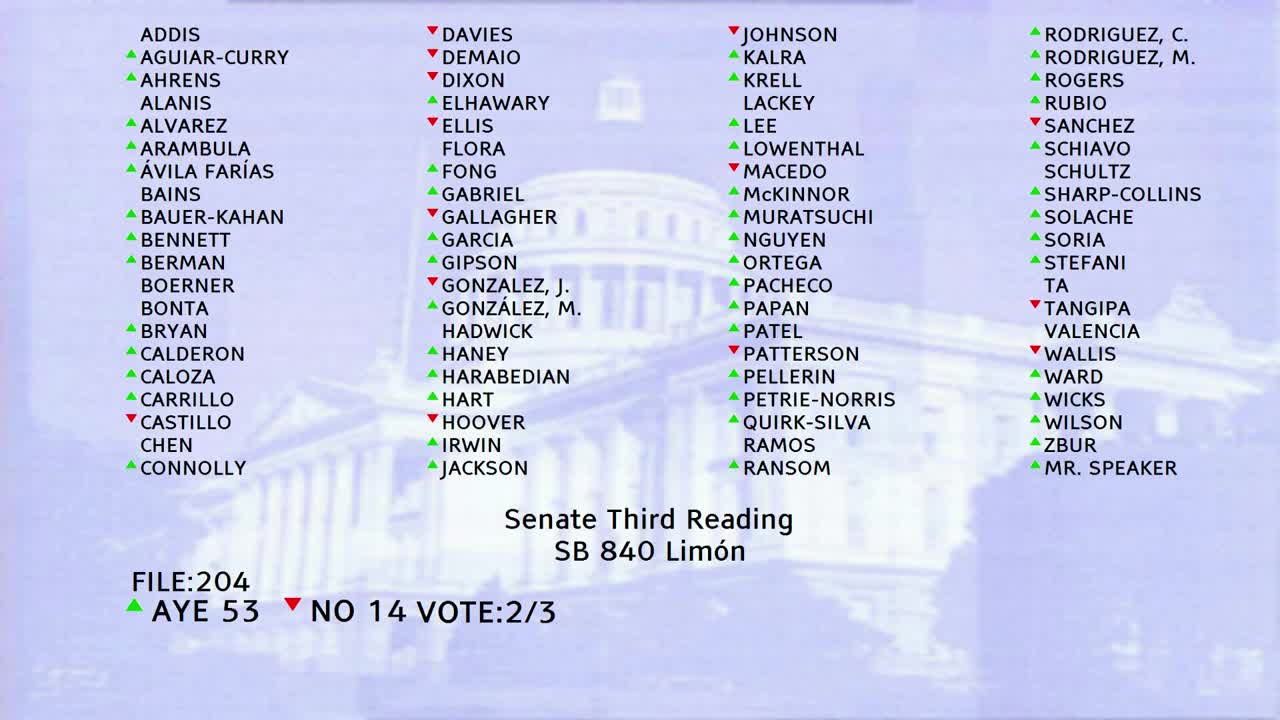 8MIN
Assembly Floor
 32MIN
Assembly Standing Committee on Utilities and Energy
 27MIN
Senate Standing Committee on Energy, Utilities and Communications
 19MIN
Senate Standing Committee on Energy, Utilities and Communications
 20MIN
Senate Standing Committee on Business, Professions and Economic Development
 11MIN
Assembly Floor
 53MIN
Assembly Standing Committee on Utilities and Energy


Bill Co-Author(s):