AB 826: Deceptive practices: service members and veterans.
- Session Year: 2025-2026
- House: Assembly
- Latest Version Date: 2026-01-05
Current Status:
Failed
(2026-02-02: From committee: Filed with the Chief Clerk pursuant to Joint Rule 56.)
Introduced
In Committee
Awaiting First Chamber Vote
Passed First Chamber
In Committee
Awaiting Second Chamber Vote
Passed Second Chamber
Enacted
The Consumers Legal Remedies Act makes unlawful certain unfair methods of competition and certain unfair or deceptive acts or practices undertaken by a person in a transaction intended to result or that results in the sale or lease of goods or services to a consumer, including advertising or promoting any event, presentation, seminar, workshop, or other public gathering regarding veterans benefits or entitlements that does not include certain statements, as specified.
This bill would expand the above-described unfair methods of competition and unfair or deceptive acts to include advertising or promoting any service that does not include the specified statements.
Existing law establishes the Department of Veterans Affairs, which is responsible for administering various programs and services for the benefit of veterans. Existing law authorizes veterans service organizations, as specified, to contract with the department to pursue claims against the United States. Existing law defines veterans service officer as an individual employed by a veterans service organization and accredited by the United States Department of Veterans Affairs to process and adjudicate claims and other benefits for veterans and their dependents and survivors. Existing law establishes the Veterans Service Office Fund, which, upon appropriation by the Legislature, may be used to expand the support of county veterans service offices.This bill would prohibit a person or business from charging a fee to assist a veteran with the filing of a veterans benefit claim to the United States Department of Veterans Affairs unless they are accredited for that purpose. The bill would make a violation of these provisions punishable by a $2,000 civil fine payable to the Veterans Service Office Fund and to the office of the district attorney that processed the fine, as specified.Existing law establishes the Department of Veterans Affairs, which is responsible for administering various programs and services for the benefit of veterans. Existing law authorizes veterans service organizations, as specified, to contract with the department to pursue claims against the United States. Existing law defines veterans service officer as an individual employed by a veterans service organization and accredited by the United States Department of Veterans Affairs to process and adjudicate claims and other benefits for veterans and their dependents and survivors. Existing law establishes the Veterans Service Office Fund, which, upon appropriation by the Legislature, may be used to expand the support of county veterans service offices.
This bill would prohibit a person or business from charging a fee to assist a veteran with the filing of a veterans benefit claim to the United States Department of Veterans Affairs. Affairs unless they are accredited for that purpose. The bill would make a violation of these provisions punishable by a $2,000 civil fine payable to the Veterans Service Office Fund and to the office of the district attorney that processed the fine, as specified.
Existing law establishes the Department of Veterans Affairs, which is responsible for administering various programs and services for the benefit of veterans. Existing law authorizes veterans service organizations, as specified, to contract with the department to pursue claims against the United States. Existing law defines veterans service officer as an individual employed by a veterans service organization and accredited by the United States Department of Veterans Affairs to process and adjudicate claims and other benefits for veterans and their dependents and survivors. Existing law establishes the Veterans Service Office Fund, which, upon appropriation by the Legislature, may be used to expand the support of county veterans service offices.
This bill would prohibit a person or business from charging a fee to assist a veteran with the filing of a veterans benefit claim to the United States Department of Veterans Affairs. The bill would make a violation of these provisions punishable by a $2,000 civil fine payable to the Veterans Service Office Fund and to the office of the district attorney that processed the fine, as specified.
Existing law makes a veteran ineligible to receive state educational benefits at the same time that they are receiving federal educational benefits.This bill would make technical, non-substantive changes to that provision.Existing law makes a veteran ineligible to receive state educational benefits at the same time that they are receiving federal educational benefits.
This bill would make technical, non-substantive changes to that provision.
(a)The unfair methods of competition and unfair or deceptive acts or practices listed in this subdivision undertaken by any person in a transaction intended to result or that results in the sale or lease of goods or services to any consumer are unlawful:
(1)Passing off goods or services as those of another.
(2)Misrepresenting the source, sponsorship, approval, or certification of goods or services.
(3)Misrepresenting the affiliation, connection, or association with, or certification by, another.
(4)Using deceptive representations or designations of geographic origin in connection with goods or services.
(5)Representing that goods or services have sponsorship, approval, characteristics, ingredients, uses, benefits, or quantities that they do not have or that a person has a sponsorship, approval, status, affiliation, or connection that the person does not have.
(6)Representing that goods are original or new if they have deteriorated unreasonably or are altered, reconditioned, reclaimed, used, or secondhand.
(7)Representing that goods or services are of a particular standard, quality, or grade, or that goods are of a particular style or model, if they are of another.
(8)Disparaging the goods, services, or business of another by false or misleading representation of fact.
(9)Advertising goods or services with intent not to sell them as advertised.
(10)Advertising goods or services with intent not to supply reasonably expectable demand, unless the advertisement discloses a limitation of quantity.
(11)Advertising furniture without clearly indicating that it is unassembled if that is the case.
(12)Advertising the price of unassembled furniture without clearly indicating the assembled price of that furniture if the same furniture is available assembled from the seller.
(13)Making false or misleading statements of fact concerning reasons for, existence of, or amounts of, price reductions.
(14)Representing that a transaction confers or involves rights, remedies, or obligations that it does not have or involve, or that are prohibited by law.
(15)Representing that a part, replacement, or repair service is needed when it is not.
(16)Representing that the subject of a transaction has been supplied in accordance with a previous representation when it has not.
(17)Representing that the consumer will receive a rebate, discount, or other economic benefit, if the earning of the benefit is contingent on an event to occur subsequent to the consummation of the transaction.
(18)Misrepresenting the authority of a salesperson, representative, or agent to negotiate the final terms of a transaction with a consumer.
(19)Inserting an unconscionable provision in the contract.
(20)Advertising that a product is being offered at a specific price plus a specific percentage of that price unless (A) the total price is set forth in the advertisement, which may include, but is not limited to, shelf tags, displays, and media advertising, in a size larger than any other price in that advertisement, and (B) the specific price plus a specific percentage of that price represents a markup from the sellers costs or from the wholesale price of the product. This subdivision shall not apply to in-store advertising by businesses that are open only to members or cooperative organizations organized pursuant to Division 3 (commencing with Section 12000) of Title 1 of the Corporations Code if more than 50 percent of purchases are made at the specific price set forth in the advertisement.
(21)Selling or leasing goods in violation of Chapter 4 (commencing with Section 1797.8) of Title 1.7.
(22)(A)Disseminating an unsolicited prerecorded message by telephone without an unrecorded, natural voice first informing the person answering the telephone of the name of the caller or the organization being represented, and either the address or the telephone number of the caller, and without obtaining the consent of that person to listen to the prerecorded message.
(B)This subdivision does not apply to a message disseminated to a business associate, customer, or other person having an established relationship with the person or organization making the call, to a call for the purpose of collecting an existing obligation, or to any call generated at the request of the recipient.
(23)(A)The home solicitation, as defined in subdivision (h) of Section 1761, of a consumer who is a senior citizen where a loan or assessment is made encumbering the primary residence of that consumer for purposes of paying for home improvements and where the transaction is part of a pattern or practice in violation of any of the following:
(i)Subsection (h) or (i) of Section 1639 of Title 15 of the United States Code.
(ii)Paragraph (1), (2), or (4) of subdivision (a) of Section 226.34 of Title 12 of the Code of Federal Regulations.
(iii)Section 22684, 22685, 22686, or 22687 of the Financial Code.
(iv)Section 5898.16, 5898.17, 5913, 5922, 5923, 5924, 5925, 5926, or 5940 of the Streets and Highways Code.
(B)A third party shall not be liable under this subdivision unless (i) there was an agency relationship between the party who engaged in home solicitation and the third party, or (ii) the third party had actual knowledge of, or participated in, the unfair or deceptive transaction. A third party who is a holder in due course under a home solicitation transaction shall not be liable under this subdivision.
(24)(A)Charging or receiving an unreasonable fee to prepare, aid, or advise any prospective applicant, applicant, or recipient in the procurement, maintenance, or securing of public social services.
(B)For purposes of this paragraph:
(i)Public social services means those activities and functions of state and local government administered or supervised by the State Department of Health Care Services, the State Department of Public Health, or the State Department of Social Services, and involved in providing aid or services, or both, including health care services, and medical assistance, to those persons who, because of their economic circumstances or social condition, are in need of that aid or those services and may benefit from them.
(ii)Public social services also includes activities and functions administered or supervised by the United States Department of Veterans Affairs or the California Department of Veterans Affairs involved in providing aid or services, or both, to veterans, including pension benefits.
(iii)Unreasonable fee means a fee that is exorbitant and disproportionate to the services performed. Factors to be considered, if appropriate, in determining the reasonableness of a fee, are based on the circumstances existing at the time of the service and shall include, but not be limited to, all of the following:
(I)The time and effort required.
(II)The novelty and difficulty of the services.
(III)The skill required to perform the services.
(IV)The nature and length of the professional relationship.
(V)The experience, reputation, and ability of the person providing the services.
(C)This paragraph shall not apply to attorneys licensed to practice law in California, who are subject to the California Rules of Professional Conduct and to the mandatory fee arbitration provisions of Article 13 (commencing with Section 6200) of Chapter 4 of Division 3 of the Business and Professions Code, when the fees charged or received are for providing representation in administrative agency appeal proceedings or court proceedings for purposes of procuring, maintaining, or securing public social services on behalf of a person or group of persons.
(25)(A)Advertising or promoting any service or any event, presentation, seminar, workshop, or other public gathering regarding veterans benefits or entitlements that does not include the following statement in the same type size and font as the term veteran or any variation of that term:
(i)I am not authorized to file an initial application for Veterans Aid and Attendance benefits on your behalf, or to represent you before the Board of Veterans Appeals within the United States Department of Veterans Affairs in any proceeding on any matter, including an application for those benefits. It would be illegal for me to accept a fee for preparing that application on your behalf. The requirements of this clause do not apply to a person licensed to act as an agent or attorney in proceedings before the Agency of Original Jurisdiction and the Board of Veterans Appeals within the United States Department of Veterans Affairs when that person is offering those services at the advertised event.
(ii)The statement in clause (i) shall also be disseminated, both orally and in writing, at the beginning of any service or any event, presentation, seminar, workshop, or public gathering regarding veterans benefits or entitlements.
(B)Advertising or promoting any service or any event, presentation, seminar, workshop, or other public gathering regarding veterans benefits or entitlements that is not sponsored by, or affiliated with, the United States Department of Veterans Affairs, the California Department of Veterans Affairs, or any other congressionally chartered or recognized organization of honorably discharged members of the Armed Forces of the United States, or any of their auxiliaries that does not include the following statement, in the same type size and font as the term veteran or the variation of that term:
This event is not sponsored by, or affiliated with, the United States Department of Veterans Affairs, the California Department of Veterans Affairs, or any other congressionally chartered or recognized organization of honorably discharged members of the Armed Forces of the United States, or any of their auxiliaries. None of the insurance products promoted at this sales event are endorsed by those organizations, all of which offer free advice to veterans about how to qualify and apply for benefits.
(i)The statement in this subparagraph shall be disseminated, both orally and in writing, at the beginning of any service or any event, presentation, seminar, workshop, or public gathering regarding veterans benefits or entitlements.
(ii)The requirements of this subparagraph shall not apply in a case where the United States Department of Veterans Affairs, the California Department of Veterans Affairs, or other congressionally chartered or recognized organization of honorably discharged members of the Armed Forces of the United States, or any of their auxiliaries have granted written permission to the advertiser or promoter for the use of its name, symbol, or insignia to advertise or promote the service or event, presentation, seminar, workshop, or other public gathering.
(26)Advertising, offering for sale, or selling a financial product that is illegal under state or federal law, including any cash payment for the assignment to a third party of the consumers right to receive future pension or veterans benefits.
(27)Representing that a product is made in California by using a Made in California label created pursuant to Section 12098.10 of the Government Code, unless the product complies with Section 12098.10 of the Government Code.
(28)(A)Failing to include either of the following in a solicitation by a covered person, or an entity acting on behalf of a covered person, to a consumer for a consumer financial product or service:
(i)The name of the covered person, and, if applicable, the entity acting on behalf of the covered person, and relevant contact information, including a mailing address and telephone number.
(ii)(I)The following disclosure statement in at least 18-point bold type and in the language in which a solicitation described by this paragraph is drafted: THIS IS AN ADVERTISEMENT. YOU ARE NOT REQUIRED TO MAKE ANY PAYMENT OR TAKE ANY OTHER ACTION IN RESPONSE TO THIS OFFER.
(II)(ia)The disclosure statement described in subclause (I) shall appear in at least 16-point bold type on the front of an envelope that contains a solicitation described by this paragraph.
(ib)This subclause applies only to solicitations made by physical mail.
(B)For purposes of this paragraph:
(i)Consumer financial product or service has the same meaning as defined in Section 90005 of the Financial Code.
(ii)(I)Covered person has the same meaning as defined in Section 90005 of the Financial Code.
(II)Covered person does not mean an entity exempt from Division 24 (commencing with Section 90000) of the Financial Code pursuant to Section 90002 of the Financial Code.
(iii)Solicitation means an advertisement or marketing communication through writing or graphics that is directed to, or likely to give the impression of being directed to, an individually identified person, residence, or business location. Solicitation does not include any of the following:
(I)Communication through a mass advertisement, including in a catalog, on a radio or television broadcast, or on a publicly accessible internet website, if that communication is not directed to, or is not likely to give the impression of being directed to, an individually identified person, residence, or business location.
(II)Communication via a telephone, mail, or electronic communication that was initiated by a consumer.
(III)A written credit or insurance solicitation that is subject to the disclosure requirements of subsection (d) of Section 1681m of Title 15 of the United States Code.
(29)(A)Advertising, displaying, or offering a price for a good or service that does not include all mandatory fees or charges other than either of the following:
(i)Taxes or fees imposed by a government on the transaction.
(ii)Postage or carriage charges that will be reasonably and actually incurred to ship the physical good to the consumer.
(B)Compliance by a person providing broadband internet access service on its own or as part of a bundle, as defined in Section 8.1(b) of Title 47 of the Code of Federal Regulations, with the broadband consumer label requirements adopted by the Federal Communications Commission in FCC 22-86 on November 14, 2022, codified in Section 8.1(a) of Title 47 of the Code of Federal Regulations, shall be deemed compliance with this paragraph.
(C)(i)For purposes of this subparagraph, financial entity means an entity that is exempt from Division 24 (commencing with Section 90000) of the Financial Code pursuant to Section 90002 of the Financial Code.
(ii)A financial entity that is required to provide disclosures in compliance with any of the following federal or state acts or regulations with respect to a financial transaction is exempt from this paragraph for purposes of that financial transaction:
(I)The federal Truth in Savings Act, as amended (12 U.S.C. Sec. 4301 et seq.).
(II)The federal Electronic Fund Transfer Act, as amended (15 U.S.C. Sec. 1693 et seq.).
(III)Section 19 of the Federal Reserve Act, as amended (12 U.S.C. Sec. 461 et seq.).
(IV)The federal Truth in Lending Act, as amended (15 U.S.C. Sec. 1601 et seq.).
(V)The federal Real Estate Settlement Procedures Act, as amended (12 U.S.C. Sec. 2601 et seq.).
(VI)The federal Home Ownership and Equity Protection Act (15 U.S.C. Sec. 1639).
(VII)Any regulation adopted pursuant to any of the federal acts in subclauses (I) to (VI), inclusive.
(VIII)The California Financing Law (Division 9 (commencing with Section 22000) of the Financial Code).
(IX)The California Residential Mortgage Lending Act (Division 20 (commencing with Section 50000) of the Financial Code).
(X)The Real Estate Law (Part 1 (commencing with Section 10000) of Division 4 of the Business and Professions Code).
(XI)Any regulation adopted pursuant to any of the state acts in subclauses (VIII) to (X), inclusive.
(D)(i)Subject to clause (ii), this paragraph does not apply to a mandatory fee or charge for individual food or beverage items sold directly to a customer by a restaurant, bar, food concession, grocery store, or grocery delivery service, or by means of a menu or contract for banquet or catering services that fully discloses the terms of service.
(ii)A mandatory fee or charge under clause (i) shall be clearly and conspicuously displayed, with an explanation of its purpose, on any advertisement, menu, or other display that contains the price of the food or beverage item.
(iii)Grocery delivery service means a company owned by, or under contract with, a grocery store or distributor that delivers food, primarily fresh produce, meat, poultry, fish, deli products, dairy products, perishable beverages, baked foods, and prepared foods, from the grocery store or distributor to a consumer.
(iv)The exemption in this subparagraph does not apply to a third-party food delivery platform, as defined in Section 113930.5 of the Health and Safety Code, or any other food delivery platform.
(b)(1)It is an unfair or deceptive act or practice for a mortgage broker or lender, directly or indirectly, to use a home improvement contractor to negotiate the terms of any loan that is secured, whether in whole or in part, by the residence of the borrower and that is used to finance a home improvement contract or any portion of a home improvement contract. For purposes of this subdivision, mortgage broker or lender includes a finance lender licensed pursuant to the California Financing Law (Division 9 (commencing with Section 22000) of the Financial Code), a residential mortgage lender licensed pursuant to the California Residential Mortgage Lending Act (Division 20 (commencing with Section 50000) of the Financial Code), or a real estate broker licensed under the Real Estate Law (Division 4 (commencing with Section 10000) of the Business and Professions Code).
(2)This section shall not be construed to either authorize or prohibit a home improvement contractor from referring a consumer to a mortgage broker or lender by this subdivision. However, a home improvement contractor may refer a consumer to a mortgage lender or broker if that referral does not violate Section 7157 of the Business and Professions Code or any other law. A mortgage lender or broker may purchase an executed home improvement contract if that purchase does not violate Section 7157 of the Business and Professions Code or any other law. Nothing in this paragraph shall have any effect on the application of Chapter 1 (commencing with Section 1801) of Title 2 to a home improvement transaction or the financing of a home improvement transaction.
(c)As of July 1, 2025, any disclosure, advertisement, or notice that is required to be clearly or clearly and conspicuously made must have text that is clear and conspicuous, as defined in subdivision (u) of Section 1791.
(d)This section shall become operative on July 1, 2024.
SECTION 1.Section 401.5 is added to the Military and Veterans Code, to read:401.5.(a)A person or business shall not charge a fee to assist a veteran with the filing of a veterans benefit claim to the United States Department of Veterans Affairs unless they are accredited by the United States Department of Veterans Affairs for that purpose.(b)For purposes of this section, each document filed or document that the veteran received assistance in filing, in exchange for a fee, is one violation.(c)A violation of this section shall be punished by the imposition of a civil fine of two thousand dollars ($2,000) to be paid as follows:(1)One thousand dollars ($1,000) shall be deposited into the Veterans Service Office Fund created pursuant to Section 972.2.(2)One thousand dollars ($1,000) shall be paid to the office of the district attorney that processed the fine.(a)A person or business shall not charge a fee to assist a veteran with the filing of a veterans benefit claim to the United States Department of Veterans Affairs. Affairs unless they are accredited by the United States Department of Veterans Affairs for that purpose.
(b)For purposes of this section, each document filed or document that the veteran received assistance in filing, in exchange for a fee, is one violation.
(c)A violation of this section shall be punished by the imposition of a civil fine of two thousand dollars ($2,000) to be paid as follows:
(1)One thousand dollars ($1,000) shall be deposited into the Veterans Service Office Fund created pursuant to Section 972.2.
(2)One thousand dollars ($1,000) shall be paid to the office of the district attorney that processed the fine.
REVISIONS: HeadingLine 2.(a)A person or business shall not charge a fee to assist a veteran with the filing of a veterans benefit claim to the United States Department of Veterans Affairs.
(b)For purposes of this section, each document filed or document that the veteran received assistance in filing, in exchange for a fee, is one violation.
(c)A violation of this section shall be punished by the imposition of a civil fine of two thousand dollars ($2,000) to be paid as follows:
(1)One thousand dollars ($1,000) shall be deposited into the Veterans Service Office Fund created pursuant to Section 972.2.
(2)One thousand dollars ($1,000) shall be paid to the office of the district attorney that processed the fine.
SECTION 1.Section 981.6 of the Military and Veterans Code is amended to read:981.6.A veteran who is receiving federal educational benefits is not eligible to receive the educational benefits provided by this article during the time that they are receiving federal educational benefits.No A veteran who is receiving federal educational benefits shall be is not eligible to receive the educational benefits provided by this article during such the time that he is they are receiving federal educational benefits.
|
Date
|
Status
|
|---|---|
| Feb 2, 2026 | From committee: Filed with the Chief Clerk pursuant to Joint Rule 56. |
| Jan 31, 2026 | Died pursuant to Art. IV, Sec. 10(c) of the Constitution. |
| Jan 12, 2026 | In committee: Set, second hearing. Hearing canceled at the request of author. |
| Jan 6, 2026 | Re-referred to Com. on JUD. |
| Jan 5, 2026 | From committee chair, with author's amendments: Amend, and re-refer to Com. on JUD. Read second time and amended. |
| Apr 21, 2025 | In committee: Set, first hearing. Hearing canceled at the request of author. |
| Apr 9, 2025 | From committee: Do pass and re-refer to Com. on JUD. (Ayes 8. Noes 0.) (April 8). Re-referred to Com. on JUD. |
| Apr 9, 2025 | Coauthors revised. |
| Apr 3, 2025 | Re-referred to Com. on M. & V.A. |
| Apr 2, 2025 | From committee chair, with author's amendments: Amend, and re-refer to Com. on M. & V.A. Read second time and amended. |
| Mar 25, 2025 | Re-referred to Com. on M. & V.A. |
| Mar 24, 2025 | From committee chair, with author's amendments: Amend, and re-refer to Com. on M. & V.A. Read second time and amended. |
| Mar 24, 2025 | Referred to Coms. on M. & V.A. and JUD. |
| Feb 20, 2025 | From printer. May be heard in committee March 22. |
| Feb 19, 2025 | Read first time. To print. |
|
Date
|
Description
|
Location
|
Votes
|
|
|---|---|---|---|---|
| Apr 8, 2025 | Do pass and be re-referred to the Committee on [Judiciary] | Assembly Standing Committee on Military and Veterans Affairs |
Passed |
This list shows positions taken on this bill by organizations on the date displayed, which is linked to the original source.
Positions by individuals are not included.
|
Organization
|
Position
|
Date
|
|---|---|---|
| California Association Of County Veterans Service Officers | ** Support | |
| Veterans Guardian VA Claim Consulting, LLC | ** Against |
Date of Hearing: January 13, 2026
ASSEMBLY COMMITTEE ON JUDICIARY
Ash Kalra, Chair
ABPCA Bill Id:AB 826 (
Author:Jeff Gonzalez) – As Amended Ver:January 5, 2026
SUBJECT: Deceptive practices: service members and veterans
KEY ISSUE: SHOULD EXISTING NOTICE REQUIREMENTS UNDER THE CONSUMER LEGAL REMEDIES ACT RELATED TO VETERANS BENEFITS SERVICES BE EXPANDED TO REQUIRE NOTICE BE GIVEN WHEN ADVERTISING OR PROMOTING ANY SERVICE REGARDING VETERANS’ BENEFITS OR ENTITLEMENTS?
SYNOPSIS
Existing federal law generally prohibits anyone from acting as an agent or attorney in the preparation, presentation, or prosecution of any claim under the laws administered by the U.S. Department of Veterans Affairs (VA), unless they have been recognized for that purpose by the VA Secretary. The law recognizes the authority of some organizations for this purpose, including the Veterans of Foreign Wars (VFW), the American Legion, and the American Red Cross. Unfortunately, veterans seeking assistance in the filing or processing of their benefits applications or other relevant processes are often susceptible to exploitation. Many are not aware of existing legal limitations as to who can represent them in formal proceedings, and what they are authorized to charge.
Under existing California law, the Consumer Legal Remedies Act (CLRA) makes “[a]dvertising or promoting any event, presentation, seminar, workshop, or other public gathering regarding veterans’ benefits or entitlements” that does not include a specified notice to the veteran a prohibited act under the CLRA. The CLRA likewise requires notice be given when advertising or promoting any service regarding benefits that is not sponsored by relevant agencies such as the VA. In both cases the notice offers potential participants information regarding the provider’s legal limitations related to representing the veteran before the VA. In order to help protect veterans against exploitation, this bill proposes to extend the requirement that these notices be provided whenever a business or entity advertises or promotes any service related to veterans’ benefits.
This author-sponsored measure is supported by the California Association of County Veterans Service Officers. While some business advocates opposed a previous version of this bill, no opposition to the current version of the bill has been filed with the Committee.
SUMMARY: Expands existing notice requirements under the Consumer Legal Remedies Act (CLRA) relating to advertising and promoting services regarding veterans benefits to apply to any service that may be advertised or promoted. Specifically, this bill:
- Makes advertising or promoting any service regarding veterans’ benefits or entitlements without the specified notice an unfair or deceptive practice and unlawful under the Consumer Legal Remedies Act.
- Makes advertising or promoting any service regarding veterans’ benefits or entitlements that is not sponsored by, or affiliated with, the United States Department of Veterans Affairs, the California Department of Veterans Affairs, or any other congressionally chartered or recognized organization of honorably discharged members of the Armed Forces of the United States, or any of their auxiliaries, without the specified notice an unfair or deceptive practice and unlawful under the Consumer Legal Remedies Act.
EXISTING LAW:
- Prohibits, under federal law, any individual from acting as an agent or attorney in the preparation, presentation, or prosecution of any claim under laws administered by the VA unless such individual has been recognized for such purposes by the Secretary of the VA (Secretary), except as provided. (38 U.S.C. Section 5901.)
- Authorizes, in federal law, the Secretary to recognize representatives of the American National Red Cross, the American Legion, the Disabled American Veterans, the United Spanish War Veterans, the Veterans of Foreign Wars, and such other organizations as the Secretary may approve, in the preparation, presentation, and prosecution of benefits claims. Prohibits any fees from being charged in connection with services rendered. (38 U.S.C. Section 5902.)
- Authorizes, in federal law, the Secretary to recognize any individual as an agent or attorney for the preparation, presentation, and prosecution of claims under laws administered by the Secretary and provides that the Secretary shall promulgate regulations laying out the necessary qualifications and standards of conduct. (38 U.S.C. Section 5904.)
- Provides that attendant federal regulations lay out the accreditation process, continuing legal education requirements, and parameters on reasonable fees. (38 C.F.R. Section 14.626 et seq.)
- Prohibits, under federal law, a fee from being charged, allowed, or paid for services of agents and attorneys with respect to services provided before the date on which a claimant is provided notice of the agency of original jurisdiction’s initial decision. (38 U.S.C. Section 5904.)
- Establishes the Consumer Legal Remedies Act (CLRA), which prohibits unfair methods of competition and unfair or deceptive acts or practices undertaken by any person in a transaction intended to result or which results in the sale or lease of goods or services to any consumer. (Civil Code Section 1750 et seq.)
- Designates specified practices as unfair methods of competition and unfair or deceptive acts or practices, including advertising or promoting any event, presentation, seminar, workshop, or other public gathering regarding veterans’ benefits or entitlements that does not include the specified statement. (Civil Code Section 1770(a)(25).)
- Provides that any consumer who suffers any damage as a result of the use or employment by any person of a method, act, or practice declared to be unlawful by Section 1770 of the Civil Code may bring an action against that person to recover or obtain any of the following:
- Actual damages, but in no case shall the total award of damages in a class action be less than $1,000;
- An order enjoining the methods, acts, or practices;
- Restitution of property;
- Punitive damages;
- Court costs and attorney’s fees to a prevailing plaintiff. However, reasonable attorney’s fees may be awarded to a prevailing defendant upon a finding by the court that the plaintiff’s prosecution of the action was not in good faith; and
- Any other relief that the court deems proper. (Civil Code Section 1780(a),(e).)
- Establishes the Unfair Competition Law (UCL), which provides a statutory cause of action for any unlawful, unfair, or fraudulent business act or practice and unfair, deceptive, untrue, or misleading advertising, including over the internet. (Business & Professions Code Section 17200 et seq.)
FISCAL EFFECT: As currently in print this bill is keyed non-fiscal.
COMMENTS: Existing federal law generally prohibits anyone from acting as an agent or attorney in the preparation, presentation, or prosecution of any claim under the laws administered by the VA, unless they have been recognized for that purpose by the VA Secretary. The law recognizes the authority of some organizations for this purpose, including the VFW, the American Legion, and the American Red Cross. Each of these recognized organizations is restricted in the amount they can charge to provide these services. According to the VA website:
The VA accreditation program exists to ensure that Veterans and their family members receive appropriate representation on their VA benefits claims. VA accreditation is for the sole and limited purpose of preparing, presenting, and prosecuting claims before VA.
[…]
An individual generally must first be accredited by VA to assist a claimant in the preparation, presentation, and prosecution of a claim for VA benefits—even without charge. VA accredits three types of individuals for this purpose: - Representatives of VA-recognized veterans service organizations (VSO) - Attorneys (accredited in their individual capacity, not through a law firm) - Claims agents (accredited in their individual capacity, not through an organization). (U.S. Department of Veterans Affairs Office of General Counsel, Accreditation, Discipline, and Fees Program: How to Apply for VA Accreditation available at: https://www.va.gov/OGC/docs/Accred/HowtoApplyforAccreditation.pdf.)
The California Department of Veterans Affairs (CalVet) provides a network of County Veteran Service Offices and summarizes benefits they may provide.
Section 5901 of Title 38 of the United States Code states: “no individual may act as an agent or attorney in the preparation, presentation, or prosecution of any claim under laws administered by the Secretary unless such individual has been recognized for such purposes by the Secretary.” (38 U.S.C. Section 5901 (a).) Federal regulations governing the accreditation program specify that the purpose of the program is “the regulation of representatives, agents, attorneys, and other individuals is to ensure that claimants for Department of Veterans Affairs (VA) benefits have responsible, qualified representation in the preparation, presentation, and prosecution of claims for veterans’ benefits.” (38 C.F.R. Section 14.626 et seq.) However, 2006 changes in the federal law removed criminal penalties for entities acting as an agent or attorney in the preparation of veterans’ benefits claims without accreditation. Since then, the industry has grown significantly.
According to the author:
As a combat veteran, protecting veterans from predatory actions of bad actors is a top priority. By requiring proper notice to the veteran seeking assistance, AB 826 ensures that bad actor claim sharks cannot take advantage of our veterans. Increasing access to services is vitally important. While there are good actors that can help veterans with their claims, unfortunately, the current system has enabled bad actors to come in and scam those that they are claiming to help. I recognize the importance of options for veterans but I also recognize the need for action. AB 826 would create a new enforcement mechanism to stop the unfair and deceptive business practices that claim sharks have used to take advantage of our veterans.
The Consumer Legal Remedies Act (CLRA). The Legislature has long considered consumer protection from deceptive or misleading advertisements to be a matter of high public importance. The Consumer Legal Remedies Act (CLRA) in Civil Code Section 1770 et seq. was enacted “to protect the statute’s beneficiaries from deceptive and unfair business practices,” and to provide aggrieved consumers with “strong remedial provisions for violations of the statute.” (Am. Online, Inc. v. Superior Court (2001) 90 Cal.App.4th 1, 11.) Among other things, the CLRA prohibits merchants from representing that goods have “characteristics, ingredients, uses, benefits, or quantities which they do not have,” or representing that goods “are of a particular standard, quality, or grade” when they are of another. (Civil Code Section 1750 et seq.) Consumers who are harmed by unlawful practices specified in the Act may recover damages and other remedies. CLRA’s scope has expanded over time to include a range of unfair methods of competition and unfair or deceptive acts or practices.
Currently, Civil Code Section 1770(a)(25) makes “[a]dvertising or promoting any event, presentation, seminar, workshop, or other public gathering regarding veterans’ benefits or entitlements” that does not include a specified notice to the veteran a prohibited act under the CLRA. The required notice reads:
“I am not authorized to file an initial application for Veterans’ Aid and Attendance benefits on your behalf, or to represent you before the Board of Veterans’ Appeals within the United States Department of Veterans Affairs in any proceeding on any matter, including an application for those benefits. It would be illegal for me to accept a fee for preparing that application on your behalf.”
In conformity with existing federal law, the Section does not apply to “a person licensed to act as an agent or attorney in proceedings before the Agency of Original Jurisdiction and the Board of Veterans’ Appeals within the United States Department of Veterans Affairs when that person is offering those services at the advertised event.”
Section 1770(a)(25) also requires providers to include a distinct notice for “[a]dvertising or promoting any event, presentation, seminar, workshop, or other public gathering regarding veterans’ benefits or entitlements that is not sponsored by, or affiliated with, the United States Department of Veterans Affairs, the California Department of Veterans Affairs, or any other congressionally chartered or recognized organization of honorably discharged members of the Armed Forces of the United States, or any of their auxiliaries[.]” In addition to acknowledging that the event is not sponsored by any of those agencies or actors, the notice also must include a statement that “[n]one of the insurance products promoted at this sales event are endorsed by those organizations, all of which offer free advice to veterans about how to qualify and apply for benefits.” Section 1770(a)(25) provides an exemption for events for which any of the relevant agencies have authorized the use of its name, symbol, or insignia to advertise or promote the event.
In an effort to combat exploitation of veterans seeking assistance to obtain services this bill expands the notice requirement beyond events and presentations to also apply in circumstances where an entity is advertising or promoting “any service” relating to veterans’ benefits or entitlements. The phrase “any service” appears intentionally ambiguous – it could presumably include those types of events already contemplated by the statute such as presentations, while also capturing others that may not have been previously considered. On one hand, such ambiguity is often a source of frustration for the implementation of new statutes – businesses that may already be functioning within the state may be unsure whether they are now subject to this new requirement. On the other hand, it could also be fairly straightforward in interpretation – a business that does not have federal accreditation could (and arguably should) err on the side of caution and provide the notice whenever it provides any type of service related to veterans’ benefits.
In essence, this bill would require more veterans who seek some form of assistance or service to access their benefits through a notoriously convoluted process to be notified that the business or individual who is assisting them may be limited in the services they can provide. In doing so, this bill may very well help protect veterans from falling prey to bad actors in the industry and promote good actors who seek to protect and aid the veteran population.
ARGUMENTS IN SUPPORT: This measure is supported by the California Association of County Veterans Service Officers. A number of veterans’ groups, including the Department of California American Legion, California State Commanders Veterans Council, the Peace Officers Research Association of California (PORAC), and the Vietnam Veterans of California, California State Council, supported a previous version of this measure, however they have not provided any updated position. In support of the current bill, the California Association of County Veterans Service Officers submits:
AB 826 would ensure there is no misrepresentation to our veteran community when working with a veterans, no matter what the service being offered by that entity. There have been instances where an entity helping a veteran does not provide the full understanding of what is being provided to the veteran and many veterans have been taken advantage of and have been led into fraudulent contracts for services.
Often veterans do not know they could be entering into a contract for a specified service and may not know these entitites are operating outside the law. Full disclosure is consumer protection and a protection for our veterans in California. This will ensure making a fully informed choice when entering in a contract for services.
ARGUMENTS IN OPPOSITION: A previous version of this bill, which aimed to prevent any business from providing services absent the requisite accreditation, received significant opposition from business advocates, including Veterans Guardian VA Claim Consulting LLC and Veterans Benefits Guide. The opponents claimed that the prior version would “prohibit California Veterans seeking assistance from hiring companies like VBG that use ethical and transparent business practices.” As this new version is, essentially, a transparency bill, and thus it seems this concern may have been addressed.
REGISTERED SUPPORT / OPPOSITION:
Support
California Association of County Veterans Service Officers
Opposition
None to the current version of the bill on file
Analysis Prepared by: Manuela Boucher-de la Cadena / JUD. / (916) 319-2334
Date of Hearing: April 8, 2025
ASSEMBLY COMMITTEE ON MILITARY AND VETERANS AFFAIRS
Pilar Schiavo, Chair
ABPCA Bill Id:AB 826 (
Author:Jeff Gonzalez) – As Amended Ver:April 2, 2025
SUBJECT: Veterans’ benefits: protections.
SUMMARY: Makes it a violation for a person or business to charge a fee to assist a veteran with the filing of a veterans’ benefit claim to the U.S. Department of Veterans Affairs (VA) unless they have first been accredited by the VA. Imposes a civil fine on an unaccredited person or business of $2,000 for each document filed or document that the veteran received assistance in filing, in exchange for a fee by an unaccredited person or business.
Specifically, this bill:
- Prohibits a person or business from charging a veteran for assistance with the filing of a veteran’s benefit claim to the VA unless they have first been accredited by the VA for such purpose.
- Specifies that each document filed or document for which a veteran paid a fee for assistance from a person or business not accredited by the VA Secretary, is one violation.
- Imposes a civil fine of $2,000 for each violation of 2) above to be paid as follows:
- Requires $1,000 to be deposited into the Veterans Service Office Fund; and,
- Requires $1,000 to be paid to the office of the district attorney that processed the fine.
EXISTING FEDERAL LAW:
- Prohibits any individual from acting as an agent or attorney in the preparation, presentation, or prosecution of any claim under laws administered by the VA unless such individual has been recognized for such purposes by the VA Secretary, except as provided. (38 U.S.C. § 5901.)
- Authorizes the Secretary to recognize representatives of the American National Red Cross, the American Legion, the Disabled American Veterans, the United Spanish War Veterans, the Veterans of Foreign Wars, and such other organizations as the Secretary may approve, in the preparation, presentation, and prosecution of benefits claims. Prohibits fees to be charged in connection with services rendered hereby. (38 U.S.C. § 5902.)
- Authorizes the Secretary to recognize any individual as an agent or attorney for the preparation, presentation, and prosecution of claims under laws administered by the Secretary and provides that the Secretary shall promulgate regulations laying out the necessary qualifications and standards of conduct. (38 U.S.C. § 5904.)
- Those attendant regulations lay out the accreditation process, continuing legal education requirements, and parameters on reasonable fees. (38 C.F.R. § 14.626 et seq.)
- Prohibits a fee from being charged, allowed, or paid for services of agents and attorneys with respect to services provided before the date on which a claimant is provided notice of the agency of original jurisdiction’s initial decision. (38 U.S.C. § 5904.)
EXISTING STATE LAW:
- Establishes the Consumer Legal Remedies Act (CLRA), which prohibits unfair methods of competition and unfair or deceptive acts or practices undertaken by any person in a transaction intended to result or which results in the sale or lease of goods or services to any consumer. (Civil Code (Civ) § 1750 et seq.)
- Designates specified practices as unfair methods of competition and unfair or deceptive acts or practices, including charging or receiving an unreasonable fee to prepare, aid, or advise any prospective applicant, applicant, or recipient in the procurement, maintenance, or securing of public social services, including veterans benefits, as provided. (Civ § 1770.)
- Establishes the Unfair Competition Law (UCL), which provides a statutory cause of action for any unlawful, unfair, or fraudulent business act or practice and unfair, deceptive, untrue, or misleading advertising, including over the internet. (Business & Professions Code § 17200 et seq.)
- Prohibits a person, in connection with any transaction or any sale of goods or services, from electronically accessing a Common Access Card (CAC) issued to a servicemember, placing or requiring the placement of such a CAC in a smart card reader, requesting or requesting entry of the personal identification number (PIN) associated with such a CAC, or requiring a service member to log in to any Department of Defense or, in the case of a member of the Coast Guard, Department of Homeland Security computer system. A transaction or sale entered into in violation of this subdivision is void. (Military & Veterans Code (MVC) § 401(d).)
- Authorizes the board of supervisors of each county to appoint a county veterans service officer who shall assist every veteran of any war of the United States and every qualified former member, and the dependents of every deceased veteran and every qualified former member, in presenting and pursuing any claim the veteran or the qualified former member may have against the United States and in establishing the veteran’s or qualified former member’s right to any privilege, preference, care, or compensation provided for by the laws of the United States or of this state. (MVC § 971(a).)
FISCAL EFFECT: This bill has not been analyzed by a fiscal committee.
COMMENTS:
- PURPOSE OF THIS BILL. According to the author, “Although there are legitimate resources for assisting veterans with their claims, the current system also allows unscrupulous individuals to exploit and deceive those they are claiming to help. The author states that as a combat veteran, protecting veterans from the predatory actions of bad actors is a top priority. While he understands the importance of providing options for veterans, he also acknowledges the necessity of taking action. The author concludes, this bill would create a new enforcement mechanism to stop the unfair and deceptive business practices that “claims sharks” have used to take advantage of our veterans.”
- BACKGROUND.
- History of Veterans’ Benefits. The support for veterans’ benefits can be traced back to the Continental Congress of 1776, which enacted pensions for disabled soldiers during the Revolutionary War. In the 19th century, support was extended to widows and dependents of veterans. Founded at the height of the Great Depression, the Veterans Administration was formerly an independent government agency. It was elevated to a cabinet department in 1989 and renamed to the VA. The VA provided and continues to provide medical care, benefits, and essential services to veterans of the U.S. Armed Forces and their families. The VA has a long history of achievements and persistent challenges. They have faced criticism for their long wait times and slow processing of benefits. In addition to providing some health care services and disability compensation, the VA also provides vocational rehabilitation, education assistance, home loans, life insurance, and burial benefits to eligible veterans.
- Disability Claims through the VA. Filing for VA benefits involves a complex, highly technical process. The Code of Federal Regulations Title 38, which governs veterans’ claims, contains more than 1,600 pages of fine print, and the accompanying manual also is over 1,600 pages in length. The Veterans Benefits Administration (VBA), a component of the VA, processes disability claims and administers all aspects of the VA disability program. VA disability compensation, a tax-free monetary benefit, is paid to honorably discharged veterans with disabilities that are the result of a disease or injury incurred or aggravated during active military service. Compensation may also be paid for post-service disabilities that are considered related or secondary to disabilities occurring in service and for disabilities presumed to be related to circumstances of military service, even though they may arise after service. Generally, the degrees of disability specified are also designed to compensate for considerable loss of working time from exacerbations or illnesses. Veterans may apply in person, by mail, or electronically through the VA eBenefits portal. Disability claims require an analysis and review by the VBA and usually take between 90 to 120 days for a decision.
The VA claims process is arduous, cumbersome, extensive, stressful, and time consuming. The VA’s eBenefits portal provides veterans with information and resources regarding the claims process and permits veterans to securely submit disability claims, including claims for increased benefits, supplemental claims, and secondary service-connected claims. Veterans can upload documents in support of a claim and check on the status of an application. The application process requires veterans to submit sensitive personal information, including protected health information.
The VA is well known for its historically large numbers of backlogged claims. The VA defines backlog as a disability benefits case, claim, or appeal that the VA still needs to process, and has been pending over 125 days. In March 2013, the VA had a backlog of more than 611,000, and in 2023, the backlog was reduced to 420,000, and the current VA backlog is just over 245,000. If a veteran appeals a benefits decision, the appealed claim is tracked separately.
The VA accredits three types of representatives—Veterans Service Organization (VSO) representatives, attorneys, and agents—to provide claimants with qualified assistance in navigating their VA benefits claims. VA-accredited representatives must possess good moral character and the ability to provide competent representation, with the Office of General Counsel responsible for evaluating these qualifications through its accreditation process. The accreditation process differs depending on which type of accreditation is being sought. An accredited VSO representative is someone who has been recommended for accreditation by a VSO that is recognized by VA to assist with VA benefit claims.
Federal law prohibits anyone from acting as an agent or attorney in the preparation, presentation, or prosecution of any claim under the laws administered by the VA unless such individual has been recognized for such purposes by the VA Secretary. The law provides for the recognition of certain organizations for these purposes, such as the Veterans of Foreign Wars (VFW), the American Legion, and the DAV (Disabled American Veterans). However, these organizations are restricted from charging fees for these services. The law also authorizes the VA Secretary to provide for the accreditation of agents and attorneys and directs the VA Secretary to prescribe in regulations the various requirements and parameters for providing such services.
To ensure accredited attorneys and claims agents are best suited to assist with claims, the regulations impose a continuing legal education requirement. The regulations also govern the fees available, providing that only accredited agents and attorneys may receive fees from claimants or appellants for their services provided in connection with representation. Generally, you cannot be charged a fee for assistance with filing an initial VA disability claim, but accredited attorneys or agents can charge fees after the VA makes an initial decision on the claim, and only for services related to appeals or further review. Accredited representatives of service organizations commonly known as VSOs may not charge fees under any circumstances. Fees are required to be reasonable. Federal regulations create a presumption that fees below 20% of awarded past-due benefits are reasonable, while those exceeding 33.33% are deemed unreasonable. - County Veteran Service Officers (CVSOs). Both the VA and the State of California offer resources and services to help veterans navigate the claims process. To assist veterans and their families in navigating the claims process, 29 states, including California, use the CVSO model, and six states use a state service officer model. CVSOs are trained, accredited professionals who can legally represent veterans in the federal claims process, and also help connect veterans with state- and locally-provided benefits. Fifty-six of California’s 58 counties have CVSOs. The services provided by CVSOs are free to veterans and their families. CalVet and CVSOs are partners in California, with CVSOs serving as the front-line support for veterans and their families, while CalVet assists with claims development, representation, and appeals. CVSOs are a critical component in the state's efforts to work directly with individual veterans and their families to ensure our veterans receive the benefits they earned through their service to our nation. CVSOs use VetPro software program, a VA credentialing software system, to enhance their claims reporting and tracking. In addition to the 540 VA-certified CVSOs in 56 counties, VFW has 129 offices and 13 VSOs, there are 452 American Legion posts, DAV has a total of 116 VSOs, and there are 360 VA-accredited lawyers to assist veterans in the state.
- PACT Act. The Honoring Our PACT Act of 2022, also known as the Sergeant First Class Heath Robinson Honoring Our Promise to Address Comprehensive Toxics Act, expands VA health care and benefits for veterans exposed to toxic substances like burn pits, adds more presumptive-exposure locations for Agent Orange and radiation, and provides retroactive pay for certain conditions. The PACT Act allocated $797 billion to significantly improve healthcare access and to expand and extend eligibility for veterans who were exposed to toxic substances during military service and their survivors. The PACT Act opened the door to VA benefits for a population of veterans not previously eligible. Veterans and survivors filed a record 2.3 million overall claims in fiscal 2023, an increase of 41% over 2022. By May 2024, the VA had approved 1 million veterans and survivors for $5.1 billion in disability payments related to toxic exposures and offered free health care to millions of others under the new law.
- Unaccredited agents. The rollout of the program by the VA has faced numerous glitches and delays, leading to the emergence of an unregulated industry that claims to significantly increase tax-free disability payments, while requiring veterans to forfeit substantial future benefits, according to lawmakers and advocacy groups. Despite a federal law that prohibits charging veterans for help in applying for compensation for wartime injuries, for-profit companies are now making hundreds of millions of dollars, a Washington Post review found. The overwhelmed VA says the government is all but powerless to stop the practice, particularly since Congress removed all criminal penalties from federal statutes in 2006. The industry claims it is merely educating veterans on negotiating the troubled VA benefits system and asserts that its services are legal since clients submit their own claims, despite receiving multiple cease-and-desist notices from government lawyers, who the companies argue do not explicitly outlaw their services. The VA sent a letter, Veteran Benefits Guide (VBG), on August 8, 2024, to inform them that they “may be engaged in unlawful or illegal activities, including the unauthorized preparation, presentation, or prosecution of claims before VA and charging fees for these services.” The letter states, “No individual may act in the preparation, presentation, or prosecution of claims for VA benefits unless he or she has first been accredited by VA for such purpose.” The letter asks VBG to review their business practices and if they are engaging in any unlawful or illegal activity, they should immediately cease doing so. The letter asks for a reply from VBG within 30 days of the date of the letter to “inform us of the measures you are taking to address our concerns.” Experts on veterans' benefits say the companies are breaking the law by helping veterans with their claims while exploiting the VA’s enforcement shortcomings. Millions of veterans seeking their rightful benefits find themselves caught in the middle.
Many clients enter into agreements committing to a one-time payment of five times their new monthly disability amount, which is typical in the industry. Some firms demand up to six times the new payment or increase, leading to higher profits with better ratings. As the rating increases, so does the company's profit. Many clients provide their Social Security numbers and passwords to access the VA benefits portal, enabling the company to complete paperwork on their behalf while the veteran is present to submit the claim. One such unaccredited company, called Trajector, had more than 1,000 employees and 50,000 projected for 2021 and planned to go public. Their filing showed that they had $127 million in revenue in the previous 18 months. Firms focused exclusively on collecting medical evidence for veterans, such as Trajector, argue that the law doesn’t expressly forbid charging veterans to produce such documentation. Some veterans believe they received precisely what they signed up for, that the for-profit companies were able to get approved on appeal for claims that were previously denied, or get their disability rating boosted.
Another unaccredited veterans benefits company, VA Claims Insider has charged veterans $20,000 after spending less than an hour on the phone with them. These companies are adding on expenses for medical letters, which can cost an additional $1,500. VA Claims Insider connects veterans to a partner organization run by the founder's wife, which offers to link their health issues to military service for an extra charge. Veteran clients are steered to see the doctors at their partner organizations or to doctors who are contracted to provide examinations specifically for VA disability. They use medical groups established for the purpose of providing these examinations that will be submitted to the VA. The physical examinations are frequently superficial, relying mainly on medical records without in-person evaluations. An audit of 2024 questionnaires from veterans by the VA Office of the Inspector General (OIG) found a “significant” fraud risk among private medical providers, with nearly 70% displaying at least one indicator of fraud.
With the growth of this unaccredited industry has come increased scrutiny and a surge in complaints, which accuse predatory practices such as harassment, baseless threats concerning money owed by veterans, and deceptive advertising. Despite clear instances of abuse, VA officials report their limited ability to act, rooted in a 2006 congressional decision to exclude criminal charges from the law that prohibits charging veterans for claims assistance. The VA has launched investigations into nearly 40 unaccredited companies since the start of the fiscal year in October 2022 and has ordered about two dozen of them to immediately halt any illegal activities. VA officials indicate that in cases of fraudulent claims, the veteran is more likely to face liability than the company. Late last year, the claims industry established a trade association, the National Association for Veteran Rights, led by Peter O’Rourke, former acting VA Secretary, and backed by Veterans Guardian (VG) and VBG. Attorneys General have filed cases against or taken other actions to ensure veterans receive the benefits to which they are entitled. The VA OIG continues to investigate and report on cases involving claims assistance programs, including instances of fraud and abuse, to ensure the integrity of the benefits system.
According to a May 23, 2024, article in the Washington Post, entitled “Veterans became eligible for billions. These firms saw a chance to profit,” despite a federal law that prohibits charging veterans for help in applying for disability benefits, for-profit companies are making millions. Former Army Captain Abigayle Patterson is quoted in the article, “They’re stealing money out of veterans’ mouths, but what they’re doing is negligible,” said Patterson of her experience with VG. Patterson said the company helped boost her monthly disability check by $619.00 for post-traumatic stress disorder and traumatic brain injury in exchange for a $3,000 fee. But when Patterson reapplied to VA on her own and won another step-up for chronic sinusitis, VG sent her an invoice for both increases, and she is now suing VG for several practices she says were predatory.
- OPPOSE UNLESS AMENDED. Veteran Benefits Guide writes that they have strong concerns about the previous version of this bill and claim it will harm some of the most vulnerable veterans in our communities in seeking fully earned benefits from the VA. VBG states they were founded to assist veterans in navigating the VA disability claims process, helping ensure they receive the full benefits that they have earned from their service. VBG states they have been recognized as a Military Times “Best for Vets” employer. VBG shares the author’s concerns about predatory companies that provide little to no value to veterans seeking assistance in their disability claims and offers to collaborate on how best to target and eliminate these bad actors. VBG states there is a misconception that organizations like theirs refuse accreditation, which is incorrect; VBG is eager to become accredited with the VA but is hindered by federal law that prevents accredited entities from charging for initial claims representation for veterans. VBG concludes that it is well known that the disability claims process between the VA and veterans is adversarial. Veterans deserve the choice on who can best help improve their chances of getting the appropriate level of benefits they have earned. VBG recognizes and supports that they also must be protected in the process of assessing and acquiring that support.
- OPPOSITION. Veterans Guardian writes in opposition to the previous version of this bill, stating they have successfully assisted veterans in almost 70,000 claims across the country, and VG proudly employs more than 300 individuals. VG states that the previous version of this bill is “currently unconstitutional and premted [sic]; harmful for veterans in desperate need of assistance in successfully obtaining disability income and; overly broad and prescriptive rather than focused on consumer abuses.”
- DOUBLE REFERRED. This bill is double referred; upon passage in this Committee, this bill will be referred to the Assembly Committee on Judiciary.
- PREVIOUS LEGISLATION.
- SB 1124 (Menjivar) of 2024 would have provided additional protections for veterans in California in connection with fees charged for assistance applying for veterans’ benefits and the privacy of their information, and would have required persons to be federally accredited before preparing, presenting, or prosecuting a veteran’s claim for benefits under federal law. SB 1124 was held in the Senate Appropriations Committee.
- SB 180 (Corbett), Chapter 79, Statutes of 2011, expands the definition of “public social services” to include those activities and functions administered or supervised by the VA and the California Department of Veterans Affairs in providing aid or services, or both, to veterans, including pension benefits. SB 180 prohibits anyone from charging an unreasonable fee for assisting a person to qualify for a federal pension benefit program.
REGISTERED SUPPORT / OPPOSITION:
Support
None on file.
Opposition
Veteran’s Guardian VA Claim Consulting, LLC
Analysis Prepared by: Patty Patten / M. & V.A. / (916) 319-3550
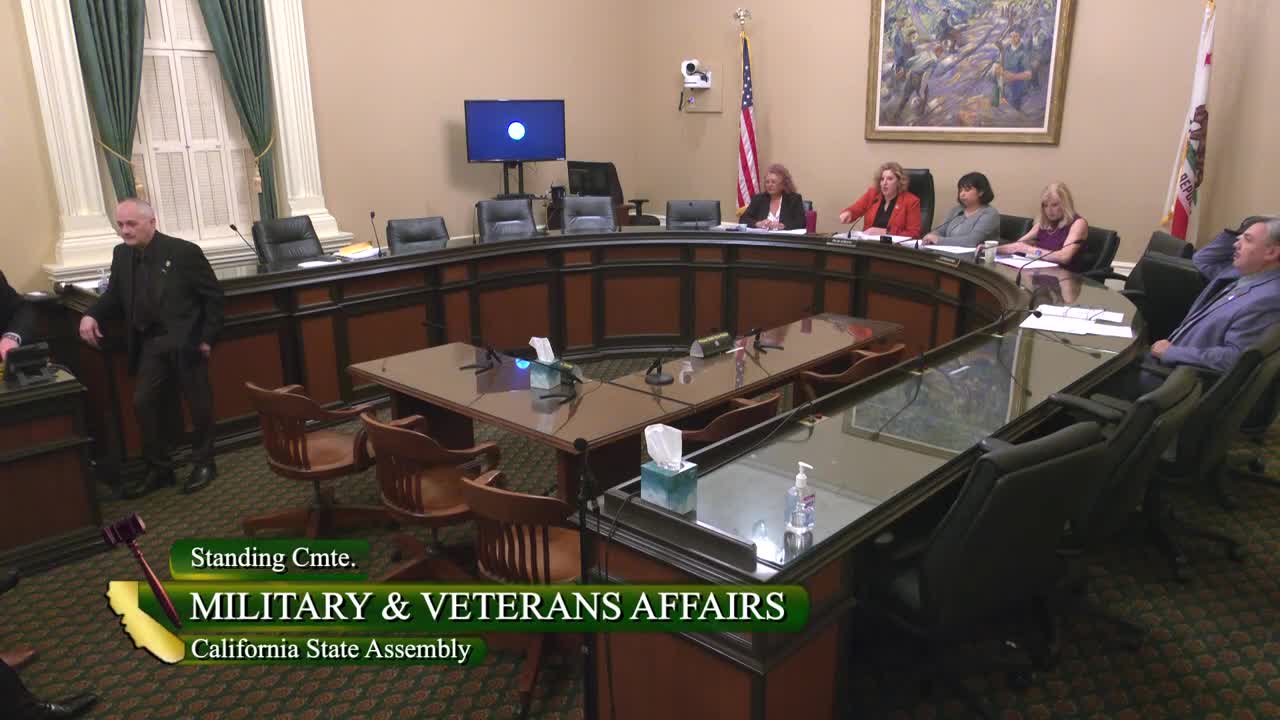
Discussed in Hearing
 32MIN
Assembly Standing Committee on Military and Veterans Affairs
Bill Author