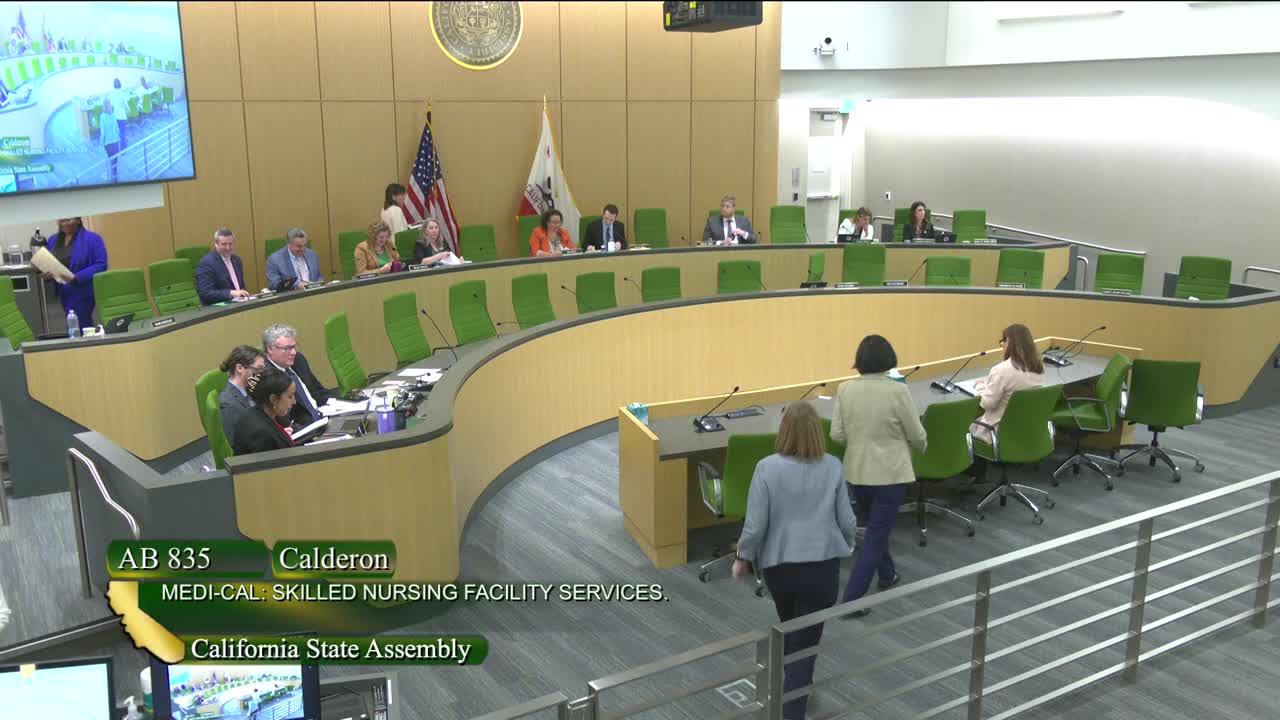
AB 835: Medi-Cal: skilled nursing facility services.
- Session Year: 2025-2026
- House: Assembly
- Latest Version Date: 2025-03-13
Current Status:
Failed
(2026-02-02: From committee: Filed with the Chief Clerk pursuant to Joint Rule 56.)
Introduced
In Committee
Awaiting First Chamber Vote
Passed First Chamber
In Committee
Awaiting Second Chamber Vote
Passed Second Chamber
Enacted
Existing law establishes the Medi-Cal program, which is administered by the State Department of Health Care Services and under which qualified low-income individuals receive health care services. The Medi-Cal program is, in part, governed and funded by federal Medicaid program provisions.
Existing law, the Medi-Cal Long-Term Care Reimbursement Act, requires the department, subject to any necessary federal approvals, for managed care rating periods that begin between January 1, 2023, and December 31, 2026, inclusive, to establish and implement the Workforce and Quality Incentive Program. Under that program, a network provider furnishing skilled nursing facility services to a Medi-Cal managed care enrollee is authorized to earn performance-based directed payments from the Medi-Cal managed care plan with which they contract, as specified, in addition to other certain payments.
This bill would remove from the above-described provision the qualification that the provider be within the network. The bill would make conforming changes to related provisions. Under the bill, pursuant to conditions of eligibility for directed payments under certain federal regulations, payments made under the Workforce and Quality Incentive Program would be retroactively calculated and paid based on the total number of days, effective July 9, 2024, during which the facility provided services to Medi-Cal beneficiaries, regardless of whether the facility was a network provider.
Existing law authorizes a peace officer to take a minor into temporary custody without a warrant in certain circumstances, including when the officer has reasonable cause to believe that the minor may be subject to the dependency jurisdiction of the juvenile court and that the minor has an immediate need for medical care, the minor is in immediate danger of physical or sexual abuse, or the physical environment or the fact that the minor is left unattended poses an immediate threat to the minors health or safety. Under existing law, an officer who takes a minor into temporary custody under that authority is authorized to take the minor to a community service program for abused or neglected children if it is in the best interest of the minor and the public.This bill would make technical, nonsubstantive changes to that provision.Existing law authorizes a peace officer to take a minor into temporary custody without a warrant in certain circumstances, including when the officer has reasonable cause to believe that the minor may be subject to the dependency jurisdiction of the juvenile court and that the minor has an immediate need for medical care, the minor is in immediate danger of physical or sexual abuse, or the physical environment or the fact that the minor is left unattended poses an immediate threat to the minors health or safety. Under existing law, an officer who takes a minor into temporary custody under that authority is authorized to take the minor to a community service program for abused or neglected children if it is in the best interest of the minor and the public.
This bill would make technical, nonsubstantive changes to that provision.
(a)(1)For managed care rating periods that begin between January 1, 2023, and December 31, 2026, inclusive, the department, in consultation with representatives from the long-term care industry, organized labor, consumer advocates, and Medi-Cal managed care plans, shall establish and implement the Workforce and Quality Incentive Program under which a network provider furnishing skilled nursing facility services to a Medi-Cal managed care enrollee may earn performance-based directed payments from the Medi-Cal managed care plan they contract with which they contract in accordance with this section.
(2)For purposes of performance-based directed payments to a facility, as described in paragraph (1), made retroactively to July 9, 2024, the Medi-Cal managed care plan shall follow the process described in subdivision (k).
(b)Subject to appropriation by the Legislature in the annual Budget Act, the department shall do all of the following:
(1)Set the amount of performance-based directed payments to target an aggregate amount of two hundred eighty million dollars ($280,000,000) for the 2023 calendar year.
(2)For the 2024 through 2026 calendar years, the department shall set the amount of the performance-based directed payments to target the previous calendar years target plus the annual increase specified by clause (ii) of subparagraph (A) of paragraphs (18), (19), and (20) of subdivision (c) of Section 14126.033.
(3)No sooner than December 31, 2023, the department shall make a one-time increase to the performance-based directed payment target amount by the amounts described in subdivision (f) of Section 14126.032. This one-time increase shall not be factored into the amount calculated for a subsequent calendar year pursuant to paragraph (2).
(c)The department, in consultation with stakeholders listed in subdivision (a), shall establish the methodology or methodologies, parameters, and eligibility criteria for the directed payments pursuant to this section. This shall include, but is not limited to, the milestones and metrics that network providers of skilled nursing facility services must meet in order to receive a directed payment from a Medi-Cal managed care plan pursuant to this section, with at least two of these milestones and metrics tied to workforce measures. Subject to subdivision (j), the department may implement the directed payment described in this section using one or more of the models authorized at Section 438.6(c)(1)(i)-(iii), inclusive, of Title 42 of the Code of Federal Regulations.
(d)A freestanding pediatric subacute care facility, as defined in Section 51215.8 of Title 22 of the California Code of Regulations, shall be exempt from the directed payments described in this section.
(e)Notwithstanding any other law, special program services for the mentally disordered that are entitled to receive the supplemental payment under Section 51511.1 of Title 22 of the California Code of Regulations shall be exempt from the directed payments described in this section.
(f)Directed payments made pursuant to this section shall be in addition to any other payments made by the a Medi-Cal managed care plan to applicable network providers of skilled nursing facility services and shall not supplant amounts that would otherwise be payable by a Medi-Cal managed care plan to a provider of skilled nursing facility services, including those payments made in accordance with paragraph (2) of subdivision (b) of Section 14184.201.
(g)For managed care rating periods during which this section is implemented, capitation rates paid by the department to a Medi-Cal managed care plan shall be actuarially sound and shall account for the directed payments described in this section.
(h)The department may require Medi-Cal managed care plans and network providers of skilled nursing facility services to submit information that the department deems necessary to implement this section, at the times and in the form and manner specified by the department.
(i)Payments pursuant to this section shall be made in accordance with the requirements for directed payment arrangements described in Section 438.6(c) of Title 42 of the Code of Federal Regulations and any associated federal guidance.
(j)In implementing this section, the department may contract, as necessary, with Californias Medicare Quality Improvement Organization, or other entities deemed qualified by the department, not associated with a skilled nursing facility, to assist with development, collection, analysis, and reporting of the performance data pursuant to this section. The department may enter into exclusive or nonexclusive contracts, or amend existing contracts, on a bid or negotiated basis for purposes of implementing this subdivision. Contracts entered into or amended pursuant to this subdivision shall be exempt from Chapter 6 (commencing with Section 14825) of Part 5.5 of Division 3 of Title 2 of the Government Code, Part 2 (commencing with Section 10100) of Division 2 of the Public Contract Code, and the State Administrative Manual, and the State Contracting Manual, and shall be exempt from the review or approval of any division of the State Department of General Services.
(k)Pursuant to conditions of eligibility for directed payments under Section 438.6 of Title 42 of the Code of Federal Regulations, payments made pursuant to this section shall be retroactively calculated and paid based on the total number of days, effective July 9, 2024, during which the facility provided services to Medi-Cal beneficiaries, regardless of whether the facility was a network provider.
(k)(l)This section shall be implemented only to the extent that any necessary federal approvals are obtained and federal financial participation is available and is not otherwise jeopardized.
(l)(m)For purposes of this section, the following definitions apply:
(1)Medi-Cal managed care plan has the same meaning as set forth in subdivision (j) of Section 14184.101.
(2)Network provider has the same meaning as set forth in Section 438.2 of Title 42 of the Code of Federal Regulations.
(3)Skilled nursing facility has the same meaning as set forth in subdivision (c) of Section 1250 of the Health and Safety Code, excluding a nursing facility that is a distinct part of a facility that is licensed as a general acute care hospital as described in subdivision (a) of Section 1250 of the Health and Safety Code.
SECTION 1.Section 307.5 of the Welfare and Institutions Code is amended to read:307.5.Notwithstanding Section 307, an officer who takes a minor suspected of being a person described in Section 300 into temporary custody pursuant to subdivision (a) of Section 305 may, in a case where the officer deems that it is in the best interest of the minor and the public, take the minor to a community service program for abused or neglected children. Organizations or programs receiving referrals pursuant to this section shall have a contract or an agreement with the county to provide shelter care or counseling. Employees of a program receiving referrals pursuant to this section are childcare custodians for the purpose of the requirements of Section 11165.7 of the Penal Code. The receiving organization shall take immediate steps to notify the minors parent, guardian, or a responsible relative of the place to which the minor was taken.Notwithstanding the provisions of Section 307, an officer who takes a minor suspected of being a person described in Section 300 into temporary custody pursuant to subdivision (a) of Section 305 may, in a case where he or she the officer deems that it is in the best interest of the minor and the public, take the minor to a community service program for abused or neglected children. Organizations or programs receiving referrals pursuant to this section shall have a contract or an agreement with the county to provide shelter care or counseling. Employees of a program receiving referrals pursuant to this section are child care childcare custodians for the purpose of the requirements of Section 11165.7 of the Penal Code. The receiving organization shall take immediate steps to notify the minors parent, guardian, or a responsible relative of the place to which the minor was taken.
|
Date
|
Status
|
|---|---|
| Feb 2, 2026 | From committee: Filed with the Chief Clerk pursuant to Joint Rule 56. |
| Jan 31, 2026 | Died pursuant to Art. IV, Sec. 10(c) of the Constitution. |
| May 23, 2025 | In committee: Hearing postponed by committee. |
| May 14, 2025 | In committee: Set, first hearing. Referred to APPR. suspense file. |
| Apr 23, 2025 | From committee: Do pass and re-refer to Com. on APPR. (Ayes 16. Noes 0.) (April 22). Re-referred to Com. on APPR. |
| Mar 17, 2025 | Re-referred to Com. on HEALTH. |
| Mar 13, 2025 | From committee chair, with author's amendments: Amend, and re-refer to Com. on HEALTH. Read second time and amended. |
| Mar 13, 2025 | Referred to Com. on HEALTH. |
| Feb 20, 2025 | From printer. May be heard in committee March 22. |
| Feb 19, 2025 | Read first time. To print. |
|
Date
|
Description
|
Location
|
Votes
|
|
|---|---|---|---|---|
| Apr 22, 2025 | Do pass and be re-referred to the Committee on [Appropriations] | Assembly Standing Committee on Health |
Passed |
This list shows positions taken on this bill by organizations on the date displayed, which is linked to the original source.
Positions by individuals are not included.
|
Organization
|
Position
|
Date
|
|---|---|---|
| California Association Of Health Facilities | ** Support | |
| LeadingAge California | ** Support |
Date of Hearing: May 14, 2025
ASSEMBLY COMMITTEE ON APPROPRIATIONS
Buffy Wicks, Chair
ABPCA Bill Id:AB 835
Author:(Calderon) – As Amended Ver:March 13, 2025
Policy Committee: | Health | Vote: | 16 - 0 |
|
| ||
|
|
Urgency: No State Mandated Local Program: No Reimbursable: No
SUMMARY:
This bill allows a skilled nursing facility (SNF) to receive compensation from the Workforce and Quality Incentive Program (WQIP) when providing care to a Medi-Cal managed care enrollee, even if the SNF is not in the enrollee’s network. The bill requires WQIP payments be retroactively calculated and paid based on the total number of days, effective July 9, 2024, the SNF provided services to Medi-Cal beneficiaries, regardless of whether the facility was a network provider.
This bill states it is to be implemented to the extent necessary federal approvals are obtained and federal financial participation is not jeopardized.
FISCAL EFFECT:
Likely negligible costs to the Department of Health Care Services (DHCS) to make changes to how it calculates WQIP payments. Total funding for WQIP is a fixed dollar amount allocation per year ($280 million for calendar year 2023, plus an annual growth factor) and this bill does not increase or otherwise affect the total amount of WQIP dollars available from the program. However, because this bill makes more providers eligible for WQIP payments, it will change how the hundreds of millions of WQIP dollars are distributed. This re-distribution could also lead to General Fund cost pressures to increase funding for the WQIP program in the future.
COMMENTS:
Purpose. This bill is sponsored by the California Association of Health Facilities (CAHF). According to the author:
This bill ensures SNFs are compensated fairly for proving the same level of care for all patients, without jeopardizing access to healthcare for Medi-Cal patients who may be experiencing times of uncertainty. California’s aging population is expected to increase to 22% of the population by 2040; therefore, SNFs need to remain viable so they continue providing care to our most vulnerable.
CAHF asserts that the statutory limitation to network providers was based on DHCS’s understanding that federal law prohibited directed payments to non-network providers, and the 2024 federal rule from the federal Centers for Medicare and Medicaid Services (CMS) explicitly states that SNF providers are not required to be “in-network” to qualify for payments. CAHF argues that, by restricting WQIP payments to “in-network” providers contracted with Medi-Cal managed care plans, the state unfairly penalizes providers who care for Medi-Cal beneficiaries outside of formal contracts with managed care plans, denying quality payments earned for qualifying Medi-Cal services. CAHF concludes this bill will help reduce barriers to distributions of WQIP payments to Medi-Cal providers.
WQIP. AB 186 (Committee on Budget), Chapter 46, Statutes of 2022, a health-related budget trailer bill, included significant reforms to Medi-Cal SNF reimbursement methodology. The intent of the reforms was to establish a long-term funding framework that assures the long-term financial viability of SNFs while creating incentives for SNFs to improve quality of care, advance equity, and invest in workforce. In addition to updating the basic reimbursement structure for SNFs, AB 186 established the WQIP as an incentive program, and the SNF Accountability Sanctions Program that imposes monetary sanctions on facilities that fail to meet quality or equity measures.
Pursuant to AB 186, the enacted budget allocated $280 million for calendar year 2023 to be distributed through the WQIP. Funding for 2024, 2025, and 2026 is calculated based on applying a growth factor to the prior year’s total amount. DHCS calculates WQIP payments based on a facility’s performance on a variety of staffing, clinical, and equity metrics, such as staff turnover, nursing hours, residents experiencing a fall with major injury, and the completeness of racial and ethnic data.
State law limits WQIP payments to “network providers,” meaning managed care plans are required to distribute these payments only to providers with whom they have contracted to be a part of the plan’s network. According to CAHF, the sponsor of this bill, there are a number of reasons facilities may not be in contract with a particular plan but still may be providing care to that plan’s members. For instance, there may be delays in reaching agreement on a contract, the facility may be located in a different county than the plan and therefore not receive a large number of patients who are enrolled in that plan, or the plan or a facility may decide for business reasons it is not in their interest to contract with the other.
In a May 10, 2024 update, CMS removed the term “network” from the descriptions of state-directed payment arrangements, allowing incentive payments to be made to non-network providers. Prior to this regulatory change, federal regulations specified that certain types of directed payments must be limited to “network providers.” CMS explained that limiting state-directed payments arrangements to network providers had been too narrow and had created an unintended barrier to states’ and CMS’s policy goals to ensure access to quality care for beneficiaries. This bill removes the limitation to network providers, as allowed by the recent federal regulatory change.
Analysis Prepared by: Allegra Kim / APPR. / (916) 319-2081
Date of Hearing: April 22, 2025
ASSEMBLY COMMITTEE ON HEALTH
Mia Bonta, Chair
ABPCA Bill Id:AB 835
Author:(Calderon) – As Amended Ver:March 13, 2025
SUBJECT: Medi-Cal: skilled nursing facility services.
SUMMARY: Removes a requirement that a skilled nursing facility (SNF) provider be a network provider (contracted with a health plan) to receive payments under the Medi-Cal Workforce and Quality Incentive Program (WQIP) for SNFs. Requires WQIP payments to be retroactively calculated and paid based on the total number of days, effective July 9, 2024, during which the facility provided services to Medi-Cal beneficiaries, regardless of whether the facility was a network provider.
EXISTING LAW:
- Establishes the Medi-Cal Program, administered by the Department of Health Care Services (DHCS), to provide comprehensive health benefits to low-income individuals who meet specified eligibility criteria. [Welfare and Institutions Code (WIC) § 14000 et seq.]
- Establishes a schedule of benefits under the Medi-Cal program, including nursing facility services. [WIC § 14132 (c)]
- Establishes, through the Medi-Cal Long-Term Care Reimbursement Act, the methodology for SNF reimbursement in the Medi-Cal program. [WIC § 14126.033]
- Requires, subject to any necessary federal approvals, for managed care rating periods that begin between January 1, 2023, and December 31, 2026, inclusive, to establish and implement the WQIP, which includes the following provisions:
- Authorizes a network provider furnishing SNF services to a Medi-Cal managed care enrollee to earn performance-based directed payments from the Medi-Cal managed care plan with which they contract, as specified, in addition to other certain payments.
- Requires DHCS, in consultation with stakeholders, to establish the methodology, parameters, and eligibility criteria for the directed payments, including milestones and metrics that network providers of SNF services must meet in order to receive a directed payment, with at least two of these milestones and metrics tied to workforce measures.
- Sets the amount of performance-based WQIP directed payments to target an aggregate amount of $280 million for the 2023 calendar year, and requires DHCS to set the amount, 2024 through 2026 calendar years, at a total based on the prior year’s target plus an annual growth factor specified in existing law. [WIC § 14126.024]
- Specifies rules related to state-directed payments under Medicaid managed care, including a provision that was recently and specifically updated to allow state-directed payments to be directed to non-network providers. [Title 42, Code of Federal Regulations § 438.6(c)]
FISCAL EFFECT: Unknown. This bill has not yet been analyzed by a fiscal committee.
COMMENTS:
- PURPOSE OF THIS BILL. According to the author, SNFs are an essential element of the healthcare landscape for Medi-Cal patients, who are more likely to be elderly, chronically ill, or disabled. This bill is intended to allow SNFs to receive compensation from the WQIP when providing care to a Medi-Cal beneficiary even if the beneficiary is receiving care outside of their healthcare network, as allowed under federal regulation. The author argues that SNFs need to remain viable so they continue providing care to our most vulnerable and that this bill ensures SNFs are compensated fairly.
- BACKGROUND.
- SNF Reimbursement. AB 186 (Committee on Budget), Chapter 46, Statutes of 2022, a health-related budget trailer bill, included significant reforms to Medi-Cal SNF reimbursement methodology. The intent of the reforms was to establish a long-term funding framework that assures the long-term financial viability of SNFs while creating incentives for SNFs to improve quality of care, advance equity, and invest in workforce. In addition to updating the basic reimbursement structure for SNFs, AB 186 established the WQIP as an incentive program, as well as the SNF Accountability Sanctions Program that imposes monetary sanctions on facilities that fail to meet quality or equity measures.
- Workforce and Quality Incentive Program. Pursuant to AB 186, a total amount of $280 million for calendar year 2023 was allocated to be distributed through the WQIP. Funding for 2024, 2025, and 2026 is calculated based on applying a growth factor to the prior year’s total amount. The WQIP payments are calculated based on a facility’s performance on a variety of staffing, clinical, and equity metrics. These metrics include, for instance, staff turnover, nursing hours, residents experiencing a fall with major injury, and the completeness of racial and ethnic data.
The WQIP is a fixed dollar amount allocation per year, and allowing facilities to receive payments for non-contracted days does not increase or otherwise affect the total amount of WQIP dollars available from the program. DHCS is currently in the process of calculating payments for the 2024 performance year.
- Medicaid State-Directed Payments. The WQIP is a federally approved Medicaid (Medi-Cal in California) “state-directed payment” program. Generally, when a state contracts with managed care plans to administer medical benefits, the state pay the plans a per-member, per-month rate and the plans reimburse health care providers at negotiated rates. When state-directed payments are distributed by a Medi-Cal managed care plan, however, payments are made to certain providers subject to certain state-defined and federally approved calculations and criteria for receiving payments.
State law limits WQIP payments to “network providers,” meaning managed care plans are required to distribute these payments only to providers with whom they have contracted to be a part of the plan’s network. According to the California Association of Health Facilities (CAHF), the sponsor of this bill, there are a number of reasons facilities may not be in contract with a particular plan but still may be providing care to that plan’s members. For instance, there may be delays in reaching agreement on a contract, the facility may be located in a different county than the plan and therefore not receive a large number of patients who are enrolled in that plan, or the plan or a facility may decide for business reasons it is not in their interest to contract with the other.
- Recent Federal Regulatory Change. In a May 10, 2024, regulatory update, the federal Centers for Medicare and Medicaid Services (CMS) relaxed its rules related to state-directed payments to providers within Medicaid managed care. In the narrative accompanying the final rule, CMS described its proposal to remove the term ‘‘network’’ from the descriptions of state-directed payment arrangements, thereby allowing these payments to be made to non-network providers. Prior to this regulatory change, federal regulations specified that certain types of directed payments must be limited to ‘‘network providers.” In making this change, CMS noted that limiting state-directed payments arrangements to network providers has proven to be too narrow and has created an unintended barrier to states’ and CMS’s policy goals to ensure access to quality care for beneficiaries.
This bill changes statute to remove the limitation to network providers, as allowed by this recent federal regulatory change.
- SUPPORT. CAHF, this bill’s sponsor, writes in support that this bill helps to remedy an arbitrary rule omitted by CMS and will help provide timely payments. CAHF asserts that the statutory limitation was put into place based on DHCS’s understanding that federal law prohibited directed payments to non-network providers, and the 2024 federal rule from CMS explicitly states that SNF providers are not required to be “in-network” to qualify for payments. CAHF argues that by restricting WQIP payments to solely “in-network” providers contracted with Medi-Cal managed care plans, the state unfairly penalizes providers who care for Medi-Cal beneficiaries outside of formal contracts with managed care plans, denying quality payments earned for qualifying Medi-Cal services and making it more challenging to determine eligible patient care days. CAHF concludes this bill will help SNF qualify for WQIP payments and reduce current barriers to efficient, quick calculations and distributions of WQIP payments to Medi-Cal providers.
- PREVIOUS LEGISLATION. AB 186 updated SNF reimbursement rules and established the WQIP.
- POLICY COMMENT. As this bill moves forward, the author and sponsor may wish to engage with Medi-Cal managed care plans and DHCS to consider the extent to which removing the requirement to be a network provider to receive WQIP payments could create a disincentive for SNFs to contract with plans. In general, to support the Medi-Cal program’s overall transition to managed care, it is important for the state to support managed care plans’ ability to build and maintain provider networks. On the other hand, as the author and sponsor point out, each plan contract imposes some administrative burden, there have been contracting delays associated with the transition to managed care, and there are a number of reasons a particular facility may be delivering care as a non-network provider.
The author is also encouraged to engage with DHCS on the feasibility of receiving federal approval for, and implementing this change to, the WQIP program on a retroactive basis.
REGISTERED SUPPORT / OPPOSITION:
Support
California Association of Health Facilities
LeadingAge California
Opposition
None on file
Analysis Prepared by: Lisa Murawski / HEALTH / (916) 319-2097
Bill Author
Bill Co-Author(s):