AB 858: Employment: rehiring and retention: displaced workers.
- Session Year: 2025-2026
- House: Assembly
- Latest Version Date: 2025-10-03
Current Status:
Passed
(2025-10-03: Chaptered by Secretary of State - Chapter 280, Statutes of 2025.)
Introduced
In Committee
Awaiting First Chamber Vote
Passed First Chamber
In Committee
Awaiting Second Chamber Vote
Passed Second Chamber
Enacted
Existing law, until December 31, 2025, requires an employer, as defined, to offer its laid-off employees specified information about job positions that become available for which the laid-off employees are qualified, and to offer positions to those laid-off employees based on a preference system, in accordance with specified timelines and procedures. Existing law, until December 31, 2025, also prohibits an employer from refusing to employ, terminating, reducing compensation, or taking other adverse action against a laid-off employee for seeking to enforce their rights under these provisions. These provisions are enforced by the Division of Labor Standards Enforcement, as prescribed.
Existing law defines laid-off employee for these purposes to mean an employee who was employed by the employer for 6 months or more and whose most recent separation from active employment by the employer occurred on or after March 4, 2020, and was due to a reason related to the COVID-19 pandemic, including a public health directive or reduction in force, among other reasons. Existing law also creates a presumption that a separation due to a lack of business, reduction in force, or other economic, nondisciplinary reason is due to a reason related to the COVID-19 pandemic, unless the employer establishes otherwise by a preponderance of the evidence.
This bill would extend operation of these provisions until January 1, 2027, except as specified.
Existing law, until December 31, 2025, requires an employer, as defined, to offer its laid-off employees specified information about job positions that become available for which the laid-off employees are qualified, and to offer positions to those laid-off employees based on a preference system, in accordance with specified timelines and procedures. Existing law, until December 31, 2025, also prohibits an employer from refusing to employ, terminating, reducing compensation, or taking other adverse action against a laid-off employee for seeking to enforce their rights under these provisions. These provisions are enforced by the Division of Labor Standards Enforcement, as prescribed.
Existing law defines laid-off employee for these purposes to mean an employee who was employed by the employer for 6 months or more and whose most recent separation from active employment by the employer occurred on or after March 4, 2020, and was due to a reason related to the COVID-19 pandemic, including a public health directive or reduction in force, among other reasons. Existing law also creates a presumption that a separation due to a lack of business, reduction in force, or other economic, nondisciplinary reason is due to a reason related to the COVID-19 pandemic, unless the employer establishes otherwise by a preponderance of the evidence.
This bill would expand the definition of laid-off employee, for purposes of these provisions, to include an employee who was employed by the employer for 6 months or more and whose most recent separation from active employment by the employer occurred on or after January 1, 2025, at a site located within the affected area defined in the proclaimed state of emergency or local emergency and was due to a reason related to that state of emergency, as defined. The bill would create an additional presumption that the separation is due to a reason related to a state of emergency, as specified, and would make related changes to these provisions.Under the bill, these provisions would be operative until December 31, 2027.This bill would extend operation of these provisions until January 1, 2027, except as specified.
Existing law, until December 31, 2025, requires an employer, as defined, to offer its laid-off employees specified information about job positions that become available for which the laid-off employees are qualified, and to offer positions to those laid-off employees based on a preference system, in accordance with specified timelines and procedures. Existing law, until December 31, 2025, also prohibits an employer from refusing to employ, terminating, reducing compensation, or taking other adverse action against a laid-off employee for seeking to enforce their rights under these provisions. These provisions are enforced by the Division of Labor Standards Enforcement, as prescribed.
Existing law defines laid-off employee for these purposes to mean an employee who was employed by the employer for 6 months or more and whose most recent separation from active employment by the employer occurred on or after March 4, 2020, and was due to a reason related to the COVID-19 pandemic, including a public health directive or reduction in force, among other reasons. Existing law also creates a presumption that a separation due to a lack of business, reduction in force, or other economic, nondisciplinary reason is due to a reason related to the COVID-19 pandemic, unless the employer establishes otherwise by a preponderance of the evidence.
This bill would expand the definition of laid-off employee, for purposes of these provisions, to include an employee who was employed by the employer for 6 months or more and whose most recent separation from active employment by the employer occurred on or after January 1, 2025, at a site located within the affected area defined in the proclaimed state of emergency or local emergency and was due to a reason related to a that state of emergency, as defined. The bill would create an additional presumption that the separation is due to a reason related to a state of emergency, as specified, and would make related changes to these provisions.
Under the bill, these provisions would be operative until December 31, 2027.
Existing law, until December 31, 2025, requires an employer, as defined, to offer its laid-off employees specified information about job positions that become available for which the laid-off employees are qualified, and to offer positions to those laid-off employees based on a preference system, in accordance with specified timelines and procedures. Existing law, until December 31, 2025, also prohibits an employer from refusing to employ, terminating, reducing compensation, or taking other adverse action against a laid-off employee for seeking to enforce their rights under these provisions. These provisions are enforced by the Division of Labor Standards Enforcement, as prescribed.
Existing law defines laid-off employee for these purposes to mean an employee who was employed by the employer for 6 months or more and whose most recent separation from active employment by the employer occurred on or after March 4, 2020, and was due to a reason related to the COVID-19 pandemic, including a public health directive or reduction in force, among other reasons. Existing law also creates a presumption that a separation due to a lack of business, reduction in force, or other economic, nondisciplinary reason is due to a reason related to the COVID-19 pandemic, unless the employer establishes otherwise by a preponderance of the evidence.
This bill would redefine expand the definition of laid-off employee, for purposes of these provisions, to mean include an employee who was employed by the employer for 6 months or more and whose most recent separation from active employment by the employer occurred on or after January 1, 2025, and was due to a reason related to a natural disaster, state of emergency, as defined. The bill would revise the above-described presumption to provide that it create an additional presumption that the separation is due to a reason related to a natural disaster, state of emergency, as specified, and would make related changes to these provisions.
Under the bill, these provisions would be operative until December 31, 2031. 2027.
Existing law, until December 31, 2025, requires an employer, as defined, to offer its laid-off employees specified information about job positions that become available for which the laid-off employees are qualified, and to offer positions to those laid-off employees based on a preference system, in accordance with specified timelines and procedures. Existing law, until December 31, 2025, also prohibits an employer from refusing to employ, terminating, reducing compensation, or taking other adverse action against a laid-off employee for seeking to enforce their rights under these provisions. These provisions are enforced by the Division of Labor Standards Enforcement, as prescribed.
Existing law defines laid-off employee for these purposes to mean an employee who was employed by the employer for 6 months or more and whose most recent separation from active employment by the employer occurred on or after March 4, 2020, and was due to a reason related to the COVID-19 pandemic, including a public health directive or reduction in force, among other reasons. Existing law also creates a presumption that a separation due to a lack of business, reduction in force, or other economic, nondisciplinary reason is due to a reason related to the COVID-19 pandemic, unless the employer establishes otherwise by a preponderance of the evidence.
This bill would redefine laid-off employee, for purposes of these provisions, to mean an employee who was employed by the employer for 6 months or more and whose most recent separation from active employment by the employer occurred on or after January 1, 2025, and was due to a reason related to a natural disaster, as defined. The bill would revise the above-described presumption to provide that it is due to a reason related to a natural disaster, as specified, and would make related changes to these provisions.
Under the bill, these provisions would be operative until December 31, 2031.
(a)For purposes of this section, the following definitions apply:
(1)Airport means any area of land or water used or intended for landing or takeoff of aircraft including appurtenant area used or intended for airport buildings, facilities, as well as rights-of-way together with the buildings and facilities within the State of California, excluding any military base or federally operated facility.
(2)Airport hospitality operation means a business that prepares, delivers, inspects, or provides any other service in connection with the preparation of food or beverage for aircraft crew or passengers at an airport, or that provides food and beverage, retail, or other consumer goods or services to the public at an airport. The term airport hospitality operation does not include an air carrier certificated by the Federal Aviation Administration.
(3)Airport service provider means a business that performs, under contract with a passenger air carrier, airport facility management, or airport authority, functions on the property of the airport that are directly related to the air transportation of persons, property, or mail, including, but not limited to, the loading and unloading of property on aircraft, assistance to passengers under Part 382 (commencing with Section 382.1) of Title 14 of the Code of Federal Regulations, security, airport ticketing and check-in functions, ground-handling of aircraft, aircraft cleaning and sanitization functions, and waste removal. The term airport service provider does not include an air carrier certificated by the Federal Aviation Administration.
(4)Building service means janitorial, building maintenance, or security services.
(5)Employee means any individual who in a particular week performs at least two hours of work for an employer.
(6)Employer means any person, including a corporate officer or executive, who directly or indirectly or through an agent or any other person, including through the services of a temporary service or staffing agency or similar entity, owns or operates an enterprise and employs or exercises control over the wages, hours, or working conditions of any employee. Employer also means the successor employer as set forth under paragraph (6) of subdivision (b).
(7)Enterprise means a hotel, private club, event center, airport hospitality operation, airport service provider, or the provision of building service to office, retail, or other commercial buildings.
(8)Event center means a publicly or privately owned structure of more than 50,000 square feet or 1,000 seats that is used for the purposes of public performances, sporting events, business meetings, or similar events, and includes concert halls, stadiums, sports arenas, racetracks, coliseums, and convention centers. The term event center also includes any contracted, leased, or sublet premises connected to or operated in conjunction with the event centers purpose, including food preparation facilities, concessions, retail stores, restaurants, bars, and structured parking facilities.
(9)Hotel means a residential building that is designated or used for lodging and other related services for the public, and containing 50 or more guest rooms, or suites of rooms (adjoining rooms do not constitute a suite of rooms). Hotel also includes any contracted, leased, or sublet premises connected to or operated in conjunction with the buildings purpose, or providing services at the building. The number of guest rooms, or suites of rooms, shall be calculated based on the room count on the opening of the hotel or on December 31, 2019 whichever is greater.
(10)Laid-off employee means any employee who was employed by the employer for six months or more and whose most recent separation from active employment by the employer
occurred on or after March 4, 2020, and was due to a reason related to the COVID-19 pandemic, including a public health directive, government shutdown order, lack of business, a reduction in force, or other economic, nondisciplinary reason due to the COVID-19 pandemic. There shall be a presumption that a separation due to a lack of business, reduction in force, or other economic, nondisciplinary reason is due to a reason related to the COVID-19 pandemic, unless the employer establishes otherwise by a preponderance of the evidence.
(11)Length of service means the total of all periods of time during which an employee has been in active service with the employer, based on the employees date of hire, including periods of time when the employee was on leave or on vacation.
(12)Person means an individual, corporation, partnership, limited partnership, limited liability partnership, limited liability company, business trust, estate, trust, association, joint venture, agency, instrumentality, or any other legal or commercial entity, whether domestic or foreign.
(13)Private club means a private, membership-based business or nonprofit organization that operates a building or complex of buildings containing at least 50 guest rooms or suites of rooms that are offered as overnight lodging to members. The number of guest rooms or suites of rooms shall be calculated based on the room count on the opening of the private club or on December 31, 2019, whichever is greater.
(b)(1)Within five business days of establishing a position, an employer shall offer its laid-off employees in writing, either by hand or to their last known physical address, and by email and text message to the extent the employer possesses such information, all job positions that become available after the effective date of this section for which the laid-off employees are qualified. A laid-off employee is qualified for a position if the employee held the same or similar position at the enterprise at the time of the employees most recent layoff with the employer.
(2)The employer shall offer positions to laid-off employees in an order of preference subject to paragraph (1) and this paragraph. If more than one employee is entitled to preference for a position, the employer shall offer the position to the laid-off employee with the greatest length of service based on the employees date of hire for the enterprise.
(3)A laid-off employee who is offered a position pursuant to this section shall be given at least five business days, from the date of receipt, in which to accept or decline the offer. A business day is any day except Saturday, Sunday, or any official state holiday. An employer may make simultaneous, conditional offers of employment to laid-off employees, with a final offer of employment conditioned on application of the preference system set forth in paragraph (2).
(4)An employer must retain the following records for at least three years, measured from the date of the written notice regarding the layoff, for each laid-off employee: the employees full legal name; the employees job classification at the time of separation from employment; the employees date of hire; the employees last known address of residence; the employees last known email address; the employees last known telephone number; and a copy of the written notices regarding the layoff provided to the employee and all records of communications between the employer and the employee concerning offers of employment made to the employee pursuant to this section.
(5)An employer that declines to recall a laid-off employee on the grounds of lack of qualifications and instead hires someone other than a laid-off employee shall provide the laid-off employee a written notice within 30 days including the length of service with the employer of those hired in lieu of that recall, along with all reasons for the decision.
(6)This section also applies in any of the following circumstances:
(A)The ownership of the employer changed after the separation from employment of a laid-off employee but the enterprise is conducting the same or similar operations as before the COVID-19 state of emergency.
(B)The form of organization of the employer changed after the COVID-19 state of emergency.
(C)Substantially all of the assets of the employer were acquired by another entity that conducts the same or similar operations using substantially the same assets.
(D)The employer relocates the operations at which a laid-off employee was employed before the COVID-19 state of emergency to a different location.
(c)No employer shall refuse to employ, terminate, reduce in compensation, or otherwise take any adverse action against any laid-off employee as defined in subdivision (a) for seeking to enforce their rights under this section, for participating in proceedings related to this section, opposing any practice proscribed by this section, or otherwise asserting rights under this section. This subdivision shall also apply to any employee or laid-off employee who mistakenly, but in good faith, alleges noncompliance with this section.
(d)The Division of Labor Standards Enforcement shall have exclusive jurisdiction to enforce this section. This section may be enforced only as follows:
(1)A laid-off employee may file a complaint with the Division of Labor Standards Enforcement for violations of this section and may be awarded any or all of the following, as appropriate:
(A)Hiring and reinstatement rights pursuant to this section.
(B)Frontpay or backpay for each day during which the violation continues, which shall be calculated at a rate of compensation not less than the highest of any of the following rates:
(i)The average regular rate of pay received by the laid-off employee during the last three years of that employees employment in the same occupation classification.
(ii)The most recent regular rate received by the laid-off employee while employed by the employer.
(iii)The regular rate received by an employee occupying the position in place of the laid-off employee that should have been employed.
(C)Value of the benefits the laid-off employee would have received under the employers benefit plan.
(2)No criminal penalties shall be imposed for violation of this section.
(3)Any employer, agent of the employer, or other person who violates or causes to be violated the provisions of this section shall be subject to a civil penalty of one hundred dollars ($100) for each employee whose rights under these provisions are violated and an additional sum payable as liquidated damages in the amount of five hundred dollars ($500), per employee, for each day the rights of an employee under this section are violated and continuing until such time as the violation is cured, which shall be recovered by the Labor Commissioner, deposited into the Labor and Workforce Development Fund, and paid to the employee as compensatory damages.
(4)The Labor Commissioner shall enforce this section, including investigating an alleged violation and ordering appropriate temporary relief to mitigate the violation pending the completion of a full investigation or hearing, through the procedures set forth in Section 98.3, 98.7, 98.74, or 1197.1, including by issuance of a citation against an employer who violates this section and by filing a civil action. If a citation is issued, the procedures for issuing, contesting, and enforcing judgments for citations and civil penalties issued by the Labor Commissioner shall be the same as those set out in Section 98.74 or 1197.1, as appropriate.
(5)In an action brought by the Labor Commissioner for enforcement of this section, the court may issue preliminary and permanent injunctive relief to vindicate the rights of employees.
(6)In an administrative or civil action brought under this section, the Labor Commissioner or court, as the case may be, shall award interest on all amounts due and unpaid at the rate of interest specified in subdivision (b) of Section 3289 of the Civil Code.
(7)The remedies, penalties, and procedures provided under this section are cumulative.
(e)The Division of Labor Standards Enforcement may promulgate and enforce rules and regulations, and issue determinations and interpretations, consistent with and necessary for the implementation of this section. Those rules and regulations, determinations, and interpretations shall have the force of law and may be relied upon by employers, employees, and other persons to determine their rights and responsibilities under this section.
(f)Nothing in this section shall prohibit a local governmental agency from enacting ordinances that impose greater standards than, or establish additional enforcement provisions to, those prescribed by this section. This section shall not be construed to limit a discharged employee or eligible employees right to bring a common law cause of action for wrongful termination.
(g)All of the provisions of this section, or any part of this section, may be waived in a valid collective bargaining agreement, but only if the waiver is explicitly set forth in that agreement in clear and unambiguous terms. Unilateral implementation of terms and conditions of employment by either party to a collective bargaining relationship shall not constitute or be permitted as a waiver of all or any part of the provisions of this section.
(h)The provisions of this section are severable. If any provision of this section or its application is held invalid, that invalidity shall not affect other provisions or applications that can be given effect without the invalid provision or application.
(i)(1)Except as provided in paragraph (2), this section shall remain operative only until January 1, 2027.
(2)Notwithstanding paragraph (1), a violation of this section occurring on or before December 31, 2026, shall continue to be enforceable pursuant to subdivision (d).
(a)For purposes of this section, the following definitions apply:
(1)Airport means any area of land or water used or intended for landing or takeoff of aircraft including appurtenant area used or intended for airport buildings, facilities, as well as rights-of-way together with the buildings and facilities within the State of California, excluding any military base or federally operated facility.
(2)Airport hospitality operation means a business that prepares, delivers, inspects, or provides any other service in connection with the preparation of food or beverage for aircraft crew or passengers at an airport, or that provides food and beverage, retail, or other consumer goods or services to the public at an airport. The term airport hospitality operation does not include an air carrier certificated by the Federal Aviation Administration.
(3)Airport service provider means a business that performs, under contract with a passenger air carrier, airport facility management, or airport authority, functions on the property of the airport that are directly related to the air transportation of persons, property, or mail, including, but not limited to, the loading and unloading of property on aircraft, assistance to passengers under Part 382 (commencing with Section 382.1) of Title 14 of the Code of Federal Regulations, security, airport ticketing and check-in functions, ground-handling of aircraft, aircraft cleaning and sanitization functions, and waste removal. The term airport service provider does not include an air carrier certificated by the Federal Aviation Administration.
(4)Building service means janitorial, building maintenance, or security services.
(5)Employee means any individual who in a particular week performs at least two hours of work for an employer.
(6)Employer means any person, including a corporate officer or executive, who directly or indirectly or through an agent or any other person, including through the services of a temporary service or staffing agency or similar entity, owns or operates an enterprise and employs or exercises control over the wages, hours, or working conditions of any employee. Employer also means the successor employer as set forth under paragraph (6) of subdivision (b).
(7)Enterprise means a hotel, private club, event center, airport hospitality operation, airport service provider, or the provision of building service to office, retail, or other commercial buildings.
(8)Event center means a publicly or privately owned structure of more than 50,000 square feet or 1,000 seats that is used for the purposes of public performances, sporting events, business meetings, or similar events, and includes concert halls, stadiums, sports arenas, racetracks, coliseums, and convention centers. The term event center also includes any contracted, leased, or sublet premises connected to or operated in conjunction with the event centers purpose, including food preparation facilities, concessions, retail stores, restaurants, bars, and structured parking facilities.
(9)Hotel means a residential building that is designated or used for lodging and other related services for the public, and containing 50 or more guest rooms, or suites of rooms (adjoining rooms do not constitute a suite of rooms). Hotel also includes any contracted, leased, or sublet premises connected to or operated in conjunction with the buildings purpose, or providing services at the building. The number of guest rooms, or suites of rooms, shall be calculated based on the room count on the opening of the hotel or on January 1, 2025, December 31, 2019 whichever is greater.
(10)Laid-off employee means any employee who was employed by the employer for six months or more and whose most recent separation from active employment by the employer meets either of the following:
(A)The separation occurred on or after January 1, 2025, at a site located within the affected area defined in the proclaimed state of emergency or local emergency and was due to a reason related to that state of emergency. There shall be a presumption that a separation due to a lack of business, reduction in force, or other economic, nondisciplinary reason is due to a reason related to the state of emergency unless the employer establishes otherwise by a preponderance of the evidence.(B)The separation occurred on or after March 4, 2020, and was due to a reason related to the COVID-19 pandemic, including a public health directive, government shutdown order, lack of business, a reduction in force, or other economic, nondisciplinary reason due to the COVID-19 pandemic. There shall be a presumption that a separation due to a lack of business, reduction in force, or other economic, nondisciplinary reason is due to a reason related to the COVID-19 pandemic, unless the employer establishes otherwise by a preponderance of the evidence.
(11)Length of service means the total of all periods of time during which an employee has been in active service with the employer, based on the employees date of hire, including periods of time when the employee was on leave or on vacation.
(12)Person means an individual, corporation, partnership, limited partnership, limited liability partnership, limited liability company, business trust, estate, trust, association, joint venture, agency, instrumentality, or any other legal or commercial entity, whether domestic or foreign.
(13)Private club means a private, membership-based business or nonprofit organization that operates a building or complex of buildings containing at least 50 guest rooms or suites of rooms that are offered as overnight lodging to members. The number of guest rooms or suites of rooms shall be calculated based on the room count on the opening of the private club or on January 1, 2025, December 31, 2019, whichever is greater.
(14)State of emergency means the declaration of a state of emergency or a local emergency by the Governor or by a local governing body or official designated by ordinance pursuant to the California Emergency Services Act (Chapter 7 (commencing with Section 8550) of Division 1 of Title 2 of the Government Code).(b)(1)Within five business days of establishing a position, an employer shall offer its laid-off employees in writing, either by hand or to their last known physical address, and by email and text message to the extent the employer possesses such information, all job positions that become available after the effective date of this section for which the laid-off employees are qualified. A laid-off employee is qualified for a position if the employee held the same or similar position at the enterprise at the time of the employees most recent layoff with the employer.
(2)The employer shall offer positions to laid-off employees in an order of preference subject to paragraph (1) and this paragraph. If more than one employee is entitled to preference for a position, the employer shall offer the position to the laid-off employee with the greatest length of service based on the employees date of hire for the enterprise.
(3)A laid-off employee who is offered a position pursuant to this section shall be given at least five business days, from the date of receipt, in which to accept or decline the offer. A business day is any day except Saturday, Sunday, or any official state holiday. An employer may make simultaneous, conditional offers of employment to laid-off employees, with a final offer of employment conditioned on application of the preference system set forth in paragraph (2).
(4)An employer must retain the following records for at least three years, measured from the date of the written notice regarding the layoff, for each laid-off employee: the employees full legal name; the employees job classification at the time of separation from employment; the employees date of hire; the employees last known address of residence; the employees last known email address; the employees last known telephone number; and a copy of the written notices regarding the layoff provided to the employee and all records of communications between the employer and the employee concerning offers of employment made to the employee pursuant to this section.
(5)An employer that declines to recall a laid-off employee on the grounds of lack of qualifications and instead hires someone other than a laid-off employee shall provide the laid-off employee a written notice within 30 days including the length of service with the employer of those hired in lieu of that recall, along with all reasons for the decision.
(6)This section also applies in any of the following circumstances:
(A)The ownership of the employer changed after the separation from employment of a laid-off employee but the enterprise is conducting the same or similar operations as before the COVID-19 state of emergency or other state of emergency.
(B)The form of organization of the employer changed after the COVID-19 state of emergency or other state of emergency.
(C)Substantially all of the assets of the employer were acquired by another entity that conducts the same or similar operations using substantially the same assets.
(D)The employer relocates the operations at which a laid-off employee was employed before the COVID-19 state of emergency or other state of emergency to a different location.
(c)No employer shall refuse to employ, terminate, reduce in compensation, or otherwise take any adverse action against any laid-off employee as defined in subdivision (a) for seeking to enforce their rights under this section, for participating in proceedings related to this section, opposing any practice proscribed by this section, or otherwise asserting rights under this section. This subdivision shall also apply to any employee or laid-off employee who mistakenly, but in good faith, alleges noncompliance with this section.
(d)The Division of Labor Standards Enforcement shall have exclusive jurisdiction to enforce this section. This section may be enforced only as follows:
(1)A laid-off employee may file a complaint with the Division of Labor Standards Enforcement for violations of this section and may be awarded any or all of the following, as appropriate:
(A)Hiring and reinstatement rights pursuant to this section.
(B)Frontpay or backpay for each day during which the violation continues, which shall be calculated at a rate of compensation not less than the highest of any of the following rates:
(i)The average regular rate of pay received by the laid-off employee during the last three years of that employees employment in the same occupation classification.
(ii)The most recent regular rate received by the laid-off employee while employed by the employer.
(iii)The regular rate received by an employee occupying the position in place of the laid-off employee that should have been employed.
(C)Value of the benefits the laid-off employee would have received under the employers benefit plan.
(2)No criminal penalties shall be imposed for violation of this section.
(3)Any employer, agent of the employer, or other person who violates or causes to be violated the provisions of this section shall be subject to a civil penalty of one hundred dollars ($100) for each employee whose rights under these provisions are violated and an additional sum payable as liquidated damages in the amount of five hundred dollars ($500), per employee, for each day the rights of an employee under this section are violated and continuing until such time as the violation is cured, which shall be recovered by the Labor Commissioner, deposited into the Labor and Workforce Development Fund, and paid to the employee as compensatory damages.
(4)The Labor Commissioner shall enforce this section, including investigating an alleged violation and ordering appropriate temporary relief to mitigate the violation pending the completion of a full investigation or hearing, through the procedures set forth in Section 98.3, 98.7, 98.74, or 1197.1, including by issuance of a citation against an employer who violates this section and by filing a civil action. If a citation is issued, the procedures for issuing, contesting, and enforcing judgments for citations and civil penalties issued by the Labor Commissioner shall be the same as those set out in Section 98.74 or 1197.1, as appropriate.
(5)In an action brought by the Labor Commissioner for enforcement of this section, the court may issue preliminary and permanent injunctive relief to vindicate the rights of employees.
(6)In an administrative or civil action brought under this section, the Labor Commissioner or court, as the case may be, shall award interest on all amounts due and unpaid at the rate of interest specified in subdivision (b) of Section 3289 of the Civil Code.
(7)The remedies, penalties, and procedures provided under this section are cumulative.
(e)The Division of Labor Standards Enforcement may promulgate and enforce rules and regulations, and issue determinations and interpretations, consistent with and necessary for the implementation of this section. Those rules and regulations, determinations, and interpretations shall have the force of law and may be relied upon by employers, employees, and other persons to determine their rights and responsibilities under this section.
(f)Nothing in this section shall prohibit a local governmental agency from enacting ordinances that impose greater standards than, or establish additional enforcement provisions to, those prescribed by this section. This section shall not be construed to limit a discharged employee or eligible employees right to bring a common law cause of action for wrongful termination.
(g)All of the provisions of this section, or any part of this section, may be waived in a valid collective bargaining agreement, but only if the waiver is explicitly set forth in that agreement in clear and unambiguous terms. Unilateral implementation of terms and conditions of employment by either party to a collective bargaining relationship shall not constitute or be permitted as a waiver of all or any part of the provisions of this section.
(h)The provisions of this section are severable. If any provision of this section or its application is held invalid, that invalidity shall not affect other provisions or applications that can be given effect without the invalid provision or application.
(i)This section shall remain in effect only until December 31, 2027, and as of that date is repealed.(i)(1)Except as provided in paragraph (2), this section shall remain operative only until January 1, 2027.
(2)Notwithstanding paragraph (1), a violation of this section occurring on or before December 31, 2026, shall continue to be enforceable pursuant to subdivision (d).
(a)For purposes of this section, the following definitions apply:
(1)Airport means any area of land or water used or intended for landing or takeoff of aircraft including appurtenant area used or intended for airport buildings, facilities, as well as rights-of-way together with the buildings and facilities within the State of California, excluding any military base or federally operated facility.
(2)Airport hospitality operation means a business that prepares, delivers, inspects, or provides any other service in connection with the preparation of food or beverage for aircraft crew or passengers at an airport, or that provides food and beverage, retail, or other consumer goods or services to the public at an airport. The term airport hospitality operation does not include an air carrier certificated by the Federal Aviation Administration.
(3)Airport service provider means a business that performs, under contract with a passenger air carrier, airport facility management, or airport authority, functions on the property of the airport that are directly related to the air transportation of persons, property, or mail, including, but not limited to, the loading and unloading of property on aircraft, assistance to passengers under Part 382 (commencing with Section 382.1) of Title 14 of the Code of Federal Regulations, security, airport ticketing and check-in functions, ground-handling of aircraft, aircraft cleaning and sanitization functions, and waste removal. The term airport service provider does not include an air carrier certificated by the Federal Aviation Administration.
(4)Building service means janitorial, building maintenance, or security services.
(5)Employee means any individual who in a particular week performs at least two hours of work for an employer.
(6)Employer means any person, including a corporate officer or executive, who directly or indirectly or through an agent or any other person, including through the services of a temporary service or staffing agency or similar entity, owns or operates an enterprise and employs or exercises control over the wages, hours, or working conditions of any employee. Employer also means the successor employer as set forth under paragraph (6) of subdivision (b).
(7)Enterprise means a hotel, private club, event center, airport hospitality operation, airport service provider, or the provision of building service to office, retail, or other commercial buildings.
(8)Event center means a publicly or privately owned structure of more than 50,000 square feet or 1,000 seats that is used for the purposes of public performances, sporting events, business meetings, or similar events, and includes concert halls, stadiums, sports arenas, racetracks, coliseums, and convention centers. The term event center also includes any contracted, leased, or sublet premises connected to or operated in conjunction with the event centers purpose, including food preparation facilities, concessions, retail stores, restaurants, bars, and structured parking facilities.
(9)Hotel means a residential building that is designated or used for lodging and other related services for the public, and containing 50 or more guest rooms, or suites of rooms (adjoining rooms do not constitute a suite of rooms). Hotel also includes any contracted, leased, or sublet premises connected to or operated in conjunction with the buildings purpose, or providing services at the building. The number of guest rooms, or suites of rooms, shall be calculated based on the room count on the opening of the hotel or on January 1, 2025, whichever is greater.
(10)Laid-off employee means any employee who was employed by the employer for six months or more and whose most recent separation from active employment by the employer meets either of the following:
(A)The separation occurred on or after January 1, 2025, at a site located within the affected area defined in the proclaimed state of emergency or local emergency and was due to a reason related to a that state of emergency. There shall be a presumption that a separation due to a lack of business, reduction in force, or other economic, nondisciplinary reason is due to a reason related to the state of emergency unless the employer establishes otherwise by a preponderance of the evidence.
(B)The separation occurred on or after March 4, 2020, and was due to a reason related to the COVID-19 pandemic, including a public health directive, government shutdown order, lack of business, a reduction in force, or other economic, nondisciplinary reason due to the COVID-19 pandemic. There shall be a presumption that a separation due to a lack of business, reduction in force, or other economic, nondisciplinary reason is due to a reason related to the COVID-19 pandemic, unless the employer establishes otherwise by a preponderance of the evidence.
(11)Length of service means the total of all periods of time during which an employee has been in active service with the employer, based on the employees date of hire, including periods of time when the employee was on leave or on vacation.
(12)Person means an individual, corporation, partnership, limited partnership, limited liability partnership, limited liability company, business trust, estate, trust, association, joint venture, agency, instrumentality, or any other legal or commercial entity, whether domestic or foreign.
(13)Private club means a private, membership-based business or nonprofit organization that operates a building or complex of buildings containing at least 50 guest rooms or suites of rooms that are offered as overnight lodging to members. The number of guest rooms or suites of rooms shall be calculated based on the room count on the opening of the private club or on January 1, 2025, whichever is greater.
(14)State of emergency means the declaration of a state of emergency or a local emergency by the Governor or by a local governing body or official designated by ordinance pursuant to the California Emergency Services Act (Chapter 7 (commencing with Section 8550) of Division 1 of Title 2 of the Government Code).
(b)(1)Within five business days of establishing a position, an employer shall offer its laid-off employees in writing, either by hand or to their last known physical address, and by email and text message to the extent the employer possesses such information, all job positions that become available after the effective date of this section for which the laid-off employees are qualified. A laid-off employee is qualified for a position if the employee held the same or similar position at the enterprise at the time of the employees most recent layoff with the employer.
(2)The employer shall offer positions to laid-off employees in an order of preference subject to paragraph (1) and this paragraph. If more than one employee is entitled to preference for a position, the employer shall offer the position to the laid-off employee with the greatest length of service based on the employees date of hire for the enterprise.
(3)A laid-off employee who is offered a position pursuant to this section shall be given at least five business days, from the date of receipt, in which to accept or decline the offer. A business day is any day except Saturday, Sunday, or any official state holiday. An employer may make simultaneous, conditional offers of employment to laid-off employees, with a final offer of employment conditioned on application of the preference system set forth in paragraph (2).
(4)An employer must retain the following records for at least three years, measured from the date of the written notice regarding the layoff, for each laid-off employee: the employees full legal name; the employees job classification at the time of separation from employment; the employees date of hire; the employees last known address of residence; the employees last known email address; the employees last known telephone number; and a copy of the written notices regarding the layoff provided to the employee and all records of communications between the employer and the employee concerning offers of employment made to the employee pursuant to this section.
(5)An employer that declines to recall a laid-off employee on the grounds of lack of qualifications and instead hires someone other than a laid-off employee shall provide the laid-off employee a written notice within 30 days including the length of service with the employer of those hired in lieu of that recall, along with all reasons for the decision.
(6)This section also applies in any of the following circumstances:
(A)The ownership of the employer changed after the separation from employment of a laid-off employee but the enterprise is conducting the same or similar operations as before the COVID-19 state of emergency or other state of emergency.
(B)The form of organization of the employer changed after the COVID-19 state of emergency or other state of emergency.
(C)Substantially all of the assets of the employer were acquired by another entity that conducts the same or similar operations using substantially the same assets.
(D)The employer relocates the operations at which a laid-off employee was employed before the COVID-19 state of emergency or other state of emergency to a different location.
(c)No employer shall refuse to employ, terminate, reduce in compensation, or otherwise take any adverse action against any laid-off employee as defined in subdivision (a) for seeking to enforce their rights under this section, for participating in proceedings related to this section, opposing any practice proscribed by this section, or otherwise asserting rights under this section. This subdivision shall also apply to any employee or laid-off employee who mistakenly, but in good faith, alleges noncompliance with this section.
(d)The Division of Labor Standards Enforcement shall have exclusive jurisdiction to enforce this section. This section may be enforced only as follows:
(1)A laid-off employee may file a complaint with the Division of Labor Standards Enforcement for violations of this section and may be awarded any or all of the following, as appropriate:
(A)Hiring and reinstatement rights pursuant to this section.
(B)Frontpay or backpay for each day during which the violation continues, which shall be calculated at a rate of compensation not less than the highest of any of the following rates:
(i)The average regular rate of pay received by the laid-off employee during the last three years of that employees employment in the same occupation classification.
(ii)The most recent regular rate received by the laid-off employee while employed by the employer.
(iii)The regular rate received by an employee occupying the position in place of the laid-off employee that should have been employed.
(C)Value of the benefits the laid-off employee would have received under the employers benefit plan.
(2)No criminal penalties shall be imposed for violation of this section.
(3)Any employer, agent of the employer, or other person who violates or causes to be violated the provisions of this section shall be subject to a civil penalty of one hundred dollars ($100) for each employee whose rights under these provisions are violated and an additional sum payable as liquidated damages in the amount of five hundred dollars ($500), per employee, for each day the rights of an employee under this section are violated and continuing until such time as the violation is cured, which shall be recovered by the Labor Commissioner, deposited into the Labor and Workforce Development Fund, and paid to the employee as compensatory damages.
(4)The Labor Commissioner shall enforce this section, including investigating an alleged violation and ordering appropriate temporary relief to mitigate the violation pending the completion of a full investigation or hearing, through the procedures set forth in Section 98.3, 98.7, 98.74, or 1197.1, including by issuance of a citation against an employer who violates this section and by filing a civil action. If a citation is issued, the procedures for issuing, contesting, and enforcing judgments for citations and civil penalties issued by the Labor Commissioner shall be the same as those set out in Section 98.74 or 1197.1, as appropriate.
(5)In an action brought by the Labor Commissioner for enforcement of this section, the court may issue preliminary and permanent injunctive relief to vindicate the rights of employees.
(6)In an administrative or civil action brought under this section, the Labor Commissioner or court, as the case may be, shall award interest on all amounts due and unpaid at the rate of interest specified in subdivision (b) of Section 3289 of the Civil Code.
(7)The remedies, penalties, and procedures provided under this section are cumulative.
(e)The Division of Labor Standards Enforcement may promulgate and enforce rules and regulations, and issue determinations and interpretations, consistent with and necessary for the implementation of this section. Those rules and regulations, determinations, and interpretations shall have the force of law and may be relied upon by employers, employees, and other persons to determine their rights and responsibilities under this section.
(f)Nothing in this section shall prohibit a local governmental agency from enacting ordinances that impose greater standards than, or establish additional enforcement provisions to, those prescribed by this section. This section shall not be construed to limit a discharged employee or eligible employees right to bring a common law cause of action for wrongful termination.
(g)All of the provisions of this section, or any part of this section, may be waived in a valid collective bargaining agreement, but only if the waiver is explicitly set forth in that agreement in clear and unambiguous terms. Unilateral implementation of terms and conditions of employment by either party to a collective bargaining relationship shall not constitute or be permitted as a waiver of all or any part of the provisions of this section.
(h)The provisions of this section are severable. If any provision of this section or its application is held invalid, that invalidity shall not affect other provisions or applications that can be given effect without the invalid provision or application.
(i)This section shall remain in effect only until December 31, 2027, and as of that date is repealed.
(a)For purposes of this section, the following definitions apply:
(1)Airport means any area of land or water used or intended for landing or takeoff of aircraft including appurtenant area used or intended for airport buildings, facilities, as well as rights of way rights-of-way together with the buildings and facilities within the State of California, excluding any military base or federally operated facility.
(2)Airport hospitality operation means a business that prepares, delivers, inspects, or provides any other service in connection with the preparation of food or beverage for aircraft crew or passengers at an airport, or that provides food and beverage, retail, or other consumer goods or services to the public at an airport. The term airport hospitality operation does not include an air carrier certificated by the Federal Aviation Administration.
(3)Airport service provider means a business that performs, under contract with a passenger air carrier, airport facility management, or airport authority, functions on the property of the airport that are directly related to the air transportation of persons, property, or mail, including, but not limited to, the loading and unloading of property on aircraft, assistance to passengers under Part 382 (commencing with Section 382.1) of Title 14 of the Code of Federal Regulations, security, airport ticketing and check-in functions, ground-handling of aircraft, aircraft cleaning and sanitization functions, and waste removal. The term airport service provider does not include an air carrier certificated by the Federal Aviation Administration.
(4)Building service means janitorial, building maintenance, or security services.
(5)Employee means any individual who in a particular week performs at least two hours of work for an employer.
(6)Employer means any person, including a corporate officer or executive, who directly or indirectly or through an agent or any other person, including through the services of a temporary service or staffing agency or similar entity, owns or operates an enterprise and employs or exercises control over the wages, hours, or working conditions of any employee. Employer also means the successor employer as set forth under paragraph (6) of subdivision (b).
(7)Enterprise means a hotel, private club, event center, airport hospitality operation, airport service provider, or the provision of building service to office, retail, or other commercial buildings.
(8)Event center means a publicly or privately owned structure of more than 50,000 square feet or 1,000 seats that is used for the purposes of public performances, sporting events, business meetings, or similar events, and includes concert halls, stadiums, sports arenas, racetracks, coliseums, and convention centers. The term event center also includes any contracted, leased, or sublet premises connected to or operated in conjunction with the event centers purpose, including food preparation facilities, concessions, retail stores, restaurants, bars, and structured parking facilities.
(9)Hotel means a residential building that is designated or used for lodging and other related services for the public, and containing 50 or more guest rooms, or suites of rooms (adjoining rooms do not constitute a suite of rooms). Hotel also includes any contracted, leased, or sublet premises connected to or operated in conjunction with the buildings purpose, or providing services at the building. The number of guest rooms, or suites of rooms, shall be calculated based on the room count on the opening of the hotel or on January 1, 2025, whichever is greater.
(10)Laid-off employee means any employee who was employed by the employer for 6 six months or more and whose most recent separation from active employment by the employer occurred meets either of the following:
(A)The separation occurred on or after January 1, 2025, and was due to a reason related to a natural disaster, including, but not limited to, a wildfire, flood, tsunami, mud slide, land slide, earthquake, atmospheric river, tornado, lightening, extreme weather event, or other economic, nondisciplinary reason related to a natural disaster. state of emergency. There shall be a presumption that a separation due to a lack of business, reduction in force, or other economic, nondisciplinary reason is due to a reason related to the natural disaster, state of emergency unless the employer establishes otherwise by a preponderance of the evidence.
(B)The separation occurred on or after March 4, 2020, and was due to a reason related to the COVID-19 pandemic, including a public health directive, government shutdown order, lack of business, a reduction in force, or other economic, nondisciplinary reason due to the COVID-19 pandemic. There shall be a presumption that a separation due to a lack of business, reduction in force, or other economic, nondisciplinary reason is due to a reason related to the COVID-19 pandemic, unless the employer establishes otherwise by a preponderance of the evidence.
(11)Length of service means the total of all periods of time during which an employee has been in active service with the employer, based on the employees date of hire, including periods of time when the employee was on leave or on vacation.
(12)Person means an individual, corporation, partnership, limited partnership, limited liability partnership, limited liability company, business trust, estate, trust, association, joint venture, agency, instrumentality, or any other legal or commercial entity, whether domestic or foreign.
(13)Private club means a private, membership-based business or nonprofit organization that operates a building or complex of buildings containing at least 50 guest rooms or suites of rooms that are offered as overnight lodging to members. The number of guest rooms or suites of rooms shall be calculated based on the room count on the opening of the private club or on January 1, 2025, whichever is greater.
(14)Natural disaster means an Act of God including, but not limited to, a wildfire, flood, tsunami, mud slide, land slide, earthquake, atmospheric river, tornado, sink hole, lightening, or other extreme weather event.(14)State of emergency means the declaration of a state of emergency or a local emergency by the Governor or by a local governing body or official designated by ordinance pursuant to the California Emergency Services Act (Chapter 7 (commencing with Section 8550) of Division 1 of Title 2 of the Government Code).
(b)(1)Within five business days of establishing a position, an employer shall offer its laid-off employees in writing, either by hand or to their last known physical address, and by email and text message to the extent the employer possesses such information, all job positions that become available after the effective date of this section for which the laid-off employees are qualified. A laid-off employee is qualified for a position if the employee held the same or similar position at the enterprise at the time of the employees most recent layoff with the employer.
(2)The employer shall offer positions to laid-off employees in an order of preference subject to paragraph (1) and this paragraph. If more than one employee is entitled to preference for a position, the employer shall offer the position to the laid-off employee with the greatest length of service based on the employees date of hire for the enterprise.
(3)A laid-off employee who is offered a position pursuant to this section shall be given at least five business days, from the date of receipt, in which to accept or decline the offer. A business day is any day except Saturday, Sunday, or any official state holiday. An employer may make simultaneous, conditional offers of employment to laid-off employees, with a final offer of employment conditioned on application of the preference system set forth in paragraph (2).
(4)An employer must retain the following records for at least three years, measured from the date of the written notice regarding the layoff, for each laid-off employee: the employees full legal name; the employees job classification at the time of separation from employment; the employees date of hire; the employees last known address of residence; the employees last known email address; the employees last known telephone number; and a copy of the written notices regarding the layoff provided to the employee and all records of communications between the employer and the employee concerning offers of employment made to the employee pursuant to this section.
(5)An employer that declines to recall a laid-off employee on the grounds of lack of qualifications and instead hires someone other than a laid-off employee shall provide the laid-off employee a written notice within 30 days including the length of service with the employer of those hired in lieu of that recall, along with all reasons for the decision.
(6)This section also applies in any of the following circumstances:
(A)The ownership of the employer changed after the separation from employment of a laid-off employee but the enterprise is conducting the same or similar operations as before the natural disaster. COVID-19 state of emergency or other state of emergency.
(B)The form of organization of the employer changed after the natural disaster. COVID-19 state of emergency or other state of emergency.
(C)Substantially all of the assets of the employer were acquired by another entity that conducts the same or similar operations using substantially the same assets.
(D)The employer relocates the operations at which a laid-off employee was employed before the natural disaster COVID-19 state of emergency or other state of emergency to a different location.
(c)No employer shall refuse to employ, terminate, reduce in compensation, or otherwise take any adverse action against any laid-off employee as defined in subdivision (a) for seeking to enforce their rights under this section, for participating in proceedings related to this section, opposing any practice proscribed by this section, or otherwise asserting rights under this section. This subdivision shall also apply to any employee or laid-off employee who mistakenly, but in good faith, alleges noncompliance with this section.
(d)The Division of Labor Standards Enforcement shall have exclusive jurisdiction to enforce this section. This section may be enforced only as follows:
(1)A laid off laid-off employee may file a complaint with the Division of Labor Standards Enforcement for violations of this section and may be awarded any or all of the following, as appropriate:
(A)Hiring and reinstatement rights pursuant to this section.
(B)Front pay Frontpay or back pay backpay for each day during which the violation continues, which shall be calculated at a rate of compensation not less than the highest of any of the following rates:
(i)The average regular rate of pay received by the laid-off employee during the last three years of that employees employment in the same occupation classification.
(ii)The most recent regular rate received by the laid-off employee while employed by the employer.
(iii)The regular rate received by an employee occupying the position in place of the laid-off employee that should have been employed.
(C)Value of the benefits the laid-off employee would have received under the employers benefit plan.
(2)No criminal penalties shall be imposed for violation of this section.
(3)Any employer, agent of the employer, or other person who violates or causes to be violated the provisions of this section shall be subject to a civil penalty of one hundred dollars ($100) for each employee whose rights under these provisions are violated and an additional sum payable as liquidated damages in the amount of five hundred dollars ($500), per employee, for each day the rights of an employee under this section are violated and continuing until such time as the violation is cured, which shall be recovered by the Labor Commissioner, deposited into the Labor and Workforce Development Fund, and paid to the employee as compensatory damages.
(4)The Labor Commissioner shall enforce this section, including investigating an alleged violation and ordering appropriate temporary relief to mitigate the violation pending the completion of a full investigation or hearing, through the procedures set forth in Section 98.3, 98.7, 98.74, or 1197.1, including by issuance of a citation against an employer who violates this section and by filing a civil action. If a citation is issued, the procedures for issuing, contesting, and enforcing judgments for citations and civil penalties issued by the Labor Commissioner shall be the same as those set out in Section 98.74 or 1197.1, as appropriate.
(5)In an action brought by the Labor Commissioner for enforcement of this section, the court may issue preliminary and permanent injunctive relief to vindicate the rights of employees.
(6)In an administrative or civil action brought under this section, the Labor Commissioner or court, as the case may be, shall award interest on all amounts due and unpaid at the rate of interest specified in subdivision (b) of Section 3289 of the Civil Code.
(7)The remedies, penalties, and procedures provided under this section are cumulative.
(e)The Division of Labor Standards Enforcement may promulgate and enforce rules and regulations, and issue determinations and interpretations, consistent with and necessary for the implementation of this section. Those rules and regulations, determinations, and interpretations shall have the force of law and may be relied upon by employers, employees, and other persons to determine their rights and responsibilities under this section.
(f)Nothing in this section shall prohibit a local governmental agency from enacting ordinances that impose greater standards than, or establish additional enforcement provisions to, those prescribed by this section. This section shall not be construed to limit a discharged employee or eligible employees right to bring a common law cause of action for wrongful termination.
(g)All of the provisions of this section, or any part of this section, may be waived in a valid collective bargaining agreement, but only if the waiver is explicitly set forth in that agreement in clear and unambiguous terms. Unilateral implementation of terms and conditions of employment by either party to a collective bargaining relationship shall not constitute or be permitted as a waiver of all or any part of the provisions of this section.
(h)The provisions of this section are severable. If any provision of this section or its application is held invalid, that invalidity shall not affect other provisions or applications that can be given effect without the invalid provision or application.
(i)This section shall remain in effect only until December 31, 2031, 2027, and as of that date is repealed.
(a)For purposes of this section, the following definitions apply:
(1)Airport means any area of land or water used or intended for landing or takeoff of aircraft including appurtenant area used or intended for airport buildings, facilities, as well as rights of way together with the buildings and facilities within the State of California, excluding any military base or federally operated facility.
(2)Airport hospitality operation means a business that prepares, delivers, inspects, or provides any other service in connection with the preparation of food or beverage for aircraft crew or passengers at an airport, or that provides food and beverage, retail, or other consumer goods or services to the public at an airport. The term airport hospitality operation does not include an air carrier certificated by the Federal Aviation Administration.
(3)Airport service provider means a business that performs, under contract with a passenger air carrier, airport facility management, or airport authority, functions on the property of the airport that are directly related to the air transportation of persons, property, or mail, including, but not limited to, the loading and unloading of property on aircraft, assistance to passengers under Part 382 (commencing with Section 382.1) of Title 14 of the Code of Federal Regulations, security, airport ticketing and check-in functions, ground-handling of aircraft, aircraft cleaning and sanitization functions, and waste removal. The term airport service provider does not include an air carrier certificated by the Federal Aviation Administration.
(4)Building service means janitorial, building maintenance, or security services.
(5)Employee means any individual who in a particular week performs at least two hours of work for an employer.
(6)Employer means any person, including a corporate officer or executive, who directly or indirectly or through an agent or any other person, including through the services of a temporary service or staffing agency or similar entity, owns or operates an enterprise and employs or exercises control over the wages, hours, or working conditions of any employee. Employer also means the successor employer as set forth under paragraph (6) of subdivision (b).
(7)Enterprise means a hotel, private club, event center, airport hospitality operation, airport service provider, or the provision of building service to office, retail, or other commercial buildings.
(8)Event center means a publicly or privately owned structure of more than 50,000 square feet or 1,000 seats that is used for the purposes of public performances, sporting events, business meetings, or similar events, and includes concert halls, stadiums, sports arenas, racetracks, coliseums, and convention centers. The term event center also includes any contracted, leased, or sublet premises connected to or operated in conjunction with the event centers purpose, including food preparation facilities, concessions, retail stores, restaurants, bars, and structured parking facilities.
(9)Hotel means a residential building that is designated or used for lodging and other related services for the public, and containing 50 or more guest rooms, or suites of rooms (adjoining rooms do not constitute a suite of rooms). Hotel also includes any contracted, leased, or sublet premises connected to or operated in conjunction with the buildings purpose, or providing services at the building. The number of guest rooms, or suites of rooms, shall be calculated based on the room count on the opening of the hotel or on December 31, 2019, January 1, 2025, whichever is greater.
(10)Laid-off employee means any employee who was employed by the employer for 6 months or more and whose most recent separation from active employment by the employer occurred on or after March 4, 2020, and was due to a reason related to the COVID-19 pandemic, including a public health directive, government shutdown order, lack of business, a reduction in force, or other economic, nondisciplinary reason due to the COVID-19 pandemic. There shall be a presumption that a separation due to a lack of business, reduction in force, or other economic, nondisciplinary reason is due to a reason related to the COVID-19 pandemic, unless the employer establishes otherwise by a preponderance of the evidence. and whose most recent separation from active employment by the employer occurred on or after January 1, 2025, and was due to a reason related to a natural disaster, including, but not limited to, a wildfire, flood, tsunami, mud slide, land slide, earthquake, atmospheric river, tornado, lightening, extreme weather event, or other economic, nondisciplinary reason related to a natural disaster. There shall be a presumption that a separation due to a lack of business, reduction in force, or other economic, nondisciplinary reason is due to a reason related to the natural disaster, unless the employer establishes otherwise by a preponderance of the evidence.
(11)Length of service means the total of all periods of time during which an employee has been in active service with the employer, based on the employees date of hire, including periods of time when the employee was on leave or on vacation.
(12)Person means an individual, corporation, partnership, limited partnership, limited liability partnership, limited liability company, business trust, estate, trust, association, joint venture, agency, instrumentality, or any other legal or commercial entity, whether domestic or foreign.
(13)Private club means a private, membership-based business or nonprofit organization that operates a building or complex of buildings containing at least 50 guest rooms or suites of rooms that are offered as overnight lodging to members. The number of guest rooms or suites of rooms shall be calculated based on the room count on the opening of the private club or on December 31, 2019, January 1, 2025, whichever is greater.
(14)Natural disaster means an Act of God including, but not limited to, a wildfire, flood, tsunami, mud slide, land slide, earthquake, atmospheric river, tornado, sink hole, lightening, or other extreme weather event.
(b)(1)Within five business days of establishing a position, an employer shall offer its laid-off employees in writing, either by hand or to their last known physical address, and by email and text message to the extent the employer possesses such information, all job positions that become available after the effective date of this section for which the laid-off employees are qualified. A laid-off employee is qualified for a position if the employee held the same or similar position at the enterprise at the time of the employees most recent layoff with the employer.
(2)The employer shall offer positions to laid-off employees in an order of preference subject to paragraph (1) and this paragraph. If more than one employee is entitled to preference for a position, the employer shall offer the position to the laid-off employee with the greatest length of service based on the employees date of hire for the enterprise.
(3)A laid-off employee who is offered a position pursuant to this section shall be given at least five business days, from the date of receipt, in which to accept or decline the offer. A business day is any day except Saturday, Sunday, or any official state holiday. An employer may make simultaneous, conditional offers of employment to laid-off employees, with a final offer of employment conditioned on application of the preference system set forth in paragraph (2).
(4)An employer must retain the following records for at least three years, measured from the date of the written notice regarding the layoff, for each laid-off employee: the employees full legal name; the employees job classification at the time of separation from employment; the employees date of hire; the employees last known address of residence; the employees last known email address; the employees last known telephone number; and a copy of the written notices regarding the layoff provided to the employee and all records of communications between the employer and the employee concerning offers of employment made to the employee pursuant to this section.
(5)An employer that declines to recall a laid-off employee on the grounds of lack of qualifications and instead hires someone other than a laid-off employee shall provide the laid-off employee a written notice within 30 days including the length of service with the employer of those hired in lieu of that recall, along with all reasons for the decision.
(6)This section also applies in any of the following circumstances:
(A)The ownership of the employer changed after the separation from employment of a laid-off employee but the enterprise is conducting the same or similar operations as before the COVID-19 state of emergency. natural disaster.
(B)The form of organization of the employer changed after the COVID-19 state of emergency. natural disaster.
(C)Substantially all of the assets of the employer were acquired by another entity that conducts the same or similar operations using substantially the same assets.
(D)The employer relocates the operations at which a laid-off employee was employed before the COVID-19 state of emergency natural disaster to a different location.
(c)No employer shall refuse to employ, terminate, reduce in compensation, or otherwise take any adverse action against any laid-off employee as defined in subdivision (a) for seeking to enforce their rights under this section, for participating in proceedings related to this section, opposing any practice proscribed by this section, or otherwise asserting rights under this section. This subdivision shall also apply to any employee or laid-off employee who mistakenly, but in good faith, alleges noncompliance with this section.
(d)The Division of Labor Standards Enforcement shall have exclusive jurisdiction to enforce this section. This section may be enforced only as follows:
(1)A laid off employee may file a complaint with the Division of Labor Standards Enforcement for violations of this section and may be awarded any or all of the following, as appropriate:
(A)Hiring and reinstatement rights pursuant to this section.
(B)Front pay or back pay for each day during which the violation continues, which shall be calculated at a rate of compensation not less than the highest of any of the following rates:
(i)The average regular rate of pay received by the laid-off employee during the last three years of that employees employment in the same occupation classification.
(ii)The most recent regular rate received by the laid-off employee while employed by the employer.
(iii)The regular rate received by an employee occupying the position in place of the laid-off employee that should have been employed.
(C)Value of the benefits the laid-off employee would have received under the employers benefit plan.
(2)No criminal penalties shall be imposed for violation of this section.
(3)Any employer, agent of the employer, or other person who violates or causes to be violated the provisions of this section shall be subject to a civil penalty of one hundred dollars ($100) for each employee whose rights under these provisions are violated and an additional sum payable as liquidated damages in the amount of five hundred dollars ($500), per employee, for each day the rights of an employee under this section are violated and continuing until such time as the violation is cured, which shall be recovered by the Labor Commissioner, deposited into the Labor and Workforce Development Fund, and paid to the employee as compensatory damages.
(4)The Labor Commissioner shall enforce this section, including investigating an alleged violation and ordering appropriate temporary relief to mitigate the violation pending the completion of a full investigation or hearing, through the procedures set forth in Section 98.3, 98.7, 98.74, or 1197.1, including by issuance of a citation against an employer who violates this section and by filing a civil action. If a citation is issued, the procedures for issuing, contesting, and enforcing judgments for citations and civil penalties issued by the Labor Commissioner shall be the same as those set out in Section 98.74 or 1197.1, as appropriate.
(5)In an action brought by the Labor Commissioner for enforcement of this section, the court may issue preliminary and permanent injunctive relief to vindicate the rights of employees.
(6)In an administrative or civil action brought under this section, the Labor Commissioner or court, as the case may be, shall award interest on all amounts due and unpaid at the rate of interest specified in subdivision (b) of Section 3289 of the Civil Code.
(7)The remedies, penalties, and procedures provided under this section are cumulative.
(e)The Division of Labor Standards Enforcement may promulgate and enforce rules and regulations, and issue determinations and interpretations, consistent with and necessary for the implementation of this section. Those rules and regulations, determinations, and interpretations shall have the force of law and may be relied upon by employers, employees, and other persons to determine their rights and responsibilities under this section.
(f)Nothing in this section shall prohibit a local governmental agency from enacting ordinances that impose greater standards than, or establish additional enforcement provisions to, those prescribed by this section. This section shall not be construed to limit a discharged employee or eligible employees right to bring a common law cause of action for wrongful termination.
(g)All of the provisions of this section, or any part of this section, may be waived in a valid collective bargaining agreement, but only if the waiver is explicitly set forth in that agreement in clear and unambiguous terms. Unilateral implementation of terms and conditions of employment by either party to a collective bargaining relationship shall not constitute or be permitted as a waiver of all or any part of the provisions of this section.
(h)The provisions of this section are severable. If any provision of this section or its application is held invalid, that invalidity shall not affect other provisions or applications that can be given effect without the invalid provision or application.
(i)This section shall remain in effect only until December 31, 2025, 2031, and as of that date is repealed.
|
Date
|
Status
|
|---|---|
| Oct 3, 2025 | Chaptered by Secretary of State - Chapter 280, Statutes of 2025. |
| Oct 3, 2025 | Approved by the Governor. |
| Sep 23, 2025 | Enrolled and presented to the Governor at 4 p.m. |
| Sep 11, 2025 | Senate amendments concurred in. To Engrossing and Enrolling. (Ayes 49. Noes 19. Page 3304.). |
| Sep 10, 2025 | In Assembly. Concurrence in Senate amendments pending. |
| Sep 10, 2025 | Read third time. Passed. Ordered to the Assembly. (Ayes 29. Noes 10. Page 2808.). |
| Sep 2, 2025 | Read second time. Ordered to third reading. |
| Aug 29, 2025 | Read second time and amended. Ordered returned to second reading. |
| Aug 29, 2025 | From committee: Amend, and do pass as amended. (Ayes 5. Noes 2.) (August 29). |
| Aug 18, 2025 | In committee: Referred to suspense file. |
| Jul 9, 2025 | From committee: Do pass and re-refer to Com. on APPR. (Ayes 4. Noes 1.) (July 9). Re-referred to Com. on APPR. |
| Jun 26, 2025 | From committee chair, with author's amendments: Amend, and re-refer to committee. Read second time, amended, and re-referred to Com. on L., P.E. & R. |
| Jun 18, 2025 | Referred to Com. on L., P.E. & R. |
| Jun 4, 2025 | In Senate. Read first time. To Com. on RLS. for assignment. |
| Jun 3, 2025 | Read third time. Passed. Ordered to the Senate. (Ayes 52. Noes 19. Page 2023.) |
| May 27, 2025 | Read second time. Ordered to third reading. |
| May 23, 2025 | From committee: Do pass. (Ayes 11. Noes 3.) (May 23). |
| May 7, 2025 | In committee: Set, first hearing. Referred to APPR. suspense file. |
| Apr 24, 2025 | From committee: Do pass and re-refer to Com. on APPR. (Ayes 5. Noes 1.) (April 23). Re-referred to Com. on APPR. |
| Apr 8, 2025 | Re-referred to Com. on L. & E. |
| Apr 7, 2025 | From committee chair, with author's amendments: Amend, and re-refer to Com. on L. & E. Read second time and amended. |
| Mar 3, 2025 | Referred to Com. on L. & E. |
| Feb 20, 2025 | From printer. May be heard in committee March 22. |
| Feb 19, 2025 | Read first time. To print. |
|
Date
|
Description
|
Location
|
Votes
|
|
|---|---|---|---|---|
| Sep 11, 2025 | AB 858 Lee Concurrence in Senate Amendments | Assembly Floor |
Passed |
|
| Sep 10, 2025 | Assembly 3rd Reading AB858 Lee et al. By Durazo | Senate Floor |
Passed |
|
| Aug 29, 2025 | Do pass as amended | Senate Standing Committee on Appropriations |
Passed |
|
| Aug 18, 2025 | Placed on suspense file | Senate Standing Committee on Appropriations |
Passed |
|
| Jul 9, 2025 | Do pass, but first be re-referred to the Committee on [Appropriations] | Senate Standing Committee on Labor, Public Employment and Retirement |
Passed |
|
| Jun 3, 2025 | AB 858 Lee Assembly Third Reading | Assembly Floor |
Passed |
|
| May 23, 2025 | Do pass. | Assembly Standing Committee on Appropriations |
Passed |
|
| Apr 23, 2025 | Do pass and be re-referred to the Committee on [Appropriations] | Assembly Standing Committee on Labor and Employment |
Passed |
This list shows positions taken on this bill by organizations on the date displayed, which is linked to the original source.
Positions by individuals are not included.
|
Organization
|
Position
|
Date
|
|---|---|---|
| Acclamation Insurance Management Services | ** Against | |
| Allied Managed Care | ** Against | |
| American Petroleum and Convenience Store Association | ** Against | |
| Anaheim Chamber Of Commerce | ** Against | |
| Brea Chamber of Commerce | ** Against | |
| California Acupuncture Coalition | ** Support | |
| California Apartment Association | ** Against | |
| California Association of Boutique and Breakfast Inns | ** Against | |
| California Association Of Psychiatric Technicians | ** Support | |
| California Attractions And Parks Association | ** Against | |
| California Chamber Of Commerce | ** Against | |
| California Federation of Labor Unions, Afl-cio | ** Support | |
| California Hotel plus Lodging Association | ** Against | |
| California Lodging Industry Association | ** Against | |
| California Restaurant Association | ** Against | |
| California Retailers Association | ** Against | |
| California School Employees Association | ** Support | |
| California Travel Association | ** Against | |
| California Trucking Association | ** Against | |
| Carlsbad Chamber of Commerce | ** Against | |
| Chino Valley Chamber of Commerce | ** Against | |
| Coalition of Small and Disabled Veteran Businesses | ** Against | |
| Colusa County Chamber of Commerce | ** Against | |
| Corona Chamber of Commerce | ** Against | |
| El Dorado County Chamber of Commerce | ** Against | |
| El Dorado Hills Chamber of Commerce | ** Against | |
| Elk Grove Chamber Of Commerce | ** Against | |
| Flasher Barricade Association | ** Against | |
| Folsom Chamber Of Commerce | ** Against | |
| Gateway Chambers Alliance | ** Against | |
| Glendora Chamber of Commerce | ** Against | |
| Greater Coachella Valley Chamber of Commerce | ** Against | |
| Greater Conejo Valley Chamber of Commerce | ** Against | |
| Greater High Desert Chamber of Commerce | ** Against | |
| LA Canada Flintridge Chamber of Commerce | ** Against | |
| Lake Elsinore Valley Chamber of Commerce | ** Against | |
| lincoln chamber of commerce | ** Against | |
| Long Beach Area Chamber of Commerce | ** Against | |
| Mission Viejo Chamber of Commerce | ** Against | |
| Murrieta Wildomar Chamber of Commerce | ** Against | |
| National Association of Theatre Owners of California | ** Against | |
| Newport Beach Area Chamber of Commerce | ** Against | |
| Newport Beach Chamber of Commerce | ** Against | |
| Norwalk Chamber Of Commerce | ** Against | |
| Oceanside Chamber of Commerce | ** Against | |
| Orange Chamber of Commerce | ** Against | |
| Orange County Business Council | ** Against | |
| Pacific Association Of Building Service Contractors | ** Against | |
| Paso Robles & Templeton Chamber of Commerce | ** Against | |
| Rancho Cordova Chamber of Commerce | ** Against | |
| Rancho Cucamonga Chamber of Commerce | ** Against | |
| Rancho Mirage Chamber of Commerce | ** Against | |
| Rocklin Area Chamber of Commerce | ** Against | |
| Roseville Area Chamber Of Commerce | ** Against | |
| Santa Clarita Valley Chamber of Commerce | ** Against | |
| Shingle Springs/cameron Park Chamber of Commerce | ** Against | |
| Shrm California | ** Against | |
| Simi Valley Chamber of Commerce | ** Against | |
| Southwest California Legislative Council | ** Against | |
| Torrance Area Chamber of Commerce | ** Against | |
| Tri County Chamber Alliance | ** Against | |
| United Chamber Advocacy Network | ** Against | |
| UNITE HERE International Union | ** Support | |
| VALLEY INDUSTRY AND COMMERCE ASSOCIATION | ** Against | |
| West Ventura County Business Alliance | ** Against | |
| Yuba Sutter Chamber of Commerce | ** Against |
CONCURRENCE IN SENATE AMENDMENTS
CSA1 Bill Id:AB 858
Author:(Lee)
As Amended Ver:August 29, 2025
Majority vote
SUMMARY
Extends the sunset date of the recall and reinstatement rights for employees laid off as a result of the COVID-19 pandemic, as specified, until January 1, 2027.
Senate Amendments
- Delete the new recall right for workers laid off on or after January 1, 2025 for a reason related to a state of emergency, and all related provisions.
- Change the extended sunset date of the recall and reinstatement rights for employees laid off as a result of the COVID-19 pandemic from December 31, 2027 to January 1, 2027.
- Specify that, notwithstanding the sunset date in (2) above, a violation occurring on or before December 31, 2026, shall continue to be enforceable by the Division of Labor Standards Enforcement (DLSE) pursuant to existing enforcement provisions.
COMMENTS
In 2021, the Legislature passed and governor signed SB 93 (Committee on Budget and Fiscal Review), requiring employers in hospitality, service, and travel industries to offer new positions for similar work to employees laid off due to the COVID-19 pandemic within five days of creating a position until December 31, 2024. In cases in which more than one laid-off employee qualifies for a position, the employer is required to offer the position to the worker with the longest tenure. SB 93 appropriated $6 million made available through June 30, 2025, from the Labor and Workforce Development Fund to the Labor Commissioner (LC) for staffing resources to implement and enforce the provisions.
In 2023, the Legislature passed and governor signed SB 723 (Durazo), which, in part, extended the recall and reinstatement provisions until December 31, 2025 and added a presumption that a separation due to a lack of business, reduction in force, or other economic, nondisciplinary reason is due to a reason related to the COVID-19 pandemic, unless the employer establishes otherwise by a preponderance of the evidence.
The LC has cited numerous employers for violating these recall and reinstatement rights, showing the impact and importance of this law for workers in these industries. Examples include:
- In 2022, the LC cited the Terranea Resort $3.3 million for not offering reinstatement to 53 laid-off workers when the resort reopened. The affected workers included housekeepers, banquet servers, bartenders, junior sous chefs, and massage therapists.[1]
- In 2023, the LC cited the Hyatt Regency Long Beach nearly $4.8 million for violating the recall and reinstatement rights of 25 employees, including restaurant servers, event servers, bartenders, housepersons, turndown attendants, cashiers, and stewards.[2]
- In 2023, the LC cited Flying Food Group more than $1.2 million for failing to timely rehire 21 employees at its sites at LAX and SFO airports.[3]
According to the Author
"AB 858 ensures that hospitality and service workers who were laid off during the COVID-19 pandemic will continue to have rehiring protections, which are currently set to expire this year. This bill extends the sunset date to December 31, 2026 and strengthens these protections by specifying that violations shall remain enforceable after the sunset date."
Arguments in Support
UNITE HERE International Union states in support that "SB 93 and SB 723 are two of the most successful pieces of jobs legislation in the history of California. Around 90% of housekeepers, servers, bartenders, cooks and cashiers at hotels, airports and event centers were laid off during the COVID-19 crisis, which is hundreds of thousands of workers. Today the vast majority of those workers have been offered a return to those same jobs in an orderly transition as businesses reopened."
Arguments in Opposition
A coalition of employer organizations, including the California Hotel plus Lodging Association, are opposed and state that "a number of hotels continue to hover on the edge of delinquency and a judgment against a hotel, even for minor violations, could make a significant impact on the hotel's ability to remain solvent. Penalties for violation of the statute, regardless of knowledge of violation, are $500 per day until the violation is cured and civil penalties against the employer of $100 for each employee whose rights are violated. Any employee suffering unlawful retaliation for asserting recall rights may also be awarded back pay, front pay benefits and reinstatement."
FISCAL COMMENTS
According to the Senate Appropriations Committee, the Department of Industrial Relations (DIR) would likely incur annual costs in the low hundreds of thousands of dollars to implement the provisions of the bill (Labor Enforcement and Compliance Fund).
VOTES:
ASM LABOR AND EMPLOYMENT: 5-1-1
YES: Ortega, Elhawary, Kalra, Lee, Ward
NO: Flora
ABS, ABST OR NV: Chen
ASM APPROPRIATIONS: 10-3-2
YES: Wicks, Arambula, Calderon, Caloza, Elhawary, Fong, Mark González, Hart, Pellerin, Solache
NO: Dixon, Ta, Tangipa
ABS, ABST OR NV: Sanchez, Pacheco
ASSEMBLY FLOOR: 52-19-8
YES: Addis, Aguiar-Curry, Ahrens, Alvarez, Arambula, Ávila Farías, Bains, Bennett, Berman, Boerner, Bonta, Bryan, Calderon, Caloza, Carrillo, Connolly, Elhawary, Fong, Gabriel, Garcia, Gipson, Mark González, Haney, Harabedian, Hart, Jackson, Kalra, Krell, Lee, Lowenthal, McKinnor, Muratsuchi, Ortega, Pacheco, Papan, Pellerin, Ransom, Celeste Rodriguez, Michelle Rodriguez, Rogers, Schiavo, Schultz, Sharp-Collins, Solache, Soria, Stefani, Valencia, Ward, Wicks, Wilson, Zbur, Rivas
NO: Alanis, Castillo, Davies, DeMaio, Dixon, Ellis, Flora, Gallagher, Jeff Gonzalez, Hadwick, Hoover, Irwin, Lackey, Macedo, Patterson, Sanchez, Ta, Tangipa, Wallis
ABS, ABST OR NV: Bauer-Kahan, Chen, Nguyen, Patel, Petrie-Norris, Quirk-Silva, Ramos, Blanca Rubio
UPDATED
VERSION: August 29, 2025
CONSULTANT: Erin Hickey / L. & E. / (916) 319-2091 FN: 0001832
SENATE RULES COMMITTEE Office of Senate Floor Analyses (916) 651-1520 Fax: (916) 327-4478 | AB 858 |
THIRD READING
Bill No: AB 858
Author: Lee (D), et al.
Amended: 8/29/25 in Senate
Vote: 21
SENATE LABOR, PUB. EMP. & RET. COMMITTEE: 4-1, 7/9/25
AYES: Smallwood-Cuevas, Cortese, Durazo, Laird
NOES: Strickland
SENATE APPROPRIATIONS COMMITTEE: 5-2, 8/29/25
AYES: Caballero, Cabaldon, Grayson, Richardson, Wahab
NOES: Seyarto, Dahle
ASSEMBLY FLOOR: 52-19, 6/3/25 - See last page for vote
SUBJECT: Employment: rehiring and retention: displaced workers
SOURCE: California Federation of Labor Unions, AFL-CIO
UNITE HERE International Union, AFL-CIO
UNITE HERE Local 11
DIGEST:
This bill extends the sunset date on the “Rights of Recall” provisions in existing law for laid-off employees in the hospitality, service, and travel industries impacted by the COVID-19 pandemic to January 1, 2027.
ANALYSIS:
Existing law:
- Establishes within the Department of Industrial Relations (DIR) and under the direction of the Labor Commissioner, the Division of Labor Standards Enforcement (DLSE) tasked with administering and enforcing labor code provisions concerning wages, hours and working conditions. (Labor Code (LAB) §56)
- Requires certain hospitality and service industry employers to offer to rehire qualified former employees who were laid off due to the COVID-19 pandemic, including a public health directive, government shutdown order, lack of business, a reduction in force, or other economic, nondisciplinary reason due to the pandemic. (LAB §2810.8)
- Among other things, under these “Right to Recall” provisions:
- Requires employers to notify covered employees of specified enterprises of job openings for the same or similar positions as the ones they last held.
- Covered workers include employees at hotels or private clubs with 50 or more guest rooms, airports, airport service providers, or other provision of building services to office, retail, or commercial buildings and event centers.
- Requires employers to retain specified records of employees for a period of at least three years including, among other things, the employee’s date of hire, their last known address, email, and telephone number, and all records of communications concerning offers of employment made pursuant to these rights.
- Within five business days of establishing a position, an employer shall offer its laid-off employees in writing, either by hand or sent to their last known physical address, or by email and text message (to the extent the employer possesses this information) all job positions that become available, with priority based on length of service, before new employees can be hired.
- Qualified laid-off employees must respond to notices within five days, as specified.
- Prohibits employers from refusing to employ, terminate, reduce in compensation, or otherwise take any adverse action against any laid-off employee for seeking to enforce these rights.
- Authorizes an employer to make simultaneous, conditional offers of employment to laid-off employees, with a final offer provided to the employee with the greatest length of service with the employer.
- Creates a presumption that a separation due to a lack of business, reduction in force, or other economic, nondisciplinary reason is due to a reason related to the COVID-19 pandemic, unless the employer establishes otherwise by a preponderance of the evidence.
- Prohibits an employer from refusing to employ, terminating, reducing compensation, or taking other adverse action against a laid-off employee for seeking to enforce their recall and reinstatement rights, as specified.
- Directs the DLSE to enforce these provisions and authorizes a laid-off employee to file a complaint with the DLSE for violations and entitles them to hiring and reinstatement rights, front and back pay, as specified, and the value of benefits the employee would have received under the employer’s benefit plan.
- Subjects employers guilty of a violation to specified civil penalties and employees will be entitled to liquidated damages of $500 per employee, per day of violation and will be awarded damages for each day of violation until cured, as specified.
- These recall rights are effective only until December 31, 2025, and as of that date are repealed. (LAB §2810.8)
This bill:
- Extends the sunset date on the existing rights of recall provisions for workers laid-off in specified hospitality, service, and travel industries impacted by the COVID-19 pandemic to January 1, 2027.
- Specifies that notwithstanding the sunset date specified above, a violation of these provisions occurring on or before December 31, 2026, shall continue to be enforceable by the DLSE pursuant to existing enforcement provisions.
Background
Since the adoption of the “Right to Recall” law, the Labor Commissioner (LC) has cited numerous employers for violating these requirements and protections. Some examples include:
- In 2022, the LC cited the Terranea Resort $3.3 million for not offering reinstatement to 53 laid-off workers when the resort reopened. The affected workers included housekeepers, banquet servers, bartenders, junior sous chefs, and massage therapists.[1]
- In 2023, the LC cited the Hyatt Regency Long Beach nearly $4.8 million for violating the recall and reinstatement rights of 25 employees, including restaurant servers, event servers, bartenders, housepersons, turndown attendants, cashiers, and stewards.[2]
- In 2023, the LC cited Flying Food Group more than $1.2 million for failing to timely rehire 21 employees at its sites at LAX and SFO airports.[3]
Related/Prior Legislation
SB 723 (Durazo, Chapter 719, Statutes of 2023) extended, from December 31, 2024 to December 31, 2025, the sunset date on the COVID-19 “right to recall” rights.
SB 93 (Committee on Budget and Fiscal Review, Chapter 16, Statutes of 2021) was a trailer bill that enacted the original “right of recall” due to COVID-19 reasons with a December 31, 2024 sunset date.
AB 3216 (Kalra, 2020, Vetoed) would have required employers that operate a hotel, private club, event center, airport hospitality and service provider, janitorial service, building maintenance or security service to recall employees previously laid-off, as specified. The bill was vetoed by Governor Newsom.
[NOTE: Please see the Senate Labor, Public Employment and Retirement Committee analysis on this bill for more background information and information on prior and related legislation.]
FISCAL EFFECT: Appropriation: No Fiscal Com.: Yes Local: No
According to the Senate Appropriations Committee:
- The Department of Industrial Relations (DIR) would likely incur annual costs in the low hundreds of thousands of dollars to implement the provisions of the bill (Labor Enforcement and Compliance Fund).
SUPPORT: (Verified 8/29/25)
California Federation of Labor Unions, AFL-CIO (co-source)
Unite Here International Union, AFL-CIO (co-source)
Unite Here Local 11 (co-source)
California Acupuncture Coalition
California Association of Psychiatric Technicians
California School Employees Association
OPPOSITION: (Verified 8/29/25)
Acclamation Insurance Management Services
Allied Managed Care
American Petroleum and Convenience Store Association
Anaheim Chamber of Commerce
Brea Chamber of Commerce
California Apartment Association
California Association of Boutique and Breakfast Inns
California Attractions and Parks Association
California Chamber of Commerce
California Hotel & Lodging Association
California Lodging Industry Association
California Restaurant Association
California Retailers Association
California Travel Association
California Trucking Association
Carlsbad Chamber of Commerce
Chino Valley Chamber of Commerce
Coalition of Small and Disabled Veteran Businesses
Colusa County Chamber of Commerce
Corona Chamber of Commerce
El Dorado County Chamber of Commerce
El Dorado Hills Chamber of Commerce
Elk Grove Chamber of Commerce
Flasher Barricade Association
Folsom Chamber of Commerce
Gateway Chambers Alliance
Glendora Chamber of Commerce
Greater Coachella Valley Chamber of Commerce
Greater Conejo Valley Chamber of Commerce
Greater High Desert Chamber of Commerce
LA Canada Flintridge Chamber of Commerce
Lake Elsinore Valley Chamber of Commerce
Lincoln Chamber of Commerce
Long Beach Area Chamber of Commerce
Mission Viejo Chamber of Commerce
Murrieta Wildomar Chamber of Commerce
National Association of Theatre Owners of California
Newport Beach Area Chamber of Commerce
Newport Beach Chamber of Commerce
Norwalk Chamber of Commerce
Oceanside Chamber of Commerce
Orange Chamber of Commerce
Orange County Business Council
Pacific Association of Building Service Contractors
Paso Robles Templeton Chamber of Commerce
Rancho Cordova Chamber of Commerce
Rancho Cucamonga Chamber of Commerce
Rancho Mirage Chamber of Commerce
Rocklin Area Chamber of Commerce
Roseville Area Chamber of Commerce
Santa Clarita Valley Chamber of Commerce
Shingle Springs/Cameron Park Chamber of Commerce
SHRM California
Simi Valley Chamber of Commerce
Southwest California Legislative Council
Torrance Area Chamber of Commerce
Tri County Chamber Alliance
United Chamber Advocacy Network
Valley Industry and Commerce Association
West Ventura County Business Alliance
Yuba Sutter Chamber of Commerce
ARGUMENTS IN SUPPORT: According to UNITE HERE! Local 11 and UNITE HERE! International Union: “SB 93 and SB 723 are two of the most successful pieces of jobs legislation in the history of California. Around 90% of housekeepers, servers, bartenders, cooks and cashiers at hotels, airports and event centers were laid off during the COVID-19 crisis, which is hundreds of thousands of workers. Today the vast majority of those workers have been offered a return to those same jobs in an orderly transition as businesses reopened.”
ARGUMENTS IN OPPOSITION: A coalition of employer organization, including the California Hotel & Lodging Association and the California Travel Association, are opposed to the measure and write: “Enforcement data surrounding the statutes indicates that unintentional violations of the statute can result in penalties in the millions of dollars. A number of hotels continue to hover on the edge of delinquency and a judgment against a hotel, even for minor violations, could make a significant impact on the hotel’s ability to remain solvent. Penalties for violation of the statute, regardless of knowledge of violation, are $500 per day until the violation is cured and civil penalties against the employer of $100 for each employee whose rights are violated. Any employee suffering unlawful retaliation for asserting recall rights may also be awarded back pay, front pay benefits and reinstatement. The records we have seen indicate that, historically, complaints to the Labor Commissioner appear to only come from one local labor group against specific non-unionized properties whose employees have rejected unionization attempts.”
ASSEMBLY FLOOR: 52-19, 6/3/25
AYES: Addis, Aguiar-Curry, Ahrens, Alvarez, Arambula, Ávila Farías, Bains, Bennett, Berman, Boerner, Bonta, Bryan, Calderon, Caloza, Carrillo, Connolly, Elhawary, Fong, Gabriel, Garcia, Gipson, Mark González, Haney, Harabedian, Hart, Jackson, Kalra, Krell, Lee, Lowenthal, McKinnor, Muratsuchi, Ortega, Pacheco, Papan, Pellerin, Ransom, Celeste Rodriguez, Michelle Rodriguez, Rogers, Schiavo, Schultz, Sharp-Collins, Solache, Soria, Stefani, Valencia, Ward, Wicks, Wilson, Zbur, Rivas
NOES: Alanis, Castillo, Davies, DeMaio, Dixon, Ellis, Flora, Gallagher, Jeff Gonzalez, Hadwick, Hoover, Irwin, Lackey, Macedo, Patterson, Sanchez, Ta, Tangipa, Wallis
NO VOTE RECORDED: Bauer-Kahan, Chen, Nguyen, Patel, Petrie-Norris, Quirk-Silva, Ramos, Blanca Rubio
Prepared by: Alma Perez-Schwab / L., P.E. & R. / (916) 651-1556
9/2/25 18:08:41
**** END ****
SENATE COMMITTEE ON
Senator Anna Caballero, Chair
2025 - 2026 Regular Session
AB 858 (Lee) - Employment: rehiring and retention: displaced workers: natural disasters
Version: | Policy Vote: |
Urgency: | Mandate: |
Hearing Date: | Consultant: |
Bill Summary:
AB 858 would modify the “Rights of Recall” provisions in current law for laid-off employees in the hospitality, service, and travel industries impacted by the COVID-19 pandemic by (1) adding a new recall right for workers laid off on or after January 1, 2025 for a reason related to a state of emergency, and (2) extending the sunset date on both the existing COVID-19 right to recall provisions and this bill’s proposed expansions, to December 31, 2027.
*********** ANALYSIS ADDENDUM – SUSPENSE FILE ***********
The following information is revised to reflect amendments
adopted by the committee on August 29, 2025
Fiscal Impact:
- The Department of Industrial Relations (DIR) would likely incur annual costs in the low hundreds of thousands of dollars to implement the provisions of the bill (Labor Enforcement and Compliance Fund).
Author Amendments:
- Remove the disaster related provisions
- Extend the COVID related sunset to January 1, 2027 (instead of December 31, 2027).
- Provide for ongoing enforcement for pre-sunset violations after the sunset date.
-- END --
SENATE COMMITTEE ON
Senator Anna Caballero, Chair
2025 - 2026 Regular Session
AB 858 (Lee) - Employment: rehiring and retention: displaced workers: natural disasters
Version: | Policy Vote: |
Urgency: | Mandate: |
Hearing Date: | Consultant: |
Bill Summary:
AB 858 would modify the “Rights of Recall” provisions in current law for laid-off employees in the hospitality, service, and travel industries impacted by the COVID-19 pandemic by (1) adding a new recall right for workers laid off on or after January 1, 2025 for a reason related to a state of emergency, and (2) extending the sunset date on both the existing COVID-19 right to recall provisions and this bill’s proposed expansions, to December 31, 2027.
Fiscal Impact:
- The Department of Industrial Relations (DIR) indicates that it would incur first-year costs of $361,000, and $349,000 annually thereafter, to implement the provisions of the bill (Labor Enforcement and Compliance Fund). Workload drivers would include investigating and enforcing new complaints from hospitality employees laid-off during a state of emergency. To the extent that the frequency and extent of future states of emergency increases, DIR’s costs could be higher.
- In addition to administrative enforcement through DIR’s Division of Labor Standards Enforcement (DLSE), this bill would expand and extend the civil enforcement of employee retention rights through the courts, resulting in potentially significant cost pressures; the magnitude is unknown (Trial Court Trust Fund (TCTF)). The specific number of new actions that could be filed under the bill also is unknown; however, it generally costs about $10,500 to operate a courtroom for an eight-hour day. Courts are not funded on the basis of workload, and increased pressure on TCTF may create a need for increased funding for courts from the General Fund. The enacted 2025-26 budget includes $38 million in ongoing support from the General Fund to continue to backfill TCTF for revenue declines.
Background:
SB 93 (Committee on Budget and Fiscal Review, 2021) required, until December 31, 2024, specified employers to offer in writing all job positions that become available to qualified employees laid off during the COVID-19 pandemic, with preference given to the laid-off employee with the greatest length of service. The bill applied to any employer that owns or operates an “enterprise,” defined as a hotel, private club, event center, airport hospitality operation, airport service provider, or the provision of building service to office, retail, or other commercial buildings, as well as to any laid-off employee employed for six months or more preceding January 1, 2020, whose separation from service was due to an economic, non-disciplinary reason related to the COVID-19 pandemic.
SB 93 allowed a laid-off employee to file a complaint of a violation with DLSE, with the employee entitled to hiring and reinstatement rights, front or back pay, and benefits, and the employer subject to a civil penalty of $100 per employee whose rights were violated and an additional sum payable as liquidated damages of $500 per employee, per day, until the violation is cured, paid to the employee as compensatory damages. Enforcement may occur administratively or by filing a civil action in superior court. DLSE received a $6 million appropriation through June 30, 2025, for staffing resources to implement and enforce SB 93. SB 723 (Durazo, 2023) (1) extended SB 93’s provisions until December 31, 2025, and (2) added a presumption that separation was due to the pandemic, unless the employer establishes otherwise by a preponderance of the evidence.
Proposed Law:
This bill, among other things, would do the following:
- Extend and modify the existing rights of recall provisions for workers laid-off in specified hospitality, service, and travel industries impacted by the COVID-19 pandemic to also include a reason related to a declared state of emergency (as defined) or local emergency.
- Expand the definition of “laid-off employee” to include any employee who was employed by the employer for six months or more and whose most recent separation from active employment by the employer occurred on or after January 1, 2025, at a site located within the affected area defined in the proclaimed state of emergency or local emergency and was due to a reason related to that state of emergency.
- Create an additional presumption that a separation due to a lack of business, reduction in force, or other economic, nondisciplinary reason is due to a reason related to the state of emergency unless the employer establishes otherwise by a preponderance of the evidence.
- Extend the sunset date on these provisions to December 31, 2027.
Related Legislation:
- SB 723 (Durazo, Chapter 719, Statutes of 2023) extended, from December 31, 2024 to December 31, 2025, the sunset date on the “right to recall” rights for employees in the hospitality and service industry, and added to these provisions a presumption that a separation due to a lack of business, reduction in force, or other economic, nondisciplinary reason is due to a reason related to the COVID-19 pandemic, unless the employer establishes otherwise by a preponderance of the evidence.
- SB 627 (Smallwood-Cuevas, 2023) would have established the Displaced Worker Retention and Transfer Rights Act to, among other things, require a chain employer (100 or more establishments, as defined) to provide workers and their exclusive representative, if any, a displacement notice at least 60 days before the expected date of closure of a covered establishment; require a chain employer to provide workers the opportunity to transfer to a location of the chain within 25 miles of the closing establishment; and require chain employers to maintain a preferential transfer list and make job offers based on length of service. The bill was vetoed by Governor Newsom.
- SB 725 (Smallwood-Cuevas, 2023), among other things, would have required a successor grocery employer, as specified, to provide an eligible grocery employee a payment equal to one week of pay for each full year of employment with the incumbent grocery employer, if the successor grocery employer did not hire the eligible grocery worker following a change in control or did not retain the eligible grocery worker for at least 90 days following the change in control or employment commencement date. The bill was vetoed by Governor Newsom.
- AB 1356 (Haney, 2023) would have, among other things, made changes to the California WARN Act provisions to increase the notice requirement from 60 to 75 days prior to a mass layoff and would revise the definition of “covered establishment.” The bill was vetoed by Governor Newsom.
- AB 647 (Holden, 2023, Chapter 452, Statutes of 2023) strengthened the existing recall and retention protections for grocery workers under the Grocery Worker Retention Law by, among other things, (1) adding an enforcement mechanism to hold the employer accountable for violations; (2) including distribution centers that meet specified requirements within the definition of “grocery establishment”; and (3) exempting incumbent and successor grocery employers whose sum of employees is less than 300 nationwide, as specified.
- SB 93 (Committee on Budget and Fiscal Review, Chapter 16, Statutes of 2021) was a budget trailer bill that made various statutory changes to implement rehiring rights for hospitality, airports, airport service providers and event center rehiring rights for workers who were laid off for reasons related to the COVID-19 pandemic with a December 31, 2024 sunset date.
- SB 3216 (Kalra, 2020) would have required employers that operate a hotel, private club, event center, airport hospitality and service provider, janitorial service, building maintenance or security service to recall employees previously laid-off, as specified. The bill also would have required successor employers to maintain a preferential hiring list of eligible employees identified by the incumbent employer and hire from that list for a period of six months after the change of control and to retain those employees for a 90-day transition employment period, and offer continued employment, as specified. The bill was vetoed by Governor Newsom.
- AB 1669 (Hernandez, Chapter 874, Statutes of 2016) extended an existing bid preference for public transit contractors who agree to retain employees to also include contracts for the collection and transportation of solid waste, as specified.
-- END --
SENATE COMMITTEE ON LABOR, PUBLIC EMPLOYMENT AND RETIREMENT
Senator Lola Smallwood-Cuevas, Chair
2025 - 2026 Regular
Bill No: AB 858 Hearing Date: July 9, 2025
Author: | Lee | ||
Version: | June 26, 2025 | ||
Urgency: | No | Fiscal: | Yes |
Consultant: | Alma Perez-Schwab | ||
SUBJECT: Employment: rehiring and retention: displaced workers: natural disasters
KEY ISSUES
This bill modifies the “Rights of Recall” provisions in existing law for laid-off employees in the hospitality, service, and travel industries impacted by the COVID-19 pandemic by 1) adding a new recall right for workers laid off on or after January 1, 2025 for a reason related to a state of emergency; and 2) extending the sunset date on both the existing COVID-19 right to recall provisions and the expansions proposed with this bill to December 31, 2027.
ANALYSIS
Existing law:
- Establishes within the Department of Industrial Relations (DIR) and under the direction of the Labor Commissioner, the Division of Labor Standards Enforcement (DLSE) tasked with administering and enforcing labor code provisions concerning wages, hours and working conditions. (Labor Code §56)
- Requires certain hospitality and service industry employers to offer to rehire qualified former employees who were laid off due to the COVID-19 pandemic, including a public health directive, government shutdown order, lack of business, a reduction in force, or other economic, nondisciplinary reason due to the pandemic. (Labor Code §2810.8)
- Among other things, under these “Right to Recall” provisions:
- Requires employers to notify covered employees of specified enterprises of job openings for the same or similar positions as the ones they last held.
- Covered workers include employees at hotels or private clubs with 50 or more guest rooms, airports, airport service providers, or other provision of building services to office, retail, or commercial buildings and event centers.
- Requires employers to retain specified records of employees for a period of at least three years including, among other things, the employee’s date of hire, their last known address, email, and telephone number, and all records of communications concerning offers of employment made pursuant to these rights.
- Within five business days of establishing a position, an employer shall offer its laid-off employees in writing, either by hand or their last known physical address, any by email and text message (to the extent the employer possesses this information) all job positions that become available, with priority based on length of service, before new employees can be hired.
- Qualified laid-off employees must respond to notices within five days, as specified.
- Prohibits employers from refusing to employ, terminate, reduce in compensation, or otherwise take any adverse action against any laid-off employee for seeking to enforce these rights.
- Authorizes an employer to make simultaneous, conditional offers of employment to laid-off employees, with a final offer provided to the employee with the greatest length of service with the employer.
- Creates a presumption that a separation due to a lack of business, reduction in force, or other economic, nondisciplinary reason is due to a reason related to the COVID-19 pandemic, unless the employer establishes otherwise by a preponderance of the evidence.
- Prohibits an employer from refusing to employ, terminating, reducing compensation, or taking other adverse action against a laid-off employee for seeking to enforce their recall and reinstatement rights, as specified.
- Directs the Division of Labor Standards Enforcement to enforce these provisions and authorizes a laid-off employee to file a complaint with the DLSE for violations and entitles them to hiring and reinstatement rights, front and back pay, as specified, and the value of benefits the employee would have received under the employer’s benefit plan.
- Subjects employers guilty of a violation to specified civil penalties and employees will be entitled to liquidated damages of $500 per employee, per day of violation and will be awarded damages for each day of violation until cured, as specified.
- These recall rights are effective only until December 31, 2025, and as of that date are repealed. (Labor Code §2810.8)
This bill:
- Extends and modifies the existing rights of recall provisions for workers laid-off in specified hospitality, service, and travel industries impacted by the COVID-19 pandemic to also include a reason related to a declared state of emergency or local emergency.
- Expands the definition of “laid-off employee” to include any employee who was employed by the employer for six months or more and whose most recent separation from active employment by the employer occurred on or after January 1, 2025, at a site located within the affected area defined in the proclaimed state of emergency or local emergency and was due to a reason related to that state of emergency.
- Creates an additional presumption that a separation due to a lack of business, reduction in force, or other economic, nondisciplinary reason is due to a reason related to the state of emergency unless the employer establishes otherwise by a preponderance of the evidence.
- Defines “state of emergency” to mean the declaration of a state of emergency or a local emergency by the Governor or by a local governing body or official pursuant to the California Emergency Services Act, as specified.
- Extends the sunset date on these provisions to December 31, 2027.
- Makes technical and conforming changes.
COMMENTS
1. Background:
Adoption of COVID-19 Recall Rights:
The COVID-19 pandemic and the shutdown orders to mitigate the spread of the virus led to a dramatic loss of jobs and an increase in unemployment beginning in March 2020. Millions of Californians were left unemployed and in critical need of assistance to replace some of the income on which they relied to pay for essentials such as housing and food. By April 2020, the unemployment rate had surpassed previous peaks observed during the Great Recession.
In August 2020, a bill (AB 3216 Kalra) was introduced to attempt to address what was happening on the ground to the workers in the hospitality industry. The bill required hospitality and airport employers to offer its laid-off employees specified information about job positions that become available for which the laid-off employees are qualified, and to offer positions to those laid-off employees based on a preference system, in accordance with specified timelines and procedures. The bill would also have required an incumbent employer, within 15 days after the execution of a transfer document, to provide to the successor employer specified information pertaining to eligible employees and would have required the successor employer to maintain and hire from a preferential hiring list for a specified time period. AB 3216 was vetoed by the Governor who stated:
“I recognize the real problem this bill is trying to fix-to ensure that workers who have been laid off due to the COVID19 pandemic have certainty about their rehiring and job security. But, as drafted, its prescriptive provisions would take effect during any state of emergency for all layoffs, including those that may be unrelated to such emergency. Tying the bill's provisions to a state of emergency will create a confusing patchwork of requirements in different counties at different times. The bill also risks the sharing of too much personal information of hired employees. There must be more reasonable tools to effectively enforce the recall provisions.”
In 2021, the Legislature approved and the Governor signed SB 93 (Chapter 16, Statutes of 2021) which established the right of recall to employees working in the hospitality industry – including for hotels, event centers, and airport service and hospitality providers, including workers engaged in building services such as janitorial, maintenance and security services at retail and commercial buildings – who were laid-off due to a non-disciplinary reason related to the COVID-19 pandemic, including lack of business, a government shut-down order, or public health directive.
If these recall rights are violated, employees are entitled to damages of $500 per day of violation and are awarded damages for each day of violation until cured. An employee suffering unlawful retaliation for asserting recall rights may also be awarded back pay, front pay, benefits and reinstatement. SB 93 did not include the successor employer rehire requirements that AB 3216 included. These rehiring rights were set to end on December 31, 2024 but were subsequently extended to December 31, 2025 through SB 723 (Durazo, Chapter 719, Statutes of 2023).
“Right to Recall” Law in Action:
Since the adoption of the “Right to Recall” law, the Labor Commissioner has cited numerous employers for violating these requirements and protections. Some examples include:
- In 2022, the LC cited the Terranea Resort $3.3 million for not offering reinstatement to 53 laid-off workers when the resort reopened. The affected workers included housekeepers, banquet servers, bartenders, junior sous chefs, and massage therapists.[1]
- In 2023, the LC cited the Hyatt Regency Long Beach nearly $4.8 million for violating the recall and reinstatement rights of 25 employees, including restaurant servers, event servers, bartenders, housepersons, turndown attendants, cashiers, and stewards.[2]
- In 2023, the LC cited Flying Food Group more than $1.2 million for failing to timely rehire 21 employees at its sites at LAX and SFO airports.[3]
Extending right of recall rights to states of emergency:
This bill proposes three main changes; 1) extending these rights of recall requirements to workers laid-off due to a proclaimed state of emergency or local emergency; 2) establishing a presumption that layoffs resulting from a lack of business, reduction in force, or other economic reason are due to the state of emergency unless the employer can prove otherwise; and 3) extending the sunset date on both the COVID-19 right to recall provisions that were set to sunset on December 31, 2025, and the new additions made with this bill, to December 31, 2027.
As noted by the Assembly Labor and Employment Committee analysis of this bill, “The 2025 Los Angeles-area wildfires resulted in significant job displacement, with estimates ranging from 24,990 to 49,110 job-years lost, and with low-income and immigrant workers particularly impacted.[4] As many as 35,000 jobs held by Latinos could be permanently lost, according to research by the UCLA Latino Policy and Politics Institute.[5]”
2. Need for this bill?
According to the author:
“The tourism industry has been heavily hit after the natural disasters in L.A. County, and the economic impact has spread to hotels beyond the fire zones, from Santa Monica’s Fairmont Miramar to Hotel Bel Air to Beverly Hilton to Downtown LA hotels. With less tourism, businesses are forced to lay off many of their dedicated workers just to remain open. The existing COVID-19 rehiring rights will expire on December 31, 2025, but none exist to protect workers after natural disasters.
This bill extends the COVID-19 rehiring rights protections enacted through SB 93 (2021) and extended by SB 723 (2023) to December 31, 2027. This bill also expands these rehiring rights to include laid-off workers due to a declared state of emergency after January 1, 2025, which would expire on December 31, 2027. The expansion related to a declared state of emergency captures the devastating fires in the Los Angeles area in January 2025.”
3. Proponent Arguments:
According to the California Federation of Labor Unions, one of the co-sponsors of the measure:
“At the start of the COVID-19 pandemic, low-income workers in the hospitality industry, primarily immigrants and women of color, were laid off and anxiously waited to see if they could get their jobs back. This trend is repeating with the wildfires. These workers have no source of income or security and after many decades on the job, many older workers fear that employers will only rehire younger, newer workers at lower pay rates.
This situation is not unique to Los Angeles. Natural disasters—floods, fires, mudslides—could hit any part of the state, impacting the tourism industry. The state and federal government steps in to support those displaced by disaster, but workers in the hospitality industry often suffer the economic consequences long after disaster relief agencies are gone. The lingering economic impacts on tourism can mean that workers face eviction, bankruptcy, and long-term unemployment.
The existing COVID-19 rehiring rights will expire December 31, 2025, but none exist to protect workers after natural disasters or other declared emergencies. Many of these hospitality workers will be left again with uncertainty if they are laid off through no fault of their own. AB 858 will ensure California has a stable hospitality workforce by maintaining rehire rights when businesses reopen following layoffs. Extending these rights will allow employees working in the hospitality industry to return to their jobs after temporary layoffs through no fault of their own and provide job security to hundreds of thousands of hospitality workers.”
UNITE HERE! Local 11 and UNITE HERE! International Union, also co-sponsoring, write:
“SB 93 and SB 723 are two of the most successful pieces of jobs legislation in the history of California. Around 90% of housekeepers, servers, bartenders, cooks and cashiers at hotels, airports and event centers were laid off during the COVID-19 crisis, which is hundreds of thousands of workers. Today the vast majority of those workers have been offered a return to those same jobs in an orderly transition as businesses reopened.
However, this transition back to work is not yet complete, and we saw new layoffs after recent natural disasters. Some hotel departments have still not reopened from the pandemic, and now the tourism industry has been very impacted by natural disasters like fires in LA and Orange Counties. In Santa Monica, for example, … air quality concerns have torpedoed outdoor dining (the City of Santa Monica is responding with waived fees), mass cancelations of organized trips has crippled tourism businesses (Perry's alone lost nearly $90,000 in cancelled events for February) and the relocation of the Genesis golf tournament from nearby Riviera Country Club has impacted local hotels. Hollywood hotels have experienced very low occupancy. Many banquets have cancelled. Events have been cancelled at Pasadena Convention Center and Rose Bowl because of displaced people using those venues for shelter. Entire business districts in the fire zones will have to be rebuilt, and the Topanga Ranch Motel was destroyed by the Palisades Fire.
Many of the recent job losses have been among hotel housekeepers, mostly women of color over age 50. These women have the lowest statistical possibility of even being interviewed for a new job. Research has shown us that following economic recessions, women over 50 are affected the most in their experience of long term unemployment. Jobless women are 18 percent less likely to find new work at age 50 to 61 than at age 25 to 34. At 62 or older, they are 50 percent less likely to be rehired, according to the Urban Institute. These workers have no source of income or security and after many decades on the job, many older workers fear that employers would only rehire younger, newer workers at lower pay rates.”
4. Opponent Arguments:
A coalition of employer organization, including the California Hotel & Lodging Association and the California Travel Association, are opposed to the measure and write:
“The current statutes were put in place as a state response to the virtually unprecedented nature of the COVID-19 Pandemic. It is inappropriate to extend the same response to all states of emergency because they are not equivalent to the COVID-19 pandemic in:
- Scale - As discussed above, the COVID-19 Pandemic and resulting lockdowns shuttered hotels across the state and sparked significant layoffs. Based upon a survey conducted by CHLA of member properties in Los Angeles following the 2025 LA Wildfires, only one respondent indicated that an employee lost their position as a result of the fires. This separation arose not from the fires, but from the drop in subsequent travel demand due to misconceptions about the geography of the LA region and the impact of the fire on popular tourist destinations.
- Duration and Breadth – The COVID-19 Pandemic drove multi-year closures across the entire state. Comparatively, natural disasters for which states of emergency are issued are often short-lived events which can pass in a matter of seconds. While cleanup can last for significant periods of time, the impact is restricted on a regional basis and hotels can continue to serve a variety of patrons. This differs from states of emergency, which may remain in effect for up to a decade. Hotels may close for a short time, but they re-open far faster than during the pandemic.
- Industry and Impact – During its height, the COVID-19 Pandemic shuttered all non-essential business and travel – including hotels. During states of emergency, the scale of impact is limited by the character of the event. At the time of writing, CHLA fails to recall a single state of emergency with a similar industry impact to COVID-19.
Determining if demand reduction is due to a state of emergency is not clear cut and this measure simultaneously presumes separation is due to COVID-19 and a state of emergency. In his original veto message [AB 3216 of 2020], Governor Newsom stated that tying hotel recall statutes to a state of emergency declaration would create ‘…a confusing patchwork of requirements…’ This measure ignores these concerns and once again proposes to create that same confusing patchwork, but with a twist. Specifically, two presumptions create an all-encompassing implementation requirement…
Enforcement data surrounding the statutes indicates that unintentional violations of the statute can result in penalties in the millions of dollars. A number of hotels continue to hover on the edge of delinquency and a judgment against a hotel, even for minor violations, could make a significant impact on the hotel’s ability to remain solvent. Penalties for violation of the statute, regardless of knowledge of violation, are $500 per day until the violation is cured and civil penalties against the employer of $100 for each employee whose rights are violated. Any employee suffering unlawful retaliation for asserting recall rights may also be awarded back pay, front pay benefits and reinstatement. The records we have seen indicate that, historically, complaints to the Labor Commissioner appear to only come from one local labor group against specific non-unionized properties whose employees have rejected unionization attempts.”
They conclude by stating, “States of emergency are not equivalent to COVID-19, and it is inappropriate to extend policy put forth to respond to COVID-19 closures as a response to states of emergency. Further, AB 858 puts hoteliers in an impossible position of defending against potential violation allegations under a scheme where determining if demand reduction is due to a states of emergency is not clear cut. For those who are unable to overcome the inversed evidentiary burden to prove that a separation was not due to a state of emergency nor COVID-19, accidental violations of the statute will total millions of dollars. All of this work and stress will be incurred for an unclear employee benefit – current and future hotel employee shortages gives power to employees, but this statute spams employees and delays hiring. Finally, AB 858 fails to address prior, legitimate, concerns raised by a plethora of stakeholders and those in this legislative body while simultaneously extending the duration of this statute beyond that put forth in response to COVID-19.”
5. Prior/Related Legislation:
SB 723 (Durazo, Chapter 719, Statutes of 2023) extended, from December 31, 2024 to December 31, 2025, the sunset date on the “right to recall” rights for employees in the hospitality and service industry, and added to these provisions a presumption that a separation due to a lack of business, reduction in force, or other economic, nondisciplinary reason is due to a reason related to the COVID-19 pandemic, unless the employer establishes otherwise by a preponderance of the evidence.
SB 627 (Smallwood-Cuevas, 2023, Vetoed) would have established the Displaced Worker Retention and Transfer Rights Act to, among other things, require a chain employer (100 or more establishments, as defined) to provide workers and their exclusive representative, if any, a displacement notice at least 60 days before the expected date of closure of a covered establishment; require a chain employer to provide workers the opportunity to transfer to a location of the chain within 25 miles of the closing establishment; and require chain employers to maintain a preferential transfer list and make job offers based on length of service. SB 627 was vetoed by Governor Newsom.
SB 725 (Smallwood-Cuevas, 2023, Vetoed), among other things, would have required a successor grocery employer, as specified, to provide an eligible grocery employee a payment equal to one week of pay for each full year of employment with the incumbent grocery employer, if the successor grocery employer did not hire the eligible grocery worker following a change in control or did not retain the eligible grocery worker for at least 90 days following the change in control or employment commencement date. SB 725 was vetoed by Governor Newsom.
AB 1356 (Haney, 2023, Vetoed) would have, among other things, made changes to the California WARN Act provisions to increase the notice requirement from 60 to 75 days prior to a mass layoff and would revise the definition of “covered establishment.” AB 1356 was vetoed by Governor Newsom.
AB 647 (Holden, 2023, Chapter 452, Statutes of 2023) strengthened the existing recall and retention protections for grocery workers under the Grocery Worker Retention Law by, among other things, (1) adding an enforcement mechanism to hold the employer accountable for violations; (2) including distribution centers that meet specified requirements within the definition of “grocery establishment”; and (3) exempting incumbent and successor grocery employers whose sum of employees is less than 300 nationwide, as specified.
SB 93 (Committee on Budget and Fiscal Review, Chapter 16, Statutes of 2021) was a trailer bill that made various statutory changes to implement rehiring rights for hospitality, airports, airport service providers and event center rehiring rights for workers who were laid off for reasons related to the COVID-19 pandemic with a December 31, 2024 sunset date.
SB 3216 (Kalra, 2020, Vetoed) would have required employers that operate a hotel, private club, event center, airport hospitality and service provider, janitorial service, building maintenance or security service to recall employees previously laid-off, as specified. The bill also would have required successor employers to maintain a preferential hiring list of eligible employees identified by the incumbent employer and hire from that list for a period of six months after the change of control and to retain those employees for a 90-day transition employment period, and offer continued employment, as specified. AB 3216 was vetoed by Governor Newsom.
AB 1669 (Hernandez, Chapter 874, Statutes of 2016) extended an existing bid preference for public transit contractors who agree to retain employees to also include contracts for the collection and transportation of solid waste, as specified.
AB 359 (Gonzalez, Chapter 212, Statutes of 2015) established the 90-day worker retention requirements upon a change in control of a grocery establishments.
SUPPORT
California Federation of Labor Unions, AFL-CIO (Co-Sponsor)
Unite Here International Union, AFL-CIO (Co-Sponsor)
Unite Here Local 11 (Co-Sponsor)
California Association of Psychiatric Technicians
California School Employees Association
OPPOSITION
Acclamation Insurance Management Services
Allied Managed Care
American Petroleum and Convenience Store Association
Anaheim Chamber of Commerce
Brea Chamber of Commerce
California Association of Boutique and Breakfast Inns
California Attractions and Parks Association
California Chamber of Commerce
California Hotel & Lodging Association
California Lodging Industry Association
California Restaurant Association
California Retailers Association
California Travel Association
California Trucking Association
Carlsbad Chamber of Commerce
Chino Valley Chamber of Commerce
Coalition of Small and Disabled Veteran Businesses
Colusa County Chamber of Commerce
Corona Chamber of Commerce
Flasher Barricade Association
Gateway Chambers Alliance
Glendora Chamber of Commerce
Greater Coachella Valley Chamber of Commerce
Greater High Desert Chamber of Commerce
LA Canada Flintridge Chamber of Commerce
Lake Elsinore Valley Chamber of Commerce
Long Beach Area Chamber of Commerce
Mission Viejo Chamber of Commerce
Murrieta Wildomar Chamber of Commerce
Newport Beach Area Chamber of Commerce
Newport Beach Chamber of Commerce
Norwalk Chamber of Commerce
Oceanside Chamber of Commerce
Orange County Business Council
Paso Robles Templeton Chamber of Commerce
Rancho Cucamonga Chamber of Commerce
Rancho Mirage Chamber of Commerce
Roseville Area Chamber of Commerce
Santa Clarita Valley Chamber of Commerce
SHRM California
Simi Valley Chamber of Commerce
Southwest California Legislative Council
Torrance Area Chamber of Commerce
Tri County Chamber Alliance
Valley Industry & Commerce Association
Valley Industry and Commerce Association
West Ventura County Business Alliance
-- END --
https://www.dir.ca.gov/DIRNews/2022/2022-23.html ↑
https://www.dir.ca.gov/DIRNews/2023/2023-76.html ↑
https://www.dir.ca.gov/DIRNews/2023/2023-60.html ↑
https://laedc.org/wpcms/wp-content/uploads/2025/02/LAEDC-2025-LA-Wildfires-Study.pdf ↑
https://latino.ucla.edu/research/wildfires-and-latino-workers-analysis/ ↑
ASSEMBLY THIRD READING
ATR Bill Id:AB 858
Author:(Lee)
As Amended Ver:April 7, 2025
Majority vote
SUMMARY
Modifies recall and reinstatement rights for laid-off employees in the hospitality, service, and travel industries by adding a new recall right for workers laid off on or after January 1, 2025 for a reason related to a state of emergency, as well as sunsets this requirement and the recall and reinstatement rights for employees laid off as a result of the COVID-19 pandemic, as specified, on December 31, 2027.
Major Provisions
- Expands the definition of "laid-off employee" to include any employee who was employed by the employer for six months or more and whose most recent separation from active employment by the employer occurred on or after January 1, 2025, and was due to a state of emergency, as defined.
- Creates an additional presumption that a separation due to lack of business, reduction in force, or other economic, nondisciplinary reason is due to a reason related to a state of emergency unless the employer proves otherwise by a preponderance of the evidence.
- Defines "state of emergency" to mean the declaration of a state or emergency or a local emergency by the Governor or local designated official pursuant to the California Emergency Services Act, as specified.
- Extends the sunset of the recall and reinstatement rights until December 31, 2027 and, as of that date, repeals it.
- Makes technical and conforming changes.
COMMENTS
In 2021, the Legislature passed and governor signed SB 93 (Committee on Budget and Fiscal Review), Chapter 16, Statutes of 2021 requiring employers in hospitality, service, and travel industries to offer new positions for similar work to employees laid off due to the COVID-19 pandemic within five days of creating a position until December 31, 2024. In cases in which more than one laid-off employee qualifies for a position, the employer is required to offer it to the worker with the longest tenure. SB 93 appropriated $6 million made available through June 30, 2025, from the Labor and Workforce Development Fund to the Labor Commissioner (LC) for staffing resources to implement and enforce the provisions.
In 2023, the Legislature passed and governor signed SB 723 (Durazo), which, in part, extended the recall and reinstatement provisions until December 31, 2025 and added a presumption that a separation due to a lack of business, reduction in force, or other economic, nondisciplinary reason is due to a reason related to the COVID-19 pandemic, unless the employer establishes otherwise by a preponderance of the evidence.
The LC has cited numerous employers for violating these recall and reinstatement rights, showing the impact and importance of this law for workers in these industries. Examples include:
- In 2022, the LC cited the Terranea Resort $3.3 million for not offering reinstatement to 53 laid-off workers when the resort reopened. The affected workers included housekeepers, banquet servers, bartenders, junior sous chefs, and massage therapists.[1]
- In 2023, the LC cited the Hyatt Regency Long Beach nearly $4.8 million for violating the recall and reinstatement rights of 25 employees, including restaurant servers, event servers, bartenders, housepersons, turndown attendants, cashiers, and stewards.[2]
- In 2023, the LC cited Flying Food Group more than $1.2 million for failing to timely rehire 21 employees at its sites at LAX and SFO airports.[3]
The 2025 Los Angeles-area wildfires resulted in significant job displacement, with estimates ranging from 24,990 to 49,110 job-years lost, and with low-income and immigrant workers particularly impacted.[4] As many as 35,000 jobs held by Latinos could be permanently lost, according to research by the UCLA Latino Policy and Politics Institute.[5]
The Los Angeles hotel, travel, and tourism industries employ over 540,000 Angelenos,[6] and have been hit hard by the fires. The author states that "the economic impact has spread to hotels beyond the fire zones, from Santa Monica's Fairmont Miramar to Hotel Bel Air to Beverly Hilton to Downtown LA hotels. With less tourism, business are forced to lay off many of their dedicated workers just to remain open."
According to the Author
"After fires, floods, or other disasters have physically devastated a community, the economic damage can take years to begin to be repaired. This can be especially true for the hospitality industry, where tourists' and visitors' perceptions of a prior disaster area can be slow to change even after attractions have been rebuilt. This bill seeks to help the people working in the hospitality business find their way back to their jobs as their industry recovers."
As to how the bill assists underserved and marginalized communities, the author states that "the hospitality industry employs high numbers of women and people of color, and these employees are dealing with the lay-offs and reduced employment opportunities at question in this bill."
Arguments in Support
The California Federation of Labor Unions, cosponsor of this measure, state that "At the start of the COVID-19 pandemic, low-income workers in the hospitality industry, primarily immigrants and women of color, were laid off and anxiously waited to see if they could get their jobs back. This trend is repeating with the wildfires. These workers have no source of income or security and after many decades on the job, many older workers fear that employers will only rehire younger, newer workers at lower pay rates.
This situation is not unique to Los Angeles. Natural disasters—floods, fires, mudslides—could hit any part of the state, impacting the tourism industry. The state and federal government steps in to support those displaced by disaster, but workers in the hospitality industry often suffer the economic consequences long after disaster relief agencies are gone. The lingering economic impacts on tourism can mean that workers face eviction, bankruptcy, and long-term unemployment."
Arguments in Opposition
A coalition of lodging establishments and business organizations, including the California Hotel & Lodging Association, are in opposition and state, "Whereas the pandemic temporarily (and sometimes permanently) shut down thousands of hotels, we have not seen anything close to similar results from other states of emergency, such as the 2025 LA Wildfires. Indeed, earlier this year, CHLA sent out a member survey to determine the impact of the fires on the LA hotel employment market. Of our responses, just ONE (1) hotel indicated they had to part ways with one employee because of the fires. In that case, a number of tourism cancellations driven by concerns about the state of LA post-fires significantly cut into the hotel's operating budget and forced a number of cuts, including one staff member.
Even assuming this survey resulted in an undercount of the impact (given the sheer scale of the fires, CHLA would not deny that others were likely affected in some manner), the difference in magnitude and impact between COVID-19 shutdowns (the pervasiveness of which was the impetus for the statute in the first place) and regular states of emergency is undeniably vast. These are two very different events, but AB 858 fails to recognize this simple fact."
FISCAL COMMENTS
According to the Assembly Appropriations Committee:
- Costs of approximately $360,000 in the first year and $348,000 annually thereafter to the Division of Labor Standards Enforcement (DLSE) to investigate and enforce new complaints from hospitality employees laid-off during a state of emergency (Labor Enforcement and Compliance Fund). DLSE notes that estimated costs may increase depending on the frequency and extent of future states of emergency.
- Annual cost pressures (General Fund (GF) or Trial Court Trust Fund) of an unknown amount, potentially up to $150,000, to the courts in additional workload. In addition to administrative enforcement through DLSE, this bill expands and extends the civil enforcement of employee retention rights through the courts. It is unclear how many actions may be filed statewide, but the estimated workload cost of one hour of court time is $1,000. Although courts are not funded on the basis of workload, increased pressure on staff and the TCTF may create a need for increased court funding from the GF to perform existing duties. The Budget Act of 2024 included $37.3 million ongoing GF to backfill declining TCTF revenue.
VOTES
ASM LABOR AND EMPLOYMENT: 5-1-1
YES: Ortega, Elhawary, Kalra, Lee, Ward
NO: Flora
ABS, ABST OR NV: Chen
ASM APPROPRIATIONS: 10-3-2
YES: Wicks, Arambula, Calderon, Caloza, Elhawary, Fong, Mark González, Hart, Pellerin, Solache
NO: Dixon, Ta, Tangipa
ABS, ABST OR NV: Sanchez, Pacheco
UPDATED
VERSION: April 7, 2025
CONSULTANT: Erin Hickey / L. & E. /(916) 319-2091 FN: 0000732
https://www.dir.ca.gov/DIRNews/2022/2022-23.html ↑
https://www.dir.ca.gov/DIRNews/2023/2023-76.html ↑
https://www.dir.ca.gov/DIRNews/2023/2023-60.html ↑
https://laedc.org/wpcms/wp-content/uploads/2025/02/LAEDC-2025-LA-Wildfires-Study.pdf ↑
https://latino.ucla.edu/research/wildfires-and-latino-workers-analysis/ ↑
https://www.ahla.com/news/hotel-industry-rallies-alis-support-wildfire-relief-california ↑
Date of Hearing: May 7, 2025
ASSEMBLY COMMITTEE ON APPROPRIATIONS
Buffy Wicks, Chair
ABPCA Bill Id:AB 858
Author:(Lee) – As Amended Ver:April 7, 2025
Policy Committee: | Labor and Employment | Vote: | 5 - 1 |
|
| ||
|
|
Urgency: No State Mandated Local Program: No Reimbursable: No
SUMMARY:
This bill extends the sunset date on existing law requiring an employer in the hospitality industry to rehire a laid-off employee due to the COVID-19 pandemic, and expands the law to include an employee laid-off on or after January 1, 2025, due to a state of emergency.
Specifically, this bill:
- Expands existing law (a) requiring an “enterprise” employer to rehire a laid-off employee based on a preference system and (b) prohibiting the employer from taking adverse action against a laid-off employee seeking to enforce their rights, by adding to the definition of “laid-off employee” an employee whose separation occurred on or after January 1, 2025, and was due to a reason related to a state of emergency, with a presumption that a separation due to a lack of business, reduction in force, or other economic, non-disciplinary reason is due to the state of emergency.
- Extends the sunset date of the rehire law by two years, to December 31, 2027.
FISCAL EFFECT:
- Costs of approximately $360,000 in the first year and $348,000 annually thereafter to the Division of Labor Standards Enforcement (DLSE) to investigate and enforce new complaints from hospitality employees laid-off during a state of emergency (Labor Enforcement and Compliance Fund). DLSE notes that estimated costs may increase depending on the frequency and extent of future states of emergency.
- Annual cost pressures (General Fund (GF) or Trial Court Trust Fund) of an unknown amount, potentially up to $150,000, to the courts in additional workload. In addition to administrative enforcement through DLSE, this bill expands and extends the civil enforcement of employee retention rights through the courts. It is unclear how many actions may be filed statewide, but the estimated workload cost of one hour of court time is $1,000. Although courts are not funded on the basis of workload, increased pressure on staff and the TCTF may create a need for increased court funding from the GF to perform existing duties. The Budget Act of 2024 included $37.3 million ongoing GF to backfill declining TCTF revenue.
COMMENTS:
- Purpose. According to the author:
After fires, floods, or other disasters have physically devastated a community, the economic damage can take years to begin to be repaired. This can be especially true for the hospitality industry, where tourists’ and visitors’ perceptions of a prior disaster area can be slow to change even after attractions have been rebuilt. This bill seeks to help the people working in the hospitality business find their way back to their jobs as their industry recovers.
- Background.
Retention Rights for Enterprise Employees. SB 93 (Committee on Budget and Fiscal Review), Chapter 16, Statutes of 2021, required, until December 31, 2024, specified employers to offer in writing all job positions that become available to qualified employees laid off during the COVID-19 pandemic, with preference given to the laid-off employee with the greatest length of service. SB 93 applied to any employer that owns or operates an “enterprise,” defined as a hotel, private club, event center, airport hospitality operation, airport service provider, or the provision of building service to office, retail, or other commercial buildings, as well as to any laid-off employee employed for six months or more preceding January 1, 2020, whose separation from service was due to an economic, non-disciplinary reason related to the COVID-19 pandemic.
SB 93 allowed a laid-off employee to file a complaint of a violation with DLSE, with the employee entitled to hiring and reinstatement rights, front or back pay, and benefits, and the employer subject to a civil penalty of $100 per employee whose rights were violated and an additional sum payable as liquidated damages of $500 per employee, per day, until the violation is cured, paid to the employee as compensatory damages. Enforcement may occur administratively or by filing a civil action in superior court. DLSE received a $6 million appropriation through June 30, 2025, for staffing resources to implement and enforce SB 93. SB 723 (Durazo), Chapter 719, Statutes of 2023, extended SB 93’s provisions until December 31, 2025, and added a presumption that separation was due to the pandemic, unless the employer establishes otherwise by a preponderance of the evidence.
State of Emergency. The Emergency Services Act gives the Governor authority to proclaim a state of emergency in an area affected, or likely to be affected, when conditions of disaster or extreme peril exist. Examples of such conditions include air pollution, fire, flood, storm, epidemic, riot, drought, cyberterrorism, sudden and severe energy shortage, plant or animal infestation or disease, or an earthquake.
The Governor declared a state of emergency following the January 2025 Los Angeles-area wildfire disaster. The disaster resulted in significant job displacement, with estimates ranging from approximately 25,000 to 49,000 jobs lost, with low-income and immigrant workers disproportionately impacted. This bill extends the SB 723 sunset date by two years, and additionally provides retention rights to an employee whose separation occurred on or after January 1, 2025, and is presumed to be due to a reason related to a state of emergency. However, this bill does not limit the labor protection to be effective only in the region for which an emergency is proclaimed or limit the emergency to one that was proclaimed within a certain timeframe prior to the worker’s separation. The list of open state of emergency proclamations maintained by the Office of Emergency Services dates back to emergencies proclaimed in 2015, 2017, 2018, 2020, and every year thereafter.
- Support and Opposition. This bill is co-sponsored by Unite Here Local 11 and the California Federation of Labor Unions, with the former arguing, “Hospitality workers need these protections because they are often the first impacted by climate change-related disasters.”
This bill is opposed by a coalition of business organizations led by the California Hotel and Lodging Association, arguing this bill “would create an unwanted, and potentially impossible to accurately implement, record-keeping and rehire program which does not acknowledge prior concerns from the Governor, or hotel operators, and violates compromises made in prior sessions.”
- Prior Legislation. AB 3216 (Kalra), of the 2019-20 Legislative Session, was more expansive than SB 93 and SB 723 and, among other provisions, would have applied retention rights following a separation due to all states of emergency, similar to this bill. AB 3216 was vetoed by Governor Newsom, who stated:
I recognize the real problem this bill is trying to fix…But, as drafted, its prescriptive provisions would take effect during any state of emergency for all layoffs, including those that may be unrelated to such emergency. Tying the bill’s provisions to a state of emergency will create a confusing patchwork of requirements in different counties at different times.
Analysis Prepared by: Irene Ho / APPR. / (916) 319-2081
Date of Hearing: April 23, 2025
ASSEMBLY COMMITTEE ON LABOR AND EMPLOYMENT
Liz Ortega, Chair
ABPCA Bill Id:AB 858 (
Author:Lee) – As Amended Ver:April 7, 2025
SUBJECT: Employment: rehiring and retention: displaced workers: natural disasters
SUMMARY: Modifies recall and reinstatement rights for laid-off employees in the hospitality, service, and travel industries by adding a new recall right for workers laid off on or after January 1, 2025 for a reason related to a state of emergency, as well as sunsets this requirement and the recall and reinstatement rights for employees laid off as a result of the COVID-19 pandemic, as specified, on December 31, 2027. Specifically, this bill:
- Expands the definition of “laid-off employee” to include any employee who was employed by the employer for six months or more and whose most recent separation from active employment by the employer occurred on or after January 1, 2025, and was due to a state of emergency, as defined.
- Creates an additional presumption that a separation due to lack of business, reduction in force, or other economic, nondisciplinary reason is due to a reason related to a state of emergency unless the employer proves otherwise by a preponderance of the evidence.
- Defines “state of emergency” to mean the declaration of a state or emergency or a local emergency by the Governor or local designated official pursuant to the California Emergency Services Act, as specified.
- Extends the sunset of the recall and reinstatement rights until December 31, 2027 and, as of that date, repeals it.
- Makes technical and conforming changes.
EXISTING LAW:
- Requires, until December 31, 2025, specified employers in the hospitality, service, and travel industries to offer its laid-off employees specified information about job positions that become available for which the laid-off employees are qualified, and to offer positions to those laid-off employees based on a preference system, in accordance with specified timelines and procedures. Labor Code § 2810.8 et seq.
- Defines a "laid-off employee” to mean an employee who was employed by the employer for six months or more and whose most recent separation from active employment by the employer occurred on or after March 4, 2020, and was due to a reason related to the COVID-19 pandemic, including a public health directive or reduction in force, among other reasons. Creates a presumption that a separation due to a lack of business, reduction in force, or other economic, nondisciplinary reason is due to a reason related to the COVID-19 pandemic, unless the employer establishes otherwise by a preponderance of the evidence. Labor Code § 2810.8(a)(10).
- Prohibits, until December 31, 2025, an employer from refusing to employ, terminating, reducing compensation, or taking other adverse action against a laid-off employee for seeking to enforce their recall and reinstatement rights, as provided. Labor Code § 2810.8(c).
- Directs the Division of Labor Standards Enforcement (DLSE) to enforce the recall and reinstatement provisions; permits a laid off employee to file a complaint with DLSE for violations and entitles them to hiring and reinstatement rights, front and back pay, as specified, and the value of benefits the employee would have received under the employer’s benefit plan. Labor Code § 2810.8 (d)(1).
- Requires that any employer, agent of the employer, or any other person who knowingly violates or causes to be violated the recall and reinstatement provisions be held accountable and subject to civil penalties, as specified. Labor Code § 2810.8 (d)(3).
- Sunsets the recall and reinstatement provisions on December 31, 2025. Labor Code § 2810.8(i).
- Requires, under the Displaced Janitor Opportunity Act, regarding contracts for janitorial or building maintenance services, a successor contractor(s) or subcontractor(s) to retain, for a 60-day transition employment period, employees of the terminated contractor and subcontractor, as specified. If at any time the successor determines that fewer employees are needed, the successor contractor or subcontractor shall retain employees by seniority. Labor Code §1060-1065.
- Requires covered grocery establishments, when a change in control (such as a sale or transfer) occurs, to maintain a preferential hiring list of eligible workers identified and to hire from that list for a period of 90 days, as specified. If the successor employer determines that it requires fewer workers, the successor grocery employer shall retain eligible grocery workers by seniority, as specified. Labor Code § 2500-2522.
FISCAL EFFECT: Unknown
COMMENTS: In 2021, the Legislature passed and governor signed SB 93 (Committee on Budget and Fiscal Review), requiring employers in hospitality, service, and travel industries to offer new positions for similar work to employees laid off due to the COVID-19 pandemic within five days of creating a position until December 31, 2024. In cases in which more than one laid-off employee qualifies for a position, the employer is required to offer it to the worker with the longest tenure. SB 93 appropriated $6 million made available through June 30, 2025, from the Labor and Workforce Development Fund to the Labor Commissioner (LC) for staffing resources to implement and enforce the provisions.
In 2023, the Legislature passed and governor signed SB 723 (Durazo), which, in part, extended the recall and reinstatement provisions until December 31, 2025 and added a presumption that a separation due to a lack of business, reduction in force, or other economic, nondisciplinary reason is due to a reason related to the COVID-19 pandemic, unless the employer establishes otherwise by a preponderance of the evidence.
The LC has cited numerous employers for violating these recall and reinstatement rights, showing the impact and importance of this law for workers in these industries. Examples include:
- In 2022, the LC cited the Terranea Resort $3.3 million for not offering reinstatement to 53 laid-off workers when the resort reopened. The affected workers included housekeepers, banquet servers, bartenders, junior sous chefs, and massage therapists.[1]
- In 2023, the LC cited the Hyatt Regency Long Beach nearly $4.8 million for violating the recall and reinstatement rights of 25 employees, including restaurant servers, event servers, bartenders, housepersons, turndown attendants, cashiers, and stewards.[2]
- In 2023, the LC cited Flying Food Group more than $1.2 million for failing to timely rehire 21 employees at its sites at LAX and SFO airports.[3]
The 2025 Los Angeles-area wildfires resulted in significant job displacement, with estimates ranging from 24,990 to 49,110 job-years lost, and with low-income and immigrant workers particularly impacted.[4] As many as 35,000 jobs held by Latinos could be permanently lost, according to research by the UCLA Latino Policy and Politics Institute.[5]
The Los Angeles hotel, travel, and tourism industries employ over 540,000 Angelenos,[6] and have been hit hard by the fires. The author states that “the economic impact has spread to hotels beyond the fire zones, from Santa Monica’s Fairmont Miramar to Hotel Bel Air to Beverly Hilton to Downtown LA hotels. With less tourism, business are forced to lay off many of their dedicated workers just to remain open.”
Furthermore, the author adds that, “After fires, floods, or other disasters have physically devastated a community, the economic damage can take years to begin to be repaired. This can be especially true for the hospitality industry, where tourists’ and visitors’ perceptions of a prior disaster area can be slow to change even after attractions have been rebuilt. This bill seeks to help the people working in the hospitality business find their way back to their jobs as their industry recovers.”
As to how the bill assists underserved and marginalized communities, the author states that “the hospitality industry employs high numbers of women and people of color, and these employees are dealing with the lay-offs and reduced employment opportunities at question in this bill.”
Arguments in Support
The California Federation of Labor Unions, cosponsor of this measure, state that “At the start of the COVID-19 pandemic, low-income workers in the hospitality industry, primarily immigrants and women of color, were laid off and anxiously waited to see if they could get their jobs back. This trend is repeating with the wildfires. These workers have no source of income or security and after many decades on the job, many older workers fear that employers will only rehire younger, newer workers at lower pay rates.
This situation is not unique to Los Angeles. Natural disasters—floods, fires, mudslides—could hit any part of the state, impacting the tourism industry. The state and federal government steps in to support those displaced by disaster, but workers in the hospitality industry often suffer the economic consequences long after disaster relief agencies are gone. The lingering economic impacts on tourism can mean that workers face eviction, bankruptcy, and long-term unemployment.”
Arguments in Opposition
A coalition of lodging establishments and business organizations, including the California Hotel & Lodging Association, are in opposition and state, “Whereas the pandemic temporarily (and sometimes permanently) shut down thousands of hotels, we have not seen anything close to similar results from other states of emergency, such as the 2025 LA Wildfires. Indeed, earlier this year, CHLA sent out a member survey to determine the impact of the fires on the LA hotel employment market. Of our responses, just ONE (1) hotel indicated they had to part ways with one employee because of the fires. In that case, a number of tourism cancellations driven by concerns about the state of LA post-fires significantly cut into the hotel’s operating budget and forced a number of cuts, including one staff member.
Even assuming this survey resulted in an undercount of the impact (given the sheer scale of the fires, CHLA would not deny that others were likely affected in some manner), the difference in magnitude and impact between COVID-19 shutdowns (the pervasiveness of which was the impetus for the statute in the first place) and regular states of emergency is undeniably vast. These are two very different events, but AB 858 fails to recognize this simple fact.”
Prior Legislation
SB 723 (Durazo), Chapter 719, Statutes of 2023 extended, from December 31, 2024, to December 31, 2025, the sunset date on the existing “right to recall” rights for employees in the hospitality and service industry, and added to these provisions a presumption that a separation due to a lack of business, reduction in force, or other economic, nondisciplinary reason is due to a reason related to the COVID-19 pandemic, unless the employer establishes otherwise by a preponderance of the evidence.
AB 647 (Holden), Chapter 452, Statutes of 2023 revised recall rights for grocery workers when there is a change of control in a grocery establishment to: 1) cover workers of a grocery distribution center; and 2) create a private right of action with an opportunity for an employer to cure and an administrative complaint process for violations of recall provisions.
SB 627 (Smallwood-Cuevas) or 2023 would have established the Displaced Worker Retention and Transfer Rights Act to, among other things: require a chain employer (100 or more establishments, as defined) to provide workers and their exclusive representative, if any, a displacement notice at least 60 days before the expected date of closure of a covered establishment; require a chain employer to provide workers the opportunity to transfer to a location of the chain within 25 miles of the closing establishment; and require chain employers to maintain a preferential transfer list and make job offers based on length of service. Vetoed by Governor Newsom.
SB 725 (Smallwood-Cuevas) of 2023 would have required a successor grocery employer, as specified, to provide an eligible grocery employee a payment equal to one week of pay for each full year of employment with the incumbent grocery employer if the successor grocery employer does not hire the eligible grocery worker following a change in control or does not retain the eligible grocery worker for at least 90 days following the change in control or employment commencement date. Vetoed by Governor Newsom.
SB 93 (Committee on Budget and Fiscal Review) Chapter 16, Statutes of 2021 requires hospitality and service industry employers, as specified, to offer to rehire qualified former employees who were laid off due to the COVID-19 pandemic. These employees must be notified for the same or similar positions as they last held.
AB 3216 (Kalra) of 2020 would have required employers that operate a hotel, private club, event center, airport hospitality operation, airport service provider, janitorial service, building maintenance or security service to recall employees previously laid-off, as specified. The bill also would have required these successor employers to maintain a preferential hiring list of eligible employees identified by the incumbent employer and hire from that list for a period of six months after the change of control and to retain those employees for a 90-day transition employment period, and offer continued employment, as specified. Vetoed by Governor Newsom.
AB 359 (Gonzalez) Chapter 212, Statutes of 2015 requires, among other things, that a successor grocery employer retain their current workforce for a minimum of 90 days after a change in ownership.
SB 20 (Alarcon) Chapter 795, Statutes of 2001 established the Displaced Janitor Opportunity Act and requires a contractor who enters into a contract for janitorial and building maintenance services at a job site to retain the employees of a former contractor providing such services at the job site during a 60-day transition employment period.
REGISTERED SUPPORT / OPPOSITION:
Support
California Federation of Labor Unions (Co-Sponsor)
Unite Here Local 11 (Co-Sponsor)
Oppose
Acclamation Insurance Management Services
Allied Managed Care
American Petroleum and Convenience Store Association
Anaheim Chamber of Commerce
Brea Chamber of Commerce
California Association of Boutique and Breakfast Inns
California Attractions and Parks Association
California Chamber of Commerce
California Hotel & Lodging Association
California Lodging Industry Association
California Restaurant Association
California Retailers Associaiton
California Travel Association
California Trucking Association
Carlsbad Chamber of Commerce
Chino Valley Chamber of Commerce
Coalition of Small and Disabled Veteran Businesses
Colusa County Chamber of Commerce
Corona Chamber of Commerce
Flasher Barricade Association
Gateway Chambers Alliance
Glendora Chamber of Commerce
Greater Coachella Valley Chamber of Commerce
Greater High Desert Chamber of Commerce
LA Canada Flintridge Chamber of Commerce
Lake Elsinore Valley Chamber of Commerce
Long Beach Area Chamber of Commerce
Mission Viejo Chamber of Commerce
Murrieta Wildomar Chamber of Commerce
Newport Beach Area Chamber of Commerce
Norwalk Chamber of Commerce
Oceanside Chamber of Commerce
Orange County Business Council
Paso Robles Templeton Chamber of Commerce
Rancho Cucamonga Chamber of Commerce
Rancho Mirage Chamber of Commerce
Roseville Area Chamber of Commerce
Santa Clarita Valley Chamber of Commerce
Shrm California
Simi Valley Chamber of Commerce
Southwest California Legislative Council
Torrance Area Chamber of Commerce
Valley Industry & Commerce Association
West Ventura County Business Alliance
Analysis Prepared by: Erin Hickey / L. & E. /
https://www.dir.ca.gov/DIRNews/2022/2022-23.html ↑
https://www.dir.ca.gov/DIRNews/2023/2023-76.html ↑
https://www.dir.ca.gov/DIRNews/2023/2023-60.html ↑
https://laedc.org/wpcms/wp-content/uploads/2025/02/LAEDC-2025-LA-Wildfires-Study.pdf ↑
https://latino.ucla.edu/research/wildfires-and-latino-workers-analysis/ ↑
https://www.ahla.com/news/hotel-industry-rallies-alis-support-wildfire-relief-california ↑
Discussed in Hearing
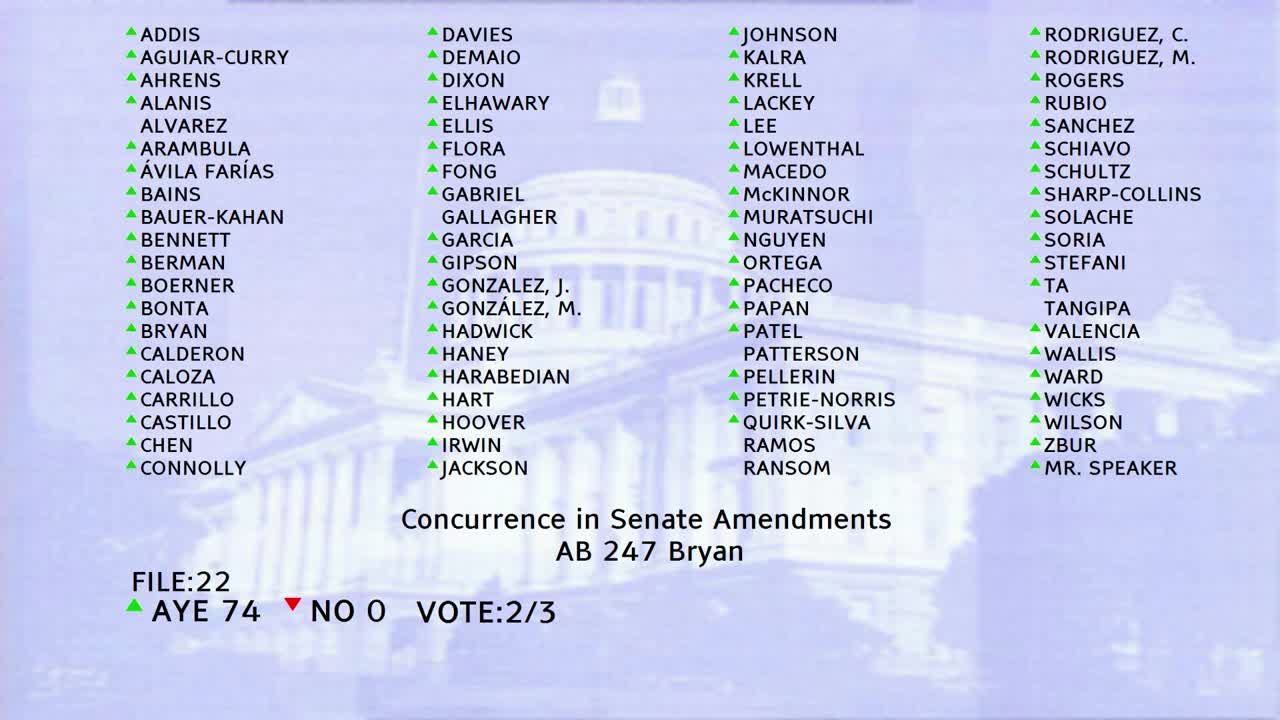 1MIN
Assembly Floor
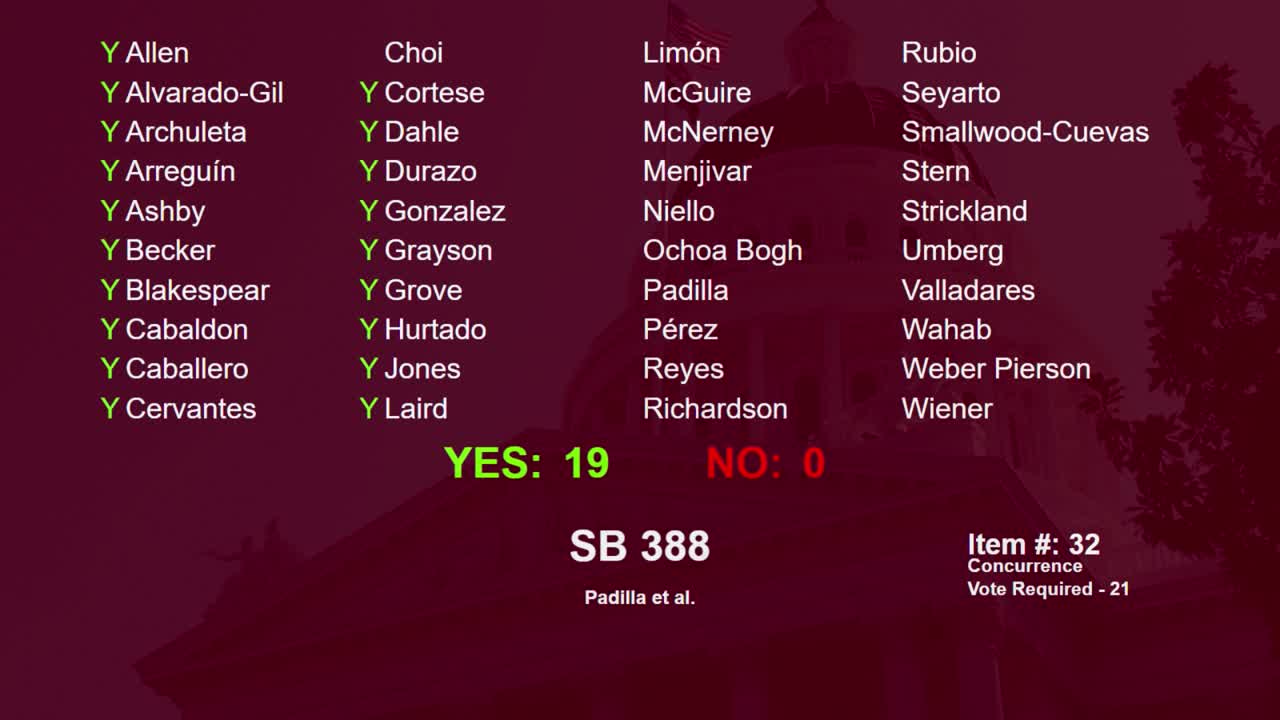 2MIN
Senate Floor
 1MIN
Senate Standing Committee on Appropriations
 19MIN
Senate Standing Committee on Labor, Public Employment and Retirement
 1MIN
Assembly Floor
 15MIN
Assembly Standing Committee on Labor and Employment
Bill Author

Bill Co-Author(s):
