AB 87: Housing development: density bonuses.
- Session Year: 2025-2026
- House: Assembly
- Latest Version Date: 2025-10-10
Current Status:
Passed
(2025-10-10: Chaptered by Secretary of State - Chapter 486, Statutes of 2025.)
Introduced
In Committee
Awaiting First Chamber Vote
Passed First Chamber
In Committee
Awaiting Second Chamber Vote
Passed Second Chamber
Enacted
Existing law, commonly referred to as the Density Bonus Law, requires a city or county to provide a developer that proposes a housing development, as defined, within the city or county with a density bonus, other incentives or concessions, and waivers or reductions of development standards, as specified, if the developer agrees to construct, among other options, specified units and meets other requirements.
This bill would specify that certain provisions of the Density Bonus Law do not require a city, county, or city and county to approve, grant a concession or incentive requiring approval of, or waive or reduce development standards otherwise applicable to, transient lodging as part of a housing development, except as specified.
This bill would incorporate additional changes to Section 65915 of the Government Code proposed by SB 92 to be operative only if this bill and SB 92 are enacted and this bill is enacted last.
Existing law, commonly referred to as the Density Bonus Law, requires a city or county to provide a developer that proposes a housing development development, as defined, within the city or county with a density bonus and bonus, other incentives or concessions, and waivers or reductions of development standards, as specified, if the developer agrees to construct, among other options, specified percentages of units for lower income households or very low income households, units and meets other requirements. Existing law requires the number of incentives or concessions a qualifying developer receives to be pursuant to a certain formula based on the total number of units in the housing development, as specified. Existing law defines housing development, for these purposes, to mean a development project for 5 or more residential units, including mixed-use developments.
This bill would prohibit an incentive or concession granted for a mixed-use development containing a hotel, motel, bed and breakfast inn, or other visitor-serving purpose from applying to the portion of the proposed development containing hotel, motel, bed and breakfast inn, or other visitor-serving purpose use. specify that certain provisions of the Density Bonus Law do not require a city, county, or city and county to approve, grant a concession or incentive requiring approval of, or waive or reduce development standards otherwise applicable to, transient lodging as part of a housing development, except as specified.
This bill would also make related conforming changes to various other laws to update cross-references to the Density Bonus Law.The bill would include findings that changes proposed by this bill address a matter of statewide concern rather than a municipal affair and, therefore, apply to all cities, including charter cities.Existing law, commonly referred to as the Density Bonus Law, requires a city or county to provide a developer that proposes a housing development within the city or county with a density bonus and other incentives or concessions, as specified, if the developer agrees to construct, among other options, specified percentages of units for lower income households or very low income households, and meets other requirements. Existing law requires the number of incentives or concessions a qualifying developer receives to be pursuant to a certain formula based on the total number of units in the housing development, as specified. Existing law defines housing development, for these purposes, to mean a development project for 5 or more residential units, including mixed-use developments.
This bill would define mixed-use development for purposes of the Density Bonus Law to mean a development with at least 70% of the square footage of a proposed development designated for residential uses and no square footage of the development designated for use as a hotel, motel, bed and breakfast inn, or other visitor-serving purposes. The bill would also prohibit an applicant from being eligible for a density bonus or any other incentives or concessions under the Density Bonus Law, unless the applicant agrees to, and the city, county, or city and county ensures, the commitment to record a land use restriction or covenant providing that a unit of development may not be listed as a short-term rental unit, as defined. By imposing these requirements on local agencies with respect to density bonuses, this bill would impose a state-mandated local program.This bill would prohibit an incentive or concession granted for a mixed-use development containing a hotel, motel, bed and breakfast inn, or other visitor-serving purpose from applying to the portion of the proposed development containing hotel, motel, bed and breakfast inn, or other visitor-serving purpose use.
This bill would also make related conforming changes to various other laws to update cross-references to the Density Bonus Law.
The bill would include findings that changes proposed by this bill address a matter of statewide concern rather than a municipal affair and, therefore, apply to all cities, including charter cities.
The California Constitution requires the state to reimburse local agencies and school districts for certain costs mandated by the state. Statutory provisions establish procedures for making that reimbursement.This bill would provide that no reimbursement is required by this act for a specified reason.Existing law, commonly referred to as the Density Bonus Law, requires a city or county to provide a developer that proposes a housing development within the city or county with a density bonus and other incentives or concessions, as specified, if the developer agrees to construct, among other options, specified percentages of units for lower income households or very low income households, and meets other requirements. Existing law defines housing development, for these purposes, to mean a development project for 5 or more residential units, including mixed-use developments.
This bill would define mixed-use development for purposes of the Density Bonus Law to mean a development with at least 70% of the square footage of a proposed development designated for residential uses and no square footage of the development designated for use as a hotel, motel, bed and breakfast inn, or other visitor-serving purposes. The bill would also prohibit an applicant from being eligible for a density bonus or any other incentives or concessions under the Density Bonus Law, unless the applicant agrees to, and the city, county, or city and county ensures, the commitment to record a land use restriction or covenant providing that a unit of development may not be listed as a short-term rental unit, as defined. By imposing these requirements on local agencies with respect to density bonuses, this bill would impose a state-mandated local program.
This bill would also make related conforming changes to various other laws to update cross-references to the Density Bonus Law.
The bill would include findings that changes proposed by this bill address a matter of statewide concern rather than a municipal affair and, therefore, apply to all cities, including charter cities.
The California Constitution requires the state to reimburse local agencies and school districts for certain costs mandated by the state. Statutory provisions establish procedures for making that reimbursement.
This bill would provide that no reimbursement is required by this act for a specified reason.
Existing law, commonly referred to as the Density Bonus Law, requires a city or county to provide a developer that proposes a housing development, as defined, within the city or county with a density bonus and other incentives or concessions, as specified, if the developer agrees to construct, among other options, specified percentages of units for lower income households or very low income households, and meets other requirements.This bill would state the intent of the Legislature to enact legislation to ensure that Density Bonus Law in its entirety is only applied to residential projects with no portions being used for visitor serving purposes or uses.Existing law, commonly referred to as the Density Bonus Law, requires a city or county to provide a developer that proposes a housing development, as defined, within the city or county with a density bonus and other incentives or concessions, as specified, if the developer agrees to construct, among other options, specified percentages of units for lower income households or very low income households, and meets other requirements.
This bill would state the intent of the Legislature to enact legislation to ensure that Density Bonus Law in its entirety is only applied to residential projects with no portions being used for visitor serving purposes or uses.
(a)(1)When an applicant seeks a density bonus for a housing development within, or for the donation of land for housing within, the jurisdiction of a city, county, or city and county, that local government shall comply with this section. A city, county, or city and county shall adopt an ordinance that specifies how compliance with this section will be implemented. Except as otherwise provided in subdivision (s), failure to adopt an ordinance shall not relieve a city, county, or city and county from complying with this section.
(2)A local government shall not condition the submission, review, or approval of an application pursuant to this chapter on the preparation of an additional report or study that is not otherwise required by state law, including this section. This subdivision does not prohibit a local government from requiring an applicant to provide reasonable documentation to establish eligibility for a requested density bonus, as described in subdivision (b), and parking ratios, as described in subdivision (p).
(3)In order to provide for the expeditious processing of a density bonus application, the local government shall do all of the following:
(A)Adopt procedures and timelines for processing a density bonus application.
(B)Provide a list of all documents and information required to be submitted with the density bonus application in order for the density bonus application to be deemed complete. This list shall be consistent with this chapter.
(C)Notify the applicant for a density bonus whether the application is complete in a manner consistent with the timelines specified in Section 65943.
(D)(i)If the local government notifies the applicant that the application is deemed complete pursuant to subparagraph (C), provide the applicant with a determination as to the following matters:
(I)The amount of density bonus, calculated pursuant to subdivision (f), for which the applicant is eligible.
(II)If the applicant requests a parking ratio pursuant to subdivision (p), the parking ratio for which the applicant is eligible.
(III)If the applicant requests incentives or concessions pursuant to subdivision (d) or waivers or reductions of development standards pursuant to subdivision (e), whether the applicant has provided adequate information for the local government to make a determination as to those incentives, concessions, waivers, or reductions of development standards.
(ii)Any determination required by this subparagraph shall be based on the development project at the time the application is deemed complete. The local government shall adjust the amount of density bonus and parking ratios awarded pursuant to this section based on any changes to the project during the course of development.
(b)(1)A city, county, or city and county shall grant one density bonus, the amount of which shall be as specified in subdivision (f), and, if requested by the applicant and consistent with the applicable requirements of this section, incentives or concessions, as described in subdivision (d), waivers or reductions of development standards, as described in subdivision (e), and parking ratios, as described in subdivision (p), if an applicant for a housing development seeks and agrees to construct a housing development, excluding any units permitted by the density bonus awarded pursuant to this section, that will contain at least any one of the following:
(A)Ten percent of the total units of a housing development, including a shared housing building development, for rental or sale to lower income households, as defined in Section 50079.5 of the Health and Safety Code.
(B)Five percent of the total units of a housing development, including a shared housing building development, for rental or sale to very low income households, as defined in Section 50105 of the Health and Safety Code.
(C)A senior citizen housing development, as defined in Sections 51.3 and 51.12 of the Civil Code, or a mobilehome park that limits residency based on age requirements for housing for older persons pursuant to Section 798.76 or 799.5 of the Civil Code. For purposes of this subparagraph, development includes a shared housing building development and a residential care facility for the elderly, as defined in Section 1569.2 of the Health and Safety Code.
(D)Ten percent of the total dwelling units of a housing development are sold to persons and families of moderate income, as defined in Section 50093 of the Health and Safety Code, provided that all units in the development are offered to the public for purchase.
(E)Ten percent of the total units of a housing development for transitional foster youth, as defined in Section 66025.9 of the Education Code, disabled veterans, as defined in Section 18541, or homeless persons, as defined in the federal McKinney-Vento Homeless Assistance Act (42 U.S.C. Sec. 11301 et seq.). The units described in this subparagraph are subject to a recorded affordability restriction of 55 years and shall be provided at the same affordability level as very low income units.
(F)(i)Twenty percent of the total units for lower income students in a student housing development that meets the following requirements:
(I)All units in the student housing development shall be used exclusively for undergraduate, graduate, or professional students enrolled currently or in the past six months in at least six units at an institution of higher education accredited by the Western Association of Schools and Colleges or the Accrediting Commission for Community and Junior Colleges. In order to be eligible under this subclause, the developer shall, as a condition of receiving a certificate of occupancy, provide evidence to the city, county, or city and county that the developer has done any one of the following:
(ia)Entered into an operating agreement or master lease with one or more institutions of higher education for the institution or institutions to occupy all units of the student housing development with students from that institution or institutions. An operating agreement or master lease entered into pursuant to this subclause is not violated or breached if, in any subsequent year, there are insufficient students enrolled in an institution of higher education to fill all units in the student housing development.
(ib)Established a system for confirming its renters status as students to ensure that all units of the student housing development are occupied with students from an institution of higher education.
(II)The applicable units in the student housing development for lower income students shall be used for and occupied by lower income students.
(III)The rent provided in the applicable units of the development for lower income students shall be calculated at 30 percent of 65 percent of the area median income for a single-room occupancy unit type.
(IV)The development shall provide priority for the applicable affordable units for lower income students experiencing homelessness. A homeless service provider, as defined in paragraph (3) of subdivision (e) of Section 103577 of the Health and Safety Code, or institution of higher education that has knowledge of a persons homeless status may verify a persons status as homeless for purposes of this subclause.
(V)The student housing development is not located on a site that pursuant to paragraph (3) of subdivision (c) would require replacement units for projects with greater than a 35-percent density bonus.
(ii)For purposes of calculating a density bonus granted pursuant to this subparagraph, the term unit as used in this section means one rental bed and its pro rata share of associated common area facilities. The units described in this subparagraph are subject to a recorded affordability restriction of 55 years, which shall not tie any rental bed reserved for lower income students to a specific bedroom. Notwithstanding any other law, an affordability restriction provision, state or county law or policy, or property management policy shall not prevent a lower income student from sharing a room or unit with a nonlower income student. Any attempted waiver of the requirements of this clause is void as against public policy.
(G)One hundred percent of all units in the development, including total units and density bonus units, but exclusive of a managers unit or units, are for lower income households, as defined by Section 50079.5 of the Health and Safety Code, except that up to 20 percent of the units in the development, including total units and density bonus units, may be for moderate-income households, as defined in Section 50053 of the Health and Safety Code. For purposes of this subparagraph, development includes a shared housing building development.
(2)For purposes of calculating the amount of the density bonus pursuant to subdivision (f), an applicant who requests a density bonus pursuant to this subdivision shall elect whether the bonus shall be awarded on the basis of subparagraph (A), (B), (C), (D), (E), (F), or (G) of paragraph (1).
(c)(1)(A)An applicant shall agree to, and the city, county, or city and county shall ensure, the continued affordability of all very low and low-income rental units that qualified the applicant for the award of the density bonus for 55 years or a longer period of time if required by the construction or mortgage financing assistance program, mortgage insurance program, or rental subsidy program.
(B)(i)Except as otherwise provided in clause (ii), rents for the lower income density bonus units shall be set at an affordable rent, as defined in Section 50053 of the Health and Safety Code.
(ii)For housing developments meeting the criteria of subparagraph (G) of paragraph (1) of subdivision (b), rents for all units in the development, including both base density and density bonus units, shall be as follows:
(I)The rent for at least 20 percent of the units in the development shall be set at an affordable rent, as defined in Section 50053 of the Health and Safety Code.
(II)The rent for the remaining units in the development shall be set at an amount consistent with the maximum rent levels for lower income households, as those rents and incomes are determined by the California Tax Credit Allocation Committee.
(2)(A)An applicant shall agree to ensure, and the city, county, or city and county shall ensure, that a for-sale unit that qualified the applicant for the award of the density bonus meets one of the following conditions:
(i)The unit is initially sold to and occupied by a person or family of very low, low, or moderate income, as required, and it is offered at an affordable housing cost, as that cost is defined in Section 50052.5 of the Health and Safety Code and is subject to an equity sharing agreement.
(ii)If the unit is not purchased by an income-qualified person or family within 180 days after the issuance of the certificate of occupancy, the unit is purchased by a qualified nonprofit housing corporation that meets all of the following requirements pursuant to a recorded contract that satisfies all of the requirements specified in paragraph (10) of subdivision (a) of Section 402.1 of the Revenue and Taxation Code:
(I)The nonprofit corporation has a determination letter from the Internal Revenue Service affirming its tax-exempt status pursuant to Section 501(c)(3) of the Internal Revenue Code and is not a private foundation as that term is defined in Section 509 of the Internal Revenue Code.
(II)The nonprofit corporation is based in California.
(III)All of the board members of the nonprofit corporation have their primary residence in California.
(IV)The primary activity of the nonprofit corporation is the development and preservation of affordable home ownership housing in California that incorporates within their contracts for initial purchase a repurchase option that requires a subsequent purchaser of the property that desires to resell or convey the property to offer the qualified nonprofit corporation the right to repurchase the property prior to selling or conveying that property to any other purchaser pursuant to an equity sharing agreement or affordability restrictions on the sale and conveyance of the property that ensure that the property will be preserved for lower income housing for at least 45 years for owner-occupied housing units and will be sold or resold only to persons or families of very low, low, or moderate income, as defined in Section 50052.5 of the Health and Safety Code.
(B)For purposes of this paragraph, a qualified nonprofit housing corporation is a nonprofit housing corporation organized pursuant to Section 501(c)(3) of the Internal Revenue Code that has received a welfare exemption under Section 214.15 of the Revenue and Taxation Code for properties intended to be sold to low-income families who participate in a special no-interest loan program.
(C)The local government shall enforce an equity sharing agreement required pursuant to clause (i) or (ii) of subparagraph (A), unless it is in conflict with the requirements of another public funding source or law or may defer to the recapture provisions of the public funding source. The following apply to the equity sharing agreement:
(i)Upon resale, the seller of the unit shall retain the value of any improvements, the downpayment, and the sellers proportionate share of appreciation.
(ii)Except as provided in clause (v), the local government shall recapture any initial subsidy, as defined in clause (iii), and its proportionate share of appreciation, as defined in clause (iv), which amount shall be used within five years for any of the purposes described in subdivision (e) of Section 33334.2 of the Health and Safety Code that promote home ownership.
(iii)For purposes of this subdivision, the local governments initial subsidy shall be equal to the fair market value of the home at the time of initial sale minus the initial sale price to the moderate-income household, plus the amount of any downpayment assistance or mortgage assistance. If upon resale the market value is lower than the initial market value, then the value at the time of the resale shall be used as the initial market value.
(iv)For purposes of this subdivision, the local governments proportionate share of appreciation shall be equal to the ratio of the local governments initial subsidy to the fair market value of the home at the time of initial sale.
(v)If the unit is purchased or developed by a qualified nonprofit housing corporation pursuant to clause (ii) of subparagraph (A) the local government may enter into a contract with the qualified nonprofit housing corporation under which the qualified nonprofit housing corporation would recapture any initial subsidy and its proportionate share of appreciation if the qualified nonprofit housing corporation is required to use 100 percent of the proceeds to promote home ownership for lower income households as defined by Section 50079.5 of the Health and Safety Code within the jurisdiction of the local government.
(3)(A)Except as provided in subclause (V) of clause (i) of subparagraph (F) of paragraph (1) of subdivision (b), an applicant shall be ineligible for a density bonus or any other incentives or concessions under this section if the housing development is proposed on any property that includes a parcel or parcels on which rental dwelling units are located or, if the dwelling units have been vacated or demolished in the five-year period preceding the application, have been subject to a recorded covenant, ordinance, or law that restricts rents to levels affordable to persons and families of lower or very low income; subject to any other form of rent or price control through a public entitys valid exercise of its police power; or occupied by lower or very low income households, unless the proposed housing development replaces those units, and either of the following applies:
(i)The proposed housing development, inclusive of the units replaced pursuant to this paragraph, contains affordable units at the percentages set forth in subdivision (b).
(ii)Each unit in the development, exclusive of a managers unit or units, is affordable to, and occupied by, either a lower or very low income household.
(B)For the purposes of this paragraph, replace shall mean either of the following:
(i)If any dwelling units described in subparagraph (A) are occupied on the date of application, the proposed housing development shall provide at least the same number of units of equivalent size to be made available at affordable rent or affordable housing cost to, and occupied by, persons and families in the same or lower income category as those households in occupancy. If the income category of the household in occupancy is not known, it shall be rebuttably presumed that lower income renter households occupied these units in the same proportion of lower income renter households to all renter households within the jurisdiction, as determined by the most recently available data from the United States Department of Housing and Urban Developments Comprehensive Housing Affordability Strategy database. For unoccupied dwelling units described in subparagraph (A) in a development with occupied units, the proposed housing development shall provide units of equivalent size to be made available at affordable rent or affordable housing cost to, and occupied by, persons and families in the same or lower income category as the last household in occupancy. If the income category of the last household in occupancy is not known, it shall be rebuttably presumed that lower income renter households occupied these units in the same proportion of lower income renter households to all renter households within the jurisdiction, as determined by the most recently available data from the United States Department of Housing and Urban Developments Comprehensive Housing Affordability Strategy database. All replacement calculations resulting in fractional units shall be rounded up to the next whole number. If the replacement units will be rental dwelling units, these units shall be subject to a recorded affordability restriction for at least 55 years. If the proposed development is for-sale units, the units replaced shall be subject to paragraph (2).
(ii)If all dwelling units described in subparagraph (A) have been vacated or demolished within the five-year period preceding the application, the proposed housing development shall provide at least the same number of units of equivalent size as existed at the highpoint of those units in the five-year period preceding the application to be made available at affordable rent or affordable housing cost to, and occupied by, persons and families in the same or lower income category as those persons and families in occupancy at that time, if known. If the incomes of the persons and families in occupancy at the highpoint is not known, it shall be rebuttably presumed that low-income and very low income renter households occupied these units in the same proportion of low-income and very low income renter households to all renter households within the jurisdiction, as determined by the most recently available data from the United States Department of Housing and Urban Developments Comprehensive Housing Affordability Strategy database. All replacement calculations resulting in fractional units shall be rounded up to the next whole number. If the replacement units will be rental dwelling units, these units shall be subject to a recorded affordability restriction for at least 55 years. If the proposed development is for-sale units, the units replaced shall be subject to paragraph (2).
(C)Notwithstanding subparagraph (B), for any dwelling unit described in subparagraph (A) that is or was, within the five-year period preceding the application, subject to a form of rent or price control through a local governments valid exercise of its police power and that is or was occupied by persons or families above lower income, the city, county, or city and county may do either of the following:
(i)Require that the replacement units be made available at affordable rent or affordable housing cost to, and occupied by, low-income persons or families. If the replacement units will be rental dwelling units, these units shall be subject to a recorded affordability restriction for at least 55 years. If the proposed development is for-sale units, the units replaced shall be subject to paragraph (2).
(ii)Require that the units be replaced in compliance with the jurisdictions rent or price control ordinance, provided that each unit described in subparagraph (A) is replaced. Unless otherwise required by the jurisdictions rent or price control ordinance, these units shall not be subject to a recorded affordability restriction.
(D)For purposes of this paragraph, equivalent size means that the replacement units contain at least the same total number of bedrooms as the units being replaced.
(E)Subparagraph (A) does not apply to an applicant seeking a density bonus for a proposed housing development if the applicants application was submitted to, or processed by, a city, county, or city and county before January 1, 2015.
(d)(1)An applicant for a density bonus pursuant to subdivision (b) may submit to a city, county, or city and county a proposal for the specific incentives or concessions that the applicant requests pursuant to this section, and may request a meeting with the city, county, or city and county. The city, county, or city and county shall grant the concession or incentive requested by the applicant unless the city, county, or city and county makes a written finding, based upon substantial evidence, of any of the following:
(A)The concession or incentive does not result in identifiable and actual cost reductions, consistent with subdivision (k), to provide for affordable housing costs, as defined in Section 50052.5 of the Health and Safety Code, or for rents for the targeted units to be set as specified in subdivision (c).
(B)The concession or incentive would have a specific, adverse impact, as defined in paragraph (2) of subdivision (d) of Section 65589.5, upon public health and safety or on any real property that is listed in the California Register of Historical Resources and for which there is no feasible method to satisfactorily mitigate or avoid the specific, adverse impact without rendering the development unaffordable to low-income and moderate-income households.
(C)The concession or incentive would be contrary to state or federal law.
(2)The applicant shall receive the following number of incentives or concessions:
(A)One incentive or concession for projects that include at least 10 percent of the total units for lower income households, at least 5 percent for very low income households, or at least 10 percent for persons and families of moderate income in a development in which the units are for sale.
(B)Two incentives or concessions for projects that include at least 17 percent of the total units for lower income households, at least 10 percent for very low income households, or at least 20 percent for persons and families of moderate income in a development in which the units are for sale.
(C)Three incentives or concessions for projects that include at least 24 percent of the total units for lower income households, at least 15 percent for very low income households, or at least 30 percent for persons and families of moderate income in a development in which the units are for sale.
(D)Five incentives or concessions for a project meeting the criteria of subparagraph (G) of paragraph (1) of subdivision (b). If the project is located within one-half mile of a major transit stop or is located in a very low vehicle travel area in a designated county, the applicant shall also receive a height increase of up to three additional stories, or 33 feet.
(E)One incentive or concession for projects that include at least 20 percent of the total units for lower income students in a student housing development. If a project includes at least 23 percent of the total units for lower income students in a student housing project, the applicant shall instead receive two incentives or concessions.
(F)Four incentives or concessions for projects that include at least 16 percent of the units for very low income households or at least 45 percent for persons and families of moderate income in a development in which the units are for sale.
(3)The applicant may initiate judicial proceedings if the city, county, or city and county refuses to grant a requested density bonus, incentive, or concession. If a court finds that the refusal to grant a requested density bonus, incentive, or concession is in violation of this section, the court shall award the plaintiff reasonable attorneys fees and costs of suit. This subdivision shall not be interpreted to require a local government to grant an incentive or concession that has a specific, adverse impact, as defined in paragraph (2) of subdivision (d) of Section 65589.5, upon health or safety, and for which there is no feasible method to satisfactorily mitigate or avoid the specific, adverse impact. This subdivision shall not be interpreted to require a local government to grant an incentive or concession that would have an adverse impact on any real property that is listed in the California Register of Historical Resources. The city, county, or city and county shall establish procedures for carrying out this section that shall include legislative body approval of the means of compliance with this section.
(4)The city, county, or city and county shall bear the burden of proof for the denial of a requested concession or incentive.
(e)(1)In no case may a city, county, or city and county apply any development standard that will have the effect of physically precluding the construction of a development meeting the criteria of subdivision (b) at the densities or with the concessions or incentives permitted by this section. Subject to paragraph (3), an applicant may submit to a city, county, or city and county a proposal for the waiver or reduction of development standards that will have the effect of physically precluding the construction of a development meeting the criteria of subdivision (b) at the densities or with the concessions or incentives permitted under this section, and may request a meeting with the city, county, or city and county. If a court finds that the refusal to grant a waiver or reduction of development standards is in violation of this section, the court shall award the plaintiff reasonable attorneys fees and costs of suit. This subdivision shall not be interpreted to require a local government to waive or reduce development standards if the waiver or reduction would have a specific, adverse impact, as defined in paragraph (2) of subdivision (d) of Section 65589.5, upon health or safety, and for which there is no feasible method to satisfactorily mitigate or avoid the specific, adverse impact. This subdivision shall not be interpreted to require a local government to waive or reduce development standards that would have an adverse impact on any real property that is listed in the California Register of Historical Resources, or to grant any waiver or reduction that would be contrary to state or federal law.
(2)A proposal for the waiver or reduction of development standards pursuant to this subdivision shall neither reduce nor increase the number of incentives or concessions to which the applicant is entitled pursuant to subdivision (d).
(3)A housing development that receives a waiver from any maximum controls on density pursuant to clause (ii) of subparagraph (D) of paragraph (3) of subdivision (f) shall only be eligible for a waiver or reduction of development standards as provided in subparagraph (D) of paragraph (2) of subdivision (d) and clause (ii) of subparagraph (D) of paragraph (3) of subdivision (f), unless the city, county, or city and county agrees to additional waivers or reductions of development standards.
(f)For the purposes of this chapter, density bonus means a density increase over the otherwise maximum allowable gross residential density, as of the date of application by the applicant to the city, county, or city and county, or, if elected by the applicant, a lesser percentage of density increase, including, but not limited to, no increase in density. The amount of density increase to which the applicant is entitled shall vary according to the amount by which the percentage of affordable housing units exceeds the percentage established in subdivision (b).
(1)For housing developments meeting the criteria of subparagraph (A) of paragraph (1) of subdivision (b), the density bonus shall be calculated as follows:
| Percentage Low-Income Units | Percentage Density Bonus |
| 10 | 20 |
| 11 | 21.5 |
| 12 | 23 |
| 13 | 24.5 |
| 14 | 26 |
| 15 | 27.5 |
| 16 | 29 |
| 17 | 30.5 |
| 18 | 32 |
| 19 | 33.5 |
| 20 | 35 |
| 21 | 38.75 |
| 22 | 42.5 |
| 23 | 46.25 |
| 24 | 50 |
(2)For housing developments meeting the criteria of subparagraph (B) of paragraph (1) of subdivision (b), the density bonus shall be calculated as follows:
| Percentage Very Low Income Units | Percentage Density Bonus |
| 5 | 20 |
| 6 | 22.5 |
| 7 | 25 |
| 8 | 27.5 |
| 9 | 30 |
| 10 | 32.5 |
| 11 | 35 |
| 12 | 38.75 |
| 13 | 42.5 |
| 14 | 46.25 |
| 15 | 50 |
(3)(A)For housing developments meeting the criteria of subparagraph (C) of paragraph (1) of subdivision (b), the density bonus shall be 20 percent of the number of senior housing units.
(B)For housing developments meeting the criteria of subparagraph (E) of paragraph (1) of subdivision (b), the density bonus shall be 20 percent of the number of the type of units giving rise to a density bonus under that subparagraph.
(C)For housing developments meeting the criteria of subparagraph (F) of paragraph (1) of subdivision (b), the density bonus shall be calculated as follows:
| Percentage Lower Income Units | Percentage Density Bonus |
| 20 | 35 |
| 21 | 38.75 |
| 22 | 42.5 |
| 23 | 46.25 |
| 24 | 50 |
(D)For housing developments meeting the criteria of subparagraph (G) of paragraph (1) of subdivision (b), the following shall apply:
(i)Except as otherwise provided in clauses (ii) and (iii), the density bonus shall be 80 percent of the number of units for lower income households.
(ii)If the housing development is located within one-half mile of a major transit stop, the city, county, or city and county shall not impose any maximum controls on density.
(iii)If the housing development is located in a very low vehicle travel area within a designated county, the city, county, or city and county shall not impose any maximum controls on density.
(4)For housing developments meeting the criteria of subparagraph (D) of paragraph (1) of subdivision (b), the density bonus shall be calculated as follows:
| Percentage Moderate-Income Units | Percentage Density Bonus |
| 10 | 5 |
| 11 | 6 |
| 12 | 7 |
| 13 | 8 |
| 14 | 9 |
| 15 | 10 |
| 16 | 11 |
| 17 | 12 |
| 18 | 13 |
| 19 | 14 |
| 20 | 15 |
| 21 | 16 |
| 22 | 17 |
| 23 | 18 |
| 24 | 19 |
| 25 | 20 |
| 26 | 21 |
| 27 | 22 |
| 28 | 23 |
| 29 | 24 |
| 30 | 25 |
| 31 | 26 |
| 32 | 27 |
| 33 | 28 |
| 34 | 29 |
| 35 | 30 |
| 36 | 31 |
| 37 | 32 |
| 38 | 33 |
| 39 | 34 |
| 40 | 35 |
| 41 | 38.75 |
| 42 | 42.5 |
| 43 | 46.25 |
| 44 | 50 |
(5)All density calculations resulting in fractional units shall be rounded up to the next whole number. The granting of a density bonus shall not require, or be interpreted, in and of itself, to require a general plan amendment, local coastal plan amendment, zoning change, or other discretionary approval.
(g)(1)When an applicant for a tentative subdivision map, parcel map, or other residential development approval donates land to a city, county, or city and county in accordance with this subdivision, the applicant shall be entitled to a 15-percent increase above the otherwise maximum allowable residential density for the entire development, as follows:
| Percentage Very Low Income | Percentage Density Bonus |
| 10 | 15 |
| 11 | 16 |
| 12 | 17 |
| 13 | 18 |
| 14 | 19 |
| 15 | 20 |
| 16 | 21 |
| 17 | 22 |
| 18 | 23 |
| 19 | 24 |
| 20 | 25 |
| 21 | 26 |
| 22 | 27 |
| 23 | 28 |
| 24 | 29 |
| 25 | 30 |
| 26 | 31 |
| 27 | 32 |
| 28 | 33 |
| 29 | 34 |
| 30 | 35 |
(2)This increase shall be in addition to any increase in density mandated by subdivision (b), up to a maximum combined mandated density increase of 35 percent if an applicant seeks an increase pursuant to both this subdivision and subdivision (b). All density calculations resulting in fractional units shall be rounded up to the next whole number. Nothing in this subdivision shall be construed to enlarge or diminish the authority of a city, county, or city and county to require a developer to donate land as a condition of development. An applicant shall be eligible for the increased density bonus described in this subdivision if all of the following conditions are met:
(A)The applicant donates and transfers the land no later than the date of approval of the final subdivision map, parcel map, or residential development application.
(B)The developable acreage and zoning classification of the land being transferred are sufficient to permit construction of units affordable to very low income households in an amount not less than 10 percent of the number of residential units of the proposed development.
(C)The transferred land is at least one acre in size or of sufficient size to permit development of at least 40 units, has the appropriate general plan designation, is appropriately zoned with appropriate development standards for development at the density described in paragraph (3) of subdivision (c) of Section 65583.2, and is or will be served by adequate public facilities and infrastructure.
(D)The transferred land shall have all of the permits and approvals, other than building permits, necessary for the development of the very low income housing units on the transferred land, not later than the date of approval of the final subdivision map, parcel map, or residential development application, except that the local government may subject the proposed development to subsequent design review to the extent authorized by subdivision (i) of Section 65583.2 if the design is not reviewed by the local government before the time of transfer.
(E)The transferred land and the affordable units shall be subject to a deed restriction ensuring continued affordability of the units consistent with paragraphs (1) and (2) of subdivision (c), which shall be recorded on the property at the time of the transfer.
(F)The land is transferred to the local agency or to a housing developer approved by the local agency. The local agency may require the applicant to identify and transfer the land to the developer.
(G)The transferred land shall be within the boundary of the proposed development or, if the local agency agrees, within one-quarter mile of the boundary of the proposed development.
(H)A proposed source of funding for the very low income units shall be identified not later than the date of approval of the final subdivision map, parcel map, or residential development application.
(h)(1)When an applicant proposes to construct a housing development that conforms to the requirements of subdivision (b) and includes a childcare facility that will be located on the premises of, as part of, or adjacent to, the project, the city, county, or city and county shall grant either of the following:
(A)An additional density bonus that is an amount of square feet of residential space that is equal to or greater than the amount of square feet in the childcare facility.
(B)An additional concession or incentive that contributes significantly to the economic feasibility of the construction of the childcare facility.
(2)The city, county, or city and county shall require, as a condition of approving the housing development, that the following occur:
(A)The childcare facility shall remain in operation for a period of time that is as long as or longer than the period of time during which the density bonus units are required to remain affordable pursuant to subdivision (c).
(B)Of the children who attend the childcare facility, the children of very low income households, lower income households, or families of moderate income shall equal a percentage that is equal to or greater than the percentage of dwelling units that are required for very low income households, lower income households, or families of moderate income pursuant to subdivision (b).
(3)Notwithstanding any requirement of this subdivision, a city, county, or city and county shall not be required to provide a density bonus or concession for a childcare facility if it finds, based upon substantial evidence, that the community has adequate childcare facilities.
(4)Childcare facility, as used in this section, means a child daycare facility other than a family daycare home, including, but not limited to, infant centers, preschools, extended daycare facilities, and schoolage childcare centers.
(i)Housing development, as used in this section, means a development project for five or more residential units, including mixed-use developments. For the purposes of this section, housing development also includes a subdivision or common interest development, as defined in Section 4100 of the Civil Code, approved by a city, county, or city and county and consists of residential units or unimproved residential lots and either a project to substantially rehabilitate and convert an existing commercial building to residential use or the substantial rehabilitation of an existing multifamily dwelling, as defined in subdivision (d) of Section 65863.4, where the result of the rehabilitation would be a net increase in available residential units. For the purpose of calculating a density bonus, the residential units shall be on contiguous sites that are the subject of one development application, but do not have to be based upon individual subdivision maps or parcels. The density bonus shall be permitted in geographic areas of the housing development other than the areas where the units for the lower income households are located.
(j)(1)The granting of a concession or incentive shall not require or be interpreted, in and of itself, to require a general plan amendment, local coastal plan amendment, zoning change, study, or other discretionary approval. For purposes of this subdivision, study does not include reasonable documentation to establish eligibility for the concession or incentive or to demonstrate that the incentive or concession meets the definition set forth in subdivision (k). This provision is declaratory of existing law.
(2)Except as provided in subdivisions (d) and (e), the granting of a density bonus shall not require or be interpreted to require the waiver of a local ordinance or provisions of a local ordinance unrelated to development standards.
(k)For the purposes of this chapter, concession or incentive means any of the following:
(1)A reduction in site development standards or a modification of zoning code requirements or architectural design requirements that exceed the minimum building standards approved by the California Building Standards Commission as provided in Part 2.5 (commencing with Section 18901) of Division 13 of the Health and Safety Code, including, but not limited to, a reduction in setback and square footage requirements and in the ratio of vehicular parking spaces that would otherwise be required that results in identifiable and actual cost reductions, to provide for affordable housing costs, as defined in Section 50052.5 of the Health and Safety Code, or for rents for the targeted units to be set as specified in subdivision (c).
(2)Approval of mixed-use zoning in conjunction with the housing project if commercial, office, industrial, or other land uses will reduce the cost of the housing development and if the commercial, office, industrial, or other land uses are compatible with the housing project and the existing or planned development in the area where the proposed housing project will be located.
(3)Other regulatory incentives or concessions proposed by the developer or the city, county, or city and county that result in identifiable and actual cost reductions to provide for affordable housing costs, as defined in Section 50052.5 of the Health and Safety Code, or for rents for the targeted units to be set as specified in subdivision (c).
(l)(1)Subdivisions (e) and (k) do not require a city, county, or city and county to approve, to grant a concession or incentive requiring approval of, or to waive or reduce development standards otherwise applicable to, a hotel, motel, bed and breakfast inn, or other transient lodging, other than a residential hotel, as defined in Section 50519 of the Health and Safety Code, as part of a housing development subject to this section. For purposes of this paragraph, other transient lodging does not include a residents use or marketing of their unit as short-term lodging, as defined in Section 17568.8 of the Business and Professions Code, subsequent to the issuance of a certificate of occupancy in a manner otherwise consistent with local law.
(2)Subdivision (k) does not limit or require the provision of direct financial incentives for the housing development, including the provision of publicly owned land, by the city, county, or city and county, or the waiver of fees or dedication requirements.
(m)This section does not supersede or in any way alter or lessen the effect or application of the California Coastal Act of 1976 (Division 20 (commencing with Section 30000) of the Public Resources Code). Any density bonus, concessions, incentives, waivers or reductions of development standards, and parking ratios to which the applicant is entitled under this section shall be permitted in a manner that is consistent with this section and Division 20 (commencing with Section 30000) of the Public Resources Code.
(n)If permitted by local ordinance, nothing in this section shall be construed to prohibit a city, county, or city and county from granting a density bonus greater than what is described in this section for a development that meets the requirements of this section or from granting a proportionately lower density bonus than what is required by this section for developments that do not meet the requirements of this section.
(o)For purposes of this section, the following definitions shall apply:
(1)Designated county includes the Counties of Alameda, Contra Costa, Los Angeles, Marin, Napa, Orange, Riverside, Sacramento, San Bernardino, San Diego, San Mateo, Santa Barbara, Santa Clara, Solano, Sonoma, and Ventura, and the City and County of San Francisco.
(2)Development standard includes a site or construction condition, including, but not limited to, a height limitation, a setback requirement, a floor area ratio, an onsite open-space requirement, a minimum lot area per unit requirement, or a parking ratio that applies to a residential development pursuant to any ordinance, general plan element, specific plan, charter, or other local condition, law, policy, resolution, or regulation that is adopted by the local government or that is enacted by the local governments electorate exercising its local initiative or referendum power, whether that power is derived from the California Constitution, statute, or the charter or ordinances of the local government.
(3)Located within one-half mile of a major transit stop means that any point on a proposed development, for which an applicant seeks a density bonus, other incentives or concessions, waivers or reductions of development standards, or a vehicular parking ratio pursuant to this section, is within one-half mile of any point on the property on which a major transit stop is located, including any parking lot owned by the transit authority or other local agency operating the major transit stop.
(4)Lower income student means a student who has a household income and asset level that does not exceed the level for Cal Grant A or Cal Grant B award recipients as set forth in subdivision (k) of Section 69432.7 of the Education Code. The eligibility of a student to occupy a unit for lower income students under this section shall be verified by an affidavit, award letter, or letter of eligibility provided by the institution of higher education in which the student is enrolled or by the Student Aid Commission that the student receives or is eligible for financial aid, including an institutional grant or fee waiver from the college or university, the Student Aid Commission, or the federal government.
(5)Major transit stop has the same meaning as defined in subdivision (b) of Section 21155 of the Public Resources Code.
(6)Maximum allowable residential density or base density means the greatest number of units allowed under the zoning ordinance, specific plan, or land use element of the general plan, or, if a range of density is permitted, means the greatest number of units allowed by the specific zoning range, specific plan, or land use element of the general plan applicable to the project. Density shall be determined using dwelling units per acre. However, if the applicable zoning ordinance, specific plan, or land use element of the general plan does not provide a dwelling-units-per-acre standard for density, then the local agency shall calculate the number of units by:
(A)Estimating the realistic development capacity of the site based on the objective development standards applicable to the project, including, but not limited to, floor area ratio, site coverage, maximum building height and number of stories, building setbacks and stepbacks, public and private open-space requirements, minimum percentage or square footage of any nonresidential component, and parking requirements, unless not required for the base project. Parking requirements shall include considerations regarding number of spaces, location, design, type, and circulation. A developer may provide a base density study and the local agency shall accept it, provided that it includes all applicable objective development standards.
(B)Maintaining the same average unit size and other project details relevant to the base density study, excepting those that may be modified by waiver or concession to accommodate the bonus units, in the proposed project as in the study.
(7)(A)(i)Shared housing building means a residential or mixed-use structure, with five or more shared housing units and one or more common kitchens and dining areas designed for permanent residence of more than 30 days by its tenants. The kitchens and dining areas within the shared housing building shall be able to adequately accommodate all residents. If a local ordinance further restricts the attributes of a shared housing building beyond the requirements established in this section, the local definition shall apply to the extent that it does not conflict with the requirements of this section.
(ii)A shared housing building may include other dwelling units that are not shared housing units, provided that those dwelling units do not occupy more than 25 percent of the floor area of the shared housing building. A shared housing building may include 100 percent shared housing units.
(B)(i)Shared housing unit means one or more habitable rooms, not within another dwelling unit, that includes a bathroom, sink, refrigerator, and microwave, is used for permanent residence, that meets the minimum room area specified in Section R304 of the California Residential Code (Part 2.5 of Title 24 of the California Code of Regulations), and complies with the definition of guestroom in Section R202 of the California Residential Code. If a local ordinance further restricts the attributes of a shared housing building beyond the requirements established in this section, the local definition shall apply to the extent that it does not conflict with the requirements of this section.
(ii)Shared housing unit for purposes of a residential care facility for the elderly, as defined in Section 1569.2 of the Health and Safety Code, includes a unit without an individual kitchen where a unit may be shared by unrelated persons, and a unit where a room that may be shared by unrelated persons meets the minimum room area requirements of clause (i).
(8)Student housing development means a development that contains bedrooms containing two or more bedspaces that have a shared or private bathroom, access to a shared or private living room and laundry facilities, and access to a shared or private kitchen.
(9)(A)Total units or total dwelling units means a calculation of the number of units that:
(i)Excludes a unit added by a density bonus awarded pursuant to this section or any local law granting a greater density bonus.
(ii)Includes a unit designated to satisfy an inclusionary zoning requirement of a city, county, or city and county.
(B)For purposes of calculating a density bonus granted pursuant to this section for a shared housing building, unit means one shared housing unit and its pro rata share of associated common area facilities.
(10)Very low vehicle travel area means an urbanized area, as designated by the United States Census Bureau, where the existing residential development generates vehicle miles traveled per capita that is below 85 percent of either regional vehicle miles traveled per capita or city vehicle miles traveled per capita. For purposes of this paragraph, area may include a travel analysis zone, hexagon, or grid. For the purposes of determining regional vehicle miles traveled per capita pursuant to this paragraph, a region is the entirety of incorporated and unincorporated areas governed by a multicounty or single-county metropolitan planning organization, or the entirety of the incorporated and unincorporated areas of an individual county that is not part of a metropolitan planning organization.
(p)(1)Except as provided in paragraphs (2), (3), and (4), upon the request of the developer, a city, county, or city and county shall not require a vehicular parking ratio, inclusive of parking for persons with a disability and guests, of a development meeting the criteria of subdivisions (b) and (c), that exceeds the following ratios:
(A)Zero to one bedroom: one onsite parking space.
(B)Two to three bedrooms: one and one-half onsite parking spaces.
(C)Four and more bedrooms: two and one-half parking spaces.
(D)One bedspace in a student housing development: zero parking spaces.
(2)(A)Notwithstanding paragraph (1), if a development includes at least 20 percent low-income units for housing developments meeting the criteria of subparagraph (A) of paragraph (1) of subdivision (b) or at least 11 percent very low income units for housing developments meeting the criteria of subparagraph (B) of paragraph (1) of subdivision (b), is located within one-half mile of a major transit stop, and there is unobstructed access to the major transit stop from the development, then, upon the request of the developer, a city, county, or city and county shall not impose a vehicular parking ratio, inclusive of parking for persons with a disability and guests, that exceeds 0.5 spaces per unit. Notwithstanding paragraph (1), if a development includes at least 40 percent moderate-income units for housing developments meeting the criteria of subparagraph (D) of paragraph (1) of subdivision (b), is located within one-half mile of a major transit stop, as defined in subdivision (b) of Section 21155 of the Public Resources Code, and the residents of the development have unobstructed access to the major transit stop from the development then, upon the request of the developer, a city, county, or city and county shall not impose a vehicular parking ratio, inclusive of parking for persons with a disability and guests, that exceeds 0.5 spaces per bedroom.
(B)For purposes of this subdivision, unobstructed access to the major transit stop means a resident is able to access the major transit stop without encountering natural or constructed impediments. For purposes of this subparagraph, natural or constructed impediments includes, but is not limited to, freeways, rivers, mountains, and bodies of water, but does not include residential structures, shopping centers, parking lots, or rails used for transit.
(3)Notwithstanding paragraph (1), if a development meets the criteria of subparagraph (G) of paragraph (1) of subdivision (b), then, upon the request of the developer, a city, county, or city and county shall not impose vehicular parking standards if the development meets any of the following criteria:
(A)The development is located within one-half mile of a major transit stop and there is unobstructed access to the major transit stop from the development.
(B)The development is a for-rent housing development for individuals who are 55 years of age or older that complies with Sections 51.2 and 51.3 of the Civil Code and the development has either paratransit service or unobstructed access, within one-half mile, to fixed bus route service that operates at least eight times per day.
(C)The development is either a special needs housing development, as defined in Section 51312 of the Health and Safety Code, or a supportive housing development, as defined in Section 50675.14 of the Health and Safety Code. A development that is a special needs housing development shall have either paratransit service or unobstructed access, within one-half mile, to fixed bus route service that operates at least eight times per day.
(4)If the total number of parking spaces required for a development is other than a whole number, the number shall be rounded up to the next whole number. For purposes of this subdivision, a development may provide onsite parking through tandem parking or uncovered parking, but not through onstreet parking.
(5)This subdivision shall apply to a development that meets the requirements of subdivisions (b) and (c), but only at the request of the applicant. An applicant may request parking incentives or concessions beyond those provided in this subdivision pursuant to subdivision (d).
(6)This subdivision does not preclude a city, county, or city and county from reducing or eliminating a parking requirement for development projects of any type in any location.
(7)Notwithstanding paragraphs (2) and (3), if a city, county, city and county, or an independent consultant has conducted an areawide or jurisdictionwide parking study in the last seven years, then the city, county, or city and county may impose a higher vehicular parking ratio not to exceed the ratio described in paragraph (1), based upon substantial evidence found in the parking study, that includes, but is not limited to, an analysis of parking availability, differing levels of transit access, walkability access to transit services, the potential for shared parking, the effect of parking requirements on the cost of market-rate and subsidized developments, and the lower rates of car ownership for low-income and very low income individuals, including seniors and special needs individuals. The city, county, or city and county shall pay the costs of any new study. The city, county, or city and county shall make findings, based on a parking study completed in conformity with this paragraph, supporting the need for the higher parking ratio.
(8)A request pursuant to this subdivision shall neither reduce nor increase the number of incentives or concessions to which the applicant is entitled pursuant to subdivision (d).
(q)Each component of any density calculation, including base density and bonus density, resulting in fractional units shall be separately rounded up to the next whole number. The Legislature finds and declares that this provision is declaratory of existing law.
(r)This chapter shall be interpreted liberally in favor of producing the maximum number of total housing units.
(s)Notwithstanding any other law, if a city, including a charter city, county, or city and county has adopted an ordinance or a housing program, or both an ordinance and a housing program, that incentivizes the development of affordable housing that allows for density bonuses that exceed the density bonuses required by the version of this section effective through December 31, 2020, that city, county, or city and county is not required to amend or otherwise update its ordinance or corresponding affordable housing incentive program to comply with the amendments made to this section by the act adding this subdivision, and is exempt from complying with the incentive and concession calculation amendments made to this section by the act adding this subdivision as set forth in subdivision (d), particularly subparagraphs (B) and (C) of paragraph (2) of that subdivision, and the amendments made to the density tables under subdivision (f).
(t)When an applicant proposes to construct a housing development that conforms to the requirements of subparagraph (A) or (B) of paragraph (1) of subdivision (b) that is a shared housing building, the city, county, or city and county shall not require any minimum unit size requirements or minimum bedroom requirements that are in conflict with paragraph (7) of subdivision (o).
(u)(1)The Legislature finds and declares that the intent behind the Density Bonus Law is to allow public entities to reduce or even eliminate subsidies for a particular project by allowing a developer to include more total units in a project than would otherwise be allowed by the local zoning ordinance in exchange for affordable units. It further reaffirms that the intent is to cover at least some of the financing gap of affordable housing with regulatory incentives, rather than additional public subsidy.
(2)It is therefore the intent of the Legislature to make modifications to the Density Bonus Law by the act adding this subdivision to further incentivize the construction of very low, low-, and moderate-income housing units. It is further the intent of the Legislature in making these modifications to the Density Bonus Law to ensure that any additional benefits conferred upon a developer are balanced with the receipt of a public benefit in the form of adequate levels of affordable housing. The Legislature further intends that these modifications will ensure that the Density Bonus Law creates incentives for the construction of more housing across all areas of the state.
(v)(1)Provided that the resulting housing development would not restrict more than 50 percent of the total units to moderate-income, lower income, or very low income households, a city, county, or city and county shall grant an additional density bonus calculated pursuant to paragraph (2) when an applicant proposes to construct a housing development that conforms to the requirements of paragraph (1) of subdivision (b), agrees to include additional rental or for-sale units affordable to very low income households or moderate-income households, and meets any of the following requirements:
(A)The housing development conforms to the requirements of subparagraph (A) of paragraph (1) of subdivision (b) and provides 24 percent of the total units to lower income households.
(B)The housing development conforms to the requirements of subparagraph (B) of paragraph (1) of subdivision (b) and provides 15 percent of the total units to very low income households.
(C)The housing development conforms to the requirements of subparagraph (D) of paragraph (1) of subdivision (b) and provides 44 percent of the total units to moderate-income households.
(2)A city, county, or city and county shall grant an additional density bonus for a housing development that meets the requirements of paragraph (1), calculated as follows:
| Percentage Very Low Income Units | Percentage Density Bonus |
| 5 | 20 |
| 6 | 23.75 |
| 7 | 27.5 |
| 8 | 31.25 |
| 9 | 35 |
| 10 | 38.75 |
| Percentage Moderate-Income Units | Percentage Density Bonus |
| 5 | 20 |
| 6 | 22.5 |
| 7 | 25 |
| 8 | 27.5 |
| 9 | 30 |
| 10 | 32.5 |
| 11 | 35 |
| 12 | 38.75 |
| 13 | 42.5 |
| 14 | 46.25 |
| 15 | 50 |
(3)The increase required by paragraphs (1) and (2) shall be in addition to any increase in density granted by subdivision (b).
(4)The additional density bonus required under this subdivision shall be calculated using the number of units excluding any density bonus awarded by this section.
SEC. 1.5.Section 65915 of the Government Code is amended to read:65915.(a)(1)When an applicant seeks a density bonus for a housing development within, or for the donation of land for housing within, the jurisdiction of a city, county, or city and county, that local government shall comply with this section. A city, county, or city and county shall adopt an ordinance that specifies how compliance with this section will be implemented. Except as otherwise provided in subdivision (s), failure to adopt an ordinance shall not relieve a city, county, or city and county from complying with this section.
(2)A local government shall not condition the submission, review, or approval of an application pursuant to this chapter on the preparation of an additional report or study that is not otherwise required by state law, including this section. This subdivision does not prohibit a local government from requiring an applicant to provide reasonable documentation to establish eligibility for a requested density bonus, as described in subdivision (b), and parking ratios, as described in subdivision (p).
(3)In order to provide for the expeditious processing of a density bonus application, the local government shall do all of the following:
(A)Adopt procedures and timelines for processing a density bonus application.
(B)Provide a list of all documents and information required to be submitted with the density bonus application in order for the density bonus application to be deemed complete. This list shall be consistent with this chapter.
(C)Notify the applicant for a density bonus whether the application is complete in a manner consistent with the timelines specified in Section 65943.
(D)(i)If the local government notifies the applicant that the application is deemed complete pursuant to subparagraph (C), provide the applicant with a determination as to the following matters:
(I)The amount of density bonus, calculated pursuant to subdivision (f), for which the applicant is eligible.
(II)If the applicant requests a parking ratio pursuant to subdivision (p), the parking ratio for which the applicant is eligible.
(III)If the applicant requests incentives or concessions pursuant to subdivision (d) or waivers or reductions of development standards pursuant to subdivision (e), whether the applicant has provided adequate information for the local government to make a determination as to those incentives, concessions, waivers, or reductions of development standards.
(ii)Any determination required by this subparagraph shall be based on the development project at the time the application is deemed complete. The local government shall adjust the amount of density bonus and parking ratios awarded pursuant to this section based on any changes to the project during the course of development.
(b)(1)A city, county, or city and county shall grant one density bonus, the amount of which shall be as specified in subdivision (f), and, if requested by the applicant and consistent with the applicable requirements of this section, incentives or concessions, as described in subdivision (d), waivers or reductions of development standards, as described in subdivision (e), and parking ratios, as described in subdivision (p), if an applicant for a housing development seeks and agrees to construct a housing development, excluding any units permitted by the density bonus awarded pursuant to this section, that will contain at least any one of the following:
(A)Ten percent of the total units of a housing development, including a shared housing building development, for rental or sale to lower income households, as defined in Section 50079.5 of the Health and Safety Code.
(B)Five percent of the total units of a housing development, including a shared housing building development, for rental or sale to very low income households, as defined in Section 50105 of the Health and Safety Code.
(C)A senior citizen housing development, as defined in Sections 51.3 and 51.12 of the Civil Code, or a mobilehome park that limits residency based on age requirements for housing for older persons pursuant to Section 798.76 or 799.5 of the Civil Code. For purposes of this subparagraph, development includes a shared housing building development and a residential care facility for the elderly, as defined in Section 1569.2 of the Health and Safety Code.
(D)Ten percent of the total dwelling units of a housing development are sold to persons and families of moderate income, as defined in Section 50093 of the Health and Safety Code, provided that all units in the development are offered to the public for purchase.
(E)Ten percent of the total units of a housing development for transitional foster youth, as defined in Section 66025.9 of the Education Code, disabled veterans, as defined in Section 18541, or homeless persons, as defined in the federal McKinney-Vento Homeless Assistance Act (42 U.S.C. Sec. 11301 et seq.). The units described in this subparagraph are subject to a recorded affordability restriction of 55 years and shall be provided at the same affordability level as very low income units.
(F)(i)Twenty percent of the total units for lower income students in a student housing development that meets the following requirements:
(I)All units in the student housing development shall be used exclusively for undergraduate, graduate, or professional students enrolled currently or in the past six months in at least six units at an institution of higher education accredited by the Western Association of Schools and Colleges or the Accrediting Commission for Community and Junior Colleges. In order to be eligible under this subclause, the developer shall, as a condition of receiving a certificate of occupancy, provide evidence to the city, county, or city and county that the developer has done any one of the following:
(ia)Entered into an operating agreement or master lease with one or more institutions of higher education for the institution or institutions to occupy all units of the student housing development with students from that institution or institutions. An operating agreement or master lease entered into pursuant to this subclause is not violated or breached if, in any subsequent year, there are insufficient students enrolled in an institution of higher education to fill all units in the student housing development.
(ib)Established a system for confirming its renters status as students to ensure that all units of the student housing development are occupied with students from an institution of higher education.
(II)The applicable units in the student housing development for lower income students shall be used for and occupied by lower income students.
(III)The rent provided in the applicable units of the development for lower income students shall be calculated at 30 percent of 65 percent of the area median income for a single-room occupancy unit type.
(IV)The development shall provide priority for the applicable affordable units for lower income students experiencing homelessness. A homeless service provider, as defined in paragraph (3) of subdivision (e) of Section 103577 of the Health and Safety Code, or institution of higher education that has knowledge of a persons homeless status may verify a persons status as homeless for purposes of this subclause.
(V)The student housing development is not located on a site that pursuant to paragraph (3) of subdivision (c) would require replacement units for projects with greater than a 35-percent density bonus.
(ii)For purposes of calculating a density bonus granted pursuant to this subparagraph, the term unit as used in this section means one rental bed and its pro rata share of associated common area facilities. The units described in this subparagraph are subject to a recorded affordability restriction of 55 years, which shall not tie any rental bed reserved for lower income students to a specific bedroom. Notwithstanding any other law, an affordability restriction provision, state or county law or policy, or property management policy shall not prevent a lower income student from sharing a room or unit with a nonlower income student. Any attempted waiver of the requirements of this clause is void as against public policy.
(G)One hundred percent of all units in the development, including total units and density bonus units, but exclusive of a managers unit or units, are for lower income households, as defined by Section 50079.5 of the Health and Safety Code, except that up to 20 percent of the units in the development, including total units and density bonus units, may be for moderate-income households, as defined in Section 50053 of the Health and Safety Code. For purposes of this subparagraph, development includes a shared housing building development.
(2)For purposes of calculating the amount of the density bonus pursuant to subdivision (f), an applicant who requests a density bonus pursuant to this subdivision shall elect whether the bonus shall be awarded on the basis of subparagraph (A), (B), (C), (D), (E), (F), or (G) of paragraph (1).
(c)(1)(A)An applicant shall agree to, and the city, county, or city and county shall ensure, the continued affordability of all very low and low-income rental units that qualified the applicant for the award of the density bonus for 55 years or a longer period of time if required by the construction or mortgage financing assistance program, mortgage insurance program, or rental subsidy program.
(B)(i)Except as otherwise provided in clause (ii), rents for the lower income density bonus units shall be set at an affordable rent, as defined in Section 50053 of the Health and Safety Code.
(ii)For housing developments meeting the criteria of subparagraph (G) of paragraph (1) of subdivision (b), rents for all units in the development, including both base density and density bonus units, shall be as follows:
(I)The rent for at least 20 percent of the units in the development shall be set at an affordable rent, as defined in Section 50053 of the Health and Safety Code.
(II)The rent for the remaining units in the development shall be set at an amount consistent with the maximum rent levels for lower income households, as those rents and incomes are determined by the California Tax Credit Allocation Committee.
(2)(A)An applicant shall agree to ensure, and the city, county, or city and county shall ensure, that a for-sale unit that qualified the applicant for the award of the density bonus meets one of the following conditions:
(i)The unit is initially sold to and occupied by a person or family of very low, low, or moderate income, as required, and it is offered at an affordable housing cost, as that cost is defined in Section 50052.5 of the Health and Safety Code and is subject to an equity sharing agreement.
(ii)If the unit is not purchased by an income-qualified person or family within 180 days after the issuance of the certificate of occupancy, the unit is purchased by a qualified nonprofit housing corporation that meets all of the following requirements pursuant to a recorded contract that satisfies all of the requirements specified in paragraph (10) of subdivision (a) of Section 402.1 of the Revenue and Taxation Code:
(I)The nonprofit corporation has a determination letter from the Internal Revenue Service affirming its tax-exempt status pursuant to Section 501(c)(3) of the Internal Revenue Code and is not a private foundation as that term is defined in Section 509 of the Internal Revenue Code.
(II)The nonprofit corporation is based in California.
(III)All of the board members of the nonprofit corporation have their primary residence in California.
(IV)The primary activity of the nonprofit corporation is the development and preservation of affordable home ownership housing in California that incorporates within their contracts for initial purchase a repurchase option that requires a subsequent purchaser of the property that desires to resell or convey the property to offer the qualified nonprofit corporation the right to repurchase the property prior to selling or conveying that property to any other purchaser pursuant to an equity sharing agreement or affordability restrictions on the sale and conveyance of the property that ensure that the property will be preserved for lower income housing for at least 45 years for owner-occupied housing units and will be sold or resold only to persons or families of very low, low, or moderate income, as defined in Section 50052.5 of the Health and Safety Code.
(B)For purposes of this paragraph, a qualified nonprofit housing corporation is a nonprofit housing corporation organized pursuant to Section 501(c)(3) of the Internal Revenue Code that has received a welfare exemption under Section 214.15 of the Revenue and Taxation Code for properties intended to be sold to low-income families who participate in a special no-interest loan program.
(C)The local government shall enforce an equity sharing agreement required pursuant to clause (i) or (ii) of subparagraph (A), unless it is in conflict with the requirements of another public funding source or law or may defer to the recapture provisions of the public funding source. The following apply to the equity sharing agreement:
(i)Upon resale, the seller of the unit shall retain the value of any improvements, the downpayment, and the sellers proportionate share of appreciation.
(ii)Except as provided in clause (v), the local government shall recapture any initial subsidy, as defined in clause (iii), and its proportionate share of appreciation, as defined in clause (iv), which amount shall be used within five years for any of the purposes described in subdivision (e) of Section 33334.2 of the Health and Safety Code that promote home ownership.
(iii)For purposes of this subdivision, the local governments initial subsidy shall be equal to the fair market value of the home at the time of initial sale minus the initial sale price to the moderate-income household, plus the amount of any downpayment assistance or mortgage assistance. If upon resale the market value is lower than the initial market value, then the value at the time of the resale shall be used as the initial market value.
(iv)For purposes of this subdivision, the local governments proportionate share of appreciation shall be equal to the ratio of the local governments initial subsidy to the fair market value of the home at the time of initial sale.
(v)If the unit is purchased or developed by a qualified nonprofit housing corporation pursuant to clause (ii) of subparagraph (A) the local government may enter into a contract with the qualified nonprofit housing corporation under which the qualified nonprofit housing corporation would recapture any initial subsidy and its proportionate share of appreciation if the qualified nonprofit housing corporation is required to use 100 percent of the proceeds to promote home ownership for lower income households as defined by Section 50079.5 of the Health and Safety Code within the jurisdiction of the local government.
(3)(A)Except as provided in subclause (V) of clause (i) of subparagraph (F) of paragraph (1) of subdivision (b), an applicant shall be ineligible for a density bonus or any other incentives or concessions under this section if the housing development is proposed on any property that includes a parcel or parcels on which rental dwelling units are located or, if the dwelling units have been vacated or demolished in the five-year period preceding the application, have been subject to a recorded covenant, ordinance, or law that restricts rents to levels affordable to persons and families of lower or very low income; subject to any other form of rent or price control through a public entitys valid exercise of its police power; or occupied by lower or very low income households, unless the proposed housing development replaces those units, and either of the following applies:
(i)The proposed housing development, inclusive of the units replaced pursuant to this paragraph, contains affordable units at the percentages set forth in subdivision (b).
(ii)Each unit in the development, exclusive of a managers unit or units, is affordable to, and occupied by, either a lower or very low income household.
(B)For the purposes of this paragraph, replace shall mean either of the following:
(i)If any dwelling units described in subparagraph (A) are occupied on the date of application, the proposed housing development shall provide at least the same number of units of equivalent size to be made available at affordable rent or affordable housing cost to, and occupied by, persons and families in the same or lower income category as those households in occupancy. If the income category of the household in occupancy is not known, it shall be rebuttably presumed that lower income renter households occupied these units in the same proportion of lower income renter households to all renter households within the jurisdiction, as determined by the most recently available data from the United States Department of Housing and Urban Developments Comprehensive Housing Affordability Strategy database. For unoccupied dwelling units described in subparagraph (A) in a development with occupied units, the proposed housing development shall provide units of equivalent size to be made available at affordable rent or affordable housing cost to, and occupied by, persons and families in the same or lower income category as the last household in occupancy. If the income category of the last household in occupancy is not known, it shall be rebuttably presumed that lower income renter households occupied these units in the same proportion of lower income renter households to all renter households within the jurisdiction, as determined by the most recently available data from the United States Department of Housing and Urban Developments Comprehensive Housing Affordability Strategy database. All replacement calculations resulting in fractional units shall be rounded up to the next whole number. If the replacement units will be rental dwelling units, these units shall be subject to a recorded affordability restriction for at least 55 years. If the proposed development is for-sale units, the units replaced shall be subject to paragraph (2).
(ii)If all dwelling units described in subparagraph (A) have been vacated or demolished within the five-year period preceding the application, the proposed housing development shall provide at least the same number of units of equivalent size as existed at the highpoint of those units in the five-year period preceding the application to be made available at affordable rent or affordable housing cost to, and occupied by, persons and families in the same or lower income category as those persons and families in occupancy at that time, if known. If the incomes of the persons and families in occupancy at the highpoint is not known, it shall be rebuttably presumed that low-income and very low income renter households occupied these units in the same proportion of low-income and very low income renter households to all renter households within the jurisdiction, as determined by the most recently available data from the United States Department of Housing and Urban Developments Comprehensive Housing Affordability Strategy database. All replacement calculations resulting in fractional units shall be rounded up to the next whole number. If the replacement units will be rental dwelling units, these units shall be subject to a recorded affordability restriction for at least 55 years. If the proposed development is for-sale units, the units replaced shall be subject to paragraph (2).
(C)Notwithstanding subparagraph (B), for any dwelling unit described in subparagraph (A) that is or was, within the five-year period preceding the application, subject to a form of rent or price control through a local governments valid exercise of its police power and that is or was occupied by persons or families above lower income, the city, county, or city and county may do either of the following:
(i)Require that the replacement units be made available at affordable rent or affordable housing cost to, and occupied by, low-income persons or families. If the replacement units will be rental dwelling units, these units shall be subject to a recorded affordability restriction for at least 55 years. If the proposed development is for-sale units, the units replaced shall be subject to paragraph (2).
(ii)Require that the units be replaced in compliance with the jurisdictions rent or price control ordinance, provided that each unit described in subparagraph (A) is replaced. Unless otherwise required by the jurisdictions rent or price control ordinance, these units shall not be subject to a recorded affordability restriction.
(D)For purposes of this paragraph, equivalent size means that the replacement units contain at least the same total number of bedrooms as the units being replaced.
(E)Subparagraph (A) does not apply to an applicant seeking a density bonus for a proposed housing development if the applicants application was submitted to, or processed by, a city, county, or city and county before January 1, 2015.
(d)(1)An applicant for a density bonus pursuant to subdivision (b) may submit to a city, county, or city and county a proposal for the specific incentives or concessions that the applicant requests pursuant to this section, and may request a meeting with the city, county, or city and county. The city, county, or city and county shall grant the concession or incentive requested by the applicant unless the city, county, or city and county makes a written finding, based upon substantial evidence, of any of the following:
(A)The concession or incentive does not result in identifiable and actual cost reductions, consistent with subdivision (k), to provide for affordable housing costs, as defined in Section 50052.5 of the Health and Safety Code, or for rents for the targeted units to be set as specified in subdivision (c).
(B)The concession or incentive would have a specific, adverse impact, as defined in paragraph (2) of subdivision (d) of Section 65589.5, upon public health and safety or on any real property that is listed in the California Register of Historical Resources and for which there is no feasible method to satisfactorily mitigate or avoid the specific, adverse impact without rendering the development unaffordable to low-income and moderate-income households.
(C)The concession or incentive would be contrary to state or federal law.
(2)The applicant shall receive the following number of incentives or concessions:
(A)One incentive or concession for projects that include at least 10 percent of the total units for lower income households, at least 5 percent for very low income households, or at least 10 percent for persons and families of moderate income in a development in which the units are for sale.
(B)Two incentives or concessions for projects that include at least 17 percent of the total units for lower income households, at least 10 percent for very low income households, or at least 20 percent for persons and families of moderate income in a development in which the units are for sale.
(C)Three incentives or concessions for projects that include at least 24 percent of the total units for lower income households, at least 15 percent for very low income households, or at least 30 percent for persons and families of moderate income in a development in which the units are for sale.
(D)Five incentives or concessions for a project meeting the criteria of subparagraph (G) of paragraph (1) of subdivision (b). If the project is located within one-half mile of a major transit stop or is located in a very low vehicle travel area in a designated county, the applicant shall also receive a height increase of up to three additional stories, or 33 feet.
(E)One incentive or concession for projects that include at least 20 percent of the total units for lower income students in a student housing development. If a project includes at least 23 percent of the total units for lower income students in a student housing project, the applicant shall instead receive two incentives or concessions.
(F)Four incentives or concessions for projects that include at least 16 percent of the units for very low income households or at least 45 percent for persons and families of moderate income in a development in which the units are for sale.
(3)The applicant may initiate judicial proceedings if the city, county, or city and county refuses to grant a requested density bonus, incentive, or concession. If a court finds that the refusal to grant a requested density bonus, incentive, or concession is in violation of this section, the court shall award the plaintiff reasonable attorneys fees and costs of suit. This subdivision shall not be interpreted to require a local government to grant an incentive or concession that has a specific, adverse impact, as defined in paragraph (2) of subdivision (d) of Section 65589.5, upon health or safety, and for which there is no feasible method to satisfactorily mitigate or avoid the specific, adverse impact. This subdivision shall not be interpreted to require a local government to grant an incentive or concession that would have an adverse impact on any real property that is listed in the California Register of Historical Resources. The city, county, or city and county shall establish procedures for carrying out this section that shall include legislative body approval of the means of compliance with this section.
(4)The city, county, or city and county shall bear the burden of proof for the denial of a requested concession or incentive.
(e)(1)In no case may a city, county, or city and county apply any development standard that will have the effect of physically precluding the construction of a development meeting the criteria of subdivision (b) at the densities or with the concessions or incentives permitted by this section. Subject to paragraph (3), an applicant may submit to a city, county, or city and county a proposal for the waiver or reduction of development standards that will have the effect of physically precluding the construction of a development meeting the criteria of subdivision (b) at the densities or with the concessions or incentives permitted under this section, and may request a meeting with the city, county, or city and county. If a court finds that the refusal to grant a waiver or reduction of development standards is in violation of this section, the court shall award the plaintiff reasonable attorneys fees and costs of suit. This subdivision shall not be interpreted to require a local government to waive or reduce development standards if the waiver or reduction would have a specific, adverse impact, as defined in paragraph (2) of subdivision (d) of Section 65589.5, upon health or safety, and for which there is no feasible method to satisfactorily mitigate or avoid the specific, adverse impact. This subdivision shall not be interpreted to require a local government to waive or reduce development standards that would have an adverse impact on any real property that is listed in the California Register of Historical Resources, or to grant any waiver or reduction that would be contrary to state or federal law.
(2)A proposal for the waiver or reduction of development standards pursuant to this subdivision shall neither reduce nor increase the number of incentives or concessions to which the applicant is entitled pursuant to subdivision (d).
(3)A housing development that receives a waiver from any maximum controls on density pursuant to clause (ii) of subparagraph (D) of paragraph (3) of subdivision (f) shall only be eligible for a waiver or reduction of development standards as provided in subparagraph (D) of paragraph (2) of subdivision (d) and clause (ii) of subparagraph (D) of paragraph (3) of subdivision (f), unless the city, county, or city and county agrees to additional waivers or reductions of development standards.
(f)For the purposes of this chapter, density bonus means a density increase over the otherwise maximum allowable gross residential density, as of the date of application by the applicant to the city, county, or city and county, or, if elected by the applicant, a lesser percentage of density increase, including, but not limited to, no increase in density. The amount of density increase to which the applicant is entitled shall vary according to the amount by which the percentage of affordable housing units exceeds the percentage established in subdivision (b).
(1)For housing developments meeting the criteria of subparagraph (A) of paragraph (1) of subdivision (b), the density bonus shall be calculated as follows:
| Percentage Low-Income Units | Percentage Density Bonus |
| 10 | 20 |
| 11 | 21.5 |
| 12 | 23 |
| 13 | 24.5 |
| 14 | 26 |
| 15 | 27.5 |
| 16 | 29 |
| 17 | 30.5 |
| 18 | 32 |
| 19 | 33.5 |
| 20 | 35 |
| 21 | 38.75 |
| 22 | 42.5 |
| 23 | 46.25 |
| 24 | 50 |
(2)For housing developments meeting the criteria of subparagraph (B) of paragraph (1) of subdivision (b), the density bonus shall be calculated as follows:
| Percentage Very Low Income Units | Percentage Density Bonus |
| 5 | 20 |
| 6 | 22.5 |
| 7 | 25 |
| 8 | 27.5 |
| 9 | 30 |
| 10 | 32.5 |
| 11 | 35 |
| 12 | 38.75 |
| 13 | 42.5 |
| 14 | 46.25 |
| 15 | 50 |
(3)(A)For housing developments meeting the criteria of subparagraph (C) of paragraph (1) of subdivision (b), the density bonus shall be 20 percent of the number of senior housing units.
(B)For housing developments meeting the criteria of subparagraph (E) of paragraph (1) of subdivision (b), the density bonus shall be 20 percent of the number of the type of units giving rise to a density bonus under that subparagraph.
(C)For housing developments meeting the criteria of subparagraph (F) of paragraph (1) of subdivision (b), the density bonus shall be calculated as follows:
| Percentage Very Low Income Units | Percentage Density Bonus |
| 20 | 35 |
| 21 | 38.75 |
| 22 | 42.5 |
| 23 | 46.25 |
| 24 | 50 |
(D)For housing developments meeting the criteria of subparagraph (G) of paragraph (1) of subdivision (b), the following shall apply:
(i)Except as otherwise provided in clauses (ii) and (iii), the density bonus shall be 80 percent of the number of units for lower income households.
(ii)If the housing development is located within one-half mile of a major transit stop, the city, county, or city and county shall not impose any maximum controls on density.
(iii)If the housing development is located in a very low vehicle travel area within a designated county, the city, county, or city and county shall not impose any maximum controls on density.
(4)For housing developments meeting the criteria of subparagraph (D) of paragraph (1) of subdivision (b), the density bonus shall be calculated as follows:
| Percentage Moderate-Income Units | Percentage Density Bonus |
| 10 | 5 |
| 11 | 6 |
| 12 | 7 |
| 13 | 8 |
| 14 | 9 |
| 15 | 10 |
| 16 | 11 |
| 17 | 12 |
| 18 | 13 |
| 19 | 14 |
| 20 | 15 |
| 21 | 16 |
| 22 | 17 |
| 23 | 18 |
| 24 | 19 |
| 25 | 20 |
| 26 | 21 |
| 27 | 22 |
| 28 | 23 |
| 29 | 24 |
| 30 | 25 |
| 31 | 26 |
| 32 | 27 |
| 33 | 28 |
| 34 | 29 |
| 35 | 30 |
| 36 | 31 |
| 37 | 32 |
| 38 | 33 |
| 39 | 34 |
| 40 | 35 |
| 41 | 38.75 |
| 42 | 42.5 |
| 43 | 46.25 |
| 44 | 50 |
(5)All density calculations resulting in fractional units shall be rounded up to the next whole number. The granting of a density bonus shall not require, or be interpreted, in and of itself, to require a general plan amendment, local coastal plan amendment, zoning change, or other discretionary approval.
(g)(1)When an applicant for a tentative subdivision map, parcel map, or other residential development approval donates land to a city, county, or city and county in accordance with this subdivision, the applicant shall be entitled to a 15-percent increase above the otherwise maximum allowable residential density for the entire development, as follows:
| Percentage Very Low Income | Percentage Density Bonus |
| 10 | 15 |
| 11 | 16 |
| 12 | 17 |
| 13 | 18 |
| 14 | 19 |
| 15 | 20 |
| 16 | 21 |
| 17 | 22 |
| 18 | 23 |
| 19 | 24 |
| 20 | 25 |
| 21 | 26 |
| 22 | 27 |
| 23 | 28 |
| 24 | 29 |
| 25 | 30 |
| 26 | 31 |
| 27 | 32 |
| 28 | 33 |
| 29 | 34 |
| 30 | 35 |
(2)This increase shall be in addition to any increase in density mandated by subdivision (b), up to a maximum combined mandated density increase of 35 percent if an applicant seeks an increase pursuant to both this subdivision and subdivision (b). All density calculations resulting in fractional units shall be rounded up to the next whole number. Nothing in this subdivision shall be construed to enlarge or diminish the authority of a city, county, or city and county to require a developer to donate land as a condition of development. An applicant shall be eligible for the increased density bonus described in this subdivision if all of the following conditions are met:
(A)The applicant donates and transfers the land no later than the date of approval of the final subdivision map, parcel map, or residential development application.
(B)The developable acreage and zoning classification of the land being transferred are sufficient to permit construction of units affordable to very low income households in an amount not less than 10 percent of the number of residential units of the proposed development.
(C)The transferred land is at least one acre in size or of sufficient size to permit development of at least 40 units, has the appropriate general plan designation, is appropriately zoned with appropriate development standards for development at the density described in paragraph (3) of subdivision (c) of Section 65583.2, and is or will be served by adequate public facilities and infrastructure.
(D)The transferred land shall have all of the permits and approvals, other than building permits, necessary for the development of the very low income housing units on the transferred land, not later than the date of approval of the final subdivision map, parcel map, or residential development application, except that the local government may subject the proposed development to subsequent design review to the extent authorized by subdivision (i) of Section 65583.2 if the design is not reviewed by the local government before the time of transfer.
(E)The transferred land and the affordable units shall be subject to a deed restriction ensuring continued affordability of the units consistent with paragraphs (1) and (2) of subdivision (c), which shall be recorded on the property at the time of the transfer.
(F)The land is transferred to the local agency or to a housing developer approved by the local agency. The local agency may require the applicant to identify and transfer the land to the developer.
(G)The transferred land shall be within the boundary of the proposed development or, if the local agency agrees, within one-quarter mile of the boundary of the proposed development.
(H)A proposed source of funding for the very low income units shall be identified not later than the date of approval of the final subdivision map, parcel map, or residential development application.
(h)(1)When an applicant proposes to construct a housing development that conforms to the requirements of subdivision (b) and includes a childcare facility that will be located on the premises of, as part of, or adjacent to, the project, the city, county, or city and county shall grant either of the following:
(A)An additional density bonus that is an amount of square feet of residential space that is equal to or greater than the amount of square feet in the childcare facility.
(B)An additional concession or incentive that contributes significantly to the economic feasibility of the construction of the childcare facility.
(2)The city, county, or city and county shall require, as a condition of approving the housing development, that the following occur:
(A)The childcare facility shall remain in operation for a period of time that is as long as or longer than the period of time during which the density bonus units are required to remain affordable pursuant to subdivision (c).
(B)Of the children who attend the childcare facility, the children of very low income households, lower income households, or families of moderate income shall equal a percentage that is equal to or greater than the percentage of dwelling units that are required for very low income households, lower income households, or families of moderate income pursuant to subdivision (b).
(3)Notwithstanding any requirement of this subdivision, a city, county, or city and county shall not be required to provide a density bonus or concession for a childcare facility if it finds, based upon substantial evidence, that the community has adequate childcare facilities.
(4)Childcare facility, as used in this section, means a child daycare facility other than a family daycare home, including, but not limited to, infant centers, preschools, extended daycare facilities, and schoolage childcare centers.
(i)Housing development, as used in this section, means a development project for five or more residential units, including mixed-use developments. For the purposes of this section, housing development also includes a subdivision or common interest development, as defined in Section 4100 of the Civil Code, approved by a city, county, or city and county and consists of residential units or unimproved residential lots and either a project to substantially rehabilitate and convert an existing commercial building to residential use or the substantial rehabilitation of an existing multifamily dwelling, as defined in subdivision (d) of Section 65863.4, where the result of the rehabilitation would be a net increase in available residential units. For the purpose of calculating a density bonus, the residential units shall be on contiguous sites that are the subject of one development application, but do not have to be based upon individual subdivision maps or parcels. The density bonus shall be permitted in geographic areas of the housing development other than the areas where the units for the lower income households are located.
(j)(1)The granting of a concession or incentive shall not require or be interpreted, in and of itself, to require a general plan amendment, local coastal plan amendment, zoning change, study, or other discretionary approval. For purposes of this subdivision, study does not include reasonable documentation to establish eligibility for the concession or incentive or to demonstrate that the incentive or concession meets the definition set forth in subdivision (k). This provision is declaratory of existing law.
(2)Except as provided in subdivisions (d) and (e), the granting of a density bonus shall not require or be interpreted to require the waiver of a local ordinance or provisions of a local ordinance unrelated to development standards.
(k)For the purposes of this chapter, concession or incentive means any of the following:
(1)A reduction in site development standards or a modification of zoning code requirements or architectural design requirements that exceed the minimum building standards approved by the California Building Standards Commission as provided in Part 2.5 (commencing with Section 18901) of Division 13 of the Health and Safety Code, including, but not limited to, a reduction in setback and square footage requirements and in the ratio of vehicular parking spaces that would otherwise be required that results in identifiable and actual cost reductions, to provide for affordable housing costs, as defined in Section 50052.5 of the Health and Safety Code, or for rents for the targeted units to be set as specified in subdivision (c).
(2)Approval of mixed-use zoning in conjunction with the housing project if commercial, office, industrial, or other land uses will reduce the cost of the housing development and if the commercial, office, industrial, or other land uses are compatible with the housing project and the existing or planned development in the area where the proposed housing project will be located.
(3)Other regulatory incentives or concessions proposed by the developer or the city, county, or city and county that result in identifiable and actual cost reductions to provide for affordable housing costs, as defined in Section 50052.5 of the Health and Safety Code, or for rents for the targeted units to be set as specified in subdivision (c).
(l)(1)(A)A concession or incentive shall not result in a proposed project with a commercial floor area ratio that is greater than two and a half times the premises current allowed base zone commercial floor area ratio.
(B)This paragraph shall not apply to proposed projects that have submitted a preliminary application or an entitlement application prior to January 1, 2026.
(2)Subdivisions (e) and (k) do not require a city, county, or city and county to approve, to grant a concession or incentive requiring approval of, or to waive or reduce development standards otherwise applicable to, a hotel, motel, bed and breakfast inn, or other transient lodging, other than a residential hotel, as defined in Section 50519 of the Health and Safety Code, as part of a housing development subject to this section. For purposes of this paragraph, other transient lodging does not include a residents use or marketing of their unit as short-term lodging, as defined in Section 17568.8 of the Business and Professions Code, subsequent to the issuance of a certificate of occupancy in a manner otherwise consistent with local law.
(3)Subdivision (k) does not limit or require the provision of direct financial incentives for the housing development, including the provision of publicly owned land, by the city, county, or city and county, or the waiver of fees or dedication requirements.
(m)This section does not supersede or in any way alter or lessen the effect or application of the California Coastal Act of 1976 (Division 20 (commencing with Section 30000) of the Public Resources Code). Any density bonus, concessions, incentives, waivers or reductions of development standards, and parking ratios to which the applicant is entitled under this section shall be permitted in a manner that is consistent with this section and Division 20 (commencing with Section 30000) of the Public Resources Code.
(n)If permitted by local ordinance, nothing in this section shall be construed to prohibit a city, county, or city and county from granting a density bonus greater than what is described in this section for a development that meets the requirements of this section or from granting a proportionately lower density bonus than what is required by this section for developments that do not meet the requirements of this section.
(o)For purposes of this section, the following definitions shall apply:
(1)Designated county includes the Counties of Alameda, Contra Costa, Los Angeles, Marin, Napa, Orange, Riverside, Sacramento, San Bernardino, San Diego, San Mateo, Santa Barbara, Santa Clara, Solano, Sonoma, and Ventura, and the City and County of San Francisco.
(2)Development standard includes a site or construction condition, including, but not limited to, a height limitation, a setback requirement, a floor area ratio, an onsite open-space requirement, a minimum lot area per unit requirement, or a parking ratio that applies to a residential development pursuant to any ordinance, general plan element, specific plan, charter, or other local condition, law, policy, resolution, or regulation that is adopted by the local government or that is enacted by the local governments electorate exercising its local initiative or referendum power, whether that power is derived from the California Constitution, statute, or the charter or ordinances of the local government.
(3)Located within one-half mile of a major transit stop means that any point on a proposed development, for which an applicant seeks a density bonus, other incentives or concessions, waivers or reductions of development standards, or a vehicular parking ratio pursuant to this section, is within one-half mile of any point on the property on which a major transit stop is located, including any parking lot owned by the transit authority or other local agency operating the major transit stop.
(4)Lower income student means a student who has a household income and asset level that does not exceed the level for Cal Grant A or Cal Grant B award recipients as set forth in subdivision (k) of Section 69432.7 of the Education Code. The eligibility of a student to occupy a unit for lower income students under this section shall be verified by an affidavit, award letter, or letter of eligibility provided by the institution of higher education in which the student is enrolled or by the Student Aid Commission that the student receives or is eligible for financial aid, including an institutional grant or fee waiver from the college or university, the Student Aid Commission, or the federal government.
(5)Major transit stop has the same meaning as defined in subdivision (b) of Section 21155 of the Public Resources Code.
(6)Maximum allowable residential density or base density means the greatest number of units allowed under the zoning ordinance, specific plan, or land use element of the general plan, or, if a range of density is permitted, means the greatest number of units allowed by the specific zoning range, specific plan, or land use element of the general plan applicable to the project. Density shall be determined using dwelling units per acre. However, if the applicable zoning ordinance, specific plan, or land use element of the general plan does not provide a dwelling-units-per-acre standard for density, then the local agency shall calculate the number of units by:
(A)Estimating the realistic development capacity of the site based on the objective development standards applicable to the project, including, but not limited to, floor area ratio, site coverage, maximum building height and number of stories, building setbacks and stepbacks, public and private open-space requirements, minimum percentage or square footage of any nonresidential component, and parking requirements, unless not required for the base project. Parking requirements shall include considerations regarding number of spaces, location, design, type, and circulation. A developer may provide a base density study and the local agency shall accept it, provided that it includes all applicable objective development standards.
(B)Maintaining the same average unit size and other project details relevant to the base density study, excepting those that may be modified by waiver or concession to accommodate the bonus units, in the proposed project as in the study.
(7)(A)(i)Shared housing building means a residential or mixed-use structure, with five or more shared housing units and one or more common kitchens and dining areas designed for permanent residence of more than 30 days by its tenants. The kitchens and dining areas within the shared housing building shall be able to adequately accommodate all residents. If a local ordinance further restricts the attributes of a shared housing building beyond the requirements established in this section, the local definition shall apply to the extent that it does not conflict with the requirements of this section.
(ii)A shared housing building may include other dwelling units that are not shared housing units, provided that those dwelling units do not occupy more than 25 percent of the floor area of the shared housing building. A shared housing building may include 100 percent shared housing units.
(B)(i)Shared housing unit means one or more habitable rooms, not within another dwelling unit, that includes a bathroom, sink, refrigerator, and microwave, is used for permanent residence, that meets the minimum room area specified in Section R304 of the California Residential Code (Part 2.5 of Title 24 of the California Code of Regulations), and complies with the definition of guestroom in Section R202 of the California Residential Code. If a local ordinance further restricts the attributes of a shared housing building beyond the requirements established in this section, the local definition shall apply to the extent that it does not conflict with the requirements of this section.
(ii)Shared housing unit for purposes of a residential care facility for the elderly, as defined in Section 1569.2 of the Health and Safety Code, includes a unit without an individual kitchen where a unit may be shared by unrelated persons, and a unit where a room that may be shared by unrelated persons meets the minimum room area requirements of clause (i).
(8)Student housing development means a development that contains bedrooms containing two or more bedspaces that have a shared or private bathroom, access to a shared or private living room and laundry facilities, and access to a shared or private kitchen.
(9)(A)Total units or total dwelling units means a calculation of the number of units that:
(i)Excludes a unit added by a density bonus awarded pursuant to this section or any local law granting a greater density bonus.
(ii)Includes a unit designated to satisfy an inclusionary zoning requirement of a city, county, or city and county.
(B)For purposes of calculating a density bonus granted pursuant to this section for a shared housing building, unit means one shared housing unit and its pro rata share of associated common area facilities.
(10)Very low vehicle travel area means an urbanized area, as designated by the United States Census Bureau, where the existing residential development generates vehicle miles traveled per capita that is below 85 percent of either regional vehicle miles traveled per capita or city vehicle miles traveled per capita. For purposes of this paragraph, area may include a travel analysis zone, hexagon, or grid. For the purposes of determining regional vehicle miles traveled per capita pursuant to this paragraph, a region is the entirety of incorporated and unincorporated areas governed by a multicounty or single-county metropolitan planning organization, or the entirety of the incorporated and unincorporated areas of an individual county that is not part of a metropolitan planning organization.
(p)(1)Except as provided in paragraphs (2), (3), and (4), upon the request of the developer, a city, county, or city and county shall not require a vehicular parking ratio, inclusive of parking for persons with a disability and guests, of a development meeting the criteria of subdivisions (b) and (c), that exceeds the following ratios:
(A)Zero to one bedroom: one onsite parking space.
(B)Two to three bedrooms: one and one-half onsite parking spaces.
(C)Four and more bedrooms: two and one-half parking spaces.
(D)One bedspace in a student housing development: zero parking spaces.
(2)(A)Notwithstanding paragraph (1), if a development includes at least 20 percent low-income units for housing developments meeting the criteria of subparagraph (A) of paragraph (1) of subdivision (b) or at least 11 percent very low income units for housing developments meeting the criteria of subparagraph (B) of paragraph (1) of subdivision (b), is located within one-half mile of a major transit stop, and there is unobstructed access to the major transit stop from the development, then, upon the request of the developer, a city, county, or city and county shall not impose a vehicular parking ratio, inclusive of parking for persons with a disability and guests, that exceeds 0.5 spaces per unit. Notwithstanding paragraph (1), if a development includes at least 40 percent moderate-income units for housing developments meeting the criteria of subparagraph (D) of paragraph (1) of subdivision (b), is located within one-half mile of a major transit stop, as defined in subdivision (b) of Section 21155 of the Public Resources Code, and the residents of the development have unobstructed access to the major transit stop from the development then, upon the request of the developer, a city, county, or city and county shall not impose a vehicular parking ratio, inclusive of parking for persons with a disability and guests, that exceeds 0.5 spaces per bedroom.
(B)For purposes of this subdivision, unobstructed access to the major transit stop means a resident is able to access the major transit stop without encountering natural or constructed impediments. For purposes of this subparagraph, natural or constructed impediments includes, but is not limited to, freeways, rivers, mountains, and bodies of water, but does not include residential structures, shopping centers, parking lots, or rails used for transit.
(3)Notwithstanding paragraph (1), if a development meets the criteria of subparagraph (G) of paragraph (1) of subdivision (b), then, upon the request of the developer, a city, county, or city and county shall not impose vehicular parking standards if the development meets any of the following criteria:
(A)The development is located within one-half mile of a major transit stop and there is unobstructed access to the major transit stop from the development.
(B)The development is a for-rent housing development for individuals who are 55 years of age or older that complies with Sections 51.2 and 51.3 of the Civil Code and the development has either paratransit service or unobstructed access, within one-half mile, to fixed bus route service that operates at least eight times per day.
(C)The development is either a special needs housing development, as defined in Section 51312 of the Health and Safety Code, or a supportive housing development, as defined in Section 50675.14 of the Health and Safety Code. A development that is a special needs housing development shall have either paratransit service or unobstructed access, within one-half mile, to fixed bus route service that operates at least eight times per day.
(4)If the total number of parking spaces required for a development is other than a whole number, the number shall be rounded up to the next whole number. For purposes of this subdivision, a development may provide onsite parking through tandem parking or uncovered parking, but not through onstreet parking.
(5)This subdivision shall apply to a development that meets the requirements of subdivisions (b) and (c), but only at the request of the applicant. An applicant may request parking incentives or concessions beyond those provided in this subdivision pursuant to subdivision (d).
(6)This subdivision does not preclude a city, county, or city and county from reducing or eliminating a parking requirement for development projects of any type in any location.
(7)Notwithstanding paragraphs (2) and (3), if a city, county, city and county, or an independent consultant has conducted an areawide or jurisdictionwide parking study in the last seven years, then the city, county, or city and county may impose a higher vehicular parking ratio not to exceed the ratio described in paragraph (1), based upon substantial evidence found in the parking study, that includes, but is not limited to, an analysis of parking availability, differing levels of transit access, walkability access to transit services, the potential for shared parking, the effect of parking requirements on the cost of market-rate and subsidized developments, and the lower rates of car ownership for low-income and very low income individuals, including seniors and special needs individuals. The city, county, or city and county shall pay the costs of any new study. The city, county, or city and county shall make findings, based on a parking study completed in conformity with this paragraph, supporting the need for the higher parking ratio.
(8)A request pursuant to this subdivision shall neither reduce nor increase the number of incentives or concessions to which the applicant is entitled pursuant to subdivision (d).
(q)Each component of any density calculation, including base density and bonus density, resulting in fractional units shall be separately rounded up to the next whole number. The Legislature finds and declares that this provision is declaratory of existing law.
(r)This chapter shall be interpreted liberally in favor of producing the maximum number of total housing units.
(s)Notwithstanding any other law, if a city, including a charter city, county, or city and county has adopted an ordinance or a housing program, or both an ordinance and a housing program, that incentivizes the development of affordable housing that allows for density bonuses that exceed the density bonuses required by the version of this section effective through December 31, 2020, that city, county, or city and county is not required to amend or otherwise update its ordinance or corresponding affordable housing incentive program to comply with the amendments made to this section by the act adding this subdivision, and is exempt from complying with the incentive and concession calculation amendments made to this section by the act adding this subdivision as set forth in subdivision (d), particularly subparagraphs (B) and (C) of paragraph (2) of that subdivision, and the amendments made to the density tables under subdivision (f).
(t)When an applicant proposes to construct a housing development that conforms to the requirements of subparagraph (A) or (B) of paragraph (1) of subdivision (b) that is a shared housing building, the city, county, or city and county shall not require any minimum unit size requirements or minimum bedroom requirements that are in conflict with paragraph (7) of subdivision (o).
(u)(1)The Legislature finds and declares that the intent behind the Density Bonus Law is to allow public entities to reduce or even eliminate subsidies for a particular project by allowing a developer to include more total units in a project than would otherwise be allowed by the local zoning ordinance in exchange for affordable units. It further reaffirms that the intent is to cover at least some of the financing gap of affordable housing with regulatory incentives, rather than additional public subsidy.
(2)It is therefore the intent of the Legislature to make modifications to the Density Bonus Law by the act adding this subdivision to further incentivize the construction of very low, low-, and moderate-income housing units. It is further the intent of the Legislature in making these modifications to the Density Bonus Law to ensure that any additional benefits conferred upon a developer are balanced with the receipt of a public benefit in the form of adequate levels of affordable housing. The Legislature further intends that these modifications will ensure that the Density Bonus Law creates incentives for the construction of more housing across all areas of the state.
(v)(1)Provided that the resulting housing development would not restrict more than 50 percent of the total units to moderate-income, lower income, or very low income households, a city, county, or city and county shall grant an additional density bonus calculated pursuant to paragraph (2) when an applicant proposes to construct a housing development that conforms to the requirements of paragraph (1) of subdivision (b), agrees to include additional rental or for-sale units affordable to very low income households or moderate-income households, and meets any of the following requirements:
(A)The housing development conforms to the requirements of subparagraph (A) of paragraph (1) of subdivision (b) and provides 24 percent of the total units to lower income households.
(B)The housing development conforms to the requirements of subparagraph (B) of paragraph (1) of subdivision (b) and provides 15 percent of the total units to very low income households.
(C)The housing development conforms to the requirements of subparagraph (D) of paragraph (1) of subdivision (b) and provides 44 percent of the total units to moderate-income households.
(2)A city, county, or city and county shall grant an additional density bonus for a housing development that meets the requirements of paragraph (1), calculated as follows:
| Percentage Very Low Income Units | Percentage Density Bonus |
| 5 | 20 |
| 6 | 23.75 |
| 7 | 27.5 |
| 8 | 31.25 |
| 9 | 35 |
| 10 | 38.75 |
| Percentage Moderate-Income Units | Percentage Density Bonus |
| 5 | 20 |
| 6 | 22.5 |
| 7 | 25 |
| 8 | 27.5 |
| 9 | 30 |
| 10 | 32.5 |
| 11 | 35 |
| 12 | 38.75 |
| 13 | 42.5 |
| 14 | 46.25 |
| 15 | 50 |
(3)The increase required by paragraphs (1) and (2) shall be in addition to any increase in density granted by subdivision (b).
(4)The additional density bonus required under this subdivision shall be calculated using the number of units excluding any density bonus awarded by this section.
SEC. 2.It is the intent of this bill that Section 1.5 is added for the purpose of ensuring that the language specified in both this bill and in Senate Bill 92 becomes effective, if both bills are enacted and the circumstances described in Section 3 exist.
SEC. 3.Section 1.5 of this bill incorporates amendments to Section 65915 of the Government Code proposed by both this bill and Senate Bill 92. That section of this bill shall only become operative if (1) both bills are enacted and become effective on or before January 1, 2026, (2) each bill amends Section 65915 of the Government Code, and (3) this bill is enacted after Senate Bill 92, in which case Section 1 of this bill shall not become operative.
(a)(1)When an applicant seeks a density bonus for a housing development within, or for the donation of land for housing within, the jurisdiction of a city, county, or city and county, that local government shall comply with this section. A city, county, or city and county shall adopt an ordinance that specifies how compliance with this section will be implemented. Except as otherwise provided in subdivision (s), failure to adopt an ordinance shall not relieve a city, county, or city and county from complying with this section.
(2)A local government shall not condition the submission, review, or approval of an application pursuant to this chapter on the preparation of an additional report or study that is not otherwise required by state law, including this section. This subdivision does not prohibit a local government from requiring an applicant to provide reasonable documentation to establish eligibility for a requested density bonus, as described in subdivision (b), and parking ratios, as described in subdivision (p).
(3)In order to provide for the expeditious processing of a density bonus application, the local government shall do all of the following:
(A)Adopt procedures and timelines for processing a density bonus application.
(B)Provide a list of all documents and information required to be submitted with the density bonus application in order for the density bonus application to be deemed complete. This list shall be consistent with this chapter.
(C)Notify the applicant for a density bonus whether the application is complete in a manner consistent with the timelines specified in Section 65943.
(D)(i)If the local government notifies the applicant that the application is deemed complete pursuant to subparagraph (C), provide the applicant with a determination as to the following matters:
(I)The amount of density bonus, calculated pursuant to subdivision (f), for which the applicant is eligible.
(II)If the applicant requests a parking ratio pursuant to subdivision (p), the parking ratio for which the applicant is eligible.
(III)If the applicant requests incentives or concessions pursuant to subdivision (d) or waivers or reductions of development standards pursuant to subdivision (e), whether the applicant has provided adequate information for the local government to make a determination as to those incentives, concessions, waivers, or reductions of development standards.
(ii)Any determination required by this subparagraph shall be based on the development project at the time the application is deemed complete. The local government shall adjust the amount of density bonus and parking ratios awarded pursuant to this section based on any changes to the project during the course of development.
(b)(1)A city, county, or city and county shall grant one density bonus, the amount of which shall be as specified in subdivision (f), and, if requested by the applicant and consistent with the applicable requirements of this section, incentives or concessions, as described in subdivision (d), waivers or reductions of development standards, as described in subdivision (e), and parking ratios, as described in subdivision (p), if an applicant for a housing development seeks and agrees to construct a housing development, excluding any units permitted by the density bonus awarded pursuant to this section, that will contain at least any one of the following:
(A)Ten percent of the total units of a housing development, including a shared housing building development, for rental or sale to lower income households, as defined in Section 50079.5 of the Health and Safety Code.
(B)Five percent of the total units of a housing development, including a shared housing building development, for rental or sale to very low income households, as defined in Section 50105 of the Health and Safety Code.
(C)A senior citizen housing development, as defined in Sections 51.3 and 51.12 of the Civil Code, or a mobilehome park that limits residency based on age requirements for housing for older persons pursuant to Section 798.76 or 799.5 of the Civil Code. For purposes of this subparagraph, development includes a shared housing building development and a residential care facility for the elderly, as defined in Section 1569.2 of the Health and Safety Code.
(D)Ten percent of the total dwelling units of a housing development are sold to persons and families of moderate income, as defined in Section 50093 of the Health and Safety Code, provided that all units in the development are offered to the public for purchase.
(E)Ten percent of the total units of a housing development for transitional foster youth, as defined in Section 66025.9 of the Education Code, disabled veterans, as defined in Section 18541, or homeless persons, as defined in the federal McKinney-Vento Homeless Assistance Act (42 U.S.C. Sec. 11301 et seq.). The units described in this subparagraph are subject to a recorded affordability restriction of 55 years and shall be provided at the same affordability level as very low income units.
(F)(i)Twenty percent of the total units for lower income students in a student housing development that meets the following requirements:
(I)All units in the student housing development shall be used exclusively for undergraduate, graduate, or professional students enrolled currently or in the past six months in at least six units at an institution of higher education accredited by the Western Association of Schools and Colleges or the Accrediting Commission for Community and Junior Colleges. In order to be eligible under this subclause, the developer shall, as a condition of receiving a certificate of occupancy, provide evidence to the city, county, or city and county that the developer has done any one of the following:
(ia)Entered into an operating agreement or master lease with one or more institutions of higher education for the institution or institutions to occupy all units of the student housing development with students from that institution or institutions. An operating agreement or master lease entered into pursuant to this subclause is not violated or breached if, in any subsequent year, there are insufficient students enrolled in an institution of higher education to fill all units in the student housing development.
(ib)Established a system for confirming its renters status as students to ensure that all units of the student housing development are occupied with students from an institution of higher education.
(II)The applicable units in the student housing development for lower income students shall be used for and occupied by lower income students.
(III)The rent provided in the applicable units of the development for lower income students shall be calculated at 30 percent of 65 percent of the area median income for a single-room occupancy unit type.
(IV)The development shall provide priority for the applicable affordable units for lower income students experiencing homelessness. A homeless service provider, as defined in paragraph (3) of subdivision (e) of Section 103577 of the Health and Safety Code, or institution of higher education that has knowledge of a persons homeless status may verify a persons status as homeless for purposes of this subclause.
(V)The student housing development is not located on a site that pursuant to paragraph (3) of subdivision (c) would require replacement units for projects with greater than a 35-percent density bonus.
(ii)For purposes of calculating a density bonus granted pursuant to this subparagraph, the term unit as used in this section means one rental bed and its pro rata share of associated common area facilities. The units described in this subparagraph are subject to a recorded affordability restriction of 55 years, which shall not tie any rental bed reserved for lower income students to a specific bedroom. Notwithstanding any other law, an affordability restriction provision, state or county law or policy, or property management policy shall not prevent a lower income student from sharing a room or unit with a nonlower income student. Any attempted waiver of the requirements of this clause is void as against public policy.
(G)One hundred percent of all units in the development, including total units and density bonus units, but exclusive of a managers unit or units, are for lower income households, as defined by Section 50079.5 of the Health and Safety Code, except that up to 20 percent of the units in the development, including total units and density bonus units, may be for moderate-income households, as defined in Section 50053 of the Health and Safety Code. For purposes of this subparagraph, development includes a shared housing building development.
(2)For purposes of calculating the amount of the density bonus pursuant to subdivision (f), an applicant who requests a density bonus pursuant to this subdivision shall elect whether the bonus shall be awarded on the basis of subparagraph (A), (B), (C), (D), (E), (F), or (G) of paragraph (1).
(c)(1)(A)An applicant shall agree to, and the city, county, or city and county shall ensure, the continued affordability of all very low and low-income rental units that qualified the applicant for the award of the density bonus for 55 years or a longer period of time if required by the construction or mortgage financing assistance program, mortgage insurance program, or rental subsidy program.
(B)(i)Except as otherwise provided in clause (ii), rents for the lower income density bonus units shall be set at an affordable rent, as defined in Section 50053 of the Health and Safety Code.
(ii)For housing developments meeting the criteria of subparagraph (G) of paragraph (1) of subdivision (b), rents for all units in the development, including both base density and density bonus units, shall be as follows:
(I)The rent for at least 20 percent of the units in the development shall be set at an affordable rent, as defined in Section 50053 of the Health and Safety Code.
(II)The rent for the remaining units in the development shall be set at an amount consistent with the maximum rent levels for lower income households, as those rents and incomes are determined by the California Tax Credit Allocation Committee.
(2)(A)An applicant shall agree to ensure, and the city, county, or city and county shall ensure, that a for-sale unit that qualified the applicant for the award of the density bonus meets one of the following conditions:
(i)The unit is initially sold to and occupied by a person or family of very low, low, or moderate income, as required, and it is offered at an affordable housing cost, as that cost is defined in Section 50052.5 of the Health and Safety Code and is subject to an equity sharing agreement.
(ii)If the unit is not purchased by an income-qualified person or family within 180 days after the issuance of the certificate of occupancy, the unit is purchased by a qualified nonprofit housing corporation that meets all of the following requirements pursuant to a recorded contract that satisfies all of the requirements specified in paragraph (10) of subdivision (a) of Section 402.1 of the Revenue and Taxation Code:
(I)The nonprofit corporation has a determination letter from the Internal Revenue Service affirming its tax-exempt status pursuant to Section 501(c)(3) of the Internal Revenue Code and is not a private foundation as that term is defined in Section 509 of the Internal Revenue Code.
(II)The nonprofit corporation is based in California.
(III)All of the board members of the nonprofit corporation have their primary residence in California.
(IV)The primary activity of the nonprofit corporation is the development and preservation of affordable home ownership housing in California that incorporates within their contracts for initial purchase a repurchase option that requires a subsequent purchaser of the property that desires to resell or convey the property to offer the qualified nonprofit corporation the right to repurchase the property prior to selling or conveying that property to any other purchaser pursuant to an equity sharing agreement or affordability restrictions on the sale and conveyance of the property that ensure that the property will be preserved for lower income housing for at least 45 years for owner-occupied housing units and will be sold or resold only to persons or families of very low, low, or moderate income, as defined in Section 50052.5 of the Health and Safety Code.
(B)For purposes of this paragraph, a qualified nonprofit housing corporation is a nonprofit housing corporation organized pursuant to Section 501(c)(3) of the Internal Revenue Code that has received a welfare exemption under Section 214.15 of the Revenue and Taxation Code for properties intended to be sold to low-income families who participate in a special no-interest loan program.
(C)The local government shall enforce an equity sharing agreement required pursuant to clause (i) or (ii) of subparagraph (A), unless it is in conflict with the requirements of another public funding source or law or may defer to the recapture provisions of the public funding source. The following apply to the equity sharing agreement:
(i)Upon resale, the seller of the unit shall retain the value of any improvements, the downpayment, and the sellers proportionate share of appreciation.
(ii)Except as provided in clause (v), the local government shall recapture any initial subsidy, as defined in clause (iii), and its proportionate share of appreciation, as defined in clause (iv), which amount shall be used within five years for any of the purposes described in subdivision (e) of Section 33334.2 of the Health and Safety Code that promote home ownership.
(iii)For purposes of this subdivision, the local governments initial subsidy shall be equal to the fair market value of the home at the time of initial sale minus the initial sale price to the moderate-income household, plus the amount of any downpayment assistance or mortgage assistance. If upon resale the market value is lower than the initial market value, then the value at the time of the resale shall be used as the initial market value.
(iv)For purposes of this subdivision, the local governments proportionate share of appreciation shall be equal to the ratio of the local governments initial subsidy to the fair market value of the home at the time of initial sale.
(v)If the unit is purchased or developed by a qualified nonprofit housing corporation pursuant to clause (ii) of subparagraph (A) the local government may enter into a contract with the qualified nonprofit housing corporation under which the qualified nonprofit housing corporation would recapture any initial subsidy and its proportionate share of appreciation if the qualified nonprofit housing corporation is required to use 100 percent of the proceeds to promote home ownership for lower income households as defined by Section 50079.5 of the Health and Safety Code within the jurisdiction of the local government.
(3)(A)Except as provided in subclause (V) of clause (i) of subparagraph (F) of paragraph (1) of subdivision (b), an applicant shall be ineligible for a density bonus or any other incentives or concessions under this section if the housing development is proposed on any property that includes a parcel or parcels on which rental dwelling units are located or, if the dwelling units have been vacated or demolished in the five-year period preceding the application, have been subject to a recorded covenant, ordinance, or law that restricts rents to levels affordable to persons and families of lower or very low income; subject to any other form of rent or price control through a public entitys valid exercise of its police power; or occupied by lower or very low income households, unless the proposed housing development replaces those units, and either of the following applies:
(i)The proposed housing development, inclusive of the units replaced pursuant to this paragraph, contains affordable units at the percentages set forth in subdivision (b).
(ii)Each unit in the development, exclusive of a managers unit or units, is affordable to, and occupied by, either a lower or very low income household.
(B)For the purposes of this paragraph, replace shall mean either of the following:
(i)If any dwelling units described in subparagraph (A) are occupied on the date of application, the proposed housing development shall provide at least the same number of units of equivalent size to be made available at affordable rent or affordable housing cost to, and occupied by, persons and families in the same or lower income category as those households in occupancy. If the income category of the household in occupancy is not known, it shall be rebuttably presumed that lower income renter households occupied these units in the same proportion of lower income renter households to all renter households within the jurisdiction, as determined by the most recently available data from the United States Department of Housing and Urban Developments Comprehensive Housing Affordability Strategy database. For unoccupied dwelling units described in subparagraph (A) in a development with occupied units, the proposed housing development shall provide units of equivalent size to be made available at affordable rent or affordable housing cost to, and occupied by, persons and families in the same or lower income category as the last household in occupancy. If the income category of the last household in occupancy is not known, it shall be rebuttably presumed that lower income renter households occupied these units in the same proportion of lower income renter households to all renter households within the jurisdiction, as determined by the most recently available data from the United States Department of Housing and Urban Developments Comprehensive Housing Affordability Strategy database. All replacement calculations resulting in fractional units shall be rounded up to the next whole number. If the replacement units will be rental dwelling units, these units shall be subject to a recorded affordability restriction for at least 55 years. If the proposed development is for-sale units, the units replaced shall be subject to paragraph (2).
(ii)If all dwelling units described in subparagraph (A) have been vacated or demolished within the five-year period preceding the application, the proposed housing development shall provide at least the same number of units of equivalent size as existed at the highpoint of those units in the five-year period preceding the application to be made available at affordable rent or affordable housing cost to, and occupied by, persons and families in the same or lower income category as those persons and families in occupancy at that time, if known. If the incomes of the persons and families in occupancy at the highpoint is not known, it shall be rebuttably presumed that low-income and very low income renter households occupied these units in the same proportion of low-income and very low income renter households to all renter households within the jurisdiction, as determined by the most recently available data from the United States Department of Housing and Urban Developments Comprehensive Housing Affordability Strategy database. All replacement calculations resulting in fractional units shall be rounded up to the next whole number. If the replacement units will be rental dwelling units, these units shall be subject to a recorded affordability restriction for at least 55 years. If the proposed development is for-sale units, the units replaced shall be subject to paragraph (2).
(C)Notwithstanding subparagraph (B), for any dwelling unit described in subparagraph (A) that is or was, within the five-year period preceding the application, subject to a form of rent or price control through a local governments valid exercise of its police power and that is or was occupied by persons or families above lower income, the city, county, or city and county may do either of the following:
(i)Require that the replacement units be made available at affordable rent or affordable housing cost to, and occupied by, low-income persons or families. If the replacement units will be rental dwelling units, these units shall be subject to a recorded affordability restriction for at least 55 years. If the proposed development is for-sale units, the units replaced shall be subject to paragraph (2).
(ii)Require that the units be replaced in compliance with the jurisdictions rent or price control ordinance, provided that each unit described in subparagraph (A) is replaced. Unless otherwise required by the jurisdictions rent or price control ordinance, these units shall not be subject to a recorded affordability restriction.
(D)For purposes of this paragraph, equivalent size means that the replacement units contain at least the same total number of bedrooms as the units being replaced.
(E)Subparagraph (A) does not apply to an applicant seeking a density bonus for a proposed housing development if the applicants application was submitted to, or processed by, a city, county, or city and county before January 1, 2015.
(d)(1)An applicant for a density bonus pursuant to subdivision (b) may submit to a city, county, or city and county a proposal for the specific incentives or concessions that the applicant requests pursuant to this section, and may request a meeting with the city, county, or city and county. The city, county, or city and county shall grant the concession or incentive requested by the applicant unless the city, county, or city and county makes a written finding, based upon substantial evidence, of any of the following:
(A)The concession or incentive does not result in identifiable and actual cost reductions, consistent with subdivision (k), to provide for affordable housing costs, as defined in Section 50052.5 of the Health and Safety Code, or for rents for the targeted units to be set as specified in subdivision (c).
(B)The concession or incentive would have a specific, adverse impact, as defined in paragraph (2) of subdivision (d) of Section 65589.5, upon public health and safety or on any real property that is listed in the California Register of Historical Resources and for which there is no feasible method to satisfactorily mitigate or avoid the specific, adverse impact without rendering the development unaffordable to low-income and moderate-income households.
(C)The concession or incentive would be contrary to state or federal law.
(2)The applicant shall receive the following number of incentives or concessions:
(A)One incentive or concession for projects that include at least 10 percent of the total units for lower income households, at least 5 percent for very low income households, or at least 10 percent for persons and families of moderate income in a development in which the units are for sale.
(B)Two incentives or concessions for projects that include at least 17 percent of the total units for lower income households, at least 10 percent for very low income households, or at least 20 percent for persons and families of moderate income in a development in which the units are for sale.
(C)Three incentives or concessions for projects that include at least 24 percent of the total units for lower income households, at least 15 percent for very low income households, or at least 30 percent for persons and families of moderate income in a development in which the units are for sale.
(D)Five incentives or concessions for a project meeting the criteria of subparagraph (G) of paragraph (1) of subdivision (b). If the project is located within one-half mile of a major transit stop or is located in a very low vehicle travel area in a designated county, the applicant shall also receive a height increase of up to three additional stories, or 33 feet.
(E)One incentive or concession for projects that include at least 20 percent of the total units for lower income students in a student housing development. If a project includes at least 23 percent of the total units for lower income students in a student housing project, the applicant shall instead receive two incentives or concessions.
(F)Four incentives or concessions for projects that include at least 16 percent of the units for very low income households or at least 45 percent for persons and families of moderate income in a development in which the units are for sale.
(3)The applicant may initiate judicial proceedings if the city, county, or city and county refuses to grant a requested density bonus, incentive, or concession. If a court finds that the refusal to grant a requested density bonus, incentive, or concession is in violation of this section, the court shall award the plaintiff reasonable attorneys fees and costs of suit. This subdivision shall not be interpreted to require a local government to grant an incentive or concession that has a specific, adverse impact, as defined in paragraph (2) of subdivision (d) of Section 65589.5, upon health or safety, and for which there is no feasible method to satisfactorily mitigate or avoid the specific, adverse impact. This subdivision shall not be interpreted to require a local government to grant an incentive or concession that would have an adverse impact on any real property that is listed in the California Register of Historical Resources. The city, county, or city and county shall establish procedures for carrying out this section that shall include legislative body approval of the means of compliance with this section.
(4)The city, county, or city and county shall bear the burden of proof for the denial of a requested concession or incentive.
(e)(1)In no case may a city, county, or city and county apply any development standard that will have the effect of physically precluding the construction of a development meeting the criteria of subdivision (b) at the densities or with the concessions or incentives permitted by this section. Subject to paragraph (3), an applicant may submit to a city, county, or city and county a proposal for the waiver or reduction of development standards that will have the effect of physically precluding the construction of a development meeting the criteria of subdivision (b) at the densities or with the concessions or incentives permitted under this section, and may request a meeting with the city, county, or city and county. If a court finds that the refusal to grant a waiver or reduction of development standards is in violation of this section, the court shall award the plaintiff reasonable attorneys fees and costs of suit. This subdivision shall not be interpreted to require a local government to waive or reduce development standards if the waiver or reduction would have a specific, adverse impact, as defined in paragraph (2) of subdivision (d) of Section 65589.5, upon health or safety, and for which there is no feasible method to satisfactorily mitigate or avoid the specific, adverse impact. This subdivision shall not be interpreted to require a local government to waive or reduce development standards that would have an adverse impact on any real property that is listed in the California Register of Historical Resources, or to grant any waiver or reduction that would be contrary to state or federal law.
(2)A proposal for the waiver or reduction of development standards pursuant to this subdivision shall neither reduce nor increase the number of incentives or concessions to which the applicant is entitled pursuant to subdivision (d).
(3)A housing development that receives a waiver from any maximum controls on density pursuant to clause (ii) of subparagraph (D) of paragraph (3) of subdivision (f) shall only be eligible for a waiver or reduction of development standards as provided in subparagraph (D) of paragraph (2) of subdivision (d) and clause (ii) of subparagraph (D) of paragraph (3) of subdivision (f), unless the city, county, or city and county agrees to additional waivers or reductions of development standards.
(f)For the purposes of this chapter, density bonus means a density increase over the otherwise maximum allowable gross residential density, as of the date of application by the applicant to the city, county, or city and county, or, if elected by the applicant, a lesser percentage of density increase, including, but not limited to, no increase in density. The amount of density increase to which the applicant is entitled shall vary according to the amount by which the percentage of affordable housing units exceeds the percentage established in subdivision (b).
(1)For housing developments meeting the criteria of subparagraph (A) of paragraph (1) of subdivision (b), the density bonus shall be calculated as follows:
| Percentage Low-Income Units | Percentage Density Bonus |
| 10 | 20 |
| 11 | 21.5 |
| 12 | 23 |
| 13 | 24.5 |
| 14 | 26 |
| 15 | 27.5 |
| 16 | 29 |
| 17 | 30.5 |
| 18 | 32 |
| 19 | 33.5 |
| 20 | 35 |
| 21 | 38.75 |
| 22 | 42.5 |
| 23 | 46.25 |
| 24 | 50 |
(2)For housing developments meeting the criteria of subparagraph (B) of paragraph (1) of subdivision (b), the density bonus shall be calculated as follows:
| Percentage Very Low Income Units | Percentage Density Bonus |
| 5 | 20 |
| 6 | 22.5 |
| 7 | 25 |
| 8 | 27.5 |
| 9 | 30 |
| 10 | 32.5 |
| 11 | 35 |
| 12 | 38.75 |
| 13 | 42.5 |
| 14 | 46.25 |
| 15 | 50 |
(3)(A)For housing developments meeting the criteria of subparagraph (C) of paragraph (1) of subdivision (b), the density bonus shall be 20 percent of the number of senior housing units.
(B)For housing developments meeting the criteria of subparagraph (E) of paragraph (1) of subdivision (b), the density bonus shall be 20 percent of the number of the type of units giving rise to a density bonus under that subparagraph.
(C)For housing developments meeting the criteria of subparagraph (F) of paragraph (1) of subdivision (b), the density bonus shall be calculated as follows:
| Percentage Lower Income Units | Percentage Density Bonus |
| 20 | 35 |
| 21 | 38.75 |
| 22 | 42.5 |
| 23 | 46.25 |
| 24 | 50 |
(D)For housing developments meeting the criteria of subparagraph (G) of paragraph (1) of subdivision (b), the following shall apply:
(i)Except as otherwise provided in clauses (ii) and (iii), the density bonus shall be 80 percent of the number of units for lower income households.
(ii)If the housing development is located within one-half mile of a major transit stop, the city, county, or city and county shall not impose any maximum controls on density.
(iii)If the housing development is located in a very low vehicle travel area within a designated county, the city, county, or city and county shall not impose any maximum controls on density.
(4)For housing developments meeting the criteria of subparagraph (D) of paragraph (1) of subdivision (b), the density bonus shall be calculated as follows:
| Percentage Moderate-Income Units | Percentage Density Bonus |
| 10 | 5 |
| 11 | 6 |
| 12 | 7 |
| 13 | 8 |
| 14 | 9 |
| 15 | 10 |
| 16 | 11 |
| 17 | 12 |
| 18 | 13 |
| 19 | 14 |
| 20 | 15 |
| 21 | 16 |
| 22 | 17 |
| 23 | 18 |
| 24 | 19 |
| 25 | 20 |
| 26 | 21 |
| 27 | 22 |
| 28 | 23 |
| 29 | 24 |
| 30 | 25 |
| 31 | 26 |
| 32 | 27 |
| 33 | 28 |
| 34 | 29 |
| 35 | 30 |
| 36 | 31 |
| 37 | 32 |
| 38 | 33 |
| 39 | 34 |
| 40 | 35 |
| 41 | 38.75 |
| 42 | 42.5 |
| 43 | 46.25 |
| 44 | 50 |
(5)All density calculations resulting in fractional units shall be rounded up to the next whole number. The granting of a density bonus shall not require, or be interpreted, in and of itself, to require a general plan amendment, local coastal plan amendment, zoning change, or other discretionary approval.
(g)(1)When an applicant for a tentative subdivision map, parcel map, or other residential development approval donates land to a city, county, or city and county in accordance with this subdivision, the applicant shall be entitled to a 15-percent increase above the otherwise maximum allowable residential density for the entire development, as follows:
| Percentage Very Low Income | Percentage Density Bonus |
| 10 | 15 |
| 11 | 16 |
| 12 | 17 |
| 13 | 18 |
| 14 | 19 |
| 15 | 20 |
| 16 | 21 |
| 17 | 22 |
| 18 | 23 |
| 19 | 24 |
| 20 | 25 |
| 21 | 26 |
| 22 | 27 |
| 23 | 28 |
| 24 | 29 |
| 25 | 30 |
| 26 | 31 |
| 27 | 32 |
| 28 | 33 |
| 29 | 34 |
| 30 | 35 |
(2)This increase shall be in addition to any increase in density mandated by subdivision (b), up to a maximum combined mandated density increase of 35 percent if an applicant seeks an increase pursuant to both this subdivision and subdivision (b). All density calculations resulting in fractional units shall be rounded up to the next whole number. Nothing in this subdivision shall be construed to enlarge or diminish the authority of a city, county, or city and county to require a developer to donate land as a condition of development. An applicant shall be eligible for the increased density bonus described in this subdivision if all of the following conditions are met:
(A)The applicant donates and transfers the land no later than the date of approval of the final subdivision map, parcel map, or residential development application.
(B)The developable acreage and zoning classification of the land being transferred are sufficient to permit construction of units affordable to very low income households in an amount not less than 10 percent of the number of residential units of the proposed development.
(C)The transferred land is at least one acre in size or of sufficient size to permit development of at least 40 units, has the appropriate general plan designation, is appropriately zoned with appropriate development standards for development at the density described in paragraph (3) of subdivision (c) of Section 65583.2, and is or will be served by adequate public facilities and infrastructure.
(D)The transferred land shall have all of the permits and approvals, other than building permits, necessary for the development of the very low income housing units on the transferred land, not later than the date of approval of the final subdivision map, parcel map, or residential development application, except that the local government may subject the proposed development to subsequent design review to the extent authorized by subdivision (i) of Section 65583.2 if the design is not reviewed by the local government before the time of transfer.
(E)The transferred land and the affordable units shall be subject to a deed restriction ensuring continued affordability of the units consistent with paragraphs (1) and (2) of subdivision (c), which shall be recorded on the property at the time of the transfer.
(F)The land is transferred to the local agency or to a housing developer approved by the local agency. The local agency may require the applicant to identify and transfer the land to the developer.
(G)The transferred land shall be within the boundary of the proposed development or, if the local agency agrees, within one-quarter mile of the boundary of the proposed development.
(H)A proposed source of funding for the very low income units shall be identified not later than the date of approval of the final subdivision map, parcel map, or residential development application.
(h)(1)When an applicant proposes to construct a housing development that conforms to the requirements of subdivision (b) and includes a childcare facility that will be located on the premises of, as part of, or adjacent to, the project, the city, county, or city and county shall grant either of the following:
(A)An additional density bonus that is an amount of square feet of residential space that is equal to or greater than the amount of square feet in the childcare facility.
(B)An additional concession or incentive that contributes significantly to the economic feasibility of the construction of the childcare facility.
(2)The city, county, or city and county shall require, as a condition of approving the housing development, that the following occur:
(A)The childcare facility shall remain in operation for a period of time that is as long as or longer than the period of time during which the density bonus units are required to remain affordable pursuant to subdivision (c).
(B)Of the children who attend the childcare facility, the children of very low income households, lower income households, or families of moderate income shall equal a percentage that is equal to or greater than the percentage of dwelling units that are required for very low income households, lower income households, or families of moderate income pursuant to subdivision (b).
(3)Notwithstanding any requirement of this subdivision, a city, county, or city and county shall not be required to provide a density bonus or concession for a childcare facility if it finds, based upon substantial evidence, that the community has adequate childcare facilities.
(4)Childcare facility, as used in this section, means a child daycare facility other than a family daycare home, including, but not limited to, infant centers, preschools, extended daycare facilities, and schoolage childcare centers.
(i)Housing development, as used in this section, means a development project for five or more residential units, including mixed-use developments. For the purposes of this section, housing development also includes a subdivision or common interest development, as defined in Section 4100 of the Civil Code, approved by a city, county, or city and county and consists of residential units or unimproved residential lots and either a project to substantially rehabilitate and convert an existing commercial building to residential use or the substantial rehabilitation of an existing multifamily dwelling, as defined in subdivision (d) of Section 65863.4, where the result of the rehabilitation would be a net increase in available residential units. For the purpose of calculating a density bonus, the residential units shall be on contiguous sites that are the subject of one development application, but do not have to be based upon individual subdivision maps or parcels. The density bonus shall be permitted in geographic areas of the housing development other than the areas where the units for the lower income households are located.
(j)(1)The granting of a concession or incentive shall not require or be interpreted, in and of itself, to require a general plan amendment, local coastal plan amendment, zoning change, study, or other discretionary approval. For purposes of this subdivision, study does not include reasonable documentation to establish eligibility for the concession or incentive or to demonstrate that the incentive or concession meets the definition set forth in subdivision (k). This provision is declaratory of existing law.
(2)Except as provided in subdivisions (d) and (e), the granting of a density bonus shall not require or be interpreted to require the waiver of a local ordinance or provisions of a local ordinance unrelated to development standards.
(k)For the purposes of this chapter, concession or incentive means any of the following:
(1)A reduction in site development standards or a modification of zoning code requirements or architectural design requirements that exceed the minimum building standards approved by the California Building Standards Commission as provided in Part 2.5 (commencing with Section 18901) of Division 13 of the Health and Safety Code, including, but not limited to, a reduction in setback and square footage requirements and in the ratio of vehicular parking spaces that would otherwise be required that results in identifiable and actual cost reductions, to provide for affordable housing costs, as defined in Section 50052.5 of the Health and Safety Code, or for rents for the targeted units to be set as specified in subdivision (c).
(2)Approval of mixed-use zoning in conjunction with the housing project if commercial, office, industrial, or other land uses will reduce the cost of the housing development and if the commercial, office, industrial, or other land uses are compatible with the housing project and the existing or planned development in the area where the proposed housing project will be located.
(3)Other regulatory incentives or concessions proposed by the developer or the city, county, or city and county that result in identifiable and actual cost reductions to provide for affordable housing costs, as defined in Section 50052.5 of the Health and Safety Code, or for rents for the targeted units to be set as specified in subdivision (c).
(l)(1)Subdivisions (e) and (k) do not require a city, county, or city and county to approve, to grant a concession or incentive requiring approval of, or to waive or reduce development standards otherwise applicable to, a hotel, motel, bed and breakfast inn, or other transient lodging, other than a residential hotel, as defined in Section 50519 of the Health and Safety Code, as part of a housing development subject to this section. For purposes of this paragraph, other transient lodging does not include a residents use or marketing of their unit as short-term lodging, as defined in Section 17568.8 of the Business and Professions Code, subsequent to the issuance of a certificate of occupancy in a manner otherwise consistent with local law.
(2)Subdivision (k) does not limit or require the provision of direct financial incentives for the housing development, including the provision of publicly owned land, by the city, county, or city and county, or the waiver of fees or dedication requirements.
(m)This section does not supersede or in any way alter or lessen the effect or application of the California Coastal Act of 1976 (Division 20 (commencing with Section 30000) of the Public Resources Code). Any density bonus, concessions, incentives, waivers or reductions of development standards, and parking ratios to which the applicant is entitled under this section shall be permitted in a manner that is consistent with this section and Division 20 (commencing with Section 30000) of the Public Resources Code.
(n)If permitted by local ordinance, nothing in this section shall be construed to prohibit a city, county, or city and county from granting a density bonus greater than what is described in this section for a development that meets the requirements of this section or from granting a proportionately lower density bonus than what is required by this section for developments that do not meet the requirements of this section.
(o)For purposes of this section, the following definitions shall apply:
(1)Designated county includes the Counties of Alameda, Contra Costa, Los Angeles, Marin, Napa, Orange, Riverside, Sacramento, San Bernardino, San Diego, San Mateo, Santa Barbara, Santa Clara, Solano, Sonoma, and Ventura, and the City and County of San Francisco.
(2)Development standard includes a site or construction condition, including, but not limited to, a height limitation, a setback requirement, a floor area ratio, an onsite open-space requirement, a minimum lot area per unit requirement, or a parking ratio that applies to a residential development pursuant to any ordinance, general plan element, specific plan, charter, or other local condition, law, policy, resolution, or regulation that is adopted by the local government or that is enacted by the local governments electorate exercising its local initiative or referendum power, whether that power is derived from the California Constitution, statute, or the charter or ordinances of the local government.
(3)Located within one-half mile of a major transit stop means that any point on a proposed development, for which an applicant seeks a density bonus, other incentives or concessions, waivers or reductions of development standards, or a vehicular parking ratio pursuant to this section, is within one-half mile of any point on the property on which a major transit stop is located, including any parking lot owned by the transit authority or other local agency operating the major transit stop.
(4)Lower income student means a student who has a household income and asset level that does not exceed the level for Cal Grant A or Cal Grant B award recipients as set forth in subdivision (k) of Section 69432.7 of the Education Code. The eligibility of a student to occupy a unit for lower income students under this section shall be verified by an affidavit, award letter, or letter of eligibility provided by the institution of higher education in which the student is enrolled or by the Student Aid Commission that the student receives or is eligible for financial aid, including an institutional grant or fee waiver from the college or university, the Student Aid Commission, or the federal government.
(5)Major transit stop has the same meaning as defined in subdivision (b) of Section 21155 of the Public Resources Code.
(6)Maximum allowable residential density or base density means the greatest number of units allowed under the zoning ordinance, specific plan, or land use element of the general plan, or, if a range of density is permitted, means the greatest number of units allowed by the specific zoning range, specific plan, or land use element of the general plan applicable to the project. Density shall be determined using dwelling units per acre. However, if the applicable zoning ordinance, specific plan, or land use element of the general plan does not provide a dwelling-units-per-acre standard for density, then the local agency shall calculate the number of units by:
(A)Estimating the realistic development capacity of the site based on the objective development standards applicable to the project, including, but not limited to, floor area ratio, site coverage, maximum building height and number of stories, building setbacks and stepbacks, public and private open-space requirements, minimum percentage or square footage of any nonresidential component, and parking requirements, unless not required for the base project. Parking requirements shall include considerations regarding number of spaces, location, design, type, and circulation. A developer may provide a base density study and the local agency shall accept it, provided that it includes all applicable objective development standards.
(B)Maintaining the same average unit size and other project details relevant to the base density study, excepting those that may be modified by waiver or concession to accommodate the bonus units, in the proposed project as in the study.
(7)(A)(i)Shared housing building means a residential or mixed-use structure, with five or more shared housing units and one or more common kitchens and dining areas designed for permanent residence of more than 30 days by its tenants. The kitchens and dining areas within the shared housing building shall be able to adequately accommodate all residents. If a local ordinance further restricts the attributes of a shared housing building beyond the requirements established in this section, the local definition shall apply to the extent that it does not conflict with the requirements of this section.
(ii)A shared housing building may include other dwelling units that are not shared housing units, provided that those dwelling units do not occupy more than 25 percent of the floor area of the shared housing building. A shared housing building may include 100 percent shared housing units.
(B)(i)Shared housing unit means one or more habitable rooms, not within another dwelling unit, that includes a bathroom, sink, refrigerator, and microwave, is used for permanent residence, that meets the minimum room area specified in Section R304 of the California Residential Code (Part 2.5 of Title 24 of the California Code of Regulations), and complies with the definition of guestroom in Section R202 of the California Residential Code. If a local ordinance further restricts the attributes of a shared housing building beyond the requirements established in this section, the local definition shall apply to the extent that it does not conflict with the requirements of this section.
(ii)Shared housing unit for purposes of a residential care facility for the elderly, as defined in Section 1569.2 of the Health and Safety Code, includes a unit without an individual kitchen where a unit may be shared by unrelated persons, and a unit where a room that may be shared by unrelated persons meets the minimum room area requirements of clause (i).
(8)Student housing development means a development that contains bedrooms containing two or more bedspaces that have a shared or private bathroom, access to a shared or private living room and laundry facilities, and access to a shared or private kitchen.
(9)(A)Total units or total dwelling units means a calculation of the number of units that:
(i)Excludes a unit added by a density bonus awarded pursuant to this section or any local law granting a greater density bonus.
(ii)Includes a unit designated to satisfy an inclusionary zoning requirement of a city, county, or city and county.
(B)For purposes of calculating a density bonus granted pursuant to this section for a shared housing building, unit means one shared housing unit and its pro rata share of associated common area facilities.
(10)Very low vehicle travel area means an urbanized area, as designated by the United States Census Bureau, where the existing residential development generates vehicle miles traveled per capita that is below 85 percent of either regional vehicle miles traveled per capita or city vehicle miles traveled per capita. For purposes of this paragraph, area may include a travel analysis zone, hexagon, or grid. For the purposes of determining regional vehicle miles traveled per capita pursuant to this paragraph, a region is the entirety of incorporated and unincorporated areas governed by a multicounty or single-county metropolitan planning organization, or the entirety of the incorporated and unincorporated areas of an individual county that is not part of a metropolitan planning organization.
(p)(1)Except as provided in paragraphs (2), (3), and (4), upon the request of the developer, a city, county, or city and county shall not require a vehicular parking ratio, inclusive of parking for persons with a disability and guests, of a development meeting the criteria of subdivisions (b) and (c), that exceeds the following ratios:
(A)Zero to one bedroom: one onsite parking space.
(B)Two to three bedrooms: one and one-half onsite parking spaces.
(C)Four and more bedrooms: two and one-half parking spaces.
(D)One bedspace in a student housing development: zero parking spaces.
(2)(A)Notwithstanding paragraph (1), if a development includes at least 20 percent low-income units for housing developments meeting the criteria of subparagraph (A) of paragraph (1) of subdivision (b) or at least 11 percent very low income units for housing developments meeting the criteria of subparagraph (B) of paragraph (1) of subdivision (b), is located within one-half mile of a major transit stop, and there is unobstructed access to the major transit stop from the development, then, upon the request of the developer, a city, county, or city and county shall not impose a vehicular parking ratio, inclusive of parking for persons with a disability and guests, that exceeds 0.5 spaces per unit. Notwithstanding paragraph (1), if a development includes at least 40 percent moderate-income units for housing developments meeting the criteria of subparagraph (D) of paragraph (1) of subdivision (b), is located within one-half mile of a major transit stop, as defined in subdivision (b) of Section 21155 of the Public Resources Code, and the residents of the development have unobstructed access to the major transit stop from the development then, upon the request of the developer, a city, county, or city and county shall not impose a vehicular parking ratio, inclusive of parking for persons with a disability and guests, that exceeds 0.5 spaces per bedroom.
(B)For purposes of this subdivision, unobstructed access to the major transit stop means a resident is able to access the major transit stop without encountering natural or constructed impediments. For purposes of this subparagraph, natural or constructed impediments includes, but is not limited to, freeways, rivers, mountains, and bodies of water, but does not include residential structures, shopping centers, parking lots, or rails used for transit.
(3)Notwithstanding paragraph (1), if a development meets the criteria of subparagraph (G) of paragraph (1) of subdivision (b), then, upon the request of the developer, a city, county, or city and county shall not impose vehicular parking standards if the development meets any of the following criteria:
(A)The development is located within one-half mile of a major transit stop and there is unobstructed access to the major transit stop from the development.
(B)The development is a for-rent housing development for individuals who are 55 years of age or older that complies with Sections 51.2 and 51.3 of the Civil Code and the development has either paratransit service or unobstructed access, within one-half mile, to fixed bus route service that operates at least eight times per day.
(C)The development is either a special needs housing development, as defined in Section 51312 of the Health and Safety Code, or a supportive housing development, as defined in Section 50675.14 of the Health and Safety Code. A development that is a special needs housing development shall have either paratransit service or unobstructed access, within one-half mile, to fixed bus route service that operates at least eight times per day.
(4)If the total number of parking spaces required for a development is other than a whole number, the number shall be rounded up to the next whole number. For purposes of this subdivision, a development may provide onsite parking through tandem parking or uncovered parking, but not through onstreet parking.
(5)This subdivision shall apply to a development that meets the requirements of subdivisions (b) and (c), but only at the request of the applicant. An applicant may request parking incentives or concessions beyond those provided in this subdivision pursuant to subdivision (d).
(6)This subdivision does not preclude a city, county, or city and county from reducing or eliminating a parking requirement for development projects of any type in any location.
(7)Notwithstanding paragraphs (2) and (3), if a city, county, city and county, or an independent consultant has conducted an areawide or jurisdictionwide parking study in the last seven years, then the city, county, or city and county may impose a higher vehicular parking ratio not to exceed the ratio described in paragraph (1), based upon substantial evidence found in the parking study, that includes, but is not limited to, an analysis of parking availability, differing levels of transit access, walkability access to transit services, the potential for shared parking, the effect of parking requirements on the cost of market-rate and subsidized developments, and the lower rates of car ownership for low-income and very low income individuals, including seniors and special needs individuals. The city, county, or city and county shall pay the costs of any new study. The city, county, or city and county shall make findings, based on a parking study completed in conformity with this paragraph, supporting the need for the higher parking ratio.
(8)A request pursuant to this subdivision shall neither reduce nor increase the number of incentives or concessions to which the applicant is entitled pursuant to subdivision (d).
(q)Each component of any density calculation, including base density and bonus density, resulting in fractional units shall be separately rounded up to the next whole number. The Legislature finds and declares that this provision is declaratory of existing law.
(r)This chapter shall be interpreted liberally in favor of producing the maximum number of total housing units.
(s)Notwithstanding any other law, if a city, including a charter city, county, or city and county has adopted an ordinance or a housing program, or both an ordinance and a housing program, that incentivizes the development of affordable housing that allows for density bonuses that exceed the density bonuses required by the version of this section effective through December 31, 2020, that city, county, or city and county is not required to amend or otherwise update its ordinance or corresponding affordable housing incentive program to comply with the amendments made to this section by the act adding this subdivision, and is exempt from complying with the incentive and concession calculation amendments made to this section by the act adding this subdivision as set forth in subdivision (d), particularly subparagraphs (B) and (C) of paragraph (2) of that subdivision, and the amendments made to the density tables under subdivision (f).
(t)When an applicant proposes to construct a housing development that conforms to the requirements of subparagraph (A) or (B) of paragraph (1) of subdivision (b) that is a shared housing building, the city, county, or city and county shall not require any minimum unit size requirements or minimum bedroom requirements that are in conflict with paragraph (7) of subdivision (o).
(u)(1)The Legislature finds and declares that the intent behind the Density Bonus Law is to allow public entities to reduce or even eliminate subsidies for a particular project by allowing a developer to include more total units in a project than would otherwise be allowed by the local zoning ordinance in exchange for affordable units. It further reaffirms that the intent is to cover at least some of the financing gap of affordable housing with regulatory incentives, rather than additional public subsidy.
(2)It is therefore the intent of the Legislature to make modifications to the Density Bonus Law by the act adding this subdivision to further incentivize the construction of very low, low-, and moderate-income housing units. It is further the intent of the Legislature in making these modifications to the Density Bonus Law to ensure that any additional benefits conferred upon a developer are balanced with the receipt of a public benefit in the form of adequate levels of affordable housing. The Legislature further intends that these modifications will ensure that the Density Bonus Law creates incentives for the construction of more housing across all areas of the state.
(v)(1)Provided that the resulting housing development would not restrict more than 50 percent of the total units to moderate-income, lower income, or very low income households, a city, county, or city and county shall grant an additional density bonus calculated pursuant to paragraph (2) when an applicant proposes to construct a housing development that conforms to the requirements of paragraph (1) of subdivision (b), agrees to include additional rental or for-sale units affordable to very low income households or moderate-income households, and meets any of the following requirements:
(A)The housing development conforms to the requirements of subparagraph (A) of paragraph (1) of subdivision (b) and provides 24 percent of the total units to lower income households.
(B)The housing development conforms to the requirements of subparagraph (B) of paragraph (1) of subdivision (b) and provides 15 percent of the total units to very low income households.
(C)The housing development conforms to the requirements of subparagraph (D) of paragraph (1) of subdivision (b) and provides 44 percent of the total units to moderate-income households.
(2)A city, county, or city and county shall grant an additional density bonus for a housing development that meets the requirements of paragraph (1), calculated as follows:
| Percentage Very Low Income Units | Percentage Density Bonus |
| 5 | 20 |
| 6 | 23.75 |
| 7 | 27.5 |
| 8 | 31.25 |
| 9 | 35 |
| 10 | 38.75 |
| Percentage Moderate-Income Units | Percentage Density Bonus |
| 5 | 20 |
| 6 | 22.5 |
| 7 | 25 |
| 8 | 27.5 |
| 9 | 30 |
| 10 | 32.5 |
| 11 | 35 |
| 12 | 38.75 |
| 13 | 42.5 |
| 14 | 46.25 |
| 15 | 50 |
(3)The increase required by paragraphs (1) and (2) shall be in addition to any increase in density granted by subdivision (b).
(4)The additional density bonus required under this subdivision shall be calculated using the number of units excluding any density bonus awarded by this section.
SEC. 1.5.Section 65915 of the Government Code is amended to read:65915.(a)(1)When an applicant seeks a density bonus for a housing development within, or for the donation of land for housing within, the jurisdiction of a city, county, or city and county, that local government shall comply with this section. A city, county, or city and county shall adopt an ordinance that specifies how compliance with this section will be implemented. Except as otherwise provided in subdivision (s), failure to adopt an ordinance shall not relieve a city, county, or city and county from complying with this section.
(2)A local government shall not condition the submission, review, or approval of an application pursuant to this chapter on the preparation of an additional report or study that is not otherwise required by state law, including this section. This subdivision does not prohibit a local government from requiring an applicant to provide reasonable documentation to establish eligibility for a requested density bonus, as described in subdivision (b), and parking ratios, as described in subdivision (p).
(3)In order to provide for the expeditious processing of a density bonus application, the local government shall do all of the following:
(A)Adopt procedures and timelines for processing a density bonus application.
(B)Provide a list of all documents and information required to be submitted with the density bonus application in order for the density bonus application to be deemed complete. This list shall be consistent with this chapter.
(C)Notify the applicant for a density bonus whether the application is complete in a manner consistent with the timelines specified in Section 65943.
(D)(i)If the local government notifies the applicant that the application is deemed complete pursuant to subparagraph (C), provide the applicant with a determination as to the following matters:
(I)The amount of density bonus, calculated pursuant to subdivision (f), for which the applicant is eligible.
(II)If the applicant requests a parking ratio pursuant to subdivision (p), the parking ratio for which the applicant is eligible.
(III)If the applicant requests incentives or concessions pursuant to subdivision (d) or waivers or reductions of development standards pursuant to subdivision (e), whether the applicant has provided adequate information for the local government to make a determination as to those incentives, concessions, waivers, or reductions of development standards.
(ii)Any determination required by this subparagraph shall be based on the development project at the time the application is deemed complete. The local government shall adjust the amount of density bonus and parking ratios awarded pursuant to this section based on any changes to the project during the course of development.
(b)(1)A city, county, or city and county shall grant one density bonus, the amount of which shall be as specified in subdivision (f), and, if requested by the applicant and consistent with the applicable requirements of this section, incentives or concessions, as described in subdivision (d), waivers or reductions of development standards, as described in subdivision (e), and parking ratios, as described in subdivision (p), if an applicant for a housing development seeks and agrees to construct a housing development, excluding any units permitted by the density bonus awarded pursuant to this section, that will contain at least any one of the following:
(A)Ten percent of the total units of a housing development, including a shared housing building development, for rental or sale to lower income households, as defined in Section 50079.5 of the Health and Safety Code.
(B)Five percent of the total units of a housing development, including a shared housing building development, for rental or sale to very low income households, as defined in Section 50105 of the Health and Safety Code.
(C)A senior citizen housing development, as defined in Sections 51.3 and 51.12 of the Civil Code, or a mobilehome park that limits residency based on age requirements for housing for older persons pursuant to Section 798.76 or 799.5 of the Civil Code. For purposes of this subparagraph, development includes a shared housing building development and a residential care facility for the elderly, as defined in Section 1569.2 of the Health and Safety Code.
(D)Ten percent of the total dwelling units of a housing development are sold to persons and families of moderate income, as defined in Section 50093 of the Health and Safety Code, provided that all units in the development are offered to the public for purchase.
(E)Ten percent of the total units of a housing development for transitional foster youth, as defined in Section 66025.9 of the Education Code, disabled veterans, as defined in Section 18541, or homeless persons, as defined in the federal McKinney-Vento Homeless Assistance Act (42 U.S.C. Sec. 11301 et seq.). The units described in this subparagraph are subject to a recorded affordability restriction of 55 years and shall be provided at the same affordability level as very low income units.
(F)(i)Twenty percent of the total units for lower income students in a student housing development that meets the following requirements:
(I)All units in the student housing development shall be used exclusively for undergraduate, graduate, or professional students enrolled currently or in the past six months in at least six units at an institution of higher education accredited by the Western Association of Schools and Colleges or the Accrediting Commission for Community and Junior Colleges. In order to be eligible under this subclause, the developer shall, as a condition of receiving a certificate of occupancy, provide evidence to the city, county, or city and county that the developer has done any one of the following:
(ia)Entered into an operating agreement or master lease with one or more institutions of higher education for the institution or institutions to occupy all units of the student housing development with students from that institution or institutions. An operating agreement or master lease entered into pursuant to this subclause is not violated or breached if, in any subsequent year, there are insufficient students enrolled in an institution of higher education to fill all units in the student housing development.
(ib)Established a system for confirming its renters status as students to ensure that all units of the student housing development are occupied with students from an institution of higher education.
(II)The applicable units in the student housing development for lower income students shall be used for and occupied by lower income students.
(III)The rent provided in the applicable units of the development for lower income students shall be calculated at 30 percent of 65 percent of the area median income for a single-room occupancy unit type.
(IV)The development shall provide priority for the applicable affordable units for lower income students experiencing homelessness. A homeless service provider, as defined in paragraph (3) of subdivision (e) of Section 103577 of the Health and Safety Code, or institution of higher education that has knowledge of a persons homeless status may verify a persons status as homeless for purposes of this subclause.
(V)The student housing development is not located on a site that pursuant to paragraph (3) of subdivision (c) would require replacement units for projects with greater than a 35 percent 35-percent density bonus.
(ii)For purposes of calculating a density bonus granted pursuant to this subparagraph, the term unit as used in this section means one rental bed and its pro rata share of associated common area facilities. The units described in this subparagraph are subject to a recorded affordability restriction of 55 years, which shall not tie any rental bed reserved for lower income students to a specific bedroom. Notwithstanding any other law, an affordability restriction provision, state or county law or policy, or property management policy shall not prevent a lower income student from sharing a room or unit with a nonlower income student. Any attempted waiver of the requirements of this clause is void as against public policy.
(G)One hundred percent of all units in the development, including total units and density bonus units, but exclusive of a managers unit or units, are for lower income households, as defined by Section 50079.5 of the Health and Safety Code, except that up to 20 percent of the units in the development, including total units and density bonus units, may be for moderate-income households, as defined in Section 50053 of the Health and Safety Code. For purposes of this subparagraph, development includes a shared housing building development.
(2)For purposes of calculating the amount of the density bonus pursuant to subdivision (f), an applicant who requests a density bonus pursuant to this subdivision shall elect whether the bonus shall be awarded on the basis of subparagraph (A), (B), (C), (D), (E), (F), or (G) of paragraph (1).
(c)(1)(A)An applicant shall agree to, and the city, county, or city and county shall ensure, the continued affordability of all very low and low-income rental units that qualified the applicant for the award of the density bonus for 55 years or a longer period of time if required by the construction or mortgage financing assistance program, mortgage insurance program, or rental subsidy program.
(B)(i)Except as otherwise provided in clause (ii), rents for the lower income density bonus units shall be set at an affordable rent, as defined in Section 50053 of the Health and Safety Code.
(ii)For housing developments meeting the criteria of subparagraph (G) of paragraph (1) of subdivision (b), rents for all units in the development, including both base density and density bonus units, shall be as follows:
(I)The rent for at least 20 percent of the units in the development shall be set at an affordable rent, as defined in Section 50053 of the Health and Safety Code.
(II)The rent for the remaining units in the development shall be set at an amount consistent with the maximum rent levels for lower income households, as those rents and incomes are determined by the California Tax Credit Allocation Committee.
(2)(A)An applicant shall agree to ensure, and the city, county, or city and county shall ensure, that a for-sale unit that qualified the applicant for the award of the density bonus meets one of the following conditions:
(i)The unit is initially sold to and occupied by a person or family of very low, low, or moderate income, as required, and it is offered at an affordable housing cost, as that cost is defined in Section 50052.5 of the Health and Safety Code and is subject to an equity sharing agreement.
(ii)If the unit is not purchased by an income-qualified person or family within 180 days after the issuance of the certificate of occupancy, the unit is purchased by a qualified nonprofit housing corporation that meets all of the following requirements pursuant to a recorded contract that satisfies all of the requirements specified in paragraph (10) of subdivision (a) of Section 402.1 of the Revenue and Taxation Code:
(I)The nonprofit corporation has a determination letter from the Internal Revenue Service affirming its tax-exempt status pursuant to Section 501(c)(3) of the Internal Revenue Code and is not a private foundation as that term is defined in Section 509 of the Internal Revenue Code.
(II)The nonprofit corporation is based in California.
(III)All of the board members of the nonprofit corporation have their primary residence in California.
(IV)The primary activity of the nonprofit corporation is the development and preservation of affordable home ownership housing in California that incorporates within their contracts for initial purchase a repurchase option that requires a subsequent purchaser of the property that desires to resell or convey the property to offer the qualified nonprofit corporation the right to repurchase the property prior to selling or conveying that property to any other purchaser pursuant to an equity sharing agreement or affordability restrictions on the sale and conveyance of the property that ensure that the property will be preserved for lower income housing for at least 45 years for owner-occupied housing units and will be sold or resold only to persons or families of very low, low, or moderate income, as defined in Section 50052.5 of the Health and Safety Code.
(B)For purposes of this paragraph, a qualified nonprofit housing corporation is a nonprofit housing corporation organized pursuant to Section 501(c)(3) of the Internal Revenue Code that has received a welfare exemption under Section 214.15 of the Revenue and Taxation Code for properties intended to be sold to low-income families who participate in a special no-interest loan program.
(C)The local government shall enforce an equity sharing agreement required pursuant to clause (i) or (ii) of subparagraph (A), unless it is in conflict with the requirements of another public funding source or law or may defer to the recapture provisions of the public funding source. The following apply to the equity sharing agreement:
(i)Upon resale, the seller of the unit shall retain the value of any improvements, the downpayment, and the sellers proportionate share of appreciation.
(ii)Except as provided in clause (v), the local government shall recapture any initial subsidy, as defined in clause (iii), and its proportionate share of appreciation, as defined in clause (iv), which amount shall be used within five years for any of the purposes described in subdivision (e) of Section 33334.2 of the Health and Safety Code that promote homeownership. home ownership.
(iii)For purposes of this subdivision, the local governments initial subsidy shall be equal to the fair market value of the home at the time of initial sale minus the initial sale price to the moderate-income household, plus the amount of any downpayment assistance or mortgage assistance. If upon resale the market value is lower than the initial market value, then the value at the time of the resale shall be used as the initial market value.
(iv)For purposes of this subdivision, the local governments proportionate share of appreciation shall be equal to the ratio of the local governments initial subsidy to the fair market value of the home at the time of initial sale.
(v)If the unit is purchased or developed by a qualified nonprofit housing corporation pursuant to clause (ii) of subparagraph (A) the local government may enter into a contract with the qualified nonprofit housing corporation under which the qualified nonprofit housing corporation would recapture any initial subsidy and its proportionate share of appreciation if the qualified nonprofit housing corporation is required to use 100 percent of the proceeds to promote homeownership home ownership for lower income households as defined by Section 50079.5 of the Health and Safety Code within the jurisdiction of the local government.
(3)(A)Except as provided in subclause (V) of clause (i) of subparagraph (F) of paragraph (1) of subdivision (b), an applicant shall be ineligible for a density bonus or any other incentives or concessions under this section if the housing development is proposed on any property that includes a parcel or parcels on which rental dwelling units are located or, if the dwelling units have been vacated or demolished in the five-year period preceding the application, have been subject to a recorded covenant, ordinance, or law that restricts rents to levels affordable to persons and families of lower or very low income; subject to any other form of rent or price control through a public entitys valid exercise of its police power; or occupied by lower or very low income households, unless the proposed housing development replaces those units, and either of the following applies:
(i)The proposed housing development, inclusive of the units replaced pursuant to this paragraph, contains affordable units at the percentages set forth in subdivision (b).
(ii)Each unit in the development, exclusive of a managers unit or units, is affordable to, and occupied by, either a lower or very low income household.
(B)For the purposes of this paragraph, replace shall mean either of the following:
(i)If any dwelling units described in subparagraph (A) are occupied on the date of application, the proposed housing development shall provide at least the same number of units of equivalent size to be made available at affordable rent or affordable housing cost to, and occupied by, persons and families in the same or lower income category as those households in occupancy. If the income category of the household in occupancy is not known, it shall be rebuttably presumed that lower income renter households occupied these units in the same proportion of lower income renter households to all renter households within the jurisdiction, as determined by the most recently available data from the United States Department of Housing and Urban Developments Comprehensive Housing Affordability Strategy database. For unoccupied dwelling units described in subparagraph (A) in a development with occupied units, the proposed housing development shall provide units of equivalent size to be made available at affordable rent or affordable housing cost to, and occupied by, persons and families in the same or lower income category as the last household in occupancy. If the income category of the last household in occupancy is not known, it shall be rebuttably presumed that lower income renter households occupied these units in the same proportion of lower income renter households to all renter households within the jurisdiction, as determined by the most recently available data from the United States Department of Housing and Urban Developments Comprehensive Housing Affordability Strategy database. All replacement calculations resulting in fractional units shall be rounded up to the next whole number. If the replacement units will be rental dwelling units, these units shall be subject to a recorded affordability restriction for at least 55 years. If the proposed development is for-sale units, the units replaced shall be subject to paragraph (2).
(ii)If all dwelling units described in subparagraph (A) have been vacated or demolished within the five-year period preceding the application, the proposed housing development shall provide at least the same number of units of equivalent size as existed at the highpoint of those units in the five-year period preceding the application to be made available at affordable rent or affordable housing cost to, and occupied by, persons and families in the same or lower income category as those persons and families in occupancy at that time, if known. If the incomes of the persons and families in occupancy at the highpoint is not known, it shall be rebuttably presumed that low-income and very low income renter households occupied these units in the same proportion of low-income and very low income renter households to all renter households within the jurisdiction, as determined by the most recently available data from the United States Department of Housing and Urban Developments Comprehensive Housing Affordability Strategy database. All replacement calculations resulting in fractional units shall be rounded up to the next whole number. If the replacement units will be rental dwelling units, these units shall be subject to a recorded affordability restriction for at least 55 years. If the proposed development is for-sale units, the units replaced shall be subject to paragraph (2).
(C)Notwithstanding subparagraph (B), for any dwelling unit described in subparagraph (A) that is or was, within the five-year period preceding the application, subject to a form of rent or price control through a local governments valid exercise of its police power and that is or was occupied by persons or families above lower income, the city, county, or city and county may do either of the following:
(i)Require that the replacement units be made available at affordable rent or affordable housing cost to, and occupied by, low-income persons or families. If the replacement units will be rental dwelling units, these units shall be subject to a recorded affordability restriction for at least 55 years. If the proposed development is for-sale units, the units replaced shall be subject to paragraph (2).
(ii)Require that the units be replaced in compliance with the jurisdictions rent or price control ordinance, provided that each unit described in subparagraph (A) is replaced. Unless otherwise required by the jurisdictions rent or price control ordinance, these units shall not be subject to a recorded affordability restriction.
(D)For purposes of this paragraph, equivalent size means that the replacement units contain at least the same total number of bedrooms as the units being replaced.
(E)Subparagraph (A) does not apply to an applicant seeking a density bonus for a proposed housing development if the applicants application was submitted to, or processed by, a city, county, or city and county before January 1, 2015.
(d)(1)An applicant for a density bonus pursuant to subdivision (b) may submit to a city, county, or city and county a proposal for the specific incentives or concessions that the applicant requests pursuant to this section, and may request a meeting with the city, county, or city and county. The city, county, or city and county shall grant the concession or incentive requested by the applicant unless the city, county, or city and county makes a written finding, based upon substantial evidence, of any of the following:
(A)The concession or incentive does not result in identifiable and actual cost reductions, consistent with subdivision (k), to provide for affordable housing costs, as defined in Section 50052.5 of the Health and Safety Code, or for rents for the targeted units to be set as specified in subdivision (c).
(B)The concession or incentive would have a specific, adverse impact, as defined in paragraph (2) of subdivision (d) of Section 65589.5, upon public health and safety or on any real property that is listed in the California Register of Historical Resources and for which there is no feasible method to satisfactorily mitigate or avoid the specific, adverse impact without rendering the development unaffordable to low-income and moderate-income households.
(C)The concession or incentive would be contrary to state or federal law.
(2)The applicant shall receive the following number of incentives or concessions:
(A)One incentive or concession for projects that include at least 10 percent of the total units for lower income households, at least 5 percent for very low income households, or at least 10 percent for persons and families of moderate income in a development in which the units are for sale.
(B)Two incentives or concessions for projects that include at least 17 percent of the total units for lower income households, at least 10 percent for very low income households, or at least 20 percent for persons and families of moderate income in a development in which the units are for sale.
(C)Three incentives or concessions for projects that include at least 24 percent of the total units for lower income households, at least 15 percent for very low income households, or at least 30 percent for persons and families of moderate income in a development in which the units are for sale.
(D)Five incentives or concessions for a project meeting the criteria of subparagraph (G) of paragraph (1) of subdivision (b). If the project is located within one-half mile of a major transit stop or is located in a very low vehicle travel area in a designated county, the applicant shall also receive a height increase of up to three additional stories, or 33 feet.
(E)One incentive or concession for projects that include at least 20 percent of the total units for lower income students in a student housing development. If a project includes at least 23 percent of the total units for lower income students in a student housing project, the applicant shall instead receive two incentives or concessions.
(F)Four incentives or concessions for projects that include at least 16 percent of the units for very low income households or at least 45 percent for persons and families of moderate income in a development in which the units are for sale.
(3)The applicant may initiate judicial proceedings if the city, county, or city and county refuses to grant a requested density bonus, incentive, or concession. If a court finds that the refusal to grant a requested density bonus, incentive, or concession is in violation of this section, the court shall award the plaintiff reasonable attorneys fees and costs of suit. This subdivision shall not be interpreted to require a local government to grant an incentive or concession that has a specific, adverse impact, as defined in paragraph (2) of subdivision (d) of Section 65589.5, upon health or safety, and for which there is no feasible method to satisfactorily mitigate or avoid the specific, adverse impact. This subdivision shall not be interpreted to require a local government to grant an incentive or concession that would have an adverse impact on any real property that is listed in the California Register of Historical Resources. The city, county, or city and county shall establish procedures for carrying out this section that shall include legislative body approval of the means of compliance with this section.
(4)The city, county, or city and county shall bear the burden of proof for the denial of a requested concession or incentive.
(e)(1)In no case may a city, county, or city and county apply any development standard that will have the effect of physically precluding the construction of a development meeting the criteria of subdivision (b) at the densities or with the concessions or incentives permitted by this section. Subject to paragraph (3), an applicant may submit to a city, county, or city and county a proposal for the waiver or reduction of development standards that will have the effect of physically precluding the construction of a development meeting the criteria of subdivision (b) at the densities or with the concessions or incentives permitted under this section, and may request a meeting with the city, county, or city and county. If a court finds that the refusal to grant a waiver or reduction of development standards is in violation of this section, the court shall award the plaintiff reasonable attorneys fees and costs of suit. This subdivision shall not be interpreted to require a local government to waive or reduce development standards if the waiver or reduction would have a specific, adverse impact, as defined in paragraph (2) of subdivision (d) of Section 65589.5, upon health or safety, and for which there is no feasible method to satisfactorily mitigate or avoid the specific, adverse impact. This subdivision shall not be interpreted to require a local government to waive or reduce development standards that would have an adverse impact on any real property that is listed in the California Register of Historical Resources, or to grant any waiver or reduction that would be contrary to state or federal law.
(2)A proposal for the waiver or reduction of development standards pursuant to this subdivision shall neither reduce nor increase the number of incentives or concessions to which the applicant is entitled pursuant to subdivision (d).
(3)A housing development that receives a waiver from any maximum controls on density pursuant to clause (ii) of subparagraph (D) of paragraph (3) of subdivision (f) shall only be eligible for a waiver or reduction of development standards as provided in subparagraph (D) of paragraph (2) of subdivision (d) and clause (ii) of subparagraph (D) of paragraph (3) of subdivision (f), unless the city, county, or city and county agrees to additional waivers or reductions of development standards.
(f)For the purposes of this chapter, density bonus means a density increase over the otherwise maximum allowable gross residential density, as of the date of application by the applicant to the city, county, or city and county, or, if elected by the applicant, a lesser percentage of density increase, including, but not limited to, no increase in density. The amount of density increase to which the applicant is entitled shall vary according to the amount by which the percentage of affordable housing units exceeds the percentage established in subdivision (b).
(1)For housing developments meeting the criteria of subparagraph (A) of paragraph (1) of subdivision (b), the density bonus shall be calculated as follows:
| Percentage Low-Income Units | Percentage Density Bonus |
| 10 | 20 |
| 11 | 21.5 |
| 12 | 23 |
| 13 | 24.5 |
| 14 | 26 |
| 15 | 27.5 |
| 16 | 29 |
| 17 | 30.5 |
| 18 | 32 |
| 19 | 33.5 |
| 20 | 35 |
| 21 | 38.75 |
| 22 | 42.5 |
| 23 | 46.25 |
| 24 | 50 |
(2)For housing developments meeting the criteria of subparagraph (B) of paragraph (1) of subdivision (b), the density bonus shall be calculated as follows:
| Percentage Very Low Income Units | Percentage Density Bonus |
| 5 | 20 |
| 6 | 22.5 |
| 7 | 25 |
| 8 | 27.5 |
| 9 | 30 |
| 10 | 32.5 |
| 11 | 35 |
| 12 | 38.75 |
| 13 | 42.5 |
| 14 | 46.25 |
| 15 | 50 |
(3)(A)For housing developments meeting the criteria of subparagraph (C) of paragraph (1) of subdivision (b), the density bonus shall be 20 percent of the number of senior housing units.
(B)For housing developments meeting the criteria of subparagraph (E) of paragraph (1) of subdivision (b), the density bonus shall be 20 percent of the number of the type of units giving rise to a density bonus under that subparagraph.
(C)For housing developments meeting the criteria of subparagraph (F) of paragraph (1) of subdivision (b), the density bonus shall be calculated as follows:
| Percentage Lower Income Units | Percentage Density Bonus |
| 20 | 35 |
| 21 | 38.75 |
| 22 | 42.5 |
| 23 | 46.25 |
| 24 | 50 |
(D)For housing developments meeting the criteria of subparagraph (G) of paragraph (1) of subdivision (b), the following shall apply:
(i)Except as otherwise provided in clauses (ii) and (iii), the density bonus shall be 80 percent of the number of units for lower income households.
(ii)If the housing development is located within one-half mile of a major transit stop, the city, county, or city and county shall not impose any maximum controls on density.
(iii)If the housing development is located in a very low vehicle travel area within a designated county, the city, county, or city and county shall not impose any maximum controls on density.
(4)For housing developments meeting the criteria of subparagraph (D) of paragraph (1) of subdivision (b), the density bonus shall be calculated as follows:
| Percentage Moderate-Income Units | Percentage Density Bonus |
| 10 | 5 |
| 11 | 6 |
| 12 | 7 |
| 13 | 8 |
| 14 | 9 |
| 15 | 10 |
| 16 | 11 |
| 17 | 12 |
| 18 | 13 |
| 19 | 14 |
| 20 | 15 |
| 21 | 16 |
| 22 | 17 |
| 23 | 18 |
| 24 | 19 |
| 25 | 20 |
| 26 | 21 |
| 27 | 22 |
| 28 | 23 |
| 29 | 24 |
| 30 | 25 |
| 31 | 26 |
| 32 | 27 |
| 33 | 28 |
| 34 | 29 |
| 35 | 30 |
| 36 | 31 |
| 37 | 32 |
| 38 | 33 |
| 39 | 34 |
| 40 | 35 |
| 41 | 38.75 |
| 42 | 42.5 |
| 43 | 46.25 |
| 44 | 50 |
(5)All density calculations resulting in fractional units shall be rounded up to the next whole number. The granting of a density bonus shall not require, or be interpreted, in and of itself, to require a general plan amendment, local coastal plan amendment, zoning change, or other discretionary approval.
(g)(1)When an applicant for a tentative subdivision map, parcel map, or other residential development approval donates land to a city, county, or city and county in accordance with this subdivision, the applicant shall be entitled to a 15-percent increase above the otherwise maximum allowable residential density for the entire development, as follows:
| Percentage Very Low Income | Percentage Density Bonus |
| 10 | 15 |
| 11 | 16 |
| 12 | 17 |
| 13 | 18 |
| 14 | 19 |
| 15 | 20 |
| 16 | 21 |
| 17 | 22 |
| 18 | 23 |
| 19 | 24 |
| 20 | 25 |
| 21 | 26 |
| 22 | 27 |
| 23 | 28 |
| 24 | 29 |
| 25 | 30 |
| 26 | 31 |
| 27 | 32 |
| 28 | 33 |
| 29 | 34 |
| 30 | 35 |
(2)This increase shall be in addition to any increase in density mandated by subdivision (b), up to a maximum combined mandated density increase of 35 percent if an applicant seeks an increase pursuant to both this subdivision and subdivision (b). All density calculations resulting in fractional units shall be rounded up to the next whole number. Nothing in this subdivision shall be construed to enlarge or diminish the authority of a city, county, or city and county to require a developer to donate land as a condition of development. An applicant shall be eligible for the increased density bonus described in this subdivision if all of the following conditions are met:
(A)The applicant donates and transfers the land no later than the date of approval of the final subdivision map, parcel map, or residential development application.
(B)The developable acreage and zoning classification of the land being transferred are sufficient to permit construction of units affordable to very low income households in an amount not less than 10 percent of the number of residential units of the proposed development.
(C)The transferred land is at least one acre in size or of sufficient size to permit development of at least 40 units, has the appropriate general plan designation, is appropriately zoned with appropriate development standards for development at the density described in paragraph (3) of subdivision (c) of Section 65583.2, and is or will be served by adequate public facilities and infrastructure.
(D)The transferred land shall have all of the permits and approvals, other than building permits, necessary for the development of the very low income housing units on the transferred land, not later than the date of approval of the final subdivision map, parcel map, or residential development application, except that the local government may subject the proposed development to subsequent design review to the extent authorized by subdivision (i) of Section 65583.2 if the design is not reviewed by the local government before the time of transfer.
(E)The transferred land and the affordable units shall be subject to a deed restriction ensuring continued affordability of the units consistent with paragraphs (1) and (2) of subdivision (c), which shall be recorded on the property at the time of the transfer.
(F)The land is transferred to the local agency or to a housing developer approved by the local agency. The local agency may require the applicant to identify and transfer the land to the developer.
(G)The transferred land shall be within the boundary of the proposed development or, if the local agency agrees, within one-quarter mile of the boundary of the proposed development.
(H)A proposed source of funding for the very low income units shall be identified not later than the date of approval of the final subdivision map, parcel map, or residential development application.
(h)(1)When an applicant proposes to construct a housing development that conforms to the requirements of subdivision (b) and includes a childcare facility that will be located on the premises of, as part of, or adjacent to, the project, the city, county, or city and county shall grant either of the following:
(A)An additional density bonus that is an amount of square feet of residential space that is equal to or greater than the amount of square feet in the childcare facility.
(B)An additional concession or incentive that contributes significantly to the economic feasibility of the construction of the childcare facility.
(2)The city, county, or city and county shall require, as a condition of approving the housing development, that the following occur:
(A)The childcare facility shall remain in operation for a period of time that is as long as or longer than the period of time during which the density bonus units are required to remain affordable pursuant to subdivision (c).
(B)Of the children who attend the childcare facility, the children of very low income households, lower income households, or families of moderate income shall equal a percentage that is equal to or greater than the percentage of dwelling units that are required for very low income households, lower income households, or families of moderate income pursuant to subdivision (b).
(3)Notwithstanding any requirement of this subdivision, a city, county, or city and county shall not be required to provide a density bonus or concession for a childcare facility if it finds, based upon substantial evidence, that the community has adequate childcare facilities.
(4)Childcare facility, as used in this section, means a child daycare facility other than a family daycare home, including, but not limited to, infant centers, preschools, extended daycare facilities, and schoolage childcare centers.
(i)Housing development, as used in this section, means a development project for five or more residential units, including mixed-use developments. For the purposes of this section, housing development also includes a subdivision or common interest development, as defined in Section 4100 of the Civil Code, approved by a city, county, or city and county and consists of residential units or unimproved residential lots and either a project to substantially rehabilitate and convert an existing commercial building to residential use or the substantial rehabilitation of an existing multifamily dwelling, as defined in subdivision (d) of Section 65863.4, where the result of the rehabilitation would be a net increase in available residential units. For the purpose of calculating a density bonus, the residential units shall be on contiguous sites that are the subject of one development application, but do not have to be based upon individual subdivision maps or parcels. The density bonus shall be permitted in geographic areas of the housing development other than the areas where the units for the lower income households are located.
(j)(1)The granting of a concession or incentive shall not require or be interpreted, in and of itself, to require a general plan amendment, local coastal plan amendment, zoning change, study, or other discretionary approval. For purposes of this subdivision, study does not include reasonable documentation to establish eligibility for the concession or incentive or to demonstrate that the incentive or concession meets the definition set forth in subdivision (k). This provision is declaratory of existing law.
(2)Except as provided in subdivisions (d) and (e), the granting of a density bonus shall not require or be interpreted to require the waiver of a local ordinance or provisions of a local ordinance unrelated to development standards.
(k)For the purposes of this chapter, concession or incentive means any of the following:
(1)A reduction in site development standards or a modification of zoning code requirements or architectural design requirements that exceed the minimum building standards approved by the California Building Standards Commission as provided in Part 2.5 (commencing with Section 18901) of Division 13 of the Health and Safety Code, including, but not limited to, a reduction in setback and square footage requirements and in the ratio of vehicular parking spaces that would otherwise be required that results in identifiable and actual cost reductions, to provide for affordable housing costs, as defined in Section 50052.5 of the Health and Safety Code, or for rents for the targeted units to be set as specified in subdivision (c).
(2)Approval of mixed-use zoning in conjunction with the housing project if commercial, office, industrial, or other land uses will reduce the cost of the housing development and if the commercial, office, industrial, or other land uses are compatible with the housing project and the existing or planned development in the area where the proposed housing project will be located.
(3)Other regulatory incentives or concessions proposed by the developer or the city, county, or city and county that result in identifiable and actual cost reductions to provide for affordable housing costs, as defined in Section 50052.5 of the Health and Safety Code, or for rents for the targeted units to be set as specified in subdivision (c).
(l)(1)(A)A concession or incentive shall not result in a proposed project with a commercial floor area ratio that is greater than two and a half times the premises current allowed base zone commercial floor area ratio.
(B)This paragraph shall not apply to proposed projects that have submitted a preliminary application or an entitlement application prior to January 1, 2026.
(2)Subdivisions (e) and (k) do not require a city, county, or city and county to approve, to grant a concession or incentive requiring approval of, or to waive or reduce development standards otherwise applicable to, a hotel, motel, bed and breakfast inn, or other transient lodging, other than a residential hotel, as defined in Section 50519 of the Health and Safety Code, as part of a housing development subject to this section. For purposes of this paragraph, other transient lodging does not include a residents use or marketing of their unit as short-term lodging, as defined in Section 17568.8 of the Business and Professions Code, subsequent to the issuance of a certificate of occupancy in a manner otherwise consistent with local law.
(l)(3)Subdivision (k) does not limit or require the provision of direct financial incentives for the housing development, including the provision of publicly owned land, by the city, county, or city and county, or the waiver of fees or dedication requirements.
(m)This section does not supersede or in any way alter or lessen the effect or application of the California Coastal Act of 1976 (Division 20 (commencing with Section 30000) of the Public Resources Code). Any density bonus, concessions, incentives, waivers or reductions of development standards, and parking ratios to which the applicant is entitled under this section shall be permitted in a manner that is consistent with this section and Division 20 (commencing with Section 30000) of the Public Resources Code.
(n)If permitted by local ordinance, nothing in this section shall be construed to prohibit a city, county, or city and county from granting a density bonus greater than what is described in this section for a development that meets the requirements of this section or from granting a proportionately lower density bonus than what is required by this section for developments that do not meet the requirements of this section.
(o)For purposes of this section, the following definitions shall apply:
(1)Designated county includes the Counties of Alameda, Contra Costa, Los Angeles, Marin, Napa, Orange, Riverside, Sacramento, San Bernardino, San Diego, San Mateo, Santa Barbara, Santa Clara, Solano, Sonoma, and Ventura, and the City and County of San Francisco.
(2)Development standard includes a site or construction condition, including, but not limited to, a height limitation, a setback requirement, a floor area ratio, an onsite open-space requirement, a minimum lot area per unit requirement, or a parking ratio that applies to a residential development pursuant to any ordinance, general plan element, specific plan, charter, or other local condition, law, policy, resolution, or regulation that is adopted by the local government or that is enacted by the local governments electorate exercising its local initiative or referendum power, whether that power is derived from the California Constitution, statute, or the charter or ordinances of the local government.
(3)Located within one-half mile of a major transit stop means that any point on a proposed development, for which an applicant seeks a density bonus, other incentives or concessions, waivers or reductions of development standards, or a vehicular parking ratio pursuant to this section, is within one-half mile of any point on the property on which a major transit stop is located, including any parking lot owned by the transit authority or other local agency operating the major transit stop.
(4)Lower income student means a student who has a household income and asset level that does not exceed the level for Cal Grant A or Cal Grant B award recipients as set forth in subdivision (k) of Section 69432.7 of the Education Code. The eligibility of a student to occupy a unit for lower income students under this section shall be verified by an affidavit, award letter, or letter of eligibility provided by the institution of higher education in which the student is enrolled or by the California Student Aid Commission that the student receives or is eligible for financial aid, including an institutional grant or fee waiver from the college or university, the California Student Aid Commission, or the federal government.
(5)Major transit stop has the same meaning as defined in subdivision (b) of Section 21155 of the Public Resources Code.
(6)Maximum allowable residential density or base density means the greatest number of units allowed under the zoning ordinance, specific plan, or land use element of the general plan, or, if a range of density is permitted, means the greatest number of units allowed by the specific zoning range, specific plan, or land use element of the general plan applicable to the project. Density shall be determined using dwelling units per acre. However, if the applicable zoning ordinance, specific plan, or land use element of the general plan does not provide a dwelling-units-per-acre standard for density, then the local agency shall calculate the number of units by:
(A)Estimating the realistic development capacity of the site based on the objective development standards applicable to the project, including, but not limited to, floor area ratio, site coverage, maximum building height and number of stories, building setbacks and stepbacks, public and private open-space requirements, minimum percentage or square footage of any nonresidential component, and parking requirements, unless not required for the base project. Parking requirements shall include considerations regarding number of spaces, location, design, type, and circulation. A developer may provide a base density study and the local agency shall accept it, provided that it includes all applicable objective development standards.
(B)Maintaining the same average unit size and other project details relevant to the base density study, excepting those that may be modified by waiver or concession to accommodate the bonus units, in the proposed project as in the study.
(7)(A)(i)Shared housing building means a residential or mixed-use structure, with five or more shared housing units and one or more common kitchens and dining areas designed for permanent residence of more than 30 days by its tenants. The kitchens and dining areas within the shared housing building shall be able to adequately accommodate all residents. If a local ordinance further restricts the attributes of a shared housing building beyond the requirements established in this section, the local definition shall apply to the extent that it does not conflict with the requirements of this section.
(ii)A shared housing building may include other dwelling units that are not shared housing units, provided that those dwelling units do not occupy more than 25 percent of the floor area of the shared housing building. A shared housing building may include 100 percent shared housing units.
(B)(i)Shared housing unit means one or more habitable rooms, not within another dwelling unit, that includes a bathroom, sink, refrigerator, and microwave, is used for permanent residence, that meets the minimum room area specified in Section R304 of the California Residential Code (Part 2.5 of Title 24 of the California Code of Regulations), and complies with the definition of guestroom in Section R202 of the California Residential Code. If a local ordinance further restricts the attributes of a shared housing building beyond the requirements established in this section, the local definition shall apply to the extent that it does not conflict with the requirements of this section.
(ii)Shared housing unit for purposes of a residential care facility for the elderly, as defined in Section 1569.2 of the Health and Safety Code, includes a unit without an individual kitchen where a unit may be shared by unrelated persons, and a unit where a room that may be shared by unrelated persons meets the minimum room area requirements of clause (i).
(8)Student housing development means a development that contains bedrooms containing two or more bedspaces that have a shared or private bathroom, access to a shared or private living room and laundry facilities, and access to a shared or private kitchen.
(9)(A)Total units or total dwelling units means a calculation of the number of units that:
(i)Excludes a unit added by a density bonus awarded pursuant to this section or any local law granting a greater density bonus.
(ii)Includes a unit designated to satisfy an inclusionary zoning requirement of a city, county, or city and county.
(B)For purposes of calculating a density bonus granted pursuant to this section for a shared housing building, unit means one shared housing unit and its pro rata share of associated common area facilities.
(10)Very low vehicle travel area means an urbanized area, as designated by the United States Census Bureau, where the existing residential development generates vehicle miles traveled per capita that is below 85 percent of either regional vehicle miles traveled per capita or city vehicle miles traveled per capita. For purposes of this paragraph, area may include a travel analysis zone, hexagon, or grid. For the purposes of determining regional vehicle miles traveled per capita pursuant to this paragraph, a region is the entirety of incorporated and unincorporated areas governed by a multicounty or single-county metropolitan planning organization, or the entirety of the incorporated and unincorporated areas of an individual county that is not part of a metropolitan planning organization.
(p)(1)Except as provided in paragraphs (2), (3), and (4), upon the request of the developer, a city, county, or city and county shall not require a vehicular parking ratio, inclusive of parking for persons with a disability and guests, of a development meeting the criteria of subdivisions (b) and (c), that exceeds the following ratios:
(A)Zero to one bedroom: one onsite parking space.
(B)Two to three bedrooms: one and one-half onsite parking spaces.
(C)Four and more bedrooms: two and one-half parking spaces.
(D)One bedspace in a student housing development: zero parking spaces.
(2)(A)Notwithstanding paragraph (1), if a development includes at least 20 percent low-income units for housing developments meeting the criteria of subparagraph (A) of paragraph (1) of subdivision (b) or at least 11 percent very low income units for housing developments meeting the criteria of subparagraph (B) of paragraph (1) of subdivision (b), is located within one-half mile of a major transit stop, and there is unobstructed access to the major transit stop from the development, then, upon the request of the developer, a city, county, or city and county shall not impose a vehicular parking ratio, inclusive of parking for persons with a disability and guests, that exceeds 0.5 spaces per unit. Notwithstanding paragraph (1), if a development includes at least 40 percent moderate-income units for housing developments meeting the criteria of subparagraph (D) of paragraph (1) of subdivision (b), is located within one-half mile of a major transit stop, as defined in subdivision (b) of Section 21155 of the Public Resources Code, and the residents of the development have unobstructed access to the major transit stop from the development then, upon the request of the developer, a city, county, or city and county shall not impose a vehicular parking ratio, inclusive of parking for persons with a disability and guests, that exceeds 0.5 spaces per bedroom.
(B)For purposes of this subdivision, unobstructed access to the major transit stop means a resident is able to access the major transit stop without encountering natural or constructed impediments. For purposes of this subparagraph, natural or constructed impediments includes, but is not limited to, freeways, rivers, mountains, and bodies of water, but does not include residential structures, shopping centers, parking lots, or rails used for transit.
(3)Notwithstanding paragraph (1), if a development meets the criteria of subparagraph (G) of paragraph (1) of subdivision (b), then, upon the request of the developer, a city, county, or city and county shall not impose vehicular parking standards if the development meets any of the following criteria:
(A)The development is located within one-half mile of a major transit stop and there is unobstructed access to the major transit stop from the development.
(B)The development is a for-rent housing development for individuals who are 55 years of age or older that complies with Sections 51.2 and 51.3 of the Civil Code and the development has either paratransit service or unobstructed access, within one-half mile, to fixed bus route service that operates at least eight times per day.
(C)The development is either a special needs housing development, as defined in Section 51312 of the Health and Safety Code, or a supportive housing development, as defined in Section 50675.14 of the Health and Safety Code. A development that is a special needs housing development shall have either paratransit service or unobstructed access, within one-half mile, to fixed bus route service that operates at least eight times per day.
(4)If the total number of parking spaces required for a development is other than a whole number, the number shall be rounded up to the next whole number. For purposes of this subdivision, a development may provide onsite parking through tandem parking or uncovered parking, but not through onstreet parking.
(5)This subdivision shall apply to a development that meets the requirements of subdivisions (b) and (c), but only at the request of the applicant. An applicant may request parking incentives or concessions beyond those provided in this subdivision pursuant to subdivision (d).
(6)This subdivision does not preclude a city, county, or city and county from reducing or eliminating a parking requirement for development projects of any type in any location.
(7)Notwithstanding paragraphs (2) and (3), if a city, county, city and county, or an independent consultant has conducted an areawide or jurisdictionwide parking study in the last seven years, then the city, county, or city and county may impose a higher vehicular parking ratio not to exceed the ratio described in paragraph (1), based upon substantial evidence found in the parking study, that includes, but is not limited to, an analysis of parking availability, differing levels of transit access, walkability access to transit services, the potential for shared parking, the effect of parking requirements on the cost of market-rate and subsidized developments, and the lower rates of car ownership for low-income and very low income individuals, including seniors and special needs individuals. The city, county, or city and county shall pay the costs of any new study. The city, county, or city and county shall make findings, based on a parking study completed in conformity with this paragraph, supporting the need for the higher parking ratio.
(8)A request pursuant to this subdivision shall neither reduce nor increase the number of incentives or concessions to which the applicant is entitled pursuant to subdivision (d).
(q)Each component of any density calculation, including base density and bonus density, resulting in fractional units shall be separately rounded up to the next whole number. The Legislature finds and declares that this provision is declaratory of existing law.
(r)This chapter shall be interpreted liberally in favor of producing the maximum number of total housing units.
(s)Notwithstanding any other law, if a city, including a charter city, county, or city and county has adopted an ordinance or a housing program, or both an ordinance and a housing program, that incentivizes the development of affordable housing that allows for density bonuses that exceed the density bonuses required by the version of this section effective through December 31, 2020, that city, county, or city and county is not required to amend or otherwise update its ordinance or corresponding affordable housing incentive program to comply with the amendments made to this section by the act adding this subdivision, and is exempt from complying with the incentive and concession calculation amendments made to this section by the act adding this subdivision as set forth in subdivision (d), particularly subparagraphs (B) and (C) of paragraph (2) of that subdivision, and the amendments made to the density tables under subdivision (f).
(t)When an applicant proposes to construct a housing development that conforms to the requirements of subparagraph (A) or (B) of paragraph (1) of subdivision (b) that is a shared housing building, the city, county, or city and county shall not require any minimum unit size requirements or minimum bedroom requirements that are in conflict with paragraph (7) of subdivision (o).
(u)(1)The Legislature finds and declares that the intent behind the Density Bonus Law is to allow public entities to reduce or even eliminate subsidies for a particular project by allowing a developer to include more total units in a project than would otherwise be allowed by the local zoning ordinance in exchange for affordable units. It further reaffirms that the intent is to cover at least some of the financing gap of affordable housing with regulatory incentives, rather than additional public subsidy.
(2)It is therefore the intent of the Legislature to make modifications to the Density Bonus Law by the act adding this subdivision to further incentivize the construction of very low, low-, and moderate-income housing units. It is further the intent of the Legislature in making these modifications to the Density Bonus Law to ensure that any additional benefits conferred upon a developer are balanced with the receipt of a public benefit in the form of adequate levels of affordable housing. The Legislature further intends that these modifications will ensure that the Density Bonus Law creates incentives for the construction of more housing across all areas of the state.
(v)(1)Provided that the resulting housing development would not restrict more than 50 percent of the total units to moderate-income, lower income, or very low income households, a city, county, or city and county shall grant an additional density bonus calculated pursuant to paragraph (2) when an applicant proposes to construct a housing development that conforms to the requirements of paragraph (1) of subdivision (b), agrees to include additional rental or for-sale units affordable to very low income households or moderate income moderate-income households, and meets any of the following requirements:
(A)The housing development conforms to the requirements of subparagraph (A) of paragraph (1) of subdivision (b) and provides 24 percent of the total units to lower income households.
(B)The housing development conforms to the requirements of subparagraph (B) of paragraph (1) of subdivision (b) and provides 15 percent of the total units to very low income households.
(C)The housing development conforms to the requirements of subparagraph (D) of paragraph (1) of subdivision (b) and provides 44 percent of the total units to moderate-income households.
(2)A city, county, or city and county shall grant an additional density bonus for a housing development that meets the requirements of paragraph (1), calculated as follows:
| Percentage Very Low Income Units | Percentage Density Bonus |
| 5 | 20 |
| 6 | 23.75 |
| 7 | 27.5 |
| 8 | 31.25 |
| 9 | 35 |
| 10 | 38.75 |
| Percentage Moderate-Income Units | Percentage Density Bonus |
| 5 | 20 |
| 6 | 22.5 |
| 7 | 25 |
| 8 | 27.5 |
| 9 | 30 |
| 10 | 32.5 |
| 11 | 35 |
| 12 | 38.75 |
| 13 | 42.5 |
| 14 | 46.25 |
| 15 | 50 |
(3)The increase required by paragraphs (1) and (2) shall be in addition to any increase in density granted by subdivision (b).
(4)The additional density bonus required under this subdivision shall be calculated using the number of units excluding any density bonus awarded by this section.
SEC. 2.It is the intent of this bill that Section 1.5 is added for the purpose of ensuring that the language specified in both this bill and in Senate Bill 92 becomes effective, if both bills are enacted and the circumstances described in Section 3 exist.
SEC. 3.Section 1.5 of this bill incorporates amendments to Section 65915 of the Government Code proposed by both this bill and Senate Bill 92. That section of this bill shall only become operative if (1) both bills are enacted and become effective on or before January 1, 2026, (2) each bill amends Section 65915 of the Government Code, and (3) this bill is enacted after Senate Bill 92, in which case Section 1 of this bill shall not become operative.
(a)(1)When an applicant seeks a density bonus for a housing development within, or for the donation of land for housing within, the jurisdiction of a city, county, or city and county, that local government shall comply with this section. A city, county, or city and county shall adopt an ordinance that specifies how compliance with this section will be implemented. Except as otherwise provided in subdivision (r), (s), failure to adopt an ordinance shall not relieve a city, county, or city and county from complying with this section.
(2)A local government shall not condition the submission, review, or approval of an application pursuant to this chapter on the preparation of an additional report or study that is not otherwise required by state law, including this section. This subdivision does not prohibit a local government from requiring an applicant to provide reasonable documentation to establish eligibility for a requested density bonus, as described in subdivision (b), and parking ratios, as described in subdivision (o). (p).
(3)In order to provide for the expeditious processing of a density bonus application, the local government shall do all of the following:
(A)Adopt procedures and timelines for processing a density bonus application.
(B)Provide a list of all documents and information required to be submitted with the density bonus application in order for the density bonus application to be deemed complete. This list shall be consistent with this chapter.
(C)Notify the applicant for a density bonus whether the application is complete in a manner consistent with the timelines specified in Section 65943.
(D)(i)If the local government notifies the applicant that the application is deemed complete pursuant to subparagraph (C), provide the applicant with a determination as to the following matters:
(I)The amount of density bonus, calculated pursuant to subdivision (f), for which the applicant is eligible.
(II)If the applicant requests a parking ratio pursuant to subdivision (o), (p), the parking ratio for which the applicant is eligible.
(III)If the applicant requests incentives or concessions pursuant to subdivision (d) or waivers or reductions of development standards pursuant to subdivision (e), whether the applicant has provided adequate information for the local government to make a determination as to those incentives, concessions, waivers, or reductions of development standards.
(ii)Any determination required by this subparagraph shall be based on the development project at the time the application is deemed complete. The local government shall adjust the amount of density bonus and parking ratios awarded pursuant to this section based on any changes to the project during the course of development.
(b)(1)A city, county, or city and county shall grant one density bonus, the amount of which shall be as specified in subdivision (f), and, if requested by the applicant and consistent with the applicable requirements of this section, incentives or concessions, as described in subdivision (d), waivers or reductions of development standards, as described in subdivision (e), and parking ratios, as described in subdivision (o), (p), if an applicant for a housing development seeks and agrees to construct a housing development, excluding any units permitted by the density bonus awarded pursuant to this section, that will contain at least any one of the following:
(A)Ten percent of the total units of a housing development, including a shared housing building development, for rental or sale to lower income households, as defined in Section 50079.5 of the Health and Safety Code.
(B)Five percent of the total units of a housing development, including a shared housing building development, for rental or sale to very low income households, as defined in Section 50105 of the Health and Safety Code.
(C)A senior citizen housing development, as defined in Sections 51.3 and 51.12 of the Civil Code, or a mobilehome park that limits residency based on age requirements for housing for older persons pursuant to Section 798.76 or 799.5 of the Civil Code. For purposes of this subparagraph, development includes a shared housing building development and a residential care facility for the elderly, as defined in Section 1569.2 of the Health and Safety Code.
(D)Ten percent of the total dwelling units of a housing development are sold to persons and families of moderate income, as defined in Section 50093 of the Health and Safety Code, provided that all units in the development are offered to the public for purchase.
(E)Ten percent of the total units of a housing development for transitional foster youth, as defined in Section 66025.9 of the Education Code, disabled veterans, as defined in Section 18541, or homeless persons, as defined in the federal McKinney-Vento Homeless Assistance Act (42 U.S.C. Sec. 11301 et seq.). The units described in this subparagraph are subject to a recorded affordability restriction of 55 years and shall be provided at the same affordability level as very low income units.
(F)(i)Twenty percent of the total units for lower income students in a student housing development that meets the following requirements:
(I)All units in the student housing development shall be used exclusively for undergraduate, graduate, or professional students enrolled currently or in the past six months in at least six units at an institution of higher education accredited by the Western Association of Schools and Colleges or the Accrediting Commission for Community and Junior Colleges. In order to be eligible under this subclause, the developer shall, as a condition of receiving a certificate of occupancy, provide evidence to the city, county, or city and county that the developer has done any one of the following:
(ia)Entered into an operating agreement or master lease with one or more institutions of higher education for the institution or institutions to occupy all units of the student housing development with students from that institution or institutions. An operating agreement or master lease entered into pursuant to this subclause is not violated or breached if, in any subsequent year, there are insufficient students enrolled in an institution of higher education to fill all units in the student housing development.
(ib)Established a system for confirming its renters status as students to ensure that all units of the student housing development are occupied with students from an institution of higher education.
(II)The applicable units in the student housing development for lower income students shall be used for and occupied by lower income students.
(III)The rent provided in the applicable units of the development for lower income students shall be calculated at 30 percent of 65 percent of the area median income for a single-room occupancy unit type.
(IV)The development shall provide priority for the applicable affordable units for lower income students experiencing homelessness. A homeless service provider, as defined in paragraph (3) of subdivision (e) of Section 103577 of the Health and Safety Code, or institution of higher education that has knowledge of a persons homeless status may verify a persons status as homeless for purposes of this subclause.
(V)The student housing development is not located on a site that pursuant to paragraph (3) of subdivision (c) would require replacement units for projects with greater than a 35-percent density bonus.
(ii)For purposes of calculating a density bonus granted pursuant to this subparagraph, the term unit as used in this section means one rental bed and its pro rata share of associated common area facilities. The units described in this subparagraph are subject to a recorded affordability restriction of 55 years, which shall not tie any rental bed reserved for lower income students to a specific bedroom. Notwithstanding any other law, an affordability restriction provision, state or county law or policy, or property management policy shall not prevent a lower income student from sharing a room or unit with a nonlower income student. Any attempted waiver of the requirements of this clause is void as against public policy.
(G)One hundred percent of all units in the development, including total units and density bonus units, but exclusive of a managers unit or units, are for lower income households, as defined by Section 50079.5 of the Health and Safety Code, except that up to 20 percent of the units in the development, including total units and density bonus units, may be for moderate-income households, as defined in Section 50053 of the Health and Safety Code. For purposes of this subparagraph, development includes a shared housing building development.
(2)For purposes of calculating the amount of the density bonus pursuant to subdivision (f), an applicant who requests a density bonus pursuant to this subdivision shall elect whether the bonus shall be awarded on the basis of subparagraph (A), (B), (C), (D), (E), (F), or (G) of paragraph (1).
(c)(1)(A)An applicant shall agree to, and the city, county, or city and county shall ensure, the continued affordability of all very low and low-income rental units that qualified the applicant for the award of the density bonus for 55 years or a longer period of time if required by the construction or mortgage financing assistance program, mortgage insurance program, or rental subsidy program.
(B)(i)Except as otherwise provided in clause (ii), rents for the lower income density bonus units shall be set at an affordable rent, as defined in Section 50053 of the Health and Safety Code.
(ii)For housing developments meeting the criteria of subparagraph (G) of paragraph (1) of subdivision (b), rents for all units in the development, including both base density and density bonus units, shall be as follows:
(I)The rent for at least 20 percent of the units in the development shall be set at an affordable rent, as defined in Section 50053 of the Health and Safety Code.
(II)The rent for the remaining units in the development shall be set at an amount consistent with the maximum rent levels for lower income households, as those rents and incomes are determined by the California Tax Credit Allocation Committee.
(2)(A)An applicant shall agree to ensure, and the city, county, or city and county shall ensure, that a for-sale unit that qualified the applicant for the award of the density bonus meets one of the following conditions:
(i)The unit is initially sold to and occupied by a person or family of very low, low, or moderate income, as required, and it is offered at an affordable housing cost, as that cost is defined in Section 50052.5 of the Health and Safety Code and is subject to an equity sharing agreement.
(ii)If the unit is not purchased by an income-qualified person or family within 180 days after the issuance of the certificate of occupancy, the unit is purchased by a qualified nonprofit housing corporation that meets all of the following requirements pursuant to a recorded contract that satisfies all of the requirements specified in paragraph (10) of subdivision (a) of Section 402.1 of the Revenue and Taxation Code:
(I)The nonprofit corporation has a determination letter from the Internal Revenue Service affirming its tax-exempt status pursuant to Section 501(c)(3) of the Internal Revenue Code and is not a private foundation as that term is defined in Section 509 of the Internal Revenue Code.
(II)The nonprofit corporation is based in California.
(III)All of the board members of the nonprofit corporation have their primary residence in California.
(IV)The primary activity of the nonprofit corporation is the development and preservation of affordable home ownership housing in California that incorporates within their contracts for initial purchase a repurchase option that requires a subsequent purchaser of the property that desires to resell or convey the property to offer the qualified nonprofit corporation the right to repurchase the property prior to selling or conveying that property to any other purchaser pursuant to an equity sharing agreement or affordability restrictions on the sale and conveyance of the property that ensure that the property will be preserved for lower income housing for at least 45 years for owner-occupied housing units and will be sold or resold only to persons or families of very low, low, or moderate income, as defined in Section 50052.5 of the Health and Safety Code.
(B)For purposes of this paragraph, a qualified nonprofit housing corporation is a nonprofit housing corporation organized pursuant to Section 501(c)(3) of the Internal Revenue Code that has received a welfare exemption under Section 214.15 of the Revenue and Taxation Code for properties intended to be sold to low-income families who participate in a special no-interest loan program.
(C)The local government shall enforce an equity sharing agreement required pursuant to clause (i) or (ii) of subparagraph (A), unless it is in conflict with the requirements of another public funding source or law or may defer to the recapture provisions of the public funding source. The following apply to the equity sharing agreement:
(i)Upon resale, the seller of the unit shall retain the value of any improvements, the downpayment, and the sellers proportionate share of appreciation.
(ii)Except as provided in clause (v), the local government shall recapture any initial subsidy, as defined in clause (iii), and its proportionate share of appreciation, as defined in clause (iv), which amount shall be used within five years for any of the purposes described in subdivision (e) of Section 33334.2 of the Health and Safety Code that promote home ownership.
(iii)For purposes of this subdivision, the local governments initial subsidy shall be equal to the fair market value of the home at the time of initial sale minus the initial sale price to the moderate-income household, plus the amount of any downpayment assistance or mortgage assistance. If upon resale the market value is lower than the initial market value, then the value at the time of the resale shall be used as the initial market value.
(iv)For purposes of this subdivision, the local governments proportionate share of appreciation shall be equal to the ratio of the local governments initial subsidy to the fair market value of the home at the time of initial sale.
(v)If the unit is purchased or developed by a qualified nonprofit housing corporation pursuant to clause (ii) of subparagraph (A) the local government may enter into a contract with the qualified nonprofit housing corporation under which the qualified nonprofit housing corporation would recapture any initial subsidy and its proportionate share of appreciation if the qualified nonprofit housing corporation is required to use 100 percent of the proceeds to promote home ownership for lower income households as defined by Section 50079.5 of the Health and Safety Code within the jurisdiction of the local government.
(3)(A)Except as provided in subclause (V) of clause (i) of subparagraph (F) of paragraph (1) of subdivision (b), an applicant shall be ineligible for a density bonus or any other incentives or concessions under this section if the housing development is proposed on any property that includes a parcel or parcels on which rental dwelling units are located or, if the dwelling units have been vacated or demolished in the five-year period preceding the application, have been subject to a recorded covenant, ordinance, or law that restricts rents to levels affordable to persons and families of lower or very low income; subject to any other form of rent or price control through a public entitys valid exercise of its police power; or occupied by lower or very low income households, unless the proposed housing development replaces those units, and either of the following applies:
(i)The proposed housing development, inclusive of the units replaced pursuant to this paragraph, contains affordable units at the percentages set forth in subdivision (b).
(ii)Each unit in the development, exclusive of a managers unit or units, is affordable to, and occupied by, either a lower or very low income household.
(B)For the purposes of this paragraph, replace shall mean either of the following:
(i)If any dwelling units described in subparagraph (A) are occupied on the date of application, the proposed housing development shall provide at least the same number of units of equivalent size to be made available at affordable rent or affordable housing cost to, and occupied by, persons and families in the same or lower income category as those households in occupancy. If the income category of the household in occupancy is not known, it shall be rebuttably presumed that lower income renter households occupied these units in the same proportion of lower income renter households to all renter households within the jurisdiction, as determined by the most recently available data from the United States Department of Housing and Urban Developments Comprehensive Housing Affordability Strategy database. For unoccupied dwelling units described in subparagraph (A) in a development with occupied units, the proposed housing development shall provide units of equivalent size to be made available at affordable rent or affordable housing cost to, and occupied by, persons and families in the same or lower income category as the last household in occupancy. If the income category of the last household in occupancy is not known, it shall be rebuttably presumed that lower income renter households occupied these units in the same proportion of lower income renter households to all renter households within the jurisdiction, as determined by the most recently available data from the United States Department of Housing and Urban Developments Comprehensive Housing Affordability Strategy database. All replacement calculations resulting in fractional units shall be rounded up to the next whole number. If the replacement units will be rental dwelling units, these units shall be subject to a recorded affordability restriction for at least 55 years. If the proposed development is for-sale units, the units replaced shall be subject to paragraph (2).
(ii)If all dwelling units described in subparagraph (A) have been vacated or demolished within the five-year period preceding the application, the proposed housing development shall provide at least the same number of units of equivalent size as existed at the highpoint of those units in the five-year period preceding the application to be made available at affordable rent or affordable housing cost to, and occupied by, persons and families in the same or lower income category as those persons and families in occupancy at that time, if known. If the incomes of the persons and families in occupancy at the highpoint is not known, it shall be rebuttably presumed that low-income and very low income renter households occupied these units in the same proportion of low-income and very low income renter households to all renter households within the jurisdiction, as determined by the most recently available data from the United States Department of Housing and Urban Developments Comprehensive Housing Affordability Strategy database. All replacement calculations resulting in fractional units shall be rounded up to the next whole number. If the replacement units will be rental dwelling units, these units shall be subject to a recorded affordability restriction for at least 55 years. If the proposed development is for-sale units, the units replaced shall be subject to paragraph (2).
(C)Notwithstanding subparagraph (B), for any dwelling unit described in subparagraph (A) that is or was, within the five-year period preceding the application, subject to a form of rent or price control through a local governments valid exercise of its police power and that is or was occupied by persons or families above lower income, the city, county, or city and county may do either of the following:
(i)Require that the replacement units be made available at affordable rent or affordable housing cost to, and occupied by, low-income persons or families. If the replacement units will be rental dwelling units, these units shall be subject to a recorded affordability restriction for at least 55 years. If the proposed development is for-sale units, the units replaced shall be subject to paragraph (2).
(ii)Require that the units be replaced in compliance with the jurisdictions rent or price control ordinance, provided that each unit described in subparagraph (A) is replaced. Unless otherwise required by the jurisdictions rent or price control ordinance, these units shall not be subject to a recorded affordability restriction.
(D)For purposes of this paragraph, equivalent size means that the replacement units contain at least the same total number of bedrooms as the units being replaced.
(E)Subparagraph (A) does not apply to an applicant seeking a density bonus for a proposed housing development if the applicants application was submitted to, or processed by, a city, county, or city and county before January 1, 2015.
(d)(1)An applicant for a density bonus pursuant to subdivision (b) may submit to a city, county, or city and county a proposal for the specific incentives or concessions that the applicant requests pursuant to this section, and may request a meeting with the city, county, or city and county. The city, county, or city and county shall grant the concession or incentive requested by the applicant unless the city, county, or city and county makes a written finding, based upon substantial evidence, of any of the following:
(A)The concession or incentive does not result in identifiable and actual cost reductions, consistent with subdivision (j), (k), to provide for affordable housing costs, as defined in Section 50052.5 of the Health and Safety Code, or for rents for the targeted units to be set as specified in subdivision (c).
(B)The concession or incentive would have a specific, adverse impact, as defined in paragraph (2) of subdivision (d) of Section 65589.5, upon public health and safety or on any real property that is listed in the California Register of Historical Resources and for which there is no feasible method to satisfactorily mitigate or avoid the specific, adverse impact without rendering the development unaffordable to low-income and moderate-income households.
(C)The concession or incentive would be contrary to state or federal law.
(2)The applicant shall receive the following number of incentives or concessions:
(A)One incentive or concession for projects that include at least 10 percent of the total units for lower income households, at least 5 percent for very low income households, or at least 10 percent for persons and families of moderate income in a development in which the units are for sale.
(B)Two incentives or concessions for projects that include at least 17 percent of the total units for lower income households, at least 10 percent for very low income households, or at least 20 percent for persons and families of moderate income in a development in which the units are for sale.
(C)Three incentives or concessions for projects that include at least 24 percent of the total units for lower income households, at least 15 percent for very low income households, or at least 30 percent for persons and families of moderate income in a development in which the units are for sale.
(D)Five incentives or concessions for a project meeting the criteria of subparagraph (G) of paragraph (1) of subdivision (b). If the project is located within one-half mile of a major transit stop or is located in a very low vehicle travel area in a designated county, the applicant shall also receive a height increase of up to three additional stories, or 33 feet.
(E)One incentive or concession for projects that include at least 20 percent of the total units for lower income students in a student housing development. If a project includes at least 23 percent of the total units for lower income students in a student housing project, the applicant shall instead receive two incentives or concessions.
(F)Four incentives or concessions for projects that include at least 16 percent of the units for very low income households or at least 45 percent for persons and families of moderate income in a development in which the units are for sale.
(3)The applicant may initiate judicial proceedings if the city, county, or city and county refuses to grant a requested density bonus, incentive, or concession. If a court finds that the refusal to grant a requested density bonus, incentive, or concession is in violation of this section, the court shall award the plaintiff reasonable attorneys fees and costs of suit. This subdivision shall not be interpreted to require a local government to grant an incentive or concession that has a specific, adverse impact, as defined in paragraph (2) of subdivision (d) of Section 65589.5, upon health or safety, and for which there is no feasible method to satisfactorily mitigate or avoid the specific, adverse impact. This subdivision shall not be interpreted to require a local government to grant an incentive or concession that would have an adverse impact on any real property that is listed in the California Register of Historical Resources. The city, county, or city and county shall establish procedures for carrying out this section that shall include legislative body approval of the means of compliance with this section.
(4)The city, county, or city and county shall bear the burden of proof for the denial of a requested concession or incentive.
(5)For a mixed-use development containing a hotel, motel, bed and breakfast inn, or other visitor-serving purpose, an incentive or concession granted pursuant to this subdivision shall not be applied to the portion of the proposed development containing hotel, motel, bed and breakfast inn, or other visitor-serving purpose use.(e)(1)In no case may a city, county, or city and county apply any development standard that will have the effect of physically precluding the construction of a development meeting the criteria of subdivision (b) at the densities or with the concessions or incentives permitted by this section. Subject to paragraph (3), an applicant may submit to a city, county, or city and county a proposal for the waiver or reduction of development standards that will have the effect of physically precluding the construction of a development meeting the criteria of subdivision (b) at the densities or with the concessions or incentives permitted under this section, and may request a meeting with the city, county, or city and county. If a court finds that the refusal to grant a waiver or reduction of development standards is in violation of this section, the court shall award the plaintiff reasonable attorneys fees and costs of suit. This subdivision shall not be interpreted to require a local government to waive or reduce development standards if the waiver or reduction would have a specific, adverse impact, as defined in paragraph (2) of subdivision (d) of Section 65589.5, upon health or safety, and for which there is no feasible method to satisfactorily mitigate or avoid the specific, adverse impact. This subdivision shall not be interpreted to require a local government to waive or reduce development standards that would have an adverse impact on any real property that is listed in the California Register of Historical Resources, or to grant any waiver or reduction that would be contrary to state or federal law.
(2)A proposal for the waiver or reduction of development standards pursuant to this subdivision shall neither reduce nor increase the number of incentives or concessions to which the applicant is entitled pursuant to subdivision (d).
(3)A housing development that receives a waiver from any maximum controls on density pursuant to clause (ii) of subparagraph (D) of paragraph (3) of subdivision (f) shall only be eligible for a waiver or reduction of development standards as provided in subparagraph (D) of paragraph (2) of subdivision (d) and clause (ii) of subparagraph (D) of paragraph (3) of subdivision (f), unless the city, county, or city and county agrees to additional waivers or reductions of development standards.
(f)For the purposes of this chapter, density bonus means a density increase over the otherwise maximum allowable gross residential density, as of the date of application by the applicant to the city, county, or city and county, or, if elected by the applicant, a lesser percentage of density increase, including, but not limited to, no increase in density. The amount of density increase to which the applicant is entitled shall vary according to the amount by which the percentage of affordable housing units exceeds the percentage established in subdivision (b).
(1)For housing developments meeting the criteria of subparagraph (A) of paragraph (1) of subdivision (b), the density bonus shall be calculated as follows:
| Percentage Low-Income Units | Percentage Density Bonus |
| 10 | 20 |
| 11 | 21.5 |
| 12 | 23 |
| 13 | 24.5 |
| 14 | 26 |
| 15 | 27.5 |
| 16 | 29 |
| 17 | 30.5 |
| 18 | 32 |
| 19 | 33.5 |
| 20 | 35 |
| 21 | 38.75 |
| 22 | 42.5 |
| 23 | 46.25 |
| 24 | 50 |
(2)For housing developments meeting the criteria of subparagraph (B) of paragraph (1) of subdivision (b), the density bonus shall be calculated as follows:
| Percentage Very Low Income Units | Percentage Density Bonus |
| 5 | 20 |
| 6 | 22.5 |
| 7 | 25 |
| 8 | 27.5 |
| 9 | 30 |
| 10 | 32.5 |
| 11 | 35 |
| 12 | 38.75 |
| 13 | 42.5 |
| 14 | 46.25 |
| 15 | 50 |
(3)(A)For housing developments meeting the criteria of subparagraph (C) of paragraph (1) of subdivision (b), the density bonus shall be 20 percent of the number of senior housing units.
(B)For housing developments meeting the criteria of subparagraph (E) of paragraph (1) of subdivision (b), the density bonus shall be 20 percent of the number of the type of units giving rise to a density bonus under that subparagraph.
(C)For housing developments meeting the criteria of subparagraph (F) of paragraph (1) of subdivision (b), the density bonus shall be calculated as follows:
| Percentage Lower Income Units | Percentage Density Bonus |
| 20 | 35 |
| 21 | 38.75 |
| 22 | 42.5 |
| 23 | 46.25 |
| 24 | 50 |
(D)For housing developments meeting the criteria of subparagraph (G) of paragraph (1) of subdivision (b), the following shall apply:
(i)Except as otherwise provided in clauses (ii) and (iii), the density bonus shall be 80 percent of the number of units for lower income households.
(ii)If the housing development is located within one-half mile of a major transit stop, the city, county, or city and county shall not impose any maximum controls on density.
(iii)If the housing development is located in a very low vehicle travel area within a designated county, the city, county, or city and county shall not impose any maximum controls on density.
(4)For housing developments meeting the criteria of subparagraph (D) of paragraph (1) of subdivision (b), the density bonus shall be calculated as follows:
| Percentage Moderate-Income Units | Percentage Density Bonus |
| 10 | 5 |
| 11 | 6 |
| 12 | 7 |
| 13 | 8 |
| 14 | 9 |
| 15 | 10 |
| 16 | 11 |
| 17 | 12 |
| 18 | 13 |
| 19 | 14 |
| 20 | 15 |
| 21 | 16 |
| 22 | 17 |
| 23 | 18 |
| 24 | 19 |
| 25 | 20 |
| 26 | 21 |
| 27 | 22 |
| 28 | 23 |
| 29 | 24 |
| 30 | 25 |
| 31 | 26 |
| 32 | 27 |
| 33 | 28 |
| 34 | 29 |
| 35 | 30 |
| 36 | 31 |
| 37 | 32 |
| 38 | 33 |
| 39 | 34 |
| 40 | 35 |
| 41 | 38.75 |
| 42 | 42.5 |
| 43 | 46.25 |
| 44 | 50 |
(5)All density calculations resulting in fractional units shall be rounded up to the next whole number. The granting of a density bonus shall not require, or be interpreted, in and of itself, to require a general plan amendment, local coastal plan amendment, zoning change, or other discretionary approval.
(g)(1)When an applicant for a tentative subdivision map, parcel map, or other residential development approval donates land to a city, county, or city and county in accordance with this subdivision, the applicant shall be entitled to a 15-percent increase above the otherwise maximum allowable residential density for the entire development, as follows:
| Percentage Very Low Income | Percentage Density Bonus |
| 10 | 15 |
| 11 | 16 |
| 12 | 17 |
| 13 | 18 |
| 14 | 19 |
| 15 | 20 |
| 16 | 21 |
| 17 | 22 |
| 18 | 23 |
| 19 | 24 |
| 20 | 25 |
| 21 | 26 |
| 22 | 27 |
| 23 | 28 |
| 24 | 29 |
| 25 | 30 |
| 26 | 31 |
| 27 | 32 |
| 28 | 33 |
| 29 | 34 |
| 30 | 35 |
(2)This increase shall be in addition to any increase in density mandated by subdivision (b), up to a maximum combined mandated density increase of 35 percent if an applicant seeks an increase pursuant to both this subdivision and subdivision (b). All density calculations resulting in fractional units shall be rounded up to the next whole number. Nothing in this subdivision shall be construed to enlarge or diminish the authority of a city, county, or city and county to require a developer to donate land as a condition of development. An applicant shall be eligible for the increased density bonus described in this subdivision if all of the following conditions are met:
(A)The applicant donates and transfers the land no later than the date of approval of the final subdivision map, parcel map, or residential development application.
(B)The developable acreage and zoning classification of the land being transferred are sufficient to permit construction of units affordable to very low income households in an amount not less than 10 percent of the number of residential units of the proposed development.
(C)The transferred land is at least one acre in size or of sufficient size to permit development of at least 40 units, has the appropriate general plan designation, is appropriately zoned with appropriate development standards for development at the density described in paragraph (3) of subdivision (c) of Section 65583.2, and is or will be served by adequate public facilities and infrastructure.
(D)The transferred land shall have all of the permits and approvals, other than building permits, necessary for the development of the very low income housing units on the transferred land, not later than the date of approval of the final subdivision map, parcel map, or residential development application, except that the local government may subject the proposed development to subsequent design review to the extent authorized by subdivision (i) of Section 65583.2 if the design is not reviewed by the local government before the time of transfer.
(E)The transferred land and the affordable units shall be subject to a deed restriction ensuring continued affordability of the units consistent with paragraphs (1) and (2) of subdivision (c), which shall be recorded on the property at the time of the transfer.
(F)The land is transferred to the local agency or to a housing developer approved by the local agency. The local agency may require the applicant to identify and transfer the land to the developer.
(G)The transferred land shall be within the boundary of the proposed development or, if the local agency agrees, within one-quarter mile of the boundary of the proposed development.
(H)A proposed source of funding for the very low income units shall be identified not later than the date of approval of the final subdivision map, parcel map, or residential development application.
(h)(1)When an applicant proposes to construct a housing development that conforms to the requirements of subdivision (b) and includes a childcare facility that will be located on the premises of, as part of, or adjacent to, the project, the city, county, or city and county shall grant either of the following:
(A)An additional density bonus that is an amount of square feet of residential space that is equal to or greater than the amount of square feet in the childcare facility.
(B)An additional concession or incentive that contributes significantly to the economic feasibility of the construction of the childcare facility.
(2)The city, county, or city and county shall require, as a condition of approving the housing development, that the following occur:
(A)The childcare facility shall remain in operation for a period of time that is as long as or longer than the period of time during which the density bonus units are required to remain affordable pursuant to subdivision (c).
(B)Of the children who attend the childcare facility, the children of very low income households, lower income households, or families of moderate income shall equal a percentage that is equal to or greater than the percentage of dwelling units that are required for very low income households, lower income households, or families of moderate income pursuant to subdivision (b).
(3)Notwithstanding any requirement of this subdivision, a city, county, or city and county shall not be required to provide a density bonus or concession for a childcare facility if it finds, based upon substantial evidence, that the community has adequate childcare facilities.
(4)Childcare facility, as used in this section, means a child daycare facility other than a family daycare home, including, but not limited to, infant centers, preschools, extended daycare facilities, and schoolage childcare centers.
(i)Housing development, as used in this section, means a development project for five or more residential units, including mixed-use developments. For the purposes of this section, housing development also includes a subdivision or common interest development, as defined in Section 4100 of the Civil Code, approved by a city, county, or city and county and consists of residential units or unimproved residential lots and either a project to substantially rehabilitate and convert an existing commercial building to residential use or the substantial rehabilitation of an existing multifamily dwelling, as defined in subdivision (d) of Section 65863.4, where the result of the rehabilitation would be a net increase in available residential units. For the purpose of calculating a density bonus, the residential units shall be on contiguous sites that are the subject of one development application, but do not have to be based upon individual subdivision maps or parcels. The density bonus shall be permitted in geographic areas of the housing development other than the areas where the units for the lower income households are located.
(i)(j)(1)The granting of a concession or incentive shall not require or be interpreted, in and of itself, to require a general plan amendment, local coastal plan amendment, zoning change, study, or other discretionary approval. For purposes of this subdivision, study does not include reasonable documentation to establish eligibility for the concession or incentive or to demonstrate that the incentive or concession meets the definition set forth in subdivision (j). (k). This provision is declaratory of existing law.
(2)Except as provided in subdivisions (d) and (e), the granting of a density bonus shall not require or be interpreted to require the waiver of a local ordinance or provisions of a local ordinance unrelated to development standards.
(j)(k)For the purposes of this chapter, concession or incentive means any of the following:
(1)A reduction in site development standards or a modification of zoning code requirements or architectural design requirements that exceed the minimum building standards approved by the California Building Standards Commission as provided in Part 2.5 (commencing with Section 18901) of Division 13 of the Health and Safety Code, including, but not limited to, a reduction in setback and square footage requirements and in the ratio of vehicular parking spaces that would otherwise be required that results in identifiable and actual cost reductions, to provide for affordable housing costs, as defined in Section 50052.5 of the Health and Safety Code, or for rents for the targeted units to be set as specified in subdivision (c).
(2)Approval of mixed-use zoning in conjunction with the housing project if commercial, office, industrial, or other land uses will reduce the cost of the housing development and if the commercial, office, industrial, or other land uses are compatible with the housing project and the existing or planned development in the area where the proposed housing project will be located.
(3)Other regulatory incentives or concessions proposed by the developer or the city, county, or city and county that result in identifiable and actual cost reductions to provide for affordable housing costs, as defined in Section 50052.5 of the Health and Safety Code, or for rents for the targeted units to be set as specified in subdivision (c).
(l)(1)Subdivisions (e) and (k) do not require a city, county, or city and county to approve, to grant a concession or incentive requiring approval of, or to waive or reduce development standards otherwise applicable to, a hotel, motel, bed and breakfast inn, or other transient lodging, other than a residential hotel, as defined in Section 50519 of the Health and Safety Code, as part of a housing development subject to this section. For purposes of this paragraph, other transient lodging does not include a residents use or marketing of their unit as short-term lodging, as defined in Section 17568.8 of the Business and Professions Code, subsequent to the issuance of a certificate of occupancy in a manner otherwise consistent with local law.
(k)(2)Subdivision (j) (k) does not limit or require the provision of direct financial incentives for the housing development, including the provision of publicly owned land, by the city, county, or city and county, or the waiver of fees or dedication requirements.
(l)(m)This section does not supersede or in any way alter or lessen the effect or application of the California Coastal Act of 1976 (Division 20 (commencing with Section 30000) of the Public Resources Code). Any density bonus, concessions, incentives, waivers or reductions of development standards, and parking ratios to which the applicant is entitled under this section shall be permitted in a manner that is consistent with this section and Division 20 (commencing with Section 30000) of the Public Resources Code.
(m)(n)If permitted by local ordinance, nothing in this section shall be construed to prohibit a city, county, or city and county from granting a density bonus greater than what is described in this section for a development that meets the requirements of this section or from granting a proportionately lower density bonus than what is required by this section for developments that do not meet the requirements of this section.
(n)(o)For purposes of this section, the following definitions shall apply:
(1)Designated county includes the Counties of Alameda, Contra Costa, Los Angeles, Marin, Napa, Orange, Riverside, Sacramento, San Bernardino, San Diego, San Mateo, Santa Barbara, Santa Clara, Solano, Sonoma, and Ventura, and the City and County of San Francisco.
(2)Development standard includes a site or construction condition, including, but not limited to, a height limitation, a setback requirement, a floor area ratio, an onsite open-space requirement, a minimum lot area per unit requirement, or a parking ratio that applies to a residential development pursuant to any ordinance, general plan element, specific plan, charter, or other local condition, law, policy, resolution, or regulation that is adopted by the local government or that is enacted by the local governments electorate exercising its local initiative or referendum power, whether that power is derived from the California Constitution, statute, or the charter or ordinances of the local government.
(3)Housing development, as used in this section, means a development project for five or more residential units, including mixed-use developments. For the purposes of this section, housing development also includes a subdivision or common interest development, as defined in Section 4100 of the Civil Code, approved by a city, county, or city and county and consists of residential units or unimproved residential lots and either a project to substantially rehabilitate and convert an existing commercial building to residential use or the substantial rehabilitation of an existing multifamily dwelling, as defined in subdivision (d) of Section 65863.4, where the result of the rehabilitation would be a net increase in available residential units. For the purpose of calculating a density bonus, the residential units shall be on contiguous sites that are the subject of one development application, but do not have to be based upon individual subdivision maps or parcels. The density bonus shall be permitted in geographic areas of the housing development other than the areas where the units for the lower income households are located.(4)(3)Located within one-half mile of a major transit stop means that any point on a proposed development, for which an applicant seeks a density bonus, other incentives or concessions, waivers or reductions of development standards, or a vehicular parking ratio pursuant to this section, is within one-half mile of any point on the property on which a major transit stop is located, including any parking lot owned by the transit authority or other local agency operating the major transit stop.
(5)(4)Lower income student means a student who has a household income and asset level that does not exceed the level for Cal Grant A or Cal Grant B award recipients as set forth in subdivision (k) of Section 69432.7 of the Education Code. The eligibility of a student to occupy a unit for lower income students under this section shall be verified by an affidavit, award letter, or letter of eligibility provided by the institution of higher education in which the student is enrolled or by the Student Aid Commission that the student receives or is eligible for financial aid, including an institutional grant or fee waiver from the college or university, the Student Aid Commission, or the federal government.
(6)(5)Major transit stop has the same meaning as defined in subdivision (b) of Section 21155 of the Public Resources Code.
(7)(6)Maximum allowable residential density or base density means the greatest number of units allowed under the zoning ordinance, specific plan, or land use element of the general plan, or, if a range of density is permitted, means the greatest number of units allowed by the specific zoning range, specific plan, or land use element of the general plan applicable to the project. Density shall be determined using dwelling units per acre. However, if the applicable zoning ordinance, specific plan, or land use element of the general plan does not provide a dwelling-units-per-acre standard for density, then the local agency shall calculate the number of units by:
(A)Estimating the realistic development capacity of the site based on the objective development standards applicable to the project, including, but not limited to, floor area ratio, site coverage, maximum building height and number of stories, building setbacks and stepbacks, public and private open-space requirements, minimum percentage or square footage of any nonresidential component, and parking requirements, unless not required for the base project. Parking requirements shall include considerations regarding number of spaces, location, design, type, and circulation. A developer may provide a base density study and the local agency shall accept it, provided that it includes all applicable objective development standards.
(B)Maintaining the same average unit size and other project details relevant to the base density study, excepting those that may be modified by waiver or concession to accommodate the bonus units, in the proposed project as in the study.
(8)(7)(A)(i)Shared housing building means a residential or mixed-use structure, with five or more shared housing units and one or more common kitchens and dining areas designed for permanent residence of more than 30 days by its tenants. The kitchens and dining areas within the shared housing building shall be able to adequately accommodate all residents. If a local ordinance further restricts the attributes of a shared housing building beyond the requirements established in this section, the local definition shall apply to the extent that it does not conflict with the requirements of this section.
(ii)A shared housing building may include other dwelling units that are not shared housing units, provided that those dwelling units do not occupy more than 25 percent of the floor area of the shared housing building. A shared housing building may include 100 percent shared housing units.
(B)(i)Shared housing unit means one or more habitable rooms, not within another dwelling unit, that includes a bathroom, sink, refrigerator, and microwave, is used for permanent residence, that meets the minimum room area specified in Section R304 of the California Residential Code (Part 2.5 of Title 24 of the California Code of Regulations), and complies with the definition of guestroom in Section R202 of the California Residential Code. If a local ordinance further restricts the attributes of a shared housing building beyond the requirements established in this section, the local definition shall apply to the extent that it does not conflict with the requirements of this section.
(ii)Shared housing unit for purposes of a residential care facility for the elderly, as defined in Section 1569.2 of the Health and Safety Code, includes a unit without an individual kitchen where a unit may be shared by unrelated persons, and a unit where a room that may be shared by unrelated persons meets the minimum room area requirements of clause (i).
(9)(8)Student housing development means a development that contains bedrooms containing two or more bedspaces that have a shared or private bathroom, access to a shared or private living room and laundry facilities, and access to a shared or private kitchen.
(10)(9)(A)Total units or total dwelling units means a calculation of the number of units that:
(i)Excludes a unit added by a density bonus awarded pursuant to this section or any local law granting a greater density bonus.
(ii)Includes a unit designated to satisfy an inclusionary zoning requirement of a city, county, or city and county.
(B)For purposes of calculating a density bonus granted pursuant to this section for a shared housing building, unit means one shared housing unit and its pro rata share of associated common area facilities.
(11)(10)Very low vehicle travel area means an urbanized area, as designated by the United States Census Bureau, where the existing residential development generates vehicle miles traveled per capita that is below 85 percent of either regional vehicle miles traveled per capita or city vehicle miles traveled per capita. For purposes of this paragraph, area may include a travel analysis zone, hexagon, or grid. For the purposes of determining regional vehicle miles traveled per capita pursuant to this paragraph, a region is the entirety of incorporated and unincorporated areas governed by a multicounty or single-county metropolitan planning organization, or the entirety of the incorporated and unincorporated areas of an individual county that is not part of a metropolitan planning organization.
(o)(p)(1)Except as provided in paragraphs (2), (3), and (4), upon the request of the developer, a city, county, or city and county shall not require a vehicular parking ratio, inclusive of parking for persons with a disability and guests, of a development meeting the criteria of subdivisions (b) and (c), that exceeds the following ratios:
(A)Zero to one bedroom: one onsite parking space.
(B)Two to three bedrooms: one and one-half onsite parking spaces.
(C)Four and more bedrooms: two and one-half parking spaces.
(D)One bedspace in a student housing development: zero parking spaces.
(2)(A)Notwithstanding paragraph (1), if a development includes at least 20 percent low-income units for housing developments meeting the criteria of subparagraph (A) of paragraph (1) of subdivision (b) or at least 11 percent very low income units for housing developments meeting the criteria of subparagraph (B) of paragraph (1) of subdivision (b), is located within one-half mile of a major transit stop, and there is unobstructed access to the major transit stop from the development, then, upon the request of the developer, a city, county, or city and county shall not impose a vehicular parking ratio, inclusive of parking for persons with a disability and guests, that exceeds 0.5 spaces per unit. Notwithstanding paragraph (1), if a development includes at least 40 percent moderate-income units for housing developments meeting the criteria of subparagraph (D) of paragraph (1) of subdivision (b), is located within one-half mile of a major transit stop, as defined in subdivision (b) of Section 21155 of the Public Resources Code, and the residents of the development have unobstructed access to the major transit stop from the development then, upon the request of the developer, a city, county, or city and county shall not impose a vehicular parking ratio, inclusive of parking for persons with a disability and guests, that exceeds 0.5 spaces per bedroom.
(B)For purposes of this subdivision, unobstructed access to the major transit stop means a resident is able to access the major transit stop without encountering natural or constructed impediments. For purposes of this subparagraph, natural or constructed impediments includes, but is not limited to, freeways, rivers, mountains, and bodies of water, but does not include residential structures, shopping centers, parking lots, or rails used for transit.
(3)Notwithstanding paragraph (1), if a development meets the criteria of subparagraph (G) of paragraph (1) of subdivision (b), then, upon the request of the developer, a city, county, or city and county shall not impose vehicular parking standards if the development meets any of the following criteria:
(A)The development is located within one-half mile of a major transit stop and there is unobstructed access to the major transit stop from the development.
(B)The development is a for-rent housing development for individuals who are 55 years of age or older that complies with Sections 51.2 and 51.3 of the Civil Code and the development has either paratransit service or unobstructed access, within one-half mile, to fixed bus route service that operates at least eight times per day.
(C)The development is either a special needs housing development, as defined in Section 51312 of the Health and Safety Code, or a supportive housing development, as defined in Section 50675.14 of the Health and Safety Code. A development that is a special needs housing development shall have either paratransit service or unobstructed access, within one-half mile, to fixed bus route service that operates at least eight times per day.
(4)If the total number of parking spaces required for a development is other than a whole number, the number shall be rounded up to the next whole number. For purposes of this subdivision, a development may provide onsite parking through tandem parking or uncovered parking, but not through onstreet parking.
(5)This subdivision shall apply to a development that meets the requirements of subdivisions (b) and (c), but only at the request of the applicant. An applicant may request parking incentives or concessions beyond those provided in this subdivision pursuant to subdivision (d).
(6)This subdivision does not preclude a city, county, or city and county from reducing or eliminating a parking requirement for development projects of any type in any location.
(7)Notwithstanding paragraphs (2) and (3), if a city, county, city and county, or an independent consultant has conducted an areawide or jurisdictionwide parking study in the last seven years, then the city, county, or city and county may impose a higher vehicular parking ratio not to exceed the ratio described in paragraph (1), based upon substantial evidence found in the parking study, that includes, but is not limited to, an analysis of parking availability, differing levels of transit access, walkability access to transit services, the potential for shared parking, the effect of parking requirements on the cost of market-rate and subsidized developments, and the lower rates of car ownership for low-income and very low income individuals, including seniors and special needs individuals. The city, county, or city and county shall pay the costs of any new study. The city, county, or city and county shall make findings, based on a parking study completed in conformity with this paragraph, supporting the need for the higher parking ratio.
(8)A request pursuant to this subdivision shall neither reduce nor increase the number of incentives or concessions to which the applicant is entitled pursuant to subdivision (d).
(p)(q)Each component of any density calculation, including base density and bonus density, resulting in fractional units shall be separately rounded up to the next whole number. The Legislature finds and declares that this provision is declaratory of existing law.
(q)(r)This chapter shall be interpreted liberally in favor of producing the maximum number of total housing units.
(r)(s)Notwithstanding any other law, if a city, including a charter city, county, or city and county has adopted an ordinance or a housing program, or both an ordinance and a housing program, that incentivizes the development of affordable housing that allows for density bonuses that exceed the density bonuses required by the version of this section effective through December 31, 2020, that city, county, or city and county is not required to amend or otherwise update its ordinance or corresponding affordable housing incentive program to comply with the amendments made to this section by the act adding this subdivision, and is exempt from complying with the incentive and concession calculation amendments made to this section by the act adding this subdivision as set forth in subdivision (d), particularly subparagraphs (B) and (C) of paragraph (2) of that subdivision, and the amendments made to the density tables under subdivision (f).
(s)(t)When an applicant proposes to construct a housing development that conforms to the requirements of subparagraph (A) or (B) of paragraph (1) of subdivision (b) that is a shared housing building, the city, county, or city and county shall not require any minimum unit size requirements or minimum bedroom requirements that are in conflict with paragraph (8) (7) of subdivision (n). (o).
(t)(u)(1)The Legislature finds and declares that the intent behind the Density Bonus Law is to allow public entities to reduce or even eliminate subsidies for a particular project by allowing a developer to include more total units in a project than would otherwise be allowed by the local zoning ordinance in exchange for affordable units. It further reaffirms that the intent is to cover at least some of the financing gap of affordable housing with regulatory incentives, rather than additional public subsidy.
(2)It is therefore the intent of the Legislature to make modifications to the Density Bonus Law by the act adding this subdivision to further incentivize the construction of very low, low-, and moderate-income housing units. It is further the intent of the Legislature in making these modifications to the Density Bonus Law to ensure that any additional benefits conferred upon a developer are balanced with the receipt of a public benefit in the form of adequate levels of affordable housing. The Legislature further intends that these modifications will ensure that the Density Bonus Law creates incentives for the construction of more housing across all areas of the state.
(u)(v)(1)Provided that the resulting housing development would not restrict more than 50 percent of the total units to moderate-income, lower income, or very low income households, a city, county, or city and county shall grant an additional density bonus calculated pursuant to paragraph (2) when an applicant proposes to construct a housing development that conforms to the requirements of paragraph (1) of subdivision (b), agrees to include additional rental or for-sale units affordable to very low income households or moderate-income households, and meets any of the following requirements:
(A)The housing development conforms to the requirements of subparagraph (A) of paragraph (1) of subdivision (b) and provides 24 percent of the total units to lower income households.
(B)The housing development conforms to the requirements of subparagraph (B) of paragraph (1) of subdivision (b) and provides 15 percent of the total units to very low income households.
(C)The housing development conforms to the requirements of subparagraph (D) of paragraph (1) of subdivision (b) and provides 44 percent of the total units to moderate-income households.
(2)A city, county, or city and county shall grant an additional density bonus for a housing development that meets the requirements of paragraph (1), calculated as follows:
| Percentage Very Low Income Units | Percentage Density Bonus |
| 5 | 20 |
| 6 | 23.75 |
| 7 | 27.5 |
| 8 | 31.25 |
| 9 | 35 |
| 10 | 38.75 |
| Percentage Moderate-Income Units | Percentage Density Bonus |
| 5 | 20 |
| 6 | 22.5 |
| 7 | 25 |
| 8 | 27.5 |
| 9 | 30 |
| 10 | 32.5 |
| 11 | 35 |
| 12 | 38.75 |
| 13 | 42.5 |
| 14 | 46.25 |
| 15 | 50 |
(3)The increase required by paragraphs (1) and (2) shall be in addition to any increase in density granted by subdivision (b).
(4)The additional density bonus required under this subdivision shall be calculated using the number of units excluding any density bonus awarded by this section.
SEC. 6.Section 65915.3 of the Government Code is amended to read:65915.3.(a)As used in this section, the following terms have the following meanings:(1)Housing development has the same meaning as defined in Section 65915.(2)Monitoring fee means a fee charged by a city, county, or city and county on a recurring basis to oversee and ensure the continued affordability of a housing development pursuant to either of the following:(A)Section 65915.(B)Any applicable local inclusionary housing ordinance.(b)Except as provided in subdivision (d), a city, county, or city and county shall not charge a monitoring fee on a housing development if all of the following conditions are met:(1)The housing development meets the criteria of subparagraph (G) of paragraph (1) of subdivision (b) of Section 65915.(2)The applicant received a density bonus pursuant to Section 65915 for the housing development.(3)The housing development is subject to a recorded regulatory agreement with the California Tax Credit Allocation Committee, the California Housing Finance Agency, or the Department of Housing and Community Development that requires compliance with subparagraph (G) of paragraph (1) of subdivision (b) of Section 65915.(4)Prior to receiving a building permit, the applicant provides to the local government a fully executed Tax Credit Reservation Letter indicating that the applicant accepted the award.(5)The applicant provides to the local government a copy of a recorded regulatory agreement with the California Tax Credit Allocation Committee, the California Housing Finance Agency, or the Department of Housing and Community Development.(6)The applicant agreed to provide to the local government the compliance monitoring document required pursuant to the California Tax Credit Allocation Committee, the California Housing Finance Agency, or the Department of Housing and Community Development regulations.(c)Beginning on January 1, 2025, a housing development that is currently placed in service, is subject to a monitoring fee, and meets the requirements of subdivision (b) shall no longer be subject to that fee.(d)Notwithstanding subdivisions (b) and (c), a city, county, or city and county may charge a monitoring fee on a housing development that meets the criteria of subparagraph (G) of paragraph (1) of subdivision (b) of Section 65915 if any of the following conditions are met:(1)The applicant utilizes a local incentive program that results in the development of units with deeper affordability, including a higher number of affordable units than what is monitored for by the California Tax Credit Allocation Committee, the California Housing Finance Agency, or the Department of Housing and Community Development.(2)The applicant uses a local incentive program that results in the development of units that are affordable to and occupied by moderate-income households.(3)The applicant accepts a local funding source that results in the development of units with different affordability, measured through higher or lower area median income or through higher or lower rents, than what is monitored for by the California Tax Credit Allocation Committee, the California Housing Finance Agency, or the Department of Housing and Community Development.(4)The applicant accepts funding from a regional, state, or federal agency other than the California Tax Credit Allocation Committee, the California Debt Limit Allocation Committee, the California Housing Finance Agency, or the Department of Housing and Community Development that requires local monitoring activities that would not otherwise be conducted by the California Tax Credit Allocation Committee, the Department of Housing and Community Development, or the public agency issuing the funding.(e)A city, county, or city and county that is not collecting a monitoring fee pursuant to this section shall not have any obligation to monitor a housing development for compliance with Section 65915.SEC. 7.The Legislature finds and declares that Section 5 of this act amending Section 65915 of the Government Code addresses a matter of statewide concern rather than a municipal affair as that term is used in Section 5 of Article XI of the California Constitution. Therefore, Section 5 of this act applies to all cities, including charter cities.(a)(1)The Legislature finds and declares all of the following:
(A)The lack of housing, including emergency shelters, is a critical problem that threatens the economic, environmental, and social quality of life in California.
(B)California housing has become the most expensive in the nation. The excessive cost of the states housing supply is partially caused by activities and policies of many local governments that limit the approval of housing, increase the cost of land for housing, and require that high fees and exactions be paid by producers of housing.
(C)Among the consequences of those actions are discrimination against low-income and minority households, lack of housing to support employment growth, imbalance in jobs and housing, reduced mobility, urban sprawl, excessive commuting, and air quality deterioration.
(D)Many local governments do not give adequate attention to the economic, environmental, and social costs of decisions that result in disapproval of housing development projects, reduction in density of housing projects, and excessive standards for housing development projects.
(2)In enacting the amendments made to this section by the act adding this paragraph, the Legislature further finds and declares the following:
(A)California has a housing supply and affordability crisis of historic proportions. The consequences of failing to effectively and aggressively confront this crisis are hurting millions of Californians, robbing future generations of the chance to call California home, stifling economic opportunities for workers and businesses, worsening poverty and homelessness, and undermining the states environmental and climate objectives.
(B)While the causes of this crisis are multiple and complex, the absence of meaningful and effective policy reforms to significantly enhance the approval and supply of housing affordable to Californians of all income levels is a key factor.
(C)The crisis has grown so acute in California that supply, demand, and affordability fundamentals are characterized in the negative: underserved demands, constrained supply, and protracted unaffordability.
(D)According to reports and data, California has accumulated an unmet housing backlog of nearly 2,000,000 units and must provide for at least 180,000 new units annually to keep pace with growth through 2025.
(E)Californias overall home ownership rate is at its lowest level since the 1940s. The state ranks 49th out of the 50 states in home ownership rates as well as in the supply of housing per capita. Only one-half of Californias households are able to afford the cost of housing in their local regions.
(F)Lack of supply and rising costs are compounding inequality and limiting advancement opportunities for many Californians.
(G)The majority of California renters, more than 3,000,000 households, pay more than 30 percent of their income toward rent and nearly one-third, more than 1,500,000 households, pay more than 50 percent of their income toward rent.
(H)When Californians have access to safe and affordable housing, they have more money for food and health care; they are less likely to become homeless and in need of government-subsidized services; their children do better in school; and businesses have an easier time recruiting and retaining employees.
(I)An additional consequence of the states cumulative housing shortage is a significant increase in greenhouse gas emissions caused by the displacement and redirection of populations to states with greater housing opportunities, particularly working- and middle-class households. Californias cumulative housing shortfall therefore has not only national but international environmental consequences.
(J)Californias housing picture has reached a crisis of historic proportions despite the fact that, for decades, the Legislature has enacted numerous statutes intended to significantly increase the approval, development, and affordability of housing for all income levels, including this section.
(K)The Legislatures intent in enacting this section in 1982 and in expanding its provisions since then was to significantly increase the approval and construction of new housing for all economic segments of Californias communities by meaningfully and effectively curbing the capability of local governments to deny, reduce the density for, or render infeasible housing development projects and emergency shelters. That intent has not been fulfilled.
(L)It is the policy of the state that this section be interpreted and implemented in a manner to afford the fullest possible weight to the interest of, and the approval and provision of, housing.
(3)It is the intent of the Legislature that the conditions that would have a specific, adverse impact upon the public health and safety, as described in paragraph (2) of subdivision (d) and paragraph (1) of subdivision (j), arise infrequently.
(4)It is the intent of the Legislature that the amendments removing provisions from subparagraphs (D) and (E) of paragraph (6) of subdivision (h) and adding those provisions to Sections 65589.5.1 and 65589.5.2 by Assembly Bill 1413 (2023), insofar as they are substantially the same as existing law, shall be considered restatements and continuations of existing law, and not new enactments.
(b)It is the policy of the state that a local government not reject or make infeasible housing development projects, including emergency shelters, that contribute to meeting the need determined pursuant to this article without a thorough analysis of the economic, social, and environmental effects of the action and without complying with subdivision (d).
(c)The Legislature also recognizes that premature and unnecessary development of agricultural lands for urban uses continues to have adverse effects on the availability of those lands for food and fiber production and on the economy of the state. Furthermore, it is the policy of the state that development should be guided away from prime agricultural lands; therefore, in implementing this section, local jurisdictions should encourage, to the maximum extent practicable, in filling existing urban areas.
(d)For a housing development project for very low, low-, or moderate-income households, or an emergency shelter, a local agency shall not disapprove the housing development project or emergency shelter, or condition approval in a manner that renders the housing development project or emergency shelter infeasible, including through the use of design review standards, unless it makes written findings, based upon a preponderance of the evidence in the record, as to one of the following:
(1)The jurisdiction has adopted a housing element pursuant to this article that has been revised in accordance with Section 65588, is in substantial compliance with this article, and the jurisdiction has met or exceeded its share of the regional housing need allocation pursuant to Section 65584 for the planning period for the income category proposed for the housing development project, provided that any disapproval or conditional approval shall not be based on any of the reasons prohibited by Section 65008. If the housing development project includes a mix of income categories, and the jurisdiction has not met or exceeded its share of the regional housing need for one or more of those categories, then this paragraph shall not be used to disapprove or conditionally approve the housing development project. The share of the regional housing need met by the jurisdiction shall be calculated consistently with the forms and definitions that may be adopted by the Department of Housing and Community Development pursuant to Section 65400. In the case of an emergency shelter, the jurisdiction shall have met or exceeded the need for emergency shelter, as identified pursuant to paragraph (7) of subdivision (a) of Section 65583. Any disapproval or conditional approval pursuant to this paragraph shall be in accordance with applicable law, rule, or standards.
(2)The housing development project or emergency shelter as proposed would have a specific, adverse impact upon the public health or safety, and there is no feasible method to satisfactorily mitigate or avoid the specific, adverse impact without rendering the development unaffordable to low- and moderate-income households or rendering the development of the emergency shelter financially infeasible. As used in this paragraph, a specific, adverse impact means a significant, quantifiable, direct, and unavoidable impact, based on objective, identified written public health or safety standards, policies, or conditions as they existed on the date the application was deemed complete. The following shall not constitute a specific, adverse impact upon the public health or safety:
(A)Inconsistency with the zoning ordinance or general plan land use designation.
(B)The eligibility to claim a welfare exemption under subdivision (g) of Section 214 of the Revenue and Taxation Code.
(3)The denial of the housing development project or imposition of conditions is required in order to comply with specific state or federal law, and there is no feasible method to comply without rendering the development unaffordable to low- and moderate-income households or rendering the development of the emergency shelter financially infeasible.
(4)The housing development project or emergency shelter is proposed on land zoned for agriculture or resource preservation that is surrounded on at least two sides by land being used for agricultural or resource preservation purposes, or which does not have adequate water or wastewater facilities to serve the project.
(5)On the date an application for the housing development project or emergency shelter was deemed complete, the jurisdiction had adopted a revised housing element that was in substantial compliance with this article, and the housing development project or emergency shelter was inconsistent with both the jurisdictions zoning ordinance and general plan land use designation as specified in any element of the general plan.
(A)This paragraph shall not be utilized to disapprove or conditionally approve a housing development project proposed on a site, including a candidate site for rezoning, that is identified as suitable or available for very low, low-, or moderate-income households in the jurisdictions housing element if the housing development project is consistent with the density specified in the housing element, even though the housing development project was inconsistent with both the jurisdictions zoning ordinance and general plan land use designation on the date the application was deemed complete.
(B)If the local agency has failed to identify a zone or zones where emergency shelters are allowed as a permitted use without a conditional use or other discretionary permit, has failed to demonstrate that the identified zone or zones include sufficient capacity to accommodate the need for emergency shelter identified in paragraph (7) of subdivision (a) of Section 65583, or has failed to demonstrate that the identified zone or zones can accommodate at least one emergency shelter, as required by paragraph (4) of subdivision (a) of Section 65583, then this paragraph shall not be utilized to disapprove or conditionally approve an emergency shelter proposed for a site designated in any element of the general plan for industrial, commercial, or multifamily residential uses. In any action in court, the burden of proof shall be on the local agency to show that its housing element does satisfy the requirements of paragraph (4) of subdivision (a) of Section 65583.
(6)On the date an application for the housing development project or emergency shelter was deemed complete, the jurisdiction did not have an adopted revised housing element that was in substantial compliance with this article and the housing development project is not a builders remedy project.
(e)Nothing in this section shall be construed to relieve the local agency from complying with the congestion management program required by Chapter 2.6 (commencing with Section 65088) of Division 1 of Title 7 or the California Coastal Act of 1976 (Division 20 (commencing with Section 30000) of the Public Resources Code). Neither shall anything in this section be construed to relieve the local agency from making one or more of the findings required pursuant to Section 21081 of the Public Resources Code or otherwise complying with the California Environmental Quality Act (Division 13 (commencing with Section 21000) of the Public Resources Code).
(f)(1)Except as provided in paragraphs (6) and (8) of this subdivision, and subdivision (o), nothing in this section shall be construed to prohibit a local agency from requiring the housing development project to comply with objective, quantifiable, written development standards, conditions, and policies appropriate to, and consistent with, meeting the jurisdictions share of the regional housing need pursuant to Section 65584. However, the development standards, conditions, and policies shall be applied to facilitate and accommodate development at the density permitted on the site and proposed by the development. Nothing in this section shall limit a projects eligibility for a density bonus, incentive, or concession, or waiver or reduction of development standards and parking ratios, pursuant to Section 65915.
(2)Except as provided in subdivision (o), nothing in this section shall be construed to prohibit a local agency from requiring an emergency shelter project to comply with objective, quantifiable, written development standards, conditions, and policies that are consistent with paragraph (4) of subdivision (a) of Section 65583 and appropriate to, and consistent with, meeting the jurisdictions need for emergency shelter, as identified pursuant to paragraph (7) of subdivision (a) of Section 65583. However, the development standards, conditions, and policies shall be applied by the local agency to facilitate and accommodate the development of the emergency shelter project.
(3)Except as provided in subdivision (o), nothing in this section shall be construed to prohibit a local agency from imposing fees and other exactions otherwise authorized by law that are essential to provide necessary public services and facilities to the housing development project or emergency shelter.
(4)For purposes of this section, a housing development project or emergency shelter shall be deemed consistent, compliant, and in conformity with an applicable plan, program, policy, ordinance, standard, requirement, or other similar provision if there is substantial evidence that would allow a reasonable person to conclude that the housing development project or emergency shelter is consistent, compliant, or in conformity.
(5)For purposes of this section, a change to the zoning ordinance or general plan land use designation subsequent to the date the application was deemed complete shall not constitute a valid basis to disapprove or condition approval of the housing development project or emergency shelter.
(6)Notwithstanding paragraphs (1) to (5), inclusive, all of the following apply to a housing development project that is a builders remedy project:
(A)A local agency may only require the project to comply with the objective, quantifiable, written development standards, conditions, and policies that would have applied to the project had it been proposed on a site with a general plan designation and zoning classification that allow the density and unit type proposed by the applicant. If the local agency has no general plan designation or zoning classification that would have allowed the density and unit type proposed by the applicant, the development proponent may identify any objective, quantifiable, written development standards, conditions, and policies associated with a different general plan designation or zoning classification within that jurisdiction, that facilitate the projects density and unit type, and those shall apply.
(B)(i)Except as authorized by paragraphs (1) to (4), inclusive, of subdivision (d), a local agency shall not apply any individual or combination of objective, quantifiable, written development standards, conditions, and policies to the project that do any of the following:
(I)Render the project infeasible.
(II)Preclude a project that meets the requirements allowed to be imposed by subparagraph (A), as modified by any density bonus, incentive, or concession, or waiver or reduction of development standards and parking ratios, pursuant to Section 65915, from being constructed as proposed by the applicant.
(ii)The local agency shall bear the burden of proof of complying with clause (i).
(C)(i)A project applicant that qualifies for a density bonus pursuant to Section 65915 shall receive two incentives or concessions in addition to those granted pursuant to paragraph (2) of subdivision (d) of Section 65915.
(ii)For a project seeking density bonuses, incentives, concessions, or any other benefits pursuant to Section 65915, and notwithstanding paragraph (7) of subdivision (n) of Section 65915, for purposes of this paragraph, maximum allowable residential density or base density means the density permitted for a builders remedy project pursuant to subparagraph (C) of paragraph (11) of subdivision (h).
(iii)A local agency shall grant any density bonus pursuant to Section 65915 based on the number of units proposed and allowable pursuant to subparagraph (C) of paragraph (11) of subdivision (h).
(iv)A project that dedicates units to extremely low-income households pursuant to subclause (I) of clause (i) of subparagraph (C) of paragraph (3) of subdivision (h) shall be eligible for the same density bonus, incentives or concessions, and waivers or reductions of development standards as provided to a housing development project that dedicates three percentage points more units to very low income households pursuant to paragraph (2) of subdivision (f) of Section 65915.
(v)All units dedicated to extremely low-income, very low income, low-income, and moderate-income households pursuant to paragraph (11) of subdivision (h) shall be counted as affordable units in determining whether the applicant qualifies for a density bonus pursuant to Section 65915.
(D)(i)The project shall not be required to apply for, or receive approval of, a general plan amendment, specific plan amendment, rezoning, or other legislative approval.
(ii)The project shall not be required to apply for, or receive, any approval or permit not generally required of a project of the same type and density proposed by the applicant.
(iii)Any project that complies with this paragraph shall be deemed consistent, compliant, and in conformity with an applicable plan, program, policy, ordinance, standard, requirement, redevelopment plan and implementing instruments, or other similar provision for all purposes, and shall not be considered or treated as a nonconforming lot, use, or structure for any purpose.
(E)A local agency shall not adopt or impose any requirement, process, practice, or procedure or undertake any course of conduct, including, but not limited to, increased fees or inclusionary housing requirements, that applies to a project solely or partially on the basis that the project is a builders remedy project.
(F)(i)A builders remedy project shall be deemed to be in compliance with the residential density standards for the purposes of complying with subdivision (b) of Section 65912.123.
(ii)A builders remedy project shall be deemed to be in compliance with the objective zoning standards, objective subdivision standards, and objective design review standards for the purposes of complying with paragraph (5) of subdivision (a) of Section 65913.4.
(G)(i)(I)If the local agency had a local affordable housing requirement, as defined in Section 65912.101, that on January 1, 2024, required a greater percentage of affordable units than required under subparagraph (A) of paragraph (11) of subdivision (h), or required an affordability level deeper than what is required under subparagraph (A) of paragraph (11) of subdivision (h), then, except as provided in subclauses (II) and (III), the local agency may require a housing development for mixed-income households to comply with an otherwise lawfully applicable local affordability percentage or affordability level. The local agency shall not require housing for mixed-income households to comply with any other aspect of the local affordable housing requirement.
(II)Notwithstanding subclause (I), the local affordable housing requirements shall not be applied to require housing for mixed-income households to dedicate more than 20 percent of the units to affordable units of any kind.
(III)Housing for mixed-income households that is required to dedicate 20 percent of the units to affordable units shall not be required to dedicate any of the affordable units at an income level deeper than lower income households, as defined in Section 50079.5 of the Health and Safety Code.
(IV)A local agency may only require housing for mixed-income households to comply with the local percentage requirement or affordability level described in subclause (I) if it first makes written findings, supported by a preponderance of evidence, that compliance with the local percentage requirement or the affordability level, or both, would not render the housing development project infeasible. If a reasonable person could find compliance with either requirement, either alone or in combination, would render the project infeasible, the project shall not be required to comply with that requirement.
(ii)Affordable units in the development project shall have a comparable bedroom and bathroom count as the market rate units.
(iii)Each affordable unit dedicated pursuant to this subparagraph shall count toward satisfying a local affordable housing requirement. Each affordable unit dedicated pursuant to a local affordable housing requirement that meets the criteria established in this subparagraph shall count towards satisfying the requirements of this subparagraph. This is declaratory of existing law.
(7)(A)For a housing development project application that is deemed complete before January 1, 2025, the development proponent for the project may choose to be subject to the provisions of this section that were in place on the date the preliminary application was submitted, or, if the project meets the definition of a builders remedy project, it may choose to be subject to any or all of the provisions of this section applicable as of January 1, 2025.
(B)Notwithstanding subdivision (c) of Section 65941.1, for a housing development project deemed complete before January 1, 2025, the development proponent may choose to revise their application so that the project is a builders remedy project, without being required to resubmit a preliminary application, even if the revision results in the number of residential units or square footage of construction changing by 20 percent or more.
(8)A housing development project proposed on a site that is identified as suitable or available for very low, low-, or moderate-income households in the jurisdictions housing element, that is consistent with the density specified in the most recently updated and adopted housing element, and that is inconsistent with both the jurisdictions zoning ordinance and general plan land use designation on the date the application was deemed complete, shall be subject to the provisions of subparagraphs (A), (B), and (D) of paragraph (6) and paragraph (9).
(9)For purposes of this subdivision, objective, quantifiable, written development standards, conditions, and policies means criteria that involve no personal or subjective judgment by a public official and are uniformly verifiable by reference to an external and uniform benchmark or criterion available and knowable by both the development applicant or proponent and the public official before submittal, including, but not limited to, any standard, ordinance, or policy described in paragraph (4) of subdivision (o). Nothing herein shall affect the obligation of the housing development project to comply with the minimum building standards approved by the California Building Standards Commission as provided in Part 2.5 (commencing with Section 18901) of Division 13 of the Health and Safety Code. In the event that applicable objective, quantifiable, written development standards, conditions, and policies are mutually inconsistent, a development shall be deemed consistent with the criteria that permits the density and unit type closest to that of the proposed project.
(g)This section shall be applicable to charter cities because the Legislature finds that the lack of housing, including emergency shelter, is a critical statewide problem.
(h)The following definitions apply for the purposes of this section:
(1)Feasible means capable of being accomplished in a successful manner within a reasonable period of time, taking into account economic, environmental, social, and technological factors.
(2)Housing development project means a use consisting of any of the following:
(A)Residential units only.
(B)Mixed-use developments consisting of residential and nonresidential uses that meet any of the following conditions:
(i)At least two-thirds of the new or converted square footage is designated for residential use.
(ii)At least 50 percent of the new or converted square footage is designated for residential use and the project meets both of the following:
(I)The project includes at least 500 net new residential units.
(II)No portion of the project is designated for use as a hotel, motel, bed and breakfast inn, or other transient lodging, except a portion of the project may be designated for use as a residential hotel, as defined in Section 50519 of the Health and Safety Code.
(iii)At least 50 percent of the net new or converted square footage is designated for residential use and the project meets all of the following:
(I)The project includes at least 500 net new residential units.
(II)The project involves the demolition or conversion of at least 100,000 square feet of nonresidential use.
(III)The project demolishes at least 50 percent of the existing nonresidential uses on the site.
(IV)No portion of the project is designated for use as a hotel, motel, bed and breakfast inn, or other transient lodging, except a portion of the project may be designated for use as a residential hotel, as defined in Section 50519 of the Health and Safety Code.
(C)Transitional housing or supportive housing.
(D)Farmworker housing, as defined in subdivision (h) of Section 50199.7 of the Health and Safety Code.
(3)(A)Housing for very low, low-, or moderate-income households means housing for lower income households, mixed-income households, or moderate-income households.
(B)Housing for lower income households means a housing development project in which 100 percent of the units, excluding managers units, are dedicated to lower income households, as defined in Section 50079.5 of the Health and Safety Code, at an affordable cost, as defined by Section 50052.5 of the Health and Safety Code, or an affordable rent set in an amount consistent with the rent limits established by the California Tax Credit Allocation Committee. The units shall be subject to a recorded deed restriction for a period of 55 years for rental units and 45 years for owner-occupied units.
(C)(i)Housing for mixed-income households means any of the following:
(I)A housing development project in which at least 7 percent of the total units, as defined in subparagraph (A) of paragraph (12) (10) of subdivision (n) of Section 65915, are dedicated to extremely low income households, as defined in Section 50106 of the Health and Safety Code.
(II)A housing development project in which at least 10 percent of the total units, as defined in subparagraph (A) of paragraph (12) (10) of subdivision (n) of Section 65915, are dedicated to very low income households, as defined in Section 50105 of the Health and Safety Code.
(III)A housing development project in which at least 13 percent of the total units, as defined in subparagraph (A) of paragraph (12) (10) of subdivision (n) of Section 65915, are dedicated to lower income households, as defined in Section 50079.5 of the Health and Safety Code.
(IV)A housing development project in which there are 10 or fewer total units, as defined in subparagraph (A) of paragraph (12) (10) of subdivision (n) of Section 65915, that is on a site that is smaller than one acre, and that is proposed for development at a minimum density of 10 units per acre.
(ii)All units dedicated to extremely low income, very low income, and low-income households pursuant to clause (i) shall meet both of the following:
(I)The units shall have an affordable housing cost, as defined in Section 50052.5 of the Health and Safety Code, or an affordable rent, as defined in Section 50053 of the Health and Safety Code.
(II)The development proponent shall agree to, and the local agency shall ensure, the continued affordability of all affordable rental units included pursuant to this section for 55 years and all affordable ownership units included pursuant to this section for a period of 45 years.
(D)Housing for moderate-income households means a housing development project in which 100 percent of the units are sold or rented to moderate-income households, as defined in Section 50093 of the Health and Safety Code, at an affordable housing cost, as defined in Section 50052.5 of the Health and Safety Code, or an affordable rent, as defined in Section 50053 of the Health and Safety Code. The units shall be subject to a recorded deed restriction for a period of 55 years for rental units and 45 years for owner-occupied units.
(4)Area median income means area median income as periodically established by the Department of Housing and Community Development pursuant to Section 50093 of the Health and Safety Code.
(5)Notwithstanding any other law, until January 1, 2030, deemed complete means that the applicant has submitted a preliminary application pursuant to Section 65941.1 or, if the applicant has not submitted a preliminary application, has submitted a complete application pursuant to Section 65943. The local agency shall bear the burden of proof in establishing that the application is not complete.
(6)Disapprove the housing development project includes any instance in which a local agency does any of the following:
(A)Votes or takes final administrative action on a proposed housing development project application and the application is disapproved, including any required land use approvals or entitlements necessary for the issuance of a building permit.
(B)Fails to comply with the time periods specified in subdivision (a) of Section 65950. An extension of time pursuant to Article 5 (commencing with Section 65950) shall be deemed to be an extension of time pursuant to this paragraph.
(C)Fails to meet the time limits specified in Section 65913.3.
(D)Fails to cease a course of conduct undertaken for an improper purpose, such as to harass or to cause unnecessary delay or needless increases in the cost of the proposed housing development project, that effectively disapproves the proposed housing development without taking final administrative action if all of the following conditions are met:
(i)The project applicant provides written notice detailing the challenged conduct and why it constitutes disapproval to the local agency established under Section 65100.
(ii)Within five working days of receiving the applicants written notice described in clause (i), the local agency shall post the notice on the local agencys internet website, provide a copy of the notice to any person who has made a written request for notices pursuant to subdivision (f) of Section 21167 of the Public Resources Code, and file the notice with the county clerk of each county in which the project will be located. The county clerk shall post the notice and make it available for public inspection in the manner set forth in subdivision (c) of Section 21152 of the Public Resources Code.
(iii)The local agency shall consider all objections, comments, evidence, and concerns about the project or the applicants written notice and shall not make a determination until at least 60 days after the applicant has given written notice to the local agency pursuant to clause (i).
(iv)Within 90 days of receipt of the applicants written notice described in clause (i), the local agency shall issue a written statement that it will immediately cease the challenged conduct or issue written findings that comply with both of the following requirements:
(I)The findings articulate an objective basis for why the challenged course of conduct is necessary.
(II)The findings provide clear instructions on what the applicant must submit or supplement so that the local agency can make a final determination regarding the next necessary approval or set the date and time of the next hearing.
(v)(I)If a local agency continues the challenged course of conduct described in the applicants written notice and fails to issue the written findings described in clause (iv), the local agency shall bear the burden of establishing that its course of conduct does not constitute a disapproval of the housing development project under this subparagraph in an action taken by the applicant.
(II)If an applicant challenges a local agencys course of conduct as a disapproval under this subparagraph, the local agencys written findings described in clause (iv) shall be incorporated into the administrative record and be deemed to be the final administrative action for purposes of adjudicating whether the local agencys course of conduct constitutes a disapproval of the housing development project under this subparagraph.
(vi)A local agencys action in furtherance of complying with the California Environmental Quality Act (Division 13 (commencing with Section 21000) of the Public Resources Code), including, but not limited to, imposing mitigating measures, shall not constitute project disapproval under this subparagraph.
(E)Fails to comply with Section 65905.5. For purposes of this subparagraph, a builders remedy project shall be deemed to comply with the applicable, objective general plan and zoning standards in effect at the time an application is deemed complete.
(F)(i)Determines that an application for a housing development project is incomplete pursuant to subdivision (a) or (b) of Section 65943 and includes in the determination an item that is not required on the local agencys submittal requirement checklist. The local agency shall bear the burden of proof that the required item is listed on the submittal requirement checklist.
(ii)In a subsequent review of an application pursuant to Section 65943, requests the applicant provide new information that was not identified in the initial determination and upholds this determination in the final written determination on an appeal filed pursuant to subdivision (c) of Section 65943. The local agency shall bear the burden of proof that the required item was identified in the initial determination.
(iii)Determines that an application for a housing development project is incomplete pursuant to subdivision (a) or (b) of Section 65943, a reasonable person would conclude that the applicant has submitted all of the items required on the local agencys submittal requirement checklist, and the local agency upholds this determination in the final written determination on an appeal filed pursuant to subdivision (c) of Section 65943.
(iv)If a local agency determines that an application is incomplete under Section 65943 after two resubmittals of the application by the applicant, the local agency shall bear the burden of establishing that the determination is not an effective disapproval of a housing development project under this section.
(G)Violates subparagraph (D) or (E) of paragraph (6) of subdivision (f).
(H)Makes a written determination that a preliminary application described in subdivision (a) of Section 65941.1 has expired or that the applicant has otherwise lost its vested rights under the preliminary application for any reason other than those described in subdivisions (c) and (d) of Section 65941.1.
(I)(i)Fails to make a determination of whether the project is exempt from the California Environmental Quality Act (Division 13 (commencing with Section 21000) of the Public Resources Code), or commits an abuse of discretion, as defined in subdivision (b) of Section 65589.5.1 if all of the conditions in Section 65589.5.1 are satisfied.
(ii)This subparagraph shall become inoperative on January 1, 2031.
(J)(i)Fails to adopt a negative declaration or addendum for the project, to certify an environmental impact report for the project, or to approve another comparable environmental document, such as a sustainable communities environmental assessment pursuant to Section 21155.2 of the Public Resources Code, as required pursuant to the California Environmental Quality Act (Division 13 (commencing with Section 21000) of the Public Resources Code), if all of the conditions in Section 65589.5.2 are satisfied.
(ii)This subparagraph shall become inoperative on January 1, 2031.
(7)(A)For purposes of this section and Sections 65589.5.1 and 65589.5.2, lawful determination means any final decision about whether to approve or disapprove a statutory or categorical exemption or a negative declaration, addendum, environmental impact report, or comparable environmental review document under the California Environmental Quality Act (Division 13 (commencing with Section 21000) of the Public Resources Code) that is not an abuse of discretion, as defined in subdivision (b) of Section 65589.5.1 or subdivision (b) of Section 65589.5.2.
(B)This paragraph shall become inoperative on January 1, 2031.
(8)Lower density includes any conditions that have the same effect or impact on the ability of the project to provide housing.
(9)Until January 1, 2030, objective means involving no personal or subjective judgment by a public official and being uniformly verifiable by reference to an external and uniform benchmark or criterion available and knowable by both the development applicant or proponent and the public official.
(10)Notwithstanding any other law, until January 1, 2030, determined to be complete means that the applicant has submitted a complete application pursuant to Section 65943.
(11)Builders remedy project means a project that meets all of the following criteria:
(A)The project is a housing development project that provides housing for very low, low-, or moderate-income households.
(B)On or after the date an application for the housing development project or emergency shelter was deemed complete, the jurisdiction did not have a housing element that was in substantial compliance with this article.
(C)The project has a density such that the number of units, as calculated before the application of a density bonus pursuant to Section 65915, complies with all of the following conditions:
(i)The density does not exceed the greatest of the following densities:
(I)Fifty percent greater than the minimum density deemed appropriate to accommodate housing for that jurisdiction as specified in subparagraph (B) of paragraph (3) of subdivision (c) of Section 65583.2.
(II)Three times the density allowed by the general plan, zoning ordinance, or state law, whichever is greater.
(III)The density that is consistent with the density specified in the housing element.
(ii)Notwithstanding clause (i), the greatest allowable density shall be 35 units per acre more than the amount allowable pursuant to clause (i), if any portion of the site is located within any of the following:
(I)One-half mile of a major transit stop, as defined in Section 21064.3 of the Public Resources Code.
(II)A very low vehicle travel area, as defined in subdivision (h).
(III)A high or highest resource census tract, as identified by the latest edition of the CTCAC/HCD Opportunity Map published by the California Tax Credit Allocation Committee and the Department of Housing and Community Development.
(D)(i)On sites that have a minimum density requirement and are located within one-half mile of a commuter rail station or a heavy rail station, the density of the project shall not be less than the minimum density required on the site.
(I)For purposes of this subparagraph, commuter rail means a railway that is not a light rail, streetcar, trolley, or tramway and that is for urban passenger train service consisting of local short distance travel operating between a central city and adjacent suburb with service operated on a regular basis by or under contract with a transit operator for the purpose of transporting passengers within urbanized areas, or between urbanized areas and outlying areas, using either locomotive-hauled or self-propelled railroad passenger cars, with multitrip tickets and specific station-to-station fares.
(II)For purposes of this subparagraph, heavy rail means an electric railway with the capacity for a heavy volume of traffic using high speed and rapid acceleration passenger rail cars operating singly or in multicar trains on fixed rails, separate rights-of-way from which all other vehicular and foot traffic are excluded, and high platform loading.
(ii)On all other sites with a minimum density requirement, the density of the project shall not be less than the local agencys minimum density or one-half of the minimum density deemed appropriate to accommodate housing for that jurisdiction as specified in subparagraph (B) of paragraph (3) of subdivision (c) of Section 65583.2, whichever is lower.
(E)The project site does not abut a site where more than one-third of the square footage on the site has been used, within the past three years, by a heavy industrial use, or a Title V industrial use, as those terms are defined in Section 65913.16.
(12)Condition approval includes imposing on the housing development project, or attempting to subject it to, development standards, conditions, or policies.
(13)Unit type means the form of ownership and the kind of residential unit, including, but not limited to, single-family detached, single-family attached, for-sale, rental, multifamily, townhouse, condominium, apartment, manufactured homes and mobilehomes, factory-built housing, and residential hotel.
(14)Proposed by the applicant means the plans and designs as submitted by the applicant, including, but not limited to, density, unit size, unit type, site plan, building massing, floor area ratio, amenity areas, open space, parking, and ancillary commercial uses.
(i)If any city, county, or city and county denies approval or imposes conditions, including design changes, lower density, or a reduction of the percentage of a lot that may be occupied by a building or structure under the applicable planning and zoning in force at the time the housing development projects application is complete, that have a substantial adverse effect on the viability or affordability of a housing development for very low, low-, or moderate-income households, and the denial of the development or the imposition of conditions on the development is the subject of a court action which challenges the denial or the imposition of conditions, then the burden of proof shall be on the local legislative body to show that its decision is consistent with the findings as described in subdivision (d), and that the findings are supported by a preponderance of the evidence in the record, and with the requirements of subdivision (o).
(j)(1)When a proposed housing development project complies with applicable, objective general plan, zoning, and subdivision standards and criteria, including design review standards, in effect at the time that the application was deemed complete, but the local agency proposes to disapprove the project or to impose a condition that the project be developed at a lower density, the local agency shall base its decision regarding the proposed housing development project upon written findings supported by a preponderance of the evidence on the record that both of the following conditions exist:
(A)The housing development project would have a specific, adverse impact upon the public health or safety unless the project is disapproved or approved upon the condition that the project be developed at a lower density. As used in this paragraph, a specific, adverse impact means a significant, quantifiable, direct, and unavoidable impact, based on objective, identified written public health or safety standards, policies, or conditions as they existed on the date the application was deemed complete.
(B)There is no feasible method to satisfactorily mitigate or avoid the adverse impact identified pursuant to paragraph (1), other than the disapproval of the housing development project or the approval of the project upon the condition that it be developed at a lower density.
(2)(A)If the local agency considers a proposed housing development project to be inconsistent, not in compliance, or not in conformity with an applicable plan, program, policy, ordinance, standard, requirement, or other similar provision as specified in this subdivision, it shall provide the applicant with written documentation identifying the provision or provisions, and an explanation of the reason or reasons it considers the housing development to be inconsistent, not in compliance, or not in conformity as follows:
(i)Within 30 days of the date that the application for the housing development project is determined to be complete, if the housing development project contains 150 or fewer housing units.
(ii)Within 60 days of the date that the application for the housing development project is determined to be complete, if the housing development project contains more than 150 units.
(B)If the local agency fails to provide the required documentation pursuant to subparagraph (A), the housing development project shall be deemed consistent, compliant, and in conformity with the applicable plan, program, policy, ordinance, standard, requirement, or other similar provision.
(3)For purposes of this section, the receipt of a density bonus, incentive, concession, waiver, or reduction of development standards pursuant to Section 65915 shall not constitute a valid basis on which to find a proposed housing development project is inconsistent, not in compliance, or not in conformity, with an applicable plan, program, policy, ordinance, standard, requirement, or other similar provision specified in this subdivision.
(4)For purposes of this section, a proposed housing development project is not inconsistent with the applicable zoning standards and criteria, and shall not require a rezoning, if the housing development project is consistent with the objective general plan standards and criteria but the zoning for the project site is inconsistent with the general plan. If the local agency has complied with paragraph (2), the local agency may require the proposed housing development project to comply with the objective standards and criteria of the zoning which is consistent with the general plan, however, the standards and criteria shall be applied to facilitate and accommodate development at the density allowed on the site by the general plan and proposed by the proposed housing development project.
(k)(1)(A)(i)The applicant, a person who would be eligible to apply for residency in the housing development project or emergency shelter, or a housing organization may bring an action to enforce this section. If, in any action brought to enforce this section, a court finds that any of the following are met, the court shall issue an order pursuant to clause (ii):
(I)The local agency, in violation of subdivision (d), disapproved a housing development project or conditioned its approval in a manner rendering it infeasible for the development of an emergency shelter, or housing for very low, low-, or moderate-income households, including farmworker housing, without making the findings required by this section.
(II)The local agency, in violation of subdivision (j), disapproved a housing development project complying with applicable, objective general plan and zoning standards and criteria, or imposed a condition that the project be developed at a lower density, without making the findings required by this section.
(III)(ia)Subject to sub-subclause (ib), the local agency, in violation of subdivision (o), required or attempted to require a housing development project to comply with an ordinance, policy, or standard not adopted and in effect when a preliminary application was submitted.
(ib)This subclause shall become inoperative on January 1, 2030.
(IV)The local agency violated a provision of this section applicable to a builders remedy project.
(ii)If the court finds that one of the conditions in clause (i) is met, the court shall issue an order or judgment compelling compliance with this section within a time period not to exceed 60 days, including, but not limited to, an order that the local agency take action on the housing development project or emergency shelter. The court may issue an order or judgment directing the local agency to approve the housing development project or emergency shelter if the court finds that the local agency acted in bad faith when it disapproved or conditionally approved the housing development or emergency shelter in violation of this section. The court shall retain jurisdiction to ensure that its order or judgment is carried out and shall award reasonable attorneys fees and costs of suit to the plaintiff or petitioner, provided, however, that the court shall not award attorneys fees in either of the following instances:
(I)The court finds, under extraordinary circumstances, that awarding fees would not further the purposes of this section.
(II)(ia)In a case concerning a disapproval within the meaning of subparagraph (I) or (J) of paragraph (6) of subdivision (h), the court finds that the local agency acted in good faith and had reasonable cause to disapprove the housing development project due to the existence of a controlling question of law about the application of the California Environmental Quality Act (Division 13 (commencing with Section 21000) of the Public Resources Code) or implementing guidelines as to which there was a substantial ground for difference of opinion at the time of the disapproval.
(ib)This subclause shall become inoperative on January 1, 2031.
(B)Upon a determination that the local agency has failed to comply with the order or judgment compelling compliance with this section within the time period prescribed by the court, the court shall impose fines on a local agency that has violated this section and require the local agency to deposit any fine levied pursuant to this subdivision into a local housing trust fund. The local agency may elect to instead deposit the fine into the Building Homes and Jobs Trust Fund. The fine shall be in a minimum amount of ten thousand dollars ($10,000) per housing unit in the housing development project on the date the application was deemed complete pursuant to Section 65943. In determining the amount of the fine to impose, the court shall consider the local agencys progress in attaining its target allocation of the regional housing need pursuant to Section 65584 and any prior violations of this section. Fines shall not be paid out of funds already dedicated to affordable housing, including, but not limited to, Low and Moderate Income Housing Asset Funds, funds dedicated to housing for very low, low-, and moderate-income households, and federal HOME Investment Partnerships Program and Community Development Block Grant Program funds. The local agency shall commit and expend the money in the local housing trust fund within five years for the sole purpose of financing newly constructed housing units affordable to extremely low, very low, or low-income households. After five years, if the funds have not been expended, the money shall revert to the state and be deposited in the Building Homes and Jobs Trust Fund for the sole purpose of financing newly constructed housing units affordable to extremely low, very low, or low-income households.
(C)If the court determines that its order or judgment has not been carried out within 60 days, the court may issue further orders as provided by law to ensure that the purposes and policies of this section are fulfilled, including, but not limited to, an order to vacate the decision of the local agency and to approve the housing development project, in which case the application for the housing development project, as proposed by the applicant at the time the local agency took the initial action determined to be in violation of this section, along with any standard conditions determined by the court to be generally imposed by the local agency on similar projects, shall be deemed to be approved unless the applicant consents to a different decision or action by the local agency.
(D)Nothing in this section shall limit the courts inherent authority to make any other orders to compel the immediate enforcement of any writ brought under this section, including the imposition of fees and other sanctions set forth under Section 1097 of the Code of Civil Procedure.
(2)For purposes of this subdivision, housing organization means a trade or industry group whose local members are primarily engaged in the construction or management of housing units or a nonprofit organization whose mission includes providing or advocating for increased access to housing for low-income households and have filed written or oral comments with the local agency prior to action on the housing development project. A housing organization may only file an action pursuant to this section to challenge the disapproval of a housing development by a local agency. A housing organization shall be entitled to reasonable attorneys fees and costs if it is the prevailing party in an action to enforce this section.
(l)If the court finds that the local agency (1) acted in bad faith when it violated this section and (2) failed to carry out the courts order or judgment within the time period prescribed by the court, the court, in addition to any other remedies provided by this section, shall multiply the fine determined pursuant to subparagraph (B) of paragraph (1) of subdivision (k) by a factor of five. If a court has previously found that the local agency violated this section within the same planning period, the court shall multiply the fines by an additional factor for each previous violation. For purposes of this section, bad faith faith, includes, but is not limited to, an action or inaction that is frivolous, pretextual, intended to cause unnecessary delay, or entirely without merit.
(m)(1)Any action brought to enforce the provisions of this section shall be brought pursuant to Section 1094.5 of the Code of Civil Procedure, and the local agency shall prepare and certify the record of proceedings in accordance with subdivision (c) of Section 1094.6 of the Code of Civil Procedure no later than 30 days after the petition is served, provided that the cost of preparation of the record shall be borne by the local agency, unless the petitioner elects to prepare the record as provided in subdivision (n) of this section. A petition to enforce the provisions of this section shall be filed and served no later than 90 days from the later of (1) the effective date of a decision of the local agency imposing conditions on, disapproving, or any other final action on a housing development project or (2) the expiration of the time periods specified in subparagraph (B) of paragraph (5) of subdivision (h). Upon entry of the trial courts order, a party may, in order to obtain appellate review of the order, file a petition within 20 days after service upon it of a written notice of the entry of the order, or within such further time not exceeding an additional 20 days as the trial court may for good cause allow, or may appeal the judgment or order of the trial court under Section 904.1 of the Code of Civil Procedure. If the local agency appeals the judgment of the trial court, the local agency shall post a bond, in an amount to be determined by the court, to the benefit of the plaintiff if the plaintiff is the project applicant.
(2)(A)A disapproval within the meaning of subparagraph (I) of paragraph (6) of subdivision (h) shall be final for purposes of this subdivision, if the local agency did not make a lawful determination within the time period set forth in paragraph (5) of subdivision (a) of Section 65589.5.1 after the applicants timely written notice.
(B)This paragraph shall become inoperative on January 1, 2031.
(3)(A)A disapproval within the meaning of subparagraph (J) of paragraph (6) of subdivision (h) shall be final for purposes of this subdivision, if the local agency did not make a lawful determination within 90 days of the applicants timely written notice.
(B)This paragraph shall become inoperative on January 1, 2031.
(n)In any action, the record of the proceedings before the local agency shall be filed as expeditiously as possible and, notwithstanding Section 1094.6 of the Code of Civil Procedure or subdivision (m) of this section, all or part of the record may be prepared (1) by the petitioner with the petition or petitioners points and authorities, (2) by the respondent with respondents points and authorities, (3) after payment of costs by the petitioner, or (4) as otherwise directed by the court. If the expense of preparing the record has been borne by the petitioner and the petitioner is the prevailing party, the expense shall be taxable as costs.
(o)(1)Subject to paragraphs (2), (6), and (7), and subdivision (d) of Section 65941.1, a housing development project shall be subject only to the ordinances, policies, and standards adopted and in effect when a preliminary application including all of the information required by subdivision (a) of Section 65941.1 was submitted.
(2)Paragraph (1) shall not prohibit a housing development project from being subject to ordinances, policies, and standards adopted after the preliminary application was submitted pursuant to Section 65941.1 in the following circumstances:
(A)In the case of a fee, charge, or other monetary exaction, to an increase resulting from an automatic annual adjustment based on an independently published cost index that is referenced in the ordinance or resolution establishing the fee or other monetary exaction.
(B)A preponderance of the evidence in the record establishes that subjecting the housing development project to an ordinance, policy, or standard beyond those in effect when a preliminary application was submitted is necessary to mitigate or avoid a specific, adverse impact upon the public health or safety, as defined in subparagraph (A) of paragraph (1) of subdivision (j), and there is no feasible alternative method to satisfactorily mitigate or avoid the adverse impact.
(C)Subjecting the housing development project to an ordinance, policy, standard, or any other measure, beyond those in effect when a preliminary application was submitted is necessary to avoid or substantially lessen an impact of the project under the California Environmental Quality Act (Division 13 (commencing with Section 21000) of the Public Resources Code).
(D)The housing development project has not commenced construction within two and one-half years, or three and one-half years for an affordable housing project, following the date that the project received final approval. For purposes of this subparagraph:
(i)Affordable housing project means a housing development that satisfies both of the following requirements:
(I)Units within the development are subject to a recorded affordability restriction for at least 55 years for rental housing and 45 years for owner-occupied housing, or the first purchaser of each unit participates in an equity sharing agreement as described in subparagraph (C) of paragraph (2) of subdivision (c) of Section 65915.
(II)All of the units within the development, excluding managers units, are dedicated to lower income households, as defined by Section 50079.5 of the Health and Safety Code.
(ii)Final approval means that the housing development project has received all necessary approvals to be eligible to apply for, and obtain, a building permit or permits and either of the following is met:
(I)The expiration of all applicable appeal periods, petition periods, reconsideration periods, or statute of limitations for challenging that final approval without an appeal, petition, request for reconsideration, or legal challenge having been filed.
(II)If a challenge is filed, that challenge is fully resolved or settled in favor of the housing development project.
(E)The housing development project is revised following submittal of a preliminary application pursuant to Section 65941.1 such that the number of residential units or square footage of construction changes by 20 percent or more, exclusive of any increase resulting from the receipt of a density bonus, incentive, concession, waiver, or similar provision, including any other locally authorized program that offers additional density or other development bonuses when affordable housing is provided. For purposes of this subdivision, square footage of construction means the building area, as defined by the California Building Standards Code (Title 24 of the California Code of Regulations).
(3)This subdivision does not prevent a local agency from subjecting the additional units or square footage of construction that result from project revisions occurring after a preliminary application is submitted pursuant to Section 65941.1 to the ordinances, policies, and standards adopted and in effect when the preliminary application was submitted.
(4)For purposes of this subdivision, ordinances, policies, and standards includes general plan, community plan, specific plan, zoning, design review standards and criteria, subdivision standards and criteria, and any other rules, regulations, requirements, and policies of a local agency, as defined in Section 66000, including those relating to development impact fees, capacity or connection fees or charges, permit or processing fees, and other exactions.
(5)This subdivision shall not be construed in a manner that would lessen the restrictions imposed on a local agency, or lessen the protections afforded to a housing development project, that are established by any other law, including any other part of this section.
(6)This subdivision shall not restrict the authority of a public agency or local agency to require mitigation measures to lessen the impacts of a housing development project under the California Environmental Quality Act (Division 13 (commencing with Section 21000) of the Public Resources Code).
(7)With respect to completed residential units for which the project approval process is complete and a certificate of occupancy has been issued, nothing in this subdivision shall limit the application of later enacted ordinances, policies, and standards that regulate the use and occupancy of those residential units, such as ordinances relating to rental housing inspection, rent stabilization, restrictions on short-term renting, and business licensing requirements for owners of rental housing.
(8)(A)This subdivision shall apply to a housing development project that submits a preliminary application pursuant to Section 65941.1 before January 1, 2030.
(B)This subdivision shall become inoperative on January 1, 2034.
(p)(1)Upon any motion for an award of attorneys fees pursuant to Section 1021.5 of the Code of Civil Procedure, in a case challenging a local agencys approval of a housing development project, a court, in weighing whether a significant benefit has been conferred on the general public or a large class of persons and whether the necessity of private enforcement makes the award appropriate, shall give due weight to the degree to which the local agencys approval furthers policies of this section, including, but not limited to, subdivisions (a), (b), and (c), the suitability of the site for a housing development, and the reasonableness of the decision of the local agency. It is the intent of the Legislature that attorneys fees and costs shall rarely, if ever, be awarded if a local agency, acting in good faith, approved a housing development project that satisfies conditions established in paragraph (1), (2), or (3) of subdivision (a) of Section 65589.5.1 or paragraph (1), (2), or (3) of subdivision (a) of Section 65589.5.2.
(2)This subdivision shall become inoperative on January 1, 2031.
(q)This section shall be known, and may be cited, as the Housing Accountability Act.
(r)The provisions of this section are severable. If any provision of this section or its application is held invalid, that invalidity shall not affect other provisions or applications that can be given effect without the invalid provision or application.
SEC. 2.Section 65912.101 of the Government Code is amended to read:65912.101.For purposes of this chapter:
(a)Base units has the same meaning as total units as defined in subparagraph (A) of paragraph (12) (10) of subdivision (n) of Section 65915.
(b)Commercial corridor means a street that is not a freeway and that has a right-of-way of at least 70 and not greater than 150 feet.
(c)Development proponent means a developer who submits a housing development project application to a local government under the streamlined, ministerial review process pursuant to this chapter.
(d)Extremely low income households has the same meaning as defined in Section 50106 of the Health and Safety Code.
(e)Freeway has the same meaning as defined in Section 332 of the Vehicle Code, except it does not include the portion of a freeway that is an on ramp or off ramp that serves as a connector between the freeway and other roadways that are not freeways.
(f)Health care expenditures include contributions under Sections 501(c) or (d) or 401(a) of the Internal Revenue Code and payments toward medical care as defined under Section 213(d)(1) of the Internal Revenue Code.
(g)Housing development project has the same meaning as defined in Section 65589.5.
(h)Industrial use means utilities, manufacturing, transportation storage and maintenance facilities, warehousing uses, and any other use that is a source that is subject to permitting by a district, as defined in Section 39025 of the Health and Safety Code, pursuant to Division 26 (commencing with Section 39000) of the Health and Safety Code or the federal Clean Air Act (42 U.S.C. Sec. 7401 et seq.). Industrial use does not include any of the following:
(1)Power substations or utility conveyances such as power lines, broadband wires, and pipes.
(2)A use where the only source permitted by a district is an emergency backup generator.
(3)Self-storage for the residents of a building.
(i)Local affordable housing requirement means either of the following:
(1)A local government requirement, as a condition of development of residential units, that a housing development project include a certain percentage of units affordable to, and occupied by, extremely low, very low, lower, or moderate-income households as a condition of development of residential units.
(2)A local government requirement allowing a housing development project to be a use by right if the project includes a certain percentage of units affordable to, and occupied by, extremely low, very low, lower, or moderate-income households as a condition of development of residential units.
(j)Local government means a city, including a charter city, a county, including a charter county, or a city and county, including a charter city and county.
(k)Lower income households has the same meaning as defined in Section 50079.5 of the Health and Safety Code.
(l)Major transit stop has the same meaning as defined in subdivision (b) of Section 21155 of the Public Resources Code.
(m)Minimum efficiency reporting value or MERV means the measurement scale developed by the American Society of Heating, Refrigerating and Air-Conditioning Engineers used to report the effectiveness of air filters.
(n)Moderate-income households means households of persons and families of moderate income, as defined in Section 50093 of the Health and Safety Code.
(o)Multifamily means a property with five or more housing units for sale or for rent.
(p)Neighborhood plan means a specific plan adopted pursuant to Article 8 (commencing with Section 65450) of Chapter 3, an area plan, precise plan, community plan, urban village plan, or master plan. To qualify as a neighborhood plan, the plan must have been adopted by a local government before January 1, 2024, and within 25 years of the date that a development proponent submits an application pursuant to this chapter. A neighborhood plan does not include a community plan or plans where the cumulative area covered by the community plans in the jurisdiction is more than one-half of the area of the jurisdiction.
(q)Principally permitted use means a use that, as of January 1, 2023, or thereafter, may occupy more than one-third of the square footage of designated use on the site and does not require a conditional use permit, except that parking uses are considered principally permitted whether or not they require a conditional use permit.
(r)Regional mall means a site that meets all of the following criteria on the date that a development proponent submits an application pursuant to this chapter:
(1)The permitted uses on the site include at least 250,000 square feet of retail use.
(2)At least two-thirds of the permitted uses on the site are retail uses.
(3)At least two of the permitted retail uses on the site are at least 10,000 square feet.
(s)Street has the same meaning as defined in Section 590 of the Vehicle Code, and includes sidewalks, as defined in Section 555 of the Vehicle Code.
(t)Urban uses means any current or former residential, commercial, public institutional, public park that is surrounded by other urban uses, parking lot or structure, transit or transportation passenger facility, or retail use, or any combination of those uses.
(u)Use by right means a development project for which both of the following are true:
(1)The development project is not subject to a conditional use permit, planned unit development permit, or any other discretionary local government approval, permit, or review process.
(2)No aspect of the development project, including any permits required for the development project, is a project for purposes of Division 13 (commencing with Section 21000) of the Public Resources Code.
(v)Very low income households has the same meaning as defined in Section 50105 of the Health and Safety Code.
(w)Very low vehicle travel area has the same meaning as defined in subdivision (h) of Section 65589.5.
SEC. 3.Section 65912.123 of the Government Code is amended to read:65912.123.A development project shall not be subject to the streamlined, ministerial review process provided by Section 65912.124 unless the development project meets all of the following objective development standards:
(a)The development shall be a multifamily housing development project.
(b)The residential density for the development, prior to the award of any eligible density bonus pursuant to Section 65915, shall be determined as follows:
(1)In a metropolitan jurisdiction, as determined pursuant to subdivisions (d) and (e) of Section 65583.2, the allowable residential density for the development shall be the greater of the following:
(A)The maximum allowable residential density, as defined in subdivision (n) of Section 65915, allowed on the parcel by the local government.
(B)For sites of less than one acre in size, 30 units per acre.
(C)For sites of one acre in size or greater located on a commercial corridor of less than 100 feet in width, 40 units per acre.
(D)For sites of one acre in size or greater located on a commercial corridor of 100 feet in width or greater, 60 units per acre.
(E)Notwithstanding subparagraph (B), (C), or (D), for sites within a very low vehicle travel area or within one-half mile of a major transit stop, 80 units per acre.
(2)In a jurisdiction that is not a metropolitan jurisdiction, as determined pursuant to subdivisions (d) and (e) of Section 65583.2, the allowable residential density for the development shall be the greater of the following:
(A)The maximum allowable residential density, as defined in subdivision (n) of Section 65915, allowed on the parcel by the local government.
(B)For sites of less than one acre in size, 20 units per acre.
(C)For sites of one acre in size or greater located on a commercial corridor of less than 100 feet in width, 30 units per acre.
(D)For sites of one acre in size or greater located on a commercial corridor of 100 feet in width or greater, 50 units per acre.
(E)Notwithstanding subparagraph (B), (C), or (D), for sites within a very low vehicle travel area or within one-half mile of a major transit stop, 70 units per acre.
(3)(A)For a housing development project application that has been determined to be consistent with the objective planning standards specified in this article, pursuant to subdivision (a) of Section 65912.124, before January 1, 2027, the development project shall be developed at a density as follows:
(i)Except as provided in clause (ii), 50 percent or greater of the applicable allowable residential density contained in subparagraphs (B) to (E), inclusive, of paragraph (1) or subparagraphs (B) to (E), inclusive, of paragraph (2), as applicable.
(ii)For a site within one-half mile of an existing passenger rail or bus rapid transit station, 75 percent or greater of the applicable allowable residential density contained in subparagraphs (B) to (E), inclusive, of paragraph (1) or subparagraphs (B) to (E), inclusive, of paragraph (2), as applicable.
(B)For a housing development project application that has been determined to be consistent with the objective planning standards specified in this article, pursuant to subdivision (a) of Section 65912.124, on or after January 1, 2027, the development project shall be developed at a density that is 75 percent or greater of the applicable allowable residential density contained in subparagraphs (B) to (E), inclusive, of paragraph (1) or subparagraphs (B) to (E), inclusive, of paragraph (2), as applicable.
(4)Notwithstanding paragraphs (1) and (2), a development project shall not be subject to any density limitation if the development project is a conversion of existing buildings into residential use, unless the development project includes additional new square footage that is more than 20 percent of the overall square footage of the project.
(c)The height limit applicable to the housing development shall be the greater of the following:
(1)The height allowed on the parcel by the local government.
(2)For sites on a commercial corridor of less than 100 feet in width, 35 feet.
(3)For sites on a commercial corridor of 100 feet in width or greater, 45 feet.
(4)Notwithstanding paragraphs (2) and (3), 65 feet for sites that meet all of the following criteria:
(A)They are within one-half mile of a major transit stop.
(B)They are within a city with a population of greater than 100,000.
(C)They are not within a coastal zone, as defined in Division 20 (commencing with Section 30000) of the Public Resources Code.
(d)The property meets the following standards:
(1)For the portion of the property that fronts a commercial corridor, the following shall occur:
(A)No setbacks shall be required.
(B)All parking must be set back at least 25 feet.
(C)On the ground floor, a building or buildings must abut within 10 feet of the street for at least 80 percent of the frontage.
(2)For the portion of the property that abuts an adjoining property that also abuts the same commercial corridor as the property, no setbacks are required unless the adjoining property contains a residential use that was constructed prior to the enactment of this chapter, in which case the requirements of subparagraph (A) of paragraph (3) apply.
(3)For the portion of the property line that does not abut or lie within a commercial corridor, or an adjoining property that also abuts the same commercial corridor as the property, the following shall occur:
(A)Along property lines that abut a property that contains a residential use, the following shall occur:
(i)The ground floor of the development project shall be set back at 10 feet. The amount required to be set back may be decreased by the local government.
(ii)Starting with the second floor of the property, each subsequent floor of the development project shall be stepped back in an amount equal to seven feet multiplied by the floor number. For purposes of this paragraph, the ground floor counts as the first floor. The amount required to be stepped back may be decreased by the local government.
(B)Along property lines that abut a property that does not contain a residential use, the development shall be set back 15 feet. The amount required to be stepped back may be decreased by the local government.
(4)For a development project at a regional mall, all of the following requirements apply:
(A)The average size of a block shall not exceed three acres. For purposes of this subparagraph, a block means an area fully surrounded by streets, pedestrian paths, or a combination of streets and pedestrian paths that are each at least 40 feet in width.
(B)At least 5 percent of the site shall be dedicated to open space.
(C)For the portion of the property that fronts a street that is newly created by the project and is not a commercial corridor, a building shall abut within 10 feet of the street for at least 60 percent of the frontage.
(e)No parking shall be required, including replacement parking, except that this article shall not reduce, eliminate, or preclude the enforcement of any requirement imposed on a new multifamily residential or nonresidential development to provide bicycle parking, electric vehicle supply equipment installed parking spaces, or parking spaces that are accessible to persons with disabilities that would have otherwise applied to the development if this article did not apply.
(f)For any housing on the site located within 500 feet of a freeway, all of the following shall apply:
(1)The building shall have a centralized heating, ventilation, and air-conditioning system.
(2)The outdoor air intakes for the heating, ventilation, and air-conditioning system shall face away from the freeway.
(3)The building shall provide air filtration media for outside and return air that provide a minimum efficiency reporting value of 16.
(4)The air filtration media shall be replaced at the manufacturers designated interval.
(5)The building shall not have any balconies facing the freeway.
(g)None of the housing on the site is located within 3,200 feet of a facility that actively extracts or refines oil or natural gas.
(h)(1)The development proponent shall provide written notice of the pending application to each commercial tenant on the parcel when the application is submitted.
(2)The development proponent shall provide relocation assistance to each eligible commercial tenant located on the site as follows:
(A)For a commercial tenant operating on the site for at least one year but less than five years, the relocation assistance shall be equivalent to six months rent.
(B)For a commercial tenant operating on the site for at least 5 years but less than 10 years, the relocation assistance shall be equivalent to nine months rent.
(C)For a commercial tenant operating on the site for at least 10 years but less than 15 years, the relocation assistance shall be equivalent to 12 months rent.
(D)For a commercial tenant operating on the site for at least 15 years but less than 20 years, the relocation assistance shall be equivalent to 15 months rent.
(E)For a commercial tenant operating on the site for at least 20 years, the relocation assistance shall be equivalent to 18 months rent.
(3)The relocation assistance shall be provided to an eligible commercial tenant upon expiration of the lease of that commercial tenant.
(4)For purposes of this subdivision, a commercial tenant is eligible for relocation assistance if the commercial tenant meets all of the following criteria:
(A)The commercial tenant is an independently owned and operated business with its principal office located in the county in which the property on the site that is leased by the commercial tenant is located.
(B)The commercial tenants lease expired and was not renewed by the property owner.
(C)The commercial tenants lease expired within the three years following the development proponents submission of the application for a housing development pursuant to this article.
(D)The commercial tenant employs 20 or fewer employees and has annual average gross receipts under one million dollars ($1,000,000) for the three-taxable-year period ending with the taxable year that precedes the expiration of their lease.
(E)The commercial tenant is still in operation on the site at the time of the expiration of its lease.
(5)Notwithstanding paragraph (4), for purposes of this subdivision, a commercial tenant is ineligible for relocation assistance if the commercial tenant meets both of the following criteria:
(A)The commercial tenant entered into a lease on the site after the development proponents submission of the application for a housing development pursuant to this article.
(B)The commercial tenant had not previously entered into a lease on the site.
(6)(A)The commercial tenant shall utilize the funds provided by the development proponent to relocate the business or for costs of a new business.
(B)Notwithstanding paragraph (2), if the commercial tenant elects not to use the funds provided as required by subparagraph (A), the development proponent shall provide only assistance equal to three months rent, regardless of the duration of the commercial tenants lease.
(7)For purposes of this subdivision, monthly rent is equal to one-twelfth of the total amount of rent paid by the commercial tenant in the last 12 months.
(i)For any project that is the conversion of an existing building for nonresidential use building to residential use, the local government shall not require the provision of common open space beyond what is required for the existing project site.
(j)Objective zoning standards, objective subdivision standards, and objective design review standards not specified elsewhere in this section, as follows:
(1)The applicable objective standards shall be those for the closest zone in the city, county, or city and county that allows multifamily residential use at the residential density proposed by the project. If no zone exists that allows the residential density proposed by the project, the applicable objective standards shall be those for the zone that allows the greatest density within the city, county, or city and county.
(2)The applicable objective standards shall be those in effect at the time that the development application is submitted to the local government pursuant to this article.
(3)The objective standards shall not preclude a development from being built at the residential density required pursuant to subdivision (b) and shall not require the development to reduce unit size to meet the objective standards.
(4)The applicable objective standards may include a requirement that up to one-half of the ground floor of the housing development project be dedicated to retail use.
(5)For purposes of this section, objective zoning standards, objective subdivision standards, and objective design review standards mean standards that involve no personal or subjective judgment by a public official and are uniformly verifiable by reference to an external and uniform benchmark or criterion available and knowable by both the development applicant or proponent and the public official before submittal. These standards may be embodied in alternative objective land use specifications adopted by a city or county, and may include, but are not limited to, housing overlay zones, specific plans, inclusionary zoning ordinances, and density bonus ordinances. In the event that objective zoning, general plan, subdivision, or design review standards are mutually inconsistent, a development shall be deemed consistent with the objective zoning and subdivision standards pursuant to this subdivision if the development is consistent with the standards set forth in the general plan.
SEC. 4.Section 65912.124 of the Government Code is amended to read:65912.124.(a)(1)A local government shall determine, in writing, whether a development submitted pursuant to this article is consistent or is not consistent with the objective planning standards specified in this article within the following timeframes:
(A)Within 60 days of submittal of the development proposal to the local government if the development contains 150 or fewer housing units.
(B)Within 90 days of submittal of the development proposal to the local government if the development contains more than 150 housing units.
(C)Within 30 days of submittal of any development proposal that was resubmitted to address written feedback provided by the local government pursuant to this subdivision.
(2)(A)If a local government determines that a development submitted pursuant to this article is in conflict with any of the objective planning standards specified in this article, it shall provide the development proponent, in writing, with an exhaustive list of the standard or standards the development conflicts with, and an explanation for the reason or reasons the development conflicts with that standard or standards, within the timeframes specified in paragraph (1).
(B)In any subsequent review of the application determined to be in conflict with the objective planning standards specified in this article, the local government shall not request the development proponent to provide any new information that was not stated in the initial list of items that were determined to be in conflict.
(3)Once the local government determines that a development submitted pursuant to this article is consistent with the objective planning standards specified in this article, it shall approve the development within the following timeframes:
(A)Within 60 days of the date that the development is determined to be consistent with the objective planning standards specified in this article, if the development contains 150 or fewer housing units.
(B)Within 90 days of the date that the development is determined to be consistent with the objective planning standards specified in this article, if the development contains more than 150 housing units.
(4)If the local government fails to provide the required documentation pursuant to paragraph (2), the development shall be deemed to satisfy the required objective planning standards.
(b)(1)For purposes of this section, a development is consistent with the objective planning standards if there is substantial evidence that would allow a reasonable person to conclude that the development is consistent with the objective planning standards.
(2)For purposes of this section, a development is not in conflict with the objective planning standards solely on the basis that application materials are not included, if the application contains substantial evidence that would allow a reasonable person to conclude that the development is consistent with the objective planning standards.
(c)The determination of whether a proposed project submitted pursuant to this section is or is not in conflict with the objective planning standards is not a project as defined in Section 21065 of the Public Resources Code.
(d)Design review of the development may be conducted by the local governments planning commission or any equivalent board or commission responsible for design review. That design review shall be objective and be strictly focused on assessing compliance with criteria required for streamlined, ministerial review of projects, as well as any reasonable objective design standards published and adopted by ordinance or resolution by a local jurisdiction before submittal of the development to the local government, and shall be broadly applicable to developments within the jurisdiction. That design review shall not in any way inhibit, chill, or preclude the ministerial approval provided by this section.
(e)If a development is located within an area of the coastal zone that is not excluded under clause (i), (ii), (iii), or (v) of subparagraph (A) of paragraph (6) of subdivision (a) of Section 65913.4, the development shall require a coastal development permit pursuant to Chapter 7 (commencing with Section 30600) of Division 20 of the Public Resources Code. A public agency with coastal development permitting authority shall approve a coastal development permit if it determines that the development is consistent with all objective standards of the local governments certified local coastal program or, for areas that are not subject to a fully certified local coastal program, the certified land use plan of that area.
(f)(1)A housing development proposed pursuant to this article shall be eligible for a density bonus, incentives or concessions, waivers or reductions of development standards, and parking ratios pursuant to Section 65915, except that the project shall not use a concession to reduce a local government requirement for the provision of ground floor retail that is consistent with the allowance contained in paragraph (3) of subdivision (j) of Section 65912.123.
(2)A development proponent may use incentives, concessions, and waivers or reductions of development standards allotted pursuant to subdivisions (d) and (e) of Section 65915 to deviate from the objective standards contained in subdivision (c) and paragraphs (2) and (3) of subdivision (d) of Section 65912.123.
(3)The utilization by a development proponent of incentives, concessions, and waivers or reductions of development standards allowed pursuant to Section 65915 shall not cause the project to be subject to a local discretionary government review process, or be considered a project under Division 13 (commencing with Section 21000) of the Public Resources Code, even if that incentive, concession, or waiver or reduction of development standards is not specified in a local ordinance.
(4)For purposes of this section, receipt of any density bonus, concession, incentive, waiver or reduction of development standards, and parking ratios to which the applicant is entitled under Section 65915 shall not constitute a basis to find the project inconsistent with the local coastal program.
(5)Notwithstanding paragraph (7) of subdivision (n) of Section 65915, for purposes of this subdivision, the maximum allowable residential density means the allowable density as determined pursuant to paragraphs (1) and (2) of subdivision (b) of Section 65912.123.
(g)If a development proposed pursuant to this article demolishes or changes an existing use, the amount of a fee, as defined in Section 66000, imposed on the development shall be offset to account for the demolition or change so that the amount of the fee is attributable only to the developments incremental impact on public facilities or services. For purposes of this subdivision, an offset amount that exceeds the fee amount shall not be refundable or used to offset any other fee. This subdivision does not supersede or in any way alter or lessen the effect of the Mitigation Fee Act (Chapter 5 (commencing with Section 66000), Chapter 6 (commencing with Section 66010), Chapter 7 (commencing with Section 66012), Chapter 7.5 (commencing with Section 66015), Chapter 8 (commencing with Section 66016), and Chapter 9 (commencing with Section 66020)). For the purpose of this subdivision, changes an existing use means no demolition is proposed, but a current office, commercial, or similar use changes to residential use.
(h)The local government shall ensure that the project satisfies the requirements specified in Article 2 (commencing with Section 66300.5) of Chapter 12, regardless of whether the development is within or not within an affected city or within or not within an affected county.
(i)If the development is consistent with all objective subdivision standards in the local subdivision ordinance, an application for a subdivision pursuant to the Subdivision Map Act (Division 2 (commencing with Section 66410)) shall be exempt from the requirements of the California Environmental Quality Act (Division 13 (commencing with Section 21000) of the Public Resources Code).
(j)A local government may, by ordinance adopted to implement this article, exempt a parcel from this section before a development proponent submits a development application on a parcel pursuant to this article if the local government makes written findings establishing all of the following:
(1)The local government has identified a parcel or parcels that meet the criteria described in subdivisions (b) and (e) to (h), inclusive, of Section 65912.121.
(2)(A)If a parcel identified in paragraph (1) would not otherwise be eligible for development pursuant to this chapter, the implementing ordinance authorizes the parcel to be developed pursuant to the requirements of this chapter. A parcel reclassified for development pursuant to this subparagraph shall be suitable for residential development. For purposes of this subparagraph, a parcel suitable for residential development shall have the same meaning as land suitable for residential development, as defined in Section 65583.2.
(B)If a parcel identified in paragraph (1) would otherwise be eligible for development pursuant to this chapter, the implementing ordinance authorizes the parcel to be developed ministerially at residential densities above the residential density required in subdivision (b) of Section 65912.123 and heights required in subdivision (c) of Section 65912.123.
(3)The substitution of the parcel or parcels identified in this subdivision for parcels reclassified pursuant to paragraph (2) will result in all of the following:
(A)No net loss of the total potential residential capacity in the jurisdiction relative to the total capacity that existed in the jurisdiction through the combined effect of local and state law as of the date of the adoption of the ordinance. In making the no net loss calculation specified by this subparagraph, the local government need only factor in the parcels substituted and reclassified pursuant to this subdivision.
(B)No net loss of the total potential residential capacity of housing affordable to lower income households in the jurisdiction relative to the total capacity that existed in the jurisdiction through the combined effect of this chapter and local law as of the date of the adoption of the ordinance. In making the no net loss calculation specified by this subparagraph, the local government need only factor in the parcels substituted and reclassified pursuant to this subdivision.
(C)Affirmative furthering of fair housing.
(4)A parcel or parcels reclassified for development pursuant to subparagraph (A) of paragraph (2) shall be eligible for development pursuant to this chapter notwithstanding any contrary provision of the local governments charter, general plan, or ordinances, and a parcel or parcels reclassified for development pursuant to subparagraph (B) of paragraph (2) shall be developed ministerially at the densities and heights specified in the ordinance notwithstanding any contrary provision of the local governments charter, general plan, or ordinances.
(5)The local government has completed all of the rezonings required pursuant to subdivision (c) of Section 65583 for the sixth revision of its housing element.
(6)The local government has designated on its zoning maps which parcels have been exempted from this chapter and which parcels have been reclassified for development pursuant to this chapter. This information must be made publicly available through the local governments internet website.
(k)(1)The local government shall, as a condition of approval of the development, require the development proponent to complete a phase I environmental assessment, as defined in Section 78090 of the Health and Safety Code.
(2)If a recognized environmental condition is found, the development proponent shall undertake a preliminary endangerment assessment, as defined in Section 78095 of the Health and Safety Code, prepared by an environmental assessor to determine the existence of any release of a hazardous substance on the site and to determine the potential for exposure of future occupants to significant health hazards from any nearby property or activity.
(A)If a release of a hazardous substance is found to exist on the site, before the local government issues a certificate of occupancy, the release shall be removed, or any significant effects of the release shall be mitigated to a level of insignificance in compliance with current state and federal requirements.
(B)If a potential for exposure to significant hazards from surrounding properties or activities is found to exist, before the local government issues a certificate of occupancy, the effects of the potential exposure shall be mitigated to a level of insignificance in compliance with current state and federal requirements.
(l)A local governments approval of a development pursuant to this section shall, notwithstanding any other law, be subject to the expiration timeframes specified in subdivision (g) of Section 65913.4.
(m)Any proposed modifications to a development project approved pursuant to this section shall be undertaken pursuant to subdivision (h) of Section 65913.4.
(n)A local government shall not adopt or impose any requirement, including, but not limited to, increased fees or inclusionary housing requirements, that applies to a project solely or partially on the basis that the project is eligible to receive streamlined, ministerial review pursuant to this section.
(o)A local government shall issue a subsequent permit required for a development approved under this section pursuant to paragraph (2) of subdivision (i) of Section 65913.4.
(p)A public improvement that is necessary to implement a development that is approved pursuant to this section shall be undertaken pursuant to paragraph (3) of subdivision (i) of Section 65913.4.
(q)A local government may adopt an ordinance to implement the provisions of this article. An ordinance adopted to implement this section shall not be considered a project under Division 13 (commencing with Section 21000) of the Public Resources Code.
(r)Section 65589.5 applies to a development proceeding pursuant to this article.
SEC. 5.Section 65915 of the Government Code is amended to read:65915.(a)(1)When an applicant seeks a density bonus for a housing development within, or for the donation of land for housing within, the jurisdiction of a city, county, or city and county, that local government shall comply with this section. A city, county, or city and county shall adopt an ordinance that specifies how compliance with this section will be implemented. Except as otherwise provided in subdivision (r), failure to adopt an ordinance shall not relieve a city, county, or city and county from complying with this section.
(2)A local government shall not condition the submission, review, or approval of an application pursuant to this chapter on the preparation of an additional report or study that is not otherwise required by state law, including this section. This subdivision does not prohibit a local government from requiring an applicant to provide reasonable documentation to establish eligibility for a requested density bonus, as described in subdivision (b), and parking ratios, as described in subdivision (o).
(3)In order to provide for the expeditious processing of a density bonus application, the local government shall do all of the following:
(A)Adopt procedures and timelines for processing a density bonus application.
(B)Provide a list of all documents and information required to be submitted with the density bonus application in order for the density bonus application to be deemed complete. This list shall be consistent with this chapter.
(C)Notify the applicant for a density bonus whether the application is complete in a manner consistent with the timelines specified in Section 65943.
(D)(i)If the local government notifies the applicant that the application is deemed complete pursuant to subparagraph (C), provide the applicant with a determination as to the following matters:
(I)The amount of density bonus, calculated pursuant to subdivision (f), for which the applicant is eligible.
(II)If the applicant requests a parking ratio pursuant to subdivision (o), the parking ratio for which the applicant is eligible.
(III)If the applicant requests incentives or concessions pursuant to subdivision (d) or waivers or reductions of development standards pursuant to subdivision (e), whether the applicant has provided adequate information for the local government to make a determination as to those incentives, concessions, waivers, or reductions of development standards.
(ii)Any determination required by this subparagraph shall be based on the development project at the time the application is deemed complete. The local government shall adjust the amount of density bonus and parking ratios awarded pursuant to this section based on any changes to the project during the course of development.
(b)(1)A city, county, or city and county shall grant one density bonus, the amount of which shall be as specified in subdivision (f), and, if requested by the applicant and consistent with the applicable requirements of this section, incentives or concessions, as described in subdivision (d), waivers or reductions of development standards, as described in subdivision (e), and parking ratios, as described in subdivision (o), if an applicant for a housing development seeks and agrees to construct a housing development, excluding any units permitted by the density bonus awarded pursuant to this section, that will contain at least any one of the following:
(A)Ten percent of the total units of a housing development, including a shared housing building development, for rental or sale to lower income households, as defined in Section 50079.5 of the Health and Safety Code.
(B)Five percent of the total units of a housing development, including a shared housing building development, for rental or sale to very low income households, as defined in Section 50105 of the Health and Safety Code.
(C)A senior citizen housing development, as defined in Sections 51.3 and 51.12 of the Civil Code, or a mobilehome park that limits residency based on age requirements for housing for older persons pursuant to Section 798.76 or 799.5 of the Civil Code. For purposes of this subparagraph, development includes a shared housing building development and a residential care facility for the elderly, as defined in Section 1569.2 of the Health and Safety Code.
(D)Ten percent of the total dwelling units of a housing development are sold to persons and families of moderate income, as defined in Section 50093 of the Health and Safety Code, provided that all units in the development are offered to the public for purchase.
(E)Ten percent of the total units of a housing development for transitional foster youth, as defined in Section 66025.9 of the Education Code, disabled veterans, as defined in Section 18541, or homeless persons, as defined in the federal McKinney-Vento Homeless Assistance Act (42 U.S.C. Sec. 11301 et seq.). The units described in this subparagraph are subject to a recorded affordability restriction of 55 years and shall be provided at the same affordability level as very low income units.
(F)(i)Twenty percent of the total units for lower income students in a student housing development that meets the following requirements:
(I)All units in the student housing development shall be used exclusively for undergraduate, graduate, or professional students enrolled currently or in the past six months in at least six units at an institution of higher education accredited by the Western Association of Schools and Colleges or the Accrediting Commission for Community and Junior Colleges. In order to be eligible under this subclause, the developer shall, as a condition of receiving a certificate of occupancy, provide evidence to the city, county, or city and county that the developer has done any one of the following:
(ia)Entered into an operating agreement or master lease with one or more institutions of higher education for the institution or institutions to occupy all units of the student housing development with students from that institution or institutions. An operating agreement or master lease entered into pursuant to this subclause is not violated or breached if, in any subsequent year, there are insufficient students enrolled in an institution of higher education to fill all units in the student housing development.
(ib)Established a system for confirming its renters status as students to ensure that all units of the student housing development are occupied with students from an institution of higher education.
(II)The applicable units in the student housing development for lower income students shall be used for and occupied by lower income students.
(III)The rent provided in the applicable units of the development for lower income students shall be calculated at 30 percent of 65 percent of the area median income for a single-room occupancy unit type.
(IV)The development shall provide priority for the applicable affordable units for lower income students experiencing homelessness. A homeless service provider, as defined in paragraph (3) of subdivision (e) of Section 103577 of the Health and Safety Code, or institution of higher education that has knowledge of a persons homeless status may verify a persons status as homeless for purposes of this subclause.
(V)The student housing development is not located on a site that pursuant to paragraph (3) of subdivision (c) would require replacement units for projects with greater than a 35 percent 35-percent density bonus.
(ii)For purposes of calculating a density bonus granted pursuant to this subparagraph, the term unit as used in this section means one rental bed and its pro rata share of associated common area facilities. The units described in this subparagraph are subject to a recorded affordability restriction of 55 years, which shall not tie any rental bed reserved for lower income students to a specific bedroom. Notwithstanding any other law, an affordability restriction provision, state or county law or policy, or property management policy shall not prevent a lower income student from sharing a room or unit with a nonlower income student. Any attempted waiver of the requirements of this clause is void as against public policy.
(G)One hundred percent of all units in the development, including total units and density bonus units, but exclusive of a managers unit or units, are for lower income households, as defined by Section 50079.5 of the Health and Safety Code, except that up to 20 percent of the units in the development, including total units and density bonus units, may be for moderate-income households, as defined in Section 50053 of the Health and Safety Code. For purposes of this subparagraph, development includes a shared housing building development.
(2)For purposes of calculating the amount of the density bonus pursuant to subdivision (f), an applicant who requests a density bonus pursuant to this subdivision shall elect whether the bonus shall be awarded on the basis of subparagraph (A), (B), (C), (D), (E), (F), or (G) of paragraph (1).
(c)(1)(A)An applicant shall agree to, and the city, county, or city and county shall ensure, the continued affordability of all very low and low-income rental units that qualified the applicant for the award of the density bonus for 55 years or a longer period of time if required by the construction or mortgage financing assistance program, mortgage insurance program, or rental subsidy program.
(B)(i)Except as otherwise provided in clause (ii), rents for the lower income density bonus units shall be set at an affordable rent, as defined in Section 50053 of the Health and Safety Code.
(ii)For housing developments meeting the criteria of subparagraph (G) of paragraph (1) of subdivision (b), rents for all units in the development, including both base density and density bonus units, shall be as follows:
(I)The rent for at least 20 percent of the units in the development shall be set at an affordable rent, as defined in Section 50053 of the Health and Safety Code.
(II)The rent for the remaining units in the development shall be set at an amount consistent with the maximum rent levels for lower income households, as those rents and incomes are determined by the California Tax Credit Allocation Committee.
(2)(A)An applicant shall agree to ensure, and the city, county, or city and county shall ensure, that a for-sale unit that qualified the applicant for the award of the density bonus meets one of the following conditions:
(i)The unit is initially sold to and occupied by a person or family of very low, low, or moderate income, as required, and it is offered at an affordable housing cost, as that cost is defined in Section 50052.5 of the Health and Safety Code and is subject to an equity sharing agreement.
(ii)If the unit is not purchased by an income-qualified person or family within 180 days after the issuance of the certificate of occupancy, the unit is purchased by a qualified nonprofit housing corporation that meets all of the following requirements pursuant to a recorded contract that satisfies all of the requirements specified in paragraph (10) of subdivision (a) of Section 402.1 of the Revenue and Taxation Code:
(I)The nonprofit corporation has a determination letter from the Internal Revenue Service affirming its tax-exempt status pursuant to Section 501(c)(3) of the Internal Revenue Code and is not a private foundation as that term is defined in Section 509 of the Internal Revenue Code.
(II)The nonprofit corporation is based in California.
(III)All of the board members of the nonprofit corporation have their primary residence in California.
(IV)The primary activity of the nonprofit corporation is the development and preservation of affordable home ownership housing in California that incorporates within their contracts for initial purchase a repurchase option that requires a subsequent purchaser of the property that desires to resell or convey the property to offer the qualified nonprofit corporation the right to repurchase the property prior to selling or conveying that property to any other purchaser pursuant to an equity sharing agreement or affordability restrictions on the sale and conveyance of the property that ensure that the property will be preserved for lower income housing for at least 45 years for owner-occupied housing units and will be sold or resold only to persons or families of very low, low, or moderate income, as defined in Section 50052.5 of the Health and Safety Code.
(B)For purposes of this paragraph, a qualified nonprofit housing corporation is a nonprofit housing corporation organized pursuant to Section 501(c)(3) of the Internal Revenue Code that has received a welfare exemption under Section 214.15 of the Revenue and Taxation Code for properties intended to be sold to low-income families who participate in a special no-interest loan program.
(C)The local government shall enforce an equity sharing agreement required pursuant to clause (i) or (ii) of subparagraph (A), unless it is in conflict with the requirements of another public funding source or law or may defer to the recapture provisions of the public funding source. The following apply to the equity sharing agreement:
(i)Upon resale, the seller of the unit shall retain the value of any improvements, the downpayment, and the sellers proportionate share of appreciation.
(ii)Except as provided in clause (v), the local government shall recapture any initial subsidy, as defined in clause (iii), and its proportionate share of appreciation, as defined in clause (iv), which amount shall be used within five years for any of the purposes described in subdivision (e) of Section 33334.2 of the Health and Safety Code that promote homeownership. home ownership.
(iii)For purposes of this subdivision, the local governments initial subsidy shall be equal to the fair market value of the home at the time of initial sale minus the initial sale price to the moderate-income household, plus the amount of any downpayment assistance or mortgage assistance. If upon resale the market value is lower than the initial market value, then the value at the time of the resale shall be used as the initial market value.
(iv)For purposes of this subdivision, the local governments proportionate share of appreciation shall be equal to the ratio of the local governments initial subsidy to the fair market value of the home at the time of initial sale.
(v)If the unit is purchased or developed by a qualified nonprofit housing corporation pursuant to clause (ii) of subparagraph (A) the local government may enter into a contract with the qualified nonprofit housing corporation under which the qualified nonprofit housing corporation would recapture any initial subsidy and its proportionate share of appreciation if the qualified nonprofit housing corporation is required to use 100 percent of the proceeds to promote home ownership for lower income households as defined by Section 50079.5 of the Health and Safety Code within the jurisdiction of the local government.
(3)(A)Except as provided in subclause (V) of clause (i) of subparagraph (F) of paragraph (1) of subdivision (b), an applicant shall be ineligible for a density bonus or any other incentives or concessions under this section if the housing development is proposed on any property that includes a parcel or parcels on which rental dwelling units are located or, if the dwelling units have been vacated or demolished in the five-year period preceding the application, have been subject to a recorded covenant, ordinance, or law that restricts rents to levels affordable to persons and families of lower or very low income; subject to any other form of rent or price control through a public entitys valid exercise of its police power; or occupied by lower or very low income households, unless the proposed housing development replaces those units, and either of the following applies:
(i)The proposed housing development, inclusive of the units replaced pursuant to this paragraph, contains affordable units at the percentages set forth in subdivision (b).
(ii)Each unit in the development, exclusive of a managers unit or units, is affordable to, and occupied by, either a lower or very low income household.
(B)For the purposes of this paragraph, replace shall mean either of the following:
(i)If any dwelling units described in subparagraph (A) are occupied on the date of application, the proposed housing development shall provide at least the same number of units of equivalent size to be made available at affordable rent or affordable housing cost to, and occupied by, persons and families in the same or lower income category as those households in occupancy. If the income category of the household in occupancy is not known, it shall be rebuttably presumed that lower income renter households occupied these units in the same proportion of lower income renter households to all renter households within the jurisdiction, as determined by the most recently available data from the United States Department of Housing and Urban Developments Comprehensive Housing Affordability Strategy database. For unoccupied dwelling units described in subparagraph (A) in a development with occupied units, the proposed housing development shall provide units of equivalent size to be made available at affordable rent or affordable housing cost to, and occupied by, persons and families in the same or lower income category as the last household in occupancy. If the income category of the last household in occupancy is not known, it shall be rebuttably presumed that lower income renter households occupied these units in the same proportion of lower income renter households to all renter households within the jurisdiction, as determined by the most recently available data from the United States Department of Housing and Urban Developments Comprehensive Housing Affordability Strategy database. All replacement calculations resulting in fractional units shall be rounded up to the next whole number. If the replacement units will be rental dwelling units, these units shall be subject to a recorded affordability restriction for at least 55 years. If the proposed development is for-sale units, the units replaced shall be subject to paragraph (2).
(ii)If all dwelling units described in subparagraph (A) have been vacated or demolished within the five-year period preceding the application, the proposed housing development shall provide at least the same number of units of equivalent size as existed at the highpoint of those units in the five-year period preceding the application to be made available at affordable rent or affordable housing cost to, and occupied by, persons and families in the same or lower income category as those persons and families in occupancy at that time, if known. If the incomes of the persons and families in occupancy at the highpoint is not known, it shall be rebuttably presumed that low-income and very low income renter households occupied these units in the same proportion of low-income and very low income renter households to all renter households within the jurisdiction, as determined by the most recently available data from the United States Department of Housing and Urban Developments Comprehensive Housing Affordability Strategy database. All replacement calculations resulting in fractional units shall be rounded up to the next whole number. If the replacement units will be rental dwelling units, these units shall be subject to a recorded affordability restriction for at least 55 years. If the proposed development is for-sale units, the units replaced shall be subject to paragraph (2).
(C)Notwithstanding subparagraph (B), for any dwelling unit described in subparagraph (A) that is or was, within the five-year period preceding the application, subject to a form of rent or price control through a local governments valid exercise of its police power and that is or was occupied by persons or families above lower income, the city, county, or city and county may do either of the following:
(i)Require that the replacement units be made available at affordable rent or affordable housing cost to, and occupied by, low-income persons or families. If the replacement units will be rental dwelling units, these units shall be subject to a recorded affordability restriction for at least 55 years. If the proposed development is for-sale units, the units replaced shall be subject to paragraph (2).
(ii)Require that the units be replaced in compliance with the jurisdictions rent or price control ordinance, provided that each unit described in subparagraph (A) is replaced. Unless otherwise required by the jurisdictions rent or price control ordinance, these units shall not be subject to a recorded affordability restriction.
(D)For purposes of this paragraph, equivalent size means that the replacement units contain at least the same total number of bedrooms as the units being replaced.
(E)Subparagraph (A) does not apply to an applicant seeking a density bonus for a proposed housing development if the applicants application was submitted to, or processed by, a city, county, or city and county before January 1, 2015.
(4)An applicant shall be ineligible for a density bonus or any other incentives or concessions under this section, unless the applicant agrees to, and the city, county, or city and county ensures, the commitment to record a land use restriction or covenant providing that a unit of development shall not be listed as a short-term rental unit.(d)(1)An applicant for a density bonus pursuant to subdivision (b) may submit to a city, county, or city and county a proposal for the specific incentives or concessions that the applicant requests pursuant to this section, and may request a meeting with the city, county, or city and county. The city, county, or city and county shall grant the concession or incentive requested by the applicant unless the city, county, or city and county makes a written finding, based upon substantial evidence, of any of the following:
(A)The concession or incentive does not result in identifiable and actual cost reductions, consistent with subdivision (j), to provide for affordable housing costs, as defined in Section 50052.5 of the Health and Safety Code, or for rents for the targeted units to be set as specified in subdivision (c).
(B)The concession or incentive would have a specific, adverse impact, as defined in paragraph (2) of subdivision (d) of Section 65589.5, upon public health and safety or on any real property that is listed in the California Register of Historical Resources and for which there is no feasible method to satisfactorily mitigate or avoid the specific, adverse impact without rendering the development unaffordable to low-income and moderate-income households.
(C)The concession or incentive would be contrary to state or federal law.
(2)The applicant shall receive the following number of incentives or concessions:
(A)One incentive or concession for projects that include at least 10 percent of the total units for lower income households, at least 5 percent for very low income households, or at least 10 percent for persons and families of moderate income in a development in which the units are for sale.
(B)Two incentives or concessions for projects that include at least 17 percent of the total units for lower income households, at least 10 percent for very low income households, or at least 20 percent for persons and families of moderate income in a development in which the units are for sale.
(C)Three incentives or concessions for projects that include at least 24 percent of the total units for lower income households, at least 15 percent for very low income households, or at least 30 percent for persons and families of moderate income in a development in which the units are for sale.
(D)Five incentives or concessions for a project meeting the criteria of subparagraph (G) of paragraph (1) of subdivision (b). If the project is located within one-half mile of a major transit stop or is located in a very low vehicle travel area in a designated county, the applicant shall also receive a height increase of up to three additional stories, or 33 feet.
(E)One incentive or concession for projects that include at least 20 percent of the total units for lower income students in a student housing development. If a project includes at least 23 percent of the total units for lower income students in a student housing project, the applicant shall instead receive two incentives or concessions.
(F)Four incentives or concessions for projects that include at least 16 percent of the units for very low income households or at least 45 percent for persons and families of moderate income in a development in which the units are for sale.
(3)The applicant may initiate judicial proceedings if the city, county, or city and county refuses to grant a requested density bonus, incentive, or concession. If a court finds that the refusal to grant a requested density bonus, incentive, or concession is in violation of this section, the court shall award the plaintiff reasonable attorneys fees and costs of suit. This subdivision shall not be interpreted to require a local government to grant an incentive or concession that has a specific, adverse impact, as defined in paragraph (2) of subdivision (d) of Section 65589.5, upon health or safety, and for which there is no feasible method to satisfactorily mitigate or avoid the specific, adverse impact. This subdivision shall not be interpreted to require a local government to grant an incentive or concession that would have an adverse impact on any real property that is listed in the California Register of Historical Resources. The city, county, or city and county shall establish procedures for carrying out this section that shall include legislative body approval of the means of compliance with this section.
(4)The city, county, or city and county shall bear the burden of proof for the denial of a requested concession or incentive.
(5)For a mixed-use development containing a hotel, motel, bed and breakfast inn, or other visitor-serving purpose, an incentive or concession granted pursuant to this subdivision shall not be applied to the portion of the proposed development containing hotel, motel, bed and breakfast inn, or other visitor-serving purpose use.
(e)(1)In no case may a city, county, or city and county apply any development standard that will have the effect of physically precluding the construction of a development meeting the criteria of subdivision (b) at the densities or with the concessions or incentives permitted by this section. Subject to paragraph (3), an applicant may submit to a city, county, or city and county a proposal for the waiver or reduction of development standards that will have the effect of physically precluding the construction of a development meeting the criteria of subdivision (b) at the densities or with the concessions or incentives permitted under this section, and may request a meeting with the city, county, or city and county. If a court finds that the refusal to grant a waiver or reduction of development standards is in violation of this section, the court shall award the plaintiff reasonable attorneys fees and costs of suit. This subdivision shall not be interpreted to require a local government to waive or reduce development standards if the waiver or reduction would have a specific, adverse impact, as defined in paragraph (2) of subdivision (d) of Section 65589.5, upon health or safety, and for which there is no feasible method to satisfactorily mitigate or avoid the specific, adverse impact. This subdivision shall not be interpreted to require a local government to waive or reduce development standards that would have an adverse impact on any real property that is listed in the California Register of Historical Resources, or to grant any waiver or reduction that would be contrary to state or federal law.
(2)A proposal for the waiver or reduction of development standards pursuant to this subdivision shall neither reduce nor increase the number of incentives or concessions to which the applicant is entitled pursuant to subdivision (d).
(3)A housing development that receives a waiver from any maximum controls on density pursuant to clause (ii) of subparagraph (D) of paragraph (3) of subdivision (f) shall only be eligible for a waiver or reduction of development standards as provided in subparagraph (D) of paragraph (2) of subdivision (d) and clause (ii) of subparagraph (D) of paragraph (3) of subdivision (f), unless the city, county, or city and county agrees to additional waivers or reductions of development standards.
(f)For the purposes of this chapter, density bonus means a density increase over the otherwise maximum allowable gross residential density, as of the date of application by the applicant to the city, county, or city and county, or, if elected by the applicant, a lesser percentage of density increase, including, but not limited to, no increase in density. The amount of density increase to which the applicant is entitled shall vary according to the amount by which the percentage of affordable housing units exceeds the percentage established in subdivision (b).
(1)For housing developments meeting the criteria of subparagraph (A) of paragraph (1) of subdivision (b), the density bonus shall be calculated as follows:
| Percentage Low-Income Units | Percentage Density Bonus |
| 10 | 20 |
| 11 | 21.5 |
| 12 | 23 |
| 13 | 24.5 |
| 14 | 26 |
| 15 | 27.5 |
| 16 | 29 |
| 17 | 30.5 |
| 18 | 32 |
| 19 | 33.5 |
| 20 | 35 |
| 21 | 38.75 |
| 22 | 42.5 |
| 23 | 46.25 |
| 24 | 50 |
(2)For housing developments meeting the criteria of subparagraph (B) of paragraph (1) of subdivision (b), the density bonus shall be calculated as follows:
| Percentage Very Low Income Units | Percentage Density Bonus |
| 5 | 20 |
| 6 | 22.5 |
| 7 | 25 |
| 8 | 27.5 |
| 9 | 30 |
| 10 | 32.5 |
| 11 | 35 |
| 12 | 38.75 |
| 13 | 42.5 |
| 14 | 46.25 |
| 15 | 50 |
(3)(A)For housing developments meeting the criteria of subparagraph (C) of paragraph (1) of subdivision (b), the density bonus shall be 20 percent of the number of senior housing units.
(B)For housing developments meeting the criteria of subparagraph (E) of paragraph (1) of subdivision (b), the density bonus shall be 20 percent of the number of the type of units giving rise to a density bonus under that subparagraph.
(C)For housing developments meeting the criteria of subparagraph (F) of paragraph (1) of subdivision (b), the density bonus shall be calculated as follows:
| Percentage Lower Income Units | Percentage Density Bonus |
| 20 | 35 |
| 21 | 38.75 |
| 22 | 42.5 |
| 23 | 46.25 |
| 24 | 50 |
(D)For housing developments meeting the criteria of subparagraph (G) of paragraph (1) of subdivision (b), the following shall apply:
(i)Except as otherwise provided in clauses (ii) and (iii), the density bonus shall be 80 percent of the number of units for lower income households.
(ii)If the housing development is located within one-half mile of a major transit stop, the city, county, or city and county shall not impose any maximum controls on density.
(iii)If the housing development is located in a very low vehicle travel area within a designated county, the city, county, or city and county shall not impose any maximum controls on density.
(4)For housing developments meeting the criteria of subparagraph (D) of paragraph (1) of subdivision (b), the density bonus shall be calculated as follows:
| Percentage Moderate-Income Units | Percentage Density Bonus |
| 10 | 5 |
| 11 | 6 |
| 12 | 7 |
| 13 | 8 |
| 14 | 9 |
| 15 | 10 |
| 16 | 11 |
| 17 | 12 |
| 18 | 13 |
| 19 | 14 |
| 20 | 15 |
| 21 | 16 |
| 22 | 17 |
| 23 | 18 |
| 24 | 19 |
| 25 | 20 |
| 26 | 21 |
| 27 | 22 |
| 28 | 23 |
| 29 | 24 |
| 30 | 25 |
| 31 | 26 |
| 32 | 27 |
| 33 | 28 |
| 34 | 29 |
| 35 | 30 |
| 36 | 31 |
| 37 | 32 |
| 38 | 33 |
| 39 | 34 |
| 40 | 35 |
| 41 | 38.75 |
| 42 | 42.5 |
| 43 | 46.25 |
| 44 | 50 |
(5)All density calculations resulting in fractional units shall be rounded up to the next whole number. The granting of a density bonus shall not require, or be interpreted, in and of itself, to require a general plan amendment, local coastal plan amendment, zoning change, or other discretionary approval.
(g)(1)When an applicant for a tentative subdivision map, parcel map, or other residential development approval donates land to a city, county, or city and county in accordance with this subdivision, the applicant shall be entitled to a 15-percent increase above the otherwise maximum allowable residential density for the entire development, as follows:
| Percentage Very Low Income | Percentage Density Bonus |
| 10 | 15 |
| 11 | 16 |
| 12 | 17 |
| 13 | 18 |
| 14 | 19 |
| 15 | 20 |
| 16 | 21 |
| 17 | 22 |
| 18 | 23 |
| 19 | 24 |
| 20 | 25 |
| 21 | 26 |
| 22 | 27 |
| 23 | 28 |
| 24 | 29 |
| 25 | 30 |
| 26 | 31 |
| 27 | 32 |
| 28 | 33 |
| 29 | 34 |
| 30 | 35 |
(2)This increase shall be in addition to any increase in density mandated by subdivision (b), up to a maximum combined mandated density increase of 35 percent if an applicant seeks an increase pursuant to both this subdivision and subdivision (b). All density calculations resulting in fractional units shall be rounded up to the next whole number. Nothing in this subdivision shall be construed to enlarge or diminish the authority of a city, county, or city and county to require a developer to donate land as a condition of development. An applicant shall be eligible for the increased density bonus described in this subdivision if all of the following conditions are met:
(A)The applicant donates and transfers the land no later than the date of approval of the final subdivision map, parcel map, or residential development application.
(B)The developable acreage and zoning classification of the land being transferred are sufficient to permit construction of units affordable to very low income households in an amount not less than 10 percent of the number of residential units of the proposed development.
(C)The transferred land is at least one acre in size or of sufficient size to permit development of at least 40 units, has the appropriate general plan designation, is appropriately zoned with appropriate development standards for development at the density described in paragraph (3) of subdivision (c) of Section 65583.2, and is or will be served by adequate public facilities and infrastructure.
(D)The transferred land shall have all of the permits and approvals, other than building permits, necessary for the development of the very low income housing units on the transferred land, not later than the date of approval of the final subdivision map, parcel map, or residential development application, except that the local government may subject the proposed development to subsequent design review to the extent authorized by subdivision (i) of Section 65583.2 if the design is not reviewed by the local government before the time of transfer.
(E)The transferred land and the affordable units shall be subject to a deed restriction ensuring continued affordability of the units consistent with paragraphs (1) and (2) of subdivision (c), which shall be recorded on the property at the time of the transfer.
(F)The land is transferred to the local agency or to a housing developer approved by the local agency. The local agency may require the applicant to identify and transfer the land to the developer.
(G)The transferred land shall be within the boundary of the proposed development or, if the local agency agrees, within one-quarter mile of the boundary of the proposed development.
(H)A proposed source of funding for the very low income units shall be identified not later than the date of approval of the final subdivision map, parcel map, or residential development application.
(h)(1)When an applicant proposes to construct a housing development that conforms to the requirements of subdivision (b) and includes a childcare facility that will be located on the premises of, as part of, or adjacent to, the project, the city, county, or city and county shall grant either of the following:
(A)An additional density bonus that is an amount of square feet of residential space that is equal to or greater than the amount of square feet in the childcare facility.
(B)An additional concession or incentive that contributes significantly to the economic feasibility of the construction of the childcare facility.
(2)The city, county, or city and county shall require, as a condition of approving the housing development, that the following occur:
(A)The childcare facility shall remain in operation for a period of time that is as long as or longer than the period of time during which the density bonus units are required to remain affordable pursuant to subdivision (c).
(B)Of the children who attend the childcare facility, the children of very low income households, lower income households, or families of moderate income shall equal a percentage that is equal to or greater than the percentage of dwelling units that are required for very low income households, lower income households, or families of moderate income pursuant to subdivision (b).
(3)Notwithstanding any requirement of this subdivision, a city, county, or city and county shall not be required to provide a density bonus or concession for a childcare facility if it finds, based upon substantial evidence, that the community has adequate childcare facilities.
(4)Childcare facility, as used in this section, means a child daycare facility other than a family daycare home, including, but not limited to, infant centers, preschools, extended daycare facilities, and schoolage childcare centers.
(i)(1)The granting of a concession or incentive shall not require or be interpreted, in and of itself, to require a general plan amendment, local coastal plan amendment, zoning change, study, or other discretionary approval. For purposes of this subdivision, study does not include reasonable documentation to establish eligibility for the concession or incentive or to demonstrate that the incentive or concession meets the definition set forth in subdivision (j). This provision is declaratory of existing law.
(2)Except as provided in subdivisions (d) and (e), the granting of a density bonus shall not require or be interpreted to require the waiver of a local ordinance or provisions of a local ordinance unrelated to development standards.
(j)For the purposes of this chapter, concession or incentive means any of the following:
(1)A reduction in site development standards or a modification of zoning code requirements or architectural design requirements that exceed the minimum building standards approved by the California Building Standards Commission as provided in Part 2.5 (commencing with Section 18901) of Division 13 of the Health and Safety Code, including, but not limited to, a reduction in setback and square footage requirements and in the ratio of vehicular parking spaces that would otherwise be required that results in identifiable and actual cost reductions, to provide for affordable housing costs, as defined in Section 50052.5 of the Health and Safety Code, or for rents for the targeted units to be set as specified in subdivision (c).
(2)Approval of mixed-use zoning in conjunction with the housing project if commercial, office, industrial, or other land uses will reduce the cost of the housing development and if the commercial, office, industrial, or other land uses are compatible with the housing project and the existing or planned development in the area where the proposed housing project will be located.
(3)Other regulatory incentives or concessions proposed by the developer or the city, county, or city and county that result in identifiable and actual cost reductions to provide for affordable housing costs, as defined in Section 50052.5 of the Health and Safety Code, or for rents for the targeted units to be set as specified in subdivision (c).
(k)Subdivision (j) does not limit or require the provision of direct financial incentives for the housing development, including the provision of publicly owned land, by the city, county, or city and county, or the waiver of fees or dedication requirements.
(l)This section does not supersede or in any way alter or lessen the effect or application of the California Coastal Act of 1976 (Division 20 (commencing with Section 30000) of the Public Resources Code). Any density bonus, concessions, incentives, waivers or reductions of development standards, and parking ratios to which the applicant is entitled under this section shall be permitted in a manner that is consistent with this section and Division 20 (commencing with Section 30000) of the Public Resources Code.
(m)If permitted by local ordinance, nothing in this section shall be construed to prohibit a city, county, or city and county from granting a density bonus greater than what is described in this section for a development that meets the requirements of this section or from granting a proportionately lower density bonus than what is required by this section for developments that do not meet the requirements of this section.
(n)For purposes of this section, the following definitions shall apply:
(1)Designated county includes the Counties of Alameda, Contra Costa, Los Angeles, Marin, Napa, Orange, Riverside, Sacramento, San Bernardino, San Diego, San Mateo, Santa Barbara, Santa Clara, Solano, Sonoma, and Ventura, and the City and County of San Francisco.
(2)Development standard includes a site or construction condition, including, but not limited to, a height limitation, a setback requirement, a floor area ratio, an onsite open-space requirement, a minimum lot area per unit requirement, or a parking ratio that applies to a residential development pursuant to any ordinance, general plan element, specific plan, charter, or other local condition, law, policy, resolution, or regulation that is adopted by the local government or that is enacted by the local governments electorate exercising its local initiative or referendum power, whether that power is derived from the California Constitution, statute, or the charter or ordinances of the local government.
(3)Housing development, as used in this section, means a development project for five or more residential units, including mixed-use developments. For the purposes of this section, housing development also includes a subdivision or common interest development, as defined in Section 4100 of the Civil Code, approved by a city, county, or city and county and consists of residential units or unimproved residential lots and either a project to substantially rehabilitate and convert an existing commercial building to residential use or the substantial rehabilitation of an existing multifamily dwelling, as defined in subdivision (d) of Section 65863.4, where the result of the rehabilitation would be a net increase in available residential units. For the purpose of calculating a density bonus, the residential units shall be on contiguous sites that are the subject of one development application, but do not have to be based upon individual subdivision maps or parcels. The density bonus shall be permitted in geographic areas of the housing development other than the areas where the units for the lower income households are located.
(4)Located within one-half mile of a major transit stop means that any point on a proposed development, for which an applicant seeks a density bonus, other incentives or concessions, waivers or reductions of development standards, or a vehicular parking ratio pursuant to this section, is within one-half mile of any point on the property on which a major transit stop is located, including any parking lot owned by the transit authority or other local agency operating the major transit stop.
(5)Lower income student means a student who has a household income and asset level that does not exceed the level for Cal Grant A or Cal Grant B award recipients as set forth in subdivision (k) of Section 69432.7 of the Education Code. The eligibility of a student to occupy a unit for lower income students under this section shall be verified by an affidavit, award letter, or letter of eligibility provided by the institution of higher education in which the student is enrolled or by the Student Aid Commission that the student receives or is eligible for financial aid, including an institutional grant or fee waiver from the college or university, the Student Aid Commission, or the federal government.
(6)Major transit stop has the same meaning as defined in subdivision (b) of Section 21155 of the Public Resources Code.
(7)Maximum allowable residential density or base density means the greatest number of units allowed under the zoning ordinance, specific plan, or land use element of the general plan, or, if a range of density is permitted, means the greatest number of units allowed by the specific zoning range, specific plan, or land use element of the general plan applicable to the project. Density shall be determined using dwelling units per acre. However, if the applicable zoning ordinance, specific plan, or land use element of the general plan does not provide a dwelling-units-per-acre standard for density, then the local agency shall calculate the number of units by:
(A)Estimating the realistic development capacity of the site based on the objective development standards applicable to the project, including, but not limited to, floor area ratio, site coverage, maximum building height and number of stories, building setbacks and stepbacks, public and private open-space requirements, minimum percentage or square footage of any nonresidential component, and parking requirements, unless not required for the base project. Parking requirements shall include considerations regarding number of spaces, location, design, type, and circulation. A developer may provide a base density study and the local agency shall accept it, provided that it includes all applicable objective development standards.
(B)Maintaining the same average unit size and other project details relevant to the base density study, excepting those that may be modified by waiver or concession to accommodate the bonus units, in the proposed project as in the study.
(8)Mixed-use development means a development that meets both of the following criteria:(A)At least 70 percent of the square footage of the proposed development is designated for residential uses.(B)No square footage of the proposed development is designated for use as a hotel, motel, bed and breakfast inn, or other visitor-serving purposes.(9)(8)(A)(i)Shared housing building means a residential or mixed-use structure, with five or more shared housing units and one or more common kitchens and dining areas designed for permanent residence of more than 30 days by its tenants. The kitchens and dining areas within the shared housing building shall be able to adequately accommodate all residents. If a local ordinance further restricts the attributes of a shared housing building beyond the requirements established in this section, the local definition shall apply to the extent that it does not conflict with the requirements of this section.
(ii)A shared housing building may include other dwelling units that are not shared housing units, provided that those dwelling units do not occupy more than 25 percent of the floor area of the shared housing building. A shared housing building may include 100 percent shared housing units.
(B)(i)Shared housing unit means one or more habitable rooms, not within another dwelling unit, that includes a bathroom, sink, refrigerator, and microwave, is used for permanent residence, that meets the minimum room area specified in Section R304 of the California Residential Code (Part 2.5 of Title 24 of the California Code of Regulations), and complies with the definition of guestroom in Section R202 of the California Residential Code. If a local ordinance further restricts the attributes of a shared housing building beyond the requirements established in this section, the local definition shall apply to the extent that it does not conflict with the requirements of this section.
(ii)Shared housing unit for purposes of a residential care facility for the elderly, as defined in Section 1569.2 of the Health and Safety Code, includes a unit without an individual kitchen where a unit may be shared by unrelated persons, and a unit where a room that may be shared by unrelated persons meets the minimum room area requirements of clause (i).
(10)Short-term rental means a residential dwelling, or any portion of a residential dwelling, that is rented to a person or persons for 30 consecutive days or less.(11)(9)Student housing development means a development that contains bedrooms containing two or more bedspaces that have a shared or private bathroom, access to a shared or private living room and laundry facilities, and access to a shared or private kitchen.
(12)(10)(A)Total units or total dwelling units means a calculation of the number of units that:
(i)Excludes a unit added by a density bonus awarded pursuant to this section or any local law granting a greater density bonus.
(ii)Includes a unit designated to satisfy an inclusionary zoning requirement of a city, county, or city and county.
(B)For purposes of calculating a density bonus granted pursuant to this section for a shared housing building, unit means one shared housing unit and its pro rata share of associated common area facilities.
(13)(11)Very low vehicle travel area means an urbanized area, as designated by the United States Census Bureau, where the existing residential development generates vehicle miles traveled per capita that is below 85 percent of either regional vehicle miles traveled per capita or city vehicle miles traveled per capita. For purposes of this paragraph, area may include a travel analysis zone, hexagon, or grid. For the purposes of determining regional vehicle miles traveled per capita pursuant to this paragraph, a region is the entirety of incorporated and unincorporated areas governed by a multicounty or single-county metropolitan planning organization, or the entirety of the incorporated and unincorporated areas of an individual county that is not part of a metropolitan planning organization.
(o)(1)Except as provided in paragraphs (2), (3), and (4), upon the request of the developer, a city, county, or city and county shall not require a vehicular parking ratio, inclusive of parking for persons with a disability and guests, of a development meeting the criteria of subdivisions (b) and (c), that exceeds the following ratios:
(A)Zero to one bedroom: one onsite parking space.
(B)Two to three bedrooms: one and one-half onsite parking spaces.
(C)Four and more bedrooms: two and one-half parking spaces.
(D)One bedspace in a student housing development: zero parking spaces.
(2)(A)Notwithstanding paragraph (1), if a development includes at least 20 percent low-income units for housing developments meeting the criteria of subparagraph (A) of paragraph (1) of subdivision (b) or at least 11 percent very low income units for housing developments meeting the criteria of subparagraph (B) of paragraph (1) of subdivision (b), is located within one-half mile of a major transit stop, and there is unobstructed access to the major transit stop from the development, then, upon the request of the developer, a city, county, or city and county shall not impose a vehicular parking ratio, inclusive of parking for persons with a disability and guests, that exceeds 0.5 spaces per unit. Notwithstanding paragraph (1), if a development includes at least 40 percent moderate-income units for housing developments meeting the criteria of subparagraph (D) of paragraph (1) of subdivision (b), is located within one-half mile of a major transit stop, as defined in subdivision (b) of Section 21155 of the Public Resources Code, and the residents of the development have unobstructed access to the major transit stop from the development then, upon the request of the developer, a city, county, or city and county shall not impose a vehicular parking ratio, inclusive of parking for persons with a disability and guests, that exceeds 0.5 spaces per bedroom.
(B)For purposes of this subdivision, unobstructed access to the major transit stop means a resident is able to access the major transit stop without encountering natural or constructed impediments. For purposes of this subparagraph, natural or constructed impediments includes, but is not limited to, freeways, rivers, mountains, and bodies of water, but does not include residential structures, shopping centers, parking lots, or rails used for transit.
(3)Notwithstanding paragraph (1), if a development meets the criteria of subparagraph (G) of paragraph (1) of subdivision (b), then, upon the request of the developer, a city, county, or city and county shall not impose vehicular parking standards if the development meets any of the following criteria:
(A)The development is located within one-half mile of a major transit stop and there is unobstructed access to the major transit stop from the development.
(B)The development is a for-rent housing development for individuals who are 55 years of age or older that complies with Sections 51.2 and 51.3 of the Civil Code and the development has either paratransit service or unobstructed access, within one-half mile, to fixed bus route service that operates at least eight times per day.
(C)The development is either a special needs housing development, as defined in Section 51312 of the Health and Safety Code, or a supportive housing development, as defined in Section 50675.14 of the Health and Safety Code. A development that is a special needs housing development shall have either paratransit service or unobstructed access, within one-half mile, to fixed bus route service that operates at least eight times per day.
(4)If the total number of parking spaces required for a development is other than a whole number, the number shall be rounded up to the next whole number. For purposes of this subdivision, a development may provide onsite parking through tandem parking or uncovered parking, but not through onstreet parking.
(5)This subdivision shall apply to a development that meets the requirements of subdivisions (b) and (c), but only at the request of the applicant. An applicant may request parking incentives or concessions beyond those provided in this subdivision pursuant to subdivision (d).
(6)This subdivision does not preclude a city, county, or city and county from reducing or eliminating a parking requirement for development projects of any type in any location.
(7)Notwithstanding paragraphs (2) and (3), if a city, county, city and county, or an independent consultant has conducted an areawide or jurisdictionwide parking study in the last seven years, then the city, county, or city and county may impose a higher vehicular parking ratio not to exceed the ratio described in paragraph (1), based upon substantial evidence found in the parking study, that includes, but is not limited to, an analysis of parking availability, differing levels of transit access, walkability access to transit services, the potential for shared parking, the effect of parking requirements on the cost of market-rate and subsidized developments, and the lower rates of car ownership for low-income and very low income individuals, including seniors and special needs individuals. The city, county, or city and county shall pay the costs of any new study. The city, county, or city and county shall make findings, based on a parking study completed in conformity with this paragraph, supporting the need for the higher parking ratio.
(8)A request pursuant to this subdivision shall neither reduce nor increase the number of incentives or concessions to which the applicant is entitled pursuant to subdivision (d).
(p)Each component of any density calculation, including base density and bonus density, resulting in fractional units shall be separately rounded up to the next whole number. The Legislature finds and declares that this provision is declaratory of existing law.
(q)This chapter shall be interpreted liberally in favor of producing the maximum number of total housing units.
(r)Notwithstanding any other law, if a city, including a charter city, county, or city and county has adopted an ordinance or a housing program, or both an ordinance and a housing program, that incentivizes the development of affordable housing that allows for density bonuses that exceed the density bonuses required by the version of this section effective through December 31, 2020, that city, county, or city and county is not required to amend or otherwise update its ordinance or corresponding affordable housing incentive program to comply with the amendments made to this section by the act adding this subdivision, and is exempt from complying with the incentive and concession calculation amendments made to this section by the act adding this subdivision as set forth in subdivision (d), particularly subparagraphs (B) and (C) of paragraph (2) of that subdivision, and the amendments made to the density tables under subdivision (f).
(s)When an applicant proposes to construct a housing development that conforms to the requirements of subparagraph (A) or (B) of paragraph (1) of subdivision (b) that is a shared housing building, the city, county, or city and county shall not require any minimum unit size requirements or minimum bedroom requirements that are in conflict with paragraph (9) (8) of subdivision (n).
(t)(1)The Legislature finds and declares that the intent behind the Density Bonus Law is to allow public entities to reduce or even eliminate subsidies for a particular project by allowing a developer to include more total units in a project than would otherwise be allowed by the local zoning ordinance in exchange for affordable units. It further reaffirms that the intent is to cover at least some of the financing gap of affordable housing with regulatory incentives, rather than additional public subsidy.
(2)It is therefore the intent of the Legislature to make modifications to the Density Bonus Law by the act adding this subdivision to further incentivize the construction of very low, low-, and moderate-income housing units. It is further the intent of the Legislature in making these modifications to the Density Bonus Law to ensure that any additional benefits conferred upon a developer are balanced with the receipt of a public benefit in the form of adequate levels of affordable housing. The Legislature further intends that these modifications will ensure that the Density Bonus Law creates incentives for the construction of more housing across all areas of the state.
(u)(1)Provided that the resulting housing development would not restrict more than 50 percent of the total units to moderate-income, lower income, or very low income households, a city, county, or city and county shall grant an additional density bonus calculated pursuant to paragraph (2) when an applicant proposes to construct a housing development that conforms to the requirements of paragraph (1) of subdivision (b), agrees to include additional rental or for-sale units affordable to very low income households or moderate-income households, and meets any of the following requirements:
(A)The housing development conforms to the requirements of subparagraph (A) of paragraph (1) of subdivision (b) and provides 24 percent of the total units to lower income households.
(B)The housing development conforms to the requirements of subparagraph (B) of paragraph (1) of subdivision (b) and provides 15 percent of the total units to very low income households.
(C)The housing development conforms to the requirements of subparagraph (D) of paragraph (1) of subdivision (b) and provides 44 percent of the total units to moderate-income households.
(2)A city, county, or city and county shall grant an additional density bonus for a housing development that meets the requirements of paragraph (1), calculated as follows:
| Percentage Very Low Income Units | Percentage Density Bonus |
| 5 | 20 |
| 6 | 23.75 |
| 7 | 27.5 |
| 8 | 31.25 |
| 9 | 35 |
| 10 | 38.75 |
| Percentage Moderate-Income Units | Percentage Density Bonus |
| 5 | 20 |
| 6 | 22.5 |
| 7 | 25 |
| 8 | 27.5 |
| 9 | 30 |
| 10 | 32.5 |
| 11 | 35 |
| 12 | 38.75 |
| 13 | 42.5 |
| 14 | 46.25 |
| 15 | 50 |
(3)The increase required by paragraphs (1) and (2) shall be in addition to any increase in density granted by subdivision (b).
(4)The additional density bonus required under this subdivision shall be calculated using the number of units excluding any density bonus awarded by this section.
SEC. 6.Section 65915.3 of the Government Code is amended to read:65915.3.(a)As used in this section, the following terms have the following meanings:
(1)Housing development has the same meaning as defined in Section 65915.
(2)Monitoring fee means a fee charged by a city, county, or city and county on a recurring basis to oversee and ensure the continued affordability of a housing development pursuant to either of the following:
(A)Section 65915.
(B)Any applicable local inclusionary housing ordinance.
(b)Except as provided in subdivision (d), a city, county, or city and county shall not charge a monitoring fee on a housing development if all of the following conditions are met:
(1)The housing development meets the criteria of subparagraph (G) of paragraph (1) of subdivision (b) of Section 65915.
(2)The applicant received a density bonus pursuant to Section 65915 for the housing development.
(3)The housing development is subject to a recorded regulatory agreement with the California Tax Credit Allocation Committee, the California Housing Finance Agency, or the Department of Housing and Community Development that requires compliance with subparagraph (G) of paragraph (1) of subdivision (b) of Section 65915.
(4)Prior to receiving a building permit, the applicant provides to the local government a fully executed Tax Credit Reservation Letter indicating that the applicant accepted the award.
(5)The applicant provides to the local government a copy of a recorded regulatory agreement with the California Tax Credit Allocation Committee, the California Housing Finance Agency, or the Department of Housing and Community Development.
(6)The applicant agreed to provide to the local government the compliance monitoring document required pursuant to the California Tax Credit Allocation Committee, the California Housing Finance Agency, or the Department of Housing and Community Development regulations.
(c)Beginning on January 1, 2025, a housing development that is currently placed in service, is subject to a monitoring fee, and meets the requirements of subdivision (b) shall no longer be subject to that fee.
(d)Notwithstanding subdivisions (b) and (c), a city, county, or city and county may charge a monitoring fee on a housing development that meets the criteria of subparagraph (G) of paragraph (1) of subdivision (b) of Section 65915 if any of the following conditions are met:
(1)The applicant utilizes a local incentive program that results in the development of units with deeper affordability, including a higher number of affordable units than what is monitored for by the California Tax Credit Allocation Committee, the California Housing Finance Agency, or the Department of Housing and Community Development.
(2)The applicant uses a local incentive program that results in the development of units that are affordable to and occupied by moderate income moderate-income households.
(3)The applicant accepts a local funding source that results in the development of units with different affordability, measured through higher or lower area median income or through higher or lower rents, than what is monitored for by the California Tax Credit Allocation Committee, the California Housing Finance Agency, or the Department of Housing and Community Development.
(4)The applicant accepts funding from a regional, state, or federal agency other than the California Tax Credit Allocation Committee, the California Debt Limit Allocation Committee, the California Housing Finance Agency, or the Department of Housing and Community Development that requires local monitoring activities that would not otherwise be conducted by the California Tax Credit Allocation Committee, the Department of Housing and Community Development, or the public agency issuing the funding.
(e)A city, county, or city and county that is not collecting a monitoring fee pursuant to this section shall not have any obligation to monitor a housing development for compliance with Section 65915.
SEC. 7.The Legislature finds and declares that Section 5 of this act amending Section 65915 of the Government Code addresses a matter of statewide concern rather than a municipal affair as that term is used in Section 5 of Article XI of the California Constitution. Therefore, Section 5 of this act applies to all cities, including charter cities.
SEC. 8.No reimbursement is required by this act pursuant to Section 6 of Article XIIIB of the California Constitution because a local agency or school district has the authority to levy service charges, fees, or assessments sufficient to pay for the program or level of service mandated by this act, within the meaning of Section 17556 of the Government Code.(a)(1)The Legislature finds and declares all of the following:
(A)The lack of housing, including emergency shelters, is a critical problem that threatens the economic, environmental, and social quality of life in California.
(B)California housing has become the most expensive in the nation. The excessive cost of the states housing supply is partially caused by activities and policies of many local governments that limit the approval of housing, increase the cost of land for housing, and require that high fees and exactions be paid by producers of housing.
(C)Among the consequences of those actions are discrimination against low-income and minority households, lack of housing to support employment growth, imbalance in jobs and housing, reduced mobility, urban sprawl, excessive commuting, and air quality deterioration.
(D)Many local governments do not give adequate attention to the economic, environmental, and social costs of decisions that result in disapproval of housing development projects, reduction in density of housing projects, and excessive standards for housing development projects.
(2)In enacting the amendments made to this section by the act adding this paragraph, the Legislature further finds and declares the following:
(A)California has a housing supply and affordability crisis of historic proportions. The consequences of failing to effectively and aggressively confront this crisis are hurting millions of Californians, robbing future generations of the chance to call California home, stifling economic opportunities for workers and businesses, worsening poverty and homelessness, and undermining the states environmental and climate objectives.
(B)While the causes of this crisis are multiple and complex, the absence of meaningful and effective policy reforms to significantly enhance the approval and supply of housing affordable to Californians of all income levels is a key factor.
(C)The crisis has grown so acute in California that supply, demand, and affordability fundamentals are characterized in the negative: underserved demands, constrained supply, and protracted unaffordability.
(D)According to reports and data, California has accumulated an unmet housing backlog of nearly 2,000,000 units and must provide for at least 180,000 new units annually to keep pace with growth through 2025.
(E)Californias overall home ownership rate is at its lowest level since the 1940s. The state ranks 49th out of the 50 states in home ownership rates as well as in the supply of housing per capita. Only one-half of Californias households are able to afford the cost of housing in their local regions.
(F)Lack of supply and rising costs are compounding inequality and limiting advancement opportunities for many Californians.
(G)The majority of California renters, more than 3,000,000 households, pay more than 30 percent of their income toward rent and nearly one-third, more than 1,500,000 households, pay more than 50 percent of their income toward rent.
(H)When Californians have access to safe and affordable housing, they have more money for food and health care; they are less likely to become homeless and in need of government-subsidized services; their children do better in school; and businesses have an easier time recruiting and retaining employees.
(I)An additional consequence of the states cumulative housing shortage is a significant increase in greenhouse gas emissions caused by the displacement and redirection of populations to states with greater housing opportunities, particularly working- and middle-class households. Californias cumulative housing shortfall therefore has not only national but international environmental consequences.
(J)Californias housing picture has reached a crisis of historic proportions despite the fact that, for decades, the Legislature has enacted numerous statutes intended to significantly increase the approval, development, and affordability of housing for all income levels, including this section.
(K)The Legislatures intent in enacting this section in 1982 and in expanding its provisions since then was to significantly increase the approval and construction of new housing for all economic segments of Californias communities by meaningfully and effectively curbing the capability of local governments to deny, reduce the density for, or render infeasible housing development projects and emergency shelters. That intent has not been fulfilled.
(L)It is the policy of the state that this section be interpreted and implemented in a manner to afford the fullest possible weight to the interest of, and the approval and provision of, housing.
(3)It is the intent of the Legislature that the conditions that would have a specific, adverse impact upon the public health and safety, as described in paragraph (2) of subdivision (d) and paragraph (1) of subdivision (j), arise infrequently.
(4)It is the intent of the Legislature that the amendments removing provisions from subparagraphs (D) and (E) of paragraph (6) of subdivision (h) and adding those provisions to Sections 65589.5.1 and 65589.5.2 by Assembly Bill 1413 (2023), insofar as they are substantially the same as existing law, shall be considered restatements and continuations of existing law, and not new enactments.
(b)It is the policy of the state that a local government not reject or make infeasible housing development projects, including emergency shelters, that contribute to meeting the need determined pursuant to this article without a thorough analysis of the economic, social, and environmental effects of the action and without complying with subdivision (d).
(c)The Legislature also recognizes that premature and unnecessary development of agricultural lands for urban uses continues to have adverse effects on the availability of those lands for food and fiber production and on the economy of the state. Furthermore, it is the policy of the state that development should be guided away from prime agricultural lands; therefore, in implementing this section, local jurisdictions should encourage, to the maximum extent practicable, in filling existing urban areas.
(d)For a housing development project for very low, low-, or moderate-income households, or an emergency shelter, a local agency shall not disapprove the housing development project or emergency shelter, or condition approval in a manner that renders the housing development project or emergency shelter infeasible, including through the use of design review standards, unless it makes written findings, based upon a preponderance of the evidence in the record, as to one of the following:
(1)The jurisdiction has adopted a housing element pursuant to this article that has been revised in accordance with Section 65588, is in substantial compliance with this article, and the jurisdiction has met or exceeded its share of the regional housing need allocation pursuant to Section 65584 for the planning period for the income category proposed for the housing development project, provided that any disapproval or conditional approval shall not be based on any of the reasons prohibited by Section 65008. If the housing development project includes a mix of income categories, and the jurisdiction has not met or exceeded its share of the regional housing need for one or more of those categories, then this paragraph shall not be used to disapprove or conditionally approve the housing development project. The share of the regional housing need met by the jurisdiction shall be calculated consistently with the forms and definitions that may be adopted by the Department of Housing and Community Development pursuant to Section 65400. In the case of an emergency shelter, the jurisdiction shall have met or exceeded the need for emergency shelter, as identified pursuant to paragraph (7) of subdivision (a) of Section 65583. Any disapproval or conditional approval pursuant to this paragraph shall be in accordance with applicable law, rule, or standards.
(2)The housing development project or emergency shelter as proposed would have a specific, adverse impact upon the public health or safety, and there is no feasible method to satisfactorily mitigate or avoid the specific, adverse impact without rendering the development unaffordable to low- and moderate-income households or rendering the development of the emergency shelter financially infeasible. As used in this paragraph, a specific, adverse impact means a significant, quantifiable, direct, and unavoidable impact, based on objective, identified written public health or safety standards, policies, or conditions as they existed on the date the application was deemed complete. The following shall not constitute a specific, adverse impact upon the public health or safety:
(A)Inconsistency with the zoning ordinance or general plan land use designation.
(B)The eligibility to claim a welfare exemption under subdivision (g) of Section 214 of the Revenue and Taxation Code.
(3)The denial of the housing development project or imposition of conditions is required in order to comply with specific state or federal law, and there is no feasible method to comply without rendering the development unaffordable to low- and moderate-income households or rendering the development of the emergency shelter financially infeasible.
(4)The housing development project or emergency shelter is proposed on land zoned for agriculture or resource preservation that is surrounded on at least two sides by land being used for agricultural or resource preservation purposes, or which does not have adequate water or wastewater facilities to serve the project.
(5)On the date an application for the housing development project or emergency shelter was deemed complete, the jurisdiction had adopted a revised housing element that was in substantial compliance with this article, and the housing development project or emergency shelter was inconsistent with both the jurisdictions zoning ordinance and general plan land use designation as specified in any element of the general plan.
(A)This paragraph shall not be utilized to disapprove or conditionally approve a housing development project proposed on a site, including a candidate site for rezoning, that is identified as suitable or available for very low, low-, or moderate-income households in the jurisdictions housing element if the housing development project is consistent with the density specified in the housing element, even though the housing development project was inconsistent with both the jurisdictions zoning ordinance and general plan land use designation on the date the application was deemed complete.
(B)If the local agency has failed to identify a zone or zones where emergency shelters are allowed as a permitted use without a conditional use or other discretionary permit, has failed to demonstrate that the identified zone or zones include sufficient capacity to accommodate the need for emergency shelter identified in paragraph (7) of subdivision (a) of Section 65583, or has failed to demonstrate that the identified zone or zones can accommodate at least one emergency shelter, as required by paragraph (4) of subdivision (a) of Section 65583, then this paragraph shall not be utilized to disapprove or conditionally approve an emergency shelter proposed for a site designated in any element of the general plan for industrial, commercial, or multifamily residential uses. In any action in court, the burden of proof shall be on the local agency to show that its housing element does satisfy the requirements of paragraph (4) of subdivision (a) of Section 65583.
(6)On the date an application for the housing development project or emergency shelter was deemed complete, the jurisdiction did not have an adopted revised housing element that was in substantial compliance with this article and the housing development project is not a builders remedy project.
(e)Nothing in this section shall be construed to relieve the local agency from complying with the congestion management program required by Chapter 2.6 (commencing with Section 65088) of Division 1 of Title 7 or the California Coastal Act of 1976 (Division 20 (commencing with Section 30000) of the Public Resources Code). Neither shall anything in this section be construed to relieve the local agency from making one or more of the findings required pursuant to Section 21081 of the Public Resources Code or otherwise complying with the California Environmental Quality Act (Division 13 (commencing with Section 21000) of the Public Resources Code).
(f)(1)Except as provided in paragraphs (6) and (8) of this subdivision, and subdivision (o), nothing in this section shall be construed to prohibit a local agency from requiring the housing development project to comply with objective, quantifiable, written development standards, conditions, and policies appropriate to, and consistent with, meeting the jurisdictions share of the regional housing need pursuant to Section 65584. However, the development standards, conditions, and policies shall be applied to facilitate and accommodate development at the density permitted on the site and proposed by the development. Nothing in this section shall limit a projects eligibility for a density bonus, incentive, or concession, or waiver or reduction of development standards and parking ratios, pursuant to Section 65915.
(2)Except as provided in subdivision (o), nothing in this section shall be construed to prohibit a local agency from requiring an emergency shelter project to comply with objective, quantifiable, written development standards, conditions, and policies that are consistent with paragraph (4) of subdivision (a) of Section 65583 and appropriate to, and consistent with, meeting the jurisdictions need for emergency shelter, as identified pursuant to paragraph (7) of subdivision (a) of Section 65583. However, the development standards, conditions, and policies shall be applied by the local agency to facilitate and accommodate the development of the emergency shelter project.
(3)Except as provided in subdivision (o), nothing in this section shall be construed to prohibit a local agency from imposing fees and other exactions otherwise authorized by law that are essential to provide necessary public services and facilities to the housing development project or emergency shelter.
(4)For purposes of this section, a housing development project or emergency shelter shall be deemed consistent, compliant, and in conformity with an applicable plan, program, policy, ordinance, standard, requirement, or other similar provision if there is substantial evidence that would allow a reasonable person to conclude that the housing development project or emergency shelter is consistent, compliant, or in conformity.
(5)For purposes of this section, a change to the zoning ordinance or general plan land use designation subsequent to the date the application was deemed complete shall not constitute a valid basis to disapprove or condition approval of the housing development project or emergency shelter.
(6)Notwithstanding paragraphs (1) to (5), inclusive, all of the following apply to a housing development project that is a builders remedy project:
(A)A local agency may only require the project to comply with the objective, quantifiable, written development standards, conditions, and policies that would have applied to the project had it been proposed on a site with a general plan designation and zoning classification that allow the density and unit type proposed by the applicant. If the local agency has no general plan designation or zoning classification that would have allowed the density and unit type proposed by the applicant, the development proponent may identify any objective, quantifiable, written development standards, conditions, and policies associated with a different general plan designation or zoning classification within that jurisdiction, that facilitate the projects density and unit type, and those shall apply.
(B)(i)Except as authorized by paragraphs (1) to (4), inclusive, of subdivision (d), a local agency shall not apply any individual or combination of objective, quantifiable, written development standards, conditions, and policies to the project that do any of the following:
(I)Render the project infeasible.
(II)Preclude a project that meets the requirements allowed to be imposed by subparagraph (A), as modified by any density bonus, incentive, or concession, or waiver or reduction of development standards and parking ratios, pursuant to Section 65915, from being constructed as proposed by the applicant.
(ii)The local agency shall bear the burden of proof of complying with clause (i).
(C)(i)A project applicant that qualifies for a density bonus pursuant to Section 65915 shall receive two incentives or concessions in addition to those granted pursuant to paragraph (2) of subdivision (d) of Section 65915.
(ii)For a project seeking density bonuses, incentives, concessions, or any other benefits pursuant to Section 65915, and notwithstanding paragraph (6) (7) of subdivision (o) (n) of Section 65915, for purposes of this paragraph, maximum allowable residential density or base density means the density permitted for a builders remedy project pursuant to subparagraph (C) of paragraph (11) of subdivision (h).
(iii)A local agency shall grant any density bonus pursuant to Section 65915 based on the number of units proposed and allowable pursuant to subparagraph (C) of paragraph (11) of subdivision (h).
(iv)A project that dedicates units to extremely low-income households pursuant to subclause (I) of clause (i) of subparagraph (C) of paragraph (3) of subdivision (h) shall be eligible for the same density bonus, incentives or concessions, and waivers or reductions of development standards as provided to a housing development project that dedicates three percentage points more units to very low income households pursuant to paragraph (2) of subdivision (f) of Section 65915.
(v)All units dedicated to extremely low-income, very low income, low-income, and moderate-income households pursuant to paragraph (11) of subdivision (h) shall be counted as affordable units in determining whether the applicant qualifies for a density bonus pursuant to Section 65915.
(D)(i)The project shall not be required to apply for, or receive approval of, a general plan amendment, specific plan amendment, rezoning, or other legislative approval.
(ii)The project shall not be required to apply for, or receive, any approval or permit not generally required of a project of the same type and density proposed by the applicant.
(iii)Any project that complies with this paragraph shall be deemed consistent, compliant, and in conformity with an applicable plan, program, policy, ordinance, standard, requirement, redevelopment plan and implementing instruments, or other similar provision for all purposes, and shall not be considered or treated as a nonconforming lot, use, or structure for any purpose.
(E)A local agency shall not adopt or impose any requirement, process, practice, or procedure or undertake any course of conduct, including, but not limited to, increased fees or inclusionary housing requirements, that applies to a project solely or partially on the basis that the project is a builders remedy project.
(F)(i)A builders remedy project shall be deemed to be in compliance with the residential density standards for the purposes of complying with subdivision (b) of Section 65912.123.
(ii)A builders remedy project shall be deemed to be in compliance with the objective zoning standards, objective subdivision standards, and objective design review standards for the purposes of complying with paragraph (5) of subdivision (a) of Section 65913.4.
(G)(i)(I)If the local agency had a local affordable housing requirement, as defined in Section 65912.101, that on January 1, 2024, required a greater percentage of affordable units than required under subparagraph (A) of paragraph (11) of subdivision (h), or required an affordability level deeper than what is required under subparagraph (A) of paragraph (11) of subdivision (h), then, except as provided in subclauses (II) and (III), the local agency may require a housing development for mixed-income households to comply with an otherwise lawfully applicable local affordability percentage or affordability level. The local agency shall not require housing for mixed-income households to comply with any other aspect of the local affordable housing requirement.
(II)Notwithstanding subclause (I), the local affordable housing requirements shall not be applied to require housing for mixed-income households to dedicate more than 20 percent of the units to affordable units of any kind.
(III)Housing for mixed-income households that is required to dedicate 20 percent of the units to affordable units shall not be required to dedicate any of the affordable units at an income level deeper than lower income households, as defined in Section 50079.5 of the Health and Safety Code.
(IV)A local agency may only require housing for mixed-income households to comply with the local percentage requirement or affordability level described in subclause (I) if it first makes written findings, supported by a preponderance of evidence, that compliance with the local percentage requirement or the affordability level, or both, would not render the housing development project infeasible. If a reasonable person could find compliance with either requirement, either alone or in combination, would render the project infeasible, the project shall not be required to comply with that requirement.
(ii)Affordable units in the development project shall have a comparable bedroom and bathroom count as the market rate units.
(iii)Each affordable unit dedicated pursuant to this subparagraph shall count toward satisfying a local affordable housing requirement. Each affordable unit dedicated pursuant to a local affordable housing requirement that meets the criteria established in this subparagraph shall count towards satisfying the requirements of this subparagraph. This is declaratory of existing law.
(7)(A)For a housing development project application that is deemed complete before January 1, 2025, the development proponent for the project may choose to be subject to the provisions of this section that were in place on the date the preliminary application was submitted, or, if the project meets the definition of a builders remedy project, it may choose to be subject to any or all of the provisions of this section applicable as of January 1, 2025.
(B)Notwithstanding subdivision (c) of Section 65941.1, for a housing development project deemed complete before January 1, 2025, the development proponent may choose to revise their application so that the project is a builders remedy project, without being required to resubmit a preliminary application, even if the revision results in the number of residential units or square footage of construction changing by 20 percent or more.
(8)A housing development project proposed on a site that is identified as suitable or available for very low, low-, or moderate-income households in the jurisdictions housing element, that is consistent with the density specified in the most recently updated and adopted housing element, and that is inconsistent with both the jurisdictions zoning ordinance and general plan land use designation on the date the application was deemed complete, shall be subject to the provisions of subparagraphs (A), (B), and (D) of paragraph (6) and paragraph (9).
(9)For purposes of this subdivision, objective, quantifiable, written development standards, conditions, and policies means criteria that involve no personal or subjective judgment by a public official and are uniformly verifiable by reference to an external and uniform benchmark or criterion available and knowable by both the development applicant or proponent and the public official before submittal, including, but not limited to, any standard, ordinance, or policy described in paragraph (4) of subdivision (o). Nothing herein shall affect the obligation of the housing development project to comply with the minimum building standards approved by the California Building Standards Commission as provided in Part 2.5 (commencing with Section 18901) of Division 13 of the Health and Safety Code. In the event that applicable objective, quantifiable, written development standards, conditions, and policies are mutually inconsistent, a development shall be deemed consistent with the criteria that permits the density and unit type closest to that of the proposed project.
(g)This section shall be applicable to charter cities because the Legislature finds that the lack of housing, including emergency shelter, is a critical statewide problem.
(h)The following definitions apply for the purposes of this section:
(1)Feasible means capable of being accomplished in a successful manner within a reasonable period of time, taking into account economic, environmental, social, and technological factors.
(2)Housing development project means a use consisting of any of the following:
(A)Residential units only.
(B)Mixed-use developments consisting of residential and nonresidential uses that meet any of the following conditions:
(i)At least two-thirds of the new or converted square footage is designated for residential use.
(ii)At least 50 percent of the new or converted square footage is designated for residential use and the project meets both of the following:
(I)The project includes at least 500 net new residential units.
(II)No portion of the project is designated for use as a hotel, motel, bed and breakfast inn, or other transient lodging, except a portion of the project may be designated for use as a residential hotel, as defined in Section 50519 of the Health and Safety Code.
(iii)At least 50 percent of the net new or converted square footage is designated for residential use and the project meets all of the following:
(I)The project includes at least 500 net new residential units.
(II)The project involves the demolition or conversion of at least 100,000 square feet of nonresidential use.
(III)The project demolishes at least 50 percent of the existing nonresidential uses on the site.
(IV)No portion of the project is designated for use as a hotel, motel, bed and breakfast inn, or other transient lodging, except a portion of the project may be designated for use as a residential hotel, as defined in Section 50519 of the Health and Safety Code.
(C)Transitional housing or supportive housing.
(D)Farmworker housing, as defined in subdivision (h) of Section 50199.7 of the Health and Safety Code.
(3)(A)Housing for very low, low-, or moderate-income households means housing for lower income households, mixed-income households, or moderate-income households.
(B)Housing for lower income households means a housing development project in which 100 percent of the units, excluding managers units, are dedicated to lower income households, as defined in Section 50079.5 of the Health and Safety Code, at an affordable cost, as defined by Section 50052.5 of the Health and Safety Code, or an affordable rent set in an amount consistent with the rent limits established by the California Tax Credit Allocation Committee. The units shall be subject to a recorded deed restriction for a period of 55 years for rental units and 45 years for owner-occupied units.
(C)(i)Housing for mixed-income households means any of the following:
(I)A housing development project in which at least 7 percent of the total units, as defined in subparagraph (A) of paragraph (8) (12) of subdivision (o) (n) of Section 65915, are dedicated to extremely low income households, as defined in Section 50106 of the Health and Safety Code.
(II)A housing development project in which at least 10 percent of the total units, as defined in subparagraph (A) of paragraph (8) (12) of subdivision (o) (n) of Section 65915, are dedicated to very low income households, as defined in Section 50105 of the Health and Safety Code.
(III)A housing development project in which at least 13 percent of the total units, as defined in subparagraph (A) of paragraph (8) (12) of subdivision (o) (n) of Section 65915, are dedicated to lower income households, as defined in Section 50079.5 of the Health and Safety Code.
(IV)A housing development project in which there are 10 or fewer total units, as defined in subparagraph (A) of paragraph (8) (12) of subdivision (o) (n) of Section 65915, that is on a site that is smaller than one acre, and that is proposed for development at a minimum density of 10 units per acre.
(ii)All units dedicated to extremely low income, very low income, and low-income households pursuant to clause (i) shall meet both of the following:
(I)The units shall have an affordable housing cost, as defined in Section 50052.5 of the Health and Safety Code, or an affordable rent, as defined in Section 50053 of the Health and Safety Code.
(II)The development proponent shall agree to, and the local agency shall ensure, the continued affordability of all affordable rental units included pursuant to this section for 55 years and all affordable ownership units included pursuant to this section for a period of 45 years.
(D)Housing for moderate-income households means a housing development project in which 100 percent of the units are sold or rented to moderate-income households, as defined in Section 50093 of the Health and Safety Code, at an affordable housing cost, as defined in Section 50052.5 of the Health and Safety Code, or an affordable rent, as defined in Section 50053 of the Health and Safety Code. The units shall be subject to a recorded deed restriction for a period of 55 years for rental units and 45 years for owner-occupied units.
(4)Area median income means area median income as periodically established by the Department of Housing and Community Development pursuant to Section 50093 of the Health and Safety Code.
(5)Notwithstanding any other law, until January 1, 2030, deemed complete means that the applicant has submitted a preliminary application pursuant to Section 65941.1 or, if the applicant has not submitted a preliminary application, has submitted a complete application pursuant to Section 65943. The local agency shall bear the burden of proof in establishing that the application is not complete.
(6)Disapprove the housing development project includes any instance in which a local agency does any of the following:
(A)Votes or takes final administrative action on a proposed housing development project application and the application is disapproved, including any required land use approvals or entitlements necessary for the issuance of a building permit.
(B)Fails to comply with the time periods specified in subdivision (a) of Section 65950. An extension of time pursuant to Article 5 (commencing with Section 65950) shall be deemed to be an extension of time pursuant to this paragraph.
(C)Fails to meet the time limits specified in Section 65913.3.
(D)Fails to cease a course of conduct undertaken for an improper purpose, such as to harass or to cause unnecessary delay or needless increases in the cost of the proposed housing development project, that effectively disapproves the proposed housing development without taking final administrative action if all of the following conditions are met:
(i)The project applicant provides written notice detailing the challenged conduct and why it constitutes disapproval to the local agency established under Section 65100.
(ii)Within five working days of receiving the applicants written notice described in clause (i), the local agency shall post the notice on the local agencys internet website, provide a copy of the notice to any person who has made a written request for notices pursuant to subdivision (f) of Section 21167 of the Public Resources Code, and file the notice with the county clerk of each county in which the project will be located. The county clerk shall post the notice and make it available for public inspection in the manner set forth in subdivision (c) of Section 21152 of the Public Resources Code.
(iii)The local agency shall consider all objections, comments, evidence, and concerns about the project or the applicants written notice and shall not make a determination until at least 60 days after the applicant has given written notice to the local agency pursuant to clause (i).
(iv)Within 90 days of receipt of the applicants written notice described in clause (i), the local agency shall issue a written statement that it will immediately cease the challenged conduct or issue written findings that comply with both of the following requirements:
(I)The findings articulate an objective basis for why the challenged course of conduct is necessary.
(II)The findings provide clear instructions on what the applicant must submit or supplement so that the local agency can make a final determination regarding the next necessary approval or set the date and time of the next hearing.
(v)(I)If a local agency continues the challenged course of conduct described in the applicants written notice and fails to issue the written findings described in clause (iv), the local agency shall bear the burden of establishing that its course of conduct does not constitute a disapproval of the housing development project under this subparagraph in an action taken by the applicant.
(II)If an applicant challenges a local agencys course of conduct as a disapproval under this subparagraph, the local agencys written findings described in clause (iv) shall be incorporated into the administrative record and be deemed to be the final administrative action for purposes of adjudicating whether the local agencys course of conduct constitutes a disapproval of the housing development project under this subparagraph.
(vi)A local agencys action in furtherance of complying with the California Environmental Quality Act (Division 13 (commencing with Section 21000) of the Public Resources Code), including, but not limited to, imposing mitigating measures, shall not constitute project disapproval under this subparagraph.
(E)Fails to comply with Section 65905.5. For purposes of this subparagraph, a builders remedy project shall be deemed to comply with the applicable, objective general plan and zoning standards in effect at the time an application is deemed complete.
(F)(i)Determines that an application for a housing development project is incomplete pursuant to subdivision (a) or (b) of Section 65943 and includes in the determination an item that is not required on the local agencys submittal requirement checklist. The local agency shall bear the burden of proof that the required item is listed on the submittal requirement checklist.
(ii)In a subsequent review of an application pursuant to Section 65943, requests the applicant provide new information that was not identified in the initial determination and upholds this determination in the final written determination on an appeal filed pursuant to subdivision (c) of Section 65943. The local agency shall bear the burden of proof that the required item was identified in the initial determination.
(iii)Determines that an application for a housing development project is incomplete pursuant to subdivision (a) or (b) of Section 65943, a reasonable person would conclude that the applicant has submitted all of the items required on the local agencys submittal requirement checklist, and the local agency upholds this determination in the final written determination on an appeal filed pursuant to subdivision (c) of Section 65943.
(iv)If a local agency determines that an application is incomplete under Section 65943 after two resubmittals of the application by the applicant, the local agency shall bear the burden of establishing that the determination is not an effective disapproval of a housing development project under this section.
(G)Violates subparagraph (D) or (E) of paragraph (6) of subdivision (f).
(H)Makes a written determination that a preliminary application described in subdivision (a) of Section 65941.1 has expired or that the applicant has otherwise lost its vested rights under the preliminary application for any reason other than those described in subdivisions (c) and (d) of Section 65941.1.
(I)(i)Fails to make a determination of whether the project is exempt from the California Environmental Quality Act (Division 13 (commencing with Section 21000) of the Public Resources Code), or commits an abuse of discretion, as defined in subdivision (b) of Section 65589.5.1 if all of the conditions in Section 65589.5.1 are satisfied.
(ii)This subparagraph shall become inoperative on January 1, 2031.
(J)(i)Fails to adopt a negative declaration or addendum for the project, to certify an environmental impact report for the project, or to approve another comparable environmental document, such as a sustainable communities environmental assessment pursuant to Section 21155.2 of the Public Resources Code, as required pursuant to the California Environmental Quality Act (Division 13 (commencing with Section 21000) of the Public Resources Code), if all of the conditions in Section 65589.5.2 are satisfied.
(ii)This subparagraph shall become inoperative on January 1, 2031.
(7)(A)For purposes of this section and Sections 65589.5.1 and 65589.5.2, lawful determination means any final decision about whether to approve or disapprove a statutory or categorical exemption or a negative declaration, addendum, environmental impact report, or comparable environmental review document under the California Environmental Quality Act (Division 13 (commencing with Section 21000) of the Public Resources Code) that is not an abuse of discretion, as defined in subdivision (b) of Section 65589.5.1 or subdivision (b) of Section 65589.5.2.
(B)This paragraph shall become inoperative on January 1, 2031.
(8)Lower density includes any conditions that have the same effect or impact on the ability of the project to provide housing.
(9)Until January 1, 2030, objective means involving no personal or subjective judgment by a public official and being uniformly verifiable by reference to an external and uniform benchmark or criterion available and knowable by both the development applicant or proponent and the public official.
(10)Notwithstanding any other law, until January 1, 2030, determined to be complete means that the applicant has submitted a complete application pursuant to Section 65943.
(11)Builders remedy project means a project that meets all of the following criteria:
(A)The project is a housing development project that provides housing for very low, low-, or moderate-income households.
(B)On or after the date an application for the housing development project or emergency shelter was deemed complete, the jurisdiction did not have a housing element that was in substantial compliance with this article.
(C)The project has a density such that the number of units, as calculated before the application of a density bonus pursuant to Section 65915, complies with all of the following conditions:
(i)The density does not exceed the greatest of the following densities:
(I)Fifty percent greater than the minimum density deemed appropriate to accommodate housing for that jurisdiction as specified in subparagraph (B) of paragraph (3) of subdivision (c) of Section 65583.2.
(II)Three times the density allowed by the general plan, zoning ordinance, or state law, whichever is greater.
(III)The density that is consistent with the density specified in the housing element.
(ii)Notwithstanding clause (i), the greatest allowable density shall be 35 units per acre more than the amount allowable pursuant to clause (i), if any portion of the site is located within any of the following:
(I)One-half mile of a major transit stop, as defined in Section 21064.3 of the Public Resources Code.
(II)A very low vehicle travel area, as defined in subdivision (h).
(III)A high or highest resource census tract, as identified by the latest edition of the CTCAC/HCD Opportunity Map published by the California Tax Credit Allocation Committee and the Department of Housing and Community Development.
(D)(i)On sites that have a minimum density requirement and are located within one-half mile of a commuter rail station or a heavy rail station, the density of the project shall not be less than the minimum density required on the site.
(I)For purposes of this subparagraph, commuter rail means a railway that is not a light rail, streetcar, trolley, or tramway and that is for urban passenger train service consisting of local short distance travel operating between a central city and adjacent suburb with service operated on a regular basis by or under contract with a transit operator for the purpose of transporting passengers within urbanized areas, or between urbanized areas and outlying areas, using either locomotive-hauled or self-propelled railroad passenger cars, with multitrip tickets and specific station-to-station fares.
(II)For purposes of this subparagraph, heavy rail means an electric railway with the capacity for a heavy volume of traffic using high speed and rapid acceleration passenger rail cars operating singly or in multicar trains on fixed rails, separate rights-of-way from which all other vehicular and foot traffic are excluded, and high platform loading.
(ii)On all other sites with a minimum density requirement, the density of the project shall not be less than the local agencys minimum density or one-half of the minimum density deemed appropriate to accommodate housing for that jurisdiction as specified in subparagraph (B) of paragraph (3) of subdivision (c) of Section 65583.2, whichever is lower.
(E)The project site does not abut a site where more than one-third of the square footage on the site has been used, within the past three years, by a heavy industrial use, or a Title V industrial use, as those terms are defined in Section 65913.16.
(12)Condition approval includes imposing on the housing development project, or attempting to subject it to, development standards, conditions, or policies.
(13)Unit type means the form of ownership and the kind of residential unit, including, but not limited to, single-family detached, single-family attached, for-sale, rental, multifamily, townhouse, condominium, apartment, manufactured homes and mobilehomes, factory-built housing, and residential hotel.
(14)Proposed by the applicant means the plans and designs as submitted by the applicant, including, but not limited to, density, unit size, unit type, site plan, building massing, floor area ratio, amenity areas, open space, parking, and ancillary commercial uses.
(i)If any city, county, or city and county denies approval or imposes conditions, including design changes, lower density, or a reduction of the percentage of a lot that may be occupied by a building or structure under the applicable planning and zoning in force at the time the housing development projects application is complete, that have a substantial adverse effect on the viability or affordability of a housing development for very low, low-, or moderate-income households, and the denial of the development or the imposition of conditions on the development is the subject of a court action which challenges the denial or the imposition of conditions, then the burden of proof shall be on the local legislative body to show that its decision is consistent with the findings as described in subdivision (d), and that the findings are supported by a preponderance of the evidence in the record, and with the requirements of subdivision (o).
(j)(1)When a proposed housing development project complies with applicable, objective general plan, zoning, and subdivision standards and criteria, including design review standards, in effect at the time that the application was deemed complete, but the local agency proposes to disapprove the project or to impose a condition that the project be developed at a lower density, the local agency shall base its decision regarding the proposed housing development project upon written findings supported by a preponderance of the evidence on the record that both of the following conditions exist:
(A)The housing development project would have a specific, adverse impact upon the public health or safety unless the project is disapproved or approved upon the condition that the project be developed at a lower density. As used in this paragraph, a specific, adverse impact means a significant, quantifiable, direct, and unavoidable impact, based on objective, identified written public health or safety standards, policies, or conditions as they existed on the date the application was deemed complete.
(B)There is no feasible method to satisfactorily mitigate or avoid the adverse impact identified pursuant to paragraph (1), other than the disapproval of the housing development project or the approval of the project upon the condition that it be developed at a lower density.
(2)(A)If the local agency considers a proposed housing development project to be inconsistent, not in compliance, or not in conformity with an applicable plan, program, policy, ordinance, standard, requirement, or other similar provision as specified in this subdivision, it shall provide the applicant with written documentation identifying the provision or provisions, and an explanation of the reason or reasons it considers the housing development to be inconsistent, not in compliance, or not in conformity as follows:
(i)Within 30 days of the date that the application for the housing development project is determined to be complete, if the housing development project contains 150 or fewer housing units.
(ii)Within 60 days of the date that the application for the housing development project is determined to be complete, if the housing development project contains more than 150 units.
(B)If the local agency fails to provide the required documentation pursuant to subparagraph (A), the housing development project shall be deemed consistent, compliant, and in conformity with the applicable plan, program, policy, ordinance, standard, requirement, or other similar provision.
(3)For purposes of this section, the receipt of a density bonus, incentive, concession, waiver, or reduction of development standards pursuant to Section 65915 shall not constitute a valid basis on which to find a proposed housing development project is inconsistent, not in compliance, or not in conformity, with an applicable plan, program, policy, ordinance, standard, requirement, or other similar provision specified in this subdivision.
(4)For purposes of this section, a proposed housing development project is not inconsistent with the applicable zoning standards and criteria, and shall not require a rezoning, if the housing development project is consistent with the objective general plan standards and criteria but the zoning for the project site is inconsistent with the general plan. If the local agency has complied with paragraph (2), the local agency may require the proposed housing development project to comply with the objective standards and criteria of the zoning which is consistent with the general plan, however, the standards and criteria shall be applied to facilitate and accommodate development at the density allowed on the site by the general plan and proposed by the proposed housing development project.
(k)(1)(A)(i)The applicant, a person who would be eligible to apply for residency in the housing development project or emergency shelter, or a housing organization may bring an action to enforce this section. If, in any action brought to enforce this section, a court finds that any of the following are met, the court shall issue an order pursuant to clause (ii):
(I)The local agency, in violation of subdivision (d), disapproved a housing development project or conditioned its approval in a manner rendering it infeasible for the development of an emergency shelter, or housing for very low, low-, or moderate-income households, including farmworker housing, without making the findings required by this section.
(II)The local agency, in violation of subdivision (j), disapproved a housing development project complying with applicable, objective general plan and zoning standards and criteria, or imposed a condition that the project be developed at a lower density, without making the findings required by this section.
(III)(ia)Subject to sub-subclause (ib), the local agency, in violation of subdivision (o), required or attempted to require a housing development project to comply with an ordinance, policy, or standard not adopted and in effect when a preliminary application was submitted.
(ib)This subclause shall become inoperative on January 1, 2030.
(IV)The local agency violated a provision of this section applicable to a builders remedy project.
(ii)If the court finds that one of the conditions in clause (i) is met, the court shall issue an order or judgment compelling compliance with this section within a time period not to exceed 60 days, including, but not limited to, an order that the local agency take action on the housing development project or emergency shelter. The court may issue an order or judgment directing the local agency to approve the housing development project or emergency shelter if the court finds that the local agency acted in bad faith when it disapproved or conditionally approved the housing development or emergency shelter in violation of this section. The court shall retain jurisdiction to ensure that its order or judgment is carried out and shall award reasonable attorneys fees and costs of suit to the plaintiff or petitioner, provided, however, that the court shall not award attorneys fees in either of the following instances:
(I)The court finds, under extraordinary circumstances, that awarding fees would not further the purposes of this section.
(II)(ia)In a case concerning a disapproval within the meaning of subparagraph (I) or (J) of paragraph (6) of subdivision (h), the court finds that the local agency acted in good faith and had reasonable cause to disapprove the housing development project due to the existence of a controlling question of law about the application of the California Environmental Quality Act (Division 13 (commencing with Section 21000) of the Public Resources Code) or implementing guidelines as to which there was a substantial ground for difference of opinion at the time of the disapproval.
(ib)This subclause shall become inoperative on January 1, 2031.
(B)Upon a determination that the local agency has failed to comply with the order or judgment compelling compliance with this section within the time period prescribed by the court, the court shall impose fines on a local agency that has violated this section and require the local agency to deposit any fine levied pursuant to this subdivision into a local housing trust fund. The local agency may elect to instead deposit the fine into the Building Homes and Jobs Trust Fund. The fine shall be in a minimum amount of ten thousand dollars ($10,000) per housing unit in the housing development project on the date the application was deemed complete pursuant to Section 65943. In determining the amount of the fine to impose, the court shall consider the local agencys progress in attaining its target allocation of the regional housing need pursuant to Section 65584 and any prior violations of this section. Fines shall not be paid out of funds already dedicated to affordable housing, including, but not limited to, Low and Moderate Income Housing Asset Funds, funds dedicated to housing for very low, low-, and moderate-income households, and federal HOME Investment Partnerships Program and Community Development Block Grant Program funds. The local agency shall commit and expend the money in the local housing trust fund within five years for the sole purpose of financing newly constructed housing units affordable to extremely low, very low, or low-income households. After five years, if the funds have not been expended, the money shall revert to the state and be deposited in the Building Homes and Jobs Trust Fund for the sole purpose of financing newly constructed housing units affordable to extremely low, very low, or low-income households.
(C)If the court determines that its order or judgment has not been carried out within 60 days, the court may issue further orders as provided by law to ensure that the purposes and policies of this section are fulfilled, including, but not limited to, an order to vacate the decision of the local agency and to approve the housing development project, in which case the application for the housing development project, as proposed by the applicant at the time the local agency took the initial action determined to be in violation of this section, along with any standard conditions determined by the court to be generally imposed by the local agency on similar projects, shall be deemed to be approved unless the applicant consents to a different decision or action by the local agency.
(D)Nothing in this section shall limit the courts inherent authority to make any other orders to compel the immediate enforcement of any writ brought under this section, including the imposition of fees and other sanctions set forth under Section 1097 of the Code of Civil Procedure.
(2)For purposes of this subdivision, housing organization means a trade or industry group whose local members are primarily engaged in the construction or management of housing units or a nonprofit organization whose mission includes providing or advocating for increased access to housing for low-income households and have filed written or oral comments with the local agency prior to action on the housing development project. A housing organization may only file an action pursuant to this section to challenge the disapproval of a housing development by a local agency. A housing organization shall be entitled to reasonable attorneys fees and costs if it is the prevailing party in an action to enforce this section.
(l)If the court finds that the local agency (1) acted in bad faith when it violated this section and (2) failed to carry out the courts order or judgment within the time period prescribed by the court, the court, in addition to any other remedies provided by this section, shall multiply the fine determined pursuant to subparagraph (B) of paragraph (1) of subdivision (k) by a factor of five. If a court has previously found that the local agency violated this section within the same planning period, the court shall multiply the fines by an additional factor for each previous violation. For purposes of this section, bad faith includes, but is not limited to, an action or inaction that is frivolous, pretextual, intended to cause unnecessary delay, or entirely without merit.
(m)(1)Any action brought to enforce the provisions of this section shall be brought pursuant to Section 1094.5 of the Code of Civil Procedure, and the local agency shall prepare and certify the record of proceedings in accordance with subdivision (c) of Section 1094.6 of the Code of Civil Procedure no later than 30 days after the petition is served, provided that the cost of preparation of the record shall be borne by the local agency, unless the petitioner elects to prepare the record as provided in subdivision (n) of this section. A petition to enforce the provisions of this section shall be filed and served no later than 90 days from the later of (1) the effective date of a decision of the local agency imposing conditions on, disapproving, or any other final action on a housing development project or (2) the expiration of the time periods specified in subparagraph (B) of paragraph (5) of subdivision (h). Upon entry of the trial courts order, a party may, in order to obtain appellate review of the order, file a petition within 20 days after service upon it of a written notice of the entry of the order, or within such further time not exceeding an additional 20 days as the trial court may for good cause allow, or may appeal the judgment or order of the trial court under Section 904.1 of the Code of Civil Procedure. If the local agency appeals the judgment of the trial court, the local agency shall post a bond, in an amount to be determined by the court, to the benefit of the plaintiff if the plaintiff is the project applicant.
(2)(A)A disapproval within the meaning of subparagraph (I) of paragraph (6) of subdivision (h) shall be final for purposes of this subdivision, if the local agency did not make a lawful determination within the time period set forth in paragraph (5) of subdivision (a) of Section 65589.5.1 after the applicants timely written notice.
(B)This paragraph shall become inoperative on January 1, 2031.
(3)(A)A disapproval within the meaning of subparagraph (J) of paragraph (6) of subdivision (h) shall be final for purposes of this subdivision, if the local agency did not make a lawful determination within 90 days of the applicants timely written notice.
(B)This paragraph shall become inoperative on January 1, 2031.
(n)In any action, the record of the proceedings before the local agency shall be filed as expeditiously as possible and, notwithstanding Section 1094.6 of the Code of Civil Procedure or subdivision (m) of this section, all or part of the record may be prepared (1) by the petitioner with the petition or petitioners points and authorities, (2) by the respondent with respondents points and authorities, (3) after payment of costs by the petitioner, or (4) as otherwise directed by the court. If the expense of preparing the record has been borne by the petitioner and the petitioner is the prevailing party, the expense shall be taxable as costs.
(o)(1)Subject to paragraphs (2), (6), and (7), and subdivision (d) of Section 65941.1, a housing development project shall be subject only to the ordinances, policies, and standards adopted and in effect when a preliminary application including all of the information required by subdivision (a) of Section 65941.1 was submitted.
(2)Paragraph (1) shall not prohibit a housing development project from being subject to ordinances, policies, and standards adopted after the preliminary application was submitted pursuant to Section 65941.1 in the following circumstances:
(A)In the case of a fee, charge, or other monetary exaction, to an increase resulting from an automatic annual adjustment based on an independently published cost index that is referenced in the ordinance or resolution establishing the fee or other monetary exaction.
(B)A preponderance of the evidence in the record establishes that subjecting the housing development project to an ordinance, policy, or standard beyond those in effect when a preliminary application was submitted is necessary to mitigate or avoid a specific, adverse impact upon the public health or safety, as defined in subparagraph (A) of paragraph (1) of subdivision (j), and there is no feasible alternative method to satisfactorily mitigate or avoid the adverse impact.
(C)Subjecting the housing development project to an ordinance, policy, standard, or any other measure, beyond those in effect when a preliminary application was submitted is necessary to avoid or substantially lessen an impact of the project under the California Environmental Quality Act (Division 13 (commencing with Section 21000) of the Public Resources Code).
(D)The housing development project has not commenced construction within two and one-half years, or three and one-half years for an affordable housing project, following the date that the project received final approval. For purposes of this subparagraph:
(i)Affordable housing project means a housing development that satisfies both of the following requirements:
(I)Units within the development are subject to a recorded affordability restriction for at least 55 years for rental housing and 45 years for owner-occupied housing, or the first purchaser of each unit participates in an equity sharing agreement as described in subparagraph (C) of paragraph (2) of subdivision (c) of Section 65915.
(II)All of the units within the development, excluding managers units, are dedicated to lower income households, as defined by Section 50079.5 of the Health and Safety Code.
(ii)Final approval means that the housing development project has received all necessary approvals to be eligible to apply for, and obtain, a building permit or permits and either of the following is met:
(I)The expiration of all applicable appeal periods, petition periods, reconsideration periods, or statute of limitations for challenging that final approval without an appeal, petition, request for reconsideration, or legal challenge having been filed.
(II)If a challenge is filed, that challenge is fully resolved or settled in favor of the housing development project.
(E)The housing development project is revised following submittal of a preliminary application pursuant to Section 65941.1 such that the number of residential units or square footage of construction changes by 20 percent or more, exclusive of any increase resulting from the receipt of a density bonus, incentive, concession, waiver, or similar provision, including any other locally authorized program that offers additional density or other development bonuses when affordable housing is provided. For purposes of this subdivision, square footage of construction means the building area, as defined by the California Building Standards Code (Title 24 of the California Code of Regulations).
(3)This subdivision does not prevent a local agency from subjecting the additional units or square footage of construction that result from project revisions occurring after a preliminary application is submitted pursuant to Section 65941.1 to the ordinances, policies, and standards adopted and in effect when the preliminary application was submitted.
(4)For purposes of this subdivision, ordinances, policies, and standards includes general plan, community plan, specific plan, zoning, design review standards and criteria, subdivision standards and criteria, and any other rules, regulations, requirements, and policies of a local agency, as defined in Section 66000, including those relating to development impact fees, capacity or connection fees or charges, permit or processing fees, and other exactions.
(5)This subdivision shall not be construed in a manner that would lessen the restrictions imposed on a local agency, or lessen the protections afforded to a housing development project, that are established by any other law, including any other part of this section.
(6)This subdivision shall not restrict the authority of a public agency or local agency to require mitigation measures to lessen the impacts of a housing development project under the California Environmental Quality Act (Division 13 (commencing with Section 21000) of the Public Resources Code).
(7)With respect to completed residential units for which the project approval process is complete and a certificate of occupancy has been issued, nothing in this subdivision shall limit the application of later enacted ordinances, policies, and standards that regulate the use and occupancy of those residential units, such as ordinances relating to rental housing inspection, rent stabilization, restrictions on short-term renting, and business licensing requirements for owners of rental housing.
(8)(A)This subdivision shall apply to a housing development project that submits a preliminary application pursuant to Section 65941.1 before January 1, 2030.
(B)This subdivision shall become inoperative on January 1, 2034.
(p)(1)Upon any motion for an award of attorneys fees pursuant to Section 1021.5 of the Code of Civil Procedure, in a case challenging a local agencys approval of a housing development project, a court, in weighing whether a significant benefit has been conferred on the general public or a large class of persons and whether the necessity of private enforcement makes the award appropriate, shall give due weight to the degree to which the local agencys approval furthers policies of this section, including, but not limited to, subdivisions (a), (b), and (c), the suitability of the site for a housing development, and the reasonableness of the decision of the local agency. It is the intent of the Legislature that attorneys fees and costs shall rarely, if ever, be awarded if a local agency, acting in good faith, approved a housing development project that satisfies conditions established in paragraph (1), (2), or (3) of subdivision (a) of Section 65589.5.1 or paragraph (1), (2), or (3) of subdivision (a) of Section 65589.5.2.
(2)This subdivision shall become inoperative on January 1, 2031.
(q)This section shall be known, and may be cited, as the Housing Accountability Act.
(r)The provisions of this section are severable. If any provision of this section or its application is held invalid, that invalidity shall not affect other provisions or applications that can be given effect without the invalid provision or application.
SEC. 2.Section 65912.101 of the Government Code is amended to read:65912.101.For purposes of this chapter:
(a)Base units has the same meaning as total units as defined in subparagraph (A) of paragraph (8) (12) of subdivision (o) (n) of Section 65915.
(b)Commercial corridor means a street that is not a freeway and that has a right-of-way of at least 70 and not greater than 150 feet.
(c)Development proponent means a developer who submits a housing development project application to a local government under the streamlined, ministerial review process pursuant to this chapter.
(d)Extremely low income households has the same meaning as defined in Section 50106 of the Health and Safety Code.
(e)Freeway has the same meaning as defined in Section 332 of the Vehicle Code, except it does not include the portion of a freeway that is an on ramp or off ramp that serves as a connector between the freeway and other roadways that are not freeways.
(f)Health care expenditures include contributions under Sections 501(c) or (d) or 401(a) of the Internal Revenue Code and payments toward medical care as defined under Section 213(d)(1) of the Internal Revenue Code.
(g)Housing development project has the same meaning as defined in Section 65589.5.
(h)Industrial use means utilities, manufacturing, transportation storage and maintenance facilities, warehousing uses, and any other use that is a source that is subject to permitting by a district, as defined in Section 39025 of the Health and Safety Code, pursuant to Division 26 (commencing with Section 39000) of the Health and Safety Code or the federal Clean Air Act (42 U.S.C. Sec. 7401 et seq.). Industrial use does not include any of the following:
(1)Power substations or utility conveyances such as power lines, broadband wires, and pipes.
(2)A use where the only source permitted by a district is an emergency backup generator.
(3)Self-storage for the residents of a building.
(i)Local affordable housing requirement means either of the following:
(1)A local government requirement, as a condition of development of residential units, that a housing development project include a certain percentage of units affordable to, and occupied by, extremely low, very low, lower, or moderate-income households as a condition of development of residential units.
(2)A local government requirement allowing a housing development project to be a use by right if the project includes a certain percentage of units affordable to, and occupied by, extremely low, very low, lower, or moderate-income households as a condition of development of residential units.
(j)Local government means a city, including a charter city, a county, including a charter county, or a city and county, including a charter city and county.
(k)Lower income households has the same meaning as defined in Section 50079.5 of the Health and Safety Code.
(l)Major transit stop has the same meaning as defined in subdivision (b) of Section 21155 of the Public Resources Code.
(m)Minimum efficiency reporting value or MERV means the measurement scale developed by the American Society of Heating, Refrigerating and Air-Conditioning Engineers used to report the effectiveness of air filters.
(n)Moderate-income households means households of persons and families of moderate income, as defined in Section 50093 of the Health and Safety Code.
(o)Multifamily means a property with five or more housing units for sale or for rent.
(p)Neighborhood plan means a specific plan adopted pursuant to Article 8 (commencing with Section 65450) of Chapter 3, an area plan, precise plan, community plan, urban village plan, or master plan. To qualify as a neighborhood plan, the plan must have been adopted by a local government before January 1, 2024, and within 25 years of the date that a development proponent submits an application pursuant to this chapter. A neighborhood plan does not include a community plan or plans where the cumulative area covered by the community plans in the jurisdiction is more than one-half of the area of the jurisdiction.
(q)Principally permitted use means a use that, as of January 1, 2023, or thereafter, may occupy more than one-third of the square footage of designated use on the site and does not require a conditional use permit, except that parking uses are considered principally permitted whether or not they require a conditional use permit.
(r)Regional mall means a site that meets all of the following criteria on the date that a development proponent submits an application pursuant to this chapter:
(1)The permitted uses on the site include at least 250,000 square feet of retail use.
(2)At least two-thirds of the permitted uses on the site are retail uses.
(3)At least two of the permitted retail uses on the site are at least 10,000 square feet.
(s)Street has the same meaning as defined in Section 590 of the Vehicle Code, and includes sidewalks, as defined in Section 555 of the Vehicle Code.
(t)Urban uses means any current or former residential, commercial, public institutional, public park that is surrounded by other urban uses, parking lot or structure, transit or transportation passenger facility, or retail use, or any combination of those uses.
(u)Use by right means a development project for which both of the following are true:
(1)The development project is not subject to a conditional use permit, planned unit development permit, or any other discretionary local government approval, permit, or review process.
(2)No aspect of the development project, including any permits required for the development project, is a project for purposes of Division 13 (commencing with Section 21000) of the Public Resources Code.
(v)Very low income households has the same meaning as defined in Section 50105 of the Health and Safety Code.
(w)Very low vehicle travel area has the same meaning as defined in subdivision (h) of Section 65589.5.
SEC. 3.Section 65912.123 of the Government Code is amended to read:65912.123.A development project shall not be subject to the streamlined, ministerial review process provided by Section 65912.124 unless the development project meets all of the following objective development standards:
(a)The development shall be a multifamily housing development project.
(b)The residential density for the development, prior to the award of any eligible density bonus pursuant to Section 65915, shall be determined as follows:
(1)In a metropolitan jurisdiction, as determined pursuant to subdivisions (d) and (e) of Section 65583.2, the allowable residential density for the development shall be the greater of the following:
(A)The maximum allowable residential density, as defined in paragraph (6) of subdivision (o) (n) of Section 65915, allowed on the parcel by the local government.
(B)For sites of less than one acre in size, 30 units per acre.
(C)For sites of one acre in size or greater located on a commercial corridor of less than 100 feet in width, 40 units per acre.
(D)For sites of one acre in size or greater located on a commercial corridor of 100 feet in width or greater, 60 units per acre.
(E)Notwithstanding subparagraph (B), (C), or (D), for sites within a very low vehicle travel area or within one-half mile of a major transit stop, 80 units per acre.
(2)In a jurisdiction that is not a metropolitan jurisdiction, as determined pursuant to subdivisions (d) and (e) of Section 65583.2, the allowable residential density for the development shall be the greater of the following:
(A)The maximum allowable residential density, as defined in paragraph (6) of subdivision (o) (n) of Section 65915, allowed on the parcel by the local government.
(B)For sites of less than one acre in size, 20 units per acre.
(C)For sites of one acre in size or greater located on a commercial corridor of less than 100 feet in width, 30 units per acre.
(D)For sites of one acre in size or greater located on a commercial corridor of 100 feet in width or greater, 50 units per acre.
(E)Notwithstanding subparagraph (B), (C), or (D), for sites within a very low vehicle travel area or within one-half mile of a major transit stop, 70 units per acre.
(3)(A)For a housing development project application that has been determined to be consistent with the objective planning standards specified in this article, pursuant to subdivision (a) of Section 65912.124, before January 1, 2027, the development project shall be developed at a density as follows:
(i)Except as provided in clause (ii), 50 percent or greater of the applicable allowable residential density contained in subparagraphs (B) to (E), inclusive, of paragraph (1) or subparagraphs (B) to (E), inclusive, of paragraph (2), as applicable.
(ii)For a site within one-half mile of an existing passenger rail or bus rapid transit station, 75 percent or greater of the applicable allowable residential density contained in subparagraphs (B) to (E), inclusive, of paragraph (1) or subparagraphs (B) to (E), inclusive, of paragraph (2), as applicable.
(B)For a housing development project application that has been determined to be consistent with the objective planning standards specified in this article, pursuant to subdivision (a) of Section 65912.124, on or after January 1, 2027, the development project shall be developed at a density that is 75 percent or greater of the applicable allowable residential density contained in subparagraphs (B) to (E), inclusive, of paragraph (1) or subparagraphs (B) to (E), inclusive, of paragraph (2), as applicable.
(4)Notwithstanding paragraphs (1) and (2), a development project shall not be subject to any density limitation if the development project is a conversion of existing buildings into residential use, unless the development project includes additional new square footage that is more than 20 percent of the overall square footage of the project.
(c)The height limit applicable to the housing development shall be the greater of the following:
(1)The height allowed on the parcel by the local government.
(2)For sites on a commercial corridor of less than 100 feet in width, 35 feet.
(3)For sites on a commercial corridor of 100 feet in width or greater, 45 feet.
(4)Notwithstanding paragraphs (2) and (3), 65 feet for sites that meet all of the following criteria:
(A)They are within one-half mile of a major transit stop.
(B)They are within a city with a population of greater than 100,000.
(C)They are not within a coastal zone, as defined in Division 20 (commencing with Section 30000) of the Public Resources Code.
(d)The property meets the following standards:
(1)For the portion of the property that fronts a commercial corridor, the following shall occur:
(A)No setbacks shall be required.
(B)All parking must be set back at least 25 feet.
(C)On the ground floor, a building or buildings must abut within 10 feet of the street for at least 80 percent of the frontage.
(2)For the portion of the property that abuts an adjoining property that also abuts the same commercial corridor as the property, no setbacks are required unless the adjoining property contains a residential use that was constructed prior to the enactment of this chapter, in which case the requirements of subparagraph (A) of paragraph (3) apply.
(3)For the portion of the property line that does not abut or lie within a commercial corridor, or an adjoining property that also abuts the same commercial corridor as the property, the following shall occur:
(A)Along property lines that abut a property that contains a residential use, the following shall occur:
(i)The ground floor of the development project shall be set back at 10 feet. The amount required to be set back may be decreased by the local government.
(ii)Starting with the second floor of the property, each subsequent floor of the development project shall be stepped back in an amount equal to seven feet multiplied by the floor number. For purposes of this paragraph, the ground floor counts as the first floor. The amount required to be stepped back may be decreased by the local government.
(B)Along property lines that abut a property that does not contain a residential use, the development shall be set back 15 feet. The amount required to be stepped back may be decreased by the local government.
(4)For a development project at a regional mall, all of the following requirements apply:
(A)The average size of a block shall not exceed three acres. For purposes of this subparagraph, a block means an area fully surrounded by streets, pedestrian paths, or a combination of streets and pedestrian paths that are each at least 40 feet in width.
(B)At least 5 percent of the site shall be dedicated to open space.
(C)For the portion of the property that fronts a street that is newly created by the project and is not a commercial corridor, a building shall abut within 10 feet of the street for at least 60 percent of the frontage.
(e)No parking shall be required, including replacement parking, except that this article shall not reduce, eliminate, or preclude the enforcement of any requirement imposed on a new multifamily residential or nonresidential development to provide bicycle parking, electric vehicle supply equipment installed parking spaces, or parking spaces that are accessible to persons with disabilities that would have otherwise applied to the development if this article did not apply.
(f)For any housing on the site located within 500 feet of a freeway, all of the following shall apply:
(1)The building shall have a centralized heating, ventilation, and air-conditioning system.
(2)The outdoor air intakes for the heating, ventilation, and air-conditioning system shall face away from the freeway.
(3)The building shall provide air filtration media for outside and return air that provide a minimum efficiency reporting value of 16.
(4)The air filtration media shall be replaced at the manufacturers designated interval.
(5)The building shall not have any balconies facing the freeway.
(g)None of the housing on the site is located within 3,200 feet of a facility that actively extracts or refines oil or natural gas.
(h)(1)The development proponent shall provide written notice of the pending application to each commercial tenant on the parcel when the application is submitted.
(2)The development proponent shall provide relocation assistance to each eligible commercial tenant located on the site as follows:
(A)For a commercial tenant operating on the site for at least one year but less than five years, the relocation assistance shall be equivalent to six months rent.
(B)For a commercial tenant operating on the site for at least 5 years but less than 10 years, the relocation assistance shall be equivalent to nine months rent.
(C)For a commercial tenant operating on the site for at least 10 years but less than 15 years, the relocation assistance shall be equivalent to 12 months rent.
(D)For a commercial tenant operating on the site for at least 15 years but less than 20 years, the relocation assistance shall be equivalent to 15 months rent.
(E)For a commercial tenant operating on the site for at least 20 years, the relocation assistance shall be equivalent to 18 months rent.
(3)The relocation assistance shall be provided to an eligible commercial tenant upon expiration of the lease of that commercial tenant.
(4)For purposes of this subdivision, a commercial tenant is eligible for relocation assistance if the commercial tenant meets all of the following criteria:
(A)The commercial tenant is an independently owned and operated business with its principal office located in the county in which the property on the site that is leased by the commercial tenant is located.
(B)The commercial tenants lease expired and was not renewed by the property owner.
(C)The commercial tenants lease expired within the three years following the development proponents submission of the application for a housing development pursuant to this article.
(D)The commercial tenant employs 20 or fewer employees and has annual average gross receipts under one million dollars ($1,000,000) for the three-taxable-year period ending with the taxable year that precedes the expiration of their lease.
(E)The commercial tenant is still in operation on the site at the time of the expiration of its lease.
(5)Notwithstanding paragraph (4), for purposes of this subdivision, a commercial tenant is ineligible for relocation assistance if the commercial tenant meets both of the following criteria:
(A)The commercial tenant entered into a lease on the site after the development proponents submission of the application for a housing development pursuant to this article.
(B)The commercial tenant had not previously entered into a lease on the site.
(6)(A)The commercial tenant shall utilize the funds provided by the development proponent to relocate the business or for costs of a new business.
(B)Notwithstanding paragraph (2), if the commercial tenant elects not to use the funds provided as required by subparagraph (A), the development proponent shall provide only assistance equal to three months rent, regardless of the duration of the commercial tenants lease.
(7)For purposes of this subdivision, monthly rent is equal to one-twelfth of the total amount of rent paid by the commercial tenant in the last 12 months.
(i)For any project that is the conversion of an existing building for nonresidential use building to residential use, the local government shall not require the provision of common open space beyond what is required for the existing project site.
(j)Objective zoning standards, objective subdivision standards, and objective design review standards not specified elsewhere in this section, as follows:
(1)The applicable objective standards shall be those for the closest zone in the city, county, or city and county that allows multifamily residential use at the residential density proposed by the project. If no zone exists that allows the residential density proposed by the project, the applicable objective standards shall be those for the zone that allows the greatest density within the city, county, or city and county.
(2)The applicable objective standards shall be those in effect at the time that the development application is submitted to the local government pursuant to this article.
(3)The objective standards shall not preclude a development from being built at the residential density required pursuant to subdivision (b) and shall not require the development to reduce unit size to meet the objective standards.
(4)The applicable objective standards may include a requirement that up to one-half of the ground floor of the housing development project be dedicated to retail use.
(5)For purposes of this section, objective zoning standards, objective subdivision standards, and objective design review standards mean standards that involve no personal or subjective judgment by a public official and are uniformly verifiable by reference to an external and uniform benchmark or criterion available and knowable by both the development applicant or proponent and the public official before submittal. These standards may be embodied in alternative objective land use specifications adopted by a city or county, and may include, but are not limited to, housing overlay zones, specific plans, inclusionary zoning ordinances, and density bonus ordinances. In the event that objective zoning, general plan, subdivision, or design review standards are mutually inconsistent, a development shall be deemed consistent with the objective zoning and subdivision standards pursuant to this subdivision if the development is consistent with the standards set forth in the general plan.
SEC. 4.Section 65912.124 of the Government Code is amended to read:65912.124.(a)(1)A local government shall determine, in writing, whether a development submitted pursuant to this article is consistent or is not consistent with the objective planning standards specified in this article within the following timeframes:
(A)Within 60 days of submittal of the development proposal to the local government if the development contains 150 or fewer housing units.
(B)Within 90 days of submittal of the development proposal to the local government if the development contains more than 150 housing units.
(C)Within 30 days of submittal of any development proposal that was resubmitted to address written feedback provided by the local government pursuant to this subdivision.
(2)(A)If a local government determines that a development submitted pursuant to this article is in conflict with any of the objective planning standards specified in this article, it shall provide the development proponent, in writing, with an exhaustive list of the standard or standards the development conflicts with, and an explanation for the reason or reasons the development conflicts with that standard or standards, within the timeframes specified in paragraph (1).
(B)In any subsequent review of the application determined to be in conflict with the objective planning standards specified in this article, the local government shall not request the development proponent to provide any new information that was not stated in the initial list of items that were determined to be in conflict.
(3)Once the local government determines that a development submitted pursuant to this article is consistent with the objective planning standards specified in this article, it shall approve the development within the following timeframes:
(A)Within 60 days of the date that the development is determined to be consistent with the objective planning standards specified in this article, if the development contains 150 or fewer housing units.
(B)Within 90 days of the date that the development is determined to be consistent with the objective planning standards specified in this article, if the development contains more than 150 housing units.
(4)If the local government fails to provide the required documentation pursuant to paragraph (2), the development shall be deemed to satisfy the required objective planning standards.
(b)(1)For purposes of this section, a development is consistent with the objective planning standards if there is substantial evidence that would allow a reasonable person to conclude that the development is consistent with the objective planning standards.
(2)For purposes of this section, a development is not in conflict with the objective planning standards solely on the basis that application materials are not included, if the application contains substantial evidence that would allow a reasonable person to conclude that the development is consistent with the objective planning standards.
(c)The determination of whether a proposed project submitted pursuant to this section is or is not in conflict with the objective planning standards is not a project as defined in Section 21065 of the Public Resources Code.
(d)Design review of the development may be conducted by the local governments planning commission or any equivalent board or commission responsible for design review. That design review shall be objective and be strictly focused on assessing compliance with criteria required for streamlined, ministerial review of projects, as well as any reasonable objective design standards published and adopted by ordinance or resolution by a local jurisdiction before submittal of the development to the local government, and shall be broadly applicable to developments within the jurisdiction. That design review shall not in any way inhibit, chill, or preclude the ministerial approval provided by this section.
(e)If a development is located within an area of the coastal zone that is not excluded under clause (i), (ii), (iii), or (v) of subparagraph (A) of paragraph (6) of subdivision (a) of Section 65913.4, the development shall require a coastal development permit pursuant to Chapter 7 (commencing with Section 30600) of Division 20 of the Public Resources Code. A public agency with coastal development permitting authority shall approve a coastal development permit if it determines that the development is consistent with all objective standards of the local governments certified local coastal program or, for areas that are not subject to a fully certified local coastal program, the certified land use plan of that area.
(f)(1)A housing development proposed pursuant to this article shall be eligible for a density bonus, incentives or concessions, waivers or reductions of development standards, and parking ratios pursuant to Section 65915, except that the project shall not use a concession to reduce a local government requirement for the provision of ground floor retail that is consistent with the allowance contained in paragraph (3) of subdivision (j) of Section 65912.123.
(2)A development proponent may use incentives, concessions, and waivers or reductions of development standards allotted pursuant to subdivisions (d) and (e) of Section 65915 to deviate from the objective standards contained in subdivision (c) and paragraphs (2) and (3) of subdivision (d) of Section 65912.123.
(3)The utilization by a development proponent of incentives, concessions, and waivers or reductions of development standards allowed pursuant to Section 65915 shall not cause the project to be subject to a local discretionary government review process, or be considered a project under Division 13 (commencing with Section 21000) of the Public Resources Code, even if that incentive, concession, or waiver or reduction of development standards is not specified in a local ordinance.
(4)For purposes of this section, receipt of any density bonus, concession, incentive, waiver or reduction of development standards, and parking ratios to which the applicant is entitled under Section 65915 shall not constitute a basis to find the project inconsistent with the local coastal program.
(5)Notwithstanding paragraph (6) (7) of subdivision (o) (n) of Section 65915, for purposes of this subdivision, the maximum allowable residential density means the allowable density as determined pursuant to paragraphs (1) and (2) of subdivision (b) of Section 65912.123.
(g)If a development proposed pursuant to this article demolishes or changes an existing use, the amount of a fee, as defined in Section 66000, imposed on the development shall be offset to account for the demolition or change so that the amount of the fee is attributable only to the developments incremental impact on public facilities or services. For purposes of this subdivision, an offset amount that exceeds the fee amount shall not be refundable or used to offset any other fee. This subdivision does not supersede or in any way alter or lessen the effect of the Mitigation Fee Act (Chapter 5 (commencing with Section 66000), Chapter 6 (commencing with Section 66010), Chapter 7 (commencing with Section 66012), Chapter 7.5 (commencing with Section 66015), Chapter 8 (commencing with Section 66016), and Chapter 9 (commencing with Section 66020)). For the purpose of this subdivision, changes an existing use means no demolition is proposed, but a current office, commercial, or similar use changes to residential use.
(h)The local government shall ensure that the project satisfies the requirements specified in Article 2 (commencing with Section 66300.5) of Chapter 12, regardless of whether the development is within or not within an affected city or within or not within an affected county.
(i)If the development is consistent with all objective subdivision standards in the local subdivision ordinance, an application for a subdivision pursuant to the Subdivision Map Act (Division 2 (commencing with Section 66410)) shall be exempt from the requirements of the California Environmental Quality Act (Division 13 (commencing with Section 21000) of the Public Resources Code).
(j)A local government may, by ordinance adopted to implement this article, exempt a parcel from this section before a development proponent submits a development application on a parcel pursuant to this article if the local government makes written findings establishing all of the following:
(1)The local government has identified a parcel or parcels that meet the criteria described in subdivisions (b) and (e) to (h), inclusive, of Section 65912.121.
(2)(A)If a parcel identified in paragraph (1) would not otherwise be eligible for development pursuant to this chapter, the implementing ordinance authorizes the parcel to be developed pursuant to the requirements of this chapter. A parcel reclassified for development pursuant to this subparagraph shall be suitable for residential development. For purposes of this subparagraph, a parcel suitable for residential development shall have the same meaning as land suitable for residential development, as defined in Section 65583.2.
(B)If a parcel identified in paragraph (1) would otherwise be eligible for development pursuant to this chapter, the implementing ordinance authorizes the parcel to be developed ministerially at residential densities above the residential density required in subdivision (b) of Section 65912.123 and heights required in subdivision (c) of Section 65912.123.
(3)The substitution of the parcel or parcels identified in this subdivision for parcels reclassified pursuant to paragraph (2) will result in all of the following:
(A)No net loss of the total potential residential capacity in the jurisdiction relative to the total capacity that existed in the jurisdiction through the combined effect of local and state law as of the date of the adoption of the ordinance. In making the no net loss calculation specified by this subparagraph, the local government need only factor in the parcels substituted and reclassified pursuant to this subdivision.
(B)No net loss of the total potential residential capacity of housing affordable to lower income households in the jurisdiction relative to the total capacity that existed in the jurisdiction through the combined effect of this chapter and local law as of the date of the adoption of the ordinance. In making the no net loss calculation specified by this subparagraph, the local government need only factor in the parcels substituted and reclassified pursuant to this subdivision.
(C)Affirmative furthering of fair housing.
(4)A parcel or parcels reclassified for development pursuant to subparagraph (A) of paragraph (2) shall be eligible for development pursuant to this chapter notwithstanding any contrary provision of the local governments charter, general plan, or ordinances, and a parcel or parcels reclassified for development pursuant to subparagraph (B) of paragraph (2) shall be developed ministerially at the densities and heights specified in the ordinance notwithstanding any contrary provision of the local governments charter, general plan, or ordinances.
(5)The local government has completed all of the rezonings required pursuant to subdivision (c) of Section 65583 for the sixth revision of its housing element.
(6)The local government has designated on its zoning maps which parcels have been exempted from this chapter and which parcels have been reclassified for development pursuant to this chapter. This information must be made publicly available through the local governments internet website.
(k)(1)The local government shall, as a condition of approval of the development, require the development proponent to complete a phase I environmental assessment, as defined in Section 78090 of the Health and Safety Code.
(2)If a recognized environmental condition is found, the development proponent shall undertake a preliminary endangerment assessment, as defined in Section 78095 of the Health and Safety Code, prepared by an environmental assessor to determine the existence of any release of a hazardous substance on the site and to determine the potential for exposure of future occupants to significant health hazards from any nearby property or activity.
(A)If a release of a hazardous substance is found to exist on the site, before the local government issues a certificate of occupancy, the release shall be removed, or any significant effects of the release shall be mitigated to a level of insignificance in compliance with current state and federal requirements.
(B)If a potential for exposure to significant hazards from surrounding properties or activities is found to exist, before the local government issues a certificate of occupancy, the effects of the potential exposure shall be mitigated to a level of insignificance in compliance with current state and federal requirements.
(l)A local governments approval of a development pursuant to this section shall, notwithstanding any other law, be subject to the expiration timeframes specified in subdivision (g) of Section 65913.4.
(m)Any proposed modifications to a development project approved pursuant to this section shall be undertaken pursuant to subdivision (h) of Section 65913.4.
(n)A local government shall not adopt or impose any requirement, including, but not limited to, increased fees or inclusionary housing requirements, that applies to a project solely or partially on the basis that the project is eligible to receive streamlined, ministerial review pursuant to this section.
(o)A local government shall issue a subsequent permit required for a development approved under this section pursuant to paragraph (2) of subdivision (i) of Section 65913.4.
(p)A public improvement that is necessary to implement a development that is approved pursuant to this section shall be undertaken pursuant to paragraph (3) of subdivision (i) of Section 65913.4.
(q)A local government may adopt an ordinance to implement the provisions of this article. An ordinance adopted to implement this section shall not be considered a project under Division 13 (commencing with Section 21000) of the Public Resources Code.
(r)Section 65589.5 applies to a development proceeding pursuant to this article.
SEC. 5.Section 65915 of the Government Code is amended to read:65915.(a)(1)When an applicant seeks a density bonus for a housing development within, or for the donation of land for housing within, the jurisdiction of a city, county, or city and county, that local government shall comply with this section. A city, county, or city and county shall adopt an ordinance that specifies how compliance with this section will be implemented. Except as otherwise provided in subdivision (s), (r), failure to adopt an ordinance shall not relieve a city, county, or city and county from complying with this section.
(2)A local government shall not condition the submission, review, or approval of an application pursuant to this chapter on the preparation of an additional report or study that is not otherwise required by state law, including this section. This subdivision does not prohibit a local government from requiring an applicant to provide reasonable documentation to establish eligibility for a requested density bonus, as described in subdivision (b), and parking ratios, as described in subdivision (p). (o).
(3)In order to provide for the expeditious processing of a density bonus application, the local government shall do all of the following:
(A)Adopt procedures and timelines for processing a density bonus application.
(B)Provide a list of all documents and information required to be submitted with the density bonus application in order for the density bonus application to be deemed complete. This list shall be consistent with this chapter.
(C)Notify the applicant for a density bonus whether the application is complete in a manner consistent with the timelines specified in Section 65943.
(D)(i)If the local government notifies the applicant that the application is deemed complete pursuant to subparagraph (C), provide the applicant with a determination as to the following matters:
(I)The amount of density bonus, calculated pursuant to subdivision (f), for which the applicant is eligible.
(II)If the applicant requests a parking ratio pursuant to subdivision (p), (o), the parking ratio for which the applicant is eligible.
(III)If the applicant requests incentives or concessions pursuant to subdivision (d) or waivers or reductions of development standards pursuant to subdivision (e), whether the applicant has provided adequate information for the local government to make a determination as to those incentives, concessions, waivers, or reductions of development standards.
(ii)Any determination required by this subparagraph shall be based on the development project at the time the application is deemed complete. The local government shall adjust the amount of density bonus and parking ratios awarded pursuant to this section based on any changes to the project during the course of development.
(b)(1)A city, county, or city and county shall grant one density bonus, the amount of which shall be as specified in subdivision (f), and, if requested by the applicant and consistent with the applicable requirements of this section, incentives or concessions, as described in subdivision (d), waivers or reductions of development standards, as described in subdivision (e), and parking ratios, as described in subdivision (p), (o), if an applicant for a housing development seeks and agrees to construct a housing development, excluding any units permitted by the density bonus awarded pursuant to this section, that will contain at least any one of the following:
(A)Ten percent of the total units of a housing development, including a shared housing building development, for rental or sale to lower income households, as defined in Section 50079.5 of the Health and Safety Code.
(B)Five percent of the total units of a housing development, including a shared housing building development, for rental or sale to very low income households, as defined in Section 50105 of the Health and Safety Code.
(C)A senior citizen housing development, as defined in Sections 51.3 and 51.12 of the Civil Code, or a mobilehome park that limits residency based on age requirements for housing for older persons pursuant to Section 798.76 or 799.5 of the Civil Code. For purposes of this subparagraph, development includes a shared housing building development and a residential care facility for the elderly, as defined in Section 1569.2 of the Health and Safety Code.
(D)Ten percent of the total dwelling units of a housing development are sold to persons and families of moderate income, as defined in Section 50093 of the Health and Safety Code, provided that all units in the development are offered to the public for purchase.
(E)Ten percent of the total units of a housing development for transitional foster youth, as defined in Section 66025.9 of the Education Code, disabled veterans, as defined in Section 18541, or homeless persons, as defined in the federal McKinney-Vento Homeless Assistance Act (42 U.S.C. Sec. 11301 et seq.). The units described in this subparagraph are subject to a recorded affordability restriction of 55 years and shall be provided at the same affordability level as very low income units.
(F)(i)Twenty percent of the total units for lower income students in a student housing development that meets the following requirements:
(I)All units in the student housing development shall be used exclusively for undergraduate, graduate, or professional students enrolled currently or in the past six months in at least six units at an institution of higher education accredited by the Western Association of Schools and Colleges or the Accrediting Commission for Community and Junior Colleges. In order to be eligible under this subclause, the developer shall, as a condition of receiving a certificate of occupancy, provide evidence to the city, county, or city and county that the developer has done any one of the following:
(ia)Entered into an operating agreement or master lease with one or more institutions of higher education for the institution or institutions to occupy all units of the student housing development with students from that institution or institutions. An operating agreement or master lease entered into pursuant to this subclause is not violated or breached if, in any subsequent year, there are insufficient students enrolled in an institution of higher education to fill all units in the student housing development.
(ib)Established a system for confirming its renters status as students to ensure that all units of the student housing development are occupied with students from an institution of higher education.
(II)The applicable units in the student housing development for lower income students shall be used for and occupied by lower income students.
(III)The rent provided in the applicable units of the development for lower income students shall be calculated at 30 percent of 65 percent of the area median income for a single-room occupancy unit type.
(IV)The development shall provide priority for the applicable affordable units for lower income students experiencing homelessness. A homeless service provider, as defined in paragraph (3) of subdivision (e) of Section 103577 of the Health and Safety Code, or institution of higher education that has knowledge of a persons homeless status may verify a persons status as homeless for purposes of this subclause.
(V)The student housing development is not located on a site that pursuant to paragraph (3) of subdivision (c) would require replacement units for projects with greater than a 35 percent density bonus.
(ii)For purposes of calculating a density bonus granted pursuant to this subparagraph, the term unit as used in this section means one rental bed and its pro rata share of associated common area facilities. The units described in this subparagraph are subject to a recorded affordability restriction of 55 years, which shall not tie any rental bed reserved for lower income students to a specific bedroom. Notwithstanding any other law, an affordability restriction provision, state or county law or policy, or property management policy shall not prevent a lower income student from sharing a room or unit with a nonlower income student. Any attempted waiver of the requirements of this clause is void as against public policy.
(G)One hundred percent of all units in the development, including total units and density bonus units, but exclusive of a managers unit or units, are for lower income households, as defined by Section 50079.5 of the Health and Safety Code, except that up to 20 percent of the units in the development, including total units and density bonus units, may be for moderate-income households, as defined in Section 50053 of the Health and Safety Code. For purposes of this subparagraph, development includes a shared housing building development.
(2)For purposes of calculating the amount of the density bonus pursuant to subdivision (f), an applicant who requests a density bonus pursuant to this subdivision shall elect whether the bonus shall be awarded on the basis of subparagraph (A), (B), (C), (D), (E), (F), or (G) of paragraph (1).
(c)(1)(A)An applicant shall agree to, and the city, county, or city and county shall ensure, the continued affordability of all very low and low-income rental units that qualified the applicant for the award of the density bonus for 55 years or a longer period of time if required by the construction or mortgage financing assistance program, mortgage insurance program, or rental subsidy program.
(B)(i)Except as otherwise provided in clause (ii), rents for the lower income density bonus units shall be set at an affordable rent, as defined in Section 50053 of the Health and Safety Code.
(ii)For housing developments meeting the criteria of subparagraph (G) of paragraph (1) of subdivision (b), rents for all units in the development, including both base density and density bonus units, shall be as follows:
(I)The rent for at least 20 percent of the units in the development shall be set at an affordable rent, as defined in Section 50053 of the Health and Safety Code.
(II)The rent for the remaining units in the development shall be set at an amount consistent with the maximum rent levels for lower income households, as those rents and incomes are determined by the California Tax Credit Allocation Committee.
(2)(A)An applicant shall agree to ensure, and the city, county, or city and county shall ensure, that a for-sale unit that qualified the applicant for the award of the density bonus meets one of the following conditions:
(i)The unit is initially sold to and occupied by a person or family of very low, low, or moderate income, as required, and it is offered at an affordable housing cost, as that cost is defined in Section 50052.5 of the Health and Safety Code and is subject to an equity sharing agreement.
(ii)If the unit is not purchased by an income-qualified person or family within 180 days after the issuance of the certificate of occupancy, the unit is purchased by a qualified nonprofit housing corporation that meets all of the following requirements pursuant to a recorded contract that satisfies all of the requirements specified in paragraph (10) of subdivision (a) of Section 402.1 of the Revenue and Taxation Code:
(I)The nonprofit corporation has a determination letter from the Internal Revenue Service affirming its tax-exempt status pursuant to Section 501(c)(3) of the Internal Revenue Code and is not a private foundation as that term is defined in Section 509 of the Internal Revenue Code.
(II)The nonprofit corporation is based in California.
(III)All of the board members of the nonprofit corporation have their primary residence in California.
(IV)The primary activity of the nonprofit corporation is the development and preservation of affordable home ownership housing in California that incorporates within their contracts for initial purchase a repurchase option that requires a subsequent purchaser of the property that desires to resell or convey the property to offer the qualified nonprofit corporation the right to repurchase the property prior to selling or conveying that property to any other purchaser pursuant to an equity sharing agreement or affordability restrictions on the sale and conveyance of the property that ensure that the property will be preserved for lower income housing for at least 45 years for owner-occupied housing units and will be sold or resold only to persons or families of very low, low, or moderate income, as defined in Section 50052.5 of the Health and Safety Code.
(B)For purposes of this paragraph, a qualified nonprofit housing corporation is a nonprofit housing corporation organized pursuant to Section 501(c)(3) of the Internal Revenue Code that has received a welfare exemption under Section 214.15 of the Revenue and Taxation Code for properties intended to be sold to low-income families who participate in a special no-interest loan program.
(C)The local government shall enforce an equity sharing agreement required pursuant to clause (i) or (ii) of subparagraph (A), unless it is in conflict with the requirements of another public funding source or law or may defer to the recapture provisions of the public funding source. The following apply to the equity sharing agreement:
(i)Upon resale, the seller of the unit shall retain the value of any improvements, the downpayment, and the sellers proportionate share of appreciation.
(ii)Except as provided in clause (v), the local government shall recapture any initial subsidy, as defined in clause (iii), and its proportionate share of appreciation, as defined in clause (iv), which amount shall be used within five years for any of the purposes described in subdivision (e) of Section 33334.2 of the Health and Safety Code that promote homeownership.
(iii)For purposes of this subdivision, the local governments initial subsidy shall be equal to the fair market value of the home at the time of initial sale minus the initial sale price to the moderate-income household, plus the amount of any downpayment assistance or mortgage assistance. If upon resale the market value is lower than the initial market value, then the value at the time of the resale shall be used as the initial market value.
(iv)For purposes of this subdivision, the local governments proportionate share of appreciation shall be equal to the ratio of the local governments initial subsidy to the fair market value of the home at the time of initial sale.
(v)If the unit is purchased or developed by a qualified nonprofit housing corporation pursuant to clause (ii) of subparagraph (A) the local government may enter into a contract with the qualified nonprofit housing corporation under which the qualified nonprofit housing corporation would recapture any initial subsidy and its proportionate share of appreciation if the qualified nonprofit housing corporation is required to use 100 percent of the proceeds to promote homeownership home ownership for lower income households as defined by Section 50079.5 of the Health and Safety Code within the jurisdiction of the local government.
(3)(A)Except as provided in subclause (V) of clause (i) of subparagraph (F) of paragraph (1) of subdivision (b), an applicant shall be ineligible for a density bonus or any other incentives or concessions under this section if the housing development is proposed on any property that includes a parcel or parcels on which rental dwelling units are located or, if the dwelling units have been vacated or demolished in the five-year period preceding the application, have been subject to a recorded covenant, ordinance, or law that restricts rents to levels affordable to persons and families of lower or very low income; subject to any other form of rent or price control through a public entitys valid exercise of its police power; or occupied by lower or very low income households, unless the proposed housing development replaces those units, and either of the following applies:
(i)The proposed housing development, inclusive of the units replaced pursuant to this paragraph, contains affordable units at the percentages set forth in subdivision (b).
(ii)Each unit in the development, exclusive of a managers unit or units, is affordable to, and occupied by, either a lower or very low income household.
(B)For the purposes of this paragraph, replace shall mean either of the following:
(i)If any dwelling units described in subparagraph (A) are occupied on the date of application, the proposed housing development shall provide at least the same number of units of equivalent size to be made available at affordable rent or affordable housing cost to, and occupied by, persons and families in the same or lower income category as those households in occupancy. If the income category of the household in occupancy is not known, it shall be rebuttably presumed that lower income renter households occupied these units in the same proportion of lower income renter households to all renter households within the jurisdiction, as determined by the most recently available data from the United States Department of Housing and Urban Developments Comprehensive Housing Affordability Strategy database. For unoccupied dwelling units described in subparagraph (A) in a development with occupied units, the proposed housing development shall provide units of equivalent size to be made available at affordable rent or affordable housing cost to, and occupied by, persons and families in the same or lower income category as the last household in occupancy. If the income category of the last household in occupancy is not known, it shall be rebuttably presumed that lower income renter households occupied these units in the same proportion of lower income renter households to all renter households within the jurisdiction, as determined by the most recently available data from the United States Department of Housing and Urban Developments Comprehensive Housing Affordability Strategy database. All replacement calculations resulting in fractional units shall be rounded up to the next whole number. If the replacement units will be rental dwelling units, these units shall be subject to a recorded affordability restriction for at least 55 years. If the proposed development is for-sale units, the units replaced shall be subject to paragraph (2).
(ii)If all dwelling units described in subparagraph (A) have been vacated or demolished within the five-year period preceding the application, the proposed housing development shall provide at least the same number of units of equivalent size as existed at the highpoint of those units in the five-year period preceding the application to be made available at affordable rent or affordable housing cost to, and occupied by, persons and families in the same or lower income category as those persons and families in occupancy at that time, if known. If the incomes of the persons and families in occupancy at the highpoint is not known, it shall be rebuttably presumed that low-income and very low income renter households occupied these units in the same proportion of low-income and very low income renter households to all renter households within the jurisdiction, as determined by the most recently available data from the United States Department of Housing and Urban Developments Comprehensive Housing Affordability Strategy database. All replacement calculations resulting in fractional units shall be rounded up to the next whole number. If the replacement units will be rental dwelling units, these units shall be subject to a recorded affordability restriction for at least 55 years. If the proposed development is for-sale units, the units replaced shall be subject to paragraph (2).
(C)Notwithstanding subparagraph (B), for any dwelling unit described in subparagraph (A) that is or was, within the five-year period preceding the application, subject to a form of rent or price control through a local governments valid exercise of its police power and that is or was occupied by persons or families above lower income, the city, county, or city and county may do either of the following:
(i)Require that the replacement units be made available at affordable rent or affordable housing cost to, and occupied by, low-income persons or families. If the replacement units will be rental dwelling units, these units shall be subject to a recorded affordability restriction for at least 55 years. If the proposed development is for-sale units, the units replaced shall be subject to paragraph (2).
(ii)Require that the units be replaced in compliance with the jurisdictions rent or price control ordinance, provided that each unit described in subparagraph (A) is replaced. Unless otherwise required by the jurisdictions rent or price control ordinance, these units shall not be subject to a recorded affordability restriction.
(D)For purposes of this paragraph, equivalent size means that the replacement units contain at least the same total number of bedrooms as the units being replaced.
(E)Subparagraph (A) does not apply to an applicant seeking a density bonus for a proposed housing development if the applicants application was submitted to, or processed by, a city, county, or city and county before January 1, 2015.
(4)An applicant shall be ineligible for a density bonus or any other incentives or concessions under this section, unless the applicant agrees to, and the city, county, or city and county ensures, the commitment to record a land use restriction or covenant providing that a unit of development shall not be listed as a short-term rental unit.
(d)(1)An applicant for a density bonus pursuant to subdivision (b) may submit to a city, county, or city and county a proposal for the specific incentives or concessions that the applicant requests pursuant to this section, and may request a meeting with the city, county, or city and county. The city, county, or city and county shall grant the concession or incentive requested by the applicant unless the city, county, or city and county makes a written finding, based upon substantial evidence, of any of the following:
(A)The concession or incentive does not result in identifiable and actual cost reductions, consistent with subdivision (k), (j), to provide for affordable housing costs, as defined in Section 50052.5 of the Health and Safety Code, or for rents for the targeted units to be set as specified in subdivision (c).
(B)The concession or incentive would have a specific, adverse impact, as defined in paragraph (2) of subdivision (d) of Section 65589.5, upon public health and safety or on any real property that is listed in the California Register of Historical Resources and for which there is no feasible method to satisfactorily mitigate or avoid the specific, adverse impact without rendering the development unaffordable to low-income and moderate-income households.
(C)The concession or incentive would be contrary to state or federal law.
(2)The applicant shall receive the following number of incentives or concessions:
(A)One incentive or concession for projects that include at least 10 percent of the total units for lower income households, at least 5 percent for very low income households, or at least 10 percent for persons and families of moderate income in a development in which the units are for sale.
(B)Two incentives or concessions for projects that include at least 17 percent of the total units for lower income households, at least 10 percent for very low income households, or at least 20 percent for persons and families of moderate income in a development in which the units are for sale.
(C)Three incentives or concessions for projects that include at least 24 percent of the total units for lower income households, at least 15 percent for very low income households, or at least 30 percent for persons and families of moderate income in a development in which the units are for sale.
(D)Five incentives or concessions for a project meeting the criteria of subparagraph (G) of paragraph (1) of subdivision (b). If the project is located within one-half mile of a major transit stop or is located in a very low vehicle travel area in a designated county, the applicant shall also receive a height increase of up to three additional stories, or 33 feet.
(E)One incentive or concession for projects that include at least 20 percent of the total units for lower income students in a student housing development. If a project includes at least 23 percent of the total units for lower income students in a student housing project, the applicant shall instead receive two incentives or concessions.
(F)Four incentives or concessions for projects that include at least 16 percent of the units for very low income households or at least 45 percent for persons and families of moderate income in a development in which the units are for sale.
(3)The applicant may initiate judicial proceedings if the city, county, or city and county refuses to grant a requested density bonus, incentive, or concession. If a court finds that the refusal to grant a requested density bonus, incentive, or concession is in violation of this section, the court shall award the plaintiff reasonable attorneys fees and costs of suit. This subdivision shall not be interpreted to require a local government to grant an incentive or concession that has a specific, adverse impact, as defined in paragraph (2) of subdivision (d) of Section 65589.5, upon health or safety, and for which there is no feasible method to satisfactorily mitigate or avoid the specific, adverse impact. This subdivision shall not be interpreted to require a local government to grant an incentive or concession that would have an adverse impact on any real property that is listed in the California Register of Historical Resources. The city, county, or city and county shall establish procedures for carrying out this section that shall include legislative body approval of the means of compliance with this section.
(4)The city, county, or city and county shall bear the burden of proof for the denial of a requested concession or incentive.
(e)(1)In no case may a city, county, or city and county apply any development standard that will have the effect of physically precluding the construction of a development meeting the criteria of subdivision (b) at the densities or with the concessions or incentives permitted by this section. Subject to paragraph (3), an applicant may submit to a city, county, or city and county a proposal for the waiver or reduction of development standards that will have the effect of physically precluding the construction of a development meeting the criteria of subdivision (b) at the densities or with the concessions or incentives permitted under this section, and may request a meeting with the city, county, or city and county. If a court finds that the refusal to grant a waiver or reduction of development standards is in violation of this section, the court shall award the plaintiff reasonable attorneys fees and costs of suit. This subdivision shall not be interpreted to require a local government to waive or reduce development standards if the waiver or reduction would have a specific, adverse impact, as defined in paragraph (2) of subdivision (d) of Section 65589.5, upon health or safety, and for which there is no feasible method to satisfactorily mitigate or avoid the specific, adverse impact. This subdivision shall not be interpreted to require a local government to waive or reduce development standards that would have an adverse impact on any real property that is listed in the California Register of Historical Resources, or to grant any waiver or reduction that would be contrary to state or federal law.
(2)A proposal for the waiver or reduction of development standards pursuant to this subdivision shall neither reduce nor increase the number of incentives or concessions to which the applicant is entitled pursuant to subdivision (d).
(3)A housing development that receives a waiver from any maximum controls on density pursuant to clause (ii) of subparagraph (D) of paragraph (3) of subdivision (f) shall only be eligible for a waiver or reduction of development standards as provided in subparagraph (D) of paragraph (2) of subdivision (d) and clause (ii) of subparagraph (D) of paragraph (3) of subdivision (f), unless the city, county, or city and county agrees to additional waivers or reductions of development standards.
(f)For the purposes of this chapter, density bonus means a density increase over the otherwise maximum allowable gross residential density, as of the date of application by the applicant to the city, county, or city and county, or, if elected by the applicant, a lesser percentage of density increase, including, but not limited to, no increase in density. The amount of density increase to which the applicant is entitled shall vary according to the amount by which the percentage of affordable housing units exceeds the percentage established in subdivision (b).
(1)For housing developments meeting the criteria of subparagraph (A) of paragraph (1) of subdivision (b), the density bonus shall be calculated as follows:
| Percentage Low-Income Units | Percentage Density Bonus |
| 10 | 20 |
| 11 | 21.5 |
| 12 | 23 |
| 13 | 24.5 |
| 14 | 26 |
| 15 | 27.5 |
| 16 | 29 |
| 17 | 30.5 |
| 18 | 32 |
| 19 | 33.5 |
| 20 | 35 |
| 21 | 38.75 |
| 22 | 42.5 |
| 23 | 46.25 |
| 24 | 50 |
(2)For housing developments meeting the criteria of subparagraph (B) of paragraph (1) of subdivision (b), the density bonus shall be calculated as follows:
| Percentage Very Low Income Units | Percentage Density Bonus |
| 5 | 20 |
| 6 | 22.5 |
| 7 | 25 |
| 8 | 27.5 |
| 9 | 30 |
| 10 | 32.5 |
| 11 | 35 |
| 12 | 38.75 |
| 13 | 42.5 |
| 14 | 46.25 |
| 15 | 50 |
(3)(A)For housing developments meeting the criteria of subparagraph (C) of paragraph (1) of subdivision (b), the density bonus shall be 20 percent of the number of senior housing units.
(B)For housing developments meeting the criteria of subparagraph (E) of paragraph (1) of subdivision (b), the density bonus shall be 20 percent of the number of the type of units giving rise to a density bonus under that subparagraph.
(C)For housing developments meeting the criteria of subparagraph (F) of paragraph (1) of subdivision (b), the density bonus shall be calculated as follows:
| Percentage Lower Income Units | Percentage Density Bonus |
| 20 | 35 |
| 21 | 38.75 |
| 22 | 42.5 |
| 23 | 46.25 |
| 24 | 50 |
(D)For housing developments meeting the criteria of subparagraph (G) of paragraph (1) of subdivision (b), the following shall apply:
(i)Except as otherwise provided in clauses (ii) and (iii), the density bonus shall be 80 percent of the number of units for lower income households.
(ii)If the housing development is located within one-half mile of a major transit stop, the city, county, or city and county shall not impose any maximum controls on density.
(iii)If the housing development is located in a very low vehicle travel area within a designated county, the city, county, or city and county shall not impose any maximum controls on density.
(4)For housing developments meeting the criteria of subparagraph (D) of paragraph (1) of subdivision (b), the density bonus shall be calculated as follows:
| Percentage Moderate-Income Units | Percentage Density Bonus |
| 10 | 5 |
| 11 | 6 |
| 12 | 7 |
| 13 | 8 |
| 14 | 9 |
| 15 | 10 |
| 16 | 11 |
| 17 | 12 |
| 18 | 13 |
| 19 | 14 |
| 20 | 15 |
| 21 | 16 |
| 22 | 17 |
| 23 | 18 |
| 24 | 19 |
| 25 | 20 |
| 26 | 21 |
| 27 | 22 |
| 28 | 23 |
| 29 | 24 |
| 30 | 25 |
| 31 | 26 |
| 32 | 27 |
| 33 | 28 |
| 34 | 29 |
| 35 | 30 |
| 36 | 31 |
| 37 | 32 |
| 38 | 33 |
| 39 | 34 |
| 40 | 35 |
| 41 | 38.75 |
| 42 | 42.5 |
| 43 | 46.25 |
| 44 | 50 |
(5)All density calculations resulting in fractional units shall be rounded up to the next whole number. The granting of a density bonus shall not require, or be interpreted, in and of itself, to require a general plan amendment, local coastal plan amendment, zoning change, or other discretionary approval.
(g)(1)When an applicant for a tentative subdivision map, parcel map, or other residential development approval donates land to a city, county, or city and county in accordance with this subdivision, the applicant shall be entitled to a 15-percent increase above the otherwise maximum allowable residential density for the entire development, as follows:
| Percentage Very Low Income | Percentage Density Bonus |
| 10 | 15 |
| 11 | 16 |
| 12 | 17 |
| 13 | 18 |
| 14 | 19 |
| 15 | 20 |
| 16 | 21 |
| 17 | 22 |
| 18 | 23 |
| 19 | 24 |
| 20 | 25 |
| 21 | 26 |
| 22 | 27 |
| 23 | 28 |
| 24 | 29 |
| 25 | 30 |
| 26 | 31 |
| 27 | 32 |
| 28 | 33 |
| 29 | 34 |
| 30 | 35 |
(2)This increase shall be in addition to any increase in density mandated by subdivision (b), up to a maximum combined mandated density increase of 35 percent if an applicant seeks an increase pursuant to both this subdivision and subdivision (b). All density calculations resulting in fractional units shall be rounded up to the next whole number. Nothing in this subdivision shall be construed to enlarge or diminish the authority of a city, county, or city and county to require a developer to donate land as a condition of development. An applicant shall be eligible for the increased density bonus described in this subdivision if all of the following conditions are met:
(A)The applicant donates and transfers the land no later than the date of approval of the final subdivision map, parcel map, or residential development application.
(B)The developable acreage and zoning classification of the land being transferred are sufficient to permit construction of units affordable to very low income households in an amount not less than 10 percent of the number of residential units of the proposed development.
(C)The transferred land is at least one acre in size or of sufficient size to permit development of at least 40 units, has the appropriate general plan designation, is appropriately zoned with appropriate development standards for development at the density described in paragraph (3) of subdivision (c) of Section 65583.2, and is or will be served by adequate public facilities and infrastructure.
(D)The transferred land shall have all of the permits and approvals, other than building permits, necessary for the development of the very low income housing units on the transferred land, not later than the date of approval of the final subdivision map, parcel map, or residential development application, except that the local government may subject the proposed development to subsequent design review to the extent authorized by subdivision (i) of Section 65583.2 if the design is not reviewed by the local government before the time of transfer.
(E)The transferred land and the affordable units shall be subject to a deed restriction ensuring continued affordability of the units consistent with paragraphs (1) and (2) of subdivision (c), which shall be recorded on the property at the time of the transfer.
(F)The land is transferred to the local agency or to a housing developer approved by the local agency. The local agency may require the applicant to identify and transfer the land to the developer.
(G)The transferred land shall be within the boundary of the proposed development or, if the local agency agrees, within one-quarter mile of the boundary of the proposed development.
(H)A proposed source of funding for the very low income units shall be identified not later than the date of approval of the final subdivision map, parcel map, or residential development application.
(h)(1)When an applicant proposes to construct a housing development that conforms to the requirements of subdivision (b) and includes a childcare facility that will be located on the premises of, as part of, or adjacent to, the project, the city, county, or city and county shall grant either of the following:
(A)An additional density bonus that is an amount of square feet of residential space that is equal to or greater than the amount of square feet in the childcare facility.
(B)An additional concession or incentive that contributes significantly to the economic feasibility of the construction of the childcare facility.
(2)The city, county, or city and county shall require, as a condition of approving the housing development, that the following occur:
(A)The childcare facility shall remain in operation for a period of time that is as long as or longer than the period of time during which the density bonus units are required to remain affordable pursuant to subdivision (c).
(B)Of the children who attend the childcare facility, the children of very low income households, lower income households, or families of moderate income shall equal a percentage that is equal to or greater than the percentage of dwelling units that are required for very low income households, lower income households, or families of moderate income pursuant to subdivision (b).
(3)Notwithstanding any requirement of this subdivision, a city, county, or city and county shall not be required to provide a density bonus or concession for a childcare facility if it finds, based upon substantial evidence, that the community has adequate childcare facilities.
(4)Childcare facility, as used in this section, means a child daycare facility other than a family daycare home, including, but not limited to, infant centers, preschools, extended daycare facilities, and schoolage childcare centers.
(i)Housing development, as used in this section, means a development project for five or more residential units, including mixed-use developments. For the purposes of this section, housing development also includes a subdivision or common interest development, as defined in Section 4100 of the Civil Code, approved by a city, county, or city and county and consists of residential units or unimproved residential lots and either a project to substantially rehabilitate and convert an existing commercial building to residential use or the substantial rehabilitation of an existing multifamily dwelling, as defined in subdivision (d) of Section 65863.4, where the result of the rehabilitation would be a net increase in available residential units. For the purpose of calculating a density bonus, the residential units shall be on contiguous sites that are the subject of one development application, but do not have to be based upon individual subdivision maps or parcels. The density bonus shall be permitted in geographic areas of the housing development other than the areas where the units for the lower income households are located.(j)(i)(1)The granting of a concession or incentive shall not require or be interpreted, in and of itself, to require a general plan amendment, local coastal plan amendment, zoning change, study, or other discretionary approval. For purposes of this subdivision, study does not include reasonable documentation to establish eligibility for the concession or incentive or to demonstrate that the incentive or concession meets the definition set forth in subdivision (k). (j). This provision is declaratory of existing law.
(2)Except as provided in subdivisions (d) and (e), the granting of a density bonus shall not require or be interpreted to require the waiver of a local ordinance or provisions of a local ordinance unrelated to development standards.
(k)(j)For the purposes of this chapter, concession or incentive means any of the following:
(1)A reduction in site development standards or a modification of zoning code requirements or architectural design requirements that exceed the minimum building standards approved by the California Building Standards Commission as provided in Part 2.5 (commencing with Section 18901) of Division 13 of the Health and Safety Code, including, but not limited to, a reduction in setback and square footage requirements and in the ratio of vehicular parking spaces that would otherwise be required that results in identifiable and actual cost reductions, to provide for affordable housing costs, as defined in Section 50052.5 of the Health and Safety Code, or for rents for the targeted units to be set as specified in subdivision (c).
(2)Approval of mixed-use zoning in conjunction with the housing project if commercial, office, industrial, or other land uses will reduce the cost of the housing development and if the commercial, office, industrial, or other land uses are compatible with the housing project and the existing or planned development in the area where the proposed housing project will be located.
(3)Other regulatory incentives or concessions proposed by the developer or the city, county, or city and county that result in identifiable and actual cost reductions to provide for affordable housing costs, as defined in Section 50052.5 of the Health and Safety Code, or for rents for the targeted units to be set as specified in subdivision (c).
(l)(k)Subdivision (k) (j) does not limit or require the provision of direct financial incentives for the housing development, including the provision of publicly owned land, by the city, county, or city and county, or the waiver of fees or dedication requirements.
(m)(l)This section does not supersede or in any way alter or lessen the effect or application of the California Coastal Act of 1976 (Division 20 (commencing with Section 30000) of the Public Resources Code). Any density bonus, concessions, incentives, waivers or reductions of development standards, and parking ratios to which the applicant is entitled under this section shall be permitted in a manner that is consistent with this section and Division 20 (commencing with Section 30000) of the Public Resources Code.
(n)(m)If permitted by local ordinance, nothing in this section shall be construed to prohibit a city, county, or city and county from granting a density bonus greater than what is described in this section for a development that meets the requirements of this section or from granting a proportionately lower density bonus than what is required by this section for developments that do not meet the requirements of this section.
(o)(n)For purposes of this section, the following definitions shall apply:
(1)Designated county includes the Counties of Alameda, Contra Costa, Los Angeles, Marin, Napa, Orange, Riverside, Sacramento, San Bernardino, San Diego, San Mateo, Santa Barbara, Santa Clara, Solano, Sonoma, and Ventura, and the City and County of San Francisco.
(2)Development standard includes a site or construction condition, including, but not limited to, a height limitation, a setback requirement, a floor area ratio, an onsite open-space requirement, a minimum lot area per unit requirement, or a parking ratio that applies to a residential development pursuant to any ordinance, general plan element, specific plan, charter, or other local condition, law, policy, resolution, or regulation that is adopted by the local government or that is enacted by the local governments electorate exercising its local initiative or referendum power, whether that power is derived from the California Constitution, statute, or the charter or ordinances of the local government.
(3)Housing development, as used in this section, means a development project for five or more residential units, including mixed-use developments. For the purposes of this section, housing development also includes a subdivision or common interest development, as defined in Section 4100 of the Civil Code, approved by a city, county, or city and county and consists of residential units or unimproved residential lots and either a project to substantially rehabilitate and convert an existing commercial building to residential use or the substantial rehabilitation of an existing multifamily dwelling, as defined in subdivision (d) of Section 65863.4, where the result of the rehabilitation would be a net increase in available residential units. For the purpose of calculating a density bonus, the residential units shall be on contiguous sites that are the subject of one development application, but do not have to be based upon individual subdivision maps or parcels. The density bonus shall be permitted in geographic areas of the housing development other than the areas where the units for the lower income households are located.
(3)(4)Located within one-half mile of a major transit stop means that any point on a proposed development, for which an applicant seeks a density bonus, other incentives or concessions, waivers or reductions of development standards, or a vehicular parking ratio pursuant to this section, is within one-half mile of any point on the property on which a major transit stop is located, including any parking lot owned by the transit authority or other local agency operating the major transit stop.
(4)(5)Lower income student means a student who has a household income and asset level that does not exceed the level for Cal Grant A or Cal Grant B award recipients as set forth in subdivision (k) of Section 69432.7 of the Education Code. The eligibility of a student to occupy a unit for lower income students under this section shall be verified by an affidavit, award letter, or letter of eligibility provided by the institution of higher education in which the student is enrolled or by the California Student Aid Commission that the student receives or is eligible for financial aid, including an institutional grant or fee waiver from the college or university, the California Student Aid Commission, or the federal government.
(5)(6)Major transit stop has the same meaning as defined in subdivision (b) of Section 21155 of the Public Resources Code.
(6)(7)Maximum allowable residential density or base density means the greatest number of units allowed under the zoning ordinance, specific plan, or land use element of the general plan, or, if a range of density is permitted, means the greatest number of units allowed by the specific zoning range, specific plan, or land use element of the general plan applicable to the project. Density shall be determined using dwelling units per acre. However, if the applicable zoning ordinance, specific plan, or land use element of the general plan does not provide a dwelling-units-per-acre standard for density, then the local agency shall calculate the number of units by:
(A)Estimating the realistic development capacity of the site based on the objective development standards applicable to the project, including, but not limited to, floor area ratio, site coverage, maximum building height and number of stories, building setbacks and stepbacks, public and private open-space requirements, minimum percentage or square footage of any nonresidential component, and parking requirements, unless not required for the base project. Parking requirements shall include considerations regarding number of spaces, location, design, type, and circulation. A developer may provide a base density study and the local agency shall accept it, provided that it includes all applicable objective development standards.
(B)Maintaining the same average unit size and other project details relevant to the base density study, excepting those that may be modified by waiver or concession to accommodate the bonus units, in the proposed project as in the study.
(8)Mixed-use development means a development that meets both of the following criteria:
(A)At least 70 percent of the square footage of the proposed development is designated for residential uses.
(B)No square footage of the proposed development is designated for use as a hotel, motel, bed and breakfast inn, or other visitor-serving purposes.
(7)(9)(A)(i)Shared housing building means a residential or mixed-use structure, with five or more shared housing units and one or more common kitchens and dining areas designed for permanent residence of more than 30 days by its tenants. The kitchens and dining areas within the shared housing building shall be able to adequately accommodate all residents. If a local ordinance further restricts the attributes of a shared housing building beyond the requirements established in this section, the local definition shall apply to the extent that it does not conflict with the requirements of this section.
(ii)A shared housing building may include other dwelling units that are not shared housing units, provided that those dwelling units do not occupy more than 25 percent of the floor area of the shared housing building. A shared housing building may include 100 percent shared housing units.
(B)(i)Shared housing unit means one or more habitable rooms, not within another dwelling unit, that includes a bathroom, sink, refrigerator, and microwave, is used for permanent residence, that meets the minimum room area specified in Section R304 of the California Residential Code (Part 2.5 of Title 24 of the California Code of Regulations), and complies with the definition of guestroom in Section R202 of the California Residential Code. If a local ordinance further restricts the attributes of a shared housing building beyond the requirements established in this section, the local definition shall apply to the extent that it does not conflict with the requirements of this section.
(ii)Shared housing unit for purposes of a residential care facility for the elderly, as defined in Section 1569.2 of the Health and Safety Code, includes a unit without an individual kitchen where a unit may be shared by unrelated persons, and a unit where a room that may be shared by unrelated persons meets the minimum room area requirements of clause (i).
(10)Short-term rental means a residential dwelling, or any portion of a residential dwelling, that is rented to a person or persons for 30 consecutive days or less.
(8)(11)Student housing development means a development that contains bedrooms containing two or more bedspaces that have a shared or private bathroom, access to a shared or private living room and laundry facilities, and access to a shared or private kitchen.
(9)(12)(A)Total units or total dwelling units means a calculation of the number of units that:
(i)Excludes a unit added by a density bonus awarded pursuant to this section or any local law granting a greater density bonus.
(ii)Includes a unit designated to satisfy an inclusionary zoning requirement of a city, county, or city and county.
(B)For purposes of calculating a density bonus granted pursuant to this section for a shared housing building, unit means one shared housing unit and its pro rata share of associated common area facilities.
(10)(13)Very low vehicle travel area means an urbanized area, as designated by the United States Census Bureau, where the existing residential development generates vehicle miles traveled per capita that is below 85 percent of either regional vehicle miles traveled per capita or city vehicle miles traveled per capita. For purposes of this paragraph, area may include a travel analysis zone, hexagon, or grid. For the purposes of determining regional vehicle miles traveled per capita pursuant to this paragraph, a region is the entirety of incorporated and unincorporated areas governed by a multicounty or single-county metropolitan planning organization, or the entirety of the incorporated and unincorporated areas of an individual county that is not part of a metropolitan planning organization.
(p)(o)(1)Except as provided in paragraphs (2), (3), and (4), upon the request of the developer, a city, county, or city and county shall not require a vehicular parking ratio, inclusive of parking for persons with a disability and guests, of a development meeting the criteria of subdivisions (b) and (c), that exceeds the following ratios:
(A)Zero to one bedroom: one onsite parking space.
(B)Two to three bedrooms: one and one-half onsite parking spaces.
(C)Four and more bedrooms: two and one-half parking spaces.
(D)One bedspace in a student housing development: zero parking spaces.
(2)(A)Notwithstanding paragraph (1), if a development includes at least 20 percent low-income units for housing developments meeting the criteria of subparagraph (A) of paragraph (1) of subdivision (b) or at least 11 percent very low income units for housing developments meeting the criteria of subparagraph (B) of paragraph (1) of subdivision (b), is located within one-half mile of a major transit stop, and there is unobstructed access to the major transit stop from the development, then, upon the request of the developer, a city, county, or city and county shall not impose a vehicular parking ratio, inclusive of parking for persons with a disability and guests, that exceeds 0.5 spaces per unit. Notwithstanding paragraph (1), if a development includes at least 40 percent moderate-income units for housing developments meeting the criteria of subparagraph (D) of paragraph (1) of subdivision (b), is located within one-half mile of a major transit stop, as defined in subdivision (b) of Section 21155 of the Public Resources Code, and the residents of the development have unobstructed access to the major transit stop from the development then, upon the request of the developer, a city, county, or city and county shall not impose a vehicular parking ratio, inclusive of parking for persons with a disability and guests, that exceeds 0.5 spaces per bedroom.
(B)For purposes of this subdivision, unobstructed access to the major transit stop means a resident is able to access the major transit stop without encountering natural or constructed impediments. For purposes of this subparagraph, natural or constructed impediments includes, but is not limited to, freeways, rivers, mountains, and bodies of water, but does not include residential structures, shopping centers, parking lots, or rails used for transit.
(3)Notwithstanding paragraph (1), if a development meets the criteria of subparagraph (G) of paragraph (1) of subdivision (b), then, upon the request of the developer, a city, county, or city and county shall not impose vehicular parking standards if the development meets any of the following criteria:
(A)The development is located within one-half mile of a major transit stop and there is unobstructed access to the major transit stop from the development.
(B)The development is a for-rent housing development for individuals who are 55 years of age or older that complies with Sections 51.2 and 51.3 of the Civil Code and the development has either paratransit service or unobstructed access, within one-half mile, to fixed bus route service that operates at least eight times per day.
(C)The development is either a special needs housing development, as defined in Section 51312 of the Health and Safety Code, or a supportive housing development, as defined in Section 50675.14 of the Health and Safety Code. A development that is a special needs housing development shall have either paratransit service or unobstructed access, within one-half mile, to fixed bus route service that operates at least eight times per day.
(4)If the total number of parking spaces required for a development is other than a whole number, the number shall be rounded up to the next whole number. For purposes of this subdivision, a development may provide onsite parking through tandem parking or uncovered parking, but not through onstreet parking.
(5)This subdivision shall apply to a development that meets the requirements of subdivisions (b) and (c), but only at the request of the applicant. An applicant may request parking incentives or concessions beyond those provided in this subdivision pursuant to subdivision (d).
(6)This subdivision does not preclude a city, county, or city and county from reducing or eliminating a parking requirement for development projects of any type in any location.
(7)Notwithstanding paragraphs (2) and (3), if a city, county, city and county, or an independent consultant has conducted an areawide or jurisdictionwide parking study in the last seven years, then the city, county, or city and county may impose a higher vehicular parking ratio not to exceed the ratio described in paragraph (1), based upon substantial evidence found in the parking study, that includes, but is not limited to, an analysis of parking availability, differing levels of transit access, walkability access to transit services, the potential for shared parking, the effect of parking requirements on the cost of market-rate and subsidized developments, and the lower rates of car ownership for low-income and very low income individuals, including seniors and special needs individuals. The city, county, or city and county shall pay the costs of any new study. The city, county, or city and county shall make findings, based on a parking study completed in conformity with this paragraph, supporting the need for the higher parking ratio.
(8)A request pursuant to this subdivision shall neither reduce nor increase the number of incentives or concessions to which the applicant is entitled pursuant to subdivision (d).
(q)(p)Each component of any density calculation, including base density and bonus density, resulting in fractional units shall be separately rounded up to the next whole number. The Legislature finds and declares that this provision is declaratory of existing law.
(r)(q)This chapter shall be interpreted liberally in favor of producing the maximum number of total housing units.
(s)(r)Notwithstanding any other law, if a city, including a charter city, county, or city and county has adopted an ordinance or a housing program, or both an ordinance and a housing program, that incentivizes the development of affordable housing that allows for density bonuses that exceed the density bonuses required by the version of this section effective through December 31, 2020, that city, county, or city and county is not required to amend or otherwise update its ordinance or corresponding affordable housing incentive program to comply with the amendments made to this section by the act adding this subdivision, and is exempt from complying with the incentive and concession calculation amendments made to this section by the act adding this subdivision as set forth in subdivision (d), particularly subparagraphs (B) and (C) of paragraph (2) of that subdivision, and the amendments made to the density tables under subdivision (f).
(t)(s)When an applicant proposes to construct a housing development that conforms to the requirements of subparagraph (A) or (B) of paragraph (1) of subdivision (b) that is a shared housing building, the city, county, or city and county shall not require any minimum unit size requirements or minimum bedroom requirements that are in conflict with paragraph (7) (9) of subdivision (o). (n).
(u)(t)(1)The Legislature finds and declares that the intent behind the Density Bonus Law is to allow public entities to reduce or even eliminate subsidies for a particular project by allowing a developer to include more total units in a project than would otherwise be allowed by the local zoning ordinance in exchange for affordable units. It further reaffirms that the intent is to cover at least some of the financing gap of affordable housing with regulatory incentives, rather than additional public subsidy.
(2)It is therefore the intent of the Legislature to make modifications to the Density Bonus Law by the act adding this subdivision to further incentivize the construction of very low, low-, and moderate-income housing units. It is further the intent of the Legislature in making these modifications to the Density Bonus Law to ensure that any additional benefits conferred upon a developer are balanced with the receipt of a public benefit in the form of adequate levels of affordable housing. The Legislature further intends that these modifications will ensure that the Density Bonus Law creates incentives for the construction of more housing across all areas of the state.
(v)(u)(1)Provided that the resulting housing development would not restrict more than 50 percent of the total units to moderate-income, lower income, or very low income households, a city, county, or city and county shall grant an additional density bonus calculated pursuant to paragraph (2) when an applicant proposes to construct a housing development that conforms to the requirements of paragraph (1) of subdivision (b), agrees to include additional rental or for-sale units affordable to very low income households or moderate income moderate-income households, and meets any of the following requirements:
(A)The housing development conforms to the requirements of subparagraph (A) of paragraph (1) of subdivision (b) and provides 24 percent of the total units to lower income households.
(B)The housing development conforms to the requirements of subparagraph (B) of paragraph (1) of subdivision (b) and provides 15 percent of the total units to very low income households.
(C)The housing development conforms to the requirements of subparagraph (D) of paragraph (1) of subdivision (b) and provides 44 percent of the total units to moderate-income households.
(2)A city, county, or city and county shall grant an additional density bonus for a housing development that meets the requirements of paragraph (1), calculated as follows:
| Percentage Very Low Income Units | Percentage Density Bonus |
| 5 | 20 |
| 6 | 23.75 |
| 7 | 27.5 |
| 8 | 31.25 |
| 9 | 35 |
| 10 | 38.75 |
| Percentage Moderate-Income Units | Percentage Density Bonus |
| 5 | 20 |
| 6 | 22.5 |
| 7 | 25 |
| 8 | 27.5 |
| 9 | 30 |
| 10 | 32.5 |
| 11 | 35 |
| 12 | 38.75 |
| 13 | 42.5 |
| 14 | 46.25 |
| 15 | 50 |
(3)The increase required by paragraphs (1) and (2) shall be in addition to any increase in density granted by subdivision (b).
(4)The additional density bonus required under this subdivision shall be calculated using the number of units excluding any density bonus awarded by this section.
SEC. 6.Section 65915.3 of the Government Code is amended to read:65915.3.(a)As used in this section, the following terms have the following meanings:
(1)Housing development has the same meaning as defined in subdivision (i) of Section 65915.
(2)Monitoring fee means a fee charged by a city, county, or city and county on a recurring basis to oversee and ensure the continued affordability of a housing development pursuant to either of the following:
(A)Section 65915.
(B)Any applicable local inclusionary housing ordinance.
(b)Except as provided in subdivision (d), a city, county, or city and county shall not charge a monitoring fee on a housing development if all of the following conditions are met:
(1)The housing development meets the criteria of subparagraph (G) of paragraph (1) of subdivision (b) of Section 65915.
(2)The applicant received a density bonus pursuant to Section 65915 for the housing development.
(3)The housing development is subject to a recorded regulatory agreement with the California Tax Credit Allocation Committee, the California Housing Finance Agency, or the Department of Housing and Community Development that requires compliance with subparagraph (G) of paragraph (1) of subdivision (b) of Section 65915.
(4)Prior to receiving a building permit, the applicant provides to the local government a fully executed Tax Credit Reservation Letter indicating that the applicant accepted the award.
(5)The applicant provides to the local government a copy of a recorded regulatory agreement with the California Tax Credit Allocation Committee, the California Housing Finance Agency, or the Department of Housing and Community Development.
(6)The applicant agreed to provide to the local government the compliance monitoring document required pursuant to the California Tax Credit Allocation Committee, the California Housing Finance Agency, or the Department of Housing and Community Development regulations.
(c)Beginning on January 1, 2025, a housing development that is currently placed in service, is subject to a monitoring fee, and meets the requirements of subdivision (b) shall no longer be subject to that fee.
(d)Notwithstanding subdivisions (b) and (c), a city, county, or city and county may charge a monitoring fee on a housing development that meets the criteria of subparagraph (G) of paragraph (1) of subdivision (b) of Section 65915 if any of the following conditions are met:
(1)The applicant utilizes a local incentive program that results in the development of units with deeper affordability, including a higher number of affordable units than what is monitored for by the California Tax Allocation Committee, the California Housing Finance Agency, or the Department of Housing and Community Development.
(2)The applicant uses a local incentive program that results in the development of units that are affordable to and occupied by moderate income households.
(3)The applicant accepts a local funding source that results in the development of units with different affordability, measured through higher or lower area median income or through higher or lower rents, than what is monitored for by the California Tax Allocation Committee, the California Housing Finance Agency, or the Department of Housing and Community Development.
(4)The applicant accepts funding from a regional, state, or federal agency other than the California Tax Credit Allocation Committee, the California Debt Limit Allocation Committee, the California Housing Finance Agency, or the Department of Housing and Community Development that requires local monitoring activities that would not otherwise be conducted by the California Tax Allocation Committee, the Department of Housing and Community Development, or the public agency issuing the funding.
(e)A city, county, or city and county that is not collecting a monitoring fee pursuant to this section shall not have any obligation to monitor a housing development for compliance with Section 65915.
SEC. 7.The Legislature finds and declares that Section 5 of this act amending Section 65915 of the Government Code addresses a matter of statewide concern rather than a municipal affair as that term is used in Section 5 of Article XI of the California Constitution. Therefore, Section 5 of this act applies to all cities, including charter cities.
SEC. 8.No reimbursement is required by this act pursuant to Section 6 of Article XIIIB of the California Constitution because a local agency or school district has the authority to levy service charges, fees, or assessments sufficient to pay for the program or level of service mandated by this act, within the meaning of Section 17556 of the Government Code.
SECTION 1.It is the intent of the Legislature to enact legislation to ensure that Density Bonus Law in its entirety is only applied to residential projects with no portions being used for visitor serving purposes or uses.It is the intent of the Legislature to enact legislation to ensure that Density Bonus Law in its entirety is only applied to residential projects with no portions being used for visitor serving purposes or uses.
|
Date
|
Status
|
|---|---|
| Oct 10, 2025 | Chaptered by Secretary of State - Chapter 486, Statutes of 2025. |
| Oct 10, 2025 | Approved by the Governor. |
| Sep 9, 2025 | Enrolled and presented to the Governor at 3 p.m. |
| Sep 3, 2025 | Senate amendments concurred in. To Engrossing and Enrolling. (Ayes 77. Noes 0. Page 2855.). |
| Sep 2, 2025 | In Assembly. Concurrence in Senate amendments pending. |
| Sep 2, 2025 | Read third time. Passed. Ordered to the Assembly. (Ayes 40. Noes 0. Page 2398.). |
| Aug 28, 2025 | Read second time. Ordered to third reading. |
| Aug 27, 2025 | Read third time and amended. Ordered to second reading. |
| Jul 10, 2025 | Read second time and amended. Ordered to third reading. |
| Jul 9, 2025 | From committee: Amend, and do pass as amended. (Ayes 7. Noes 0.) (July 9). |
| Jun 25, 2025 | From committee: Do pass and re-refer to Com. on L. GOV. (Ayes 10. Noes 1.) (June 24). Re-referred to Com. on L. GOV. |
| May 21, 2025 | Referred to Coms. on HOUSING and L. GOV. |
| May 13, 2025 | In Senate. Read first time. To Com. on RLS. for assignment. |
| May 12, 2025 | Read third time. Passed. Ordered to the Senate. (Ayes 75. Noes 0. Page 1513.) |
| May 5, 2025 | Read second time. Ordered to third reading. |
| May 1, 2025 | From committee: Do pass. (Ayes 9. Noes 0.) (April 30). |
| Apr 28, 2025 | Re-referred to Com. on L. GOV. |
| Apr 24, 2025 | (Pending re-refer to Com. on L. GOV.) |
| Apr 24, 2025 | Assembly Rule 56 suspended. (Page 1265.) |
| Apr 24, 2025 | From committee chair, with author's amendments: Amend, and re-refer to Com. on L. GOV. Read second time and amended. |
| Apr 24, 2025 | From committee: Do pass and re-refer to Com. on L. GOV. (Ayes 10. Noes 0.) (April 24). Re-referred to Com. on L. GOV. |
| Mar 18, 2025 | Re-referred to Com. on H. & C.D. |
| Mar 17, 2025 | From committee chair, with author's amendments: Amend, and re-refer to Com. on H. & C.D. Read second time and amended. |
| Mar 17, 2025 | Referred to Coms. on H. & C.D. and L. GOV. |
| Jan 7, 2025 | From printer. May be heard in committee February 6. |
| Jan 6, 2025 | Read first time. To print. |
|
Date
|
Description
|
Location
|
Votes
|
|
|---|---|---|---|---|
| Sep 3, 2025 | The committee(s) on HOU recommend(s) that the measure be PASSED, UNAMENDED | Assembly Floor |
Passed |
|
| Sep 2, 2025 | The committee on HSH recommend that the measure be PASSED, WITH AMENDMENTS | Senate Floor |
Passed |
|
| Jul 9, 2025 | Do pass as amended | Senate Standing Committee on Local Government |
Passed |
|
| Jun 24, 2025 | Do pass, but first be re-referred to the Committee on [Local Government] | Senate Standing Committee on Housing |
Passed |
|
| May 12, 2025 | AB 87 Boerner Assembly Third Reading | Assembly Floor |
Passed |
|
| Apr 30, 2025 | Do pass. | Assembly Standing Committee on Local Government |
Passed |
|
| Apr 24, 2025 | Do pass and be re-referred to the Committee on [Local Government] | Assembly Standing Committee on Housing and Community Development |
Passed |
This list shows positions taken on this bill by organizations on the date displayed, which is linked to the original source.
Positions by individuals are not included.
|
Organization
|
Position
|
Date
|
|---|---|---|
| Bird Rock Community Council | ** Support | |
| city of carlsbad | ** Support | |
| City of Encinitas | ** Support | |
| Coronado Democratic Club | ** Support | |
| Equitable Land Use Alliance | ** Support | |
| Jennifer Campbell Councilmember, Second District, City of San Diego | ** Support | |
| League Of California Cities | ** Support | |
| Neighbors for a Better California | ** Support | |
| New Livable California Dba Livable California | ** Support | |
| Unite Here International Union, Afl-Cio | ** Support |
SENATE RULES COMMITTEE Office of Senate Floor Analyses (916) 651-1520 Fax: (916) 327-4478 | AB 87 |
THIRD READING
Bill No: AB 87
Author: Boerner (D)
Amended: 8/27/25 in Senate
Vote: 21
SENATE HOUSING COMMITTEE: 10-1, 6/24/25
AYES: Wahab, Seyarto, Arreguín, Cabaldon, Caballero, Cortese, Durazo, Gonzalez, Grayson, Padilla
NOES: Ochoa Bogh
SENATE LOCAL GOVERNMENT COMMITTEE: 7-0, 7/9/25
AYES: Durazo, Choi, Arreguín, Cabaldon, Laird, Seyarto, Wiener
ASSEMBLY FLOOR: 75-0, 5/12/25 - See last page for vote
SUBJECT: Housing development: density bonuses
SOURCE: Author
DIGEST:
This bill provides that a local government is not required to grant a concession or incentive to a hotel or motel as part of a housing development project, as specified.
Senate Floor Amendments of 8/26/2025 resolve chaptering conflicts with SB 92 (Blakespear).
ANALYSIS:
Existing law:
- Requires each city and county to adopt an ordinance that specifies how it will implement state density bonus law (DBL). Requires cities and counties to grant a density bonus when an applicant for a housing development — defined as “five or more units” including mixed-use developments — seeks and agrees to construct a project that will contain at least one of the following:
- 10% of the total units of a housing development for lower-income households;
- 5% of the total units of a housing development for very low-income households;
- A senior citizen housing development or mobile home park;
- 10% of the units in a common interest development for moderate-income households;
- 10% of the total units for transitional foster youth, veterans, or persons experiencing homelessness;
- 20% of the total units for lower-income students in a student housing development; or
- 100% of the units of a housing development for lower-income households, except that 20% of units may be for moderate-income households.
- Requires a city or county to allow an increase in density on a sliding scale from 20% to 80%, depending on the percentage of units affordable to low- and very low-income households, over the otherwise maximum allowable residential density under the applicable zoning ordinance and land use element of the general plan. Requires the increase in density on a sliding scale for moderate-income for-sale developments from 5% to 50% over the otherwise allowable residential density.
This bill:
1) Provides that a local government is not required to grant a concession or incentive to a hotel, motel, bed and breakfast inn, or other transient lodging, other than a residential hotel, as part of a housing development project. “Other transient lodging” does not include a resident’s use or marketing of their unit as short-term lodging.
2) Makes other technical changes.
Background
Density bonus law. Given California’s high land and construction costs for housing, it is extremely difficult for the private market to provide housing units that are affordable to low- and even moderate-income households. Public subsidy is often required to fill the financial gap on affordable units. DBL allows public entities to reduce or even eliminate subsidies for a particular project by allowing a developer to include more total units in a project than would otherwise be allowed by the local zoning ordinance, in exchange for affordable units. Allowing more total units permits the developer to spread the cost of the affordable units more broadly over the market-rate units. The idea of DBL is to cover at least some of the financing gap of affordable housing with regulatory incentives, rather than additional subsidy.
Under existing law, if a developer proposes to construct a housing development with a specified percentage of affordable units, the city or county must provide all of the following benefits: a density bonus; incentives or concessions (hereafter referred to as incentives); waiver of any development standards that prevent the developer from utilizing the density bonus or incentives; and reduced parking standards. To qualify for benefits under DBL, a proposed housing development must contain a minimum percentage of affordable housing. If one of these options is met, a developer is entitled to a base increase in density for the project as a whole (referred to as a density bonus) and one regulatory incentive. Under DBL, a developer is entitled to a sliding scale of density bonuses, up to a maximum of 50% of the maximum zoning density and up to four incentives, as specified, depending on the percentage of affordable housing included in the project. At the low end, a developer receives 20% additional density for 5% very low-income units or 20% density for 10% low-income units. The maximum additional density permitted is 50%, in exchange for 15% very low-income units or 24% low-income units. Additionally, specified 100% affordable housing projects may receive up to an 80% density bonus. The developer also negotiates additional incentives, reduced parking, and design standard waivers, with the local government. This helps developers reduce costs while enabling a local government to determine what changes make the most sense for that site and community.
Comments
- Author’s statement. “AB 87 ensures Density Bonus Law is being applied as it was intended, to increase California’s affordable housing stock to meet increasing needs. Density Bonus Law is a tool that is meant to encourage the construction of units for low income Californians. However, there is currently a loophole in DBL that allows developers to gain incentives while not meaningfully contributing to affordable housing. In my district, a project application was submitted that allowed the development to exceed the city’s height limit, a proposed 238-foot tower adding 139 hotel rooms and only 10 affordable units. California needs affordable housing options, and we need to hold developers using DBL to the intent of the law, which is to increase access to affordable housing for hard-working Californians.”
- Tower at the Beach. In recent years, as DBL has been expanded to increase its efficacy and the amount of bonuses, incentives, and concessions, it has come under increased scrutiny regarding its intersection with local planning regulations. In San Diego, a proposed 22-story project at 970 Turquoise Street serves as an interesting case study on the intersection of state and local laws. The project developer is taking advantage of the project vesting provisions established under SB 330 (Skinner, Chapter 654, Statutes of 2019), in combination with DBL, a local San Diego density bonus program, and a unique-to-San Diego hotel provision to propose a 239 foot tall building where ordinarily a 30 foot height limit would apply. The site’s 30 foot height limit was established by a 1972 local voter initiative, Proposition D, which created San Diego’s Coastal Height Limit Overlay Zone (not to be confused with California’s Coastal Zone).
The site is locally zoned to permit high-density commercial uses and limited residential development. Under this zoning, only 31 residential units would typically be allowed on the 0.67-acre site. However, by designating 15% of those base units (five units) for very-low-income households, the developer qualifies for a 50% density bonus under DBL, allowing for 16 additional market-rate units. A second 50% bonus, enabled by AB 1287 (Alvarez, Chapter 775, Statutes of 2023), which went into effect on January 1, 2024, was granted for the inclusion of another five units for moderate-income households. This added 16 more market-rate units. In total, DBL increased the project’s residential count by 32 units, in exchange for 10 affordable units, raising the unit count from 31 to 63 units. Additionally, the project leverages local incentives under San Diego’s municipal code to access 11 more residential units, through a local density bonus, because the proposal includes three-bedroom units. This brings the total number of residential units to 74.
The remaining 139 “units” included in the proposed development at 970 Turquoise Street are hotel rooms, classified as “visitor accommodations,” which are allowed by-right under San Diego’s commercial zoning for the site. The developer requested an incentive to the Floor Area Ratio (FAR) requirements of the City’s municipal code to increase the project size and financial feasibility, and applied the entirety of that FAR incentive to the “commercial” component of the site (the hotel rooms). This is how the nearly 240-foot development in a zone with a 30 foot height limit came to be.
Notably, these hotel units are not intended for short-term tourist stays. Under the version of San Diego’s local municipal code in effect at the time the developer submitted its preliminary application, visitor accommodations could legally be rented for more than 30 days, essentially allowing them to be used as housing units. The developer intends to use this provision to operate the hotel rooms, which will include kitchens, as long-term market-rate rental housing. Although San Diego has since updated its development code to prohibit the long-term rental of visitor accommodations, the project is vested under the prior rules under SB 330. As such, the new restrictions on using hotel rooms for long-term rentals do not apply to 970 Turquoise.
In total, the combination of DBL, San Diego’s local bonus program, and San Diego’s unique provision which previously allowed for the long-term rental of hotel units, resulted in this “213 residential unit” proposal that was not contemplated under San Diego’s local planning regulations, in exchange for 10 affordable units under DBL. DBL directly unlocked an extra 32 market-rate units in exchange for only 10 affordable units. San Diego’s own bonus program provided an extra 11 units. Finally, the provisions of San Diego’s municipal code that allowed hotel units to function as apartment units unlocked an extra 139 “units” once the FAR incentive provided under DBL was applied to the hotel use.
In order to prevent similar projects from taking advantage of state DBL, this bill provides that a local government is not required to grant a concession or incentive to a hotel or motel as part of a housing development project, as specified.
FISCAL EFFECT: Appropriation: No Fiscal Com.: No Local: No
SUPPORT: (Verified 9/2/25)
City of Carlsbad
City of Encinitas
Equitable Land Use Alliance
League of California Cities
New Livable California DBA Livable California
Unite Here International Union, Afl-cio
OPPOSITION: (Verified 9/2/25)
None received
ASSEMBLY FLOOR: 75-0, 5/12/25
AYES: Addis, Aguiar-Curry, Ahrens, Alanis, Alvarez, Arambula, Ávila Farías, Bains, Bauer-Kahan, Bennett, Berman, Boerner, Bonta, Bryan, Calderon, Caloza, Carrillo, Chen, Connolly, Davies, DeMaio, Dixon, Elhawary, Ellis, Flora, Fong, Gabriel, Gallagher, Garcia, Gipson, Jeff Gonzalez, Mark González, Hadwick, Haney, Harabedian, Hart, Hoover, Irwin, Jackson, Kalra, Krell, Lackey, Lee, Lowenthal, Macedo, McKinnor, Muratsuchi, Nguyen, Ortega, Pacheco, Papan, Patel, Patterson, Pellerin, Petrie-Norris, Quirk-Silva, Ramos, Ransom, Celeste Rodriguez, Michelle Rodriguez, Rogers, Blanca Rubio, Schiavo, Schultz, Sharp-Collins, Solache, Soria, Ta, Valencia, Wallis, Ward, Wicks, Wilson, Zbur, Rivas
NO VOTE RECORDED: Castillo, Sanchez, Stefani, Tangipa
Prepared by: Alison Hughes / HOUSING / (916) 651-4124
9/2/25 10:49:31
**** END ****
CONCURRENCE IN SENATE AMENDMENTS
CSA1 Bill Id:AB 87
Author:(Boerner)
As Amended Ver:August 27, 2025
Majority vote
SUMMARY
This bill provides that a local government is not required to grant a concession or incentive under Density Bonus Law (DBL) to a hotel or motel as part of a housing development project, as specified.
Senate Amendments
- Resolve chaptering conflicts with SB 92 (Blakespear).
- Amend the bill so that local governments are not required to grant the aforementioned concessions or incentives to hotel or motel uses under DBL, rather than prohibiting a local government from granting them, and make other technical changes.
COMMENTS
Density Bonus Law: California's Density Bonus Law (DBL), originally enacted in 1979, is a key state policy tool aimed at addressing the financial challenges of building affordable housing, particularly in high-cost markets. Given the state's elevated land and construction costs, the private market struggles to deliver housing that is affordable to low- and moderate-income households without public subsidy. An analysis by the California Housing Partnership compares the cost of market rate developments with the median cost of developing affordable rental homes. In the four regions analyzed, the study found that the cost of developing one unit of affordable housing ranged from approximately $480,000 to $713,000, while the cost of developing one unit of market rate housing in the state ranged from approximately $508,000 to $637,000.[1] The increased cost for the affordable units can be attributed, in part, to the difficulty associated with assembling a capital stack for affordable housing development, the complex regulations that these affordable units must comply with, and the added cost of labor requirements tied to certain funding sources used by affordable housing developers.
DBL seeks to close some of the financial gaps associated with building affordable housing by allowing developers to build more units than local zoning laws typically permit, known as a "density bonus," in exchange for reserving a certain percentage of the housing units as affordable. This increased density allows the fixed costs of development to be spread across more units, helping to offset the lower returns from the affordable units, and reducing the need for direct public subsidy. Under current law, any housing development proposing five or more units, including mixed-income developments, can take advantage of the provisions of DBL.
Under DBL, when a mixed-income housing development includes a minimum percentage of affordable units, such as 5% very low-income or 10% lower-income, it becomes eligible for a density bonus starting at 20%, with the potential to increase up to 50%, depending on the proportion of affordable units provided. 100% affordable projects can qualify for up to an 80% density bonus, or unlimited density if the proposed development is within ½ mile of a major transit stop, or located in a very low vehicle travel area. Developers are also entitled to receive additional benefits, including up to five regulatory incentives or concessions, such as relaxed design standards, increased floor area ratio (FAR), and reduced parking requirements. These incentives are critical for making affordable housing projects financially feasible.
To qualify for a density bonus, a project must include one of several affordability options, including providing units for lower-income, very low-income, or moderate-income households, or targeting specific populations such as seniors, transition-age foster youth, disabled veterans, or lower-income college students. All affordable units built under DBL must be deed-restricted for at least 55 years to ensure long-term affordability. Importantly, even if a local government has not formally adopted a density bonus ordinance, it is still legally obligated to comply with state law and grant the bonuses and concessions to qualifying projects as requested by developers.
In practice, DBL plays a critical role in the state's housing strategy, both by reducing development costs and by increasing the overall supply of housing at all income levels, particularly in communities that might otherwise see little affordable housing development. By leveraging regulatory flexibility instead of direct public funding, DBL offers a cost-effective mechanism to stimulate the production of both mixed-income and 100% affordable housing projects throughout California.
Tower at the Beach: In recent years, as DBL has been expanded to increase its efficacy and the amount of bonuses, incentives, and concessions, it has come under increased scrutiny regarding its intersection with local planning regulations. In San Diego, a proposed 22-story project at 970 Turquoise Street serves as an interesting case study on the intersection of state and local laws. The project developer is taking advantage of the project vesting provisions established under SB 330 (Skinner), Chapter 654, Statutes of 2019, in combination with DBL, a local San Diego density bonus program, and a unique-to-San Diego hotel provision to propose a 239' tall building where ordinarily a 30' height limit would apply. The site's 30' height limit was established by a 1972 voter initiative, Proposition D, which created San Diego's Coastal Height Limit Overlay Zone (not to be confused with California's Coastal Zone).
The site is locally zoned CC-4-2, which permits high-density commercial uses and limited residential development. Under this zoning, only 31 residential units would typically be allowed on the 0.67-acre site. However, by designating 15% of those base units (five units) for very-low-income households, the developer qualifies for a 50% density bonus under DBL, allowing for 16 additional market-rate units. A second 50% bonus, enabled by AB 1287 (Alvarez), Chapter 775, Statutes of 2023, which went into effect on January 1, 2024, was granted for the inclusion of another five units for moderate-income households. This added 16 more market-rate units. In total, DBL increased the project's residential count by 32 units, in exchange for 10 affordable units, raising the unit count from 31 to 63 units. Additionally, the project leverages local incentives under San Diego's municipal code to access 11 more residential units, through a local density bonus, because the proposal includes three-bedroom units. This brings the total number of residential units to 74.
The remaining 139 "units" included in the proposed development at 970 Turquoise Street are hotel rooms, classified as "visitor accommodations," which are allowed by-right under San Diego's commercial zoning for the site. The developer requested an incentive to the Floor Area Ratio (FAR) requirements of the City's municipal code to increase the project size and financial feasibility, and applied the entirety of that FAR incentive to the "commercial" component of the site (the hotel rooms). This is how the nearly 240' development in a zone with a 30' height limit came to be.
Notably, these hotel units are not intended for short-term tourist stays. Under the version of San Diego's local municipal code in effect at the time the developer submitted its preliminary application, visitor accommodations could legally be rented for more than 30 days, essentially allowing them to be used as housing units. The developer intends to use this provision to operate the hotel rooms, which will include kitchens, as long-term market-rate rental housing. Although San Diego has since updated its development code to prohibit the long-term rental of visitor accommodations, the project is vested under the prior rules under SB 330. As such, the new restrictions on using hotel rooms for long-term rentals do not apply to 970 Turquoise.
In total, the combination of DBL, San Diego's local bonus program, and San Diego's unique provision which previously allowed for the long-term rental of hotel units, resulted in this "213 residential unit" proposal that was not contemplated under San Diego's local planning regulations, in exchange for 10 affordable units under DBL. DBL directly unlocked an extra 32 market-rate units in exchange for the 10 affordable units. San Diego's own bonus program provided an extra 11 units. Finally, the provisions of San Diego's municipal code that allowed hotel units to function as apartment units unlocked an extra 139 "units" once the FAR incentive provided under DBL was applied to the hotel use.
Reining in DBL: In direct response to the aforementioned development proposal at 970 Turquoise Street in San Diego, two bills were introduced this legislative session by San Diego members to limit the applicability of DBL. This bill is one of those. This bill provides that a local government is not required to grant an incentive or concession granted under Density Bonus Law (DBL) to a hotel, motel, bed and breakfast inn, or other visitor-serving use as part of a housing development project. In doing so, this bill proposes a precise policy adjustment to DBL to address the outsized hotel development at Turquoise Street that the current provisions of DBL facilitated. Through this tailored policy approach, this bill could preserve the integrity and flexibility of DBL for residential builders while addressing the factor that enabled the outsize hotel development in San Diego.
According to the Author
"AB 87 ensures Density Bonus Law is being applied as it was intended, to increase California's affordable housing stock to meet increasing needs. Density Bonus Law is a tool that is meant to encourage the construction of units for low income Californians. However, there is currently a loophole in DBL that allows developers to gain incentives while not meaningfully contributing to affordable housing. In my district, a project application was submitted that allowed the development to exceed the city's height limit, a proposed 238-foot tower adding 139 hotel rooms and only 10 affordable units. California needs affordable housing options, and we need to hold developers using DBL to the intent of the law, which is to increase access to affordable housing for hard-working Californians."
Arguments in Support
The City of Carlsbad writes in support: "AB 87 represents a critical step in addressing the state's ongoing housing affordability crisis by ensuring that development incentives are appropriately targeted to support long-term residential housing, particularly for low- and moderate-income households."
Arguments in Opposition
None on file for current bill version.
FISCAL COMMENTS
None.
VOTES:
ASM HOUSING AND COMMUNITY DEVELOPMENT: 10-0-2
YES: Haney, Patterson, Ávila Farías, Caloza, Garcia, Kalra, Lee, Quirk-Silva, Wicks, Wilson
ABS, ABST OR NV: Ta, Tangipa
ASM LOCAL GOVERNMENT: 9-0-1
YES: Carrillo, Hoover, Pacheco, Ramos, Ransom, Blanca Rubio, Stefani, Ward, Wilson
ABS, ABST OR NV: Ta
ASSEMBLY FLOOR: 75-0-4
YES: Addis, Aguiar-Curry, Ahrens, Alanis, Alvarez, Arambula, Ávila Farías, Bains, Bauer-Kahan, Bennett, Berman, Boerner, Bonta, Bryan, Calderon, Caloza, Carrillo, Chen, Connolly, Davies, DeMaio, Dixon, Elhawary, Ellis, Flora, Fong, Gabriel, Gallagher, Garcia, Gipson, Jeff Gonzalez, Mark González, Hadwick, Haney, Harabedian, Hart, Hoover, Irwin, Jackson, Kalra, Krell, Lackey, Lee, Lowenthal, Macedo, McKinnor, Muratsuchi, Nguyen, Ortega, Pacheco, Papan, Patel, Patterson, Pellerin, Petrie-Norris, Quirk-Silva, Ramos, Ransom, Celeste Rodriguez, Michelle Rodriguez, Rogers, Blanca Rubio, Schiavo, Schultz, Sharp-Collins, Solache, Soria, Ta, Valencia, Wallis, Ward, Wicks, Wilson, Zbur, Rivas
ABS, ABST OR NV: Castillo, Sanchez, Stefani, Tangipa
SENATE FLOOR: 40-0-0
YES: Allen, Alvarado-Gil, Archuleta, Arreguín, Ashby, Becker, Blakespear, Cabaldon, Caballero, Cervantes, Choi, Cortese, Dahle, Durazo, Gonzalez, Grayson, Grove, Hurtado, Jones, Laird, Limón, McGuire, McNerney, Menjivar, Niello, Ochoa Bogh, Padilla, Pérez, Reyes, Richardson, Rubio, Seyarto, Smallwood-Cuevas, Stern, Strickland, Umberg, Valladares, Wahab, Weber Pierson, Wiener
UPDATED
VERSION: August 27, 2025
CONSULTANT: Dori Ganetsos / H. & C.D. / (916) 319-2085 FN: 0001539
Mark Stivers, Affordable Housing Compares Favorably to Market-Rate Housing From a Cost Perspective, California Housing Partnership, January 2024: https://chpc.net/affordable-housing-compares-favorably-to-market-rate-housing-from-a-cost-perspective/#:~:text=It%20turns%20out%20that%20costs,market%2Drate%20developments%20do%20not. ↑
SENATE RULES COMMITTEE Office of Senate Floor Analyses (916) 651-1520 Fax: (916) 327-4478 | AB 87 |
THIRD READING
Bill No: AB 87
Author: Boerner (D)
Amended: 8/26/25 in Senate
Vote: 21
SENATE HOUSING COMMITTEE: 10-1, 6/24/25
AYES: Wahab, Seyarto, Arreguín, Cabaldon, Caballero, Cortese, Durazo, Gonzalez, Grayson, Padilla
NOES: Ochoa Bogh
SENATE LOCAL GOVERNMENT COMMITTEE: 7-0, 7/9/25
AYES: Durazo, Choi, Arreguín, Cabaldon, Laird, Seyarto, Wiener
ASSEMBLY FLOOR: 75-0, 5/12/25 - See last page for vote
SUBJECT: Housing development: density bonuses
SOURCE: Author
DIGEST:
This bill provides that a local government is not required to grant a concession or incentive to a hotel or motel as part of a housing development project, as specified.
Senate Floor Amendments of 8/26/2025 resolve chaptering conflicts with SB 92 (Blakespear).
ANALYSIS:
Existing law:
- Requires each city and county to adopt an ordinance that specifies how it will implement state density bonus law (DBL). Requires cities and counties to grant a density bonus when an applicant for a housing development — defined as “five or more units” including mixed-use developments — seeks and agrees to construct a project that will contain at least one of the following:
- 10% of the total units of a housing development for lower-income households;
- 5% of the total units of a housing development for very low-income households;
- A senior citizen housing development or mobile home park;
- 10% of the units in a common interest development for moderate-income households;
- 10% of the total units for transitional foster youth, veterans, or persons experiencing homelessness;
- 20% of the total units for lower-income students in a student housing development; or
- 100% of the units of a housing development for lower-income households, except that 20% of units may be for moderate-income households.
- Requires a city or county to allow an increase in density on a sliding scale from 20% to 80%, depending on the percentage of units affordable to low- and very low-income households, over the otherwise maximum allowable residential density under the applicable zoning ordinance and land use element of the general plan. Requires the increase in density on a sliding scale for moderate-income for-sale developments from 5% to 50% over the otherwise allowable residential density.
This bill:
1) Provides that a local government is not required to grant a concession or incentive to a hotel, motel, bed and breakfast inn, or other transient lodging, other than a residential hotel, as part of a housing development project. “Other transient lodging” does not include a resident’s use or marketing of their unit as short-term lodging.
2) Makes other technical changes.
Background
Density bonus law. Given California’s high land and construction costs for housing, it is extremely difficult for the private market to provide housing units that are affordable to low- and even moderate-income households. Public subsidy is often required to fill the financial gap on affordable units. DBL allows public entities to reduce or even eliminate subsidies for a particular project by allowing a developer to include more total units in a project than would otherwise be allowed by the local zoning ordinance, in exchange for affordable units. Allowing more total units permits the developer to spread the cost of the affordable units more broadly over the market-rate units. The idea of DBL is to cover at least some of the financing gap of affordable housing with regulatory incentives, rather than additional subsidy.
Under existing law, if a developer proposes to construct a housing development with a specified percentage of affordable units, the city or county must provide all of the following benefits: a density bonus; incentives or concessions (hereafter referred to as incentives); waiver of any development standards that prevent the developer from utilizing the density bonus or incentives; and reduced parking standards. To qualify for benefits under DBL, a proposed housing development must contain a minimum percentage of affordable housing. If one of these options is met, a developer is entitled to a base increase in density for the project as a whole (referred to as a density bonus) and one regulatory incentive. Under DBL, a developer is entitled to a sliding scale of density bonuses, up to a maximum of 50% of the maximum zoning density and up to four incentives, as specified, depending on the percentage of affordable housing included in the project. At the low end, a developer receives 20% additional density for 5% very low-income units or 20% density for 10% low-income units. The maximum additional density permitted is 50%, in exchange for 15% very low-income units or 24% low-income units. Additionally, specified 100% affordable housing projects may receive up to an 80% density bonus. The developer also negotiates additional incentives, reduced parking, and design standard waivers, with the local government. This helps developers reduce costs while enabling a local government to determine what changes make the most sense for that site and community.
Comments
- Author’s statement. “AB 87 ensures Density Bonus Law is being applied as it was intended, to increase California’s affordable housing stock to meet increasing needs. Density Bonus Law is a tool that is meant to encourage the construction of units for low income Californians. However, there is currently a loophole in DBL that allows developers to gain incentives while not meaningfully contributing to affordable housing. In my district, a project application was submitted that allowed the development to exceed the city’s height limit, a proposed 238-foot tower adding 139 hotel rooms and only 10 affordable units. California needs affordable housing options, and we need to hold developers using DBL to the intent of the law, which is to increase access to affordable housing for hard-working Californians.”
- Tower at the Beach. In recent years, as DBL has been expanded to increase its efficacy and the amount of bonuses, incentives, and concessions, it has come under increased scrutiny regarding its intersection with local planning regulations. In San Diego, a proposed 22-story project at 970 Turquoise Street serves as an interesting case study on the intersection of state and local laws. The project developer is taking advantage of the project vesting provisions established under SB 330 (Skinner, Chapter 654, Statutes of 2019), in combination with DBL, a local San Diego density bonus program, and a unique-to-San Diego hotel provision to propose a 239 foot tall building where ordinarily a 30 foot height limit would apply. The site’s 30 foot height limit was established by a 1972 local voter initiative, Proposition D, which created San Diego’s Coastal Height Limit Overlay Zone (not to be confused with California’s Coastal Zone).
The site is locally zoned to permit high-density commercial uses and limited residential development. Under this zoning, only 31 residential units would typically be allowed on the 0.67-acre site. However, by designating 15% of those base units (five units) for very-low-income households, the developer qualifies for a 50% density bonus under DBL, allowing for 16 additional market-rate units. A second 50% bonus, enabled by AB 1287 (Alvarez, Chapter 775, Statutes of 2023), which went into effect on January 1, 2024, was granted for the inclusion of another five units for moderate-income households. This added 16 more market-rate units. In total, DBL increased the project’s residential count by 32 units, in exchange for 10 affordable units, raising the unit count from 31 to 63 units. Additionally, the project leverages local incentives under San Diego’s municipal code to access 11 more residential units, through a local density bonus, because the proposal includes three-bedroom units. This brings the total number of residential units to 74.
The remaining 139 “units” included in the proposed development at 970 Turquoise Street are hotel rooms, classified as “visitor accommodations,” which are allowed by-right under San Diego’s commercial zoning for the site. The developer requested an incentive to the Floor Area Ratio (FAR) requirements of the City’s municipal code to increase the project size and financial feasibility, and applied the entirety of that FAR incentive to the “commercial” component of the site (the hotel rooms). This is how the nearly 240-foot development in a zone with a 30 foot height limit came to be.
Notably, these hotel units are not intended for short-term tourist stays. Under the version of San Diego’s local municipal code in effect at the time the developer submitted its preliminary application, visitor accommodations could legally be rented for more than 30 days, essentially allowing them to be used as housing units. The developer intends to use this provision to operate the hotel rooms, which will include kitchens, as long-term market-rate rental housing. Although San Diego has since updated its development code to prohibit the long-term rental of visitor accommodations, the project is vested under the prior rules under SB 330. As such, the new restrictions on using hotel rooms for long-term rentals do not apply to 970 Turquoise.
In total, the combination of DBL, San Diego’s local bonus program, and San Diego’s unique provision which previously allowed for the long-term rental of hotel units, resulted in this “213 residential unit” proposal that was not contemplated under San Diego’s local planning regulations, in exchange for 10 affordable units under DBL. DBL directly unlocked an extra 32 market-rate units in exchange for only 10 affordable units. San Diego’s own bonus program provided an extra 11 units. Finally, the provisions of San Diego’s municipal code that allowed hotel units to function as apartment units unlocked an extra 139 “units” once the FAR incentive provided under DBL was applied to the hotel use.
In order to prevent similar projects from taking advantage of state DBL, this bill provides that a local government is not required to grant a concession or incentive to a hotel or motel as part of a housing development project, as specified.
FISCAL EFFECT: Appropriation: No Fiscal Com.: No Local: No
SUPPORT: (Verified 8/27/25)
City of Carlsbad
City of Encinitas
League of California Cities
New Livable California DBA Livable California
Unite Here International Union, Afl-cio
OPPOSITION: (Verified 8/27/25)
None received
ASSEMBLY FLOOR: 75-0, 5/12/25
AYES: Addis, Aguiar-Curry, Ahrens, Alanis, Alvarez, Arambula, Ávila Farías, Bains, Bauer-Kahan, Bennett, Berman, Boerner, Bonta, Bryan, Calderon, Caloza, Carrillo, Chen, Connolly, Davies, DeMaio, Dixon, Elhawary, Ellis, Flora, Fong, Gabriel, Gallagher, Garcia, Gipson, Jeff Gonzalez, Mark González, Hadwick, Haney, Harabedian, Hart, Hoover, Irwin, Jackson, Kalra, Krell, Lackey, Lee, Lowenthal, Macedo, McKinnor, Muratsuchi, Nguyen, Ortega, Pacheco, Papan, Patel, Patterson, Pellerin, Petrie-Norris, Quirk-Silva, Ramos, Ransom, Celeste Rodriguez, Michelle Rodriguez, Rogers, Blanca Rubio, Schiavo, Schultz, Sharp-Collins, Solache, Soria, Ta, Valencia, Wallis, Ward, Wicks, Wilson, Zbur, Rivas
NO VOTE RECORDED: Castillo, Sanchez, Stefani, Tangipa
Prepared by: Alison Hughes / HOUSING / (916) 651-4124
8/28/25 16:49:51
**** END ****
SENATE RULES COMMITTEE Office of Senate Floor Analyses (916) 651-1520 Fax: (916) 327-4478 | AB 87 |
THIRD READING
Bill No: AB 87
Author: Boerner (D)
Amended: 7/10/25 in Senate
Vote: 21
SENATE HOUSING COMMITTEE: 10-1, 6/24/25
AYES: Wahab, Seyarto, Arreguín, Cabaldon, Caballero, Cortese, Durazo, Gonzalez, Grayson, Padilla
NOES: Ochoa Bogh
SENATE LOCAL GOVERNMENT COMMITTEE: 7-0, 7/9/25
AYES: Durazo, Choi, Arreguín, Cabaldon, Laird, Seyarto, Wiener
ASSEMBLY FLOOR: 75-0, 5/12/25 - See last page for vote
SUBJECT: Housing development: density bonuses
SOURCE: Author
DIGEST:
This bill provides that a local government is not required to grant a concession or incentive to a hotel or motel as part of a housing development project, as specified.
ANALYSIS:
Existing law:
- Requires each city and county to adopt an ordinance that specifies how it will implement state density bonus law (DBL). Requires cities and counties to grant a density bonus when an applicant for a housing development — defined as “five or more units” including mixed-use developments — seeks and agrees to construct a project that will contain at least one of the following:
- 10% of the total units of a housing development for lower-income households;
- 5% of the total units of a housing development for very low-income households;
- A senior citizen housing development or mobile home park;
- 10% of the units in a common interest development for moderate-income households;
- 10% of the total units for transitional foster youth, veterans, or persons experiencing homelessness;
- 20% of the total units for lower-income students in a student housing development; or
- 100% of the units of a housing development for lower-income households, except that 20% of units may be for moderate-income households.
- Requires a city or county to allow an increase in density on a sliding scale from 20% to 80%, depending on the percentage of units affordable to low- and very low-income households, over the otherwise maximum allowable residential density under the applicable zoning ordinance and land use element of the general plan. Requires the increase in density on a sliding scale for moderate-income for-sale developments from 5% to 50% over the otherwise allowable residential density.
This bill:
1) Provides that a local government is not required to grant a concession or incentive to a hotel, motel, bed and breakfast inn, or other transient lodging, other than a residential hotel, as part of a housing development project. “Other transient lodging” does not include a resident’s use or marketing of their unit as short-term lodging.
2) Makes other technical changes.
Background
Density bonus law. Given California’s high land and construction costs for housing, it is extremely difficult for the private market to provide housing units that are affordable to low- and even moderate-income households. Public subsidy is often required to fill the financial gap on affordable units. DBL allows public entities to reduce or even eliminate subsidies for a particular project by allowing a developer to include more total units in a project than would otherwise be allowed by the local zoning ordinance, in exchange for affordable units. Allowing more total units permits the developer to spread the cost of the affordable units more broadly over the market-rate units. The idea of DBL is to cover at least some of the financing gap of affordable housing with regulatory incentives, rather than additional subsidy.
Under existing law, if a developer proposes to construct a housing development with a specified percentage of affordable units, the city or county must provide all of the following benefits: a density bonus; incentives or concessions (hereafter referred to as incentives); waiver of any development standards that prevent the developer from utilizing the density bonus or incentives; and reduced parking standards. To qualify for benefits under DBL, a proposed housing development must contain a minimum percentage of affordable housing. If one of these options is met, a developer is entitled to a base increase in density for the project as a whole (referred to as a density bonus) and one regulatory incentive. Under DBL, a developer is entitled to a sliding scale of density bonuses, up to a maximum of 50% of the maximum zoning density and up to four incentives, as specified, depending on the percentage of affordable housing included in the project. At the low end, a developer receives 20% additional density for 5% very low-income units or 20% density for 10% low-income units. The maximum additional density permitted is 50%, in exchange for 15% very low-income units or 24% low-income units. Additionally, specified 100% affordable housing projects may receive up to an 80% density bonus. The developer also negotiates additional incentives, reduced parking, and design standard waivers, with the local government. This helps developers reduce costs while enabling a local government to determine what changes make the most sense for that site and community.
Comments
- Author’s statement. “AB 87 ensures Density Bonus Law is being applied as it was intended, to increase California’s affordable housing stock to meet increasing needs. Density Bonus Law is a tool that is meant to encourage the construction of units for low income Californians. However, there is currently a loophole in DBL that allows developers to gain incentives while not meaningfully contributing to affordable housing. In my district, a project application was submitted that allowed the development to exceed the city’s height limit, a proposed 238-foot tower adding 139 hotel rooms and only 10 affordable units. California needs affordable housing options, and we need to hold developers using DBL to the intent of the law, which is to increase access to affordable housing for hard-working Californians.”
- Tower at the Beach. In recent years, as DBL has been expanded to increase its efficacy and the amount of bonuses, incentives, and concessions, it has come under increased scrutiny regarding its intersection with local planning regulations. In San Diego, a proposed 22-story project at 970 Turquoise Street serves as an interesting case study on the intersection of state and local laws. The project developer is taking advantage of the project vesting provisions established under SB 330 (Skinner, Chapter 654, Statutes of 2019), in combination with DBL, a local San Diego density bonus program, and a unique-to-San Diego hotel provision to propose a 239 foot tall building where ordinarily a 30 foot height limit would apply. The site’s 30 foot height limit was established by a 1972 local voter initiative, Proposition D, which created San Diego’s Coastal Height Limit Overlay Zone (not to be confused with California’s Coastal Zone).
The site is locally zoned to permit high-density commercial uses and limited residential development. Under this zoning, only 31 residential units would typically be allowed on the 0.67-acre site. However, by designating 15% of those base units (five units) for very-low-income households, the developer qualifies for a 50% density bonus under DBL, allowing for 16 additional market-rate units. A second 50% bonus, enabled by AB 1287 (Alvarez, Chapter 775, Statutes of 2023), which went into effect on January 1, 2024, was granted for the inclusion of another five units for moderate-income households. This added 16 more market-rate units. In total, DBL increased the project’s residential count by 32 units, in exchange for 10 affordable units, raising the unit count from 31 to 63 units. Additionally, the project leverages local incentives under San Diego’s municipal code to access 11 more residential units, through a local density bonus, because the proposal includes three-bedroom units. This brings the total number of residential units to 74.
The remaining 139 “units” included in the proposed development at 970 Turquoise Street are hotel rooms, classified as “visitor accommodations,” which are allowed by-right under San Diego’s commercial zoning for the site. The developer requested an incentive to the Floor Area Ratio (FAR) requirements of the City’s municipal code to increase the project size and financial feasibility, and applied the entirety of that FAR incentive to the “commercial” component of the site (the hotel rooms). This is how the nearly 240-foot development in a zone with a 30 foot height limit came to be.
Notably, these hotel units are not intended for short-term tourist stays. Under the version of San Diego’s local municipal code in effect at the time the developer submitted its preliminary application, visitor accommodations could legally be rented for more than 30 days, essentially allowing them to be used as housing units. The developer intends to use this provision to operate the hotel rooms, which will include kitchens, as long-term market-rate rental housing. Although San Diego has since updated its development code to prohibit the long-term rental of visitor accommodations, the project is vested under the prior rules under SB 330. As such, the new restrictions on using hotel rooms for long-term rentals do not apply to 970 Turquoise.
In total, the combination of DBL, San Diego’s local bonus program, and San Diego’s unique provision which previously allowed for the long-term rental of hotel units, resulted in this “213 residential unit” proposal that was not contemplated under San Diego’s local planning regulations, in exchange for 10 affordable units under DBL. DBL directly unlocked an extra 32 market-rate units in exchange for only 10 affordable units. San Diego’s own bonus program provided an extra 11 units. Finally, the provisions of San Diego’s municipal code that allowed hotel units to function as apartment units unlocked an extra 139 “units” once the FAR incentive provided under DBL was applied to the hotel use.
In order to prevent similar projects from taking advantage of state DBL, this bill provides that a local government is not required to grant a concession or incentive to a hotel or motel as part of a housing development project, as specified.
FISCAL EFFECT: Appropriation: No Fiscal Com.: No Local: No
SUPPORT: (Verified 7/11/25)
League of California Cities
New Livable California DBA Livable California
OPPOSITION: (Verified 7/11/25)
None received
ASSEMBLY FLOOR: 75-0, 5/12/25
AYES: Addis, Aguiar-Curry, Ahrens, Alanis, Alvarez, Arambula, Ávila Farías, Bains, Bauer-Kahan, Bennett, Berman, Boerner, Bonta, Bryan, Calderon, Caloza, Carrillo, Chen, Connolly, Davies, DeMaio, Dixon, Elhawary, Ellis, Flora, Fong, Gabriel, Gallagher, Garcia, Gipson, Jeff Gonzalez, Mark González, Hadwick, Haney, Harabedian, Hart, Hoover, Irwin, Jackson, Kalra, Krell, Lackey, Lee, Lowenthal, Macedo, McKinnor, Muratsuchi, Nguyen, Ortega, Pacheco, Papan, Patel, Patterson, Pellerin, Petrie-Norris, Quirk-Silva, Ramos, Ransom, Celeste Rodriguez, Michelle Rodriguez, Rogers, Blanca Rubio, Schiavo, Schultz, Sharp-Collins, Solache, Soria, Ta, Valencia, Wallis, Ward, Wicks, Wilson, Zbur, Rivas
NO VOTE RECORDED: Castillo, Sanchez, Stefani, Tangipa
Prepared by: Alison Hughes / HOUSING / (916) 651-4124
7/11/25 15:48:46
**** END ****
SENATE COMMITTEE ON HOUSING
Senator Aisha Wahab, Chair
2025 - 2026 Regular
Bill No: AB 87 Hearing Date: June 24, 2025
Author: | Boerner | ||
Version: | 4/24/2025 Amended | ||
Urgency: | No | Fiscal: | No |
Consultant: | Alison Hughes | ||
SUBJECT: Housing development: density bonuses: mixed-use developments
DIGEST: This bill prohibits an incentive or concession granted under Density Bonus Law (DBL) from being applied to the hotel, motel, bed and breakfast inn, or other visitor-serving portion of a mixed-use development project.
ANALYSIS:
Existing law:
- Requires each city and county to adopt an ordinance that specifies how it will implement state DBL. Requires cities and counties to grant a density bonus when an applicant for a housing development — defined as “five or more units” including mixed-use developments — seeks and agrees to construct a project that will contain at least one of the following:
- 10% of the total units of a housing development for lower-income households;
- 5% of the total units of a housing development for very low-income households;
- A senior citizen housing development or mobile home park;
- 10% of the units in a common interest development (CID) for moderate-income households;
- 10% of the total units for transitional foster youth, veterans, or persons experiencing homelessness;
- 20% of the total units for lower-income students in a student housing development; or
- 100% of the units of a housing development for lower-income households, except that 20% of units may be for moderate-income households.
- Requires a city or county to allow an increase in density on a sliding scale from 20% to 80%, depending on the percentage of units affordable to low- and very low-income households, over the otherwise maximum allowable residential density under the applicable zoning ordinance and land use element of the general plan. Requires the increase in density on a sliding scale for moderate-income for-sale developments from 5% to 50% over the otherwise allowable residential density.
This bill:
- Prohibits a city or county from applying incentives or concessions under DBL to the portion of a mixed-use development containing a hotel, motel, bed and breakfast inn, or other visitor-serving purpose being used that contains the hotel, motel, bed and breakfast inn, or other visitor-serving purpose use.
- Makes technical and conforming changes.
Background
Density bonus law. Given California’s high land and construction costs for housing, it is extremely difficult for the private market to provide housing units that are affordable to low- and even moderate-income households. Public subsidy is often required to fill the financial gap on affordable units. DBL allows public entities to reduce or even eliminate subsidies for a particular project by allowing a developer to include more total units in a project than would otherwise be allowed by the local zoning ordinance, in exchange for affordable units. Allowing more total units permits the developer to spread the cost of the affordable units more broadly over the market-rate units. The idea of DBL is to cover at least some of the financing gap of affordable housing with regulatory incentives, rather than additional subsidy.
Under existing law, if a developer proposes to construct a housing development with a specified percentage of affordable units, the city or county must provide all of the following benefits: a density bonus; incentives or concessions (hereafter referred to as incentives); waiver of any development standards that prevent the developer from utilizing the density bonus or incentives; and reduced parking standards. To qualify for benefits under DBL, a proposed housing development must contain a minimum percentage of affordable housing. If one of these options is met, a developer is entitled to a base increase in density for the project as a whole (referred to as a density bonus) and one regulatory incentive. Under DBL, a developer is entitled to a sliding scale of density bonuses, up to a maximum of 50% of the maximum zoning density and up to four incentives, as specified, depending on the percentage of affordable housing included in the project. At the low end, a developer receives 20% additional density for 5% very low-income units or 20% density for 10% low-income units. The maximum additional density permitted is 50%, in exchange for 15% very low-income units or 24% low-income units. Additionally, specified 100% affordable housing projects may receive up to an 80% density bonus. The developer also negotiates additional incentives, reduced parking, and design standard waivers, with the local government. This helps developers reduce costs while enabling a local government to determine what changes make the most sense for that site and community.
Comments
- Author’s statement. “AB 87 ensures Density Bonus Law is being applied as it was intended, to increase California’s affordable housing stock to meet increasing needs. Density Bonus Law is a tool that is meant to encourage the construction of units for low income Californians. However, there is currently a loophole in DBL that allows developers to gain incentives while not meaningfully contributing to affordable housing. In my district, a project application was submitted that allowed the development to exceed the city’s height limit, a proposed 238-foot tower adding 139 hotel rooms and only 10 affordable units. California needs affordable housing options, and we need to hold developers using DBL to the intent of the law, which is to increase access to affordable housing for hard-working Californians.”
- Tower at the Beach. In recent years, as DBL has been expanded to increase its efficacy and the amount of bonuses, incentives, and concessions, it has come under increased scrutiny regarding its intersection with local planning regulations. In San Diego, a proposed 22-story project at 970 Turquoise Street serves as an interesting case study on the intersection of state and local laws. The project developer is taking advantage of the project vesting provisions established under SB 330 (Skinner, Chapter 654, Statutes of 2019), in combination with DBL, a local San Diego density bonus program, and a unique-to-San Diego hotel provision to propose a 239 foot tall building where ordinarily a 30 foot height limit would apply. The site’s 30 foot height limit was established by a 1972 local voter initiative, Proposition D, which created San Diego’s Coastal Height Limit Overlay Zone (not to be confused with California’s Coastal Zone).
The site is locally zoned to permit high-density commercial uses and limited residential development. Under this zoning, only 31 residential units would typically be allowed on the 0.67-acre site. However, by designating 15% of those base units (five units) for very-low-income households, the developer qualifies for a 50% density bonus under DBL, allowing for 16 additional market-rate units. A second 50% bonus, enabled by AB 1287 (Alvarez, Chapter 775, Statutes of 2023), which went into effect on January 1, 2024, was granted for the inclusion of another five units for moderate-income households. This added 16 more market-rate units. In total, DBL increased the project’s residential count by 32 units, in exchange for 10 affordable units, raising the unit count from 31 to 63 units. Additionally, the project leverages local incentives under San Diego’s municipal code to access 11 more residential units, through a local density bonus, because the proposal includes three-bedroom units. This brings the total number of residential units to 74.
The remaining 139 “units” included in the proposed development at 970 Turquoise Street are hotel rooms, classified as “visitor accommodations,” which are allowed by-right under San Diego’s commercial zoning for the site. The developer requested an incentive to the Floor Area Ratio (FAR) requirements of the City’s municipal code to increase the project size and financial feasibility, and applied the entirety of that FAR incentive to the “commercial” component of the site (the hotel rooms). This is how the nearly 240-foot development in a zone with a 30 foot height limit came to be.
Notably, these hotel units are not intended for short-term tourist stays. Under the version of San Diego’s local municipal code in effect at the time the developer submitted its preliminary application, visitor accommodations could legally be rented for more than 30 days, essentially allowing them to be used as housing units. The developer intends to use this provision to operate the hotel rooms, which will include kitchens, as long-term market-rate rental housing. Although San Diego has since updated its development code to prohibit the long-term rental of visitor accommodations, the project is vested under the prior rules under SB 330. As such, the new restrictions on using hotel rooms for long-term rentals do not apply to 970 Turquoise.
In total, the combination of DBL, San Diego’s local bonus program, and San Diego’s unique provision which previously allowed for the long-term rental of hotel units, resulted in this “213 residential unit” proposal that was not contemplated under San Diego’s local planning regulations, in exchange for 10 affordable units under DBL. DBL directly unlocked an extra 32 market-rate units in exchange for only 10 affordable units. San Diego’s own bonus program provided an extra 11 units. Finally, the provisions of San Diego’s municipal code that allowed hotel units to function as apartment units unlocked an extra 139 “units” once the FAR incentive provided under DBL was applied to the hotel use.
In order to prevent similar projects from taking advantage of state DBL, this bill prohibits a city or county from applying incentives or concessions under DBL to the portion of a mixed-use development containing a hotel, motel, bed and breakfast inn, or other visitor-serving purpose being used that contains the hotel, motel, bed and breakfast inn, or other visitor-serving purpose use.
- Seeing double. This bill is substantially similar to SB 92 (Blakespear, 2025), which was heard in this committee earlier this year. That bill is also intended to ensure that projects that benefit from DBL are primarily residential. SB 92 provides that the development waivers and incentives apply only to the residential portion of a mixed-use project if it contains a hotel or motel component. Moving forward, the two bills will need to be reconciled.
4) Double referral. This bill was also referred to the Senate Local Government Committee.
Related/Prior Legislation
SB 92 (Blakespear, 2025) — provides that concessions, incentives, and development waivers under density bonus law (DBL) do not apply to the hotel or motel component of a mixed-use housing development project, as specified. This bill is pending in the Assembly Housing and Community Development Committee.
FISCAL EFFECT: Appropriation: Fiscal Com.: Local:
POSITIONS: (Communicated to the committee before 5:00 PM on Wednesday, June 18.)
SUPPORT:
League of California Cities
New Livable California DBA Livable California
OPPOSITION:
None received.
-- END --
ASSEMBLY THIRD READING
ATR Bill Id:AB 87
Author:(Boerner)
As Amended Ver:April 24, 2025
Majority vote
SUMMARY
Prohibits an incentive or concession granted under Density Bonus Law (DBL) from being applied to the hotel, motel, bed and breakfast inn, or other visitor-serving portion of a mixed-use development project, and makes technical and conforming changes.
COMMENTS
Density Bonus Law: California′s Density Bonus Law (DBL), originally enacted in 1979, is a key state policy tool aimed at addressing the financial challenges of building affordable housing, particularly in high-cost markets. Given the state′s elevated land and construction costs, the private market struggles to deliver housing that is affordable to low- and moderate-income households without public subsidy. An analysis by the California Housing Partnership compares the cost of market rate developments with the median cost of developing affordable rental homes. In the four regions analyzed, the study found that the cost of developing one unit of affordable housing ranged from approximately $480,000 to $713,000, while the cost of developing one unit of market rate housing in the state ranged from approximately $508,000 to $637,000.[1] The increased cost for the affordable units can be attributed, in part, to the difficulty associated with assembling a capital stack for affordable housing development, the complex regulations that these affordable units must comply with, and the added cost of labor requirements tied to certain funding sources used by affordable housing developers.
DBL seeks to close some of the financial gaps associated with building affordable housing by allowing developers to build more units than local zoning laws typically permit, known as a ″density bonus,″ in exchange for reserving a certain percentage of the housing units as affordable. This increased density allows the fixed costs of development to be spread across more units, helping to offset the lower returns from the affordable units, and reducing the need for direct public subsidy. Under current law, any housing development proposing five or more units, including mixed-income developments, can take advantage of the provisions of DBL.
Under DBL, when a mixed-income housing development includes a minimum percentage of affordable units, such as 5% very low-income or 10% lower-income, it becomes eligible for a density bonus starting at 20%, with the potential to increase up to 50%, depending on the proportion of affordable units provided. 100% affordable projects can qualify for up to an 80% density bonus, or unlimited density if the proposed development is within ½ mile of a major transit stop, or located in a very low vehicle travel area. Developers are also entitled to receive additional benefits, including up to five regulatory incentives or concessions, such as relaxed design standards, increased floor area ratio (FAR), and reduced parking requirements. These incentives are critical for making affordable housing projects financially feasible.
To qualify for a density bonus, a project must include one of several affordability options, including providing units for lower-income, very low-income, or moderate-income households, or targeting specific populations such as seniors, transition-age foster youth, disabled veterans, or lower-income college students. All affordable units built under DBL must be deed-restricted for at least 55 years to ensure long-term affordability. Importantly, even if a local government has not formally adopted a density bonus ordinance, it is still legally obligated to comply with state law and grant the bonuses and concessions to qualifying projects as requested by developers.
In practice, DBL plays a critical role in the state′s housing strategy, both by reducing development costs and by increasing the overall supply of housing at all income levels, particularly in communities that might otherwise see little affordable housing development. By leveraging regulatory flexibility instead of direct public funding, DBL offers a cost-effective mechanism to stimulate the production of both mixed-income and 100% affordable housing projects throughout California.
Tower at the Beach: In recent years, as DBL has been expanded to increase its efficacy and the amount of bonuses, incentives, and concessions, it has come under increased scrutiny regarding its intersection with local planning regulations. In San Diego, a proposed 22-story project at 970 Turquoise Street serves as an interesting case study on the intersection of state and local laws. The project developer is taking advantage of the project vesting provisions established under SB 330 (Skinner), Chapter 654, Statutes of 2019, in combination with DBL, a local San Diego density bonus program, and a unique-to-San Diego hotel provision to propose a 239′ tall building where ordinarily a 30′ height limit would apply. The site′s 30′ height limit was established by a 1972 voter initiative, Proposition D, which created San Diego′s Coastal Height Limit Overlay Zone (not to be confused with California′s Coastal Zone).
The site is locally zoned CC-4-2, which permits high-density commercial uses and limited residential development. Under this zoning, only 31 residential units would typically be allowed on the 0.67-acre site. However, by designating 15% of those base units (five units) for very-low-income households, the developer qualifies for a 50% density bonus under DBL, allowing for 16 additional market-rate units. A second 50% bonus, enabled by AB 1287 (Alvarez), Chapter 775, Statutes of 2023, which went into effect on January 1, 2024, was granted for the inclusion of another five units for moderate-income households. This added 16 more market-rate units. In total, DBL increased the project′s residential count by 32 units, in exchange for 10 affordable units, raising the unit count from 31 to 63 units. Additionally, the project leverages local incentives under San Diego′s municipal code to access 11 more residential units, through a local density bonus, because the proposal includes three-bedroom units. This brings the total number of residential units to 74.
The remaining 139 ″units″ included in the proposed development at 970 Turquoise Street are hotel rooms, classified as ″visitor accommodations,″ which are allowed by-right under San Diego′s commercial zoning for the site. The developer requested an incentive to the Floor Area Ratio (FAR) requirements of the City′s municipal code to increase the project size and financial feasibility, and applied the entirety of that FAR incentive to the ″commercial″ component of the site (the hotel rooms). This is how the nearly 240′ development in a zone with a 30′ height limit came to be.
Notably, these hotel units are not intended for short-term tourist stays. Under the version of San Diego′s local municipal code in effect at the time the developer submitted its preliminary application, visitor accommodations could legally be rented for more than 30 days, essentially allowing them to be used as housing units. The developer intends to use this provision to operate the hotel rooms, which will include kitchens, as long-term market-rate rental housing. Although San Diego has since updated its development code to prohibit the long-term rental of visitor accommodations, the project is vested under the prior rules under SB 330. As such, the new restrictions on using hotel rooms for long-term rentals do not apply to 970 Turquoise.
In total, the combination of DBL, San Diego′s local bonus program, and San Diego′s unique provision which previously allowed for the long-term rental of hotel units, resulted in this ″213 residential unit″ proposal that was not contemplated under San Diego′s local planning regulations, in exchange for 10 affordable units under DBL. DBL directly unlocked an extra 32 market-rate units in exchange for the 10 affordable units. San Diego′s own bonus program provided an extra 11 units. Finally, the provisions of San Diego′s municipal code that allowed hotel units to function as apartment units unlocked an extra 139 ″units″ once the FAR incentive provided under DBL was applied to the hotel use.
Reining in DBL: In direct response to the aforementioned development proposal at 970 Turquoise Street in San Diego, two bills were introduced this legislative session by San Diego members to limit the applicability of DBL. This bill is one of those. This bill prohibits an incentive or concession granted under Density Bonus Law (DBL) from being applied to the hotel, motel, bed and breakfast inn, or other visitor-serving portion of a mixed-use development project. In doing so, this bill proposes a precise policy adjustment to DBL to address the outsized hotel development at Turquoise Street that the current provisions of DBL facilitated. Through this tailored policy approach, this bill could preserve the integrity and flexibility of DBL for residential builders while addressing the factor that enabled the outsize hotel development in San Diego. Furthermore, this bill ensures that DBL can still be used for larger developments and mixed-use projects, such as the revitalization of struggling shopping malls and commercial centers, which are experiencing high vacancy rates due to the shift towards online shopping and remote work.
According to the Author
″AB 87 ensures Density Bonus Law is being applied as it was intended, to increase California′s affordable housing stock to meet increasing needs. Density Bonus Law is a tool that is meant to encourage the construction of units for low income Californians. However, there is currently a loophole in DBL that allows developers to gain incentives while not meaningfully contributing to affordable housing. In my district, a project application was submitted that allowed the development to exceed the city′s height limit, a proposed 238-foot tower adding 139 hotel rooms and only 10 affordable units. California needs affordable housing options, and we need to hold developers using DBL to the intent of the law, which is to increase access to affordable housing for hard-working Californians.″
Arguments in Support
The Coronado Democratic Club writes in support of the prior (March 17) version of the bill: ″I am writing in support of AB 87, which would ensure that California′s Density Bonus Law (DBL) is used for its original intent of creating affordable housing, and is not misapplied to facilitate hotel and other visitor-serving developments that do not address our state′s housing crisis.″
Arguments in Opposition
None on file.
FISCAL COMMENTS
None.
VOTES
ASM HOUSING AND COMMUNITY DEVELOPMENT: 10-0-2
YES: Haney, Patterson, Ávila Farías, Caloza, Garcia, Kalra, Lee, Quirk-Silva, Wicks, Wilson
ABS, ABST OR NV: Ta, Tangipa
ASM LOCAL GOVERNMENT: 9-0-1
YES: Carrillo, Hoover, Pacheco, Ramos, Ransom, Blanca Rubio, Stefani, Ward, Wilson
ABS, ABST OR NV: Ta
UPDATED
VERSION: April 24, 2025
CONSULTANT: Dori Ganetsos / H. & C.D. / (916) 319-2085 FN: 0000329
Mark Stivers, Affordable Housing Compares Favorably to Market-Rate Housing From a Cost Perspective, California Housing Partnership, January 2024: https://chpc.net/affordable-housing-compares-favorably-to-market-rate-housing-from-a-cost-perspective/#:~:text=It%20turns%20out%20that%20costs,market%2Drate%20developments%20do%20not. ↑
Date of Hearing: April 30, 2025
ASSEMBLY COMMITTEE ON LOCAL GOVERNMENT
Juan Carrillo, Chair
ABPCA Bill Id:AB 87 (
Author:Boerner) – As Amended Ver:April 24, 2025
SUBJECT: Housing development: density bonuses: mixed-use developments
SUMMARY: Prohibits an incentive or concession granted under Density Bonus Law (DBL) from being applied to the hotel, motel, bed and breakfast inn, or other visitor-serving portion of a mixed-use development project. Specifically, this bill:
- Prohibits a city or county from applying incentives or concessions under DBL to the portion of a mixed-use development containing a hotel, motel, bed and breakfast inn, or other visitor-serving purpose being used that contains the hotel, motel, bed and breakfast inn, or other visitor-serving purpose use.
- Makes technical and conforming changes.
- Finds and declares that this bill addresses a matter of statewide concern rather than a municipal affair as that is used in Section 5 of Article XI of the California Constitution. Therefore, this bill applies to all cities, including charter cities
EXISTING LAW:
- Establishes DBL, which requires local governments to grant a density bonus when an applicant for a housing development, defined as a development containing “five or more residential units, including mixed-use developments,” seeks and agrees to construct a project that will contain at least one of the following:
- 10% of the total units of a housing development for lower-income households;
- 5% of the total units of a housing development for very low-income households;
- A senior citizen housing development or mobile home park;
- 10% of the units in a common interest development (CID) for moderate-income households;
- 10% of the total units for transitional foster youth, veterans, or persons experiencing homelessness;
- 20% of the total units for lower-income students in a student housing development; or
- 100% of the units of a housing development for lower-income households, except that 20% of units may be for moderate-income households. [Government (GOV) § 65915]
- Requires local governments to grant a density bonus ranging from 20% to 50% for rental developments that include a minimum percentage of units affordable to very low-, low-, or moderate-income households, with the bonus increasing on a sliding scale based on the level of affordability provided. For 100% affordable rental developments, the law provides a bonus of up to 80%, along with additional incentives such as increased height limits, reduced parking requirements, and modified development standards if the project is located within ½ mile of a major transit stop or in a low vehicle miles traveled (VMT) area. In certain cases, 100% affordable projects in qualifying areas may be allowed unlimited density. (GOV 65915)
- Provides that, upon the developer’s request, the local government may not require parking standards greater than the parking ratios specified in DBL. (GOV § 65915)
- Requires applicants to receive concessions and incentives depending on the percentage of affordable housing included in the proposed development. (GOV § 65915)
- Provides that, in no case may a local government apply any development standard that will have the effect of physically precluding the construction of a development at the densities or with the concessions or incentives permitted by DBL. (GOV § 65915)
FISCAL EFFECT: None.
COMMENTS:
- Bill Summary. This bill prohibits an incentive or concession granted for a mixed-use development containing a hotel, motel, bed and breakfast inn, or other visitor-serving purpose from applying to the portion of the proposed development containing hotel, motel, bed and breakfast inn, or other visitor-serving purpose use.
This bill is author sponsored. - Author’s Statement. According to the author, “AB 87 ensures Density Bonus Law is being applied as it was intended, to increase California’s affordable housing stock to meet increasing needs. Density Bonus Law is a tool that is meant to encourage the construction of units for low income Californians. However, there is currently a loophole in DBL that allows developers to gain incentives while not meaningfully contributing to affordable housing. In my district, a project application was submitted that allowed the development to exceed the city’s height limit, a proposed 238-foot tower adding 139 hotel rooms and only 10 affordable units. California needs affordable housing options, and we need to hold developers using DBL to the intent of the law, which is to increase access to affordable housing for hard-working Californians.”
- Planning for Housing. The California Constitution allows cities and counties to “make and enforce within its limits, all local, police, sanitary and other ordinances and regulations not in conflict with general laws.” It is from this fundamental power (commonly called the police power) that cities and counties derive their authority to regulate behavior to preserve the health, safety, and welfare of the public—including land use authority.
Cities and counties use their police power to enact zoning ordinances that shape development, such as setting maximum heights and densities for housing units, minimum numbers of required parking spaces, setbacks to preserve privacy, lot coverage ratios to increase open space, and others. These ordinances can also include conditions on development to address aesthetics, community impacts, or other particular site-specific consideration. Zoning ordinances and other development decisions must be consistent with the city or county’s general plan. - Density Bonus Law. DBL grants certain benefits to developers who build affordable units in order to encourage greater affordable housing production. DBL requires cities and counties to grant a density bonus when an applicant for a housing development of five or more units seeks and agrees to construct a project that will contain at least one of the following:
- 10% of the total units of a housing development for lower income households;
- 5% of the total units of a housing development for very low-income households;
- A senior citizen housing development or mobile home park;
- 10% of the units in a CID for moderate-income households;
- 10% of the total units for transitional foster youth, disabled veterans, or homeless persons; or
- 20% of the total units for lower income students in a student housing development.
If a project meets one of these conditions, the city or county must allow an increase in density on a sliding scale from 20%-50% over the otherwise maximum allowable residential density under the applicable zoning ordinance and land use element of the general plan, depending on the percentage of affordable units. A project that contains 100% affordable units can qualify for up to an 80% density bonus, or unlimited density if the proposed development is within ½ mile of a major transit stop, or located in a very low vehicle travel area.
DBL also grants certain reductions in minimum parking requirements and grants “incentives or concessions” that can be used to modify development policies that add costs or reduce the number of units a developer can build on a site. The number of incentives or concessions a project may be eligible for is based on the percentage of affordable units contained in the project, up to a maximum of five. Incentives and concessions can vary widely based on the individual projects, but examples can include reduced fees, waivers of zoning codes, or reduced parking requirements. DBL also allows developer waivers of any development standards that physically prevents the developer from constructing a project at the density allowed, along with the incentives or concessions, under DBL.
- Tower at the Beach. In recent years, as DBL has been expanded to increase its efficacy and the amount of bonuses, incentives, and concessions, it has come under increased scrutiny regarding its intersection with local planning regulations. In San Diego, a proposed 22-story project at 970 Turquoise Street serves as an interesting case study on the intersection of state and local laws. The project developer is taking advantage of the project vesting provisions established under SB 330 (Skinner), Chapter 654, Statutes of 2019, in combination with DBL, a local San Diego density bonus program, and a unique-to-San Diego hotel provision to propose a 239’ tall building where ordinarily a 30’ height limit would apply. The site’s 30’ height limit was established by a 1972 voter initiative, Proposition D, which created San Diego’s Coastal Height Limit Overlay Zone (not to be confused with California’s Coastal Zone).
The site is locally zoned CC-4-2, which permits high-density commercial uses and limited residential development. Under this zoning, only 31 residential units would typically be allowed on the 0.67-acre site. However, by designating 15% of those base units (five units) for very-low-income households, the developer qualifies for a 50% density bonus under DBL, allowing for 16 additional market-rate units. A second 50% bonus, enabled by AB 1287 (Alvarez), Chapter 775, Statutes of 2023, which went into effect on January 1, 2024, was granted for the inclusion of another five units for moderate-income households. This added 16 more market-rate units. In total, DBL increased the project’s residential count by 32 units, in exchange for 10 affordable units, raising the unit count from 31 to 63 units. Additionally, the project leverages local incentives under San Diego’s municipal code to access 11 more residential units, through a local density bonus, because the proposal includes three-bedroom units. This brings the total number of residential units to 74.
The remaining 139 “units” included in the proposed development at 970 Turquoise Street are hotel rooms, classified as “visitor accommodations,” which are allowed by-right under San Diego’s commercial zoning for the site. The developer requested an incentive to the Floor Area Ratio (FAR) requirements of the City’s municipal code to increase the project size and financial feasibility, and applied the entirety of that FAR incentive to the “commercial” component of the site (the hotel rooms). This is how the nearly 240’ development in a zone with a 30’ height limit came to be.
Notably, these hotel units are not intended for short-term tourist stays. Under the version of San Diego’s local municipal code in effect at the time the developer submitted its preliminary application, visitor accommodations could legally be rented for more than 30 days, essentially allowing them to be used as housing units. The developer intends to use this provision to operate the hotel rooms, which will include kitchens, as long-term market-rate rental housing. Although San Diego has since updated its development code to prohibit the long-term rental of visitor accommodations, the project is vested under the prior rules under SB 330. As such, the new restrictions on using hotel rooms for long-term rentals do not apply to 970 Turquoise.
In total, the combination of DBL, San Diego’s local bonus program, and San Diego’s unique provision which previously allowed for the long-term rental of hotel units, resulted in this “213 residential unit” proposal that was not contemplated under San Diego’s local planning regulations, in exchange for 10 affordable units under DBL. DBL directly unlocked an extra 32 market-rate units in exchange for the 10 affordable units. San Diego’s own bonus program provided an extra 11 units. Finally, the provisions of San Diego’s municipal code that allowed hotel units to function as apartment units unlocked an extra 139 “units” once the FAR incentive provided under DBL was applied to the hotel use. - Arguments in Support. Neighbors for a Better California, writes in support of the March 17, 2025 version of the bill, “California’s housing shortage demands focused solutions. AB 87 ensures that DBL benefits are reserved for projects that meaningfully expand residential housing stock, requiring the majority of square footage to serve residents rather than transient visitors. This clarification strengthens the law’s impact, ensuring incentives drive the creation of homes for those most in need, including low-income families and vulnerable populations.
- Arguments in Opposition. None on file.
- Related Legislation. SB 92 (Blakespear) requires housing development projects utilizing DBL to comply with a two-thirds housing requirement.
- Double-Referral. This bill is double referred to the Assembly Committee on Housing and Community Development, where it passed on a 10-0 vote on April 24, 2025.
REGISTERED SUPPORT / OPPOSITION:
Support
Bird Rock Community Council (Prior Version)
Coronado Democratic Club (Prior Version)
Jennifer Campbell Councilmember, Second District, City of San Diego (Prior Version)
Neighbors for a Better California (Prior Version)
Unite Here International Union, Afl-cio (Prior Version)
Opposition
None on file
Analysis Prepared by: Linda Rios / L. GOV. / (916) 319-3958
Date of Hearing: April 24, 2025
ASSEMBLY COMMITTEE ON HOUSING AND COMMUNITY DEVELOPMENT
Matt Haney, Chair
ABPCA Bill Id:AB 87 (
Author:Boerner) – As Amended Ver:March 17, 2025
SUBJECT: Housing development: density bonuses: mixed-use developments: short-term rentals
SUMMARY: Requires housing development projects utilizing state Density Bonus Law (DBL) to contain at least 70% residential square footage, with no square footage being used for short term rentals. Specifically, this bill:
- Provides that an applicant shall be ineligible for a density bonus or any other incentive or concession under DBL unless the applicant agrees, and the local government ensures, that a land use restriction or covenant is recorded to the property providing that the resulting housing development will not contain any units that are listed for short-term rental.
- Defines a “mixed-use development,” for purposes of qualifying to use DBL, as a development that meets both of the following criteria:
- At least 70% of the proposed square footage is designated for residential uses; and
- No square footage of the proposed development is designated for use as a hotel, motel, bed and breakfast inn, or other visitor-serving purposes.
- Defines a “short-term rental” as a residential dwelling, or any portion of the dwelling unit, that is rented out for 30 consecutive days or less.
- Makes conforming changes to cross references to DBL in other areas of Government Code (GOV).
EXISTING LAW:
- Establishes Density Bonus Law, which requires local governments to grant a density bonus when an applicant for a housing development, defined as a development containing “five or more residential units, including mixed-use developments,” seeks and agrees to construct a project that will contain at least one of the following:
- 10% of the total units of a housing development for lower-income households;
- 5% of the total units of a housing development for very low-income households;
- A senior citizen housing development or mobile home park;
- 10% of the units in a common interest development (CID) for moderate-income households;
- 10% of the total units for transitional foster youth, veterans, or persons experiencing homelessness;
- 20% of the total units for lower-income students in a student housing development; or
- 100% of the units of a housing development for lower-income households, except that 20% of units may be for moderate-income households. (GOV 65915)
- Requires local governments to grant a density bonus ranging from 20% to 50% for rental developments that include a minimum percentage of units affordable to very low-, low-, or moderate-income households, with the bonus increasing on a sliding scale based on the level of affordability provided. For 100% affordable rental developments, the law provides a bonus of up to 80%, along with additional incentives such as increased height limits, reduced parking requirements, and modified development standards if the project is located within ½ mile of a major transit stop or in a low vehicle miles traveled (VMT) area. In certain cases, 100% affordable projects in qualifying areas may be allowed unlimited density. (GOV 65915)
- Provides that, upon the developer’s request, the local government may not require parking standards greater than the parking ratios specified in DBL. (GOV 65915)
- Requires applicants to receive concessions and incentives depending on the percentage of affordable housing included in the proposed development. (GOV 65915)
- Provides that, in no case may a local government apply any development standard that will have the effect of physically precluding the construction of a development at the densities or with the concessions or incentives permitted by DBL. (GOV 65915)
FISCAL EFFECT: Unknown.
COMMENTS:
Author’s Statement: According to the author, “AB 87 ensures Density Bonus Law is being applied as it was intended, to increase California’s affordable housing stock to meet increasing needs. Density Bonus Law is a tool that is meant to encourage the construction of units for low income Californians. However, there is currently a loophole in DBL that allows developers to gain incentives while not meaningfully contributing to affordable housing. In my district, a project application was submitted that allowed the development to exceed the city’s height limit, a proposed 238-foot tower adding 139 hotel rooms and only 10 affordable units. California needs affordable housing options, and we need to hold developers using DBL to the intent of the law, which is to increase access to affordable housing for hard-working Californians.”
California’s Housing Crisis: California’s housing crisis is a half-century in the making. [1] After decades of underproduction, supply is far behind need, and housing and rental costs are soaring. As a result, millions of Californians must make hard decisions about paying for housing at the expense of food, health care, child care, and transportation, directly impacting the quality of life in the state. [2] One in three households in the state doesn’t earn enough money to meet their basic needs. [3] In 2024, over 187,000 Californians experienced homelessness on a given night.[4]
To meet this housing need, HCD determined that California must plan for more than 2.5 million new homes, and no less than one million of those homes must be affordable to lower-income households, in the 6th Regional Housing Needs Allocation (RHNA) cycle. By contrast, housing production in the past decade has been under 100,000 units per year – including less than 10,000 units of affordable housing per year.[5]
The state’s housing crisis is not equally experienced by all Californians. Testimony by the UC Berkeley Terner Center to this Committee showed that the impacts of the housing crisis are significantly more severe for lower-income individuals, single-earner households, Black and Latino Californians, younger and older populations, and those who reside in, or aspire to live and work in, the state’s highest-cost regions.[6]
Density Bonus Law: California’s Density Bonus Law (DBL), originally enacted in 1979, is a key state policy tool aimed at addressing the financial challenges of building affordable housing, particularly in in high-cost markets. Given the state’s elevated land and construction costs, the private market struggles to deliver housing that is affordable to low- and moderate-income households without public subsidy. An analysis by the California Housing Partnership compares the cost of market rate developments with the median cost of developing affordable rental homes. In the four regions analyzed, the study found that the cost of developing one unit of affordable housing ranged from approximately $480,000 to $713,000, while the cost of developing one unit of market rate housing in the state ranged from approximately $508,000 to $637,000.[7] The increased cost for the affordable units can be attributed, in part, to the difficulty associated with assembling a capital stack for affordable housing development, the complex regulations that these affordable units must comply with, and the added cost of labor requirements tied to certain funding sources used by affordable housing developers.
DBL seeks to close some of the financial gaps associated with building affordable housing by allowing developers to build more units than local zoning laws typically permit, known as a “density bonus,” in exchange for reserving a certain percentage of the housing units as affordable. This increased density allows the fixed costs of development to be spread across more units, helping to offset the lower returns from the affordable units, and reducing the need for direct public subsidy. Under current law, any housing development proposing five or more units, including mixed-income developments, can take advantage of the provisions of DBL.
Under DBL, when a mixed-income housing development includes a minimum percentage of affordable units, such as 5% very low-income or 10% lower-income, it becomes eligible for a density bonus starting at 20%, with the potential to increase up to 50%, depending on the proportion of affordable units provided. 100% affordable projects can qualify for up to an 80% density bonus, or unlimited density if the proposed development is within ½ mile of a major transit stop, or located in a very low vehicle travel area. Developers are also entitled to receive additional benefits, including up to five regulatory incentives or concessions, such as relaxed design standards, increased floor area ratio (FAR), and reduced parking requirements. These incentives are critical for making affordable housing projects financially feasible.
To qualify for a density bonus, a project must include one of several affordability options, including providing units for lower-income, very low-income, or moderate-income households, or targeting specific populations such as seniors, transition-age foster youth, disabled veterans, or lower-income college students. All affordable units built under DBL must be deed-restricted for at least 55 years to ensure long-term affordability. Importantly, even if a local government has not formally adopted a density bonus ordinance, it is still legally obligated to comply with state law and grant the bonuses and concessions to qualifying projects as requested by developers.
In practice, DBL plays a critical role in the state’s housing strategy, both by reducing development costs and by increasing the overall supply of housing at all income levels, particularly in communities that might otherwise see little affordable housing development. By leveraging regulatory flexibility instead of direct public funding, DBL offers a cost-effective mechanism to stimulate the production of both mixed-income and 100% affordable housing projects throughout California.
Tower at the Beach: In recent years, as DBL has been expanded to increase its efficacy and the amount of bonuses, incentives, and concessions, it has come under increased scrutiny regarding its intersection with local planning regulations. In San Diego, a proposed 22-story project at 970 Turquoise Street serves as an interesting case study on the intersection of state and local laws. The project developer is taking advantage of the project vesting provisions established under SB 330 (Skinner), Chapter 654, Statutes of 2019, in combination with DBL, a local San Diego density bonus program, and a unique-to-San Diego hotel provision to propose a 239’ tall building where ordinarily a 30’ height limit would apply. The site’s 30’ height limit was established by a 1972 voter initiative, Proposition D, which created San Diego’s Coastal Height Limit Overlay Zone (not to be confused with California’s Coastal Zone).
The site is locally zoned CC-4-2, which permits high-density commercial uses and limited residential development. Under this zoning, only 31 residential units would typically be allowed on the 0.67-acre site. However, by designating 15% of those base units (five units) for very-low-income households, the developer qualifies for a 50% density bonus under DBL, allowing for 16 additional market-rate units. A second 50% bonus, enabled by AB 1287 (Alvarez), Chapter 775, Statutes of 2023, which went into effect on January 1, 2024, was granted for the inclusion of another five units for moderate-income households. This added 16 more market-rate units. In total, DBL increased the project’s residential count by 32 units, in exchange for 10 affordable units, raising the unit count from 31 to 63 units. Additionally, the project leverages local incentives under San Diego’s municipal code to access 11 more residential units, through a local density bonus, because the proposal includes three-bedroom units. This brings the total number of residential units to 74.
The remaining 139 “units” included in the proposed development at 970 Turquoise Street are hotel rooms, classified as “visitor accommodations,” which are allowed by-right under San Diego’s commercial zoning for the site. The developer requested an incentive to the Floor Area Ratio (FAR) requirements of the City’s municipal code to increase the project size and financial feasibility, and applied the entirety of that FAR incentive to the “commercial” component of the site (the hotel rooms). This is how the nearly 240’ development in a zone with a 30’ height limit came to be.
Notably, these hotel units are not intended for short-term tourist stays. Under the version of San Diego’s local municipal code in effect at the time the developer submitted its preliminary application, visitor accommodations could legally be rented for more than 30 days, essentially allowing them to be used as housing units. The developer intends to use this provision to operate the hotel rooms, which will include kitchens, as long-term market-rate rental housing. Although San Diego has since updated its development code to prohibit the long-term rental of visitor accommodations, the project is vested under the prior rules under SB 330. As such, the new restrictions on using hotel rooms for long-term rentals do not apply to 970 Turquoise.
In total, the combination of DBL, San Diego’s local bonus program, and San Diego’s unique provision which previously allowed for the long-term rental of hotel units, resulted in this “213 residential unit” proposal that was not contemplated under San Diego’s local planning regulations, in exchange for 10 affordable units under DBL. DBL directly unlocked an extra 32 market-rate units in exchange for the 10 affordable units. San Diego’s own bonus program provided an extra 11 units. Finally, the provisions of San Diego’s municipal code that allowed hotel units to function as apartment units unlocked an extra 139 “units” once the FAR incentive provided under DBL was applied to the hotel use.
Reining in DBL: In direct response to the aforementioned development proposal at 970 Turquoise Street in San Diego, two bills were introduced this legislative session by San Diego members in order to limit the applicability of DBL. This bill is one of those. Under current law, any developments (mixed-use or 100% residential) proposing 5 or more units are eligible to take advantage of DBL. This bill would instead stipulate that in order to qualify for DBL, mixed-use developments must contain at least 70% residential square footage. Furthermore, this bill would prevent DBL from being used on any mixed-use projects that contain a hotel, motel, bed and breakfast inn, or other visitor-serving purpose, even if those mixed-use developments otherwise meet the 70% residential threshold. Lastly, this bill would require developers using DBL to record a deed restriction to the property stipulating that none of the units in the proposed development will ever be used for short-term rentals.
This bill raises numerous policy considerations. Certainly, the case study at 970 Turquoise Street provides an extreme example of the potential intersection between DBL and local municipal code provisions, however, it is not clear that the answer is to limit the applicability of DBL based on a residential square footage threshold. The portion of DBL that helped the building envelope expand was the fact that the FAR incentive that the developer achieved through DBL was applied to the proposed commercial use (the hotel units).
The Committee may wish to consider amending the bill so that for mixed-use projects containing hotel uses, any incentives or concessions granted under DBL can only be applied to the residential component and not the hotel use, rather than limiting DBL in the way this bill proposes. This approach better targets the core issue, namely, the use of a residential incentive to significantly expand the hotel square footage. In the case of 970 Turquoise Street, the developer applied the entire FAR incentive derived from affordable housing commitments to the hotel portion of the project, which ultimately enabled a tower nearly 240 feet tall in a zone with a 30-foot height limit. Rather than revising DBL in a way that could broadly restrict mixed-use projects with meaningful housing components, prohibiting incentives or concessions from going towards hotel uses would still allow for mixed-use development, while ensuring that the regulatory relief granted through DBL primarily serves its intended purpose: facilitating the development of affordable housing.
This more precise policy adjustment could preserve the integrity and flexibility of DBL for residential builders while addressing the factor that enabled the outsize hotel development for 970 Turquoise Street. Furthermore, this amendment may help to ensure that DBL can still be used for larger developments and mixed-use projects, such as the revitalization of struggling shopping malls and commercial centers, which are experiencing high vacancy rates due to the shift towards online shopping and remote work.
Arguments in Support: UNITE HERE International Union, writes in support: “The hospitality industry is one of California’s largest economic drivers, employing a significant portion of our workforce, including housekeepers, cooks, servers, and other service professionals. These workers, many of whom are low-wage earners, face extreme difficulty finding housing near their places of employment due to skyrocketing rents and limited availability of affordable homes. When density bonus incentives are diverted to hotel developments instead of residential housing, our members and their families are left with fewer options and forced into long, costly commutes that further strain their financial stability and well-being.
AB 87 rightly refocuses DBL incentives on residential projects by requiring that at least 70% of the square footage in mixed-use developments be dedicated to housing, while explicitly prohibiting the use of these incentives for hotels, motels, bed and breakfasts, and other visitor-serving facilities. This reform aligns with the original legislative intent of DBL and ensures that our communities benefit from much-needed affordable housing instead of commercial developments that do not address the urgent needs of working Californians.”
Arguments in Opposition: The Home Building Alliance, including the California Building Industry Association, The Two Hundred, SPUR, and the Housing Action Coalition, write in opposition unless amended: “For decades, SDBL has been used as a tool to incentivize private developers to include below market-rate affordable housing in their developments in exchange for additional density, concessions and waivers of development standards to ensure the additional housing can fit on the lot and the project will be financially feasible.
In fact, just in the past few years the Legislature has strengthened and expanded the SDBL to maximize delivery of much-needed mixed-income housing to the extent possible. Among these projects are mixed-use developments of various sizes that often have both a significant commercial and residential component.
However, the proposed legislation would mandate that all SDBL projects include at least 70% residential square footage and, as written, would inhibit the very kind of walkable, mixed-use urban villages we should be fostering and promoting.
We need to revitalize struggling shopping malls and commercial centers by renovating them and adding housing, however, AB 87 would unfairly prohibit most such mixed-use projects from receiving a density bonus.”
Committee Amendments: The Committee may wish to consider the following amendments:
- Strike the current provisions of the bill, and instead add this language to DBL:
For a mixed-use housing development containing commercial uses such as a hotel, motel, bed and breakfast inn, or other visitor-serving purpose, none of the incentives or concessions granted pursuant to subdivision (d) may be applied to the portion of the proposed development containing hotel, motel, bed and breakfast inn, or other visitor-serving purpose use.
Related Legislation:
SB 92 (Blakespear) of this legislative session would require housing development projects utilizing DBL to comply with a two-thirds housing requirement. The bill passed out of the Senate Housing Committee with a 9-1 vote and will be heard in the Senate Local Government Committee on 4/23/2025.
SB 838 (Durazo) of this legislative session would amend the definition of a “housing development project” for purposes of the Housing Accountability Act (HAA) to require that no portion of the project is designated for use as a hotel, motel, bed and breakfast inn, or other transient lodging.
Double-Referred: This bill was also referred to the Assembly Committee on Local Government where it will be heard should it pass out of this Committee.
REGISTERED SUPPORT / OPPOSITION:
Support
Bird Rock Community Council
Coronado Democratic Club
Jennifer Campbell Councilmember, Second District, City of San Diego
Neighbors for a Better California
Unite Here International Union, AFL-CIO
Opposition
California Building Industry Association (unless amended)
Housing Action Coalition (unless amended)
SPUR (unless amended)
The Two Hundred (unless amended)
Analysis Prepared by: Dori Ganetsos / H. & C.D. / (916) 319-2085
California Department of Housing and Community Development, A Home for Every Californian: 2022 Statewide Housing Plan. March 2022, https://storymaps.arcgis.com/stories/94729ab1648d43b1811c1698a748c136 ↑
IBID. ↑
IBID. ↑
U.S. Department of Housing and Urban Development, Point in Time Counts. https://www.huduser.gov/portal/datasets/ahar/2023-ahar-part-1-pit-estimates-of-homelessness-in-the-us.html ↑
https://www.hcd.ca.gov/policy-research/housing-challenges.shtml ↑
UC Berkeley Terner Center Testimony by Ben Metcalf, Managing Director, at the State Housing Production Legislation: Actions, Outcomes, and Opportunities Informational Hearing, February 12, 2025 ↑
Mark Stivers, Affordable Housing Compares Favorably to Market-Rate Housing From a Cost Perspective, California Housing Partnership, January 2024: https://chpc.net/affordable-housing-compares-favorably-to-market-rate-housing-from-a-cost-perspective/#:~:text=It%20turns%20out%20that%20costs,market%2Drate%20developments%20do%20not. ↑
Discussed in Hearing
 46SEC
Assembly Floor
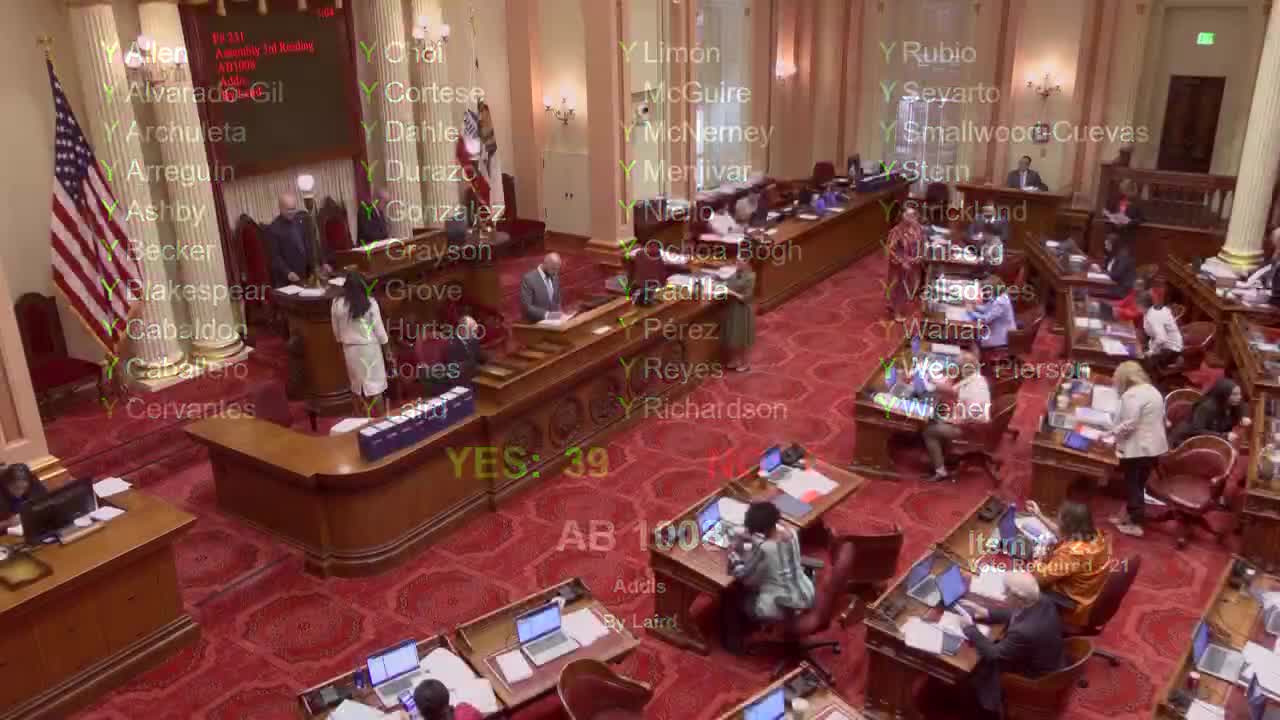 2MIN
Senate Floor
 2MIN
Senate Standing Committee on Local Government
 2MIN
Senate Standing Committee on Housing
 1MIN
Assembly Floor
 2MIN
Assembly Standing Committee on Local Government
 2MIN
Assembly Standing Committee on Housing and Community Development
Bill Author

Bill Co-Author(s):