AB 883: Data brokers: accessible deletion mechanism: deletion of personal information of elected officials and judges.
- Session Year: 2025-2026
- House: Assembly
- Latest Version Date: 2026-09-27
Current Status:
Passed
(2026-09-27: Chaptered by Secretary of State - Chapter 507, Statutes of 2026.)
Introduced
In Committee
Awaiting First Chamber Vote
Passed First Chamber
In Committee
Awaiting Second Chamber Vote
Passed Second Chamber
Enacted
Existing law establishes the California Privacy Protection Agency (CPPA) to enforce various laws protecting the privacy of individuals. If a business knowingly collects and sells to third parties the personal information of a consumer with whom the business does not have a direct relationship, existing law requires the business to register with the CPPA as a data broker, except as specified. Existing law requires the CPPA to establish an accessible deletion mechanism that allows a consumer to request that every data broker delete any personal information related to that consumer held by the data broker or associated service provider or contractor, as prescribed. Existing law requires, beginning August 1, 2026, a data broker to access that deletion mechanism at least once every 45 days and, among other things, process all deletion requests and delete all personal information related to the consumers making the requests, as specified.
This bill would change the above-described 45-day period to a 30-day period and make conforming changes.
This bill would require the Secretary of State, certain local government officials, the Judicial Council, and the State Bar of California to notify any state elected official, local elected official, or judge, as applicable, that the person may submit a request to delete that persons personal information through the above-described accessible deletion mechanism, as prescribed. By imposing additional duties on local government officials, this bill would impose a state-mandated local program.
This bill would authorize the Attorney General, a county counsel, or a city attorney to bring a civil action, on behalf of an elected official or judge, against a data broker who violates certain personal information deletion requirements, as prescribed.
This bill would make its provisions relating to the notice and enforcement of requests for deletion of personal information of elected officials and judges operative on July 1, 2027.
The California Constitution requires the state to reimburse local agencies and school districts for certain costs mandated by the state. Statutory provisions establish procedures for making that reimbursement.
This bill would provide that, if the Commission on State Mandates determines that the bill contains costs mandated by the state, reimbursement for those costs shall be made pursuant to the statutory provisions noted above.
Existing law establishes the California Privacy Protection Agency (CPPA) to enforce various laws protecting the privacy of individuals. If a business knowingly collects and sells to third parties the personal information of a consumer with whom the business does not have a direct relationship, existing law requires the business to register with the CPPA as a data broker, except as specified. Existing law requires the CPPA to establish an accessible deletion mechanism that allows a consumer to request that every data broker delete any personal information related to that consumer held by the data broker or associated service provider or contractor, as prescribed. Existing law requires, beginning August 1, 2026, a data broker to access that deletion mechanism at least once every 45 days and, among other things, process all deletion requests and delete all personal information related to the consumers making the requests, as specified.
This bill would change the above-described 45-day period to a 30-day period and make conforming changes.
This bill would require the Secretary of State, certain local government officials, and the Judicial Council Council, and the State Bar of California to notify any state elected official, local elected official, or judge, as applicable, that the person may submit a request to delete that persons personal information through the above-described accessible deletion mechanism, as prescribed. By imposing additional duties on local government officials, this bill would impose a state-mandated local program.
This bill would authorize an elected official or judge, or the Attorney General, a county counsel, or a city attorney on behalf of that elected official or judge, to bring a civil action action, on behalf of an elected official or judge, against a databroker data broker who violates certain personal information deletion requirements, as prescribed.
This bill would make its provisions relating to the notice and enforcement of requests for deletion of personal information of elected officials and judges operative on July 1, 2027.
The California Constitution requires the state to reimburse local agencies and school districts for certain costs mandated by the state. Statutory provisions establish procedures for making that reimbursement.
This bill would provide that, if the Commission on State Mandates determines that the bill contains costs mandated by the state, reimbursement for those costs shall be made pursuant to the statutory provisions noted above.
Existing law establishes the California Privacy Protection Agency (CPPA) to enforce various laws protecting the privacy of individuals. If a business knowingly collects and sells to third parties the personal information of a consumer with whom the business does not have a direct relationship, existing law requires the business to register with the CPPA as a data broker, except as specified. Existing law requires the CPPA to establish an accessible deletion mechanism that allows a consumer to request that every data broker delete any personal information related to that consumer held by the data broker or associated service provider or contractor, as prescribed. Existing law requires, beginning August 1, 2026, a data broker to access that deletion mechanism at least once every 45 days and, among other things, process all deletion requests and delete all personal information related to the consumers making the requests, as specified.
This bill would change the above-described 45-day period to a 30-day period and make conforming changes.
This bill would create an additional process for the deletion of personal information of state and local government officials and California judges held by data brokers. In this regard, the bill would require the Secretary of State, certain local government officials, and the Judicial Council to provide to the CPPA lists of certain personal information of all notify any state elected officials, all official, local elected officials, official, or all California judges, respectively, and would require elected officials and judges to be provided an opportunity to remove their information from those lists, as prescribed. The bill would require the lists to be kept confidential, as specified. judge, as applicable, that the person may submit a request to delete that persons personal information through the above-described accessible deletion mechanism, as prescribed. By imposing additional duties on local government officials, this bill would impose a state-mandated local program. The bill would require the CPPA to upload the lists to the accessible deletion mechanism described above and would require data brokers to delete that personal information within 10 days.
This bill would authorize an elected official or judge who is on a list described above, judge, or the Attorney General, a county counsel, or a city attorney on behalf of that elected official or judge, to bring a civil action for a violation of the bill, against a databroker who violates certain personal information deletion requirements, as prescribed.
This bill would make its provisions relating to the notice and enforcement of requests for deletion of personal information of elected officials and judges operative on July 1, 2027.
Existing constitutional provisions require that a statute that limits the right of access to the meetings of public bodies or the writings of public officials and agencies be adopted with findings demonstrating the interest protected by the limitation and the need for protecting that interest.This bill would make legislative findings to that effect.The California Constitution requires local agencies, for the purpose of ensuring public access to the meetings of public bodies and the writings of public officials and agencies, to comply with a statutory enactment that amends or enacts laws relating to public records or open meetings and contains findings demonstrating that the enactment furthers the constitutional requirements relating to this purpose.This bill would make legislative findings to that effect.The California Constitution requires the state to reimburse local agencies and school districts for certain costs mandated by the state. Statutory provisions establish procedures for making that reimbursement.
This bill would provide that, if the Commission on State Mandates determines that the bill contains costs mandated by the state, reimbursement for those costs shall be made pursuant to the statutory provisions noted above.
Existing law establishes the California Privacy Protection Agency (CPPA) to enforce various laws protecting the privacy of individuals. If a business knowingly collects and sells to third parties the personal information of a consumer with whom the business does not have a direct relationship, existing law requires the business to register with the CPPA as a data broker, except as specified. Existing law requires the CPPA to establish an accessible deletion mechanism that allows a consumer to request that every data broker delete any personal information related to that consumer held by the data broker or associated service provider or contractor, as prescribed.
This bill would create an additional process for the deletion of personal information of state and local government officials and California judges held by data brokers. In this regard, the bill would require the Secretary of State State, certain local government officials, and the Judicial Council to provide to the agency a list CPPA lists of certain personal information of all state or elected officials, all local elected officials that, if available, includes each officials personal information, as specified, would require the Judicial Council to provide the agency with a list of all California judges, officials, or all California judges, respectively, and would require the agency to allow elected officials or a and judges to be provided an opportunity to remove their information from those lists, as prescribed. The bill would require the lists to be kept confidential, as specified. By imposing additional duties on local government officials, this bill would impose a state-mandated local program. The bill would also require the agency CPPA to upload the lists to the accessible deletion mechanism described above and would require an entity receiving a notification that a deletion is required to do so within 5 days. data brokers to delete that personal information within 10 days.
This bill would authorize an elected official or judge who is on a list described above, the Attorney General, a county counsel, or a city attorney to bring a civil action for a violation of the bill, as prescribed.
This bill would make its provisions operative on July 1, 2027.
Existing constitutional provisions require that a statute that limits the right of access to the meetings of public bodies or the writings of public officials and agencies be adopted with findings demonstrating the interest protected by the limitation and the need for protecting that interest.
This bill would make legislative findings to that effect.
The California Constitution requires local agencies, for the purpose of ensuring public access to the meetings of public bodies and the writings of public officials and agencies, to comply with a statutory enactment that amends or enacts laws relating to public records or open meetings and contains findings demonstrating that the enactment furthers the constitutional requirements relating to this purpose.
This bill would make legislative findings to that effect.
The California Constitution requires the state to reimburse local agencies and school districts for certain costs mandated by the state. Statutory provisions establish procedures for making that reimbursement.
This bill would provide that, if the Commission on State Mandates determines that the bill contains costs mandated by the state, reimbursement for those costs shall be made pursuant to the statutory provisions noted above.
Existing law establishes the California Privacy Protection Agency (CPPA) to enforce various laws protecting the privacy of individuals. If a business knowingly collects and sells to third parties the personal information of a consumer with whom the business does not have a direct relationship, existing law requires the business to register with the CPPA as a data broker, except as specified. Existing law requires the CPPA to establish an accessible deletion mechanism that allows a consumer to request that every data broker delete any personal information related to that consumer held by the data broker or associated service provider or contractor. Existing law requires the accessible deletion mechanism to support the ability of a consumers authorized agents to aid in the deletion request. Existing law requires data brokers to access the accessible deletion mechanism and delete personal information as requested by individuals, and imposes specified deletion procedures. Existing law defines personal information for these purposes, and exempts from this definition, among other things, publicly available information or lawfully obtained, truthful information that is a matter of public concern. contractor, as prescribed.
This bill, on and after January 1, 2028, would require data brokers to delete, and would prohibit data brokers from sharing or selling, protected information about an elected official, a judge, or an immediate family member of an elected official or judge if they or their authorized agent submits to the accessible deletion mechanism a verified deletion request and a threat identification letter, as specified. The bill would require the CPPA to develop a model threat identification letter and to update the accessible deletion mechanism accordingly, as specified. The bill would define protected information to include, among other types of information, an individuals residential address and telephone number. The bill would define threat identification letter to include, among other documents, a police report indicating that the individual has received a threat of intent to cause imminent great bodily harm.This bill would require the Secretary of State to provide to the agency a list of all state or local elected officials that, if available, includes each officials personal information, as specified, would require the Judicial Council to provide the agency with a list of all California judges, and would require the agency to allow elected officials or a judges to remove their information from those lists, as prescribed. The bill would require the lists to be kept confidential, as specified. The bill would also require the agency to upload the lists to the accessible deletion mechanism described above and would require an entity receiving a notification that a deletion is required to do so within 5 days.
This bill would authorize an elected official or judge who is on a list described above, the Attorney General, a county counsel, or a city attorney to bring a civil action for a violation of the bill, as prescribed.
Existing constitutional provisions require that a statute that limits the right of access to the meetings of public bodies or the writings of public officials and agencies be adopted with findings demonstrating the interest protected by the limitation and the need for protecting that interest.
This bill would make legislative findings to that effect.
Existing law establishes the California Privacy Protection Agency (CPPA) to enforce various laws protecting the privacy of individuals. If a business knowingly collects and sells to third parties the personal information of a consumer with whom the business does not have a direct relationship, existing law requires the business to register with the CPPA as a data broker, except as specified. Existing law requires the CPPA to establish an accessible deletion mechanism that allows a consumer to request that every data broker delete any personal information related to that consumer held by the data broker or associated service provider or contractor. Existing law requires the accessible deletion mechanism to support the ability of a consumers authorized agents to aid in the deletion request. Existing law requires data brokers to access the accessible deletion mechanism and delete personal information as requested by individuals, and imposes specified deletion procedures. Existing law defines personal information for these purposes, and exempts from this definition, among other things, publicly available information or lawfully obtained, truthful information that is a matter of public concern.
This bill, on and after January 1, 2028, would require data brokers to delete, and would prohibit data brokers from sharing or selling, protected information about an elected official, a judge, or an immediate family member of an elected official or judge if they or their authorized agent submits to the accessible deletion mechanism a verified deletion request and a threat identification letter, as specified. The bill would require the CPPA to develop a model threat identification letter and to update the accessible deletion mechanism accordingly, as specified. The bill would define protected information to include, among other types of information, an individuals residential address and telephone number. The bill would define threat identification letter to include, among other documents, a police report indicating that the individual has received a threat of intent to cause imminent great bodily harm.
The California Public Records Act requires state and local agencies to make their records available for public inspection, unless an exemption from disclosure applies. That act, among other things, prohibits a state or local agency from publicly posting the home address, telephone number, or both the name and assessor parcel number associated with the home address of any elected or appointed official on the internet without first obtaining the written permission of that individual. The act also makes it a misdemeanor for a person to knowingly post the home address or telephone number of any elected or appointed official, or of the officials residing spouse or child, on the internet, knowing that person is an elected or appointed official and intending to cause imminent great bodily harm or threatening to cause imminent great bodily harm, as provided.The act additionally prohibits a person, business, or association from soliciting, selling, or trading on the internet the home address or telephone number of an elected or appointed official with the intent to cause imminent great bodily harm to the official or to any person residing at the officials home address. The act further prohibits a person, business, or association from publicly posting or publicly displaying on the internet the home address or telephone number of any elected or appointed official if that official has made a written demand of that person, business, or association to not disclose the officials home address or telephone number.This bill would remove the references in those provisions to the home address, telephone number, name, and assessors parcel number, and instead prohibit the disclosure of protected information under those provisions. The bill would define the term protected information to include, among other things, an individuals residential address, telephone number, social security number, or drivers license number. The bill would also remove the requirement that the information be disclosed on the internet for purposes of those provisions. By imposing new duties on local agencies and expanding the definition of a crime, the bill would impose a state-mandated local program.This bill would expand the prohibition against publicly posting or publicly displaying the protected information if a written demand has been made to also include a prohibition against selling the protected information and would expand the provisions relating to the written demand to also apply to a verifiable consumer request, as defined. The bill would make related changes.This bill would provide that, for purposes of specified provisions described above and certain enforcement provisions, the protections and rights granted to an elected or appointed official extends to an immediate family member of the official who resides with the official, except as specified.The California Constitution requires local agencies, for the purpose of ensuring public access to the meetings of public bodies and the writings of public officials and agencies, to comply with a statutory enactment that amends or enacts laws relating to public records or open meetings and contains findings demonstrating that the enactment furthers the constitutional requirements relating to this purpose.This bill would make legislative findings to that effect.Existing constitutional provisions require that a statute that limits the right of access to the meetings of public bodies or the writings of public officials and agencies be adopted with findings demonstrating the interest protected by the limitation and the need for protecting that interest.This bill would make legislative findings to that effect.The California Constitution requires the state to reimburse local agencies and school districts for certain costs mandated by the state. Statutory provisions establish procedures for making that reimbursement.This bill would provide that with regard to certain mandates no reimbursement is required by this act for a specified reason.With regard to any other mandates, this bill would provide that, if the Commission on State Mandates determines that the bill contains costs so mandated by the state, reimbursement for those costs shall be made pursuant to the statutory provisions noted above.The California Public Records Act requires state and local agencies to make their records available for public inspection, unless an exemption from disclosure applies. That act act, among other things, prohibits a state or local agency from publicly posting the home address, telephone number, or both the name and assessor parcel number associated with the home address of any elected or appointed official on the internet without first obtaining the written permission of that individual. The act also makes it a misdemeanor for a person to knowingly post the home address or telephone number of any elected or appointed official, or of the officials residing spouse or child, on the internet, knowing that person is an elected or appointed official and intending to cause imminent great bodily harm or threatening to cause imminent great bodily harm, as provided.
This bill would make nonsubstantive changes to that provision.The act additionally prohibits a person, business, or association from soliciting, selling, or trading on the internet the home address or telephone number of an elected or appointed official with the intent to cause imminent great bodily harm to the official or to any person residing at the officials home address. The act further prohibits a person, business, or association from publicly posting or publicly displaying on the internet the home address or telephone number of any elected or appointed official if that official has made a written demand of that person, business, or association to not disclose the officials home address or telephone number.
This bill would remove the references in those provisions to the home address, telephone number, name, and assessors parcel number, and instead prohibit the disclosure of protected information under those provisions. The bill would define the term protected information to include, among other things, an individuals residential address, telephone number, social security number, or drivers license number. The bill would also remove the requirement that the information be disclosed on the internet for purposes of those provisions. By imposing new duties on local agencies and expanding the definition of a crime, the bill would impose a state-mandated local program.
This bill would expand the prohibition against publicly posting or publicly displaying the protected information if a written demand has been made to also include a prohibition against selling the protected information and would expand the provisions relating to the written demand to also apply to a verifiable consumer request, as defined. The bill would make related changes.
This bill would provide that, for purposes of specified provisions described above and certain enforcement provisions, the protections and rights granted to an elected or appointed official extends to an immediate family member of the official who resides with the official, except as specified.
The California Constitution requires local agencies, for the purpose of ensuring public access to the meetings of public bodies and the writings of public officials and agencies, to comply with a statutory enactment that amends or enacts laws relating to public records or open meetings and contains findings demonstrating that the enactment furthers the constitutional requirements relating to this purpose.
This bill would make legislative findings to that effect.
Existing constitutional provisions require that a statute that limits the right of access to the meetings of public bodies or the writings of public officials and agencies be adopted with findings demonstrating the interest protected by the limitation and the need for protecting that interest.
This bill would make legislative findings to that effect.
The California Constitution requires the state to reimburse local agencies and school districts for certain costs mandated by the state. Statutory provisions establish procedures for making that reimbursement.
This bill would provide that with regard to certain mandates no reimbursement is required by this act for a specified reason.
With regard to any other mandates, this bill would provide that, if the Commission on State Mandates determines that the bill contains costs so mandated by the state, reimbursement for those costs shall be made pursuant to the statutory provisions noted above.
The California Public Records Act requires state and local agencies to make their records available for public inspection, unless an exemption from disclosure applies. That act prohibits a state or local agency from publicly posting the home address, telephone number, or both the name and assessor parcel number associated with the home address of any elected or appointed official on the internet without first obtaining the written permission of that individual.
This bill would make nonsubstantive changes to that provision.
(a)By January 1, 2026, the California Privacy Protection Agency shall establish an accessible deletion mechanism that does all of the following:
(1)Implements and maintains reasonable security procedures and practices, including, but not limited to, administrative, physical, and technical safeguards appropriate to the nature of the information and the purposes for which the personal information will be used and to protect consumers personal information from unauthorized use, disclosure, access, destruction, or modification.
(2)Allows a consumer, through a single verifiable consumer request, to request that every data broker that maintains any personal information delete any personal information related to that consumer held by the data broker or an associated service provider or contractor.
(3)Allows a consumer to selectively exclude specific data brokers from a request made under paragraph (2).
(4)Allows a consumer to make a request to alter a previous request made under this subdivision after at least 45 days have passed since the consumer last made a request under this subdivision.
(b)The accessible deletion mechanism established pursuant to subdivision (a) shall meet all of the following requirements:
(1)The accessible deletion mechanism shall allow a consumer to request the deletion of all personal information related to that consumer through a single deletion request.
(2)The accessible deletion mechanism shall permit a consumer to securely submit information in one or more privacy-protecting ways determined by the California Privacy Protection Agency to aid in the deletion request.
(3)The accessible deletion mechanism shall allow data brokers registered with the California Privacy Protection Agency to determine whether an individual has submitted a verifiable consumer request to delete the personal information related to that consumer as described in paragraph (1) and shall not allow the disclosure of any additional personal information when the data broker accesses the accessible deletion mechanism unless otherwise specified in this title.
(4)The accessible deletion mechanism shall allow a consumer to make a request described in paragraph (1) using an internet service operated by the California Privacy Protection Agency.
(5)The accessible deletion mechanism shall not charge a consumer to make a request described in paragraph (1).
(6)The accessible deletion mechanism shall allow a consumer to make a request described in paragraph (1) in any language spoken by any consumer for whom personal information has been collected by data brokers.
(7)The accessible deletion mechanism shall be readily accessible and usable by consumers with disabilities.
(8)The accessible deletion mechanism shall support the ability of a consumers authorized agents to aid in the deletion request.
(9)The accessible deletion mechanism shall allow the consumer, or their authorized agent, to verify the status of the consumers deletion request.
(10)The accessible deletion mechanism shall provide a description of all of the following:
(A)The deletion permitted by this section, including, but not limited to, the actions required by subdivisions (c) and (d).
(B)The process for submitting a deletion request pursuant to this section.
(C)Examples of the types of information that may be deleted.
(c)(1)Beginning August 1, 2026, a data broker shall access the accessible deletion mechanism established pursuant to subdivision (a) at least once every 30 days and do all of the following:
(A)Within 30 days after receiving a request made pursuant to this section, process all deletion requests made pursuant to this section and delete all personal information related to the consumers making the requests consistent with the requirements of this section.
(B)If a data broker denies a consumer request to delete under this title because the request cannot be verified, process the request as an opt-out of the sale or sharing of the consumers personal information, as provided for under Section 1798.120 and limited by Sections 1798.105, 1798.145, and 1798.146, within 30 days of receiving the request.
(C)Direct all service providers or contractors associated with the data broker to delete all personal information in their possession related to the consumers making the requests described in subparagraph (A).
(D)Direct all service providers or contractors associated with the data broker to process a request described by subparagraph (B) as an opt-out of the sale or sharing of the consumers personal information, as provided for under Section 1798.120 and limited by Sections 1798.105, 1798.145, and 1798.146.
(2)Notwithstanding paragraph (1), a data broker shall not be required to delete a consumers personal information if either of the following apply:
(A)It is reasonably necessary for the data broker to maintain the personal information to fulfill a purpose described in subdivision (d) of Section 1798.105.
(B)The deletion is not required pursuant to Section 1798.145 or 1798.146.
(3)Personal information described in paragraph (2) shall only be used for the purposes described in paragraph (2) and shall not be used or disclosed for any other purpose, including, but not limited to, marketing purposes.
(d)(1)Beginning August 1, 2026, after a consumer has submitted a deletion request and a data broker has deleted the consumers data pursuant to this section, the data broker shall delete all personal information of the consumer at least once every 30 days pursuant to this section unless the consumer requests otherwise or the deletion is not required pursuant to paragraph (2) of subdivision (c).
(2)Beginning August 1, 2026, after a consumer has submitted a deletion request and a data broker has deleted the consumers data pursuant to this section, the data broker shall not sell or share new personal information of the consumer unless the consumer requests otherwise or selling or sharing the personal information is permitted under Section 1798.145 or 1798.146.
(e)(1)Beginning January 1, 2028, and every three years thereafter, a data broker shall undergo an audit by an independent third party to determine compliance with this section.
(2)For an audit completed pursuant to paragraph (1), the data broker shall submit a report resulting from the audit and any related materials to the California Privacy Protection Agency within five business days of a written request from the California Privacy Protection Agency.
(3)A data broker shall maintain the report and materials described in paragraph (2) for at least six years.
(f)(1)The California Privacy Protection Agency may charge an access fee to a data broker when the data broker accesses the accessible deletion mechanism pursuant to subdivision (c) that does not exceed the reasonable costs of providing that access.
(2)A fee collected by the California Privacy Protection Agency pursuant to paragraph (1) shall be deposited in the Data Brokers Registry Fund.
SEC. 2.Section 1798.99.86.5 is added to the Civil Code, to read:1798.99.86.5.(a)(1)The Secretary of State shall notify any state elected official that the elected official may submit a request to delete that persons personal information pursuant to Section 1798.99.86 through the accessible deletion mechanism described in Section 1798.99.86.
(2)A filing officer, as defined in Section 82027 of the Government Code, for a local government shall notify any local elected official within the filing officers jurisdiction that the elected official may submit a request to delete that persons personal information pursuant to Section 1798.99.86 through the accessible deletion mechanism described in Section 1798.99.86.
(3)Following the certification of a final election, the Secretary of State and any filing officer for a local government shall comply with paragraph (1) or (2), as applicable, with respect to each newly elected official within their respective jurisdictions.
(b)(1)The Judicial Council shall notify any California judge, other than a State Bar Court judge, that the judge may submit a request to delete the judges personal information pursuant to Section 1798.99.86 through the accessible deletion mechanism described in Section 1798.99.86.
(2)The Judicial Council shall comply with paragraph (1) after the appointment or election of any additional judge with respect to that judge.
(c)(1)The State Bar of California shall notify each State Bar Court judge that the judge may submit a request to delete the judges personal information through the accessible deletion mechanism described in Section 1798.99.86.
(2)Upon the appointment of any additional State Bar Court judge, the State Bar of California shall provide the notification required by paragraph (1) to that judge.
(d)(1)The California Privacy Protection Agency shall create informational material detailing how state and local elected officials and judges can utilize the accessible deletion mechanism described in Section 1798.99.86.
(2)Upon the creation of the informational material required by paragraph (1), the California Privacy Protection Agency shall communicate the informational material to the Secretary of State, filing officers, the State Bar of California, and the Judicial Council.
(3)The Secretary of State, filing officers, the State Bar of California, and the Judicial Council may comply with the notice requirements of this section by providing the informational material required by paragraph (1) to elected officials and judges.
(e)The deletion of personal information under this section shall be subject to the limitations provided in Sections 1798.105, 1798.145, and 1798.146.
(f)A data broker shall process a deletion request received pursuant to this section by complying with Section 1798.99.86 and its implementing regulations.
The Attorney General, a county counsel, or a city attorney may bring a civil action, on behalf of a judge or elected official, against a data broker who violates Section 1798.99.86 with respect to the personal information of that judge or elected official for any of the following relief:
(1)Declaratory relief.
(2)Injunctive relief.
(3)Reasonable attorneys fees.
(4)Actual damages.
(g)In addition to the other relief provided under this section, if a court finds that a data broker willfully violated Section 1798.99.86 with respect to the personal information of a judge or elected official notified pursuant to this section, the court may award punitive damages.
(h)For purposes of this section, judge means a superior court judge, appellate justice, justice of the Supreme Court, or State Bar Court judge.
(i)This section shall become operative on July 1, 2027.
SEC. 3.If the Commission on State Mandates determines that this act contains costs mandated by the state, reimbursement to local agencies and school districts for those costs shall be made pursuant to Part 7 (commencing with Section 17500) of Division 4 of Title 2 of the Government Code.
(a)By January 1, 2026, the California Privacy Protection Agency shall establish an accessible deletion mechanism that does all of the following:
(1)Implements and maintains reasonable security procedures and practices, including, but not limited to, administrative, physical, and technical safeguards appropriate to the nature of the information and the purposes for which the personal information will be used and to protect consumers personal information from unauthorized use, disclosure, access, destruction, or modification.
(2)Allows a consumer, through a single verifiable consumer request, to request that every data broker that maintains any personal information delete any personal information related to that consumer held by the data broker or an associated service provider or contractor.
(3)Allows a consumer to selectively exclude specific data brokers from a request made under paragraph (2).
(4)Allows a consumer to make a request to alter a previous request made under this subdivision after at least 45 days have passed since the consumer last made a request under this subdivision.
(b)The accessible deletion mechanism established pursuant to subdivision (a) shall meet all of the following requirements:
(1)The accessible deletion mechanism shall allow a consumer to request the deletion of all personal information related to that consumer through a single deletion request.
(2)The accessible deletion mechanism shall permit a consumer to securely submit information in one or more privacy-protecting ways determined by the California Privacy Protection Agency to aid in the deletion request.
(3)The accessible deletion mechanism shall allow data brokers registered with the California Privacy Protection Agency to determine whether an individual has submitted a verifiable consumer request to delete the personal information related to that consumer as described in paragraph (1) and shall not allow the disclosure of any additional personal information when the data broker accesses the accessible deletion mechanism unless otherwise specified in this title.
(4)The accessible deletion mechanism shall allow a consumer to make a request described in paragraph (1) using an internet service operated by the California Privacy Protection Agency.
(5)The accessible deletion mechanism shall not charge a consumer to make a request described in paragraph (1).
(6)The accessible deletion mechanism shall allow a consumer to make a request described in paragraph (1) in any language spoken by any consumer for whom personal information has been collected by data brokers.
(7)The accessible deletion mechanism shall be readily accessible and usable by consumers with disabilities.
(8)The accessible deletion mechanism shall support the ability of a consumers authorized agents to aid in the deletion request.
(9)The accessible deletion mechanism shall allow the consumer, or their authorized agent, to verify the status of the consumers deletion request.
(10)The accessible deletion mechanism shall provide a description of all of the following:
(A)The deletion permitted by this section, including, but not limited to, the actions required by subdivisions (c) and (d).
(B)The process for submitting a deletion request pursuant to this section.
(C)Examples of the types of information that may be deleted.
(c)(1)Beginning August 1, 2026, a data broker shall access the accessible deletion mechanism established pursuant to subdivision (a) at least once every 30 days and do all of the following:
(A)Within 30 days after receiving a request made pursuant to this section, process all deletion requests made pursuant to this section and delete all personal information related to the consumers making the requests consistent with the requirements of this section.
(B)If a data broker denies a consumer request to delete under this title because the request cannot be verified, process the request as an opt-out of the sale or sharing of the consumers personal information, as provided for under Section 1798.120 and limited by Sections 1798.105, 1798.145, and 1798.146, within 30 days of receiving the request.
(C)Direct all service providers or contractors associated with the data broker to delete all personal information in their possession related to the consumers making the requests described in subparagraph (A).
(D)Direct all service providers or contractors associated with the data broker to process a request described by subparagraph (B) as an opt-out of the sale or sharing of the consumers personal information, as provided for under Section 1798.120 and limited by Sections 1798.105, 1798.145, and 1798.146.
(2)Notwithstanding paragraph (1), a data broker shall not be required to delete a consumers personal information if either of the following apply:
(A)It is reasonably necessary for the data broker to maintain the personal information to fulfill a purpose described in subdivision (d) of Section 1798.105.
(B)The deletion is not required pursuant to Section 1798.145 or 1798.146.
(3)Personal information described in paragraph (2) shall only be used for the purposes described in paragraph (2) and shall not be used or disclosed for any other purpose, including, but not limited to, marketing purposes.
(d)(1)Beginning August 1, 2026, after a consumer has submitted a deletion request and a data broker has deleted the consumers data pursuant to this section, the data broker shall delete all personal information of the consumer at least once every 30 days pursuant to this section unless the consumer requests otherwise or the deletion is not required pursuant to paragraph (2) of subdivision (c).
(2)Beginning August 1, 2026, after a consumer has submitted a deletion request and a data broker has deleted the consumers data pursuant to this section, the data broker shall not sell or share new personal information of the consumer unless the consumer requests otherwise or selling or sharing the personal information is permitted under Section 1798.145 or 1798.146.
(e)(1)Beginning January 1, 2028, and every three years thereafter, a data broker shall undergo an audit by an independent third party to determine compliance with this section.
(2)For an audit completed pursuant to paragraph (1), the data broker shall submit a report resulting from the audit and any related materials to the California Privacy Protection Agency within five business days of a written request from the California Privacy Protection Agency.
(3)A data broker shall maintain the report and materials described in paragraph (2) for at least six years.
(f)(1)The California Privacy Protection Agency may charge an access fee to a data broker when the data broker accesses the accessible deletion mechanism pursuant to subdivision (c) that does not exceed the reasonable costs of providing that access.
(2)A fee collected by the California Privacy Protection Agency pursuant to paragraph (1) shall be deposited in the Data Brokers Registry Fund.
SEC. 2.Section 1798.99.86.5 is added to the Civil Code, to read:1798.99.86.5.(a)(1)The Secretary of State shall notify any state elected official that the elected official may submit a request to delete that persons personal information pursuant to Section 1798.99.86 through the accessible deletion mechanism described in Section 1798.99.86.
(2)A filing officer, as defined in Section 82027 of the Government Code, for a local government shall notify any local elected official within the filing officers jurisdiction that the elected official may submit a request to delete that persons personal information pursuant to Section 1798.99.86 through the accessible deletion mechanism described in Section 1798.99.86.
(3)Following the certification of a final election, the Secretary of State and any filing officer for a local government shall comply with paragraph (1) or (2), as applicable, with respect to each newly elected official within their respective jurisdictions.
(b)(1)The Judicial Council shall notify any California judge judge, other than a State Bar Court judge, that the judge may submit a request to delete the judges personal information pursuant to Section 1798.99.86 through the accessible deletion mechanism described in Section 1798.99.86.
(2)The Judicial Council shall comply with paragraph (1) after the appointment or election of any additional judge with respect to that judge.
(c)(1)The State Bar of California shall notify each State Bar Court judge that the judge may submit a request to delete the judges personal information through the accessible deletion mechanism described in Section 1798.99.86.
(2)Upon the appointment of any additional State Bar Court judge, the State Bar of California shall provide the notification required by paragraph (1) to that judge.
(c)(d)(1)The California Privacy Protection Agency shall create informational material detailing how state and local elected officials and judges can utilize the accessible deletion mechanism described in Section 1798.99.86.
(2)Upon the creation of the informational material required by paragraph (1), the California Privacy Protection Agency shall communicate the informational material to the Secretary of State, filing officers, officers, the State Bar of California, and the Judicial Council.
(3)The Secretary of State, filing officers, officers, the State Bar of California, and the Judicial Council may comply with the notice requirements of this section by providing the informational material required by paragraph (1) to elected officials and judges.
(d)(e)The deletion of personal information under this section shall be subject to the limitations provided in Sections 1798.105, 1798.145, and 1798.146.
(e)(f)A data broker shall process a deletion request received pursuant to this section by complying with Section 1798.99.86 and its implementing regulations.
(f)An elected official or judge who was notified pursuant to this section, or theThe Attorney General, a county counsel, or a city attorney on behalf of that elected official or judge, may bring a civil action action, on behalf of a judge or elected official, against a data broker who violates Section 1798.99.86 with respect to the personal information of that judge or elected official for any of the following relief:
(1)Declaratory relief.
(2)Injunctive relief.
(3)Reasonable attorneys fees.
(4)Actual damages.
(g)(g)In addition to the other relief provided under this section, if a court finds that a data broker willfully violated Section 1798.99.86 with respect to the personal information of a judge or elected official notified pursuant to this section, the court may award punitive damages.
(h)(h)For purposes of this section, judge means a superior court judge, appellate justice, or justice of the Supreme Court. Court, or State Bar Court judge.
(i)(i)This section shall become operative on July 1, 2027.
SEC. 3.If the Commission on State Mandates determines that this act contains costs mandated by the state, reimbursement to local agencies and school districts for those costs shall be made pursuant to Part 7 (commencing with Section 17500) of Division 4 of Title 2 of the Government Code.
(a)By January 1, 2026, the California Privacy Protection Agency shall establish an accessible deletion mechanism that does all of the following:
(1)Implements and maintains reasonable security procedures and practices, including, but not limited to, administrative, physical, and technical safeguards appropriate to the nature of the information and the purposes for which the personal information will be used and to protect consumers personal information from unauthorized use, disclosure, access, destruction, or modification.
(2)Allows a consumer, through a single verifiable consumer request, to request that every data broker that maintains any personal information delete any personal information related to that consumer held by the data broker or an associated service provider or contractor.
(3)Allows a consumer to selectively exclude specific data brokers from a request made under paragraph (2).
(4)Allows a consumer to make a request to alter a previous request made under this subdivision after at least 45 days have passed since the consumer last made a request under this subdivision.
(b)The accessible deletion mechanism established pursuant to subdivision (a) shall meet all of the following requirements:
(1)The accessible deletion mechanism shall allow a consumer to request the deletion of all personal information related to that consumer through a single deletion request.
(2)The accessible deletion mechanism shall permit a consumer to securely submit information in one or more privacy-protecting ways determined by the California Privacy Protection Agency to aid in the deletion request.
(3)The accessible deletion mechanism shall allow data brokers registered with the California Privacy Protection Agency to determine whether an individual has submitted a verifiable consumer request to delete the personal information related to that consumer as described in paragraph (1) and shall not allow the disclosure of any additional personal information when the data broker accesses the accessible deletion mechanism unless otherwise specified in this title.
(4)The accessible deletion mechanism shall allow a consumer to make a request described in paragraph (1) using an internet service operated by the California Privacy Protection Agency.
(5)The accessible deletion mechanism shall not charge a consumer to make a request described in paragraph (1).
(6)The accessible deletion mechanism shall allow a consumer to make a request described in paragraph (1) in any language spoken by any consumer for whom personal information has been collected by data brokers.
(7)The accessible deletion mechanism shall be readily accessible and usable by consumers with disabilities.
(8)The accessible deletion mechanism shall support the ability of a consumers authorized agents to aid in the deletion request.
(9)The accessible deletion mechanism shall allow the consumer, or their authorized agent, to verify the status of the consumers deletion request.
(10)The accessible deletion mechanism shall provide a description of all of the following:
(A)The deletion permitted by this section, including, but not limited to, the actions required by subdivisions (c) and (d).
(B)The process for submitting a deletion request pursuant to this section.
(C)Examples of the types of information that may be deleted.
(c)(1)Beginning August 1, 2026, a data broker shall access the accessible deletion mechanism established pursuant to subdivision (a) at least once every 45 30 days and do all of the following:
(A)Within 45 30 days after receiving a request made pursuant to this section, process all deletion requests made pursuant to this section and delete all personal information related to the consumers making the requests consistent with the requirements of this section.
(B)In cases where If a data broker denies a consumer request to delete under this title because the request cannot be verified, process the request as an opt-out of the sale or sharing of the consumers personal information, as provided for under Section 1798.120 and limited by Sections 1798.105, 1798.145, and 1798.146, within 45 30 days of receiving the request.
(C)Direct all service providers or contractors associated with the data broker to delete all personal information in their possession related to the consumers making the requests described in subparagraph (A).
(D)Direct all service providers or contractors associated with the data broker to process a request described by subparagraph (B) as an opt-out of the sale or sharing of the consumers personal information, as provided for under Section 1798.120 and limited by Sections 1798.105, 1798.145, and 1798.146.
(2)Notwithstanding paragraph (1), a data broker shall not be required to delete a consumers personal information if either of the following apply:
(A)It is reasonably necessary for the data broker to maintain the personal information to fulfill a purpose described in subdivision (d) of Section 1798.105.
(B)The deletion is not required pursuant to Section 1798.145 or 1798.146.
(3)Personal information described in paragraph (2) shall only be used for the purposes described in paragraph (2) and shall not be used or disclosed for any other purpose, including, but not limited to, marketing purposes.
(d)(1)Beginning August 1, 2026, after a consumer has submitted a deletion request and a data broker has deleted the consumers data pursuant to this section, the data broker shall delete all personal information of the consumer at least once every 45 30 days pursuant to this section unless the consumer requests otherwise or the deletion is not required pursuant to paragraph (2) of subdivision (c).
(2)Beginning August 1, 2026, after a consumer has submitted a deletion request and a data broker has deleted the consumers data pursuant to this section, the data broker shall not sell or share new personal information of the consumer unless the consumer requests otherwise or selling or sharing the personal information is permitted under Section 1798.145 or 1798.146.
(e)(1)Beginning January 1, 2028, and every three years thereafter, a data broker shall undergo an audit by an independent third party to determine compliance with this section.
(2)For an audit completed pursuant to paragraph (1), the data broker shall submit a report resulting from the audit and any related materials to the California Privacy Protection Agency within five business days of a written request from the California Privacy Protection Agency.
(3)A data broker shall maintain the report and materials described in paragraph (2) for at least six years.
(f)(1)The California Privacy Protection Agency may charge an access fee to a data broker when the data broker accesses the accessible deletion mechanism pursuant to subdivision (c) that does not exceed the reasonable costs of providing that access.
(2)A fee collected by the California Privacy Protection Agency pursuant to paragraph (1) shall be deposited in the Data Brokers Registry Fund.
SECTION 1.SEC. 2.Section 1798.99.86.5 is added to the Civil Code, to read:1798.99.86.5.(a)(1)(A)The Secretary of State shall provide to the California Privacy Protection Agency a list of all notify any state elected officials that, if available, includes each officials personal information. official that the elected official may submit a request to delete that persons personal information pursuant to Section 1798.99.86 through the accessible deletion mechanism described in Section 1798.99.86.
(B)(2)A filing officer, as defined in Section 82027 of the Government Code, for a local government shall provide to the California Privacy Protection Agency a list of all notify any local elected officials official within the filing officers jurisdiction that, if available, includes each officials personal information. that the elected official may submit a request to delete that persons personal information pursuant to Section 1798.99.86 through the accessible deletion mechanism described in Section 1798.99.86.
(2)Following the certification of a final election, the Secretary of State and any filing officer for a local government shall provide to the California Privacy Protection Agency a list of elected officials that includes the personal information provided pursuant to paragraph (1).(3)The California Privacy Protection Agency shall provide each elected official an opportunity to request that the elected officials name and profile data be removed from the list.(4)(3)Following the certification of a final election, the Secretary of State, State and any filing officer for a local government, and the California Privacy Protection Agency government shall comply with paragraphs paragraph (1) to (3), inclusive, or (2), as applicable, with respect to each newly elected official within their respective jurisdictions.
(b)(1)The Judicial Council shall provide the California Privacy Protection Agency with a list of all notify any California judges, which shall serve as each judges judge that the judge may submit a request to delete the judges personal information pursuant to paragraph (1) of subdivision (b) of Section 1798.99.86. The list shall include each judges name and other profile data, as defined by the California Privacy Protection Agency, that has been shared voluntarily by the judge. 1798.99.86 through the accessible deletion mechanism described in Section 1798.99.86.
(2)Before providing the list to the California Privacy Protection Agency, the Judicial Council shall provide each judge an opportunity to request that the judges personal information be removed from the list. The list submitted to the California Privacy Protection Agency shall include only those judges that did not request to be removed from the list.(3)(2)The Judicial Council shall provide an updated list comply with paragraph (1) after the appointment or election of any additional judge. judge with respect to that judge.
(c)(1)After receipt of the lists required by this section, the California Privacy Protection Agency shall upload the lists required by this section to the accessible deletion mechanism established pursuant to Section 1798.99.86.(2)(A)Notwithstanding subparagraph (A) of paragraph (1) of subdivision (c) of Section 1798.99.86, an entity required to delete, pursuant to Section 1798.99.86, the personal information of a person on a list uploaded pursuant to paragraph (1) shall delete that personal information within 10 days.(c)(1)The California Privacy Protection Agency shall create informational material detailing how state and local elected officials and judges can utilize the accessible deletion mechanism described in Section 1798.99.86.
(2)Upon the creation of the informational material required by paragraph (1), the California Privacy Protection Agency shall communicate the informational material to the Secretary of State, filing officers, and the Judicial Council.
(3)The Secretary of State, filing officers, and the Judicial Council may comply with the notice requirements of this section by providing the informational material required by paragraph (1) to elected officials and judges.
(B)(d)The deletion of personal information under this paragraph section shall be subject to the limitations provided in Sections 1798.105, 1798.145, and 1798.146.
(d)Any information shared pursuant to this section shall be shared in a secure and confidential exchange. The lists and the information in the lists shall be confidential and not subject to disclosure under the California Public Records Act (Division 10 (commencing with Section 7920.000) of Title 1 of the Government Code).(e)A data broker shall process a deletion request received pursuant to this section by complying with Section 1798.99.86 and its implementing regulations.
(e)(f)An elected official or judge who is on a list described in subdivision (a) or (b), was notified pursuant to this section, or the Attorney General, a county counsel, or a city attorney on behalf of that elected official or judge, may bring a civil action for a violation of this section against a data broker who violates Section 1798.99.86 with respect to the personal information of that judge or elected official for any of the following relief:
(1)Declaratory relief.
(2)Injunctive relief.
(3)Reasonable attorneys fees.
(4)Actual damages.
(f)(g)In addition to the other relief provided under this section, if a court finds that an entity a data broker willfully refused to provide for deletion as required under this section, violated Section 1798.99.86 with respect to the personal information of a judge or elected official notified pursuant to this section, the court may award punitive damages.
(h)For purposes of this section, judge means a superior court judge, appellate justice, or justice of the Supreme Court.
(g)(i)This section shall become operative on July 1, 2027.
SEC. 2. The Legislature finds and declares that Section 1 of this act, which adds Section 1798.99.86.5 to the Civil Code, imposes a limitation on the publics right of access to the meetings of public bodies or the writings of public officials and agencies within the meaning of Section 3 of Article I of the California Constitution. Pursuant to that constitutional provision, the Legislature makes the following findings to demonstrate the interest protected by this limitation and the need for protecting that interest:In order to protect the confidential and private information of an elected official or judge, it is necessary that this act limit the publics right of access to that information.SEC. 3.The Legislature finds and declares that Section 1 of this act, which adds Section 1798.99.86.5 to the Civil Code, furthers, within the meaning of paragraph (7) of subdivision (b) of Section 3 of Article I of the California Constitution, the purposes of that constitutional section as it relates to the right of public access to the meetings of local public bodies or the writings of local public officials and local agencies. Pursuant to paragraph (7) of subdivision (b) of Section 3 of Article I of the California Constitution, the Legislature makes the following findings:In order to protect the confidential and private information of local elected government officials, it is necessary that this act limit the publics right of access to that information.SEC. 4.SEC. 3.If the Commission on State Mandates determines that this act contains costs mandated by the state, reimbursement to local agencies and school districts for those costs shall be made pursuant to Part 7 (commencing with Section 17500) of Division 4 of Title 2 of the Government Code.
(a)(1)(A)The Secretary of State shall provide to the California Privacy Protection Agency a list of all state or local elected officials that, if available, includes each officials personal information, including business and residential address, personal and business phone numbers, email addresses, full name, and any other personal identifying information.
(B)A filing officer, as defined in Section 82027 of the Government Code, for a local government shall provide to the California Privacy Protection Agency a list of all local elected officials within the filing officers jurisdiction that, if available, includes each officials personal information.
(2)Following the certification of a final election, the Secretary of State and any filing officer for a local government shall provide to the California Privacy Protection Agency a list of elected officials that includes the personal information provided pursuant to paragraph (1).
(3)The California Privacy Protection Agency shall provide each elected official an opportunity to request that the elected officials name and profile data be removed from the list.
(4)Following the certification of a final election, the Secretary of State State, any filing officer for a local government, and the California Privacy Protection Agency shall comply with paragraphs (1) to (3), inclusive, with respect to each newly elected official. official within their respective jurisdictions.
(b)(1)The Judicial Council shall provide the California Privacy Protection Agency with a list of all California judges, which shall serve as each judges request to delete the judges personal information pursuant to paragraph (1) of subdivision (b) of Section 1798.99.86. The list shall include each judges name and other profile data, as defined by the California Privacy Protection Agency, that has been shared voluntarily by the judge.
(2)Before providing the list to the California Privacy Protection Agency, the Judicial Council shall provide each judge an opportunity to request that the judges name and profile data personal information be removed from the list. The list submitted to the California Privacy Protection Agency shall include only those judges that did not request to be removed from the list.
(3)The Judicial Council shall provide an updated list after the appointment or election of any additional judge.
(c)(1)After receipt of the lists required by this section, the California Privacy Protection Agency shall upload the lists required by this section to the accessible deletion mechanism established pursuant to Section 1798.99.86.
(2)An entity receiving a notification that a deletion is required shall execute the deletion within five days.(2)(A)Notwithstanding subparagraph (A) of paragraph (1) of subdivision (c) of Section 1798.99.86, an entity required to delete, pursuant to Section 1798.99.86, the personal information of a person on a list uploaded pursuant to paragraph (1) shall delete that personal information within 10 days.
(B)The deletion of personal information under this paragraph shall be subject to the limitations provided in Sections 1798.105, 1798.145, and 1798.146.
(d)Any information shared pursuant to this section shall be shared in a secure and confidential exchange. The lists and the information in the lists shall be confidential and not subject to disclosure under the California Public Records Act (Division 10 (commencing with Section 7920.000) of Title 1 of the Government Code).
(e)An elected official or judge who is on a list described in subdivision (a) or (b), the Attorney General, a county counsel, or a city attorney may bring a civil action for a violation of this section for any of the following relief:
(1)Declaratory relief.
(2)Injunctive relief.
(3)Reasonable attorneys fees.
(4)Actual damages.
(f)In addition to the other relief provided under this section, if a court finds that an entity willfully refused to provide for deletion as required under this section, the court may award punitive damages.
(g)This section shall become operative on July 1, 2027.
SEC. 2.The Legislature finds and declares that Section 1 of this act, which adds Section 1798.99.86.5 to the Civil Code, imposes a limitation on the publics right of access to the meetings of public bodies or the writings of public officials and agencies within the meaning of Section 3 of Article I of the California Constitution. Pursuant to that constitutional provision, the Legislature makes the following findings to demonstrate the interest protected by this limitation and the need for protecting that interest:
In order to protect the confidential and private information of an elected official or judge, it is necessary that this act limit the publics right of access to that information.
SEC. 3.The Legislature finds and declares that Section 1 of this act, which adds Section 1798.99.86.5 to the Civil Code, furthers, within the meaning of paragraph (7) of subdivision (b) of Section 3 of Article I of the California Constitution, the purposes of that constitutional section as it relates to the right of public access to the meetings of local public bodies or the writings of local public officials and local agencies. Pursuant to paragraph (7) of subdivision (b) of Section 3 of Article I of the California Constitution, the Legislature makes the following findings:
In order to protect the confidential and private information of local elected government officials, it is necessary that this act limit the publics right of access to that information.
SEC. 4.If the Commission on State Mandates determines that this act contains costs mandated by the state, reimbursement to local agencies and school districts for those costs shall be made pursuant to Part 7 (commencing with Section 17500) of Division 4 of Title 2 of the Government Code.
(a)(1)The Secretary of State shall provide to the California Privacy Protection Agency a list of all state or local elected officials that, if available, includes each officials personal information, including business and residential address, personal and business phone numbers, email addresses, full name, and any other personal identifying information.
(2)Following the certification of a final election, the Secretary of State shall provide to the California Privacy Protection Agency a list of elected officials that includes the personal information provided pursuant to paragraph (1).
(3)The California Privacy Protection Agency shall provide each elected official an opportunity to request that the elected officials name and profile data be removed from the list.
(4)Following the certification of a final election, the Secretary of State and the California Privacy Protection Agency shall comply with paragraphs (1) to (3),inclusive, with respect to each newly elected official.
(b)(1)The Judicial Council shall provide the California Privacy Protection Agency with a list of all California judges, which shall serve as each judges request to delete the judges personal information pursuant to paragraph (1) of subdivision (b) of Section 1798.99.86. The list shall include each judges name and other profile data, as defined by the California Privacy Protection Agency, that has been shared voluntarily by the judge.
(2)Before providing the list to the California Privacy Protection Agency, the Judicial Council shall provide each judge an opportunity to request that the judges name and profile data be removed from the list. The list submitted to the California Privacy Protection Agency shall include only those judges that did not request to be removed from the list.
(3)The Judicial Council shall provide an updated list after the appointment or election of any additional judge.
(c)(1)After receipt of the lists required by this section, the California Privacy Protection Agency shall upload the lists required by this section to the accessible deletion mechanism established pursuant to Section 1798.99.86.
(2)An entity receiving a notification that a deletion is required shall execute the deletion within five days.
(d)Any information shared pursuant to this section shall be shared in a secure and confidential exchange. The lists and the information in the lists shall be confidential and not subject to disclosure under the California Public Records Act (Division 10 (commencing with Section 7920.000) of Title 1 of the Government Code).
(e)An elected official or judge who is on a list described in subdivision (a) or (b), the Attorney General, a county counsel, or a city attorney may bring a civil action for a violation of this section for any of the following relief:
(1)Declaratory relief.
(2)Injunctive relief.
(3)Reasonable attorneys fees.
(4)Actual damages.
(f)In addition to the other relief provided under this section, if a court finds that an entity willfully refused to provide for deletion as required under this section, the court may award punitive damages.
SEC. 2.The Legislature finds and declares that Section 1 of this act, which adds Section 1798.99.86.5 to the Civil Code, imposes a limitation on the publics right of access to the meetings of public bodies or the writings of public officials and agencies within the meaning of Section 3 of Article I of the California Constitution. Pursuant to that constitutional provision, the Legislature makes the following findings to demonstrate the interest protected by this limitation and the need for protecting that interest:
In order to protect the confidential and private information of an elected official or judge, it is necessary that this act limit the publics right of access to that information.
SECTION 1.Section 1798.99.80 of the Civil Code is amended to read:1798.99.80.For purposes of this title:(a)The definitions in Section 1798.140 shall apply unless otherwise specified in this title.(b)Authorized agent has the same meaning as used in Chapter 1 (commencing with Section 7000) of Division 6 of Title 11 of the California Code of Regulations.(c)Data broker means a business that knowingly collects and sells to third parties the personal information of a consumer with whom the business does not have a direct relationship. Data broker does not include any of the following:(1)An entity to the extent that it is covered by the federal Fair Credit Reporting Act (15 U.S.C. Sec. 1681 et seq.).(2)An entity to the extent that it is covered by the Gramm-Leach-Bliley Act (Public Law 106-102) and implementing regulations.(3)An entity to the extent that it is covered by the Insurance Information and Privacy Protection Act (Article 6.6 (commencing with Section 791) of Chapter 1 of Part 2 of Division 1 of the Insurance Code).(4)An entity, or a business associate of a covered entity, to the extent their processing of personal information is exempt under Section 1798.146. For purposes of this paragraph, business associate and covered entity have the same meanings as defined in Section 1798.146.(d)Elected official means any person who is elected to a city, county, city or county, state, or federal government body and is a California resident.(e)Immediate family member of an elected official or judge means a spouse, a child, or a dependent who resides in the same residence of that official or judge.(f)Judge means any judge who resides in California and is appointed or elected to a California or federal court.(g)Protected information includes an individuals residential address, telephone number, social security number, drivers license number, state identification card number, passport number, license plate number, vehicle registration information for a motor vehicle owned or leased by the individual, and information regarding an individuals precise geolocation, as defined in subdivision (w) of Section 1798.140 of the Civil Code.(h)Threat identification letter means any of the following:(1)A police report indicating that the elected official, judge, or immediate family member of an elected official or judge has received a threat of intent to cause imminent great bodily harm to the person.(2)Documentation from a licensed medical professional, licensed health care provider, or counselor that the elected official, judge, or immediate family member of an elected official or judge underwent treatment or received services for physical or mental injuries, or abuse resulting in victimization from a qualifying act of violence.(3)Any other form of documentation that reasonably verifies that the qualifying act of violence occurred or that the elected official, judge, or immediate family member of an elected official or judge has received a threat of intent to cause imminent great bodily harm to the person, including, but not limited to, a written statement signed by a peace officer certifying that deletion of protected information is for a purpose authorized under Section 1798.99.86.SEC. 2.Section 1798.99.86 of the Civil Code, as amended by Section 3 of Chapter 466 of the Statutes of 2025, is amended to read:1798.99.86.(a)By January 1, 2026, the California Privacy Protection Agency shall establish an accessible deletion mechanism that does all of the following:(1)Implements and maintains reasonable security procedures and practices, including, but not limited to, administrative, physical, and technical safeguards appropriate to the nature of the information and the purposes for which the personal information will be used and to protect consumers personal information from unauthorized use, disclosure, access, destruction, or modification.(2)Allows a consumer, through a single verifiable consumer request, to request that every data broker that maintains any personal information delete any personal information related to that consumer held by the data broker or associated service provider or contractor.(3)Allows a consumer to selectively exclude specific data brokers from a request made under paragraph (2).(4)Allows a consumer to make a request to alter a previous request made under this subdivision after at least 45 days have passed since the consumer last made a request under this subdivision.(b)The accessible deletion mechanism established pursuant to subdivision (a) shall meet all of the following requirements:(1)The accessible deletion mechanism shall allow a consumer to request the deletion of all personal information related to that consumer through a single deletion request.(2)The accessible deletion mechanism shall permit a consumer to securely submit information in one or more privacy-protecting ways determined by the California Privacy Protection Agency to aid in the deletion request.(3)The accessible deletion mechanism shall allow data brokers registered with the California Privacy Protection Agency to determine whether an individual has submitted a verifiable consumer request to delete the personal information related to that consumer as described in paragraph (1) and shall not allow the disclosure of any additional personal information when the data broker accesses the accessible deletion mechanism unless otherwise specified in this title.(4)The accessible deletion mechanism shall allow a consumer to make a request described in paragraph (1) using an internet service operated by the California Privacy Protection Agency.(5)The accessible deletion mechanism shall not charge a consumer to make a request described in paragraph (1).(6)The accessible deletion mechanism shall allow a consumer to make a request described in paragraph (1) in any language spoken by any consumer for whom personal information has been collected by data brokers.(7)The accessible deletion mechanism shall be readily accessible and usable by consumers with disabilities.(8)The accessible deletion mechanism shall support the ability of a consumers authorized agents to aid in the deletion request.(9)The accessible deletion mechanism shall allow the consumer, or their authorized agent, to verify the status of the consumers deletion request.(10)The accessible deletion mechanism shall provide a description of all of the following:(A)The deletion permitted by this section, including, but not limited to, the actions required by subdivisions (c) and (d).(B)The process for submitting a deletion request pursuant to this section.(C)Examples of the types of information that may be deleted.(c)(1)Beginning August 1, 2026, a data broker shall access the accessible deletion mechanism established pursuant to subdivision (a) at least once every 45 days and do all of the following:(A)Within 45 days after receiving a request made pursuant to this section, process all deletion requests made pursuant to this section and delete all personal information related to the consumers making the requests consistent with the requirements of this section.(B)In cases where a data broker denies a consumer request to delete under this title because the request cannot be verified, process the request as an opt-out of the sale or sharing of the consumers personal information, as provided for under Section 1798.120 and limited by Sections 1798.105, 1798.145, and 1798.146, within 45 days of receiving the request.(C)Direct all service providers or contractors associated with the data broker to delete all personal information in their possession related to the consumers making the requests described in subparagraph (A).(D)Direct all service providers or contractors associated with the data broker to process a request described by subparagraph (B) as an opt-out of the sale or sharing of the consumers personal information, as provided for under Section 1798.120 and limited by Sections 1798.105, 1798.145, and 1798.146.(2)Notwithstanding paragraph (1), a data broker shall not be required to delete a consumers personal information if either of the following apply:(A)It is reasonably necessary for the data broker to maintain the personal information to fulfill a purpose described in subdivision (d) of Section 1798.105.(B)The deletion is not required pursuant to Section 1798.145 or 1798.146.(3)Personal information described in paragraph (2) shall only be used for the purposes described in paragraph (2) and shall not be used or disclosed for any other purpose, including, but not limited to, marketing purposes.(d)(1)Beginning August 1, 2026, after a consumer has submitted a deletion request and a data broker has deleted the consumers data pursuant to this section, the data broker shall delete all personal information of the consumer at least once every 45 days pursuant to this section unless the consumer requests otherwise or the deletion is not required pursuant to paragraph (2) of subdivision (c).(2)Beginning August 1, 2026, after a consumer has submitted a deletion request and a data broker has deleted the consumers data pursuant to this section, the data broker shall not sell or share new personal information of the consumer unless the consumer requests otherwise or selling or sharing the personal information is permitted under Section 1798.145 or 1798.146.(e)On or before January 1, 2028, the California Privacy Protection Agency shall update the accessible deletion mechanism required in this section to allow a user of the mechanism to identify themselves as an elected official, a judge, or an immediate family member of an elected official or judge for the purposes of submitting a deletion request to registered data brokers.(1)The update to the accessible deletion mechanism shall include a process for an elected official, a judge, or an immediate family member of an elected official or judge to provide a threat identification letter.(2)The California Privacy Protection Agency shall develop a model threat identification letter for use by an elected official, a judge, or an immediate family member of an elected official or judge when disclosing a verified threat to the health and safety of themselves or their family.(3)The update to the accessible deletion mechanism shall continue to permit authorized agents to submit requests through the deletion mechanism for an elected official, a judge, or an immediate family member of an elected official or judge.(f)On and after January 1, 2028, upon receipt of a verified request with a threat identification letter from an elected official, a judge, or an immediate family member of an elected official or judge, a data broker shall delete all protected information held on that individual and shall not sell or share any protected information about that individual unless otherwise requested by the individual.(g)(1)Beginning January 1, 2028, and every three years thereafter, a data broker shall undergo an audit by an independent third party to determine compliance with this section.(2)For an audit completed pursuant to paragraph (1), the data broker shall submit a report resulting from the audit and any related materials to the California Privacy Protection Agency within five business days of a written request from the California Privacy Protection Agency.(3)A data broker shall maintain the report and materials described in paragraph (2) for at least six years.(h)(1)The California Privacy Protection Agency may charge an access fee to a data broker when the data broker accesses the accessible deletion mechanism pursuant to subdivision (c) that does not exceed the reasonable costs of providing that access.(2)A fee collected by the California Privacy Protection Agency pursuant to paragraph (1) shall be deposited in the Data Brokers Registry Fund. REVISIONS: HeadingLine 2.For purposes of this title:
(a)The definitions in Section 1798.140 shall apply unless otherwise specified in this title.
(b)Authorized agent has the same meaning as used in Chapter 1 (commencing with Section 7000) of Division 6 of Title 11 of the California Code of Regulations.
(c)Data broker means a business that knowingly collects and sells to third parties the personal information of a consumer with whom the business does not have a direct relationship. Data broker does not include any of the following:
(1)An entity to the extent that it is covered by the federal Fair Credit Reporting Act (15 U.S.C. Sec. 1681 et seq.).
(2)An entity to the extent that it is covered by the Gramm-Leach-Bliley Act (Public Law 106-102) and implementing regulations.
(3)An entity to the extent that it is covered by the Insurance Information and Privacy Protection Act (Article 6.6 (commencing with Section 791) of Chapter 1 of Part 2 of Division 1 of the Insurance Code).
(4)An entity, or a business associate of a covered entity, to the extent their processing of personal information is exempt under Section 1798.146. For purposes of this paragraph, business associate and covered entity have the same meanings as defined in Section 1798.146.
(d)Elected official means any person who is elected to a city, county, city or county, state, or federal government body and is a California resident.
(e)Immediate family member of an elected official or judge means a spouse, a child, or a dependent who resides in the same residence of that official or judge.
(f)Judge means any judge who resides in California and is appointed or elected to a California or federal court.
(g)Protected information includes an individuals residential address, telephone number, social security number, drivers license number, state identification card number, passport number, license plate number, vehicle registration information for a motor vehicle owned or leased by the individual, and information regarding an individuals precise geolocation, as defined in subdivision (w) of Section 1798.140 of the Civil Code.
(h)Threat identification letter means any of the following:
(1)A police report indicating that the elected official, judge, or immediate family member of an elected official or judge has received a threat of intent to cause imminent great bodily harm to the person.
(2)Documentation from a licensed medical professional, licensed health care provider, or counselor that the elected official, judge, or immediate family member of an elected official or judge underwent treatment or received services for physical or mental injuries, or abuse resulting in victimization from a qualifying act of violence.
(3)Any other form of documentation that reasonably verifies that the qualifying act of violence occurred or that the elected official, judge, or immediate family member of an elected official or judge has received a threat of intent to cause imminent great bodily harm to the person, including, but not limited to, a written statement signed by a peace officer certifying that deletion of protected information is for a purpose authorized under Section 1798.99.86.
SEC. 2.Section 1798.99.86 of the Civil Code, as amended by Section 3 of Chapter 466 of the Statutes of 2025, is amended to read:1798.99.86.(a)By January 1, 2026, the California Privacy Protection Agency shall establish an accessible deletion mechanism that does all of the following:
(1)Implements and maintains reasonable security procedures and practices, including, but not limited to, administrative, physical, and technical safeguards appropriate to the nature of the information and the purposes for which the personal information will be used and to protect consumers personal information from unauthorized use, disclosure, access, destruction, or modification.
(2)Allows a consumer, through a single verifiable consumer request, to request that every data broker that maintains any personal information delete any personal information related to that consumer held by the data broker or associated service provider or contractor.
(3)Allows a consumer to selectively exclude specific data brokers from a request made under paragraph (2).
(4)Allows a consumer to make a request to alter a previous request made under this subdivision after at least 45 days have passed since the consumer last made a request under this subdivision.
(b)The accessible deletion mechanism established pursuant to subdivision (a) shall meet all of the following requirements:
(1)The accessible deletion mechanism shall allow a consumer to request the deletion of all personal information related to that consumer through a single deletion request.
(2)The accessible deletion mechanism shall permit a consumer to securely submit information in one or more privacy-protecting ways determined by the California Privacy Protection Agency to aid in the deletion request.
(3)The accessible deletion mechanism shall allow data brokers registered with the California Privacy Protection Agency to determine whether an individual has submitted a verifiable consumer request to delete the personal information related to that consumer as described in paragraph (1) and shall not allow the disclosure of any additional personal information when the data broker accesses the accessible deletion mechanism unless otherwise specified in this title.
(4)The accessible deletion mechanism shall allow a consumer to make a request described in paragraph (1) using an internet service operated by the California Privacy Protection Agency.
(5)The accessible deletion mechanism shall not charge a consumer to make a request described in paragraph (1).
(6)The accessible deletion mechanism shall allow a consumer to make a request described in paragraph (1) in any language spoken by any consumer for whom personal information has been collected by data brokers.
(7)The accessible deletion mechanism shall be readily accessible and usable by consumers with disabilities.
(8)The accessible deletion mechanism shall support the ability of a consumers authorized agents to aid in the deletion request.
(9)The accessible deletion mechanism shall allow the consumer, or their authorized agent, to verify the status of the consumers deletion request.
(10)The accessible deletion mechanism shall provide a description of all of the following:
(A)The deletion permitted by this section, including, but not limited to, the actions required by subdivisions (c) and (d).
(B)The process for submitting a deletion request pursuant to this section.
(C)Examples of the types of information that may be deleted.
(c)(1)Beginning August 1, 2026, a data broker shall access the accessible deletion mechanism established pursuant to subdivision (a) at least once every 45 days and do all of the following:
(A)Within 45 days after receiving a request made pursuant to this section, process all deletion requests made pursuant to this section and delete all personal information related to the consumers making the requests consistent with the requirements of this section.
(B)In cases where a data broker denies a consumer request to delete under this title because the request cannot be verified, process the request as an opt-out of the sale or sharing of the consumers personal information, as provided for under Section 1798.120 and limited by Sections 1798.105, 1798.145, and 1798.146, within 45 days of receiving the request.
(C)Direct all service providers or contractors associated with the data broker to delete all personal information in their possession related to the consumers making the requests described in subparagraph (A).
(D)Direct all service providers or contractors associated with the data broker to process a request described by subparagraph (B) as an opt-out of the sale or sharing of the consumers personal information, as provided for under Section 1798.120 and limited by Sections 1798.105, 1798.145, and 1798.146.
(2)Notwithstanding paragraph (1), a data broker shall not be required to delete a consumers personal information if either of the following apply:
(A)It is reasonably necessary for the data broker to maintain the personal information to fulfill a purpose described in subdivision (d) of Section 1798.105.
(B)The deletion is not required pursuant to Section 1798.145 or 1798.146.
(3)Personal information described in paragraph (2) shall only be used for the purposes described in paragraph (2) and shall not be used or disclosed for any other purpose, including, but not limited to, marketing purposes.
(d)(1)Beginning August 1, 2026, after a consumer has submitted a deletion request and a data broker has deleted the consumers data pursuant to this section, the data broker shall delete all personal information of the consumer at least once every 45 days pursuant to this section unless the consumer requests otherwise or the deletion is not required pursuant to paragraph (2) of subdivision (c).
(2)Beginning August 1, 2026, after a consumer has submitted a deletion request and a data broker has deleted the consumers data pursuant to this section, the data broker shall not sell or share new personal information of the consumer unless the consumer requests otherwise or selling or sharing the personal information is permitted under Section 1798.145 or 1798.146.
(e)On or before January 1, 2028, the California Privacy Protection Agency shall update the accessible deletion mechanism required in this section to allow a user of the mechanism to identify themselves as an elected official, a judge, or an immediate family member of an elected official or judge for the purposes of submitting a deletion request to registered data brokers.
(1)The update to the accessible deletion mechanism shall include a process for an elected official, a judge, or an immediate family member of an elected official or judge to provide a threat identification letter.
(2)The California Privacy Protection Agency shall develop a model threat identification letter for use by an elected official, a judge, or an immediate family member of an elected official or judge when disclosing a verified threat to the health and safety of themselves or their family.
(3)The update to the accessible deletion mechanism shall continue to permit authorized agents to submit requests through the deletion mechanism for an elected official, a judge, or an immediate family member of an elected official or judge.
(f)On and after January 1, 2028, upon receipt of a verified request with a threat identification letter from an elected official, a judge, or an immediate family member of an elected official or judge, a data broker shall delete all protected information held on that individual and shall not sell or share any protected information about that individual unless otherwise requested by the individual.
(e)(g)(1)Beginning January 1, 2028, and every three years thereafter, a data broker shall undergo an audit by an independent third party to determine compliance with this section.
(2)For an audit completed pursuant to paragraph (1), the data broker shall submit a report resulting from the audit and any related materials to the California Privacy Protection Agency within five business days of a written request from the California Privacy Protection Agency.
(3)A data broker shall maintain the report and materials described in paragraph (2) for at least six years.
(f)(h)(1)The California Privacy Protection Agency may charge an access fee to a data broker when the data broker accesses the accessible deletion mechanism pursuant to subdivision (c) that does not exceed the reasonable costs of providing that access.
(2)A fee collected by the California Privacy Protection Agency pursuant to paragraph (1) shall be deposited in the Data Brokers Registry Fund.
SECTION 1.Section 7928.201 is added to the Government Code, to read:7928.201.For purposes of this article, the following definitions apply:(a)Protected information includes an individuals residential address, telephone number, social security number, drivers license number, state identification card number, passport number, license plate number, vehicle registration information for a motor vehicle owned or leased by the individual, and information regarding an individuals precise geolocation, as defined in subdivision (w) of Section 1798.140 of the Civil Code.(b)Publicly post or publicly display means to intentionally communicate or otherwise make available to the general public.(c)Sell, selling, sale, or sold means selling, renting, releasing, disclosing, disseminating, making available, transferring, or otherwise communicating orally, in writing, or by electronic or other means, an individuals personal information to a third party for monetary or other valuable consideration.(d)Verifiable consumer request has the same meaning as set forth in subdivision (ak) of Section 1798.140 of the Civil Code.SEC. 2.Section 7928.205 of the Government Code is amended to read:7928.205.(a)Notwithstanding subdivision (a) of Section 7922.545, a state or local agency shall not publicly post or publicly display the protected information of any elected or appointed official without first obtaining the written permission of that individual.(b)This section does not prohibit a state or local agency from publicly posting a legally required notice or publication of an elected or appointed official on the internet.SEC. 3.Section 7928.210 of the Government Code is amended to read:7928.210.(a)A person shall not knowingly publicly post or publicly display the protected information of any elected or appointed official, or of the officials residing spouse or child, knowing that person is an elected or appointed official and intending to cause imminent great bodily harm that is likely to occur or threatening to cause imminent great bodily harm to that individual.(b)A violation of this section is a misdemeanor.(c)A violation of this section that leads to the bodily injury of the official, or the officials residing spouse or child, is a misdemeanor or a felony.SEC. 4.Section 7928.215 of the Government Code is amended to read:7928.215.(a)A person, business, or association shall not sell, publicly post, or publicly display the protected information of any elected or appointed official if that official has, either directly or through an agent designated under Section 7928.220, made a written demand of, or submitted a verifiable consumer request to, that person, business, or association to not sell or disclose the officials protected information.(b)A written demand or verifiable consumer request made under this section by a state constitutional officer, a mayor, a Member of the Legislature, or a member of a city council or a board of supervisors shall include a statement describing a threat or fear, hypothetical or otherwise, for the safety of that official or of any person residing at the officials home address.(c)A written demand or verifiable consumer request made under this section by an elected official shall be effective for four years, regardless of whether the officials term has expired before the end of the four-year period.(d)(1)A person, business, or association that receives the written demand or verifiable consumer request of an elected or appointed official pursuant to this section shall remove the officials protected information from public display, including information provided to cellular telephone applications, within 48 hours of delivery of the written demand or verifiable consumer request, and shall continue to ensure that this information is not reposted or sold.(2)After receiving the elected or appointed officials written demand or verifiable consumer request, the person, business, or association shall not transfer the appointed or elected officials protected information to any other person, business, or association through any other medium.(3)Paragraph (2) does not prohibit a telephone corporation, as defined in Section 234 of the Public Utilities Code, or its affiliate, from transferring the elected or appointed officials home address or telephone number to any person, business, or association, if the transfer is authorized by federal or state law, regulation, order, or tariff, or necessary in the event of an emergency, or to collect a debt owed by the elected or appointed official to the telephone corporation or its affiliate.(e)For purposes of this section and the enforcement provisions of this article, the protections and rights granted to an elected or appointed official shall extend to an immediate family member of the official who resides with the official, provided that the immediate family member shall have no right to enforce this section for violations that occur with respect to any period when the immediate family member does not reside with the official.SEC. 5.Section 7928.220 of the Government Code is amended to read:7928.220.(a)An elected or appointed official may designate in writing a third party, including the officials employer, a related governmental entity, or any voluntary professional association of similar officials to act, on behalf of that official, as that officials agent with regard to making a written demand or verifiable consumer request pursuant to this article.(b)An appointed official who is a district attorney, a deputy district attorney, or a peace officer, as defined in Sections 830 to 830.65, inclusive, of the Penal Code, may also designate the officials recognized collective bargaining representative to make a written demand or verifiable consumer request on the officials behalf pursuant to this article.(c)A written demand or verifiable consumer request made by an agent pursuant to Section 7928.215 shall include a statement describing a threat or fear, hypothetical or otherwise, for the safety of that official or of any person residing at the officials home address.SEC. 6.Section 7928.225 of the Government Code is amended to read:7928.225.(a)An official whose protected information is made public as a result of a violation of Section 7928.215 may bring an action seeking injunctive or declarative relief in any court of competent jurisdiction.(b)If a court finds that a violation has occurred, it may grant injunctive or declarative relief and shall award the official court costs and reasonable attorneys fees.(c)A fine not exceeding one thousand dollars ($1,000) may be imposed for a violation of the courts order for an injunction or declarative relief obtained pursuant to this section.SEC. 7.Section 7928.230 of the Government Code is amended to read:7928.230.(a)A person, business, or association shall not solicit, sell, or trade the protected information of an elected or appointed official with the intent to cause imminent great bodily harm to the official or to any person residing at the officials home address.(b)Notwithstanding any other law, an official whose protected information is solicited, sold, or traded in violation of subdivision (a) may bring an action in any court of competent jurisdiction.(c)If a jury or court finds that a violation has occurred, it shall award damages to that official in an amount up to a maximum of three times the actual damages but in no case less than four thousand dollars ($4,000).SEC. 8.The Legislature finds and declares that Section 2 of this act, which amends Section 7928.205 of the Government Code, furthers, within the meaning of paragraph (7) of subdivision (b) of Section 3 of Article I of the California Constitution, the purposes of that constitutional section as it relates to the right of public access to the meetings of local public bodies or the writings of local public officials and local agencies. Pursuant to paragraph (7) of subdivision (b) of Section 3 of Article I of the California Constitution, the Legislature makes the following findings:It is necessary to protect the personal safety and privacy of public officials and their families by limiting access to their personal information.SEC. 9.The Legislature finds and declares that Section 2 of this act, which amends Section 7928.205 of the Government Code, imposes a limitation on the publics right of access to the meetings of public bodies or the writings of public officials and agencies within the meaning of Section 3 of Article I of the California Constitution. Pursuant to that constitutional provision, the Legislature makes the following findings to demonstrate the interest protected by this limitation and the need for protecting that interest:It is necessary to protect the personal safety and privacy of public officials and their families by limiting access to their personal information.SEC. 10.No reimbursement is required by this act pursuant to Section 6 of Article XIIIB of the California Constitution for certain costs that may be incurred by a local agency or school district because, in that regard, this act creates a new crime or infraction, eliminates a crime or infraction, or changes the penalty for a crime or infraction, within the meaning of Section 17556 of the Government Code, or changes the definition of a crime within the meaning of Section 6 of Article XIIIB of the California Constitution.However, if the Commission on State Mandates determines that this act contains other costs mandated by the state, reimbursement to local agencies and school districts for those costs shall be made pursuant to Part 7 (commencing with Section 17500) of Division 4 of Title 2 of the Government Code.For purposes of this article, the following definitions apply:
(a)Protected information includes an individuals residential address, telephone number, social security number, drivers license number, state identification card number, passport number, license plate number, vehicle registration information for a motor vehicle owned or leased by the individual, and information regarding an individuals precise geolocation, as defined in subdivision (w) of Section 1798.140 of the Civil Code.
(b)Publicly post or publicly display means to intentionally communicate or otherwise make available to the general public.
(c)Sell, selling, sale, or sold means selling, renting, releasing, disclosing, disseminating, making available, transferring, or otherwise communicating orally, in writing, or by electronic or other means, an individuals personal information to a third party for monetary or other valuable consideration.
(d)Verifiable consumer request has the same meaning as set forth in subdivision (ak) of Section 1798.140 of the Civil Code.
SEC. 2.Section 7928.205 of the Government Code is amended to read:7928.205.(a)Notwithstanding subdivision (a) of Section 7922.545, no a state or local agency shall not publicly post the home address, telephone number, or both the name and assessor parcel number associated with the home address or publicly display the protected information of any elected or appointed official on the internet without first obtaining the written permission of that individual.
(b)For purposes of this section, publicly post means to intentionally communicate or otherwise make available the information described in subdivision (a) on the internet in an unrestricted and publicly available manner.(c)(b)This section does not prohibit a state or local agency from publicly posting a legally required notice or publication of an elected or appointed official on the internet.
SEC. 3.Section 7928.210 of the Government Code is amended to read:7928.210.(a)No A person shall not knowingly publicly post the home address or telephone number or publicly display the protected information of any elected or appointed official, or of the officials residing spouse or child, on the internet knowing that person is an elected or appointed official and intending to cause imminent great bodily harm that is likely to occur or threatening to cause imminent great bodily harm to that individual.
(b)A violation of this section is a misdemeanor.
(c)A violation of this section that leads to the bodily injury of the official, or the officials residing spouse or child, is a misdemeanor or a felony.
SEC. 4.Section 7928.215 of the Government Code is amended to read:7928.215.(a)For purposes of this section, publicly post or publicly display means to intentionally communicate or otherwise make available to the general public.(b)No7928.215.(a)A person, business, or association shall not sell, publicly post post, or publicly display on the internet the home address or telephone number the protected information of any elected or appointed official if that official has, either directly or through an agent designated under Section 7928.220, made a written demand of of, or submitted a verifiable consumer request to, that person, business, or association to not sell or disclose the officials home address or telephone number. protected information.
(c)
(b)A written demand or verifiable consumer request made under this section by a state constitutional officer, a mayor, or a Member of the Legislature, or a member of a city council, council or a board of supervisors shall include a statement describing a threat or fear fear, hypothetical or otherwise, for the safety of that official or of any person residing at the officials home address.
(d)(c)A written demand or verifiable consumer request made under this section by an elected official shall be effective for four years, regardless of whether the officials term has expired before the end of the four-year period.
(e)(d)(1)A person, business, or association that receives the written demand or verifiable consumer request of an elected or appointed official pursuant to this section shall remove the officials home address or telephone number protected information from public display on the internet, display, including information provided to cellular telephone applications, within 48 hours of delivery of the written demand, demand or verifiable consumer request, and shall continue to ensure that this information is not reposted on the same internet website, subsidiary site, or any other internet website maintained by the recipient of the written demand. or sold.
(2)After receiving the elected or appointed officials written demand, demand or verifiable consumer request, the person, business, or association shall not transfer the appointed or elected officials home address or telephone number protected information to any other person, business, or association through any other medium.
(3)Paragraph (2) does not prohibit a telephone corporation, as defined in Section 234 of the Public Utilities Code, or its affiliate, from transferring the elected or appointed officials home address or telephone number to any person, business, or association, if the transfer is authorized by federal or state law, regulation, order, or tariff, or necessary in the event of an emergency, or to collect a debt owed by the elected or appointed official to the telephone corporation or its affiliate.
(e)For purposes of this section and the enforcement provisions of this article, the protections and rights granted to an elected or appointed official shall extend to an immediate family member of the official who resides with the official, provided that the immediate family member shall have no right to enforce this section for violations that occur with respect to any period when the immediate family member does not reside with the official.
SEC. 5.Section 7928.220 of the Government Code is amended to read:7928.220.(a)An elected or appointed official may designate in writing a third party, including the officials employer, a related governmental entity, or any voluntary professional association of similar officials to act, on behalf of that official, as that officials agent with regard to making a written demand or verifiable consumer request pursuant to this article.
(b)An appointed official who is a district attorney, a deputy district attorney, or a peace officer, as defined in Sections 830 to 830.65, inclusive, of the Penal Code, may also designate the officials recognized collective bargaining representative to make a written demand or verifiable consumer request on the officials behalf pursuant to this article.
(c)A written demand or verifiable consumer request made by an agent pursuant to Section 7928.215 shall include a statement describing a threat or fear fear, hypothetical or otherwise, for the safety of that official or of any person residing at the officials home address.
SEC. 6.Section 7928.225 of the Government Code is amended to read:7928.225.(a)An official whose home address or telephone number protected information is made public as a result of a violation of Section 7928.215 may bring an action seeking injunctive or declarative relief in any court of competent jurisdiction.
(b)If a court finds that a violation has occurred, it may grant injunctive or declarative relief and shall award the official court costs and reasonable attorneys fees.
(c)A fine not exceeding one thousand dollars ($1,000) may be imposed for a violation of the courts order for an injunction or declarative relief obtained pursuant to this section.
SEC. 7.Section 7928.230 of the Government Code is amended to read:7928.230.(a)No A person, business, or association shall not solicit, sell, or trade on the internet the home address or telephone number the protected information of an elected or appointed official with the intent to cause imminent great bodily harm to the official or to any person residing at the officials home address.
(b)Notwithstanding any other law, an official whose home address or telephone number protected information is solicited, sold, or traded in violation of subdivision (a) may bring an action in any court of competent jurisdiction.
(c)If a jury or court finds that a violation has occurred, it shall award damages to that official in an amount up to a maximum of three times the actual damages but in no case less than four thousand dollars ($4,000).
SEC. 8.The Legislature finds and declares that Section 2 of this act, which amends Section 7928.205 of the Government Code, furthers, within the meaning of paragraph (7) of subdivision (b) of Section 3 of Article I of the California Constitution, the purposes of that constitutional section as it relates to the right of public access to the meetings of local public bodies or the writings of local public officials and local agencies. Pursuant to paragraph (7) of subdivision (b) of Section 3 of Article I of the California Constitution, the Legislature makes the following findings:
It is necessary to protect the personal safety and privacy of public officials and their families by limiting access to their personal information.
SEC. 9.The Legislature finds and declares that Section 2 of this act, which amends Section 7928.205 of the Government Code, imposes a limitation on the publics right of access to the meetings of public bodies or the writings of public officials and agencies within the meaning of Section 3 of Article I of the California Constitution. Pursuant to that constitutional provision, the Legislature makes the following findings to demonstrate the interest protected by this limitation and the need for protecting that interest:
It is necessary to protect the personal safety and privacy of public officials and their families by limiting access to their personal information.
SEC. 10.No reimbursement is required by this act pursuant to Section 6 of Article XIIIB of the California Constitution for certain costs that may be incurred by a local agency or school district because, in that regard, this act creates a new crime or infraction, eliminates a crime or infraction, or changes the penalty for a crime or infraction, within the meaning of Section 17556 of the Government Code, or changes the definition of a crime within the meaning of Section 6 of Article XIIIB of the California Constitution.
However, if the Commission on State Mandates determines that this act contains other costs mandated by the state, reimbursement to local agencies and school districts for those costs shall be made pursuant to Part 7 (commencing with Section 17500) of Division 4 of Title 2 of the Government Code.
SECTION 1.Section 7928.205 of the Government Code is amended to read:7928.205.(a)Notwithstanding subdivision (a) of Section 7922.545, a state or local agency shall not publicly post the home address, telephone number, or both the name and assessor parcel number associated with the home address of any elected or appointed official on the internet without first obtaining the written permission of that individual.(b)For purposes of this section, publicly post means to intentionally communicate or otherwise make available the information described in subdivision (a) on the internet in an unrestricted and publicly available manner.(c)This section does not prohibit a state or local agency from publicly posting a legally required notice or publication of an elected or appointed official on the internet.(a)Notwithstanding subdivision (a) of Section 7922.545, no a state or local agency shall not publicly post the home address, telephone number, or both the name and assessor parcel number associated with the home address of any elected or appointed official on the internet without first obtaining the written permission of that individual.
(b)For purposes of this section, publicly post means to intentionally communicate or otherwise make available the information described in subdivision (a) on the internet in an unrestricted and publicly available manner.
(c)This section does not prohibit a state or local agency from publicly posting a legally required notice or publication of an elected or appointed official on the internet.
|
Date
|
Status
|
|---|---|
| Sep 27, 2026 | Chaptered by Secretary of State - Chapter 507, Statutes of 2026. |
| Sep 27, 2026 | Approved by the Governor. |
| Sep 4, 2026 | Enrolled and presented to the Governor at 4 p.m. |
| Aug 27, 2026 | Senate amendments concurred in. To Engrossing and Enrolling. (Ayes 71. Noes 2. Page 6685.). |
| Aug 27, 2026 | Senate amendments concurred in. To Engrossing and Enrolling. (Ayes 71. Noes 2.). |
| Aug 27, 2026 | In Assembly. Concurrence in Senate amendments pending. |
| Aug 26, 2026 | Read third time. Passed. Ordered to the Assembly. (Ayes 40. Noes 0. Page 5907.). |
| Aug 26, 2026 | Read third time. Passed. Ordered to the Assembly. (Ayes 39. Noes 0.). |
| Aug 24, 2026 | Read second time. Ordered to third reading. |
| Aug 21, 2026 | Read third time and amended. Ordered to second reading. |
| Aug 13, 2026 | Read second time. Ordered to third reading. |
| Aug 13, 2026 | From committee: Do pass. (Ayes 6. Noes 0.) (August 13). |
| Aug 3, 2026 | In committee: Referred to APPR. suspense file. |
| Jul 1, 2026 | From committee: Do pass and re-refer to Com. on APPR. (Ayes 13. Noes 0.) (June 30). Re-referred to Com. on APPR. |
| Jun 17, 2026 | Read second time and amended. Re-referred to Com. on JUD. |
| Jun 16, 2026 | From committee: Amend, and do pass as amended and re-refer to Com. on JUD. (Ayes 9. Noes 0.) (June 15). |
| Jun 3, 2026 | From committee chair, with author's amendments: Amend, and re-refer to committee. Read second time, amended, and re-referred to Com. on P., D.T., & C.P. |
| Jun 1, 2026 | In committee: Set, first hearing. Hearing canceled at the request of author. |
| May 6, 2026 | Referred to Coms. on P., D.T., & C.P. and JUD. |
| Jan 27, 2026 | In Senate. Read first time. To Com. on RLS. for assignment. |
| Jan 26, 2026 | Read third time. Passed. Ordered to the Senate. (Ayes 75. Noes 0. Page 3833.) |
| Jan 22, 2026 | Read second time. Ordered to third reading. |
| Jan 22, 2026 | From committee: Do pass. (Ayes 15. Noes 0.) (January 22). |
| Jan 22, 2026 | In committee: Set, first hearing. Referred to suspense file. |
| Jan 22, 2026 | Assembly Rule 63 suspended. (Page 3806.) |
| Jan 13, 2026 | From committee: Do pass and re-refer to Com. on APPR. (Ayes 14. Noes 0.) (January 13). Re-referred to Com. on APPR. |
| Jan 13, 2026 | Coauthors revised. |
| Jan 8, 2026 | Re-referred to Com. on P. & C.P. |
| Jan 7, 2026 | From committee chair, with author's amendments: Amend, and re-refer to Com. on P. & C.P. Read second time and amended. |
| Jan 5, 2026 | Re-referred to Com. on P. & C.P. pursuant to Assembly Rule 96. |
| Jan 5, 2026 | Re-referred to Com. on JUD. |
| Jan 5, 2026 | From committee chair, with author's amendments: Amend, and re-refer to Com. on JUD. Read second time and amended. |
| Apr 9, 2025 | In committee: Set, first hearing. Hearing canceled at the request of author. |
| Mar 25, 2025 | Re-referred to Com. on JUD. |
| Mar 24, 2025 | From committee chair, with author's amendments: Amend, and re-refer to Com. on JUD. Read second time and amended. |
| Mar 24, 2025 | Referred to Com. on JUD. |
| Feb 20, 2025 | From printer. May be heard in committee March 22. |
| Feb 19, 2025 | Read first time. To print. |
|
Date
|
Description
|
Location
|
Votes
|
|
|---|---|---|---|---|
| Aug 27, 2026 | AB 883 Lowenthal Concurrence in Senate Amendments By RODRIGUEZ, C. | Assembly Floor |
Passed |
|
| Aug 26, 2026 | Assembly 3rd Reading AB883 Lowenthal et al. By Cabaldon | Senate Floor |
Passed |
|
| Aug 13, 2026 | Do pass | Senate Standing Committee on Appropriations |
Passed |
|
| Aug 3, 2026 | Placed on suspense file | Senate Standing Committee on Appropriations |
Passed |
|
| Jun 30, 2026 | Do pass, but first be re-referred to the Committee on [Appropriations] | Senate Standing Committee on Judiciary |
Passed |
|
| Jun 15, 2026 | Do pass as amended, but first amend, and re-refer to the Committee on [Judiciary] | Senate Standing Committee on Privacy, Digital Technologies, and Consumer Protection |
Passed |
|
| Jan 26, 2026 | AB 883 Lowenthal Assembly Third Reading By BAUER-KAHAN | Assembly Floor |
Passed |
|
| Jan 22, 2026 | Do pass. | Assembly Standing Committee on Appropriations |
Passed |
|
| Jan 13, 2026 | Do pass and be re-referred to the Committee on [Appropriations] | Assembly Standing Committee on Privacy and Consumer Protection |
Passed |
This list shows positions taken on this bill by organizations on the date displayed, which is linked to the original source.
Positions by individuals are not included.
|
Organization
|
Position
|
Date
|
|---|---|---|
| Abine, Inc. dba Deleteme | ** Support | |
| Aclu California Action | ** Against | |
| american advertising federation | ** Against | |
| American Advertising Federation (AAF) | ** Against | |
| American Association Of Advertising Agencies | ** Against | |
| American Association of Advertising Agencies (4A's) | ** Against | |
| Association of National Advertisers | ** Against | |
| California Chamber Of Commerce | ** Against | |
| California Initiative for Technology & Democracy, a Project of California Common Cause | ** Support | |
| Californians for Consumer Privacy | ** Support | |
| California Privacy Protection Agency | ** Support | |
| California Special Districts Association | ** Support | |
| Computer & Communications Industry Association | ** Against | |
| Consumer Data Industry Association | ** Against | |
| Consumer Data Industry Association | ** Against | |
| Digital Advertising Alliance | ** Against | |
| Public Citizen | ** Support | |
| Techca | ** Against | |
| Technet | ** Against |
CONCURRENCE IN SENATE AMENDMENTS
CSA1 Bill Id:AB 883
Author:(Lowenthal)
As Amended Ver:August 21, 2026
Majority vote
SUMMARY
This bill requires the California Privacy Protection Agency (CalPrivacy) to develop and distribute informational materials on how state and local elected officials and judges can use CalPrivacy's accessible deletion mechanism, and it reduces compliance timelines in the Delete Act from 45 days to 30 days.
Senate Amendments
- Removes the expedited process for deleting the personal information obtained by data brokers for elected officials and judges. Instead the bill does the following:
- Reduces the timelines in the Delete Act from 45 days to 30 days.
- Requires CalPrivacy to create informational material detailing how state and local elected officials and judges, including State Bar Court judges, can use CalPrivacy's accessible deletion mechanism.
- Requires the Secretary of State, filing officers, the State Bar of California, and the Judicial Council to notify state and local elected officials and judges that they may submit a request to delete their personal information through the accessible deletion mechanism. Provides that this notice requirement may be fulfilled by providing the informational material described in 2) to elected officials and judges.
- Provides that the Attorney General, a county counsel, or a city attorney may bring a civil action, on behalf of a judge or elected official, against a data broker who fails to comply with Section 1798.99.86 of the Civil Code.
COMMENTS
The rise of political violence. On June 14, 2025, Vance Boelter, posing as a law enforcement officer, knocked on the door of Senator John Hoffman's home and shot him and his wife, Yvette, over eight times. Boelter then drove to two other elected officials' homes that were empty before arriving at Representative Melissa Hortman's home, where he shot and killed her and her husband, Mark. Once arrested, Boelter was found with a list of 45 elected Minnesota officials, mostly Democrats who supported abortion rights. The list containing these officials' addresses allegedly came from data brokers and was obtained by Boelter using "people search" websites.
Boelter's night of terror was just the latest in a string of alarming, politically motivated violence against elected officials. On January 6th, 2021, thousands gathered outside the Capitol steps in Washington, D.C. to protest the 2020 election results in what would quickly turn into an all-out riot. Protesters broke into the Capitol, some armed with confiscated police batons and riot gear or firearms, where they faced off with over 100 Capitol police in efforts to reach elected officials who were holed up in the Senate Chamber. The January 6th insurrection, as it has come to be known, resulted in nearly $3 million in damage and over 1,500 arrests, as well as several deaths of both protesters and Capitol police.
A 2024 report from the Brennan Center for Justice surveyed over 1,700 officials from across the country and found that more than 40% of state legislators experienced threats or attacks from 2021-2024, and over half experienced harassment such as stalking. Officials who identify as women or people of color were more likely to experience threats and harassment related to their families, including threats against their children, than other officeholders. Women were also more likely to be deterred from running for reelection due to these threats than men (34% of men v. 48% of women), highlighting how political violence could significantly reshape California's legislative makeup.
Along with threatening the wellbeing of public servants, political violence has dramatically shifted the way that representatives engage with the public and controversial issues. Nearly 50% of state and local officials said that abuse made them less likely to engage with their constituents on social media and 20% of state legislators said that political violence has dissuaded them from voicing their opinions on controversial topics. Elected state and local officials are not alone in the barrage of threats. The Global Project Against Hate and Extremism reported an alarming 327% increase in instances of threats or calls for impeachment against judges between May 2024 and March 2025 on social media platforms. Thus, violence and intimidation of public servants has a dangerous cooling effect on the democratic process, leading to higher rates of attrition and lower rates of public engagement, especially for women and people of color, that will likely have lasting consequences on the democratic landscape if left unchecked.
What is a data broker? The Federal Trade Commission (FTC) defines data brokers as "companies whose primary business is collecting personal information about consumers from a variety of sources and aggregating, analyzing, and sharing that information, or information derived from it, for purposes such as marketing products, verifying an individual's identity, or detecting fraud."
California's Data Broker Registration Law defines "data broker" as "a business that knowingly collects and sells to third parties the personal information of a consumer with whom the business does not have a direct relationship."
The common point in both of these definitions is that there is no direct relationship between a consumer and any data broker that has information about the consumer. In fact, it is unclear whether "consumer" is even an apt term in this context, since the person whose data is being collected generally does not directly consume any products or services produced by the data broker. Nevertheless, since "consumer" has become the default term in this context, it will be used in this analysis.
The key point to understand is that virtually no consumer chooses to have a relationship with a data broker. There is certainly a consensual transaction between the consumer and the websites the consumer accesses, the apps the consumer uses, and the consumer's cell phone and internet service providers. Each of these transactions involves a transfer of the consumer's personal information to these entities. But the consumer is not involved in the subsequent sale or transfer of their personal information to data brokers; there is no transaction between the consumer and the data broker involved with that sale or transfer.
Delete Request and Opt-out Platform (DROP). In 2023, the Legislature passed the Delete Act. The Act required the California Privacy Protection Agency to develop a streamlined process that allows consumers to submit a request that every data broker that maintains any personal information delete the information related to that consumer held by the data broker. That ability for consumers to submit requests became active January 1 of this year. The Privacy Agency is then required to provide the requests to all registered data brokers. The Delete Act requires data brokers to honor those requests starting August 1, 2026. Once a data broker receives the request, it has 45 days to comply. In addition, the broker is required to check every 45 days to ensure the personal information has not been acquired again.
According to the Author
California is on the cutting edge when designing laws to protect the privacy of individuals in the State. Over the last five years there have been documented examples of harassment, threats and even violence against elected officials in California and beyond. It is imperative that we continue to update our laws to ensure that elected and appointed officials' personal information is protected in a manner that also protects the important principles of open government.
AB 883 makes various updates to the existing California Privacy Protection Agency to strengthen the ability for elected and appointed officials to protect their most personal information when they are faced with a credible threat. Providing these tools to elected and appointed officials will help them reduce the exposure of sensitive information about themselves and their families, ensuring their safety when it is most critical.
Arguments in Support
The California Privacy Protection Agency writes:
Expanding privacy protections for government officials is an important goal, especially in light of recent increased violence directed at state officials. Indeed, both the federal government and the state of New Jersey have enacted laws that give certain public servants the right to have their residential addresses redacted from government agency websites and certain public records.
This bill increases privacy options for elected officials and judges by requiring that they receive dedicated information about how the recently launched the Delete Request and Opt-out Platform (DROP) can be used to request the deletion of their personal information from all data brokers in one step. AB 883 ensures that each elected official and judge is notified about their ability, pursuant to the Delete Act, to use DROP and receives tailored informational material to support their decisionmaking. The process provided in the bill helps elected officials and judges submit deletion requests themselves so that their personal information is input directly into DROP and not subject to additional privacy or security risks.
Additionally, this bill supports all consumers by ensuring that deletion requests are processed within a prompt and reasonable timeframe. When Californians take affirmative steps to request that their personal information be deleted, businesses should react quickly to honor the requests. The longer personal information remains stored by a data broker, the longer it is available for a data breach or other possible misuse. A 30-day timeline is respectful of a consumer's request and also reasonable for business.
Californians for Consumer Privacy writes:
Elected officials and judges are committed public servants who should be able to serve free of threats and harassment to them and their families. Dangers experienced by these officials and their families creates situations where our best and brightest are less likely to serve because of the potential for harm. That outcome is bad for our state and nation. AB 883 will create mechanisms to ensure that personal information held by data brokers about elected officials is deleted and not sold, and will be an important tool to limit the proliferation of this identifying information throughout society. This alone won't end threats and violence, but it will be an important step to protect those who we elect to serve the people.
Arguments in Opposition
A coalition of advertisers, consisting of the Association of National Advertisers, writes:
AB 883 would shorten the deadline for data brokers to honor DROP requests to 30 days, requiring more frequent system access and processing of deletion requests, in addition to vendor coordination and record-management activities to ensure compliance. This accelerated timeline would also disproportionately impact smaller and start-up data brokers, exposing good-faith actors to increased enforcement risk and compliance costs that could stifle competition and chill innovation in California's marketplace. This amendment is being proposed without evidence that the current framework is inadequate or that current law's 15 extra days to effectuate requests have had any negative impact on consumers. By increasing compliance costs and administrative complexity, the bill risks diverting crucial resources away from investments in data security, privacy safeguards, and innovation.
FISCAL COMMENTS
According to the Senate Appropriations Committee:
Minor costs in fiscal year (FY) 20027-28 to the Secretary of State (SOS) to include an informational insert with each Certificate of Election issued following the canvassing of elected officials and judges.
The SOS and the California Privacy Protection Agency (CalPrivacy) would coordinate an interagency agreement, interface requirements, and related VoteCal design and documentation updates. (General Fund)
$200,000 one time to CalPrivacy for costs associated with updating DROP, rulemaking and enforcement including outreach to ensure data brokers understand the requirement changes from 45 days to 30 days. (Data Broker Registry Fund)
Minor costs to the Judicial Council of California (JCC) to notify judges of the DROP process for the person's personal information. (General Fund)
Potentially significant court cost pressure for civil enforcement actions brought by the Attorney General, county counsel, city attorneys, and private plaintiffs under the bill's civil penalty and private right of action provisions. An eight-hour court day costs approximately $10,500 based on the hourly rate of court personnel including at minimum the judge, clerk, bailiff, court reporter, jury administrator, administrative staff, and jury per-diems. While the courts are not funded on a workload basis, an increase in workload could result in delayed court services and would put pressure on the General Fund to fund additional staff and resources. The FY 2026-27 Budget appropriated $70 million General Fund for this purpose (Trial Court Trust Fund, General Fund).
VOTES:
ASM PRIVACY AND CONSUMER PROTECTION: 14-0-1
YES: Bauer-Kahan, Dixon, Bennett, Bryan, DeMaio, Irwin, Lowenthal, Macedo, McKinnor, Ortega, Patterson, Pellerin, Ward, Wicks
ABS, ABST OR NV: Petrie-Norris
ASM APPROPRIATIONS: 15-0-0
YES: Wicks, Hoover, Stefani, Calderon, Caloza, Dixon, Fong, Mark González, Krell, Bauer-Kahan, Pacheco, Pellerin, Solache, Ta, Tangipa
ASSEMBLY FLOOR: 75-0-5
YES: Addis, Aguiar-Curry, Ahrens, Alanis, Alvarez, Ávila Farías, Bains, Bauer-Kahan, Bennett, Berman, Boerner, Bonta, Bryan, Calderon, Caloza, Carrillo, Castillo, Chen, Connolly, Davies, DeMaio, Dixon, Elhawary, Ellis, Flora, Fong, Gallagher, Garcia, Gipson, Jeff Gonzalez, Mark González, Hadwick, Haney, Harabedian, Hart, Hoover, Irwin, Jackson, Johnson, Kalra, Krell, Lackey, Lee, Lowenthal, Macedo, McKinnor, Muratsuchi, Nguyen, Ortega, Pacheco, Patel, Patterson, Pellerin, Petrie-Norris, Quirk-Silva, Ramos, Ransom, Michelle Rodriguez, Rogers, Blanca Rubio, Sanchez, Schiavo, Schultz, Sharp-Collins, Solache, Soria, Stefani, Tangipa, Valencia, Wallis, Ward, Wicks, Wilson, Zbur, Rivas
ABS, ABST OR NV: Arambula, Gabriel, Papan, Celeste Rodriguez, Ta
UPDATED
VERSION: August 21, 2026
CONSULTANT: Julie Salley / P. & C.P. / (916) 319-2200 FN: 0004329
SENATE RULES COMMITTEE Office of Senate Floor Analyses (916) 651-4171 | AB 883 |
THIRD READING
Bill No: AB 883
Author: Lowenthal (D), et al.
Amended: 8/21/26 in Senate
Vote: 21
SENATE PRIV., DIGITAL TECH. & CONS. PROT. COMMITTEE: 9-0, 6/15/26
AYES: Cabaldon, Jones, Gonzalez, McNerney, Ochoa Bogh, Padilla, Reyes, Umberg, Wiener
SENATE JUDICIARY COMMITTEE: 13-0, 6/30/26
AYES: Umberg, Niello, Allen, Ashby, Caballero, Durazo, Laird, Reyes, Stern, Valladares, Wahab, Weber Pierson, Wiener
SENATE APPROPRIATIONS COMMITTEE: 6-0, 8/13/26
AYES: Cervantes, Seyarto, Cabaldon, Dahle, Grayson, Richardson
NO VOTE RECORDED: Wahab
ASSEMBLY FLOOR: 75-0, 1/26/26 - See last page for vote
SUBJECT: Data brokers: accessible deletion mechanism: deletion of personal information of elected officials and judges
SOURCE: Californians for Consumer Privacy
DIGEST:
This bill requires the California Privacy Protection Agency to develop and distribute informational materials on how state and local elected officials and judges can use CalPrivacy’s accessible deletion mechanism, and it reduces compliance timelines in the Delete Act from 45 days to 30 days.
Senate Floor Amendments of 8/21/26 incorporate State Bar Court judges to the notification framework, remove the private right of action, and make various conforming changes.
ANALYSIS:
Existing law:
- Provides that an “elected or appointed official” includes, but is not limited to, a state constitutional officer, a Member of the Legislature, an active or retired judge, court commissioner, judge of the State Bar Court, a district attorney, a public defender, a member of a city council, a member of a board of supervisors, an appointee of the Governor, an appointee of the Legislature, a mayor, a city attorney, a police chief or sheriff, a public safety official, a state administrative law judge, an active or retired federal judge or federal defender, a member of the United States Congress, appointee of the President of the United States, an active or retired judge of a federally recognized Indian tribe, and an appointee of a court to serve as children’s counsel in a family or dependency proceeding. (Government (Gov.) Code § 7920.500)
- Provides that the home addresses, home telephone numbers, personal cellular telephone numbers, and birthdates of all employees of a public agency shall not be deemed public records, subject to certain exemptions. (Gov. Code § 7928.300)
- Provides that no state or local agency shall publicly post the home address, telephone number, or both the name and assessor parcel number associated with the home address of any elected or appointed official on the internet without written consent from the individual. (Gov. Code § 7928.205)
- Defines “personal information” to mean information that identifies, relates to, describes, is reasonably capable of being associated with, or could, directly or indirectly, reasonably be linked to a particular consumer or household and includes, but is not limited to, all of the following:
- Identifiers such as a postal address, social security number, or passport number.
- Commercial information, including records of personal property.
- Biometric data.
- Internet or other electronic network activity.
- Geolocation data.
- Sensitive personal information. (Civ. Code § 1798.140)
- Provides that “personal information” does not include publicly available information. (Civ. Code § 1798.140)
- Defines “publicly available” to mean the following:
- Information that is made lawfully available from federal, state, or local government records.
- Information that a business has a reasonable basis to believe is lawfully made available to the general public by the consumer or from widely distributed media.
- Information made available by a person to whom the consumer has disclosed the information if the consumer has not restricted the information to a specific audience. (Civ. Code § 1798.140)
- Provides a consumer with the right to request that a business delete any personal information that the business has collected from the consumer. (Civ. Code § 1798.105)
- Provides a consumer with the right, at any time, to direct a business that sells or shares personal information about the consumer to third parties not to sell or share the consumer’s personal information. (Civ. Code § 1798.120)
- Requires a business that knowingly collects and sells consumer information to third parties, subject to certain exceptions, to register with CalPrivacy as a data broker. (Civ. Code § 1798.99.80)
- Provides that data brokers do not include entities covered by the federal Fair Credit Reporting Act, Gramm-Leach-Bliley Act, and Insurance Information and Privacy Protection Act. (Civ. § 1798.99.80)
- Requires CalPrivacy to establish an accessible deletion mechanism that does all the following:
- Implements and maintains security procedures and practices that include, but are not limited to, administrative, physical, and technical safeguards.
- Allows a consumer to request that every data broker delete any maintained personal information that they have, within 45 days.
- Allows a consumer to exclude specific data brokers from their deletion request to data brokers.
- Allows a consumer to alter a previous deletion request to data brokers, if 45 days have passed since the consumer last made their request. (Civ. Code § 1798.99.86)
- Establishes the Delete Act, which, among other provisions, requires data brokers to access the accessible deletion mechanism at least once every 45 days to process all deletion requests; delete a consumer’s personal information if the request is verified; treat all unverified deletion requests as an opt-out of the sale or sharing of personal information; direct all service providers or contractors associated with a data broker to delete all personal information if a consumer requested it; and direct all service providers or contractors associated with a data broker to treat all unverified deletion requests as an opt-out of the sale or sharing of personal information. (Civ. Code § 1798.99.86)
This bill:
- Reduces the above timelines in the Delete Act from 45 days to 30 days.
- Requires CalPrivacy to create informational material detailing how state and local elected officials and judges, including State Bar Court judges, can use CalPrivacy’s accessible deletion mechanism.
- Requires the Secretary of State, filing officers, the State Bar of California, and the Judicial Council to notify state and local elected officials and judges that they may submit a request to delete their personal information through the accessible deletion mechanism. Provides that this notice requirement may be fulfilled by providing the informational material described in 2) to elected officials and judges.
- Provides that the Attorney General, a county counsel, or a city attorney may bring a civil action, on behalf of a judge or elected official, against a data broker who fails to comply with Section 1798.99.86 of the Civil Code.
Background
Political violence is on the rise, with the Pew Research Center noting that 85 percent of adults believe that politically motivated violence is increasing. This form of violence is frequently directed at elected officials and judges, and multiple studies note that attacks, threats, and harassment are commonplace for these public servants. Oftentimes, these acts of violence are facilitated by the ability of offenders to easily find and locate elected officials’ and judges’ personal information, particularly through data brokers.
To address this uptick in political violence, this bill requires the Secretary of State, local filing officers, the State Bar of California, and the Judicial Council to notify elected officials and judges that they may delete their personal information through CalPrivacy’s accessible deletion mechanism. To allow for an expedited timeline, this bill also reduces the compliance timelines under the Delete Act from 45 days to 30 days.
This bill is sponsored by Californians for Consumer Privacy and is supported by organizations such as the California Special District Association and Public Citizen. This bill is opposed by various industry groups, such as the California Chamber of Commerce and the Association of National Advertisers. For a more thorough analysis, please see the Senate Privacy, Digital Technologies, and Consumer Protection Committee analysis of this bill.
Comments
According to the author:
California is on the cutting edge when designing laws to protect the privacy of individuals in the State. Over the last 5 years there have been documented examples of harassment, threats and even violence against elected officials in California and beyond. It is imperative that we continue to update our laws to ensure that elected and appointed officials’ personal information is protected in a manner that also protects the important principles of open government.
AB 883 makes various updates to the existing California Privacy Protection Agency to strengthen the ability for elected and appointed officials to protect their most personal information when they are faced with a credible threat. Providing these tools to elected and appointed officials will help them reduce the exposure of sensitive information about themselves and their families, ensuring their safety when it is most critical.
FISCAL EFFECT: Appropriation: No Fiscal Com.: Yes Local: Yes
According to the Senate Appropriations Committee:
- Minor costs in FY 20027-28 to the Secretary of State (SOS) to include an informational insert with each Certificate of Election issued following the canvassing of elected officials and judges.
- The SOS and the California Privacy Protection Agency (CalPrivacy) would coordinate an interagency agreement, interface requirements, and related VoteCal design and documentation updates. (General Fund)
- $200,000 one time to CalPrivacy for costs associated with updating DROP, rulemaking and enforcement including outreach to ensure data brokers understand the requirement changes from 45 days to 30 days. (Data Broker Registry Fund)
- Minor costs to the Judicial Council of California (JCC) to notify judges of the DROP process for the person’s personal information. (General Fund)
- Potentially significant court cost pressure for civil enforcement actions brought by the Attorney General, county counsel, city attorneys, and private plaintiffs under the bill’s civil penalty and private right of action provisions. An eight-hour court day costs approximately $10,500 based on the hourly rate of court personnel including at minimum the judge, clerk, bailiff, court reporter, jury administrator, administrative staff, and jury per-diems. While the courts are not funded on a workload basis, an increase in workload could result in delayed court services and would put pressure on the General Fund to fund additional staff and resources. The FY 2026-27 Budget appropriated $70 million General Fund for this purpose (Trial Court Trust Fund, General Fund).
SUPPORT: (Verified 8/21/26)
Californians for Consumer Privacy (Source)
Abine, INC. Dba Deleteme
California Initiative for Technology & Democracy, a Project of California Common CAUSE
California Privacy Protection Agency
California Special Districts Association
Public Citizen
OPPOSITION: (Verified 8/21/26)
ACLU California Action
American Advertising Federation
American Association of Advertising Agencies
Association of National Advertisers
California Chamber of Commerce
Computer & Communications Industry Association
Digital Advertising Alliance
ARGUMENTS IN SUPPORT: Californians for Consumer Privacy writes:
Elected officials and judges are committed public servants who should be able to serve free of threats and harassment to them and their families. Dangers experienced by these officials and their families creates situations where our best and brightest are less likely to serve because of the potential for harm. That outcome is bad for our state and nation. AB 883 will create mechanisms to ensure that personal information held by data brokers about elected officials is deleted and not sold, and will be an important tool to limit the proliferation of this identifying information throughout society. This alone won’t end threats and violence, but it will be an important step to protect those who we elect to serve the people.
ARGUMENTS IN OPPOSITION: A coalition of advertisers, consisting of the Association of National Advertisers, writes:
AB 883 would shorten the deadline for data brokers to honor DROP requests to 30 days, requiring more frequent system access and processing of deletion requests, in addition to vendor coordination and record-management activities to ensure compliance. This accelerated timeline would also disproportionately impact smaller and start-up data brokers, exposing good-faith actors to increased enforcement risk and compliance costs that could stifle competition and chill innovation in California’s marketplace. This amendment is being proposed without evidence that the current framework is inadequate or that current law’s 15 extra days to effectuate requests have had any negative impact on consumers. By increasing compliance costs and administrative complexity, the bill risks diverting crucial resources away from investments in data security, privacy safeguards, and innovation.
ASSEMBLY FLOOR: 75-0, 1/26/26
AYES: Addis, Aguiar-Curry, Ahrens, Alanis, Alvarez, Ávila Farías, Bains, Bauer-Kahan, Bennett, Berman, Boerner, Bonta, Bryan, Calderon, Caloza, Carrillo, Castillo, Chen, Connolly, Davies, DeMaio, Dixon, Elhawary, Ellis, Flora, Fong, Gallagher, Garcia, Gipson, Jeff Gonzalez, Mark González, Hadwick, Haney, Harabedian, Hart, Hoover, Irwin, Jackson, Johnson, Kalra, Krell, Lackey, Lee, Lowenthal, Macedo, McKinnor, Muratsuchi, Nguyen, Ortega, Pacheco, Patel, Patterson, Pellerin, Petrie-Norris, Quirk-Silva, Ramos, Ransom, Michelle
Rodriguez, Rogers, Blanca Rubio, Sanchez, Schiavo, Schultz, Sharp-Collins, Solache, Soria, Stefani, Tangipa, Valencia, Wallis, Ward, Wicks, Wilson, Zbur, Rivas
NO VOTE RECORDED: Arambula, Gabriel, Papan, Celeste Rodriguez, Ta
Prepared by: Benjamin Diaz / P., D.T., & C.P. / (916) 651-1548
8/24/26 10:59:54
**** END ****
SENATE RULES COMMITTEE Office of Senate Floor Analyses (916) 651-4171 | AB 883 |
THIRD READING
Bill No: AB 883
Author: Lowenthal (D), et al.
Amended: 6/17/26 in Senate
Vote: 21
SENATE PRIV., DIGITAL TECH. & CONS. PROT. COMMITTEE: 9-0, 6/15/26
AYES: Cabaldon, Jones, Gonzalez, McNerney, Ochoa Bogh, Padilla, Reyes, Umberg, Wiener
SENATE JUDICIARY COMMITTEE: 13-0, 6/30/26
AYES: Umberg, Niello, Allen, Ashby, Caballero, Durazo, Laird, Reyes, Stern, Valladares, Wahab, Weber Pierson, Wiener
SENATE APPROPRIATIONS COMMITTEE: 6-0, 8/13/26
AYES: Cervantes, Seyarto, Cabaldon, Dahle, Grayson, Richardson
NO VOTE RECORDED: Wahab
ASSEMBLY FLOOR: 75-0, 1/26/26 - See last page for vote
SUBJECT: Data brokers: accessible deletion mechanism: deletion of personal information of elected officials and judges
SOURCE: Californians for Consumer Privacy
DIGEST:
This bill requires the California Privacy Protection Agency to develop and distribute informational materials on how state and local elected officials and judges can use CalPrivacy’s accessible deletion mechanism, and it reduces compliance timelines in the Delete Act from 45 days to 30 days.
ANALYSIS:
Existing law:
- Provides that an “elected or appointed official” includes, but is not limited to, a state constitutional officer, a Member of the Legislature, an active or retired judge, court commissioner, judge of the State Bar Court, a district attorney, a public defender, a member of a city council, a member of a board of supervisors, an appointee of the Governor, an appointee of the Legislature, a mayor, a city attorney, a police chief or sheriff, a public safety official, a state administrative law judge, an active or retired federal judge or federal defender, a member of the United States Congress, appointee of the President of the United States, an active or retired judge of a federally recognized Indian tribe, and an appointee of a court to serve as children’s counsel in a family or dependency proceeding. (Government (Gov.) Code § 7920.500)
- Provides that the home addresses, home telephone numbers, personal cellular telephone numbers, and birthdates of all employees of a public agency shall not be deemed public records, subject to certain exemptions. (Gov. Code § 7928.300)
- Provides that no state or local agency shall publicly post the home address, telephone number, or both the name and assessor parcel number associated with the home address of any elected or appointed official on the internet without written consent from the individual. (Gov. Code § 7928.205).
- Defines “personal information” to mean information that identifies, relates to, describes, is reasonably capable of being associated with, or could, directly or indirectly, reasonably be linked to a particular consumer or household and includes, but is not limited to, all of the following:
- Identifiers such as a postal address, social security number, or passport number.
- Commercial information, including records of personal property.
- Biometric data.
- Internet or other electronic network activity.
- Geolocation data.
- Sensitive personal information. (Civil (Civ.) Code § 1798.140)
- Provides that “personal information” does not include publicly available information. (Civ. Code § 1798.140)
- Defines “publicly available” to mean the following:
- Information that is made lawfully available from federal, state, or local government records.
- Information that a business has a reasonable basis to believe is lawfully made available to the general public by the consumer or from widely distributed media.
- Information made available by a person to whom the consumer has disclosed the information if the consumer has not restricted the information to a specific audience. (Civ. Code § 1798.140)
- Provides a consumer with the right to request that a business delete any personal information that the business has collected from the consumer. (Civ. Code § 1798.105)
- Provides a consumer with the right, at any time, to direct a business that sells or shares personal information about the consumer to third parties not to sell or share the consumer’s personal information. (Civ. Code § 1798.120)
- Requires a business that knowingly collects and sells consumer information to third parties, subject to certain exceptions, to register with CalPrivacy as a data broker. (Civ. Code § 1798.99.80)
- Provides that data brokers do not include entities covered by the federal Fair Credit Reporting Act, Gramm-Leach-Bliley Act, and Insurance Information and Privacy Protection Act. (Civ. Code § 1798.99.80)
- Requires CalPrivacy to establish an accessible deletion mechanism that does all the following:
- Implements and maintains security procedures and practices that include, but are not limited to, administrative, physical, and technical safeguards.
- Allows a consumer to request that every data broker delete any maintained personal information that they have, within 45 days.
- Allows a consumer to exclude specific data brokers from their deletion request to data brokers.
- Allows a consumer to alter a previous deletion request to data brokers, if 45 days have passed since the consumer last made their request. (Civ. Code § 1798.99.86)
- Establishes the Delete Act, which, among other provisions, requires data brokers to access the accessible deletion mechanism at least once every 45 days to process all deletion requests; delete a consumer’s personal information if the request is verified; treat all unverified deletion requests as an opt-out of the sale or sharing of personal information; direct all service providers or contractors associated with a data broker to delete all personal information if a consumer requested it; and direct all service providers or contractors associated with a data broker to treat all unverified deletion requests as an opt-out of the sale or sharing of personal information. (Civ. Code § 1798.99.86)
This bill:
- Reduces the above timelines in the Delete Act from 45 days to 30 days.
- Requires CalPrivacy to create informational material detailing how state and local elected officials and judges can use CalPrivacy’s accessible deletion mechanism.
- Requires the Secretary of State, filing officers, and the Judicial Council to notify state and local elected officials and judges that they may submit a request to delete their personal information through the accessible deletion mechanism. Provides that this notice requirement may be fulfilled by providing the informational material described in 2) to elected officials and judges.
- Provides that an elected official or judge who was notified of the deletion opportunity may bring a civil action against a data broker who fails to comply with Section 1798.99.86 of the Civil Code.
- Provides that a public attorney may bring a civil action described in 4) on behalf of that elected official or judge.
Background
Political violence is on the rise, with the Pew Research Center noting that 85% of adults believe that politically motivated violence is increasing. This form of violence is frequently directed at elected officials and judges, and multiple studies note that attacks, threats, and harassment are commonplace for these public servants. Oftentimes, these acts of violence are facilitated by the ability of offenders to easily find and locate elected officials’ and judges’ personal information, particularly through data brokers.
To address this uptick in political violence, this bill requires the Secretary of State, local filing officers, and the Judicial Council to notify elected officials and judges that they may delete their personal information through CalPrivacy’s accessible deletion mechanism. To allow for an expedited timeline, this bill also reduces the compliance timelines under the Delete Act from 45 days to 30 days.
This bill is sponsored by Californians for Consumer Privacy and is supported by organizations such as the California Special District Association and Public Citizen. This bill is opposed by various industry groups, such as the California Chamber of Commerce and the Association of National Advertisers. For a more thorough analysis, please see the Senate Privacy, Digital Technologies, and Consumer Protection Committee analysis of this bill.
Comment:
According to the author:
California is on the cutting edge when designing laws to protect the privacy of individuals in the State. Over the last 5 years there have been documented examples of harassment, threats and even violence against elected officials in California and beyond. It is imperative that we continue to update our laws to ensure that elected and appointed officials’ personal information is protected in a manner that also protects the important principles of open government.
AB 883 makes various updates to the existing California Privacy Protection Agency to strengthen the ability for elected and appointed officials to protect their most personal information when they are faced with a credible threat. Providing these tools to elected and appointed officials will help them reduce the exposure of sensitive information about themselves and their families, ensuring their safety when it is most critical.
FISCAL EFFECT: Appropriation: No Fiscal Com.: Yes Local: Yes
According to the Senate Appropriations Committee:
Minor costs in FY 20027-28 to the Secretary of State (SOS) to include an informational insert with each Certificate of Election issued following the canvassing of elected officials and judges.
The SOS and the California Privacy Protection Agency (CalPrivacy) would coordinate an interagency agreement, interface requirements, and related VoteCal design and documentation updates. (General Fund)
$200,000 one time to CalPrivacy for costs associated with updating DROP, rulemaking and enforcement including outreach to ensure data brokers understand the requirement changes from 45 days to 30 days. (Data Broker Registry Fund)
Minor costs to the Judicial Council of California (JCC) to notify judges of the DROP process for the person’s personal information. (General Fund)
Potentially significant court cost pressure for civil enforcement actions brought by the Attorney General, county counsel, city attorneys, and private plaintiffs under the bill’s civil penalty and private right of action provisions. An eight-hour court day costs approximately $10,500 based on the hourly rate of court personnel including at minimum the judge, clerk, bailiff, court reporter, jury administrator, administrative staff, and jury per-diems. While the courts are not funded on a workload basis, an increase in workload could result in delayed court services and would put pressure on the General Fund to fund additional staff and resources. The FY 2026-27 Budget appropriated $70 million General Fund for this purpose (Trial Court Trust Fund, General Fund).
SUPPORT: (Verified 8/13/26)
Californians for Consumer Privacy (Source)
California Initiative for Technology & Democracy, a Project of California Common CAUSE
California Special Districts Association
Public Citizen
OPPOSITION: (Verified 8/13/26)
ACLU California Action
American Advertising Federation
American Association of Advertising Agencies
Association of National Advertisers
California Chamber of Commerce
Computer & Communications Industry Association
Digital Advertising Alliance
ARGUMENTS IN SUPPORT: Californians for Consumer Privacy writes:
Elected officials and judges are committed public servants who should be able to serve free of threats and harassment to them and their families. Dangers experienced by these officials and their families creates situations where our best and brightest are less likely to serve because of the potential for harm. That outcome is bad for our state and nation. AB 883 will create mechanisms to ensure that personal information held by data brokers about elected officials is deleted and not sold, and will be an important tool to limit the proliferation of this identifying information throughout society. This alone won’t end threats and violence, but it will be an important step to protect those who we elect to serve the people.
ARGUMENTS IN OPPOSITION: A coalition of advertisers, consisting of the Association of National Advertisers, writes:
AB 883 would shorten the deadline for data brokers to honor DROP requests to 30 days, requiring more frequent system access and processing of deletion requests, in addition to vendor coordination and record-management activities to ensure compliance. This accelerated timeline would also disproportionately impact smaller and start-up data brokers, exposing good-faith actors to increased enforcement risk and compliance costs that could stifle competition and chill innovation in California’s marketplace. This amendment is being proposed without evidence that the current framework is inadequate or that current law’s 15 extra days to effectuate requests have had any negative impact on consumers. By increasing compliance costs and administrative complexity, the bill risks diverting crucial resources away from investments in data security, privacy safeguards, and innovation.
ASSEMBLY FLOOR: 75-0, 1/26/26
AYES: Addis, Aguiar-Curry, Ahrens, Alanis, Alvarez, Ávila Farías, Bains, Bauer-Kahan, Bennett, Berman, Boerner, Bonta, Bryan, Calderon, Caloza, Carrillo, Castillo, Chen, Connolly, Davies, DeMaio, Dixon, Elhawary, Ellis, Flora, Fong, Gallagher, Garcia, Gipson, Jeff Gonzalez, Mark González, Hadwick, Haney, Harabedian, Hart, Hoover, Irwin, Jackson, Johnson, Kalra, Krell, Lackey, Lee, Lowenthal, Macedo, McKinnor, Muratsuchi, Nguyen, Ortega, Pacheco, Patel, Patterson, Pellerin, Petrie-Norris, Quirk-Silva, Ramos, Ransom, Michelle Rodriguez, Rogers, Blanca Rubio, Sanchez, Schiavo, Schultz, Sharp-Collins, Solache, Soria, Stefani, Tangipa, Valencia, Wallis, Ward, Wicks, Wilson, Zbur, Rivas
NO VOTE RECORDED: Arambula, Gabriel, Papan, Celeste Rodriguez, Ta
Prepared by: Benjamin Diaz / P., D.T., & C.P. / (916) 651-1548
8/14/26 11:39:42
**** END ****
SENATE COMMITTEE ON
Senator Sabrina Cervantes, Chair
2025 - 2026 Regular Session
AB 883 (Lowenthal) - Data brokers: accessible deletion mechanism: deletion of personal information of elected officials and judges
Version: | Policy Vote: |
Urgency: | Mandate: |
Hearing Date: | Consultant: |
Bill Summary:
AB 883 would require the Secretary of State (SOS) to notify any state elected official, a filing officer for a local government to notify any local elected official within the filing officer’s jurisdiction, and the Judicial Council of California to notify any judge, that they may submit a request to delete that person’s personal information through the data request opt-out platform (DROP).
Fiscal Impact:
Minor costs in FY 20027-28 to the Secretary of State (SOS) to include an informational insert with each Certificate of Election issued following the canvassing of elected officials and judges.
The SOS and the California Privacy Protection Agency (CalPrivacy) would coordinate an interagency agreement, interface requirements, and related VoteCal design and documentation updates. (General Fund)
$200,000 one time to CalPrivacy for costs associated with updating DROP, rulemaking and enforcement including outreach to ensure data brokers understand the requirement changes from 45 days to 30 days. (Data Broker Registry Fund)
Minor costs to the Judicial Council of California (JCC) to notify judges of the DROP process for the person’s personal information. (General Fund)
Potentially significant court cost pressure for civil enforcement actions brought by the Attorney General, county counsel, city attorneys, and private plaintiffs under the bill’s civil penalty and private right of action provisions. An eight-hour court day costs approximately $10,500 based on the hourly rate of court personnel including at minimum the judge, clerk, bailiff, court reporter, jury administrator, administrative staff, and jury per-diems. While the courts are not funded on a workload basis, an increase in workload could result in delayed court services and would put pressure on the General Fund to fund additional staff and resources. The FY 2026-27 Budget appropriated $70 million General Fund for this purpose (Trial Court Trust Fund, General Fund).
Proposed Law:
The bill authorizes an elected official or judge, or the Attorney General, a county counsel, or a city attorney on behalf of that elected official or judge, to bring a civil action against a data broker who does not delete personal information requested by a judge or an elected official for declaratory and injunctive relief, reasonable attorney’s fees and actual damages. A court to award punitive damages in addition to any other relief if a court finds that a data broker violated a DROP request.
Senator Thomas Umberg, Chair
2025-2026 Regular Session
Bill No: AB 883 (Author:Lowenthal)
Version: June 17, 2026
Hearing Date: June 30, 2026
Fiscal: Yes
Urgency: No
Consultant: AM
SUBJECT
Data brokers: accessible deletion mechanism: deletion of personal information of elected officials and judges
DIGEST
This bill requires the Secretary of State to notify any state elected official, a filing officer for a local government to notify any local elected official within the filing officer’s jurisdiction, and the Judicial Council of California to notify any California judge, that they may submit a request to delete that person’s personal information through the accessible deletion mechanism, as specified; and includes an enforcement mechanism, as provided.
EXECUTIVE SUMMARY
Threats on public officials, including judges, are on the rise, causing legitimate fear and concern for the safety of themselves and their families. The recent events in Minnesota where elected politicians and their spouses were targeted in their homes and, in one instance, tragically killed, as well as the heartbreaking incident in 2020, in which the son of a federal judge in New Jersey was shot and killed when he answered the door to their home, provide a stark reminder that serving in public office poses risks for those who choose to serve and their families.[1]
The bill was amended in the Senate Privacy, Digital Technologies, and Consumer Protection Committee resulting in most of the opposition’s concerns being addressed and many moving to a neutral position. The bill is sponsored by Californians for Consumer Privacy and supported by the California Special Districts Association,
Public Citizen, the California Privacy Protection Agency , and California Initiative for Technology & Democracy and Public Citizen. The bill is opposed by ACLU Cal Action, Association of National Advertisers, Consumer Data Industry Association and other business advocacy organizations. The Senate Privacy, Digital Technologies, and Consumer Protection Committee passed this bill on a vote of 9 to 0.
PROPOSED CHANGES TO THE LAW
Existing law:
- Provides that the home addresses, home telephone numbers, personal cellular telephone numbers, and birthdates of all employees of a public agency are not public records and are not open to public inspection. (Gov. Code § 7928.300(a).)
- Prohibits a person from knowingly posting the home address or telephone number of any elected or appointed official, or of the official’s residing spouse or child, on the internet knowing that person is an elected or appointed official and intending to cause imminent great bodily harm that is likely to occur or threatening to cause imminent great bodily harm to that individual, and provides that a violation is a misdemeanor, unless the violation leads to the bodily injury of the official, or their residing spouse or child, in which case the violation is a misdemeanor or a felony. (Gov. Code § 7928.210.)
- Prohibits any person, business, or association from soliciting, selling, or trading on the internet the home address or telephone number of an elected or appointed official with the intent to cause imminent great bodily harm to the official or to any person residing at the official’s home address. Authorizes an official whose home address or telephone number is solicited, sold, or traded in violation of this prohibition to bring an action in court and provides that they can get specified damages. (Gov. Code § 7928.230.)
- Prohibits a state or local agency from publicly posting the home address, telephone number, or both the name and assessor parcel number of any elected or appointed official on the internet without first obtaining the written permission of that individual. (Gov. Code § 7928.205.)
- Defines an “elected or appointed official” to include, but not be limited to, all of the following:
- A state constitutional officer.
- A Member of the Legislature.
- An active or retired judge, court commissioner, or judge of the State Bar Court.
- A district attorney.
- A public defender.
- A member of a city council.
- A member of a board of supervisors.
- An appointee of the Governor.
- An appointee of the Legislature.
- A mayor.
- A city attorney.
- A police chief or sheriff.
- A public safety official.
- A state administrative law judge.
- A federal judge or federal defender.
- A member of the United States Congress or appointee of the President of the United States.
- A judge of a federally recognized Indian tribe.
- An appointee of a court to serve as children’s counsel in a family or dependency proceeding. (Gov. Code § 7920.500.)
- Establishes the California Privacy Rights Act of 2020 (CPRA), which amends the California Consumer Privacy Act (CCPA) and creates the California Privacy Protection Agency (PPA), which is charged with implementing these privacy laws, promulgating regulations, and carrying out enforcement actions. (Civ. Code §§ 798.100 et seq.; Proposition 24 (2020).)
- Provides consumers the right to request that a business delete any personal information about the consumer which the business has collected from the consumer. (Civ. Code § 1798.105(a).)
- Provides that a business or service provider or contractor acting pursuant to its contract with the business, another service provider, or another contractor, shall not be required to comply with a consumer’s request to delete the consumer’s personal information if it is reasonably necessary for the business or service provider to maintain the consumer’s personal information in order to do certain things, including to comply with a legal obligation. (Civ. Code § 1798.105(d).)
- Grants a consumer the right to request that a business that collects personal information about the consumer disclose to the consumer the following:
- the categories of personal information it has collected about that consumer;
- the categories of sources from which the personal information is collected;
- the business or commercial purpose for collecting or selling personal information;
- the categories of third parties with whom the business shares personal information; and
- the specific pieces of personal information it has collected about that consumer. (Civ. Code § 1798.110.)
- Provides consumers the right to request that a business that sells the consumer’s personal information, or that discloses it for a business purpose, disclose to the consumer the following:
- the categories of personal information that the business collected about the consumer;
- the categories of personal information that the business sold about the consumer and the categories of third parties to whom the personal information was sold, by category or categories of personal information for each third party to whom the personal information was sold; and
- the categories of personal information that the business disclosed about the consumer for a business purpose. (Civ. Code § 1798.115.)
- Provides a consumer the right, at any time, to direct a business that sells or shares personal information about the consumer to third parties not to sell or share the consumer’s personal information. It requires such a business to provide notice to consumers, as specified, that this information may be sold or shared and that consumers have the right to opt out of the sale or sharing of their personal information. (Civ. Code § 1798.120.)
- Provides that these provisions do not restrict a business’ ability to collect, use, retain, sell, share, or disclose consumers’ personal information that is deidentified or aggregate consumer information. (Civ. Code § 1798.145(a)(6).)
- Defines “personal information” as information that identifies, relates to, describes, is reasonably capable of being associated with, or could reasonably be linked, directly or indirectly, with a particular consumer or household. The CCPA provides a nonexclusive series of categories of information deemed to be personal information, including biometric information, geolocation data, and “sensitive personal information.” It does not include publicly available information or lawfully obtained, truthful information that is a matter of public concern. (Civ. Code § 1798.140(v).)
- Extends additional protections to “sensitive personal information,” which is defined as personal information that reveals particularly sensitive information such as genetic data and the processing of biometric information for the purpose of uniquely identifying a consumer. (Civ. Code § 1798.140(ae).)
- Provides various exemptions from the obligations imposed by the CCPA, including where they would restrict a business’ ability to comply with federal, state, or local laws. (Civ. Code § 1798.145.)
- Requires a business, on or before January 31 following each year in which it meets the definition of a data broker, to register with the PPA, as provided. (Civ. Code § 1798.99.82.)
- Defines “data broker” as a business that knowingly collects and sells to third parties the personal information of a consumer with whom the business does not have a direct relationship, except as specified.
- Aligns the definitions of “business,” “personal information,” “sale,” “collect,” “consumer,” and “third party” with those in the CCPA. (Civ. Code § 1798.99.80.)
- Requires data brokers to provide to the PPA, and the PPA to include on its website, the name of the data broker and its primary physical address, email, and website. Data brokers may, at their discretion, also provide additional information concerning their data collection practices. (Civ. Code §§ 1798.99.82, 1798.99.84.)
- Requires the PPA to establish an accessible deletion mechanism, as provided, that allows consumers, through a single request, to request all data brokers to delete any personal information related to the consumer, as specified. Data brokers are required to regularly access the mechanism and process requests for deletion, as specified. (Civ. Code § 1798.99.86.)
- Provides that after a consumer has submitted a deletion request and a data broker has deleted the consumer’s data pursuant hereto, the data broker must delete all personal information of the consumer, except as provided, beginning August 1, 2026. After a consumer has submitted a deletion request and a data broker has deleted the consumer’s data, the data broker shall not sell or share new personal information of the consumer unless the consumer requests otherwise or the selling or sharing is otherwise permitted, as provided. (Id. at subd. (c)-(d).)
- Requires data brokers to undergo audits every three years to determine compliance with the data broker registry law beginning January 1, 2028. (Id. at subd. (e).)
This bill:
- Requires the Secretary of State to notify any state elected official that the elected official may submit a request to delete that person’s personal information through the accessible deletion mechanism, as specified.
- Requires a filing officer for a local government to notify any local elected official within the filing officer’s jurisdiction that the elected official may submit a request to delete that person’s personal information through the accessible deletion mechanism, as specified.
- Requires the Judicial Council of California to notify any California judge that the judge may submit a request delete that person’s personal information through the accessible deletion mechanism, as specified.
- Requires the PPA to create informational material detailing how state and local elected officials and judges can utilize the accessible deletion mechanism, as specified.
- Requires a data broker to process a deletion request under these provisions pursuant to existing law.
- Authorizes an elected official or judge who was notified pursuant to this section, or the Attorney General, a county counsel, or a city attorney on behalf of that elected official or judge, to bring a civil action against a data broker who does not delete personal information requested by a judge or an elected official for any of the following relief:
- declaratory relief;
- injunctive relief;
- reasonable attorney’s fees; and
- actual damages.
- Authorizes the court to award punitive damages in addition to any other relief if a court funds that a data broker willfully violated the deletion request of a judge or elected official.
- Makes the provisions of 1) through 5), above, operative on July 1, 2027.
- Requires a data broker to delete a consumer’s data under the accessible deletion mechanism within 30 days of receiving the request and at least once every 30 days unless the consumer requests otherwise or the deletion is not required.
COMMENTS
- Author comment
The author writes:
California is on the cutting edge when designing laws to protect the privacy of individuals in the State. Over the last 5 years there have been documented examples of harassment, threats and even violence against elected officials in California and beyond. It is imperative that we continue to update our laws to ensure that elected and appointed officials’ personal information is protected in a manner that also protects the important principles of open government.
AB 883 makes various updates to the existing California Privacy Protection Agency to strengthen the ability for elected and appointed officials to protect their most personal information when they are faced with a credible threat. Providing these tools to elected and appointed officials will help them reduce the exposure of sensitive information about themselves and their families, ensuring their safety when it is most critical.
- Intimidation and threats against elected officeholders and public officials is on the rise
A report published by the Combating Terrorism Center at West Point found that threats against public officials have steadily increased since 2017, which corresponds with an increase in polarization in this country since the 2016 presidential election.[2] The report found that in 2013-2016 there were an average of 38 federal charges per year, but that number almost doubled during 2017-2022. Several high profile incidents have occurred against federal officials. In 2017, U.S. Representative Steve Scalise was shot at a congressional baseball practice. There was the January 6 insurrection at the Capitol and the hammer attack on U.S. Representative Nancy Pelosi’s husband in their home. The California Legislature has also had its fair share of violent incidents. In late August of 2019, former Senator Richard Pan was shoved by an anti-vaccine activist who was videotaping Senator Pan while walking in downtown Sacramento.[3]
A little over a month ago, two Minnesota legislators—Senator John Hoffman and Representative Melissa Hortman— were shot in their homes. Senator Hoffman and his wife Yvette survived the attack, but were hospitalized for needed medical care. Representative Hortman and her husband Mark succumbed to their injuries. The suspect was apprehended and faces federal and state murder charges. Minnesota Governor Tim Walz called the shooting an “act of targeted political violence.”[4] Court documents in the case show that the suspect used “online people search services to find the home addresses of his intended targets. Police found the names of 11 registered data brokers—or companies that gather and sell people’s information, including addresses, emails and phone numbers—in [the suspect’s] abandoned car after the shootings. Police also found a list of dozens of state and federal lawmakers, and their addresses, according to the criminal complaint.”[5] On the last night of the 2019 legislative session, the Senate had to shut down for several hours after a protestor in the Senate Gallery “threw a feminine hygiene device containing what appeared to be blood onto the Senate floor.”[6]
A 2024 report from the Brennan Center for Justice that conducted surveys in October 2023 from over 1,700 local and state elected officials from all 50 state and across ages, party affiliations, ideologies, genders, sexual orientations, racial and ethnic identities, and religions found alarming rates of threats against elected officials. The report highlights:
Officeholders across these demographic categories reported experiencing threats or attacks within the past three years. And the volume and severity of abuse have increased in recent years, they said. More than 40 percent of state legislators experienced threats or attacks within the past three years, and more than 18 percent of local officeholders experienced threats or attacks within the past year and a half. The numbers balloon to 89 percent of state legislators and 52 percent of local officeholders when less severe forms of abuse — insults or harassment such as stalking — are included.[7]
A report conducted by the Joan B. Kroc School of Peace Studies at the University of San Diego that focused on local elected officials in San Diego, Riverside, and Imperial Counties found:
- 66% of all elected officials reported being on the receiving end of threats and harassment.
- 69% of women report experiencing threats and harassment monthly, compared to 38% of their male counterparts.
- 83% of respondents said that threats and harassment are a major issue that require a public response.
- 46% of women and 39% of men have considered leaving public service as a direct result of the threats and harassment they have experienced.[8]
As the Brennan Center for Justice Report explains, “threats and attacks [on elected officials] constrain how freely officeholders interact with constituents, narrow the spectrum of policy positions they feel safe to support, and make them less willing to continue in public service. Unaddressed, the problem stands to endanger not just individual politicians but, more broadly, the free and fair functioning of representative democracy — at every level of government.”[9]
From 2020 to 2025, at least 310 threats against bench officers were reported to the California Highway Patrol Threat Assessment Center. The California Highway Patrol is charged with security of California’s judicial officers through its Judicial Protection Section. As of March 2026, the year-to-date total is 20 threats. The New York Times reported that they had identified “thousands of threats targeting state judges in the past three years alone, among more than 14,000 broader security incidents involving state courts and their employees across the country.”[10] Noting that these figures “offer a look at a problem that has historically gone uncounted because of a lack of record-keeping; they almost certainly understate the true scale, given that many states fail to formally track the issue.”[11]
- This bill seeks to provide enhanced protection for elected officials and judges
This bill requires the Secretary of State to notify any state elected official, a filing officer for a local government to notify any local elected official within the filing officer’s jurisdiction, and the Judicial Council of California to notify any California judge, that they may submit a request to delete that person’s personal information through the accessible deletion mechanism, as specified. The PPA is required to create informational material detailing how state and local elected officials and judges can utilize the accessible deletion mechanism. The bill includes an enforcement mechanism that was similar to the one in AB 302 (Bauer-Kahan, 2025) that passed this Committee on a vote of 11 to 0, before it was subsequently amended to address a subject outside of this Committee’s jurisdiction. The enforcement mechanism allows an elected official or judge who was notified under these provisions, or the Attorney General, a county counsel, or a city attorney on behalf of such an elected official or judge, to bring a civil action against a data broker who does not delete the requested information for any of the following relief: declaratory relief; injunctive relief; reasonable attorney’s fees; and
actual damages. A court is authorized to award punitive damages in addition to any other relief if a court finds that a data broker willfully violated the deletion request. Under the bill, these provisions become operative on July 1, 2027.
- Stakeholder statements
Californians for Consumer Privacy, the sponsor of the bill, write in support stating:
Elected officials and judges have increasingly experienced threats of violence to themselves and their families. These threats are not theoretical. In 2020 Daniel Anderl was murdered when someone went to his home to confront his mother, a US District Court judge. This horrendous act of violence led to Daniel’s Law in New Jersey, which limits access to key information in order to protect judges and others in law enforcement. In 2025, Minnesota elected officials and their families were attacked, and state Representative Hortman and her husband were assassinated, while state Senator Hoffman and his wife were shot and seriously injured by a gunman. In addition to these horrific incidents, research from the University of San Diego analyzed experiences of elected officials in San Diego, Riverside and Imperial Counites and found that 66% of elected officials found themselves being on the receiving end of threats and harassment.
Elected officials and judges are committed public servants who should be able to serve free of threats and harassment to them and their families. Dangers experienced by these officials and their families creates situations where our best and brightest are less likely to serve because of the potential for harm. That outcome is bad for our state and nation. […]
ACLU Cal Action wrote in opposition to a prior version of the bill. The bill was amended in the Senate Privacy, Digital Technologies, and Consumer Protection Committee and these amendments seem to address the concerns of ACLU Cal Action, though an official change in position was not received by the Committee.
The Consumer Data Industry Association writes in opposition:
AB 883 authorizes an elected official, judge, or the Attorney General, county counsel, or city attorney acting on that individual's behalf, to bring a civil action against a data broker for alleged violations of the DELETE Act. Available remedies include declaratory relief, injunctive relief, actual damages, attorney's fees, and punitive damages for willful violations.
California already has a comprehensive enforcement framework governing data brokers. The California Privacy Protection Agency is charged with administering the DELETE Act and enforcing compliance with its requirements. Creating an additional private enforcement mechanism for a limited class of individuals invites duplicative litigation over obligations that are already subject to regulatory oversight.
Further, AB 883 also shortens the DELETE Act compliance timeline from 45 days to 30 days by requiring registered data brokers to access the deletion mechanism, process deletion requests, process unverifiable requests as opt-out requests, and complete recurring deletions every 30 days instead of every 45 days. The original timeline was established during debate on the DELETE Act to ensure that compliance was consistent with the CPRA.
SUPPORT
Californians for Consumer Privacy (sponsor)
California Initiative for Technology & Democracy
California Privacy Protection Agency
California Special Districts Association
Public Citizen
OPPOSITION
ACLU California Action
Association of National Advertisers
California Chamber of Commerce
Computer & Communications Industry Association
Consumer Data Industry Association
TechCA
TechNet
RELATED LEGISLATION
Pending Legislation: AB 302 (Bauer-Kahan, 2025-26) would have required the PPA to upload an elected official’s or a judge’s information into the accessible deletion mechanism, as specified. AB 302 was subsequently amended to address a completely different topic.
Prior Legislation:
AB 1785 (Pacheco, Ch. 551, Stats. 2024) prohibited a state or local agency from publicly posting, as defined, the home address, telephone number, or both the name and assessor parcel number associated with the home address of any elected or appointed official on the internet without first obtaining the written permission of that individual.
SB 362 (Becker, Ch. 709, Stats. 2023), among other things, required the PPA to establish an accessible deletion mechanism, as provided, that allows consumers, through a single request, to request all data brokers to delete any personal information related to the consumer, as specified.
AB 1202 (Chau, Ch. 753, Stats. 2019) established California’s data broker registry.
PRIOR VOTES
Senate Privacy, Digital Technologies, and Consumer Protection Committee (Ayes 9, Noes 0)
Assembly Floor (Ayes 75, Noes 0)
Assembly Appropriations Committee (Ayes 15, Noes 0)
Assembly Privacy and Consumer Protection Committee (Ayes 14, Noes 0)
**************
Steven Karnowski, et. al, The man suspected of shooting 2 Minnesota lawmakers is in custody after surrendering to the police, AP News, (June 16, 2025), available at https://apnews.com/article/minnesota-lawmakers-shot-8ce70a94c9eb90688baaa1a71faef6cc; Meredith Deliso, ABC News, Suspected gunman who killed Judge Esther Salas' son disparaged her as a Latina, (Jul. 21, 2020), available at https://abcnews.com/US/suspect-deadly-shooting-called-federal-judge-esther-salas/story?id=71901734. ↑
Pete Simi, et. al, Rising Threats to Public Officials: A Review of 10 Years of Federal Data, Vol. 17, Issue 5, (May 2024), available at https://ctc.westpoint.edu/rising-threats-to-public-officials-a-review-of-10-years-of-federal-data/. ↑
KCRA Staff, 'I don't regret pushing him': Man cited for shoving California state senator, KCRA News, (Aud. 22, 2019), available at https://www.kcra.com/article/california-state-senator-richard-pan-assault/28777200. ↑
Meg Anderson & Avie Schneider, Suspect named in targeted shootings of Minnesota lawmakers, NPR, (Jun. 14, 2025), available at https://www.npr.org/2025/06/14/nx-s1-5433645/minnesota-state-legislators-lawmaker-shootings. ↑
Alfred Ng, Alleged shooter found Minnesota lawmakers’ addresses online, court docs say, Politico, (Jun. 16, 2025, available at https://www.politico.com/news/2025/06/16/alleged-shooter-found-minnesota-lawmakers-addresses-online-court-docs-say-00409260. ↑
Angela Hart & Colby Bermel, Protester throws apparent blood at legislators, shutting down California Senate, Politico, (Sept. 13, 2019), available at https://www.politico.com/states/california/story/2019/09/13/protester-throws-red-liquid-at-legislators-shutting-down-california-senate-1188537. ↑
Intimidation of State and Local Officeholders, Brennan Center for Justice, (Jan. 25, 2024), available at https://www.brennancenter.org/our-work/research-reports/intimidation-state-and-local-officeholders. ↑
Assessing Threats and Harassment Towards Locally Elected Officials, Joan B. Kroc School of Peace Studies, University of San Diego, available at https://www.sandiego.edu/peace/institute-for-peace-justice/violence-inequality-power-lab/san-diego-threats.php. ↑
Intimidation of State and Local Officeholders, Brennan Center for Justice, (Jan, 25, 2024), available at https://www.brennancenter.org/our-work/research-reports/intimidation-state-and-local-officeholders. ↑
Katie J.M. Baker, State Judges Turn to Guns in New Era of Judicial Threats (April 10, 2026), New York Times, https://www.nytimes.com/2026/04/10/us/state-judges-threats.html. ↑
Ibid. ↑
Senator Thomas Umberg, Chair
2025-2026 Regular Session
Bill No: AB 883 (Author:Lowenthal)
Version: June 17, 2026
Hearing Date: June 30, 2026
Fiscal: Yes
Urgency: No
Consultant: AM
SUBJECT
Data brokers: accessible deletion mechanism: deletion of personal information of elected officials and judges
DIGEST
This bill requires the Secretary of State to notify any state elected official, a filing officer for a local government to notify any local elected official within the filing officer’s jurisdiction, and the Judicial Council of California to notify any California judge, that they may submit a request to delete that person’s personal information through the accessible deletion mechanism, as specified; and includes an enforcement mechanism, as provided.
EXECUTIVE SUMMARY
Threats on public officials, including judges, are on the rise, causing legitimate fear and concern for the safety of themselves and their families. The recent events in Minnesota where elected politicians and their spouses were targeted in their homes and, in one instance, tragically killed, as well as the heartbreaking incident in 2020, in which the son of a federal judge in New Jersey was shot and killed when he answered the door to their home, provide a stark reminder that serving in public office poses risks for those who choose to serve and their families.[1]
The bill was amended in the Senate Privacy, Digital Technologies, and Consumer Protection Committee resulting in most of the opposition’s concerns being addressed and many moving to a neutral position. The bill is sponsored by Californians for Consumer Privacy and supported by the California Special Districts Association,
Public Citizen, the California Privacy Protection Agency , and California Initiative for Technology & Democracy and Public Citizen. The bill is opposed by ACLU Cal Action, Association of National Advertisers, Consumer Data Industry Association, CAlChamber, and CCIA. The Senate Privacy, Digital Technologies, and Consumer Protection Committee passed this bill on a vote of 9 to 0.
PROPOSED CHANGES TO THE LAW
Existing law:
- Provides that the home addresses, home telephone numbers, personal cellular telephone numbers, and birthdates of all employees of a public agency are not public records and are not open to public inspection. (Gov. Code § 7928.300(a).)
- Prohibits a person from knowingly posting the home address or telephone number of any elected or appointed official, or of the official’s residing spouse or child, on the internet knowing that person is an elected or appointed official and intending to cause imminent great bodily harm that is likely to occur or threatening to cause imminent great bodily harm to that individual, and provides that a violation is a misdemeanor, unless the violation leads to the bodily injury of the official, or their residing spouse or child, in which case the violation is a misdemeanor or a felony. (Gov. Code § 7928.210.)
- Prohibits any person, business, or association from soliciting, selling, or trading on the internet the home address or telephone number of an elected or appointed official with the intent to cause imminent great bodily harm to the official or to any person residing at the official’s home address. Authorizes an official whose home address or telephone number is solicited, sold, or traded in violation of this prohibition to bring an action in court and provides that they can get specified damages. (Gov. Code § 7928.230.)
- Prohibits a state or local agency from publicly posting the home address, telephone number, or both the name and assessor parcel number of any elected or appointed official on the internet without first obtaining the written permission of that individual. (Gov. Code § 7928.205.)
- Defines an “elected or appointed official” to include, but not be limited to, all of the following:
- A state constitutional officer.
- A Member of the Legislature.
- An active or retired judge, court commissioner, or judge of the State Bar Court.
- A district attorney.
- A public defender.
- A member of a city council.
- A member of a board of supervisors.
- An appointee of the Governor.
- An appointee of the Legislature.
- A mayor.
- A city attorney.
- A police chief or sheriff.
- A public safety official.
- A state administrative law judge.
- A federal judge or federal defender.
- A member of the United States Congress or appointee of the President of the United States.
- A judge of a federally recognized Indian tribe.
- An appointee of a court to serve as children’s counsel in a family or dependency proceeding. (Gov. Code § 7920.500.)
- Establishes the California Privacy Rights Act of 2020 (CPRA), which amends the California Consumer Privacy Act (CCPA) and creates the California Privacy Protection Agency (PPA), which is charged with implementing these privacy laws, promulgating regulations, and carrying out enforcement actions. (Civ. Code §§ 798.100 et seq.; Proposition 24 (2020).)
- Provides consumers the right to request that a business delete any personal information about the consumer which the business has collected from the consumer. (Civ. Code § 1798.105(a).)
- Provides that a business or service provider or contractor acting pursuant to its contract with the business, another service provider, or another contractor, shall not be required to comply with a consumer’s request to delete the consumer’s personal information if it is reasonably necessary for the business or service provider to maintain the consumer’s personal information in order to do certain things, including to comply with a legal obligation. (Civ. Code § 1798.105(d).)
- Grants a consumer the right to request that a business that collects personal information about the consumer disclose to the consumer the following:
- the categories of personal information it has collected about that consumer;
- the categories of sources from which the personal information is collected;
- the business or commercial purpose for collecting or selling personal information;
- the categories of third parties with whom the business shares personal information; and
- the specific pieces of personal information it has collected about that consumer. (Civ. Code § 1798.110.)
- Provides consumers the right to request that a business that sells the consumer’s personal information, or that discloses it for a business purpose, disclose to the consumer the following:
- the categories of personal information that the business collected about the consumer;
- the categories of personal information that the business sold about the consumer and the categories of third parties to whom the personal information was sold, by category or categories of personal information for each third party to whom the personal information was sold; and
- the categories of personal information that the business disclosed about the consumer for a business purpose. (Civ. Code § 1798.115.)
- Provides a consumer the right, at any time, to direct a business that sells or shares personal information about the consumer to third parties not to sell or share the consumer’s personal information. It requires such a business to provide notice to consumers, as specified, that this information may be sold or shared and that consumers have the right to opt out of the sale or sharing of their personal information. (Civ. Code § 1798.120.)
- Provides that these provisions do not restrict a business’ ability to collect, use, retain, sell, share, or disclose consumers’ personal information that is deidentified or aggregate consumer information. (Civ. Code § 1798.145(a)(6).)
- Defines “personal information” as information that identifies, relates to, describes, is reasonably capable of being associated with, or could reasonably be linked, directly or indirectly, with a particular consumer or household. The CCPA provides a nonexclusive series of categories of information deemed to be personal information, including biometric information, geolocation data, and “sensitive personal information.” It does not include publicly available information or lawfully obtained, truthful information that is a matter of public concern. (Civ. Code § 1798.140(v).)
- Extends additional protections to “sensitive personal information,” which is defined as personal information that reveals particularly sensitive information such as genetic data and the processing of biometric information for the purpose of uniquely identifying a consumer. (Civ. Code § 1798.140(ae).)
- Provides various exemptions from the obligations imposed by the CCPA, including where they would restrict a business’ ability to comply with federal, state, or local laws. (Civ. Code § 1798.145.)
- Requires a business, on or before January 31 following each year in which it meets the definition of a data broker, to register with the PPA, as provided. (Civ. Code § 1798.99.82.)
- Defines “data broker” as a business that knowingly collects and sells to third parties the personal information of a consumer with whom the business does not have a direct relationship, except as specified.
- Aligns the definitions of “business,” “personal information,” “sale,” “collect,” “consumer,” and “third party” with those in the CCPA. (Civ. Code § 1798.99.80.)
- Requires data brokers to provide to the PPA, and the PPA to include on its website, the name of the data broker and its primary physical address, email, and website. Data brokers may, at their discretion, also provide additional information concerning their data collection practices. (Civ. Code §§ 1798.99.82, 1798.99.84.)
- Requires the PPA to establish an accessible deletion mechanism, as provided, that allows consumers, through a single request, to request all data brokers to delete any personal information related to the consumer, as specified. Data brokers are required to regularly access the mechanism and process requests for deletion, as specified. (Civ. Code § 1798.99.86.)
- Provides that after a consumer has submitted a deletion request and a data broker has deleted the consumer’s data pursuant hereto, the data broker must delete all personal information of the consumer, except as provided, beginning August 1, 2026. After a consumer has submitted a deletion request and a data broker has deleted the consumer’s data, the data broker shall not sell or share new personal information of the consumer unless the consumer requests otherwise or the selling or sharing is otherwise permitted, as provided. (Id. at subd. (c)-(d).)
- Requires data brokers to undergo audits every three years to determine compliance with the data broker registry law beginning January 1, 2028. (Id. at subd. (e).)
This bill:
- Requires the Secretary of State to notify any state elected official that the elected official may submit a request to delete that person’s personal information through the accessible deletion mechanism, as specified.
- Requires a filing officer for a local government to notify any local elected official within the filing officer’s jurisdiction that the elected official may submit a request to delete that person’s personal information through the accessible deletion mechanism, as specified.
- Requires the Judicial Council of California to notify any California judge that the judge may submit a request delete that person’s personal information through the accessible deletion mechanism, as specified.
- Requires the PPA to create informational material detailing how state and local elected officials and judges can utilize the accessible deletion mechanism, as specified.
- Requires a data broker to process a deletion request under these provisions pursuant to existing law.
- Authorizes an elected official or judge who was notified pursuant to this section, or the Attorney General, a county counsel, or a city attorney on behalf of that elected official or judge, to bring a civil action against a data broker who does not delete personal information requested by a judge or an elected official for any of the following relief:
- declaratory relief;
- injunctive relief;
- reasonable attorney’s fees; and
- actual damages.
- Authorizes the court to award punitive damages in addition to any other relief if a court funds that a data broker willfully violated the deletion request of a judge or elected official.
- Makes the provisions of 1) through 5), above, operative on July 1, 2027.
- Requires a data broker to delete a consumer’s data under the accessible deletion mechanism within 30 days of receiving the request and at least once every 30 days unless the consumer requests otherwise or the deletion is not required.
COMMENTS
- Author comment
The author writes:
California is on the cutting edge when designing laws to protect the privacy of individuals in the State. Over the last 5 years there have been documented examples of harassment, threats and even violence against elected officials in California and beyond. It is imperative that we continue to update our laws to ensure that elected and appointed officials’ personal information is protected in a manner that also protects the important principles of open government.
AB 883 makes various updates to the existing California Privacy Protection Agency to strengthen the ability for elected and appointed officials to protect their most personal information when they are faced with a credible threat. Providing these tools to elected and appointed officials will help them reduce the exposure of sensitive information about themselves and their families, ensuring their safety when it is most critical.
- Intimidation and threats against elected officeholders and public officials is on the rise
A report published by the Combating Terrorism Center at West Point found that threats against public officials have steadily increased since 2017, which corresponds with an increase in polarization in this country since the 2016 presidential election.[2] The report found that in 2013-2016 there were an average of 38 federal charges per year, but that number almost doubled during 2017-2022. Several high profile incidents have occurred against federal officials. In 2017, U.S. Representative Steve Scalise was shot at a congressional baseball practice. There was the January 6 insurrection at the Capitol and the hammer attack on U.S. Representative Nancy Pelosi’s husband in their home. The California Legislature has also had its fair share of violent incidents. In late August of 2019, former Senator Richard Pan was shoved by an anti-vaccine activist who was videotaping Senator Pan while walking in downtown Sacramento.[3]
A little over a month ago, two Minnesota legislators—Senator John Hoffman and Representative Melissa Hortman— were shot in their homes. Senator Hoffman and his wife Yvette survived the attack, but were hospitalized for needed medical care. Representative Hortman and her husband Mark succumbed to their injuries. The suspect was apprehended and faces federal and state murder charges. Minnesota Governor Tim Walz called the shooting an “act of targeted political violence.”[4] Court documents in the case show that the suspect used “online people search services to find the home addresses of his intended targets. Police found the names of 11 registered data brokers—or companies that gather and sell people’s information, including addresses, emails and phone numbers—in [the suspect’s] abandoned car after the shootings. Police also found a list of dozens of state and federal lawmakers, and their addresses, according to the criminal complaint.”[5] On the last night of the 2019 legislative session, the Senate had to shut down for several hours after a protestor in the Senate Gallery “threw a feminine hygiene device containing what appeared to be blood onto the Senate floor.”[6]
A 2024 report from the Brennan Center for Justice that conducted surveys in October 2023 from over 1,700 local and state elected officials from all 50 state and across ages, party affiliations, ideologies, genders, sexual orientations, racial and ethnic identities, and religions found alarming rates of threats against elected officials. The report highlights:
Officeholders across these demographic categories reported experiencing threats or attacks within the past three years. And the volume and severity of abuse have increased in recent years, they said. More than 40 percent of state legislators experienced threats or attacks within the past three years, and more than 18 percent of local officeholders experienced threats or attacks within the past year and a half. The numbers balloon to 89 percent of state legislators and 52 percent of local officeholders when less severe forms of abuse — insults or harassment such as stalking — are included.[7]
A report conducted by the Joan B. Kroc School of Peace Studies at the University of San Diego that focused on local elected officials in San Diego, Riverside, and Imperial Counties found:
- 66% of all elected officials reported being on the receiving end of threats and harassment.
- 69% of women report experiencing threats and harassment monthly, compared to 38% of their male counterparts.
- 83% of respondents said that threats and harassment are a major issue that require a public response.
- 46% of women and 39% of men have considered leaving public service as a direct result of the threats and harassment they have experienced.[8]
As the Brennan Center for Justice Report explains, “threats and attacks [on elected officials] constrain how freely officeholders interact with constituents, narrow the spectrum of policy positions they feel safe to support, and make them less willing to continue in public service. Unaddressed, the problem stands to endanger not just individual politicians but, more broadly, the free and fair functioning of representative democracy — at every level of government.”[9]
From 2020 to 2025, at least 310 threats against bench officers were reported to the California Highway Patrol Threat Assessment Center. The California Highway Patrol is charged with security of California’s judicial officers through its Judicial Protection Section. As of March 2026, the year-to-date total is 20 threats. The New York Times reported that they had identified “thousands of threats targeting state judges in the past three years alone, among more than 14,000 broader security incidents involving state courts and their employees across the country.”[10] Noting that these figures “offer a look at a problem that has historically gone uncounted because of a lack of record-keeping; they almost certainly understate the true scale, given that many states fail to formally track the issue.”[11]
- This bill seeks to provide enhanced protection for elected officials and judges
This bill requires the Secretary of State to notify any state elected official, a filing officer for a local government to notify any local elected official within the filing officer’s jurisdiction, and the Judicial Council of California to notify any California judge, that they may submit a request to delete that person’s personal information through the accessible deletion mechanism, as specified. The PPA is required to create informational material detailing how state and local elected officials and judges can utilize the accessible deletion mechanism. The bill includes an enforcement mechanism that was similar to the one in AB 302 (Bauer-Kahan, 2025) that passed this Committee on a vote of 11 to 0, before it was subsequently amended to address a subject outside of this Committee’s jurisdiction. The enforcement mechanism allows an elected official or judge who was notified under these provisions, or the Attorney General, a county counsel, or a city attorney on behalf of such an elected official or judge, to bring a civil action against a data broker who does not delete the requested information for any of the following relief: declaratory relief; injunctive relief; reasonable attorney’s fees; and
actual damages. A court is authorized to award punitive damages in addition to any other relief if a court finds that a data broker willfully violated the deletion request. Under the bill, these provisions become operative on July 1, 2027.
- Stakeholder statements
Californians for Consumer Privacy, the sponsor of the bill, write in support stating:
Elected officials and judges have increasingly experienced threats of violence to themselves and their families. These threats are not theoretical. In 2020 Daniel Anderl was murdered when someone went to his home to confront his mother, a US District Court judge. This horrendous act of violence led to Daniel’s Law in New Jersey, which limits access to key information in order to protect judges and others in law enforcement. In 2025, Minnesota elected officials and their families were attacked, and state Representative Hortman and her husband were assassinated, while state Senator Hoffman and his wife were shot and seriously injured by a gunman. In addition to these horrific incidents, research from the University of San Diego analyzed experiences of elected officials in San Diego, Riverside and Imperial Counites and found that 66% of elected officials found themselves being on the receiving end of threats and harassment.
Elected officials and judges are committed public servants who should be able to serve free of threats and harassment to them and their families. Dangers experienced by these officials and their families creates situations where our best and brightest are less likely to serve because of the potential for harm. That outcome is bad for our state and nation. […]
ACLU Cal Action wrote in opposition to a prior version of the bill. The bill was amended in the Senate Privacy, Digital Technologies, and Consumer Protection Committee and these amendments seem to address the concerns of ACLU Cal Action, though an official change in position was not received by the Committee.
The Consumer Data Industry Association writes in opposition:
AB 883 authorizes an elected official, judge, or the Attorney General, county counsel, or city attorney acting on that individual's behalf, to bring a civil action against a data broker for alleged violations of the DELETE Act. Available remedies include declaratory relief, injunctive relief, actual damages, attorney's fees, and punitive damages for willful violations.
California already has a comprehensive enforcement framework governing data brokers. The California Privacy Protection Agency is charged with administering the DELETE Act and enforcing compliance with its requirements. Creating an additional private enforcement mechanism for a limited class of individuals invites duplicative litigation over obligations that are already subject to regulatory oversight.
Further, AB 883 also shortens the DELETE Act compliance timeline from 45 days to 30 days by requiring registered data brokers to access the deletion mechanism, process deletion requests, process unverifiable requests as opt-out requests, and complete recurring deletions every 30 days instead of every 45 days. The original timeline was established during debate on the DELETE Act to ensure that compliance was consistent with the CPRA.
SUPPORT
Californians for Consumer Privacy (sponsor)
California Initiative for Technology & Democracy
California Privacy Protection Agency
California Special Districts Association
Public Citizen
OPPOSITION
ACLU California Action
Association of National Advertisers
California Chamber of Commerce
Consumer Data Industry Association
Computer & Communications Industry Association
RELATED LEGISLATION
Pending Legislation: AB 302 (Bauer-Kahan, 2025-26) would have required the PPA to upload an elected official’s or a judge’s information into the accessible deletion mechanism, as specified. AB 302 was subsequently amended to address a completely different topic.
Prior Legislation:
AB 1785 (Pacheco, Ch. 551, Stats. 2024) prohibited a state or local agency from publicly posting, as defined, the home address, telephone number, or both the name and assessor parcel number associated with the home address of any elected or appointed official on the internet without first obtaining the written permission of that individual.
SB 362 (Becker, Ch. 709, Stats. 2023), among other things, required the PPA to establish an accessible deletion mechanism, as provided, that allows consumers, through a single request, to request all data brokers to delete any personal information related to the consumer, as specified.
AB 1202 (Chau, Ch. 753, Stats. 2019) established California’s data broker registry.
PRIOR VOTES
Senate Privacy, Digital Technologies, and Consumer Protection Committee (Ayes 9, Noes 0)
Assembly Floor (Ayes 75, Noes 0)
Assembly Appropriations Committee (Ayes 15, Noes 0)
Assembly Privacy and Consumer Protection Committee (Ayes 14, Noes 0)
**************
Steven Karnowski, et. al, The man suspected of shooting 2 Minnesota lawmakers is in custody after surrendering to the police, AP News, (June 16, 2025), available at https://apnews.com/article/minnesota-lawmakers-shot-8ce70a94c9eb90688baaa1a71faef6cc; Meredith Deliso, ABC News, Suspected gunman who killed Judge Esther Salas' son disparaged her as a Latina, (Jul. 21, 2020), available at https://abcnews.com/US/suspect-deadly-shooting-called-federal-judge-esther-salas/story?id=71901734. ↑
Pete Simi, et. al, Rising Threats to Public Officials: A Review of 10 Years of Federal Data, Vol. 17, Issue 5, (May 2024), available at https://ctc.westpoint.edu/rising-threats-to-public-officials-a-review-of-10-years-of-federal-data/. ↑
KCRA Staff, 'I don't regret pushing him': Man cited for shoving California state senator, KCRA News, (Aud. 22, 2019), available at https://www.kcra.com/article/california-state-senator-richard-pan-assault/28777200. ↑
Meg Anderson & Avie Schneider, Suspect named in targeted shootings of Minnesota lawmakers, NPR, (Jun. 14, 2025), available at https://www.npr.org/2025/06/14/nx-s1-5433645/minnesota-state-legislators-lawmaker-shootings. ↑
Alfred Ng, Alleged shooter found Minnesota lawmakers’ addresses online, court docs say, Politico, (Jun. 16, 2025, available at https://www.politico.com/news/2025/06/16/alleged-shooter-found-minnesota-lawmakers-addresses-online-court-docs-say-00409260. ↑
Angela Hart & Colby Bermel, Protester throws apparent blood at legislators, shutting down California Senate, Politico, (Sept. 13, 2019), available at https://www.politico.com/states/california/story/2019/09/13/protester-throws-red-liquid-at-legislators-shutting-down-california-senate-1188537. ↑
Intimidation of State and Local Officeholders, Brennan Center for Justice, (Jan. 25, 2024), available at https://www.brennancenter.org/our-work/research-reports/intimidation-state-and-local-officeholders. ↑
Assessing Threats and Harassment Towards Locally Elected Officials, Joan B. Kroc School of Peace Studies, University of San Diego, available at https://www.sandiego.edu/peace/institute-for-peace-justice/violence-inequality-power-lab/san-diego-threats.php. ↑
Intimidation of State and Local Officeholders, Brennan Center for Justice, (Jan, 25, 2024), available at https://www.brennancenter.org/our-work/research-reports/intimidation-state-and-local-officeholders. ↑
Katie J.M. Baker, State Judges Turn to Guns in New Era of Judicial Threats (April 10, 2026), New York Times, https://www.nytimes.com/2026/04/10/us/state-judges-threats.html. ↑
Ibid. ↑
Senator Thomas Umberg, Chair
2025-2026 Regular Session
Bill No: AB 883 (Author:Lowenthal)
Version: June 17, 2026
Hearing Date: June 30, 2026
Fiscal: Yes
Urgency: No
Consultant: AM
SUBJECT
Data brokers: accessible deletion mechanism: deletion of personal information of elected officials and judges
DIGEST
This bill requires the Secretary of State to notify any state elected official, a filing officer for a local government to notify any local elected official within the filing officer’s jurisdiction, and the Judicial Council of California to notify any California judge, that they may submit a request to delete that person’s personal information through the accessible deletion mechanism, as specified; and includes an enforcement mechanism, as provided.
EXECUTIVE SUMMARY
Threats on public officials, including judges, are on the rise, causing legitimate fear and concern for the safety of themselves and their families. The recent events in Minnesota where elected politicians and their spouses were targeted in their homes and, in one instance, tragically killed, as well as the heartbreaking incident in 2020, in which the son of a federal judge in New Jersey was shot and killed when he answered the door to their home, provide a stark reminder that serving in public office poses risks for those who choose to serve and their families.[1]
The bill was amended in the Senate Privacy, Digital Technologies, and Consumer Protection Committee resulting in most of the opposition’s concerns being addressed and many moving to a neutral position. The bill is sponsored by Californians for Consumer Privacy and supported by the California Special Districts Association,
Public Citizen, the California Privacy Protection Agency , and California Initiative for Technology & Democracy and Public Citizen. The bill is opposed by ACLU Cal Action, Association of National Advertisers, and Consumer Data Industry Association. The Senate Privacy, Digital Technologies, and Consumer Protection Committee passed this bill on a vote of 9 to 0.
PROPOSED CHANGES TO THE LAW
Existing law:
- Provides that the home addresses, home telephone numbers, personal cellular telephone numbers, and birthdates of all employees of a public agency are not public records and are not open to public inspection. (Gov. Code § 7928.300(a).)
- Prohibits a person from knowingly posting the home address or telephone number of any elected or appointed official, or of the official’s residing spouse or child, on the internet knowing that person is an elected or appointed official and intending to cause imminent great bodily harm that is likely to occur or threatening to cause imminent great bodily harm to that individual, and provides that a violation is a misdemeanor, unless the violation leads to the bodily injury of the official, or their residing spouse or child, in which case the violation is a misdemeanor or a felony. (Gov. Code § 7928.210.)
- Prohibits any person, business, or association from soliciting, selling, or trading on the internet the home address or telephone number of an elected or appointed official with the intent to cause imminent great bodily harm to the official or to any person residing at the official’s home address. Authorizes an official whose home address or telephone number is solicited, sold, or traded in violation of this prohibition to bring an action in court and provides that they can get specified damages. (Gov. Code § 7928.230.)
- Prohibits a state or local agency from publicly posting the home address, telephone number, or both the name and assessor parcel number of any elected or appointed official on the internet without first obtaining the written permission of that individual. (Gov. Code § 7928.205.)
- Defines an “elected or appointed official” to include, but not be limited to, all of the following:
- A state constitutional officer.
- A Member of the Legislature.
- An active or retired judge, court commissioner, or judge of the State Bar Court.
- A district attorney.
- A public defender.
- A member of a city council.
- A member of a board of supervisors.
- An appointee of the Governor.
- An appointee of the Legislature.
- A mayor.
- A city attorney.
- A police chief or sheriff.
- A public safety official.
- A state administrative law judge.
- A federal judge or federal defender.
- A member of the United States Congress or appointee of the President of the United States.
- A judge of a federally recognized Indian tribe.
- An appointee of a court to serve as children’s counsel in a family or dependency proceeding. (Gov. Code § 7920.500.)
- Establishes the California Privacy Rights Act of 2020 (CPRA), which amends the California Consumer Privacy Act (CCPA) and creates the California Privacy Protection Agency (PPA), which is charged with implementing these privacy laws, promulgating regulations, and carrying out enforcement actions. (Civ. Code §§ 798.100 et seq.; Proposition 24 (2020).)
- Provides consumers the right to request that a business delete any personal information about the consumer which the business has collected from the consumer. (Civ. Code § 1798.105(a).)
- Provides that a business or service provider or contractor acting pursuant to its contract with the business, another service provider, or another contractor, shall not be required to comply with a consumer’s request to delete the consumer’s personal information if it is reasonably necessary for the business or service provider to maintain the consumer’s personal information in order to do certain things, including to comply with a legal obligation. (Civ. Code § 1798.105(d).)
- Grants a consumer the right to request that a business that collects personal information about the consumer disclose to the consumer the following:
- the categories of personal information it has collected about that consumer;
- the categories of sources from which the personal information is collected;
- the business or commercial purpose for collecting or selling personal information;
- the categories of third parties with whom the business shares personal information; and
- the specific pieces of personal information it has collected about that consumer. (Civ. Code § 1798.110.)
- Provides consumers the right to request that a business that sells the consumer’s personal information, or that discloses it for a business purpose, disclose to the consumer the following:
- the categories of personal information that the business collected about the consumer;
- the categories of personal information that the business sold about the consumer and the categories of third parties to whom the personal information was sold, by category or categories of personal information for each third party to whom the personal information was sold; and
- the categories of personal information that the business disclosed about the consumer for a business purpose. (Civ. Code § 1798.115.)
- Provides a consumer the right, at any time, to direct a business that sells or shares personal information about the consumer to third parties not to sell or share the consumer’s personal information. It requires such a business to provide notice to consumers, as specified, that this information may be sold or shared and that consumers have the right to opt out of the sale or sharing of their personal information. (Civ. Code § 1798.120.)
- Provides that these provisions do not restrict a business’ ability to collect, use, retain, sell, share, or disclose consumers’ personal information that is deidentified or aggregate consumer information. (Civ. Code § 1798.145(a)(6).)
- Defines “personal information” as information that identifies, relates to, describes, is reasonably capable of being associated with, or could reasonably be linked, directly or indirectly, with a particular consumer or household. The CCPA provides a nonexclusive series of categories of information deemed to be personal information, including biometric information, geolocation data, and “sensitive personal information.” It does not include publicly available information or lawfully obtained, truthful information that is a matter of public concern. (Civ. Code § 1798.140(v).)
- Extends additional protections to “sensitive personal information,” which is defined as personal information that reveals particularly sensitive information such as genetic data and the processing of biometric information for the purpose of uniquely identifying a consumer. (Civ. Code § 1798.140(ae).)
- Provides various exemptions from the obligations imposed by the CCPA, including where they would restrict a business’ ability to comply with federal, state, or local laws. (Civ. Code § 1798.145.)
- Requires a business, on or before January 31 following each year in which it meets the definition of a data broker, to register with the PPA, as provided. (Civ. Code § 1798.99.82.)
- Defines “data broker” as a business that knowingly collects and sells to third parties the personal information of a consumer with whom the business does not have a direct relationship, except as specified.
- Aligns the definitions of “business,” “personal information,” “sale,” “collect,” “consumer,” and “third party” with those in the CCPA. (Civ. Code § 1798.99.80.)
- Requires data brokers to provide to the PPA, and the PPA to include on its website, the name of the data broker and its primary physical address, email, and website. Data brokers may, at their discretion, also provide additional information concerning their data collection practices. (Civ. Code §§ 1798.99.82, 1798.99.84.)
- Requires the PPA to establish an accessible deletion mechanism, as provided, that allows consumers, through a single request, to request all data brokers to delete any personal information related to the consumer, as specified. Data brokers are required to regularly access the mechanism and process requests for deletion, as specified. (Civ. Code § 1798.99.86.)
- Provides that after a consumer has submitted a deletion request and a data broker has deleted the consumer’s data pursuant hereto, the data broker must delete all personal information of the consumer, except as provided, beginning August 1, 2026. After a consumer has submitted a deletion request and a data broker has deleted the consumer’s data, the data broker shall not sell or share new personal information of the consumer unless the consumer requests otherwise or the selling or sharing is otherwise permitted, as provided. (Id. at subd. (c)-(d).)
- Requires data brokers to undergo audits every three years to determine compliance with the data broker registry law beginning January 1, 2028. (Id. at subd. (e).)
This bill:
- Requires the Secretary of State to notify any state elected official that the elected official may submit a request to delete that person’s personal information through the accessible deletion mechanism, as specified.
- Requires a filing officer for a local government to notify any local elected official within the filing officer’s jurisdiction that the elected official may submit a request to delete that person’s personal information through the accessible deletion mechanism, as specified.
- Requires the Judicial Council of California to notify any California judge that the judge may submit a request delete that person’s personal information through the accessible deletion mechanism, as specified.
- Requires the PPA to create informational material detailing how state and local elected officials and judges can utilize the accessible deletion mechanism, as specified.
- Requires a data broker to process a deletion request under these provisions pursuant to existing law.
- Authorizes an elected official or judge who was notified pursuant to this section, or the Attorney General, a county counsel, or a city attorney on behalf of that elected official or judge, to bring a civil action against a data broker who does not delete personal information requested by a judge or an elected official for any of the following relief:
- declaratory relief;
- injunctive relief;
- reasonable attorney’s fees; and
- actual damages.
- Authorizes the court to award punitive damages in addition to any other relief if a court funds that a data broker willfully violated the deletion request of a judge or elected official.
- Makes the provisions of 1) through 5), above, operative on July 1, 2027.
- Requires a data broker to delete a consumer’s data under the accessible deletion mechanism within 30 days of receiving the request and at least once every 30 days unless the consumer requests otherwise or the deletion is not required.
COMMENTS
- Author comment
The author writes:
California is on the cutting edge when designing laws to protect the privacy of individuals in the State. Over the last 5 years there have been documented examples of harassment, threats and even violence against elected officials in California and beyond. It is imperative that we continue to update our laws to ensure that elected and appointed officials’ personal information is protected in a manner that also protects the important principles of open government.
AB 883 makes various updates to the existing California Privacy Protection Agency to strengthen the ability for elected and appointed officials to protect their most personal information when they are faced with a credible threat. Providing these tools to elected and appointed officials will help them reduce the exposure of sensitive information about themselves and their families, ensuring their safety when it is most critical.
- Intimidation and threats against elected officeholders and public officials is on the rise
A report published by the Combating Terrorism Center at West Point found that threats against public officials have steadily increased since 2017, which corresponds with an increase in polarization in this country since the 2016 presidential election.[2] The report found that in 2013-2016 there were an average of 38 federal charges per year, but that number almost doubled during 2017-2022. Several high profile incidents have occurred against federal officials. In 2017, U.S. Representative Steve Scalise was shot at a congressional baseball practice. There was the January 6 insurrection at the Capitol and the hammer attack on U.S. Representative Nancy Pelosi’s husband in their home. The California Legislature has also had its fair share of violent incidents. In late August of 2019, former Senator Richard Pan was shoved by an anti-vaccine activist who was videotaping Senator Pan while walking in downtown Sacramento.[3]
A little over a month ago, two Minnesota legislators—Senator John Hoffman and Representative Melissa Hortman— were shot in their homes. Senator Hoffman and his wife Yvette survived the attack, but were hospitalized for needed medical care. Representative Hortman and her husband Mark succumbed to their injuries. The suspect was apprehended and faces federal and state murder charges. Minnesota Governor Tim Walz called the shooting an “act of targeted political violence.”[4] Court documents in the case show that the suspect used “online people search services to find the home addresses of his intended targets. Police found the names of 11 registered data brokers—or companies that gather and sell people’s information, including addresses, emails and phone numbers—in [the suspect’s] abandoned car after the shootings. Police also found a list of dozens of state and federal lawmakers, and their addresses, according to the criminal complaint.”[5] On the last night of the 2019 legislative session, the Senate had to shut down for several hours after a protestor in the Senate Gallery “threw a feminine hygiene device containing what appeared to be blood onto the Senate floor.”[6]
A 2024 report from the Brennan Center for Justice that conducted surveys in October 2023 from over 1,700 local and state elected officials from all 50 state and across ages, party affiliations, ideologies, genders, sexual orientations, racial and ethnic identities, and religions found alarming rates of threats against elected officials. The report highlights:
Officeholders across these demographic categories reported experiencing threats or attacks within the past three years. And the volume and severity of abuse have increased in recent years, they said. More than 40 percent of state legislators experienced threats or attacks within the past three years, and more than 18 percent of local officeholders experienced threats or attacks within the past year and a half. The numbers balloon to 89 percent of state legislators and 52 percent of local officeholders when less severe forms of abuse — insults or harassment such as stalking — are included.[7]
A report conducted by the Joan B. Kroc School of Peace Studies at the University of San Diego that focused on local elected officials in San Diego, Riverside, and Imperial Counties found:
- 66% of all elected officials reported being on the receiving end of threats and harassment.
- 69% of women report experiencing threats and harassment monthly, compared to 38% of their male counterparts.
- 83% of respondents said that threats and harassment are a major issue that require a public response.
- 46% of women and 39% of men have considered leaving public service as a direct result of the threats and harassment they have experienced.[8]
As the Brennan Center for Justice Report explains, “threats and attacks [on elected officials] constrain how freely officeholders interact with constituents, narrow the spectrum of policy positions they feel safe to support, and make them less willing to continue in public service. Unaddressed, the problem stands to endanger not just individual politicians but, more broadly, the free and fair functioning of representative democracy — at every level of government.”[9]
From 2020 to 2025, at least 310 threats against bench officers were reported to the California Highway Patrol Threat Assessment Center. The California Highway Patrol is charged with security of California’s judicial officers through its Judicial Protection Section. As of March 2026, the year-to-date total is 20 threats. The New York Times reported that they had identified “thousands of threats targeting state judges in the past three years alone, among more than 14,000 broader security incidents involving state courts and their employees across the country.”[10] Noting that these figures “offer a look at a problem that has historically gone uncounted because of a lack of record-keeping; they almost certainly understate the true scale, given that many states fail to formally track the issue.”[11]
- This bill seeks to provide enhanced protection for elected officials and judges
This bill requires the Secretary of State to notify any state elected official, a filing officer for a local government to notify any local elected official within the filing officer’s jurisdiction, and the Judicial Council of California to notify any California judge, that they may submit a request to delete that person’s personal information through the accessible deletion mechanism, as specified. The PPA is required to create informational material detailing how state and local elected officials and judges can utilize the accessible deletion mechanism. The bill includes an enforcement mechanism that was similar to the one in AB 302 (Bauer-Kahan, 2025) that passed this Committee on a vote of 11 to 0, before it was subsequently amended to address a subject outside of this Committee’s jurisdiction. The enforcement mechanism allows an elected official or judge who was notified under these provisions, or the Attorney General, a county counsel, or a city attorney on behalf of such an elected official or judge, to bring a civil action against a data broker who does not delete the requested information for any of the following relief: declaratory relief; injunctive relief; reasonable attorney’s fees; and
actual damages. A court is authorized to award punitive damages in addition to any other relief if a court finds that a data broker willfully violated the deletion request. Under the bill, these provisions become operative on July 1, 2027.
- Stakeholder statements
Californians for Consumer Privacy, the sponsor of the bill, write in support stating:
Elected officials and judges have increasingly experienced threats of violence to themselves and their families. These threats are not theoretical. In 2020 Daniel Anderl was murdered when someone went to his home to confront his mother, a US District Court judge. This horrendous act of violence led to Daniel’s Law in New Jersey, which limits access to key information in order to protect judges and others in law enforcement. In 2025, Minnesota elected officials and their families were attacked, and state Representative Hortman and her husband were assassinated, while state Senator Hoffman and his wife were shot and seriously injured by a gunman. In addition to these horrific incidents, research from the University of San Diego analyzed experiences of elected officials in San Diego, Riverside and Imperial Counites and found that 66% of elected officials found themselves being on the receiving end of threats and harassment.
Elected officials and judges are committed public servants who should be able to serve free of threats and harassment to them and their families. Dangers experienced by these officials and their families creates situations where our best and brightest are less likely to serve because of the potential for harm. That outcome is bad for our state and nation. […]
ACLU Cal Action wrote in opposition to a prior version of the bill. The bill was amended in the Senate Privacy, Digital Technologies, and Consumer Protection Committee and these amendments seem to address the concerns of ACLU Cal Action, though an official change in position was not received by the Committee.
The Consumer Data Industry Association writes in opposition:
AB 883 authorizes an elected official, judge, or the Attorney General, county counsel, or city attorney acting on that individual's behalf, to bring a civil action against a data broker for alleged violations of the DELETE Act. Available remedies include declaratory relief, injunctive relief, actual damages, attorney's fees, and punitive damages for willful violations.
California already has a comprehensive enforcement framework governing data brokers. The California Privacy Protection Agency is charged with administering the DELETE Act and enforcing compliance with its requirements. Creating an additional private enforcement mechanism for a limited class of individuals invites duplicative litigation over obligations that are already subject to regulatory oversight.
Further, AB 883 also shortens the DELETE Act compliance timeline from 45 days to 30 days by requiring registered data brokers to access the deletion mechanism, process deletion requests, process unverifiable requests as opt-out requests, and complete recurring deletions every 30 days instead of every 45 days. The original timeline was established during debate on the DELETE Act to ensure that compliance was consistent with the CPRA.
SUPPORT
Californians for Consumer Privacy (sponsor)
California Initiative for Technology & Democracy
California Privacy Protection Agency
California Special Districts Association
Public Citizen
OPPOSITION
ACLU California Action
Association of National Advertisers
Consumer Data Industry Association
RELATED LEGISLATION
Pending Legislation: AB 302 (Bauer-Kahan, 2025-26) would have required the PPA to upload an elected official’s or a judge’s information into the accessible deletion mechanism, as specified. AB 302 was subsequently amended to address a completely different topic.
Prior Legislation:
AB 1785 (Pacheco, Ch. 551, Stats. 2024) prohibited a state or local agency from publicly posting, as defined, the home address, telephone number, or both the name and assessor parcel number associated with the home address of any elected or appointed official on the internet without first obtaining the written permission of that individual.
SB 362 (Becker, Ch. 709, Stats. 2023), among other things, required the PPA to establish an accessible deletion mechanism, as provided, that allows consumers, through a single request, to request all data brokers to delete any personal information related to the consumer, as specified.
AB 1202 (Chau, Ch. 753, Stats. 2019) established California’s data broker registry.
PRIOR VOTES
Senate Privacy, Digital Technologies, and Consumer Protection Committee (Ayes 9, Noes 0)
Assembly Floor (Ayes 75, Noes 0)
Assembly Appropriations Committee (Ayes 15, Noes 0)
Assembly Privacy and Consumer Protection Committee (Ayes 14, Noes 0)
**************
Steven Karnowski, et. al, The man suspected of shooting 2 Minnesota lawmakers is in custody after surrendering to the police, AP News, (June 16, 2025), available at https://apnews.com/article/minnesota-lawmakers-shot-8ce70a94c9eb90688baaa1a71faef6cc; Meredith Deliso, ABC News, Suspected gunman who killed Judge Esther Salas' son disparaged her as a Latina, (Jul. 21, 2020), available at https://abcnews.com/US/suspect-deadly-shooting-called-federal-judge-esther-salas/story?id=71901734. ↑
Pete Simi, et. al, Rising Threats to Public Officials: A Review of 10 Years of Federal Data, Vol. 17, Issue 5, (May 2024), available at https://ctc.westpoint.edu/rising-threats-to-public-officials-a-review-of-10-years-of-federal-data/. ↑
KCRA Staff, 'I don't regret pushing him': Man cited for shoving California state senator, KCRA News, (Aud. 22, 2019), available at https://www.kcra.com/article/california-state-senator-richard-pan-assault/28777200. ↑
Meg Anderson & Avie Schneider, Suspect named in targeted shootings of Minnesota lawmakers, NPR, (Jun. 14, 2025), available at https://www.npr.org/2025/06/14/nx-s1-5433645/minnesota-state-legislators-lawmaker-shootings. ↑
Alfred Ng, Alleged shooter found Minnesota lawmakers’ addresses online, court docs say, Politico, (Jun. 16, 2025, available at https://www.politico.com/news/2025/06/16/alleged-shooter-found-minnesota-lawmakers-addresses-online-court-docs-say-00409260. ↑
Angela Hart & Colby Bermel, Protester throws apparent blood at legislators, shutting down California Senate, Politico, (Sept. 13, 2019), available at https://www.politico.com/states/california/story/2019/09/13/protester-throws-red-liquid-at-legislators-shutting-down-california-senate-1188537. ↑
Intimidation of State and Local Officeholders, Brennan Center for Justice, (Jan. 25, 2024), available at https://www.brennancenter.org/our-work/research-reports/intimidation-state-and-local-officeholders. ↑
Assessing Threats and Harassment Towards Locally Elected Officials, Joan B. Kroc School of Peace Studies, University of San Diego, available at https://www.sandiego.edu/peace/institute-for-peace-justice/violence-inequality-power-lab/san-diego-threats.php. ↑
Intimidation of State and Local Officeholders, Brennan Center for Justice, (Jan, 25, 2024), available at https://www.brennancenter.org/our-work/research-reports/intimidation-state-and-local-officeholders. ↑
Katie J.M. Baker, State Judges Turn to Guns in New Era of Judicial Threats (April 10, 2026), New York Times, https://www.nytimes.com/2026/04/10/us/state-judges-threats.html. ↑
Ibid. ↑
SENATE PRIVACY, DIGITAL TECHNOLOGIES, AND CONSUMER PROTECTION COMMITTEE
Senator Christopher Cabaldon, Chair
2025-2026 Regular Session
Bill No: AB 883 (Author:Lowenthal)
Version: June 3, 2026
Hearing Date: June 15, 2026
Fiscal: Yes
Urgency: No
Consultant: BD
SUBJECT
Data brokers: deletion of personal information of elected officials and judges.
DIGEST
This bill requires the Secretary of State, local filing officials, and the Judicial Council to provide the California Privacy Protection Agency (CalPrivacy) with a list of all available personal information of state or local elected officials and judges for the purpose of data deletion using CalPrivacy’s accessible data deletion mechanism.
EXECUTIVE SUMMARY
Political violence is on the rise, with the Pew Research Center noting that 85 percent of adults believe that politically motivated violence is increasing. This form of violence is frequently directed at elected officials and judges, and multiple studies note that attacks, threats, and harassment are commonplace for these public servants. Oftentimes, these acts of violence are facilitated by the ability of offenders to easily find and locate elected officials’ and judges’ personal information, particularly through data brokers.
To address this uptick in political violence, this bill requires the Secretary of State, local filing officers, and the Judicial Council to create and update, after every election or appointment, a list of elected officials and judges, including specified personal information. This list must then be sent to CalPrivacy to be uploaded to CalPrivacy’s accessible deletion mechanism. Data brokers are required to delete elected officials’ and judges’ personal information within 10 days.
This bill is sponsored by Californians for Consumer Privacy and is supported by organizations such as the California Special District Association and Public Citizen. This bill is opposed by various advertising industry groups and ACLU California Action. Should the bill pass out of this Committee, it will next be heard by the Senate Judiciary Committee.
PROPOSED CHANGES TO THE LAW
Existing law:
- Provides that all people are, by nature, free and independent and have inalienable rights, among these are a right to privacy. (Cal. Const., art. 1 § 1)
- Provides that an “elected or appointed official” includes, but is not limited to, a state constitutional officer, a Member of the Legislature, an active or retired judge, court commissioner, judge of the State Bar Court, a district attorney, a public defender, a member of a city council, a member of a board of supervisors, an appointee of the Governor, an appointee of the Legislature, a mayor, a city attorney, a police chief or sheriff, a public safety official, a state administrative law judge, an active or retired federal judge or federal defender, a member of the United States Congress, appointee of the President of the United States, an active or retired judge of a federally recognized Indian tribe, and an appointee of a court to serve as children’s counsel in a family or dependency proceeding. (Gov. Code § 7920.500)
- Provides that the home addresses, home telephone numbers, personal cellular telephone numbers, and birthdates of all employees of a public agency shall not be deemed public records, subject to certain exemptions. (Gov. Code § 7928.300)
- Provides that no state or local agency shall publicly post the home address, telephone number, or both the name and assessor parcel number associated with the home address of any elected or appointed official on the internet without written consent from the individual. (Gov. Code § 7928.205).
- Defines “personal information” to mean information that identifies, relates to, describes, is reasonably capable of being associated with, or could, directly or indirectly, reasonably be linked to a particular consumer or household and includes, but is not limited to, all of the following:
- Identifiers such as a postal address, social security number, or passport number.
- Commercial information, including records of personal property.
- Biometric data.
- Internet or other electronic network activity.
- Geolocation data.
- Sensitive personal information. (Civ. Code § 1798.140)
- Provides that “personal information” does not include publicly available information. (Civ. Code § 1798.140)
- Defines “publicly available” to mean the following:
- Information that is made lawfully available from federal, state, or local government records.
- Information that a business has a reasonable basis to believe is lawfully made available to the general public by the consumer or from widely distributed media.
- Information made available by a person to whom the consumer has disclosed the information if the consumer has not restricted the information to a specific audience. (Civ. Code § 1798.140)
- Provides a consumer with the right to request that a business delete any personal information that the business has collected from the consumer. (Civ. Code § 1798.105)
- Provides a consumer with the right, at any time, to direct a business that sells or shares personal information about the consumer to third parties not to sell or share the consumer’s personal information. (Civ. Code § 1798.120)
- Requires a business that knowingly collects and sells consumer information to third parties, subject to certain exceptions, to register with CalPrivacy as a data broker. (Civ. Code § 1798.99.80)
- Provides that data brokers do not include entities covered by the federal Fair Credit Reporting Act, Gramm-Leach-Bliley Act, and Insurance Information and Privacy Protection Act. (CIV § 1798.99.80)
- Requires CalPrivacy to establish an accessible deletion mechanism that does all the following:
- Implements and maintains security procedures and practices that include, but are not limited to, administrative, physical, and technical safeguards.
- Allows a consumer to request that every data broker delete any maintained personal information that they have, within 45 days.
- Allows a consumer to exclude specific data brokers from their deletion request to data brokers.
- Allows a consumer to alter a previous deletion request to data brokers, if 45 days have passed since the consumer last made their request. (Civ. Code § 1798.99.86)
- Requires data brokers to access the accessible deletion mechanism at least once every 45 days to process all deletion requests; delete a consumer’s personal information if the request is verified; treat all unverified deletion requests as an opt-out of the sale or sharing of personal information; direct all service providers or contractors associated with a data broker to delete all personal information if a consumer requested it; and direct all service providers or contractors associated with a data broker to treat all unverified deletion requests as an opt-out of the sale or sharing of personal information. (Civ. Code § 1798.99.86)
This bill:
- Requires the Secretary of State to provide CalPrivacy with a list of all state elected officials that, if available, includes each official’s personal information.
- Requires a filing officer for a local government to provide CalPrivacy with a list of all local elected officials within the filing officer’s jurisdiction that, if available, includes each official’s personal information.
- Requires the Secretary of State and filing officers for a local government to provide the list described above after the certification of a final election.
- Requires CalPrivacy to provide each elected official with an opportunity to request the removal of their name and profile data from the list.
- Requires the Judicial Council to provide CalPrivacy with a list of all California judges that includes each judge’s name and other profile data, as defined by CalPrivacy, that has been voluntarily shared by the judge.
- Requires the Judicial Council to provide each judge an opportunity to request that the judge’s personal information be removed from the list prior to it being sent to CalPrivacy.
- Requires CalPrivacy to upload the lists provided by the Secretary of State and Judicial Council to the accessible deletion mechanism administered by CalPrivacy. Requires an entity required to delete the personal information of a person on the above lists to do so within 10 days.
- Requires the lists and the information on the lists to be exempt from the California Public Records Act.
- Provides that an elected official or judge who is on a list, the Attorney General, a county counsel, or a city attorney may bring a civil action to enforce the provisions of this bill. Provides that relief consists of declaratory relief, injunctive relief, reasonable attorney’s fees, and actual damages.
- Provides that willful violations of this bill may result in punitive damages.
- Becomes operative on July 1, 2027
COMMENTS
- Political Violence Against Elected Officials
Political violence, which broadly refers to the threat or use of physical force to enforce or disrupt a particular order, has captured the nation’s attention. [1] The Pew Research Center notes that 85 percent of adults believe that politically motivated violence is increasing, with nearly identical percentages for both Republicans and Democrats.[2] Reflective of this, the nation has seen numerous examples of political violence in recent years. A report by The Armed Conflict Location & Event Data Project (ACLED) highlights some of these cases:
Amid intensely polarized political discourse at the national level, attacks on state officials in Pennsylvania and Minnesota reflect the broader rise of high-profile politically motivated attacks by individuals without ties to wider movements, including the killing of political activist Charlie Kirk by a lone gunman in September and assassination attempts on President Donald Trump in 2024.
Pennsylvania Governor Josh Shapiro and his family were targeted by a man who, armed with a hammer, broke into the Governor’s Residence in Harrisburg on 13 April and set it alight. The arsonist later turned himself in and cited Shapiro's support for Israel as motivation, claiming that Shapiro needed to “stop the killing of Palestinians.”
Several Minnesota state lawmakers and their families were also targeted for assassination by a lone gunman in June. The gunman, disguised as a police officer and wearing a silicone mask, drove to the homes of at least four Democratic elected officials in the Twin Cities area. He carried out shootings at two of these homes, wounding State Senator John Hoffman and his wife and killing State Representative Melissa Hortman and her husband, before being apprehended by police. The gunman had a “hit list” that included 45 elected officials — all of whom were Democrats — as well as doctors who provide abortions and Planned Parenthood clinics, pointing to anti-abortion views as a possible motive. Hortman was the first state legislator to be assassinated in the US in a decade.[3]
These events reflect the troubling reality of being an elected official. When focusing solely on state legislators, more than 40 percent have experienced threats or attacks within the past three years. Similarly, over 18 percent of local elected officials have experienced threats or attacks. When expanded to include less severe forms of abuse, 89 percent of state legislators and 52 percent of local officeholders note experiencing some form of harassment, insults, or stalking.[4] It would appear that these experiences will only continue, as 38 percent of state legislators reported that the amount of abuse they have experienced has increased since they were first elected.[5] Additionally, a University of San Diego study that examined threats and harassment against elected officials in San Diego, Riverside, and Imperial Counties found that 66 percent of elected officials have received some form of threats and harassment.[6] Women elected officials appear to face a higher risk, with 69 percent of women experiencing threats and harassment on a monthly basis compared to 38 percent of men.[7] Concerningly, 46 percent of women and 39 percent of men have considered leaving public office due to the harassment that they endure.[8]
- Political Violence Against Judicial Officers
In addition to local and elected officials, state judges also face the unique risk of elevated threats of violence. As noted by the New York Times:
For judges across the country, threats and harassment have become an inescapable occupational hazard. The Department of Homeland Security issued a nationwide alert late last year to law enforcement agencies: Harassment of judges has surged, and the trend is likely to continue.
The New York Times has identified thousands of threats targeting state judges in the past three years alone, among more than 14,000 broader security incidents involving state courts and their employees across the country. These figures offer a look at a problem that has historically gone uncounted because of a lack of record-keeping; they almost certainly understate the true scale, given that many states fail to formally track the issue.
Some of the violence is high-profile: In January, Judge Steven Meyer and his wife survived a shooting at their home in Lafayette, Ind., an attack that the police said was orchestrated by a defendant in an upcoming domestic battery case. In 2023, a Maryland state judge was shot and killed in his driveway, and in 2022, a retired Wisconsin state judge was killed in another targeted home attack.
But many more incidents never reach the public. Records show that state judges have been subjected to stalking, death threats, physical assaults, and assassination plots. They have reported being struck in the head, shot, and pelted with feces.
Threats are also on the rise against federal judges, of which there are around 2,700. Such threats have more than doubled in four years, from 224 cases in 2021 to 564 in 2025, according to the U.S. Marshals Service.
But there is no centralized security force that tracks threats against the estimated 30,000 state judges who are on the front lines of some of the most contentious cases in the country. Nor is there the same mandate to protect them.[9]
In 2020, Daniel Anderl, the son of a federal judge, was shot and killed in his home after a vengeful attorney was able to find his home address on the internet.[10] This sparked the New Jersey state legislature to pass “Daniel’s Law”, which prohibits any person from posting or otherwise making available the home address of any current and former judicial officers, law enforcement personnel, prosecutors, and their immediate family members.[11] Since its passage, Daniel’s Law has been challenged numerous times, with plaintiffs arguing First Amendment and Section 230 of the Communications Decency Act violations. To date, the efforts have been largely unsuccessful; however, some challenges are currently pending.
3. The Role of Data Brokers and California’s Response
With political violence in the headlines seemingly occurring more frequently, the importance of shielding elected officials’ and judges’ personal information is ever apparent. For instance, in the horrifying case of Minnesota Speaker Melissa Horton, the aggressor was able to find her personal information online, with the information allegedly originating from data brokers.[12]
The Federal Trade Commission (FTC) describes data brokers as “companies that collect consumers’ personal information and resell or share that information with others”.[13] The collection of this data, combined with advanced technologies and the use of sophisticated algorithms, can create incredibly detailed and effective profiling and targeted marketing from this web of information.
Some of the largest data brokers include Experian, Equifax, TransUnion, LexisNexis, Epsilon (formerly Acxiom), and CoreLogic, as well as people-search services like Spokeo and Intelius.[14] Just one company, Epsilon, provides information on hundreds of millions of people, culled from voter records, purchasing behavior, vehicle registration, and other sources.[15]
A report by the FTC found that data brokers “collect and store a vast amount of data on almost every U.S. household and commercial transaction,” most of them “store all data indefinitely,” and that “many of the purposes for which data brokers collect and use data pose risks to consumers.”[16]
The Electronic Privacy Information Center has detailed its concerns with the secrecy and depth of the industry:
Data brokers use secret algorithms to build profiles on every American citizen, regardless of whether the individual even knows that the data broker exists. As such, consumers now face the specter of a “scored society” where they do not have access to the most basic information on how they are evaluated. The data broker industry’s secret algorithms can be used to determine the interest rates on mortgages and credit cards, raise consumers’ interest rates, or deny people jobs. In one instance, a consumer found that his credit score suffered a forty-point hit simply because he requested accurate information about his mortgage. Data brokers even scrape social media and score consumers based on factors such as their political activity on Twitter.[17]
The rapidly advancing capacity of AI technology only heightens the concerns around the industry and the feeling of helplessness on the part of consumers:
The rise of artificial intelligence tools poses the risk of even more personal information being scraped from the internet and an already opaque world of data brokering becoming even more aggressive, and that is heightening data privacy concerns. A 2023 study from Pew Research found that the American public increasingly says it does not understand what companies do with their data. According to Pew, 67% of Americans say they “understand little to nothing about what companies are doing with their personal data, up from 59% in its previous survey on the subject in 2019. A majority of Americans (73%) think they have “little to no control” over what companies do with their data.
Many people are unaware that something as simple as their phone number can be used by data brokers and bad actors to uncover highly sensitive information, including a Social Security number, address, email, and even family details . . . . [18]
In light of these concerns, California has responded in kind. SB 362 (Becker, Ch. 709, Stats. 2023) required CalPrivacy to create and administer a comprehensive, holistic method to request data deletion from data brokers.[19] This mechanism is known as the Delete Request and Opt-Out Platform (DROP). DROP allows consumers to securely input data that is immediately hashed and submit it for data brokers to compare to their records. Following the submission of a request, data brokers have 45 days to delete a consumer’s personal information from their records. Californians have been able to submit DROP requests since January, 2026, with the Delete Act not requiring actual deletion until August 1, 2026. In the first 20 days of the tool being available, over 150,000 Californians have made a request through DROP.[20] As of June 2, 2026, over 300,000 Californians have signed up for the tool.[21]
It is important to note that DROP, while groundbreaking, does have certain limitations. Specifically, the “personal information” that data brokers are required to delete if a consumer makes a deletion request has an exception for “publicly available information”. As aptly put by the Assembly Privacy and Consumer Protection Committee, this broad exemption may lead to situations where a data broker may decline to delete certain pieces of information, using this exemption as justification. This is especially relevant for public officials and judges, as data that was obtained via hacking or doxing could, in theory, be considered “publicly available information”.
- What this Bill Does
This bill requires the Secretary of State, local filing officers, and the Judicial Council to compile a list of all state or local elected officials and California judges that contains these individuals' personal information. The bill specifies that state or local elected officials and California judges be given the opportunity to remove themselves from this list, should they so choose. After compiling their respective lists, the bill requires the Secretary of State, local filing officers, and the Judicial Council to send the list to CalPrivacy so that the agency can upload the lists to its accessible deletion mechanism for data brokers. The bill provides an expedited timeline for deletion, requiring data brokers to execute the deletion within 10 days. This provides elected officials and California judges with a privacy-by-default mechanism to ensure that their personal information is adequately protected at a time when political violence is frequently observed.
To ensure compliance with this section, this bill authorizes elected officials and judges who are on the lists generated by the Secretary of State, local filing officers, and the Judicial Council to bring a civil action for declaratory relief, injunctive relief, reasonable attorney’s fees, and actual damages. The bill also extends this authorization to the Attorney General and local public prosecutors. Furthermore, if a court finds that an entity willfully refused to delete an elected official's or a judge's personal information, then the court may award punitive damages.
Lastly, in recognition of the sensitivities of the data on the lists, this bill provides that any shared information resulting from the shared lists be transferred in a secure and confidential exchange and exempts the lists from disclosure under the California Public Records Act.
According to the author:
California is on the cutting edge when designing laws to protect the privacy of individuals in the State. Over the last 5 years there have been documented examples of harassment, threats and even violence against elected officials in California and beyond. It is imperative that we continue to update our laws to ensure that elected and appointed officials’ personal information is protected in a manner that also protects the important principles of open government.
AB 883 makes various updates to the existing California Privacy Protection Agency to strengthen the ability for elected and appointed officials to protect their most personal information when they are faced with a credible threat. Providing these tools to elected and appointed officials will help them reduce the exposure of sensitive information about themselves and their families, ensuring their safety when it is most critical.
Californians for Consumer Privacy, this bill’s sponsor, writes in support:
Elected officials and judges have increasingly experienced threats of violence to themselves and their families. These threats are not theoretical. In 2020 Daniel Anderl was murdered when someone went to his home to confront his mother, a US District Court judge. This horrendous act of violence led to Daniel’s Law in New Jersey, which limits access to key information in order to protect judges and others in law enforcement. In 2025, Minnesota elected officials and their families were attacked, and state Representative Hortman and her husband were assassinated, while state Senator Hoffman and his wife were shot and seriously injured by a gunman. In addition to these horrific incidents, research from the University of San Diego analyzed experiences of elected officials in San Diego, Riverside and Imperial Counties and found that 66% of elected officials found themselves being on the receiving end of threats and harassment.
Elected officials and judges are committed public servants who should be able to serve free of threats and harassment to them and their families. Dangers experienced by these officials and their families creates situations where our best and brightest are less likely to serve because of the potential for harm. That outcome is bad for our state and nation. AB 883 will create mechanisms to ensure that personal information held by data brokers about elected officials is deleted and not sold, and will be an important tool to limit the proliferation of this identifying information throughout society. This alone won’t end threats and violence, but it will be an important step to protect those who we elect to serve the people.
- Concerns with this Approach
While it is of the utmost importance to safeguard the personal information of elected officials and judges, especially given the aforementioned rise in political violence, the bill in print has raised some operational, equity, and potential privacy concerns.
As it relates to the operational concerns, this bill would effectively create two different timelines and operations for the deletion of personal information through DROP. By requiring the deletion of the data list in ten days rather than the standard 45-day timeline under existing law, this bill requires the creation of a separate, accelerated portal for the deletion of elected officials’ and judges’ data. This presents both CalPrivacy and data brokers with compliance challenges.
Additionally, this approach raises an equity question of why elected officials and judges are subject to an expedited deletion process when many groups suffer from similar levels of violence. For instance, this bill does not apply to federal officials who operate in California, despite them being subject to the same threat of political violence. Furthermore, many entities that offer sensitive services, such as reproductive healthcare, also face increased risk of threats, harassment, cyberattacks, and violence.[22] While it is certainly evident that elected officials and judges face an increased risk of violence, this is true of many occupations, making it unclear why only state and local elected officials and judges deserve this privilege. Oakland Privacy highlights these concerns:
We want to be clear that we understand that this effort is motivated by the horrific assassinations and attacks on elected officials, particularly in Minnesota on June 14, 2025 which resulted in the deaths of State Senator Melissa Hortman and her spouse Mark, and severe injuries to state senator Mark Hoffman, and his spouse Yvette. This was a violent and terrifying attack and made much worse by the plain fact that these were public servants who were simply doing their jobs and were shot for it.
But it is important in this moment to acknowledge that while elected officials and judges may certainly be targets for deranged or radicalized assailants, they certainly aren’t the only ones. As the Legislature has recognized in the past, election officials can also be targets as well as non-elected public officials who are appointed to their positions, as well as doctors and nurses performing reproductive or gender affirming health care, teachers, and journalists.
All are public servants and all have witnessed devastating and fatal attacks against members of their profession. And in many cases have less resources and existing security measures than elected officials and judges.
ACLU California Action, writing in opposition, notes similar concerns:
While we understand the threat of political violence that some politicians and judges live under, we can see no principled basis for elevating the concerns of a privileged few over the protection of everyone—particularly where privacy harms, and the attendant violations of other civil and human rights that flow from them, are uniquely felt and experienced by those at the margins of our society.
This bill also requires that CalPrivacy and the Judicial Council provide elected officials and judges the opportunity to request their removal from the lists. However, the bill does not define or provide any guidance on how that would work in practice. This does raise a question of whether an elected official or judge fully understands what it means to opt out. Oakland Privacy notes:
The entire point of DROP was to make it as simple as possible to do this and that in particular, people who are busy and have demanding work, family or care taking responsibilities would be able to utilize the system easily.
We are not sure why we are concluding in this bill that elected officials and judges are unable to utilize the system directly and requiring the privacy agency to do it for them. That seems contrary to the entire point of DROP.
Lastly, how this bill achieves its intended goal may actually create privacy concerns: the very problem this bill attempts to avoid. When a consumer submits a deletion request under the Delete Act, CalPrivacy does not store or keep any of the actual data provided by consumers. Rather, they transform the input data into digital hashes as soon as the data is entered into a request. This ensures robust data protection. Contrastingly, the bill provides for 1) the creation of a list containing the personal information of all elected officials and judges, 2) the upload of the list to facilitate its transfer, and 3) the storage of the list to input the data to DROP. All of these steps represent potential security vulnerabilities. While the bill does provide that the data transfer be done securely and confidentially, it still opens potential vulnerabilities that could expose the information of every elected official and judge in one fell swoop, as the information is exchanged one additional time. As noted by CalPrivacy:
As currently drafted, the bill requires the Secretary of State and the Judicial Council to collect and transfer to the Agency data to create deletion requests. Both processes require that personal data is collected and transferred among various parties prior to being submitted into DROP, introducing new privacy and security concerns. Under the current DROP configuration, CalPrivacy staff does not have access to personal information submitted through DROP — such information is immediately hashed, which makes the information unreadable at all times. However, under AB 883, CalPrivacy staff would, at least initially, have access to personal information provided by the Secretary of State and the Judicial Council…
In opposition, a coalition of advertising industry groups, including the Association of National Advertisers, notes the following:
AB 883 would require registered data brokers receiving a deletion notification to effectuate data deletion within ten days, a substantially shorter time period than the forty-five day period permitted for other deletion requests submitted through the Delete Request and Optout Platform under the Delete Act. 3 AB 883’s shortened timeline would present significant operational challenges, as data brokers have mapped compliance processes to the existing fortyfive day timeline. By requiring deletion pertaining to elected officials and judges to be completed within ten days, the bill would increase the risk of error for well-meaning data brokers intending to comply and may lead to conflicts with other legal obligations that require retention of data for particular purposes.
Clarity and consistency in legal requirements are essential to ensuring that Californians have understandable and predictable rights while minimizing unnecessary compliance costs for businesses. The Committee should take steps to align AB 883’s deletion timeline with the existing forty-five day standard in the Delete Act. Doing so would promote consistency across California privacy laws and support implementation efforts that protect state residents.
In response to the aforementioned concerns, the author has agreed to significantly amend the bill. The bill, as amended, does not require the Secretary of State, local filing officers, or the Judicial Council to send a list of all elected officials' and judges' personal information to CalPrivacy. Instead, CalPrivacy must create informational material detailing how elected officials and judges can use DROP. They then send this information to the Secretary of State, local filing officers, and the Judicial Council to be distributed to elected officials and judges. Additionally, solely elected officials and judges would not receive an expedited timeline for deletion; rather, the bill would reduce the deletion timeline for all Californians from 45 days to 30 days.
SUPPORT
Californians for Consumer Privacy (sponsor)
California Initiative for Technology & Democracy, a Project of California Common CAUSE
California Special Districts Association
Public Citizen
OPPOSITION
ACLU California Action
American Advertising Federation (AAF)
American Association of Advertising Agencies (4A's)
Association of National Advertisers
Digital Advertising Alliance
RELATED LEGISLATION
SB 923 (Becker, 2026) would expand consumers’ deletion rights to include information that a business has collected about a consumer. SB 923 is pending before the Assembly Privacy and Consumer Protection Committee.
AB 1785 (Pacheco, Ch. 551, Stats. 2024) prohibited a state or local agency from publicly posting both the name and assessor parcel number of any elected or appointed official on the internet without written permission.
SB 362 (Becker, Ch. 709, Stats. 2023) established the Delete Act and required CalPrivacy to create an accessible deletion mechanism where California consumers could request the deletion of their personal information from data brokers.
AB 375 (Chau, Ch. 55, Stats. 2018) enacted the California Consumer Privacy Act of 2018, which gave California consumers the right to delete their personal information from businesses that sell their data.
PRIOR VOTES:
Assembly Floor (Ayes 75, Noes 0)
Assembly Appropriations Committee (Ayes 15, Noes 0)
Assembly Privacy and Consumer Protection Committee (Ayes 14, Noes 0)
**************
Ruggeri et al., Political violence in democracies: An Introduction (August 22, 2025) Journal of Peace Research 62(5), https://journals.sagepub.com/doi/10.1177/00223433251351251?__cf_chl_tk=fUd6ch2VAt3hgH4LkAlzUqAoWa2zxhuJPtLgRaOgXwc-1777951076-1.0.1.1-cNFZ.5Jq84YHo5VrQgzVhvoGuYrF3y6rZ9FRocSuO4g. All internet citations are current as of May 22, 2026. ↑
Joseph Copeland & Jocelyn Kiley, Americans say politically motivated violence is increasing, and they see many reasons why (October 23, 2025) Pew Research Center, https://www.pewresearch.org/short-reads/2025/10/23/americans-say-politically-motivated-violence-is-increasing-and-they-see-many-reasons-why/. ↑
Kieran Doyle, United States and Canada: Deadly attacks on local officials reflect the rise of the longe gunman, (April 23, 2026) ACLED, https://acleddata.com/report/united-states-and-canada-deadly-attacks-local-officials-reflect-rise-lone-gunman. ↑
Ramachandran et al., Intimidation of State and Local Officeholders (January 25, 2024) The Brennan Center for Justice, https://www.brennancenter.org/our-work/research-reports/intimidation-state-and-local-officeholders. ↑
Ibid. ↑
John Porten & Rachel Locke, California Threats and Harrassment Initiative (2024) Joan B. Kroc Institute for Peace and Justice at the University of San Diego, https://digital.sandiego.edu/cgi/viewcontent.cgi?article=1097&context=ipj-research ↑
Ibid. ↑
Ibid. ↑
Katie J.M. Baker, State Judges Turn to Guns in New Era of Judicial Threats (April 10, 2026), New York Times, https://www.nytimes.com/2026/04/10/us/state-judges-threats.html. ↑
Philip Yannella & Tom Dickens, Daniel’s Law: the next wave in privacy litigation (March 20, 2024), Reuters, https://www.reuters.com/legal/legalindustry/daniels-law-next-wave-privacy-litigation-2024-03-20/. ↑
Ibid. ↑
Lily Hay Newman, “Minnesota Shooting Suspect Allegedly Used Data Broker Sites to Find Targets’ Addresses.” Wired (June 16, 2025), https://www.wired.com/story/minnesota-lawmaker-shootings-people-search-data-brokers/. ↑
FTC, Data Brokers: A Call for Transparency and Accountability (May 2014), https://www.ftc.gov/system/files/documents/reports/data-brokers-call-transparency-accountability-report-federal-trade-commission-may-2014/140527databrokerreport.pdf. ↑
Barbara Booth, What internet data brokers have on you — and how you can start to get it back (October 11, 2024) CNBC, https://www.cnbc.com/2024/10/11/internet-data-brokers-online-privacy-personal-information.html. ↑
Nitasha Tiku, Europe’s New Privacy Law will Change the Web, and More (March 19, 2018) Wired, https://www.wired.com/story/europes-new-privacy-law-will-change-the-web-and-more/. ↑
FTC, Data Brokers: A Call for Transparency and Accountability (May 2014) https://www.ftc.gov/system/files/documents/reports/data-brokers-call-transparency-accountability-report-federal-trade-commission-may-2014/140527databrokerreport.pdf. ↑
Data Brokers, Electronic Privacy Information Center, https://epic.org/issues/consumer-privacy/data-brokers/. ↑
Barbara Booth, What internet data brokers have on you — and how you can start to get it back (October 11, 2024) CNBC, https://www.cnbc.com/2024/10/11/internet-data-brokers-online-privacy-personal-information.html. ↑
Civ. Code § 1798.99.86. ↑
Cecilio Padilla, California sees 150,000+ sign-ups for new data broker deletion request tool (January 20, 2026) CBS, https://www.cbsnews.com/sacramento/news/california-drop-tool-data-broker-deletion/. ↑
Privacy Momentum Builds: 300,000+ Californians Sign Up for DROP as Registered Data Brokers Hit a Record High (June 2, 2026) California Privacy Protection Agency, https://privacy.ca.gov/2026/06/privacy-momentum-builds-300000-californians-sign-up-for-drop-as-registered-data-brokers-hit-a-record-high/. ↑
Resource Booklet for Reproductive Care Providers and Their Staffs (November 7, 2022), National Task Force on Violence Against Reproductive Health Care Providers, https://www.fbi.gov/file-repository/criminal-investigative/resource-booklet-for-reproductive-health-care-providers-and-their-staffs_052722.pdf ↑
ASSEMBLY THIRD READING
ATR Bill Id:AB 883
Author:(Lowenthal)
As Amended Ver:January 7, 2026
Majority vote
SUMMARY
This bill would create an expedited process for elected officials and judges to have their personal information held by data brokers deleted. The Secretary of State and the Judicial Council will be required to compile a list of elected officials and judges, respectively, to provide to California Privacy Protection Agency (CalPrivacy). Data brokers would be required to delete their personal information within five days of CalPrivacy uploading the list into the Delete Request and Opt-out Platform (DROP) system. If the data broker fails to comply, this bill allows for the elected official or judge who has requested deletion or a public attorney to bring a civil action against the broker.
Major Provisions
- Requires the Secretary of State to provide CalPrivacy a list of all state and local officials that includes the officials' personal information and must be updated after each subsequent election.
- Requires CalPrivacy to offer each elected official the opportunity to opt out of having their personal information removed from the deletion list.
- Requires the Judicial Council to provide CalPrivacy a list of all California judges, which will serve as the judges' request to delete their personal information.
- Requires CalPrivacy to upload the lists to the data broker deletion system and requires that the data brokers delete the personal information for that individual within five days.
- Authorizes an elected official or judge who has requested deletion or a public attorney to bring a civil action for a violation of this statute.
COMMENTS
The rise of political violence. On June 14, 2025, Vance Boelter, posing as a law enforcement officer, knocked on the door of Senator John Hoffman's home and shot him and his wife, Yvette, over eight times. Boelter then drove to two other elected officials' homes that were empty before arriving at Representative Melissa Hortman's home, where he shot and killed her and her husband, Mark. Once arrested, Boelter was found with a list of 45 elected Minnesota officials, mostly Democrats who supported abortion rights.[1] The list containing these officials' addresses allegedly came from data brokers and was obtained by Boelter using "people search" websites.[2]
Boelter's night of terror was just the latest in a string of alarming, politically motivated violence against elected officials. On January 6th, 2021, thousands gathered outside the Capitol steps in Washington, D.C. to protest the 2020 election results in what would quickly turn into an all-out riot. Protesters broke into the Capitol, some armed with confiscated police batons and riot gear or firearms, where they faced off with over 100 Capitol police in efforts to reach elected officials who were holed up in the Senate Chamber.[3] The January 6th insurrection, as it has come to be known, resulted in nearly $3 million in damage and over 1,500 arrests, as well as several deaths of both protesters and Capitol police.[4]
A 2024 report from the Brennan Center for Justice surveyed over 1,700 officials from across the country and found that more than 40 percent of state legislators experienced threats or attacks from 2021-2024, and over half experienced harassment such as stalking.[5] Officials who identify as women or people of color were more likely to experience threats and harassment related to their families, including threats against their children, than other officeholders. Women were also more likely to be deterred from running for reelection due to these threats than men (34 percent of men v. 48 percent of women), highlighting how political violence could significantly reshape California's legislative makeup[6].
Along with threatening the wellbeing of public servants, political violence has dramatically shifted the way that representatives engage with the public and controversial issues. Nearly 50 percent of state and local officials said that abuse made them less likely to engage with their constituents on social media and 20 percent of state legislators said that political violence has dissuaded them from voicing their opinions on controversial topics. Elected state and local officials are not alone in the barrage of threats. The Global Project Against Hate and Extremism reported an alarming 327 percent increase in instances of threats or calls for impeachment against judges between May 2024 and March 2025 on social media platforms.[7] Thus, violence and intimidation of public servants has a dangerous cooling effect on the democratic process, leading to higher rates of attrition and lower rates of public engagement, especially for women and people of color, that will likely have lasting consequences on the democratic landscape if left unchecked.
What is a data broker? The Federal Trade Commission (FTC) defines data brokers as "companies whose primary business is collecting personal information about consumers from a variety of sources and aggregating, analyzing, and sharing that information, or information derived from it, for purposes such as marketing products, verifying an individual's identity, or detecting fraud."[8]
California's Data Broker Registration Law defines "data broker" as "a business that knowingly collects and sells to third parties the personal information of a consumer with whom the business does not have a direct relationship."[9]
The common point in both of these definitions is that there is no direct relationship between a consumer and any data broker that has information about the consumer. In fact, it is unclear whether "consumer" is even an apt term in this context, since the person whose data is being collected generally does not directly consume any products or services produced by the data broker. Nevertheless, since "consumer" has become the default term in this context, it will be used in this analysis.
The key point to understand is that virtually no consumer chooses to have a relationship with a data broker. There is certainly a consensual transaction between the consumer and the websites the consumer accesses, the apps the consumer uses, and the consumer's cell phone and internet service providers. Each of these transactions involves a transfer of the consumer's personal information to these entities. But the consumer is not involved in the subsequent sale or transfer of their personal information to data brokers; there is no transaction between the consumer and the data broker involved with that sale or transfer.
Delete Request and Opt-out Platform (DROP). In 2023, the Legislature passed the Delete Act.[10] The Act required the California Privacy Protection Agency to develop a streamlined process that allows consumers to submit a request that every data broker that maintains any personal information delete the information related to that consumer held by the data broker. That ability for consumers to submit requests became active January 1 of this year. The Privacy Agency is then required to provide the requests to all registered data brokers. The Delete Act requires data brokers to honor those requests starting August 1, 2026. Once a data broker receives the request, it has 45 days to comply. In addition, the broker is required to check every 45 days to ensure the personal information has not been acquired again.
According to the Author
California is on the cutting edge when designing laws to protect the privacy of individuals in the State. Over the last 5 years there have been numerous documented examples of harassment, threats and even violence against elected officials in California and beyond. It is imperative that we continue to update our laws to ensure that elected and appointed officials' personal information is protected in a manner that also protects the important principles of open government.
AB 883 will create mechanisms to ensure that personal information held by data brokers about elected, and appointed officials is deleted and not sold, and will be an important tool to limit the proliferation of this identifying information throughout society when it is most critical.
Arguments in Support
Californians for Consumer Privacy writes in support:
Elected officials and judges have increasingly experienced threats of violence to themselves and their families. These threats are not theoretical. In 2020 Daniel Anderl was murdered when someone went to his home to confront his mother, a US District Court judge. This horrendous act of violence led to Daniel's Law in New Jersey, which limits access to key information in order to protect judges and others in law enforcement. In 2025, Minnesota elected officials and their families were attacked, and state Representative Hortman and her husband were assassinated, while state Senator Hoffman and his wife were shot and seriously injured by a gunman. In addition to these horrific incidents, research from the University of San Diego analyzed experiences of elected officials in San Diego, Riverside and Imperial Counites and found that 66% of elected officials found themselves being on the receiving end of threats and harassment.
Arguments in Opposition
With an "oppose unless amended" position, the California Chamber of Commerce, Computer and Communications Industry Association, TechCA, and TechNet write:
Personal information is routinely exchanged between businesses to fulfill contractual obligations and comply with existing regulatory requirements. These exchanges do not risk public exposure of data and include use cases such as validating identity for financial transactions or accessing government benefits. For example, information collected and processed under the FCRA or GLBA is necessary to meet legal requirements and ensure system integrity.
While we recognize the highly visible and sensitive nature of serving in public office, elected officials and appointed court officers, like all individuals, participate in financial and economic activities that require lawful data transfers—such as paying taxes, purchasing homes, or verifying insurance claims. Prohibiting the sale or transfer of such information, even when done in compliance with federal law, would disrupt essential services and economic participation. Without narrowly tailored exceptions, this bill risks unintended harm to both consumers and the businesses that serve them.
FISCAL COMMENTS
- Potential significant costs (Data Brokers Registration Fund, special fund) to receive and facilitate elected official and judicial uploads, facilitate opt-outs, manage configuration changes, investigate potential violations and bring enforcement actions.
The CPPA anticipates costs of $2.1 million in budget year and $1.1 million ongoing to fund 4.5 permanent positions and two contracts, including the cost to adapt the DROP system and for ongoing operational support tools for data brokers and end users. The DROP program is funded through annually assessed data broker registration fees. CPPA indicates that a substantial fee increase would be required to implement the new requirements. CPPA reports that the balance of the Data Brokers Registration Fund was approximately $1 million in December 2025, with an anticipated $2.6 million balance at the end of this fiscal year. The DROP system was launched in January 2026, with over 100,000 requests within the first two weeks of its launch.
- One-time $100,000 General Fund costs to the Secretary of State's office to establish an inter-agency agreement with the CPPA, design interface specifications, and develop a process for the secure transfer of personal identifying information data to the CPPA.
- The Judicial Council reports minor and absorbable costs associated with collecting and providing information on judges to the CPPA, as required by this bill.
- Cost pressures (Trial Court Trust Fund, General Fund) of an unknown amount to the courts to adjudicate actions brought by the AG, public prosecutors and private litigants. Actual costs will depend on the number of cases filed and the amount of court time needed to resolve each case. It generally costs approximately $1,000 to operate a courtroom for one hour. Although courts are not funded based on workload, increased pressure on the Trial Court Trust Fund may create a demand for increased funding for courts from the General Fund. The Governor's January budget proposal for fiscal year 2026-27 provides $70 million ongoing General Fund to the Trial Court Trust Fund for court operations.
VOTES
ASM PRIVACY AND CONSUMER PROTECTION: 14-0-1
YES: Bauer-Kahan, Dixon, Bennett, Bryan, DeMaio, Irwin, Lowenthal, Macedo, McKinnor, Ortega, Patterson, Pellerin, Ward, Wicks
ABS, ABST OR NV: Petrie-Norris
ASM APPROPRIATIONS: 15-0-0
YES: Wicks, Hoover, Stefani, Calderon, Caloza, Dixon, Fong, Mark González, Krell, Bauer-Kahan, Pacheco, Pellerin, Solache, Ta, Tangipa
UPDATED
VERSION: January 7, 2026
CONSULTANT: Julie Salley / P. & C.P. / (916) 319-2200 FN: 0002260
Kevin Shalvey and Emily Shapiro, "Chilling details emerge in Minnesota shootings as Vance Boelter faces federal charges: 'Stuff of nightmares.' ABC News (June 16, 2025), https://abcnews.go.com/US/minnesota-lawmakers-shooting-suspect-vance-boelter-due-court/story?id=122882740 ↑
Lily Hay Newman, "Minnesota Shooting Suspect Allegedly Used Data Broker Sites to Find Targets' Addresses." Wired (June 16, 2025), https://www.wired.com/story/minnesota-lawmaker-shootings-people-search-data-brokers/. ↑
"Jan. 6, 2021: A visual archive of the Capitol attack" NPR (Jan 4, 2026) https://apps.npr.org/jan-6-archive/ ↑
United States v. ALBERTS, 1:21-cr-00026. (D.D.C. Dec 28, 2023) ECF No. 190 https://www.courtlistener.com/docket/53705217/190/united-states-v-alberts/ pg. 35 ↑
Gowri Ramachandran et al., Intimidation of state and local officeholders (Brennan Center for Justice, 2024), https://www.brennancenter.org/our-work/research-reports/intimidation-state-and-local-officeholders ↑
Ramachandran et al, Officeholder intimidation, 17. ↑
"Escalating online rhetoric reflects a violent authoritarian turn against the judiciary" Global Project Against Hate and Extremism (May 8, 2025), https://globalextremism.org/post/violent-authoritarian-turn-against-the-judiciary/ ↑
FTC, Data Brokers: A Call for Transparency and Accountability (May 2014) p. 3, https://www.ftc.gov/system/files/documents/reports/data-brokers-call-transparency-accountability-report-federal-trade-commission-may-2014/140527databrokerreport.pdf. ↑
Civ. Code § 1798.99.80(d). ↑
Senate Bill 362, Chapter 709, Statutes of 2023. ↑
Date of Hearing: January 22, 2026
ASSEMBLY COMMITTEE ON APPROPRIATIONS
Buffy Wicks, Chair
ABPCA Bill Id:AB 883
Author:(Lowenthal) – As Amended Ver:January 7, 2026
Policy Committee: | Privacy and Consumer Protection | Vote: | 14 - 0 |
|
| ||
|
|
Urgency: No State Mandated Local Program: No Reimbursable: No
SUMMARY:
This bill requires the California Privacy Protection Agency (CPPA) to upload to the existing data broker deletion system (DROP) lists of elected officials and judges and their personal information, as provided by the Secretary of State and Judicial Council, which data brokers are then required to delete within five days.
Specifically, this bill:
- Requires:
- The Secretary of State to provide CPPA a list of all state and local officials that includes the officials’ personal information, which must be updated after each subsequent election.
- The Judicial Council to provide CPPA a list of all California judges and their profile data, updated after any election or appointment of a new judge.
- CPPA to offer each elected official the opportunity to opt out of being on the delete list; the Judicial Council to offer the same opt out to judges.
- CPPA to upload the lists to the existing data broker deletion system.
- A data broker receiving a delete notification to execute deletion within five days.
- Exempts the lists from disclosure under the California Public Records Act.
- Authorizes public enforcement and a private right of action to elected officials and judges for damages, including punitive damages and reasonable attorney’s fees.
FISCAL EFFECT:
- Potential significant costs (Data Brokers Registration Fund, special fund) to receive and facilitate elected official and judicial uploads, facilitate opt-outs, manage configuration changes, investigate potential violations and bring enforcement actions.
The CPPA anticipates costs of $2.1 million in budget year and $1.1 million ongoing to fund 4.5 permanent positions and two contracts, including the cost to adapt the DROP system and for ongoing operational support tools for data brokers and end users. The DROP program is funded through annually assessed data broker registration fees. CPPA indicates that a substantial fee increase would be required to implement the new requirements. CPPA reports that the balance of the Data Brokers Registration Fund was approximately $1 million in December 2025, with an anticipated $2.6 million balance at the end of this fiscal year. The DROP system was launched in January 2026, with over 100,000 requests within the first two weeks of its launch.
- One-time $100,000 General Fund costs to the Secretary of State’s office to establish an inter-agency agreement with the CPPA, design interface specifications, and develop a process for the secure transfer of personal identifying information data to the CPPA.
- The Judicial Council reports minor and absorbable costs associated with collecting and providing information on judges to the CPPA, as required by this bill.
- Cost pressures (Trial Court Trust Fund, General Fund) of an unknown amount to the courts to adjudicate actions brought by the AG, public prosecutors and private litigants. Actual costs will depend on the number of cases filed and the amount of court time needed to resolve each case. It generally costs approximately $1,000 to operate a courtroom for one hour. Although courts are not funded based on workload, increased pressure on the Trial Court Trust Fund may create a demand for increased funding for courts from the General Fund. The Governor’s January budget proposal for fiscal year 2026-27 provides $70 million ongoing General Fund to the Trial Court Trust Fund for court operations.
COMMENTS:
- Purpose. According to the author:
California is on the cutting edge when designing laws to protect the privacy of individuals in the State. Over the last 5 years there have been documented examples of harassment, threats and even violence against elected officials in California and beyond. It is imperative that we continue to update our laws to ensure that elected and appointed officials’ personal information is protected in a manner that protects the important principles of open government. AB 883 makes various updates to the existing California Privacy Protection Agency to strengthen the ability for elected and appointed officials to protect their most personal information when they are faced with a credible threat. Providing these tools to elected and appointed officials will help them reduce the exposure of sensitive information about themselves and their families, ensuring their safety when it is most critical.
- Background. Under existing law, the Delete Act requires the CPPA to create and operate a centralized deletion mechanism that allows a consumer to submit a single request directing all registered data brokers to delete the consumer’s personal information. That system became operational on January 1, 2026, with the CPPA responsible for transmitting deletion requests to all registered data brokers. Data brokers are required to comply with those requests beginning August 1, 2026, and must delete the covered personal information within 45 days of receipt. Existing law further requires data brokers to re-check every 45 days to ensure the consumer’s personal information has not been re-collected. California defines “data brokers” as businesses that knowingly collect and sell personal information of consumers with whom they have no direct relationship.
- Related Legislation. AB 302 (Bauer-Kahan) is substantially similar to this bill, but unlike this bill, AB 302 is silent on what entity has the responsibility of creating the list of elected officials. AB 302 is pending in the Senate Appropriations Committee.
- Prior Legislation. SB 362 (Becker), Chapter 709, Statutes of 2023, transferred authority over the data broker registry from the Attorney General to the CPPA and required CPPA to develop a mechanism that makes it easier for a consumer to request deletion of the consumer’s personal information maintained by data brokers.
Analysis Prepared by: Shiran Zohar / APPR. / (916) 319-2081
Date of Hearing: January 13, 2026
Fiscal:
ASSEMBLY COMMITTEE ON PRIVACY AND CONSUMER PROTECTION
Rebecca Bauer-Kahan, Chair
ABPCA Bill Id:AB 883 (
Author:Lowenthal) – As Amended Ver:January 7, 2026
SUBJECT: Elected officials and judges.
SYNOPSIS
The recent events in Minnesota where elected politicians and their spouses were targeted in their homes and, in one instance, tragically killed, provides a stark reminder that serving in public office poses risks for those who choose to serve and their families. The individual indicted for the murders allegedly was in possession of a list of more than 45 state and federal Minnesota officials’ addresses that came from data brokers and was obtained by the individual using “people search” websites. In response to this event and the growing number of threats faced by public officials, this bill seeks to provide enhanced protections to elected officials and judges. Toward that end, the bill requires the California Privacy Protection Agency (CalPrivacy) to upload to the data broker deletion system lists of protected individuals and their personal information, which are provided by the Secretary of State and the Judicial Council. Data brokers are then required to delete the personal information for these individuals within five days.
Data brokers are businesses that purchase information about us from multiple sources, combine this information to build comprehensive datasets about us and our lives, and offer this information for sale to anyone able to pay for it. The key point to understand is that no consumer chooses to have a relationship with a data broker. The consumer is not involved in the sale or transfer of their personal information to data brokers, nor do they benefit from that transaction.
This bill is substantially similar to AB 302 (Bauer-Kahan), a two-year bill currently in the Senate Appropriations Committee, and is supported by Californians for Consumer Privacy. TechNet and the California Chamber of Commerce have an “oppose unless amended” position.
EXISTING LAW:
- Provides that the home addresses, home telephone numbers, personal cellular telephone numbers, and birthdates of all employees of a public agency are not public records and are not open to public inspection. (Gov. Code § 7928.300(a).)
- Prohibits a person from knowingly posting the home address or telephone number of any elected or appointed official, or of the official’s residing spouse or child, on the internet knowing that person is an elected or appointed official and intending to cause imminent great bodily harm that is likely to occur or threatening to cause imminent great bodily harm to that individual, and provides that a violation is a misdemeanor, unless the violation leads to the bodily injury of the official, or their residing spouse or child, in which case the violation is a misdemeanor or a felony. (Gov. Code § 7928.210.)
- Prohibits any person, business, or association from soliciting, selling, or trading on the internet the home address or telephone number of an elected or appointed official with the intent to cause imminent great bodily harm to the official or to any person residing at the official’s home address. Authorizes an official whose home address or telephone number is solicited, sold, or traded in violation of this prohibition to bring an action in court and provides that they can get specified damages. (Gov. Code § 7928.230.)
- Prohibits a state or local agency from publicly posting the home address, telephone number, or both the name and assessor parcel number of any elected or appointed official on the internet without first obtaining the written permission of that individual. (Gov. Code § 7928.205.)
- Defines an “elected or appointed official” to include, but not be limited to, all the following:
- A state constitutional officer.
- A Member of the Legislature.
- A judge or court commissioner.
- A district attorney.
- A public defender.
- A member of a city council.
- A member of a board of supervisors.
- An appointee of the Governor.
- An appointee of the Legislature.
- A mayor.
- A city attorney.
- A police chief or sheriff.
- A public safety official.
- A state administrative law judge.
- A federal judge or federal defender.
- A member of the United States Congress or appointee of the President of the United States.
- A judge of a federally recognized Indian tribe. (Gov. Code §§ 7920.500.)
- Establishes the California Consumer Privacy Act (CCPA), which grants consumers certain rights with regard to their personal information, including enhanced notice, access, and disclosure; the right to deletion; the right to restrict the sale of information; and protection from discrimination for exercising these rights. It places attendant obligations on businesses to respect those rights. (Civ. Code § 1798.100 et seq.)
- Defines “personal information” under the CCPA as information that identifies, relates to, describes, is reasonably capable of being associated with, or could reasonably be linked, directly or indirectly, with a particular consumer or household. Personal information includes such information as:
- Name, alias, postal address, unique personal identifier, online identifier, IP address, email address, account name, social security number, driver’s license number, passport number, or other identifier.
- Commercial information, including records of personal property, products or services purchased, obtained, or considered, or other purchasing or consuming histories or tendencies.
- Biometric information.
- Internet activity information, including browsing history and search history.
- Geolocation data.
- Audio, electronic, visual, thermal, olfactory, or similar information.
- Professional or employment-related information. (Civ. Code § 1798.140(v).)
- Exempts from the definition of “personal information” publicly available information or lawfully obtained, truthful information that is a matter of public concern.
- Defines “publicly available” as any of the following:
- Information that is lawfully made available from federal, state, or local government records.
- Information that a business has a reasonable basis to believe is lawfully made available to the general public by the consumer or from widely distributed media.
- Information made available by a person to whom the consumer has disclosed the information if the consumer has not restricted the information to a specific audience. (Civ. Code § 1798.140(v)(D)(2).)
- Requires a business, on or before January 31 following each year in which it meets the definition of a data broker, to register with the Privacy Agency, as provided. (Civ. Code § 1798.99.82.)
- Defines “data broker” as a business that knowingly collects and sells to third parties the personal information of a consumer with whom the business does not have a direct relationship. The definition specifically excludes the following:
- An entity to the extent that it is covered by the federal Fair Credit Reporting Act (15 U.S.C. § 1681 et seq.).
- An entity to the extent that it is covered by the Gramm-Leach-Bliley Act (Public Law 106-102) and implementing regulations.
- An entity to the extent that it is covered by the Insurance Information and Privacy Protection Act, Insurance Code § 1791 et seq. (Civ. Code § 1798.99.80.)
- Aligns the definitions of “business,” “personal information,” “sale,” “collect,” “consumer,” and “third party” with those in the Privacy Agency. (Civ. Code § 1798.99.80.)
- Requires data brokers to provide, and the Privacy Agency to include on its website, the name of the data broker and its primary physical, email, and website addresses as well as various other disclosures, including whether the broker collects consumers’ precise geolocation or reproductive health care data and whether they collect the personal information of minors. Data brokers may, at their discretion, also provide additional information concerning their data collection practices. (Civ. Code §§ 1798.99.82, 1798.99.84.)
- Subjects a data broker that fails to register as required to administrative fines and costs to be recovered in an administrative action brought by the Privacy Agency. (Civ. Code § 1798.99.82.)
- Requires the Privacy Agency to establish an accessible deletion mechanism, as provided, that allows consumers, through a single request, to request all data brokers to delete any personal information related to the consumer, as specified. Data brokers are required to regularly access the mechanism and process requests for deletion, as specified. (Civ. Code § 1798.99.86.)
- Provides that after a consumer has submitted a deletion request and a data broker has deleted the consumer’s data pursuant hereto, the data broker must delete all personal information of the consumer, except as provided, beginning August 1, 2026. After a consumer has submitted a deletion request and a data broker has deleted the consumer’s data, the data broker shall not sell or share new personal information of the consumer unless the consumer requests otherwise or the selling or sharing of the information is otherwise permitted, as provided. Requires data brokers to undergo audits every three years to determine compliance with the data broker registry law. (Civ. Code § 1798.99.86.)
THIS BILL:
- Requires the Secretary of State to provide CalPrivacy a list of all state and local officials that includes the officials’ personal information and must be updated after each subsequent election.
- Requires CalPrivacy to offer each elected official the opportunity to opt out of having their personal information removed from the deletion list.
- Requires the Judicial Council to provide CalPrivacy a list of all California judges, which will serve as the judges’ request to delete their personal information.
- Requires CalPrivacy to upload the lists to the data broker deletion system and requires that the data brokers delete the personal information for that individual within five days.
- Authorizes an elected official or judge who has requested deletion or a public attorney to bring a civil action for a violation of this statute.
COMMENTS:
1) Author’s statement. According to the author:
California is on the cutting edge when designing laws to protect the privacy of individuals in the State. Over the last 5 years there have been documented examples of harassment, threats and even violence against elected officials in California and beyond. It is imperative that we continue to update our laws to ensure that elected and appointed officials’ personal information is protected in a manner that protects the important principles of open government.
AB 883 makes various updates to the existing California Privacy Protection Agency to strengthen the ability for elected and appointed officials to protect their most personal information when they are faced with a credible threat. Providing these tools to elected and appointed officials will help them reduce the exposure of sensitive information about themselves and their families, ensuring their safety when it is most critical.
2) The rise of political violence. On June 14, 2025, Vance Boelter, posing as a law enforcement officer, knocked on the door of Senator John Hoffman’s home and shot him and his wife, Yvette, over eight times. Boelter then drove to two other elected officials’ homes that were empty before arriving at Representative Melissa Hortman’s home, where he shot and killed her and her husband, Mark. Once arrested, Boelter was found with a list of 45 elected Minnesota officials, mostly Democrats who supported abortion rights.[1] The list containing these officials’ addresses allegedly came from data brokers and was obtained by Boelter using “people search” websites.[2]
Boelter’s night of terror was just the latest in a string of alarming, politically motivated violence against elected officials. On January 6th, 2021, thousands gathered outside the Capitol steps in Washington, D.C. to protest the 2020 election results in what would quickly turn into an all-out riot. Protesters broke into the Capitol, some armed with confiscated police batons and riot gear or firearms, where they faced off with over 100 Capitol police in efforts to reach elected officials who were holed up in the Senate Chamber.[3] The January 6th insurrection, as it has come to be known, resulted in nearly $3 million in damage and over 1,500 arrests, as well as several deaths of both protesters and Capitol police. U.S. Capitol Police Officer Stephen Sherman said of the event, “there’s a common thread of emotions amongst many officers who were defending the Capitol on January 6, 2021, which is that we all thought we were going to die.”[4]
Since the January 6th insurrection, threats of violence against elected officials have surged. In 2022, former House Speaker Nancy Pelosi’s home was broken into by a right-wing extremist who attacked her husband with a hammer. And several House Republicans claimed they experienced a barrage of threats and harassment in 2023 after voting against conservative Rep. Jim Jordan for speaker.[5] A 2024 report from the Brennan Center for Justice surveyed over 1,700 officials from across the country and found that more than 40 percent of state legislators experienced threats or attacks from 2021-2024, and over half experienced harassment such as stalking.[6] Officials who identify as women or people of color were more likely to experience threats and harassment related to their families, including threats against their children, than other officeholders. Women were also more likely to be deterred from running for reelection due to these threats than men (34 percent of men v. 48 percent of women), highlighting how political violence could significantly reshape California’s legislative makeup[7].
A report conducted by the Joan B. Kroc School of Peace Studies at the University of San Diego that focused on local elected officials in San Diego, Riverside, and Imperial Counties found:
- 66% of all elected officials reported being on the receiving end of threats and harassment.
- 69% of women report experiencing threats and harassment monthly, compared to 38% of their male counterparts.
- 83% of respondents said that threats and harassment are a major issue that requires a public response.
- 46% of women and 39% of men have considered leaving public service as a direct result of the threats and harassment they have experienced.[8]
Along with threatening the wellbeing of public servants, political violence has dramatically shifted the way that representatives engage with the public and controversial issues. Nearly 50 percent of state and local officials said that abuse made them less likely to engage with their constituents on social media and 20 percent of state legislators said that political violence has dissuaded them from voicing their opinions on controversial topics. Elected state and local officials are not alone in the barrage of threats. The Global Project Against Hate and Extremism reported an alarming 327 percent increase in instances of threats or calls for impeachment against judges between May 2024 and March 2025 on social media platforms.[9] Thus, violence and intimidation of public servants has a dangerous cooling effect on the democratic process, leading to higher rates of attrition and lower rates of public engagement, especially for women and people of color, that will likely have lasting consequences on the democratic landscape if left unchecked.
3) Daniel’s Law. In July 2020, Daniel Anderl was home from college celebrating his 20th birthday when he heard a knock at the door. The man on the other side, attorney Roy Den Hollander, was a self-proclaimed “anti-feminist” who posed as a FedEx employee to gain access to the home of Judge Esther Salas, Daniel’s mother. Hollander had previously made disparaging comments about Judge Salas as a woman and Latina.[10] When Daniel answered the door instead of his mother, Hollander raised a firearm and shot and killed Daniel in the entryway of the judge’s home before fleeing, leaving Mark Anderl, Daniel’s father, critically injured as well.
In response to the killing, the New Jersey Legislature passed Daniel’s Law, which prohibits the disclosure of the home address or personal telephone number of active, formerly active, or retired law enforcement officers, judicial officers and prosecutors, child protective investigators, and the immediate family members residing in the same household (hereafter, “covered persons”). Daniel’s Law also prohibits state or local agencies from posting on the internet the home address or telephone number of covered persons without first obtaining written consent. Finally, the law established criminal and civil penalties for disclosing this information.[11] Covered persons can request redactions through the New Jersey Office of Information Privacy (OIP)’s portal. Since the creation of the OIP’s portal in 2022, nearly 9,000 covered persons have had their personal information redacted.[12]
Several companies were sued by plaintiffs alleging violations of Daniel’s Law. The companies moved to dismiss the lawsuits, alleging, among other things that the law conflicts with Section 230 of the federal Communications Decency Act of 1996, as well as the First Amendment to the United States Constitution. In August of 2025, a federal district court denied the motion to dismiss on these grounds.[13] The decision is being appealed.
4) What is a data broker? The Federal Trade Commission (FTC) defines data brokers as “companies whose primary business is collecting personal information about consumers from a variety of sources and aggregating, analyzing, and sharing that information, or information derived from it, for purposes such as marketing products, verifying an individual’s identity, or detecting fraud.”[14]
California’s Data Broker Registration Law defines “data broker” as “a business that knowingly collects and sells to third parties the personal information of a consumer with whom the business does not have a direct relationship.”[15]
The common point in both of these definitions is that there is no direct relationship between a consumer and any data broker that has information about the consumer. In fact, it is unclear whether “consumer” is even an apt term in this context, since the person whose data is being collected generally does not directly consume any products or services produced by the data broker. Nevertheless, since “consumer” has become the default term in this context, it will be used in this analysis.
The key point to understand is that virtually no consumer chooses to have a relationship with a data broker. There is certainly a consensual transaction between the consumer and the websites the consumer accesses, the apps the consumer uses, and the consumer’s cell phone and internet service providers. Each of these transactions involves a transfer of the consumer’s personal information to these entities. But the consumer is not involved in the subsequent sale or transfer of their personal information to data brokers; there is no transaction between the consumer and the data broker involved with that sale or transfer.
5) Delete Request and Opt-out Platform (DROP). In 2023, the Legislature passed the Delete Act.[16] The Act required the California Privacy Protection Agency (CalPrivacy) to develop a streamlined process that allows consumers to submit a request that every data broker that maintains any personal information delete the information related to that consumer held by the data broker. That ability for consumers to submit requests became active January 1 of this year. The Privacy Agency is then required to provide the requests to all registered data brokers. The Delete Act requires data brokers to honor those requests starting August 1, 2026. Once a data broker receives the request, it has 45 days to comply. In addition, the broker is required to check every 45 days to ensure the personal information has not been acquired again.
It is important to understand that the CCPA’s definition of “personal information,” which is incorporated in the Delete Act, excludes information that is “publicly available.” Information is “publicly available” if it 1) comes from a local, state, or federal government source; 2) the broker reasonably believes the information was lawfully made available to the public; or 3) the information has been made available by a person to whom the consumer has disclosed the information if the consumer has not restricted the information to a specific audience. Given the breadth of this exemption, even if a consumer asks that their personal information, including their most sensitive personal information, be deleted the data broker may decline the request and argue that the information was publicly available. This exemption could, in theory, even apply to hacked information that is made available on the internet. As a result, while the Delete Act provides important protections, its effectiveness and the effectiveness of this bill are limited by virtue of this broad exemption under the CCPA.
- What this bill would do. This bill would create an expedited process for elected officials and judges to have their personal information held by data brokers deleted. The Secretary of State and the Judicial Council will be required to compile a list of elected officials and judges, respectively, to provide to CalPrivacy. Data brokers would be required to delete their personal information within five days of CalPrivacy uploading the list into the DROP system. If the data broker fails to comply, this bill allows for the elected official or judge who has requested deletion or a public attorney to bring a civil action against the broker.
This bill is substantially similar to AB 302 (Bauer-Kahan) which is currently a two-year bill in the Senate Appropriations Committee. The distinction between the two bills is that AB 302 is silent on what entity has the responsibility of creating the list of elected officials. This bill assigns that responsibility to the Secretary of State.
ARGUMENTS IN SUPPORT: Californians for Consumer Privacy writes in support:
Elected officials and judges have increasingly experienced threats of violence to themselves and their families. These threats are not theoretical. In 2020 Daniel Anderl was murdered when someone went to his home to confront his mother, a US District Court judge. This horrendous act of violence led to Daniel’s Law in New Jersey, which limits access to key information in order to protect judges and others in law enforcement. In 2025, Minnesota elected officials and their families were attacked, and state Representative Hortman and her husband were assassinated, while state Senator Hoffman and his wife were shot and seriously injured by a gunman. In addition to these horrific incidents, research from the University of San Diego analyzed experiences of elected officials in San Diego, Riverside and Imperial Counites and found that 66% of elected officials found themselves being on the receiving end of threats and harassment.
Elected officials and judges are committed public servants who should be able to serve free of threats and harassment to them and their families. Dangers experienced by these officials and their families creates situations where our best and brightest are less likely to serve because of the potential for harm. That outcome is bad for our state and nation. AB 883 will create mechanisms to ensure that personal information held by data brokers about elected officials is deleted and not sold, and will be an important tool to limit the proliferation of this identifying information throughout society. This alone won’t end threats and violence, but it will be an important step to protect those who we elect to serve the people.
ARGUMENTS IN OPPOSITION: With an “oppose unless amended” position, the California Chamber of Commerce, Computer and Communications Industry Association, TechCA, and TechNet write:
AB 883, as recently amended, causes confusion about what information the Secretary of State will provide to the CPPA, specifically in provision (a)(1). The bill should be amended to clarify that the SOS will give the CPPA a list of elected officials sufficient to verify their identities as required by the current Delete Act Regulations. Once the list of officials is provided to the CCPA and uploaded to the accessible deletion mechanism, data brokers must delete the personal information of the elected officials in accordance with the current language of the Delete Act.
Furthermore, this would require additional clarification, given that, as drafted, AB 883 would prohibit businesses from retaining information solely used for security and integrity purposes, such as fraud prevention and consumer protection. The bill also does not include necessary exceptions for federally regulated transactions under the Gramm-Leach-Bliley Act (GLBA), Driver’s Privacy Protection Act (DPPA), Fair Credit Reporting Act (FCRA), and Health Insurance Portability and Accountability Act (HIPAA). These transactions are non-public facing and are critical for identity verification, fraud detection, and other essential services.
Personal information is routinely exchanged between businesses to fulfill contractual obligations and comply with existing regulatory requirements. These exchanges do not risk public exposure of data and include use cases such as validating identity for financial transactions or accessing government benefits. For example, information collected and processed under the FCRA or GLBA is necessary to meet legal requirements and ensure system integrity.
While we recognize the highly visible and sensitive nature of serving in public office, elected officials and appointed court officers, like all individuals, participate in financial and economic activities that require lawful data transfers—such as paying taxes, purchasing homes, or verifying insurance claims. Prohibiting the sale or transfer of such information, even when done in compliance with federal law, would disrupt essential services and economic participation. Without narrowly tailored exceptions, this bill risks unintended harm to both consumers and the businesses that serve them.
The requested amendment below is included in the Delete Act in several instances, and the Committee, in their analysis of your AB 302 regarding the same deletion requests for elected officials and judges, acknowledged the “exemptions” continue to apply; we request that same certainty here, as well. Incorporating similar provisions into this bill would address our concerns and strike a better balance between privacy protections and operational realities. Thus, we request the following amendment:
2) An entity receiving a notification that a deletion is required shall execute the deletion within ___ days and as limited by Sections 1798.105, 1798.145, and 1798.146.
REGISTERED SUPPORT / OPPOSITION:
Support
Californians for Consumer Privacy
Opposition
Cal Chamber
Computer and Communications Industry Association
Techca
Technet-technology Network
Analysis Prepared by: Julie Salley & Kate Davis / P. & C.P. / (916) 319-2200
Kevin Shalvey and Emily Shapiro, “Chilling details emerge in Minnesota shootings as Vance Boelter faces federal charges: ‘Stuff of nightmares.’ ABC News (June 16, 2025), https://abcnews.go.com/US/minnesota-lawmakers-shooting-suspect-vance-boelter-due-court/story?id=122882740 ↑
Lily Hay Newman, “Minnesota Shooting Suspect Allegedly Used Data Broker Sites to Find Targets’ Addresses.” Wired (June 16, 2025), https://www.wired.com/story/minnesota-lawmaker-shootings-people-search-data-brokers/. ↑
“Jan. 6, 2021: A visual archive of the Capitol attack” NPR (Jan 4, 2026) https://apps.npr.org/jan-6-archive/ ↑
United States v. ALBERTS, 1:21-cr-00026. (D.D.C. Dec 28, 2023) ECF No. 190 https://www.courtlistener.com/docket/53705217/190/united-states-v-alberts/ pg. 35 ↑
David Li and Mirna Alsharif, “David DePape, man who attacked Paul Pelosi with a hammer, sentenced to 30 years in prison” (May 17, 2024), https://www.nbcnews.com/news/us-news/david-depape-man-attacked-paul-pelosi-hammer-sentenced-30-years-prison-rcna152614; and Lauren Peller, Rachel Scott, and Benjamin Siegel, “Republicans who voted against Jordan for speaker say they’ve been threatened, harassed” ABC News (October 19, 2023) https://abcnews.go.com/Politics/republicans-voted-jordan-speaker-threatened-harassed/story?id=104140363 ↑
Gowri Ramachandran et al., Intimidation of state and local officeholders (Brennan Center for Justice, 2024), https://www.brennancenter.org/our-work/research-reports/intimidation-state-and-local-officeholders ↑
Ramachandran et al, Officeholder intimidation, 17. ↑
Assessing Threats and Harassment Towards Locally Elected Officials, Joan B. Kroc School of Peace Studies, University of San Diego, https://www.sandiego.edu/peace/institute-for-peace-justice/violence-inequality-power-lab/san-diego-threats.php. ↑
“Escalating online rhetoric reflects a violent authoritarian turn against the judiciary” Global Project Against Hate and Extremism (May 8, 2025), https://globalextremism.org/post/violent-authoritarian-turn-against-the-judiciary/ ↑
Meredith Deliso, “Suspected gunman who killed Judge Esther Salas’ son disparaged her as a Latina” ABC News (July 21, 2020), https://abcnews.go.com/US/suspect-deadly-shooting-called-federal-judge-esther-salas/story?id=71901734 ↑
Daniel’s Law (P.L. 2021, c. 371) ↑
“Office of Information Privacy,” New Jersey Department of Community Affairs, https://www.nj.gov/dca/oip/ ↑
Atlas Data Priv. Corp. v. We Inform, LLC (D.N.J. Aug. 25, 2025, No. 24-4037) 2025 LX 301509, at *20. ↑
FTC, Data Brokers: A Call for Transparency and Accountability (May 2014) p. 3, https://www.ftc.gov/system/files/documents/reports/data-brokers-call-transparency-accountability-report-federal-trade-commission-may-2014/140527databrokerreport.pdf. ↑
Civ. Code § 1798.99.80(d). ↑
Senate Bill 362, Chapter 709, Statutes of 2023. ↑
Discussed in Hearing
 42SEC
Assembly Floor
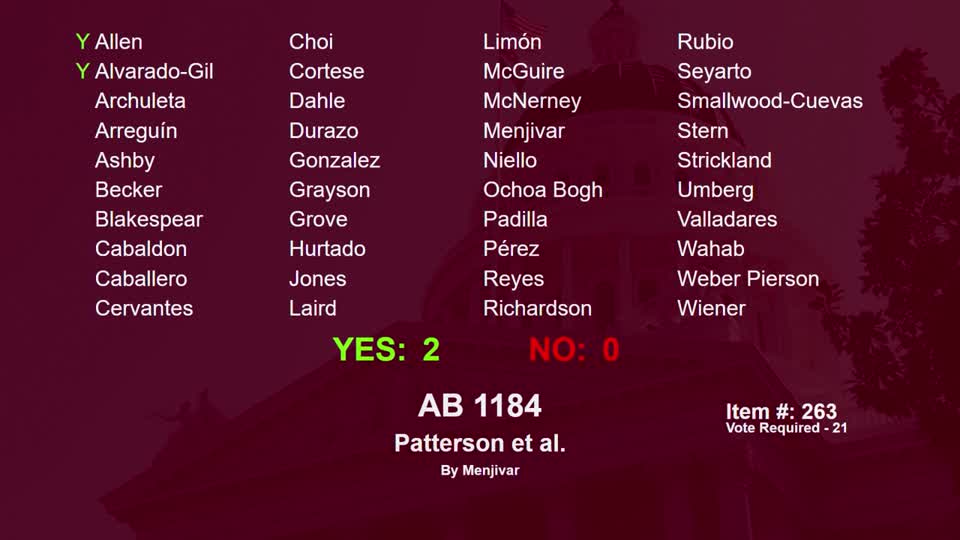 2MIN
Senate Floor
 1MIN
Senate Standing Committee on Appropriations
 6MIN
Senate Standing Committee on Judiciary
 16MIN
Senate Standing Committee on Privacy, Digital Technologies, and Consumer Protection
 1MIN
Assembly Floor
 17MIN
Assembly Standing Committee on Privacy and Consumer Protection
Bill Author

Bill Co-Author(s):
