AB 915: Dam safety: state supervision: exceptions.
- Session Year: 2025-2026
- House: Assembly
- Latest Version Date: 2025-09-16
Current Status:
Failed
(2026-01-22: Consideration of Governor's veto stricken from file.)
Introduced
In Committee
Awaiting First Chamber Vote
Passed First Chamber
In Committee
Awaiting Second Chamber Vote
Passed Second Chamber
Enacted
Existing law regulates the construction and operation of dams and exempts certain structures for these purposes. Existing law exempts certain wastewater treatment and storage ponds constructed as part of a wastewater control facility, as provided, from the requirements for state regulation and supervision of the safety of dams.
This bill would additionally exempt from the requirements for state regulation and supervision of the safety of dams certain water storage facilities, structures, and activities associated with an energy storage system facility located in the County of Kern, as specified, that uses compressed air technology and meets certain criteria, including, among other things, a maximum water pool height of 25 feet or less from the final engineered grade, a maximum storage capacity of 1,500 acre-feet or less, and supervision of the design and construction by a registered civil engineer.
This bill would make legislative findings and declarations as to the necessity of a special statute for the County of Kern.
Existing law regulates the construction and operation of dams and exempts certain structures for these purposes. Existing law exempts certain wastewater treatment and storage ponds constructed as part of a wastewater control facility, as provided, from the requirements for state regulation and supervision of the safety of dams.
This bill would additionally exempt from the requirements for state regulation and supervision of the safety of dams certain water storage facilities, structures, and activities associated with an energy storage system facility that uses compressed air technology and meets certain criteria, including, among other things, a maximum water pool height of 25 feet or less from the final engineered grade, a maximum storage capacity of 1,500 acre-feet or less, and supervision of the design and construction by a registered civil engineer.
Existing law requires the State Energy Resources Conservation and Development Commission (Energy Commission) and the Public Utilities Commission to submit a joint Reliability Planning Assessment to the Legislature on a quarterly basis. Existing law requires that assessment to report on significant delays or barriers affecting the timely deployment of renewable energy and zero-carbon resources, including, among other things, permitting processes. This bill would require the Energy Commission to establish a state central pool of subject matter experts with experience in clean energy project siting and permitting.Existing law requires the Energy Commission State Energy Resources Conservation and Development Commission (Energy Commission) and the Public Utilities Commission to submit a joint Reliability Planning Assessment to the Legislature on a quarterly basis. Existing law requires that assessment to report on significant delays or barriers affecting the timely deployment of renewable energy and zero-carbon resources, including, among other things, permitting processes.
This bill would require the Energy Commission to establish a state central pool of subject matter experts with experience in clean energy project siting and permitting.
Existing law requires, upon appropriation by the Legislature, certain amounts of money to be available for specified fiscal years to support a Clean Energy Reliability Investment Plan developed by the State Energy Resources Conservation and Development Commission, Commission (Energy Commission), as specified. Existing law requires the commission, Energy Commission, by March 1, 2023, to submit the Clean Energy Reliability Investment Plan to the Joint Legislative Budget Committee and the chairs of the relevant policy committees of the Legislature.
This bill would state the intent of the Legislature to enact subsequent legislation to appropriate $900,000,000 from the General Fund to the commission Energy Commission for the 202526 fiscal year to be allocated for the Clean Energy Reliability Investment Plan for local incentive grants to increase investment in clean energy infrastructure.
Existing law requires the Energy Commission and the Public Utilities Commission to submit a joint Reliability Planning Assessment to the Legislature on a quarterly basis. Existing law requires that assessment to report on significant delays or barriers affecting the timely deployment of renewable energy and zero-carbon resources, including, among other things, permitting processes.
This bill would require the Energy Commission to establish a state central pool of subject matter experts with experience in clean energy project siting and permitting.
Existing law requires, upon appropriation by the Legislature, certain amounts of money to be available for specified fiscal years to support a Clean Energy Reliability Investment Plan developed by the State Energy Resources Conservation and Development Commission, as specified. Existing law requires the commission, by March 1, 2023, to submit the Clean Energy Reliability Investment Plan to the Joint Legislative Budget Committee and the chairs of the relevant policy committees of the Legislature.
This bill would appropriate $900,000,000 from the General Fund to the commission for the 202526 fiscal year to be allocated for the Clean Energy Reliability Investment Plan for local incentive grants to increase investment in clean energy infrastructure.
Notwithstanding any other law, the requirements for state regulation and supervision of safety of dams, as contained in this division, shall not apply to both of the following:
(a)Wastewater treatment and storage ponds constructed as a part of a wastewater control facility that meet all of the following criteria:
(1)The governing body of the city, county, district, or other agency that operates the wastewater control facility adopts a resolution that finds that the ponds have been constructed and operated to standards adequate to protect life and property, and provides that the city, county, district, or other agency shall supervise and regulate the design, construction, operation enlargement, replacement, and removal of the ponds after the effective date of the resolution.
(2)A maximum height of 15 feet or less and a maximum storage capacity of 1,500 acre-feet or less.
(3)Designed by, and constructed under, the supervision of a registered civil engineer.
(4)Are not across a stream channel or watercourse.
(b)Water storage facilities, structures, and activities associated with an energy storage system facility using compressed air technology that are located in the County of Kern, north of Dawn Road between State Route 14 and Sierra Highway, and meet all of the following criteria:
(1)A maximum water pool height of 25 feet or less from the final engineered grade and a maximum storage capacity of 1,500 acre-feet or less.
(2)Designed by, and constructed under, the supervision of a registered civil engineer.
(3)Are not across a stream channel or watercourse.
(4)Are approved by a lead agency pursuant to the requirements of Division 13 (commencing with Section 21000) of the Public Resources Code, including, but not limited to, approval by state regulatory agencies that have been certified by the Secretary of the Resources Agency as meeting the requirements of Section 21080.5 of the Public Resources Code.
SEC. 2.The Legislature finds and declares that a special statute is necessary and that a general statute cannot be made applicable within the meaning of Section 16 of Article IV of the California Constitution because of the unique project that will be located within the County of Kern.
Notwithstanding any other law, the requirements for state regulation and supervision of safety of dams, as contained in this division, shall not apply to both of the following:
(a)Wastewater treatment and storage ponds constructed as a part of a wastewater control facilities facility that meet all of the following criteria:
(1)The governing body of the city, county, district, or other agency that operates the wastewater control facility adopts a resolution that finds that the ponds have been constructed and operated to standards adequate to protect life and property, and provides that the city, county, district, or other agency shall supervise and regulate the design, construction, operation enlargement, replacement, and removal of the ponds after the effective date of the resolution.
(2)A maximum height of 15 feet or less and a maximum storage capacity of 1,500 acre-feet or less.
(3)Designed by, and constructed under, the supervision of a registered civil engineer.
(4)Are not across a stream channel or watercourse.
(b)Water storage facilities, structures, and activities associated with an energy storage system facility using compressed air technology that are located in the County of Kern, north of Dawn Road between State Route 14 and Sierra Highway, and meet all of the following criteria:
(1)A maximum water pool height of 25 feet or less from the final engineered grade and a maximum storage capacity of 1,500 acre-feet or less.
(2)Designed by, and constructed under, the supervision of a registered civil engineer.
(3)Are not across a stream channel or watercourse.
(4)Are approved by a lead agency pursuant to the requirements of Division 13 (commencing with Section 21000) of the Public Resources Code, including, but not limited to, approval by state regulatory agencies that have been certified by the Secretary of the Resources Agency as meeting the requirements of Section 21080.5 of the Public Resources Code.
SEC. 2.The Legislature finds and declares that a special statute is necessary and that a general statute cannot be made applicable within the meaning of Section 16 of Article IV of the California Constitution because of the unique project that will be located within the County of Kern.
(a)Notwithstanding any other provision, subject to subdivision (b), law, the requirements for state regulation and supervision of safety of dams, as contained in this division, shall not be applicable to waste water treatment and storage ponds constructed as a part of a waste water control facility. apply to both of the following:
(a)Wastewater treatment and storage ponds constructed as a part of a wastewater control facilities that meet all of the following criteria:
(b)This section applies to those ponds specified in subdivision (a) only after the
(1)The governing body of the city, county, district, or other agency which that operates the waste water wastewater control facility adopts a resolution which (1) that finds that the ponds have been constructed and operated to standards adequate to protect life and property, and (2) provides that the city, county, district, or other agency shall supervise and regulate the design, construction, operation enlargement, replacement, and removal of the ponds after the effective date of the resolution.
(c)This section applies only to ponds specified in subdivision (a) which (1) have a
(2)A maximum height of 15 feet or less and a maximum storage capacity of 1,500 acre-feet or less, (2) have been designed less.
(3)Designed by, and constructed under the supervision of, a registered civil engineer, and (3) are under, the supervision of a registered civil engineer.
(4)Are not across a stream channel or watercourse.
(b)Water storage facilities, structures, and activities associated with an energy storage system facility using compressed air technology that meet all of the following criteria:
(1)A maximum water pool height of 25 feet or less from the final engineered grade and a maximum storage capacity of 1,500 acre-feet or less.
(2)Designed by, and constructed under, the supervision of a registered civil engineer.
(3)Are not across a stream channel or watercourse.
(4)Are approved by a lead agency pursuant to the requirements of Division 13 (commencing with Section 21000) of the Public Resources Code, including, but not limited to, approval by state regulatory agencies that have been certified by the Secretary of the Resources Agency as meeting the requirements of Section 21080.5 of the Public Resources Code.
SECTION 1.The Legislature finds and declares all of the following:(a)Californias climate, emissions reduction, air pollution, and clean energy goals necessitate the build out of new resources at an unprecedented pace and scale.(b)Counties are critical in delivering on state clean energy targets, bearing a disproportionately high role in relation to their influence in meeting those targets.(c)Within the next decade, based on the Public Utilities Commissions Decision 24-02-047 (February 15, 2024), Decision Adopting 2023 Preferred System Plan and Related Matters, and Addressing Two Petitions for Modification, counties will be siting over 19 gigawatts (GWs) of solar, 7 GWs of terrestrial wind, and over 15 GWs of storage.(d)County infrastructure is often insufficient to address the volume and pace of projects needed to meet the states clean energy targets.(e)The Clean Energy Reliability Investment Plan (CERIP) was established to support programs and projects that accelerate the deployment of clean energy resources, support demand response, assist ratepayers, and increase energy reliability.(f)In 2022, the Legislature designated $1,000,000,000 for the CERIP in Senate Bill 846 (Chapter 239 of the Statutes of 2022), but to date only $100,000,000 of those funds have been allocated.SEC. 2.Section 25238 is added to the Public Resources Code, to read:25238.The commission shall establish a state central pool of subject matter experts with experience in clean energy project siting and permitting.The Legislature finds and declares all of the following:
(a)Californias climate, emissions reduction, air pollution, and clean energy goals necessitate the build out of new resources at an unprecedented pace and scale.
(b)Counties are critical in delivering on state clean energy targets, bearing a disproportionately high role in relation to their influence in meeting those targets.
(c)Within the next decade, based on the Public Utilities Commissions Decision 24-02-047 (February 15, 2024), Decision Adopting 2023 Preferred System Plan and Related Matters, and Addressing Two Petitions for Modification, counties will be siting over 19 gigawatts (GWs) of solar, 7 GWs of terrestrial wind, and over 15 GWs of storage.
(d)County infrastructure is often insufficient to address the volume and pace of projects needed to meet the states clean energy targets.
(e)The Clean Energy Reliability Investment Plan (CERIP) was established to support programs and projects that accelerate the deployment of clean energy resources, support demand response, assist ratepayers, and increase energy reliability.
(f)In 2022, the Legislature designated $1,000,000,000 for the CERIP in Senate Bill 846 (Chapter 239 of the Statutes of 2022), but to date only $100,000,000 of those funds have been allocated.
SEC. 2.It is the intent of the Legislature to enact subsequent legislation that would appropriate the sum of nine hundred million dollars ($900,000,000) from the General Fund to the State Energy Resources Conservation and Development Commission for the 202526 fiscal year to be allocated for the Clean Energy Reliability Investment Plan for local incentive grants to increase investment in clean energy infrastructure.SEC. 3.SEC. 2.Section 25238 is added to the Public Resources Code, to read:25238.The commission shall establish a state central pool of subject matter experts with experience in clean energy project siting and permitting.
The Legislature finds and declares all of the following:
(a)Californias climate, emissions reduction, air pollution, and clean energy goals necessitate the build out of new resources at an unprecedented pace and scale.
(b)Counties are critical in delivering on state clean energy targets, bearing a disproportionately high role in relation to their influence in meeting those targets.
(c)Within the next decade, based on the Public Utilities Commissions Decision 24-02-047 (February 15, 2024), Decision Adopting 2023 Preferred System Plan and Related Matters, and Addressing Two Petitions for Modification, counties will be siting over 19 gigawatts (GWs) of solar, 7 GWs of terrestrial wind, and over 15 GWs of storage.
(d)County infrastructure is often insufficient to address the volume and pace of projects needed to meet the states clean energy targets.
(e)The Clean Energy Reliability Investment Plan (CERIP) was established to support programs and projects that accelerate the deployment of clean energy resources, support demand response, assist ratepayers, and increase energy reliability.
(f)In 2022, the Legislature designated $1 billion $1,000,000,000 for the CERIP in Senate Bill 846 (Chapter 239 of the Statutes of 2022), but to date only $100,000,000 of those funds have been allocated.
SEC. 2.The It is the intent of the Legislature to enact subsequent legislation that would appropriate the sum of nine hundred million dollars ($900,000,000) is hereby appropriated from the General Fund to the State Energy Resources Conservation and Development Commission for the 202526 fiscal year to be allocated for the Clean Energy Reliability Investment Plan for local incentive grants to increase investment in clean energy infrastructure.
SEC. 3.Section 25238 is added to the Public Resources Code, to read:25238.The commission shall establish a state central pool of subject matter experts with experience in clean energy project siting and permitting.
The Legislature finds and declares all of the following:
(a)Californias climate, emissions reduction, air pollution, and clean energy goals necessitate the build out of new resources at an unprecedented pace and scale.
(b)Counties are critical in delivering on state clean energy targets, bearing a disproportionately high role in relation to their influence in meeting those targets.
(c)Within the next decade, based on the Public Utilities Commissions Decision 24-02-047 (February 15, 2024), Decision Adopting 2023 Preferred System Plan and Related Matters, and Addressing Two Petitions for Modification, counties will be siting over 19 gigawatts (GWs) of solar, 7 GWs of terrestrial wind, and over 15 GWs of storage.
(d)County infrastructure is often insufficient to address the volume and pace of projects needed to meet the states clean energy targets.
(e)The Clean Energy Reliability Investment Plan (CERIP) was established to support programs and projects that accelerate the deployment of clean energy resources, support demand response, assist ratepayers, and increase energy reliability.
(f)In 2022, the Legislature designated $1 billion for the CERIP in Senate Bill 846 (Chapter 239 of the Statutes of 2022), but to date only $100,000,000 of those funds have been allocated.
SEC. 2.The sum of nine hundred million dollars ($900,000,000) is hereby appropriated from the General Fund to the State Energy Resources Conservation and Development Commission for the 202526 fiscal year to be allocated for the Clean Energy Reliability Investment Plan for local incentive grants to increase investment in clean energy infrastructure.
|
Date
|
Status
|
|---|---|
| Jan 22, 2026 | Consideration of Governor's veto stricken from file. |
| Oct 1, 2025 | Consideration of Governor's veto pending. |
| Oct 1, 2025 | Vetoed by Governor. |
| Sep 24, 2025 | Enrolled and presented to the Governor at 3 p.m. |
| Sep 13, 2025 | Senate amendments concurred in. To Engrossing and Enrolling. (Ayes 77. Noes 0. Page 3460.). |
| Sep 13, 2025 | Joint Rules 61(a)(14) and 51(a)(4) suspended. (Ayes 59. Noes 20. Page 3413.) |
| Sep 12, 2025 | From committee: That the Senate amendments be concurred in. (Ayes 13. Noes 0.) (September 12). |
| Sep 12, 2025 | Joint Rule 62(a), file notice suspended. (Page 3356.) |
| Sep 12, 2025 | Re-referred to Com. on W. P., & W. pursuant to Assembly Rule 77.2. |
| Sep 12, 2025 | In Assembly. Concurrence in Senate amendments pending. |
| Sep 11, 2025 | Read third time. Passed. Ordered to the Assembly. (Ayes 40. Noes 0. Page 2884.). |
| Aug 20, 2025 | Read second time. Ordered to third reading. |
| Aug 19, 2025 | From committee: Be ordered to second reading pursuant to Senate Rule 28.8. |
| Jul 17, 2025 | Read second time and amended. Re-referred to Com. on APPR. |
| Jul 16, 2025 | From committee: Amend, and do pass as amended and re-refer to Com. on APPR. (Ayes 7. Noes 0.) (July 16). |
| Jun 25, 2025 | Re-referred to Com. on N.R. & W. |
| Jun 24, 2025 | Re-referred to Com. on RLS. |
| Jun 24, 2025 | Withdrawn from committee. |
| Jun 23, 2025 | From committee chair, with author's amendments: Amend, and re-refer to committee. Read second time, amended, and re-referred to Com. on E., U & C. |
| Jun 11, 2025 | Referred to Com. on E., U & C. |
| Jun 3, 2025 | In Senate. Read first time. To Com. on RLS. for assignment. |
| Jun 2, 2025 | Read third time. Passed. Ordered to the Senate. (Ayes 78. Noes 0. Page 1910.) |
| May 27, 2025 | Read second time. Ordered to third reading. |
| May 23, 2025 | Read second time and amended. Ordered returned to second reading. |
| May 23, 2025 | From committee: Amend, and do pass as amended. (Ayes 11. Noes 0.) (May 23). |
| May 23, 2025 | Assembly Rule 63 suspended. (Ayes 51. Noes 16. Page 1644.) |
| May 14, 2025 | In committee: Set, first hearing. Referred to APPR. suspense file. |
| May 1, 2025 | From committee: Do pass and re-refer to Com. on APPR. with recommendation: To Consent Calendar. (Ayes 18. Noes 0.) (April 30). Re-referred to Com. on APPR. |
| Apr 23, 2025 | Re-referred to Com. on U. & E. |
| Apr 22, 2025 | From committee chair, with author's amendments: Amend, and re-refer to Com. on U. & E. Read second time and amended. |
| Apr 21, 2025 | Referred to Com. on U. & E. |
| Feb 20, 2025 | From printer. May be heard in committee March 22. |
| Feb 19, 2025 | Read first time. To print. |
|
Date
|
Description
|
Location
|
Votes
|
|
|---|---|---|---|---|
| Sep 13, 2025 | AB 915 Petrie-Norris Concurrence in Senate Amendments | Assembly Floor |
Passed |
|
| Sep 12, 2025 | With recommendation: That Senate amendments be concurred in. | Assembly Standing Committee on Water, Parks, and Wildlife |
Passed |
|
| Sep 11, 2025 | Assembly 3rd Reading AB915 Petrie-Norris By Grove | Senate Floor |
Passed |
|
| Jul 16, 2025 | Do pass as amended, but first amend, and re-refer to the Committee on [Appropriations] | Senate Standing Committee on Natural Resources and Water |
Passed |
|
| Jun 2, 2025 | AB 915 Petrie-Norris Assembly Third Reading | Assembly Floor |
Passed |
|
| May 23, 2025 | Do pass as amended. | Assembly Standing Committee on Appropriations |
Passed |
|
| Apr 30, 2025 | Do pass and be re-referred to the Committee on [Appropriations] with recommendation: To Consent Calendar | Assembly Standing Committee on Utilities and Energy |
Passed |
This list shows positions taken on this bill by organizations on the date displayed, which is linked to the original source.
Positions by individuals are not included.
|
Organization
|
Position
|
Date
|
|---|---|---|
| Ava Community Energy | ** Support | |
| Ava Community Energy Authority | ** Support | |
| California Municipal Utilities Association | ** Support | |
| California Solar & Storage Association | ** Support | |
| Hydrostor | ** Support | |
| Hydrostor, Inc. | ** Support | |
| Rural County Representatives of California | ** Support | |
| Southern California Public Power Authority | ** Support |
GOVERNOR′S VETO
GV Bill Id:AB 915
Author:(Petrie-Norris)
As Enrolled Ver:September 16, 2025
2/3 vote
SUMMARY
Exempts water storage ponds that are associated with an energy storage facility that uses compressed air technology and is located in eastern Kern County from dam safety regulations.
- Exempts water storage ponds associated with an energy storage facility that uses compressed air technology and is located in eastern Kern County from dam safety regulations if the water storage ponds meet the following criteria:
- Have a maximum pool height of 25 feet or less from the final engineered grade and a maximum storage capacity of 1,500 acre-feet (AF) or less;
- Are designed by, and constructed under, the supervision of a registered civil engineer;
- Are not across a stream or watercourse; and
- Are approved by a lead agency under the California Environmental Quality Act, including approval by a state agency under a certified regulatory program.
- Declares and finds that this special statute is necessary because of the unique project that will be located in Kern County.
Governor′s Veto Message
″This bill would exempt from state dam safety requirements and oversight, as well as specified fees, any water storage facilities associated with an energy storage system project that uses compressed air technology.
While I support development of novel, long-lead-time, and large clean energy resources, it is imperative that we do so with safety at the forefront. Additionally, it is essential that the costs incurred by state agencies overseeing the safety of these facilities are recovered from project developers to adequately ensure compliance with applicable safety requirements."
COMMENTS
Existing law defines ″dam″ as any artificial barrier, together with additional appurtenant structures (including training walls, spillways, outlets, tunnels, channels, pipelines, or dikes) that may impound or divert water and is either: 25 feet or greater in height from the natural stream bed to the top of the barrier/maximum storage elevation; or impounds a capacity of 50 AF of water or more (Water Code Section 6002).
More than 1,200 structures in California meet the definition of ″dam″ and are, therefore, subject to regulation and oversight by the Division of Safety of Dams (DSOD) within the Department of Water Resources. DSOD ensures dam safety by:
- Reviewing and approving dam enlargements, repairs, alterations, and removals to ensure that the dam appurtenant structures are designed to meet minimum requirements;
- Performing independent analyses to understand dam and appurtenant structures performance. These analyses can include structural, hydrologic, hydraulic, and geotechnical evaluations;
- Overseeing construction to ensure work is being done in accordance with the approved plans and specifications;
- Inspecting each dam on an annual basis to ensure it is safe, performing as intended, and is not developing issues. Roughly one-third of these inspections include in-depth instrumentation reviews of the dam surveillance network data; and
- Periodically reviewing the stability of dams and their major appurtenances in light of improved design approaches and requirements, as well as new findings regarding earthquake hazards and hydrologic estimates in California.
Certain types of structures (e.g., those that are smaller and impound water principally for agricultural purposes) are exempt from oversight by DSOD. This bill adds another exemption for storage ponds associated with the Willow Rock Energy Storage Center in eastern Kern County.
According to the California Energy Commission (CEC), the Willow Rock Energy Storage Center is a proposed compressed air energy storage facility in Kern County. The project site is on undeveloped land in an area zoned for ″Limited Agriculture.″ The area surrounding the project boundary is largely undeveloped with very sparse residential development; the nearest residence is approximately 0.8 miles northwest of the northwest corner of the Willow Rock project site.
A dam or reservoir operator must submit an application to DSOD for the construction of a new dam or reservoir and the repair, alteration, or removal of an existing dam or reservoir. To cover its costs in reviewing applications, DSOD assesses a filing fee on a sliding scale that is a percentage of the estimated cost of the project as follows: 3.25% on the first $1 million, 2.5% on the next $4 million, 2% on the next $15 million, 1.75% on the next $30 million, 1.25% on the next $100 million, 0.75% on the next $300 million, and 0.5% on all costs in excess of $500 million.
DSOD also assesses annual fees on jurisdictional dams to cover its ongoing oversight and regulation of dams and reservoirs. The annual fees are based on a formula that fluctuates from year-to-year based on DSOD′s costs. For FY 2024-25 and FY 2025-26 the base annual fee is $1,195 plus $280 per foot of dam height plus an additional charge for ″critical appurtenant structures,″ if applicable. Neither the DSOD filing fees or annual fees would apply to the Willow Rock Energy Storage Center (Willow Rock) project affected by this bill given that the project has availed itself of CEC′s in lieu permitting process (see discussion below), but these fees provide context regarding the cost of dam safety oversight.
The Warren-Alquist Act, enacted in 1974, established CEC as the state′s primary energy policy and planning agency. One of its key provisions is to grant CEC the exclusive authority to license and certify thermal power plants with a generating capacity between 50 and 100 megawatts (MW). This approval process, known as Application for Certification (AFC), ensures that proposed power plants meet environmental, public health, and safety standards while aligning with California′s broader energy and environmental policies. AFC is an ″in lieu″ permitting process that involves rigorous evaluation, including environmental impact assessments, public participation, and coordination with local, state, and federal agencies to ensure responsible energy development. Projects that use CEC′s AFC process need not obtain additional permits from other state, regional, or local agencies or federal agencies, to the extent permitted by federal law. The thermal plants that can avail themselves of the AFC process include:
- Natural gas-fired power plants (including combined-cycle and peaking plants);
- Geothermal plants;
- Solar thermal power plants (e.g., concentrated solar power or CSP plants); and
- Biomass or biogas facilities (waste-to-energy plants).
The Willow Rock Energy Storage Center is a 520-megawatt gross and 4,160 megawatt-hour gross facility using Hydrostor, Inc.′s proprietary, advanced compressed air energy storage technology. The facility would consist of four power turbine trains and each train would share a common set of thermal storage tanks (hot and cold water), as well as the air storage cavern. Willow Rock would interconnect to Southern California Edison′s Whirlwind Substation located southwest of Willow Rock via a new approximately 19-mile 230-kilovolt generation-tie line.
According to Willow Rock′s fact sheet provided by Hydrostor (sponsor of this bill), ″Hydrostor′s technology relies on a man-made, fully lined retention pond which maintains the pressure of the compressed air in the underground cavern. The pond has no hydrologic connection to surface water or groundwater, will contain less than 600 [AF] of water, and will have a small berm six feet high from finished grade. 45 [AF] of water, or 15 million gallons of water, will be held above the finished grade, and all water in the pond can be emptied into the cavern if necessary.″
Although Hydrostor argues that this pond is not a dam, CEC and DSOD staff have indicated that the reservoir falls within the definition of ″dam.″ As such, the retention pond feature of Willow Rock is subject to the same design, construction, and inspection requirements as other dams. CEC states that it will consult with DSOD through the AFC process to address dam safety requirements and standards relevant to Willow Rock.
According to the Author
″Clear jurisdiction and certainty are key for new energy technologies that are necessary to California meeting its clean energy and climate change requirements. Some long duration energy storage projects that utilized compressed air and water are facing uncertainty as to which agency is responsible for reviewing their projects and issuing their permits. If they are regulated as dams because they have a pond of water onsite they face millions of dollars and years of delays…. [This bill] ensures CEC can use its long-standing authority and process to review compressed air energy storage projects and their various components including retention ponds…. Under [this bill] water storage ponds at compressed air storage facilities will be permitted and regulated in the same manner as wastewater treatment ponds because both pond types are nearly identical in volume, how they are engineered, and how they are built.″
Arguments in Support
Hydrostor is the sponsor of this bill and developer of the Willow Rock Energy Storage Center in Kern County. Hydrostor asserts this bill is necessary to provide regulatory certainty and ensure the Willow Rock project is completed on time: ″CEC and DSOD Staff have recently asserted that DSOD′s jurisdiction applies to the reservoir. The agencies are asking Hydrostor to file an application with DSOD, despite the CEC′s exclusive jurisdiction over all state law issues. Contrary to the CEC′s ″one-stop″ permitting jurisdiction, these dual permit application processes could add years, costs, and complexity by proposing to treat this purpose-built reservoir as if it is a full-scale dam, which it is not in either size or function. Forcing this important energy storage facility into two permitting application processes when the CEC has sole jurisdictional authority for the Willow Rock project is not warranted. To ensure that Willow Rock can move forward to provide energy storage needed to ensure a more reliable grid and to integrate renewable energy into the generation mix and for the Project to meet ongoing procurement and financing requirements, it is imperative that a final decision by the CEC be made in 2025. The joint CEC-DSOD process raises concerns about the delivery of the much-needed benefits of long duration energy storage on such a timeline. [This bill] provides clarity relative to jurisdiction and allows long duration energy storage projects like Willow Rock to move through the normal CEC permitting process. Clear jurisdiction and certainty are key for new energy technologies that are necessary to California meeting its clean energy and climate change requirements.″
Arguments in Opposition
None on file.
FISCAL COMMENTS
The Assembly Appropriations analysis of the previous version of this bill is not relevant and the Senate Appropriations Committee did not hear this bill and, instead, reported it to the Senate Floor pursuant to Senate Rule 28.8; indicating this bill does not appropriate money, does not result in significant state costs or require the appropriation of funds, and will cause no significant reduction in revenues.
VOTES
ASM UTILITIES AND ENERGY: 18-0-0
YES: Petrie-Norris, Patterson, Boerner, Calderon, Chen, Davies, Fong, Mark González, Harabedian, Hart, Irwin, Papan, Rogers, Schiavo, Solache, Ta, Wallis, Zbur
ASM APPROPRIATIONS: 11-0-4
YES: Wicks, Arambula, Calderon, Caloza, Elhawary, Fong, Mark González, Hart, Pacheco, Pellerin, Solache
ABS, ABST OR NV: Sanchez, Dixon, Ta, Tangipa
ASSEMBLY FLOOR: 78-0-1
YES: Addis, Aguiar-Curry, Ahrens, Alanis, Alvarez, Arambula, Ávila Farías, Bains, Bauer-Kahan, Bennett, Berman, Boerner, Bonta, Bryan, Calderon, Caloza, Carrillo, Castillo, Chen, Connolly, Davies, DeMaio, Dixon, Elhawary, Flora, Fong, Gabriel, Gallagher, Garcia, Gipson, Jeff Gonzalez, Mark González, Hadwick, Haney, Harabedian, Hart, Hoover, Irwin, Jackson, Kalra, Krell, Lackey, Lee, Lowenthal, Macedo, McKinnor, Muratsuchi, Nguyen, Ortega, Pacheco, Papan, Patel, Patterson, Pellerin, Petrie-Norris, Quirk-Silva, Ramos, Ransom, Celeste Rodriguez, Michelle Rodriguez, Rogers, Blanca Rubio, Sanchez, Schiavo, Schultz, Sharp-Collins, Solache, Soria, Stefani, Ta, Tangipa, Valencia, Wallis, Ward, Wicks, Wilson, Zbur, Rivas
ABS, ABST OR NV: Ellis
SENATE FLOOR: 40-0-0
YES: Allen, Alvarado-Gil, Archuleta, Arreguín, Ashby, Becker, Blakespear, Cabaldon, Caballero, Cervantes, Choi, Cortese, Dahle, Durazo, Gonzalez, Grayson, Grove, Hurtado, Jones, Laird, Limón, McGuire, McNerney, Menjivar, Niello, Ochoa Bogh, Padilla, Pérez, Reyes, Richardson, Rubio, Seyarto, Smallwood-Cuevas, Stern, Strickland, Umberg, Valladares, Wahab, Weber Pierson, Wiener
ASM WATER, PARKS, AND WILDLIFE: 13-0-0
YES: Papan, Jeff Gonzalez, Alvarez, Ávila Farías, Bains, Bennett, Boerner, Caloza, Hart, Macedo, Celeste Rodriguez, Rogers, Tangipa
ASSEMBLY FLOOR: 77-0-3
YES: Addis, Aguiar-Curry, Ahrens, Alanis, Alvarez, Arambula, Ávila Farías, Bains, Bauer-Kahan, Bennett, Berman, Boerner, Bonta, Bryan, Calderon, Caloza, Carrillo, Castillo, Chen, Connolly, Davies, DeMaio, Dixon, Elhawary, Ellis, Flora, Fong, Gabriel, Gallagher, Garcia, Gipson, Jeff Gonzalez, Mark González, Hadwick, Harabedian, Hart, Hoover, Irwin, Jackson, Johnson, Kalra, Krell, Lackey, Lee, Lowenthal, Macedo, Nguyen, Ortega, Pacheco, Papan, Patel, Patterson, Pellerin, Petrie-Norris, Quirk-Silva, Ramos, Ransom, Celeste Rodriguez, Michelle Rodriguez, Rogers, Blanca Rubio, Sanchez, Schiavo, Schultz, Sharp-Collins, Solache, Soria, Stefani, Ta, Tangipa, Valencia, Wallis, Ward, Wicks, Wilson, Zbur, Rivas
ABS, ABST OR NV: Haney, McKinnor, Muratsuchi
UPDATED
VERSION: September 16, 2025
CONSULTANT: Pablo Garza / W., P., & W. / (916) 319-2096 FN: 0002151
Date of Hearing: September 12, 2025
ASSEMBLY COMMITTEE ON WATER, PARKS, AND WILDLIFE
Diane Papan, Chair
ABPCA Bill Id:AB 915 (
Author:Petrie-Norris) – As Amended Ver:July 17, 2025
SUBJECT: Dam safety: state supervision: exceptions
SUMMARY: Exempts water storage ponds associated with an energy storage system facility that uses compressed air technology and is located in eastern Kern County from dam safety regulations. Specifically, this bill:
- Exempts water storage ponds associated with an energy storage facility that uses compressed air technology and is located in eastern Kern County from dam safety regulations if the water storage ponds meet the following criteria:
- Have a maximum pool height of 25 feet or less from the final engineered grade and a maximum storage capacity of 1,500 acre-feet (AF) or less;
- Are designed by, and constructed under, the supervision of a registered civil engineer;
- Are not across a stream or watercourse; and
- Are approved by a lead agency under the California Environmental Quality Act, including if approved by a state agency under a certified regulatory program.
- Declares and finds that this special statute is necessary because of the unique project that will be located in Kern County.
EXISTING LAW:
- Subjects all dams and reservoirs to regulation and oversight by the Division of Safety of Dams (DSOD) within the Department of Water Resources (DWR) (Water Code § 6075).
- Defines “dam” as any artificial barrier, together with additional appurtenant structures (including training walls, spillways, outlets, tunnels, channels, pipelines, or dikes) that may impound or divert water and is either (a) 25 feet or greater in height from the natural stream bed to the top of the barrier/maximum storage elevation, or (b) impounds a capacity of 50 AF of water or more (Water Code § 6002).
- Excludes any barrier not in excess of six feet in height or a barrier with a storage capacity of 15 AF or less, regardless of height, from the definition of dam (Water Code § 6003).
- Excludes certain structures from the definition of “dam,” including an obstruction in a canal or a barrier across a stream channel, watercourse, or natural drainage area, if the structure is no greater than 15 feet in height (Water Code § 6004).
- Excludes dams owned and operated by the federal government from regulation and oversight by DSOD (Water Code § 6009).
- Requires DSOD to inspect dams, reservoirs, and appurtenant structures to verify their safety in accordance with a prescribed schedule depending on the hazard classification, as determined by DSOD, of the facility (Water Code § 6102.5).
- Requires payment of a filing fee for a new dam or reservoir, or the enlargement, repair, alteration, or removal of an existing dam or reservoir. The filing fee is assessed as a percentage, on a sliding scale, of estimated cost of the project (Water Code § 6300).
- Authorizes DWR to assess an annual fee on dam or reservoir operators to cover DWR’s reasonable regulatory costs in carrying out the supervision of dam safety (Water Code § 63017).
FISCAL EFFECT: The Senate Appropriations Committee did not hear this bill and, instead, reported it to the Senate Floor pursuant to Senate Rule 28.8; indicating this bill does not appropriate money, does not result in significant state costs or require the appropriation of funds, and will cause no significant reduction in revenues.
COMMENTS:
- Purpose of this bill. The author argues “Clear jurisdiction and certainty are key for new energy technologies that are necessary to California meeting its clean energy and climate change requirements. Some long duration energy storage projects that utilized compressed air and water are facing uncertainty as to which agency is responsible for reviewing their projects and issuing their permits. If they are regulated as dams, because they have a pond of water onsite, they face millions of dollars and years of delays…. [This bill] ensures the California Energy Commission (CEC) can use its long-standing authority and process to review compressed air energy storage projects and their various components including retention ponds…. Under [this bill] water storage ponds at compressed air storage facilities will be permitted and regulated in the same manner as wastewater treatment ponds because both pond types are nearly identical in volume, how they are engineered, and how they are built.”
- Background. Since 1929, the State of California has regulated and supervised dams to prevent failure, safeguard life, and protect property. Any structures that meet the definition of “dam” (see #2 under Existing Law, above) are considered “jurisdictional dams” and are subject to regulation and oversight by DSOD within DWR. There are more than 1,200 jurisdictional dams in California. DSOD ensures dam safety by:
- Reviewing and approving dam enlargements, repairs, alterations, and removals to ensure that the dam appurtenant structures are designed to meet minimum requirements;
- Performing independent analyses to understand dam and appurtenant structure performance. These analyses can include structural, hydrologic, hydraulic, and geotechnical evaluations;
- Overseeing construction to ensure work is being done in accordance with the approved plans and specifications;
- Inspecting each dam on an annual basis to ensure it is safe, performing as intended, and is not developing issues. Roughly one-third of these inspections include in-depth instrumentation reviews of the dam surveillance network data; and
- Periodically reviewing the stability of dams and their major appurtenances in light of improved design approaches and requirements, as well as new findings regarding earthquake hazards and hydrologic estimates in California.
Certain types of structures (e.g., those that are smaller and impound water principally for agricultural purposes) are exempt from oversight by DSOD. This bill adds another exemption for storage ponds associated with the Willow Rock Energy Storage Center in eastern Kern County.
Dam safety fees. A dam or reservoir operator must submit an application to DSOD for the construction of a new dam or reservoir and the repair, alteration, or removal of an existing dam or reservoir. To cover its costs in reviewing applications, DSOD assesses a filing fee on a sliding scale that is a percentage of the estimated cost of the project as follows:
Estimated cost of construction or alteration | Percentage | Maximum total fee |
First $1 million | 3.25% | $32,500 |
Next $4 million | 2.5% | $100,000 |
Next $15 million | 2% | $300,000 |
Next $30 million | 1.75% | $525,000 |
Next $100 million | 1.25% | $1,250,000 |
Next $350 million | 0.75% | $2,625,000 |
All costs in excess of $500 million | 0.5% | variable |
DSOD also assesses annual fees on jurisdictional dams to cover its ongoing oversight and regulation of dams and reservoirs. The annual fees are based on a formula that fluctuates from year-to-year based on DSOD’s costs. For FY 2024-25 and FY 2025-26 the base annual fee is $1,195 plus $280 per foot of dam height plus an additional charge for “critical appurtenant structures,” if applicable. Neither of the DSOD filing fees or annual fees would apply to the Willow Rock Energy Storage Center (Willow Rock) project affected by this bill given that the project has availed itself of CEC’s in lieu permitting process (see discussion below), but these fees provide context regarding the cost of dam safety oversight.
CEC Application for Certification (AFC) process. The Warren-Alquist Act, enacted in 1974, established CEC as the state's primary energy policy and planning agency. One of its key provisions is to grant CEC the exclusive authority to license and certify thermal power plants with a generating capacity between 50 and 100 megawatts (MW). This approval process, known as AFC, ensures that proposed power plants meet environmental, public health, and safety standards while aligning with California’s broader energy and environmental policies. AFC is an “in lieu” permitting process that involves rigorous evaluation, including environmental impact assessments, public participation, and coordination with local, state, and federal agencies to ensure responsible energy development. Projects that use CEC’s AFC process need not obtain additional permits from other state, regional, or local agencies or federal agencies, to the extent permitted by federal law. The thermal plants that can avail themselves of the AFC process include:
- Natural gas-fired power plants (including combined-cycle and peaking plants);
- Geothermal plants;
- Solar thermal power plants (e.g., concentrated solar power plants); and
- Biomass or biogas facilities (waste-to-energy plants).
Willow Rock project. The Willow Rock project is going through the AFC process at CEC. According to CEC, Willow Rock is a proposed compressed air energy storage facility in Kern County. The project site is on undeveloped land in an area zoned for “Limited Agriculture.” The area surrounding the project boundary is largely undeveloped with very sparse residential development; the nearest residence is approximately 0.8 miles northwest of the northwest corner of the Willow Rock project site.
Willow Rock is a 520 MW gross (500 MW net) and 4,160 megawatt-hour (MWh) gross (4,000 MWh net) facility using Hydrostor, Inc.’s proprietary, advanced compressed air energy storage technology. The facility would consist of four power turbine trains and each train would share a common set of thermal storage tanks (hot and cold water), as well as the air storage cavern. Willow Rock would interconnect to Southern California Edison’s Whirlwind Substation located southwest of Willow Rock via a new approximately 19-mile 230-kilovolt generation-tie line.
According to Willow Rock’s fact sheet provided by Hydrostor (sponsor of this bill), “Hydrostor’s technology relies on a man-made, fully lined retention pond which maintains the pressure of the compressed air in the underground cavern. The pond has no hydrologic connection to surface water or groundwater, will contain less than 600 [AF] of water, and will have a small berm six feet high from finished grade. 45 [AF] of water, or 15 million gallons of water, will be held above the finished grade, and all water in the pond can be emptied into the cavern if necessary.”
Although Hydrostor argues that this pond is not a dam, CEC and DSOD staff have indicated that the reservoir falls within the definition of “dam.” As such, the retention pond feature of Willow Rock is subject to the same design, construction, and inspection requirements as other dams. CEC states that it will consult with DSOD through the AFC process to address dam safety requirements and standards relevant to Willow Rock.
- Arguments in support. Hydrostor, Inc. asserts that this bill is necessary to allow for the timely completion of the Willow Rock project, a long duration energy storage project that uses new technology and will help California meet its clean energy goals: “forcing this important energy storage facility into two permitting application processes when the CEC has sole jurisdictional authority for the Willow Rock project is not warranted. To ensure that Willow Rock can move forward to provide energy storage needed to ensure a more reliable grid and to integrate renewable energy into the generation mix and for the Project to meet ongoing procurement and financing requirements, it is imperative that a final decision by the CEC be made in 2025.”
- Related legislation. AB 639 (Soria) of the current legislative session exempts specific weirs on the Kings River that have at least three feet of freeboard from regulation and oversight by DSOD. AB 639 is pending in engrossing and enrolling.
SB 122 (Committee on Budget and Fiscal Review), Chapter 51, Statutes of 2023, is the public resources trailer bill for the 2023-24 fiscal year. Among other provisions, SB 122 increases the application fee for the enlargement, repair, alteration or removal of an existing dam or reservoir and authorizes DWR to adopt regulations to adjust the application filing fees to ensure the fees cover DWR’s reasonable costs in processing applications.
AB 1164 (Flora), Chapter 943, Statutes of 2022, exempts “regulating basins,” as defined, from regulation and oversight by DSOD.
AB 727 (Flora) of 2019 would have exempted structures that are 20 feet or less in height, owned or operated by a public agency, and used principally for impounding water for agricultural use from regulation and oversight by DSOD. AB 727 was held in the Senate Natural Resources and Water Committee.
AB 1270 (Gallagher), Chapter 3, Statutes of 2018, repealed previous provisions of law related to dam safety and inspection, and instead, among other things, added specific requirements for DSOD to inspect dams, reservoirs, and appurtenant structures on an annual and bi-annual schedule based on hazard classification.
REGISTERED SUPPORT / OPPOSITION:
Support
Hydrostor, Inc. (sponsor)
Ava Community Energy Authority
Opposition
None on file
Analysis Prepared by: Pablo Garza / W., P., & W. / (916) 319-2096
CONCURRENCE IN SENATE AMENDMENTS
CSA2 Bill Id:AB 915
Author:(Petrie-Norris)
As Amended Ver:July 17, 2025
Majority vote
SUMMARY
Original Committee of Reference: Committee on Water, Parks, and Wildlife
Exempts water storage ponds that are associated with an energy storage facility that uses compressed air technology and is located in eastern Kern County from dam safety regulations.
Senate Amendments
Current Committee Recommendation: Concur
- Delete the previous contents of this bill pertaining to clean energy project siting and permitting.
- Exempt water storage ponds associated with an energy storage facility that uses compressed air technology and is located in eastern Kern County from dam safety regulations if the water storage ponds meet the following criteria:
- Have a maximum pool height of 25 feet or less from the final engineered grade and a maximum storage capacity of 1,500 acre-feet (AF) or less;
- Are designed by, and constructed under, the supervision of a registered civil engineer;
- Are not across a stream or watercourse; and
- Are approved by a lead agency under the California Environmental Quality Act, including approval by a state agency under a certified regulatory program.
- Declare and find that this special statute is necessary because of the unique project that will be located in Kern County.
COMMENTS
Existing law defines "dam" as any artificial barrier, together with additional appurtenant structures (including training walls, spillways, outlets, tunnels, channels, pipelines, or dikes) that may impound or divert water and is either: 25 feet or greater in height from the natural stream bed to the top of the barrier/maximum storage elevation; or impounds a capacity of 50 AF of water or more (Water Code § 6002).
More than 1,200 structures in California meet the definition of "dam" and are, therefore, subject to regulation and oversight by the Division of Safety of Dams (DSOD) within the Department of Water Resources. DSOD ensures dam safety by:
- Reviewing and approving dam enlargements, repairs, alterations, and removals to ensure that the dam appurtenant structures are designed to meet minimum requirements;
- Performing independent analyses to understand dam and appurtenant structures performance. These analyses can include structural, hydrologic, hydraulic, and geotechnical evaluations;
- Overseeing construction to ensure work is being done in accordance with the approved plans and specifications;
- Inspecting each dam on an annual basis to ensure it is safe, performing as intended, and is not developing issues. Roughly one-third of these inspections include in-depth instrumentation reviews of the dam surveillance network data; and
- Periodically reviewing the stability of dams and their major appurtenances in light of improved design approaches and requirements, as well as new findings regarding earthquake hazards and hydrologic estimates in California.
Certain types of structures (e.g., those that are smaller and impound water principally for agricultural purposes) are exempt from oversight by DSOD. This bill adds another exemption for storage ponds associated with the Willow Rock Energy Storage Center in eastern Kern County.
According to the California Energy Commission (CEC), the Willow Rock Energy Storage Center is a proposed compressed air energy storage facility in Kern County. The project site is on undeveloped land in an area zoned for "Limited Agriculture." The area surrounding the project boundary is largely undeveloped with very sparse residential development; the nearest residence is approximately 0.8 miles northwest of the northwest corner of the Willow Rock project site.
A dam or reservoir operator must submit an application to DSOD for the construction of a new dam or reservoir and the repair, alteration, or removal of an existing dam or reservoir. To cover its costs in reviewing applications, DSOD assesses a filing fee on a sliding scale that is a percentage of the estimated cost of the project as follows: 3.25% on the first $1 million, 2.5% on the next $4 million, 2% on the next $15 million, 1.75% on the next $30 million, 1.25% on the next $100 million, 0.75% on the next $300 million, and 0.5% on all costs in excess of $500 million.
DSOD also assesses annual fees on jurisdictional dams to cover its ongoing oversight and regulation of dams and reservoirs. The annual fees are based on a formula that fluctuates from year-to-year based on DSOD's costs. For FY 2024-25 and FY 2025-26 the base annual fee is $1,195 plus $280 per foot of dam height plus an additional charge for "critical appurtenant structures," if applicable. Neither the DSOD filing fees or annual fees would apply to the Willow Rock Energy Storage Center (Willow Rock) project affected by this bill given that the project has availed itself of CEC's in lieu permitting process (see discussion below), but these fees provide context regarding the cost of dam safety oversight.
The Warren-Alquist Act, enacted in 1974, established CEC as the state's primary energy policy and planning agency. One of its key provisions is to grant CEC the exclusive authority to license and certify thermal power plants with a generating capacity between 50 and 100 megawatts (MW). This approval process, known as Application for Certification (AFC), ensures that proposed power plants meet environmental, public health, and safety standards while aligning with California's broader energy and environmental policies. AFC is an "in lieu" permitting process that involves rigorous evaluation, including environmental impact assessments, public participation, and coordination with local, state, and federal agencies to ensure responsible energy development. Projects that use CEC's AFC process need not obtain additional permits from other state, regional, or local agencies or federal agencies, to the extent permitted by federal law. The thermal plants that can avail themselves of the AFC process include:
- Natural gas-fired power plants (including combined-cycle and peaking plants);
- Geothermal plants;
- Solar thermal power plants (e.g., concentrated solar power or CSP plants); and
- Biomass or biogas facilities (waste-to-energy plants).
The Willow Rock Energy Storage Center is a 520-megawatt gross and 4,160 megawatt-hour gross facility using Hydrostor, Inc.'s proprietary, advanced compressed air energy storage technology. The facility would consist of four power turbine trains and each train would share a common set of thermal storage tanks (hot and cold water), as well as the air storage cavern. Willow Rock would interconnect to Southern California Edison's Whirlwind Substation located southwest of Willow Rock via a new approximately 19-mile 230-kilovolt generation-tie line.
According to Willow Rock's fact sheet provided by Hydrostor (sponsor of this bill), "Hydrostor's technology relies on a man-made, fully lined retention pond which maintains the pressure of the compressed air in the underground cavern. The pond has no hydrologic connection to surface water or groundwater, will contain less than 600 [AF] of water, and will have a small berm six feet high from finished grade. 45 [AF] of water, or 15 million gallons of water, will be held above the finished grade, and all water in the pond can be emptied into the cavern if necessary."
Although Hydrostor argues that this pond is not a dam, CEC and DSOD staff have indicated that the reservoir falls within the definition of "dam." As such, the retention pond feature of Willow Rock is subject to the same design, construction, and inspection requirements as other dams. CEC states that it will consult with DSOD through the AFC process to address dam safety requirements and standards relevant to Willow Rock.
According to the Author
"Clear jurisdiction and certainty are key for new energy technologies that are necessary to California meeting its clean energy and climate change requirements. Some long duration energy storage projects that utilized compressed air and water are facing uncertainty as to which agency is responsible for reviewing their projects and issuing their permits. If they are regulated as dams because they have a pond of water onsite they face millions of dollars and years of delays…. [This bill] ensures CEC can use its long-standing authority and process to review compressed air energy storage projects and their various components including retention ponds…. Under [this bill] water storage ponds at compressed air storage facilities will be permitted and regulated in the same manner as wastewater treatment ponds because both pond types are nearly identical in volume, how they are engineered, and how they are built."
Arguments in Support
Hydrostor is the sponsor of this bill and developer of the Willow Rock Energy Storage Center in Kern County. Hydrostor asserts this bill is necessary to provide regulatory certainty and ensure the Willow Rock project is completed on time: "CEC and DSOD Staff have recently asserted that DSOD's jurisdiction applies to the reservoir. The agencies are asking Hydrostor to file an application with DSOD, despite the CEC's exclusive jurisdiction over all state law issues. Contrary to the CEC's "one-stop" permitting jurisdiction, these dual permit application processes could add years, costs, and complexity by proposing to treat this purpose-built reservoir as if it is a full-scale dam, which it is not in either size or function. Forcing this important energy storage facility into two permitting application processes when the CEC has sole jurisdictional authority for the Willow Rock project is not warranted. To ensure that Willow Rock can move forward to provide energy storage needed to ensure a more reliable grid and to integrate renewable energy into the generation mix and for the Project to meet ongoing procurement and financing requirements, it is imperative that a final decision by the CEC be made in 2025. The joint CEC-DSOD process raises concerns about the delivery of the much-needed benefits of long duration energy storage on such a timeline. [This bill] provides clarity relative to jurisdiction and allows long duration energy storage projects like Willow Rock to move through the normal CEC permitting process. Clear jurisdiction and certainty are key for new energy technologies that are necessary to California meeting its clean energy and climate change requirements."
Arguments in Opposition
None on file.
FISCAL COMMENTS
The Assembly Appropriations analysis of the previous version of this bill is not relevant and the Senate Appropriations Committee did not hear this bill and, instead, reported it to the Senate Floor pursuant to Senate Rule 28.8; indicating this bill does not appropriate money, does not result in significant state costs or require the appropriation of funds, and will cause no significant reduction in revenues.
VOTES
ASM UTILITIES AND ENERGY: 18-0-0
YES: Petrie-Norris, Patterson, Boerner, Calderon, Chen, Davies, Fong, Mark González, Harabedian, Hart, Irwin, Papan, Rogers, Schiavo, Solache, Ta, Wallis, Zbur
ASM APPROPRIATIONS: 11-0-4
YES: Wicks, Arambula, Calderon, Caloza, Elhawary, Fong, Mark González, Hart, Pacheco, Pellerin, Solache
ABS, ABST OR NV: Sanchez, Dixon, Ta, Tangipa
ASSEMBLY FLOOR: 78-0-1
YES: Addis, Aguiar-Curry, Ahrens, Alanis, Alvarez, Arambula, Ávila Farías, Bains, Bauer-Kahan, Bennett, Berman, Boerner, Bonta, Bryan, Calderon, Caloza, Carrillo, Castillo, Chen, Connolly, Davies, DeMaio, Dixon, Elhawary, Flora, Fong, Gabriel, Gallagher, Garcia, Gipson, Jeff Gonzalez, Mark González, Hadwick, Haney, Harabedian, Hart, Hoover, Irwin, Jackson, Kalra, Krell, Lackey, Lee, Lowenthal, Macedo, McKinnor, Muratsuchi, Nguyen, Ortega, Pacheco, Papan, Patel, Patterson, Pellerin, Petrie-Norris, Quirk-Silva, Ramos, Ransom, Celeste Rodriguez, Michelle Rodriguez, Rogers, Blanca Rubio, Sanchez, Schiavo, Schultz, Sharp-Collins, Solache, Soria, Stefani, Ta, Tangipa, Valencia, Wallis, Ward, Wicks, Wilson, Zbur, Rivas
ABS, ABST OR NV: Ellis
SENATE FLOOR: 40-0-0
YES: Allen, Alvarado-Gil, Archuleta, Arreguín, Ashby, Becker, Blakespear, Cabaldon, Caballero, Cervantes, Choi, Cortese, Dahle, Durazo, Gonzalez, Grayson, Grove, Hurtado, Jones, Laird, Limón, McGuire, McNerney, Menjivar, Niello, Ochoa Bogh, Padilla, Pérez, Reyes, Richardson, Rubio, Seyarto, Smallwood-Cuevas, Stern, Strickland, Umberg, Valladares, Wahab, Weber Pierson, Wiener
ASM WATER, PARKS, AND WILDLIFE: 13-0-0
YES: Papan, Jeff Gonzalez, Alvarez, Ávila Farías, Bains, Bennett, Boerner, Caloza, Hart, Macedo, Celeste Rodriguez, Rogers, Tangipa
UPDATED
VERSION: July 17, 2025
CONSULTANT: Pablo Garza / W., P., & W. / (916) 319-2096 FN: 0002115
SENATE RULES COMMITTEE Office of Senate Floor Analyses (916) 651-1520 Fax: (916) 327-4478 | AB 915 |
THIRD READING
Bill No: AB 915
Author: Petrie-Norris (D)
Amended: 7/17/25 in Senate
Vote: 21
SENATE NATURAL RES. & WATER COMMITTEE: 7-0, 7/16/25
AYES: Limón, Seyarto, Allen, Grove, Hurtado, Laird, Stern
SENATE APPROPRIATIONS COMMITTEE: Senate Rule 28.8
ASSEMBLY FLOOR: 78-0, 6/2/25 - See last page for vote
SUBJECT: Dam safety: state supervision: exceptions
SOURCE: Hydrostor
DIGEST:
This bill exempts from Division of Safety of Dams (DSOD) oversight water storage facilities, structures, and activities associated with a specified energy storage system facility in Kern County using compressed air technology if the facility, structure, or activity meets certain requirements.
ANALYSIS:
Existing law:
- Subjects all dams and reservoirs to regulation and oversight by DSOD within Department of Water Resources (DWR) (Water Code (WAT) §6075).
- Defines “dam” as any artificial barrier, together with additional appurtenant structures (including training walls, spillways, outlets, tunnels, channels, pipelines, or dikes) that may impound or divert water and is either (a) 25 feet or greater in height from the natural stream bed to the top of the barrier/maximum storage elevation, or (b) impounds a capacity of 50 acre-feet of water or more (WAT §6002).
- Excludes any barrier not in excess of six feet or a barrier with a storage capacity of 15 acre-feet or less, regardless of height, from the definition of dam (WAT §6003).
- Excludes certain structures from the definition of “dam,” including an obstruction in a canal as a barrier across a stream channel, watercourse, or natural drainage area from consideration as a dam if the structure is no greater than 15 feet in height (WAT §6004).
- Excludes certain waste water treatment and storage ponds constructed as part of a waste water control facility from the requirements for state regulation and supervision of safety of dams (WAT §6025.5).
- Requires DSOD to inspect dams, reservoirs, and appurtenant structures to verify their safety in accordance with a prescribed schedule depending on the hazard classification, as determined by DSOD, of the facility (WAT §6102.5).
This bill:
- Exempts from the requirements of state regulation and supervision of safety of dams water storage facilities, structures, and activities associated with a specific energy storage system facility in Kern County using compressed air technology that meet all of the following:
- A maximum water pool height of 25 feet or less from the final engineered grade and a maximum storage capacity of 1,500 acre-feet or less;
- Designed by, and constructed under, the supervision of a registered civil engineer;
- Are not across a stream channel or watercourse; and
- Are approved by a lead agency pursuant to the California Environmental Quality Act (CEQA), including, but not limited to, approval by state regulatory agencies with a regulatory program certified by the Secretary of the Natural Resources Agency pursuant to CEQA.
Background
Division of Safety of Dams (DSOD). The State has regulated dams since 1929 to prevent failure, safeguard life, and protect property. DSOD provides oversight to the design, construction, and maintenance of over 1,200 jurisdictional sized dams in California. A “dam” is any artificial barrier, together with appurtenant works. If the dam height is more than six feet and it impounds 50 acre-feet or more of water, or if the dam is 25 feet or higher and impounds more than 15 acre-feet of water, it is under the jurisdiction of DSOD (“jurisdictional dams”), unless it is exempted.
DSOD ensures dam safety by:
- Reviewing and approving dam enlargements, repairs, alterations, and removals to ensure that the dam appurtenant structures are designed to meet minimum requirements.
- Performing independent analyses to understand dam and appurtenant structures’ performance. These analyses can include structural, hydrologic, hydraulic, and geotechnical evaluations.
- Overseeing construction to ensure work is being done in accordance with approved plans and specifications.
- Inspecting each dam on an annual basis to ensure it is safe, performing as intended, and is not developing issues. Roughly one-third of these inspections include in-depth instrumentation reviews of the dam surveillance network data.
- Periodically reviewing the stability of dams and their major appurtenances in light of improved design approaches and requirements, as well as new findings regarding earthquake hazards and hydrologic estimates in California.
CEC Power Plant Certification Processes. The California Energy Commission (CEC) has exclusive authority to certify all thermal power plans 50 megawatts (MW) and larger and related facilities proposed in California. The Application for Certification (AFC) process is a certified regulatory program under CEQA. As a certified regulatory program, the CEC does not prepare environmental impact reports (EIRs) but instead prepares environmental assessment documents that are functionally equivalent to EIRs. A certificate issued by CEC is in lieu of any permit, certificate, or similar document otherwise required by any state, local or regional agency, or federal agency to the extent permitted by federal law, and supersedes any applicable statute, ordinance, or regulation of any state, local, or regional agency, or federal agency to the extent permitted by federal law.
Willow Rock Energy Storage Center. According to the CEC, the Willow Rock Energy Storage Center (Willow Rock) is a proposed compressed air storage energy storage facility in Kern County. The project site is on undeveloped land in an area zoned Limited Agriculture (A-1) District. The area surrounding the project boundary is largely undeveloped with very sparse residential development; the nearest residence is approximately 0.8 mile northwest of the northwest corner of the Willow Rock project site.
Willow Rock would be a 520 MW gross (500 MW net) and 4,160 megawatt-hour (MWh) gross (4,000 MWh net) facility using Hydrostor, Inc.’s proprietary, advanced compressed air energy storage technology. The overall facility would consist of four 130 MW (gross) power turbine trains, outputting a total of 500 MW net at the point of interconnection. Each train would contain an electric motor-drive air compressor drivetrain, heat exchangers, an air turbine generator, air exhaust stacks, and ancillary equipment. Each train would share a common set of thermal storage tanks (hot and cold water), as well as the air storage cavern. Willow Rock would interconnect to Southern California Edison’s Whirlwind Substation located southwest of Willow Rock via a new approximately 19-mile 230-kilovolt generation-tie line.
According to Willow Rock’s fact sheet, provided by this bill’s sponsor Hydrostor, “Hydrostor’s technology relies on a man-made, fully lined retention pond which maintains the pressure of the compressed air in the underground cavern. The pond has no hydrologic connection to surface water or groundwater, will contain less than 600 acre feet of water, and will have a small berm six feet high from finished grade. 45 acre feet of water, or 15 million gallons of water, will be held above the finished grade, and all water in the pond can be emptied into the cavern if necessary.” Although Hydrostor argues that this pond is not a dam, it does fall within the definition of a dam, subjecting it to DSOD oversight. Additionally, according to the fact sheet, CEC staff have asserted that DSOD jurisdiction applies to the reservoir.
Reception to Willow Rock has been mixed, with the project receiving support from individuals and the California City Chamber of Commerce and concerns from environmental groups including Center for Biological Diversity and Defenders of Wildlife. Both Center for Biological Diversity and Defenders of Wildlife have expressed their concerns through CEC’s AFC process and copies of their comments can be found on the CEC website.
For more information, see Senate Natural Resources and Water Committee analysis.
FISCAL EFFECT: Appropriation: No Fiscal Com.: Yes Local: No
SUPPORT: (Verified 8/19/25)
Hydrostor (sponsor)
Ava Community Energy
OPPOSITION: (Verified 8/19/25)
None received
ARGUMENTS IN SUPPORT: According to the author, “In order to meet its clean energy and climate change goals, California must find efficiencies in the permitting process wherever possible while maintaining high standards of safety and environmental protection. To this end, AB 915 streamlines the permitting of long duration, non-lithium renewable energy storage facilities. Because the California Energy Commission is best suited to process and review compressed air energy storage projects and their various components, including retention ponds, AB 915 provides clarity in the law about which agency has the authority to process and review compressed air energy storage project permit applications.”
ASSEMBLY FLOOR: 78-0, 6/2/25
AYES: Addis, Aguiar-Curry, Ahrens, Alanis, Alvarez, Arambula, Ávila Farías, Bains, Bauer-Kahan, Bennett, Berman, Boerner, Bonta, Bryan, Calderon, Caloza, Carrillo, Castillo, Chen, Connolly, Davies, DeMaio, Dixon, Elhawary, Flora, Fong, Gabriel, Gallagher, Garcia, Gipson, Jeff Gonzalez, Mark González, Hadwick, Haney, Harabedian, Hart, Hoover, Irwin, Jackson, Kalra, Krell, Lackey, Lee, Lowenthal, Macedo, McKinnor, Muratsuchi, Nguyen, Ortega, Pacheco, Papan, Patel, Patterson, Pellerin, Petrie-Norris, Quirk-Silva, Ramos, Ransom, Celeste Rodriguez, Michelle Rodriguez, Rogers, Blanca Rubio, Sanchez, Schiavo, Schultz, Sharp-Collins, Solache, Soria, Stefani, Ta, Tangipa, Valencia, Wallis, Ward, Wicks, Wilson, Zbur, Rivas
NO VOTE RECORDED: Ellis
Prepared by: Genevieve Wong / N.R. & W. / (916) 651-4116
8/20/25 23:22:51
**** END ****
SENATE COMMITTEE ON NATURAL RESOURCES AND WATER
Senator Monique Limón, Chair
2025 - 2026 Regular
Bill No: AB 915 Hearing Date: July 16, 2025
Author: | |||
Version: | Amended | ||
Urgency: | Fiscal: | ||
Consultant: | |||
Subject: Dam safety: state supervision: exceptions
SUMMARY
This bill would exempt from Division of Safety of Dams oversight water storage facilities, structures, and activities associated with an energy storage system facility using compressed air technology if the facility, structure, or activity meets certain requirements.
BACKGROUND AND EXISTING LAW
Division of Safety of Dams (DSOD). The State has regulated dams since 1929 to prevent failure, safeguard life, and protect property. DSOD provides oversight to the design, construction, and maintenance of over 1,200 jurisdictional sized dams in California. A “dam” is any artificial barrier, together with appurtenant works. If the dam height is more than six feet and it impounds 50 acre-feet or more of water, or if the dam is 25 feet or higher and impounds more than 15 acre-feet of water, it is under the jurisdiction of DSOD (“jurisdictional dams”), unless it is exempted.
DSOD ensures dam safety by:
- Reviewing and approving dam enlargements, repairs, alterations, and removals to ensure that the dam appurtenant structures are designed to meet minimum requirements.
- Performing independent analyses to understand dam and appurtenant structures’ performance. These analyses can include structural, hydrologic, hydraulic, and geotechnical evaluations.
- Overseeing construction to ensure work is being done in accordance with approved plans and specifications.
- Inspecting each dam on an annual basis to ensure it is safe, performing as intended, and is not developing issues. Roughly one-third of these inspections include in-depth instrumentation reviews of the dam surveillance network data.
- Periodically reviewing the stability of dams and their major appurtenances in light of improved design approaches and requirements, as well as new findings regarding earthquake hazards and hydrologic estimates in California.
CEC Power Plant Certification Processes. The California Energy Commission (CEC) has exclusive authority to certify all thermal power plans 50 megawatts (MW) and larger and related facilities proposed in California. The Application for Certification (AFC) process is a certified regulatory program under the California Environmental Quality Act (CEQA). As a certified regulatory program, the CEC does not prepare environmental impact reports (EIRs) but instead prepares environmental assessment documents that are functionally equivalent to EIRs. A certificate issued by CEC is in lieu of any permit, certificate, or similar document otherwise required by any state, local or regional agency, or federal agency to the extent permitted by federal law, and supersedes any applicable statute, ordinance, or regulation of any state, local, or regional agency, or federal agency to the extent permitted by federal law.
Willow Rock Energy Storage Center. According to the CEC, the Willow Rock Energy Storage Center (Willow Rock) is a proposed compressed air storage energy storage facility in Kern County. The project site is on undeveloped land in an area zoned Limited Agriculture (A-1) District. The area surrounding the project boundary is largely undeveloped with very sparse residential development; the nearest residence is approximately 0.8 mile northwest of the northwest corner of the Willow Rock project site. The two graphics below show the proposed location and a project rendering.[1]


Willow Rock would be a 520-megawatt (MW) gross (500 MW net) and 4,160 megawatt-hour (MWh) gross (4,000 MWh net) facility using Hydrostor, Inc.’s proprietary, advanced compressed air energy storage technology. The overall facility would consist of four 130 MW (gross) power turbine trains, outputting a total of 500 MW net at the point of interconnection. Each train would contain an electric motor-drive air compressor drivetrain, heat exchangers, an air turbine generator, air exhaust stacks, and ancillary equipment. Each train would share a common set of thermal storage tanks (hot and cold water), as well as the air storage cavern. Willow Rock would interconnect to Southern California Edison’s Whirlwind Substation located southwest of Willow Rock via a new approximately 19-mile 230-kilovolt generation-tie line.
According to Willow Rock’s fact sheet, provided by the bill’s sponsor Hydrostor, “Hydrostor’s technology relies on a man-made, fully lined retention pond which maintains the pressure of the compressed air in the underground cavern. The pond has no hydrologic connection to surface water or groundwater, will contain less than 600 acre feet of water, and will have a small berm six feet high from finished grade. 45 acre feet of water, or 15 million gallons of water, will be held above the finished grade, and all water in the pond can be emptied into the cavern if necessary.” Although Hydrostor argues that this pond is not a dam, it does fall within the definition of a dam, subjecting it to DSOD oversight. Additionally, according to the fact sheet, CEC staff have asserted that DSOD jurisdiction applies to the reservoir. A rendering of the advanced compressed air energy storage (A-CAES), including the surface reservoir, or pond, can be found below.

Rendering provided by Willow Rock fact sheet, produced by Hydrostor.
Reception to Willow Rock has been mixed, with the project receiving support from individuals and the California City Chamber of Commerce and concerns from environmental groups including Center for Biological Diversity and Defenders of Wildlife. Both Center for Biological Diversity and Defenders of Wildlife have expressed their concerns through CEC’s AFC process and copies of their comments can be found on the CEC website.
Existing law:
- Subjects all dams and reservoirs to regulation and oversight by DSOD within Department of Water Resources (DWR) (Water Code (WAT) §6075).
- Defines “dam” as any artificial barrier, together with additional appurtenant structures (including training walls, spillways, outlets, tunnels, channels, pipelines, or dikes) that may impound or divert water and is either (a) 25 feet or greater in height from the natural stream bed to the top of the barrier/maximum storage elevation, or (b) impounds a capacity of 50 acre-feet of water or more (WAT §6002).
- Excludes any barrier not in excess of six feet or a barrier with a storage capacity of 15 acre-feet or less, regardless of height, from the definition of dam (WAT §6003).
- Excludes certain structures from the definition of “dam,” including an obstruction in a canal as a barrier across a stream channel, watercourse, or natural drainage area from consideration as a dam if the structure is no greater than 15 feet in height (WAT §6004).
- Excludes certain waste water treatment and storage ponds constructed as part of a waste water control facility from the requirements for state regulation and supervision of safety of dams (WAT §6025.5).
- Requires DSOD to inspect dams, reservoirs, and appurtenant structures to verify their safety in accordance with a prescribed schedule depending on the hazard classification, as determined by DSOD, of the facility (WAT §6102.5).
PROPOSED LAW
This bill would exempt from the requirements for state regulation and supervision of safety of dams water storage facilities, structures, and activities associated with an energy storage system facility using compressed air technology that meet all of the following:
- A maximum water pool height of 25 feet or less from the final engineered grade and a maximum storage capacity of 1,500 acre-feet or less;
- Designed by, and constructed under, the supervision of a registered civil engineer; and
- Are not across a stream channel or watercourse; and
- Are approved by a lead agency pursuant to CEQA, including, but not limited to, approval by state regulatory agencies with a regulatory program certified by the Secretary of the Natural Resources Agency pursuant to CEQA.
ARGUMENTS IN SUPPORT
According to the author, “In order to meet its clean energy and climate change goals, California must find efficiencies in the permitting process wherever possible while maintaining high standards of safety and environmental protection. To this end, AB 915 streamlines the permitting of long duration, non-lithium renewable energy storage facilities. Because the California Energy Commission is best suited to process and review compressed air energy storage projects and their various components, including retention ponds, AB 915 provides clarity in the law about which agency has the authority to process and review compressed air energy storage project permit applications.”
ARGUMENTS IN OPPOSITION
None received
COMMENTS
But is it really a dam? The definition of “dam” was last amended in 1965. It is likely that when this definition was crafted, facilities such as the Willow Rock project were not contemplated.
If not DSOD, then who? According to the Willow Rock fact sheet, and information provided by the author’s office, CEC had asked the Willow Rock project team to work though the DSOD process although, according to the fact sheet, CEC has made clear that it is the sole jurisdictional authority for the Willow Rock project. Because the DSOD project can be costly and lengthy, an exemption from DSOD oversight is sought instead.
As discussed above, DSOD ensures dam safety by, among other things, annually inspecting each dam, evaluating structural performances, and periodically reviewing the stability of dams in light of improved design approaches. In an email dated January 13, 2025, between DSOD staff and CEC staff discussing whether the Willow Rock project would be subject to DSOD jurisdiction, DSOD staff noted that “DSOD would have concerns at this location with respect to seismic loading and foundation conditions for an embankment and its appurtenances. The level of concern will depend on the consequences of embankment failure.”[2]
If, under AB 915, DSOD would no longer be responsible for ensuring the safety of Willow Rock’s surface reservoir, it appears that CEC will have sole responsibility for the project. It is unclear if CEC has expertise in evaluating and ensuring the safety of reservoirs.
First of its kind. According to the sponsor, this energy storage facility is the first of its kind in California, and potentially the United States. While the Legislature, after considering the specific characteristics of the Willow Rock project, may feel it is appropriate to exempt Willow Rock from DSOD’s oversight it may not be prudent to provide a blanket exemption for any facility that meets the bill’s requirements.
The committee may wish to narrow the bill to apply only to the Willow Rock Energy Storage Center. See Amendment 1.
SUGGESTED AMENDMENT
AMENDMENT 1
Amend Water Code §6025.5(b) as follows:
(b) Water storage facilities, structures, and activities associated with an energy storage system facility using compressed air technology that is located in the County of Kern, north of Dawn Road between State Route 14 and Sierra Highway, and meet all of the following criteria:
(1) A maximum water pool height of 25 feet or less from the final engineered grade and a maximum storage capacity of 1,500 acre-feet or less.
(2) Designed by, and constructed under, the supervision of a registered civil engineer.
(3) Are not across a stream channel or watercourse.
(4) Are approved by a lead agency pursuant to the requirements of Division 13 (commencing with Section 21000) of the Public Resources Code, including, but not limited to, approval by state regulatory agencies that have been certified by the Secretary of the Resources Agency as meeting the requirements of Section 21080.5 of the Public Resources Code.
SUPPORT
Hydrostor (sponsor)
Ava Community Energy
OPPOSITION
None Received
-- END --
Willow Rock Energy Storage Center slide deck presented by AV Edge for Hydrostor; October 2024; https://avedgeca.org/wp-content/uploads/2024/11/Willow-Rock-and-ACAES-Overview-AV-EDGE-Oct-2024-FINAL.pdf; last accessed July 7, 2025. ↑
Follow-Up Email from Division of Safety of Dams (DSOD) – Info Regarding Submittal and Notes on DSOD Jurisdiction, posted March 13, 2025, can be viewed at https://efiling.energy.ca.gov/Lists/DocketLog.aspx?docketnumber=21-AFC-02 ↑
ASSEMBLY THIRD READING
ATR Bill Id:AB 915
Author:(Petrie-Norris)
As Amended Ver:May 23, 2025
Majority vote
SUMMARY
Requires the California Energy Commission (CEC) to establish a state central pool of subject matter experts with experience in clean energy project siting and permitting.
Major Provisions
COMMENTS
The permitting regime that governs energy infrastructure construction and operation is complex. Depending on type, location, and scope, a project may be subject to review or approval of any of several state agencies, local governments, federal land managers, branches of the United States military, and tribal authorities. This is especially true of transmission projects, which, by their linear nature, are likely to cross multiple jurisdictions and a variety of sensitive lands and draw the attention of various local stakeholders.
Local governments exercise significant authority over the siting and permitting of clean energy projects through their control of land use, zoning, and building regulations. This authority enables them to influence the deployment of renewable energy infrastructure in ways that reflect local priorities and planning objectives. However, given the pace and scale of the state′s clean energy and decarbonization targets, the role of local siting decisions has come under greater scrutiny. In recent years, the Legislature has sought to simplify or otherwise streamline the permitting regimes governing the construction and operation of electricity generation resources. For example, AB 205 (Committee on Budget, Chapter 61, Statutes of 2022) allows an applicant to seek permitting for certain types of clean energy projects from the CEC instead of local permitting authorities or agencies, and according to an expedited permitting schedule.
CEC data show ~16 gigawatts (GWs) of new energy resources, mostly solar and storage capacity, has come online since 2020 – on the order of hundreds of projects. Virtually all of that 16 GWs were subject to local review, and successfully locally permitted. Moreover, many local officials note that permitting these large solar farms and storage sites is routine. However, given the enormous increases in clean energy development needed to meet our statewide goals – 6 GW of new solar, wind, and battery storage needed annually for the next two decades; an unprecedented pace – locals may start to see energy development in unexpected parts of California. That expansion is likely to challenge local hospitality of these projects.
For example, utility-scale battery storage is a relatively recent technology. As a result, many local governments have been either reluctant or uncertain of siting large battery storage facilities within their communities due to unknowns of project safety, durability, and other unforeseen risks. These concerns have only intensified since the recent fire at the Moss Landing battery facility.
This bill seeks to provide an incentive to local governments to help in their clean energy permitting by requiring the CEC establish a state central pool of experts in clean energy project siting and permitting, presumably to lend to local governments as support staff and to build in-house expertise; although the actual operation of this pool is unspecified in the bill.
According to the Author
According to the author, ″AB 915 states that it is the intent of the Legislature to appropriate funding as was originally committed in SB 846 (Dodd, Chapter 239, Statutes of 2022), to respond to challenges local authorities face when attempting to permit and site clean energy projects. Given California′s ambitious clean energy goals, the need for local support will become even more acute as intricate land-use issues and the emergence of new clean technologies continue to increase the complexity of permitting clean energy projects. If California is going to successfully transition to a clean energy economy, we have no choice but to provide the support that cities and counties will need in order to facilitate clean energy development.″
Arguments in Support
This bill is supported by a coalition of municipal utilities associations, public power authorities, local government associations, and the California Solar & Storage Association. These groups cite the need for state support to meet the state′s ambitious clean energy goals over the coming decades.
Arguments in Opposition
None on file.
FISCAL COMMENTS
According to the Assembly Committee on Appropriations, this bill will result in no direct state costs.
VOTES
ASM UTILITIES AND ENERGY: 18-0-0
YES: Petrie-Norris, Patterson, Boerner, Calderon, Chen, Davies, Fong, Mark González, Harabedian, Hart, Irwin, Papan, Rogers, Schiavo, Solache, Ta, Wallis, Zbur
ASM APPROPRIATIONS: 11-0-4
YES: Wicks, Arambula, Calderon, Caloza, Elhawary, Fong, Mark González, Hart, Pacheco, Pellerin, Solache
ABS, ABST OR NV: Sanchez, Dixon, Ta, Tangipa
UPDATED
VERSION: May 23, 2025
CONSULTANT: Laura Shybut / U. & E. / (916) 319-2083 FN: 0000874
Date of Hearing: May 14, 2025
ASSEMBLY COMMITTEE ON APPROPRIATIONS
Buffy Wicks, Chair
ABPCA Bill Id:AB 915
Author:(Petrie-Norris) – As Amended Ver:April 22, 2025
Policy Committee: | Utilities and Energy | Vote: | 18 - 0 |
|
| ||
|
|
Urgency: No State Mandated Local Program: No Reimbursable: No
SUMMARY:
This bill states the intent of the Legislature to enact subsequent legislation that would appropriate $900 million from the General Fund to the California Energy Commission (CEC) for the 2025–26 fiscal year (FY) to be allocated for the Clean Energy Reliability Investment Plan (CERIP) for local incentive grants to increase investment in clean energy infrastructure.
The bill also directs the CEC to establish a state central pool of subject matter experts with experience in clean energy project siting and permitting
FISCAL EFFECT:
Cost pressure on the General Fund of $900 million, one time, in FY 2025-26.
COMMENTS:
This bill contains no provisions beyond those described above, in the summary, except for the following findings and declarations.
SB 846 (Dodd), Chapter 239, Statutes of 2022, called on the CEC to develop a $1 billion investment plan, known as CERIP, that accelerates the deployment of clean energy resources, supports demand response, assists ratepayers and increases energy reliability. However, SB 846 appropriated no money to the CEC for CERIP. To date, only $100 million has been expended pursuant to CERIP.
According to the author:
AB 915 states that it is the intent of the Legislature to appropriate funding as was originally committed in SB 846 (Dodd, Chapter 239, Statutes of 2022), to respond to challenges local authorities face when attempting to permit and site clean energy projects. Given California’s ambitious clean energy goals, the need for local support will become even more acute as intricate land-use issues and the emergence of new clean technologies continue to increase the complexity of permitting clean energy projects. If California is going to successfully transition to a clean energy economy, we have no choice but to provide the support that cities and counties will need in order to facilitate clean energy development.
Analysis Prepared by: Jay Dickenson / APPR. / (916) 319-2081
Date of Hearing: April 30, 2025
ASSEMBLY COMMITTEE ON UTILITIES AND ENERGY
Cottie Petrie-Norris, Chair
ABPCA Bill Id:AB 915 (
Author:Petrie-Norris) – As Amended Ver:April 22, 2025
SUBJECT: Clean Energy Reliability Investment Plan: clean energy project siting and permitting
SUMMARY: Requires the California Energy Commission (CEC) to establish a state central pool of subject matter experts with experience in clean energy project siting and permitting. Additionally states the legislative intent to appropriate $900 million to the CEC to award local grants to incentivize investment in clean energy infrastructure.
EXISTING LAW:
- Requires retail sellers and publicly owned utilities to increase purchases of renewable energy such that at least 60% of retail sales are procured from eligible renewable energy resources by December 31, 2030. This is known as the Renewables Portfolio Standard (RPS). (Public Utilities Code § 399.11 et seq.)
- Establishes the policy that all of the state's retail electricity be supplied with a mix of RPS-eligible and zero-carbon resources by December 31, 2045, and 100% of electricity procured to serve all state agencies by December 31, 2035, for a total of 100% clean energy. (Public Utilities Code § 454.53)
- Establishes and vests the CEC's various responsibilities with respect to developing and implementing the state’s energy policies. (Public Resources Code §§ 25200- 25231)
- Designates the CEC as the lead review agency under the California Environmental Quality Act (CEQA) for projects subject to the CEC’s power plant siting review authority. Requires any other public agency making a decision related to the CEQA review of a power plant that is subject to the CEC’s authority to use the CEC’s certification review as the environmental impact report (EIR) for that decision. (Public Resources Code § 25519)
- Establishes an “opt-in” framework for specified clean energy projects to seek consolidated permitting at the CEC by June 30, 2029, if they adhere to specified labor standards, including the use of skilled and trained workforce, and provide community benefits, as specified. Existing law specifies that this consolidated permitting process shall not supersede the authorities of the Lands Commission to require leases and receive lease revenues, if applicable, or the authority of the California Coastal Commission, the San Francisco Bay Conservation and Development Commission, the State Water Resources Control Board, or the applicable regional water quality control boards. Existing law specifies that the following types of facilities are eligible for this consolidated permitting:
- A solar or terrestrial wind facility with a generating capacity of 50 MW or more and associated facilities.
- An energy storage system capable of storing 200 MW or more of energy, as specified.
- A stationary thermal electrical generating power plant, with a generating capacity of 50 MW or more that does not use or rely on fossil or nuclear fuels.
- Certain renewable energy component manufacturing facilities and transmission lines to certain renewable energy facilities. (Public Resources Code § 25545)
- Establishes a framework for providing certain infrastructure projects with expedited judicial review of appeals and litigation related to the CEQA, subject to specified conditions. Existing law limits eligibility for these streamlining provisions to certain energy, transportation, water, and semiconductor projects. Existing law explicitly excludes projects that use hydrogen as a fuel from the list of eligible projects. (Public Resources Code § 21189.80)
- Provides an expedited judicial review by the California Supreme Court of decisions by the CEC on applications for certification of a power plant or transmission facility. (Public Resources Code § 25531)
FISCAL EFFECT: Unknown. This bill is keyed fiscal, and will be referred to the Assembly Committee on Appropriations for its review.
CONSUMER COST IMPACTS: Unknown, likely negligible.
BACKGROUND:
A Place in the Sun – AB 1279 (Muratsuchi, Chapter 337, Statutes of 2022) codified into law the state’s goals to achieve net zero greenhouse gas (GHG) emissions and a reduction of statewide anthropogenic GHGs to at least 85% below 1990 levels by 2045. This parallels the state’s goals for 100% new zero-emission vehicle sales by 2035 and 100% clean electricity by 2045, as established by Governor Newsom’s Executive Order N-79-20 and SB 100 (De León, Chapter 312, Statutes of 2018), respectively. Actualizing these goals will require a significant buildout of clean energy infrastructure. In February 2024, the CPUC adopted its preferred portfolio of generation resources needed to meet our decarbonization goals in 2035.[1] The decision adopted over 56 gigawatts (GW) of new resources.[2] This is an unprecedented scale. For context, in 2018 California’s total electric system generation capacity was ~80 GW.[3]
On a longer horizon, the Joint Agency SB 100 Report looks at planning 20+ years out to determine how best to implement the 100% clean electricity by 2045 policy.[4] The first SB 100 report was finalized in March 2021, and included analyses of many pathways to achieve the state’s 2045 clean energy goal.[5] While showing that achievement of our 100% clean electricity policy is technically achievable, many barriers and expenses must be overcome. For example, to meet our goals, the SB 100 report showed California will need to roughly triple its current electricity power capacity by 2045. This equates to roughly 6 GW of new solar, wind, and battery storage resources are needed to be built annually for the next two decades; an unprecedented pace.[6]
The SB 100 Report will be updated every four years, with future work focused on critical topics, such as land use. [7] This focus recognizes the growing concern that given the unprecedented scale of new resources needing to come online in the next decades to meet our clean energy goals, more conflicts are likely to arise over available land. As part of this effort, the CEC and CPUC have been working on geospatial land-use screens to inform estimates of technical renewable resource potential.[8]
Academic research has also explored land-use issues around renewable development. The Nature Conservancy (TNC) issued their study, The Power of Place, in 2019, focused on California with subsequent updates broadened regionally and nationally.[9] The TNC study found that “California can decarbonize the electricity sector, but the balance between wind, solar PV, and storage capacity and resultant costs are sensitive to land protections and whether California has access to west-wide renewable energy. Land protections are highly effective in avoiding environmental impacts while achieving GHG targets, but can increase costs, primarily by reducing wind availability.”[10] The study recommended better modeling to incorporate conservation data and siting constraints into clean energy planning.
CERIP – The CEC’s Clean Energy Reliability Investment Plan (CERIP), published in March 2023, outlines a strategic framework for allocating $1 billion in state funds to bolster the reliability of California’s electricity system while advancing its clean energy objectives. Mandated by SB 846 (Dodd, Chapter 239, Statutes of 2022), the plan addresses the state’s need to enhance grid reliability in the face of increasing demand, climate-induced extreme weather events, and the retirement of aging fossil fuel infrastructure.[11]
CERIP identifies critical investment priorities across both demand-side and supply-side resources. On the demand side, it emphasizes the expansion of demand response programs, energy efficiency measures, and the deployment of behind-the-meter battery storage to reduce peak load pressures. On the supply side, the plan advocates for accelerating the integration of renewable energy sources, such as solar and wind, alongside long-duration energy storage solutions to ensure a stable and resilient power supply. Additionally, CERIP recommends investments in grid modernization technologies and infrastructure enhancements to facilitate the seamless incorporation of clean energy resources.
Despite the commitment made in SB 846 of $1 billion being spent for these purposes – $100 million in 2023-2024; $400 million in 2024-2025; and $500 million in 2025-2026 – to date only $100 million has been spent.[12] Current budget proposals shift the majority of the $900 million remaining CERIP funding to out-years or shift expenditures to other funding (like the Greenhouse Gas Reduction Fund).
One of the 2023-2024 expenditures was $11 million to the Energy Unit in Go-Biz to develop a permitting initiative which includes: 1) a report of challenges and barriers to clean energy project deployment and 2) a toolkit of resources for local jurisdictions to improve permitting processes for large scale renewable projects. Go-Biz is anticipating the local toolkit to be available sometime later this year. Most recently, GO-Biz held a webinar on the permitting initiative with a focus on battery energy storage system that garnered about 180 attendees.[13]
COMMENTS:
- Author’s Statement. According to the author, “AB 915 states that it is the intent of the Legislature to appropriate funding as was originally committed in SB 846 (Dodd, Chapter 239, Statutes of 2022), to respond to challenges local authorities face when attempting to permit and site clean energy projects. Given California’s ambitious clean energy goals, the need for local support will become even more acute as intricate land-use issues and the emergence of new clean technologies continue to increase the complexity of permitting clean energy projects. If California is going to successfully transition to a clean energy economy, we have no choice but to provide the support that cities and counties will need in order to facilitate clean energy development.”
- Purpose of Bill. California has set ambitious clean energy targets. For example, over the next decade, based on the CPUC’s February 2024 Integrated Resources Plan Decision (D. 24-02-047),[14] counties will be siting over 19 GWs of solar, 7 GWs of terrestrial wind, and over 15 GWs of storage.[15] This is an unprecedented pace and scale: replacing the energy consumed by the world’s fourth largest economy. Despite the global implications of these statewide goals, the burden to deliver on this promise has historically fallen on the cities and counties who are largely on their own to site clean energy projects. When new technologies emerge, cities and counties are forced to quickly adapt their permitting and planning to meet the new opportunity. For the foreseeable future, the bulk of the responsibility, and all of the associated infrastructure development, will be left to the cities and counties to authorize and oversee. This bill seeks to provide two incentives to local governments to help in their clean energy permitting: 1) intending to appropriate the remaining CERIP dollars to fund local grants, and 2) requiring the CEC to establish a state central pool of experts in clean energy project siting and permitting, presumably to lend to local governments although the actual operation of this pool is unspecified in the bill.
- Local Action, Local Reaction. The permitting regime that governs energy infrastructure construction and operation is complex. Depending on type, location, and scope, a project may be subject to review or approval of any of several state agencies, local governments, federal land managers, branches of the United States military, and tribal authorities. This is especially true of transmission projects, which, by their linear nature, are likely to cross multiple jurisdictions and a variety of sensitive lands and draw the attention of various local stakeholders.
Local governments exercise significant authority over the siting and permitting of clean energy projects through their control of land use, zoning, and building regulations. This authority enables them to influence the deployment of renewable energy infrastructure in ways that reflect local priorities and planning objectives. However, given the pace and scale of the state’s clean energy and decarbonization targets, the role of local siting decisions has come under greater scrutiny. In recent years, the Legislature has sought to simplify or otherwise streamline the permitting regimes governing the construction and operation of electricity generation resources. For example, AB 205 (Committee on Budget, Chapter 61, Statutes of 2022) allows an applicant to seek permitting for certain types of clean energy projects from the CEC instead of local permitting authorities or agencies, and according to an expedited permitting schedule. SB 149 (Caballero, Chapter 60, Statutes of 2023) provides expedited administrative and judicial review of CEQA challenges to certain energy infrastructure projects.
CEC data show ~16 gigawatts (GWs) of new energy resources, mostly solar and storage capacity, has come online since 2020[16] – on the order of hundreds of projects.[17] With the state’s AB 205 “opt-in” program only introduced in late 2022, virtually all of that 16 GWs were subject to local review, and successfully locally permitted. Moreover, many local officials note that permitting these large solar farms and storage sites is routine.[18]
However, given the enormous increases in clean energy development needed to meet our statewide goals – as referenced above, 6 GW of new solar, wind, and battery storage needed annually for the next two decades; an unprecedented pace – locals may start to see energy development in unexpected parts of California. That expansion is likely to challenge local hospitality of these projects.
For example, utility-scale battery storage is a relatively recent technology. As a result, many local governments have been either reluctant or uncertain of siting large battery storage facilities within their communities due to unknowns of project safety, durability, and other unforeseen risks. These concerns have only intensified since the recent fire at the Moss Landing battery facility.[19]
- A Bunch of Carrots. Policymakers are working to balance local decision-making with the need for a streamlined, coordinated approach to renewable energy development that ensures projects can proceed in a timely manner while respecting environmental protections and community engagement processes. Strengthening collaboration between state agencies and local governments can be essential to achieving ambitious climate goals without compromising public trust. As noted above, many clean energy projects require coordination between multiple levels of government, engagement with the impacted community, and expertise in complex and often novel technologies. There are also land use implications that can run against legacy or outdated zoning limitations. To successfully streamline these projects, a combination of sensitivity to hyper-local culture, conditions, and concerns must be combined with technical expertise of both technology and processes within state and federal entities.
In-house staffing is another challenge for local permitting authorities. Without a steady stream of permit requests of similar projects, there is little incentive or ability to retain in-house expertise. This bill provides two incentives to local governments to motivate more clean energy development: 1) intending to appropriate the remaining CERIP dollars to fund local grants, and 2) requiring the CEC to establish a state central pool of experts in clean energy project siting and permitting. The details of both of these incentives are sparse; presumably to lend local governments aide, as the legislative findings indicate a need. Establishing a central pool of experts and providing local incentive grants makes it possible for locals to hire experts as-needed without going through an expensive process for a consultant that may be used sparingly.
- Related Legislation.
AB 1016 (Gonzalez) authorizes the CEC to exempt certain geothermal thermal power plants from state certification requirements, as specified, and for the power plants granted this exemption, this bill designates the local land use agency as the lead agency for environmental review under California Environmental Quality Act. Status: In Assembly Committee on Natural Resources after passage in the committee on April 23, 2025, on a 15-0-3 vote.
AB 1156 (Wicks) makes a number of changes to laws governing the conversion of a Williamson Act contract into a solar-use easement. Status: Set for hearing in the Assembly Committee on Agriculture on April 30, 2025, after passage in this committee on April 23, 2025, on a 16-0-2 vote.
- Prior Legislation.
SB 846 (Dodd) among its many provisions, established the Clean Energy Reliability Investment Plan to support investments that advance the state’s policies toward clean energy, greenhouse gas reduction, and needed energy supply. Requires the CEC to submit an investment plan by March 1, 2023, detailing programs and projects that accelerate the deployment of clean energy resources, support demand response, assist ratepayers, and increase energy reliability. Makes a commitment of $1 billion over 3 years to fund this investment. Status: Chapter 239, Statutes of 2022.
REGISTERED SUPPORT / OPPOSITION:
Support
California Municipal Utilities Association (CMUA)
California Solar & Storage Association
Rural County Representatives of California (RCRC)
Southern California Public Power Authority (SCPPA)
Opposition
None on file.
Analysis Prepared by: Laura Shybut / U. & E. / (916) 319-2083
D. 24-02-047; CPUC; Decision Adopting 2023 Preferred System Plan and Related Matters, and Addressing Two Petitions for Modification; R. 20-05-003; February 20, 2024. https://docs.cpuc.ca.gov/PublishedDocs/Published/G000/M525/K918/525918033.PDF ↑
Table 4, pg. 68; D. 24-02-047, Ibid. ↑
CEC 2018 Total System Electric Generation website: 277,764 GWh/8760h=32GW ↑
CEC, CPUC, & CARB; 2021 SB 100 Joint Agency Report: Achieving 100 Percent Clean Electricity in California: An Initial Assessment;” March 2021. ↑
Pg. 12, 2021 SB 100 Report. ↑
Pg. 11, 2021 SB 100 Joint Agency Report Summary, “Achieving 100% Clean Electricity in California” ↑
Pg. 1, 2021 SB 100 Report. ↑
California Energy Commission. 2023. California Energy Commission. CEC 2023 Land-Use Screens for Electric System Planning. Data last updated July 18, 2023. From https://experience.arcgis.com/experience/de6ab11146bf47068ff294d87780ce… ↑
Latest update: Power of Place – West; TNC; August 2022; https://www.nature.org/content/dam/tnc/nature/en/documents/TNC_Power-of-Place-WEST-Executive_Summary_WEB-9.2.22.pdf ↑
Pg. 2, Wu, G.C.; Leslie, E.; Allen, D.; Sawyerr, O.; Cameron, D.; Brand, E.; Cohen, B.; Ochoa, M.; Olson, A. Power of Place: Land Conservation and Clean Energy Pathways for California, 2019. ↑
CEC, Final Commission Report: CERIP; March 2023; CEC-200-2023-003-CMF; https://efiling.energy.ca.gov/GetDocument.aspx?tn=249029 ↑
In the Budget Act of 2023-2024, with $32 million to DWR for central procurement; $11 million to Go-Biz for a permitting best practices work; $4 million to the CEC for transmission planning activities; $33 million to CPUC to subsidize community solar; $19 million to CEC for DSGS; and $1 million in various administrative overhead. ↑
As reported by Go-Biz to the Assembly Budget Sub 4 Committee; April 2, 2025. ↑
CPUC, Decision Adopting 2023 Preferred System Plan and Related Matters, and Addressing Two Petitions for Modification, R. 20-05-003; D. 24-02-047; February 20, 2024; https://docs.cpuc.ca.gov/PublishedDocs/Published/G000/M525/K918/525918033.PDF ↑
Table 4, pg. 68, D. 24-02-047; Ibid. ↑
CEC Press Release, “New Data Shows Investments to Build California’s Clean Energy Grid of the Future are Paying Off;” May 9, 2024; https://www.energy.ca.gov/news/2024-05/new-data-shows-investments-build-californias-clean-energy-grid-future-are-paying ↑
Based on a rough average capacity of ~ 20 MW per project; though large solar projects such as Westlands are exceptional cases. ↑
Julie Cart, “Wrangling over renewables: Counties push back on Newsom administration usurping local control;” CalMatters; August 4, 2022; https://calmatters.org/environment/2022/08/renewable-energy-california-counties/ ↑
County of Monterey presentation; “Moss300 BESS Structure Fire & HAZMAT Incident;” March 18, 2025 update; https://www.countyofmonterey.gov/home/showdocument?id=139292&t=638780880911175868. ↑
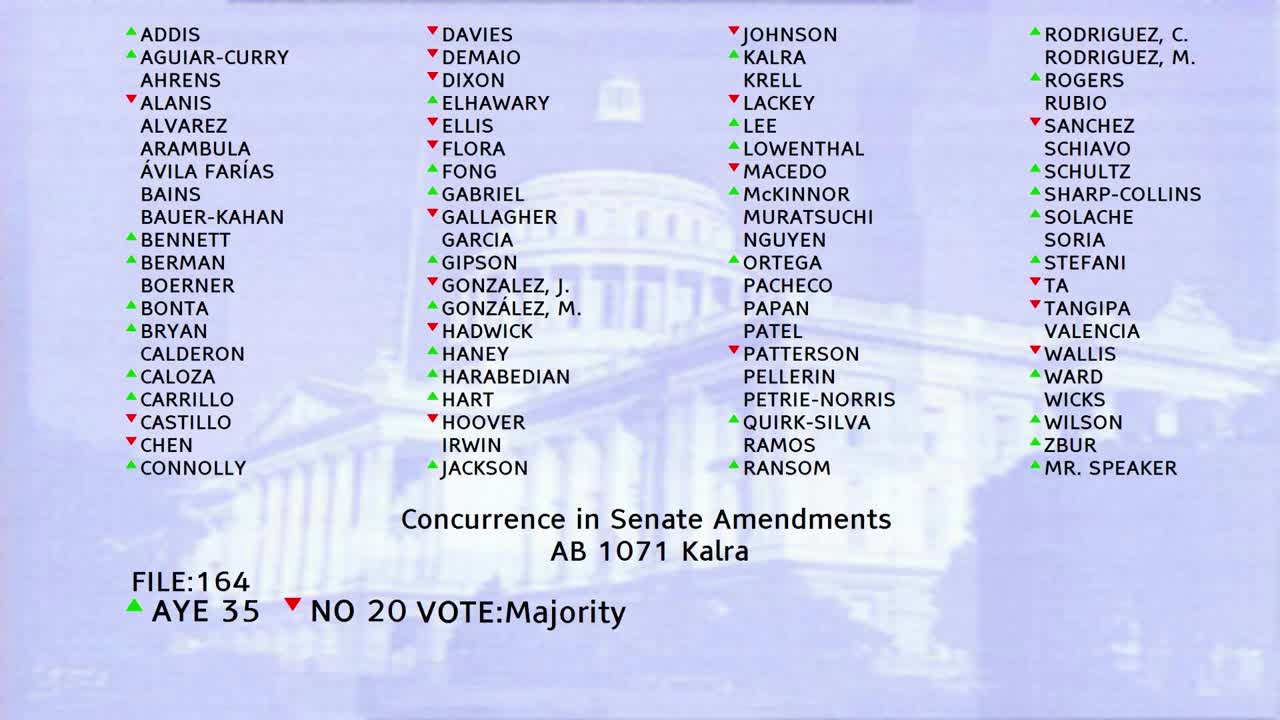
Bill Author

Bill Co-Author(s):