AB 937: The Cannella Environmental Farming Act of 1995: Organic Transition Program.
- Session Year: 2025-2026
- House: Assembly
- Latest Version Date: 2025-02-19
Current Status:
Failed
(2026-02-02: From committee: Filed with the Chief Clerk pursuant to Joint Rule 56.)
Introduced
In Committee
Awaiting First Chamber Vote
Passed First Chamber
In Committee
Awaiting Second Chamber Vote
Passed Second Chamber
Enacted
The Cannella Environmental Farming Act of 1995 requires the Department of Food and Agriculture to establish and oversee an environmental farming program to provide incentives to farmers whose practices promote the well-being of ecosystems, air quality, and wildlife and their habitat. The act also requires the department to establish the Healthy Soils Program and a technical assistance grant program, as specified.
This bill would require the department, as part of the Cannella Environmental Farming Act of 1995, to establish and oversee the Organic Transition Program on or before July 1, 2026. The bill would require the department, under the program, to award grants to eligible organizations to provide incentives to farmers and ranchers to transition land to certified organic production, as specified, and to make available 25% of moneys appropriated to the department for the program to support certain activities at organic technical assistance provider organizations. The bill would also authorize the department to provide funding for the preparation and implementation of conservation management plans for organic transition
(a)For purposes of this section, the following definitions apply:
(1)Eligible organization means an organization that is eligible to participate in the Organic Transition Pilot Program established by the department.
(2)Program means the Organic Transition Program established pursuant to subdivision (b).
(3)Socially disadvantaged farmer or rancher has the same meaning as defined in Section 512.
(b)On or before July 1, 2026, the department shall establish and oversee the Organic Transition Program.
(c)Under the program, the department shall do both of the following:
(1)Award grants to eligible organizations to provide incentives, including, but not limited to, grants, technical assistance, and educational materials and outreach, to farmers and ranchers, with at least a 50-percent priority for socially disadvantaged farmers and ranchers, to transition land to certified organic production in accordance with the federal Organic Foods Production Act of 1990 (7 U.S.C. Sec. 6501 et seq.). The University of California and California State University may claim the indirect cost rate established with the department under the Organic Transition Pilot Program for any grant awarded pursuant to this paragraph. All other eligible organizations may claim an indirect cost rate of up to 35 percent of total direct costs for a grant awarded pursuant to this paragraph. An eligible organization shall not use more than 25 percent of a grant awarded pursuant to this paragraph on administrative costs.
(2)Make available 25 percent of moneys appropriated to the department for the program to support training, capacity building, and ongoing organic transition services at organic technical assistance provider organizations. These activities shall include, but are not limited to, staff professional training, administration of organic transition services, continuing education in organic farming, and coordination between organizations that provide organic technical assistance. The moneys made available under this paragraph are not limited to organizations that apply for funding under the program.
(d)Under the program, the department may provide funding for the preparation and implementation of conservation management plans for organic transition.
REVISIONS: HeadingLine 2.|
Date
|
Status
|
|---|---|
| Feb 2, 2026 | From committee: Filed with the Chief Clerk pursuant to Joint Rule 56. |
| Jan 31, 2026 | Died pursuant to Art. IV, Sec. 10(c) of the Constitution. |
| May 23, 2025 | In committee: Held under submission. |
| Apr 9, 2025 | In committee: Set, first hearing. Referred to APPR. suspense file. |
| Mar 27, 2025 | From committee: Do pass and re-refer to Com. on APPR. (Ayes 8. Noes 0.) (March 26). Re-referred to Com. on APPR. |
| Mar 27, 2025 | Coauthors revised. |
| Mar 3, 2025 | Referred to Com. on AGRI. |
| Feb 20, 2025 | From printer. May be heard in committee March 22. |
| Feb 19, 2025 | Read first time. To print. |
|
Date
|
Description
|
Location
|
Votes
|
|
|---|---|---|---|---|
| Mar 26, 2025 | Do pass and be re-referred to the Committee on [Appropriations] | Assembly Standing Committee on Agriculture |
Passed |
This list shows positions taken on this bill by organizations on the date displayed, which is linked to the original source.
Positions by individuals are not included.
|
Organization
|
Position
|
Date
|
|---|---|---|
| Agriculture and Land-based Training | ** Support | |
| A Voice for Choice Advocacy | ** Support | |
| Blossom Bluff Orchards | ** Support | |
| California Certified Organic Farmers | ** Support | |
| California Climate & Agricultural Network | ** Support | |
| Californians Against Waste | ** Support | |
| Californians for Pesticide Reform | ** Support | |
| Ceres Community Project | ** Support | |
| Family Owned Raw Farm | ** Support | |
| Farm2people | ** Support | |
| Good Earth Natural Foods | ** Support | |
| Pesticide Action & Agroecology Network | ** Support | |
| Sierra Harvest | ** Support |
Date of Hearing: April 9, 2025
ASSEMBLY COMMITTEE ON APPROPRIATIONS
Buffy Wicks, Chair
ABPCA Bill Id:AB 937
Author:(Connolly) – As Introduced Ver:February 19, 2025
Policy Committee: | Agriculture | Vote: | 8 - 0 |
|
| ||
|
|
Urgency: No State Mandated Local Program: No Reimbursable: No
SUMMARY:
This bill requires the California Department of Food and Agriculture (CDFA) to establish and oversee the Organic Transition Program (OTP) by July 1, 2026.
In addition, this bill requires CDFA, under the OTP, to:
1) Award grants to eligible organizations to provide incentives, including grants, technical assistance, and educational materials and outreach, to farmers and ranchers, with at least a 50% priority for socially disadvantaged farmers and ranchers (SDFRs), to transition land to certified organic production in accordance with federal law. Specifies what the University of California, California State University, and other eligible organizations may claim for their indirect cost rates for any grant awarded pursuant to this section. Specifies that an eligible organization shall not use more than 25% of a grant awarded pursuant to this section on administrative costs.
2) Make available 25% of moneys appropriated for the OTP to support training, capacity building, and ongoing organic transition services at organic technical assistance provider organizations, as specified. Specifies that the moneys made available under this section are not limited to organizations that apply for funding under the OTP.
The bill also provides that, under the OTP, CDFA may provide funding for the preparation and implementation of conservation management plans for organic transition.
FISCAL EFFECT:
Cost pressure of an unknown but potentially significant amount (General Fund) to provide grants under the OTP. The magnitude is unknown and subject to appropriation by the Legislature. As noted below, the Organic Transition Pilot Program (OTPP) previously received $10 million over two years. Costs to CDFA of an unknown but potentially significant amount (General Fund) to implement and administer the program. Historically, CDFA’s administrative costs have been 5% to 8% of the overall appropriation. CDFA contends it would require at least 0.5 of a senior environmental scientist and 0.5 of an associate governmental program analyst to manage the program, including the solicitation process, public input, award execution, grantee management, communications, and project closeout. CDFA’s estimated costs for these personnel, overhead, grant management software, travel, and IT are approximately $835,000 over four years (General Fund). Absent approved funding for the OTP in the fiscal year 2025-26 budget, the July 1, 2026, implementation date in the bill is likely infeasible.
COMMENTS:
1) Purpose. According to the author:
AB 937 proposes to make technical fixes to the Organic Transition Pilot Program to ensure farmers have access to organic transition support. By making these changes, AB 937 will empower farmers to convert their cropland to organic and help California meet our greater climate goals.
2) Background. According to CDFA, the purpose of the OTPP is to provide support to farmers and ranchers who prepare land for organic certification. The program is designed as a block grant to be administered through organizations that demonstrate the expertise and partnerships needed to accomplish the program’s objectives. These objectives include disbursal of financial assistance, technical assistance, project follow-up, application assistance, business planning, and translation services. At least 50% of OTPP beneficiaries must be SDFRs. This bill modifies and codifies the OTPP in statute as the OTP.
Established by the Budget Act of 2022, the OTPP received $10 million in allocations from the Budget Acts of 2022 and 2023. $6.1 million of this funding has been encumbered with four active grants. According to CDFA, the department did not receive enough requests to encumber the entire appropriation, and some of the funding has since reverted back to the General Fund. CDFA used 5% of the appropriation for program administration. Because CDFA was implementing several other one-time programs concurrently, it was able to use a combination of existing and new staff to administer the OTPP.
According to the California Certified Organic Farmers (CCOF), the sponsor of this bill, during the three-year organic transition period, farmers must make significant investments in new climate-smart practices while carrying additional risk without the ability to garner a price premium for their products. CCOF contends that by providing essential financial and technical assistance, the OTPP helps farmers navigate the challenges of transitioning to organic farming; however, “the program's structure does not adequately meet the demand from farmers, nor does it sufficiently support the organizations that assist them.”
This bill allows an eligible organization to use up to 25% of an awarded grant on administrative costs. CCOF argues that by increasing the amount allowed for administrative costs to 25%, the bill “acknowledges the complexity of providing comprehensive support to farmers, including one-on-one technical assistance, business planning, and outreach, all essential for a successful organic transition.” It is worth noting that no other program within CDFA’s Office of Agricultural Resilience and Sustainability has an administrative cap as high as 25%.
The bill also streamlines and consolidates organic transition support by combining the organic transition components of CDFA’s Conservation Agriculture Planning Grant Program into the OTPP.
Analysis Prepared by: Nikita Koraddi / APPR. / (916) 319-2081
Date of Hearing: March 26, 2025
ASSEMBLY COMMITTEE ON AGRICULTURE
Esmeralda Soria, Chair
ABPCA Bill Id:AB 937
Author:(Connolly) – As Introduced Ver:February 19, 2025
SUBJECT: The Cannella Environmental Farming Act of 1995: Organic Transition Program
SUMMARY: This bill would require the California Department of Food and Agriculture (CDFA) to establish and oversee the Organic Transition Program (OTP) on or before July 1, 2026. Specifically, this bill:
- Defines the following:
- “Eligible organization” means an organization that is eligible to participate in the Organic Transition Pilot Program established by CDFA.
- “Program” means the OTP established pursuant to subdivision (b).
- “Socially disadvantaged farmer or rancher” has the same meaning as defined in Section 512.
- “Eligible organization” means an organization that is eligible to participate in the Organic Transition Pilot Program established by CDFA.
- Requires CDFA, on or before July 1, 2026, to establish and oversee the OTP.
- Requires CDFA to do both of the following:
- Award grants to eligible organizations to provide incentives, including, but not limited to, grants, technical assistance, and educational materials and outreach, to farmers and ranchers, with at least a 50-percent priority for socially disadvantaged farmers and ranchers (SDFR), to transition land to certified organic production.
- Allows The University of California and California State University to claim the indirect cost rate established with CDFA under the Organic Transition Pilot Program (OTPP) for any grant awarded pursuant to this paragraph. All other eligible organizations may claim an indirect cost rate of up to 35 percent of total direct costs for a grant awarded pursuant to this paragraph. An eligible organization shall not use more than 25 percent of a grant awarded pursuant on administrative costs.
- Allows The University of California and California State University to claim the indirect cost rate established with CDFA under the Organic Transition Pilot Program (OTPP) for any grant awarded pursuant to this paragraph. All other eligible organizations may claim an indirect cost rate of up to 35 percent of total direct costs for a grant awarded pursuant to this paragraph. An eligible organization shall not use more than 25 percent of a grant awarded pursuant on administrative costs.
- Make available 25 percent of moneys appropriated to CDFA for the program to support training, capacity building, and ongoing organic transition services at organic technical assistance provider organizations. These activities shall include, but are not limited to, staff professional training, administration of organic transition services, continuing education in organic farming, and coordination between organizations that provide organic technical assistance. The moneys made available under this paragraph are not limited to organizations that apply for funding under OTP.
- Award grants to eligible organizations to provide incentives, including, but not limited to, grants, technical assistance, and educational materials and outreach, to farmers and ranchers, with at least a 50-percent priority for socially disadvantaged farmers and ranchers (SDFR), to transition land to certified organic production.
- Allows CDFA to provide funding for the preparation and implementation of conservation management plans for organic transition.
EXISTING LAW: Requires CDFA to establish and oversee an environmental farming program to provide incentives to farmers whose practices promote the well-being of ecosystems, air quality, and wildlife and their habitat. The act also requires the department to establish the Healthy Soils Program and a technical assistance grant program, as specified.
FISCAL EFFECT: Unknown
COMMENTS: The OTPP was created by the Budget Act of 2022, and is supported with $10 million in allocations from the Budget Acts of 2022 and 2023. The purpose is to provide support to farmers and ranchers who prepare land for organic certification. The program is designed as a block grant to be administered through organizations that demonstrate the expertise and partnerships needed to accomplish the program’s objectives. These objectives include disbursal of financial assistance, technical assistance, project follow-up, application assistance, business planning, and translation services. The Pilot has a strong emphasis on equity, where at least 50% of beneficiaries should be SDFR. As such, it seeks to support diverse farmers and ranchers in their transition to organic production.
OTPP is aligned with the suite of Climate Smart Agriculture incentive programs administered by CDFA’s Office of Environmental Farming and Innovation. It also aligns with the state’s roadmap for reducing greenhouse gas emissions, to expand organic acreage in California.
Financial assistance disbursed to farmers and ranchers can be spent on a wide range of eligible costs for transitioning acres to organic farming, and a field-preparation award can help to build soils for successful organic production.
According to the author, this bill proposes to make technical fixes to the Organic Transition Pilot Program to ensure farmers have access to organic transition support. By making these changes, this will empower farmers to convert their cropland to organic and help California meet our greater climate goals.
While farmers throughout the state are looking to organic certification as a tool, the OTPP is not currently structured to be able to meet this demand. The OTPP does serve farmers directly but offers block grants and requires nonprofit organizations and technical assistance providers to administer the Program. However, the Program structure does not sufficiently support these
intermediaries to successfully administer the Program.
Expanding organic acreage is one of California’s climate strategies. The Natural Resources Agency established a goal of transitioning 10% of cropland to organic by 2030. In addition to trying to solve the issue mentioned above, our bill is trying to make the Organic Transition Program Pilot more effective, so California is able to meet our goals to transition to organic more efficiently.
REGISTERED SUPPORT / OPPOSITION:
Support
California Certified Organic Farmers (CCOF) (Sponsor)
A Voice for Choice Advocacy
Agriculture and Land-based Training
Blossom Bluff Orchards
California Climate & Agricultural Network (CALCAN)
Californians Against Waste
Californians for Pesticide Reform
Ceres Community Project
Family Owned Raw Farm
Farm2people
Good Earth Natural Foods
Pesticide Action & Agroecology Network
Sierra Harvest
Opposition
None on file.
Analysis Prepared by: Victor Francovich / AGRI. / (916) 319-2084
Discussed in Hearing
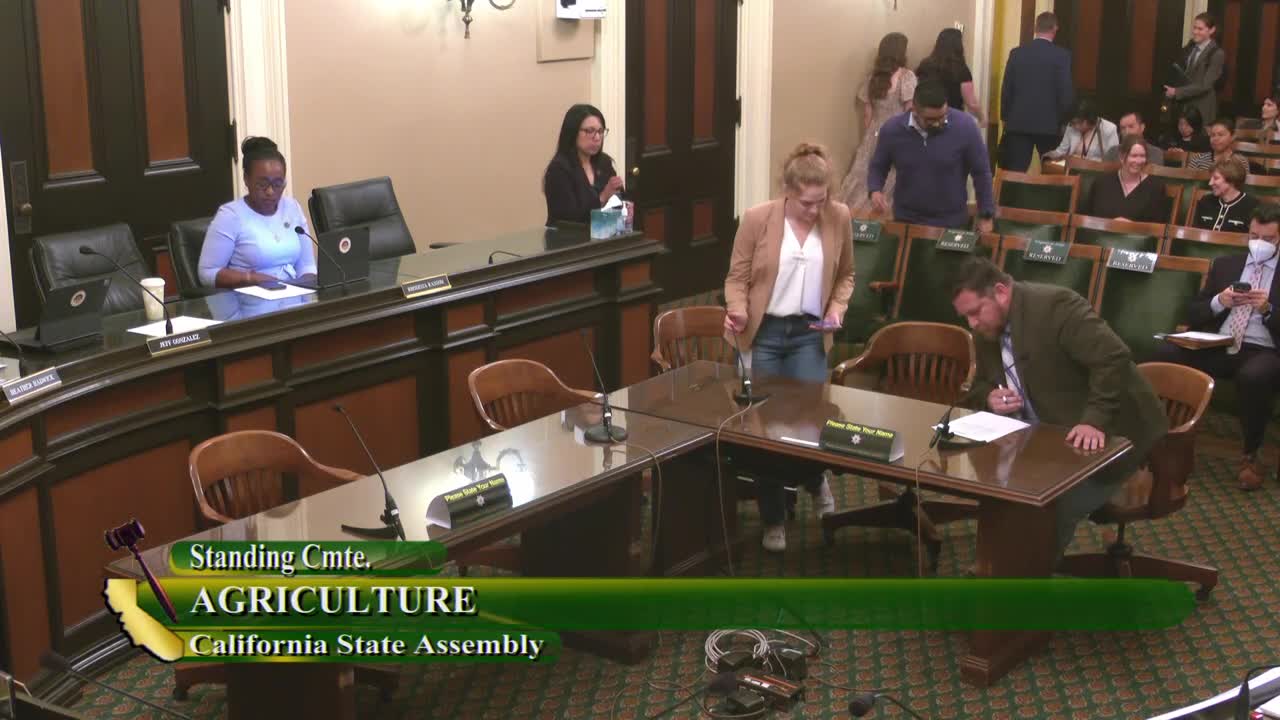 11MIN
Assembly Standing Committee on Agriculture
Bill Author

Bill Co-Author(s):
