AB 956: Accessory dwelling units and junior accessory dwelling units.
- Session Year: 2025-2026
- House: Assembly
- Latest Version Date: 2026-09-29
Current Status:
Passed
(2026-09-29: Chaptered by Secretary of State - Chapter 791, Statutes of 2026.)
Introduced
In Committee
Awaiting First Chamber Vote
Passed First Chamber
In Committee
Awaiting Second Chamber Vote
Passed Second Chamber
Enacted
Existing law, the Planning and Zoning Law, provides for the creation by local ordinance, or by ministerial approval if a local agency has not adopted an ordinance, of accessory dwelling units in areas zoned for single-family or multifamily dwelling residential use in accordance with specified standards and conditions. Existing law also provides for the creation of junior accessory dwelling units by local ordinance, or, if a local agency has not adopted an ordinance, by ministerial approval, in single-family residential zones in accordance with specified standards and conditions.
Existing law, the Davis-Stirling Common Interest Development Act, among other things, makes void and unenforceable any covenant, restriction, or condition contained in any instrument affecting the transfer or sale of any interest in a planned development, and any provision of a governing document, that effectively prohibits or unreasonably restricts the construction or use of an accessory dwelling unit or junior accessory dwelling unit on a lot zoned for single-family residential use that meets the above-described standards and conditions for those units.
This bill would revise the provision governing prohibitions or restrictions on the construction or use of an accessory dwelling unit or junior accessory dwelling unit on a lot zoned for single-family residential use to instead apply to a lot zoned to allow single-family residential use.
Other existing law also generally makes void and unenforceable any covenant, restriction, or condition contained in any instrument affecting the transfer or sale of any interest in real property that either effectively prohibits or unreasonably restricts the construction or use of an accessory dwelling unit or junior accessory dwelling unit on a lot zoned for single-family residential use that meets the above-described standards and conditions for those units.
This bill would similarly revise that provision to instead apply to a lot zoned to allow single-family residential use.
Existing law requires a local agency to ministerially approve a building permit application within a residential or mixed-use zone to create certain accessory dwelling units and junior accessory dwelling units, or any combination of those units, if specified conditions are met, including, among other things, requiring the ministerial approval of one detached, new construction, accessory dwelling unit that does not exceed 4-foot side and rear yard setbacks for a lot with a proposed or existing single-family dwelling, as specified.
This bill would increase the number of detached, new construction, accessory dwelling units that a local agency is required to ministerially approve on lots with a proposed or existing single-family dwelling, as described above, to 2. However, the bill would expressly state that a local agency is not required to ministerially approve an application for a building permit to create a junior accessory dwelling unit on the same lot where 2 detached, new construction, accessory dwelling units have been constructed. By imposing new duties on local governments with respect to the approval of accessory dwelling units, the bill would impose a state-mandated local program.
The California Constitution requires the state to reimburse local agencies and school districts for certain costs mandated by the state. Statutory provisions establish procedures for making that reimbursement.
This bill would provide that no reimbursement is required by this act for a specified reason.
Existing law, the Planning and Zoning Law, provides for the creation by local ordinance, or by ministerial approval if a local agency has not adopted an ordinance, of accessory dwelling units in areas zoned for single-family or multifamily dwelling residential use in accordance with specified standards and conditions. Existing law also provides for the creation of junior accessory dwelling units by local ordinance, or, if a local agency has not adopted an ordinance, by ministerial approval, in single-family residential zones in accordance with specified standards and conditions.
Existing law, the Davis-Stirling Common Interest Development Act, governs the management and operation of common interest developments. Existing law defines common interest development for purposes of the act to include, among other things, a planned development and a condominium project. Existing law among other things, makes void and unenforceable any covenant, restriction, or condition contained in any instrument affecting the transfer or sale of any interest in a planned development, and any provision of a governing document, that effectively prohibits or unreasonably restricts the construction or use of an accessory dwelling unit or junior accessory dwelling unit on a lot zoned for single-family residential use that meets the above-described standards and conditions for those units.
This bill would expand the provision that makes void and unenforceable any covenant, restriction, or condition contained in any instrument affecting the transfer or sale of any interest in a planned development to include any covenant, restriction, or condition contained in an instrument affecting the transfer or sale of any interest in a common interest development. The bill would revise the provision governing prohibitions or restrictions on the construction or use of an accessory dwelling unit or junior accessory dwelling unit on a lot zoned for single-family residential use to instead apply to the construction or use of an accessory dwelling unit or junior accessory dwelling unit on a lot zoned to allow single-family residential use.
Other existing law also generally makes void and unenforceable any covenant, restriction, or condition contained in any instrument affecting the transfer or sale of any interest in real property that either effectively prohibits or unreasonably restricts the construction or use of an accessory dwelling unit or junior accessory dwelling unit on a lot zoned for single-family residential use that meets the above-described standards and conditions for those units.
This bill would similarly revise that provision to instead apply to the construction or use of an accessory dwelling unit or junior accessory dwelling unit on a lot zoned to allow single-family residential use.
Existing law requires a local agency to ministerially approve a building permit application within a residential or mixed-use zone to create certain accessory dwelling units and junior accessory dwelling units, or any combination of those units, if specified conditions are met, including, among other things, requiring the ministerial approval of one detached, new construction, accessory dwelling unit that does not exceed 4-foot side and rear yard setbacks for a lot with a proposed or existing single-family dwelling, as specified.
This bill would increase the number of detached, new construction, accessory dwelling units that a local agency is required to ministerially approve on lots with a proposed or existing single-family dwelling, as described above, to 2. However, the bill would expressly state that a local agency is not required to permit 2 detached accessory dwelling units and a junior accessory dwelling unit on the same lot. ministerially approve an application for a building permit to create a junior accessory dwelling unit on the same lot where 2 detached, new construction, accessory dwelling units have been constructed. By imposing new duties on local governments with respect to the approval of accessory dwelling units, the bill would impose a state-mandated local program.
The California Constitution requires the state to reimburse local agencies and school districts for certain costs mandated by the state. Statutory provisions establish procedures for making that reimbursement.
This bill would provide that no reimbursement is required by this act for a specified reason.
Existing law, the Planning and Zoning Law, provides for the creation by local ordinance, or by ministerial approval if a local agency has not adopted an ordinance, of accessory dwelling units in areas zoned for single-family or multifamily dwelling residential use in accordance with specified standards and conditions. Existing law also provides for the creation of junior accessory dwelling units by local ordinance, or, if a local agency has not adopted an ordinance, by ministerial approval, in single-family residential zones in accordance with specified standards and conditions.
Existing law, the Davis-Stirling Common Interest Development Act, governs the management and operation of common interest developments. Existing law defines common interest development for purposes of the act to include, among other things, a planned development and a condominium project. Existing law makes void and unenforceable any covenant, restriction, or condition contained in any instrument affecting the transfer or sale of any interest in a planned development, and any provision of a governing document, that effectively prohibits or unreasonably restricts the construction or use of an accessory dwelling unit or junior accessory dwelling unit on a lot zoned for single-family residential use that meets the above-described standards and conditions for those units.
This bill would expand the provision that makes void and unenforceable any covenant, restriction, or condition contained in any instrument affecting the transfer or sale of any interest in a planned development to include any covenant, restriction, or condition contained in an instrument affecting the transfer or sale of any interest in a common interest development. The bill would revise the provision governing prohibitions or restrictions on the construction or use of an accessory dwelling unit or junior accessory dwelling unit on a lot zoned for single-family residential use to instead apply to the construction or use of an accessory dwelling unit or junior accessory dwelling unit on a lot zoned to allow single-family residential use.
Other existing law also generally makes void and unenforceable any covenant, restriction, or condition contained in any instrument affecting the transfer or sale of any interest in real property that either effectively prohibits or unreasonably restricts the construction or use of an accessory dwelling unit or junior accessory dwelling unit on a lot zoned for single-family residential use that meets the above-described standards and conditions for those units.
This bill would similarly revise that provision to instead apply to the construction or use of an accessory dwelling unit or junior accessory dwelling unit on a lot zoned to allow single-family residential use.
Existing law requires a local agency to ministerially approve a building permit application within a residential or mixed-use zone to create certain accessory dwelling units and junior accessory dwelling units, or any combination of those units, if specified conditions are met, including, among other things, requiring the ministerial approval of one detached, new construction, accessory dwelling unit that does not exceed 4-foot side and rear yard setbacks for a lot with a proposed or existing single-family dwelling, as specified.
This bill would increase the number of detached, new construction, accessory dwelling units that a local agency is required to ministerially approve on lots with a proposed or existing single-family dwelling, as described above, to 2. However, the bill would expressly state that a local agency is not required to permit 2 detached accessory dwelling units and a junior accessory dwelling unit on the same lot. By imposing new duties on local governments with respect to the approval of accessory dwelling units, the bill would impose a state-mandated local program.
The California Constitution requires the state to reimburse local agencies and school districts for certain costs mandated by the state. Statutory provisions establish procedures for making that reimbursement.
This bill would provide that no reimbursement is required by this act for a specified reason.
Existing law, the Planning and Zoning Law, provided provides for the creation by local ordinance, or by ministerial approval if a local agency has not adopted an ordinance, of accessory dwelling units in areas zoned for single-family or multifamily dwelling residential use in accordance with specified standards and conditions. Existing law requires a local agency to ministerially approve building permit applications within a residential or mixed-use zone to create, among others, one detached, new construction, accessory dwelling unit that does not exceed 4-foot side and rear yard setbacks for a lot with a proposed or existing single-family dwelling, as specified. also provides for the creation of junior accessory dwelling units by local ordinance, or, if a local agency has not adopted an ordinance, by ministerial approval, in single-family residential zones in accordance with specified standards and conditions.
Existing law, the Davis-Stirling Common Interest Development Act, governs the management and operation of common interest developments. Existing law defines common interest development for purposes of the act to include, among other things, a planned development and a condominium project. Existing law makes void and unenforceable any covenant, restriction, or condition contained in any instrument affecting the transfer or sale of any interest in a planned development, and any provision of a governing document, that effectively prohibits or unreasonably restricts the construction or use of an accessory dwelling unit or junior accessory dwelling unit on a lot zoned for single-family residential use that meets the above-described standards and conditions for those units.
This bill would expand the provision that makes void and unenforceable any covenant, restriction, or condition contained in any instrument affecting the transfer or sale of any interest in a planned development to include any covenant, restriction, or condition contained in an instrument affecting the transfer or sale of any interest in a common interest development. The bill would revise the provision governing prohibitions or restrictions on the construction or use of an accessory dwelling unit or junior accessory dwelling unit on a lot zoned for single-family residential use to instead apply to the construction or use of an accessory dwelling unit or junior accessory dwelling unit on a lot zoned to allow single-family residential use.
Other existing law also generally makes void and unenforceable any covenant, restriction, or condition contained in any instrument affecting the transfer or sale of any interest in real property that either effectively prohibits or unreasonably restricts the construction or use of an accessory dwelling unit or junior accessory dwelling unit on a lot zoned for single-family residential use that meets the above-described standards and conditions for those units.
This bill would similarly revise that provision to instead apply to the construction or use of an accessory dwelling unit or junior accessory dwelling unit on a lot zoned to allow single-family residential use.
Existing law requires a local agency to ministerially approve a building permit application within a residential or mixed-use zone to create, among other things, one detached, new construction, accessory dwelling unit that does not exceed 4-foot side and rear yard setbacks for a lot with a proposed or existing single-family dwelling, as specified.
This bill would increase the number of detached, new construction, accessory dwelling units that a local agency is required to ministerially approve on lots with a proposed or existing single-family dwelling, as described above, to 2. By imposing new duties on local governments with respect to the approval of accessory dwelling units, the bill would impose a state-mandated local program.
The California Constitution requires the state to reimburse local agencies and school districts for certain costs mandated by the state. Statutory provisions establish procedures for making that reimbursement.
This bill would provide that no reimbursement is required by this act for a specified reason.
Existing law, the Planning and Zoning Law, provided for the creation by local ordinance, or by ministerial approval if a local agency has not adopted an ordinance, of accessory dwelling units in areas zoned for single-family or multifamily dwelling residential use in accordance with specified standards and conditions. Existing law requires a local agency to ministerially approve building permit applications within a residential or mixed-use zone to create, among others, one detached, new construction, accessory dwelling unit that does not exceed 4-foot side and rear yard setbacks for a lot with a proposed or existing single-family dwelling, as specified.
This bill would increase the number of detached, new construction, accessory dwelling units that a local agency is required to ministerially approve on lots with a proposed or existing single-family dwelling, as described above, to 2. By imposing new duties on local governments with respect to the approval of accessory dwelling units, the bill would impose a state-mandated local program.
The California Constitution requires the state to reimburse local agencies and school districts for certain costs mandated by the state. Statutory provisions establish procedures for making that reimbursement.
This bill would provide that no reimbursement is required by this act for a specified reason.
Existing law establishes the intent of the Legislature to revamp the existing regional housing need allocation process to accomplish specified objectives, including creating a fair, transparent, and objective process for identifying housing needs across the state. Existing law requires the Department of Housing and Community Development, in collaboration with the Office of Land Use and Climate Innovation and after engaging in stakeholder participation, to develop a recommended improved regional housing need allocation process and methodology that promotes and streamlines housing development and substantially addresses Californias housing shortage.This bill would make nonsubstantive changes to those provisions.Existing law establishes the intent of the Legislature to revamp the existing regional housing need allocation process to accomplish specified objectives, including creating a fair, transparent, and objective process for identifying housing needs across the state. Existing law requires the Department of Housing and Community Development, in collaboration with the Office of Land Use and Climate Innovation and after engaging in stakeholder participation, to develop a recommended improved regional housing need allocation process and methodology that promotes and streamlines housing development and substantially addresses Californias housing shortage.
This bill would make nonsubstantive changes to those provisions.
(a)Any covenant, restriction, or condition contained in any deed, contract, security instrument, or other instrument affecting the transfer or sale of any interest in real property that either effectively prohibits or unreasonably restricts the construction or use of an accessory dwelling unit or junior accessory dwelling unit on a lot zoned to allow single-family residential use that meets the requirements of Article 2 (commencing with Section 66314) of Chapter 13 or Article 3 (commencing with Section 66333) of Chapter 13 of Division 1 of Title 7 of the Government Code is void and unenforceable.
(b)This section does not apply to provisions that impose reasonable restrictions on accessory dwelling units or junior accessory dwelling units. For purposes of this subdivision, reasonable restrictions means restrictions that do not unreasonably increase the cost to construct, effectively prohibit the construction of, or extinguish the ability to otherwise construct, an accessory dwelling unit or junior accessory dwelling unit consistent with the provisions of Article 2 (commencing with Section 66314) or Article 3 (commencing with Section 66333) of Chapter 13 of Division 1 of Title 7 of the Government Code. Reasonable restrictions shall not include any fees or other financial requirements.
SEC. 2.Section 4751 of the Civil Code is amended to read:4751.(a)Any covenant, restriction, or condition contained in any deed, contract, security instrument, or other instrument affecting the transfer or sale of any interest in a planned development, and any provision of a governing document, that either effectively prohibits or unreasonably restricts the construction or use of an accessory dwelling unit or junior accessory dwelling unit on a lot zoned to allow single-family residential use that meets the requirements of Article 2 (commencing with Section 66314) or Article 3 (commencing with Section 66333) of Chapter 13 of Division 1 of Title 7 of the Government Code, is void and unenforceable.
(b)This section does not apply to provisions that impose reasonable restrictions on accessory dwelling units or junior accessory dwelling units. For purposes of this subdivision, reasonable restrictions means restrictions that do not unreasonably increase the cost to construct, effectively prohibit the construction of, or extinguish the ability to otherwise construct, an accessory dwelling unit or junior accessory dwelling unit consistent with the provisions of Article 2 (commencing with Section 66314) or Article 3 (commencing with Section 66333) of Chapter 13 of Division 1 of Title 7 of the Government Code.
SEC. 3.Section 66323 of the Government Code is amended to read:66323.(a)Notwithstanding Sections 66314 to 66322, inclusive, a local agency shall ministerially approve an application for a building permit within a residential or mixed-use zone to create any of the following units, or, except as provided in subdivision (b), any combination of the following units:
(1)One accessory dwelling unit and one junior accessory dwelling unit per lot with a proposed or existing single-family dwelling if all of the following apply:
(A)The accessory dwelling unit or junior accessory dwelling unit is within the proposed space of a single-family dwelling or existing space of a single-family dwelling or accessory structure and may include an expansion of not more than 150 square feet beyond the same physical dimensions as the existing accessory structure. An expansion beyond the physical dimensions of the existing accessory structure shall be limited to accommodating ingress and egress.
(B)The space has exterior access from the proposed or existing single-family dwelling.
(C)The side and rear setbacks are sufficient for fire and safety.
(D)The junior accessory dwelling unit complies with the requirements of Article 3 (commencing with Section 66333).
(2)Two detached, new construction, accessory dwelling units that do not exceed four-foot side and rear yard setbacks for a lot with a proposed or existing single-family dwelling. A local agency may impose the following conditions on a detached, new construction, accessory dwelling unit:
(A)A total floor area limitation of not more than 800 square feet of livable space.
(B)A height limitation as provided in subparagraph (A), (B), or (C) of paragraph (4) of subdivision (b) of Section 66321, as applicable.
(3)(A)Multiple accessory dwelling units within the portions of existing multifamily dwelling structures that are not used as livable space, including, but not limited to, storage rooms, boiler rooms, passageways, attics, basements, or garages, if each unit complies with state building standards for dwellings.
(B)A local agency shall allow at least one accessory dwelling unit within an existing multifamily dwelling and shall allow up to 25 percent of the existing multifamily dwelling units.
(4)(A)(i)Multiple accessory dwelling units, not to exceed the number specified in clause (ii) or (iii), as applicable, that are located on a lot that has an existing or proposed multifamily dwelling, but are detached from that multifamily dwelling and are subject to a height limitation in subparagraph (A), (B), or (C) of paragraph (4) of subdivision (b) of Section 66321, as applicable, and rear yard and side setbacks of no more than four feet.
(ii)On a lot with an existing multifamily dwelling, not more than eight detached accessory dwelling units. However, the number of accessory dwelling units allowable pursuant to this clause shall not exceed the number of existing units on the lot.
(iii)On a lot with a proposed multifamily dwelling, not more than two detached accessory dwelling units.
(B)If the existing multifamily dwelling has a rear or side setback of less than four feet, the local agency shall not require any modification of the existing multifamily dwelling as a condition of approving the application to construct an accessory dwelling unit that satisfies the requirements of this paragraph.
(b)Notwithstanding subdivision (a), a local agency is not required to ministerially approve an application for a building permit to create a junior accessory dwelling unit on the same lot where two detached, new construction, accessory dwelling units have been constructed pursuant to paragraph (2) of subdivision (a).
(c)A local agency shall not impose any objective development or design standard that is not authorized by this section upon any unit that meets the requirements of any of paragraphs (1) to (4), inclusive, of subdivision (a).
(d)A local agency shall not require, as a condition for ministerial approval of a permit application for the creation of an accessory dwelling unit or a junior accessory dwelling unit, the correction of nonconforming zoning conditions.
(e)The installation of fire sprinklers shall not be required in an accessory dwelling unit or a junior accessory dwelling unit if sprinklers are not required for the primary residence. The construction of an accessory dwelling unit or a junior accessory dwelling unit shall not trigger a requirement for fire sprinklers to be installed in the existing multifamily dwelling.
(f)A local agency shall require that a rental of the accessory dwelling unit created pursuant to this section be for a term longer than 30 days.
(g)A local agency may require, as part of the application for a permit to create an accessory dwelling unit connected to an onsite wastewater treatment system, a percolation test completed within the last 5 years, or, if the percolation test has been recertified, within the last 10 years.
SEC. 4.No reimbursement is required by this act pursuant to Section 6 of Article XIIIB of the California Constitution because a local agency or school district has the authority to levy service charges, fees, or assessments sufficient to pay for the program or level of service mandated by this act, within the meaning of Section 17556 of the Government Code.
(a)Any covenant, restriction, or condition contained in any deed, contract, security instrument, or other instrument affecting the transfer or sale of any interest in real property that either effectively prohibits or unreasonably restricts the construction or use of an accessory dwelling unit or junior accessory dwelling unit on a lot zoned to allow single-family residential use that meets the requirements of Article 2 (commencing with Section 66314) of Chapter 13 or Article 3 (commencing with Section 66333) of Chapter 13 of Division 1 of Title 7 of the Government Code is void and unenforceable.
(b)This section does not apply to provisions that impose reasonable restrictions on accessory dwelling units or junior accessory dwelling units. For purposes of this subdivision, reasonable restrictions means restrictions that do not unreasonably increase the cost to construct, effectively prohibit the construction of, or extinguish the ability to otherwise construct, an accessory dwelling unit or junior accessory dwelling unit consistent with the provisions of Article 2 (commencing with Section 66314) or Article 3 (commencing with Section 66333) of Chapter 13 of Division 1 of Title 7 of the Government Code. Reasonable restrictions shall not include any fees or other financial requirements.
SEC. 2.Section 4751 of the Civil Code is amended to read:4751.(a)Any covenant, restriction, or condition contained in any deed, contract, security instrument, or other instrument affecting the transfer or sale of any interest in a common interest planned development, and any provision of a governing document, that either effectively prohibits or unreasonably restricts the construction or use of an accessory dwelling unit or junior accessory dwelling unit on a lot zoned to allow single-family residential use that meets the requirements of Article 2 (commencing with Section 66314) or Article 3 (commencing with Section 66333) of Chapter 13 of Division 1 of Title 7 of the Government Code, is void and unenforceable.
(b)This section does not apply to provisions that impose reasonable restrictions on accessory dwelling units or junior accessory dwelling units. For purposes of this subdivision, reasonable restrictions means restrictions that do not unreasonably increase the cost to construct, effectively prohibit the construction of, or extinguish the ability to otherwise construct, an accessory dwelling unit or junior accessory dwelling unit consistent with the provisions of Article 2 (commencing with Section 66314) or Article 3 (commencing with Section 66333) of Chapter 13 of Division 1 of Title 7 of the Government Code.
SEC. 3.Section 66323 of the Government Code is amended to read:66323.(a)Notwithstanding Sections 66314 to 66322, inclusive, a local agency shall ministerially approve an application for a building permit within a residential or mixed-use zone to create any of the following units, or, except as provided in paragraph (2), subdivision (b), any combination of the following units:
(1)One accessory dwelling unit and one junior accessory dwelling unit per lot with a proposed or existing single-family dwelling if all of the following apply:
(A)The accessory dwelling unit or junior accessory dwelling unit is within the proposed space of a single-family dwelling or existing space of a single-family dwelling or accessory structure and may include an expansion of not more than 150 square feet beyond the same physical dimensions as the existing accessory structure. An expansion beyond the physical dimensions of the existing accessory structure shall be limited to accommodating ingress and egress.
(B)The space has exterior access from the proposed or existing single-family dwelling.
(C)The side and rear setbacks are sufficient for fire and safety.
(D)The junior accessory dwelling unit complies with the requirements of Article 3 (commencing with Section 66333).
(2)Two detached, new construction, accessory dwelling units that do not exceed four-foot side and rear yard setbacks for a lot with a proposed or existing single-family dwelling. A local agency is not required to permit two detached accessory dwelling units and a junior accessory dwelling unit on the same lot. A local agency may impose the following conditions on a detached detached, new construction, accessory dwelling unit:
(A)A total floor area limitation of not more than 800 square feet of livable space.
(B)A height limitation as provided in subparagraph (A), (B), or (C) of paragraph (4) of subdivision (b) of Section 66321, as applicable.
(3)(A)Multiple accessory dwelling units within the portions of existing multifamily dwelling structures that are not used as livable space, including, but not limited to, storage rooms, boiler rooms, passageways, attics, basements, or garages, if each unit complies with state building standards for dwellings.
(B)A local agency shall allow at least one accessory dwelling unit within an existing multifamily dwelling and shall allow up to 25 percent of the existing multifamily dwelling units.
(4)(A)(i)Multiple accessory dwelling units, not to exceed the number specified in clause (ii) or (iii), as applicable, that are located on a lot that has an existing or proposed multifamily dwelling, but are detached from that multifamily dwelling and are subject to a height limitation in subparagraph (A), (B), or (C) of paragraph (4) of subdivision (b) of Section 66321, as applicable, and rear yard and side setbacks of no more than four feet.
(ii)On a lot with an existing multifamily dwelling, not more than eight detached accessory dwelling units. However, the number of accessory dwelling units allowable pursuant to this clause shall not exceed the number of existing units on the lot.
(iii)On a lot with a proposed multifamily dwelling, not more than two detached accessory dwelling units.
(B)If the existing multifamily dwelling has a rear or side setback of less than four feet, the local agency shall not require any modification of the existing multifamily dwelling as a condition of approving the application to construct an accessory dwelling unit that satisfies the requirements of this paragraph.
(b)Notwithstanding subdivision (a), a local agency is not required to ministerially approve an application for a building permit to create a junior accessory dwelling unit on the same lot where two detached, new construction, accessory dwelling units have been constructed pursuant to paragraph (2) of subdivision (a).
(b)(c)A local agency shall not impose any objective development or design standard that is not authorized by this section upon any unit that meets the requirements of any of paragraphs (1) to (4), inclusive, of subdivision (a).
(c)(d)A local agency shall not require, as a condition for ministerial approval of a permit application for the creation of an accessory dwelling unit or a junior accessory dwelling unit, the correction of nonconforming zoning conditions.
(d)(e)The installation of fire sprinklers shall not be required in an accessory dwelling unit or a junior accessory dwelling unit if sprinklers are not required for the primary residence. The construction of an accessory dwelling unit or a junior accessory dwelling unit shall not trigger a requirement for fire sprinklers to be installed in the existing multifamily dwelling.
(e)(f)A local agency shall require that a rental of the accessory dwelling unit created pursuant to this section be for a term longer than 30 days.
(f)(g)A local agency may require, as part of the application for a permit to create an accessory dwelling unit connected to an onsite wastewater treatment system, a percolation test completed within the last five 5 years, or, if the percolation test has been recertified, within the last 10 years.
SEC. 4.No reimbursement is required by this act pursuant to Section 6 of Article XIIIB of the California Constitution because a local agency or school district has the authority to levy service charges, fees, or assessments sufficient to pay for the program or level of service mandated by this act, within the meaning of Section 17556 of the Government Code.
(a)Any covenant, restriction, or condition contained in any deed, contract, security instrument, or other instrument affecting the transfer or sale of any interest in real property that either effectively prohibits or unreasonably restricts the construction or use of an accessory dwelling unit or junior accessory dwelling unit on a lot zoned to allow single-family residential use that meets the requirements of Article 2 (commencing with Section 66314) of Chapter 13 or Article 3 (commencing with Section 66333) of Chapter 13 of Division 1 of Title 7 of the Government Code is void and unenforceable.
(b)This section does not apply to provisions that impose reasonable restrictions on accessory dwelling units or junior accessory dwelling units. For purposes of this subdivision, reasonable restrictions means restrictions that do not unreasonably increase the cost to construct, effectively prohibit the construction of, or extinguish the ability to otherwise construct, an accessory dwelling unit or junior accessory dwelling unit consistent with the provisions of Article 2 (commencing with Section 66314) or Article 3 (commencing with Section 66333) of Chapter 13 of Division 1 of Title 7 of the Government Code. Reasonable restrictions shall not include any fees or other financial requirements.
SEC. 2.Section 4751 of the Civil Code is amended to read:4751.(a)Any covenant, restriction, or condition contained in any deed, contract, security instrument, or other instrument affecting the transfer or sale of any interest in a common interest development, and any provision of a governing document, that either effectively prohibits or unreasonably restricts the construction or use of an accessory dwelling unit or junior accessory dwelling unit on a lot zoned to allow single-family residential use that meets the requirements of Article 2 (commencing with Section 66314) or Article 3 (commencing with Section 66333) of Chapter 13 of Division 1 of Title 7 of the Government Code, is void and unenforceable.
(b)This section does not apply to provisions that impose reasonable restrictions on accessory dwelling units or junior accessory dwelling units. For purposes of this subdivision, reasonable restrictions means restrictions that do not unreasonably increase the cost to construct, effectively prohibit the construction of, or extinguish the ability to otherwise construct, an accessory dwelling unit or junior accessory dwelling unit consistent with the provisions of Article 2 (commencing with Section 66314) or Article 3 (commencing with Section 66333) of Chapter 13 of Division 1 of Title 7 of the Government Code.
SEC. 3.Section 66323 of the Government Code is amended to read:66323.(a)Notwithstanding Sections 66314 to 66322, inclusive, a local agency shall ministerially approve an application for a building permit within a residential or mixed-use zone to create any of the following units, or or, except as provided in paragraph (2), any combination of the following units:
(1)One accessory dwelling unit and one junior accessory dwelling unit per lot with a proposed or existing single-family dwelling if all of the following apply:
(A)The accessory dwelling unit or junior accessory dwelling unit is within the proposed space of a single-family dwelling or existing space of a single-family dwelling or accessory structure and may include an expansion of not more than 150 square feet beyond the same physical dimensions as the existing accessory structure. An expansion beyond the physical dimensions of the existing accessory structure shall be limited to accommodating ingress and egress.
(B)The space has exterior access from the proposed or existing single-family dwelling.
(C)The side and rear setbacks are sufficient for fire and safety.
(D)The junior accessory dwelling unit complies with the requirements of Article 3 (commencing with Section 66333).
(2)Two detached, new construction, accessory dwelling units that do not exceed four-foot side and rear yard setbacks for a lot with a proposed or existing single-family dwelling. A local agency is not required to permit two detached accessory dwelling units and a junior accessory dwelling unit on the same lot. A local agency may impose the following conditions on the a detached accessory dwelling unit:
(A)A total floor area limitation of not more than 800 square feet of livable space.
(B)A height limitation as provided in subparagraph (A), (B), or (C) of paragraph (4) of subdivision (b) of Section 66321, as applicable.
(3)(A)Multiple accessory dwelling units within the portions of existing multifamily dwelling structures that are not used as livable space, including, but not limited to, storage rooms, boiler rooms, passageways, attics, basements, or garages, if each unit complies with state building standards for dwellings.
(B)A local agency shall allow at least one accessory dwelling unit within an existing multifamily dwelling and shall allow up to 25 percent of the existing multifamily dwelling units.
(4)(A)(i)Multiple accessory dwelling units, not to exceed the number specified in clause (ii) or (iii), as applicable, that are located on a lot that has an existing or proposed multifamily dwelling, but are detached from that multifamily dwelling and are subject to a height limitation in subparagraph (A), (B), or (C) of paragraph (4) of subdivision (b) of Section 66321, as applicable, and rear yard and side setbacks of no more than four feet.
(ii)On a lot with an existing multifamily dwelling, not more than eight detached accessory dwelling units. However, the number of accessory dwelling units allowable pursuant to this clause shall not exceed the number of existing units on the lot.
(iii)On a lot with a proposed multifamily dwelling, not more than two detached accessory dwelling units.
(B)If the existing multifamily dwelling has a rear or side setback of less than four feet, the local agency shall not require any modification of the existing multifamily dwelling as a condition of approving the application to construct an accessory dwelling unit that satisfies the requirements of this paragraph.
(b)A local agency shall not impose any objective development or design standard that is not authorized by this section upon any unit that meets the requirements of any of paragraphs (1) to (4), inclusive, of subdivision (a).
(c)A local agency shall not require, as a condition for ministerial approval of a permit application for the creation of an accessory dwelling unit or a junior accessory dwelling unit, the correction of nonconforming zoning conditions.
(d)The installation of fire sprinklers shall not be required in an accessory dwelling unit or a junior accessory dwelling unit if sprinklers are not required for the primary residence. The construction of an accessory dwelling unit or a junior accessory dwelling unit shall not trigger a requirement for fire sprinklers to be installed in the existing multifamily dwelling.
(e)A local agency shall require that a rental of the accessory dwelling unit created pursuant to this section be for a term longer than 30 days.
(f)A local agency may require, as part of the application for a permit to create an accessory dwelling unit connected to an onsite wastewater treatment system, a percolation test completed within the last five years, or, if the percolation test has been recertified, within the last 10 years.
SEC. 4.No reimbursement is required by this act pursuant to Section 6 of Article XIIIB of the California Constitution because a local agency or school district has the authority to levy service charges, fees, or assessments sufficient to pay for the program or level of service mandated by this act, within the meaning of Section 17556 of the Government Code.
(a)Any covenant, restriction, or condition contained in any deed, contract, security instrument, or other instrument affecting the transfer or sale of any interest in real property that either effectively prohibits or unreasonably restricts the construction or use of an accessory dwelling unit or junior accessory dwelling unit on a lot zoned for to allow single-family residential use that meets the requirements of Article 2 (commencing with Section 66314) of Chapter 13 or Article 3 (commencing with Section 66333) of Chapter 13 of Division 1 of Title 7 of the Government Code is void and unenforceable.
(b)This section does not apply to provisions that impose reasonable restrictions on accessory dwelling units or junior accessory dwelling units. For purposes of this subdivision, reasonable restrictions means restrictions that do not unreasonably increase the cost to construct, effectively prohibit the construction of, or extinguish the ability to otherwise construct, an accessory dwelling unit or junior accessory dwelling unit consistent with the provisions of Article 2 (commencing with Section 66314) or Article 3 (commencing with Section 66333) of Chapter 13 of Division 1 of Title 7 of the Government Code. Reasonable restrictions shall not include any fees or other financial requirements.
SEC. 2.Section 4751 of the Civil Code is amended to read:4751.(a)Any covenant, restriction, or condition contained in any deed, contract, security instrument, or other instrument affecting the transfer or sale of any interest in a planned development, common interest development, and any provision of a governing document, that either effectively prohibits or unreasonably restricts the construction or use of an accessory dwelling unit or junior accessory dwelling unit on a lot zoned for to allow single-family residential use that meets the requirements of Article 2 (commencing with Section 66314) or Article 3 (commencing with Section 66333) of Chapter 13 of Division 1 of Title 7 of the Government Code, is void and unenforceable.
(b)This section does not apply to provisions that impose reasonable restrictions on accessory dwelling units or junior accessory dwelling units. For purposes of this subdivision, reasonable restrictions means restrictions that do not unreasonably increase the cost to construct, effectively prohibit the construction of, or extinguish the ability to otherwise construct, an accessory dwelling unit or junior accessory dwelling unit consistent with the provisions of Article 2 (commencing with Section 66314) or Article 3 (commencing with Section 66333) of Chapter 13 of Division 1 of Title 7 of the Government Code.
SEC. 3.Section 66323 of the Government Code is amended to read:66323.(a)Notwithstanding Sections 66314 to 66322, inclusive, a local agency shall ministerially approve an application for a building permit within a residential or mixed-use zone to create any of the following units, or any combination of the following units:
(1)One accessory dwelling unit and one junior accessory dwelling unit per lot with a proposed or existing single-family dwelling if all of the following apply:
(A)The accessory dwelling unit or junior accessory dwelling unit is within the proposed space of a single-family dwelling or existing space of a single-family dwelling or accessory structure and may include an expansion of not more than 150 square feet beyond the same physical dimensions as the existing accessory structure. An expansion beyond the physical dimensions of the existing accessory structure shall be limited to accommodating ingress and egress.
(B)The space has exterior access from the proposed or existing single-family dwelling.
(C)The side and rear setbacks are sufficient for fire and safety.
(D)The junior accessory dwelling unit complies with the requirements of Article 3 (commencing with Section 66333).
(2)One Two detached, new construction, accessory dwelling unit units that does do not exceed four-foot side and rear yard setbacks for a lot with a proposed or existing single-family dwelling. A local agency may impose the following conditions on the accessory dwelling unit:
(A)A total floor area limitation of not more than 800 square feet of livable space.
(B)A height limitation as provided in subparagraph (A), (B), or (C) of paragraph (4) of subdivision (b) of Section 66321, as applicable.
(3)(A)Multiple accessory dwelling units within the portions of existing multifamily dwelling structures that are not used as livable space, including, but not limited to, storage rooms, boiler rooms, passageways, attics, basements, or garages, if each unit complies with state building standards for dwellings.
(B)A local agency shall allow at least one accessory dwelling unit within an existing multifamily dwelling and shall allow up to 25 percent of the existing multifamily dwelling units.
(4)(A)(i)Multiple accessory dwelling units, not to exceed the number specified in clause (ii) or (iii), as applicable, that are located on a lot that has an existing or proposed multifamily dwelling, but are detached from that multifamily dwelling and are subject to a height limitation in subparagraph (A), (B), or (C) of paragraph (4) of subdivision (b) of Section 66321, as applicable, and rear yard and side setbacks of no more than four feet.
(ii)On a lot with an existing multifamily dwelling, not more than eight detached accessory dwelling units. However, the number of accessory dwelling units allowable pursuant to this clause shall not exceed the number of existing units on the lot.
(iii)On a lot with a proposed multifamily dwelling, not more than two detached accessory dwelling units.
(B)If the existing multifamily dwelling has a rear or side setback of less than four feet, the local agency shall not require any modification of the existing multifamily dwelling as a condition of approving the application to construct an accessory dwelling unit that satisfies the requirements of this paragraph.
(b)A local agency shall not impose any objective development or design standard that is not authorized by this section upon any unit that meets the requirements of any of paragraphs (1) to (4), inclusive, of subdivision (a).
(c)A local agency shall not require, as a condition for ministerial approval of a permit application for the creation of an accessory dwelling unit or a junior accessory dwelling unit, the correction of nonconforming zoning conditions.
(d)The installation of fire sprinklers shall not be required in an accessory dwelling unit or a junior accessory dwelling unit if sprinklers are not required for the primary residence. The construction of an accessory dwelling unit or a junior accessory dwelling unit shall not trigger a requirement for fire sprinklers to be installed in the existing multifamily dwelling.
(e)A local agency shall require that a rental of the accessory dwelling unit created pursuant to this section be for a term longer than 30 days.
(f)A local agency may require, as part of the application for a permit to create an accessory dwelling unit connected to an onsite wastewater treatment system, a percolation test completed within the last five years, or, if the percolation test has been recertified, within the last 10 years.
SEC. 4.No reimbursement is required by this act pursuant to Section 6 of Article XIIIB of the California Constitution because a local agency or school district has the authority to levy service charges, fees, or assessments sufficient to pay for the program or level of service mandated by this act, within the meaning of Section 17556 of the Government Code.
SECTION 1.Section 66323 of the Government Code is amended to read:66323.(a)Notwithstanding Sections 66314 to 66322, inclusive, a local agency shall ministerially approve an application for a building permit within a residential or mixed-use zone to create any of the following:(1)One accessory dwelling unit and one junior accessory dwelling unit per lot with a proposed or existing single-family dwelling if all of the following apply:(A)The accessory dwelling unit or junior accessory dwelling unit is within the proposed space of a single-family dwelling or existing space of a single-family dwelling or accessory structure and may include an expansion of not more than 150 square feet beyond the same physical dimensions as the existing accessory structure. An expansion beyond the physical dimensions of the existing accessory structure shall be limited to accommodating ingress and egress.(B)The space has exterior access from the proposed or existing single-family dwelling.(C)The side and rear setbacks are sufficient for fire and safety.(D)The junior accessory dwelling unit complies with the requirements of Article 3 (commencing with Section 66333).(2)Two detached, new construction, accessory dwelling units that do not exceed four-foot side and rear yard setbacks for a lot with a proposed or existing single-family dwelling. The accessory dwelling unit may be combined with a junior accessory dwelling unit described in paragraph (1). A local agency may impose the following conditions on the accessory dwelling unit:(A)A total floor area limitation of not more than 800 square feet.(B)A height limitation as provided in subparagraph (A), (B), or (C) of paragraph (4) of subdivision (b) of Section 66321, as applicable.(3)(A)Multiple accessory dwelling units within the portions of existing multifamily dwelling structures that are not used as livable space, including, but not limited to, storage rooms, boiler rooms, passageways, attics, basements, or garages, if each unit complies with state building standards for dwellings.(B)A local agency shall allow at least one accessory dwelling unit within an existing multifamily dwelling and shall allow up to 25 percent of the existing multifamily dwelling units.(4)(A)(i)Multiple accessory dwelling units, not to exceed the number specified in clause (ii) or (iii), as applicable, that are located on a lot that has an existing or proposed multifamily dwelling, but are detached from that multifamily dwelling and are subject to a height limitation in subparagraph (A), (B), or (C) of paragraph (4) of subdivision (b) of Section 66321, as applicable, and rear yard and side setbacks of no more than four feet.(ii)On a lot with an existing multifamily dwelling, not more than eight detached accessory dwelling units. However, the number of accessory dwelling units allowable pursuant to this clause shall not exceed the number of existing units on the lot.(iii)On a lot with a proposed multifamily dwelling, not more than two detached accessory dwelling units.(B)If the existing multifamily dwelling has a rear or side setback of less than four feet, the local agency shall not require any modification of the existing multifamily dwelling as a condition of approving the application to construct an accessory dwelling unit that satisfies the requirements of this paragraph.(b)A local agency shall not impose any objective development or design standard that is not authorized by this section upon any accessory dwelling unit that meets the requirements of any of paragraphs (1) to (4), inclusive, of subdivision (a).(c)A local agency shall not require, as a condition for ministerial approval of a permit application for the creation of an accessory dwelling unit or a junior accessory dwelling unit, the correction of nonconforming zoning conditions.(d)The installation of fire sprinklers shall not be required in an accessory dwelling unit if sprinklers are not required for the primary residence. The construction of an accessory dwelling unit shall not trigger a requirement for fire sprinklers to be installed in the existing multifamily dwelling.(e)A local agency shall require that a rental of the accessory dwelling unit created pursuant to this section be for a term longer than 30 days.(f)A local agency may require, as part of the application for a permit to create an accessory dwelling unit connected to an onsite wastewater treatment system, a percolation test completed within the last five years, or, if the percolation test has been recertified, within the last 10 years.(g)Notwithstanding Section 66321 and subdivision (a) a local agency that has adopted an ordinance by July 1, 2018, providing for the approval of accessory dwelling units in multifamily dwelling structures shall ministerially consider a permit application to construct an accessory dwelling unit that is described in subdivision (a), and may impose objective standards including, but not limited to, design, development, and historic standards on said accessory dwelling units. These standards shall not include requirements on minimum lot size.SEC. 2.No reimbursement is required by this act pursuant to Section 6 of Article XIIIB of the California Constitution because a local agency or school district has the authority to levy service charges, fees, or assessments sufficient to pay for the program or level of service mandated by this act, within the meaning of Section 17556 of the Government Code.(a)Notwithstanding Sections 66314 to 66322, inclusive, a local agency shall ministerially approve an application for a building permit within a residential or mixed-use zone to create any of the following:
(1)One accessory dwelling unit and one junior accessory dwelling unit per lot with a proposed or existing single-family dwelling if all of the following apply:
(A)The accessory dwelling unit or junior accessory dwelling unit is within the proposed space of a single-family dwelling or existing space of a single-family dwelling or accessory structure and may include an expansion of not more than 150 square feet beyond the same physical dimensions as the existing accessory structure. An expansion beyond the physical dimensions of the existing accessory structure shall be limited to accommodating ingress and egress.
(B)The space has exterior access from the proposed or existing single-family dwelling.
(C)The side and rear setbacks are sufficient for fire and safety.
(D)The junior accessory dwelling unit complies with the requirements of Article 3 (commencing with Section 66333).
(2)One Two detached, new construction, accessory dwelling unit units that does do not exceed four-foot side and rear yard setbacks for a lot with a proposed or existing single-family dwelling. The accessory dwelling unit may be combined with a junior accessory dwelling unit described in paragraph (1). A local agency may impose the following conditions on the accessory dwelling unit:
(A)A total floor area limitation of not more than 800 square feet.
(B)A height limitation as provided in subparagraph (A), (B), or (C) of paragraph (4) of subdivision (b) of Section 66321, as applicable.
(3)(A)Multiple accessory dwelling units within the portions of existing multifamily dwelling structures that are not used as livable space, including, but not limited to, storage rooms, boiler rooms, passageways, attics, basements, or garages, if each unit complies with state building standards for dwellings.
(B)A local agency shall allow at least one accessory dwelling unit within an existing multifamily dwelling and shall allow up to 25 percent of the existing multifamily dwelling units.
(4)(A)(i)Multiple accessory dwelling units, not to exceed the number specified in clause (ii) or (iii), as applicable, that are located on a lot that has an existing or proposed multifamily dwelling, but are detached from that multifamily dwelling and are subject to a height limitation in subparagraph (A), (B), or (C) of paragraph (4) of subdivision (b) of Section 66321, as applicable, and rear yard and side setbacks of no more than four feet.
(ii)On a lot with an existing multifamily dwelling, not more than eight detached accessory dwelling units. However, the number of accessory dwelling units allowable pursuant to this clause shall not exceed the number of existing units on the lot.
(iii)On a lot with a proposed multifamily dwelling, not more than two detached accessory dwelling units.
(B)If the existing multifamily dwelling has a rear or side setback of less than four feet, the local agency shall not require any modification of the existing multifamily dwelling as a condition of approving the application to construct an accessory dwelling unit that satisfies the requirements of this paragraph.
(b)A local agency shall not impose any objective development or design standard that is not authorized by this section upon any accessory dwelling unit that meets the requirements of any of paragraphs (1) to (4), inclusive, of subdivision (a).
(c)A local agency shall not require, as a condition for ministerial approval of a permit application for the creation of an accessory dwelling unit or a junior accessory dwelling unit, the correction of nonconforming zoning conditions.
(d)The installation of fire sprinklers shall not be required in an accessory dwelling unit if sprinklers are not required for the primary residence. The construction of an accessory dwelling unit shall not trigger a requirement for fire sprinklers to be installed in the existing multifamily dwelling.
(e)A local agency shall require that a rental of the accessory dwelling unit created pursuant to this section be for a term longer than 30 days.
(f)A local agency may require, as part of the application for a permit to create an accessory dwelling unit connected to an onsite wastewater treatment system, a percolation test completed within the last five years, or, if the percolation test has been recertified, within the last 10 years.
(g)Notwithstanding Section 66321 and subdivision (a) a local agency that has adopted an ordinance by July 1, 2018, providing for the approval of accessory dwelling units in multifamily dwelling structures shall ministerially consider a permit application to construct an accessory dwelling unit that is described in subdivision (a), and may impose objective standards including, but not limited to, design, development, and historic standards on said accessory dwelling units. These standards shall not include requirements on minimum lot size.
SEC. 2.No reimbursement is required by this act pursuant to Section 6 of Article XIIIB of the California Constitution because a local agency or school district has the authority to levy service charges, fees, or assessments sufficient to pay for the program or level of service mandated by this act, within the meaning of Section 17556 of the Government Code.
SECTION 1.Section 50515.05 of the Health and Safety Code is amended to read:50515.05.(a)It is the intent of the Legislature to revamp the existing regional housing need allocation process described in Sections 65584 to 65584.2, inclusive, of the Government Code in order to accomplish the following objectives:(1)Create a fair, transparent, and objective process for identifying housing needs across the state.(2)Strategically plan for housing growth according to statewide priorities, consistent with Section 65041.1 of the Government Code, and expected future need for housing at all income levels.(3)Encourage increased development to address the states housing affordability issues.(4)Improve compliance and outcomes through incentives and enforcement.(b)(1)On or before December 31, 2023, the department, in collaboration with the Office of Land Use and Climate Innovation and after engaging in stakeholder participation, shall develop a recommended improved regional housing need allocation process and methodology that promotes and streamlines housing development and substantially addresses Californias housing shortage.(2)In developing the recommendations required by this subdivision, the department may appoint a third-party consultant to facilitate a comprehensive review of the current regional housing need allocation process and methodology.(c)The department shall keep the Legislature apprised of its progress in implementing this section, including providing an update to the Legislature no later than July 1, 2023. Upon completion of the process described in subdivision (b), the department shall submit a report of its findings and recommendations to the Legislature. The report required to be submitted pursuant to this subdivision shall be submitted in compliance with Section 9795 of the Government Code. REVISIONS: HeadingLine 2.(a)It is the intent of the Legislature to revamp the existing regional housing need allocation process described in Sections 65584 to 65584.2, inclusive, of the Government Code in order to accomplish the following objectives:
(1)Create a fair, transparent, and objective process for identifying housing needs across the state.
(2)Strategically plan for housing growth according to statewide priorities, consistent with Section 65041.1 of the Government Code, and expected future need for housing at all income levels.
(3)Encourage increased development to address the states housing affordability issues.
(4)Improve compliance and outcomes through incentives and enforcement.
(b)(1)By On or before December 31, 2023, the department, in collaboration with the Office of Planning and Research Land Use and Climate Innovation and after engaging in stakeholder participation, shall develop a recommended improved regional housing need allocation process and methodology that promotes and streamlines housing development and substantially addresses Californias housing shortage.
(2)In developing the recommendations required by this subdivision, the department may appoint a third-party consultant to facilitate a comprehensive review of the current regional housing need allocation process and methodology.
(c)The department shall keep the Legislature apprised of its progress in implementing this section, including providing an update to the Legislature no later than July 1, 2023. Upon completion of the process described in subdivision (b), the department shall submit a report of its findings and recommendations to the Legislature. The report required to be submitted pursuant to this subdivision shall be submitted in compliance with Section 9795 of the Government Code.
|
Date
|
Status
|
|---|---|
| Sep 29, 2026 | Chaptered by Secretary of State - Chapter 791, Statutes of 2026. |
| Sep 29, 2026 | Approved by the Governor. |
| Sep 4, 2026 | Enrolled and presented to the Governor at 4 p.m. |
| Aug 27, 2026 | Senate amendments concurred in. To Engrossing and Enrolling. (Ayes 60. Noes 2. Page 6744.). |
| Aug 27, 2026 | Senate amendments concurred in. To Engrossing and Enrolling. (Ayes 60. Noes 2.). |
| Aug 27, 2026 | From committee: That the Senate amendments be concurred in. (Ayes 10. Noes 0.) (August 27). |
| Aug 26, 2026 | Joint Rule 62(a), file notice suspended. (Page 6646.) |
| Aug 26, 2026 | Joint Rule 62(a), file notice suspended. |
| Aug 25, 2026 | Re-referred to Com. on H. & C.D. pursuant to Assembly Rule 77.2. |
| Aug 25, 2026 | In Assembly. Concurrence in Senate amendments pending. |
| Aug 25, 2026 | Read third time. Passed. Ordered to the Assembly. (Ayes 28. Noes 7. Page 5752.). |
| Aug 25, 2026 | Read third time. Passed. Ordered to the Assembly. (Ayes 27. Noes 6.). |
| Aug 13, 2026 | Read second time. Ordered to third reading. |
| Aug 12, 2026 | Read third time and amended. Ordered to second reading. |
| Aug 4, 2026 | Read second time. Ordered to third reading. |
| Aug 3, 2026 | From committee: Be ordered to second reading pursuant to Senate Rule 28.8. |
| Jul 2, 2026 | From committee: Do pass and re-refer to Com. on APPR. (Ayes 5. Noes 2.) (July 1). Re-referred to Com. on APPR. |
| Jun 15, 2026 | Read second time and amended. Re-referred to Com. on L. GOV. |
| Jun 11, 2026 | From committee: Amend, and do pass as amended and re-refer to Com. on L. GOV. (Ayes 7. Noes 1.) (June 10). |
| May 27, 2026 | From committee chair, with author's amendments: Amend, and re-refer to committee. Read second time, amended, and re-referred to Com. on HOUSING. |
| Jun 24, 2025 | In committee: Hearing postponed by committee. |
| Jun 4, 2025 | Referred to Coms. on HOUSING and L. GOV. |
| May 23, 2025 | In Senate. Read first time. To Com. on RLS. for assignment. |
| May 23, 2025 | Read third time. Passed. Ordered to the Senate. (Ayes 58. Noes 4. Page 1654.) |
| May 15, 2025 | Read second time. Ordered to third reading. |
| May 14, 2025 | From committee: Do pass. (Ayes 12. Noes 2.) (May 14). |
| May 14, 2025 | Coauthors revised. |
| May 1, 2025 | From committee: Do pass and re-refer to Com. on APPR. (Ayes 9. Noes 0.) (April 30). Re-referred to Com. on APPR. |
| May 1, 2025 | Coauthors revised. |
| Apr 28, 2025 | From committee: Do pass and re-refer to Com. on L. GOV. (Ayes 11. Noes 0.) (April 24). Re-referred to Com. on L. GOV. |
| Apr 24, 2025 | (Pending re-refer to Com. on L. GOV.) |
| Apr 24, 2025 | Assembly Rule 56 suspended. (Page 1265.) |
| Apr 7, 2025 | In committee: Hearing postponed by committee. |
| Mar 18, 2025 | Re-referred to Com. on H. & C.D. |
| Mar 17, 2025 | From committee chair, with author's amendments: Amend, and re-refer to Com. on H. & C.D. Read second time and amended. |
| Mar 17, 2025 | Referred to Coms. on H. & C.D. and L. GOV. |
| Feb 21, 2025 | From printer. May be heard in committee March 23. |
| Feb 20, 2025 | Read first time. To print. |
|
Date
|
Description
|
Location
|
Votes
|
|
|---|---|---|---|---|
| Aug 27, 2026 | AB 956 Quirk-Silva Concurrence in Senate Amendments | Assembly Floor |
Passed |
|
| Aug 27, 2026 | With recommendation: That Senate amendments be concurred in. | Assembly Standing Committee on Housing and Community Development |
Passed |
|
| Aug 25, 2026 | Assembly 3rd Reading AB956 Quirk-Silva et al. By Wiener | Senate Floor |
Passed |
|
| Jul 1, 2026 | Do pass, but first be re-referred to the Committee on [Appropriations] | Senate Standing Committee on Local Government |
Passed |
|
| Jun 10, 2026 | Do pass as amended, but first amend, and re-refer to the Committee on [Local Government] | Senate Standing Committee on Housing |
Passed |
|
| May 23, 2025 | AB 956 Quirk-Silva Assembly Third Reading | Assembly Floor |
Passed |
|
| May 14, 2025 | Do pass. | Assembly Standing Committee on Appropriations |
Passed |
|
| Apr 30, 2025 | Do pass and be re-referred to the Committee on [Appropriations] | Assembly Standing Committee on Local Government |
Passed |
|
| Apr 24, 2025 | Do pass and be re-referred to the Committee on [Local Government] | Assembly Standing Committee on Housing and Community Development |
Passed |
This list shows positions taken on this bill by organizations on the date displayed, which is linked to the original source.
Positions by individuals are not included.
|
Organization
|
Position
|
Date
|
|---|---|---|
| California Apartment Association | ** Support | |
| California Cities for Local Control | ** Against | |
| California Fire Chiefs Association | ** Against | |
| California YIMBY | ** Support | |
| City Of Burbank | ** Against | |
| city of carlsbad | ** Against | |
| City of Chino Hills | ** Against | |
| City of Concord | ** Against | |
| City Of Cupertino | ** Against | |
| City of Hesperia | ** Against | |
| City of La Habra | ** Against | |
| City of Lakewood CA | ** Against | |
| City of Milpitas | ** Against | |
| City of Murrieta | ** Against | |
| City of San Marcos | ** Against | |
| City of Soledad | ** Against | |
| City of Thousand Oaks | ** Against | |
| City of Torrance | ** Against | |
| City of Tulare | ** Against | |
| city of yorba linda | ** Against | |
| East Bay for Everyone | ** Support | |
| Equitable Land Use Alliance (ELUA) | ** Against | |
| Families and Homes San Jose | ** Against | |
| Families & Homes San Jose | ** Against | |
| Families & Homes San Jose | ** Against | |
| Fire Districts Association Of California | ** Against | |
| LeadingAge California | ** Support | |
| League Of California Cities | ** Against | |
| Marin County Council of Mayors and Council Members | ** Against | |
| Neighbors for a Better San Diego | ** Against | |
| Rural County Representatives of California (RCRC) | ** Against | |
| Southern California Obtainable Housing | ** Support | |
| South Pasadena Residents for Responsible Growth | ** Support | |
| YOLO YIMBY | ** Support | |
| Zillow Group | ** Support |
SENATE RULES COMMITTEE Office of Senate Floor Analyses (916) 651-4171 | AB 956 |
THIRD READING
Bill No: AB 956
Author: Quirk-Silva (D), et al.
Amended: 8/12/26 in Senate
Vote: 21
SENATE HOUSING COMMITTEE: 7-1, 6/10/26
AYES: Arreguín, Cabaldon, Cortese, Durazo, Grayson, Padilla, Pérez
NOES: Seyarto
NO VOTE RECORDED: Caballero, Ochoa Bogh
SENATE LOCAL GOVERNMENT COMMITTEE: 5-2, 7/1/26
AYES: Durazo, Arreguín, Ashby, Cervantes, Laird
NOES: Choi, Seyarto
SENATE APPROPRIATIONS COMMITTEE: Senate Rule 28.8
ASSEMBLY FLOOR: 58-4, 5/23/25 - See last page for vote
SUBJECT: Accessory dwelling units and junior accessory dwelling units
SOURCE: Author
DIGEST:
This bill requires local agencies to ministerially approve two detached, new construction Accessory Dwelling Units (ADUs) on a lot with an existing or proposed single-family dwelling.
Senate Floor Amendments of 8/12/2026, make technical nonsubstantive changes, reorganize the changes that this bill makes to ADU law, and revise the provisions in the Davis Stirling Common Interest Development Act to make ADU law applicable to planned developments rather than common interest developments.
ANALYSIS:
Existing law:
- Defines an ADU as an attached or a detached residential dwelling unit that provides complete independent living facilities for one or more persons and is located on a lot with a proposed or existing primary residence. It must include permanent provisions for living, sleeping, eating, cooking, and sanitation on the same parcel as the single-family or multifamily dwelling is or will be situated on.
- Defines a Junior ADU (JADU) as a unit that is no more than 500 square feet in size and contained entirely within a single-family residence. A junior accessory dwelling unit may include separate sanitation facilities or may share sanitation facilities with the existing structure.
- Requires a local agency to ministerially approve an application to develop one attached or one detached ADU and up to one JADU on a lot with an existing or proposed single-family dwelling.
- Establishes, within the Davis-Stirling Common Interest Development Act, rules and regulations governing the operation of common interest developments (CIDs) and the respective rights and duties of a homeowners’ associations (HOA) and its members. Requires the governing documents of a CID, and any amendments to the governing documents, to be adopted through HOA elections in accordance with specified procedures.
- Deems void and unenforceable any covenant, condition, or restriction (CC&R) contained in any deed, contract, security instrument, or other instrument affecting the transfer of, or any interest in, real property, and any provision of the CID governing documents, that effectively prohibits or restricts:
- Installation of a solar energy system.
- Installation or use of a video or television antenna.
- Installation of low-water using plants, artificial turf, and other synthetic surface that resembles grass.
- Installation or use of an EV charging station within the owner’s unit or designated parking space.
- Display or affixation of one or more religious items on any entry door frame to a dwelling.
- Construction or use of an ADU or JADU on a lot zoned for single-family residential use that meets the requirements of existing law regarding ADUs and JADUs.
This bill:
- Requires a local agency to ministerially approve an application to develop up to two detached ADUs on a lot containing an existing or proposed single-family dwelling.
- Provides that a local agency that approves two detached ADUs is not required to approve a JADU on the same lot.
- Clarifies that ADUs are allowed on lots zoned to allow single-family residential use in an HOA.
Background
ADUs/JADUs. ADUs, also known as mother-in-law units or granny flats, are additional living spaces that have a separate kitchen, bathroom, and exterior access independent of the primary residence; ADUs may be attached or detached from the primary residence. A JADU is a unit of up to 500 square feet within the primary residence. ADU/JADU law has evolved over the years to lower barriers to ADU development, which has resulted in a surge in ADUs built in California. SB 1069 (Wieckowski, Chapter 720, Statutes of 2016) and AB 2299 (Bloom, Chapter 735, Statutes of 2016) permitted ADUs by-right on all residentially-zoned parcels in the state. By permitting an ADU as a second unit on all single-family lots, these laws effectively doubled their allowed density. According to the Department of Housing and Community Development (HCD), between 2016-2023, the number of ADUs permitted annually in the state grew from 1,336 to 26,924, a 20-fold increase. In 2023, ADUs comprised more than 21% of all homes permitted statewide.
Comments
Author’s Statement. “AB 956 is a critical step toward addressing California’s housing crisis by making it easier for families to build the housing they need. Too many families are trapped by outdated restrictions when they need space for aging parents, adult children, or essential rental income. This bill cuts through the red tape and ensures that more Californians can access flexible, affordable housing options. The future of our communities depends on solutions like this: expanding housing, keeping families together, and ensuring every Californian has a place to call home."
ADUs, JADUs, duplexes and urban-lot splits. Existing law requires local agencies to allow up to four units to be developed on most single-family parcels across the state; specifically, SB 9’s (Atkins, Chapter 162, Statutes of 2021) duplex provisions when used in concert with ADU law and JADU law, require a local agency to allow up to four units (a duplex, and two ADUS) on an existing or proposed parcel that is only zoned to allow the development of one single-family dwelling. SB 9 also requires a local agency to allow a property owner to subdivide a single-family parcel and create two units on each parcel (either a duplex, or a primary dwelling and an ADU/JADU). This configuration also allows up to four units to be built on an existing single-family parcel, but it spreads the units across two newly subdivided parcels. The urban-lot split provisions of SB 9 specify that a local agency is only required to allow a total for two units on any parcel created though an urban-lot split. This limitation means that the statutorily imposed upzoning of existing single-family parcels cannot be used create more than four units per original parcel, thus avoiding the potential for an SB 9 development or ADU law to trigger Density Bonus Law (DBL) which applies to projects that include five or more units. This bill specifies that local agencies are not required to approve a JADU in conjunction with two detached ADUs, effectively maintaining consistency with SB 9’s functional cap of four units per parcel.
Clarifying ADU Law and Davis-Stirling. This bill clarifies one item in ADU law related to HOAs. AB 670 (Friedman, Chapter 178, Statutes of 2019), voids any CC&R in a planned development that prohibits or unreasonably restricts the construction of an ADU on a lot zoned for single family development. AB 670 applied to lots that are zoned “for” single family development, rather than lots zoned “to allow” for single family development. In practice this ambiguity can be interpreted to authorize HOAs to prohibit ADUs on parcels that are zoned allow for more than one unit (even if only one unit exists on the parcel). This bill will specify that ADU law applies to any lot in an HOA that allows single family residential use.
FISCAL EFFECT: Appropriation: No Fiscal Com.: Yes Local: Yes
Senate Rule 28.8
SUPPORT: (Verified 8/11/26)
California Apartment Association
California Yimby
East Bay for Everyone
Leadingage California
South Pasadena Residents for Responsible Growth
Southern California Obtainable Housing
Yolo Yimby
Zillow Group
OPPOSITION: (Verified 8/3/26)
California Cities for Local Control
California Fire Chiefs Association
City of Burbank
City of Carlsbad
City of Chino Hills
City of Cupertino
City of LA Habra
City of Lakewood CA
City of Milpitas
City of San Marcos
City of Thousand Oaks
City of Torrance
City of Tulare
City of Yorba Linda
Equitable Land Use Alliance (ELUA)
Fire Districts Association of California
League of California Cities
Marin County Council of Mayors and Council Members
Neighbors for a Better San Diego
Rural County Representatives of California (RCRC)
ARGUMENTS IN SUPPORT: Supporters argue that AB 956 expands housing opportunities by allowing local agencies to approve more detached ADUs on properties with an existing or proposed single-family home. By clarifying state law and eliminating confusion around ADU allowances, AB 956 removes unnecessary barriers and ensures that more Californians can access flexible, affordable housing solutions.
ARGUMENTS IN OPPOSITION: Opponents argue that while AB 956 seeks to expand housing opportunities, it does not adequately account for local infrastructure planning considerations and the resources necessary to support additional residential development. Essential infrastructure utility systems, including water, sewer, gas, electricity, and roadways, have been planned, constructed, and maintained in accordance with locally adopted regulations. Authorizing increased density without consideration of local infrastructure planning and service capacity may create challenges in maintaining the long-term reliability and efficiency of essential services.
ASSEMBLY FLOOR: 58-4, 5/23/25
AYES: Addis, Aguiar-Curry, Ahrens, Alanis, Alvarez, Arambula, Ávila Farías, Bains, Bauer-Kahan, Bennett, Berman, Bonta, Caloza, Carrillo, Connolly, DeMaio, Elhawary, Flora, Fong, Gabriel, Gallagher, Garcia, Gipson, Jeff Gonzalez, Mark González, Hadwick, Haney, Harabedian, Hoover, Jackson, Kalra, Krell, Lackey, Lee, Lowenthal, McKinnor, Ortega, Papan, Patel, Patterson, Pellerin, Quirk-Silva, Ramos, Ransom, Celeste Rodriguez, Michelle Rodriguez, Rogers, Blanca Rubio, Schiavo, Schultz, Soria, Stefani, Ta, Valencia, Wallis, Ward, Zbur, Rivas
NOES: Boerner, Davies, Dixon, Macedo
NO VOTE RECORDED: Bryan, Calderon, Castillo, Chen, Ellis, Hart, Irwin, Muratsuchi, Nguyen, Pacheco, Petrie-Norris, Sanchez, Sharp-Collins, Solache, Tangipa, Wicks, Wilson
Prepared by: Hank Brady / HOUSING / (916) 651-4124
9/14/26 10:16:00
**** END ****
Date of Hearing: August 27, 2025
ASSEMBLY COMMITTEE ON HOUSING AND COMMUNITY DEVELOPMENT
Matt Haney, Chair
ABPCA Bill Id:AB 956 (
Author:Quirk-Silva) – As Amended Ver:August 12, 2026
SUBJECT: Accessory dwelling units: ministerial approval: single-family dwellings
SUMMARY: Requires local agencies to ministerially approve two detached, new construction accessory dwelling units (ADUs) on a lot with an existing or proposed single-family dwelling, and clarifies that covenants, restrictions, or conditions (CC&Rs) in planned developments and any related governing documents prohibiting or restricting the construction of ADUs and junior ADUs (JADUs) on lots zoned to allow single-family developments are void and unenforceable. Specifically, this bill:
- Requires a local agency to ministerially approve an application to develop up to two detached ADUs on a lot containing an existing or proposed single-family dwelling.
- Provides that a local agency is not required to ministerially approve an application for a building permit to create a junior ADU (JADU) on the same lot where two detached, new construction, ADUs have been constructed pursuant to 1).
- Clarifies that CC&Rs in planned developments and any related governing documents prohibiting or restricting the construction of ADUs and junior ADUs (JADUs) on lots zoned to allow single-family developments are void and unenforceable.
EXISTING LAW:
- Defines an ADU as an attached or a detached residential dwelling unit that provides complete independent living facilities for one or more persons and is located on a lot with a proposed or existing primary residence. It must include permanent provisions for living, sleeping, eating, cooking, and sanitation on the same parcel as the single-family or multifamily dwelling is or will be situated on. (Government Code (GOV) 66313)
- Defines a Junior ADU (JADU) as a unit that is no more than 500 square feet in size and contained entirely within a single-family residence. A junior accessory dwelling unit may include separate sanitation facilities or may share sanitation facilities with the existing structure. (GOV 66313)
- Requires a local agency to ministerially approve an application to develop one attached or one detached ADU and up to one JADU on a lot with an existing or proposed single-family dwelling. (GOV 66323)
- Establishes, within the Davis-Stirling Common Interest Development Act, rules and regulations governing the operation of common interest developments (CIDs) and the respective rights and duties of a homeowners’ associations (HOA) and its members. Requires the governing documents of a CID, and any amendments to the governing documents, to be adopted through HOA elections in accordance with specified procedures. (Civil Code Section 4000-6150)
- Deems void and unenforceable any CC&R contained in any deed, contract, security instrument, or other instrument affecting the transfer of, or any interest in, real property, and any provision of the CID governing documents, that effectively prohibits or restricts:
- Installation of a solar energy system;
- Installation or use of a video or television antenna;
- Installation of low-water using plants, artificial turf, and other synthetic surface that resembles grass;
- Installation or use of an EV charging station within the owner’s unit or designated parking space;
- Display or affixation of one or more religious items on any entry door frame to a dwelling; or
- Construction or use of an ADU or JADU on a lot zoned for single-family residential use that meets the requirements of existing law regarding ADUs and JADUs.
FISCAL EFFECT: According to the Assembly Committee on Appropriations: “No state costs. Local costs of an unknown amount to local agencies to provide for the streamlined review and approval of additional ADUs on existing single family lots. These costs are not state-reimbursable because local agencies have general authority to charge and adjust planning and permitting fees to offset increased costs associated with the provisions of this bill.”
COMMENTS:
California’s Housing Crisis: California’s housing crisis is a half-century in the making.[1] After decades of underproduction, supply is far behind need and housing and rental costs are soaring. As a result, millions of Californians must make hard decisions about paying for housing at the expense of food, health care, child care, and transportation, directly impacting the quality of life in the state.[2] One in three households in the state doesn’t earn enough money to meet their basic needs.[3] In 2024, over 187,000 Californians experienced homelessness on a given night.[4]
To meet this housing need, HCD determined that California must plan for more than 2.5 million new homes, and no less than one million of those homes must be affordable to lower-income households, in the 6th Regional Housing Needs Allocation (RHNA) cycle. By contrast, housing production in the past decade has been under 100,000 units per year – including less than 10,000 units of affordable housing per year.[5]
ADUs and Gentle Density as a Solution: Recently, there has been a national trend toward allowing more “gentle density,” such as ADUs, duplexes, fourplexes, townhomes, and other moderately dense housing types that were common before zoning restrictions took hold. In 2016, SB 1069 (Wieckowski), Chapter 720, and AB 2299 (Bloom), Chapter 735, allowed ADUs by right on all residentially zoned parcels in California. SB 1211 (Skinner), Chapter 296, Statutes of 2024, continued this trend by increasing the number of allowable detached ADUs on multifamily properties from two to as many as eight, depending on the number of existing multifamily units on the site. Additional legislation has established statewide standards for ADU setbacks, height limits, square footage, and other land use regulations, regardless of local zoning. ADUs are now required to be reviewed within 60 days by local governments through a streamlined, ministerial process. By permitting attached ADUs, detached ADUs, and junior ADUs (JADUs) on all residential lots, these and other laws have facilitated the construction of "missing middle" housing in exclusionary single-family zones and across all residential neighborhoods in the state.
Taken together, these reforms have created a fast, predictable, uniform, and enforceable approval process for ADUs statewide. As a result, ADUs have gone from representing less than 1% of new housing construction before 2017 to approximately 20% today, with more than 23,000 ADUs legally completed in 2023. [6] Their numbers are expected to continue growing as the ADU construction and financing industry matures, helping meet an estimated market potential of 1.8 million units in California. [7] Because ADUs are not dependent on state funding allocations, they are poised to remain a significant and growing part of the state’s new housing stock.
ADUs address California’s severe housing deficit and offer benefits to both homeowners and future residents. For homeowners, ADUs can generate rental income to help offset mortgage costs or supplement retirement savings. They may also increase property value and support multigenerational living, allowing families to house aging parents, adult children, or caregivers while preserving privacy. JADUs, typically smaller and created from existing space in the main residence, offer a lower-cost way to add living space using existing infrastructure. For renters, ADUs and JADUs expand the housing supply in established neighborhoods, creating more rental opportunities in areas where housing is often scarce or expensive.
Because they are typically smaller than average homes and do not require land acquisition, ADUs are generally cheaper to build and rent than other market-rate units. A 2021 survey of permitted ADU owners by UC Berkeley found that median construction costs ranged from $100,000 to $177,500, significantly lower than for traditional new construction. [8] Costs vary by type, with detached ADUs being more expensive than garage conversions but still substantially more affordable than standard homes. That same UC Berkeley survey found that in coastal markets, over one-third of ADU owners rented their units at rates affordable to lower-income households. [9]
This bill would authorize the development of one additional detached ADU on lots with an existing or proposed single-family home, allowing up to two detached ADUs per lot. This bill provides that if two detached ADUs are constructed, a local government is not also required to approve a building permit for the construction of a JADU on the site.
Clarifying ADU Law and the Davis-Stirling Act: Amendments taken in the Senate add provisions to this bill regarding ADUs and their intersection with the Davis-Stirling Act, which governs Common Interest Developments. This bill clarifies one item in ADU Law related to planned developments. AB 670 (Friedman), Chapter 178, Statutes of 2019, voids any CC&R in a planned development that prohibits or unreasonably restricts the construction of an ADU on a lot zoned for single family development. AB 670 applied to lots that are zoned “for” single family development, rather than lots zoned “to allow” for single family development. In practice, this ambiguity can be interpreted to authorize HOAs to prohibit ADUs on parcels that are zoned to allow for more than one unit (even if the zoning district also allows for single-family homes). This bill will specify that ADU Law applies to any lot in an HOA that allows single-family residential use.
Author’s Statement: According to the Author, “AB 956 is a critical step toward addressing California’s housing crisis by making it easier for families to build the housing they need. Too many families are trapped by outdated restrictions when they need space for aging parents, adult children, or essential rental income. This bill cuts through the red tape and ensures that more Californians can access flexible, affordable housing options. The future of our communities depends on solutions like this: expanding housing, keeping families together, and ensuring every Californian has a place to call home."
Arguments in Support: California YIMBY, the bill sponsor, writes in support: “AB 956 amends the current ADU law to require local agencies to approve up to two detached ADUs on lots with an existing or proposed single-family home. This will allow homeowners to increase the ADU potential of their property when the physical space is available, permitting more of this popular, and lower-cost housing type. However, the bill would expressly state that a local agency is not required to permit 2 detached accessory dwelling units and a junior accessory dwelling unit on the same lot.”
Arguments in Opposition: Families & Homes San Jose writes in opposition: “The bill will especially change the market for smaller homes (e.g., 1,200 sf homes on 5,000 sf lots). Today these small homes are available as starter homes to first time homebuyers, but if AB-956 is adopted, then these will become the primary target for developers, who can convert a garage or other space internal to the existing house and add two detached ADUs in the rear (four total rental units). Of particular concern is that many of the homes targeted by AB-956 are in California Tax Credit Allocation Committee (CTCAC) designated low opportunity communities, which raises concerns that AB-956 violates California’s commitment to affirmatively furthering fair housing (AFFH).”
Related Legislation:
AB 670 (Friedman), Chapter 178, Statutes of 2019: Voids any CC&R in a planned development that prohibits or unreasonably restricts the construction of an ADU on a lot zoned for single family development.
SB 1211 (Skinner), Chapter 296, Statues of 2024: Increased the number of allowable detached ADUs on multifamily properties from 2 to up to 8, depending on the existing number of multifamily units on the site.
SB 477 (Senate Committee on Housing), Chapter 7, Statutes of 2024: Reorganized ADU and JADU law.
SB 9 (Atkins), Chapter 162, Statutes of 2021: Required the ministerial approval by a local agency of a duplex in a single-family zone and the lot split of a parcel zoned for residential use into two parcels.
AB 587 (Friedman), Chapter 657, Statutes of 2019: Allowed an ADU to be sold or conveyed separately from the primary residence to a qualified buyer under specified circumstances.
AB 68 (Ting), Chapter 655, Statutes of 2019, AB 881 (Bloom), Chapter 659, Statutes of 2019, and SB 13 (Wieckowski), Chapter 653, Statutes of 2019: Collectively, these bills made changes to ADU and JADU laws, including narrowing the criteria by which local jurisdictions can limit where ADUs are permitted, clarifying that ADUs must be ministerially approved if constructed in existing garages, eliminating for five years the potential for local agencies to place owner-occupancy requirements on the units, prohibiting an ordinance from imposing a minimum lot size for an ADU, and eliminating impact fees on ADUs that are 750 square feet or less and capping fees on ADUs that are 750 square feet or more to 25%.
REGISTERED SUPPORT / OPPOSITION:
Support
California YIMBY (Sponsor)
California Apartment Association
East Bay for Everyone
LeadingAge California
South Pasadena Residents for Responsible Growth
Southern California Obtainable Housing
Yolo YIMBY
Zillow Group
Opposition
California Cities for Local Control
California Fire Chiefs Association
City of Burbank
City of Carlsbad
City of Chino Hills
City of Concord
City of Cupertino
City of Hesperia
City of LA Habra
City of Lakewood CA
City of Milpitas
City of Murrieta
City of San Marcos
City of Soledad
City of Thousand Oaks
City of Torrance
City of Tulare
City of Yorba Linda
Equitable Land Use Alliance (ELUA)
Families and Homes San Jose
Fire Districts Association of California
League of California Cities
Neighbors for a Better San Diego
Rural County Representatives of California (RCRC)
Oppose Unless Amended
Marin County Council of Mayors and Council Members
Analysis Prepared by: Dori Ganetsos / H. & C.D. / (916) 319-2085
California Department of Housing and Community Development, A Home for Every Californian: 2022 Statewide Housing Plan. March 2022, https://storymaps.arcgis.com/stories/94729ab1648d43b1811c1698a748c136 ↑
IBID. ↑
IBID. ↑
U.S. Department of Housing and Urban Development, Point in Time Counts. https://www.huduser.gov/portal/datasets/ahar/2023-ahar-part-1-pit-estimates-of-homelessness-in-the-us.html ↑
https://www.hcd.ca.gov/policy-research/housing-challenges.shtml ↑
Per HCDs “APR Dashboard” https://www.hcd.ca.gov/planning-and-community-development/housing-open-data-tools/housing-element-implementation-and-apr-dashboard. Complete data for 2023 will be made available by June 30, 2024. This statistic relies on data pulled on May 28, 2024. ↑
Monkonnen et al, 2020, One to Four: The Market Potential of Fourplexes in California’s Single-Family Neighborhoods, UCLA Working Paper Series: https://www.lewis.ucla.edu/research/market-potential-fourplexes/ ↑
Chapple et al, Implementing the Backyard Revolution: Perspectives of California’s ADU Owners, UC Berkeley Center for Community Innovation, April 2021: https://www.aducalifornia.org/wp-content/uploads/2021/04/Implementing-the-Backyard-Revolution.pdf ↑
IBID. ↑
CONCURRENCE IN SENATE AMENDMENTS
CSA1 Bill Id:AB 956
Author:(Quirk-Silva)
As Amended Ver:August 12, 2026
Majority vote
SUMMARY
Requires local agencies to ministerially approve two detached, new construction accessory dwelling units (ADUs) on a lot with an existing or proposed single-family dwelling, and clarifies that covenants, restrictions, or conditions (CC&Rs) in planned developments and any related governing documents prohibiting or restricting the construction of ADUs and junior ADUs (JADUs) on lots zoned to allow single-family developments are void and unenforceable.
Senate Amendments
Amendments taken in the Senate:
- Provide that a local agency is not required to ministerially approve an application for a building permit to create a junior ADU (JADU) on the same lot where two detached, new construction, ADUs have been constructed.
- Clarify that CC&Rs in planned developments and any related governing documents prohibiting or restricting the construction of ADUs and junior ADUs (JADUs) on lots zoned to allow single-family developments are void and unenforceable.
COMMENTS
California’s Housing Crisis: California’s housing crisis is a half-century in the making.[1] After decades of underproduction, supply is far behind need and housing and rental costs are soaring. As a result, millions of Californians must make hard decisions about paying for housing at the expense of food, health care, child care, and transportation, directly impacting the quality of life in the state.[2] One in three households in the state doesn’t earn enough money to meet their basic needs.[3] In 2024, over 187,000 Californians experienced homelessness on a given night.[4]
To meet this housing need, HCD determined that California must plan for more than 2.5 million new homes, and no less than one million of those homes must be affordable to lower-income households, in the 6th Regional Housing Needs Allocation (RHNA) cycle. By contrast, housing production in the past decade has been under 100,000 units per year – including less than 10,000 units of affordable housing per year.[5]
ADUs and Gentle Density as a Solution: Recently, there has been a national trend toward allowing more “gentle density,” such as ADUs, duplexes, fourplexes, townhomes, and other moderately dense housing types that were common before zoning restrictions took hold. In 2016, SB 1069 (Wieckowski), Chapter 720, and AB 2299 (Bloom), Chapter 735, allowed ADUs by right on all residentially zoned parcels in California. SB 1211 (Skinner), Chapter 296, Statutes of 2024, continued this trend by increasing the number of allowable detached ADUs on multifamily properties from two to as many as eight, depending on the number of existing multifamily units on the site. Additional legislation has established statewide standards for ADU setbacks, height limits, square footage, and other land use regulations, regardless of local zoning. ADUs are now required to be reviewed within 60 days by local governments through a streamlined, ministerial process. By permitting attached ADUs, detached ADUs, and junior ADUs (JADUs) on all residential lots, these and other laws have facilitated the construction of "missing middle" housing in exclusionary single-family zones and across all residential neighborhoods in the state.
Taken together, these reforms have created a fast, predictable, uniform, and enforceable approval process for ADUs statewide. As a result, ADUs have gone from representing less than 1% of new housing construction before 2017 to approximately 20% today, with more than 23,000 ADUs legally completed in 2023. [6] Their numbers are expected to continue growing as the ADU construction and financing industry matures, helping meet an estimated market potential of 1.8 million units in California. [7] Because ADUs are not dependent on state funding allocations, they are poised to remain a significant and growing part of the state’s new housing stock.
ADUs address California’s severe housing deficit and offer benefits to both homeowners and future residents. For homeowners, ADUs can generate rental income to help offset mortgage costs or supplement retirement savings. They may also increase property value and support multigenerational living, allowing families to house aging parents, adult children, or caregivers while preserving privacy. JADUs, typically smaller and created from existing space in the main residence, offer a lower-cost way to add living space using existing infrastructure. For renters, ADUs and JADUs expand the housing supply in established neighborhoods, creating more rental opportunities in areas where housing is often scarce or expensive.
Because they are typically smaller than average homes and do not require land acquisition, ADUs are generally cheaper to build and rent than other market-rate units. A 2021 survey of permitted ADU owners by UC Berkeley found that median construction costs ranged from $100,000 to $177,500, significantly lower than for traditional new construction. [8] Costs vary by type, with detached ADUs being more expensive than garage conversions but still substantially more affordable than standard homes. That same UC Berkeley survey found that in coastal markets, over one-third of ADU owners rented their units at rates affordable to lower-income households. [9]
This bill would authorize the development of one additional detached ADU on lots with an existing or proposed single-family home, allowing up to two detached ADUs per lot. This bill provides that if two detached ADUs are constructed, a local government is not also required to approve a building permit for the construction of a JADU on the site.
Clarifying ADU Law and the Davis-Stirling Act. Amendments taken in the Senate add provisions to this bill regarding ADUs and their intersection with the Davis-Stirling Act, which governs Common Interest Developments. This bill clarifies one item in ADU law related to planned developments. AB 670 (Friedman), Chapter 178, Statutes of 2019, voids any CC&R in a planned development that prohibits or unreasonably restricts the construction of an ADU on a lot zoned for single family development. AB 670 applied to lots that are zoned “for” single family development, rather than lots zoned “to allow” for single family development. In practice, this ambiguity can be interpreted to authorize HOAs to prohibit ADUs on parcels that are zoned to allow for more than one unit (even if the zoning district also allows for single-family homes). This bill will specify that ADU law applies to any lot in an HOA that allows single-family residential use.
According to the Author
“AB 956 is a critical step toward addressing California’s housing crisis by making it easier for families to build the housing they need. Too many families are trapped by outdated restrictions when they need space for aging parents, adult children, or essential rental income. This bill cuts through the red tape and ensures that more Californians can access flexible, affordable housing options. The future of our communities depends on solutions like this: expanding housing, keeping families together, and ensuring every Californian has a place to call home."
Arguments in Support
California YIMBY, the bill sponsor, writes in support: “AB 956 amends the current ADU law to require local agencies to approve up to two detached ADUs on lots with an existing or proposed single-family home. This will allow homeowners to increase the ADU potential of their property when the physical space is available, permitting more of this popular, and lower-cost housing type. However, the bill would expressly state that a local agency is not required to permit 2 detached accessory dwelling units and a junior accessory dwelling unit on the same lot.”
Arguments in Opposition
Families & Homes San Jose writes in opposition: “The bill will especially change the market for smaller homes (e.g., 1,200 sf homes on 5,000 sf lots). Today these small homes are available as starter homes to first time homebuyers, but if AB-956 is adopted, then these will become the primary target for developers, who can convert a garage or other space internal to the existing house and add two detached ADUs in the rear (four total rental units). Of particular concern is that many of the homes targeted by AB-956 are in California Tax Credit Allocation Committee (CTCAC) designated low opportunity communities, which raises concerns that AB-956 violates California’s commitment to affirmatively furthering fair housing (AFFH).”
FISCAL COMMENTS
According to the Assembly Committee on Appropriations: “No state costs. Local costs of an unknown amount to local agencies to provide for the streamlined review and approval of additional ADUs on existing single family lots. These costs are not state-reimbursable because local agencies have general authority to charge and adjust planning and permitting fees to offset increased costs associated with the provisions of this bill.”
VOTES:
ASM HOUSING AND COMMUNITY DEVELOPMENT: 11-0-1
YES: Haney, Patterson, Ávila Farías, Caloza, Garcia, Kalra, Lee, Quirk-Silva, Ta, Wicks, Wilson
ABS, ABST OR NV: Tangipa
ASM LOCAL GOVERNMENT: 9-0-1
YES: Carrillo, Ta, Hoover, Pacheco, Ramos, Ransom, Blanca Rubio, Stefani, Ward
ABS, ABST OR NV: Wilson
ASM APPROPRIATIONS: 12-2-1
YES: Wicks, Arambula, Calderon, Caloza, Elhawary, Fong, Mark González, Hart, Pacheco, Pellerin, Solache, Ta
NO: Sanchez, Dixon
ABS, ABST OR NV: Tangipa
ASSEMBLY FLOOR: 58-4-17
YES: Addis, Aguiar-Curry, Ahrens, Alanis, Alvarez, Arambula, Ávila Farías, Bains, Bauer-Kahan, Bennett, Berman, Bonta, Caloza, Carrillo, Connolly, DeMaio, Elhawary, Flora, Fong, Gabriel, Gallagher, Garcia, Gipson, Jeff Gonzalez, Mark González, Hadwick, Haney, Harabedian, Hoover, Jackson, Kalra, Krell, Lackey, Lee, Lowenthal, McKinnor, Ortega, Papan, Patel, Patterson, Pellerin, Quirk-Silva, Ramos, Ransom, Celeste Rodriguez, Michelle Rodriguez, Rogers, Blanca Rubio, Schiavo, Schultz, Soria, Stefani, Ta, Valencia, Wallis, Ward, Zbur, Rivas
NO: Boerner, Davies, Dixon, Macedo
ABS, ABST OR NV: Bryan, Calderon, Castillo, Chen, Ellis, Hart, Irwin, Muratsuchi, Nguyen, Pacheco, Petrie-Norris, Sanchez, Sharp-Collins, Solache, Tangipa, Wicks, Wilson
SENATE FLOOR: 28-7-5
YES: Archuleta, Arreguín, Ashby, Blakespear, Cabaldon, Cervantes, Cortese, Dahle, Durazo, Gonzalez, Grayson, Grove, Hurtado, Laird, Limón, McGuire, McNerney, Menjivar, Padilla, Pérez, Reyes, Richardson, Rubio, Smallwood-Cuevas, Umberg, Wahab, Weber Pierson, Wiener
NO: Alvarado-Gil, Choi, Jones, Niello, Seyarto, Strickland, Valladares
ABS, ABST OR NV: Allen, Becker, Caballero, Ochoa Bogh, Stern
ASM HOUSING AND COMMUNITY DEVELOPMENT: 10-0-2
YES: Haney, Patterson, Ávila Farías, Caloza, Garcia, Kalra, Lee, Quirk-Silva, Ta, Wicks
ABS, ABST OR NV: Tangipa, Wilson
UPDATED
VERSION: August 12, 2026
CONSULTANT: Dori Ganetsos / H. & C.D. / (916) 319-2085 FN: 0004250
California Department of Housing and Community Development, A Home for Every Californian: 2022 Statewide Housing Plan. March 2022, https://storymaps.arcgis.com/stories/94729ab1648d43b1811c1698a748c136 ↑
IBID. ↑
IBID. ↑
U.S. Department of Housing and Urban Development, Point in Time Counts. https://www.huduser.gov/portal/datasets/ahar/2023-ahar-part-1-pit-estimates-of-homelessness-in-the-us.html ↑
https://www.hcd.ca.gov/policy-research/housing-challenges.shtml ↑
Per HCDs “APR Dashboard” https://www.hcd.ca.gov/planning-and-community-development/housing-open-data-tools/housing-element-implementation-and-apr-dashboard. Complete data for 2023 will be made available by June 30, 2024. This statistic relies on data pulled on May 28, 2024. ↑
Monkonnen et al, 2020, One to Four: The Market Potential of Fourplexes in California’s Single-Family Neighborhoods, UCLA Working Paper Series: https://www.lewis.ucla.edu/research/market-potential-fourplexes/ ↑
Chapple et al, Implementing the Backyard Revolution: Perspectives of California’s ADU Owners, UC Berkeley Center for Community Innovation, April 2021: https://www.aducalifornia.org/wp-content/uploads/2021/04/Implementing-the-Backyard-Revolution.pdf ↑
IBID. ↑
CONCURRENCE IN SENATE AMENDMENTS
CSA2 Bill Id:AB 956
Author:(Quirk-Silva)
As Amended Ver:August 12, 2026
Majority vote
SUMMARY
Original Committee of Reference: H. & C.D.
Requires local agencies to ministerially approve two detached, new construction accessory dwelling units (ADUs) on a lot with an existing or proposed single-family dwelling, and clarifies that covenants, restrictions, or conditions (CC&Rs) in planned developments and any related governing documents prohibiting or restricting the construction of ADUs and junior ADUs (JADUs) on lots zoned to allow single-family developments are void and unenforceable.
Senate Amendments
Current Committee Recommendation: Concur
- Provide that a local agency is not required to ministerially approve an application for a building permit to create a junior ADU (JADU) on the same lot where two detached, new construction, ADUs have been constructed.
- Clarify that CC&Rs in planned developments and any related governing documents prohibiting or restricting the construction of ADUs and junior ADUs (JADUs) on lots zoned to allow single-family developments are void and unenforceable.
COMMENTS
California’s Housing Crisis: California’s housing crisis is a half-century in the making.[1] After decades of underproduction, supply is far behind need and housing and rental costs are soaring. As a result, millions of Californians must make hard decisions about paying for housing at the expense of food, health care, child care, and transportation, directly impacting the quality of life in the state.[2] One in three households in the state doesn’t earn enough money to meet their basic needs.[3] In 2024, over 187,000 Californians experienced homelessness on a given night.[4]
To meet this housing need, HCD determined that California must plan for more than 2.5 million new homes, and no less than one million of those homes must be affordable to lower-income households, in the 6th Regional Housing Needs Allocation (RHNA) cycle. By contrast, housing production in the past decade has been under 100,000 units per year – including less than 10,000 units of affordable housing per year.[5]
ADUs and Gentle Density as a Solution: Recently, there has been a national trend toward allowing more “gentle density,” such as ADUs, duplexes, fourplexes, townhomes, and other moderately dense housing types that were common before zoning restrictions took hold. In 2016, SB 1069 (Wieckowski), Chapter 720, and AB 2299 (Bloom), Chapter 735, allowed ADUs by right on all residentially zoned parcels in California. SB 1211 (Skinner), Chapter 296, Statutes of 2024, continued this trend by increasing the number of allowable detached ADUs on multifamily properties from two to as many as eight, depending on the number of existing multifamily units on the site. Additional legislation has established statewide standards for ADU setbacks, height limits, square footage, and other land use regulations, regardless of local zoning. ADUs are now required to be reviewed within 60 days by local governments through a streamlined, ministerial process. By permitting attached ADUs, detached ADUs, and junior ADUs (JADUs) on all residential lots, these and other laws have facilitated the construction of "missing middle" housing in exclusionary single-family zones and across all residential neighborhoods in the state.
Taken together, these reforms have created a fast, predictable, uniform, and enforceable approval process for ADUs statewide. As a result, ADUs have gone from representing less than 1% of new housing construction before 2017 to approximately 20% today, with more than 23,000 ADUs legally completed in 2023. [6] Their numbers are expected to continue growing as the ADU construction and financing industry matures, helping meet an estimated market potential of 1.8 million units in California. [7] Because ADUs are not dependent on state funding allocations, they are poised to remain a significant and growing part of the state’s new housing stock.
ADUs address California’s severe housing deficit and offer benefits to both homeowners and future residents. For homeowners, ADUs can generate rental income to help offset mortgage costs or supplement retirement savings. They may also increase property value and support multigenerational living, allowing families to house aging parents, adult children, or caregivers while preserving privacy. JADUs, typically smaller and created from existing space in the main residence, offer a lower-cost way to add living space using existing infrastructure. For renters, ADUs and JADUs expand the housing supply in established neighborhoods, creating more rental opportunities in areas where housing is often scarce or expensive.
Because they are typically smaller than average homes and do not require land acquisition, ADUs are generally cheaper to build and rent than other market-rate units. A 2021 survey of permitted ADU owners by UC Berkeley found that median construction costs ranged from $100,000 to $177,500, significantly lower than for traditional new construction.[8] Costs vary by type, with detached ADUs being more expensive than garage conversions but still substantially more affordable than standard homes. That same UC Berkeley survey found that in coastal markets, over one-third of ADU owners rented their units at rates affordable to lower-income households. [9]
This bill would authorize the development of one additional detached ADU on lots with an existing or proposed single-family home, allowing up to two detached ADUs per lot. This bill provides that if two detached ADUs are constructed, a local government is not also required to approve a building permit for the construction of a JADU on the site.
Clarifying ADU Law and the Davis-Stirling Act. Amendments taken in the Senate add provisions to this bill regarding ADUs and their intersection with the Davis-Stirling Act, which governs Common Interest Developments. This bill clarifies one item in ADU law related to planned developments. AB 670 (Friedman), Chapter 178, Statutes of 2019, voids any CC&R in a planned development that prohibits or unreasonably restricts the construction of an ADU on a lot zoned for single family development. AB 670 applied to lots that are zoned “for” single family development, rather than lots zoned “to allow” for single family development. In practice, this ambiguity can be interpreted to authorize HOAs to prohibit ADUs on parcels that are zoned to allow for more than one unit (even if the zoning district also allows for single-family homes). This bill will specify that ADU law applies to any lot in an HOA that allows single-family residential use.
According to the Author
“AB 956 is a critical step toward addressing California’s housing crisis by making it easier for families to build the housing they need. Too many families are trapped by outdated restrictions when they need space for aging parents, adult children, or essential rental income. This bill cuts through the red tape and ensures that more Californians can access flexible, affordable housing options. The future of our communities depends on solutions like this: expanding housing, keeping families together, and ensuring every Californian has a place to call home."
Arguments in Support
California YIMBY, the bill sponsor, writes in support: “AB 956 amends the current ADU law to require local agencies to approve up to two detached ADUs on lots with an existing or proposed single-family home. This will allow homeowners to increase the ADU potential of their property when the physical space is available, permitting more of this popular, and lower-cost housing type. However, the bill would expressly state that a local agency is not required to permit 2 detached accessory dwelling units and a junior accessory dwelling unit on the same lot.”
Arguments in Opposition
Families & Homes San Jose writes in opposition: “The bill will especially change the market for smaller homes (e.g., 1,200 sf homes on 5,000 sf lots). Today these small homes are available as starter homes to first time homebuyers, but if AB-956 is adopted, then these will become the primary target for developers, who can convert a garage or other space internal to the existing house and add two detached ADUs in the rear (four total rental units). Of particular concern is that many of the homes targeted by AB-956 are in California Tax Credit Allocation Committee (CTCAC) designated low opportunity communities, which raises concerns that AB-956 violates California’s commitment to affirmatively furthering fair housing (AFFH).”
FISCAL COMMENTS
According to the Assembly Committee on Appropriations: “No state costs. Local costs of an unknown amount to local agencies to provide for the streamlined review and approval of additional ADUs on existing single family lots. These costs are not state-reimbursable because local agencies have general authority to charge and adjust planning and permitting fees to offset increased costs associated with the provisions of this bill.”
VOTES
ASM HOUSING AND COMMUNITY DEVELOPMENT: 11-0-1
YES: Haney, Patterson, Ávila Farías, Caloza, Garcia, Kalra, Lee, Quirk-Silva, Ta, Wicks, Wilson
ABS, ABST OR NV: Tangipa
ASM LOCAL GOVERNMENT: 9-0-1
YES: Carrillo, Ta, Hoover, Pacheco, Ramos, Ransom, Blanca Rubio, Stefani, Ward
ABS, ABST OR NV: Wilson
ASM APPROPRIATIONS: 12-2-1
YES: Wicks, Arambula, Calderon, Caloza, Elhawary, Fong, Mark González, Hart, Pacheco, Pellerin, Solache, Ta
NO: Sanchez, Dixon
ABS, ABST OR NV: Tangipa
ASSEMBLY FLOOR: 58-4-17
YES: Addis, Aguiar-Curry, Ahrens, Alanis, Alvarez, Arambula, Ávila Farías, Bains, Bauer-Kahan, Bennett, Berman, Bonta, Caloza, Carrillo, Connolly, DeMaio, Elhawary, Flora, Fong, Gabriel, Gallagher, Garcia, Gipson, Jeff Gonzalez, Mark González, Hadwick, Haney, Harabedian, Hoover, Jackson, Kalra, Krell, Lackey, Lee, Lowenthal, McKinnor, Ortega, Papan, Patel, Patterson, Pellerin, Quirk-Silva, Ramos, Ransom, Celeste Rodriguez, Michelle Rodriguez, Rogers, Blanca Rubio, Schiavo, Schultz, Soria, Stefani, Ta, Valencia, Wallis, Ward, Zbur, Rivas
NO: Boerner, Davies, Dixon, Macedo
ABS, ABST OR NV: Bryan, Calderon, Castillo, Chen, Ellis, Hart, Irwin, Muratsuchi, Nguyen, Pacheco, Petrie-Norris, Sanchez, Sharp-Collins, Solache, Tangipa, Wicks, Wilson
SENATE FLOOR: 28-7-5
YES: Archuleta, Arreguín, Ashby, Blakespear, Cabaldon, Cervantes, Cortese, Dahle, Durazo, Gonzalez, Grayson, Grove, Hurtado, Laird, Limón, McGuire, McNerney, Menjivar, Padilla, Pérez, Reyes, Richardson, Rubio, Smallwood-Cuevas, Umberg, Wahab, Weber Pierson, Wiener
NO: Alvarado-Gil, Choi, Jones, Niello, Seyarto, Strickland, Valladares
ABS, ABST OR NV: Allen, Becker, Caballero, Ochoa Bogh, Stern
ASM HOUSING AND COMMUNITY DEVELOPMENT: 10-0-2
YES: Haney, Patterson, Ávila Farías, Caloza, Garcia, Kalra, Lee, Quirk-Silva, Ta, Wicks
ABS, ABST OR NV: Tangipa, Wilson
UPDATED
VERSION: August 12, 2026
CONSULTANT: Dori Ganetsos / H. & C.D. / (916) 319-2085 FN: 0004389
California Department of Housing and Community Development, A Home for Every Californian: 2022 Statewide Housing Plan. March 2022, https://storymaps.arcgis.com/stories/94729ab1648d43b1811c1698a748c136 ↑
IBID. ↑
IBID. ↑
U.S. Department of Housing and Urban Development, Point in Time Counts. https://www.huduser.gov/portal/datasets/ahar/2023-ahar-part-1-pit-estimates-of-homelessness-in-the-us.html ↑
https://www.hcd.ca.gov/policy-research/housing-challenges.shtml ↑
Per HCDs “APR Dashboard” https://www.hcd.ca.gov/planning-and-community-development/housing-open-data-tools/housing-element-implementation-and-apr-dashboard. Complete data for 2023 will be made available by June 30, 2024. This statistic relies on data pulled on May 28, 2024. ↑
Monkonnen et al, 2020, One to Four: The Market Potential of Fourplexes in California’s Single-Family Neighborhoods, UCLA Working Paper Series: https://www.lewis.ucla.edu/research/market-potential-fourplexes/ ↑
Chapple et al, Implementing the Backyard Revolution: Perspectives of California’s ADU Owners, UC Berkeley Center for Community Innovation, April 2021: https://www.aducalifornia.org/wp-content/uploads/2021/04/Implementing-the-Backyard-Revolution.pdf ↑
IBID. ↑
SENATE RULES COMMITTEE Office of Senate Floor Analyses (916) 651-4171 | AB 956 |
THIRD READING
Bill No: AB 956
Author: Quirk-Silva (D), et al.
Amended: 8/12/26 in Senate
Vote: 21
SENATE HOUSING COMMITTEE: 7-1, 6/10/26
AYES: Arreguín, Cabaldon, Cortese, Durazo, Grayson, Padilla, Pérez
NOES: Seyarto
NO VOTE RECORDED: Caballero, Ochoa Bogh
SENATE LOCAL GOVERNMENT COMMITTEE: 5-2, 7/1/26
AYES: Durazo, Arreguín, Ashby, Cervantes, Laird
NOES: Choi, Seyarto
SENATE APPROPRIATIONS COMMITTEE: Senate Rule 28.8
ASSEMBLY FLOOR: 58-4, 5/23/25 - See last page for vote
SUBJECT: Accessory dwelling units and junior accessory dwelling units
SOURCE: Author
DIGEST:
This bill requires local agencies to ministerially approve two detached, new construction Accessory Dwelling Units (ADUs) on a lot with an existing or proposed single-family dwelling.
Senate Floor Amendments of 8/12/2026, make technical nonsubstantive changes, reorganize the changes that this bill makes to ADU law, and revise the provisions in the Davis Stirling Common Interest Development Act to make ADU law applicable to planned developments rather than common interest developments.
ANALYSIS:
Existing law:
- Defines an ADU as an attached or a detached residential dwelling unit that provides complete independent living facilities for one or more persons and is located on a lot with a proposed or existing primary residence. It must include permanent provisions for living, sleeping, eating, cooking, and sanitation on the same parcel as the single-family or multifamily dwelling is or will be situated on.
- Defines a Junior ADU (JADU) as a unit that is no more than 500 square feet in size and contained entirely within a single-family residence. A junior accessory dwelling unit may include separate sanitation facilities or may share sanitation facilities with the existing structure.
- Requires a local agency to ministerially approve an application to develop one attached or one detached ADU and up to one JADU on a lot with an existing or proposed single-family dwelling.
- Establishes, within the Davis-Stirling Common Interest Development Act, rules and regulations governing the operation of common interest developments (CIDs) and the respective rights and duties of a homeowners’ associations (HOA) and its members. Requires the governing documents of a CID, and any amendments to the governing documents, to be adopted through HOA elections in accordance with specified procedures.
- Deems void and unenforceable any covenant, condition, or restriction (CC&R) contained in any deed, contract, security instrument, or other instrument affecting the transfer of, or any interest in, real property, and any provision of the CID governing documents, that effectively prohibits or restricts:
- Installation of a solar energy system.
- Installation or use of a video or television antenna.
- Installation of low-water using plants, artificial turf, and other synthetic surface that resembles grass.
- Installation or use of an EV charging station within the owner’s unit or designated parking space.
- Display or affixation of one or more religious items on any entry door frame to a dwelling.
- Construction or use of an ADU or JADU on a lot zoned for single-family residential use that meets the requirements of existing law regarding ADUs and JADUs.
This bill:
- Requires a local agency to ministerially approve an application to develop up to two detached ADUs on a lot containing an existing or proposed single-family dwelling.
- Provides that a local agency that approves two detached ADUs is not required to approve a JADU on the same lot.
- Clarifies that ADUs are allowed on lots zoned to allow single-family residential use in an HOA.
Background
ADUs/JADUs. ADUs, also known as mother-in-law units or granny flats, are additional living spaces that have a separate kitchen, bathroom, and exterior access independent of the primary residence; ADUs may be attached or detached from the primary residence. A JADU is a unit of up to 500 square feet within the primary residence. ADU/JADU law has evolved over the years to lower barriers to ADU development, which has resulted in a surge in ADUs built in California. SB 1069 (Wieckowski, Chapter 720, Statutes of 2016) and AB 2299 (Bloom, Chapter 735, Statutes of 2016) permitted ADUs by-right on all residentially-zoned parcels in the state. By permitting an ADU as a second unit on all single-family lots, these laws effectively doubled their allowed density. According to the Department of Housing and Community Development (HCD), between 2016-2023, the number of ADUs permitted annually in the state grew from 1,336 to 26,924, a 20-fold increase. In 2023, ADUs comprised more than 21% of all homes permitted statewide.
Comments
Author’s Statement. “AB 956 is a critical step toward addressing California’s housing crisis by making it easier for families to build the housing they need. Too many families are trapped by outdated restrictions when they need space for aging parents, adult children, or essential rental income. This bill cuts through the red tape and ensures that more Californians can access flexible, affordable housing options. The future of our communities depends on solutions like this: expanding housing, keeping families together, and ensuring every Californian has a place to call home."
ADUs, JADUs, duplexes and urban-lot splits. Existing law requires local agencies to allow up to four units to be developed on most single-family parcels across the state; specifically, SB 9’s (Arreguín, Chapter 510, Statutes of 2025) duplex provisions when used in concert with ADU law and JADU law, require a local agency to allow up to four units (a duplex, and two ADUS) on an existing or proposed parcel that is only zoned to allow the development of one single-family dwelling. SB 9 also requires a local agency to allow a property owner to subdivide a single-family parcel and create two units on each parcel (either a duplex, or a primary dwelling and an ADU/JADU). This configuration also allows up to four units to be built on an existing single-family parcel, but it spreads the units across two newly subdivided parcels. The urban-lot split provisions of SB 9 specify that a local agency is only required to allow a total for two units on any parcel created though an urban-lot split. This limitation means that the statutorily imposed upzoning of existing single-family parcels cannot be used create more than four units per original parcel, thus avoiding the potential for an SB 9 development or ADU law to trigger Density Bonus Law (DBL) which applies to projects that include five or more units. This bill specifies that local agencies are not required to approve a JADU in conjunction with two detached ADUs, effectively maintaining consistency with SB 9’s functional cap of four units per parcel.
Clarifying ADU Law and Davis-Stirling. This bill clarifies one item in ADU law related to HOAs. AB 670 (Friedman, Chapter 178, Statutes of 2019), voids any CC&R in a planned development that prohibits or unreasonably restricts the construction of an ADU on a lot zoned for single family development. AB 670 applied to lots that are zoned “for” single family development, rather than lots zoned “to allow” for single family development. In practice this ambiguity can be interpreted to authorize HOAs to prohibit ADUs on parcels that are zoned allow for more than one unit (even if only one unit exists on the parcel). This bill will specify that ADU law applies to any lot in an HOA that allows single family residential use.
FISCAL EFFECT: Appropriation: No Fiscal Com.: Yes Local: Yes
Senate Rule 28.8
SUPPORT: (Verified 8/11/26)
California Apartment Association
California Yimby
East Bay for Everyone
Leadingage California
South Pasadena Residents for Responsible Growth
Southern California Obtainable Housing
Yolo Yimby
Zillow Group
OPPOSITION: (Verified 8/3/26)
California Cities for Local Control
California Fire Chiefs Association
City of Burbank
City of Carlsbad
City of Chino Hills
City of Cupertino
City of LA Habra
City of Lakewood CA
City of Milpitas
City of San Marcos
City of Thousand Oaks
City of Torrance
City of Tulare
City of Yorba Linda
Equitable Land Use Alliance (ELUA)
Fire Districts Association of California
League of California Cities
Marin County Council of Mayors and Council Members
Neighbors for a Better San Diego
Rural County Representatives of California (RCRC)
ARGUMENTS IN SUPPORT: Supporters argue that AB 956 expands housing opportunities by allowing local agencies to approve more detached ADUs on properties with an existing or proposed single-family home. By clarifying state law and eliminating confusion around ADU allowances, AB 956 removes unnecessary barriers and ensures that more Californians can access flexible, affordable housing solutions.
ARGUMENTS IN OPPOSITION: Opponents argue that while AB 956 seeks to expand housing opportunities, it does not adequately account for local infrastructure planning considerations and the resources necessary to support additional residential development. Essential infrastructure utility systems, including water, sewer, gas, electricity, and roadways, have been planned, constructed, and maintained in accordance with locally adopted regulations. Authorizing increased density without consideration of local infrastructure planning and service capacity may create challenges in maintaining the long-term reliability and efficiency of essential services.
ASSEMBLY FLOOR: 58-4, 5/23/25
AYES: Addis, Aguiar-Curry, Ahrens, Alanis, Alvarez, Arambula, Ávila Farías, Bains, Bauer-Kahan, Bennett, Berman, Bonta, Caloza, Carrillo, Connolly, DeMaio, Elhawary, Flora, Fong, Gabriel, Gallagher, Garcia, Gipson, Jeff Gonzalez, Mark González, Hadwick, Haney, Harabedian, Hoover, Jackson, Kalra, Krell, Lackey, Lee, Lowenthal, McKinnor, Ortega, Papan, Patel, Patterson, Pellerin, Quirk-Silva, Ramos, Ransom, Celeste Rodriguez, Michelle Rodriguez, Rogers, Blanca Rubio, Schiavo, Schultz, Soria, Stefani, Ta, Valencia, Wallis, Ward, Zbur, Rivas
NOES: Boerner, Davies, Dixon, Macedo
NO VOTE RECORDED: Bryan, Calderon, Castillo, Chen, Ellis, Hart, Irwin, Muratsuchi, Nguyen, Pacheco, Petrie-Norris, Sanchez, Sharp-Collins, Solache, Tangipa, Wicks, Wilson
Prepared by: Hank Brady / HOUSING / (916) 651-4124
8/17/26 10:54:40
**** END ****
SENATE RULES COMMITTEE Office of Senate Floor Analyses (916) 651-4171 | AB 956 |
THIRD READING
Bill No: AB 956
Author: Quirk-Silva (D), et al.
Amended: 6/15/26 in Senate
Vote: 21
SENATE HOUSING COMMITTEE: 7-1, 6/10/26
AYES: Arreguín, Cabaldon, Cortese, Durazo, Grayson, Padilla, Pérez
NOES: Seyarto
NO VOTE RECORDED: Caballero, Ochoa Bogh
SENATE LOCAL GOVERNMENT COMMITTEE: 5-2, 7/1/26
AYES: Durazo, Arreguín, Ashby, Cervantes, Laird
NOES: Choi, Seyarto
SENATE APPROPRIATIONS COMMITTEE: Senate Rule 28.8
ASSEMBLY FLOOR: 58-4, 5/23/25 - See last page for vote
SUBJECT: Accessory dwelling units and junior accessory dwelling units
SOURCE: Author
DIGEST:
This bill requires local agencies to ministerially approve two detached, new construction Accessory Dwelling Units (ADUs) on a lot with an existing or proposed single-family dwelling.
ANALYSIS:
Existing law:
- Defines an ADU as an attached or a detached residential dwelling unit that provides complete independent living facilities for one or more persons and is located on a lot with a proposed or existing primary residence. It must include permanent provisions for living, sleeping, eating, cooking, and sanitation on the same parcel as the single-family or multifamily dwelling is or will be situated on.
- Defines a Junior ADU (JADU) as a unit that is no more than 500 square feet in size and contained entirely within a single-family residence. A junior accessory dwelling unit may include separate sanitation facilities or may share sanitation facilities with the existing structure.
- Requires a local agency to ministerially approve an application to develop one attached or one detached ADU and up to one JADU on a lot with an existing or proposed single-family dwelling.
- Establishes, within the Davis-Stirling Common Interest Development Act, rules and regulations governing the operation of common interest developments (CIDs) and the respective rights and duties of a homeowners’ associations (HOA) and its members. Requires the governing documents of a CID, and any amendments to the governing documents, to be adopted through HOA elections in accordance with specified procedures.
- Deems void and unenforceable any covenant, condition, or restriction (CC&R) contained in any deed, contract, security instrument, or other instrument affecting the transfer of, or any interest in, real property, and any provision of the CID governing documents, that effectively prohibits or restricts:
- Installation of a solar energy system.
- Installation or use of a video or television antenna.
- Installation of low-water using plants, artificial turf, and other synthetic surface that resembles grass.
- Installation or use of an EV charging station within the owner’s unit or designated parking space.
- Display or affixation of one or more religious items on any entry door frame to a dwelling.
- Construction or use of an ADU or JADU on a lot zoned for single-family residential use that meets the requirements of existing law regarding ADUs and JADUs.
This bill requires a local agency to ministerially approve an application to develop up to two detached ADUs and up to one JADU on a lot containing an existing or proposed single-family dwelling, and clarifies that CC&Rs in CID governing documents apply on a lot zoned to allow single-family developments.
Background
ADUs/JADUs. ADUs, also known as mother-in-law units or granny flats, are additional living spaces that have a separate kitchen, bathroom, and exterior access independent of the primary residence; ADUs may be attached or detached from the primary residence. A JADU is a unit of up to 500 square feet within the primary residence. ADU/JADU law has evolved over the years to lower barriers to ADU development, which has resulted in a surge in ADUs built in California. SB 1069 (Wieckowski, Chapter 720, Statutes of 2016) and AB 2299 (Bloom, Chapter 735, Statutes of 2016) permitted ADUs by-right on all residentially-zoned parcels in the state. By permitting an ADU as a second unit on all single-family lots, these laws effectively doubled their allowed density. According to the Department of Housing and Community Development (HCD), between 2016-2023, the number of ADUs permitted annually in the state grew from 1,336 to 26,924, a 20-fold increase. In 2023, ADUs comprised more than 21% of all homes permitted statewide.
Comments
Author’s Statement. “AB 956 is a critical step toward addressing California’s housing crisis by making it easier for families to build the housing they need. Too many families are trapped by outdated restrictions when they need space for aging parents, adult children, or essential rental income. This bill cuts through the red tape and ensures that more Californians can access flexible, affordable housing options. The future of our communities depends on solutions like this: expanding housing, keeping families together, and ensuring every Californian has a place to call home."
ADUs, JADUs, duplexes and urban-lot splits. Existing law requires local agencies to allow up to four units to be developed on most single-family parcels across the state; specifically, SB 9’s duplex provisions when used in concert with ADU law and JADU law, require a local agency to allow up to four units (a duplex, and two ADUS) on an existing or proposed parcel that is only zoned to allow the development of one single-family dwelling. SB 9 also requires a local agency to allow a property owner to subdivide a single-family parcel and create two units on each parcel (either a duplex, or a primary dwelling and an ADU/JADU). This configuration also allows up to four units to be built on an existing single-family parcel, but it spreads the units across two newly subdivided parcels. The urban-lot split provisions of SB 9 specify that a local agency is only required to allow a total for two units on any parcel created though an urban-lot split. This limitation means that the statutorily imposed upzoning of existing single-family parcels cannot be used create more than four units per original parcel, thus avoiding the potential for an SB 9 development or ADU law to trigger Density Bonus Law (DBL) which applies to projects that include five or more units. This bill specifies that local agencies are not required to approve a JADU in conjunction with two detached ADUs, effectively maintaining consistency with SB 9’s functional cap of four units per parcel.
Clarifying ADU Law and Davis-Stirling. This bill will clarify two items in ADU law related to HOAs. AB 670 (Friedman, Chapter 178, Statutes of 2019), voids any CC&R in a planned development that prohibits or unreasonably restricts the construction of an ADU on a lot zoned for single family development. According to the author of AB 670, that bill was intended to address the fact that “many HOAs have restrictions on what can or cannot be done with their dwelling units, including the ability to have a second unit or ADU.” The Friedman bill, as originally passed by the State Assembly, did not specify that its provisions applied to CC&Rs adopted by CIDs at all. Senate amendments clarified that the prohibitions applied to CC&Rs affecting any interest in a “planned development.” AB 670 also applies to lots that are zoned “for” single family development, rather than lots zoned “to allow” for single family development. In practice these two ambiguities can be interpreted to authorize CIDs to prevent the development of some ADUs. Additionally, for the CIDs that are required to allow the development of ADUs, the law could be read as specifying that these CIDs can prohibit ADUs on parcels that are zoned allow for more than one unit (even if only one unit exists on the parcel). This bill will specify that ADU law applies to any lot in a CID that allows single family development.
FISCAL EFFECT: Appropriation: No Fiscal Com.: Yes Local: Yes
SUPPORT: (Verified 8/3/26)
California Apartment Association
California Yimby
East Bay for Everyone
Leadingage California
South Pasadena Residents for Responsible Growth
Southern California Obtainable Housing
Yolo Yimby
Zillow Group
OPPOSITION: (Verified 8/3/26)
California Cities for Local Control
California Fire Chiefs Association
City of Burbank
City of Carlsbad
City of Chino Hills
City of Cupertino
City of LA Habra
City of Lakewood CA
City of Milpitas
City of San Marcos
City of Thousand Oaks
City of Torrance
City of Tulare
City of Yorba Linda
Equitable Land Use Alliance (ELUA)
Fire Districts Association of California
League of California Cities
Marin County Council of Mayors and Council Members
Neighbors for a Better San Diego
Rural County Representatives of California (RCRC)
ARGUMENTS IN SUPPORT: Supporters argue that AB 956 expands housing opportunities by allowing local agencies to approve more detached ADUs on properties with an existing or proposed single-family home. By clarifying state law and eliminating confusion around ADU allowances, AB 956 removes unnecessary barriers and ensures that more Californians can access flexible, affordable housing solutions.
ARGUMENTS IN OPPOSITION: Opponents argue that while AB 956 seeks to expand housing opportunities, it does not adequately account for local infrastructure planning considerations and the resources necessary to support additional residential development. Essential infrastructure utility systems, including water, sewer, gas, electricity, and roadways, have been planned, constructed, and maintained in accordance with locally adopted regulations. Authorizing increased density without consideration of local infrastructure planning and service capacity may create challenges in maintaining the long-term reliability and efficiency of essential services.
ASSEMBLY FLOOR: 58-4, 5/23/25
AYES: Addis, Aguiar-Curry, Ahrens, Alanis, Alvarez, Arambula, Ávila Farías, Bains, Bauer-Kahan, Bennett, Berman, Bonta, Caloza, Carrillo, Connolly, DeMaio, Elhawary, Flora, Fong, Gabriel, Gallagher, Garcia, Gipson, Jeff Gonzalez, Mark González, Hadwick, Haney, Harabedian, Hoover, Jackson, Kalra, Krell, Lackey, Lee, Lowenthal, McKinnor, Ortega, Papan, Patel, Patterson, Pellerin, Quirk-Silva, Ramos, Ransom, Celeste Rodriguez, Michelle Rodriguez, Rogers, Blanca Rubio, Schiavo, Schultz, Soria, Stefani, Ta, Valencia, Wallis, Ward, Zbur, Rivas
NOES: Boerner, Davies, Dixon, Macedo
NO VOTE RECORDED: Bryan, Calderon, Castillo, Chen, Ellis, Hart, Irwin, Muratsuchi, Nguyen, Pacheco, Petrie-Norris, Sanchez, Sharp-Collins, Solache, Tangipa, Wicks, Wilson
Prepared by: Hank Brady / HOUSING / (916) 651-4124
8/5/26 14:57:32
**** END ****
SENATE COMMITTEE ON LOCAL GOVERNMENT
Senator María Elena Durazo, Chair
2025 - 2026 Regular
Bill No: | AB 956 | Hearing Date: | 7/1/26 |
Author: | Quirk-Silva | Fiscal: | Yes |
Version: | 6/15/26 | Consultant: | Favorini-Csorba |
Accessory dwelling units and junior accessory dwelling units
Requires a local agency to permit two detached accessory dwelling units per single-family parcel.
Background
Accessory Dwelling Units. The Legislature has long identified accessory dwelling units (ADUs), also known as second units, in-law apartments, or “granny flats,” as a valuable form of housing for family members, students, the elderly, in-home health care providers, the disabled, and others, at below-market prices within existing neighborhoods. In 1982, the Legislature first provided a framework for local governments to enact ordinances that permit the construction of ADUs, while preserving local government flexibility to regulate the units as necessary. When fewer ADUs than anticipated were developed, the Legislature significantly amended ADU law to address some of the barriers property owners encountered while trying to develop them (AB 1866, Wright, 2002).
Legislators have enacted a flurry of changes to ADU laws in recent years. Beginning in 2016, the Legislature revised ADU laws to address some of the barriers to ADU creation that local governments had adopted (SB 1069, Wieckowski and AB 2299, Bloom). These changes prohibited local ordinances from banning ADUs and required a local agency to, among other provisions:
- Designate areas within the jurisdiction where ADUs may be permitted;
- Permit ADUs that do not exceed various zoning requirements set in statute, such as minimum lot sizes and distances from property lines (“setbacks”);
- Limit parking to one space per ADU;
- Approve or disapprove an application for an ADU ministerially without discretionary review if the local government does not have an ADU ordinance when it receives a permit application; and
- Approve building permits to create an ADU ministerially if the ADU is within an existing residence, has independent exterior access, and meets certain fire safety requirements.
AB 2408 (Thurmond, 2016) also allowed local agencies to adopt an ordinance regulating Junior ADUs (JADUs), which are smaller ADUs under 500 square feet, are contained entirely within an existing single-family residence, and may or may not have separate sanitation facilities.
In 2019, the Legislature expanded on many aspects of ADU law through three bills: SB 13 (Wieckowski), AB 68 (Ting), and AB 881 (Bloom). The most significant provisions of these bills:
- Require local governments to allow ADUs to be at least 800 square feet, even if local standards would otherwise reduce the unit size below that threshold;
- Prohibit local governments from imposing square footage limitations on ADUs of 850 square feet, or 1,000 square feet for an ADU that provides more than one bedroom;
- Require local governments to allow one ADU and one JADU on a single-family parcel;
- Allow up to two detached units on the same site as an existing or proposed multifamily dwelling and the ministerial creation of multiple ADUs within the portions of existing multifamily buildings, as specified; and
- Gave the Department of Housing and Community Development (HCD) enforcement authority over ADU ordinances.
Other legislation followed to further remove barriers to ADU law, including SB 1211 (Skinner, 2024), which allowed up to eight detached ADUs on a lot with an existing multifamily building.
Impact fees under ADU law. ADU law reduces the impact fees that ADUs may be subject to in a variety of ways. ADUs under 750 square feet are exempt from impact fees and impact fees imposed on larger ADUs must be proportional to the square footage of the primary unit. JADUs under 500 square feet also cannot be charged impact fees. An ADU or JADU that is smaller than 500 square feet also cannot be considered residential construction for the purposes of school impact fees. Public utilities cannot require a new connection and cannot charge connection fees or capacity charges for an ADU or JADU on a lot with an existing or proposed single-family home that is either:
- Contained within the primary dwelling; or
- Converted from an existing accessory structure.
As a result of the Legislature’s actions on ADUs, annual permits for ADUs have increased 20-fold from 2016 to 2023. In 2023, ADUs comprised more than 21% of all homes permitted statewide.
California YIMBY wants the Legislature to allow more ADUs to be built.
Proposed Law
Assembly Bill 956 requires a local agency to ministerially approve an application to develop up to two detached ADUs and up to one JADU on a lot containing an existing or proposed single-family dwelling, but provides that a local agency is not required to permit two detached ADUs and a JADU on the same lot. AB 956 also makes clarifying changes to the prohibition in existing law against covenants, restrictions, or conditions that unreasonably restrict or prohibit the development of ADUs.
Comments
1. Purpose of the bill. According to the author, “AB 956 is a critical step toward addressing California’s housing crisis by making it easier for families to build the housing they need. Too many families are trapped by outdated restrictions when they need space for aging parents, adult children, or essential rental income. This bill cuts through the red tape and ensures that more Californians can access flexible, affordable housing options. The future of our communities depends on solutions like this: expanding housing, keeping families together, and ensuring every Californian has a place to call home.”
2. One is the loneliest number. ADU law allows up to three ADUs or JADUs to be built on a parcel with a proposed or existing single family dwelling: one attached ADU and one JADU, both of which must be within the space of the primary dwelling, and one detached ADU. AB 956 allows two detached ADUs to be built with a single family home, but a local government does not also have to permit the JADU on the site. That keeps the overall number of ADUs allowable under ADU law at three. Because of their increased privacy and self-contained nature, detached ADUs are more attractive as rental units than attached ADUs or JADUs, and therefore may be more likely to be rented.[1] This is a double-edged sword—detached ADUs may be more likely to boost housing supply with hopes of increasing affordability, but, to the extent that they allow more individuals to live in a given jurisdiction, may also increase demands for services such as water, sewer, power, parks, and others. Since ADUs benefit from reduced impact fees relative to other types of equivalently-sized dwelling units, the units developed using AB 956 won’t pay the full freight of their effects on the community. This stresses local government finances, forcing them to make cuts or find revenues elsewhere.
3. Mandate. The California Constitution requires the state to reimburse local governments for the costs of new or expanded state mandated local programs. Because AB 956 imposes new duties on local agencies, Legislative Counsel says it imposes a new state mandate. AB 956 disclaims the state’s responsibility for providing reimbursement by citing local governments’ authority to charge for the costs of implementing the bill’s provisions.
4. Related legislation. SB 1117 (Cervantes), which the Committee approved at its April 22nd meeting on a vote of 7-0, requires local agencies to charge impact fees for an ADU or JADU only on the area of the project greater than 750 square feet.
5. Incoming! The Senate Rules Committee has ordered a double referral of AB 956: first to the Committee on Housing, which approved AB 956 at its June 10th hearing on a vote of 7-1, and second to the Committee on Local Government.
Assembly Actions
Assembly Housing and Community Development Committee: 11-0
Assembly Local Government Committee: 9-0
Assembly Appropriations Committee: 12-2
Assembly Floor: 58-0
Support and Opposition
(6/26/26)
Support: California Yimby (Sponsor)
California Apartment Association
Leadingage California
Opposition: California Cities for Local Control
City of Burbank
City of La Habra
League of California Cities
Rural County Representatives of California (RCRC)
-- END --
https://snapadu.com/blog/attached-adu-vs-detached-adu/ ↑
SENATE COMMITTEE ON HOUSING
Senator Aisha Wahab, Chair
2025 - 2026 Regular
Bill No: AB 956 Hearing Date: 6/10/2026
Author: | Quirk-Silva | ||
Version: | 5/27/2026 Amended | ||
Urgency: | No | Fiscal: | Yes |
Consultant: | Hank Brady | ||
SUBJECT: Accessory dwelling units and junior accessory dwelling units.
DIGEST: This bill requires local agencies to ministerially approve two detached, new construction Accessory Dwelling Units (ADUs) on a lot with an existing or proposed single-family dwelling.
ANALYSIS:
Existing law:
- Defines an ADU as an attached or a detached residential dwelling unit that provides complete independent living facilities for one or more persons and is located on a lot with a proposed or existing primary residence. It must include permanent provisions for living, sleeping, eating, cooking, and sanitation on the same parcel as the single-family or multifamily dwelling is or will be situated on.
- Defines a Junior ADU (JADU) as a unit that is no more than 500 square feet in size and contained entirely within a single-family residence. A junior accessory dwelling unit may include separate sanitation facilities or may share sanitation facilities with the existing structure.
- Requires a local agency to ministerially approve an application to develop one attached or one detached ADU and up to one JADU on a lot with an existing or proposed single-family dwelling.
- Establishes, within the Davis-Stirling Common Interest Development Act, rules and regulations governing the operation of common interest developments (CIDs) and the respective rights and duties of a homeowners’ associations (HOA) and its members. Requires the governing documents of a CID, and any amendments to the governing documents, to be adopted through HOA elections in accordance with specified procedures.
- Deems void and unenforceable any covenant, condition, or restriction (CC&R) contained in any deed, contract, security instrument, or other instrument affecting the transfer of, or any interest in, real property, and any provision of the CID governing documents, that effectively prohibits or restricts:
- Installation of a solar energy system.
- Installation or use of a video or television antenna.
- Installation of low-water using plants, artificial turf, and other synthetic surface that resembles grass.
- Installation or use of an EV charging station within the owner’s unit or designated parking space.
- Display or affixation of one or more religious items on any entry door frame to a dwelling.
- Construction or use of an ADU or JADU on a lot zoned for single-family residential use that meets the requirements of existing law regarding ADUs and JADUs.
- Establishes Density Bonus Law (DBL), which requires local governments to grant a density bonus when an applicant for a housing development, defined as a development containing “five or more residential units, including mixed-use developments,” seeks and agrees to construct a project that will contain a specified percentage of affordable units.
This bill requires a local agency to ministerially approve an application to develop up to two detached ADUs and up to one JADU on a lot containing an existing or proposed single-family dwelling, and clarifies that CC&Rs in CID governing documents apply on a lot zoned to allow single-family developments.
Background
ADUs/JADUs. ADUs, also known as mother-in-law units or granny flats, are additional living spaces that have a separate kitchen, bathroom, and exterior access independent of the primary residence; ADUs may be attached or detached from the primary residence. A JADU is a unit of up to 500 square feet within the primary residence. ADU/JADU law has evolved over the years to lower barriers to ADU development, which has resulted in a surge in ADUs built in California. SB 1069 (Wieckowski, Chapter 720, Statutes of 2016) and AB 2299 (Bloom, Chapter 735, Statutes of 2016) permitted ADUs by-right on all residentially-zoned parcels in the state. By permitting an ADU as a second unit on all single-family lots, these laws effectively doubled their allowed density. According to the Department of Housing and Community Development (HCD), between 2016-2023, the number of ADUs permitted annually in the state grew from 1,336 to 26,924, a 20-fold increase. In 2023, ADUs comprised more than 21% of all homes permitted statewide.
CIDs and Restrictions on CID Governing documents. A CID is a form of real estate in which each homeowner has an exclusive interest in a unit or lot and a shared or undivided interest in common-area property. Condominiums, planned unit developments, stock cooperatives, community apartments, and many resident-owned mobilehome parks all fall under the umbrella of CIDs. There are more than 50,000 CIDs in California comprising over 4.8 million housing units, or approximately one-quarter of the state’s housing stock. CIDs are governed by HOAs. The Davis-Stirling Common Interest Development Act provides the legal framework under which CIDs are established and operate. In addition to the requirements of the Act, each CID is governed according to the recorded declarations, bylaws, and operating rules of the association, collectively referred to as the governing documents.
With respect to allowable activities within a CID, state law generally defers to CID governing documents; however, there are several cases where the law imposes limits on CID authority. For example, existing law deems void and unenforceable any CID governing provision that effectively prohibits any of the following:
- Installation of a solar energy system by an HOA member;
- Installation of low-water using plants, artificial turf, or other synthetic surface that resembles grass;
- Installation of an EV charging station; or
- Construction or use of an ADU.
Comments
- Author’s Statement. “AB 956 is a critical step toward addressing California’s housing crisis by making it easier for families to build the housing they need. Too many families are trapped by outdated restrictions when they need space for aging parents, adult children, or essential rental income. This bill cuts through the red tape and ensures that more Californians can access flexible, affordable housing options. The future of our communities depends on solutions like this: expanding housing, keeping families together, and ensuring every Californian has a place to call home."
- ADUs, JADUs, duplexes and urban-lot splits. Existing law requires local agencies to allow up to four units to be developed on most single-family parcels across the state; specifically, SB 9’s duplex provisions when used in concert with ADU law and JADU law, require a local agency to allow up to four units (a duplex, and two ADUS) on an existing or proposed parcel that is only zoned to allow the development of one single-family dwelling. SB 9 also requires a local agency to allow a property owner to subdivide a single-family parcel and create two units on each parcel (either a duplex, or a primary dwelling and an ADU/JADU). This configuration also allows up to four units to be built on an existing single-family parcel, but it spreads the units across two newly subdivided parcels. The urban-lot split provisions of SB 9 specify that a local agency is only required to allow a total for two units on any parcel created though an urban-lot split. This limitation means that the statutorily imposed upzoning of existing single-family parcels cannot be used create more than four units per original parcel, thus avoiding the potential for an SB 9 development or ADU law to trigger DBL which applies to projects that include five or more units. This bill, in allowing two detached ADUs, could allow an existing single-family lot to be developed with five units (a primary dwelling, an attached ADU, an attached JADU, and two detached ADUs) potentially triggering DBL.
- ADUs as Residential units. As previously, noted state laws adopted over the last decade led to a surge in ADU production in California. The increased production of ADUs can help alleviate the state’s affordability crisis, as ADUs are typically smaller and more affordable. While the state lacks a comprehensive database on ADUs that are used as rentals, recent surveys suggest that a majority of leased ADUs are rented below the market rate.[1] However, while ADUs may generally be a more affordable type of rental unit, the percent of newly developed ADUs actually used as dwelling units is not known with certainty. Recent survey reports indicate that about 51% of California’s new ADUs serve as rental units, and an additional 18% of ADUs provide rent-free housing to a relative or friend.[2] The ADUs in the survey that were not rented were primarily used for other functions such as a home office. The rental tenure of ADUs surveyed in California is consistent with prior surveys of ADU tenure in the Pacific Northwest, which also suggest that 51% of ADUs in that region were occupied as a primary residence and another 9% were used as extra space for residents of the primary residence on the property.[3]
The limited survey data suggests that policymakers can conservatively assume that half of new ADUs developed in California add to the supply of available units the rental market. Another 10%-15% may indirectly reduce pressure on rental markets by providing low-cost or free housing for individuals (relatives or friends of the owner of the primary residence) who would otherwise create additional demand for rental units. However, this second category of ADUs occupied as dwelling units may simply be serving an individual that would otherwise reside in the existing primary residence on that parcel if not for the ADU. Should this be the case, a portion of these units are simply making a living space more comfortable rather than supplying a new independent dwelling unit or reducing demand in the rental market.
- Clarifying ADU Law and Davis-Stirling. This bill will clarify two items in ADU law related to HOAs. AB 670 (Friedman, Chapter 178, Statutes of 2019) voids any CC&R in a planned development that prohibits or unreasonably restricts the construction of an ADU on a lot zoned for single family development. According to the author of AB 670, that bill was intended to address the fact that “many HOAs have restrictions on what can or cannot be done with their dwelling units, including the ability to have a second unit or ADU.” The bill, as it was originally passed by the State Assembly, did not specify that its provisions applied to CC&Rs adopted by CIDs at all. Senate amendments clarified that the prohibitions applied to CC&Rs affecting any interest in a “planned development.” AB 670 also applies to lots that are zoned “for” single family development, rather than lots zoned “to allow” for single family development. In practice these two ambiguities can be interpreted to authorize CIDs to prevent the development of some ADUs. Additionally, for the CIDs that are required to allow the development of ADUs, the law could be read as specifying that these CIDs can prohibit ADUs on parcels that are zoned allow for more than one unit (even if only one unit exists on the parcel). This bill will specify that ADU law applies to any lot in a CID that allows single family development.
- Committee Amendments. To maintain consistency with SB 9 and avoid triggering DBL, the Committee may wish to consider amending the bill to specify that local agencies are not required to approve a JADU in conjunction with two detached ADUs.
- Double Referral. This bill is also referred to the Local Government Committee.
Related/Prior Legislation
AB 2005 (Ahrens, 2026) — Creates an alternative to the owner-occupancy provisions that apply to parcels created through and urban-lot split.
AB 670 (Friedman, Chapter 178, Statutes of 2019) — voids CC&Rs that prohibit or unreasonably restrict the construction of an ADU on a single family parcel.
AB 976 (Ting, Chapter 751, Statutes of 2023) — removed the "sunrise" provision of SB 13, and thus permanently removed the ability for local governments to require owner-occupancy of the units on a parcel with an ADU.
FISCAL EFFECT: Appropriation: Fiscal Com.: Local:
POSITIONS: (Communicated to the committee before noon on Wednesday, June 3rd, 2026.)
SUPPORT:
California Apartment Association
California Yimby
East Bay for Everyone
South Pasadena Residents for Responsible Growth
Zillow Group
OPPOSITION:
Equitable Land Use Alliance (ELUA)
League of California Cities
Rural County Representatives of California (RCRC)
-- END --
Karen Chapple, Dori Ganetsos, and Emmanuel Lopez, Implementing the Backyard Revolution: Perspectives of California’s ADU Owners (Berkeley, CA: UC Berkeley Center for Community Innovation, April 22, 2021), 15-16. ↑
Ibid., 14. ↑
Karen Chapple, Jake Wegmann, Farzad Mashhood, and Rebecca Coleman, Jumpstarting the Market for Accessory Dwelling Units: Lessons Learned from Portland, Seattle, and Vancouver (San Francisco: Urban Land Institute San Francisco and UC Berkeley Terner Center for Housing Innovation, April 2017), 17. ↑
SENATE COMMITTEE ON HOUSING
Senator Jesse Arreguín, Chair
2025 - 2026 Regular
Bill No: AB 956 Hearing Date: 6/10/2026
Author: | Quirk-Silva | ||
Version: | 5/27/2026 Amended | ||
Urgency: | No | Fiscal: | Yes |
Consultant: | Hank Brady | ||
SUBJECT: Accessory dwelling units and junior accessory dwelling units.
DIGEST: This bill requires local agencies to ministerially approve two detached, new construction Accessory Dwelling Units (ADUs) on a lot with an existing or proposed single-family dwelling.
ANALYSIS:
Existing law:
- Defines an ADU as an attached or a detached residential dwelling unit that provides complete independent living facilities for one or more persons and is located on a lot with a proposed or existing primary residence. It must include permanent provisions for living, sleeping, eating, cooking, and sanitation on the same parcel as the single-family or multifamily dwelling is or will be situated on.
- Defines a Junior ADU (JADU) as a unit that is no more than 500 square feet in size and contained entirely within a single-family residence. A junior accessory dwelling unit may include separate sanitation facilities or may share sanitation facilities with the existing structure.
- Requires a local agency to ministerially approve an application to develop one attached or one detached ADU and up to one JADU on a lot with an existing or proposed single-family dwelling.
- Establishes, within the Davis-Stirling Common Interest Development Act, rules and regulations governing the operation of common interest developments (CIDs) and the respective rights and duties of a homeowners’ associations (HOA) and its members. Requires the governing documents of a CID, and any amendments to the governing documents, to be adopted through HOA elections in accordance with specified procedures.
- Deems void and unenforceable any covenant, condition, or restriction (CC&R) contained in any deed, contract, security instrument, or other instrument affecting the transfer of, or any interest in, real property, and any provision of the CID governing documents, that effectively prohibits or restricts:
- Installation of a solar energy system.
- Installation or use of a video or television antenna.
- Installation of low-water using plants, artificial turf, and other synthetic surface that resembles grass.
- Installation or use of an EV charging station within the owner’s unit or designated parking space.
- Display or affixation of one or more religious items on any entry door frame to a dwelling.
- Construction or use of an ADU or JADU on a lot zoned for single-family residential use that meets the requirements of existing law regarding ADUs and JADUs.
- Establishes Density Bonus Law (DBL), which requires local governments to grant a density bonus when an applicant for a housing development, defined as a development containing “five or more residential units, including mixed-use developments,” seeks and agrees to construct a project that will contain a specified percentage of affordable units.
This bill requires a local agency to ministerially approve an application to develop up to two detached ADUs and up to one JADU on a lot containing an existing or proposed single-family dwelling, and clarifies that CC&Rs in CID governing documents apply on a lot zoned to allow single-family developments.
Background
ADUs/JADUs. ADUs, also known as mother-in-law units or granny flats, are additional living spaces that have a separate kitchen, bathroom, and exterior access independent of the primary residence; ADUs may be attached or detached from the primary residence. A JADU is a unit of up to 500 square feet within the primary residence. ADU/JADU law has evolved over the years to lower barriers to ADU development, which has resulted in a surge in ADUs built in California. SB 1069 (Wieckowski, Chapter 720, Statutes of 2016) and AB 2299 (Bloom, Chapter 735, Statutes of 2016) permitted ADUs by-right on all residentially-zoned parcels in the state. By permitting an ADU as a second unit on all single-family lots, these laws effectively doubled their allowed density. According to the Department of Housing and Community Development (HCD), between 2016-2023, the number of ADUs permitted annually in the state grew from 1,336 to 26,924, a 20-fold increase. In 2023, ADUs comprised more than 21% of all homes permitted statewide.
CIDs and Restrictions on CID Governing documents. A CID is a form of real estate in which each homeowner has an exclusive interest in a unit or lot and a shared or undivided interest in common-area property. Condominiums, planned unit developments, stock cooperatives, community apartments, and many resident-owned mobilehome parks all fall under the umbrella of CIDs. There are more than 50,000 CIDs in California comprising over 4.8 million housing units, or approximately one-quarter of the state’s housing stock. CIDs are governed by HOAs. The Davis-Stirling Common Interest Development Act provides the legal framework under which CIDs are established and operate. In addition to the requirements of the Act, each CID is governed according to the recorded declarations, bylaws, and operating rules of the association, collectively referred to as the governing documents.
With respect to allowable activities within a CID, state law generally defers to CID governing documents; however, there are several cases where the law imposes limits on CID authority. For example, existing law deems void and unenforceable any CID governing provision that effectively prohibits any of the following:
- Installation of a solar energy system by an HOA member;
- Installation of low-water using plants, artificial turf, or other synthetic surface that resembles grass;
- Installation of an EV charging station; or
- Construction or use of an ADU.
Comments
- Author’s Statement. “AB 956 is a critical step toward addressing California’s housing crisis by making it easier for families to build the housing they need. Too many families are trapped by outdated restrictions when they need space for aging parents, adult children, or essential rental income. This bill cuts through the red tape and ensures that more Californians can access flexible, affordable housing options. The future of our communities depends on solutions like this: expanding housing, keeping families together, and ensuring every Californian has a place to call home."
- ADUs, JADUs, duplexes and urban-lot splits. Existing law requires local agencies to allow up to four units to be developed on most single-family parcels across the state; specifically, SB 9’s duplex provisions when used in concert with ADU law and JADU law, require a local agency to allow up to four units (a duplex, and two ADUS) on an existing or proposed parcel that is only zoned to allow the development of one single-family dwelling. SB 9 also requires a local agency to allow a property owner to subdivide a single-family parcel and create two units on each parcel (either a duplex, or a primary dwelling and an ADU/JADU). This configuration also allows up to four units to be built on an existing single-family parcel, but it spreads the units across two newly subdivided parcels. The urban-lot split provisions of SB 9 specify that a local agency is only required to allow a total for two units on any parcel created though an urban-lot split. This limitation means that the statutorily imposed upzoning of existing single-family parcels cannot be used create more than four units per original parcel, thus avoiding the potential for an SB 9 development or ADU law to trigger DBL which applies to projects that include five or more units. This bill, in allowing two detached ADUs, could allow an existing single-family lot to be developed with five units (a primary dwelling, an attached ADU, an attached JADU, and two detached ADUs) potentially triggering DBL.
- ADUs as Residential units. As previously, noted state laws adopted over the last decade led to a surge in ADU production in California. The increased production of ADUs can help alleviate the state’s affordability crisis, as ADUs are typically smaller and more affordable. While the state lacks a comprehensive database on ADUs that are used as rentals, recent surveys suggest that a majority of leased ADUs are rented below the market rate.[1] However, while ADUs may generally be a more affordable type of rental unit, the percent of newly developed ADUs actually used as dwelling units is not known with certainty. Recent survey reports indicate that about 51% of California’s new ADUs serve as rental units, and an additional 18% of ADUs provide rent-free housing to a relative or friend.[2] The ADUs in the survey that were not rented were primarily used for other functions such as a home office. The rental tenure of ADUs surveyed in California is consistent with prior surveys of ADU tenure in the Pacific Northwest, which also suggest that 51% of ADUs in that region were occupied as a primary residence and another 9% were used as extra space for residents of the primary residence on the property.[3]
The limited survey data suggests that policymakers can conservatively assume that half of new ADUs developed in California add to the supply of available units the rental market. Another 10%-15% may indirectly reduce pressure on rental markets by providing low-cost or free housing for individuals (relatives or friends of the owner of the primary residence) who would otherwise create additional demand for rental units. However, this second category of ADUs occupied as dwelling units may simply be serving an individual that would otherwise reside in the existing primary residence on that parcel if not for the ADU. Should this be the case, a portion of these units are simply making a living space more comfortable rather than supplying a new independent dwelling unit or reducing demand in the rental market.
- Clarifying ADU Law and Davis-Stirling. This bill will clarify two items in ADU law related to HOAs. AB 670 (Friedman, Chapter 178, Statutes of 2019) voids any CC&R in a planned development that prohibits or unreasonably restricts the construction of an ADU on a lot zoned for single family development. According to the author of AB 670, that bill was intended to address the fact that “many HOAs have restrictions on what can or cannot be done with their dwelling units, including the ability to have a second unit or ADU.” The bill, as it was originally passed by the State Assembly, did not specify that its provisions applied to CC&Rs adopted by CIDs at all. Senate amendments clarified that the prohibitions applied to CC&Rs affecting any interest in a “planned development.” AB 670 also applies to lots that are zoned “for” single family development, rather than lots zoned “to allow” for single family development. In practice these two ambiguities can be interpreted to authorize CIDs to prevent the development of some ADUs. Additionally, for the CIDs that are required to allow the development of ADUs, the law could be read as specifying that these CIDs can prohibit ADUs on parcels that are zoned allow for more than one unit (even if only one unit exists on the parcel). This bill will specify that ADU law applies to any lot in a CID that allows single family development.
- Committee Amendments. To maintain consistency with SB 9 and avoid triggering DBL, the Committee may wish to consider amending the bill to specify that local agencies are not required to approve a JADU in conjunction with two detached ADUs.
- Double Referral. This bill is also referred to the Local Government Committee.
Related/Prior Legislation
AB 2005 (Ahrens, 2026) — Creates an alternative to the owner-occupancy provisions that apply to parcels created through and urban-lot split.
AB 670 (Friedman, Chapter 178, Statutes of 2019) — voids CC&Rs that prohibit or unreasonably restrict the construction of an ADU on a single family parcel.
AB 976 (Ting, Chapter 751, Statutes of 2023) — removed the "sunrise" provision of SB 13, and thus permanently removed the ability for local governments to require owner-occupancy of the units on a parcel with an ADU.
FISCAL EFFECT: Appropriation: Fiscal Com.: Local:
POSITIONS: (Communicated to the committee before noon on Wednesday, June 3rd, 2026.)
SUPPORT:
California Apartment Association
California Yimby
East Bay for Everyone
South Pasadena Residents for Responsible Growth
Zillow Group
OPPOSITION:
Equitable Land Use Alliance (ELUA)
League of California Cities
Rural County Representatives of California (RCRC)
-- END --
Karen Chapple, Dori Ganetsos, and Emmanuel Lopez, Implementing the Backyard Revolution: Perspectives of California’s ADU Owners (Berkeley, CA: UC Berkeley Center for Community Innovation, April 22, 2021), 15-16. ↑
Ibid., 14. ↑
Karen Chapple, Jake Wegmann, Farzad Mashhood, and Rebecca Coleman, Jumpstarting the Market for Accessory Dwelling Units: Lessons Learned from Portland, Seattle, and Vancouver (San Francisco: Urban Land Institute San Francisco and UC Berkeley Terner Center for Housing Innovation, April 2017), 17. ↑
ASSEMBLY THIRD READING
ATR Bill Id:AB 956
Author:(Quirk-Silva)
As Amended Ver:March 17, 2025
Majority vote
SUMMARY
Allows for the streamlined and ministerial approval of up to two detached accessory dwelling units (ADUs) on lots with an existing or proposed single-family dwelling.
Major Provisions
COMMENTS
California's Housing Crisis: California's housing crisis is a half-century in the making. [1] After decades of underproduction, supply is far behind need and housing and rental costs are soaring. As a result, millions of Californians must make hard decisions about paying for housing at the expense of food, health care, child care, and transportation, directly impacting the quality of life in the state. [2] One in three households in the state doesn't earn enough money to meet their basic needs. [3] In 2024, over 187,000 Californians experienced homelessness on a given night.[4]
To meet this housing need, HCD determined that California must plan for more than 2.5 million new homes, and no less than one million of those homes must be affordable to lower-income households, in the 6th Regional Housing Needs Allocation (RHNA) cycle. By contrast, housing production in the past decade has been under 100,000 units per year – including less than 10,000 units of affordable housing per year.[5]
The state's housing crisis is not equally experienced by all Californians. Testimony by the UC Berkeley Terner Center to this Committee showed that the impacts of the housing crisis are significantly more severe for lower-income individuals, single-earner households, Black and Latino Californians, younger and older populations, and those who reside in, or aspire to live and work in, the state's highest-cost regions.[6]
ADUs and Gentle Density as a Solution: Recently, there has been a national trend toward allowing more "gentle density," such as accessory dwelling units (ADUs), duplexes, fourplexes, townhomes, and other moderately dense housing types that were common before zoning restrictions took hold. In 2016, SB 1069 (Wieckowski), Chapter 720, Statutes of 2016 and AB 2299 (Bloom), Chapter 735, Statutes of 2016 allowed ADUs by right on all residentially zoned parcels in California. SB 1211 (Skinner), Chapter 296, Statutes of 2024, continued this trend by increasing the number of allowable detached ADUs on multifamily properties from two to as many as eight, depending on the number of existing multifamily units on the site. Additional legislation has established statewide standards for ADU setbacks, height limits, square footage, and other land use regulations, regardless of local zoning. ADUs are now required to be reviewed within 60 days by local governments through a streamlined, ministerial process. By permitting attached ADUs, detached ADUs, and junior ADUs (JADUs) on all residential lots, these and other laws have facilitated the construction of "missing middle" housing in exclusionary single-family zones and across all residential neighborhoods in the state.
Taken together, these reforms have created a fast, predictable, uniform, and enforceable approval process for ADUs statewide. As a result, ADUs have gone from representing less than 1% of new housing construction before 2017 to approximately 20% today, with more than 23,000 ADUs legally completed in 2023. [7] Their numbers are expected to continue growing as the ADU construction and financing industry matures, helping meet an estimated market potential of 1.8 million units in California. [8] Because ADUs are not dependent on state funding allocations, they are poised to remain a significant and growing part of the state's new housing stock.
ADUs address California's severe housing deficit and offer benefits to both homeowners and future residents. For homeowners, ADUs can generate rental income to help offset mortgage costs or supplement retirement savings. They may also increase property value and support multigenerational living, allowing families to house aging parents, adult children, or caregivers while preserving privacy. JADUs, typically smaller and created from existing space in the main residence, offer a lower-cost way to add living space using existing infrastructure. For renters, ADUs and JADUs expand the housing supply in established neighborhoods, creating more rental opportunities in areas where housing is often scarce or expensive.
Because they are typically smaller than average homes and do not require land acquisition, ADUs are generally cheaper to build and rent than other market-rate units. A 2021 survey of permitted ADU owners by UC Berkeley found that median construction costs ranged from $100,000 to $177,500, significantly lower than for traditional new construction. [9] Costs vary by type, with detached ADUs being more expensive than garage conversions but still substantially more affordable than standard homes. That same UC Berkeley survey found that in coastal markets, over one-third of ADU owners rented their units at rates affordable to lower-income households. [10]
This bill would authorize the development of one additional detached ADU on lots with an existing or proposed single-family home, allowing up to two detached ADUs per lot. Combined with existing allowances for a conversion ADU and a JADU, a single-family parcel could theoretically accommodate up to five units: one primary residence, two detached ADUs, one conversion ADU, and one JADU. State law has largely preempted local control over ADUs by establishing uniform standards for height, setbacks, and other development regulations. ADUs under 750 square feet are exempt from impact fees, and on-site parking is generally not required, depending on proximity to transit and other factors. This bill could help increase the supply of small-scale housing, promote homeowner flexibility, and reduce barriers to development, especially in areas with restrictive local zoning. By expanding ADU rights, the legislation could make it easier for homeowners to add units without navigating complex or costly local processes.
However, critics may raise concerns about the cumulative impacts on neighborhood character, infrastructure, and parking availability, particularly in low-density residential areas. Opponents also highlight the tension between state measures to increase housing supply across the board with the local Housing Element process, where local governments plan for future growth. The bill may also create a parallel development pathway that allows property owners to bypass certain local zoning rules and fees. For example, in areas where local zoning allows up to three units with conditions such as design standards, parking requirements, and impact fees, a property owner might instead opt to develop two detached ADUs under state ADU law, thereby avoiding local regulations while still achieving similar density.
SB 9 (Atkins). ADU law is not the only way through which the state promoted missing middle housing in single-family zoning districts. In 2021, the Governor signed SB 9 (Atkins), Chapter 162, which allowed up to four homes on lots where currently only one exists. It did so by allowing existing single-family homes to be converted into duplexes. It also allowed single-family parcels to be subdivided into two lots, while allowing for a new two-unit building to be constructed on the newly formed lot.
The changes to land use law created by SB 9's passage have the potential to help address the state's multi-million unit housing deficit. According to a 2021 study from the UC Berkeley Terner Center for Housing Innovation, the passage of SB 9 increased the amount of market-feasible homes statewide by 700,000.[11] However, a 2023 analysis from the Terner Center determined that, in its first year, the effect of the law has been relatively limited.[12] Los Angeles had the most activity, with 211 applications for new units under SB 9 in 2022. The state's other large cities all reported very few applications for lot splits or new units. For example, the City of San Diego reported receiving just seven applications for new SB 9 units in 2022.
There are multiple reasons for this slow uptake. It often takes a few years for the construction process to catch up with changes to land use policy. Also, higher interest rates greatly increased the cost to finance a second unit, adding a chilling effect to the housing market. The City of San Diego has a generous local ADU program, providing a local pathway to increasing missing-middle housing which is less restrictive than the provisions of SB 9. SB 450 (Atkins), Chapter 286, Statutes of 2024, amended SB 9 to address some of the early barriers to low utilization of SB 9. The provisions of SB 450 became effective on January 1 of this year, so it is too early to judge the impact of those changes on SB 9 uptake.
ADU law and SB 9 are complementary strategies aimed at increasing density on single-family parcels, but they operate under different frameworks. Under current law, ADUs may be used in combination with SB 9 so long as the total number of units on a lot does not exceed four. Property owners may use both tools to achieve the maximum allowed density in a configuration that best suits their site and circumstances, for example, two primary units under SB 9 and one ADU per unit. This bill would not change that unit cap for SB 9. Instead, the ability to develop up to five units (a primary residence, two detached ADUs, one conversion ADU, and one JADU) would apply only to single-family lots that are not utilizing SB 9's provisions, including lot splits or duplex conversions.
The distinctions between SB 9 and ADU law may influence which pathway a property owner chooses when seeking to increase density, based on factors such as cost, design flexibility, and regulatory requirements. SB 9 projects often require compliance with local development standards such as height limits and objective design guidelines, and may be subject to proportionate impact fees and infrastructure upgrades, particularly for lot splits. In contrast, ADUs benefit from fewer local restrictions and exemptions from certain fees, especially for units under 750 square feet. As a result, some property owners may prefer to pursue multiple ADUs, including by taking advantage of the provisions of this bill, rather than an SB 9 lot split. This bill could help homeowners and small-scale developers rethink how density is added in single-family neighborhoods across the state.
According to the Author
"AB 956 is a critical step toward addressing California's housing crisis by making it easier for families to build the housing they need. Too many families are trapped by outdated restrictions when they need space for aging parents, adult children, or essential rental income. This bill cuts through the red tape and ensures that more Californians can access flexible, affordable housing options. The future of our communities depends on solutions like this: expanding housing, keeping families together, and ensuring every Californian has a place to call home."
Arguments in Support
East Bay for Everyone writes in support: "We have long recognized the value of ADUs in meeting the demands of California's housing crisis, and the key role that the Legislature can play in unlocking development potential across the state - ADU construction provides critically needed new housing while creating major opportunities for property owners. AB 956 would allow new development options on appropriately sized lots and magnify the benefits of existing state law on ministerial approval of ADUs."
Arguments in Opposition
The League of California Cities writes in opposition: "While Cal Cities appreciates your desire to pursue a housing production proposal, unfortunately, AB 956, as currently drafted, will not spur much-needed housing construction in a manner that supports local flexibility, decision-making, and community input. State-driven ministerial or by-right housing approval processes fail to recognize the extensive public engagement and costs associated with developing and adopting zoning ordinances and state-mandated housing elements that are certified by the California Department of Housing and Community Development. It is concerning that cities are being forced to spend tens of thousands of dollars on housing plans only to have them pushed aside and replaced with a one-size-fits-all zoning dictated by the Legislature."
FISCAL COMMENTS
No state costs. Local costs of an unknown amount to local agencies to provide for the streamlined review and approval of additional ADUs on existing single family lots. These costs are not state-reimbursable because local agencies have general authority to charge and adjust planning and permitting fees to offset increased costs associated with the provisions of this bill.
VOTES
ASM HOUSING AND COMMUNITY DEVELOPMENT: 11-0-1
YES: Haney, Patterson, Ávila Farías, Caloza, Garcia, Kalra, Lee, Quirk-Silva, Ta, Wicks, Wilson
ABS, ABST OR NV: Tangipa
ASM LOCAL GOVERNMENT: 9-0-1
YES: Carrillo, Ta, Hoover, Pacheco, Ramos, Ransom, Blanca Rubio, Stefani, Ward
ABS, ABST OR NV: Wilson
ASM APPROPRIATIONS: 12-2-1
YES: Wicks, Arambula, Calderon, Caloza, Elhawary, Fong, Mark González, Hart, Pacheco, Pellerin, Solache, Ta
NO: Sanchez, Dixon
ABS, ABST OR NV: Tangipa
UPDATED
VERSION: March 17, 2025
CONSULTANT: Dori Ganetsos / H. & C.D. / (916) 319-2085 FN: 0000445
California Department of Housing and Community Development, A Home for Every Californian: 2022 Statewide Housing Plan. March 2022, https://storymaps.arcgis.com/stories/94729ab1648d43b1811c1698a748c136 ↑
IBID. ↑
IBID. ↑
U.S. Department of Housing and Urban Development, Point in Time Counts. https://www.huduser.gov/portal/datasets/ahar/2023-ahar-part-1-pit-estimates-of-homelessness-in-the-us.html ↑
https://www.hcd.ca.gov/policy-research/housing-challenges.shtml ↑
UC Berkeley Terner Center Testimony by Ben Metcalf, Managing Director, at the State Housing Production Legislation: Actions, Outcomes, and Opportunities Informational Hearing, February 12, 2025 ↑
Per HCDs "APR Dashboard" https://www.hcd.ca.gov/planning-and-community-development/housing-open-data-tools/housing-element-implementation-and-apr-dashboard. Complete data for 2023 will be made available by June 30, 2024. This statistic relies on data pulled on May 28, 2024. ↑
Monkonnen et al, 2020, One to Four: The Market Potential of Fourplexes in California's Single-Family Neighborhoods, UCLA Working Paper Series: https://www.lewis.ucla.edu/research/market-potential-fourplexes/ ↑
Chapple et al, Implementing the Backyard Revolution: Perspectives of California's ADU Owners, UC Berkeley Center for Community Innovation, April 2021: https://www.aducalifornia.org/wp-content/uploads/2021/04/Implementing-the-Backyard-Revolution.pdf ↑
IBID. ↑
https://ternercenter.berkeley.edu/wp-content/uploads/2021/07/SB-9-Brief-July-2021-Final.pdf ↑
https://ternercenter.berkeley.edu/research-and-policy/sb-9-turns-one-applications/ ↑
Date of Hearing: May 14, 2025
ASSEMBLY COMMITTEE ON APPROPRIATIONS
Buffy Wicks, Chair
ABPCA Bill Id:AB 956
Author:(Quirk-Silva) – As Amended Ver:March 17, 2025
Policy Committee: | Housing and Community Development | Vote: | 11 - 0 |
Local Government | 9 - 0 | ||
|
|
Urgency: No State Mandated Local Program: Yes Reimbursable: No
SUMMARY:
This bill allows for the streamlined and ministerial approval of up to two (instead of one) detached, new construction, accessory dwelling units (ADUs) on lots with an existing or proposed single-family dwelling.
FISCAL EFFECT:
No state costs. Local costs of an unknown amount to local agencies to provide for the streamlined review and approval of additional ADUs on existing single family lots. These costs are not state-reimbursable because local agencies have general authority to charge and adjust planning and permitting fees to offset increased costs associated with the provisions of this bill.
COMMENTS:
- Purpose. According to the author:
[This bill] is a critical step toward addressing California’s housing crisis by making it easier for families to build the housing they need. Too many families are trapped by outdated restrictions when they need space for aging parents, adult children, or essential rental income. This bill cuts through the red tape and ensures that more Californians can access flexible, affordable housing options. The future of our communities depends on solutions like this: expanding housing, keeping families together, and ensuring every Californian has a place to call home.
- Background. An ADU is an attached or a detached residential dwelling unit that provides complete independent living facilities for one or more persons and is located on a lot with a proposed or existing primary residence. Existing law requires an ADU to include permanent provisions for living, sleeping, eating, cooking, and sanitation on the same parcel as the single-family or multifamily dwelling is or will be situated.
ADUs have become an increasingly important part of the state’s affordable housing stock, growing from less than 1% of new housing construction prior to 2017, to nearly 20% in 2023. In an effort to support and promote “gentle density” as part of the solution to the state’s housing crisis, existing law provides a streamlined, 60-day permitting process for constructing ADUs.
This bill authorizes the development of one additional detached ADU on lots with an existing or proposed single-family home, allowing up to two detached ADUs per lot.
- Arguments in Support. LeadingAge CA asserts:
As California’s aging population grows and housing costs continue to rise, many families are turning to ADUs as a practical means of keeping older loved ones nearby, housed, and supported. By clarifying state law to allow multiple detached ADUs on appropriate single-family lots, [this bill] promotes multigenerational living, increases housing supply, and eliminates local inconsistencies that have historically stalled ADU development. This bill is especially important for older adults who wish to age in place with family support while maintaining privacy and independence.
- Arguments in Opposition. The League of California Cities asserts:
[This bill], as currently drafted, will not spur much-needed housing construction in a manner that supports local flexibility, decision-making, and community input. State-driven ministerial or by-right housing approval processes fail to recognize the extensive public engagement and costs associated with developing and adopting zoning ordinances and state-mandated housing elements that are certified by the California Department of Housing and Community Development. It is concerning that cities are being forced to spend tens of thousands of dollars on housing plans only to have them pushed aside and replaced with a one-size-fits-all zoning dictated by the Legislature.
Analysis Prepared by: Jennifer Swenson / APPR. / (916) 319-2081
Date of Hearing: April 30, 2025
ASSEMBLY COMMITTEE ON LOCAL GOVERNMENT
Juan Carrillo, Chair
ABPCA Bill Id:AB 956 (
Author:Quirk-Silva) – As Amended Ver:March 17, 2025
SUBJECT: Accessory dwelling units: ministerial approval: single-family dwellings.
SUMMARY: Allows for the streamlined and ministerial approval of up to two detached accessory dwelling units (ADUs) on lots with an existing or proposed single-family dwelling. Specifically, this bill:
- Authorizes streamlined and ministerial approval of two, instead of one, detached new construction, accessory dwelling units that do not exceed four-foot side and rear yard setbacks for a lot with a proposed or existing single-family dwelling as specified.
- Specifies that no reimbursement is required by this bill because a local agency or school district has the authority to levy service charges, fees, or assessments sufficient to pay for the program or level of service mandated by this bill.
EXISTING LAW:
- Defines an ADU as an attached or detached residential dwelling unit that provides complete independent living facilities for one or more persons and is located on a lot with a proposed or existing primary residence. ADUs must include permanent provisions for living, sleeping, eating, cooking, and sanitation on the same parcel as the single-family or multifamily dwelling is or will be situated on. [Government Code (GOV) § 66313]
- Requires a local agency to ministerially approve, within specified timelines, an application for a building permit within a residential or mixed-use zone to create one or more ADUs that meet all state and local requirements, as follows:
- On lots with an existing or proposed single-family dwelling, the local agency must allow one detached ADU, one conversion ADU, and one junior ADU (JADU).
- On lots with an existing multifamily dwelling, no more than 8 detached ADUs, provided that the number of detached ADUs does not exceed the number of existing dwellings on the lot. Additionally, lots with an existing multifamily dwelling are allowed to have at least one, and up to 25% of the existing number of multifamily dwelling conversion ADUs.
- On lots with a proposed multifamily dwelling; no more than two detached ADUs. (GOV § 66323).
- Provides that a local agency is limited in its ability to establish local development standards that differ from specified standards established in state law for issues such as density, height, square footage, and setbacks. (GOV §§ 66314, 66319)
- Prohibits a local agency from requiring the replacement of offstreet parking spaces when a garage, carport, or covered parking structure is demolished in conjunction with the construction of an ADU, or converted to an ADU. (GOV § 66314)
FISCAL EFFECT: This bill is keyed fiscal and contains a state-mandated local program.
COMMENTS:
- Bill Summary and Author’s Statement. This bill allows for the streamlined and ministerial approval of up to two detached ADUs on lots with an existing or proposed single-family dwelling. The author is the sponsor of this bill.
According to the author, "AB 956 is a critical step toward addressing California’s housing crisis by making it easier for families to build the housing they need. Too many families are trapped by outdated restrictions when they need space for aging parents, adult children, or essential rental income. This bill cuts through the red tape and ensures that more Californians can access flexible, affordable housing options. The future of our communities depends on solutions like this: expanding housing, keeping families together, and ensuring every Californian has a place to call home."
- ADUs and Gentle Density as a Solution. Recently, there has been a national trend toward allowing more “gentle density,” such as ADUs, duplexes, fourplexes, townhomes, and other moderately dense housing types that were common before zoning restrictions took hold. In 2016, SB 1069 (Wieckowski), Chapter 720, and AB 2299 (Bloom), Chapter 735, allowed ADUs by right on all residentially zoned parcels in California. SB 1211 (Skinner), Chapter 296, Statutes of 2024, continued this trend by increasing the number of allowable detached ADUs on multifamily properties from two to as many as eight, depending on the number of existing multifamily units on the site. Additional legislation has established statewide standards for ADU setbacks, height limits, square footage, and other land use regulations, regardless of local zoning. ADUs are now required to be reviewed within 60 days by local governments through a streamlined, ministerial process. By permitting attached ADUs, detached ADUs, and junior ADUs (JADUs) on all residential lots, these and other laws have facilitated the construction of "missing middle" housing in exclusionary single-family zones and across all residential neighborhoods in the state.
Taken together, these reforms have created a fast, predictable, uniform, and enforceable approval process for ADUs statewide. As a result, ADUs have gone from representing less than 1% of new housing construction before 2017 to approximately 20% today, with more than 23,000 ADUs legally completed in 2023. [1] Their numbers are expected to continue growing as the ADU construction and financing industry matures, helping meet an estimated market potential of 1.8 million units in California. [2] Because ADUs are not dependent on state funding allocations, they are poised to remain a significant and growing part of the state’s new housing stock.
ADUs address California’s severe housing deficit and offer benefits to both homeowners and future residents. For homeowners, ADUs can generate rental income to help offset mortgage costs or supplement retirement savings. They may also increase property value and support multigenerational living, allowing families to house aging parents, adult children, or caregivers while preserving privacy. JADUs, typically smaller and created from existing space in the main residence, offer a lower-cost way to add living space using existing infrastructure. For renters, ADUs and JADUs expand the housing supply in established neighborhoods, creating more rental opportunities in areas where housing is often scarce or expensive. Because they are typically smaller than average homes and do not require land acquisition, ADUs are generally cheaper to build and rent than other market-rate units, making them more accessible to lower-income households.
- SB 9 (Atkins). ADU law is not the only way through which the state promoted missing middle housing in single-family zoning districts. In 2021, the Governor signed SB 9 (Atkins), Chapter 162, which allowed up to four homes on lots where currently only one exists. It did so by allowing existing single-family homes to be converted into duplexes. It also allowed single-family parcels to be subdivided into two lots, while allowing for a new two-unit building to be constructed on the newly formed lot.
The changes to land use law created by SB 9’s passage have the potential to help address the state’s multi-million unit housing deficit. According to a 2021 study from the UC Berkeley Terner Center for Housing Innovation, the passage of SB 9 increased the amount of market-feasible homes statewide by 700,000.[3] However, a 2023 analysis from the Terner Center determined that, in its first year, the effect of the law has been relatively limited.[4] Los Angeles had the most activity, with 211 applications for new units under SB 9 in 2022. The state’s other large cities all reported very few applications for lot splits or new units. For example, the City of San Diego reported receiving just seven applications for new SB 9 units in 2022.
There are multiple reasons for this slow uptake. It often takes a few years for the construction process to catch up with changes to land use policy. Also, higher interest rates greatly increased the cost to finance a second unit, adding a chilling effect to the housing market. The City of San Diego has a generous local ADU program, providing a local pathway to increasing missing-middle housing which is less restrictive than the provisions of SB 9. SB 450 (Atkins), Chapter 286, Statutes of 2024, amended SB 9 to address some of the early barriers to low utilization of SB 9. SB 450 (Atkins) added a 60-day review period for SB 9 applications, removed the ability of local agencies to deny certain SB 9 projects, prohibited a local agency from imposing standards on SB 9 projects that do not apply to the underlying zoning district, gave HCD explicit enforcement authority over SB 9, and strengthened the statewide concern findings that applied SB 9 to charter cities. The provisions of SB 450 became effective on January 1 of this year, so it is too early to judge the impact of those changes on SB 9 uptake.
ADU law and SB 9 are complementary strategies aimed at increasing density on single-family parcels, but they operate under different frameworks. Under current law, ADUs may be used in combination with SB 9 so long as the total number of units on a lot does not exceed four. Property owners may use both tools to achieve the maximum allowed density in a configuration that best suits their site and circumstances, for example, two primary units under SB 9 and one ADU per unit. This bill would not change that cap. Instead, the ability to develop up to five units (a primary residence, two detached ADUs, one conversion ADU, and one JADU) would apply only to single-family lots that are not utilizing SB 9’s provisions, including lot splits or duplex conversions.
The distinctions between SB 9 and ADU law may influence which pathway a property owner chooses when seeking to increase density, based on factors such as cost, design flexibility, and regulatory requirements. SB 9 projects often require compliance with local development standards such as height limits and objective design guidelines, and may be subject to proportionate impact fees and infrastructure upgrades, particularly for lot splits. In contrast, ADUs benefit from fewer local restrictions and exemptions from certain fees, especially for units under 750 square feet. As a result, some property owners may prefer to pursue multiple ADUs, including by taking advantage of the provisions of this bill, rather than an SB 9 lot split, especially if their goal is to add rental units without added costs or design requirements. As a result, this bill could cause homeowners and small-scale developers to rethink how density is added in single-family neighborhoods across the state.
- Arguments in Support. LeadingAge CA writes in support: “As California’s aging population grows and housing costs continue to rise, many families are turning to ADUs as a practical means of keeping older loved ones nearby, housed, and supported. By clarifying state law to allow multiple detached ADUs on appropriate single-family lots, AB 956 promotes multigenerational living, increases housing supply, and eliminates local inconsistencies that have historically stalled ADU development. This bill is especially important for older adults who wish to age in place with family support while maintaining privacy and independence.”
- Arguments in Opposition. The League of California Cities writes in opposition: “While Cal Cities appreciates your desire to pursue a housing production proposal, unfortunately, AB 956, as currently drafted, will not spur much-needed housing construction in a manner that supports local flexibility, decision-making, and community input. State-driven ministerial or by-right housing approval processes fail to recognize the extensive public engagement and costs associated with developing and adopting zoning ordinances and state-mandated housing elements that are certified by the California Department of Housing and Community Development. It is concerning that cities are being forced to spend tens of thousands of dollars on housing plans only to have them pushed aside and replaced with a one-size-fits-all zoning dictated by the Legislature.”
- Related Legislation. AB 647 (Mark Gonzalez) would establish a streamlined and ministerial approvals process for up to eight units on all residential properties with a zoned capacity for 8 dwelling units in the state’s urban areas, with affordability requirements and exclusions for environmental considerations and tenant protections.
- Previous Legislation. SB 1211 (Skinner), Chapter 296, Statues of 2024, furthered the trend towards gentle density by increasing the number of allowable detached ADUs on multifamily properties from 2 to up to 8, depending on the existing number of multifamily units on the site.
SB 477 (Senate Committee on Housing), Chapter 7, Statutes of 2024, reorganized ADU and JADU law.
AB 976 (Ting), Chapter 751, Statutes of 2023, prohibited a local agency from imposing owner occupancy requirements on properties with an ADU.
AB 1033 (Ting), Chapter 752, Statutes of 2023, allowed an ADU to be separately conveyed from the primary residence
SB 897 (Wieckowski), Chapter 664, Statutes of 2022, created a process for the permitting of unpermitted ADUs.
SB 9 (Atkins), Chapter 162, Statutes of 2021, required the ministerial approval by a local agency of a duplex in a single-family zone and the lot split of a parcel zoned for residential use into two parcels.
AB 587 (Friedman), Chapter 657, Statutes of 2019, allowed an ADU to be sold or conveyed separately from the primary residence to a qualified buyer under specified circumstances.
AB 68 (Ting), Chapter 655, Statutes of 2019, AB 881 (Bloom), Chapter 659, Statutes of 2019, and SB 13 (Wieckowski), Chapter 653, Statutes of 2019, made changes to ADU and JADU laws, including narrowing the criteria by which local jurisdictions can limit where ADUs are permitted, clarifying that ADUs must be ministerially approved if constructed in existing garages, eliminating for five years the potential for local agencies to place owner-occupancy requirements on the units, prohibiting an ordinance from imposing a minimum lot size for an ADU, and eliminating impact fees on ADUs that are 750 square feet or less and capping fees on ADUs that are 750 square feet or more to 25 percent
AB 2299 (Bloom), Chapter 735, Statutes of 2016; and SB 1069 (Wieckowski), Chapter 720, Statutes of 2016, provided legislative intent re ADUs and provided requirements and authorizations for the entitlement of ADUs.
AB 2406 (Thurmond), Chapter 755, Statutes of 2016, established JADU law.
AB 2604 (Torrico), Chapter 246, Statutes of 2008, authorized a local agency to defer the collection of one of more fees up to the close of escrow.
AB 641 (Torrico), Chapter 603, Statues of 2007, prohibited local governments from requiring the payment of local developer fees before the developer has received a certificate of occupancy, pursuant to a specified exemption, for any housing development in which at least 49 percent of the units are affordable to low or very low income households.
- Double-Referral. This bill is double-referred to the Assembly Housing and Community Development Committee, where it passed on 11-0 vote on April 24, 2025.
REGISTERED SUPPORT / OPPOSITION:
Support
California Apartment Association
East Bay for Everyone
Leadingage California
South Pasadena Residents for Responsible Growth
Opposition
City of Hesperia
City of Murrieta
League of California Cities
Analysis Prepared by: Linda Rios / L. GOV. / (916) 319-3958
Per HCDs “APR Dashboard” https://www.hcd.ca.gov/planning-and-community-development/housing-open-data-tools/housing-element-implementation-and-apr-dashboard. Complete data for 2023 will be made available by June 30, 2024. This statistic relies on data pulled on May 28, 2024. ↑
Monkonnen et al, 2020, One to Four: The Market Potential of Fourplexes in California’s Single-Family Neighborhoods, UCLA Working Paper Series: https://www.lewis.ucla.edu/research/market-potential-fourplexes/ ↑
https://ternercenter.berkeley.edu/wp-content/uploads/2021/07/SB-9-Brief-July-2021-Final.pdf ↑
https://ternercenter.berkeley.edu/research-and-policy/sb-9-turns-one-applications/ ↑
Date of Hearing: April 24, 2025
ASSEMBLY COMMITTEE ON HOUSING AND COMMUNITY DEVELOPMENT
Matt Haney, Chair
ABPCA Bill Id:AB 956 (
Author:Quirk-Silva) – As Amended Ver:March 17, 2025
SUBJECT: Accessory dwelling units: ministerial approval: single-family dwellings
SUMMARY: Allows for the streamlined and ministerial approval of up to two detached accessory dwelling units (ADUs) on lots with an existing or proposed single-family dwelling.
EXISTING LAW:
- Defines an ADU as an attached or detached residential dwelling unit that provides complete independent living facilities for one or more persons and is located on a lot with a proposed or existing primary residence. ADUs must include permanent provisions for living, sleeping, eating, cooking, and sanitation on the same parcel as the single-family or multifamily dwelling is or will be situated on. (Government Code (GOV) 66313)
- Requires a local agency to ministerially approve, within specified timelines, an application for a building permit within a residential or mixed-use zone to create one or more ADUs that meet all state and local requirements, as follows:
- On lots with an existing or proposed single-family dwelling, the local agency must allow one detached ADU, one conversion ADU, and one junior ADU (JADU);
- On lots with an existing multifamily dwelling, no more than 8 detached ADUs, provided that the number of detached ADUs does not exceed the number of existing dwellings on the lot. Additionally, lots with an existing multifamily dwelling are allowed to have at least one, and up to 25% of the existing number of multifamily dwelling conversion ADUs; and
- On lots with a proposed multifamily dwelling; no more than two detached ADUs. (GOV 66323).
- Provides that a local agency is limited in its ability to establish local development standards that differ from specified standards established in state law for issues such as density, height, square footage, and setbacks. (GOV 66314, 66319)
- Prohibits a local agency from requiring the replacement of offstreet parking spaces when a garage, carport, or covered parking structure is demolished in conjunction with the construction of an ADU, or converted to an ADU. (GOV 66314)
FISCAL EFFECT: Unknown.
COMMENTS:
Author’s Statement: According to the author, “AB 956 is a critical step toward addressing California’s housing crisis by making it easier for families to build the housing they need. Too many families are trapped by outdated restrictions when they need space for aging parents, adult children, or essential rental income. This bill cuts through the red tape and ensures that more Californians can access flexible, affordable housing options. The future of our communities depends on solutions like this: expanding housing, keeping families together, and ensuring every Californian has a place to call home.”
California’s Housing Crisis: California’s housing crisis is a half-century in the making. [1] After decades of underproduction, supply is far behind need and housing and rental costs are soaring. As a result, millions of Californians must make hard decisions about paying for housing at the expense of food, health care, child care, and transportation, directly impacting the quality of life in the state. [2] One in three households in the state doesn’t earn enough money to meet their basic needs. [3] In 2024, over 187,000 Californians experienced homelessness on a given night.[4]
To meet this housing need, HCD determined that California must plan for more than 2.5 million new homes, and no less than one million of those homes must be affordable to lower-income households, in the 6th Regional Housing Needs Allocation (RHNA) cycle. By contrast, housing production in the past decade has been under 100,000 units per year – including less than 10,000 units of affordable housing per year.[5]
The state’s housing crisis is not equally experienced by all Californians. Testimony by the UC Berkeley Terner Center to this Committee showed that the impacts of the housing crisis are significantly more severe for lower-income individuals, single-earner households, Black and Latino Californians, younger and older populations, and those who reside in, or aspire to live and work in, the state’s highest-cost regions.[6]
ADUs and Gentle Density as a Solution: Recently, there has been a national trend toward allowing more “gentle density,” such as accessory dwelling units (ADUs), duplexes, fourplexes, townhomes, and other moderately dense housing types that were common before zoning restrictions took hold. In 2016, SB 1069 (Wieckowski), Chapter 720, and AB 2299 (Bloom), Chapter 735, allowed ADUs by right on all residentially zoned parcels in California. SB 1211 (Skinner), Chapter 296, Statutes of 2024, continued this trend by increasing the number of allowable detached ADUs on multifamily properties from two to as many as eight, depending on the number of existing multifamily units on the site. Additional legislation has established statewide standards for ADU setbacks, height limits, square footage, and other land use regulations, regardless of local zoning. ADUs are now required to be reviewed within 60 days by local governments through a streamlined, ministerial process. By permitting attached ADUs, detached ADUs, and junior ADUs (JADUs) on all residential lots, these and other laws have facilitated the construction of "missing middle" housing in exclusionary single-family zones and across all residential neighborhoods in the state.
Taken together, these reforms have created a fast, predictable, uniform, and enforceable approval process for ADUs statewide. As a result, ADUs have gone from representing less than 1% of new housing construction before 2017 to approximately 20% today, with more than 23,000 ADUs legally completed in 2023. [7] Their numbers are expected to continue growing as the ADU construction and financing industry matures, helping meet an estimated market potential of 1.8 million units in California. [8] Because ADUs are not dependent on state funding allocations, they are poised to remain a significant and growing part of the state’s new housing stock.
ADUs address California’s severe housing deficit and offer benefits to both homeowners and future residents. For homeowners, ADUs can generate rental income to help offset mortgage costs or supplement retirement savings. They may also increase property value and support multigenerational living, allowing families to house aging parents, adult children, or caregivers while preserving privacy. JADUs, typically smaller and created from existing space in the main residence, offer a lower-cost way to add living space using existing infrastructure. For renters, ADUs and JADUs expand the housing supply in established neighborhoods, creating more rental opportunities in areas where housing is often scarce or expensive. Because they are typically smaller than average homes and do not require land acquisition, ADUs are generally cheaper to build and rent than other market-rate units, making them more accessible to lower-income households.
A 2021 survey of permitted ADU owners by UC Berkeley found that median construction costs ranged from $100,000 to $177,500, significantly lower than for traditional new construction. [9] Costs vary by type, with detached ADUs being more expensive than garage conversions but still substantially more affordable than standard homes. JADUs are often even less costly, as they require only an efficiency kitchen, repurpose existing space within the main residence, and are not required to have a private bathroom. That same UC Berkeley survey found that in coastal markets, over one-third of ADU owners rented their units at rates affordable to lower-income households. [10]
This bill would authorize the development of one additional detached ADU on lots with an existing or proposed single-family home, allowing up to two detached ADUs per lot. Combined with existing allowances for a conversion ADU and a JADU, a single-family parcel could theoretically accommodate up to five units: one primary residence, two detached ADUs, one conversion ADU, and one JADU. State law has largely preempted local control over ADUs by establishing uniform standards for height, setbacks, and other development regulations. ADUs under 750 square feet are exempt from impact fees, and on-site parking is generally not required, depending on proximity to transit and other factors.
This bill could help increase the supply of small-scale housing, promote homeowner flexibility, and reduce barriers to development, especially in areas with restrictive local zoning. By expanding ADU rights, the legislation could make it easier for homeowners to add units without navigating complex or costly local processes.
However, critics may raise concerns about the cumulative impacts on neighborhood character, infrastructure, and parking availability, particularly in low-density residential areas. Opponents also highlight the tension between state measures to increase housing supply across the board with the local Housing Element process, where local governments plan for future growth. The bill may also create a parallel development pathway that allows property owners to bypass certain local zoning rules and fees. For example, in areas where local zoning allows up to three units with conditions such as design standards, parking requirements, and impact fees, a property owner might instead opt to develop two detached ADUs under state ADU law, thereby avoiding local regulations while still achieving similar density.
SB 9 (Atkins). ADU law is not the only way through which the state promoted missing middle housing in single-family zoning districts. In 2021, the Governor signed SB 9 (Atkins), Chapter 162, which allowed up to four homes on lots where currently only one exists. It did so by allowing existing single-family homes to be converted into duplexes. It also allowed single-family parcels to be subdivided into two lots, while allowing for a new two-unit building to be constructed on the newly formed lot.
The changes to land use law created by SB 9’s passage have the potential to help address the state’s multi-million unit housing deficit. According to a 2021 study from the UC Berkeley Terner Center for Housing Innovation, the passage of SB 9 increased the amount of market-feasible homes statewide by 700,000.[11] However, a 2023 analysis from the Terner Center determined that, in its first year, the effect of the law has been relatively limited.[12] Los Angeles had the most activity, with 211 applications for new units under SB 9 in 2022. The state’s other large cities all reported very few applications for lot splits or new units. For example, the City of San Diego reported receiving just seven applications for new SB 9 units in 2022.
There are multiple reasons for this slow uptake. It often takes a few years for the construction process to catch up with changes to land use policy. Also, higher interest rates greatly increased the cost to finance a second unit, adding a chilling effect to the housing market. The City of San Diego has a generous local ADU program, providing a local pathway to increasing missing-middle housing which is less restrictive than the provisions of SB 9. SB 450 (Atkins), Chapter 286, Statutes of 2024, amended SB 9 to address some of the early barriers to low utilization of SB 9. SB 450 (Atkins) added a 60-day review period for SB 9 applications, removed the ability of local agencies to deny certain SB 9 projects, prohibited a local agency from imposing standards on SB 9 projects that do not apply to the underlying zoning district, gave HCD explicit enforcement authority over SB 9, and strengthened the statewide concern findings that applied SB 9 to charter cities. The provisions of SB 450 became effective on January 1 of this year, so it is too early to judge the impact of those changes on SB 9 uptake.
ADU law and SB 9 are complementary strategies aimed at increasing density on single-family parcels, but they operate under different frameworks. Under current law, ADUs may be used in combination with SB 9 so long as the total number of units on a lot does not exceed four. Property owners may use both tools to achieve the maximum allowed density in a configuration that best suits their site and circumstances, for example, two primary units under SB 9 and one ADU per unit. This bill would not change that cap. Instead, the ability to develop up to five units (a primary residence, two detached ADUs, one conversion ADU, and one JADU) would apply only to single-family lots that are not utilizing SB 9’s provisions, including lot splits or duplex conversions.
The distinctions between SB 9 and ADU law may influence which pathway a property owner chooses when seeking to increase density, based on factors such as cost, design flexibility, and regulatory requirements. SB 9 projects often require compliance with local development standards such as height limits and objective design guidelines, and may be subject to proportionate impact fees and infrastructure upgrades, particularly for lot splits. In contrast, ADUs benefit from fewer local restrictions and exemptions from certain fees, especially for units under 750 square feet. As a result, some property owners may prefer to pursue multiple ADUs, including by taking advantage of the provisions of this bill, rather than an SB 9 lot split, especially if their goal is to add rental units without added costs or design requirements. As a result, this bill could cause homeowners and small-scale developers to rethink how density is added in single-family neighborhoods across the state.
Arguments in Support: East Bay for Everyone writes in support: “We have long recognized the value of ADUs in meeting the demands of California’s housing crisis, and the key role that the Legislature can play in unlocking development potential across the state - ADU construction provides critically needed new housing while creating major opportunities for property owners. AB 956 would allow new development options on appropriately sized lots and magnify the benefits of existing state law on ministerial approval of ADUs.”
Arguments in Opposition: The League of California Cities writes in opposition: “While Cal Cities appreciates your desire to pursue a housing production proposal, unfortunately, AB 956, as currently drafted, will not spur much-needed housing construction in a manner that supports local flexibility, decision-making, and community input. State-driven ministerial or by-right housing approval processes fail to recognize the extensive public engagement and costs associated with developing and adopting zoning ordinances and state-mandated housing elements that are certified by the California Department of Housing and Community Development. It is concerning that cities are being forced to spend tens of thousands of dollars on housing plans only to have them pushed aside and replaced with a one-size-fits-all zoning dictated by the Legislature.”
Related Legislation
AB 647 (Mark Gonzalez) of this legislative session would establish a streamlined and ministerial approvals process for up to eight units on all residential properties with a zoned capacity for 1-8 dwelling units in the state’s urban areas, with affordability requirements and exclusions for environmental considerations and tenant protections.
SB 1211 (Skinner), Chapter 296, Statues of 2024: furthered the trend towards gentle density by increasing the number of allowable detached ADUs on multifamily properties from 2 to up to 8, depending on the existing number of multifamily units on the site.
SB 477 (Senate Committee on Housing), Chapter 7, Statutes of 2024: Reorganized ADU and JADU law.
AB 976 (Ting), Chapter 751, Statutes of 2023: Prohibits a local agency from imposing owner occupancy requirements on properties with an ADU.
AB 1033 (Ting), Chapter 752, Statutes of 2023: Allowed an ADU to be separately conveyed from the primary residence
SB 897 (Wieckowski), Chapter 664, Statutes of 2022: Created a process for the permitting of unpermitted ADUs.
SB 9 (Atkins), Chapter 162, Statutes of 2021. Required the ministerial approval by a local agency of a duplex in a single-family zone and the lot split of a parcel zoned for residential use into two parcels.
AB 587 (Friedman), Chapter 657, Statutes of 2019: Allowed an ADU to be sold or conveyed separately from the primary residence to a qualified buyer under specified circumstances.
AB 68 (Ting), Chapter 655, Statutes of 2019, AB 881 (Bloom), Chapter 659, Statutes of 2019, and SB 13 (Wieckowski), Chapter 653, Statutes of 2019: Collectively, these bills made changes to ADU and JADU laws, including narrowing the criteria by which local jurisdictions can limit where ADUs are permitted, clarifying that ADUs must be ministerially approved if constructed in existing garages, eliminating for five years the potential for local agencies to place owner-occupancy requirements on the units, prohibiting an ordinance from imposing a minimum lot size for an ADU, and eliminating impact fees on ADUs that are 750 square feet or less and capping fees on ADUs that are 750 square feet or more to 25 percent
AB 2299 (Bloom), Chapter 735, Statutes of 2016; and SB 1069 (Wieckowski), Chapter 720, Statutes of 2016: Provided legislative intent re ADUs and provided requirements and authorizations for the entitlement of ADUs.
AB 2406 (Thurmond), Chapter 755, Statutes of 2016: Established JADU law.
AB 2604 (Torrico), Chapter 246, Statutes of 2008: Authorized a local agency to defer the collection of one of more fees up to the close of escrow.
AB 641 (Torrico), Chapter 603, Statues of 2007: Prohibited local governments from requiring the payment of local developer fees before the developer has received a certificate of occupancy, pursuant to a specified exemption, for any housing development in which at least 49 percent of the units are affordable to low or very low income households.
Double Referred: This bill was also referred to the Assembly Committee on Local Government, where it will be heard should it pass out of this committee.
REGISTERED SUPPORT / OPPOSITION:
Support
California Apartment Association
East Bay for Everyone
LeadingAge California
South Pasadena Residents for Responsible Growth
Opposition
City of Hesperia
City of Murrieta
League of California Cities
Analysis Prepared by: Dori Ganetsos / H. & C.D. / (916) 319-2085
California Department of Housing and Community Development, A Home for Every Californian: 2022 Statewide Housing Plan. March 2022, https://storymaps.arcgis.com/stories/94729ab1648d43b1811c1698a748c136 ↑
IBID. ↑
IBID. ↑
U.S. Department of Housing and Urban Development, Point in Time Counts. https://www.huduser.gov/portal/datasets/ahar/2023-ahar-part-1-pit-estimates-of-homelessness-in-the-us.html ↑
https://www.hcd.ca.gov/policy-research/housing-challenges.shtml ↑
UC Berkeley Terner Center Testimony by Ben Metcalf, Managing Director, at the State Housing Production Legislation: Actions, Outcomes, and Opportunities Informational Hearing, February 12, 2025 ↑
Per HCDs “APR Dashboard” https://www.hcd.ca.gov/planning-and-community-development/housing-open-data-tools/housing-element-implementation-and-apr-dashboard. Complete data for 2023 will be made available by June 30, 2024. This statistic relies on data pulled on May 28, 2024. ↑
Monkonnen et al, 2020, One to Four: The Market Potential of Fourplexes in California’s Single-Family Neighborhoods, UCLA Working Paper Series: https://www.lewis.ucla.edu/research/market-potential-fourplexes/ ↑
Chapple et al, Implementing the Backyard Revolution: Perspectives of California’s ADU Owners, UC Berkeley Center for Community Innovation, April 2021: https://www.aducalifornia.org/wp-content/uploads/2021/04/Implementing-the-Backyard-Revolution.pdf ↑
IBID. ↑
https://ternercenter.berkeley.edu/wp-content/uploads/2021/07/SB-9-Brief-July-2021-Final.pdf ↑
https://ternercenter.berkeley.edu/research-and-policy/sb-9-turns-one-applications/ ↑
Discussed in Hearing
 17MIN
Assembly Standing Committee on Housing and Community Development
 1MIN
Assembly Floor
 2MIN
Senate Floor
 22MIN
Senate Standing Committee on Local Government
 34MIN
Senate Standing Committee on Housing
 2MIN
Assembly Floor
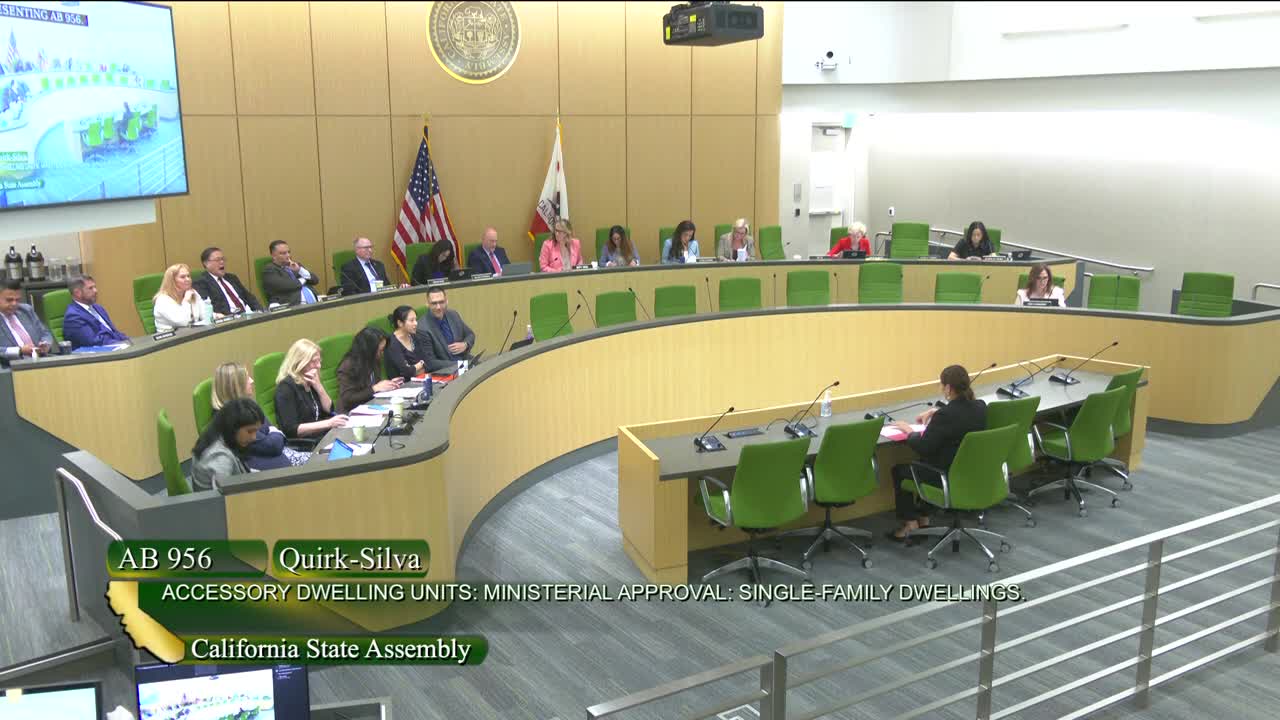 4MIN
Assembly Standing Committee on Appropriations
 10MIN
Assembly Standing Committee on Local Government
Bill Author



