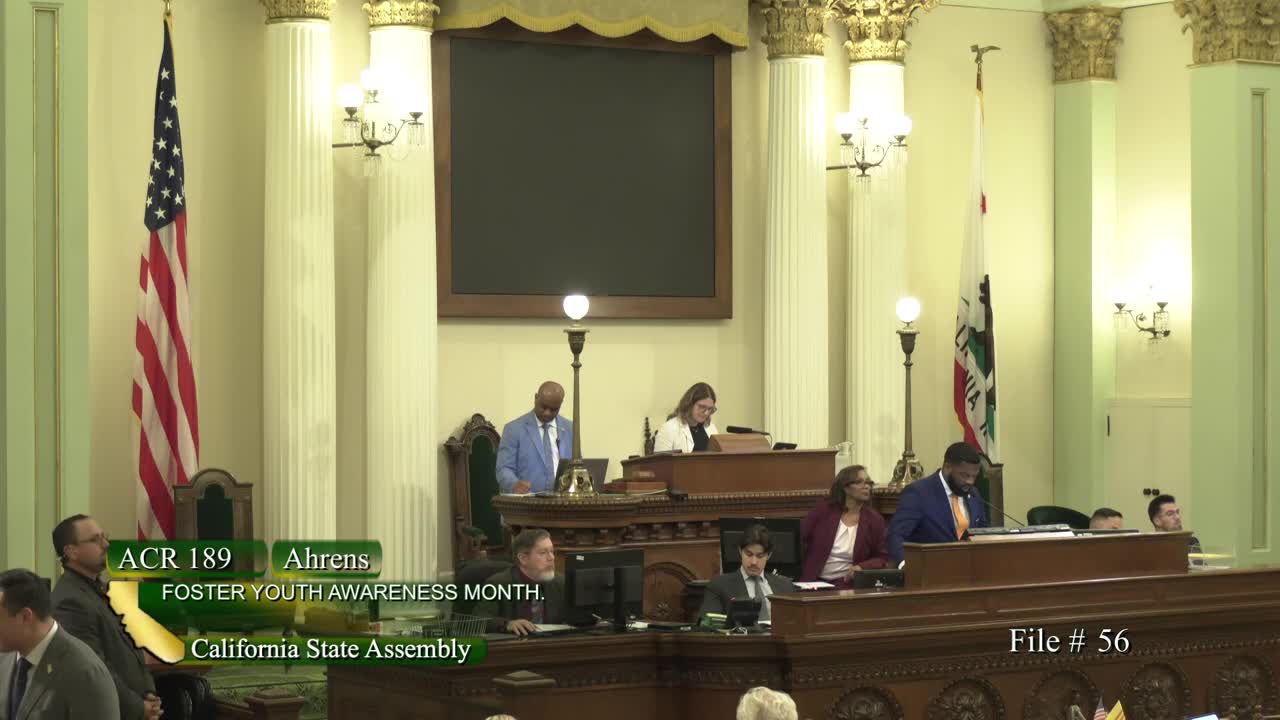
ACR 189: Foster Youth Awareness Month.
- Session Year: 2025-2026
- House: Assembly
- Latest Version Date: 2026-06-18
Current Status:
Passed
(2026-06-18: Chaptered by Secretary of State - Res. Chapter 121, Statutes of 2026.)
Introduced
In Committee
Awaiting First Chamber Vote
Passed First Chamber
In Committee
Awaiting Second Chamber Vote
Passed Second Chamber
Enacted
This measure would proclaim the month of May 2026 as Foster Youth Awareness Month in California.
This measure would proclaim the month of May 2026 as Foster Youth Awareness Month in California.
This measure would proclaim the month of May 2026 as Foster Youth Awareness Month in California.
WHEREAS, Californias children and youth are our hope for the future, and all children deserve a safe, loving, accepting, stable, and nurturing home; and
WHEREAS, Preserving families is the primary goal of the child welfare system; and
WHEREAS, A childs success is best supported in a child welfare system that is family-focused, child-centered, and community-based; and
WHEREAS, Kinship families, foster families, foster family agencies, and short-term residential therapeutic programs play a critical role in supporting children in foster care and making family reunification possible; and
WHEREAS, Nearly 100 times per day, a child is placed in foster care in California; and
WHEREAS, One-third of all the nations unaccompanied homeless youth are in California; and
WHEREAS, California has over 43,000 children in the foster care system, disproportionately from Black and Native families; and
WHEREAS, The proportions of Black and Native youth in foster care are around four times larger than the proportions of Black and Native youth in California overall; and
WHEREAS, One-half of all children in foster care have endured four or more adverse childhood experiences such as abuse, neglect, and abandonment, which can negatively impact their health and development; and
WHEREAS, Numerous national studies have documented that children involved with the child welfare system have increased rates of chronic health problems, developmental delays and disabilities, mental health needs, and substance abuse problems; and
WHEREAS, Research indicates that foster youth experience rates of homelessness ranging from 11 percent to 38 percent, inclusive, which is disproportionately higher than that of the general population; and
WHEREAS, In California, while 93 percent of foster youth say they want to attend college, only 4 percent of former foster youth obtain their bachelors degree by 26 years of age, compared to 50 percent of their peers; and
WHEREAS, For children and youth in the foster care system, we must continue finding them loving homes, provide them with the resources they need, and deliver safe and supportive permanent homes; and
WHEREAS, California further recognizes the strength, resilience, and leadership of foster youth and former foster youth, who contribute meaningfully to their communities, lead advocacy efforts, inform policy, and drive systems change through their lived expertise; and
WHEREAS, Foster youth continue to challenge and redefine traditional measures of success by pursuing education, careers, healing, community leadership, and personal growth on their own terms, despite systemic barriers and disparities reflected in outcomes data; and
WHEREAS, California recognizes the enduring and valuable contribution of relatives and foster and adoptive parents who open their hearts, families, and homes to vulnerable children and youth; and
WHEREAS, California recognizes the numerous individuals and public and nonprofit organizations that work to meet the needs of current and former children and youth in the foster care system, including helping to provide vital connections to siblings and launching young people into successful adulthood; and
WHEREAS, California is engaged in a tiered rate structure intended to improve the experience and outcomes of children and youth in foster care by making more informed and appropriate initial placement decisions, emphasizing home-based family care placements of children, adequately supporting these placements with needed services, adequately supporting foster family agencies and short-term residential therapeutic programs for youth whose needs cannot be met safely in family settings, and increasing transparency and accountability for child outcomes; and
WHEREAS, California is further engaged in building a comprehensive behavioral health system for youth and families impacted by the child welfare system that is responsive to the trauma inherent to family separation; now, therefore, be it
Resolved by the Assembly of the State of California, the Senate thereof concurring, That the Legislature designates the month of May 2026 as Foster Youth Awareness Month in California; and be it further
Resolved, That the Chief Clerk of the Assembly transmit copies of this resolution to the author for appropriate distribution.
|
Date
|
Status
|
|---|---|
| Jun 18, 2026 | Chaptered by Secretary of State - Res. Chapter 121, Statutes of 2026. |
| Jun 18, 2026 | Enrolled and filed with the Secretary of State at 3 p.m. |
| Jun 11, 2026 | In Assembly. Ordered to Engrossing and Enrolling. |
| Jun 11, 2026 | Adopted and to Assembly. (Ayes 36. Noes 0. Page 4701.) |
| Jun 11, 2026 | Adopted and to Assembly. (Ayes 36. Noes 0.) |
| Jun 9, 2026 | Ordered to special consent calendar. |
| May 20, 2026 | From committee: Ordered to third reading. |
| May 12, 2026 | In Senate. To Com. on RLS. |
| May 11, 2026 | Adopted and to Senate. (Page 4999.) |
| May 11, 2026 | Adopted and to Senate. |
| May 11, 2026 | Coauthors revised. |
| May 4, 2026 | From committee: Be adopted. Ordered to Third Reading. (Ayes 9. Noes 0.) (May 4). |
| May 4, 2026 | Referred to Com. on RLS. |
| May 1, 2026 | From printer. |
| Apr 30, 2026 | Introduced. To print. |
|
Date
|
Description
|
Location
|
Votes
|
|
|---|---|---|---|---|
| Jun 11, 2026 | Special Consent ACR189 Ahrens et al. | Senate Floor |
Passed |
|
| May 4, 2026 | Be adopted. To third reading. | Assembly Standing Committee on Rules |
Passed |
This list shows positions taken on this bill by organizations on the date displayed, which is linked to the original source.
Positions by individuals are not included.
|
Organization
|
Position
|
Date
|
|---|---|---|
| California Alliance Of Child And Family Services | ** Support |
SENATE RULES COMMITTEE Office of Senate Floor Analyses (916) 651-4171 | ACR 189 |
THIRD READING
Bill No: ACR 189
Author: Ahrens (D), et al.
Introduced: 4/30/26
Vote: 21
SUBJECT: Foster Youth Awareness Month
SOURCE: Author
DIGEST:
This resolution proclaims the month of May 2026 as Foster Youth Awareness Month in California.
ANALYSIS: This resolution makes the following legislative findings:
- California’s children and youth are our hope for the future, and all children deserve a safe, loving, accepting, stable, and nurturing home. Preserving families is the primary goal of the child welfare system.
- A child’s success is best supported in a child welfare system that is family-focused, child-centered, and community-based.
- One-half of all children in foster care have endured four or more adverse childhood experiences such as abuse, neglect, and abandonment, which can negatively impact their health and development.
- California recognizes the enduring and valuable contribution of relatives and foster and adoptive parents who open their hearts, families, and homes to vulnerable children and youth.
This resolution proclaims the month of May 2026 as Foster Youth Awareness Month in California.
Related/Prior Legislation
SR 10 (Wahab, Ashby, Rubio, 2025) – Adopted by the Senate.
SCR 147 (Grove, Newman, Wahab, Resolution Chapter 121, Statutes of 2024)
SCR 65 (Ashby, Resolution Chapter 102, Statutes of 2023)
FISCAL EFFECT: Appropriation: No Fiscal Com.: No Local: No
SUPPORT: (Verified 5/19/26)
California Alliance of Child and Family Services
OPPOSITION: (Verified 5/19/26)
None received
Prepared by: Aizenia Randhawa / SFA / (916) 651-4171
5/20/26 14:08:06
**** END ****
ASSEMBLY THIRD READING
ATR Bill Id:ACR 189
Author:(Ahrens)
As Introduced Ver:April 30, 2026
Majority vote
SUMMARY
Designates the month of May 2026 as Foster Youth Awareness Month in California.
Major Provisions
- California's children and youth are our hope for the future, and all children deserve a safe, loving, accepting, stable, and nurturing home. Preserving families is the primary goal of the child welfare system.
- Kinship families, foster families, foster family agencies, and short-term residential therapeutic programs play a critical role in supporting children in foster care and making family reunification possible.
- One-half of all children in foster care have endured four or more adverse childhood experiences such as abuse, neglect, and abandonment, which can negatively impact their health and development. For children and youth in the foster care system, we must continue finding them loving homes, provide them with the resources they need, and deliver safe and supportive permanent homes.
- California further recognizes the strength, resilience, and leadership of foster youth and former foster youth, who contribute meaningfully to their communities, lead advocacy efforts, inform policy, and drive systems change through their lived expertise.
- Foster youth continue to challenge and redefine traditional measures of success by pursuing education, careers, healing, community leadership, and personal growth on their own terms, despite systemic barriers and disparities reflected in outcomes data.
- California recognizes the numerous individuals and public and nonprofit organizations that work to meet the needs of current and former children and youth in the foster care system, including helping to provide vital connections to siblings and launching young people into successful adulthood.
COMMENTS
According to the Author
"There are over 43,000 foster youth in California, and it's important to commend them for their strength and resilience and draw attention to the obstacles they must overcome relative to their peers. It's also important to recognize the many individuals and groups within the child welfare system for the work they do to support vulnerable youth."
Arguments in Support
The California Alliance of Child and Family Services writes in support: "California children and youth in foster care need and deserve safe, permanent connections to loving adults and a stable home. While ACR 189 serves to focus our attention on the Foster Care System during the month of May, it can also be an important step in addressing and solving issues within that system moving forward."
Arguments in Opposition
None on file
FISCAL COMMENTS
No fiscal impact. This resolution is keyed non-fiscal by Legislative Counsel.
VOTES
ASM RULES: 9-0-1
YES: Pacheco, Ahrens, Dixon, Garcia, Mark González, Irwin, Michelle Rodriguez, Sanchez, Zbur
ABS, ABST OR NV: Lackey
UPDATED
VERSION: April 30, 2026
CONSULTANT: Michael Erke / RLS. / (916) 319-2800 FN: 0002471
Date of Hearing: May 4, 2026
ASSEMBLY COMMITTEE ON RULES
Blanca Pacheco, Chair
ABPCA Bill Id:ACR 189 (
Author:Ahrens) – As Introduced Ver:April 30, 2026
SUBJECT: Foster Youth Awareness Month.
SUMMARY: Designates the month of May 2026 as Foster Youth Awareness Month in California. Specifically, this resolution makes the following legislative findings:
- California’s children and youth are our hope for the future, and all children deserve a safe, loving, accepting, stable, and nurturing home. Preserving families is the primary goal of the child welfare system.
- Kinship families, foster families, foster family agencies, and short-term residential therapeutic programs play a critical role in supporting children in foster care and making family reunification possible.
- One-half of all children in foster care have endured four or more adverse childhood experiences such as abuse, neglect, and abandonment, which can negatively impact their health and development. For children and youth in the foster care system, we must continue finding them loving homes, provide them with the resources they need, and deliver safe and supportive permanent homes.
- California further recognizes the strength, resilience, and leadership of foster youth and former foster youth, who contribute meaningfully to their communities, lead advocacy efforts, inform policy, and drive systems change through their lived expertise.
- Foster youth continue to challenge and redefine traditional measures of success by pursuing education, careers, healing, community leadership, and personal growth on their own terms, despite systemic barriers and disparities reflected in outcomes data.
- California recognizes the numerous individuals and public and nonprofit organizations that work to meet the needs of current and former children and youth in the foster care system, including helping to provide vital connections to siblings and launching young people into successful adulthood.
FISCAL EFFECT: This resolution is keyed non-fiscal by Legislative Counsel.
REGISTERED SUPPORT / OPPOSITION:
Support
None on file
Opposition
None on file
Analysis Prepared by: Michael Erke / RLS. / (916) 319-2800
Bill Author

Bill Co-Author(s):