AJR 29: Interim Consolidated Storage Act of 2015: San Onofre Nuclear Generating Station.
- Session Year: 2015-2016
- House: Assembly
- Latest Version Date: 2016-08-16
This measure would urge the passage of the Interim Consolidated Storage Act of 2015 and urge the United States Department of Energy to implement the prompt and safe relocation of spent nuclear fuel from the San Onofre Nuclear Generating Station to a licensed and regulated interim consolidated storage facility.
This measure would urge the passage of the Interim Consolidated Storage Act of 2015 and urge the United States Department of Energy to implement the prompt and safe relocation of spent nuclear fuel from the San Onofre Nuclear Generating Station to a licensed and regulated interim consolidated storage facility.
This measure would urge the passage of the Interim Consolidated Storage Act of 2015 and urge the United States Department of Energy to implement the prompt and safe relocation of spent nuclear fuel from the San Onofre Nuclear Generating Station to a licensed and regulated interim consolidated storage facility.
This measure would urge the passage of the Interim Consolidated Storage Act of 2015 and urge the United States Department of Energy to implement the prompt and safe relocation of spent nuclear fuel from the San Onofre Nuclear Generating Station to a licensed and regulated interim consolidated storage facility.
This measure would urge the passage of the Interim Consolidated Storage Act of 2015 and urge the United States Department of Energy to implement the prompt and safe relocation of spent nuclear fuel from the San Onofre Nuclear Generating Station to a licensed and regulated interim consolidated storage facility.
WHEREAS, Millions of ratepayer and taxpayer dollars are spent monitoring and overseeing spent nuclear fuel each year and millions of dollars more are programmed to be spent on settlement payments related to nuclear waste disposition; and
WHEREAS, Much of the spent nuclear fuel and high-level radioactive waste currently stored is at sites that are vulnerable to natural disasters and located near large metropolitan centers; and
WHEREAS, The United States Department of Energy concluded in 2013 that a geologic repository for the permanent disposal of spent nuclear fuel and high-level radioactive waste will not be available until 2048, at the earliest; and
WHEREAS, The Presidents Blue Ribbon Commission on Americas Nuclear Future recommended that efforts be made to develop a permanent disposal site for spent nuclear fuel and high-level radioactive waste; and
WHEREAS, The spent nuclear fuel at the San Onofre Nuclear Generating Station, a decommissioning site, should be promptly and safely moved to a consolidated storage site, as recommended by the Presidents Blue Ribbon Commission on Americas Nuclear Future, and as would be advanced by H.R. 3643, the Interim Consolidated Storage Act of 2015, which would give priority for storage to high-level nuclear waste and spent nuclear fuel located on a site without an operating nuclear reactor; now, therefore, be it
Resolved by the Assembly and the Senate of the State of California, jointly, That the Legislature of the State of California respectfully urges the passage of H.R. 3643; and be it further
Resolved, That the Legislature of the State of California respectfully urges the United States Department of Energy to implement the prompt and safe relocation of spent nuclear fuel from the San Onofre Nuclear Generating Station to a licensed and regulated interim consolidated storage facility; and be it further
Resolved, That the Chief Clerk of the Assembly transmit copies of this resolution to the President of the United States, to the Speaker of the House of Representatives, to the Majority Leader of the Senate, to each Senator and Representative from California in the Congress of the United States, and to the Secretary of Energy.
WHEREAS, Millions of ratepayer and taxpayer dollars are spent monitoring and overseeing spent nuclear fuel each year and millions of dollars more are programmed to be spent on settlement payments related to nuclear waste disposition; and
WHEREAS, Much of the spent nuclear fuel and high-level radioactive waste currently stored are is at sites that are vulnerable to natural disasters and located near large metropolitan centers; and
WHEREAS, The United States Department of Energy concluded in 2013 that a geologic repository for the permanent disposal of spent nuclear fuel and high-level radioactive waste will not be available until 2048, at the earliest; and
WHEREAS, The Presidents Blue Ribbon Commission on Americas Nuclear Future recommended that efforts be made to develop a permanent disposal site for spent nuclear fuel and high-level radioactive waste; and
WHEREAS, The spent nuclear fuel at the San Onofre Nuclear Generating Station, a decommissioning site, should be promptly and safely moved to a consolidated storage site, as recommended by the Presidents Blue Ribbon Commission on Americas Nuclear Future, and as would be advanced by H.R. 3643, the Interim Consolidated Storage Act of 2015, which would give priority for storage to high-level nuclear waste and spent nuclear fuel located on a site without an operating nuclear reactor; now, therefore, be it
Resolved by the Assembly and the Senate of the State of California, jointly, That the Legislature of the State of California respectfully urges the passage of H.R. 3643 and supports the development and passage of complementary legislation; 3643; and be it further
Resolved, That the Legislature of the State of California respectfully urges the United States Department of Energy to implement the prompt and safe relocation of spent nuclear fuel from the San Onofre Nuclear Generating Station to a licensed and regulated interim consolidated storage facility; and be it further
Resolved, That the Chief Clerk of the Assembly transmit copies of this resolution to the President of the United States, to the Speaker of the House of Representatives, to the Majority Leader of the Senate, to each Senator and Representative from California in the Congress of the United States, and to the Secretary of Energy.
WHEREAS, Millions of ratepayer and taxpayer dollars are spent monitoring and overseeing spent nuclear fuel each year and millions of dollars more are programmed to be spent on settlement payments related to nuclear waste disposition; and
WHEREAS, Much of the spent nuclear fuel and high-level radioactive waste currently stored are at sites that are vulnerable to natural disasters and located near large metropolitan centers; and
WHEREAS, The United States Department of Energy concluded in 2013 that a geologic repository for the permanent disposal of spent nuclear fuel and high-level radioactive waste will not be available until 2048, at the earliest; and
WHEREAS, The Presidents Blue Ribbon Commission on Americas Nuclear Future recommended that efforts be made to develop a permanent disposal site for spent nuclear fuel and high-level radioactive waste; and
WHEREAS, The spent nuclear fuel at the San Onofre Nuclear Generating Station, a decommissioning site, should be promptly and safely moved to a consolidated storage site, as recommended by the Presidents Blue Ribbon Commission on Americas Nuclear Future, and as would be advanced by H.R. 3643, the Interim Consolidated Storage Act of 2015, which would give priority for storage to high-level nuclear waste and spent nuclear fuel located on a site without an operating nuclear reactor; now, therefore, be it
Resolved by the Assembly and the Senate of the State of California, jointly, That the Legislature of the State of California respectfully urges the passage of H.R. 3643 and supports the development and passage of complementary legislation; and be it further
Resolved, That the Legislature of the State of California respectfully urges the United States Department of Energy to implement the prompt and safe relocation of spent nuclear fuel from the San Onofre Nuclear Generating Station to a licensed and regulated interim consolidated storage facility; and be it further
Resolved, That the Chief Clerk of the Assembly transmit copies of this resolution to the President of the United States, to the Speaker of the House of Representatives, to the Majority Leader of the Senate, to each Senator and Representative from California in the Congress of the United States, and to the Secretary of Energy.
|
Date
|
Status
|
|---|---|
| Aug 16, 2016 | Chaptered by Secretary of State - Res. Chapter 112, Statutes of 2016. |
| Aug 16, 2016 | Enrolled and filed with the Secretary of State at 2:30 p.m. |
| Aug 11, 2016 | Adopted and to Assembly. (Ayes 37. Noes 0. Page 4878.) |
| Aug 11, 2016 | In Assembly. Ordered to Engrossing and Enrolling. |
| Aug 11, 2016 | Adopted and to Assembly. |
| Aug 3, 2016 | Ordered to special consent calendar. |
| Jun 21, 2016 | From committee: Be adopted. Ordered to Third Reading. (Ayes 10. Noes 0.) (June 21). |
| Jun 9, 2016 | In committee: Hearing postponed by committee. |
| Jun 9, 2016 | Re-referred to Com. on E., U., & C. |
| May 31, 2016 | In Senate. To Com. on RLS. |
| May 27, 2016 | Amended, adopted, and to Senate. (Ayes 71. Noes 0. Page 4949.) |
| May 27, 2016 | Amended, adopted, and to Senate. |
| Mar 31, 2016 | Amended. Ordered to third reading. |
| Mar 30, 2016 | From committee: Amend, and be adopted as amended. (Ayes 7. Noes 0.) (March 29). |
| Mar 8, 2016 | Referred to Com. on E.S. & T.M. |
| Jan 29, 2016 | From printer. |
| Jan 28, 2016 | Introduced. To print. |
|
Date
|
Description
|
Location
|
Votes
|
|
|---|---|---|---|---|
| Aug 11, 2016 | Special Consent AJR29 Chávez | Senate Floor |
Passed |
|
| Jun 21, 2016 | Be adopted. Ordered to third reading | Senate Standing Committee on Energy, Utilities and Communications |
Passed |
|
| May 27, 2016 | AJR 29 CHÁVEZ Assembly Third Reading | Assembly Floor |
Passed |
|
| Mar 29, 2016 | Be adopted as amended. | Assembly Standing Committee on Environmental Safety and Toxic Materials |
Passed |
This list shows positions taken on this bill by organizations on the date displayed, which is linked to the original source.
Positions by individuals are not included.
Office of Senate Floor Analyses (916) 651-1520 Fax: (916) 327-4478 | AJR 29 |
THIRD READING
Bill No: AJR 29
Amended: 5/27/16 in Assembly
SENATE ENERGY, U. & C. COMMITTEE: 10-0, 6/21/16
AYES: Hueso, Morrell, Cannella, Gaines, Hertzberg, Lara, Leyva, McGuire, Pavley, Wolk
NO VOTE RECORDED: Hill
ASSEMBLY FLOOR: 71-0, 5/27/16 - See last page for vote
SUBJECT: Interim Consolidated Storage Act of 2015: San Onofre Nuclear Generating Station
DIGEST: This resolution urges Congress to pass the Interim Consolidated Storage Act of 2015 (House Resolution (H.R.) 3643), and the United States Department of Energy (US DOE) to implement the prompt and safe relocation of spent nuclear fuel from the San Onofre Nuclear Generating Station (SONGS) to a licensed and regulated interim consolidated storage facility.
Existing federal law, under the Nuclear Waste Policy Act of 1982 (NWPA) (42 U.S.C. §10101, et seq.):
- Establishes a comprehensive federal program for the safe, permanent disposal of radioactive wastes.
- Requires the federal government to take possession of and permanently dispose of spent nuclear fuel generated at civilian nuclear reactors.
- Supports the use of deep geologic repositories for the safe storage and/or disposal of radioactive waste. Establishes procedures to evaluate and select sites for geologic repositories and for the interaction of state and federal governments.
- Directs the US DOE to consider Yucca Mountain, Nevada as the primary site for the first geologic repository.
- Prohibits the US DOE from conducting site specific activities at a second site unless authorized by Congress.
- Establishes a commission to study the need and feasibility of a monitored retrievable storage facility.
Existing state law:
- Prohibits any nuclear fission thermal powerplant requiring the reprocessing of fuel rods from being permitted unless the federal government has identified and approved, and there exists a technology for the construction and operation of, nuclear fuel rod reprocessing plants. (Public Resources Code §§25524.1 – 25524.3)
- States, pursuant to the California Nuclear Facility Decommissioning Act of 1985, that the citizens of California should be protected from exposure to radiation from nuclear facilities. (Public Utilities Code §8321, et seq.)
- Requires the California Energy Commission (CEC) to assess existing scientific studies to determine the vulnerability of very large generation facilities (1,700 megawatts or greater) to major disruptions due to aging or major earthquake and the resulting impacts on reliability, public safety, and the economy. Requires the CEC, in the absence of a long-term nuclear waste storage facility, to assess the potential state and local costs and impacts associated with accumulating waste at California’s nuclear powerplants. (Public Resources Code §25303)
This resolution urges the passage of the Interim Consolidated Storage Act of 2015 and urges the US DOE to implement the prompt and safe relocation of spent nuclear fuel from SONGS to a licensed and regulated interim consolidated storage facility.
Background
The United States Congress is currently considering a bill – H.R. 4745 – that would amend the NWPA of 1982 to authorize the Secretary of Energy to enter into contracts for the storage of certain high-level radioactive waste and spent nuclear fuel and take title to certain high-level radioactive waste and spent nuclear fuel. As used in the House bill, the term “interim consolidated storage facility” means a facility that possesses a specific license issued by the Nuclear Regulatory Commission (NRC) that authorizes storage of high-level radioactive waste or spent nuclear fuel received from the Secretary or from two or more persons that generate or hold title to high-level radioactive waste or spent nuclear fuel generated at a civilian nuclear power reactor. [A bill to create an Interim Consolidated Storage Act 2016, 114th Cong., 2016 H.R. 4745, (accessed April 13, 2016); available from govtrack.com ]
Federal Nuclear Waste Policy. Under the provisions of the NWPA of 1982, the federal government has responsibility for managing spent nuclear fuel produced by commercial reactors, and generators are responsible for bearing the costs of permanent disposal. The NWPA authorizes and requires the US DOE to locate and build a permanent repository and an interim storage facility and to develop a system to safely transport spent fuel from nuclear power plants to the repository and interim storage facility.
In 1987, Congress designated Yucca Mountain, a complex of underground tunnels in Nevada, as a federal long-term geological repository for nuclear waste. However, the Obama Administration has decided not to use the site and has appointed the Blue Ribbon Commission on America's Nuclear Future (Commission) to find a solution for permanent storage. The Commission recommended that efforts be made to develop a permanent disposal site for spent nuclear fuel and high-level radioactive waste.
Plant owners thus continue to be responsible for the safe storage of their spent fuel.
Nuclear power in California. There are four nuclear power plants in California: the Diablo Canyon Power Plant, the Humboldt Bay Nuclear Power Plant, the Rancho Seco Nuclear Power Plant, and SONGS, the latter three of which have been closed or decommissioned, including:
- The Humboldt Bay Nuclear Power Plant, located near Eureka, which was closed in 1976 due to seismic concerns. In December 2008, PG&E finished moving the spent nuclear fuel into dry cask storage on site. That plant was placed in Safe Storage (SAFSTOR) until anticipated full decommissioning in future years. SAFSTOR is one of the options for nuclear decommissioning of a shut-down plant governed under the United States NRC.
- The Rancho Seco Nuclear Power Plant, located about 25 miles southeast of Sacramento, was in operation until 1989 when it was closed by public referendum. In 1996, the NRC approved a decommissioning plan for the plant. Remaining onsite are 493 spent fuel assemblies. Since no suitable disposal facility exists for any of the material, the Sacramento Municipal Utility District spends $6 million per year to safely manage it.
- The SONGS, located midway between Los Angeles and San Diego, went offline in January 2012 and was ordered by the NRC to stay offline while tubing wear issues were investigated. Subsequently, plant owners announced in June 2013 that remaining Units 2 and 3 would be permanently retired (Unit 1 was closed in 1992). The storage canisters used in SONGS are designed for a lifetime of 40 years. As of 2011, SONGS had an estimated 1,430 tons of spent nuclear waste on-site.
The remaining operating nuclear power plant in California is Diablo Canyon Power Plant in San Luis Obispo County. Licenses for the two reactors expire in 2024 and 2025, respectively. The storage canisters used at Diablo Canyon are designed for a lifetime of 50 years. As of 2011, Diablo Canyon had approximately 1,126 tons of spent fuel located at its facility.
Since 1976, California has banned the construction of new nuclear plants until a federal long-term waste disposal repository is operating.
Natural disaster. According to the 2007 State Working Group on Earthquake Probabilities, California faces a 99.7 percent chance of a magnitude 6.7 or larger earthquake during the next 30 years. The likelihood of an even more powerful quake of magnitude 7.5 or greater in the next 30 years is 46 percent.
According to the powerplant’s owner, SONGS is designed to withstand a magnitude 7.0 earthquake. SONGS is located five miles away from the Rose Canyon fault, which has the potential to reach a magnitude 6.9 to 7.2 earthquake.
H.R. 4745 allows nuclear waste from SONGS to be temporarily stored off site. If the bill passes, it would (1) allow the Secretary of Energy to enter into contracts and settle agreements with NRC – licensed nuclear reactor operators in order to move used fuel and high level nuclear waste into an interim consolidated storage facility; (2) provide a priority for removal of used fuel and high-level nuclear waste for storage at sites where there is no longer an operating nuclear reactor (like SONGS); and (3) maintain the principal balance in the federal Nuclear Waste Fund designated for Yucca Mountain, and authorize the interest paid on the fund to be used for titles fees and the safe transportation of the used fuel or high-level nuclear waste from the decommissioned reactor to the interim consolidated storage facility.
Related/Prior Legislation
SJR 23 (Bates, 2016) urges Congress to pass the Interim Consolidated Storage Act of 2016 (H.R. 4745) and the US DOE to implement the prompt and safe relocation of spent nuclear fuel from SONGS to a licensed and regulated interim consolidated storage facility. The resolution is waiting to be consideration on the Assembly Floor.
H.R. 3643 (Michael Conaway, 11th Congressional District, 2015) amends the NWPA of 1982 to authorize the US DOE to enter into new contracts (or modify existing contracts) with the licensee of an interim consolidated storage facility in order to take title to and store in it either high-level radioactive waste or spent nuclear fuel of domestic origin. The bill is waiting to be considered in the House Energy and Commerce Subcommittee on Environment and the Economy.
H.R. 4745 (Mick Mulvaney, 5th Congressional District) amends the NWPA of 1982 to authorize the Secretary of Energy to enter into contracts for the storage of certain high-level radioactive waste and spent nuclear fuel and take title to certain high-level radioactive waste and spent nuclear fuel. The bill is waiting to be considered in the House Committee on Energy and Commerce.
FISCAL EFFECT: Appropriation: No Fiscal Com.: No Local: No
None received
OPPOSITION: (Verified 6/21/16)
None received
ARGUMENTS IN SUPPORT: The author asserts:
The California Legislature needs to urge the Federal government to find adequate and safe interim storage for the spent nuclear fuel from SONGS so that residents living in the surrounding communities are safe from a potentially dangerous situation if a natural disaster should occur. Specifically, it is important to find interim storage to remove spent nuclear fuel as soon as possible because of the vulnerable location of the SONGS plant. The waste from the SONGS sits near an active fault line, adjacent to the heavily-trafficked Interstate 5 and the Pacific Ocean.
AYES: Achadjian, Alejo, Travis Allen, Arambula, Atkins, Baker, Bigelow, Bloom, Bonilla, Bonta, Burke, Calderon, Campos, Chang, Chau, Chávez, Chu, Cooley, Cooper, Dababneh, Dahle, Daly, Eggman, Frazier, Beth Gaines, Gallagher, Cristina Garcia, Eduardo Garcia, Gatto, Gipson, Gomez, Gonzalez, Gordon, Gray, Harper, Roger Hernández, Holden, Irwin, Jones, Jones-Sawyer, Kim, Lackey, Levine, Linder, Lopez, Low, Maienschein, Mathis, Mayes, McCarty, Medina, Mullin, Nazarian, Obernolte, Olsen, Patterson, Quirk, Ridley-Thomas, Rodriguez, Salas, Santiago, Steinorth, Mark Stone, Thurmond, Wagner, Waldron, Weber, Wilk, Williams, Wood, Rendon
NO VOTE RECORDED: Brough, Brown, Chiu, Dodd, Grove, Hadley, Melendez, O'Donnell, Ting
Prepared by: Jay Dickenson / E., U., & C. / (916) 651-4107
6/22/16 15:15:27
**** END ****
SENATE COMMITTEE ON ENERGY, UTILITIES AND COMMUNICATIONS
Senator Ben Hueso, Chair
2015 - 2016 Regular
Bill No: AJR 29 Hearing Date: 6/21/2016
Author: | Chávez | ||
Version: | 5/27/2016 As Amended | ||
Urgency: |
| Fiscal: | No |
Consultant: | Aaron Brieno, Jay Dickenson | ||
SUBJECT: Interim Consolidated Storage Act of 2015: San Onofre Nuclear Generating Station
DIGEST: This resolution urges Congress to pass the Interim Consolidated Storage Act of 2015 (House Resolution (H.R. 3643), and the United States Department of Energy (US DOE) to implement the prompt and safe relocation of spent nuclear fuel from the San Onofre Nuclear Generating Station (SONGS) to a licensed and regulated interim consolidated storage facility.
ANALYSIS:
UNDER FEDERAL LAW: Nuclear Waste Policy Act of 1982 (NWPA) (42 U.S.C. §10101, et seq.):
- The NWPA establishes a comprehensive federal program for the safe, permanent disposal of radioactive wastes.
- The NWPA requires the federal government to take possession of and permanently dispose of spent nuclear fuel generated at civilian nuclear reactors.
- Supports the use of deep geologic repositories for the safe storage and/or disposal of radioactive waste. Establishes procedures to evaluate and select sites for geologic repositories and for the interaction of state and federal governments.
- Directs the US DOE to consider Yucca Mountain, Nevada as the primary site for the first geologic repository.
- Prohibits the US DOE from conducting site specific activities at a second site unless authorized by Congress.
- Establishes a commission to study the need and feasibility of a monitored retrievable storage facility.
UNDER STATE LAW:
- Prohibits any nuclear fission thermal powerplant requiring the reprocessing of fuel rods from being permitted unless the federal government has identified and approved, and there exists a technology for the construction and operation of, nuclear fuel rod reprocessing plants. (Public Resources Code §§25524.1 – 25524.3)
- States, pursuant to the California Nuclear Facility Decommissioning Act of 1985, that the citizens of California should be protected from exposure to radiation from nuclear facilities. (Public Utilities Code §8321, et seq.)
- Requires the California Energy Commission (CEC) to assess existing scientific studies to determine the vulnerability of very large generation facilities (1,700 megawatts or greater) to major disruptions due to aging or major earthquake and the resulting impacts on reliability, public safety, and the economy. Requires the CEC, in the absence of a long-term nuclear waste storage facility, to assess the potential state and local costs and impacts associated with accumulating waste at California’s nuclear powerplants. (Public Resources Code §25303)
This resolution urges the passage of the Interim Consolidated Storage Act of 2015 and urges the US DOE to implement the prompt and safe relocation of spent nuclear fuel from SONGS to a licensed and regulated interim consolidated storage facility.
Background
The United States Congress is currently considering a bill – H.R. 4745 – that would amend the NWPA of 1982 to authorize the Secretary of Energy to enter into contracts for the storage of certain high-level radioactive waste and spent nuclear fuel and take title to certain high-level radioactive waste and spent nuclear fuel. As used in the House bill, the term “interim consolidated storage facility” means a facility that possesses a specific license issued by the Nuclear Regulatory Commission (NRC) that authorizes storage of high-level radioactive waste or spent nuclear fuel received from the Secretary or from two or more persons that generate or hold title to high-level radioactive waste or spent nuclear fuel generated at a civilian nuclear power reactor.[1]
Federal Nuclear Waste Policy. Under the provisions of the NWPA of 1982, the federal government has responsibility for managing spent nuclear fuel produced by commercial reactors, and generators are responsible for bearing the costs of permanent disposal. The NWPA authorizes and requires the US DOE to locate and build a permanent repository and an interim storage facility and to develop a system to safely transport spent fuel from nuclear power plants to the repository and interim storage facility.
In 1987, Congress designated Yucca Mountain, a complex of underground tunnels in Nevada, as a federal long-term geological repository for nuclear waste. However, the Obama Administration has decided not to use the site and has appointed the Blue Ribbon Commission on America's Nuclear Future (Commission) to find a solution for permanent storage. The Commission recommended that efforts be made to develop a permanent disposal site for spent nuclear fuel and high-level radioactive waste.
Plant owners thus continue to be responsible for the safe storage of their spent fuel.
Nuclear power in California. There are four nuclear power plants in California: the Diablo Canyon Power Plant, the Humboldt Bay Nuclear Power Plant, the Rancho Seco Nuclear Power Plant, and SONGS, the latter three of which have been closed or decommissioned, including:
- The Humboldt Bay Nuclear Power Plant, located near Eureka, which was closed in 1976 due to seismic concerns. In December 2008, PG&E finished moving the spent nuclear fuel into dry cask storage on site. That plant was placed in Safe Storage (SAFSTOR) until anticipated full decommissioning in future years. SAFSTOR is one of the options for nuclear decommissioning of a shut-down plant governed under the United States Nuclear Regulatory Commission.
- The Rancho Seco Nuclear Power Plant, located about 25 miles southeast of Sacramento, was in operation until 1989 when it was closed by public referendum. In 1996, the NRC approved a decommissioning plan for the plant. Remaining onsite are 493 spent fuel assemblies. Since no suitable disposal facility exists for any of the material, the Sacramento Municipal Utility District spends $6 million per year to safely manage it.
- The SONGS, located midway between Los Angeles and San Diego, went offline in January 2012 and was ordered by the NRC to stay offline while tubing wear issues were investigated. Subsequently, plant owners announced in June 2013 that remaining Units 2 and 3 would be permanently retired (Unit 1 was closed in 1992). The storage canisters used in SONGS are designed for a lifetime of 40 years. As of 2011, SONGS had an estimated 1,430 tons of spent nuclear waste on-site.
The remaining operating nuclear power plant in California is Diablo Canyon Power Plant in San Luis Obispo County. Licenses for the two reactors expire in 2024 and 2025, respectively. The storage canisters used at Diablo Canyon are designed for a lifetime of 50 years. As of 2011, Diablo Canyon had approximately 1,126 tons of spent fuel located at its facility.
Since 1976, California has banned the construction of new nuclear plants until a federal long-term waste disposal repository is operating.
Natural disaster. According to the 2007 State Working Group on Earthquake Probabilities, California faces a 99.7 percent chance of a magnitude 6.7 or larger earthquake during the next 30 years. The likelihood of an even more powerful quake of magnitude 7.5 or greater in the next 30 years is 46 percent.
According to the powerplant’s owner, SONGS is designed to withstand a magnitude 7.0 earthquake. SONGS is located five miles away from the Rose Canyon fault, which has the potential to reach a magnitude 6.9 to 7.2 earthquake.
H.R. 4745 allows nuclear waste from SONGS to be temporarily stored off site. If the bill passes, it would (1) allow the Secretary of Energy to enter into contracts and settle agreements with NRC – licensed nuclear reactor operators in order to move used fuel and high level nuclear waste into an interim consolidated storage facility; (2) provide a priority for removal of used fuel and high-level nuclear waste for storage at sites where there is no longer an operating nuclear reactor (like SONGS); and (3) maintain the principal balance in the federal Nuclear Waste Fund designated for Yucca Mountain, and authorize the interest paid on the fund to be used for titles fees and the safe transportation of the used fuel or high-level nuclear waste from the decommissioned reactor to the interim consolidated storage facility.
Prior/Related Legislation
SJR 23 (Bates, 2016) urges Congress to pass the Interim Consolidated Storage Act of 2016 (House of Representatives (H.R.) 4745) and the US DOE to implement the prompt and safe relocation of spent nuclear fuel from SONGS to a licensed and regulated interim consolidated storage facility. The resolution is waiting to be consideration on the Assembly Floor.
H.R. 3643 (Michael Conaway, 11th Congressional District, 2015) amends the NWPA of 1982 to authorize the DOE to enter into new contracts (or modify existing contracts) with the licensee of an interim consolidated storage facility in order to take title to and store in it either high-level radioactive waste or spent nuclear fuel of domestic origin. The bill is waiting to be considered in the House Energy and Commerce Subcommittee on Environment and the Economy.
H.R. 4745 (Mick Mulvaney, 5th Congressional District) amends the NWPA of 1982 to authorize the Secretary of Energy to enter into contracts for the storage of certain high-level radioactive waste and spent nuclear fuel and take title to certain high-level radioactive waste and spent nuclear fuel. The bill is waiting to be considered in the House Committee on Energy and Commerce.
FISCAL EFFECT: Appropriation: Fiscal Com.: No Local:
SUPPORT:
None received
OPPOSITION:
None received
ARGUMENTS IN SUPPORT: The author asserts:
The California Legislature needs to urge the Federal government to find adequate and safe interim storage for the spent nuclear fuel from SONGS so that residents living in the surrounding communities are safe from a potentially dangerous situation if a natural disaster should occur. Specifically, it is important to find interim storage to remove spent nuclear fuel as soon as possible because of the vulnerable location of the SONGS plant. The waste from the SONGS sits near an active fault line, adjacent to the heavily-trafficked Interstate 5 and the Pacific Ocean.
-- END --
A bill to create an Interim Consolidated Storage Act 2016, 114th Cong., 2016 H.R. 4745, (accessed April 13, 2016); available from govtrack.com. ↑
ASSEMBLY THIRD READING
ATR Bill Id:AJR 29
Author:(Chávez)
As Amended Ver:March 31, 2016
Majority vote
Committee | Votes | Ayes | Noes |
Environmental Safety | 7-0 | Alejo, Dahle, Beth Gaines, Gray, Lopez, McCarty, Ting |
SUMMARY: Urges the passage of the Interim Consolidated Storage Act of 2015 (House Resolution (H.R.) 3643), and urges the United States Department of Energy (US DOE) to implement the prompt and safe relocation of spent nuclear fuel from the San Onofre Nuclear Generating Station to a licensed and regulated interim consolidated storage facility.
FISCAL EFFECT:
None
COMMENTS:
Federal Nuclear Waste Policy: Under the provisions of the Nuclear Waste Policy Act (NWPA), the federal government has the responsibility for managing spent nuclear fuel produced by commercial reactors, and generators are responsible for bearing the costs of permanent disposal. The NWPA authorizes and requires the US DOE to locate and build a permanent repository and an interim storage facility and to develop a system to safely transport spent fuel from nuclear power plants to the repository and interim storage facility.
In 1987, Congress designated Yucca Mountain, a complex of underground tunnels in Nevada, as a federal long-term geological repository for nuclear waste. However, the Obama Administration has decided not to use the site and has appointed a Blue Ribbon Commission on America's Nuclear Future (Commission) to find a solution for permanent storage. The Commission recommended that efforts be made to develop a permanent disposal site for spent nuclear fuel and high-level radioactive waste.
Without a centralized repository for spent nuclear fuel, nuclear rods are exponentially accumulating at reactor sites across the country. In 2009, the United States had more than 60,000 tons of nuclear waste at more than 100 temporary sites (primarily nuclear power plants) around the country. Plant owners thus continue to be responsible for the safe storage of their spent fuel.
Nuclear power in California: There are four nuclear power plants in California, three of which have been closed or decommissioned, including the Humboldt Bay Nuclear Power Plant, the Rancho Seco Nuclear Power Plant, and the San Onofre Nuclear Generating Station (SONGS).
The remaining operating nuclear power plant in California is Diablo Canyon Power Plant in San Luis Obispo County. Diablo Canyon had approximately 1,126 tons of spent fuel located at its facility.
Natural disaster: According to the 2007 State Working Group on Earthquake Probabilities, California faces a 99.7% chance of a magnitude 6.7 or larger earthquake during the next 30 years. The likelihood of an even more powerful quake of magnitude 7.5 or greater in the next 30 years is 46%.
Diablo Canyon is designed to withstand a magnitude 7.5 earthquake. The Hosgri Fault is 50 miles west of the plant and is believed to have a maximum magnitude of 7.1. The San Andreas Fault is east of the plant and has had magnitude 7.8 quakes in the past. In 2008, however, the United State Geological Survey located a new active fault, the "Shoreline" fault, within 1800 feet of the Diablo Canyon.
SONGS is designed to withstand a magnitude 7.0 earthquake. SONGS is located five miles away from the Rose Canyon fault, which has the potential to reach a magnitude 6.9 to 7.2 earthquake.
In March 2011, a 9.0 magnitude earthquake off the Pacific coast of Japan created a tsunami and ultimately lead to a nuclear meltdown at the Fukushima Daiichi nuclear power plant as a result of serious damage to the plant’s cooling systems. It is the largest nuclear disaster since the Chernobyl disaster of 1986 and the second disaster (after Chernobyl) to be given the Level 7 event classification of the International Nuclear Event Scale. Coincidentally or not, this resolution is being heard on the heels of the five-year anniversary of the Fukushima Daiichi nuclear disaster.
Interim Consolidated Storage Act of 2015: H.R. 3643, also known as the "Interim Consolidated Storage Act of 2015", would amend the NWPA of 1982 to authorize the secretary of the US DOE to enter into contracts for the storage of certain high-level radioactive waste and spent nuclear fuel, take title to the material, and use interest from the Nuclear Waste Fund to move forward with interim storage sites.
H.R. 3643 allows nuclear waste from SONGS to be temporarily stored off-site. If the bill passes, waste could be moved off-site within a few years, when it is cool enough for transport. A proposed interim storage site northeast of El Paso, Texas, has been identified as a potential home for SONGS's nuclear waste.
It has bipartisan co-sponsorship, including California Representatives Darrell Issa (R – San Diego), Jared Huffman (D – Marin), Ami Bera (D – Rancho Cordova), Duncan Hunter, (R – San Diego ), Scott Peters (D – San Diego), Ken Calvert (R – Inland Empire), and Doris Matsui (D – Sacramento).
Analysis Prepared by: Paige Brokaw / E.S. & T.M. / (916) 319-3965 FN: 0002678
Date of Hearing: March 29, 2016
ASSEMBLY COMMITTEE ON ENVIRONMENTAL SAFETY AND TOXIC MATERIALS
Luis Alejo, Chair
ABPCA Bill Id:AJR 29 (
Author:Chávez) – As Introduced Ver:January 28, 2016
SUBJECT: Interim Consolidated Storage Act of 2015: San Onofre Nuclear Generating Station
SUMMARY: Urges the passage of the Interim Consolidated Storage Act of 2015 (House Resolution (H.R.) 3643), and urges the United States Department of Energy (US DOE) to implement the prompt and safe relocation of spent nuclear fuel from the San Onofre Nuclear Generating Station to a licensed and regulated interim consolidated storage facility. Specifically, this resolution:
- Urges the passage of H.R. 3643 and supports the development and passage of complementary legislation.
- Urges the US DOE to implement the prompt and safe relocation of spent nuclear fuel from the San Onofre Nuclear Generating Station to a licensed and regulated interim consolidated storage facility.
EXISTING LAW:
UNDER FEDERAL LAW: Nuclear Waste Policy Act of 1982 (NWPA) (42 U.S.C. § 10101, et seq.):
- Supports the use of deep geologic repositories for the safe storage and/or disposal of radioactive waste. Establishes procedures to evaluate and select sites for geologic repositories and for the interaction of state and federal governments.
- Directs the US DOE to consider Yucca Mountain as the primary site for the first geologic repository.
- Prohibits the US DOE from conducting site specific activities at a second site unless authorized by Congress.
- Establishes a commission to study the need and feasibility of a monitored retrievable storage facility.
UNDER STATE LAW:
- Prohibits any nuclear fission thermal powerplant requiring the reprocessing of fuel rods from being permitted unless the federal government has identified and approved, and there exists a technology for the construction and operation of, nuclear fuel rod reprocessing plants. (Public Resources Code (PRC) § 25524.1 – 25524.3)
- States, pursuant to the California Nuclear Facility Decommissioning Act of 1985, that the citizens of California should be protected from exposure to radiation from nuclear facilities. (Public Utilities Code § 8321, et seq.)
- Requires the California Energy Commission (CEC) to assess existing scientific studies to determine the vulnerability of very large generation facilities (1700 megawatts) to major disruptions due to aging or major earthquake and the resulting impacts on reliability, public safety, and the economy. Requires the CEC, in the absence of a long-term nuclear waste storage facility, assess the potential state and local costs and impacts associated with accumulating waste at California’s nuclear powerplants. (PRC § 25303)
FISCAL EFFECT: Unknown.
COMMENTS:
Need for the resolution: According to the author, "We need to ensure Californians are safe from potential nuclear disasters, so we need to urge Congress to handle the San Onofre nuclear waste quickly and securely before a natural disaster occurs that could jeopardize the safety of our families."
Federal Nuclear Waste Policy: Under the provisions of the NWPA, the federal government has the responsibility for managing spent nuclear fuel produced by commercial reactors, and generators are responsible for bearing the costs of permanent disposal. The NWPA authorizes and requires the US DOE to locate and build a permanent repository and an interim storage facility and to develop a system to safely transport spent fuel from nuclear power plants to the repository and interim storage facility.
In 1987, Congress designated Yucca Mountain, a complex of underground tunnels in Nevada, as a federal long-term geological repository for nuclear waste. However, the Obama Administration has decided not to use the site and has appointed a Blue Ribbon Commission on America’s Nuclear Future (Commission) to find a solution for permanent storage.
The Commission recommended that efforts be made to develop a permanent disposal site for spent nuclear fuel and high-level radioactive waste.
Without a centralized repository for spent nuclear fuel, nuclear rods are exponentially accumulating at reactor sites across the country. In 2009, the United States had more than 60,000 tons of nuclear waste at more than 100 temporary sites (primarily nuclear power plants) around the country.
Plant owners thus continue to be responsible for the safe storage of their spent fuel.
Managing nuclear waste: Spent fuel can either be reprocessed to recover usable uranium and plutonium, or it can be managed as a waste for long-term ultimate disposal. Since fuel re-processing is not commercially available in the United States and has not been shown to be commercially viable in this country, spent fuel is typically being held in temporary storage at reactor sites until a permanent long-term waste disposal option becomes available.
Following removal from the reactor core, spent nuclear fuel, which is extremely radioactive and remains radioactive for hundreds of thousands of years, must be stored at the nuclear power plant in a spent fuel pool for a minimum of five years. Under federal regulations, every one to two years, approximately one-third of the nuclear fuel in an operating reactor needs to be unloaded and replaced with new fuel. Plant operators transfer used fuel rods, which are still hot and radioactive, to a nearby spent fuel pool where they are stored underwater. The water acts as a natural barrier for radiation from the spent fuel as well as keeps the fuel thermally cool while it decays and decreases in radioactivity.
For nuclear power plants governed by the United States Nuclear Regulatory Commission (NRC), SAFSTOR (SAFe STORage) is one of the options for nuclear decommissioning of a shutdown plant.
Under SAFSTOR, a nuclear facility is maintained and monitored in a condition that allows the radioactivity to decay; afterwards, it is dismantled. Under DECON (immediate dismantlement), soon after the nuclear facility closes, equipment, structures, and portions of the facility containing radioactive contaminants are removed or decontaminated to a level that permits release of the property and termination of the NRC license.
Nuclear power in California: There are four nuclear power plants in California, three of which have been closed or decommissioned, including:
- The Humboldt Bay Nuclear Power Plant, located near Eureka, which was closed in 1976 due to seismic concerns. In December 2008, PG&E finished moving the spent nuclear fuel into dry cask storage on site. That plant was placed in SAFSTOR until anticipated full decommissioning in future years.
- The Rancho Seco Nuclear Power Plant, located about 25 miles south of Sacramento, was in operation until 1989 when it was closed by public referendum. In 1996, the NRC approved a decommissioning plan for the plant. Remaining onsite are 493 spent fuel assemblies. Since no suitable disposal facility exists for any of the material, the Sacramento Municipal Utility District spends $6 million per year to safely manage it.
- The San Onofre Nuclear Generating Station (SONGS), located midway between Los Angeles and San Diego, went offline in January 2012 and was ordered by the NRC to stay offline while tubing wear issues were investigated. Subsequently, plant owners announced in June 2013 that remaining Units 2 and 3 would be permanently retired (Unit 1 was closed in 1992). The storage canisters used in SONGS are designed for a lifetime of 40 years. As of 2011, SONGS had an estimated 1,430 tons of spent nuclear waste on-site.
The remaining operating nuclear power plant in California is Diablo Canyon Power Plant in San Luis Obispo County. Licenses for the two reactors expire in 2024 and 2025, respectively. The storage canisters used at Diablo Canyon are designed for a lifetime of 50 years. As of 2011, Diablo Canyon had approximately 1,126 tons of spent fuel located at its facility.
Since 1976, California has banned the construction of new nuclear plants until a federal long-term waste disposal repository is operating.
AB 1632 report: AB 1632 (Blakeslee, Chapter 722, Statutes of 2006), required the CEC to use existing scientific studies to assess the potential vulnerability of California baseload energy generating plants, Diablo Canyon and SONGS, to a considerable interruption due to a major seismic event or plant aging. In November 2008, CEC issued the study, "An Assessment of California’s Nuclear Power Plants: AB 1632 Report," which recommended advanced 3-D and other seismologic techniques to be used for updated studies on all faulting in the vicinity of Diablo Canyon and SONGS.
Natural disaster: According to the California Seismic Safety Commission staff, there is a risk of a major earthquake in California on the order of 2 to 3 percent per year. According to the 2007 State Working Group on Earthquake Probabilities, California faces a 99.7 percent chance of a magnitude 6.7 or larger earthquake during the next 30 years. The likelihood of an even more powerful quake of magnitude 7.5 or greater in the next 30 years is 46 percent. Modeling of the San Andreas Fault has demonstrated the potential of an earthquake reaching a magnitude of 7.8 along that fault.
Diablo Canyon is designed to withstand a magnitude 7.5 earthquake. The Hosgri Fault is 50 miles west of the plant and is believed to have a maximum magnitude of 7.1. The San Andreas Fault is east of the plant and has had magnitude 7.8 quakes in the past but is also farther away than the Hosgri fault. In 2008, however, the United State Geological Survey located a new active fault, the “Shoreline” fault, within 1800 feet of the Diablo Canyon.
SONGS is designed to withstand a magnitude 7.0 earthquake. SONGS is located five miles away from the Rose Canyon fault, which is part of the Newport-Inglewood fault system. According to San Diego County emergency planning documents, the Rose Canyon Fault has the potential to reach a magnitude 6.9 to 7.2 earthquake.
In March 2011, a 9.0 magnitude earthquake off the Pacific coast of Japan created a tsunami and ultimately lead to a nuclear meltdown at the Fukushima Daiichi nuclear power plant as a result of serious damage to the plant’s cooling systems. It is the largest nuclear disaster since the Chernobyl disaster of 1986 and the second disaster (after Chernobyl) to be given the Level 7 event classification of the International Nuclear Event Scale. The International Atomic Energy Agency had expressed concern about the ability of Japan's nuclear plants to withstand seismic activity. At a 2008 meeting of the G8's Nuclear Safety and Security Group in Tokyo, an IAEA expert warned that a strong earthquake with a magnitude above 7.0 could pose a "serious problem" for Japan's nuclear power stations.
Coincidentally or not, AJR 29 is being heard on the heels of the 5-year anniversary of the Fukushima Daiichi nuclear disaster.
Interim Consolidated Storage Act of 2015: H.R. 3643, also known as the "Interim Consolidated Storage Act of 2015", would amend the Nuclear Waste Policy Act of 1982 to authorize the secretary of the DOE to enter into contracts for the storage of certain high-level radioactive waste and spent nuclear fuel, take title to the material, and use interest from the Nuclear Waste Fund to move forward with interim storage sites.
H.R. 3643 allows nuclear waste from SONGS to be temporarily stored off-site. Much of SONGS's nuclear waste is currently in cooling pools. If the bill passes, waste could be moved off-site within a few years, when it is cool enough for transport. A proposed interim storage site northeast of El Paso, Texas, has been identified as a potential home for SONGS's nuclear waste.
H.R. 3643 allows nuclear waste to be moved from SONGS, as well as from Diablo Canyon Power Plant and Rancho Seco Nuclear plant in California, and other sites nationwide.
It has bipartisan co-sponsorship, including California Representatives Darrell Issa (R – San Diego), Jared Huffman (D – Marin), Ami Bera (D – Rancho Cordova), Duncan Hunter, (R – San Diego ), Scott Peters (D – San Diego), Ken Calvert (R – Inland Empire), and Doris Matsui (D – Sacramento).
Local support: On January 6, 2016, Oceanside City Council unanimously adopted a resolution to support H.R. 3643.
Point of clarification: AJR 29 would ask the Legislature to support H.R. 3643 and "the development and passage of complementary legislation." The author intends to suggest that if Congress passes another, similar version to H.R. 3643, such as an amended version, or the content of H.R. 3643 in another bill number, that the California Legislation, in approving AJR 29, would be supportive of that similar legislation. However, AJR 29 could be asking the California Legislature to support unspecified legislation that may be related on the issue, but substantively different from H.R. 3643.
To avoid confusion and prevent the California Legislature from supporting unknown legislation, the committee may wish to make the following amendment:
On Page 2, starting on line 16, strike out "and supports the", and on line 17, strike out "development and passage of complementary legislation" as follows.
REGISTERED SUPPORT / OPPOSITION:
Support
None on file.
Opposition
None on file.
Analysis Prepared by: Paige Brokaw / E.S. & T.M. / (916) 319-3965
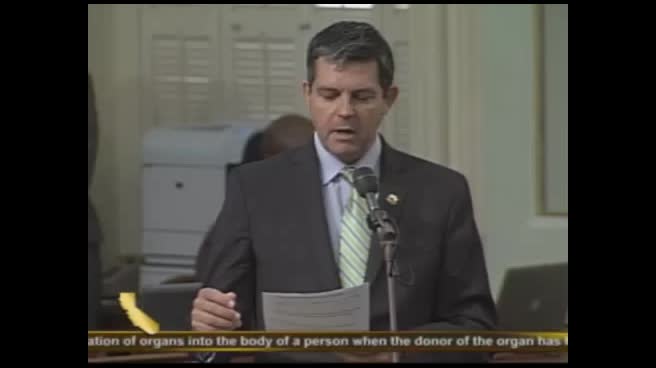
Bill Author

Bill Co-Author(s):