AJR 5: Birthright citizenship.
- Session Year: 2025-2026
- House: Assembly
- Latest Version Date: 2025-09-16
Current Status:
Passed
(2025-09-16: Chaptered by Secretary of State - Res. Chapter 178, Statutes of 2025.)
Introduced
In Committee
Awaiting First Chamber Vote
Passed First Chamber
In Committee
Awaiting Second Chamber Vote
Passed Second Chamber
Enacted
This measure would declare the Legislatures opposition to the unlawful Executive Order No. 14160, entitled Protecting the Meaning and Value of American Citizenship, ending birthright citizenship as enshrined in the United States Constitution and would affirm the Legislatures commitment to birthright citizenship, as specified.
This measure would declare the Legislatures opposition to the unlawful Executive Order No. 14160, entitled Protecting the Meaning and Value of American Citizenship, ending birthright citizenship as enshrined in the United States Constitution and would affirm the Legislatures commitment to birthright citizenship, as specified.
This measure would declare the Legislatures opposition to the unlawful Executive Order No. 14160, entitled Protecting the Meaning and Value of American Citizenship, ending birthright citizenship as enshrined in the United States Constitution and would affirm the Legislatures commitment to birthright citizenship, as specified.
This measure would declare the Legislatures opposition to the unlawful Executive Order No. 14160, entitled Protecting the Meaning and Value of American Citizenship, ending birthright citizenship as enshrined in the United States Constitution and would affirm the Legislatures commitment to birthright citizenship, as specified.
WHEREAS, On January 20, 2025, President Donald J. Trump unlawfully issued Executive Order No. 14160, entitled Protecting the Meaning and Value of American Citizenship (the Executive Order), that attempts to end birthright citizenship for children born to (i) a mother who is unlawfully present or who is lawfully present in the United States but on a temporary basis, and (ii) a father who is neither a citizen nor a lawful permanent resident; and
WHEREAS, Birthright citizenship was enshrined in the Citizenship Clause of the Fourteenth Amendment of the United States Constitution, ratified after the Civil War to repudiate the infamous decision of the United States Supreme Court in Dred Scott v. Sandford (1857) 60 U.S. 393 which held that Black Americans of African descent could never be United States citizens; and
WHEREAS, Birthright citizenship impacts every child born in California, regardless of race, color, sex, ability, class, parents national origin, parents immigration status, or any characteristic, because all persons born in the United States and subject to the jurisdiction thereof are citizens; and
WHEREAS, Birthright citizenship is especially important to California, where one in four residents is an immigrant and where about one-half of all children in California have at least one immigrant parent; and
WHEREAS, Denying birthright citizenship for children of certain immigrants would make hundreds of thousands of children ineligible for federal and state benefits and services such as CalWORKs and CalFresh, would damage their educational, economic, and health prospects, and would undermine community safety, political participation, and economy; and
WHEREAS, The unlawful Executive Order would block these childrens access to United States passports, social security cards, free lunch programs, health care access, and federal student aid, and denying these fundamental needs jeopardizes the well-being of these children and harms the broader community, leading to devastating social, political, and economic consequences; and
WHEREAS, After the Executive Order was announced, California joined 17 states, the City and County of San Francisco, and the District of Columbia in suing to block the Executive Order on the grounds that the Executive Order violates the Fourteenth Amendment and Article I of the United States Constitution, the Immigration and Nationality Act of 1965, and the Administrative Procedure Act; and
WHEREAS, The Fourteenth Amendments guarantee of birthright citizenship was affirmed over 125 years ago in the landmark United States Supreme Court decision United States v. Wong Kim Ark (1898) 169 U.S. 649 involving San Francisco-born Chinese American Wong Kim Ark; and
WHEREAS, Wong Kim Ark was born in 1873 at 751 Sacramento Street in Chinatown in the City and County of San Francisco to parents Wong Si Ping and Wee Lee, who owned a grocery store but were unable to naturalize as United States citizens due to prevailing anti-Chinese policies; and
WHEREAS, In 1895, Wong Kim Ark returned from visiting his family in China and, upon reentry, was denied admission on the false basis that he was not a citizen of the United States and ordered to be deported under the Chinese Exclusion Act of 1882; and
WHEREAS, The Chinese Consolidated Benevolent Association in San Francisco hired an attorney to fight Wong Kim Arks unlawful detention and the case was ultimately decided by the United States Supreme Court on March 28, 1898, which held that the Fourteenth Amendment to the United States Constitution establishes birthright citizenship, with very few exceptions; and
WHEREAS, The Supreme Courts opinion in United States v. Wong Kim Ark (1898) 169 U.S. 649 extends birthright citizenship to all persons born in the United States, including all children here born of resident aliens, and excludes only children born to foreign sovereigns or their ministers; children born on foreign public ships; children born to enemies within and during a hostile occupation of our territory; and children of members of some sovereign Indian tribes; and
WHEREAS, Wong Kim Arks legacy and historic fight for justice ensured the United States Constitutions guarantee of birthright citizenship and empowers every child born in California to achieve their full potential as Americans to grow up to become whatever they dream, including President of the United States; and
WHEREAS, The unlawful Executive Order condemns babies to a legal status of statelessness, which will limit their lifetime access to schools, jobs, and medical care and subject them to social isolation, travel restrictions, and exploitation; and
WHEREAS, The unlawful Executive Order is just one of President Trumps draconian attempts to scapegoat and instill fear among immigrants, divide immigrants based on arbitrary distinctions, and roll back constitutional rights; and
WHEREAS, All residents, regardless of their immigration status, deserve dignity, fair treatment and due process under the law, and the opportunity to thrive in the United States, and this belief serves as the foundation for state and local sanctuary laws in California, including the Californias Values Act of 2017; now, therefore, be it
Resolved by the Assembly and the Senate of the State of California, jointly, That the Legislature hereby opposes the unlawful Executive Order ending birthright citizenship as enshrined in the United States Constitution; and be it further
Resolved, That the Legislature affirms its commitment to birthright citizenship and recognizes and honors Wong Kim Arks fight to affirm the fundamental right of birthright citizenship under the Fourteenth Amendment of the United States Constitution; and be it further
Resolved, That the Chief Clerk of the Assembly transmit copies of this resolution to the President and Vice President of the United States, to the Secretary of State, to the Secretary of the Treasury, to the Speaker of the House of Representatives, to the Majority Leader of the Senate, to each Senator and Representative from California in the Congress of the United States, and to the author for appropriate distribution.
WHEREAS, On January 20, 2025, President Donald J. Trump unlawfully issued Executive Order No. 14160, entitled Protecting the Meaning and Value of American Citizenship (the Executive Order), that attempts to end birthright citizenship for children born to (i) a mother who is unlawfully present or who is lawfully present in the United States but on a temporary basis, and (ii) a father who is neither a citizen nor a lawful permanent resident; and
WHEREAS, Birthright citizenship was enshrined in the Citizenship Clause of the Fourteenth Amendment of the United States Constitution, ratified after the Civil War to repudiate the infamous decision of the United States Supreme Court in Dred Scott v. Sandford (1857) 60 U.S. 393 that denied citizenship to descendants of enslaved people; which held that Black Americans of African descent could never be United States citizens; and
WHEREAS, Birthright citizenship impacts every child born in California, regardless of race, color, sex, ability, class, parents national origin, parents immigration status, or any characteristic, because all persons born in the United States and subject to the jurisdiction thereof are citizens; and
WHEREAS, Birthright citizenship is especially important to California, where one in four residents is an immigrant and where about one-half of all children in California have at least one immigrant parent; and
WHEREAS, Denying birthright citizenship for children of certain immigrants would make hundreds of thousands of children ineligible for federal and state benefits and services such as CalWORKs and CalFresh, would damage their educational, economic, and health prospects, and would undermine community safety, political participation, and economy; and
WHEREAS, The unlawful Executive Order would block these childrens access to United States passports, social security cards, free lunch programs, health care access, and federal student aid, and denying these fundamental needs jeopardizes the well-being of these children and harms the broader community, leading to devastating social, political, and economic consequences; and
WHEREAS, After the Executive Order was announced, California joined 17 states, the City and County of San Francisco, and the District of Columbia in suing to block the Executive Order on the grounds that the Executive Order violates the Fourteenth Amendment and Article I of the United States Constitution, the Immigration and Nationality Act of 1965, and the Administrative Procedure Act; and
WHEREAS, The Fourteenth Amendments guarantee of birthright citizenship was affirmed over 125 years ago in the landmark United States Supreme Court decision United States v. Wong Kim Ark (1898) 169 U.S. 649 involving San Francisco-born Chinese American Wong Kim Ark; and
WHEREAS, Wong Kim Ark was born in 1873 at 751 Sacramento Street in Chinatown in the City and County of San Francisco to parents Wong Si Ping and Wee Lee, who owned a grocery store but were unable to naturalize as United States citizens due to prevailing anti-Chinese policies; and
WHEREAS, In 1895, Wong Kim Ark returned from visiting his family in China and, upon reentry, was denied admission on the false basis that he was not a citizen of the United States and ordered to be deported under the Chinese Exclusion Act of 1882; and
WHEREAS, The Chinese Consolidated Benevolent Association in San Francisco hired an attorney to fight Wong Kim Arks unlawful detention and the case was ultimately decided by the United States Supreme Court on March 28, 1898, which ruled that birthright citizenship applied to all children born in the United States, including those whose parents were immigrants; and held that the Fourteenth Amendment to the United States Constitution establishes birthright citizenship, with very few exceptions; and
WHEREAS, The Supreme Courts opinion in United States v. Wong Kim Ark (1898) 169 U.S. 649 extends birthright citizenship to all persons born in the United States, including all children here born of resident aliens, and excludes only children born to foreign sovereigns or their ministers; children born on foreign public ships; children born to enemies within and during a hostile occupation of our territory; and children of members of some sovereign Indian tribes; and
WHEREAS, Wong Kim Arks legacy and historic fight for justice ensured the United States Constitutions guarantee of birthright citizenship and empowers every child born in California to achieve their full potential as Americans to grow up to become whatever they dream, including President of the United States; and
WHEREAS, The unlawful Executive Order condemns babies to a legal status of statelessness, which will limit their lifetime access to schools, jobs, and medical care and subject them to social isolation, travel restrictions, and exploitation; and
WHEREAS, The unlawful Executive Order is just one of President Trumps draconian attempts to scapegoat and instill fear among immigrants, divide immigrants based on arbitrary distinctions, and roll back constitutional rights; and
WHEREAS, All residents, regardless of their immigration status, deserve dignity, fair treatment and due process under the law, and the opportunity to thrive in the United States, and this belief serves as the foundation for state and local sanctuary laws in California, including the Californias Values Act of 2017; now, therefore, be it
Resolved by the Assembly and the Senate of the State of California, jointly, That the Legislature hereby opposes the unlawful Executive Order ending birthright citizenship as enshrined in the United States Constitution; and be it further
Resolved, That the Legislature affirms its commitment to birthright citizenship and recognizes and honors Wong Kim Arks fight to affirm the fundamental right of birthright citizenship under the Fourteenth Amendment of the United States Constitution; and be it further
Resolved, That the Chief Clerk of the Assembly transmit copies of this resolution to the President and Vice President of the United States, to the Secretary of State, to the Secretary of the Treasury, to the Speaker of the House of Representatives, to the Majority Leader of the Senate, to each Senator and Representative from California in the Congress of the United States, and to the author for appropriate distribution.
WHEREAS, On January 20, 2025, President Donald J. Trump unlawfully issued Executive Order No. 14160, entitled Protecting the Meaning and Value of American Citizenship (the Executive Order), that attempts to end birthright citizenship for children born to (i) a mother who is unlawfully present or who is lawfully present in the United States but on a temporary basis, and (ii) a father who is neither a citizen nor a lawful permanent resident; and
WHEREAS, Birthright citizenship was enshrined in the Citizenship Clause of the Fourteenth Amendment of the United States Constitution, ratified after the Civil War to repudiate the infamous decision of the United States Supreme Court in Dred Scott v. Sandford (1857) 60 U.S. 393 that denied citizenship to descendants of enslaved people; and
WHEREAS, Birthright citizenship impacts every child born in California, regardless of race, color, sex, ability, class, parents national origin, parents immigration status, or any characteristic, because all persons born in the United States and subject to the jurisdiction thereof are citizens; and
WHEREAS, Birthright citizenship is especially important to California, where one in four residents is an immigrant and where about one-half of all children in California have at least one immigrant parent; and
WHEREAS, Denying birthright citizenship for children of certain immigrants would make hundreds of thousands of children ineligible for federal and state benefits and services such as CalWORKs and CalFresh, would damage their educational, economic, and health prospects, and would undermine community safety, political participation, and economy; and
WHEREAS, The unlawful Executive Order would block these childrens access to United States passports, social security cards, free lunch programs, health care access, and federal student aid, and denying these fundamental needs jeopardizes the well-being of these children and harms the broader community, leading to devastating social, political, and economic consequences; and
WHEREAS, After the Executive Order was announced, California joined 17 states, the City and County of San Francisco, and the District of Columbia in suing to block the Executive Order on the grounds that the Executive Order violates the Fourteenth Amendment and Article I of the United States Constitution, the Immigration and Nationality Act of 1965, and the Administrative Procedure Act; and
WHEREAS, The Fourteenth Amendments guarantee of birthright citizenship was affirmed over 125 years ago in the landmark United States Supreme Court decision United States v. Wong Kim Ark (1898) 169 U.S. 649 involving San Francisco-born Chinese American Wong Kim Ark; and
WHEREAS, Wong Kim Ark was born in 1873 at 751 Sacramento Street in Chinatown in the City and County of San Francisco to parents Wong Si Ping and Wee Lee, who owned a grocery store but were unable to naturalize as United States citizens due to prevailing anti-Chinese policies; and
WHEREAS, In 1895, Wong Kim Ark returned from visiting his family in China and, upon reentry, was denied admission on the false basis that he was not a citizen of the United States and ordered to be deported under the Chinese Exclusion Act of 1882; and
WHEREAS, The Chinese Consolidated Benevolent Association in San Francisco hired an attorney to fight Wong Kim Arks unlawful detention and the case was ultimately decided by the United States Supreme Court on March 28, 1898, which ruled that birthright citizenship applied to all children born in the United States, including those whose parents were immigrants; and
WHEREAS, Wong Kim Arks legacy and historic fight for justice ensured the United States Constitutions guarantee of birthright citizenship and empowers every child born in California to achieve their full potential as Americans to grow up to become whatever they dream, including President of the United States; and
WHEREAS, The unlawful Executive Order condemns babies to a legal status of statelessness, which will limit their lifetime access to schools, jobs, and medical care and subject them to social isolation, travel restrictions, and exploitation; and
WHEREAS, The unlawful Executive Order is just one of President Trumps draconian attempts to scapegoat and instill fear among immigrants, divide immigrants based on arbitrary distinctions, and roll back constitutional rights; and
WHEREAS, All residents, regardless of their immigration status, deserve dignity, fair treatment and due process under the law, and the opportunity to thrive in the United States, and this belief serves as the foundation for state and local sanctuary laws in California, including the Californias Values Act of 2017; now, therefore, be it
Resolved by the Assembly and the Senate of the State of California, jointly, That the Legislature hereby opposes the unlawful Executive Order ending birthright citizenship as enshrined in the United States Constitution; and be it further
Resolved, That the Legislature affirms its commitment to birthright citizenship and recognizes and honors Wong Kim Arks fight to affirm the fundamental right of birthright citizenship under the Fourteenth Amendment of the United States Constitution; and be it further
Resolved, That the Chief Clerk of the Assembly transmit copies of this resolution to the President and Vice President of the United States, to the Secretary of State, to the Secretary of the Treasury, to the Speaker of the House of Representatives, to the Majority Leader of the Senate, to each Senator and Representative from California in the Congress of the United States, and to the author for appropriate distribution.
|
Date
|
Status
|
|---|---|
| Sep 16, 2025 | Chaptered by Secretary of State - Res. Chapter 178, Statutes of 2025. |
| Sep 16, 2025 | Enrolled and filed with the Secretary of State at 12 p.m. |
| Sep 4, 2025 | Senate amendments concurred in. To Engrossing and Enrolling. (Ayes 60. Noes 0. Page 2926.). |
| Sep 2, 2025 | In Assembly. Concurrence in Senate amendments pending. |
| Sep 2, 2025 | Adopted and to Assembly. (Ayes 30. Noes 0. Page 2387.) |
| Jun 25, 2025 | From committee: Be adopted. Ordered to Third Reading. (Ayes 11. Noes 0.) (June 24). |
| Jun 10, 2025 | From committee chair, with author's amendments: Amend, and re-refer to committee. Read second time, amended, and re-referred to Com. on JUD. |
| May 28, 2025 | Referred to Com. on JUD. |
| May 20, 2025 | In Senate. To Com. on RLS. |
| May 19, 2025 | Adopted and to Senate. (Ayes 61. Noes 1. Page 1592.) |
| May 19, 2025 | Coauthors revised. |
| May 6, 2025 | From committee: Be adopted. Ordered to Third Reading. (Ayes 9. Noes 0.) (May 6). |
| May 6, 2025 | Coauthors revised. |
| Mar 28, 2025 | Referred to Com. on JUD. |
| Mar 21, 2025 | Introduced measure version corrected. |
| Mar 21, 2025 | From printer. |
| Mar 20, 2025 | Introduced. To print. |
|
Date
|
Description
|
Location
|
Votes
|
|
|---|---|---|---|---|
| Sep 4, 2025 | AJR 5 Lee Concurrence in Senate Amendments | Assembly Floor |
Passed |
|
| Sep 2, 2025 | The committee on TOU recommend that the measure be PASSED, UNAMENDED | Senate Floor |
Passed |
|
| Jun 24, 2025 | Be adopted. Ordered to third reading | Senate Standing Committee on Judiciary |
Passed |
|
| May 19, 2025 | AJR 5 Lee Assembly Third Reading | Assembly Floor |
Passed |
|
| May 6, 2025 | Be adopted. To third reading. | Assembly Standing Committee on Judiciary |
Passed |
This list shows positions taken on this bill by organizations on the date displayed, which is linked to the original source.
Positions by individuals are not included.
|
Organization
|
Position
|
Date
|
|---|---|---|
| AAPI Equity Alliance | ** Support | |
| Alianza | ** Support | |
| Alliance for Girls | ** Support | |
| American Community Media | ** Support | |
| API Equity-LA | ** Support | |
| Arab Resource and Organizing Center | ** Support | |
| AROC Action | ** Support | |
| Asata Power | ** Support | |
| Asian Americans Advancing Justice Southern California | ** Support | |
| Asian Americans and Pacific Islanders for Civic Empowerment | ** Support | |
| Asian Law Caucus | ** Support | |
| Asian Pacific Islander Council of San Francisco | ** Support | |
| Asian Youth Center | ** Support | |
| Cair California | ** Support | |
| California Community Foundation | ** Support | |
| California Faculty Association | ** Support | |
| California Immigrant Policy Center | ** Support | |
| Cambodia Town, Inc. | ** Support | |
| Catalyst California | ** Support | |
| Chinese Culture Center of San Francisco | ** Support | |
| Chinese for Affirmative Action | ** Support | |
| Chinese Progressive Association | ** Support | |
| CHIRLA | ** Support | |
| CRLA Foundation | ** Support | |
| Empowering Pacific Islander Communities | ** Support | |
| Equal Justice Society | ** Support | |
| Filipino Migrant Center | ** Support | |
| Food Empowerment Project | ** Support | |
| Foundation for Filipina Women's Network | ** Support | |
| GRACE – End Child Poverty CA | ** Support | |
| Heal Food Alliance | ** Support | |
| Hmong Innovating Politics | ** Support | |
| Immigrant Legal Resource Center | ** Support | |
| Immigrants Rising | ** Support | |
| Inclusive Action | ** Support | |
| Japanese American Citizen's League | ** Support | |
| Khmer Girls in Action | ** Support | |
| La Raza Community Center Resource Center | ** Support | |
| Little Tokyo Service Center | ** Support | |
| Mixteco/Indigena Community Organizing Project | ** Support | |
| National Asian Pacific American Families Allied for Substance Awareness and Harm Reduction | ** Support | |
| National Pacific Islander Education Network | ** Support | |
| Nihonmachi Street Fair, INC. | ** Support | |
| Pacifica Housing 4 All | ** Support | |
| Pacifica Pece People | ** Support | |
| Pacifica Progressive Alliance | ** Support | |
| Pacific Asian Counseling Services | ** Support | |
| pacifica social justice | ** Support | |
| Pacoima Beautiful | ** Support | |
| PODER | ** Support | |
| Prevention Institute | ** Support | |
| San Francisco Japantown Task Force | ** Support | |
| San Francisco Senior and Disability Action | ** Support | |
| Search To Involve Pilipino Americans | ** Support | |
| SEIU California | ** Support | |
| South Asian Network | ** Support | |
| South Asian Resource Action Center | ** Support | |
| Southeast Asian Community Center | ** Support | |
| Stop AAPI Hate | ** Support | |
| Stop AAPI Hate Coalition | ** Support | |
| Thai CDC | ** Support | |
| The Sikh Coalition | ** Support | |
| The Transgender District | ** Support | |
| United Parents and Students | ** Support | |
| western center on law and poverty | ** Support |
CONCURRENCE IN SENATE AMENDMENTS
CSA1 Bill Id:AJR 5
Author:(Lee, et al.)
As Amended Ver:June 10, 2025
Majority vote
SUMMARY
Opposes the unlawful executive order ending birthright citizenship and affirms the Legislature's commitment to birthright citizenship and recognizes and honors Wong Kim Ark's right to affirm birthright citizenship under the Fourteenth Amendment.
Major Provisions
- Resolves, on behalf of the Assembly and the Senate of the State of California, jointly, the following:
- The Legislature hereby opposes the unlawful Executive Order ending birthright citizenship as enshrined in the United States Constitution;
- The Legislature affirms its commitment to birthright citizenship and recognizes and honors Wong Kim Ark's fight to affirm the fundamental right of birthright citizenship under the Fourteenth Amendment of the United States Constitution;
- The Chief Clerk of the Assembly transmit copies of this resolution to the President and Vice President of the United States, to the secretary of State, to the Secretary of the Treasury, to the Speaker of the House of Representatives, to the Majority Leader of the Senate, to each Senator and Representative from California in the Congress of the United States, and to the author for appropriate distribution
Senate Amendments
- Clarifies that Dred Scott v. Sanford (1857) 60 U.S. 393 held that Black Americans of African descent could never be United States citizens.
- Clarifies that United States v. Wong Kim Ark (1898) 169 U.S. 649 held that the Fourteenth Amendment to the United States Constitution establishes birthright citizenship, with very few exceptions.
- Finds that the Supreme Court's opinion in United States v. Wong Kim Ark (1898) 169 U.S. 649 extends birthright citizenship to all persons born in the United States, "including all children here born of resident aliens," and excludes only children born to foreign sovereigns or their ministers; children born on foreign public ships; children born to enemies within and during a hostile occupation of our territory; and children of members of some sovereign Indian tribes.
COMMENTS
The concept of birthright citizenship finds deep roots in American history and reaches back to the English common law. As far back as 1608, English courts have observed the practice of birthright citizenship. The concept was enshrined in law in the United States with the passage of the Fourteenth Amendment. Today, any child born on U.S. soil, whether in the country itself or one of its territories, is a citizen of the United States unless their parents are diplomats.
On January 20, 2025, the President issued Executive Order Number 14160 titled "Protecting the Meaning and Value of American Citizenship." It ordered, despite long-standing precedent to the contrary, that a child born in the United States whose mother was either undocumented or was in the U.S. with temporary lawful status (such as a tourist visa) and whose father was a noncitizen without lawful permanent residency would not be a citizen at birth. In effect the order limits citizenship conferred at birth to children with at least one parent who is either a citizen or a lawful permanent resident. In issuing this directive, the order relies on the argument that the Fourteenth Amendment has "always excluded from birthright citizenship persons who were born in the United States but not 'subject to the jurisdiction thereof." The order does not explicitly argue how children born in the U.S. born to noncitizen parents are not subject to the jurisdiction of the United States. This resolution seeks to state the Legislature's opposition to the President's Executive Order and reaffirm the body's commitment to birthright citizenship and the longstanding precedent set by Wong Kim Ark.
United States v. Wong Kim Ark. About 30 years after its ratification, the citizenship clause of the Fourteenth Amendment underwent a significant stress-test. Born in San Francisco in 1873 to Chinese-citizen parents who were U.S. residents, Wong Kim Ark lived his entire life in California as a United States citizen. In 1894, in the context of the Chinese Exclusion Act and general anti-Asian sentiment across the country, Wong Kim Ark travelled to China. Upon his return, he was denied entry into the country on the grounds that he was not a U.S. citizen. In the case before the Supreme Court, the attorney for the government argued that as Wong Kim Ark's parents were Chinese citizens, they were not "subject to the jurisdiction of the United States," and thus their child was not a citizen at birth.
After reviewing the various legislative acts leading up to the Fourteenth Amendment, the Court determined that "it is beyond doubt that, before the enactment of the Civil Rights Act of 1866 or the adoption of the Constitutional Amendment, all white persons, at least, born within the sovereignty of the United States, whether children or citizens or of foreigners, excepting only children of ambassadors or public ministers of a foreign government, were native-born citizens of the United States." (United States v. Wong Kim Ark (1898) 169 U.S. 649, 674 – 675.)
The Court also explored the potential absurd outcome of the argument that a child born to noncitizen parents is not subject to the jurisdiction of the United States simply by virtue of their parents' citizenship to another country. To grant every noncitizen an exemption from being under this country's jurisdiction "would be obviously inconvenient and dangerous to society, and would subject the laws to continual infraction, and the government to degradation[.]" (Id. at 688.) Put more simply, hundreds of thousands people from all over the world come to the United States to visit and to stay. To exclude all those who are not citizens from the jurisdiction of the country's laws would erode the vitality of the laws themselves. The exemption for diplomats arises from the nature of their assignment – namely to represent their country as its agent.
The Court ultimately ruled against the government, stating that the "Fourteenth Amendment affirms the ancient and fundamental rule of citizenship by birth within the territory, in the allegiance and under the protection of the country, including all children here born of resident aliens, with the exceptions or qualifications (as old as the rule itself) of children of foreign sovereigns or their ministers[.]" (Id. at 693.) Certainly the Court could revise their approach to the question at issue, but as of this day the longstanding jurisprudence established by United States v. Wong Kim Ark remains the law of the land.
According to the Author
Birthright citizenship is rooted in our Constitution. It serves as a bedrock of our American values and has been upheld for over 150 years. The president's attempts to deny birthright citizenship is unconstitutional and undermines the core principles this country was founded upon. California is home to 10.6 million immigrants, with their contributions imprinted in every corner of our society. As we commemorate the legacy of Wong Kim Ark, I'm proud to introduce a state resolution to affirm the legislature's commitment to birthright citizenship and honor Wong Kim Ark's fight for this constitutional right.
Arguments in Support
This measure is sponsored by Chinese for Affirmative Action. It is further supported by many civil rights advocacy organizations, affinity organizations, and labor unions. In support of the measure, the sponsors submit:
Birthright citizenship is guaranteed by the Fourteenth Amendment of the U.S. Constitution, which says that "all persons" born in the United States are automatically citizens, with the exception of children whose parents are foreign diplomats. Over 125 years ago, Wong Kim Ark and the Chinese Consolidated Benevolent Association of San Francisco, also known as the "Six Companies," fought to ensure that every child born in the United States, regardless of race, color, sex, ability, class, parents' national origin, parents' immigration status, are automatically considered U.S. citizens through the U.S. Constitution.
Ending birthright citizenship for children of immigrants would have devastating consequences in California. The state stands to lose tens of millions of dollars per year in federal funding it would have received if not for the termination of birthright citizenship. Experts estimate that the order would lead to the wrongful denial of citizenship to approximately 150,000 U.S. born citizens every year, including 24,500 children born annually in California; by 2050, the population of undocumented individuals in the U.S. will more than double. Tens of thousands of babies would find themselves stateless without access to important social programs like CalFresh and CalWORKS, school lunch, and student financial aid. These children will grow up without passports, social security cards, access to jobs, and the right to vote. This would perpetuate racial inequality, make them vulnerable to exploitation, and lead to widespread economic, social, and political marginalization.
Trump's efforts to end birthright citizenship is just one of the many ways his administration has used xenophobic rhetoric and cruel executive actions to wreak havoc on immigrant communities and fuel racial profiling and anti-immigrant harm. The executive order is in opposition to California's values of inclusivity and history of multiracial democracy. Denying basic rights and services to U.S. citizen children based on their parents' immigration status is unconstitutional and creates an undue hardship, perpetuates inequality, and contravenes our nation's values of fairness and justice. We urge our state leaders to send a strong message in affirming birthright citizenship to ensure immigrants know they are welcome and belong in California.
Arguments in Opposition
None on file
FISCAL COMMENTS
None
VOTES:
ASM JUDICIARY: 9-0-3
YES: Kalra, Bauer-Kahan, Bryan, Connolly, Harabedian, Pacheco, Papan, Stefani, Zbur
ABS, ABST OR NV: Dixon, Macedo, Sanchez
ASSEMBLY FLOOR: 61-1-17
YES: Addis, Aguiar-Curry, Ahrens, Alanis, Alvarez, Arambula, Ávila Farías, Bains, Bauer-Kahan, Bennett, Berman, Boerner, Bonta, Bryan, Calderon, Caloza, Carrillo, Connolly, Elhawary, Fong, Gabriel, Garcia, Gipson, Mark González, Haney, Harabedian, Hart, Irwin, Jackson, Kalra, Krell, Lee, Lowenthal, McKinnor, Muratsuchi, Nguyen, Ortega, Pacheco, Patel, Pellerin, Petrie-Norris, Quirk-Silva, Ramos, Ransom, Celeste Rodriguez, Michelle Rodriguez, Rogers, Blanca Rubio, Schiavo, Schultz, Sharp-Collins, Solache, Soria, Stefani, Valencia, Wallis, Ward, Wicks, Wilson, Zbur, Rivas
NO: DeMaio
ABS, ABST OR NV: Castillo, Chen, Davies, Dixon, Ellis, Flora, Gallagher, Jeff Gonzalez, Hadwick, Hoover, Lackey, Macedo, Papan, Patterson, Sanchez, Ta, Tangipa
UPDATED
VERSION: June 10, 2025
CONSULTANT: Manuela Boucher / JUD. / (916) 319-2334 FN: 0001164
SENATE RULES COMMITTEE Office of Senate Floor Analyses (916) 651-1520 Fax: (916) 327-4478 | AJR 5 |
THIRD READING
Bill No: AJR 5
Author: Lee (D), Fong (D), Haney (D), Kalra (D), Muratsuchi (D) and Patel (D), et al.
Amended: 6/10/25 in Senate
Vote: 21
SENATE JUDICIARY COMMITTEE: 11-0, 6/24/25
AYES: Umberg, Allen, Arreguín, Ashby, Caballero, Durazo, Laird, Stern, Wahab, Weber Pierson, Wiener
NO VOTE RECORDED: Niello, Valladares
ASSEMBLY FLOOR: 61-1, 5/19/25 - See last page for vote
SUBJECT: Birthright citizenship
SOURCE: Chinese for Affirmative Action
DIGEST:
This resolution sets forth the Senate’s opposition to Executive Order No. 14160, which purports to end birthright citizenship in the United States, affirms the Senate’s commitment to birthright citizenship, and honors Wong Kim Ark’s fight for legal recognition of birthright citizenship under the Fourteenth Amendment to the United States Constitution (U.S. Const.).
ANALYSIS:
Existing constitutional law:
- Provides that the United States Congress has the power to establish a uniform rule of naturalization throughout the United States. (U.S. Const., art. I, § 8, cl. 4.)
- Provides that all persons born or naturalized in the United States, and subject to the jurisdiction thereof, are citizens of the United States and of the State wherein they reside. (U.S. Const., 14th amend., § 1.)
This resolution:
- Declares that:
- On January 20, 2025, President Donald J. Trump issued Executive Order No. 14160, entitled “Protecting the Meaning and Value of American Citizenship” (the “Executive Order”), which purports to end birthright citizenship for children born to (1) a mother who is unlawfully present or who is lawfully present in the United States but on a temporary basis, and (2) a father who is neither a citizen nor a lawful permanent resident.
- The Constitution has granted birthright citizenship for over 150 years, since birthright citizenship was enshrined in the Citizenship Clause of the Fourteenth Amendment to the United States Constitution, ratified after the Civil War to repudiate the infamous decision of the United States Supreme Court in Dred Scott v. Sandford (1857) 60 U.S. 393, which held that Black Americans of African descent could never be United States citizens.
- Birthright citizenship impacts every child born in California, regardless of race, color, sex, ability, class, parents’ national origin, parents’ immigration status, or any characteristic, because all persons born in the United States and subject to the jurisdiction thereof are citizens.
- Birthright citizenship is especially important in California, where one in four residents is an immigrant and where about one-half of all children in California have at least one immigrant parent.
- Denying birthright citizenship for children of certain immigrants could make hundreds of thousands of children ineligible for federal and state benefits and services such as CalWORKs and CalFresh, would damage their educational, economic, and health prospects, and would undermine community safety, political participation, and the economy.
- The unconstitutional Executive Order could block these children’s access to United States passports, social security cards, free lunch programs, health care, and federal student aid, and denying these fundamental needs jeopardizes the well-being of these children and harms the broader community, leading to devastating social, political, and economic consequences.
- After the Executive Order was announced, California joined 18 other states, the City and County of San Francisco, and the District of Columbia in suing to block the Executive Order on the ground that it violates the Fourteenth Amendment to, and Article I of, the United States Constitution, the Immigration and Nationality Act, and the Administrative Procedure Act.
- The Fourteenth Amendment’s guarantee of birthright citizenship was affirmed over 125 years ago in the landmark United States Supreme Court decision United States v. Wong Kim Ark (1898) 169 U.S. 649, involving San Francisco-born Chinese American Wong Kim Ark.
- Wong Kim Ark was born in 1873 at 751 Sacramento Street in Chinatown in the City and County of San Francisco to parents Wong Si Ping and Wee Lee, who owned a grocery store but were unable to naturalize as United States citizens due to prevailing anti-Chinese policies.
- In 1895, Wong Kim Ark returned from visiting his family in China and, upon reentry, was denied admission on the false basis that he was not a citizen of the United States and was ordered to be deported under the Chinese Exclusion Acts.
- The Chinese Consolidated Benevolent Association in San Francisco hired an attorney to fight Wong Kim Ark’s unlawful detention and the case was ultimately decided on March 28, 1898, which held that the Fourteen Amendment to the United States Constitution establishes birthright citizenship, with very few exceptions.
- The Supreme Court’s opinion in United States v. Wong Kim Ark (1898) 169 U.S. 649 extends birthright citizenship to all persons born in the United States, “including all children here born of resident aliens,” and excludes only children born to foreign sovereigns or their ministers; children born on foreign public ships; children born to enemies born within and during a hostile occupation of our territory; and children of members of some sovereign Indian tribes.
- Wong Kim Ark’s legacy and historic fight for justice ensured the United States Constitution’s guarantee of birthright citizenship and empowers children born in California to achieve their full potential as Americans to grow up to become whatever they dream, including President of the United States.
- The unconstitutional Executive Order ignores over 100 years of precedent and condemns babies to a legal status of statelessness, which will limit their lifetime access to schools, jobs, and medical care and subject them to social isolation, travel restrictions, and exploitation.
- The unconstitutional Executive Order is just one of President Trump’s draconian attempts to scapegoat and instill fear among immigrants, divide immigrants based on arbitrary distinctions, and roll back constitutional rights.
- All residents, regardless of their immigration status, deserve dignity, fair treatment and due process under the law, and the opportunity to thrive in the United States, and this belief serves as the foundation for state and local sanctuary laws in California, including the California’s Values Act of 2017.
- Resolves the following by the Senate of the State of California:
- The Senate hereby opposes the unconstitutional Executive Order purporting to end birthright citizenship as enshrined in the United States Constitution.
- The Senate affirms its commitment to birthright citizenship and recognizes and honors Wong Kim Ark’s fight to affirm the fundamental right of birthright citizenship under the Fourteenth Amendment to the United States Constitution.
- The Secretary of the Senate shall transmit copies of this resolution to the President and Vice President of the United States, to the Secretary of State, to the Secretary of the Treasury, to the Speaker of the House of Representatives, to the Majority Leader of the Senate, to each Senator and Representative from California in the Congress of the United States, and to the author for appropriate distribution.
Comments
According to the author of this resolution:
Birthright citizenship is rooted in our Constitution. It serves as a bedrock of our American values and has been upheld for over 150 years. The president’s attempts to deny birthright citizenship is unconstitutional and undermines the core principles this country was founded upon. California is home to 10.6 million immigrants, with their contributions imprinted in every corner of our society. As we commemorate the legacy of Wong Kim Ark, I’m proud to introduce a state resolution to affirm the legislature’s commitment to birthright citizenship and honor Wong Kim Ark’s fight for this constitutional right.
This resolution is substantially similar to SR 32 (Wahab, 2025), which is pending on the Senate Floor.
FISCAL EFFECT: Appropriation: No Fiscal Com.: No Local: No
SUPPORT: (Verified 6/25/25)
Chinese for Affirmative Action (source)
AAPI Equity Alliance
Alianza
Alliance for Girls
American Community Media
API Equity-LA
AROC Action
ASATA Power
Asian Americans Advancing Justice Southern California
Asian Americans and Pacific Islanders for Civil Empowerment
Asian Law Caucus
Asian Pacific Islander Council of San Francisco
Asian Youth Center
CAIR California
California Community Foundation
California Faculty Association
California Immigrant Policy Center
Cambodia Town Inc.
Catalyst California
Chinese Culture Center of San Francisco
Chinese Progressive Association
CHIRLA
CRLA Foundation
Empowering Pacific Islander Communities
Equal Justice Society
Filipino Migrant Center
Food Empowerment Project
Foundation for Filipina Women’s Network
GRACE – End Child Poverty CA
HEAL Food Alliance
Hmong Innovating Politics
Immigrant Legal Resource Center
Immigrants Rising
Inclusive Action
Japanese American Citizens League
Khmer Girls In Action
La Raza Community Center Resource Center
Little Tokyo Service Center
Mixteco/Indigena Community Organizing Project
National Asian Pacific American Families Allied for Substance Awareness and Harm Reduction
National Pacific Islander Education Network
Nihonmachi Street Fair, Inc.
Pacific Asian Counseling Services
Pacifica Housing 4 All
Pacifica Peace People
Pacifica Progressive Alliance
Pacifica Social Justice
Pacoima Beautiful
PODER
Prevention Institute
San Francisco Japantown Task Force
San Francisco Senior and Disability Action
Search to Involve Pilipino Americans
SEIU California
South Asian Network
South Asian Resource Action Center
Southeast Asian Community Center
Stop AAPI Hate
Thai CDC
The Sikh Coalition
The Transgender District
United Parents and Students
Western Center on Law and Poverty
OPPOSITION: (Verified 6/25/25)
None received
ARGUMENTS IN SUPPORT: According to a coalition of the bill’s supporters:
Birthright citizenship is guaranteed by the 14th Amendment of the U.S. Constitution, which says that “all persons” born in the United States are automatically citizens, with the exception of children whose parents are foreign diplomats. Over 125 years ago, Wong Kim Ark and the Chinese Consolidated Benevolent Association of San Francisco fought to ensure that every child born in the United States, regardless of race, color, sex, ability, class, parents’ national origin, and parents’ immigration status, are automatically considered U.S. citizens through the U.S. Constitution.
Ending birthright citizenship for children of immigrants would have devastating consequences in California. The state stands to lose tens of millions of dollars per year in federal funding it would have received if not for the termination of birthright citizenship. Experts estimate that the order would lead to the wrongful denial of citizenship to approximately 150,000 U.S. born citizens every year, including 24,500 children born annually in California; by 2050, the population of undocumented individuals in the U.S. will more than double. Tens of thousands of babies would find themselves stateless without access to important social programs like CalFresh and CalWORKS, school lunch, and student financial aid. These children will grow up without passports, social security cards, access to jobs, and the right to vote. This would perpetuate racial inequality, make them vulnerable to exploitation, and lead to widespread economic, social, and political marginalization.
Trump’s efforts to end birthright citizenship is just one of the many ways his administration has used xenophobic rhetoric and cruel executive actions to wreak havoc on immigrant communities and fuel racial profiling and anti-immigrant harm. The executive order is in opposition to California’s values of inclusivity and history of multiracial democracy. Denying basic rights and services to U.S. citizen children based on their parents’ immigration status is unconstitutional and creates an undue hardship, perpetuates inequality, and contravenes our nation’s values of fairness and justice. We urge our state leaders to send a strong message in affirming birthright citizenship to ensure immigrants know they are welcome and belong in California.
ASSEMBLY FLOOR: 61-1, 5/19/25
AYES: Addis, Aguiar-Curry, Ahrens, Alanis, Alvarez, Arambula, Ávila Farías, Bains, Bauer-Kahan, Bennett, Berman, Boerner, Bonta, Bryan, Calderon, Caloza, Carrillo, Connolly, Elhawary, Fong, Gabriel, Garcia, Gipson, Mark González, Haney, Harabedian, Hart, Irwin, Jackson, Kalra, Krell, Lee, Lowenthal, McKinnor, Muratsuchi, Nguyen, Ortega, Pacheco, Patel, Pellerin, Petrie-Norris, Quirk-Silva, Ramos, Ransom, Celeste Rodriguez, Michelle Rodriguez, Rogers, Blanca Rubio, Schiavo, Schultz, Sharp-Collins, Solache, Soria, Stefani, Valencia, Wallis, Ward, Wicks, Wilson, Zbur, Rivas
NOES: DeMaio
NO VOTE RECORDED: Castillo, Chen, Davies, Dixon, Ellis, Flora, Gallagher, Jeff Gonzalez, Hadwick, Hoover, Lackey, Macedo, Papan, Patterson, Sanchez, Ta, Tangipa
Prepared by: Allison Whitt Meredith / JUD. / (916) 651-4113
6/26/25 9:03:11
**** END ****
Senator Thomas Umberg, Chair
2025-2026 Regular Session
Bill No: AJR 5 (Author:Lee)
Version: June 10, 2025
Hearing Date: June 24, 2025
Fiscal: No
Urgency: No
Consultant: AWM
SUBJECT
Birthright citizenship
DIGEST
This resolution sets forth the Senate’s opposition to Executive Order No. 14160, which purports to end birthright citizenship in the United States, affirms the Senate’s commitment to birthright citizenship, and honors Wong Kim Ark’s fight for legal recognition of birthright citizenship under the Fourteenth Amendment to the United States Constitution.
This resolution is sponsored by Chinese for Affirmative Action and is supported by over 60 organizations. The Committee has not received timely opposition to this resolution.
SUMMARY
Existing constitutional law:
- Provides that the United States Congress has the power to establish a uniform rule of naturalization throughout the United States. (U.S. Const., art. I, § 8, cl. 4.)
- Provides that all persons born or naturalized in the United States, and subject to the jurisdiction thereof, are citizens of the United States and of the State wherein they reside. (U.S. Const., 14th amend., § 1.)
This resolution:
- Declares that:
- On January 20, 2025, President Donald J. Trump unlawfully issued Executive Order No. 14160, entitled “Protecting the Meaning and Value of American Citizenship” (the “Executive Order”), that attempts to end birthright citizenship for children born to (1) a mother who is unlawfully present or who is lawfully present in the United States but on a temporary basis, and (2) a father who is neither a citizen nor a lawful permanent resident.
- Birthright citizenship was enshrined in the Citizenship Clause of the Fourteenth Amendment of the United States Constitution, ratified after the Civil War to repudiate the infamous decision of the United States Supreme Court in Dred Scott v. Sandford (1857) 60 U.S. 393 which held that Black Americans of African descent could never be United States citizens.
- Birthright citizenship impacts every child born in California, regardless of race, color, sex, ability, class, parents’ national origin, parents’ immigration status, or any characteristic, because all persons born in the United States and subject to the jurisdiction thereof are citizens.
- Birthright citizenship is especially important to California, where one in four residents is an immigrant and where about one-half of all children in California have at least one immigrant parent.
- Denying birthright citizenship for children of certain immigrants would make hundreds of thousands of children ineligible for federal and state benefits and services such as CalWORKs and CalFresh, would damage their educational, economic, and health prospects, and would undermine community safety, political participation, and economy.
- The unlawful Executive Order would block these children’s access to United States passports, social security cards, free lunch programs, health care access, and federal student aid, and denying these fundamental needs jeopardizes the well-being of these children and harms the broader community, leading to devastating social, political, and economic consequences.
- After the Executive Order was announced, California joined 17 states, the City and County of San Francisco, and the District of Columbia in suing to block the Executive Order on the grounds that the Executive Order violates the Fourteenth Amendment and Article I of the United States Constitution, the Immigration and Nationality Act of 1965, and the Administrative Procedure Act.
- The Fourteenth Amendment’s guarantee of birthright citizenship was affirmed over 125 years ago in the landmark United States Supreme Court decision United States v. Wong Kim Ark (1898) 169 U.S. 649 involving San Francisco-born Chinese American Wong Kim Ark.
- Wong Kim Ark was born in 1873 at 751 Sacramento Street in Chinatown in the City and County of San Francisco to parents Wong Si Ping and Wee Lee, who owned a grocery store but were unable to naturalize as United States citizens due to prevailing anti-Chinese policies.
- In 1895, Wong Kim Ark returned from visiting his family in China and, upon reentry, was denied admission on the false basis that he was not a citizen of the United States and ordered to be deported under the Chinese Exclusion Act of 1882.
- The Chinese Consolidated Benevolent Association in San Francisco hired an attorney to fight Wong Kim Ark’s unlawful detention and the case was ultimately decided by the United States Supreme Court on March 28, 1898, which held that the Fourteenth Amendment to the United States Constitution establishes birthright citizenship, with very few exceptions.
- The Supreme Court’s opinion in United States v. Wong Kim Ark (1898) 169 U.S. 649 extends birthright citizenship to all persons born in the United States, “including all children born of resident aliens,” and excludes only children born to foreign sovereigns or their ministers; children born on foreign public ships; children born to enemies within and during a hostile occupation of our territory; and children of members of some sovereign Indian tribes.
- Wong Kim Ark’s legacy and historic fight for justice ensured the United States Constitution’s guarantee of birthright citizenship and empowers every child born in California to achieve their full potential as Americans to grow up to become whatever they dream, including President of the United States.
- The unlawful Executive Order condemns babies to a legal status of statelessness, which will limit their lifetime access to schools, jobs, and medical care and subject them to social isolation, travel restrictions, and exploitation.
- The unlawful Executive Order is just one of President Trump’s draconian attempts to scapegoat and instill fear among immigrants, divide immigrants based on arbitrary distinctions, and roll back constitutional rights.
- All residents, regardless of their immigration status, deserve dignity, fair treatment and due process under the law, and the opportunity to thrive in the United States, and this belief serves as the foundation for state and local sanctuary laws in California, including the California’s Values Act of 2017.
- Resolves the following by the Assembly and Senate of the State of California:
- That the Legislature hereby opposes the unlawful Executive Order ending birthright citizenship as enshrined in the United States Constitution.
- That the Legislature affirms its commitment to birthright citizenship and recognizes and honors Wong Kim Ark’s fight to affirm the fundamental right of birthright citizenship under the Fourteenth Amendment of the United States Constitution.
COMMENTS
- Author’s comment
According to the author:
Birthright citizenship is rooted in our Constitution. It serves as a bedrock of our American values and has been upheld for over 150 years. The president’s attempts to deny birthright citizenship is unconstitutional and undermines the core principles this country was founded upon. California is home to 10.6 million immigrants, with their contributions imprinted in every corner of our society. As we commemorate the legacy of Wong Kim Ark, I’m proud to introduce a state resolution to affirm the legislature’s commitment to birthright citizenship and honor Wong Kim Ark’s fight for this constitutional right.
2. Background on the adoption of the Fourteenth Amendment
The United States Constitution, as adopted in 1789 and amended with its first 10 amendments in 1791, mentions United States “citizens” 7 times and explains the term never.[1] This omission enabled the United States Supreme Court, in the disgraceful Dred Scott v. Sanford opinion,[2] to hold that Black persons of African descent could never be U.S. citizens, even if they were born on U.S. soil, and even though many states had long extended citizenship rights to free Black persons.[3] Dred Scott admitted that birthright citizenship was the rule for other Americans (i.e., white people), but held that granting the same to Black Americans of African descent was per se unconstitutional—so even if Congress had wanted to extend citizenship to those persons, Dred Scott prohibited it.[4]
After the Civil War, Congress enacted the Civil Rights Act of 1866, which extended citizenship to “all persons born in the United States and not subject to any foreign power.”[5] President Andrew Johnson vetoed the Act; his (stunningly racist) veto message questioned whether an act of Congress was sufficient to confer birthright citizenship on people to whom it had previously been denied under the Constitution.[6] Congress successfully overrode his veto, but “serious concerns remained regarding whether Congress had power to pass the Act.”[7] Congress therefore began drafting what would become the Fourteenth Amendment, to protect birthright citizenship both from a legal challenge and from future legislatures.[8]
As ratified in 1868, the first sentence of the Fourteenth Amendment states: “All persons born or naturalized in the United States, and subject to the jurisdiction thereof, are citizens of the United States and of the State wherein they reside.”[9]
3. The Wong Kim Ark decision affirms that the Fourteenth Amendment extends birthright citizenship to nearly all persons born in the U.S.
The post-Reconstruction era was a period fraught with white supremacist panics. Despite the ratification of the Equal Protection Clause—also part of the Fourteenth Amendment[10]—race-based discrimination remained the norm. The Supreme Court endorsed so-called “separate but equal” laws which, in reality, openly favored white people.[11] Southern states passed laws that targeted virtually every aspect of Black life, making it nearly impossible for a Black person to exist in public without being at risk of arrest.[12] In the 1870s and 1880s, the federal government ramped up its policy of removing Indigenous persons from their lands and imposed new policies to force Indigenous persons to adapt to “white” culture.[13] And anti-Asian sentiment—which was already rampant in California prior to the Civil War[14]—reached new heights.
In 1882, Congress passed the Chinese Exclusion Act of 1882, which suspended virtually all immigration from China for 10 years and prohibited Chinese immigrants from becoming United States citizens.[15] In 1892, Congress passed the Geary Act—authored by California Representative Thomas J. Geary—which renewed the immigration prohibition for another 10 years and added restrictions on Chinese immigrants already living in the United States.[16] It was during the Geary Act era that Wong Kim Ark, a native-born Californian, took on the federal government and won.
Wong Kim Ark was born in San Francisco in 1873.[17] His parents had immigrated to the United States from China, where they ran a store, and returned to China in 1890.[18] That same year, Wong visited China and was allowed to reenter the U.S. without incident, “upon the sole ground that he was a native-born citizen of the United States.”[19] But in 1895, when he returned from another trip, he “was denied such permission, upon the sole ground that he was not a citizen of the United States.”[20] Wong, with the help of the Chinese Consolidated Benevolent Association (known as the “Six Companies”), fought back: while Wong remained stuck on a ship in the San Francisco Bay, the Six Companies filed a writ of habeas corpus on his behalf.[21] The case went all the way to the United States Supreme Court.
United States v. Wong Kim Ark affirmed that the Fourteenth Amendment extended birthright citizenship to virtually every person born in the United States.[22] According to the Court, the Fourteenth Amendment’s citizenship clause “affirms the ancient and fundamental rule of citizenship by birth within the territory, in the allegiance and under the protection of the country, including all children here born of resident aliens,”[23] with exceptions for “children born of foreign sovereigns or their ministers, or born on foreign public ships, or of enemies within and during a hostile occupation of part of our territory, and with the single added exception of children of members of the Indian tribes owing direct allegiance to their several tribes.”[24] But for those exceptions, the Fourteenth Amendment, “in clear words and in manifest intent, includes the children born within the territory of the United States of all other persons, of whatever race or color, domiciled within the United States.”[25] Even if, at the time a person is born, their parent’s presence in the United States was “but local and temporary,” their parent’s presence was “ ‘strong enough to make a natural subject, for, if he hath issue here, that issue is a natural born-subject.’ ”[26]
Wong Kim Ark also noted that, despite Dred Scott’s holding to the country, it was undisputed that “all children, born within the United States, of foreign parents holding no diplomatic office, became citizens at the time of their birth” “until more than 50 years after the adoption of the constitution.”[27] In other words, birthright citizenship was assumed to be the law of the land until it became disadvantageous for white supremacist enslavers.
4. The President’s Executive Order 14160 purports to undo birthright citizenship
On January 20, 2025, President Donald Trump signed Executive Order 14160, entitled “Protecting the Meaning and Value of Citizenship.”[28] The Order notes that the Fourteenth Amendment “has always excluded from birthright citizenship persons who were born in the United States but not ‘subject to the jurisdiction thereof,’ ” but then goes on to advance an interpretation of the Fourteenth Amendment never before recognized by any branch of the United States government.[29] Specifically, the order asserts the novel theory that:
Among the categories of individuals born in the United States and not subject to the jurisdiction thereof, the privilege of United States citizenship does not automatically extend to persons born in the United States: (1) when that person's mother was unlawfully present in the United States and the father was not a United States citizen or lawful permanent resident at the time of said person's birth, or (2) when that person's mother's presence in the United States at the time of said person's birth was lawful but temporary (such as, but not limited to, visiting the United States under the auspices of the Visa Waiver Program or visiting on a student, work, or tourist visa) and the father was not a United States citizen or lawful permanent resident at the time of said person's birth.[30]
The Order goes on to announce that it is the policy of the United States that no department or agency should issue documents recognizing U.S. citizenship for persons born within the United States, after 30 days from the date of the order, under the circumstances identified above.[31]
5. Executive Order 14160 has been declared unconstitutional by several courts
California, along with 18 other states, the City and County of San Francisco, and the District of Columbia, sued to enjoin Executive Order 14160 the next day.[32] Judge Leo T. Sorokin consolidated the case with another injunction action brought by a noncitizen pregnant mother and immigration rights groups and granted both motions, staying enforcement of the Order nationwide.[33] Judge Sorokin’s order notes that Wong Kim Ark plainly extends birthright citizenship to all persons born here with only a handful of “narrow exceptions,” none of which is consistent with the Executive Order.[34] The order also points out that “Congress incorporated the language of the [Fourteenth Amendment’s] Citizenship Clause into provisions of the [Immigration and Naturalization Act] passed more than forty years after Wong Kim Ark” was decided.[35] Additionally, according to Judge Sorokin, the Executive Order’s interpretation of the “subject to the jurisdiction thereof” exception in the Fourteenth Amendment does not “find support in the text itself or the cases construing and applying it,” and “would prevent the Citizenship Clause from reaching groups of persons to whom even [the Administration] concede[s] it must apply.”[36]
The United States Court of Appeals for the First Circuit denied the Trump Administration’s request for a stay of the injunction pending their appeal of Judge Sorokin’s order.[37] At least three other federal district courts have also enjoined Executive Order 14160 on the basis that it is unconstitutional.[38] The Trump Administration has, so far, sought review only on the question of whether a district court can enter a nationwide injunction, and not on the merits of whether Executive Order 14160 is lawful.[39] The Supreme Court consolidated three of the matters and heard argument on the question of the courts’ authority on May 15, 2025.[40] As of the time of publication of this analysis, the Court has not issued an opinion in these cases. Executive Order 14160 remains enjoined pending the Court’s decision.
6. This resolution declares the Legislature’s opposition to Executive Order 14160 and affirms the importance of birthright citizenship
This resolution expresses the Legislature’s opposition to Executive Order 14160. The resolution sets forth California’s unique interest in this issue: California has more immigrants than any other state.[41] Over one-fourth of California’s population was born outside of the United States, and nearly half of all Californians—45 percent—have at least one immigrant parent.[42] As a result, attacks on birthright citizenship could disproportionately harm California’s children, leaving them stateless and without access to education, benefits, and the privileges and immunities of citizenship.
This resolution also recognizes the importance and durability of the Wong Kim Ark decision and the importance of birthright citizenship. Additionally, the resolution highlights the life and bravery of Wong Kim Ark himself.
Finally, this resolution condemns Executive Order 14160 as part of President Trump’s overall anti-immigrant, anti-constitution agenda. The resolution affirms the Legislature’s commitment to birthright citizenship and states that all residents, regardless of their immigration status, deserve dignity, fair treatment and due process under the law, and the opportunity to thrive in the United States.
This resolution is substantially similar to SR 32 (Wahab, 2025), which this Committee passed with a vote of 11-0.
SUPPORT
Chinese for Affirmative Action (sponsor)
AAPI Equity Alliance
Alianza
Alliance for Girls
American Community Media
API Equity-LA
AROC Action
ASATA Power
Asian Americans Advancing Justice Southern California
Asian Americans and Pacific Islanders for Civil Empowerment
Asian Law Caucus
Asian Pacific Islander Council of San Francisco
Asian Youth Center
CAIR California
California Community Foundation
California Faculty Association
California Immigrant Policy Center
Cambodia Town Inc.
Catalyst California
Chinese Culture Center of San Francisco
Chinese Progressive Association
CHIRLA
CRLA Foundation
Empowering Pacific Islander Communities
Equal Justice Society
Filipino Migrant Center
Food Empowerment Project
Foundation for Filipina Women’s Network
GRACE – End Child Poverty CA
HEAL Food Alliance
Hmong Innovating Politics
Immigrant Legal Resource Center
Immigrants Rising
Inclusive Action
Japanese American Citizens League
Khmer Girls In Action
La Raza Community Center Resource Center
Little Tokyo Service Center
Mixteco/Indigena Community Organizing Project
National Asian Pacific American Families Allied for Substance Awareness and Harm Reduction
National Pacific Islander Education Network
Nihonmachi Street Fair, Inc.
Pacific Asian Counseling Services
Pacifica Housing 4 All
Pacifica Peace People
Pacifica Progressive Alliance
Pacifica Social Justice
Pacoima Beautiful
PODER
Prevention Institute
San Francisco Japantown Task Force
San Francisco Senior and Disability Action
Search to Involve Pilipino Americans
SEIU California
South Asian Network
South Asian Resource Action Center
Southeast Asian Community Center
Stop AAPI Hate
Thai CDC
The Sikh Coalition
The Transgender District
United Parents and Students
Western Center on Law and Poverty
OPPOSITION
None received
RELATED LEGISLATION
Pending legislation: SR 32 (Wahab, 2025) is substantially similar to this resolution and declares the Legislature’s opposition to Executive Order 14160. SR 32 is pending on the Senate Floor.
Prior legislation: None known.
PRIOR VOTES:
Assembly Floor (Ayes 61, Noes 1)
Assembly Judiciary Committee (Ayes 9, Noes 0)
**************
See U.S. Const., art I, §§ 1-3; art. II; art. III, § 2; art. IV, § 2; 11th amend; ↑
(1857) 60 U.S. 393. ↑
Id. at pp. 404-406. ↑
Id. at p. 406, 417. ↑
Civil Rights Act of 1866, ch. 31, 14 Stat. 27 (codified as amended at 42 U.S.C. §§ 1981-1982 (2000)). The Civil Rights Act of 1866 also excluded from birthright citizenship “Indians not taxed,” which refers to members of sovereign Indian tribes; Congress extended birthright citizenship to all Indigenous persons born in the United States in the Indian Citizenship Act of 1924. (See Pub. L. 68-175 (Jun. 2, 2024) 43 Stat. 253.) ↑
Lash, The Origins of the Privileges or Immunities Clause, Part III: Andrew Johnson and the Constitutional Referendum of 1866 (Jun. 2013) 101 Geo. L.J. 1275, 1290-1293. ↑
Id. at p. 1296. ↑
Ibid. ↑
U.S. Const. 14th amend, § 1. California’s governor in 1868, Harry Haight, was so incensed that he refused to transmit the Fourteenth Amendment to the Legislature for ratification. (National Parks Service, A History of American Indians in California: 1849-1879 (Nov. 17, 2004), https://www.nps.gov/parkhistory/online_books/5views/5views1c.htm). California did not ratify the Fourteenth Amendment until 1959. (Constitution Annotated, Intro.6.4 Civil War Amendments, https://constitution.congress.gov/browse/essay/intro.6-4/ALDE_00000388/.) All links in this analysis are current as of June 19, 2024. ↑
U.S. Const., 14th amend., § 1. ↑
Plessy v. Ferguson (1896) 163 U.S. 537, 544 (“The object of the “Fourteenth Amendment” was undoubtedly to enforce the absolute equality of the two races before the law, but, in the nature of things, it could not have been intended to abolish distinctions based upon color, or to enforce social, as distinguished from political, equality”). ↑
Blackmon, Slavery by Another Name (2008) p. 53. Although these laws generally did not expressly name African Americans, “it was widely understood that these provisions would rarely if ever be enforced on whites”; and while many of the laws were struck down in court, “new statutes embracing the same strictures on black life quickly appeared to replace them.” (Ibid.) ↑
Dunbar-Ortiz, An Indigenous Peoples’ History of the United States (2015) pp. 157-158. ↑
In 1858, the California Legislature passed a law that made it illegal for any person “of the Chinese or Mongolian races” to enter the state (though the law was declared void in 1862). (Ch. 313, Stats. 1858; Lin Sing v. Washburn (1862) 20 Cal. 534 (noting that exclusion law was declared unconstitutional and void in an unpublished decision).) ↑
See Pub. L. 47-126 (May 6, 1882) 22 Stat. 58, Ch. 126 (47th Cong., 1st Sess.). ↑
Pub. L. 52-60 (May 5, 1892) 27 Stat. 25 (52d Cong., 1st Sess.). ↑
United States v. Wong Kim Ark (1898) 169 U.S. 649, 652. ↑
National Archives at San Francisco, Departure Statement of Wong Kim Ark, 1894, https://www.archives.gov/san-francisco/highlights/wong-kim-ark; Stanford University Libraries, Wong Kim Ark, https://exhibits.stanford.edu/riseup/feature/wong-kim-ark; Wong Kim Ark, supra, 169 U.S. at p. 652. ↑
Wong Kim Ark, 169 U.S. at p. 653. ↑
Ibid. ↑
Ibid; Stanford University, Wong Kim Ark, supra. ↑
Wong Kim Ark, 169 U.S. at p. 693. ↑
Ibid. ↑
Ibid. As noted above in footnote 5, members of sovereign Indian tribes became U.S. citizens automatically at birth beginning in 1924. ↑
Wong Kim Ark, 169 U.S. at p. 693. ↑
Ibid. ↑
Id. at p. 463. ↑
Exec. Order No. 14160 (Jan. 20, 2025) 90 Fed. Reg. 8449. ↑
Ibid. ↑
Ibid. ↑
Ibid. ↑
See City Attorney of San Francisco, Press Release: San Francisco City Attorney and Attorneys General file suit to protect birthright citizenship (Jan. 21, 2025), https://www.sfcityattorney.org/2025/01/21/san-francisco-city-attorney-and-attorneys-general-file-suit-to-protect-birthright-citizenship/. ↑
Doe v. Trump (D.Mass., Feb. 13, 2025) —F. Supp.3d—, 2025 WL 485070, 2. ↑
Id. at pp. 8-11. ↑
Id. at p. 10. ↑
Id. at p. 11. ↑
New Jersey v. Trump (1st Cir. 2025) 131 F.4th 27, 33. ↑
See New Hampshire Indonesian Community Support v. Trump (D.N.H. Feb. 11, 2025) —F.Supp.3d—, 2025 WL 457609 (granting motion for preliminary injunction filed by several nonprofit groups); State v. Trump (W.D. Wash. Feb. 6, 2025) —F.Supp.3d—, 2025 WL 415165 (granting motion for preliminary injunction filed by Washington, Arizona, Illinois, and Oregon), emergency mot. for partial stay denied in Washington v. Trump (9th Cir. Feb. 19, 2025) 2025 WL 553485; CASA, Inc. v. Trump (D. Md, Feb. 5, 2020) —F.Supp.3d—, 2025 WL 408636 (granting motion for preliminary injunction filed by CASA, Inc. and Asylum Seeker Advocacy Project), motion for stay pending appeal denied in CASA, Inc. v. Trump (4th Cir. Feb. 28, 2025) 2025 WL 654902. ↑
See Trump v. CASA, Inc., Case No. 25-1153, Application for Partial Stay, Dkt. No. 1, available at http://www.supremecourt.gov/DocketPDF/24/24A884/352051/20250313135341225_Trump%20v.%20CASA%20Inc%20application.pdf. ↑
See Trump v. Washington, Case No. 25-807, https://www.supremecourt.gov/search.aspx?filename=/docket/docketfiles/html/public/24a885.html; Trump v. CASA, Inc., Case No. 25-1153, https://www.supremecourt.gov/search.aspx?filename=/docket/docketfiles/html/public/24a884.html; Trump v. New Jersey, Case No. 25-1170, https://www.supremecourt.gov/search.aspx?filename=/docket/docketfiles/html/public/24a886.html. ↑
Mejia, Peerz, & Johnson, Fact Sheet: Immigrants in California, Public Policy Institute of California (Jan. 2025), https://www.ppic.org/publication/immigrants-in-california/. ↑
Ibid. ↑
ASSEMBLY THIRD READING
ATR Bill Id:AJR 5
Author:(Lee, et al.)
As Introduced Ver:March 20, 2025
Majority vote
SUMMARY
Opposes the unlawful executive order ending birthright citizenship and affirms the Legislature's commitment to birthright citizenship and recognizes and honors Wong Kim Ark's right to affirm birthright citizenship under the Fourteenth Amendment.
Major Provisions
- Resolves, on behalf of the Assembly and the Senate of the State of California, jointly, the following:
- The Legislature hereby opposes the unlawful Executive Order ending birthright citizenship as enshrined in the United States Constitution;
- The Legislature affirms its commitment to birthright citizenship and recognizes and honors Wong Kim Ark's fight to affirm the fundamental right of birthright citizenship under the Fourteenth Amendment of the United States Constitution;
- The Chief Clerk of the Assembly transmit copies of this resolution to the President and Vice President of the United States, to the secretary of State, to the Secretary of the Treasury, to the Speaker of the House of Representatives, to the Majority Leader of the Senate, to each Senator and Representative from California in the Congress of the United States, and to the author for appropriate distribution.
COMMENTS
The concept of birthright citizenship finds deep roots in American history and reaches back to the English common law. As far back as 1608, English courts have observed the practice of birthright citizenship. The concept was enshrined in law in the United States with the passage of the Fourteenth Amendment. Today, any child born on U.S. soil, whether in the country itself or one of its territories, is a citizen of the United States unless their parents are diplomats.
On January 20, 2025, the President issued Executive Order Number 14160 titled "Protecting the Meaning and Value of American Citizenship." It ordered, despite long-standing precedent to the contrary, that a child born in the United States whose mother was either undocumented or was in the U.S. with temporary lawful status (such as a tourist visa) and whose father was a noncitizen without lawful permanent residency would not be a citizen at birth. In effect the order limits citizenship conferred at birth to children with at least one parent who is either a citizen or a lawful permanent resident. In issuing this directive, the order relies on the argument that the Fourteenth Amendment has "always excluded from birthright citizenship persons who were born in the United States but not 'subject to the jurisdiction thereof." The order does not explicitly argue how children born in the U.S. born to noncitizen parents are not subject to the jurisdiction of the United States.
The order triggered a flurry of litigation challenging the order. United States District Courts for the District of Maryland, the Western District of Washington, and the District of Massachusetts granted preliminary injunctions blocking the order. The administration appealed those injunctions, and were denied by the Fourth, Ninth, and First Circuit Courts. Finally, the Administration petitioned the Supreme Court to partially stay the injunction to apply only to the petitioners in the cases arising out of Maryland, Washington, and Massachusetts. The Court declined to do so, leaving the lower courts' decisions untouched. However, on April 17, the Court announced it would hear oral arguments on the administration's petition to be allowed to fully implement the executive order. Oral argument is set for May 15, 2025.
This resolution seeks to state the Legislature's opposition to the President's Executive Order and reaffirm the body's commitment to birthright citizenship and the longstanding precedent set by Wong Kim Ark.
United States v. Wong Kim Ark. About 30 years after its ratification, the citizenship clause of the Fourteenth Amendment underwent a significant stress-test. Born in San Francisco in 1873 to Chinese-citizen parents who were U.S. residents, Wong Kim Ark lived his entire life in California as a United States citizen. In 1894, in the context of the Chinese Exclusion Act and general anti-Asian sentiment across the country, Wong Kim Ark travelled to China. Upon his return, he was denied entry into the country on the grounds that he was not a U.S. citizen. In the case before the Supreme Court, the attorney for the government argued that as Wong Kim Ark's parents were Chinese citizens, they were not "subject to the jurisdiction of the United States," and thus their child was not a citizen at birth.
The Court ultimately ruled against the government, stating that the "Fourteenth Amendment affirms the ancient and fundamental rule of citizenship by birth within the territory, in the allegiance and under the protection of the country, including all children here born of resident aliens, with the exceptions or qualifications (as old as the rule itself) of children of foreign sovereigns or their ministers[.] The Amendment, in clear word and in manifest intent, includes the children born, within the territory of the United States, of all other persons, of whatever race or color, domiciled within the United States. Every citizen or subject of another country, while domiciled here, is within the allegiance and the protection, and consequently subject to the jurisdiction of the United States." (United States v. Wong Kim Ark (1898) 169 U.S. 649, 693.)
The Court found that noncitizen parents and their children born in the United States are within jurisdiction of the United States to confer citizenship to their child under the Fourteenth Amendment. The Court then moved on to the contention that the phrase "subject to the jurisdiction thereof" in Section One of the Fourteenth Amendment excluded the children of non-citizen residents because those parents owed allegiance to another sovereign nation. The Court once again relied on history, referencing legislation passed by the very first Congress under the Constitution. After reviewing the various legislative acts leading up to the Fourteenth Amendment, the Court determined that "it is beyond doubt that, before the enactment of the Civil Rights Act of 1866 or the adoption of the Constitutional Amendment, all white persons, at least, born within the sovereignty of the United States, whether children or citizens or of foreigners, excepting only children of ambassadors or public ministers of a foreign government, were native-born citizens of the United States." (Id. at 674 – 675.)
The decision continued to discuss how "[i]n the fore front, both of the Fourteenth Amendment of the Constitution, and of the Civil Rights Act of 1866, the fundamental principle of citizenship by birth within the dominion was reaffirmed in the most explicit and comprehensive terms." (Id. at 675.)
Finally, the Court explored the potential absurd outcome of the argument that a child born to noncitizen parents is not subject to the jurisdiction of the United States simply by virtue of their parents' citizenship to another country. To grant every noncitizen an exemption from being under this country's jurisdiction "would be obviously inconvenient and dangerous to society, and would subject the laws to continual infraction, and the government to degradation[.]" (Id. at 688.) Put more simply, hundreds of thousands people from all over the world come to the United States to visit and to stay. To exclude all those who are not citizens from the jurisdiction of the country's laws would erode the vitality of the laws themselves. The exemption for diplomats arises from the nature of their assignment – namely to represent their country as its agent.
In conclusion, there is no doubt that the matter of Wong Kim Ark as decided by the Supreme Court in 1897 and having faced no challenges in the interim establishes that, with the sole exception of children born to diplomat parents, any child born in the United States to any parents who are not diplomats are citizens of the United States. Certainly the Court could revise their approach to the question at issue, but as of this day the longstanding jurisprudence established by United States v. Wong Kim Ark remains the law of the land.
The use of birthright citizenship in anti-immigrant rhetoric. The concept of birthright citizenship has long been hotly debated and intimately tied with nationalistic, and often bigoted, perceptions of what kind of person should be considered a citizen. The term "anchor baby" is often used pejoratively to refer to children of non-citizens. Rhetoric surrounding the term accuses noncitizen parents of manipulating the system and intentionally arriving in the United States to give birth to a child for the purpose of using that child to obtain lawful immigration status.
Last week a two year old citizen child was deported to Honduras alongside her mother, who was in the country without authorization. In response to questions regarding whether the child had received sufficient due process, White House border czar Tom Homan responded "[h]aving a U.S. citizen child after you enter this country illegally is not a get out of jail free card," and does not make people "immune from our laws." (Kaia Hubbard, Border czar maintains "no U.S. citizen child was deported" in incident of girl removed to Honduras with her mother" CBW News (April 27, 2025) available at: https://www.cbsnews.com/news/tom-homan-border-czar-deportation-us-citizen-honduras-face-the-nation/.)
The effect of ending birthright citizenship. Citizenship grants access to countless benefits proffered by both the state and federal governments. Access to social security benefits, federal student aid to attend college or university, assistance from the Federal Emergency Management Agency (FEMA) in the wake of a natural disaster, and the right to vote and hold public office are all rights granted to citizens that may be restricted or unavailable to documented or undocumented immigrants.
Additionally, documented immigrants are able to obtain work authorization which, in turn, grants them the ability to pursue employment. Citizens, natural-born or naturalized, can likewise pursue their career of choice. However, undocumented immigrants are not entitled to work authorization and are relegated to lower-wage, physically-demanding jobs at much higher rates than documented immigrants and citizens. Should the executive order's direction to limit birthright citizenship to only those born in the U.S. to at least one parent who is either a citizen or has lawful status be implemented, the undocumented population in the country would multiply exponentially over the course of the following years. Terminating birthright citizenship for all future children born to undocumented parents risks potentially devastating effects on these children, as well as the country's economy.
According to the Author
Birthright citizenship is rooted in our Constitution. It serves as a bedrock of our American values and has been upheld for over 150 years. The president's attempts to deny birthright citizenship is unconstitutional and undermines the core principles this country was founded upon. California is home to 10.6 million immigrants, with their contributions imprinted in every corner of our society. As we commemorate the legacy of Wong Kim Ark, I'm proud to introduce a state resolution to affirm the legislature's commitment to birthright citizenship and honor Wong Kim Ark's fight for this constitutional right.
Arguments in Support
This measure is sponsored by Chinese for Affirmative Action. It is further supported by many civil rights advocacy organizations, affinity organizations, and labor unions. In support of the measure, the sponsors submit:
Birthright citizenship is guaranteed by the Fourteenth Amendment of the U.S. Constitution, which says that "all persons" born in the United States are automatically citizens, with the exception of children whose parents are foreign diplomats. Over 125 years ago, Wong Kim Ark and the Chinese Consolidated Benevolent Association of San Francisco, also known as the "Six Companies," fought to ensure that every child born in the United States, regardless of race, color, sex, ability, class, parents' national origin, parents' immigration status, are automatically considered U.S. citizens through the U.S. Constitution.
Ending birthright citizenship for children of immigrants would have devastating consequences in California. The state stands to lose tens of millions of dollars per year in federal funding it would have received if not for the termination of birthright citizenship. Experts estimate that the order would lead to the wrongful denial of citizenship to approximately 150,000 U.S. born citizens every year, including 24,500 children born annually in California; by 2050, the population of undocumented individuals in the U.S. will more than double. Tens of thousands of babies would find themselves stateless without access to important social programs like CalFresh and CalWORKS, school lunch, and student financial aid. These children will grow up without passports, social security cards, access to jobs, and the right to vote. This would perpetuate racial inequality, make them vulnerable to exploitation, and lead to widespread economic, social, and political marginalization.
Trump's efforts to end birthright citizenship is just one of the many ways his administration has used xenophobic rhetoric and cruel executive actions to wreak havoc on immigrant communities and fuel racial profiling and anti-immigrant harm. The executive order is in opposition to California's values of inclusivity and history of multiracial democracy. Denying basic rights and services to U.S. citizen children based on their parents' immigration status is unconstitutional and creates an undue hardship, perpetuates inequality, and contravenes our nation's values of fairness and justice. We urge our state leaders to send a strong message in affirming birthright citizenship to ensure immigrants know they are welcome and belong in California.
Arguments in Opposition
None on file
FISCAL COMMENTS
None
VOTES
ASM JUDICIARY: 9-0-3
YES: Kalra, Bauer-Kahan, Bryan, Connolly, Harabedian, Pacheco, Papan, Stefani, Zbur
ABS, ABST OR NV: Dixon, Macedo, Sanchez
UPDATED
VERSION: March 20, 2025
CONSULTANT: Manuela Boucher-de la Cadena / JUD. / (916) 319-2334 FN: 0000345
Date of Hearing: May 6, 2025
ASSEMBLY COMMITTEE ON JUDICIARY
Ash Kalra, Chair
ABPCA Bill Id:AJR 5
Author:(Lee) – As Introduced Ver:March 20, 2025
SUBJECT: Birthright citizenship
KEY ISSUE: SHOULD THE CALIFORNIA LEGISLATURE OPPOSE THE EXECUTIVE ORDER ENDING BIRTHRIGHT CITIZENSHIP AS ENSHRINED IN THE CONSTITUTION, AND AFFIRM ITS COMMITMENT TO BIRTHRIGHT CITIZENSHIP AND RECOGNIZE AND HONOR WONG KIM ARK’S FIGHT TO AFFIRM BIRTHRIGHT CITIZENSHIP UNDER THE FOURTEENTH AMENDMENT OF THE UNITED STATES?
SYNOPSIS
In 1898, the Supreme Court held in United States v. Wong Kim Ark that children born in the United States, regardless of their parents’ citizenship, are citizens of the United States. The Court reached this conclusion based on the language of the Fourteenth Amendment, and included in its decision a discussion of the language in the Amendment that requires a person to be “under the jurisdiction” of the United States to be a citizen at birth. On January 20, 2025, the President issued Executive Order Number 14160 titled “Protecting the Meaning and Value of American Citizenship.” Relying entirely on the clause “under the jurisdiction of” the United States, the order would effectively limit citizenship conferred at birth to children with at least one parent who is either a citizen or a lawful permanent resident, directly contradicting the long-standing Supreme Court precedent settled in United States v. Wong Kim Ark.
This resolution states the Legislature’s opposition to the Executive Order, affirms the Legislature’s commitment to birthright citizenship, and seeks to honor Wong Kim Ark and the case’s affirmation of birthright citizenship under the Fourteenth Amendment.
SUMMARY: Opposes the unlawful executive order ending birthright citizenship and affirms the Legislature’s commitment to birthright citizenship and recognizes and honors Wong Kim Ark’s right to affirm birthright citizenship under the Fourteenth Amendment. Specifically, this measure:
- Makes the following findings:
- On January 20, 2025, President Donald J. Trump unlawfully issued Executive Order No. 14160, entitled “Protecting the Meaning and Value of American Citizenship” (the “Executive Order”), that attempts to end birthright citizenship for children born to (i) a mother who is unlawfully present or who is lawfully present in the United States but on a temporary basis, and (ii) a father who is neither a citizen nor a lawful permanent resident;
- Birthright citizenship was enshrined in the Citizenship Clause of the Fourteenth Amendment of the United States Constitution, ratified after the Civil War to repudiate the infamous decision of the United States Supreme Court in Dred Scott v. Sandford (1857) 60 U.S. 393 that denied citizenship to descendants of enslaved people;
- Birthright citizenship impacts every child born in California, regardless of race, color, sex, ability, class, parents’ national origin, parents’ immigration status, or any characteristic, because all persons born in the United States and subject to the jurisdiction thereof are citizens;
- Birthright citizenship is especially important to California, where one in four residents is an immigrant and where about one-half of all children in California have at least one immigrant parent;
- Denying birthright citizenship for children of certain immigrants would make hundreds of thousands of children ineligible for federal and state benefits and services such as CalWORKs and CalFresh, would damage their educational, economic, and health prospects, and would undermine community safety, political participation, and economy;
- The unlawful Executive Order would block these children’s access to United Sates passports, social security cards, free lunch programs, health care access, and federal student aid, and denying these fundamental needs jeopardizes the well-being of these children and harms the broader community, leading to devastating social, political, and economic consequences;
- After the Executive Order was announced, California joined 17 states, the City and County of San Francisco, and the District of Columbia in suing to block the Executive Order on the grounds that the Executive Order violates the Fourteenth Amendment and Article I of the United States Constitution, the Immigration and Nationality Act of 1965, and the Administrative Procedure Act;
- The Fourteenth Amendments’ guarantee of birthright citizenship was affirmed over 125 years ago in the landmark United States Supreme Court decision United States v. Wong Kim Ark (1898) 169 U.S. 649 involving San Francisco-born Chinese American Wong Kim Ark;
- Wong Kim Ark was born in 1873 at 751 Sacramento Street in Chinatown in the City and County of San Francisco to parents Wong Si Ping and Wee Lee, who owned a grocery store but were unable to naturalize as United States citizens due to prevailing anti-Chinese policies;
- In 1895, Wong Kim Ark returned from visiting his family in China and, upon reentry was denied admission on the false basis that he was not a citizen of the United States and ordered to be deported under the Chinese Exclusion Act of 1881;
- The Chinese Consolidated Benevolent Association in San Francisco hired an attorney to fight Wong Kim Ark’s unlawful detention and the case was ultimately decided by the United States Supreme Court on March 28, 1898, which ruled that birthright citizenship applied to all children born in the United States, including those whose parents were immigrants;
- Wong Kim Ark’s legacy and historic fight for justice ensured the United States Constitution’s guarantee of birthright citizenship and empowers every child born in California to achieve their full potential as Americans to grow up to become whatever they dream, including President of the United States;
- The unlawful Executive Order condemns babies to a legal status of statelessness, which will limit their lifetime access to schools, jobs, and medical care and subject them to social isolation, travel restrictions, and exploitation;
- The unlawful executive Order is just one of President Trump’s draconian attempts to scapegoat and instill fear among immigrants, divide immigrants based on arbitrary distinctions, and roll back constitutional rights;
- All residents, regardless of their immigration status, deserve dignity, fair treatment and due process under the law, and the opportunity to thrive in the United States, and this belief serves as the foundation for state and local sanctuary laws in California, including the California’s Values Act of 2017.
- Resolves, on behalf of the Assembly and the Senate of the State of California, jointly, the following:
- The Legislature hereby opposes the unlawful Executive Order ending birthright citizenship as enshrined in the United States Constitution;
- The Legislature affirms its commitment to birthright citizenship and recognizes and honors Wong Kim Ark’s fight to affirm the fundamental right of birthright citizenship under the Fourteenth Amendment of the United States Constitution;
- The Chief Clerk of the Assembly transmit copies of this resolution to the President and Vice President of the United States, to the secretary of State, to the Secretary of the Treasury, to the Speaker of the House of Representatives, to the Majority Leader of the Senate, to each Senator and Representative from California in the Congress of the United States, and to the author for appropriate distribution.
EXISTING LAW:
- Provides that the federal government has the exclusive authority to regulate immigration and naturalization. (U.S. Const., article I, section 8, clauses 3 and 4.)
- Provides that all persons born or naturalized in the United States, and subject to the jurisdiction thereof, are citizens of the United States and of the State wherein they reside. (U.S. Constitution, Fourteenth Amendment.)
- Prohibits the state from making or enforcing any law which abridges the privileges or immunities of citizens of the United States, and prohibits the state from depriving any person or life, liberty, or property, without due process of law, or denying to any person within its jurisdiction the equal protection of the laws. (U.S. Constitution, Fourteenth Amendment.)
- Makes every person born in the United States, and subject to the jurisdiction thereof, a national and citizen of the United States at birth. (8 U.S.C. Section 1401 (a).)
- United States v. Wong Kim Ark (1898) 169 U.S. 649.
FISCAL EFFECT: As currently in print this measure is keyed non-fiscal.
COMMENTS: The concept of birthright citizenship finds deep roots in American history and reaches back to the English common law. As far back as 1608, English courts have observed the practice of birthright citizenship. The concept was enshrined in law in the United States with the passage of the Fourteenth Amendment. Today, any child born on U.S. soil, whether in the country itself or one of its territories, is a citizen of the United States unless their parents are diplomats. As of 2023, there are approximately 279 million US-born citizens and nearly 25 million naturalized citizens in the United States. (Kaiser Family Foundation, Population Distribution by Citizenship Status available at https://www.kff.org/other/state-indicator/distribution-by-citizenship-status/?currentTimeframe=0&sortModel=%7B%22colId%22:%22Location%22,%22sort%22:%22asc%22%7D.)
Birthright citizenship refers to the legal principle by which children born in the United States are automatically granted citizenship. There are two theories of birthright citizenship: ancestry-based and birthplace-based. Under ancestry-based citizenship (or jus sanguinis), children born abroad still receive U.S. citizenship if their parents meet certain citizenship and residency requirements. Birthplace-based citizenship, or jus soli, refers to the citizenship granted to every individual born on U.S. soil, with very limited exceptions such as children of foreign diplomats. Traditionally the United States has observed a combination of both jus soli and jus sanguinis. For the purposes of the remainder of this analysis, the term “birthright citizenship” refers to jus soli.
On January 20, 2025, the President issued Executive Order Number 14160 titled “Protecting the Meaning and Value of American Citizenship.” It ordered, despite long-standing precedent to the contrary, that a child born in the United States whose mother was either undocumented or was in the U.S. with temporary lawful status (such as a tourist visa) and whose father was a noncitizen without lawful permanent residency would not be a citizen at birth. In effect the order limits citizenship conferred at birth to children with at least one parent who is either a citizen or a lawful permanent resident. In issuing this directive, the order relies on the argument that the Fourteenth Amendment has “always excluded from birthright citizenship persons who were born in the United States but not ‘subject to the jurisdiction thereof.” The order does not explicitly argue how children born in the U.S. born to noncitizen parents are not subject to the jurisdiction of the United States.
The order triggered a flurry of litigation challenging the order. United States District Courts for the District of Maryland, the Western District of Washington, and the District of Massachusetts granted preliminary injunctions blocking the order. The administration appealed those injunctions, and were denied by the Fourth, Ninth, and First Circuit Courts. Finally, the Administration petitioned the Supreme Court to partially stay the injunction to apply only to the petitioners in the cases arising out of Maryland, Washington, and Massachusetts. The Court declined to do so, leaving the lower courts’ decisions untouched. However, on April 17, the Court announced it would hear oral arguments on the administration’s petition to be allowed to fully implement the executive order. Oral argument is set for May 15, 2025.
This resolution seeks to state the Legislature’s opposition to the President’s Executive Order and reaffirm the body’s commitment to birthright citizenship and the longstanding precedent set by Wong Kim Ark. According to the author:
Birthright citizenship is rooted in our Constitution. It serves as a bedrock of our American values and has been upheld for over 150 years. The president’s attempts to deny birthright citizenship is unconstitutional and undermines the core principles this country was founded upon. California is home to 10.6 million immigrants, with their contributions imprinted in every corner of our society. As we commemorate the legacy of Wong Kim Ark, I’m proud to introduce a state resolution to affirm the legislature’s commitment to birthright citizenship and honor Wong Kim Ark’s fight for this constitutional right.
United States v. Wong Kim Ark. Ratified in 1868 after the conclusion of the Civil War, the Fourteenth Amendment sought to redress some of slavery’s wrongs by guaranteeing citizenship to all people born in the United States “and subject to the jurisdiction thereof.” This language in Clause One of the Amendment overruled Scott v. Sandford 60 U.S. 393 (1857) (colloquially referred to as the Dred Scott decision) which held that Black people were not citizens of the United States. As detailed extensively in the Court’s decision in Wong Kim Ark, birthright citizenship was not born in the Fourteenth Amendment and is instead an ancient concept incorporated into U.S. law.
About 30 years after its ratification, the citizenship clause of the Fourteenth Amendment underwent a significant stress-test. Born in San Francisco in 1873 to Chinese-citizen parents who were U.S. residents, Wong Kim Ark lived his entire life in California as a United States citizen. In 1894, in the context of the Chinese Exclusion Act and general anti-Asian sentiment across the country, Wong Kim Ark travelled to China. Upon his return, he was denied entry into the country on the grounds that he was not a U.S. citizen. In the case before the Supreme Court, the attorney for the government argued that as Wong Kim Ark’s parents were Chinese citizens, they were not “subject to the jurisdiction of the United States,” and thus their child was not a citizen at birth.
The Court ultimately ruled against the government, stating that the “Fourteenth Amendment affirms the ancient and fundamental rule of citizenship by birth within the territory, in the allegiance and under the protection of the country, including all children here born of resident aliens, with the exceptions or qualifications (as old as the rule itself) of children of foreign sovereigns or their ministers[.] The Amendment, in clear word and in manifest intent, includes the children born, within the territory of the United States, of all other persons, of whatever race or color, domiciled within the United States. Every citizen or subject of another country, while domiciled here, is within the allegiance and the protection, and consequently subject to the jurisdiction of the United States.” (United States v. Wong Kim Ark (1898) 169 U.S. 649, 693.)
The Court explored birthright citizenship’s extensive roots in English common law. In reaching its ultimate conclusion the Court engaged in extensive discussion on the history of birthright citizenship. The Court reflected that English common law incorporated a similar concept of birthright citizenship and corresponding allegiance to the King. It discussed:
[T]he fundamental principle of the common law with regard to English nationality was birth within the allegiance, also called ‘ligeality,’ ‘obedience,’ ‘faith’ or ‘power,’ of the King [which] embraced all persons born within the King’s allegiance and subject to his protection. […] Children, born in English, of such aliens, were therefore natural-born subjects. (Id. at 655.)
The Court discussed the English common law’s distinction between children born to immigrants in England, and those born to diplomats or non-English citizens in colonial territories: “But the children, born within the realm, of foreign ambassadors, or the children of alien enemies, born during and within their hostile occupation of part of the King’s dominions, were not natural-born subjects, because not born within the allegiance, the obedience, or the power, or as would be said at this day, within the jurisdiction of the King.” (Ibid.) The Court continued its historical exploration through the United States’ colonial history and concluded that “[t]here is, therefore, little ground for the theory that, at the time of the adoption of the Fourteenth Amendment of the Constitution of the United States, there was any settled and definite rule of international law, generally recognized by civilized nations, inconsistent with the ancient rule of citizenship by birth within the dominion.” (Id. at 667).
The Court found that noncitizen parents and their children born in the United States are within jurisdiction of the United States to confer citizenship to their child under the Fourteenth Amendment. The Court then moved on to the contention that the phrase “subject to the jurisdiction thereof” in Section One of the Fourteenth Amendment excluded the children of non-citizen residents because those parents owed allegiance to another sovereign nation. The Court once again relied on history, referencing legislation passed by the very first Congress under the Constitution. After reviewing the various legislative acts leading up to the Fourteenth Amendment, the Court determined that “it is beyond doubt that, before the enactment of the Civil Rights Act of 1866 or the adoption of the Constitutional Amendment, all white persons, at least, born within the sovereignty of the United States, whether children or citizens or of foreigners, excepting only children of ambassadors or public ministers of a foreign government, were native-born citizens of the United States.” (Id. at 674 – 675.)
The decision continued to discuss how “[i]n the fore front, both of the Fourteenth Amendment of the Constitution, and of the Civil Rights Act of 1866, the fundamental principle of citizenship by birth within the dominion was reaffirmed in the most explicit and comprehensive terms.” (Id. at 675.) The Civil Rights Act was passed in April of 1866, but vetoed by President Johnson. In relevant part, the Civil Rights Act provided:
[A]ll persons born in the United States, and not subject to any foreign power, excluding Indians not taxed, are hereby declared to be citizens of the United States[.]
The Fourteenth Amendment was introduced in June 1866, just months after passage of the Civil Rights Act, and was ratified on July 28, 1868. Clause One of the Fourteenth Amendment provides:
[A]ll persons born or naturalized in the United States, and subject to the jurisdiction thereof, are citizens of the United States and of the state wherein they reside. No State shall make or enforce any law which shall abridge the privileges or immunities of citizens of the United States; nor shall any State deprive any person of life, liberty, or property, without due process of law; nor deny to any person within its jurisdiction the equal protection of the laws.
In reviewing both pieces of legislation, the Court determined that the intent of Clause One of the Fourteenth Amendment was “not intended to impose any new restrictions upon citizenship, or to prevent any persons from becoming citizens by the fact of birth within the United States, who would thereby have become citizens according to the law existing before its adoption. It is declaratory in form, and enabling and extending in its effect.” (Id. at 676.)
Finally, the Court explored the potential absurd outcome of the argument that a child born to noncitizen parents is not subject to the jurisdiction of the United States simply by virtue of their parents’ citizenship to another country. To grant every noncitizen an exemption from being under this country’s jurisdiction “would be obviously inconvenient and dangerous to society, and would subject the laws to continual infraction, and the government to degradation[.]” (Id. at 688.) Put more simply, hundreds of thousands people from all over the world come to the United States to visit and to stay. To exclude all those who are not citizens from the jurisdiction of the country’s laws would erode the vitality of the laws themselves. The exemption for diplomats arises from the nature of their assignment – namely to represent their country as its agent.
In conclusion, there is no doubt that the matter of Wong Kim Ark as decided by the Supreme Court in 1897 and having faced no challenges in the interim establishes that, with the sole exception of children born to diplomat parents, any child born in the United States to any parents who are not diplomats are citizens of the United States. Certainly the Court could revise their approach to the question at issue, but as of this day the longstanding jurisprudence established by United States v. Wong Kim Ark remains the law of the land.
The use of birthright citizenship in anti-immigrant rhetoric. The concept of birthright citizenship has long been hotly debated and intimately tied with nationalistic, and often bigoted, perceptions of what kind of person should be considered a citizen. The term “anchor baby” is often used pejoratively to refer to children of non-citizens. Rhetoric surrounding the term accuses noncitizen parents of manipulating the system and intentionally arriving in the United States to give birth to a child for the purpose of using that child to obtain lawful immigration status. During the 2016 presidential campaign, failed candidate Jeb Bush received backlash for his use of the term and defended himself saying it was “more related to Asian people coming into our country, having children, and… taking advantage of a noble concept, which is birthright citizenship.” (Alex Altman, Jeb Bush Bungles “Anchor Baby” Explanation TIME Magazine (August 24, 2015) available at: https://time.com/4008888/jeb-bush-anchor-baby-asians/.) Then-candidate Donald Trump was also criticized at the time for his use of the term, defending himself by implying that use of any other term was an attempt to be politically correct and simply responding “I’ll use the phrase anchor baby.” (Trump: ‘I’ll Use the Word Anchor Baby’ ABC News (August 20, 2015) available at: https://abcnews.go.com/Politics/video/trump-ill-word-anchor-baby-33201519.) His 2016 campaign included a promise to end birthright citizenship akin to the policy in this year’s executive order.
Last week a 2-year-old citizen child was deported to Honduras alongside her mother, who was in the country without authorization. In response to questions regarding whether the child had received sufficient due process, White House border czar Tom Homan responded “[h]aving a U.S. citizen child after you enter this country illegally is not a get out of jail free card,” and does not make people “immune from our laws.” (Kaia Hubbard, Border czar maintains “no U.S. citizen child was deported” in incident of girl removed to Honduras with her mother” CBW News (April 27, 2025) available at: https://www.cbsnews.com/news/tom-homan-border-czar-deportation-us-citizen-honduras-face-the-nation/.)
The theory that vast numbers of immigrants travel to the U.S. specifically to give birth and then utilize that child’s citizenship to apply for their own has been debunked. Instead, research indicates most immigrants come to the United States in search of work or to complete their education. (Schumacher, Hamel, et. al, Understanding the U.S. Immigrant Experience: The 2023 KFF/LA Times Survey of Immigrants Kaiser Family Foundation (September 17, 2023) available at: https://www.kff.org/report-section/understanding-the-u-s-immigrant-experience-the-2023-kff-la-times-survey-of-immigrants-findings/) Moreover, obtaining legal status for an undocumented parent through their U.S. citizen child is not as straightforward as proponents of the “anchor-baby” theory seem to believe. A U.S. citizen may only petition for legal status for one or both parents through a family based petition after they turn 21. Undocumented immigrants who have been in the country without authorization for more than one year (which is highly likely in the case of parents with citizen children at least 21 years of age), could be subject to a 10-year time bar from the country. In other words, even if a child’s petition for their parent was successful, the parent would need to leave the country for 10 years before being readmitted as a lawful permanent resident. (For a more detailed explanation of the challenges of obtaining lawful status through a citizen child, see: How US Citizens Can Petition Their Parents for Permanent Residence Immigrant Legal Resource Center (March 31, 2023) available at: https://www.ilrc.org/community-resources/how-us-citizens-can-petition-their-parents-permanent-residence. See also, Eliminating Birthright Citizenship Would Not Solve the Problem of Unauthorized Immigration American Immigration Council (November 4, 2011) available at: https://www.americanimmigrationcouncil.org/research/eliminating-birthright-citizenship-would-not-solve-problem-unauthorized-immigration.) In brief, it seems far-fetched that someone would travel to the United States, often braving travel through some of the most dangerous areas in the world, to give birth to a U.S. citizen for the sole purpose that 21 years later, that child might be able to petition for lawful immigration status on their behalf. Instead it seems more likely that people, parents and non-parents alike, are driven by social and economic conditions in their home countries to make the unimaginably difficult decision to leave their communities to seek better conditions for themselves and their families, a principle that this country was theoretically founded on.
The effect of ending birthright citizenship. Citizenship grants access to countless benefits proffered by both the state and federal governments. Access to social security benefits, federal student aid to attend college or university, assistance from the Federal Emergency Management Agency (FEMA) in the wake of a natural disaster, and the right to vote and hold public office are all rights granted to citizens that may be restricted or unavailable to documented or undocumented immigrants.
Additionally, documented immigrants are able to obtain work authorization which, in turn, grants them the ability to pursue employment. Citizens, natural-born or naturalized, can likewise pursue their career of choice. However, undocumented immigrants are not entitled to work authorization and are relegated to lower-wage, physically-demanding jobs at much higher rates than documented immigrants and citizens. Should the executive order’s direction to limit birthright citizenship to only those born in the U.S. to at least one parent who is either a citizen or has lawful status be implemented, the undocumented population in the country would multiply exponentially over the course of the following years. Terminating birthright citizenship for all future children born to undocumented parents risks potentially devastating effects on these children, as well as the country’s economy.
ARGUMENTS IN SUPPORT: This measure is sponsored by Chinese for Affirmative Action. It is further supported by many civil rights advocacy organizations, affinity organizations, and labor unions. In support of the measure, the sponsors submit:
Birthright citizenship is guaranteed by the 14th Amendment of the U.S. Constitution, which says that “all persons” born in the United States are automatically citizens, with the exception of children whose parents are foreign diplomats. Over 125 years ago, Wong Kim Ark and the Chinese Consolidated Benevolent Association of San Francisco, also known as the “Six Companies,” fought to ensure that every child born in the United States, regardless of race, color, sex, ability, class, parents’ national origin, parents’ immigration status, are automatically considered U.S. citizens through the U.S. Constitution.
Ending birthright citizenship for children of immigrants would have devastating consequences in California. The state stands to lose tens of millions of dollars per year in federal funding it would have received if not for the termination of birthright citizenship. Experts estimate that the order would lead to the wrongful denial of citizenship to approximately 150,000 U.S. born citizens every year, including 24,500 children born annually in California; by 2050, the population of undocumented individuals in the U.S. will more than double. Tens of thousands of babies would find themselves stateless without access to important social programs like CalFresh and CalWORKS, school lunch, and student financial aid. These children will grow up without passports, social security cards, access to jobs, and the right to vote. This would perpetuate racial inequality, make them vulnerable to exploitation, and lead to widespread economic, social, and political marginalization.
Trump’s efforts to end birthright citizenship is just one of the many ways his administration has used xenophobic rhetoric and cruel executive actions to wreak havoc on immigrant communities and fuel racial profiling and anti-immigrant harm. The executive order is in opposition to California’s values of inclusivity and history of multiracial democracy. Denying basic rights and services to U.S. citizen children based on their parents’ immigration status is unconstitutional and creates an undue hardship, perpetuates inequality, and contravenes our nation’s values of fairness and justice. We urge our state leaders to send a strong message in affirming birthright citizenship to ensure immigrants know they are welcome and belong in California.
REGISTERED SUPPORT / OPPOSITION:
Support
Chinese for Affirmative Action (sponsor)
AAPI Equity Alliance
Alianza
Alliance for Girls
API Equality-LA
Arab Resource and Organizing Center (AROC)
Asata Power
Asian Americans Advancing Justice Southern California
Asian Americans and Pacific Islanders for Civic Empowerment
Asian and Pacific Islander Council of San Francisco (API Council)
Asian Law Caucus
Asian Youth Center (AYC)
CAIR California
California Faculty Association
Cambodia Town INC.
Chinese Culture Center of San Francisco
Chinese for Affirmative Action/AACRE
Chinese Progressive Association
Coalition for Humane Immigrant Rights (CHIRLA)
Empowering Pacific Islander Communities (EPIC)
Equal Justice Society
Filipino Migrant Center
Food Empowerment Project
Foundation for Filipina Women's Network
Grace - End Child Poverty CA
Heal (Health, Environment, Agriculture, Labor) Food Alliance
Hmong Innovating Politics
Inclusive Action
Japanese American Citizens League (JACL)
Khmer Girls in Action
LA Raza Community Resource Center
Little Tokyo Service Center
Mixteco/Indigena Community Organizing Project (MICOP)
National Asian Pacific American Families Allied for Substance Awareness and Harm Reduction
National Pacific Islander Education Network
Nihonmachi Street Fair, INC.
Pacific Asian Counseling Services
Pacifica Housing 4 All
Pacifica Pece People
Pacifica Progressive Alliance
Pacifica Social Justice
Pacoima Beautiful
PODER
Prevention Institute
San Francisco Japantown Task Force
Search to Involve Pilipino Americans
SEIU California
South Asian Network
Southeast Asia Resource Action Center (SEARAC)
Southeast Asian Community Center (SEACC)
Stop AAPI Hate
Stop AAPI Hate Coalition
Thai CDC
The Sikh Coalition
The Transgender District
United Parents and Students
Western Center on Law & Poverty
Opposition
None on file
Analysis Prepared by: Manuela Boucher-de la Cadena / JUD. / (916) 319-2334
Discussed in Hearing
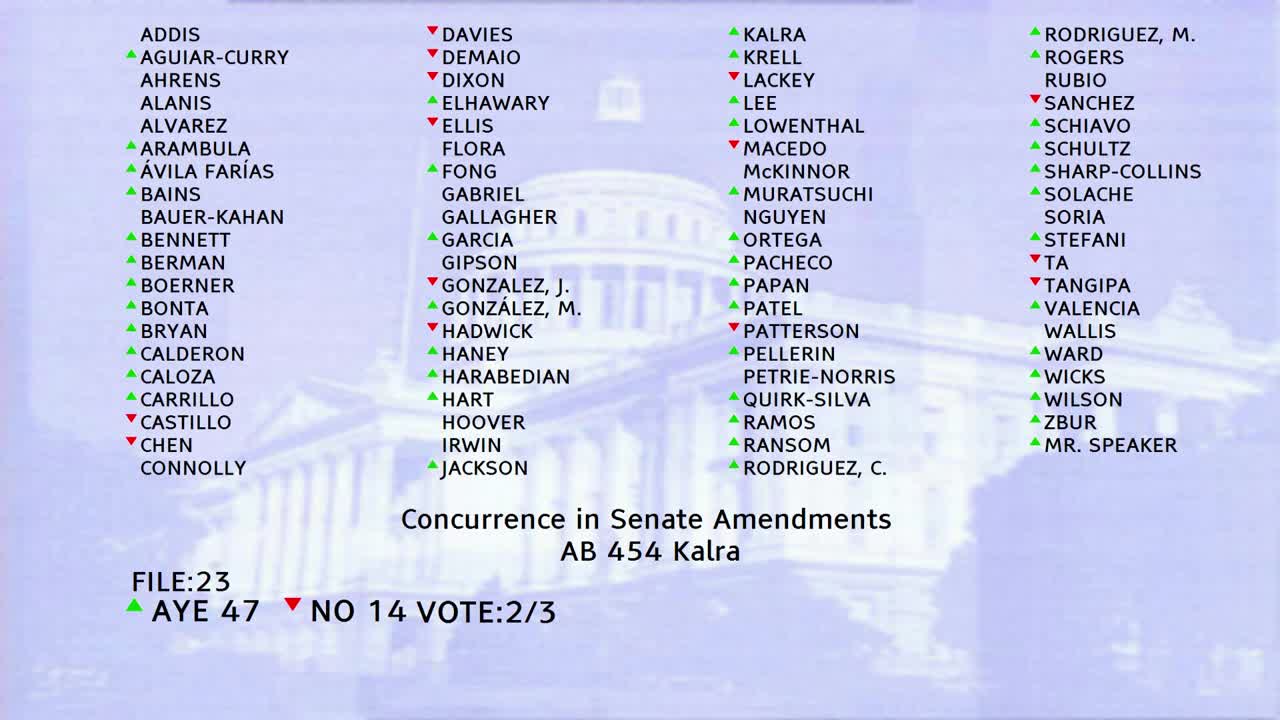 3MIN
Assembly Floor
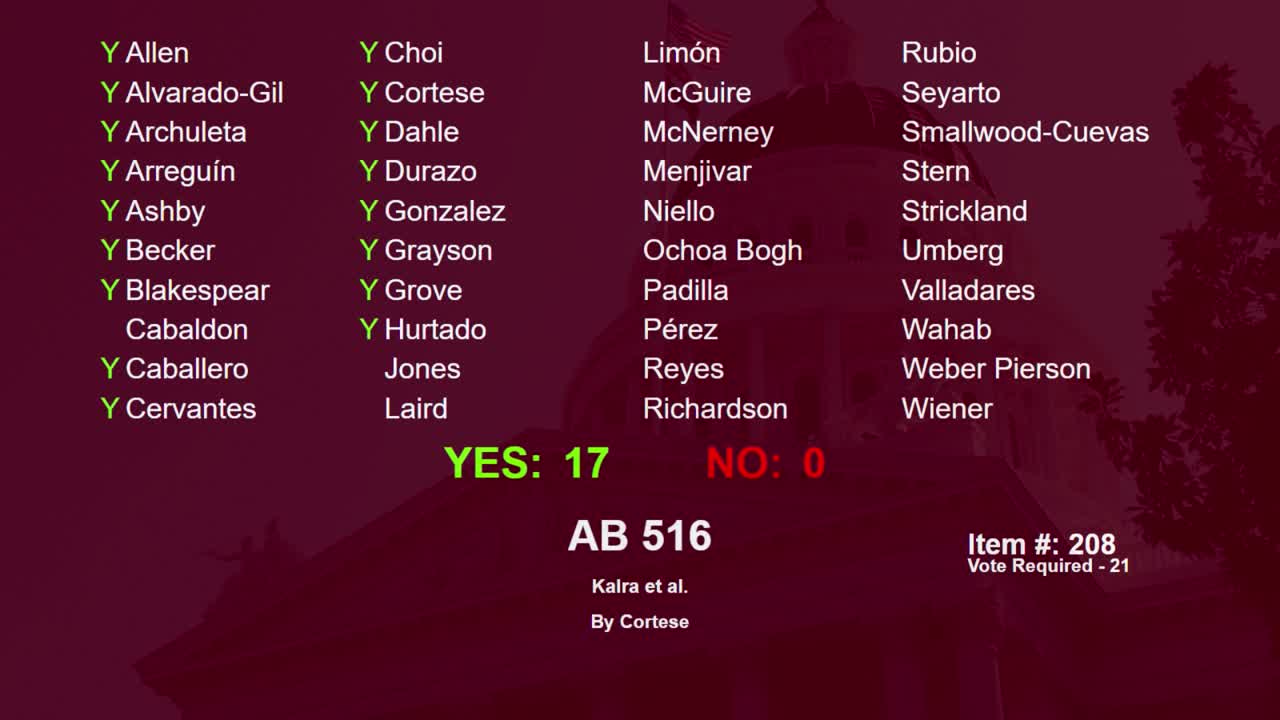 3MIN
Senate Floor
 23MIN
Assembly Floor
 16MIN
Assembly Standing Committee on Judiciary





Bill Co-Author(s):