SB 1003: Prohousing enhanced infrastructure financing districts.
- Session Year: 2025-2026
- House: Senate
- Latest Version Date: 2026-05-14
Current Status:
In Progress
(2026-08-20: Ordered to inactive file on request of Assembly Member Aguiar-Curry.)
Introduced
In Committee
Awaiting First Chamber Vote
Passed First Chamber
In Committee
Awaiting Second Chamber Vote
Passed Second Chamber
Enacted
The Planning and Zoning law requires each planning agency to prepare and the legislative body of each county and city to adopt a comprehensive, long-term general plan for the physical development of the county or city that includes specified elements, including a housing element. The law requires the Department of Housing and Community Development to designate jurisdictions as prohousing, as specified. The law requires that jurisdictions that have adopted a housing element that has been found by the department to be in substantial compliance with specified requirements and that have been designated as prohousing based on their adoption of prohousing local policies, as defined, be awarded additional points or preference in the scoring of program applications for certain programs.
Existing law authorizes the legislative body of a city or county to designate a proposed enhanced infrastructure financing district to finance public capital facilities or other specified projects of communitywide significance that provide significant benefits to the district or the surrounding community, including, among other things, the acquisition, construction, or rehabilitation of housing for persons of very low, low, and moderate income for rent or purchase, as specified. Existing law authorizes an infrastructure financing plan to contain a provision for the division of taxes levied upon taxable property in the area included within the district, and authorizes the public financing authority of the district to issue bonds, as provided.
This bill would authorize a city or county that is designated as prohousing to establish a prohousing enhanced infrastructure financing district if certain requirements are met, as specified. The bill would prescribe requirements applicable to those districts. The bill would expand the definition of prohousing local policies for purposes of the above-described provisions to include the establishment of one of these districts, and would require that the jurisdiction that established, and projects located within, a district receive enhanced points or preference than the baseline provided to other prohousing jurisdictions.
This bill would establish the Infrastructure Partnership Financing Program, to be administered by the Department of Housing and Community Development, and authorize prohousing enhanced infrastructure financing districts to apply for funding from the program, as specified. Upon appropriation, the bill would require the department to provide loans or grants to applicants for qualifying housing developments, as defined and specified. The bill would require the department to adopt emergency regulations to implement the program, as specified.The Planning and Zoning law requires each planning agency to prepare and the legislative body of each county and city to adopt a comprehensive, long-term general plan for the physical development of the county or city that includes specified elements, including a housing element. The law requires the Department of Housing and Community Development to designate jurisdictions as prohousing, as specified. The law requires that jurisdictions that have adopted a housing element that has been found by the department to be in substantial compliance with specified requirements and that have been designated as prohousing based on their adoption of prohousing local policies, as defined, be awarded additional points or preference in the scoring of program applications for certain programs.
Existing law authorizes the legislative body of a city or county to designate a proposed enhanced infrastructure financing district to finance public capital facilities or other specified projects of communitywide significance that provide significant benefits to the district or the surrounding community, including, among other things, the acquisition, construction, or rehabilitation of housing for persons of very low, low, and moderate income for rent or purchase, as specified. Existing law authorizes an infrastructure financing plan to contain a provision for the division of taxes levied upon taxable property in the area included within the district, and authorizes the public financing authority of the district to issue bonds, as provided.
This bill would authorize a city or county that is designated as prohousing to establish a prohousing enhanced infrastructure financing district if certain requirements are met, as specified. The bill would prescribe requirements applicable to those districts. The bill would expand the definition of prohousing local policies for purposes of the above-described provisions to include the establishment of one of these districts, and would require that the jurisdiction that established, and projects located within, a district receive enhanced points or preference than the baseline provided to other prohousing jurisdictions.
This bill would establish the Infrastructure Partnership Financing Program, to be administered by the Department of Housing and Community Development, and authorize prohousing enhanced infrastructure financing districts to apply for funding from the program, as specified. Upon appropriation, the bill would require the department to provide loans or grants to applicants for qualifying housing developments, as defined and specified. The bill would require the department to adopt guidelines for the operation of emergency regulations to implement the program, as specified, and would exempt those program guidelines from the rulemaking provisions of the Administrative Procedure Act. specified.
The Planning and Zoning law requires each planning agency to prepare and the legislative body of each county and city to adopt a comprehensive, long-term general plan for the physical development of the county or city that includes specified elements, including a housing element. The law requires the Department of Housing and Community Development to designate jurisdictions as prohousing, as specified. The law requires that jurisdictions that have adopted a housing element that has been found by the department to be in substantial compliance with specified requirements and that have been designated as prohousing based on their adoption of prohousing local policies, as defined, be awarded additional points or preference in the scoring of program applications for certain programs.
Existing law authorizes the legislative body of a city or county to designate a proposed enhanced infrastructure financing district to finance public capital facilities or other specified projects of communitywide significance that provide significant benefits to the district or the surrounding community, including, among other things, the acquisition, construction, or rehabilitation of housing for persons of very low, low, and moderate income for rent or purchase, as specified. Existing law authorizes an infrastructure financing plan to contain a provision for the division of taxes levied upon taxable property in the area included within the district, and authorizes the public financing authority of the district to issue bonds, as provided.
This bill would authorize a city or county that is designated as prohousing to establish a prohousing enhanced infrastructure financing district if certain requirements are met, as specified. The bill would prescribe requirements applicable to those districts, and would authorize those district to engage in specified activities in addition to those authorized for an enhanced infrastructure financing district, as described above. districts. The bill would expand the definition of prohousing local policies for purposes of the above-described provisions to include the establishment of one of these districts, and would require that the jurisdiction that established, and projects located within, a district receive enhanced points or preference than the baseline provided to other prohousing jurisdictions.
This bill would establish the Infrastructure Partnership Financing Program, to be administered by the Department of Housing and Community Development, and authorize prohousing enhanced infrastructure financing districts to apply for funding from the program, as specified. Upon appropriation, the bill would require the department to provide loans or grants to applicants for qualifying housing developments, as defined and specified. The bill would require the department to adopt guidelines for the operation of the program, as specified, and would exempt those program guidelines from the rulemaking provisions of the Administrative Procedure Act.
The Planning and Zoning law requires each planning agency to prepare and the legislative body of each county and city to adopt a comprehensive, long-term general plan for the physical development of the county or city that includes specified elements, including a housing element. The law requires the Department of Housing and Community Development to designate jurisdictions as prohousing, as specified. The law requires that jurisdictions that have adopted a housing element that has been found by the department to be in substantial compliance with specified requirements and that have been designated as prohousing based on their adoption of prohousing local policies, as defined, be awarded additional points or preference in the scoring of program applications for certain programs.
Existing law authorizes the legislative body of a city or county to designate a proposed enhanced infrastructure financing district to finance public capital facilities or other specified projects of communitywide significance that provide significant benefits to the district or the surrounding community, including, among other things, the acquisition, construction, or rehabilitation of housing for persons of very low, low, and moderate income for rent or purchase, as specified. Existing law authorizes an infrastructure financing plan to contain a provision for the division of taxes levied upon taxable property in the area included within the district, and authorizes the public financing authority of the district to issue bonds, as provided.
This bill would authorize a city or county that is designated as prohousing to establish a prohousing enhanced infrastructure financing district if certain requirements are met, as specified. The bill would prescribe requirements applicable to those districts, and would authorize those district to engage in specified activities in addition to those authorized for an enhanced infrastructure financing district, as described above. The bill would expand the definition of prohousing local policies for purposes of the above-described provisions to include the establishment of one of these districts, and would require that the jurisdiction that established, and projects located within, a district receive enhanced points or preference than the baseline provided to other prohousing jurisdictions.
Existing law requires a city, county, or special district that has an internet website to make specified information available on its internet website, including, among other things, a current schedule of fees, exactions, and affordability requirements applicable to a proposed housing development project, and all zoning ordinances and development standards that apply to each parcel, as provided.Existing law requires the city, county, or special district to update the information within 30 days of any changes.This bill would make a technical change to those provisions.Existing law requires a city, county, or special district that has an internet website to make specified information available on its internet website, including, among other things, a current schedule of fees, exactions, and affordability requirements applicable to a proposed housing development project, and all zoning ordinances and development standards that apply to each parcel, as provided.
Existing law requires the city, county, or special district to update the information within 30 days of any changes.
This bill would make a technical change to those provisions.
This article shall be known as the Prohousing Enhanced Infrastructure Financing Act.
53398.90.The Legislature finds and declares all of the following:
(a)California is facing a housing crisis that necessitates additional tools to help local jurisdictions establish new funding streams to address overall housing needs, with a particular focus on supporting affordable housing, associated infrastructure, and community revitalization in infill areas.
(b)The creation of a prohousing enhanced infrastructure financing district will authorize prohousing jurisdictions that take significant measures to accelerate housing production and affordability to capitalize on revenues from enhanced infrastructure financing districts. This will spur private investment and provide additional dollars to support development and revitalization of areas that include housing for all income levels with equitable access to opportunities, including, but not limited to, transportation mobility, goods, services, and economic opportunities.
(c)The benefits of a prohousing enhanced infrastructure financing district include the ability to fund more housing units, as well as needed infrastructure improvements to meet the current and future capacity demands and affirmatively further fair housing, as required by Section 8899.50.
53398.91.For purposes of this article:
(a)Lower income households has the same meaning as defined in Section 50079.5.
(b)Persons and families of low or moderate income has the same meaning as defined in Section 50093 of the Health and Safety Code.
(c)Prohousing enhanced infrastructure financing district means an enhanced infrastructure financing district that meets the requirements of Section 53398.92.
(d)Prohousing jurisdiction means a city or county that has been designated as prohousing pursuant to Section 65589.9.
(e)Very low income households has the same meaning as defined in Section 50105 of the Health and Safety Code.
53398.92.A prohousing jurisdiction may establish a prohousing enhanced financing district by doing all of the following:
(a)Adopting a resolution pursuant to Section 53398.59.
(b)Finding by resolution that it is in compliance with Section 8899.50.
(c)Adopting an infrastructure financing plan that does both of the following:
(1)Requires a review to ensure compliance with the requirements of this section every 10 years.
(2)Requires either of the following:
(A)At least 20 percent of any new housing units constructed or rehabilitated in the prohousing enhanced infrastructure financing district will be affordable to persons and families of low or moderate income and at least 6 percent of new units will be affordable to very low income households.
(B)At least 30 percent of the total project area will be affordable to lower income households within 20 years of establishment of the prohousing enhanced infrastructure financing district.
53398.93.All of the following apply to a prohousing enhanced infrastructure financing district:
(a)The prohousing enhanced infrastructure financing district shall require, by recorded covenants or restrictions, that affordable housing units financed pursuant to this article remain available at the applicable required affordable housing costs for the longest feasible time, but not less than 55 years for rental units and 45 years for owner-occupied units.
(b)This chapter applies to a prohousing enhanced infrastructure financing district except that a prohousing enhanced infrastructure financing district shall not finance highways or interchanges.
(c)In addition to activities authorized pursuant to this chapter, a prohousing enhanced infrastructure financing district may apply for funding from the Infrastructure Partnership Financing Program (Chapter 20 (commencing with Section 50899.15) of Part 2 of Division 31 of the Health and Safety Code).53398.94.The public financing authority shall include both of the following in the annual report required by subdivision (j) of Section 53398.66.
(a)The compliance review described in paragraph (1) of subdivision (c) of Section 53398.92 in the years when that review is conducted.
(b)The progress in complying with affordable housing obligations.
53398.95.A city or county shall not terminate a prohousing enhanced infrastructure financing district if the district has not complied with its affordable housing obligations.
53398.96.(a)A city or county that has established a prohousing enhanced infrastructure financing district that has its prohousing designation under Section 65589.9 revoked shall make a diligent effort to remedy that status within 120 days of revocation.
(b)If a city or county that has established a prohousing enhanced infrastructure financing district fails to remedy a revocation of its prohousing designation under Section 65589.9 by 120 days after revocation, the prohousing enhanced infrastructure financing district shall not apply for or receive any funding from the Infrastructure Partnership Financing Program (Chapter 20 (commencing with Section 50899.15) of Part 2 of Division 31 of the Health and Safety Code) until the city or county is designated as prohousing under Section 65589.9.SEC. 2.Section 65589.9 of the Government Code is amended to read:65589.9.(a)It is the intent of the Legislature to create incentives for jurisdictions that are compliant with housing element requirements and have enacted prohousing local policies. It is the intent of the Legislature that these incentives be in the form of additional points or other preference in the scoring of competitive housing and infrastructure programs. It is the intent of the Legislature that, in adopting regulations related to prohousing local policy criteria, the department shall create criteria that consider the needs of rural, suburban, and urban jurisdictions and how those criteria may differ in those areas.
(b)(1)For award cycles commenced after July 1, 2021, jurisdictions that have adopted a housing element that has been found by the department to be in substantial compliance with the requirements of this article pursuant to Section 65585, and that have been designated prohousing pursuant to subdivision (c) based upon their adoption of prohousing local policies, shall be awarded additional points or preference in the scoring of program applications for the following programs:
(A)The Affordable Housing and Sustainable Communities Program established by Part 1 (commencing with Section 75200) of Division 44 of the Public Resources Code.
(B)The Transformative Climate Communities Program established by Part 4 (commencing with Section 75240) of Division 44 of the Public Resources Code.
(C)The qualifying infill area portion of the Infill Incentive Grant Program of 2007 established by Section 53545.13 of the Health and Safety Code.
(D)The qualifying infill area and catalytic qualifying infill area portions of the Infill Infrastructure Grant Program of 2019 established by Section 53559 of the Health and Safety Code.
(E)Additional bonus points may be awarded to other state programs when already allowable under state law.
(2)(A)Both of the following shall receive enhanced points or preference beyond the baseline provided pursuant to paragraph (1):
(i)A jurisdiction that has established a prohousing enhanced infrastructure financing district pursuant to Article 5 (commencing with Section 53398.89) of Chapter 2.99 of Part 1 of Division 2 of Title 5.
(ii)An eligible project located within a prohousing enhanced infrastructure financing district described in Article 5 (commencing with Section 53398.89) of Chapter 2.99 of Part 1 of Division 2 of Title 5.
(B)Funding awarded to a jurisdiction that has established a prohousing enhanced infrastructure financing district pursuant to Article 5 (commencing with Section 53398.89) of Chapter 2.99 of Part 1 of Division 2 of Title 5, or to an eligible project located within one of those districts may be used for infrastructure components that directly support, strengthen, or accelerate implementation of the district, including house-enabling infrastructure, but only to the extent consistent with the requirements of the program pursuant to which funding was awarded.
(c)(1)The department shall designate jurisdictions as prohousing pursuant to the permanent regulations adopted pursuant to subdivision (d) and report these designations to the Office of Land Use and Climate Innovation, and any other applicable agency or department, annually and upon request.
(2)(A)Beginning with the seventh housing element cycle, the department shall, upon request by a small rural jurisdiction, to the extent feasible, evaluate materials from the small rural jurisdictions housing element submission, pursuant to Section 65585, for evidence of prohousing local policies in order to minimize the need for jurisdictions to submit supplementary documentation.
(B)The department shall only conduct the evaluation described in subparagraph (A) for small rural jurisdictions that have a compliant housing element.
(3)(A)The department shall not require small rural jurisdictions to renew their prohousing designations for at least four years.
(B)This paragraph shall not be construed to limit the authority of the department to revoke a jurisdictions prohousing designation.
(4)Any additional points or preferences awarded for a prohousing local policy described in subparagraphs (L) to (N), inclusive, of paragraph (3) of subdivision (f) shall not exceed the minimum value of points or preferences awarded for a prohousing local policy that directly relates to the planning, approval, or construction of housing.
(d)(1)By July 1, 2021, the department, in collaboration with stakeholders, shall adopt emergency regulations to implement this section.
(2)Notwithstanding Section 11346.1, the emergency regulations adopted pursuant to this subdivision shall remain in effect until the date that permanent regulations to implement this section become effective.
(e)On or before January 1, 2021, and annually thereafter, the department shall publish on its internet website the list of programs included under subdivision (b).
(f)For purposes of this section, the following definitions shall apply:
(1)Adaptive reuse shall have the same meaning as in Section 53559.1 of the Health and Safety Code.
(2)Compliant housing element means an adopted housing element that has been found to be in substantial compliance with the requirements of this article by the department pursuant to Section 65585.
(3)Prohousing local policies means policies that facilitate the planning, approval, or construction of housing, or policies that keep people housed. These policies may include, but are not limited to, the following:
(A)Local financial incentives for housing, including, but not limited to, establishing a local housing trust fund.
(B)Reduced parking requirements for sites that are zoned for residential development.
(C)Adoption of zoning allowing for use by right for residential and mixed-use development.
(D)Zoning more sites for residential development or zoning sites at higher densities than is required to accommodate the minimum existing regional housing need allocation for the current housing element cycle.
(E)Adoption of accessory dwelling unit ordinances or other mechanisms that reduce barriers for property owners to create accessory dwelling units beyond the requirements outlined in Article 2 (commencing with Section 66314) of Chapter 13, as determined by the department.
(F)Reduction of permit processing time.
(G)Creation of objective development standards.
(H)Reduction of development impact fees.
(I)Establishment of a Workforce Housing Opportunity Zone, as defined in Section 65620, or a housing sustainability district, as defined in Section 66200.
(J)Preservation of affordable housing units through the extension of existing project-based rental assistance covenants to avoid the displacement of affected tenants and a reduction in available affordable housing units.
(K)Facilitation of the conversion or redevelopment of commercial properties into housing, including the adoption of adaptive reuse ordinances or other mechanisms that reduce barriers for these conversions.
(L)A safe parking program that provides safe parking locations and options for individuals and families living in their vehicles and that does all of the following:
(i)Provides a bathroom facility and onsite security.
(ii)Establishes an application or enrollment process for the program that may include a background check requirement.
(iii)Establishes rules and regulations for the program.
(M)A safe camping program that provides safe camping locations and options for individuals and families experiencing unsheltered homelessness.
(N)Adoption of ordinances, processes, or other mechanisms that expedite, or remove barriers to, the approval of any of the following:
(i)Low-barrier navigation centers beyond the requirements in Article 12 (commencing with Section 65660).
(ii)Emergency shelters beyond the requirements in Section 65583.
(iii)Supportive housing beyond the requirements in Article 11 (commencing with Section 65650).
(O)Establishment of a prohousing enhanced infrastructure financing district pursuant to Article 5 (commencing with Section 53398.89) of Chapter 2.99 of Part 1 of Division 2 of Title 5.
(4)Small rural jurisdiction means either of the following:
(A)A city with a population of fewer than 25,000 persons.
(B)A county with a population of fewer than 200,000 persons.
SEC. 3.Chapter 20 (commencing with Section 50899.15) is added to Part 2 of Division 31 of the Health and Safety Code, to read:20.Infrastructure Partnership Financing Program50899.15.For the purposes of this chapter:(a)Applicant means a prohousing enhanced infrastructure financing district established pursuant to Article 5 (commencing with Section 53398.89) of Chapter 2.99 of Part 1 of Division 2 of Title 5 of the Government Code.(b)Program means the Infrastructure Partnership Financing Program established in Section 50899.16.(c)Qualified housing development project means a housing development project, as defined in Section 65589.5 of the Government Code, that meets the following requirements:(1)The parcel or parcels on which the project is located is an infill site, as defined in Section 21061.3 of the Public Resources Code.(2)A portion of the housing development project is subject to a recorded affordability restriction pursuant to Section 53398.93 of the Government Code.50899.16.(a)There is hereby established the Infrastructure Partnership Financing Program for the purpose of financing infrastructure projects needed to assist the development of qualified housing development projects.(b)The department shall administer the program.50899.17.(a)Upon appropriation by the Legislature for purposes of the program, the department shall provide loans or grants to applicants for qualifying housing development projects.(b)The department shall prioritize applications based on all of the following factors:(1)An application that proposes more housing units to be produced shall be given higher priority.(2)An application that has more housing units subject to a recorded affordability restriction shall be given higher priority.(3)An application that shows relative benefits to the public are higher in the analysis provided pursuant to subdivision (f) of Section 50899.18 shall be given higher priority.50899.18.To be eligible for the funding described in 50899.17, an applicant shall submit an application to the department with all of the following:(a)The name of the development proponent that is seeking funding.(b)A description of the qualified housing development project, including, but not limited to, the total number of housing units and the total number of housing units subject to a recorded affordability restriction.(c)The amount and type of funding requested.(d)A description of the local resources that will be used to finance infrastructure associated with the qualified housing development project.(e)A list of any infrastructure project needed to assist the development of the qualified housing development project and an estimated cost and completion date for each infrastructure project.(f)An analysis showing that the benefits to the public in terms of the number of units subject to a recorded affordability restriction or more affordable rents is likely to exceed the benefit to the development proponent in terms of reduced production costs.50899.19.(a)The department, in collaboration with stakeholders, shall adopt emergency regulations to implement this chapter.(b)Notwithstanding Section 11346.1 of the Government Code, emergency regulations adopted pursuant to this section shall remain in effect until the date that nonemergency regulations to implement this chapter become effective.This article shall be known as the Prohousing Enhanced Infrastructure Financing Act.
53398.90.The Legislature finds and declares all of the following:
(a)California is facing a housing crisis that necessitates additional tools to help local jurisdictions establish new funding streams to address overall housing needs, with a particular focus on supporting affordable housing, associated infrastructure, and community revitalization in infill areas.
(b)The creation of a prohousing enhanced infrastructure financing district will authorize prohousing jurisdictions that take significant measures to accelerate housing production and affordability to capitalize on revenues from enhanced infrastructure financing districts. This will spur private investment and provide additional dollars to support development and revitalization of areas that include housing for all income levels with equitable access to opportunities, including, but not limited to, transportation mobility, goods, services, and economic opportunities.
(c)The benefits of a prohousing enhanced infrastructure financing district include the ability to fund more housing units, as well as needed infrastructure improvements to meet the current and future capacity demands and affirmatively further fair housing, as required by Section 8899.50.
53398.91.For purposes of this article:
(a)Lower income households has the same meaning as defined in Section 50079.5.
(b)Persons and families of low or moderate income has the same meaning as defined in Section 50093 of the Health and Safety Code.
(c)Prohousing enhanced infrastructure financing district means an enhanced infrastructure financing district that meets the requirements of Section 53398.92.
(d)Prohousing jurisdiction means a city or county that has been designated as prohousing pursuant to Section 65589.9.
(e)Very low income households has the same meaning as defined in Section 50105 of the Health and Safety Code.
53398.92.A prohousing jurisdiction may establish a prohousing enhanced financing district by doing all of the following:
(a)Adopting a resolution pursuant to Section 53398.59.
(b)Finding by resolution that it is in compliance with Section 8899.50.
(c)Adopting an infrastructure financing plan that does both of the following:
(1)Requires a review to ensure compliance with the requirements of this section every 10 years.
(2)Requires either of the following:
(A)At least 20 percent of any new housing units constructed or rehabilitated in the prohousing enhanced infrastructure financing district will be affordable to persons and families of low or moderate income and at least 6 percent of new units will be affordable to very low income households.
(B)At least 30 percent of the total project area will be affordable to lower income households within 20 years of establishment of the prohousing enhanced infrastructure financing district.
53398.93.All of the following apply to a prohousing enhanced infrastructure financing district:
(a)The prohousing enhanced infrastructure financing district shall require, by recorded covenants or restrictions, that affordable housing units financed pursuant to this article remain available at the applicable required affordable housing costs for the longest feasible time, but not less than 55 years for rental units and 45 years for owner-occupied units.
(b)This chapter applies to a prohousing enhanced infrastructure financing district except that a prohousing enhanced infrastructure financing district shall not finance highways or interchanges.
(c)In addition to activities authorized pursuant to this chapter, a prohousing enhanced infrastructure financing district may apply for funding from the Infrastructure Partnership Financing Program (Chapter 20 (commencing with Section 50899.15) of Part 2 of Division 31 of the Health and Safety Code).
53398.94.The public financing authority shall include both of the following in the annual report required by subdivision (j) of Section 53398.66.
(a)The compliance review described in paragraph (1) of subdivision (c) of Section 53398.92 in the years when that review is conducted.
(b)The progress in complying with affordable housing obligations.
53398.95.A city or county shall not terminate a prohousing enhanced infrastructure financing district if the district has not complied with its affordable housing obligations.
53398.96.(a)A city or county that has established a prohousing enhanced infrastructure financing district that has its prohousing designation under Section 65589.9 revoked shall make a diligent effort to remedy that status within 120 days of revocation.
(b)If a city or county that has established a prohousing enhanced infrastructure financing district fails to remedy a revocation of its prohousing designation under Section 65589.9 by 120 days after revocation, the prohousing enhanced infrastructure financing district shall not apply for or receive any funding from the Infrastructure Partnership Financing Program (Chapter 20 (commencing with Section 50899.15) of Part 2 of Division 31 of the Health and Safety Code) until the city or county is designated as prohousing under Section 65589.9.
SEC. 2.Section 65589.9 of the Government Code is amended to read:65589.9.(a)It is the intent of the Legislature to create incentives for jurisdictions that are compliant with housing element requirements and have enacted prohousing local policies. It is the intent of the Legislature that these incentives be in the form of additional points or other preference in the scoring of competitive housing and infrastructure programs. It is the intent of the Legislature that, in adopting regulations related to prohousing local policy criteria, the department shall create criteria that consider the needs of rural, suburban, and urban jurisdictions and how those criteria may differ in those areas.
(b)(1)For award cycles commenced after July 1, 2021, jurisdictions that have adopted a housing element that has been found by the department to be in substantial compliance with the requirements of this article pursuant to Section 65585, and that have been designated prohousing pursuant to subdivision (c) based upon their adoption of prohousing local policies, shall be awarded additional points or preference in the scoring of program applications for the following programs:
(A)The Affordable Housing and Sustainable Communities Program established by Part 1 (commencing with Section 75200) of Division 44 of the Public Resources Code.
(B)The Transformative Climate Communities Program established by Part 4 (commencing with Section 75240) of Division 44 of the Public Resources Code.
(C)The qualifying infill area portion of the Infill Incentive Grant Program of 2007 established by Section 53545.13 of the Health and Safety Code.
(D)The qualifying infill area and catalytic qualifying infill area portions of the Infill Infrastructure Grant Program of 2019 established by Section 53559 of the Health and Safety Code.
(E)Additional bonus points may be awarded to other state programs when already allowable under state law.
(2)(A)Both of the following shall receive enhanced points or preference beyond the baseline provided pursuant to paragraph (1):
(i)A jurisdiction that has established a prohousing enhanced infrastructure financing district pursuant to Article 5 (commencing with Section 53398.89) of Chapter 2.99 of Part 1 of Division 2 of Title 5.
(ii)An eligible project located within a prohousing enhanced infrastructure financing district described in Article 5 (commencing with Section 53398.89) of Chapter 2.99 of Part 1 of Division 2 of Title 5.
(B)Funding awarded to a jurisdiction that has established a prohousing enhanced infrastructure financing district pursuant to Article 5 (commencing with Section 53398.89) of Chapter 2.99 of Part 1 of Division 2 of Title 5, or to an eligible project located within one of those districts may be used for infrastructure components that directly support, strengthen, or accelerate implementation of the district, including house-enabling infrastructure, but only to the extent consistent with the requirements of the program pursuant to which funding was awarded.
(c)(1)The department shall designate jurisdictions as prohousing pursuant to the permanent regulations adopted pursuant to subdivision (d) and report these designations to the Office of Land Use and Climate Innovation, and any other applicable agency or department, annually and upon request.
(2)(A)Beginning with the seventh housing element cycle, the department shall, upon request by a small rural jurisdiction, to the extent feasible, evaluate materials from the small rural jurisdictions housing element submission, pursuant to Section 65585, for evidence of prohousing local policies in order to minimize the need for jurisdictions to submit supplementary documentation.
(B)The department shall only conduct the evaluation described in subparagraph (A) for small rural jurisdictions that have a compliant housing element.
(3)(A)The department shall not require small rural jurisdictions to renew their prohousing designations for at least four years.
(B)This paragraph shall not be construed to limit the authority of the department to revoke a jurisdictions prohousing designation.
(4)Any additional points or preferences awarded for a prohousing local policy described in subparagraphs (L) to (N), inclusive, of paragraph (3) of subdivision (f) shall not exceed the minimum value of points or preferences awarded for a prohousing local policy that directly relates to the planning, approval, or construction of housing.
(d)(1)By July 1, 2021, the department, in collaboration with stakeholders, shall adopt emergency regulations to implement this section.
(2)Notwithstanding Section 11346.1, the emergency regulations adopted pursuant to this subdivision shall remain in effect until the date that permanent regulations to implement this section become effective.
(e)On or before January 1, 2021, and annually thereafter, the department shall publish on its internet website the list of programs included under subdivision (b).
(f)For purposes of this section, the following definitions shall apply:
(1)Adaptive reuse shall have the same meaning as in Section 53559.1 of the Health and Safety Code.
(2)Compliant housing element means an adopted housing element that has been found to be in substantial compliance with the requirements of this article by the department pursuant to Section 65585.
(3)Prohousing local policies means policies that facilitate the planning, approval, or construction of housing, or policies that keep people housed. These policies may include, but are not limited to, the following:
(A)Local financial incentives for housing, including, but not limited to, establishing a local housing trust fund.
(B)Reduced parking requirements for sites that are zoned for residential development.
(C)Adoption of zoning allowing for use by right for residential and mixed-use development.
(D)Zoning more sites for residential development or zoning sites at higher densities than is required to accommodate the minimum existing regional housing need allocation for the current housing element cycle.
(E)Adoption of accessory dwelling unit ordinances or other mechanisms that reduce barriers for property owners to create accessory dwelling units beyond the requirements outlined in Article 2 (commencing with Section 66314) of Chapter 13, as determined by the department.
(F)Reduction of permit processing time.
(G)Creation of objective development standards.
(H)Reduction of development impact fees.
(I)Establishment of a Workforce Housing Opportunity Zone, as defined in Section 65620, or a housing sustainability district, as defined in Section 66200.
(J)Preservation of affordable housing units through the extension of existing project-based rental assistance covenants to avoid the displacement of affected tenants and a reduction in available affordable housing units.
(K)Facilitation of the conversion or redevelopment of commercial properties into housing, including the adoption of adaptive reuse ordinances or other mechanisms that reduce barriers for these conversions.
(L)A safe parking program that provides safe parking locations and options for individuals and families living in their vehicles and that does all of the following:
(i)Provides a bathroom facility and onsite security.
(ii)Establishes an application or enrollment process for the program that may include a background check requirement.
(iii)Establishes rules and regulations for the program.
(M)A safe camping program that provides safe camping locations and options for individuals and families experiencing unsheltered homelessness.
(N)Adoption of ordinances, processes, or other mechanisms that expedite, or remove barriers to, the approval of any of the following:
(i)Low-barrier navigation centers beyond the requirements in Article 12 (commencing with Section 65660).
(ii)Emergency shelters beyond the requirements in Section 65583.
(iii)Supportive housing beyond the requirements in Article 11 (commencing with Section 65650).
(O)Establishment of a prohousing enhanced infrastructure financing district pursuant to Article 5 (commencing with Section 53398.89) of Chapter 2.99 of Part 1 of Division 2 of Title 5.
(4)Small rural jurisdiction means either of the following:
(A)A city with a population of fewer than 25,000 persons.
(B)A county with a population of fewer than 200,000 persons.
SEC. 3.Chapter 20 (commencing with Section 50899.15) is added to Part 2 of Division 31 of the Health and Safety Code, to read:20.Infrastructure Partnership Financing Program50899.15.For the purposes of this chapter:
(a)Applicant means a prohousing enhanced infrastructure financing district established pursuant to Article 5 (commencing with Section 53398.89) of Chapter 2.99 of Part 1 of Division 2 of Title 5 of the Government Code.
(b)Program means the Infrastructure Partnership Financing Program established in Section 50899.16.
(c)Qualified housing development project means a housing development project, as defined in Section 65589.5 of the Government Code, that meets the following requirements:
(1)The parcel or parcels on which the project is located is an infill site, as defined in Section 21061.3 of the Public Resources Code.
(2)A portion of the housing development project is subject to a recorded affordability restriction pursuant to Section 53398.93 of the Government Code.
50899.16.(a)There is hereby established the Infrastructure Partnership Financing Program for the purpose of financing infrastructure projects needed to assist the development of qualified housing development projects.
(b)The department shall administer the program.
50899.17.(a)Upon appropriation by the Legislature for purposes of the program, the department shall provide loans or grants to applicants for qualifying housing development projects.
(b)The department shall prioritize applications based on all of the following factors:
(1)An application that proposes more housing units to be produced shall be given higher priority.
(2)An application that has more housing units subject to a recorded affordability restriction shall be given higher priority.
(3)An application that shows relative benefits to the public are higher in the analysis provided pursuant to subdivision (f) of Section 50899.18 shall be given higher priority.
50899.18.To be eligible for the funding described in 50899.17, an applicant shall submit an application to the department with all of the following:
(a)The name of the development proponent that is seeking funding.
(b)A description of the qualified housing development project, including, but not limited to, the total number of housing units and the total number of housing units subject to a recorded affordability restriction.
(c)The amount and type of funding requested.
(d)A description of the local resources that will be used to finance infrastructure associated with the qualified housing development project.
(e)A list of any infrastructure project needed to assist the development of the qualified housing development project and an estimated cost and completion date for each infrastructure project.
(f)An analysis showing that the benefits to the public in terms of the number of units subject to a recorded affordability restriction or more affordable rents is likely to exceed the benefit to the development proponent in terms of reduced production costs.
50899.19.(a)The department department, in collaboration with stakeholders, shall adopt guidelines for the operation of the program. emergency regulations to implement this chapter.
(b)Program guidelines Notwithstanding Section 11346.1 of the Government Code, emergency regulations adopted pursuant to this section shall not be subject to the Administrative Procedure Act (Chapter 3.5 (commencing with Section 11340) of Part 1 of Division 3 of Title 2 of the Government Code). remain in effect until the date that nonemergency regulations to implement this chapter become effective.
(c)(1)Prior to adopting initial guidelines for the operations of the program, the department shall solicit and consider stakeholder comments in the design and implementation of the program in at least one 30-day public comment period.(2)The department shall provide written responses to substantive written comments submitted pursuant to a public comment period described in paragraph (1).This article shall be known as the Prohousing Enhanced Infrastructure Financing Act.
53398.90.The Legislature finds and declares all of the following:
(a)California is facing a housing crisis that necessitates additional tools to help local jurisdictions establish new funding streams to address overall housing needs, with a particular focus on supporting affordable housing, associated infrastructure, and community revitalization in infill areas.
(b)The creation of a prohousing enhanced infrastructure financing district will authorize prohousing jurisdictions that take significant measures to accelerate housing production and affordability to capitalize on revenues from enhanced infrastructure financing districts. This will spur private investment and provide additional dollars to support development and revitalization of areas that include housing for all income levels with equitable access to opportunities, including, but not limited to, transportation mobility, goods, services, and economic opportunities.
(c)The benefits of a prohousing enhanced infrastructure financing district include the ability to fund more housing units, as well as needed infrastructure improvements to meet the current and future capacity demands and affirmatively further fair housing, as required by Section 8899.50.
53398.91.For purposes of this article:
(a)Lower income households has the same meaning as defined in Section 50079.5.
(b)Persons and families of low or moderate income has the same meaning as defined in Section 50093 of the Health and Safety Code.
(c)Prohousing enhanced infrastructure financing district means an enhanced infrastructure financing district that meets the requirements of Section 53398.92.
(d)Prohousing jurisdiction means a city or county that has been designated as prohousing pursuant to Section 65589.9.
(e)Very low income households has the same meaning as defined in Section 50105 of the Health and Safety Code.
53398.92.At any time before or after the adoption of an infrastructure financing plan, a city or county may establish a prohousing enhanced infrastructure financing district by resolution if all of the following requirements are met:(a)The city or county is a prohousing jurisdiction.(b)The infrastructure financing plan requires either of the following:53398.92.A prohousing jurisdiction may establish a prohousing enhanced financing district by doing all of the following:
(a)Adopting a resolution pursuant to Section 53398.59.
(b)Finding by resolution that it is in compliance with Section 8899.50.
(c)Adopting an infrastructure financing plan that does both of the following:
(1)Requires a review to ensure compliance with the requirements of this section every 10 years.
(2)Requires either of the following:
(1)(A)At least 20 percent of any new housing units constructed or rehabilitated in the prohousing enhanced infrastructure financing district will be affordable to persons and families of low or moderate income and at least 6 percent of new units will be affordable to very low income households.
(2)(B)At least 30 percent of the total project area will be affordable to lower income households within 20 years of establishment of the prohousing enhanced infrastructure financing district.
(c)The city or county finds by resolution that it is in compliance with Section 8899.50.(d)The infrastructure financing plan requires a review to ensure compliance with the requirements of this section every 10 years.53398.93.All of the following apply to a prohousing enhanced infrastructure financing district:
(a)The boundaries of a prohousing enhanced infrastructure financing district may be any of the following:(1)Coterminous with the city or county that established the prohousing enhanced infrastructure financing district.(2)An area smaller than the boundaries of the city or county that established the prohousing enhanced infrastructure financing district.(3)An area beyond the boundaries of the city or county that established the prohousing enhanced infrastructure financing district.(b)(a)The prohousing enhanced infrastructure financing district shall require, by recorded covenants or restrictions, that affordable housing units financed pursuant to this article remain available at the applicable required affordable housing costs for the longest feasible time, but not less than 55 years for rental units and 45 years for owner-occupied units.
(c)(b)This chapter applies to a prohousing enhanced infrastructure financing district except for all of the following: that a prohousing enhanced infrastructure financing district shall not finance highways or interchanges.
(1)Paragraph (1) of subdivision (b) of Section 53398.52 to the extent that paragraph authorizes revenues collected and allocated to be used for highway or highway interchange improvements.(2)Section 53398.54.(3)Paragraph (3) of subdivision (b) of Section 53398.66.(4)Subparagraph (E) of paragraph (1) of subdivision (c) of Section 53398.66.(5)Paragraph (2) of subdivision (c) of Section 53398.66.(6)Subdivision (e) of Section 53398.66.(7)Subdivision (g) of Section 53398.66.(8)Subdivision (i) of Section 53398.66.(d)(c)In addition to activities authorized pursuant to this chapter, a prohousing enhanced infrastructure financing district may do any of the following: apply for funding from the Infrastructure Partnership Financing Program (Chapter 20 (commencing with Section 50899.15) of Part 2 of Division 31 of the Health and Safety Code).
(1)Activities intended to promote equitable quality of life in terms of housing, neighborhood improvements, and community development, including, but not limited to, infrastructure, housing conservation, housing rehabilitation, sidewalk improvements, safe routes to school, recreational trails, community programs and displacement strategies.(2)In addition to replacement requirements described in Section 53398.56, nondeed restricted housing in tandem with displacement strategies.(3)Infrastructure investments that support climate-friendly housing development, including, but not limited to, improvements necessary to facilitate higher density residential development in infill and transit-served areas.(4)Transportation and mobility improvements, including, but not limited to, transit access improvements, pedestrian and bicycle infrastructure, first- and last-mile connectivity, and other investments that reduce vehicle miles traveled.(5)Climate resilience and sustainability improvements, including, but not limited to, green infrastructure, urban greening, stormwater capture, heat mitigation, and energy infrastructure that supports electrification and sustainable community development.(6)Public realm and neighborhood infrastructure improvements that support housing development, including, but not limited to, utilities, water and wastewater systems, broadband infrastructure, parks and open space, and community facilities necessary to support new housing growth.(7)Site preparation and enabling infrastructure, including, but not limited to, remediation, demolition, and other improvements necessary to unlock housing production in infill or underutilized areas.53398.94.The public financing authority shall include both of the following in the annual report required by subdivision (j) of Section 53398.66.
(a)The compliance review described in paragraph (1) of subdivision (d) (c) of Section 53398.92 in the years when that review is conducted.
(b)The progress in complying with affordable housing obligations.
53398.95.A city our or county shall not terminate a prohousing enhanced infrastructure financing district if the district has not complied with its affordable housing obligations.
53398.96.(a)A city our or county that has established a prohousing enhanced infrastructure financing district that has its prohousing designation under Section 65589.9 revoked shall make a diligent effort to remedy that status within 120 days of revocation.
(b)If a city or county that has established a prohousing enhanced infrastructure financing district fails to remedy a revocation of its prohousing designation under Section 65589.9 by 120 days after revocation, the prohousing enhanced infrastructure financing district shall not engage in any activity described in subdivision (d) of Section 53398.93 apply for or receive any funding from the Infrastructure Partnership Financing Program (Chapter 20 (commencing with Section 50899.15) of Part 2 of Division 31 of the Health and Safety Code) until the city or county is designated as prohousing under Section 65589.9.
SEC. 2.Section 65589.9 of the Government Code is amended to read:65589.9.(a)It is the intent of the Legislature to create incentives for jurisdictions that are compliant with housing element requirements and have enacted prohousing local policies. It is the intent of the Legislature that these incentives be in the form of additional points or other preference in the scoring of competitive housing and infrastructure programs. It is the intent of the Legislature that, in adopting regulations related to prohousing local policy criteria, the department shall create criteria that consider the needs of rural, suburban, and urban jurisdictions and how those criteria may differ in those areas.
(b)(1)For award cycles commenced after July 1, 2021, jurisdictions that have adopted a housing element that has been found by the department to be in substantial compliance with the requirements of this article pursuant to Section 65585, and that have been designated prohousing pursuant to subdivision (c) based upon their adoption of prohousing local policies, shall be awarded additional points or preference in the scoring of program applications for the following programs:
(A)The Affordable Housing and Sustainable Communities Program established by Part 1 (commencing with Section 75200) of Division 44 of the Public Resources Code.
(B)The Transformative Climate Communities Program established by Part 4 (commencing with Section 75240) of Division 44 of the Public Resources Code.
(C)The qualifying infill area portion of the Infill Incentive Grant Program of 2007 established by Section 53545.13 of the Health and Safety Code.
(D)The qualifying infill area and catalytic qualifying infill area portions of the Infill Infrastructure Grant Program of 2019 established by Section 53559 of the Health and Safety Code.
(E)Additional bonus points may be awarded to other state programs when already allowable under state law.
(2)(A)Both of the following shall receive enhanced points or preference beyond the baseline provided pursuant to paragraph (1):
(i)A jurisdiction that has established a prohousing enhanced infrastructure financing district pursuant to Article 5 (commencing with Section 53398.89) of Chapter 2.99 of Part 1 of Division 2 of Title 5.
(ii)An eligible project located within a prohousing enhanced infrastructure financing district described in Article 5 (commencing with Section 53398.89) of Chapter 2.99 of Part 1 of Division 2 of Title 5.
(B)Funding awarded to a jurisdiction that has established a prohousing enhanced infrastructure financing district pursuant to Article 5 (commencing with Section 53398.89) of Chapter 2.99 of Part 1 of Division 2 of Title 5, or to an eligible project located within one of those districts may be used for infrastructure components that directly support, strengthen, or accelerate implementation of the district, including house-enabling infrastructure, but only to the extent consistent with the requirements of the program pursuant to which funding was awarded.
(c)(1)The department shall designate jurisdictions as prohousing pursuant to the permanent regulations adopted pursuant to subdivision (d) and report these designations to the Office of Land Use and Climate Innovation, and any other applicable agency or department, annually and upon request.
(2)(A)Beginning with the seventh housing element cycle, the department shall, upon request by a small rural jurisdiction, to the extent feasible, evaluate materials from the small rural jurisdictions housing element submission, pursuant to Section 65585, for evidence of prohousing local policies in order to minimize the need for jurisdictions to submit supplementary documentation.
(B)The department shall only conduct the evaluation described in subparagraph (A) for small rural jurisdictions that have a compliant housing element.
(3)(A)The department shall not require small rural jurisdictions to renew their prohousing designations for at least four years.
(B)This paragraph shall not be construed to limit the authority of the department to revoke a jurisdictions prohousing designation.
(4)Any additional points or preferences awarded for a prohousing local policy described in subparagraphs (L) to (N), inclusive, of paragraph (3) of subdivision (f) shall not exceed the minimum value of points or preferences awarded for a prohousing local policy that directly relates to the planning, approval, or construction of housing.
(d)(1)By July 1, 2021, the department, in collaboration with stakeholders, shall adopt emergency regulations to implement this section.
(2)Notwithstanding Section 11346.1, the emergency regulations adopted pursuant to this subdivision shall remain in effect until the date that permanent regulations to implement this section become effective.
(e)On or before January 1, 2021, and annually thereafter, the department shall publish on its internet website the list of programs included under subdivision (b).
(f)For purposes of this section, the following definitions shall apply:
(1)Adaptive reuse shall have the same meaning as in Section 53559.1 of the Health and Safety Code.
(2)Compliant housing element means an adopted housing element that has been found to be in substantial compliance with the requirements of this article by the department pursuant to Section 65585.
(3)Prohousing local policies means policies that facilitate the planning, approval, or construction of housing, or policies that keep people housed. These policies may include, but are not limited to, the following:
(A)Local financial incentives for housing, including, but not limited to, establishing a local housing trust fund.
(B)Reduced parking requirements for sites that are zoned for residential development.
(C)Adoption of zoning allowing for use by right for residential and mixed-use development.
(D)Zoning more sites for residential development or zoning sites at higher densities than is required to accommodate the minimum existing regional housing need allocation for the current housing element cycle.
(E)Adoption of accessory dwelling unit ordinances or other mechanisms that reduce barriers for property owners to create accessory dwelling units beyond the requirements outlined in Article 2 (commencing with Section 66314) of Chapter 13, as determined by the department.
(F)Reduction of permit processing time.
(G)Creation of objective development standards.
(H)Reduction of development impact fees.
(I)Establishment of a Workforce Housing Opportunity Zone, as defined in Section 65620, or a housing sustainability district, as defined in Section 66200.
(J)Preservation of affordable housing units through the extension of existing project-based rental assistance covenants to avoid the displacement of affected tenants and a reduction in available affordable housing units.
(K)Facilitation of the conversion or redevelopment of commercial properties into housing, including the adoption of adaptive reuse ordinances or other mechanisms that reduce barriers for these conversions.
(L)A safe parking program that provides safe parking locations and options for individuals and families living in their vehicles and that does all of the following:
(i)Provides a bathroom facility and onsite security.
(ii)Establishes an application or enrollment process for the program that may include a background check requirement.
(iii)Establishes rules and regulations for the program.
(M)A safe camping program that provides safe camping locations and options for individuals and families experiencing unsheltered homelessness.
(N)Adoption of ordinances, processes, or other mechanisms that expedite, or remove barriers to, the approval of any of the following:
(i)Low-barrier navigation centers beyond the requirements in Article 12 (commencing with Section 65660).
(ii)Emergency shelters beyond the requirements in Section 65583.
(iii)Supportive housing beyond the requirements in Article 11 (commencing with Section 65650).
(O)Establishment of a prohousing enhanced infrastructure financing district pursuant to Article 5 (commencing with Section 53398.89) of Chapter 2.99 of Part 1 of Division 2 of Title 5.
(4)Small rural jurisdiction means either of the following:
(A)A city with a population of fewer than 25,000 persons.
(B)A county with a population of fewer than 200,000 persons.
SEC. 3.Chapter 20 (commencing with Section 50899.15) is added to Part 2 of Division 31 of the Health and Safety Code, to read:20.Infrastructure Partnership Financing Program50899.15.For the purposes of this chapter:
(a)Applicant means a prohousing enhanced infrastructure financing district established pursuant to Article 5 (commencing with Section 53398.89) of Chapter 2.99 of Part 1 of Division 2 of Title 5 of the Government Code.
(b)Program means the Infrastructure Partnership Financing Program established in Section 50899.16.
(c)Qualified housing development project means a housing development project, as defined in Section 65589.5 of the Government Code, that meets the following requirements:
(1)The parcel or parcels on which the project is located is an infill site, as defined in Section 21061.3 of the Public Resources Code.
(2)A portion of the housing development project is subject to a recorded affordability restriction pursuant to Section 53398.93 of the Government Code.
50899.16.(a)There is hereby established the Infrastructure Partnership Financing Program for the purpose of financing infrastructure projects needed to assist the development of qualified housing development projects.
(b)The department shall administer the program.
50899.17.(a)Upon appropriation by the Legislature for purposes of the program, the department shall provide loans or grants to applicants for qualifying housing development projects.
(b)The department shall prioritize applications based on all of the following factors:
(1)An application that proposes more housing units to be produced shall be given higher priority.
(2)An application that has more housing units subject to a recorded affordability restriction shall be given higher priority.
(3)An application that shows relative benefits to the public are higher in the analysis provided pursuant to subdivision (f) of Section 50899.18 shall be given higher priority.
50899.18.To be eligible for the funding described in 50899.17, an applicant shall submit an application to the department with all of the following:
(a)The name of the development proponent that is seeking funding.
(b)A description of the qualified housing development project, including, but not limited to, the total number of housing units and the total number of housing units subject to a recorded affordability restriction.
(c)The amount and type of funding requested.
(d)A description of the local resources that will be used to finance infrastructure associated with the qualified housing development project.
(e)A list of any infrastructure project needed to assist the development of the qualified housing development project and an estimated cost and completion date for each infrastructure project.
(f)An analysis showing that the benefits to the public in terms of the number of units subject to a recorded affordability restriction or more affordable rents is likely to exceed the benefit to the development proponent in terms of reduced production costs.
50899.19.(a)The department shall adopt guidelines for the operation of the program.
(b)Program guidelines adopted pursuant to this section shall not be subject to the Administrative Procedure Act (Chapter 3.5 (commencing with Section 11340) of Part 1 of Division 3 of Title 2 of the Government Code).
(c)(1)Prior to adopting initial guidelines for the operations of the program, the department shall solicit and consider stakeholder comments in the design and implementation of the program in at least one 30-day public comment period.
(2)The department shall provide written responses to substantive written comments submitted pursuant to a public comment period described in paragraph (1).
This article shall be known as the Prohousing Enhanced Infrastructure Financing Act.
53398.90.The Legislature finds and declares all of the following:
(a)California is facing a housing crisis that necessitates additional tools to help local jurisdictions establish new funding streams to address overall housing needs, with a particular focus on supporting affordable housing, associated infrastructure, and community revitalization in infill areas.
(b)The creation of a prohousing enhanced infrastructure financing district will authorize prohousing jurisdictions that take significant measures to accelerate housing production and affordability to capitalize on revenues from enhanced infrastructure financing districts. This will spur private investment and provide additional dollars to support development and revitalization of areas that include housing for all income levels with equitable access to opportunities, including, but not limited to, transportation mobility, goods, services, and economic opportunities.
(c)The benefits of a prohousing enhanced infrastructure financing district include the ability to fund more housing units, as well as needed infrastructure improvements to meet the current and future capacity demands and affirmatively further fair housing, as required by Section 8899.50.
53398.91.For purposes of this article:
(a)Lower income households has the same meaning as defined in Section 50079.5.
(b)Persons and families of low or moderate income has the same meaning as defined in Section 50093 of the Health and Safety Code.
(c)Prohousing enhanced infrastructure financing district means an enhanced infrastructure financing district that meets the requirements of Section 53398.92.
(d)Prohousing jurisdiction means a city or county that has been designated as prohousing pursuant to Section 65589.9.
(e)Very low income households has the same meaning as defined in Section 50105 of the Health and Safety Code.
53398.92.At any time before or after the adoption of an infrastructure financing plan, a city or county may establish a prohousing enhanced infrastructure financing district by resolution if all of the following requirements are met:
(a)The city or county is a prohousing jurisdiction.
(b)The infrastructure financing plan requires either of the following:
(1)At least 20 percent of any new housing units constructed or rehabilitated in the prohousing enhanced infrastructure financing district will be affordable to persons and families of low or moderate income and at least 6 percent of new units will be affordable to very low income households.
(2)At least 30 percent of the total project area will be affordable to lower income households within 20 years of establishment of the prohousing enhanced infrastructure financing district.
(c)The city or county finds by resolution that it is in compliance with Section 8899.50.
(d)The infrastructure financing plan requires a review to ensure compliance with the requirements of this section every 10 years.
53398.93.All of the following apply to a prohousing enhanced infrastructure financing district:
(a)The boundaries of a prohousing enhanced infrastructure financing district may be any of the following:
(1)Coterminous with the city or county that established the prohousing enhanced infrastructure financing district.
(2)An area smaller than the boundaries of the city or county that established the prohousing enhanced infrastructure financing district.
(3)An area beyond the boundaries of the city or county that established the prohousing enhanced infrastructure financing district.
(b)The prohousing enhanced infrastructure financing district shall require, by recorded covenants or restrictions, that affordable housing units financed pursuant to this article remain available at the applicable required affordable housing costs for the longest feasible time, but not less than 55 years for rental units and 45 years for owner-occupied units.
(c)This chapter applies to a prohousing enhanced infrastructure financing district except for all of the following:
(1)Paragraph (1) of subdivision (b) of Section 53398.52 to the extent that paragraph authorizes revenues collected and allocated to be used for highway or highway interchange improvements.
(2)Section 53398.54.
(3)Paragraph (3) of subdivision (b) of Section 53398.66.
(4)Subparagraph (E) of paragraph (1) of subdivision (c) of Section 53398.66.
(5)Paragraph (2) of subdivision (c) of Section 53398.66.
(6)Subdivision (e) of Section 53398.66.
(7)Subdivision (g) of Section 53398.66.
(8)Subdivision (i) of Section 53398.66.
(d)In addition to activities authorized pursuant to this chapter, a prohousing enhanced infrastructure financing district may do any of the following:
(1)Activities intended to promote equitable quality of life in terms of housing, neighborhood improvements, and community development, including, but not limited to, infrastructure, housing conservation, housing rehabilitation, sidewalk improvements, safe routes to school, recreational trails, community programs and displacement strategies.
(2)In addition to replacement requirements described in Section 53398.56, nondeed restricted housing in tandem with displacement strategies.
(3)Infrastructure investments that support climate-friendly housing development, including, but not limited to, improvements necessary to facilitate higher density residential development in infill and transit-served areas.
(4)Transportation and mobility improvements, including, but not limited to, transit access improvements, pedestrian and bicycle infrastructure, first- and last-mile connectivity, and other investments that reduce vehicle miles traveled.
(5)Climate resilience and sustainability improvements, including, but not limited to, green infrastructure, urban greening, stormwater capture, heat mitigation, and energy infrastructure that supports electrification and sustainable community development.
(6)Public realm and neighborhood infrastructure improvements that support housing development, including, but not limited to, utilities, water and wastewater systems, broadband infrastructure, parks and open space, and community facilities necessary to support new housing growth.
(7)Site preparation and enabling infrastructure, including, but not limited to, remediation, demolition, and other improvements necessary to unlock housing production in infill or underutilized areas.
53398.94.The public financing authority shall include both of the following in the annual report required by subdivision (j) of Section 53398.66.
(a)The compliance review described in subdivision (d) of Section 53398.92 in the years when that review is conducted.
(b)The progress in complying with affordable housing obligations.
53398.95.A city our county shall not terminate a prohousing enhanced infrastructure financing district if the district has not complied with its affordable housing obligations.
53398.96.(a)A city our county that has established a prohousing enhanced infrastructure financing district that has its prohousing designation under Section 65589.9 revoked shall make a diligent effort to remedy that status within 120 days of revocation.
(b)If a city or county that has established a prohousing enhanced infrastructure financing district fails to remedy a revocation of its prohousing designation under Section 65589.9 by 120 days after revocation, the prohousing enhanced infrastructure financing district shall not engage in any activity described in subdivision (d) of Section 53398.93 until the city or county is designated as prohousing under Section 65589.9.
SEC. 2.Section 65589.9 of the Government Code is amended to read:65589.9.(a)It is the intent of the Legislature to create incentives for jurisdictions that are compliant with housing element requirements and have enacted prohousing local policies. It is the intent of the Legislature that these incentives be in the form of additional points or other preference in the scoring of competitive housing and infrastructure programs. It is the intent of the Legislature that, in adopting regulations related to prohousing local policy criteria, the department shall create criteria that consider the needs of rural, suburban, and urban jurisdictions and how those criteria may differ in those areas.
(b)(1)For award cycles commenced after July 1, 2021, jurisdictions that have adopted a housing element that has been found by the department to be in substantial compliance with the requirements of this article pursuant to Section 65585, and that have been designated prohousing pursuant to subdivision (c) based upon their adoption of prohousing local policies, shall be awarded additional points or preference in the scoring of program applications for the following programs:
(1)(A)The Affordable Housing and Sustainable Communities Program established by Part 1 (commencing with Section 75200) of Division 44 of the Public Resources Code.
(2)(B)The Transformative Climate Communities Program established by Part 4 (commencing with Section 75240) of Division 44 of the Public Resources Code.
(3)(C)The qualifying infill area portion of the Infill Incentive Grant Program of 2007 established by Section 53545.13 of the Health and Safety Code.
(4)(D)The qualifying infill area and catalytic qualifying infill area portions of the Infill Infrastructure Grant Program of 2019 established by Section 53559 of the Health and Safety Code.
(5)(E)Additional bonus points may be awarded to other state programs when already allowable under state law.
(2)(A)Both of the following shall receive enhanced points or preference beyond the baseline provided pursuant to paragraph (1):
(i)A jurisdiction that has established a prohousing enhanced infrastructure financing district pursuant to Article 5 (commencing with Section 53398.89) of Chapter 2.99 of Part 1 of Division 2 of Title 5.
(ii)An eligible project located within a prohousing enhanced infrastructure financing district described in Article 5 (commencing with Section 53398.89) of Chapter 2.99 of Part 1 of Division 2 of Title 5.
(B)Funding awarded to a jurisdiction that has established a prohousing enhanced infrastructure financing district pursuant to Article 5 (commencing with Section 53398.89) of Chapter 2.99 of Part 1 of Division 2 of Title 5, or to an eligible project located within one of those districts may be used for infrastructure components that directly support, strengthen, or accelerate implementation of the district, including house-enabling infrastructure, but only to the extent consistent with the requirements of the program pursuant to which funding was awarded.
(c)(1)The department shall designate jurisdictions as prohousing pursuant to the permanent regulations adopted pursuant to subdivision (d) and report these designations to the Office of Land Use and Climate Innovation, and any other applicable agency or department, annually and upon request.
(2)(A)Beginning with the seventh housing element cycle, the department shall, upon request by a small rural jurisdiction, to the extent feasible, evaluate materials from the small rural jurisdictions housing element submission, pursuant to Section 65585, for evidence of prohousing local policies in order to minimize the need for jurisdictions to submit supplementary documentation.
(B)The department shall only conduct the evaluation described in subparagraph (A) for small rural jurisdictions that have a compliant housing element.
(3)(A)The department shall not require small rural jurisdictions to renew their prohousing designations for at least four years.
(B)This paragraph shall not be construed to limit the authority of the department to revoke a jurisdictions prohousing designation.
(4)Any additional points or preferences awarded for a prohousing local policy described in subparagraphs (L) to (N), inclusive, of paragraph (3) of subdivision (f) shall not exceed the minimum value of points or preferences awarded for a prohousing local policy that directly relates to the planning, approval, or construction of housing.
(d)(1)By July 1, 2021, the department, in collaboration with stakeholders, shall adopt emergency regulations to implement this section.
(2)Notwithstanding Section 11346.1, the emergency regulations adopted pursuant to this subdivision shall remain in effect until the date that permanent regulations to implement this section become effective.
(e)On or before January 1, 2021, and annually thereafter, the department shall publish on its internet website the list of programs included under subdivision (b).
(f)For purposes of this section, the following definitions shall apply:
(1)Adaptive reuse shall have the same meaning as in Section 53559.1 of the Health and Safety Code.
(2)Compliant housing element means an adopted housing element that has been found to be in substantial compliance with the requirements of this article by the department pursuant to Section 65585.
(3)Prohousing local policies means policies that facilitate the planning, approval, or construction of housing, or policies that keep people housed. These policies may include, but are not limited to, the following:
(A)Local financial incentives for housing, including, but not limited to, establishing a local housing trust fund.
(B)Reduced parking requirements for sites that are zoned for residential development.
(C)Adoption of zoning allowing for use by right for residential and mixed-use development.
(D)Zoning more sites for residential development or zoning sites at higher densities than is required to accommodate the minimum existing regional housing need allocation for the current housing element cycle.
(E)Adoption of accessory dwelling unit ordinances or other mechanisms that reduce barriers for property owners to create accessory dwelling units beyond the requirements outlined in Article 2 (commencing with Section 66314) of Chapter 13, as determined by the department.
(F)Reduction of permit processing time.
(G)Creation of objective development standards.
(H)Reduction of development impact fees.
(I)Establishment of a Workforce Housing Opportunity Zone, as defined in Section 65620, or a housing sustainability district, as defined in Section 66200.
(J)Preservation of affordable housing units through the extension of existing project-based rental assistance covenants to avoid the displacement of affected tenants and a reduction in available affordable housing units.
(K)Facilitation of the conversion or redevelopment of commercial properties into housing, including the adoption of adaptive reuse ordinances or other mechanisms that reduce barriers for these conversions.
(L)A safe parking program that provides safe parking locations and options for individuals and families living in their vehicles and that does all of the following:
(i)Provides a bathroom facility and onsite security.
(ii)Establishes an application or enrollment process for the program that may include a background check requirement.
(iii)Establishes rules and regulations for the program.
(M)A safe camping program that provides safe camping locations and options for individuals and families experiencing unsheltered homelessness.
(N)Adoption of ordinances, processes, or other mechanisms that expedite, or remove barriers to, the approval of any of the following:
(i)Low-barrier navigation centers beyond the requirements in Article 12 (commencing with Section 65660).
(ii)Emergency shelters beyond the requirements in Section 65583.
(iii)Supportive housing beyond the requirements in Article 11 (commencing with Section 65650).
(O)Establishment of a prohousing enhanced infrastructure financing district pursuant to Article 5 (commencing with Section 53398.89) of Chapter 2.99 of Part 1 of Division 2 of Title 5.
(4)Small rural jurisdiction means either of the following:
(A)A city with a population of fewer than 25,000 persons.
(B)A county with a population of fewer than 200,000 persons.
SECTION 1.Section 65940.1 of the Government Code is amended to read:65940.1.(a)(1)A city, county, or special district that has an internet website shall make all of the following available on its internet website, as applicable:(A)(i)A current schedule of fees, exactions, and affordability requirements imposed by that city, county, or special district, including any dependent special districts, as defined in Section 56032.5, of the city or county applicable to a proposed housing development project.(ii)The city, county, or special district shall present the information described in clause (i) in a manner that clearly identifies the fees, exactions, and affordability requirements that apply to each parcel and the fees that apply to each new water and sewer utility connection.(iii)The city, county, or special district shall post a written fee schedule or a link directly to the written fee schedule on its internet website.(B)All zoning ordinances and development standards adopted by the city or county presenting the information, which shall specify the zoning, design, and development standards that apply to each parcel.(C)The list required to be compiled pursuant to Section 65940 by the city or county presenting the information.(D)The current and five previous annual fee reports or the current and five previous annual financial reports, that were required pursuant to subdivision (b) of Section 66006 and subdivision (d) of Section 66013.(E)An archive of impact fee nexus studies, cost of service studies, or equivalent, conducted by that city, county, or special district on or after January 1, 2018. For purposes of this subparagraph, cost of service study means the data provided to the public pursuant to subdivision (a) of Section 66016.(2)A city, county, or special district shall update the information made available under this subdivision within 30 days of any change.(3)(A)A city or county shall request from a development proponent, upon issuance of a certificate of occupancy or the final inspection, whichever occurs last, the total amount of fees and exactions associated with the project for which the certificate was issued. The request shall clearly state that the development proponent is under no obligation to respond to the request for information and that the development proponent will not be subjected to any consequences for not responding or for the content of a response. The city or county shall post this information on its internet website, and update it at least twice per year.(B)A city or county shall not be responsible for the accuracy for the information received and posted pursuant to subparagraph (A). A city or county may include a disclaimer regarding the accuracy of the information posted on its internet website under this paragraph.(b)For purposes of this section:(1)Affordability requirement means a requirement imposed as a condition of a development of residential units, that the development include a certain percentage of the units affordable for rent or sale to households with incomes that do not exceed the limits for moderate-income, lower income, very low income, or extremely low income households specified in Sections 50079.5, 50093, 50105, and 50106 of the Health and Safety Code, or an alternative means of compliance with that requirement including, but not limited to, in-lieu fees, land dedication, off-site construction, or acquisition and rehabilitation of existing units.(2)(A)Exaction means any of the following:(i)A construction excise tax.(ii)A requirement that the housing development project provide public art or an in-lieu payment.(iii)Dedications of parkland or in-lieu fees imposed pursuant to Section 66477.(iv)A special tax levied on new housing units pursuant to the Mello-Roos Community Facilities Act of 1982 (Chapter 2.5 (commencing with Section 53311) of Part 1 of Division 2 of Title 5).(B)Exaction does not include fees or charges pursuant to Section 66013 that are not imposed (i) in connection with issuing or approving a permit for development or (ii) as a condition of approval of a proposed development, as held in Capistrano Beach Water Dist. v. Taj Development Corp. (1999) 72 Cal.App.4th 524.(3)Fee means a fee or charge described in the Mitigation Fee Act (Chapter 5 (commencing with Section 66000), Chapter 6 (commencing with Section 66010), Chapter 7 (commencing with Section 66012), Chapter 8 (commencing with Section 66016), and Chapter 9 (commencing with Section 66020)).(4)Housing development project means a use consisting of any of the following:(A)Residential units only.(B)Mixed-use developments consisting of residential and nonresidential uses with at least two-thirds of the square footage designated for residential use.(C)Transitional housing or supportive housing.(c)This section shall not be construed to alter the existing authority of a city, county, or special district to adopt or impose an exaction or fee.(d)This section shall not be construed to impose any obligation on any entity, including a development proponent, other than a city, county, or special district. This subdivision does not constitute a change in, but is declaratory of, existing law.(a)(1)A city, county, or special district that has an internet website shall make all of the following available on its internet website, as applicable:
(A)(i)A current schedule of fees, exactions, and affordability requirements imposed by that city, county, or special district, including any dependent special districts, as defined in Section 56032.5, of the city or county applicable to a proposed housing development project.
(ii)The city, county, or special district shall present the information described in clause (i) in a manner that clearly identifies the fees, exactions, and affordability requirements that apply to each parcel and the fees that apply to each new water and sewer utility connection.
(iii)The city, county, or special district shall post a written fee schedule or a link directly to the written fee schedule on its internet website.
(B)All zoning ordinances and development standards adopted by the city or county presenting the information, which shall specify the zoning, design, and development standards that apply to each parcel.
(C)The list required to be compiled pursuant to Section 65940 by the city or county presenting the information.
(D)The current and five previous annual fee reports or the current and five previous annual financial reports, that were required pursuant to subdivision (b) of Section 66006 and subdivision (d) of Section 66013.
(E)An archive of impact fee nexus studies, cost of service studies, or equivalent, conducted by that city, county, or special district on or after January 1, 2018. For purposes of this subparagraph, cost of service study means the data provided to the public pursuant to subdivision (a) of Section 66016.
(2)A city, county, or special district shall update the information made available under this subdivision within 30 days of any changes. change.
(3)(A)A city or county shall request from a development proponent, upon issuance of a certificate of occupancy or the final inspection, whichever occurs last, the total amount of fees and exactions associated with the project for which the certificate was issued. The request shall clearly state that the development proponent is under no obligation to respond to the request for information and that the development proponent will not be subjected to any consequences for not responding or for the content of a response. The city or county shall post this information on its internet website, and update it at least twice per year.
(B)A city or county shall not be responsible for the accuracy for the information received and posted pursuant to subparagraph (A). A city or county may include a disclaimer regarding the accuracy of the information posted on its internet website under this paragraph.
(b)For purposes of this section:
(1)Affordability requirement means a requirement imposed as a condition of a development of residential units, that the development include a certain percentage of the units affordable for rent or sale to households with incomes that do not exceed the limits for moderate-income, lower income, very low income, or extremely low income households specified in Sections 50079.5, 50093, 50105, and 50106 of the Health and Safety Code, or an alternative means of compliance with that requirement including, but not limited to, in-lieu fees, land dedication, off-site construction, or acquisition and rehabilitation of existing units.
(2)(A)Exaction means any of the following:
(i)A construction excise tax.
(ii)A requirement that the housing development project provide public art or an in-lieu payment.
(iii)Dedications of parkland or in-lieu fees imposed pursuant to Section 66477.
(iv)A special tax levied on new housing units pursuant to the Mello-Roos Community Facilities Act of 1982 (Chapter 2.5 (commencing with Section 53311) of Part 1 of Division 2 of Title 5).
(B)Exaction does not include fees or charges pursuant to Section 66013 that are not imposed (i) in connection with issuing or approving a permit for development or (ii) as a condition of approval of a proposed development, as held in Capistrano Beach Water Dist. v. Taj Development Corp. (1999) 72 Cal.App.4th 524.
(3)Fee means a fee or charge described in the Mitigation Fee Act (Chapter 5 (commencing with Section 66000), Chapter 6 (commencing with Section 66010), Chapter 7 (commencing with Section 66012), Chapter 8 (commencing with Section 66016), and Chapter 9 (commencing with Section 66020)).
(4)Housing development project means a use consisting of any of the following:
(A)Residential units only.
(B)Mixed-use developments consisting of residential and nonresidential uses with at least two-thirds of the square footage designated for residential use.
(C)Transitional housing or supportive housing.
(c)This section shall not be construed to alter the existing authority of a city, county, or special district to adopt or impose an exaction or fee.
(d)This section shall not be construed to impose any obligation on any entity, including a development proponent, other than a city, county, or special district. This subdivision does not constitute a change in, but is declaratory of, existing law.
|
Date
|
Status
|
|---|---|
| Aug 20, 2026 | Ordered to inactive file on request of Assembly Member Aguiar-Curry. |
| Aug 6, 2026 | Read second time. Ordered to third reading. |
| Aug 5, 2026 | From committee: Do pass. (Ayes 15. Noes 0.) (August 5). |
| Jun 25, 2026 | From committee: Do pass and re-refer to Com. on APPR. (Ayes 11. Noes 0.) (June 24). Re-referred to Com. on APPR. |
| Jun 18, 2026 | From committee: Do pass and re-refer to Com. on H. & C.D. (Ayes 10. Noes 0.) (June 17). Re-referred to Com. on H. & C.D. |
| Jun 1, 2026 | Referred to Coms. on L. GOV. and H. & C.D. |
| May 20, 2026 | In Assembly. Read first time. Held at Desk. |
| May 19, 2026 | Read third time. Passed. (Ayes 32. Noes 7. Page 4358.) Ordered to the Assembly. |
| May 19, 2026 | Read third time. Passed. (Ayes 32. Noes 7.) Ordered to the Assembly. |
| May 18, 2026 | Read second time. Ordered to third reading. |
| May 14, 2026 | From committee: Do pass as amended. (Ayes 5. Noes 2. Page 4260.) (May 14). |
| May 14, 2026 | Read second time and amended. Ordered to second reading. |
| May 14, 2026 | From committee: Do pass as amended. (Ayes 5. Noes 2.) (May 14). |
| May 12, 2026 | Set for hearing May 14. |
| May 11, 2026 | May 11 hearing: Placed on APPR. suspense file. |
| May 4, 2026 | Set for hearing May 11. |
| Apr 23, 2026 | Read second time and amended. Re-referred to Com. on APPR. |
| Apr 22, 2026 | From committee: Do pass as amended and re-refer to Com. on APPR. (Ayes 8. Noes 2. Page 3975.) (April 21). |
| Apr 22, 2026 | From committee: Do pass as amended and re-refer to Com. on APPR. (Ayes 8. Noes 2.) (April 21). |
| Apr 15, 2026 | From committee: Do pass and re-refer to Com. on HOUSING. (Ayes 5. Noes 2. Page 3903.) (April 15). Re-referred to Com. on HOUSING. |
| Apr 15, 2026 | From committee: Do pass and re-refer to Com. on HOUSING. (Ayes 5. Noes 2.) (April 15). Re-referred to Com. on HOUSING. |
| Apr 15, 2026 | Set for hearing April 21 in HOUSING pending receipt. |
| Apr 9, 2026 | Set for hearing April 15. |
| Apr 8, 2026 | From committee with author's amendments. Read second time and amended. Re-referred to Com. on L. GOV. |
| Apr 8, 2026 | Re-referred to Coms. on L. GOV. and HOUSING. |
| Mar 19, 2026 | From committee with author's amendments. Read second time and amended. Re-referred to Com. on RLS. |
| Feb 18, 2026 | Referred to Com. on RLS. |
| Feb 10, 2026 | From printer. May be acted upon on or after March 12. |
| Feb 9, 2026 | Introduced. Read first time. To Com. on RLS. for assignment. To print. |
|
Date
|
Description
|
Location
|
Votes
|
|
|---|---|---|---|---|
| Aug 5, 2026 | Do pass. | Assembly Standing Committee on Appropriations |
Passed |
|
| Jun 24, 2026 | Do pass and be re-referred to the Committee on [Appropriations] | Assembly Standing Committee on Housing and Community Development |
Passed |
|
| Jun 17, 2026 | Do pass and be re-referred to the Committee on [Housing and Community Development] | Assembly Standing Committee on Local Government |
Passed |
|
| May 19, 2026 | Senate 3rd Reading SB1003 Grayson | Senate Floor |
Passed |
|
| May 14, 2026 | Do pass as amended | Senate Standing Committee on Appropriations |
Passed |
|
| May 11, 2026 | Placed on suspense file | Senate Standing Committee on Appropriations |
Passed |
|
| Apr 21, 2026 | Do pass as amended, but first amend, and re-refer to the Committee on [Appropriations] | Senate Standing Committee on Housing |
Passed |
|
| Apr 15, 2026 | Do pass, but first be re-referred to the Committee on [Housing] | Senate Standing Committee on Local Government |
Passed |
This list shows positions taken on this bill by organizations on the date displayed, which is linked to the original source.
Positions by individuals are not included.
|
Organization
|
Position
|
Date
|
|---|---|---|
| AMERICAN SOCIETY OF CIVIL ENGINEERS-REGION 9 | ** Support | |
| California Apartment Association | ** Support | |
| Housing Action Coalition | ** Support |
SENATE THIRD READING
STR Bill Id:SB 1003
Author:(Grayson)
As Amended Ver:May 14, 2026
Majority vote
SUMMARY
Creates a subset of enhanced infrastructure financing districts (EIFDs) called Prohousing Enhanced Infrastructure Financing Districts (PEIFDs).
Major Provisions
- Defines "lower income households", "persons and families of low or moderate income", "prohousing jurisdiction", and "very low income households" pursuant to existing law.
- Defines "PEIFD" to mean an EIFD that meets the requirements established in this bill.
- Authorizes a prohousing jurisdiction to establish a PEIFD by doing all of the following:
- Adopting a resolution, as specified.
- Finding by resolution that it is in compliance with existing law related to affirmatively furthering fair housing.
- Adopting an infrastructure financing plan (IFP) that does both of the following:
- Requires a review to ensure compliance with the requirements outlined in 3) every 10 years.
- Requires either of the following:
- At least 20% of any new housing units constructed or rehabilitated in the PEIFD will be affordable to persons and families of low or moderate income and at least 6% of new units will be affordable to very low income households.
- At least 30% of the total project area will be affordable to lower income households within 20 years of establishment of the PEIFD.
- Specifies that all of the following apply to a PEIFD:
- The PEIFD shall require, by recorded covenants or restrictions, that affordable units financed pursuant to this bill remain available at the applicable required affordable housing costs for the longest feasible time, but not less than 55 years for rental units and 45 years for owner-occupied units.
- EIFD Law applies to a PEIFD except that a PEIFD shall not finance highways or interchanges.
- Provides that the public financing authority of the PEIFD shall include both of the following in the annual report required by EIFD Law:
- The compliance review described in 3), above, in the years when that review is conducted.
- The progress in complying with affordable housing obligations.
- Prohibits a city or county from terminating a PEIFD if the district has not complied with its affordable housing obligations.
- Specifies that a city or county that has established a PEIFD that has its prohousing designation revoked shall make a diligent effort to remedy that status within 120 days of revocation.
- Provides that a prohousing jurisdiction shall receive enhanced points or preference beyond the baseline provided for other prohousing designated jurisdictions for the following:
- If the jurisdiction has established a PEIFD.
- An eligible project located within a PEIFD.
- Provides that funding awarded to a jurisdiction that has established a PEIFD, or to an eligible project located within one of those districts may be used for infrastructure components that directly support, strengthen, or accelerate implementation of the district, including house-enabling infrastructure, but only to the extent consistent with the requirements of the program pursuant to which funding was awarded.
- Adds to the list of "prohousing local policies" the establishment of a PEIFD.
- Contains findings and declarations to support its purposes.
COMMENTS
- Local Infrastructure Financing. Funding and financing local government infrastructure is a core responsibility for local governments. The ways in which local governments have addressed these responsibilities has changed over time. Until voters passed Proposition 13 in 1978, cities, counties, and special districts could generally set property tax rates on property within its jurisdiction without an aggregate cap. Local governments received property tax revenue resulting from the appropriate property tax rate fixed by the local governments, and could use that revenue to build infrastructure projects and meet other needs. If a local government wanted to pay to build infrastructure in an area it planned to develop, it could increase its property tax rates to pay for those projects. Local governments could also enact taxes by ordinance. Proposition 13 both limited the maximum amount of any ad valorem tax on real property at 1% of full cash value, and imposed voter approval requirements for local taxes. Despite the notable benefits to property owners, these changes hampered local governments' ability to address infrastructure needs related to new development.
- Redevelopment. Article XVI, Section 16 of the California Constitution authorizes the Legislature to provide for the formation of Redevelopment Agencies (RDAs) to eliminate blight in an area by means of a self-financing schedule that pays for the redevelopment project with tax increment derived from any increase in the assessed value of property within the redevelopment project area (or tax increment). Generally, property tax increment financing involves a local government forming a tax increment financing district to issue bonds and use the bond proceeds to pay project costs within the boundaries of a specified project area. To repay the bonds, the district captures increased property tax revenues that are generated when projects financed by the bonds increase assessed property values within the project area.
To calculate the increased property tax revenues captured by the district, the amount of property tax revenues received by any local government participating in the district is "frozen" at the amount it received from property within a project area prior to the project area's formation. In future years, as the project area's assessed valuation grows above the frozen base, the resulting additional property tax revenues — the so-called property tax "increment" revenues — flow to the tax increment financing district instead of other local governments. After the bonds have been fully repaid using the incremental property tax revenues, the district is dissolved, ending the diversion of tax increment revenues from participating local governments.
Prior to Proposition 13, very few RDAs existed; however, after its passage, RDAs became a source of funding for a variety of local infrastructure activities. Eventually, RDAs were required to set aside 20% of funding generated in a project area to increase the supply of low and moderate income housing in the project areas. At the time RDAs were dissolved, the Controller estimated that statewide, RDAs were obligated to spend $1 billion on affordable housing. At the time of dissolution, over 400 RDAs statewide were diverting 12% of property taxes, over $5.6 billion yearly.
In 2011, facing a severe budget shortfall, the Governor proposed eliminating RDAs in order to deliver more property taxes to other local agencies. Ultimately, the Legislature approved and the Governor signed two measures, ABX1 26 (Blumenfield), Chapter 5 and ABX1 27 (Blumenfield), Chapter 6 that together dissolved RDAs as they existed at the time and created a voluntary redevelopment program on a smaller scale. In response, the California Redevelopment Association (CRA) and the League of California Cities, along with other parties, filed suit challenging the two measures. The Supreme Court denied the petition for peremptory writ of mandate with respect to ABX1 26. However, the Court did grant CRA's petition with respect to ABX1 27. As a result, all RDAs were required to dissolve as of February 1, 2012.
- Attempts to Replace RDAs. After the Supreme Court's 2011 Matosantos decision dissolved all RDAs, legislators enacted several measures creating new tax increment financing tools to pay for local economic development. The Legislature authorized the creation of EIFDs [SB 628 (Beall), Chapter 785, Statutes of 2014] quickly followed by CRIAs [AB 2 (Alejo), Chapter 319, Statutes of 2015]. Similar to EIFDs, CRIAs use tax increment financing to fund infrastructure projects. CRIAs may currently only be formed in economically depressed areas.
The Legislature has also authorized the formation of affordable housing authorities (AHAs), which may use tax increment financing exclusively for rehabilitating and constructing affordable housing and also do not require voter approval to issue bonds [AB 1598 (Mullin), Chapter 764, Statutes of 2017]. SB 961 (Allen), Chapter 559, Statutes of 2018, removed the vote requirement for a subset of EIFDs to issue bonds and required these EIFDs to instead solicit public input, and AB 116 (Ting), Chapter 656, Statutes of 2019, removed the voter requirement for any EIFD to issues bonds in favor of a formal protest process. SB 852 (Dodd), Chapter 266, Statutes of 2022, created climate resilience districts (CRDs), which can also utilize tax-increment financing. CRDs were also given the authority to issue general obligation bonds and impose special taxes. In response to recent fires in California, SB 782 (Perez), Chapter 552, Statutes of 2025, created a subcategory of climate resilience districts (CRDs) to finance disaster recovery efforts.
While these entities share fundamental similarities with RDAs in terms of using various forms of tax-increment financing, they differ in two significant aspects, 1) not having access to the school's share of property tax increment, and 2) not automatically including the tax increment of other taxing entities.
- EIFD Law. EIFDs are the most commonly used infrastructure financing tool created since the dissolution of RDAs. To create an EIFD, the legislative body of a city or county must adopt a resolution of intention to establish the EIFD. The resolution must state a time and place for a hearing on the proposal, the proposed district's boundaries, the types of facilities and development to be financed, the need for the district, the goals the district proposes to achieve, and that incremental property tax revenues may be used to finance the EIFD's activities.
An EIFD is governed by a public financing authority (PFA) with three members of each participating taxing entity's legislative body and a minimum of two public members. Member agencies can also appoint an alternate member from their legislative body. If at least three taxing entities participate in the district, they can agree to reduce the district's governing board to one member and one alternate member of each legislative body and a minimum of two public members.
The city or county must create the PFA at the same time it adopts the resolution of intention. The PFA then provides public notice and directs an official to prepare an IFP. This process requires the PFA to make the draft IFP available to the public and to each landowner within the area at least 30 days before noticing the first public meeting.
- Prohousing Local Policies. In 2019, the Legislature enacted legislation [AB 101 (Committee on Budget), Chapter 159, Statutes of 2019], which required California Department of Housing and Community Development (HCD) to designate cities and counties as prohousing if their local policies facilitate the planning, approval, or construction of housing.
"Prohousing" jurisdictions receive a competitive advantage in applying for certain state programs, including but not limited to the Affordable Housing and Sustainable Communities Program, the Transformative Climate Communities Program, and the Infill Incentive Grant Program.
Additionally, local governments with a prohousing designation are eligible to apply for funds from the Prohousing Incentive Program, which is designed to reward local governments with a prohousing designation with additional planning or implementation funding to accelerate affordable housing production and preservation. Eligible uses include: construction and rehabilitation of affordable housing, homeownership, matching funds for housing trust funds, services for permanent supportive housing units, and housing for people experiencing homelessness.
Although AB 101 provided examples of prohousing local policies, the Department of Housing and Community Development (HCD) has discretion over the final policies. HCD initially adopted emergency regulations on June 25, 2021, and later adopted permanent regulations, which were approved on January 2, 2024. HCD began accepting applications under these regulations on March 2, 2024
According to the Author
"While many state programs exist to support affordable housing construction, there are fewer programs available that help to provide funding for infill infrastructure. SB 1003 establishes Pro-Housing Enhanced Infrastructure Districts which would support local jurisdictions to build infrastructure for infill housing. This bill will help create an incentive structure that will provide additional benefits to local jurisdictions who create pro-housing enhanced infrastructure districts, or PEIFD. Under this program, local jurisdictions will be able to create Pro-Housing Enhanced Infrastructure Financing Districts (PEIFDs). If a local jurisdiction creates a PEIFD, they will receive additional points towards programs that can help provide support for housing related infrastructure. By creating PEIFDs, this ensures greater accountability for development projects, while reducing costs upfront. Ultimately SB 1003 will help unlock housing, leverage local investment, and generate lasting returns."
Arguments in Support
According to the California Apartment Association, "SB 1003 would allow local governments that have proven to be part of the solution of the housing crisis to raise capital to build affordable housing and associated infrastructure through PEIFDs. Only local governments with a prohousing designation would be eligible to create a PEIFD. The prohousing enhanced infrastructure financing district must have a 55-year deed-restriction for affordable housing rental units as well as a 45-year deed restriction on owner-occupied units thereby ensuring that communities have a mix of low-income homeowners and tenants. This will protect the community's investment in the future for decades to come.
"We appreciate the goal of SB 1003 to lower upfront costs for housing development by helping pay for infrastructure, which can be expensive and slow projects down. It also aims to (i) encourage more housing in existing communities; (ii) ensure projects include affordable housing; and (iii) reward communities with state law compliant housing elements. These are all worthy and necessary goals as California aims to quickly address the need for affordable housing."
Arguments in Opposition
None on file.
FISCAL COMMENTS
According to the Assembly Appropriations Committee, HCD anticipates minor and absorbable costs to revise the guidelines of specified programs to provide enhanced bonus points or preferences for cities and counties with an established PEIFD.
VOTES
SENATE FLOOR: 32-7-1
YES: Allen, Archuleta, Arreguín, Ashby, Becker, Blakespear, Cabaldon, Caballero, Cervantes, Cortese, Durazo, Gonzalez, Grayson, Hurtado, Laird, Limón, McGuire, McNerney, Menjivar, Ochoa Bogh, Padilla, Pérez, Reyes, Richardson, Rubio, Smallwood-Cuevas, Stern, Strickland, Umberg, Wahab, Weber Pierson, Wiener
NO: Alvarado-Gil, Choi, Dahle, Grove, Jones, Seyarto, Valladares
ABS, ABST OR NV: Niello
ASM LOCAL GOVERNMENT: 10-0-0
YES: Carrillo, Ta, Alanis, Pacheco, Fong, Ransom, Blanca Rubio, Stefani, Ward, Wilson
ASM HOUSING AND COMMUNITY DEVELOPMENT: 11-0-1
YES: Haney, Ávila Farías, Caloza, Garcia, Kalra, Lee, Ward, Ta, Tangipa, Wicks, Wilson
ABS, ABST OR NV: Patterson
UPDATED
VERSION: May 14, 2026
CONSULTANT: Jimmy MacDonald / L. GOV. / (916) 319-3958 FN: 0003329
Date of Hearing: August 5, 2026
ASSEMBLY COMMITTEE ON APPROPRIATIONS
Buffy Wicks, Chair
SBPCA Bill Id:SB 1003
Author:(Grayson) – As Amended Ver:May 14, 2026
Policy Committee: | Local Government | Vote: | 10 - 0 |
Housing and Community Development | 11 - 0 | ||
|
|
Urgency: No State Mandated Local Program: No Reimbursable: No
SUMMARY:
This bill authorizes a city or county with a “prohousing” designation from the California Department of Housing and Community Development (HCD) to establish a prohousing enhanced infrastructure financing district (PEIFD) and requires a jurisdiction that establishes a PEIFD to receive enhanced preference when applying to certain housing-related programs.
Among its provisions, this bill:
- Authorizes a prohousing jurisdiction, as designated by HCD, to establish a PEIFD by adopting a resolution, making a finding by resolution that it complies with existing law affirmatively furthering fair housing, and adopting an infrastructure financing plan that requires a review to ensure compliance with the bill’s provisions every 10 years, and requires new housing units to meet specified affordability standards.
- Requires a PEIFD to ensure, by recorded covenants, that affordable units financed by the PEIFD remain available at the applicable required affordable housing costs for not less than 55 years for rental units and 45 years for owner-occupied units.
- Provides that enhanced infrastructure financing district (EIFD) law applies to a PEIFD except a PEIFD may not finance highways or interchanges.
- Requires the PEIFDs public financing authority to include in its annual report the 10-year required compliance review and the progress in complying with affordable housing obligations.
- Requires a jurisdiction that establishes a PEIFD, and an eligible project within a PEIFD, to receive enhanced points or preference beyond the baseline provided for locals that have a prohousing designation, when applying to specified housing and infrastructure programs.
- Authorizes funds awarded to a jurisdiction that has established a PEIFD, or a project located within a PEIFD, to be used for infrastructure components that directly support, strengthen, or accelerate implementation of the PEIFD, including house-enabling infrastructure, but only to the extent consistent with the requirements of the program from which funding was awarded.
FISCAL EFFECT:
HCD anticipates minor and absorbable costs to revise the guidelines of specified programs to provide enhanced bonus points or preferences for cities and counties with an established PEIFD.
COMMENTS:
- Purpose. According to the author:
While many state programs exist to support affordable housing construction, there are fewer programs available that help to provide funding for infill infrastructure. [This bill] establishes PEIFDs which would support local jurisdictions to build infrastructure for infill housing. If a local jurisdiction creates a PEIFD, they will receive additional points towards programs that can help provide support for housing related infrastructure. By creating PEIFDs, this ensures greater accountability for development projects, while reducing costs upfront. Ultimately [this bill] will help unlock housing, leverage local investment, and generate lasting returns.
The bill is sponsored by the Housing Action Coalition and has no known opposition.
- Background. EIFDs. After the Supreme Court’s 2011 Matosantos decision dissolved redevelopment agencies (RDAs) in the state, local officials sought other ways to use tax increment financing to raise capital to fund public works projects. In response, the Legislature enacted laws providing numerous financing tools for local governments, including the creation of EIFDs, which augment the tax increment financing powers available to local agencies under existing infrastructure financing district statutes. EIFDs may finance public capital facilities or other specified projects of communitywide significance that provide significant benefits to the district or the surrounding community with an estimated useful life of 15 years or more.
Once approved by the initiating city or county, EIFDs may use a portion of the property tax increment, excluding the school share, if the participating local governments approve it. They may also use revenue the infrastructure project generates, such as money generated from user fees, public-private partnerships, loans, and grants. Finally, an EIFD may receive the local share of sales and use taxes and transactions and use taxes. Like an RDA, an EIFD may issue bonds backed by these revenues to pay for projects, but bond proceeds cannot be used to finance maintenance, ongoing operations, or providing services
This bill authorizes a city or county with a prohousing designation to establish a PEIFD, which is modeled after EIFD law, but formed by a prohouisng jurisdiction that meets or agrees to additional housing-related requirements.
Prohousing Designation. Existing law requires HCD to establish a process to designate cities and counties as prohousing if their local policies facilitate the planning, approval, or construction of housing. Jurisdictions granted a prohousing designation are awarded additional points or preferences when applying for certain state programs, including the Affordable Housing and Sustainable Communities Program, Transformative Climate Communities Program, and the Infill Infrastructure Grant Program. In addition, local governments with a prohousing designation are eligible to apply for funds from the Prohousing Incentive Program, which rewards those cities and counties with additional planning or implementation funding to accelerate affordable housing production and preservation.
This bill provides enhanced points or preference to a prohousing jurisdiction with a PEIFD when competing for these programs.
Analysis Prepared by: Jennifer Swenson / APPR. / (916) 319-2081
Date of Hearing: June 24, 2026
ASSEMBLY COMMITTEE ON HOUSING AND COMMUNITY DEVELOPMENT
Matt Haney, Chair
SBPCA Bill Id:SB 1003
Author:(Grayson) – As Amended Ver:May 14, 2026
SENATE VOTE: 32-7
SUBJECT: Prohousing enhanced infrastructure financing districts
SUMMARY: Creates a subset of enhanced infrastructure financing districts called Prohousing Enhanced Infrastructure Financing Districts (PEIFDs). Specifically, this bill:
- Defines “lower income households”, “persons and families of low or moderate income”, “prohousing jurisdiction”, and “very low income households” pursuant to existing law.
- Defines “PEIFD” to mean an enhanced infrastructure financing district (EIFD) that meets the requirements established in this bill.
- Authorizes a prohousing jurisdiction to establish a PEIFD by doing all of the following:
- Adopting a resolution, as specified;
- Finding by resolution that it is in compliance with existing law related to affirmatively furthering fair housing; and
- Adopting an infrastructure financing plan (IFP) that requires both of the following:
- A review to ensure compliance with the requirements outlined in 3) every 10 years; and
- Either of the following:
- At least 20% of any new housing units constructed or rehabilitated in the PEIFD will be affordable to persons and families of low or moderate income and at least 6% of new units will be affordable to very low income households.
- At least 30% of the total project area will be affordable to lower income households within 20 years of establishment of the PEIFD.
- Specifies that all of the following apply to a PEIFD:
- The PEIFD shall require, by recorded covenants or restrictions, that affordable units financed pursuant to this bill remain available at the applicable required affordable housing costs for the longest feasible time, but not less than 55 years for rental units and 45 years for owner-occupied units.
- EIFD Law except that a PEIFD shall not finance highways or interchanges.
- Provides that the public financing authority of the PEIFD shall include both of the following in the annual report required by EIFD Law:
- The compliance review described in 3), above, in the years when that review is conducted; and
- The progress in complying with affordable housing obligations.
- Prohibits a city or county from terminating a PEIFD if the district has not complied with its affordable housing obligations.
- Specifies that a city or county that has established a PEIFD that has its prohousing designation revoked shall make a diligent effort to remedy that status within 120 days of revocation.
- Provides that a prohousing jurisdiction shall receive enhanced points or preference beyond the baseline provided for other prohousing designated jurisdictions for both of the following:
- If the jurisdiction has established a PEIFD; and
- An eligible project located within a PEIFD.
- Provides that funding awarded to a jurisdiction that has established a PEIFD, or to an eligible project located within one of those districts, may be used for infrastructure components that directly support, strengthen, or accelerate implementation of the district, including house-enabling infrastructure, but only to the extent consistent with the requirements of the program pursuant to which funding was awarded.
- Adds to the list of “prohousing local policies” the establishment of a PEIFD.
- Contains findings and declarations to support its purposes.
EXISTING LAW:
- Authorizes local governments to create EIFDs and to use tax increment financing to finance public capital facilities or other specified projects. (Government Code (GOV) 53398.51.1)
- Requires EIFD membership to consist of one of the following:
- If an EIFD has only one participating taxing entity, membership shall consist of three members of the legislative body of the participating entity and two members of the public chosen by the legislative body; and
- If an EIFD has two or more participating affected taxing entities, membership shall consist of a majority of members from the legislative bodies of the participating entities, and a minimum of two members of the public chosen by the legislative bodies of the participating entities. (GOV 53398.51.1)
- Establishes procedures for the adoption of an EIFD plan, as follows:
- Requires a legislative body to adopt a resolution of intention to establish a proposed district prior to establishing an EIFD. This resolution must include, among other things, a statement that an EIFD is proposed to be established, and a description of the district’s boundaries, which may reference a map;
- Authorizes the EIFD to purchase, construct, or improve of real property or maintain public facilities, as specified, among other powers;
- Requires a designated official to prepare a proposed EIFD plan, which shall contain, among other things, a financing section, as specified;
- Requires the EIFD plan and any required CEQA reports to be sent to each property owner within the proposed EIFD and to each taxing entity, as specified; and
- Requires the public financing authority to review the EIFD plan at least annually and authorizes the authority to make amendments as needed. (GOV 53398.59)
- Requires a legislative body to adopt a resolution of intention to establish a proposed district prior to establishing an EIFD. This resolution must include, among other things, a statement that an EIFD is proposed to be established, and a description of the district’s boundaries, which may reference a map;
FISCAL EFFECT: Unknown.
COMMENTS:
Author’s Statement: According to the author, “While many state programs exist to support affordable housing construction, there are fewer programs available that help to provide funding for infill infrastructure. SB 1003 establishes Pro-Housing Enhanced Infrastructure Districts which would support local jurisdictions to build infrastructure for infill housing. This bill will help create an incentive structure that will provide additional benefits to local jurisdictions who create pro-housing enhanced infrastructure districts, or PEIFD. Under this program, local jurisdictions will be able to create Pro-Housing Enhanced Infrastructure Financing Districts (PEIFDs). If a local jurisdiction creates a PEIFD, they will receive additional points towards programs that can help provide support for housing related infrastructure. By creating PEIFDs, this ensures greater accountability for development projects, while reducing costs upfront. Ultimately SB 1003 will help unlock housing, leverage local investment, and generate lasting returns.”
Redevelopment: Prior to the passage of Proposition 13, which both limited the maximum amount of any ad valorem tax on real property at 1% of full cash value, and imposed voter approval requirements for local taxes, local governments used property taxes to pay for needed infrastructure. After Proposition 13, local governments began to rely upon redevelopment funding for infrastructure. Article XVI, Section 16 of the California Constitution authorizes the Legislature to provide for the formation of RDAs to eliminate blight in an area by means of a self-financing schedule that pays for the redevelopment project with tax increment derived from any increase in the assessed value of property within the redevelopment project area (or tax increment). Generally, property tax increment financing involves a local government forming a tax increment financing district to issue bonds and use the bond proceeds to pay project costs within the boundaries of a specified project area. To repay the bonds, the district captures increased property tax revenues that are generated when projects financed by the bonds increase assessed property values within the project area.
To calculate the increased property tax revenues captured by the district, the amount of property tax revenues received by any local government participating in the district is “frozen” at the amount it received from property within a project area prior to the project area’s formation. In future years, as the project area's assessed valuation grows above the frozen base, the resulting additional property tax revenues — the so-called property tax “increment” revenues — flow to the tax increment financing district instead of other local governments. After the bonds have been fully repaid using the incremental property tax revenues, the district is dissolved, ending the diversion of tax increment revenues from participating local governments.
Eventually, RDAs were required to set aside 20% of funding generated in a project area to increase the supply of low and moderate income housing in the project areas. At the time RDAs were dissolved, the Controller estimated that statewide, RDAs were obligated to spend $1 billion on affordable housing. At the time of dissolution, over 400 RDAs statewide were diverting 12% of property taxes, over $5.6 billion yearly.
Redevelopment Dissolution: In 2011, facing a severe budget shortfall, the Governor proposed eliminating RDAs in order to deliver more property taxes to other local agencies. Ultimately, the Legislature approved, and the Governor signed, two measures, ABX1 26 (Blumenfield), Chapter 5 and ABX1 27 (Blumenfield), Chapter 6 that together dissolved RDAs as they existed at the time and created a voluntary redevelopment program on a smaller scale. In response, the California Redevelopment Association (CRA) and the League of California Cities, along with other parties, filed suit challenging the two measures. The Supreme Court denied the petition for peremptory writ of mandate with respect to ABX1 26. However, the Court did grant CRA's petition with respect to ABX1 27 in its Matosantos decision. As a result, all RDAs were required to dissolve as of February 1, 2012.
After the Supreme Court’s 2011 Matosantos decision dissolved all RDAs, legislators enacted several measures creating new tax increment financing tools to pay for local economic development. The Legislature authorized the creation of EIFDs [SB 628 (Beall), Chapter 785, Statutes of 2014], quickly followed by CRIAs [AB 2 (Alejo), Chapter 319, Statutes of 2015]. Similar to EIFDs, CRIAs use tax increment financing to fund infrastructure projects. CRIAs may currently only be formed in economically depressed areas.
The Legislature has also authorized the formation of affordable housing authorities (AHAs), which may use tax increment financing exclusively for rehabilitating and constructing affordable housing and also do not require voter approval to issue bonds [AB 1598 (Mullin), Chapter 764, Statutes of 2017]. SB 961 (Allen), Chapter 559, Statutes of 2018, removed the vote requirement for a subset of EIFDs to issue bonds and required these EIFDs to instead solicit public input, and AB 116 (Ting), Chapter 656, Statutes of 2019, removed the voter requirement for any EIFD to issues bonds in favor of a formal protest process. SB 852 (Dodd), Chapter 266, Statutes of 2022, created climate resilience districts (CRDs), which can also utilize tax-increment financing. CRDs were also given the authority to issue general obligation bonds and impose special taxes. In response to recent fires in California, SB 782 (Perez), Chapter 552, Statutes of 2025, created a subcategory of climate resilience districts (CRDs) to finance disaster recovery efforts.
While these entities share fundamental similarities with RDAs in terms of using various forms of tax-increment financing, they differ in two significant aspects: 1) not having access to the school’s share of property tax increment, and 2) not automatically including the tax increment of other taxing entities.
EIFD Law: EIFDs are the most commonly used infrastructure financing tool created since the dissolution of RDAs. To create an EIFD, the legislative body of a city or county must adopt a resolution of intention to establish the EIFD. The resolution must state a time and place for a hearing on the proposal, the proposed district’s boundaries, the types of facilities and development to be financed, the need for the district, the goals the district proposes to achieve, and that incremental property tax revenues may be used to finance the EIFD’s activities.
An EIFD is governed by a public financing authority (PFA) with three members of each participating taxing entity’s legislative body and a minimum of two public members. Member agencies can also appoint an alternate member from their legislative body. If at least three taxing entities participate in the district, they can agree to reduce the district’s governing board to one member and one alternate member of each legislative body and a minimum of two public members.
The city or county must create the PFA at the same time it adopts the resolution of intention. The PFA then provides public notice and directs an official to prepare an IFP. This process requires the PFA to make the draft IFP available to the public and to each landowner within the area at least 30 days before noticing the first public meeting.
EIFDs can finance public capital facilities or other specified projects of communitywide significance that provide significant benefits to the district or the surrounding community with an estimated useful life of 15 years or more. EIFDs may also finance projects that include:
- Highways, interchanges, ramps and bridges, arterial streets, parking facilities, and transit facilities.
- Sewage treatment and water reclamation plants and interceptor pipes.
- Facilities for the collection and treatment of water for urban uses.
- Flood control levees and dams, retention basins, and drainage channels.
- Child care facilities.
- Libraries.
- Parks, recreational facilities, and open space.
- The acquisition, construction, or rehabilitation of housing for persons of very low, low, and moderate income for rent or purchase.
- Acquisition, construction, or repair of commercial structures by the small business occupant of such structures, if such acquisition, construction, or repair is for purposes of fostering economic recovery from the COVID-19 pandemic and of ensuring the long-term economic sustainability of small businesses, among others.
The EIFD must not use bond proceeds to finance maintenance of any kind and must not finance costs for ongoing operations or providing services.
Prohousing Local Policies: In 2019, AB 101 (Committee on Budget), Chapter 159, Statutes of 2019 required HCD to designate cities and counties as prohousing if their local policies facilitate the planning, approval, or construction of housing. “Prohousing” jurisdictions receive a competitive advantage in applying for certain state programs, including but not limited to the Affordable Housing and Sustainable Communities Program, the Transformative Climate Communities Program, and the Infill Incentive Grant Program.
Additionally, local governments with a prohousing designation are eligible to apply for funds from the Prohousing Incentive Program, which is designed to reward local governments with a prohousing designation with additional planning or implementation funding to accelerate affordable housing production and preservation. Eligible uses include: construction and rehabilitation of affordable housing, homeownership, matching funds for housing trust funds, services for permanent supportive housing units, and housing for people experiencing homelessness.
Although AB 101 provided examples of prohousing local policies, HCD has discretion over the final policies. HCD initially adopted emergency regulations on June 25, 2021, and later adopted permanent regulations, which were approved on January 2, 2024. HCD began accepting applications under these regulations on March 2, 2024.
This Bill: This bill allows a prohousing jurisdiction to establish a PEIFD if certain requirements are met, including adopting a resolution and adopting an IFP, as specified. The IFP must require that at least 20% of any new housing in the proposed PEIFD will be affordable to families or persons of low or moderate income and at least 6% of new units will be affordable to very low income households. This bill also requires that the prohousing jurisdiction that establishes, and projects located within, a PEIFD receive enhanced points or preference beyond the baseline provided to other prohousing jurisdictions.
Arguments in Support: According to the California Apartment Association, “SB 1003 would allow local governments that have proven to be part of the solution of the housing crisis to raise capital to build affordable housing and associated infrastructure through PEIFDs. Only local governments with a prohousing designation would be eligible to create a PEIFD. The prohousing enhanced infrastructure financing district must 55-year deed-restriction for affordable housing rental units as well a 45-year deed restriction on owner-occupied units thereby ensuring that communities have a mix of low-income homeowners and tenants. This will protect the community’s investment in the future for decades to come.”
Arguments in Opposition: None on file.
Double referred: This bill is double referred. It was heard in the Assembly Committee on Local Government and passed on a vote of 10-0 on June 17, 2026.
REGISTERED SUPPORT / OPPOSITION:
Support
American Society of Civil Engineers-region 9
California Apartment Association
Housing Action Coalition
Opposition
None on file
Analysis Prepared by: Lisa Engel / H. & C.D. / (916) 319-2085
Date of Hearing: June 17, 2026
ASSEMBLY COMMITTEE ON LOCAL GOVERNMENT
Juan Carrillo, Chair
SBPCA Bill Id:SB 1003
Author:(Grayson) – As Amended Ver:May 14, 2026
SENATE VOTE: 32-7
SUBJECT: Prohousing enhanced infrastructure financing districts.
SUMMARY: Creates a subset of enhanced infrastructure financing districts called Prohousing Enhanced Infrastructure Financing Districts (PEIFDs). Specifically, this bill:
- Defines “lower income households”, “persons and families of low or moderate income”, “prohousing jurisdiction”, and “very low income households” pursuant to existing law.
- Defines “PEIFD” to mean an enhanced infrastructure financing district (EIFD) that meets the requirements established in this bill.
- Authorizes a prohousing jurisdiction to establish a PEIFD by doing all of the following:
- Adopting a resolution, as specified.
- Finding by resolution that it is in compliance with existing law related to affirmatively furthering fair housing.
- Adopting an infrastructure financing plan (IFP) that does both of the following:
- Requires a review to ensure compliance with the requirements outlined in 3) every 10 years.
- Requires either of the following:
- At least 20% of any new housing units constructed or rehabilitated in the PEIFD will be affordable to persons and families of low or moderate income and at least 6% of new units will be affordable to very low income households.
- At least 30% of the total project area will be affordable to lower income households within 20 years of establishment of the PEIFD.
- Specifies that all of the following apply to a PEIFD:
- The PEIFD shall require, by recorded covenants or restrictions, that affordable units financed pursuant to this bill remain available at the applicable required affordable housing costs for the longest feasible time, but not less than 55 years for rental units and 45 years for owner-occupied units.
- EIFD Law applies to a PEIFD except that a PEIFD shall not finance highways or interchanges.
- Provides that the public financing authority of the PEIFD shall include both of the following in the annual report required by EIFD Law:
- The compliance review described in 3), above, in the years when that review is conducted.
- The progress in complying with affordable housing obligations.
- Prohibits a city or county from terminating a PEIFD if the district has not complied with its affordable housing obligations.
- Specifies that a city or county that has established a PEIFD that has its prohousing designation revoked shall make a diligent effort to remedy that status within 120 days of revocation.
- Provides that a prohousing jurisdiction shall receive enhanced points or preference beyond the baseline provided for other prohousing designated jurisdictions for the following:
- If the jurisdiction has established a PEIFD.
- An eligible project located within a PEIFD.
- Provides that funding awarded to a jurisdiction that has established a PEIFD, or to an eligible project located within one of those districts may be used for infrastructure components that directly support, strengthen, or accelerate implementation of the district, including house-enabling infrastructure, but only to the extent consistent with the requirements of the program pursuant to which funding was awarded.
- Adds to the list of “prohousing local policies” the establishment of a PEIFD.
- Contains findings and declarations to support its purposes.
FISCAL EFFECT: According to the Senate Appropriations Committee: the Department of Housing and Community Development (HCD) would likely incur minor costs to revise the guidelines of specified programs to provide enhanced bonus points or preferences for cities and counties that have established a PEIFD.
COMMENTS:
- Bill Summary. This bill allows a prohousing jurisdiction, as defined, to establish a PEIFD if certain requirements are met, including adopting a resolution and adopting an IFP, as specified. The IFP must require that at least 20% of any new housing in the proposed PEIFD will be affordable to families or persons of low or moderate income and at least 6% of new units will be affordable to very low income households. This bill also requires that the prohousing jurisdiction that establishes, and projects located within, a PEIFD receive enhanced points or preference beyond the baseline provided to other prohousing jurisdictions. This bill is sponsored by the author.
- Author’s Statement. According to the author, “While many state programs exist to support affordable housing construction, there are fewer programs available that help to provide funding for infill infrastructure. SB 1003 establishes Pro-Housing Enhanced Infrastructure Districts which would support local jurisdictions to build infrastructure for infill housing. This bill will help create an incentive structure that will provide additional benefits to local jurisdictions who create pro-housing enhanced infrastructure districts, or PEIFD. Under this program, local jurisdictions will be able to create Pro-Housing Enhanced Infrastructure Financing Districts (PEIFDs). If a local jurisdiction creates a PEIFD, they will receive additional points towards programs that can help provide support for housing related infrastructure. By creating PEIFDs, this ensures greater accountability for development projects, while reducing costs upfront. Ultimately SB 1003 will help unlock housing, leverage local investment, and generate lasting returns.”
- Local Infrastructure Financing. Funding and financing local government infrastructure is a core responsibility for local governments. The ways in which local governments have addressed these responsibilities has changed over time. Until voters passed Proposition 13 in 1978, cities, counties, and special districts could generally set property tax rates on property within its jurisdiction without an aggregate cap. Local governments received property tax revenue resulting from the appropriate property tax rate fixed by the local governments, and could use that revenue to build infrastructure projects and meet other needs. If a local government wanted to pay to build infrastructure in an area it planned to develop, it could increase its property tax rates to pay for those projects. Local governments could also enact taxes by ordinance. Proposition 13 both limited the maximum amount of any ad valorem tax on real property at 1% of full cash value, and imposed voter approval requirements for local taxes. Despite the notable benefits to property owners, these changes hampered local governments’ ability to address infrastructure needs related to new development.
- Redevelopment. Article XVI, Section 16 of the California Constitution authorizes the Legislature to provide for the formation of RDAs to eliminate blight in an area by means of a self-financing schedule that pays for the redevelopment project with tax increment derived from any increase in the assessed value of property within the redevelopment project area (or tax increment). Generally, property tax increment financing involves a local government forming a tax increment financing district to issue bonds and use the bond proceeds to pay project costs within the boundaries of a specified project area. To repay the bonds, the district captures increased property tax revenues that are generated when projects financed by the bonds increase assessed property values within the project area.
To calculate the increased property tax revenues captured by the district, the amount of property tax revenues received by any local government participating in the district is “frozen” at the amount it received from property within a project area prior to the project area’s formation. In future years, as the project area's assessed valuation grows above the frozen base, the resulting additional property tax revenues — the so-called property tax “increment” revenues — flow to the tax increment financing district instead of other local governments. After the bonds have been fully repaid using the incremental property tax revenues, the district is dissolved, ending the diversion of tax increment revenues from participating local governments.
Prior to Proposition 13, very few RDAs existed; however, after its passage, RDAs became a source of funding for a variety of local infrastructure activities. Eventually, RDAs were required to set aside 20% of funding generated in a project area to increase the supply of low and moderate income housing in the project areas. At the time RDAs were dissolved, the Controller estimated that statewide, RDAs were obligated to spend $1 billion on affordable housing. At the time of dissolution, over 400 RDAs statewide were diverting 12% of property taxes, over $5.6 billion yearly.
In 2011, facing a severe budget shortfall, the Governor proposed eliminating RDAs in order to deliver more property taxes to other local agencies. Ultimately, the Legislature approved and the Governor signed two measures, ABX1 26 (Blumenfield), Chapter 5 and ABX1 27 (Blumenfield), Chapter 6 that together dissolved RDAs as they existed at the time and created a voluntary redevelopment program on a smaller scale. In response, the California Redevelopment Association (CRA) and the League of California Cities, along with other parties, filed suit challenging the two measures. The Supreme Court denied the petition for peremptory writ of mandate with respect to ABX1 26. However, the Court did grant CRA's petition with respect to ABX1 27. As a result, all RDAs were required to dissolve as of February 1, 2012.
- Attempts to Replace RDAs. After the Supreme Court’s 2011 Matosantos decision dissolved all RDAs, legislators enacted several measures creating new tax increment financing tools to pay for local economic development. The Legislature authorized the creation of EIFDs [SB 628 (Beall), Chapter 785, Statutes of 2014] quickly followed by CRIAs [AB 2 (Alejo), Chapter 319, Statutes of 2015]. Similar to EIFDs, CRIAs use tax increment financing to fund infrastructure projects. CRIAs may currently only be formed in economically depressed areas.
The Legislature has also authorized the formation of affordable housing authorities (AHAs), which may use tax increment financing exclusively for rehabilitating and constructing affordable housing and also do not require voter approval to issue bonds [AB 1598 (Mullin), Chapter 764, Statutes of 2017]. SB 961 (Allen), Chapter 559, Statutes of 2018, removed the vote requirement for a subset of EIFDs to issue bonds and required these EIFDs to instead solicit public input, and AB 116 (Ting), Chapter 656, Statutes of 2019, removed the voter requirement for any EIFD to issues bonds in favor of a formal protest process. SB 852 (Dodd), Chapter 266, Statutes of 2022, created climate resilience districts (CRDs), which can also utilize tax-increment financing. CRDs were also given the authority to issue general obligation bonds and impose special taxes. In response to recent fires in California, SB 782 (Perez), Chapter 552, Statutes of 2025, created a subcategory of climate resilience districts (CRDs) to finance disaster recovery efforts.
While these entities share fundamental similarities with RDAs in terms of using various forms of tax-increment financing, they differ in two significant aspects, 1) not having access to the school’s share of property tax increment, and 2) not automatically including the tax increment of other taxing entities.
- EIFD Law. EIFDs are the most commonly used infrastructure financing tool created since the dissolution of RDAs. To create an EIFD, the legislative body of a city or county must adopt a resolution of intention to establish the EIFD. The resolution must state a time and place for a hearing on the proposal, the proposed district’s boundaries, the types of facilities and development to be financed, the need for the district, the goals the district proposes to achieve, and that incremental property tax revenues may be used to finance the EIFD’s activities.
An EIFD is governed by a public financing authority (PFA) with three members of each participating taxing entity’s legislative body and a minimum of two public members. Member agencies can also appoint an alternate member from their legislative body. If at least three taxing entities participate in the district, they can agree to reduce the district’s governing board to one member and one alternate member of each legislative body and a minimum of two public members.
The city or county must create the PFA at the same time it adopts the resolution of intention. The PFA then provides public notice and directs an official to prepare an IFP. This process requires the PFA to make the draft IFP available to the public and to each landowner within the area at least 30 days before noticing the first public meeting.
- What can EIFDs Finance? EIFDs can finance public capital facilities or other specified projects of communitywide significance that provide significant benefits to the district or the surrounding community with an estimated useful life of 15 years or more. EIFDs may also finance projects that include:
- Highways, interchanges, ramps and bridges, arterial streets, parking facilities, and transit facilities.
- Sewage treatment and water reclamation plants and interceptor pipes.
- Facilities for the collection and treatment of water for urban uses.
- Flood control levees and dams, retention basins, and drainage channels.
- Child care facilities.
- Libraries.
- Parks, recreational facilities, and open space.
- The acquisition, construction, or rehabilitation of housing for persons of very low, low, and moderate income for rent or purchase.
- Acquisition, construction, or repair of commercial structures by the small business occupant of such structures, if such acquisition, construction, or repair is for purposes of fostering economic recovery from the COVID-19 pandemic and of ensuring the long-term economic sustainability of small businesses, among others.
The EIFD must not use bond proceeds to finance maintenance of any kind and must not finance costs for ongoing operations or providing services.
- Prohousing Local Policies. In 2019, the Legislature enacted legislation [AB 101 (Committee on Budget), Chapter 159, Statutes of 2019], which required HCD to designate cities and counties as prohousing if their local policies facilitate the planning, approval, or construction of housing. “Prohousing” jurisdictions receive a competitive advantage in applying for certain state programs, including but not limited to the Affordable Housing and Sustainable Communities Program, the Transformative Climate Communities Program, and the Infill Incentive Grant Program.
Additionally, local governments with a prohousing designation are eligible to apply for funds from the Prohousing Incentive Program, which is designed to reward local governments with a prohousing designation with additional planning or implementation funding to accelerate affordable housing production and preservation. Eligible uses include: construction and rehabilitation of affordable housing, homeownership, matching funds for housing trust funds, services for permanent supportive housing units, and housing for people experiencing homelessness.
Although AB 101 provided examples of prohousing local policies, HCD has discretion over the final policies. HCD initially adopted emergency regulations on June 25, 2021, and later adopted permanent regulations, which were approved on January 2, 2024. HCD began accepting applications under these regulations on March 2, 2024.
- Arguments in Support. According to the California Apartment Association, “SB 1003 would allow local governments that have proven to be part of the solution of the housing crisis to raise capital to build affordable housing and associated infrastructure through PEIFDs. Only local governments with a prohousing designation would be eligible to create a PEIFD. The prohousing enhanced infrastructure financing district must 55-year deed-restriction for affordable housing rental units as well a 45-year deed restriction on owner-occupied units thereby ensuring that communities have a mix of low-income homeowners and tenants. This will protect the community’s investment in the future for decades to come.
“We appreciate the goal of SB 1003 to lower upfront costs for housing development by helping pay for infrastructure, which can be expensive and slow projects down. It also aims to (i) encourage more housing in existing communities; (ii) ensure projects include affordable housing; and (iii) reward communities with state law compliant housing elements. These are all worthy and necessary goals as California aims to quickly address the need for affordable housing.”
- Arguments in Opposition. None on file.
- Double-referral. This bill is double-referred to the Assembly Housing and Community Development Committee.
REGISTERED SUPPORT / OPPOSITION:
Support
California Apartment Association
Housing Action Coalition
Opposition
None on file
Analysis Prepared by: Jimmy MacDonald / L. GOV. / (916) 319-3958
SENATE RULES COMMITTEE Office of Senate Floor Analyses (916) 651-4171 | SB 1003 |
THIRD READING
Bill No: SB 1003
Author: Grayson (D)
Amended: 5/14/26
Vote: 21
SENATE LOCAL GOVERNMENT COMMITTEE: 5-2, 4/15/26
AYES: Durazo, Arreguín, Ashby, Cervantes, Laird
NOES: Choi, Seyarto
SENATE HOUSING COMMITTEE: 8-2, 4/21/26
AYES: Arreguín, Cabaldon, Caballero, Cortese, Durazo, Gonzalez, Grayson, Padilla
NOES: Seyarto, Ochoa Bogh
SENATE APPROPRIATIONS COMMITTEE: 5-2, 5/14/26
AYES: Cervantes, Cabaldon, Grayson, Richardson, Wahab
NOES: Seyarto, Dahle
SUBJECT: Prohousing enhanced infrastructure financing districts
SOURCE: Author
DIGEST:
This bill creates a subset of enhanced infrastructure financing districts called Prohousing Enhanced Infrastructure Financing Districts (PEIFDs).
ANALYSIS:
Existing law:
- Creates EIFDs and allows them to finance public capital facilities or other specified projects of communitywide significance that provide significant benefits to the district or the surrounding community with an estimated useful life of 15 years or more, including projects that enable communities to adapt to the impacts of climate change.
- Allows, in addition to construction costs, EIFDs to finance planning and design work, displacement of affordable housing residents, defending the district against protests over their formation, and the ongoing or capitalized costs to maintain the projects the district finances.
- Provides that an EIFD is governed by a public financing authority (PFA) with three members of each participating taxing entity’s legislative body and a minimum of two public members. Member agencies can also appoint an alternate member from their legislative body. If at least three taxing entities participate in the district, upon agreement of all taxing entities participating, the district’s governing board can be reduced to one member and one alternate member of each legislative body and a minimum of two public members.
- Requires the PFA to hold public meetings and meet notice requirements to consider an EIFD’s formation, as specified.
- Requires the Department of Housing and Community Development (HCD) to establish a prohousing designation for local jurisdictions that have adopted specified “prohousing local policies.”
- Defines “prohousing local policies” to mean policies that facilitate the planning, approval, or construction of housing, as specified.
- Requires that jurisdictions that have been designated prohousing by HCD, and that have an adopted housing element that has been found by HCD to be in substantial compliance, must be awarded additional points or preference in the scoring for specified program applications.
This bill:
- Creates Prohousing Enhanced Infrastructure Financing Districts (PEIFDs) as a subtype of EIFDs. PEIFDs are different from traditional EIFDs in that a city or county can only create one if:
- The city or county that creates it is a pro-housing jurisdiction;
- Its infrastructure financing plan (IFP) requires one of the following:
- At least 20% of any new housing units constructed or rehabilitated in the PEIFD will be affordable to low- or moderate-income households, and at least 6 percent of new units will be affordable to very low-income households; or
- At least 30% of the total project area will be affordable to lower income households within 20 years of the PEIFD’s establishment;
- The city or county adopts a resolution that it is affirmatively furthering fair housing; and
- The IFP requires a review every 10 years.
- Provides that affordable housing units the PEIFD funds must remain affordable for the longest feasible time, but not less than 55 years for rental units and 45 years for owner-occupied units.
- Provides that PEIFDs cannot fund highway or highway interchange projects.
- Provides that a city or county cannot terminate a PEIFD if it has not complied with its affordable housing obligations. In addition to information required for any EIFD, a PEIFD must also include information on its progress in complying with its affordable housing obligations in its annual report. A city or county with a PEIFD that loses its pro-housing designation must regain its status within 120 days after revocation.
- Provides that, when it comes to scoring competitive housing and infrastructure programs, the following receive enhanced points or preferences:
- Jurisdictions with PEIFDs; or
- Projects in a jurisdiction with a PEIFD.
Background
From the early 1950s until they were dissolved in 2011, California redevelopment agencies (RDAs) used property tax increment financing to pay for economic development projects in blighted areas pursuant to the provisions of the Community Redevelopment Law. Generally, property tax increment financing involves a local government forming a tax increment financing (TIF) district to issue bonds and use the bond proceeds to pay project costs within the boundaries of a specified project area. To repay the bonds, the district captures increased property tax revenues that are generated when projects financed by the bonds increase assessed property values within the project area. To calculate the increased property tax revenues captured by the district, the amount of property tax revenues received by any local agency participating in the district is “frozen” at the amount it received from property within a project area prior to the project area’s formation. In future years, as the project area’s assessed valuation grows above the frozen base, the resulting additional property tax revenues—the so-called property tax “increment” revenues—flows to the TIF district instead of other local agencies. After the TIF district fully repays the bonds using the incremental property tax revenues, the district dissolves, ending the diversion of tax increment revenues from participating local agencies.
Comments
- Purpose of this bill. According to the author, “While many state programs exist to support affordable housing construction, there are fewer programs available that help to provide funding for infill infrastructure. SB 1003 establishes the Infrastructure Partnership Financing Program, which would support local jurisdictions build infrastructure for infill housing. Under this program, local jurisdictions will be able to create Pro-Housing Enhanced Infrastructure Financing Districts (PEIFDs), working with housing developers to identify infill infrastructure needs…By creating PEIFDs, this ensures greater accountability for development projects, whilst reducing costs upfront. Ultimately SB 1003 will help unlock housing, leverage local investment, and generate lasting returns.”
- Sure, but will it work? Proposition 13 (1978) capped property tax rates at 1% of assessed value (which only changes upon new construction or when ownership changes). If properties do not get reassessed, the Constitution caps growth at 2% per year. The general theory behind TIF is that a local agency creates a district because it expects significant property tax growth generated through reassessments when property changes hands or is improved. Otherwise, a TIF district only receives the increment that comes from the 2% growth, which may not be sufficient to generate enough revenue to finance significant infrastructure projects in a timely fashion. When the TIF district uses these resources to finance infrastructure projects, it can springboard additional property tax growth. In other words, the TIF district pays for itself. When RDAs existed, they had at least two important advantages over current TIF districts. First, they received increment from the school share of property tax revenue, which the state backfilled from the General Fund in many cases. Second, they received increment that would have otherwise gone to other local agencies without their approval. This generated billions of dollars in additional funds that cities and counties could only access through redevelopment. Even with these key features, research has found that RDAs generally did not generate enough growth in property values to justify the property tax revenue they received.
FISCAL EFFECT: Appropriation: No Fiscal Com.: Yes Local: No
According to the Senate Committee on Appropriations: “HCD would likely incur minor costs to revise the guidelines of specified programs to provide enhanced bonus points or preferences for cities and counties that have established a PEIFD.”
SUPPORT: (Verified 5/14/26)
California Apartment Association
OPPOSITION: (Verified 5/14/26)
None received
Prepared by: Jonathan Peterson / L. GOV. / (916) 651-4119
5/18/26 15:16:29
**** END ****
SENATE COMMITTEE ON
Senator Sabrina Cervantes, Chair
2025 - 2026 Regular Session
SB 1003 (Grayson) - Prohousing enhanced infrastructure financing districts: Infrastructure Partnership Financing Program
Version: | Policy Vote: |
Urgency: | Mandate: |
Hearing Date: | Consultant: |
Bill Summary:
SB 1003 would allow cities and counties to create a prohousing enhanced infrastructure financing district (PEIFD) and award bonus points for local agencies that have established a PEIFD when applying for certain housing programs, as specified. The bill would also create a new Infrastructure Partnership Financing Program (IPFP), upon appropriation of funds by the Legislature, to provide loans and grants to local agencies with a PEIFD for financing infrastructure projects needed to assist the development of qualified housing development projects.
*********** ANALYSIS ADDENDUM – SUSPENSE FILE ***********
The following information is revised to reflect amendments
adopted by the committee on May 14, 2026
Fiscal Impact:
- HCD would likely incur minor costs to revise the guidelines of specified programs to provide enhanced bonus points or preferences for cities and counties that have established a PEIFD.
Committee Amendments:
Delete Section 3 of the bill, which would have established a new Infrastructure Partnership Financing Program to provide loans and grants to local agencies with a PEIFD, as specified. Amendments also delete other associated provisions that reference the IPFP.
-- END --
SENATE COMMITTEE ON
Senator Sabrina Cervantes, Chair
2025 - 2026 Regular Session
SB 1003 (Grayson) - Prohousing enhanced infrastructure financing districts: Infrastructure Partnership Financing Program
Version: | Policy Vote: |
Urgency: | Mandate: |
Hearing Date: | Consultant: |
Bill Summary:
SB 1003 would allow cities and counties to create a prohousing enhanced infrastructure financing district (PEIFD) and award bonus points for local agencies that have established a PEIFD when applying for certain housing programs, as specified. The bill would also create a new Infrastructure Partnership Financing Program (IPFP), upon appropriation of funds by the Legislature, to provide loans and grants to local agencies with a PEIFD for financing infrastructure projects needed to assist the development of qualified housing development projects.
Fiscal Impact:
- The Department of Housing and Community Development (HCD) estimates ongoing costs of approximately $1.2 million annually for 9.0 PY of new staff to establish and administer the new IPFP loan and grant program. Staff notes that these costs would only be incurred to the extent the Legislature appropriates funding for the program, and actual costs would depend, in part, on the amount of funding provided for the program. See Staff Comments. (General Fund)
- HCD would likely incur minor costs to revise the guidelines of specified programs to provide enhanced bonus points or preferences for cities and counties that have established a PEIFD.
Background:
After redevelopment agencies (RDAs) were dissolved in 2011, local officials sought other ways to use tax increment financing (capturing the growth in property tax in a project area to finance improvements) to raise the capital they need to fund public works projects. In response, the Legislature enacted laws providing numerous financing tools for local governments. For example, SB 628 (Beall, 2014) was enacted to allow local officials to create enhanced infrastructure financing districts (EIFDs), which augment the tax increment financing powers available to local agencies under existing infrastructure financing district statutes. EIFDs can finance public capital facilities or other specified projects of communitywide significance that provide significant benefits to the district or the surrounding community with an estimated useful life of 15 years or more. This includes projects that enable communities to adapt to the impacts of climate change, including higher average temperatures, decreased air and water quality, the spread of infectious and vector-borne diseases, other public health impacts, extreme weather events, sea level rise, flooding, heat waves, wildfires, and drought.
Once approved by the initiating city or county, an EIFD can receive funding from three revenue streams to fund its infrastructure financing plan. Similar to RDAs, EIFDs can use a portion of the property tax increment, excluding the school share, if the participating local governments approve it. They may also use revenue that the infrastructure project generates, such as money generated from user fees, public-private partnerships, loans, and grants. Finally, an EIFD may receive the local share of sales and use taxes and transactions and use taxes. Like an RDA, an EIFD may issue bonds backed by these revenues to pay for projects, but bond proceeds cannot be used to finance maintenance, ongoing operations, or providing services.
Existing law, as enacted in 2019 by AB 101 (Budget Committee), requires HCD to establish a process to designate cities and counties as prohousing if their local policies facilitate the planning, approval, or construction of housing, as specified. Cities and counties applying to HCD for a prohousing designation must have a compliant housing element, have submitted their APRs, completed all necessary rezoning, comply with all state housing laws, have a policy for the treatment of homeless encampments, and adopt a resolution to establish their prohousing status. Jurisdictions that have been granted a prohousing designation are awarded additional points or preferences when applying for certain state programs, including the Affordable Housing and Sustainable Communities Program, Transformative Climate Communities Program, and the Infill Infrastructure Grant Program. In addition, local governments with a prohousing designation are eligible to apply for funds from the Prohousing Incentive Program, which rewards those cities and counties with additional planning or implementation funding to accelerate affordable housing production and preservation. Eligible uses of these funds include construction and rehabilitation of affordable housing, homeownership, matching funds for housing trust funds, services for permanent supportive housing units, and housing for people experiencing homelessness.
Proposed Law:
SB 1003 would allow cities and counties to establish PEIFDs, and establish a new funding program to finance infrastructure projects needed to assist the development of qualified housing projects. Specifically, this bill would:
- Authorize a jurisdiction that has a prohousing designation from HCD to establish a PEIFD by adopting a specified resolution, making a finding by resolution that it complies with requirements to affirmatively furthering fair housing, and adopting an infrastructure financing plan that requires a review to ensure compliance with the bill’s provisions every 10 years, and requires either of the following:
- At least 20% of any new housing units constructed or rehabilitated in the PEIFD to be affordable to persons and families of low- or moderate-income and at least 6% of the new units to be affordable to VLI households.
- At least 30% of the total project area will be affordable to lower-income households within 20 years of establishment of the PEIFD.
- Require the PEIFD to ensure, by recorded covenants, that affordable housing units financed by the PEIFD remain affordable at the applicable affordable housing costs for the longest feasible time, but at least 55 years for rental units and 45 years for owner-occupied units.
- Prohibit a PEIFD from financing highways or interchanges.
- Authorize a PEIFD to apply for funding from the Infrastructure Partnership Financing Program, established by this bill.
- Require the PEIFDs public financing authority to include in its annual report the 10-year required compliance review and the progress in complying with affordable housing obligations.
- Require a local government that has its prohousing designation revoked to make a diligent effort to remedy that status within 120 days of the revocation. If they do not remedy the revocation, the PEIFD shall not apply for or receive funding from the IPFP until their prohousing designation has been reinstated.
- Provide a jurisdiction that has established a PEIFD, or an eligible project within a PEIFD, with enhanced points or preferences beyond the baseline provided for locals that have a prohousing designation, when applying to specified programs.
- Authorize funds awarded to a jurisdiction that has established a PEIFD, or a project within a PEIFD, to be used for infrastructure components that directly support, strengthen, or accelerate implementation of the PEIFD, including housing-enabling infrastructure, but only to the extent consistent with the requirements of the program from which funding was awarded.
- Establish the Infrastructure Partnership Financing Program (IPFP), to be administered by HCD, for the purpose of financing infrastructure projects needed to assist the development of qualified housing development projects.
- Require HCD, upon appropriation of funds for the IPFP, to provide loans or grants to applicants for qualifying housing projects.
- Require HCD to prioritize applications based on the following factors:
- An application that proposes more housing units to be produced must be given higher priority.
- An application that has more housing units subject to a recorded affordability covenant must be given higher priority.
- An application that shows relative benefits to the public are higher, as identified in a specified analysis, must be given higher priority.
- Specify the requirements for an IPFP application, including a description of the housing development project, the amount and type of funding requested, a description of local resources used to finance associated infrastructure, a list of any infrastructure needs to assist the housing project, and an analysis showing that the benefits to the public in terms of the number of units subject to a recorded affordability restriction or more affordable rents is likely to exceed the benefit to the development proponent in terms of reduced production costs.
- Require HCD to collaborate with stakeholders to adopt emergency regulations to implement the IPFP, which would remain in effect until adoption of standard regulations.
Staff Comments:
As noted above, HCD anticipates a need for 9.0 PY of staff, at an annual cost of approximately $1.2 million, to establish and implement the IPFP, based on workload and resources necessary to create and maintain similar grant and loan programs. Specific workload includes the adoption of emergency regulations, subsequent adoption of standard regulations, development of application and technical assistance materials, processing applications, providing technical assistance, and ongoing monitoring of awardees’ use of IPFP funds. The actual costs associated with ongoing administration would depend on the resources appropriated for the IPFP.
-- END --
SENATE COMMITTEE ON LOCAL GOVERNMENT
Senator María Elena Durazo, Chair
2025 - 2026 Regular
Bill No: | SB 1003 | Hearing Date: | 4/15/26 |
Author: | Grayson | Fiscal: | Yes |
Version: | 4/8/26 | Consultant: | Peterson |
Prohousing enhanced infrastructure financing districts
Creates a subset of enhanced infrastructure financing districts called Prohousing Enhanced Infrastructure Financing Districts.
Background
Enhanced Infrastructure Financing Districts. From the early 1950s until they were dissolved in 2011, California redevelopment agencies (RDAs) used property tax increment financing to pay for economic development projects in blighted areas pursuant to the provisions of the Community Redevelopment Law. Generally, property tax increment financing involves a local government forming a tax increment financing (TIF) district to issue bonds and use the bond proceeds to pay project costs within the boundaries of a specified project area. To repay the bonds, the district captures increased property tax revenues that are generated when projects financed by the bonds increase assessed property values within the project area. To calculate the increased property tax revenues captured by the district, the amount of property tax revenues received by any local agency participating in the district is “frozen” at the amount it received from property within a project area prior to the project area’s formation. In future years, as the project area’s assessed valuation grows above the frozen base, the resulting additional property tax revenues—the so-called property tax “increment” revenues—flows to the TIF district instead of other local agencies. After the TIF district fully repays the bonds using the incremental property tax revenues, the district dissolves, ending the diversion of tax increment revenues from participating local agencies.
Following their dissolution, local officials sought other ways to use TIF to raise the capital they need to fund public works projects. In response, the Legislature enacted SB 628 (Beall, 2014) to allow local officials to create Enhanced Infrastructure Financing Districts (EIFDs), which augment the tax increment financing powers available to local agencies under existing infrastructure financing district statutes. While the Legislature has created other similar financing tools, they have seldom, or never, been used.
EIFDs can finance public capital facilities or other specified projects of communitywide significance that provide significant benefits to the district or the surrounding community with an estimated useful life of 15 years or more, like infrastructure. To do this, they must follow a specific process for adopting an infrastructure financing plan (IFP) so that the public is aware of the projects the district intends to finance.
In addition to construction costs, EIFDs can finance: (1) planning and design work, (2) displacement of affordable housing residents, (3) defending the district against protests over existence or plans, and (4) the ongoing or capitalized costs to maintain the projects the district finances. The EIFD must not use bond proceeds to finance maintenance of any kind, and must not finance costs for ongoing operations or providing services.
Pro-housing jurisdictions. In 2019, AB 101 (Committee on the Budget) required the Department of Housing and Community Development (HCD) to create a process to designate cities and counties as pro-housing if their local policies facilitate the planning, approval, or construction of housing. “Pro-housing” jurisdictions receive a competitive advantage in applying for certain state programs, including the Affordable Housing and Sustainable Communities Program, Transformative Climate Communities Program, and the Infill Infrastructure Grant Program.
Jurisdictions applying to HCD must:
- Have a compliant housing element;
- Have submitted their annual housing progress reports;
- Completed all necessary rezoning;
- Comply with all state housing laws;
- Have a policy for the treatment of homeless encampments; and
- Adopt a resolution to establish their pro-housing status.
Additionally, local governments with pro-housing designation are eligible to apply for funds from the Prohousing Incentive Program, which rewards local governments with pro-housing designation with additional planning or implementation funding to accelerate affordable housing production and preservation.
Infrastructure needs to support housing development. In its 2025 Report Card for California’s Infrastructure, the American Society of Civil Engineers found that:
“Although improvements have been made – resulting in six category grades improving – a ‘C-’ indicates that California’s built environment is not equipped to keep pace with the needs of the largest economy and population in the U.S., particularly as diverse environmental challenges impact infrastructure systems. California’s aviation, energy, hazardous waste, levees, ports and rail grades all improved compared to their 2019 marks, while the state’s dams, drinking water, schools and stormwater categories decreased.”
In March 2023, the Senate Committee on Governance and Finance held an informational hearing called Bridging the Gap: Local Government Infrastructure, which highlighted challenges local governments experience when building the infrastructure necessary for increasing housing development. According to the hearing’s background paper, “After the restrictions from Proposition 13 and the dissolution of RDAs, local officials had to pursue alternatives to help address infrastructure needs associated with new development.” While alternatives have been pursued, the paper found that:
“Many of the tools that local governments have to generate funding for infrastructure financing require time to raise the revenue necessary. For example, if a city decided to create a TIF district, or impose a new tax, it needs to wait until it generates sufficient revenue to afford repayments before it can issue bonds to finance projects. Additionally, not all local agencies have the bonding capacity to address all their infrastructure needs, nor do they necessarily want to increase the taxes that their residents pay to finance these projects.”
The author wants to create a new type of EIFD for pro-housing jurisdictions to help finance infrastructure needed to encourage housing development.
Proposed Law
Senate Bill 1003 creates Prohousing Enhanced Infrastructure Financing Districts (PEIFDs) and the Infrastructure Partnership Financing Program (IPFP).
PEIFDs. This subtype of EIFDs is different from traditional EIFDs in that a city or county can only create one if:
- The city or county that creates it is a pro-housing jurisdiction;
- Its infrastructure financing plan (IFP) requires one of the following:
- At least 20% of any new housing units constructed or rehabilitated in the PEIFD will be affordable to low- or moderate-income households, and at least 6 percent of new units will be affordable to very low-income households; or
- At least 30% of the total project area will be affordable to lower income households within 20 years of the PEIFD’s establishment;
- The city or county adopts a resolution that it is affirmatively furthering fair housing; and
- The IFP requires a review every 10 years.
Affordable housing units the PEIFD funds must remain affordable for the longest feasible time, but not less than 55 years for rental units and 45 years for owner-occupied units.
PEIFDs are different from EIFDs in that they cannot fund highway or highway interchange projects.
A city or county cannot terminate a PEIFD if it has not complied with its affordable housing obligations. In addition to information required for any EIFD, a PEIFD must also include information on its progress in complying with its affordable housing obligations in its annual report. A city or county with a PEIFD that loses its pro-housing designation must regain its status within 120 days after revocation. If the city or county does not, it cannot do any of the PEIFD specific activities until it regains its status.
When it comes to scoring competitive housing and infrastructure programs the following receive enhanced points or preferences:
- Jurisdictions with PEIFDs;
- Projects in a jurisdiction with a PEIFD; or
IPFP. Under this program, a PEIFD must apply to HCD for a loan or grant to finance infrastructure projects needed to support a housing development project. The application must:
- Identify a specific infill housing development project and the development proponent who is sponsoring the project. The project must include a portion of deed-restricted affordable housing units;
- Describe the qualified housing development project, including the total number housing units, and the total number of housing units subject to a recorded affordability restriction;
- Include the amount and type of funding requested (grants or loans);
- Describe the local resources that will be used to finance infrastructure associated with the qualified housing development project;
- List the infrastructure projects needed to assist the development of qualified housing development projects along with an estimated cost and completion date for each of those projects; and
- Include an analysis showing that the benefits to the public in terms of the number of units subject to a recorded affordability restriction or more affordable rents is likely to exceed the benefit to the development proponent in terms of reduced production costs.
The measure makes findings to support its purposes.
Comments
1. Purpose of the bill. According to the author, “While many state programs exist to support affordable housing construction, there are fewer programs available that help to provide funding for infill infrastructure. SB 1003 establishes the Infrastructure Partnership Financing Program, which would support local jurisdictions build infrastructure for infill housing. Under this program, local jurisdictions will be able to create Pro-Housing Enhanced Infrastructure Financing Districts (PEIFDs), working with housing developers to identify infill infrastructure needs, and then jointly apply to the Infrastructure Partnership Financing Program for state assistance. By creating PEIFDs, this ensures greater accountability for development projects, whilst reducing costs upfront. Ultimately SB 1003 will help unlock housing, leverage local investment, and generate lasting returns.”
2. Sure, but will it work? Proposition 13 (1978) capped property tax rates at 1% of assessed value (which only changes upon new construction or when ownership changes). If properties do not get reassessed, the Constitution caps growth at 2% per year. The general theory behind TIF is that a local agency creates a district because it expects significant property tax growth generated through reassessments when property changes hands or is improved. Otherwise, a TIF district only receives the increment that comes from the 2% growth, which may not be sufficient to generate enough revenue to finance significant infrastructure projects in a timely fashion. When the TIF district uses these resources to finance infrastructure projects, it can springboard additional property tax growth. In other words, the TIF district pays for itself.
When RDAs existed, they had at least two important advantages over current TIF districts. First, they received increment from the school share of property tax revenue, which the state backfilled from the General Fund in many cases. Second, they received increment that would have otherwise gone to other local agencies without their approval. This generated billions of dollars in additional funds that cities and counties could only access through redevelopment. Even with these key features, research has found that RDAs generally did not generate enough growth in property values to justify the property tax revenue they received. For example, a Public Policy Institute of California study on 38 different RDA projects found that, “Across all the projects, the RDAs generated just 51 percent of their tax increment revenues in fiscal year 1994–1995. This means that other governments—the state, counties, and special districts—provided subsidies to these RDAs of over $38 million that year (after accounting for pass-through payments).”[1] This research suggests that TIF districts, like PEIFDs won’t effectively finance infrastructure projects without a subsidy.
3. Putting your money where your mouth is. SB 1003 attempts to address a long-standing issue with post-redevelopment TIF tools: a lack of state participation. However, the measure’s state financing program has one key shortcoming: it does not require the Legislature to make a specific appropriation, it merely sets up the process for allocating state funds if appropriated. There is no guarantee that an appropriation will be made in any year, or for a sufficient number of consecutive years, to make a significant impact on a city or county’s housing needs.
4. Coming and going. The Senate Rules Committee has ordered a double referral of SB 1003: first to the Committee on Local Government to hear issues related to local government powers, and second to the Committee on Housing.
Support and Opposition
(4/10/2026)
Support: None Submitted
Opposition: None Submitted
-- END --
Michael Dardia, Subsidizing Redevelopment in California (Public Policy Institute of California: January 1998). http://www.ppic.org/content/pubs/report/R_298MDR.pdf ↑
Discussed in Hearing
 3MIN
Assembly Standing Committee on Housing and Community Development
 4MIN
Assembly Standing Committee on Local Government
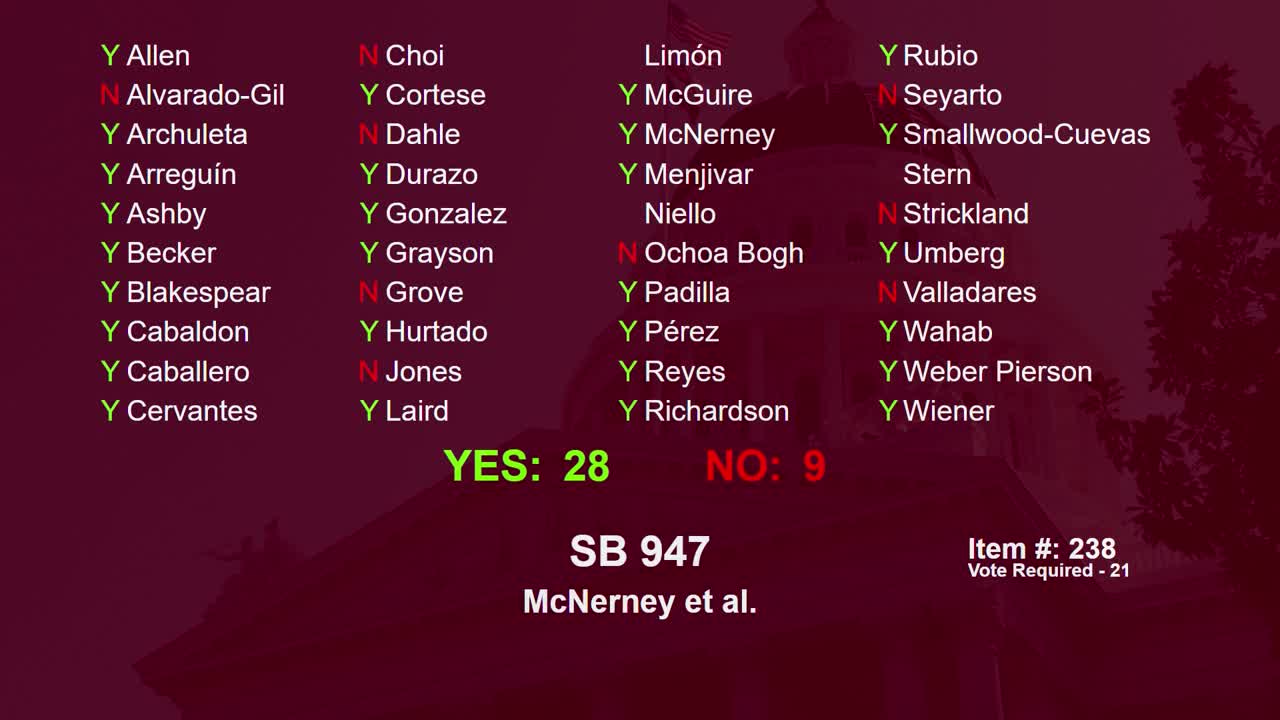 2MIN
Senate Floor
 7MIN
Senate Standing Committee on Housing
 13MIN
Senate Standing Committee on Local Government
Bill Author

Bill Co-Author(s):