SB 1007: Common interest developments: annual reports: assessments: discipline.
- Session Year: 2025-2026
- House: Senate
- Latest Version Date: 2026-06-15
Current Status:
In Progress
(2026-06-24: June 24 set for first hearing canceled at the request of author.)
Introduced
In Committee
Awaiting First Chamber Vote
Passed First Chamber
In Committee
Awaiting Second Chamber Vote
Passed Second Chamber
Enacted
Existing law, the Davis-Stirling Common Interest Development Act, governs the formation and operation of common interest developments. Existing law requires that a common interest development be managed by an association. Existing law requires an association of a common interest development to levy regular and special assessments to perform its obligations under the governing documents and the act, as provided. Existing law requires an association to prepare an annual budget report and a policy statement, as specified. Existing law requires the association to either deliver to all members the full report or a summary of the report that includes specified information, on the first page, whenever the annual budget report or a policy statement is prepared, as provided.
This bill would require the annual budget report to include a comparison breakdown of the anticipated expenditures expenses of the current previous fiscal year versus actual expenditures of the current previous fiscal year and a statement regarding compensation of a management company, as provided. The bill would require a summary of an annual budget to also include the comparison breakdown and the statement regarding compensation of a management company, as specified.
Existing law prohibits increases in regular assessments for any fiscal year, unless the board complies with certain requirements, including certain information in its annual budget report. Existing law prohibits an association from increasing regular assessments by more than 20 percent, without the approval of a majority of a quorum of members.
This bill would prohibit an association from increasing a regular assessment, unless the board includes the above-referenced information pertaining to regular assessments. The bill would, instead, prohibit a board from increasing regular assessments by more than 8%, without the approval of the majority of a quorum of members.
Existing law requires the association to notify a member 10 days before a meeting to consider or impose discipline on a member, or a monetary charge, as a means of reimbursing the association for costs incurred by the association in the repair of damage to the common area and facilities caused by a member, as provided. Existing law requires the notification to include, among other information, the nature of the alleged violation, or nature of the damage to the common area and facilities.
This bill would require the association to make any physical evidence used to determine a violation of the governing documents has occurred available to the member at least 5 business days before the hearing or deadline for the members response, if the association seeks to impose a monetary penalty against a member for violation of the governing documents, as provided.
Existing law, the Davis-Stirling Common Interest Development Act, governs the formation and operation of common interest developments. Existing law requires that a common interest development be managed by an association. Existing law requires an association of a common interest development to levy regular and special assessments to perform its obligations under the governing documents and the act, as provided. Existing law requires an association to prepare an annual budget report and a policy statement, as specified. Existing law requires the association to either deliver to all members the full report or a summary of the report that includes specified information, on the first page, whenever the annual budget report or a policy statement is prepared, as provided.
This bill would require the annual budget report to include a high-level summary comparison breakdown of what the regular assessments fund the anticipated expenditures of the current fiscal year versus actual expenditures of the current fiscal year and a statement regarding compensation of a management company, as provided. The bill would require a summary of an annual budget or policy statement to also include a high-level the comparison breakdown that describes what the regular assessments fund, and the statement regarding compensation of a management company, as specified.
Existing law prohibits increases in regular assessments for any fiscal year, unless the board complies with certain requirements, including certain information in its annual budget report. Existing law prohibits an association from increasing regular assessments by more than 20 percent, without the approval of a majority of a quorum of members.
This bill would prohibit an association from increasing a regular assessment, unless the board includes the above-referenced information pertaining to regular assessments. The bill would, instead, prohibit a board from imposing a increasing regular assessment for the associations preceding year, adjusted for inflation, assessments by more than 8%, without the approval of the majority of a quorum members.
Existing law requires the association to notify a member 10 days before a meeting to consider or impose discipline on a member, or a monetary charge, as a means of reimbursing the association for costs incurred by the association in the repair of damage to the common area and facilities caused by a member, as provided. Existing law requires the notification to include, among other information, the nature of the alleged violation, or nature of the damage to the common area and facilities.
This bill would require the association to make any physical evidence used to determine a violation of the governing documents has occurred available to the member at least 5 business days before the hearing or deadline for the members response, if the association seeks to impose a monetary penalty against a member for violation of the governing documents, as provided.
Existing law, the Davis-Stirling Common Interest Development Act, governs the formation and operation of common interest developments. Existing law requires that a common interest development be managed by an association. Existing law requires an association of a common interest development to levy regular and special assessments to perform its obligations under the governing documents and the act, as provided. Existing law requires an association to prepare an annual budget report and a policy statement, as specified. Existing law requires the association to either deliver to all members the full report or a summary of the report that includes specified information, on the first page, whenever the annual budget report or a policy statement is prepared, as provided.
This bill would require the annual budget report to include a high-level summary breakdown of what the regular assessments fund and a statement regarding compensation of a management company, as provided. The bill would require a summary of an annual budget or policy statement to also include a high-level breakdown that describes what the regular assessments fund, as specified.
Existing law prohibits increases in regular assessments for any fiscal year, unless the board complies with certain requirements, including certain information in its annual budget report. Existing law prohibits an association from increasing regular assessments by more than 20 percent, without the approval of a majority of a quorum of members.
This bill would prohibit an association from increasing a regular assessment, unless the board includes the above-referenced information pertaining to regular assessments. The bill would, instead, prohibit a board from imposing a regular assessment for the associations preceding year, adjusted for inflation, without the approval of the majority of a quorum members.
Existing law requires the association to notify a member 10 days before a meeting to consider or impose discipline on a member, or a monetary charge, as a means of reimbursing the association for costs incurred by the association in the repair of damage to the common area and facilities caused by a member, as provided. Existing law requires the notification to include, among other information, the nature of the alleged violation, or nature of the damage to the common area and facilities.
This bill would require the association to make any physical evidence used to determine a violation of the governing documents has occurred available to the member at least 5 business days before the hearing or deadline for the members response, if the association seeks to impose a monetary penalty against a member for violation of the governing documents, as provided.
(a)Notwithstanding a contrary provision in the governing documents, an association shall distribute an annual budget report 30 to 90 days before the end of its fiscal year.
(b)Unless the governing documents impose more stringent standards, the annual budget report shall include all of the following information:
(1)A pro forma operating budget, showing the estimated revenue and expenses on an accrual basis.
(2)A summary of the associations reserves, prepared pursuant to Section 5565.
(3)A summary of the reserve funding plan adopted by the board, as specified in paragraph (5) of subdivision (b) of Section 5550. The summary shall include notice to members that the full reserve study plan is available upon request, and the association shall provide the full reserve plan to any member upon request.
(4)A statement as to whether the board has determined to defer or not undertake repairs or replacement of any major component with a remaining life of 30 years or less, including a justification for the deferral or decision not to undertake the repairs or replacement.
(5)A statement as to whether the board, consistent with the reserve funding plan adopted pursuant to Section 5560, has determined or anticipates that the levy of one or more special assessments will be required to repair, replace, or restore any major component or to provide adequate reserves therefor. If so, the statement shall also set out the estimated amount, commencement date, and duration of the assessment.
(6)A statement as to the mechanism or mechanisms by which the board will fund reserves to repair or replace major components, including assessments, borrowing, use of other assets, deferral of selected replacements or repairs, or alternative mechanisms.
(7)A general statement addressing the procedures used for the calculation and establishment of those reserves to defray the future repair, replacement, or additions to those major components that the association is obligated to maintain. The statement shall include, but need not be limited to, reserve calculations made using the formula described in paragraph (4) of subdivision (b) of Section 5570, and may not assume a rate of return on cash reserves in excess of 2 percent above the discount rate published by the Federal Reserve Bank of San Francisco at the time the calculation was made.
(8)A statement as to whether the association has any outstanding loans with an original term of more than one year, including the payee, interest rate, amount outstanding, annual payment, and when the loan is scheduled to be retired.
(9)A summary of the associations property, general liability, earthquake, flood, and fidelity insurance policies. For each policy, the summary shall include the name of the insurer, the type of insurance, the policy limit, and the amount of the deductible, if any. To the extent that any of the required information is specified in the insurance policy declaration page, the association may meet its obligation to disclose that information by making copies of that page and distributing it with the annual budget report. The summary distributed pursuant to this paragraph shall contain, in at least 10-point boldface type, the following statement:
This summary of the associations policies of insurance provides only certain information, as required by Section 5300 of the Civil Code, and should not be considered a substitute for the complete policy terms and conditions contained in the actual policies of insurance. Any association member may, upon request and provision of reasonable notice, review the associations insurance policies and, upon request and payment of reasonable duplication charges, obtain copies of those policies. Although the association maintains the policies of insurance specified in this summary, the associations policies of insurance may not cover your property, including personal property or real property improvements to or around your dwelling, or personal injuries or other losses that occur within or around your dwelling. Even if a loss is covered, you may nevertheless be responsible for paying all or a portion of any deductible that applies. Association members should consult with their individual insurance broker or agent for appropriate additional coverage.
(10)When the common interest development is a condominium project, a statement describing the status of the common interest development as a Federal Housing Administration (FHA)-approved condominium project pursuant to FHA guidelines, including whether the common interest development is an FHA-approved condominium project. The statement shall be in at least 10-point font on a separate piece of paper and in the following form:
Certification by the Federal Housing Administration may provide benefits to members of an association, including an improvement in an owners ability to refinance a mortgage or obtain secondary financing and an increase in the pool of potential buyers of the separate interest.
This common interest development [is/is not (circle one)] a condominium project. The association of this common interest development [is/is not (circle one)] certified by the Federal Housing Administration.
(11)When the common interest development is a condominium project, a statement describing the status of the common interest development as a federal Department of Veterans Affairs (VA)-approved condominium project pursuant to VA guidelines, including whether the common interest development is a VA-approved condominium project. The statement shall be in at least 10-point font on a separate piece of paper and in the following form:
Certification by the federal Department of Veterans Affairs may provide benefits to members of an association, including an improvement in an owners ability to refinance a mortgage or obtain secondary financing and an increase in the pool of potential buyers of the separate interest.
This common interest development [is/is not (circle one)] a condominium project. The association of this common interest development [is/is not (circle one)] certified by the federal Department of Veterans Affairs.
(12)A copy of the completed Charges For Documents Provided disclosure identified in Section 4528. For purposes of this section, completed means that the Fee for Document section of the form individually identifies the costs associated with providing each document listed on the form.
(13)A comparison breakdown of the anticipated expenditures expenses of the current previous fiscal year versus actual expenditures of the current previous fiscal year. These expenditures shall be organized in major categories at the discretion of the association that shall include, but are not limited to, reserve contributions, a third-party management company, utilities, landscaping, maintenance, and insurance. The association may comply with this paragraph by including the comparison breakdown in the pro forma operating budget pursuant to paragraph (1).
(14)(A)A statement of the compensation of a management company, if applicable.
(B)The association may comply with subparagraph (A) by including the statement in the pro forma operating budget pursuant to paragraph (1). The statement shall be clearly identified in the pro forma operating budget for compliance with this subparagraph.
(c)The annual budget report shall be made available to the members pursuant to Section 5320.
(d)The summary of the associations reserves disclosed pursuant to paragraph (2) of subdivision (b) shall not be admissible in evidence to show improper financial management of an association, provided that other relevant and competent evidence of the financial condition of the association is not made inadmissible by this provision.
(e)The Assessment and Reserve Funding Disclosure Summary form, prepared pursuant to Section 5570, shall accompany each annual budget report or summary of the annual budget report that is delivered pursuant to this article.
SEC. 2.Section 5320 of the Civil Code is amended to read:5320.(a)When a report is prepared pursuant to Section 5300 or 5310, the association shall deliver one of the following documents to all members by individual delivery pursuant to Section 4040:
(1)The full report.
(2)A summary of the report that includes, on the first page, a general description of the content of the report, and instructions, printed in at least 10-point boldface type, regarding how to request a complete copy of the report at no cost to the member. For the summary of the report prepared pursuant to Section 5300, the association shall include the comparison breakdown pursuant to paragraph (13) of subdivision (b) of Section 5300 and the statement pursuant to paragraph (14) of subdivision (b) of Section 5300.
(b)Notwithstanding subdivision (a), if a member has requested to receive all reports in full, the association shall deliver the full report to that member, rather than a summary of the report.
SEC. 3.Section 5605 of the Civil Code is amended to read:5605.(a)Annual increases in regular assessments for any fiscal year shall not be imposed unless the board has complied with paragraphs (1), (2), (4), (5), (6), (7), (8), and (13) of subdivision (b) of Section 5300 with respect to that fiscal year, or has obtained the approval of a majority of a quorum of members, pursuant to Section 4070, at a member meeting or election.
(b)Notwithstanding more restrictive limitations placed on the board by the governing documents, the board may not impose a regular assessment that is more than 8 percent greater than the regular assessment for the associations preceding fiscal year, or impose special assessments which in the aggregate exceed 5 percent of the budgeted gross expenses of the association for that fiscal year without the approval of a majority of a quorum of members, pursuant to Section 4070, at a member meeting or election.
(c)(1)(A)For an association that records its original declaration on or after January 1, 2025, notwithstanding more restrictive limitations placed on the board by the governing documents, except as provided in paragraph (3), the board shall not impose a regular assessment against an owner of a deed-restricted affordable housing unit that is more than 5 percent plus the percentage change in the cost of living, not to exceed 10 percent greater than the preceding regular assessment.
(B)For purposes of this paragraph, percentage change in the cost of living means the percentage change from April 1 of the prior year to April 1 of the current year in the regional Consumer Price Index for the region where the residential real property is located, as published by the United States Bureau of Labor Statistics. If a regional index is not available, the California Consumer Price Index for All Urban Consumers for all items, as determined by the Department of Industrial Relations, shall apply.
(2)For an association that records its original declaration on or after January 1, 2025, notwithstanding any other law, except as provided in paragraph (3), the board may impose an assessment against an owner of a deed-restricted affordable housing unit that is lower than the assessment imposed against other owners according to the proportional ownership of total subdivision interests subject to assessments.
(3)This subdivision does not apply to any of the following:
(A)A development where the percentage of the units, exclusive of a managers unit or units, that are deed-restricted affordable housing units exceeds the percentage required by an applicable zoning ordinance in effect at the time the development received final approval.
(B)A development that is located within a city, county, or city and county that does not have an applicable zoning ordinance requiring a percentage of deed-restricted affordable housing units and meet either of the following conditions:
(i)The percentage of the units, exclusive of a managers unit or units, that are deed-restricted affordable housing exceeds 10 percent of the total number of units in the development at the time the development received final approval.
(ii)If the development met the requirements described in subparagraph (B) of paragraph (1) of subdivision (b) of Section 65912.122 of the Government Code and was approved pursuant to Section 65912.124 of the Government Code, the percentage of the units, exclusive of a managers unit or units, that are deed-restricted affordable housing exceeds 15 percent of the total number of units in the development at the time the development received final approval.
(C)A development of 20 units or fewer.
(d)For the purposes of this section, all of the following definitions apply:
(1)Affordable housing unit means a unit occupied by, or available at affordable housing cost to, lower income and moderate-income households, as defined by Sections 50079.5 and 50052.5, respectively, of the Health and Safety Code.
(2)Final approval has the same meaning as defined in clause (ii) of subparagraph (D) of paragraph (2) of subdivision (o) of Section 65589.5 of the Government Code.
(3)Quorum means more than 50 percent of the members.
SEC. 4.Section 5860 is added to the Civil Code, to read:5860.(a)If an association seeks to impose a monetary penalty against a member for a violation of the governing documents, the association shall make any physical evidence used to determine a violation of the governing documents has occurred, including, but not limited to, photographs or video or audio recordings, available to the member at least five business days before the hearing or the deadline for the members response.
(b)(1)If any digital materials, including photographs or video or audio recordings, are used in determining a violation of the governing documents has occurred, then the association shall make any digital metadata associated with the digital material available to the member together with the digital material.
(2)For purposes of this subdivision, metadata means data bearing the record of, and not the content of, a digital photograph, including, but not limited to, the time, date, and location of the image.
(a)Notwithstanding a contrary provision in the governing documents, an association shall distribute an annual budget report 30 to 90 days before the end of its fiscal year.
(b)Unless the governing documents impose more stringent standards, the annual budget report shall include all of the following information:
(1)A pro forma operating budget, showing the estimated revenue and expenses on an accrual basis.
(2)A summary of the associations reserves, prepared pursuant to Section 5565.
(3)A summary of the reserve funding plan adopted by the board, as specified in paragraph (5) of subdivision (b) of Section 5550. The summary shall include notice to members that the full reserve study plan is available upon request, and the association shall provide the full reserve plan to any member upon request.
(4)A statement as to whether the board has determined to defer or not undertake repairs or replacement of any major component with a remaining life of 30 years or less, including a justification for the deferral or decision not to undertake the repairs or replacement.
(5)A statement as to whether the board, consistent with the reserve funding plan adopted pursuant to Section 5560, has determined or anticipates that the levy of one or more special assessments will be required to repair, replace, or restore any major component or to provide adequate reserves therefor. If so, the statement shall also set out the estimated amount, commencement date, and duration of the assessment.
(6)A statement as to the mechanism or mechanisms by which the board will fund reserves to repair or replace major components, including assessments, borrowing, use of other assets, deferral of selected replacements or repairs, or alternative mechanisms.
(7)A general statement addressing the procedures used for the calculation and establishment of those reserves to defray the future repair, replacement, or additions to those major components that the association is obligated to maintain. The statement shall include, but need not be limited to, reserve calculations made using the formula described in paragraph (4) of subdivision (b) of Section 5570, and may not assume a rate of return on cash reserves in excess of 2 percent above the discount rate published by the Federal Reserve Bank of San Francisco at the time the calculation was made.
(8)A statement as to whether the association has any outstanding loans with an original term of more than one year, including the payee, interest rate, amount outstanding, annual payment, and when the loan is scheduled to be retired.
(9)A summary of the associations property, general liability, earthquake, flood, and fidelity insurance policies. For each policy, the summary shall include the name of the insurer, the type of insurance, the policy limit, and the amount of the deductible, if any. To the extent that any of the required information is specified in the insurance policy declaration page, the association may meet its obligation to disclose that information by making copies of that page and distributing it with the annual budget report. The summary distributed pursuant to this paragraph shall contain, in at least 10-point boldface type, the following statement:
This summary of the associations policies of insurance provides only certain information, as required by Section 5300 of the Civil Code, and should not be considered a substitute for the complete policy terms and conditions contained in the actual policies of insurance. Any association member may, upon request and provision of reasonable notice, review the associations insurance policies and, upon request and payment of reasonable duplication charges, obtain copies of those policies. Although the association maintains the policies of insurance specified in this summary, the associations policies of insurance may not cover your property, including personal property or real property improvements to or around your dwelling, or personal injuries or other losses that occur within or around your dwelling. Even if a loss is covered, you may nevertheless be responsible for paying all or a portion of any deductible that applies. Association members should consult with their individual insurance broker or agent for appropriate additional coverage.
(10)When the common interest development is a condominium project, a statement describing the status of the common interest development as a Federal Housing Administration (FHA)-approved condominium project pursuant to FHA guidelines, including whether the common interest development is an FHA-approved condominium project. The statement shall be in at least 10-point font on a separate piece of paper and in the following form:
Certification by the Federal Housing Administration may provide benefits to members of an association, including an improvement in an owners ability to refinance a mortgage or obtain secondary financing and an increase in the pool of potential buyers of the separate interest.
This common interest development [is/is not (circle one)] a condominium project. The association of this common interest development [is/is not (circle one)] certified by the Federal Housing Administration.
(11)When the common interest development is a condominium project, a statement describing the status of the common interest development as a federal Department of Veterans Affairs (VA)-approved condominium project pursuant to VA guidelines, including whether the common interest development is a VA-approved condominium project. The statement shall be in at least 10-point font on a separate piece of paper and in the following form:
Certification by the federal Department of Veterans Affairs may provide benefits to members of an association, including an improvement in an owners ability to refinance a mortgage or obtain secondary financing and an increase in the pool of potential buyers of the separate interest.
This common interest development [is/is not (circle one)] a condominium project. The association of this common interest development [is/is not (circle one)] certified by the federal Department of Veterans Affairs.
(12)A copy of the completed Charges For Documents Provided disclosure identified in Section 4528. For purposes of this section, completed means that the Fee for Document section of the form individually identifies the costs associated with providing each document listed on the form.
(13)A high-level summary breakdown in the form of a visual aid that describes what the regular assessments fund, including, but not limited to, funding of administrative costs, repairs, maintenance, and, litigation, if applicable.
(13)A comparison breakdown of the anticipated expenditures of the current fiscal year versus actual expenditures of the current fiscal year. These expenditures shall be organized in major categories at the discretion of the association that shall include, but are not limited to, reserve contributions, a third-party management company, utilities, landscaping, maintenance, and insurance. The association may comply with this paragraph by including the comparison breakdown in the pro forma operating budget pursuant to paragraph (1).
(14)(A)A statement of the compensation of a management company, if applicable.
(B)The association may comply with subparagraph (A) by including the statement in the pro forma operating budget pursuant to paragraph (1). The statement shall be clearly identified in the pro forma operating budget for compliance with this subparagraph.
(c)The annual budget report shall be made available to the members pursuant to Section 5320.
(d)The summary of the associations reserves disclosed pursuant to paragraph (2) of subdivision (b) shall not be admissible in evidence to show improper financial management of an association, provided that other relevant and competent evidence of the financial condition of the association is not made inadmissible by this provision.
(e)The Assessment and Reserve Funding Disclosure Summary form, prepared pursuant to Section 5570, shall accompany each annual budget report or summary of the annual budget report that is delivered pursuant to this article.
SEC. 2.Section 5320 of the Civil Code is amended to read:5320.(a)When a report is prepared pursuant to Section 5300 or 5310, the association shall deliver one of the following documents to all members by individual delivery pursuant to Section 4040:
(1)The full report.
(2)A summary of the report that includes, on the first page, a general description of the content of the report, a high-level breakdown that describes what the regular assessments fund, and instructions, printed in at least 10-point boldface type, regarding how to request a complete copy of the report at no cost to the member. For the summary of the report prepared pursuant to Section 5300, the association shall include the comparison breakdown pursuant to paragraph (13) of subdivision (b) of Section 5300 and the statement pursuant to paragraph (14) of subdivision (b) of Section 5300.
(b)Notwithstanding subdivision (a), if a member has requested to receive all reports in full, the association shall deliver the full report to that member, rather than a summary of the report.
SEC. 3.Section 5605 of the Civil Code is amended to read:5605.(a)Annual increases in regular assessments for any fiscal year shall not be imposed unless the board has complied with paragraphs (1), (2), (4), (5), (6), (7), (8), and (13) of subdivision (b) of Section 5300 with respect to that fiscal year, or has obtained the approval of a majority of a quorum of members, pursuant to Section 4070, at a member meeting or election.
(b)Notwithstanding more restrictive limitations placed on the board by the governing documents, the board may not impose a regular assessment that is more than 8 percent greater than the regular assessment for the associations preceding fiscal year, adjusted for inflation, or impose special assessments which in the aggregate exceed 5 percent of the budgeted gross expenses of the association for that fiscal year without the approval of a majority of a quorum of members, pursuant to Section 4070, at a member meeting or election.
(c)(1)(A)For an association that records its original declaration on or after January 1, 2025, notwithstanding more restrictive limitations placed on the board by the governing documents, except as provided in paragraph (3), the board shall not impose a regular assessment against an owner of a deed-restricted affordable housing unit that is more than 5 percent plus the percentage change in the cost of living, not to exceed 10 percent greater than the preceding regular assessment.
(B)For purposes of this paragraph, percentage change in the cost of living means the percentage change from April 1 of the prior year to April 1 of the current year in the regional Consumer Price Index for the region where the residential real property is located, as published by the United States Bureau of Labor Statistics. If a regional index is not available, the California Consumer Price Index for All Urban Consumers for all items, as determined by the Department of Industrial Relations, shall apply.
(2)For an association that records its original declaration on or after January 1, 2025, notwithstanding any other law, except as provided in paragraph (3), the board may impose an assessment against an owner of a deed-restricted affordable housing unit that is lower than the assessment imposed against other owners according to the proportional ownership of total subdivision interests subject to assessments.
(3)This subdivision does not apply to any of the following:
(A)A development where the percentage of the units, exclusive of a managers unit or units, that are deed-restricted affordable housing units exceeds the percentage required by an applicable zoning ordinance in effect at the time the development received final approval.
(B)A development that is located within a city, county, or city and county that does not have an applicable zoning ordinance requiring a percentage of deed-restricted affordable housing units and meet either of the following conditions:
(i)The percentage of the units, exclusive of a managers unit or units, that are deed-restricted affordable housing exceeds 10 percent of the total number of units in the development at the time the development received final approval.
(ii)If the development met the requirements described in subparagraph (B) of paragraph (1) of subdivision (b) of Section 65912.122 of the Government Code and was approved pursuant to Section 65912.124 of the Government Code, the percentage of the units, exclusive of a managers unit or units, that are deed-restricted affordable housing exceeds 15 percent of the total number of units in the development at the time the development received final approval.
(C)A development of 20 units or fewer.
(d)For the purposes of this section, all of the following definitions apply:
(1)Affordable housing unit means a unit occupied by, or available at affordable housing cost to, lower income and moderate-income households, as defined by Sections 50079.5 and 50052.5, respectively, of the Health and Safety Code.
(2)Final approval has the same meaning as defined in clause (ii) of subparagraph (D) of paragraph (2) of subdivision (o) of Section 65589.5 of the Government Code.
(3)Quorum means more than 50 percent of the members.
SEC. 4.Section 5860 is added to the Civil Code, to read:5860.(a)If an association seeks to impose a monetary penalty against a member for a violation of the governing documents, the association shall make any physical evidence used to determine a violation of the governing documents has occurred, including, but not limited to, photographs or video or audio recordings, available to the member at least five business days before the hearing or the deadline for the members response.
(b)(1)If any digital materials, including photographs or video or audio recordings, are used in determining a violation of the governing documents has occurred, then the association shall make any digital metadata associated with the digital material available to the member together with the digital material.
(2)For purposes of this subdivision, metadata means data bearing the record of, and not the content of, a digital photograph, including, but not limited to, the time, date, and location of the image.
(a)Notwithstanding a contrary provision in the governing documents, an association shall distribute an annual budget report 30 to 90 days before the end of its fiscal year.
(b)Unless the governing documents impose more stringent standards, the annual budget report shall include all of the following information:
(1)A pro forma operating budget, showing the estimated revenue and expenses on an accrual basis.
(2)A summary of the associations reserves, prepared pursuant to Section 5565.
(3)A summary of the reserve funding plan adopted by the board, as specified in paragraph (5) of subdivision (b) of Section 5550. The summary shall include notice to members that the full reserve study plan is available upon request, and the association shall provide the full reserve plan to any member upon request.
(4)A statement as to whether the board has determined to defer or not undertake repairs or replacement of any major component with a remaining life of 30 years or less, including a justification for the deferral or decision not to undertake the repairs or replacement.
(5)A statement as to whether the board, consistent with the reserve funding plan adopted pursuant to Section 5560, has determined or anticipates that the levy of one or more special assessments will be required to repair, replace, or restore any major component or to provide adequate reserves therefor. If so, the statement shall also set out the estimated amount, commencement date, and duration of the assessment.
(6)A statement as to the mechanism or mechanisms by which the board will fund reserves to repair or replace major components, including assessments, borrowing, use of other assets, deferral of selected replacements or repairs, or alternative mechanisms.
(7)A general statement addressing the procedures used for the calculation and establishment of those reserves to defray the future repair, replacement, or additions to those major components that the association is obligated to maintain. The statement shall include, but need not be limited to, reserve calculations made using the formula described in paragraph (4) of subdivision (b) of Section 5570, and may not assume a rate of return on cash reserves in excess of 2 percent above the discount rate published by the Federal Reserve Bank of San Francisco at the time the calculation was made.
(8)A statement as to whether the association has any outstanding loans with an original term of more than one year, including the payee, interest rate, amount outstanding, annual payment, and when the loan is scheduled to be retired.
(9)A summary of the associations property, general liability, earthquake, flood, and fidelity insurance policies. For each policy, the summary shall include the name of the insurer, the type of insurance, the policy limit, and the amount of the deductible, if any. To the extent that any of the required information is specified in the insurance policy declaration page, the association may meet its obligation to disclose that information by making copies of that page and distributing it with the annual budget report. The summary distributed pursuant to this paragraph shall contain, in at least 10-point boldface type, the following statement:
This summary of the associations policies of insurance provides only certain information, as required by Section 5300 of the Civil Code, and should not be considered a substitute for the complete policy terms and conditions contained in the actual policies of insurance. Any association member may, upon request and provision of reasonable notice, review the associations insurance policies and, upon request and payment of reasonable duplication charges, obtain copies of those policies. Although the association maintains the policies of insurance specified in this summary, the associations policies of insurance may not cover your property, including personal property or real property improvements to or around your dwelling, or personal injuries or other losses that occur within or around your dwelling. Even if a loss is covered, you may nevertheless be responsible for paying all or a portion of any deductible that applies. Association members should consult with their individual insurance broker or agent for appropriate additional coverage.
(10)When the common interest development is a condominium project, a statement describing the status of the common interest development as a Federal Housing Administration (FHA)-approved condominium project pursuant to FHA guidelines, including whether the common interest development is an FHA-approved condominium project. The statement shall be in at least 10-point font on a separate piece of paper and in the following form:
Certification by the Federal Housing Administration may provide benefits to members of an association, including an improvement in an owners ability to refinance a mortgage or obtain secondary financing and an increase in the pool of potential buyers of the separate interest.
This common interest development [is/is not (circle one)] a condominium project. The association of this common interest development [is/is not (circle one)] certified by the Federal Housing Administration.
(11)When the common interest development is a condominium project, a statement describing the status of the common interest development as a federal Department of Veterans Affairs (VA)-approved condominium project pursuant to VA guidelines, including whether the common interest development is a VA-approved condominium project. The statement shall be in at least 10-point font on a separate piece of paper and in the following form:
Certification by the federal Department of Veterans Affairs may provide benefits to members of an association, including an improvement in an owners ability to refinance a mortgage or obtain secondary financing and an increase in the pool of potential buyers of the separate interest.
This common interest development [is/is not (circle one)] a condominium project. The association of this common interest development [is/is not (circle one)] certified by the federal Department of Veterans Affairs.
(12)A copy of the completed Charges For Documents Provided disclosure identified in Section 4528. For purposes of this section, completed means that the Fee for Document section of the form individually identifies the costs associated with providing each document listed on the form.
(13)A high-level summary breakdown in the form of a visual aid that describes what the regular assessments fund, including, but not limited to, funding of administrative costs, repairs, maintenance, and, litigation, if applicable.
(14)A statement of the compensation of a management company, if applicable.
(c)The annual budget report shall be made available to the members pursuant to Section 5320.
(d)The summary of the associations reserves disclosed pursuant to paragraph (2) of subdivision (b) shall not be admissible in evidence to show improper financial management of an association, provided that other relevant and competent evidence of the financial condition of the association is not made inadmissible by this provision.
(e)The Assessment and Reserve Funding Disclosure Summary form, prepared pursuant to Section 5570, shall accompany each annual budget report or summary of the annual budget report that is delivered pursuant to this article.
SEC. 2.Section 5320 of the Civil Code is amended to read:5320.(a)When a report is prepared pursuant to Section 5300 or 5310, the association shall deliver one of the following documents to all members by individual delivery pursuant to Section 4040:
(1)The full report.
(2)A summary of the report that includes, on the first page, a general description of the content of the report report, a high-level breakdown that describes what the regular assessments fund, and instructions, printed in at least 10-point boldface type, regarding how to request a complete copy of the report at no cost to the member.
(b)Notwithstanding subdivision (a), if a member has requested to receive all reports in full, the association shall deliver the full report to that member, rather than a summary of the report.
SEC. 3.Section 5605 of the Civil Code is amended to read:5605.(a)Annual increases in regular assessments for any fiscal year shall not be imposed unless the board has complied with paragraphs (1), (2), (4), (5), (6), (7), and (8) (8), and (13) of subdivision (b) of Section 5300 with respect to that fiscal year, or has obtained the approval of a majority of a quorum of members, pursuant to Section 4070, at a member meeting or election.
(b)Notwithstanding more restrictive limitations placed on the board by the governing documents, the board may not impose a regular assessment that is more than 20 percent greater than the regular assessment for the associations preceding fiscal year year, adjusted for inflation, or impose special assessments which in the aggregate exceed 5 percent of the budgeted gross expenses of the association for that fiscal year without the approval of a majority of a quorum of members, pursuant to Section 4070, at a member meeting or election.
(c)(1)(A)For an association that records its original declaration on or after January 1, 2025, notwithstanding more restrictive limitations placed on the board by the governing documents, except as provided in paragraph (3), the board shall not impose a regular assessment against an owner of a deed-restricted affordable housing unit that is more than 5 percent plus the percentage change in the cost of living, not to exceed 10 percent greater than the preceding regular assessment.
(B)For purposes of this paragraph, percentage change in the cost of living means the percentage change from April 1 of the prior year to April 1 of the current year in the regional Consumer Price Index for the region where the residential real property is located, as published by the United States Bureau of Labor Statistics. If a regional index is not available, the California Consumer Price Index for All Urban Consumers for all items, as determined by the Department of Industrial Relations, shall apply.
(2)For an association that records its original declaration on or after January 1, 2025, notwithstanding any other law, except as provided in paragraph (3), the board may impose an assessment against an owner of a deed-restricted affordable housing unit that is lower than the assessment imposed against other owners according to the proportional ownership of total subdivision interests subject to assessments.
(3)This subdivision does not apply to any of the following:
(A)A development where the percentage of the units, exclusive of a managers unit or units, that are deed-restricted affordable housing units exceeds the percentage required by an applicable zoning ordinance in effect at the time the development received final approval.
(B)A development that is located within a city, county, or city and county that does not have an applicable zoning ordinance requiring a percentage of deed-restricted affordable housing units and meet either of the following conditions:
(i)The percentage of the units, exclusive of a managers unit or units, that are deed-restricted affordable housing exceeds 10 percent of the total number of units in the development at the time the development received final approval.
(ii)If the development met the requirements described in subparagraph (B) of paragraph (1) of subdivision (b) of Section 65912.122 of the Government Code and was approved pursuant to Section 65912.124 of the Government Code, the percentage of the units, exclusive of a managers unit or units, that are deed-restricted affordable housing exceeds 15 percent of the total number of units in the development at the time the development received final approval.
(C)A development of 20 units or fewer.
(d)For the purposes of this section, all of the following definitions apply:
(1)Affordable housing unit means a unit occupied by, or available at affordable housing cost to, lower income and moderate-income households, as defined by Sections 50079.5 and 50052.5, respectively, of the Health and Safety Code.
(2)Final approval has the same meaning as defined in clause (ii) of subparagraph (D) of paragraph (2) of subdivision (o) of Section 65589.5 of the Government Code.
(3)Quorum means more than 50 percent of the members.
SEC. 4.Section 5860 is added to the Civil Code, to read:5860.(a)If an association seeks to impose a monetary penalty against a member for a violation of the governing documents, the association shall make any physical evidence used to determine a violation of the governing documents has occurred, including, but not limited to, photographs or video or audio recordings, available to the member at least five business days before the hearing or the deadline for the members response.
(b)(1)If any digital materials, including photographs or video or audio recordings, are used in determining a violation of the governing documents has occurred, then the association shall make any digital metadata associated with the digital material available to the member together with the digital material.
(2)For purposes of this subdivision, metadata means data bearing the record of, and not the content of, a digital photograph, including, but not limited to, the time, date, and location of the image.
|
Date
|
Status
|
|---|---|
| Jun 24, 2026 | June 24 set for first hearing canceled at the request of author. |
| Jun 15, 2026 | From committee with author's amendments. Read second time and amended. Re-referred to Com. on H. & C.D. |
| Jun 4, 2026 | Referred to Coms. on H. & C.D., JUD., and APPR. |
| May 27, 2026 | In Assembly. Read first time. Held at Desk. |
| May 27, 2026 | Read third time. Passed. (Ayes 24. Noes 13. Page 4482.) Ordered to the Assembly. |
| May 27, 2026 | Read third time. Passed. (Ayes 24. Noes 13.) Ordered to the Assembly. |
| May 22, 2026 | Read second time. Ordered to third reading. |
| May 21, 2026 | Ordered to second reading. |
| May 21, 2026 | Read third time and amended. |
| Apr 30, 2026 | Read second time. Ordered to third reading. |
| Apr 29, 2026 | From committee: Do pass. (Ayes 9. Noes 1. Page 4085.) (April 28). |
| Apr 29, 2026 | From committee: Do pass. (Ayes 9. Noes 1.) (April 28). |
| Apr 10, 2026 | Set for hearing April 28. |
| Mar 18, 2026 | From committee: Do pass and re-refer to Com. on JUD. (Ayes 8. Noes 2. Page 3589.) (March 17). Re-referred to Com. on JUD. |
| Mar 18, 2026 | From committee: Do pass and re-refer to Com. on JUD. (Ayes 8. Noes 2.) (March 17). Re-referred to Com. on JUD. |
| Mar 3, 2026 | Set for hearing March 17. |
| Feb 18, 2026 | Referred to Coms. on HOUSING and JUD. |
| Feb 10, 2026 | From printer. May be acted upon on or after March 12. |
| Feb 9, 2026 | Introduced. Read first time. To Com. on RLS. for assignment. To print. |
|
Date
|
Description
|
Location
|
Votes
|
|
|---|---|---|---|---|
| May 27, 2026 | Senate 3rd Reading SB1007 Menjivar et al. | Senate Floor |
Passed |
|
| Apr 28, 2026 | Do pass | Senate Standing Committee on Judiciary |
Passed |
|
| Mar 17, 2026 | Do pass, but first be re-referred to the Committee on [Judiciary] | Senate Standing Committee on Housing |
Passed |
This list shows positions taken on this bill by organizations on the date displayed, which is linked to the original source.
Positions by individuals are not included.
|
Organization
|
Position
|
Date
|
|---|---|---|
| California Association Of Community Managers | ** Against | |
| California Association Of Realtors | ** Support | |
| California Building Industry Association | ** Against | |
| California Business Properties Association | ** Against | |
| California Low-Income Consumer Coalition | ** Support | |
| Center for California Homeowner Association Law | ** Support | |
| Cobblestone in Pomona Homeowners Association | ** Against | |
| Community Associations Institute - California Legislative Action Committee | ** Against | |
| Community Associations Institute – California Legislative Action Committee | ** Against | |
| Consumer Federation Of California | ** Support | |
| Desert Resort Management | ** Against | |
| EXECUTIVE COUNCIL OF HOME OWNERS | ** Against | |
| four individuals | ** Against | |
| Golden Rain Foundation Board of Directors | ** Against | |
| Housing Action Coalition | ** Against | |
| Meadowtree Homeowners Association | ** Against | |
| Oaknoll Homeowners Association | ** Against | |
| Peninsula Place Homeowners Association | ** Against | |
| Port Marluna Homeowners Association | ** Against | |
| The Villages Association | ** Against | |
| Torrance Windemere Hoa | ** Against | |
| Villa Caballeros Homeowners Association | ** Against |
Date of Hearing: June 24, 2026
ASSEMBLY COMMITTEE ON HOUSING AND COMMUNITY DEVELOPMENT
Matt Haney, Chair
SBPCA Bill Id:SB 1007
Author:(Menjivar) – As Amended Ver:June 15, 2026
SENATE VOTE: 24-13
SUBJECT: Common interest developments: annual reports: assessments: discipline
SUMMARY: Adds new information to the existing annual budget reporting requirements of a homeowners’ association (HOA). Caps an HOA’s allowable increase of regular assessments without a vote of the membership to 8% greater than the preceding fiscal year. Establishes new disclosure obligations of an HOA prior to imposing a monetary penalty against a member of the HOA. Specifically, this bill:
- Requires an HOA to include in its annual budget reporting both of the following:
- A comparison breakdown of the anticipated expenses of the previous fiscal year versus actual expenditures of the current fiscal year, organized in major categories to be determined at the discretion of the HOA, including, but not limited to, reserve contributions, a third-party management company, utilities, landscaping, maintenance, and insurance; and
- A statement of the compensation of a management company, if applicable.
- Specifies that including the information in 1) above, in the pro forma operating budget of the annual budget report shall satisfy the HOA’s obligation to report such information.
- Requires the comparison breakdown and statement in 1) above to be included in the summary of the annual budget delivered to all members.
- Prohibits an HOA from imposing annual increases in regular assessments if the HOA has not complied with 1) above.
- Caps the allowable increase in regular assessments imposed by an HOA at 8% greater than the regular assessment for the HOA’s preceding fiscal year without approval of a majority of a quorum of members.
- Requires an HOA to make any physical evidence used to determine a violation of the governing documents, including, but not limited to, photographs or video or audio recordings, available to the member at least five business days before the hearing or deadline for the member’s response if an HOA seeks to impose a monetary penalty against a member for a violation of the governing documents.
- Requires an HOA, if any digital materials are used in determining a violation of the governing documents, to make any digital metadata associated with the digital material available to the member together with the digital material.
- Defines “metadata” to mean data bearing the record of, and not the content of, a digital photograph, including, but not limited to, the time, date, and location of the image.
EXISTING LAW:
- Establishes the Davis-Stirling Common Interest Development (CID) Act which governs the creation and operation of CIDs, including HOAs. (Civil Code (CIV) 4000 et seq.)
- Requires an HOA to distribute an annual budget report 30 to 90 days before the end of its fiscal year and to include specified information, including a pro forma operating budget, a summary of the HOA’s reserves, and a summary of the HOA’s property, general liability, earthquake, flood, and fidelity insurance policies. (CIV 5300)
- Requires an HOA to distribute an annual policy statement that provides the members with information about HOA policies and to include specified information, including the statement of assessment collection policies and a statement describing the discipline policy. (CIV 5310)
- Requires an HOA, when a report is prepared pursuant to 2) or 3) above, to deliver to all members by individual delivery either the full report or a summary of the report that includes a general description of the content and instructions regarding how to request the full report. (CIV 5320)
- Requires an HOA of a condominium project with buildings containing three or more multifamily units to cause, at least once every nine years, a reasonably competent and diligent visual inspection to be conducted by a licensed structural or civil engineer or architect of a random and statistically significant sample of exterior elevated elements (EEEs) for which the HOA has maintenance or repair responsibility. (CIV 5551(b))
- Requires the inspector in 5) to issue a written report (the nine-year EEE inspection report) containing the following:
- The identification of the building components comprising the load-bearing components and associated waterproofing system;
- The current physical condition of the load-bearing components and associated waterproofing system, including whether the condition presents an immediate threat to the health and safety of the residents;
- The expected future performance and remaining useful life of the load-bearing components and associated waterproofing system;
- Recommendations for any necessary repair or replacement of the load-bearing components and associated waterproofing system; and
- Specified information on the first page of the report, including the date of the inspection, total number of units in the condominium project, total number of EEEs in the project, the total number of inspected EEEs identified as posing an immediate threat to the safety of the occupants and the number of units impacted, among other provisions. (CIV 5551(e))
- Defines, for purposes of the nine-year EEE inspection in 5), the following terms:
- “Exterior elevated elements” means the load-bearing components together with their associated waterproofing system.
- “Loading-bearing components” means those components that extend beyond the exterior walls of the building to deliver structural loads to the building from decks, balconies, stairways, walkways, and their railings, that have a walking surface elevated more than six feet above ground level, that are designed for human occupancy or use, and that are supported in whole or in substantial part by wood or wood-based products.
- “Associated waterproofing system” includes flashings, membranes, coatings, and sealants that protect the load-bearing components of the EEEs from exposure to water.
- “Statistically significant sample” means a sufficient number of units inspected to provide 95% confidence that the results from the sample are reflective of the whole, within a margin of error of no greater than plus or minus 5%.
- “Visual inspection” means inspection through the least intrusive method necessary to inspect load-bearing components, including visual observation only or visual observation in conjunction with, for example, the use of moisture meters, borescopes, or infrared technology. (CIV 5551(a))
- Prohibits an HOA from imposing annual increases in regular assessments for any fiscal year unless the HOA has complied with specified requirements related to the annual budget report in 2) above, or has obtained the approval of a majority of a quorum of members, as specified. (CIV 5605(a))
- Prohibits an HOA from imposing a regular assessment that is more than 20% greater than the regular assessment for the HOA’s preceding fiscal year or impose special assessments which in the aggregate exceed 5% of the budgeted gross expenses of the HOA for that fiscal year without approval of a majority of a quorum of members, as specified. (CIV 5605(b))
- Prohibits an HOA from imposing a regular assessment against an owner of a deed-restricted affordable housing unit that is more than 5% plus the percentage change in the cost of living, not to exceed 10% greater than the preceding regular assessment, for an HOA that records its original declaration on or after January 1, 2025. (CIV 5605(c))
FISCAL EFFECT: Unknown.
COMMENTS:
Author’s statement: According to the author, “During a time when Californians are gripped by dual threats, an unprecedented housing shortage and a crippling affordability crisis, many find their homeownership dreams destabilized by the volatile and sometimes arbitrary escalation of homeowners association fees. Nearly 14 million Californians live in HOAs. Protecting homeowners’ financial stability requires more HOA oversight, including rules for transparency, financial accountability, and due process, keeping these monthly costs reasonable and predictable for homeowners who are on a tight budget.”
CIDs: There are over 50,000 CIDs in the state, ranging in size from three to 27,000 units, with the average CID having 286 residents. CIDs make up roughly 4.7 million housing units, and 36% of Californians (over 14 million Californians) live in a CID. These rates are even higher for homeowners, with approximately 65% of homeowners living in a CID. CIDs include condominiums, community apartment projects, housing cooperatives, and planned unit developments. They are characterized by a separate ownership of dwelling space coupled with an undivided interest in a common property, restricted by covenants and conditions that limit the use of common area, and the separate ownership interests and the management of common property and enforcement of restrictions by an HOA. CIDs are governed by the Davis-Stirling Common Interest Development Act (the Act) as well as the governing documents of the association, including bylaws, declaration, and operating rules.
Davis-Stirling Common Interest Development Act: The Act went into effect in 1986 and is the primary body of law governing CIDs in California. The Act provides the legal framework for the creation and management of HOAs, including rules related to governance, assessments, dispute resolution, maintenance responsibilities, and member rights. The Act aims to balance the authority of HOAs with the rights of individual property owners, ensuring that communities are managed efficiently and fairly.
Over time, the Act has been amended to address the evolving needs of CIDs and to increase transparency, accountability, and consumer protection. Key provisions include requirements for open meetings, financial disclosures, election procedures, and architectural review processes. The Act also provides mechanisms for resolving disputes, including internal dispute resolution and alternative dispute resolution, before certain legal actions can proceed. As CIDs continue to represent a significant portion of California’s housing stock, the Act play as critical role in shaping the living environment and governance of millions of residents across the state.
Annual reports: Under the Act, HOAs must distribute an annual budget report to the association’s members 30 to 90 days before the end of the HOA’s fiscal year. The budget report must include, unless the governing documents impose more stringent standards, 12 specified elements related to the HOA’s fiscal condition. These elements include, among other provisions: a pro forma operating budget showing the estimated revenues and expenses on an accrual basis, a summary of the HOA’s reserves, a summary of the reserve funding plan, a statement as to the mechanism by which the HOA will fund reserves to repair or replace major components (e.g., assessments, borrowing, etc.), and a summary of the HOA’s various insurance policies and related policy limits and deductible amounts. An HOA must make its annual budget report available to all members in one of two forms – either the full report or a summary. If the HOA provides a summary of the report, the summary must include a general description of the content of the report and instructions regarding how to request a complete copy of the report. A member can always request to receive all reports in full, at no cost to the member, rather than a summary of the report.
HOA Assessments: Under existing law, HOAs are required to levy regular and special assessments sufficient to perform their obligations under the governing documents and the Act. HOAs are prohibited from imposing or collecting an assessment that exceeds the amount necessary to defray the costs for which it is levied. Regular assessments are established in an HOA’s annual budget and are paid by members of an HOA usually on a monthly or quarterly basis. Special assessments are generally a one-time or limited-duration charge imposed to pay for expenses not covered by regular assessments or the budget.
There are limitations on the rates at which regular and special assessments may be levied without a vote of the membership. An HOA may increase regular assessments for any fiscal year up to, and including, 20% greater than the regular assessments for the HOA’s preceding fiscal year without the approval of a majority of a quorum of members. Existing law allows an HOA to levy a special assessment up to 5% of the current fiscal year’s budgeted gross expenses without the approval of a majority of a quorum of members. There are no limitations on the number of special assessments that an HOA may impose. However, the 5% cap is an aggregate of the number of special assessments. For example, an HOA may impose one special assessment of 5% of the budgeted gross expenses or five special assessments of 1% without approval of the membership. With approval from a majority of a quorum of members, an HOA can impose regular or special assessments that exceed either cap.
The Act also provides HOAs with the authority to impose emergency special assessments. Emergency special assessments are for situations in which an extraordinary expense is required by an order of a court; necessary to operate, repair, or maintain the CID or any part for which the HOA is responsible where a threat to personal health or safety or another hazardous condition or circumstance on the property is discovered; or necessary to repair or maintain the CID or any part of it for which the HOA is responsible that could not have been reasonably foreseen by the HOA board in preparing and distributing the annual budget report.
Reserve Studies: HOAs are required to periodically review their long-term repair and replacement obligations through reserve studies. At least once every three years, the HOA board must conduct a reasonably competent and diligent visual inspection of the accessible areas of major components for which the association is responsible, where the replacement value of those components is at least one-half of the association’s gross budget, excluding reserves, and must review that study annually and make appropriate adjustments to its reserve analysis. The reserve study must identify major components with less than 30 years of remaining useful life, estimate their remaining life and repair or replacement costs, calculate the annual contribution needed to fund those obligations, and include a reserve funding plan. In this sense, existing law requires HOAs to periodically identify foreseeable capital needs and map out a strategy to pay for them. Although the Act specifies the planning activities an HOA must take, there is no requirement to allocate any portion of the HOA’s annual budget to the reserve fund. Generally, any contributions to a reserve fund would come from the collection of regular assessments.
Disciplinary Policies: The Act requires the board of an HOA to distribute an annual policy statement to the members with information about the HOA’s policies within 30 to 90 days before the end of each fiscal year. The annual policy statement must include, a statement describing the HOA’s discipline policy, if any, including any schedule of penalties for violations of the governing documents. AB 130, Chapter 22, Statutes of 2025, capped monetary penalties that an HOA board may impose for a violation of the governing documents at $100, with exceptions for violations that may have an adverse health or safety impact on a common area or another member’s property.
When an HOA board is to meet to consider or impose discipline upon a member, or impose a monetary charge as a means of reimbursing the HOA for costs incurred by the HOA in repair of damage to the common area and facilities caused by a member or a guest of a member, an HOA board must notify the member in writing at least 10 days prior to the meeting. The notification must include the date, time, and place of the meeting, the nature of the alleged violation, and a statement that the member has a right to attend and may address the HOA board at the meeting. AB 130 provided members with the opportunity to cure the violation prior to the meeting. If a member cures the violation prior to the meeting, an HOA board is prohibited from imposing discipline. If curing the violation would take longer than the time between the notice provided and the meeting, the HOA board would be prohibited from imposing discipline if a member provides financial commitment to cure the violation.
Deferred Maintenance and Inspection Mandates: In 2015, an exterior balcony at the Library Gardens apartment complex in Berkeley, located near the University of California, Berkeley, collapsed, resulting in the deaths of six young adults and injuries to seven others. Subsequent investigations determined that the balcony’s wooden support framing had deteriorated because of extensive dry rot that had not been addressed through proper maintenance.
Following the incident, the California State Contractors State License Board revoked the license of the general contractor that built the apartment complex. The board found that the company, Segue Construction, Inc., had allegedly disregarded approved construction plans and specifications and failed to comply with accepted standards for quality construction practices.
In response to the tragedy, the Legislature approved SB 465 (Hill), Chapter 372, Statutes of 2016. Among other provisions aimed at increasing contractor oversight, the measure directed the California Building Standards Commissions (CSBC) to convene a working group to examine failures involving EEEs, such as balconies. The legislation required the CBSC to report its findings to the Legislature and identify potential statutory, regulatory, or building code changes. In 2017, the CSBC adopted emergency regulations intended to expedite implementation of enhanced construction standards.
California later approved SB 721 (Hill), Chapter 445, Statutes of 2018, which established periodic inspection requirements for EEEs in specified multifamily residential buildings. Under the law, building owners must arrange inspections of balconies and related load-bearing components and waterproofing systems at least once every six years by qualified licensed professionals. These inspections are intended to verify that the structures remain safe, functional, and free of hazardous conditions. The law also requires identified deficiencies to be repaired within prescribed timeframes and authorizes penalties for owners who fail to complete required repairs.
SB 721 did not apply to CIDs. To address that gap, the Legislature approved SB 326 (Hill), Chapter 207, Statutes of 2019, which imposed comparable inspection requirements on CIDs. Under SB 326, HOAs must arrange inspections at least every nine years for balconies and other EEEs for which the HOA is responsible for maintenance or repair. Inspectors must prepare written reports, and the findings must be incorporated into the HOA’s reserve study process.
Both SB 721 and SB 326 originally required initial inspections to be completed by January 1, 2025. However, AB 2579 (Quirk-Silva), Chapter 835, Statutes of 2024, generally extended the deadline for multifamily residential buildings subject to SB 721 to January 1, 2026. AB 2579 did not extend the corresponding deadline applicable to CIDs under SB 326.
Access to Homeownership Opportunities: Government-sponsored enterprises (GSEs), including Fannie Mae and Freddie Mac, play an important role in expanding homeownership opportunities in CIDs by purchasing and guaranteeing mortgages originated by private lenders. By providing liquidity to the mortgage market, the GSEs help make conventional mortgage financing more widely available for homebuyers. To manage risk, the GSEs establish project eligibility requirements for condominiums and other CIDs that consider factors such as reserve funding, special assessments, deferred maintenance, insurance coverage, and the overall financial condition of the HOA. As a result, the availability of conventional mortgage financing in many CIDs depends in part on whether the CID satisfies applicable GSE eligibility standards.
Following the 2021 Champlain Towers South condominium collapse in Seaside, Florida, Fannie Mae and Freddie Mac increased their scrutiny of condominium and CID projects with significant deferred maintenance, structural deficiencies, or critical repair needs. The GSEs do not automatically deem a project ineligible simply because repairs are required. However, projects with unresolved structural safety concerns, substantial deferred maintenance, or critical repairs affecting the safety, structural integrity, or habitability of the property may be ineligible for purchase by the GSEs until those issues are adequately resolved. According to media reports, these new requirements have resulted in the creation of a “blacklist” by the GSEs of CID properties in which all units within the development are ineligible for GSE-backed mortgages.[1]
This Bill: This bill makes three changes to the Act that, according to the author, aim to increase transparency and preserve affordability for homeowners living in HOAs.
Annual Budgets: As noted previously, the Act requires an HOA to provide the members with an annual budget report 30 to 90 days before the end of the fiscal year. The report must contain 12 components, including a pro forma operating budget, information about the reserve fund, and a summary of various insurance policies. This bill adds two more requirements to the report. This bill requires the annual budget report to include a comparison breakdown of the anticipated expenses of the previous fiscal year versus actual expenditures of the previous fiscal year, which are to be organized into major categories. These categories must include expenses related to reserve contributions, a third-party management companies, utilities, maintenance, and insurance. This bill adds a statement of the compensation of a management company, if applicable, to the annual report. To address concerns raised by opponents of this bill that this information is already included in other disclosures, the author amended this bill to specify that, if an HOA includes both of these proposed elements in the pro forma operating budget of the annual report, then an HOA has complied with these disclosure requirements. This bill also specifies that, if the annual budget report is delivered to members in the form of a summary, the HOA must also include the comparison breakdown and the statement of the compensation of a management company.
Regular Assessments: This bill reduces from 20% to 8% the maximum allowable annual increase in regular assessments without a vote of the membership. The author has provided the committee with media reports of HOA members across California facing increases regular and special assessments. Last year, members of an HOA in Modesto faced a sudden special assessment to repair various EEEs, despite a 2025 budget disclosure filed in September 2024 indicating no special assessment was anticipated.[2] In Orange County, another outlet reports continued increases in regular assessments in addition to the special assessment contemplated for maintenance and repairs.[3] This bill attempts to minimize the increases homeowners will be required to pay and aims to give members of an HOA greater control over whether, and to what degree, increases in regular assessments may be imposed without a vote of the membership.
Disciplinary Policies: This bill increases transparency and procedural protections for HOA members facing disciplinary fines. This bill requires an HOA to provide a member with access to any physical evidence the HOA board relied upon in determining that the member violated the HOA’s governing documents at least five business days before the hearing or deadline for the member to submit a response. If the evidence is in a digital format (e.g., photos, video, audio recordings, etc.), the HOA must provide certain data associated with the evidence. Various outlets have covered the growing tensions between some HOA boards and the members within those associations.[4] Despite the recent cap placed on monetary penalties in AB 130 last year, these fines can still have an impact on the living conditions of residents around the state. Requiring an HOA board to disclose the information and evidence supporting a proposed monetary penalty affords residents a reasonable opportunity to understand and respond to the allegations against them.
Policy Considerations: California continues to face a significant housing affordability crisis, with high housing costs limiting opportunities for homeownership and increasing financial burdens on households throughout the state. As a growing share of state’s housing stock is developed within CIDs, HOA assessments can represent a substantial component of a homeowner’s monthly housing expenses. Consequently, the state has an interest in balancing the goal of maintaining affordable HOA costs for residents with ensuring that HOAs have sufficient resources to safely maintain their communities and meet long-term obligations.
- Housing Stability and Foreclosure Risk: HOA assessments are mandatory obligations that may be secured by a lien against an owner’s separate interest, and delinquent assessments may ultimately result in collection actions or foreclosure. Limiting the magnitude of annual increases in regular assessments may help reduce the likelihood that homeowners, particularly those on fixed incomes or with limited financial resources, experience sudden increases in housing costs that they are unable to absorb, thereby promoting housing stability and reducing the risk of assessment-related delinquencies and foreclosures.
- Homeowner Participations in Assessment Decisions. Reducing the maximum allowable increase in regular assessments without a vote of the membership may encourage HOA boards to seek member approval for larger increases more frequently. Providing homeowners with an opportunity to vote on proposed assessment increases affords residents a greater voice in determining the housing costs they will bear and may promote transparency, accountability, and member engagement in HOA budgeting decisions.
- Potential Shift Towards Special Assessments: Conversely, a lower cap on increases in regular assessments may create an unintended incentive for HOAs to rely more heavily on special assessments to address reserve shortfalls, insurance increases, or other unforeseen expenses. Unlike regular assessments, which are typically adopted through the annual budget process and paid on a recurring basis, special assessments may result in unexpected and substantial costs to HOA members, may be payable in a lump sum or over a shorter period established by the HOA board, and generally become due according to the schedule imposed when the assessment is levied. To the extent the purpose of reducing the cap on regular assessments is to protect homeowners from significant increases in housing costs, a potential for greater reliance on special assessments may undermine that objective by replacing gradual increases with less predictable and potentially more burdensome payment obligations.
- Increases in Insurance Premiums: CIDs throughout California have experienced substantial increases in property insurance costs in recent years, particularly in areas exposed to wildfire and other disaster risks. Because insurance is a necessary operating expenses, HOAs may have limited ability to absorb these increases without higher regular assessments.
- Deferred Maintenance and EEEs. HOAs are responsible for maintaining, repairing, and replacing common area components, including EEEs, and are required to inspect their conditions following the tragic Berkeley balcony collapse. Deferring necessary repairs can increase life safety risks and lead to more costly future repairs.
- Reserve Funding Obligations for EEEs. Existing law requires HOAs to incorporate findings from EEE inspections into their reserve studies to assist with long-term capital planning. However, planning alone does not address identified deficiencies, and HOAs must maintain adequately funded reserves to timely perform necessary repairs and replacements while remaining mindful of affordability concerns for homeowners.
- Mortgage Financing and Deferred Maintenance. Recent reporting indicates that loans backed by GSEs, including Fannie Mae and Freddie Mac, may be unavailable for units located in developments with significant deferred maintenance, unresolved structural issues, or inadequate funding for required repairs. Reduced access to convention mortgage financing may limit opportunities for prospective purchasers. Lowering the assessment amount HOA’s can charge may undermine the overall financial health of the CID.
- Planned Developments. Planned developments often rely on projected assessment levels and reserve funding assumptions reviewed during the Department of Real Estate public report process. Constraints on an HOA’s ability to adjust assessments to address legitimate operating, insurance, reserve, or maintenance obligations could affect the pace of development and the completion of the common area amenities.
- Affordable Housing Assessment Limitations. The state recently reduced the cap on regular assessment increases for deed-restricted affordable housing units in developments recorded on or after January 1, 2025, to 5% plus the percentage change in the cost of living, not to exceed 10% greater than the preceding year. To the extent that the affordable housing units are levied a regular assessment at that allowable cap of 10%, this bill would provide a greater benefit to other residents within the HOA with an 8% cap. In addition, the combined effect may further constrain an HOA’s ability to address long-term maintenance and capital needs.
Arguments in Support: According to the Consumer Federation of California, “Homeowner associations (HOAs) collect millions of dollars annually from the homeowners living in them, because the services they provided are self-financed. Homeowner dollars might pay for road maintenance, private security, landscaping, snow removal, trash pickup, water services, mosquito abatement, parks, environmental management. A new law effective in 2019 now makes homeowners – not utility companies – responsible for the ‘maintenance and repair’ of all gas, water, electrical, and sewer delivery lines coming into the subdivision. In short, associations finance through assessments many of the services formerly finance with property taxes, though homeowners are required to pay those too in addition to assessments. The services listed above are ones formerly provided by California cities and counties, but that local governments can no longer afford or cannot fully fund, for example road maintenance. However, unlike property taxes which have a 2% annual increase, state law lets associations increase regular assessments an arbitrary 20% a year – without meaningful justification. Needless to say, such increases can be a shock to a homeowner’s wallet, since the salary or retirement income of few people increases annually by 20%. Sometimes assessments outstrip a homeowner’s mortgage payment and lead to foreclosure. The cost of housing – rental, ownership, and mobile home parks – has become alarmingly unaffordable for Californians. In response, the Legislature has started reining in rents and ownership costs by indexing them to rational measures like the Consumer Price Index (CPI) as the Foundation for Community Association Research recommends.”
According to the California Low-Income Consumer Coalition, “Common interest developments (aka ‘homeowner association’) are the fastest growing form of housing in the state. In 1970 California had 10,000 associations; now it has 55,000 associations where 14 million Californians – about 30% of the population – live. Alameda County, for example, has 2334 HOAs; Los Angeles County has 16,574 HOAs. These figures increase every year. Membership is mandatory and holds tremendous power over homeowners, especially their pocketbook. SB 1007 increase transparency and preserves affordability for homeowners living in HOAs by: ensuring that homeowners have a clear understanding of what their HOA fees fund, capping HOA fees (regular assessments) that the Board can assess without a vote to 8%, which currently is arbitrarily set at 20%, and guaranteeing that homeowners who are facing fines for alleged violations can view the evidence the HOA Board has against them.”
Arguments in Opposition: According to the Community Associations Institute’s California Legislative Action Committee, the California Building Industry Association, and the California Association of Community Managers, “Associations are nonprofit organizations that exist solely to maintain common property and provides services for residents. Unlike businesses or local governments, associations cannot generate profits or create revenue streams. They are only permitted to collect the funds necessary to meet anticipated operating expenses and reserve obligations. SB 1007 limits assessment increases but does nothing to address the unprecedented rise in costs associations are legally required to absorb. Since 2020, associations have faced: an insurance crisis, with many communities experiencing premium increases of 300% to 500% due to wildfire risk and the shrinking insurance market. Many associations have been forced onto the California FAIR Plan, which recently approved additional rate increases of 29% to 36% effective October 1, 2026; rising utility costs, with electricity rates increasing dramatically and significantly impacting common-area operations; new state mandates, including structural balcony inspections, election requirements, and other compliance obligations that increase operating costs; escalating labor and vendor expenses, which continue to outpace inflation and increase the cost of maintaining communities.” “The bill’s alternative of obtaining homeowner approval to exceed the cap is not a practical solution. Association elections are costly, achieving quorum is difficult, and homeowners often reject necessary increases despite the long-term consequences. This dynamic was tragically illustrated in the years leading up to the Champlain Towers South collapse in Florida, where critical repairs were repeatedly delayed amid resistance to increased assessments.” “It is for these reasons, we oppose SB 1007 unless amended to delete Section 3 and request a No vote before your committee.”
Amendments: The author has proposed amendments for this Committee’s consideration. Due to timing, the following amendments will be taken in the Assembly Judiciary Committee if approved by this Committee:
- Raise the cap in Section 3 of this bill to 8% plus the percentage change in the cost of living, not to exceed 13% greater than the preceding regular assessment.
- Specify the “percentage change in the cost of living” means the percentage change from April 1 of the prior year to April 1 of the current year in the regional Consumer Price Index for the region where the residential real property is located, as published in the United States Bureau of Labor Statistics. If a regional index is not available, the California Consumer Price Index for All Urban Consumers for all items, as determined by the Departments of Industrial Relations, shall apply.
Related Legislation:
AB 2050 (Caloza, 2026), 1) requires an HOA’s reserve study to identify the minimum reserve contribution level to prevent the projected reserve account balance from falling below zero over the following 30 years; 2) requires an HOA, if the reserve study projects the reserve fund will fall below zero at any point over a 30 year period, to transfer a minimum of 15% of its gross annual budget to its reserve account each year until its reserve account balance is no longer projected to fall below zero; and 3) requires an HOA to impose a special assessment of 5% of the annual budget without a vote of the membership if the 15% allocation is insufficient to fund the minimum reserve contribution level. AB 2050 is pending in the Senate Judiciary Committee.
AB 130 (Committee on Budget), Chapter 22, Statutes of 2025, enacted statutory changes to facilitate implementation of the Budget Act of 2025 as it relates to housing and homelessness, and capped HOA monetary fines at $100 and required that HOAs provide members an opportunity to cure the violation before a fine may be imposed.
AB 2579 (Quirk-Silva) Chapter 835, Statutes of 2024, extends the deadline by one year, to January 1, 2026, for performing inspections of EEEs in all buildings containing three or more multifamily dwelling units.
AB 572 (Haney), Chapter 745, Statutes of 2023, prohibited an HOA that records its original declaration on or after January 1, 2025, from imposing an increase in regular assessments on an owner of a deed-restricted affordable housing unit that is more than 5% plus the percentage change in the cost of living, not to exceed 10%, more than the assessment from the prior year.
AB 1410 (Rodriguez), Chapter 858, Statutes of 2022, among other provisions, limited an HOA from taking disciplinary action against a member during a state of emergency and prohibited an HOA from retaliating against a member for exercising their rights. AB 1410 originally included provisions substantially similar to SB 1007’s provisions regarding the evidence used by the HOA to demonstrate a member has committed a violation of the HOA rules, but those provisions were removed from the bill before its enactment.
SB 326 (Hill) Chapter 207, Statutes of 2019, establishes minimum inspection requirements for EEEs within HOAs.
SB 721 (Hill) Chapter 445, Statutes of 2018, established minimum inspection requirements for the EEEs, including balconies and decks, of buildings with three or more multifamily dwelling units, as specified.
AB 690 (Quirk-Silva), Chapter 127, Statutes of 2017, required the annual budget report that the HOA board must provide members include specified information relating to charges for requesting copies of certain documents from the HOA.
AB 279 (Frazee), Chapter 596, Statutes of 1987, raised the cap in the original Act for annual increases in assessments without member approval from 10% to 20%, and eliminated the exceptions to the cap.
Sterling, Chapter. 874, Statutes of 1985, established the Act, and included a 10% cap on annual increases in HOA dues that do not require approval by the members, subject to exceptions.
Double-Referred: This bill was also referred to the Assembly Judiciary Committee, where it will be heard should it pass out of this Committee.
REGISTERED SUPPORT / OPPOSITION:
Support
Consumer Federation of California (Sponsor)
California Low-income Consumer Coalition
Individuals (2)
Opposition
California Building Industry Association
Desert Resort Management
Golden Rain Foundation Board of Directors
Housing Action Coalition
Oaknoll Homeowners Association
Peninsula Place Homeowners Association
Torrance Windemere Hoa
Villa Caballeros Homeowners Association
Individual (20)
Oppose Unless Amended
California Association of Community Managers
Community Associations Institute - California Legislative Action Committee
Analysis Prepared by: Juan Reyes / H. & C.D. / (916) 319-2085
Jean Eaglesham and Nicole Friedman, “A secret mortgage blacklist is leaving homeowners stuck with unsellable condos,” The Wall Street Journal (March 2025), https://www.wsj.com/finance/regulation/condo-sales-home-insurance-crisis-a921362b ↑
Nina Burns, “Modesto HOA increases monthly dues at Walnut Orchards as residents launch recall effort of board,” CBS News (Aug. 15, 2025), https://www.cbsnews.com/sacramento/news/modesto-walnut-orchard-hoa-increases-monthly-dues/. ↑
David González, “New HOA fees at Yorba Linda community may force residents out of their homes,” ABC 7 (Feb. 11, 2023), https://abc7.com/post/yorba-linda-villages-condominium-association-hoa-fees-orange-county-homes-california/12797554/ ↑
Hilda Gutierrez et al., “ ‘This has to stop:’ residents blast San Jose HOA over excessive fines, seek board recall,” NBC Bay Area (Feb. 12, 2025), https://www.nbcbayarea.com/investigation/residents-blast-san-jose-hoa-excessive-fines/3791486/. ↑
SENATE RULES COMMITTEE Office of Senate Floor Analyses (916) 651-4171 | SB 1007 |
THIRD READING
Bill No: SB 1007
Author: Menjivar (D)
Amended: 5/21/26
Vote: 21
SENATE HOUSING COMMITTEE: 8-2, 3/17/26
AYES: Arreguín, Ashby, Cabaldon, Caballero, Durazo, Gonzalez, Grayson, Padilla
NOES: Seyarto, Ochoa Bogh
SENATE JUDICIARY COMMITTEE: 9-1, 4/28/26
AYES: Umberg, Allen, Ashby, Caballero, Durazo, Laird, Reyes, Wahab, Weber Pierson
NOES: Alvarado-Gil
NO VOTE RECORDED: Niello, Stern, Wiener
SUBJECT: Common interest developments: annual reports: assessments: discipline
SOURCE: Center for California Homeowner Association Law
Consumer Federation of California
DIGEST:
This bill: 1) adds reporting requirements to a homeowner’s association’s (HOA) annual budget report; 2) lowers the cap on regular assessment increases, without a vote of the membership, from 20% to 8%; and, 3) requires an HOA, when seeking specified monetary penalties from a member, to provide the physical evidence used to determine the violation to the member, as specified.
Senate Floor Amendments of 5/21/2026 change the cap on regular assessment increases, without a vote of the membership, from the rate of inflation to 8%, and clarify annual budget report requirements to prevent duplicative reporting.
ANALYSIS:
Existing law:
- Establishes the Davis-Stirling Act, which provides rules and regulations for the operation of residential common interest developments (CIDs) and homeowner’s associations (HOAs) and their members.
- Prohibits an HOA Board from imposing a regular assessment that is 20% greater than that of the preceding fiscal year.
- Prohibits an HOA Board from imposing special assessments which exceed 5% of the HOA’s budgeted gross expenses for that fiscal year without the approval by a majority of a quorum of members at a meeting or election.
- Requires an HOA to distribute an annual budget report 30 to 90 days before the end of its fiscal year.
- Requires the annual budget report to contain specified information, unless the governing documents impose more stringent standards.
- Prohibits an HOA Board from imposing annual increases in regular assessments for any fiscal year unless the board has complied with the annual budget requirements for that fiscal year or has obtained the approval of a majority of a quorum of members at a member meeting or election.
- Defines quorum to mean 50% or more of an HOA’s membership.
This bill:
- Requires an HOA to provide a comparison breakdown, within the annual budget report, of the anticipated expenditures of the current year versus actual expenditures of the current year. Requires the expenditures be organized by major categories, including, but not limited to, the following:
- Reserve contributions
- Third-party management company
- Utilities
- Landscaping
- Maintenance
- Insurance
- Provides that associations may comply with 1) by providing the comparison breakdown in the pro forma operating budget.
- Requires an association that uses an external management company to include a statement of the compensation of the management company within the annual budget report. Provides that associations may comply with this requirement by including it as a clearly identified line item in the pro forma operating budget.
- Requires an association that provides a summary of the annual budget report to the association’s members to include the comparison breakdown in 1) and the statement in 3) within the summary.
- Lowers the cap on regular assessment increases, without a vote of the association’s membership, from 20% to 8%.
- Requires an association imposing a monetary penalty against an association member for violation of the governing documents, to provide the physical evidence – including digital materials – used to determine the violation to the accused member at least five business days before the hearing or the deadline for the member’s response.
Background
HOAs. Homeowner associations (HOAs) are the legal governing bodies of common interest developments (CIDs), composed of homeowners who live within the CID. These developments cover a variety of community arrangements, including apartment complexes, housing cooperatives, condominiums, and planned unit developments. In 1986, California enacted the Davis-Stirling Act, which outlines the requirements for CID and HOA governance, including assessments and other fees, maintenance responsibilities, and elections. There are over 50,000 HOAs throughout California, covering 36.3% of the state’s population. In L.A. County alone, there are over 16,500 HOAs.
Comments
- Author’s statement. “During a time when Californians are gripped by dual threats, an unprecedented housing shortage and a crippling affordability crisis, many find their homeownership dreams destabilized by the volatile and sometimes arbitrary escalation of homeowner association fees. Nearly 14 million Californians live in HOAs. Protecting homeowners’ financial stability requires more HOA oversight, including rules for transparency, financial accountability, and due process, keeping these monthly costs reasonable and predictable for homeowners who are on a tight budget.”
- Drivers of costs to HOAs. Recent reporting has found that HOA insurance is one of the primary drivers of sharp increases in annual assessments. HOA insurance policies typically cover communal spaces, personal injury claims against an HOA-managed communal space, protection for Board Members against lawsuits, and natural disaster risks. Similar to standard property insurance policies, HOA insurance policies are susceptible to insurers becoming more stringent and restrictive in light of increased severity of wildfires and other natural disasters in California. More expensive premiums and fewer insurance providers have led to increased insurance cost burdens for HOAs, which are then passed onto homeowners through assessments. These costs can become particularly burdensome for condo owners, because their HOA insurance also covers shared walls and building exteriors.
- The relationship between HOAs and the broader affordability crisis. With over one-third of Californians living in an HOA, regulations affecting these associations have widespread impacts. Statewide, 68% of Californians identify housing affordability as their top concern; and among homeowners, 4 in 10 are cost burdened.[1] Consequently, increases in monthly HOA costs are likely to worsen an already stressed population of homeowners. The bill’s sponsors assert that the current 20% cap is not based on any index and can cause housing instability for homeowners in HOAs whose incomes cannot keep pace. By indexing the regular assessment cap on the previous year’s rate plus the rate of inflation, the sponsors argue that homeowners will benefit from greater predictability year to year, and a stronger ability to keep pace with increases. As they write in reference to the current cap, “Needless to say, such increases can be a shock to a homeowner’s wallet, since the salary or retirement income of few people increases annually by 20%. Sometimes assessments outstrip a homeowner’s mortgage payment and lead to foreclosure.”
- Embedded safeguards. Existing law, pursuant to the Davis-Stirling Act, embeds multiple safeguards for associations experiencing financial challenges. For example, the cap on regular assessments specifically applies to increases without a membership vote. If an HOA needs to raise regular assessments to address higher costs, such as insurance premiums, maintenance needs, or reserve funding, the HOA may ask for approval from a majority of a quorum of homeowners voting by secret ballot. Additionally, Davis-Stirling allows special assessments to be levied, without a vote of the membership, up to 5% of an association’s budgeted expenses for the year for specific purposes. Similarly to a higher regular assessment increase, special assessments may also exceed the 5% cap upon approval by a majority of a quorum of its members. The author points to these safeguards in consideration of changing the cap on regular assessments levied without a vote of the membership.
- Opposition. Writing in opposition, the Community Associations Institute (CAI) states, “Eliminating the authority for boards to increase regular assessments by up to 20 percent annually and limiting increases to the rate of inflation threatens the financial stability of associations. Costs such as insurance, labor, energy and repairs often rise faster than inflation.” CAI also states insufficient funding for reserves could create issues with lenders like FreddieMac who require a certain amount of reserve funding in an HOA’s budget to lend in the community. In addition, the California Association of Community Managers is opposed, expressing concerns about the viability of getting homeowners to vote for assessment increases, given concerns around affordability.
- Double-referral. This bill is also referred to the Committee on Judiciary.
- One-time costs. According to the Senate Appropriations Committee, “The Department of Real Estate indicates that it would incur one-time costs, likely in the range of $75,000 (Real Estate Fund), to promulgate regulations related to the bill’s changes to HOA annual budget report requirements and HOA authority regarding adjustments to regular assessments.”
FISCAL EFFECT: Appropriation: No Fiscal Com.: No Local: No
SUPPORT: (Verified 5/21/2026)
Center for California Homeowner Association Law (Co-source)
Consumer Federation of California (Co-source)
OPPOSITION: (Verified 5/21/2026)
California Association of Community Managers
California Building Industry Association
Community Associations Institute - California Legislative Action Committee
Executive Council of Home Owners
The Villages Association
ARGUMENTS IN SUPPORT: Writing in support, the Center for California Homeowner Association Law states, “Senator Menjivar’s legislation could determine whether the 14 million Californians living in the state’s 55,000 homeowner associations will be able to continue affording the cost of their homes. “Cost” means not just paying for an individual home -- mortgage, property taxes, insurance, and utilities -- but the cost of operating the association itself.” Further, the Center for California Homeowner Association Law argues that the homeowner association industry itself recognizes that HOA boards need to use rational yardsticks – instead of fictional ones like arbitrarily raising assessments 20%.
ARGUMENTS IN OPPOSITION: Writing in opposition, the Community Associations Institute (CAI) states, “Eliminating the authority for boards to increase regular assessments by up to 20 percent annually and limiting increases to the rate of inflation threatens the financial stability of associations. Costs such as insurance, labor, energy and repairs often rise faster than inflation.” CAI also states insufficient funding for reserves could create issues with lenders like FreddieMac who require a certain amount of reserve funding in an HOA’s budget to lend in the community. In addition, the California Association of Community Managers is opposed, expressing concerns about the viability of getting homeowners to vote for assessment increases, given concerns around affordability.
Prepared by: Ryan Hardmeyer / HOUSING / (916) 651-4124
5/22/26 17:16:40
**** END ****
Public Policy Institute of California. Californians and the Housing Crisis. Accessible here: https://www.ppic.org/interactive/californians-and-the-housing-crisis/. n.d. ↑
SENATE RULES COMMITTEE Office of Senate Floor Analyses (916) 651-4171 | SB 1007 |
THIRD READING
Bill No: SB 1007
Author: Menjivar (D)
Introduced: 2/9/26
Vote: 21
SENATE HOUSING COMMITTEE: 8-2, 3/17/26
AYES: Arreguín, Ashby, Cabaldon, Caballero, Durazo, Gonzalez, Grayson, Padilla
NOES: Seyarto, Ochoa Bogh
SENATE JUDICIARY COMMITTEE: 9-1, 4/28/26
AYES: Umberg, Allen, Ashby, Caballero, Durazo, Laird, Reyes, Wahab, Weber Pierson
NOES: Alvarado-Gil
NO VOTE RECORDED: Niello, Stern, Wiener
SUBJECT: Common interest developments: annual reports: assessments: discipline
SOURCE: Center for California Homeowner Association Law
Consumer Federation of California
DIGEST:
This bill 1) adds reporting requirements to a homeowner’s association’s (HOA) annual budget report; 2) lowers the cap on regular assessment increases from 20% to the previous year’s rate plus inflation; and 3) requires an HOA, when seeking specified monetary penalties from a member, to provide the physical evidence used to determine the violation to the member, as specified.
ANALYSIS:
Existing law:
- Establishes the Davis-Stirling Act, which provides rules and regulations for the operation of residential common interest developments (CIDs) and homeowner’s associations (HOAs) and their members.
- Prohibits an HOA Board from imposing a regular assessment that is 20% greater than that of the preceding fiscal year.
- Prohibits an HOA Board from imposing special assessments which exceed 5% of the HOA’s budgeted gross expenses for that fiscal year without the approval by a majority of a quorum of members at a meeting or election.
- Requires an HOA to distribute an annual budget report 30 to 90 days before the end of its fiscal year.
- Requires the annual budget report to contain specified information, unless the governing documents impose more stringent standards.
- Prohibits an HOA Board from imposing annual increases in regular assessments for any fiscal year unless the board has complied with the annual budget requirements for that fiscal year or has obtained the approval of a majority of a quorum of members at a member meeting or election.
- Defines quorum to mean 50% or more of an HOA’s membership.
This bill:
- Requires an HOA Board to include a high-level summary breakdown in the form of a visual aid in their annual budget report that illustrates what the regular assessments fund, including, but not limited to, funding of administrative costs, repairs, maintenance, and, litigation, if applicable.
- Requires an HOA Board that uses an external management company to include a statement of the compensation of the management company within the annual budget report.
- Lowers the cap on regular assessment increases from 20% to the previous regular assessment amount plus the rate of inflation, as defined.
- Requires an HOA Board, when imposing a monetary penalty against a member for violation of the governing documents, to provide the physical evidence – including digital materials – used to determine the violation to the accused member at least five business days before the hearing or the deadline for the member’s response.
Background
HOAs. Homeowner associations (HOAs) are the legal governing bodies of common interest developments (CIDs), composed of homeowners who live within the CID. These developments cover a variety of community arrangements, including apartment complexes, housing cooperatives, condominiums, and planned unit developments. In 1986, California enacted the Davis-Stirling Act, which outlines the requirements for CID and HOA governance, including assessments and other fees, maintenance responsibilities, and elections. There are over 50,000 HOAs throughout California, covering 36.3% of the state’s population. In L.A. County alone, there are over 16,500 HOAs.
Comments
- Author’s statement. “During a time when Californians are gripped by dual threats, an unprecedented housing shortage and a crippling affordability crisis, many find their homeownership dreams destabilized by the volatile and sometimes arbitrary escalation of homeowner association fees. Nearly 14 million Californians live in HOAs. Protecting homeowners’ financial stability requires more HOA oversight, including rules for transparency, financial accountability, and due process, keeping these monthly costs reasonable and predictable for homeowners who are on a tight budget.”
- Drivers of costs to HOAs. Recent reporting has found that HOA insurance is one of the primary drivers of sharp increases in annual assessments. HOA insurance policies typically cover communal spaces, personal injury claims against an HOA-managed communal space, protection for Board Members against lawsuits, and natural disaster risks. Similar to standard property insurance policies, HOA insurance policies are susceptible to insurers becoming more stringent and restrictive in light of increased severity of wildfires and other natural disasters in California. More expensive premiums and fewer insurance providers have led to increased insurance cost burdens for HOAs, which are then passed onto homeowners through assessments. These costs can become particularly burdensome for condo owners, because their HOA insurance also covers shared walls and building exteriors.
- The relationship between HOAs and the broader affordability crisis. With over one-third of Californians living in an HOA, regulations affecting these associations have widespread impacts. Statewide, 68% of Californians identify housing affordability as their top concern; and among homeowners, 4 in 10 are cost burdened.[1] Consequently, increases in monthly HOA costs are likely to worsen an already stressed population of homeowners. The bill’s sponsors assert that the current 20% cap is not based on any index and can cause housing instability for homeowners in HOAs whose incomes cannot keep pace. By indexing the regular assessment cap on the previous year’s rate plus the rate of inflation, the sponsors argue that homeowners will benefit from greater predictability year to year, and a stronger ability to keep pace with increases. As they write in reference to the current cap, “Needless to say, such increases can be a shock to a homeowner’s wallet, since the salary or retirement income of few people increases annually by 20%. Sometimes assessments outstrip a homeowner’s mortgage payment and lead to foreclosure.”
- Embedded safeguards. Existing law, pursuant to the Davis-Stirling Act, embeds multiple safeguards for associations experiencing financial challenges. For example, the cap on regular assessments specifically applies to increases without a membership vote. If an HOA needs to raise regular assessments to address higher costs, such as insurance premiums, maintenance needs, or reserve funding, the HOA may ask for approval from a majority of a quorum of homeowners voting by secret ballot. Additionally, Davis-Stirling allows special assessments to be levied, without a vote of the membership, up to 5% of an association’s budgeted expenses for the year for specific purposes. Similarly to a higher regular assessment increase, special assessments may also exceed the 5% cap upon approval by a majority of a quorum of its members. The author points to these safeguards in consideration of changing the cap on regular assessments levied without a vote of the membership.
- Opposition. Writing in opposition, the Community Associations Institute (CAI) states, “Eliminating the authority for boards to increase regular assessments by up to 20 percent annually and limiting increases to the rate of inflation threatens the financial stability of associations. Costs such as insurance, labor, energy and repairs often rise faster than inflation.” CAI also states insufficient funding for reserves could create issues with lenders like FreddieMac who require a certain amount of reserve funding in an HOA’s budget to lend in the community. In addition, the California Association of Community Managers is opposed, expressing concerns about the viability of getting homeowners to vote for assessment increases, given concerns around affordability.
- Double-referral. This bill is also referred to the Committee on Judiciary.
- One-time costs. According to the Senate Appropriations Committee, “The Department of Real Estate indicates that it would incur one-time costs, likely in the range of $75,000 (Real Estate Fund), to promulgate regulations related to the bill’s changes to HOA annual budget report requirements and HOA authority regarding adjustments to regular assessments.”
FISCAL EFFECT: Appropriation: No Fiscal Com.: No Local: No
SUPPORT: (Verified 4/29/2026)
Center for California Homeowner Association Law (Co-source)
Consumer Federation of California (Co-source)
OPPOSITION: (Verified 4/29/2026)
California Association of Community Managers
California Building Industry Association
Community Associations Institute - California Legislative Action Committee
ARGUMENTS IN SUPPORT: Writing in support, the Center for California Homeowner Association Law states, “Senator Menjivar’s legislation could determine whether the 14 million Californians living in the state’s 55,000 homeowner associations will be able to continue affording the cost of their homes. “Cost” means not just paying for an individual home -- mortgage, property taxes, insurance, and utilities -- but the cost of operating the association itself.” Further, the Center for California Homeowner Association Law argues that the homeowner association industry itself recognizes that HOA boards need to use rational yardsticks – instead of fictional ones like arbitrarily raising assessments 20%.
ARGUMENTS IN OPPOSITION: Writing in opposition, the Community Associations Institute (CAI) states, “Eliminating the authority for boards to increase regular assessments by up to 20 percent annually and limiting increases to the rate of inflation threatens the financial stability of associations. Costs such as insurance, labor, energy and repairs often rise faster than inflation.” CAI also states insufficient funding for reserves could create issues with lenders like FreddieMac who require a certain amount of reserve funding in an HOA’s budget to lend in the community. In addition, the California Association of Community Managers is opposed, expressing concerns about the viability of getting homeowners to vote for assessment increases, given concerns around affordability.
Prepared by: Ryan Hardmeyer / HOUSING / (916) 651-4124
5/1/26 13:13:00
**** END ****
Public Policy Institute of California. Californians and the Housing Crisis. Accessible here: https://www.ppic.org/interactive/californians-and-the-housing-crisis/. n.d. ↑
Senator Thomas Umberg, Chair
2025-2026 Regular Session
Bill No: SB 1007 (Author:Menjivar)
Version: February 9, 2026
Hearing Date: April 28, 2026
Fiscal: No
Urgency: No
Consultant: ID
SUBJECT
Common interest developments: annual reports: assessments: discipline
DIGEST
This bill limits annual increases in regular assessments for homeowner associations to no more than the amount of the previous year’s assessment, plus adjustments for inflation, without approval by the members, requires the homeowners association to provide additional information to members in its annual budget report, and requires the association board to make available any physical evidence used to determine that a member violated a rule of the homeowners association before the board can impose a fine for that violation at a board meeting, as specified.
EXECUTIVE SUMMARY
Common Interest Developments (CIDs) are self-governing housing developments comprised of individually-owned housing units and common space that all homeowners and residents of the CID can enjoy. CIDs are managed and governed by homeowner associations (HOAs), of which every owner within the CID is a member. The laws that regulate CIDs are encompassed in the Davis-Sterling Common Interest Development Act (Civ. Code §§ 4000 et seq.). The Davis-Sterling Act requires an HOA to provide its members with an annual budget report. If a member of the HOA violates a rule of the HOA, the board may impose fines for that violation. It also prohibits the board of the HOA from increasing annual dues by more than 20 percent without approval from the members. This bill removes this cap and instead permits increases to dues only for inflation without approval of the members. It also requires the HOA to provide additional information to members in the annual budget report, and requires the board to make available any physical evidence used to determine that a member violated a rule of the HOA before the board can impose a fine for that violation at a board meeting.
SB 1007 is sponsored by the Center for California Homeowner Association Law and the Consumer Federation of California, and is supported by the California Association of Realtors and the California Low-Income Consumer Coalition. It is opposed by the California Building Industry Association, the Community Associations Institute – California Legislative Action Committee, and a number of HOAs and individuals. SB 1007 previously passed out of the Senate Housing Committee by a vote of 8 to 2.
PROPOSED CHANGES TO THE LAW
Existing law:
- Establishes the Davis-Stirling Common Interest Development Act, providing rules and regulations governing the establishment and operation of residential common interest developments (CIDs) and the rights and responsibilities of a CID’s homeowner association (HOA) and its members. (Civ. Code §§ 4000 et seq.)
- Specifies that a CID is created whenever a separate interest coupled with an interest in a common area or membership in an association is conveyed, provided that a declaration, condominium plan, if any, and a final map or parcel map are recorded. (Civ. Code § 4200.)
- Requires an HOA to distribute to its members an annual budget report 30 to 90 days before the end of the fiscal year, and requires that this report include specified information, including a pro form operating budget showing the estimated revenue and expenses on an accrual basis. (Civ. Code § 5300.)
- Requires the board to distribute to members within 30 to 90 days before the end of the fiscal year an annual policy statement that includes specified information. (Civ. Code § 5310.)
- Specifies that, when a report is prepared pursuant to (3) or (4), above, the HOA must deliver to all members by individual delivery either the full report or a summary of the report that includes, on the first page, a general description of the content of the report and instructions on how to request the full report. (Civ. Code § 5320.)
- Prohibits the board of the HOA from imposing annual increases in regular assessments unless it has provided members with the required information in the annual budget report, or has obtained approval from a majority of a quorum of members at a member meeting or election. (Civ. Code § 5605.)
- Prohibits the board from imposing an increase in a regular assessment that is more than 20 percent greater than the regular assessment charged for the prior year, or from imposing a special assessment that exceeds in aggregate five percent of the budgeted gross expenses of the HOA for that fiscal year, without the approval of a majority of a quorum of members at a member meeting or election. (Civ. Code § 5605(b).)
- For an HOA that records it original declaration on or after January 1, 2025, prohibits the board from imposing an increase in a regular assessment against an owner of a deed-restricted affordable housing unit that is more than five percent than the previous year’s assessment, plus the change in the cost of living, not to exceed 10 percent more than the preceding regular assessment. (Civ. Code § 5605(c).)
This bill:
- Requires the annual budget report described in (3), above, to include a high-level summary breakdown in the form of a visual aid that describes what the regular assessments fund, including but not limited to, funding of administrative costs, repairs, maintenance, and litigation, if applicable.
- Requires the annual budget report described in (3), above, to include a statement of the compensation of a management company, if applicable.
- Specifies that, if the HOA delivers a summary of either the annual budget report or an annual policy statement, this summary must include on the first page of the report a high-level breakdown that describes what the regular assessments fund.
- Prohibits annual increases in assessments unless the board has provided the high-level summary breakdown required by 1) and 2), above.
- Removes the limitation on the board imposing a regular assessment that is more than 20 percent greater than the regular assessment for the preceding fiscal year without the approval of a majority of a quorum of HOA members at a member election, and instead prohibits the board from imposing a regular assessment that is more than the regular assessment for the HOA’s preceding fiscal year, adjusted for inflation, without the approval of a majority of a quorum of HOA members at a member election.
- Requires that, if the HOA seeks to impose a monetary penalty on a member for a violation of the governing documents, it must make any physical evidence used to determine a violation of the governing documents has occurred, including but not limited to, photographs or video or audio recordings, available to the member at least five days before the hearing or the deadline for the member’s response.
- Specifies that, if any digital materials, including photographs or video or audio recordings, are used in determining a violation of the governing documents has occurred, the HOA must make any digital metadata associated with the digital material available to the member together with the digital material.
- Defines, for the purposes of the requirement in 7), above, “metadata” to mean data bearing the record of, and not the content of, a digital photograph, including but not limited do, the time, date, and location of the image.
COMMENTS
- Author’s statement
According to the author:
During a time when Californians are gripped by dual threats, an unprecedented housing shortage and a crippling affordability crisis, many find their homeownership dreams destabilized by the volatile and sometimes arbitrary escalation of homeowner association fees. Nearly 14 million Californians live in HOAs. Protecting homeowners’ financial stability requires more HOA oversight, including rules for transparency, financial accountability, and due process, keeping these monthly costs reasonable and predictable for homeowners who are on a tight budget.
- Common Interest Developments in California
Common Interest Developments (CIDs) are self-governing housing developments comprised of individually-owned housing units and common space that all homeowners and residents of the CID can enjoy. Arrangements of CIDs can vary widely, from condominiums, townhouses, and detached single-family homes, to apartment-like high rises. They may be comprised of only a few housing units, or thousands. CIDs are commonly referred to as homeowner associations, or HOAs, for the body that provides for the CID’s self-governance. There are an estimated 51,700 CIDs in the state, housing an estimated 14,489,00 Californians.[1]
The laws that regulate CIDs are encompassed in the Davis-Sterling Common Interest Development Act (Civ. Code §§ 4000 et seq.). Many of the rules and structural elements of the CID are determined by the Declaration of Covenants, Conditions, and Restrictions (CC&Rs) that are filed with the county recorder when the CID is established. These CC&Rs identify the CID’s common area, the HOA’s responsibilities, the obligation of the HOA to collect assessments from homeowners to cover the HOA’s expenses, and a variety of other topics. All homeowners in the CID are members of the HOA, which provides for the self-governance of the CID, managing and maintaining the common space of the CID, setting the rules for the CID, and resolving disputes. The HOA elects a board of directors, and usually has bylaws outlining the governance rules of the HOA and its board of directors (board).
The board has a number of duties and powers for the management of the community, including setting the regular, monthly assessments that members must pay in order to cover communal expenses. The board may increase the regular assessments every year by as much as 20 percent without approval of the membership. (Civ. Code § 5605.) When a homeowner in the CID does not pay their assessments, the HOA board has the authority to impose a lien and foreclose on the individual’s property. (Civ. Code §§ 5660, 5700.) Because HOA board members are volunteer members of the HOA and the rules governing CIDs are complex, HOAs often hire an HOA management company or manager to help manage the HOA and conduct the HOA’s day-to-day operations.
One of the responsibilities of the board is to prepare and provide to members an annual budget report for the HOA. This budget report must include: a pro form operating budget that shows the estimated revenue and expenses for the HOA; a summary of the HOA’s reserve funds and reserve funding plan; statements regarding whether the HOA will defer specified major repairs or replacements, whether the board plans to levy ant special assessments, and whether the HOA has any outstanding loans; and a summary of the HOA’s insurance policies, among other items. (Civ. Code § 5300.) The board must provide this annual budget report 30 to 90 days before the end of the fiscal year.
The HOA may also impose fines on individual members for violations of the rules of the HOA. However, if an HOA plans to impose fines, it must adopt a policy imposing such penalties for such a violation, and it must distribute the schedule of these penalties to each member annually. (Civ. Code § 5850.) Any penalty levied must not exceed the lesser of: the penalty stated in the HOA’s schedule at the time of the violation, or $100 per violation. (Civ. Code § 5850(c).) The HOA can charge a penalty stated in its schedule that is greater than $100, if the violation may result in an adverse health or safety impact on the common area of the CID or another HOA member’s property. (Civ. Code § 5850(d).) If the board intends to consider imposing a penalty on a member, it must notify the member at least 10 days before the meeting at which the board will consider imposing the fine, providing the member with information on the meeting, the alleged violation, and a statement that the member may attend the meeting. (Civ. Code § 5855.) Moreover, the member must be provided an opportunity to cure the violation prior to the meeting, and the member is permitted to request that the dispute be resolved through an internal dispute resolution process. (Civ. Code § 5855(c)-(d).)
- SB 1007 requires more transparency for an HOA budget
Issues with HOAs and disputes between members and the HOA are not uncommon. Some reports describe HOAs charging members excessive fines, often for nominal violations. One HOA member, for example, reported owing $1,800 to a San Jose HOA that many claimed was issuing excessive and arbitrary fines upon its members.[2] Moreover, HOA members are increasingly facing increases in their monthly HOA dues. Reports from CIDs in the Los Angeles area and from Modesto have recently reported 20 percent increases in their monthly dues, along with special assessments to cover major repairs and maintenance.[3] While increased insurance costs across the state and aging infrastructure for many older CIDs in the state may contribute to these increases, some are concerned that these increases are due to mismanagement or a lack of transparency over HOA operations and finances. Moreover, many HOA members may not realize their dues are significantly increasing until they receive notice from the HOA, since the board can vote to increase dues up to 20 percent without a vote of the membership. When HOA dues increase significantly, it can strain HOA members’ finances, and risk members being foreclosed upon if they cannot pay. Such increases can exacerbate the current affordability crisis for CID residents in California.
SB 1007 aims to limit annual increases in HOA dues and provide additional transparency requirements for HOA budgets and fines. Specifically, it requires the annual budget report that the board must provide to HOA members to include a high-level summary breakdown of what the HOA’s assessments fund, and it requires this summary to be in the form of a visual aid, like a pie chart. It also requires the annual budget report to include a statement of the compensation paid to a management company, if the HOA uses such a management company to operate the HOA.
In addition, SB 1007 provides HOA members with more transparency and process when the board intends to fine them. It requires the HOA to make available to the member any physical evidence that the board used to determine that the member violated a rule of the HOA, and to do so at least five business days before the hearing regarding the imposition of the fine or the deadline set for the member to respond. This evidence, if digital, must include specified metadata regarding the evidence.
- SB 1007 limits annual increases in HOA dues
Lastly, SB 1007 removes the 20 percent cap on annual HOA dues increases, and replaces it with the requirement that HOA dues cannot increase from the previous year beyond adjustments for inflation. SB 1007 still permits a board to increase dues by more than the increase in inflation, as long as the increase is approved by a majority of a quorum of members in an election. While SB 1007 does not specify a measurement for inflation, a common measure for inflation is the consumer price index.
The Davis-Sterling Act, as originally enacted in 1985, included a 10 percent cap on annual increases in HOA dues. (Sterling, Ch. 874, Stats. 1985.) It also included exceptions to this cap for the maintenance or repair of common areas and for emergency situations. However, in 1987, the exceptions were eliminated, and the cap was raised to 20 percent. (AB 279 (Frazee), Ch. 596, Stats. 1987.)
This bill’s opposition argues that such a limitation in HOA due increases as proposed by SB 1007 would prevent HOAs from raising the funds necessary to operate the HOA. HOAs may only raise the funds they need to meet operating expenses, and many HOAs are seeing increased expenses due to inflation, increases in the cost of insurance, and a variety of other factors. Many HOAs are also seeing increased costs for maintenance or repair; however, such costs should be planned for and covered by the HOA’s reserve fund. Nonetheless, contributions to the reserve fund typically come from members’ dues, so if an HOA needs to increase the size of its reserve fund, it may need to increase HOA dues. All of these factors may result in HOA boards needing to raise HOA dues, even beyond the increase in inflation.
Yet increases in monthly dues significantly impact HOA members, many of whom may be on fixed incomes. Since HOA members can be foreclosed upon for not paying HOA dues, the consequences of sharply-increasing dues can be dire for many CID residents. Thus, the law currently and under this bill permits greater increases in monthly dues, but only upon approval by the membership. If the board needs to increase dues beyond the statutory limit, they need to make their case to the HOA membership. This ultimately puts the power in the hands of the HOA membership, and increases the accountability of the board to the members that elect it.
- Arguments in support
According to the Consumer Federation of California and the Center for California Homeowner Association Law, which are the sponsors of SB 1007:
Homeowner associations (HOAs) collect millions of dollars annually from the homeowners living in them, because the services they provide are self-financed. Homeowner dollars might pay for road maintenance, private security, landscaping, snow removal, trash pickup, water services, mosquito abatement, parks, environmental management. A new law effective in 2019 now makes homeowners – not utility companies -- responsible for the “maintenance and repair” of all gas, water, electrical, and sewer delivery lines coming into the subdivision.
In short, associations finance through assessments many of the services formerly financed with property taxes, though homeowners are required to pay those too in addition to assessments. The services listed above are ones formerly provided by California cities and counties, but that local governments can no longer afford or cannot fully fund, for example road maintenance.
However, unlike property taxes which have a 2% annual increase4, state law lets associations increase regular assessments an arbitrary 20% a year – without meaningful justification. Needless to say, such increases can be a shock to a homeowner’s wallet, since the salary or retirement income of few people increases annually by 20%. Sometimes assessments outstrip a homeowner’s mortgage payment and lead to foreclosure.
The cost of housing – rental, ownership, and mobile home parks -- has become alarmingly unaffordable for Californians. In response, the Legislature has started reining in rents and ownership costs by indexing them to rational measures like the Consumer Price Index (CPI) as the Foundation for Community Association Research recommends […]
SB1007 is consistent with this rational approach adopted by the Legislature:
• it requires HOAs to account for how they are spending the millions of dollars collected annually from homeowners;
• prohibits HOAs from increasing regular assessments at all if they do not provide meaningful transparency; and
• indexes assessment increases to a recognized index: the rate of inflation.
- Arguments in opposition
According to the Community Associations Institute – California Legislative Action Committee, which opposes SB 1007:
By law, associations are only allowed to budget for anticipated expenses. Eliminating the authority for boards to increase regular assessments by up to 20 percent annually and limiting increases to the rate of inflation threatens the financial stability of associations. Costs such as insurance, labor, energy and repairs often rise faster than inflation. This restriction may lead to deferred maintenance or burdensome special assessments on homeowners. This approach does not improve housing affordability and may ultimately increase costs to residents. The option provided in the bill for a member vote to increase assessments beyond the rate of inflation is a false solution. Association elections are expensive and achieving a majority of the quorum is not easily done, which is why the Legislature has provided for election by acclamation and other tools to assist with voter apathy faced by associations. In addition, such votes are often rejected by owners who do not understand the impact of rejecting necessary assessment increases. This was the exact scenario which led to the deadly tower collapse of Chaplain Towers in Florida in 2021, wherein the association sought approval for assessment increases from homeowners which were rejected, making it impossible for the association to undertake the structural repairs identified necessary by experts.
The authorization to increase assessments by 20% without a membership vote was a major negotiation point when the Davis Stirling Act was first written. Since that time, California has had 4 recessions and other significant economic situations impacting California and its citizens. At no time during these economic crises was this section pointed out as factor of unaffordability. For the reasons stated above, it should not be called out as such today.
SUPPORT
Center for California Homeowner Association Law (co-sponsor)
Consumer Federation of California (co-sponsor)
California Association of Realtors
California Low-Income Consumer Coalition
OPPOSITION
Community Associations Institute – California Legislative Action Committee
California Building Industry Association
Cobblestone in Pomona Homeowners Association
Meadowtree Homeowners Association
Peninsula Place Homeowners Association
Port Marluna Homeowners Association
Four individuals
RELATED LEGISLATION
Pending Legislation:
SB 1238 (Wahab, 2026) makes various changes to the laws regarding common interest developments (CIDs), including: by requiring homeowners association (HOA) managers to maintain fiduciary duties to the HOA and its members; expanding the information required in exterior elevated element (EEE) inspection reports; prohibiting the use of HOA reserve funds for any litigation, except as permitted; and expanding the information that a seller of a unit within a CID must provide a prospective buyer regarding the CID’s EEEs. SB 1238 is currently pending before the Senate Appropriations Committee.
AB 739 (Jackson, 2026) requires the HOA board to review, on an annual basis, the fees charged by the HOA managing agent, as specified, and requires the HOA to deliver a statement of these fees through electronic means to an HOA member who requests them. AB 739 is currently pending in the Senate Rules Committee.
AB 2050 (Caloza, 2026) requires, beginning January 1, 2032, the reserve study to include the minimum reserve contribution level needed to prevent the projected reserve account from falling below zero, and requires the HOA to fund the reserve account on an annual basis, as specified. AB 2050 is currently pending before the Assembly Judiciary Committee.
Prior Legislation:
AB 130 (Committee on Budget, Ch. 22, Stats. 2025) enacted statutory changes to facilitate implementation of the Budget Act of 2025 as it relates to housing and homelessness, and capped HOA monetary fines at $100 and required that HOAs provide members an opportunity to cure the violation before a fine may be imposed.
AB 1410 (Rodriguez, Ch. 858, Stats. 2022) among other things, limited an HOA from taking disciplinary action against a member during a state of emergency and prohibited an HOA from retaliating against a member for exercising their rights. AB 1410 originally included provisions substantially similar to SB 1007’s provisions regarding the evidence used by the HOA to demonstrate a member has committed a violation of the HOA rules, but those provisions were removed from the bill before its enactment.
AB 572 (Haney, Ch. 745, Stats. 2022) prohibited an HOA that records its original declaration on or after January 1, 2025, from imposing an increase in regular assessments on an owner of a deed-restricted affordable housing unit that is more than five percent plus the percentage change in the cost of living, not to exceed 10 percent, more than the assessment from the prior year.
AB 690 (Quirk-Silva, Ch. 127, Stats. 2017) required the annual budget report that the board must provide members include specified information relating to charges for requesting copies of certain documents from the HOA.
AB 279 (Frazee, Ch. 596, Stats. 1987) raised the cap in the original Davis-Sterling Act for annual increases in assessments without member approval from 10 percent to 20 percent, and eliminated the exceptions to the cap.
(Sterling, Ch. 874, Stats. 1985.) established the Davis-Sterling Common Interest Development Act, and included a 10 percent cap on annual increases in HOA dues that do not require approval by the members, subject to exceptions.
PRIOR VOTES:
Senate Housing Committee (Ayes 8, Noes 2)
**************
Foundation for Community Association Research, Community Association Fact Book 2025: 2025 U.S. National and State Statistical Review (2025). ↑
Hilda Gutierrez et al., “ ‘This has to stop:’ residents blast San Jose HOA over excessive fines, seek board recall,” NBC Bay Area (Feb. 12, 2025), https://www.nbcbayarea.com/investigation/residents-blast-san-jose-hoa-excessive-fines/3791486/. ↑
David González, “New HOA fees at Yorba Linda community may force residents out of their homes,” ABC 7 (Feb. 11, 2023), https://abc7.com/post/yorba-linda-villages-condominium-association-hoa-fees-orange-county-homes-california/12797554/; Nina Burns, “Modesto HOA increases monthly dues at Walnut Orchards as residents launch recall effort of board,” CBS News (Aug. 15, 2025), https://www.cbsnews.com/sacramento/news/modesto-walnut-orchard-hoa-increases-monthly-dues/. ↑
Senator Thomas Umberg, Chair
2025-2026 Regular Session
Bill No: SB 1007 (Author:Menjivar)
Version: February 9, 2026
Hearing Date: April 28, 2026
Fiscal: No
Urgency: No
Consultant: ID
SUBJECT
Common interest developments: annual reports: assessments: discipline
DIGEST
This bill limits annual increases in regular assessments for homeowner associations to no more than the amount of the previous year’s assessment, plus adjustments for inflation, without approval by the members, requires the homeowners association to provide additional information to members in its annual budget report, and requires the association board to make available any physical evidence used to determine that a member violated a rule of the homeowners association before the board can impose a fine for that violation at a board meeting, as specified.
EXECUTIVE SUMMARY
Common Interest Developments (CIDs) are self-governing housing developments comprised of individually-owned housing units and common space that all homeowners and residents of the CID can enjoy. CIDs are managed and governed by homeowner associations (HOAs), of which every owner within the CID is a member. The laws that regulate CIDs are encompassed in the Davis-Sterling Common Interest Development Act (Civ. Code §§ 4000 et seq.). The Davis-Sterling Act requires an HOA to provide its members with an annual budget report. If a member of the HOA violates a rule of the HOA, the board may impose fines for that violation. It also prohibits the board of the HOA from increasing annual dues by more than 20 percent without approval from the members. This bill removes this cap and instead permits increases to dues only for inflation without approval of the members. It also requires the HOA to provide additional information to members in the annual budget report, and requires the board to make available any physical evidence used to determine that a member violated a rule of the HOA before the board can impose a fine for that violation at a board meeting.
SB 1007 is sponsored by the Center for California Homeowner Association Law and the Consumer Federation of California, and is supported by the California Association of Realtors and the California Low-Income Consumer Coalition. It is opposed by the California Business Properties Association, the Community Associations Institute – California Legislative Action Committee, and a number of HOAs and individuals. SB 1007 previously passed out of the Senate Housing Committee by a vote of 8 to 2.
PROPOSED CHANGES TO THE LAW
Existing law:
- Establishes the Davis-Stirling Common Interest Development Act, providing rules and regulations governing the establishment and operation of residential common interest developments (CIDs) and the rights and responsibilities of a CID’s homeowner association (HOA) and its members. (Civ. Code §§ 4000 et seq.)
- Specifies that a CID is created whenever a separate interest coupled with an interest in a common area or membership in an association is conveyed, provided that a declaration, condominium plan, if any, and a final map or parcel map are recorded. (Civ. Code § 4200.)
- Requires an HOA to distribute to its members an annual budget report 30 to 90 days before the end of the fiscal year, and requires that this report include specified information, including a pro form operating budget showing the estimated revenue and expenses on an accrual basis. (Civ. Code § 5300.)
- Requires the board to distribute to members within 30 to 90 days before the end of the fiscal year an annual policy statement that includes specified information. (Civ. Code § 5310.)
- Specifies that, when a report is prepared pursuant to (3) or (4), above, the HOA must deliver to all members by individual delivery either the full report or a summary of the report that includes, on the first page, a general description of the content of the report and instructions on how to request the full report. (Civ. Code § 5320.)
- Prohibits the board of the HOA from imposing annual increases in regular assessments unless it has provided members with the required information in the annual budget report, or has obtained approval from a majority of a quorum of members at a member meeting or election. (Civ. Code § 5605.)
- Prohibits the board from imposing an increase in a regular assessment that is more than 20 percent greater than the regular assessment charged for the prior year, or from imposing a special assessment that exceeds in aggregate five percent of the budgeted gross expenses of the HOA for that fiscal year, without the approval of a majority of a quorum of members at a member meeting or election. (Civ. Code § 5605(b).)
- For an HOA that records it original declaration on or after January 1, 2025, prohibits the board from imposing an increase in a regular assessment against an owner of a deed-restricted affordable housing unit that is more than five percent than the previous year’s assessment, plus the change in the cost of living, not to exceed 10 percent more than the preceding regular assessment. (Civ. Code § 5605(c).)
This bill:
- Requires the annual budget report described in (3), above, to include a high-level summary breakdown in the form of a visual aid that describes what the regular assessments fund, including but not limited to, funding of administrative costs, repairs, maintenance, and litigation, if applicable.
- Requires the annual budget report described in (3), above, to include a statement of the compensation of a management company, if applicable.
- Specifies that, if the HOA delivers a summary of either the annual budget report or an annual policy statement, this summary must include on the first page of the report a high-level breakdown that describes what the regular assessments fund.
- Prohibits annual increases in assessments unless the board has provided the high-level summary breakdown required by 1) and 2), above.
- Removes the limitation on the board imposing a regular assessment that is more than 20 percent greater than the regular assessment for the preceding fiscal year without the approval of a majority of a quorum of HOA members at a member election, and instead prohibits the board from imposing a regular assessment that is more than the regular assessment for the HOA’s preceding fiscal year, adjusted for inflation, without the approval of a majority of a quorum of HOA members at a member election.
- Requires that, if the HOA seeks to impose a monetary penalty on a member for a violation of the governing documents, it must make any physical evidence used to determine a violation of the governing documents has occurred, including but not limited to, photographs or video or audio recordings, available to the member at least five days before the hearing or the deadline for the member’s response.
- Specifies that, if any digital materials, including photographs or video or audio recordings, are used in determining a violation of the governing documents has occurred, the HOA must make any digital metadata associated with the digital material available to the member together with the digital material.
- Defines, for the purposes of the requirement in 7), above, “metadata” to mean data bearing the record of, and not the content of, a digital photograph, including but not limited do, the time, date, and location of the image.
COMMENTS
- Author’s statement
According to the author:
During a time when Californians are gripped by dual threats, an unprecedented housing shortage and a crippling affordability crisis, many find their homeownership dreams destabilized by the volatile and sometimes arbitrary escalation of homeowner association fees. Nearly 14 million Californians live in HOAs. Protecting homeowners’ financial stability requires more HOA oversight, including rules for transparency, financial accountability, and due process, keeping these monthly costs reasonable and predictable for homeowners who are on a tight budget.
- Common Interest Developments in California
Common Interest Developments (CIDs) are self-governing housing developments comprised of individually-owned housing units and common space that all homeowners and residents of the CID can enjoy. Arrangements of CIDs can vary widely, from condominiums, townhouses, and detached single-family homes, to apartment-like high rises. They may be comprised of only a few housing units, or thousands. CIDs are commonly referred to as homeowner associations, or HOAs, for the body that provides for the CID’s self-governance. There are an estimated 51,700 CIDs in the state, housing an estimated 14,489,00 Californians.[1]
The laws that regulate CIDs are encompassed in the Davis-Sterling Common Interest Development Act (Civ. Code §§ 4000 et seq.). Many of the rules and structural elements of the CID are determined by the Declaration of Covenants, Conditions, and Restrictions (CC&Rs) that are filed with the county recorder when the CID is established. These CC&Rs identify the CID’s common area, the HOA’s responsibilities, the obligation of the HOA to collect assessments from homeowners to cover the HOA’s expenses, and a variety of other topics. All homeowners in the CID are members of the HOA, which provides for the self-governance of the CID, managing and maintaining the common space of the CID, setting the rules for the CID, and resolving disputes. The HOA elects a board of directors, and usually has bylaws outlining the governance rules of the HOA and its board of directors (board).
The board has a number of duties and powers for the management of the community, including setting the regular, monthly assessments that members must pay in order to cover communal expenses. The board may increase the regular assessments every year by as much as 20 percent without approval of the membership. (Civ. Code § 5605.) When a homeowner in the CID does not pay their assessments, the HOA board has the authority to impose a lien and foreclose on the individual’s property. (Civ. Code §§ 5660, 5700.) Because HOA board members are volunteer members of the HOA and the rules governing CIDs are complex, HOAs often hire an HOA management company or manager to help manage the HOA and conduct the HOA’s day-to-day operations.
One of the responsibilities of the board is to prepare and provide to members an annual budget report for the HOA. This budget report must include: a pro form operating budget that shows the estimated revenue and expenses for the HOA; a summary of the HOA’s reserve funds and reserve funding plan; statements regarding whether the HOA will defer specified major repairs or replacements, whether the board plans to levy ant special assessments, and whether the HOA has any outstanding loans; and a summary of the HOA’s insurance policies, among other items. (Civ. Code § 5300.) The board must provide this annual budget report 30 to 90 days before the end of the fiscal year.
The HOA may also impose fines on individual members for violations of the rules of the HOA. However, if an HOA plans to impose fines, it must adopt a policy imposing such penalties for such a violation, and it must distribute the schedule of these penalties to each member annually. (Civ. Code § 5850.) Any penalty levied must not exceed the lesser of: the penalty stated in the HOA’s schedule at the time of the violation, or $100 per violation. (Civ. Code § 5850(c).) The HOA can charge a penalty stated in its schedule that is greater than $100, if the violation may result in an adverse health or safety impact on the common area of the CID or another HOA member’s property. (Civ. Code § 5850(d).) If the board intends to consider imposing a penalty on a member, it must notify the member at least 10 days before the meeting at which the board will consider imposing the fine, providing the member with information on the meeting, the alleged violation, and a statement that the member may attend the meeting. (Civ. Code § 5855.) Moreover, the member must be provided an opportunity to cure the violation prior to the meeting, and the member is permitted to request that the dispute be resolved through an internal dispute resolution process. (Civ. Code § 5855(c)-(d).)
- SB 1007 requires more transparency for an HOA budget
Issues with HOAs and disputes between members and the HOA are not uncommon. Some reports describe HOAs charging members excessive fines, often for nominal violations. One HOA member, for example, reported owing $1,800 to a San Jose HOA that many claimed was issuing excessive and arbitrary fines upon its members.[2] Moreover, HOA members are increasingly facing increases in their monthly HOA dues. Reports from CIDs in the Los Angeles area and from Modesto have recently reported 20 percent increases in their monthly dues, along with special assessments to cover major repairs and maintenance.[3] While increased insurance costs across the state and aging infrastructure for many older CIDs in the state may contribute to these increases, some are concerned that these increases are due to mismanagement or a lack of transparency over HOA operations and finances. Moreover, many HOA members may not realize their dues are significantly increasing until they receive notice from the HOA, since the board can vote to increase dues up to 20 percent without a vote of the membership. When HOA dues increase significantly, it can strain HOA members’ finances, and risk members being foreclosed upon if they cannot pay. Such increases can exacerbate the current affordability crisis for CID residents in California.
SB 1007 aims to limit annual increases in HOA dues and provide additional transparency requirements for HOA budgets and fines. Specifically, it requires the annual budget report that the board must provide to HOA members to include a high-level summary breakdown of what the HOA’s assessments fund, and it requires this summary to be in the form of a visual aid, like a pie chart. It also requires the annual budget report to include a statement of the compensation paid to a management company, if the HOA uses such a management company to operate the HOA.
In addition, SB 1007 provides HOA members with more transparency and process when the board intends to fine them. It requires the HOA to make available to the member any physical evidence that the board used to determine that the member violated a rule of the HOA, and to do so at least five business days before the hearing regarding the imposition of the fine or the deadline set for the member to respond. This evidence, if digital, must include specified metadata regarding the evidence.
- SB 1007 limits annual increases in HOA dues
Lastly, SB 1007 removes the 20 percent cap on annual HOA dues increases, and replaces it with the requirement that HOA dues cannot increase from the previous year beyond adjustments for inflation. SB 1007 still permits a board to increase dues by more than the increase in inflation, as long as the increase is approved by a majority of a quorum of members in an election. While SB 1007 does not specify a measurement for inflation, a common measure for inflation is the consumer price index.
The Davis-Sterling Act, as originally enacted in 1985, included a 10 percent cap on annual increases in HOA dues. (Sterling, Ch. 874, Stats. 1985.) It also included exceptions to this cap for the maintenance or repair of common areas and for emergency situations. However, in 1987, the exceptions were eliminated, and the cap was raised to 20 percent. (AB 279 (Frazee), Ch. 596, Stats. 1987.)
This bill’s opposition argues that such a limitation in HOA due increases as proposed by SB 1007 would prevent HOAs from raising the funds necessary to operate the HOA. HOAs may only raise the funds they need to meet operating expenses, and many HOAs are seeing increased expenses due to inflation, increases in the cost of insurance, and a variety of other factors. Many HOAs are also seeing increased costs for maintenance or repair; however, such costs should be planned for and covered by the HOA’s reserve fund. Nonetheless, contributions to the reserve fund typically come from members’ dues, so if an HOA needs to increase the size of its reserve fund, it may need to increase HOA dues. All of these factors may result in HOA boards needing to raise HOA dues, even beyond the increase in inflation.
Yet increases in monthly dues significantly impact HOA members, many of whom may be on fixed incomes. Since HOA members can be foreclosed upon for not paying HOA dues, the consequences of sharply-increasing dues can be dire for many CID residents. Thus, the law currently and under this bill permits greater increases in monthly dues, but only upon approval by the membership. If the board needs to increase dues beyond the statutory limit, they need to make their case to the HOA membership. This ultimately puts the power in the hands of the HOA membership, and increases the accountability of the board to the members that elect it.
- Arguments in support
According to the Consumer Federation of California and the Center for California Homeowner Association Law, which are the sponsors of SB 1007:
Homeowner associations (HOAs) collect millions of dollars annually from the homeowners living in them, because the services they provide are self-financed. Homeowner dollars might pay for road maintenance, private security, landscaping, snow removal, trash pickup, water services, mosquito abatement, parks, environmental management. A new law effective in 2019 now makes homeowners – not utility companies -- responsible for the “maintenance and repair” of all gas, water, electrical, and sewer delivery lines coming into the subdivision.
In short, associations finance through assessments many of the services formerly financed with property taxes, though homeowners are required to pay those too in addition to assessments. The services listed above are ones formerly provided by California cities and counties, but that local governments can no longer afford or cannot fully fund, for example road maintenance.
However, unlike property taxes which have a 2% annual increase4, state law lets associations increase regular assessments an arbitrary 20% a year – without meaningful justification. Needless to say, such increases can be a shock to a homeowner’s wallet, since the salary or retirement income of few people increases annually by 20%. Sometimes assessments outstrip a homeowner’s mortgage payment and lead to foreclosure.
The cost of housing – rental, ownership, and mobile home parks -- has become alarmingly unaffordable for Californians. In response, the Legislature has started reining in rents and ownership costs by indexing them to rational measures like the Consumer Price Index (CPI) as the Foundation for Community Association Research recommends […]
SB1007 is consistent with this rational approach adopted by the Legislature:
• it requires HOAs to account for how they are spending the millions of dollars collected annually from homeowners;
• prohibits HOAs from increasing regular assessments at all if they do not provide meaningful transparency; and
• indexes assessment increases to a recognized index: the rate of inflation.
- Arguments in opposition
According to the Community Associations Institute – California Legislative Action Committee, which opposes SB 1007:
By law, associations are only allowed to budget for anticipated expenses. Eliminating the authority for boards to increase regular assessments by up to 20 percent annually and limiting increases to the rate of inflation threatens the financial stability of associations. Costs such as insurance, labor, energy and repairs often rise faster than inflation. This restriction may lead to deferred maintenance or burdensome special assessments on homeowners. This approach does not improve housing affordability and may ultimately increase costs to residents. The option provided in the bill for a member vote to increase assessments beyond the rate of inflation is a false solution. Association elections are expensive and achieving a majority of the quorum is not easily done, which is why the Legislature has provided for election by acclamation and other tools to assist with voter apathy faced by associations. In addition, such votes are often rejected by owners who do not understand the impact of rejecting necessary assessment increases. This was the exact scenario which led to the deadly tower collapse of Chaplain Towers in Florida in 2021, wherein the association sought approval for assessment increases from homeowners which were rejected, making it impossible for the association to undertake the structural repairs identified necessary by experts.
The authorization to increase assessments by 20% without a membership vote was a major negotiation point when the Davis Stirling Act was first written. Since that time, California has had 4 recessions and other significant economic situations impacting California and its citizens. At no time during these economic crises was this section pointed out as factor of unaffordability. For the reasons stated above, it should not be called out as such today.
SUPPORT
Center for California Homeowner Association Law (co-sponsor)
Consumer Federation of California (co-sponsor)
California Association of Realtors
California Low-Income Consumer Coalition
OPPOSITION
Community Associations Institute – California Legislative Action Committee
California Business Properties Association
Cobblestone in Pomona Homeowners Association
Meadowtree Homeowners Association
Peninsula Place Homeowners Association
Port Marluna Homeowners Association
Four individuals
RELATED LEGISLATION
Pending Legislation:
SB 1238 (Wahab, 2026) makes various changes to the laws regarding common interest developments (CIDs), including: by requiring homeowners association (HOA) managers to maintain fiduciary duties to the HOA and its members; expanding the information required in exterior elevated element (EEE) inspection reports; prohibiting the use of HOA reserve funds for any litigation, except as permitted; and expanding the information that a seller of a unit within a CID must provide a prospective buyer regarding the CID’s EEEs. SB 1238 is currently pending before the Senate Appropriations Committee.
AB 739 (Jackson, 2026) requires the HOA board to review, on an annual basis, the fees charged by the HOA managing agent, as specified, and requires the HOA to deliver a statement of these fees through electronic means to an HOA member who requests them. AB 739 is currently pending in the Senate Rules Committee.
AB 2050 (Caloza, 2026) requires, beginning January 1, 2032, the reserve study to include the minimum reserve contribution level needed to prevent the projected reserve account from falling below zero, and requires the HOA to fund the reserve account on an annual basis, as specified. AB 2050 is currently pending before the Assembly Judiciary Committee.
Prior Legislation:
AB 130 (Committee on Budget, Ch. 22, Stats. 2025) enacted statutory changes to facilitate implementation of the Budget Act of 2025 as it relates to housing and homelessness, and capped HOA monetary fines at $100 and required that HOAs provide members an opportunity to cure the violation before a fine may be imposed.
AB 1410 (Rodriguez, Ch. 858, Stats. 2022) among other things, limited an HOA from taking disciplinary action against a member during a state of emergency and prohibited an HOA from retaliating against a member for exercising their rights. AB 1410 originally included provisions substantially similar to SB 1007’s provisions regarding the evidence used by the HOA to demonstrate a member has committed a violation of the HOA rules, but those provisions were removed from the bill before its enactment.
AB 572 (Haney, Ch. 745, Stats. 2022) prohibited an HOA that records its original declaration on or after January 1, 2025, from imposing an increase in regular assessments on an owner of a deed-restricted affordable housing unit that is more than five percent plus the percentage change in the cost of living, not to exceed 10 percent, more than the assessment from the prior year.
AB 690 (Quirk-Silva, Ch. 127, Stats. 2017) required the annual budget report that the board must provide members include specified information relating to charges for requesting copies of certain documents from the HOA.
AB 279 (Frazee, Ch. 596, Stats. 1987) raised the cap in the original Davis-Sterling Act for annual increases in assessments without member approval from 10 percent to 20 percent, and eliminated the exceptions to the cap.
(Sterling, Ch. 874, Stats. 1985.) established the Davis-Sterling Common Interest Development Act, and included a 10 percent cap on annual increases in HOA dues that do not require approval by the members, subject to exceptions.
PRIOR VOTES:
Senate Housing Committee (Ayes 8, Noes 2)
**************
Foundation for Community Association Research, Community Association Fact Book 2025: 2025 U.S. National and State Statistical Review (2025). ↑
Hilda Gutierrez et al., “ ‘This has to stop:’ residents blast San Jose HOA over excessive fines, seek board recall,” NBC Bay Area (Feb. 12, 2025), https://www.nbcbayarea.com/investigation/residents-blast-san-jose-hoa-excessive-fines/3791486/. ↑
David González, “New HOA fees at Yorba Linda community may force residents out of their homes,” ABC 7 (Feb. 11, 2023), https://abc7.com/post/yorba-linda-villages-condominium-association-hoa-fees-orange-county-homes-california/12797554/; Nina Burns, “Modesto HOA increases monthly dues at Walnut Orchards as residents launch recall effort of board,” CBS News (Aug. 15, 2025), https://www.cbsnews.com/sacramento/news/modesto-walnut-orchard-hoa-increases-monthly-dues/. ↑
SENATE COMMITTEE ON HOUSING
Senator Jesse Arreguín, Chair
2025 - 2026 Regular
Bill No: SB 1007 Hearing Date: 3/17/2026
Author: | Menjivar | ||
Version: | 2/9/2026 Introduced | ||
Urgency: | No | Fiscal: | No |
Consultant: | Ryan Hardmeyer | ||
SUBJECT: Common interest developments: annual reports: assessments: discipline
DIGEST: This bill: 1) adds reporting requirements to a homeowner’s association (HOA) annual budget report; 2) lowers the cap on regular assessment increases; and 3) requires an HOA, when seeking specified monetary penalties from a member, to provide the physical evidence used to determine the violation to the member, as specified.
ANALYSIS:
Existing law:
- Establishes the Davis-Stirling Act, which provides rules and regulations for the operation of residential common interest developments (CIDs) and homeowner’s associations (HOAs) and their members.
- Prohibits an HOA Board from imposing a regular assessment that is 20% greater than that of the preceding fiscal year.
- Prohibits an HOA Board from imposing special assessments which exceed 5% of the HOA’s budgeted gross expenses for that fiscal year without the approval by a majority of a quorum of members at a meeting or election.
- Requires an HOA to distribute an annual budget report 30 to 90 days before the end of its fiscal year.
- Requires the annual budget report to contain specified information, unless the governing documents impose more stringent standards.
- Prohibits an HOA Board from imposing annual increases in regular assessments for any fiscal year unless the board has complied with the annual budget requirements for that fiscal year or has obtained the approval of a majority of a quorum of members at a member meeting or election.
- Defines quorum to mean 50% or more of an HOA’s membership.
This bill:
- Requires an HOA Board to include a high-level summary breakdown in the form of a visual aid in their annual budget report that illustrates what the regular assessments fund, including, but not limited to, funding of administrative costs, repairs, maintenance, and, litigation, if applicable.
- Requires an HOA Board that uses an external management company to include a statement of the compensation of the management company within the annual budget report.
- Lowers the cap on regular assessment increases from 20% to the previous regular assessment amount plus the rate of inflation, as defined.
- Requires an HOA Board, when imposing a monetary penalty against a member for violation of the governing documents, to provide the physical evidence – including digital materials – used to determine the violation to the accused member at least five business days before the hearing or the deadline for the member’s response.
Background
HOAs. Homeowner associations (HOAs) are the legal governing bodies of common interest developments (CIDs), composed of homeowners who live within the CID. These developments cover a variety of community arrangements, including apartment complexes, housing cooperatives, condominiums, and planned unit developments. In 1986, California enacted the Davis-Stirling Act, which outlines the requirements for CID and HOA governance, including assessments and other fees, maintenance responsibilities, and elections. There are over 50,000 HOAs throughout California, covering 36.3% of the state’s population. In L.A. County alone, there are over 16,500 HOAs.
Comments
- Author’s statement. “During a time when Californians are gripped by dual threats, an unprecedented housing shortage and a crippling affordability crisis, many find their homeownership dreams destabilized by the volatile and sometimes arbitrary escalation of homeowner association fees. Nearly 14 million Californians live in HOAs. Protecting homeowners’ financial stability requires more HOA oversight, including rules for transparency, financial accountability, and due process, keeping these monthly costs reasonable and predictable for homeowners who are on a tight budget.”
- Drivers of costs to HOAs. Recent reporting has found that HOA insurance is one of the primary drivers of sharp increases in annual assessments. HOA insurance policies typically cover communal spaces, personal injury claims against an HOA-managed communal space, protection for Board Members against lawsuits, and natural disaster risks. Similar to standard property insurance policies, HOA insurance policies are susceptible to insurers becoming more stringent and restrictive in light of increased severity of wildfires and other natural disasters in California. More expensive premiums and fewer insurance providers have led to increased insurance cost burdens for HOAs, which are then passed onto homeowners through assessments. These costs can become particularly burdensome for condo owners, because their HOA insurance also covers shared walls and building exteriors.
- The relationship between HOAs and the broader affordability crisis. With over one-third of Californians living in an HOA, regulations affecting these associations have widespread impacts. Statewide, 68% of Californians identify housing affordability as their top concern; and among homeowners, 4 in 10 are cost burdened.[1] Consequently, increases in monthly HOA costs are likely to worsen an already stressed population of homeowners. The bill’s sponsors assert that the current 20% cap is not based on any index and can cause housing instability for homeowners in HOAs whose incomes cannot keep pace. By indexing the regular assessment cap on the previous year’s rate plus the rate of inflation, the sponsors argue that homeowners will benefit from greater predictability year to year, and a stronger ability to keep pace with increases. As they write in reference to the current cap, “Needless to say, such increases can be a shock to a homeowner’s wallet, since the salary or retirement income of few people increases annually by 20%. Sometimes assessments outstrip a homeowner’s mortgage payment and lead to foreclosure.”
- Embedded safeguards. Existing law, pursuant to the Davis-Stirling Act, embeds multiple safeguards for associations experiencing financial challenges. For example, the cap on regular assessments specifically applies to increases without a membership vote. If an HOA needs to raise regular assessments to address higher costs, such as insurance premiums, maintenance needs, or reserve funding, the HOA may ask for approval from a majority of a quorum of homeowners voting by secret ballot. Additionally, Davis-Stirling allows special assessments to be levied, without a vote of the membership, up to 5% of an association’s budgeted expenses for the year for specific purposes. Similarly to a higher regular assessment increase, special assessments may also exceed the 5% cap upon approval by a majority of a quorum of its members. The author points to these safeguards in consideration of changing the cap on regular assessments levied without a vote of the membership.
- Opposition. Writing in opposition, the Community Associations Institute (CAI) states, “Eliminating the authority for boards to increase regular assessments by up to 20 percent annually and limiting increases to the rate of inflation threatens the financial stability of associations. Costs such as insurance, labor, energy and repairs often rise faster than inflation.” CAI also states insufficient funding for reserves could create issues with lenders like FreddieMac who require a certain amount of reserve funding in an HOA’s budget to lend in the community. In addition, the California Association of Community Managers is opposed, expressing concerns about the viability of getting homeowners to vote for assessment increases, given concerns around affordability.
- Double-referral. This bill is also referred to the Committee on Judiciary.
Related/Prior Legislation:
AB 572 (Haney, Chapter 745, Statutes of 2023) – prohibited an HOA that records its original declaration on or after January 1, 2025, from imposing an increase of a regular assessment on the owner of a deed-restricted affordable housing unit that is more than 5% plus the percentage change in the cost of living, not to exceed 10% greater than the preceding regular assessment for the association’s preceding fiscal year.
AB 739 (Jackson) – requires the HOA Board of Directors to review, on an annual basis, fees charged by the association’s managing agent, as specified; and requires the association to deliver through electronic means a statement of these fees upon written request by a member. This bill is pending re-referral.
AB 1184 (Patterson) – requires certain reporting responsibilities of an HOA board when emergency rules are made; prohibits a board from communication between members about any matter within the board’s jurisdiction outside of a public board meeting; and, prohibits a charge for minutes when delivered electronically. This bill is pending re-referral.
FISCAL EFFECT: Appropriation: Fiscal Com.: Local:
POSITIONS: (Communicated to the committee before noon on Wednesday, March 11, 2026.)
SUPPORT:
Center for California Homeowner Association Law (Sponsor)
Consumer Federation of California (Sponsor)
OPPOSITION:
California Association of Community Managers (CACM)
California Building Industry Association
Community Associations Institute - California Legislative Action Committee
-- END --
Public Policy Institute of California. Californians and the Housing Crisis. Accessible here: https://www.ppic.org/interactive/californians-and-the-housing-crisis/. n.d. ↑
Discussed in Hearing
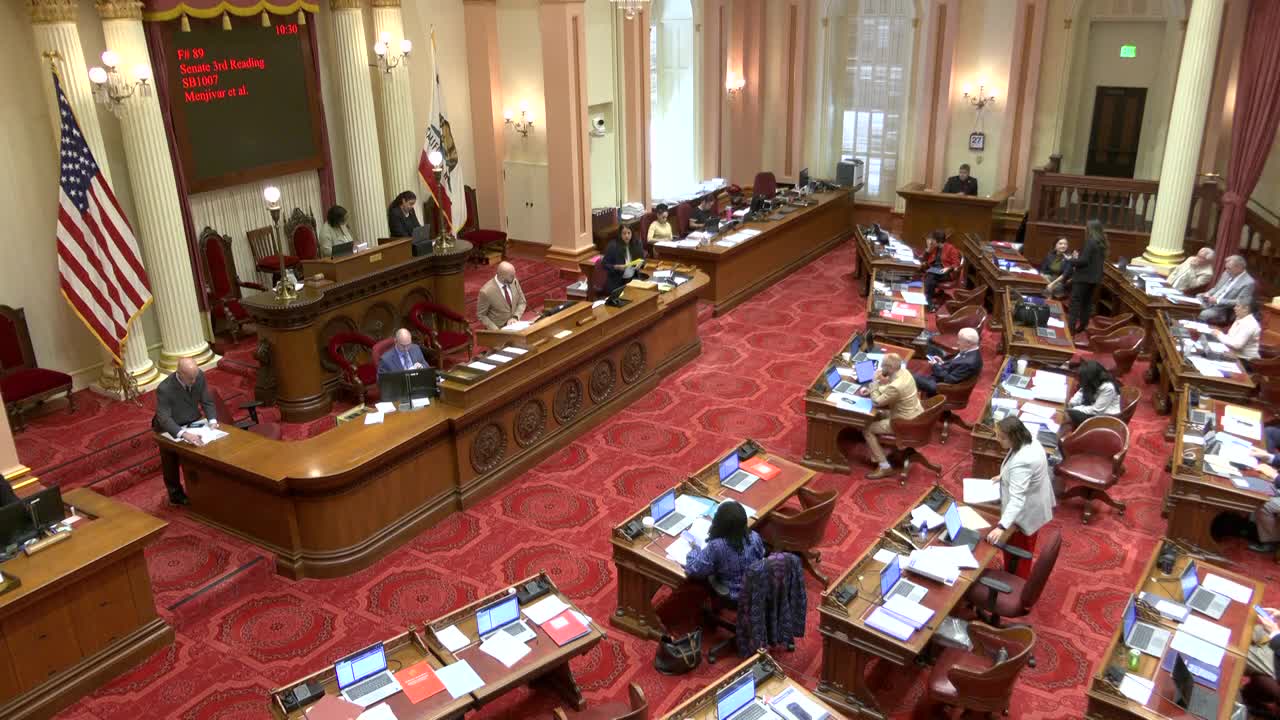 14MIN
Senate Floor
 29MIN
Senate Standing Committee on Judiciary
 51MIN
Senate Standing Committee on Housing
Bill Author


