SB 1013: Automated license plate recognition systems.
- Session Year: 2025-2026
- House: Senate
- Latest Version Date: 2026-08-27
Current Status:
In Progress
(2026-08-27: Joint Rule 61(b)(16) suspended. (Ayes 58. Noes 1. Page 6727.))
Introduced
In Committee
Awaiting First Chamber Vote
Passed First Chamber
In Committee
Awaiting Second Chamber Vote
Passed Second Chamber
Enacted
Existing law prohibits a public agency, which includes the state, a city, a county, a city and county, or any agency or political subdivision of the state, a city, a county, or a city and county, including, but not limited to, a law enforcement agency, from selling, sharing, or transferring automated license plate recognition (ALPR) information, except to another public agency, and only as otherwise permitted by law. Existing law defines ALPR information as information or data collected through the use of an ALPR system.
This bill would provide that public agency does not include a transportation agency, a public transit operator, department of transportation, public works department, or campus transportation agency, as specified, a public agency or contracted parking operator when engaging in specified activities in a parking facility, a state agency operating specified parking facilities, or the State Air Resources Board. The bill would require a public agency that accesses or provides access to ALPR information to maintain a record of that access, as provided. The bill would, beginning January 1, 2027, require new, updated, renewed, extended, expansions of, or addendums of contractual agreements with ALPR vendors, manufacturers, or suppliers to mandate that no default access is provided to any national ALPR database and that an agencys collected scans are by default not accessible to any other agency, except as specified, and would impose new requirements on sharing between California state law enforcement agencies.
This bill would authorize a law enforcement agency to use ALPR information only for purposes of locating vehicles or persons when either are reasonably suspected of being involved in the commission of a public offense or locating an individual who has been reported as missing to a law enforcement agency. The bill, as of January 1, 2027, 2028, would require a public agency to archive all ALPR information that has been held for more than 60 days within 14 days, unless that ALPR information is retained in the evidence file of an active investigation or criminal proceeding or matches information on an authorized hot list, as defined, and retain ALPR information that becomes part of an investigation or criminal proceeding in the evidence file as long as the evidence file is required to be held by state law or court order. The bill would prohibit a public agency from querying any archived information except pursuant to a warrant, as specified.
By imposing new requirements on public agencies, which include local agencies, this bill would impose a state-mandated local program.
Existing law defines an ALPR operator as a person that operates an ALPR system, which does not include a transportation agency. Existing law defines an ALPR end-user as a person that accesses or uses an ALPR system, which does not include, among other things, a transportation agency.
This bill would additionally exclude from the definitions of ALPR operator and ALPR end-user a public transit operator, department of transportation, public works department, campus transportation agency, or an airport or airport operator, as provided. The bill would also exclude from the definition of ALPR operator the Department of General Services and its operators when engaging in specified activities in a parking facility and would exclude from the definition of ALPR end-user a state agency operating specified parking facilities and the State Air Resources Board.
Existing law requires an ALPR operator and ALPR end-user to maintain reasonable security procedures and practices, including operational, administrative, technical, and physical safeguards, to protect ALPR information from unauthorized access, destruction, use, modification, or disclosure.
This bill would require those security procedures and practices to include safeguards for managing which employees can see the data from their systems, as specified, and requiring data security training and data privacy training for all employees that access ALPR information.
Existing law requires an ALPR operator and ALPR end-user to implement a usage and privacy policy that includes, among other things, a description of the job title or other designation of the employees and independent contractors who are authorized to access and use ALPR information.
This bill would require the usage and privacy policy to identify what purpose employees and independent contractors access and use ALPR information for. The bill would also require the Department of Justice to, beginning October 1, 2029, and contingent upon an appropriation of sufficient funds, conduct annual random audits on a public agency that is an ALPR operator or ALPR end-user to determine whether they have implemented and are adhering to that usage and privacy policy.
Existing law requires an ALPR operator that accesses or provides access to ALPR information to require that ALPR information only be used for the authorized purposes described in the usage and privacy policy and to maintain a record of that access that includes, among other things, the purpose for accessing the information.
This bill would instead require that record of access maintained by the ALPR operator to include a brief, accurate, specific, and plain language statement describing the purpose for accessing ALPR information.
The bill would include findings that changes proposed by this bill address a matter of statewide concern rather than a municipal affair and, therefore, apply to all cities, including charter cities.
The California Constitution requires the state to reimburse local agencies and school districts for certain costs mandated by the state. Statutory provisions establish procedures for making that reimbursement.
This bill would provide that, if the Commission on State Mandates determines that the bill contains costs mandated by the state, reimbursement for those costs shall be made pursuant to the statutory provisions noted above.
Existing law prohibits a public agency, which includes the state, a city, a county, a city and county, or any agency or political subdivision of the state, a city, a county, or a city and county, including, but not limited to, a law enforcement agency, from selling, sharing, or transferring automated license plate recognition (ALPR) information, except to another public agency, and only as otherwise permitted by law. Existing law defines ALPR information as information or data collected through the use of an ALPR system.
This bill would provide that public agency does not include a transportation agency, a public transit operator, department of transportation, public works department, or campus transportation agency, as specified, or a public agency or contracted parking operator when engaging in specified activities in a parking facility. facility, a state agency operating specified parking facilities, or the State Air Resources Board. The bill would require a public agency that accesses or provides access to ALPR information to maintain a record of that access, as provided. The bill would, beginning January 1, 2027, require new, updated, renewed, extended, expansions of, or addendums of contractual agreements with ALPR vendors, manufacturers, or suppliers to mandate that no default access is provided to any national ALPR database and that an agencys collected scans are by default not accessible to any other agency, except as specified, and would impose new requirements on sharing between California state law enforcement agencies.
This bill would authorize a law enforcement agency to use ALPR information only for purposes of locating vehicles or persons when either are reasonably suspected of being involved in the commission of a public offense or locating an individual who has been reported as missing to a law enforcement agency. The bill would prohibit a public agency from retaining ALPR information for more than 30 days after the date of collection, and bill, as of January 1, 2027, would require a public agency to delete archive all ALPR information that has been held for more than 30 60 days within 14 days, unless that ALPR information is retained in the evidence file of an active investigation or criminal proceeding or matches information on an authorized hot list, as defined, and retain ALPR information that becomes part of an investigation or criminal proceeding in the evidence file as long as the evidence file is required to be held by the agency. state law or court order. The bill would prohibit a public agency from querying any archived information except pursuant to a warrant, as specified.
By imposing new requirements on public agencies, which include local agencies, this bill would impose a state-mandated local program.
Existing law defines an ALPR operator as a person that operates an ALPR system, which does not include a transportation agency. Existing law defines an ALPR end-user as a person that accesses or uses an ALPR system, which does not include, among other things, a transportation agency.
This bill would additionally exclude from the definitions of ALPR operator and ALPR end-user a public transit operator, department of transportation, public works department, campus transportation agency, or an airport or airport operator, as provided. The bill would also exclude from the definition of ALPR operator the Department of General Services and its operators when engaging in specified activities in a parking facility and would exclude from the definition of ALPR end-user a state agency operating specified parking facilities and the State Air Resources Board.
Existing law requires an ALPR operator and ALPR end-user to maintain reasonable security procedures and practices, including operational, administrative, technical, and physical safeguards, to protect ALPR information from unauthorized access, destruction, use, modification, or disclosure.
This bill would require those security procedures and practices to include safeguards for managing which employees can see the data from their systems, as specified, and requiring data security training and data privacy training for all employees that access ALPR information.
Existing law requires an ALPR operator and ALPR end-user to implement a usage and privacy policy that includes, among other things, a description of the job title or other designation of the employees and independent contractors who are authorized to access and use ALPR information.
This bill would require the usage and privacy policy to identify what purpose employees and independent contractors access and use ALPR information for. The bill would also require the Department of Justice to, beginning October 1, 2029, and contingent upon an appropriation of sufficient funds, conduct annual random audits on a public agency that is an ALPR operator or ALPR end-user to determine whether they have implemented and are adhering to that usage and privacy policy.
Existing law requires an ALPR operator that accesses or provides access to ALPR information to require that ALPR information only be used for the authorized purposes described in the usage and privacy policy and to maintain a record of that access that includes, among other things, the purpose for accessing the information.
This bill would instead require that record of access maintained by the ALPR operator to include a brief, accurate, specific, and plain language statement describing the purpose for accessing ALPR information.
The bill would include findings that changes proposed by this bill address a matter of statewide concern rather than a municipal affair and, therefore, apply to all cities, including charter cities.
The California Constitution requires the state to reimburse local agencies and school districts for certain costs mandated by the state. Statutory provisions establish procedures for making that reimbursement.
This bill would provide that, if the Commission on State Mandates determines that the bill contains costs mandated by the state, reimbursement for those costs shall be made pursuant to the statutory provisions noted above.
Existing law prohibits a public agency, which includes the state, a city, a county, a city and county, or any agency or political subdivision of the state, a city, a county, or a city and county, including, but not limited to, a law enforcement agency, from selling, sharing, or transferring automated license plate recognition (ALPR) information, except to another public agency, and only as otherwise permitted by law. Existing law defines ALPR information as information or data collected through the use of an ALPR system.
This bill would provide that public agency does not include a transportation agency, a public transit operator, or a local department of transportation or transportation, public works department, or campus transportation agency, as specified. specified, or a public agency or contracted parking operator when engaging in specified activities in a parking facility. The bill would require a public agency that accesses or provides access to ALPR information to maintain a record of that access, as provided. The bill would, beginning January 1, 2027, require new, updated, expansions of, or addendums of contractual agreements with ALPR vendors, manufacturers, or suppliers to mandate that no default access is provided to any national ALPR database and that an agencys collected scans are by default not accessible to any other agency, and would impose new requirements on sharing between California state law enforcement agencies. The
This bill would authorize a law enforcement agency to use ALPR information only for purposes of locating vehicles or persons when either are reasonably suspected of being involved in the commission of a public offense or locating an individual who has been reported as missing to a law enforcement agency. The bill would prohibit a public agency from retaining ALPR information for more than 30 days after the date of collection, and as of January 1, 2027, would require a public agency to delete all ALPR information that has been held for more than 30 days within 14 days, unless that ALPR information is retained in the evidence file of an active investigation or criminal proceeding or matches information on an authorized hot list, as defined. By defined, and retain ALPR information that becomes part of an investigation or criminal proceeding in the evidence file as long as the evidence file is required to be held by the agency.
By imposing new requirements on public agencies, which include local agencies, this bill would impose a state-mandated local program.
Existing law defines an ALPR operator as a person that operates an ALPR system, which does not include a transportation agency. Existing law defines an ALPR end-user as a person that accesses or uses an ALPR system, which does not include, among other things, a transportation agency.
This bill would additionally exclude from the definitions of ALPR operator and ALPR end-user a public transit operator, a local department of transportation or transportation, public works department, campus transportation agency, or an airport or airport operator, as provided.
Existing law requires an ALPR operator and ALPR end-user to maintain reasonable security procedures and practices, including operational, administrative, technical, and physical safeguards, to protect ALPR information from unauthorized access, destruction, use, modification, or disclosure.
This bill would require those security procedures and practices to include safeguards for managing which employees can see the data from their systems, as specified, and requiring data security training and data privacy training for all employees that access ALPR information.
Existing law requires an ALPR operator and ALPR end-user to implement a usage and privacy policy that includes, among other things, a description of the job title or other designation of the employees and independent contractors who are authorized to access and use ALPR information.
This bill would require the usage and privacy policy to identify what purpose employees and independent contractors access and use ALPR information for. The bill would also require the Department of Justice to, contingent upon an appropriation of sufficient funds, conduct annual random audits on a public agency that is an ALPR operator or ALPR end-user to determine whether they have implemented and are adhering to that usage and privacy policy.
Existing law requires an ALPR operator that accesses or provides access to ALPR information to require that ALPR information only be used for the authorized purposes described in the usage and privacy policy and to maintain a record of that access that includes, among other things, the purpose for accessing the information.
This bill would instead require that record of access maintained by the ALPR operator to include the case file number, as defined, or task force name, as applicable, that justifies the search query, and would provide queries shall not be allowed without a log entry with a valid and current case file number or task force name from the agency conducting the query. a brief, accurate, specific, and plain language statement describing the purpose for accessing ALPR information.
The bill would include findings that changes proposed by this bill address a matter of statewide concern rather than a municipal affair and, therefore, apply to all cities, including charter cities.
The California Constitution requires the state to reimburse local agencies and school districts for certain costs mandated by the state. Statutory provisions establish procedures for making that reimbursement.
This bill would provide that, if the Commission on State Mandates determines that the bill contains costs mandated by the state, reimbursement for those costs shall be made pursuant to the statutory provisions noted above.
Existing law prohibits a public agency, which includes the state, a city, a county, a city and county, or any agency or political subdivision of the state, a city, a county, or a city and county, including, but not limited to, a law enforcement agency, from selling, sharing, or transferring automated license plate recognition (ALPR) information, except to another public agency, and only as otherwise permitted by law. Existing law defines ALPR information as information or data collected through the use of an ALPR system.
This bill would provide that public agency does not include a transportation agency, a public transit operator, or a local department of transportation or public works department, as specified. The bill would, beginning January 1, 2027, require new, updated, expansions of, or addendums of contractual agreements with ALPR vendors, manufacturers, or suppliers to mandate that no default access is provided to any national ALPR database and that an agencys collected scans are by default not accessible to any other agency, and would impose new requirements on sharing between California state law enforcement agencies. The bill would authorize a law enforcement agency to use ALPR information only for purposes of locating vehicles or persons when either are reasonably suspected of being involved in the commission of a public offense or locating an individual who has been reported as missing to a law enforcement agency. The bill would prohibit a public agency from retaining ALPR information for more than 30 days after the date of collection if it does not match information on an authorized hot list, as defined, collection, and as of January 1, 2027, would require a public agency to delete all ALPR information that has been held for more than 30 days within 14 days days, unless it that ALPR information is retained in the evidence file of an active investigation or criminal proceeding or matches information on an authorized hot list. list, as defined. By imposing new requirements on public agencies, which include local agencies, this bill would impose a state-mandated local program.
Existing law defines an ALPR operator as a person that operates an ALPR system, which does not include a transportation agency. Existing law defines an ALPR end-user as a person that accesses or uses an ALPR system, which does not include, among other things, a transportation agency.
This bill would additionally exclude from the definitions of ALPR operator and ALPR end-user a public transit operator, a local department of transportation or public works department, or an airport or airport operator, as provided.
Existing law requires an ALPR operator and ALPR end-user to maintain reasonable security procedures and practices, including operational, administrative, technical, and physical safeguards, to protect ALPR information from unauthorized access, destruction, use, modification, or disclosure.
This bill would require those security procedures and practices to include safeguards for managing which employees can see the data from their systems, as specified, and requiring data security training and data privacy training for all employees that access ALPR information.
Existing law requires an ALPR operator and ALPR end-user to implement a usage and privacy policy that includes, among other things, a description of the job title or other designation of the employees and independent contractors who are authorized to access and use ALPR information.
This bill would require the usage and privacy policy to identify what purpose employees and independent contractors access and use ALPR information for. The bill would also require the Department of Justice to, contingent upon an appropriation of sufficient funds, conduct annual random audits on a public agency that is an ALPR operator or ALPR end-user to determine whether they have implemented and are adhering to that usage and privacy policy.
Existing law requires an ALPR operator that accesses or provides access to ALPR information to require that ALPR information only be used for the authorized purposes described in the usage and privacy policy and to maintain a record of that access that includes, among other things, the purpose for accessing the information.
This bill would instead require that record of access maintained by the ALPR operator to include the case file number number, as defined, or task force name, as applicable, that justifies the search query, and would provide queries shall not be allowed without a log entry with a valid and current case file number or task force name from the agency conducting the query.
The bill would include findings that changes proposed by this bill address a matter of statewide concern rather than a municipal affair and, therefore, apply to all cities, including charter cities.
The California Constitution requires the state to reimburse local agencies and school districts for certain costs mandated by the state. Statutory provisions establish procedures for making that reimbursement.
This bill would provide that, if the Commission on State Mandates determines that the bill contains costs mandated by the state, reimbursement for those costs shall be made pursuant to the statutory provisions noted above.
Existing law prohibits a public agency, which includes the state, a city, a county, a city and county, or any agency or political subdivision of the state, a city, a county, or a city and county, including, but not limited to, a law enforcement agency, from selling, sharing, or transferring automated license plate recognition (ALPR) information, except to another public agency, and only as otherwise permitted by law. Existing law defines ALPR information as information or data collected through the use of an ALPR system.
This bill would provide that public agency does not include a transportation agency, a public transit operator, or a local department of transportation or public works department, as specified. The bill would, beginning January 1, 2027, require new, updated, expansions of, or addendums of contractual agreements with ALPR vendors, manufacturers, or suppliers to mandate that no default access is provided to any national ALPR database and that an agencys collected scans are by default not accessible to any other agency, and would impose new requirements on sharing between California state law enforcement agencies. The bill would authorize a law enforcement agency to use ALPR information only for purposes of locating vehicles or persons when either are reasonably suspected of being involved in the commission of a public offense. offense or locating an individual who has been reported as missing to a law enforcement agency. The bill would prohibit a public agency from retaining ALPR information for more than 30 days after the date of collection if it does not match information on an authorized hot list, as defined, and as of January 1, 2027, would require a public agency to delete all ALPR information that has been held for more than 30 days and does not match information on an authorized hot list within 14 days. days unless it is retained in the evidence file of an active investigation or criminal proceeding or matches information on an authorized hot list. By imposing new requirements on public agencies, which include local agencies, this bill would impose a state-mandated local program.
Existing law defines an ALPR operator as a person that operates an ALPR system, which does not include a transportation agency. Existing law defines an ALPR end-user as a person that accesses or uses an ALPR system, which does not include, among other things, a transportation agency.
This bill would additionally exclude from the definitions of ALPR operator and ALPR end-user a public transit operator, a local department of transportation or public works department, or an airport or airport operator, as provided.
Existing law requires an ALPR operator and ALPR end-user to maintain reasonable security procedures and practices, including operational, administrative, technical, and physical safeguards, to protect ALPR information from unauthorized access, destruction, use, modification, or disclosure.
This bill would require those security procedures and practices to include safeguards for managing which employees can see the data from their systems, as specified, and requiring data security training and data privacy training for all employees that access ALPR information.
Existing law requires an ALPR operator and ALPR end-user to implement a usage and privacy policy that includes, among other things, a description of the job title or other designation of the employees and independent contractors who are authorized to access and use ALPR information.
This bill would require the usage and privacy policy to identify what purpose employees and independent contractors access and use ALPR information for. The bill would also require the Department of Justice to, contingent upon an appropriation of sufficient funds, conduct annual random audits on a public agency that is an ALPR operator or ALPR end-user to determine whether they have implemented and are adhering to that usage and privacy policy.
Existing law requires an ALPR operator that accesses or provides access to ALPR information to require that ALPR information only be used for the authorized purposes described in the usage and privacy policy and to maintain a record of that access that includes, among other things, the purpose for accessing the information.
This bill would instead require that record of access maintained by the ALPR operator to include the case file number or task force name, as applicable, that justifies the search query, and would provide queries shall not be allowed without a log entry with a valid and current case file number or task force name from the agency conducting the query.
The bill would include findings that changes proposed by this bill address a matter of statewide concern rather than a municipal affair and, therefore, apply to all cities, including charter cities.
The California Constitution requires the state to reimburse local agencies and school districts for certain costs mandated by the state. Statutory provisions establish procedures for making that reimbursement.
This bill would provide that, if the Commission on State Mandates determines that the bill contains costs mandated by the state, reimbursement for those costs shall be made pursuant to the statutory provisions noted above.
Existing law prohibits a public agency, which includes the state, a city, a county, a city and county, or any agency or political subdivision of the state, a city, a county, or a city and county, including, but not limited to, a law enforcement agency, from selling, sharing, or transferring automated license plate recognition (ALPR) information, except to another public agency, and only as otherwise permitted by law. Existing law defines ALPR information as information or data collected through the use of an ALPR system.
This bill would provide that public agency does not include a transportation agency, a public transit operator, or a local department of transportation or public works department, as specified. The bill would, beginning January 1, 2027, require new, updated, expansions of, or addendums of contractual agreements with ALPR vendors, manufacturers, or suppliers to mandate that no default access is provided to any national ALPR database and that an agencys collected scans are by default not accessible to any other agency, and would impose new requirements on sharing between California state law enforcement agencies. The bill would authorize a law enforcement agency to use ALPR information only for purposes of locating vehicles or persons when either are reasonably suspected of being involved in the commission of a public offense. The bill would prohibit a public agency from retaining ALPR information for more than 30 days after the date of collection if it does not match information on an authorized hot list, as defined, and as of January 1, 2027, would require a public agency to delete all ALPR information that has been held for more than 30 days and does not match information on an authorized hot list within 14 days. By imposing new requirements on public agencies, which include local agencies, this bill would impose a state-mandated local program.
Existing law defines an ALPR operator as a person that operates an ALPR system, which does not include a transportation agency. Existing law defines an ALPR end-user as a person that accesses or uses an ALPR system, which does not include, among other things, a transportation agency.
This bill would additionally exclude from the definitions of ALPR operator and ALPR end-user a public transit operator, a local department of transportation or public works department, or an airport or airport operator, as provided.
Existing law requires an ALPR operator and ALPR end-user to maintain reasonable security procedures and practices, including operational, administrative, technical, and physical safeguards, to protect ALPR information from unauthorized access, destruction, use, modification, or disclosure.
This bill would require those security procedures and practices to include safeguards for managing which employees can see the data from their systems, as specified, and requiring data security training and data privacy training for all employees that access ALPR information.
Existing law requires an ALPR operator and ALPR end-user to implement a usage and privacy policy that includes, among other things, a description of the job title or other designation of the employees and independent contractors who are authorized to access and use ALPR information.
This bill would require the usage and privacy policy to identify what purpose employees and independent contractors access and use ALPR information for. The bill would also require the Department of Justice to, contingent upon an appropriation of sufficient funds, conduct annual random audits on a public agency that is an ALPR operator or ALPR end-user to determine whether they have implemented and are adhering to that usage and privacy policy.
Existing law requires an ALPR operator that accesses or provides access to ALPR information to require that ALPR information only be used for the authorized purposes described in the usage and privacy policy and to maintain a record of that access that includes, among other things, the purpose for accessing the information.
This bill would instead require that record of access maintained by the ALPR operator to include the case file number or task force name, as applicable, that justifies the search query, and would provide queries shall not be allowed without a log entry with a valid and current case file number or task force name from the agency conducting the query.
The bill would include findings that changes proposed by this bill address a matter of statewide concern rather than a municipal affair and, therefore, apply to all cities, including charter cities.
The California Constitution requires the state to reimburse local agencies and school districts for certain costs mandated by the state. Statutory provisions establish procedures for making that reimbursement.
This bill would provide that, if the Commission on State Mandates determines that the bill contains costs mandated by the state, reimbursement for those costs shall be made pursuant to the statutory provisions noted above.
Existing law prohibits the state, a city, a county, a city and county, or any agency or political subdivision of the state, a city, a county, or a city and county, including, but not limited to, a law enforcement agency, from selling, sharing, or transferring automated license plate recognition (ALPR) information, except to another public agency, and only as otherwise permitted by law. Existing law defines ALPR information as information or data collected through the use of an ALPR system.This bill would state the intent of the Legislature to enact legislation that would impose privacy protection requirements on cities, counties, and entities that use ALPR data and prohibit public agencies from selling or sharing ALPR information or information in collaboration with private contractors for the purposes of the arrest, imprisonment, detainment, or deportation for immigration enforcement purposes.Existing law prohibits the state, a city, a county, a city and county, or any agency or political subdivision of the state, a city, a county, or a city and county, including, but not limited to, a law enforcement agency, from selling, sharing, or transferring automated license plate recognition (ALPR) information, except to another public agency, and only as otherwise permitted by law. Existing law defines ALPR information as information or data collected through the use of an ALPR system.
This bill would state the intent of the Legislature to enact legislation that would impose privacy protection requirements on cities, counties, and entities that use ALPR data and prohibit public agencies from selling or sharing ALPR information or information in collaboration with private contractors for the purposes of the arrest, imprisonment, detainment, or deportation for immigration enforcement purposes.
This act shall be known as the Automated License Plate Recognition (ALPR) Data Accountability Act.
SEC. 2.Section 1798.90.5 of the Civil Code is amended to read:1798.90.5.The following definitions shall apply for purposes of this title:
(a)Airport or airport operator means a city, county, city and county, airport authority, joint powers authority, special district, or other public entity that owns or operates a public-use airport, and its contracted parking operator acting on the airports behalf.
(b)Automated license plate recognition end-user or ALPR end-user means a person that accesses or uses an ALPR system, but does not include any of the following:
(1)A transportation agency when subject to Section 31490 of the Streets and Highways Code.
(2)A public transit operator when subject to Section 40240 or 40245 of the Vehicle Code.
(3)A department of transportation, public works department, or campus transportation agency when subject to Section 21455.5 of, Section 21455.9 of, Article 3 (commencing with Section 22425), Article 4 (commencing with Section 22435), or Article 5 (commencing with Section 22445) of Chapter 7 of Division 11 of, Section 40240 of, or Section 40245 of, the Vehicle Code.
(4)An airport or airport operator when collecting, accessing, or using ALPR information solely for parking access control, fee calculation, lost-ticket resolution, fraud prevention, or transaction dispute resolution in an airport parking facility.
(5)A person that is subject to Sections 6801 to 6809, inclusive, of Title 15 of the United States Code and state or federal statutes or regulations implementing those sections, if the person is subject to compliance oversight by a state or federal regulatory agency with respect to those sections.
(6)A person, other than a law enforcement agency, to whom information may be disclosed as a permissible use pursuant to Section 2721 of Title 18 of the United States Code.
(7)A state agency operating a motor vehicle parking facility pursuant to Section 14678 of the Government Code.
(8)The State Air Resources Board.
(c)Automated license plate recognition information, or ALPR information means information or data collected through the use of an ALPR system.
(d)Automated license plate recognition operator or ALPR operator means a person that operates an ALPR system, but does not include any of the following:
(1)A transportation agency when subject to Section 31490 of the Streets and Highways Code.
(2)A public transit operator when subject to Section 40240 or 40245 of the Vehicle Code.
(3)A department of transportation, public works department, or campus transportation agency when subject to Section 21455.5 of, Section 21455.9 of, Article 3 (commencing with Section 22425), Article 4 (commencing with Section 22435), or Article 5 (commencing with Section 22445) of Chapter 7 of Division 11 of, Section 40240 of, or Section 40245 of, the Vehicle Code.
(4)An airport or airport operator when collecting, accessing, or using ALPR information solely for parking access control, fee calculation, lost-ticket resolution, fraud prevention, or transaction dispute resolution in an airport parking facility.
(5)The Department of General Services and its operators when collecting, accessing, or using ALPR information solely for parking access control, fee calculation, lost-ticket resolution, fraud prevention, or transaction dispute resolution in a parking facility owned, controlled, or operated by the Department of General Services.
(e)Automated license plate recognition system or ALPR system means a searchable computerized database resulting from the operation of one or more mobile or fixed cameras combined with computer algorithms to read and convert images of registration plates and the characters they contain into computer-readable data.
(f)Case file number means a reference number pertaining to a specific law enforcement or public safety incident or investigation.
(g)Hot list means a list or lists of license plates of vehicles of interest against which the ALPR system is comparing vehicles in public. Authorized hot lists for public agencies are limited to the National Crime Information Center (NCIC) list, the National Center for Missing and Exploited Children (NCMEC) list, the Stolen Vehicle System (SVS), California Department of Justice lists, official alerts, including AMBER, Silver, Feather, Blue, Ebony, and any new alerts authorized by the Legislature, and custom lists that pertain solely to missing and at-risk persons or where there is reasonable suspicion to believe the vehicle is or was involved in a serious or violent felony, any crime requiring registration of a sex offender, a violation of Section 20001 of the Vehicle Code, a violation of Section 23152 of the Vehicle Code, burglary of a vehicle under Section 459 of the Penal Code, grand theft of an automobile under Section 487 of the Penal Code, a violation of Section 10851 of the Vehicle Code, or any other vehicular crime that may be punishable as a felony.
(h)Person means any natural person, public agency, partnership, firm, association, corporation, limited liability company, or other legal entity.
(i)Public agency means the state, any city, county, or city and county, or any agency or political subdivision of the state or a city, county, or city and county, including, but not limited to, a law enforcement agency, but does not include:
(1)A transportation agency when subject to Section 31490 of the Streets and Highways Code.
(2)A public transit operator when subject to Section 40240 or 40245 of the Vehicle Code.
(3)A department of transportation, public works department, or campus transportation agency when subject to Section 21455.5 of, Section 21455.9 of, Article 3 (commencing with Section 22425) or 22425), Article 4 (commencing with Section 22435) 22435), or Article 5 (commencing with Section 22445) of Chapter 7 of Division 11 of, Section 40240 of, or Section 40245 of, the Vehicle Code.
(4)A public agency or contracted parking operator when collecting, accessing, or using ALPR information solely for parking access control, violations, permit enforcement, zone enforcement, fee calculation, lost-ticket resolution, fraud prevention, or transaction dispute resolution in a parking facility, including when regulating or enforcing Section 21113 of the Vehicle Code and Chapter 9 (commencing with Section 22500) to Chapter 11 (commencing with Section 22950), inclusive, of Division 11 of the Vehicle Code.
(5)A state agency operating a motor vehicle parking facility pursuant to Section 14678 of the Government Code.
(6)The State Air Resources Board.
SEC. 3.Section 1798.90.51 of the Civil Code is amended to read:1798.90.51.An ALPR operator shall do both of the following:
(a)Maintain reasonable security procedures and practices, including operational, administrative, technical, and physical safeguards, to protect ALPR information from unauthorized access, destruction, use, modification, or disclosure, including both of the following:
(1)Safeguards for managing which employees can see the data from their systems, including requiring supervisory approval, robust authentication protocols for establishing an account to access an ALPR system, and tracking searches of ALPR information made by employees.
(2)Requiring data security training and data privacy training for all employees that access ALPR information.
(b)(1)Implement a usage and privacy policy, under the supervision of the Department of Justice according to subdivision (c) of Section 1798.90.54, if applicable, in order to ensure that the collection, use, maintenance, sharing, and dissemination of ALPR information is consistent with respect for individuals privacy and civil liberties. The usage and privacy policy shall be available to the public in writing, and, if the ALPR operator has an internet website, the usage and privacy policy shall be posted conspicuously on that internet website.
(2)The usage and privacy policy shall, at a minimum, include all of the following:
(A)The authorized purposes for using the ALPR system and collecting ALPR information.
(B)A description of the job title or other designation of the employees and independent contractors who are authorized to use or access the ALPR system, or to collect ALPR information, and for what purpose. The policy shall identify the training requirements necessary for those authorized employees and independent contractors.
(C)A description of how the ALPR system will be monitored to ensure the security of the information and compliance with applicable privacy laws.
(D)The purposes of, process for, and restrictions on, the sale, sharing, or transfer of ALPR information to other persons.
(E)The title of the official custodian, or owner, of the ALPR system responsible for implementing this section.
(F)A description of the reasonable measures that will be used to ensure the accuracy of ALPR information and correct data errors.
(G)The length of time ALPR information will be retained, and the process the ALPR operator will utilize to determine if and when to destroy retained ALPR information.
SEC. 4.Section 1798.90.52 of the Civil Code is amended to read:1798.90.52.If an ALPR operator accesses or provides access to ALPR information, the ALPR operator shall do both of the following:
(a)Maintain a record of that access. At a minimum, the record shall include all of the following:
(1)The date and time the information is accessed.
(2)The license plate number or other data elements used to query the ALPR system.
(3)The username of the person who accesses the information, and, as applicable, the organization or entity with whom the person is affiliated.
(4)A brief, accurate, specific, and plain language statement describing the purpose for accessing ALPR information.
(b)Require that ALPR information only be used for the authorized purposes described in the usage and privacy policy required by subdivision (b) of Section 1798.90.51.
SEC. 5.Section 1798.90.53 of the Civil Code is amended to read:1798.90.53.An ALPR end-user shall do both of the following:
(a)Maintain reasonable security procedures and practices, including operational, administrative, technical, and physical safeguards, to protect ALPR information from unauthorized access, destruction, use, modification, or disclosure, including both of the following:
(1)Safeguards for managing which employees can see the data from their systems, including requiring supervisory approval, robust authentication protocols for establishing an account to access an ALPR system, and tracking searches of ALPR information made by employees.
(2)Requiring data security training and data privacy training for all employees that access ALPR information.
(b)(1)Implement a usage and privacy policy, under the supervision of the Department of Justice according to subdivision (c) of Section 1798.90.54, if applicable, in order to ensure that the access, use, sharing, and dissemination of ALPR information is consistent with respect for individuals privacy and civil liberties. The usage and privacy policy shall be available to the public in writing, and, if the ALPR end-user has an internet website, the usage and privacy policy shall be posted conspicuously on that internet website.
(2)The usage and privacy policy shall, at a minimum, include all of the following:
(A)The authorized purposes for accessing and using ALPR information.
(B)A description of the job title or other designation of the employees and independent contractors who are authorized to access and use ALPR information, and for what purpose. The policy shall identify the training requirements necessary for those authorized employees and independent contractors.
(C)A description of how the ALPR system will be monitored to ensure the security of the information accessed or used, and compliance with all applicable privacy laws and a process for periodic system audits.
(D)The purposes of, process for, and restrictions on, the sale, sharing, or transfer of ALPR information to other persons.
(E)The title of the official custodian, or owner, of the ALPR information responsible for implementing this section.
(F)A description of the reasonable measures that will be used to ensure the accuracy of ALPR information and correct data errors.
(G)The length of time ALPR information will be retained, and the process the ALPR end-user will utilize to determine if and when to destroy retained ALPR information.
SEC. 6.Section 1798.90.54 of the Civil Code is amended to read:1798.90.54.(a)In addition to any other sanctions, penalties, or remedies provided by law, an individual who has been harmed by a violation of this title, including, but not limited to, unauthorized access or use of ALPR information or a breach of security of an ALPR system, may bring a civil action in any court of competent jurisdiction against a person who knowingly caused the harm.
(b)The court may award a combination of any one or more of the following:
(1)Actual damages, but not less than liquidated damages in the amount of two thousand five hundred dollars ($2,500).
(2)Punitive damages upon proof of willful or reckless disregard of the law.
(3)Reasonable attorneys fees and other litigation costs reasonably incurred.
(4)Other preliminary and equitable relief as the court determines to be appropriate.
(c)(1)Beginning October 1, 2029, the Department of Justice shall conduct annual random audits on a public agency that is an ALPR operator or ALPR end-user to determine whether they have implemented and are adhering to a usage and privacy policy in compliance with subdivision (b) of Section 1798.90.51 or subdivision (b) of Section 1798.90.53, as applicable.
(2)The implementation of this subdivision is contingent upon an appropriation of sufficient funds in the annual Budget Act for those purposes.
SEC. 7.Section 1798.90.55 of the Civil Code is amended to read:1798.90.55.Notwithstanding any other law or regulation:
(a)A public agency that operates or intends to operate an ALPR system shall provide an opportunity for public comment at a regularly scheduled public meeting of the governing body of the public agency before implementing the program.
(b)(1)A public agency shall not sell, share, or transfer ALPR information, except to another public agency, and only as otherwise permitted by law. For purposes of this section, the provision of data hosting or towing services shall not be considered the sale, sharing, or transferring of ALPR information.
(2)If a public agency accesses or provides access to ALPR information, the public agency shall maintain a record of that access. At a minimum, the record shall include all of the following:
(A)The date and time the information is accessed.
(B)The license plate number or other data elements used to query the ALPR system.
(C)The username of the person who accesses the information, and, as applicable, the organization or entity with whom the person is affiliated.
(D)A brief, accurate, specific, and plain language statement describing the purpose for accessing ALPR information. Generic entries such as investigation, law enforcement, official business, patrol, criminal investigation, search, or similarly vague description do not satisfy this obligation. A query shall not be allowed without a log entry of the purpose for the query.
(E)The case file number or incident number that pertains to the purpose for accessing ALPR information, if available.
(i)In the event of a search query that is conducted as part of an interagency task force established by the Attorney General and overseen by the offices Bureau of Investigation, in lieu of a case file number or incident number as required by this subparagraph the record of access shall include the name of the task force and the name of the bureau commander in charge of the task force.
(ii)In the event of a search query that is conducted as part of an effort to administer, collect, or enforce the taxes due to the California Department of Tax and Fee Administration pursuant to Part 1 (commencing with Section 6001), Part 1.5 (commencing with Section 7200), Part 1.6 (commencing with Section 7251), or Part 1.7 (commencing with Section 7280) of the Revenue and Taxation Code the case file number shall be the account number of the person that is the subject of the query.
(3)(A)Beginning January 1, 2027, all new, updated, renewed, extended, expansions of, or addendums of contractual agreements with ALPR vendors, manufacturers, or suppliers shall mandate that no default access is provided to any national ALPR database and that an agencys collected scans are by default not accessible to any other agency. A law enforcement agency may manually implement agency to agency sharing with other California state law enforcement agencies only as authorized in a manner consistent with Department of Justice General Order 2023-05 or any updated guidance thereto.
(4)Subparagraph (A) Paragraph (3) shall not apply to any contractual agreements between the California Department of Tax and Fee Administration and ALPR vendors, manufacturers, or suppliers and the California Department of Tax and Fee Administration shall be granted default access to any ALPR database for a public agencys collected scans for the purposes of administering, collecting, or enforcing the taxes due to the California Department of Tax and Fee Administration pursuant to Part 1 (commencing with Section 6001), Part 1.5 (commencing with Section 7200), Part 1.6 (commencing with Section 7251), or Part 1.7 (commencing with Section 7280) of the Revenue and Taxation Code.
(c)ALPR information may be used by a law enforcement agency only for purposes of locating vehicles or persons when either are reasonably suspected of being involved in the commission of a public offense or locating an individual who has been reported as missing to a law enforcement agency.
SEC. 8.Section 1798.90.57 is added to the Civil Code, immediately following Section 1798.90.56, to read:1798.90.57.(a)As of January 1, 2027, 2028, a public agency shall, within 14 days, archive all ALPR information that has been held for more than 60 days unless it is retained in the evidence file of an active investigation or criminal proceeding or matches information on an authorized hot list.
(b)(1)A public agency shall not query archived ALPR information except pursuant to a warrant from a California court. Warrant documents shall be uploaded into the ALPR database used by the agency to allow the query to be run for archived ALPR information.
(2)This subdivision shall not be construed to limit the publics right of access.
(c)ALPR information that becomes part of an investigation or criminal proceeding shall be retained in the evidence file as long as the evidence file is required to be held by state law or court order.
SEC. 9.The Legislature finds and declares that Section 3 of this act amending Section 1798.90.51 of the Civil Code, Section 4 of this act amending Section 1798.90.52 of the Civil Code, Section 5 of this act amending Section 1798.90.53 of the Civil Code, Section 7 of this act amending Section 1798.90.55 of the Civil Code, and Section 8 of this act adding Section 1798.90.57 to the Civil Code address a matter of statewide concern rather than a municipal affair as that term is used in Section 5 of Article XI of the California Constitution. Therefore, Sections 3, 4, 5, 7, and 8 of this act apply to all cities, including charter cities.
SEC. 10.If the Commission on State Mandates determines that this act contains costs mandated by the state, reimbursement to local agencies and school districts for those costs shall be made pursuant to Part 7 (commencing with Section 17500) of Division 4 of Title 2 of the Government Code.
This act shall be known as the Automated License Plate Recognition (ALPR) Data Accountability Act.
SEC. 2.Section 1798.90.5 of the Civil Code is amended to read:1798.90.5.The following definitions shall apply for purposes of this title:
(a)Airport or airport operator means a city, county, city and county, airport authority, joint powers authority, special district, or other public entity that owns or operates a public-use airport, and its contracted parking operator acting on the airports behalf.
(b)Automated license plate recognition end-user or ALPR end-user means a person that accesses or uses an ALPR system, but does not include any of the following:
(1)A transportation agency when subject to Section 31490 of the Streets and Highways Code.
(2)A public transit operator when subject to Section 40240 or 40245 of the Vehicle Code.
(3)A department of transportation, public works department, or campus transportation agency when subject to Section 21455.5 of, Section 21455.9 of, Article 3 (commencing with Section 22425) or 22425), Article 4 (commencing with Section 22435) 22435), or Article 5 (commencing with Section 22445) of Chapter 7 of Division 11 of, Section 40240 of, or Section 40245 of, the Vehicle Code.
(4)An airport or airport operator when collecting, accessing, or using ALPR information solely for parking access control, fee calculation, lost-ticket resolution, fraud prevention, or transaction dispute resolution in an airport parking facility.
(5)A person that is subject to Sections 6801 to 6809, inclusive, of Title 15 of the United States Code and state or federal statutes or regulations implementing those sections, if the person is subject to compliance oversight by a state or federal regulatory agency with respect to those sections.
(6)A person, other than a law enforcement agency, to whom information may be disclosed as a permissible use pursuant to Section 2721 of Title 18 of the United States Code.
(7)A state agency operating a motor vehicle parking facility pursuant to Section 14678 of the Government Code.
(8)The State Air Resources Board.
(c)Automated license plate recognition information, or ALPR information means information or data collected through the use of an ALPR system.
(d)Automated license plate recognition operator or ALPR operator means a person that operates an ALPR system, but does not include any of the following:
(1)A transportation agency when subject to Section 31490 of the Streets and Highways Code.
(2)A public transit operator when subject to Section 40240 or 40245 of the Vehicle Code.
(3)A department of transportation, public works department, or campus transportation agency when subject to Section 21455.5 of, Section 21455.9 of, Article 3 (commencing with Section 22425) or 22425), Article 4 (commencing with Section 22435) 22435), or Article 5 (commencing with Section 22445) of Chapter 7 of Division 11 of, Section 40240 of, or Section 40245 of, the Vehicle Code.
(4)An airport or airport operator when collecting, accessing, or using ALPR information solely for parking access control, fee calculation, lost-ticket resolution, fraud prevention, or transaction dispute resolution in an airport parking facility.
(5)The Department of General Services and its operators when collecting, accessing, or using ALPR information solely for parking access control, fee calculation, lost-ticket resolution, fraud prevention, or transaction dispute resolution in a parking facility owned, controlled, or operated by the Department of General Services.
(e)Automated license plate recognition system or ALPR system means a searchable computerized database resulting from the operation of one or more mobile or fixed cameras combined with computer algorithms to read and convert images of registration plates and the characters they contain into computer-readable data.
(f)Case file number means a reference number pertaining to a specific law enforcement or public safety incident or investigation.
(g)Hot list means a list or lists of license plates of vehicles of interest against which the ALPR system is comparing vehicles on the roadways. in public. Authorized hot lists for public agencies are limited to the National Crime Information Center (NCIC) list, the National Center for Missing and Exploited Children (NCMEC) list, the Stolen Vehicle System (SVS), California Department of Justice lists, official alerts, including AMBER, Silver, Feather, Blue, Yellow, Ebony, and any new alerts authorized by the Legislature, and custom BOLO lists that pertain solely to missing and at-risk persons, witness locations, burglaries, grand theft, vehicular assault, enforcing a court-ordered protection order, and violent crimes. persons or where there is reasonable suspicion to believe the vehicle is or was involved in a serious or violent felony, any crime requiring registration of a sex offender, a violation of Section 20001 of the Vehicle Code, a violation of Section 23152 of the Vehicle Code, burglary of a vehicle under Section 459 of the Penal Code, grand theft of an automobile under Section 487 of the Penal Code, a violation of Section 10851 of the Vehicle Code, or any other vehicular crime that may be punishable as a felony.
(h)Person means any natural person, public agency, partnership, firm, association, corporation, limited liability company, or other legal entity.
(i)Public agency means the state, any city, county, or city and county, or any agency or political subdivision of the state or a city, county, or city and county, including, but not limited to, a law enforcement agency, but does not include:
(1)A transportation agency when subject to Section 31490 of the Streets and Highways Code.
(2)A public transit operator when subject to Section 40240 or 40245 of the Vehicle Code.
(3)A department of transportation, public works department, or campus transportation agency when subject to Section 21455.5 of, Section 21455.9 of, Article 3 (commencing with Section 22425) or Article 4 (commencing with Section 22435) of Chapter 7 of Division 11 of, Section 40240 of, or Section 40245 of, the Vehicle Code.
(4)A public agency or contracted parking operator when collecting, accessing, or using ALPR information solely for parking access control, violations, permit enforcement, zone enforcement, fee calculation, lost-ticket resolution, fraud prevention, or transaction dispute resolution in a parking facility, including when regulating or enforcing Chapter 9 (commencing with Section 22500) to Chapter 11 (commencing with Section 22950), inclusive, of Division 11 of the Vehicle Code.
(5)A state agency operating a motor vehicle parking facility pursuant to Section 14678 of the Government Code.
(6)The State Air Resources Board.
SEC. 3.Section 1798.90.51 of the Civil Code is amended to read:1798.90.51.An ALPR operator shall do both of the following:
(a)Maintain reasonable security procedures and practices, including operational, administrative, technical, and physical safeguards, to protect ALPR information from unauthorized access, destruction, use, modification, or disclosure, including both of the following:
(1)Safeguards for managing which employees can see the data from their systems, including requiring supervisory approval, robust authentication protocols for establishing an account to access an ALPR system, and tracking searches of ALPR information made by employees.
(2)Requiring data security training and data privacy training for all employees that access ALPR information.
(b)(1)Implement a usage and privacy policy, under the supervision of the Department of Justice according to subdivision (c) of Section 1798.90.54, if applicable, in order to ensure that the collection, use, maintenance, sharing, and dissemination of ALPR information is consistent with respect for individuals privacy and civil liberties. The usage and privacy policy shall be available to the public in writing, and, if the ALPR operator has an internet website, the usage and privacy policy shall be posted conspicuously on that internet website.
(2)The usage and privacy policy shall, at a minimum, include all of the following:
(A)The authorized purposes for using the ALPR system and collecting ALPR information.
(B)A description of the job title or other designation of the employees and independent contractors who are authorized to use or access the ALPR system, or to collect ALPR information, and for what purpose. The policy shall identify the training requirements necessary for those authorized employees and independent contractors.
(C)A description of how the ALPR system will be monitored to ensure the security of the information and compliance with applicable privacy laws.
(D)The purposes of, process for, and restrictions on, the sale, sharing, or transfer of ALPR information to other persons.
(E)The title of the official custodian, or owner, of the ALPR system responsible for implementing this section.
(F)A description of the reasonable measures that will be used to ensure the accuracy of ALPR information and correct data errors.
(G)The length of time ALPR information will be retained, and the process the ALPR operator will utilize to determine if and when to destroy retained ALPR information.
SEC. 4.Section 1798.90.52 of the Civil Code is amended to read:1798.90.52.If an ALPR operator accesses or provides access to ALPR information, the ALPR operator shall do both of the following:
(a)Maintain a record of that access. At a minimum, the record shall include all of the following:
(1)The date and time the information is accessed.
(2)The license plate number or other data elements used to query the ALPR system.
(3)The username of the person who accesses the information, and, as applicable, the organization or entity with whom the person is affiliated.
(4)A brief, accurate, specific, and plain language statement describing the purpose for accessing ALPR information.
(b)Require that ALPR information only be used for the authorized purposes described in the usage and privacy policy required by subdivision (b) of Section 1798.90.51.
SEC. 5.Section 1798.90.53 of the Civil Code is amended to read:1798.90.53.An ALPR end-user shall do both of the following:
(a)Maintain reasonable security procedures and practices, including operational, administrative, technical, and physical safeguards, to protect ALPR information from unauthorized access, destruction, use, modification, or disclosure, including both of the following:
(1)Safeguards for managing which employees can see the data from their systems, including requiring supervisory approval, robust authentication protocols for establishing an account to access an ALPR system, and tracking searches of ALPR information made by employees.
(2)Requiring data security training and data privacy training for all employees that access ALPR information.
(b)(1)Implement a usage and privacy policy, under the supervision of the Department of Justice according to subdivision (c) of Section 1798.90.54, if applicable, in order to ensure that the access, use, sharing, and dissemination of ALPR information is consistent with respect for individuals privacy and civil liberties. The usage and privacy policy shall be available to the public in writing, and, if the ALPR end-user has an internet website, the usage and privacy policy shall be posted conspicuously on that internet website.
(2)The usage and privacy policy shall, at a minimum, include all of the following:
(A)The authorized purposes for accessing and using ALPR information.
(B)A description of the job title or other designation of the employees and independent contractors who are authorized to access and use ALPR information, and for what purpose. The policy shall identify the training requirements necessary for those authorized employees and independent contractors.
(C)A description of how the ALPR system will be monitored to ensure the security of the information accessed or used, and compliance with all applicable privacy laws and a process for periodic system audits.
(D)The purposes of, process for, and restrictions on, the sale, sharing, or transfer of ALPR information to other persons.
(E)The title of the official custodian, or owner, of the ALPR information responsible for implementing this section.
(F)A description of the reasonable measures that will be used to ensure the accuracy of ALPR information and correct data errors.
(G)The length of time ALPR information will be retained, and the process the ALPR end-user will utilize to determine if and when to destroy retained ALPR information.
SEC. 6.Section 1798.90.54 of the Civil Code is amended to read:1798.90.54.(a)In addition to any other sanctions, penalties, or remedies provided by law, an individual who has been harmed by a violation of this title, including, but not limited to, unauthorized access or use of ALPR information or a breach of security of an ALPR system, may bring a civil action in any court of competent jurisdiction against a person who knowingly caused the harm.
(b)The court may award a combination of any one or more of the following:
(1)Actual damages, but not less than liquidated damages in the amount of two thousand five hundred dollars ($2,500).
(2)Punitive damages upon proof of willful or reckless disregard of the law.
(3)Reasonable attorneys fees and other litigation costs reasonably incurred.
(4)Other preliminary and equitable relief as the court determines to be appropriate.
(c)(1)The Beginning October 1, 2029, the Department of Justice shall conduct annual random audits on a public agency that is an ALPR operator or ALPR end-user to determine whether they have implemented and are adhering to a usage and privacy policy in compliance with subdivision (b) of Section 1798.90.51 or subdivision (b) of Section 1798.90.53, as applicable.
(2)The implementation of this subdivision is contingent upon an appropriation of sufficient funds in the annual Budget Act for those purposes.
SEC. 7.Section 1798.90.55 of the Civil Code is amended to read:1798.90.55.Notwithstanding any other law or regulation:
(a)A public agency that operates or intends to operate an ALPR system shall provide an opportunity for public comment at a regularly scheduled public meeting of the governing body of the public agency before implementing the program.
(b)(1)A public agency shall not sell, share, or transfer ALPR information, except to another public agency, and only as otherwise permitted by law. For purposes of this section, the provision of data hosting or towing services shall not be considered the sale, sharing, or transferring of ALPR information.
(2)If a public agency accesses or provides access to ALPR information, the public agency shall maintain a record of that access. At a minimum, the record shall include all of the following:
(A)The date and time the information is accessed.
(B)The license plate number or other data elements used to query the ALPR system.
(C)The username of the person who accesses the information, and, as applicable, the organization or entity with whom the person is affiliated.
(D)A brief, accurate, specific, and plain language statement describing the purpose for accessing ALPR information. Generic entries such as investigation, law enforcement, official business, patrol, criminal investigation, search, or similarly vague description do not satisfy this obligation. A query shall not be allowed without a log entry of the purpose for the query.
(E)The case file number or incident number that pertains to the purpose for accessing ALPR information. information, if available.
(3)(i)In the event of a search query that is conducted as part of an interagency task force established by the Attorney General and overseen by the offices Bureau of Investigation, in lieu of a case file number or incident number as required by this subparagraph (E) of paragraph (2), the record of access shall include the name of the task force and the name of the bureau commander in charge of the task force.
(ii)In the event of a search query that is conducted as part of an effort to administer, collect, or enforce the taxes due to the California Department of Tax and Fee Administration pursuant to Part 1 (commencing with Section 6001), Part 1.5 (commencing with Section 7200), Part 1.6 (commencing with Section 7251), or Part 1.7 (commencing with Section 7280) of the Revenue and Taxation Code the case file number shall be the account number of the person that is the subject of the query.
(4)(3)(A)Beginning January 1, 2027, all new, updated, renewed, extended, expansions of, or addendums of contractual agreements with ALPR vendors, manufacturers, or suppliers shall mandate that no default access is provided to any national ALPR database and that an agencys collected scans are by default not accessible to any other agency. A law enforcement agency may manually implement agency to agency sharing with other California state law enforcement agencies only as authorized by in a manner consistent with Department of Justice General Order 2023-05 or any subsequent Department of Justice orders or regulations governing ALPR usage. updated guidance thereto.
(4)Subparagraph (A) shall not apply to any contractual agreements between the California Department of Tax and Fee Administration and ALPR vendors, manufacturers, or suppliers and the California Department of Tax and Fee Administration shall be granted default access to any ALPR database for a public agencys collected scans for the purposes of administering, collecting, or enforcing the taxes due to the California Department of Tax and Fee Administration pursuant to Part 1 (commencing with Section 6001), Part 1.5 (commencing with Section 7200), Part 1.6 (commencing with Section 7251), or Part 1.7 (commencing with Section 7280) of the Revenue and Taxation Code.
(c)ALPR information may be used by a law enforcement agency only for purposes of locating vehicles or persons when either are reasonably suspected of being involved in the commission of a public offense or locating an individual who has been reported as missing to a law enforcement agency.
SEC. 8.Section 1798.90.56 is added to the Civil Code, immediately following Section 1798.90.55, to read:1798.90.56.A public agency shall not retain ALPR information for more than 30 days after the date of collection unless it is retained in the evidence file of an active investigation or criminal proceeding or matches information on an authorized hot list.SEC. 9.SEC. 8.Section 1798.90.57 is added to the Civil Code, immediately following Section 1798.90.56, to read:1798.90.57.(a)As of January 1, 2027, a public agency shall, within 14 days, delete archive all ALPR information that has been held for more than 30 60 days unless it is retained in the evidence file of an active investigation or criminal proceeding or matches information on an authorized hot list. ALPR
(b)(1)A public agency shall not query archived ALPR information except pursuant to a warrant from a California court. Warrant documents shall be uploaded into the ALPR database used by the agency to allow the query to be run for archived ALPR information.
(2)This subdivision shall not be construed to limit the publics right of access.
(c)ALPR information that becomes part of an investigation or criminal proceeding shall be retained in the evidence file as long as the evidence file is required to be held by the public agency. state law or court order.
SEC. 10.SEC. 9.The Legislature finds and declares that Section 3 of this act amending Section 1798.90.51 of the Civil Code, Section 4 of this act amending Section 1798.90.52 of the Civil Code, Section 5 of this act amending Section 1798.90.53 of the Civil Code, Section 7 of this act amending Section 1798.90.55 of the Civil Code, and Section 8 of this act adding Section 1798.90.56 to the Civil Code, and Section 9 of this act adding Section 1798.90.57 to the Civil Code address a matter of statewide concern rather than a municipal affair as that term is used in Section 5 of Article XI of the California Constitution. Therefore, Sections 3, 4, 5, 7, 8, and 9 and 8 of this act apply to all cities, including charter cities.
SEC. 11.SEC. 10.If the Commission on State Mandates determines that this act contains costs mandated by the state, reimbursement to local agencies and school districts for those costs shall be made pursuant to Part 7 (commencing with Section 17500) of Division 4 of Title 2 of the Government Code.
This act shall be known as the Automated License Plate Recognition (ALPR) Data Accountability Act.
SEC. 2.Section 1798.90.5 of the Civil Code is amended to read:1798.90.5.The following definitions shall apply for purposes of this title:
(a)Airport or airport operator means a city, county, city and county, airport authority, joint powers authority, special district, or other public entity that owns or operates a public-use airport, and its contracted parking operator acting on the airports behalf.
(b)Automated license plate recognition end-user or ALPR end-user means a person that accesses or uses an ALPR system, but does not include any of the following:
(1)A transportation agency when subject to Section 31490 of the Streets and Highways Code.
(2)A public transit operator when subject to Section 40240 of the Vehicle Code.
(3)A local department of transportation or transportation, public works department department, or campus transportation agency when subject to Section 21455.5 of, and Section 21455.9 of, Article 3 (commencing with Section 22425) or Article 4 (commencing with Section 22435) of Chapter 7 of Division 11 of, Section 40240 of, or Section 40245 of, the Vehicle Code.
(4)An airport or airport operator when collecting, accessing, or using ALPR information solely for parking access control, fee calculation, lost-ticket resolution, fraud prevention, or transaction dispute resolution in an airport parking facility.
(5)A person that is subject to Sections 6801 to 6809, inclusive, of Title 15 of the United States Code and state or federal statutes or regulations implementing those sections, if the person is subject to compliance oversight by a state or federal regulatory agency with respect to those sections.
(6)A person, other than a law enforcement agency, to whom information may be disclosed as a permissible use pursuant to Section 2721 of Title 18 of the United States Code.
(c)Automated license plate recognition information, or ALPR information means information or data collected through the use of an ALPR system.
(d)Automated license plate recognition operator or ALPR operator means a person that operates an ALPR system, but does not include any of the following:
(1)A transportation agency when subject to Section 31490 of the Streets and Highways Code.
(2)A public transit operator when subject to Section 40240 of the Vehicle Code.
(3)A local department of transportation or transportation, public works department department, or campus transportation agency when subject to Section 21455.5 of, and Section 21455.9 of, Article 3 (commencing with Section 22425) or Article 4 (commencing with Section 22435) of Chapter 7 of Division 11 of, Section 40240 of, or Section 40245 of, the Vehicle Code.
(4)An airport or airport operator when collecting, accessing, or using ALPR information solely for parking access control, fee calculation, lost-ticket resolution, fraud prevention, or transaction dispute resolution in an airport parking facility.
(e)Automated license plate recognition system or ALPR system means a searchable computerized database resulting from the operation of one or more mobile or fixed cameras combined with computer algorithms to read and convert images of registration plates and the characters they contain into computer-readable data.
(f)Case file number means a reference number pertaining to a specific law enforcement or public safety incident or investigation.
(g)Hot list means a list or lists of license plates of vehicles of interest against which the ALPR system is comparing vehicles on the roadways. Authorized hot lists for public agencies are limited to the National Crime Information Center (NCIC) list, the National Center for Missing and Exploited Children (NCMEC) list, the Stolen Vehicle System (SVS), California Department of Justice lists, official alerts, including AMBER, Silver, Feather, Blue, Yellow, Ebony, and any new alerts authorized by the Legislature, and custom BOLO lists that pertain solely to missing and at-risk persons, witness locations, burglaries, grand theft, vehicular assault, enforcing a court-ordered protection order, and violent crimes.
(h)Person means any natural person, public agency, partnership, firm, association, corporation, limited liability company, or other legal entity.
(i)Public agency means the state, any city, county, or city and county, or any agency or political subdivision of the state or a city, county, or city and county, including, but not limited to, a law enforcement agency, but does not include:
(1)A transportation agency when subject to Section 31490 of the Streets and Highways Code.
(2)A public transit operator when subject to Section 40240 of the Vehicle Code.
(3)A local department of transportation or transportation, public works department department, or campus transportation agency when subject to Section 21455.5 of, and Section 21455.9 of, Article 3 (commencing with Section 22425) or Article 4 (commencing with Section 22435) of Chapter 7 of Division 11 of, Section 40240 of, or Section 40245 of, the Vehicle Code.
(4)A public agency or contracted parking operator when collecting, accessing, or using ALPR information solely for parking access control, violations, permit enforcement, zone enforcement, fee calculation, lost-ticket resolution, fraud prevention, or transaction dispute resolution in a parking facility, including when regulating or enforcing Chapter 9 (commencing with Section 22500) to Chapter 11 (commencing with Section 22950), inclusive, of Division 11 of the Vehicle Code.
SEC. 3.Section 1798.90.51 of the Civil Code is amended to read:1798.90.51.An ALPR operator shall do both of the following:
(a)Maintain reasonable security procedures and practices, including operational, administrative, technical, and physical safeguards, to protect ALPR information from unauthorized access, destruction, use, modification, or disclosure, including both of the following:
(1)Safeguards for managing which employees can see the data from their systems, including requiring supervisory approval, robust authentication protocols for establishing an account to access an ALPR system, and tracking searches of ALPR information made by employees.
(2)Requiring data security training and data privacy training for all employees that access ALPR information.
(b)(1)Implement a usage and privacy policy, under the supervision of the Department of Justice according to subdivision (c) of Section 1798.90.54, if applicable, in order to ensure that the collection, use, maintenance, sharing, and dissemination of ALPR information is consistent with respect for individuals privacy and civil liberties. The usage and privacy policy shall be available to the public in writing, and, if the ALPR operator has an internet website, the usage and privacy policy shall be posted conspicuously on that internet website.
(2)The usage and privacy policy shall, at a minimum, include all of the following:
(A)The authorized purposes for using the ALPR system and collecting ALPR information.
(B)A description of the job title or other designation of the employees and independent contractors who are authorized to use or access the ALPR system, or to collect ALPR information, and for what purpose. The policy shall identify the training requirements necessary for those authorized employees and independent contractors.
(C)A description of how the ALPR system will be monitored to ensure the security of the information and compliance with applicable privacy laws.
(D)The purposes of, process for, and restrictions on, the sale, sharing, or transfer of ALPR information to other persons.
(E)The title of the official custodian, or owner, of the ALPR system responsible for implementing this section.
(F)A description of the reasonable measures that will be used to ensure the accuracy of ALPR information and correct data errors.
(G)The length of time ALPR information will be retained, and the process the ALPR operator will utilize to determine if and when to destroy retained ALPR information.
SEC. 4.Section 1798.90.52 of the Civil Code is amended to read:1798.90.52.If an ALPR operator accesses or provides access to ALPR information, the ALPR operator shall do both of the following:
(a)Maintain a record of that access. At a minimum, the record shall include all of the following:
(1)The date and time the information is accessed.
(2)The license plate number or other data elements used to query the ALPR system.
(3)The username of the person who accesses the information, and, as applicable, the organization or entity with whom the person is affiliated.
(4)(A)The case file number that justifies the search query. A query shall not be allowed without a log entry with a valid and current case file number from the agency conducting the query.(B)Notwithstanding subparagraph (A), in the event of a search query that is conducted as part of an interagency task force established by the Attorney General and overseen by the offices Bureau of Investigation, in lieu of a case file number, the log entry shall include the name of the task force and the name of the bureau commander in charge of the task force.(4)A brief, accurate, specific, and plain language statement describing the purpose for accessing ALPR information.
(b)Require that ALPR information only be used for the authorized purposes described in the usage and privacy policy required by subdivision (b) of Section 1798.90.51.
SEC. 5.Section 1798.90.53 of the Civil Code is amended to read:1798.90.53.An ALPR end-user shall do both of the following:
(a)Maintain reasonable security procedures and practices, including operational, administrative, technical, and physical safeguards, to protect ALPR information from unauthorized access, destruction, use, modification, or disclosure, including both of the following:
(1)Safeguards for managing which employees can see the data from their systems, including requiring supervisory approval, robust authentication protocols for establishing an account to access an ALPR system, and tracking searches of ALPR information made by employees.
(2)Requiring data security training and data privacy training for all employees that access ALPR information.
(b)(1)Implement a usage and privacy policy, under the supervision of the Department of Justice according to subdivision (c) of Section 1798.90.54, if applicable, in order to ensure that the access, use, sharing, and dissemination of ALPR information is consistent with respect for individuals privacy and civil liberties. The usage and privacy policy shall be available to the public in writing, and, if the ALPR end-user has an internet website, the usage and privacy policy shall be posted conspicuously on that internet website.
(2)The usage and privacy policy shall, at a minimum, include all of the following:
(A)The authorized purposes for accessing and using ALPR information.
(B)A description of the job title or other designation of the employees and independent contractors who are authorized to access and use ALPR information, and for what purpose. The policy shall identify the training requirements necessary for those authorized employees and independent contractors.
(C)A description of how the ALPR system will be monitored to ensure the security of the information accessed or used, and compliance with all applicable privacy laws and a process for periodic system audits.
(D)The purposes of, process for, and restrictions on, the sale, sharing, or transfer of ALPR information to other persons.
(E)The title of the official custodian, or owner, of the ALPR information responsible for implementing this section.
(F)A description of the reasonable measures that will be used to ensure the accuracy of ALPR information and correct data errors.
(G)The length of time ALPR information will be retained, and the process the ALPR end-user will utilize to determine if and when to destroy retained ALPR information.
SEC. 6.Section 1798.90.54 of the Civil Code is amended to read:1798.90.54.(a)In addition to any other sanctions, penalties, or remedies provided by law, an individual who has been harmed by a violation of this title, including, but not limited to, unauthorized access or use of ALPR information or a breach of security of an ALPR system, may bring a civil action in any court of competent jurisdiction against a person who knowingly caused the harm.
(b)The court may award a combination of any one or more of the following:
(1)Actual damages, but not less than liquidated damages in the amount of two thousand five hundred dollars ($2,500).
(2)Punitive damages upon proof of willful or reckless disregard of the law.
(3)Reasonable attorneys fees and other litigation costs reasonably incurred.
(4)Other preliminary and equitable relief as the court determines to be appropriate.
(c)(1)The Department of Justice shall conduct annual random audits on a public agency that is an ALPR operator or ALPR end-user to determine whether they have implemented and are adhering to a usage and privacy policy in compliance with subdivision (b) of Section 1798.90.51 or subdivision (b) of Section 1798.90.53, as applicable.
(2)The implementation of this subdivision is contingent upon an appropriation of sufficient funds in the annual Budget Act for those purposes.
SEC. 7.Section 1798.90.55 of the Civil Code is amended to read:1798.90.55.Notwithstanding any other law or regulation:
(a)A public agency that operates or intends to operate an ALPR system shall provide an opportunity for public comment at a regularly scheduled public meeting of the governing body of the public agency before implementing the program.
(b)(1)A public agency shall not sell, share, or transfer ALPR information, except to another public agency, and only as otherwise permitted by law. For purposes of this section, the provision of data hosting or towing services shall not be considered the sale, sharing, or transferring of ALPR information.
(2)If a public agency accesses or provides access to ALPR information, the public agency shall maintain a record of that access. At a minimum, the record shall include all of the following:
(A)The date and time the information is accessed.
(B)The license plate number or other data elements used to query the ALPR system.
(C)The username of the person who accesses the information, and, as applicable, the organization or entity with whom the person is affiliated.
(D)A brief, accurate, specific, and plain language statement describing the purpose for accessing ALPR information. Generic entries such as investigation, law enforcement, official business, patrol, criminal investigation, search, or similarly vague description do not satisfy this obligation.
(E)The case file number or incident number that pertains to the purpose for accessing ALPR information.
(3)In the event of a search query that is conducted as part of an interagency task force established by the Attorney General and overseen by the offices Bureau of Investigation, in lieu of a case file number or incident number as required by subparagraph (E) of paragraph (2), the record of access shall include the name of the task force and the name of the bureau commander in charge of the task force.
(2)(4)Beginning January 1, 2027, all new, updated, expansions of, or addendums of contractual agreements with ALPR vendors, manufacturers, or suppliers shall mandate that no default access is provided to any national ALPR database and that an agencys collected scans are by default not accessible to any other agency. A law enforcement agency may manually implement agency to agency sharing with other California state law enforcement agencies only as authorized by Department of Justice General Order 2023-05. 2023-05 or any subsequent Department of Justice orders or regulations governing ALPR usage.
(c)ALPR information may be used by a law enforcement agency only for purposes of locating vehicles or persons when either are reasonably suspected of being involved in the commission of a public offense or locating an individual who has been reported as missing to a law enforcement agency.
SEC. 8.Section 1798.90.56 is added to the Civil Code, immediately following Section 1798.90.55, to read:1798.90.56.A public agency shall not retain ALPR information for more than 30 days after the date of collection unless it is retained in the evidence file of an active investigation or criminal proceeding or matches information on an authorized hot list.
SEC. 9.Section 1798.90.57 is added to the Civil Code, immediately following Section 1798.90.56, to read:1798.90.57.As of January 1, 2027, a public agency shall, within 14 days, delete all ALPR information that has been held for more than 30 days unless it is retained in the evidence file of an active investigation or criminal proceeding or matches information on an authorized hot list. ALPR information that becomes part of an investigation or criminal proceeding shall be retained in the evidence file as long as the evidence file is required to be held by the public agency.
SEC. 10.The Legislature finds and declares that Section 3 of this act amending Section 1798.90.51 of the Civil Code, Section 4 of this act amending Section 1798.90.52 of the Civil Code, Section 5 of this act amending Section 1798.90.53 of the Civil Code, Section 7 of this act amending Section 1798.90.55 of the Civil Code, Section 8 of this act adding Section 1798.90.56 to the Civil Code, and Section 9 of this act adding Section 1798.90.57 to the Civil Code address a matter of statewide concern rather than a municipal affair as that term is used in Section 5 of Article XI of the California Constitution. Therefore, Sections 3, 4, 5, 7, 8, and 9 of this act apply to all cities, including charter cities.
SEC. 11.If the Commission on State Mandates determines that this act contains costs mandated by the state, reimbursement to local agencies and school districts for those costs shall be made pursuant to Part 7 (commencing with Section 17500) of Division 4 of Title 2 of the Government Code.
This act shall be known as the Automated License Plate Recognition (ALPR) Data Accountability Act.
SEC. 2.Section 1798.90.5 of the Civil Code is amended to read:1798.90.5.The following definitions shall apply for purposes of this title:
(a)Airport or airport operator means a city, county, city and county, airport authority, joint powers authority, special district, or other public entity that owns or operates a public-use airport, and its contracted parking operator acting on the airports behalf.
(b)Automated license plate recognition end-user or ALPR end-user means a person that accesses or uses an ALPR system, but does not include any of the following:
(1)A transportation agency when subject to Section 31490 of the Streets and Highways Code.
(2)A public transit operator when subject to Section 40240 of the Vehicle Code.
(3)A local department of transportation or public works department when subject to Section 21455.5 of, and Article 3 (commencing with Section 22425) of Chapter 7 of Division 11 of, the Vehicle Code.
(4)An airport or airport operator when collecting, accessing, or using ALPR information solely for parking access control, fee calculation, lost-ticket resolution, fraud prevention, or transaction dispute resolution in an airport parking facility.
(5)A person that is subject to Sections 6801 to 6809, inclusive, of Title 15 of the United States Code and state or federal statutes or regulations implementing those sections, if the person is subject to compliance oversight by a state or federal regulatory agency with respect to those sections.
(6)A person, other than a law enforcement agency, to whom information may be disclosed as a permissible use pursuant to Section 2721 of Title 18 of the United States Code.
(c)Automated license plate recognition information, or ALPR information means information or data collected through the use of an ALPR system.
(d)Automated license plate recognition operator or ALPR operator means a person that operates an ALPR system, but does not include any of the following:
(1)A transportation agency when subject to Section 31490 of the Streets and Highways Code.
(2)A public transit operator when subject to Section 40240 of the Vehicle Code.
(3)A local department of transportation or public works department when subject to Section 21455.5 of, and Article 3 (commencing with Section 22425) of Chapter 7 of Division 11 of, the Vehicle Code.
(4)An airport or airport operator when collecting, accessing, or using ALPR information solely for parking access control, fee calculation, lost-ticket resolution, fraud prevention, or transaction dispute resolution in an airport parking facility.
(e)Automated license plate recognition system or ALPR system means a searchable computerized database resulting from the operation of one or more mobile or fixed cameras combined with computer algorithms to read and convert images of registration plates and the characters they contain into computer-readable data.
(f)Case file number means a reference number pertaining to a specific law enforcement or public safety incident or investigation.
(f)(g)Hot list means a list or lists of license plates of vehicles of interest against which the ALPR system is comparing vehicles on the roadways. Authorized hot lists are limited to the National Crime Information Center (NCIC) list, the National Center for Missing and Exploited Children (NCMEC) list, the Stolen Vehicle System (SVS), California Department of Justice lists, official alerts, including AMBER, Silver, Feather, Blue, Yellow, Ebony, and any new alerts authorized by the Legislature, and custom BOLO lists that pertain solely to missing and at-risk persons, witness locations, burglaries, grand theft, and violent crimes.
(g)(h)Person means any natural person, public agency, partnership, firm, association, corporation, limited liability company, or other legal entity.
(h)(i)Public agency means the state, any city, county, or city and county, or any agency or political subdivision of the state or a city, county, or city and county, including, but not limited to, a law enforcement agency, but does not include:
(1)A transportation agency when subject to Section 31490 of the Streets and Highways Code.
(2)A public transit operator when subject to Section 40240 of the Vehicle Code.
(3)A local department of transportation or public works department when subject to Section 21455.5 of, and Article 3 (commencing with Section 22425) of Chapter 7 of Division 11 of, the Vehicle Code.
SEC. 3.Section 1798.90.51 of the Civil Code is amended to read:1798.90.51.An ALPR operator shall do both of the following:
(a)Maintain reasonable security procedures and practices, including operational, administrative, technical, and physical safeguards, to protect ALPR information from unauthorized access, destruction, use, modification, or disclosure, including both of the following:
(1)Safeguards for managing which employees can see the data from their systems, including requiring supervisory approval, robust authentication protocols for establishing an account to access an ALPR system, and tracking searches of ALPR information made by employees.
(2)Requiring data security training and data privacy training for all employees that access ALPR information.
(b)(1)Implement a usage and privacy policy, under the supervision of the Department of Justice according to subdivision (c) of Section 1798.90.54, if applicable, in order to ensure that the collection, use, maintenance, sharing, and dissemination of ALPR information is consistent with respect for individuals privacy and civil liberties. The usage and privacy policy shall be available to the public in writing, and, if the ALPR operator has an internet website, the usage and privacy policy shall be posted conspicuously on that internet website.
(2)The usage and privacy policy shall, at a minimum, include all of the following:
(A)The authorized purposes for using the ALPR system and collecting ALPR information.
(B)A description of the job title or other designation of the employees and independent contractors who are authorized to use or access the ALPR system, or to collect ALPR information, and for what purpose. The policy shall identify the training requirements necessary for those authorized employees and independent contractors.
(C)A description of how the ALPR system will be monitored to ensure the security of the information and compliance with applicable privacy laws.
(D)The purposes of, process for, and restrictions on, the sale, sharing, or transfer of ALPR information to other persons.
(E)The title of the official custodian, or owner, of the ALPR system responsible for implementing this section.
(F)A description of the reasonable measures that will be used to ensure the accuracy of ALPR information and correct data errors.
(G)The length of time ALPR information will be retained, and the process the ALPR operator will utilize to determine if and when to destroy retained ALPR information.
SEC. 4.Section 1798.90.52 of the Civil Code is amended to read:1798.90.52.If an ALPR operator accesses or provides access to ALPR information, the ALPR operator shall do both of the following:
(a)Maintain a record of that access. At a minimum, the record shall include all of the following:
(1)The date and time the information is accessed.
(2)The license plate number or other data elements used to query the ALPR system.
(3)The username of the person who accesses the information, and, as applicable, the organization or entity with whom the person is affiliated.
(4)(A)The case file number that justifies the search query. A query shall not be allowed without a log entry with a valid and current case file number from the agency conducting the query.
(B)Notwithstanding subparagraph (A), in the event of a search query that is conducted as part of an interagency task force established by the Attorney General and overseen by the offices Bureau of Investigation, in lieu of a case file number, the log entry shall include the name of the task force and the name of the bureau commander in charge of the task force.
(b)Require that ALPR information only be used for the authorized purposes described in the usage and privacy policy required by subdivision (b) of Section 1798.90.51.
SEC. 5.Section 1798.90.53 of the Civil Code is amended to read:1798.90.53.An ALPR end-user shall do both of the following:
(a)Maintain reasonable security procedures and practices, including operational, administrative, technical, and physical safeguards, to protect ALPR information from unauthorized access, destruction, use, modification, or disclosure, including both of the following:
(1)Safeguards for managing which employees can see the data from their systems, including requiring supervisory approval, robust authentication protocols for establishing an account to access an ALPR system, and tracking searches of ALPR information made by employees.
(2)Requiring data security training and data privacy training for all employees that access ALPR information.
(b)(1)Implement a usage and privacy policy, under the supervision of the Department of Justice according to subdivision (c) of Section 1798.90.54, if applicable, in order to ensure that the access, use, sharing, and dissemination of ALPR information is consistent with respect for individuals privacy and civil liberties. The usage and privacy policy shall be available to the public in writing, and, if the ALPR end-user has an internet website, the usage and privacy policy shall be posted conspicuously on that internet website.
(2)The usage and privacy policy shall, at a minimum, include all of the following:
(A)The authorized purposes for accessing and using ALPR information.
(B)A description of the job title or other designation of the employees and independent contractors who are authorized to access and use ALPR information, and for what purpose. The policy shall identify the training requirements necessary for those authorized employees and independent contractors.
(C)A description of how the ALPR system will be monitored to ensure the security of the information accessed or used, and compliance with all applicable privacy laws and a process for periodic system audits.
(D)The purposes of, process for, and restrictions on, the sale, sharing, or transfer of ALPR information to other persons.
(E)The title of the official custodian, or owner, of the ALPR information responsible for implementing this section.
(F)A description of the reasonable measures that will be used to ensure the accuracy of ALPR information and correct data errors.
(G)The length of time ALPR information will be retained, and the process the ALPR end-user will utilize to determine if and when to destroy retained ALPR information.
SEC. 6.Section 1798.90.54 of the Civil Code is amended to read:1798.90.54.(a)In addition to any other sanctions, penalties, or remedies provided by law, an individual who has been harmed by a violation of this title, including, but not limited to, unauthorized access or use of ALPR information or a breach of security of an ALPR system, may bring a civil action in any court of competent jurisdiction against a person who knowingly caused the harm.
(b)The court may award a combination of any one or more of the following:
(1)Actual damages, but not less than liquidated damages in the amount of two thousand five hundred dollars ($2,500).
(2)Punitive damages upon proof of willful or reckless disregard of the law.
(3)Reasonable attorneys fees and other litigation costs reasonably incurred.
(4)Other preliminary and equitable relief as the court determines to be appropriate.
(c)(1)The Department of Justice shall conduct annual random audits on a public agency that is an ALPR operator or ALPR end-user to determine whether they have implemented and are adhering to a usage and privacy policy in compliance with subdivision (b) of Section 1798.90.51 or subdivision (b) of Section 1798.90.53, as applicable.
(2)The implementation of this subdivision is contingent upon an appropriation of sufficient funds in the annual Budget Act for those purposes.
SEC. 7.Section 1798.90.55 of the Civil Code is amended to read:1798.90.55.Notwithstanding any other law or regulation:
(a)A public agency that operates or intends to operate an ALPR system shall provide an opportunity for public comment at a regularly scheduled public meeting of the governing body of the public agency before implementing the program.
(b)(1)A public agency shall not sell, share, or transfer ALPR information, except to another public agency, and only as otherwise permitted by law. For purposes of this section, the provision of data hosting or towing services shall not be considered the sale, sharing, or transferring of ALPR information.
(2)Beginning January 1, 2027, all new, updated, expansions of, or addendums of contractual agreements with ALPR vendors, manufacturers, or suppliers shall mandate that no default access is provided to any national ALPR database and that an agencys collected scans are by default not accessible to any other agency. A law enforcement agency may manually implement agency to agency sharing with other California state law enforcement agencies only as authorized by Department of Justice General Order 2023-05.
(c)ALPR information may be used by a law enforcement agency only for purposes of locating vehicles or persons when either are reasonably suspected of being involved in the commission of a public offense or locating an individual who has been reported as missing to a law enforcement agency.
SEC. 8.Section 1798.90.56 is added to the Civil Code, immediately following Section 1798.90.55, to read:1798.90.56.A public agency shall not retain ALPR information that does not match information on an authorized hot list for more than 30 days after the date of collection. collection unless it is retained in the evidence file of an active investigation or criminal proceeding or matches information on an authorized hot list.
SEC. 9.Section 1798.90.57 is added to the Civil Code, immediately following Section 1798.90.56, to read:1798.90.57.As of January 1, 2027, a public agency shall, within 14 days, delete all ALPR information that has been held for more than 30 days unless it is retained in the evidence file of an active investigation or criminal proceeding or matches information on an authorized hot list.
SEC. 10.The Legislature finds and declares that Section 3 of this act amending Section 1798.90.51 of the Civil Code, Section 4 of this act amending Section 1798.90.52 of the Civil Code, Section 5 of this act amending Section 1798.90.53 of the Civil Code, Section 7 of this act amending Section 1798.90.55 of the Civil Code, Section 8 of this act adding Section 1798.90.56 to the Civil Code, and Section 9 of this act adding Section 1798.90.57 to the Civil Code address a matter of statewide concern rather than a municipal affair as that term is used in Section 5 of Article XI of the California Constitution. Therefore, Sections 3, 4, 5, 7, 8, and 9 of this act apply to all cities, including charter cities.
SEC. 11.If the Commission on State Mandates determines that this act contains costs mandated by the state, reimbursement to local agencies and school districts for those costs shall be made pursuant to Part 7 (commencing with Section 17500) of Division 4 of Title 2 of the Government Code.
REVISIONS: HeadingLine 2.This act shall be known as the Automated License Plate Recognition (ALPR) Data Accountability Act.
SEC. 2.Section 1798.90.5 of the Civil Code is amended to read:1798.90.5.The following definitions shall apply for purposes of this title:
(a)Airport or airport operator means a city, county, city and county, airport authority, joint powers authority, special district, or other public entity that owns or operates a public-use airport, and its contracted parking operator acting on the airports behalf.
(b)Automated license plate recognition end-user or ALPR end-user means a person that accesses or uses an ALPR system, but does not include any of the following:
(1)A transportation agency when subject to Section 31490 of the Streets and Highways Code.
(2)A public transit operator when subject to Section 40240 of the Vehicle Code.
(3)A local department of transportation or public works department when subject to Section 21455.5 of, and Article 3 (commencing with Section 22425) of Chapter 7 of Division 11 of, the Vehicle Code.
(4)An airport or airport operator when collecting, accessing, or using ALPR information solely for parking access control, fee calculation, lost-ticket resolution, fraud prevention, or transaction dispute resolution in an airport parking facility.
(5)A person that is subject to Sections 6801 to 6809, inclusive, of Title 15 of the United States Code and state or federal statutes or regulations implementing those sections, if the person is subject to compliance oversight by a state or federal regulatory agency with respect to those sections.
(6)A person, other than a law enforcement agency, to whom information may be disclosed as a permissible use pursuant to Section 2721 of Title 18 of the United States Code.
(c)Automated license plate recognition information, or ALPR information means information or data collected through the use of an ALPR system.
(d)Automated license plate recognition operator or ALPR operator means a person that operates an ALPR system, but does not include any of the following:
(1)A transportation agency when subject to Section 31490 of the Streets and Highways Code.
(2)A public transit operator when subject to Section 40240 of the Vehicle Code.
(3)A local department of transportation or public works department when subject to Section 21455.5 of, and Article 3 (commencing with Section 22425) of Chapter 7 of Division 11 of, the Vehicle Code.
(4)An airport or airport operator when collecting, accessing, or using ALPR information solely for parking access control, fee calculation, lost-ticket resolution, fraud prevention, or transaction dispute resolution in an airport parking facility.
(e)Automated license plate recognition system or ALPR system means a searchable computerized database resulting from the operation of one or more mobile or fixed cameras combined with computer algorithms to read and convert images of registration plates and the characters they contain into computer-readable data.
(f)Hot list means a list or lists of license plates of vehicles of interest against which the ALPR system is comparing vehicles on the roadways. Authorized hot lists are limited to the National Crime Information Center (NCIC) list, the Stolen Vehicle System (SVS), California Department of Justice lists, official alerts, including AMBER, Silver, Feather, Blue, Yellow, Ebony, and any new alerts authorized by the Legislature, and custom BOLO lists that pertain solely to missing and at-risk persons, witness locations, burglaries, grand theft, and violent crimes.
(g)Person means any natural person, public agency, partnership, firm, association, corporation, limited liability company, or other legal entity.
(h)Public agency means the state, any city, county, or city and county, or any agency or political subdivision of the state or a city, county, or city and county, including, but not limited to, a law enforcement agency, but does not include:
(1)A transportation agency when subject to Section 31490 of the Streets and Highways Code.
(2)A public transit operator when subject to Section 40240 of the Vehicle Code.
(3)A local department of transportation or public works department when subject to Section 21455.5 of, and Article 3 (commencing with Section 22425) of Chapter 7 of Division 11 of, the Vehicle Code.
SEC. 3.Section 1798.90.51 of the Civil Code is amended to read:1798.90.51.An ALPR operator shall do both of the following:
(a)Maintain reasonable security procedures and practices, including operational, administrative, technical, and physical safeguards, to protect ALPR information from unauthorized access, destruction, use, modification, or disclosure, including both of the following:
(1)Safeguards for managing which employees can see the data from their systems, including requiring supervisory approval, robust authentication protocols for establishing an account to access an ALPR system, and tracking searches of ALPR information made by employees.
(2)Requiring data security training and data privacy training for all employees that access ALPR information.
(b)(1)Implement a usage and privacy policy, under the supervision of the Department of Justice according to subdivision (c) of Section 1798.90.54, if applicable, in order to ensure that the collection, use, maintenance, sharing, and dissemination of ALPR information is consistent with respect for individuals privacy and civil liberties. The usage and privacy policy shall be available to the public in writing, and, if the ALPR operator has an internet website, the usage and privacy policy shall be posted conspicuously on that internet website.
(2)The usage and privacy policy shall, at a minimum, include all of the following:
(A)The authorized purposes for using the ALPR system and collecting ALPR information.
(B)A description of the job title or other designation of the employees and independent contractors who are authorized to use or access the ALPR system, or to collect ALPR information, and for what purpose. The policy shall identify the training requirements necessary for those authorized employees and independent contractors.
(C)A description of how the ALPR system will be monitored to ensure the security of the information and compliance with applicable privacy laws.
(D)The purposes of, process for, and restrictions on, the sale, sharing, or transfer of ALPR information to other persons.
(E)The title of the official custodian, or owner, of the ALPR system responsible for implementing this section.
(F)A description of the reasonable measures that will be used to ensure the accuracy of ALPR information and correct data errors.
(G)The length of time ALPR information will be retained, and the process the ALPR operator will utilize to determine if and when to destroy retained ALPR information.
SEC. 4.Section 1798.90.52 of the Civil Code is amended to read:1798.90.52.If an ALPR operator accesses or provides access to ALPR information, the ALPR operator shall do both of the following:
(a)Maintain a record of that access. At a minimum, the record shall include all of the following:
(1)The date and time the information is accessed.
(2)The license plate number or other data elements used to query the ALPR system.
(3)The username of the person who accesses the information, and, as applicable, the organization or entity with whom the person is affiliated.
(4)(A)The case file number that justifies the search query. A query shall not be allowed without a log entry with a valid and current case file number from the agency conducting the query.
(B)Notwithstanding subparagraph (A), in the event of a search query that is conducted as part of an inter-agency interagency task force established by the Attorney General and overseen by the offices Bureau of Investigation, in lieu of a case file number, the log entry shall include the name of the task force and the name of the bureau commander in charge of the task force.
(b)Require that ALPR information only be used for the authorized purposes described in the usage and privacy policy required by subdivision (b) of Section 1798.90.51.
SEC. 5.Section 1798.90.53 of the Civil Code is amended to read:1798.90.53.An ALPR end-user shall do both of the following:
(a)Maintain reasonable security procedures and practices, including operational, administrative, technical, and physical safeguards, to protect ALPR information from unauthorized access, destruction, use, modification, or disclosure, including both of the following:
(1)Safeguards for managing which employees can see the data from their systems, including requiring supervisory approval, robust authentication protocols for establishing an account to access an ALPR system, and tracking searches of ALPR information made by employees.
(2)Requiring data security training and data privacy training for all employees that access ALPR information.
(b)(1)Implement a usage and privacy policy, under the supervision of the Department of Justice according to subdivision (c) of Section 1798.90.54, if applicable, in order to ensure that the access, use, sharing, and dissemination of ALPR information is consistent with respect for individuals privacy and civil liberties. The usage and privacy policy shall be available to the public in writing, and, if the ALPR end-user has an internet website, the usage and privacy policy shall be posted conspicuously on that internet website.
(2)The usage and privacy policy shall, at a minimum, include all of the following:
(A)The authorized purposes for accessing and using ALPR information.
(B)A description of the job title or other designation of the employees and independent contractors who are authorized to access and use ALPR information, and for what purpose. The policy shall identify the training requirements necessary for those authorized employees and independent contractors.
(C)A description of how the ALPR system will be monitored to ensure the security of the information accessed or used, and compliance with all applicable privacy laws and a process for periodic system audits.
(D)The purposes of, process for, and restrictions on, the sale, sharing, or transfer of ALPR information to other persons.
(E)The title of the official custodian, or owner, of the ALPR information responsible for implementing this section.
(F)A description of the reasonable measures that will be used to ensure the accuracy of ALPR information and correct data errors.
(G)The length of time ALPR information will be retained, and the process the ALPR end-user will utilize to determine if and when to destroy retained ALPR information.
SEC. 6.Section 1798.90.54 of the Civil Code is amended to read:1798.90.54.(a)In addition to any other sanctions, penalties, or remedies provided by law, an individual who has been harmed by a violation of this title, including, but not limited to, unauthorized access or use of ALPR information or a breach of security of an ALPR system, may bring a civil action in any court of competent jurisdiction against a person who knowingly caused the harm.
(b)The court may award a combination of any one or more of the following:
(1)Actual damages, but not less than liquidated damages in the amount of two thousand five hundred dollars ($2,500).
(2)Punitive damages upon proof of willful or reckless disregard of the law.
(3)Reasonable attorneys fees and other litigation costs reasonably incurred.
(4)Other preliminary and equitable relief as the court determines to be appropriate.
(c)(1)The Department of Justice shall conduct annual random audits on a public agency that is an ALPR operator or ALPR end-user to determine whether they have implemented and are adhering to a usage and privacy policy in compliance with subdivision (b) of Section 1798.90.51 or subdivision (b) of Section 1798.90.53, as applicable.
(2)The implementation of this subdivision is contingent upon an appropriation of sufficient funds in the annual Budget Act for those purposes.
SEC. 7.Section 1798.90.55 of the Civil Code is amended to read:1798.90.55.Notwithstanding any other law or regulation:
(a)A public agency that operates or intends to operate an ALPR system shall provide an opportunity for public comment at a regularly scheduled public meeting of the governing body of the public agency before implementing the program.
(b)(1)A public agency shall not sell, share, or transfer ALPR information, except to another public agency, and only as otherwise permitted by law. For purposes of this section, the provision of data hosting or towing services shall not be considered the sale, sharing, or transferring of ALPR information.
(2)Beginning January 1, 2027, all new, updated, expansions of, or addendums of contractual agreements with ALPR vendors, manufacturers, or suppliers shall mandate that no default access is provided to any national ALPR database and that an agencys collected scans are by default not accessible to any other agency. A law enforcement agency may manually implement agency to agency sharing with other California state law enforcement agencies only as authorized by Department of Justice General Order 2023-05.
(c)ALPR information may be used by a law enforcement agency only for purposes of locating vehicles or persons when either are reasonably suspected of being involved in the commission of a public offense. offense or locating an individual who has been reported as missing to a law enforcement agency.
SEC. 8.Section 1798.90.56 is added to the Civil Code, immediately following Section 1798.90.55, to read:1798.90.56.A public agency shall not retain ALPR information that does not match information on an authorized hot list for more than 30 days after the date of collection.
SEC. 9.Section 1798.90.57 is added to the Civil Code, immediately following Section 1798.90.56, to read:1798.90.57.As of January 1, 2027, a public agency shall, within 14 days, delete all ALPR information that has been held for more than 30 days and does not match information on an authorized hot list. unless it is retained in the evidence file of an active investigation or criminal proceeding or matches information on an authorized hot list.
SEC. 10.The Legislature finds and declares that Section 3 of this act amending Section 1798.90.51 of the Civil Code, Section 4 of this act amending Section 1798.90.52 of the Civil Code, Section 5 of this act amending Section 1798.90.53 of the Civil Code, Section 7 of this act amending Section 1798.90.55 of the Civil Code, Section 8 of this act adding Section 1798.90.56 to the Civil Code, and Section 9 of this act adding Section 1798.90.57 to the Civil Code address a matter of statewide concern rather than a municipal affair as that term is used in Section 5 of Article XI of the California Constitution. Therefore, Sections 3, 4, 5, 7, 8, and 9 of this act apply to all cities, including charter cities.
SEC. 11.If the Commission on State Mandates determines that this act contains costs mandated by the state, reimbursement to local agencies and school districts for those costs shall be made pursuant to Part 7 (commencing with Section 17500) of Division 4 of Title 2 of the Government Code.
This act shall be known as the Automated License Plate Recognition (ALPR) Data Accountability Act.
SEC. 2.Section 1798.90.5 of the Civil Code is amended to read:1798.90.5.The following definitions shall apply for purposes of this title:
(a)Airport or airport operator means a city, county, city and county, airport authority, joint powers authority, special district, or other public entity that owns or operates a public-use airport, and its contracted parking operator acting on the airports behalf.
(a)(b)Automated license plate recognition end-user or ALPR end-user means a person that accesses or uses an ALPR system, but does not include any of the following:
(1)A transportation agency when subject to Section 31490 of the Streets and Highways Code.
(2)A public transit operator when subject to Section 40240 of the Vehicle Code.
(3)A local department of transportation or public works department when subject to Section 21455.5 of, and Article 3 (commencing with Section 22425) of Chapter 7 of Division 11 of, the Vehicle Code.
(4)An airport or airport operator when collecting, accessing, or using ALPR information solely for parking access control, fee calculation, lost-ticket resolution, fraud prevention, or transaction dispute resolution in an airport parking facility.
(2)(5)A person that is subject to Sections 6801 to 6809, inclusive, of Title 15 of the United States Code and state or federal statutes or regulations implementing those sections, if the person is subject to compliance oversight by a state or federal regulatory agency with respect to those sections.
(3)(6)A person, other than a law enforcement agency, to whom information may be disclosed as a permissible use pursuant to Section 2721 of Title 18 of the United States Code.
(b)(c)Automated license plate recognition information, or ALPR information means information or data collected through the use of an ALPR system.
(c)(d)Automated license plate recognition operator or ALPR operator means a person that operates an ALPR system, but does not include a transportation agency when subject to Section 31490 any of the Streets and Highways Code. following:
(1)A transportation agency when subject to Section 31490 of the Streets and Highways Code.
(2)A public transit operator when subject to Section 40240 of the Vehicle Code.
(3)A local department of transportation or public works department when subject to Section 21455.5 of, and Article 3 (commencing with Section 22425) of Chapter 7 of Division 11 of, the Vehicle Code.
(4)An airport or airport operator when collecting, accessing, or using ALPR information solely for parking access control, fee calculation, lost-ticket resolution, fraud prevention, or transaction dispute resolution in an airport parking facility.
(d)(e)Automated license plate recognition system or ALPR system means a searchable computerized database resulting from the operation of one or more mobile or fixed cameras combined with computer algorithms to read and convert images of registration plates and the characters they contain into computer-readable data.
(f)Hot list means a list or lists of license plates of vehicles of interest against which the ALPR system is comparing vehicles on the roadways. Authorized hot lists are limited to the National Crime Information Center (NCIC) list, the Stolen Vehicle System (SVS), California Department of Justice lists, official alerts, including AMBER, Silver, Feather, Blue, Yellow, Ebony, and any new alerts authorized by the Legislature, and custom BOLO lists that pertain solely to missing and at-risk persons, witness locations, burglaries, grand theft, and violent crimes.
(e)(g)Person means any natural person, public agency, partnership, firm, association, corporation, limited liability company, or other legal entity.
(f)(h)Public agency means the state, any city, county, or city and county, or any agency or political subdivision of the state or a city, county, or city and county, including, but not limited to, a law enforcement agency. agency, but does not include:
(1)A transportation agency when subject to Section 31490 of the Streets and Highways Code.
(2)A public transit operator when subject to Section 40240 of the Vehicle Code.
(3)A local department of transportation or public works department when subject to Section 21455.5 of, and Article 3 (commencing with Section 22425) of Chapter 7 of Division 11 of, the Vehicle Code.
SEC. 3.Section 1798.90.51 of the Civil Code is amended to read:1798.90.51.An ALPR operator shall do all both of the following:
(a)Maintain reasonable security procedures and practices, including operational, administrative, technical, and physical safeguards, to protect ALPR information from unauthorized access, destruction, use, modification, or disclosure. disclosure, including both of the following:
(1)Safeguards for managing which employees can see the data from their systems, including requiring supervisory approval, robust authentication protocols for establishing an account to access an ALPR system, and tracking searches of ALPR information made by employees.
(2)Requiring data security training and data privacy training for all employees that access ALPR information.
(b)(1)Implement a usage and privacy policy policy, under the supervision of the Department of Justice according to subdivision (c) of Section 1798.90.54, if applicable, in order to ensure that the collection, use, maintenance, sharing, and dissemination of ALPR information is consistent with respect for individuals privacy and civil liberties. The usage and privacy policy shall be available to the public in writing, and, if the ALPR operator has an Internet Web site, internet website, the usage and privacy policy shall be posted conspicuously on that Internet Web site. internet website.
(2)The usage and privacy policy shall, at a minimum, include all of the following:
(A)The authorized purposes for using the ALPR system and collecting ALPR information.
(B)A description of the job title or other designation of the employees and independent contractors who are authorized to use or access the ALPR system, or to collect ALPR information. information, and for what purpose. The policy shall identify the training requirements necessary for those authorized employees and independent contractors.
(C)A description of how the ALPR system will be monitored to ensure the security of the information and compliance with applicable privacy laws.
(D)The purposes of, process for, and restrictions on, the sale, sharing, or transfer of ALPR information to other persons.
(E)The title of the official custodian, or owner, of the ALPR system responsible for implementing this section.
(F)A description of the reasonable measures that will be used to ensure the accuracy of ALPR information and correct data errors.
(G)The length of time ALPR information will be retained, and the process the ALPR operator will utilize to determine if and when to destroy retained ALPR information.
SEC. 4.Section 1798.90.52 of the Civil Code is amended to read:1798.90.52.If an ALPR operator accesses or provides access to ALPR information, the ALPR operator shall do both of the following:
(a)Maintain a record of that access. At a minimum, the record shall include all of the following:
(1)The date and time the information is accessed.
(2)The license plate number or other data elements used to query the ALPR system.
(3)The username of the person who accesses the information, and, as applicable, the organization or entity with whom the person is affiliated.
(4)(A)The purpose for accessing case file number that justifies the information. search query. A query shall not be allowed without a log entry with a valid and current case file number from the agency conducting the query.
(B)Notwithstanding subparagraph (A), in the event of a search query that is conducted as part of an inter-agency task force established by the Attorney General and overseen by the offices Bureau of Investigation, in lieu of a case file number, the log entry shall include the name of the task force and the name of the bureau commander in charge of the task force.
(b)Require that ALPR information only be used for the authorized purposes described in the usage and privacy policy required by subdivision (b) of Section 1798.90.51.
SEC. 5.Section 1798.90.53 of the Civil Code is amended to read:1798.90.53.An ALPR end-user shall do all both of the following:
(a)Maintain reasonable security procedures and practices, including operational, administrative, technical, and physical safeguards, to protect ALPR information from unauthorized access, destruction, use, modification, or disclosure. disclosure, including both of the following:
(1)Safeguards for managing which employees can see the data from their systems, including requiring supervisory approval, robust authentication protocols for establishing an account to access an ALPR system, and tracking searches of ALPR information made by employees.
(2)Requiring data security training and data privacy training for all employees that access ALPR information.
(b)(1)Implement a usage and privacy policy policy, under the supervision of the Department of Justice according to subdivision (c) of Section 1798.90.54, if applicable, in order to ensure that the access, use, sharing, and dissemination of ALPR information is consistent with respect for individuals privacy and civil liberties. The usage and privacy policy shall be available to the public in writing, and, if the ALPR end-user has an Internet Web site, internet website, the usage and privacy policy shall be posted conspicuously on that Internet Web site. internet website.
(2)The usage and privacy policy shall, at a minimum, include all of the following:
(A)The authorized purposes for accessing and using ALPR information.
(B)A description of the job title or other designation of the employees and independent contractors who are authorized to access and use ALPR information. information, and for what purpose. The policy shall identify the training requirements necessary for those authorized employees and independent contractors.
(C)A description of how the ALPR system will be monitored to ensure the security of the information accessed or used, and compliance with all applicable privacy laws and a process for periodic system audits.
(D)The purposes of, process for, and restrictions on, the sale, sharing, or transfer of ALPR information to other persons.
(E)The title of the official custodian, or owner, of the ALPR information responsible for implementing this section.
(F)A description of the reasonable measures that will be used to ensure the accuracy of ALPR information and correct data errors.
(G)The length of time ALPR information will be retained, and the process the ALPR end-user will utilize to determine if and when to destroy retained ALPR information.
SEC. 6.Section 1798.90.54 of the Civil Code is amended to read:1798.90.54.(a)In addition to any other sanctions, penalties, or remedies provided by law, an individual who has been harmed by a violation of this title, including, but not limited to, unauthorized access or use of ALPR information or a breach of security of an ALPR system, may bring a civil action in any court of competent jurisdiction against a person who knowingly caused the harm.
(b)The court may award a combination of any one or more of the following:
(1)Actual damages, but not less than liquidated damages in the amount of two thousand five hundred dollars ($2,500).
(2)Punitive damages upon proof of willful or reckless disregard of the law.
(3)Reasonable attorneys fees and other litigation costs reasonably incurred.
(4)Other preliminary and equitable relief as the court determines to be appropriate.
(c)(1)The Department of Justice shall conduct annual random audits on a public agency that is an ALPR operator or ALPR end-user to determine whether they have implemented and are adhering to a usage and privacy policy in compliance with subdivision (b) of Section 1798.90.51 or subdivision (b) of Section 1798.90.53, as applicable.
(2)The implementation of this subdivision is contingent upon an appropriation of sufficient funds in the annual Budget Act for those purposes.
SEC. 7.Section 1798.90.55 of the Civil Code is amended to read:1798.90.55.Notwithstanding any other law or regulation:
(a)A public agency that operates or intends to operate an ALPR system shall provide an opportunity for public comment at a regularly scheduled public meeting of the governing body of the public agency before implementing the program.
(b)(1)A public agency shall not sell, share, or transfer ALPR information, except to another public agency, and only as otherwise permitted by law. For purposes of this section, the provision of data hosting or towing services shall not be considered the sale, sharing, or transferring of ALPR information.
(2)Beginning January 1, 2027, all new, updated, expansions of, or addendums of contractual agreements with ALPR vendors, manufacturers, or suppliers shall mandate that no default access is provided to any national ALPR database and that an agencys collected scans are by default not accessible to any other agency. A law enforcement agency may manually implement agency to agency sharing with other California state law enforcement agencies only as authorized by Department of Justice General Order 2023-05.
(c)ALPR information may be used by a law enforcement agency only for purposes of locating vehicles or persons when either are reasonably suspected of being involved in the commission of a public offense.
SEC. 8.Section 1798.90.56 is added to the Civil Code, immediately following Section 1798.90.55, to read:1798.90.56.A public agency shall not retain ALPR information that does not match information on an authorized hot list for more than 30 days after the date of collection.
SEC. 9.Section 1798.90.57 is added to the Civil Code, immediately following Section 1798.90.56, to read:1798.90.57.As of January 1, 2027, a public agency shall, within 14 days, delete all ALPR information that has been held for more than 30 days and does not match information on an authorized hot list.
SEC. 10.The Legislature finds and declares that Section 3 of this act amending Section 1798.90.51 of the Civil Code, Section 4 of this act amending Section 1798.90.52 of the Civil Code, Section 5 of this act amending Section 1798.90.53 of the Civil Code, Section 7 of this act amending Section 1798.90.55 of the Civil Code, Section 8 of this act adding Section 1798.90.56 to the Civil Code, and Section 9 of this act adding Section 1798.90.57 to the Civil Code address a matter of statewide concern rather than a municipal affair as that term is used in Section 5 of Article XI of the California Constitution. Therefore, Sections 3, 4, 5, 7, 8, and 9 of this act apply to all cities, including charter cities.
SEC. 11.If the Commission on State Mandates determines that this act contains costs mandated by the state, reimbursement to local agencies and school districts for those costs shall be made pursuant to Part 7 (commencing with Section 17500) of Division 4 of Title 2 of the Government Code.
SECTION 1.It is the intent of the Legislature to enact legislation that would impose privacy protection requirements on cities, counties, and entities that use automated license plate recognition (ALPR) data and prohibit public agencies from selling or sharing ALPR information or information in collaboration with private contractors for the purposes of the arrest, imprisonment, detainment, or deportation for immigration enforcement purposes.It is the intent of the Legislature to enact legislation that would impose privacy protection requirements on cities, counties, and entities that use automated license plate recognition (ALPR) data and prohibit public agencies from selling or sharing ALPR information or information in collaboration with private contractors for the purposes of the arrest, imprisonment, detainment, or deportation for immigration enforcement purposes.
|
Date
|
Status
|
|---|---|
| Aug 27, 2026 | Joint Rule 61(b)(16) suspended. (Ayes 58. Noes 1. Page 6727.) |
| Aug 27, 2026 | Ordered to third reading. |
| Aug 27, 2026 | Read third time and amended. |
| Aug 27, 2026 | Joint Rule 61(b)(16) suspended. |
| Aug 21, 2026 | Assembly Rule 69(b)(1) suspended. (Ayes 55. Noes 17. Page 6296.) |
| Aug 21, 2026 | Ordered to third reading. |
| Aug 21, 2026 | Read third time and amended. |
| Aug 21, 2026 | Assembly Rule 69(b)(1) suspended. |
| Aug 18, 2026 | Read second time. Ordered to third reading. |
| Aug 17, 2026 | Read second time and amended. Ordered to second reading. |
| Aug 17, 2026 | From committee: Do pass as amended. (Ayes 11. Noes 3.) (August 13). |
| Aug 17, 2026 | Assembly Rule 63 suspended. |
| Aug 5, 2026 | August 5 set for first hearing. Placed on suspense file. |
| Jul 2, 2026 | Coauthors revised. |
| Jul 2, 2026 | From committee: Do pass and re-refer to Com. on APPR. (Ayes 9. Noes 2.) (July 1). Re-referred to Com. on APPR. |
| Jun 23, 2026 | From committee: Do pass and re-refer to Com. on P. & C.P. (Ayes 11. Noes 4.) (June 22). Re-referred to Com. on P. & C.P. |
| Jun 15, 2026 | From committee with author's amendments. Read second time and amended. Re-referred to Com. on TRANS. |
| May 26, 2026 | Referred to Coms. on TRANS. and P. & C.P. |
| May 20, 2026 | In Assembly. Read first time. Held at Desk. |
| May 20, 2026 | Read third time. Passed. (Ayes 28. Noes 9. Page 4379.) Ordered to the Assembly. |
| May 20, 2026 | Read third time. Passed. (Ayes 28. Noes 9.) Ordered to the Assembly. |
| May 18, 2026 | Read second time. Ordered to third reading. |
| May 14, 2026 | From committee: Do pass as amended. (Ayes 5. Noes 2. Page 4261.) (May 14). |
| May 14, 2026 | Read second time and amended. Ordered to second reading. |
| May 14, 2026 | From committee: Do pass as amended. (Ayes 5. Noes 2.) (May 14). |
| May 8, 2026 | Set for hearing May 14. |
| May 4, 2026 | May 4 hearing: Placed on APPR. suspense file. |
| Apr 24, 2026 | Set for hearing May 4. |
| Apr 21, 2026 | From committee: Do pass and re-refer to Com. on APPR. (Ayes 7. Noes 2. Page 3957.) (April 20). Re-referred to Com. on APPR. |
| Apr 21, 2026 | From committee: Do pass and re-refer to Com. on APPR. (Ayes 7. Noes 2.) (April 20). Re-referred to Com. on APPR. |
| Apr 15, 2026 | From committee: Do pass and re-refer to Com. on P., D.T., & C.P. (Ayes 9. Noes 3. Page 3873.) (April 14). Re-referred to Com. on P., D.T., & C.P. |
| Apr 15, 2026 | From committee: Do pass and re-refer to Com. on P., D.T., & C.P. (Ayes 9. Noes 3.) (April 14). Re-referred to Com. on P., D.T., & C.P. |
| Apr 10, 2026 | Set for hearing April 20 in P., D.T., & C.P. pending receipt. |
| Apr 9, 2026 | Set for hearing April 14. |
| Apr 8, 2026 | Re-referred to Coms. on TRANS. and P., D.T., & C.P. |
| Mar 25, 2026 | From committee with author's amendments. Read second time and amended. Re-referred to Com. on RLS. |
| Feb 18, 2026 | Referred to Com. on RLS. |
| Feb 11, 2026 | From printer. May be acted upon on or after March 13. |
| Feb 10, 2026 | Introduced. Read first time. To Com. on RLS. for assignment. To print. |
|
Date
|
Description
|
Location
|
Votes
|
|
|---|---|---|---|---|
| Aug 13, 2026 | Do pass as amended. | Assembly Standing Committee on Appropriations |
Passed |
|
| Jul 1, 2026 | Do pass and be re-referred to the Committee on [Appropriations] | Assembly Standing Committee on Privacy and Consumer Protection |
Passed |
|
| Jun 22, 2026 | Do pass and be re-referred to the Committee on [Privacy and Consumer Protection] | Assembly Standing Committee on Transportation |
Passed |
|
| May 20, 2026 | Senate 3rd Reading SB1013 Cervantes | Senate Floor |
Passed |
|
| May 14, 2026 | Do pass as amended | Senate Standing Committee on Appropriations |
Passed |
|
| May 4, 2026 | Placed on suspense file | Senate Standing Committee on Appropriations |
Passed |
|
| Apr 20, 2026 | Do pass, but first be re-referred to the Committee on [Appropriations] | Senate Standing Committee on Privacy, Digital Technologies, and Consumer Protection |
Passed |
|
| Apr 14, 2026 | Do pass, but first be re-referred to the Committee on [Privacy, Digital Technologies, and Consumer Protection] | Senate Standing Committee on Transportation |
Passed |
This list shows positions taken on this bill by organizations on the date displayed, which is linked to the original source.
Positions by individuals are not included.
|
Organization
|
Position
|
Date
|
|---|---|---|
| Arcadia Police Officers' Association | ** Against | |
| Brea Police Association | ** Against | |
| Burbank Police Officers' Association | ** Against | |
| California Initiative for Technology & Democracy | ** Support | |
| California Mobility and Parking Association | ** Against | |
| California Narcotic Officers' Association | ** Against | |
| California Police Chiefs Association | ** Against | |
| California Reserve Peace Officers Association | ** Against | |
| California State Sheriffs' Association | ** Against | |
| City of Buena Park | ** Against | |
| City of Colton | ** Against | |
| City of Gustine | ** Against | |
| City of Kerman, CA | ** Against | |
| City of La Mirada | ** Against | |
| City of La Palma | ** Against | |
| City of La Verne | ** Against | |
| City Of Lomita | ** Against | |
| City of Los Alamitos | ** Against | |
| City of Madera | ** Against | |
| City of Rancho Palos Verdes | ** Against | |
| City of Rancho Santa Margarita | ** Against | |
| City of San Luis Obispo | ** Against | |
| City of Sierra Madre | ** Against | |
| City of Sonora | ** Against | |
| City of Stanton | ** Against | |
| City of Thousand Oaks | ** Against | |
| City Of Tustin | ** Against | |
| City of Vacaville | ** Against | |
| CLAREMONT POLICE OFFICERS ASSOCIATION | ** Against | |
| Corona Police Officers Association | ** Against | |
| Culver City Police Officers' Association | ** Against | |
| Fullerton Police Officers' Association | ** Against | |
| League Of California Cities | ** Against | |
| Los Angeles County Sheriff'S Department | ** Against | |
| Murrieta Police Officers' Association | ** Against | |
| NEWPORT BEACH; CITY OF | ** Against | |
| Newport Beach Police Association | ** Against | |
| Novato Police Officers Association | ** Against | |
| Novato Police Officers' Association | ** Against | |
| Oakland Privacy | ** Support | |
| OCEANSIDE; CITY OF | ** Against | |
| Orange County Sheriff's Department | ** Against | |
| Palos Verdes Police Officers Association | ** Against | |
| Peace Officers Research Association of California (PORAC) | ** Against | |
| Placer County Deputy Sheriffs' Assocation | ** Against | |
| Pomona Police Officers' Association | ** Against | |
| Riverside County Sheriff's Office | ** Against | |
| RIVERSIDE POLICE OFFICERS ASSOCIATION | ** Against | |
| Riverside Sheriffs' Association | ** Against | |
| Security Industry Association | ** Against | |
| The California Police Chiefs Association | ** Against |
SENATE THIRD READING
STR Bill Id:SB 1013
Author:(Cervantes)
As Amended Ver:August 27, 2026
Majority vote
SUMMARY
Requires operators and end-users of automated license plate recognition (ALPR) systems to bolster their safeguards relating to employee access and usage of such systems; requires the Department of Justice (DOJ) to conduct random annual audits of public agency operators and end-users to ensure compliance with their usage and privacy policies; imposes additional use restrictions on public agencies and places retention limits on ALPR data, with exceptions.
Major Provisions
Prohibit a public agency from retaining ALPR information for more than 30 days if it does not match information on an authorized hot list.
- Require a public agency, as of January 1, 2028, to delete all ALPR information, within 14 days, unless it is retained in the evidence file of an active investigation or criminal proceeding or matches information on an authorized hot list.
- Define "hot list" to mean a list or lists of license plates of vehicles of interest against which the ALPR system is comparing vehicles on the roadways. Authorized hot lists are limited to the National Crime Information Center (NCIC) list, The National Center for Missing and Exploited Children (NCMEC) list, the Stolen Vehicle System (SVS), California Department of Justice lists, official alerts, including AMBER, Silver, Feather, Blue, Yellow, Ebony, and any new alerts authorized by the Legislature, and custom BOLO lists that pertain solely to missing and at-risk persons, witness locations, burglaries, grand theft, and violent crimes.
- Require that ALPR operators record a brief, accurate, specific and plain language statement describing the purpose for accessing ALPR information and requires the agency to maintain a record of that access, including specified information.
- Provide that, beginning January 1, 2027, all new, updated, expansions of, or addendums of contractual agreements with ALPR vendors, manufacturers, or suppliers shall mandate that no default access is provided to any national ALPR database and that an agency's collected scans are by default not accessible to any other agency. A law enforcement agency may manually implement agency to agency sharing with other California state law enforcement agencies only as authorized by Department of Justice General Order 2023-05.
- Provide that ALPR information may be used by a law enforcement agency only for purposes of locating vehicles or persons when either are reasonably suspected of being involved in the commission of a public offense or locating an individual who has been reported as missing to a law enforcement agency.
- Carve the following entities out of the definition of ALPR end-user and ALPR operator:
- A public transit operator when subject to Section 40240 of the Vehicle Code;
- A local department of transportation or public works department when subject to specified provisions of law;
- An airport or airport operator when collecting, accessing, or using ALPR information solely for parking access control, fee calculation, lost-ticket resolution, fraud prevention, or transaction dispute resolution in an airport parking facility;
- A campus transportation agency; and,
- A public agency contracted parking operator when collecting, accessing, or using ALPR information solely for parking access control, violations, parking enforcement, zone enforcement, fee calculation, lost-ticker resolution, fraud prevention, or transaction dispute resolution.
- Carve the following entities out of the definition of "public agency":
- A transportation agency when subject to Section 31490 of the Streets and Highways Code;
- A public transit operator when subject to Section 40240 of the Vehicle Code;
- A local department of transportation or public works department when subject to specified provisions of law; and,
- Public agencies implementing various speed and red-light camera enforcement programs.
COMMENTS
ALPRs utilize high-speed camera systems combined with computer algorithms to capture images of license plates, log their GPS coordinates, and cross-reference them against law enforcement databases ("hot lists"). Modern ALPR systems can capture up to 1,800 plates per minute at speeds exceeding 120 mph, and are deployed via stationary poles, police cruisers, or mobile devices.
While law enforcement relies on ALPR data to track stolen vehicles, apprehend suspects, or locate missing individuals under Amber Alerts, the widespread accumulation of location data on individuals not suspected of any crime has raised persistent civil liberties and privacy concerns.
California's use of ALPRs and legislative response: ACLU indicated in a 2013 report that law enforcement was collecting and storing ALPR images related to individuals not suspected of a crime, and that this data could be used inappropriately to monitor the movements of individuals such as ex-spouses, neighbors, and other associates. Such information could be used to locate places people regularly visit, to determine their acquaintances, and to blackmail them.
Out of increasing concern surrounding the privacy of individuals' data collected through ALPR systems, SB 34 (Hill), Chapter 532, Statutes of 2015, was enacted. SB 34 imposed a range of privacy protections on ALPR data, including requiring ALPR operators to secure information collected by ALPR systems with reasonable operational, administrative, technical, and physical safeguards to ensure confidentiality and integrity.
In 2019, the State Auditor reviewed four local law enforcement agencies' use of ALPR and found that these agencies were accumulating massive amounts of data unrelated to criminal investigations. Also, the Auditor found that none of the agencies they reviewed were complying with the requirements set forth in SB 34, and that the Los Angeles Police Department (LAPD) had no ALPR policy at all. The other three agencies did not completely or clearly specify who has system access, who has system oversight, or how to destroy ALPR data. For example, of the 320 million images LAPD had collected, only 400,000 generated an immediate match against a hot list. In addition, the State Auditor conducted a statewide survey of law enforcement agencies and found that 70% operate or plan to operate an ALPR system, and that 84% of those operating a system shared their images. The report indicates that this "raises concerns that these agencies may share the deficiencies [they] identified at the four agencies [they] reviewed."
The State Auditor found that "ALPR systems should be accessible only to employees who need the data, and accounts should be promptly disabled otherwise. However, the agencies often neglected to limit ALPR system access and have allowed accounts that should be disabled to remain active longer than is prudent. To further ensure that individuals with access do not misuse the ALPR systems, the agencies should be auditing the license plate searches that users perform, along with conducting other monitoring activities. Instead, the agencies have conducted little to no auditing and monitoring and thus have no assurance that misuse has not occurred."
The State Auditor recommended that the Department of Justice (DOJ) draft and make available on its website a policy template that local law enforcement agencies can use as a model for their ALPR policies, and that DOJ develop and issue guidance to help local law enforcement agencies identify and evaluate the types of data they are currently storing in their ALPR systems. It also suggested the Legislature set a requirement for when law enforcement agencies should delete ALPR data. The State Auditor recommended that the Legislature should establish a maximum data retention period for ALPR images.
In October of 2023, the DOJ released two information bulletins providing guidance to California state and local law enforcement agencies regarding the governance of ALPRs. According to the guidance, the DOJ believes California law prohibits ALPR information from being shared with federal agencies or local agencies outside of the state of California. The bulletin included a template use policy that recommended law enforcement agencies maintain the data for 60 days to six months.
Flock Safety, the ALPR company most prominently used in California, has a 30-day retention policy. The Los Angeles Police Department stores ALPR data for five years. After two years, a supervisor is required to access the data.
Recent troubles with ALPRs. In August of 2025, a local news outlet in Colorado discovered that Customs and Border Protection (CBP) had accessed ALPR data in Flock's database generated by customers who had not intended to share it with federal authorities. A Ventura, California audit in 2026 of Flock Safety license plate readers found that the company had inadvertently shared Ventura County's data with out-of-state law enforcement agencies, including federal agents. The audit found that out-of-state agencies accessed the Ventura County Sheriff's Office's data more than 364,000 times between February and March last year without the department's approval or knowledge. Deputies said 299 justifications to enter the system referenced immigration enforcement. Ventura County disabled the "national lookup" feature in June 2023 to comply with state law barring local agencies from sharing data out-of-state, however several California law enforcement agencies reported the "national lookup" feature had been reactivated without any explanation. Flock has since removed California from the "national lookup" service. However, multiple California cities have since removed their Flock security cameras because of the data sharing in violation of California law. Flock Safety has since corrected the issue to ensure California law enforcement agencies cannot share their data outside of the state.
In October of 2025, Attorney General Rob Bonta filed a lawsuit against the City of El Cajon over its refusal to comply with state law by sharing data pulled from ALPRs with over 100 out-of-state law enforcement agencies. According to the DOJ, despite outreach from the department notifying the city of the violation, "the El Cajon Police Department and the City of El Cajon have refused to cease the unlawful practice of sharing ALPR data with out-of-state agencies. These include law enforcement agencies in Alabama, Arizona, Arkansas, Florida, Georgia, Idaho, Illinois, Indiana, Kansas, Louisiana, Massachusetts, Minnesota, Missouri, Nebraska, Nevada, New Jersey, North Carolina, Ohio, Oregon, Pennsylvania, South Carolina, Texas, Utah, Virginia, Washington, and Wisconsin.
According to the Author
"Currently, at least 230 police and sheriff departments in California use an automated license plate recognition (ALPR) system, with at least three dozen more plan to use them in the future. Senate Bill 34 by Senate Hill in 2016 requires operators of these systems and those using ALPR data to implement policies to govern the usage of the data and provide safeguards to protect individual privacy. However, a 2020 report from the State Auditor confirmed that law enforcement agencies across the state are not complying with SB 34.
"ALPRs are a form of location surveillance, the data they collect can reveal our travel patterns and daily routines, the places we visit, and the people with whom we associate and love. Along with the threat to civil liberties, these data systems pose significant security risks. There have been multiple known breaches of ALPR data and technology in recent years, indicating potential cybersecurity threats. In a climate where the current federal administration is pursuing mass deportations of U.S. citizens and undocumented individuals alike, ALPR is a powerful surveillance technology that can invade the privacy of all individuals and violate the rights of entire communities."
Arguments in Support
Oakland Privacy, writing in support of this bill, argues: "The Legislature has been hearing bills regarding strengthening automobile license plate reader enforcement oversight for many years now including a state audit in 2018, which concluded legislative action was needed to better protect the privacy of Californian residents, and bills from Senator Weiner, Assembly Speaker Pro Tempore Lowenthal, and in almost identical form last year, Senator Cervantes. That bill, SB 274, passed the Senate Judiciary committee 10-2, the Senate Public Safety committee 5-1 and the Senate Floor 28-6.
"In the last year, the news has only gotten worse. Automated License Plate Reader programs, as currently operated, directly threaten everything the State of California has done to protect access to reproductive care and gender treatment and to defend non-citizen residents from kidnapping, detention, deportation and rendition. Senate Bill 1013 seeks to close the leaks to immigration and return the program to its intended purpose of helping to locate stolen cars and identifying the perpetrators of criminal incidents.
Arguments in Opposition
The California Police Chiefs Association, writing in opposition to this bill, argues "SB 1013's requirement that all ALPR data be deleted after 30 days unless it is associated with a narrowly defined "hotlist" would severely limit the effectiveness of this technology. Many crimes are not reported immediately, particularly offenses such as sexual assault, domestic violence, human trafficking, and complex property crimes. In these situations, victims may come forward weeks or months after the incident, at which point ALPR data showing vehicles in the area becomes essential to identifying suspects or corroborating evidence.
FISCAL COMMENTS
According to Assembly Appropriations Committee:
- The DOJ estimates eventual ongoing annual costs of approximately $2.6 million to administer the bill, with DOJ's costs ranging from $3.0 million and $3.8 million in the first three years of implementation (General Fund). The DOJ attributes these costs to the bills direction to DOJ, upon appropriation, to conduct annual random audits, which, the DOJ contends, will require it to implement a new electronic case management system, at a one-time cost of $950,000 in fiscal year (FY) 2026-27 and ongoing annual costs of $125,000 for licensing and subscription fees, as well as $300,000 annually for oversight of the system by the Department of Technology. The DOJ costs also include salaries and related expenses for a staff of four in its Justice Data and Investigative Services Bureau, of three in its Application Development Bureau and of four in its Enterprise Services Bureau.
- Annual costs (various funds) of an unknown amount, but likely in the hundreds of thousands of dollars at least, to each state agency that operates ALPRs, such as the California Highway Patrol. For example, the Air Resources Board, which operates ALPRs for several of its vehicle air pollution programs, provided the committee with an estimate of $3.8 million to implement the bill and $3.3 million annually ongoing to carry it out (Air Pollution Control Fund).
- Potential annual costs (General Fund) of an unknown amount, but likely in the hundreds of thousands of dollars at least, to reimburse local public agency costs to comply with this bill. The state would incur these cost only if a local agency or agencies filed a claim with the Commission on State Mandates and the commission determined the state liable for reimbursement.
VOTES
SENATE FLOOR: 28-9-3
YES: Allen, Archuleta, Arreguín, Ashby, Blakespear, Cabaldon, Caballero, Cervantes, Cortese, Durazo, Gonzalez, Grayson, Laird, Limón, McGuire, McNerney, Menjivar, Padilla, Pérez, Reyes, Richardson, Rubio, Smallwood-Cuevas, Stern, Umberg, Wahab, Weber Pierson, Wiener
NO: Alvarado-Gil, Choi, Dahle, Jones, Niello, Ochoa Bogh, Seyarto, Strickland, Valladares
ABS, ABST OR NV: Becker, Grove, Hurtado
ASM TRANSPORTATION: 11-4-1
YES: Wilson, Ahrens, Carrillo, Elhawary, Harabedian, Hart, Jackson, Papan, Ransom, Rogers, Ward
NO: Davies, Hoover, Lackey, Macedo
ABS, ABST OR NV: Ávila Farías
ASM PRIVACY AND CONSUMER PROTECTION: 9-2-4
YES: Bauer-Kahan, Lowenthal, McKinnor, Ortega, Pellerin, Petrie-Norris, Ward, Bennett, Wilson
NO: Macedo, DeMaio
ABS, ABST OR NV: Bryan, Hoover, Irwin, Patterson
ASM APPROPRIATIONS: 11-3-1
YES: Wicks, Arambula, Calderon, Caloza, Fong, Mark González, Krell, Pacheco, Pellerin, Sharp-Collins, Solache
NO: Hoover, Dixon, Tangipa
ABS, ABST OR NV: Ta
UPDATED
VERSION: August 27, 2026
CONSULTANT: David Sforza / TRANS. / (916) 319-2093 FN: 0004312
SENATE THIRD READING
STR Bill Id:SB 1013
Author:(Cervantes)
As Amended Ver:August 21, 2026
Majority vote
SUMMARY
Requires operators and end-users of automated license plate recognition (ALPR) systems to bolster their safeguards relating to employee access and usage of such systems; requires the Department of Justice (DOJ) to conduct random annual audits of public agency operators and end-users to ensure compliance with their usage and privacy policies; imposes additional use restrictions on public agencies and places retention limits on ALPR data, with exceptions.
Major Provisions
- Requires public agencies to archive ALPR information after 60 days and only allows the information to be queried pursuant to a warrant from a California court.
- Requires a public agency, as of January 1, 2027, to archive all ALPR information, within 14 days, unless it is retained in the evidence file of an active investigation or criminal proceeding or matches information on an authorized hot list.
- Defines "hot list" to mean a list or lists of license plates of vehicles of interest against which the ALPR system is comparing vehicles in the public. Authorized hot lists are limited to the National Crime Information Center (NCIC) list, The National Center for Missing and Exploited Children (NCMEC) list, the Stolen Vehicle System (SVS), California Department of Justice lists, official alerts, including AMBER, Silver, Feather, Blue, Ebony, and any new alerts authorized by the Legislature, and custom lists that pertain solely to missing and at-risk persons where there is a reasonable suspicion to believe the vehicle is or was involved in a serious violent felony, any crime requiring registration of a sex offender, burglary, a hit and run, DUI, grand theft auto, auto theft, or any other vehicular crime that may be punishable as a felony.
- Requires that ALPR operators record a brief, accurate, specific and plain language statement describing the purpose for accessing ALPR information and requires the agency to maintain a record of that access, including specified information.
- Provides that, beginning January 1, 2027, all new, updated, renewed, extended, expansions of, or addendums of contractual agreements with ALPR vendors, manufacturers, or suppliers shall mandate that no default access is provided to any national ALPR database and that an agency's collected scans are by default not accessible to any other agency. A law enforcement agency may manually implement agency to agency sharing with other California state law enforcement agencies only as authorized by Department of Justice General Order 2023-05. Exempts agreements between the California Department of Tax and Fee administration and ALPR Vendors, manufacturers or suppliers.
- Provides that ALPR information may be used by a law enforcement agency only for purposes of locating vehicles or persons when either are reasonably suspected of being involved in the commission of a public offense or locating an individual who has been reported as missing to a law enforcement agency.
- Carves the following entities out of the definition of ALPR end-user and ALPR operator:
- A public transit operator when subject to Section 40240 or 50245 of the Vehicle Code;
- A local department of transportation or public works department when subject to specified provisions of law;
- An airport or airport operator when collecting, accessing, or using ALPR information solely for parking access control, fee calculation, lost-ticket resolution, fraud prevention, or transaction dispute resolution in an airport parking facility.
- A campus transportation agency.
- A public agency contracted parking operator when collecting, accessing, or using ALPR information solely for parking access control, violations, parking enforcement, zone enforcement, fee calculation, lost-ticker resolution, fraud prevention, or transaction dispute resolution.
- A state agency operating a motor vehicle parking facility.
- The California Air Resources Board.
- The Department of General Services using ALPR information solely for parking.
COMMENTS
ALPRs utilize high-speed camera systems combined with computer algorithms to capture images of license plates, log their GPS coordinates, and cross-reference them against law enforcement databases ("hot lists"). Modern ALPR systems can capture up to 1,800 plates per minute at speeds exceeding 120 mph, and are deployed via stationary poles, police cruisers, or mobile devices.
While law enforcement relies on ALPR data to track stolen vehicles, apprehend suspects, or locate missing individuals under Amber Alerts, the widespread accumulation of location data on individuals not suspected of any crime has raised persistent civil liberties and privacy concerns.
California's use of ALPRs and legislative response: ACLU indicated in a 2013 report that law enforcement was collecting and storing ALPR images related to individuals not suspected of a crime, and that this data could be used inappropriately to monitor the movements of individuals such as ex-spouses, neighbors, and other associates. Such information could be used to locate places people regularly visit, to determine their acquaintances, and to blackmail them.
Out of increasing concern surrounding the privacy of individuals' data collected through ALPR systems, SB 34 (Hill), Chapter 532, Statutes of 2015, was enacted. SB 34 imposed a range of privacy protections on ALPR data, including requiring ALPR operators to secure information collected by ALPR systems with reasonable operational, administrative, technical, and physical safeguards to ensure confidentiality and integrity.
In 2019, the State Auditor reviewed four local law enforcement agencies' use of ALPR and found that these agencies were accumulating massive amounts of data unrelated to criminal investigations. Also, the Auditor found that none of the agencies they reviewed were complying with the requirements set forth in SB 34, and that the Los Angeles Police Department (LAPD) had no ALPR policy at all. The other three agencies did not completely or clearly specify who has system access, who has system oversight, or how to destroy ALPR data. For example, of the 320 million images LAPD had collected, only 400,000 generated an immediate match against a hot list. In addition, the State Auditor conducted a statewide survey of law enforcement agencies and found that 70% operate or plan to operate an ALPR system, and that 84% of those operating a system shared their images. The report indicates that this "raises concerns that these agencies may share the deficiencies [they] identified at the four agencies [they] reviewed."
The State Auditor found that "ALPR systems should be accessible only to employees who need the data, and accounts should be promptly disabled otherwise. However, the agencies often neglected to limit ALPR system access and have allowed accounts that should be disabled to remain active longer than is prudent. To further ensure that individuals with access do not misuse the ALPR systems, the agencies should be auditing the license plate searches that users perform, along with conducting other monitoring activities. Instead, the agencies have conducted little to no auditing and monitoring and thus have no assurance that misuse has not occurred."
The State Auditor recommended that the Department of Justice (DOJ) draft and make available on its website a policy template that local law enforcement agencies can use as a model for their ALPR policies, and that DOJ develop and issue guidance to help local law enforcement agencies identify and evaluate the types of data they are currently storing in their ALPR systems. It also suggested the Legislature set a requirement for when law enforcement agencies should delete ALPR data. The State Auditor recommended that the Legislature should establish a maximum data retention period for ALPR images.
In October of 2023, the DOJ released two information bulletins providing guidance to California state and local law enforcement agencies regarding the governance of ALPRs. According to the guidance, the DOJ believes California law prohibits ALPR information from being shared with federal agencies or local agencies outside of the state of California. The bulletin included a template use policy that recommended law enforcement agencies maintain the data for 60 days to six months.
Flock Safety, the ALPR company most prominently used in California, has a 30-day retention policy. The Los Angeles Police Department stores ALPR data for five years. After two years, a supervisor is required to access the data.
Recent troubles with ALPRs. In August of 2025, a local news outlet in Colorado discovered that Customs and Border Protection (CBP) had accessed ALPR data in Flock's database generated by customers who had not intended to share it with federal authorities. A Ventura, California audit in 2026 of Flock Safety license plate readers found that the company had inadvertently shared Ventura County's data with out-of-state law enforcement agencies, including federal agents. The audit found that out-of-state agencies accessed the Ventura County Sheriff's Office's data more than 364,000 times between February and March last year without the department's approval or knowledge. Deputies said 299 justifications to enter the system referenced immigration enforcement. Ventura County disabled the "national lookup" feature in June 2023 to comply with state law barring local agencies from sharing data out-of-state, however several California law enforcement agencies reported the "national lookup" feature had been reactivated without any explanation. Flock has since removed California from the "national lookup" service. However, multiple California cities have since removed their Flock security cameras because of the data sharing in violation of California law. Flock Safety has since corrected the issue to ensure California law enforcement agencies cannot share their data outside of the state.
In October of 2025, Attorney General Rob Bonta filed a lawsuit against the City of El Cajon over its refusal to comply with state law by sharing data pulled from ALPRs with over 100 out-of-state law enforcement agencies. According to the DOJ, despite outreach from the department notifying the city of the violation, "the El Cajon Police Department and the City of El Cajon have refused to cease the unlawful practice of sharing ALPR data with out-of-state agencies. These include law enforcement agencies in Alabama, Arizona, Arkansas, Florida, Georgia, Idaho, Illinois, Indiana, Kansas, Louisiana, Massachusetts, Minnesota, Missouri, Nebraska, Nevada, New Jersey, North Carolina, Ohio, Oregon, Pennsylvania, South Carolina, Texas, Utah, Virginia, Washington, and Wisconsin.
According to the Author
"Currently, at least 230 police and sheriff departments in California use an automated license plate recognition (ALPR) system, with at least three dozen more plan to use them in the future. Senate Bill 34 by Senate Hill in 2016 requires operators of these systems and those using ALPR data to implement policies to govern the usage of the data and provide safeguards to protect individual privacy. However, a 2020 report from the State Auditor confirmed that law enforcement agencies across the state are not complying with SB 34.
"ALPRs are a form of location surveillance, the data they collect can reveal our travel patterns and daily routines, the places we visit, and the people with whom we associate and love. Along with the threat to civil liberties, these data systems pose significant security risks. There have been multiple known breaches of ALPR data and technology in recent years, indicating potential cybersecurity threats. In a climate where the current federal administration is pursuing mass deportations of U.S. citizens and undocumented individuals alike, ALPR is a powerful surveillance technology that can invade the privacy of all individuals and violate the rights of entire communities."
Arguments in Support
Oakland Privacy, writing in support of this bill, argues: "The Legislature has been hearing bills regarding strengthening automobile license plate reader enforcement oversight for many years now including a state audit in 2018, which concluded legislative action was needed to better protect the privacy of Californian residents, and bills from Senator Weiner, Assembly Speaker Pro Tempore Lowenthal, and in almost identical form last year, Senator Cervantes. That bill, SB 274, passed the Senate Judiciary committee 10-2, the Senate Public Safety committee 5-1 and the Senate Floor 28-6.
"In the last year, the news has only gotten worse. Automated License Plate Reader programs, as currently operated, directly threaten everything the State of California has done to protect access to reproductive care and gender treatment and to defend non-citizen residents from kidnapping, detention, deportation and rendition. Senate Bill 1013 seeks to close the leaks to immigration and return the program to its intended purpose of helping to locate stolen cars and identifying the perpetrators of criminal incidents."
Arguments in Opposition
The California Police Chiefs Association, writing in opposition to this bill, argues "SB 1013's requirement that all ALPR data be deleted after 30 days unless it is associated with a narrowly defined "hotlist" would severely limit the effectiveness of this technology. Many crimes are not reported immediately, particularly offenses such as sexual assault, domestic violence, human trafficking, and complex property crimes. In these situations, victims may come forward weeks or months after the incident, at which point ALPR data showing vehicles in the area becomes essential to identifying suspects or corroborating evidence.
FISCAL COMMENTS
According to Assembly Appropriations Committee:
- The DOJ estimates eventual ongoing annual costs of approximately $2.6 million to administer the bill, with DOJ's costs ranging from $3.0 million and $3.8 million in the first three years of implementation (General Fund). The DOJ attributes these costs to the bills direction to DOJ, upon appropriation, to conduct annual random audits, which, the DOJ contends, will require it to implement a new electronic case management system, at a one-time cost of $950,000 in fiscal year (FY) 2026-27 and ongoing annual costs of $125,000 for licensing and subscription fees, as well as $300,000 annually for oversight of the system by the Department of Technology. The DOJ costs also include salaries and related expenses for a staff of four in its Justice Data and Investigative Services Bureau, of three in its Application Development Bureau and of four in its Enterprise Services Bureau.
- Annual costs (various funds) of an unknown amount, but likely in the hundreds of thousands of dollars at least, to each state agency that operates ALPRs, such as the California Highway Patrol. For example, the Air Resources Board, which operates ALPRs for several of its vehicle air pollution programs, provided the committee with an estimate of $3.8 million to implement the bill and $3.3 million annually ongoing to carry it out (Air Pollution Control Fund).
- Potential annual costs (General Fund) of an unknown amount, but likely in the hundreds of thousands of dollars at least, to reimburse local public agency costs to comply with this bill. The state would incur these cost only if a local agency or agencies filed a claim with the Commission on State Mandates and the commission determined the state liable for reimbursement.
VOTES
SENATE FLOOR: 28-9-3
YES: Allen, Archuleta, Arreguín, Ashby, Blakespear, Cabaldon, Caballero, Cervantes, Cortese, Durazo, Gonzalez, Grayson, Laird, Limón, McGuire, McNerney, Menjivar, Padilla, Pérez, Reyes, Richardson, Rubio, Smallwood-Cuevas, Stern, Umberg, Wahab, Weber Pierson, Wiener
NO: Alvarado-Gil, Choi, Dahle, Jones, Niello, Ochoa Bogh, Seyarto, Strickland, Valladares
ABS, ABST OR NV: Becker, Grove, Hurtado
ASM TRANSPORTATION: 11-4-1
YES: Wilson, Ahrens, Carrillo, Elhawary, Harabedian, Hart, Jackson, Papan, Ransom, Rogers, Ward
NO: Davies, Hoover, Lackey, Macedo
ABS, ABST OR NV: Ávila Farías
ASM PRIVACY AND CONSUMER PROTECTION: 9-2-4
YES: Bauer-Kahan, Lowenthal, McKinnor, Ortega, Pellerin, Petrie-Norris, Ward, Bennett, Wilson
NO: Macedo, DeMaio
ABS, ABST OR NV: Bryan, Hoover, Irwin, Patterson
ASM APPROPRIATIONS: 11-3-1
YES: Wicks, Arambula, Calderon, Caloza, Fong, Mark González, Krell, Pacheco, Pellerin, Sharp-Collins, Solache
NO: Hoover, Dixon, Tangipa
ABS, ABST OR NV: Ta
UPDATED
VERSION: August 21, 2026
CONSULTANT: David Sforza / TRANS. / (916) 319-2093 FN: 0004002
SENATE THIRD READING
STR Bill Id:SB 1013
Author:(Cervantes)
As Amended Ver:August 17, 2026
Majority vote
SUMMARY
Requires operators and end-users of automated license plate recognition (ALPR) systems to bolster their safeguards relating to employee access and usage of such systems; requires the Department of Justice (DOJ) to conduct random annual audits of public agency operators and end-users to ensure compliance with their usage and privacy policies; imposes additional use restrictions on public agencies and places retention limits on ALPR data, with exceptions.
Major Provisions
- Prohibits a public agency from retaining ALPR information for more than 30 days if it does not match information on an authorized hot list.
- Requires a public agency, as of January 1, 2027, to delete all ALPR information, within 14 days, unless it is retained in the evidence file of an active investigation or criminal proceeding or matches information on an authorized hot list.
- Defines ′hot list′ to mean a list or lists of license plates of vehicles of interest against which the ALPR system is comparing vehicles on the roadways. Authorized hot lists are limited to the National Crime Information Center (NCIC) list, The National Center for Missing and Exploited Children (NCMEC) list, the Stolen Vehicle System (SVS), California Department of Justice lists, official alerts, including AMBER, Silver, Feather, Blue, Yellow, Ebony, and any new alerts authorized by the Legislature, and custom BOLO lists that pertain solely to missing and at-risk persons, witness locations, burglaries, grand theft, and violent crimes.
- Requires that ALPR operators record a brief, accurate, specific and plain language statement describing the purpose for accessing ALPR information and requires the agency to maintain a record of that access, including specified information.
- Provides that, beginning January 1, 2027, all new, updated, expansions of, or addendums of contractual agreements with ALPR vendors, manufacturers, or suppliers shall mandate that no default access is provided to any national ALPR database and that an agency’s collected scans are by default not accessible to any other agency. A law enforcement agency may manually implement agency to agency sharing with other California state law enforcement agencies only as authorized by Department of Justice General Order 2023-05.
- Provides that ALPR information may be used by a law enforcement agency only for purposes of locating vehicles or persons when either are reasonably suspected of being involved in the commission of a public offense or locating an individual who has been reported as missing to a law enforcement agency.
- Carves the following entities out of the definition of ALPR end-user and ALPR operator:
- A public transit operator when subject to Section 40240 of the Vehicle Code;
- A local department of transportation or public works department when subject to specified provisions of law;
- An airport or airport operator when collecting, accessing, or using ALPR information solely for parking access control, fee calculation, lost-ticket resolution, fraud prevention, or transaction dispute resolution in an airport parking facility.
- A campus transportation agency.
- A public agency contracted parking operator when collecting, accessing, or using ALPR information solely for parking access control, violations, parking enforcement, zone enforcement, fee calculation, lost-ticker resolution, fraud prevention, or transaction dispute resolution.
- Carves the following entities out of the definition of ′public agency′:
- A transportation agency when subject to Section 31490 of the Streets and Highways Code;
- A public transit operator when subject to Section 40240 of the Vehicle Code;
- A local department of transportation or public works department when subject to specified provisions of law.
COMMENTS
ALPRs utilize high-speed camera systems combined with computer algorithms to capture images of license plates, log their GPS coordinates, and cross-reference them against law enforcement databases (′hot lists′). Modern ALPR systems can capture up to 1,800 plates per minute at speeds exceeding 120 mph, and are deployed via stationary poles, police cruisers, or mobile devices.
While law enforcement relies on ALPR data to track stolen vehicles, apprehend suspects, or locate missing individuals under Amber Alerts, the widespread accumulation of location data on individuals not suspected of any crime has raised persistent civil liberties and privacy concerns.
California’s use of ALPRs and legislative response: ACLU indicated in a 2013 report that law enforcement was collecting and storing ALPR images related to individuals not suspected of a crime, and that this data could be used inappropriately to monitor the movements of individuals such as ex-spouses, neighbors, and other associates. Such information could be used to locate places people regularly visit, to determine their acquaintances, and to blackmail them.
Out of increasing concern surrounding the privacy of individuals’ data collected through ALPR systems, SB 34 (Hill), Chapter 532, Statutes of 2015, was enacted. SB 34 imposed a range of privacy protections on ALPR data, including requiring ALPR operators to secure information collected by ALPR systems with reasonable operational, administrative, technical, and physical safeguards to ensure confidentiality and integrity.
In 2019, the State Auditor reviewed four local law enforcement agencies’ use of ALPR and found that these agencies were accumulating massive amounts of data unrelated to criminal investigations. Also, the Auditor found that none of the agencies they reviewed were complying with the requirements set forth in SB 34, and that the Los Angeles Police Department (LAPD) had no ALPR policy at all. The other three agencies did not completely or clearly specify who has system access, who has system oversight, or how to destroy ALPR data. For example, of the 320 million images LAPD had collected, only 400,000 generated an immediate match against a hot list. In addition, the State Auditor conducted a statewide survey of law enforcement agencies and found that 70% operate or plan to operate an ALPR system, and that 84% of those operating a system shared their images. The report indicates that this ′raises concerns that these agencies may share the deficiencies [they] identified at the four agencies [they] reviewed.′
The State Auditor found that ′ALPR systems should be accessible only to employees who need the data, and accounts should be promptly disabled otherwise. However, the agencies often neglected to limit ALPR system access and have allowed accounts that should be disabled to remain active longer than is prudent. To further ensure that individuals with access do not misuse the ALPR systems, the agencies should be auditing the license plate searches that users perform, along with conducting other monitoring activities. Instead, the agencies have conducted little to no auditing and monitoring and thus have no assurance that misuse has not occurred.′
The State Auditor recommended that the Department of Justice (DOJ) draft and make available on its website a policy template that local law enforcement agencies can use as a model for their ALPR policies, and that DOJ develop and issue guidance to help local law enforcement agencies identify and evaluate the types of data they are currently storing in their ALPR systems. It also suggested the Legislature set a requirement for when law enforcement agencies should delete ALPR data. The State Auditor recommended that the Legislature should establish a maximum data retention period for ALPR images.
In October of 2023, the DOJ released two information bulletins providing guidance to California state and local law enforcement agencies regarding the governance of ALPRs. According to the guidance, the DOJ believes California law prohibits ALPR information from being shared with federal agencies or local agencies outside of the state of California. The bulletin included a template use policy that recommended law enforcement agencies maintain the data for 60 days to six months.
Flock Safety, the ALPR company most prominently used in California, has a 30-day retention policy. The Los Angeles Police Department stores ALPR data for five years. After two years, a supervisor is required to access the data.
Recent troubles with ALPRs. In August of 2025, a local news outlet in Colorado discovered that Customs and Border Protection (CBP) had accessed ALPR data in Flock’s database generated by customers who had not intended to share it with federal authorities. A Ventura, California audit in 2026 of Flock Safety license plate readers found that the company had inadvertently shared Ventura County’s data with out-of-state law enforcement agencies, including federal agents. The audit found that out-of-state agencies accessed the Ventura County Sheriff’s Office's data more than 364,000 times between February and March last year without the department's approval or knowledge. Deputies said 299 justifications to enter the system referenced immigration enforcement. Ventura County disabled the ′national lookup′ feature in June 2023 to comply with state law barring local agencies from sharing data out-of-state, however several California law enforcement agencies reported the ′national lookup′ feature had been reactivated without any explanation. Flock has since removed California from the ′national lookup′ service. However, multiple California cities have since removed their Flock security cameras because of the data sharing in violation of California law. Flock Safety has since corrected the issue to ensure California law enforcement agencies cannot share their data outside of the state.
In October of 2025, Attorney General Rob Bonta filed a lawsuit against the City of El Cajon over its refusal to comply with state law by sharing data pulled from ALPRs with over 100 out-of-state law enforcement agencies. According to the DOJ, despite outreach from the department notifying the city of the violation, ′the El Cajon Police Department and the City of El Cajon have refused to cease the unlawful practice of sharing ALPR data with out-of-state agencies. These include law enforcement agencies in Alabama, Arizona, Arkansas, Florida, Georgia, Idaho, Illinois, Indiana, Kansas, Louisiana, Massachusetts, Minnesota, Missouri, Nebraska, Nevada, New Jersey, North Carolina, Ohio, Oregon, Pennsylvania, South Carolina, Texas, Utah, Virginia, Washington, and Wisconsin.
According to the Author
′Currently, at least 230 police and sheriff departments in California use an automated license plate recognition (ALPR) system, with at least three dozen more plan to use them in the future. Senate Bill 34 by Senate Hill in 2016 requires operators of these systems and those using ALPR data to implement policies to govern the usage of the data and provide safeguards to protect individual privacy. However, a 2020 report from the State Auditor confirmed that law enforcement agencies across the state are not complying with SB 34.
′ALPRs are a form of location surveillance, the data they collect can reveal our travel patterns and daily routines, the places we visit, and the people with whom we associate and love. Along with the threat to civil liberties, these data systems pose significant security risks. There have been multiple known breaches of ALPR data and technology in recent years, indicating potential cybersecurity threats. In a climate where the current federal administration is pursuing mass deportations of U.S. citizens and undocumented individuals alike, ALPR is a powerful surveillance technology that can invade the privacy of all individuals and violate the rights of entire communities.′
Arguments in Support
Oakland Privacy, writing in support of this bill, argues: ′The Legislature has been hearing bills regarding strengthening automobile license plate reader enforcement oversight for many years now including a state audit in 2018, which concluded legislative action was needed to better protect the privacy of Californian residents, and bills from Senator Weiner, Assembly Speaker Pro Tempore Lowenthal, and in almost identical form last year, Senator Cervantes. That bill, SB 274, passed the Senate Judiciary committee 10-2, the Senate Public Safety committee 5-1 and the Senate Floor 28-6.
′In the last year, the news has only gotten worse. Automated License Plate Reader programs, as currently operated, directly threaten everything the State of California has done to protect access to reproductive care and gender treatment and to defend non-citizen residents from kidnapping, detention, deportation and rendition. Senate Bill 1013 seeks to close the leaks to immigration and return the program to its intended purpose of helping to locate stolen cars and identifying the perpetrators of criminal incidents.′
Arguments in Opposition
The California Police Chiefs Association, writing in opposition to this bill, argues ′SB 1013’s requirement that all ALPR data be deleted after 30 days unless it is associated with a narrowly defined ′hotlist′ would severely limit the effectiveness of this technology. Many crimes are not reported immediately, particularly offenses such as sexual assault, domestic violence, human trafficking, and complex property crimes. In these situations, victims may come forward weeks or months after the incident, at which point ALPR data showing vehicles in the area becomes essential to identifying suspects or corroborating evidence.
FISCAL COMMENTS
According to Assembly Appropriations Committee:
- The DOJ estimates eventual ongoing annual costs of approximately $2.6 million to administer the bill, with DOJ’s costs ranging from $3.0 million and $3.8 million in the first three years of implementation (General Fund). The DOJ attributes these costs to the bills direction to DOJ, upon appropriation, to conduct annual random audits, which, the DOJ contends, will require it to implement a new electronic case management system, at a one-time cost of $950,000 in fiscal year (FY) 2026-27 and ongoing annual costs of $125,000 for licensing and subscription fees, as well as $300,000 annually for oversight of the system by the Department of Technology. The DOJ costs also include salaries and related expenses for a staff of four in its Justice Data and Investigative Services Bureau, of three in its Application Development Bureau and of four in its Enterprise Services Bureau.
- Annual costs (various funds) of an unknown amount, but likely in the hundreds of thousands of dollars at least, to each state agency that operates ALPRs, such as the California Highway Patrol. For example, the Air Resources Board, which operates ALPRs for several of its vehicle air pollution programs, provided the committee with an estimate of $3.8 million to implement the bill and $3.3 million annually ongoing to carry it out (Air Pollution Control Fund).
- Potential annual costs (General Fund) of an unknown amount, but likely in the hundreds of thousands of dollars at least, to reimburse local public agency costs to comply with this bill. The state would incur these cost only if a local agency or agencies filed a claim with the Commission on State Mandates and the commission determined the state liable for reimbursement.
VOTES
SENATE FLOOR: 28-9-3
YES: Allen, Archuleta, Arreguín, Ashby, Blakespear, Cabaldon, Caballero, Cervantes, Cortese, Durazo, Gonzalez, Grayson, Laird, Limón, McGuire, McNerney, Menjivar, Padilla, Pérez, Reyes, Richardson, Rubio, Smallwood-Cuevas, Stern, Umberg, Wahab, Weber Pierson, Wiener
NO: Alvarado-Gil, Choi, Dahle, Jones, Niello, Ochoa Bogh, Seyarto, Strickland, Valladares
ABS, ABST OR NV: Becker, Grove, Hurtado
ASM TRANSPORTATION: 11-4-1
YES: Wilson, Ahrens, Carrillo, Elhawary, Harabedian, Hart, Jackson, Papan, Ransom, Rogers, Ward
NO: Davies, Hoover, Lackey, Macedo
ABS, ABST OR NV: Ávila Farías
ASM PRIVACY AND CONSUMER PROTECTION: 9-2-4
YES: Bauer-Kahan, Lowenthal, McKinnor, Ortega, Pellerin, Petrie-Norris, Ward, Bennett, Wilson
NO: Macedo, DeMaio
ABS, ABST OR NV: Bryan, Hoover, Irwin, Patterson
ASM APPROPRIATIONS: 11-3-1
YES: Wicks, Arambula, Calderon, Caloza, Fong, Mark González, Krell, Pacheco, Pellerin, Sharp-Collins, Solache
NO: Hoover, Dixon, Tangipa
ABS, ABST OR NV: Ta
UPDATED
VERSION: August 17, 2026
CONSULTANT: David Sforza / TRANS. / (916) 319-2093 FN: 0003589
Date of Hearing: August 5, 2026
ASSEMBLY COMMITTEE ON APPROPRIATIONS
Buffy Wicks, Chair
SBPCA Bill Id:SB 1013
Author:(Cervantes) – As Amended Ver:June 15, 2026
Policy Committee: | Transportation | Vote: | 11 - 4 |
Privacy and Consumer Protection | 9 - 2 | ||
|
|
Urgency: No State Mandated Local Program: Yes Reimbursable: Yes
SUMMARY:
This bill generally requires a public agency to delete automated license plate recognition (ALPR) information after 30 days and makes various requirements of ALPR operators and end users.
Specifically, this bill:
- Prohibits a public agency from retaining ALPR information for more than 30 days after the date of collection unless the information is retained in the evidence file of an active investigation or criminal proceeding or matches information on an authorized “hot list” and, as of January 1, 2027, requires such a public agency, within 14 days, delete all ALPR information that has been held for more than 30 days and has not been retained in the evidence file of an active investigation or criminal proceeding or matches information on an authorized hot list.
- Limits law enforcement agency use of ALPR information to locating vehicles or persons when either are reasonably suspected of being involved in the commission of a public offense or locating an individual who has been reported as missing to a law enforcement agency.
- Generally requires, with certain exceptions, an ALPR operator that accesses ALPR information or that provides access to such information to maintain a record of the case file number to a specific law enforcement or public safety incident or investigation that justifies the search query.
- Effective January 1, 2027, requires any or modified contractual agreement between a public agency and an ALPR vendor, manufacturer or supplier mandate that no default access is provided to any national ALPR database and that an agency’s collected scans are by default not accessible to any other agency, but allows a law enforcement agency to manually implement agency-to-agency sharing with other California state law enforcement agencies only as authorized by specified Department of Justice (DOJ) order.
- Requires any ALPR operator and any ALPR end user to (a) have safeguards for managing which employees can see the data from their systems and (b) require data security training and data privacy training for all employees that access ALPR information.
- Requires the DOJ, upon appropriation, to conduct annual random audits on a public agency that is an ALPR operator or ALPR end-user.
- Excludes from the definition in existing law of an ALPR end-user and an ALPR operator the following, as specified: (a) a transportation agency, (b) a public transit operator, (c) a local department of transportation or public works department and (d) an airport or airport operator when collecting, accessing or using ALPR information solely for parking access control, fee calculation, lost-ticket resolution, fraud prevention or transaction dispute resolution in an airport parking facility.
FISCAL EFFECT:
- The DOJ estimates eventual ongoing annual costs of approximately $2.6 million to administer the bill, with DOJ’s costs ranging from $3.0 million and $3.8 million in the first three years of implementation (General Fund). The DOJ attributes these costs to the bills direction to DOJ, upon appropriation, to conduct annual random audits, which, the DOJ contends, will require it to implement a new electronic case management system, at a one-time cost of $950,000 in fiscal year (FY) 2026-27 and ongoing annual costs of $125,000 for licensing and subscription fees, as well as $300,000 annually for oversight of the system by the Department of Technology. The DOJ costs also include salaries and related expenses for a staff of four in its Justice Data and Investigative Services Bureau, of three in its Application Development Bureau and of four in its Enterprise Services Bureau.
- Annual costs (various funds) of an unknown amount, but likely in the hundreds of thousands of dollars at least, to each state agency that operates ALPRs, such as the California Highway Patrol. For example, the Air Resources Board, which operates ALPRs for several of its vehicle air pollution programs, provided the committee with an estimate of $3.8 million to implement the bill and $3.3 million annually ongoing to carry it out (Air Pollution Control Fund).
- Potential annual costs (General Fund) of an unknown amount, but likely in the hundreds of thousands of dollars at least, to reimburse local public agency costs to comply with this bill. The state would incur these cost only if a local agency or agencies filed a claim with the Commission on State Mandates and the commission determined the state liable for reimbursement.
COMMENTS:
- Purpose. The author describes ALPRs as “a powerful surveillance technology that can invade the privacy of all individuals and violate the rights of entire communities” and notes “known breaches of ALPR data and technology in recent years, indicating potential cybersecurity threats.” The author intends this bill to provide “robust safeguards and crucial oversight regarding the use of ALPR throughout our state” so that “the privacy of Californians is respected and preserved, while also maintaining compliance with existing laws that safeguard vulnerable communities.”
- Background. An ALPR is an automated system that captures images of a license plates through a fixed or mobile camera. Law enforcement agencies in California use ALRPs to capture license plate numbers and compare them against a database of vehicles of interest, such as stolen vehicles and those suspected of being used in the commission of a crime. Such a database of vehicles is known as a “hot list.”
As use of ALRPs in California grew, so did concern about the use and retention of license plate images and the misuse—both real and potential—of those images. In 2013, the American Civil Liberties Union (ACLU) issued a report, “You Are Being Tracked,” that warned ALPRs “open the door to abusive tracking, enabling anyone with access to pry into the lives of his boss, his ex-wife, or his romantic, political, or workplace rivals.” The ACLU report also made numerous recommendations regarding ALPR data use, security and retention, including the following recommendation: law enforcement agencies must not store data about innocent people for any lengthy period.
Soon thereafter, the Legislature approved SB 34 (Hill), Chapter 532, Statutes of 2015, which created numerous requirements regarding the privacy and use of ALPR data, including that a public agency not sell or share ALPR information, except to another public agency and only under certain circumstances, and that an operator of an ALPR system use ALRP information only for authorized purposes.
In 2019, the State Auditor audited four large law enforcement agencies (see “California State Auditor Report 2019-118”) and found, among other things:
- The four agencies had accumulated a large number of ALPR data, nearly none of which are related to criminal investigations.
- The four agencies had not implemented all of the requirements of SB 34.
- Poorly developed and incomplete policies contributed to the agencies’ failure to implement ALPR programs that reflect the privacy principles in SB 34.
- Three of the reviewed agencies shared their ALPR images widely, yet the State Auditor found no evidence that the agencies had always determined whether an entity receiving shared images had a right and a need to access the images or even that the receiving entity was a public agency.
The State Auditor made several recommendations to the Legislature:
- Require DOJ to draft and make available on its website a policy template that local law enforcement agencies can use as a model for their ALPR policies.
- Require DOJ to develop and issue guidance to help local law enforcement agencies identify and evaluate the types of data they are currently storing in their ALPR systems.
- Establish a maximum data retention period for ALPR images.
- Specify how frequently ALPR system use must be audited and that the audits must include assessing user searches.
In October 2023, the DOJ issued guidance to state and local law enforcement agencies regarding the governance of ALPRs, asserting that California law prohibits ALPR information from being shared with federal agencies or local agencies outside of the state of California. The bulletin included a template use policy that recommended law enforcement agencies maintain ALPR data for 60 days to six months.
Last year, the author introduced SB 274, which is similar to this bill and, like this bill, faced strenuous opposition from law enforcement groups. Ultimately, the Governor vetoed SB 274, asserting the bill did not:
strike the delicate balance between protecting individual privacy and ensuring public safety. For example, it may not be apparent, particularly with respect to cold cases, that license plate data is needed to solve a crime until after the 60-day retention period has elapsed. Conversely, restrictions on inter-agency data sharing may impair solving crimes in real time, such as highway shootings, where the suspect may be rapidly crossing jurisdictional boundaries. Further, by restricting law enforcement agencies' use of ALPR information only for locating persons or vehicles suspected of involvement in crimes, this bill would prevent the use of this information to locate missing persons.
Analysis Prepared by: Jay Dickenson / APPR. / (916) 319-2081
Date of Hearing: July 1, 2026
Fiscal:
ASSEMBLY COMMITTEE ON PRIVACY AND CONSUMER PROTECTION
Rebecca Bauer-Kahan, Chair
SBPCA Bill Id:SB 1013
Author:(Cervantes) – As Amended Ver:June 15, 2026
SENATE VOTE: 28-9
SUBJECT: Automated license plate recognition systems
SYNOPSIS
Automated License Plate Recognition (ALPR) systems are searchable computerized databases resulting from the operation of one or more cameras combined with computer algorithms to capture and convert images of license plates and the characters they contain into computer-readable data. The cameras can be mobile, e.g., mounted on patrol cars, or fixed, e.g., mounted on light poles. ALPR systems allow for the widespread and systematic collection of license plate information. ALPR data can have legitimate uses, including for law enforcement purposes.
Investigations, discussed in detail in Comments #4 and 5, have determined that law enforcement officers, including some in California, continue to misuse the data by sharing it with federal immigration officials, in direct violation of the law; sharing it with other states that are searching for people seeking abortion care, also in direct violation of the law; and, using it to surveil women they either have an interest in, are in a relationship with, or who are former partners. To curb further abuses by law enforcement associated with these systems, this bill provides additional restrictions related to the use of ALPR data and time frames for how long ALPR data may be kept by government entities unless the data is directly related to an active investigation or case.
This bill is supported by the California Initiative for Technology & Democracy (CITED) and Oakland Privacy. It is opposed by a number of law enforcement organizations and cities.
This bill was previously heard by the Transportation Committee, where it passed on an 11 – 4 vote.
EXISTING LAW:
- Provides, pursuant to the California Constitution, that all people have inalienable rights, including the right to pursue and obtain privacy. (Cal. Const., art. I, § 1.)
- Defines “automated license plate recognition system” or “ALPR system” to mean a searchable computerized database resulting from the operation of one or more mobile or fixed cameras combined with computer algorithms to read and convert images of registration plates and the characters they contain into computer-readable data. “ALPR information” means information or data collected through the use of an ALPR system. “ALPR operator” means a person that operates an ALPR system, except as specified. “ALPR end-user” means a person that accesses or uses an ALPR system, except as specified. The definitions for both “ALPR operator” and” ALPR end-user” exclude transportation agencies subject to certain provisions of the Streets and Highways Code that apply to electronic toll collection. (Civ. Code § 1798.90.5.)
- Requires an ALPR operator to maintain reasonable security procedures and practices, including operational, administrative, technical, and physical safeguards, to protect ALPR information from unauthorized access, destruction, use, modification, or disclosure. ALPR operators must implement usage and privacy policies in order to ensure that the collection, use, maintenance, sharing, and dissemination of ALPR information is consistent with respect for individuals’ privacy and civil liberties. It further requires the policies to include, at a minimum, certain elements. (Civ. Code § 1798.90.51.)
- Requires ALPR end-users to maintain reasonable security procedures and practices, including operational, administrative, technical, and physical safeguards, to protect ALPR information from unauthorized access, destruction, use, modification, or disclosure. ALPR end-users must implement usage and privacy policies in order to ensure that the access, use, sharing, and dissemination of ALPR information is consistent with respect for individuals’ privacy and civil liberties. It further requires the policies to include, at a minimum, certain elements. (Civ. Code § 1798.90.53.)
- Provides that a public agency shall not sell, share, or transfer ALPR information, except to another public agency, and only as otherwise permitted by law. For purposes of this section, the provision of data hosting or towing services is not considered the sale, sharing, or transferring of ALPR information. (Civ. Code § 1798.90.55.)
- Authorizes the California Highway Patrol (CHP) to retain license plate data captured by a license plate reader for no more than 60 days, except in circumstances when the data is being used as evidence, or for all felonies being investigated, including, but not limited to, auto theft, homicides, kidnaping, burglaries, elder and juvenile abductions, Amber Alerts, and Blue Alerts. (Veh. Code § 2413(b).)
- Prohibits the CHP from selling license plate reader data for any purpose and from making the data available to an agency that is not a law enforcement agency or an individual who is not a law enforcement officer. The data may be used by a law enforcement agency only for purposes of locating vehicles or persons when either are reasonably suspected of being involved in the commission of a public offense. (Veh. Code § 2413(c).)
- Requires the CHP to monitor internal use of the license plate reader data to prevent unauthorized use. (Veh. Code § 2413(d).)
- Requires the CHP to annually report license plate reader practices and usage, including the number of license plate reader data disclosures, a record of the agencies to which data was disclosed and for what purpose, and any changes in policy that affect privacy concerns, to the Legislature. (Veh. Code § 2413(e).)
- Establishes the Data Breach Notification Law, which requires any agency, person, or business that owns, licenses, or maintains data including personal information to disclose a breach, as provided. (Civ. Code §§ 1798.29; 1798.82.) Includes ALPR data within the definition of “personal information,” if combined with an individual’s first name or first initial and last name, when either piece of data is not encrypted. (Civ. Code §§ 1798.29(g), 1798.82(h).)
- Prohibits a transportation agency from selling or otherwise providing to any other person or entity personally identifiable information of any person who subscribes to an electronic toll or electronic transit fare collection system or who uses a toll bridge, toll lane, or toll highway that employs an electronic toll collection system, except as expressly provided. (Sts. & Hwy. Code § 31490.)
- Establishes the California Values Act, which prohibits state law enforcement from using state resources to assist in the enforcement of federal immigration law, except as specified. (Gov. Code § 7282 et seq.)
- Establishes California as a sanctuary state and prohibits any law enforcement agency from cooperating with federal immigration enforcement authorities. (Gov. Code § 7284, et seq.)
- Establishes the Reproductive Privacy Act, which provides that the Legislature finds and declares that every individual possesses a fundamental right of privacy with respect to personal reproductive decisions, which entails the right to make and effectuate decisions about all matters relating to pregnancy, including prenatal care, childbirth, postpartum care, contraception, sterilization, abortion care, miscarriage management, and infertility care. Accordingly, it is the public policy of the State of California that:
- Every individual has the fundamental right to choose or refuse birth control.
- Every individual has the fundamental right to choose to bear a child or to choose to obtain an abortion, with specified limited exceptions.
- The state shall not deny or interfere with a person’s fundamental right to choose to bear a child or to choose to obtain an abortion, except as specifically permitted. (Health & Saf. Code § 123462.)
- Provides that the state may not deny or interfere with a person’s right to choose or obtain an abortion prior to viability of the fetus or when the abortion is necessary to protect the life or health of the person. (Health & Saf. Code § 123466 (a).)
- States that a person shall not be compelled in a state, county, city, or other local criminal, administrative, legislative, or other proceeding to identify or provide information that would identify or that is related to an individual who has sought or obtained an abortion if the information is being requested based on either another state’s laws that interfere with a person’s rights under subdivision (a) or a foreign penal civil action. (Health & Saf. Code § 123466(b).)
THIS BILL:
- Defines the following terms:
- “Case file number” means a reference number pertaining to a specific law enforcement or public safety incident or investigation.
- “Hot list” means a list or lists of license plates of vehicles of interest against which the ALPR system is comparing vehicles on the roadways.
- Limits authorized hot lists to the following:
- The National Crime Information Center (NCIC) list.
- The National Center for Missing and Exploited Children (NCMEC) list.
- The Stolen Vehicle System (SVS).
- California Department of Justice lists.
- Official alerts, including AMBER, Silver, Feather, Blue, Yellow, Ebony, and any new alerts authorized by the Legislature.
- Custom BOLO lists that pertain solely to missing and at-risk people, witness locations, burglaries, grand theft, and violent crimes.
- Provides that the current requirements for ALPR operators and end-users to maintain reasonable security procedures and practices must include:
- Safeguards for managing which employees can see the data from their systems, including requiring supervisory approval, robust authentication protocols for establishing an account to access an ALPR system, and tracking searches of ALPR information made by employees.
- Requiring data security training and data privacy training for all employees who access ALPR information.
- Requires the DOJ to conduct annual random audits on public agency ALPR operators and end-users to determine whether they have implemented and are adhering to a usage and privacy policy in compliance with the law. This is contingent upon appropriation, as provided.
- Provides that usage and privacy policies shall be implemented under the supervision of DOJ, as applicable.
- Requires that ALPR operators record the case file number that justifies each search query. A query shall not be allowed without a log entry with a valid and current case file number from the agency conducting the query.
- In the event of a search query that is conducted as part of an inter-agency task force established by the Attorney General and overseen by the office’s Bureau of Investigation, in lieu of a case file number, the log entry shall include the name of the task force and the name of the bureau commander in charge of the task force.
- Provides that usage and privacy policies must indicate the purpose for which specified employees and contractors are granted access to, and permission to use, ALPR information.
- Provides that, beginning January 1, 2027, all new, updated, expansions of, or addendums of contractual agreements with ALPR vendors, manufacturers, or suppliers shall mandate that no default access is provided to any national ALPR database and that an agency’s collected scans are by default not accessible to any other agency. A law enforcement agency may manually implement agency to agency sharing with other California state law enforcement agencies only as authorized by Department of Justice General Order 2023-05.
- Provides that ALPR information may be used by a law enforcement agency only for purposes of locating vehicles or persons when either are reasonably suspected of being involved in the commission of a public offense or locating an individual who has been reported as missing to a law enforcement agency.
- Prohibits a public agency from retaining ALPR information for more than 30 days if it does not match information on an authorized hot list.
- Requires a public agency, as of January 1, 2027, to delete all ALPR information that has been held for more than 30 days, within 14 days, unless it is retained in the evidence file of an active investigation or criminal proceeding or matches information on an authorized hot list.
- Carves the following entities out of the definition of ALPR end-user and ALPR operator:
- A public transit operator when subject to Section 40240 of the Vehicle Code.
- A local department of transportation or public works department when subject to specified provisions of law.
- An airport or airport operator when collecting, accessing, or using ALPR information solely for parking access control, fee calculation, lost-ticket resolution, fraud prevention, or transaction dispute resolution in an airport parking facility.
- Carves the following entities out of the definition of “public agency”:
- A transportation agency when subject to Section 31490 of the Streets and Highways Code.
- A public transit operator when subject to Section 40240 of the Vehicle Code.
- A local department of transportation or public works department when subject to specified provisions of law.
COMMENTS:
1) Author’s statement. According to the author:
Currently, at least 230 police and sheriff departments in California use an automated license plate recognition (ALPR) system, with at least three dozen more plan to use them in the future. Senate Bill 34 by Senate Hill in 2016 requires operators of these systems and those using ALPR data to implement policies to govern the usage of the data and provide safeguards to protect individual privacy. However, a 2020 report from the State Auditor confirmed that law enforcement agencies across the state are not complying with SB 34.
ALPRs are a form of location surveillance, the data they collect can reveal our travel patterns and daily routines, the places we visit, and the people with whom we associate and love. Along with the threat to civil liberties, these data systems pose significant security risks. There have been multiple known breaches of ALPR data and technology in recent years, indicating potential cybersecurity threats. In a climate where the current federal administration is pursuing mass deportations of U.S. citizens and undocumented individuals alike, Automated License Plate Recognition (ALPR) is a powerful surveillance technology that can invade the privacy of all individuals and violate the rights of entire communities. Aggregated location data allows law enforcement and private companies to create detailed profiles of a person's daily life.
When considered in bulk, ALPR data can form an intimate picture of a driver’s activities and even deter First Amendment-protected activities. This kind of targeted tracking threatens to erode fundamental freedoms of speech. The extensive use of ICE's access to ALPR databases has surfaced at a pivotal moment, highlighting urgent concerns about data collection and retention practices. Ultimately, these practices not only compromise community trust but also undermine the very principles of safety and protection that sanctuary laws aim to uphold.
Most ALPR data is stored in databases for extended periods, often up to five years. While police departments typically maintain these databases, they are frequently managed by private companies. It has been five years since the troubling audit published in 2020 highlighted the alarming misuse of ALPR (Automated License Plate Recognition) data in our state. We continue to witness abuse by law enforcement, including the sharing of data with other states, ICE and CBP. Under the 10agencies California measure, Senate Bill 34, state law enforcement agencies, are barred from sharing license plate reader data with out-of-state public agencies or federal entities. The law has been routinely violated; civil liberties groups in 2023 found that 71 California law enforcement agencies had broken it. Later that year, Attorney General Rob Bonta issued an advisory providing law enforcement with specific guidance on how to comply with the law.
Senate Bill 1013 establishes robust safeguards regarding the use of ALPR data. The bill would prohibit ALPR information from being retained by public agencies for longer than 30 days unless it is on a hot list. The bill would also require the California Department of Justice to conduct random annual audits of public agencies that are ALPR operators or end-users to determine whether they are complying with their usage and privacy policies. SB 1013 would require those security procedures and practices to include safeguards restricting which employees can see ALPR data from their systems. It would also require data security training and data privacy training for all employees who access ALPR information. Additionally, it requires a case number to query the database, and deletion of data held for more than 30 days that does not match info on an authorized hot list, within 14 days. Senate Bill 1013 strikes a balance between protecting public safety and ensuring individual privacy rights in our increasing digital world. The temptation to "collect it all" should never overshadow the critical responsibility to "protect it all."
2) Background. Automated License Plate Recognition (ALPR) systems are searchable computerized databases resulting from the operation of one or more cameras combined with computer algorithms to capture and convert images of license plates and the characters they contain into computer-readable data. The cameras can be mobile, e.g., mounted on patrol cars, or fixed, e.g., mounted on light poles. ALPR systems allow for the widespread and systematic collection of license plate information. These cameras continuously record the plates, color, and brand of vehicles passing in front of them. Law enforcement can then perform searches to see where exactly a vehicle, and by extension person, was at a certain time or map out their movements across a wide date range.[1] ALPR data can have legitimate uses, including for law enforcement purposes. While such systems may be useful, there are serious privacy concerns associated with the collection, storage, disclosure, sharing, and use of ALPR data.[2]
In 2015, SB 34 (Hill, Chap. 532, Stats. 2015) sought to address some of the concerns about the privacy of the information collected by these systems by placing certain protections around the operation of ALPR and the use of the data.[3] The resulting statutes provide that both ALPR operators and ALPR end-users are required to maintain reasonable security procedures and practices, including operational, administrative, technical, and physical safeguards, to protect ALPR information from unauthorized access, destruction, use, modification, or disclosure. These operators and end-users are further required to implement usage and privacy policies in order to ensure that the collection, access, use, maintenance, sharing, and dissemination of ALPR information is consistent with respect for individuals’ privacy and civil liberties.
These policies are required to be made available to the public in writing and posted to the operator or end-user’s internet website, if it exists. These policies are required to include at least the following:
1. The authorized purposes for using the ALPR system, and collecting, accessing, and/or using ALPR information.
2. A description of the job title or other designation of the employees and independent contractors who are authorized to access and use the ALPR system and its information, or to collect the ALPR information. Necessary training requirements must also be identified.
3. A description of how the ALPR system will be monitored to ensure (a) the security of the ALPR information, and (b) compliance with all applicable privacy laws.
4. A process for periodic system audits for end-users.
5. The purposes of, process for, and restrictions on, the sale, sharing, or transfer of ALPR information to other persons.
6. The title of the official custodian, or owner, of the ALPR information responsible for implementing the relevant practices and policies.
7. A description of the reasonable measures that will be used to ensure the accuracy of ALPR information and correct data errors.
8. The length of time ALPR information will be retained, and the process the ALPR operator or end-user will utilize to determine if and when to destroy retained ALPR information.
3) California State Audit Report. In response to the growing concerns with ALPR systems, the Joint Legislative Audit Committee in 2019 tasked the California State Auditor with conducting an audit of law enforcement agencies’ use of ALPR systems and data.
The resulting report, released in February 2020, focused on four law enforcement agencies that have ALPR systems in place. The report found that “the agencies have risked individuals’ privacy by not making informed decisions about sharing ALPR images with other entities, by not considering how they are using ALPR data when determining how long to keep it, by following poor practices for granting their staff access to the ALPR systems, and by failing to audit system use.” In addition, the audit found that three of the four agencies failed to establish ALPR policies that included all of the elements required by SB 34. All three failed to detail who had access to the systems and how it will monitor the use of the ALPR systems to ensure compliance with privacy laws. Other elements missing were related to restrictions on the sale of the data and the process for data destruction. The fourth entity, the Los Angeles Police Department did not even have an ALPR policy.[4]
The Auditor’s report calls into question how these systems are being run, how their data is being protected, and what is being done with the data. The report reveals that agencies commingled standard ALPR data with criminal justice information and other sensitive personal information about individuals, illustrating the need for stronger security measures and more circumscribed access and use policies. However, the lack of clear guidelines or auditing made it unclear exactly where information was coming from, who was accessing it, and what purposes the information was being put to. The report does make clear that these agencies have “shared their ALPR images widely, without considering whether the entities receiving them have a right to and need for the images.” Increasing the vulnerability of such vast troves of sensitive data, the agencies’ retention policies were uninformed and not tied to the usefulness of the data or the risks extended retention posed.[5]
In fact, the Auditor had difficulty determining whether the agencies made informed decisions about sharing the ALPR data at all because of the deficient record keeping. It was discovered that two of the agencies reviewed approved data sharing with hundreds of entities and one shared data with over a thousand. The sharing occurred with most of the other 49 states and included public and private entities. However, the audit makes clear that ultimately it was impossible to verify the identity of each of these entities or their purpose for receiving this data.[6]
The Auditor’s report demonstrated that some law enforcement agencies are either accidentally or deliberately violating the state’s privacy laws. This bill seeks to rein in that behavior.
4) Law enforcement misuse of ALPR systems. A 2025 investigation into the Flock Safety ALPR system by 404 Media, an independent media company that specializes in technology, found more than 4,000 nation and statewide lookups by local and state police nationwide done either at the behest of the federal government or as an informal favor to federal law enforcement, or with a potential immigration focus.[7] According to the report:
The fact that police almost never get a warrant to perform a Flock search means that there is not as much oversight into its use, which leads to local police either formally or informally helping the feds by doing lookups.
“Law enforcement really likes license plate readers because of the lack of restrictions on that data. They don’t feel like they need a warrant. Oftentimes there are no restrictions whatsoever on what they search,” Dave Maass, who studies border technology at the Electronic Frontier Foundation, told 404 Media. “It might be totally true that some of these searches are for people who have warrants or who are wanted for criminal activity. They might be looking for a terrorist, who knows. But that’s kind of the point—we don’t know.”[8]
In an extension of their research, 404 Media found that law enforcement authorities in Texas performed a nationwide search of over 83,000 Flock ALPR cameras in a search for a woman who they claim had a self-administered abortion. The article notes:
The news shows in stark terms how police in one state are able to take the ALPR technology, made by a company called Flock and usually marketed to individual communities to stop carjackings or find missing people, and turn it into a tool for finding people who have had abortions. In this case, the sheriff told 404 Media the family was worried for the woman’s safety and so authorities used Flock in an attempt to locate her. But health surveillance experts said they still had issues with the nationwide search.
“You have this extraterritorial reach into other states, and Flock has decided to create a technology that breaks through the barriers, where police in one state can investigate what is a human right in another state because it is a crime in another,” Kate Bertash of the Digital Defense Fund, who researches both ALPR systems and abortion surveillance, told 404 Media.[9]
The search by the officer logged the reason as “had an abortion, search for female.”[10] Ashley Emery, senior policy analyst in reproductive health and rights at the National Partnership for Women & Families, told 404 Media:
The risks of this intrusive government monitoring cannot be overstated: law enforcement could deploy this surveillance technology to target and try to build cases against pregnant people who travel for abortion care and those who help them. This incident is undeniably a harbinger of more AI-enabled reproductive surveillance and investigations to come. Especially for women of color who are already over-surveilled and over-policed, the stakes couldn’t be higher.[11]
As for California law enforcement activities, a suit was filed against the Marin County Sheriff in October 2021 alleging that despite laws against sharing ALPR data out of state and with the federal government, since 2010 the Sheriff’s Office had been forwarding scans from ALPR cameras to out-of-state and federal agencies, including U.S. Immigration and Customs Enforcement, which has used the information to track and deport people who have immigrated to the United States.[12] In the June 2022 settlement agreement, the Sheriff agreed to start complying with state laws and stop sharing the information.[13] The other example is the Vallejo police department, which captured over 400,000 license plates a month and had been sharing their data with law enforcement in Arizona and Texas, according to an October 2022 article in The Guardian.[14]
In 2025, a CalMatters report found that Southern California law enforcement agencies violated state law more than 100 times in one month by sharing information from automated license plate readers. The Los Angeles Police Department and sheriff’s departments in San Diego and Orange counties searched license plate readings on behalf of Immigration and Customs Enforcement and Customs and Border Protection, according to a database of queries.[15]
According to CalMatters:
This log is where police searching Riverside County data revealed their cooperation with ICE, often using the term “HSI,” referring to the agency’s Homeland Security Investigations unit. The term “CBP” was also repeatedly listed as a search purpose.
Among the 10 agencies that conducted searches on behalf of ICE, six are in Los Angeles County and nine are in Southern California. Two agencies, the sheriff’s departments for Orange and San Diego counties, carried out searches on the behalf of Customs and Border Protection or the Border Patrol.[16]
5) The use of ALPR data by law enforcement to harass, stalk, and harm women. A recent investigation by the Institute of Justice found that law enforcement officers throughout the country had been discovered tracking their romantic interests, including current and ex partners, and even strangers who unwittingly caught their eye in public.[17] While the investigation was only able to uncover 20 cases, the bulk of them had happened since 2024. The investigation also found that “Flock Safety and other ALPR providers emphasize that they have internal safeguards to prevent this kind of misuse. But only a few of the 20 analyzed cases were initially discovered through internal investigations, according to media reports. Most incidents came to light only after victims reported the officers’ behavior to the police, typically in the context of a broader stalking allegation.”[18]
As it relates to this subject, the author notes:
We also face the unfortunate truth that access to ALPR data can be abused to perpetrate crimes including sexual harassment, domestic violence, and stalking. A 2016 investigation by the Associated Press found that law enforcement officers across the country have abused their ability to access databases with confidential information to illicitly track love interests, journalists, and business associates. In Shasta County, an officer used ALPR data to harass the ex-boyfriend of his fiancée and was charged with six misdemeanors after he used this data to have the ex-boyfriend’s truck towed and impounded. In San Diego, investigators discovered that a sergeant in the San Diego Police Department had used ALPR data to obtain information on his ex-girlfriend’s new boyfriend. He used this information to stalk both his ex and her boyfriend.
6) What this bill would do. The author introduced this bill to strengthen the regulations around the searching and amassing of ALPR data, particularly data that is not related to any criminal investigation. In order to do that, the bill makes several significant additions to the state’s current ALPR laws:
- Requires that license plate data that does not match information contained on a “hot list” must be deleted within 30 days.
- Requires that within 14 days of enactment, public agencies must delete all of their stockpile of ALPR data that is more than 30 days old unless it is retained in the evidence file of an active investigation, criminal proceeding, or matches information on an authorized hot list.
- Requires an ALPR operator to institute safeguards for managing which employees can see the data from their systems.
- Requires data security training and data privacy training for all employees that access ALPR information.
- Requires an ALPR user to retain a record of all access, including a case file number that justifies the search. Prohibits the ALPR search without a valid and current case number.
- Requires the Department of Justice (DOJ) to conduct annual random audits of agencies using ALPR to determine whether they have implemented a usage and privacy policy and are complying with the law.
7) Analysis of this bill. The question before this Committee is whether this bill strikes the right balance between protecting people against excessive surveillance and ensuring law enforcement can do its job.
As discussed in this Committee’s informational hearing on surveillance earlier this year, Californians have largely lost the ability to live their lives in private and there can be significant consequences due to that loss. As discussed in the hearing background paper:
In the physical world, we cannot step out of our homes without being monitored and tracked. Cars collect location data everywhere we drive. Phones, our constant companions, collect location data everywhere we go. License plate readers and traffic cameras are at virtually every intersection, on freeways and toll roads, at the entrance of parking garages, and in store parking lots. These devices track the movement of every single car that passes by. Even if someone walks or rides a bicycle, security cameras on homes and business can capture their movements and their location. Our faces may not be captured by these cameras, but technological advancements can analyze a person’s walk and movements using gait recognition technology and identify them.[19] In addition, most stores and businesses use security cameras and images from those cameras can easily be run through facial recognition systems to identify the people walking through their doors.[20]
This bill importantly puts limits on a significant surveillance tool being used by government agencies. Perhaps the most significant provision in the bill is the provision requiring agencies to purge data that has been held for more than 30 days and is not associated with an active investigation.
Under current law, there are no restrictions against law enforcement agencies amassing large stores of license plate data. As an example, the ALRP audit report found that in the Los Angeles ALPR database, “only 400,000 of the 320 million images it has accumulated over several years and stores in its database generated an immediate match against its hot lists. In other words, 99.9 percent of the ALPR images Los Angeles stores are for vehicles that were not on a hot list at the time the image was made.”[21] Given the massive volume of images being stored in these databases, it makes the previous discussion related to the Marin County Sheriff’s Department collecting data on perhaps millions of license plates as people drove on the highways through Marin County on their way to and from San Francisco and then repeatedly sharing that information with federal immigration authorities all the more alarming.
Much of the opposition argues that having to purge data not on a hot list after 30 days will hinder their ability to solve crimes. Many of them note, “What happens if we find a body on day 31?” However, the opposition has not provided any data on the number of older cases that have been solved due to the presence of old license plate data that has been amassed on people who have not been accused of committing any crimes.
Finally, nothing in this bill would prohibit the legitimate use of ALPR data to find suspects when a crime has been committed. The opposition provided several examples, in fact, where law enforcement agencies in California have found that ALPR data furthered their investigations. That use of the data would be able to continue uninterrupted.
8) Governor’s Veto. This bill is similar to SB 274 (Cervantes) from 2025, which this Committee passed on a 9-4 vote. The Governor vetoed that bill, stating:
This bill restricts the use and sharing of automated license plate reader (ALPR) data, including by placing a default 60-day limit on how long public entities may retain ALPR data.
I appreciate the author’s intent to prevent information regarding a person's whereabouts from falling into the wrong hands. Nevertheless, this measure does not strike the delicate balance between protecting individual privacy and ensuring public safety. For example, it may not be apparent, particularly with respect to cold cases, that license plate data is needed to solve a crime until after the 60-day retention period has elapsed. Conversely, restrictions on inter-agency data sharing may impair solving crimes in real time, such as highway shootings, where the suspect may be rapidly crossing jurisdictional boundaries. Further, by restricting law enforcement agencies' use of ALPR information only for locating persons or vehicles suspected of involvement in crimes, this bill would prevent the use of this information to locate missing persons.
This bill also creates cost pressures, which are not accounted for in this year's budget, by requiring the Department of Justice to conduct random audits of public entities in order to ensure compliance with this bill. In partnership with the Legislature this year, my Administration has enacted a balanced budget that recognizes the challenging fiscal landscape our state faces while maintaining our commitment to working families and our most vulnerable communities. With significant fiscal pressures and the federal government's hostile economic policies, it is vital that we remain disciplined when considering bills with significant fiscal implications that are not included in the budget, such as this measure.
As the Governor’s veto message pertains to this reintroduced bill, the Governor repeats law enforcements’ concerns about older “cold” cases. Arguably, one could justify creating an entire surveillance state around the idea that it could possibly help some sort of crime someday. This Committee, however, has prioritized protecting people’s privacy unless there is a clear benefit that justifies the erosion of privacy rights. Without any data to support the Governor’s theoretical statement, it is not unreasonable for the Committee to err on the side of protecting Californians’ constitutional right to privacy.
While the veto message mentions the 60-day retention timeframe in the previous bill, the timeframe has been shortened to 30 days in this bill, which was the original number of days in SB 274 before it was extended in the Senate Appropriations Committee. 30 days is the retention period recommended by ALPR system providers such as Flock Safety.
As for the Governor’s argument that restricting inter-jurisdiction sharing, nothing in this bill restricts the sharing of ALPR information across jurisdictions within California and with DOJ-led multijurisdictional task forces. Presumably, in a real-time pursuit law enforcement would simply communicate with the next jurisdiction to tell them the license plate number and make and model of the car that the suspect they are pursuing is driving. What the bill rightly would prohibit, however, is law enforcement from out of state sending a license plate to a California law enforcement agency and asking them to search their ALPR system for information on where the car has been.
In his veto, the Governor expressed concerns about restricting law enforcement’s ability to use ALPR data to help locate missing persons. In order to address that concern, the author has added missing person alerts to the definition of a “hot list.”
Finally, the Governor also expressed concerns about the cost in the previous bill. This bill addresses that concern by making implementation of the DOJ audit requirements contingent on an appropriation by the Legislature.
ARGUMENTS IN SUPPORT: the California Initiative for Technology & Democracy (CITED) writes in support:
Every day, hundreds of thousands, if not millions, of Californians are covertly surveilled by an estimated 10,000 ALPRs across the state. These cameras have been sold to cities and municipalities as tools to combat crime and track down perpetrators; however, they have created a panopticon that captures the movements of Californians and reveals intimate details of their lives.
This has become a documented problem on multiple fronts. Most prominently, ALPRs have been used to surveil and track undocumented Californians for immigration enforcement. During the final year of the Biden administration, California granted permits to Border Patrol to install ALPRs, meaning as many as 40 cameras are actively sending information to the Trump administration for use in immigration enforcement. El Cajon is currently under legal challenge from the Attorney General for unlawfully sharing ALPR data with out-of-state authorities, demonstrating that California law can be circumvented by law enforcement to aid immigration enforcement. Audits of San Francisco's Flock Safety ALPR network further revealed that outside regional intelligence and out-of-state agencies improperly accessed database queries — and while no evidence of ICE or DHS involvement was found, these findings underscore the systemic vulnerabilities of these systems.
ALPRs have also been weaponized for stalking and harassment. Because ALPR systems log detailed movement data and are accessible to any law enforcement officer with a login, they have proven ripe for personal misuse. More than a dozen law enforcement officers have been arrested, fired, or charged for using these platforms to stalk individuals. These cases typically only come to light after egregious conduct prompts a private citizen to request audit reports, suggesting the problem is significantly underreported and that departmental oversight is badly lacking.
These systems also pose a broader threat to state and national security. Flock Safety, one of America's largest ALPR providers, runs a surveillance network tracking vehicles and people for roughly 12,000 police departments and communities nationwide. According to a responsible disclosure report by an independent cybersecurity researcher, the company accidentally left a digital "master key" exposed in its publicly accessible code in 53 different places. A security researcher discovered that anyone who found this key could have accessed a live map showing patrol car locations, license plate detections, 911 call data, drone feeds, and the personal information of camera owners across the country. The vulnerability was eventually fixed, but not before sitting exposed long enough that a foreign government or bad actor could theoretically have monitored law enforcement movements on a national scale, all without anyone at Flock Safety noticing. If an independent researcher could uncover a flaw of this magnitude, it raises serious questions about how vulnerable these systems truly are, and whether foreign governments or other sophisticated actors may have already found similar weaknesses.
SB 1013 addresses these failures directly. The bill would require all ALPR contracts to be updated to prevent default access to national ALPR databases or other agencies, and would impose new requirements on data sharing between California law enforcement agencies. It would limit ALPR use to locating vehicles or persons reasonably suspected of involvement in a crime, or individuals reported missing. It would also prohibit public agencies from retaining ALPR data for more than 30 days unless it matches an authorized hot list or is part of an active investigation, and would require deletion of all data held beyond that threshold by January 1, 2027.
.
ARGUMENTS IN OPPOSITION: In opposition to the bill, a coalition of a large number of law enforcement organizations argues:
ALPR technology is an essential and widely used investigative tool that allows law enforcement agencies to identify vehicles associated with criminal activity, locate missing persons, and respond rapidly to active threats. The limitations proposed in SB 1013—particularly those restricting data retention, interagency sharing, and permissible uses—would severely diminish the effectiveness of this tool.
Impact on Criminal Investigations
ALPR data is often critical in solving violent crimes, including homicides, kidnappings, and organized retail theft. Investigations frequently rely on historical data to establish patterns, identify suspects, and corroborate witness statements. By imposing restrictive retention limits, SB 1013 would eliminate access to valuable evidence that may only become relevant days or weeks after a crime has occurred.
Officer and Community Safety Concerns
ALPR systems provide real-time alerts on stolen vehicles, wanted suspects, and vehicles linked to violent offenders. Restrictions on data access and sharing would delay or prevent timely alerts, increasing risks to officers and the communities they serve. When seconds matter—any delay in accessing accurate information can have life-threatening consequences.
Regional Collaboration and Crime Trends
Criminal activity does not respect jurisdictional boundaries. Law enforcement agencies rely heavily on regional data-sharing partnerships to track organized crime networks, human trafficking operations, and cross-county offenses. SB 1013 would disrupt these partnerships, creating investigative blind spots and enabling offenders to exploit jurisdictional gaps.
Existing Safeguards Already in Place
Law enforcement agencies already operate under strict policies governing ALPR use, including audit requirements, access controls, and compliance with state and federal privacy laws. Misuse of ALPR data is taken seriously and subject to disciplinary action and even criminal prosecution when warranted. SB 1013 imposes redundant and overly burdensome restrictions that do not meaningfully enhance privacy protections but will undermine legitimate law enforcement functions.
REGISTERED SUPPORT / OPPOSITION:
Support
California Initiative for Technology & Democracy, a Project of California Common CAUSE
Oakland Privacy
Oppose
Arcadia Police Officers' Association
Brea Police Association
Burbank Police Officers' Association
California Narcotic Officers' Association
California Reserve Peace Officers Association
California State Sheriffs' Association
City of Los Alamitos
City of Sonora
City of Thousand Oaks
Claremont Police Officers Association
Corona Police Officers Association
Culver City Police Officers' Association
Fullerton Police Officers' Association
Los Angeles County Sheriff's Department
Murrieta Police Officers' Association
Newport Beach Police Association
Newport Beach; City of
Palos Verdes Police Officers Association
Peace Officers Research Association of California (PORAC)
Placer County Deputy Sheriffs' Assocation
Pomona Police Officers' Association
Riverside County Sheriff's Office
Riverside Police Officers Association
Riverside Sheriffs' Association
Oppose Unless Amended
California Mobility and Parking Association
City of Buena Park
City of Gustine
City of Kerman, CA
City of LA Mirada
City of LA Palma
City of Lomita
City of Madera
City of Rancho Palos Verdes
City of Rancho Santa Margarita
City of San Luis Obispo
City of Sierra Madre
City of Stanton
City of Tustin
City of Vacaville
League of California Cities
Oceanside; City of
Security Industry Association
Analysis Prepared by: Julie Salley / P. & C.P. / (916) 319-2200
Jason Koebler and Joseph Cox, “ICE Taps into Nationwide AI-Enabled Camera Network, Data Shows,” 404 Media (May 27, 2025) https://www.404media.co/ice-taps-into-nationwide-ai-enabled-camera-network-data-shows/. ↑
California State Auditor, Automated License Plate Readers, To Better Protect Individuals’ Privacy, Law Enforcement Must Increase Its Safeguards for the Data It Collects (Feb. 2020), https://www.auditor.ca.gov/pdfs/reports/2019-118.pdf [State Auditor Report]. ↑
See Civ. Code §§ 1798.90.51, 1798.90.53. ↑
State Auditor Report, supra. ↑
Ibid. ↑
Ibid. ↑
Koebler and Cox, supra. ↑
Ibid. ↑
Joseph Cox and Jason Koebler, “A Texas Cop Searched License Plate Cameras Nationwide for a Woman Who Got an Abortion,” 404 Media (May 29, 2025) https://www.404media.co/a-texas-cop-searched-license-plate-cameras-nationwide-for-a-woman-who-got-an-abortion/. ↑
Ibid. ↑
Ibid. ↑
Nikki Silverstein, “Marin Sheriff agrees to obey the law as part of legal settlement,” Pacific Sun (June 8, 2022) https://pacificsun.com/marin-sheriff-settlement/. ↑
Ibid. ↑
Johana Bhuiyan, “How expanding web of license plate readers could be ‘weaponized’ against abortion,” The Guardian (Oct. 6, 2022) https://www.theguardian.com/world/2022/oct/06/how-expanding-web-of-license-plate-readers-could-be-weaponized-against-abortion?ref=vallejosun.com. ↑
Khari Johnson and Mohamed Al Elew, “California police are illegally sharing license plate data with ICE and Border Patrol,” CalMatters (Jun. 13, 2025) https://calmatters.org/economy/technology/2025/06/california-police-sharing-license-plate-reader-data/. ↑
Ibid. ↑
Christopher Ingraham, “Police Have Reportedly Used License Plate Readers to Stalk Romantic Interests at Least 20 Times in Recent Years,” Institute for Justice (April 27, 2026) https://ij.org/police-have-reportedly-used-license-plate-readers-to-stalk-romantic-interests-at-least-14-times-in-recent-years/. ↑
Ibid. ↑
Gait recognition system: deep dive into this future tech, recfaces.com blog post, https://recfaces.com/articles/what-is-gait-recognition ↑
The full background paper and a link to the video recording of the hearing can be found here: https://apcp.assembly.ca.gov/hearings/2025-26-informationaloversight-hearings. ↑
State Auditor Report, supra. ↑
Date of Hearing: June 22, 2026
ASSEMBLY COMMITTEE ON TRANSPORTATION
Lori D. Wilson, Chair
SBPCA Bill Id:SB 1013
Author:(Cervantes) – As Amended Ver:June 15, 2026
SENATE VOTE: 28-9
SUBJECT: Automated license plate recognition systems
SUMMARY: Requires operators and end-users of automated license plate recognition (ALPR) systems to bolster their safeguards relating to employee access and usage of such systems; requires the Department of Justice (DOJ) to conduct random annual audits of public agency operators and end-users to ensure compliance with their usage and privacy policies; imposes additional use restrictions on public agencies and places retention limits on ALPR data, with exceptions. Specifically, this bill:
- Provides that the current requirements for ALPR operators and end-users to maintain reasonable security procedures and practices must include:
- Safeguards for managing which employees can see the data from their systems, including requiring supervisory approval, robust authentication protocols for establishing an account to access an ALPR system, and tracking searches of ALPR information made by employees; and,
- Requiring data security training and data privacy training for all employees who access ALPR information.
- Requires DOJ to conduct annual random audits on public agency ALPR operators and end-users to determine whether they have implemented and are adhering to a usage and privacy policy in compliance with the law. This is contingent upon appropriation, as provided.
- Provides that usage and privacy policies shall be implemented under the supervision of DOJ, as applicable.
- Requires that ALPR operators record the case file number that justifies each search query. A query shall not be allowed without a log entry with a valid and current case file number from the agency conducting the query. In the event of a search query that is conducted as part of an inter-agency task force established by the Attorney General and overseen by the office’s Bureau of Investigation, in lieu of a case file number, the log entry shall include the name of the task force and the name of the bureau commander in charge of the task force.
- Defines “case file number” to mean a reference number pertaining to a specific law enforcement or public safety incident or investigation. Provides that usage and privacy policies must indicate the purpose for which specified employees and contractors are granted access to, and permission to use, ALPR information.
- Provides that, beginning January 1, 2027, all new, updated, expansions of, or addendums of contractual agreements with ALPR vendors, manufacturers, or suppliers shall mandate that no default access is provided to any national ALPR database and that an agency’s collected scans are by default not accessible to any other agency. A law enforcement agency may manually implement agency to agency sharing with other California state law enforcement agencies only as authorized by Department of Justice General Order 2023-05.
- Provides that ALPR information may be used by a law enforcement agency only for purposes of locating vehicles or persons when either are reasonably suspected of being involved in the commission of a public offense or locating an individual who has been reported as missing to a law enforcement agency.
- Requires law enforcement agency ALPR operators and end-users to establish a maximum data retention period for ALPR information.
- Prohibits a public agency from retaining ALPR information for more than 30 days if it does not match information on an authorized hot list.
- Requires a public agency, as of January 1, 2027, to delete all ALPR information, within 14 days, unless it is retained in the evidence file of an active investigation or criminal proceeding or matches information on an authorized hot list.
- Carves the following entities out of the definition of ALPR end-user and ALPR operator:
- A public transit operator when subject to Section 40240 of the Vehicle Code;
- A local department of transportation or public works department when subject to specified provisions of law;
- An airport or airport operator when collecting, accessing, or using ALPR information solely for parking access control, fee calculation, lost-ticket resolution, fraud prevention, or transaction dispute resolution in an airport parking facility.
- Carves the following entities out of the definition of “public agency”:
- A transportation agency when subject to Section 31490 of the Streets and Highways Code;
- A public transit operator when subject to Section 40240 of the Vehicle Code;
- A local department of transportation or public works department when subject to specified provisions of law.
- Defines “hot list” to mean a list or lists of license plates of vehicles of interest against which the ALPR system is comparing vehicles on the roadways. Authorized hot lists are limited to the National Crime Information Center (NCIC) list, The National Center for Missing and Exploited Children (NCMEC) list, the Stolen Vehicle System (SVS), California Department of Justice lists, official alerts, including AMBER, Silver, Feather, Blue, Yellow, Ebony, and any new alerts authorized by the Legislature, and custom BOLO lists that pertain solely to missing and at-risk persons, witness locations, burglaries, grand theft, and violent crimes.
EXISTING LAW:
- Defines “automated license plate recognition system” or “ALPR system” to mean a searchable computerized database resulting from the operation of one or more mobile or fixed cameras combined with computer algorithms to read and convert images of registration plates and the characters they contain into computer-readable data. “ALPR information” means information or data collected through the use of an ALPR system. “ALPR operator” means a person that operates an ALPR system, except as specified. “ALPR end-user” means a person that accesses or uses an ALPR system, except as specified. The definitions for both ALPR operator and ALPR end-user exclude transportation agencies when subject to Section 31490 of the Streets and Highways Code. (Civil Code section (CIV) 1798.90.5.)
- Requires an ALPR operator to maintain reasonable security procedures and practices, including operational, administrative, technical, and physical safeguards, to protect ALPR information from unauthorized access, destruction, use, modification, or disclosure. ALPR operators must implement usage and privacy policies in order to ensure that the collection, use, maintenance, sharing, and dissemination of ALPR information is consistent with respect for individuals’ privacy and civil liberties. It further requires the policies to include, at a minimum, certain specified elements. CIV 1798.90.51
- Requires an ALPR operator, if it accesses or provides access to ALPR information, to do both of the following:
- Maintain a record of that access. At a minimum, the record shall include all of the following:
- The date and time the information is accessed;
- The license plate number or other data elements used to query the ALPR system;
- The username of the person who accesses the information, and, as applicable, the organization or entity with whom the person is affiliated; and,
- The purpose for accessing the information.
- Require that ALPR information only be used for the authorized purposes described in the usage and privacy policy. (CIV 1798.90.52)
- Requires ALPR end-users to maintain reasonable security procedures and practices, including operational, administrative, technical, and physical safeguards, to protect ALPR information from unauthorized access, destruction, use, modification, or disclosure. ALPR end-users must implement usage and privacy policies in order to ensure that the access, use, sharing, and dissemination of ALPR information is consistent with respect for individuals’ privacy and civil liberties. It further requires the policies to include, at a minimum, certain elements. (CIV 1798.90.53)
- Provides that a public agency shall not sell, share, or transfer ALPR information, except to another public agency, and only as otherwise permitted by law. For purposes of this section, the provision of data hosting or towing services shall not be considered the sale, sharing, or transferring of ALPR information. (CIV 1798.90.55)
- Authorizes the Department of the California Highway Patrol (CHP) to retain license plate data captured by a license plate reader for no more than 60 days, except in circumstances when the data is being used as evidence or for all felonies being investigated, including, but not limited to, auto theft, homicides, kidnapping, burglaries, elder and juvenile abductions, Amber Alerts, and Blue Alerts. (Vehicle Code section (VEH) 2413(b))
- Prohibits CHP from selling license plate reader data for any purpose and from making the data available to an agency that is not a law enforcement agency or an individual who is not a law enforcement officer. The data may be used by a law enforcement agency only for purposes of locating vehicles or persons, when either are reasonably suspected of being involved in the commission of a public offense. (VEH 2413(c))
- Requires CHP to monitor internal use of the license plate reader data to prevent unauthorized use. (VEH 2413(d))
- Requires CHP to annually report the license plate reader practices and usage, including the number of license plate reader data disclosures, a record of the agencies to which data was disclosed and for what purpose, and any changes in policy that affect privacy concerns to the Legislature. (VEH 2413(e))
- Establishes the data breach notification law, which requires any agency, person, or business that owns, licenses, or maintains data including personal information to disclose a breach, as provided. (CIV 1798.29(a), (b), (c) and 1798.82(a), (b), (c).) Includes within the definition of “personal information” ALPR data when combined with an individual’s first name or first initial and last name when either piece of data is not encrypted. CIV 1798.29(g), 1798.82(h)
FISCAL EFFECT:
According to the Senate Appropriations Committee:
- Unknown General Fund cost pressures, likely in the low millions of dollars annually, for the DOJ to conduct random audits of public agencies that are ALPR operators or end-users. DOJ costs would only be incurred to the extent sufficient funds are appropriated in the annual Budget Act for these purposes, and the magnitude of this funding would determine how many audits could be conducted in a given year.
- Unknown, potentially significant state-mandated local costs for affected local public agencies who are ALPR operators or end-users to comply with the requirements of this bill, including costs to revise policies and procedures to ensure ALPR information is not retained longer than 30 days, to revise security procedures and practices to restrict access to ALPR information, and to develop and conduct training for all employees who access ALPR information, as specified. These local costs may be subject to reimbursement by the state, subject to a determination by the Commission on State Mandates. (General Fund)
Unknown, potentially significant costs in the aggregate, for state agencies who are ALPR operators or end-users to comply with the requirements of the bill. The California Highway Patrol indicates that any costs would be absorbable within existing resources. (various funds)
COMMENTS: ALPRs utilize high-speed camera systems combined with computer algorithms to capture images of license plates, log their GPS coordinates, and cross-reference them against law enforcement databases ("hot lists"). Modern ALPR systems can capture up to 1,800 plates per minute at speeds exceeding 120 mph, and are deployed via stationary poles, police cruisers, or mobile devices.
While law enforcement relies on ALPR data to track stolen vehicles, apprehend suspects, or locate missing individuals under Amber Alerts, the widespread accumulation of location data on individuals not suspected of any crime has raised persistent civil liberties and privacy concerns.
Law enforcement agencies' use of ALPR was prevalent across the United States by the mid-2000s. The 2007 Law Enforcement Management and Administrative Statistics Survey indicated that as of 2007, 48% of law enforcement agencies with more than 1,000 sworn officers were regularly using ALPR readers, alongside 32% of agencies with greater than 500 officers, but less than 1,000.
California’s use of ALPRs and legislative response: ACLU indicated in a 2013 report that law enforcement was collecting and storing ALPR images related to individuals not suspected of a crime, and that this data could be used inappropriately to monitor the movements of individuals such as ex-spouses, neighbors, and other associates. Such information could be used to locate places people regularly visit, to determine their acquaintances, and to blackmail them.
Out of increasing concern surrounding the privacy of individuals’ data collected through ALPR systems, SB 34 (Hill), Chapter 532, Statutes of 2015, was enacted. SB 34 imposed a range of privacy protections on ALPR data, including requiring ALPR operators to secure information collected by ALPR systems with reasonable operational, administrative, technical, and physical safeguards to ensure confidentiality and integrity. According to Senator Hill, “California law has not kept up with the rapid adoption of the technology. Except for the California Highway Patrol and transportation agencies, current California law doesn’t require any privacy safeguards or establish any protocols for the use of ALPR systems. Not only has the law failed to keep up with the quick adoption of ALPR, but the entities using ALPR have also been slow in crafting their own internal policies. For example, according to the International Association of Chiefs of Police, only 48% of police agencies across the country have developed policies that govern ALPR use and privacy."
In 2019, the State Auditor reviewed four local law enforcement agencies’ use of ALPR and found that these agencies were accumulating massive amounts of data unrelated to criminal investigations. Also, the Auditor found that none of the agencies they reviewed were complying with the requirements set forth in SB 34, and that the Los Angeles Police Department (LAPD) had no ALPR policy at all. The other three agencies did not completely or clearly specify who has system access, who has system oversight, or how to destroy ALPR data. For example, of the 320 million images LAPD had collected, only 400,000 generated an immediate match against a hot list. In addition, the State Auditor conducted a statewide survey of law enforcement agencies and found that 70% operate or plan to operate an ALPR system, and that 84% of those operating a system shared their images. The report indicates that this “raises concerns that these agencies may share the deficiencies [they] identified at the four agencies [they] reviewed.”
The State Auditor found that “ALPR systems should be accessible only to employees who need the data, and accounts should be promptly disabled otherwise. However, the agencies often neglected to limit ALPR system access and have allowed accounts that should be disabled to remain active longer than is prudent. To further ensure that individuals with access do not misuse the ALPR systems, the agencies should be auditing the license plate searches that users perform, along with conducting other monitoring activities. Instead, the agencies have conducted little to no auditing and monitoring and thus have no assurance that misuse has not occurred.”
The State Auditor recommended that the Department of Justice (DOJ) draft and make available on its website a policy template that local law enforcement agencies can use as a model for their ALPR policies, and that DOJ develop and issue guidance to help local law enforcement agencies identify and evaluate the types of data they are currently storing in their ALPR systems. It also suggested the Legislature set a requirement for when law enforcement agencies should delete ALPR data. The State Auditor recommended that the Legislature should establish a maximum data retention period for ALPR images.
In October of 2023, the DOJ released two information bulletins providing guidance to California state and local law enforcement agencies regarding the governance of ALPRs. According to the guidance, the DOJ believes California law prohibits ALPR information from being shared with federal agencies or local agencies outside of the state of California. The bulletin included a template use policy that recommended law enforcement agencies maintain the data for 60 days to six months.
Flock Safety, the ALPR company most prominently used in California, has a 30-day retention policy. The Los Angeles Police Department stores ALPR data for five years. After two years, a supervisor is required to access the data.
In 2025, the Governor vetoed SB 274 (Cervantes), which was similar to this bill. In that veto message, the Governor argued:
“This bill restricts the use and sharing of automated license plate reader (ALPR) data, including by placing a default 60-day limit on how long public entities may retain ALPR data.
“I appreciate the author's intent to prevent information regarding a person's whereabouts from falling into the wrong hands. Nevertheless, this measure does not strike the delicate balance between protecting individual privacy and ensuring public safety. For example, it may not be apparent, particularly with respect to cold cases, that license plate data is needed to solve a crime until after the 60-day retention period has elapsed. Conversely, restrictions on inter-agency data sharing may impair solving crimes in real time, such as highway shootings, where the suspect may be rapidly crossing jurisdictional boundaries. Further, by restricting law enforcement agencies' use of ALPR information only for locating persons or vehicles suspected of involvement in crimes, this bill would prevent the use of this information to locate missing persons.
“This bill also creates cost pressures, which are not accounted for in this year's budget, by requiring the Department of Justice to conduct random audits of public entities in order to ensure “compliance with this bill. In partnership with the Legislature this year, my Administration has enacted a balanced budget that recognizes the challenging fiscal landscape our state faces while maintaining our commitment to working families and our most vulnerable communities. With significant fiscal pressures and the federal government's hostile economic policies, it is vital that we remain disciplined when considering bills with significant fiscal implications that are not included in the budget, such as this measure.”
Recent troubles with ALPRs. In August of 2025, a local news outlet in Colorado discovered that Customs and Border Protection (CBP) had accessed ALPR data in Flock’s database generated by customers who had not intended to share it with federal authorities.
In October of 2025, the University of Washington Center for Human Rights issued a report, “Leaving the Door Wide Open: Flock surveillance Systems Expose Washington Data to Immigration Enforcement. The report found that at least eight Washington State law enforcement agencies enabled direct, 1:1 sharing of their networks with the U.S. Border Patrol during 2025, effectively opening the door to searches related to civil immigration enforcement activities. Flock audits also revealed a “back door” access by the U.S. Border Patrol to the networks of at least 10 Washington police departments which did not explicitly authorize Border Patrol searches of their network data. The report also found what they referred to as “side door” access, where law enforcement agencies in other states were accessing Flock data to help Immigration and Customs Enforcement in the state of Washington. The report indicated that in May of 2025 a police officer in Texas had conducted nationwide searches of Flock’s networks to track down a woman who had self-administered an abortion
A Ventura, California audit in 2026 of Flock Safety license plate readers found that the company had inadvertently shared Ventura County’s data with out-of-state law enforcement agencies, including federal agents. The audit found that out-of-state agencies accessed the Ventura County Sheriff’s Office's data more than 364,000 times between February and March last year without the department's approval or knowledge. Deputies said 299 justifications to enter the system referenced immigration enforcement. Ventura County disabled the “national lookup” feature in June 2023 to comply with state law barring local agencies from sharing data out-of-state, however several California law enforcement agencies reported the “national lookup” feature had been reactivated without any explanation. Flock has since removed California from the “national lookup” service. However, multiple California cities have since removed their Flock security cameras because of the data sharing in violation of California law. Flock Safety has since corrected the issue to ensure California law enforcement agencies cannot share their data outside of the state.
In October of 2025, Attorney General Rob Bonta filed a lawsuit against the City of El Cajon over its refusal to comply with state law by sharing data pulled from ALPRs with over 100 out-of-state law enforcement agencies. According to the DOJ, despite outreach from the department notifying the city of the violation, “the El Cajon Police Department and the City of El Cajon have refused to cease the unlawful practice of sharing ALPR data with out-of-state agencies. These include law enforcement agencies in Alabama, Arizona, Arkansas, Florida, Georgia, Idaho, Illinois, Indiana, Kansas, Louisiana, Massachusetts, Minnesota, Missouri, Nebraska, Nevada, New Jersey, North Carolina, Ohio, Oregon, Pennsylvania, South Carolina, Texas, Utah, Virginia, Washington, and Wisconsin.
Transportation agencies, public transit operators, and others excluded. This bill specifically exempts red light cameras (criminal only), speed cameras, transit operator parking enforcement cameras, and airports under specific circumstances from the definition of “ALPR operator” and “ALPR end user.”
According to the author, “Currently, at least 230 police and sheriff departments in California use an automated license plate recognition (ALPR) system, with at least three dozen more plan to use them in the future. Senate Bill 34 by Senate Hill in 2016 requires operators of these systems and those using ALPR data to implement policies to govern the usage of the data and provide safeguards to protect individual privacy. However, a 2020 report from the State Auditor confirmed that law enforcement agencies across the state are not complying with SB 34.
“ALPRs are a form of location surveillance, the data they collect can reveal our travel patterns and daily routines, the places we visit, and the people with whom we associate and love. Along with the threat to civil liberties, these data systems pose significant security risks. There have been multiple known breaches of ALPR data and technology in recent years, indicating potential cybersecurity threats. In a climate where the current federal administration is pursuing mass deportations of U.S. citizens and undocumented individuals alike, Automated License Plate Recognition (ALPR) is a powerful surveillance technology that can invade the privacy of all individuals and violate the rights of entire communities.”
Oakland Privacy, writing in support of this bill, argues: “The Legislature has been hearing bills regarding strengthening automobile license plate reader enforcement oversight for many years now including a state audit in 2018, which concluded legislative action was needed to better protect the privacy of Californian residents, and bills from Senator Weiner, Assembly Speaker Pro Tempore Lowenthal, and in almost identical form last year, Senator Cervantes. That bill, SB 274, passed the Senate Judiciary committee 10-2, the Senate Public Safety committee 5-1 and the Senate Floor 28-6.
“In the last year, the news has only gotten worse. Automated License Plate Reader programs, as currently operated, directly threaten everything the State of California has done to protect access to reproductive care and gender treatment and to defend non-citizen residents from kidnapping, detention, deportation and rendition. Senate Bill 1013 seeks to close the leaks to immigration and return the program to its intended purpose of helping to locate stolen cars and identifying the perpetrators of criminal incidents.”
The California Police Chiefs Association, writing in opposition to this bill, argues “SB 1013’s requirement that all ALPR data be deleted after 30 days unless it is associated with a narrowly defined “hotlist” would severely limit the effectiveness of this technology. Many crimes are not reported immediately, particularly offenses such as sexual assault, domestic violence, human trafficking, and complex property crimes. In these situations, victims may come forward weeks or months after the incident, at which point ALPR data showing vehicles in the area becomes essential to identifying suspects or corroborating evidence. A rigid 30-day retention requirement would result in the permanent loss of that information before an investigation even begins.
“The bill’s reliance on “hotlists” as the primary justification for retaining data further compounds this problem. In most investigations, law enforcement does not initially know the identity of a suspect or the vehicle involved. Vehicles associated with criminal activity are often identified only after investigative leads are developed, meaning they would not appear on a hotlist within the limited 30-day window. As a result, SB 1013 would eliminate access to the very data that is most valuable in solving crimes where the suspect is unknown.
“While some agencies have adopted shorter retention policies, many of California’s largest law enforcement agencies, including those in Los Angeles, San Francisco, and Sacramento, maintain retention periods well beyond 30 days because of the demonstrated investigative value of this data. Even among agencies with shorter retention periods, the requirement that data be retained only if it meets a narrow “hotlist” definition is a new and far more restrictive limitation that does not reflect current operational realities.”
The California Police Chiefs Association (CPCA) is seeking several amendments to the bill. They would like to mirror the LAPD retention policy for ALPR data (5-year retention, with a lock box on who can access the data after two years). CPCA believes this data retention is necessary to help them solve cold cases or cases where a new suspect has been determined and ALPR data could help confirm (or exonerate) a person’s location. They are also concerned about a provision of the bill that effectively would require them to delete evidence that was used during an investigation to convict a person and are seeking amendments to retain the information if being used in an investigation and after conviction for appeals purposes. This bill requires law enforcement to follow best practices for ALPR data as outlined in a 2023 bulletin put out by DOJ. CPCA wants the language amended to accept any updates the DOJ may make to guidance ALPR policy. Finally, CPCA believes the restriction requiring a case number to complete a search of the ALPR database is too rigid and asks for amendments to also allow them to conduct a search using an incident number, or if neither is available, the reason why the search was conducted.
Committee comments. Under existing law, most law enforcement agencies can keep ALPR data indefinitely. The Legislature has been debating a shorter retention policy since 2019, with bills having retention policies as low as five days. Last year, the Governor vetoed a bill with a 60-day retention policy. If the desire is to have a retention policy that is not indefinite, the Legislature and the Administration will need to come to a compromise with law enforcement. An approach the Legislature may wish to be a default retention policy of 30 days that allows locals to have an extended retention policy if they make a public finding that they need to keep the data longer.
Last year the committee expressed concerns about the application of this bill to ALPRs used for automated enforcement or other transportation purposes because they already have their own data retention policies that are not applicable to ALPRs used for non-enforcement purposes. The author amended this bill to exempt transportation agencies. However, as drafted, the exemptions for ALPRs used for enforcement purposes are specifically called out by their enabling statutes. This can create an issue if a new automated enforcement system is adopted in the future. For example, last year the Legislature passed SB 720 (Ashby) Chapter 782, Statutes of 2025, which authorized red light cameras that issue civil violations instead of criminal violations. This bill, which uses the language from last year’s SB 274, does not include an exception for the camera program created under SB 720. This year, the Legislature is considering two new camera programs: SB 1292 (Richardson) for parking enforcement, and SB 1279 (Gonzalez), another speed camera enforcement program. Both bills have their own retention policies, and neither bill is exempted from this bill.
Previous legislation. SB 274 (Cervantes) of 2025 would have prohibited a public agency from retaining ALPR information that does not match information on a hot list for more than 60 days after the date of collection. This bill was vetoed by Governor Newsom.
SB 34 (Hill) Chapter 532, Statutes of 2015 established regulations on the privacy and usage of ALPR data and expands the meaning of “personal information” to include information or data collected through the use or operation of an ALPR system.
AB 1463 (Lowenthal) of 2023 would have required operators and end-users of ALPR systems to conduct annual audits to review ALPR searches. If the operator or end-user is a public agency, it would have further required them to destroy all ALPR information that does not match information on a hot list within 30 days. AB 1463 would have placed restrictions on accessing certain systems and sharing ALPR information. This bill died in the Assembly Transportation Committee.
AB 2192 (Ramos) of 2022 would have authorized a public agency that uses an ALPR to share the data that they collect with a law enforcement agency of the federal government or another state if ALPR information is being sold, shared, or transferred to locate a vehicle or person reasonably suspected of being involved in the commission of a public offense, except as specified. This bill was taken up in Assembly Privacy and Consumer Protection for testimony only.
SB 210 (Wiener) of 2021 would have provided greater transparency and accountability with respect to ALPR systems by requiring, similar hereto, ALPR operators and end-users to conduct annual audits to review ALPR searches. It would have further required an operator or end-user that is a public agency to destroy all ALPR data that does not match information on a hot list within 24 hours. SB 210 died in the Senate Appropriations Committee.
SB 1143 (Wiener) of 2020 was largely identical to AB 1463 and was held under submission in the Senate Transportation Committee.
AB 1782 (Chau) of 2019 would have required those operating ALPR systems and those accessing or using ALPR data to have policies that include procedures to ensure non-anonymized ALPR information is timely destroyed, except as specified, and that all ALPR information that is shared is anonymized. The bill was subsequently gutted and amended to address a different topic. This bill died in the Senate Appropriations Committee.
REGISTERED SUPPORT / OPPOSITION:
Support
Oakland Privacy
Opposition
Arcadia Police Officers' Association
Brea Police Association
Burbank Police Officers' Association
California Narcotic Officers' Association
California Reserve Peace Officers Association
California State Sheriffs' Association
City of Los Alamitos
City of Sonora
Claremont Police Officers Association
Corona Police Officers Association
Culver City Police Officers' Association
Fullerton Police Officers' Association
Los Angeles County Sheriff's Department
Murrieta Police Officers' Association
Newport Beach Police Association
Palos Verdes Police Officers Association
Peace Officers Research Association of California (PORAC)
Placer County Deputy Sheriffs' Association
Pomona Police Officers' Association
Riverside County Sheriff's Office
Riverside Police Officers Association
Riverside Sheriffs' Association
Oppose Unless Amended
City of Kerman
City of Lomita
City of Oceanside
City of Rancho Palos Verdes
City of Vacaville
League of California Cities
Analysis Prepared by: David Sforza / TRANS. / (916) 319-2093
SENATE RULES COMMITTEE Office of Senate Floor Analyses (916) 651-4171 | SB 1013 |
THIRD READING
Bill No: SB 1013
Author: Cervantes (D)
Amended: 5/14/26
Vote: 21
SENATE TRANSPORTATION COMMITTEE: 9-3, 4/14/26
AYES: Cortese, Archuleta, Arreguín, Blakespear, Gonzalez, Grayson, Menjivar, Richardson, Wiener
NOES: Strickland, Dahle, Seyarto
NO VOTE RECORDED: Valladares
SENATE PRIV., DIGITAL TECH. & CONS. PROT. COMMITTEE: 7-2, 4/20/26
AYES: Cabaldon, Gonzalez, McNerney, Padilla, Reyes, Umberg, Wiener
NOES: Jones, Seyarto
SENATE APPROPRIATIONS COMMITTEE: 5-2, 5/14/26
AYES: Cervantes, Cabaldon, Grayson, Richardson, Wahab
NOES: Seyarto, Dahle
SUBJECT: Automated license plate recognition systems
SOURCE: Author
DIGEST:
This bill (1) requires operators and end-users of automated license plate recognition (ALPR) systems to bolster their safeguards relating to employee access and usage of such systems; (2) requires the Department of Justice (DOJ) to conduct random annual audits of public agency operators and end-users to ensure compliance with their usage and privacy policies; (3) imposes additional use restrictions on public agencies and places retention limits on ALPR data, with exceptions.
ANALYSIS:
Existing law:
- Provides, pursuant to the California Constitution, that all people have inalienable rights, including the right to pursue and obtain privacy. (California Constitution (Cal. Const.), art. I, § 1.)
- Defines “automated license plate recognition system” or “ALPR system” to mean a searchable computerized database resulting from the operation of one or more mobile or fixed cameras combined with computer algorithms to read and convert images of registration plates and the characters they contain into computer-readable data. “ALPR information” means information or data collected through the use of an ALPR system. “ALPR operator” means a person who operates an ALPR system, except as specified. “ALPR end-user” means a person who accesses or uses an ALPR system, except as specified. The definitions for both ALPR operator and ALPR end-user exclude transportation agencies when subject to Section 31490 of the Streets and Highways Code. (Civil (Civ.) Code § 1798.90.5.)
- Requires an ALPR operator to maintain reasonable security procedures and practices, including operational, administrative, technical, and physical safeguards, to protect ALPR information from unauthorized access, destruction, use, modification, or disclosure. ALPR operators must implement usage and privacy policies in order to ensure that the collection, use, maintenance, sharing, and dissemination of ALPR information is consistent with respect for individuals’ privacy and civil liberties. It further requires the policies to include, at a minimum, certain specified elements. (Civ. Code § 1798.90.51.)
- Requires an ALPR operator, if it accesses or provides access to ALPR information, to do both of the following:
- Maintain a record of that access. At a minimum, the record shall include all of the following:
- The date and time the information is accessed.
- The license plate number or other data elements used to query the ALPR system.
- The username of the person who accesses the information, and, as applicable, the organization or entity with whom the person is affiliated.
- The purpose for accessing the information.
- Require that ALPR information only be used for the authorized purposes described in the usage and privacy policy. (Civ. Code § 1798.90.52.)
- Maintain a record of that access. At a minimum, the record shall include all of the following:
- Requires ALPR end-users to maintain reasonable security procedures and practices, including operational, administrative, technical, and physical safeguards, to protect ALPR information from unauthorized access, destruction, use, modification, or disclosure. ALPR end-users must implement usage and privacy policies in order to ensure that the access, use, sharing, and dissemination of ALPR information is consistent with respect for individuals’ privacy and civil liberties. It further requires the policies to include, at a minimum, certain elements. (Civ. Code § 1798.90.53.)
- Provides that a public agency shall not sell, share, or transfer ALPR information, except to another public agency, and only as otherwise permitted by law. For purposes of this section, the provision of data hosting or towing services shall not be considered the sale, sharing, or transferring of ALPR information. (Civ. Code § 1798.90.55.)
- Authorizes the Department of the California Highway Patrol (CHP) to retain license plate data captured by a license plate reader for no more than 60 days, except in circumstances when the data is being used as evidence or for all felonies being investigated, including, but not limited to, auto theft, homicides, kidnapping, burglaries, elder and juvenile abductions, Amber Alerts, and Blue Alerts. (Vehicle (Veh.) Code § 2413(b).)
- Prohibits CHP from selling license plate reader data for any purpose and from making the data available to an agency that is not a law enforcement agency or an individual who is not a law enforcement officer. The data may be used by a law enforcement agency only for purposes of locating vehicles or persons when either are reasonably suspected of being involved in the commission of a public offense. (Veh. Code § 2413(c).)
- Requires CHP to monitor internal use of the license plate reader data to prevent unauthorized use. (Veh. Code § 2413(d).)
- Requires CHP to annually report the license plate reader practices and usage, including the number of license plate reader data disclosures, a record of the agencies to which data was disclosed and for what purpose, and any changes in policy that affect privacy concerns to the Legislature. (Veh. Code § 2413(e).)
- Establishes the data breach notification law, which requires any agency, person, or business that owns, licenses, or maintains data, including personal information to disclose a breach, as provided. (Civ. Code §§ 1798.29(a), (b), (c) and 1798.82(a), (b), (c).) Includes within the definition of “personal information” ALPR data when combined with an individual’s first name or first initial and last name when either piece of data is not encrypted. (Civ. Code §§ 1798.29(g), 1798.82(h).)
- Prohibits a transportation agency from selling or otherwise providing to any other person or entity personally identifiable information of any person who subscribes to an electronic toll or electronic transit fare collection system or who uses a toll bridge, toll lane, or toll highway that employs an electronic toll collection system, except as expressly provided. (Streets and Highways (Sts. & Hy.) Code § 31490.)
This bill:
- Provides that the current requirements for ALPR operators and end-users to maintain reasonable security procedures and practices must include:
- Safeguards for managing which employees can see the data from their systems, including requiring supervisory approval, robust authentication protocols for establishing an account to access an ALPR system, and tracking searches of ALPR information made by employees.
- Requiring data security training and data privacy training for all employees who access ALPR information.
- Requires DOJ to conduct annual random audits on public agency ALPR operators and end-users to determine whether they have implemented and are adhering to a usage and privacy policy in compliance with the law. This is contingent upon appropriation, as provided.
- Provides that usage and privacy policies shall be implemented under the supervision of DOJ, as applicable.
- Requires that ALPR operators record the case file number that justifies each search query. A query shall not be allowed without a log entry with a valid and current case file number from the agency conducting the query. In the event of a search query that is conducted as part of an inter-agency task force established by the Attorney General and overseen by the office’s Bureau of Investigation, in lieu of a case file number, the log entry shall include the name of the task force and the name of the bureau commander in charge of the task force.
- Provides that usage and privacy policies must indicate the purpose for which specified employees and contractors are granted access to, and permission to use, ALPR information.
- Provides that, beginning January 1, 2027, all new, updated, expansions of, or addendums of contractual agreements with ALPR vendors, manufacturers, or suppliers shall mandate that no default access is provided to any national ALPR database and that an agency’s collected scans are by default not accessible to any other agency. A law enforcement agency may manually implement agency to agency sharing with other California state law enforcement agencies only as authorized by Department of Justice General Order 2023-05.
- Provides that ALPR information may be used by a law enforcement agency only for purposes of locating vehicles or persons when either are reasonably suspected of being involved in the commission of a public offense or locating an individual who has been reported as missing to a law enforcement agency.
- Requires law enforcement agency ALPR operators and end-users to establish a maximum data retention period for ALPR information.
- Prohibits a public agency from retaining ALPR information for more than 30 days if it does not match information on an authorized hot list.
- Requires a public agency, as of January 1, 2027, to delete all ALPR information, within 14 days, unless it is retained in the evidence file of an active investigation or criminal proceeding or matches information on an authorized hot list.
- Carves the following entities out of the definition of ALPR end-user and ALPR operator:
- A public transit operator when subject to Section 40240 of the Vehicle Code.
- A local department of transportation or public works department when subject to specified provisions of law.
- An airport or airport operator when collecting, accessing, or using ALPR information solely for parking access control, fee calculation, lost-ticket resolution, fraud prevention, or transaction dispute resolution in an airport parking facility.
- Carves the following entities out of the definition of “public agency”:
- A transportation agency when subject to Section 31490 of the Streets and Highways Code.
- A public transit operator when subject to Section 40240 of the Vehicle Code.
- A local department of transportation or public works department when subject to specified provisions of law.
- Defines “hot list” to mean a list or lists of license plates of vehicles of interest against which the ALPR system is comparing vehicles on the roadways. Authorized hot lists are limited to the National Crime Information Center (NCIC) list, the Stolen Vehicle System (SVS), California Department of Justice lists, official alerts, including AMBER, Silver, Feather, Blue, Yellow, Ebony, and any new alerts authorized by the Legislature, and custom BOLO lists that pertain solely to missing and at-risk persons, witness locations, burglaries, grand theft, and violent crimes.
Comments
- Purpose of this bill. According to the author, “Currently, at least 230 police and sheriff departments in California use an automated license plate recognition (ALPR) system, with at least three dozen more plan to use them in the future. Senate Bill 34 by Senate Hill in 2016 requires operators of these systems and those using ALPR data to implement policies to govern the usage of the data and provide safeguards to protect individual privacy. However, a 2020 report from the State Auditor confirmed that law enforcement agencies across the state are not complying with SB 34.
“ALPRs are a form of location surveillance, the data they collect can reveal our travel patterns and daily routines, the places we visit, and the people with whom we associate and love. Along with the threat to civil liberties, these data systems pose significant security risks. There have been multiple known breaches of ALPR data and technology in recent years, indicating potential cybersecurity threats. In a climate where the current federal administration is pursuing mass deportations of U.S. citizens and undocumented individuals alike, Automated License Plate Recognition (ALPR) is a powerful surveillance technology that can invade the privacy of all individuals and violate the rights of entire communities.
“Aggregated location data allows law enforcement and private companies to create detailed profiles of a person's daily life. When considered in bulk, ALPR data can form an intimate picture of a driver’s activities and even deter First Amendment-protected activities. This kind of targeted tracking threatens to erode fundamental freedoms of speech. The extensive use of ICE's access to ALPR databases has surfaced at a pivotal moment, highlighting urgent concerns about data collection and retention practices. Ultimately, these practices not only compromise community trust but also undermine the very principles of safety and protection that sanctuary laws aim to uphold. Most ALPR data is stored in databases for extended periods, often up to five years. While police departments typically maintain these databases, they are frequently managed by private companies. It has been five years since the troubling audit published in 2020 highlighted the alarming misuse of ALPR (Automated License Plate Recognition) data in our state. We continue to witness abuse by law enforcement, including the sharing of data with other states, ICE and CBP. Under the 10-year-old California measure, Senate Bill 34, state law enforcement agencies, are barred from sharing license plate reader data with out-of-state public agencies or federal entities. The law has been routinely violated; civil liberties groups in 2023 found that 71 California law enforcement agencies had broken it. Later that year, Attorney General Rob Bonta issued an advisory providing law enforcement with specific guidance on how to comply with the law. Senate Bill 1013 establishes robust safeguards regarding the use of ALPR data. The bill would prohibit ALPR information from being retained by public agencies for longer than 30 days unless it is on a hot list. The bill would also require the California Department of Justice to conduct random annual audits of public agencies that are ALPR operator or end-users to determine whether they are complying with their usage and privacy policies. SB 1013 would require those security procedures and practices to include safeguards restricting which employees can see ALPR data from their systems. It would also require data security training and data privacy training for all employees who access ALPR information. Additionally, it requires a case number to query the database, and deletion of data held for more than 30 days that does not match info on an authorized hot list, within 14 days. Senate Bill 1013 strikes a balance between protecting public safety and ensuring individual privacy rights in our increasing digital world. The temptation to "collect it all" should never overshadow the critical responsibility to "protect it all."
- Automated License Plate Reader (ALPR) systems. ALPR systems are searchable computerized databases resulting from the operation of one or more cameras combined with computer algorithms to read and convert images of registration plates and the characters they contain into computer-readable data. The cameras can be mobile, e.g., mounted on patrol cars, or fixed, e.g., mounted on light poles. ALPR systems allow for the widespread and systematic collection of license plate information. ALPR data can have legitimate uses, including for law enforcement purposes. These cameras continuously record the vehicles passing in front of them. Software extracts the license plate number from the image and stores it, with the date, time, and location of the scan and sometimes a partial image of the vehicle, in a searchable database. The software also automatically compares the plate number to stored lists of vehicles of interest, called hot lists, then issues alerts, called hits, if the plate number matches an entry on the hot list. Law enforcement can perform searches to see where exactly a vehicle, and by extension a person, was at a certain time or map their movements across a wide date range. Currently, at least 230 police and sheriff’s departments in California use an ALPR system, with more agencies planning to use them. While such systems are useful, there are serious privacy concerns associated with the systematic collection, storage, disclosure, sharing, and use of ALPR data.
- State audit identified data privacy abuse. Current law requires operators of these systems and those using the data to implement usage and privacy policies. However, concerns have remained about the widespread collection of this data and the highly inconsistent and opaque ways the data is used, stored, and destroyed. A critical report from the California State Auditor confirmed that police departments in the state are not complying with existing law and recommended further regulation of these systems. The audit, released in February 2020, focused on four law enforcement agencies that have ALPR systems in place. The report found that “the agencies have risked individuals’ privacy by not making informed decisions about sharing ALPR images with other entities, by not considering how they are using ALPR data when determining how long to keep it, by following poor practices for granting their staff access to the ALPR systems, and by failing to audit system use.”[1]
While the report deeply investigated only four entities, it conducted a statewide survey of law enforcement agencies, revealing that 70 percent operate or plan to operate an ALPR system, and 84 percent of those operating a system shared their images. The report indicates that this “raises concerns that these agencies may share the deficiencies [they] identified at the four agencies [they] reviewed.”
- This bill requires safeguards, training, and oversight. This bill implements several audit recommendations aimed at ensuring local law enforcement agencies structure their ALPR programs in a manner that supports accountability for proper database use. For example, the 2020 State Audit recommended that the Legislature mandate that those with access to ALPR systems must receive data privacy and data security training. In accordance with this recommendation, this bill would require a local agency to mandate data security training and data privacy training for all employees who access ALPR information.
This bill also requires local agencies to establish stronger safeguards for managing which employees can see the data from their ALPR systems, including requiring supervisory approval, robust authentication protocols for establishing accounts to access an ALPR system, and tracking searches of ALPR information made by employees. Building off another audit recommendation related to DOJ auditing of ALPR system usage, this bill requires DOJ to conduct annual random audits on a public agency that is an ALPR operator or ALPR end-user to determine whether they have implemented and are adhering to a usage and privacy policy.
Additionally, current law requires ALPR operators to maintain a record of who accessed ALPR data, at what date and time it was accessed, and for what purpose. Building off this requirement, this bill would also require the record to include a case file number that justifies the search query.
Under SB 1013, public agencies would be required to contractually mandate that no default access is provided to national ALPR databases and that scans are not by default accessible to any other agencies. ALPR information may be used by a law enforcement agency only for purposes of locating vehicles or persons when either are reasonably suspected of being involved in the commission of a public offense.
- 30-day deletion requirement. The 2020 State Audit recommended that the Legislature “establish a maximum data retention period for ALPR images.” This bill caps the retention of ALPR information to no more than 30 days after the date of collection. After 30 days, the public agency would then be required to delete the data within 14 days, unless the ALPR information is retained in the evidence file of an active investigation or criminal proceeding, or matches information on an authorized hot list. Authorized hot lists are limited to the NCIC list, the Stolen Vehicle System (SVS), California Department of Justice lists, official alerts, including AMBER, Silver, Feather, Blue, Yellow, Ebony, and any new alerts authorized by the Legislature, and custom BOLO lists that pertain solely to missing and at-risk persons, witness locations, burglaries, grand theft, and violent crimes.
Related/Prior Legislation
SB 274 (Cervantes, 2025) – Would have prohibited a public agency from retaining ALPR information that does not match information on a hot list for more than 60 days after the date of collection. This bill was vetoed by Governor Newsom.
SB 34 (Hill, Chapter 532, Statutes of 2015) – Established regulations on the privacy and usage of ALPR data and expands the meaning of “personal information” to include information or data collected through the use or operation of an ALPR system.
AB 1463 (Lowenthal, 2023) – Would have required operators and end-users of ALPR systems to conduct annual audits to review ALPR searches. If the operator or end-user is a public agency, it would have further required them to destroy all ALPR information that does not match information on a hot list within 30 days. AB 1463 would have placed restrictions on accessing certain systems and sharing ALPR information. This bill died in the Assembly Transportation Committee.
AB 2192 (Ramos, 2022) – Would have authorized a public agency that uses an ALPR to share the data that they collect with a law enforcement agency of the federal government or another state if ALPR information is being sold, shared, or transferred to locate a vehicle or person reasonably suspected of being involved in the commission of a public offense, except as specified. This bill was taken up in Assembly Privacy and Consumer Protection for testimony only.
SB 210 (Wiener, 2021) – Would have provided greater transparency and accountability with respect to ALPR systems by requiring, similar hereto, ALPR operators and end-users to conduct annual audits to review ALPR searches. It would have further required an operator or end-user that is a public agency to destroy all ALPR data that does not match information on a hot list within 24 hours. SB 210 died in the Senate Appropriations Committee.
FISCAL EFFECT: Appropriation: No Fiscal Com.: Yes Local: Yes
According to the Senate Appropriations Committee:
- Unknown General Fund cost pressures, likely in the low millions of dollars annually, for the DOJ to conduct random audits of public agencies that are ALPR operators or end-users. DOJ costs would only be incurred to the extent sufficient funds are appropriated in the annual Budget Act for these purposes, and the magnitude of this funding would determine how many audits could be conducted in a given year.
- Unknown, potentially significant state-mandated local costs for affected local public agencies who are ALPR operators or end-users to comply with the requirements of this bill, including costs to revise policies and procedures to ensure ALPR information is not retained longer than 30 days, to revise security procedures and practices to restrict access to ALPR information, and to develop and conduct training for all employees who access ALPR information, as specified. These local costs may be subject to reimbursement by the state, subject to a determination by the Commission on State Mandates. (General Fund)
- Unknown, potentially significant costs in the aggregate, for state agencies who are ALPR operators or end-users to comply with the requirements of the bill. The California Highway Patrol indicates that any costs would be absorbable within existing resources. (various funds)
SUPPORT: (Verified 5/14/26)
Oakland Privacy
OPPOSITION: (Verified 5/14/26)
Arcadia Police Officers' Association
Brea Police Association
Burbank Police Officers' Association
California Narcotic Officers' Association
California Reserve Peace Officers Association
California State Sheriffs' Association
City of Colton
City of LA Verne
City of Los Alamitos
Claremont Police Officers Association
Corona Police Officers Association
Culver City Police Officers' Association
Fullerton Police Officers' Association
Murrieta Police Officers' Association
Newport Beach Police Association
Novato Police Officers Association
Orange County Sheriff's Department
Palos Verdes Police Officers Association
Peace Officers Research Association of California
Placer County Deputy Sheriffs' Association
Pomona Police Officers' Association
Riverside Police Officers Association
Riverside Sheriffs' Association
ARGUMENTS IN SUPPORT: Writing in support, Oakland Privacy states, “Automated License Plate Reader programs, as currently operated, directly threaten everything the State of California has done to protect access to reproductive care and gender treatment and to defend non-citizen residents from kidnapping, detention, deportation and rendition. Senate Bill 1013 seeks to close the leaks to immigration and return the program to its intended purpose of helping to locate stolen cars and identifying the perpetrators of criminal incidents…SB 1013 would implement new and timely (if not long overdue) protections for this geolocation information as we face enormous challenges with the federal weaponization of personal information against vulnerable groups. There has been a recent flood of disclosures regarding clear violations of the Legislatures existing statutes regulating license plate collection (SB 34 (Hill) – 2015) and the California Values Act. We want to emphasize that these violations are only the ones that happen to have been uncovered by diligent public records work by groups like Oakland Privacy, Electronic Frontier Foundation and the Lucy Parsons Lab in Illinois. There are likely many more that have not yet been uncovered. The latest showed 2.6 million violations of existing law by the San Francisco Police Department alone in one 4 year period.”
ARGUMENTS IN OPPOSITION: Writing in opposition, the California State Sheriffs’ Association states, “Law enforcement agencies across the state and nation have used ALPR data to solve crimes and apprehend criminal suspects and continue to do so today. While some cases are solved quickly using this technology, it can also be exceptionally helpful in solving crimes that have occurred deeper in the past. Setting a data retention limit such as 30 days in statute will significantly hinder the use of a valuable law enforcement tool.
“Additionally, SB 1013 limits the hot lists to which ALPR data can be compared. The bill also prohibits an ALPR query unless the requesting entity has a case file number. In many situations that necessitate the use of ALPR data, no case file number will have been generated at the time when the ALPR query is needed. This will drastically reduce the availability and utility of this vital crime-fighting tool, especially in fresh cases where a crime has just occurred or a person has just gone missing.”
Prepared by: Isabelle LaSalle / TRANS. / (916) 651-4121
5/18/26 15:17:59
**** END ****
California State Auditor, Automated License Plate Readers, To Better Protect Individuals’ Privacy, Law Enforcement Must Increase Its Safeguards for the Data It Collects (Feb. 2020), https://www.auditor.ca.gov/pdfs/reports/2019-118.pdf [State Auditor Report]. ↑
SENATE COMMITTEE ON
Senator Sabrina Cervantes, Chair
2025 - 2026 Regular Session
SB 1013 (Cervantes) - Automated license plate recognition systems
Version: | Policy Vote: |
Urgency: | Mandate: |
Hearing Date: | Consultant: |
Bill Summary:
SB 1013 would, among other things, require operators and users of automated license plate recognition (ALPR) systems to enhance reasonable security procedures by limiting access to ALPR systems and requiring data security and data privacy training for employees with access to those systems. The bill would also prohibit public agencies from retaining ALPR information for more than 30 days, except as specified, and require the Department of Justice (DOJ) to conduct random audits of public agencies that are operators or end-users of ALPR information, upon appropriation of funding for that purpose.
*********** ANALYSIS ADDENDUM – SUSPENSE FILE ***********
The following information is revised to reflect amendments
adopted by the committee on May 14, 2026
Fiscal Impact:
- Unknown General Fund cost pressures, likely in the low millions of dollars annually, for the DOJ to conduct random audits of public agencies that are ALPR operators or end-users. DOJ costs would only be incurred to the extent sufficient funds are appropriated in the annual Budget Act for these purposes, and the magnitude of this funding would determine how many audits could be conducted in a given year.
- Unknown, potentially significant state-mandated local costs for affected local public agencies who are ALPR operators or end-users to comply with the requirements of this bill, including costs to revise policies and procedures to ensure ALPR information is not retained longer than 30 days, to revise security procedures and practices to restrict access to ALPR information, and to develop and conduct training for all employees who access ALPR information, as specified. These local costs may be subject to reimbursement by the state, subject to a determination by the Commission on State Mandates. (General Fund)
- Unknown, potentially significant costs in the aggregate, for state agencies who are ALPR operators or end-users to comply with the requirements of the bill. The California Highway Patrol indicates that any costs would be absorbable within existing resources. (various funds)
Author Amendments:
- Authorize a law enforcement agency to use ALPR information for purposes of locating an individual who has been reported as missing to a law enforcement agency.
- Authorize a public agency to retain ALPR information beyond the specified 30 day period if the ALPR information is in the evidence file of an active investigation or criminal proceeding or matches information on an authorized hot list.
-- END --
SENATE COMMITTEE ON
Senator Sabrina Cervantes, Chair
2025 - 2026 Regular Session
SB 1013 (Cervantes) - Automated license plate recognition systems
Version: | Policy Vote: |
Urgency: | Mandate: |
Hearing Date: | Consultant: |
Bill Summary:
SB 1013 would, among other things, require operators and users of automated license plate recognition (ALPR) systems to enhance reasonable security procedures by limiting access to ALPR systems and requiring data security and data privacy training for employees with access to those systems. The bill would also prohibit public agencies from retaining ALPR information for more than 30 days, except as specified, and require the Department of Justice (DOJ) to conduct random audits of public agencies that are operators or end-users of ALPR information, upon appropriation of funding for that purpose.
Fiscal Impact:
- Unknown General Fund cost pressures, likely at least in the high hundreds of thousands of dollars annually, for the DOJ to conduct random audits of public agencies that are ALPR operators or end-users. DOJ costs would only be incurred to the extent sufficient funds are appropriated in the annual Budget Act for these purposes, and the magnitude of this funding would determine how many audits could be conducted in a given year.
- Unknown, potentially significant state-mandated local costs for affected local public agencies who are ALPR operators or end-users to comply with the requirements of this bill, including costs to revise policies and procedures to ensure ALPR information is not retained longer than 30 days, to revise security procedures and practices to restrict access to ALPR information, and to develop and conduct training for all employees who access ALPR information, as specified. These local costs may or may not be subject to state-reimbursement, subject to a determination by the Commission on State Mandates. See Staff Comments. (General Fund)
- Unknown, potentially significant costs in the aggregate, for state agencies who are ALPR operators or end-users to comply with the requirements of the bill. The California Highway Patrol indicates that any costs would be absorbable within existing resources. (various funds)
Background:
Existing law defines an ALPR system as a searchable computerized database resulting from the operation of one or more fixed or mobile cameras combined with computer algorithms to read and convert images of registration plates (license plates) and the characters they contain into computer-readable data. Existing law also defines “ALPR operator” as a person that operates an ALPR system, and “ALPR end-user” as a person that accesses or uses such as system, but both definitions exclude a transportation agency that conducts electronic toll collection. Existing law prohibits a public agency (the state, cities, counties, and any other political subdivision of the state, including law enforcement agency) from selling, sharing, or transferring ALPR information or data collected from an ALPR system, except to another public agency, and only as permitted by law.
Existing law, as enacted by SB 34 (Hill), Chap. 532/2015, requires an ALPR operator to maintain reasonable security procedures and practices, including operational, administrative, technical, and physical safeguards, to protect ALPR information from unauthorized access, destruction, use, modification, or disclosure. ALPR operators must implement usage and privacy policies in order to ensure that the collection, use, maintenance, sharing, and dissemination of ALPR information is consistent with respect for individuals’ privacy and civil liberties. Existing law also requires ALPR end-users to maintain reasonable security procedures and practices, including operational, administrative, technical, and physical safeguards, to protect ALPR information from unauthorized access, destruction, use, modification, or disclosure. ALPR end-users must implement usage and privacy policies in order to ensure that the access, use, sharing, and dissemination of ALPR information is consistent with respect for individuals’ privacy and civil liberties. It further requires the policies to include, at a minimum, certain elements.
In 2019, the State Auditor, at the request of the Joint Legislative Audit Committee, conducted an audit of four large law enforcement agencies use of ALPR systems and data (see “California State Auditor Report 2019-118”). Among the findings of the audit report noted the following: and found, among other things:
- The four agencies had accumulated a large number of ALPR data, nearly none of which are related to criminal investigations.
- The four agencies had not implemented all of the requirements of SB 34 (Hill, 2015).
- Poorly developed and incomplete policies contributed to the agencies’ failure to implement ALPR programs that reflect the privacy principles in SB 34.
- Three of the reviewed agencies shared their ALPR images widely, yet the State Auditor found no evidence that the agencies had always determined whether an entity receiving shared images had a right and a need to access the images or even that the receiving entity was a public agency.
The State Auditor report made several recommendations to the Legislature, including:
- To require DOJ to draft and make available on its website a policy template that local law enforcement agencies can use as a model for their ALPR policies.
- To require DOJ to develop and issue guidance to help local law enforcement agencies identify and evaluate the types of data they are currently storing in their ALPR systems.
- To establish a maximum data retention period for ALPR images.
- To specify how frequently ALPR system use must be audited and that the audits must include assessing user searches.
In October 2023, the DOJ issued guidance to state and local law enforcement agencies regarding the governance of ALPRs, asserting that California law prohibits ALPR information from being shared with federal agencies or local agencies outside of the state of California. The bulletin included a template use policy that recommended law enforcement agencies maintain ALPR data for 60 days to six months.
Proposed Law:
SB 1013 would require ALPR operators and end-users to enhance reasonable security procedures by limiting access to ALPR systems and requiring data security and data privacy training for employees with access to those systems. Specifically, this bill would:
- Exclude a public transit operator, a local department of transportation or public works department, and an airport or airport operator from the definitions of “ALPR operator” and “ALPR end-user,” as specified.
- Exclude a transportation agency, a public transit operator, and a local department of transportation or public works department from the definition of “public agency” when subject to certain provisions related to red light cameras, speed cameras, toll collection, and transit operator parking enforcement, as specified.
- Expand the current requirements for ALPR operators and end-users to maintain reasonable security procedures and practices to also require them to include:
- Safeguards for managing which employees can see the data from their systems, including requiring supervisory approval, robust authentication protocols for establishing an account to access an ALPR system, and tracking searches of ALPR information made by employees.
- Requirements for data security training and data privacy training for all employees that access ALPR information, as specified.
- Require the usage and privacy policies to indicate the purpose for which specified employees and contractors are granted access to, and permission to use, ALPR information.
- Require DOJ, subject to an appropriation of sufficient funding in the annual Budget Act, to conduct annual random audits on a public agency that is an ALPR operator or end-user to determine whether they have implemented and are adhering to a usage and privacy policy in compliance with specified statutory requirements.
- Prohibit a public agency from retaining ALPR information that does not match information on a “hot list” for more than 30 days after the date of collection. As of January 1, 2027, a public agency must, within 14 days, delete all information that has been held for more than 30 days and does not match information on an authorized hot list.
- Define a “hot list” as a list or lists of license plates of vehicles of interest against which ALPR system is comparing vehicles on the roadways. Authorized hot lists are limited to the National Crime Information Center (NCIC) list, the Stolen Vehicle System (SVS), California Department of Justice lists, official alerts (i.e. AMBER, Silver, etc.), and custom BOLO lists that pertain solely to missing and at-risk persons, witness locations, burglaries, grand theft, and violent crimes.
- Require an ALPR record to include a case file number that justifies a search query, which is prohibited without a log entry with a valid and current case file number from the agency conducting the query, except as specified.
- Require, beginning January 1, 2027, all new, updated, expansions of, or addendums of contractual agreements with ALPR vendors, manufacturers, or suppliers to mandate that no default access is provided to any national ALPR database and that an agency’s collected scans are by default not accessible to any other agency.
- Specify that ALPR information may only be used by law enforcement for purposes of locating vehicles or persons when either are reasonably suspected of being involved in the commission of a public offense.
Related Legislation:
SB 274 (Cervantes), which was vetoed by Governor Newsom last year, was nearly identical to this bill except that bill included a 60-day retention period for ALPR data, rather than 30 days. The veto message included the following:
“this measure does not strike the delicate balance between protecting individual privacy and ensuring public safety. For example, it may not be apparent, particularly with respect to cold cases, that license plate data is needed to solve a crime until after the 60-day retention period has elapsed. Conversely, restrictions on inter-agency data sharing may impair solving crimes in real time, such as highway shootings, where the suspect may be rapidly crossing jurisdictional boundaries. Further, by restricting law enforcement agencies' use of ALPR information only for locating persons or vehicles suspected of involvement in crimes, this bill would prevent the use of this information to locate missing persons.
This bill also creates cost pressures, which are not accounted for in this year's budget, by requiring the Department of Justice to conduct random audits of public entities in order to ensure compliance with this bill… With significant fiscal pressures and the federal government's hostile economic policies, it is vital that we remain disciplined when considering bills with significant fiscal implications that are not included in the budget”
SB 34 (Hill), Chap. 532/2015, required ALPR operators and end-users to maintain reasonable security procedures and practices to protect ALPR information from unauthorized access, destruction, use, modification, or disclosure. The bill also required ALPR operators and end-users to implement usage and privacy policies to ensure consistency with respect for individuals’ privacy and civil liberties.
Staff Comments:
While this bill would impose new requirements and costs on local agencies that are ALPR operators or end-users, it is unclear whether these costs would be subject to state-reimbursement. As the usage of ALPR systems is not a mandated activity on local agencies, any costs related to the implementation of additional security, privacy, and access protocols and procedures may not be state-reimbursable. In other words, the use of ALPR systems is an optional activity by local agencies, so any additional requirements related to those systems may not be construed to be state-reimbursable mandated activities. However, whether the costs to local agencies would be subject to reimbursement by the state cannot be known with certainty, and would ultimately be subject to determination by the Commission on State Mandates, should a local agency file a test claim. Staff notes that it does not appear that the original requirements imposed on ALPR operators and end-users by the enactment of SB 34 (Hill, 2015) resulted in a determination by the Commission that local costs are subject to state-reimbursement.
-- END --
SENATE PRIVACY, DIGITAL TECHNOLOGIES, AND CONSUMER PROTECTION COMMITTEE
Senator Christopher Cabaldon, Chair
2025-2026 Regular Session
Bill No: SB 1013 (Author:Cervantes)
Version: March 25, 2026
Hearing Date: April 20, 2026
Fiscal: Yes
Urgency: No
Consultant: CK
SUBJECT
Automated license plate recognition systems
DIGEST
This bill requires operators and end-users of automated license plate recognition (ALPR) systems to bolster their safeguards relating to employee access and usage of such systems. This bill requires the Department of Justice (DOJ) to conduct random annual audits of public agency operators and end-users to ensure compliance with their usage and privacy policies. The bill imposes additional use restrictions on public agencies and places retention limits on ALPR data, with exceptions.
EXECUTIVE SUMMARY
ALPR systems are searchable computerized databases resulting from the operation of one or more cameras combined with computer algorithms to read and convert images of registration plates and the characters they contain into computer-readable data. The cameras can be mobile, e.g., mounted on patrol cars, or fixed, e.g., mounted on light poles. ALPR systems allow for the widespread and systematic collection of license plate information. ALPR data can have legitimate uses, including for law enforcement purposes. Currently, at least 230 police and sheriff departments in California use an ALPR system, with at least three dozen more planning to use them. While such systems are useful, there are serious privacy concerns associated with the systematic collection, storage, disclosure, sharing, and use of ALPR data.
Current law requires operators of these systems and those using the data to implement usage and privacy policies. However, concerns have remained about the widespread collection of this data and the wildly inconsistent and opaque ways the data is used, stored, and destroyed. A report from the California State Auditor confirms that police departments in the state are not complying with existing law and recommends further regulation of these systems.
This bill implements some of the report’s recommendations by mandating annual random audits of public agency operators and end-users to determine whether they have properly implemented the required usage and privacy policies. The bill requires more specific safeguards regarding employee access to ALPR systems and provides more authority for DOJ to oversee these systems. ALPR information cannot be retained by public agencies for longer than 30 days, except as specified. This bill is author-sponsored. It is supported by Oakland Privacy. The bill is opposed by a number of law enforcement agencies, including the Riverside Sheriffs’ Association. This bill passed out of the Senate Transportation Committee on a vote of 9 to 3.
PROPOSED CHANGES TO THE LAW
Existing law:
- Provides, pursuant to the California Constitution, that all people have inalienable rights, including the right to pursue and obtain privacy. (Cal. Const., art. I, § 1.)
- Defines “automated license plate recognition system” or “ALPR system” to mean a searchable computerized database resulting from the operation of one or more mobile or fixed cameras combined with computer algorithms to read and convert images of registration plates and the characters they contain into computer-readable data. “ALPR information” means information or data collected through the use of an ALPR system. “ALPR operator” means a person who operates an ALPR system, except as specified. “ALPR end-user” means a person who accesses or uses an ALPR system, except as specified. The definitions for both ALPR operator and ALPR end-user exclude transportation agencies when subject to Section 31490 of the Streets and Highways Code. (Civ. Code § 1798.90.5.)
- Requires an ALPR operator to maintain reasonable security procedures and practices, including operational, administrative, technical, and physical safeguards, to protect ALPR information from unauthorized access, destruction, use, modification, or disclosure. ALPR operators must implement usage and privacy policies in order to ensure that the collection, use, maintenance, sharing, and dissemination of ALPR information is consistent with respect for individuals’ privacy and civil liberties. It further requires the policies to include, at a minimum, certain specified elements. (Civ. Code § 1798.90.51.)
- Requires an ALPR operator, if it accesses or provides access to ALPR information, to do both of the following:
- Maintain a record of that access. At a minimum, the record shall include all of the following:
- The date and time the information is accessed.
- The license plate number or other data elements used to query the ALPR system.
- The username of the person who accesses the information, and, as applicable, the organization or entity with whom the person is affiliated.
- The purpose for accessing the information.
- Require that ALPR information only be used for the authorized purposes described in the usage and privacy policy. (Civ. Code § 1798.90.52.)
- Maintain a record of that access. At a minimum, the record shall include all of the following:
- Requires ALPR end-users to maintain reasonable security procedures and practices, including operational, administrative, technical, and physical safeguards, to protect ALPR information from unauthorized access, destruction, use, modification, or disclosure. ALPR end-users must implement usage and privacy policies in order to ensure that the access, use, sharing, and dissemination of ALPR information is consistent with respect for individuals’ privacy and civil liberties. It further requires the policies to include, at a minimum, certain elements. (Civ. Code § 1798.90.53.)
- Provides that a public agency shall not sell, share, or transfer ALPR information, except to another public agency, and only as otherwise permitted by law. For purposes of this section, the provision of data hosting or towing services shall not be considered the sale, sharing, or transferring of ALPR information. (Civ. Code § 1798.90.55.)
- Authorizes the Department of the California Highway Patrol (CHP) to retain license plate data captured by a license plate reader for no more than 60 days, except in circumstances when the data is being used as evidence or for all felonies being investigated, including, but not limited to, auto theft, homicides, kidnapping, burglaries, elder and juvenile abductions, Amber Alerts, and Blue Alerts. (Veh. Code § 2413(b).)
- Prohibits CHP from selling license plate reader data for any purpose and from making the data available to an agency that is not a law enforcement agency or an individual who is not a law enforcement officer. The data may be used by a law enforcement agency only for purposes of locating vehicles or persons when either are reasonably suspected of being involved in the commission of a public offense. (Veh. Code § 2413(c).)
- Requires CHP to monitor internal use of the license plate reader data to prevent unauthorized use. (Veh. Code § 2413(d).)
- Requires CHP to annually report the license plate reader practices and usage, including the number of license plate reader data disclosures, a record of the agencies to which data was disclosed and for what purpose, and any changes in policy that affect privacy concerns to the Legislature. (Veh. Code § 2413(e).)
- Establishes the data breach notification law, which requires any agency, person, or business that owns, licenses, or maintains data, including personal information to disclose a breach, as provided. (Civ. Code §§ 1798.29(a), (b), (c) and 1798.82(a), (b), (c).) Includes within the definition of “personal information” ALPR data when combined with an individual’s first name or first initial and last name when either piece of data is not encrypted. (Civ. Code §§ 1798.29(g), 1798.82(h).)
- Prohibits a transportation agency from selling or otherwise providing to any other person or entity personally identifiable information of any person who subscribes to an electronic toll or electronic transit fare collection system or who uses a toll bridge, toll lane, or toll highway that employs an electronic toll collection system, except as expressly provided. (Sts. & Hy. Code § 31490.)
This bill:
- Provides that the current requirements for ALPR operators and end-users to maintain reasonable security procedures and practices must include:
- Safeguards for managing which employees can see the data from their systems, including requiring supervisory approval, robust authentication protocols for establishing an account to access an ALPR system, and tracking searches of ALPR information made by employees.
- Requiring data security training and data privacy training for all employees who access ALPR information.
- Requires DOJ to conduct annual random audits on public agency ALPR operators and end-users to determine whether they have implemented and are adhering to a usage and privacy policy in compliance with the law. This is contingent upon appropriation, as provided.
- Provides that usage and privacy policies shall be implemented under the supervision of DOJ, as applicable.
- Requires that ALPR operators must record the case file number that justifies each search query. A query shall not be allowed without a log entry with a valid and current case file number from the agency conducting the query. In the event of a search query that is conducted as part of an inter-agency task force established by the Attorney General and overseen by the office’s Bureau of Investigation, in lieu of a case file number, the log entry shall include the name of the task force and the name of the bureau commander in charge of the task force.
- Provides that usage and privacy policies must indicate the purpose for which specified employees and contractors are granted access to, and permission to use, ALPR information.
- Provides that, beginning January 1, 2027, all new, updated, expansions of, or addendums of contractual agreements with ALPR vendors, manufacturers, or suppliers shall mandate that no default access is provided to any national ALPR database and that an agency’s collected scans are by default not accessible to any other agency. A law enforcement agency may manually implement agency to agency sharing with other California state law enforcement agencies only as authorized by Department of Justice General Order 2023-05.
- Provides that ALPR information may be used by a law enforcement agency only for purposes of locating vehicles or persons when either are reasonably suspected of being involved in the commission of a public offense.
- Requires law enforcement agency ALPR operators and end-users to establish a maximum data retention period for ALPR information.
- Prohibits a public agency from retaining ALPR information for more than 30 days if it does not match information on an authorized hot list.
- Requires a public agency, as of January 1, 2027, to delete all ALPR information, within 14 days, that has been held for more than 30 days and does not match information on an authorized hot list.
- Carves the following entities out of the definition of ALPR end-user and ALPR operator:
- A public transit operator when subject to Section 40240 of the Vehicle Code.
- A local department of transportation or public works department when subject to specified provisions of law.
- An airport or airport operator when collecting, accessing, or using ALPR information solely for parking access control, fee calculation, lost-ticket resolution, fraud prevention, or transaction dispute resolution in an airport parking facility.
- Carves the following entities out of the definition of “public agency”:
- A transportation agency when subject to Section 31490 of the Streets and Highways Code.
- A public transit operator when subject to Section 40240 of the Vehicle Code.
- A local department of transportation or public works department when subject to specified provisions of law.
- Defines “hot list” to mean a list or lists of license plates of vehicles of interest against which the ALPR system is comparing vehicles on the roadways. Authorized hot lists are limited to the National Crime Information Center (NCIC) list, the Stolen Vehicle System (SVS), California Department of Justice lists, official alerts, including AMBER, Silver, Feather, Blue, Yellow, Ebony, and any new alerts authorized by the Legislature, and custom BOLO lists that pertain solely to missing and at-risk persons, witness locations, burglaries, grand theft, and violent crimes.
COMMENTS
- ALPR systems and the privacy implications
The prevalence of ALPR systems and the ease with which license plate data can be gathered and aggregated have raised serious privacy concerns for years. Using large datasets of ALPR data gathered over time, it is possible to reconstruct the locational history of a vehicle and extrapolate certain details about the vehicle’s driver. As an American Civil Liberties Union (ACLU) report explains:
Tens of thousands of license plate readers are now deployed throughout the United States. Unfortunately, license plate readers are typically programmed to retain the location information and photograph of every vehicle that crosses their path, not simply those that generate a hit. The photographs and all other associated information are then retained in a database, and can be shared with others, such as law enforcement agencies, fusion centers, and private companies. Together these databases contain hundreds of millions of data points revealing the travel histories of millions of motorists who have committed no crime.[1]
The U.S. Supreme Court has examined the significant privacy concerns raised by locational tracking technology in United States v. Jones (2012) 565 U.S. 400. The Jones case considered whether the attachment of a Global Positioning System (GPS) tracking device to an individual’s vehicle, and the subsequent use of that device to track the vehicle’s movements on public streets, constituted a search within the meaning of the Fourth Amendment. In her concurring opinion, Justice Sonia Sotomayor made the following observations:
Awareness that the Government may be watching chills associational and expressive freedoms. And the Government’s unrestrained power to assemble data that reveal private aspects of identity is susceptible to abuse. The net result is that GPS monitoring--by making available at a relatively low cost such a substantial quantum of intimate information about any person whom the Government, in its unfettered discretion, chooses to track--may alter the relationship between citizen and government in a way that is inimical to democratic society.
I would take these attributes of GPS monitoring into account when considering the existence of a reasonable societal expectation of privacy in the sum of one’s public movements. I would ask whether people reasonably expect that their movements will be recorded and aggregated in a manner that enables the Government to ascertain, more or less at will, their political and religious beliefs, sexual habits, and so on.
(United States v. Jones (2012) 565 U.S. 400, 416 [internal citations and quotation marks omitted].)
As with GPS monitoring, the accumulation of ALPR locational data into databases that span both time and distance also threatens to undermine one’s right to privacy. As with GPS monitoring, California residents may be less willing to exercise their associational and expressive freedoms if they know that their movements are being compiled into databases accessible not only to the government, but also to private industries and individuals. Without adequate regulations, the use of these systems threatens Californians’ right to privacy, a right explicitly enshrined in the California Constitution.
- Enhancing the law to ensure the legitimacy of ALPR systems and the security of their data
In 2015, SB 34 (Hill, Ch. 532, Stats. 2015) sought to address some of the concerns about the privacy of this information by placing certain protections around the operation of ALPR systems and the use of ALPR data. (See Civ. Code §§ 1798.90.51, 1798.90.53.)[2] The resulting statutes provided that both ALPR operators and ALPR end-users[3] were required to maintain reasonable security procedures and practices, including operational, administrative, technical, and physical safeguards, to protect ALPR information from unauthorized access, destruction, use, modification, or disclosure. They were further required to implement usage and privacy policies in order to ensure that the collection, access, use, maintenance, sharing, and dissemination of ALPR information is consistent with respect for individuals’ privacy and civil liberties.
These policies are required to be made available to the public in writing and posted to the operator or end-user’s internet website, if it exists. These policies are required to include at least the following:
- the authorized purposes for using the ALPR system, and collecting, accessing, and/or using ALPR information;
- a description of the job title or other designation of the employees and independent contractors who are authorized to access and use the ALPR system and its information, or to collect the ALPR information. It must also identify the necessary training requirements;
- a description of how the ALPR system will be monitored to ensure the security of the ALPR information, and compliance with all applicable privacy laws;
- a process for periodic system audits for end-users;
- the purposes of, process for, and restrictions on, the sale, sharing, or transfer of ALPR information to other persons;
- the title of the official custodian, or owner, of the ALPR information responsible for implementing the relevant practices and policies;
- a description of the reasonable measures that will be used to ensure the accuracy of ALPR information and correct data errors; and
- the length of time ALPR information will be retained, and the process the ALPR operator or end-user will utilize to determine if and when to destroy retained ALPR information.
Unfortunately, the security and privacy concerns have only multiplied in the wake of SB 34. Many ALPR systems have been found to have weak security protections, leading to the leaking of sensitive ALPR data and easy access to potential hackers.[4] A 2018 Los Angeles Times editorial illustrates the concerns:
When someone drives down a street or parks a car at a curb, there is no expectation of privacy — the driver, the car and the license plate are in public view. Yet most people would recoil if the government announced a program to scan those license plate numbers into a database it could use to determine whose car was parked where and when. It’s an obnoxiously intrusive idea that sneaks over the line between a free society and Big Brother dystopia. The notion that the government could trace people’s travels whenever it wishes undercuts our fundamental belief that, barring probable cause to suspect involvement in a crime, we should be able to move about freely without being tracked.
But government agencies, from local police departments to Immigration and Customs Enforcement, are able to do just that. Some police agencies — including the Los Angeles Police Department and the Los Angeles County Sheriff’s Department — maintain their own databases of scanned plates, which is problematic enough without proper policies and controls in place. Many share with other agencies in broad networks. Some agencies contract with private vendors that build massive databases by merging feeds from automatic license plate readers. So while police must obtain a warrant before placing a tracking device on someone’s car, they do not need a judge’s permission to contract with a database — or build their own — and, theoretically, track a person’s movements over time by consulting records of where his or her car has been spotted.
. . .
We have been concerned about the broad spread of license-plate scanners in recent years primarily because of the potential for ubiquitous monitoring. Clearly, a database that allows police to, in essence, go back in time and see what cars might have been parked outside a store as it was being robbed could be a useful investigative tool. But at what cost?
Under this privatized system, government officials can enter a license plate and receive an alert as soon as it turns up on any of the nationwide army of scanners — in police cars, on utility poles, in cars driven by private citizens working with the vendors — that feed these databases. Because the data is not purged after a short amount of time, it also means police can plug in a license plate and find out where a car had traveled on any specific day going back years. Such an arrangement might pass constitutional muster, but it certainly violates our right and expectation to not have our daily activities collected and saved for retrieval by government agents.[5]
- California State Auditor report uncovers disturbing lack of compliance, oversight
In response to the growing concerns with ALPR systems, the Joint Legislative Audit Committee tasked the California State Auditor with conducting an audit of law enforcement agencies’ use of ALPR systems and data.
The 2020 report focused on four law enforcement agencies that have ALPR systems in place.[6] The report found that “the agencies have risked individuals’ privacy by not making informed decisions about sharing ALPR images with other entities, by not considering how they are using ALPR data when determining how long to keep it, by following poor practices for granting their staff access to the ALPR systems, and by failing to audit system use.” In addition, the audit found that three of the four agencies failed to establish ALPR policies that included all of the elements required by SB 34. All three failed to detail who had access to the systems and how it will monitor the use of the ALPR systems to ensure compliance with privacy laws. Other elements missing were related to restrictions on the sale of the data and the process for data destruction. The fourth entity, the Los Angeles Police Department, did not even have an ALPR policy.
The Auditor’s report calls into question how these systems are being run, how the data is being protected, and what is being done with the data. The report reveals that agencies commingled standard ALPR data with criminal justice information and other sensitive personal information about individuals, heightening the need for stronger security measures and more circumscribed access and use policies. However, the lack of clear guidelines or auditing made it unclear exactly where information was coming from, who was accessing it, and what purposes it was being put to. The report does make clear that these agencies have “shared their ALPR images widely, without considering whether the entities receiving them have a right to and need for the images.” Increasing the vulnerability of such vast troves of sensitive data, the agencies’ retention policies were uninformed and not tied to the usefulness of the data or the risks extended retention posed.
In fact, the Auditor had difficulty determining whether the agencies made informed decisions about sharing the ALPR data at all because of the deficient record keeping. It was discovered that two of the agencies reviewed approved sharing with hundreds of entities and one shared with over a thousand. The sharing occurred with most of the other 49 states and included public and private entities. However, the audit makes clear that ultimately it was impossible to verify the identity of each of these entities or their purpose for receiving this data.
Many of these agencies relied on Vigilant Solutions software and protocols rather than establishing their own protocols and safety measures. Vigilant is one of the largest private operators and end-users of ALPR systems, is also a provider of facial recognition technology, and provides for ALPR data storage that allows the date, time, and location information to be stored with plate images. Vigilant’s parent company has since been acquired by Motorola Solutions. It operates many of the ALPR systems used by law enforcement, including 70 percent of the law enforcement users surveyed by the Auditor. However, the company indicates that it can also offer access to a data sharing network that includes over 2,650 agencies capable of data sharing and 72 billion detection records from agency and business partners.[7]
The report indicates that for the agencies partnering with Vigilant, it was not even clear who owns the data being put into the Vigilant cloud. Serious security concerns were identified with these agencies, including the lack of contractual guarantees that the data will be stored in the United States or that adequate safeguards will be implemented. While LAPD contracts with another company, Palantir, for IT, they failed to provide an up-to-date contract with security provisions required by the FBI based on the type of data being collected.
Perhaps most disturbingly, some of these agencies have a history of sharing their ALPR information with U.S. Immigration and Customs Enforcement (ICE), and the audit reveals that they have continued to authorize “shares with entities with border patrol duties,” including the San Diego Sector Border Patrol of U.S. Customs and Border Protection, Customs and Border Protection National Targeting Center, and with an unknown entity simply listed as the “California Border Patrol.” The report concludes that “[a]ll of these entities’ duties could potentially intersect with immigration enforcement.”
Reports indicate that such sharing is not limited to the four agencies at the center of the Auditor’s report. The Los Angeles Times reported that Pasadena police were found to have been sharing data from their Vigilant ALPR system directly with a Homeland Security division affiliated with ICE, and the Long Beach Police Department was found to have been sending ALPR data directly to ICE through Vigilant’s “group approval” feature.[8]
While the report urges the Legislature to require DOJ to establish templates and best practices for a number of features of ALPR systems, the report indicated that their “guidelines for sharing data are particularly relevant in these cases.” Despite the existence of these clear immigration-related guidelines for sharing data, “the agencies were either unaware of these guidelines or had not implemented them for their ALPR systems.”
These concerns prompted Attorney General Rob Bonta to issue legal guidance to law enforcement agencies regarding their ALPR systems, emphasizing the applicable restrictions:
SB 34 does not permit California LEAs to share ALPR information with private entities or out-of-state or federal agencies, including out-of-state and federal law enforcement agencies. This prohibition applies to ALPR database(s) that LEAs access through private or public vendors who maintain ALPR information collected from multiple databases and/or public agencies. California LEAs are encouraged to review their data user agreements to ensure that they comply with SB 34 and do not allow access to agencies other than state and local agencies, or permitted private entities for purposes of data hosting or towing services.[9]
While the report deeply investigated only four entities, it conducted a statewide survey of law enforcement agencies, revealing that 70 percent operate or plan to operate an ALPR system, and 84 percent of those operating a system shared their images. The report indicates that this “raises concerns that these agencies may share the deficiencies [they] identified at the four agencies [they] reviewed.”
Some of the major companies intricately tied to California’s ALPR systems are Flock and Palantir, in addition to Vigilant, discussed above. These companies either have direct ties to federal immigration agencies or, at the very least, have had their databases used for immigration enforcement purposes. In fact, a recent investigation found that “Vigilant Solutions provided ICE with step-by-step guides on how to get license plate data from other agencies, including local and state law enforcement agencies, and said it could give ICE access to millions more license plate scans.”[10]
More recently, it was reported that a database containing, among other data, ALPR information was created by Palantir and “serves as the core law enforcement case management tool for ICE Homeland Security Investigations” and that it may be a major tool being used to help ICE in its series of increasing raids across the country.[11]
Just last Fall, CalMatters reported that state law was repeatedly violated by law enforcement agencies in Southern California:
Law enforcement agencies across Southern California violated state law more than 100 times last month by sharing information from automated license plate readers with federal agents, records show.
The Los Angeles Police Department and sheriff’s departments in San Diego and Orange counties searched license plate readings on behalf of Immigration and Customs Enforcement and Customs and Border Protection, according to a database of queries obtained by anti-surveillance group Oakland Privacy and provided to CalMatters.…
Among the 10 agencies that conducted searches on behalf of ICE, six are in Los Angeles County and nine are in Southern California. Two agencies, the sheriff’s departments for Orange and San Diego counties, carried out searches on behalf of Customs and Border Protection or the Border Patrol.
“This is a big deal, it’s part of the problem, and we need the attorney general’s office to start litigating,” said Brian Hofer, former chair of the privacy commission for the City of Oakland.
Hofer said cities can put all the sanctuary policies on the books that they want, but if they’re not shutting down the data sharing between local authorities and federal agencies like ICE, those protections are meaningless.…
Automated license plate readers in Riverside County are part of a system powered by Flock, a company that works with law enforcement agencies in thousands of communities nationwide. The records obtained by Privacy Oakland came from a Flock audit report generated by the Riverside County Sheriff’s Office.
Evidence of the sharing comes less than a week after President Trump ordered the deployment of Marines and the California National Guard to Los Angeles amid escalating protests there against deportations.[12]
Just last Fall, Attorney General Rob Bonta was forced to file a lawsuit against the City of El Cajon “over its refusal to comply with state law prohibiting the sharing of license plate data with federal and out-of-state law enforcement agencies.” The practice continued even after being contacted by the Attorney General:
After learning that the City of El Cajon was sharing ALPR data with numerous out-of-state law enforcement agencies, the Attorney General contacted the El Cajon Police Chief regarding the limitations on ALPR data-sharing in state law. Despite this and subsequent outreach, the El Cajon Police Department and the City of El Cajon have refused to cease the unlawful practice of sharing ALPR data with out-of-state agencies. These include law enforcement agencies in Alabama, Arizona, Arkansas, Florida, Georgia, Idaho, Illinois, Indiana, Kansas, Louisiana, Massachusetts, Minnesota, Missouri, Nebraska, Nevada, New Jersey, North Carolina, Ohio, Oregon, Pennsylvania, South Carolina, Texas, Utah, Virginia, Washington, and Wisconsin.[13]
- Responding to the lack of transparency, accountability, and security
The Auditor’s report provides several recommendations for the Legislature “[t]o better protect individuals’ privacy and to help ensure that local law enforcement agencies structure their ALPR programs in a manner that supports accountability for proper database use.” They urge the Legislature to do the following:
- Require the California Department of Justice (DOJ) to draft and make available on its website a policy template that local law enforcement agencies can use as a model for their ALPR policies.
- Require DOJ to develop and issue guidance to help local law enforcement agencies identify and evaluate the types of data they are currently storing in their ALPR systems. The guidance should include the necessary security requirements agencies should follow to protect the data in their ALPR systems.
- Establish a maximum data retention period for ALPR images.
- Specify how frequently the ALPR system use must be audited and that the audits must include assessing user searches.
This bill attempts to implement several of these recommendations and applies them to a broader universe of ALPR operators and end-users.[14] The bill provides that all SB 34-mandated usage and privacy policies must indicate the purpose for which employees and contractors are authorized to use or access the ALPR systems. Currently, ALPR operators and end-users are required to maintain reasonable security measures and practices. This bill requires that this must include:
- Safeguards for managing which employees can see the data from their systems, including requiring supervisory approval, robust authentication protocols for establishing an account to access an ALPR system, and tracking searches of ALPR information made by employees.
- Requiring data security training and data privacy training for all employees who access ALPR information.
This works to ensure greater controls over ALPR system access and data sharing.
The bill requires DOJ to conduct random annual audits of public agency ALPR operators and end-users to determine whether they have implemented a compliant usage and privacy policy. This is contingent on appropriation, as provided.
For public agencies, the bill also establishes a 30-day retention period for ALPR information that does not match specified hot lists. This mirrors language in other bills that have been considered by the Legislature, including SB 210 (Wiener, 2021), which limited retention to 24 hours or less.
Moving forward, public agencies are required to contractually mandate that no default access is provided to national ALPR databases and that scans are not by default accessible to any other agencies. ALPR information may be used by a law enforcement agency only for purposes of locating vehicles or persons when either are reasonably suspected of being involved in the commission of a public offense.
These requirements work toward addressing the privacy and security concerns highlighted above. The bill is nearly identical to SB 274 (Cervantes, 2025), which was passed by the Legislature, but vetoed by Governor Newsom, who stated:
I appreciate the author's intent to prevent information regarding a person's whereabouts from falling into the wrong hands. Nevertheless, this measure does not strike the delicate balance between protecting individual privacy and ensuring public safety. For example, it may not be apparent, particularly with respect to cold cases, that license plate data is needed to solve a crime until after the 60-day retention period has elapsed. Conversely, restrictions on inter-agency data sharing may impair solving crimes in real time, such as highway shootings, where the suspect may be rapidly crossing jurisdictional boundaries. Further, by restricting law enforcement agencies' use of ALPR information only for locating persons or vehicles suspected of involvement in crimes, this bill would prevent the use of this information to locate missing persons.
This bill also creates cost pressures, which are not accounted for in this year's budget, by requiring the Department of Justice to conduct random audits of public entities in order to ensure compliance with this bill. In partnership with the Legislature this year, my Administration has enacted a balanced budget that recognizes the challenging fiscal landscape our state faces while maintaining our commitment to working families and our most vulnerable communities. With significant fiscal pressures and the federal government's hostile economic policies, it is vital that we remain disciplined when considering bills with significant fiscal implications that are not included in the budget, such as this measure.
- Stakeholder positions
According to the author:
Currently, at least 230 police and sheriff departments in California use an automated license plate recognition (ALPR) system, with at least three dozen more planning to use them in the future. Senate Bill 34 by Senator Hill in 2016 requires operators of these systems and those using ALPR data to implement policies to govern the usage of the data and provide safeguards to protect individual privacy. However, a 2020 report from the State Auditor confirmed that law enforcement agencies across the state are not complying with SB 34.
ALPRs are a form of location surveillance, the data they collect can reveal our travel patterns and daily routines, the places we visit, and the people with whom we associate and love. Along with the threat to civil liberties, these data systems pose significant security risks. There have been multiple known breaches of ALPR data and technology in recent years, indicating potential cybersecurity threats. In a climate where the current federal administration is pursuing mass deportations of U.S. citizens and undocumented individuals alike, Automated License Plate Recognition (ALPR) is a powerful surveillance technology that can invade the privacy of all individuals and violate the rights of entire communities.
Aggregated location data allows law enforcement and private companies to create detailed profiles of a person's daily life. When considered in bulk, ALPR data can form an intimate picture of a driver’s activities and even deter First Amendment-protected activities. This kind of targeted tracking threatens to erode fundamental freedoms of speech. The extensive use of ICE's access to ALPR databases has surfaced at a pivotal moment, highlighting urgent concerns about data collection and retention practices. Ultimately, these practices not only compromise community trust but also undermine the very principles of safety and protection that sanctuary laws aim to uphold. Most ALPR data is stored in databases for extended periods, often up to five years. While police departments typically maintain these databases, they are frequently managed by private companies. It has been five years since the troubling audit published in 2020 highlighted the alarming misuse of ALPR data in our state. We continue to witness abuse by law enforcement, including the sharing of data with other states, ICE and CBP. Under the 10-year-old California measure, Senate Bill 34, state law enforcement agencies, are barred from sharing license plate reader data with out-of-state public agencies or federal entities. The law has been routinely violated; civil liberties groups in 2023 found that 71 California law enforcement agencies had broken it. Later that year, Attorney General Rob Bonta issued an advisory providing law enforcement with specific guidance on how to comply with the law. Senate Bill 1013 establishes robust safeguards regarding the use of ALPR data. The bill would prohibit ALPR information from being retained by public agencies for longer than 30 days unless it is on a hot list. The bill would also require the California Department of Justice to conduct random annual audits of public agencies that are ALPR operator or end-users to determine whether they are complying with their usage and privacy policies. SB 1013 would require those security procedures and practices to include safeguards restricting which employees can see ALPR data from their systems. It would also require data security training and data privacy training for all employees who access ALPR information. Additionally, it requires a case number to query the database, and deletion of data held for more than 30 days that does not match info on an authorized hot list, within 14 days.
Senate Bill 1013 strikes a balance between protecting public safety and ensuring individual privacy rights in our increasing digital world. The temptation to "collect it all" should never overshadow the critical responsibility to "protect it all.”
A coalition of law enforcement agencies, including the Palos Verdes Police Officers’ Association, writes in opposition:
Existing Safeguards Already in Place
Law enforcement agencies already operate under strict policies governing ALPR use, including audit requirements, access controls, and compliance with state and federal privacy laws. Misuse of ALPR data is taken seriously and subject to disciplinary action and even criminal prosecution when warranted. SB 1013 imposes redundant and overly burdensome restrictions that do not meaningfully enhance privacy protections but will undermine legitimate law enforcement functions.
Unintended Consequences
The practical effect of SB 1013 would be to weaken law enforcement capabilities while providing a tactical advantage to criminals who are increasingly sophisticated and mobile. Reducing access to ALPR data will not deter criminal behavior—it will only make it more difficult to detect, investigate, and prevent it.
Writing in opposition, the California Police Chiefs Association (CPCA) argues for a different retention approach:
CPCA has previously worked collaboratively with the Legislature on this issue and offered a balanced amendment framework in connection that would protect privacy while preserving the utility of ALPR systems. Specifically, CPCA proposed allowing data to be retained for up to two years, followed by “logical deletion,” whereby the data is no longer accessible to general users and is flagged within the system. Under that approach, access to logically deleted data would be limited to administrators and permitted only for significant offenses and serious/violent felony investigations, including crimes such as human trafficking, witness intimidation, stalking, and organized theft, or pursuant to a court order. The proposal would also require permanent deletion after five years, except where the data is needed for prosecution or administrative proceedings. This framework ensures strong privacy protections, strict access controls, and accountability, while preserving the ability to investigate the most serious crimes.
Writing in support, Oakland Privacy asserts:
To be clear, the leaks to immigration from California’s law enforcement ALPR databases are happening in three different ways:
- By individual law enforcement officers in CA agencies running searches on behalf of federal agents, including Homeland Security Investigations (HSI-ICE) and Customs and Border Patrol (CBP).
- By some California law enforcement agencies continuing to share their ALPR scans out of state with law enforcement agencies that are in 287(g) agreements with ICE, as well as having state bans on reproductive and gender care in place, years after the CA Attorney General told them to stop. Recently identified ones include police departments in El Monte, El Cajon and Salinas. The Attorney General of California filed suit against the El Cajon Police Department when they refused to stop out of state sharing. We note that the existing statute from 2015 (Senate Bill 34) has been serially violated by dozens of California law enforcement agencies over the last decade. Opposition claims that existing state law is robust don’t correspond with the facts.
- A secretive pilot program at Flock Safety gave access to over 80,000 cameras and millions of scans to Customs and Border Patrol for more than 3 months, exactly as that agency was terrorizing Southern California. The program did not stop until it was outed in the media by a leak inside the company. 8 Law enforcement agencies did not know CPB had access to their stored scans in the cloud.
Enraged communities in Colorado, Illinois and Texas have already convinced their local governments to entirely deactivate all of their their automated license plate readers. Cities in California including Mountain View, Santa Cruz and South Pasadena have decommissioned their equipment. If California wants to protect its large financial investment in license plate readers, it is absolutely necessary to take immediate steps to stop the leaks and tighten up the regulatory regime.
Automated license plate readers are high-speed cameras mounted to traffic poles or law enforcement vehicles that take high speed searchable images of license plates from passing cars and stamp them with the date, time and location they were captured. These images are then automatically uploaded to privately held vendor databases in the cloud that are accessed by thousands of law enforcement agencies nationwide. Scan data is shared in these cloud storage systems by providing query-based access to the agency's entire collection of automated license plate scan data. There are also some non-law enforcement entities (like transit agencies) that use ALPR systems as well as a private marketplace that includes HOA’s, but law enforcement constitutes the largest sector of use.
SB 1013 would implement new and timely (if not long overdue) protections for this geolocation information as we face enormous challenges with the federal weaponization of personal information against vulnerable groups. There has been a recent flood of disclosures regarding clear violations of the Legislatures existing statutes regulating license plate collection (SB 34 (Hill) – 2015) and the California Values Act. We want to emphasize that these violations are only the ones that happen to have been uncovered by diligent public records work by groups like Oakland Privacy, Electronic Frontier Foundation and the Lucy Parsons Lab in Illinois. There are likely many more that have not yet been uncovered. The latest showed 2.6 million violations of existing law by the San Francisco Police Department alone in one 4-year period.
SUPPORT
Oakland Privacy
OPPOSITION
Arcadia Police Officers' Association
Brea Police Association
Burbank Police Officers' Association
California Narcotic Officers' Association
California Police Chiefs Association
California Reserve Peace Officers Association
California State Sheriffs' Association
Claremont Police Officers Association
Corona Police Officers Association
Culver City Police Officers' Association
Fullerton Police Officers' Association
League of California Cities
Murrieta Police Officers' Association
Newport Beach Police Association
Palos Verdes Police Officers Association
Placer County Deputy Sheriffs' Association
Pomona Police Officers' Association
Riverside Police Officers Association
Riverside Sheriffs' Association
RELATED LEGISLATION
SB 274 (Cervantes, 2025) See Comment 4.
AB 1355 (Ward, 2025) would have established the California Location Privacy Act. Among other things, it would prohibit covered entities from collecting or processing the location information, which includes ALPR data, of an individual unless doing so is necessary to provide goods or services requested by that individual, and only to the extent needed and only for as long as needed. AB 1355 would have prohibited selling, renting, trading, or leasing location information to third parties and made it unlawful for a covered entity or service provider to disclose location information to any federal, state, or local government agency or official, except as provided. AB 1355 died in the Assembly Appropriations Committee.
AB 1463 (Lowenthal, 2023) would have required operators and end-users of ALPR systems to conduct annual audits to review ALPR searches. If the operator or end-user is a public agency, it would have further required them to destroy all ALPR information that does not match information on a hot list within 30 days. AB 1463 would have placed restrictions on accessing certain systems and sharing ALPR information. AB 1463 died in the Senate Judiciary Committee.
SB 210 (Wiener, 2021) would have provided greater transparency and accountability with respect to ALPR systems by requiring, similar hereto, ALPR operators and end-users to conduct annual audits to review ALPR searches. It would have further required an operator or end-user that is a public agency to destroy all ALPR data that does not match information on a hot list within 24 hours. SB 210 died in the Senate Appropriations Committee.
SB 1143 (Wiener, 2020) was largely identical to AB 1463 and was held under submission in the Senate Transportation Committee.
AB 1782 (Chau, 2019) would have required those operating ALPR systems and those accessing or using ALPR data to have policies that include procedures to ensure nonanonymized ALPR information is timely destroyed, except as specified, and that all ALPR information that is shared is anonymized. The bill was subsequently gutted and amended to address a different topic. It died in the Senate Appropriations Committee.
SB 34 (Hill, Ch. 532, Stats. 2015) See Comment 2.
PRIOR VOTES:
Senate Transportation Committee (Ayes 9, Noes 3)
**************
ACLU, You Are Being Tracked: How License Plate Readers Are Being Used to Record Americans’ Movements (July 2013) https://www.aclu.org/other/you-are-being-tracked-how-license-plate-readers-are-being-used-record-americans-movements?redirect=technology-and-liberty/you-are-being-tracked-how-license-plate-readers-are-being-used-record. All internet citations are current as of April 11, 2026. ↑
SB 34 also included ALPR data within the definition of “personal information” for purposes of California’s Data Breach Notification Law. ↑
The law defines an “ALPR operator” as a person that operates an ALPR system and an “ALPR end-user” as a person that accesses or uses an ALPR system, with certain exemptions. (Civ. Code § 1798.90.5.) Both definitions exclude a transportation agency when subject to Section 31490 of the Streets and Highways Code. ↑
Zack Whittaker, Police license plate readers are still exposed on the internet (January 22, 2019) TechCrunch, https://techcrunch.com/2019/01/22/police-alpr-license-plate-readers-accessible-internet/. ↑
Los Angeles Times Editorial Board, Private surveillance databases are just as intrusive as government ones (February 3, 2018) Los Angeles Times, https://www.latimes.com/opinion/editorials/la-ed-license-plate-readers-privacy-congress-20180203-story.html. ↑
Automated License Plate Readers, To Better Protect Individuals’ Privacy, Law Enforcement Must Increase Its Safeguards for the Data It Collects (February 2020) California State Auditor, https://www.auditor.ca.gov/pdfs/reports/2019-118.pdf. ↑
Brochure, Do more than just detect, Motorola Solutions, https://www.motorolasolutions.com/content/dam/msi/docs/products/license-plate-recognition-systems/lpr_brochure.pdf?_gl=1*mdv274*_up*MQ..*_ga*MTIzMDk5MjA4NS4xNzQ0MzUwNjc0*_ga_23THW5EV9N*MTc0NDM1MDY3NC4xLjEuMTc0NDM1MDg0NC42MC4wLjA. ↑
Suhauna Hussain & Johana Bhuiyan, Police in Pasadena, Long Beach pledged not to send license plate data to ICE. They shared it anyway (December 21, 2020) Los Angeles Times, https://www.latimes.com/business/technology/story/2020-12-21/pasadena-long-beach-police-ice-automated-license-plate-reader-data. ↑
California Automated License Plate Reader Data Guidance (October 27, 2023) DOJ, https://oag.ca.gov/news/press-releases/attorney-general-bonta-advises-california-law-enforcement-legal-uses-and. ↑
Hussain, supra. ↑
Jason Koebler, Inside a Powerful Database ICE Uses to Identify and Deport People (April 9, 2025) 404 Media, https://www.404media.co/inside-a-powerful-database-ice-uses-to-identify-and-deport-people/. ↑
Khari Johnson and Mohamed Al Elew, California police are illegally sharing license plate data with ICE and Border Patrol (June 13, 2025) CalMatters, https://calmatters.org/economy/technology/2025/06/california-police-sharing-license-plate-reader-data/#:~:text=An%20annual%20surveillance%20report%20released,hypothetical%20anymore%2C%E2%80%9D%20she%20said. ↑
Press Release, Attorney General Bonta Sues El Cajon for Illegally Sharing License Plate Data with Out-of-State Law Enforcement (October 3, 2025) California Department of Justice, https://oag.ca.gov/news/press-releases/attorney-general-bonta-sues-el-cajon-illegally-sharing-license-plate-data-out. ↑
The Brennan Center for Justice also put out a detailed report on ALPR systems in which they similarly recommend strict retention limits and regular auditing. See Angel Diaz & Rachel Levinson-Waldman, Automatic License Plate Readers: Legal Status and Policy Recommendations for Law Enforcement Use (September 10, 2020) Brennan Center for Justice, https://www.brennancenter.org/our-work/research-reports/automatic-license-plate-readers-legal-status-and-policy-recommendations. ↑
SENATE COMMITTEE ON TRANSPORTATION
Senator Dave Cortese, Chair
2025 - 2026 Regular
Bill No: Hearing Date: 4/14/2026
Author: | Cervantes | ||
Version: | 3/25/2026 Amended | ||
Urgency: | No | Fiscal: | Yes |
Consultant: | Isabelle LaSalle | ||
SUBJECT:
DIGEST: This bill requires operators and end-users of automated license plate recognition (ALPR) systems to bolster their safeguards relating to employee access and usage of such systems. This bill requires the Department of Justice (DOJ) to audit public agency operators and end-users to ensure compliance with their usage and privacy policies, as provided. This bill places retention limits on ALPR data, with exceptions.
ANALYSIS:
Existing law:
- Provides, pursuant to the California Constitution, that all people have inalienable rights, including the right to pursue and obtain privacy. (Cal. Const., art. I, § 1.)
- Defines “automated license plate recognition system” or “ALPR system” to mean a searchable computerized database resulting from the operation of one or more mobile or fixed cameras combined with computer algorithms to read and convert images of registration plates and the characters they contain into computer-readable data. “ALPR information” means information or data collected through the use of an ALPR system. “ALPR operator” means a person that operates an ALPR system, except as specified. “ALPR end-user” means a person that accesses or uses an ALPR system, except as specified. The definitions for both “ALPR operator” and” ALPR end-user” exclude transportation agencies subject to certain provisions of the Streets and Highways Code that apply to electronic toll collection. (Civ. Code § 1798.90.5.)
- Requires an ALPR operator to maintain reasonable security procedures and practices, including operational, administrative, technical, and physical safeguards, to protect ALPR information from unauthorized access, destruction, use, modification, or disclosure. ALPR operators must implement usage and privacy policies in order to ensure that the collection, use, maintenance, sharing, and dissemination of ALPR information is consistent with respect for individuals’ privacy and civil liberties. (Civ. Code § 1798.90.51.)
- Requires ALPR end-users to maintain reasonable security procedures and practices, including operational, administrative, technical, and physical safeguards, to protect ALPR information from unauthorized access, destruction, use, modification, or disclosure. ALPR end-users must implement usage and privacy policies in order to ensure that the access, use, sharing, and dissemination of ALPR information is consistent with respect for individuals’ privacy and civil liberties. It further requires the policies to include, at a minimum, certain elements. (Civ. Code § 1798.90.53.)
- Provides that a public agency shall not sell, share, or transfer ALPR information, except to another public agency, and only as otherwise permitted by law. For purposes of this section, the provision of data hosting or towing services is not considered the sale, sharing, or transferring of ALPR information. (Civ. Code § 1798.90.55.)
- Authorizes the California Highway Patrol (CHP) to retain license plate data captured by a license plate reader for no more than 60 days, except in circumstances when the data is being used as evidence, or for all felonies being investigated, including, but not limited to, auto theft, homicides, kidnaping, burglaries, elder and juvenile abductions, Amber Alerts, and Blue Alerts. (Veh. Code § 2413(b).)
- Prohibits CHP from selling license plate reader data for any purpose and from making the data available to an agency that is not a law enforcement agency or an individual who is not a law enforcement officer. The data may be used by a law enforcement agency only for purposes of locating vehicles or persons when either are reasonably suspected of being involved in the commission of a public offense. (Veh. Code § 2413(c).)
- Requires CHP to monitor internal use of the license plate reader data to prevent unauthorized use. (Veh. Code § 2413(d).)
- Requires CHP to annually report license plate reader practices and usage, including the number of license plate reader data disclosures, a record of the agencies to which data was disclosed and for what purpose, and any changes in policy that affect privacy concerns, to the Legislature. (Veh. Code § 2413(e).)
- Establishes the Data Breach Notification Law, which requires any agency, person, or business that owns, licenses, or maintains data including personal information to disclose a breach, as provided. (Civ. Code §§ 1798.29; 1798.82.) Includes ALPR data within the definition of “personal information,” if combined with an individual’s first name or first initial and last name, when either piece of data is not encrypted. (Civ. Code §§ 1798.29(g), 1798.82(h).)
- Prohibits a transportation agency from selling or otherwise providing to any other person or entity personally identifiable information of any person who subscribes to an electronic toll or electronic transit fare collection system or who uses a toll bridge, toll lane, or toll highway that employs an electronic toll collection system, except as expressly provided. (Sts. & Hwy. Code § 31490.)
- Establishes the California Values Act, which prohibits state law enforcement from using state resources to assist in the enforcement of federal immigration law, except as specified. (Gov. Code § 7282 et seq.)
- Establishes California as a sanctuary state and prohibits any law enforcement agency from cooperating with federal immigration enforcement authorities. (Gov. Code § 7284, et seq.)
- Authorizes a public transit operator to install automated forward facing parking control devices on city-owned or district-owned public transit vehicles, for the purpose of video imaging of parking violations occurring in transit-only traffic lanes and at transit stops. (Veh. Code § 40240)
This bill:
- Provides that the current requirements for ALPR operators and end-users to maintain reasonable security procedures and practices must include:
- Safeguards for managing which employees can see the data from their systems, including requiring supervisory approval, robust authentication protocols for establishing an account to access an ALPR system, and tracking searches of ALPR information made by employees.
- Requiring data security training and data privacy training for all employees that access ALPR information.
- Requires DOJ to conduct audits of public agency ALPR operators and end‑users, as provided.
- Requires that the usage and privacy policies must indicate the purpose for which specified employees and contractors are granted access to, and permission to use, ALPR information.
- Prohibits a public agency from retaining ALPR information that does not match information on a hot list for more than 30 days after the date of collection.
- Defines a “hot list” as a list or lists of license plates of vehicles of interest against which ALPR system is comparing vehicles on the roadways. Authorized hot lists are limited to the National Crime Information Center (NCIC) list, the Stolen Vehicle System (SVS), California Department of Justice lists, official alerts, including AMBER, Silver, Feather, Blue, Yellow, Ebony, and any new alerts authorized by the Legislature, and custom BOLO lists that pertain solely to missing and at-risk persons, witness locations, burglaries, grand theft, and violent crimes.
- Requires a public agency to, within 14 days, delete all ALPR information that has been held for more than 30 days and does not match information on an authorized hot list.
- Excludes from the definitions for both “ALPR operator” and” ALPR end-user” transportation agencies, public transit operators, and local transportation departments subject to certain provisions of the Vehicle Code that apply to red light cameras, speed cameras, toll collection, and transit operator parking enforcement cameras.
- Excludes from the definitions for both “ALPR operator” and” ALPR end-user” an airport or airport operator when collecting, accessing, or using ALPR information solely for parking access control, fee calculation, lost-ticket resolution, fraud prevention, or transaction dispute resolution in an airport parking facility.
COMMENTS:
- Purpose of the bill. According to the author, “Currently, at least 230 police and sheriff departments in California use an automated license plate recognition (ALPR) system, with at least three dozen more plan to use them in the future. Senate Bill 34 by Senate Hill in 2016 requires operators of these systems and those using ALPR data to implement policies to govern the usage of the data and provide safeguards to protect individual privacy. However, a 2020 report from the State Auditor confirmed that law enforcement agencies across the state are not complying with SB 34.
“ALPRs are a form of location surveillance, the data they collect can reveal our travel patterns and daily routines, the places we visit, and the people with whom we associate and love. Along with the threat to civil liberties, these data systems pose significant security risks. There have been multiple known breaches of ALPR data and technology in recent years, indicating potential cybersecurity threats. In a climate where the current federal administration is pursuing mass deportations of U.S. citizens and undocumented individuals alike, Automated License Plate Recognition (ALPR) is a powerful surveillance technology that can invade the privacy of all individuals and violate the rights of entire communities.
“Aggregated location data allows law enforcement and private companies to create detailed profiles of a person's daily life. When considered in bulk, ALPR data can form an intimate picture of a driver’s activities and even deter First Amendment-protected activities. This kind of targeted tracking threatens to erode fundamental freedoms of speech. The extensive use of ICE's access to ALPR databases has surfaced at a pivotal moment, highlighting urgent concerns about data collection and retention practices. Ultimately, these practices not only compromise community trust but also undermine the very principles of safety and protection that sanctuary laws aim to uphold. Most ALPR data is stored in databases for extended periods, often up to five years. While police departments typically maintain these databases, they are frequently managed by private companies. It has been five years since the troubling audit published in 2020 highlighted the alarming misuse of ALPR (Automated License Plate Recognition) data in our state. We continue to witness abuse by law enforcement, including the sharing of data with other states, ICE and CBP. Under the 10-year-old California measure, Senate Bill 34, state law enforcement agencies, are barred from sharing license plate reader data with out-of-state public agencies or federal entities. The law has been routinely violated; civil liberties groups in 2023 found that 71 California law enforcement agencies had broken it. Later that year, Attorney General Rob Bonta issued an advisory providing law enforcement with specific guidance on how to comply with the law. Senate Bill 1013 establishes robust safeguards regarding the use of ALPR data. The bill would prohibit ALPR information from being retained by public agencies for longer than 30 days unless it is on a hot list. The bill would also require the California Department of Justice to conduct random annual audits of public agencies that are ALPR operator or end-users to determine whether they are complying with their usage and privacy policies. SB 1013 would require those security procedures and practices to include safeguards restricting which employees can see ALPR data from their systems. It would also require data security training and data privacy training for all employees who access ALPR information. Additionally, it requires a case number to query the database, and deletion of data held for more than 30 days that does not match info on an authorized hot list, within 14 days. Senate Bill 1013 strikes a balance between protecting public safety and ensuring individual privacy rights in our increasing digital world. The temptation to "collect it all" should never overshadow the critical responsibility to "protect it all."
- Automated License Plate Reader (ALPR) systems. ALPR systems are searchable computerized databases resulting from the operation of one or more cameras combined with computer algorithms to read and convert images of registration plates and the characters they contain into computer-readable data. The cameras can be mobile, e.g., mounted on patrol cars, or fixed, e.g., mounted on light poles. ALPR systems allow for the widespread and systematic collection of license plate information. ALPR data can have legitimate uses, including for law enforcement purposes. These cameras continuously record the vehicles passing in front of them. Software extracts the license plate number from the image and stores it, with the date, time, and location of the scan and sometimes a partial image of the vehicle, in a searchable database. The software also automatically compares the plate number to stored lists of vehicles of interest, called hot lists, then issues alerts, called hits, if the plate number matches an entry on the hot list. Law enforcement can perform searches to see where exactly a vehicle, and by extension a person, was at a certain time or map out their movements across a wide date range. Currently, at least 230 police and sheriff’s departments in California use an ALPR system, with at least three dozen more planning to use them. While such systems are useful, there are serious privacy concerns associated with the systematic collection, storage, disclosure, sharing, and use of ALPR data.
- State audit identified data privacy abuse. Current law requires operators of these systems and those using the data to implement usage and privacy policies. However, concerns have remained about the widespread collection of this data and the highly inconsistent and opaque ways the data is used, stored, and destroyed. A critical report from the California State Auditor confirmed that police departments in the state are not complying with existing law and recommended further regulation of these systems.
The audit, released in February 2020, focused on four law enforcement agencies that have ALPR systems in place. The report found that “the agencies have risked individuals’ privacy by not making informed decisions about sharing ALPR images with other entities, by not considering how they are using ALPR data when determining how long to keep it, by following poor practices for granting their staff access to the ALPR systems, and by failing to audit system use.” In addition, the audit found that three of the four agencies failed to establish ALPR policies that included all of the elements required by SB 34 (Hill, Chapter 532, Statutes of 2015). All three failed to detail who had access to the systems and how they will monitor the use of ALPR systems to ensure compliance with privacy laws. Other elements missing were related to restrictions on the sale of the data and the process for data destruction. The fourth entity, the Los Angeles Police Department, did not even have an ALPR policy.[1]
The Auditor’s report calls into question how these systems are being run, how the data is being protected, and what is being done with the data. The report reveals that agencies commingled standard ALPR data with criminal justice information and other sensitive personal information about individuals, heightening the need for stronger security measures and more circumscribed access and use policies. This bill implements some of the report’s recommendations by requiring more specific safeguards regarding employee access to ALPR systems and providing more authority for DOJ to oversee these systems.
- More recent examples. Concerns about ALPR data misuse have only grown in recent years. For example, in October of 2025, Attorney General Rob Bonta filed a lawsuit against the El Cajon Police Department over, “its refusal to comply with state law prohibiting the sharing of license plate data with federal and out-of-state law enforcement agencies.” According to DOJ, despite outreach from the department notifying the city of the violation, “the El Cajon Police Department and the City of El Cajon have refused to cease the unlawful practice of sharing ALPR data with out-of-state agencies. These include law enforcement agencies in Alabama, Arizona, Arkansas, Florida, Georgia, Idaho, Illinois, Indiana, Kansas, Louisiana, Massachusetts, Minnesota, Missouri, Nebraska, Nevada, New Jersey, North Carolina, Ohio, Oregon, Pennsylvania, South Carolina, Texas, Utah, Virginia, Washington, and Wisconsin.”[2]
- This bill requires safeguards, training, and oversight. This bill implements a number of audit recommendations aimed at ensuring local law enforcement agencies structure their ALPR programs in a manner that supports accountability for proper database use. For example, the 2020 State Audit recommended that the Legislature mandate that those with access to ALPR systems must receive data privacy and data security training. In accordance with this recommendation, this bill would require a local agency to mandate data security training and data privacy training for all employees who access ALPR information.
This bill also requires local agencies to establish stronger safeguards for managing which employees can see the data from their ALPR systems, including requiring supervisory approval, robust authentication protocols for establishing an account to access an ALPR system, and tracking searches of ALPR information made by employees. Building off another audit recommendation related to DOJ auditing of ALPR system usage, this bill requires DOJ to conduct annual random audits on a public agency that is an ALPR operator or ALPR end-user to determine whether they have implemented and are adhering to a usage and privacy policy.
Additionally, current law requires ALPR operators to maintain a record of who accessed ALPR data, at what date and time it was accessed, and for what purpose. Building off this requirement, this bill would also require the record to include a case file number that justifies the search query.
- 30-day deletion requirement. The 2020 State Audit recommended that the Legislature “establish a maximum data retention period for ALPR images.” This bill caps the retention of ALPR information that does not match information on an authorized hot list for more than 30 days after the date of collection. If the data has been held for 30 days and does not match information on an authorized hot list, the public agency would then be required to delete the data within 14 days. Hot lists are limited to the NCIC list, SVS, California Department of Justice lists, official alerts, including AMBER, Silver, Feather, Blue, Yellow, Ebony, and any new alerts authorized by the Legislature, and custom BOLO lists that pertain solely to missing and at-risk persons, witness locations, burglaries, grand theft, and violent crimes.
Much of the opposition argues that having to purge data not on a hot list after 30 days will hinder their ability to solve crimes. Many public agencies keep data far beyond 30 days, even if it is not on a hot list. For example, the 2020 State Audit found that, “at Los Angeles only 400,000 of the 320 million images it has accumulated over several years and stores in its database generated an immediate match against its hot lists. In other words, 99.9 percent of ALPR images Los Angeles stores are for vehicles that were not on a hot list at the time the image was made. Nevertheless, the stored images provide value beyond immediate hit alerts, as law enforcement personnel can search the accumulated images to determine the vehicles present at particular locations and to track vehicles’ movements at particular times in order to gather or resolve leads in investigations.”
- Governor’s veto of SB 274. Last year the Legislature passed SB 274 (Cervantes, 2025), which, in its final form, was nearly identical to this bill. The most substantive difference between the two bills is the data retention limit, which was 60 days in SB 274 and is 30 days in this bill. Governor Newsom vetoed SB 274 and provided the following veto message:
“I appreciate the author's intent to prevent information regarding a person's whereabouts from falling into the wrong hands. Nevertheless, this measure does not strike the delicate balance between protecting individual privacy and ensuring public safety. For example, it may not be apparent, particularly with respect to cold cases, that license plate data is needed to solve a crime until after the 60-day retention period has elapsed. Conversely, restrictions on inter-agency data sharing may impair solving crimes in real time, such as highway shootings, where the suspect may be rapidly crossing jurisdictional boundaries. Further, by restricting law enforcement agencies' use of ALPR information only for locating persons or vehicles suspected of involvement in crimes, this bill would prevent the use of this information to locate missing persons.
“This bill also creates cost pressures, which are not accounted for in this year's budget, by requiring the Department of Justice to conduct random audits of public entities in order to ensure compliance with this bill. In partnership with the Legislature this year, my Administration has enacted a balanced budget that recognizes the challenging fiscal landscape our state faces while maintaining our commitment to working families and our most vulnerable communities. With significant fiscal pressures and the federal government's hostile economic policies, it is vital that we remain disciplined when considering bills with significant fiscal implications that are not included in the budget, such as this measure.”
- Transportation agencies, public transit operators, and others excluded. This bill specifically exempts red light cameras, speed cameras, transit operator parking enforcement cameras, and airports under specific circumstances from the definition of ALPR operator and ALPR end user.
- Double Referral. This bill has been double referred to the Senate Privacy, Digital Technologies, and Consumer Protection Committee.
Related/previous Legislation:
SB 274 (Cervantes, 2025) – Would have prohibited a public agency from retaining ALPR information that does not match information on a hot list for more than 60 days after the date of collection. This bill was vetoed by Governor Newsom.
SB 34 (Hill, Chapter 532, Statutes of 2015) – Established regulations on the privacy and usage of ALPR data and expands the meaning of “personal information” to include information or data collected through the use or operation of an ALPR system.
AB 1463 (Lowenthal, 2023) – Would have required operators and end-users of ALPR systems to conduct annual audits to review ALPR searches. If the operator or end-user is a public agency, it would have further required them to destroy all ALPR information that does not match information on a hot list within 30 days. AB 1463 would have placed restrictions on accessing certain systems and sharing ALPR information. This bill died in the Assembly Transportation Committee.
AB 2192 (Ramos, 2022) – Would have authorized a public agency that uses an ALPR to share the data that they collect with a law enforcement agency of the federal government or another state if ALPR information is being sold, shared, or transferred to locate a vehicle or person reasonably suspected of being involved in the commission of a public offense, except as specified. This bill was taken up in Assembly Privacy and Consumer Protection for testimony only.
SB 210 (Wiener, 2021) – Would have provided greater transparency and accountability with respect to ALPR systems by requiring, similar hereto, ALPR operators and end-users to conduct annual audits to review ALPR searches. It would have further required an operator or end-user that is a public agency to destroy all ALPR data that does not match information on a hot list within 24 hours. SB 210 died in the Senate Appropriations Committee.
SB 1143 (Wiener, 2020) – This bill was largely identical to AB 1463 and was held under submission in the Senate Transportation Committee.
AB 1782 (Chau, 2019) – Would have required those operating ALPR systems and those accessing or using ALPR data to have policies that include procedures to ensure nonanonymized ALPR information is timely destroyed, except as specified, and that all ALPR information that is shared is anonymized. The bill was subsequently gutted and amended to address a different topic. This bill died in the Senate Appropriations Committee.
FISCAL EFFECT: Appropriation: Fiscal Com.: Local:
POSITIONS: (Communicated to the committee before noon on Wednesday, April 8, 2026.)
SUPPORT:
None received.
OPPOSITION:
Arcadia Police Officers' Association
Brea Police Association
Burbank Police Officers' Association
California Narcotic Officers' Association
California Reserve Peace Officers Association
California State Sheriffs' Association
Claremont Police Officers Association
Corona Police Officers Association
Culver City Police Officers' Association
Fullerton Police Officers' Association
Murrieta Police Officers' Association
Newport Beach Police Association
Novato Police Officers Association
Palos Verdes Police Officers Association
Peace Officers Research Association of California (PORAC)
Placer County Deputy Sheriffs' Assocation
Pomona Police Officers' Association
Riverside Police Officers Association
Riverside Sheriffs' Association
California Police Chiefs Association (Oppose Unless Amended)
-- END --
California State Auditor, Automated License Plate Readers, To Better Protect Individuals’ Privacy, Law Enforcement Must Increase Its Safeguards for the Data It Collects (Feb. 2020), https://www.auditor.ca.gov/pdfs/reports/2019-118.pdf [State Auditor Report]. ↑
Attorney General Bonta Sues El Cajon for Illegally Sharing License Plate Data with Out-of-State Law Enforcement | State of California - Department of Justice - Office of the Attorney General ↑
Discussed in Hearing
 13MIN
Assembly Floor
 45MIN
Assembly Standing Committee on Privacy and Consumer Protection
 26MIN
Assembly Standing Committee on Transportation
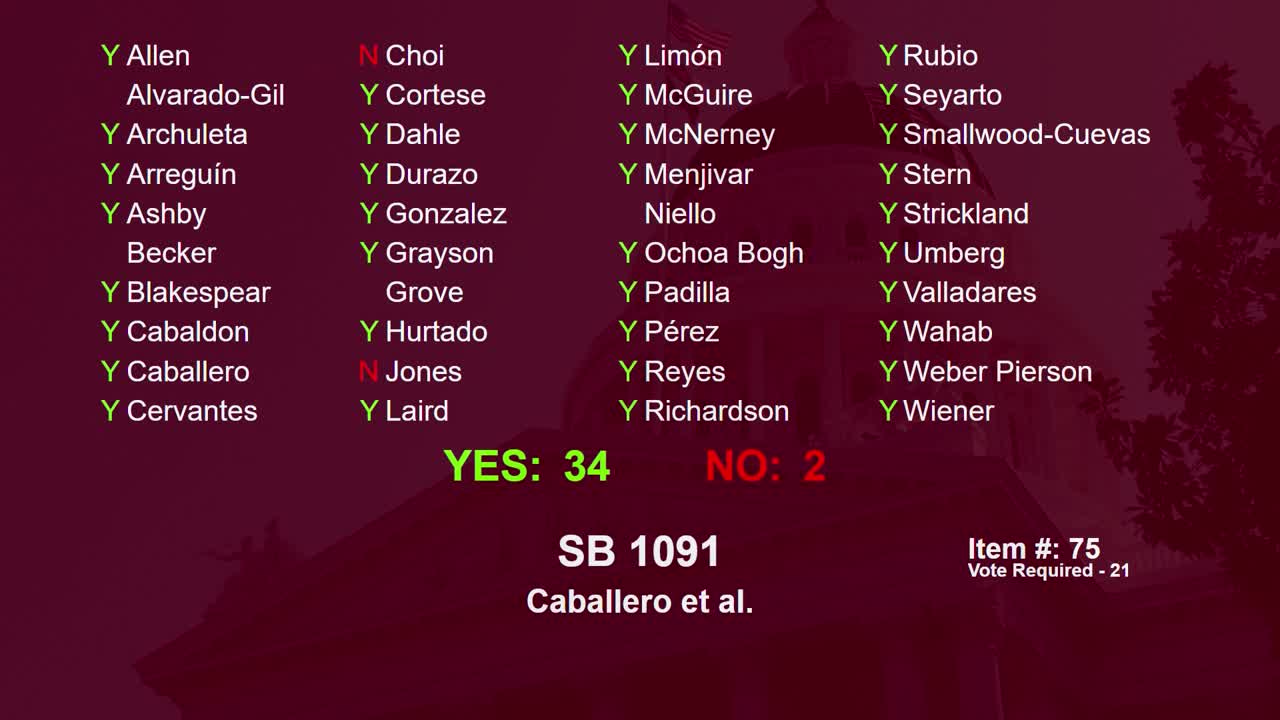 7MIN
Senate Floor
 23MIN
Senate Standing Committee on Privacy, Digital Technologies, and Consumer Protection
 16MIN
Senate Standing Committee on Transportation
Bill Author

Bill Co-Author(s):