SB 1014: Development projects: preliminary estimate of required improvements: onsite and offsite improvements.
- Session Year: 2025-2026
- House: Senate
- Latest Version Date: 2026-09-29
Current Status:
Passed
(2026-09-29: Chaptered by Secretary of State. Chapter 806, Statutes of 2026.)
Introduced
In Committee
Awaiting First Chamber Vote
Passed First Chamber
In Committee
Awaiting Second Chamber Vote
Passed Second Chamber
Enacted
Existing law, the Permit Streamlining Act (act), sets forth various procedures for the review and approval of development project applications, including, among other things, requiring each public agency to compile one or more lists that specify in detail the information that will be required from any applicant for a development project. The act also requires a city, county, or city and county to deem an applicant for a housing development project to have submitted a preliminary application upon providing specified information about the proposed project to the city, county, or city and county from which approval for the project is being sought.
This bill would permit an applicant who submits a preliminary application for a housing development project, as specified, or an application if a preliminary application is not submitted, to include in the preliminary application or application a request for a preliminary estimate of required improvements, as provided. The bill would require a city, county, or city and county that receives a request under these provisions to provide the preliminary estimate within 30 business days of the submission of the request, as provided. The bill would authorize, for improvements required by a public agency, as specified, the applicant to request, within 30 days of submission, a list of the types of improvements that may be required, as provided. The bill, within 30 business days of deeming an application for a postentitlement phase permit complete, would additionally require the city, county, or city and county to provide the applicant with an itemized list of all onsite and offsite improvements that will be required prior to issuance of, or otherwise in connection with, that permit, as provided. The bill would specify that its provisions do not relieve a city, county, or city and county of its obligation to comply with certain requirements before subjecting a housing development project to an improvement that was not in effect when a preliminary application was submitted, as provided. The bill would define various terms for these purposes.
By imposing new duties on local agencies, the bill would impose a state-mandated local program.
The bill would include findings that changes proposed by this bill address a matter of statewide concern rather than a municipal affair and, therefore, apply to all cities, including charter cities.
The California Constitution requires the state to reimburse local agencies and school districts for certain costs mandated by the state. Statutory provisions establish procedures for making that reimbursement.
This bill would provide that no reimbursement is required by this act for a specified reason.
Existing law, the Permit Streamlining Act (act), sets forth various procedures for the review and approval of development project applications, including, among other things, requiring each public agency to compile one or more lists that specify in detail the information that will be required from any applicant for a development project. The act also requires a city, county, or city and county to deem an applicant for a housing development project to have submitted a preliminary application upon providing specified information about the proposed project to the city, county, or city and county from which approval for the project is being sought.
This bill would permit a development proponent that an applicant who submits a preliminary application for a housing development project, as specified, or an application if a preliminary application is not submitted, to include in the preliminary application or application a request for a preliminary estimate of required improvements, as provided. The bill would require a city, county, or city and county that receives a request under these provisions to provide the preliminary estimate within 30 business days of the submission of the request, as provided. The bill would additionally require, bill, within 30 business days of deeming an application for a postentitlement phase permit, permit complete, would additionally require the city, county, or city and county to provide the applicant with an itemized list of all onsite and offsite improvements that will be required prior to issuance of, or otherwise in connection with, that permit, as provided. The bill would define various terms for purposes of its these purposes.
By imposing new duties on local agencies, the bill would impose a state-mandated local program.
The bill would include findings that changes proposed by this bill address a matter of statewide concern rather than a municipal affair and, therefore, apply to all cities, including charter cities.
The California Constitution requires the state to reimburse local agencies and school districts for certain costs mandated by the state. Statutory provisions establish procedures for making that reimbursement.
This bill would provide that no reimbursement is required by this act for a specified reason.
Existing law, the Permit Streamlining Act, Act (act), sets forth various procedures for the review and approval of development project applications, including, among other things, requiring each public agency to compile one or more lists that specify in detail the information that will be required from any applicant for a development project. The act also requires a city, county, or city and county to deem an applicant for a housing development project to have submitted a preliminary application upon providing specified information about the proposed project to the city, county, or city and county from which approval for the project is being sought. Existing law requires a public agency, not later than 30 calendar days after receiving an application for a development project, to determine in writing whether the application is complete and to immediately transmit the determination to the applicant for the development project.
This bill would require a city, county, or city and county, within 30 days of receipt of a preliminary application, or if a preliminary application is not submitted, within 30 days of receipt of an application for a housing development project, to provide a list to the development proponent of any required onsite or offsite improvements and an estimate of the cost for those onsite or offsite improvements. Existing law requires a local agency or state agency to compile one or more lists that specify in detail the information that will be required from an applicant for a postentitlement phase permit. Existing law defines postentitlement phase permit to include, among other things, all building permits and other permits issued under the California Building Standards Code or any applicable local building code, as specified.This bill would prohibit a local or state agency from requiring any onsite or offsite improvements to a housing development project that were not disclosed to the development proponent within 30 days of submitting an application for a postentitlement phase permit.This bill would permit a development proponent that submits a preliminary application for a housing development project, as specified, or an application if a preliminary application is not submitted, to include in the preliminary application or application a request for a preliminary estimate of required improvements, as provided. The bill would require a city, county, or city and county that receives a request under these provisions to provide the preliminary estimate within 30 business days of the submission of the request, as provided. The bill would additionally require, within 30 business days of an application for a postentitlement phase permit, the city, county, or city and county to provide the applicant with an itemized list of all onsite and offsite improvements that will be required prior to issuance of, or otherwise in connection with, that permit, as provided. The bill would define various terms for purposes of its purposes.
By imposing new duties on local agencies, the bill would impose a state-mandated local program.
The bill would include findings that changes proposed by this bill address a matter of statewide concern rather than a municipal affair and, therefore, apply to all cities, including charter cities.
The California Constitution requires the state to reimburse local agencies and school districts for certain costs mandated by the state. Statutory provisions establish procedures for making that reimbursement.
This bill would provide that no reimbursement is required by this act for a specified reason.
Existing law, the Permit Streamlining Act, among other things, requires a city, county, or city and county to deem an applicant for a housing development project to have submitted a preliminary application upon providing specified information about the proposed project to the city, county, or city and county from which approval for the project is being sought. Existing law requires a public agency, not later than 30 calendar days after receiving an application for a development project, to determine in writing whether the application is complete and to immediately transmit the determination to the applicant for the development project.
This bill would require a city, county, or city and county, within 30 days of receipt of a preliminary application, or if a preliminary application is not submitted, within 30 days of receipt of an application for a housing development project, to provide a list to the development proponent of any required onsite or offsite improvements and an estimate of the cost for those onsite or offsite improvements.
Existing law requires a local agency or state agency to compile one or more lists that specify in detail the information that will be required from an applicant for a postentitlement phase permit. Existing law defines postentitlement phase permit to include, among other things, all building permits and other permits issued under the California Building Standards Code or any applicable local building code, as specified.
This bill would prohibit a local or state agency from requiring any onsite or offsite improvements to a housing development project that were not disclosed to the development proponent within 30 days of submitting an application for a postentitlement phase permit.
By imposing new duties on local agencies, the bill would impose a state-mandated local program.
The bill would include findings that changes proposed by this bill address a matter of statewide concern rather than a municipal affair and, therefore, apply to all cities, including charter cities.
The California Constitution requires the state to reimburse local agencies and school districts for certain costs mandated by the state. Statutory provisions establish procedures for making that reimbursement.
This bill would provide that no reimbursement is required by this act for a specified reason.
(a)For purposes of this section:
(1)Housing development project has the same meaning as defined in paragraph (3) of subdivision (b) of Section 65905.5, except that it also includes an application for a parcel map or tentative and final map for a housing development project submitted pursuant to Section 66499.41.
(2)Improvement includes any facilities or infrastructure for the delivery of public services such as police, fire protection, parks, recreation, emergency medical, public health, libraries, flood protection, streets or highways, public transit, railroad, airports and seaports, utility, common carrier, or other similar projects such as energy-related, communication-related, water-related, or wastewater-related facilities or infrastructure.
(3)Postentitlement phase permit has the same meaning as defined in paragraph (3) of subdivision (k) of Section 65913.3.
(4)(A)Public agency includes a special district.
(B)Public agency does not include a school district.
(b)(1)An applicant who submits a preliminary application for a housing development project providing the information required by subdivision (a) of Section 65941.1, or if a preliminary application is not submitted, an application for a housing development project that includes all of the information required to process the development application consistent with Sections 65940, 65941, and 65941.5, may include in the preliminary application or application a request for a preliminary estimate of required improvements, which the city, county, or city and county shall provide within 30 business days of the submission of the request.
(2)(A)The preliminary estimate of required improvements in paragraph (1) shall contain both of the following:
(i)A good faith estimate of the list of the types of onsite or offsite improvements that may be required in connection with the housing development project.
(ii)For any improvements that will be constructed or installed by the city, county, or city and county, a good faith estimate of the cost of those improvements if constructed or installed at the time the estimate is provided.
(B)Notwithstanding subparagraph (A), the preliminary estimate of required improvements shall not be required to include either of the following:
(i)Onsite or offsite improvements required by a public agency or utility other than the city, county, or city and county.
(ii)Onsite or offsite improvements imposed on a housing development project to comply with the California Environmental Quality Act (Division 13 (commencing with Section 21000) of the Public Resources Code).
(3)For onsite and offsite improvements required by a public agency or utility, other than a city, county, or city and county, including requirements by a special district, the applicant may, within 30 days of submitting a preliminary application or an application for a housing development project pursuant to paragraph (1), request from the public agency or utility a list of the types of any onsite or offsite improvements that may be required in connection with the housing development project, and the public agency or utility shall provide the applicant with this information within 30 business days.
(4)Except for the provision of the estimates required under paragraphs (1) and (3), nothing in this subdivision shall create or affect any rights or obligations with respect to onsite or offsite improvements.
(5)The estimates provided under paragraphs (1) and (3) shall be for informational purposes only and shall not be legally binding or otherwise affect the scope, extent, or cost of any onsite or offsite improvements that are required or imposed pursuant to other provisions of law.
(c)(1)Within 30 business days of deeming an application for a postentitlement phase permit complete, the city, county, or city and county shall provide the applicant with an itemized list of all onsite and offsite improvements that will be required prior to issuance of, or otherwise in connection with, that permit.
(2)(A)Except as provided in subparagraph (B), the city, county, or city and county shall not require construction or installation of any onsite or offsite improvement prior to issuance of, or otherwise in connection with, a postentitlement phase permit, unless that improvement was included on the list provided under paragraph (1) for that permit.
(B)Notwithstanding subparagraph (A), the city, county, or city and county may require construction or installation of onsite or offsite improvements not included on the list provided under paragraph (1) under any of the following circumstances:
(i)If the city, county, or city and county finds, based upon substantial evidence, that the onsite or offsite improvement is necessary to mitigate or avoid a specific, adverse impact upon the public health or safety.
(ii)The developer changes or requests to change the construction or other work permitted by the postentitlement phase permit from the description provided in the application described in paragraph (1), and the requested onsite or offsite improvement is reasonably related to the expanded scope of the construction or other work permitted.
(iii)If the postentitlement permit is a discretionary building permit or other permit as described in clause (ii) of subparagraph (A) of paragraph (3) of subdivision (k) of Section 65913.3, the city, county, or city and county may require construction or installation of onsite or offsite improvements in order to mitigate potentially significant environmental effects, as required pursuant to the California Environmental Quality Act (Division 13 (commencing with Section 21000) of the Public Resources Code).
(d)Nothing in this section shall be construed to relieve a city, county, or city and county of its obligation to comply with subdivision (o) of Section 65589.5 before subjecting a housing development project to an improvement that was not in effect when a preliminary application, including all of the information required by subdivision (a) of Section 65941.1, was submitted.
SEC. 2.The Legislature finds and declares that increasing housing production is a matter of statewide concern and is not a municipal affair as that term is used in Section 5 of Article XI of the California Constitution, and one of the impediments to housing production is a lack of predictability and transparency when assessing impact fees. Therefore, Section 1 of this act adding Section 65941.3 to the Government Code applies to all cities, including charter cities.
SEC. 3.No reimbursement is required by this act pursuant to Section 6 of Article XIIIB of the California Constitution because a local agency or school district has the authority to levy service charges, fees, or assessments sufficient to pay for the program or level of service mandated by this act, within the meaning of Section 17556 of the Government Code.
(a)For purposes of this section:
(1)Housing development project has the same meaning as defined in paragraph (3) of subdivision (b) of Section 65905.5, except that it also includes an application for a parcel map or tentative and final map for a housing development project submitted pursuant to Section 66499.41.
(2)Improvement includes any facilities or infrastructure for the delivery of public services such as education, police, fire protection, parks, recreation, emergency medical, public health, libraries, flood protection, streets or highways, public transit, railroad, airports and seaports, utility, common carrier, or other similar projects such as energy-related, communication-related, water-related, or wastewater-related facilities or infrastructure.
(3)Postentitlement phase permit has the same meaning as defined in paragraph (3) of subdivision (k) of Section 65913.3.
(b)(1)An applicant who submits a preliminary application for a housing development project providing the information required by subdivision (a) of Section 65941.1, or if a preliminary application is not submitted, an application for a housing development project that includes all of the information required to process the development application consistent with Sections 65940, 65941, and 65941.5, may include in the preliminary application or application a request for a preliminary estimate of required improvements, which the city, county, or city and county shall provide within 30 business days of the submission of the request.
(2)(A)The preliminary estimate of required improvements in paragraph (1) shall contain both of the following:
(i)A good faith estimate of the list of the types of onsite or offsite improvements that may be required in connection with the housing development project.
(ii)For any improvements that will be constructed or installed by the city, county, or city and county, a good faith estimate of the cost of those improvements if constructed or installed at the time the estimate is provided.
(B)Notwithstanding subparagraph (A), the preliminary estimate of required improvements shall not be required to include either of the following:
(i)Onsite or offsite improvements required by a public agency or utility other than the city, county, or city and county.
(ii)Onsite or offsite improvements imposed on a housing development project to comply with the California Environmental Quality Act (Division 13 (commencing with Section 21000) of the Public Resources Code).
(3)For onsite and offsite improvements required by a public agency or utility, other than a city, county, or city and county, including requirements by a school district or a special district, the applicant may request a list of may, within 30 days of submitting a preliminary application or an application for a housing development project pursuant to paragraph (1), request from the public agency or utility a list of the types of any onsite or offsite improvements that may be required in connection with the housing development project, and the public agency or utility shall provide the applicant with this information within 30 business days.
(4)Except for the provision of the estimates required under paragraphs (1) and (3), nothing in this subdivision shall create or affect any rights or obligations with respect to onsite or offsite improvements.
(5)The estimates provided under paragraphs (1) and (3) shall be for informational purposes only and shall not be legally binding or otherwise affect the scope, extent, or cost of any onsite or offsite improvements that are required or imposed pursuant to other provisions of law.
(c)(1)Within 30 business days of deeming an application for a postentitlement phase permit complete, the city, county, or city and county shall provide the applicant with an itemized list of all onsite and offsite improvements that will be required prior to issuance of, or otherwise in connection with, that permit.
(2)(A)Except as provided in subparagraph (B), the city, county, or city and county shall not require construction or installation of any onsite or offsite improvement prior to issuance of, or otherwise in connection with, a postentitlement phase permit, unless that improvement was included on the list provided under paragraph (1) for that permit.
(B)Notwithstanding subparagraph (A), the city, county, or city and county may require construction or installation of onsite or offsite improvements not included on the list provided under paragraph (1) under any of the following circumstances:
(i)If the city, county, or city and county finds, based upon substantial evidence, that the onsite or offsite improvement is necessary to mitigate or avoid a specific, adverse impact upon the public health or safety.
(ii)The developer changes or requests to change the construction or other work permitted by the postentitlement phase permit from the description provided in the application described in paragraph (1), and the requested onsite or offsite improvement is reasonably related to the expanded scope of the construction or other work permitted.
(iii)If the postentitlement permit is subject to the California Environmental Quality Act (Division 13 (commencing with Section 21000) of the Public Resources Code), a discretionary building permit or other permit as described in clause (ii) of subparagraph (A) of paragraph (3) of subdivision (k) of Section 65913.3, the city, county, or city and county may require construction or installation of onsite or offsite improvements in order to mitigate potentially significant environmental effects pursuant to that act. effects, as required pursuant to the California Environmental Quality Act (Division 13 (commencing with Section 21000) of the Public Resources Code).
(d)Nothing in this section shall be construed to relieve a city, county, or city and county of its obligation to comply with subdivision (o) of Section 65589.5 before subjecting a housing development project to an improvement that was not in effect when a preliminary application, including all of the information required by subdivision (a) of Section 65941.1, was submitted.
SEC. 2.The Legislature finds and declares that increasing housing production is a matter of statewide concern and is not a municipal affair as that term is used in Section 5 of Article XI of the California Constitution, and one of the impediments to housing production is a lack of predictability and transparency when assessing impact fees. Therefore, Section 1 of this act adding Section 65941.3 to the Government Code applies to all cities, including charter cities.
SEC. 3.No reimbursement is required by this act pursuant to Section 6 of Article XIIIB of the California Constitution because a local agency or school district has the authority to levy service charges, fees, or assessments sufficient to pay for the program or level of service mandated by this act, within the meaning of Section 17556 of the Government Code.
(a)For purposes of this section:
(1)Housing development project has the same meaning as defined in paragraph (3) of subdivision (b) of Section 65905.5, except that it also includes an application for a parcel map or tentative and final map for a housing development project submitted pursuant to Section 66499.41.
(2)Improvement includes, but is not limited to, includes any facilities or infrastructure for the delivery of public services such as education, police, fire protection, parks, recreation, emergency medical, public health, libraries, flood protection, streets or highways, public transit, railroad, airports and seaports, utility, common carrier, or other similar projects such as energy-related, communication-related, water-related, or wastewater-related facilities or infrastructure.
(3)Postentitlement phase permit has the same meaning as defined in paragraph (3) of subdivision (k) of Section 65913.3.
(b)(1)A development proponent that An applicant who submits a preliminary application for a housing development project providing the information required by subdivision (a) of Section 65941.1, or if a preliminary application is not submitted, an application for a housing development project that includes all of the information required to process the development application consistent with Sections 65940, 65941, and 65941.5, may include in the preliminary application or application a request for a preliminary estimate of required improvements, which the city, county, or city and county shall provide within 30 business days of the submission of the request.
(2)(A)The preliminary estimate of required improvements in paragraph (1) shall contain both of the following:
(i)A good faith estimate of the list of the types of onsite or offsite improvements that may be required in connection with the housing development project.
(ii)For any improvements that will be constructed or installed by the city, county, or city and county, a good faith estimate of the cost of those improvements if constructed or installed at the time the estimate is provided.
(B)Notwithstanding subparagraph (A), the preliminary estimate of required improvements shall not be required to include either of the following:
(i)Onsite or offsite improvements required by a public agency or utility other than the city, county, or city and county.
(ii)Onsite or offsite improvements imposed on a housing development project to comply with the California Environmental Quality Act (Division 13 (commencing with Section 21000) of the Public Resources Code).
(3)For onsite and offsite improvements required by a public agency or utility, other than a city, county, or city and county, including requirements by a school district or a special district, the development proponent applicant may request a list of any onsite or offsite improvements that may be required in connection with the housing development project, and the public agency or utility shall provide the development proponent applicant with this information within 30 business days.
(4)Except for the provision of the estimates required under paragraphs (1) and (3), nothing in this subdivision shall create or affect any rights or obligations with respect to onsite or offsite improvements.
(5)The estimates provided under paragraphs (1) and (3) shall be for informational purposes only and shall not be legally binding or otherwise affect the scope, extent, or cost of any onsite or offsite improvements that are required or imposed pursuant to other provisions of law.
(c)(1)Within 30 business days of deeming an application for a postentitlement phase permit, permit complete, the city, county, or city and county shall provide the applicant with an itemized list of all onsite and offsite improvements that will be required prior to issuance of, or otherwise in connection with, that permit.
(2)(A)Except as provided in subparagraph (B), the city, county, or city and county shall not require construction or installation of any onsite or offsite improvement prior to issuance of, or otherwise in connection with, a postentitlement phase permit, unless that improvement was included on the list provided under paragraph (1) for that permit.
(B)Notwithstanding subparagraph (A), the city, county, or city and county may require construction or installation of onsite or offsite improvements not included on the list provided under paragraph (1) if under any of the following circumstances:
(i)If the city, county, or city and county finds, based upon substantial evidence, that the onsite or offsite improvement is necessary to mitigate or avoid a specific, adverse impact upon the public health or safety.
(ii)The developer changes or requests to change the construction or other work permitted by the postentitlement phase permit from the description provided in the application described in paragraph (1), and the requested onsite or offsite improvement is reasonably related to the expanded scope of the construction or other work permitted.
(iii)If the postentitlement permit is subject to the California Environmental Quality Act (Division 13 (commencing with Section 21000) of the Public Resources Code), the city, county, or city and county may require construction or installation of onsite or offsite improvements in order to mitigate potentially significant environmental effects pursuant to that act.
SEC. 2.The Legislature finds and declares that increasing housing production is a matter of statewide concern and is not a municipal affair as that term is used in Section 5 of Article XI of the California Constitution, and one of the impediments to housing production is a lack of predictability and transparency when assessing impact fees. Therefore, Section 1 of this act adding Section 65941.3 to the Government Code applies to all cities, including charter cities.
SEC. 3.No reimbursement is required by this act pursuant to Section 6 of Article XIIIB of the California Constitution because a local agency or school district has the authority to levy service charges, fees, or assessments sufficient to pay for the program or level of service mandated by this act, within the meaning of Section 17556 of the Government Code.
(a)For purposes of this section:
(1)Housing development project has the same meaning as defined in paragraph (3) of subdivision (b) of Section 65905.5, except that it also includes an application for a parcel map or tentative and final map for a housing development project submitted pursuant to Section 66499.41.
(2)Improvement includes, but is not limited to, any facilities or infrastructure for the delivery of public services such as education, police, fire protection, parks, recreation, emergency medical, public health, libraries, flood protection, streets or highways, public transit, railroad, airports and seaports, utility, common carrier, or other similar projects such as energy-related, communication-related, water-related, or wastewater-related facilities or infrastructure.
(3)Postentitlement phase permit has the same meaning as defined in paragraph (3) of subdivision (k) of Section 65913.3.
(b)(1)A development proponent that submits a preliminary application for a housing development project providing the information required by subdivision (a) of Section 65941.1, or if a preliminary application is not submitted, an application for a housing development project that includes all of the information required to process the development application consistent with Sections 65940, 65941, and 65941.5, may include in the preliminary application or application a request for a preliminary estimate of required improvements, which the city, county, or city and county shall provide within 30 business days of the submission of the request.
(2)(A)The preliminary estimate of required improvements in paragraph (1) shall contain both of the following:
(i)A list of the types of onsite or offsite improvements that may be required in connection with the housing development project.
(ii)For any improvements that will be constructed or installed by the city, county, or city and county, a good faith estimate of the cost of those improvements if constructed or installed at the time the estimate is provided.
(B)Notwithstanding subparagraph (A), the preliminary estimate of required improvements shall not be required to include either of the following:
(i)Onsite or offsite improvements required by a public agency or utility other than the city, county, or city and county.
(ii)Onsite or offsite improvements imposed on a housing development project to comply with the California Environmental Quality Act (Division 13 (commencing with Section 21000) of the Public Resources Code).
(3)For onsite and offsite improvements required by a public agency or utility, other than a city, county, or city and county, including requirements by a school district or a special district, the development proponent may request a list of any onsite or offsite improvements that may be required in connection with the housing development project, and the public agency or utility shall provide the development proponent with this information within 30 business days.
(4)Except for the provision of the estimates required under paragraphs (1) and (3), nothing in this subdivision shall create or affect any rights or obligations with respect to onsite or offsite improvements.
(5)The estimates provided under paragraphs (1) and (3) shall be for informational purposes only and shall not be legally binding or otherwise affect the scope, extent, or cost of any onsite or offsite improvements that are required or imposed pursuant to other provisions of law.
(c)(1)Within 30 business days of an application for a postentitlement phase permit, the city, county, or city and county shall provide the applicant with an itemized list of all onsite and offsite improvements that will be required prior to issuance of, or otherwise in connection with, that permit.
(2)(A)Except as provided in subparagraph (B), the city, county, or city and county shall not require construction or installation of any onsite or offsite improvement prior to issuance of, or otherwise in connection with, a postentitlement phase permit, unless that improvement was included on the list provided under paragraph (1) for that permit.
(B)Notwithstanding subparagraph (A), the city, county, or city and county may require construction or installation of onsite or offsite improvements not included on the list provided under paragraph (1) if the city, county, or city and county finds, based upon substantial evidence, that the onsite or offsite improvement is necessary to mitigate or avoid a specific, adverse impact upon the public health or safety.
SEC. 3.SEC. 2.The Legislature finds and declares that increasing housing production is a matter of statewide concern and is not a municipal affair as that term is used in Section 5 of Article XI of the California Constitution, and one of the impediments to housing production is a lack of predictability and transparency when assessing impact fees. Therefore, Sections 1 and 2 Section 1 of this act adding Sections 65913.3.2 and Section 65941.3 to the Government Code apply applies to all cities, including charter cities.
SEC. 4.SEC. 3.No reimbursement is required by this act pursuant to Section 6 of Article XIIIB of the California Constitution because a local agency or school district has the authority to levy service charges, fees, or assessments sufficient to pay for the program or level of service mandated by this act, within the meaning of Section 17556 of the Government Code.
Notwithstanding any other law, a local or state agency shall not require any onsite or offsite improvements to a housing development project that were not disclosed to the development proponent within 30 days of submitting an application for a postentitlement phase permit, as defined in paragraph (3) of subdivision (k) of Section 65913.3.
SEC. 2.Section 65941.3 is added to the Government Code, to read:65941.3.A city, county, or city and county shall, within 30 days of receipt of a preliminary application for a housing development project, or if a preliminary application is not submitted, within 30 days of receipt of an application for a housing development project, provide a list to the development proponent of any required onsite or offsite improvements and an estimate of the cost for those onsite or offsite improvements.
SEC. 3.The Legislature finds and declares that increasing housing production is a matter of statewide concern and is not a municipal affair as that term is used in Section 5 of Article XI of the California Constitution, and one of the impediments to housing production is a lack of predictability and transparency when assessing impact fees. Therefore, Sections 1 and 2 of this act adding Sections 65913.3.2 and 65941.3 to the Government Code apply to all cities, including charter cities.
SEC. 4.No reimbursement is required by this act pursuant to Section 6 of Article XIIIB of the California Constitution because a local agency or school district has the authority to levy service charges, fees, or assessments sufficient to pay for the program or level of service mandated by this act, within the meaning of Section 17556 of the Government Code.
|
Date
|
Status
|
|---|---|
| Sep 29, 2026 | Chaptered by Secretary of State. Chapter 806, Statutes of 2026. |
| Sep 29, 2026 | Approved by the Governor. |
| Aug 31, 2026 | Enrolled and presented to the Governor at 6 p.m. |
| Aug 26, 2026 | Assembly amendments concurred in. (Ayes 30. Noes 10. Page 5873.) Ordered to engrossing and enrolling. |
| Aug 26, 2026 | Assembly amendments concurred in. (Ayes 30. Noes 10.) Ordered to engrossing and enrolling. |
| Aug 24, 2026 | In Senate. Concurrence in Assembly amendments pending. |
| Aug 24, 2026 | Read third time. Passed. (Ayes 66. Noes 2. Page 6374.) Ordered to the Senate. |
| Aug 24, 2026 | Read third time. Passed. Ordered to the Senate. |
| Aug 17, 2026 | Ordered to third reading. |
| Aug 17, 2026 | Read third time and amended. |
| Aug 6, 2026 | Read second time. Ordered to third reading. |
| Aug 5, 2026 | From committee: Do pass. (Ayes 14. Noes 0.) (August 5). |
| Jun 25, 2026 | From committee: Do pass and re-refer to Com. on APPR. (Ayes 11. Noes 0.) (June 24). Re-referred to Com. on APPR. |
| Jun 18, 2026 | From committee: Do pass and re-refer to Com. on H. & C.D. (Ayes 7. Noes 2.) (June 17). Re-referred to Com. on H. & C.D. |
| Jun 3, 2026 | From committee with author's amendments. Read second time and amended. Re-referred to Com. on L. GOV. |
| Jun 1, 2026 | Referred to Coms. on L. GOV. and H. & C.D. |
| May 20, 2026 | In Assembly. Read first time. Held at Desk. |
| May 19, 2026 | Read third time. Passed. (Ayes 30. Noes 9. Page 4339.) Ordered to the Assembly. |
| May 19, 2026 | Read third time. Passed. (Ayes 30. Noes 9.) Ordered to the Assembly. |
| May 12, 2026 | Read second time. Ordered to third reading. |
| May 11, 2026 | From committee: Be ordered to second reading pursuant to Senate Rule 28.8. |
| May 4, 2026 | Set for hearing May 11. |
| Apr 23, 2026 | Read second time and amended. Re-referred to Com. on APPR. |
| Apr 22, 2026 | From committee: Do pass as amended and re-refer to Com. on APPR. (Ayes 8. Noes 2. Page 3975.) (April 21). |
| Apr 22, 2026 | From committee: Do pass as amended and re-refer to Com. on APPR. (Ayes 8. Noes 2.) (April 21). |
| Apr 15, 2026 | From committee: Do pass and re-refer to Com. on HOUSING. (Ayes 5. Noes 2. Page 3904.) (April 15). Re-referred to Com. on HOUSING. |
| Apr 15, 2026 | From committee: Do pass and re-refer to Com. on HOUSING. (Ayes 5. Noes 2.) (April 15). Re-referred to Com. on HOUSING. |
| Apr 15, 2026 | Set for hearing April 21 in HOUSING pending receipt. |
| Apr 8, 2026 | From committee with author's amendments. Read second time and amended. Re-referred to Com. on L. GOV. |
| Apr 2, 2026 | Set for hearing April 15. |
| Feb 18, 2026 | Referred to Coms. on L. GOV. and HOUSING. |
| Feb 11, 2026 | From printer. May be acted upon on or after March 13. |
| Feb 10, 2026 | Introduced. Read first time. To Com. on RLS. for assignment. To print. |
|
Date
|
Description
|
Location
|
Votes
|
|
|---|---|---|---|---|
| Aug 26, 2026 | Unfinished Business SB1014 Grayson Concurrence | Senate Floor |
Passed |
|
| Aug 24, 2026 | SB 1014 Grayson Senate Third Reading By Kalra | Assembly Floor |
Passed |
|
| Aug 5, 2026 | Do pass. | Assembly Standing Committee on Appropriations |
Passed |
|
| Jun 24, 2026 | Do pass and be re-referred to the Committee on [Appropriations] | Assembly Standing Committee on Housing and Community Development |
Passed |
|
| Jun 17, 2026 | Do pass and be re-referred to the Committee on [Housing and Community Development] | Assembly Standing Committee on Local Government |
Passed |
|
| May 19, 2026 | Senate 3rd Reading SB1014 Grayson | Senate Floor |
Passed |
|
| Apr 21, 2026 | Do pass as amended, but first amend, and re-refer to the Committee on [Appropriations] | Senate Standing Committee on Housing |
Passed |
|
| Apr 15, 2026 | Do pass, but first be re-referred to the Committee on [Housing] | Senate Standing Committee on Local Government |
Passed |
This list shows positions taken on this bill by organizations on the date displayed, which is linked to the original source.
Positions by individuals are not included.
|
Organization
|
Position
|
Date
|
|---|---|---|
| 21St Century Alliance | ** Support | |
| Abundant Housing LA | ** Support | |
| Abundant Housing Los Angeles | ** Support | |
| Aids Healthcare Foundation | ** Support | |
| Business For Good San Diego | ** Support | |
| California Apartment Association | ** Support | |
| California Council For Affordable Housing | ** Support | |
| California YIMBY | ** Support | |
| Casita Coalition | ** Support | |
| Circulate Planning & Policy | ** Support | |
| City of Camarillo | ** Against | |
| city of carlsbad | ** Against | |
| City of Foster City | ** Against | |
| City of La Verne | ** Against | |
| City of Rancho Cucamonga | ** Against | |
| City of Redwood City | ** Against | |
| City of Redwood (Unless Amended) | ** Against | |
| City Of San Mateo | ** Against | |
| City of San Mateo (Unless Amended) | ** Against | |
| City of Thousand Oaks | ** Against | |
| City or Carlsbad | ** Against | |
| Construction Employers' Association | ** Support | |
| Construction Employers’ Association | ** Support | |
| Dignitymoves | ** Support | |
| East Bay for Everyone | ** Support | |
| East Bay YIMBY | ** Support | |
| Eastside Housing for All | ** Support | |
| Eden Housing | ** Support | |
| Everybody's Long Beach | ** Support | |
| Faith and Housing Coalition | ** Support | |
| Fieldstead And Company, Inc. | ** Support | |
| Grow the Richmond | ** Support | |
| Habitat For Humanity California | ** Support | |
| Holos Communities | ** Support | |
| Home Builders Alliance | ** Support | |
| Housing Action Coalition | ** Support | |
| Housing California | ** Support | |
| LeadingAge California | ** Support | |
| Mountain View YIMBY | ** Support | |
| Napa-Solano for Everyone | ** Support | |
| Neighbors for a Better San Diego | ** Against | |
| New Way Homes | ** Support | |
| North Bay Leadership Council | ** Support | |
| Northern Neighbors Sf | ** Support | |
| Peninsula for Everyone | ** Support | |
| Resources for Community Development | ** Support | |
| San Diego Housing Federation | ** Support | |
| San Diego Regional Chamber Of Commerce | ** Support | |
| San Francisco Yimby | ** Support | |
| San Jose Yimby | ** Support | |
| San Mateo Forward | ** Support | |
| Santa Cruz Yimby | ** Support | |
| Santa Rosa Yimby | ** Support | |
| South Bay Yimby | ** Support | |
| Southern California Association of Non-Profit Housing | ** Support | |
| SPUR | ** Support | |
| Supportive Housing Alliance | ** Support | |
| The Two Hundred | ** Support | |
| The Two Hundred for Homeownership | ** Support | |
| Ventura County YIMBY | ** Support | |
| Yes! in Redwood City | ** Support | |
| Yimby Action | ** Support | |
| YIMBY Los Angeles | ** Support | |
| Yimby Monterey Peninsula | ** Support | |
| Yimby SLO | ** Support | |
| Zillow Group | ** Support |
SENATE RULES COMMITTEE Office of Senate Floor Analyses (916) 651-4171 | SB 1014 |
UNFINISHED BUSINESS
Bill No: SB 1014
Author: Grayson (D)
Amended: 8/17/26
Vote: 21
SENATE LOCAL GOVERNMENT COMMITTEE: 5-2, 4/15/26
AYES: Durazo, Arreguín, Ashby, Cervantes, Laird
NOES: Choi, Seyarto
SENATE HOUSING COMMITTEE: 8-2, 4/21/26
AYES: Arreguín, Cabaldon, Caballero, Cortese, Durazo, Gonzalez, Grayson, Padilla
NOES: Seyarto, Ochoa Bogh
SENATE APPROPRIATIONS COMMITTEE: Senate Rule 28.8
SENATE FLOOR: 30-9, 5/19/26
AYES: Allen, Archuleta, Arreguín, Ashby, Becker, Blakespear, Cabaldon, Caballero, Cervantes, Cortese, Durazo, Gonzalez, Grayson, Hurtado, Laird, Limón, McGuire, McNerney, Menjivar, Padilla, Pérez, Reyes, Richardson, Rubio, Smallwood-Cuevas, Stern, Umberg, Wahab, Weber Pierson, Wiener
NOES: Alvarado-Gil, Choi, Dahle, Grove, Jones, Ochoa Bogh, Seyarto, Strickland, Valladares
NO VOTE RECORDED: Niello
ASSEMBLY FLOOR: 66-2, 8/24/26 - See last page for vote
SUBJECT: Development projects: preliminary estimate of required improvements: onsite and offsite improvements
SOURCE: California YIMBY
SPUR
DIGEST:
This bill allows development proponents to request and receive additional information on offsite and onsite improvements at the preliminary application phase, and when processing post-entitlement permits (PEPP).
Assembly Amendments
provide that the measure does not preclude a city or county from complying with specified provisions of the Housing Accountability Act and make clarifying changes.
ANALYSIS:
Existing law:
- Establishes a process for a housing development project applicant to file a preliminary application for a housing development project and establishes that a housing development project that has submitted a preliminary application must be subject only to the ordinances, policies, and standards adopted and in effect when the preliminary application was deemed to be complete.
- Authorizes an applicant who submits a preliminary application to include a request for a preliminary fee and exaction estimate, which the city or county must provide within 30 business days of the submission of the preliminary application.
- Provides that the fee and exaction estimate is for informational purposes and shall not be legally binding or otherwise affect the scope, amount, or time of payment of any fee or exaction that is otherwise determined by other provisions of law.
- Provides that for development fees imposed by a local agency that is not a city or county, including fees levied by a school district or a special district, the applicant must request the fee schedule from the local agency and that local agency must provide the fee schedule without delay.
- Requires, upon approval of a housing development project, a city or county to provide the applicant with an itemized list and a good faith estimate of the total sum amount of all fees and exactions that will apply to the project within 30 business days.
- Requires local agencies to exhaustively list all information needed to make a development application complete under the Permit Streamlining Act, limits that list to only those items on the checklist for application required by state law, and prohibits the local agency from requiring additional information. The city or county must also post checklist information online.
- Requires a local agency or a state agency to compile one or more lists of information that will be required from any applicant for a PEPP and specifies a process for approving PEPPs.
This bill:
- Requires cities and counties to provide a housing development project applicant that submits a complete preliminary application, or a complete development application, as specified, with a “preliminary estimate of improvement requirements” the city or county may require within 30 business days.
- Establishes the following as standards and requirements for preliminary estimate of improvement requirements:
- Requires the preliminary estimate of improvements to include the following:
- A good faith estimate of the list of the types of onsite and offsite improvements that may be required in connection with the housing development project.
- For any identified onsite and offsite improvements that will be constructed or installed by the city or county, a good faith estimate of the cost of those improvements.
- Provides that the preliminary estimate of improvement requirements is not required to include the following:
- Onsite and offsite improvements required by a public agency or utility other than the city or county.
- Onsite and offsite improvements imposed on a housing development project to comply with the California Environmental Quality Act (CEQA).
- Provides that for improvements required by a public agency or utility other than a city or county, an applicant may, within 30 days of submitting a preliminary application or application, request a list of the types of any onsite and offsite improvements that may be required in connection with the project, and the public agency or utility shall provide this information within 30 business days.
- Specifies that except for the obligation to provide the “preliminary estimate of improvement requirements” nothing related to the provision of the estimate creates or affects any rights or obligations with respect to onsite and offsite improvements.
- Provides that “preliminary estimate of improvement requirements” is for informational purposes only and does not legally bind or otherwise affect the scope, extent, or cost of any improvements that are required or imposed by other provisions of law.
- Requires the preliminary estimate of improvements to include the following:
- Requires a city or county to provide an applicant with an itemized list of all onsite and offsite improvements that will be required prior to issuance of, or otherwise in connection with that permit, within 30 days of deeming an application for a PEPP complete.
- Prohibits a city or county from requiring onsite and offsite improvements prior to issuance of a PEPP if the improvement was not included in the list of improvements provided per 3) above, unless:
- The city or county finds, based upon substantial evidence, that the onsite and offsite improvement is necessary to mitigate or avoid a specific adverse impact upon public health or safety, as defined.
- The developer changes or requests to change the construction or other work permitted by the postentitlement phase permit from the description provided in the application and the requested onsite and offsite improvement is reasonably related to the expanded scope of the construction or other work permitted.
- If the PEPP is a discretionary building permit as specified, the city or county may require construction or installation of onsite and offsite improvements in order to mitigate potentially significant environmental effects pursuant to CEQA.
- The city or county finds, based upon substantial evidence, that the onsite and offsite improvement is necessary to mitigate or avoid a specific adverse impact upon public health or safety, as defined.
- Specifies that “improvements” includes any facilities or infrastructure for the delivery of public services such as education, police, fire protection, parks, recreation, emergency medical, public health, libraries, flood protection, streets or highways, public transit, railroad, airports and seaports, utility, common carrier, or other similar projects such as energy-related, communication-related, water-related, or wastewater-related facilities or infrastructure.
- Provides that its provisions must not be construed to relieve a city or county of its obligations to comply with requirements of the Housing Accountability Act to only apply to specified ordinances, policies, and standards in in place when it received the preliminary application.
Background
The Subdivision Map Act (or Map Act) governs how local officials regulate the division of real property into smaller parcels for sale, lease, or financing. Cities and counties adopt local subdivision ordinances to carry out the Map Act and local requirements. City councils and county boards of supervisors use the Map Act to control a subdivision's design and improvements. Local subdivision approvals must be consistent with city and county general plans.
Under the Subdivision Map Act, cities and counties can attach scores of conditions. The Map Act allows local officials to require, as a condition of approving a proposed subdivision, the dedication of property within a subdivision for streets, alleys, drainage, utility easements, and other public easements and improvements. Once subdividers comply with those conditions, local officials must issue final maps. For smaller subdivisions that create four or fewer parcels, local officials usually use parcel maps, but they can require tentative parcel maps followed by final parcel maps. The Map Act also constrains the dedications and improvements that local cities and counties can require as a condition of a subdivision of four or fewer lots to only the dedication of rights-of-way, easements, and the construction of reasonable offsite and onsite improvements for the parcels being created.
Housing Crisis Act of 2019. To address concerns that cities and counties were taking actions that could undermine housing development, the Legislature enacted SB 330 (Skinner, 2019), the Housing Crisis Act of 2019 (HCA). Among other provisions, the HCA prohibits a local agency from applying new rules or standards to a project after a “preliminary application” containing specified information is submitted.
The Permit Streamlining Act (PSA). The PSA requires public agencies (both state and local agencies) to act fairly and promptly on applications for development proposals, including housing developments. Under the PSA, public agencies have 30 days to determine whether applications for development projects are complete and request additional information; failure to act results in an application being “deemed complete.” The PSA applies to the discretionary approval phase of a development review process; this is the phase where the agency, in its discretion, decides whether it approves of the concept outlined in the development proposal.
Post-entitlement approvals. A development proposal that is approved and entitled is still required to obtain approval for a range of non-discretionary permits. This includes building permits and other permits related to the physical construction of the development proposal. The timelines established in the PSA do not apply to these non-discretionary permits. The post-entitlement phase of the review process typically involves the review of permits that are objective in nature. Generally, once an agency invests the time and effort to approve and entitle a development proposal, there is an incentive for the agency to process the PEPP in a timely fashion.
In order to expedite this stage of the development approval process, AB 2234 (Robert Rivas, Chapter 651, Statutes of 2022), required local agencies (but not public agencies) to process PEPPs within 30 days for small housing development projects and 60 days for large housing development projects. AB 301 (Schiavo, Chapter 488, Statues of 2025) expanded these requirements to apply to state agencies.
Comments
- Purpose of this bill. According to the author, “California has a massive and growing housing production and affordability crisis. Driving this affordability issue is the exponential rising costs of building new housing. Development fees and other construction requirements can make up a significant portion of building costs and are much higher in California compared to the rest of the nation. Despite the significant reforms intended to improve fee transparency, builders continue to struggle to anticipate certain development costs, such as those for on-site and off-site improvements. Builders may find out about on-site and off-site improvements late in the process, adding unforeseen development costs and making projects less likely to pencil out. SB 1014 will help provide greater certainty for housing developments by requiring local jurisdictions, within 30 days of submission of a preliminary application, provide a good-faith estimate and list of any on-site or off-site improvements. Additionally, the bill would also prevent a local jurisdiction from requiring any additional on-site or offsite improvements that are not disclosed within 30 days of submitting a building permit application. This bill will help enhance transparency and will provide greater certainty in the housing development process.”
- No free lunch. SB 1014 imposes new requirements on local agencies that require improvements without any additional resources to help them comply with new requirements. Absent additional resources, local agencies may have to increase fees to satisfy new requirements. So, while the improvements required may be more readily known to developers, fees could end up higher than they would be absent the bill, which could inadvertently increase the costs of housing production.
FISCAL EFFECT: Appropriation: No Fiscal Com.: Yes Local: Yes
SUPPORT: (Verified 8/24/26)
California YIMBY (Co-Source)
SPUR (Co-Source)
Business for Good San Diego
California Council for Affordable Housing
Circulate Planning & Policy
Construction Employers’ Association
East Bay for Everyone
East Bay Yimby
Eden Housing
Fieldstead and Company, INC.
Grow the Richmond
Habitat for Humanity California
Holos Communities
Housing California
Leadingage California
Mountain View Yimby
Napa-Solano for Everyone
New Way Homes
Northern Neighbors SF
Peninsula for Everyone
Resources for Community Development
San Francisco Yimby
San Jose Yimby
San Mateo Forward
Santa Cruz Yimby
Santa Rosa Yimby
South Bay Yimby
Supportive Housing Alliance
Ventura County Yimby
Yes! in Redwood City
Yimby Action
Yimby Los Angeles
Yimby Monterey Peninsula
Yimby Slo
Zillow Group
OPPOSITION: (Verified 8/24/26)
City of Carlsbad
City of Foster City
City of LA Verne
City of Rancho Cucamonga
City of Redwood City
City of San Mateo
City of Thousand Oaks
Neighbors for a Better San Diego
ASSEMBLY FLOOR: 66-2, 8/24/26
AYES: Addis, Aguiar-Curry, Ahrens, Alanis, Alvarez, Arambula, Ávila Farías, Bains, Bauer-Kahan, Bennett, Berman, Bonta, Bryan, Calderon, Caloza, Carrillo, Connolly, Davies, Elhawary, Ellis, Fong, Gabriel, Garcia, Gipson, Mark González, Haney, Harabedian, Hart, Hoover, Irwin, Jackson, Kalra, Krell, Lee, Lowenthal, Muratsuchi, Nguyen, Ortega, Pacheco, Papan, Patel, Patterson, Pellerin, Petrie-Norris, Quirk-Silva, Ramos, Ransom, Celeste Rodriguez, Michelle Rodriguez, Rogers, Blanca Rubio, Schiavo, Schultz, Sharp-Collins, Solache, Soria, Stefani, Ta, Tangipa, Valencia, Wallis, Ward, Wicks, Wilson, Zbur, Rivas
NOES: DeMaio, Lackey
NO VOTE RECORDED: Boerner, Castillo, Chen, Dixon, Flora, Jeff Gonzalez, Hadwick, Johnson, Macedo, McKinnor, Sanchez
Prepared by: Jonathan Peterson / L. GOV. / (916) 651-4119
9/14/26 11:26:10
**** END ****
SENATE RULES COMMITTEE Office of Senate Floor Analyses (916) 651-4171 | SB 1014 |
UNFINISHED BUSINESS
Bill No: SB 1014
Author: Grayson (D)
Amended: 8/17/26
Vote: 21
SENATE LOCAL GOVERNMENT COMMITTEE: 5-2, 4/15/26
AYES: Durazo, Arreguín, Ashby, Cervantes, Laird
NOES: Choi, Seyarto
SENATE HOUSING COMMITTEE: 8-2, 4/21/26
AYES: Arreguín, Cabaldon, Caballero, Cortese, Durazo, Gonzalez, Grayson, Padilla
NOES: Seyarto, Ochoa Bogh
SENATE APPROPRIATIONS COMMITTEE: Senate Rule 28.8
SENATE FLOOR: 30-9, 5/19/26
AYES: Allen, Archuleta, Arreguín, Ashby, Becker, Blakespear, Cabaldon, Caballero, Cervantes, Cortese, Durazo, Gonzalez, Grayson, Hurtado, Laird, Limón, McGuire, McNerney, Menjivar, Padilla, Pérez, Reyes, Richardson, Rubio, Smallwood-Cuevas, Stern, Umberg, Wahab, Weber Pierson, Wiener
NOES: Alvarado-Gil, Choi, Dahle, Grove, Jones, Ochoa Bogh, Seyarto, Strickland, Valladares
NO VOTE RECORDED: Niello
ASSEMBLY FLOOR: Passed, 8/24/26
SUBJECT: Development projects: preliminary estimate of required improvements: onsite and offsite improvements
SOURCE: California YIMBY
SPUR
DIGEST:
This bill allows development proponents to request and receive additional information on offsite and onsite improvements at the preliminary application phase, and when processing post-entitlement permits (PEPP).
Assembly Amendments
provide that the measure does not preclude a city or county from complying with specified provisions of the Housing Accountability Act and make clarifying changes.
ANALYSIS:
Existing law:
- Establishes a process for a housing development project applicant to file a preliminary application for a housing development project and establishes that a housing development project that has submitted a preliminary application must be subject only to the ordinances, policies, and standards adopted and in effect when the preliminary application was deemed to be complete.
- Authorizes an applicant who submits a preliminary application to include a request for a preliminary fee and exaction estimate, which the city or county must provide within 30 business days of the submission of the preliminary application.
- Provides that the fee and exaction estimate is for informational purposes and shall not be legally binding or otherwise affect the scope, amount, or time of payment of any fee or exaction that is otherwise determined by other provisions of law.
- Provides that for development fees imposed by a local agency that is not a city or county, including fees levied by a school district or a special district, the applicant must request the fee schedule from the local agency and that local agency must provide the fee schedule without delay.
- Requires, upon approval of a housing development project, a city or county to provide the applicant with an itemized list and a good faith estimate of the total sum amount of all fees and exactions that will apply to the project within 30 business days.
- Requires local agencies to exhaustively list all information needed to make a development application complete under the Permit Streamlining Act, limits that list to only those items on the checklist for application required by state law, and prohibits the local agency from requiring additional information. The city or county must also post checklist information online.
- Requires a local agency or a state agency to compile one or more lists of information that will be required from any applicant for a PEPP and specifies a process for approving PEPPs.
This bill:
- Requires cities and counties to provide a housing development project applicant that submits a complete preliminary application, or a complete development application, as specified, with a “preliminary estimate of improvement requirements” the city or county may require within 30 business days.
- Establishes the following as standards and requirements for preliminary estimate of improvement requirements:
- Requires the preliminary estimate of improvements to include the following:
- A good faith estimate of the list of the types of onsite and offsite improvements that may be required in connection with the housing development project.
- For any identified onsite and offsite improvements that will be constructed or installed by the city or county, a good faith estimate of the cost of those improvements.
- Provides that the preliminary estimate of improvement requirements is not required to include the following:
- Onsite and offsite improvements required by a public agency or utility other than the city or county.
- Onsite and offsite improvements imposed on a housing development project to comply with the California Environmental Quality Act (CEQA).
- Provides that for improvements required by a public agency or utility other than a city or county, an applicant may, within 30 days of submitting a preliminary application or application, request a list of the types of any onsite and offsite improvements that may be required in connection with the project, and the public agency or utility shall provide this information within 30 business days.
- Specifies that except for the obligation to provide the “preliminary estimate of improvement requirements” nothing related to the provision of the estimate creates or affects any rights or obligations with respect to onsite and offsite improvements.
- Provides that “preliminary estimate of improvement requirements” is for informational purposes only and does not legally bind or otherwise affect the scope, extent, or cost of any improvements that are required or imposed by other provisions of law.
- Requires the preliminary estimate of improvements to include the following:
- Requires a city or county to provide an applicant with an itemized list of all onsite and offsite improvements that will be required prior to issuance of, or otherwise in connection with that permit, within 30 days of deeming an application for a PEPP complete.
- Prohibits a city or county from requiring onsite and offsite improvements prior to issuance of a PEPP if the improvement was not included in the list of improvements provided per 3) above, unless:
- The city or county finds, based upon substantial evidence, that the onsite and offsite improvement is necessary to mitigate or avoid a specific adverse impact upon public health or safety, as defined.
- The developer changes or requests to change the construction or other work permitted by the postentitlement phase permit from the description provided in the application and the requested onsite and offsite improvement is reasonably related to the expanded scope of the construction or other work permitted.
- If the PEPP is a discretionary building permit as specified, the city or county may require construction or installation of onsite and offsite improvements in order to mitigate potentially significant environmental effects pursuant to CEQA.
- The city or county finds, based upon substantial evidence, that the onsite and offsite improvement is necessary to mitigate or avoid a specific adverse impact upon public health or safety, as defined.
- Specifies that “improvements” includes any facilities or infrastructure for the delivery of public services such as education, police, fire protection, parks, recreation, emergency medical, public health, libraries, flood protection, streets or highways, public transit, railroad, airports and seaports, utility, common carrier, or other similar projects such as energy-related, communication-related, water-related, or wastewater-related facilities or infrastructure.
- Provides that its provisions must not be construed to relieve a city or county of its obligations to comply with requirements of the Housing Accountability Act to only apply to specified ordinances, policies, and standards in in place when it received the preliminary application.
Background
The Subdivision Map Act (or Map Act) governs how local officials regulate the division of real property into smaller parcels for sale, lease, or financing. Cities and counties adopt local subdivision ordinances to carry out the Map Act and local requirements. City councils and county boards of supervisors use the Map Act to control a subdivision's design and improvements. Local subdivision approvals must be consistent with city and county general plans.
Under the Subdivision Map Act, cities and counties can attach scores of conditions. The Map Act allows local officials to require, as a condition of approving a proposed subdivision, the dedication of property within a subdivision for streets, alleys, drainage, utility easements, and other public easements and improvements. Once subdividers comply with those conditions, local officials must issue final maps. For smaller subdivisions that create four or fewer parcels, local officials usually use parcel maps, but they can require tentative parcel maps followed by final parcel maps. The Map Act also constrains the dedications and improvements that local cities and counties can require as a condition of a subdivision of four or fewer lots to only the dedication of rights-of-way, easements, and the construction of reasonable offsite and onsite improvements for the parcels being created.
Housing Crisis Act of 2019. To address concerns that cities and counties were taking actions that could undermine housing development, the Legislature enacted SB 330 (Skinner, 2019), the Housing Crisis Act of 2019 (HCA). Among other provisions, the HCA prohibits a local agency from applying new rules or standards to a project after a “preliminary application” containing specified information is submitted.
The Permit Streamlining Act (PSA). The PSA requires public agencies (both state and local agencies) to act fairly and promptly on applications for development proposals, including housing developments. Under the PSA, public agencies have 30 days to determine whether applications for development projects are complete and request additional information; failure to act results in an application being “deemed complete.” The PSA applies to the discretionary approval phase of a development review process; this is the phase where the agency, in its discretion, decides whether it approves of the concept outlined in the development proposal.
Post-entitlement approvals. A development proposal that is approved and entitled is still required to obtain approval for a range of non-discretionary permits. This includes building permits and other permits related to the physical construction of the development proposal. The timelines established in the PSA do not apply to these non-discretionary permits. The post-entitlement phase of the review process typically involves the review of permits that are objective in nature. Generally, once an agency invests the time and effort to approve and entitle a development proposal, there is an incentive for the agency to process the PEPP in a timely fashion.
In order to expedite this stage of the development approval process, AB 2234 (Robert Rivas, Chapter 651, Statutes of 2022), required local agencies (but not public agencies) to process PEPPs within 30 days for small housing development projects and 60 days for large housing development projects. AB 301 (Schiavo, Chapter 488, Statues of 2025) expanded these requirements to apply to state agencies.
Comments
- Purpose of this bill. According to the author, “California has a massive and growing housing production and affordability crisis. Driving this affordability issue is the exponential rising costs of building new housing. Development fees and other construction requirements can make up a significant portion of building costs and are much higher in California compared to the rest of the nation. Despite the significant reforms intended to improve fee transparency, builders continue to struggle to anticipate certain development costs, such as those for on-site and off-site improvements. Builders may find out about on-site and off-site improvements late in the process, adding unforeseen development costs and making projects less likely to pencil out. SB 1014 will help provide greater certainty for housing developments by requiring local jurisdictions, within 30 days of submission of a preliminary application, provide a good-faith estimate and list of any on-site or off-site improvements. Additionally, the bill would also prevent a local jurisdiction from requiring any additional on-site or offsite improvements that are not disclosed within 30 days of submitting a building permit application. This bill will help enhance transparency and will provide greater certainty in the housing development process.”
- No free lunch. SB 1014 imposes new requirements on local agencies that require improvements without any additional resources to help them comply with new requirements. Absent additional resources, local agencies may have to increase fees to satisfy new requirements. So, while the improvements required may be more readily known to developers, fees could end up higher than they would be absent the bill, which could inadvertently increase the costs of housing production.
FISCAL EFFECT: Appropriation: No Fiscal Com.: Yes Local: Yes
SUPPORT: (Verified 8/24/26)
California YIMBY (Co-Source)
SPUR (Co-Source)
Business for Good San Diego
California Council for Affordable Housing
Circulate Planning & Policy
Construction Employers’ Association
East Bay for Everyone
East Bay Yimby
Eden Housing
Fieldstead and Company, INC.
Grow the Richmond
Habitat for Humanity California
Holos Communities
Housing California
Leadingage California
Mountain View Yimby
Napa-Solano for Everyone
New Way Homes
Northern Neighbors SF
Peninsula for Everyone
Resources for Community Development
San Francisco Yimby
San Jose Yimby
San Mateo Forward
Santa Cruz Yimby
Santa Rosa Yimby
South Bay Yimby
Supportive Housing Alliance
Ventura County Yimby
Yes! in Redwood City
Yimby Action
Yimby Los Angeles
Yimby Monterey Peninsula
Yimby Slo
Zillow Group
OPPOSITION: (Verified 8/24/26)
City of Carlsbad
City of Foster City
City of LA Verne
City of Rancho Cucamonga
City of Redwood City
City of San Mateo
City of Thousand Oaks
Neighbors for a Better San Diego
Prepared by: Jonathan Peterson / L. GOV. / (916) 651-4119
8/24/26 16:10:57
**** END ****
SENATE THIRD READING
STR Bill Id:SB 1014
Author:(Grayson)
As Amended Ver:August 17, 2026
Majority vote
SUMMARY
Allows development proponents to request and receive additional information on offsite and onsite improvements at the preliminary application phase, and when processing post-entitlement phase permits (PEPP).
Major Provisions
- Defines, for purposes of the bill, the following terms:
- "Housing development project" has the same definition as is used in the Housing Accountability Act and includes projects that involve no discretionary approval, discretionary and nondiscretionary approvals, single dwelling units, and applications for parcel maps or tentative and final maps pursuant to the Starter Home Revitalization Act.
- "Improvement" includes any facilities or infrastructure for the delivery of public services such as police, fire protection, parks, recreation, emergency medical, public health, libraries, flood protection, streets or highways, public transit, railroad, airports and seaports, utility, common carrier, or other similar projects such as energy-related, communication-related, water-related, or wastewater-related facilities or infrastructure.
- "Postentitlement phase permit" has the same meaning as is used in existing law governing housing development approvals.
- "Public agency" includes a special district and does not include a school district.
- Requires a city, county, or city and county to provide a preliminary estimate of required improvements to an applicant of a housing development project within 30 business days of the request if the applicant submits a preliminary application or an application for a housing development project. The preliminary estimate of required improvements contains both of the following:
- A good faith estimate of the list of the types of onsite or offsite improvements that may be required in connection with the housing development project.
- For any improvements that will be constructed or installed by the city, county, or city and county, a good faith estimate of the cost of those improvements if constructed or installed at the time the estimate is provided.
- Provides that the good faith estimate required in 2) shall not be required to include either of the following:
- Onsite or offsite improvements required by a public agency or utility other than the city, county, or city and county.
- Onsite or offsite improvements imposed on a housing development project to comply with the California Environmental Quality Act (CEQA).
- Allows an applicant of a housing development project, who has requested a preliminary estimate from a city, county, or city and county, to also request from a public utility, special district, or a public agency other than a city, county, or city and county a list of the types of any onsite or offsite improvement that may be required in connection to the housing development within 30 days of the request for a preliminary estimate. Requires a public utility, special district, or a public agency other than a city, county, or city and county to provide this information within 30 business days.
- Provides that nothing within the bill creates or affects any right or obligations with respect to onsite or offsite improvements, except for the estimates required by 2) and 4).
- Provides that the estimates in 2) and 4) shall be for information purposes only and shall not be legally binding or otherwise affect the scope, extent, or cost of any onsite or offsite improvements that are required or imposed pursuant to other provisions of existing law.
- Requires the city, county, or city and county, within 30 business days of deeming an application for a PEPP complete, to provide the applicant with an itemized list of all onsite and offsite improvements that will be required prior to issuance of, or otherwise in connection with, that permit.
- Prohibits a city, county, or city and county from requiring construction or installation of any onsite or offsite improvement prior to issuance of, or otherwise in connection with, a PEPP, unless that improvement was included in the itemized list of onsite and offsite improvements.
- Allows a city, county, or city and county to require the construction or installation of onsite or offsite improvement not included on the itemized list of onsite and offsite improvements, under any of the following circumstances:
- If the city, county, or city and county finds, based upon substantial evidence, that the onsite or offsite improvement is necessary to mitigate or avoid a specific, adverse impact upon the public health or safety.
- The developer changes or requests to change the construction or other work permitted by the PEPP from the description provided in the application for the PEPP, and the requested onsite or offsite improvement is reasonably related to the expanded scope of the construction or other work permitted.
- If the PEPP is a discretionary building permit or other permit, as specified, the city, county, or city and county may require construction or installation of onsite or offsite improvements in order to mitigate potentially significant environmental effects, as required pursuant to the CEQA.
- Provides that nothing in this bill shall be construed to relieve a city, county, or city and county of its obligation to comply with the provisions in the Housing Accountability Act, related to vesting, before subjecting a housing development project to an improvement that was not in effect when a preliminary application, as specified, was submitted.
- Finds and declares that increasing housing production is matter of statewide concern and is not a municipal affair as that term is used in Section 5 of Article XI of the California Constitution, and one of the impediments to housing production is a lack of predictability and transparency when assessing impact fees. Therefore, this bill applies to all cities, including charter cities.
- Provides that no reimbursement is required by this bill pursuant to Section 6 of Article XIII B of the California Constitution because a local agency or school district has the authority to levy service charges, fees, or assessments sufficient to pay for the program or level of service mandated by this bill, within the meaning of Section 17556 of the Government Code.
COMMENTS
- Police Powers and Land Use Authority. Planning for and approving new development is mainly a local responsibility. The California Constitution allows cities and counties to "make and enforce within its limits, all local, police, sanitary and other ordinances and regulations not in conflict with general laws." It is from this fundamental power, commonly called the police power, that cities and counties derive their authority to regulate behavior to preserve the health, safety, and welfare of the public – including land use authority. Cities and counties enforce this land use authority through zoning regulations, as well as through an "entitlement process" for obtaining discretionary as well as ministerial approvals.
The scale of the proposed development, as well as the existing environmental setting determine the degree of local review that occurs. For larger developments, the local entitlement process commonly requires multiple discretionary decisions regarding the subdivision of land, environmental review pursuant to the California Environmental Quality Act, and project review by the local agency's legislative body (city council or county board) or by a planning commission delegated by the legislative body.
- The Permit Streamlining Act (PSA). The PSA requires public agencies to act fairly and promptly on applications for development proposals. Under the PSA, public agencies have 30 days to determine whether applications for development projects are complete and request additional information; failure to act results in an application being "deemed complete." The PSA applies to the discretionary approval phase of a development review process; this is the phase where the agency, in its discretion, decides whether it approves of the concept outlined in the development proposal. Because the local agency is exercising discretion, these approval decisions are subject to CEQA. Discretionary permits often apply to new developments, significant renovation, or changes in use that may impact the community. Tenant improvements may or may not require discretionary permits.
- Building Permit Approvals. A builder may need a range of administrative permits from the local agency to actually complete the work to construct or modify a building. These permits can include building permits and other permits for: demolition; grading; excavation; electrical, plumbing, or mechanical work; encroachment in the public right-of-way; roofing; water and sewer connections or septic systems; fire sprinklers; and home occupations.
City and county building departments enforce the provisions of the State Housing Law, the California Building Standards Code, and local zoning codes that specify the allowable forms and uses of buildings within a city or county's jurisdiction. Within building departments, the positions responsible for evaluating building permits for compliance include building officials, inspectors, plan checkers, and civil engineers. State Housing Law also allows local agencies to hire private entities on a temporary basis to perform plan checking services. Some agencies contract out a portion of their workload during especially busy times, or certain portions of the building permit review process, such as reviewing compliance with energy efficiency requirements. Other local agencies contract out nearly all plan checking functions to a private firm.
- Post-entitlement Permits. A development proposal that does not require any discretionary approvals, or has been approved and entitled by a local agency, is still required to obtain approval for a range of post-entitlement permits, including building, health, and safety permits. This stage of the review process is often ministerial, as these post-entitlement permits are typically objective in nature.
In order to expedite this stage of the development approval process for housing developments, AB 2234 (Robert Rivas), Chapter 651, Statutes of 2022, established parameters for a local agency's review of non-discretionary post-entitlement phase permits, including requiring a local agency to determine whether an application for a post-entitlement building permit is complete within 15 days of the agency receiving the application. Post-entitlement building permits must be approved by local agencies within 30 days for small housing development projects and 60 days for large housing development projects.
AB 1114 (Haney), Chapter 753, Statutes of 2023, expanded the post-entitlement permits subject to the expedited review process and timelines established by AB 2234 to include all building permits and other permits issued under the California Building Standards Code, or any applicable local building code for the construction, demolition, or alteration of buildings, whether discretionary or nondiscretionary.
AB 301 (Schiavo and Rivas), Chapter 488, Statutes of 2025, extended these post-entitlement phase permitting provisions to state agencies.
According to the Author
"California has a massive and growing housing production and affordability crisis. Driving this affordability issue is the exponential rising costs of building new housing. Development fees and other construction requirements can make up a significant portion of building costs and are much higher in California compared to the rest of the nation. Despite the significant reforms intended to improve fee transparency, builders continue to struggle to anticipate certain development costs, such as those for on-site and off-site improvements. Builders may find out about on-site and off-site improvements late in the process, adding unforeseen development costs and making projects less likely to pencil out. SB 1014 will help provide greater certainty for housing developments by requiring local jurisdictions, within 30 days of submission of a preliminary application, provide a good faith estimate and list of any on-site or off-site improvements. Additionally, the bill would also prevent a local jurisdiction from requiring any additional on-site or offsite improvements that are not disclosed within 30 days of submitting a building permit application. This bill will help enhance transparency and will provide greater certainty in the housing development process."
Arguments in Support
California YIMBY and SPUR, the sponsors of the bill, writes in support, "SB 1014 represents an important step forward for good governance. Clear, consistent, and transparent rules are essential to ensuring that housing policies adopted by the California State Legislature can be implemented fairly and efficiently by local governments, and relied upon by project applicants and communities alike. Too often, housing developments face new or expanded onsite and offsite improvement requirements late in the permitting process, after significant time and resources have already been invested. These last-minute conditions, such as unanticipated infrastructure upgrades, utility improvements, or public work requirements, introduce substantial and unpredictable costs and in many cases render otherwise compliant housing projects infeasible.
"SB 1014 helps address this challenge by ensuring that improvement requirements are disclosed completely, early, and clearly, providing both local agencies and applicants with a shared understanding of expectations. By improving predictability, the bill supports responsible planning while preserving local authority to require appropriate improvements, so long as those requirements are communicated in a timely and transparent manner."
Arguments in Opposition
The City of Foster City writes in opposition to the bill, "While the City recognizes the value of early disclosure in the development process, the rigid timelines and disclosure requirements imposed by this bill do not account for the complexity of infrastructure planning and the iterative nature of the entitlement process.
"SB 1014 would impose new state-mandated duties on local agencies without providing a mechanism for reimbursement, and the bill's own findings acknowledge that no reimbursement is required under its terms. This places an undue administrative and fiscal burden on City State, who must now compile detailed improvement lists and cost estimates within compressed timeframes, diverting resources form other critical functions.
"Furthermore, the bill's prohibition on requiring improvements not previously disclosed could limit the City's ability to respond to conditions that emerge during the course of project review, potentially compromising infrastructure adequacy and the integrity of the planning process. The limited public health and safety exception provided in the bill is narrowly drawn and may not be sufficient to address the full range of circumstances in which additional improvement requirements are warranted."
FISCAL COMMENTS
No state costs. Local costs are not reimbursable by the state because local agencies have general authority to charge and adjust planning and permitting fees to cover these activities.
VOTES
SENATE FLOOR: 30-9-1
YES: Allen, Archuleta, Arreguín, Ashby, Becker, Blakespear, Cabaldon, Caballero, Cervantes, Cortese, Durazo, Gonzalez, Grayson, Hurtado, Laird, Limón, McGuire, McNerney, Menjivar, Padilla, Pérez, Reyes, Richardson, Rubio, Smallwood-Cuevas, Stern, Umberg, Wahab, Weber Pierson, Wiener
NO: Alvarado-Gil, Choi, Dahle, Grove, Jones, Ochoa Bogh, Seyarto, Strickland, Valladares
ABS, ABST OR NV: Niello
ASM LOCAL GOVERNMENT: 7-2-1
YES: Carrillo, Pacheco, Fong, Blanca Rubio, Stefani, Ward, Wilson
NO: Ta, Alanis
ABS, ABST OR NV: Ransom
ASM HOUSING AND COMMUNITY DEVELOPMENT: 11-0-1
YES: Haney, Ávila Farías, Caloza, Garcia, Kalra, Lee, Ward, Ta, Tangipa, Wicks, Wilson
ABS, ABST OR NV: Patterson
ASM APPROPRIATIONS: 14-0-1
YES: Wicks, Hoover, Arambula, Calderon, Caloza, Fong, Mark González, Krell, Pacheco, Pellerin, Sharp-Collins, Solache, Ta, Tangipa
ABS, ABST OR NV: Dixon
UPDATED
VERSION: August 17, 2026
CONSULTANT: Linda Rios / L. GOV. / (916) 319-3958 FN: 0003717
SENATE THIRD READING
STR Bill Id:SB 1014
Author:(Grayson)
As Amended Ver:June 3, 2026
Majority vote
SUMMARY
Allows development proponents to request and receive additional information on offsite and onsite improvements at the preliminary application phase, and when processing post-entitlement phase permits (PEPP).
Major Provisions
- Defines, for purposes of the bill, the following terms:
- "Housing development project" has the same definition as is used in the Housing Accountability Act and includes projects that involve no discretionary approval, discretionary and nondiscretionary approvals, single dwelling units, and applications for parcel maps or tentative and final maps pursuant to the Starter Home Revitalization Act.
- "Improvement" includes any facilities or infrastructure for the delivery of public services such as police, fire protection, parks, recreation, emergency medical, public health, libraries, flood protection, streets or highways, public transit, railroad, airports and seaports, utility, common carrier, or other similar projects such as energy-related, communication-related, water-related, or wastewater-related facilities or infrastructure.
- "Postentitlement phase permit" has the same meaning as is used in existing law governing housing development approvals.
- Requires a city, county, or city and county to provide a preliminary estimate of required improvements to an applicant of a housing development project within 30 business days of the request if the applicant submits a preliminary application or an application for a housing development project. The preliminary estimate of required improvements contains both of the following:
- A good faith estimate of the list of the types of onsite or offsite improvements that may be required in connection with the housing development project.
- For any improvements that will be constructed or installed by the city, county, or city and county, a good faith estimate of the cost of those improvements if constructed or installed at the time the estimate is provided.
- Provides that the good faith estimate required in 2) shall not be required to include either of the following:
- Onsite or offsite improvements required by a public agency or utility other than the city, county, or city and county.
- Onsite or offsite improvements imposed on a housing development project to comply with the California Environmental Quality Act (CEQA).
- Allows an applicant of a housing development project, who has requested a preliminary estimate from a city, county, or city and county, to also request from a public utility, special district, or a public agency other than a city, county, or city and county a list of the types of any onsite or offsite improvement that may be required in connection to the housing development within 30 days of the request for a preliminary estimate. Requires a public utility, special district, or a public agency other than a city, county, or city and county to provide this information within 30 business days.
- Provides that nothing within the bill creates or affects any right or obligations with respect to onsite or offsite improvements, except for the estimates required by 2) and 4).
- Provides that the estimates in 2) and 4) shall be for information purposes only and shall not be legally binding or otherwise affect the scope, extent, or cost of any onsite or offsite improvements that are required or imposed pursuant to other provisions of existing law.
- Requires the city, county, or city and county, within 30 business days of deeming an application for a PEPP complete, to provide the applicant with an itemized list of all onsite and offsite improvements that will be required prior to issuance of, or otherwise in connection with, that permit.
- Prohibits a city, county, or city and county from requiring construction or installation of any onsite or offsite improvement prior to issuance of, or otherwise in connection with, a PEPP, unless that improvement was included in the itemized list of onsite and offsite improvements.
- Allows a city, county, or city and county to require the construction or installation of onsite or offsite improvement not included on the itemized list of onsite and offsite improvements, under any of the following circumstances:
- If the city, county, or city and county finds, based upon substantial evidence, that the onsite or offsite improvement is necessary to mitigate or avoid a specific, adverse impact upon the public health or safety.
- The developer changes or requests to change the construction or other work permitted by the PEPP from the description provided in the application for the PEPP, and the requested onsite or offsite improvement is reasonably related to the expanded scope of the construction or other work permitted.
- If the PEPP is a discretionary building permit or other permit, as specified, the city, county, or city and county may require construction or installation of onsite or offsite improvements in order to mitigate potentially significant environmental effects, as required pursuant to the CEQA.
- Provides that nothing in this bill shall be construed to relieve a city, county, or city and county of its obligation to comply with the provisions in the Housing Accountability Act, related to vesting, before subjecting a housing development project to an improvement that was not in effect when a preliminary application, as specified, was submitted.
- Finds and declares that increasing housing production is matter of statewide concern and is not a municipal affair as that term is used in Section 5 of Article XI of the California Constitution, and one of the impediments to housing production is a lack of predictability and transparency when assessing impact fees. Therefore, this bill applies to all cities, including charter cities.
- Provides that no reimbursement is required by this bill pursuant to Section 6 of Article XIII B of the California Constitution because a local agency or school district has the authority to levy service charges, fees, or assessments sufficient to pay for the program or level of service mandated by this bill, within the meaning of Section 17556 of the Government Code.
COMMENTS
- Police Powers and Land Use Authority. Planning for and approving new development is mainly a local responsibility. The California Constitution allows cities and counties to "make and enforce within its limits, all local, police, sanitary and other ordinances and regulations not in conflict with general laws." It is from this fundamental power, commonly called the police power, that cities and counties derive their authority to regulate behavior to preserve the health, safety, and welfare of the public – including land use authority. Cities and counties enforce this land use authority through zoning regulations, as well as through an "entitlement process" for obtaining discretionary as well as ministerial approvals.
The scale of the proposed development, as well as the existing environmental setting determine the degree of local review that occurs. For larger developments, the local entitlement process commonly requires multiple discretionary decisions regarding the subdivision of land, environmental review pursuant to the California Environmental Quality Act, and project review by the local agency's legislative body (city council or county board) or by a planning commission delegated by the legislative body.
- The Permit Streamlining Act (PSA). The PSA requires public agencies to act fairly and promptly on applications for development proposals. Under the PSA, public agencies have 30 days to determine whether applications for development projects are complete and request additional information; failure to act results in an application being "deemed complete." The PSA applies to the discretionary approval phase of a development review process; this is the phase where the agency, in its discretion, decides whether it approves of the concept outlined in the development proposal. Because the local agency is exercising discretion, these approval decisions are subject to CEQA. Discretionary permits often apply to new developments, significant renovation, or changes in use that may impact the community. Tenant improvements may or may not require discretionary permits.
- Building Permit Approvals. A builder may need a range of administrative permits from the local agency to actually complete the work to construct or modify a building. These permits can include building permits and other permits for: demolition; grading; excavation; electrical, plumbing, or mechanical work; encroachment in the public right-of-way; roofing; water and sewer connections or septic systems; fire sprinklers; and home occupations.
City and county building departments enforce the provisions of the State Housing Law, the California Building Standards Code, and local zoning codes that specify the allowable forms and uses of buildings within a city or county's jurisdiction. Within building departments, the positions responsible for evaluating building permits for compliance include building officials, inspectors, plan checkers, and civil engineers. State Housing Law also allows local agencies to hire private entities on a temporary basis to perform plan checking services. Some agencies contract out a portion of their workload during especially busy times, or certain portions of the building permit review process, such as reviewing compliance with energy efficiency requirements. Other local agencies contract out nearly all plan checking functions to a private firm.
- Post-entitlement Permits. A development proposal that does not require any discretionary approvals, or has been approved and entitled by a local agency, is still required to obtain approval for a range of post-entitlement permits, including building, health, and safety permits. This stage of the review process is often ministerial, as these post-entitlement permits are typically objective in nature.
In order to expedite this stage of the development approval process for housing developments, AB 2234 (Robert Rivas), Chapter 651, Statutes of 2022, established parameters for a local agency's review of non-discretionary post-entitlement phase permits, including requiring a local agency to determine whether an application for a post-entitlement building permit is complete within 15 days of the agency receiving the application. Post-entitlement building permits must be approved by local agencies within 30 days for small housing development projects and 60 days for large housing development projects.
AB 1114 (Haney), Chapter 753, Statutes of 2023, expanded the post-entitlement permits subject to the expedited review process and timelines established by AB 2234 to include all building permits and other permits issued under the California Building Standards Code, or any applicable local building code for the construction, demolition, or alteration of buildings, whether discretionary or nondiscretionary.
AB 301 (Schiavo and Rivas), Chapter 488, Statutes of 2025, extended these post-entitlement phase permitting provisions to state agencies.
According to the Author
"California has a massive and growing housing production and affordability crisis. Driving this affordability issue is the exponential rising costs of building new housing. Development fees and other construction requirements can make up a significant portion of building costs and are much higher in California compared to the rest of the nation. Despite the significant reforms intended to improve fee transparency, builders continue to struggle to anticipate certain development costs, such as those for on-site and off-site improvements. Builders may find out about on-site and off-site improvements late in the process, adding unforeseen development costs and making projects less likely to pencil out. SB 1014 will help provide greater certainty for housing developments by requiring local jurisdictions, within 30 days of submission of a preliminary application, provide a good faith estimate and list of any on-site or off-site improvements. Additionally, the bill would also prevent a local jurisdiction from requiring any additional on-site or offsite improvements that are not disclosed within 30 days of submitting a building permit application. This bill will help enhance transparency and will provide greater certainty in the housing development process."
Arguments in Support
California YIMBY and SPUR, the sponsors of the bill, writes in support, "SB 1014 represents an important step forward for good governance. Clear, consistent, and transparent rules are essential to ensuring that housing policies adopted by the California State Legislature can be implemented fairly and efficiently by local governments, and relied upon by project applicants and communities alike. Too often, housing developments face new or expanded onsite and offsite improvement requirements late in the permitting process, after significant time and resources have already been invested. These last-minute conditions, such as unanticipated infrastructure upgrades, utility improvements, or public work requirements, introduce substantial and unpredictable costs and in many cases render otherwise compliant housing projects infeasible.
"SB 1014 helps address this challenge by ensuring that improvement requirements are disclosed completely, early, and clearly, providing both local agencies and applicants with a shared understanding of expectations. By improving predictability, the bill supports responsible planning while preserving local authority to require appropriate improvements, so long as those requirements are communicated in a timely and transparent manner."
Arguments in Opposition
The City of Foster City writes in opposition to the bill, "While the City recognizes the value of early disclosure in the development process, the rigid timelines and disclosure requirements imposed by this bill do not account for the complexity of infrastructure planning and the iterative nature of the entitlement process.
"SB 1014 would impose new state-mandated duties on local agencies without providing a mechanism for reimbursement, and the bill's own findings acknowledge that no reimbursement is required under its terms. This places an undue administrative and fiscal burden on City State, who must now compile detailed improvement lists and cost estimates within compressed timeframes, diverting resources form other critical functions.
"Furthermore, the bill's prohibition on requiring improvements not previously disclosed could limit the City's ability to respond to conditions that emerge during the course of project review, potentially compromising infrastructure adequacy and the integrity of the planning process. The limited public health and safety exception provided in the bill is narrowly drawn and may not be sufficient to address the full range of circumstances in which additional improvement requirements are warranted."
FISCAL COMMENTS
No state costs. Local costs are not reimbursable by the state because local agencies have general authority to charge and adjust planning and permitting fees to cover these activities.
VOTES
SENATE FLOOR: 30-9-1
YES: Allen, Archuleta, Arreguín, Ashby, Becker, Blakespear, Cabaldon, Caballero, Cervantes, Cortese, Durazo, Gonzalez, Grayson, Hurtado, Laird, Limón, McGuire, McNerney, Menjivar, Padilla, Pérez, Reyes, Richardson, Rubio, Smallwood-Cuevas, Stern, Umberg, Wahab, Weber Pierson, Wiener
NO: Alvarado-Gil, Choi, Dahle, Grove, Jones, Ochoa Bogh, Seyarto, Strickland, Valladares
ABS, ABST OR NV: Niello
ASM LOCAL GOVERNMENT: 7-2-1
YES: Carrillo, Pacheco, Fong, Blanca Rubio, Stefani, Ward, Wilson
NO: Ta, Alanis
ABS, ABST OR NV: Ransom
ASM HOUSING AND COMMUNITY DEVELOPMENT: 11-0-1
YES: Haney, Ávila Farías, Caloza, Garcia, Kalra, Lee, Ward, Ta, Tangipa, Wicks, Wilson
ABS, ABST OR NV: Patterson
ASM APPROPRIATIONS: 14-0-1
YES: Wicks, Hoover, Arambula, Calderon, Caloza, Fong, Mark González, Krell, Pacheco, Pellerin, Sharp-Collins, Solache, Ta, Tangipa
ABS, ABST OR NV: Dixon
UPDATED
VERSION: June 3, 2026
CONSULTANT: Linda Rios / L. GOV. / (916) 319-3958 FN: 0003376
Date of Hearing: August 5, 2026
ASSEMBLY COMMITTEE ON APPROPRIATIONS
Buffy Wicks, Chair
SBPCA Bill Id:SB 1014
Author:(Grayson) – As Amended Ver:June 3, 2026
Policy Committee: | Local Government | Vote: | 7 - 2 |
Housing and Community Development | 11 - 0 | ||
|
|
Urgency: No State Mandated Local Program: Yes Reimbursable: No
SUMMARY:
This bill allows an applicant who submits a preliminary application for a housing development project to request a preliminary estimate of required onsite and offsite improvements and requires the local agency to respond within 30 days.
The bill further requires a local agency to provide an applicant with an itemized list of all onsite and offsite improvements required in connection with a post-entitlement phase permit within 30 days of deeming the application complete.
Specifically, this bill:
- Requires a city, county, or city and county to provide a preliminary estimate of required improvements to an applicant within 30 business days of the request if the applicant submits a preliminary application or an application for a housing development project, as specified.
- Allows an applicant for a housing development project, within 30 days of the request for a preliminary estimate, to also request from a public utility or a public agency other than a city or county, including a special district, a list of the types of any onsite or offsite improvement that may be required in connection with the project and requires the public utility or public agency to provide this information within 30 business days.
- Specifies the estimates described above are for informational purposes only.
- Requires the city or county, within 30 business days of deeming an application for a postentitlement phase permit complete, to provide the applicant an itemized list of all onsite and offsite improvements required prior to issuance of, or otherwise in connection with, that permit.
- Prohibits a city or county from requiring construction or installation of any onsite or offsite improvement prior to issuance of, or otherwise in connection with, a postentitlement phase permit, unless that improvement is included in the itemized list of onsite and offsite improvements, with specified exceptions.
FISCAL EFFECT:
No state costs. Local costs are not reimbursable by the state because local agencies have general authority to charge and adjust planning and permitting fees to cover these activities.
COMMENTS:
- Purpose. According to the author:
Despite the significant reforms intended to improve fee transparency, builders continue to struggle to anticipate certain development costs, such as those for on-site and off-site improvements. Builders may find out about on-site and off-site improvements late in the process, adding unforeseen development costs and making projects less likely to pencil out. [This bill] will help provide greater certainty for housing developments by requiring local jurisdictions, within 30 days of submission of a preliminary application, provide a good-faith estimate and list of any on-site or off-site improvements. This bill will help enhance transparency and will provide greater certainty in the housing development process.
- Background. AB 1820 (Schiavo), Chapter 358, Statutes of 2024, authorized development applicants that submit a preliminary application for a housing development project to include a request for a preliminary fee and exaction estimate from the city or county and required the city or county to provide the estimate within 30 days. AB 1820 further required a city or county to provide the development proponent with an itemized list and good faith estimate of the total sum of all fees and exactions that will apply to the housing development project within 30 days.
This bill builds upon the fee transparency framework established by AB 1820 by creating a process for applicants to obtain early information regarding required onsite and offsite improvements associated with a housing development project.
- Arguments in Support. This bill is sponsored California YIMBY and SPUR and is supported by a broad coalition of home builders and affordable housing advocates. The Home Builders Alliance asserts:
Too often, housing developments face new or expanded onsite and offsite improvement requirements late in the permitting process, after significant time and resources have already been invested. These last-minute conditions, such as unanticipated infrastructure upgrades, utility improvements, or public work requirements, introduce substantial and unpredictable costs and in many cases render otherwise compliant housing projects infeasible. [This bill] ensures that improvement requirements are disclosed completely, early, and clearly.
- Arguments in Opposition. This bill is opposed by several cities. The City of Foster City asserts:
While the City recognizes the value of early disclosure in the development process, the rigid timelines and disclosure requirements imposed by this bill do not account for the complexity of infrastructure planning and the iterative nature of the entitlement process. This places an undue administrative and fiscal burden on City staff who must now compile detailed improvement lists and cost estimates within compressed timeframes, diverting resources from other critical functions.
Analysis Prepared by: Jennifer Swenson / APPR. / (916) 319-2081
Date of Hearing: June 24, 2026
ASSEMBLY COMMITTEE ON HOUSING AND COMMUNITY DEVELOPMENT
Matt Haney, Chair
SBPCA Bill Id:SB 1014
Author:(Grayson) – As Amended Ver:June 3, 2026
SENATE VOTE: 30-9
SUBJECT: Development projects: preliminary estimate of required improvements: onsite and offsite improvements
SUMMARY: Allows development proponents to request and receive additional information regarding offsite and onsite improvements associated with a housing development project at the preliminary application phase, and when processing post-entitlement phase permits. Specifically, this bill:
- Requires a city, county, or city and county to provide a preliminary estimate of required improvements to an applicant within 30 business days of the request if the applicant submits a preliminary application or an application for a housing development project. The preliminary estimate of required improvements must include:
- A good faith estimate of the list of the types of onsite or offsite improvements that may be required in connection with the housing development project; and
- For any improvements that will be constructed or installed by the city, county, or city and county, a good faith estimate of the cost of those improvements if constructed or installed at the time the estimate is provided.
- Provides that the good faith estimate required in 1) shall not be required to include either of the following:
- Onsite or offsite improvements required by a public agency or utility other than the city, county, or city and county; or
- Onsite or offsite improvements imposed on a housing development project to comply with the California Environmental Quality Act (CEQA).
- Allows an applicant of a housing development project, who has requested a preliminary estimate from a city, county, or city and county, to also request from a public utility, special district, or a public agency other than a city, county, or city and county a list of the types of any onsite or offsite improvement that may be required in connection to the housing development within 30 days of the request for a preliminary estimate. Requires a public utility, special district, or a public agency other than a city, county, or city and county to provide this information within 30 business days.
- Provides that nothing within the bill creates or affects any right or obligations with respect to onsite or offsite improvements, except for the estimates required by 1) and 3).
- Provides that the estimates in 1) and 3) shall be for informational purposes only and shall not be legally binding or otherwise affect the scope, extent, or cost of any onsite or offsite improvements that are required or imposed pursuant to other provisions of existing law.
- Requires the city, county, or city and county, within 30 business days of deeming an application for a postentitlement phase permit complete, to provide the applicant with an itemized list of all onsite and offsite improvements that will be required prior to issuance of, or otherwise in connection with, that permit.
- Prohibits a city, county, or city and county from requiring construction or installation of any onsite or offsite improvement prior to issuance of, or otherwise in connection with, a postentitlement phase permit, unless that improvement was included in the itemized list of onsite and offsite improvements.
- Allows a city, county, or city and county to require the construction or installation of onsite or offsite improvements not included on the itemized list of onsite and offsite improvements, if any of the following circumstances occur:
- The city, county, or city and county finds, based upon substantial evidence, that the onsite or offsite improvement is necessary to mitigate or avoid a specific, adverse impact upon the public health or safety;
- The developer changes or requests to change the construction or other work permitted by the postentitlement phase permit from the description provided in the application, and the requested onsite or offsite improvement is reasonably related to the expanded scope of the construction or other work permitted; and
- The postentitlement phase permit is a discretionary building permit or other permit, as specified, in which case the city, county, or city and county may require construction or installation of onsite or offsite improvements in order to mitigate potentially significant environmental effects, as required pursuant to the CEQA.
- Provides that nothing in this bill shall be construed to relieve a city, county, or city and county of its obligation to comply with the provisions in the Housing Accountability Act (HAA), related to vesting, before subjecting a housing development project to an improvement that was not in effect when a preliminary application, as specified, was submitted.
EXISTING LAW:
- Defines “housing development project” as a use consisting of any of the following:
- Residential units only;
- Mixed-use developments consisting of residential and nonresidential uses with at least two-thirds of the square footage designated for residential use, excluding any hotel or other short-term uses; and
- Transitional housing or supportive housing. (Government Code (GOV) 65940.1)
- Establishes a process for a project applicant to file a preliminary application for a housing development project, and establishes that a housing development project that has submitted a preliminary application must be subject only to the ordinances, policies, and standards adopted and in effect when the preliminary application was deemed to be complete. (GOV 65941.1)
- Authorizes an applicant who submits a preliminary application to include a request for a preliminary fee and exaction estimate, which the city or county must provide within 30 business days of the submission of the preliminary application. Provides that the fee and exaction estimate is for informational purposes and shall not be legally binding or otherwise affect the scope, amount, or time of payment of any fee or exaction that is otherwise determined by other provisions of law. (GOV 65941.1)
- Provides that for development fees imposed by a local agency that is not a city or county, including fees levied by a school district or a special district, the applicant must request the fee schedule from the local agency and that local agency must provide the fee schedule without delay. (GOV 65941.1)
- Requires, upon approval of a housing development project, a city or county to provide the applicant with an itemized list and a good faith estimate of the total sum amount of all fees and exactions that will apply to the project within 30 business days. (GOV 65943.1)
- Requires local agencies to list all information required for an application under the Permit Streamlining Act. (GOV 65940)
- Establishes the Mitigation Fee Act (GOV 66000-66025) that requires a local agency to do all of the following when establishing, increasing, or imposing a fee on a development project:
- Identify the purpose of the fee;
- Identify the use to which the fee is to be put;
- Determine how there is a nexus between the fee’s use and the type of development project on which the fee is imposed; and
- Determine how there is a nexus between the need for a public facility and the type of development project on which the fee is imposed.
- Requires a city, county, or special district that has an internet website to make information available on its internet website, including the current schedule of fees, exactions, and affordability requirements imposed by that city, county, or special district, applicable to a proposed housing development project. (GOV 65940.1)
- Requires a city or county to request from a development proponent, upon certificate of occupancy or final inspection, whichever occurs last, the total amount of fees and exactions associated with the project, and post that information on its internet website. (GOV 65940.1)
- Defines “postentitlement phase permit” as follows:
- All nondiscretionary permits required by a local agency after the entitlement process to begin construction of a development that is intended to be at least two-thirds residential, excluding specified planning permits, entitlements, and other permits. These permits include, but are not limited to, all of the following:
- Building permits, and all inter-departmental review required for the issuance of a building permit;
- Minor or standard off-site improvements;
- Demolition;
- Minor or standard excavation and grading. (GOV 65913.3)
- All nondiscretionary permits required by a local agency after the entitlement process to begin construction of a development that is intended to be at least two-thirds residential, excluding specified planning permits, entitlements, and other permits. These permits include, but are not limited to, all of the following:
- Requires a local agency or a state agency to compile one or more lists of information that will be required from any applicant for a postentitlement phase permit and specifies a process for approving those permits. (GOV 65913.3)
FISCAL EFFECT: According to the Senate Appropriations Committee, pursuant to Senate Rule 28.8, negligible state costs.
COMMENTS:
Author’s Statement: According to the author, “California has a massive and growing housing production and affordability crisis. Driving this affordability issue is the exponential rising costs of building new housing. Development fees and other construction requirements can make up a significant portion of building costs and are much higher in California compared to the rest of the nation. Despite the significant reforms intended to improve fee transparency, builders continue to struggle to anticipate certain development costs, such as those for on-site and off-site improvements. Builders may find out about on-site and off-site improvements late in the process, adding unforeseen development costs and making projects less likely to pencil out. SB 1014 will help provide greater certainty for housing developments by requiring local jurisdictions, within 30 days of submission of a preliminary application, provide a good-faith estimate and list of any on-site or off-site improvements. Additionally, the bill would also prevent a local jurisdiction from requiring any additional on-site or offsite improvements that are not disclosed within 30 days of submitting a building permit application. This bill will help enhance transparency and will provide greater certainty in the housing development process.”
Cost of Building Housing: It is expensive to build housing in California. The UC Berkeley Terner Center finds that challenging macroeconomic conditions, including inflation and high interest rates, affect the availability and cost of capital, resulting in rising costs for labor and materials.[1] Furthermore, workforce and supply shortages have exacerbated the already high price of construction in California, and economic uncertainty has made equity partners and lenders apprehensive about financing new housing development proposals.[2] These conditions are particularly acute during the early stages of development, when projects rely on higher-risk, higher-cost forms of capital, such as predevelopment and construction financing, which are often the most difficult to secure.
A 2025 study found that California is the most expensive state for multifamily housing production, in part due to the long timeline it takes to go from an application to an approved project.[3] This report found that longer production timelines are strongly associated with higher costs, and the time to bring a project to completion in California is more than 22 months longer than the average time required in Texas.[4] These cost and timing challenges can make it difficult to build housing at all in the current environment, and are especially pronounced for high-rise and other complex urban developments, which carry higher construction costs, longer timelines, and greater exposure to financing risk. More broadly, when development projects are perceived as too costly or risky, capital may be redirected to lower-risk investments or to other states with more predictable timelines and lower development costs, further constraining housing production in California.
A separate analysis by the California Housing Partnership compares the cost of market rate development prototypes developed by the Terner Center with the median cost of developing affordable rental homes. In the four regions analyzed, the study found that the cost of developing one unit of affordable housing ranged from approximately $480,000 to $713,000, while the cost of developing one unit of market rate housing in the state ranged from approximately $508,000 to $637,000.[5] The increased cost for the affordable units can be attributed, in part, to the difficulty associated with assembling a capital stack for affordable housing development, the complex regulations that these affordable units must comply with, and the added cost of labor requirements tied to certain funding sources used by affordable housing developers.
Development Fees: Development fees serve many purposes and can be broadly divided into two categories: service fees and impact fees. Service fees cover staff hours and overhead, and are used to fund the local agency’s role in the development process such as paying for plan reviews, permit approvals, inspections, and any other services related to a project moving through various local departments. Impact fees refer generally to fees that offset the public costs of new infrastructure incurred by the larger community. In the wake of the passage of Proposition 13 in 1978 and the loss of significant property tax revenue, local governments have also turned to development fees as a means to pay for new infrastructure. A recent study conducted by the Terner Center found that on average, impact fees added $19,806 per unit to affordable housing developments.
The Mitigation Fee Act governs the imposition, collection, and use of impact fees collected by local governments when reviewing and approving development proposals. When imposing a fee as a condition of approving a development project, the Mitigation Fee Act also requires local officials to determine a reasonable relationship between the fee’s amount and the cost of the public facility. In its 1987 Nollan decision, the U.S. Supreme Court said there must be an “essential nexus” between a project's impacts and the conditions for approval. In the 1994 Dolan decision, the U.S. Supreme Court said that conditions on development must have a "rough proportionality" to a project's impacts.
There are other fees that may be levied on housing development projects that fall outside of the Mitigation Fee Act. These may include fees for the public good, such as fees that provide for public art or affordable housing; environmental mitigation fees; park fees; utility fees and connection charges; school fees; and regional development fees. Furthermore, housing development projects are often required to complete onsite and offsite improvements for things like infrastructural investments associated with the development proposal. These can include increasing the capacity of underground utilities, building roads, walkways, installing street trees, street lights, and a host of other infrastructural investments.
Housing Approvals Process: Planning for, and approving, new housing developments is primarily a local responsibility. Under the California Constitution, cities and counties have broad authority, known as the police power, to regulate land use in the interest of public health, safety, and welfare. Local governments enforce this authority through an entitlement process, which includes both discretionary and ministerial approvals. Gaining “entitlement” is essentially a local government’s confirmation that a housing project conforms to all applicable local zoning regulations and design standards. For discretionary projects, environmental review under CEQA is often required as part of the entitlement process. CEQA can influence project design, add mitigation requirements, or delay approval if significant environmental impacts are identified. Once a project receives entitlement, or approval, from the local planning department or review body, it must obtain postentitlement permits, such as building, demolition, and grading permits. Postentitlement permits are related to the physical construction of the development proposal before construction can begin.
Navigating through the various stages of housing approval requires developers to invest time and resources early in the development process. Obtaining approval to build housing can be even more difficult for less-experienced developers seeking to enter new markets throughout the state, or for developers from other states who are unfamiliar with California’s unique approvals process, including the CEQA process. To address this, the Legislature has enacted various laws to streamline, expedite, and standardize housing approvals, particularly for infill housing developments and projects meeting objective standards. Some of these laws include:
- The Housing Crisis Act of 2019 (HCA): To address concerns that cities and counties were taking actions that could undermine housing development, the Legislature enacted SB 330 (Skinner), Chapter 654, Statutes of 2019. Among other provisions, the HCA prohibits a local agency from applying new rules or standards to a project after a “preliminary application” containing specified information is submitted and a complete full application follows within 180 days. In doing so, the HCA provides a “vesting” process, which locks in the ordinances, policies, and standards in effect at the time of submission. This means that any changes to local zoning, development standards, fees, or exactions that occur after the complete preliminary application is submitted will not apply to that project, unless the fees, charges, or monetary exactions result from an automatic annual adjustment based on an independently published cost index referenced in the establishing ordinance.
- The Permit Streamlining Act (PSA). The PSA requires public agencies (both state and local agencies) to act fairly and promptly on applications for development proposals, including housing developments, including a 30-day timeframe for public agencies to determine whether applications for development projects are complete or request additional information; failure to act results in an application being “deemed complete.”
- AB 2234 (Robert Rivas), Chapter 651, Statutes of 2022, required local agencies to process postentitlement phase permits within 30 days for small housing development projects and 60 days for large housing development projects.
Fee Transparency: AB 1820 (Schiavo), Chapter 358, Statutes of 2024 authorized development applicants that submit a preliminary application for a housing development project to include a request for a preliminary fee and exaction estimate from the city or county, and required the city or county to provide the estimate within 30 days. AB 1820 further required a city or county to provide the development proponent with an itemized list and good faith estimate of the total sum of all fees and exactions that will apply to the housing development project within 30 days. AB 1820 defined “fee” as a fee or charge pursuant to the Mitigation Fee Act, and “exaction” as a construction excise tax, a public art fee, a dedication of parkland, or a special tax levied on the new housing units pursuant to the Mello-Roos Community Facilities Act.
This Bill: This bill builds upon the fee transparency framework established by AB 1820 by creating a process for applicants to obtain early information regarding required onsite and offsite improvements associated with a housing development project. An applicant that submits a preliminary application, or otherwise submits sufficient information for a complete housing development application, may request a preliminary estimate of required improvements, which a city or county must provide within 30 business days. The estimate must include a good-faith estimate of the types of onsite and offsite improvements that may be required and, for improvements to be constructed or installed by the city or county, a good-faith estimate of their cost. This bill also authorizes applicants to request similar information from other public agencies, utilities, and special districts. This bill specifies that these preliminary estimates are provided for informational purposes only and are not legally binding.
For postentitlement phase permits, this bill requires a city or county to provide an applicant, within 30 business days of determining that an application is complete, an itemized list of all onsite and offsite improvements required in connection with that permit. This bill generally prohibits a city or county from subsequently requiring improvements that were not included on that list. However, additional improvements may be required if the city or county finds, based on substantial evidence, that the improvement is necessary to avoid a specific adverse impact on public health or safety; if the developer expands the scope of work and the improvement is reasonably related to that change; or, for discretionary postentitlement permits subject to CEQA, if additional improvements are required to mitigate potentially significant environmental impacts.
Arguments in Support: A coalition of organizations comprising the Home Builders Alliance write in support: “SB 1014 represents an important step forward for good governance. Clear, consistent, and transparent rules are essential to ensuring that housing policies adopted by the California State Legislature can be implemented fairly and efficiently by local governments, and relied upon by project applicants and communities alike. Too often, housing developments face new or expanded onsite and offsite improvement requirements late in the permitting process, after significant time and resources have already been invested. These last-minute conditions, such as unanticipated infrastructure upgrades, utility improvements, or public work requirements, introduce substantial and unpredictable costs and in many cases render otherwise compliant housing projects infeasible.
SB 1014 helps address this challenge by ensuring that improvement requirements are disclosed completely, early, and clearly, providing both local agencies and applicants with a shared understanding of expectations. By improving predictability, the bill supports responsible planning while preserving local authority to require appropriate improvements, so long as those requirements are communicated in a timely and transparent manner.”
Arguments in Opposition: The City of Thousand Oaks writes in opposition: “Unfortunately, preliminary applications and even formal applications do not provide adequate information for cities to provide the best estimate. The plan materials’ information often lacks the engineering detail required to make an accurate assessment of infrastructure needs. Without full grading plans or detailed utility maps (which usually come later in the process), a city might not know that a project will require improvements without a subsequent study to determine. Improvements such as a sewer lift station, specific drainage basin or other infrastructure cannot be determined with the timeframe proposed within this legislation.
If the city misses the required improvement during that 30-day window because the initial plans were vague, they may be legally barred from requiring it later—even if that improvement is essential for public safety or environmental health.
The requirement to provide a list of all improvements and a "good-faith estimate" within 30 business days is an extremely tight turnaround for municipal staff. Many cities do not have enough engineers or plan checkers on staff to conduct a comprehensive infrastructure analysis within 30 days. This may force cities to divert staff away from other critical public works projects. Identifying "off-site" improvements often requires input from multiple departments (Water, Public Works, Transportation), other outside agencies (i.e. electricity company, telephone company, water and sewer provider, gas company, etc.), and additional consultant-prepared studies. Coordinating a binding list across these silos in 30 days is a massive logistical challenge.”
Related Legislation:
AB 1820 (Schiavo), Chapter 358, Statutes of 2024, authorized development applicants that submit a preliminary application to include a request for a preliminary fee and exaction estimate from the city or county, and required the city or county to provide the estimate within 30 days.
AB 2234 (Robert Rivas), Chapter 651, Statutes of 2022, established parameters and timeframes for a local agency’s review of non-discretionary post-entitlement phase permits.
Double-referred: This bill is double referred. It was heard in the Assembly Committee on Local Government and passed on a vote of 7-2 on June 17, 2026.
REGISTERED SUPPORT / OPPOSITION:
Support
California YIMBY (Sponsor)
San Francisco Bay Area Planning & Urban Research Association (Sponsor)
21st Century Alliance
Abundant Housing LA
Abundant Housing Los Angeles
Business for Good San Diego
California Apartment Association
California Council for Affordable Housing
Casita Coalition
Circulate Planning & Policy
DignityMoves
East Bay YIMBY
Eden Housing
Everybody's Long Beach
Fieldstead and Company, INC.
Grow the Richmond
Habitat for Humanity California
Holos Communities
Housing Action Coalition
Housing California
LeadingAge California
Monterey Peninsula YIMBY
Mountain View YIMBY
Napa-solano for Everyone
New Way Homes
North Bay Leadership Council
Northern Neighbors
Northern Neighbors SF
Peninsula for Everyone
Resources for Community Development
San Diego Housing Federation
San Diego Regional Chamber of Commerce
San Francisco YIMBY
San Jose YIMBY
San Mateo Forward
Santa Cruz YIMBY
Santa Rosa YIMBY
SLOCO YIMBY
South Bay YIMBY
Southern California Association of Non-profit Housing
The Two Hundred
The Two Hundred for Homeownership
Ventura County YIMBY
Yes! in Redwood City
YIMBY Action
YIMBY Los Angeles
YIMBY Monterey Peninsula
YIMBY SLO
Zillow Group
Opposition
City of Carlsbad
City of Rancho Cucamonga
City of Thousand Oaks
Analysis Prepared by: Dori Ganetsos / H. & C.D. / (916) 319-2085
David Garcia, Ian Carlton, Lacy Patterson, and Jacob Strawn, Making It Pencil: The Math Behind Housing Development (2023 Update), Terner Center for Housing Innovation, December 2023, https://ternercenter.berkeley.edu/research-and-policy/making-it-pencil-2023/ ↑
IBID. ↑
https://www.rand.org/pubs/research_reports/RRA3743-1.html ↑
https://www.rand.org/pubs/research_reports/RRA3743-1.html ↑
Mark Stivers, Affordable Housing Compares Favorably to Market-Rate Housing From a Cost Perspective, California Housing Partnership, January 2024: https://chpc.net/affordable-housing-compares-favorably-to-market-rate-housing-from-a-cost-perspective/#:~:text=It%20turns%20out%20that%20costs,market%2Drate%20developments%20do%20not. ↑
Date of Hearing: June 17, 2026
ASSEMBLY COMMITTEE ON LOCAL GOVERNMENT
Juan Carrillo, Chair
SBPCA Bill Id:SB 1014
Author:(Grayson) – As Amended Ver:June 3, 2026
SENATE VOTE: 30-9
SUBJECT: Development projects: preliminary estimate of required improvements: onsite and offsite improvements
SUMMARY: Allows development proponents to request and receive additional information on offsite and onsite improvements at the preliminary application phase, and when processing post-entitlement phase permits (PEPP). Specifically, this bill:
- Defines, for purposes of the bill, the following terms:
- “Housing development project” has the same definition as is used in the Housing Accountability Act and includes projects that involve no discretionary approval, discretionary and nondiscretionary approvals, single dwelling units, and applications for parcel maps or tentative and final maps pursuant to the Starter Home Revitalization Act.
- “Improvement” includes any facilities or infrastructure for the delivery of public services such as police, fire protection, parks, recreation, emergency medical, public health, libraries, flood protection, streets or highways, public transit, railroad, airports and seaports, utility, common carrier, or other similar projects such as energy-related, communication-related, water-related, or wastewater-related facilities or infrastructure.
- “Postentitlement phase permit” has the same meaning as is used in existing law governing housing development approvals.
- Requires a city, county, or city and county to provide a preliminary estimate of required improvements to an applicant of a housing development project within 30 business days of the request if the applicant submits a preliminary application or an application for a housing development project. The preliminary estimate of required improvements contains both of the following:
- A good faith estimate of the list of the types of onsite or offsite improvements that may be required in connection with the housing development project.
- For any improvements that will be constructed or installed by the city, county, or city and county, a good faith estimate of the cost of those improvements if constructed or installed at the time the estimate is provided.
- Provides that the good faith estimate required in 2) shall not be required to include either of the following:
- Onsite or offsite improvements required by a public agency or utility other than the city, county, or city and county.
- Onsite or offsite improvements imposed on a housing development project to comply with the California Environmental Quality Act (CEQA).
- Allows an applicant of a housing development project, who has requested a preliminary estimate from a city, county, or city and county, to also request from a public utility, special district, or a public agency other than a city, county, or city and county a list of the types of any onsite or offsite improvement that may be required in connection to the housing development within 30 days of the request for a preliminary estimate. Requires a public utility, special district, or a public agency other than a city, county, or city and county to provide this information within 30 business days.
- Provides that nothing within the bill creates or affects any right or obligations with respect to onsite or offsite improvements, except for the estimates required by 2) and 4).
- Provides that the estimates in 2) and 4) shall be for information purposes only and shall not be legally binding or otherwise affect the scope, extent, or cost of any onsite or offsite improvements that are required or imposed pursuant to other provisions of existing law.
- Requires the city, county, or city and county, within 30 business days of deeming an application for a PEPP complete, to provide the applicant with an itemized list of all onsite and offsite improvements that will be required prior to issuance of, or otherwise in connection with, that permit.
- Prohibits a city, county, or city and county from requiring construction or installation of any onsite or offsite improvement prior to issuance of, or otherwise in connection with, a PEPP, unless that improvement was included in the itemized list of onsite and offsite improvements.
- Allows a city, county, or city and county to require the construction or installation of onsite or offsite improvement not included on the itemized list of onsite and offsite improvements, under any of the following circumstances:
- If the city, county, or city and county finds, based upon substantial evidence, that the onsite or offsite improvement is necessary to mitigate or avoid a specific, adverse impact upon the public health or safety.
- The developer changes or requests to change the construction or other work permitted by the PEPP from the description provided in the application for the PEPP, and the requested onsite or offsite improvement is reasonably related to the expanded scope of the construction or other work permitted.
- If the PEPP is a discretionary building permit or other permit, as specified, the city, county, or city and county may require construction or installation of onsite or offsite improvements in order to mitigate potentially significant environmental effects, as required pursuant to the CEQA.
- Provides that nothing in this bill shall be construed to relieve a city, county, or city and county of its obligation to comply with the provisions in the Housing Accountability Act, related to vesting, before subjecting a housing development project to an improvement that was not in effect when a preliminary application, as specified, was submitted
- Finds and declares that increasing housing production is matter of statewide concern and is not a municipal affair as that term is used in Section 5 of Article XI of the California Constitution, and one of the impediments to housing production is a lack of predictability and transparency when assessing impact fees. Therefore, this bill applies to all cities, including charter cities.
- Provides that no reimbursement is required by this bill pursuant to Section 6 of Article XIII B of the California Constitution because a local agency or school district has the authority to levy service charges, fees, or assessments sufficient to pay for the program or level of service mandated by this bill, within the meaning of Section 17556 of the Government Code
EXISTING LAW:
- Defines a PEPP to include all of the following:
- All nondiscretionary permits and reviews that are required or issued by the local agency after the entitlement process has been completed to begin construction of a development that is intended to be at least two-thirds residential, excluding discretionary and ministerial planning permits, entitlements, and other permits and review that are covered by existing law. A PEPP includes, but is not limited to, all of the following:
- Building permits, and all interdepartmental reviews required for the issuance of a building permit.
- Permits for minor or standard offsite improvements.
- Permits for demolition.
- Permits for minor or standard excavation and grading.
- All building permits and other permits issued under the California Building Standards Code or any applicable local building code for the construction, demolition, or alteration of buildings, whether discretionary or nondiscretionary.
- Any postentitlement review by a state agency that is necessary to begin construction of a development that is intended to be at least two-thirds residential, excluding discretionary and ministerial planning permits, entitlements, and other permits and review that are covered under the Permit Streamlining Act, except for the following permits:
- A permit issued by a state agency acting pursuant to delegated federal permitting or enforcement authority under the federal Clean Water Act or the federal Safe Drinking Water Act.
- A permit authorizing the discharges of waste to waters of the state.
- All nondiscretionary permits and reviews that are required or issued by the local agency after the entitlement process has been completed to begin construction of a development that is intended to be at least two-thirds residential, excluding discretionary and ministerial planning permits, entitlements, and other permits and review that are covered by existing law. A PEPP includes, but is not limited to, all of the following:
- Allows a local agency or state agency to identify and adopt a threshold via ordinance for determining whether a permit constitutes a “minor” or “standard” permit, which must be supported by written findings.
- Provides that a PEPP does not include a permit required and issued by the California Coastal Commission, a special district, or a utility that is not owned and operated by a local agency. (Government Code § 65913.3)
FISCAL EFFECT: According to the Senate Appropriations Committee, pursuant to Senate Rule 28.8, negligible state costs.
COMMENTS:
- Bill Summary. This bill allows a development proponent that submits a preliminary application, or an application for a housing development project with all the necessary information to process the development application, to request a preliminary estimate of improvement requirements, which a city or county must provide within 30 business days of the request.
The preliminary estimate must contain both a list of the types of onsite and offsite improvements the local agency may require and, for improvements the city or county would complete, a good faith estimate of the costs of those improvements if constructed or installed at the time the local agency provides the estimate. The preliminary estimate does not have to include (1) improvements that another public agency or utility other than the city or county requires, or (2) improvements to comply with CEQA.
For improvements another public agency or utility other than the city or county requires, the development proponent may request a list of those improvements within 30 days of submitting a preliminary application or an application for a housing development project, which the public agency or utility must provide within 30 business days.
This bill prohibits a city, county, or city and county from requiring the construction or installation of any onsite or offsite improvement prior to issuing a postentitlement phase permit unless that improvement was included on the preliminary estimate of improvement requirements. However, a city may still require the construction or installation of onsite or offsite improvements not included in the preliminary estimate under the following conditions:
- The city, county, or city and county finds, based on substantial evidence, that the onsite or offsite improvement is necessary to mitigate or avoid a specific, adverse impact upon the public health or safety.
- The developer changes or requests to change the construction or other work permitted by the PEPP from the description provided in the preliminary application or a housing development application, and the requested onsite or offsite improvement is reasonably related to the expanded scope of the construction or other work permitted.
- In cases where the PEPP is a discretionary building permit, as specified, then the city, county, or city and county may require the construction or installation of onsite or offsite improvements in order to mitigate potentially significant environmental effects, as required pursuant to CEQA.
This bill also provides that it does not create or affect any rights or obligations with respect to onsite or offsite improvements, except the provision of the estimates. The estimates are for informational purposes only, not legally binding, and do not affect the scope, extent, or cost of any onsite or offsite improvements required.
This bill is sponsored by California YIMBY and the San Francisco Planning and Urban Research Association (SPUR).
- Author’s Statement. According to the author, “California has a massive and growing housing production and affordability crisis. Driving this affordability issue is the exponential rising costs of building new housing. Development fees and other construction requirements can make up a significant portion of building costs and are much higher in California compared to the rest of the nation. Despite the significant reforms intended to improve fee transparency, builders continue to struggle to anticipate certain development costs, such as those for on-site and off-site improvements. Builders may find out about on-site and off-site improvements late in the process, adding unforeseen development costs and making projects less likely to pencil out. SB 1014 will help provide greater certainty for housing developments by requiring local jurisdictions, within 30 days of submission of a preliminary application, provide a good-faith estimate and list of any on-site or off-site improvements. Additionally, the bill would also prevent a local jurisdiction from requiring any additional on-site or offsite improvements that are not disclosed within 30 days of submitting a building permit application. This bill will help enhance transparency and will provide greater certainty in the housing development process.”
- Police Powers and Land Use Authority. Planning for and approving new development is mainly a local responsibility. The California Constitution allows cities and counties to “make and enforce within its limits, all local, police, sanitary and other ordinances and regulations not in conflict with general laws.” It is from this fundamental power, commonly called the police power, that cities and counties derive their authority to regulate behavior to preserve the health, safety, and welfare of the public – including land use authority. Cities and counties enforce this land use authority through zoning regulations, as well as through an “entitlement process” for obtaining discretionary as well as ministerial approvals.
The scale of the proposed development, as well as the existing environmental setting determine the degree of local review that occurs. For larger developments, the local entitlement process commonly requires multiple discretionary decisions regarding the subdivision of land, environmental review pursuant to the California Environmental Quality Act, and project review by the local agency’s legislative body (city council or county board) or by a planning commission delegated by the legislative body.
- The Permit Streamlining Act (PSA). The PSA requires public agencies to act fairly and promptly on applications for development proposals. Under the PSA, public agencies have 30 days to determine whether applications for development projects are complete and request additional information; failure to act results in an application being “deemed complete.” The PSA applies to the discretionary approval phase of a development review process; this is the phase where the agency, in its discretion, decides whether it approves of the concept outlined in the development proposal. Because the local agency is exercising discretion, these approval decisions are subject to CEQA. Discretionary permits often apply to new developments, significant renovation, or changes in use that may impact the community. Tenant improvements may or may not require discretionary permits.
- Building Permit Approvals. A builder may need a range of administrative permits from the local agency to actually complete the work to construct or modify a building. These permits can include building permits and other permits for: demolition; grading; excavation; electrical, plumbing, or mechanical work; encroachment in the public right-of-way; roofing; water and sewer connections or septic systems; fire sprinklers; and home occupations.
City and county building departments enforce the provisions of the State Housing Law, the California Building Standards Code, and local zoning codes that specify the allowable forms and uses of buildings within a city or county’s jurisdiction. Within building departments, the positions responsible for evaluating building permits for compliance include building officials, inspectors, plan checkers, and civil engineers. State Housing Law also allows local agencies to hire private entities on a temporary basis to perform plan checking services. Some agencies contract out a portion of their workload during especially busy times, or certain portions of the building permit review process, such as reviewing compliance with energy efficiency requirements. Other local agencies contract out nearly all plan checking functions to a private firm.
- Post-entitlement Permits. A development proposal that does not require any discretionary approvals, or has been approved and entitled by a local agency, is still required to obtain approval for a range of post-entitlement permits, including building, health, and safety permits. This stage of the review process is often ministerial, as these post-entitlement permits are typically objective in nature.
In order to expedite this stage of the development approval process for housing developments, AB 2234 (Robert Rivas), Chapter 651, Statutes of 2022, established parameters for a local agency’s review of non-discretionary post-entitlement phase permits, including requiring a local agency to determine whether an application for a post-entitlement building permit is complete within 15 days of the agency receiving the application. Post-entitlement building permits must be approved by local agencies within 30 days for small housing development projects and 60 days for large housing development projects.
AB 1114 (Haney), Chapter 753, Statutes of 2023, expanded the post-entitlement permits subject to the expedited review process and timelines established by AB 2234 to include all building permits and other permits issued under the California Building Standards Code, or any applicable local building code for the construction, demolition, or alteration of buildings, whether discretionary or nondiscretionary.
AB 301 (Schiavo and Rivas), Chapter 488, Statutes of 2025, extended these post-entitlement phase permitting provisions to state agencies.
- Arguments in Support. California YIMBY and SPUR, the sponsors of the bill, writes in support, “SB 1014 represents an important step forward for good governance. Clear, consistent, and transparent rules are essential to ensuring that housing policies adopted by the California State Legislature can be implemented fairly and efficiently by local governments, and relied upon by project applicants and communities alike. Too often, housing developments face new or expanded onsite and offsite improvement requirements late in the permitting process, after significant time and resources have already been invested. These last-minute conditions, such as unanticipated infrastructure upgrades, utility improvements, or public work requirements, introduce substantial and unpredictable costs and in many cases render otherwise compliant housing projects infeasible.
“SB 1014 helps address this challenge by ensuring that improvement requirements are disclosed completely, early, and clearly, providing both local agencies and applicants with a shared understanding of expectations. By improving predictability, the bill supports responsible planning while preserving local authority to require appropriate improvements, so long as those requirements are communicated in a timely and transparent manner.”
- Arguments in Opposition. This City of Thousand Oaks writes in opposition to the bill, “The ‘good-faith estimate’ of costs creates a precarious legal situation for the local agency. Construction costs, material prices, and labor rates are volatile. An estimate provided ‘at the time the local agency provides the estimate’ may be wildly inaccurate by the time the project breaks ground two years later. Moreover, public construction estimates are much higher than private ones because they must include prevailing wages—legally mandated pay rates for workers. On top of higher labor costs, municipal projects are inflated by strict regulations, mandatory bonding, and expensive reporting requirements that private developers simply don't face.
“While the bill asks for an estimate at the time of the request, it creates a political and legal expectation. If the city’s estimate is too low, and the developer relies on it to secure financing, the city could face litigation if the actual costs end up being significantly higher.
“Providing an estimate for onsite and offsite improvements with a preliminary application does not create the certainty that builders want in determining true costs. It puts cities at risk for missing critical safety or utility requirements which may subject them to legal disputes.”
- Double-Referral. This bill is double-referred to the Assembly Housing and Community Development Committee.
REGISTERED SUPPORT / OPPOSITION:
Support
21st Century Alliance
Abundant Housing Los Angeles
Aids Healthcare Foundation
Business for Good San Diego
California Apartment Association
California Council for Affordable Housing
California Yimby
Casita Coalition
Circulate Planning & Policy
Dignitymoves
East Bay Yimby
Eastside Housing for All
Everybody's Long Beach
Faith and Housing Coalition
Fieldstead and Company, INC.
Grow the Richmond
Habitat for Humanity California
Holos Communities
Housing Action Coalition
Housing California
Leadingage California
Monterey Peninsula Yimby
Mountain View Yimby
Napa-solano for Everyone
New Way Homes
North Bay Leadership Council
Northern Neighbors
Northern Neighbors Sf
Peninsula for Everyone
Resources for Community Development
San Diego Housing Federation
San Diego Regional Chamber of Commerce
San Francisco Yimby
San Jose Yimby
San Mateo Forward
Santa Cruz Yimby
Santa Rosa Yimby
Sloco Yimby
South Bay Yimby
Spur
Supportive Housing Alliance
The Two Hundred for Homeownership
Ventura County Yimby
Yes! in Redwood City
Yimby Action
Yimby Los Angeles
Yimby Monterey Peninsula
Yimby Slo
Zillow Group
Opposition
City of Camarillo
City or Carlsbad
City of Rancho Cucamonga
City of Redwood (Unless Amended)
City of San Mateo (Unless Amended)
Analysis Prepared by: Linda Rios / L. GOV. / (916) 319-3958
Date of Hearing: June 17, 2026
ASSEMBLY COMMITTEE ON LOCAL GOVERNMENT
Juan Carrillo, Chair
SBPCA Bill Id:SB 1014
Author:(Grayson) – As Amended Ver:June 3, 2026
SENATE VOTE: 30-9
SUBJECT: Development projects: preliminary estimate of required improvements: onsite and offsite improvements
SUMMARY: Allows development proponents to request and receive additional information on offsite and onsite improvements at the preliminary application phase, and when processing post-entitlement phase permits (PEPP). Specifically, this bill:
- Defines, for purposes of the bill, the following terms:
- “Housing development project” has the same definition as is used in the Housing Accountability Act and includes projects that involve no discretionary approval, discretionary and nondiscretionary approvals, single dwelling units, and applications for parcel maps or tentative and final maps pursuant to the Starter Home Revitalization Act.
- “Improvement” includes any facilities or infrastructure for the delivery of public services such as police, fire protection, parks, recreation, emergency medical, public health, libraries, flood protection, streets or highways, public transit, railroad, airports and seaports, utility, common carrier, or other similar projects such as energy-related, communication-related, water-related, or wastewater-related facilities or infrastructure.
- “Postentitlement phase permit” has the same meaning as is used in existing law governing housing development approvals.
- Requires a city, county, or city and county to provide a preliminary estimate of required improvements to an applicant of a housing development project within 30 business days of the request if the applicant submits a preliminary application or an application for a housing development project. The preliminary estimate of required improvements contains both of the following:
- A good faith estimate of the list of the types of onsite or offsite improvements that may be required in connection with the housing development project.
- For any improvements that will be constructed or installed by the city, county, or city and county, a good faith estimate of the cost of those improvements if constructed or installed at the time the estimate is provided.
- Provides that the good faith estimate required in 2) shall not be required to include either of the following:
- Onsite or offsite improvements required by a public agency or utility other than the city, county, or city and county.
- Onsite or offsite improvements imposed on a housing development project to comply with the California Environmental Quality Act (CEQA).
- Allows an applicant of a housing development project, who has requested a preliminary estimate from a city, county, or city and county, to also request from a public utility, special district, or a public agency other than a city, county, or city and county a list of the types of any onsite or offsite improvement that may be required in connection to the housing development within 30 days of the request for a preliminary estimate. Requires a public utility, special district, or a public agency other than a city, county, or city and county to provide this information within 30 business days.
- Provides that nothing within the bill creates or affects any right or obligations with respect to onsite or offsite improvements, except for the estimates required by 2) and 4).
- Provides that the estimates in 2) and 4) shall be for information purposes only and shall not be legally binding or otherwise affect the scope, extent, or cost of any onsite or offsite improvements that are required or imposed pursuant to other provisions of existing law.
- Requires the city, county, or city and county, within 30 business days of deeming an application for a PEPP complete, to provide the applicant with an itemized list of all onsite and offsite improvements that will be required prior to issuance of, or otherwise in connection with, that permit.
- Prohibits a city, county, or city and county from requiring construction or installation of any onsite or offsite improvement prior to issuance of, or otherwise in connection with, a PEPP, unless that improvement was included in the itemized list of onsite and offsite improvements.
- Allows a city, county, or city and county to require the construction or installation of onsite or offsite improvement not included on the itemized list of onsite and offsite improvements, under any of the following circumstances:
- If the city, county, or city and county finds, based upon substantial evidence, that the onsite or offsite improvement is necessary to mitigate or avoid a specific, adverse impact upon the public health or safety.
- The developer changes or requests to change the construction or other work permitted by the PEPP from the description provided in the application for the PEPP, and the requested onsite or offsite improvement is reasonably related to the expanded scope of the construction or other work permitted.
- If the PEPP is a discretionary building permit or other permit, as specified, the city, county, or city and county may require construction or installation of onsite or offsite improvements in order to mitigate potentially significant environmental effects, as required pursuant to the CEQA.
- Provides that nothing in this bill shall be construed to relieve a city, county, or city and county of its obligation to comply with the provisions in the Housing Accountability Act, related to vesting, before subjecting a housing development project to an improvement that was not in effect when a preliminary application, as specified, was submitted
- Finds and declares that increasing housing production is matter of statewide concern and is not a municipal affair as that term is used in Section 5 of Article XI of the California Constitution, and one of the impediments to housing production is a lack of predictability and transparency when assessing impact fees. Therefore, this bill applies to all cities, including charter cities.
- Provides that no reimbursement is required by this bill pursuant to Section 6 of Article XIII B of the California Constitution because a local agency or school district has the authority to levy service charges, fees, or assessments sufficient to pay for the program or level of service mandated by this bill, within the meaning of Section 17556 of the Government Code
EXISTING LAW:
- Defines a PEPP to include all of the following:
- All nondiscretionary permits and reviews that are required or issued by the local agency after the entitlement process has been completed to begin construction of a development that is intended to be at least two-thirds residential, excluding discretionary and ministerial planning permits, entitlements, and other permits and review that are covered by existing law. A PEPP includes, but is not limited to, all of the following:
- Building permits, and all interdepartmental reviews required for the issuance of a building permit.
- Permits for minor or standard offsite improvements.
- Permits for demolition.
- Permits for minor or standard excavation and grading.
- All building permits and other permits issued under the California Building Standards Code or any applicable local building code for the construction, demolition, or alteration of buildings, whether discretionary or nondiscretionary.
- Any postentitlement review by a state agency that is necessary to begin construction of a development that is intended to be at least two-thirds residential, excluding discretionary and ministerial planning permits, entitlements, and other permits and review that are covered under the Permit Streamlining Act, except for the following permits:
- A permit issued by a state agency acting pursuant to delegated federal permitting or enforcement authority under the federal Clean Water Act or the federal Safe Drinking Water Act.
- A permit authorizing the discharges of waste to waters of the state.
- All nondiscretionary permits and reviews that are required or issued by the local agency after the entitlement process has been completed to begin construction of a development that is intended to be at least two-thirds residential, excluding discretionary and ministerial planning permits, entitlements, and other permits and review that are covered by existing law. A PEPP includes, but is not limited to, all of the following:
- Allows a local agency or state agency to identify and adopt a threshold via ordinance for determining whether a permit constitutes a “minor” or “standard” permit, which must be supported by written findings.
- Provides that a PEPP does not include a permit required and issued by the California Coastal Commission, a special district, or a utility that is not owned and operated by a local agency. (Government Code § 65913.3)
FISCAL EFFECT: According to the Senate Appropriations Committee, pursuant to Senate Rule 28.8, negligible state costs.
COMMENTS:
- Bill Summary. This bill allows a development proponent that submits a preliminary application, or an application for a housing development project with all the necessary information to process the development application, to request a preliminary estimate of improvement requirements, which a city or county must provide within 30 business days of the request.
The preliminary estimate must contain both a list of the types of onsite and offsite improvements the local agency may require and, for improvements the city or county would complete, a good faith estimate of the costs of those improvements if constructed or installed at the time the local agency provides the estimate. The preliminary estimate does not have to include (1) improvements that another public agency or utility other than the city or county requires, or (2) improvements to comply with CEQA.
For improvements another public agency or utility other than the city or county requires, the development proponent may request a list of those improvements within 30 days of submitting a preliminary application or an application for a housing development project, which the public agency or utility must provide within 30 business days.
This bill prohibits a city, county, or city and county from requiring the construction or installation of any onsite or offsite improvement prior to issuing a postentitlement phase permit unless that improvement was included on the preliminary estimate of improvement requirements. However, a city may still require the construction or installation of onsite or offsite improvements not included in the preliminary estimate under the following conditions:
- The city, county, or city and county finds, based on substantial evidence, that the onsite or offsite improvement is necessary to mitigate or avoid a specific, adverse impact upon the public health or safety.
- The developer changes or requests to change the construction or other work permitted by the PEPP from the description provided in the preliminary application or a housing development application, and the requested onsite or offsite improvement is reasonably related to the expanded scope of the construction or other work permitted.
- In cases where the PEPP is a discretionary building permit, as specified, then the city, county, or city and county may require the construction or installation of onsite or offsite improvements in order to mitigate potentially significant environmental effects, as required pursuant to CEQA.
This bill also provides that it does not create or affect any rights or obligations with respect to onsite or offsite improvements, except the provision of the estimates. The estimates are for informational purposes only, not legally binding, and do not affect the scope, extent, or cost of any onsite or offsite improvements required.
This bill is sponsored by California YIMBY and the San Francisco Planning and Urban Research Association (SPUR).
- Author’s Statement. According to the author, “California has a massive and growing housing production and affordability crisis. Driving this affordability issue is the exponential rising costs of building new housing. Development fees and other construction requirements can make up a significant portion of building costs and are much higher in California compared to the rest of the nation. Despite the significant reforms intended to improve fee transparency, builders continue to struggle to anticipate certain development costs, such as those for on-site and off-site improvements. Builders may find out about on-site and off-site improvements late in the process, adding unforeseen development costs and making projects less likely to pencil out. SB 1014 will help provide greater certainty for housing developments by requiring local jurisdictions, within 30 days of submission of a preliminary application, provide a good-faith estimate and list of any on-site or off-site improvements. Additionally, the bill would also prevent a local jurisdiction from requiring any additional on-site or offsite improvements that are not disclosed within 30 days of submitting a building permit application. This bill will help enhance transparency and will provide greater certainty in the housing development process.”
- Police Powers and Land Use Authority. Planning for and approving new development is mainly a local responsibility. The California Constitution allows cities and counties to “make and enforce within its limits, all local, police, sanitary and other ordinances and regulations not in conflict with general laws.” It is from this fundamental power, commonly called the police power, that cities and counties derive their authority to regulate behavior to preserve the health, safety, and welfare of the public – including land use authority. Cities and counties enforce this land use authority through zoning regulations, as well as through an “entitlement process” for obtaining discretionary as well as ministerial approvals.
The scale of the proposed development, as well as the existing environmental setting determine the degree of local review that occurs. For larger developments, the local entitlement process commonly requires multiple discretionary decisions regarding the subdivision of land, environmental review pursuant to the California Environmental Quality Act, and project review by the local agency’s legislative body (city council or county board) or by a planning commission delegated by the legislative body.
- The Permit Streamlining Act (PSA). The PSA requires public agencies to act fairly and promptly on applications for development proposals. Under the PSA, public agencies have 30 days to determine whether applications for development projects are complete and request additional information; failure to act results in an application being “deemed complete.” The PSA applies to the discretionary approval phase of a development review process; this is the phase where the agency, in its discretion, decides whether it approves of the concept outlined in the development proposal. Because the local agency is exercising discretion, these approval decisions are subject to CEQA. Discretionary permits often apply to new developments, significant renovation, or changes in use that may impact the community. Tenant improvements may or may not require discretionary permits.
- Building Permit Approvals. A builder may need a range of administrative permits from the local agency to actually complete the work to construct or modify a building. These permits can include building permits and other permits for: demolition; grading; excavation; electrical, plumbing, or mechanical work; encroachment in the public right-of-way; roofing; water and sewer connections or septic systems; fire sprinklers; and home occupations.
City and county building departments enforce the provisions of the State Housing Law, the California Building Standards Code, and local zoning codes that specify the allowable forms and uses of buildings within a city or county’s jurisdiction. Within building departments, the positions responsible for evaluating building permits for compliance include building officials, inspectors, plan checkers, and civil engineers. State Housing Law also allows local agencies to hire private entities on a temporary basis to perform plan checking services. Some agencies contract out a portion of their workload during especially busy times, or certain portions of the building permit review process, such as reviewing compliance with energy efficiency requirements. Other local agencies contract out nearly all plan checking functions to a private firm.
- Post-entitlement Permits. A development proposal that does not require any discretionary approvals, or has been approved and entitled by a local agency, is still required to obtain approval for a range of post-entitlement permits, including building, health, and safety permits. This stage of the review process is often ministerial, as these post-entitlement permits are typically objective in nature.
In order to expedite this stage of the development approval process for housing developments, AB 2234 (Robert Rivas), Chapter 651, Statutes of 2022, established parameters for a local agency’s review of non-discretionary post-entitlement phase permits, including requiring a local agency to determine whether an application for a post-entitlement building permit is complete within 15 days of the agency receiving the application. Post-entitlement building permits must be approved by local agencies within 30 days for small housing development projects and 60 days for large housing development projects.
AB 1114 (Haney), Chapter 753, Statutes of 2023, expanded the post-entitlement permits subject to the expedited review process and timelines established by AB 2234 to include all building permits and other permits issued under the California Building Standards Code, or any applicable local building code for the construction, demolition, or alteration of buildings, whether discretionary or nondiscretionary.
AB 301 (Schiavo and Rivas), Chapter 488, Statutes of 2025, extended these post-entitlement phase permitting provisions to state agencies.
- Arguments in Support. California YIMBY and SPUR, the sponsors of the bill, writes in support, “SB 1014 represents an important step forward for good governance. Clear, consistent, and transparent rules are essential to ensuring that housing policies adopted by the California State Legislature can be implemented fairly and efficiently by local governments, and relied upon by project applicants and communities alike. Too often, housing developments face new or expanded onsite and offsite improvement requirements late in the permitting process, after significant time and resources have already been invested. These last-minute conditions, such as unanticipated infrastructure upgrades, utility improvements, or public work requirements, introduce substantial and unpredictable costs and in many cases render otherwise compliant housing projects infeasible.
“SB 1014 helps address this challenge by ensuring that improvement requirements are disclosed completely, early, and clearly, providing both local agencies and applicants with a shared understanding of expectations. By improving predictability, the bill supports responsible planning while preserving local authority to require appropriate improvements, so long as those requirements are communicated in a timely and transparent manner.”
- Arguments in Opposition. This City of Thousand Oaks writes in opposition to the bill, “The ‘good-faith estimate’ of costs creates a precarious legal situation for the local agency. Construction costs, material prices, and labor rates are volatile. An estimate provided ‘at the time the local agency provides the estimate’ may be wildly inaccurate by the time the project breaks ground two years later. Moreover, public construction estimates are much higher than private ones because they must include prevailing wages—legally mandated pay rates for workers. On top of higher labor costs, municipal projects are inflated by strict regulations, mandatory bonding, and expensive reporting requirements that private developers simply don't face.
“While the bill asks for an estimate at the time of the request, it creates a political and legal expectation. If the city’s estimate is too low, and the developer relies on it to secure financing, the city could face litigation if the actual costs end up being significantly higher.
“Providing an estimate for onsite and offsite improvements with a preliminary application does not create the certainty that builders want in determining true costs. It puts cities at risk for missing critical safety or utility requirements which may subject them to legal disputes.”
- Double-Referral. This bill is double-referred to the Assembly Housing and Community Development Committee.
REGISTERED SUPPORT / OPPOSITION:
Support
Aids Healthcare Foundation
California Apartment Association
East Bay Yimby
Eastside Housing for All
Faith and Housing Coalition
Grow the Richmond
Mountain View Yimby
Napa-solano for Everyone
Northern Neighbors Sf
Peninsula for Everyone
San Francisco Yimby
San Jose Yimby
San Mateo Forward
Santa Cruz Yimby
Santa Rosa Yimby
South Bay Yimby
Supportive Housing Alliance
Ventura County Yimby
Yes! in Redwood City
Yimby Action
Yimby Los Angeles
Yimby Monterey Peninsula
Yimby SLO
Opposition
City of Camarillo
City of Rancho Cucamonga
City of Redwood (Unless Amended)
City of San Mateo (Unless Amended)
Analysis Prepared by: Linda Rios / L. GOV. / (916) 319-3958
SENATE RULES COMMITTEE Office of Senate Floor Analyses (916) 651-4171 | SB 1014 |
THIRD READING
Bill No: SB 1014
Author: Grayson (D)
Amended: 4/23/26
Vote: 21
SENATE LOCAL GOVERNMENT COMMITTEE: 5-2, 4/15/26
AYES: Durazo, Arreguín, Ashby, Cervantes, Laird
NOES: Choi, Seyarto
SENATE HOUSING COMMITTEE: 8-2, 4/21/26
AYES: Arreguín, Cabaldon, Caballero, Cortese, Durazo, Gonzalez, Grayson, Padilla
NOES: Seyarto, Ochoa Bogh
SENATE APPROPRIATIONS COMMITTEE: Senate Rule 28.8
SUBJECT: Development projects: preliminary estimate of required improvements: onsite and offsite improvements
SOURCE: California YIMBY
SPUR
DIGEST:
This bill allows development proponents to request and receive additional information on offsite and onsite improvements at the preliminary application phase, and when processing post-entitlement permits (PEPP).
ANALYSIS:
Existing law:
- Establishes a process for a housing development project applicant to file a preliminary application for a housing development project and establishes that a housing development project that has submitted a preliminary application must be subject only to the ordinances, policies, and standards adopted and in effect when the preliminary application was deemed to be complete.
- Authorizes an applicant who submits a preliminary application to include a request for a preliminary fee and exaction estimate, which the city or county must provide within 30 business days of the submission of the preliminary application.
- Provides that the fee and exaction estimate is for informational purposes and shall not be legally binding or otherwise affect the scope, amount, or time of payment of any fee or exaction that is otherwise determined by other provisions of law.
- Provides that for development fees imposed by a local agency that is not a city or county, including fees levied by a school district or a special district, the applicant must request the fee schedule from the local agency and that local agency must provide the fee schedule without delay.
- Requires, upon approval of a housing development project, a city or county to provide the applicant with an itemized list and a good faith estimate of the total sum amount of all fees and exactions that will apply to the project within 30 business days.
- Requires local agencies to exhaustively list all information needed to make a development application complete under the Permit Streamlining Act, limits that list to only those items on the checklist for application required by state law, and prohibits the local agency from requiring additional information. The city or county must also post checklist information online.
- Requires a local agency or a state agency to compile one or more lists of information that will be required from any applicant for a PEPP and specifies a process for approving PEPPs.
This bill:
- Requires cities and counties to provide a housing development project applicant that submits a complete preliminary application, or a complete development application, as specified, with a “preliminary estimate of improvement requirements” the city or county may require within 30 business days.
- Establishes the following as standards and requirements for preliminary estimate of improvement requirements:
- Requires the preliminary estimate of improvements to include the following:
- A good faith estimate of the list of the types of onsite and offsite improvements that may be required in connection with the housing development project.
- For any identified onsite and offsite improvements that will be constructed or installed by the city or county, a good faith estimate of the cost of those improvements.
- Provides that the preliminary estimate of improvement requirements is not required to include the following:
- Onsite and offsite improvements required by a public agency or utility other than the city or county.
- Onsite and offsite improvements imposed on a housing development project to comply with the California Environmental Quality Act (CEQA).
- Provides that for improvements required by a public agency or utility other than a city or county, an applicant may request a list of any onsite and offsite improvements that may be required in connection with the project, and the public agency or utility shall provide this information within 30 business days.
- Specifies that except for the obligation to provide the “preliminary estimate of improvement requirements” nothing related to the provision of the estimate creates or affects any rights or obligations with respect to onsite and offsite improvements.
- Provides that “preliminary estimate of improvement requirements” is for informational purposes only and does not legally bind or otherwise affect the scope, extent, or cost of any improvements that are required or imposed by other provisions of law.
- Requires the preliminary estimate of improvements to include the following:
- Requires a city or county to provide an applicant with an itemized list of all onsite and offsite improvements that will be required prior to issuance of, or otherwise in connection with that permit, within 30 days of deeming an application for a PEPP complete.
- Prohibits a city or county from requiring onsite and offsite improvements prior to issuance of a PEPP if the improvement was not included in the list of improvements provided per 3) above, unless:
- The city or county finds, based upon substantial evidence, that the onsite and offsite improvement is necessary to mitigate or avoid a specific adverse impact upon public health or safety, as defined.
- The developer changes or requests to change the construction or other work permitted by the postentitlement phase permit from the description provided in the application and the requested onsite and offsite improvement is reasonably related to the expanded scope of the construction or other work permitted.
- If the PEPP is subject to the California Environmental Quality Act, the city or county may require construction or installation of onsite and offsite improvements in order to mitigate potentially significant environmental effects pursuant to that act.
- The city or county finds, based upon substantial evidence, that the onsite and offsite improvement is necessary to mitigate or avoid a specific adverse impact upon public health or safety, as defined.
- Specifies that “improvements” includes any facilities or infrastructure for the delivery of public services such as education, police, fire protection, parks, recreation, emergency medical, public health, libraries, flood protection, streets or highways, public transit, railroad, airports and seaports, utility, common carrier, or other similar projects such as energy-related, communication-related, water-related, or wastewater-related facilities or infrastructure.
Background
The Subdivision Map Act (or Map Act) governs how local officials regulate the division of real property into smaller parcels for sale, lease, or financing. Cities and counties adopt local subdivision ordinances to carry out the Map Act and local requirements. City councils and county boards of supervisors use the Map Act to control a subdivision's design and improvements. Local subdivision approvals must be consistent with city and county general plans.
Under the Subdivision Map Act, cities and counties can attach scores of conditions. The Map Act allows local officials to require, as a condition of approving a proposed subdivision, the dedication of property within a subdivision for streets, alleys, drainage, utility easements, and other public easements and improvements. Once subdividers comply with those conditions, local officials must issue final maps. For smaller subdivisions that create four or fewer parcels, local officials usually use parcel maps, but they can require tentative parcel maps followed by final parcel maps. The Map Act also constrains the dedications and improvements that local cities and counties can require as a condition of a subdivision of four or fewer lots to only the dedication of rights-of-way, easements, and the construction of reasonable offsite and onsite improvements for the parcels being created.
Housing Crisis Act of 2019. To address concerns that cities and counties were taking actions that could undermine housing development, the Legislature enacted SB 330 (Skinner, 2019), the Housing Crisis Act of 2019 (HCA). Among other provisions, the HCA prohibits a local agency from applying new rules or standards to a project after a “preliminary application” containing specified information is submitted.
The Permit Streamlining Act (PSA). The PSA requires public agencies (both state and local agencies) to act fairly and promptly on applications for development proposals, including housing developments. Under the PSA, public agencies have 30 days to determine whether applications for development projects are complete and request additional information; failure to act results in an application being “deemed complete.” The PSA applies to the discretionary approval phase of a development review process; this is the phase where the agency, in its discretion, decides whether it approves of the concept outlined in the development proposal.
Post-entitlement approvals. A development proposal that is approved and entitled is still required to obtain approval for a range of non-discretionary permits. This includes building permits and other permits related to the physical construction of the development proposal. The timelines established in the PSA do not apply to these non-discretionary permits. The post-entitlement phase of the review process typically involves the review of permits that are objective in nature. Generally, once an agency invests the time and effort to approve and entitle a development proposal, there is an incentive for the agency to process the PEPP in a timely fashion.
In order to expedite this stage of the development approval process, AB 2234 (Robert Rivas, Chapter 651, Statutes of 2022), required local agencies (but not public agencies) to process PEPPs within 30 days for small housing development projects and 60 days for large housing development projects. AB 301 (Schiavo, Chapter 488, Statues of 2025) expanded these requirements to apply to state agencies.
Comments
- Purpose of this bill. According to the author, “California has a massive and growing housing production and affordability crisis. Driving this affordability issue is the exponential rising costs of building new housing. Development fees and other construction requirements can make up a significant portion of building costs and are much higher in California compared to the rest of the nation. Despite the significant reforms intended to improve fee transparency, builders continue to struggle to anticipate certain development costs, such as those for on-site and off-site improvements. Builders may find out about on-site and off-site improvements late in the process, adding unforeseen development costs and making projects less likely to pencil out. SB 1014 will help provide greater certainty for housing developments by requiring local jurisdictions, within 30 days of submission of a preliminary application, provide a good-faith estimate and list of any on-site or off-site improvements. Additionally, the bill would also prevent a local jurisdiction from requiring any additional on-site or offsite improvements that are not disclosed within 30 days of submitting a building permit application. This bill will help enhance transparency and will provide greater certainty in the housing development process.”
- No free lunch. SB 1014 imposes new requirements on local agencies that require improvements without any additional resources to help them comply with new requirements. Absent additional resources, local agencies may have to increase fees to satisfy new requirements. So, while the improvements required may be more readily known to developers, fees could end up higher than they would be absent the bill, which could inadvertently increase the costs of housing production.
FISCAL EFFECT: Appropriation: No Fiscal Com.: Yes Local: Yes
SUPPORT: (Verified 5/11/26)
California YIMBY (Co-Source)
SPUR (Co-Source)
Business for Good San Diego
California Council for Affordable Housing
Circulate Planning & Policy
Construction Employers' Association
East Bay for Everyone
Eden Housing
Fieldstead and Company, INC.
Habitat for Humanity California
Holos Communities
Housing California
Leadingage California
New Way Homes
Resources for Community Development
Supportive Housing Alliance
Zillow Group
OPPOSITION: (Verified 5/11/26)
City of Carlsbad
City of Foster City
City of La Verne
City of Rancho Cucamonga
City of Redwood City
City of San Mateo
Prepared by: Jonathan Peterson / L. GOV. / (916) 651-4119
5/13/26 16:27:58
**** END ****
SENATE COMMITTEE ON HOUSING
Senator Jesse Arreguín, Chair
2025 - 2026 Regular
Bill No: SB 1014 Hearing Date: 04/21/2026
Author: | Grayson | ||
Version: | 4/08/2026 Amended | ||
Urgency: | No | Fiscal: | Yes |
Consultant: | Hank Brady | ||
SUBJECT: Development projects: onsite and offsite improvements.
DIGEST: This bill requires cities and counties to provide housing development proponents with an estimate of onsite or offsite improvements that may be required in connection with a proposed housing development project.
ANALYSIS:
Existing law:
- Establishes a process for a housing development project applicant to file a preliminary application for a housing development project and establishes that a housing development project that has submitted a preliminary application must be subject only to the ordinances, policies, and standards adopted and in effect when the preliminary application was deemed to be complete.
- Authorizes an applicant who submits a preliminary application to include a request for a preliminary fee and exaction estimate, which the city or county must provide within 30 business days of the submission of the preliminary application.
- Provides that the fee and exaction estimate is for informational purposes and shall not be legally binding or otherwise affect the scope, amount, or time of payment of any fee or exaction that is otherwise determined by other provisions of law.
- Provides that for development fees imposed by a local agency that is not a city or county, including fees levied by a school district or a special district, the applicant must request the fee schedule from the local agency and that local agency must provide the fee schedule without delay.
- Requires, upon approval of a housing development project, a city or county to provide the applicant with an itemized list and a good faith estimate of the total sum amount of all fees and exactions that will apply to the project within 30 business days.
- Requires local agencies to exhaustively list all information needed to make a development application complete under the Permit Streamlining Act, limits that list to only those items on the checklist for application required by state law, and prohibits the local agency from requiring additional information. The checklist information must also be posted online.
- Defines “postentitlement phase permit” (PEPP) as follows:
- All nondiscretionary permits required by a local agency after the entitlement process to begin construction of a development that is intended to be at least two-thirds residential, excluding specified planning permits, entitlements, and other permits. These permits include, but are not limited to, all of the following:
- Building permits, and all inter-departmental review required for the issuance of a building permit.
- Permits for minor or standard off-site improvements.
- Permits for demolition.
- Permits for minor or standard excavation and grading.
- All nondiscretionary permits required by a local agency after the entitlement process to begin construction of a development that is intended to be at least two-thirds residential, excluding specified planning permits, entitlements, and other permits. These permits include, but are not limited to, all of the following:
- Requires a local agency or a state agency to compile one or more lists of information that will be required from any applicant for a PEPP and specifies a process for approving PEPPs.
This bill:
- Requires cities and counties to provide a housing development project applicant that submits a complete preliminary application, or a complete development application, as specified, with a “preliminary estimate of improvement requirements” the city or county may require within 30 business days.
- Establishes the following as standards and requirements for preliminary estimate of improvement requirements:
- Requires the preliminary estimate of improvements to include the following:
- A list of the types of onsite or offsite improvements that may be required in connection with the housing development project.
- For any identified onsite or offsite improvements that will be constructed or installed by the city or county, a good faith estimate of the cost of those improvements.
- Provides that the preliminary estimate of improvement requirements is not required to include the following:
- Onsite or offsite improvements required by a public agency or utility other than the city or county.
- Onsite or offsite improvements imposed on a housing development project to comply with the California Environmental Quality Act (CEQA).
- Provides that for improvements required by a public agency or utility other than a city or county, an applicant may request a list of any onsite or offsite improvements that may be required in connection with the project, and the public agency or utility shall provide this information within 30 business days.
- Specifies that except for the obligation to provide the “preliminary estimate of improvement requirements” nothing related to the provision of the estimate creates or affects any rights or obligations with respect to onsite or offsite improvements.
- Provides that “preliminary estimate of improvement requirements” is for informational purposes only and does not legally bind or otherwise affect the scope, extent, or cost of any improvements that are required or imposed by other provisions of law.
- Requires the preliminary estimate of improvements to include the following:
- Requires a city or county to provide an applicant with an itemized list of all onsite and offsite improvements that will be required prior to issuance of, or otherwise in connection with that permit, within 30 days of receiving an application for a PEPP.
- Prohibits a city or county from requiring onsite of offsite improvements prior to issuance of a PEPP if the improvement was not included in the list of improvements provided per 3) above, unless the city or county finds, based upon substantial evidence, that the onsite or offsite improvement is necessary to mitigate or avoid a specific adverse impact upon public health or safety, as defined.
- Specifies that “improvements” include but are not limited to: any facilities or infrastructure for the delivery of public services such as education, police, fire protection, parks, recreation, emergency medical, public health, libraries, flood protection, streets or highways, public transit, railroad, airports and seaports, utility, common carrier, or other similar projects such as energy-related, communication-related, water-related, or wastewater-related facilities or infrastructure.
Background
The Subdivision Map Act (or Map Act) governs how local officials regulate the division of real property into smaller parcels for sale, lease, or financing. Cities and counties adopt local subdivision ordinances to carry out the Map Act and local requirements. City councils and county boards of supervisors use the Map Act to control a subdivision's design and improvements. Local subdivision approvals must be consistent with city and county general plans.
Under the Subdivision Map Act, cities and counties can attach scores of conditions. The Map Act allows local officials to require, as a condition of approving a proposed subdivision, the dedication of property within a subdivision for streets, alleys, drainage, utility easements, and other public easements and improvements. Once subdividers comply with those conditions, local officials must issue final maps. For smaller subdivisions that create four or fewer parcels, local officials usually use parcel maps, but they can require tentative parcel maps followed by final parcel maps. The Map Act also constrains the dedications and improvements that local cities and counties can require as a condition of a subdivision of four or fewer lots to only the dedication of rights-of-way, easements, and the construction of reasonable offsite and onsite improvements for the parcels being created.
Housing Crisis Act of 2019. To address concerns that cities and counties were taking actions that could undermine housing development, the Legislature enacted SB 330 (Skinner, 2019), the Housing Crisis Act of 2019 (HCA). Among other provisions, the HCA prohibits a local agency from applying new rules or standards to a project after a “preliminary application” containing specified information is submitted.
The Permit Streamlining Act (PSA). The PSA requires public agencies (both state and local agencies) to act fairly and promptly on applications for development proposals, including housing developments. Under the PSA, public agencies have 30 days to determine whether applications for development projects are complete and request additional information; failure to act results in an application being “deemed complete.” The PSA applies to the discretionary approval phase of a development review process; this is the phase where the agency, in its discretion, decides whether it approves of the concept outlined in the development proposal.
Postentitlement approvals. A development proposal that is approved and entitled is still required to obtain approval for a range of non-discretionary permits. This includes building permits and other permits related to the physical construction of the development proposal. The timelines established in the PSA do not apply to these non-discretionary permits. The postentitlement phase of the review process typically involves the review of permits that are objective in nature. Generally, once an agency invests the time and effort to approve and entitle a development proposal, there is an incentive for the agency to process the PEPP in a timely fashion.
In order to expedite this stage of the development approval process, AB 2234 (Robert Rivas, Chapter 651, Statutes of 2022), required local agencies (but not public agencies) to process PEPPs within 30 days for small housing development projects and 60 days for large housing development projects. AB 301 (Schiavo, Chapter 488, Statues of 2025) expanded these requirements to apply to state agencies.
Comments
- Author’s Statement. “California has a massive and growing housing production and affordability crisis. Driving this affordability issue is the exponential rising costs of building new housing. Development fees and other construction requirements can make up a significant portion of building costs and are much higher in California compared to the rest of the nation. Despite the significant reforms intended to improve fee transparency, builders continue to struggle to anticipate certain development costs, such as those for on-site and off-site improvements. Builders may find out about on-site and off-site improvements late in the process, adding unforeseen development costs and making projects less likely to pencil out. SB 1014 will help provide greater certainty for housing developments by requiring local jurisdictions, within 30 days of submission of a preliminary application, provide a good-faith estimate and list of any on-site or off-site improvements. Additionally, the bill would also prevent a local jurisdiction from requiring any additional on-site or offsite improvements that are not disclosed within 30 days of submitting a building permit application. This bill will help enhance transparency and will provide greater certainty in the housing development process.”
- Preliminary Applications. The HCA, among other provisions, creates more certainty for housing development applicants through a preliminary application and project “vesting” process. SB 330 allows developers to submit a complete preliminary application to a local government and pay a permit processing fee, which locks in the ordinances, policies, and standards in effect at the time of submission. This means that any changes to zoning, development standards, fees, or exactions that occur after the complete preliminary application is submitted will not apply to that project, unless the fees, charges, or monetary exactions result from an automatic annual adjustment based on an independently published cost index referenced in the establishing ordinance. The preliminary application must include specific information, such as the number of units, density, and location of the proposed development.
Once a complete preliminary application is submitted, the project is considered "vested." Through the “vesting” provisions established via the preliminary project application process, development applicants gain certainty about which fees, ordinances, policies, and standards will apply to their projects.
- Building on preliminary fee estimates. AB 1820 (Schiavo, Chapter 358, Statutes of 2024), authorized development applicants that submit a preliminary application to include a request for a preliminary fee and exaction estimate from the city or county, and required the city or county to provide the estimate within 30 days. The law states that the fee and exaction estimate is informational only. This bill largely builds on this precedent by requiring cities and counties to provide developers a preliminary estimate of onsite and offsite improvements that may be required of the project by the city or county when the developer submits a completed preliminary application, or a completed final application. This bill additionally requires that within 30 business days of receiving an application for a PEPP, counties must provide applicants with an itemized list of all onsite and offsite improvements and prohibits the city or county from requiring improvements not included in that list unless the improvements are necessary to mitigate or avoid adverse impacts to public health or safety. In Senate Local Government Committee, the author agreed to expand the list of circumstances where a local government can impose an improvement requirement not identified in the list provided in connection with the PEPP application to include circumstances that are outside of the control of the city or county.
- Double referral. This bill was also referred to the Local Government Committee, where it was approved on a 5-2 vote on April 15, 2026.
- Committee amendments. There are several terms that are used interchangeably in the bill that should be clarified for consistency, and several cross references that require additional specificity. Additionally, the author agreed to amendments in Senate Local Government on 4/15/2026. Due to timing, amendments accepted in that committee could not be adopted in Local Government Committee. The Committee may wish to consider the following Amendments:
- The bill uses the term “development proponent” and “applicant” interchangeably. The term “applicant” is used in statues related to PEPPs and preliminary applications. Replace “development proponent” with “applicant” throughout the bill.
- Clarify that the obligation to provide a list of onsite or offsite improvements in association with the receipt of a PEPP application begins within 30 days of receipt of a Complete PEPP application.
- The following amendments accepted by the author in Senate Local Government Committee.
- Strike “including but not limited to” from the definition of improvements.
- Add the following exceptions to the list of circumstances that authorize a city to require an improvement not identified when they received a PEPP application to include the following:
- The developer changes or requests to change the construction or other work described in the application for the PEPP.
- If the PEPP is subject to CEQA, the city or county may require construction or installation of onsite or offsite improvements in order to mitigate potentially significant effects on the environment required by CEQA
- After the developer submits its preliminary application, the local agency must provide a list of the improvements and a good faith estimate of their costs. Since the local agency has not completed all the necessary studies for the project when it prepares the list of improvements, that list is preliminary. To avoid potential confusion over the preliminary nature of the list of improvements, clarify that the local agency must make a good faith estimate of the types of improvements that may prove necessary.
Related/Prior Legislation
AB 1820 (Schiavo, Chapter 358, Statutes of 2024) — authorized development applicants that submit a preliminary application to include a request for a preliminary fee and exaction estimate from the city or county, and required the city or county to provide the estimate within 30 days.
FISCAL EFFECT: Appropriation: Fiscal Com.: Local:
POSITIONS: (Communicated to the committee before noon on Wednesday, April 15th, 2026.)
SUPPORT:
California YIMBY (Co-Sponsor)
SPUR (Co-Sponsor)
Construction Employers' Association
Holos Communities
Housing California
Leading age California
New Way Homes
Resources for Community Development
Supportive Housing Alliance
OPPOSITION:
City of LA Verne
City of San Mateo
-- END --
SENATE COMMITTEE ON LOCAL GOVERNMENT
Senator María Elena Durazo, Chair
2025 - 2026 Regular
Bill No: | SB 1014 | Hearing Date: | 4/15/26 |
Author: | Grayson | Fiscal: | Yes |
Version: | 4/8/26 | Consultant: | Peterson |
Development projects: preliminary estimate of required improvements: onsite and offsite improvements
Allows development proponents to request and receive additional information on offsite and onsite improvements at the preliminary application phase, and when processing post-entitlement permits.
Background
Planning and approving new housing is mainly a local responsibility. The California Constitution allows cities and counties to “make and enforce within its limits, all local, police, sanitary and other ordinances and regulations not in conflict with general laws.” It is from this fundamental power (commonly called the police power) that cities and counties derive their authority to regulate behavior to preserve the health, safety, and welfare of the public—including land use authority.
Planning and Zoning Law. State law provides additional powers and duties for cities and counties regarding land use. The Planning and Zoning Law requires every county and city to adopt a general plan that sets out planned uses for all of the area covered by the plan. A general plan must include specified mandatory “elements,” including a housing element that establishes the locations and densities of housing, among other requirements. Cities’ and counties’ major land use decisions—including most zoning ordinances and other aspects of development permitting—must be consistent with their general plans.
Local governments use their police power to enact zoning ordinances that shape development, such as setting maximum heights and densities for housing units, minimum numbers of required parking spaces, setbacks to preserve privacy, lot coverage ratios to increase open space, and others. These ordinances can also include conditions on development to address aesthetics, community impacts, or other particular site-specific considerations.
Local governments have broad authority to define the specific approval processes needed to satisfy these considerations. Some housing projects can be permitted by city or county planning staff “ministerially,” or without further approval from elected officials, but most large housing projects require “discretionary” approvals from local governments, such as a conditional use permit or a change in zoning laws. This process requires hearings by the local planning commission and public notice and may require additional approvals.
An applicant that files a preliminary application to build housing, with specified project information, has 180 days to file a “complete application.” If the developer files a complete application in time, the housing development gains vested rights to proceed under the rules that were in effect when the preliminary application was submitted. These rights include the vesting of objective standards such as general plans, community plans, specific plans, zoning ordinances, design review standards, subdivision standards, and any other rules, regulations, requirements, and policies of a city or county. However, cities or counties can apply new regulations to mitigate a significant, adverse impact on health or safety, and to mitigate a project’s impacts pursuant to the California Environmental Quality Act.
As the development project moves forward, a builder may need a range of administrative permits from the local agency in order to actually complete the work to construct or modify a building. These permits can include building permits and other permits for: demolition; grading; excavation; electrical, plumbing, or mechanical work; encroachment in the public right-of-way; roofing; water and sewer connections or septic systems; fire sprinklers; and home occupations. Permits needed to construct housing that has already received approval from a planning department are known as “post-entitlement permits.”
Developer requirements. Local agencies can require a developer to pay for the infrastructure needed to support a project and a project’s impacts on the community in a variety of ways. When approving development projects, counties and cities can require the applicants to mitigate the project’s effects by paying fees—known as mitigation fees, impact fees, or developer fees. The California courts have upheld impact fees for sidewalks, parks, school construction, and many other public purposes. The local agency can use these fees to construct improvements necessary to serve the project. Alternatively, local agencies can require developers to complete onsite or offsite improvements to support the public service needs of the development. Improvements can be necessary to ensure that projects are consistent with the general plan and can receive the public services necessary for residents to live in the housing development.
While improvements can be necessary to ensure that a development complies with local and state planning requirements, those improvements can affect the feasibility of a development project by imposing costs and lengthening the time necessary for the developer to complete the project.
To ensure developers have more information regarding what improvements are necessary to complete a project, housing developers want to require local agencies to provide an estimate of what improvements are necessary earlier on in the project.
Proposed Law
Senate Bill 1014 allows development proponents to request and receive additional information on offsite and onsite improvements at the preliminary application phase and when applying for post-entitlement permits.
Preliminary application phase. SB 1014 allows a development proponent that submits a preliminary application, or an application for a housing development project with all the necessary information to process the development application, to request a preliminary estimate of improvement requirements, which a city or county must provide within 30 business days of the request.
The preliminary estimate must contain both a list of the types of onsite and offsite improvements the local agency may require and, for improvements the city or county would complete, a good faith estimate of the costs of those improvements if constructed or installed at the time the local agency provides the estimate. However, the preliminary estimate does not have to include (1) improvements that another public agency or utility other than the city or county requires, or (2) improvements to comply with the California Environmental Quality Act (CEQA).
For improvements another public agency or utility other than the city or county requires, the development proponent may request a list of those improvements, which the public agency or utility must provide within 30 business days.
The measure provides that it does not create or affect any rights or obligations with respect to onsite or offsite improvements, except the right to receive an estimate. The estimates are for informational purposes only, not legally binding, and do not affect the scope, extent, or cost of any onsite or offsite improvements required.
Post-entitlement permit phase. SB 1014 requires, within 30 business days of an application for a post-entitlement phase permit, the city or county to provide the applicant with an itemized list of all onsite and offsite improvements required for that permit. The city or county must not require any onsite or offsite improvements prior to issuing that permit that it did not include in the list, or unless the city or county finds, based upon substantial evidence, that the improvement is necessary to mitigate or avoid a specific, adverse impact upon public health or safety.
SB 1014 also defines its terms.
Comments
1. Purpose of the bill. According to the author, “California has a massive and growing housing production and affordability crisis. Driving this affordability issue is the exponential rising costs of building new housing. Development fees and other construction requirements can make up a significant portion of building costs and are much higher in California compared to the rest of the nation. Despite the significant reforms intended to improve fee transparency, builders continue to struggle to anticipate certain development costs, such as those for on-site and off-site improvements. Builders may find out about on-site and off-site improvements late in the process, adding unforeseen development costs and making projects less likely to pencil out. SB 1014 will help provide greater certainty for housing developments by requiring local jurisdictions, within 30 days of submission of a preliminary application, provide a good-faith estimate and list of any on-site or off-site improvements. Additionally, the bill would also prevent a local jurisdiction from requiring any additional on-site or offsite improvements that are not disclosed within 30 days of submitting a building permit application. This bill will help enhance transparency and will provide greater certainty in the housing development process.”
2. No free lunch. SB 1014 imposes new requirements on local agencies that require improvements without any additional resources to help them comply with new requirements. Absent additional resources, local agencies may have to increase fees to satisfy new requirements. So, while the improvements required may be more readily known to developers, fees could end up higher than they would be absent the bill, which could inadvertently increase the costs of housing production.
3. What about us? SB 1014 prohibits local agencies from requiring any onsite or offsite improvements unless they were included on the list the local agency sent the developer, unless the improvements are necessary for public health or safety. However, there are other reasons that a local agency would need to make changes to the list:
- Another public agency or utility other than the city or county requires the improvement;
- The developer changes or requests to change the construction the post-entitlement permit permitted, and the requested onsite or offsite improvement is reasonably related to the expanded scope of the construction or other work permitted; or
- The post-entitlement permit is subject to CEQA and the improvements mitigate potentially significant environmental effects.
The Committee may wish to consider amending the bill to allow local agencies to require improvements not listed for these reasons.
4. Let’s be clear. Committee staff recommend the following clarifying amendments:
- The definition of improvements lists out the improvements the measure applies to, but also includes the verbiage “including, but not limited to…” This could lead to different interpretations over what improvements are subject to SB 1014’s requirements, which could cause litigation. To avoid potential confusion over what improvements are subject to SB 1014’s requirements, the Committee may wish to consider amending the bill to remove that verbiage; and
- After the developer submits its preliminary application, the local agency must provide a list of the improvements and a good faith estimate of their costs. Since the local agency has not completed all the necessary studies for the project when it prepares the list of improvements, that list is preliminary. To avoid potential confusion over the preliminary nature of the list of improvements, the Committee may wish to consider amending the bill to clarify that the local agency must make a good faith estimate of the types of improvements that may prove necessary.
5. Charter city. The California Constitution allows cities that adopt charters to control their own “municipal affairs.” In all other matters, charter cities must follow the general, statewide laws. Because the Constitution doesn’t define “municipal affairs,” the courts determine whether a topic is a municipal affair or whether it’s an issue of statewide concern. SB 1014 says that it applies to all cities, including charter cities. To support this assertion, the bill includes a legislative finding and declaration that increasing housing production is a matter of statewide concern because one of the impediments to housing production is a lack of predictability and transparency when assessing impact fees.
6. Mandate. The California Constitution requires the state to reimburse local governments for the costs of new or expanded state mandated local programs. Because SB 1014 adds to the duties of local officials when processing development applications and permits, Legislative Counsel says the bill imposes a new state mandate. SB 1014 disclaims the state’s responsibility for providing reimbursement by citing local governments’ authority to charge for the costs of implementing the bill’s provisions.
7. Coming and going. The Senate Rules Committee has ordered a double referral of SB 1014: first to the Committee on Local Government to hear issues related to land use, and second to the Committee on Housing.
Support and Opposition
(4/10/2026)
Support: California Yimby (Co-Sponsor)
Spur (Co-Sponsor)
California Council for Affordable Housing
Circulate Planning & Policy
Construction Employers' Association
Fieldstead and Company, INC.
Habitat for Humanity California
Housing California
Leadingage California
Resources for Community Development
Supportive Housing Alliance
Zillow Group
Opposition: City of LA Verne
City of San Mateo
-- END --
Discussed in Hearing
 2MIN
Senate Floor
 1MIN
Assembly Floor
 24SEC
Assembly Standing Committee on Appropriations
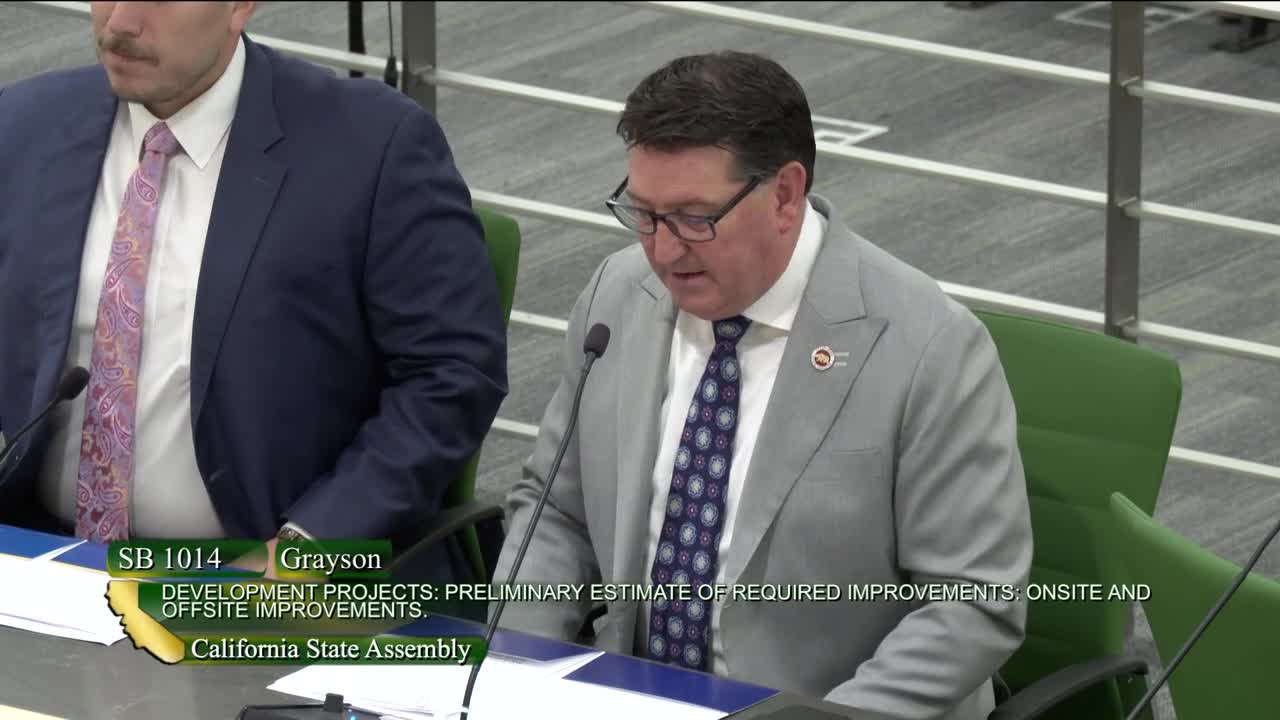 1MIN
Assembly Standing Committee on Appropriations
 6MIN
Assembly Standing Committee on Housing and Community Development
 6MIN
Assembly Standing Committee on Local Government
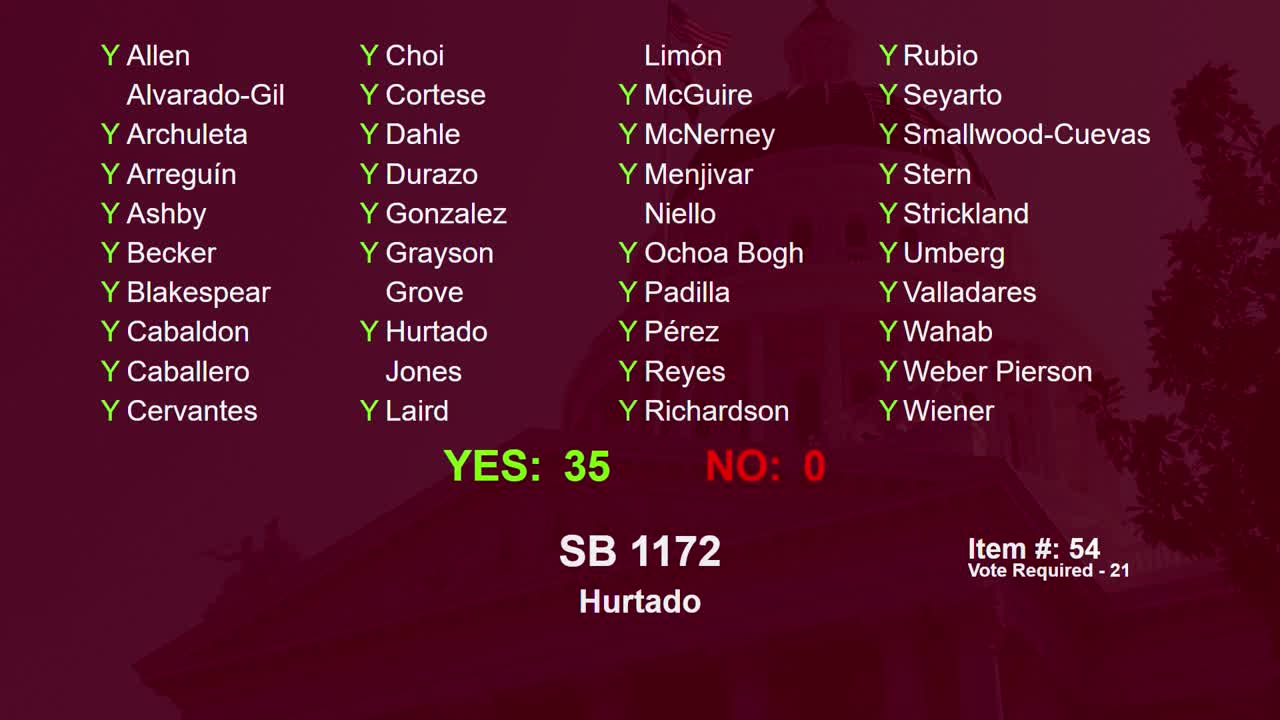 2MIN
Senate Floor
 9MIN
Senate Standing Committee on Housing
Bill Author

Bill Co-Author(s):