SB 1037: Health care coverage: rate review.
- Session Year: 2025-2026
- House: Senate
- Latest Version Date: 2026-08-27
Current Status:
In Progress
(2026-09-27: In Senate. Consideration of Governor's veto pending.)
Introduced
In Committee
Awaiting First Chamber Vote
Passed First Chamber
In Committee
Awaiting Second Chamber Vote
Passed Second Chamber
Enacted
Existing law, the Knox-Keene Health Care Service Plan Act of 1975, provides for the licensure and regulation of health care service plans by the Department of Managed Health Care and makes a violation of the act by a health care service plan a misdemeanor. Existing law provides for the regulation of health insurers by the Department of Insurance. Existing law defines unreasonable rate increase, for these purposes, to have the same meaning as in the federal Patient Protection and Affordable Care Act, which is that an unreasonable rate increase exists when the federal Centers for Medicare and Medicaid Services makes a determination that a rate increase is excessive, unjustified, or unfairly discriminatory, among other things.
This bill would instead define unreasonable rate increase, for the above-described purposes, to mean a rate increase that the Director of the Department of Managed Health Care or the Insurance Commissioner, as applicable, determines is excessive, unjustified, unfairly discriminatory, or otherwise unreasonable.
Existing law requires a health care service plan or health insurer to submit rates to their regulating entity for review and to demonstrate the impact of any changes in the rate of growth of health care costs resulting from health care cost targets.
This bill would instead require a health care service plan or health insurer to demonstrate the impact of health care cost targets and to demonstrate whether a health care service plans or health insurers annual rate growth exceeds or will exceed the cost target for the rating period. The bill would require, if a health care service plans or health insurers rate growth is expected to exceed the cost target for a rating period, the health care service plan or health insurer to include specified information in its rate filing, including, among other things, a detailed list of any proactive steps it is taking, or plans to take, for annual rate growth to meet the cost targets. Because a willful violation of these provisions by a health care service plan would be a crime, the bill would impose a state-mandated local program.
Existing law requires the director or the commissioner, as applicable, in determining if a rate is unreasonable or not justified for purposes of the above-described review, to consider the impact on changes in health care costs as a result of the health care cost targets described above.
This bill would delete those provisions and instead require the Department of Managed Health Care and the Department of Insurance to report on if rates, by plan or policy and in aggregate, meet the affordability standard, as defined, for an individual, a couple, and a family of four. The bill would require the report to include the annual change in premiums and cost sharing for the prior 5 years. The bill would, as part of the existing rate submission process, require a health care service plan or health insurer to provide information on premiums, deductibles, cost sharing, and any other factors specified by the department as necessary to complete the reports.
The California Constitution requires the state to reimburse local agencies and school districts for certain costs mandated by the state. Statutory provisions establish procedures for making that reimbursement.
This bill would provide that no reimbursement is required by this act for a specified reason.
Existing law, the Knox-Keene Health Care Service Plan Act of 1975, provides for the licensure and regulation of health care service plans by the Department of Managed Health Care and makes a violation of the act by a health care service plan a misdemeanor. Existing law provides for the regulation of health insurers by the Department of Insurance. Existing law defines unreasonable rate increase, for these purposes, to have the same meaning as in the federal Patient Protection and Affordable Care Act, which is that an unreasonable rate increase exists when the federal Centers for Medicare and Medicaid Services makes a determination that a rate increase is excessive, unjustified, or unfairly discriminatory, among other things.
This bill would instead define unreasonable rate increase, for the above-described purposes, to mean a rate increase that the Director of the Department of Managed Health Care or the Insurance Commissioner, as applicable, determines is excessive, unjustified, unfairly discriminatory, or otherwise unreasonable, as defined. unreasonable.
Existing law requires a health care service plan or health insurer to submit rates to their regulating entity for review and to demonstrate the impact of any changes in the rate of growth of health care costs resulting from health care cost targets.
This bill would instead require a health care service plan or health insurer to demonstrate the impact of health care cost targets and to demonstrate whether a health care service plan plans or health insurers annual rate growth meets exceeds or will meet exceed the cost target for the rating period. The bill would require, if a health care service plan plans or health insurers rate growth is expected to exceed the cost target for a rating period, the health care service plan or health insurer to include specified information it is in its rate filing, including, among other things, a detailed list of any proactive steps it is taking, or plans to take, to meet cost targets through rate development. for annual rate growth to meet the cost targets. Because a willful violation of these provisions by a health care service plan would be a crime, the bill would impose a state-mandated local program.
Existing law requires the director or the commissioner, as applicable, in determining whether if a rate is unreasonable or not justified for purposes of the above-described review, to consider the impact on changes in health care costs as a result of the health care cost targets described above.
This bill would require, in determining whether a rate increase is unreasonable, the director to consider whether the health care service plan has sufficient or excessive financial capacity for the past 3 years, and the commissioner to consider the insurers surplus condition for the past 3 years, using specified measures. The bill would delete those provisions and instead require the Department of Managed Health Care and the Department of Insurance, in consultation with the Office of Health Care Affordability, as part of the existing rate review process, to evaluate the affordability standard for an individual and a family of 4, as specified. Insurance to report on if rates, by plan or policy and in aggregate, meet the affordability standard, as defined, for an individual, a couple, and a family of four. The bill would require the evaluation report to include the annual change in premiums and cost sharing for the prior 5 years, including deductibles, copayments, coinsurance, and any other cost sharing that impact actuarial value. years. The bill would, as part of the existing rate submission process, require a health care service plan or health insurer to provide information on premiums, deductibles, cost sharing, and any other factors specified by the department as necessary to complete the reports.
The California Constitution requires the state to reimburse local agencies and school districts for certain costs mandated by the state. Statutory provisions establish procedures for making that reimbursement.
This bill would provide that no reimbursement is required by this act for a specified reason.
Existing law, the Knox-Keene Health Care Service Plan Act of 1975, provides for the licensure and regulation of health care service plans by the Department of Managed Health Care and makes a violation of the act by a health care service plan a misdemeanor. Existing law provides for the regulation of health insurers by the Department of Insurance. Existing law defines unreasonable rate increase, for these purposes, to have the same meaning as in the federal Patient Protection and Affordable Care Act, which is that an unreasonable rate increase exists when the federal Centers for Medicare and Medicaid Services makes a determination that a rate increase is excessive, unjustified, or unfairly discriminatory, among other things.
This bill would instead define unreasonable rate increase, for the above-described purposes, to mean a rate increase that the Director of the Department of Managed Health Care or the Insurance Commissioner, as applicable, determines is excessive, unjustified, unfairly discriminatory, or otherwise unreasonable. unreasonable, as defined.
Existing law requires a health care service plan or health insurer to submit rates to their regulating entity for review and to demonstrate the impact of any changes in the rate of growth of health care costs resulting from health care cost targets.
This bill would instead require a health care service plan or health insurer to demonstrate the impact of health care cost targets on rate development, including medical trends, medical inflation, and medical administrative costs. If a plan or insurer asserts that aging, high-cost drugs, or other cost drivers explain a rate increase, the bill would require the plan or insurer to explain how it reconciles this information with analysis published by the Office of Health Care Affordability. and to demonstrate whether a health care service plan or health insurers rate growth meets or will meet the cost target for the rating period. The bill would require, if a health care service plan or health insurers rate growth is expected to exceed the cost target for a rating period, the health care service plan or health insurer to include specified information it is rate filing, including, among other things, a detailed list of any proactive steps it is taking, or plans to take, to meet cost targets through rate development. Because a willful violation of these provisions by a health care service plan would be a crime, the bill would impose a state-mandated local program.
Existing law requires the director or the commissioner, as applicable, in determining whether a rate is unreasonable or not justified for purposes of the above-described review, to consider the impact on changes in health care costs as a result of the health care cost targets described above.
This bill would require, in determining whether a rate increase is unreasonable, the director to consider whether the plan, health care service plan has sufficient or excessive financial capacity for the past 3 years, and the commissioner to consider whether the insurer, has sufficient or excessive financial capacity the insurers surplus condition for the past 3 years years, using specified measures. The bill would require the Department of Managed Health Care and the Department of Insurance, in collaboration consultation with the Office of Health Care Affordability, as part of the existing rate review process, to each conduct an enhanced rate review to determine if health care premiums are affordable, as defined, for individual and group purchasers. to evaluate the affordability standard for an individual and a family of 4, as specified. The bill would require the review evaluation to include the annual change in premiums and cost sharing for the prior 5 years, including deductibles, copayments, coinsurance, and any other cost sharing that impact actuarial value.
The California Constitution requires the state to reimburse local agencies and school districts for certain costs mandated by the state. Statutory provisions establish procedures for making that reimbursement.
This bill would provide that no reimbursement is required by this act for a specified reason.
Existing law, the Knox-Keene Health Care Service Plan Act of 1975, provides for the licensure and regulation of health care service plans by the Department of Managed Health Care and makes a violation of the act by a health care service plan a misdemeanor. Existing law provides for the regulation of health insurers by the Department of Insurance. Existing law defines unreasonable rate increase, for these purposes, to have the same meaning as in the federal Patient Protection and Affordable Care Act, which is that an unreasonable rate increase exists when the federal Centers for Medicare and Medicaid Services makes a determination that a rate increase is excessive, unjustified, or unfairly discriminatory, among other things.
This bill would instead define unreasonable rate increase, for the above-described purposes, to mean a rate increase that the Director of the Department of Managed Health Care or the Insurance Commissioner, as applicable, determines is excessive, unjustified, unfairly discriminatory, or otherwise unreasonable.
Existing law requires a health care service plan or health insurer to submit rates to their regulating entity for review and to demonstrate the impact of any changes in the rate of growth of health care costs resulting from health care cost targets.
This bill would instead require a health care service plan or health insurer to demonstrate the impact of health care cost targets on rate development, including medical trends, medical inflation, and medical administrative costs. If a plan or insurer asserts that aging, high-cost drugs, or other cost drivers explain a rate increase, the bill would require the plan or insurer to explain how it reconciles this information with analysis published by the Office of Health Care Affordability. Because a willful violation of these provisions by a health care service plan would be a crime, the bill would impose a state-mandated local program.
Existing law requires the director or the commissioner, as applicable, in determining whether a rate is unreasonable or not justified for purposes of the above-described review, to consider the impact on changes in health care costs as a result of the health care cost targets described above.
This bill would require, in determining whether a rate increase is unreasonable, the director to consider whether the plan plan, and the commissioner to consider whether the insurer, has sufficient or excessive tangible net equity and the commissioner to consider whether the insurer has sufficient or excessive risk-based capital. financial capacity for the past 3 years using specified measures. The bill would require the Department of Managed Health Care and the Department of Insurance, in collaboration with the Office of Health Care Affordability, as part of the existing rate review process, to each conduct an enhanced rate review to determine if health care premiums are affordable affordable, as defined, for individual and group purchasers. The bill would require the review to include the annual change in premiums and cost sharing for the prior 5 years, including deductibles, copayments, coinsurance, and any other cost sharing that impact actuarial value.
The California Constitution requires the state to reimburse local agencies and school districts for certain costs mandated by the state. Statutory provisions establish procedures for making that reimbursement.
This bill would provide that no reimbursement is required by this act for a specified reason.
Existing law, the Knox-Keene Health Care Service Plan Act of 1975, provides for the licensure and regulation of health care service plans by the Department of Managed Health Care and makes a violation of the act by a health care service plan a misdemeanor. Existing law provides for the regulation of health insurers by the Department of Insurance. Existing law defines unreasonable rate increase, for these purposes, to have the same meaning as in the federal Patient Protection and Affordable Care Act, which is that an unreasonable rate increase exists when the federal Centers for Medicare and Medicaid Services makes a determination that a rate increase is excessive, unjustified, or unfairly discriminatory, among other things.
This bill would instead define unreasonable rate increase, for the above-described purposes, to mean a rate increase that the Director of the Department of Managed Health Care or the Insurance Commissioner, as applicable, determines is excessive, unjustified, unfairly discriminatory, or otherwise unreasonable.
Existing law requires a health care service plan or health insurer to submit rates to their regulating entity for review and to demonstrate the impact of any changes in the rate of growth of health care costs resulting from health care cost targets.
This bill would instead require a health care service plan or health insurer to demonstrate the impact of health care cost targets on rate development, including medical trends, medical inflation, and medical administrative costs. If a plan or insurer asserts that aging, high-cost drugs, or other cost drivers explain a rate increase, the bill would require the plan or insurer to explain how it reconciles this information with analysis published by the Office of Health Care Affordability. Because a willful violation of these provisions by a health care service plan would be a crime, the bill would impose a state-mandated local program.
Existing law requires the director or the commissioner, as applicable, in determining whether a rate is unreasonable or not justified for purposes of the above-described review, to consider the impact on changes in health care costs as a result of the health care cost targets described above.
This bill would require the director or the commissioner, as applicable, to additionally consider any excessive tangible net equity of the plan or the insurer in the above-described determination. require, in determining whether a rate increase is unreasonable, the director to consider whether the plan has sufficient or excessive tangible net equity and the commissioner to consider whether the insurer has sufficient or excessive risk-based capital. The bill would require the Department of Managed Health Care and the Department of Insurance, in collaboration with the Office of Health Care Affordability, as part of the existing rate review process, to each conduct an enhanced rate review to determine if health care premiums are affordable for individual and group purchasers. The bill would require the review to include the annual change in premiums and cost sharing for the prior 5 years, including deductibles, copayments, coinsurance, and any other cost sharing that impact actuarial value.
The California Constitution requires the state to reimburse local agencies and school districts for certain costs mandated by the state. Statutory provisions establish procedures for making that reimbursement.
This bill would provide that no reimbursement is required by this act for a specified reason.
Existing law, the Knox-Keene Health Care Service Plan Act of 1975, provides for the licensure and regulation of health care service plans by the Department of Managed Health Care. Care and makes a violation of the act by a health care service plan a misdemeanor. Existing law provides for the regulation of health insurers by the Department of Insurance. Existing law requires that health care service plans and health insurers submit rates to their regulating entity for review and to demonstrate the impact of any changes in the rate of growth of health care costs resulting from health care cost targets. defines unreasonable rate increase, for these purposes, to have the same meaning as in the federal Patient Protection and Affordable Care Act, which is that an unreasonable rate increase exists when the federal Centers for Medicare and Medicaid Services makes a determination that a rate increase is excessive, unjustified, or unfairly discriminatory, among other things.
This bill would instead define unreasonable rate increase, for the above-described purposes, to mean a rate increase that the Director of the Department of Managed Health Care or the Insurance Commissioner, as applicable, determines is excessive, unjustified, unfairly discriminatory, or otherwise unreasonable.
Existing law requires a health care service plan or health insurer to submit rates to their regulating entity for review and to demonstrate the impact of any changes in the rate of growth of health care costs resulting from health care cost targets.
This bill would instead require a health care service plan or health insurer to demonstrate the impact of health care cost targets on rate development, including medical trends, medical inflation, and medical administrative costs. If a plan or insurer asserts that aging, high-cost drugs, or other cost drivers explain a rate increase, the bill would require the plan or insurer to explain how it reconciles this information with analysis published by the Office of Health Care Affordability. Because a willful violation of these provisions by a health care service plan would be a crime, the bill would impose a state-mandated local program.
Existing law requires the director or the commissioner, as applicable, in determining whether a rate is unreasonable or not justified for purposes of the above-described review, to consider the impact on changes in health care costs as a result of the health care cost targets described above.
This bill would require the director or the commissioner, as applicable, to additionally consider any excessive tangible net equity of the plan or the insurer in the above-described determination. The bill would require the Department of Managed Health Care and the Department of Insurance, in collaboration with the Office of Health Care Affordability, to each conduct an enhanced rate review to determine if health care premiums are affordable for individual and group purchasers. The bill would require the review to include the annual change in premiums and cost sharing for the prior 5 years, including deductibles, copayments, coinsurance, and any other cost sharing that impact actuarial value.
The California Constitution requires the state to reimburse local agencies and school districts for certain costs mandated by the state. Statutory provisions establish procedures for making that reimbursement.
This bill would provide that no reimbursement is required by this act for a specified reason.
Existing law, the Knox-Keene Health Care Service Plan Act of 1975, provides for the licensure and regulation of health care service plans by the Department of Managed Health Care. Existing law provides for the regulation of health insurers by the Department of Insurance. Existing law requires that health care service plans and health insurers submit rates to their regulating entity for review and to demonstrate the impact of any changes in the rate of growth of health care costs resulting from health care cost targets.
This bill would require the Department of Managed Health Care and the Department of Insurance, in collaboration with the Office of Health Care Affordability, to each conduct an enhanced rate review to determine if health care premiums are affordable for individual and group purchasers.
For purposes of this article, the following definitions shall apply:
(a)(1)Blended means a rating method that combines community rating and experience rating methods.
(2)Community rated means a rating method in the large group market that bases rates on the expected costs to a health care service plan of providing covered benefits to all enrollees, including both low-risk and high-risk enrollees. Premiums may vary according to the factors in this article.
(3)Experience rated means a rating method in the large group market under which a health care service plan calculates the premiums for a large group in whole or blended based on the groups prior experience.
(b)(1)For individual and small group market products, geographic region has the same meaning as in Sections 1357.512 and 1399.855.
(2)For large group market products, geographic region means one of the following areas composed of the regions defined in Sections 1357.512 and 1399.855:
(A)An area composed of regions 2, 4, 5, 6, 7, and 8, which consist of the Counties of Alameda, Contra Costa, Marin, Napa, San Mateo, Santa Clara, Solano, and Sonoma and the City and County of San Francisco.
(B)An area composed of regions 1 and 3, which consist of the Counties of Alpine, Amador, Butte, Calaveras, Colusa, Del Norte, El Dorado, Glenn, Humboldt, Lake, Lassen, Mendocino, Modoc, Nevada, Placer, Plumas, Sacramento, Shasta, Sierra, Siskiyou, Sutter, Tehama, Trinity, Tuolumne, Yolo, and Yuba.
(C)An area composed of regions 9 and 12, which consist of the Counties of Monterey, San Benito, San Luis Obispo, Santa Barbara, Santa Cruz, and Ventura.
(D)An area composed of regions 10, 11, and 14, which consist of the Counties of Fresno, Kern, Kings, Madera, Mariposa, Merced, San Joaquin, Stanislaus, and Tulare.
(E)An area composed of regions 13 and 17, which consist of the Counties of Imperial, Inyo, Mono, Riverside, and San Bernardino.
(F)An area composed of regions 15 and 16, which consist of the County of Los Angeles.
(G)An area composed of regions 18 and 19, which consist of the Counties of Orange and San Diego.
(c)Large group health care service plan contract means a group health care service plan contract other than a contract issued to a small employer, as defined in Section 1357, 1357.500, or 1357.600.
(d)Small group health care service plan contract means a group health care service plan contract issued to a small employer, as defined in Section 1357, 1357.500, or 1357.600.
(e)PPACA means Section 2794 of the federal Public Health Service Act (42 U.S.C. Sec. 300gg-94), as amended by the federal Patient Protection and Affordable Care Act (Public Law (111-148)), and any subsequent rules, regulations, or guidance issued under that section.
(f)Unreasonable rate increase means a rate increase that the director determines is any of the following:
(1)Excessive.
(2)Unjustified.
(3)Unfairly discriminatory.
(4)Otherwise unreasonable.
SEC. 2.Section 1385.035 of the Health and Safety Code is amended to read:1385.035.(a)It is the intent of the Legislature in enacting this section to ensure that enrollees and subscribers benefit from reductions in the rate of growth in health care costs as a result of the establishment of the Office of Health Care Affordability. The department, as part of the existing rate review process, may consult with the Office of Health Care Affordability to consider information submitted pursuant to this article.
(b)(1)In submitting rates for review consistent with this article, a health care service plan shall demonstrate the impact of cost targets established under the authority granted by Chapter 2.6 (commencing with Section 127500) of Part 2 of Division 107. A health care service plan shall demonstrate whether its annual rate growth exceeds or will exceed the cost target for the rating period. If a health care service plans rate growth is expected to exceed the cost target for the rating period, the health care service plan shall include the following in its rate filing:
(A)A detailed list of any proactive steps it is taking, or plans to take, for annual rate growth to meet the cost targets.
(B)A delineation of factors driving rate increases to exceed the cost targets described in this subdivision.
(2)The health care service plan shall respond to any requests for additional information deemed necessary by the department.
(c)Failure by a health care service plan to sufficiently provide all information required by this section shall constitute an unreasonable rate.
(d)(1)In the aggregate rate reports required pursuant to Sections 1385.043 and 1385.045, the department shall report on if rates, by plan and in aggregate, meet the affordability standard under paragraph (3) for an individual, a couple, and a family of four. The report shall include the annual change in premiums and cost sharing for the prior five years.
(2)As part of the existing rate submission process, a health care service plan shall provide, in a manner and format specified by the department, information on premiums, deductibles, cost sharing, and any other factors specified by the department as necessary to complete the reports required pursuant to Sections 1385.043 and 1385.045.
(3)For the purposes of this subdivision, the affordability standard means that the average gross premium and average deductible totals less than the percent of income described in subdivision (a) of Section 61020 of the Revenue and Taxation Code for an individual, a couple, and a family of four with household incomes at 200 percent of the federal poverty level, 400 percent of the federal poverty level, and 800 percent of the federal poverty level.
(e)This section does not apply to a specialized health care service plan.
(f)Notwithstanding Chapter 3.5 (commencing with Section 11340) of Part 1 of Division 3 of Title 2 of the Government Code, the department may implement, interpret, or make specific this section by means of all plan letters, guidance, methodologies, rules, definitions, policies, forms, templates, information or data requests, or similar instructions, without taking regulatory action.
SEC. 3.Section 10181 of the Insurance Code is amended to read:10181.For purposes of this article, the following definitions shall apply:
(a)(1)Blended means a rating method that combines community rating and experience rating methods.
(2)Community rated means a rating method in the large group market that bases rates on the expected costs to a health insurer of providing covered benefits to all insureds, including both low-risk and high-risk insureds. Premiums may vary according to the factors in this article.
(3)Experience rated means a rating method in the large group market under which a health insurer calculates the premiums for a large group in whole or blended based on the groups prior experience.
(b)(1)For individual and small group market products, geographic region has the same meaning as in Sections 10753.14 and 10965.9.
(2)For large group market products, geographic region means one of the following areas, composed of the regions defined in Sections 10753.14 and 10965.9:
(A)An area composed of regions 2, 4, 5, 6, 7, and 8, which consist of the Counties of Alameda, Contra Costa, Marin, Napa, San Mateo, Santa Clara, Solano, and Sonoma and the City and County of San Francisco.
(B)An area composed of regions 1 and 3, which consist of the Counties of Alpine, Amador, Butte, Calaveras, Colusa, Del Norte, El Dorado, Glenn, Humboldt, Lake, Lassen, Mendocino, Modoc, Nevada, Placer, Plumas, Sacramento, Shasta, Sierra, Siskiyou, Sutter, Tehama, Trinity, Tuolumne, Yolo, and Yuba.
(C)An area composed of regions 9 and 12, which consist of the Counties of Monterey, San Benito, San Luis Obispo, Santa Barbara, Santa Cruz, and Ventura.
(D)An area composed of regions 10, 11, and 14, which consist of the Counties of Fresno, Kern, Kings, Madera, Mariposa, Merced, San Joaquin, Stanislaus, and Tulare.
(E)An area composed of regions 13 and 17, which consist of the Counties of Imperial, Inyo, Mono, Riverside, and San Bernardino.
(F)An area composed of regions 15 and 16, which consist of the County of Los Angeles.
(G)An area composed of regions 18 and 19, which consist of the Counties of Orange and San Diego.
(c)Large group health insurance policy means a group health insurance policy other than a policy issued to a small employer, as defined in Section 10700, 10753, or 10755.
(d)Small group health insurance policy means a group health insurance policy issued to a small employer, as defined in Section 10700, 10753, or 10755.
(e)PPACA means Section 2794 of the federal Public Health Service Act (42 U.S.C. Sec. 300gg-94), as amended by the federal Patient Protection and Affordable Care Act (Public Law 111-148), and any subsequent rules, regulations, or guidance issued pursuant to that law.
(f)Unreasonable rate increase means a rate increase that the commissioner determines is any of the following:
(1)Excessive.
(2)Unjustified.
(3)Unfairly discriminatory.
(4)Otherwise unreasonable.
SEC. 4.Section 10181.35 of the Insurance Code is amended to read:10181.35.(a)It is the intent of the Legislature in enacting this section to ensure that insureds benefit from reductions in the rate of growth in health care costs as a result of the establishment of the Office of Health Care Affordability. The department, as part of the existing rate review process, may consult with the Office of Health Care Affordability to consider information submitted pursuant to this article.
(b)(1)In submitting rates for review consistent with this article, a health insurer shall demonstrate the impact of the health care cost targets established under the authority granted by Chapter 2.6 (commencing with Section 127500) of Part 2 of Division 107. An insurer shall demonstrate whether its annual rate growth exceeds or will exceed the cost target for the rating period. If a health insurers rate growth is expected to exceed the cost target for the rating period, the insurer shall include the following in its rate filing:
(A)A detailed list of any proactive steps it is taking, or plans to take, for annual rate growth to meet the cost targets.
(B)A delineation of factors driving rate increases to exceed the cost targets described in this subdivision.
(2)The health insurer shall respond to any requests for additional information deemed necessary by the department.
(c)Failure by a health insurer to sufficiently provide all information required by this section shall constitute an unreasonable rate.
(d)(1)In the aggregate rate reports required pursuant to Sections 10181.45 and 10181.46, the department shall report on if rates, by policy and in aggregate, meet the affordability standard under paragraph (3) for an individual, a couple, and a family of four. The report shall include the annual change in premiums and cost sharing for the prior five years.
(2)As part of the existing rate submission process, a health insurer shall provide, in a manner and format specified by the department, information on premiums, deductibles, cost sharing, and any other factors specified by the department as necessary to complete the reports required pursuant to Sections 10181.45 and 10181.46.
(3)For the purposes of this subdivision, the affordability standard means that the average gross premium and average deductible totals less than the percent of income described in subdivision (a) of Section 61020 of the Revenue and Taxation Code for an individual, a couple, and a family of four with household incomes at 200 percent of the federal poverty level, 400 percent of the federal poverty level, and 800 percent of the federal poverty level.
(e)This section does not apply to a specialized health insurance policy.
(f)Notwithstanding Chapter 3.5 (commencing with Section 11340) of Part 1 of Division 3 of Title 2 of the Government Code, the department may implement, interpret, or make specific this section by means of all plan letters, guidance, methodologies, rules, definitions, policies, forms, templates, information or data requests, or similar instructions, without taking regulatory action.
SEC. 5.No reimbursement is required by this act pursuant to Section 6 of Article XIIIB of the California Constitution because the only costs that may be incurred by a local agency or school district will be incurred because this act creates a new crime or infraction, eliminates a crime or infraction, or changes the penalty for a crime or infraction, within the meaning of Section 17556 of the Government Code, or changes the definition of a crime within the meaning of Section 6 of Article XIIIB of the California Constitution.
For purposes of this article, the following definitions shall apply:
(a)(1)Blended means a rating method that combines community rating and experience rating methods.
(2)Community rated means a rating method in the large group market that bases rates on the expected costs to a health care service plan of providing covered benefits to all enrollees, including both low-risk and high-risk enrollees. Premiums may vary according to the factors in this article.
(3)Experience rated means a rating method in the large group market under which a health care service plan calculates the premiums for a large group in whole or blended based on the groups prior experience.
(b)(1)For individual and small group market products, geographic region has the same meaning as in Sections 1357.512 and 1399.855.
(2)For large group market products, geographic region means one of the following areas composed of the regions defined in Sections 1357.512 and 1399.855:
(A)An area composed of regions 2, 4, 5, 6, 7, and 8, which consist of the Counties of Alameda, Contra Costa, Marin, Napa, San Mateo, Santa Clara, Solano, and Sonoma and the City and County of San Francisco.
(B)An area composed of regions 1 and 3, which consist of the Counties of Alpine, Amador, Butte, Calaveras, Colusa, Del Norte, El Dorado, Glenn, Humboldt, Lake, Lassen, Mendocino, Modoc, Nevada, Placer, Plumas, Sacramento, Shasta, Sierra, Siskiyou, Sutter, Tehama, Trinity, Tuolumne, Yolo, and Yuba.
(C)An area composed of regions 9 and 12, which consist of the Counties of Monterey, San Benito, San Luis Obispo, Santa Barbara, Santa Cruz, and Ventura.
(D)An area composed of regions 10, 11, and 14, which consist of the Counties of Fresno, Kern, Kings, Madera, Mariposa, Merced, San Joaquin, Stanislaus, and Tulare.
(E)An area composed of regions 13 and 17, which consist of the Counties of Imperial, Inyo, Mono, Riverside, and San Bernardino.
(F)An area composed of regions 15 and 16, which consist of the County of Los Angeles.
(G)An area composed of regions 18 and 19, which consist of the Counties of Orange and San Diego.
(c)Large group health care service plan contract means a group health care service plan contract other than a contract issued to a small employer, as defined in Section 1357, 1357.500, or 1357.600.
(d)Small group health care service plan contract means a group health care service plan contract issued to a small employer, as defined in Section 1357, 1357.500, or 1357.600.
(e)PPACA means Section 2794 of the federal Public Health Service Act (42 U.S.C. Sec. 300gg-94), as amended by the federal Patient Protection and Affordable Care Act (Public Law (111-148)), and any subsequent rules, regulations, or guidance issued under that section.
(f)Unreasonable rate increase means a rate increase that the director determines is any of the following:
(1)Excessive.
(2)Unjustified.
(3)Unfairly discriminatory.
(4)Otherwise unreasonable, as defined by PPACA and Section 154.102 of Title 45 of the Code of Federal Regulations as in effect on January 1, 2026. unreasonable.
SEC. 2.Section 1385.035 of the Health and Safety Code is amended to read:1385.035.(a)It is the intent of the Legislature in enacting this section to ensure that enrollees and subscribers benefit from reductions in the rate of growth in health care costs as a result of the establishment of the Office of Health Care Affordability. The department, as part of the existing rate review process, may consult with the Office of Health Care Affordability to consider information submitted pursuant to this article.
(b)(1)In submitting rates for review consistent with this article, a health care service plan shall demonstrate the impact of cost targets established under the authority granted by Chapter 2.6 (commencing with Section 127500) of Part 2 of Division 107. A health care service plan shall demonstrate whether its annual rate growth meets exceeds or will meet exceed the cost target for the rating period. If a health care service plans rate growth is expected to exceed the cost target for the rating period, the health care service plan shall include the following in its rate filing:
(1)(A)A detailed list of any proactive steps it is taking, or plans to take, to meet cost targets through rate development. for annual rate growth to meet the cost targets.
(2)(B)A delineation of factors driving rate increases to exceed the cost targets described in this subdivision, including, but not limited to, medical trends, medical inflation, and pharmaceutical prices, in addition to administrative costs and nonmedical costs drivers, including, for example, consumer aging or supply constraints. subdivision.
(3)If the Office of Health Care Affordability has published an analysis on a specific cost driver and a health care service plan has used that cost driver to explain a rate increase in part or in whole, the plan shall reconcile its findings to the extent they deviate from any applicable analysis published by the Office of Health Care Affordability.(c)In determining whether a rate is unreasonable, the director shall consider the impact on changes in health care costs as a result of the health care cost targets set pursuant to Chapter 2.6 (commencing with Section 127500) of Part 2 of Division 107.(d)(1)In determining whether a rate increase is unreasonable, the director shall consider whether a plan has sufficient or excessive financial capacity for the past three years using all of the following measures:(A)Tangible net equity.(B)Working capital.(C)Payouts to shareholders and investors, if a for-profit entity.(D)Reserves and investments.(E)Other measures determined by the department.(2)If a plans financial capacity is excessive, the department shall take into consideration whether the plan has financial capacity to charge enrollees a lower rate than the proposed rate in determining if the proposed rate is unreasonable.(3)This subdivision shall be implemented in a manner that does not conflict with any financial solvency provision in this chapter.(e)(1)The department, in consultation with the Office of Health Care Affordability, shall evaluate as part of the rate review process whether the insurers rates meet the affordability standard under paragraph (2) for an individual and a family of four with household incomes at 200 percent of the federal poverty level, 400 percent of the federal poverty level, and 800 percent of the federal poverty level. The evaluation shall include the annual change in premiums and cost sharing for the prior five years, including, but not limited to, deductibles, copayments, coinsurance, and any other cost sharing that impact actuarial value.(2)The health care service plan shall respond to any requests for additional information deemed necessary by the department.
(c)Failure by a health care service plan to sufficiently provide all information required by this section shall constitute an unreasonable rate.
(d)(1)In the aggregate rate reports required pursuant to Sections 1385.043 and 1385.045, the department shall report on if rates, by plan and in aggregate, meet the affordability standard under paragraph (3) for an individual, a couple, and a family of four. The report shall include the annual change in premiums and cost sharing for the prior five years.
(2)As part of the existing rate submission process, a health care service plan shall provide, in a manner and format specified by the department, information on premiums, deductibles, cost sharing, and any other factors specified by the department as necessary to complete the reports required pursuant to Sections 1385.043 and 1385.045.
(2)(3)For the purposes of this subdivision, the affordability standard means that the plan contract requires no greater individual contribution to premium, share of premium, and deductible as the amount described in Section 61020 of the Revenue and Taxation Code. average gross premium and average deductible totals less than the percent of income described in subdivision (a) of Section 61020 of the Revenue and Taxation Code for an individual, a couple, and a family of four with household incomes at 200 percent of the federal poverty level, 400 percent of the federal poverty level, and 800 percent of the federal poverty level.
(3)The evaluation of affordability shall be reported as part of the reports made pursuant to this section and Section 1385.045. (f)(e)This section does not apply to a specialized health care service plan.
(f)Notwithstanding Chapter 3.5 (commencing with Section 11340) of Part 1 of Division 3 of Title 2 of the Government Code, the department may implement, interpret, or make specific this section by means of all plan letters, guidance, methodologies, rules, definitions, policies, forms, templates, information or data requests, or similar instructions, without taking regulatory action.
SEC. 3.Section 10181 of the Insurance Code is amended to read:10181.For purposes of this article, the following definitions shall apply:
(a)(1)Blended means a rating method that combines community rating and experience rating methods.
(2)Community rated means a rating method in the large group market that bases rates on the expected costs to a health insurer of providing covered benefits to all insureds, including both low-risk and high-risk insureds. Premiums may vary according to the factors in this article.
(3)Experience rated means a rating method in the large group market under which a health insurer calculates the premiums for a large group in whole or blended based on the groups prior experience.
(b)(1)For individual and small group market products, geographic region has the same meaning as in Sections 10753.14 and 10965.9.
(2)For large group market products, geographic region means one of the following areas, composed of the regions defined in Sections 10753.14 and 10965.9:
(A)An area composed of regions 2, 4, 5, 6, 7, and 8, which consist of the Counties of Alameda, Contra Costa, Marin, Napa, San Mateo, Santa Clara, Solano, and Sonoma and the City and County of San Francisco.
(B)An area composed of regions 1 and 3, which consist of the Counties of Alpine, Amador, Butte, Calaveras, Colusa, Del Norte, El Dorado, Glenn, Humboldt, Lake, Lassen, Mendocino, Modoc, Nevada, Placer, Plumas, Sacramento, Shasta, Sierra, Siskiyou, Sutter, Tehama, Trinity, Tuolumne, Yolo, and Yuba.
(C)An area composed of regions 9 and 12, which consist of the Counties of Monterey, San Benito, San Luis Obispo, Santa Barbara, Santa Cruz, and Ventura.
(D)An area composed of regions 10, 11, and 14, which consist of the Counties of Fresno, Kern, Kings, Madera, Mariposa, Merced, San Joaquin, Stanislaus, and Tulare.
(E)An area composed of regions 13 and 17, which consist of the Counties of Imperial, Inyo, Mono, Riverside, and San Bernardino.
(F)An area composed of regions 15 and 16, which consist of the County of Los Angeles.
(G)An area composed of regions 18 and 19, which consist of the Counties of Orange and San Diego.
(c)Large group health insurance policy means a group health insurance policy other than a policy issued to a small employer, as defined in Section 10700, 10753, or 10755.
(d)Small group health insurance policy means a group health insurance policy issued to a small employer, as defined in Section 10700, 10753, or 10755.
(e)PPACA means Section 2794 of the federal Public Health Service Act (42 U.S.C. Sec. 300gg-94), as amended by the federal Patient Protection and Affordable Care Act (Public Law 111-148), and any subsequent rules, regulations, or guidance issued pursuant to that law.
(f)Unreasonable rate increase means a rate increase that the commissioner determines is any of the following:
(1)Excessive.
(2)Unjustified.
(3)Unfairly discriminatory.
(4)Otherwise unreasonable, as defined by PPACA and Section 154.102 of Title 45 of the Code of Federal Regulations as in the effect on January 1, 2026. unreasonable.
SEC. 4.Section 10181.35 of the Insurance Code is amended to read:10181.35.(a)It is the intent of the Legislature in enacting this section to ensure that insureds benefit from reductions in the rate of growth in health care costs as a result of the establishment of the Office of Health Care Affordability. The department, as part of the existing rate review process, may consult with the Office of Health Care Affordability to consider information submitted pursuant to this article.
(b)(1)In submitting rates for review consistent with this article, a health insurer shall demonstrate the impact of the health care cost targets established under the authority granted by Chapter 2.6 (commencing with Section 127500) of Part 2 of Division 107. An insurer shall demonstrate whether its annual rate growth meets exceeds or will meet exceed the cost target for the rating period. If a health insurers rate growth is expected to exceed the cost target for the rating period, the insurer shall include the following in its rate filing:
(1)(A)A detailed list of any proactive steps it is taking, or plans to take, to meet cost targets through rate development. for annual rate growth to meet the cost targets.
(2)(B)A delineation of factors driving rate increases to exceed the cost targets described in this subdivision, including, but not limited to, medical trends, medical inflation, and pharmaceutical prices, in addition to administrative costs and nonmedical costs drivers, including, for example, consumer aging or supply constraints. subdivision.
(3)If the Office of Health Care Affordability has published an analysis on a specific cost driver and an insurer has used that cost driver to explain a rate increase in part or in whole, the insurer shall reconcile its findings to the extent they deviate from any applicable analysis published by the Office of Health Care Affordability.(c)In determining whether a rate is unreasonable, the commissioner shall consider the impact on changes in health care costs as a result of the health care cost targets set pursuant to Chapter 2.6 (commencing with Section 127500) of Part 2 of Division 107 of the Health and Safety Code.(d)(1)In determining whether a rate increase is unreasonable, the commissioner shall consider an insurers surplus condition, for the past three years using all of the following measures:(A)Working capital.(B)Payouts to shareholders and investors, if a for-profit entity.(C)Reserves and investments.(D)Other measures determined by the department.(2)If an insurers surplus condition is excessive, the department shall take into consideration whether the insurer has financial capacity to charge insureds a lower rate than the proposed rate in determining if the proposed rate is unreasonable.(3)This subdivision shall be implemented in a manner that does not conflict with any financial solvency provision in this chapter.(e)(1)The department, in consultation with the Office of Health Care Affordability, shall evaluate as part of the rate review process whether the insurers rates meet the affordability standard under paragraph (2) for an individual and a family of four with household incomes at 200 percent of the federal poverty level, 400 percent of the federal poverty level, and 800 percent of the federal poverty level. The evaluation shall include the annual change in premiums and cost sharing for the prior five years, including, but not limited to, deductibles, copayments, coinsurance, and any other cost sharing that impact actuarial value.(2)The health insurer shall respond to any requests for additional information deemed necessary by the department.
(c)Failure by a health insurer to sufficiently provide all information required by this section shall constitute an unreasonable rate.
(d)(1)In the aggregate rate reports required pursuant to Sections 10181.45 and 10181.46, the department shall report on if rates, by policy and in aggregate, meet the affordability standard under paragraph (3) for an individual, a couple, and a family of four. The report shall include the annual change in premiums and cost sharing for the prior five years.
(2)As part of the existing rate submission process, a health insurer shall provide, in a manner and format specified by the department, information on premiums, deductibles, cost sharing, and any other factors specified by the department as necessary to complete the reports required pursuant to Sections 10181.45 and 10181.46.
(2)(3)For the purposes of this subdivision, the affordability standard means that the policy requires no greater individual contribution to premium, share of premium, and deductible as the amount described in Section 61020 of the Revenue and Taxation Code. average gross premium and average deductible totals less than the percent of income described in subdivision (a) of Section 61020 of the Revenue and Taxation Code for an individual, a couple, and a family of four with household incomes at 200 percent of the federal poverty level, 400 percent of the federal poverty level, and 800 percent of the federal poverty level.
(3)The evaluation of affordability shall be reported as part of the reports made pursuant to this section and Section 10181.45.(f)(e)This section does not apply to a specialized health insurance policy.
(f)Notwithstanding Chapter 3.5 (commencing with Section 11340) of Part 1 of Division 3 of Title 2 of the Government Code, the department may implement, interpret, or make specific this section by means of all plan letters, guidance, methodologies, rules, definitions, policies, forms, templates, information or data requests, or similar instructions, without taking regulatory action.
SEC. 5.No reimbursement is required by this act pursuant to Section 6 of Article XIIIB of the California Constitution because the only costs that may be incurred by a local agency or school district will be incurred because this act creates a new crime or infraction, eliminates a crime or infraction, or changes the penalty for a crime or infraction, within the meaning of Section 17556 of the Government Code, or changes the definition of a crime within the meaning of Section 6 of Article XIIIB of the California Constitution.
For purposes of this article, the following definitions shall apply:
(a)(1)Blended means a rating method that combines community rating and experience rating methods.
(2)Community rated means a rating method in the large group market that bases rates on the expected costs to a health care service plan of providing covered benefits to all enrollees, including both low-risk and high-risk enrollees. Premiums may vary according to the factors in this article.
(3)Experience rated means a rating method in the large group market under which a health care service plan calculates the premiums for a large group in whole or blended based on the groups prior experience.
(b)(1)For individual and small group market products, geographic region has the same meaning as in Sections 1357.512 and 1399.855.
(2)For large group market products, geographic region means one of the following areas composed of the regions defined in Sections 1357.512 and 1399.855:
(A)An area composed of regions 2, 4, 5, 6, 7, and 8, which consist of the Counties of Alameda, Contra Costa, Marin, Napa, San Mateo, Santa Clara, Solano, and Sonoma and the City and County of San Francisco.
(B)An area composed of regions 1 and 3, which consist of the Counties of Alpine, Amador, Butte, Calaveras, Colusa, Del Norte, El Dorado, Glenn, Humboldt, Lake, Lassen, Mendocino, Modoc, Nevada, Placer, Plumas, Sacramento, Shasta, Sierra, Siskiyou, Sutter, Tehama, Trinity, Tuolumne, Yolo, and Yuba.
(C)An area composed of regions 9 and 12, which consist of the Counties of Monterey, San Benito, San Luis Obispo, Santa Barbara, Santa Cruz, and Ventura.
(D)An area composed of regions 10, 11, and 14, which consist of the Counties of Fresno, Kern, Kings, Madera, Mariposa, Merced, San Joaquin, Stanislaus, and Tulare.
(E)An area composed of regions 13 and 17, which consist of the Counties of Imperial, Inyo, Mono, Riverside, and San Bernardino.
(F)An area composed of regions 15 and 16, which consist of the County of Los Angeles.
(G)An area composed of regions 18 and 19, which consist of the Counties of Orange and San Diego.
(c)Large group health care service plan contract means a group health care service plan contract other than a contract issued to a small employer, as defined in Section 1357, 1357.500, or 1357.600.
(d)Small group health care service plan contract means a group health care service plan contract issued to a small employer, as defined in Section 1357, 1357.500, or 1357.600.
(e)PPACA means Section 2794 of the federal Public Health Service Act (42 U.S.C. Sec. 300gg-94), as amended by the federal Patient Protection and Affordable Care Act (Public Law (111-148)), and any subsequent rules, regulations, or guidance issued under that section.
(f)Unreasonable rate increase means a rate increase that the director determines is any of the following:
(1)Excessive.
(2)Unjustified.
(3)Unfairly discriminatory.
(4)Otherwise unreasonable. unreasonable, as defined by PPACA and Section 154.102 of Title 45 of the Code of Federal Regulations as in effect on January 1, 2026.
SEC. 2.Section 1385.035 of the Health and Safety Code is amended to read:1385.035.(a)It is the intent of the Legislature in enacting this section to ensure that enrollees and subscribers benefit from reductions in the rate of growth in health care costs as a result of the establishment of the Office of Health Care Affordability.
(b)In submitting rates for review consistent with this article, a health care service plan shall demonstrate the impact of cost targets set pursuant to established under the authority granted by Chapter 2.6 (commencing with Section 127500) of Part 2 of Division 107 on rate development, including medical trends, medical inflation, and medical administrative costs. If a plan asserts that aging, high-cost drugs, or other cost drivers explain a rate increase in part or in whole, the plan shall explain how it reconciles this information with analysis published by the Office of Health Care Affordability. 107. A health care service plan shall demonstrate whether its rate growth meets or will meet the cost target for the rating period. If a health care service plans rate growth is expected to exceed the cost target for the rating period, the health care service plan shall include the following in its rate filing:
(1)A detailed list of any proactive steps it is taking, or plans to take, to meet cost targets through rate development.
(2)A delineation of factors driving rate increases to exceed the cost targets described in this subdivision, including, but not limited to, medical trends, medical inflation, and pharmaceutical prices, in addition to administrative costs and nonmedical costs drivers, including, for example, consumer aging or supply constraints.
(3)If the Office of Health Care Affordability has published an analysis on a specific cost driver and a health care service plan has used that cost driver to explain a rate increase in part or in whole, the plan shall reconcile its findings to the extent they deviate from any applicable analysis published by the Office of Health Care Affordability.
(c)In determining whether a rate is unreasonable or not justified, unreasonable, the director shall consider the impact on changes in health care costs as a result of the health care cost targets set pursuant to Chapter 2.6 (commencing with Section 127500) of Part 2 of Division 107.
(d)(1)In determining whether a rate increase is unreasonable, the director shall consider whether a plan has sufficient or excessive financial capacity for the past three years using all of the following measures:
(A)Tangible net equity.
(B)Working capital.
(C)Payouts to shareholders and investors, if a for-profit entity.
(D)Reserves and investments.
(E)Other measures determined by the department.
(2)If a plans financial capacity is excessive, the department shall take into consideration whether the plan has financial capacity to charge enrollees a lower rate than the proposed rate in determining if the proposed rate is unreasonable.
(3)This subdivision shall be implemented in a manner that does not conflict with any financial solvency provision in this chapter.
(e)(1)The department, in collaboration consultation with the Office of Health Care Affordability, shall conduct an enhanced rate review, as part of the existing rate review process, to consider if health care premium rates are affordable for individual and group purchasers. evaluate as part of the rate review process whether the insurers rates meet the affordability standard under paragraph (2) for an individual and a family of four with household incomes at 200 percent of the federal poverty level, 400 percent of the federal poverty level, and 800 percent of the federal poverty level. The review evaluation shall include the annual change in premiums and cost sharing for the prior five years, including, but not limited to, deductibles, copayments, coinsurance, and any other cost sharing that impact actuarial value.
(2)For the purposes of this subdivision, affordable the affordability standard means that the plan contract requires no greater individual contribution to premium, share of premium, and deductible as the amount described in Section 61020 of the Revenue and Taxation Code.
(3)The review shall look at affordability of rates, including cost sharing, for an individual and a family of four at 200 percent, 400 percent, and 800 percent of the federal poverty level.(4)
(3)The determination evaluation of affordability shall be reported as part of the reports made pursuant to this section and Section 1385.045.
(f)This section does not apply to a specialized health care service plan.
SEC. 3.Section 10181 of the Insurance Code is amended to read:10181.For purposes of this article, the following definitions shall apply:
(a)(1)Blended means a rating method that combines community rating and experience rating methods.
(2)Community rated means a rating method in the large group market that bases rates on the expected costs to a health insurer of providing covered benefits to all insureds, including both low-risk and high-risk insureds. Premiums may vary according to the factors in this article.
(3)Experience rated means a rating method in the large group market under which a health insurer calculates the premiums for a large group in whole or blended based on the groups prior experience.
(b)(1)For individual and small group market products, geographic region has the same meaning as in Sections 10753.14 and 10965.9.
(2)For large group market products, geographic region means one of the following areas, composed of the regions defined in Sections 10753.14 and 10965.9:
(A)An area composed of regions 2, 4, 5, 6, 7, and 8, which consist of the Counties of Alameda, Contra Costa, Marin, Napa, San Mateo, Santa Clara, Solano, and Sonoma and the City and County of San Francisco.
(B)An area composed of regions 1 and 3, which consist of the Counties of Alpine, Amador, Butte, Calaveras, Colusa, Del Norte, El Dorado, Glenn, Humboldt, Lake, Lassen, Mendocino, Modoc, Nevada, Placer, Plumas, Sacramento, Shasta, Sierra, Siskiyou, Sutter, Tehama, Trinity, Tuolumne, Yolo, and Yuba.
(C)An area composed of regions 9 and 12, which consist of the Counties of Monterey, San Benito, San Luis Obispo, Santa Barbara, Santa Cruz, and Ventura.
(D)An area composed of regions 10, 11, and 14, which consist of the Counties of Fresno, Kern, Kings, Madera, Mariposa, Merced, San Joaquin, Stanislaus, and Tulare.
(E)An area composed of regions 13 and 17, which consist of the Counties of Imperial, Inyo, Mono, Riverside, and San Bernardino.
(F)An area composed of regions 15 and 16, which consist of the County of Los Angeles.
(G)An area composed of regions 18 and 19, which consist of the Counties of Orange and San Diego.
(c)Large group health insurance policy means a group health insurance policy other than a policy issued to a small employer, as defined in Section 10700, 10753, or 10755.
(d)Small group health insurance policy means a group health insurance policy issued to a small employer, as defined in Section 10700, 10753, or 10755.
(e)PPACA means Section 2794 of the federal Public Health Service Act (42 U.S.C. Sec. 300gg-94), as amended by the federal Patient Protection and Affordable Care Act (Public Law 111-148), and any subsequent rules, regulations, or guidance issued pursuant to that law.
(f)Unreasonable rate increase means a rate increase that the commissioner determines is any of the following:
(1)Excessive.
(2)Unjustified.
(3)Unfairly discriminatory.
(4)Otherwise unreasonable. unreasonable, as defined by PPACA and Section 154.102 of Title 45 of the Code of Federal Regulations as in the effect on January 1, 2026.
SEC. 4.Section 10181.35 of the Insurance Code is amended to read:10181.35.(a)It is the intent of the Legislature in enacting this section to ensure that insureds benefit from reductions in the rate of growth in health care costs as a result of the establishment of the Office of Health Care Affordability.
(b)In submitting rates for review consistent with this article, a health insurer shall demonstrate the impact of the health care cost targets set pursuant to established under the authority granted by Chapter 2.6 (commencing with Section 127500) of Part 2 of Division 107 of the Health and Safety Code on rate development, including medical trends, medical inflation, and medical administrative costs. If an insurer asserts that aging, high-cost drugs, or other cost drivers explain a rate increase in part or in whole, the insurer shall explain how it reconciles this information with analysis published by the Office of Health Care Affordability. 107. An insurer shall demonstrate whether its rate growth meets or will meet the cost target for the rating period. If a health insurers rate growth is expected to exceed the cost target for the rating period, the insurer shall include the following in its rate filing:
(1)A detailed list of any proactive steps it is taking, or plans to take, to meet cost targets through rate development.
(2)A delineation of factors driving rate increases to exceed the cost targets described in this subdivision, including, but not limited to, medical trends, medical inflation, and pharmaceutical prices, in addition to administrative costs and nonmedical costs drivers, including, for example, consumer aging or supply constraints.
(3)If the Office of Health Care Affordability has published an analysis on a specific cost driver and an insurer has used that cost driver to explain a rate increase in part or in whole, the insurer shall reconcile its findings to the extent they deviate from any applicable analysis published by the Office of Health Care Affordability.
(c)In determining whether a rate is unreasonable or not justified, unreasonable, the commissioner shall consider the impact on changes in health care costs as a result of the health care cost targets set pursuant to Chapter 2.6 (commencing with Section 127500) of Part 2 of Division 107 of the Health and Safety Code.
(d)(1)In determining whether a rate increase is unreasonable, the commissioner shall consider whether an insurer has sufficient or excessive financial capacity insurers surplus condition, for the past three years using all of the following measures:
(A)Risk-based capital. (B)(A)Working capital.
(C)(B)Payouts to shareholders and investors, if a for-profit entity.
(D)(C)Reserves and investments.
(E)(D)Other measures determined by the department.
(2)If an insurers financial capacity surplus condition is excessive, the department shall take into consideration whether the insurer has financial capacity to charge insureds a lower rate than the proposed rate in determining if the proposed rate is unreasonable.
(3)This subdivision shall be implemented in a manner that does not conflict with any financial solvency provision in this chapter.
(e)(1)The department, in collaboration consultation with the Office of Health Care Affordability, shall conduct an enhanced rate review, as part of the existing rate review process, to consider if health care premium rates are affordable for individual and group purchasers. evaluate as part of the rate review process whether the insurers rates meet the affordability standard under paragraph (2) for an individual and a family of four with household incomes at 200 percent of the federal poverty level, 400 percent of the federal poverty level, and 800 percent of the federal poverty level. The review evaluation shall include the annual change in premiums and cost sharing for the prior five years, including, but not limited to, deductibles, copayments, coinsurance, and any other cost sharing that impact actuarial value.
(2)For the purposes of this subdivision, affordable the affordability standard means that the policy requires no greater individual contribution to premium, share of premium, and deductible as the amount described in Section 61020 of the Revenue and Taxation Code.
(3)The review shall look at affordability of rates, including cost sharing, for an individual and a family of four at 200 percent, 400 percent, and 800 percent of the federal poverty level.(4)(3)The determination evaluation of affordability shall be reported as part of the reports made pursuant to this section and Section 10181.45.
(f)This section does not apply to a specialized health insurance policy.
SEC. 5.No reimbursement is required by this act pursuant to Section 6 of Article XIIIB of the California Constitution because the only costs that may be incurred by a local agency or school district will be incurred because this act creates a new crime or infraction, eliminates a crime or infraction, or changes the penalty for a crime or infraction, within the meaning of Section 17556 of the Government Code, or changes the definition of a crime within the meaning of Section 6 of Article XIIIB of the California Constitution.
For purposes of this article, the following definitions shall apply:
(a)(1)Blended means a rating method that combines community rating and experience rating methods.
(2)Community rated means a rating method in the large group market that bases rates on the expected costs to a health care service plan of providing covered benefits to all enrollees, including both low-risk and high-risk enrollees. Premiums may vary according to the factors in this article.
(3)Experience rated means a rating method in the large group market under which a health care service plan calculates the premiums for a large group in whole or blended based on the groups prior experience.
(b)(1)For individual and small group market products, geographic region has the same meaning as in Sections 1357.512 and 1399.855.
(2)For large group market products, geographic region means one of the following areas composed of the regions defined in Sections 1357.512 and 1399.855:
(A)An area composed of regions 2, 4, 5, 6, 7, and 8, which consist of the Counties of Alameda, Contra Costa, Marin, Napa, San Mateo, Santa Clara, Solano, and Sonoma and the City and County of San Francisco.
(B)An area composed of regions 1 and 3, which consist of the Counties of Alpine, Amador, Butte, Calaveras, Colusa, Del Norte, El Dorado, Glenn, Humboldt, Lake, Lassen, Mendocino, Modoc, Nevada, Placer, Plumas, Sacramento, Shasta, Sierra, Siskiyou, Sutter, Tehama, Trinity, Tuolumne, Yolo, and Yuba.
(C)An area composed of regions 9 and 12, which consist of the Counties of Monterey, San Benito, San Luis Obispo, Santa Barbara, Santa Cruz, and Ventura.
(D)An area composed of regions 10, 11, and 14, which consist of the Counties of Fresno, Kern, Kings, Madera, Mariposa, Merced, San Joaquin, Stanislaus, and Tulare.
(E)An area composed of regions 13 and 17, which consist of the Counties of Imperial, Inyo, Mono, Riverside, and San Bernardino.
(F)An area composed of regions 15 and 16, which consist of the County of Los Angeles.
(G)An area composed of regions 18 and 19, which consist of the Counties of Orange and San Diego.
(c)Large group health care service plan contract means a group health care service plan contract other than a contract issued to a small employer, as defined in Section 1357, 1357.500, or 1357.600.
(d)Small group health care service plan contract means a group health care service plan contract issued to a small employer, as defined in Section 1357, 1357.500, or 1357.600.
(e)PPACA means Section 2794 of the federal Public Health Service Act (42 U.S.C. Sec. 300gg-94), as amended by the federal Patient Protection and Affordable Care Act (Public Law (111-148)), and any subsequent rules, regulations, or guidance issued under that section.
(f)Unreasonable rate increase means a rate increase that the director determines is any of the following:
(1)Excessive.
(2)Unjustified.
(3)Unfairly discriminatory.
(4)Otherwise unreasonable.
SEC. 2.Section 1385.035 of the Health and Safety Code is amended to read:1385.035.(a)It is the intent of the Legislature in enacting this section to ensure that enrollees and subscribers benefit from reductions in the rate of growth in health care costs as a result of the establishment of the Office of Health Care Affordability.
(b)In submitting rates for review consistent with this article, a health care service plan shall demonstrate the impact of cost targets set pursuant to Chapter 2.6 (commencing with Section 127500) of Part 2 of Division 107 on rate development, including medical trends, medical inflation, and medical administrative costs. If a plan asserts that aging, high-cost drugs, or other cost drivers explain a rate increase in part or in whole, the plan shall explain how it reconciles this information with analysis published by the Office of Health Care Affordability.
(c)In determining whether a rate is unreasonable or not justified, the director shall consider the impact on changes in health care costs as a result of the health care cost targets set pursuant to Chapter 2.6 (commencing with Section 127500) of Part 2 of Division 107.
(d)(1)In determining whether a rate increase is unreasonable, the director shall consider whether a plan has sufficient or excessive tangible net equity. This subdivision shall be implemented in a manner that does not conflict with any financial solvency provision in this chapter. financial capacity for the past three years using all of the following measures:
(A)Tangible net equity.
(B)Working capital.
(C)Payouts to shareholders and investors, if a for-profit entity.
(D)Reserves and investments.
(E)Other measures determined by the department.
(2)If a plans financial capacity is excessive, the department shall take into consideration whether the plan has financial capacity to charge enrollees a lower rate than the proposed rate in determining if the proposed rate is unreasonable.
(3)This subdivision shall be implemented in a manner that does not conflict with any financial solvency provision in this chapter.
(e)(1)The department, in collaboration with the Office of Health Care Affordability, shall conduct an enhanced rate review, as part of the existing rate review process, to consider if health care premium rates are affordable for individual and group purchasers. The review shall include the annual change in premiums and cost sharing for the prior five years, including, but not limited to, deductibles, copayments, coinsurance, and any other cost sharing that impact actuarial value.
(2)For the purposes of this subdivision, affordable means that the plan contract requires no greater individual contribution to premium, share of premium, and deductible as the amount described in Section 61020 of the Revenue and Taxation Code.
(3)The review shall look at affordability of rates, including cost sharing, for an individual and a family of four at 200 percent, 400 percent, and 800 percent of the federal poverty level.
(4)The determination of affordability shall be reported as part of the reports made pursuant to this section and Section 1385.045.
SEC. 3.Section 10181 of the Insurance Code is amended to read:10181.For purposes of this article, the following definitions shall apply:
(a)(1)Blended means a rating method that combines community rating and experience rating methods.
(2)Community rated means a rating method in the large group market that bases rates on the expected costs to a health insurer of providing covered benefits to all insureds, including both low-risk and high-risk insureds. Premiums may vary according to the factors in this article.
(3)Experience rated means a rating method in the large group market under which a health insurer calculates the premiums for a large group in whole or blended based on the groups prior experience.
(b)(1)For individual and small group market products, geographic region has the same meaning as in Sections 10753.14 and 10965.9.
(2)For large group market products, geographic region means one of the following areas, composed of the regions defined in Sections 10753.14 and 10965.9:
(A)An area composed of regions 2, 4, 5, 6, 7, and 8, which consist of the Counties of Alameda, Contra Costa, Marin, Napa, San Mateo, Santa Clara, Solano, and Sonoma and the City and County of San Francisco.
(B)An area composed of regions 1 and 3, which consist of the Counties of Alpine, Amador, Butte, Calaveras, Colusa, Del Norte, El Dorado, Glenn, Humboldt, Lake, Lassen, Mendocino, Modoc, Nevada, Placer, Plumas, Sacramento, Shasta, Sierra, Siskiyou, Sutter, Tehama, Trinity, Tuolumne, Yolo, and Yuba.
(C)An area composed of regions 9 and 12, which consist of the Counties of Monterey, San Benito, San Luis Obispo, Santa Barbara, Santa Cruz, and Ventura.
(D)An area composed of regions 10, 11, and 14, which consist of the Counties of Fresno, Kern, Kings, Madera, Mariposa, Merced, San Joaquin, Stanislaus, and Tulare.
(E)An area composed of regions 13 and 17, which consist of the Counties of Imperial, Inyo, Mono, Riverside, and San Bernardino.
(F)An area composed of regions 15 and 16, which consist of the County of Los Angeles.
(G)An area composed of regions 18 and 19, which consist of the Counties of Orange and San Diego.
(c)Large group health insurance policy means a group health insurance policy other than a policy issued to a small employer, as defined in Section 10700, 10753, or 10755.
(d)Small group health insurance policy means a group health insurance policy issued to a small employer, as defined in Section 10700, 10753, or 10755.
(e)PPACA means Section 2794 of the federal Public Health Service Act (42 U.S.C. Sec. 300gg-94), as amended by the federal Patient Protection and Affordable Care Act (Public Law 111-148), and any subsequent rules, regulations, or guidance issued pursuant to that law.
(f)Unreasonable rate increase means a rate increase that the commissioner determines is any of the following:
(1)Excessive.
(2)Unjustified.
(3)Unfairly discriminatory.
(4)Otherwise unreasonable.
SEC. 4.Section 10181.35 of the Insurance Code is amended to read:10181.35.(a)It is the intent of the Legislature in enacting this section to ensure that insureds benefit from reductions in the rate of growth in health care costs as a result of the establishment of the Office of Health Care Affordability.
(b)In submitting rates for review consistent with this article, a health insurer shall demonstrate the impact of the health care cost targets set pursuant to Chapter 2.6 (commencing with Section 127500) of Part 2 of Division 107 of the Health and Safety Code on rate development, including medical trends, medical inflation, and medical administrative costs. If an insurer asserts that aging, high-cost drugs, or other cost drivers explain a rate increase in part or in whole, the insurer shall explain how it reconciles this information with analysis published by the Office of Health Care Affordability.
(c)In determining whether a rate is unreasonable or not justified, the commissioner shall consider the impact on changes in health care costs as a result of the health care cost targets set pursuant to Chapter 2.6 (commencing with Section 127500) of Part 2 of Division 107 of the Health and Safety Code.
(d)(1)In determining whether a rate increase is unreasonable, the commissioner shall consider whether an insurer has sufficient or excessive risk-based capital. This subdivision shall be implemented in a manner that does not conflict with any financial solvency provision in this chapter. financial capacity for the past three years using all of the following measures:
(A)Risk-based capital.
(B)Working capital.
(C)Payouts to shareholders and investors, if a for-profit entity.
(D)Reserves and investments.
(E)Other measures determined by the department.
(2)If an insurers financial capacity is excessive, the department shall take into consideration whether the insurer has financial capacity to charge insureds a lower rate than the proposed rate in determining if the proposed rate is unreasonable.
(3)This subdivision shall be implemented in a manner that does not conflict with any financial solvency provision in this chapter.
(e)(1)The department, in collaboration with the Office of Health Care Affordability, shall conduct an enhanced rate review, as part of the existing rate review process, to consider if health care premium rates are affordable for individual and group purchasers. The review shall include the annual change in premiums and cost sharing for the prior five years, including, but not limited to, deductibles, copayments, coinsurance, and any other cost sharing that impact actuarial value.
(2)For the purposes of this subdivision, affordable means that the policy requires no greater individual contribution to premium, share of premium, and deductible as the amount described in Section 61020 of the Revenue and Taxation Code.
(3)The review shall look at affordability of rates, including cost sharing, for an individual and a family of four at 200 percent, 400 percent, and 800 percent of the federal poverty level.
(4)The determination of affordability shall be reported as part of the reports made pursuant to this section and Section 10181.45.
SEC. 5.No reimbursement is required by this act pursuant to Section 6 of Article XIIIB of the California Constitution because the only costs that may be incurred by a local agency or school district will be incurred because this act creates a new crime or infraction, eliminates a crime or infraction, or changes the penalty for a crime or infraction, within the meaning of Section 17556 of the Government Code, or changes the definition of a crime within the meaning of Section 6 of Article XIIIB of the California Constitution.
For purposes of this article, the following definitions shall apply:
(a)(1)Blended means a rating method that combines community rating and experience rating methods.
(2)Community rated means a rating method in the large group market that bases rates on the expected costs to a health care service plan of providing covered benefits to all enrollees, including both low-risk and high-risk enrollees. Premiums may vary according to the factors in this article.
(3)Experience rated means a rating method in the large group market under which a health care service plan calculates the premiums for a large group in whole or blended based on the groups prior experience.
(b)(1)For individual and small group market products, geographic region has the same meaning as in Sections 1357.512 and 1399.855.
(2)For large group market products, geographic region means one of the following areas composed of the regions defined in Sections 1357.512 and 1399.855:
(A)An area composed of regions 2, 4, 5, 6, 7, and 8, which consist of the Counties of Alameda, Contra Costa, Marin, Napa, San Mateo, Santa Clara, Solano, and Sonoma and the City and County of San Francisco.
(B)An area composed of regions 1 and 3, which consist of the Counties of Alpine, Amador, Butte, Calaveras, Colusa, Del Norte, El Dorado, Glenn, Humboldt, Lake, Lassen, Mendocino, Modoc, Nevada, Placer, Plumas, Sacramento, Shasta, Sierra, Siskiyou, Sutter, Tehama, Trinity, Tuolumne, Yolo, and Yuba.
(C)An area composed of regions 9 and 12, which consist of the Counties of Monterey, San Benito, San Luis Obispo, Santa Barbara, Santa Cruz, and Ventura.
(D)An area composed of regions 10, 11, and 14, which consist of the Counties of Fresno, Kern, Kings, Madera, Mariposa, Merced, San Joaquin, Stanislaus, and Tulare.
(E)An area composed of regions 13 and 17, which consist of the Counties of Imperial, Inyo, Mono, Riverside, and San Bernardino.
(F)An area composed of regions 15 and 16, which consist of the County of Los Angeles.
(G)An area composed of regions 18 and 19, which consist of the Counties of Orange and San Diego.
(c)Large group health care service plan contract means a group health care service plan contract other than a contract issued to a small employer, as defined in Section 1357, 1357.500, or 1357.600.
(d)Small group health care service plan contract means a group health care service plan contract issued to a small employer, as defined in Section 1357, 1357.500, or 1357.600.
(e)PPACA means Section 2794 of the federal Public Health Service Act (42 U.S.C. Sec. 300gg-94), as amended by the federal Patient Protection and Affordable Care Act (Public Law (111-148)), and any subsequent rules, regulations, or guidance issued under that section.
(f)Unreasonable rate increase means a rate increase that the director determines is any of the following:
(1)Excessive.
(2)Unjustified.
(3)Unfairly discriminatory.
(4)Otherwise unreasonable.
SEC. 2.Section 1385.035 of the Health and Safety Code is amended to read:1385.035.(a)It is the intent of the Legislature in enacting this section to ensure that enrollees and subscribers benefit from reductions in the rate of growth in health care costs as a result of the establishment of the Office of Health Care Affordability.
(b)In submitting rates for review consistent with this article, a health care service plan shall demonstrate the impact of cost targets set pursuant to Chapter 2.6 (commencing with Section 127500) of Part 2 of Division 107 on rate development, including medical trends, medical inflation, and medical administrative costs. If a plan asserts that aging, high-cost drugs, or other cost drivers explain a rate increase in part or in whole, the plan shall explain how it reconciles this information with analysis published by the Office of Health Care Affordability.
(c)In determining whether a rate is unreasonable or not justified, the director shall consider any excessive tangible net equity of the plan and the impact on changes in health care costs as a result of the health care cost targets set pursuant to Chapter 2.6 (commencing with Section 127500) of Part 2 of Division 107.
(d)In determining whether a rate increase is unreasonable, the director shall consider whether a plan has sufficient or excessive tangible net equity. This subdivision shall be implemented in a manner that does not conflict with any financial solvency provision in this chapter.
(d)(e)The department, in collaboration with the Office of Health Care Affordability, shall conduct an enhanced rate review to determine if health care premiums review, as part of the existing rate review process, to consider if health care premium rates are affordable for individual and group purchasers. The review shall include the annual change in premiums and cost sharing for the prior five years, including, but not limited to, deductibles, copayments, coinsurance, and any other cost sharing that impact actuarial value.
SEC. 3.Section 10181 of the Insurance Code is amended to read:10181.For purposes of this article, the following definitions shall apply:
(a)(1)Blended means a rating method that combines community rating and experience rating methods.
(2)Community rated means a rating method in the large group market that bases rates on the expected costs to a health insurer of providing covered benefits to all insureds, including both low-risk and high-risk insureds. Premiums may vary according to the factors in this article.
(3)Experience rated means a rating method in the large group market under which a health insurer calculates the premiums for a large group in whole or blended based on the groups prior experience.
(b)(1)For individual and small group market products, geographic region has the same meaning as in Sections 10753.14 and 10965.9.
(2)For large group market products, geographic region means one of the following areas, composed of the regions defined in Sections 10753.14 and 10965.9:
(A)An area composed of regions 2, 4, 5, 6, 7, and 8, which consist of the Counties of Alameda, Contra Costa, Marin, Napa, San Mateo, Santa Clara, Solano, and Sonoma and the City and County of San Francisco.
(B)An area composed of regions 1 and 3, which consist of the Counties of Alpine, Amador, Butte, Calaveras, Colusa, Del Norte, El Dorado, Glenn, Humboldt, Lake, Lassen, Mendocino, Modoc, Nevada, Placer, Plumas, Sacramento, Shasta, Sierra, Siskiyou, Sutter, Tehama, Trinity, Tuolumne, Yolo, and Yuba.
(C)An area composed of regions 9 and 12, which consist of the Counties of Monterey, San Benito, San Luis Obispo, Santa Barbara, Santa Cruz, and Ventura.
(D)An area composed of regions 10, 11, and 14, which consist of the Counties of Fresno, Kern, Kings, Madera, Mariposa, Merced, San Joaquin, Stanislaus, and Tulare.
(E)An area composed of regions 13 and 17, which consist of the Counties of Imperial, Inyo, Mono, Riverside, and San Bernardino.
(F)An area composed of regions 15 and 16, which consist of the County of Los Angeles.
(G)An area composed of regions 18 and 19, which consist of the Counties of Orange and San Diego.
(c)Large group health insurance policy means a group health insurance policy other than a policy issued to a small employer, as defined in Section 10700, 10753, or 10755.
(d)Small group health insurance policy means a group health insurance policy issued to a small employer, as defined in Section 10700, 10753, or 10755.
(e)PPACA means Section 2794 of the federal Public Health Service Act (42 U.S.C. Sec. 300gg-94), as amended by the federal Patient Protection and Affordable Care Act (Public Law 111-148), and any subsequent rules, regulations, or guidance issued pursuant to that law.
(f)Unreasonable rate increase means a rate increase that the commissioner determines is any of the following:
(1)Excessive.
(2)Unjustified.
(3)Unfairly discriminatory.
(4)Otherwise unreasonable.
SEC. 4.Section 10181.35 of the Insurance Code is amended to read:10181.35.(a)It is the intent of the Legislature in enacting this section to ensure that insureds benefit from reductions in the rate of growth in health care costs as a result of the establishment of the Office of Health Care Affordability.
(b)In submitting rates for review consistent with this article, a health insurer shall demonstrate the impact of the health care cost targets set pursuant to Chapter 2.6 (commencing with Section 127500) of Part 2 of Division 107 of the Health and Safety Code on rate development, including medical trends, medical inflation, and medical administrative costs. If an insurer asserts that aging, high-cost drugs, or other cost drivers explain a rate increase in part or in whole, the insurer shall explain how it reconciles this information with analysis published by the Office of Health Care Affordability.
(c)In determining whether a rate is unreasonable or not justified, the commissioner shall consider any excessive tangible net equity of the insurer and the impact on changes in health care costs as a result of the health care cost targets set pursuant to Chapter 2.6 (commencing with Section 127500) of Part 2 of Division 107 of the Health and Safety Code.
(d)In determining whether a rate increase is unreasonable, the commissioner shall consider whether an insurer has sufficient or excessive risk-based capital. This subdivision shall be implemented in a manner that does not conflict with any financial solvency provision in this chapter.
(d)(e)The department, in collaboration with the Office of Health Care Affordability, shall conduct an enhanced rate review to determine if health care premiums review, as part of the existing rate review process, to consider if health care premium rates are affordable for individual and group purchasers. The review shall include the annual change in premiums and cost sharing for the prior five years, including, but not limited to, deductibles, copayments, coinsurance, and any other cost sharing that impact actuarial value.
SEC. 5.No reimbursement is required by this act pursuant to Section 6 of Article XIIIB of the California Constitution because the only costs that may be incurred by a local agency or school district will be incurred because this act creates a new crime or infraction, eliminates a crime or infraction, or changes the penalty for a crime or infraction, within the meaning of Section 17556 of the Government Code, or changes the definition of a crime within the meaning of Section 6 of Article XIIIB of the California Constitution.
For purposes of this article, the following definitions shall apply:
(a)(1)Blended means a rating method that combines community rating and experience rating methods.
(2)Community rated means a rating method in the large group market that bases rates on the expected costs to a health care service plan of providing covered benefits to all enrollees, including both low-risk and high-risk enrollees. Premiums may vary according to the factors in this article.
(3)Experience rated means a rating method in the large group market under which a health care service plan calculates the premiums for a large group in whole or blended based on the groups prior experience.
(b)(1)For individual and small group market products, geographic region has the same meaning as in Sections 1357.512 and 1399.855.
(2)For large group market products, geographic region means one of the following areas composed of the regions defined in Sections 1357.512 and 1399.855:
(A)An area composed of regions 2, 4, 5, 6, 7, and 8, which consist of the Counties of Alameda, Contra Costa, Marin, Napa, San Mateo, Santa Clara, Solano, and Sonoma and the City and County of San Francisco.
(B)An area composed of regions 1 and 3, which consist of the Counties of Alpine, Amador, Butte, Calaveras, Colusa, Del Norte, El Dorado, Glenn, Humboldt, Lake, Lassen, Mendocino, Modoc, Nevada, Placer, Plumas, Sacramento, Shasta, Sierra, Siskiyou, Sutter, Tehama, Trinity, Tuolumne, Yolo, and Yuba.
(C)An area composed of regions 9 and 12, which consist of the Counties of Monterey, San Benito, San Luis Obispo, Santa Barbara, Santa Cruz, and Ventura.
(D)An area composed of regions 10, 11, and 14, which consist of the Counties of Fresno, Kern, Kings, Madera, Mariposa, Merced, San Joaquin, Stanislaus, and Tulare.
(E)An area composed of regions 13 and 17, which consist of the Counties of Imperial, Inyo, Mono, Riverside, and San Bernardino.
(F)An area composed of regions 15 and 16, which consist of the County of Los Angeles.
(G)An area composed of regions 18 and 19, which consist of the Counties of Orange and San Diego.
(c)Large group health care service plan contract means a group health care service plan contract other than a contract issued to a small employer, as defined in Section 1357, 1357.500, or 1357.600.
(d)Small group health care service plan contract means a group health care service plan contract issued to a small employer, as defined in Section 1357, 1357.500, or 1357.600.
(e)PPACA means Section 2794 of the federal Public Health Service Act (42 U.S.C. Sec. 300gg-94), as amended by the federal Patient Protection and Affordable Care Act (Public Law (111-148)), and any subsequent rules, regulations, or guidance issued under that section.
(f)Unreasonable rate increase has the same meaning as that term is defined in PPACA. means a rate increase that the director determines is any of the following:
(1)Excessive.
(2)Unjustified.
(3)Unfairly discriminatory.
(4)Otherwise unreasonable.
SECTION 1.SEC. 2.Section 1385.035 of the Health and Safety Code is amended to read:1385.035.(a)It is the intent of the Legislature in enacting this section to ensure that enrollees and subscribers benefit from reductions in the rate of growth in health care costs as a result of the establishment of the Office of Health Care Affordability.
(b)In submitting rates for review consistent with this article, a health care service plan shall demonstrate the impact of any changes in the rate of growth in health care costs resulting from the health care cost targets set pursuant to Chapter 2.6 (commencing with Section 127500) of Part 2 of Division 107. 107 on rate development, including medical trends, medical inflation, and medical administrative costs. If a plan asserts that aging, high-cost drugs, or other cost drivers explain a rate increase in part or in whole, the plan shall explain how it reconciles this information with analysis published by the Office of Health Care Affordability.
(c)In determining whether a rate is unreasonable or not justified, the director shall consider any excessive tangible net equity of the plan and the impact on changes in health care costs as a result of the health care cost targets set pursuant to Chapter 2.6 (commencing with Section 127500) of Part 2 of Division 107.
(d)The department, in collaboration with the Office of Health Care Affordability, shall conduct an enhanced rate review to determine if health care premiums are affordable for individual and group purchasers. The review shall include the annual change in premiums and cost sharing for the prior five years, including, but not limited to, deductibles, copayments, coinsurance, and any other cost sharing that impact actuarial value.
SEC. 3.Section 10181 of the Insurance Code is amended to read:10181.For purposes of this article, the following definitions shall apply:
(a)(1)Blended means a rating method that combines community rating and experience rating methods.
(2)Community rated means a rating method in the large group market that bases rates on the expected costs to a health insurer of providing covered benefits to all insureds, including both low-risk and high-risk insureds. Premiums may vary according to the factors in this article.
(3)Experience rated means a rating method in the large group market under which a health insurer calculates the premiums for a large group in whole or blended based on the groups prior experience.
(b)(1)For individual and small group market products, geographic region has the same meaning as in Sections 10753.14 and 10965.9.
(2)For large group market products, geographic region means one of the following areas, composed of the regions defined in Sections 10753.14 and 10965.9:
(A)An area composed of regions 2, 4, 5, 6, 7, and 8, which consist of the Counties of Alameda, Contra Costa, Marin, Napa, San Mateo, Santa Clara, Solano, and Sonoma and the City and County of San Francisco.
(B)An area composed of regions 1 and 3, which consist of the Counties of Alpine, Amador, Butte, Calaveras, Colusa, Del Norte, El Dorado, Glenn, Humboldt, Lake, Lassen, Mendocino, Modoc, Nevada, Placer, Plumas, Sacramento, Shasta, Sierra, Siskiyou, Sutter, Tehama, Trinity, Tuolumne, Yolo, and Yuba.
(C)An area composed of regions 9 and 12, which consist of the Counties of Monterey, San Benito, San Luis Obispo, Santa Barbara, Santa Cruz, and Ventura.
(D)An area composed of regions 10, 11, and 14, which consist of the Counties of Fresno, Kern, Kings, Madera, Mariposa, Merced, San Joaquin, Stanislaus, and Tulare.
(E)An area composed of regions 13 and 17, which consist of the Counties of Imperial, Inyo, Mono, Riverside, and San Bernardino.
(F)An area composed of regions 15 and 16, which consist of the County of Los Angeles.
(G)An area composed of regions 18 and 19, which consist of the Counties of Orange and San Diego.
(c)Large group health insurance policy means a group health insurance policy other than a policy issued to a small employer, as defined in Section 10700, 10753, or 10755.
(d)Small group health insurance policy means a group health insurance policy issued to a small employer, as defined in Section 10700, 10753, or 10755.
(e)PPACA means Section 2794 of the federal Public Health Service Act (42 U.S.C. Sec. 300gg-94), as amended by the federal Patient Protection and Affordable Care Act (Public Law 111-148), and any subsequent rules, regulations, or guidance issued pursuant to that law.
(f)Unreasonable rate increase has the same meaning as that term is defined in PPACA. means a rate increase that the commissioner determines is any of the following:
(1)Excessive.
(2)Unjustified.
(3)Unfairly discriminatory.
(4)Otherwise unreasonable.
SEC. 2.SEC. 4.Section 10181.35 of the Insurance Code is amended to read:10181.35.(a)It is the intent of the Legislature in enacting this section to ensure that insureds benefit from reductions in the rate of growth in health care costs as a result of the establishment of the Office of Health Care Affordability.
(b)In submitting rates for review consistent with this article, a health insurer shall demonstrate the impact of any changes in the rate of growth in health care costs resulting from the health care cost targets set pursuant to Chapter 2.6 (commencing with Section 127500) of Part 2 of Division 107 of the Health and Safety Code. Code on rate development, including medical trends, medical inflation, and medical administrative costs. If an insurer asserts that aging, high-cost drugs, or other cost drivers explain a rate increase in part or in whole, the insurer shall explain how it reconciles this information with analysis published by the Office of Health Care Affordability.
(c)In determining whether a rate is unreasonable or not justified, the commissioner shall consider any excessive tangible net equity of the insurer and the impact on changes in health care costs as a result of the health care cost targets set pursuant to Chapter 2.6 (commencing with Section 127500) of Part 2 of Division 107 of the Health and Safety Code.
(d)The department, in collaboration with the Office of Health Care Affordability, shall conduct an enhanced rate review to determine if health care premiums are affordable for individual and group purchasers. The review shall include the annual change in premiums and cost sharing for the prior five years, including, but not limited to, deductibles, copayments, coinsurance, and any other cost sharing that impact actuarial value.
SEC. 5.No reimbursement is required by this act pursuant to Section 6 of Article XIIIB of the California Constitution because the only costs that may be incurred by a local agency or school district will be incurred because this act creates a new crime or infraction, eliminates a crime or infraction, or changes the penalty for a crime or infraction, within the meaning of Section 17556 of the Government Code, or changes the definition of a crime within the meaning of Section 6 of Article XIIIB of the California Constitution.
(a)It is the intent of the Legislature in enacting this section to ensure that enrollees and subscribers benefit from reductions in the rate of growth in health care costs as a result of the establishment of the Office of Health Care Affordability.
(b)In submitting rates for review consistent with this article, a health care service plan shall demonstrate the impact of any changes in the rate of growth in health care costs resulting from the health care cost targets set pursuant to Chapter 2.6 (commencing with Section 127500) of Part 2 of Division 107.
(c)In determining whether a rate is unreasonable or not justified, the director shall consider the impact on changes in health care costs as a result of the health care cost targets set pursuant to Chapter 2.6 (commencing with Section 127500) of Part 2 of Division 107.
(d)The department, in collaboration with the Office of Health Care Affordability, shall conduct an enhanced rate review to determine if health care premiums are affordable for individual and group purchasers.
SEC. 2.Section 10181.35 of the Insurance Code is amended to read:10181.35.(a)It is the intent of the Legislature in enacting this section to ensure that insureds benefit from reductions in the rate of growth in health care costs as a result of the establishment of the Office of Health Care Affordability.
(b)In submitting rates for review consistent with this article, a health insurer shall demonstrate the impact of any changes in the rate of growth in health care costs resulting from the health care cost targets set pursuant to Chapter 2.6 (commencing with Section 127500) of Part 2 of Division 107 of the Health and Safety Code.
(c)In determining whether a rate is unreasonable or not justified, the commissioner shall consider the impact on changes in health care costs as a result of the health care cost targets set pursuant to Chapter 2.6 (commencing with Section 127500) of Part 2 of Division 107 of the Health and Safety Code.
(d)The department, in collaboration with the Office of Health Care Affordability, shall conduct an enhanced rate review to determine if health care premiums are affordable for individual and group purchasers.
|
Date
|
Status
|
|---|---|
| Sep 27, 2026 | In Senate. Consideration of Governor's veto pending. |
| Sep 27, 2026 | Vetoed by the Governor. |
| Aug 30, 2026 | Enrolled and presented to the Governor at 6 p.m. |
| Aug 25, 2026 | Assembly amendments concurred in. (Ayes 30. Noes 10. Page 5794.) Ordered to engrossing and enrolling. |
| Aug 25, 2026 | Assembly amendments concurred in. (Ayes 30. Noes 10.) Ordered to engrossing and enrolling. |
| Aug 25, 2026 | Assembly amendments concurred in. (Ayes 30. Noes 9.) Ordered to engrossing and enrolling. |
| Aug 24, 2026 | In Senate. Concurrence in Assembly amendments pending. |
| Aug 24, 2026 | Read third time. Passed. (Ayes 59. Noes 15. Page 6392.) Ordered to the Senate. |
| Aug 24, 2026 | Read third time. Passed. Ordered to the Senate. |
| Aug 18, 2026 | Ordered to third reading. |
| Aug 18, 2026 | Read third time and amended. |
| Aug 13, 2026 | Read second time. Ordered to third reading. |
| Aug 13, 2026 | From committee: Do pass. (Ayes 11. Noes 2.) (August 13). |
| Aug 13, 2026 | Assembly Rule 63 suspended. |
| Aug 5, 2026 | August 5 set for first hearing. Placed on suspense file. |
| Jul 2, 2026 | Read second time and amended. Re-referred to Com. on APPR. |
| Jul 1, 2026 | From committee: Do pass as amended and re-refer to Com. on APPR. (Ayes 12. Noes 4.) (June 30). |
| Jun 22, 2026 | From committee with author's amendments. Read second time and amended. Re-referred to Com. on HEALTH. |
| Jun 4, 2026 | Referred to Com. on HEALTH. |
| May 27, 2026 | In Assembly. Read first time. Held at Desk. |
| May 27, 2026 | Read third time. Passed. (Ayes 30. Noes 9. Page 4507.) Ordered to the Assembly. |
| May 27, 2026 | Read third time. Passed. (Ayes 30. Noes 9.) Ordered to the Assembly. |
| May 18, 2026 | Read second time. Ordered to third reading. |
| May 14, 2026 | From committee: Do pass as amended. (Ayes 5. Noes 1. Page 4262.) (May 14). |
| May 14, 2026 | Read second time and amended. Ordered to second reading. |
| May 14, 2026 | From committee: Do pass as amended. (Ayes 5. Noes 1.) (May 14). |
| May 8, 2026 | Set for hearing May 14. |
| Apr 27, 2026 | April 27 hearing: Placed on APPR. suspense file. |
| Apr 17, 2026 | Set for hearing April 27. |
| Apr 16, 2026 | From committee: Do pass and re-refer to Com. on APPR. (Ayes 7. Noes 1. Page 3901.) (April 15). Re-referred to Com. on APPR. |
| Apr 16, 2026 | From committee: Do pass and re-refer to Com. on APPR. (Ayes 7. Noes 1.) (April 15). Re-referred to Com. on APPR. |
| Apr 7, 2026 | From committee with author's amendments. Read second time and amended. Re-referred to Com. on HEALTH. |
| Apr 2, 2026 | Set for hearing April 15. |
| Apr 1, 2026 | April 8 set for first hearing canceled at the request of author. |
| Mar 23, 2026 | Set for hearing April 8. |
| Feb 18, 2026 | Referred to Com. on HEALTH. |
| Feb 12, 2026 | From printer. May be acted upon on or after March 14. |
| Feb 11, 2026 | Introduced. Read first time. To Com. on RLS. for assignment. To print. |
|
Date
|
Description
|
Location
|
Votes
|
|
|---|---|---|---|---|
| Aug 25, 2026 | Unfinished Business SB1037 Weber Pierson Concurrence | Senate Floor |
Passed |
|
| Aug 24, 2026 | SB 1037 Weber Pierson Senate Third Reading By Schiavo | Assembly Floor |
Passed |
|
| Aug 13, 2026 | Do pass. | Assembly Standing Committee on Appropriations |
Passed |
|
| Jun 30, 2026 | Do pass as amended and be re-referred to the Committee on [Appropriations] | Assembly Standing Committee on Health |
Passed |
|
| May 27, 2026 | Senate 3rd Reading SB1037 Weber Pierson | Senate Floor |
Passed |
|
| May 14, 2026 | Do pass as amended | Senate Standing Committee on Appropriations |
Passed |
|
| Apr 27, 2026 | Placed on suspense file | Senate Standing Committee on Appropriations |
Passed |
|
| Apr 15, 2026 | Do pass, but first be re-referred to the Committee on [Appropriations] | Senate Standing Committee on Health |
Passed |
This list shows positions taken on this bill by organizations on the date displayed, which is linked to the original source.
Positions by individuals are not included.
|
Organization
|
Position
|
Date
|
|---|---|---|
| Association Of California Life & Health Insurance Companies | ** Against | |
| California Alliance For Retired Americans | ** Support | |
| California Association Of Health Plans | ** Against | |
| California Federation Of Teachers | ** Support | |
| California Hospital Association | ** Support | |
| California LGBTQ Health and Human Services Network | ** Support | |
| California Pan-Ethnic Health Network | ** Support | |
| California Teachers Association | ** Support | |
| Courage California | ** Support | |
| Health Access California | ** Support | |
| Healthy California Now | ** Support | |
| National Union Of Healthcare Workers | ** Support |
SENATE RULES COMMITTEE Office of Senate Floor Analyses (916) 651-4171 | SB 1037 |
VETO
Bill No: SB 1037
Author: Weber Pierson (D)
Enrolled: 8/27/26
Vote: 27
SENATE HEALTH COMMITTEE: 7-1, 4/15/26
AYES: Weber Pierson, Caballero, Durazo, Gonzalez, Padilla, Rubio, Smallwood-Cuevas
NOES: Grove
NO VOTE RECORDED: Valladares, Menjivar, Pérez
SENATE APPROPRIATIONS COMMITTEE: 5-1, 5/14/26
AYES: Cervantes, Cabaldon, Grayson, Richardson, Wahab
NOES: Seyarto
NO VOTE RECORDED: Dahle
SENATE FLOOR: 30-9, 5/27/26
AYES: Allen, Archuleta, Arreguín, Ashby, Becker, Blakespear, Cabaldon, Caballero, Cervantes, Cortese, Durazo, Gonzalez, Grayson, Hurtado, Laird, Limón, McGuire, McNerney, Menjivar, Padilla, Pérez, Reyes, Richardson, Rubio, Smallwood-Cuevas, Stern, Umberg, Wahab, Weber Pierson, Wiener
NOES: Alvarado-Gil, Choi, Grove, Jones, Niello, Ochoa Bogh, Seyarto, Strickland, Valladares
NO VOTE RECORDED: Dahle
SENATE FLOOR: 30-10, 8/25/26
AYES: Allen, Archuleta, Arreguín, Ashby, Becker, Blakespear, Cabaldon, Caballero, Cervantes, Cortese, Durazo, Gonzalez, Grayson, Hurtado, Laird, Limón, McGuire, McNerney, Menjivar, Padilla, Pérez, Reyes, Richardson, Rubio, Smallwood-Cuevas, Stern, Umberg, Wahab, Weber Pierson, Wiener
NOES: Alvarado-Gil, Choi, Dahle, Grove, Jones, Niello, Ochoa Bogh, Seyarto, Strickland, Valladares
ASSEMBLY FLOOR: 59-15, 8/24/26 - See last page for vote
SUBJECT: Health care coverage: rate review
SOURCE: Author
DIGEST:
This bill (1) requires the Department of Managed Health Care (DMHC) and the Department of Insurance (CDI) to include in an existing annual report on health insurance premiums if health plan and insurer rates meet the Affordable Care Act affordability standard for an individual, a couple, and a family of four with household income, as specified; (2) requires health plans and insurers to demonstrate the impact of the Office of Health Care Affordability (OHCA) cost targets and whether a plan’s or insurer’s annual rate of growth exceeds or will exceed the cost target for the rating period; and, (3) requires, if rate growth is expected to exceed cost targets for the rating period, plans and insurers to include specified information in rate filings.
ANALYSIS:
Existing law:
- Establishes OHCA, within the Department of Health Care Access and Information (HCAI), to, among other things, be responsible for creating a state strategy for controlling the cost of health care and ensuring affordability for consumers and purchasers; and, enforcing cost targets, including those established by the OHCA board. [Health and Safety Code (HSC) §127501]
- Establishes DMHC to regulate health plans under the Knox-Keene Health Care Service Plan Act of 1975 (Knox-Keene Act) and CDI to regulate health insurance. [HSC §1340, et seq. and Insurance Code (INS) §106, et seq.]
- Requires health plans and health insurers, for the group and individual markets, to file with DMHC and CDI, at a specified minimum length of time prior to implementing any rate change (generally 120 days prior), specified rate information so that the departments can review the information for unreasonable and unjustified rate increases. [HSC §1385.03 and INS §10181.3]
- States legislative intent to ensure enrollees and insureds benefit from reductions in the health care growth rates resulting from OHCA cost targets and requires in submitting health plans and insurer rates for review, health plans and insurers to demonstrate the impact of any changes in the growth rate because of the targets, and requires the DMHC director and CDI commissioner to consider the impact of targets in premium rate reviews. [HSC §1385.035 and INS §10181.35]
This bill:
- Codifies the meaning of “unreasonable rate increase” as defined in federal law and clarifies that the DMHC director or CDI commissioner determines if the rate increase is excessive, unjustified, or unfairly discriminatory, or otherwise unreasonable (which are the terms used in the federal law).
- Permits DMHC and CDI, as part of the existing rate review process, to consult with OHCA to consider information pursuant to the law, as specified.
- Requires health plans and insurers to demonstrate the impact of OHCA cost targets and whether its annual rate growth exceeds or will exceed the cost target for the rating period. If rate growth is expected to exceed cost targets for the rating period the following shall be included in a rate filing:
- A detailed list of any proactive steps it is taking, or plans to take, for annual rate growth to meet the cost targets.
- A delineation of factors driving rate increases to exceed the cost targets described in this bill.
- Response to any requests for additional information deemed necessary by regulators.
- Makes a failure to sufficiently provide all information, an unreasonable rate increase.
- Requires in existing aggregate rate reports, DMHC and CDI to report on if rates, by plan and in aggregate, meet the affordability standard for an individual, a couple, and a family of four. Requires the report to include the annual change in premiums and cost-sharing for the prior five years.
- Establishes the affordability standard as the average gross premium and average deductible totals less than the percent of income described in the Revenue and Taxation Code (Affordable Care Act standard), for an individual, a couple, a family of found with household incomes at 200%, 400%, and 800% of the federal poverty level.
- Permits DMHC and CDI to implement, interpret, or make specific this bill by means of all plan letters, guidance, methodologies, rules, definitions, policies, forms, templates, information or data requests, or similar instructions, without taking regulatory action.
Background
According to the author of this bill:
Health care costs are growing at unsustainable rates. Federal policies are putting even more pressure on state budgets and more importantly the budgets of California families and small businesses. Federal tax subsidies to help offset health insurance premiums and other policies that contributed to coverage rates in California of 94% are being rolled back. At the same time new federal policies are creating more bureaucratic hurdles that will also result in coverage losses. More has to be done in all health care sectors to control health care costs and health insurance premiums. California’s OHCA was created to rein in health care spending growth and has adopted health cost growth targets to limit growth in line with median household incomes and families’ food and housing budgets. This bill will require health insurance regulators to focus their reviews of proposed rate increases with an eye toward affordability for Californians. This bill will require regulators to connect their health plan and insurer rate reviews with the work of OHCA and require retrospective reviews of medical trends and cost-sharing requirements reported by health plans and insurers and take into account plan and insurer financial indicators that are well in excess of minimum standards.
FISCAL EFFECT: Appropriation: No Fiscal Com.: Yes Local: Yes
According to the Assembly Appropriations Committee DMHC estimates the total cost of this bill to be approximately $461,000 for two staff positions in fiscal year (FY) 2026-27 and $1.2 million for four positions in FY 2027-28, and annually thereafter. The costs would be for additional workload to conduct legal review, promulgate complex regulations and draft legal memoranda to clarify the requirements in this bill, revise rate filing templates and review premium rate filings for compliance (Managed Care Fund).
CDI estimates costs of $2.4 million in FY 2027-28 and $459,000 in FY 2028-29 and annually thereafter. These costs would be for actuarial work, to coordinate rate review work with OHCA, develop regulations in coordination with DMHC, analyze filings, assess affordability, request clarifications from insurers, and develop written findings (Insurance Fund).
HCAI anticipates minor and absorbable costs.
SUPPORT: (Verified 9/28/26)
California Alliance for Retired Americans
California Hospital Association
California LGBTQ Health and Human Services Network
California Federation of Teachers
California Pan-Ethnic Health Network
California Teachers Association
Courage California
Health Access California
Healthy California Now
National Union of Healthcare Workers
OPPOSITION: (Verified 9/28/26)
Association of California Life & Health Insurance Companies
California Association of Health Plans
ARGUMENTS IN SUPPORT: Health Access California writes that despite California’s progress to expand health care coverage in the last two decades, rising health care costs have prevented many Californians from getting the care they need and forced many into crushing debt. According to Health Access California, health care costs have risen faster than wages, inflation and what Californians can afford for decades. Health Access California writes with the health care affordability crisis being exacerbated by HR 1 and the loss of the subsidies, it’s even more critical the state scrutinizes health insurance and plan rate increases with consumer affordability in mind. Health Access writes this bill requires enhanced rate review to include the annual change in premiums and cost-sharing for the last five years to consider what rate increases mean for consumers, and this bill ensures that rate review aligns with OHCA’s cost growth targets. The California Hospital Association writes that this bill would provide a necessary and logical framework to ensure OHCA and other state regulators can examine root causes of excessive premium growth and instability. The California Pan Ethnic Health Network writes, “adding a consumer affordability factor will increase rate transparency and accountability by requiring plans to consider the extent to which rate increases will lead to massive disenrollments. Instead of justifying rate increases based solely on medical costs or utilization, plans would now be required to estimate how those increases affect people’s ability to stay enrolled including how many members might drop coverage, which groups are most at risk and how premiums compare to wages or household budget. This will discourage excessive or poorly justified rate hikes.” The California Teachers Association (CTA) believes health care should be a bridge to well-being, not a barrier to financial security. CTA says hard-won wage increases are frequently eroded by double-digit hikes in medical costs. CTA writes even if a union secures a 4% or 5% annual raise for its members, a 10% or more hike in health care premiums effectively neutralizes that increase in take-home pay.
ARGUMENTS IN OPPOSITION: The California Association of Health Plans (CAHP) and the Association of California Life and Health Insurance Companies (ACLHIC) write that this increases administrative costs instead of tackling cost drivers. CAHP and ACLHIC believe the bill conflates prospective rate review and retrospective OHCA targets and is unworkable. CAHP and ACLHIC write that California already operates some of the most transparent rate review processes in the country. They believe this bill risks destabilizing the insurance market while doing little to control underlying costs.
GOVERNOR'S VETO MESSAGE:
I am returning Senate Bill 1037 without my signature.
This bill requires health plans and insurers to provide additional information in premium rate filings submitted to the Department of Managed Health Care (DMHC) and Department of Insurance (CDI), including whether annual rate growth will exceed cost targets established by the Office of Health Care Affordability (OHCA).
In 2022, in partnership with the Legislature, my administration established OHCA, a first-of-its-kind effort in California to rein in rising healthcare costs, provide relief to consumers, and improve overall quality of care. In 2024, OHCA approved a cost growth target that applies system-wide to all healthcare entities, including hospitals, health plans, and large physician organizations. OHCA’s work is ongoing, and there has not been sufficient time for enforcement or to determine the impact of the statewide cost targets.
This bill approach is premature, but the intention to address rising healthcare costs could not be more timely. As such, I am directing the DMHC and OHCA, and requesting CDI, to continue to work collaboratively to ensure that health plans’ efforts to comply with the statewide cost target are considered in the premium rate review process under existing law.
For this reason, I cannot sign this bill.
ASSEMBLY FLOOR: 59-15, 8/24/26
AYES: Addis, Aguiar-Curry, Ahrens, Alvarez, Arambula, Ávila Farías, Bains, Bauer-Kahan, Bennett, Berman, Boerner, Bonta, Bryan, Calderon, Caloza, Carrillo, Connolly, Elhawary, Fong, Gabriel, Garcia, Gipson, Mark González, Haney, Harabedian, Hart, Irwin, Jackson, Kalra, Krell, Lee, Lowenthal, Muratsuchi, Nguyen, Ortega, Pacheco, Papan, Patel, Pellerin, Petrie-Norris, Quirk-Silva, Ramos, Ransom, Celeste Rodriguez, Michelle Rodriguez, Rogers, Blanca Rubio, Schiavo, Schultz, Sharp-Collins, Solache, Soria, Stefani, Valencia, Ward, Wicks, Wilson, Zbur, Rivas
NOES: Alanis, Castillo, Chen, Davies, DeMaio, Ellis, Flora, Jeff Gonzalez, Hadwick, Hoover, Johnson, Macedo, Patterson, Sanchez, Tangipa
NO VOTE RECORDED: Dixon, Lackey, McKinnor, Ta, Wallis
Prepared by: Teri Boughton / HEALTH / (916) 651-4111
10/2/26 11:29:25
**** END ****
SENATE RULES COMMITTEE Office of Senate Floor Analyses (916) 651-4171 | SB 1037 |
UNFINISHED BUSINESS
Bill No: SB 1037
Author: Weber Pierson (D)
Amended: 8/18/26
Vote: 21
SENATE HEALTH COMMITTEE: 7-1, 4/15/26
AYES: Weber Pierson, Caballero, Durazo, Gonzalez, Padilla, Rubio, Smallwood-Cuevas
NOES: Grove
NO VOTE RECORDED: Valladares, Menjivar, Pérez
SENATE APPROPRIATIONS COMMITTEE: 5-1, 5/14/26
AYES: Cervantes, Cabaldon, Grayson, Richardson, Wahab
NOES: Seyarto
NO VOTE RECORDED: Dahle
SENATE FLOOR: 30-9, 5/27/26
AYES: Allen, Archuleta, Arreguín, Ashby, Becker, Blakespear, Cabaldon, Caballero, Cervantes, Cortese, Durazo, Gonzalez, Grayson, Hurtado, Laird, Limón, McGuire, McNerney, Menjivar, Padilla, Pérez, Reyes, Richardson, Rubio, Smallwood-Cuevas, Stern, Umberg, Wahab, Weber Pierson, Wiener
NOES: Alvarado-Gil, Choi, Grove, Jones, Niello, Ochoa Bogh, Seyarto, Strickland, Valladares
NO VOTE RECORDED: Dahle
ASSEMBLY FLOOR: 59-15, 8/24/26 - See last page for vote
SUBJECT: Health care coverage: rate review
SOURCE: Author
DIGEST:
This bill (1) requires the Department of Managed Health Care and the Department of Insurance to include in an existing annual report on health insurance premiums if health plan and insurer rates meet the Affordable Care Act affordability standard for an individual, a couple, and a family of four with household income, as specified; (2) requires health plans and insurers to demonstrate the impact of the Office of Health Care Affordability (OHCA) cost targets and whether a plan or insurers annual rate of growth exceeds or will exceed the cost target for the rating period; and, (3) requires, if rate growth is expected to exceed cost targets for the rating period, to include specified information in rate filings.
Assembly Amendments:
- Delete a requirement that regulators consider excessive tangible net equity as part of a determination about an unreasonable rate increase.
- Delete a requirement that health plans and insurers include information on medical trends, medical inflation, and medical administrative costs, as well as reconciling information with OHCA analyses.
- Permit regulators, as part of the rate review process, to consult with OHCA.
- Establish an affordability standard as the average gross premium and average deductible totals less than the percentage of income described in the Affordable Care Act and in the Revenue and Taxation Code for an individual, a couple, and a family of four with household incomes of 200%, 400% and 800% of the federal poverty level.
- Require plans and insurers to demonstrate whether annual rate growth exceeds or will exceed the OHCA cost target, and if expected to exceed, require a detailed list of proactive steps it is taking, or plans to take, for annual rate growth to meet the cost targets, and a delineation of factors driving rate increases to exceed the cost targets.
- Require a plan or insurer to respond to any requests for additional information from regulators.
- Make failure to provide all information an unreasonable rate.
- Require the Department of Managed Health Care (DMHC) and the Department of Insurance (CDI) to report on if rates, by plan and in aggregate meet the affordability standard as specified.
- Require the report to include the annual change in premiums and cost sharing for the prior five years.
- Permit regulators to implement, interpret, or make specific this bill by means of all plan letters, guidance, methodologies, rules, definitions, policies, forms, templates, information or data requests, or similar instructions, without taking regulatory action.
ANALYSIS:
Existing law:
- Establishes OHCA, within the Department of Health Care Access and Information (HCAI), to, among other things, be responsible for: analyzing the health care market for cost trends and drivers of spending; developing data-informed policies for lowering health care costs for consumers and purchasers; creating a state strategy for controlling the cost of health care and ensuring affordability for consumers and purchasers; and, enforcing cost targets, including those established by the OHCA board. The HCAI director also serves as the OHCA director. [Health and Safety Code (HSC) §127501]
- Requires the OHCA board to establish a statewide health care cost target, and specific targets by health care sector, including fully integrated delivery systems, geographic regions, and individual health care entities, as appropriate. Permits the OHCA board to adjust cost targets, when warranted, to account for the baseline costs in comparison to other health care entities in the health care sector and geographic region. [HSC §127502]
- Establishes DMHC to regulate health plans under the Knox-Keene Health Care Service Plan Act of 1975 (Knox-Keene Act) and CDI to regulate health insurance. [HSC §1340, et seq. and INS §106, et seq.]
- Requires health plans and health insurers, for the group and individual markets, to file with DMHC and CDI, at a specified minimum length of time prior to implementing any rate change (generally 120 days prior), specified rate information so that the departments can review the information for unreasonable and unjustified rate increases. [HSC §1385.03 and INS §10181.3]
- States legislative intent to ensure enrollees and insureds benefit from reductions in the health care growth rates resulting from OHCA cost targets and requires in submitting health plans and insurer rates for review, health plans and insurers to demonstrate the impact of any changes in the growth rate because of the targets, and requires the DMHC director and CDI commissioner to consider the impact of targets in premium rate reviews. [HSC §1385.035 and INS §10181.35]
This bill:
- Codifies the meaning of “unreasonable rate increase” as defined in federal law and clarifies that the DMHC director or CDI commissioner determines if the rate increase is excessive, unjustified, or unfairly discriminatory, or otherwise unreasonable (which are the terms used in the federal law).
- Permits DMHC and CDI, as part of the existing rate review process, to consult with OHCA to consider information pursuant to the law, as specified.
- Requires health plans and insurers to demonstrate the impact of OHCA cost targets and whether its annual rate growth exceeds or will exceed the cost target for the rating period. If rate growth is expected to exceed cost targets for the rating period the following shall be included in a rate filing:
- A detailed list of any proactive steps it is taking, or plans to take, for annual rate growth to meet the cost targets.
- A delineation of factors driving rate increases to exceed the cost targets described in this bill.
- Response to any requests for additional information deemed necessary by regulators.
- Makes a failure to sufficiently provide all information, an unreasonable rate increase.
- Requires in existing aggregate rate reports, DMHC and CDI to report on if rates, by plan and in aggregate, meet the affordability standard for an individual, a couple, and a family of four. Requires the report to include the annual change in premiums and cost-sharing for the prior five years.
- Requires health plans and insurers to provide, in a manner and format specified by the regulators, information on premiums, deductibles, cost-sharing, and any other factors specified by regulators necessary to complete the reports required in 5) above.
- Establishes the affordability standard as the average gross premium and average deductible totals less than the percent of income described in the Revenue and Taxation Code (Affordable Care Act standard), for an individual, a couple, a family of found with household incomes at 200%, 400%, and 800% of the federal poverty level.
- Exempts a specialized health plan or policy.
- Permits DMHC and CDI to implement, interpret, or make specific this bill by means of all plan letters, guidance, methodologies, rules, definitions, policies, forms, templates, information or data requests, or similar instructions, without taking regulatory action.
Background
According to the author of this bill:
Health care costs are growing at unsustainable rates. Federal policies are putting even more pressure on state budgets and more importantly the budgets of California families and small businesses. Federal tax subsidies to help offset health insurance premiums and other policies that contributed to coverage rates in California of 94% are being rolled back. At the same time new federal policies are creating more bureaucratic hurdles that will also result in coverage losses. More has to be done in all health care sectors to control health care costs and health insurance premiums. California’s OHCA was created to rein in health care spending growth and has adopted health cost growth targets to limit growth in line with median household incomes and families’ food and housing budgets. This bill will require health insurance regulators to focus their reviews of proposed rate increases with an eye toward affordability for Californians. This bill will require regulators to connect their health plan and insurer rate reviews with the work of OHCA and require retrospective reviews of medical trends and cost-sharing requirements reported by health plans and insurers and take into account plan and insurer financial indicators that are well in excess of minimum standards.
Rate Review. DMHC regulates health plans, including preferred provider organizations (PPOs) offered in the individual and group markets (covering approximately 13 million Californians) and another 16 million in public coverage (mostly Medi-Cal). CDI regulates health insurance (only PPOs) also in the individual and group markets for approximately 800,000 Californians (mostly in large group coverage). As part of their regulatory responsibilities, both departments have similar requirements to review prospective rate filings submitted by plans for products sold in the individual and group markets. Rate filings submitted by plans include total premiums, incurred claims, average rate increases, enrollee cost sharing and benefit changes, medical trend assumptions, fees, prices paid in comparison to Medicare, and variation in trends by geography. The regulators do not have authority to deny a rate increase, but they can declare a rate “unjustified” or “unreasonable,” which triggers disclosure requirements to purchasers. CDI reports that since 2011, the total savings for major medical policies is almost $400 million due to their premium rate reviews. DMHC reports that their premium rate reviews in the individual and small group markets have saved Californians almost $300 million since 2011. Generally, the departments have actuaries perform an in-depth review of the proposed premium rate changes and require health plans and insurers to demonstrate the changes are supported by data, including underlying medical costs and trends. In their 2024 Annual Report, DMHC indicates that its rate review efforts hold health plans accountable through transparency. If DMHC finds a health plan rate change is not supported, it negotiates with the health plan to reduce the rate, called a modified rate. If the health plan refuses to modify its rate, DMHC can find the rate to be unreasonable. When DMHC finds a proposed rate change to be unreasonable, the health plan must notify impacted members of the unreasonable findings. Additionally, health plans that offer individual, small group and large group coverage must file annual aggregated rate information with the DMHC. The DMHC holds a public meeting every other year to increase transparency of health plan premium rate changes. CDI also participates in this meeting. Health plans and insurers in the commercial market must also file certain prescription drug cost information with their regulators. DMHC and CDI summarize the data and the impact of prescription drug costs on health care premiums into annual reports and share this information at the biennial public meeting. DMHC also has a premium rate review section on its public website that makes it easy for the public to view and submit public comments on health plan proposed rate changes.
OHCA. OHCA was established by the enactment of SB 184 (Committee on Budget and Fiscal Review, Chapter 47, Statutes of 2022) with a focus on slowing the growth of health care spending, promoting high value health care, and assessing the impact of market consolidations on health care costs and access. According to the OHCA 2025 Annual Report, per capita spending in California in 2020 was $10,299 compared with $7,998 in 2015, a 28.8% increase. While 75% of low-income households report they have skipped or delayed care, many Californians are having difficulty affording and accessing health care. Approximately 25% of White, 36% of Latino, and 40% of Black Californians report having difficulty paying medical bills. High health care costs contribute to increases in health care premiums. California’s per capita total health care expenditures increased by 8.4% for the baseline period from 2022 to 2023. Growth in spending varied across markets, payers, regions, and service categories between 2022 and 2023. Total health care expenditures per-member/per-year growth for Medi-Cal and Medicare averaged 2.9% and 5.4%, respectively, compared with an average of 6.4% for commercial payers. Retail pharmacy, professional services, and hospital outpatient services contributed to the largest increases in spending growth across service categories for both commercial and Medicare markets, similar to trends observed in other states. In April 2024, OHCA announced a statewide health care spending target of 3%. The spending target will be phased in over time, initially starting at 3.5% for 2025 and 2026, lowered to 3.2% for 2027 and 2028 before reaching 3% beginning in 2029. In April of 2025, the OHCA board voted to define high-cost hospitals and set high-cost hospital targets for seven hospitals at 1.8% in 2026, 1.7% in 2027 and 2028, and 1.6% in 2029. Enforcement on cost targets will begin with the 2026 target but enforcement actions will not take place until sometime in 2028 after data collection in 2027 and public reporting in 2028. Because OHCA’s spending target is a shared expectation to meet annual rates of growth for health care spending, slowed spending growth will require cost-reducing strategies by health care entities, while maintaining or improving quality and equity.
FISCAL EFFECT: Appropriation: No Fiscal Com.: Yes Local: Yes
According to the Assembly Appropriations Committee DMHC estimates the total cost of this bill to be approximately $461,000 for two staff positions in fiscal year (FY) 2026-27 and $1.2 million for four positions in FY 2027-28, and annually thereafter. The costs would be for additional workload to conduct legal review, promulgate complex regulations and draft legal memoranda to clarify the requirements in this bill, revise rate filing templates and review premium rate filings for compliance (Managed Care Fund).
CDI estimates costs of $2.4 million in FY 2027-28 and $459,000 in FY 2028-29 and annually thereafter. These costs would be for actuarial work, to coordinate rate review work with OHCA, develop regulations in coordination with DMHC, analyze filings, assess affordability, request clarifications from insurers, and develop written findings (Insurance Fund).
Department of Health Care Access and Information anticipates minor and absorbable costs.
SUPPORT: (Verified 8/24/26)
California Alliance for Retired Americans
California Hospital Association
California LGBTQ Health and Human Services Network
California Federation of Teachers
California Pan-Ethnic Health Network
California Teachers Association
Courage California
Health Access California
Healthy California Now
National Union of Healthcare Workers
OPPOSITION: (Verified 8/24/26)
Association of California Life & Health Insurance Companies
California Association of Health Plans
ARGUMENTS IN SUPPORT: Health Access California writes that despite California’s progress to expand health care coverage in the last two decades, rising health care costs have prevented many Californians from getting the care they need and forced many into crushing debt. According to Health Access California, health care costs have risen faster than wages, inflation and what Californians can afford for decades. Health Access California writes with the health care affordability crisis being exacerbated by HR 1 and the loss of the subsidies, it’s even more critical the state scrutinizes health insurance and plan rate increases with consumer affordability in mind. Health Access writes this bill requires enhanced rate review to include the annual change in premiums and cost-sharing for the last five years to consider what rate increases mean for consumers, and this bill ensures that rate review aligns with OHCA’s cost growth targets. The California Hospital Association writes that this bill would provide a necessary and logical framework to ensure OHCA and other state regulators can examine root causes of excessive premium growth and instability. The California Pan Ethnic Health Network writes, “adding a consumer affordability factor will increase rate transparency and accountability by requiring plans to consider the extent to which rate increases will lead to massive disenrollments. Instead of justifying rate increases based solely on medical costs or utilization, plans would now be required to estimate how those increases affect people’s ability to stay enrolled including how many members might drop coverage, which groups are most at risk and how premiums compare to wages or household budget. This will discourage excessive or poorly justified rate hikes.” The California Teachers Association (CTA) believes health care should be a bridge to well-being, not a barrier to financial security. CTA says hard-won wage increases are frequently eroded by double-digit hikes in medical costs. CTA writes even if a union secures a 4% or 5% annual raise for its members, a 10% or more hike in health care premiums effectively neutralizes that increase in take-home pay.
The California Association of Health Plans (CAHP) and the Association of California Life and Health Insurance Companies (ACLHIC) write that this increases administrative costs instead of tackling cost drivers. CAHP and ACLHIC believe the bill conflates prospective rate review and retrospective OHCA targets and is unworkable. CAHP and ACLHIC write that California already operates some of the most transparent rate review processes in the country. They believe this bill risks destabilizing the insurance market while doing little to control underlying costs.
ASSEMBLY FLOOR: 59-15 8/24/26
AYES: Addis, Aguiar-Curry, Ahrens, Alvarez, Arambula, Ávila Farías, Bains, Bauer-Kahan, Bennett, Berman, Boerner, Bonta, Bryan, Calderon, Caloza, Carrillo, Connolly, Elhawary, Fong, Gabriel, Garcia, Gipson, Mark González, Haney, Harabedian, Hart, Irwin, Jackson, Kalra, Krell, Lee, Lowenthal, Muratsuchi, Nguyen, Ortega, Pacheco, Papan, Patel, Pellerin, Petrie-Norris, Quirk-Silva, Ramos, Ransom, Celeste Rodriguez, Michelle Rodriguez, Rogers, Blanca Rubio, Schiavo, Schultz, Sharp-Collins, Solache, Soria, Stefani, Valencia, Ward, Wicks, Wilson, Zbur, Rivas
NOES: Alanis, Castillo, Chen, Davies, DeMaio, Ellis, Flora, Jeff Gonzalez, Hadwick, Hoover, Johnson, Macedo, Patterson, Sanchez, Tangipa
NO VOTE RECORDED: Dixon, Lackey, McKinnor, Ta, Wallis
Prepared by: Teri Boughton / HEALTH / (916) 651-4111
9/15/26 11:37:23
**** END ****
SENATE RULES COMMITTEE Office of Senate Floor Analyses (916) 651-4171 | SB 1037 |
UNFINISHED BUSINESS
Bill No: SB 1037
Author: Weber Pierson (D)
Amended: 8/18/26
Vote: 21
SENATE HEALTH COMMITTEE: 7-1, 4/15/26
AYES: Weber Pierson, Caballero, Durazo, Gonzalez, Padilla, Rubio, Smallwood-Cuevas
NOES: Grove
NO VOTE RECORDED: Valladares, Menjivar, Pérez
SENATE APPROPRIATIONS COMMITTEE: 5-1, 5/14/26
AYES: Cervantes, Cabaldon, Grayson, Richardson, Wahab
NOES: Seyarto
NO VOTE RECORDED: Dahle
SENATE FLOOR: 30-9, 5/27/26
AYES: Allen, Archuleta, Arreguín, Ashby, Becker, Blakespear, Cabaldon, Caballero, Cervantes, Cortese, Durazo, Gonzalez, Grayson, Hurtado, Laird, Limón, McGuire, McNerney, Menjivar, Padilla, Pérez, Reyes, Richardson, Rubio, Smallwood-Cuevas, Stern, Umberg, Wahab, Weber Pierson, Wiener
NOES: Alvarado-Gil, Choi, Grove, Jones, Niello, Ochoa Bogh, Seyarto, Strickland, Valladares
NO VOTE RECORDED: Dahle
ASSEMBLY FLOOR: Passed, 8/24/26
SUBJECT: Health care coverage: rate review
SOURCE: Author
DIGEST:
This bill (1) requires the Department of Managed Health Care and the Department of Insurance to include in an existing annual report on health insurance premiums if health plan and insurer rates meet the Affordable Care Act affordability standard for an individual, a couple, and a family of four with household income, as specified; (2) requires health plans and insurers to demonstrate the impact of the Office of Health Care Affordability (OHCA) cost targets and whether a plan or insurers annual rate of growth exceeds or will exceed the cost target for the rating period; and, (3) requires, if rate growth is expected to exceed cost targets for the rating period, to include specified information in rate filings.
Assembly Amendments:
- Delete a requirement that regulators consider excessive tangible net equity as part of a determination about an unreasonable rate increase.
- Delete a requirement that health plans and insurers include information on medical trends, medical inflation, and medical administrative costs, as well as reconciling information with OHCA analyses.
- Permit regulators, as part of the rate review process, to consult with OHCA.
- Establish an affordability standard as the average gross premium and average deductible totals less than the percentage of income described in the Affordable Care Act and in the Revenue and Taxation Code for an individual, a couple, and a family of four with household incomes of 200%, 400% and 800% of the federal poverty level.
- Require plans and insurers to demonstrate whether annual rate growth exceeds or will exceed the OHCA cost target, and if expected to exceed, require a detailed list of proactive steps it is taking, or plans to take, for annual rate growth to meet the cost targets, and a delineation of factors driving rate increases to exceed the cost targets.
- Require a plan or insurer to respond to any requests for additional information from regulators.
- Make failure to provide all information an unreasonable rate.
- Require the Department of Managed Health Care (DMHC) and the Department of Insurance (CDI) to report on if rates, by plan and in aggregate meet the affordability standard as specified.
- Require the report to include the annual change in premiums and cost sharing for the prior five years.
- Permit regulators to implement, interpret, or make specific this bill by means of all plan letters, guidance, methodologies, rules, definitions, policies, forms, templates, information or data requests, or similar instructions, without taking regulatory action.
ANALYSIS:
Existing law:
- Establishes OHCA, within the Department of Health Care Access and Information (HCAI), to, among other things, be responsible for: analyzing the health care market for cost trends and drivers of spending; developing data-informed policies for lowering health care costs for consumers and purchasers; creating a state strategy for controlling the cost of health care and ensuring affordability for consumers and purchasers; and, enforcing cost targets, including those established by the OHCA board. The HCAI director also serves as the OHCA director. [Health and Safety Code (HSC) §127501]
- Requires the OHCA board to establish a statewide health care cost target, and specific targets by health care sector, including fully integrated delivery systems, geographic regions, and individual health care entities, as appropriate. Permits the OHCA board to adjust cost targets, when warranted, to account for the baseline costs in comparison to other health care entities in the health care sector and geographic region. [HSC §127502]
- Establishes DMHC to regulate health plans under the Knox-Keene Health Care Service Plan Act of 1975 (Knox-Keene Act) and CDI to regulate health insurance. [HSC §1340, et seq. and INS §106, et seq.]
- Requires health plans and health insurers, for the group and individual markets, to file with DMHC and CDI, at a specified minimum length of time prior to implementing any rate change (generally 120 days prior), specified rate information so that the departments can review the information for unreasonable and unjustified rate increases. [HSC §1385.03 and INS §10181.3]
- States legislative intent to ensure enrollees and insureds benefit from reductions in the health care growth rates resulting from OHCA cost targets and requires in submitting health plans and insurer rates for review, health plans and insurers to demonstrate the impact of any changes in the growth rate because of the targets, and requires the DMHC director and CDI commissioner to consider the impact of targets in premium rate reviews. [HSC §1385.035 and INS §10181.35]
This bill:
- Codifies the meaning of “unreasonable rate increase” as defined in federal law and clarifies that the DMHC director or CDI commissioner determines if the rate increase is excessive, unjustified, or unfairly discriminatory, or otherwise unreasonable (which are the terms used in the federal law).
- Permits DMHC and CDI, as part of the existing rate review process, to consult with OHCA to consider information pursuant to the law, as specified.
- Requires health plans and insurers to demonstrate the impact of OHCA cost targets and whether its annual rate growth exceeds or will exceed the cost target for the rating period. If rate growth is expected to exceed cost targets for the rating period the following shall be included in a rate filing:
- A detailed list of any proactive steps it is taking, or plans to take, for annual rate growth to meet the cost targets.
- A delineation of factors driving rate increases to exceed the cost targets described in this bill.
- Response to any requests for additional information deemed necessary by regulators.
- Makes a failure to sufficiently provide all information, an unreasonable rate increase.
- Requires in existing aggregate rate reports, DMHC and CDI to report on if rates, by plan and in aggregate, meet the affordability standard for an individual, a couple, and a family of four. Requires the report to include the annual change in premiums and cost-sharing for the prior five years.
- Requires health plans and insurers to provide, in a manner and format specified by the regulators, information on premiums, deductibles, cost-sharing, and any other factors specified by regulators necessary to complete the reports required in 5) above.
- Establishes the affordability standard as the average gross premium and average deductible totals less than the percent of income described in the Revenue and Taxation Code (Affordable Care Act standard), for an individual, a couple, a family of found with household incomes at 200%, 400%, and 800% of the federal poverty level.
- Exempts a specialized health plan or policy.
- Permits DMHC and CDI to implement, interpret, or make specific this bill by means of all plan letters, guidance, methodologies, rules, definitions, policies, forms, templates, information or data requests, or similar instructions, without taking regulatory action.
Background
According to the author of this bill:
Health care costs are growing at unsustainable rates. Federal policies are putting even more pressure on state budgets and more importantly the budgets of California families and small businesses. Federal tax subsidies to help offset health insurance premiums and other policies that contributed to coverage rates in California of 94% are being rolled back. At the same time new federal policies are creating more bureaucratic hurdles that will also result in coverage losses. More has to be done in all health care sectors to control health care costs and health insurance premiums. California’s OHCA was created to rein in health care spending growth and has adopted health cost growth targets to limit growth in line with median household incomes and families’ food and housing budgets. This bill will require health insurance regulators to focus their reviews of proposed rate increases with an eye toward affordability for Californians. This bill will require regulators to connect their health plan and insurer rate reviews with the work of OHCA and require retrospective reviews of medical trends and cost-sharing requirements reported by health plans and insurers and take into account plan and insurer financial indicators that are well in excess of minimum standards.
Rate Review. DMHC regulates health plans, including preferred provider organizations (PPOs) offered in the individual and group markets (covering approximately 13 million Californians) and another 16 million in public coverage (mostly Medi-Cal). CDI regulates health insurance (only PPOs) also in the individual and group markets for approximately 800,000 Californians (mostly in large group coverage). As part of their regulatory responsibilities, both departments have similar requirements to review prospective rate filings submitted by plans for products sold in the individual and group markets. Rate filings submitted by plans include total premiums, incurred claims, average rate increases, enrollee cost sharing and benefit changes, medical trend assumptions, fees, prices paid in comparison to Medicare, and variation in trends by geography. The regulators do not have authority to deny a rate increase, but they can declare a rate “unjustified” or “unreasonable,” which triggers disclosure requirements to purchasers. CDI reports that since 2011, the total savings for major medical policies is almost $400 million due to their premium rate reviews. DMHC reports that their premium rate reviews in the individual and small group markets have saved Californians almost $300 million since 2011. Generally, the departments have actuaries perform an in-depth review of the proposed premium rate changes and require health plans and insurers to demonstrate the changes are supported by data, including underlying medical costs and trends. In their 2024 Annual Report, DMHC indicates that its rate review efforts hold health plans accountable through transparency. If DMHC finds a health plan rate change is not supported, it negotiates with the health plan to reduce the rate, called a modified rate. If the health plan refuses to modify its rate, DMHC can find the rate to be unreasonable. When DMHC finds a proposed rate change to be unreasonable, the health plan must notify impacted members of the unreasonable findings. Additionally, health plans that offer individual, small group and large group coverage must file annual aggregated rate information with the DMHC. The DMHC holds a public meeting every other year to increase transparency of health plan premium rate changes. CDI also participates in this meeting. Health plans and insurers in the commercial market must also file certain prescription drug cost information with their regulators. DMHC and CDI summarize the data and the impact of prescription drug costs on health care premiums into annual reports and share this information at the biennial public meeting. DMHC also has a premium rate review section on its public website that makes it easy for the public to view and submit public comments on health plan proposed rate changes.
OHCA. OHCA was established by the enactment of SB 184 (Committee on Budget and Fiscal Review, Chapter 47, Statutes of 2022) with a focus on slowing the growth of health care spending, promoting high value health care, and assessing the impact of market consolidations on health care costs and access. According to the OHCA 2025 Annual Report, per capita spending in California in 2020 was $10,299 compared with $7,998 in 2015, a 28.8% increase. While 75% of low-income households report they have skipped or delayed care, many Californians are having difficulty affording and accessing health care. Approximately 25% of White, 36% of Latino, and 40% of Black Californians report having difficulty paying medical bills. High health care costs contribute to increases in health care premiums. California’s per capita total health care expenditures increased by 8.4% for the baseline period from 2022 to 2023. Growth in spending varied across markets, payers, regions, and service categories between 2022 and 2023. Total health care expenditures per-member/per-year growth for Medi-Cal and Medicare averaged 2.9% and 5.4%, respectively, compared with an average of 6.4% for commercial payers. Retail pharmacy, professional services, and hospital outpatient services contributed to the largest increases in spending growth across service categories for both commercial and Medicare markets, similar to trends observed in other states. In April 2024, OHCA announced a statewide health care spending target of 3%. The spending target will be phased in over time, initially starting at 3.5% for 2025 and 2026, lowered to 3.2% for 2027 and 2028 before reaching 3% beginning in 2029. In April of 2025, the OHCA board voted to define high-cost hospitals and set high-cost hospital targets for seven hospitals at 1.8% in 2026, 1.7% in 2027 and 2028, and 1.6% in 2029. Enforcement on cost targets will begin with the 2026 target but enforcement actions will not take place until sometime in 2028 after data collection in 2027 and public reporting in 2028. Because OHCA’s spending target is a shared expectation to meet annual rates of growth for health care spending, slowed spending growth will require cost-reducing strategies by health care entities, while maintaining or improving quality and equity.
FISCAL EFFECT: Appropriation: No Fiscal Com.: Yes Local: Yes
According to the Assembly Appropriations Committee DMHC estimates the total cost of this bill to be approximately $461,000 for two staff positions in fiscal year (FY) 2026-27 and $1.2 million for four positions in FY 2027-28, and annually thereafter. The costs would be for additional workload to conduct legal review, promulgate complex regulations and draft legal memoranda to clarify the requirements in this bill, revise rate filing templates and review premium rate filings for compliance (Managed Care Fund).
CDI estimates costs of $2.4 million in FY 2027-28 and $459,000 in FY 2028-29 and annually thereafter. These costs would be for actuarial work, to coordinate rate review work with OHCA, develop regulations in coordination with DMHC, analyze filings, assess affordability, request clarifications from insurers, and develop written findings (Insurance Fund).
Department of Health Care Access and Information anticipates minor and absorbable costs.
SUPPORT: (Verified 8/24/26)
California Alliance for Retired Americans
California Hospital Association
California LGBTQ Health and Human Services Network
California Federation of Teachers
California Pan-Ethnic Health Network
California Teachers Association
Courage California
Health Access California
Healthy California Now
National Union of Healthcare Workers
OPPOSITION: (Verified 8/24/26)
Association of California Life & Health Insurance Companies
California Association of Health Plans
ARGUMENTS IN SUPPORT: Health Access California writes that despite California’s progress to expand health care coverage in the last two decades, rising health care costs have prevented many Californians from getting the care they need and forced many into crushing debt. According to Health Access California, health care costs have risen faster than wages, inflation and what Californians can afford for decades. Health Access California writes with the health care affordability crisis being exacerbated by HR 1 and the loss of the subsidies, it’s even more critical the state scrutinizes health insurance and plan rate increases with consumer affordability in mind. Health Access writes this bill requires enhanced rate review to include the annual change in premiums and cost-sharing for the last five years to consider what rate increases mean for consumers, and this bill ensures that rate review aligns with OHCA’s cost growth targets. The California Hospital Association writes that this bill would provide a necessary and logical framework to ensure OHCA and other state regulators can examine root causes of excessive premium growth and instability. The California Pan Ethnic Health Network writes, “adding a consumer affordability factor will increase rate transparency and accountability by requiring plans to consider the extent to which rate increases will lead to massive disenrollments. Instead of justifying rate increases based solely on medical costs or utilization, plans would now be required to estimate how those increases affect people’s ability to stay enrolled including how many members might drop coverage, which groups are most at risk and how premiums compare to wages or household budget. This will discourage excessive or poorly justified rate hikes.” The California Teachers Association (CTA) believes health care should be a bridge to well-being, not a barrier to financial security. CTA says hard-won wage increases are frequently eroded by double-digit hikes in medical costs. CTA writes even if a union secures a 4% or 5% annual raise for its members, a 10% or more hike in health care premiums effectively neutralizes that increase in take-home pay.
ARGUMENTS IN OPPOSITION: The California Association of Health Plans (CAHP) and the Association of California Life and Health Insurance Companies (ACLHIC) write that this increases administrative costs instead of tackling cost drivers. CAHP and ACLHIC believe the bill conflates prospective rate review and retrospective OHCA targets and is unworkable. CAHP and ACLHIC write that California already operates some of the most transparent rate review processes in the country. They believe this bill risks destabilizing the insurance market while doing little to control underlying costs.
Prepared by: Teri Boughton / HEALTH / (916) 651-4111
8/24/26 16:13:08
**** END ****
SENATE THIRD READING
STR Bill Id:SB 1037
Author:(Weber Pierson)
As Amended Ver:July 02, 2026
Majority vote
SUMMARY
Requires the Department of Managed Health Care (DMHC) and California Department of Insurance (CDI), in consultation with the Office of Health Care Affordability (OHCA), to evaluate whether health plan or insurance rates meet an affordability standard, as specified. Makes other changes to the rate review process and related health plan and insurer reporting.
Major Provisions
- Defines ″affordability standard″ to mean that the plan contract or insurance policy requires no greater individual contribution to premium, share of premium, and deductible as the amount described under the state′s individual mandate law.
- Requires a health plan or insurer, in submitting rates for review, to demonstrate the impact of OHCA cost targets on rate development. Requires a health plan or insurer to demonstrate whether its rate growth meets or will meet the cost target for the rating period. Requires, if rate growth is expected to exceed the cost target for the rating period, a health plan or insurer to provide plans or proactive steps being taken to meet cost targets and factors driving rate increases to exceed cost targets.
- Requires the DMHC director or CDI commissioner, in determining whether a rate increase is unreasonable, to consider whether a health plan or insurer has sufficient or excessive financial capacity for the past three years using specified measures.
- Requires DMHC and CDI, if a plan′s financial capacity is excessive, to take into consideration whether the health plan or insurer has financial capacity to charge enrollees a lower rate than the proposed rate in determining if the proposed rate is unreasonable.
COMMENTS
Growing consumer premiums and affordability concerns. Over the last two decades, significant federal policy changes have reshaped the health insurance landscape in California, expanding coverage, increasing affordability, and strengthening consumer protections for millions of residents. These policies drove historic reductions in the uninsured rate and provided greater stability for families, providers, and health systems across the state. These gains, however, are under threat as the expiration and rollback of key federal supports, combined with broader economic uncertainty and rising health care costs, risk reversing hard-won progress and increasing the number of Californians who are struggling to access affordable health care. According to the California Health Care Foundation 2026 Health Policy Survey (CHCF Survey), half of Californians (51%) reported that their health care expenses have increased faster than their incomes, and a vast majority (71%) are experiencing financial strain due to health care costs. About 6 in 10 Californians overall (59%), and 70% of Californians with low incomes, say they skipped or postponed care due to cost in the past year. Nearly half of Californians (47%) say it is ″very″ or ″somewhat″ difficult to afford health care.
Covered California. Covered California is the state′s Affordable Care Act (ACA) marketplace where small-businesses and individuals can directly purchase coverage. Over 90% of Covered California enrollees receive some combination of state and federal subsidies to afford their premiums. However, the expiration of federal enhanced premium tax credits at the end of 2025 is creating stark affordability concerns. Covered California estimates that about 1.7 million Californians will see significant increases to their costs in 2026; on average, enrollees will notice 97% increases to their monthly health insurance premiums. As of February, Covered California estimated a 3% decrease in enrollment overall, with a 32% decrease in new enrollments compared to 2025. One-third of enrollees are opting for lower-cost Bronze plans, compared to 25% in 2025, and 75% of renewals who switched plans downgraded to Bronze-level coverage. About 14% of previous enrollees cancelled their plans, and for those making over 400% of the federal poverty level, policy termination rates are double what they were in 2025 (22% up from 11%).
Employer coverage. For those on employer-based individual and family plans, the California Health Benefits Survey found that the average total premium for family coverage in California has increased by 24% since 2022 – rapidly outpacing the national rates of inflation (12%) and wages (14%). This continues a 20-year trend: according to the UC Labor Center, family health care premiums for private-sector workers have grown by 129% since 2005, faster than the state′s median household income (94%) and the inflation rate (69%). Because health insurance is part of an employee′s total compensation plan, higher premiums cut into employee wage increases and other benefits.
Rate Review. The ACA brought a new level of scrutiny and transparency to health insurance rate increases. Under the ACA, any insurer planning to significantly increase premiums for plans on the individual and small group markets must submit their rates to the government for review. The Centers for Medicare and Medicaid Services (CMS) determines that a rate increase is an unreasonable increase if it is:
- An excessive rate increase, meaning the increase causes the premium charged for coverage is unreasonably high in relation to the benefits provided under the coverage. In determining whether the rate increase causes the premium charged to be unreasonably high in relationship to the benefits provided, CMS considers:
- Whether the rate increase results in a projected medical loss ratio below the federal standard in the applicable market to which the rate increase applies, after accounting for any adjustments allowable under federal law;
- Whether one or more of the assumptions on which the rate increase is based is not supported by substantial evidence; and,
- Whether the choice of assumptions or combination of assumptions on which the rate increase is based is unreasonable;
- An unjustified rate increase, meaning the health insurance issuer provides data or documentation to CMS in connection with the increase that is incomplete, inadequate, or otherwise does not provide a basis upon which the reasonableness of an increase may be determined; or,
- An unfairly discriminatory rate increase, meaning the increase results in premium differences between insureds within similar risk categories that:
- Are not permissible under applicable state law; or,
- In the absence of an applicable state law, do not reasonably correspond to differences in expected costs.
CMS encourages states to conduct their own rate review through Effective Rate Review Programs. If a state lacks the resources or authority to conduct the required reviews, CMS reviews the rates for compliance. In California, DMHC and CDI manage the rate review process. In 2019, the Legislature expanded rate review requirements to also apply to large group health insurance products with AB 731 (Kalra), Chapter 807, Statutes of 2019. In 2023, the Legislature further expanded rate review requirements to cover health plan contracts and insurance policies covering dental services with AB 1048 (Wicks), Chapter 557, Statutes of 2023. DMHC and CDI review proposed health plan rate changes and ask health plans questions about their changes to be sure health plans are providing detailed information to the public to support any rate increases. While DMHC and CDI do not have the authority to deny rate increases, their rate review efforts hold health plans accountable, ensure consumers get value for their premium dollar, and save Californians money. According to the DMHC, their premium rate review program has saved Californians hundreds of millions of dollars by negotiating lower premium increases or no premium increases when increased rates are not supported.
OHCA cost targets. OHCA was established in 2022 in response to widespread cost-related access challenges across California. OHCA collects, analyzes, and publicly reports data on total health care expenditures and enforces spending targets. OHCA′s spending targets are intended to reduce excess spending and slow health care spending growth. In April of 2024, OHCA approved a statewide cost growth target of 3.5% starting in 2025 and phasing down to 3% by 2029. Health care entities, including health plans and insurers, are subject to the statewide spending target and are subject to progressive enforcement if the entity′s costs exceed the target. Enforcement on cost targets will begin with the 2026 target but enforcement actions will not take place until sometime in 2028 after data collection in 2027 and public reporting in 2028. Because OHCA′s spending target is a shared expectation to meet annual rates of growth for health care spending, slowed spending growth will require cost-reducing strategies by health care entities, while maintaining or improving quality and equity. Recent reporting from CMS shows that health care costs will outpace economic growth over the next decade.
Medical Loss Ratio (MLR). MLR in the individual and small group market is 80% and in the large group market is 85%. This means a commercial health plan is required to spend at least 80% or 85% of premium revenues on medical care and quality improvement. ″Premium revenue″ is all monies paid by members or employer groups for coverage, adjusted for taxes and regulatory fees. ″Medical care″ is payments made by a health plan for medical services provided to members, including claims incurred during the reporting year regardless of when they are paid and reserves for unpaid claims. ″Quality improvement″ expenses are costs incurred by a health plan that are designed to improve health outcomes and enhance quality of care. Routine administrative costs, marketing expenses, and utilization management are excluded. If a health plan does not meet the MLR requirement they must issue rebates to the individual or employer. DMHC may conduct MLR audits of health plans. For 2024, no full-service plans in the individual or large group market paid rebates, but in the small group market, $13.4 million in rebates were paid back to small business purchasers.
According to the Author
Health care costs are growing at unsustainable rates. Federal policies are putting even more pressure on state budgets and more importantly the budgets of California families and small businesses. Federal tax subsidies that help offset health insurance premiums and other policies that saw rates of health care coverage in California exceed 94% are being rolled back at the same time new federal policies are creating more bureaucratic hurdles that will result in additional coverage losses. OHCA was created in 2022 to rein in health care spending growth and has adopted health cost growth targets to limit growth in line with median household incomes and families′ food and housing budgets. The author argues that this bill will result in health insurance regulators focusing their reviews of premium rates proposed by health plans and insurers with an eye toward affordability for Californians. The author continues that this bill will require regulators to connect their health plan and insurer rate reviews with the work of OHCA and require retrospective reviews of medical trends and cost-sharing requirements reported by health plans and insurers and take into account plan and insurer financial indicators that are well in excess of minimum standards.
Arguments in Support
Health Access California (HAC) supports this bill, stating that the goal with existing rate review is to determine if rates are adequate, excessive or discriminatory by looking at whether the health plan′s revenue will cover the costs of covered services, profits or reserves, are reasonable and whether different premiums charged to different insurance members are justified. With the enhanced rate review required in this bill, HAC notes that the regulator, in collaboration with OHCA, would evaluate the impact of the rate increase on consumer affordability. HAC argues that the affordability measures in this bill will allow the state to understand how unaffordable rates are now, and also see the improvements in affordability over time for consumers as the OHCA cost growth targets are implemented. HAC continues that by requiring enhanced rate review to include the annual change in premiums and cost-sharing for the last five years, this bill would ensure what consumers pay when they access covered services, and whether it is affordable, is considered through the rate review process, in addition to whether the rates are unreasonable under existing law. HAC states that the provisions of this bill requiring regulators to consider excessive tangible net equity and other measures of financial capacity would ensure that regulators weigh if there is room for health plans and insurers to charge lower rates to consumers. If health plans have excessive financial capacity, it is important that the regulators consider that. HAC concludes that the escalating cost of care creates barriers to consumers using their coverage, and this bill will ensure that state rate review utilizes existing data being collected to make their determination of unreasonable and unjustified rates and whether proposed rates are unaffordable for consumers. This would take an important step to ensure that the benefits of the OHCA cost growth targets are realized in consumer rates, benefiting consumer affordability and state spending on health care coverage.
Arguments in Opposition
The California Association of Health Plans and Association of California Life and Health Insurance Companies oppose this bill, stating that rate review is a prospective process that ensures premiums can cover future claims, while OHCA spending targets are retrospective, analyzing performance over several years. The opposition argues that mixing these measures in the reasonableness review of premiums is not actuarially sound. The opposition continues that requiring plans or insurers to reconcile internal data with OHCA′s generalized benchmarks overlooks the unique clinical and demographic realities faced by the member population of each plan and insurer. The opposition notes that while drug spending by plans and insurers has increased exponentially over the last several years, drug companies are not subject to OHCA′s spending targets. The opposition states that requiring the consideration of ″excessive″ financial capacity in rate review reflects a misunderstanding of insurance solvency and its role in protecting consumers. The opposition continues that existing consumer protections ensure health plans hold sufficient reserves to pay claims during emergencies or catastrophic events. The opposition argues that instead of tackling the root causes of rising hospital and pharmaceutical costs, this bill emphasizes administrative reporting requirements. The opposition continues that this bill exacerbates the compliance cost paradox, stating that the ″medical administrative costs″ this bill aims to monitor are likely to increase as plans and insurers dedicate resources to comply with the bill. The opposition concludes that California already operates some of the most transparent rate review processes in the country, and by introducing subjective definitions and conflating solvency reserves with premium pricing, this bill risks destabilizing the California insurance market.
FISCAL COMMENTS
According to the Assembly Appropriations Committee:
- DMHC estimates the total cost of this bill to be approximately $461,000 for two staff positions in fiscal year (FY) 2026-27 and $1.2 million for four positions in FY 2027-28, and annually thereafter. The costs would be for additional workload to conduct legal review, promulgate complex regulations and draft legal memoranda to clarify the requirements in this bill, revise rate filing templates and review premium rate filings for compliance (Managed Care Fund).
- CDI estimates costs of $2.4 million in FY 2027-28 and $459,000 in FY 2028-29 and annually thereafter. These costs would be for actuarial work, to coordinate rate‑review work with OHCA, develop regulations in coordination with DMHC, analyze filings, assess affordability, request clarifications from insurers, and develop written findings (Insurance Fund).
- Department of Health Care Access and Information anticipates minor and absorbable costs.
VOTES
SENATE FLOOR: 30-9-1
YES: Allen, Archuleta, Arreguín, Ashby, Becker, Blakespear, Cabaldon, Caballero, Cervantes, Cortese, Durazo, Gonzalez, Grayson, Hurtado, Laird, Limón, McGuire, McNerney, Menjivar, Padilla, Pérez, Reyes, Richardson, Rubio, Smallwood-Cuevas, Stern, Umberg, Wahab, Weber Pierson, Wiener
NO: Alvarado-Gil, Choi, Grove, Jones, Niello, Ochoa Bogh, Seyarto, Strickland, Valladares
ABS, ABST OR NV: Dahle
ASM HEALTH: 12-4-0
YES: Bonta, Addis, Aguiar-Curry, Ahrens, Caloza, Carrillo, Mark González, Patel, Celeste Rodriguez, Schiavo, Sharp-Collins, Stefani
NO: Sanchez, Jeff Gonzalez, Johnson, Patterson
ASM APPROPRIATIONS: 11-2-2
YES: Wicks, Arambula, Calderon, Caloza, Fong, Mark González, Krell, Pacheco, Pellerin, Sharp-Collins, Solache
NO: Hoover, Tangipa
ABS, ABST OR NV: Dixon, Ta
UPDATED
VERSION: July 02, 2026
CONSULTANT: Riana King / HEALTH / (916) 319-2097 FN: 0003590
Date of Hearing: August 5, 2026
ASSEMBLY COMMITTEE ON APPROPRIATIONS
Buffy Wicks, Chair
SBPCA Bill Id:SB 1037
Author:(Weber Pierson) – As Amended Ver:July 2, 2026
Policy Committee: | Health | Vote: | 12 - 4 |
|
| ||
|
|
Urgency: No State Mandated Local Program: Yes Reimbursable: No
SUMMARY:
This bill requires a health care service plan or health insurer’s (collectively, health plan) rate growth meet the cost target established by the Office of Health Care Affordability (OHCA) for the rating period and requires the Department of Managed Health Care (DMHC) and the Department of Insurance (CDI), in collaboration with OHCA, to conduct an enhanced rate review to determine whether health care premiums are affordable.
More specifically, this bill:
- Defines an “unreasonable rate increase” to mean a rate increase that the director of DMHC or the Insurance Commissioner (Commissioner), as applicable, determines is excessive, unjustified, unfairly discriminatory, or otherwise unreasonable, as defined in federal law.
- Requires DMHC and CDI, in collaboration with OHCA, to evaluate as part of the existing rate review process whether health care premium rates meet affordability standards for individual and group purchasers, and requires the evaluation to include the annual change in premiums and cost-sharing for the prior five years, including deductibles, copayments, coinsurance, and any other cost-sharing that impacts actuarial value.
- Requires the DMHC director or Insurance Commissioner, in determining whether a rate increase is unreasonable, to consider whether a plan or insurer has sufficient or excessive financial capacity for the past three years using the following measures:
- Tangible net equity (TNE).
- Working capital.
- Payouts to shareholders and investors, if a for-profit entity.
- Reserves and investments.
- Other measures determined by DMHC or CDI.
- Tangible net equity (TNE).
- Requires, if a plan’s financial capacity is excessive, DMHC and CDI to take into consideration whether the plan has financial capacity to charge enrollees a lower rate than the proposed rate in determining if the proposed rate is unreasonable.
- Requires a health plan, in submitting rates for review, demonstrate the impact of OHCA cost targets and whether its rate growth meets or will meet the cost target, and if not, requires the health plan include in its filing (a) a list of steps it will take to meet cost targets, (b) a delineation of factors driving rate increases to exceed cost targets, and (c) a reconciliation of its findings relevant to any specific cost drivers it cites and about which OHCA has published an analysis.
- Defines “the affordability standard” to mean the plan contract or insurance policy requires no greater individual contribution to premium, share of premium, and deductible than the amount described under the state’s individual mandate law and requires the determination of affordability to be included in specified reports.
- Requires DMHC and CDI, in consultation with OHCA, evaluate as part of the rate review process whether the health plan’s rates meet the affordability standard for an individual and a family of four with household incomes at 200%, 400%, and 800% of the federal poverty level (FPL), as specified.
FISCAL EFFECT:
DMHC estimates the total cost of this bill to be approximately $461,000 for two staff positions in fiscal year (FY) 2026-27 and $1.2 million for four positions in FY 2027-28, and annually thereafter. The costs would be for additional workload to conduct legal review, promulgate complex regulations and draft legal memoranda to clarify the requirements in this bill, revise rate filing templates and review premium rate filings for compliance (Managed Care Fund).
CDI estimates costs of $2.4 million in FY 2027-28 and $459,000 in FY 2028-29 and annually thereafter. These costs would be for actuarial work, to coordinate rate‑review work with OHCA, develop regulations in coordination with DMHC, analyze filings, assess affordability, request clarifications from insurers, and develop written findings (Insurance Fund).
HCAI anticipates minor and absorbable costs.
COMMENTS:
- Purpose. According to the author:
California’s Office of Health Care Affordability was created in 2022 to rein in health care spending growth and has adopted health cost growth targets to limit growth in line with median household incomes and families’ food and housing budgets. This bill will result in health insurance regulators focusing their reviews of premium rates proposed by health plans and insurers with an eye toward affordability for Californians. This bill will require regulators to connect their health plan and insurer rate reviews with the work of OHCA and require retrospective reviews of medical trends and cost-sharing requirements reported by health plans and insurers and take into account plan and insurer financial indicators that are well in excess of minimum standards.
- Background. Rate Review. The federal Patient Protection and Affordable Care Act (ACA) brought a new level of scrutiny and transparency to health plan rate increases. Under the ACA, any health plan planning to significantly increase premiums for plans on the individual and small group markets must submit rates for review. The federal Centers for Medicare & Medicaid Services (CMS) determines that a rate increase is an unreasonable increase if it is an excessive, unjustified, or unfairly discriminatory rate increase, as defined.
CMS encourages states to conduct their own rate review through Effective Rate Review Programs. In California, DMHC and CDI manage the rate review process. AB 731 (Kalra), Chapter 807, Statutes of 2019, expanded rate review requirements to also apply to large group health insurance products. In 2023, AB 1048 (Wicks), Chapter 557, Statutes of 2023, further expanded rate review requirements to cover health plans covering dental services. DMHC and CDI review proposed health plan rate changes and ask health plans questions about their changes to be sure health plans are providing detailed information to the public to support any rate increases.
OHCA Cost Targets. OHCA was established in 2022 in response to widespread cost-related access challenges across California. OHCA collects, analyzes, and publicly reports data on total health care expenditures and enforces spending targets. OHCA’s spending targets are intended to reduce excess spending and slow health care spending growth. In April of 2024, OHCA approved a statewide cost growth target of 3.5% starting in 2025 and phasing down to 3% by 2029. Health plans are subject to the spending targets. Enforcement on cost targets will begin with the 2026 target but enforcement actions will not take place until 2028 after data collection in 2027 and public reporting in 2028.
- Opposition. The California Association of Health Plans (CAHP) and Association of California Life and Health Insurance Companies (ACLHIC) contend that rate review is a prospective process that ensures premiums can cover future claims, while OHCA spending targets are retrospective, analyzing performance over several years, and that mixing these measures in the reasonableness review of premiums is not actuarially sound. CAHP and ACLHIC argue that requiring plans or insurers to reconcile internal data with OHCA’s generalized benchmarks overlooks the unique clinical and demographic realities faced by the member population of each health plan. CAHP and ACLHIC point out that while drug spending by plans and insurers has increased exponentially over the last several years, drug companies are not subject to OHCA’s spending targets. CAHP and ACLHIC conclude that California already operates some of the most transparent rate review processes in the country, and by introducing subjective definitions and conflating solvency reserves with premium pricing, this bill risks destabilizing the California insurance market.
Analysis Prepared by: Allegra Kim / APPR. / (916) 319-2081
Date of Hearing: June 30, 2026
ASSEMBLY COMMITTEE ON HEALTH
Mia Bonta, Chair
SBPCA Bill Id:SB 1037
Author:(Weber Pierson) – As Amended Ver:June 22, 2026
SENATE VOTE: 30-9
SUBJECT: Health care coverage: rate review.
SUMMARY: Requires the Department of Managed Health Care (DMHC) and California Department of Insurance (CDI), in collaboration with the Office of Health Care Affordability (OHCA), to conduct an enhanced rate review to determine if health care premiums are affordable, as defined. Makes other changes to the rate review process and related health plan and insurer reporting. Specifically, this bill:
- Requires DMHC and CDI, in collaboration with OHCA, to conduct enhanced rate review as part of the existing rate review process to consider if health care premium rates are affordable for individual and group purchasers. Requires the review to include the annual change in premiums and cost-sharing for the prior five years, including, but not limited to, deductibles, copayments, coinsurance, and any other cost-sharing that impact actuarial value.
- Requires the DMHC director or CDI commissioner, in determining whether a rate increase is unreasonable, to consider whether a plan or insurer has sufficient or excessive financial capacity for the past three years using all of the following measures:
- Tangible net equity (TNE);
- Working capital;
- Payouts to shareholders and investors, if a for-profit entity;
- Reserves and investments; and,
- Other measures determined by the department.
- Requires DMHC and CDI, if a plan’s financial capacity is excessive, to take into consideration whether the plan has financial capacity to charge enrollees a lower rate than the proposed rate in determining if the proposed rate is unreasonable.
- Requires 2) and 3) above to be implemented in a manner that does not conflict with any financial solvency provisions under existing law.
- Requires a plan or insurer, in submitting rates for review, to demonstrate the impact of OHCA cost targets on rate development, including medical trends, medical inflation, and medical administrative costs. Requires, if a plan or insurer asserts that aging, high-cost drugs, or other cost drivers explain a rate increase in part or in whole, the plan or insurer to explain how it reconciles this information with analysis published by OHCA.
- Defines “affordable” to mean that the plan contract or insurance policy requires no greater individual contribution to premium, share of premium, and deductible as the amount described under the state’s individual mandate law.
- Requires the review to look at affordability of rates, including cost-sharing, for an individual and family of four at 200%, 400%, and 800% of the federal poverty level (FPL).
- Requires the determination of affordability to be reported.
- Specifies that an “unreasonable rate increase” exists if the DMHC director or CDI commissioner makes a determination that a rate increase is excessive, unjustified, unfairly discriminatory, or otherwise unreasonable.
EXISTING LAW:
- Establishes OHCA, within the Department of Health Care Access and Information (HCAI), to, among other things, be responsible for: analyzing the health care market for cost trends and drivers of spending; developing data-informed policies for lowering health care costs for consumers and purchasers; creating a state strategy for controlling the cost of health care and ensuring affordability for consumers and purchasers; and, enforcing cost targets, including those established by the OHCA board. The HCAI director also serves as the OHCA director. [Health and Safety Code (HSC) § 127501]
- Requires the OHCA board to establish a statewide health care cost target, and specific targets by health care sector, including fully integrated delivery systems, geographic regions, and individual health care entities, as appropriate. Permits the OHCA board to adjust cost targets, when warranted, to account for the baseline costs in comparison to other health care entities in the health care sector and geographic region. [HSC § 127502]
- Establishes the DMHC to regulate health plans under the Knox-Keene Health Care Service Plan Act of 1975 (Knox-Keene Act) and the CDI to regulate health insurance. [HSC § 1340, et seq. and Insurance Code (INS) § 106, et seq.]
- Requires health plans and health insurers, for the group and individual markets, to file with DMHC and CDI, at a specified minimum length of time prior to implementing any rate change (generally 120 days prior), specified rate information so that the departments can review the information for unreasonable and unjustified rate increases. [HSC § 1385.03 and INS § 10181.3]
- States legislative intent to ensure enrollees and insureds benefit from reductions in the health care growth rates resulting from OHCA cost targets, and requires in submitting health plans and insurer rates for review, health plans and insurers to demonstrate the impact of any changes in the growth rate because of the targets, and requires the DMHC director and CDI commissioner to consider the impact of targets in premium rate reviews. [HSC § 1385.035 and INS § 10181.35]
- Permits a large group contract holder, upon receiving notice of a rate change, to apply within 60 days to have the DMHC or CDI review the rate change to determine whether the rate change is unreasonable or not justified. [HSC § 1385.046 and INS § 10181.31]
- Defines “unreasonable rate increase” to have the same meaning as in the Patient Protection and Affordable Care Act (ACA). [HSC § 1385.01 and INS § 10181]
- Exempts individuals from the individual mandate penalty if the responsible individual’s required contribution, determined on an annual basis, for coverage for the month exceeds 8.3% of that responsible individual’s applicable household income for the taxable year. [Revenue and Taxation Code § 61020]
FISCAL EFFECT: According to the Senate Appropriations Committee, unknown ongoing costs, likely high hundreds of thousands, for DMHC for state administration (Managed Care Fund). Unknown ongoing costs for CDI for state administration (Insurance Fund). Unknown ongoing General Fund costs for HCAI to work in collaboration with DMHC and CDI in the rate review process.
COMMENTS:
- PURPOSE OF THIS BILL. According to the author, health care costs are growing at unsustainable rates. Federal policies are putting even more pressure on state budgets and more importantly the budgets of California families and small businesses. Federal tax subsidies that help offset health insurance premiums and other policies that saw rates of health care coverage in California exceed 94% are being rolled back at the same time new federal policies are creating more bureaucratic hurdles that will result in additional coverage losses. OHCA was created in 2022 to rein in health care spending growth and has adopted health cost growth targets to limit growth in line with median household incomes and families’ food and housing budgets. The author argues that this bill will result in health insurance regulators focusing their reviews of premium rates proposed by health plans and insurers with an eye toward affordability for Californians. The author continues that this bill will require regulators to connect their health plan and insurer rate reviews with the work of OHCA and require retrospective reviews of medical trends and cost-sharing requirements reported by health plans and insurers and take into account plan and insurer financial indicators that are well in excess of minimum standards.
- BACKGROUND.
- Growing consumer premiums and affordability concerns. Over the last two decades, significant federal policy changes have reshaped the health insurance landscape in California, expanding coverage, increasing affordability, and strengthening consumer protections for millions of residents. These policies drove historic reductions in the uninsured rate and provided greater stability for families, providers, and health systems across the state. These gains, however, are under threat as the expiration and rollback of key federal supports, combined with broader economic uncertainty and rising health care costs, risk reversing hard-won progress and increasing the number of Californians who are struggling to access affordable health care. According to the California Health Care Foundation 2026 Health Policy Survey (CHCF Survey), half of Californians (51%) reported that their health care expenses have increased faster than their incomes, and a vast majority (71%) are experiencing financial strain due to health care costs. About 6 in 10 Californians overall (59%), and 70% of Californians with low incomes, say they skipped or postponed care due to cost in the past year. Nearly half of Californians (47%) say it is “very” or “somewhat” difficult to afford health care.
- Covered California. Covered California is the state’s ACA marketplace where small-businesses and individuals can directly purchase coverage. Over 90% of Covered California enrollees receive some combination of state and federal subsidies to afford their premiums. However, the expiration of federal enhanced premium tax credits at the end of 2025 is creating stark affordability concerns. Covered California estimates that about 1.7 million Californians will see significant increases to their costs in 2026; on average, enrollees will notice 97% increases to their monthly health insurance premiums. As of February, Covered California estimated a 3% decrease in enrollment overall, with a 32% decrease in new enrollments compared to 2025. One-third of enrollees are opting for lower-cost Bronze plans, compared to 25% in 2025, and 75% of renewals who switched plans downgraded to Bronze-level coverage. About 14% of previous enrollees cancelled their plans, and for those making over 400% of the FPL, policy termination rates are double what they were in 2025 (22% up from 11%).
- Employer coverage. For those on employer-based individual and family plans, the California Health Benefits Survey found that the average total premium for family coverage in California has increased by 24% since 2022 – rapidly outpacing the national rates of inflation (12%) and wages (14%). This continues a 20-year trend: according to the UC Labor Center, family health care premiums for private-sector workers have grown by 129% since 2005, faster than the state’s median household income (94%) and the inflation rate (69%). Because health insurance is part of an employee’s total compensation plan, higher premiums cut into employee wage increases and other benefits.
- Rate Review. The ACA brought a new level of scrutiny and transparency to health insurance rate increases. Under the ACA, any insurer planning to significantly increase premiums for plans on the individual and small group markets must submit their rates to the government for review. The Centers for Medicare and Medicaid Services (CMS) determines that a rate increase is an unreasonable increase if it is:
- An excessive rate increase, meaning the increase causes the premium charged for coverage is unreasonably high in relation to the benefits provided under the coverage. In determining whether the rate increase causes the premium charged to be unreasonably high in relationship to the benefits provided, CMS considers:
- Whether the rate increase results in a projected medical loss ratio below the federal standard in the applicable market to which the rate increase applies, after accounting for any adjustments allowable under federal law;
- Whether one or more of the assumptions on which the rate increase is based is not supported by substantial evidence; and,
- Whether the choice of assumptions or combination of assumptions on which the rate increase is based is unreasonable;
- An unjustified rate increase, meaning the health insurance issuer provides data or documentation to CMS in connection with the increase that is incomplete, inadequate, or otherwise does not provide a basis upon which the reasonableness of an increase may be determined; or,
- An unfairly discriminatory rate increase, meaning the increase results in premium differences between insureds within similar risk categories that:
- Are not permissible under applicable state law; or,
- In the absence of an applicable state law, do not reasonably correspond to differences in expected costs.
- An excessive rate increase, meaning the increase causes the premium charged for coverage is unreasonably high in relation to the benefits provided under the coverage. In determining whether the rate increase causes the premium charged to be unreasonably high in relationship to the benefits provided, CMS considers:
- Growing consumer premiums and affordability concerns. Over the last two decades, significant federal policy changes have reshaped the health insurance landscape in California, expanding coverage, increasing affordability, and strengthening consumer protections for millions of residents. These policies drove historic reductions in the uninsured rate and provided greater stability for families, providers, and health systems across the state. These gains, however, are under threat as the expiration and rollback of key federal supports, combined with broader economic uncertainty and rising health care costs, risk reversing hard-won progress and increasing the number of Californians who are struggling to access affordable health care. According to the California Health Care Foundation 2026 Health Policy Survey (CHCF Survey), half of Californians (51%) reported that their health care expenses have increased faster than their incomes, and a vast majority (71%) are experiencing financial strain due to health care costs. About 6 in 10 Californians overall (59%), and 70% of Californians with low incomes, say they skipped or postponed care due to cost in the past year. Nearly half of Californians (47%) say it is “very” or “somewhat” difficult to afford health care.
CMS encourages states to conduct their own rate review through Effective Rate Review Programs. If a state lacks the resources or authority to conduct the required reviews, CMS reviews the rates for compliance. In California, DMHC and CDI manage the rate review process. In 2019, the Legislature expanded rate review requirements to also apply to large group health insurance products with AB 731 (Kalra), Chapter 807, Statutes of 2019. In 2023, the Legislature further expanded rate review requirements to cover health plan contracts and insurance policies covering dental services with AB 1048 (Wicks), Chapter 557, Statutes of 2023. DMHC and CDI review proposed health plan rate changes and ask health plans questions about their changes to be sure health plans are providing detailed information to the public to support any rate increases. While DMHC and CDI do not have the authority to deny rate increases, their rate review efforts hold health plans accountable, ensure consumers get value for their premium dollar, and save Californians money. According to the DMHC, their premium rate review program has saved Californians hundreds of millions of dollars by negotiating lower premium increases or no premium increases when increased rates are not supported.
- OHCA cost targets. OHCA was established in 2022 in response to widespread cost-related access challenges across California. OHCA collects, analyzes, and publicly reports data on total health care expenditures and enforces spending targets. OHCA’s spending targets are intended to reduce excess spending and slow health care spending growth. In April of 2024, OHCA approved a statewide cost growth target of 3.5% starting in 2025 and phasing down to 3% by 2029. Health care entities, including health plans and insurers, are subject to the statewide spending target and are subject to progressive enforcement if the entity’s costs exceed the target. Enforcement on cost targets will begin with the 2026 target but enforcement actions will not take place until sometime in 2028 after data collection in 2027 and public reporting in 2028. Because OHCA’s spending target is a shared expectation to meet annual rates of growth for health care spending, slowed spending growth will require cost-reducing strategies by health care entities, while maintaining or improving quality and equity. Recent reporting from CMS shows that health care costs will outpace economic growth over the next decade.
- TNE. TNE is a health plan’s financial solvency indicator. TNE is a plan’s total assets minus total liabilities reduced by the value of intangible assets (goodwill, organizational or start-up costs, etc.) and unsecured obligations of officers, directors, owners, or affiliates outside of the normal course of business. Any debt that is properly subordinated may be added to the TNE calculation, which serves to increase the plan’s TNE. The required TNE for a full-service plan is the greater of $1 million, a percent of premium revenues, or a percent of health care expenses. Excess TNE is the difference between total TNE and required TNE. Liquid TNE excludes receivables, fixed assets (non-liquid) and affiliate payables (except subordinated liabilities) from the TNE calculation. All health plans must meet the TNE reserve requirement described in regulations. In 2020, total excess TNE for all full-service plans was over $54 billion and in 2024 was over $94 billion (an increase of 74%). Excess TNE amounts for the top ten full-service health plans range from $826 million to $70 billion.
- Medical Loss Ratio (MLR). MLR in the individual and small group market is 80% and in the large group market is 85%. This means a commercial health plan is required to spend at least 80% or 85% of premium revenues on medical care and quality improvement. “Premium revenue” is all monies paid by members or employer groups for coverage, adjusted for taxes and regulatory fees. “Medical care” is payments made by a health plan for medical services provided to members, including claims incurred during the reporting year regardless of when they are paid and reserves for unpaid claims. “Quality improvement” expenses are costs incurred by a health plan that are designed to improve health outcomes and enhance quality of care. Routine administrative costs, marketing expenses, and utilization management are excluded. If a health plan does not meet the MLR requirement they must issue rebates to the individual or employer. DMHC may conduct MLR audits of health plans. For 2024 no full-service plans in the individual or large group market paid rebates, but in the small group market, $13.4 million in rebates were paid back to small business purchasers.
- SUPPORT. Health Access California (HAC) supports this bill, stating that the goal with existing rate review is to determine if rates are adequate, excessive or discriminatory by looking at whether the health plan’s revenue will cover the costs of covered services, profits or reserves, are reasonable and whether different premiums charged to different insurance members are justified. With the enhanced rate review required in this bill, HAC notes that the regulator, in collaboration with OHCA, would evaluate the impact of the rate increase on consumer affordability. HAC argues that the affordability measures in this bill will allow the state to understand how unaffordable rates are now, and also see the improvements in affordability over time for consumers as the OHCA cost growth targets are implemented. HAC continues that by requiring enhanced rate review to include the annual change in premiums and cost-sharing for the last five years, this bill would ensure what consumers pay when they access covered services, and whether it is affordable, is considered through the rate review process, in addition to whether the rates are unreasonable under existing law. HAC states that the provisions of this bill requiring regulators to consider excessive TNE and other measures of financial capacity would ensure that regulators weigh if there is room for health plans and insurers to charge lower rates to consumers. If health plans have excessive financial capacity, it is important that the regulators consider that. HAC concludes that the escalating cost of care creates barriers to consumers using their coverage, and this bill will ensure that state rate review utilizes existing data being collected to make their determination of unreasonable and unjustified rates and whether proposed rates are unaffordable for consumers. This would take an important step to ensure that the benefits of the OHCA cost growth targets are realized in consumer rates, benefiting consumer affordability and state spending on health care coverage.
- OPPOSITION. The California Association of Health Plans and Association of California Life and Health Insurance Companies oppose this bill, stating that rate review is a prospective process that ensures premiums can cover future claims, while OHCA spending targets are retrospective, analyzing performance over several years. The opposition argues that mixing these measures in the reasonableness review of premiums is not actuarially sound. The opposition continues that requiring plans or insurers to reconcile internal data with OHCA’s generalized benchmarks overlooks the unique clinical and demographic realities faced by the member population of each plan and insurer. The opposition notes that while drug spending by plans and insurers has increased exponentially over the last several years, drug companies are not subject to OHCA’s spending targets. The opposition states that requiring the consideration of "excessive" financial capacity in rate review reflects a misunderstanding of insurance solvency and its role in protecting consumers. The opposition continues that existing consumer protections ensure health plans hold sufficient reserves to pay claims during emergencies or catastrophic events. The opposition argues that instead of tackling the root causes of rising hospital and pharmaceutical costs, this bill emphasizes administrative reporting requirements. The opposition continues that this bill exacerbates the compliance cost paradox, stating that the "medical administrative costs" this bill aims to monitor are likely to increase as plans and insurers dedicate resources to comply with the bill. The opposition concludes that California already operates some of the most transparent rate review processes in the country, and by introducing subjective definitions and conflating solvency reserves with premium pricing, this bill risks destabilizing the California insurance market.
- PREVIOUS LEGISLATION.
- AB 731 (Kalra), Chapter 807, Statutes of 2019, imposes rate filing requirements to large group health plan contracts and health insurance policies; requires a health plan or insurer to disclose specified information in a rate filing by geographic region for individual, grandfathered group, and nongrandfathered group contracts and policies, including the price paid compared to the price paid by the Medicare Program for the same services in each benefit category; and, requires DMHC and CDI to determine if large group community rate changes are unreasonable or unjustified, and if so, requires health plans and insurers to notify the purchaser of an unreasonable or unjustified rate determination.
- SB 908 (Hernández), Chapter 498, Statutes of 2016, requires plans and insurers to notify purchasers in the individual and large group market if premiums rates have been determined unreasonable.
- SB 546 (Leno), Chapter 801, Statutes of 2015, establishes weighted average rate increase disclosure requirements for a health plan’s or insurer’s aggregated large group market products and required DMHC and CDI to conduct a public meeting.
- SB 1182 (Leno), Chapter 577, Statutes of 2014, requires health plans and insurers to share specified data with purchasers that have 1,000 or more enrollees, insureds or that are multiemployer trusts.
- SB 746 (Leno) of 2013, would have established new data reporting requirements on all health plans and insurers applicable to products sold in the large group market and would have established new specific data reporting requirements related to annual medical trend factors by service category, as well as claims data or deidentified patient-level data, as specified, for a health plan that exclusively contracts with no more than two medical groups in the state to provide or arrange for professional medical services for the enrollees of the plan (referring to Kaiser Permanente). SB 746 was vetoed by Governor Brown, who stated:
“This bill would require all health plans and insurers to disclose every year broad data relating to services used by large employer groups, including aggregate rate increases by benefit category. The bill also requires that one health plan additionally provide anonymous claims data or patient level data upon request and without charge to large purchasers. I support efforts to make health care costs more transparent, and my administration is moving forward to establish transparency programs that will cover all health plans and systems. I urge all parties to work together in this effort. If these voluntary efforts fail, I will seriously consider stronger actions.”
- SB 1163 (Leno), Chapter 661, Statutes of 2010, requires carriers to submit detailed data and actuarial justification for small group and individual market rate increases at least 60 days in advance of increasing their customers’ rates.
- PROPOSED AMENDMENTS.
- Bolster OHCA cost target consideration. The current version of this bill requires health plans to demonstrate the impact of OHCA cost targets on rate development. The committee may wish to amend the bill to additionally require a health plan to demonstrate whether its rate growth will meet the OHCA cost target for the rating period. If the cost target isn’t met, the amendments would further require a plan to report steps being taken to meet cost targets and detail factors driving rate increases.
- Establish an affordability standard. This bill’s requirements for DMHC and CDI to, through enhanced rate review, determine if premiums are affordable raises questions. What if a rate is determined to be unaffordable but also not unreasonable? What is the recourse? It is this committee’s understanding from the regulators that an unreasonable determination is based in actuarial soundness, whereas affordability would be a completely new and unrelated determination. Additionally, it could be argued that premiums are already unaffordable for many Californians. Instead, the committee may wish to amend the bill to establish an affordability standard based off existing measures for affordability that regulators will evaluate. This would allow the state to have full transparency into how many premiums offered in the market are truly affordable for consumers.
- Technical amendments. Lastly, the committee may wish to amend the bill to include technical amendments from CDI related to specialized health plans and the financial capacity provisions in the INS code sections.
REGISTERED SUPPORT / OPPOSITION:
Support
California Alliance for Retired Americans
California Teachers Association
Health Access California
Opposition
Association of California Life & Health Insurance Companies
California Association of Health Plans
Analysis Prepared by: Riana King / HEALTH / (916) 319-2097
SENATE RULES COMMITTEE Office of Senate Floor Analyses (916) 651-4171 | SB 1037 |
THIRD READING
Bill No: SB 1037
Author: Weber Pierson (D)
Amended: 5/14/26
Vote: 21
SENATE HEALTH COMMITTEE: 7-1, 4/15/26
AYES: Weber Pierson, Caballero, Durazo, Gonzalez, Padilla, Rubio, Smallwood-Cuevas
NOES: Grove
NO VOTE RECORDED: Valladares, Menjivar, Pérez
SENATE APPROPRIATIONS COMMITTEE: 5-1, 5/14/26
AYES: Cervantes, Cabaldon, Grayson, Richardson, Wahab
NOES: Seyarto
NO VOTE RECORDED: Dahle
SUBJECT: Health care coverage: rate review
SOURCE: Author
DIGEST:
This bill requires the Department of Managed Health Care and the Department of Insurance, in collaboration with the Office of Health Care Affordability (OHCA), to conduct an enhanced premium rate review to consider if health insurance premiums are affordable for individual and group purchasers. Makes other changes to rate review requirements, including reconciling proposed rate information with OHCA analyses.
ANALYSIS:
Existing law:
- Establishes OHCA, within the Department of Health Care Access and Information (HCAI), to, among other things, be responsible for: analyzing the health care market for cost trends and drivers of spending; developing data-informed policies for lowering health care costs for consumers and purchasers; creating a state strategy for controlling the cost of health care and ensuring affordability for consumers and purchasers; and, enforcing cost targets, including those established by the OHCA board. The HCAI director also serves as the OHCA director. [Health and Safety Code (HSC) §127501]
- Requires the OHCA board to establish a statewide health care cost target, and specific targets by health care sector, including fully integrated delivery systems, geographic regions, and individual health care entities, as appropriate. Permits the OHCA board to adjust cost targets, when warranted, to account for the baseline costs in comparison to other health care entities in the health care sector and geographic region. [HSC §127502]
- Establishes the Department of Managed Health Care (DMHC) to regulate health plans under the Knox-Keene Health Care Service Plan Act of 1975 (Knox-Keene Act) and the Department of Insurance (CDI) to regulate health insurance. [HSC §1340, et seq. and INS §106, et seq.]
- Requires health plans and health insurers, for the group and individual markets, to file with DMHC and CDI, at a specified minimum length of time prior to implementing any rate change (generally 120 days prior), specified rate information so that the departments can review the information for unreasonable and unjustified rate increases. [HSC §1385.03 and INS §10181.3]
- States legislative intent to ensure enrollees and insureds benefit from reductions in the health care growth rates resulting from OHCA cost targets and requires in submitting health plans and insurer rates for review, health plans and insurers to demonstrate the impact of any changes in the growth rate because of the targets, and requires the DMHC director and CDI commissioner to consider the impact of targets in premium rate reviews. [HSC §1385.035 and INS §10181.35]
This bill:
- Codifies the meaning of “unreasonable rate increase” as defined in federal law and clarifies that the DMHC director or CDI commissioner determines if the rate increase is excessive, unjustified, or unfairly discriminatory (which are the terms used in the federal law).
- Requires the DMHC director or CDI commissioner to consider whether a plan has sufficient or excessive tangible net equity of the plan or excessive risk-based capital of the insurer when determining whether a rate is unreasonable. Requires this to be implemented in a manner that does not conflict with any financial solvency provisions.
- Requires health plans and insurers to demonstrate the impact of OHCA cost targets on rate development, including medical trends, medical inflation, and medical administrative costs.
- Requires a plan or insurer, if it asserts that aging, high-cost drugs, or other cost drivers explain a rate increase, to explain how it reconciles this information with analysis published by OHCA.
- Requires DMHC and CDI, in collaboration with OHCA, to conduct an enhanced rate review, as part of the existing rate review process, to consider if health care premiums are affordable for individual and group purchasers. Requires the review to include the annual change in premiums and cost-sharing for the prior five years, including, but not limited to, deductibles, copayments, coinsurance, and any other cost-sharing that impact actuarial value.
Comments
According to the author of this bill:
Health care costs are growing at unsustainable rates. Federal policies are putting even more pressure on state budgets and more importantly the budgets of California families and small businesses. Federal tax subsidies to help offset health insurance premiums and other policies that contributed to coverage rates in California of 94% are being rolled back. At the same time new federal policies are creating more bureaucratic hurdles that will also result in coverage losses. More has to be done in all health care sectors to control health care costs and health insurance premiums. California’s OHCA was created to rein in health care spending growth and has adopted health cost growth targets to limit growth in line with median household incomes and families’ food and housing budgets. This bill will require health insurance regulators to focus their reviews of proposed rate increases with an eye toward affordability for Californians. This bill will require regulators to connect their health plan and insurer rate reviews with the work of OHCA and require retrospective reviews of medical trends and cost-sharing requirements reported by health plans and insurers and take into account plan and insurer financial indicators that are well in excess of minimum standards.
Background
Rate Review. DMHC regulates health plans, including preferred provider organizations (PPOs) offered in the individual and group markets (covering approximately 13 million Californians) and another 16 million in public coverage (mostly Medi-Cal). CDI regulates health insurance (only PPOs) also in the individual and group markets for approximately 800,000 Californians (mostly in large group coverage). As part of their regulatory responsibilities, both departments have similar requirements to review prospective rate filings submitted by plans for products sold in the individual and group markets. Rate filings submitted by plans include total premiums, incurred claims, average rate increases, enrollee cost sharing and benefit changes, medical trend assumptions, fees, prices paid in comparison to Medicare, and variation in trends by geography. The regulators do not have authority to deny a rate increase, but they can declare a rate “unjustified” or “unreasonable,” which triggers disclosure requirements to purchasers. CDI reports that since 2011, the total savings for major medical policies is almost $400 million due to their premium rate reviews. DMHC reports that their premium rate reviews in the individual and small group markets have saved Californians almost $300 million since 2011. Generally, the departments have actuaries perform an in-depth review of the proposed premium rate changes and require health plans and insurers to demonstrate the changes are supported by data, including underlying medical costs and trends. In their 2024 Annual Report, DMHC indicates that its rate review efforts hold health plans accountable through transparency. If DMHC finds a health plan rate change is not supported, it negotiates with the health plan to reduce the rate, called a modified rate. If the health plan refuses to modify its rate, DMHC can find the rate to be unreasonable. When DMHC finds a proposed rate change to be unreasonable, the health plan must notify impacted members of the unreasonable findings. Additionally, health plans that offer individual, small group and large group coverage must file annual aggregated rate information with the DMHC. The DMHC holds a public meeting every other year to increase transparency of health plan premium rate changes. CDI also participates in this meeting. Health plans and insurers in the commercial market must also file certain prescription drug cost information with their regulators. DMHC and CDI summarize the data and the impact of prescription drug costs on health care premiums into annual reports and share this information at the biennial public meeting. DMHC also has a premium rate review section on its public website that makes it easy for the public to view and submit public comments on health plan proposed rate changes.
OHCA. OHCA was established by the enactment of SB 184 (Committee on Budget and Fiscal Review, Chapter 47, Statutes of 2022) with a focus on slowing the growth of health care spending, promoting high value health care, and assessing the impact of market consolidations on health care costs and access. According to the OHCA 2025 Annual Report, per capita spending in California in 2020 was $10,299 compared with $7,998 in 2015, a 28.8% increase. While 75% of low-income households report they have skipped or delayed care, many Californians are having difficulty affording and accessing health care. Approximately 25% of White, 36% of Latino, and 40% of Black Californians report having difficulty paying medical bills. High health care costs contribute to increases in health care premiums. California’s per capita total health care expenditures increased by 8.4% for the baseline period from 2022 to 2023. Growth in spending varied across markets, payers, regions, and service categories between 2022 and 2023. Total health care expenditures per-member/per-year growth for Medi-Cal and Medicare averaged 2.9% and 5.4%, respectively, compared with an average of 6.4% for commercial payers. Retail pharmacy, professional services, and hospital outpatient services contributed to the largest increases in spending growth across service categories for both commercial and Medicare markets, similar to trends observed in other states. In April 2024, OHCA announced a statewide health care spending target of 3%. The spending target will be phased in over time, initially starting at 3.5% for 2025 and 2026, lowered to 3.2% for 2027 and 2028 before reaching 3% beginning in 2029. In April of 2025, the OHCA board voted to define high-cost hospitals and set high-cost hospital targets for seven hospitals at 1.8% in 2026, 1.7% in 2027 and 2028, and 1.6% in 2029. Enforcement on cost targets will begin with the 2026 target but enforcement actions will not take place until sometime in 2028 after data collection in 2027 and public reporting in 2028. Because OHCA’s spending target is a shared expectation to meet annual rates of growth for health care spending, slowed spending growth will require cost-reducing strategies by health care entities, while maintaining or improving quality and equity.
FISCAL EFFECT: Appropriation: No Fiscal Com.: Yes Local: Yes
According to the Senate Appropriations Committee, unknown ongoing costs, likely high hundreds of thousands, for DMHC for state administration (Managed Care Fund). Unknown ongoing costs for CDI for state administration (Insurance Fund). Unknown ongoing General Fund costs for HCAI to work in collaboration with DMHC and CDI in the rate review process.
SUPPORT: (Verified 5/14/26)
California Hospital Association
California LGBTQ Health and Human Services Network
California Pan-Ethnic Health Network
California Teachers Association
CFT – A Union of Educators & Classified Professionals, AFT, AFL-CIO
Courage California
Health Access California
Healthy California Now
National Union of Healthcare Workers
OPPOSITION: (Verified 5/14/26)
Association of California Life & Health Insurance Companies
California Association of Health Plans
ARGUMENTS IN SUPPORT: Health Access California writes that despite California’s progress to expand health care coverage in the last two decades, rising health care costs have prevented many Californians from getting the care they need and forced many into crushing debt. According to Health Access California, health care costs have risen faster than wages, inflation and what Californians can afford for decades. Health Access California writes with the health care affordability crisis being exacerbated by HR 1 and the loss of the subsidies, it’s even more critical the state scrutinizes health insurance and plan rate increases with consumer affordability in mind. Health Access writes this bill requires enhanced rate review to include the annual change in premiums and cost-sharing for the last five years to consider what rate increases mean for consumers, and this bill ensures that rate review aligns with OHCA’s cost growth targets. The California Hospital Association writes that this bill would provide a necessary and logical framework to ensure OHCA and other state regulators can examine root causes of excessive premium growth and instability. The California Pan Ethnic Health Network writes, “adding a consumer affordability factor will increase rate transparency and accountability by requiring plans to consider the extent to which rate increases will lead to massive disenrollments. Instead of justifying rate increases based solely on medical costs or utilization, plans would now be required to estimate how those increases affect people’s ability to stay enrolled including how many members might drop coverage, which groups are most at risk and how premiums compare to wages or household budget. This will discourage excessive or poorly justified rate hikes.” The California Teachers Association (CTA) believes health care should be a bridge to well-being, not a barrier to financial security. CTA says hard-won wage increases are frequently eroded by double-digit hikes in medical costs. CTA writes even if a union secures a 4% or 5% annual raise for its members, a 10% or more hike in health care premiums effectively neutralizes that increase in take-home pay.
ARGUMENTS IN OPPOSITION: The California Association of Health Plans (CAHP) and the Association of California Life and Health Insurance Companies (ACLHIC) write that this bill introduces subjective, duplicative, and administratively burdensome framework that threaten the stability of the market and undermine the actuarial integrity essential to sound rate-setting. CAHP and ACLHIC believe the bill creates implementation challenges and introduces numerous undefined terms that can lead to regulatory confusion and costs to the departments and plans and insurers. The opposition believes the bill conflates prospective rate review and retrospective OHCA targets. CAHP and ACLHIC writes that the use of excessive TNE in rate review reflects a misunderstanding of insurance solvency, and that this bill emphasizes administrative reporting requirements instead of tackling the root causes of rising hospital and pharmaceutical costs.
Prepared by: Teri Boughton / HEALTH / (916) 651-4111
5/18/26 15:19:34
**** END ****
SENATE COMMITTEE ON
Senator Sabrina Cervantes, Chair
2025 - 2026 Regular Session
SB 1037 (Weber Pierson) - Health care coverage: rate review
Version: | Policy Vote: |
Urgency: | Mandate: |
Hearing Date: | Consultant: |
Bill Summary:
SB 1037 would require the Department of Managed Health Care (DMHC) and the California Department of Insurance (CDI) to conduct an enhanced rate review of health plans and insurers to determine if health care premiums are affordable for individual and group purchasers.
*********** ANALYSIS ADDENDUM – SUSPENSE FILE ***********
The following information is revised to reflect amendments
adopted by the committee on May 14, 2026
Fiscal Impact:
- Unknown ongoing costs, likely high hundreds of thousands, for the DMHC for state administration (Managed Care Fund).
- Unknown ongoing costs for the CDI for state administration (Insurance Fund).
- Unknown ongoing General Fund costs for the Department of Health Care Access and Information (HCAI) to work in collaboration with DMHC and CDI in the rate review process.
Author Amendments:
Revise the requirements related to the consideration of tangible net equity and clarify the enhanced rate review process.
-- END --
SENATE COMMITTEE ON
Senator Sabrina Cervantes, Chair
2025 - 2026 Regular Session
SB 1037 (Weber Pierson) - Health care coverage: rate review
Version: | Policy Vote: |
Urgency: | Mandate: |
Hearing Date: | Consultant: |
Bill Summary:
SB 1037 would require the Department of Managed Health Care (DMHC) and the California Department of Insurance (CDI) to conduct an enhanced rate review of health plans and insurers to determine if health care premiums are affordable for individual and group purchasers.
Fiscal Impact:
- The DMHC estimates costs of approximately $461,000 in 2026-27, $1,237,000 in 2027-28, and $1,205,000 in 2028-29 and annually thereafter for state administration (Managed Care Fund).
- Unknown ongoing costs for the CDI for state administration (Insurance Fund).
- Unknown ongoing General Fund costs for the Department of Health Care Access and Information (HCAI) to work in collaboration with DMHC and CDI in the rate review process.
Background:
Rate Review. The DMHC regulates health plans under the Knox-Keene Act and the CDI regulates health insurance. As part of their regulatory responsibilities, both departments have similar requirements to review prospective rate filings submitted by plans/insurers for products sold in the individual and group markets. Rate filings submitted by plans/insurers include total premiums, incurred claims, average rate increases, enrollee cost sharing and benefit changes, medical trend assumptions, fees, prices paid in comparison to Medicare, and variation in trends by geography. The regulators do not have authority to deny a rate increase, but they can declare a rate “not justified” or “unreasonable,” which triggers disclosure requirements to purchasers.
Office of Health Care Affordability (OHCA). Current law establishes OHCA, within HCAI, to be responsible for: analyzing the health care market for cost trends and drivers of spending; developing data-informed policies for lowering health care costs for consumers and purchasers; creating a state strategy for controlling the cost of health care and ensuring affordability for consumers and purchasers; and enforcing cost targets. Current law requires the OHCA board to establish a statewide health care cost target, and specific targets by health care sector, including fully integrated delivery systems, geographic regions, and individual health care entities, as appropriate.
Proposed Law:
Specific provisions of the bill would:
- Revise the definition of “unreasonable rate increase.”
- Require health plans and insurers to demonstrate the impact of OHCA cost targets on rate development, including medical trends, medical inflation, and medical administrative costs.
- Require that if a plan/insurer asserts that aging, high-cost drugs, or other cost drivers explain a rate increase in part or in whole, the plan/insurer must explain how it reconciles this information with analysis published by OHCA.
- Require the DMHC director or CDI commissioner to consider any excessive tangible net equity of the plan or insurer when determining whether a rate is unreasonable or not justified.
- Require DMHC/CDI, in collaboration with the OHCA, to conduct an enhanced rate review to determine if health care premiums are affordable for individual and group purchasers; and require the review to include the annual change in premiums and cost sharing for the prior five years, including, but not limited to, deductibles, copayments, coinsurance, and any other cost sharing that impact actuarial value.
-- END --
SENATE COMMITTEE ON HEALTH
Senator Dr. Akilah Weber Pierson, Chair
BILL NO: SB 1037
AUTHOR: | Weber Pierson | ||
VERSION: | April 7, 2026 | ||
HEARING DATE: | April 15, 2026 | ||
CONSULTANT: | Teri Boughton | ||
SUBJECT: Health care coverage: rate review
SUMMARY:
Requires the Department of Managed Health Care and the Department of Insurance, in collaboration with the Office of Health Care Affordability (OHCA), to conduct an enhanced premium rate review to determine if health insurance premiums are affordable for individual and group purchasers. Makes other changes to rate review requirements, including retrospective reviews and reconciling proposed rate information with OHCA analyses.
Existing law:
- Establishes OHCA, within the Department of Health Care Access and Information (HCAI), to, among other things, be responsible for: analyzing the health care market for cost trends and drivers of spending; developing data-informed policies for lowering health care costs for consumers and purchasers; creating a state strategy for controlling the cost of health care and ensuring affordability for consumers and purchasers; and, enforcing cost targets, including those established by the OHCA board. The HCAI director also serves as the OHCA director. [HSC §127501]
- Requires the OHCA board to establish a statewide health care cost target, and specific targets by health care sector, including fully integrated delivery systems, geographic regions, and individual health care entities, as appropriate. Permits the OHCA board to adjust cost targets, when warranted, to account for the baseline costs in comparison to other health care entities in the health care sector and geographic region. [HSC §127502]
- Establishes the Department of Managed Health Care (DMHC) to regulate health plans under the Knox-Keene Health Care Service Plan Act of 1975 (Knox-Keene Act) and the Department of Insurance (CDI) to regulate health insurance. [HSC §1340, et seq. and INS §106, et seq.]
- Requires health plans and health insurers, for the group and individual markets, to file with DMHC and CDI, at a specified minimum length of time prior to implementing any rate change (generally 120 days prior), specified rate information so that the departments can review the information for unreasonable and unjustified rate increases. [HSC §1385.03 and INS §10181.3]
- States legislative intent to ensure enrollees and insureds benefit from reductions in the health care growth rates resulting from OHCA cost targets, and requires in submitting health plans and insurer rates for review, health plans and insurers to demonstrate the impact of any changes in the growth rate because of the targets, and requires the DMHC director and CDI commissioner to consider the impact of targets in premium rate reviews. [HSC §1385.035 and INS §10181.35]
This bill:
- Codifies the meaning of “unreasonable rate increase” as defined in federal law and clarifies that the DMHC director or CDI commissioner determines if the rate increase is excessive, unjustified, or unfairly discriminatory (which are the terms used in the federal law). Adds “otherwise unreasonable” to the list of reasons a rate increase can be determined unreasonable.
- Requires the DMHC director or CDI commissioner to consider any excessive tangible net equity of the plan or insurer when determining whether a rate is unreasonable or not justified.
- Requires health plans and insurers to demonstrate the impact of OHCA cost targets on rate development, including medical trends, medical inflation, and medical administrative costs.
- Requires a plan or insurer, if it asserts that aging, high-cost drugs, or other cost drivers explain a rate increase, to explain how it reconciles this information with analysis published by OHCA.
- Requires DMHC and CDI, in collaboration with OHCA, to conduct an enhanced rate review to determine if health care premiums are affordable for individual and group purchasers. Requires the review to include the annual change in premiums and cost-sharing for the prior five years, including, but not limited to, deductibles, copayments, coinsurance, and any other cost-sharing that impact actuarial value.
FISCAL EFFECT:
This bill has not been analyzed by a fiscal committee.
COMMENTS:
- Author’s statement. According to the author, health care costs are growing at unsustainable rates. Federal policies are putting even more pressure on state budgets and more importantly the budgets of California families and small businesses. Federal tax subsidies to help offset health insurance premiums and other policies that contributed to coverage rates in California of 94% are being rolled back. At the same time new federal policies are creating more bureaucratic hurdles that will also result in coverage losses. More has to be done in all health care sectors to control health care costs and health insurance premiums. California’s OHCA was created to rein in health care spending growth and has adopted health cost growth targets to limit growth in line with median household incomes and families’ food and housing budgets. This bill will require health insurance regulators to focus their reviews of proposed rate increases with an eye toward affordability for Californians. This bill will require regulators to connect their health plan and insurer rate reviews with the work of OHCA and require retrospective reviews of medical trends and cost-sharing requirements reported by health plans and insurers and take into account plan and insurer financial indicators that are well in excess of minimum standards.
- Rate Review. DMHC regulates health plans, including preferred provider organizations (PPOs) offered in the individual and group markets (covering approximately 13 million Californians) and another 16 million in public coverage (mostly Medi-Cal). CDI regulates health insurance (only PPOs) also in the individual and group markets for approximately 800,000 Californians (mostly in large group coverage). As part of their regulatory responsibilities, both departments have similar requirements to review prospective rate filings submitted by plans for products sold in the individual and group markets. Rate filings submitted by plans include total premiums, incurred claims, average rate increases, enrollee cost sharing and benefit changes, medical trend assumptions, fees, prices paid in comparison to Medicare, and variation in trends by geography. The regulators do not have authority to deny a rate increase, but they can declare a rate “unjustified” or “unreasonable,” which triggers disclosure requirements to purchasers. CDI reports that since 2011, the total savings for major medical policies is almost $400 million due to their premium rate reviews. DMHC reports that their premium rate reviews in the individual and small group markets have saved Californians almost $300 million since 2011. Generally, the departments have actuaries perform an in-depth review of the proposed premium rate changes and require health plans and insurers to demonstrate the changes are supported by data, including underlying medical costs and trends. In their 2024 Annual Report, DMHC indicates that its rate review efforts hold health plans accountable through transparency. If DMHC finds a health plan rate change is not supported, it negotiates with the health plan to reduce the rate, called a modified rate. If the health plan refuses to modify its rate, DMHC can find the rate to be unreasonable. When DMHC finds a proposed rate change to be unreasonable, the health plan must notify impacted members of the unreasonable findings. Additionally, health plans that offer individual, small group and large group coverage must file annual aggregated rate information with the DMHC. The DMHC holds a public meeting every other year to increase transparency of health plan premium rate changes. CDI also participates in this meeting. Health plans and insurers in the commercial market must also file certain prescription drug cost information with their regulators. DMHC and CDI summarize the data and the impact of prescription drug costs on health care premiums into annual reports and share this information at the biennial public meeting. DMHC also has a premium rate review section on its public website that makes it easy for the public to view and submit public comments on health plan proposed rate changes.
- OHCA. OHCA was established by the enactment of SB 184 (Committee on Budget and Fiscal Review, Chapter 47, Statutes of 2022) with a focus on slowing the growth of health care spending, promoting high value health care, and assessing the impact of market consolidations on health care costs and access. According to the OHCA 2025 Annual Report, per capita spending in California in 2020 was $10,299 compared with $7,998 in 2015, a 28.8% increase. While 75% of low-income households report they have skipped or delayed care, many Californians are having difficulty affording and accessing health care. Approximately 25% of White, 36% of Latino, and 40% of Black Californians report having difficulty paying medical bills. High health care costs contribute to increases in health care premiums. California’s per capita total health care expenditures increased by 8.4% for the baseline period from 2022 to 2023. Growth in spending varied across markets, payers, regions, and service categories between 2022 and 2023. Total health care expenditures per-member/per-year growth for Medi-Cal and Medicare averaged 2.9% and 5.4%, respectively, compared with an average of 6.4% for commercial payers. Retail pharmacy, professional services, and hospital outpatient services contributed to the largest increases in spending growth across service categories for both commercial and Medicare markets, similar to trends observed in other states. In April 2024, OHCA announced a statewide health care spending target of 3%. The spending target will be phased in over time, initially starting at 3.5% for 2025 and 2026, lowered to 3.2% for 2027 and 2028 before reaching 3% beginning in 2029. In April of 2025, the OHCA board voted to define high-cost hospitals and set high-cost hospital targets for seven hospitals at 1.8% in 2026, 1.7% in 2027 and 2028, and 1.6% in 2029. Enforcement on cost targets will begin with the 2026 target but enforcement actions will not take place until sometime in 2028 after data collection in 2027 and public reporting in 2028. Because OHCA’s spending target is a shared expectation to meet annual rates of growth for health care spending, slowed spending growth will require cost-reducing strategies by health care entities, while maintaining or improving quality and equity.
- Tangible Net Equity (TNE). TNE is a health plan’s financial solvency indicator. TNE is a plan’s total assets minus total liabilities reduced by the value of intangible assets (goodwill, organizational or start-up costs, etc.) and unsecured obligations of officers, directors, owners, or affiliates outside of the normal course of business. Any debt that is properly subordinated may be added to the TNE calculation, which serves to increase the plan’s TNE. The required TNE for a full-service plan is the greater of $1 million, a percent of premium revenues, or a percent of health care expenses. Excess TNE is the difference between total TNE and required TNE. Liquid TNE excludes receivables, fixed assets (non-liquid) and affiliate payables (except subordinated liabilities) from the TNE calculation. All health plans must meet the TNE reserve requirement described in regulations. In 2020, total excess TNE for all full-service plans was over $54 billion and in 2024 was over $94 billion (an increase of 74%). Excess TNE amounts for the top ten full-service health plans range from $826 million to $70 billion.
- Medical Loss Ratio (MLR). MLR in the individual and small group market is 80% and in the large group market is 85%. This means a commercial health plan is required to spend at least 80% or 85% of premium revenues on medical care and quality improvement. “Premium revenue” is all monies paid by members or employer groups for coverage, adjusted for taxes and regulatory fees. “Medical care” is payments made by a health plan for medical services provided to members, including claims incurred during the reporting year regardless of when they are paid and reserves for unpaid claims. “Quality improvement” expenses are costs incurred by a health plan that are designed to improve health outcomes and enhance quality of care. Routine administrative costs, marketing expenses, and utilization management are excluded. If a health plan does not meet the MLR requirement they must issue rebates to the individual or employer. DMHC may conduct MLR audits of health plans. For 2024 no full-service plans in the individual or large group market paid rebates, but in the small group market, $13.4 million in rebates were paid back to small business purchasers.
- Prior legislation. AB 731 (Kalra, Chapter 807, Statutes of 2019) imposes rate filing requirements to large group health plan contracts and health insurance policies; requires a health plan or insurer to disclose specified information in a rate filing by geographic region for individual, grandfathered group, and nongrandfathered group contracts and policies, including the price paid compared to the price paid by the Medicare Program for the same services in each benefit category; and, requires DMHC and CDI to determine if large group community rate changes are unreasonable or unjustified, and if so, requires health plans and insurers to notify the purchaser of an unreasonable or unjustified rate determination.
SB 908 (Hernandez, Chapter 498, Statutes of 2016) requires plans and insurers to notify purchasers in the individual and large group market if premiums rates have been determined unreasonable.
SB 546 (Leno, Chapter 801, Statutes of 2015) establishes weighted average rate increase disclosure requirements for a health plan’s or insurer’s aggregated large group market products and required DMHC and CDI to conduct a public meeting.
SB 1182 (Leno, Chapter 577, Statutes of 2014) requires health plans and insurers to share specified data with purchasers that have 1,000 or more enrollees, insureds or that are multiemployer trusts.
SB 746 (Leno of 2013) would have established new data reporting requirements on all health plans and insurers applicable to products sold in the large group market and would have established new specific data reporting requirements related to annual medical trend factors by service category, as well as claims data or deidentified patient-level data, as specified, for a health plan that exclusively contracts with no more than two medical groups in the state to provide or arrange for professional medical services for the enrollees of the plan (referring to Kaiser Permanente). SB 746 was vetoed by Governor Brown, who stated:
“This bill would require all health plans and insurers to disclose every year broad data relating to services used by large employer groups, including aggregate rate increases by benefit category. The bill also requires that one health plan additionally provide anonymous claims data or patient level data upon request and without charge to large purchasers. I support efforts to make health care costs more transparent, and my administration is moving forward to establish transparency programs that will cover all health plans and systems. I urge all parties to work together in this effort. If these voluntary efforts fail, I will seriously consider stronger actions.”
SB 1163 (Leno, Chapter 661, Statutes of 2010) requires carriers to submit detailed data and actuarial justification for small group and individual market rate increases at least 60 days in advance of increasing their customers’ rates.
- Support. Health Access California writes that despite California’s progress to expand health care coverage in the last two decades, rising health care costs have prevented many Californians from getting the care they need and forced many into crushing debt. According to Health Access California, health care costs have risen faster than wages, inflation and what Californians can afford for decades. Health Access California writes with the health care affordability crisis being exacerbated by HR 1 and the loss of the subsidies, it’s even more critical the state scrutinizes health insurance and plan rate increases with consumer affordability in mind. Health Access writes this bill requires enhanced rate review to include the annual change in premiums and cost-sharing for the last five years to consider what rate increases mean for consumers, and this bill ensures that rate review aligns with OHCA’s cost growth targets. The California Hospital Association writes that this bill would provide a necessary and logical framework to ensure OHCA and other state regulators can examine root causes of excessive premium growth and instability. The California Pan Ethnic Health Network writes, “adding a consumer affordability factor will increase rate transparency and accountability by requiring plans to consider the extent to which rate increases will lead to massive disenrollments. Instead of justifying rate increases based solely on medical costs or utilization, plans would now be required to estimate how those increases affect people’s ability to stay enrolled including how many members might drop coverage, which groups are most at risk and how premiums compare to wages or household budget. This will discourage excessive or poorly justified rate hikes.” The California Teachers Association (CTA) believes health care should be a bridge to well-being, not a barrier to financial security. CTA says hard-won wage increases are frequently eroded by double-digit hikes in medical costs. CTA writes even if a union secures a 4% or 5% annual raise for its members, a 10% or more hike in health care premiums effectively neutralizes that increase in take-home pay.
- Opposition. The California Association of Health Plans (CAHP) and the Association of California Life and Health Insurance Companies (ACLHIC) write that this bill introduces subjective, duplicative, and administratively burdensome framework that threaten the stability of the market and undermine the actuarial integrity essential to sound rate-setting. CAHP and ACLHIC believe the bill creates implementation challenges and introduces numerous undefined terms that can lead to regulatory confusion and costs to the departments and plans and insurers. The opposition believes the bill conflates prospective rate review and retrospective OHCA targets. CAHP and ACLHIC writes that the use of excessive TNE in rate review reflects a misunderstanding of insurance solvency, and that this bill emphasizes administrative reporting requirements instead of tackling the root causes of rising hospital and pharmaceutical costs.
SUPPORT AND OPPOSITION:
Support: California Hospital Association
California Pan-Ethnic Health Network
California Teachers Association
Health Access California
Oppose: Association of California Life & Health Insurance Companies
California Association of Health Plans
-- END --

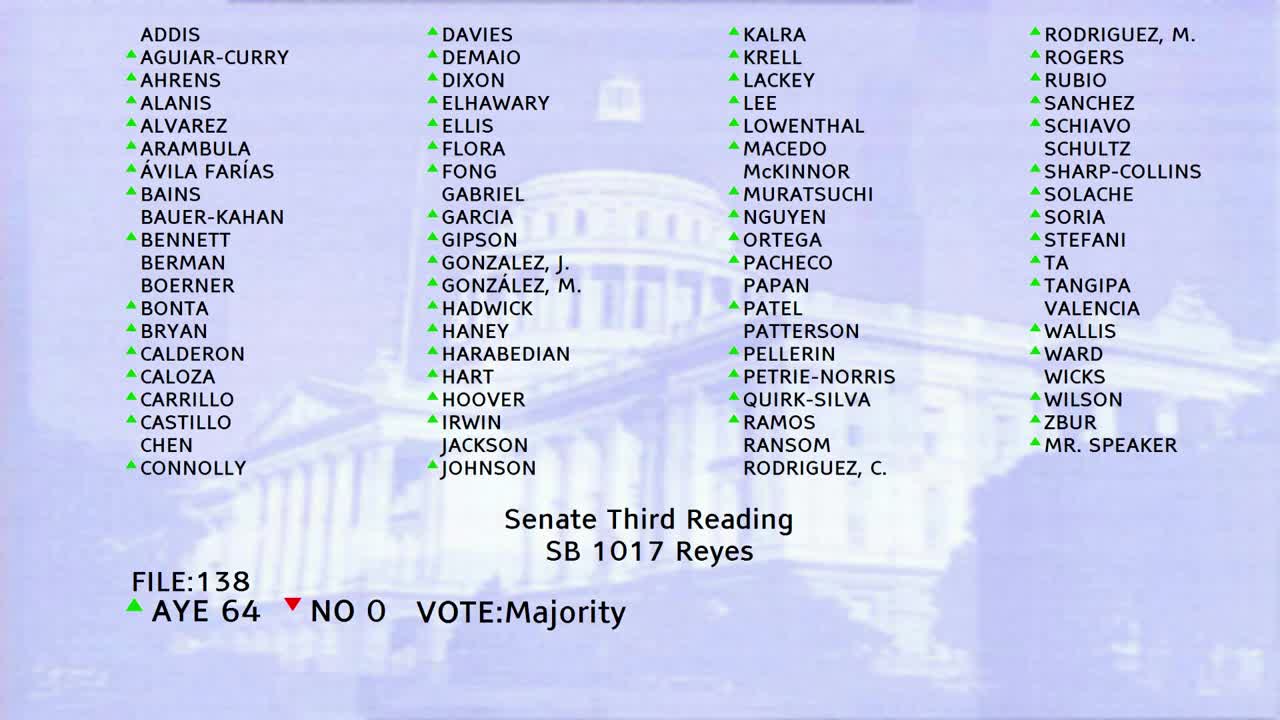

Bill Author

Bill Co-Author(s):