SB 1053: Property taxation: transfer of base year value: disaster relief.
- Session Year: 2025-2026
- House: Senate
- Latest Version Date: 2026-05-14
Current Status:
In Progress
(2026-08-13: August 13 hearing: Held in committee and under submission.)
Introduced
In Committee
Awaiting First Chamber Vote
Passed First Chamber
In Committee
Awaiting Second Chamber Vote
Passed Second Chamber
Enacted
Existing property tax law provides, pursuant to a requirement of the California Constitution, that the property tax base year value of real property that is substantially damaged or destroyed by a disaster, as declared by the Governor, may be transferred to a comparable property located within the same county that is acquired or newly constructed, or to replacement property reconstructed on the site of the damaged or destroyed property, within 5 years after the disaster as a replacement property.
This bill would authorize the county board of supervisors of any county proclaimed by the Governor to be in a state of emergency, or otherwise determined or declared by the Governor to be in a state of disaster, on or after January 1, 2026, but before January 1, 2031, to extend both of the above-described time periods to transfer by up to 3 years. The bill would apply to the determination of base year values for lien dates occurring on or after January 1, 2026, and before January 1, 2031. 2034.
Existing law requires the state to reimburse local agencies annually for certain property tax revenues lost as a result of any exemption or classification of property for purposes of ad valorem property taxation.
This bill would provide that, notwithstanding those provisions, no appropriation is made and the state shall not reimburse local agencies for property tax revenues lost by them pursuant to the bill.
This bill would take effect immediately as a tax levy.
Existing property tax law provides, pursuant to a requirement of the California Constitution, that the property tax base year value of real property that is substantially damaged or destroyed by a disaster, as declared by the Governor, may be transferred to a comparable property located within the same county that is acquired or newly constructed, or to replacement property reconstructed on the site of the damaged or destroyed property, within 5 years after the disaster as a replacement property.
This bill would authorize the county board of supervisors of any county proclaimed by the Governor to be in a state of emergency, or otherwise determined or declared by the Governor to be in a state of disaster, on or after January 1, 2026, but before January 1, 2031, to extend both of the above-described time periods to transfer by up to 3 years. The bill would apply to the determination of base year values for lien dates occurring on or after January 1, 2026, and before January 1, 2031.
Existing law requires the state to reimburse local agencies annually for certain property tax revenues lost as a result of any exemption or classification of property for purposes of ad valorem property taxation.
This bill would provide that, notwithstanding those provisions, no appropriation is made and the state shall not reimburse local agencies for property tax revenues lost by them pursuant to the bill.
This bill would take effect immediately as a tax levy.
(a)(1)Notwithstanding any other law, pursuant to Section 2 of Article XIIIA of the Constitution, the base year value of property that is substantially damaged or destroyed by a disaster, as declared by the Governor, may be transferred to comparable property within the same county, which is acquired or newly constructed within five years after the disaster, including in the case of the Northridge earthquake, as a replacement for the substantially damaged or destroyed property. At the time the base year value of the substantially damaged or destroyed property is transferred to the replacement property, the substantially damaged or destroyed property shall be reassessed at its full cash value. However, the substantially damaged or destroyed property shall retain its base year value notwithstanding the transfer authorized by this section. If the owner or owners of substantially damaged or destroyed property receive property tax relief under this section, that property shall not be eligible for property tax relief under subdivision (c) of Section 70 in the event of its reconstruction.
(2)(A)Notwithstanding paragraph (1), the county board of supervisors of any county proclaimed by the Governor, pursuant to Section 8625 of the Government Code, to be in a state of emergency, or otherwise determined or declared by the Governor to be in a state of disaster, on or after January 1, 2026, but before January 1, 2031, may by ordinance extend the time period specified in paragraph (1) to transfer the base year value of property in that county that is substantially damaged or destroyed by the disaster to comparable property within the same county that is acquired or newly constructed as a replacement for the substantially damaged or destroyed property by up to three years.
(B)This paragraph shall apply to the determination of base year values for lien dates occurring on or after January 1, 2026, and before January 1, 2031. 2034.
(b)The replacement base year value of the replacement property acquired shall be determined in accordance with this section.
The assessor shall use the following procedure in determining the appropriate replacement base year value of comparable replacement property:
(1)If the full cash value of the comparable replacement property does not exceed 120 percent of the full cash value of the property substantially damaged or destroyed, then the adjusted base year value of the property substantially damaged or destroyed shall be transferred to the comparable replacement property as its replacement base year value.
(2)If the full cash value of the replacement property exceeds 120 percent of the full cash value of the property substantially damaged or destroyed, then the amount of the full cash value over 120 percent of the full cash value of the property substantially damaged or destroyed shall be added to the adjusted base year value of the property substantially damaged or destroyed. The sum of these amounts shall become the replacement propertys replacement base year value.
(3)If the full cash value of the comparable replacement property is less than the adjusted base year value of the property substantially damaged or destroyed, then that lower value shall become the replacement propertys base year value.
(4)The full cash value of the property substantially damaged or destroyed shall be the amount of its full cash value immediately prior to its substantial damage or destruction, as determined by the county assessor of the county in which the property is located.
(c)For purposes of this section:
(1)Property is substantially damaged or destroyed if either the land or the improvements sustain physical damage amounting to more than 50 percent of either the lands or the improvements full cash value immediately prior to the disaster. Damage includes a diminution in the value of property as a result of restricted access to the property where the restricted access was caused by the disaster and is permanent in nature.
(2)Replacement property is comparable to the property substantially damaged or destroyed if it is similar in size, utility, and function to the property that it replaces.
(A)Property is similar in function if the replacement property is subject to similar governmental restrictions, such as zoning.
(B)Both the size and utility of property are interrelated and associated with value. Property is similar in size and utility only to the extent that the replacement property is, or is intended to be, used in the same manner as the property substantially damaged or destroyed and its full cash value does not exceed 120 percent of the full cash value of the property substantially damaged or destroyed.
(i)A replacement property or any portion thereof used or intended to be used for a purpose substantially different than the use made of the property substantially damaged or destroyed shall to the extent of the dissimilar use be considered not similar in utility.
(ii)A replacement property or portion thereof that satisfies the use requirement but has a full cash value that exceeds 120 percent of the full cash value of the property substantially damaged or destroyed shall be considered, to the extent of the excess, not similar in utility and size.
(C)To the extent that replacement property, or any portion thereof, is not similar in function, size, and utility, the property, or portion thereof, shall be considered to have undergone a change in ownership when the replacement property is acquired or newly constructed.
(3)Disaster means a major misfortune or calamity in an area subsequently proclaimed by the Governor to be in a state of disaster as a result of the misfortune or calamity.
(d)(1)This section applies to any comparable replacement property acquired or newly constructed on or after July 1, 1985.
(2)The amendments made by Chapter 1053 of the Statutes of 1993 apply to any comparable replacement property that is acquired or newly constructed as a replacement for property substantially damaged or destroyed by a disaster occurring on or after October 20, 1991, and to the determination of base year values for the 199192 fiscal year and fiscal years thereafter.
(3)The amendments made by Chapter 317 of the Statutes of 2006 apply to any comparable replacement property that is acquired or newly constructed as a replacement for property substantially damaged or destroyed by a disaster occurring on or after July 1, 2003, and to the determination of base year values for the 200304 fiscal year and fiscal years thereafter.
(e)Only the owner or owners of the property substantially damaged or destroyed, whether one or more individuals, partnerships, corporations, other legal entities, or a combination thereof, shall receive property tax relief under this section. Relief under this section shall be granted to an owner or owners of substantially damaged or destroyed property obtaining title to replacement property. The acquisition of an ownership interest in a legal entity, which directly or indirectly owns real property, is not an acquisition of comparable property.
(f)Notwithstanding any other law, the board of supervisors of the County of San Diego may by ordinance extend the time period specified in subdivision (a) to transfer the base year value of property that is substantially damaged or destroyed by the Cedar Fire that commenced in October 2003, as declared by the Governor, to comparable property within the same county that is acquired or newly constructed as a replacement for the substantially damaged or destroyed property by two years. This subdivision shall apply to the determination of base year values for the 200304 fiscal year and fiscal years thereafter.
(g)The amendments made to this section by the act adding this subdivision shall apply commencing with the lien date for the 201213 fiscal year.
(h)(1)Notwithstanding any other law, the time period specified in subdivision (a) to transfer the base year value of qualified property to comparable property, that is within the same county and that is acquired or newly constructed as a replacement for the qualified property, is extended by two years if the last day to transfer the base year value of the qualified property was on or after March 4, 2020, but on or before the COVID-19 emergency termination date or March 4, 2022, whichever is sooner.
(2)Notwithstanding any other law, the time period specified in subdivision (a) to transfer the base year value of qualified property to comparable property, that is within the same county and that is acquired or newly constructed as a replacement for the qualified property, is extended by two years if the qualified property was substantially damaged or destroyed on or after March 4, 2020, but on or before the COVID-19 emergency termination date or March 4, 2022, whichever is sooner.
(3)This subdivision shall apply to the determination of base year values for the 201516 fiscal year and fiscal years thereafter.
(4)For purposes of this subdivision, both of the following definitions apply:
(A)COVID-19 emergency termination date shall be the date the Governor proclaims the termination of the emergency related to the COVID-19 pandemic that was proclaimed on March 4, 2020, pursuant to the California Emergency Services Act (Chapter 7 (commencing with Section 8550) of Division 1 of Title 2 of the Government Code).
(B)Qualified property means property that is substantially damaged or destroyed, as described in paragraph (1) of subdivision (c), by a disaster that is proclaimed by the Governor.
(i)(1)Notwithstanding any law, the time period specified in subdivision (a) to transfer the base year value of qualified property that is substantially damaged or destroyed by a disaster, as declared by the Governor, to comparable property, that is within the same county and that is acquired or newly constructed as a replacement for the property, is extended by three years if the qualified property was substantially damaged or destroyed on or after November 1, 2018, but on or before November 20, 2018.
(2)This subdivision shall apply to the determination of base year values for the 201819 fiscal year and fiscal years thereafter.
(3)For purposes of this subdivision, qualified property means property that was substantially damaged or destroyed, as described in paragraph (1) of subdivision (c), by the 2018 Camp Fire disaster, as proclaimed by the Governor.
SEC. 2.Section 70.5 of the Revenue and Taxation Code is amended to read:70.5.(a)(1)Notwithstanding Section 70, and pursuant to Section 2 of Article XIIIA of the California Constitution, the base year value of property that is substantially damaged or destroyed by a disaster, as declared by the Governor, may be applied to replacement property reconstructed on the site of the damaged or destroyed property within five years after the disaster as a replacement for the substantially damaged or destroyed property if that reconstructed property is comparable to the substantially damaged or destroyed property. A person who owns substantially damaged or destroyed property that receives property tax relief under this section shall not be eligible for property tax relief provided under Section 69.
(2)(A)Notwithstanding paragraph (1), the county board of supervisors of any county proclaimed by the Governor, pursuant to Section 8625 of the Government Code, to be in a state of emergency, or otherwise determined or declared by the Governor to be in a state of disaster, on or after January 1, 2026, but before January 1, 2031, may by ordinance extend the time period specified in paragraph (1) to apply the base year value of property that is substantially damaged or destroyed by the disaster to replacement property that is reconstructed on the site of the damaged or destroyed property and that is comparable to the damaged or destroyed property by up to three years.
(B)This paragraph shall apply to the determination of base year values for lien dates occurring on or after January 1, 2026, and before January 1, 2031. 2034.
(b)(1)The replacement base year value of the reconstructed property shall be determined in accordance with this section.
(2)The assessor shall use the following procedure in determining the appropriate base year value of the reconstructed property:
(A)If the full cash value of the reconstructed property does not exceed 120 percent of the full cash value of the property substantially damaged or destroyed, then the adjusted base year value of the property substantially damaged or destroyed shall apply to the reconstructed property as its base year value.
(B)If the full cash value of the reconstructed property exceeds 120 percent of the full cash value of the property substantially damaged or destroyed, then the amount of the full cash value over 120 percent of the full cash value of the property substantially damaged or destroyed shall be added to the adjusted base year value of the original property substantially damaged or destroyed. The sum of these amounts shall become the reconstructed propertys base year value.
(C)If the full cash value of the reconstructed property is less than the adjusted base year value of the original property substantially damaged or destroyed, then that lower value shall become the reconstructed propertys base year value.
(D)The full cash value of the property substantially damaged or destroyed shall be the amount of its full cash value immediately prior to its substantial damage or destruction, as determined by the county assessor of the county in which the property is located.
(c)For purposes of this section:
(1)Property is substantially damaged or destroyed if the improvements sustain physical damage amounting to more than 50 percent of the improvements full cash value immediately prior to the disaster.
(2)Reconstructed property shall be considered comparable to the original property substantially damaged or destroyed if it is similar in size, utility, and function to the property which it replaces. For purposes of this paragraph:
(A)Property is similar in function if the reconstructed property is subject to similar governmental restrictions, such as zoning.
(B)(i)Both the size and utility of property are interrelated and associated with value. Property shall be considered similar in size and utility only to the extent that the reconstructed property is, or is intended to be, used in the same manner as the original property substantially damaged or destroyed and its full cash value does not exceed 120 percent of the full cash value of the original property substantially damaged or destroyed.
(ii)A reconstructed property or any portion of reconstructed property used or intended to be used for a purpose substantially different than the use made of the original property substantially damaged or destroyed shall to the extent of the dissimilar use be considered not similar in utility.
(iii)A reconstructed property or any portion of reconstructed property that satisfies the use requirement but has a full cash value that exceeds 120 percent of the full cash value of the original property substantially damaged or destroyed shall be considered, to the extent of the excess, not similar in utility and size.
(C)To the extent that reconstructed property or any portion of reconstructed property is not similar in function, size, and utility, the property or portion of that property shall be considered to be newly constructed.
(3)Disaster means a major misfortune or calamity in an area subsequently proclaimed by the Governor to be in a state of disaster as a result of that misfortune or calamity.
(d)Only the owner or owners of the property substantially damaged or destroyed, whether one or more individuals, partnerships, corporations, other legal entities, or a combination thereof, shall be eligible to receive property tax relief under this section. Relief under this section shall be granted to an owner or owners of substantially damaged or destroyed property who have reconstructed that property.
(e)(1)Notwithstanding any law, the time period specified in subdivision (a) to apply the base year value of qualified property to replacement property reconstructed on the site of the damaged or destroyed property is extended by three years if the qualified property was substantially damaged or destroyed on or after November 1, 2018, but on or before November 30, 2018.
(2)This subdivision shall apply to the determination of base year values for the 201819 fiscal year and fiscal years thereafter.
(3)For purposes of this subdivision, qualified property means property that was substantially damaged or destroyed, as described in paragraph (1) of subdivision (c), by the 2018 Woolsey Fire disaster or by the 2018 Camp Fire disaster, as proclaimed by the Governor.
(f)(1)Notwithstanding any law, the time period specified in subdivision (a) to apply the base year value of qualified property to replacement property reconstructed on the site of the damaged or destroyed property is extended by three years if the qualified property was substantially damaged or destroyed on or after November 1, 2024, but before February 1, 2025.
(2)This subdivision shall apply to the determination of base year values for the 202526 fiscal year and fiscal years thereafter.
(3)For purposes of this subdivision, qualified property means property that was substantially damaged or destroyed, as described in paragraph (1) of subdivision (c), by the 2025 Palisades Fire, Eaton Fire, Hurst Fire, Lidia Fire, Sunset Fire, or Woodley Fire, or the 2024 Mountain Fire or Franklin Fire, for which the Governor proclaimed a state of emergency.
(g)This section shall apply to real property damaged or destroyed by misfortune or calamity on or after January 1, 2017.
SEC. 3.Notwithstanding Section 2229 of the Revenue and Taxation Code, no appropriation is made by this act and the state shall not reimburse any local agency for any property tax revenues lost by it pursuant to this act.
SEC. 4.This act provides for a tax levy within the meaning of Article IV of the California Constitution and shall go into immediate effect.
(a)(1)Notwithstanding any other law, pursuant to Section 2 of Article XIIIA of the Constitution, the base year value of property that is substantially damaged or destroyed by a disaster, as declared by the Governor, may be transferred to comparable property within the same county, which is acquired or newly constructed within five years after the disaster, including in the case of the Northridge earthquake, as a replacement for the substantially damaged or destroyed property. At the time the base year value of the substantially damaged or destroyed property is transferred to the replacement property, the substantially damaged or destroyed property shall be reassessed at its full cash value. However, the substantially damaged or destroyed property shall retain its base year value notwithstanding the transfer authorized by this section. If the owner or owners of substantially damaged or destroyed property receive property tax relief under this section, that property shall not be eligible for property tax relief under subdivision (c) of Section 70 in the event of its reconstruction.
(2)(A)Notwithstanding paragraph (1), the county board of supervisors of any county proclaimed by the Governor, pursuant to Section 8625 of the Government Code, to be in a state of emergency, or otherwise determined or declared by the Governor to be in a state of disaster, on or after January 1, 2026, but before January 1, 2031, may by ordinance extend the time period specified in paragraph (1) to transfer the base year value of property in that county that is substantially damaged or destroyed by the disaster to comparable property within the same county that is acquired or newly constructed as a replacement for the substantially damaged or destroyed property by up to three years.
(B)This paragraph shall apply to the determination of base year values for lien dates occurring on or after January 1, 2026, and before January 1, 2031.
(b)The replacement base year value of the replacement property acquired shall be determined in accordance with this section.
The assessor shall use the following procedure in determining the appropriate replacement base year value of comparable replacement property:
(1)If the full cash value of the comparable replacement property does not exceed 120 percent of the full cash value of the property substantially damaged or destroyed, then the adjusted base year value of the property substantially damaged or destroyed shall be transferred to the comparable replacement property as its replacement base year value.
(2)If the full cash value of the replacement property exceeds 120 percent of the full cash value of the property substantially damaged or destroyed, then the amount of the full cash value over 120 percent of the full cash value of the property substantially damaged or destroyed shall be added to the adjusted base year value of the property substantially damaged or destroyed. The sum of these amounts shall become the replacement propertys replacement base year value.
(3)If the full cash value of the comparable replacement property is less than the adjusted base year value of the property substantially damaged or destroyed, then that lower value shall become the replacement propertys base year value.
(4)The full cash value of the property substantially damaged or destroyed shall be the amount of its full cash value immediately prior to its substantial damage or destruction, as determined by the county assessor of the county in which the property is located.
(c)For purposes of this section:
(1)Property is substantially damaged or destroyed if either the land or the improvements sustain physical damage amounting to more than 50 percent of either the lands or the improvements full cash value immediately prior to the disaster. Damage includes a diminution in the value of property as a result of restricted access to the property where the restricted access was caused by the disaster and is permanent in nature.
(2)Replacement property is comparable to the property substantially damaged or destroyed if it is similar in size, utility, and function to the property which that it replaces.
(A)Property is similar in function if the replacement property is subject to similar governmental restrictions, such as zoning.
(B)Both the size and utility of property are interrelated and associated with value. Property is similar in size and utility only to the extent that the replacement property is, or is intended to be, used in the same manner as the property substantially damaged or destroyed and its full cash value does not exceed 120 percent of the full cash value of the property substantially damaged or destroyed.
(i)A replacement property or any portion thereof used or intended to be used for a purpose substantially different than the use made of the property substantially damaged or destroyed shall to the extent of the dissimilar use be considered not similar in utility.
(ii)A replacement property or portion thereof that satisfies the use requirement but has a full cash value that exceeds 120 percent of the full cash value of the property substantially damaged or destroyed shall be considered, to the extent of the excess, not similar in utility and size.
(C)To the extent that replacement property, or any portion thereof, is not similar in function, size, and utility, the property, or portion thereof, shall be considered to have undergone a change in ownership when the replacement property is acquired or newly constructed.
(3)Disaster means a major misfortune or calamity in an area subsequently proclaimed by the Governor to be in a state of disaster as a result of the misfortune or calamity.
(d)(1)This section applies to any comparable replacement property acquired or newly constructed on or after July 1, 1985.
(2)The amendments made by Chapter 1053 of the Statutes of 1993 apply to any comparable replacement property that is acquired or newly constructed as a replacement for property substantially damaged or destroyed by a disaster occurring on or after October 20, 1991, and to the determination of base year values for the 199192 fiscal year and fiscal years thereafter.
(3)The amendments made by Chapter 317 of the Statutes of 2006 apply to any comparable replacement property that is acquired or newly constructed as a replacement for property substantially damaged or destroyed by a disaster occurring on or after July 1, 2003, and to the determination of base year values for the 200304 fiscal year and fiscal years thereafter.
(e)Only the owner or owners of the property substantially damaged or destroyed, whether one or more individuals, partnerships, corporations, other legal entities, or a combination thereof, shall receive property tax relief under this section. Relief under this section shall be granted to an owner or owners of substantially damaged or destroyed property obtaining title to replacement property. The acquisition of an ownership interest in a legal entity, which directly or indirectly owns real property, is not an acquisition of comparable property.
(f)Notwithstanding any other law, the board of supervisors of the County of San Diego may by ordinance extend the time period specified in subdivision (a) to transfer the base year value of property that is substantially damaged or destroyed by the Cedar Fire that commenced in October 2003, as declared by the Governor, to comparable property within the same county that is acquired or newly constructed as a replacement for the substantially damaged or destroyed property by two years. This subdivision shall apply to the determination of base year values for the 200304 fiscal year and fiscal years thereafter.
(g)The amendments made to this section by the act adding this subdivision shall apply commencing with the lien date for the 201213 fiscal year.
(h)(1)Notwithstanding any other law, the time period specified in subdivision (a) to transfer the base year value of qualified property to comparable property, that is within the same county and that is acquired or newly constructed as a replacement for the qualified property, is extended by two years if the last day to transfer the base year value of the qualified property was on or after March 4, 2020, but on or before the COVID-19 emergency termination date or March 4, 2022, whichever is sooner.
(2)Notwithstanding any other law, the time period specified in subdivision (a) to transfer the base year value of qualified property to comparable property, that is within the same county and that is acquired or newly constructed as a replacement for the qualified property, is extended by two years if the qualified property was substantially damaged or destroyed on or after March 4, 2020, but on or before the COVID-19 emergency termination date or March 4, 2022, whichever is sooner.
(3)This subdivision shall apply to the determination of base year values for the 201516 fiscal year and fiscal years thereafter.
(4)For purposes of this subdivision, both of the following definitions apply:
(A)COVID-19 emergency termination date shall be the date the Governor proclaims the termination of the emergency related to the COVID-19 pandemic that was proclaimed on March 4, 2020, pursuant to the California Emergency Services Act (Chapter 7 (commencing with Section 8550) of Division 1 of Title 2 of the Government Code).
(B)Qualified property means property that is substantially damaged or destroyed, as described in paragraph (1) of subdivision (c), by a disaster that is proclaimed by the Governor.
(i)(1)Notwithstanding any law, the time period specified in subdivision (a) to transfer the base year value of qualified property that is substantially damaged or destroyed by a disaster, as declared by the Governor, to comparable property, that is within the same county and that is acquired or newly constructed as a replacement for the property, is extended by three years if the qualified property was substantially damaged or destroyed on or after November 1, 2018, but on or before November 20, 2018.
(2)This subdivision shall apply to the determination of base year values for the 201819 fiscal year and fiscal years thereafter.
(3)For purposes of this subdivision, qualified property means property that was substantially damaged or destroyed, as described in paragraph (1) of subdivision (c), by the 2018 Camp Fire disaster, as proclaimed by the Governor.
SEC. 2.Section 70.5 of the Revenue and Taxation Code is amended to read:70.5.(a)(1)Notwithstanding Section 70, and pursuant to Section 2 of Article XIIIA of the California Constitution, the base year value of property that is substantially damaged or destroyed by a disaster, as declared by the Governor, may be applied to replacement property reconstructed on the site of the damaged or destroyed property within five years after the disaster as a replacement for the substantially damaged or destroyed property if that reconstructed property is comparable to the substantially damaged or destroyed property. A person who owns substantially damaged or destroyed property that receives property tax relief under this section shall not be eligible for property tax relief provided under Section 69.
(2)(A)Notwithstanding paragraph (1), the county board of supervisors of any county proclaimed by the Governor, pursuant to Section 8625 of the Government Code, to be in a state of emergency, or otherwise determined or declared by the Governor to be in a state of disaster, on or after January 1, 2026, but before January 1, 2031, may by ordinance extend the time period specified in paragraph (1) to apply the base year value of property that is substantially damaged or destroyed by the disaster to replacement property that is reconstructed on the site of the damaged or destroyed property and that is comparable to the damaged or destroyed property by up to three years.
(B)This paragraph shall apply to the determination of base year values for lien dates occurring on or after January 1, 2026, and before January 1, 2031.
(b)(1)The replacement base year value of the reconstructed property shall be determined in accordance with this section.
(2)The assessor shall use the following procedure in determining the appropriate base year value of the reconstructed property:
(A)If the full cash value of the reconstructed property does not exceed 120 percent of the full cash value of the property substantially damaged or destroyed, then the adjusted base year value of the property substantially damaged or destroyed shall apply to the reconstructed property as its base year value.
(B)If the full cash value of the reconstructed property exceeds 120 percent of the full cash value of the property substantially damaged or destroyed, then the amount of the full cash value over 120 percent of the full cash value of the property substantially damaged or destroyed shall be added to the adjusted base year value of the original property substantially damaged or destroyed. The sum of these amounts shall become the reconstructed propertys base year value.
(C)If the full cash value of the reconstructed property is less than the adjusted base year value of the original property substantially damaged or destroyed, then that lower value shall become the reconstructed propertys base year value.
(D)The full cash value of the property substantially damaged or destroyed shall be the amount of its full cash value immediately prior to its substantial damage or destruction, as determined by the county assessor of the county in which the property is located.
(c)For purposes of this section:
(1)Property is substantially damaged or destroyed if the improvements sustain physical damage amounting to more than 50 percent of the improvements full cash value immediately prior to the disaster.
(2)Reconstructed property shall be considered comparable to the original property substantially damaged or destroyed if it is similar in size, utility, and function to the property which it replaces. For purposes of this paragraph:
(A)Property is similar in function if the reconstructed property is subject to similar governmental restrictions, such as zoning.
(B)(i)Both the size and utility of property are interrelated and associated with value. Property shall be considered similar in size and utility only to the extent that the reconstructed property is, or is intended to be, used in the same manner as the original property substantially damaged or destroyed and its full cash value does not exceed 120 percent of the full cash value of the original property substantially damaged or destroyed.
(ii)A reconstructed property or any portion of reconstructed property used or intended to be used for a purpose substantially different than the use made of the original property substantially damaged or destroyed shall to the extent of the dissimilar use be considered not similar in utility.
(iii)A reconstructed property or any portion of reconstructed property that satisfies the use requirement but has a full cash value that exceeds 120 percent of the full cash value of the original property substantially damaged or destroyed shall be considered, to the extent of the excess, not similar in utility and size.
(C)To the extent that reconstructed property or any portion of reconstructed property is not similar in function, size, and utility, the property or portion of that property shall be considered to be newly constructed.
(3)Disaster means a major misfortune or calamity in an area subsequently proclaimed by the Governor to be in a state of disaster as a result of that misfortune or calamity.
(d)Only the owner or owners of the property substantially damaged or destroyed, whether one or more individuals, partnerships, corporations, other legal entities, or a combination thereof, shall be eligible to receive property tax relief under this section. Relief under this section shall be granted to an owner or owners of substantially damaged or destroyed property who have reconstructed that property.
(e)(1)Notwithstanding any law, the time period specified in subdivision (a) to apply the base year value of qualified property to replacement property reconstructed on the site of the damaged or destroyed property is extended by three years if the qualified property was substantially damaged or destroyed on or after November 1, 2018, but on or before November 30, 2018.
(2)This subdivision shall apply to the determination of base year values for the 201819 fiscal year and fiscal years thereafter.
(3)For purposes of this subdivision, qualified property means property that was substantially damaged or destroyed, as described in paragraph (1) of subdivision (c), by the 2018 Woolsey Fire disaster or by the 2018 Camp Fire disaster, as proclaimed by the Governor.
(f)(1)Notwithstanding any law, the time period specified in subdivision (a) to apply the base year value of qualified property to replacement property reconstructed on the site of the damaged or destroyed property is extended by three years if the qualified property was substantially damaged or destroyed on or after November 1, 2024, but before February 1, 2025.
(2)This subdivision shall apply to the determination of base year values for the 202526 fiscal year and fiscal years thereafter.
(3)For purposes of this subdivision, qualified property means property that was substantially damaged or destroyed, as described in paragraph (1) of subdivision (c), by the 2025 Palisades Fire, Eaton Fire, Hurst Fire, Lidia Fire, Sunset Fire, or Woodley Fire, or the 2024 Mountain Fire or Franklin Fire, for which the Governor proclaimed a state of emergency.
(g)This section shall apply to real property damaged or destroyed by misfortune or calamity on or after January 1, 2017.
SEC. 3.Notwithstanding Section 2229 of the Revenue and Taxation Code, no appropriation is made by this act and the state shall not reimburse any local agency for any property tax revenues lost by it pursuant to this act.
SEC. 4.This act provides for a tax levy within the meaning of Article IV of the California Constitution and shall go into immediate effect.
|
Date
|
Status
|
|---|---|
| Aug 13, 2026 | August 13 hearing: Held in committee and under submission. |
| Aug 5, 2026 | August 5 set for first hearing. Placed on suspense file. |
| Jun 30, 2026 | From committee: Do pass and re-refer to Com. on APPR. (Ayes 7. Noes 0.) (June 29). Re-referred to Com. on APPR. |
| Jun 23, 2026 | June 22 set for first hearing. Placed on suspense file. |
| Jun 4, 2026 | Referred to Com. on REV. & TAX. |
| May 28, 2026 | In Assembly. Read first time. Held at Desk. |
| May 28, 2026 | Read third time. Passed. (Ayes 39. Noes 0. Page 4526.) Ordered to the Assembly. |
| May 28, 2026 | Read third time. Passed. (Ayes 39. Noes 0.) Ordered to the Assembly. |
| May 26, 2026 | Ordered to special consent calendar. |
| May 18, 2026 | Read second time. Ordered to third reading. |
| May 14, 2026 | From committee: Do pass as amended. (Ayes 7. Noes 0. Page 4262.) (May 14). |
| May 14, 2026 | Read second time and amended. Ordered to second reading. |
| May 14, 2026 | From committee: Do pass as amended. (Ayes 7. Noes 0.) (May 14). |
| May 8, 2026 | Set for hearing May 14. |
| Apr 13, 2026 | April 13 hearing: Placed on APPR. suspense file. |
| Mar 27, 2026 | Set for hearing April 13. |
| Mar 25, 2026 | From committee: Do pass and re-refer to Com. on APPR. (Ayes 5. Noes 0. Page 3691.) (March 25). Re-referred to Com. on APPR. |
| Mar 25, 2026 | From committee: Do pass and re-refer to Com. on APPR. (Ayes 5. Noes 0.) (March 25). Re-referred to Com. on APPR. |
| Mar 11, 2026 | Set for hearing March 25. |
| Feb 26, 2026 | Referred to Com. on REV. & TAX. |
| Feb 13, 2026 | From printer. May be acted upon on or after March 15. |
| Feb 12, 2026 | Introduced. Read first time. To Com. on RLS. for assignment. To print. |
|
Date
|
Description
|
Location
|
Votes
|
|
|---|---|---|---|---|
| Jun 29, 2026 | Do pass and be re-referred to the Committee on [Appropriations] | Assembly Standing Committee on Revenue and Taxation |
Passed |
|
| May 28, 2026 | Special Consent SB1053 Niello | Senate Floor |
Passed |
|
| May 14, 2026 | Do pass as amended | Senate Standing Committee on Appropriations |
Passed |
|
| Apr 13, 2026 | Placed on suspense file | Senate Standing Committee on Appropriations |
Passed |
|
| Mar 25, 2026 | Do pass, but first be re-referred to the Committee on [Appropriations] | Senate Standing Committee on Revenue and Taxation |
Passed |
This list shows positions taken on this bill by organizations on the date displayed, which is linked to the original source.
Positions by individuals are not included.
|
Organization
|
Position
|
Date
|
|---|---|---|
| California Apartment Association | ** Support | |
| California Assessors’ Association | ** Support | |
| California Association Of Realtors | ** Support | |
| California Taxpayers Association | ** Support | |
| Matthew R. Maynard | ** Support | |
| Placer County Assessor Matthew R. Maynard | ** Support | |
| Sacramento County Assessor Christina Wynn | ** Support |
Date of Hearing: August 5, 2026
ASSEMBLY COMMITTEE ON APPROPRIATIONS
Buffy Wicks, Chair
SBPCA Bill Id:SB 1053
Author:(Niello) – As Amended Ver:May 14, 2026
Policy Committee: | Revenue and Taxation | Vote: | 7 - 0 |
|
| ||
|
|
Urgency: No State Mandated Local Program: No Reimbursable: No
SUMMARY:
This bill extends, by three years, the five-year deadline to transfer the base-year value of a damaged or destroyed property to a replacement property meeting certain conditions, if the county board of supervisors adopts an authorizing ordinance.
Specifically, this bill:
- Authorizes the board of supervisors of a county proclaimed by the Governor to be in a state of emergency, or otherwise determined by the Governor to be in a state of disaster, on or after January 1, 2026, but before January 1, 2031, to enact an ordinance extending, by three years, the five-year deadline to transfer the base-year value of a damaged or destroyed property to a: (a) comparable replacement property purchased or newly constructed in the same county, or (b) replacement property reconstructed on the site of the damaged or destroyed property.
- Applies the extension to a base-year value for lien dates occurring on or after January 1, 2026, and before January 1, 2034.
FISCAL EFFECT:
- Annual property tax revenue loss of an unknown, but likely significant amount, in excess of $300,000. The State Board of Equalization (BOE) notes that this bill is not related to one specific disaster or authorizing jurisdiction, so it is difficult to determine a revenue impact that is based on the location, nature, and severity of future disasters, as well as the number and assessed value of damaged properties. Although this bill specifies that the state is prohibited from reimbursing any local agency for lost property tax revenues and property tax is a local government revenue source, reductions in property tax revenues increase Proposition 98 General Fund (GF) spending by up to roughly 50% (the exact amount depends on the specific amount of the annual Proposition 98 guarantee).
- One-time costs of approximately $8,000 to BOE to update related guidance to county assessors and informational materials (GF).
COMMENTS:
- Purpose. According to the author:
Recent fire events have shown that 5 years is proving to be a difficult time line to get replacement property built. In recognition of this dilemma, the Legislature has extended the 5-year period numerous times for disaster specific events to accommodate a longer period…It is time for the Legislature to consider allowing the local land and tax use authorities to make this decision on an on-going basis. Whether it is fire, floods, mudslides, earthquakes, local board of supervisors are closer to the problems affecting their communities and can adjust the time period if needed.
This bill is supported by the California Assessors’ Association, California Taxpayers Association, and housing provider associations.
- Background. Base-year Value Transfer. Existing law provides several exceptions to the required reassessment of real property from its base-year value to its current market value when a change in ownership or new construction occurs. For example, the base-year value of a property substantially damaged or destroyed by a Governor-proclaimed disaster may be transferred to a comparable replacement property in the same county or to a reconstructed property on the same site within five years. All property types (residential, commercial, agricultural, or industrial) are eligible for such base-year value transfers. Since Proposition 13 capped the annual growth of a property’s assessed value and set the tax rate at 1% of assessed value, this exception allows the property owner to maintain significantly lower property tax bills.
Over the years, various legislation has been enacted to extend, by three years, the base-year value transfer deadline for property damaged or destroyed by specific disasters. This bill allows a county under a proclaimed state of emergency to enact an ordinance granting a property owner three more years to apply the base-year value of property substantially damaged or destroyed by a disaster to a comparable replacement property purchased or newly constructed in the same county, or a replacement property reconstructed on the site of the damaged or destroyed property.
State of Emergency. The Emergency Services Act gives the Governor authority to proclaim a state of emergency in an area affected, or likely to be affected, when conditions of disaster or extreme peril exist. Examples of such conditions include air pollution, fire, flood, storm, epidemic, riot, drought, cyberterrorism, sudden and severe energy shortage, plant or animal infestation or disease, or an earthquake. Although this bill’s applicability is limited to a state of emergency proclaimed within a certain five-year period and corresponding lien dates, this bill may allow the base-year value transfer extension to apply to more types of disasters than prior extensions allowed.
- Related Legislation. AB 245 (Gipson), Chapter 530, Statutes of 2025, extended, by three years, the five-year deadline to rebuild property damaged or destroyed by the January 2025 Los Angeles-area wildfire disaster while retaining the original property’s base-year value.
SB 663 (Allen), Chapter 549, Statutes of 2025, contained provisions similar to AB 245, but also extended the deadline for rebuilding property damaged or destroyed by certain 2024 fires.
SB 603 (Niello) is similar to this bill, but narrower in scope, as SB 603 does not include extending the deadline for a property owner electing to rebuild on the site of a damaged or destroyed property. SB 603 was held on this committee’s suspense file.
Analysis Prepared by: Irene Ho / APPR. / (916) 319-2081
Date of Hearing: June 29, 2026
ASSEMBLY COMMITTEE ON REVENUE AND TAXATION
Mike Gipson, Chair
SBPCA Bill Id:SB 1053
Author:(Niello) – As Amended Ver:May 14, 2026
SUSPENSE
Majority vote. Tax levy. Fiscal committee.
SENATE VOTE: 39-0
SUBJECT: Property taxation: transfer of base year value: disaster relief
SUMMARY: Extends by three years the eligible period to rebuild certain damaged or destroyed property. Specifically, this bill:
- Authorizes a county board of supervisors to extend by three years the eligible period to transfer the base year value of a property damaged or destroyed by a disaster to a replacement property rebuilt on the same site, or to acquire or rebuild a comparable replacement property on a different site in the same county.
- Requires that a property eligible for this bill's treatment must have been in a county proclaimed to be in a state of emergency by the Governor, or otherwise determined or declared by the Governor to be in a state of disaster, on or after January 1, 2026, but before January 1, 2031.
- Provides that this bill applies to the determination of base year values for lien dates occurring on or after January 1, 2026, and before January 1, 2034.
- Prohibits reimbursement of any local agency for any lost property tax revenues resulting from this bill and provides that no appropriation is made by this bill.
- Takes immediate effect as a tax levy.
EXISTING LAW:
- Provides that all property is taxable unless otherwise provided by the California Constitution or the laws of the United States. (California Constitution, Article XIII, Section 1.)
- Limits the maximum amount of ad valorem property taxation to 1% of the full cash value of the property. Generally, the Constitution restricts the full cash value of a property to the assessed value upon a change of ownership in, or new construction on, the property. This is referred to as the base year value, which may be adjusted upwards for inflation at no more than 2% annually. (California Constitution, Article XIIIA, Sections 1 and 2.)
- Stipulates that the term "newly constructed" does not include real property that is reconstructed after a disaster, as declared by the Governor. (California Constitution, Article XIIIA, Section 2 and Revenue and Taxation Code (R&TC) Section 70.5.) Additionally, existing law provides that the base year value of a property substantially damaged or destroyed by a disaster, as declared by the Governor, may be transferred to comparable property within the same county that is acquired or newly constructed as a replacement for the substantially damaged or destroyed property. (California Constitution, Article XIIIA, Section 2 and R&TC Section 69.) To qualify, a property must have suffered damage amounting to more than 50% of its value immediately before the disaster. The Legislature implements this requirement by providing that the comparable replacement property must be built or acquired within five years of the qualifying disaster, and must have a full cash value of no more than 120% of the full cash value of the damaged or destroyed property immediately prior to the disaster. For properties exceeding the 120% full cash value threshold, the excess value is added to the transferred base year value, and subject to taxation. The five-year period to reconstruct property damaged or destroyed by a disaster has been extended for certain disasters.
FISCAL EFFECT: The State Board of Equalization, in its analysis of a previous, but substantively similar, version of this bill, states:
The SB 1053 proposal is not related to one specific disaster or one specific jurisdiction. In general, this proposal provides any affected county, starting January 1, 2026, the option to decide at the local level, on an ongoing basis, the need for up to three additional years for intracounty base year transfers or to the same property affected by the disaster. Considering the location, nature, and severity of future disasters, and the scope of resulting damages, revenue impact is difficult to determine with any reasonable accuracy.
Committee staff notes that a previous, but narrower, bill extending periods to transfer base year values qualified for this Committee's Suspense File, and that this bill would almost certainly exceed the revenue loss threshold for a bill to qualify for this Committee's Suspense File.
COMMENTS:
- The author has provided the following statement in support of this bill:
SB 1053 authorizes the county board of supervisors of any county affected by a disaster declared by the Governor on or after January 1, 2026 until January 1, 2034, to extend the [five-]year time period to transfer property tax base year values by up to [three] years for properties located in that county or to the same property affected by the disaster.
Existing property tax law already provides that the property tax base year value of real property that is substantially damaged or destroyed by a Governor declared disaster, may be transferred to a comparable property located within the same county that is acquired or newly constructed within [five] years after the disaster as a replacement property. This has been of benefit to homeowners who are navigating a very difficult time dealing with a disaster and the rebuilding process affecting their property.
Recent fire events have shown that [five] years is proving to be a difficult time line to get replacement property built. In recognition of this dilemma, the Legislature has extended the [five-]year period numerous times for disaster specific events to accommodate a longer period (SB 663-Allen 2025, SB 303-Borgeas 2021, AB 556-Gallagher 2023, AB 157-Anderson 2010).
Given the unprecedented wildfires in the Los Angeles area last year, it is going to be a huge challenge to see any rebuilding completed in [five] years. It is time for the Legislature to consider allowing the local land and tax use authorities to make this decision on an on-going basis. Whether it is fire, floods, mudslides, earthquakes, local board of supervisors are closer to the problems affecting their communities and can adjust the time period if needed.
SB 1053 creates a more logical option for local governments to use going forward. Allowing board of supervisors to use their local authority to push the amount of years for property tax base value transfers is more efficient than requiring legislation every time there is a disaster.
- The California Assessors' Association, writing in support of this bill, states, in part:
SB 1053 recognizes these realities by authorizing county boards of supervisors in counties proclaimed by the Governor to be in a state of emergency, or otherwise determined or declared by the Governor to be in a state of disaster, on or after January 1, 2026, and before January 1, 2031, to extend the existing five-year periods for both replacement property acquisition and reconstruction by up to three additional years. This targeted and localized flexibility will allow counties to better respond to the unique recovery conditions affecting their communities while preserving the intent and integrity of California's property tax protections.
Importantly, SB 1053 is permissive and narrowly tailored. The bill does not mandate
extensions statewide, nor does it broadly expand property tax relief. Instead, it empowers
local elected officials – who are best positioned to evaluate local recovery conditions-to
provide reasonable additional time where warranted within a clearly defined statutory
framework.
- Committee Staff Comments:
- 2025 Los Angeles (LA) Fires: Beginning in early January 2025, a series of fires began raging in LA County. Exacerbated by hurricane force gusts and drought conditions, these fires rapidly grew, expanding into outlying residential areas of the LA metropolitan region. As the month progressed, the conditions exacerbating these fires led to serious complications for first responders and the conflagrations grew without containment. After containment of these fires, however, the true depth of destruction began to emerge. According to the UCLA Anderson Forecast, total property and capital losses could range from $76 billion to $131 billion, with a potential decline in county-level gross domestic product of $4.6 billion. This loss from fire is unprecedented in California. By comparison, the Camp Fire that destroyed the town of Paradise, and was the most destructive California fire prior to the 2025 LA Fires, is estimated to have an associated loss of around $17 billion, nearly an order of magnitude less than the 2025 LA Fires.
- Operation of property tax relief after disaster in existing law: California property tax law provides property owners general protections against significant increases in property tax liability by establishing the taxable value of a property as its base year value, generally the full cash value of the property upon its purchase or transfer. This base year value may be upwardly adjusted for inflation at no more than 2% annually.
Currently, when an owner's property is damaged or destroyed by a Governor-proclaimed disaster, that owner may rebuild the property on the same site, or build or purchase a comparable replacement property on another site in the same county, within five years of the disaster while remaining eligible for a base year value transfer. Thus, a qualifying property may be rebuilt while still retaining the base year value of the property prior to the disaster. A property owner would be subjected to a significant property tax increase absent the base year value transfer permitted after a disaster.
- This bill: The Legislature has previously extended the existing five-year period to transfer the base year value of a substantially damaged or destroyed property to a comparable replacement property in the same county for discreet disasters. Among the disasters that the Legislature has extended the transfer period are the 2003 Cedar Fire, the 2018 Camp Fire, the COVID-19 Pandemic, and the 2025 LA Fires.
This bill takes a slightly different approach than previous authorizations. Rather than limit this bill's extension to a specific event, this bill would authorize a county to provide a blanket three-year extension of the base year value transfer period to any property substantially damaged or destroyed by a qualifying disaster if the property owner is rebuilding on the same site or on another site in the same county.
- Related legislation:
- SB 663 (Allen), Chapter 549, Statutes of 2025, extended by three years the five-year period to build a comparable replacement property on the same site, while retaining the base year value of an eligible property substantially damaged or destroyed by the 2025 Palisades Fire, Eaton Fire, Hurst Fire, Sunset Fire, or Woodley Fire, or the 2024 Mountain Fire or Franklin Fire.
- SB 603 (Niello) would have extended by three years the five-year period to build a comparable replacement property on a different site in the same county for any qualifying disaster. SB 603 was held on the Assembly Appropriations Committee's Suspense File.
- Prior legislation:
- AB 556 (Gallagher), Chapter 443, Statutes of 2023, extended by three years the five-year period to build a comparable replacement property on another site in the same county, while retaining the base year value of an eligible property substantially damaged or destroyed by the 2018 Camp Fire.
- SB 303 (Borgeas), Chapter 540, Statutes of 2021, extended by two years the five-year period to build a comparable replacement property on another site in the same county, while retaining the base year value of an eligible property substantially damaged or destroyed during the COVID-19 pandemic.
- AB 157 (Anderson), Chapter 341, Statutes of 2010, extended by two years the five-year period to build a comparable replacement property on another site in the same county, while retaining the base year value of an eligible property substantially damaged or destroyed by the 2003 Cedar Fire.
- Related legislation:
REGISTERED SUPPORT / OPPOSITION:
Support
California Apartment Association
California Assessors' Association
California Association of Realtors
California Taxpayers Association
Opposition
None on file
Analysis Prepared by: Harrison Bowlby / REV. & TAX. / (916) 319-2098
Date of Hearing: June 22, 2026
ASSEMBLY COMMITTEE ON REVENUE AND TAXATION
Mike Gipson, Chair
SBPCA Bill Id:SB 1053
Author:(Niello) – As Amended Ver:May 14, 2026
Majority vote. Tax levy. Fiscal committee.
SENATE VOTE: 39-0
SUBJECT: Property taxation: transfer of base year value: disaster relief
SUMMARY: Extends by three years the eligible period to rebuild certain damaged or destroyed property. Specifically, this bill:
- Authorizes a county board of supervisors to extend by three years the eligible period to transfer the base year value of a property damaged or destroyed by a disaster to a replacement property rebuilt on the same site, or to acquire or rebuild a comparable replacement property on a different site in the same county.
- Requires that a property eligible for this bill's treatment must have been in a county proclaimed to be in a state of emergency by the Governor, or otherwise determined or declared by the Governor to be in a state of disaster, on or after January 1, 2026, but before January 1, 2031.
- Provides that this bill applies to the determination of base year values for lien dates occurring on or after January 1, 2026, and before January 1, 2034.
- Prohibits reimbursement of any local agency for any lost property tax revenues resulting from this bill and provides that no appropriation is made by this bill.
- Takes immediate effect as a tax levy.
EXISTING LAW:
- Provides that all property is taxable unless otherwise provided by the California Constitution or the laws of the United States. (California Constitution, Article XIII, Section 1.)
- Limits the maximum amount of ad valorem property taxation to 1% of the full cash value of the property. Generally, the Constitution restricts the full cash value of a property to the assessed value upon a change of ownership in, or new construction on, the property. This is referred to as the base year value, which may be adjusted upwards for inflation at no more than 2% annually. (California Constitution, Article XIIIA, Sections 1 and 2.)
- Stipulates that the term "newly constructed" does not include real property that is reconstructed after a disaster, as declared by the Governor. (California Constitution, Article XIIIA, Section 2 and Revenue and Taxation Code (R&TC) Section 70.5.) Additionally, existing law provides that the base year value of a property substantially damaged or destroyed by a disaster, as declared by the Governor, may be transferred to comparable property within the same county that is acquired or newly constructed as a replacement for the substantially damaged or destroyed property. (California Constitution, Article XIIIA, Section 2 and R&TC Section 69.) To qualify, a property must have suffered damage amounting to more than 50% of its value immediately before the disaster. The Legislature implements this requirement by providing that the comparable replacement property must be built or acquired within five years of the qualifying disaster, and must have a full cash value of no more than 120% of the full cash value of the damaged or destroyed property immediately prior to the disaster. For properties exceeding the 120% full cash value threshold, the excess value is added to the transferred base year value, and subject to taxation. The five-year period to reconstruct property damaged or destroyed by a disaster has been extended for certain disasters.
FISCAL EFFECT: The State Board of Equalization, in its analysis of a previous, but substantively similar, version of this bill, states:
The SB 1053 proposal is not related to one specific disaster or one specific jurisdiction. In general, this proposal provides any affected county, starting January 1, 2026, the option to decide at the local level, on an ongoing basis, the need for up to three additional years for intracounty base year transfers or to the same property affected by the disaster. Considering the location, nature, and severity of future disasters, and the scope of resulting damages, revenue impact is difficult to determine with any reasonable accuracy.
Committee staff notes that a previous, but narrower, bill extending periods to transfer base year values qualified for this Committee's Suspense File, and that this bill would almost certainly exceed the revenue loss threshold for a bill to qualify for this Committee's Suspense File.
COMMENTS:
- The author has provided the following statement in support of this bill:
SB 1053 authorizes the county board of supervisors of any county affected by a disaster declared by the Governor on or after January 1, 2026 until January 1, 2034, to extend the [five-]year time period to transfer property tax base year values by up to [three] years for properties located in that county or to the same property affected by the disaster.
Existing property tax law already provides that the property tax base year value of real property that is substantially damaged or destroyed by a Governor declared disaster, may be transferred to a comparable property located within the same county that is acquired or newly constructed within [five] years after the disaster as a replacement property. This has been of benefit to homeowners who are navigating a very difficult time dealing with a disaster and the rebuilding process affecting their property.
Recent fire events have shown that [five] years is proving to be a difficult time line to get replacement property built. In recognition of this dilemma, the Legislature has extended the [five-]year period numerous times for disaster specific events to accommodate a longer period (SB 663-Allen 2025, SB 303-Borgeas 2021, AB 556-Gallagher 2023, AB 157-Anderson 2010).
Given the unprecedented wildfires in the Los Angeles area last year, it is going to be a huge challenge to see any rebuilding completed in [five] years. It is time for the Legislature to consider allowing the local land and tax use authorities to make this decision on an on-going basis. Whether it is fire, floods, mudslides, earthquakes, local board of supervisors are closer to the problems affecting their communities and can adjust the time period if needed.
SB 1053 creates a more logical option for local governments to use going forward. Allowing board of supervisors to use their local authority to push the amount of years for property tax base value transfers is more efficient than requiring legislation every time there is a disaster.
- The California Assessors' Association, writing in support of this bill, states, in part:
SB 1053 recognizes these realities by authorizing county boards of supervisors in counties proclaimed by the Governor to be in a state of emergency, or otherwise determined or declared by the Governor to be in a state of disaster, on or after January 1, 2026, and before January 1, 2031, to extend the existing five-year periods for both replacement property acquisition and reconstruction by up to three additional years. This targeted and localized flexibility will allow counties to better respond to the unique recovery conditions affecting their communities while preserving the intent and integrity of California's property tax protections.
Importantly, SB 1053 is permissive and narrowly tailored. The bill does not mandate
extensions statewide, nor does it broadly expand property tax relief. Instead, it empowers
local elected officials – who are best positioned to evaluate local recovery conditions-to
provide reasonable additional time where warranted within a clearly defined statutory
framework.
- Committee Staff Comments:
- 2025 Los Angeles (LA) Fires: Beginning in early January 2025, a series of fires began raging in LA County. Exacerbated by hurricane force gusts and drought conditions, these fires rapidly grew, expanding into outlying residential areas of the LA metropolitan region. As the month progressed, the conditions exacerbating these fires led to serious complications for first responders and the conflagrations grew without containment. After containment of these fires, however, the true depth of destruction began to emerge. According to the UCLA Anderson Forecast, total property and capital losses could range from $76 billion to $131 billion, with a potential decline in county-level gross domestic product of $4.6 billion. This loss from fire is unprecedented in California. By comparison, the Camp Fire that destroyed the town of Paradise, and was the most destructive California fire prior to the 2025 LA Fires, is estimated to have an associated loss of around $17 billion, nearly an order of magnitude less than the 2025 LA Fires.
- Operation of property tax relief after disaster in existing law: California property tax law provides property owners general protections against significant increases in property tax liability by establishing the taxable value of a property as its base year value, generally the full cash value of the property upon its purchase or transfer. This base year value may be upwardly adjusted for inflation at no more than 2% annually.
Currently, when an owner's property is damaged or destroyed by a Governor-proclaimed disaster, that owner may rebuild the property on the same site, or build or purchase a comparable replacement property on another site in the same county, within five years of the disaster while remaining eligible for a base year value transfer. Thus, a qualifying property may be rebuilt while still retaining the base year value of the property prior to the disaster. A property owner would be subjected to a significant property tax increase absent the base year value transfer permitted after a disaster.
- This bill: The Legislature has previously extended the existing five-year period to transfer the base year value of a substantially damaged or destroyed property to a comparable replacement property in the same county for discreet disasters. Among the disasters that the Legislature has extended the transfer period are the 2003 Cedar Fire, the 2018 Camp Fire, the COVID-19 Pandemic, and the 2025 LA Fires.
This bill takes a slightly different approach than previous authorizations. Rather than limit this bill's extension to a specific event, this bill would authorize a county to provide a blanket three-year extension of the base year value transfer period to any property substantially damaged or destroyed by a qualifying disaster if the property owner is rebuilding on the same site or on another site in the same county.
- Related legislation:
- SB 663 (Allen), Chapter 549, Statutes of 2025, extended by three years the five-year period to build a comparable replacement property on the same site, while retaining the base year value of an eligible property substantially damaged or destroyed by the 2025 Palisades Fire, Eaton Fire, Hurst Fire, Sunset Fire, or Woodley Fire, or the 2024 Mountain Fire or Franklin Fire.
- SB 603 (Niello) would have extended by three years the five-year period to build a comparable replacement property on a different site in the same county for any qualifying disaster. SB 603 was held on the Assembly Appropriations Committee's Suspense File.
- Prior legislation:
- AB 556 (Gallagher), Chapter 443, Statutes of 2023, extended by three years the five-year period to build a comparable replacement property on another site in the same county, while retaining the base year value of an eligible property substantially damaged or destroyed by the 2018 Camp Fire.
- SB 303 (Borgeas), Chapter 540, Statutes of 2021, extended by two years the five-year period to build a comparable replacement property on another site in the same county, while retaining the base year value of an eligible property substantially damaged or destroyed during the COVID-19 pandemic.
- AB 157 (Anderson), Chapter 341, Statutes of 2010, extended by two years the five-year period to build a comparable replacement property on another site in the same county, while retaining the base year value of an eligible property substantially damaged or destroyed by the 2003 Cedar Fire.
- Related legislation:
REGISTERED SUPPORT / OPPOSITION:
Support
California Apartment Association
California Assessors' Association
California Taxpayers Association
Opposition
None on file
Analysis Prepared by: Harrison Bowlby / REV. & TAX. / (916) 319-2098
SENATE RULES COMMITTEE Office of Senate Floor Analyses (916) 651-4171 | SB 1053 |
THIRD READING
Bill No: SB 1053
Author: Niello (R)
Amended: 5/14/26
Vote: 21
SENATE REVENUE AND TAXATION COMMITTEE: 5-0, 3/25/26
AYES: McNerney, Alvarado-Gil, Ashby, Becker, Grayson
SENATE APPROPRIATIONS COMMITTEE: 7-0, 5/14/26
AYES: Cervantes, Seyarto, Cabaldon, Dahle, Grayson, Richardson, Wahab
SUBJECT: Property taxation: transfer of base year value: disaster relief
SOURCE: Author
DIGEST:
This bill allows boards of supervisors in counties affected by disasters to extend two property tax deadlines for three years by ordinance.
ANALYSIS:
Existing law:
- Provides that all property is taxable unless explicitly exempted by the Constitution or federal law (California Constitution, Article XIII, Section One).
- Limits the maximum amount of any ad valorem tax on real property at 1% of full cash value, plus any locally-authorized bonded indebtedness, and caps a property’s annual inflationary increase in taxable value to 2%. Provides that assessors reappraise property whenever it is purchased, newly constructed, or when ownership changes (California Constitution, Article XIIIA, as added by Proposition 13, 1978).
- Generally sets a property’s value as its sales price when purchased or, when there is no sales price, at its fair market value when ownership changes (base year value).
- Requires an annual inflation adjustment to that value that cannot exceed 2% (factored base year value).
- Allows for base year value transfers in specified circumstances, which allow a taxpayer to continue paying property taxes at the factored base year value of their previous home (or other property types where the law allows) and not on the value of their newly purchased or constructed home.
- Permits a taxpayer to transfer their base year value when their property is damaged by a major misfortune or calamity and located in an area the Governor declared or proclaimed to be in a state of disaster (Proposition 50, 1986).
- Implements Proposition 50 to allow the base year value transfer when:
- The damaged property sustains physical damages amounting to more than 50% of its full cash value immediately prior to the disaster;
- The replacement property is located in the same county as the damaged property and is acquired or newly constructed within five years after the disaster;
- The replacement property is comparable to the damaged property in size, utility, and function. For example, a residential property can be replacement property for a damaged residence, but not for a commercial, agricultural, or industrial property;
- The market value of the replacement property does not exceed 120% of the fair market value of the replaced property in its pre-damaged condition. Property owners can still receive the disaster relief in cases where the value of the replacement property exceeds the 120% limitation, but any amount over this threshold is assessed at full market value and added to the transferred base year value; and,
- The buyer of the replacement property was the owner of the damaged property at the time of damage.
- Allows the San Diego County Board of Supervisors to extend the deadline two additional years for property substantially damaged or destroyed by the 2003 Cedar Fire (AB 157, Anderson, Chapter 341, Statutes of 2020).
- Extends the five-year deadline for two years due to the COVID-19 pandemic (SB 303, Borgeas, Chapter 540, Statutes of 2021) and the 2018 Camp Fire (AB 556, Gallagher, Chapter 443, Statutes of 2023).
- Provides that any timely reconstruction of property damaged or destroyed by a misfortune or calamity was not reassessed, so long as the reconstruction is “substantially equivalent” to the property prior to damage or destruction. Assessors then value any newly constructed property that was not “substantially equivalent” at fair market value.
- Directs assessors to not revalue a reconstructed structure that is larger in size if its value is within 120% of the value of the damaged or destroyed structure. Assessors only assess to fair market value that portion of value that exceeds 120% of its pre-disaster value (AB 2013, Irwin, Chapter 124, Statutes of 2020).
- Requires taxpayers to complete reconstruction within five years to apply AB 2013’s protections, with specified exceptions.
- Extends the five-year deadline for an additional three years for the 2018 Camp Fire and Woolsey Fire disasters (AB 1500, Irwin, Chapter 583, Statutes of 2023) and the 2025 Fires in Los Angeles and Ventura Counties (AB 245, Gipson, Chapter 530, Statutes of 2025 and SB 663, Allen, Chapter 549, Statutes of 2025).
This bill:
- Permits the county board of supervisors of any county proclaimed by the Governor to be in a state of emergency, or otherwise determined or declared by the Governor to be in a state of disaster, to extend:
- The five-year time period under Proposition 50 to transfer the base year value of property in that county that is substantially damaged or destroyed by the disaster to comparable property within the same county that is acquired or newly constructed as a replacement for the substantially damaged or destroyed property.
- The five-year deadline in AB 2013 if the qualified property was substantially damaged or destroyed by the disaster to a replacement property that is reconstructed on the same site and that is comparable to the damaged or destroyed property.
- Provides that any extension can apply for up to three years.
- Applies to disasters declared by the Governor on or after January 1, 2026 and before January 1, 2034, and to lien dates occurring on or after January 1, 2026 and before January 1, 2034.
Background
Base year value transfers allow a taxpayer to continue to pay property taxes at the factored base year value of their previous home (or other property types where the law allows) and not on the value of their newly purchased or constructed home, often resulting in tax savings. For example, a taxpayer who purchased their residence for $100,000 in 1975 now has a base year value under Proposition 13 that cannot exceed $269,158 under the 2% cap in annual inflationary growth, regardless of its market value. A base year value transfer allows a taxpayer to transfer the $269,158 value to a newly purchased or constructed property subject to specified requirements; without a base year value transfer, the new property would be assessed at fair market value.
Unlike the three-year time period set in Proposition 171 (1993), or the two years set by Proposition 19 (2020), Proposition 50 (1986) did not set an explicit constitutional deadline for taxpayers to purchase or construct a replacement property after their property was damaged or destroyed in a disaster. Over time, the Legislature has used this flexibility to extend the deadline for taxpayers to purchase or newly construct a replacement property to apply a base year value transfer under Proposition 50 (1986), often in response to wildfires. The Legislature initially set it at two years when implementing Proposition 50 in 1986, and then extended it to three years after the Oakland Hills fire in 1993. In 1997, The Legislature allowed a five-year deadline for any victim of the 1994 Northridge earthquake. In 2006, the Legislature enacted a general extension from three to five years for disasters occurring on or after July 1, 2003 (AB 1890, Mountjoy, Chapter 317, Statutes of 2006).
Related/Prior Legislation
Last year, SB 663 (Niello) made a similar change to allow county boards of supervisors in disaster-affected counties to extend the Proposition 50 (1986) deadline by three years. The Assembly Appropriation Committee held the measure on its suspense file. SB 1053 includes that change, plus similar authority for county boards of supervisors to extend by ordinance the AB 2013 deadline.
FISCAL EFFECT: Appropriation: No Fiscal Com.: Yes Local: No
According to the Senate Appropriations Committee, this measure is not related to one specific disaster or one specific jurisdiction. Consequently, BOE indicates that the resulting future revenue loss cannot be determined and is thus unknown. Reductions in local property tax revenues, in turn, can increase General Fund Proposition 98 spending by up to roughly 50% (the exact amount depends on the specific amount of the annual Proposition 98 guarantee, which in turn depends upon a variety of economic, demographic and budgetary factors). BOE would incur minor administrative costs to implement the provisions of the bill.
SUPPORT: (Verified 5/14/26)
Christina Wynn, Sacramento County Assessor
Matthew R. Maynard, Placer County Assessor
California Apartment Association
California Association of Realtors
California Taxpayers Association
OPPOSITION: (Verified 5/14/26)
None received
ARGUMENTS IN SUPPORT: According to the author, “SB 1053 authorizes the county board of supervisors of any county affected by a disaster declared by the Governor on or after January 1, 2026 until January 1, 2031, to extend the 5 year time period to transfer property tax base year values by up to 3 years for properties located in that county or to the same property affected by the disaster. Existing property tax law already provides that the property tax base year value of real property that is substantially damaged or destroyed by a Governor declared disaster, may be transferred to a comparable property located within the same county that is acquired or newly constructed within 5 years after the disaster as a replacement property. This has been of benefit to homeowners who are navigating a very difficult time dealing with a disaster and the rebuilding process affecting their property. Recent fire events have shown that 5 years is proving to be a difficult time line to get replacement property built. In recognition of this dilemma, the Legislature has extended the 5 year period numerous times for disaster specific events to accommodate a longer period (AB 1500-Irwin 2023, SB 663-Allen 2025, SB 303-Borgeas 2021, AB 556-Gallagher 2023, AB 157-Anderson 2010). Given the unprecedented wildfires in the Los Angeles area last year, it is going to be a huge challenge to see any rebuilding completed in 5 years. It is time for the Legislature to consider allowing the local land and tax use authorities to make this decision on an on-going basis. Whether it is fire, floods, mudslides, earthquakes, local board of supervisors are closer to the problems affecting their communities and can adjust the time period if needed. SB 1053 creates a more logical option for local governments to use going forward. Allowing board of supervisors to use their local authority to push the amount of years for property tax base value transfers is more efficient than requiring legislation every time there is a disaster.”
Prepared by: Colin Grinnell / REV. & TAX. / (916) 651-4117
5/18/26 15:19:36
**** END ****
SENATE COMMITTEE ON
Senator Sabrina Cervantes, Chair
2025 - 2026 Regular Session
SB 1053 (Niello) - Property taxation: transfer of base year value: disaster relief
Version: | Policy Vote: |
Urgency: | Mandate: |
Hearing Date: | Consultant: |
Bill Summary:
SB 1053 would allow boards of supervisors in disaster-affected to extend two property tax deadlines for three years by ordinance.
*********** ANALYSIS ADDENDUM – SUSPENSE FILE ***********
The following information is revised to reflect amendments
adopted by the committee on May 14, 2026
Fiscal Impact:
This measure is not related to one specific disaster or one specific jurisdiction. Consequently, the Board of Equalization (BOE) indicates that the resulting future revenue loss cannot be determined and is thus unknown. Reductions in local property tax revenues, in turn, can increase General Fund Proposition 98 spending by up to roughly 50 percent (the exact amount depends on the specific amount of the annual Proposition 98 guarantee, which in turn depends upon a variety of economic, demographic and budgetary factors). BOE would incur minor administrative costs to implement the provisions of the bill.
Author Amendments:
Extend the end of the lien date window from January 1, 2031 to January 1, 2034.
-- END --
SENATE COMMITTEE ON
Senator Sabrina Cervantes, Chair
2025 - 2026 Regular Session
SB 1053 (Niello) - Property taxation: transfer of base year value: disaster relief
Version: | Policy Vote: |
Urgency: | Mandate: |
Hearing Date: | Consultant: |
Bill Summary:
SB 1053 would allow boards of supervisors in disaster-affected to extend two property tax deadlines for three years by ordinance.
Fiscal Impact:
This measure is not related to one specific disaster or one specific jurisdiction. Consequently, the Board of Equalization (BOE) indicates that the resulting future revenue loss cannot be determined and is thus unknown. Reductions in local property tax revenues, in turn, can increase General Fund Proposition 98 spending by up to roughly 50 percent (the exact amount depends on the specific amount of the annual Proposition 98 guarantee, which in turn depends upon a variety of economic, demographic and budgetary factors). BOE would incur minor administrative costs to implement the provisions of the bill.
Background:
Under the California Constitution, all property is taxable unless explicitly exempted by itself or federal law. The Constitution limits the maximum amount of any ad valorem tax on real property to one percent of full cash value, plus any locally-authorized bonded indebtedness. Assessors reappraise property whenever it is purchased, newly constructed, or when ownership changes (as defined by both statute and the Constitution). Current law generally sets a property’s value as its sales price when purchased or, when there is no sales price, at its fair market value when ownership changes (base year value). Thereafter, existing law requires an annual inflation adjustment to that value that cannot exceed 2 percent (factored base year value).
Base year value transfers allow a taxpayer to continue paying property taxes at the factored base year value of their previous home (or other property types where permitted by law) and not on the value of their newly purchased or constructed home, often resulting in tax savings. For example, a taxpayer who purchased a residence for $100,000 in 1975 now has a base year value under Proposition 13 that cannot exceed about $275,000 under the 2-percent cap in annual inflationary growth, regardless of its market value. A base year value transfer allows a taxpayer to transfer this value to a newly purchased or constructed property subject to specified requirements; without such a base year value transfer, the new property would be assessed at (higher) fair market value.
In June 1986, voters enacted Proposition 50 to allow a taxpayer to transfer their base year value when their property is (1) damaged, as specified, and (2) located in an area proclaimed by the Governor to be in a state of disaster. Current law implementing Proposition 50 allows the transfer when specified criteria are met, including (1) the damaged property sustains physical damages amounting to more than 50 percent of its current market value immediately prior to the disaster, (2) the replacement property is located in the same county as the damaged property and is acquired or newly constructed within five years after the disaster, (3) the replacement property is comparable to the damaged property in size, utility, and function, and (4) the market value of the replacement property does not exceed 120 percent of the fair market value of the replaced property in its pre-damaged condition. Proposition 171 (1993) subsequently modified the above criteria to allow taxpayers to transfer base year values to other counties that adopt an ordinance making this benefit available. Additionally, Proposition 171 requires replacement homes to be purchased or newly constructed within three years.
In 2020, the Legislature enacted AB 2013 (Irwin) to ensure consistency between the standards that apply to owners who rebuild onsite using the new construction exclusion, who currently must meet a “substantial equivalence” requirement, and the more specific and flexible requirements that apply to owners who transfer their base year values to a newly purchased or constructed offsite property under Proposition 50. Under AB 2013, assessors would not revalue a structure that is larger in size if its value is within 120 percent of the value of the damaged or destroyed structure. Additionally, the assessor will only assess to fair market value that portion of value that exceeds 120 percent of its pre-disaster value. This treatment applied only when taxpayers complete reconstruction within five years of the disaster.
Disaster-affected property owners generally must navigate insurance, permitting, and construction contracting, and can have trouble doing all of this within this five-year window. Under current law, only the Legislature, by statute, can extend the deadline for Proposition 50 base year value transfers and AB 2013 onsite rebuilds. It has done so for the 2018 Camp Fire and Woolsey Fire disasters, and 2024/2025 fires in Los Angeles and Ventura counties.
Proposed Law:
This bill, among other things, would permit the county board of supervisors of any county proclaimed by the Governor to be in a state of emergency or otherwise determined or declared by the Governor to be in a state of disaster, for the period 2026 to 2030, to extend by three years:
- The five-year time period to transfer the base year value of property in that county that is substantially damaged or destroyed by the disaster to comparable property within the same county that is acquired or newly constructed as a replacement for the substantially damaged or destroyed property.
- The five-year deadline in AB 2013 if the qualified property was substantially damaged or destroyed by the disaster to a replacement property that is reconstructed on the same site and that is comparable to the damaged or destroyed property.
Related Legislation:
SB 663 (Niello, 2025) would have made a similar change to allow county boards of supervisors in disaster-affected counties to extend the Proposition 50 deadline by three years. The measure was held under submission on the Suspense File of the Assembly Appropriation Committee.
Staff Comments:
BOE notes that the location, nature and severity of future disasters, and the scope of resulting damages are unknown. Consequently, the annual future revenue loss resulting from this bill cannot be determined.
-- END --
SENATE COMMITTEE ON REVENUE AND TAXATION
Senator Jerry McNerney, Chair
2025 - 2026 Regular
Bill No: | SB 1053 | Hearing Date: | 3/25/26 |
Author: | Niello | Tax Levy: | Yes |
Version: | 2/12/26 | Fiscal: | Yes |
Consultant: | Grinnell | ||
Property taxation: transfer of base year value: disaster relief
Allows boards of supervisors in counties affected by disasters to extend two property tax deadlines for three years by ordinance.
Background
Article XIII of the California Constitution provides that all property is taxable unless explicitly exempted by the Constitution or federal law. Article XIIIA of the Constitution limits the maximum amount of any ad valorem tax on real property at 1% of full cash value, and directs assessors to set assessed values at 1975-76 market value levels and to only reappraise property thereafter if there is new construction or a change in ownership (Proposition 13, 1978).
Base year value transfers. State law implementing Proposition 13 generally sets a property’s value as its sales price when purchased or, when there is no sales price, at its fair market value when ownership changes (base year value). Thereafter, the law requires an annual inflation adjustment to that value that cannot exceed 2% (factored base year value).
Base year value transfers allow a taxpayer to continue to pay property taxes at the factored base year value of their previous home (or other property types where the law allows) and not on the value of their newly purchased or constructed home, often resulting in tax savings. For example, a taxpayer who purchased their residence for $100,000 in 1975 now has a base year value under Proposition 13 that cannot exceed $274,591 under the 2% cap in annual inflationary growth, regardless of its market value. A base year value transfer allows a taxpayer to transfer the $274,591 value to a newly purchased or constructed property, subject to specified requirements; without a base year value transfer, the new property would be assessed at fair market value.
Proposition 50. In June 1986, voters enacted Proposition 50 to allow a taxpayer to transfer their base year value when their property is damaged by a major misfortune or calamity and is located in an area the Governor declared to be in a state of disaster. State law implements Proposition 50 to allow the transfer when:
- The damaged property sustains physical damage amounting to more than 50% of its full cash value immediately prior to the disaster;
- The replacement property is located in the same county as the damaged property and is acquired or newly constructed within five years after the disaster;
- The replacement property is comparable to the damaged property in size, utility, and function. For example, a residential property can be a replacement property for a damaged residence, but not for a commercial, agricultural, or industrial property;
- The market value of the replacement property does not exceed 120% of the fair market value of the replaced property in its pre-damaged condition. Property owners can still receive this disaster relief in cases where the value of the replacement property exceeds the 120% limitation, but any amount over this threshold is assessed at full market value and added to the transferred base year value; and,
- The buyer of the replacement property was the owner of the damaged property at the time of damage.
Proposition 171. In November 1993, voters additionally allowed taxpayers to transfer base year values to other counties when their property is damaged by a major misfortune or calamity and located in an area declared to be in a state of disaster by the Governor (Proposition 171). However, Proposition 171 only allowed transfers to other counties for a taxpayer’s principal place of residence, and solely when the board of supervisors in the county where the replacement property is located has adopted an ordinance making this benefit available. As of May, 2021, 14 counties have such an ordinance: Contra Costa, Glenn, Los Angeles, Modoc, Orange, San Diego, San Francisco, Santa Clara, Solano, Sonoma, Sutter, Ventura, Yolo, and Yuba. Additionally, unlike Proposition 50, Proposition 171 explicitly stated that replacement homes must be purchased or newly constructed within three years.
AB 2013 (Irwin, 2020). Prior to 2020, any timely reconstruction of property damaged or destroyed by a misfortune or calamity was not reassessed, so long as the reconstruction is “substantially equivalent” to the property prior to damage or destruction. Assessors then value any newly constructed property that was not “substantially equivalent” at fair market value and add it to the factored base year value. As a result, taxpayers with property damaged by a disaster that they subsequently repair or reconstruct can often have some portions of their properties with different base year values, depending on whether the property was destroyed, whether the damaged property incurred a loss in value, and the degree of any reconstruction. Taxpayers can even have different base year values for the same building, because the assessor will only assess to fair market value the portion of the building that is not substantially equivalent. For example, a taxpayer owns a 1,200 square foot home that is destroyed in a wildfire. If they replace the home with a 3,500 square foot home, the assessor values the additional square footage at fair market value and adds that value to the factored base year value for the 1,200 square foot home.
In 2020, the Legislature enacted AB 2013 (Irwin) to ensure consistency between the standards that apply to owners who rebuild onsite using the new construction exclusion, who currently must meet the “substantial equivalence” requirement, and the more specific and flexible requirements that apply to owners who transfer their base year values to a newly purchased or constructed offsite property under Propositions 50. Under AB 2013, assessors would not revalue a structure that is larger in size if its value is within 120% of the value of the damaged or destroyed structure. Additionally, the assessor will only assess to fair market value that portion of value that exceeds 120% of its pre-disaster value. This treatment only applies when taxpayers complete reconstruction within five years of the disaster.
The five-year deadline can be difficult to meet. Disaster-affected property owners often become their own property developers and have to navigate insurance, permitting, and construction contracting. As a result, the Legislature has extended AB 2013’s five-year deadline by three years for both the 2018 Camp Fire and Woolsey Fire disasters (AB 1500, Irwin, 2023). Last year, the Legislature preemptively extended the deadline for properties affected by the 2024 and 2025 fires in Los Angeles and Ventura counties (AB 245, Gipson and SB 663, Allen).
Currently, only the Legislature, by statute, can extend the deadline for Proposition 50 base year value transfers and AB 2013 onsite rebuilds. As wildfires continue to ravage the state, the author wants to allow county boards of supervisors in counties affected by disaster to extend these deadlines up to three years by ordinance.
Proposed Law
Senate Bill 1053 permits the county board of supervisors of any county proclaimed by the Governor to be in a state of emergency or otherwise determined or declared by the Governor to be in a state of disaster, on or after January 1, 2026, but before January 1, 2031, to extend by three years:
- The five-year time period to transfer the base year value of property in that county that is substantially damaged or destroyed by the disaster to comparable property within the same county that is acquired or newly constructed as a replacement for the substantially damaged or destroyed property.
- The five-year deadline in AB 2013 if the qualified property was substantially damaged or destroyed by the disaster to a replacement property that is reconstructed on the same site and that is comparable to the damaged or destroyed property.
The bill provides that a county must enact any extension by ordinance, and applies to determinations of base year values for lien dates occurring on or after January 1, 2026, to January 1, 2031.
State Revenue Impact
According to BOE, SB 1053’s revenue impact is indeterminable.
Comments
1. Purpose of the bill. “SB 1053 authorizes the county board of supervisors of any county affected by a disaster declared by the Governor on or after January 1, 2026 until January 1, 2031, to extend the 5 year time period to transfer property tax base year values by up to 3 years for properties located in that county or to the same property affected by the disaster. Existing property tax law already provides that the property tax base year value of real property that is substantially damaged or destroyed by a Governor declared disaster, may be transferred to a comparable property located within the same county that is acquired or newly constructed within 5 years after the disaster as a replacement property. This has been of benefit to homeowners who are navigating a very difficult time dealing with a disaster and the rebuilding process affecting their property. Recent fire events have shown that 5 years is proving to be a difficult time line to get replacement property built. In recognition of this dilemma, the Legislature has extended the 5 year period numerous times for disaster specific events to accommodate a longer period (AB 1500-Irwin 2023, SB 663-Allen 2025, SB 303-Borgeas 2021, AB 556-Gallagher 2023, AB 157-Anderson 2010). Given the unprecedented wildfires in the Los Angeles area last year, it is going to be a huge challenge to see any rebuilding completed in 5 years. It is time for the Legislature to consider allowing the local land and tax use authorities to make this decision on an on-going basis. Whether it is fire, floods, mudslides, earthquakes, local board of supervisors are closer to the problems affecting their communities and can adjust the time period if needed. SB 1053 creates a more logical option for local governments to use going forward. Allowing board of supervisors to use their local authority to push the amount of years for property tax base value transfers is more efficient than requiring legislation every time there is a disaster.”
2. Necessary? SB 1053 allows boards of supervisors in a county affected by a Governor-declared disaster to extend the five-year deadline in Proposition 50 and AB 1013 by ordinance. The measure would grant flexibility to extend the deadline only when a county board of supervisors acts. As a result, the bill should negate the need for specific legislative authorization each time an extension is needed due to a disaster or wildfire. However, the deadline to qualify for and claim this disaster relief following a 2026 disaster will not pass until 2031, leaving plenty of time for the Legislature to enact an extension. The Legislature has already acted to extend both deadlines several times. With that said, SB 1053 follows a specific precedent set by the Legislature when it allowed the San Diego County Board of Supervisors to extend the deadline two additional years for property substantially damaged or destroyed by the 2003 Cedar Fire (AB 157, Anderson, 2009).
3. Flexible deadline. Unlike the three-year time period set in Proposition 171, or the two years set by Proposition 19 (2020), Proposition 50 did not set an explicit constitutional deadline for taxpayers to purchase or construct a replacement property after their property was damaged or destroyed in a disaster. Over time, the Legislature has used this flexibility to extend the deadline for taxpayers to purchase or newly construct a replacement property to apply a base year value transfer under Prop. 50, often in response to wildfires. The Legislature initially set it at two years when implementing Prop. 50 (SB 2535, Ellis, 1986) and then extended it to three years after the Oakland Hills fire (AB 1824, Lee, 1993). In 1997, SB 594 (Wright) allowed a five-year deadline for any victim of the 1994 Northridge earthquake. In 2006, the Legislature further extended the deadline from three to five years for disasters occurring on or after July 1, 2003 (AB 1890, Mountjoy). In recent years, the Legislature extended the deadline for two years due to the COVID-19 pandemic (SB 303, Borgeas, 2021) and the 2018 Camp Fire (AB 556, Gallagher, 2023).
4. Related legislation. Last year, SB 663 (Niello) made a similar change to allow county boards of supervisors in disaster-affected counties to extend the Proposition 50 deadline by three years. The Assembly Appropriation Committee held the measure on its suspense file. SB 1053 includes that change, plus similar authority for county boards of supervisors to extend by ordinance the AB 2013 deadline.
Support and Opposition
(3/20/26)
Support: Placer County Assessor Matthew R. Maynard
Sacramento County Assessor Christina Wynn
California Apartment Association
California Association of Realtors
Opposition: None received.
-- END --
Discussed in Hearing
 5MIN
Assembly Standing Committee on Revenue and Taxation
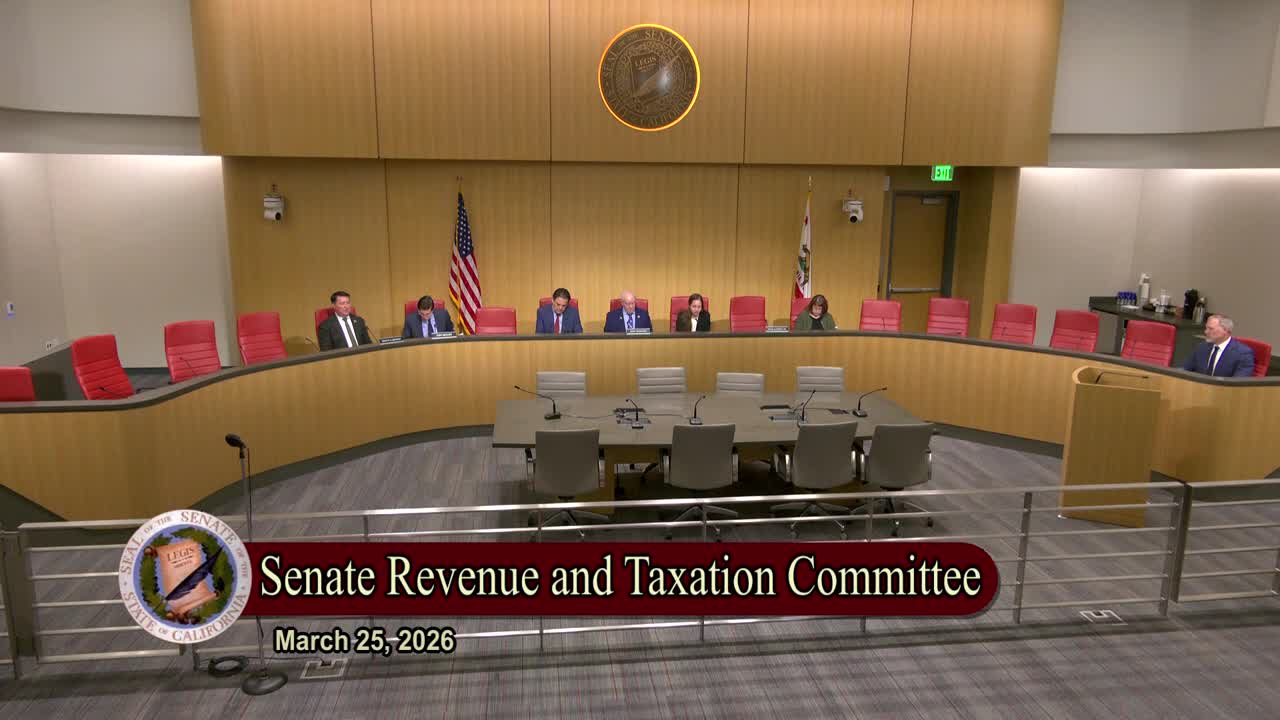 7MIN
Senate Standing Committee on Revenue and Taxation
Bill Author

Bill Co-Author(s):