SB 1067: Pupil instruction: math assessments.
- Session Year: 2025-2026
- House: Senate
- Latest Version Date: 2026-09-27
Current Status:
Passed
(2026-09-27: Chaptered by Secretary of State. Chapter 674, Statutes of 2026.)
Introduced
In Committee
Awaiting First Chamber Vote
Passed First Chamber
In Committee
Awaiting Second Chamber Vote
Passed Second Chamber
Enacted
Existing law requires the State Board of Education, on or before January 31, 2024, to appoint an independent panel of experts for the purpose of creating an approved list of evidence-based, culturally, linguistically, and developmentally appropriate screening instruments for pupils in kindergarten and grades 1 and 2 to assess pupils for risk of reading difficulties, including possible neurological disorders such as dyslexia, as specified. Existing law requires the governing board or body of a school district, county office of education, or charter school serving pupils in kindergarten or grades 1 or 2 to adopt, on or before June 30, 2025, one or more screening instruments from the approved list to assess pupils for risk of reading difficulties, as specified, and commencing no later than the 202526 school year, requires those local educational agencies to assess each pupil in kindergarten and grades 1 and 2 for risk of reading difficulties using the screening instrument or instruments adopted by the governing board or body of the local educational agency, as specified.
This bill would, on or before July 31, 2027, require the state board to approve and the State Department of Education to post on its internet website criteria and guidance for selecting evidence-based, culturally, linguistically, and developmentally appropriate mathematics diagnostic assessments for pupils in kindergarten and grades 1 and 2 to assess pupils mathematics knowledge and learning needs and identify pupils in need of additional support. The bill would require the department, on or before January 31, 2028, to (1) publish on its internet website a list of approved diagnostic assessments that meet the criteria, and (2) post on its internet website additional guidance to assist local educational agencies in selecting diagnostic assessments from the approved list, as provided. The bill would require the list to include diagnostic assessments that are developed for both English learners and non-English learners, as provided. The bill would require the state board and the department to solicit stakeholder input when developing the criteria, guidance, and list of diagnostic assessments pursuant to these provisions and to allow for public comment. The bill would authorize the department to periodically update the list of approved assessments.
The bill would require the governing board or body of a school district, county office of education, or charter school serving pupils in kindergarten or grades 1 or 2 to adopt, on or before June 30, 2028, one or more diagnostic assessments from the published list of approved diagnostic assessments to assess pupils mathematics knowledge and learning needs. The bill would authorize a local educational agency to satisfy this requirement by using a diagnostic assessment that is not on the published list if the governing board or body self-certifies that the assessment tool meets the above-described criteria. The bill, commencing no later than the 202829 school year, would require those local educational agencies to assess each pupil in kindergarten and grades 1 and 2 for mathematics knowledge using the diagnostic assessment or assessments adopted by the governing board or body of the local educational agency. The bill would require a local educational agency to provide parents or guardians of pupils eligible for assessment with information about the assessment and to make pupil results available to parents or guardians, as required by the state board, as provided. By imposing additional duties on local educational agencies, the bill would impose a state-mandated local program.
The bill would require the department, by April 30, 2028, to curate and maintain on its internet website guidance and resources on evidence-based support, intervention, and instructional strategies aligned with the Mathematics Framework for California Public Schools: Kindergarten Through Grade Twelve.
The California Constitution requires the state to reimburse local agencies and school districts for certain costs mandated by the state. Statutory provisions establish procedures for making that reimbursement.
This bill would provide that, if the Commission on State Mandates determines that the bill contains costs mandated by the state, reimbursement for those costs shall be made pursuant to the statutory provisions noted above.
Existing law requires the State Board of Education, on or before January 31, 2024, to appoint an independent panel of experts for the purpose of creating an approved list of evidence-based, culturally, linguistically, and developmentally appropriate screening instruments for pupils in kindergarten and grades 1 and 2 to assess pupils for risk of reading difficulties, including possible neurological disorders such as dyslexia, as specified. Existing law requires the governing board or body of a school district, county office of education, or charter school serving pupils in kindergarten or grades 1 or 2 to adopt, on or before June 30, 2025, one or more screening instruments from the approved list to assess pupils for risk of reading difficulties, as specified, and commencing no later than the 202526 school year, requires those local educational agencies to assess each pupil in kindergarten and grades 1 and 2 for risk of reading difficulties using the screening instrument or instruments adopted by the governing board or body of the local educational agency, as specified.
This bill would, on or before July 31, 2027, require the state board to approve and the State Department of Education to post on its internet website criteria and guidance for selecting evidence-based, culturally, linguistically, and developmentally appropriate mathematics diagnostic assessments for pupils in kindergarten and grades 1 and 2 to assess pupils mathematics knowledge and learning needs and identify pupils in need of additional support. The bill would require the department, on or before January 31, 2028, to (1) adopt diagnostic assessments pursuant to the criteria, (2) develop and publish on its internet website a list of those adopted assessments, approved diagnostic assessments that meet the criteria, and (3) (2) post on its internet website additional guidance to assist local educational agencies in selecting diagnostic assessments from the approved list, as provided. The bill would require the list to include diagnostic assessments that are developed for both English learners and non-English learners, as provided. The bill would require the state board and the department to solicit stakeholder input when developing the criteria, guidance, and list of diagnostic assessments pursuant to these provisions and to allow for public comment. The bill would authorize the department to periodically update the list of approved assessments.
The bill would require the governing board or body of a school district, county office of education, or charter school serving pupils in kindergarten or grades 1 or 2 to adopt, on or before June 30, 2028, one or more diagnostic assessments from the adopted published list of approved diagnostic assessments to assess pupils mathematics knowledge and learning needs. The bill would authorize a local educational agency to satisfy this requirement by using a diagnostic assessment that is not on the adopted published list if the governing board or body self-certifies that the assessment tool meets the above-described criteria. The bill, commencing no later than the 202829 school year, would require those local educational agencies to assess each pupil in kindergarten and grades 1 and 2 for mathematics knowledge using the diagnostic assessment or assessments adopted by the governing board or body of the local educational agency. The bill would require a local educational agency to provide parents or guardians of pupils eligible for assessment with information about the assessment and to make pupil results available to parents or guardians, as required by the state board, as provided. By imposing additional duties on local educational agencies, the bill would impose a state-mandated local program.
The bill would require the department, by June 30, 2027, April 30, 2028, to curate and maintain on its internet website guidance and resources on evidence-based support, intervention, and instruction instructional strategies aligned with the Mathematics Framework for California Public Schools: Kindergarten Through Grade Twelve.
The California Constitution requires the state to reimburse local agencies and school districts for certain costs mandated by the state. Statutory provisions establish procedures for making that reimbursement.
This bill would provide that, if the Commission on State Mandates determines that the bill contains costs mandated by the state, reimbursement for those costs shall be made pursuant to the statutory provisions noted above.
Existing law requires the State Board of Education, on or before January 31, 2024, to appoint an independent panel of experts for the purpose of creating an approved list of evidence-based, culturally, linguistically, and developmentally appropriate screening instruments for pupils in kindergarten and grades 1 and 2 to assess pupils for risk of reading difficulties, including possible neurological disorders such as dyslexia, as specified. Existing law requires the governing board or body of a school district, county office of education, or charter school serving pupils in kindergarten or grades 1 or 2 to adopt, on or before June 30, 2025, one or more screening instruments from the approved list to assess pupils for risk of reading difficulties, as specified, and commencing no later than the 202526 school year, requires those local educational agencies to assess each pupil in kindergarten and grades 1 and 2 for risk of reading difficulties using the screening instrument or instruments adopted by the governing board or body of the local educational agency, as specified.
This bill would, on or before July 31, 2027, require the state board to approve and the State Department of Education to post on its internet website criteria and guidance for selecting evidence-based, culturally, linguistically, and developmentally appropriate mathematics diagnostic assessments for pupils in kindergarten and grades 1 and 2 to assess pupils mathematics knowledge and learning needs and identify pupils in need of additional support. The bill would require the department, on or before January 31, 2028, to (1) adopt diagnostic assessments pursuant to the criteria, and to (2) develop and publish on its internet website a list of those adopted assessments. assessments, and (3) post on its internet website additional guidance to assist local educational agencies in selecting diagnostic assessments from the approved list, as provided. The bill would require the list to include diagnostic assessments that are developed for both English-speaking and non-English-speaking pupils, English learners and non-English learners, as provided. The bill would require the state board and the department to solicit stakeholder input when developing the criteria, guidance, and list of diagnostic assessments pursuant to these provisions and to allow for public comment. The bill would authorize the department to periodically update the list of approved assessments.
The bill would require the governing board or body of a school district, county office of education, or charter school serving pupils in kindergarten or grades 1 or 2 to adopt, on or before June 30, 2028, one or more diagnostic assessments from the adopted list to assess pupils mathematics knowledge and learning needs. The bill would authorize a local educational agency to satisfy this requirement by continuing to use using a diagnostic assessment that is not on the adopted list if the governing board or body self-certifies that the assessment tool meets the above-described criteria. The bill, commencing no later than the 202829 school year, would require those local educational agencies to assess each pupil in kindergarten and grades 1 and 2 for mathematics knowledge using the diagnostic assessment or assessments adopted by the governing board or body of the local educational agency unless the pupils parent or guardian opts out of the assessment in writing, as provided. agency. The bill would require a local educational agency to provide parents or guardians of pupils eligible for assessment with information about the assessment and to make pupil results available to parents or guardians, as required by the state board, as provided. By imposing additional duties on local educational agencies, the bill would impose a state-mandated local program.
The bill would require the department, by June 30, 2027, to curate and maintain on its internet website guidance and resources on evidence-based support, intervention, and instruction strategies aligned with the Mathematics Framework for California Public Schools: Kindergarten Through Grade Twelve.
The California Constitution requires the state to reimburse local agencies and school districts for certain costs mandated by the state. Statutory provisions establish procedures for making that reimbursement.
This bill would provide that, if the Commission on State Mandates determines that the bill contains costs mandated by the state, reimbursement for those costs shall be made pursuant to the statutory provisions noted above.
Existing law requires the State Board of Education, on or before January 31, 2024, to appoint an independent panel of experts for the purpose of creating an approved list of evidence-based, culturally, linguistically, and developmentally appropriate screening instruments for pupils in kindergarten and grades 1 and 2 to assess pupils for risk of reading difficulties, including possible neurological disorders such as dyslexia, as specified. Existing law requires the governing board or body of a school district, county office of education, or charter school serving pupils in kindergarten or grades 1 or 2 to adopt, on or before June 30, 2025, one or more screening instruments from the approved list to assess pupils for risk of reading difficulties, as specified, and commencing no later than the 202526 school year, requires those local educational agencies to assess each pupil in kindergarten and grades 1 and 2 for risk of reading difficulties using the screening instrument or instruments adopted by the governing board or body of the local educational agency, as specified.
This bill would require the state board, on or before April 30, 2027, to appoint an independent panel of experts for the purpose of creating an approved list of evidence-based, culturally, linguistically, and developmentally appropriate screening instruments for pupils in kindergarten and grades 1 and 2 to assess pupils for math difficulties. The bill would require that panel, on or before January 31, 2028, and at a regularly scheduled public meeting, to vote to approve a list of screening instruments pursuant to the review process and evaluation criteria that the state board would be required to establish. The bill would require the governing board or body of a local educational agency serving pupils in kindergarten or grades 1 or 2 to adopt, on or before June 30, 2028, one or more screening instruments from the approved list to identify pupils experiencing math difficulties, as specified, and commencing no later than the 202829 school year, would require those local educational agencies to assess each pupil in kindergarten and grades 1 and 2 for math difficulties using the screening instrument or instruments adopted by the governing board or body of the local educational agency unless the pupils parent or guardian opts out of the screening in writing, as provided. The bill would require those local educational agencies, on or before July 15, 2029, and on or before July 15 of each year thereafter, to report to the State Department of Education the number and percentage of pupils in each grade who have been identified as experiencing math difficulties through screening, as provided. By imposing additional duties on local educational agencies, the bill would impose a state-mandated local program.This bill would, on or before July 31, 2027, require the state board to approve and the State Department of Education to post on its internet website criteria and guidance for selecting evidence-based, culturally, linguistically, and developmentally appropriate mathematics diagnostic assessments for pupils in kindergarten and grades 1 and 2 to assess pupils mathematics knowledge and learning needs and identify pupils in need of additional support. The bill would require the department, on or before January 31, 2028, to adopt diagnostic assessments pursuant to the criteria, and to develop and publish on its internet website a list of those adopted assessments. The bill would require the list to include diagnostic assessments that are developed for both English-speaking and non-English-speaking pupils, as provided. The bill would authorize the department to periodically update the list of approved assessments.
The bill would require the governing board or body of a school district, county office of education, or charter school serving pupils in kindergarten or grades 1 or 2 to adopt, on or before June 30, 2028, one or more diagnostic assessments from the adopted list to assess pupils mathematics knowledge and learning needs. The bill would authorize a local educational agency to satisfy this requirement by continuing to use a diagnostic assessment if the governing board or body self-certifies that the assessment tool meets the above-described criteria. The bill, commencing no later than the 202829 school year, would require those local educational agencies to assess each pupil in kindergarten and grades 1 and 2 for mathematics knowledge using the diagnostic assessment or assessments adopted by the governing board or body of the local educational agency unless the pupils parent or guardian opts out of the assessment in writing, as provided. The bill would require a local educational agency to provide parents or guardians of pupils eligible for assessment with information about the assessment and to make pupil results available to parents or guardians, as required by the state board, as provided. By imposing additional duties on local educational agencies, the bill would impose a state-mandated local program.
The bill would require the department, by June 30, 2027, to curate and maintain on its internet website guidance and resources on evidence-based support, intervention, and instruction strategies aligned with the Mathematics Framework for California Public Schools: Kindergarten Through Grade Twelve.
The California Constitution requires the state to reimburse local agencies and school districts for certain costs mandated by the state. Statutory provisions establish procedures for making that reimbursement.
This bill would provide that, if the Commission on State Mandates determines that the bill contains costs mandated by the state, reimbursement for those costs shall be made pursuant to the statutory provisions noted above.
Existing law requires the State Board of Education, on or before January 31, 2024, to appoint an independent panel of experts for the purpose of creating an approved list of evidence-based, culturally, linguistically, and developmentally appropriate screening instruments for pupils in kindergarten and grades 1 and 2 to assess pupils for risk of reading difficulties, including possible neurological disorders such as dyslexia, as specified. Existing law requires the governing board or body of a school district, county office of education, or charter school serving pupils in kindergarten or grades 1 or 2 to adopt, on or before June 30, 2025, one or more screening instruments from the approved list to assess pupils for risk of reading difficulties, as specified, and commencing no later than the 202526 school year, requires those local educational agencies to assess each pupil in kindergarten and grades 1 and 2 for risk of reading difficulties using the screening instrument or instruments adopted by the governing board or body of the local educational agency, as specified.
This bill would require the state board, on or before April 30, 2027, to appoint an independent panel of experts for the purpose of creating an approved list of evidence-based, culturally, linguistically, and developmentally appropriate screening instruments for pupils in kindergarten and grades 1 and 2 to assess pupils for math difficulties. The bill would require that panel, on or before January 31, 2028, and at a regularly scheduled public meeting, to vote to approve a list of screening instruments pursuant to the review process and evaluation criteria that the state board would be required to establish. The bill would require the governing board or body of a local educational agency serving pupils in kindergarten or grades 1 or 2 to adopt, on or before June 30, 2028, one or more screening instruments from the approved list to identify pupils experiencing math difficulties, as specified, and commencing no later than the 202829 school year, would require those local educational agencies to assess each pupil in kindergarten and grades 1 and 2 for math difficulties using the screening instrument or instruments adopted by the governing board or body of the local educational agency unless the pupils parent or guardian opts out of the screening in writing, as provided. The bill would require those local educational agencies, on or before July 15, 2029, and on or before July 15 of each year thereafter, to report to the State Department of Education the number and percentage of pupils in each grade who have been identified as experiencing math difficulties through screening, as provided. By imposing additional duties on local educational agencies, the bill would impose a state-mandated local program.
The California Constitution requires the state to reimburse local agencies and school districts for certain costs mandated by the state. Statutory provisions establish procedures for making that reimbursement.
This bill would provide that, if the Commission on State Mandates determines that the bill contains costs mandated by the state, reimbursement for those costs shall be made pursuant to the statutory provisions noted above.
(a)The Legislature finds and declares all of the following:
(1)Math is critical to a pupils success in school, the workforce, and long-term economic opportunity. Every pupil has the ability and the right to learn math. Yet in California, too many pupils, particularly those from low-income communities, are falling far behind in math, which is limiting their access to future pathways.
(2)In order for California to significantly raise math achievement, the state must begin by focusing on the early grades and devote continuing attention in subsequent grades. Math learning is cumulative, and pupils who fall behind early rarely catch up on their own. Research shows that pupils with low 3rd grade math achievement are very likely to have low middle- and high-school math achievement. They are also significantly less likely to take advanced coursework, graduate from high school, or attend college.
(3)Diagnostic assessments in the early grades that measure math knowledge and learning needs, when paired with timely and evidence-based early intervention, is a proven strategy to improve pupil achievement. Multiple rigorous studies, including randomized controlled trials of math interventions, have found that pupils who are identified early and provided with targeted support, and continuing attention throughout subsequent grades, can make meaningful and lasting gains.
(4)In recent years, a growing number of states have included universal assessment and support in their broader strategies to raise math achievement, and several of those states are starting to see meaningful results. California recently adopted universal early literacy assessment to identify pupils at risk for reading difficulties. While learning math presents distinct instructional and assessment considerations, an early identification and intervention approach in math would help Californias pupils develop the skills needed to succeed in math, school, and life.
(b)It is the intent of the Legislature to provide funding for purposes of this chapter.
52986.(a)On or before July 31, 2027, the state board shall approve and the department shall post on its internet website criteria and guidance for selecting evidence-based, culturally, linguistically, and developmentally appropriate mathematics diagnostic assessments for pupils in kindergarten and grades 1 and 2 to assess pupils mathematics knowledge and learning needs and identify pupils in need of additional support pursuant to this section. The criteria approved by the state board shall include guidance for how assessments will be evaluated against the criteria specified in subdivision (b) for purposes of developing the list of diagnostic assessments pursuant to this section.
(b)To support the adoption of high-quality diagnostic assessments that offer meaningful information about the pupils mathematics knowledge and learning needs, the state board shall consider the extent to which an assessment addresses the following factors when adopting criteria pursuant to subdivision (a):
(1)Measurement of foundational math skills appropriate to the respective grade level, as outlined in the Mathematics Framework for California Public Schools: Kindergarten Through Grade Twelve.
(2)Evidence that the tool is normed and has been validated using a contemporary multicultural and multilanguage sample of pupils, with outcome data for pupils whose home language is a language other than English as well as those who are native English speakers.
(3)Integration of relevant pupil demographic information, such as home language, English language proficiency, and access to prekindergarten education, to more fully understand a pupils performance.
(4)Guidance and resources for educators regarding how to administer diagnostic assessments, interpret results, identify pupils in need of additional support, explain results to families, including in pupils primary languages, and determine further educational strategies, assessments, and interventions that should be considered and that are specific to each type of pupil result. Guidance and resources provided pursuant to this paragraph shall be informed by the Mathematics Framework for California Public Schools: Kindergarten Through Grade Twelve and the knowledge of effective interventions for the specific needs of individual pupils, and shall reflect a tiered interventions model aligned with the Multi-Tiered Systems of Support.
(c)The state board and the department shall solicit stakeholder input when developing the criteria, guidance, and list of diagnostic assessments pursuant to this section and shall allow for public comment.
(d)The state board may, at their discretion, adopt grade-specific criteria for diagnostic assessments to accommodate differing needs and expectations for pupils in kindergarten and grades 1 and 2.
(e)On or before January 31, 2028, the department shall publish on its internet website a list of approved diagnostic assessments that meet the evaluation criteria established by the state board pursuant to subdivision (a). The list shall include assessment tools that are developed for both English learners and non-English learners, in languages reflecting the primary languages of pupils in the state, to the extent assessments in those languages are available. The department shall also collect and publish information about the appropriate administration of each assessment, including the appropriate languages and grade or grades for administration of each assessment. The department may update the list of approved assessments periodically, as appropriate.
(f)On or before January 31, 2028, the department shall post on its internet website additional guidance to assist local educational agencies in selecting diagnostic assessments from the approved list. The guidance shall include, but not be limited to, how local educational agencies may weigh the following factors:
(1)The time it takes to complete the assessment and whether the assessment can be incorporated into regular classroom instruction time.
(2)The time it takes for assessment results to become available to educators.
(3)(A)The availability of digital and nondigital assessments.
(B)For digital assessments, the data privacy protections that are in place.
(4)The ability of the assessment to accommodate pupils with exceptional needs.
52987.(a)On or before June 30, 2028, the governing board or body of a local educational agency serving pupils in kindergarten or grades 1 or 2 shall adopt, at a public meeting, one or more diagnostic assessments from the list published pursuant to subdivision (e) of Section 52986 to assess pupils mathematics knowledge and learning needs pursuant to this chapter. The diagnostic assessment or assessments adopted shall provide assessments for both English learners and non-English learners in languages reflecting the primary languages of pupils in the local educational agency, to the extent assessments in those languages are available.
(b)(1)A local educational agency may satisfy the requirements of this section by using a diagnostic assessment, including a kindergarten readiness assessment, that is not on the list published pursuant to subdivision (e) of Section 52986 if the governing board or body of the local educational agency self-certifies that the assessment tool meets all of the criteria delineated in subdivisions (a) and (b) of Section 52986.
(2)A self-certification made pursuant to paragraph (1) shall include, at a minimum, findings by the governing board or body of the local educational agency that the diagnostic assessment has been validated to assess pupils mathematics knowledge in the grade or grades in which the diagnostic assessment will be administered, and that the assessment meets all of the criteria delineated in subdivisions (a) and (b) of Section 52986. Self-certification shall be reported to the department on or before July 15, 2029, in a form and manner to be determined by the department.
(c)Commencing no later than the 202829 school year, and annually thereafter, a local educational agency serving pupils in kindergarten or grades 1 or 2 shall assess each pupil in kindergarten and grades 1 and 2 for mathematics knowledge using a diagnostic assessment adopted by the governing board or body of the local educational agency pursuant to subdivision (a). For pupils in kindergarten, a kindergarten readiness assessment may satisfy the requirements of this subdivision if the assessment meets the criteria established by the state board pursuant to this chapter.
(d)The requirement to assess all pupils in kindergarten and grades 1 and 2 shall include pupils who enroll after the diagnostic assessment or assessments have been administered for other pupils.
(e)Assessments administered pursuant to this section shall not be considered an evaluation or diagnostic tool to establish eligibility for special education and related services pursuant to the federal Individuals with Disabilities Education Act (20 U.S.C. Sec. 1400 et seq.), or an evaluation to determine eligibility for a plan pursuant to Section 504 of the federal Rehabilitation Act of 1973 (29 U.S.C. Sec. 794). However, assessments administered pursuant to this section shall not be used to delay the child find process required under the federal Individuals with Disabilities Education Act. Additionally, assessments administered pursuant to this section may be used by a local educational agency to recommend that a pupil receive further assessment and evaluation to establish eligibility for special education and related services pursuant to the federal Individuals with Disabilities Education Act, or to determine eligibility for a plan pursuant to Section 504 of the federal Rehabilitation Act of 1973.
(f)Pupils who do not speak sufficient English to be assessed with an English language assessment shall be assessed pursuant to this section in their primary language if a diagnostic assessment in their primary language on the list published pursuant to subdivision (e) of Section 52986 is available. If a diagnostic assessment is not available in at least one language in which a pupil is proficient, before the pupil can be assessed, the pupils foundational math skills shall be evaluated through an analysis of the pupils developmental history, educational history, and mathematics progress, taking into account the pupils home background and evolving English language proficiency. Components of diagnostic assessments that do not require English language proficiency may be used in this evaluation. When a pupil acquires sufficient English language proficiency to be able to be assessed using a diagnostic assessment pursuant to this section, or if a diagnostic assessment in their primary language becomes available, the local educational agency shall assess that pupil using the appropriate assessment.
(g)A local educational agency may elect to not assess a pupil pursuant to the requirements of this section if the local educational agency receives the prior written consent of the parent or guardian and any of the following criteria are satisfied:
(1)The pupil has a current identification or diagnosis of dyscalculia or other disability.
(2)The pupil is eligible for special education and related services pursuant to the federal Individuals with Disabilities Education Act or a plan pursuant to Section 504 of the federal Rehabilitation Act of 1973.
(3)The pupil is in the process of being assessed for eligibility for special education and related services pursuant to the federal Individuals with Disabilities Education Act or a plan pursuant to Section 504 of the federal Rehabilitation Act of 1973, and the pupil is being evaluated with other diagnostic assessments that make assessment pursuant to this section redundant.
(4)The pupil does not have sufficient proficiency in the language of the assessment to be validly assessed.
(h)A local educational agency shall provide parents or guardians of pupils eligible for assessment pursuant to this section with information about the assessment. A local educational agency is encouraged to provide information about assessment pursuant to this section with other back-to-school materials at the beginning of the school year.
(i)Pupil results from assessments administered pursuant to this section shall be made available to the pupils parent or guardian in a timely manner, along with information about how to interpret the results, notification when a pupil has been identified as needing additional support, and any planned additional instructional supports and interventions.
(j)Assessment results shall be used to assess pupils mathematics knowledge and identify pupils who need additional support, not as a diagnosis of a disability. Results from a diagnostic assessment shall be used as part of a broader process that further evaluates pupil needs and progress, identifies supports for classroom instruction, enables targeted individual intervention as needed, and allows for further diagnosis if concerns do not resolve. Accordingly, if the results of the assessment administered pursuant to this section indicate that a pupil may benefit from additional instructional support or intervention, the local educational agency shall provide the pupil with supports and services, appropriate to the specific challenges identified by the diagnostic assessment and other pertinent information about the pupil, that may include, among other supports and services, any of the following:
(1)Evidence-based math instruction focused on the pupils specific needs.
(2)Progress monitoring.
(3)Early intervention, including targeted small-group instruction or supports provided through the Multi-Tiered System of Supports.
(4)One-on-one or small group tutoring.
(5)Further evaluation or diagnostic assessment, if needed.
(k)Local educational agencies are encouraged to leverage existing state investments, including the Multi-Tiered System of Supports, mathematics coaching, professional learning opportunities, the Expanded Learning Opportunities Program established pursuant to Section 46120, and other resources to support pupils identified through assessments administered pursuant to this section.
(l)Results of an assessment administered pursuant to this section shall not be used for any high-stakes purpose, including, but not limited to, teacher or other school staff evaluation, accountability, pupil grade promotion or retention, identification for gifted or talented education, or identification as an individual with exceptional needs.
(m)Notifications to parents or guardians provided pursuant to this section shall comply with the translation requirements set forth in Section 48985.
(n)Local educational agencies are encouraged to use local assessments, statewide assessment data and formative assessment tools, and other measures of pupil progress to monitor pupils mathematics achievement and provide appropriate support to pupils throughout elementary, middle, and high school.
(o)On or before July 31, 2028, the state board shall determine (1) the information and process by which local educational agencies shall notify the department of assessment use and results, including information on pupil performance and supports, and (2) the information the department may make available to the public.
(p)By April 30, 2028, the department shall curate and maintain on its internet website guidance and resources on evidence-based support and intervention and Tier 1 instructional strategies aligned with the Mathematics Framework for California Public Schools: Kindergarten Through Grade Twelve.
52988.For purposes of this chapter, the following definitions apply:
(a)Assessment or diagnostic assessment means a tool used to identify pupils specific knowledge, skills, strengths, and learning gaps to inform instruction and supports, administered by an appropriately trained school employee, including, but not limited to, a certificated teacher of record, and may include a kindergarten readiness assessment.
(b)Kindergarten does not include transitional kindergarten, as defined in subdivision (d) of Section 48000.
(c)Local educational agency means a school district, county office of education, or charter school.
SEC. 2.If the Commission on State Mandates determines that this act contains costs mandated by the state, reimbursement to local agencies and school districts for those costs shall be made pursuant to Part 7 (commencing with Section 17500) of Division 4 of Title 2 of the Government Code.
(a)The Legislature finds and declares all of the following:
(1)Math is critical to a pupils success in school, the workforce, and long-term economic opportunity. Every pupil has the ability and the right to learn math. Yet in California, too many pupils, particularly those from low-income communities, are falling far behind in math, which is limiting their access to future pathways.
(2)In order for California to significantly raise math achievement, the state must begin by focusing on the early grades and devote continuing attention in subsequent grades. Math learning is cumulative, and pupils who fall behind early rarely catch up on their own. Research shows that pupils with low 3rd grade math achievement are very likely to have low middle- and high-school math achievement. They are also significantly less likely to take advanced coursework, graduate from high school, or attend college.
(3)Universal diagnostic Diagnostic assessments in the early grades that measure math knowledge and learning needs, when paired with timely and evidence-based early intervention, is a proven strategy to improve student pupil achievement. Multiple rigorous studies, including randomized controlled trials of math interventions, have found that pupils who are identified early and provided with targeted support, and continuing attention throughout subsequent grades, can make meaningful and lasting gains.
(4)In recent years, a growing number of states have included universal assessment and support in their broader strategies to raise math achievement, and several of those states are starting to see meaningful results. California recently adopted universal early literacy assessment to identify pupils at risk for reading difficulties. A comparable While learning math presents distinct instructional and assessment considerations, an early identification and intervention approach in math would help Californias pupils develop the skills needed to succeed in math, school, and life.
(b)It is the intent of the Legislature to provide funding for purposes of this chapter.
52986.(a)On or before July 31, 2027, the state board shall approve and the department shall post on its internet website criteria and guidance for selecting evidence-based, culturally, linguistically, and developmentally appropriate mathematics diagnostic assessments for pupils in kindergarten and grades 1 and 2 to assess pupils mathematics knowledge and learning needs and identify pupils in need of additional support pursuant to this section. The criteria adopted approved by the state board shall include guidance for how assessments will be evaluated against the criteria specified in subdivision (b). (b) for purposes of developing the list of diagnostic assessments pursuant to this section.
(b)To support the adoption of high-quality diagnostic assessments that offer meaningful information about the pupils mathematics knowledge and learning needs, the state board shall consider the extent to which an assessment addresses the following factors when adopting criteria pursuant to subdivision (a):
(1)Measurement of foundational math skills appropriate to the respective grade level, as outlined in the Mathematics Framework for California Public Schools: Kindergarten Through Grade Twelve.
(2)Evidence that the tool is normed and has been validated using a contemporary multicultural and multilanguage sample of pupils, with outcome data for pupils whose home language is a language other than English as well as those who are native English speakers.
(3)Integration of relevant pupil demographic information, such as home language, English language proficiency, and access to prekindergarten education, to more fully understand a pupils performance.
(4)Guidance and resources for educators regarding how to administer diagnostic assessments, interpret results, identify pupils in need of additional support, explain results to families, including in pupils primary languages, and determine further educational strategies, assessments, and interventions that should be considered and that are specific to each type of pupil result. Guidance and resources provided pursuant to this paragraph shall be informed by the Mathematics Framework for California Public Schools: Kindergarten Through Grade Twelve and the knowledge of effective interventions for the specific needs of individual pupils, and shall reflect a tiered interventions model aligned with the Multi-Tiered Systems of Support.
(c)The state board and the department shall solicit stakeholder input when developing the criteria, guidance, and list of diagnostic assessments pursuant to this section and shall allow for public comment.
(d)The state board may, at their discretion, adopt grade-specific criteria for diagnostic assessments to accommodate differing needs and expectations for pupils in kindergarten and grades 1 and 2.
(e)On or before January 31, 2028, the department shall adopt publish on its internet website a list of approved diagnostic assessments pursuant to that meet the evaluation criteria established by the state board pursuant to subdivision (a) and shall develop and publish on its internet website a list of those adopted assessments. (a). The list shall include assessment tools that are developed for both English learners and non-English learners, in languages reflecting the primary languages of pupils in the state, to the extent assessments in those languages are available. The department shall also collect and publish information about the appropriate administration of each assessment, including the appropriate languages and grade or grades for administration of each assessment. The department may update the list of approved assessments periodically, as appropriate.
(f)On or before January 31, 2028, the department shall post on its internet website additional guidance to assist local educational agencies in selecting diagnostic assessments from the approved list. The guidance shall include, but not be limited to, how local educational agencies may weigh the following factors:
(1)The time it takes to complete the assessment and whether the assessment can be incorporated into regular classroom instruction time.
(2)The time it takes for assessment results to become available to educators.
(3)(A)The availability of digital and nondigital assessments.
(B)For digital assessments, the data privacy protections that are in place.
(4)The ability of the assessment to accommodate pupils with exceptional needs.
52987.(a)On or before June 30, 2028, the governing board or body of a local educational agency serving pupils in kindergarten or grades 1 or 2 shall adopt, at a public meeting, one or more diagnostic assessments from the list adopted published pursuant to subdivision (e) of Section 52986 to assess pupils mathematics knowledge and learning needs pursuant to this chapter. The diagnostic assessment or assessments adopted shall provide assessments for both English learners and non-English learners in languages reflecting the primary languages of pupils in the local educational agency, to the extent assessments in those languages are available.
(b)(1)A local educational agency may satisfy the requirements of this section by using a diagnostic assessment, including a kindergarten readiness assessment, that is not on the list developed published pursuant to subdivision (e) of Section 52986 if the governing board or body of the local educational agency self-certifies that the assessment tool meets all of the criteria delineated in subdivisions (a) and (b) of Section 52986.
(2)A self-certification made pursuant to paragraph (1) shall include, at a minimum, findings by the governing board or body of the local educational agency that the diagnostic assessment has been validated to assess pupils mathematics knowledge in the grade or grades in which the diagnostic assessment will be administered, and that the assessment meets all of the criteria delineated in subdivisions (a) and (b) of Section 52986. Self-certification shall be reported to the department on or before July 15, 2029, in a form and manner to be determined by the department.
(c)Commencing no later than the 202829 school year, and annually thereafter, a local educational agency serving pupils in kindergarten or grades 1 or 2 shall assess each pupil in kindergarten and grades 1 and 2 for mathematics knowledge using a diagnostic assessment adopted by the governing board or body of the local educational agency pursuant to subdivision (a). For pupils in kindergarten, a kindergarten readiness assessment may satisfy the requirements of this subdivision if the assessment meets the criteria established by the state board pursuant to this chapter.
(d)The requirement to assess all pupils in kindergarten and grades 1 and 2 shall include pupils who enroll after the diagnostic assessment or assessments have been administered for other pupils.
(e)Assessments administered pursuant to this section shall not be considered an evaluation or diagnostic tool to establish eligibility for special education and related services pursuant to the federal Individuals with Disabilities Education Act (20 U.S.C. Sec. 1400 et seq.), or an evaluation to determine eligibility for a plan pursuant to Section 504 of the federal Rehabilitation Act of 1973 (29 U.S.C. Sec. 794). However, assessments administered pursuant to this section shall not be used to delay the child find process required under the federal Individuals with Disabilities Education Act. Additionally, assessments administered pursuant to this section may be used by a local educational agency to recommend that a pupil receive further assessment and evaluation to establish eligibility for special education and related services pursuant to the federal Individuals with Disabilities Education Act, or to determine eligibility for a plan pursuant to Section 504 of the federal Rehabilitation Act of 1973.
(f)Pupils who do not speak sufficient English to be assessed with an English language assessment shall be assessed pursuant to this section in their primary language if a diagnostic assessment in their primary language adopted on the list published pursuant to subdivision (e) of Section 52986 is available. If a diagnostic assessment is not available in at least one language in which a pupil is proficient, before the pupil can be assessed, the pupils foundational math skills shall be evaluated through an analysis of the pupils developmental history, educational history, and mathematics progress, taking into account the pupils home background and evolving English language proficiency. Components of diagnostic assessments that do not require English language proficiency may be used in this evaluation. When a pupil acquires sufficient English language proficiency to be able to be assessed using a diagnostic assessment pursuant to this section, or if a diagnostic assessment in their primary language becomes available, the local educational agency shall assess that pupil using the appropriate assessment.
(g)A local educational agency may elect to not assess a pupil pursuant to the requirements of this section if the local educational agency receives the prior written consent of the parent or guardian and any of the following criteria are satisfied:
(1)The pupil has a current identification or diagnosis of dyscalculia or other disability.
(2)The pupil is eligible for special education and related services pursuant to the federal Individuals with Disabilities Education Act or a plan pursuant to Section 504 of the federal Rehabilitation Act of 1973.
(3)The pupil is in the process of being assessed for eligibility for special education and related services pursuant to the federal Individuals with Disabilities Education Act or a plan pursuant to Section 504 of the federal Rehabilitation Act of 1973, and the pupil is being evaluated with other diagnostic assessments that make assessment pursuant to this section redundant.
(4)The pupil does not have sufficient proficiency in the language of the assessment to be validly assessed.
(h)A local educational agency shall provide parents or guardians of pupils eligible for assessment pursuant to this section with information about the assessment. A local educational agency is encouraged to provide information about assessment pursuant to this section with other back-to-school materials at the beginning of the school year.
(i)Pupil results from assessments administered pursuant to this section shall be made available to the pupils parent or guardian in a timely manner, along with information about how to interpret the results, notification when a pupil has been identified as needing additional support, and any planned additional instructional supports and interventions, consistent with subdivision (o). interventions.
(j)Assessment results shall be used to assess pupils mathematics knowledge and identify pupils who need additional support, not as a diagnosis of a disability. Results from a diagnostic assessment shall be used as part of a broader process that further evaluates pupil needs and progress, identifies supports for classroom instruction, enables targeted individual intervention as needed, and allows for further diagnosis if concerns do not resolve. Accordingly, if the results of the assessment administered pursuant to this section indicate that a pupil may benefit from additional instructional support or intervention, the local educational agency shall provide the pupil with supports and services, appropriate to the specific challenges identified by the diagnostic assessment and other pertinent information about the pupil, that may include, among other supports and services, any of the following:
(1)Evidence-based math instruction focused on the pupils specific needs.
(2)Progress monitoring.
(3)Early intervention, including targeted small-group instruction or supports provided through the Multi-Tiered System of Supports.
(4)One-on-one or small group tutoring.
(5)Further evaluation or diagnostic assessment, if needed.
(k)Local educational agencies are encouraged to leverage existing state investments, including the Multi-Tiered System of Supports, mathematics coaching, professional learning opportunities, the Expanded Learning Opportunities Program established pursuant to Section 46120, and other resources to support pupils identified through assessments administered pursuant to this section.
(l)Results of an assessment administered pursuant to this section shall not be used for any high-stakes purpose, including, but not limited to, teacher or other school staff evaluation, accountability, pupil grade promotion or retention, identification for gifted or talented education, or identification as an individual with exceptional needs.
(m)Notifications to parents or guardians provided pursuant to this section shall comply with the translation requirements set forth in Section 48985.
(n)Local educational agencies are encouraged to use local assessments, statewide assessment data and formative assessment tools, and other measures of pupil progress to monitor pupils mathematics achievement and provide appropriate support to pupils throughout elementary, middle, and high school.
(o)On or before July 31, 2028, the state board shall determine (1) the information and process by which local educational agencies shall notify the department and parents or guardians of assessment use and results, including information on pupil performance and supports supports, and (2) the information the department shall may make available to the public.
(p)By June 30, 2027, April 30, 2028, the department shall curate and maintain on its internet website guidance and resources on evidence-based support and intervention and Tier 1 instructional strategies aligned with the Mathematics Framework for California Public Schools: Kindergarten Through Grade Twelve.
52988.For purposes of this chapter, the following definitions apply:
(a)Assessment or diagnostic assessment means a tool used to identify pupils specific knowledge, skills, strengths, and learning gaps to inform instruction and supports, administered by an appropriately trained school employee, including, but not limited to, a certificated teacher of record, and may include a kindergarten readiness assessment.
(b)Kindergarten does not include transitional kindergarten, as defined in subdivision (d) of Section 48000.
(c)Local educational agency means a school district, county office of education, or charter school.
SEC. 2.If the Commission on State Mandates determines that this act contains costs mandated by the state, reimbursement to local agencies and school districts for those costs shall be made pursuant to Part 7 (commencing with Section 17500) of Division 4 of Title 2 of the Government Code.
(a)The Legislature finds and declares all of the following:
(1)Math is critical to a pupils success in school, the workforce, and long-term economic opportunity. Every pupil has the ability and the right to learn math. Yet in California, too many pupils, particularly those from low-income communities, are falling far behind in math, which is limiting their access to future pathways.
(2)In order for California to significantly raise math achievement, the state must begin by focusing on the early grades and devote continuing attention in subsequent grades. Math learning is cumulative, and pupils who fall behind early rarely catch up on their own. Research shows that pupils with low 3rd grade math achievement are very likely to have low middle- and high-school math achievement. They are also significantly less likely to take advanced coursework, graduate from high school, or attend college.
(3)Universal diagnostic assessments in the early grades that measure math knowledge and learning needs, when paired with timely and evidence-based early intervention, is a proven strategy to improve student achievement. Multiple rigorous studies, including randomized controlled trials of math interventions, have found that pupils who are identified early and provided with targeted support, and continuing attention throughout subsequent grades, can make meaningful and lasting gains.
(4)In recent years, a growing number of states have included universal assessment and support in their broader strategies to raise math achievement, and several of those states are starting to see meaningful results. California recently adopted universal early literacy assessment to identify pupils at risk for reading difficulties. A comparable early identification and intervention approach in math would help Californias pupils develop the skills needed to succeed in math, school, and life.
(b)It is the intent of the Legislature to provide funding for purposes of this chapter.
52986.(a)On or before July 31, 2027, the state board shall approve and the department shall post on its internet website criteria and guidance for selecting evidence-based, culturally, linguistically, and developmentally appropriate mathematics diagnostic assessments for pupils in kindergarten and grades 1 and 2 to assess pupils mathematics knowledge and learning needs and identify pupils in need of additional support pursuant to this section. The criteria adopted by the state board shall include guidance for how assessments will be evaluated against the criteria specified in subdivision (b).
(b)To support the adoption of high-quality diagnostic assessments that offer meaningful information about the pupils mathematics knowledge and learning needs, the state board shall consider the extent to which an assessment addresses the following factors when adopting criteria pursuant to subdivision (a):
(1)Measurement of foundational math skills appropriate to the respective grade level, as outlined in the Mathematics Framework for California Public Schools: Kindergarten Through Grade Twelve.
(2)Evidence that the tool is normed and has been validated using a contemporary multicultural and multilanguage sample of pupils, with outcome data for pupils whose home language is a language other than English as well as those who are native English speakers.
(3)Integration of relevant pupil demographic information, such as home language, English language fluency, proficiency, and access to prekindergarten education, to more fully understand a pupils performance.
(4)Guidance and resources for educators regarding how to administer diagnostic assessments, interpret results, identify pupils in need of additional support, explain results to families, including in pupils primary languages, and determine further educational strategies, assessments, and interventions that should be considered and that are specific to each type of pupil result. Guidance and resources provided pursuant to this paragraph shall be informed by the Mathematics Framework for California Public Schools: Kindergarten Through Grade Twelve and the knowledge of effective interventions for the specific needs of individual pupils, and shall reflect a tiered interventions model aligned with the Multi-Tiered Systems of Support.
(c)The state board and the department shall solicit stakeholder input when developing the criteria, guidance, and list of diagnostic assessments pursuant to this section and shall allow for public comment.
(d)The state board may, at their discretion, adopt grade-specific criteria for diagnostic assessments to accommodate differing needs and expectations for pupils in kindergarten and grades 1 and 2.
(c)(e)On or before January 31, 2028, the department shall adopt diagnostic assessments pursuant to the evaluation criteria established by the state board pursuant to subdivision (a) and shall develop and publish on its internet website a list of those adopted assessments. The list shall include assessment tools that are developed for both English-speaking pupils and for non-English-speaking pupils, English learners and non-English learners, in languages reflecting the primary languages of pupils in the state, to the extent assessments in those languages are available. The department shall also collect and publish information about the appropriate administration of each assessment, including the appropriate languages and grade or grades for administration of each assessment. The department may update the list of approved assessments periodically, as appropriate.
(f)On or before January 31, 2028, the department shall post on its internet website additional guidance to assist local educational agencies in selecting diagnostic assessments from the approved list. The guidance shall include, but not be limited to, how local educational agencies may weigh the following factors:
(1)The time it takes to complete the assessment and whether the assessment can be incorporated into regular classroom instruction time.
(2)The time it takes for assessment results to become available to educators.
(3)(A)The availability of digital and nondigital assessments.
(B)For digital assessments, the data privacy protections that are in place.
(4)The ability of the assessment to accommodate pupils with exceptional needs.
52987.(a)On or before June 30, 2028, the governing board or body of a local educational agency serving pupils in kindergarten or grades 1 or 2 shall adopt, at a public meeting, one or more diagnostic assessments from the list adopted pursuant to subdivision (c) (e) of Section 52986 to assess pupils mathematics knowledge and learning needs pursuant to this chapter. The diagnostic assessment or assessments adopted shall provide assessments for both English-speaking pupils and non-English-speaking pupils, English learners and non-English learners in languages reflecting the primary languages of pupils in the local educational agency, to the extent assessments in those languages are available.
(b)(1)A local educational agency may satisfy the requirements of this section by continuing to use using a diagnostic assessment, including a kindergarten readiness assessment, that is not on the list developed pursuant to subdivision (e) of Section 52986 if the governing board or body of the local educational agency self-certifies that the assessment tool meets the criteria delineated in subdivisions (a) and (b) of Section 52986.
(2)A self-certification made pursuant to paragraph (1) shall include, at a minimum, findings by the governing board or body of the local educational agency that the diagnostic assessment has been validated to assess pupils mathematics knowledge in the grade or grades in which the diagnostic assessment will be administered, and that the assessment meets all of the criteria delineated in subdivisions (a) and (b) of Section 52986. Self-certification shall be reported to the department on or before July 15, 2029, in a form and manner to be determined by the department.
(c)Commencing no later than the 202829 school year, and annually thereafter, a local educational agency serving pupils in kindergarten or grades 1 or 2 shall assess each pupil in kindergarten and grades 1 and 2 for mathematics knowledge using a diagnostic assessment adopted by the governing board or body of the local educational agency pursuant to subdivision (a), unless the pupils parent or guardian opts out of the assessment in writing. (a). For pupils in kindergarten, a kindergarten readiness assessment may satisfy the requirements of this subdivision if the assessment meets the criteria established by the state board pursuant to this chapter.
(d)The requirement to assess all pupils in kindergarten and grades 1 and 2 shall include pupils who enroll after the diagnostic assessment or assessments have been administered for other pupils.
(e)Assessments administered pursuant to this section shall not be considered an evaluation or diagnostic tool to establish eligibility for special education and related services pursuant to the federal Individuals with Disabilities Education Act (20 U.S.C. Sec. 1400 et seq.), or an evaluation to determine eligibility for a plan pursuant to Section 504 of the federal Rehabilitation Act of 1973 (29 U.S.C. Sec. 794). However, assessments administered pursuant to this section shall not be used to delay the child find process required under the federal Individuals with Disabilities Education Act. Additionally, assessments administered pursuant to this section may be used by a local educational agency to recommend that a pupil receive further assessment and evaluation to establish eligibility for special education and related services pursuant to the federal Individuals with Disabilities Education Act, or to determine eligibility for a plan pursuant to Section 504 of the federal Rehabilitation Act of 1973.
(f)Pupils who do not speak sufficient English to be assessed with an English language assessment shall be assessed pursuant to this section in their primary language if a diagnostic assessment in their primary language adopted pursuant to subdivision (c) (e) of Section 52986 is available. If a diagnostic assessment is not available in at least one language in which a pupil is proficient, before the pupil can be assessed, the pupils foundational math skills shall be evaluated through an analysis of the pupils developmental history, educational history, and mathematics progress, taking into account the pupils home background and evolving English language abilities. proficiency. Components of diagnostic assessments that do not require English language proficiency may be used in this evaluation. When a pupil acquires sufficient English language knowledge and fluency proficiency to be able to be assessed using a diagnostic assessment pursuant to this section, or if a diagnostic assessment in their primary language becomes available, the local educational agency shall assess that pupil using the appropriate assessment.
(g)A local educational agency may elect to not assess a pupil pursuant to the requirements of this section if the local educational agency receives the prior written consent of the parent or guardian and any of the following criteria are satisfied:
(1)The pupil has a current identification or diagnosis of dyscalculia or other disability.
(2)The pupil is eligible for special education and related services pursuant to the federal Individuals with Disabilities Education Act or a plan pursuant to Section 504 of the federal Rehabilitation Act of 1973.
(3)The pupil is in the process of being assessed for eligibility for special education and related services pursuant to the federal Individuals with Disabilities Education Act or a plan pursuant to Section 504 of the federal Rehabilitation Act of 1973, and the pupil is being evaluated with other diagnostic assessments that make assessment pursuant to this section redundant.
(4)The pupil does not have sufficient fluency proficiency in the language of the assessment to be validly assessed.
(h)A local educational agency shall provide parents or guardians of pupils eligible for assessment pursuant to this section with information about the assessment. A local educational agency is encouraged to provide information about assessment pursuant to this section with other back-to-school materials at the beginning of the school year.
(i)Pupil results from assessments administered pursuant to this section shall be made available to the pupils parent or guardian in a timely manner, along with information about how to interpret the results, notification when a pupil has been identified as needing additional support, and any planned additional instructional supports and interventions, consistent with subdivision (o).
(j)Assessment results shall be used to assess pupils mathematics knowledge and identify pupils who need additional support, not as a diagnosis of a disability. Results from a diagnostic assessment shall be used as part of a broader process that further evaluates pupil needs and progress, identifies supports for classroom instruction, enables targeted individual intervention as needed, and allows for further diagnosis if concerns do not resolve. Accordingly, if the results of the assessment administered pursuant to this section indicate that a pupil may benefit from additional instructional support or intervention, the local educational agency shall provide the pupil with supports and services, appropriate to the specific challenges identified by the diagnostic assessment and other pertinent information about the pupil, that may include, among other supports and services, any of the following:
(1)Evidence-based math instruction focused on the pupils specific needs.
(2)Progress monitoring.
(3)Early intervention, including targeted small-group instruction or supports provided through the Multi-Tiered System of Supports.
(4)One-on-one or small group tutoring.
(5)Further evaluation or diagnostic assessment, if needed.
(k)Local educational agencies are encouraged to leverage existing state investments, including the Multi-Tiered System of Supports, mathematics coaching, professional learning opportunities, the Expanded Learning Opportunities Program established pursuant to Section 46120, and other resources to support pupils identified through assessments administered pursuant to this section.
(l)Results of an assessment administered pursuant to this section shall not be used for any high-stakes purpose, including, but not limited to, teacher or other school staff evaluation, accountability, pupil grade promotion or retention, identification for gifted or talented education, or identification as an individual with exceptional needs.
(m)Notifications to parents or guardians provided pursuant to this section shall comply with the translation requirements set forth in Section 48985.
(n)Local educational agencies are encouraged to use local assessments, statewide assessment data and formative assessment tools, and other measures of pupil progress to monitor pupils mathematics achievement and provide appropriate support to pupils throughout elementary, middle, and high school.
(o)On or before July 31, 2028, the state board shall determine (1) the information and process by which local educational agencies shall report to notify the department and parents or guardians regarding of assessment use and results, including information on pupil performance and supports. supports and (2) the information the department shall make available to the public.
(p)By June 30, 2027, the department shall curate and maintain on its internet website guidance and resources on evidence-based support and intervention and Tier 1 instructional strategies aligned with the Mathematics Framework for California Public Schools: Kindergarten Through Grade Twelve.
52988.For purposes of this chapter, the following definitions apply:
(a)Assessment or diagnostic assessment means a tool used to identify pupils specific knowledge, skills, strengths, and learning gaps to inform instruction and supports, administered by an appropriately trained school employee, including, but not limited to, a certificated teacher of record, and may include a kindergarten readiness assessment.
(b)Kindergarten does not include transitional kindergarten, as defined in subdivision (d) of Section 48000.
(c)Local educational agency means a school district, county office of education, or charter school.
SEC. 2.If the Commission on State Mandates determines that this act contains costs mandated by the state, reimbursement to local agencies and school districts for those costs shall be made pursuant to Part 7 (commencing with Section 17500) of Division 4 of Title 2 of the Government Code.
(a)The Legislature finds and declares all of the following:
(1)California is facing a math crisis. Math is critical to a pupils success in school, the workforce, and long-term economic opportunity. Every pupil has the ability and the right to learn math. Yet in California, too many pupils, particularly those from low-income communities, are falling far behind in math, which is limiting their access to future pathways.
(2)In 2025, just 37 percent of all California pupils in kindergarten and grades 1 to 12, inclusive, performed at grade level in math. Among historically underserved groups, the numbers are even more alarming with only 26 percent of low-income pupils, 20 percent of Black pupils, and 26 percent of Latino pupils having performed at grade level. In 2024, the state ranked 43rd in 4th grade math achievement and had one of the countrys widest math achievement gaps between low-income pupils and their more affluent peers.(3)(2)In order for California to significantly raise math achievement, the state must start begin by focusing on the early grades. grades and devote continuing attention in subsequent grades. Math learning is cumulative, and pupils who fall behind early rarely catch up on their own. Research shows that pupils with low 3rd grade math achievement are very likely to have low middle- and high-school math achievement. They are also significantly less likely to take advanced coursework, graduate from high school, or attend college.
(4)(3)Universal screening diagnostic assessments in the early grades for that measure math difficulties, knowledge and learning needs, when paired with timely and evidence-based early intervention intervention, is a proven strategy to improve student achievement. Multiple rigorous studies, including randomized controlled trials of math interventions, have found that pupils who are identified early and provided with targeted support support, and continuing attention throughout subsequent grades, can make meaningful and lasting gains.
(5)(4)In recent years, a growing number of states have included universal screening assessment and support in their broader strategies to raise math achievement, and several of those states are starting to see meaningful results. California recently adopted universal early literacy screening assessment to identify pupils at risk for reading difficulties. A comparable early identification and intervention approach in math would help Californias pupils develop the skills needed to succeed in math, school, and life.
(b)It is the intent of the Legislature to provide funding for purposes of this chapter.
52986.(a)On or before April 30, 2027, the state board shall appoint an independent panel of experts for the purpose of creating an approved list of evidence-based, culturally, linguistically, and developmentally appropriate screening instruments for pupils in kindergarten and grades 1 and 2 to assess pupils for math difficulties pursuant to this section. The state board shall not appoint any person to the panel of experts with a financial interest in the screening instruments under consideration. The state board shall establish a review process, including how screening instruments will be evaluated against the criteria specified in subdivision (c), for the panel to use to evaluate and approve screening instruments. This subdivision does not prohibit the state board from periodically reconstituting this expert panel or updating the review process, nor does it prohibit the expert panel from periodically amending the list of screening instruments described in subdivision (b) at the request of the state board.(b)(1)The work of the panel of experts appointed by the state board pursuant to subdivision (a) is subject to the Bagley-Keene Open Meeting Act (Article 9 (commencing with Section 11120) of Chapter 1 of Part 1 of Division 3 of Title 2 of the Government Code) and all meetings of the panel are subject to the Bagley-Keene Open Meeting Act.(2)On or before January 31, 2028, the panel of experts appointed by the state board shall, at a regularly scheduled public meeting, vote to approve a list of screening instruments pursuant to the review process and evaluation criteria established by the state board pursuant to subdivision (a). The list shall include screening instruments that are developed for both English-speaking pupils and non-English-speaking pupils, in languages reflecting the primary languages of pupils in the state, to the extent assessments in those languages are available. The panel of experts shall consider the time required to conduct each screening with the goal of minimizing the impact on instructional time as well as the timeliness of each instrument in reporting results to teachers, administrators, and parents. The panel of experts shall also collect information about the appropriate administration of each screening instrument, including the appropriate grade or grades for administration of each screening instrument.52986.(a)On or before July 31, 2027, the state board shall approve and the department shall post on its internet website criteria and guidance for selecting evidence-based, culturally, linguistically, and developmentally appropriate mathematics diagnostic assessments for pupils in kindergarten and grades 1 and 2 to assess pupils mathematics knowledge and learning needs and identify pupils in need of additional support pursuant to this section. The criteria adopted by the state board shall include guidance for how assessments will be evaluated against the criteria specified in subdivision (b).
(c)(b)To support the adoption of high-quality screening instruments diagnostic assessments that minimize the overidentification or underidentification of pupils math difficulties, and offer meaningful information for followup, about the pupils mathematics knowledge and learning needs, the state board shall consider the extent to which a screening instrument an assessment addresses the following factors when adopting evaluation criteria pursuant to subdivision (a):
(1)Use of direct measurement, supplemented by other pupil data, to determine if a pupil is experiencing math difficulties.(2)(1)Measurement of foundational math skills appropriate to the respective grade level, including, but not limited to, organizing and counting with numbers, comparing and ordering numbers, and learning to add and subtract, using numbers flexibly. as outlined in the Mathematics Framework for California Public Schools: Kindergarten Through Grade Twelve.
(3)(2)Evidence that the tool is normed and has been validated using a contemporary multicultural and multilanguage sample of pupils, with outcome data for pupils whose home language is a language other than English as well as those who are native English speakers.
(4)(3)Integration of relevant pupil demographic information, such as home language, English language fluency, and access to prekindergarten education, to more fully understand a pupils performance.
(5)(4)Guidance and resources for educators regarding how to administer screening instruments, diagnostic assessments, interpret results, identify pupils in need of additional support, explain results to families, including in pupils primary languages, and determine further educational strategies, assessments, diagnostics, and interventions that should be considered and that are specific to each type of pupil result. Guidance and resources provided pursuant to this paragraph shall be informed by the Mathematics Framework for California Public Schools: Kindergarten Through Grade Twelve and the knowledge of effective interventions for the specific needs of individual pupils, and shall reflect a tiered interventions model aligned with the Multi-Tiered Systems of Support.
(c)On or before January 31, 2028, the department shall adopt diagnostic assessments pursuant to the evaluation criteria established by the state board pursuant to subdivision (a) and shall develop and publish on its internet website a list of those adopted assessments. The list shall include assessment tools that are developed for both English-speaking pupils and for non-English-speaking pupils, in languages reflecting the primary languages of pupils in the state, to the extent assessments in those languages are available. The department shall also collect information about the appropriate administration of each assessment, including the appropriate languages and grade or grades for administration of each assessment. The department may update the list of approved assessments periodically, as appropriate.
52987.(a)On or before June 30, 2028, the governing board or body of a local educational agency serving pupils in kindergarten or grades 1 or 2 shall adopt, at a public meeting, one or more screening instruments diagnostic assessments from the list adopted pursuant to subdivision (b) (c) of Section 52986 to identify pupils experiencing math difficulties assess pupils mathematics knowledge and learning needs pursuant to this chapter. The screening instrument or instruments diagnostic assessment or assessments adopted shall provide assessments for both English-speaking pupils and non-English-speaking pupils, in languages reflecting the primary languages of pupils in the local educational agency, to the extent assessments in those languages are available.
(b)(1)A local educational agency may satisfy the requirements of this section by continuing to use a diagnostic assessment, including a kindergarten readiness assessment, if the governing board or body of the local educational agency self-certifies that the assessment tool meets the criteria delineated in subdivisions (a) and (b) of Section 52986.
(2)A self-certification made pursuant to paragraph (1) shall include, at a minimum, findings by the governing board or body of the local educational agency that the diagnostic assessment has been validated to assess pupils mathematics knowledge in the grade or grades in which the diagnostic assessment will be administered, and that the assessment meets all of the criteria delineated in subdivisions (a) and (b) of Section 52986. Self-certification shall be reported to the department on or before July 15, 2029, in a form and manner to be determined by the department.
(b)(c)Commencing no later than the 202829 school year, and annually thereafter, a local educational agency serving pupils in kindergarten or grades 1 or 2 shall assess each pupil in kindergarten and grades 1 and 2 for math difficulties using the screening instrument or instruments mathematics knowledge using a diagnostic assessment adopted by the governing board or body of the local educational agency pursuant to subdivision (a), unless the pupils parent or guardian opts out of the screening assessment in writing. A local educational agency shall conduct screenings early in the school year to allow time for pupils to receive appropriate intervention. This section does not restrict local educational agencies from providing additional pupil screenings or diagnostic evaluations, as appropriate. For pupils in kindergarten, a kindergarten readiness assessment may satisfy the requirements of this subdivision if the assessment meets the criteria established by the state board pursuant to this chapter.
(c)If a pupil enrolls for the first time in kindergarten or grades 1 or 2 after the screening instrument or instruments have been administered to all pupils in the given grade in that school year pursuant to subdivision (b), the local educational agency shall assess the pupil using the screening instrument or instruments adopted by the governing board or body of the local educational agency pursuant to subdivision (b) within 45 calendar days of enrollment, unless the pupils parent or guardian opts out of the screening in writing, or unless the parent or guardian provides documentation or the local educational agency has documentation that the pupil has had a similar screening in their prior school for their current grade and the parent or guardian was made aware of the results.(d)The requirement to assess all pupils in kindergarten and grades 1 and 2 shall include pupils who enroll after the diagnostic assessment or assessments have been administered for other pupils.
(d)(e)Assessments administered pursuant to this section shall not be considered an evaluation or diagnostic tool to establish eligibility for special education and related services pursuant to the federal Individuals with Disabilities Education Act (20 U.S.C. Sec. 1400 et seq.), or an evaluation to determine eligibility for a plan pursuant to Section 504 of the federal Rehabilitation Act of 1973 (29 U.S.C. Sec. 794). However, assessments administered pursuant to this section shall not be used to delay the child find process required under the federal Individuals with Disabilities Education Act. Additionally, assessments administered pursuant to this section may be used by a local educational agency to recommend that a pupil receive further assessment and evaluation to establish eligibility for special education and related services pursuant to the federal Individuals with Disabilities Education Act, or to determine eligibility for a plan pursuant to Section 504 of the federal Rehabilitation Act of 1973.
(e)(f)Pupils who do not speak sufficient English to be screened assessed with an English language instrument assessment shall be screened assessed pursuant to this section in their primary language if a screening instrument diagnostic assessment in their primary language approved adopted pursuant to subdivision (b) (c) of Section 52986 is available. If a screening instrument diagnostic assessment is not available in at least one language in which a pupil is proficient, before the pupil can be screened, assessed, the pupils foundational math skills shall be evaluated through an analysis of the pupils developmental history, educational history, and math mathematics progress, taking into account the pupils home background and evolving English language abilities. Components of screening instruments diagnostic assessments that do not require English language proficiency may be used in this evaluation. When a pupil acquires sufficient English language knowledge and fluency to be able to be assessed using a screening instrument diagnostic assessment pursuant to this section, or if a screening instrument diagnostic assessment in their primary language becomes available, the local educational agency shall assess that pupil using the appropriate screening instrument. assessment.
(f)(g)A local educational agency may elect to not screen assess a pupil pursuant to the requirements of this section if the local educational agency receives the prior written consent of the parent or guardian and any of the following criteria are satisfied:
(1)The pupil has a current identification or diagnosis of dyscalculia or other disability.
(2)The pupil is eligible for special education and related services pursuant to the federal Individuals with Disabilities Education Act or a plan pursuant to Section 504 of the federal Rehabilitation Act of 1973.
(3)The pupil is in the process of being assessed for eligibility for special education and related services pursuant to the federal Individuals with Disabilities Education Act or a plan pursuant to Section 504 of the federal Rehabilitation Act of 1973, and the pupil is being evaluated with other diagnostic assessments that make screening assessment pursuant to this section redundant.
(4)The pupil does not have sufficient fluency in the language of the assessment to be validly assessed.
(g)(h)A local educational agency shall provide parents or guardians of pupils eligible for screening assessment pursuant to this section with information about the screening, including the date or dates of the screening and instructions for how parents or guardians can opt out of the screening on behalf of their child, no later than 15 calendar days before the administration of the screening instrument or instruments. assessment. A local educational agency is encouraged to provide information about screening assessment pursuant to this section with other back-to-school materials at the beginning of the school year.
(h)(i)Pupil results from assessments administered pursuant to this section shall be made available to the pupils parent or guardian in a timely manner, but no more than 30 calendar days from the date the assessment was administered. These results shall include information about how to interpret the results, as well as the next steps pursuant to subdivision (i), if applicable. along with information about how to interpret the results, notification when a pupil has been identified as needing additional support, and any planned additional instructional supports and interventions, consistent with subdivision (o).
(i)Screening(j)Assessment results shall be used to identify pupils experiencing math difficulties, assess pupils mathematics knowledge and identify pupils who need additional support, not as a diagnosis of a disability. Results from a screening instrument diagnostic assessment shall be used as part of a broader process that further evaluates pupil needs and progress, identifies supports for classroom instruction, enables targeted individual intervention as needed, and allows for further diagnosis if concerns do not resolve. Accordingly, if a pupil is identified as experiencing math difficulties after being screened pursuant to this section, the results of the assessment administered pursuant to this section indicate that a pupil may benefit from additional instructional support or intervention, the local educational agency shall provide the pupil with supports and services, appropriate to the specific challenges identified by the screening instrument diagnostic assessment and other pertinent information about the pupil, that may include, among other supports and services, any of the following:
(1)Evidence-based math instruction focused on the pupils specific needs.
(2)Progress monitoring.
(3)Early intervention. intervention, including targeted small-group instruction or supports provided through the Multi-Tiered System of Supports.
(4)One-on-one or small group tutoring.
(5)Further evaluation or diagnostic assessment, if needed.
(k)Local educational agencies are encouraged to leverage existing state investments, including the Multi-Tiered System of Supports, mathematics coaching, professional learning opportunities, the Expanded Learning Opportunities Program established pursuant to Section 46120, and other resources to support pupils identified through assessments administered pursuant to this section.
(j)(l)Results of an assessment administered pursuant to this section shall not be used for any high-stakes purpose, including, but not limited to, teacher or other school staff evaluation, accountability, pupil grade promotion or retention, identification for gifted or talented education, or identification as an individual with exceptional needs.
(k)On or before July 15, 2029, and on or before July 15 of each year thereafter, local educational agencies shall report to the department the number and percentage of pupils in each grade who have been identified as experiencing math difficulties through screening required pursuant to this section and disaggregated by pupil group.(l)(m)Notifications to parents or guardians provided pursuant to this section shall comply with the translation requirements set forth in Section 48985.
(n)Local educational agencies are encouraged to use local assessments, statewide assessment data and formative assessment tools, and other measures of pupil progress to monitor pupils mathematics achievement and provide appropriate support to pupils throughout elementary, middle, and high school.
(o)On or before July 31, 2028, the state board shall determine the information local educational agencies shall report to parents or guardians regarding assessment use and results, including information on pupil performance and supports.
(p)By June 30, 2027, the department shall curate and maintain on its internet website guidance and resources on evidence-based support and intervention and Tier 1 instructional strategies aligned with the Mathematics Framework for California Public Schools: Kindergarten Through Grade Twelve.
52988.For purposes of this chapter, the following definitions apply:
(a)Assessment or diagnostic assessment means a tool used to identify pupils specific knowledge, skills, strengths, and learning gaps to inform instruction and supports, administered by an appropriately trained school employee, including, but not limited to, a certificated teacher of record, and may include a kindergarten readiness assessment.
(a)(b)Kindergarten does not include transitional kindergarten, as defined in subdivision (d) of Section 48000.
(b)(c)Local educational agency means a school district, county office of education, or charter school.
(c)Math difficulties means not demonstrating the foundational math skills needed at the respective grade level, including, but not limited to, number sense in kindergarten and grades 1 and 2, as described in the Mathematics Framework for California Public Schools: Kindergarten Through Grade Twelve, the ability to organize and count with numbers, compare and order numbers, and learning to add and subtract, using numbers flexibly. (d)Screening instrument means a brief tool administered by an appropriately trained school employee, including, but not limited to, a certificated teacher of record, measuring discrete areas to identify pupils experiencing math difficulties.SEC. 2.If the Commission on State Mandates determines that this act contains costs mandated by the state, reimbursement to local agencies and school districts for those costs shall be made pursuant to Part 7 (commencing with Section 17500) of Division 4 of Title 2 of the Government Code.
(a)The Legislature finds and declares all of the following:
(1)California is facing a math crisis. Math is critical to a pupils success in school, the workforce, and long-term economic opportunity. Every pupil has the ability and the right to learn math. Yet in California, too many pupils, particularly those from low-income communities, are falling far behind in math, which is limiting their access to future pathways.
(2)In 2025, just 37 percent of all California pupils in kindergarten and grades 1 to 12, inclusive, performed at grade level in math. Among historically underserved groups, the numbers are even more alarming with only 26 percent of low-income pupils, 20 percent of Black pupils, and 26 percent of Latino pupils having performed at grade level. In 2024, the state ranked 43rd in 4th grade math achievement and had one of the countrys widest math achievement gaps between low-income pupils and their more affluent peers.
(3)In order for California to significantly raise math achievement, the state must start by focusing on the early grades. Math learning is cumulative, and pupils who fall behind early rarely catch up on their own. Research shows that pupils with low 3rd grade math achievement are very likely to have low middle- and high-school math achievement. They are also significantly less likely to take advanced coursework, graduate from high school, or attend college.
(4)Universal screening in the early grades for math difficulties, when paired with timely and evidence-based early intervention is a proven strategy to improve student achievement. Multiple rigorous studies, including randomized controlled trials of math interventions, have found that pupils who are identified early and provided with targeted support can make meaningful and lasting gains.
(5)In recent years, a growing number of states have included universal screening and support in their broader strategies to raise math achievement, and several of those states are starting to see meaningful results. California recently adopted universal early literacy screening to identify pupils at risk for reading difficulties. A comparable early identification and intervention approach in math would help Californias pupils develop the skills needed to succeed in math, school, and life.
(b)It is the intent of the Legislature to provide funding for purposes of this chapter.
52986.(a)On or before April 30, 2027, the state board shall appoint an independent panel of experts for the purpose of creating an approved list of evidence-based, culturally, linguistically, and developmentally appropriate screening instruments for pupils in kindergarten and grades 1 and 2 to assess pupils for math difficulties pursuant to this section. The state board shall not appoint any person to the panel of experts with a financial interest in the screening instruments under consideration. The state board shall establish a review process, including how screening instruments will be evaluated against the criteria specified in subdivision (c), for the panel to use to evaluate and approve screening instruments. This subdivision does not prohibit the state board from periodically reconstituting this expert panel or updating the review process, nor does it prohibit the expert panel from periodically amending the list of screening instruments described in subdivision (b) at the request of the state board.
(b)(1)The work of the panel of experts appointed by the state board pursuant to subdivision (a) is subject to the Bagley-Keene Open Meeting Act (Article 9 (commencing with Section 11120) of Chapter 1 of Part 1 of Division 3 of Title 2 of the Government Code) and all meetings of the panel are subject to the Bagley-Keene Open Meeting Act.
(2)On or before January 31, 2028, the panel of experts appointed by the state board shall, at a regularly scheduled public meeting, vote to approve a list of screening instruments pursuant to the review process and evaluation criteria established by the state board pursuant to subdivision (a). The list shall include screening instruments that are developed both for for both English-speaking pupils and for non-English-speaking pupils, in languages reflecting the primary languages of pupils in the state, to the extent assessments in those languages are available. The panel of experts shall consider the time required to conduct each screening with the goal of minimizing the impact on instructional time as well as the timeliness of each instrument in reporting results to teachers, administrators, and parents. The panel of experts shall also collect information about the appropriate administration of each screening instrument, including the appropriate grade or grades for administration of each screening instrument.
(c)To support the adoption of high-quality screening instruments that minimize the overidentification or underidentification of pupils math difficulties, and offer meaningful information for followup, the state board shall consider the extent to which a screening instrument addresses the following factors when adopting evaluation criteria pursuant to subdivision (a):
(1)Use of direct measurement, supplemented by other pupil data, to determine if a pupil is experiencing math difficulties.
(2)Measurement of foundational math skills appropriate to the respective grade level, including, but not limited to, organizing and counting with numbers, comparing and ordering numbers, and learning to add and subtract, using numbers flexibly.
(3)Evidence that the tool is normed and validated using a contemporary multicultural and multilanguage sample of pupils, with outcome data for pupils whose home language is a language other than English as well as those who are native English speakers.
(4)Integration of relevant pupil demographic information, such as home language, English language fluency, and access to prekindergarten education, to more fully understand a pupils performance.
(5)Guidance and resources for educators regarding how to administer screening instruments, interpret results, explain results to families, including in pupils primary languages, and determine further educational strategies, assessments, diagnostics, and interventions that should be considered and that are specific to each type of pupil result. Guidance and resources provided pursuant to this paragraph shall be informed by the Mathematics Framework for California Public Schools: Kindergarten Through Grade Twelve and the knowledge of effective interventions for the specific needs of individual pupils, and shall reflect a tiered interventions model aligned with the Multi-Tiered Systems of Support.
52987.(a)On or before June 30, 2028, the governing board or body of a local educational agency serving pupils in kindergarten or grades 1 or 2 shall adopt, at a public meeting, one or more screening instruments from the list adopted pursuant to subdivision (b) Section 52986 to identify pupils experiencing math difficulties pursuant to this chapter. The screening instrument or instruments adopted shall provide assessments for both English-speaking pupils and non-English-speaking pupils, in languages reflecting the primary languages of pupils in the local educational agency, to the extent assessments in those languages are available.
(b)Commencing no later than the 202829 school year, and annually thereafter, a local educational agency serving pupils in kindergarten or grades 1 or 2 shall assess each pupil in kindergarten and grades 1 and 2 for math difficulties using the screening instrument or instruments adopted by the governing board or body of the local educational agency pursuant to subdivision (a), unless the pupils parent or guardian opts out of the screening in writing. A local educational agency shall conduct screenings early in the school year to allow time for pupils to receive appropriate intervention. This section does not restrict local educational agencies from providing additional pupil screenings or diagnostic evaluations, as appropriate.
(c)If a pupil enrolls for the first time in kindergarten or grades 1 or 2 after the screening instrument or instruments have been administered to all pupils in the given grade in that school year pursuant to subdivision (b), the local educational agency shall assess the pupil using the screening instrument or instruments adopted by the governing board or body of the local educational agency pursuant to subdivision (b) within 45 calendar days of enrollment, unless the pupils parent or guardian opts out of the screening in writing, or unless the parent or guardian provides documentation or the local educational agency has documentation that the pupil has had a similar screening in their prior school for their current grade and the parent or guardian was made aware of the results.
(d)Assessments administered pursuant to this section shall not be considered an evaluation or diagnostic tool to establish eligibility for special education and related services pursuant to the federal Individuals with Disabilities Education Act (20 U.S.C. Sec. 1400 et seq.), or an evaluation to determine eligibility for a plan pursuant to Section 504 of the federal Rehabilitation Act of 1973 (29 U.S.C. Sec. 794). However, assessments administered pursuant to this section shall not be used to delay the child find process required under the federal Individuals with Disabilities Education Act. Additionally, assessments administered pursuant to this section may be used by a local educational agency to recommend that a pupil receive further assessment and evaluation to establish eligibility for special education and related services pursuant to the federal Individuals with Disabilities Education Act, or to determine eligibility for a plan pursuant to Section 504 of the federal Rehabilitation Act of 1973.
(e)Pupils who do not speak sufficient English to be screened with an English language instrument shall be screened pursuant to this section in their primary language if a screening instrument in their primary language approved pursuant to subdivision (b) of Section 52986 is available. If a screening instrument is not available in at least one language in which a pupil is proficient, before the pupil can be screened, the pupils foundational math skills shall be evaluated through an analysis of the pupils developmental history, educational history, and math progress, taking into account the pupils home background and evolving English language abilities. Components of screening instruments that do not require English language proficiency may be used in this evaluation. When a pupil acquires sufficient English language knowledge and fluency to be able to be assessed using a screening instrument pursuant to this section, or if a screening instrument in their primary language becomes available, the local educational agency shall assess that pupil using the appropriate screening instrument.
(f)A local educational agency may elect to not screen a pupil pursuant to the requirements of this section if the local educational agency receives the prior written consent of the parent or guardian and any of the following criteria are satisfied:
(1)The pupil has a current identification or diagnosis of dyscalculia or other disability.
(2)The pupil is eligible for special education and related services pursuant to the federal Individuals with Disabilities Education Act or a plan pursuant to Section 504 of the federal Rehabilitation Act of 1973.
(3)The pupil is in the process of being assessed for eligibility for special education and related services pursuant to the federal Individuals with Disabilities Education Act or a plan pursuant to Section 504 of the federal Rehabilitation Act of 1973, and the pupil is being evaluated with diagnostic assessments that make screening pursuant to this section redundant.
(g)A local educational agency shall provide parents or guardians of pupils eligible for screening pursuant to this section with information about the screening, including the date or dates of the screening and instructions for how parents or guardians can opt out of the screening on behalf of their child, no later than 15 calendar days before the administration of the screening instrument or instruments. A local educational agency is encouraged to provide information about screening pursuant to this section with other back-to-school materials at the beginning of the school year.
(h)Pupil results from assessments administered pursuant to this section shall be made available to the pupils parent or guardian in a timely manner, but no more than 30 calendar days from the date the assessment was administered. These results shall include information about how to interpret the results, as well as the next steps pursuant to subdivision (i), if applicable.
(i)Screening results shall be used to identify pupils experiencing math difficulties, not as a diagnosis of a disability. Results from a screening instrument shall be used as part of a broader process that further evaluates pupil needs and progress, identifies supports for classroom instruction, enables targeted individual intervention as needed, and allows for further diagnosis if concerns do not resolve. Accordingly, if a pupil is identified as experiencing math difficulties after being screened pursuant to this section, the local educational agency shall provide the pupil with supports and services, appropriate to the specific challenges identified by the screening instrument and other pertinent information about the pupil, that may include, among other supports and services, any of the following:
(1)Evidence-based math instruction focused on the pupils specific needs.
(2)Progress monitoring.
(3)Early intervention.
(4)One-on-one or small group tutoring.
(5)Further evaluation or diagnostic assessment, if needed.
(j)Results of an assessment administered pursuant to this section shall not be used for any high-stakes purpose, including, but not limited to, teacher or other school staff evaluation, accountability, pupil grade promotion or retention, identification for gifted or talented education, or identification as an individual with exceptional needs.
(k)On or before July 15, 2029, and on or before July 15 of each year thereafter, local educational agencies shall report to the department the number and percentage of pupils in each grade who have been identified as experiencing math difficulties through screening required pursuant to this section and disaggregated by pupil group.
(l)Notifications to parents or guardians provided pursuant to this section shall comply with the translation requirements set forth in Section 48985.
52988.For purposes of this chapter, the following definitions apply:
(a)Kindergarten does not include transitional kindergarten, as defined in subdivision (d) of Section 48000.
(b)Local educational agency means a school district, county office of education, or charter school.
(c)Math difficulties means not demonstrating the foundational math skills needed at the respective grade level, including, but not limited to, number sense in kindergarten and grades 1 and 2, as described in the Mathematics Framework for California Public Schools: Kindergarten Through Grade Twelve, the ability to organize and count with numbers, compare and order numbers, and learning to add and subtract, using numbers flexibly.
(d)Screening instrument means a brief tool administered by an appropriately trained school employee, including, but not limited to, a certificated teacher of record, measuring discrete areas to identify pupils experiencing math difficulties.
SEC. 2.If the Commission on State Mandates determines that this act contains costs mandated by the state, reimbursement to local agencies and school districts for those costs shall be made pursuant to Part 7 (commencing with Section 17500) of Division 4 of Title 2 of the Government Code.
(a)The Legislature finds and declares all of the following:
(1)California is facing a math crisis. Math is critical to a pupils success in school, the workforce, and long-term economic opportunity. Every pupil has the ability and the right to learn math. Yet in California, too many pupils, particularly those from low-income communities, are falling far behind in math, which is limiting their access to future pathways.
(2)In 2025, just 37 percent of all California pupils in kindergarten and grades 1 to 12, inclusive, performed at grade level in math. Among historically underserved groups, the numbers are even more alarming with only 26 percent of low-income pupils, 20 percent of Black pupils, and 26 percent of Latino pupils having performed at grade level. In 2024, the state ranked 43rd in 4th grade math achievement and had one of the countrys widest math achievement gaps between low-income pupils and their more affluent peers.
(3)In order for California to significantly raise math achievement, the state must start by focusing on the early grades. Math learning is cumulative, and pupils who fall behind early rarely catch up on their own. Research shows that pupils with low 3rd grade math achievement are very likely to have low middle- and high-school math achievement. They are also significantly less likely to take advanced coursework, graduate from high school, or attend college.
(4)Universal screening in the early grades for math difficulties, when paired with timely and evidence-based early intervention is a proven strategy to improve student achievement. Multiple rigorous studies, including randomized controlled trials of math interventions, have found that pupils who are identified early and provided with targeted support can make meaningful and lasting gains.
(5)In recent years, a growing number of states have included universal screening and support in their broader strategies to raise math achievement, and several of those states are starting to see meaningful results. California recently adopted universal early literacy screening to identify pupils at risk for reading difficulties. A comparable early identification and intervention approach in math would help Californias pupils develop the skills needed to succeed in math, school, and life.
(b)It is the intent of the Legislature to provide funding for purposes of this chapter.
52986.(a)On or before April 30, 2027, the state board shall appoint an independent panel of experts for the purpose of creating an approved list of evidence-based, culturally, linguistically, and developmentally appropriate screening instruments for pupils in kindergarten and grades 1 and 2 to assess pupils for math difficulties pursuant to this section. The state board shall not appoint any person to the panel of experts with a financial interest in the screening instruments under consideration. The state board shall establish a review process, including how screening instruments will be evaluated against the criteria specified in subdivision (c), for the panel to use to evaluate and approve screening instruments. This subdivision does not prohibit the state board from periodically reconstituting this expert panel or updating the review process, nor does it prohibit the expert panel from periodically amending the list of screening instruments described in subdivision (b) at the request of the state board.
(b)(1)The work of the panel of experts appointed by the state board pursuant to subdivision (a) is subject to the Bagley-Keene Open Meeting Act (Article 9 (commencing with Section 11120) of Chapter 1 of Part 1 of Division 3 of Title 2 of the Government Code) and all meetings of the panel are subject to the Bagley-Keene Open Meeting Act.
(2)On or before January 31, 2028, the panel of experts appointed by the state board shall, at a regularly scheduled public meeting, vote to approve a list of screening instruments pursuant to the review process and evaluation criteria established by the state board pursuant to subdivision (a). The list shall include screening instruments that are developed both for English-speaking pupils and for non-English-speaking pupils, in languages reflecting the primary languages of pupils in the state, to the extent assessments in those languages are available. The panel of experts shall consider the time required to conduct each screening with the goal of minimizing the impact on instructional time as well as the timeliness of each instrument in reporting results to teachers, administrators, and parents. The panel of experts shall also collect information about the appropriate administration of each screening instrument, including the appropriate grade or grades for administration of each screening instrument.
(c)To support the adoption of high-quality screening instruments that minimize the overidentification or underidentification of pupils math difficulties, and offer meaningful information for followup, the state board shall consider the extent to which a screening instrument addresses the following factors when adopting evaluation criteria pursuant to subdivision (a):
(1)Use of direct measurement, supplemented by other pupil data, to determine if a pupil is experiencing math difficulties.
(2)Measurement of foundational math skills appropriate to the respective grade level, including, but not limited to, organizing and counting with numbers, comparing and ordering numbers, and learning to add and subtract, using numbers flexibly.
(3)Evidence that the tool is normed and validated using a contemporary multicultural and multilanguage sample of pupils, with outcome data for pupils whose home language is a language other than English as well as those who are native English speakers.
(4)Integration of relevant pupil demographic information, such as home language, English language fluency, and access to prekindergarten education, to more fully understand a pupils performance.
(5)Guidance and resources for educators regarding how to administer screening instruments, interpret results, explain results to families, including in pupils primary languages, and determine further educational strategies, assessments, diagnostics, and interventions that should be considered and that are specific to each type of pupil result. Guidance and resources provided pursuant to this paragraph shall be informed by the Mathematics Framework for California Public Schools: Kindergarten Through Grade Twelve and the knowledge of effective interventions for the specific needs of individual pupils, and shall reflect a tiered interventions model aligned with the Multi-Tiered Systems of Support.
52987.(a)On or before June 30, 2028, the governing board or body of a local educational agency serving pupils in kindergarten or grades 1 or 2 shall adopt, at a public meeting, one or more screening instruments from the list adopted pursuant to subdivision (b) Section 52986 to identify pupils experiencing math difficulties pursuant to this chapter. The screening instrument or instruments adopted shall provide assessments for both English-speaking pupils and non-English-speaking pupils, in languages reflecting the primary languages of pupils in the local educational agency, to the extent assessments in those languages are available.
(b)Commencing no later than the 202829 school year, and annually thereafter, a local educational agency serving pupils in kindergarten or grades 1 or 2 shall assess each pupil in kindergarten and grades 1 and 2 for math difficulties using the screening instrument or instruments adopted by the governing board or body of the local educational agency pursuant to subdivision (a), unless the pupils parent or guardian opts out of the screening in writing. A local educational agency shall conduct screenings early in the school year to allow time for pupils to receive appropriate intervention. This section does not restrict local educational agencies from providing additional pupil screenings or diagnostic evaluations, as appropriate.
(c)If a pupil enrolls for the first time in kindergarten or grades 1 or 2 after the screening instrument or instruments have been administered to all pupils in the given grade in that school year pursuant to subdivision (b), the local educational agency shall assess the pupil using the screening instrument or instruments adopted by the governing board or body of the local educational agency pursuant to subdivision (b) within 45 calendar days of enrollment, unless the pupils parent or guardian opts out of the screening in writing, or unless the parent or guardian provides documentation or the local educational agency has documentation that the pupil has had a similar screening in their prior school for their current grade and the parent or guardian was made aware of the results.
(d)Assessments administered pursuant to this section shall not be considered an evaluation or diagnostic tool to establish eligibility for special education and related services pursuant to the federal Individuals with Disabilities Education Act (20 U.S.C. Sec. 1400 et seq.), or an evaluation to determine eligibility for a plan pursuant to Section 504 of the federal Rehabilitation Act of 1973 (29 U.S.C. Sec. 794). However, assessments administered pursuant to this section shall not be used to delay the child find process required under the federal Individuals with Disabilities Education Act. Additionally, assessments administered pursuant to this section may be used by a local educational agency to recommend that a pupil receive further assessment and evaluation to establish eligibility for special education and related services pursuant to the federal Individuals with Disabilities Education Act, or to determine eligibility for a plan pursuant to Section 504 of the federal Rehabilitation Act of 1973.
(e)Pupils who do not speak sufficient English to be screened with an English language instrument shall be screened pursuant to this section in their primary language if a screening instrument in their primary language approved pursuant to subdivision (b) of Section 52986 is available. If a screening instrument is not available in at least one language in which a pupil is proficient, before the pupil can be screened, the pupils foundational math skills shall be evaluated through an analysis of the pupils developmental history, educational history, and math progress, taking into account the pupils home background and evolving English language abilities. Components of screening instruments that do not require English language proficiency may be used in this evaluation. When a pupil acquires sufficient English language knowledge and fluency to be able to be assessed using a screening instrument pursuant to this section, or if a screening instrument in their primary language becomes available, the local educational agency shall assess that pupil using the appropriate screening instrument.
(f)A local educational agency may elect to not screen a pupil pursuant to the requirements of this section if the local educational agency receives the prior written consent of the parent or guardian and any of the following criteria are satisfied:
(1)The pupil has a current identification or diagnosis of dyscalculia or other disability.
(2)The pupil is eligible for special education and related services pursuant to the federal Individuals with Disabilities Education Act or a plan pursuant to Section 504 of the federal Rehabilitation Act of 1973.
(3)The pupil is in the process of being assessed for eligibility for special education and related services pursuant to the federal Individuals with Disabilities Education Act or a plan pursuant to Section 504 of the federal Rehabilitation Act of 1973, and the pupil is being evaluated with diagnostic assessments that make screening pursuant to this section redundant.
(g)A local educational agency shall provide parents or guardians of pupils eligible for screening pursuant to this section with information about the screening, including the date or dates of the screening and instructions for how parents or guardians can opt out of the screening on behalf of their child, no later than 15 calendar days before the administration of the screening instrument or instruments. A local educational agency is encouraged to provide information about screening pursuant to this section with other back-to-school materials at the beginning of the school year.
(h)Pupil results from assessments administered pursuant to this section shall be made available to the pupils parent or guardian in a timely manner, but no more than 30 calendar days from the date the assessment was administered. These results shall include information about how to interpret the results, as well as the next steps pursuant to subdivision (i), if applicable.
(i)Screening results shall be used to identify pupils experiencing math difficulties, not as a diagnosis of a disability. Results from a screening instrument shall be used as part of a broader process that further evaluates pupil needs and progress, identifies supports for classroom instruction, enables targeted individual intervention as needed, and allows for further diagnosis if concerns do not resolve. Accordingly, if a pupil is identified as experiencing math difficulties after being screened pursuant to this section, the local educational agency shall provide the pupil with supports and services, appropriate to the specific challenges identified by the screening instrument and other pertinent information about the pupil, that may include, among other supports and services, any of the following:
(1)Evidence-based math instruction focused on the pupils specific needs.
(2)Progress monitoring.
(3)Early intervention.
(4)One-on-one or small group tutoring.
(5)Further evaluation or diagnostic assessment, if needed.
(j)Results of an assessment administered pursuant to this section shall not be used for any high-stakes purpose, including, but not limited to, teacher or other school staff evaluation, accountability, pupil grade promotion or retention, identification for gifted or talented education, or identification as an individual with exceptional needs.
(k)On or before July 15, 2029, and on or before July 15 of each year thereafter, local educational agencies shall report to the department the number and percentage of pupils in each grade who have been identified as experiencing math difficulties through screening required pursuant to this section and disaggregated by pupil group.
(l)Notifications to parents or guardians provided pursuant to this section shall comply with the translation requirements set forth in Section 48985.
52988.For purposes of this chapter, the following definitions apply:
(a)Kindergarten does not include transitional kindergarten, as defined in subdivision (d) of Section 48000.
(b)Local educational agency means a school district, county office of education, or charter school.
(c)Math difficulties means not demonstrating the foundational math skills needed at the respective grade level, including, but not limited to, number sense in kindergarten and grades 1 and 2, as described in the Mathematics Framework for California Public Schools: Kindergarten Through Grade Twelve, the ability to organize and count with numbers, compare and order numbers, and learning to add and subtract, using numbers flexibly.
(d)Screening instrument means a brief tool administered by an appropriately trained school employee, including, but not limited to, a certificated teacher of record, measuring discrete areas to identify pupils experiencing math difficulties.
SEC. 2.If the Commission on State Mandates determines that this act contains costs mandated by the state, reimbursement to local agencies and school districts for those costs shall be made pursuant to Part 7 (commencing with Section 17500) of Division 4 of Title 2 of the Government Code.
|
Date
|
Status
|
|---|---|
| Sep 27, 2026 | Chaptered by Secretary of State. Chapter 674, Statutes of 2026. |
| Sep 27, 2026 | Approved by the Governor. |
| Sep 3, 2026 | Enrolled and presented to the Governor at 3 p.m. |
| Aug 27, 2026 | Assembly amendments concurred in. (Ayes 40. Noes 0. Page 5939.) Ordered to engrossing and enrolling. |
| Aug 27, 2026 | Assembly amendments concurred in. (Ayes 40. Noes 0.) Ordered to engrossing and enrolling. |
| Aug 24, 2026 | In Senate. Concurrence in Assembly amendments pending. |
| Aug 24, 2026 | Read third time. Passed. (Ayes 71. Noes 0. Page 6393.) Ordered to the Senate. |
| Aug 24, 2026 | Read third time. Passed. Ordered to the Senate. |
| Aug 17, 2026 | Ordered to third reading. |
| Aug 17, 2026 | Read third time and amended. |
| Aug 13, 2026 | Read second time. Ordered to third reading. |
| Aug 13, 2026 | From committee: Do pass. (Ayes 15. Noes 0.) (August 13). |
| Aug 13, 2026 | Assembly Rule 63 suspended. |
| Aug 5, 2026 | August 5 set for first hearing. Placed on suspense file. |
| Jul 2, 2026 | Read second time and amended. Re-referred to Com. on APPR. |
| Jul 2, 2026 | From committee: Do pass as amended and re-refer to Com. on APPR. (Ayes 8. Noes 0.) (July 1). |
| Jun 22, 2026 | From committee with author's amendments. Read second time and amended. Re-referred to Com. on ED. |
| May 26, 2026 | Referred to Com. on ED. |
| May 20, 2026 | In Assembly. Read first time. Held at Desk. |
| May 19, 2026 | Read third time. Passed. (Ayes 39. Noes 0. Page 4342.) Ordered to the Assembly. |
| May 19, 2026 | Read third time. Passed. (Ayes 39. Noes 0.) Ordered to the Assembly. |
| May 14, 2026 | From committee: Do pass. (Ayes 7. Noes 0. Page 4263.) (May 14). |
| May 14, 2026 | Read second time. Ordered to third reading. |
| May 14, 2026 | From committee: Do pass. (Ayes 7. Noes 0.) (May 14). |
| May 8, 2026 | Set for hearing May 14. |
| May 4, 2026 | May 4 hearing: Placed on APPR. suspense file. |
| Apr 24, 2026 | Set for hearing May 4. |
| Apr 22, 2026 | From committee: Do pass and re-refer to Com. on APPR. (Ayes 7. Noes 0. Page 4007.) (April 22). Re-referred to Com. on APPR. |
| Apr 22, 2026 | From committee: Do pass and re-refer to Com. on APPR. (Ayes 7. Noes 0.) (April 22). Re-referred to Com. on APPR. |
| Apr 10, 2026 | Set for hearing April 22. |
| Apr 8, 2026 | From committee with author's amendments. Read second time and amended. Re-referred to Com. on ED. |
| Feb 26, 2026 | Referred to Com. on ED. |
| Feb 17, 2026 | From printer. May be acted upon on or after March 16. |
| Feb 13, 2026 | Introduced. Read first time. To Com. on RLS. for assignment. To print. |
|
Date
|
Description
|
Location
|
Votes
|
|
|---|---|---|---|---|
| Aug 27, 2026 | Unfinished Business SB1067 Weber Pierson et al. Concurrence | Senate Floor |
Passed |
|
| Aug 24, 2026 | SB 1067 Weber Pierson Senate Third Reading By Blanca Rubio | Assembly Floor |
Passed |
|
| Aug 13, 2026 | Do pass. | Assembly Standing Committee on Appropriations |
Passed |
|
| Jul 1, 2026 | Do pass as amended and be re-referred to the Committee on [Appropriations] | Assembly Standing Committee on Education |
Passed |
|
| May 19, 2026 | Senate 3rd Reading SB1067 Weber Pierson et al. | Senate Floor |
Passed |
|
| May 14, 2026 | Do pass | Senate Standing Committee on Appropriations |
Passed |
|
| May 4, 2026 | Placed on suspense file | Senate Standing Committee on Appropriations |
Passed |
|
| Apr 22, 2026 | Do pass, but first be re-referred to the Committee on [Appropriations] | Senate Standing Committee on Education |
Passed |
This list shows positions taken on this bill by organizations on the date displayed, which is linked to the original source.
Positions by individuals are not included.
|
Organization
|
Position
|
Date
|
|---|---|---|
| 21St Century Alliance | ** Support | |
| Anawakalmekak | ** Support | |
| Association Of California School Administrators | ** Against | |
| Bell Resident Club | ** Support | |
| Black American Political Association San Diego | ** Support | |
| Black Parallel School board | ** Support | |
| California County Superintendents | ** Against | |
| California-Hawaii State Conference Of The Naacp | ** Support | |
| California Mathematics Council | ** Against | |
| Californians Together | ** Against | |
| California State Parent Teacher Association | ** Support | |
| California State PTA | ** Support | |
| California Teachers Association | ** Against | |
| Center for Community Action and Environmental Justice | ** Support | |
| Charles Armstrong School | ** Support | |
| Decoding Dyslexia CA | ** Support | |
| Delta Kappa Gamma International - Chi State | ** Support | |
| Designated Exceptional Services for Independence | ** Support | |
| Designated Exceptional Services for Independence (DESI) | ** Support | |
| Edvoice | ** Support | |
| El Centro del Pueblo | ** Support | |
| Elevate California | ** Support | |
| Ensemble Learning | ** Support | |
| Equitable Literacy for All | ** Support | |
| Excelined in Action | ** Support | |
| Families In Schools | ** Support | |
| Fenton Charter Public Schools | ** Support | |
| First 5 California | ** Support | |
| Gumball Foundation | ** Support | |
| Hawley Special Education Law Advocacy | ** Support | |
| House of Haven | ** Support | |
| Innovate Public Schools | ** Support | |
| Kern County Superintendent of Schools Office | ** Against | |
| Kipp Public Schools Northern California | ** Support | |
| La Comadre Network | ** Support | |
| latinos in action | ** Support | |
| Latinos in Action California | ** Support | |
| Legislative Action Committee - Santa Clara County School Boards Association | ** Support | |
| Literacy to Equity Collective | ** Support | |
| Maywood Education Fair | ** Support | |
| Mi Escuelita Bilingue | ** Support | |
| Mi Escuelita: Spanish for Kids Educational Services | ** Support | |
| Mt. Diablo Unified School District | ** Support | |
| National Center for Learning Disabilities | ** Support | |
| National Council on Teacher Quality | ** Support | |
| New Economics for Women | ** Support | |
| Oakland Unified School District | ** Against | |
| Office of the Riverside County Superintendent of Schools | ** Against | |
| Ollin Law | ** Support | |
| Our Voice: Communities for Quality Education | ** Support | |
| Partnership for Los Angeles Schools | ** Support | |
| Plaza Community Services | ** Support | |
| Proyecto Pastoral at Dolores Mission | ** Support | |
| San Mateo County School Boards Association | ** Support | |
| San Mateo County School Boards Association Legislative Action Committee | ** Support | |
| Scholarship Association for ESL Students | ** Support | |
| SpEducational | ** Support | |
| State Superintendent of Public Instruction Tony Thurmond | ** Support | |
| Teach for America | ** Support | |
| Teach for America Southern California Regions | ** Support | |
| Teach Start | ** Support | |
| Third District Parent Teacher Association | ** Support | |
| Unidosus | ** Support | |
| Walnut Park Civic Engagement Project | ** Support | |
| Watts of Power Foundation | ** Support | |
| Yo Soy Tu Voz | ** Support |
SENATE RULES COMMITTEE Office of Senate Floor Analyses (916) 651-4171 | SB 1067 |
UNFINISHED BUSINESS
Bill No: SB 1067
Author: Weber Pierson (D), et al.
Amended: 8/17/26
Vote: 21
SENATE EDUCATION COMMITTEE: 7-0, 4/22/26
AYES: Pérez, Ochoa Bogh, Cabaldon, Choi, Cortese, Gonzalez, Reyes
SENATE APPROPRIATIONS COMMITTEE: 7-0, 5/14/26
AYES: Cervantes, Seyarto, Cabaldon, Dahle, Grayson, Richardson, Wahab
SENATE FLOOR: 39-0, 5/19/26
AYES: Allen, Alvarado-Gil, Archuleta, Arreguín, Ashby, Becker, Blakespear, Cabaldon, Caballero, Cervantes, Choi, Cortese, Dahle, Durazo, Gonzalez, Grayson, Grove, Hurtado, Jones, Laird, Limón, McGuire, McNerney, Menjivar, Ochoa Bogh, Padilla, Pérez, Reyes, Richardson, Rubio, Seyarto, Smallwood-Cuevas, Stern, Strickland, Umberg, Valladares, Wahab, Weber Pierson, Wiener
NO VOTE RECORDED: Niello
ASSEMBLY FLOOR: 71-0, 8/24/26 - See last page for vote
SUBJECT: Pupil instruction: math screenings
SOURCE: EdVoice
DIGEST:
This bill 1) requires the State Board of Education (SBE) to approve criteria for diagnostic assessments, considering specified factors, by July 31, 2027; 2) requires the California Department of Education (CDE) to post on its website an approved list of assessments that meet the SBE-developed criteria, from which local educational agencies (LEAs) must then select, by January 31, 2028; 3) requires LEAs to adopt one or more diagnostic assessments from the CDE published list by June 30, 2028; and 4) requires LEAs to annually assess, beginning in the 2028-29 school year, the mathematical knowledge and learning needs of kindergarten, 1st, and 2nd grade students using a diagnostic assessment
Assembly Amendments
1) replace all references to screenings and screening instruments with diagnostic assessments; 2) strike the requirement for the SBE to appoint an independent panel of experts to approve a list of mathematic diagnostic assessments and instead require the SBE to approve and post on its website, criteria and guidance for selecting specified mathematic diagnostic assessments; 3) require the CDE, on or before January 31, 2028, to publish a list of approved diagnostic assessments, and post additional guidance to assist LEAs in selecting diagnostic assessments from the approved list; 4) clarify provisions related to an LEAs use of diagnostic assessments that are not among the CDE’s approved list; 5) remove requirements related to the time of year pupils must be assessed; 6) encourage LEAs to leverage existing state investments to support pupils identified through the diagnostic assessment; 7) require the SBE to develop requirements and procedures for LEAs to notify the CDE and parents and guardians of assessment use and results, as well as determine the information the CDE shall make available to the public; and 8) require the CDE to curate and maintain on its website, guidance and resources on evidence based support, as specified.
ANALYSIS:
Existing law:
- Requires the Instructional Quality Commission (IQC), during the next revision of the mathematics curriculum framework, on or after January 1, 2025, to consider including that pupils in grade 8 be offered the opportunity to take Algebra I or Mathematics I course that is aligned to the content standards adopted by the SBE. (Education Code (EC) § 33547.5)
- Requires the SBE, on or before January 31, 2024, to appoint an independent panel of experts for the purpose of creating an approved list of screening instruments for pupils in kindergarten and grades 1 and 2 to assess pupils for risk of reading difficulties, as specified. (EC § 53008)
- Requires the above panel of experts to vote to approve a list of screening instruments that includes screening instruments that are developed both for English-speaking pupils and for non-English speaking pupils, in languages reflecting the primary languages of pupils in the state, to the extent assessments in those languages are available. (EC § 53008)
- Requires the governing board or body of an LEA serving pupils in kindergarten and grades 1 and 2 to adopt one or more screening instruments from the list approved by the panel of experts above to assess pupils for risk of reading difficulties, as specified. (EC § 53008)
- Requires LEAs serving pupils in kindergarten, or grades 1 or 2, beginning no later than the 2025-26 school year, and annually thereafter, to assess each pupil in kindergarten and grades 1 and 2 for risk of reading difficulties using the screening instrument or instruments adopted by the governing board or body of the LEA, unless the pupil’s parent or guardian opts out of the screening in writing. (EC § 53008)
- States that results from a screening instrument shall be used as part of a broader process that further evaluates pupil needs and progress, identifies supports for classroom instruction, enables targeted individual intervention as needed, and allows for further diagnosis if concerns do not resolve. (EC § 53008)
- Requires an LEA to provide a student who has been screened and identified as being at risk of having reading difficulties with supports and services, appropriate to the specific challenges identified by the screening instrument and other pertinent information about the pupil. (EC § 53008)
- Defines “reading difficulties” to mean a barrier that impacts a pupil’s ability to learn to read or improve reading abilities, including dyslexia. (EC § 53008)
This bill:
- Requires the SBE, by July 31, 2027, to approve criteria and guidance for diagnostic assessments that LEAs can use to assess students in kindergarten, 1st, and 2nd grades for math knowledge.
- Authorizes the SBE to approve grade-specific criteria for diagnostic assessments. Requires the SBE to consider multiple factors when developing assessment criteria, including the extent to which an assessment addresses the following factors:
- Measurement of grade-level foundational math skills, as outlined in the Mathematics Framework for California Public Schools: Kindergarten Through Grade Twelve (2023).
- Evidence that the tool is validated using a contemporary multicultural and multilingual sample of students, with outcome data for English learners and non-English learners;
- Integration of relevant student demographic information, such as home language and access to prekindergarten education, to more fully understand a student’s performance;
- Guidance and resources for educators on how to administer, interpret, and respond to diagnostic assessments, as specified.
- Requires the math diagnostic assessments to be evidence-based; to be culturally, linguistically, and developmentally appropriate; to assess a student’s mathematics knowledge and learning needs; and to identify students in need of additional support.
- Requires the CDE to post on its website the SBE criteria and guidance by July 31, 2027.
- Requires the CDE, by January 31, 2028, to post on its website the following:
- A list of approved diagnostic assessments that comply with the SBE criteria and guidance. Requires the list to include assessments for both English learners and non-English learners, in the primary languages of students in the state, to the extent possible. Authorizes the CDE to update the list of approved assessments periodically, as appropriate.
- Guidance to assist LEAs in selecting diagnostic assessments from the CDE list, including but not limited to how LEAs may weigh the following factors:
- The time it takes to complete the assessment;
- The time it takes for assessment results to become available to educators;
- The availability of digital and nondigital assessments, and for digital assessments, the data privacy protections in place; and
- The ability of the assessment to accommodate pupils with exceptional needs.
- Requires LEAs serving students in grades kindergarten, 1st, and 2nd to adopt, on or before June 30, 2028, one or more diagnostic assessments from the CDE list. Requires LEAs to include assessments in the primary languages of students in the LEA, to the extent possible.
- Authorizes LEAs to use an assessment not on the CDE list if its governing board or body self-certifies that the assessment meets all of the SBE criteria. Requires self-certification to include findings that the assessment has been validated to assess students’ math knowledge in the relevant grades and meets the SBE-developed criteria. Requires self-certification to be reported to the CDE by July 15, 2029, in a form and manner determined by the CDE.
- Requires, beginning with the 2028-29 school year, LEAs to annually assess kindergarten, 1st, and 2nd grade students with an approved math diagnostic assessment.
- Prohibits math assessments from being considered an evaluation or diagnostic tool pursuant to the federal Individuals with Disabilities Education Act (IDEA) or Section 504 of the federal Rehabilitation Act of 1973, and from being used to delay the IDEA child find process. Authorizes an LEA to use assessment results to recommend students for further assessment to establish special education eligibility and related services pursuant to IDEA or 504 plans.
- Specifies procedures for students who do not have sufficient English proficiency to be assessed.
- Authorizes an LEA to not screen a student if the LEA receives written consent of the parent or guardian, and the student has a current identification or diagnosis of dyscalculia or other disability, or is eligible or currently being assessed for special education and related services pursuant to IDEA or a 504 plan.
- Requires an LEA to provide parents or guardians with information about the assessment. Requires assessment results be made available to parents and guardians in a timely manner, including specified information.
- Requires assessment results be used to assess students’ math knowledge and identify students who need additional support, not as a diagnosis of a disability. Requires results to be used as part of a broader process that accomplishes the following;
- Further evaluates student needs and progress;
- Identifies supports for classroom instruction;
- Enables targeted individual intervention as needed; and
- Allows for further diagnosis if concerns do not resolve.
- Requires LEAs to provide supports and services to students whose assessment results indicate they may benefit from additional instructional support or intervention, which may include but may not be limited to specified interventions.
- Encourages LEAs to leverage existing state investments, including Multi-Tiered Systems of Support, mathematics coaching, professional learning opportunities, the Expanded Learning Opportunities Program, and other resources to support students identified through assessments.
- Prohibits assessment results from being used for any high-stakes purpose, including but not limited to teacher or staff evaluation, accountability, student grade promotion or retention, identification for gifted or talented education, or identification as an individual with exceptional needs.
- Encourages LEAs to use local assessments, statewide assessment data, and formative assessment tools, and other measures of student progress to monitor student math achievement and provide appropriate support through elementary, middle, and high school.
- Requires the SBE, on or before July 31, 2028, to determine the information and process by which LEAs shall notify the CDE of assessment results, and the information the CDE may make available to the public.
- Requires the CDE, by April 30, 2028, to curate and maintain on its website guidance and resources on evidence-based support and intervention and Tier 1 instructional strategies aligned with the 2023 Mathematics Framework.
- Requires the SBE and CDE to solicit stakeholder input when developing the criteria, guidance, and list of diagnostic assessments, and allow for public comment.
- Defines the following terms:
- “Assessment” or “diagnostic assessment” means a tool used to identify pupils’ specific knowledge, skills, strengths, and learning gaps to inform instruction and supports, administered by an appropriately trained school employee, including, but not limited to, a certificated teacher of record, and may include a kindergarten readiness assessment.
- “Kindergarten” does not include transitional kindergarten, as defined in existing statute.
- “Local educational agency” means a school district, county office of education, or charter school.
Comment
Need for the bill. According to the author, “California is in the midst of a math achievement crisis that is limiting students’ long-term academic and career opportunities and widening equity gaps across our state. As a legislator, I believe it is our shared responsibility to ensure that future generations have the foundation they need to succeed and to contribute meaningfully to sustaining California’s leadership in innovation and growth. Math learning is cumulative, and when students fall behind in the early grades it becomes much harder to catch up—too often turning small gaps into lifelong barriers, with the greatest impacts on low-income students and students of color.
“SB 1067 takes a proactive, prevention-focused approach by ensuring young students are screened for early math challenges and receive timely, evidence-based support when it is most effective. At its core, this bill is about making sure every child builds a strong foundation in math, opening the door to lasting academic achievement, meaningful career pathways, and lifelong success in California’s innovation economy.”
The 2023 Mathematics Framework for California Public Schools: Kindergarten Through Grade Twelve (Framework). In 2023, the SBE adopted a new Framework after an extensive revision process. The Framework is important guidance designed to help educators align classroom teaching with California’s rigorous math learning standards. The purpose of the revised Framework is to support excellence in math teaching and learning through curriculum and instructional approaches grounded in research and reflective of best practices across the globe. The revised Framework provides guidance for mathematics learning for all students at all levels of math, including calculus, and ensures students have a wide variety of options, including pursuing science, technology, engineering, and math (STEM) in college or seeking other careers that benefit from quantitative knowledge and reasoning. Notable highlights of the new Framework include the following:
- Guidance to help educators structure the teaching of state math standards around “Big Ideas” that integrate math concepts across grade levels and through developmental progressions and encourage students to connect with their learning through “real-world” examples and problem solving.
- Guidance to help educators make mathematics instruction culturally relevant and empowering, thus allowing students to see themselves in the curriculum and in math-related careers.
- Guidance to help educators incorporate data science into math instruction throughout grade levels and encourage students to become proficient at understanding and using data, with the goal of helping students identify misleading data and use data to make informed decisions.
- Guidance on strategies that support learning recovery for students, such as providing additional support and expanded learning time; providing personalized learning; and including one-on-one or small group tutoring.
In 2025, the IQC completed the process of adopting Framework-aligned instructional materials for three types of programs: basic grade-level for kindergarten through grade 8, Algebra I, and Integrated Mathematics I.
This bill develops a timeline and infrastructure to support schools in their efforts to provide targeted early math supports to students:
- By July 31, 2027, requires the SBE to approve, and the CDE to publish, Framework informed criteria and guidance for selecting evidence-based, culturally, linguistically, and developmentally appropriate diagnostic assessments for pupils in kindergarten and grades 1 and 2;
- By January 31, 2028, requires the CDE to publish an approved list of diagnostic assessments to assess pupils’ mathematics knowledge and learning needs and identify pupils in need of additional support;
- By June 30, 2028, requires the governing board or body of an LEA to adopt one or more diagnostic assessments from the approved list, or adopt a self-certified equivalent that meets specified criteria;
- Beginning no later than the 2028-29 school year, requires LEAs serving students in kindergarten or grades 1 or 2 to assess the mathematics knowledge of each pupil in those grade levels using a locally adopted diagnostic assessment.
- By April 30, 2028, requires the CDE to curate and maintain online guidance and resources on evidence-based support and intervention and Tier 1 instructional strategies aligned with the Mathematics Framework for California Public Schools: Kindergarten Through Grade Twelve.
Ultimately, if the results of the diagnostic assessment indicate that a student may benefit from additional instructional support or intervention, the LEA must then provide the student with supports and services that address the specific challenges identified by the diagnostic assessment and other pertinent information about the student.
FISCAL EFFECT: Appropriation: No Fiscal Com.: Yes Local: Yes
According to the Assembly Appropriations Committee:
- One-time Proposition 98 General Fund costs of an unknown but likely significant amount, possibly in the hundreds of thousands to millions of dollars statewide, for LEAs to adopt an approved diagnostic assessment and update associated notifications and guidance to parents. Ongoing Proposition 98 General Fund costs potentially in the millions to tens of millions of dollars annually, to administer the assessments and provide appropriate supports to students. To the extent an LEA already administers a compliant math assessment in the early grades and dedicates resources towards targeted interventions then costs would be lower.
- The Budget Act of 2026 includes $4.4 billion in one-time Proposition 98 General Fund discretionary resources to LEAs via the Student Support and Professional Development Block Grant that could be used to support implementation of this bill by LEAs.
- One-time costs of approximately $1 million for CDE to determine, adopt, and post approved diagnostic assessments based on SBE-adopted criteria.
SUPPORT: (Verified 8/24/26)
EdVoice (source)
State Superintendent of Public Instruction Tony Thurmond
21st Century Alliance
Bell Resident Club
Black Parallel School Board
California State PTA
California-Hawaii State Conference of the NAACP
Center for Community Action and Environmental Justice
Charles Armstrong School
Decoding Dyslexia CA
Delta Kappa Gamma International - Chi State
Designated Exceptional Services for Independence
El Centro Del Pueblo
Elevate California
Ensemble Learning
Families in Schools
Fenton Charter Public Schools
Gumball Foundation
Hawley Special Education Law Advocacy
Innovate Public Schools
KIPP Public Schools Northern California
La Comadre Network
Latinos in Action
Legislative Action Committee - Santa Clara County School Boards Association
Maywood Education Fair
Mi Escuelita Bilingue
National Center for Learning Disabilities
National Council on Teacher Quality
New Economics for Women
Ollin Law
Partnership for Los Angeles Schools
Proyecto Pastoral at Dolores Mission
San Mateo County School Boards Association
Scholarship Association for ESL Students
SpEducational
Teach for America
Teach Start
Walnut Park Civic Engagement Project
Watts of Power Foundation
Yo Soy Tu Voz
OPPOSITION: (Verified 8/24/26)
Association of California School Administrators
California County Superintendents
California Mathematics Council
California Teachers Association
Californians Together
Kern County Superintendent of Schools Office
Office of the Riverside County Superintendent of Schools
ASSEMBLY FLOOR: 71-0, 8/24/26
AYES: Addis, Aguiar-Curry, Ahrens, Alanis, Alvarez, Arambula, Ávila Farías, Bains, Bauer-Kahan, Berman, Boerner, Bonta, Bryan, Calderon, Caloza, Carrillo, Castillo, Chen, Connolly, Davies, DeMaio, Dixon, Elhawary, Ellis, Flora, Fong, Gabriel, Garcia, Gipson, Jeff Gonzalez, Hadwick, Haney, Harabedian, Hart, Hoover, Irwin, Jackson, Johnson, Krell, Lackey, Lee, Lowenthal, Macedo, Muratsuchi, Nguyen, Ortega, Pacheco, Papan, Patel, Patterson, Pellerin, Petrie-Norris, Quirk-Silva, Ramos, Ransom, Celeste Rodriguez, Michelle Rodriguez, Blanca Rubio, Sanchez, Schiavo, Schultz, Sharp-Collins, Soria, Stefani, Ta, Tangipa, Valencia, Wallis, Wicks, Wilson, Rivas
NO VOTE RECORDED: Bennett, Mark González, Kalra, McKinnor, Rogers, Solache, Ward, Zbur
Prepared by: Therresa Austin / ED. / (916) 651-4105
8/24/26 20:58:56
**** END ****
SENATE THIRD READING
STR Bill Id:SB 1067
Author:(Weber Pierson)
As Amended Ver:August 17, 2026
Majority vote
SUMMARY
Requires local educational agencies (LEAs) to annually assess, beginning in the 2028-29 school year, the mathematical knowledge and learning needs of kindergarten, 1st, and 2nd grade students using a diagnostic assessment. Requires the State Board of Education (SBE) to approve criteria for diagnostic assessments, considering specified factors, by July 31, 2027. Requires the California Department of Education (CDE) to post on its website a list of assessments that meet the SBE-developed criteria, from which LEAs must then select, by January 31, 2028.
Major Provisions
- Requires the SBE, by July 31, 2027, to approve criteria and guidance for diagnostic assessments that LEAs can use to assess students in kindergarten, 1st, and 2nd grades for math knowledge. Specifies that kindergarten does not include transitional kindergarten.
- Diagnostic assessment means a tool used to identify pupils' specific knowledge, skills, strengths, and learning gaps to inform instruction and supports, administered by an appropriately trained school employee, including, but not limited to, a certificated teacher of record, and may include a kindergarten readiness assessment.
- Authorizes the SBE to approve grade-specific criteria for diagnostic assessments. Requires the SBE to consider multiple factors when developing assessment criteria, including the extent to which an assessment addresses the following factors:
- Measurement of grade-level foundational math skills, as outlined in the Mathematics Framework for California Public Schools: Kindergarten Through Grade Twelve (2023).
- Evidence that the tool is validated using a contemporary multicultural and multilingual sample of students, with outcome data for English learners and non-English learners;
- Integration of relevant student demographic information, such as home language and access to prekindergarten education, to more fully understand a student's performance;
- Guidance and resources for educators on how to administer, interpret, and respond to diagnostic assessments, as specified.
- Requires the math diagnostic assessments to be evidence-based; to be culturally, linguistically, and developmentally appropriate; to assess a students' mathematics knowledge and learning needs; and to identify students in need of additional support.
- Requires the CDE to post on its website the SBE criteria and guidance by July 31, 2027.
- Requires the CDE, by January 31, 2028, to post on its website the following:
- A list of approved diagnostic assessments that comply with the SBE criteria and guidance. Requires the list to include assessments for both English learners and non-English learners, in primary languages of students in the state, to the extent possible. Authorizes the CDE to update the list of approved assessments periodically, as appropriate.
- Guidance to assist LEAs in selecting diagnostic assessments from the CDE list, including but not limited to how LEAs may weigh the following factors:
- The time it takes to complete the assessment;
- The time it takes for assessment results to become available to educators;
- The availability of digital and nondigital assessments, and for digital assessments, the data privacy protections in place; and
- The ability of the assessment to accommodate pupils with exceptional needs.
- Requires LEAs serving students in grades kindergarten, 1st, and 2nd to adopt, on or before June 30, 2028, one or more diagnostic assessments from the CDE list. Requires LEAs to include assessments in the primary languages of students in the LEA, to the extent possible.
- Authorizes LEAs to use an assessment not on the CDE list if its governing board or body self-certifies that the assessment meets all of the SBE criteria. Requires self-certification to include findings that the assessment has been validated to assess students' math knowledge in the relevant grades and meets the SBE-developed criteria. Requires self-certification to be reported to the CDE by July 15, 2029, in a form and manner determined by the CDE.
- Requires, beginning with the 2028-29 school year, LEAs to annually assess kindergarten, 1st, and 2nd grade students with an approved math diagnostic assessment.
- Prohibits math assessments from being considered an evaluation or diagnostic tool pursuant to the federal Individuals with Disabilities Education Act (IDEA) or Section 504 of the federal Rehabilitation Act of 1973, and from being used to delay the IDEA child find process. Authorizes an LEA to use assessment results to recommend students for further assessment to establish special education eligibility and related services pursuant to IDEA or 504 plans.
- Specifies procedures for students who do not have sufficient English proficiency to be assessed.
- Authorizes an LEA to not screen a student if the LEA receives written consent of the parent or guardian, and the student has a current identification or diagnosis of dyscalculia or other disability, or is eligible or currently being assessed for special education and related services pursuant to IDEA or a 504 plan.
- Requires an LEA to provide parents or guardians with information about the assessment. Requires assessment results be made available to parents and guardians in a timely manner, including specified information.
- Requires assessment results be used to assess students' math knowledge and identify students who need additional support, not as a diagnosis of a disability. Requires results to be used as part of a broader process that accomplishes the following;
- Further evaluates student needs and progress;
- Identifies supports for classroom instruction;
- Enables targeted individual intervention as needed; and
- Allows for further diagnosis if concerns do not resolve.
- Requires LEAs to provide supports and services to students whose assessment results indicate they may benefit from additional instructional support or intervention, which may include but may not be limited to specified interventions.
- Encourages LEAs to leverage existing state investments, including Multi-Tiered Systems of Support, mathematics coaching, professional learning opportunities, the Expanded Learning Opportunities Program, and other resources to support students identified through assessments.
- Prohibits assessment results from being used for any high-stakes purpose, including but not limited to teacher or staff evaluation, accountability, student grade promotion or retention, identification for gifted or talented education, or identification as an individual with exceptional needs.
- Encourages LEAs to use local assessments, statewide assessment data, and formative assessment tools, and other measures of student progress to monitor student math achievement and provide appropriate support through elementary, middle, and high school.
- Requires the SBE, on or before July 31, 2028, to determine the information and process by which LEAs shall notify the CDE of assessment results, and the information the CDE may make available to the public.
- Requires the CDE, by April 30, 2028, to curate and maintain on its website guidance and resources on evidence-based support and intervention and Tier 1 instructional strategies aligned with the 2023 Mathematics Framework.
- Requires the SBE and CDE to solicit stakeholder input when developing the criteria, guidance, and list of diagnostic assessments, and allow for public comment.
COMMENTS
Key provisions of the bill. SB 1067 would require LEAs to conduct math assessments of kindergarten, first, and second grade students beginning in the 2028-29 school year. The goal of the assessments would be to ascertain students' mathematics knowledge and learning needs and identify students in need of additional support. Assessments for this purpose would be chosen in part by the SBE, which would approve criteria that the assessments must adhere to; by the CDE, which would curate a list of assessments that the meet those criteria; and by each LEA, which would select an assessment from the CDE list, or use an alternative math assessment if they self-certify that it meets the SBE-developed criteria.
Most recent amendments. Recent amendments clarify that the SBE will approve, not adopt, diagnostic assessment criteria; clarify that the CDE will publish, not develop or adopt, a list of assessments that meet the criteria approved by the SBE; clarify that LEAs must self-certify that a chosen assessment, if not on the CDE list, meets all of the SBE criteria; require the SBE to determine the process by which LEAs notify the CDE of assessment use and results; extend the date by which the CDE shall curate guidance on support and intervention strategies; and make technical changes to legislative findings and declarations.
California math scores are low and display a widening achievement gap. The 2025 Smarter Balanced Assessments (SBAC), which assesses the English Language Arts (ELA) and mathematics proficiency of students in grades 3, 8, and 11, revealed that only 37% of test takers met or exceeded Common Core State Standards for math. This is lower than ELA, in which 49% of test takers met or exceeded standards.
After a significant drop in math achievement following COVID-19 (40% of test takers met or exceeded standards in 2019, compared to 33% in 2023), math achievement has increased in recent years and is now nearing pre-pandemic levels.
However, average math performance can mask differences between high and low performers, which currently appears to be growing. An analysis by the Public Policy Institute of California (PPIC) reveals that the achievement gap between the worst (bottom 10%) and best (top 10%) performers on the math SBAC has increased significantly since 2015, when the test was first administered (Recent Test Results Show Widening Gap between High- and Low-scoring K–12 Students, PPIC, 2025). The authors found a similar trend in results from the National Assessment of Educational Progress. This data suggests there is a need to provide more targeted support to the lowest-achieving students.
Universal early math assessments may be useful in the context of instructional support. Some evidence suggests that universal assessments in early education can help identify students struggling with math. However, identification of struggling students alone is likely insufficient to change their achievement trajectory.
The Institute of Education Sciences (IES) analyzed the impact of various interventions to support students struggling with math. The strongest recommendations made by the IES were focused on how to design and implement successful intervention strategies. Indeed, identifying struggling students is unlikely to be helpful if successful intervention strategies or support for those students are not also provided.
According to the Author
SB 1067 takes a proactive, prevention-focused approach by ensuring young students are assessed for early math challenges and receive timely, evidence-based support when it is most effective. At its core, this bill is about making sure every child builds a strong foundation in math, opening the door to lasting academic achievement, meaningful career pathways, and lifelong success in California's innovation economy.
Arguments in Support
According to the organization EdVoice, "Addressing math difficulties in the early grades—when support is most effective and less costly—helps prevent the need for more intensive and expensive remediation later. Reducing the need for costly interventions in later grades can generate considerable savings for the state over time. Given the scale of math challenges in California, investing early is both fiscally responsible and essential to improving student success.
California is a global center of innovation, yet ranks 43rd in the nation in 4th-grade math. Addressing this crisis requires urgent and effective action. By identifying struggling students in the earliest grades and ensuring they receive targeted support, SB 1067 will put more students on the path to academic success and opportunity."
Arguments in Opposition
According to the California Mathematics Council (CMC), "Limited and narrow screening data could be over interpreted and used to make broader judgments about students and their readiness, such as tracking, which may lead to premature labeling, low-group placement, or skill-remediation pathways for students who are only beginning their formal mathematics journey.
CMC shares the Legislature's commitment to improving early mathematics outcomes. However, SB 1067 focuses on screening rather than strengthening instruction. We urge the Legislature to prioritize investments that build educator expertise, support effective teaching, and expand access to high-quality mathematics learning experiences for all students."
FISCAL COMMENTS
According to the Assembly Appropriations Committee:
- One-time Proposition 98 General Fund costs of an unknown but likely significant amount, possibly in the hundreds of thousands to millions of dollars statewide, for LEAs to adopt an approved diagnostic assessment and update associated notifications and guidance to parents. Ongoing Proposition 98 General Fund costs potentially in the millions to tens of millions of dollars annually, to administer the assessments and provide appropriate supports to students. To the extent an LEA already administers a compliant math assessment in the early grades and dedicates resources towards targeted interventions then costs would be lower.
The Budget Act of 2026 includes $4.4 billion in one-time Proposition 98 General Fund discretionary resources to LEAs via the Student Support and Professional Development Block Grant that could be used to support implementation of this bill by LEAs.
- One-time costs of approximately $1 million for CDE to determine, adopt, and post approved diagnostic assessments based on SBE-adopted criteria.
VOTES
SENATE FLOOR: 39-0-1
YES: Allen, Alvarado-Gil, Archuleta, Arreguín, Ashby, Becker, Blakespear, Cabaldon, Caballero, Cervantes, Choi, Cortese, Dahle, Durazo, Gonzalez, Grayson, Grove, Hurtado, Jones, Laird, Limón, McGuire, McNerney, Menjivar, Ochoa Bogh, Padilla, Pérez, Reyes, Richardson, Rubio, Seyarto, Smallwood-Cuevas, Stern, Strickland, Umberg, Valladares, Wahab, Weber Pierson, Wiener
ABS, ABST OR NV: Niello
ASM EDUCATION: 8-0-1
YES: Patel, Hoover, Alvarez, Bonta, Castillo, Lowenthal, Pellerin, Zbur
ABS, ABST OR NV: Garcia
ASM APPROPRIATIONS: 15-0-0
YES: Wicks, Hoover, Arambula, Calderon, Caloza, Dixon, Fong, Mark González, Krell, Pacheco, Pellerin, Sharp-Collins, Solache, Ta, Tangipa
UPDATED
VERSION: August 17, 2026
CONSULTANT: Sarah Cate Hawthorne / ED. / (916) 319-2087 FN: 0003696
SENATE THIRD READING
STR Bill Id:SB 1067
Author:(Weber Pierson)
As Amended Ver:July 2, 2026
Majority vote
SUMMARY
Requires local educational agencies (LEAs) to annually assess, beginning in the 2028-29 school year, the mathematical knowledge and learning needs of kindergarten, 1st, and 2nd grade students using a diagnostic assessment. Requires the State Board of Education (SBE) to approve criteria for diagnostic assessments, considering specified factors, by July 31, 2027. Requires the California Department of Education (CDE) to post on its website a list of assessments that meet the SBE-developed criteria, from which LEAs must then select, by January 31, 2028.
Major Provisions
- Requires the SBE, by July 31, 2027, to adopt criteria and guidance for diagnostic assessments that LEAs can use to assess students in kindergarten, 1st, and 2nd grades for math knowledge. Specifies that kindergarten does not include transitional kindergarten.
- Diagnostic assessment means a tool used to identify pupils' specific knowledge, skills, strengths, and learning gaps to inform instruction and supports, administered by an appropriately trained school employee, including, but not limited to, a certificated teacher of record, and may include a kindergarten readiness assessment.
- Authorizes the SBE to adopt grade-specific criteria for diagnostic assessments. Requires the SBE to consider multiple factors when developing assessment criteria, including the extent to which an assessment addresses the following factors:
- Measurement of grade-level foundational math skills, as outlined in the Mathematics Framework for California Public Schools: Kindergarten Through Grade Twelve (2023).
- Evidence that the tool is validated using a contemporary multicultural and multilingual sample of students, with outcome data for English learners and non-English learners;
- Integration of relevant student demographic information, such as home language and access to prekindergarten education, to more fully understand a student's performance;
- Guidance and resources for educators on how to administer, interpret, and respond to diagnostic assessments, as specified.
- Requires the math diagnostic assessments to be evidence-based; to be culturally, linguistically, and developmentally appropriate; to assess a students' mathematics knowledge and learning needs; and to identify students in need of additional support.
- Requires the CDE to post on its website the SBE criteria and guidance by July 31, 2027.
- Requires the CDE, by January 31, 2028, to post on its website the following:
- A list of diagnostic assessments that comply with the SBE criteria and guidance. Requires the list to include assessments for both English learners and non-English learners, in primary languages of students in the state, to the extent possible. Authorizes the CDE to update the list of approved assessments periodically, as appropriate.
- Guidance to assist LEAs in selecting diagnostic assessments from the CDE list, including but not limited to how LEAs may weigh the following factors:
- The time it takes to complete the assessment;
- The time it takes for assessment results to become available to educators;
- The availability of digital and nondigital assessments, and for digital assessments, the data privacy protections in place; and
- The ability of the assessment to accommodate pupils with exceptional needs.
- Requires LEAs serving students in grades kindergarten, 1st, and 2nd to adopt, on or before June 30, 2028, one or more diagnostic assessments from the CDE list. Requires LEAs to include assessments in the primary languages of students in the LEA, to the extent possible.
- Authorizes LEAs to use an assessment not on the CDE list if its governing board or body self-certifies that the assessment meets the SBE criteria. Requires self-certification to include findings that the assessment has been validated to assess students' math knowledge in the relevant grades and meets the SBE-developed criteria. Requires self-certification to be reported to the CDE by July 15, 2029, in a form and manner determined by the CDE.
- Requires, beginning with the 2028-29 school year, LEAs to annually assess kindergarten, 1st, and 2nd grade students with an approved math diagnostic assessment.
- Prohibits math assessments from being considered an evaluation or diagnostic tool pursuant to the federal Individual with Disabilities Education Act (IDEA) or Section 504 of the federal Rehabilitation Act of 1973, and from being used to delay the IDEA child find process. Authorizes an LEA to use assessment results to recommend students for further assessment to establish special education eligibility and related services pursuant to IDEA or 504 plans.
- Specifies procedures for students who do not have sufficient English proficiency to be assessed.
- Authorizes an LEA to not screen a student if the LEA receives written consent of the parent or guardian, and the student has a current identification or diagnosis of dyscalculia or other disability, or is eligible or currently being assessed for special education and related services pursuant to IDEA or a 504 plan.
- Requires an LEA to provide parents or guardians with information about the assessment. Requires assessment results be made available to parents and guardians in a timely manner, including specified information.
- Requires assessment results be used to assess students' math knowledge and identify students who need additional support, not as a diagnosis of a disability. Requires results to be used as part of a broader process that accomplishes the following;
- Further evaluates student needs and progress;
- Identifies supports for classroom instruction;
- Enables targeted individual intervention as needed; and
- Allows for further diagnosis if concerns do not resolve.
- Requires LEAs to provide supports and services to students whose assessment results indicate they may benefit from additional instructional support or intervention, which may include but may not be limited to specified interventions.
- Encourages LEAs to leverage existing state investments, including Multi-Tiered Systems of Support, mathematics coaching, professional learning opportunities, the Expanded Learning Opportunities Program, and other resources to support students identified through assessments.
- Prohibits assessment results from being used for any high-stakes purpose, including but not limited to teacher or staff evaluation, accountability, student grade promotion or retention, identification for gifted or talented education, or identification as an individual with exceptional needs.
- Encourages LEAs to use local assessments, statewide assessment data, and formative assessment tools, and other measures of student progress to monitor student math achievement and provide appropriate support through elementary, middle, and high school.
- Requires the SBE, on or before July 31, 2028, to determine the information and process by which LEAs shall notify the CDE and parents or guardians of assessment results, and the information the CDE shall make available to the public.
- Requires the CDE, by June 30, 2027, to curate and maintain on its website guidance and resources on evidence-based support and intervention and Tier 1 instructional strategies aligned with the 2023 Mathematics Framework.
- Requires the SBE and CDE to solicit stakeholder input when developing the criteria, guidance, and list of diagnostic assessments, and allow for public comment.
COMMENTS
Key provisions of the bill. This bill would require LEAs to conduct math assessments of kindergarten, first, and second grade students beginning in the 2028-29 school year. The goal of the assessments would be to ascertain students' mathematics knowledge and learning needs and identify students in need of additional support. Assessments for this purpose would be chosen in part by the SBE, which would set criteria that the assessments must adhere to; by the CDE, which would curate a list of assessments that the meet those criteria; and by each LEA, which would select an assessment from the CDE list, or use an alternative math assessment if they self-certify that it meets the SBE-developed criteria.
California math scores are low and display a widening achievement gap. The 2025 Smarter Balanced Assessments (SBAC), which assesses the English Language Arts (ELA) and mathematics proficiency of students in grades 3, 8, and 11, revealed that only 37% of test takers met or exceeded Common Core State Standards for math. This is lower than ELA, in which 49% of test takers met or exceeded standards.
After a significant drop in math achievement following COVID-19 (40% of test takers met or exceeded standards in 2019, compared to 33% in 2023), math achievement has increased in recent years and is now nearing pre-pandemic levels.
However, average math performance can mask differences between high and low performers, which currently appears to be growing. An analysis by the Public Policy Institute of California (PPIC) reveals that the achievement gap between the worst (bottom 10%) and best (top 10%) performers on the math SBAC has increased significantly since 2015, when the test was first administered (Recent Test Results Show Widening Gap between High- and Low-scoring K–12 Students, PPIC, 2025). The authors found a similar trend in results from the National Assessment of Educational Progress. This data suggests there is a need to provide more targeted support to the lowest-achieving students.
Universal early math assessments may be useful in the context of instructional support. Some evidence suggests that universal assessments in early education can help identify students struggling with math. However, identification of struggling students alone is likely insufficient to change their achievement trajectory.
The Institute of Education Sciences (IES) analyzed the impact of various interventions to support students struggling with math. The strongest recommendations made by the IES were focused on how to design and implement successful intervention strategies. Indeed, identifying struggling students is unlikely to be helpful if successful intervention strategies or support for those students are not also provided.
According to the Author
SB 1067 takes a proactive, prevention-focused approach by ensuring young students are assessed for early math challenges and receive timely, evidence-based support when it is most effective. At its core, this bill is about making sure every child builds a strong foundation in math, opening the door to lasting academic achievement, meaningful career pathways, and lifelong success in California's innovation economy.
Arguments in Support
According to the organization EdVoice, "Addressing math difficulties in the early grades—when support is most effective and less costly—helps prevent the need for more intensive and expensive remediation later. Reducing the need for costly interventions in later grades can generate considerable savings for the state over time. Given the scale of math challenges in California, investing early is both fiscally responsible and essential to improving student success.
California is a global center of innovation, yet ranks 43rd in the nation in 4th-grade math. Addressing this crisis requires urgent and effective action. By identifying struggling students in the earliest grades and ensuring they receive targeted support, SB 1067 will put more students on the path to academic success and opportunity."
Arguments in Opposition
According to the California Mathematics Council [(CMA)], "Limited and narrow screening data could be over interpreted and used to make broader judgments about students and their readiness, such as tracking, which may lead to premature labeling, low-group placement, or skill-remediation pathways for students who are only beginning their formal mathematics journey.
CMC shares the Legislature's commitment to improving early mathematics outcomes. However, SB 1067 focuses on screening rather than strengthening instruction. We urge the Legislature to prioritize investments that build educator expertise, support effective teaching, and expand access to high-quality mathematics learning experiences for all students."
FISCAL COMMENTS
According to the Assembly Appropriations Committee:
- One-time Proposition 98 General Fund costs of an unknown but likely significant amount, possibly in the hundreds of thousands to millions of dollars statewide, for LEAs to adopt an approved diagnostic assessment and update associated notifications and guidance to parents. Ongoing Proposition 98 General Fund costs potentially in the millions to tens of millions of dollars annually, to administer the assessments and provide appropriate supports to students. To the extent an LEA already administers a compliant math assessment in the early grades and dedicates resources towards targeted interventions then costs would be lower.
The Budget Act of 2026 includes $4.4 billion in one-time Proposition 98 General Fund discretionary resources to LEAs via the Student Support and Professional Development Block Grant that could be used to support implementation of this bill by LEAs.
- One-time costs of approximately $1 million for CDE to determine, adopt, and post approved diagnostic assessments based on SBE-adopted criteria.
VOTES
SENATE FLOOR: 39-0-1
YES: Allen, Alvarado-Gil, Archuleta, Arreguín, Ashby, Becker, Blakespear, Cabaldon, Caballero, Cervantes, Choi, Cortese, Dahle, Durazo, Gonzalez, Grayson, Grove, Hurtado, Jones, Laird, Limón, McGuire, McNerney, Menjivar, Ochoa Bogh, Padilla, Pérez, Reyes, Richardson, Rubio, Seyarto, Smallwood-Cuevas, Stern, Strickland, Umberg, Valladares, Wahab, Weber Pierson, Wiener
ABS, ABST OR NV: Niello
ASM EDUCATION: 8-0-1
YES: Patel, Hoover, Alvarez, Bonta, Castillo, Lowenthal, Pellerin, Zbur
ABS, ABST OR NV: Garcia
ASM APPROPRIATIONS: 15-0-0
YES: Wicks, Hoover, Arambula, Calderon, Caloza, Dixon, Fong, Mark González, Krell, Pacheco, Pellerin, Sharp-Collins, Solache, Ta, Tangipa
UPDATED
VERSION: July 2, 2026
CONSULTANT: Sarah Cate Hawthorne / ED. / (916) 319-2087 FN: 0003569
Date of Hearing: August 5, 2026
ASSEMBLY COMMITTEE ON APPROPRIATIONS
Buffy Wicks, Chair
SBPCA Bill Id:SB 1067
Author:(Weber Pierson) – As Amended Ver:July 2, 2026
Policy Committee: | Education | Vote: | 8 - 0 |
|
| ||
|
|
Urgency: No State Mandated Local Program: Yes Reimbursable: Yes
SUMMARY:
This bill requires the State Board of Education (SBE), by July 31, 2027, to approve criteria and guidance for selecting evidence-based, culturally, linguistically, and developmentally appropriate mathematics diagnostic assessments for pupils in kindergarten and grades one and two that the California Department of Education (CDE) must post to its website. The bill also requires, by June 30, 2028, the governing board or body of an LEA serving pupils in kindergarten and grades one and two, to adopt one or more diagnostic assessments from the list published by CDE or self-certify it has adopted an assessment meeting the criteria established by the SBE and begin administering the assessment beginning with the 2028-29 school year.
The bill requires CDE, by January 31, 2028, to adopt approved diagnostic assessments pursuant to the adopted criteria and post them on its website along with additional implementation guidance for local educational agencies (LEAs). An LEA may excuse a pupil from the assessment under specified circumstances, such as having been identified for special education and related services under federal law.
FISCAL EFFECT:
- One-time Proposition 98 General Fund costs of an unknown but likely significant amount, possibly in the hundreds of thousands to millions of dollars statewide, for LEAs to adopt an approved diagnostic assessment and update associated notifications and guidance to parents. Ongoing Proposition 98 General Fund costs potentially in the millions to tens of millions of dollars annually, to administer the assessments and provide appropriate supports to students. To the extent an LEA already administers a compliant math assessment in the early grades and dedicates resources towards targeted interventions then costs would be lower.
The Budget Act of 2026 includes $4.4 billion in one-time Proposition 98 General Fund discretionary resources to LEAs via the Student Support and Professional Development Block Grant that could be used to support implementation of this bill by LEAs.
- One-time costs of approximately $1 million for CDE to determine, adopt, and post approved diagnostic assessments based on SBE-adopted criteria.
COMMENTS:
- Purpose. According to the author:
Math learning is cumulative, and when students fall behind in the early grades it becomes much harder to catch up—too often turning small gaps into lifelong barriers, with the greatest impacts on low-income students and students of color.
SB 1067 takes a proactive, prevention-focused approach by ensuring young students are assessed for early math challenges and receive timely, evidence-based support when it is most effective. At its core, this bill is about making sure every child builds a strong foundation in math, opening the door to lasting academic achievement, meaningful career pathways, and lifelong success in California’s innovation economy.
- Background. Recent standardized test scores for California students display a concerning lack of mathematics proficiency, with only 37% of students meeting or exceeding Common Core State Standards for math in 2025, compared to 49% of students on the English Language Arts standards. Even more concerning are the disparities among different student subgroups. For example, according to a Public Policy Institute of California (PPIC) analysis, math proficiency was at 57% and 51% for Asian and white students, respectively, while at 26% for Latino students and 20% for Black students. This bill attempts to improve these disparities by requiring LEAs to implement assessments in the early elementary school grades to identify students who may be struggling with math proficiency.
The state has made significant investments towards improving math proficiency in recent years, including $50 million appropriated within the education omnibus trailer bill, AB 126 (Committee on Budget), Chapter 65, Statutes of 2026, to augment the Mathematics Professional Learning Partnership (MPLP) and increase support for education training and implementation of the new mathematics curriculum framework. Originally established in 2023, the MPLP helps LEAs build capacity for mathematics coaching, teaching, and leadership to help increase access for all kindergarten through grade 12 students to high-quality math instruction. The program develops and delivers educator training and resources and also provides grants and mini-grants to support regional partnerships focused on building capacity for coaching, teaching, and leadership. To date, the Legislature has appropriated a total of $50 million to support the MPLP in addition to the $50 million included in the Budget Act of 2026.
Standardized testing for math under current law, via the California Assessment of Student Performance and Progress (CAASP), is administered beginning in the third grade. This bill requires the administration of approved diagnostic assessments for mathematics proficiency for students in grades kindergarten and one and two and requires an LEA to provide targeted individual intervention to students as needed based on assessment results, perhaps facilitating a synergy between existing math proficiency resources such as the MPLP and improved early identification of students requiring additional supports.
Analysis Prepared by: Aaron Heredia / APPR. / (916) 319-2081
Date of Hearing:
ASSEMBLY COMMITTEE ON EDUCATION
Darshana R. Patel, Chair
SBPCA Bill Id:SB 1067
Author:(Weber Pierson) – As Amended Ver:June 22, 2026
SENATE VOTE: 39-0
SUBJECT: Pupil instruction: math assessments
SUMMARY: Requires local educational agencies (LEAs) to annually assess, beginning in the 2028-29 school year, the mathematical knowledge and learning needs of kindergarten, first, and second grade students using a diagnostic assessment. Requires the State Board of Education (SBE) to approve criteria and guidance for selecting mathematics diagnostic assessments, considering specified factors, by July 31, 2027. Requires the California Department of Education (CDE) to post on its website a list of assessments that meet the SBE-developed criteria, from which LEAs must then select, by January 31, 2028. Specifically, this bill:
- Requires the SBE, by July 31, 2027, to adopt criteria and guidance for selecting diagnostic assessments with which LEAs can assess students in kindergarten, first, and second grades for math knowledge. Defines the following:
- Diagnostic assessment means a tool used to identify pupils’ specific knowledge, skills, strengths, and learning gaps to inform instruction and supports, administered by an appropriately trained school employee, including, but not limited to, a certificated teacher of record, and may include a kindergarten readiness assessment; and
- Kindergarten does not include transitional kindergarten.
- Requires the math diagnostic assessments to be evidence-based and culturally, linguistically, and developmentally appropriate for the intended grade level. Requires the math diagnostics to assess a students’ mathematics knowledge and learning needs, and identify students in need of additional support.
- Requires the SBE to consider multiple factors when developing assessment criteria, including the extent to which an assessment addresses the following factors:
- Measurement of foundational math skills appropriate to the respective grade level, as outlined in the Mathematics Framework for California Public Schools: Kindergarten Through Grade Twelve (2023 Mathematics Framework);
- Evidence that the tool is normed and validated using a contemporary multicultural and multilingual sample of students, with outcome data for students whose home language is a language other than English as well as those who are native English speakers;
- Integration of relevant student demographic information, such as home language, English language fluency, and access to prekindergarten education, to more fully understand a student’s performance;
- Guidance and resources for educators on how to administer diagnostic assessments; interpret results; identify students in need of additional support; explain results to families in the student’s primary languages; and determine educational strategies, assessments and interventions that should be considered, specific to each type of student result. Requires this guidance to adhere to the following:
- Be informed by the 2023 Mathematics Framework;
- Be informed by the knowledge of effective interventions for the specific needs of individual students; and
- Reflect a tiered interventions model aligned with Multi-Tiered Systems of Support.
- Requires the CDE to post on its website the criteria and guidance developed by the SBE by July 31, 2027.
- Requires the CDE, by January 31, 2028, to adopt and post on its website a list of diagnostic assessments that comply with the criteria and guidance developed by the SBE. Requires the list to include assessments for both English-speaking and non-English-speaking students, in primary languages of students in the state, to the extent that such assessments are available.
- Authorizes the CDE to update the list of approved assessments periodically, as appropriate.
- Requires LEAs serving students in grades kindergarten, 1st, and 2nd to adopt at a public hearing, on or before June 30, 2028, one or more of the approved diagnostic assessments from the list posted by CDE. Requires the adopted assessments to include assessments for both English-speaking and non-English-speaking students, in the primary languages of students in the LEA, to the extent that such assessments are available.
- Authorizes an LEA to satisfy the requirement to adopt a diagnostic assessment by continuing to use an assessment, including a kindergarten readiness assessment, if its governing board or body self-certifies. Requires the self-certification to include findings by the governing board or body that the assessment has been validated to assess students’ math knowledge in the relevant grades and meets the SBE-developed criteria. Requires self-certification to be reported to the CDE by July 15, 2029, in a form and manner determined by the CDE.
- Requires, beginning with the 2028-29 school year, LEAs to annually assess each student in grades kindergarten, 1st, and 2nd with an approved math diagnostic assessment, unless the student’s parent or guardian opts them out of the assessment in writing. Clarifies that this requirement also applies to students who enroll after the diagnostic assessment has been administered to other students.
- Prohibits the math assessments from being considered an evaluation or diagnostic tool pursuant to the federal Individual with Disabilities Education Act (IDEA) or Section 504 of the federal Rehabilitation Act of 1973, and shall not be used to delay the child find process required under IDEA. Authorizes an LEA to use assessment results to recommend students for further assessment and evaluation to establish eligibility for special education and related services pursuant to IDEA or 504 plans.
- Specifies procedures for students who do not speak sufficient English to be assessed:
- Requires students to be assessed in their primary language, if an approved assessment in their primary language exists;
- If an assessment is not available in at least one language in which the student is proficient, requires the student’s foundational math skills to be evaluated through analysis of their developmental and educational history, math progress, home background, and evolving English language abilities;
- Authorizes components of the approved assessments that do not require English language proficiency to be used in this evaluation; and
- Requires students to be assessed with an approved assessment when they acquire sufficient English language fluency, or when an assessment in their primary language becomes available.
- Authorizes an LEA to not screen a student if the LEA receives written consent of the parent or guardian and any of the following criteria are met:
- The student has a current identification or diagnosis of dyscalculia or other disability;
- The student is eligible for special education and related services pursuant to IDEA or a 504 plan; or
- The student is currently being assessed for eligibility for special education and related services pursuant to IDEA or a 504 plan, and the student is being evaluated with diagnostic assessments that make the screening redundant.
- Requires an LEA to provide parents or guardians with information about the assessment, according to the following. Encourages LEAs to provide this information with back-to-school materials provided at the beginning of the school year.
- Requires assessment results be made available to parents and guardians in a timely manner, including information on how to interpret the results, notification when a student is identified as needing additional support, and any planned additional instructional support and interventions. Requires all notifications to parents and guardians to comply with existing translation requirements.
- Requires assessment results be used to assess students’ math knowledge and identify students who need additional support, not as a diagnosis of a disability. Requires results to be used as part of a broader process that accomplishes the following;
- Further evaluates student needs and progress;
- Identifies supports for classroom instruction;
- Enables targeted individual intervention as needed; and
- Allows for further diagnosis if concerns do not resolve.
- Requires LEAs to provide supports and services to students whose assessment results indicate they may benefit from additional instructional support or intervention, which may include, but may not be limited to:
- Evidence-based math instruction focused on the student’s specific needs;
- Progress monitoring;
- Early intervention, including targeted small-group instruction or supports provided through Multi-Tiered Systems of Support;
- One on one or small group tutoring; and
- Further evaluation or diagnostic assessment, if needed.
- Encourages LEAs to leverage existing state investments, including Multi-Tiered Systems of Support, mathematics coaching, professional learning opportunities, the Expanded Learning Opportunities Program, and other resources to support students identified through assessments.
- Prohibits assessment results from being used for any high-stakes purpose, including but not limited to teacher or staff evaluation, accountability, student grade promotion or retention, identification for gifted or talented education, or identification as an individual with exceptional needs.
- Encourages LEAs to use local assessments, statewide assessment data, and formative assessment tools, and other measures of student progress to monitor student math achievement and provide appropriate support through elementary, middle, and high school.
- Requires the SBE, on or before July 31, 2028, to determine the information LEAs shall report to parents or guardians regarding assessment use and results, including information on student performance and supports.
- Requires the CDE, by June 30, 2027, to curate and maintain on its website guidance and resources on evidence-based support and intervention and Tier 1 instructional strategies aligned with the 2023 Mathematics Framework.
EXISTING LAW:
- Requires the Instructional Quality Commission (IQC) to adopt basic instructional materials for use in kindergarten and grades 1 through 8, inclusive, for the governing boards of school districts to subsequently adopt. (Education Code (EC) 60200)
- Requires the IQC, during the next revision of the mathematics curriculum framework, on or after January 1, 2025, to consider including that pupils in grade 8 be offered the opportunity to take Algebra I or Mathematics I course that is aligned to the content standards adopted by the SBE. (EC 33547.5)
- Requires the SBE, on or before January 31, 2024, to appoint an independent panel of experts for the purpose of creating an approved list of screening instruments for pupils in kindergarten and grades 1 and 2 to assess pupils for risk of reading difficulties, as specified:
- Requires the panel to approve a list of screening instruments, including ones developed for English-speaking and non-English speaking pupils, in languages reflecting the primary languages of pupils in the state, to the extent such assessments are available;
- Requires an LEA serving pupils in kindergarten through 2nd grade to adopt one or more screening instruments from the list approved by the panel of experts above to assess pupils for risk of reading difficulties, as specified;
- Requires LEAs to annually, beginning in the 2025-26 school year, assess students in kindergarten through 2nd grade for risk of reading difficulties using the adopted screening instruments, unless the student’s parent or guardian opts out of the screening in writing. Specifies that, when determining when in the school year to administer each screening instrument, an LEA shall consider whether pupils have received sufficient instruction in foundational reading skills to support a valid assessment;
- States that results from a screening instrument shall be used as part of a broader process that further evaluates pupil needs and progress, identifies supports for classroom instruction, enables targeted individual intervention as needed, and allows for further diagnosis if concerns do not resolve;
- Requires LEAs to provide a student who has been identified as at risk for reading difficulties with supports and services, appropriate to the specific challenges identified by the screening instrument and other pertinent information about the pupil; and
- Defines “reading difficulties” to mean a barrier that impacts a pupil’s ability to learn to read or improve reading abilities, including dyslexia. (EC 53008)
FISCAL EFFECT: According to the Senate Appropriations Committee: This bill could result in Proposition 98 General Fund costs in the tens of millions of dollars each year. This estimate is based on the amount that has been provided so far for universal reading screenings:
- 1 million for the expert panel appointment and screening instrument development process;
- $65 million to support the necessary implementation costs such as training for educators to administer literacy screenings;
- $40 million proposed in the 2026-27 Governor’s Budget to support continued implementation of student reading difficulties screenings.
The CDE estimates General Fund costs of $168,000 for 1.0 position needed for guidance development and potential system updates for statewide data reporting.
COMMENTS:
Need for the bill. According to the author’s office, “California is in the midst of a math achievement crisis that is limiting students’ long-term academic and career opportunities and widening equity gaps across our state. As a legislator, I believe it is our shared responsibility to ensure that future generations have the foundation they need to succeed and to contribute meaningfully to sustaining California’s leadership in innovation and growth. Math learning is cumulative, and when students fall behind in the early grades it becomes much harder to catch up—too often turning small gaps into lifelong barriers, with the greatest impacts on low-income students and students of color.
SB 1067 takes a proactive, prevention-focused approach by ensuring young students are assessed for early math challenges and receive timely, evidence-based support when it is most effective. At its core, this bill is about making sure every child builds a strong foundation in math, opening the door to lasting academic achievement, meaningful career pathways, and lifelong success in California’s innovation economy”
Key provisions of the bill. SB 1067 would require LEAs to conduct math assessments of kindergarten, first, and second grade students beginning in the 2028-29 school year. The goal of the assessments would be to ascertain students’ mathematics knowledge and learning needs and identify students in need of additional support. Assessments for this purpose would be chosen in part by the SBE, which would set criteria that the assessments must adhere to; by the CDE, which would curate a list of assessments that the meet those criteria; and by each LEA, which would select an assessment from the CDE list, or continue to use a math assessment they currently use if they self-certify that it meets the SBE-developed criteria.
The bill is modeled in part after the universal reading screeners policy implemented in California in 2023, which aimed to identify students who experience difficulties with reading (SB 114 (Committee on Budget), Chapter 48, Statutes of 2023). However, recent author amendments have shifted the focus of SB 1067 to diagnostic assessments of a student’s general math knowledge and skills rather than screening for math difficulties. The bill includes numerous provisions to accommodate students who are English learners, and clarifies that the results of the assessment are not a diagnosis of disability and cannot be used to establish eligibility for special education and related services.
Under SB 1067, LEAs would be responsible for communicating with parents and guardians about the assessments and providing additional support and instruction to students who could benefit from it, as identified by the assessment.

Source: California Assessment of Student Performance and Progress, Test Results at a Glance.
California math scores are low and display a widening achievement gap. The 2025 Smarter Balanced Assessments (SBAC), which assesses the English Language Arts (ELA) and mathematics proficiency of students in grades 3, 8, and 11, revealed that only 37% of test takers met or exceeded Common Core State Standards for math. This is lower than ELA, in which 49% of test takers met or exceeded standards.
After a significant drop in math achievement following COVID-19 (40% of test takers met or exceeded standards in 2019, compared to 33% in 2023), math achievement has increased in recent years and is now nearing pre-pandemic levels.
 However, average math performance can mask differences between high and low performers, which currently appears to be growing. An analysis by the Public Policy Institute of California (PPIC) reveals that the achievement gap between the worst (bottom 10%) and best (top 10%) performers on the math SBAC has increased significantly since 2015, when the test was first administered (Recent Test Results Show Widening Gap between High- and Low-scoring K–12 Students, PPIC, 2025). The authors found a similar trend in results from the National Assessment of Educational Progress. This data suggests there is a need to provide more targeted support to the lowest-achieving students.
Another PPIC analysis describes how income, race, and language proficiency are associated with math achievement (California’s K-12 Test Scores, PPIC, 2026). The authors analyzed the 2025 SBAC results and noted the following disparities:
- 26% of low-income students met math standards, compared to 58% of high-income students.
- Math proficiency rates were highest in Asian (57%) and white (51%) students, and lowest for Latino (26%) and Black students (20%).
- 26% of students who had ever been an English learner met math standards, compared to 43% of students who had never been an English learner.
A small gender gap was also identified, with 39% of boys and 35% of girls meeting math proficiency. Geography also played a role: students in the Bay Area and parts of Southern California had the highest scores, while those in the Central Valley and northernmost areas were below average.


Another way to analyze equity in math achievement is by examining data from the California School Dashboard. The Dashboard tracks how LEAs perform on various state and local indicators, and allows users to examine performance by student subgroup. An analysis by EdTrsutWest found that 3 in 4 school districts had at least one student subgroup – most often students who have disabilities or who are low-income, Latinx, or English learners – that rated red or orange, the Dashboard’s lowest-performing tiers.
Universal early math assessments may be useful in the context of instructional support. Some evidence suggests that universal assessments in early education can help identify students struggling with math. However, identification of struggling students alone is likely insufficient to change their achievement trajectory.
The Institute of Education Sciences (IES) analyzed the impact of various interventions to support students struggling with math (Assisting Students Struggling with Mathematics: Response to Intervention for Elementary and Middle Schools, IES Practice Guide, 2009). They found that screening all students for potential mathematics difficulties is supported by a “moderate” level of evidence (as opposed to “strong” or “low”), and recommend the following implementation guidelines:
- As a district or school sets up a screening system, have a team evaluate potential screening measures. The team should select measures that are efficient, reasonably reliable, and demonstrate predictive validity. Screening should occur in the beginning and middle of the year.
- Select screening measures based on the content they cover, with an emphasis on critical instructional objectives for each grade.
- Use the same screening tool across a district to enable analyzing results across schools.
The strongest recommendations made by the IES were focused on how to design and implement successful intervention strategies. Indeed, identifying struggling students is unlikely to be helpful if successful intervention strategies or support for those students are not also provided.
Alabama is commonly cited as an example of how to improve student math achievement, as they were one of the only states with higher math scores in 2025 than pre-pandemic levels. In 2022 Alabama passed the Numeracy Act, which required universal math screening and diagnostic assessments in kindergarten through 2nd grade. However, Alabama also implemented significant instructional support, including significant professional development focused on content knowledge, intensive support for the lowest-performing schools, and at least one dedicated math coach in every elementary school. Thus, the state exemplifies how math assessments in early education can be effective if embedded in the context of other support.
The 2023 Mathematics Framework encourages conceptual understanding and consistent assessments. In 2023, the SBE adopted a new Mathematics Framework after multiple years of development and an extensive revision process, which included two 60-day field review periods in 2021 and 2022. The 2023 Mathematics Framework includes a shift away from memorization and rote skills and towards a more conceptual teaching and understanding of math. This shift was described by the California Collaborative for Educational Excellence in their Overview of California’s Approach to Mathematics Instruction as follows:
The 2023 Mathematics Framework prompts educators to structure the teaching of the state’s rigorous standards around “Big Ideas” that integrate rather than isolate TK–12 math concepts. This approach encourages teachers to think about how the Big Ideas in mathematics connect both within and across grade levels in developmental progressions. The Mathematics Framework also aims to dispel myths around who can and who can’t learn math and encourages development in students of a growth (rather than fixed) mindset, which bolsters perseverance, confidence, and achievement. It includes guidance to help educators make math instruction culturally and personally relevant and empowering. The Mathematics Framework describes and illustrates developmentally appropriate pedagogical approaches that increase engagement and achievement for all students, especially those who have been underrepresented in STEM careers. Additionally, the Mathematics Framework incorporates explicit guidance for planning assessment and instructional materials adoptions that are responsive to the needs of multilingual learners (representing 40 percent of California students and a majority of those entering kindergarten).
Chapter 12 of the 2023 Math Framework is dedicated to designing, implementing, and interpreting student assessments. This chapter encourages educators to consistently use formative assessments, which can be used during instruction to gauge students’ learning and adjust ongoing teaching, and summative assessments, which typically occur at the end of a learning cycle to gauge students’ acquisition of learning and skills. The Framework describes its approach to assessment as follows:
In California, and nationwide, mathematics assessment is in transition, shifting from rote tests of fact-based skills to multidimensional measures of procedural skills, problem-solving capacity, and evidence-based reasoning. The shift reflects a growing alignment between how mathematics is being taught and how it is being tested – in turn reflecting shifting classroom, school, district, and state priorities. This chapter discusses California’s evolving comprehensive assessment system, describing in detail the system’s two primary forms of math assessments – formative and summative – and how they relate to math instruction and learning. It encourages educators, administrators, and policymakers to focus on assessment that engages students in continuous improvement efforts by using mastery-based approaches – notably, by assessing with rubrics and using self, peer, and teacher feedback. Such an approach reflects the important goal of achieving conceptual understanding, problem-solving capacity, and procedural fluency. It also promises to maximize the amount of learning each child is capable of while minimizing the sociocultural effects of narrow testing.
In 2025, the IQC completed the process of adopting instructional materials aligned to the Mathematics Framework for kindergarten through 8th grade, Algebra I, and Integrated Mathematics I.
Thus, the 2023 Mathematics Framework is only just now being implemented in classrooms, and it will require additional time – and resources – to see its full impact on math achievement. In order to support its rollout, assessments adopted pursuant to this bill should be aligned to the goals and recommendations of the 2023 Mathematics Framework.
Recent investments in California math education. In the years preceding and following adoption of the 2023 Mathematics Framework, California made several investments in math instruction and professional development. These include:
2021-22 Budget:
- $50 million one-time Proposition 98 funding for the California Collaborative for Educational Excellence to administer evidence-based professional development to educators in order to support learning acceleration for California’s diverse student population, particularly in mathematics, literacy, and language development.
- $37.7 million one-time Proposition 98 funding, available over three years, for the Early Math Initiative at the Fresno County Office of Education to develop, identify, and distribute early math resources, professional learning and coaching for educators, and mathematical learning opportunities for children.
2022-23 Budget:
- $85 million one-time Proposition 98 funding to create Pre-Kindergarten through 12th grade educator resources and professional learning to implement the 2023 Math Framework, the California Computer Science Standards, the Next Generation Science Standards, and the math and science domains of the California Preschool Learning Foundations. These funds also support the alignment of other state STEM educator support initiatives in both early and higher education to create a cohesive statewide continuum of instructional supports for STEM educators.
- $15 million appropriated to the Commission on Teacher Credentialing for the Mathematics Instructional Added Authorization and Reading and Literacy Supplementary Authorization Incentive Grant Program to support the preparation of credentialed teachers to earn an authorization in mathematics or reading and literacy.
2024-25 Budget:
- Provided $20 million one-time Proposition 98 General Fund for a county office of education to work with the California Mathematics Projects, as well as other well-qualified governmental or non-profit providers, to develop and provide training aligned with the new California Mathematics Framework for mathematics coaches and leaders who, in turn, can provide training and support to mathematics teachers to deliver high-quality instruction.
2025-26 Budget:
- Provided $7.5 million one-time Proposition 98 General Fund for the Statewide Mathematics Network, administered by the CCEE, to convene literacy and mathematics lead agencies to support the implementation of evidence-based practices aligned to the Mathematics Framework and the use of data to support effective instruction.
2026-27 Proposed Budget:
- Proposes $50 million one-time Proposition 98 General Fund for the Kern County Superintendent to augment the Mathematics Professional Learning Partnership, to support the California Mathematics Project, the Rural Math Collaborative, and provide mathematics coaching in LEAs with the highest need of support.
- Proposes $25 million in one-time competitive grants to create or expand teacher residency programs that support mathematics teachers, among others.
- Proposes $1.7 billion for the 2025-26 school year and $4.4 billion for the 2026-27 school in Proposition 98 General Funds for the Student Support and Professional Development Discretionary Block Grant, which can be used to provide standards-aligned professional development for teachers on the Mathematics Framework for California Public Schools, among other allowable uses.
Early lessons from universal reading screener implementation. This bill establishes a process and timeline for adopting annual universal math assessments for students in kindergarten through 2nd grade. It is similar to, and was partly modeled on, the universal screenings for reading difficulties established in the state budget process (SB 114 (Committee on Budget), Chapter 48, Statutes of 2023).
In the 2023-24 Budget, the Legislature began its rollout of universal reading difficulties screening by requiring an independent panel of experts, appointed by the SBE, to develop selection criteria and create an approved set of screening instruments. This panel ultimately approved four reading screeners; LEAs were required to adopt one or more and begin annually screening students in kindergarten through 2nd grade by the 2025-26 school year. If a student is screened and identified to be at risk for reading difficulties, the law requires LEAs to provide the student with supports and services to address the specific challenges identified.
As 2025-26 was the first year of the reading screener roll-out, data surrounding its early implementation is not yet available. However, initial feedback has emphasized the need for professional development for educators on how to administer the screenings, interpret and act on the results, and communicate with parents and guardians about the screener’s use.. There has also been a call to increase support for evidence-based interventions, so educators have the tools needed to intervene when the screener identifies a student as struggling. Anecdotal evidence suggests that administering the screener takes a significant amount of time away from instruction, and in some schools substitute teachers had to be hired to cover classrooms while educators were administering screeners. Some districts also reported that the required screeners overlapped with tools they were already using, creating duplication of effort rather than coherence.
Since 2023, $66 million has been appropriated from Proposition 98 General Funds to support the implementation of the reading screenings, and an additional $40 million has been proposed in the 2026-27 budget.
As universal math assessments go into effect, responding to these emerging lessons from the universal reading screenings – particularly the need for professional development and intervention support – may smooth implementation.
Arguments in support. According to the organization EdVoice, “Since math learning is cumulative, students who struggle early with foundational math skills continue to fall further behind unless they receive the targeted support they need.
Early math diagnostic assessments are developmentally appropriate tools that give teachers information about each student's math knowledge, including their strengths, weaknesses, and learning gaps, so they can identify which students may need additional support and tailor instruction accordingly. A strong research base shows that when students are identified early and given evidence-based support, they can make meaningful and lasting gains.
The bill also strengthens support for students and families in several ways. Districts must provide parents with information about how to interpret their child's results, notification when a student has been identified as needing additional support, and a description of any planned instructional supports and interventions. The bill encourages districts to continue monitoring students' progress and providing support as students move through elementary school and into the middle and high school years. And it encourages districts to leverage existing state investments, including Multi-Tiered System of Supports, math coaching, professional learning, and Expanded Learning Opportunities Program resources, to meet the needs identified through the assessment.
At least 20 states have already incorporated early math assessments into broader math improvement strategies, and California has rolled out universal screening for reading difficulties in kindergarten through grade 2. Extending a similar early-identification approach to math is the logical next step.
Arguments in opposition. According to the California Mathematics Council, “Absent dedicated funding for professional learning, staffing, instructional materials, and data infrastructure, LEAs will struggle to translate screening results into meaningful action, risking a shift toward compliance rather than improved student outcomes. In the early grades, frequent assessments without clear instructional follow‑through can also contribute to student anxiety, fatigue, and negative self-perception. Research consistently shows that improving mathematics outcomes depends not just on policy or tools, but on building strong instructional and workforce capacity. As highlighted in the research brief, Mathematics in California: Gaps, Capacity, and Implementation, as part of Getting Down to Facts III, progress is most effective when supports are sustained, specialized, and embedded in educators’ day-to-day practice. California has begun making these critical investments through professional learning, instructional coaching, and supports tied to the Mathematics Framework, but many are time-limited. At this pivotal moment, the state should prioritize sustaining and deepening these efforts rather than introducing new mandates that risk diluting focus and straining capacity.
Many LEAs currently use formative assessments, ongoing data review, and targeted interventions to monitor student progress and provide support. A statewide screening mandate would duplicate existing systems while limiting local flexibility and professional judgment. Educators are best positioned to use multiple measures to understand student learning and progress.
California's students deserve a mathematics education system grounded in strong instruction, well-prepared educators, and equitable access to high-quality learning experiences. The state has already begun building that system, and those efforts deserve the time and investment needed to take hold. We respectfully urge the Legislature to prioritize instructional and workforce capacity based on research that will result in meaningful and lasting improvement in student outcomes. For these reasons, we respectfully oppose SB 1067.”
Recommended Committee Amendments. Staff recommends that the bill be amended to:
- Require the CDE to release guidance for LEAs when selecting from approved diagnostic assessments, which may include, but not be limited to, consideration of the following factors:
- The time it takes to complete the assessment, and whether assessments can be incorporated into regular classroom instruction time;
- The time it takes for assessment results to become available to educators;
- The availability of digital and non-digital assessments, and for digital versions, the data privacy protections in place; and
- The ability of the assessment to accommodate students with exceptional needs.
- Clarify that the SBE, may, at their discretion, adopt grade-specific criteria for diagnostic assessments, to accommodate differing needs and expectations for kindergarten, first, and second grade students.
- Require the SBE and the CDE to solicit stakeholder input when developing the criteria, guidance, and list of diagnostic assessments, and allow for public comment.
- Clarify that LEAs may use a diagnostic assessment that is not on the CDE-developed list, provided they submit a self-certification to the department verifying that the assessment has been validated to assess the relevant grade levels and meets all of the SBE-developed criteria.
- Require the SBE to develop requirements and procedures for LEAs to notify the CDE and parents and guardians of assessment use and results, as well as determine the information the CDE shall make available to the public.
- Make conforming changes regarding the parent or guardian opt-out.
- Making conforming changes regarding the terminology to describe English learners and English language proficiency.
Related legislation. AB 126 (Committee on Budget) of the 2025-26 Session would prohibit LEAs from conducting reading screening assessments before the 91st day of the schoolyear, and require the CDE to disseminate guidance regarding the ideal time of year to assess students in kindergarten through 2nd grade for reading difficulties.
SB 1410 (Ochoa Bogh), Chapter 476, Statutes of 2024, requires the IQC, when the mathematics curriculum framework is next revised, to consider including that students in 8th grade be offered the opportunity to take an Algebra I or Mathematics I course that is aligned to the content standards adopted by the SBE.
SB 1115 (Limon), of the 2023-24 Session, would have required the CDE, on or before January 1, 2026, to identify and recommend professional learning programs for certificated and classified staff that support pupil development in mathematics and literacy. This bill was held in the Senate Appropriations Committee.
SB 114 (Committee on Budget), Chapter 48, Statutes of 2023, requires LEAs to annually screen students in kindergarten, first, and second grade for reading difficulties using screening instruments approved by an SBE-appointed expert panel and adopted by the CDE.
REGISTERED SUPPORT / OPPOSITION:
Support
21st Century Alliance
Anawakalmekak
Bell Resident Club
Black American Political Association San Diego
Black Parallel School Board
California Hawaii State Conference of the NAACP
California State Parent Teacher Association
Center for Community Action and Environmental Justice (CCAEJ)
Charles Armstrong School
Decoding Dyslexia CA
Designated Exceptional Services for Independence (DESI)
Edvoice
El Centro Del Pueblo
Elevate California
Ensemble Learning
Equitable Literacy for All
Excelined in Action
Families in Schools
Fenton Charter Public Schools
First 5 California
Gumball Foundation
Hawley Special Education Law Advocacy
House of Haven
Innovate Public Schools
Kipp Public Schools Northern California
LA Comadre Network
Latinos in Action California
Literacy to Equity Collective
Maywood Education Fair
Mi Escuelita: Spanish for Kids Educational Services
Mt. Diablo Unified School District
National Council on Teacher Quality
New Economics for Women
Ollin Law
Our Voice: Communities for Quality Education
Partnership for Los Angeles Schools
Plaza Community Services
Proyecto Pastoral At Dolores Mission
San Mateo County School Boards Association Legislative Action Committee
Scholarship Association for ESL Students
Speducational
State Superintendent of Public Instruction Tony Thurmond
Teach for America
Teach for America Southern California Regions
Third District Parent Teacher Association
Unidosus
Walnut Park Civic Engagement Project
Watts of Power Foundation
Yo Soy Tu Voz
Opposition
Association of California School Administrators
California County Superintendents
California Mathematics Council
California Teachers Association
Californians Together
Kern County Superintendent of Schools
Oakland Unified School District
Office of the Riverside County Superintendent of Schools
Analysis Prepared by: Sarah Cate Hawthorne / ED. / (916) 319-2087
SENATE RULES COMMITTEE Office of Senate Floor Analyses (916) 651-4171 | SB 1067 |
THIRD READING
Bill No: SB 1067
Author: Weber Pierson (D), et al.
Amended: 4/8/26
Vote: 21
SENATE EDUCATION COMMITTEE: 7-0, 4/22/26
AYES: Pérez, Ochoa Bogh, Cabaldon, Choi, Cortese, Gonzalez, Reyes
SENATE APPROPRIATIONS COMMITTEE: 7-0, 5/14/26
AYES: Cervantes, Seyarto, Cabaldon, Dahle, Grayson, Richardson, Wahab
SENATE APPROPRIATIONS COMMITTEE: 7-0, 5/14/26
AYES: Cervantes, Seyarto, Cabaldon, Dahle, Grayson, Richardson, Wahab
SUBJECT: Pupil instruction: math screenings
SOURCE: EdVoice
DIGEST:
This bill (1) requires the State Board of Education (SBE) to appoint a panel of experts to create an approved list of screening instruments to assess pupils for math difficulties; (2) requires the appointed panel to adopt screening instruments based on specified criteria; (3) requires the governing board or body of an local educational agency (LEA) serving kindergarteners or pupils in grade 1 or 2 to adopt one or more screening instruments from the appointed panel’s approved list; (4) requires LEAs to assess each pupil in kindergarten and grades 1 and 2 for math difficulties using the adopted screening instrument or instruments; (5) requires LEAs to provide pupils who have been screened and identified as experiencing math difficulties with appropriate supports and services to address the specific challenges identified by the screening; and (6) requires LEAs to annually report data related to the number of students identified with math difficulties to the California Department of Education (CDE).
ANALYSIS:
Existing law:
- Requires the Instructional Quality Commission (IQC), during the next revision of the mathematics curriculum framework, on or after January 1, 2025, to consider including that pupils in grade 8 be offered the opportunity to take Algebra I or Mathematics I course that is aligned to the content standards adopted by the SBE. (Education Code (EC) § 33547.5)
- Requires the SBE, on or before January 31, 2024, to appoint an independent panel of experts for the purpose of creating an approved list of screening instruments for pupils in kindergarten and grades 1 and 2 to assess pupils for risk of reading difficulties, as specified. (EC § 53008)
- Requires the above panel of experts to vote to approve a list of screening instruments that includes screening instruments that are developed both for English-speaking pupils and for non-English speaking pupils, in languages reflecting the primary languages of pupils in the state, to the extent assessments in those languages are available. (EC § 53008)
- Requires the governing board or body of an LEA serving pupils in kindergarten and grades 1 and 2 to adopt one or more screening instruments from the list approved by the panel of experts above to assess pupils for risk of reading difficulties, as specified. (EC § 53008)
- Requires LEAs serving pupils in kindergarten, or grades 1 or 2, beginning no later than the 2025-26 school year, and annually thereafter, to assess each pupil in kindergarten and grades 1 and 2 for risk of reading difficulties using the screening instrument or instruments adopted by the governing board or body of the LEA, unless the pupil’s parent or guardian opts out of the screening in writing. (EC § 53008)
- States that results from a screening instrument shall be used as part of a broader process that further evaluates pupil needs and progress, identifies supports for classroom instruction, enables targeted individual intervention as needed, and allows for further diagnosis if concerns do not resolve. (EC § 53008)
- Requires an LEA to provide a student who has been screened and identified as being at risk of having reading difficulties with supports and services, appropriate to the specific challenges identified by the screening instrument and other pertinent information about the pupil. (EC § 53008)
- Defines “reading difficulties” to mean a barrier that impacts a pupil’s ability to learn to read or improve reading abilities, including dyslexia. (EC § 53008)
This bill:
- Establishes a series of findings and declarations related to the importance of universal screenings for math difficulties.
- Requires, on or before April 30, 2027, the SBE to appoint a panel of experts for the purpose of creating an approved list of evidence-based, culturally, linguistically, and developmentally appropriate screening instruments for pupils in kindergarten and grades 1 and 2 to assess pupils for math difficulties, as specified.
- Requires the SBE to establish a review process, including how screening instruments will be evaluated against criteria, as specified, for the panel to use to evaluate and approve screening instruments.
- Requires, on or before January 31, 2028, the appointed panel of experts to vote to approve a list of screening instruments, as specified, at a regularly scheduled public meeting.
- Requires the SBE to consider the extent to which a screening instrument addresses the following factors when adopting evaluation criteria:
- Use of direct measurement supplemented by other pupil data to determine if a pupil is experiencing math difficulties.
- Measurement of foundational math skills appropriate to the respective grade level, including, but not limited to, organizing and counting with numbers, comparing and ordering numbers, and learning to add and subtract, using numbers flexibly.
- Evidence that the tool is normed and validated using a contemporary multicultural and multilanguage sample of pupils, with outcome data for pupils whose home languages is a language other than English as well as those who are native English speakers.
- Integration of relevant pupil demographic information, such as home language, English language fluency, and access to prekindergarten education, to more fully understand a pupil’s performance.
- Guidance and resources for educators regarding how to administer screening instruments, interpret results, explain results to families, including in pupils’ primary languages, and determine further educational strategies assessments, diagnostics, and interventions that should be considered and that are specific to each type of pupil result.
- Specifies that guidance and resources provided shall be informed by the Mathematics Framework for California Public Schools: Kindergarten Through Grade Twelve and the knowledge of effective interventions for the specific needs of individual pupils and shall reflect a tiered interventions model aligned with the Multi-Tiered Systems of Support (MTSS).
- Requires the governing board or body of an LEA serving pupils in kindergarten or grades 1 or 2, on or before June 30, 2028, to adopt one or more screening instruments from the list of approved pursuant to 4) above, as specified, at a public meeting.
- Requires, beginning no later than the 2028-29 school year, and annually thereafter, LEAs serving pupils in kindergarten, or grades 1 or 2, to assess each pupil in kindergarten and grades 1 and 2 for math difficulties using the screening instrument or instruments adopted by the governing board, unless the pupil’s parent or guardian opts out of the screening in writing.
- Requires an LEA, if a pupil enrolls for the first time in kindergarten or grades 1 or 2 after the screening instrument or instruments have been administered to all pupils in a given grade in that school year, to assess the pupil using the adopted screening instrument or instruments within 45 calendar days of enrollment. Provides an exception to this requirement specified circumstances.
- States that assessments administered pursuant to this bill shall not be considered an evaluation or diagnostic tool to establish eligibility for special education and related services pursuant to the federal Individuals with Disabilities Education Act (IDEA), or an evaluation to determine eligibility for a plan pursuant to Section 504 of the Federal Rehabilitation Act of 1973.
- States that pupils who do not speak sufficient English to be screened with an English language instrument shall be screened in their primary language if an approved screening instrument in their primary language is available.
- Authorizes an LEA to elect not to screen a pupil if the LEA receives written consent of the parent or guardian and satisfies specified criteria.
- Requires an LEA to provide the parents and/or guardians of the pupil eligible for screening, information about the screening, including dates of the screening and instructions for how parents or guardians can opt out of the screening on behalf of their child, no later than 15 calendar days before the administration of the screening instrument or instruments.
- States that pupil’s results from assessments administered pursuant to this bill shall be made available to the pupil’s parent or guardian in a timely manner, but no more than 30 calendar days from the date the assessment was administered.
- States that screening results shall be used to identify pupils experiencing math difficulties, not as a diagnosis of a disability. States that results from a screening instrument shall be used as part of a broader process that further evaluates pupil needs and progress, identifies supports for classroom instruction, enables targeted individual intervention as needed, and allows for further diagnosis if concerns do not resolve.
- Requires LEAs to provide a pupil who has been screened and identified as experiencing math difficulties with supports and services appropriate to address the specific challenges identified by the screening instrument and other pertinent information about the pupil.
- Prohibits the results of an assessment administered pursuant to this bill from being used for any high-stakes purpose, including but not limited to, teacher or other school staff evaluation, accountability, pupil grade promotion or retention, identification for gifted or talented education, or identification as an individual with exceptional needs.
- Requires LEAs, on or before July 15, 2029, and on or before July 15 each year thereafter, to report to the CDE the number and percentage of pupils in each grade who have been identified as experiencing math difficulties through the screening pursuant to this bill and disaggregated by pupil group.
- Requires that notifications to parents or guardians provided pursuant to this bill comply with existing translation requirements.
- Defines the following terms:
- States that “kindergarten” does not include transitional kindergarten, as specified.
- “Local educational agency” means a school district, county office of education, or charter school.
- “Math difficulties” means not demonstrating the foundational math skills at the respective grade level, including but not limited to, number sense in kindergarten and grades 1 and 2, as described in the Mathematics Framework for California Public Schools: Kindergarten Through Grade Twelve, the ability to organize and count with numbers, compare and order numbers, and learning to add and subtract, using numbers flexibly.
- “Screening instrument” means a brief tool administered by an appropriately trained school employee, including, but not limited to, a certificated teacher of record, measuring discrete areas to identify pupils experiencing math difficulties.
Comment
- Need for this bill. According to the author, “California is in the midst of a math achievement crisis that is limiting students’ long-term academic and career opportunities and widening equity gaps across our state. As a legislator, I believe it is our shared responsibility to ensure that future generations have the foundation they need to succeed and to contribute meaningfully to sustaining California’s leadership in innovation and growth. Math learning is cumulative, and when students fall behind in the early grades it becomes much harder to catch up—too often turning small gaps into lifelong barriers, with the greatest impacts on low-income students and students of color.
“SB 1067 takes a proactive, prevention-focused approach by ensuring young students are screened for early math challenges and receive timely, evidence-based support when it is most effective. At its core, this bill is about making sure every child builds a strong foundation in math, opening the door to lasting academic achievement, meaningful career pathways, and lifelong success in California’s innovation economy.”
- What is a math screener? Math screening instruments, or math screeners, are a type of brief assessment tool used to evaluate whether a student is performing at grade level or experiencing difficulties with foundational math skills. Screeners can be administered at different intervals, ranging from three times a school year to once annually. They can be conducted in one-on-one or group settings, depending on the tool. Taken together, these screenings can help provide educators with insights to determine which students need early interventions and support services.
- Recent investments and advancements in reading difficulties screenings. This bill establishes a process and timeline for adopting annual universal math screenings for students in kindergarten and grades 1 and 2—similar to what was established through the state budget process for universal reading difficulties screenings. In the 2023-24 Budget, the Legislature began its universal reading difficulties screening rollout by first requiring an independent panel of experts appointed by the SBE to develop selection criteria and create an approved set of screening instruments for LEA use by December 31, 2024. LEAs were then required to adopt one or more of the four screening instruments that were approved by the panel by June 30, 2025, and begin annually screening students in kindergarten and grades 1 and 2 by the 2025–26 school year. Like the proposed universal math screening, if a student is screened and identified to be at risk for reading difficulties, the law requires LEAs to provide the student with supports and services to address the specific challenges.
Since the initial $1 million appropriation for the expert panel appointment and screening instrument list development process, the Legislature has appropriated a total of $65 million in one-time Proposition 98 General Funds to specifically support necessary implementation costs, including training for educators to administer literacy screenings.
Since August, initial implementation feedback has emphasized the need for continued investments in educator professional development to provide student reading supports. Without ongoing training, educators may feel underprepared to appropriately administer screenings, interpret screening results, communicate results and findings with families, and integrate the solutions into individualized evidence-based interventions or enhanced Tier 1 instruction.
The Governor’s 2026-27 Budget Proposal includes an additional $40 million to support continued implementation of student reading difficulties screenings. It also proposes statutory changes to adjust the timeline of when the annual screenings should be administered.
- The 2023 Mathematics Framework for California Public Schools: Kindergarten Through Grade Twelve (Mathematics Framework). In 2023, the SBE adopted a new Mathematics Framework after an extensive revision process. The Framework is important guidance designed to help educators align classroom teaching with California’s rigorous math learning standards. The purpose of the revised Mathematics Framework is to support excellence in math teaching and learning through curriculum and instructional approaches grounded in research and reflective of best practices across the globe. The revised Mathematics Framework provides guidance for mathematics learning for all students at all levels of math, including calculus, and ensures students have a wide variety of options, including pursuing science, technology, engineering, and math (STEM) in college or seeking other careers that benefit from quantitative knowledge and reasoning. Notable highlights of the new Mathematics Framework include the following:
- Guidance to help educators structure the teaching of state math standards around “Big Ideas” that integrate math concepts across grade levels and through developmental progressions, and encourage students to connect with their learning through “real-world” examples and problem solving.
- Guidance to help educators make mathematics instruction culturally relevant and empowering, thus allowing students to see themselves in the curriculum and in math-related careers.
- Guidance to help educators incorporate data science into math instruction throughout grade levels and encourage students to become proficient at understanding and using data, with the goal of helping students identify misleading data and use data to make informed decisions.
- Guidance on strategies that support learning recovery for students, such as providing additional support and expanded learning time; providing personalized learning; and including one-on-one or small group tutoring.
In 2025, the IQC completed the process of adopting Mathematics Framework-aligned instructional materials for three types of programs: basic grade-level for kindergarten through grade 8, Algebra I, and Integrated Mathematics I.
This bill develops a timeline and process for what will ultimately be a universal math screening requirement for students in kindergarten and grades 1 and 2, to identify which of those students are experiencing math difficulties. In the context of this bill, a student experiencing math difficulties means a student who is not demonstrating the foundational math skills needed at the respective grade level as described in the Mathematics Framework. During the SBE adoption process, the screening instruments themselves are also evaluated based on how well they provide Mathematics Framework-informed implementation guidance and resources to educators.
FISCAL EFFECT: Appropriation: No Fiscal Com.: Yes Local: Yes
According to the Senate Appropriations Committee:
- This bill could result in Proposition 98 General Fund costs in the tens of millions of dollars each year. This estimate is based on the amount that has been provided so far for universal reading screenings—$1 million for the expert panel appointment and screening instrument development process and a total of $65 million to support the necessary implementation costs such as training for educators to administer literacy screenings. The 2026-27 Governor’s Budget proposes an additional $40 million to support continued implementation of student reading difficulties screenings.
- The CDE estimates General Fund costs of $168,000 for 1.0 position needed for guidance development and potential system updates for statewide data reporting.
SUPPORT: (Verified 5/14/26)
EdVoice (source)
State Superintendent of Public Instruction Tony Thurmond
21st Century Alliance
Bell Resident Club
Black Parallel School Board
California State PTA
California-Hawaii State Conference of the NAACP
Center for Community Action and Environmental Justice
Charles Armstrong School
Decoding Dyslexia CA
Delta Kappa Gamma International - Chi State
Designated Exceptional Services for Independence
El Centro Del Pueblo
Elevate California
Ensemble Learning
Families in Schools
Gumball Foundation
Hawley Special Education Law Advocacy
Innovate Public Schools
KIPP Public Schools Northern California
La Comadre Network
Latinos in Action
Legislative Action Committee - Santa Clara County School Boards Association
Maywood Education Fair
Mi Escuelita Bilingue
National Center for Learning Disabilities
National Council on Teacher Quality
New Economics for Women
Ollin Law
Partnership for Los Angeles Schools
Proyecto Pastoral At Dolores Mission
San Mateo County School Boards Association
Scholarship Association for ESL Students
SpEducational
Teach for America
Teach Start
Walnut Park Civic Engagement Project
Watts of Power Foundation
Yo Soy Tu Voz
OPPOSITION: (Verified 5/14/26)
Association of California School Administrators
California County Superintendents
California Mathematics Council
California Teachers Association
Californians Together
Kern County Superintendent of Schools Office
Office of the Riverside County Superintendent of Schools
One Individual
Prepared by: Therresa Austin / ED. / (916) 651-4105
5/16/26 10:17:46
**** END ****
SENATE COMMITTEE ON
Senator Sabrina Cervantes, Chair
2025 - 2026 Regular Session
SB 1067 (Weber Pierson) - Pupil instruction: math screenings
Version: | Policy Vote: |
Urgency: | Mandate: |
Hearing Date: | Consultant: |
Bill Summary:
This bill requires the State Board of Education (SBE) to appoint a panel of experts to create an approved list of screening instruments to assess pupils for math difficulties and adopt the screening instruments. This bill also requires local educational agencies (LEAs) serving kindergarteners or pupils in grade 1 or 2 to adopt one or more screening instruments from the approved list and assess those students for math difficulties using the adopted screening instrument or instruments.
Fiscal Impact:
- This bill could result in Proposition 98 General Fund costs in the tens of millions of dollars each year. This estimate is based on the amount that has been provided so far for universal reading screenings—$1 million for the expert panel appointment and screening instrument development process and a total of $65 million to support the necessary implementation costs such as training for educators to administer literacy screenings. The 2026-27 Governor’s Budget proposes an additional $40 million to support continued implementation of student reading difficulties screenings.
- The California Department of Education (CDE) estimates General Fund costs of $168,000 for 1.0 position needed for guidance development and potential system updates for statewide data reporting.
Background:
Existing law requires the IQC, during the next revision of the mathematics curriculum framework, on or after January 1, 2025, to consider including that pupils in grade 8 be offered the opportunity to take Algebra I or Mathematics I course that is aligned to the content standards adopted by the SBE.
Existing law requires the SBE, on or before January 31, 2024, to appoint an independent panel of experts for the purpose of creating an approved list of screening instruments for pupils in kindergarten and grades 1 and 2 to assess pupils for risk of reading difficulties, as specified. The law requires the panel to vote and approve a list of screening instruments that includes screening instruments that are developed both for English-speaking pupils and for non-English speaking pupils, in languages reflecting the primary languages of pupils in the state, to the extent assessments in those languages are available.
Existing law requires the governing board or body of an LEA serving pupils in kindergarten and grades 1 and 2 to adopt one or more screening instruments from the list approved by the panel of experts above to assess pupils for risk of reading difficulties, as specified. The law requires LEAs serving pupils in kindergarten, or grades 1 or 2, beginning no later than the 2025-26 school year, and annually thereafter, to assess each pupil in kindergarten and grades 1 and 2 for risk of reading difficulties using the screening instrument or instruments adopted by the governing board or body of the LEA, unless the pupil’s parent or guardian opts out of the screening in writing. It specifies that when determining when in the school year to administer each screening instrument, an LEA shall consider whether pupils have received sufficient instruction in foundational reading skills to support a valid assessment.
Proposed Law:
This bill requires, on or before April 30, 2027, the SBE to appoint a panel of experts for the purpose of creating an approved list of evidence-based, culturally, linguistically, and developmentally appropriate screening instruments for pupils in kindergarten and grades 1 and 2 to assess pupils for math difficulties, as specified. It prohibits the SBE from appointing any person with a financial interest in the screening instruments under consideration but does not prohibit the SBE from periodically reconstituting the expert panel or updating the review process.
This bill requires the SBE to establish a review process, including how screening instruments will be evaluated against criteria, as specified, for the panel to use to evaluate and approve screening instruments.
This bill requires, on or before January 31, 2028, the appointed panel of experts to vote to approve a list of screening instruments, as specified, at a regularly scheduled public meeting. It requires that the list of approved screening instruments include screening instruments that are developed for English-speaking pupils and for non-English-speaking pupils, in languages reflecting the primary languages of pupils in the state, to the extent assessments in those languages are available. The bill also requires the panel of experts to consider the time required to conduct each screening with the goal of minimizing the impact on instructional time as well as the timeliness of each instrument in reporting results to teachers, administrators, and parents. Further, the bill requires the panel of experts to collect information about the appropriate administration of each screening instrument, including the appropriate grade or grades for administration of each screening instrument.
This bill requires the SBE to consider the extent to which a screening instrument addresses specified factors when adopting evaluation criteria, including the use of direct measurement supplemented by other pupil data to determine if a pupil is experiencing math difficulties and the measurement of foundational math skills appropriate to the respective grade level, including, but not limited to, organizing and counting with numbers, comparing and ordering numbers, and learning to add and subtract, using numbers flexibly.
This bill requires the governing board or body of an LEA serving pupils in kindergarten or grades 1 or 2, on or before June 30, 2028, to adopt one or more screening instruments from the approved list at a public meeting. It requires that the screening instrument or instruments adopted provide assessments for both English-speaking pupils and non-English-speaking pupils, in languages reflecting the primary languages of pupils in the LEA, to the extent assessments in those languages are available.
This bill requires, beginning no later than the 2028-29 school year, and annually thereafter, LEAs serving pupils in kindergarten, or grades 1 or 2, to assess each pupil in kindergarten and grades 1 and 2 for math difficulties using the screening instrument or instruments adopted by the governing board, unless the pupil’s parent or guardian opts out of the screening in writing. It requires the LEA to conduct screenings early in the year to allow time for pupils to receive appropriate intervention. If a pupil enrolls for the first time in kindergarten or grades 1 or 2 after the screening instrument or instruments have been administered to all pupils in a given grade in that school year, the LEA shall assess the pupil using the adopted screening instrument or instruments within 45 calendar days of enrollment, except as specified.
The bill provides that the assessments administered pursuant to this bill shall not be considered an evaluation or diagnostic tool to establish eligibility for special education and related services pursuant to the federal Individuals with Disabilities Education Act (IDEA), or an evaluation to determine eligibility for a plan pursuant to Section 504 of the Federal Rehabilitation Act of 1973.
This bill authorizes LEAs to use the assessments administered to recommend that a pupil receive further assessment and evaluation to establish eligibility for special education and related services pursuant to IDEA, or to determine eligibility for a plan pursuant to Section 504 of the federal Rehabilitation Act of 1973.
This bill states that pupils who do not speak sufficient English to be screened with an English language instrument shall be screened in their primary language if an approved screening instrument in their primary language is available, as specified.
This bill authorizes an LEA to elect not to screen a pupil if the LEA receives written consent of the parent or guardian if specified criteria are satisfied, including whether the pupil has a current identification or diagnosis of dyscalculia or other disability.
This bill requires an LEA to provide the parents and/or guardians of the pupil eligible for screening, information about the screening, including dates of the screening and instructions for how parents or guardians can opt out of the screening on behalf of their child, no later than 15 calendar days before the administration of the screening instrument or instruments.
This bill provides that pupil’s results from assessments administered pursuant to this bill shall be made available to the pupil’s parent or guardian in a timely manner, but no more than 30 calendar days from the date the assessment was administered, and states that screening results shall be used to identify pupils experiencing math difficulties, not as a diagnosis of a disability. The bill also provides that results from a screening instrument shall be used as part of a broader process that further evaluates pupil needs and progress, identifies supports for classroom instruction, enables targeted individual intervention as needed, and allows for further diagnosis if concerns do not resolve.
This bill requires LEAs to provide a pupil who has been screened and identified as experiencing math difficulties with supports and services appropriate to address the specific challenges identified by the screening instrument and other pertinent information about the pupil. Those supports and services may include, among other supports and services, any of the following: evidence-based math instruction focused on the pupil’s specific needs; progress monitoring; early intervention; one-on-one or small group tutoring; and further evaluation or diagnostic assessment, if needed.
This bill prohibits the results of an assessment from being used for any high-stakes purpose, including but not limited to, teacher or other school staff evaluation, accountability, pupil grade promotion or retention, identification for gifted or talented education, or identification as an individual with exceptional needs.
This bill requires LEAs, on or before July 15, 2029, and on or before July 15 each year thereafter, to report to the CDE the number and percentage of pupils in each grade who have been identified as experiencing math difficulties through the screening pursuant to this bill and disaggregated by pupil group.
Staff Comments:
This bill establishes a process and timeline for adopting annual universal math screenings for students in kindergarten and grades 1 and 2, which is similar to what was recently established for universal reading difficulties screenings. Math screening instruments, or math screeners, are a type of brief assessment tool used to evaluate whether a student is performing at grade level or experiencing difficulties with foundational math skills. Screeners can be administered at different intervals, ranging from three times a school year to once annually. They can be conducted in one-on-one or group settings, depending on the tool. These screenings can also help provide educators with insights to determine which students need early interventions and support services.
According to the author, “California is in the midst of a math achievement crisis that is limiting students’ long-term academic and career opportunities and widening equity gaps across our state. As a legislator, I believe it is our shared responsibility to ensure that future generations have the foundation they need to succeed and to contribute meaningfully to sustaining California’s leadership in innovation and growth. Math learning is cumulative, and when students fall behind in the early grades it becomes much harder to catch up—too often turning small gaps into lifelong barriers, with the greatest impacts on low-income students and students of color. SB 1067 takes a proactive, prevention-focused approach by ensuring young students are screened for early math challenges and receive timely, evidence-based support when it is most effective. At its core, this bill is about making sure every child builds a strong foundation in math, opening the door to lasting academic achievement, meaningful career pathways, and lifelong success in California’s innovation economy.”
-- END --
SENATE COMMITTEE ON EDUCATION
Senator Sasha Renée Pérez, Chair
2025 - 2026 Regular
Bill No: Hearing Date: April 22, 2026
Author: | |||
Version: |
| ||
Urgency: | Fiscal: | ||
Consultant: | |||
Subject: .
SUMMARY
This bill (1) requires the State Board of Education (SBE) to appoint a panel of experts to create an approved list of screening instruments to assess pupils for math difficulties; (2) requires the appointed panel to adopt screening instruments based on specified criteria; (3) requires the governing board or body of an local educational agency (LEA) serving kindergarteners or pupils in grade 1 or 2 to adopt one or more screening instruments from the appointed panel’s approved list; (4) requires LEAs to assess each pupil in kindergarten and grades 1 and 2 for math difficulties using the adopted screening instrument or instruments; (5) requires LEAs to provide pupils who have been screened and identified as experiencing math difficulties with appropriate supports and services to address the specific challenges identified by the screening; and (6) requires LEAs to annually report data related to the number of students identified with math difficulties to the California Department of Education (CDE).
BACKGROUND
Existing law:
- Requires the Instructional Quality Commission (IQC) to adopt basic instructional materials for use in kindergarten and grades 1 through 8, inclusive, for the governing boards of school districts to subsequently adopt. (Education Code (EC) § 60200)
- Requires the IQC, during the next revision of the mathematics curriculum framework, on or after January 1, 2025, to consider including that pupils in grade 8 be offered the opportunity to take Algebra I or Mathematics I course that is aligned to the content standards adopted by the SBE. (EC § 33547.5)
- Requires the SBE, on or before January 31, 2024, to appoint an independent panel of experts for the purpose of creating an approved list of screening instruments for pupils in kindergarten and grades 1 and 2 to assess pupils for risk of reading difficulties, as specified. (EC § 53008)
- Requires the above panel of experts to vote to approve a list of screening instruments that includes screening instruments that are developed both for English-speaking pupils and for non-English speaking pupils, in languages reflecting the primary languages of pupils in the state, to the extent assessments in those languages are available. (EC § 53008)
- Requires the governing board or body of an LEA serving pupils in kindergarten and grades 1 and 2 to adopt one or more screening instruments from the list approved by the panel of experts above to assess pupils for risk of reading difficulties, as specified. (EC § 53008)
- Requires LEAs serving pupils in kindergarten, or grades 1 or 2, beginning no later than the 2025-26 school year, and annually thereafter, to assess each pupil in kindergarten and grades 1 and 2 for risk of reading difficulties using the screening instrument or instruments adopted by the governing board or body of the LEA, unless the pupil’s parent or guardian opts out of the screening in writing. Specifies that, when determining when in the school year to administer each screening instrument, an LEA shall consider whether pupils have received sufficient instruction in foundational reading skills to support a valid assessment. (EC § 53008)
- States that results from a screening instrument shall be used as part of a broader process that further evaluates pupil needs and progress, identifies supports for classroom instruction, enables targeted individual intervention as needed, and allows for further diagnosis if concerns do not resolve. (EC § 53008)
- Requires an LEA to provide a student who has been screened and identified as being at risk of having reading difficulties with supports and services, appropriate to the specific challenges identified by the screening instrument and other pertinent information about the pupil. (EC § 53008)
- Defines “Reading difficulties” to mean a barrier that impacts a pupil’s ability to learn to read or improve reading abilities, including dyslexia. (EC § 53008)
ANALYSIS
This bill:
- Establishes a series of findings and declarations related to the importance of universal screenings for math difficulties.
- Requires, on or before April 30, 2027, the SBE to appoint a panel of experts for the purpose of creating an approved list of evidence-based, culturally, linguistically, and developmentally appropriate screening instruments for pupils in kindergarten and grades 1 and 2 to assess pupils for math difficulties, as specified.
- Prohibits the SBE from appointing any person with a financial interest in the screening instruments under consideration.
- States that the provisions of this bill do not prohibit the SBE from periodically reconstituting the expert panel or updating the review process.
- States that the provisions of this bill do not prohibit the expert panel from periodically amending the list of screening instruments at the request of the SBE.
- Subjects the work of the panel of experts appointed by the SBE to the Bagley-Keene Open Meetings Act.
- Requires the SBE to establish a review process, including how screening instruments will be evaluated against criteria, as specified, for the panel to use to evaluate and approve screening instruments.
- Requires, on or before January 31, 2028, the appointed panel of experts to vote to approve a list of screening instruments, as specified, at a regularly scheduled public meeting.
- Requires that the list of approved screening instruments include screening instruments that are developed for English-speaking pupils and for non-English-speaking pupils, in languages reflecting the primary languages of pupils in the state, to the extent assessments in those languages are available.
- Requires the panel of experts to consider the time required to conduct each screening with the goal of minimizing the impact on instructional time as well as the timeliness of each instrument in reporting results to teachers, administrators, and parents.
- Requires the panel of experts to collect information about the appropriate administration of each screening instrument, including the appropriate grade or grades for administration of each screening instrument.
- Requires the SBE to consider the extent to which a screening instrument addresses the following factors when adopting evaluation criteria:
- Use of direct measurement supplemented by other pupil data to determine if a pupil is experiencing math difficulties.
- Measurement of foundational math skills appropriate to the respective grade level, including, but not limited to, organizing and counting with numbers, comparing and ordering numbers, and learning to add and subtract, using numbers flexibly.
- Evidence that the tool is normed and validated using a contemporary multicultural and multilanguage sample of pupils, with outcome data for pupils whose home languages is a language other than English as well as those who are native English speakers.
- Integration of relevant pupil demographic information, such as home language, English language fluency, and access to prekindergarten education, to more fully understand a pupil’s performance.
- Guidance and resources for educators regarding how to administer screening instruments, interpret results, explain results to families, including in pupils’ primary languages, and determine further educational strategies assessments, diagnostics, and interventions that should be considered and that are specific to each type of pupil result.
- Specifies that guidance and resources provided shall be informed by the Mathematics Framework for California Public Schools: Kindergarten Through Grade Twelve and the knowledge of effective interventions for the specific needs of individual pupils and shall reflect a tiered interventions model aligned with the Multi-Tiered Systems of Support (MTSS).
- Requires the governing board or body of an LEA serving pupils in kindergarten or grades 1 or 2, on or before June 30, 2028, to adopt one or more screening instruments from the list of approved pursuant to #4 above, at a public meeting.
- Requires that the screening instrument or instruments adopted provide assessments for both English-speaking pupils and non-English-speaking pupils, in languages reflecting the primary languages of pupils in the LEA, to the extent assessments in those languages are available.
- Requires, beginning no later than the 2028-29 school year, and annually thereafter, LEAs serving pupils in kindergarten, or grades 1 or 2, to assess each pupil in kindergarten and grades 1 and 2 for math difficulties using the screening instrument or instruments adopted by the governing board, unless the pupil’s parent or guardian opts out of the screening in writing.
- Requires the LEA to conduct screenings early in the year to allow time for pupils to receive appropriate intervention.
- States that the provisions of this bill do not restrict LEAs from providing additional pupil screenings or diagnostic evaluations, as appropriate.
- Requires an LEA, if a pupil enrolls for the first time in kindergarten or grades 1 or 2 after the screening instrument or instruments have been administered to all pupils in a given grade in that school year, to assess the pupil using the adopted screening instrument or instruments within 45 calendar days of enrollment. Provides an exception to this requirement under the following circumstances:
- The pupil’s parent or guardian opts out of the screening in writing;
- The pupil’s parent or guardian provides documentation that the pupil has had a similar screening in their prior school for their current grade, and the parent or guardian was made aware of the results; or
- The LEA has documentation that the pupil has had a similar screening in their prior school for their current grade, and the parent or guardian was made aware of the results.
- States that assessments administered pursuant to this bill shall not be considered an evaluation or diagnostic tool to establish eligibility for special education and related services pursuant to the federal Individuals with Disabilities Education Act (IDEA), or an evaluation to determine eligibility for a plan pursuant to Section 504 of the Federal Rehabilitation Act of 1973.
- States that assessments administered pursuant to this bill shall not be used to delay the child find process required under IDEA.
- Authorizes LEAs to use the assessments administered pursuant to this bill to recommend that a pupil receive further assessment and evaluation to establish eligibility for special education and related services pursuant to IDEA, or to determine eligibility for a plan pursuant to Section 504 of the federal Rehabilitation Act of 1973.
- States that pupils who do not speak sufficient English to be screened with an English language instrument shall be screened in their primary language if an approved screening instrument in their primary language is available.
- States that if a screening instrument is not available in at least one language in which a pupil is proficient before the pupil can be screened, the pupil’s foundational math skills shall be evaluated through an analysis of the pupil’s developmental history, educational history, and math progress, taking into account the pupil’s home background and evolving English language abilities.
- States that when a pupil acquires sufficient English language knowledge and fluency to be able to be assessed using the approved screening instruments, or if a screening instrument in their primary language becomes available, the LEA shall assess that pupil using the appropriate screening instrument.
- Authorizes an LEA to elect not to screen a pupil if the LEA receives written consent of the parent or guardian and any of the following criteria are satisfied.
- The pupil has a current identification or diagnosis of dyscalculia or other disability.
- The pupil is eligible for special education and related services pursuant to IDEA, or a plan pursuant to Section 504 of the federal Rehabilitation Act of 1973.
- The pupil is in the process of being assessed for eligibility for special education and related services pursuant to IDEA, or a plan pursuant to Section 504 of the federal Rehabilitation Act of 1973, and the pupil is being evaluated with diagnostic assessments that make the screening required by this bill redundant.
- Requires an LEA to provide the parents and/or guardians of the pupil eligible for screening, information about the screening, including dates of the screening and instructions for how parents or guardians can opt out of the screening on behalf of their child, no later than 15 calendar days before the administration of the screening instrument or instruments.
- Encourages the LEA to provide information about screenings with other back-to-school materials at the beginning of the school year.
- States that pupil’s results from assessments administered pursuant to this bill shall be made available to the pupil’s parent or guardian in a timely manner, but no more than 30 calendar days from the date the assessment was administered.
- States that screening results shall be used to identify pupils experiencing math difficulties, not as a diagnosis of a disability. States that results from a screening instrument shall be used as part of a broader process that further evaluates pupil needs and progress, identifies supports for classroom instruction, enables targeted individual intervention as needed, and allows for further diagnosis if concerns do not resolve.
- Requires LEAs to provide a pupil who has been screened and identified as experiencing math difficulties with supports and services appropriate to address the specific challenges identified by the screening instrument and other pertinent information about the pupil. Those supports and services may include, among other supports and services, any of the following:
- Evidence-based math instruction focused on the pupil’s specific needs;
- Progress monitoring;
- Early intervention;
- One-on-one or small group tutoring;
- Further evaluation or diagnostic assessment, if needed.
- Prohibits the results of an assessment administered pursuant to this bill from being used for any high-stakes purpose, including but not limited to, teacher or other school staff evaluation, accountability, pupil grade promotion or retention, identification for gifted or talented education, or identification as an individual with exceptional needs.
- Requires LEAs, on or before July 15, 2029, and on or before July 15 each year thereafter, to report to the CDE the number and percentage of pupils in each grade who have been identified as experiencing math difficulties through the screening pursuant to this bill and disaggregated by pupil group.
- Requires that notifications to parents or guardians provided pursuant to this bill comply with existing translation requirements.
- Defines the following terms:
- States that “kindergarten” does not include transitional kindergarten, as specified.
- “Local educational agency” means a school district, county office of education, or charter school.
- “Math difficulties” means not demonstrating the foundational math skills at the respective grade level, including but not limited to, number sense in kindergarten and grades 1 and 2, as described in the Mathematics Framework for California Public Schools: Kindergarten Through Grade Twelve, the ability to organize and count with numbers, compare and order numbers, and learning to add and subtract, using numbers flexibly.
- “Screening instrument” means a brief tool administered by an appropriately trained school employee, including, but not limited to, a certificated teacher of record, measuring discrete areas to identify pupils experiencing math difficulties.
STAFF COMMENTS
- Need for the bill. According to the author, “California is in the midst of a math achievement crisis that is limiting students’ long-term academic and career opportunities and widening equity gaps across our state. As a legislator, I believe it is our shared responsibility to ensure that future generations have the foundation they need to succeed and to contribute meaningfully to sustaining California’s leadership in innovation and growth. Math learning is cumulative, and when students fall behind in the early grades it becomes much harder to catch up—too often turning small gaps into lifelong barriers, with the greatest impacts on low-income students and students of color.
“SB 1067 takes a proactive, prevention-focused approach by ensuring young students are screened for early math challenges and receive timely, evidence-based support when it is most effective. At its core, this bill is about making sure every child builds a strong foundation in math, opening the door to lasting academic achievement, meaningful career pathways, and lifelong success in California’s innovation economy.”
- What is a math screener? Math screening instruments, or math screeners, are a type of brief assessment tool used to evaluate whether a student is performing at grade level or experiencing difficulties with foundational math skills. Screeners can be administered at different intervals, ranging from three times a school year to once annually. They can be conducted in one-on-one or group settings, depending on the tool. Taken together, these screenings can help provide educators with insights to determine which students need early interventions and support services.
- Recent investments and advancements in reading difficulties screenings. This bill establishes a process and timeline for adopting annual universal math screenings for students in kindergarten and grades 1 and 2—similar to what was established through the state budget process for universal reading difficulties screenings. In the 2023-24 Budget, the Legislature began its universal reading difficulties screening rollout by first requiring an independent panel of experts appointed by the SBE to develop selection criteria and create an approved set of screening instruments for LEA use by December 31, 2024. LEAs were then required to adopt one or more of the four screening instruments that were approved by the panel by June 30, 2025, and begin annually screening students in kindergarten and grades 1 and 2 by the 2025–26 school year. Like the proposed universal math screening, if a student is screened and identified to be at risk for reading difficulties, the law requires LEAs to provide the student with supports and services to address the specific challenges.
Since the initial $1 million appropriation for the expert panel appointment and screening instrument list development process, the Legislature has appropriated a total of $65 million in one-time Proposition 98 General Funds to specifically support necessary implementation costs, including training for educators to administer literacy screenings.
Since August, initial implementation feedback has emphasized the need for continued investments in educator professional development to provide student reading supports. Without ongoing training, educators may feel underprepared to appropriately administer screenings, interpret screening results, communicate results and findings with families, and integrate the solutions into individualized evidence-based interventions or enhanced Tier 1 instruction.
The Governor’s 2026-27 Budget Proposal includes an additional $40 million to support continued implementation of student reading difficulties screenings. It also proposes statutory changes to adjust the timeline of when the annual screenings should be administered.
- The 2023 Mathematics Framework for California Public Schools: Kindergarten Through Grade Twelve (Mathematics Framework). In 2023, the SBE adopted a new Mathematics Framework after an extensive revision process. The Framework is important guidance designed to help educators align classroom teaching with California’s rigorous math learning standards. The purpose of the revised Mathematics Framework is to support excellence in math teaching and learning through curriculum and instructional approaches grounded in research and reflective of best practices across the globe. The revised Mathematics Framework provides guidance for mathematics learning for all students at all levels of math, including calculus, and ensures students have a wide variety of options, including pursuing science, technology, engineering, and math (STEM) in college or seeking other careers that benefit from quantitative knowledge and reasoning. Notable highlights of the new Mathematics Framework include the following:
- Guidance to help educators structure the teaching of state math standards around “Big Ideas” that integrate math concepts across grade levels and through developmental progressions, and encourage students to connect with their learning through “real-world” examples and problem solving.
- Guidance to help educators make mathematics instruction culturally relevant and empowering, thus allowing students to see themselves in the curriculum and in math-related careers.
- Guidance on instruction for linguistically and culturally diverse English learners who are developing mathematical proficiency, informed by the California English Language Development Standards (CA ELD Standards) and the CDE’s guidance for integrating the CA ELD Standards into mathematics teaching.
- Guidance to help educators incorporate data science into math instruction throughout grade levels and encourage students to become proficient at understanding and using data, with the goal of helping students identify misleading data and use data to make informed decisions.
- Guidance on strategies that support learning recovery for students, such as providing additional support and expanded learning time; providing personalized learning; and including one-on-one or small group tutoring.
In 2025, the IQC completed the process of adopting Mathematics Framework-aligned instructional materials for three types of programs: basic grade-level for kindergarten through grade 8, Algebra I, and Integrated Mathematics I.
This bill develops a timeline and process for what will ultimately be a universal math screening requirement for students in kindergarten and grades 1 and 2, to identify which of those students are experiencing math difficulties. In the context of this bill, a student experiencing math difficulties means a student who is not demonstrating the foundational math skills needed at the respective grade level as described in the Mathematics Framework. During the SBE adoption process, the screening instruments themselves are also evaluated based on how well they provide Mathematics Framework-informed implementation guidance and resources to educators.
- California’s recent investments in math support and intervention. California has made several investments in supporting math instruction and professional development in the years preceding and following the adoption of the new Mathematics Framework. These include:
- Budget:
- Provided $50 million one-time Proposition 98 General Fund for the California Collaborative for Educational Excellence (CCEE) to administer evidence-based professional development for educators that can support learning acceleration for California’s diverse student population, particularly in mathematics, literacy, and language development.
- Provided $37.7 million in one-time Proposition 98 General Fund, available over three years, for the Early Math Initiative at the Fresno County Office of Education to develop, identify, and distribute early math resources, professional learning and coaching for educators, and mathematical learning opportunities for children.
- Budget:
- Provided $85 million one-time Proposition 98 General Fund to create Pre-Kindergarten through 12th grade educator resources and professional learning to implement the California Math Framework, the California Computer Science Standards, the Next Generation Science Standards, and the math and science domains of the California Preschool Learning Foundations. These funds also support the alignment of other state STEM educator support initiatives (e.g., University of California (UC) Subject Matter Projects, Early Math Initiative, etc.) with this work, to create a cohesive statewide continuum of instructional supports for all STEM educators.
- Provided $15 million appropriated to the Commission on Teacher Credentialing for the Mathematics Instructional Added Authorization and Reading and Literacy Supplementary Authorization Incentive Grant Program to support the preparation of credentialed teachers to earn an authorization in mathematics or reading and literacy.
2024-25 Budget:
- Provided $20 million one-time Proposition 98 General Fund for a county office of education to work with the California Mathematics Projects, as well as other well-qualified governmental or non-profit providers, to develop and provide training aligned with the new California Mathematics Framework for mathematics coaches and leaders who, in turn, can provide training and support to mathematics teachers to deliver high-quality instruction.
2025-26 Budget:
- Provided $7.5 million one-time Proposition 98 General Fund for the Statewide Mathematics Network, administered by the CCEE, to convene literacy and mathematics lead agencies to support the implementation of evidence-based practices aligned to the Mathematics Framework and the use of data to support effective instruction.
- Provided $30 million one-time Proposition 98 General Funds for the Mathematics Professional Learning Partnership, for the Kern County Superintendent of Schools to support educator training and mathematics coaching in LEAs, including expanding upon collaboration with the Rural Math Collaborative and training mathematics coaches who can be deployed in schools and LEAs with the highest need of support.
- Arguments in support. In their letter of support submitted to this Committee, the bill sponsor, EdVoice, states, in part, the following:
“California is facing a math achievement crisis,1 and it starts in early grades. Research tells us that children enter kindergarten with widely differing levels of exposure to foundational math skills, such as number recognition, counting, and quantity.2 Because math learning is cumulative, students who fall behind early rarely catch up without targeted support.3 This is reflected in California’s own data: in 2025, 46% of third-grade students met math standards, compared with just 33% of eleventh-grade students. Studies show that students who don’t master foundational math skills early are far more likely to struggle later in school and far less likely to take advanced math coursework or attend college.
“SB 1067 focuses attention on the first years of school, when gaps emerge and targeted support can change learning trajectories.5 The bill requires annual early math screening for all students in kindergarten through grade 2, as well as targeted support for students who are identified as having math difficulties. Much as a vision screening identifies a child who may need glasses, a math screening identifies a student who may need additional instructional support. According to the National Council of Teachers of Mathematics, math screeners are short, quick to administer, and cause minimal disruption to instruction.6 SB 1067 requires school districts to select state-approved screeners that are evidence-based and culturally, linguistically, and developmentally appropriate; it also prohibits results from being used to label students, assess teachers, or for any other high-stakes purpose.”
- Arguments in opposition. In a joint letter in opposition submitted to this Committee, the Association of California Administrators (ACSA), California County Superintendents, Kern County Superintendent of Schools (KCSOS), and the Riverside County Office of Education (RCOE) highlight, in part, the following concerns:
“A screening mandate is only as effective as the systems that support it. Without dedicated funding for professional development, staffing, intervention materials, and data infrastructure, LEAs will struggle to translate results into meaningful action. Absent these supports, the requirement risks becoming a compliance exercise rather than a tool for improving student learning.
“California’s Mathematics Framework (adopted July 2023) emphasizes integrated, reasoning-based instruction across TK–12. With substantial state investment already underway, implementation is still in its early stages. Most math screeners focus narrowly on number sense and computation, which may conflict with the Framework’s broader goals and create competing priorities for districts.
“We urge the Legislature to prioritize full implementation of the Mathematics Framework and allow time for these investments to demonstrate results before introducing new mandates. The state has committed significant funding to math education through 2028, and those efforts should be given the runway needed to succeed.”
- Prior and related legislation.
SB 1410 (Ochoa Bogh, Chapter 476, Statutes of 2024) requires the IQC, when the mathematics curriculum framework is next revised, to consider including that students in 8th grade be offered the opportunity to take an Algebra I or Mathematics I course that is aligned to the content standards adopted by the SBE.
SB 1115 (Limon, 2024) would have required the CDE, on or before January 1, 2026, to identify and recommend professional learning programs for certificated and classified staff that support pupil development in mathematics and literacy. SB 1115 was held in the Senate Appropriations Committee.
SB 691 (Portantino, 2023) would have required LEAs serving students in kindergarten to grade 2 to annually screen all students for risk of dyslexia using state-approved instruments, unless objected to in writing by a student’s parent or guardian, beginning in the 2024-25 school year. SB 691 was amended into a different bill after being heard in the Senate Education Committee.
SUPPORT
EdVoice (sponsor)
State Superintendent of Public Instruction Tony Thurmond
21st Century Alliance
Bell Resident Club
Black Parallel School Board
California State PTA
California-Hawaii State Conference of the NAACP
Center for Community Action and Environmental Justice
Charles Armstrong School
Decoding Dyslexia CA
Delta Kappa Gamma International - Chi State
Designated Exceptional Services for Independence
El Centro Del Pueblo
Elevate California
Ensemble Learning
Families in Schools
Gumball Foundation
Hawley Special Education Law Advocacy
Innovate Public Schools
KIPP Public Schools Northern California
La Comadre Network
Latinos in Action
Legislative Action Committee - Santa Clara County School Boards Association
Maywood Education Fair
Mi Escuelita Bilingue
National Center for Learning Disabilities
New Economics for Women
Ollin Law
Partnership for Los Angeles Schools
Proyecto Pastoral At Dolores Mission
San Mateo County School Boards Association
Scholarship Association for ESL Students
SpEducational
Teach for America
Teach Start
Walnut Park Civic Engagement Project
Watts of Power Foundation
Yo Soy Tu Voz
OPPOSITION
Association of California School Administrators
California County Superintendents
California Mathematics Council
California Teachers Association
Kern County Superintendent of Schools Office
Office of the Riverside County Superintendent of Schools
-- END --
Discussed in Hearing
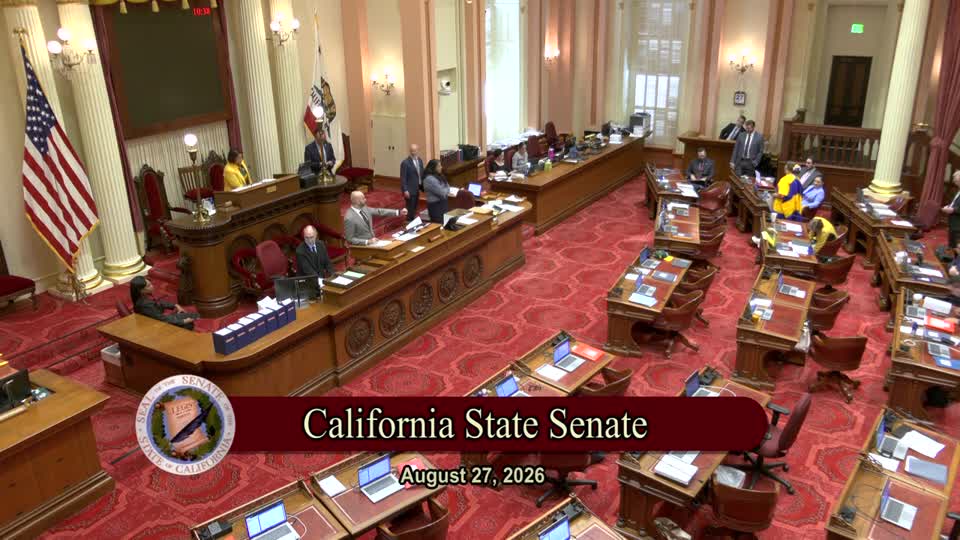 5MIN
Senate Floor
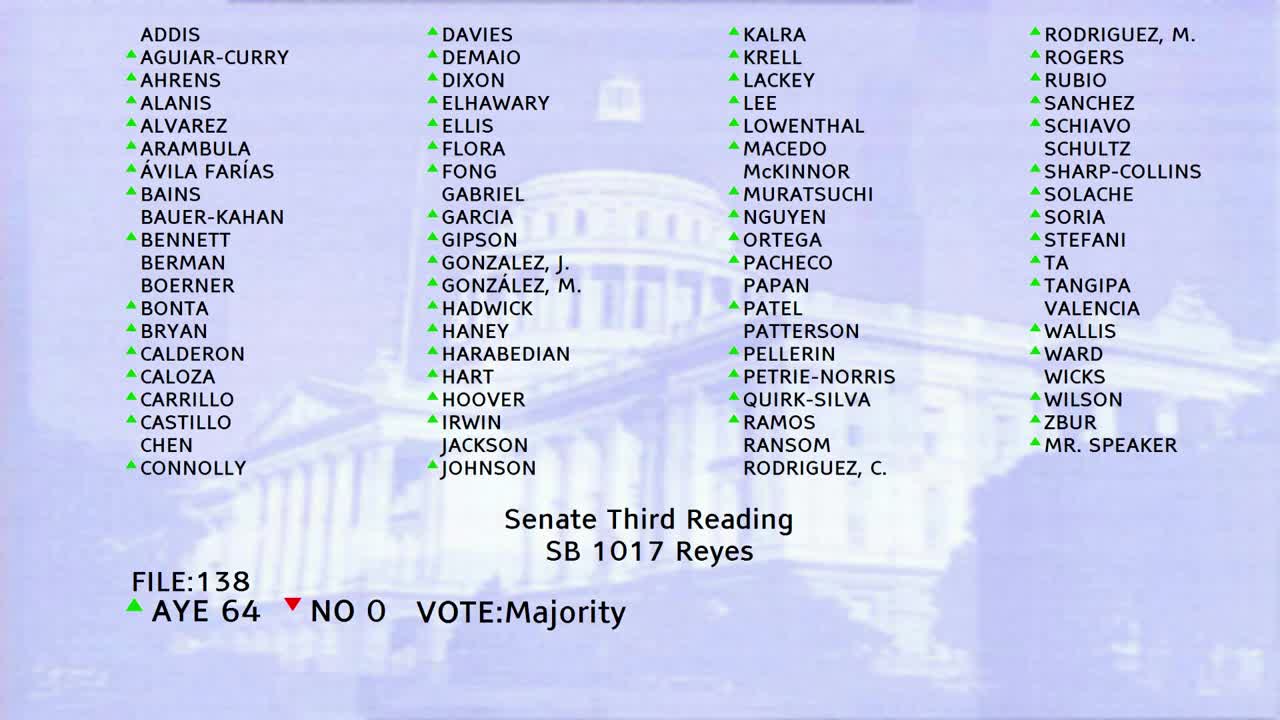 4MIN
Assembly Floor
 11SEC
Assembly Standing Committee on Appropriations
 30MIN
Assembly Standing Committee on Education
 2MIN
Senate Floor
 37MIN
Senate Standing Committee on Education
Bill Author

Bill Co-Author(s):