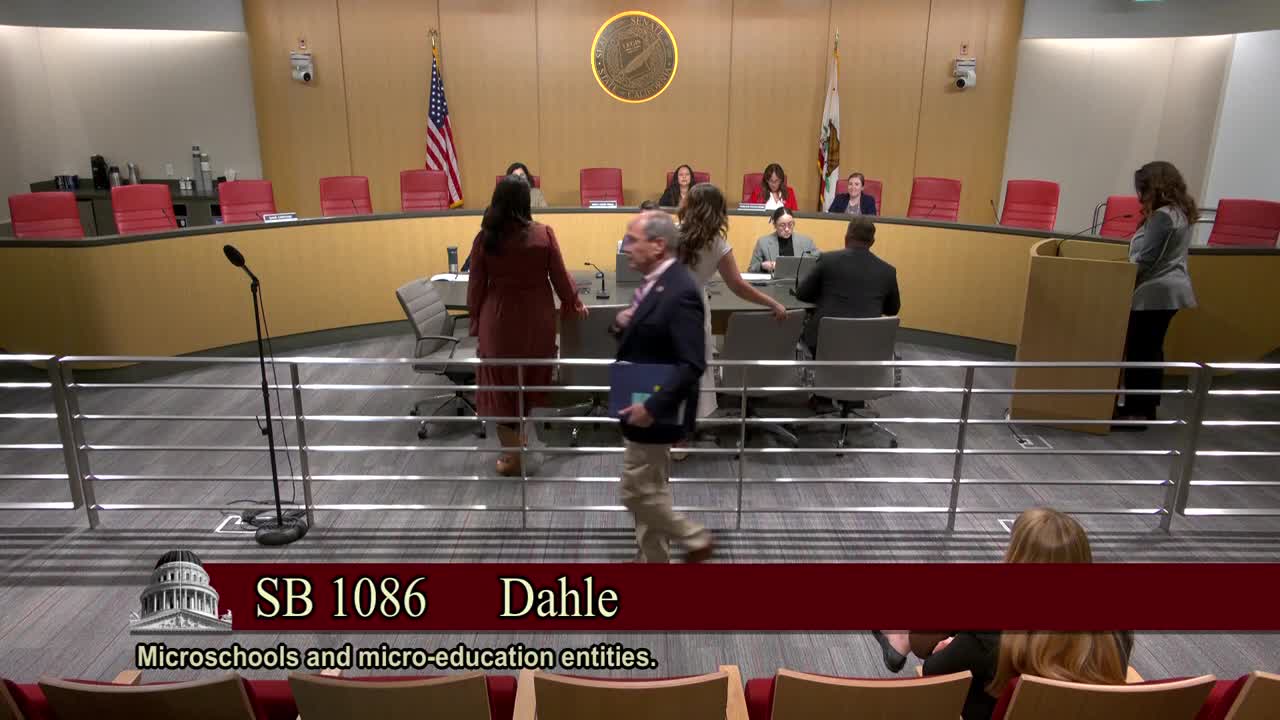
SB 1086: Microschools and micro-education entities.
- Session Year: 2025-2026
- House: Senate
- Latest Version Date: 2026-04-07
Current Status:
In Progress
(2026-04-22: April 22 set for first hearing. Failed passage in committee. (Ayes 2. Noes 0. Page 4007.) Reconsideration granted.)
Introduced
In Committee
Awaiting First Chamber Vote
Passed First Chamber
In Committee
Awaiting Second Chamber Vote
Passed Second Chamber
Enacted
Existing law authorizes the legislative body of any county or city to adopt ordinances that, among other things, regulate the use of buildings, structures, and land as between industry, business, residences, open space, and other purposes. Existing law requires certain uses, such as a colocation facility or an emergency standby generator proposed to be installed to serve a macro cell tower site, to be permitted uses if the use satisfies certain requirements.
This bill would provide that a microschool or a micro-education entity is considered a permitted use under certain zoning standards, as specified. The bill would prescribe requirements for microschools and micro-education entities. The bill would prescribe local agency approval of, and oversight over, microschools and micro-education entities, including by requiring local agencies to process permits ministerially and without discretionary review or a public hearing. The bill would require the Office of Land Use and Climate Innovation, in consultation with specified state entities, to develop and publish one or more model ordinances to implement these provisions, and require local agencies to adopt these model ordinances, as specified, thereby imposing a state-mandated local program. regarding micro-education entities and microschools. The bill would define various terms for these purposes.
The bill would include findings that changes proposed by this bill address a matter of statewide concern rather than a municipal affair and, therefore, apply to all cities, including charter cities.The California Constitution requires the state to reimburse local agencies and school districts for certain costs mandated by the state. Statutory provisions establish procedures for making that reimbursement.This bill would provide that, if the Commission on State Mandates determines that the bill contains costs mandated by the state, reimbursement for those costs shall be made pursuant to the statutory provisions noted above.Existing law authorizes the legislative body of any county or city to adopt ordinances that, among other things, regulate the use of buildings, structures, and land as between industry, business, residences, open space, and other purposes. Existing law requires certain uses, such as a colocation facility or an emergency standby generator proposed to be installed to serve a macro cell tower site, to be permitted uses if the use satisfies certain requirements.
This bill would provide that a microschool or a micro-education entity is considered a permitted use under certain zoning standards, as specified. The bill would prescribe requirements for microschools and micro-education entities. The bill would prescribe local agency approval of, and oversight over, microschools and micro-education entities, including by requiring local agencies to process permits ministerially and without discretionary review or a public hearing. The bill would require the Office of Land Use and Climate Innovation, in consultation with specified state entities, to develop and publish one or more model ordinances to implement these provisions, and require local agencies to adopt these model ordinances, as specified, thereby imposing a state-mandated local program. The bill would define various terms for these purposes.
The bill would include findings that changes proposed by this bill address a matter of statewide concern rather than a municipal affair and, therefore, apply to all cities, including charter cities.
The California Constitution requires the state to reimburse local agencies and school districts for certain costs mandated by the state. Statutory provisions establish procedures for making that reimbursement.
This bill would provide that, if the Commission on State Mandates determines that the bill contains costs mandated by the state, reimbursement for those costs shall be made pursuant to the statutory provisions noted above.
(a)For purposes of this section:
(1)Local agency means a city, county, city and county, charter city, charter county, or charter city and county.
(2)Micro-education entity means an individual or association of individuals that meets all of the following requirements:
(A)They have registered as a business entity or nonprofit organization pursuant to state and local law.
(B)They provide instruction for kindergarten and grades 1 to 12, inclusive.
(C)They serve more than 16 and fewer than 101 students at one time.
(D)They are a private school that has filed an affidavit pursuant to Section 33190 of the Education Code and are not a school operated by a school district or county office of education, a charter school, or a state special school.
(3)Microschool means an individual or association of individuals that meets all of the following requirements:
(A)They have registered as a business entity or nonprofit organization pursuant to state and local law.
(B)They provide instruction for kindergarten and grades 1 to 12, inclusive.
(C)They serve 16 or fewer students at one time.
(D)They operate from a residential dwelling, accessory dwelling unit, or residential property.
(E)They are a private school that has filed an affidavit pursuant to Section 33190 of the Education Code and are not a school operated by a school district or county office of education, a charter school, or a state special school.
(4)Model ordinance mean means an ordinance developed pursuant to subdivision (f). (b).
(b)(1)A microschool shall be considered a permitted use on any land for which applicable zoning standards allow residential use.(2)A micro-education entity shall be considered a permitted use on any land for which applicable zoning standards allow residential, mixed-use, commercial, or industrial use.(c)(1)A microschool operating in a residential dwelling shall be subject only to the building and fire codes applicable to residential occupancy.(2)A microschool shall provide not less than 35 net square feet of instructional space per student.(3)A micro-education entity may only operate in a building that meets either of the following requirements:(A)It meets California Building Code Group E occupancy standards.(B)It meets other occupancy classifications permitted by the model ordinance, subject to objective fire and life safety requirements.(d)(1)A local agency shall not require a conditional use permit, zoning variance, or other zoning approval for a use described in subdivision (b).(2)If a local agency requires a permit for a use described in subdivision (b), the local agency shall comply with both of the following requirements:(A)It shall process the permit ministerially and without discretionary review or a public hearing.(B)It shall prioritize processing the permit.(3)A local agency shall not change a zoning classification mainly due to the operation of a microschool or micro-education entity.(4)A local agency may require a microschool or micro-education entity to obtain a business license.(5)(A)A local agency shall not require a microschool or micro-education entity to obtain a health permit unless food is prepared and served onsite.(B)A local agency shall regulate food preparation in a microschool operating in a residential dwelling in the same manner as, and no more stringently than, other residential food preparation.(6)(A)A local agency shall not apply parking requirements to a microschool that exceed those applicable to residential uses generally.(B)A local agency shall not apply parking requirements to a micro-education entity that exceeds the minimum parking requirements applicable to schools or other similar institutional uses.(7)A local agency may require reasonable traffic management measures for a microschool or micro-education entity that are based on objective criteria, including, but not limited to, staggered pickup and dropoff times.(8)A local agency shall allow the hours of operation for a microschool or micro-education entity to be between 7:00 a.m. and 8:00 p.m., except for occasional meetings or events.(9)A local agency shall not regulate any of the following with respect to a microschool or micro-education entity:(A)Curriculum or instructional content.(B)Instructional materials or methods.(C)Teacher credentials or licensure.(D)Student testing or assessment.(E)Immunization status, except as otherwise required by state law.(e)A court may award reasonable attorneys fees and costs to a prevailing plaintiff in an action brought to enforce, or as a result of a violation, of this chapter.(f)(1)(b)By January 1, 2028, the Office of Land Use and Climate Innovation, in consultation with the Department of Education, the Department of Housing and Community Development, and the Office of the State Fire Marshal, shall develop and publish one or more model ordinances implementing this section, regarding micro-education entities and microschools, which shall include, but not be limited to, all of the following:
(A)(1)Building and fire safety requirements.
(B)(2)Parking and traffic management.
(C)(3)Hours of operation.
(D)(4)Signage.
(E)(5)Outdoor activity and noise.
(2)Within 180 days of publication of a model ordinance pursuant to paragraph (1), a local agency shall adopt an ordinance that is consistent with, and not more restrictive than, the model ordinance.(3)An ordinance adopted by a local agency that conflicts with or is more restrictive than a model ordinance published pursuant to paragraph (1) is void and unenforceable. (g)The Legislature finds and declares that this section addresses a matter of statewide concern rather than a municipal affair as that term is used in Section 5 of Article XI of the California Constitution. Therefore, this section applies to all cities, including charter cities.SEC. 3.If the Commission on State Mandates determines that this act contains costs mandated by the state, reimbursement to local agencies and school districts for those costs shall be made pursuant to Part 7 (commencing with Section 17500) of Division 4 of Title 2 of the Government Code.The Legislature finds and declares all of the following:
(a)Parents have a fundamental right to direct the education and upbringing of their children.
(b)Microschools and micro-education entities are lawful educational models that serve families seeking alternatives to traditional public and private schools.
(c)Inconsistent local land use regulations have created unnecessary barriers to the establishment and operation of microschools and micro-education entities.
(d)The state has a legitimate interest in ensuring that land use regulation does not operate as a de facto prohibition on lawful educational activity.
(e)It is the intent of the Legislature to provide uniform, objective, and predictable land use standards for microschools and micro-education entities while preserving local authority over health and safety matters.
SEC. 2.Section 65852.10 is added to the Government Code, to read:65852.10.(a)For purposes of this section:
(1)Local agency means a city, county, city and county, charter city, charter county, or charter city and county.
(2)Micro-education entity means an individual or association of individuals that meets all of the following requirements:
(A)They have registered as a business entity or nonprofit organization pursuant to state and local law.
(B)They provide instruction for kindergarten and grades 1 to 12, inclusive.
(C)They serve more than 16 and fewer than 101 students at one time.
(D)They are a private school that has filed an affidavit pursuant to Section 33190 of the Education Code and are not a school operated by a school district or county office of education, a charter school, or a state special school.
(3)Microschool means an individual or association of individuals that meets all of the following requirements:
(A)They have registered as a business entity or nonprofit organization pursuant to state and local law.
(B)They provide instruction for kindergarten and grades 1 to 12, inclusive.
(C)They serve 16 or fewer students at one time.
(D)They operate from a residential dwelling, accessory dwelling unit, or residential property.
(E)They are a private school that has filed an affidavit pursuant to Section 33190 of the Education Code and are not a school operated by a school district or county office of education, a charter school, or a state special school.
(4)Model ordinance mean an ordinance developed pursuant to subdivision (f).
(b)(1)A microschool shall be considered a permitted use on any land for which applicable zoning standards allow residential use.
(2)A micro-education entity shall be considered a permitted use on any land for which applicable zoning standards allow residential, mixed-use, commercial, or industrial use.
(c)(1)A microschool operating in a residential dwelling shall be subject only to the building and fire codes applicable to residential occupancy.
(2)A microschool shall provide not less than 35 net square feet of instructional space per student.
(3)A micro-education entity may only operate in a building that meets either of the following requirements:
(A)It meets California Building Code Group E occupancy standards.
(B)It meets other occupancy classifications permitted by the model ordinance, subject to objective fire and life safety requirements.
(d)(1)A local agency shall not require a conditional use permit, zoning variance, or other zoning approval for a use described in subdivision (b).
(2)If a local agency requires a permit for a use described in subdivision (b), the local agency shall comply with both of the following requirements:
(A)It shall process the permit ministerially and without discretionary review or a public hearing.
(B)It shall prioritize processing the permit.
(3)A local agency shall not change a zoning classification mainly due to the operation of a microschool or micro-education entity.
(4)A local agency may require a microschool or micro-education entity to obtain a business license.
(5)(A)A local agency shall not require a microschool or micro-education entity to obtain a health permit unless food is prepared and served onsite.
(B)A local agency shall regulate food preparation in a microschool operating in a residential dwelling in the same manner as, and no more stringently than, other residential food preparation.
(6)(A)A local agency shall not apply parking requirements to a microschool that exceed those applicable to residential uses generally.
(B)A local agency shall not apply parking requirements to a micro-education entity that exceeds the minimum parking requirements applicable to schools or other similar institutional uses.
(7)A local agency may require reasonable traffic management measures for a microschool or micro-education entity that are based on objective criteria, including, but not limited to, staggered pickup and dropoff times.
(8)A local agency shall allow the hours of operation for a microschool or micro-education entity to be between 7:00 a.m. and 8:00 p.m., except for occasional meetings or events.
(9)A local agency shall not regulate any of the following with respect to a microschool or micro-education entity:
(A)Curriculum or instructional content.
(B)Instructional materials or methods.
(C)Teacher credentials or licensure.
(D)Student testing or assessment.
(E)Immunization status, except as otherwise required by state law.
(e)A court may award reasonable attorneys fees and costs to a prevailing plaintiff in an action brought to enforce, or as a result of a violation, of this chapter.
(f)(1)By January 1, 2028, the Office of Land Use and Climate Innovation, in consultation with the Department of Education, the Department of Housing and Community Development, and the Office of the State Fire Marshal, shall develop and publish one or more model ordinances implementing this section, which shall include, but not be limited to, all of the following:
(A)Building and fire safety requirements.
(B)Parking and traffic management.
(C)Hours of operation.
(D)Signage.
(E)Outdoor activity and noise.
(2)Within 180 days of publication of a model ordinance pursuant to paragraph (1), a local agency shall adopt an ordinance that is consistent with, and not more restrictive than, the model ordinance.
(3)An ordinance adopted by a local agency that conflicts with or is more restrictive than a model ordinance published pursuant to paragraph (1) is void and unenforceable.
(g)The Legislature finds and declares that this section addresses a matter of statewide concern rather than a municipal affair as that term is used in Section 5 of Article XI of the California Constitution. Therefore, this section applies to all cities, including charter cities.
SEC. 3.If the Commission on State Mandates determines that this act contains costs mandated by the state, reimbursement to local agencies and school districts for those costs shall be made pursuant to Part 7 (commencing with Section 17500) of Division 4 of Title 2 of the Government Code.
|
Date
|
Status
|
|---|---|
| Apr 22, 2026 | April 22 set for first hearing. Failed passage in committee. (Ayes 2. Noes 0. Page 4007.) Reconsideration granted. |
| Apr 22, 2026 | April 22 set for first hearing. Failed passage in committee. (Ayes 2. Noes 0.) Reconsideration granted. |
| Apr 16, 2026 | Set for hearing April 22. |
| Apr 15, 2026 | From committee: Do pass and re-refer to Com. on ED. with recommendation: To consent calendar. (Ayes 7. Noes 0. Page 3904.) (April 15). Re-referred to Com. on ED. |
| Apr 15, 2026 | From committee: Do pass and re-refer to Com. on ED. with recommendation: To consent calendar. (Ayes 7. Noes 0.) (April 15). Re-referred to Com. on ED. |
| Apr 7, 2026 | From committee with author's amendments. Read second time and amended. Re-referred to Com. on L. GOV. |
| Apr 2, 2026 | Set for hearing April 15. |
| Feb 26, 2026 | Referred to Coms. on L. GOV. and ED. |
| Feb 17, 2026 | From printer. May be acted upon on or after March 16. |
| Feb 13, 2026 | Introduced. Read first time. To Com. on RLS. for assignment. To print. |
|
Date
|
Description
|
Location
|
Votes
|
|
|---|---|---|---|---|
| Apr 22, 2026 | [First] hearing set for [04-22-2026]: Failed passage in Committee. Reconsideration granted | Senate Standing Committee on Education |
Passed |
|
| Apr 22, 2026 | Do pass, but first be re-referred to the Committee on [Appropriations] | Senate Standing Committee on Education |
Failed |
|
| Apr 15, 2026 | Do pass, but first be re-referred to the Committee on [Education] with the recommendation: To Consent Calendar | Senate Standing Committee on Local Government |
Passed |
This list shows positions taken on this bill by organizations on the date displayed, which is linked to the original source.
Positions by individuals are not included.
|
Organization
|
Position
|
Date
|
|---|---|---|
| All Families, All Schools | ** Support | |
| California Microschool Collective | ** Support | |
| California Policy Center | ** Support | |
| Libertas Network | ** Support | |
| Seven Individuals | ** Support |
SENATE COMMITTEE ON EDUCATION
Senator Sasha Renée Pérez, Chair
2025 - 2026 Regular
Bill No: Hearing Date: April 22, 2026
Author: | |||
Version: |
| ||
Urgency: | Fiscal: | ||
Consultant: | |||
Subject: .
SUMMARY
This bill requires the state to develop model local ordinances governing the siting and operation of small private schools, defined as “microschools” and “micro-education entities,” including those operating in residential settings and those serving up to 100 students.
BACKGROUND
Existing law:
- Requires any person or entity offering private school instruction at the elementary or high school level to annually file an affidavit with the Superintendent of Public Instruction containing specified information regarding the school’s operations, including enrollment, courses of study, and instructional staff, pursuant to California Private School Affidavit.
- Specifies that filing a private school affidavit shall not be interpreted as state evaluation, recognition, approval, or endorsement of the school.
- Permits a student to be exempt from compulsory public school attendance if the student is enrolled in a private full-time day school, including a private school established through the affidavit process.
- Requires private schools to obtain criminal background clearances for employees who will have contact with pupils
- Authorizes cities and counties to adopt and enforce local ordinances to protect the public health, safety, and welfare, including regulating land use.
- Requires each city and county to adopt a comprehensive, long-term general plan that guides physical development within its jurisdiction, including land use designations and development standards.
- Requires that zoning ordinances and development approvals be consistent with a jurisdiction’s adopted general plan, including applicable land use, housing, and safety elements.
- Authorizes cities and counties to adopt zoning ordinances that regulate permitted land uses and impose development standards, including building intensity, parking requirements, setbacks, and other conditions to address community impacts.
ANALYSIS
This bill:
- Defines a “micro-education entity” as a private school that:
- Is organized as a business or nonprofit entity;
- Provides Kindergarten (K)–12 instruction;
- Serves more than 16 and fewer than 101 students at one time; and
- Has filed a private school affidavit pursuant to the California Private School Affidavit.
- Defines a “microschool” as a private school that:
- Is organized as a business or nonprofit entity;
- Provides K–12 instruction;
- Serves 16 or fewer students at one time;
- Operates from a residential dwelling, accessory dwelling unit, or residential property; and
- Has filed a private school affidavit pursuant to the California Private School Affidavit.
- Clarifies that microschools and micro-education entities are private schools and are not operated by a school district, county office of education, charter school, or state special school.
- Defines “local agency” to include cities, counties, and charter jurisdictions.
- Requires the Office of Land Use and Climate Innovation, in consultation with the California Department of Education, the Department of Housing and Community Development, and the Office of the State Fire Marshal, to develop and publish one or more model ordinances governing microschools and micro-education entities by January 1, 2028.
- Requires that the model ordinances include, at a minimum:
- Building and fire safety requirements;
- Parking and traffic management standards;
- Hours of operation;
- Signage; and
- Outdoor activity and noise considerations.
STAFF COMMENTS
- Need for the bill. According to the author, “Parents know their children best, which is why parents must have the freedom to educate their education in the way that best meets their unique needs. This bill reflects our commitment to empowering families and trusting them to do what is best for their children.
“This legislation is also about the future of education. It embraces the kind of innovation our students desperately need, like project/place-based and experiential learning. We ask so much of our public schools, but the reality is that many districts are lacking the agility to pivot and meet the demands of the modern workforce.
“In the wake of the pandemic, parents, educators, and community partners didn't wait for the system to catch up; they found new ways to support student growth. Microschools are leading this charge, fostering meaningful partnerships, and designing student-centered, and even trauma-informed environments.
“While conventional schools work to innovate, we must champion the models that are already doing it. We should not create unnecessary hurdles for legitimate, forward-thinking educational models.
“This bill ensures that local regulations don't stand in the way of microschools, giving parents and students the opportunity to take true ownership of their growth and learning.”
- From land use preemption to model ordinance guidance. As introduced, this bill proposed a comprehensive statewide framework governing the siting and operation of microschools and micro-education entities. The bill would have required local agencies to treat these entities as permitted uses across multiple zoning categories, prohibited discretionary review, limited the application of local development standards, and required ministerial approval of permits. The bill also included provisions restricting the ability of local agencies to regulate various aspects of these entities and required local ordinances to conform to a state-developed model ordinance.
Amendments taken in the Senate Local Government Committee removed these provisions. As currently drafted, the bill no longer preempts local zoning authority, mandates ministerial approval, or requires local agencies to adopt ordinances consistent with a state model. Instead, the bill is limited to defining “microschools” and “micro-education entities” in statute and requiring the Office of Land Use and Climate Innovation to develop model ordinances addressing their siting and operation.
While these amendments significantly narrow the bill’s scope, they also shift its effect. The bill now primarily serves to establish new statutory categories of schools and to direct the state to develop guidance to facilitate their accommodation through local land use policies.
- Limited information on microschools and micro-education entities. The materials provided by the author and sponsor describe microschools and micro-education entities in broad and flexible terms, often emphasizing that these models are evolving and may take a variety of forms. However, these materials do not provide the Committee with basic information regarding the scope and operation of these entities in California.
For example, the Committee has not been provided with information regarding the number of such entities currently operating in the state, the number of students served, the staffing structures employed (including whether instructors are credentialed), the instructional models utilized, or any available data regarding student outcomes.
In addition, the materials provided describe these entities in ways that are not always consistent with the bill’s definitions. For instance, one summary characterizes “micro-education entities” as including activities such as coding classes and tutoring centers, which do not appear to fall within the bill’s definition requiring operation as a private school that has filed a private school affidavit. This variation in how the concept is described makes it difficult to determine the intended scope of the bill and the types of entities that would ultimately be affected.
Given that this bill would create new statutory definitions and direct the development of model ordinances to guide their accommodation, the absence of clear, consistent, and data-informed information makes it difficult for the Committee to fully assess the scope of the proposal and its potential implications.
- Statutory recognition of microschools and micro-education entities. This bill establishes statutory definitions for “microschools” and “micro-education entities,” both of which are defined as forms of private schools operating under the private school affidavit framework. Under existing law, private schools operate with limited state oversight, and the filing of an affidavit does not constitute state evaluation, approval, or endorsement of a school.
By contrast, this bill would explicitly define a subset of these schools in statute and direct the state to develop model ordinances addressing their siting and operation. While the bill does not alter the underlying education law framework, the act of defining these entities in statute and directing state-level guidance may be viewed as a form of recognition and facilitation.
The Committee may wish to consider whether additional information regarding the nature, scope, and operation of these entities would be helpful prior to establishing such definitions in statute and directing the development of statewide guidance.
- State role in facilitating locally regulated land uses. Existing law provides cities and counties with broad authority to regulate land use through their police powers, including the adoption of zoning ordinances and development standards tailored to local conditions. As noted in the Senate Local Government Committee’s analysis, local agencies are responsible for determining allowable land uses and associated standards through their general plans and zoning ordinances.
Consistent with that committee’s jurisdiction, amendments taken in the Senate Local Government Committee removed provisions that would have required local agencies to permit these entities as a matter of right or limited their ability to apply discretionary review. As currently drafted, the bill no longer compels local governments to take specific actions, but instead directs a state agency to develop model ordinances addressing the siting and operation of microschools and micro-education entities.
With local control concerns addressed, the central question for this Committee is not whether local governments should be required to accommodate these uses, but whether the state should define these entities in statute and direct the development of model ordinances to facilitate their accommodation. In this context, the Committee may wish to consider whether sufficient information has been provided regarding the nature, scope, and operation of these entities to support that policy choice.
- Legislative approach to defining emerging education models. This bill would establish new statutory definitions for “microschools” and “micro-education entities,” concepts that the author and sponsor describe as evolving and without a rigid definition. The Committee has, in other contexts, taken a measured approach to defining emerging or nontraditional educational models, recognizing that statutory definitions can have significant implications for oversight, funding, and future policy development.
For example, the Committee continues to grapple with distinctions among various instructional models, including independent study and nonclassroom-based charter schools, and has only recently established statutory clarity in areas such as charter management organizations. In these instances, definitions have often followed extended deliberation and the development of a clearer understanding of how such models operate in practice.
The Committee may wish to consider whether a similar level of clarity and understanding exists with respect to microschools and micro-education entities before establishing new definitions in statute and directing the development of statewide guidance related to their operation.
SUPPORT
California Policy Center (sponsor)
All Families, All Schools
California Microschool Collective
Libertas Network
Seven Individuals
OPPOSITION
None received
-- END --
SENATE COMMITTEE ON LOCAL GOVERNMENT
Senator María Elena Durazo, Chair
2025 - 2026 Regular
Bill No: | SB 1086 | Hearing Date: | 4/15/26 |
Author: | Dahle | Fiscal: | Yes |
Version: | 4/7/26 | Consultant: | Peterson |
Zoning: allowed uses: microschools and micro-education entities
Requires the Office of Land Use and Climate Innovation to create a model ordinance for microschools.
Background
The California Constitution allows cities and counties to “make and enforce within its limits, all local, police, sanitary and other ordinances and regulations not in conflict with general laws.” It is from this fundamental power (commonly called the police power) that cities and counties derive their authority to regulate behavior to preserve the health, safety, and welfare of the public—including land use authority.
Planning and Zoning Law. State law provides additional powers and duties for cities and counties regarding land use. The Planning and Zoning Law requires every county and city to adopt a general plan that sets out planned uses for all of the area covered by the plan. A general plan must include specified mandatory “elements,” including a housing element that establishes the locations and densities of housing, and a land use element that describes the general categories of uses (such as multifamily residential, single family residential, retail commercial, and open space) that are allowed in specific portions of a jurisdiction. Cities’ and counties’ major land use decisions—including zoning ordinances and other aspects of development permitting—must be consistent with their general plans. General plans also include policies, standards, and mitigation measures that developments must comply with, to protect against flood hazards, fire hazards, and climate change, and to further environmental justice, among other state goals.
Local governments use their police power to enact zoning ordinances that establish the types of land uses that are allowed or authorized in an area. Zoning ordinances also contain provisions to physically shape development and impose other requirements, such as setting maximum heights and densities for housing units, minimum numbers of required parking spaces, setbacks, and lot coverage ratios. These ordinances can also include conditions on development to address aesthetics, community impacts, or other particular site-specific considerations.
Microschools. According to EdSource, “Microschools, which typically serve small groups of students in personalized learning environments, have gained traction as families seek more flexible and tailored educational options. This flexibility is particularly appealing in an era when traditional education models are increasingly seen as one-size-fits-all, leaving many students either unchallenged or overwhelmed.”[1] According to Stateline, “In a survey of 400 microschools across 41 states, more than 60% of founders reported they were not currently licensed educators. Eighty-four percent reported their schools were not accredited. Among prospective founders, 48% are licensed educators (though only 14% currently work in public schools), 32% come from non-education fields, and 23% are parents building schools for their own children.”[2] The same article highlighted how these new schools do not always fit neatly in existing regulatory frameworks, “In some states, microschools face a bind: If they operate as private schools, they’re required to meet facility, staffing and curricular standards that are often cost-prohibitive for schools their size. If they operate under homeschool laws, they face oversight, assessment mandates and reporting requirements that aren’t designed for multifamily or educator-led models.”[3] The previously cited survey found, “Most microschools (55%) operate under homeschool laws, while others function as private schools (37%), charters (6%) or fall into unique state categories (3%)…”[4] According to EdSource, “While California doesn’t specifically track homeschools or microschools, the number of private schools with fewer than five students has more than doubled to nearly 30,000 from prepandemic 2018-19 to 2023-24.”[5]
The author wants to create a model ordinance to help local agencies make land use decisions about microschools.
Proposed Law
Senate Bill 1086 requires, by January 1, 2028, the Office of Land Use and Climate Innovation (LCI) to consult with the Department of Education, the Department of Housing and Community Development, and the Office of the State Fire Marshal to develop and publish one or more model ordinances implementing this measure. The model ordinance must at least address all of the following:
- Building and fire safety requirements;
- Parking and traffic management;
- Hours of operation;
- Signage; and
- Outdoor activity and noise.
The measure also defines its terms.
Comments
1. Purpose of the bill. According to the author, “SB 1086 is about the future of education. We ask a lot of our public schools, but the reality is that many local districts lack the agility to pivot and meet the demands of the modern workforce. In recent years, we have seen a significant rise in parents, educators and community partners coming together to create microschools to support student learning. These small-scale, highly personalized learning environments provide project-based, experiential, and sometimes trauma-informed education that many families desperately need. This bill directs the Office of Land Use and Climate Innovation, in consultation with the State Fire Marshal and other key departments, to develop model ordinances that would provide local agencies with a clear, standardized framework to address potential community impacts, including building and fire safety, parking and traffic management, hours of operation, signage, and noise.”
2. Taking a step forward. Microschools are a new and evolving concept. Local agencies may not have experience dealing with microschools when an application to site one comes before the planning department. SB 1086 requires LCI to come up with model ordinances to help educate local agencies understand how they should treat them at the local level. The bill does not change local land use policies: it will be up to local agencies to determine how to implement these model ordinances once LCI makes them available.
3. Coming and going. The Senate Rules Committee has ordered a double referral of SB 1086: first to the Committee on Local Government to hear issues of land use, and then to the Committee on Education.
Support and Opposition
(4/10/2026)
Support: California Policy Center (Sponsor)
All Families, All Schools
Libertas Network
Opposition: None Submitted
-- END --
https://edsource.org/2024/the-rise-of-microschools-a-wake-up-call-for-public-education/717798 ↑
https://stateline.org/2025/08/08/microschools-are-growing-in-popularity-but-state-regulations-havent-caught-up/ ↑
Ibid. ↑
Ibid. ↑
https://edsource.org/2024/the-rise-of-microschools-a-wake-up-call-for-public-education/717798 ↑
Bill Author

Bill Co-Author(s):