SB 1087: Transportation planning: sustainable communities strategies: transportation funding programs.
- Session Year: 2025-2026
- House: Senate
- Latest Version Date: 2026-09-30
Current Status:
Passed
(2026-09-30: Chaptered by Secretary of State. Chapter 1005, Statutes of 2026.)
Introduced
In Committee
Awaiting First Chamber Vote
Passed First Chamber
In Committee
Awaiting Second Chamber Vote
Passed Second Chamber
Enacted
(1)Existing law requires certain transportation planning agencies to prepare and adopt regional transportation plans directed at achieving a coordinated and balanced regional transportation system. Existing law requires a regional transportation plan to include a policy element, a sustainable communities strategy prepared by a metropolitan planning organization, an action element, and a financial element, as provided. Existing law requires those transportation planning agencies to adopt and submit every 4 years, except as provided, an updated regional transportation plan to the California Transportation Commission and the Department of Transportation.
Existing law requires a sustainable communities strategy to achieve regional targets set by the State Air Resources Board for the reduction of greenhouse gas emissions from the automobile and light truck sector in the region for 2020 and 2035, respectively, and requires the state board to update those targets every 8 years, consistent with each metropolitan planning organizations timeframe for updating its regional transportation plan, as specified. Existing law establishes certain procedural requirements for setting and updating those targets and authorizes the state board to revise the targets every 4 years based on changes in specified factors. Existing law, to the extent the sustainable communities strategy is unable to achieve the greenhouse gas emission reduction targets, requires a metropolitan planning organization to prepare an alternative planning strategy to the sustainable communities strategy showing how the targets would be achieved through alternative development patterns, infrastructure, or additional transportation measures or policies. Existing law requires the state board to review each metropolitan planning organizations sustainable communities strategy and alternative planning strategy to determine whether the strategy, if implemented, would achieve the greenhouse gas emission reduction targets.
This bill would revise and recast the requirements for a sustainable communities strategy, including, among other things, (A) requiring a sustainable communities strategy every 8 years with a progress report after 4 years instead of requiring a sustainable communities strategy every 4 years, (B) requiring the state board to provide each region with greenhouse gas emission reduction targets for 2035 and 2045, and (C) requiring the state board to hold technical workshops before providing those targets. The bill would also revise the state boards process for reviewing sustainable communities strategies and alternative planning strategies, as specified.
Because the bill would expand duties of local agencies, it would impose a state-mandated local program.
(2)Existing law requires, commencing January 1, 2020, the San Diego Association of Governments to begin developing an implementation report that tracks the implementation of its most recently adopted sustainable communities strategy, as provided. Existing law requires the Sacramento Area Council of Governments to report on the regional implementation of its most recently adopted sustainable communities strategy, as provided.
This bill would repeal those provisions.
(3)Existing law requires the Department of Transportation to prepare the California Transportation Plan for submission to the Governor and the Legislature as a long-range planning document that incorporates various elements and is consistent with specified expressions of legislative intent. Existing law requires the plan to identify the statewide integrated multimodal transportation system needed to achieve statewide greenhouse gas emission reduction targets and to attain state and national air quality standards.
This bill would also require the plan to, among other things, incorporate performance measures into planning that informs delivery of transportation capital projects to help achieve the goals of the plan. The bill would, commencing with the 3rd update to the plan, revise the information that the department is required to include in the plan to include, among others, relevant performance measures within each district of the department.
(4)Existing law requires certain funds appropriated by the Legislature from the Public Transportation Account to be made available for specified purposes, including, among other purposes, for the departments planning activities, mass transportation responsibilities, and assistance in regional transportation planning, as specified.
This bill, for any activities within the region of a metropolitan planning organization, would require the department to limit funding to activities that are consistent with an applicable sustainable communities strategy or alternative planning strategy, as specified.
(5)Existing law creates the Road Maintenance and Rehabilitation Program to address deferred maintenance on the state highway system and the local street and road system. Existing law provides for the deposit of various moneys for the program into the Road Maintenance and Rehabilitation Account. Existing law requires funds in the account to be allocated for various purposes, including, among others, $25,000,000, upon appropriation by the Legislature, for local planning grants to encourage local and regional planning that furthers state goals, as provided. Existing law requires the department to develop a grant guide for the allocation of these grants.
This bill, for areas within a metropolitan planning organization, would require the grant guide to encourage planning that furthers the goals of a sustainable communities strategy or alternative planning strategy.
(6)Existing law requires the commission, under a program commonly known as the Trade Corridor Enhancement Program, to allocate certain state and federal funds to infrastructure projects located on or along specified transportation corridors. Existing law establishes the Solutions for Congested Corridors Program and requires the commission to allocate state funds made available to the program to projects designed to achieve a balanced set of transportation, environmental, and community access improvements within highly congested travel corridors throughout the state. Under both programs, existing law requires projects within the boundaries of a metropolitan planning organization to be included in an adopted regional transportation plan that includes a sustainable communities strategy determined by the state board to achieve the regions greenhouse gas emission reduction targets.
For purposes of those programs, this bill would instead require, if the metropolitan planning organization has adopted an alternative planning strategy, the projects to meet prescribed requirements, including that the predominant purpose of the project is to implement a specific greenhouse gas emission reduction strategy or addresses an impediment to achieving an applicable greenhouse gas emission reduction target identified in the alternative planning strategy.
(7)Existing law requires funding to be available under the Solutions for Congested Corridors Program for projects that make specific performance improvements and are part of a comprehensive corridor plan designed to reduce congestion in highly traveled corridors. Existing law authorizes the department and certain regional transportation planning agencies to nominate projects for funding through the program.
This bill would require funding to be available under the program for projects that, among other things, make specific performance improvements and support the implementation of a regional transportation plan. The bill would revise the requirements applicable to a project nomination under the program. The bill would require the commission to allocate program funds to projects that, among other things, are included in an adopted regional transportation plan, as specified.
(8)The California Constitution requires the state to reimburse local agencies and school districts for certain costs mandated by the state. Statutory provisions establish procedures for making that reimbursement.
This bill would provide that, if the Commission on State Mandates determines that the bill contains costs mandated by the state, reimbursement for those costs shall be made pursuant to the statutory provisions noted above.
(1)Existing law requires certain transportation planning agencies to prepare and adopt regional transportation plans directed at achieving a coordinated and balanced regional transportation system. Existing law requires a regional transportation plan to include a policy element, a sustainable communities strategy prepared by a metropolitan planning organization, an action element, and a financial element, as provided. Existing law requires those transportation planning agencies to adopt and submit every 4 years, except as provided, an updated regional transportation plan to the California Transportation Commission and the Department of Transportation.
Existing law requires a sustainable communities strategy to achieve regional targets set by the State Air Resources Board for the reduction of greenhouse gas emissions from the automobile and light truck sector in the region for 2020 and 2035, respectively, and requires the state board to update those targets every 8 years, consistent with each metropolitan planning organizations timeframe for updating its regional transportation plan, as specified. Existing law establishes certain procedural requirements for setting and updating those targets and authorizes the state board to revise the targets every 4 years based on changes in specified factors. Existing law, to the extent the sustainable communities strategy is unable to achieve the greenhouse gas emission reduction targets, requires a metropolitan planning organization to prepare an alternative planning strategy to the sustainable communities strategy showing how the targets would be achieved through alternative development patterns, infrastructure, or additional transportation measures or policies. Existing law requires the state board to review each metropolitan planning organizations sustainable communities strategy and alternative planning strategy to determine whether the strategy, if implemented, would achieve the greenhouse gas emission reduction targets.
This bill would instead require, commencing with the first or 2nd regional transportation plan prepared on or after January 1, 2027, as determined by the applicable metropolitan planning organization, the regional transportation plan to include an 8-year sustainable communities strategy prepared by the metropolitan planning organization. Four years after the adoption of a sustainable communities strategy, the bill would require the metropolitan planning organization to prepare a sustainable communities strategy implementation progress report containing specified information, post the report on its internet website, and submit the report to the Strategic Growth Council. The bill would require the Strategic Growth Council to review the report at a public hearing.This bill would instead require, no later than 2 years before the due date of a regions next sustainable communities strategy, the state board to provide the region with greenhouse gas emission reduction targets for 2035 and 2045, and would require the targets to reflect the combined effect of policies, regulations, and investments to reduce greenhouse gas emissions from vehicles and be based on what is achievable for the region, as specified. The bill would require the state board to appoint a Regional Targets Advisory Committee to recommend factors and methodologies for setting those targets and to recommend how other specified state goals should be balanced in setting those targets. The bill would eliminate the authority of the state board to revise the targets every 4 years and would establish additional public participation requirements for the state board to undertake before updating those targets.This bill would revise and recast the requirements for a sustainable communities strategy, including, among other things, (A) requiring a sustainable communities strategy every 8 years with a progress report after 4 years instead of requiring a sustainable communities strategy every 4 years, (B) requiring the state board to provide each region with greenhouse gas emission reduction targets for 2035 and 2045, and (C) requiring the state board to hold technical workshops before providing those targets. The bill would also revise the state boards process for reviewing sustainable communities strategies and alternative planning strategies, as specified.
Because the bill would expand duties of local agencies, it would impose a state-mandated local program.
(2) Existing law, to the extent the sustainable communities strategy is unable to achieve the greenhouse gas emission reduction targets, requires a metropolitan planning organization to prepare an alternative planning strategy to the sustainable communities strategy showing how the targets would be achieved through alternative development patterns, infrastructure, or additional transportation measures or policies. Existing law requires the state board to review each metropolitan planning organizations sustainable communities strategy and alternative planning strategy to determine whether the strategy, if implemented, would achieve the greenhouse gas emission reduction targets.This bill would revise the procedural requirements applicable to the state boards review of those strategies. The bill would deem a sustainable communities strategy or alternative planning strategy approved for implementation and funding alignment purposes if the state board does not take certain actions within specified time periods.This bill would revise the requirements applicable to the preparation of an alternative planning strategy, including by requiring the metropolitan planning organization to include an analysis of an alternative development pattern for the region and, if necessary, additional infrastructure, transportation measures, or policies that could achieve the greenhouse gas emission reduction targets. The bill would eliminate a requirement that an alternative development pattern be a separate document from the regional transportation plan.(3)Existing law authorizes the commission, in cooperation with regional transportation planning agencies, to prescribe guidelines for the preparation of regional transportation plans.This bill would require the state board to adopt or update guidelines for the preparation of sustainable communities strategies before updating the regional targets for the reduction of greenhouse gas emissions from the automobile and light truck sector, as specified.(2)Existing law requires, commencing January 1, 2020, the San Diego Association of Governments to begin developing an implementation report that tracks the implementation of its most recently adopted sustainable communities strategy, as provided. Existing law requires the Sacramento Area Council of Governments to report on the regional implementation of its most recently adopted sustainable communities strategy, as provided.
This bill would repeal those provisions.
(4)(3)Existing law requires the department Department of Transportation to prepare the California Transportation Plan for submission to the Governor and the Legislature as a long-range planning document that incorporates various elements and is consistent with specified expressions of legislative intent. Existing law requires the plan to identify the statewide integrated multimodal transportation system needed to achieve statewide greenhouse gas emissions emission reduction targets and to attain state and national air quality standards.
This bill would also require the plan to include a performance management plan for each district of the department to, among other things, incorporate performance measures into planning that informs delivery of transportation capital projects to help achieve these results. the goals of the plan. The bill would, commencing with the 3rd update to the plan, revise the information that the department is required to include in the plan to include, among others, relevant performance measures within each district of the department.
(5)(4)Existing law requires certain funds appropriated by the Legislature from the Public Transportation Account to be made available for specified purposes, including, among other purposes, for the departments planning activities, mass transportation responsibilities, and assistance in regional transportation planning, as specified.
This bill, for any activities within the region of a metropolitan planning organization, would limit any activities undertaken pursuant to that provision to be limited require the department to limit funding to activities that are consistent with an applicable sustainable communities strategy. strategy or alternative planning strategy, as specified.
(6)(5)Existing law creates the Road Maintenance and Rehabilitation Program to address deferred maintenance on the state highway system and the local street and road system. Existing law provides for the deposit of various moneys for the program into the Road Maintenance and Rehabilitation Account. Existing law requires funds in the account to be allocated for various purposes, including, among others, $25,000,000, upon appropriation by the Legislature, for local planning grants to encourage local and regional planning that furthers state goals, as provided. Existing law requires the department to develop a grant guide for the allocation of these grants.
This bill, for areas within a metropolitan planning organization, would require the grant guide to encourage planning that furthers the goals of a sustainable communities strategy or alternative planning strategy.
(7)(6)Existing law requires the commission, under a program commonly known as the Trade Corridor Enhancement Program, to allocate certain state and federal funds to infrastructure projects located on or along specified transportation corridors. Existing law establishes the Solutions for Congested Corridors Program and requires the commission to allocate state funds made available to the program to projects designed to achieve a balanced set of transportation, environmental, and community access improvements within highly congested travel corridors throughout the state. Under both programs, existing law requires projects within the boundaries of a metropolitan planning organization to be included in an adopted regional transportation plan that includes a sustainable communities strategy determined by the state board to achieve the regions greenhouse gas emissions emission reduction targets.
For purposes of those programs, this bill would instead require, if the metropolitan planning organization has adopted an alternative planning strategy, the projects to reduce greenhouse gas emissions. meet prescribed requirements, including that the predominant purpose of the project is to implement a specific greenhouse gas emission reduction strategy or addresses an impediment to achieving an applicable greenhouse gas emission reduction target identified in the alternative planning strategy.
(8)(7)Existing law requires funding to be available under the Solutions for Congested Corridors Program for projects that make specific performance improvements and are part of a comprehensive corridor plan designed to reduce congestion in highly traveled corridors. Existing law authorizes the department and certain regional transportation planning agencies to nominate projects for funding through the program.
This bill would eliminate the requirement that a project be a part of a comprehensive corridor plan and would require funding to be available under the program for projects that, among other things, make specific performance improvements and support the implementation of a regional transportation plan. The bill would revise the requirements applicable to a project nomination under the program. The bill would require the commission to allocate program funds to projects after the relevant metropolitan planning organization or transportation planning agency has made a determination that a proposed project is included in the that, among other things, are included in an adopted regional transportation plan, as specified.
(9)(8)The California Constitution requires the state to reimburse local agencies and school districts for certain costs mandated by the state. Statutory provisions establish procedures for making that reimbursement.
This bill would provide that, if the Commission on State Mandates determines that the bill contains costs mandated by the state, reimbursement for those costs shall be made pursuant to the statutory provisions noted above.
(1)Existing law requires certain transportation planning agencies to prepare and adopt regional transportation plans directed at achieving a coordinated and balanced regional transportation system. Existing law requires a regional transportation plan to include a policy element, a sustainable communities strategy prepared by a metropolitan planning organization, an action element, and a financial element, as provided. Existing law requires those transportation planning agencies to adopt and submit every 4 years, except as provided, an updated regional transportation plan to the California Transportation Commission and the Department of Transportation.
Existing law requires a sustainable communities strategy to achieve regional targets set by the State Air Resources Board for the reduction of greenhouse gas emissions from the automobile and light truck sector in the region for 2020 and 2035, respectively, and requires the state board to update those targets every 8 years, consistent with each metropolitan planning organizations timeframe for updating its regional transportation plan, as specified. Existing law establishes certain procedural requirements for setting and updating those targets and authorizes the state board to revise the targets every 4 years based on changes in specified factors.
This bill would instead require, commencing with the first or 2nd regional transportation plan prepared on or after January 1, 2027, as determined by the applicable metropolitan planning organization, the regional transportation plan to include an 8-year sustainable communities strategy prepared by the metropolitan planning organization. Upon the submission of a regional transportation plan that does not include a new sustainable communities strategy, Four years after the adoption of a sustainable communities strategy, the bill would require the metropolitan planning organization to submit prepare a sustainable communities strategy implementation report. progress report containing specified information, post the report on its internet website, and submit the report to the Strategic Growth Council. The bill would require the Strategic Growth Council to review the report at a public hearing.
This bill would instead require, no later than an unspecified number of 2 years before the due date of a regions next sustainable communities strategy, the state board to provide the region with greenhouse gas emission reduction targets for all on-road transportation sectors for 2035 and 2045, and would require the targets to reflect the combined effect of policies, regulations, and investments to improve fleet efficiency and reduce vehicle miles traveled reduce greenhouse gas emissions from vehicles and be based on what is achievable for the region, as specified. The bill would require the state board to appoint a Regional Targets Advisory Committee to recommend factors and methodologies for setting those targets and to recommend how other specified state goals should be balanced in setting those targets. The bill would eliminate the authority of the state board to revise the targets every 4 years and would establish additional public participation requirements for the state board to undertake before updating those targets.
Because the bill would expand duties of local agencies, it would impose a state-mandated local program.
(2)Existing law, to the extent the sustainable communities strategy is unable to achieve the greenhouse gas emission reduction targets, requires a metropolitan planning organization to prepare an alternative planning strategy to the sustainable communities strategy showing how the targets would be achieved through alternative development patterns, infrastructure, or additional transportation measures or policies. Existing law requires the state board to review each metropolitan planning organizations sustainable communities strategy and alternative planning strategy to determine whether the strategy, if implemented, would achieve the greenhouse gas emission reduction targets.
This bill would revise the procedural requirements applicable to the state boards review of those strategies. The bill would deem a sustainable communities strategy or alternative planning strategy approved for implementation and funding alignment purposes if the state board does not take certain actions within specified and unspecified deadlines. time periods.
This bill would revise the requirements applicable to the preparation of an alternative planning strategy, including by requiring the metropolitan planning organization to include an analysis of an alternative development pattern for the region and, if necessary, additional infrastructure, transportation measures, or policies that could achieve the greenhouse gas emission reduction targets. The bill would eliminate a requirement that an alternative development pattern be a separate document from the regional transportation plan.
(3)Existing law authorizes the commission, in cooperation with regional transportation planning agencies, to prescribe guidelines for the preparation of regional transportation plans.
This bill would require the commission to adopt guidelines for the preparation of regional transportation plans and sustainable communities strategies. In adopting the portion of the guidelines applicable to the preparation of sustainable communities strategies, the bill would require the commission to collaborate with the state board and to prescribe acceptable technical methodologies that may be employed to estimate emissions of greenhouse gases and the required contents of the sustainable communities strategy implementation reports described above.(4)The California Environmental Quality Act (CEQA) requires a lead agency, as defined, to prepare, or cause to be prepared, and certify the completion of, an environmental impact report on a project that it proposes to carry out or approve that may have a significant effect on the environment or to adopt a negative declaration if it finds that the project will not have that effect. CEQA also requires a lead agency to prepare a mitigated negative declaration for a project that may have a significant effect on the environment if revisions in the project would avoid or mitigate that effect and there is no substantial evidence that the project, as revised, would have a significant effect on the environment. This bill would exempt the preparation and adoption of regional transportation plans, sustainable communities strategies, and alternative planning strategies from CEQA. Because a lead agency would be required to determine whether a project qualifies for this exemption, the bill would impose a state-mandated local program.(5)Existing law requires the department to prepare a state highway operation and protection program for the expenditure of transportation funds for major capital improvements that are necessary to preserve and protect the state highway system, excluding projects that add a new traffic lane to the system.This bill would require the department to coordinate with regional transportation planning agencies and metropolitan planning organizations, as applicable, to ensure that regionally significant projects, as defined, selected for the state highway operation and protection program align with the timing, phasing, and scope of projects included in applicable regional transportation plans.This bill would require the state board to adopt or update guidelines for the preparation of sustainable communities strategies before updating the regional targets for the reduction of greenhouse gas emissions from the automobile and light truck sector, as specified.
(4)Existing law requires the department to prepare the California Transportation Plan for submission to the Governor and the Legislature as a long-range planning document that incorporates various elements and is consistent with specified expressions of legislative intent. Existing law requires the plan to identify the statewide integrated multimodal transportation system needed to achieve statewide greenhouse gas emissions reduction targets and to attain state and national air quality standards.
This bill would also require the plan to include a performance management plan for each district of the department that informs delivery of transportation capital projects to help achieve these results.
(5)Existing law requires certain funds appropriated by the Legislature from the Public Transportation Account to be made available for specified purposes, including, among other purposes, for the departments planning activities, mass transportation responsibilities, and assistance in regional transportation planning, as specified.
This bill, for any activities within the region of a metropolitan planning organization, would limit any activities undertaken pursuant to that provision to be limited to activities that are consistent with an applicable sustainable communities strategy.
(6)Existing law creates the Road Maintenance and Rehabilitation Program to address deferred maintenance on the state highway system and the local street and road system. Existing law provides for the deposit of various moneys for the program into the Road Maintenance and Rehabilitation Account. Existing law requires funds in the account to be allocated for various purposes, including, among others, $25,000,000, upon appropriation by the Legislature, for local planning grants to encourage local and regional planning that furthers state goals, as provided. Existing law requires the department to develop a grant guide for the allocation of these grants.
This bill, for areas within a metropolitan planning organization, would require the grant guide to encourage planning that furthers the goals of a sustainable communities strategy or alternative planning strategy.
(6)(7)Existing law requires the commission, under a program commonly known as the Trade Corridor Enhancement Program, to allocate certain state and federal funds to infrastructure projects located on or along specified transportation corridors. Existing law establishes the Solutions for Congested Corridors Program and requires the commission to allocate state funds made available to the program to projects designed to achieve a balanced set of transportation, environmental, and community access improvements within highly congested travel corridors throughout the state. Under both programs, existing law requires projects within the boundaries of a metropolitan planning organization to be included in an adopted regional transportation plan that includes a sustainable communities strategy determined by the state board to achieve the regions greenhouse gas emissions reduction targets.
For purposes of those programs, this bill would instead require, if the metropolitan planning organization has adopted an alternative planning strategy, the projects to reduce greenhouse gas emissions.
(7)(8)Existing law requires funding to be available under the Solutions for Congested Corridors Program for projects that make specific performance improvements and are part of a comprehensive corridor plan designed to reduce congestion in highly traveled corridors. Existing law authorizes the department and certain regional transportation planning agencies to nominate projects for funding through the program.
This bill would eliminate the requirement that a project be a part of a comprehensive corridor plan and would require funding to be available under the program for projects that, among other things, make specific performance improvements and support the implementation of a regional transportation plan. The bill would revise the requirements applicable to a project nomination under the program. The bill would require the commission to allocate program funds to projects after the relevant metropolitan planning organization or transportation planning agency has made a determination that a proposed project is consistent with the phasing, timing, and project scope included in the adopted regional transportation plan, as specified.
(8)The California Constitution requires the state to reimburse local agencies and school districts for certain costs mandated by the state. Statutory provisions establish procedures for making that reimbursement.This bill would provide that with regard to certain mandates no reimbursement is required by this act for a specified reason.With regard to any other mandates, this bill would provide that, if the Commission on State Mandates determines that the bill contains costs so mandated by the state, reimbursement for those costs shall be made pursuant to the statutory provisions noted above.(9)The California Constitution requires the state to reimburse local agencies and school districts for certain costs mandated by the state. Statutory provisions establish procedures for making that reimbursement.
This bill would provide that, if the Commission on State Mandates determines that the bill contains costs mandated by the state, reimbursement for those costs shall be made pursuant to the statutory provisions noted above.
(1)Existing law requires certain transportation planning agencies to prepare and adopt regional transportation plans directed at achieving a coordinated and balanced regional transportation system. Existing law requires a regional transportation plan to include a policy element, a sustainable communities strategy prepared by a metropolitan planning organization, an action element, and a financial element, as provided. Existing law requires those transportation planning agencies to adopt and submit every 4 years, except as provided, an updated regional transportation plan to the California Transportation Commission and the Department of Transportation.
Existing law requires a sustainable communities strategy to achieve regional targets set by the State Air Resources Board for the reduction of greenhouse gas emissions from the automobile and light truck sector in the region for 2020 and 2035, respectively, and requires the state board to update those targets every 8 years, consistent with each metropolitan planning organizations timeframe for updating its regional transportation plan, as specified. Existing law establishes certain procedural requirements for setting and updating those targets and authorizes the state board to revise the targets every 4 years based on changes in specified factors.
This bill would instead require, commencing with the first or 2nd regional transportation plan prepared on or after January 1, 2027, as determined by the applicable metropolitan planning organization, the regional transportation plan to include an 8-year sustainable communities strategy prepared by the metropolitan planning organization. Upon the submission of a regional transportation plan that does not include a new sustainable communities strategy, the bill would require the metropolitan planning organization to submit a sustainable communities strategy implementation report.
This bill would instead require, no later than an unspecified number of years before the due date of a regions next sustainable communities strategy, the state board to provide the region with a greenhouse gas emission reduction target targets for all on-road transportation sectors for 2035, 2035 and 2045, and would require the target targets to reflect the combined effect of policies, regulations, and investments to improve fleet efficiency and reduce vehicle miles traveled and be based on what is achievable for the region, as specified. The bill would require the state board to appoint a Regional Targets Advisory Committee to recommend factors and methodologies for setting those targets and to recommend how other specified state goals should be balanced in setting those targets. The bill would eliminate the authority of the state board to revise the targets every 4 years and would establish additional public participation requirements for the state board to undertake before updating those targets.
Because the bill would expand duties of local agencies, it would impose a state-mandated local program.
(2)Existing law, to the extent the sustainable communities strategy is unable to achieve the greenhouse gas emission reduction targets, requires a metropolitan planning organization to prepare an alternative planning strategy to the sustainable communities strategy showing how the targets would be achieved through alternative development patterns, infrastructure, or additional transportation measures or policies. Existing law requires the state board to review each metropolitan planning organizations sustainable communities strategy and alternative planning strategy to determine whether the strategy, if implemented, would achieve the greenhouse gas emission reduction targets.
This bill would transfer the responsibility to review sustainable communities strategies and alternative planning strategies from the state board to the commission and would revise the procedural requirements applicable to the commissions state boards review of those strategies. The bill would deem a sustainable communities strategy or alternative planning strategy approved for implementation and funding alignment purposes if the commission state board does not take certain actions within specified and unspecified deadlines.
This bill would revise the requirements applicable to the preparation of an alternative planning strategy, including by requiring the metropolitan planning organization to include an analysis of an alternative development pattern for the region and, if necessary, additional infrastructure, transportation measures, or policies that could achieve the greenhouse gas emission reduction target. targets. The bill would eliminate a requirement that an alternative development pattern be a separate document from the regional transportation plan.
(3)Existing law authorizes the commission, in cooperation with regional transportation planning agencies, to prescribe guidelines for the preparation of regional transportation plans.
This bill would require the commission to adopt guidelines for the preparation of regional transportation plans and sustainable communities strategies. In adopting the portion of the guidelines applicable to the preparation of sustainable communities strategies, the bill would require the commission to collaborate with the state board and to prescribe acceptable technical methodologies that may be employed to estimate emissions of greenhouse gases and the required contents of the sustainable communities strategy implementation reports described above.
(4)The California Environmental Quality Act (CEQA) requires a lead agency, as defined, to prepare, or cause to be prepared, and certify the completion of, an environmental impact report on a project that it proposes to carry out or approve that may have a significant effect on the environment or to adopt a negative declaration if it finds that the project will not have that effect. CEQA also requires a lead agency to prepare a mitigated negative declaration for a project that may have a significant effect on the environment if revisions in the project would avoid or mitigate that effect and there is no substantial evidence that the project, as revised, would have a significant effect on the environment.
This bill would exempt the preparation and adoption of regional transportation plans, sustainable communities strategies, and alternative planning strategies from CEQA if the applicable metropolitan planning organization or regional transportation planning agency conducts enhanced public outreach, as provided. CEQA. Because a lead agency would be required to determine whether a project qualifies for this exemption, the bill would impose a state-mandated local program.
(5)Existing law requires the department, in consultation with the commission, to prepare a robust asset management plan to guide selection of projects for the state highway operation and protection program. department to prepare a state highway operation and protection program for the expenditure of transportation funds for major capital improvements that are necessary to preserve and protect the state highway system, excluding projects that add a new traffic lane to the system.
This bill would require the commission, in connection with the asset management plan, department to coordinate with regional transportation planning agencies and metropolitan planning organizations, as applicable, to ensure that regionally significant projects, as defined, selected for the state highway operation and protection program align with the timing, phasing, and scope of projects included in applicable regional transportation plans.
(6)Existing law requires the commission, under a program commonly known as the Trade Corridor Enhancement Program, to allocate certain state and federal funds to infrastructure projects located on or along specified transportation corridors. Existing law establishes the Solutions for Congested Corridors Program and requires the commission to allocate state funds made available to the program to projects designed to achieve a balanced set of transportation, environmental, and community access improvements within highly congested travel corridors throughout the state. Under both programs, existing law requires projects within the boundaries of a metropolitan planning organization to be included in an adopted regional transportation plan that includes a sustainable communities strategy determined by the state board to achieve the regions greenhouse gas emissions reduction targets.
For purposes of those programs, the this bill would instead require, if the metropolitan planning organization has adopted an alternative planning strategy, the projects to reduce greenhouse gas emissions.
(7)Existing law requires funding to be available under the Solutions for Congested Corridors Program for projects that make specific performance improvements and are part of a comprehensive corridor plan designed to reduce congestion in highly traveled corridors. Existing law authorizes the department and certain regional transportation planning agencies to nominate projects for funding through the program.
This bill would eliminate the requirement that a project be a part of a comprehensive corridor plan and would require funding to be available under the program for projects that, among other things, make specific performance improvements and support the implementation of a regional transportation plan. The bill would revise the requirements applicable to a project nomination under the program. The bill would require the commission to allocate program funds to projects after the relevant metropolitan planning organization or transportation planning agency has made a determination that a proposed project is consistent with the phasing, timing, and project scope included in the adopted regional transportation plan, as specified.
(8)The California Constitution requires the state to reimburse local agencies and school districts for certain costs mandated by the state. Statutory provisions establish procedures for making that reimbursement.
This bill would provide that with regard to certain mandates no reimbursement is required by this act for a specified reason.
With regard to any other mandates, this bill would provide that, if the Commission on State Mandates determines that the bill contains costs so mandated by the state, reimbursement for those costs shall be made pursuant to the statutory provisions noted above.
(1)Existing law requires certain transportation planning agencies to prepare and adopt every 4 years, except as provided, regional transportation plans directed at achieving a coordinated and balanced regional transportation system. Existing law requires a regional transportation plan to include a policy element, a sustainable communities strategy prepared by a metropolitan planning organization, an action element, and a financial element, as provided. Existing law requires those transportation planning agencies to adopt and submit every 4 years, except as provided, an updated regional transportation plan to the California Transportation Commission and the Department of Transportation.
Existing law requires a sustainable communities strategy to achieve regional targets set by the State Air Resources Board for the reduction of greenhouse gas emissions from the automobile and light truck sector in the region for 2020 and 2035, respectively, and requires the state board to update those targets every 8 years, consistent with each metropolitan planning organizations timeframe for updating its regional transportation plan, as specified. Existing law establishes certain procedural requirements for setting and updating those targets and authorizes the state board to revise the targets every 4 years based on changes in specified factors.
This bill would instead require, commencing with the first or 2nd regional transportation plan prepared on and or after January 1, 2027, every 2nd regional transportation plan prepared and adopted by those transportation planning agencies as determined by the applicable metropolitan planning organization, the regional transportation plan to include a an 8-year sustainable communities strategy prepared by a the metropolitan planning organization. Upon the submission of a regional transportation plan that does not include a new sustainable communities strategy, the bill would require the metropolitan planning organization to submit a sustainable communities strategy implementation report.
(2)Existing law creates the Road Maintenance and Rehabilitation Program to address deferred maintenance on the state highway system and the local street and road system. Existing law provides for the deposit of various moneys, including revenues from certain fuel taxes and vehicle fees, for the program into the Road Maintenance and Rehabilitation Account. Existing law requires funds in the account to be allocated for various purposes, including, among others, $25,000,000, upon appropriation by the Legislature, for local planning grants to encourage local and regional planning that furthers state goals, as provided.This bill would instead require that $25,000,000, upon appropriation by the Legislature, to be allocated to specified local entities based on their share of the statewide population for the same purposes, as provided.This bill would instead require, no later than an unspecified number of years before the due date of a regions next sustainable communities strategy, the state board to provide the region with a greenhouse gas emission reduction target for all on-road transportation sectors for 2035, and would require the target to reflect the combined effect of policies, regulations, and investments to improve fleet efficiency and reduce vehicle miles traveled and be based on what is achievable for the region, as specified. The bill would require the state board to appoint a Regional Targets Advisory Committee to recommend factors and methodologies for setting those targets and to recommend how other specified state goals should be balanced in setting those targets. The bill would eliminate the authority of the state board to revise the targets every 4 years and would establish additional public participation requirements for the state board to undertake before updating those targets.
Because the bill would expand duties of local agencies, it would impose a state-mandated local program.
(2)Existing law, to the extent the sustainable communities strategy is unable to achieve the greenhouse gas emission reduction targets, requires a metropolitan planning organization to prepare an alternative planning strategy to the sustainable communities strategy showing how the targets would be achieved through alternative development patterns, infrastructure, or additional transportation measures or policies. Existing law requires the state board to review each metropolitan planning organizations sustainable communities strategy and alternative planning strategy to determine whether the strategy, if implemented, would achieve the greenhouse gas emission reduction targets.
This bill would transfer the responsibility to review sustainable communities strategies and alternative planning strategies from the state board to the commission and would revise the procedural requirements applicable to the commissions review of those strategies. The bill would deem a sustainable communities strategy or alternative planning strategy approved for implementation and funding alignment purposes if the commission does not take certain actions within specified and unspecified deadlines.
This bill would revise the requirements applicable to the preparation of an alternative planning strategy, including by requiring the metropolitan planning organization to include an analysis of an alternative development pattern for the region and, if necessary, additional infrastructure, transportation measures, or policies that could achieve the greenhouse gas emission reduction target. The bill would eliminate a requirement that an alternative development pattern be a separate document from the regional transportation plan.
(3)Existing law authorizes the commission, in cooperation with regional transportation planning agencies, to prescribe guidelines for the preparation of regional transportation plans.
This bill would require the commission to adopt guidelines for the preparation of regional transportation plans and sustainable communities strategies. In adopting the portion of the guidelines applicable to the preparation of sustainable communities strategies, the bill would require the commission to collaborate with the state board and to prescribe acceptable technical methodologies that may be employed to estimate emissions of greenhouse gases and the required contents of the sustainable communities strategy implementation reports described above.
(4)The California Environmental Quality Act (CEQA) requires a lead agency, as defined, to prepare, or cause to be prepared, and certify the completion of, an environmental impact report on a project that it proposes to carry out or approve that may have a significant effect on the environment or to adopt a negative declaration if it finds that the project will not have that effect. CEQA also requires a lead agency to prepare a mitigated negative declaration for a project that may have a significant effect on the environment if revisions in the project would avoid or mitigate that effect and there is no substantial evidence that the project, as revised, would have a significant effect on the environment.
This bill would exempt the preparation and adoption of regional transportation plans, sustainable communities strategies, and alternative planning strategies from CEQA if the applicable metropolitan planning organization or regional transportation planning agency conducts enhanced public outreach, as provided. Because a lead agency would be required to determine whether a project qualifies for this exemption, the bill would impose a state-mandated local program.
(5)Existing law requires the department, in consultation with the commission, to prepare a robust asset management plan to guide selection of projects for the state highway operation and protection program.
This bill would require the commission, in connection with the asset management plan, to coordinate with regional transportation planning agencies and metropolitan planning organizations, as applicable, to ensure that regionally significant projects, as defined, selected for the state highway operation and protection program align with the timing, phasing, and scope of projects included in applicable regional transportation plans.
(6)Existing law requires the commission, under a program commonly known as the Trade Corridor Enhancement Program, to allocate certain state and federal funds to infrastructure projects located on or along specified transportation corridors. Existing law establishes the Solutions for Congested Corridors Program and requires the commission to allocate state funds made available to the program to projects designed to achieve a balanced set of transportation, environmental, and community access improvements within highly congested travel corridors throughout the state. Under both programs, existing law requires projects within the boundaries of a metropolitan planning organization to be included in an adopted regional transportation plan that includes a sustainable communities strategy determined by the state board to achieve the regions greenhouse gas emissions reduction targets.
For purposes of those programs, the bill would instead require, if the metropolitan planning organization has adopted an alternative planning strategy, the projects to reduce greenhouse gas emissions.
(7)Existing law requires funding to be available under the Solutions for Congested Corridors Program for projects that make specific performance improvements and are part of a comprehensive corridor plan designed to reduce congestion in highly traveled corridors. Existing law authorizes the department and certain regional transportation planning agencies to nominate projects for funding through the program.
This bill would eliminate the requirement that a project be a part of a comprehensive corridor plan and would require funding to be available under the program for projects that, among other things, make specific performance improvements and support the implementation of a regional transportation plan. The bill would revise the requirements applicable to a project nomination under the program. The bill would require the commission to allocate program funds to projects after the relevant metropolitan planning organization or transportation planning agency has made a determination that a proposed project is consistent with the phasing, timing, and project scope included in the adopted regional transportation plan, as specified.
(8)The California Constitution requires the state to reimburse local agencies and school districts for certain costs mandated by the state. Statutory provisions establish procedures for making that reimbursement.
This bill would provide that with regard to certain mandates no reimbursement is required by this act for a specified reason.
With regard to any other mandates, this bill would provide that, if the Commission on State Mandates determines that the bill contains costs so mandated by the state, reimbursement for those costs shall be made pursuant to the statutory provisions noted above.
(1)Existing law requires certain transportation planning agencies to prepare and adopt every 4 years, except as provided, regional transportation plans directed at achieving a coordinated and balanced regional transportation system. Existing law requires a regional transportation plan to include a policy element, a sustainable communities strategy prepared by a metropolitan planning organization, an action element, and a financial element, as provided.
This bill would instead require, on and after January 1, 2027, every 2nd regional transportation plan prepared and adopted by those transportation planning agencies to include a sustainable communities strategy prepared by a metropolitan planning organization.
(2)Existing law creates the Road Maintenance and Rehabilitation Program to address deferred maintenance on the state highway system and the local street and road system. Existing law provides for the deposit of various moneys, including revenues from certain fuel taxes and vehicle fees, for the program into the Road Maintenance and Rehabilitation Account. Existing law requires funds in the account to be allocated for various purposes, including, among others, $25,000,000, upon appropriation by the Legislature, for local planning grants to encourage local and regional planning that furthers state goals, as provided.
This bill would instead require that $25,000,000, upon appropriation by the Legislature, to be allocated to specified local entities based on their share of the statewide population for the same purposes, as provided.
(a)The department shall address in the California Transportation Plan how the state will achieve maximum feasible emissions reductions in order to attain a statewide reduction of greenhouse gas emissions to 1990 levels by 2020 and 40 percent below 1990 levels by December 31, 2030, as required by the California Global Warming Solutions Act of 2006 (Division 25.5 (commencing with Section 38500) of the Health and Safety Code), and how the plan is consistent with, and supports attaining, all state ambient air quality standards, as set forth in Section 70200 of Title 17 of the California Code of Regulations, and national ambient air quality standards, as established pursuant to Section 7409 of Title 42 of the United States Code, in all areas of the state, as described in Californias state implementation plans required by the federal Clean Air Act (42 U.S.C. Sec. 7401 et seq.), taking into consideration the use of alternative fuels, new vehicle technology, tailpipe emissions reductions, ride sharing, vehicle pooling, and expansion of public transit, commuter rail, intercity rail, bicycling, and walking. The plan shall identify the statewide integrated multimodal transportation system needed to achieve the greenhouse gas emission reduction targets and air quality standards and the department shall incorporate performance measures into planning that informs delivery of transportation capital projects to help achieve the goals of the plan, including the greenhouse gas emission reduction targets and air quality standards, and to support implementation of applicable sustainable communities strategies adopted pursuant to Section 65080.
(b)Commencing with the third update to the California Transportation Plan, the department shall include all of the following information in the plan:
(1)A forecast of the impacts of advanced and emerging technologies over a 20-year horizon on infrastructure, access, and transportation systems. For purposes of this paragraph, advanced and emerging technologies includes, but is not limited to, shared, autonomous, connected, and electric transportation options.
(2)Actions taken by the department within each district of the department to implement the adopted California Transportation Plan and that advance the goals and policies outlined in the plan.
(3)Relevant performance measures within each district of the department and how the performance measures informed corridor, modal, district, and transportation capital project planning and delivery for all projects anticipated to be completed by 2035 and 2045.
(4)Priority actions and areas of focus within each district of the department for the next planning period and what will be accomplished by 2035 and 2045, including, but not limited to, quantifiable actions intended to address any significant gaps in progress toward the goals and objectives of the California Transportation Plan.
SEC. 2.Section 65080 of the Government Code is amended to read:65080.(a)Each transportation planning agency designated under Section 29532 or 29532.1 shall prepare and adopt a regional transportation plan directed at achieving a coordinated and balanced regional transportation system, including, but not limited to, mass transportation, highway, railroad, maritime, bicycle, pedestrian, goods movement, and aviation facilities and services. The plan shall be action-oriented and pragmatic, considering both the short-term and long-term future, and shall present clear, concise policy guidance to local and state officials. The regional transportation plan shall consider factors specified in Section 134 of Title 23 of the United States Code. Each transportation planning agency shall consider and incorporate, as appropriate, the transportation plans of cities, counties, districts, private organizations, and state and federal agencies.
(b)The regional transportation plan shall be an internally consistent document and shall include all of the following:
(1)A policy element that describes the transportation issues in the region, identifies and quantifies regional needs, and describes the desired short-range and long-range transportation goals, and pragmatic objective and policy statements. The objective and policy statements shall be consistent with the funding estimates of the financial element. The policy element of transportation planning agencies with populations that exceed 200,000 persons may quantify a set of indicators, including, but not limited to, all of the following:
(A)Measures of mobility and traffic congestion, including, but not limited to, daily vehicle hours of delay per capita and vehicle miles traveled per capita.
(B)Measures of road and bridge maintenance and rehabilitation needs, including, but not limited to, roadway pavement and bridge conditions.
(C)Measures of means of travel, including, but not limited to, percentage share of all trips, work and nonwork, made by all of the following:
(i)Single-occupant vehicle.
(ii)Multiple occupant vehicle or carpool.
(iii)Public transit including commuter rail and intercity rail.
(iv)Walking.
(v)Bicycling.
(D)Measures of safety and security, including, but not limited to, total injuries and fatalities assigned to each of the modes set forth in subparagraph (C).
(E)Measures of equity and accessibility, including, but not limited to, percentage of the population served by frequent and reliable public transit, with a breakdown by income bracket, and percentage of all jobs accessible by frequent and reliable public transit service, with a breakdown by income bracket.
(F)The requirements of this section may be met using existing sources of information. No additional traffic counts, household surveys, or other sources of data shall be required.
(2)(A)(i)(I)If prepared by a metropolitan planning organization, an eight-year sustainable communities strategy beginning with either its first or second regional transportation plan adopted on or after January 1, 2028.
(II)On or before July 1, 2027, each metropolitan planning organization shall notify the state board whether it selected its first or second regional transportation plan and when that plan is scheduled to be adopted.
(III)A metropolitan planning organization may begin with its first eligible regional transportation plan only if the state board adopts the applicable greenhouse gas emission reduction target and the guidelines required by subparagraph (P) at least 12 months before the plans scheduled adoption. If the state board has not adopted the applicable greenhouse gas emission reduction target and the guidelines required by subparagraph (P) at least 12 months before the scheduled adoption of the first eligible regional transportation plan, the metropolitan planning agency shall begin with its second eligible regional transportation plan.
(IV)Until a metropolitan planning organization begins preparing an eight-year sustainable communities strategy, the existing regional targets shall remain in effect and the metropolitan planning organization shall continue preparing a sustainable communities strategy every four years.
(B)(i)A sustainable communities strategy shall be prepared as follows:
(I)On or before December 31, 2028, the state board shall provide each region with greenhouse gas emission reduction targets for the automobile and light truck sector for 2035 and 2045.
(II)On or before December 1, 2028, the state board shall convene at least two technical workshops and present the findings at the joint meeting held pursuant to Section 14516. The state board shall invite metropolitan planning organizations, affected air districts, the Department of Transportation, the California Transportation Commission, the Department of Housing and Community Development, local governments, and other practitioners and technical experts to participate in the technical workshops and the joint meeting. A workshop conducted pursuant to subparagraph (P) may satisfy the requirements of this subclause if it includes a distinct opportunity for technical feedback on the proposed target-setting factors and methodologies. The state board shall solicit feedback on both of the following:
(ia)Factors and methodologies for setting greenhouse gas emission reduction targets for the affected regions.
(ib)How state fair housing, affordability, resilience, transportation, economic vibrancy, and land conservation laws and goals should be balanced in setting greenhouse gas emission reduction targets for the affected regions.
(III)(ia)Before setting the targets for a region, the state board shall exchange technical information with the metropolitan planning organization and the affected air district. The metropolitan planning organization may recommend a target for the region.
(ib)Following completion of the technical workshops, and before adopting the targets, the state board shall present at a joint meeting held pursuant to Section 14516 the proposed factors and methodologies and a summary of the technical feedback received, and shall solicit additional public feedback.
(IV)Consistent with subclause (III), in establishing these targets, the state board shall take into account greenhouse gas emission reductions that will be achieved by improved vehicle emission standards, changes in fuel composition, and other measures it has approved that will reduce the emissions of greenhouse gases in the affected regions, consistent with the state boards most current model used to assess emissions from on-road vehicles, and prospective measures the state board plans to adopt to reduce the emissions of greenhouse gases from other greenhouse gas emission sources as defined in subdivision (i) of Section 38505 of the Health and Safety Code and consistent with the regulations adopted pursuant to the California Global Warming Solutions Act of 2006 (Division 25.5 (commencing with Section 38500) of the Health and Safety Code), including Section 38566 of the Health and Safety Code.
(V)The targets established by the state board shall do all of the following to the extent feasible and based on reasonably available information:
(ia)Consider the combined effects of existing and reasonably foreseeable policies, regulations, and investments by cities, counties, special districts, county transportation agencies, air districts, metropolitan planning organizations, the state, and the federal government that are expected to reduce greenhouse gas emissions from vehicles, including through improved fleet efficiency, changes in transportation technologies, and more efficient land use and transportation patterns.
(ib)Consider factors materially affecting the regions ability to achieve the targets, including, but not limited to, fiscal constraints, the built environment, access to modes of travel outside of single-occupant passenger vehicles, housing and development conditions, geographic characteristics, existing resources, exogenous factors, and reasonably foreseeable state and federal actions.
(ic)Identify the material considerations under sub-subclauses (ia) and (ib) that informed the state boards determination before establishing the targets.
(VI)The state board shall update the regional greenhouse gas emission reduction targets every eight years consistent with each metropolitan planning organizations timeframe for updating its regional transportation plan under federal law until 2050. Before updating these targets, the state board shall do all of the following:
(ia)Exchange technical information with the California Transportation Commission, the Department of Housing and Community Development, the Department of Transportation, metropolitan planning organizations, local governments, and affected air districts and engage in a consultative process with public and private stakeholders.
(ib)Release draft targets for public comment.
(ic)Publish its methodology and assumptions, including, but not limited to, fleet and emissions budget assumptions, in a downloadable and accessible format on its internet website and make this information available to the public and affected metropolitan planning organizations no fewer than 60 days before the release of draft targets.
(id)Host public workshops to engage in a consultative process with public and private stakeholders. The state board shall hold at least three public workshops.
(ie)Hold a public hearing to solicit input on the regions draft targets.
(VII)The state board shall adopt the final targets and any subsequent changes to the targets at a public hearing.
(VIII)The greenhouse gas emission reduction targets may be expressed in gross tons, tons per capita, tons per household, or in any other metric deemed appropriate by the state board that considers exogenous factors such as population, economic growth, or cross-border traffic.
(ii)Each metropolitan planning organization shall prepare a sustainable communities strategy, subject to the requirements of Part 450 of Title 23 of, and Part 93 of Title 40 of, the Code of Federal Regulations, including the requirement to use the most recent planning assumptions considering local general plans and other factors. The sustainable communities strategy shall do all of the following:
(I)Identify the general location of uses, residential densities, and building intensities within the region.
(II)Identify areas within the region sufficient to house all the population of the region, including all economic segments of the population, over the course of the planning period of the regional transportation plan taking into account the housing needs of both the existing and projected population and, to the extent applicable and consistent with the requirement to use reasonable planning assumptions, the demographic and household-growth assumptions used by the Department of Housing and Community Development in the most recent housing need determination for the region, net migration into the region, population growth, changes in enrollment levels at institutions of public higher education, as described in subdivision (a) of Section 66010 of the Education Code, household formation, and employment growth.
(III)Identify areas within the region sufficient to house an eight-year projection of the regional housing need for the region pursuant to Section 65584.
(IV)Identify a transportation network to service the transportation needs of the region.
(V)Gather and consider the best practically available scientific information regarding resource areas and farmland in the region.
(VI)Consider the state housing goals specified in Sections 65580 and 65581.
(VII)Set forth a forecasted development pattern for the region, which, when integrated with the transportation network, and other transportation measures and policies, will reduce greenhouse gas emissions from the automobile and light truck sector to achieve and maintain through the regional transportation plans horizon year, if there is a feasible way to do so, the greenhouse gas emission reduction targets approved by the state board, as demonstrated using the modeling years and analyses otherwise required for the plan.
(VIII)Allow the regional transportation plan to comply with Section 176 of the federal Clean Air Act (42 U.S.C. Sec. 7506).
(C)(i)Within the jurisdiction of the Metropolitan Transportation Commission, as defined by Section 66502, the Association of Bay Area Governments shall be responsible for subclauses (I) to (VI), inclusive, of clause (ii) of subparagraph (B); the Metropolitan Transportation Commission shall be responsible for subclauses (IV) and (VIII) of clause (ii) of subparagraph (B); and the Association of Bay Area Governments and the Metropolitan Transportation Commission shall jointly be responsible for subclause (VII) of clause (ii) of subparagraph (B).
(ii)Within the jurisdiction of the Tahoe Regional Planning Agency, as defined in Sections 66800 and 66801, the Tahoe Metropolitan Planning Organization shall use the Regional Plan for the Lake Tahoe Region as the sustainable communities strategy, provided that it complies with subclauses (VII) and (VIII) of clause (ii) of subparagraph (B).
(D)In the region served by the Southern California Association of Governments, a subregional council of governments and the county transportation commission may work together to propose the sustainable communities strategy and an alternative planning strategy, if one is prepared pursuant to subparagraph (I), for that subregional area. The metropolitan planning organization may adopt a framework for a subregional sustainable communities strategy or a subregional alternative planning strategy to address the intraregional land use, transportation, economic, air quality, and climate policy relationships. The metropolitan planning organization shall include the subregional sustainable communities strategy for that subregion in the regional sustainable communities strategy to the extent consistent with this section and federal law and approve the subregional alternative planning strategy, if one is prepared pursuant to subparagraph (I), for that subregional area to the extent consistent with this section. The metropolitan planning organization shall develop overall guidelines, create a public participation plan pursuant to subparagraph (F), ensure coordination, resolve conflicts, make sure that the overall plan complies with applicable legal requirements, and adopt the plan for the region.
(E)The metropolitan planning organization shall conduct at least two informational meetings in each county within the region for members of the board of supervisors and city councils during the development of the sustainable communities strategy and alternative planning strategy, if any. The metropolitan planning organization may conduct only one informational meeting if it is attended by representatives of the county board of supervisors and city council members representing a majority of the cities representing a majority of the population in the incorporated areas of that county. Notice of the meeting or meetings shall be sent to the clerk of the board of supervisors and to each city clerk. The purpose of the meeting or meetings shall be to discuss the sustainable communities strategy and the alternative planning strategy, if any, including the key land use and planning assumptions with the members of the board of supervisors and the city council members in that county and to solicit and consider their input and recommendations. For purposes of this subparagraph, meeting may include a virtual meeting, the general assembly of a council of governments, and other means of eliciting feedback from local elected officials that promote meaningful engagement.
(F)Each metropolitan planning organization shall adopt a public participation plan, for development of the sustainable communities strategy and an alternative planning strategy, if any, that includes all of the following:
(i)Outreach efforts to encourage the active participation of a broad range of stakeholder groups in the planning process, consistent with the agencys adopted Federal Public Participation Plan, including, but not limited to, affordable housing advocates, transportation advocates, neighborhood and community groups, environmental advocates, homebuilder representatives, broad-based business organizations, landowners, commercial property interests, and homeowner associations.
(ii)Consultation with congestion management agencies, transportation agencies, and transportation commissions.
(iii)Workshops throughout the region to provide the public with the information and tools necessary to provide a clear understanding of the issues and policy choices. At least one workshop shall be held in each county in the region. For counties with a population greater than 500,000, at least three workshops shall be held. Each workshop, to the extent practicable, shall include urban simulation computer modeling to create visual representations of the sustainable communities strategy and the alternative planning strategy. For purposes of this clause, workshops may include virtual meetings and participatory activities, discussion groups, and other means of eliciting feedback that promote meaningful engagement or increase participation from underserved communities.
(iv)Preparation and circulation of a draft sustainable communities strategy and an alternative planning strategy, if one is prepared, not less than 55 days before adoption of a final regional transportation plan.
(v)At least three public hearings on the draft sustainable communities strategy in the regional transportation plan and alternative planning strategy, if one is prepared. If the metropolitan transportation organization consists of a single county, at least two public hearings shall be held. To the maximum extent feasible, the hearings shall be in different parts of the region and may include an online participation option to maximize the opportunity for participation by members of the public throughout the region.
(vi)A process for enabling members of the public to provide a single request to receive notices, information, and updates.
(G)In preparing a sustainable communities strategy, the metropolitan planning organization shall consider spheres of influence that have been adopted by the local agency formation commissions within its region.
(H)Before adopting a sustainable communities strategy, the metropolitan planning organization shall quantify the reduction in the emissions of greenhouse gases projected to be achieved by the sustainable communities strategy and set forth the difference, if any, between the amount of that reduction and the target for the region established by the state board.
(I)(i)If the sustainable communities strategy, prepared in compliance with subparagraph (B) or (D), is unable to reduce the emissions of greenhouse gases to achieve the greenhouse gas emission reduction targets established by the state board, the metropolitan planning organization shall prepare an alternative planning strategy. In preparing the alternative planning strategy, the metropolitan planning organization shall do all of the following:
(I)Identify the principal impediments to achieving the targets within the sustainable communities strategy.
(II)Include an analysis of an alternative development pattern for the region pursuant to subparagraphs (B) to (G), inclusive, and, if necessary, additional infrastructure, transportation measures, or policies that could achieve the greenhouse gas emission reduction targets.
(III)Describe why the development pattern, measures, and policies in the analysis of alternative development pattern described in subclause (II) are the most practicable choices for achievement of the greenhouse gas emission reduction targets.
(ii)An alternative development pattern set forth in the alternative planning strategy shall comply with Part 450 of Title 23 of, and Part 93 of Title 40 of, the Code of Federal Regulations, except to the extent that compliance will prevent achievement of the greenhouse gas emission reduction targets approved by the state board.
(iii)For purposes of the California Environmental Quality Act (Division 13 (commencing with Section 21000) of the Public Resources Code), an alternative planning strategy shall not constitute a land use plan, policy, or regulation, and the inconsistency of a project with an alternative planning strategy shall not be a consideration in determining whether a project may have an environmental effect.
(J)(i)No later than 12 months before adoption, the metropolitan planning organization shall submit a description to the state board of the technical methodology it intends to use to estimate the emissions of greenhouse gases from its sustainable communities strategy and, if appropriate, its alternative planning strategy. The technical methodology shall align with the most recently adopted guidelines adopted pursuant to subparagraph (P), including consistency with the model version used in target setting to assess emissions from on-road vehicles specified in those guidelines. The state board may object to the technical methodology. The state boards review of the methodology shall be completed within 60 days after submission and shall be limited to determining whether the methodology aligns with those guidelines. The metropolitan planning organization is encouraged to work with the state board until the state board concludes that the technical methodology operates accurately.
(ii)(I)After adoption, a metropolitan planning organization shall submit a sustainable communities strategy or an alternative planning strategy, if one has been adopted, to the state board for review, including the quantification of the reductions of emissions of greenhouse gases the strategy would achieve and a description of the technical methodology used to obtain that result. Within 60 days after receiving the strategy, the state board shall review the sustainable communities strategy or alternative planning strategy for completeness and determine whether the metropolitan planning organizations determination used required data sources, disclosed assumptions, and applied methodology in a manner consistent with the guidelines adopted pursuant to subparagraph (P).
(II)If the state board does not identify any deficiencies, it shall, within that 60-day period, make one of the following determinations:
(ia)The strategy would, if implemented, achieve the greenhouse gas emission reduction targets established by the state board.
(ib)The strategy would, if implemented, achieve the greenhouse gas emission reduction targets established by the state board, but minor, nonsubstantive corrections must be made to the strategy.
(ic)The strategy would not, if implemented, achieve the greenhouse gas emission reduction targets established by the state board. If the state board makes this determination, it shall disclose, in writing, the specific, material deficiencies demonstrating why the strategy would not achieve those targets.
(id)The state board cannot determine whether the strategy would, if implemented, achieve the greenhouse gas emission reduction targets established by the state board because the metropolitan planning organization failed to address the state boards findings of deficiencies provided within the 60-day period specified in this clause. If the state board makes this determination, it shall disclose, in writing, the specific, material deficiencies that the metropolitan planning organization failed to address.
(III)If the state board determines that the strategy is incomplete or does not satisfy those requirements, it shall, within that 60-day period, provide the metropolitan planning organization with written findings identifying the deficiencies. The metropolitan planning organization shall respond to those findings within 60 days of receiving the written findings from the state board.
(IV)Within 60 days after receiving the metropolitan planning organizations response, the state board shall make one of the determinations specified in subclause (II).
(V)The 60-day review period shall begin when the state board receives the metropolitan planning organizations response to the written findings of deficiencies.
(iii)If the state board does not make a determination within the applicable 60-day period set forth in clause (ii), as tolled, the strategy shall be deemed approved for implementation and funding alignment purposes.
(iv)Clauses (ii) and (iii) do not apply if either of the following apply:
(I)A metropolitan planning organization did not provide a technical methodology pursuant to clause (i).
(II)The state board objected in writing to the technical methodology used by the metropolitan planning organization and the metropolitan planning organization did not provide a revised technical methodology.
(v)If either of the criteria in clause (iv) apply, the state board shall make one of the determinations specified in subclause (II) of clause (ii) within 90 days after the metropolitan planning organization submits a complete strategy.
(vi)If the state board determines that the strategy submitted would not, if implemented, achieve the greenhouse gas emission reduction targets, or makes the determination in subclause (II) of clause (ii), the metropolitan planning organization shall revise its strategy or adopt an alternative planning strategy, if not previously adopted, and submit the strategy for review pursuant to clause (ii). At minimum, the metropolitan planning organization shall obtain state board acceptance that an alternative planning strategy would, if implemented, achieve the greenhouse gas emission reduction targets established for that region by the state board.
(vii)On or before September 1, 2018, and every four years thereafter to align with target setting, the state board shall prepare a report that assesses progress made by each metropolitan planning organization in meeting the regional greenhouse gas emission reduction targets set by the state board. The report shall include changes to the emissions of greenhouse gases in each region and data-supported metrics for the strategies used to meet the targets. The report shall also include a discussion of best practices and the challenges faced by the metropolitan planning organizations in meeting the targets, including the effect of state policies and funding. The report shall be developed in consultation with the metropolitan planning organizations, the California Transportation Commission, the Department of Housing and Community Development, and affected stakeholders. The report shall be submitted to the Assembly Committee on Transportation, the Assembly Committee on Natural Resources, the Senate Committee on Transportation, the Senate Committee on Housing, and the Senate Committee on Environmental Quality.
(K)Neither a sustainable communities strategy nor an alternative planning strategy regulates the use of land, nor, except as provided by subparagraph (J), shall either one be subject to any state approval. A sustainable communities strategy does not supersede the exercise of the land use authority of cities and counties within the region. This section does not limit the state boards authority under any other law. This section does not authorize the abrogation of any vested right whether created by statute or by common law. This section does not require a citys or countys land use policies and regulations, including its general plan, to be consistent with the regional transportation plan or an alternative planning strategy. This section does not require a metropolitan planning organization to approve a sustainable communities strategy that would be inconsistent with Part 450 of Title 23 of, or Part 93 of Title 40 of, the Code of Federal Regulations and any administrative guidance under those regulations. This section does not relieve a public or private entity or any person from compliance with any other local, state, or federal law.
(L)This section does not require projects programmed for funding on or before December 31, 2011, to be subject to this paragraph if they (i) are contained in the 2007 or 2009 Federal Statewide Transportation Improvement Program, (ii) are funded pursuant to the Highway Safety, Traffic Reduction, Air Quality, and Port Security Bond Act of 2006 (Chapter 12.49 (commencing with Section 8879.20) of Division 1 of Title 2), or (iii) were specifically listed in a ballot measure before December 31, 2008, approving a sales tax increase for transportation projects. This section does not require a transportation sales tax authority to change the funding allocations approved by the voters for categories of transportation projects in a sales tax measure adopted before December 31, 2010. For purposes of this subparagraph, a transportation sales tax authority is a district, as defined in Section 7252 of the Revenue and Taxation Code, that is authorized to impose a sales tax for transportation purposes.
(M)A metropolitan planning organization, or a regional transportation planning agency not within a metropolitan planning organization, that is required to adopt a regional transportation plan not less than every five years may elect to adopt the plan not less than every four years. This election shall be made by the board of directors of the metropolitan planning organization or regional transportation planning agency no later than June 1, 2009, or thereafter 54 months before the statutory deadline for the adoption of housing elements for the local jurisdictions within the region, after a public hearing at which comments are accepted from members of the public and representatives of cities and counties within the region covered by the metropolitan planning organization or regional transportation planning agency. Notice of the public hearing shall be given to the general public and by mail to cities and counties within the region no later than 30 days before the date of the public hearing. Notice of election shall be promptly given to the Department of Housing and Community Development. The metropolitan planning organization or the regional transportation planning agency shall complete its next regional transportation plan within three years of the notice of election.
(N)Two or more of the metropolitan planning organizations for the Counties of Fresno, Kern, Kings, Madera, Merced, San Joaquin, Stanislaus, and Tulare may work together to develop and adopt multiregional goals and policies that may address interregional land use, transportation, economic, air quality, and climate relationships. The participating metropolitan planning organizations may also develop a multiregional sustainable communities strategy, to the extent consistent with federal law, or an alternative planning strategy for adoption by the metropolitan planning organizations. Each participating metropolitan planning organization shall consider any adopted multiregional goals and policies in the development of a sustainable communities strategy and, if applicable, an alternative planning strategy for its region.
(O)(i)Four years after adoption of a sustainable communities strategy, a metropolitan planning organization shall prepare a sustainable communities strategy implementation progress report, post the report on its internet website, and submit the report to the state board. The metropolitan planning organization shall concurrently provide a copy of the report to the Strategic Growth Council. The state board shall review and present the report in coordination with the metropolitan planning organization at a joint meeting held pursuant to Section 14516.
(ii)The report may be prepared in conjunction with, and may rely on the information developed for, the regional transportation plan update prepared during the same period of time.
(iii)The report shall be prepared using information and data available to the metropolitan planning organization, including, but not limited to, data provided by federal, state, regional, or local agencies such as the state board and the Department of Housing and Community Development. Where current data are not reasonably available, the metropolitan planning organization may rely on the most recent available data. The report shall identify the source of all information used. A metropolitan planning organization shall not be required to conduct new travel demand modeling, land use or scenario modeling, geospatial analysis, or primary data collection to prepare the report.
(iv)The report shall include all of the following and shall not be required to include information beyond these specified terms:
(I)A summary of progress made during the reporting period toward the greenhouse gas emission reduction targets, including indicators showing the direction of regional trends related to achievement of the target. Indicators shall only include those consistent with the required contents of a sustainable communities strategy described in subparagraph (B). The summary of progress may reference information included in the state boards most recent report prepared pursuant to clause (vii) of subparagraph (J).
(II)A description of progress made during the reporting period on implementing each of the major greenhouse gas emission-reducing policies, programs, or projects identified in the sustainable communities strategy that support achievement of the greenhouse gas emission reduction target, including, based on reasonably available data, the extent to which observed development patterns are consistent with the development patterns forecasted in the sustainable communities strategy. For purposes of this subclause, major greenhouse gas emission-reducing policies, programs, or projects shall only include those consistent with the required contents of a sustainable communities strategy described in subparagraph (B).
(III)Identification of the capacity-increasing projects on the state highway system delivered earlier than assumed in the sustainable communities strategy. In developing this list of projects, the metropolitan planning organization may use the federally required metropolitan transportation improvement program and annual listing of federal obligations for fund obligations by project phase and status of construction completion. The report shall indicate whether a project is located in a disadvantaged community, equity priority community, or other comparable designation in the sustainable communities strategy. If the sustainable communities strategy does not include such a designation, the metropolitan planning organization shall use the definition of disadvantaged communities in the guidelines implementing Section 2382 of the Streets and Highways Code.
(IV)A list of transportation projects added to, removed from, or amended in the regional transportation plan since the last adopted sustainable communities strategy. The report shall indicate whether a transportation project is located in a disadvantaged community, equity priority community, or other comparable designation in the sustainable communities strategy. If the sustainable communities strategy does not include such a designation, the metropolitan planning organization shall use the definition of disadvantaged communities in the guidelines implementing Section 2382 of the Streets and Highways Code.
(V)An assessment of legal, policy, or funding barriers to additional progress on each of the major greenhouse gas emission reducing strategies, policies, programs, or projects identified in the sustainable communities strategy. To the extent reasonably identifiable, the assessment shall describe the principal actions or circumstances contributing to any shortfall in progress involving the metropolitan planning organization, local governments, the state, transit operators, project sponsors, the availability or timing of state or federal funding, federal actions or requirements, economic or housing market conditions, or other factors outside the metropolitan planning organizations authority or control.
(v)A metropolitan planning organization with a population of fewer than 1,500,000 people shall comply with the requirements of this subparagraph to the extent feasible using reasonably available information. If the metropolitan planning organization is unable to fully address a required indicator or element because of a material staffing, fiscal, technical, or data limitation, its governing board may adopt a certification that identifies the specific requirement affected, describes the limitation, and explains the reasonable efforts undertaken to address it. The certification shall apply only to the identified requirement and shall not relieve the metropolitan planning organization from reporting on any other required indicator or element. An omission or limited treatment covered by the certification shall not constitute noncompliance if the metropolitan planning organization provides the best information reasonably available and explains any additional resources or information needed to fully satisfy the requirement.
(vi)This subparagraph does not require a metropolitan planning organization to acquire new staff, consultants, data, or analytical tools.
(P)(i)The state board shall adopt or update guidelines for the preparation of sustainable communities strategies before, or concurrently with, updating targets pursuant to subparagraph (A). The guidelines shall address greenhouse gas emissions quantification and technical assumptions reasonably necessary to evaluate whether a sustainable communities strategy, if implemented, would achieve the applicable targets. The guidelines shall clearly identify the information, assumptions, methodologies, and evaluation standards the state board will apply when reviewing a sustainable communities strategy, including all of the following:
(I)An overview of the sustainable communities strategies submission and evaluation process.
(II)A checklist of information the state board needs to make its determination whether the sustainable communities strategy, if implemented, would achieve the target.
(III)One or more examples of acceptable data sources, assumptions, and technical methodologies that metropolitan planning organizations and regional transportation planning agencies may employ to estimate the emissions of greenhouse gases in a manner that is consistent with the target methodology provided pursuant to subparagraph (A). The identification of any of those examples shall not be construed to require the use of any particular data source, assumption, or methodology. A metropolitan planning organization or regional transportation planning agency may use alternative, technically supported data sources, assumptions, or methodologies to demonstrate consistency with the target methodology, as described in subparagraph (J).
(ii)The guidelines adopted pursuant to this subparagraph are intended to provide technical assistance and promote transparency and consistency in the evaluation process. The guidelines shall not limit the authority of a metropolitan planning organization or regional transportation planning agency to demonstrate that its sustainable communities strategy, if implemented, would achieve the applicable greenhouse gas emission reduction target using technically supported data, assumptions, methodologies, models, or other analytical approaches not identified in the guidelines.
(iii)Before adopting the guidelines, the state board shall do all of the following:
(I)Consult with representatives of the metropolitan planning organizations, the California Transportation Commission, the Strategic Growth Council, and organizations representing builders, environmental organizations, affordable housing advocates, equity organizations, labor, local transportation agencies, and local governments.
(II)Make the proposed guidelines publicly available.
(III)Provide at least 30 days for public comment.
(IV)Consider all comments received.
(iv)Before adopting, updating, or revising the guidelines, the state board shall hold two workshops on the guidelines, one in northern California and one in southern California. The state board shall adopt the final guidelines in a public hearing.
(v)Guidelines adopted pursuant to this subparagraph are not intended, and shall not be construed, to affect the land use authority of local governments, as described in subparagraph (K).
(3)An action element that describes the programs and actions necessary to implement the plan and assigns implementation responsibilities. The action element may describe all transportation projects proposed for development during the 20-year or greater life of the plan. The action element shall consider congestion management programming activities carried out within the region.
(4)(A)A financial element that summarizes the cost of plan implementation constrained by a realistic projection of available revenues. The financial element shall also contain recommendations for allocation of funds. A county transportation commission created pursuant to the County Transportation Commissions Act (Division 12 (commencing with Section 130000) of the Public Utilities Code) shall be responsible for recommending projects to be funded with regional improvement funds, if the project is consistent with the regional transportation plan. The first five years of the financial element shall be based on the five-year estimate of funds developed pursuant to Section 14524. The financial element may recommend the development of specified new sources of revenue, consistent with the policy element and action element.
(B)The financial element of transportation planning agencies with populations that exceed 200,000 persons may include a project cost breakdown for all projects proposed for development during the 20-year life of the plan that includes total expenditures and related percentages of total expenditures for all of the following:
(i)State highway expansion.
(ii)State highway rehabilitation, maintenance, and operations.
(iii)Local road and street expansion.
(iv)Local road and street rehabilitation, maintenance, and operation.
(v)Mass transit, commuter rail, and intercity rail expansion.
(vi)Mass transit, commuter rail, and intercity rail rehabilitation, maintenance, and operations.
(vii)Pedestrian and bicycle facilities.
(viii)Environmental enhancements and mitigation.
(ix)Research and planning.
(x)Other categories.
(C)The metropolitan planning organization or county transportation agency, whichever entity is appropriate, shall consider financial incentives for cities and counties that have resource areas or farmland for the purposes of, for example, transportation investments for the preservation and safety of the city street or county road system and farm-to-market and interconnectivity transportation needs. The metropolitan planning organization or county transportation agency, whichever entity is appropriate, shall also consider financial assistance for counties to address countywide service responsibilities in counties that contribute toward the greenhouse gas emission reduction targets by implementing policies for growth to occur within their cities.
(c)Each transportation planning agency may also include other factors of local significance as an element of the regional transportation plan, including, but not limited to, issues of mobility for specific sectors of the community, including, but not limited to, senior citizens.
(d)(1)Except as otherwise provided in this subdivision, each transportation planning agency shall adopt and submit, every four years, an updated regional transportation plan to the California Transportation Commission and the Department of Transportation. A transportation planning agency located in a federally designated air quality attainment area or that does not contain an urbanized area may at its option adopt and submit a regional transportation plan every five years. When applicable, the plan shall be consistent with federal planning and programming requirements and shall conform to the regional transportation plan guidelines adopted by the California Transportation Commission. Before adoption of the regional transportation plan, a public hearing shall be held after the giving of notice of the hearing by publication in the affected county or counties pursuant to Section 6061.
(2)A metropolitan planning organization subject to the eight-year sustainable communities strategy cycle established pursuant to paragraph (2) of subdivision (b) shall comprehensively update its sustainable communities strategy every eight years. During an intervening four-year update of its regional transportation plan, the metropolitan planning organization shall incorporate or reaffirm its most recently adopted sustainable communities strategy.
(3)A metropolitan planning organization shall analyze the greenhouse gas emission reductions associated with the four-year update of its regional transportation plan. If, based on that analysis, the metropolitan planning organization determines that the sustainable communities strategy is projected to materially fall short of an applicable target, that determination shall constitute a substantial material change. The metropolitan planning organization shall amend the sustainable communities strategy to address the identified shortfall and submit the amended strategy to the state board for review pursuant to subparagraph (J) of paragraph (2) of subdivision (b). The metropolitan planning organization shall publicly document the analysis, its determination, and the basis for concluding whether any projected shortfall is material.
SEC. 3.Section 65080.01 of the Government Code is amended to read:65080.01.The following definitions apply to terms used in Section 65080:
(a)Air district has the same meaning as the term district, as defined in Section 39025 of the Health and Safety Code.
(b)Consistent has the same meaning as that term is used in Section 134 of Title 23 of the United States Code.
(c)Farmland means farmland that is outside all existing city spheres of influence or city limits as of January 1, 2008, and is one of the following:
(1)Classified as prime or unique farmland or farmland of statewide importance.
(2)Farmland classified by a local agency in its general plan that meets or exceeds the standards for prime or unique farmland or farmland of statewide importance.
(d)Feasible means capable of being accomplished in a successful manner within a reasonable period of time, taking into account economic, environmental, legal, social, and technological factors.
(e)Internally consistent means that the contents of the elements of the regional transportation plan must be consistent with each other.
(f)Resource areas include all of the following:
(1)All publicly owned parks and open space.
(2)Open space or habitat areas protected by natural community conservation plans, habitat conservation plans, and other adopted natural resource protection plans.
(3)Habitat for species identified as candidate, fully protected, sensitive, or species of special status by local, state, or federal agencies or protected by the federal Endangered Species Act of 1973 (16 U.S.C. Sec. 1531 et seq.), the California Endangered Species Act (Chapter 1.5 (commencing with Section 2050) of Division 3 of the Fish and Game Code), or the Native Plan Protection Act (Chapter 10 (commencing with Section 1900) of Division 2 of the Fish and Game Code).
(4)Lands subject to conservation or agricultural easements for conservation or agricultural purposes by local governments, special districts, or nonprofit 501(c)(3) organizations, areas of the state designated by the State Mining and Geology Board as areas of statewide or regional significance pursuant to Section 2790 of the Public Resources Code, and lands under Williamson Act contracts.
(5)Areas designated for open-space or agricultural uses in adopted open-space elements or agricultural elements of the local general plan or by local ordinance.
(6)Areas containing biological resources as described in Appendix G of the CEQA Guidelines that may be significantly affected by the sustainable communities strategy or the alternative planning strategy.
(7)An area subject to flooding where a development project would not, at the time of development in the judgment of the agency, meet the requirements of the National Flood Insurance Program or where the area is subject to more protective provisions of state law or local ordinance.
(g)State board means the State Air Resources Board.
SEC. 4.Section 99315 of the Public Utilities Code is amended to read:99315.Funds made available pursuant to subdivision (a) of Section 99312 shall be available for all of the following purposes:
(a)To the department for bus and passenger rail services pursuant to Sections 14035, 14035.5, and 14038 of the Government Code.
(b)To the department for funding of public transit capital improvement projects in the state transportation improvement program, pursuant to Section 14529 of the Government Code.
(c)(1)To the department for its planning activities not payable from the State Highway Account in the State Transportation Fund, its mass transportation responsibilities, and its assistance in regional transportation planning.
(2)For activities undertaken pursuant to paragraph (1) within the region of a metropolitan planning organization, the department shall limit funding to activities that are consistent with the applicable sustainable communities strategy accepted by the state board or, if the state board has accepted an alternative planning strategy, that supports a specific greenhouse gas emission reduction strategy or addresses an impediment identified in that alternative planning strategy, pursuant to Section 65080 of the Government Code, to help achieve the greenhouse gas emission reduction targets.
(d)To the department for allocation by the director to the Institute of Transportation Studies of the University of California for training and research in public transportation systems engineering and management and coordination with other transportation modes.
(e)To the commission for its activities not payable from the State Highway Account.
(f)To the Public Utilities Commission for its passenger rail safety responsibilities specified in statute on commuter rail, intercity rail, and urban rail transit lines.
(g)For transfer to the Transportation Debt Service Fund created by Section 16965 of the Government Code to reimburse the General Fund for current year debt service payments on rail and transit-related general obligation bonds other than those issued pursuant to the Clean Air and Transportation Improvement Act of 1990 (Part 11.5 (commencing with Section 99600)), as follows:
(1)For the 200910 fiscal year, the Controller shall transfer up to one hundred forty-two million fifty-eight thousand dollars ($142,058,000) to the fund upon order of the Director of Finance for debt service paid or payable within that fiscal year.
(2)For the 201011 fiscal year, the Controller shall transfer up to ninety million eight hundred eighty-six thousand dollars ($90,886,000) in revenues collected before November 2, 2010, to the fund, as follows:
(A)By the 15th of every month, the Treasurer, in consultation with the Director of Finance, shall notify the Controller of the amount of debt service that will be paid on each transportation bond during that month.
(B)Within two business days following the 28th of every month, the Controller shall transfer from the account to the Transportation Debt Service Fund an amount equal to monthly debt service paid by the General Fund on any bonds issued pursuant to Proposition 108 (1990) and Proposition 1A (2008), and one-quarter of the monthly debt service paid by the General Fund on any bonds issued pursuant to Proposition 1B (2006).
(C)Any transfers made from the Public Transportation Account pursuant to this subdivision for any months after October 2010 shall be reversed and repaid to the account, and shall instead be made, to the extent authorized, from weight fee revenues in the State Highway Account as provided for in Section 9400.4 of the Vehicle Code.
SEC. 5.Section 2033.5 of the Streets and Highways Code is amended to read:2033.5.The department, from funds made available pursuant to subdivision (f) of Section 2032, shall allocate local planning grants to encourage local and regional planning that furthers state goals, including, but not limited to, the goals and best practices cited in the regional transportation plan guidelines adopted by the commission pursuant to Sections 14522 to 14522.3, inclusive, of the Government Code. The department shall develop a grant guide and shall consult with the State Air Resources Board, the Office of Land Use and Climate Innovation, and the Department of Housing and Community Development in the development of the grant guide, and shall provide status reports as it administers these funds. For areas within a metropolitan planning organization, the grant guide shall encourage planning that furthers the goals of a sustainable communities strategy or alternative planning strategy adopted pursuant to paragraph (2) of subdivision (b) of Section 65080 of the Government Code. The grant guide shall be exempt from the Administrative Procedure Act (Chapter 3.5 (commencing with Section 11340) of Part 1 of Division 3 of Title 2 of the Government Code).
SEC. 6.Section 2192 of the Streets and Highways Code is amended to read:2192.(a)The following revenues shall be allocated for infrastructure projects pursuant to this section:
(1)The revenues deposited in the Trade Corridor Enhancement Account pursuant to Section 2192.4, except for those revenues in the account that were appropriated by Senate Bill 132 of the 201718 Regular Session (Chapter 7 of the Statutes of 2017).
(2)An amount of federal funds equal to the amount of revenue apportioned to the state under Section 167 of Title 23 of the United States Code from the national highway freight programs, pursuant to the federal Fixing Americas Surface Transportation Act (FAST Act, Public Law 114-94).
(b)(1)The funding described in subdivision (a) shall be available upon appropriation for allocation by the commission for infrastructure improvements in this state on federally designated Trade Corridors of National and Regional Significance, on the Primary Freight Network, and along other corridors that have a high volume of freight movement, as determined by the commission and as identified in the state freight plan developed pursuant to Section 13978.8 of the Government Code.
(2)(A)Projects eligible for funding shall be included in an adopted regional transportation plan. Projects within the boundaries of a metropolitan planning organization shall be included in an adopted regional transportation plan that includes a sustainable communities strategy determined by the State Air Resources Board to achieve the regions greenhouse gas emission reduction targets.
(B)If the metropolitan planning organization has adopted an alternative planning strategy pursuant to Section 65080 of the Government Code, a project shall be eligible only if all of the following apply:
(i)The alternative planning strategy has been accepted by the State Air Resources Board.
(ii)The predominant purpose of the project is to implement a specific greenhouse gas emission reduction strategy or addresses an impediment to achieving the applicable greenhouse gas emission reduction target identified in the alternative planning strategy.
(iii)The project applicant uses the same modeling assumptions, if available, as the alternative planning strategy for all aspects of the project application, and clearly documents the assumptions, if any, that were not available from the alternative planning strategy. The project applicant shall also specifically delineate the localized or other assumptions used instead.
(iv)The metropolitan planning organization has timely submitted any required implementation progress report pursuant to subparagraph (O) of paragraph (2) of subdivision (b) of Section 65080 of the Government Code.
(C)A project within the boundaries of a metropolitan planning organization whose sustainable communities strategy has not been accepted by the State Air Resources Board shall remain eligible for funding under this section for up to 12 months following that determination if the metropolitan planning organization is actively revising the sustainable communities strategy or preparing an alternative planning strategy in accordance with Section 65080 of the Government Code. The commission shall not allocate funds to a project pursuant to this subparagraph until the sustainable communities strategy or alternative planning strategy has been accepted by the State Air Resources Board. A project funded pursuant to this subparagraph shall have the predominant purpose of implementing a specific greenhouse gas emission reduction strategy or addressing an impediment to achieving the applicable greenhouse gas emission reduction target and shall comply with the requirements of clauses (iii) and (iv) of subparagraph (B).
(3)In developing guidelines for implementing this section, the commission shall (A) apply the guiding principles, to the maximum extent practicable, in the California Sustainable Freight Action Plan released in July 2016 pursuant to Executive Order No. B-32-15, and (B) consult the state freight plan and the applicable port master plan.
(c)Eligible projects for these funds include, but are not limited to, all of the following:
(1)Highway improvements to more efficiently accommodate the movement of freight, particularly for ingress and egress to and from the states land ports of entry, rail terminals, and seaports, including navigable inland waterways used to transport freight between seaports, land ports of entry, and airports, and to relieve traffic congestion along major trade or goods movement corridors.
(2)Freight rail system improvements to enhance the ability to move goods from seaports, land ports of entry, and airports to warehousing and distribution centers throughout California, including projects that separate rail lines from highway or local road traffic, improve freight rail mobility, and other projects that improve the safety, efficiency, and capacity of the rail freight system.
(3)Projects to enhance the capacity and efficiency of ports, except that funds available under this section shall not be allocated to a project that includes the purchase of fully automated cargo handling equipment. For purposes of this paragraph, fully automated means equipment that is remotely operated or remotely monitored, with or without the exercise of human intervention or control. This paragraph does not prohibit the use of funds available pursuant to this section for a project that includes the purchase of human-operated zero-emission equipment, human-operated near-zero-emission equipment, and infrastructure supporting that human-operated equipment. This section does not prohibit the purchase of devices that support that human-operated equipment, including equipment to evaluate the usage and environmental benefits of that human-operated equipment.
(4)Truck corridor improvements, including dedicated truck facilities or truck toll facilities, including the mitigation of the emissions from trucks or these facilities.
(5)Border access improvements that enhance goods movement between California and Mexico and that maximize the states ability to access funds made available to the state by federal law.
(6)Surface transportation, local road, and connector road improvements to effectively facilitate the movement of goods, particularly for ingress and egress to and from the states land ports of entry, airports, and seaports, to relieve traffic congestion along major trade or goods movement corridors.
(7)Projects that employ advanced and innovative technology to improve the flow of freight, such as intelligent transportation systems, public infrastructure, excluding vehicles, that enables zero-emission or near-zero emission goods movement, real time information systems, weigh-in-motion devices, electronic screening and credentialing systems, traffic signal optimization, work zone management and information systems, ramp metering, and electronic cargo and border security technologies.
(8)Environmental and community mitigation or efforts to reduce environmental impacts of freight movement, such as projects that reduce noise, overnight truck idling, or truck queues, and advanced traveler information systems such as freight advanced traveler information systems that optimize operations to reduce empty-load trips.
(d)Projects funded with revenues identified in paragraph (1) of subdivision (a) shall be consistent with Article XIX of the California Constitution.
(e)(1)In adopting the program of projects to be funded with funds described in subdivision (a), the commission shall evaluate the total potential economic and noneconomic benefits of the program of projects to Californias economy, environment, and public health. The evaluation shall specifically assess localized impacts in disadvantaged communities. The commission shall consult with the agencies identified in Executive Order No. B-32-15 and metropolitan planning organizations in order to use the appropriate models, techniques, and methods to develop the parameters for evaluating the program of projects. The commission shall allocate the funding from subdivision (a) for trade infrastructure improvements as follows:
(A)Sixty percent of the funds shall be available for projects nominated by regional transportation agencies and other public agencies, including counties, cities, and port authorities, in consultation with the department. The commission shall provide reasonable geographic targets for funding allocations without constraining what an agency may propose or what the commission may approve.
(B)Forty percent of the funds shall be available for projects nominated by the department, in consultation with regional transportation agencies.
(2)In adopting a program of projects pursuant to paragraph (1), the commission shall prioritize projects jointly nominated and jointly funded by the state and local agencies. In considering geographic balance for the overall program, the commission may adjust the corridor-based targets in subparagraph (A) of paragraph (1) to account for projects programmed pursuant to subparagraph (B) of paragraph (1).
(f)(1)(A)The commission shall adopt guidelines, including a transparent process to evaluate projects and to allocate the funding described in subdivision (a) for trade infrastructure improvements in a manner that does all of the following:
(i)Addresses the states most urgent needs.
(ii)Balances the demands of various land ports of entry, seaports, and airports.
(iii)Places emphasis on projects that improve trade corridor mobility and safety while reducing emissions of diesel particulates, greenhouse gases, and other pollutants and reducing other negative community impacts, especially in disadvantaged communities.
(iv)Makes a significant contribution to the states economy.
(v)Recognizes the key role of the state in project identification.
(vi)Supports integrating statewide goods movement priorities in a corridor approach.
(vii)Includes disadvantaged communities measures, as established by the California Environmental Protection Agency pursuant to Section 39711 of the Health and Safety Code, and other tools the commission determines, for evaluating benefits or costs for disadvantaged communities and low-income communities.
(B)Project nominations shall include either a quantitative or qualitative assessment of the benefits the project is expected to achieve relative to the evaluation criteria.
(2)The guidelines adopted pursuant to paragraph (1) may include streamlining of project delivery by authorizing regional transportation agencies and other public agencies to seek commission approval of a letter of no prejudice that allows the agency to expend its own funds for a project programmed in a future year of the adopted program of projects, in advance of allocation of funds to the project by the commission, and to be reimbursed at a later time for eligible expenditures. A letter of no prejudice shall only be available to local or regional transportation agencies for moneys that have been identified for future allocation to the applicant agency. Moneys designated for the program shall only be reimbursed when there is funding available in an amount sufficient to make the reimbursement.
(g)In addition, the commission shall also consider the following factors when allocating these funds:
(1)Velocity, which means the speed by which large cargo would travel from the land port of entry or seaport through the distribution system.
(2)Throughput, which means the volume of cargo that would move from the land port of entry or seaport through the distribution system.
(3)Reliability, which means a reasonably consistent and predictable amount of time for cargo to travel from one point to another on any given day or at any given time in California.
(4)Congestion reduction, which means the reduction in recurrent daily hours of delay to be achieved.
(h)For purposes of this section, the following definitions apply:
(1)Disadvantaged communities means those communities identified by the California Environmental Protection Agency pursuant to Section 39711 of the Health and Safety Code.
(2)Low-income communities means census tracts with median household incomes at or below 80 percent of the statewide median income or with median household incomes at or below the threshold designated as low income by the Department of Housing and Community Developments list of state income limits adopted pursuant to Section 50093 of the Health and Safety Code.
SEC. 7.Section 2391 of the Streets and Highways Code is amended to read:2391.(a)Pursuant to subdivision (b) of Section 11053 of the Revenue and Taxation Code, two hundred fifty million dollars ($250,000,000) in the State Highway Account shall be available for appropriation to the Department of Transportation in each annual Budget Act for the Solutions for Congested Corridors Program. Funds made available for the program shall be allocated by the California Transportation Commission to projects designed to achieve a balanced set of transportation, environmental, and community access improvements within highly congested travel corridors throughout the state.
(b)(1)Funding shall be available for projects that do all of the following:
(A)Make specific performance improvements.
(B)Support the implementation of a regional transportation plan.
(C)Reduce congestion in highly traveled corridors.
(D)Provide more transportation choices for residents, commuters, and visitors to the area of the corridor while preserving the character of the local community and creating opportunities for neighborhood enhancement projects.
(2)In order to mitigate increases in vehicle miles traveled, greenhouse gases, and air pollution, highway lane capacity-increasing projects funded by this program shall be limited to high-occupancy vehicle lanes, managed lanes as defined in Section 14106 of the Government Code, and other nongeneral purpose lane improvements primarily designed to improve safety for all modes of travel, such as auxiliary lanes, truck climbing lanes, or dedicated bicycle lanes.
(3)Project elements may include improvements to state highways, local streets and roads, public transit facilities, bicycle and pedestrian facilities, and restoration or preservation work that protects critical local habitat or open space.
(4)(A)A project shall be part of a comprehensive corridor plan designed to support the objectives identified in paragraph (1), or otherwise demonstrate sufficient corridor-level planning and collaboration between state, regional, and local agencies, as determined by the California Transportation Commission.
(B)This paragraph does not apply to an active transportation project that also meets the project eligibility guidelines for the Active Transportation Program established in subdivision (f) of Section 2382.
SEC. 8.Section 2392 of the Streets and Highways Code is amended to read:2392.(a)A regional transportation planning agency or county transportation commission or authority responsible for preparing a regional transportation improvement plan under Section 14527 of the Government Code or the department may nominate projects for funding through the program that are consistent with the policy objectives of the program as set forth in this chapter.
(b)The commission shall allocate no more than one-half of the funds available each year to projects nominated exclusively by the department.
(c)A project nomination shall do all of the following:
(1)Include documentation regarding the quantitative and qualitative measures validating the projects consistency with the policy objectives of the program as set forth in this chapter.
(2)Demonstrate that the improvements to be undertaken are the result of collaboration between the department and local or regional partners that reflect a comprehensive approach to addressing congestion and quality-of-life issues within the affected corridor through investment in transportation and related environmental solutions. Collaboration between the partners may be demonstrated by a project being jointly nominated by both the regional agency and the department.
(3)Demonstrate that the project is included in the adopted regional transportation plan.
SEC. 9.Section 2393 of the Streets and Highways Code is amended to read:2393.(a)Projects shall be included in an adopted regional transportation plan. Projects within the boundaries of a metropolitan planning organization shall be included in an adopted regional transportation plan that includes a sustainable communities strategy determined by the State Air Resources Board to achieve the regions greenhouse gas emission reduction targets.
(b)If the metropolitan planning organization has adopted an alternative planning strategy pursuant to Section 65080 of the Government Code, a project shall be eligible only if all of the following apply:
(1)The alternative planning strategy has been accepted by the State Air Resources Board.
(2)The predominant purpose of the project is to implement a specific greenhouse gas emission reduction strategy or addresses an impediment to achieving the applicable greenhouse gas emission reduction target identified in the alternative planning strategy.
(3)The project applicant uses the same modeling assumptions, if available, as the alternative planning strategy for all aspects of the project application, including demonstrating greenhouse gas emission reductions, and clearly documents the assumptions, if any, that were not available from the alternative planning strategy. The project applicant shall also specifically delineate the localized or other assumptions used instead.
(4)The metropolitan planning organization has timely submitted any required implementation progress report pursuant to subparagraph (O) of paragraph (2) of subdivision (b) of Section 65080 of the Government Code.
(c)A project within the boundaries of a metropolitan planning organization whose sustainable communities strategy has not been accepted by the State Air Resources Board shall remain eligible under this section for up to 12 months following that determination if the metropolitan planning organization is actively revising the sustainable communities strategy or preparing an alternative planning strategy in accordance with Section 65080 of the Government Code. The commission shall not allocate funds to a project pursuant to this subdivision until the sustainable communities strategy or alternative planning strategy has been accepted by the State Air Resources Board. A project funded pursuant to this subdivision shall have the predominant purpose of implementing a specific greenhouse gas emission reduction strategy or addressing an impediment to achieving the applicable greenhouse gas emission reduction target and shall comply with paragraphs (3) and (4) of subdivision (b).
SEC. 10.Section 2394 of the Streets and Highways Code is amended to read:2394.(a)The commission shall allocate program funds to projects that meet the requirements of Section 2393. The commission shall score the proposed projects on the following criteria:
(1)Safety.
(2)Congestion.
(3)Accessibility.
(4)Economic development and job creation and retention.
(5)Furtherance of state and federal ambient air standards and greenhouse gas emission reduction standards pursuant to the California Global Warming Solutions Act of 2006 (Division 25.5 (commencing with Section 38550) of the Health and Safety Code) and Senate Bill 375 (Chapter 728 of the Statutes of 2008).
(6)Efficient land use.
(7)Matching funds.
(8)Project deliverability.
(b)Beginning with the 2032 program of projects, within the boundaries of a metropolitan planning organization, the commission shall give priority to allocating funding to near-term projects in the adopted regional transportation plan that includes a sustainable communities strategy determined by the State Air Resources Board to achieve the regions greenhouse gas emission reduction targets or an alternative planning strategy that has been accepted by the State Air Resources Board.
SEC. 11.Section 2397 of the Streets and Highways Code is amended to read:2397.On or before March 1, 2019, and annually thereafter, the commission shall provide project update reports on the development and implementation of the program described in this chapter in its annual report to the Legislature prepared pursuant to Section 14535 of the Government Code. A copy of the report shall be provided to the Joint Legislative Budget Committee and the transportation policy committees of both houses of the Legislature. The report, at minimum, shall include information on each project that received funding under the program, including, but not limited to, all of the following:
(a)A summary describing the overall progress of the project since the initial award.
(b)Expenditures to date for all project phase costs.
(c)A summary of milestones achieved during the prior year and milestones expected to be reached in the coming year.
(d)An assessment of how the project is meeting the quantitative and qualitative measurements identified in the project nomination, as outlined in Section 2392.
SEC. 12.If the Commission on State Mandates determines that this act contains costs mandated by the state, reimbursement to local agencies and school districts for those costs shall be made pursuant to Part 7 (commencing with Section 17500) of Division 4 of Title 2 of the Government Code.
(a)The department shall address in the California Transportation Plan how the state will achieve maximum feasible emissions reductions in order to attain a statewide reduction of greenhouse gas emissions to 1990 levels by 2020 and 40 percent below 1990 levels by December 31, 2030, as required by the California Global Warming Solutions Act of 2006 (Division 25.5 (commencing with Section 38500) of the Health and Safety Code), and how the plan is consistent with, and supports attaining, all state ambient air quality standards, as set forth in Section 70200 of Title 17 of the California Code of Regulations, and national ambient air quality standards, as established pursuant to Section 7409 of Title 42 of the United States Code, in all areas of the state, as described in Californias state implementation plans required by the federal Clean Air Act (42 U.S.C. Sec. 7401 et seq.), taking into consideration the use of alternative fuels, new vehicle technology, tailpipe emissions reductions, ride sharing, vehicle pooling, and expansion of public transit, commuter rail, intercity rail, bicycling, and walking. The plan shall identify the statewide integrated multimodal transportation system needed to achieve the greenhouse gas emissions emission reduction targets and air quality standards and shall include a performance management plan for each district of the department the department shall incorporate performance measures into planning that informs delivery of transportation capital projects to help achieve these results. the goals of the plan, including the greenhouse gas emission reduction targets and air quality standards, and to support implementation of applicable sustainable communities strategies adopted pursuant to Section 65080.
(b)Commencing with the third update to the California Transportation Plan, the department shall include all of the following information in the plan:
(1)A forecast of the impacts of advanced and emerging technologies over a 20-year horizon on infrastructure, access, and transportation systems. For purposes of this paragraph, advanced and emerging technologies includes, but is not limited to, shared, autonomous, connected, and electric transportation options.
(2)A review of the progress made implementing past California Transportation Plans, including, but not limited to, a review of actions taken in each region of the state to achieve the goals and policies outlined in the plan.(2)Actions taken by the department within each district of the department to implement the adopted California Transportation Plan and that advance the goals and policies outlined in the plan.
(3)Relevant performance measures within each district of the department and how the performance measures informed corridor, modal, district, and transportation capital project planning and delivery for all projects anticipated to be completed by 2035 and 2045.
(4)Priority actions and areas of focus within each district of the department for the next planning period and what will be accomplished by 2035 and 2045, including, but not limited to, quantifiable actions intended to address any significant gaps in progress toward the goals and objectives of the California Transportation Plan.
SEC. 2.Section 65080 of the Government Code is amended to read:65080.(a)Each transportation planning agency designated under Section 29532 or 29532.1 shall prepare and adopt a regional transportation plan directed at achieving a coordinated and balanced regional transportation system, including, but not limited to, mass transportation, highway, railroad, maritime, bicycle, pedestrian, goods movement, and aviation facilities and services. The plan shall be action-oriented and pragmatic, considering both the short-term and long-term future, and shall present clear, concise policy guidance to local and state officials. The regional transportation plan shall consider factors specified in Section 134 of Title 23 of the United States Code. Each transportation planning agency shall consider and incorporate, as appropriate, the transportation plans of cities, counties, districts, private organizations, and state and federal agencies.
(b)The regional transportation plan shall be an internally consistent document and shall include all of the following:
(1)A policy element that describes the transportation issues in the region, identifies and quantifies regional needs, and describes the desired short-range and long-range transportation goals, and pragmatic objective and policy statements. The objective and policy statements shall be consistent with the funding estimates of the financial element. The policy element of transportation planning agencies with populations that exceed 200,000 persons may quantify a set of indicators, including, but not limited to, all of the following:
(A)Measures of mobility and traffic congestion, including, but not limited to, daily vehicle hours of delay per capita and vehicle miles traveled per capita.
(B)Measures of road and bridge maintenance and rehabilitation needs, including, but not limited to, roadway pavement and bridge conditions.
(C)Measures of means of travel, including, but not limited to, percentage share of all trips, work and nonwork, made by all of the following:
(i)Single-occupant vehicle.
(ii)Multiple occupant vehicle or carpool.
(iii)Public transit including commuter rail and intercity rail.
(iv)Walking.
(v)Bicycling.
(D)Measures of safety and security, including, but not limited to, total injuries and fatalities assigned to each of the modes set forth in subparagraph (C).
(E)Measures of equity and accessibility, including, but not limited to, percentage of the population served by frequent and reliable public transit, with a breakdown by income bracket, and percentage of all jobs accessible by frequent and reliable public transit service, with a breakdown by income bracket.
(F)The requirements of this section may be met using existing sources of information. No additional traffic counts, household surveys, or other sources of data shall be required.
(2)Commencing with the first or second regional transportation plan prepared on or after January 1, 2027, as determined by the applicable metropolitan planning organization, an eight-year sustainable communities strategy prepared by that metropolitan planning organization as follows:(2)(A)(i)(I)If prepared by a metropolitan planning organization, an eight-year sustainable communities strategy beginning with either its first or second regional transportation plan adopted on or after January 1, 2028.
(II)On or before July 1, 2027, each metropolitan planning organization shall notify the state board whether it selected its first or second regional transportation plan and when that plan is scheduled to be adopted.
(III)A metropolitan planning organization may begin with its first eligible regional transportation plan only if the state board adopts the applicable greenhouse gas emission reduction target and the guidelines required by subparagraph (P) at least 12 months before the plans scheduled adoption. If the state board has not adopted the applicable greenhouse gas emission reduction target and the guidelines required by subparagraph (P) at least 12 months before the scheduled adoption of the first eligible regional transportation plan, the metropolitan planning agency shall begin with its second eligible regional transportation plan.
(IV)Until a metropolitan planning organization begins preparing an eight-year sustainable communities strategy, the existing regional targets shall remain in effect and the metropolitan planning organization shall continue preparing a sustainable communities strategy every four years.
(B)(i)A sustainable communities strategy shall be prepared as follows:
(A) No later than two years before the due date of a regions next sustainable communities strategy,(I)On or before December 31, 2028, the state board shall provide the each region with greenhouse gas emission reduction targets for the automobile and light truck sector for 2035 and 2045.
(i)No later than July 1, 2027, the state board shall appoint a Regional Targets Advisory Committee to recommend all of the following:(II)On or before December 1, 2028, the state board shall convene at least two technical workshops and present the findings at the joint meeting held pursuant to Section 14516. The state board shall invite metropolitan planning organizations, affected air districts, the Department of Transportation, the California Transportation Commission, the Department of Housing and Community Development, local governments, and other practitioners and technical experts to participate in the technical workshops and the joint meeting. A workshop conducted pursuant to subparagraph (P) may satisfy the requirements of this subclause if it includes a distinct opportunity for technical feedback on the proposed target-setting factors and methodologies. The state board shall solicit feedback on both of the following:
(I)(ia)Factors to be considered and methodologies to be used for setting greenhouse gas emission reduction targets for the affected regions.
(II)(ib)How state fair housing, affordability, resilience, transportation, economic vibrancy, and land conservation laws and goals should be balanced in setting greenhouse gas emission reduction targets for the affected regions.
(ii)The advisory committee shall include practitioners and technical and policy experts.(iii)The advisory committee shall transmit a report with its recommendations to the state board no later than July 1, 2028. The state board shall consider the report before setting the targets.(iv)(III)(ia)Before setting the targets for a region, the state board shall exchange technical information with the metropolitan planning organization and the affected air district. The metropolitan planning organization may recommend a target for the region.
(ib)Following completion of the technical workshops, and before adopting the targets, the state board shall present at a joint meeting held pursuant to Section 14516 the proposed factors and methodologies and a summary of the technical feedback received, and shall solicit additional public feedback.
(v)(IV)Consistent with clause (vi), subclause (III), in establishing these targets, the state board shall take into account greenhouse gas emission reductions that will be achieved by improved vehicle emission standards, changes in fuel composition, and other measures it has approved that will reduce the emissions of greenhouse gases in the affected regions, consistent with the state boards most current model used to assess emissions from on-road vehicles, and prospective measures the state board plans to adopt to reduce the emissions of greenhouse gases from other greenhouse gas emission sources as defined in subdivision (i) of Section 38505 of the Health and Safety Code and consistent with the regulations adopted pursuant to the California Global Warming Solutions Act of 2006 (Division 25.5 (commencing with Section 38500) of the Health and Safety Code), including Section 38566 of the Health and Safety Code.
(vi)(V)The targets established by the state board shall do both of the following: all of the following to the extent feasible and based on reasonably available information:
(I)Reflect the combined effect of(ia)Consider the combined effects of existing and reasonably foreseeable policies, regulations, and investments by cities, counties, special districts, county transportation agencies, air districts, metropolitan planning organizations, the state, and the federal government that are expected to reduce greenhouse gas emissions from vehicles, including through improved fleet efficiency and efficiency, changes in transportation technologies. technologies, and more efficient land use and transportation patterns.
(II) Be based on what is achievable for the region, taking into account existing conditions, exogenous factors, and financial constraints. For purposes of this subclause, existing conditions includes, but is not limited to, existing resources,(ib)Consider factors materially affecting the regions ability to achieve the targets, including, but not limited to, fiscal constraints, the built environment, and access to modes of travel outside of single-occupant passenger vehicles. vehicles, housing and development conditions, geographic characteristics, existing resources, exogenous factors, and reasonably foreseeable state and federal actions.
(ic)Identify the material considerations under sub-subclauses (ia) and (ib) that informed the state boards determination before establishing the targets.
(vii)(VI)The state board shall update the regional greenhouse gas emission reduction targets every eight years consistent with each metropolitan planning organizations timeframe for updating its regional transportation plan under federal law until 2050. Before updating these targets, the state board shall do all of the following:
(I)(ia)Exchange technical information with the California Transportation Commission, the Department of Housing and Community Development, the Department of Transportation, metropolitan planning organizations, local governments, and affected air districts and engage in a consultative process with public and private stakeholders.
(II)(ib)Release draft targets for public comment.
(III)(ic)Publish its methodology and assumptions, including, but not limited to, fleet and emissions budget assumptions, in a downloadable and accessible format on its internet website and make this information available to the public and affected metropolitan planning organizations no fewer than 60 days before the release of draft targets.
(IV)(id)Host public workshops to engage in a consultative process with public and private stakeholders. The state board shall hold at least one public workshop in each region and at least two public workshops in a region that includes multiple counties. three public workshops.
(V)(ie)Hold a public hearing in the applicable region to solicit input on the regions draft targets.
(viii)(VII)The state board shall adopt the final targets and any subsequent changes to the targets at a public hearing.
(ix)(VIII)The greenhouse gas emission reduction targets may be expressed in gross tons, tons per capita, tons per household, or in any other metric deemed appropriate by the state board that does not penalize regions for considers exogenous factors such as population, economic growth, or cross-border traffic.
(B)(ii)Each metropolitan planning organization shall prepare a sustainable communities strategy, subject to the requirements of Part 450 of Title 23 of, and Part 93 of Title 40 of, the Code of Federal Regulations, including the requirement to use the most recent planning assumptions considering local general plans and other factors. The sustainable communities strategy shall do all of the following:
(i)(I)Identify the general location of uses, residential densities, and building intensities within the region.
(ii)(II)Identify areas within the region sufficient to house all the population of the region, including all economic segments of the population, over the course of the planning period of the regional transportation plan taking into account the housing needs of both the existing and projected population and, to the extent applicable and consistent with the requirement to use reasonable planning assumptions, the demographic and household-growth assumptions used by the Department of Housing and Community Development in the most recent housing need determination for the region, net migration into the region, population growth, changes in enrollment levels at institutions of public higher education, as described in subdivision (a) of Section 66010 of the Education Code, household formation, and employment growth.
(iii)(III)Identify areas within the region sufficient to house an eight-year projection of the regional housing need for the region pursuant to Section 65584.
(iv)(IV)Identify a transportation network to service the transportation needs of the region.
(v)(V)Gather and consider the best practically available scientific information regarding resource areas and farmland in the region.
(vi)(VI)Consider the state housing goals specified in Sections 65580 and 65581.
(vii)(VII)Set forth a forecasted development pattern for the region, which, when integrated with the transportation network, and other transportation measures and policies, will reduce the emissions of greenhouse gases greenhouse gas emissions from the automobile and light truck sector to achieve, achieve and maintain through the regional transportation plans horizon year, if there is a feasible way to do so, the greenhouse gas emission reduction targets approved by the state board. board, as demonstrated using the modeling years and analyses otherwise required for the plan.
(viii)(VIII)Allow the regional transportation plan to comply with Section 176 of the federal Clean Air Act (42 U.S.C. Sec. 7506).
(C)(i)Within the jurisdiction of the Metropolitan Transportation Commission, as defined by Section 66502, the Association of Bay Area Governments shall be responsible for clauses (i), (ii), (iii), (v), and (vi) subclauses (I) to (VI), inclusive, of clause (ii) of subparagraph (B); the Metropolitan Transportation Commission shall be responsible for clauses (iv) and (viii) subclauses (IV) and (VIII) of clause (ii) of subparagraph (B); and the Association of Bay Area Governments and the Metropolitan Transportation Commission shall jointly be responsible for clause (vii) subclause (VII) of clause (ii) of subparagraph (B).
(ii)Within the jurisdiction of the Tahoe Regional Planning Agency, as defined in Sections 66800 and 66801, the Tahoe Metropolitan Planning Organization shall use the Regional Plan for the Lake Tahoe Region as the sustainable communities strategy, provided that it complies with clauses (vii) and (viii) subclauses (VII) and (VIII) of clause (ii) of subparagraph (B).
(D)In the region served by the Southern California Association of Governments, a subregional council of governments and the county transportation commission may work together to propose the sustainable communities strategy and an alternative planning strategy, if one is prepared pursuant to subparagraph (I), for that subregional area. The metropolitan planning organization may adopt a framework for a subregional sustainable communities strategy or a subregional alternative planning strategy to address the intraregional land use, transportation, economic, air quality, and climate policy relationships. The metropolitan planning organization shall include the subregional sustainable communities strategy for that subregion in the regional sustainable communities strategy to the extent consistent with this section and federal law and approve the subregional alternative planning strategy, if one is prepared pursuant to subparagraph (I), for that subregional area to the extent consistent with this section. The metropolitan planning organization shall develop overall guidelines, create a public participation plan pursuant to subparagraph (F), ensure coordination, resolve conflicts, make sure that the overall plan complies with applicable legal requirements, and adopt the plan for the region.
(E)The metropolitan planning organization shall conduct at least two informational meetings in each county within the region for members of the board of supervisors and city councils on during the development of the sustainable communities strategy and alternative planning strategy, if any. The metropolitan planning organization may conduct only one informational meeting if it is attended by representatives of the county board of supervisors and city council members representing a majority of the cities representing a majority of the population in the incorporated areas of that county. Notice of the meeting or meetings shall be sent to the clerk of the board of supervisors and to each city clerk. The purpose of the meeting or meetings shall be to discuss the sustainable communities strategy and the alternative planning strategy, if any, including the key land use and planning assumptions with the members of the board of supervisors and the city council members in that county and to solicit and consider their input and recommendations. For purposes of this subparagraph, meeting may include a virtual meeting, the general assembly of a council of governments, and other means of eliciting feedback from local elected officials that promote meaningful engagement.
(F)Each metropolitan planning organization shall adopt a public participation plan, for development of the sustainable communities strategy and an alternative planning strategy, if any, that includes all of the following:
(i)Outreach efforts to encourage the active participation of a broad range of stakeholder groups in the planning process, consistent with the agencys adopted Federal Public Participation Plan, including, but not limited to, affordable housing advocates, transportation advocates, neighborhood and community groups, environmental advocates, homebuilder representatives, broad-based business organizations, landowners, commercial property interests, and homeowner associations.
(ii)Consultation with congestion management agencies, transportation agencies, and transportation commissions.
(iii)Workshops throughout the region to provide the public with the information and tools necessary to provide a clear understanding of the issues and policy choices. At least one workshop shall be held in each county in the region. For counties with a population greater than 500,000, at least three workshops shall be held. Each workshop, to the extent practicable, shall include urban simulation computer modeling to create visual representations of the sustainable communities strategy and the alternative planning strategy. For purposes of this clause, workshops may include virtual meetings and participatory activities, discussion groups, and other means of eliciting feedback that promote meaningful engagement or increase participation from underserved communities.
(iv)Preparation and circulation of a draft sustainable communities strategy and an alternative planning strategy, if one is prepared, not less than 55 days before adoption of a final regional transportation plan.
(v)At least three public hearings on the draft sustainable communities strategy in the regional transportation plan and alternative planning strategy, if one is prepared. If the metropolitan transportation organization consists of a single county, at least two public hearings shall be held. To the maximum extent feasible, the hearings shall be in different parts of the region and may include an online participation option to maximize the opportunity for participation by members of the public throughout the region.
(vi)A process for enabling members of the public to provide a single request to receive notices, information, and updates.
(G)In preparing a sustainable communities strategy, the metropolitan planning organization shall consider spheres of influence that have been adopted by the local agency formation commissions within its region.
(H)Before adopting a sustainable communities strategy, the metropolitan planning organization shall quantify the reduction in the emissions of greenhouse gases projected to be achieved by the sustainable communities strategy and set forth the difference, if any, between the amount of that reduction and the target for the region established by the state board.
(I)(i)If the sustainable communities strategy, prepared in compliance with subparagraph (B) or (D), is unable to reduce the emissions of greenhouse gases to achieve the greenhouse gas emission reduction targets established by the state board, the metropolitan planning organization shall prepare an alternative planning strategy. In preparing the alternative planning strategy, the metropolitan planning organization shall do all of the following:
(I)Identify the principal impediments to achieving the targets within the sustainable communities strategy.
(II)Include an analysis of an alternative development pattern for the region pursuant to subparagraphs (B) to (G), inclusive, and, if necessary, additional infrastructure, transportation measures, or policies that could achieve the greenhouse gas emission reduction targets.
(III)Describe why the development pattern, measures, and policies in the analysis of alternative development pattern described in clause subclause (II) are the most practicable choices for achievement of the greenhouse gas emission reduction targets.
(ii)An alternative development pattern set forth in the alternative planning strategy shall comply with Part 450 of Title 23 of, and Part 93 of Title 40 of, the Code of Federal Regulations, except to the extent that compliance will prevent achievement of the greenhouse gas emission reduction targets approved by the state board.
(iii)For purposes of the California Environmental Quality Act (Division 13 (commencing with Section 21000) of the Public Resources Code), an alternative planning strategy shall not constitute a land use plan, policy, or regulation, and the inconsistency of a project with an alternative planning strategy shall not be a consideration in determining whether a project may have an environmental effect.
(J)(i)Before starting the public participation process adopted pursuant to subparagraph (F), No later than 12 months before adoption, the metropolitan planning organization shall submit a description to the state board of the technical methodology it intends to use to estimate the emissions of greenhouse gases from its sustainable communities strategy and, if appropriate, its alternative planning strategy. The technical methodology shall be consistent with the state boards most current model used align with the most recently adopted guidelines adopted pursuant to subparagraph (P), including consistency with the model version used in target setting to assess emissions from on-road vehicles. vehicles specified in those guidelines. The state board may object to the technical methodology. The state boards review of the methodology shall be completed within 30 days of the 60 days after submission of the technical methodology and shall be limited to determining whether the methodology aligns with the most recently adopted guidelines adopted pursuant to subparagraph (P). those guidelines. The metropolitan planning organization is encouraged to work with the state board until the state board concludes that the technical methodology operates accurately.
(ii)(I)After adoption, a metropolitan planning organization shall submit a sustainable communities strategy or an alternative planning strategy, if one has been adopted, to the state board for review, including the quantification of the reductions of emissions of greenhouse gases the strategy would achieve and a description of the technical methodology used to obtain that result. Within 30 days of the submission of a 60 days after receiving the strategy, the state board shall review the sustainable communities strategy or alternative planning strategy for completeness and determine whether the metropolitan planning organization organizations determination used required data sources, disclosed assumptions, and applied methodology in a manner consistent with the guidelines adopted pursuant to subparagraph (P). If, within 30 days of the submission of a strategy, the state board determines that the strategy is incomplete or fails to use required data sources, disclose assumptions, or apply methodology consistent with the guidelines adopted pursuant to subparagraph (P), the state board shall make written findings disclosing any deficiencies and transmit them to the metropolitan planning organization, which shall respond to the state boards findings. Within 60 days of the original submission of a strategy, excluding any days when the metropolitan planning organization was preparing a response to findings of deficiencies by the state board, the state board shall make one of the following determinations:
(II)If the state board does not identify any deficiencies, it shall, within that 60-day period, make one of the following determinations:
(I)(ia)The strategy would, if implemented, achieve the greenhouse gas emission reduction targets established by the state board.
(II)(ib)The strategy would, if implemented, achieve the greenhouse gas emission reduction targets established by the state board, but minor, nonsubstantive corrections must be made to the strategy.
(III)(ic)The strategy would not, if implemented, achieve the greenhouse gas emission reduction targets established by the state board. If the state board makes this determination, it shall disclose, in writing, the specific, material deficiencies demonstrating why the strategy would not achieve those targets.
(IV) It cannot be determined(id)The state board cannot determine whether the strategy would, if implemented, achieve the greenhouse gas emission reduction targets established by the state board because the metropolitan planning organization failed to address the state boards findings of deficiencies that were transmitted within 30 days of the submission of the strategy. provided within the 60-day period specified in this clause. If the state board makes this determination, it shall disclose, in writing, the specific, material deficiencies that the metropolitan planning organization failed to address.
(III)If the state board determines that the strategy is incomplete or does not satisfy those requirements, it shall, within that 60-day period, provide the metropolitan planning organization with written findings identifying the deficiencies. The metropolitan planning organization shall respond to those findings within 60 days of receiving the written findings from the state board.
(IV)Within 60 days after receiving the metropolitan planning organizations response, the state board shall make one of the determinations specified in subclause (II).
(V)The 60-day review period shall begin when the state board receives the metropolitan planning organizations response to the written findings of deficiencies.
(iii)If the state board does not comply with the requirements of clause (ii) within either of the deadlines set forth in that clause, make a determination within the applicable 60-day period set forth in clause (ii), as tolled, the strategy shall be deemed approved for implementation and funding alignment purposes.
(iv)Clauses (ii) and (iii) do not apply if either of the following apply:
(I)A metropolitan planning organization did not provide a technical methodology pursuant to clause (i).
(II)The state board objected in writing to the technical methodology used by the metropolitan planning organization and the metropolitan planning organization did not provide a revised technical methodology.
(v)If either of the criteria in clause (iv) apply, the state board shall make one of the determinations specified in subclause (II) of clause (ii) within 90 days after the metropolitan planning organization submits a complete strategy.
(iv)(vi)If the state board determines that the strategy submitted would not, if implemented, achieve the greenhouse gas emission reduction targets, or makes the determination in subclause (IV) (II) of clause (ii), the metropolitan planning organization shall revise its strategy or adopt an alternative planning strategy, if not previously adopted, and submit the strategy for review pursuant to clause (ii). At minimum, the metropolitan planning organization shall obtain state board acceptance that an alternative planning strategy would, if implemented, achieve the greenhouse gas emission reduction targets established for that region by the state board.
(v)(vii)On or before September 1, 2018, and every four years thereafter to align with target setting, the state board shall prepare a report that assesses progress made by each metropolitan planning organization in meeting the regional greenhouse gas emission reduction targets set by the state board. The report shall include changes to the emissions of greenhouse gases in each region and data-supported metrics for the strategies used to meet the targets. The report shall also include a discussion of best practices and the challenges faced by the metropolitan planning organizations in meeting the targets, including the effect of state policies and funding. The report shall be developed in consultation with the metropolitan planning organizations, the California Transportation Commission, the Department of Housing and Community Development, and affected stakeholders. The report shall be submitted to the Assembly Committee on Transportation, the Assembly Committee on Natural Resources, the Senate Committee on Transportation, the Senate Committee on Housing, and the Senate Committee on Environmental Quality.
(K)Neither a sustainable communities strategy nor an alternative planning strategy regulates the use of land, nor, except as provided by subparagraph (J), shall either one be subject to any state approval. A sustainable communities strategy does not supersede the exercise of the land use authority of cities and counties within the region. This section does not limit the state boards authority under any other law. This section does not authorize the abrogation of any vested right whether created by statute or by common law. This section does not require a citys or countys land use policies and regulations, including its general plan, to be consistent with the regional transportation plan or an alternative planning strategy. This section does not require a metropolitan planning organization to approve a sustainable communities strategy that would be inconsistent with Part 450 of Title 23 of, or Part 93 of Title 40 of, the Code of Federal Regulations and any administrative guidance under those regulations. This section does not relieve a public or private entity or any person from compliance with any other local, state, or federal law.
(L)This section does not require projects programmed for funding on or before December 31, 2011, to be subject to this paragraph if they (i) are contained in the 2007 or 2009 Federal Statewide Transportation Improvement Program, (ii) are funded pursuant to the Highway Safety, Traffic Reduction, Air Quality, and Port Security Bond Act of 2006 (Chapter 12.49 (commencing with Section 8879.20) of Division 1 of Title 2), or (iii) were specifically listed in a ballot measure before December 31, 2008, approving a sales tax increase for transportation projects. This section does not require a transportation sales tax authority to change the funding allocations approved by the voters for categories of transportation projects in a sales tax measure adopted before December 31, 2010. For purposes of this subparagraph, a transportation sales tax authority is a district, as defined in Section 7252 of the Revenue and Taxation Code, that is authorized to impose a sales tax for transportation purposes.
(M)A metropolitan planning organization, or a regional transportation planning agency not within a metropolitan planning organization, that is required to adopt a regional transportation plan not less than every five years may elect to adopt the plan not less than every four years. This election shall be made by the board of directors of the metropolitan planning organization or regional transportation planning agency no later than June 1, 2009, or thereafter 54 months before the statutory deadline for the adoption of housing elements for the local jurisdictions within the region, after a public hearing at which comments are accepted from members of the public and representatives of cities and counties within the region covered by the metropolitan planning organization or regional transportation planning agency. Notice of the public hearing shall be given to the general public and by mail to cities and counties within the region no later than 30 days before the date of the public hearing. Notice of election shall be promptly given to the Department of Housing and Community Development. The metropolitan planning organization or the regional transportation planning agency shall complete its next regional transportation plan within three years of the notice of election.
(N)Two or more of the metropolitan planning organizations for the Counties of Fresno, Kern, Kings, Madera, Merced, San Joaquin, Stanislaus, and Tulare may work together to develop and adopt multiregional goals and policies that may address interregional land use, transportation, economic, air quality, and climate relationships. The participating metropolitan planning organizations may also develop a multiregional sustainable communities strategy, to the extent consistent with federal law, or an alternative planning strategy for adoption by the metropolitan planning organizations. Each participating metropolitan planning organization shall consider any adopted multiregional goals and policies in the development of a sustainable communities strategy and, if applicable, an alternative planning strategy for its region.
(O)(i)Four years after adoption of a sustainable communities strategy, a metropolitan planning organization shall prepare a sustainable communities strategy implementation progress report, post the report on its internet website, and submit the report to the state board. The metropolitan planning organization shall concurrently provide a copy of the report to the Strategic Growth Council. The Strategic Growth Council shall review the report at a public hearing. state board shall review and present the report in coordination with the metropolitan planning organization at a joint meeting held pursuant to Section 14516.
(ii)The report may be prepared in conjunction with, and may rely on the information developed for, the regional transportation plan update prepared during the same period of time.
(iii)The report shall be prepared using information and data available to the metropolitan planning organization, including, but not limited to, data provided by federal, state, regional, or local agencies such as the state board and the Department of Housing and Community Development. Where current data are not reasonably available, the metropolitan planning organization may rely on the most recent available data. The report shall identify the source of all information used. A metropolitan planning organization shall not be required to conduct new travel demand modeling, land use or scenario modeling, geospatial analysis, or primary data collection to prepare the report.
(iv)The report shall only include all of the following: following and shall not be required to include information beyond these specified terms:
(I)A summary of progress made during the reporting period toward the 2035 or 2045 greenhouse gas emission reduction target, as applicable, targets, including indicators showing the direction of regional trends related to achievement of the target. Indicators shall only include those consistent with the required contents of a sustainable communities strategy described in subparagraph (B). The summary of progress may reference information included in the state boards most recent report prepared pursuant to clause (v) (vii) of subparagraph (J).
(II)A description of progress made during the reporting period on implementing each of the major greenhouse gas emission-reducing policies, programs, or projects identified in the sustainable communities strategy that support achievement of the greenhouse gas emission reduction target. target, including, based on reasonably available data, the extent to which observed development patterns are consistent with the development patterns forecasted in the sustainable communities strategy. For purposes of this subclause, major greenhouse gas emission-reducing policies, programs, or projects shall only include those consistent with the required contents of a sustainable communities strategy described in subparagraph (B).
(III)Identification of the capacity-increasing projects on the state highway system delivered earlier than assumed in the sustainable communities strategy. In developing this list of projects, the metropolitan planning organization may use the federally required metropolitan transportation improvement program and annual listing of federal obligations for fund obligations by project phase and status of construction completion. The report shall indicate whether a project is located in a disadvantaged community, equity priority community, or other comparable designation in the sustainable communities strategy. If the sustainable communities strategy does not include such a designation, the metropolitan planning organization shall use the definition of disadvantaged communities in the guidelines implementing Section 2382 of the Streets and Highways Code.
(IV)A list of transportation projects added to, removed from, or amended in the regional transportation plan since the last adopted sustainable communities strategy. The report shall indicate whether a transportation project is located in a disadvantaged community, equity priority community, or other comparable designation in the sustainable communities strategy. If the sustainable communities strategy does not include such a designation, the metropolitan planning organization shall use the definition of disadvantaged communities in the guidelines implementing Section 2382 of the Streets and Highways Code.
(V)An assessment of legal, policy, or funding barriers to additional progress on each of the major greenhouse gas emission reducing strategies, policies, programs, or projects identified in the sustainable communities strategy. This assessment may include To the extent reasonably identifiable, the assessment shall describe the principal actions or circumstances contributing to any shortfall in progress involving the metropolitan planning organization, local governments, the state, transit operators, project sponsors, the availability or timing of state or federal funding, federal actions or requirements, economic or housing market conditions, or other factors outside the metropolitan planning organizations authority or control, such as potential tensions between other state and federal policy objectives, the availability and timing of state and federal funding, economic and housing market conditions, and the actions of transit operators, project sponsors, and local governments. control.
(v)A metropolitan planning organization with a population of fewer than 1,500,000 people may include in its report a certification, adopted by its governing board, that the report was prepared consistent with the staffing, fiscal, technical, and data resources available to the metropolitan planning organization. A report accompanied by such a certification satisfies the requirements of this subparagraph, and the omission or limited treatment of any indicator or element due to those resource limitations shall not constitute a failure to comply.(v)A metropolitan planning organization with a population of fewer than 1,500,000 people shall comply with the requirements of this subparagraph to the extent feasible using reasonably available information. If the metropolitan planning organization is unable to fully address a required indicator or element because of a material staffing, fiscal, technical, or data limitation, its governing board may adopt a certification that identifies the specific requirement affected, describes the limitation, and explains the reasonable efforts undertaken to address it. The certification shall apply only to the identified requirement and shall not relieve the metropolitan planning organization from reporting on any other required indicator or element. An omission or limited treatment covered by the certification shall not constitute noncompliance if the metropolitan planning organization provides the best information reasonably available and explains any additional resources or information needed to fully satisfy the requirement.
(vi)This subparagraph does not require a metropolitan planning organization to acquire new staff, consultants, data, or analytical tools.
(P)(i)The state board shall adopt or update guidelines for the preparation of sustainable communities strategies before before, or concurrently with, updating targets pursuant to subparagraph (A). The guidelines shall solely address matters necessary for address greenhouse gas emissions quantification, quantification and technical assumptions reasonably necessary to evaluate whether a sustainable communities strategy, if implemented, would achieve the applicable targets. The guidelines shall clearly identify the information, assumptions, methodologies, and evaluation standards the state board will apply when reviewing a sustainable communities strategy, including all of the following:
(I)An overview of the sustainable communities strategies submission and evaluation process.
(II)A checklist of information the state board needs to make its determination whether the sustainable communities strategy, if implemented, would achieve the target.
(III)One or more examples of acceptable data sources, assumptions, and technical methodologies that metropolitan planning organizations and regional transportation planning agencies may employ to estimate the emissions of greenhouse gases in a manner that is consistent with the target methodology provided pursuant to subparagraph (A). The identification of any of those examples shall not be construed to require the use of any particular data source, assumption, or methodology. A metropolitan planning organization or regional transportation planning agency may use alternative, technically supported data sources, assumptions, or methodologies to demonstrate consistency with the target methodology. methodology, as described in subparagraph (J).
(ii)The guidelines adopted pursuant to this subparagraph are intended to provide technical assistance and promote transparency and consistency in the evaluation process. The guidelines shall not limit the authority of a metropolitan planning organization or regional transportation planning agency to demonstrate that its sustainable communities strategy, if implemented, would achieve the applicable greenhouse gas emissions emission reduction target using technically supported data, assumptions, methodologies, models, or other analytical approaches not identified in the guidelines.
(iii)Before revising the guidelines pursuant to this subparagraph, adopting the guidelines, the state board shall form an advisory committee that includes representatives do all of the following:
(I)Consult with representatives of the metropolitan planning organizations, the California Transportation Commission, the Strategic Growth Council, and organizations representing builders, environmental organizations, affordable housing advocates, equity organizations, labor, local transportation agencies, and local governments.
(II)Make the proposed guidelines publicly available.
(III)Provide at least 30 days for public comment.
(IV)Consider all comments received.
(iv)Before adopting, updating, or revising the guidelines, the state board shall hold two workshops on the guidelines, one in northern California and one in southern California. The state board shall adopt the final guidelines in a public hearing.
(v)The adoption or revision of any guidelines applicable to sustainable communities strategies described in this subparagraph shall be adopted pursuant to the Administrative Procedure Act (Chapter 3.5 (commencing with Section 11340) of Part 1 of Division 3 of Title 2).(v)Guidelines adopted pursuant to this subparagraph are not intended, and shall not be construed, to affect the land use authority of local governments, as described in subparagraph (K).
(3)An action element that describes the programs and actions necessary to implement the plan and assigns implementation responsibilities. The action element may describe all transportation projects proposed for development during the 20-year or greater life of the plan. The action element shall consider congestion management programming activities carried out within the region.
(4)(A)A financial element that summarizes the cost of plan implementation constrained by a realistic projection of available revenues. The financial element shall also contain recommendations for allocation of funds. A county transportation commission created pursuant to the County Transportation Commissions Act (Division 12 (commencing with Section 130000) of the Public Utilities Code) shall be responsible for recommending projects to be funded with regional improvement funds, if the project is consistent with the regional transportation plan. The first five years of the financial element shall be based on the five-year estimate of funds developed pursuant to Section 14524. The financial element may recommend the development of specified new sources of revenue, consistent with the policy element and action element.
(B)The financial element of transportation planning agencies with populations that exceed 200,000 persons may include a project cost breakdown for all projects proposed for development during the 20-year life of the plan that includes total expenditures and related percentages of total expenditures for all of the following:
(i)State highway expansion.
(ii)State highway rehabilitation, maintenance, and operations.
(iii)Local road and street expansion.
(iv)Local road and street rehabilitation, maintenance, and operation.
(v)Mass transit, commuter rail, and intercity rail expansion.
(vi)Mass transit, commuter rail, and intercity rail rehabilitation, maintenance, and operations.
(vii)Pedestrian and bicycle facilities.
(viii)Environmental enhancements and mitigation.
(ix)Research and planning.
(x)Other categories.
(C)The metropolitan planning organization or county transportation agency, whichever entity is appropriate, shall consider financial incentives for cities and counties that have resource areas or farmland for the purposes of, for example, transportation investments for the preservation and safety of the city street or county road system and farm-to-market and interconnectivity transportation needs. The metropolitan planning organization or county transportation agency, whichever entity is appropriate, shall also consider financial assistance for counties to address countywide service responsibilities in counties that contribute toward the greenhouse gas emission reduction targets by implementing policies for growth to occur within their cities.
(c)Each transportation planning agency may also include other factors of local significance as an element of the regional transportation plan, including, but not limited to, issues of mobility for specific sectors of the community, including, but not limited to, senior citizens.
(d)(1)Except as otherwise provided in this subdivision, each transportation planning agency shall adopt and submit, every four years, an updated regional transportation plan to the California Transportation Commission and the Department of Transportation. A transportation planning agency located in a federally designated air quality attainment area or that does not contain an urbanized area may at its option adopt and submit a regional transportation plan every five years. When applicable, the plan shall be consistent with federal planning and programming requirements and shall conform to the regional transportation plan guidelines adopted by the California Transportation Commission. Before adoption of the regional transportation plan, a public hearing shall be held after the giving of notice of the hearing by publication in the affected county or counties pursuant to Section 6061.
(e)Commencing January 1, 2020, and every two years thereafter, the San Diego Association of Governments shall begin developing an implementation report that tracks the implementation of its most recently adopted sustainable communities strategy. The report shall discuss the status of the implementation of the strategy at the regional and local levels, and any successes and barriers that have occurred since the last report. The San Diego Association of Governments shall submit the implementation report to the state board by including it in its sustainable communities strategy implementation review pursuant to clause (ii) of subparagraph (J) of paragraph (2) of subdivision (b).(f)(1)On or before July 1, 2026, and biennially thereafter, the Sacramento Area Council of Governments shall report, in a publicly available format on its internet website, on the regional implementation of its most recently adopted sustainable communities strategy using indicators developed and vetted with stakeholders.(2)The information reported on its internet website pursuant to paragraph (1) shall include all of the following:(A)A comparison between the land use and housing development assumptions included in the most recently adopted sustainable communities strategy and housing production activity in the region as measured by the issuance of building permits by local agencies.(B)A discussion of the comparisons results, including identification of the principal factors that determine the extent to which the land use and housing development assumptions included in the most recently adopted sustainable communities strategy have or have not been realized and whether those assumptions reflect the requirement to use the most recent planning assumptions considering local general plans and other factors, as described in subparagraph (B) of paragraph (2) of subdivision (b), including by integrating feedback from housing developers, local governments, and other stakeholders.(C)The status of approvals for, funding for, construction of, and projected dates of operation for transportation projects in the region in comparison to the investments and timing included in the most recently adopted sustainable communities strategy.(3)This subdivision is not intended, and shall not be construed, to affect the land use authority of local governments, as described in subparagraph (K) of paragraph (2) of subdivision (b). This subdivision does not modify the authority of the metropolitan planning organization with respect to the adoption of a sustainable communities strategy pursuant to subparagraph (B) of paragraph (2) of subdivision (b) or implementation of the regional housing needs allocation in local housing elements.(2)A metropolitan planning organization subject to the eight-year sustainable communities strategy cycle established pursuant to paragraph (2) of subdivision (b) shall comprehensively update its sustainable communities strategy every eight years. During an intervening four-year update of its regional transportation plan, the metropolitan planning organization shall incorporate or reaffirm its most recently adopted sustainable communities strategy.
(3)A metropolitan planning organization shall analyze the greenhouse gas emission reductions associated with the four-year update of its regional transportation plan. If, based on that analysis, the metropolitan planning organization determines that the sustainable communities strategy is projected to materially fall short of an applicable target, that determination shall constitute a substantial material change. The metropolitan planning organization shall amend the sustainable communities strategy to address the identified shortfall and submit the amended strategy to the state board for review pursuant to subparagraph (J) of paragraph (2) of subdivision (b). The metropolitan planning organization shall publicly document the analysis, its determination, and the basis for concluding whether any projected shortfall is material.
SEC. 3.Section 65080.01 of the Government Code is amended to read:65080.01.The following definitions apply to terms used in Section 65080:
(a)Air district has the same meaning as the term district, as defined in Section 39025 of the Health and Safety Code.
(b)Consistent has the same meaning as that term is used in Section 134 of Title 23 of the United States Code.
(c)Farmland means farmland that is outside all existing city spheres of influence or city limits as of January 1, 2008, and is one of the following:
(1)Classified as prime or unique farmland or farmland of statewide importance.
(2)Farmland classified by a local agency in its general plan that meets or exceeds the standards for prime or unique farmland or farmland of statewide importance.
(d)Feasible means capable of being accomplished in a successful manner within a reasonable period of time, taking into account economic, environmental, legal, social, and technological factors.
(e)Internally consistent means that the contents of the elements of the regional transportation plan must be consistent with each other.
(f)Resource areas include all of the following:
(1)All publicly owned parks and open space.
(2)Open space or habitat areas protected by natural community conservation plans, habitat conservation plans, and other adopted natural resource protection plans.
(3)Habitat for species identified as candidate, fully protected, sensitive, or species of special status by local, state, or federal agencies or protected by the federal Endangered Species Act of 1973 (16 U.S.C. Sec. 1531 et seq.), the California Endangered Species Act (Chapter 1.5 (commencing with Section 2050) of Division 3 of the Fish and Game Code), or the Native Plan Protection Act (Chapter 10 (commencing with Section 1900) of Division 2 of the Fish and Game Code).
(4)Lands subject to conservation or agricultural easements for conservation or agricultural purposes by local governments, special districts, or nonprofit 501(c)(3) organizations, areas of the state designated by the State Mining and Geology Board as areas of statewide or regional significance pursuant to Section 2790 of the Public Resources Code, and lands under Williamson Act contracts.
(5)Areas designated for open-space or agricultural uses in adopted open-space elements or agricultural elements of the local general plan or by local ordinance.
(6)Areas containing biological resources as described in Appendix G of the CEQA Guidelines that may be significantly affected by the sustainable communities strategy or the alternative planning strategy.
(7)An area subject to flooding where a development project would not, at the time of development in the judgment of the agency, meet the requirements of the National Flood Insurance Program or where the area is subject to more protective provisions of state law or local ordinance.
(g)State board means the State Air Resources Board.
SEC. 4.Section 99315 of the Public Utilities Code is amended to read:99315.Funds made available pursuant to subdivision (a) of Section 99312 shall be available for all of the following purposes:
(a)To the department for bus and passenger rail services pursuant to Sections 14035, 14035.5, and 14038 of the Government Code.
(b)To the department for funding of public transit capital improvement projects in the state transportation improvement program, pursuant to Section 14529 of the Government Code.
(c)(1)To the department for its planning activities not payable from the State Highway Account in the State Transportation Fund, its mass transportation responsibilities, and its assistance in regional transportation planning.
(2)For any activities undertaken pursuant to paragraph (1) within the region of a metropolitan planning organization, any activities undertaken pursuant to paragraph (1) shall be limited the department shall limit funding to activities that are consistent with an the applicable sustainable communities strategy adopted as part of a regional transportation plan accepted by the state board or, if the state board has accepted an alternative planning strategy, that supports a specific greenhouse gas emission reduction strategy or addresses an impediment identified in that alternative planning strategy, pursuant to Section 65080 of the Government Code. Code, to help achieve the greenhouse gas emission reduction targets.
(d)To the department for allocation by the director to the Institute of Transportation Studies of the University of California for training and research in public transportation systems engineering and management and coordination with other transportation modes.
(e)To the commission for its activities not payable from the State Highway Account.
(f)To the Public Utilities Commission for its passenger rail safety responsibilities specified in statute on commuter rail, intercity rail, and urban rail transit lines.
(g)For transfer to the Transportation Debt Service Fund created by Section 16965 of the Government Code to reimburse the General Fund for current year debt service payments on rail and transit-related general obligation bonds other than those issued pursuant to the Clean Air and Transportation Improvement Act of 1990 (Part 11.5 (commencing with Section 99600)), as follows:
(1)For the 200910 fiscal year, the Controller shall transfer up to one hundred forty-two million fifty-eight thousand dollars ($142,058,000) to the fund upon order of the Director of Finance for debt service paid or payable within that fiscal year.
(2)For the 201011 fiscal year, the Controller shall transfer up to ninety million eight hundred eighty-six thousand dollars ($90,886,000) in revenues collected before November 2, 2010, to the fund, as follows:
(A)By the 15th of every month, the Treasurer, in consultation with the Director of Finance, shall notify the Controller of the amount of debt service that will be paid on each transportation bond during that month.
(B)Within two business days following the 28th of every month, the Controller shall transfer from the account to the Transportation Debt Service Fund an amount equal to monthly debt service paid by the General Fund on any bonds issued pursuant to Proposition 108 (1990) and Proposition 1A (2008), and one-quarter of the monthly debt service paid by the General Fund on any bonds issued pursuant to Proposition 1B (2006).
(C)Any transfers made from the Public Transportation Account pursuant to this subdivision for any months after October 2010 shall be reversed and repaid to the account, and shall instead be made, to the extent authorized, from weight fee revenues in the State Highway Account as provided for in Section 9400.4 of the Vehicle Code.
SEC. 5.Section 2033.5 of the Streets and Highways Code is amended to read:2033.5.The department, from funds made available pursuant to subdivision (f) of Section 2032, shall allocate local planning grants to encourage local and regional planning that furthers state goals, including, but not limited to, the goals and best practices cited in the regional transportation plan guidelines adopted by the commission pursuant to Sections 14522 to 14522.3, inclusive, of the Government Code. The department shall develop a grant guide and shall consult with the State Air Resources Board, the Office of Land Use and Climate Innovation, and the Department of Housing and Community Development in the development of the grant guide, and shall provide status reports as it administers these funds. For areas within a metropolitan planning organization, the grant guide shall encourage planning that furthers the goals of a sustainable communities strategy or alternative planning strategy adopted pursuant to paragraph (2) of subdivision (b) of Section 65080 of the Government Code. The grant guide shall be exempt from the Administrative Procedure Act (Chapter 3.5 (commencing with Section 11340) of Part 1 of Division 3 of Title 2 of the Government Code).
SEC. 6.Section 2192 of the Streets and Highways Code is amended to read:2192.(a)The following revenues shall be allocated for infrastructure projects pursuant to this section:
(1)The revenues deposited in the Trade Corridor Enhancement Account pursuant to Section 2192.4, except for those revenues in the account that were appropriated by Senate Bill 132 of the 201718 Regular Session (Chapter 7 of the Statutes of 2017).
(2)An amount of federal funds equal to the amount of revenue apportioned to the state under Section 167 of Title 23 of the United States Code from the national highway freight programs, pursuant to the federal Fixing Americas Surface Transportation Act (FAST Act, Public Law 114-94).
(b)(1)The funding described in subdivision (a) shall be available upon appropriation for allocation by the commission for infrastructure improvements in this state on federally designated Trade Corridors of National and Regional Significance, on the Primary Freight Network, and along other corridors that have a high volume of freight movement, as determined by the commission and as identified in the state freight plan developed pursuant to Section 13978.8 of the Government Code.
(2)(A)Projects eligible for funding shall be included in an adopted regional transportation plan. Projects within the boundaries of a metropolitan planning organization shall be included in an adopted regional transportation plan that includes a sustainable communities strategy determined by the State Air Resources Board to achieve the regions greenhouse gas emissions emission reduction targets, or, if the metropolitan planning organization has adopted an alternative planning strategy pursuant to Section 65080 of the Government Code, the projects shall reduce greenhouse gas emissions. targets.
(B)If the metropolitan planning organization has adopted an alternative planning strategy pursuant to Section 65080 of the Government Code, a project shall be eligible only if all of the following apply:
(i)The alternative planning strategy has been accepted by the State Air Resources Board.
(ii)The predominant purpose of the project is to implement a specific greenhouse gas emission reduction strategy or addresses an impediment to achieving the applicable greenhouse gas emission reduction target identified in the alternative planning strategy.
(iii)The project applicant uses the same modeling assumptions, if available, as the alternative planning strategy for all aspects of the project application, and clearly documents the assumptions, if any, that were not available from the alternative planning strategy. The project applicant shall also specifically delineate the localized or other assumptions used instead.
(iv)The metropolitan planning organization has timely submitted any required implementation progress report pursuant to subparagraph (O) of paragraph (2) of subdivision (b) of Section 65080 of the Government Code.
(C)A project within the boundaries of a metropolitan planning organization whose sustainable communities strategy has not been accepted by the State Air Resources Board shall remain eligible for funding under this section for up to 12 months following that determination if the metropolitan planning organization is actively revising the sustainable communities strategy or preparing an alternative planning strategy in accordance with Section 65080 of the Government Code. The commission shall not allocate funds to a project pursuant to this subparagraph until the sustainable communities strategy or alternative planning strategy has been accepted by the State Air Resources Board. A project funded pursuant to this subparagraph shall have the predominant purpose of implementing a specific greenhouse gas emission reduction strategy or addressing an impediment to achieving the applicable greenhouse gas emission reduction target and shall comply with the requirements of clauses (iii) and (iv) of subparagraph (B).
(3)In developing guidelines for implementing this section, the commission shall (A) apply the guiding principles, to the maximum extent practicable, in the California Sustainable Freight Action Plan released in July 2016 pursuant to Executive Order No. B-32-15, and (B) consult the state freight plan and the applicable port master plan.
(c)Eligible projects for these funds include, but are not limited to, all of the following:
(1)Highway improvements to more efficiently accommodate the movement of freight, particularly for ingress and egress to and from the states land ports of entry, rail terminals, and seaports, including navigable inland waterways used to transport freight between seaports, land ports of entry, and airports, and to relieve traffic congestion along major trade or goods movement corridors.
(2)Freight rail system improvements to enhance the ability to move goods from seaports, land ports of entry, and airports to warehousing and distribution centers throughout California, including projects that separate rail lines from highway or local road traffic, improve freight rail mobility, and other projects that improve the safety, efficiency, and capacity of the rail freight system.
(3)Projects to enhance the capacity and efficiency of ports, except that funds available under this section shall not be allocated to a project that includes the purchase of fully automated cargo handling equipment. For purposes of this paragraph, fully automated means equipment that is remotely operated or remotely monitored, with or without the exercise of human intervention or control. This paragraph does not prohibit the use of funds available pursuant to this section for a project that includes the purchase of human-operated zero-emission equipment, human-operated near-zero-emission equipment, and infrastructure supporting that human-operated equipment. This section does not prohibit the purchase of devices that support that human-operated equipment, including equipment to evaluate the usage and environmental benefits of that human-operated equipment.
(4)Truck corridor improvements, including dedicated truck facilities or truck toll facilities, including the mitigation of the emissions from trucks or these facilities.
(5)Border access improvements that enhance goods movement between California and Mexico and that maximize the states ability to access funds made available to the state by federal law.
(6)Surface transportation, local road, and connector road improvements to effectively facilitate the movement of goods, particularly for ingress and egress to and from the states land ports of entry, airports, and seaports, to relieve traffic congestion along major trade or goods movement corridors.
(7)Projects that employ advanced and innovative technology to improve the flow of freight, such as intelligent transportation systems, public infrastructure, excluding vehicles, that enables zero-emission or near-zero emission goods movement, real time information systems, weigh-in-motion devices, electronic screening and credentialing systems, traffic signal optimization, work zone management and information systems, ramp metering, and electronic cargo and border security technologies.
(8)Environmental and community mitigation or efforts to reduce environmental impacts of freight movement, such as projects that reduce noise, overnight truck idling, or truck queues, and advanced traveler information systems such as freight advanced traveler information systems that optimize operations to reduce empty-load trips.
(d)Projects funded with revenues identified in paragraph (1) of subdivision (a) shall be consistent with Article XIX of the California Constitution.
(e)(1)In adopting the program of projects to be funded with funds described in subdivision (a), the commission shall evaluate the total potential economic and noneconomic benefits of the program of projects to Californias economy, environment, and public health. The evaluation shall specifically assess localized impacts in disadvantaged communities. The commission shall consult with the agencies identified in Executive Order No. B-32-15 and metropolitan planning organizations in order to use the appropriate models, techniques, and methods to develop the parameters for evaluating the program of projects. The commission shall allocate the funding from subdivision (a) for trade infrastructure improvements as follows:
(A)Sixty percent of the funds shall be available for projects nominated by regional transportation agencies and other public agencies, including counties, cities, and port authorities, in consultation with the department. The commission shall provide reasonable geographic targets for funding allocations without constraining what an agency may propose or what the commission may approve.
(B)Forty percent of the funds shall be available for projects nominated by the department, in consultation with regional transportation agencies.
(2)In adopting a program of projects pursuant to paragraph (1), the commission shall prioritize projects jointly nominated and jointly funded by the state and local agencies. In considering geographic balance for the overall program, the commission may adjust the corridor-based targets in subparagraph (A) of paragraph (1) to account for projects programmed pursuant to subparagraph (B) of paragraph (1).
(f)(1)(A)The commission shall adopt guidelines, including a transparent process to evaluate projects and to allocate the funding described in subdivision (a) for trade infrastructure improvements in a manner that does all of the following:
(i)Addresses the states most urgent needs.
(ii)Balances the demands of various land ports of entry, seaports, and airports.
(iii)Places emphasis on projects that improve trade corridor mobility and safety while reducing emissions of diesel particulates, greenhouse gases, and other pollutants and reducing other negative community impacts, especially in disadvantaged communities.
(iv)Makes a significant contribution to the states economy.
(v)Recognizes the key role of the state in project identification.
(vi)Supports integrating statewide goods movement priorities in a corridor approach.
(vii)Includes disadvantaged communities measures, as established by the California Environmental Protection Agency pursuant to Section 39711 of the Health and Safety Code, and other tools the commission determines, for evaluating benefits or costs for disadvantaged communities and low-income communities.
(B)Project nominations shall include either a quantitative or qualitative assessment of the benefits the project is expected to achieve relative to the evaluation criteria.
(2)The guidelines adopted pursuant to paragraph (1) may include streamlining of project delivery by authorizing regional transportation agencies and other public agencies to seek commission approval of a letter of no prejudice that allows the agency to expend its own funds for a project programmed in a future year of the adopted program of projects, in advance of allocation of funds to the project by the commission, and to be reimbursed at a later time for eligible expenditures. A letter of no prejudice shall only be available to local or regional transportation agencies for moneys that have been identified for future allocation to the applicant agency. Moneys designated for the program shall only be reimbursed when there is funding available in an amount sufficient to make the reimbursement.
(g)In addition, the commission shall also consider the following factors when allocating these funds:
(1)Velocity, which means the speed by which large cargo would travel from the land port of entry or seaport through the distribution system.
(2)Throughput, which means the volume of cargo that would move from the land port of entry or seaport through the distribution system.
(3)Reliability, which means a reasonably consistent and predictable amount of time for cargo to travel from one point to another on any given day or at any given time in California.
(4)Congestion reduction, which means the reduction in recurrent daily hours of delay to be achieved.
(h)For purposes of this section, the following definitions apply:
(1)Disadvantaged communities means those communities identified by the California Environmental Protection Agency pursuant to Section 39711 of the Health and Safety Code.
(2)Low-income communities means census tracts with median household incomes at or below 80 percent of the statewide median income or with median household incomes at or below the threshold designated as low income by the Department of Housing and Community Developments list of state income limits adopted pursuant to Section 50093 of the Health and Safety Code.
SEC. 7.Section 2391 of the Streets and Highways Code is amended to read:2391.(a)Pursuant to subdivision (b) of Section 11053 of the Revenue and Taxation Code, two hundred fifty million dollars ($250,000,000) in the State Highway Account shall be available for appropriation to the Department of Transportation in each annual Budget Act for the Solutions for Congested Corridors Program. Funds made available for the program shall be allocated by the California Transportation Commission to projects designed to achieve a balanced set of transportation, environmental, and community access improvements within highly congested travel corridors throughout the state.
(b)(1)Funding shall be available for projects that do all of the following:
(A)Make specific performance improvements.
(B)Support the implementation of a regional transportation plan.
(C)Reduce congestion in highly traveled corridors.
(D)Provide more transportation choices for residents, commuters, and visitors to the area of the corridor while preserving the character of the local community and creating opportunities for neighborhood enhancement projects.
(2)In order to mitigate increases in vehicle miles traveled, greenhouse gases, and air pollution, highway lane capacity-increasing projects funded by this program shall be limited to high-occupancy vehicle lanes, managed lanes as defined in Section 14106 of the Government Code, and other nongeneral purpose lane improvements primarily designed to improve safety for all modes of travel, such as auxiliary lanes, truck climbing lanes, or dedicated bicycle lanes.
(3)Project elements may include improvements to state highways, local streets and roads, public transit facilities, bicycle and pedestrian facilities, and restoration or preservation work that protects critical local habitat or open space.
(4)(A)A project shall be part of a comprehensive corridor plan designed to support the objectives identified in paragraph (1), or otherwise demonstrate sufficient corridor-level planning and collaboration between state, regional, and local agencies, as determined by the California Transportation Commission.
(B)This paragraph does not apply to an active transportation project that also meets the project eligibility guidelines for the Active Transportation Program established in subdivision (f) of Section 2382.
SEC. 8.Section 2392 of the Streets and Highways Code is amended to read:2392.(a)A regional transportation planning agency or county transportation commission or authority responsible for preparing a regional transportation improvement plan under Section 14527 of the Government Code or the department may nominate projects for funding through the program that are consistent with the policy objectives of the program as set forth in this chapter.
(b)The commission shall allocate no more than one-half of the funds available each year to projects nominated exclusively by the department.
(c)A project nomination shall do all of the following:
(1)Include documentation regarding the quantitative and qualitative measures validating the projects consistency with the policy objectives of the program as set forth in this chapter.
(2)Demonstrate that the improvements to be undertaken are the result of collaboration between the department and local or regional partners that reflect a comprehensive approach to addressing congestion and quality-of-life issues within the affected corridor through investment in transportation and related environmental solutions. Collaboration between the partners may be demonstrated by a project being jointly nominated by both the regional agency and the department.
(3)Demonstrate that the project is included in the adopted regional transportation plan.
SEC. 9.Section 2393 of the Streets and Highways Code is amended to read:2393.(a)Projects shall be included in an adopted regional transportation plan. Projects within the boundaries of a metropolitan planning organization shall be included in an adopted regional transportation plan that includes a sustainable communities strategy determined by the State Air Resources Board to achieve the regions greenhouse gas emissions emission reduction targets, or, if targets.
(b)If the metropolitan planning organization has adopted an alternative planning strategy pursuant to Section 65080 of the Government Code, the projects shall reduce greenhouse gas emissions. a project shall be eligible only if all of the following apply:
(1)The alternative planning strategy has been accepted by the State Air Resources Board.
(2)The predominant purpose of the project is to implement a specific greenhouse gas emission reduction strategy or addresses an impediment to achieving the applicable greenhouse gas emission reduction target identified in the alternative planning strategy.
(3)The project applicant uses the same modeling assumptions, if available, as the alternative planning strategy for all aspects of the project application, including demonstrating greenhouse gas emission reductions, and clearly documents the assumptions, if any, that were not available from the alternative planning strategy. The project applicant shall also specifically delineate the localized or other assumptions used instead.
(4)The metropolitan planning organization has timely submitted any required implementation progress report pursuant to subparagraph (O) of paragraph (2) of subdivision (b) of Section 65080 of the Government Code.
(c)A project within the boundaries of a metropolitan planning organization whose sustainable communities strategy has not been accepted by the State Air Resources Board shall remain eligible under this section for up to 12 months following that determination if the metropolitan planning organization is actively revising the sustainable communities strategy or preparing an alternative planning strategy in accordance with Section 65080 of the Government Code. The commission shall not allocate funds to a project pursuant to this subdivision until the sustainable communities strategy or alternative planning strategy has been accepted by the State Air Resources Board. A project funded pursuant to this subdivision shall have the predominant purpose of implementing a specific greenhouse gas emission reduction strategy or addressing an impediment to achieving the applicable greenhouse gas emission reduction target and shall comply with paragraphs (3) and (4) of subdivision (b).
SEC. 10.Section 2394 of the Streets and Highways Code is amended to read:2394.(a)The commission shall allocate program funds to projects after the relevant metropolitan planning organization, or, for projects outside of the boundaries of a metropolitan planning organization, the regional transportation planning agency, has made a determination that a proposed project is included in the adopted regional transportation plan. that meet the requirements of Section 2393. The commission shall score the proposed projects on the following criteria:
(1)Safety.
(2)Congestion.
(3)Accessibility.
(4)Economic development and job creation and retention.
(5)Furtherance of state and federal ambient air standards and greenhouse gas emissions emission reduction standards pursuant to the California Global Warming Solutions Act of 2006 (Division 25.5 (commencing with Section 38550) of the Health and Safety Code) and Senate Bill 375 (Chapter 728 of the Statutes of 2008).
(6)Efficient land use.
(7)Matching funds.
(8)Project deliverability.
(b)Beginning with the 2032 program of projects, within the boundaries of a metropolitan planning organization, the commission shall give priority to allocating funding to near-term projects in the adopted regional transportation plan that will open before the 2045 target date specified in subparagraph (A) of paragraph (2) of subdivision (b) of Section 65080 of the Government Code. that includes a sustainable communities strategy determined by the State Air Resources Board to achieve the regions greenhouse gas emission reduction targets or an alternative planning strategy that has been accepted by the State Air Resources Board.
SEC. 11.Section 2397 of the Streets and Highways Code is amended to read:2397.On or before March 1, 2019, and annually thereafter, the commission shall provide project update reports on the development and implementation of the program described in this chapter in its annual report to the Legislature prepared pursuant to Section 14535 of the Government Code. A copy of the report shall be provided to the Joint Legislative Budget Committee and the transportation policy committees of both houses of the Legislature. The report, at minimum, shall include information on each project that received funding under the program, including, but not limited to, all of the following:
(a)A summary describing the overall progress of the project since the initial award.
(b)Expenditures to date for all project phase costs.
(c)A summary of milestones achieved during the prior year and milestones expected to be reached in the coming year.
(d)An assessment of how the project is meeting the quantitative and qualitative measurements identified in the project nomination, as outlined in Section 2392.
SEC. 12.If the Commission on State Mandates determines that this act contains costs mandated by the state, reimbursement to local agencies and school districts for those costs shall be made pursuant to Part 7 (commencing with Section 17500) of Division 4 of Title 2 of the Government Code.
(a)The department shall address in the California Transportation Plan how the state will achieve maximum feasible emissions reductions in order to attain a statewide reduction of greenhouse gas emissions to 1990 levels by 2020 and 40 percent below 1990 levels by December 31, 2030, as required by the California Global Warming Solutions Act of 2006 (Division 25.5 (commencing with Section 38500) of the Health and Safety Code), and how the plan is consistent with, and supports attaining, all state ambient air quality standards, as set forth in Section 70200 of Title 17 of the California Code of Regulations, and national ambient air quality standards, as established pursuant to Section 7409 of Title 42 of the United States Code, in all areas of the state, as described in Californias state implementation plans required by the federal Clean Air Act (42 U.S.C. Sec. 7401 et seq.), taking into consideration the use of alternative fuels, new vehicle technology, tailpipe emissions reductions, ride sharing, vehicle pooling, and expansion of public transit, commuter rail, intercity rail, bicycling, and walking. The plan shall identify the statewide integrated multimodal transportation system needed to achieve the greenhouse gas emissions reduction targets and air quality standards and shall include a performance management plan for each district of the department that informs delivery of transportation capital projects to help achieve these results.
(b)Commencing with the third update to the California Transportation Plan, the department shall include the following information in the plan:
(1)A forecast of the impacts of advanced and emerging technologies over a 20-year horizon on infrastructure, access, and transportation systems. For purposes of this paragraph, advanced and emerging technologies includes, but is not limited to, shared, autonomous, connected, and electric transportation options.
(2)A review of the progress made implementing past California Transportation Plans Plans, including, but not limited to, a review of actions taken in each region of the state to achieve the goals and policies outlined in the plan.
(c)(1)The Strategic Growth Council shall complete a report by January 31, 2022, and shall submit this report to the relevant policy and fiscal committees of the Legislature. The report shall contain all of the following:(A)An overview of the California Transportation Plan and all sustainable communities strategies and alternative planning strategies prepared pursuant to paragraph (2) of subdivision (b) of Section 65080, and an assessment of how implementation of the California Transportation Plan, sustainable communities strategies, and alternative planning strategies will influence the configuration of the statewide integrated multimodal transportation system.(B)A review of the potential impacts and opportunities for coordination of the following funding programs: the Affordable Housing and Sustainable Communities Program, the Transit and Intercity Rail Capital Program, the Low Carbon Transit Operations Program, the Transformative Climate Communities Program, and the Sustainable Transportation Planning Grant Program. The review shall be conducted in consultation with the agencies that administer these programs. The review shall include recommendations for the improvement of these programs or other relevant transportation funding programs to better align the programs to meet long-term common goals, including the goals outlined in the California Transportation Plan.(2)The requirement for submitting a report imposed under paragraph (1) is inoperative on January 31, 2026, pursuant to Section 10231.5 of the Government Code.(3)A report to be submitted pursuant to paragraph (1) shall be submitted in compliance with Section 9795 of the Government Code.SEC. 4.SEC. 2.Section 65080 of the Government Code is amended to read:65080.(a)Each transportation planning agency designated under Section 29532 or 29532.1 shall prepare and adopt a regional transportation plan directed at achieving a coordinated and balanced regional transportation system, including, but not limited to, mass transportation, highway, railroad, maritime, bicycle, pedestrian, goods movement, and aviation facilities and services. The plan shall be action-oriented and pragmatic, considering both the short-term and long-term future, and shall present clear, concise policy guidance to local and state officials. The regional transportation plan shall consider factors specified in Section 134 of Title 23 of the United States Code. Each transportation planning agency shall consider and incorporate, as appropriate, the transportation plans of cities, counties, districts, private organizations, and state and federal agencies.
(b)The regional transportation plan shall be an internally consistent document and shall include all of the following:
(1)A policy element that describes the transportation issues in the region, identifies and quantifies regional needs, and describes the desired short-range and long-range transportation goals, and pragmatic objective and policy statements. The objective and policy statements shall be consistent with the funding estimates of the financial element. The policy element of transportation planning agencies with populations that exceed 200,000 persons may quantify a set of indicators, including, but not limited to, all of the following:
(A)Measures of mobility and traffic congestion, including, but not limited to, daily vehicle hours of delay per capita and vehicle miles traveled per capita.
(B)Measures of road and bridge maintenance and rehabilitation needs, including, but not limited to, roadway pavement and bridge conditions.
(C)Measures of means of travel, including, but not limited to, percentage share of all trips, work and nonwork, made by all of the following:
(i)Single-occupant vehicle.
(ii)Multiple occupant vehicle or carpool.
(iii)Public transit including commuter rail and intercity rail.
(iv)Walking.
(v)Bicycling.
(D)Measures of safety and security, including, but not limited to, total injuries and fatalities assigned to each of the modes set forth in subparagraph (C).
(E)Measures of equity and accessibility, including, but not limited to, percentage of the population served by frequent and reliable public transit, with a breakdown by income bracket, and percentage of all jobs accessible by frequent and reliable public transit service, with a breakdown by income bracket.
(F)The requirements of this section may be met using existing sources of information. No additional traffic counts, household surveys, or other sources of data shall be required.
(2)Commencing with the first or second regional transportation plan prepared on or after January 1, 2027, as determined by the applicable metropolitan planning organization, an eight-year sustainable communities strategy prepared by that metropolitan planning organization as follows:
(A)No later than ____ two years before the due date of a regions next sustainable communities strategy, the state board shall provide the region with greenhouse gas emission reduction targets for all on-road transportation sectors the automobile and light truck sector for 2035 and 2045.
(i)No later than ____, July 1, 2027, the state board shall appoint a Regional Targets Advisory Committee to recommend all of the following:
(I)Factors to be considered and methodologies to be used for setting greenhouse gas emission reduction targets for the affected regions.
(II)How state fair housing, affordability, resilience, transportation, economic vibrancy, and land conservation goals should be balanced in setting greenhouse gas emission reduction targets for the affected regions.
(ii)The advisory committee shall include practitioners and technical and policy experts.
(iii)The advisory committee shall transmit a report with its recommendations to the state board no later than ____. July 1, 2028. The state board shall consider the report before setting the targets.
(iv)Before setting the targets for a region, the state board shall exchange technical information with the metropolitan planning organization and the affected air district. The metropolitan planning organization may recommend a target for the region.
(v)Consistent with clause (vi), in establishing these targets, the state board shall take into account greenhouse gas emission reductions that will be achieved by improved vehicle emission standards, changes in fuel composition, and other measures it has approved that will reduce the emissions of greenhouse gases in the affected regions, consistent with the state boards most current model used to assess emissions from on-road vehicles, and prospective measures the state board plans to adopt to reduce the emissions of greenhouse gases from other greenhouse gas emission sources as defined in subdivision (i) of Section 38505 of the Health and Safety Code and consistent with the regulations adopted pursuant to the California Global Warming Solutions Act of 2006 (Division 25.5 (commencing with Section 38500) of the Health and Safety Code), including Section 38566 of the Health and Safety Code.
(vi)The targets established by the state board shall do both of the following:
(I)Reflect the combined effect of policies, regulations, and investments by cities, counties, special districts, county transportation agencies, air districts, metropolitan planning organizations, the state, and the federal government to improve fleet efficiency and reduce vehicle miles traveled. reduce greenhouse gas emissions from vehicles, including through improved fleet efficiency and changes in transportation technologies.
(II)Be based on what is achievable for the region, taking into account existing conditions, exogenous factors, and financial constraints. For purposes of this subclause, existing conditions includes, but is not limited to, existing resources, the built environment, and access to modes of travel outside of single-occupant passenger vehicles.
(vii)The state board shall update the regional greenhouse gas emission reduction targets every eight years consistent with each metropolitan planning organizations timeframe for updating its regional transportation plan under federal law until 2050. Before updating these targets, the state board shall do all of the following:
(I)Exchange technical information with the California Transportation Commission, the Department of Housing and Community Development, the Department of Transportation, metropolitan planning organizations, local governments, and affected air districts and engage in a consultative process with public and private stakeholders.
(II)Release draft targets for public comment.
(III)Publish its methodology and assumptions, including, but not limited to, fleet and budget assumptions, in a downloadable and accessible format on its internet website and make this information available to the public and affected metropolitan planning organizations no fewer than 60 days before the release of draft targets.
(IV)Host at least two public workshops within the applicable region to engage in a consultative process with public and private stakeholders. The state board shall hold at least one public workshop in each region and at least two public workshops in a region that includes multiple counties.
(V)Hold a public hearing in the applicable region to solicit input on the regions draft targets.
(viii)The state board shall adopt the final targets and any subsequent changes to the targets at a public hearing.
(ix)The greenhouse gas emission reduction targets may be expressed in gross tons, tons per capita, tons per household, or in any other metric deemed appropriate by the state board that does not penalize regions for exogenous factors such as population, economic growth, or cross-border traffic.
(B)Each metropolitan planning organization shall prepare a sustainable communities strategy, subject to the requirements of Part 450 of Title 23 of, and Part 93 of Title 40 of, the Code of Federal Regulations, including the requirement to use the most recent planning assumptions considering local general plans and other factors. The sustainable communities strategy shall do all of the following:
(i)Identify the general location of uses, residential densities, and building intensities within the region.
(ii)Identify areas within the region sufficient to house all the population of the region, including all economic segments of the population, over the course of the planning period of the regional transportation plan taking into account net migration into the region, population growth, changes in enrollment levels at institutions of public higher education, as described in subdivision (a) of Section 66010 of the Education Code, household formation, and employment growth.
(iii)Identify areas within the region sufficient to house an eight-year projection of the regional housing need for the region pursuant to Section 65584.
(iv)Identify a transportation network to service the transportation needs of the region.
(v)Gather and consider the best practically available scientific information regarding resource areas and farmland in the region.
(vi)Consider the state housing goals specified in Sections 65580 and 65581.
(vii)Set forth a forecasted development pattern for the region, which, when integrated with the transportation network, and other transportation measures and policies, will reduce the emissions of greenhouse gases from all on-road transportation sectors the automobile and light truck sector to achieve, if there is a feasible way to do so, the greenhouse gas emission reduction targets approved by the state board.
(viii)Allow the regional transportation plan to comply with Section 176 of the federal Clean Air Act (42 U.S.C. Sec. 7506).
(C)(i)Within the jurisdiction of the Metropolitan Transportation Commission, as defined by Section 66502, the Association of Bay Area Governments shall be responsible for clauses (i), (ii), (iii), (v), and (vi) of subparagraph (B); the Metropolitan Transportation Commission shall be responsible for clauses (iv) and (viii) of subparagraph (B); and the Association of Bay Area Governments and the Metropolitan Transportation Commission shall jointly be responsible for clause (vii) of subparagraph (B).
(ii)Within the jurisdiction of the Tahoe Regional Planning Agency, as defined in Sections 66800 and 66801, the Tahoe Metropolitan Planning Organization shall use the Regional Plan for the Lake Tahoe Region as the sustainable communities strategy, provided that it complies with clauses (vii) and (viii) of subparagraph (B).
(D)In the region served by the Southern California Association of Governments, a subregional council of governments and the county transportation commission may work together to propose the sustainable communities strategy and an alternative planning strategy, if one is prepared pursuant to subparagraph (I), for that subregional area. The metropolitan planning organization may adopt a framework for a subregional sustainable communities strategy or a subregional alternative planning strategy to address the intraregional land use, transportation, economic, air quality, and climate policy relationships. The metropolitan planning organization shall include the subregional sustainable communities strategy for that subregion in the regional sustainable communities strategy to the extent consistent with this section and federal law and approve the subregional alternative planning strategy, if one is prepared pursuant to subparagraph (I), for that subregional area to the extent consistent with this section. The metropolitan planning organization shall develop overall guidelines, create a public participation plan pursuant to subparagraph (F), ensure coordination, resolve conflicts, make sure that the overall plan complies with applicable legal requirements, and adopt the plan for the region.
(E)The metropolitan planning organization shall conduct at least two informational meetings in each county within the region for members of the board of supervisors and city councils on the sustainable communities strategy and alternative planning strategy, if any. The metropolitan planning organization may conduct only one informational meeting if it is attended by representatives of the county board of supervisors and city council members representing a majority of the cities representing a majority of the population in the incorporated areas of that county. Notice of the meeting or meetings shall be sent to the clerk of the board of supervisors and to each city clerk. The purpose of the meeting or meetings shall be to discuss the sustainable communities strategy and the alternative planning strategy, if any, including the key land use and planning assumptions with the members of the board of supervisors and the city council members in that county and to solicit and consider their input and recommendations.
(F)Each metropolitan planning organization shall adopt a public participation plan, for development of the sustainable communities strategy and an alternative planning strategy, if any, that includes all of the following:
(i)Outreach efforts to encourage the active participation of a broad range of stakeholder groups in the planning process, consistent with the agencys adopted Federal Public Participation Plan, including, but not limited to, affordable housing advocates, transportation advocates, neighborhood and community groups, environmental advocates, homebuilder representatives, broad-based business organizations, landowners, commercial property interests, and homeowner associations.
(ii)Consultation with congestion management agencies, transportation agencies, and transportation commissions.
(iii)Workshops throughout the region to provide the public with the information and tools necessary to provide a clear understanding of the issues and policy choices. At least one workshop shall be held in each county in the region. For counties with a population greater than 500,000, at least three workshops shall be held. Each workshop, to the extent practicable, shall include urban simulation computer modeling to create visual representations of the sustainable communities strategy and the alternative planning strategy.
(iv)Preparation and circulation of a draft sustainable communities strategy and an alternative planning strategy, if one is prepared, not less than 55 days before adoption of a final regional transportation plan.
(v)At least three public hearings on the draft sustainable communities strategy in the regional transportation plan and alternative planning strategy, if one is prepared. If the metropolitan transportation organization consists of a single county, at least two public hearings shall be held. To the maximum extent feasible, the hearings shall be in different parts of the region to maximize the opportunity for participation by members of the public throughout the region.
(vi)A process for enabling members of the public to provide a single request to receive notices, information, and updates.
(G)In preparing a sustainable communities strategy, the metropolitan planning organization shall consider spheres of influence that have been adopted by the local agency formation commissions within its region.
(H)Before adopting a sustainable communities strategy, the metropolitan planning organization shall quantify the reduction in the emissions of greenhouse gases projected to be achieved by the sustainable communities strategy and set forth the difference, if any, between the amount of that reduction and the target for the region established by the state board.
(I)(i)If the sustainable communities strategy, prepared in compliance with subparagraph (B) or (D), is unable to reduce the emissions of greenhouse gases to achieve the greenhouse gas emission reduction targets established by the state board, the metropolitan planning organization shall prepare an alternative planning strategy. In preparing the alternative planning strategy, the metropolitan planning organization shall do all of the following:
(I)Identify the principal impediments to achieving the targets within the sustainable communities strategy.
(II)Include an analysis of an alternative development pattern for the region pursuant to subparagraphs (B) to (G), inclusive, and, if necessary, additional infrastructure, transportation measures, or policies that could achieve the greenhouse gas emission reduction targets.
(III)Describe why the development pattern, measures, and policies in the analysis of alternative development pattern described in clause (II) are the most practicable and effective choices for achievement of the greenhouse gas emission reduction targets.
(ii)An alternative development pattern set forth in the alternative planning strategy shall comply with Part 450 of Title 23 of, and Part 93 of Title 40 of, the Code of Federal Regulations, except to the extent that compliance will prevent achievement of the greenhouse gas emission reduction targets approved by the state board.
(iii)For purposes of the California Environmental Quality Act (Division 13 (commencing with Section 21000) of the Public Resources Code), an alternative planning strategy shall not constitute a land use plan, policy, or regulation, and the inconsistency of a project with an alternative planning strategy shall not be a consideration in determining whether a project may have an environmental effect.
(J)(i)Before starting the public participation process adopted pursuant to subparagraph (F), the metropolitan planning organization shall submit a description to the state board of the technical methodology it intends to use to estimate the emissions of greenhouse gases from its sustainable communities strategy and, if appropriate, its alternative planning strategy. The technical methodology shall be consistent with the state boards most current model used to assess emissions from on-road vehicles. The state board may object to the technical methodology. The state boards review of the methodology shall be completed within 30 days of the submission of the technical methodology and shall be limited to whether the methodology aligns with the most recently adopted guidelines adopted by the commission pursuant to Section 14522. subparagraph (P).
(ii)After adoption, a metropolitan planning organization shall submit a sustainable communities strategy or an alternative planning strategy, if one has been adopted, to the state board for review, including the quantification of the reductions of emissions of greenhouse gases the strategy would achieve and a description of the technical methodology used to obtain that result. Within ____ 30 days of the submission of a strategy, the state board shall review the sustainable communities strategy or alternative planning strategy for completeness and determine whether the metropolitan planning organization used required data sources, disclosed assumptions, and applied methodology in a manner consistent with the guidelines adopted pursuant to Section 14522. subparagraph (P). If, within 30 days of the submission of a strategy, the state board determines that the strategy is incomplete or fails to use required data sources, disclose assumptions, or apply methodology consistent with the guidelines adopted pursuant to subparagraph (P), the state board shall make written findings disclosing any deficiencies and transmit them to the metropolitan planning organization, which shall respond to the state boards findings. Within 60 days of the original submission of a strategy, excluding any days when the metropolitan planning organization was preparing a response to findings of deficiencies by the state board, the state board shall make one of the following determinations:
(I)The strategy would, if implemented, achieve the greenhouse gas emission reduction targets established by the state board.
(II)The strategy would, if implemented, achieve the greenhouse gas emission reduction targets established by the state board, but minor, nonsubstantive corrections must be made to the strategy.
(III)The strategy would not, if implemented, achieve the greenhouse gas emission reduction targets established by the state board. If the state board makes this determination, it shall disclose, in writing, the specific, material deficiencies demonstrating why the strategy would not achieve those targets.
(IV)It cannot be determined whether the strategy would, if implemented, achieve the greenhouse gas emission reduction targets established by the state board because the metropolitan planning organization failed to address the state boards findings of deficiencies that were transmitted within 30 days of the submission of the strategy. If the state board makes this determination, it shall disclose, in writing, the specific, material deficiencies that the metropolitan planning organization failed to address.
(iii)If the state board does not comply with the requirements of clause (ii) within either of the deadlines set forth in that clause, the strategy shall be deemed approved for implementation and funding alignment purposes.
(iv)If the state board determines that the strategy submitted would not, if implemented, achieve the greenhouse gas emission reduction targets, or makes the determination in subclause (IV) of clause (ii), the metropolitan planning organization shall revise its strategy or adopt an alternative planning strategy, if not previously adopted, and submit the strategy for review pursuant to clause (ii). At minimum, the metropolitan planning organization shall obtain state board acceptance that an alternative planning strategy would, if implemented, achieve the greenhouse gas emission reduction targets established for that region by the state board.
(v)On or before September 1, 2018, and every four years thereafter to align with target setting, notwithstanding Section 10231.5, the state board shall prepare a report that assesses progress made by each metropolitan planning organization in meeting the regional greenhouse gas emission reduction targets set by the state board. The report shall include changes to the emissions of greenhouse gases in each region and data-supported metrics for the strategies used to meet the targets. The report shall also include a discussion of best practices and the challenges faced by the metropolitan planning organizations in meeting the targets, including the effect of state policies and funding. The report shall be developed in consultation with the metropolitan planning organizations, the California Transportation Commission, the Department of Housing and Community Development, and affected stakeholders. The report shall be submitted to the Assembly Committee on Transportation, the Assembly Committee on Natural Resources, the Senate Committee on Transportation, the Senate Committee on Housing, and the Senate Committee on Environmental Quality.
(K)Neither a sustainable communities strategy nor an alternative planning strategy regulates the use of land, nor, except as provided by subparagraph (J), shall either one be subject to any state approval. A sustainable communities strategy does not supersede the exercise of the land use authority of cities and counties within the region. This section does not limit the state boards authority under any other law. This section does not authorize the abrogation of any vested right whether created by statute or by common law. This section does not require a citys or countys land use policies and regulations, including its general plan, to be consistent with the regional transportation plan or an alternative planning strategy. This section does not require a metropolitan planning organization to approve a sustainable communities strategy that would be inconsistent with Part 450 of Title 23 of, or Part 93 of Title 40 of, the Code of Federal Regulations and any administrative guidance under those regulations. This section does not relieve a public or private entity or any person from compliance with any other local, state, or federal law.
(L)This section does not require projects programmed for funding on or before December 31, 2011, to be subject to this paragraph if they (i) are contained in the 2007 or 2009 Federal Statewide Transportation Improvement Program, (ii) are funded pursuant to the Highway Safety, Traffic Reduction, Air Quality, and Port Security Bond Act of 2006 (Chapter 12.49 (commencing with Section 8879.20) of Division 1 of Title 2), or (iii) were specifically listed in a ballot measure before December 31, 2008, approving a sales tax increase for transportation projects. This section does not require a transportation sales tax authority to change the funding allocations approved by the voters for categories of transportation projects in a sales tax measure adopted before December 31, 2010. For purposes of this subparagraph, a transportation sales tax authority is a district, as defined in Section 7252 of the Revenue and Taxation Code, that is authorized to impose a sales tax for transportation purposes.
(M)A metropolitan planning organization, or a regional transportation planning agency not within a metropolitan planning organization, that is required to adopt a regional transportation plan not less than every five years may elect to adopt the plan not less than every four years. This election shall be made by the board of directors of the metropolitan planning organization or regional transportation planning agency no later than June 1, 2009, or thereafter 54 months before the statutory deadline for the adoption of housing elements for the local jurisdictions within the region, after a public hearing at which comments are accepted from members of the public and representatives of cities and counties within the region covered by the metropolitan planning organization or regional transportation planning agency. Notice of the public hearing shall be given to the general public and by mail to cities and counties within the region no later than 30 days before the date of the public hearing. Notice of election shall be promptly given to the Department of Housing and Community Development. The metropolitan planning organization or the regional transportation planning agency shall complete its next regional transportation plan within three years of the notice of election.
(N)Two or more of the metropolitan planning organizations for the Counties of Fresno, Kern, Kings, Madera, Merced, San Joaquin, Stanislaus, and Tulare may work together to develop and adopt multiregional goals and policies that may address interregional land use, transportation, economic, air quality, and climate relationships. The participating metropolitan planning organizations may also develop a multiregional sustainable communities strategy, to the extent consistent with federal law, or an alternative planning strategy for adoption by the metropolitan planning organizations. Each participating metropolitan planning organization shall consider any adopted multiregional goals and policies in the development of a sustainable communities strategy and, if applicable, an alternative planning strategy for its region.
(O)Upon the submission of a regional transportation plan that does not include a new sustainable communities strategy, the metropolitan planning organization shall submit a sustainable communities strategy implementation report consistent with the regional transportation plan guidelines adopted pursuant to Section 14522.(O)(i)Four years after adoption of a sustainable communities strategy, a metropolitan planning organization shall prepare a sustainable communities strategy implementation progress report, post the report on its internet website, and submit the report to the Strategic Growth Council. The Strategic Growth Council shall review the report at a public hearing.
(ii)The report may be prepared in conjunction with, and may rely on the information developed for, the regional transportation plan update prepared during the same period of time.
(iii)The report shall be prepared using information and data available to the metropolitan planning organization, including, but not limited to, data provided by federal, state, regional, or local agencies such as the state board and the Department of Housing and Community Development. Where current data are not reasonably available, the metropolitan planning organization may rely on the most recent available data. The report shall identify the source of all information used. A metropolitan planning organization shall not be required to conduct new travel demand modeling, land use or scenario modeling, geospatial analysis, or primary data collection to prepare the report.
(iv)The report shall only include all of the following:
(I)A summary of progress made during the reporting period toward the 2035 or 2045 greenhouse gas reduction target, as applicable, including indicators showing the direction of regional trends related to achievement of the target. Indicators shall only include those consistent with the required contents of a sustainable communities strategy described in subparagraph (B). The summary of progress may reference information included in the state boards most recent report prepared pursuant to clause (v) of subparagraph (J).
(II)A description of progress made during the reporting period on implementing each of the major greenhouse gas emission-reducing policies, programs, or projects identified in the sustainable communities strategy that support achievement of the greenhouse gas reduction target. For purposes of this subclause, major greenhouse gas emission-reducing policies, programs, or projects shall only include those consistent with the required contents of a sustainable communities strategy described in subparagraph (B).
(III)Identification of the capacity-increasing projects on the state highway system delivered earlier than assumed in the sustainable communities strategy. In developing this list of projects, the metropolitan planning organization may use the federally required metropolitan transportation improvement program and annual listing of federal obligations for fund obligations by project phase and status of construction completion. The report shall indicate whether a project is located in a disadvantaged community, equity priority community, or other comparable designation in the sustainable communities strategy. If the sustainable communities strategy does not include such a designation, the metropolitan planning organization shall use the definition of disadvantaged communities in the guidelines implementing Section 2382 of the Streets and Highways Code.
(IV)A list of transportation projects added to, removed from, or amended in the regional transportation plan since the last adopted sustainable communities strategy. The report shall indicate whether a transportation project is located in a disadvantaged community, equity priority community, or other comparable designation in the sustainable communities strategy. If the sustainable communities strategy does not include such a designation, the metropolitan planning organization shall use the definition of disadvantaged communities in the guidelines implementing Section 2382 of the Streets and Highways Code.
(V)An assessment of legal, policy, or funding barriers to additional progress on each of the major greenhouse gas emission reducing strategies, policies, programs, or projects identified in the sustainable communities strategy. This assessment may include factors outside the metropolitan planning organizations authority or control, such as potential tensions between other state and federal policy objectives, the availability and timing of state and federal funding, economic and housing market conditions, and the actions of transit operators, project sponsors, and local governments.
(v)A metropolitan planning organization with a population of fewer than 1,500,000 people may include in its report a certification, adopted by its governing board, that the report was prepared consistent with the staffing, fiscal, technical, and data resources available to the metropolitan planning organization. A report accompanied by such a certification satisfies the requirements of this subparagraph, and the omission or limited treatment of any indicator or element due to those resource limitations shall not constitute a failure to comply.
(vi)This subparagraph does not require a metropolitan planning organization to acquire new staff, consultants, data, or analytical tools.
(P)(i)The state board shall adopt or update guidelines for the preparation of sustainable communities strategies before updating targets pursuant to subparagraph (A). The guidelines shall solely address matters necessary for greenhouse gas emissions quantification, including all of the following:
(I)An overview of the sustainable communities strategies submission and evaluation process.
(II)A checklist of information the state board needs to make its determination whether the sustainable communities strategy, if implemented, would achieve the target.
(III)One or more examples of acceptable data sources, assumptions, and technical methodologies that metropolitan planning organizations and regional transportation planning agencies may employ to estimate the emissions of greenhouse gases in a manner that is consistent with the target methodology provided pursuant to subparagraph (A). The identification of any of those examples shall not be construed to require the use of any particular data source, assumption, or methodology. A metropolitan planning organization or regional transportation planning agency may use alternative, technically supported data sources, assumptions, or methodologies to demonstrate consistency with the target methodology.
(ii)The guidelines adopted pursuant to this subparagraph are intended to provide technical assistance and promote transparency and consistency in the evaluation process. The guidelines shall not limit the authority of a metropolitan planning organization or regional transportation planning agency to demonstrate that its sustainable communities strategy, if implemented, would achieve the applicable greenhouse gas emissions reduction target using technically supported data, assumptions, methodologies, models, or other analytical approaches not identified in the guidelines.
(iii)Before revising the guidelines pursuant to this subparagraph, the state board shall form an advisory committee that includes representatives of the metropolitan planning organizations, the California Transportation Commission, the Strategic Growth Council, and organizations representing builders, environmental organizations, affordable housing advocates, equity organizations, labor, local transportation agencies, and local governments.
(iv)Before adopting, updating, or revising the guidelines, the state board shall hold two workshops on the guidelines, one in northern California and one in southern California. The state board shall adopt the final guidelines in a public hearing.
(v)The adoption or revision of any guidelines applicable to sustainable communities strategies described in this subparagraph shall be adopted pursuant to the Administrative Procedure Act (Chapter 3.5 (commencing with Section 11340) of Part 1 of Division 3 of Title 2).
(3)An action element that describes the programs and actions necessary to implement the plan and assigns implementation responsibilities. The action element may describe all transportation projects proposed for development during the 20-year or greater life of the plan. The action element shall consider congestion management programming activities carried out within the region.
(4)(A)A financial element that summarizes the cost of plan implementation constrained by a realistic projection of available revenues. The financial element shall also contain recommendations for allocation of funds. A county transportation commission created pursuant to the County Transportation Commissions Act (Division 12 (commencing with Section 130000) of the Public Utilities Code) shall be responsible for recommending projects to be funded with regional improvement funds, if the project is consistent with the regional transportation plan. The first five years of the financial element shall be based on the five-year estimate of funds developed pursuant to Section 14524. The financial element may recommend the development of specified new sources of revenue, consistent with the policy element and action element.
(B)The financial element of transportation planning agencies with populations that exceed 200,000 persons may include a project cost breakdown for all projects proposed for development during the 20-year life of the plan that includes total expenditures and related percentages of total expenditures for all of the following:
(i)State highway expansion.
(ii)State highway rehabilitation, maintenance, and operations.
(iii)Local road and street expansion.
(iv)Local road and street rehabilitation, maintenance, and operation.
(v)Mass transit, commuter rail, and intercity rail expansion.
(vi)Mass transit, commuter rail, and intercity rail rehabilitation, maintenance, and operations.
(vii)Pedestrian and bicycle facilities.
(viii)Environmental enhancements and mitigation.
(ix)Research and planning.
(x)Other categories.
(C)The metropolitan planning organization or county transportation agency, whichever entity is appropriate, shall consider financial incentives for cities and counties that have resource areas or farmland for the purposes of, for example, transportation investments for the preservation and safety of the city street or county road system and farm-to-market and interconnectivity transportation needs. The metropolitan planning organization or county transportation agency, whichever entity is appropriate, shall also consider financial assistance for counties to address countywide service responsibilities in counties that contribute toward the greenhouse gas emission reduction targets by implementing policies for growth to occur within their cities.
(c)Each transportation planning agency may also include other factors of local significance as an element of the regional transportation plan, including, but not limited to, issues of mobility for specific sectors of the community, including, but not limited to, senior citizens.
(d)Except as otherwise provided in this subdivision, each transportation planning agency shall adopt and submit, every four years, an updated regional transportation plan to the California Transportation Commission and the Department of Transportation. A transportation planning agency located in a federally designated air quality attainment area or that does not contain an urbanized area may at its option adopt and submit a regional transportation plan every five years. When applicable, the plan shall be consistent with federal planning and programming requirements and shall conform to the regional transportation plan guidelines adopted by the California Transportation Commission. Before adoption of the regional transportation plan, a public hearing shall be held after the giving of notice of the hearing by publication in the affected county or counties pursuant to Section 6061.
(e)Commencing January 1, 2020, and every two years thereafter, the San Diego Association of Governments shall begin developing an implementation report that tracks the implementation of its most recently adopted sustainable communities strategy. The report shall discuss the status of the implementation of the strategy at the regional and local levels, and any successes and barriers that have occurred since the last report. The San Diego Association of Governments shall submit the implementation report to the state board by including it in its sustainable communities strategy implementation review pursuant to clause (ii) of subparagraph (J) of paragraph (2) of subdivision (b).
(f)(1)On or before July 1, 2026, and biennially thereafter, the Sacramento Area Council of Governments shall report, in a publicly available format on its internet website, on the regional implementation of its most recently adopted sustainable communities strategy using indicators developed and vetted with stakeholders.
(2)The information reported on its internet website pursuant to paragraph (1) shall include all of the following:
(A)A comparison between the land use and housing development assumptions included in the most recently adopted sustainable communities strategy and housing production activity in the region as measured by the issuance of building permits by local agencies.
(B)A discussion of the comparisons results, including identification of the principal factors that determine the extent to which the land use and housing development assumptions included in the most recently adopted sustainable communities strategy have or have not been realized and whether those assumptions reflect the requirement to use the most recent planning assumptions considering local general plans and other factors, as described in subparagraph (B) of paragraph (2) of subdivision (b), including by integrating feedback from housing developers, local governments, and other stakeholders.
(C)The status of approvals for, funding for, construction of, and projected dates of operation for transportation projects in the region in comparison to the investments and timing included in the most recently adopted sustainable communities strategy.
(3)This subdivision is not intended, and shall not be construed, to affect the land use authority of local governments, as described in subparagraph (K) of paragraph (2) of subdivision (b). This subdivision does not modify the authority of the metropolitan planning organization with respect to the adoption of a sustainable communities strategy pursuant to subparagraph (B) of paragraph (2) of subdivision (b) or implementation of the regional housing needs allocation in local housing elements.
SEC. 5.SEC. 3.Section 65080.01 of the Government Code is amended to read:65080.01.The following definitions apply to terms used in Section 65080:
(a)Air district has the same meaning as the term district, as defined in Section 39025 of the Health and Safety Code.
(b)Consistent has the same meaning as that term is used in Section 134 of Title 23 of the United States Code.
(c)Farmland means farmland that is outside all existing city spheres of influence or city limits as of January 1, 2008, and is one of the following:
(1)Classified as prime or unique farmland or farmland of statewide importance.
(2)Farmland classified by a local agency in its general plan that meets or exceeds the standards for prime or unique farmland or farmland of statewide importance.
(d)Feasible means capable of being accomplished in a successful manner within a reasonable period of time, taking into account economic, environmental, legal, social, and technological factors.
(e)Internally consistent means that the contents of the elements of the regional transportation plan must be consistent with each other.
(f)Resource areas include all of the following:
(1)All publicly owned parks and open space.
(2)Open space or habitat areas protected by natural community conservation plans, habitat conservation plans, and other adopted natural resource protection plans.
(3)Habitat for species identified as candidate, fully protected, sensitive, or species of special status by local, state, or federal agencies or protected by the federal Endangered Species Act of 1973 (16 U.S.C. Sec. 1531 et seq.), the California Endangered Species Act (Chapter 1.5 (commencing with Section 2050) of Division 3 of the Fish and Game Code), or the Native Plan Protection Act (Chapter 10 (commencing with Section 1900) of Division 2 of the Fish and Game Code).
(4)Lands subject to conservation or agricultural easements for conservation or agricultural purposes by local governments, special districts, or nonprofit 501(c)(3) organizations, areas of the state designated by the State Mining and Geology Board as areas of statewide or regional significance pursuant to Section 2790 of the Public Resources Code, and lands under Williamson Act contracts.
(5)Areas designated for open-space or agricultural uses in adopted open-space elements or agricultural elements of the local general plan or by local ordinance.
(6)Areas containing biological resources as described in Appendix G of the CEQA Guidelines that may be significantly affected by the sustainable communities strategy or the alternative planning strategy.
(7)An area subject to flooding where a development project would not, at the time of development in the judgment of the agency, meet the requirements of the National Flood Insurance Program or where the area is subject to more protective provisions of state law or local ordinance.
(g)State board means the State Air Resources Board.
SEC. 6.Section 65080.03 is added to the Government Code, to read:65080.03.(a)The California Environmental Quality Act (Division 13 (commencing with Section 21000) of the Public Resources Code) does not apply to the preparation and adoption of regional transportation plans, sustainable communities strategies, and alternative planning strategies pursuant to Section 65080.(b)This section shall not be interpreted as exempting from the California Environmental Quality Act a project that would implement actions taken pursuant to a plan or strategy adopted pursuant to this chapter.SEC. 4.Section 99315 of the Public Utilities Code is amended to read:99315.Funds made available pursuant to subdivision (a) of Section 99312 shall be available for all of the following purposes:
(a)To the department for bus and passenger rail services pursuant to Sections 14035, 14035.5, and 14038 of the Government Code.
(b)To the department for funding of public transit capital improvement projects in the state transportation improvement program, pursuant to Section 14529 of the Government Code.
(c)(1)To the department for its planning activities not payable from the State Highway Account in the State Transportation Fund, its mass transportation responsibilities, and its assistance in regional transportation planning.
(2)For any activities within the region of a metropolitan planning organization, any activities undertaken pursuant to paragraph (1) shall be limited to activities that are consistent with an applicable sustainable communities strategy adopted as part of a regional transportation plan pursuant to Section 65080 of the Government Code.
(d)To the department for allocation by the director to the Institute of Transportation Studies of the University of California for training and research in public transportation systems engineering and management and coordination with other transportation modes.
(e)To the commission for its activities not payable from the State Highway Account.
(f)To the Public Utilities Commission for its passenger rail safety responsibilities specified in statute on commuter rail, intercity rail, and urban rail transit lines.
(g)For transfer to the Transportation Debt Service Fund created by Section 16965 of the Government Code to reimburse the General Fund for current year debt service payments on rail and transit-related general obligation bonds other than those issued pursuant to the Clean Air and Transportation Improvement Act of 1990 (Part 11.5 (commencing with Section 99600)), as follows:
(1)For the 200910 fiscal year, the Controller shall transfer up to one hundred forty-two million fifty-eight thousand dollars ($142,058,000) to the fund upon order of the Director of Finance for debt service paid or payable within that fiscal year.
(2)For the 201011 fiscal year, the Controller shall transfer up to ninety million eight hundred eighty-six thousand dollars ($90,886,000) in revenues collected before November 2, 2010, to the fund, as follows:
(A)By the 15th of every month, the Treasurer, in consultation with the Director of Finance, shall notify the Controller of the amount of debt service that will be paid on each transportation bond during that month.
(B)Within two business days following the 28th of every month, the Controller shall transfer from the account to the Transportation Debt Service Fund an amount equal to monthly debt service paid by the General Fund on any bonds issued pursuant to Proposition 108 (1990) and Proposition 1A (2008), and one-quarter of the monthly debt service paid by the General Fund on any bonds issued pursuant to Proposition 1B (2006).
(C)Any transfers made from the Public Transportation Account pursuant to this subdivision for any months after October 2010 shall be reversed and repaid to the account, and shall instead be made, to the extent authorized, from weight fee revenues in the State Highway Account as provided for in Section 9400.4 of the Vehicle Code.
SEC. 7.SEC. 5.Section 2033.5 of the Streets and Highways Code is amended to read:2033.5.The department, from funds made available pursuant to subdivision (f) of Section 2032, shall allocate local planning grants to encourage local and regional planning that furthers state goals, including, but not limited to, the goals of a sustainable communities strategy adopted pursuant to paragraph (2) of subdivision (b) or Section 65080 of the Government Code and the goals and best practices cited in the regional transportation plan guidelines adopted by the commission pursuant to Sections 14522 to 14522.3, inclusive, of the Government Code. The department shall develop a grant guide and shall consult with the State Air Resources Board, the Office of Land Use and Climate Innovation, and the Department of Housing and Community Development in the development of the grant guide, and shall provide status reports as it administers these funds. For areas within a metropolitan planning organization, the grant guide shall encourage planning that furthers the goals of a sustainable communities strategy or alternative planning strategy adopted pursuant to paragraph (2) of subdivision (b) of Section 65080 of the Government Code. The grant guide shall be exempt from the Administrative Procedure Act (Chapter 3.5 (commencing with Section 11340) of Part 1 of Division 3 of Title 2 of the Government Code).
SEC. 8.SEC. 6.Section 2192 of the Streets and Highways Code is amended to read:2192.(a)The following revenues shall be allocated for infrastructure projects pursuant to this section:
(1)The revenues deposited in the Trade Corridor Enhancement Account pursuant to Section 2192.4, except for those revenues in the account that were appropriated by Senate Bill 132 of the 201718 Regular Session (Chapter 7 of the Statutes of 2017).
(2)An amount of federal funds equal to the amount of revenue apportioned to the state under Section 167 of Title 23 of the United States Code from the national highway freight programs, pursuant to the federal Fixing Americas Surface Transportation Act (FAST Act, Public Law 114-94).
(b)(1)The funding described in subdivision (a) shall be available upon appropriation for allocation by the commission for infrastructure improvements in this state on federally designated Trade Corridors of National and Regional Significance, on the Primary Freight Network, and along other corridors that have a high volume of freight movement, as determined by the commission and as identified in the state freight plan developed pursuant to Section 13978.8 of the Government Code.
(2)Projects eligible for funding shall be included in an adopted regional transportation plan. Projects within the boundaries of a metropolitan planning organization shall be included in an adopted regional transportation plan that includes a sustainable communities strategy determined by the State Air Resources Board to achieve the regions greenhouse gas emissions reduction targets, or, if the metropolitan planning organization has adopted an alternative planning strategy pursuant to Section 65080 of the Government Code, the projects shall reduce greenhouse gas emissions.
(3)In developing guidelines for implementing this section, the commission shall (A) apply the guiding principles, to the maximum extent practicable, in the California Sustainable Freight Action Plan released in July 2016 pursuant to Executive Order No. B-32-15, and (B) consult the state freight plan and the applicable port master plan.
(c)Eligible projects for these funds include, but are not limited to, all of the following:
(1)Highway improvements to more efficiently accommodate the movement of freight, particularly for ingress and egress to and from the states land ports of entry, rail terminals, and seaports, including navigable inland waterways used to transport freight between seaports, land ports of entry, and airports, and to relieve traffic congestion along major trade or goods movement corridors.
(2)Freight rail system improvements to enhance the ability to move goods from seaports, land ports of entry, and airports to warehousing and distribution centers throughout California, including projects that separate rail lines from highway or local road traffic, improve freight rail mobility, and other projects that improve the safety, efficiency, and capacity of the rail freight system.
(3)Projects to enhance the capacity and efficiency of ports, except that funds available under this section shall not be allocated to a project that includes the purchase of fully automated cargo handling equipment. For purposes of this paragraph, fully automated means equipment that is remotely operated or remotely monitored, with or without the exercise of human intervention or control. This paragraph does not prohibit the use of funds available pursuant to this section for a project that includes the purchase of human-operated zero-emission equipment, human-operated near-zero-emission equipment, and infrastructure supporting that human-operated equipment. This section does not prohibit the purchase of devices that support that human-operated equipment, including equipment to evaluate the usage and environmental benefits of that human-operated equipment.
(4)Truck corridor improvements, including dedicated truck facilities or truck toll facilities, including the mitigation of the emissions from trucks or these facilities.
(5)Border access improvements that enhance goods movement between California and Mexico and that maximize the states ability to access funds made available to the state by federal law.
(6)Surface transportation, local road, and connector road improvements to effectively facilitate the movement of goods, particularly for ingress and egress to and from the states land ports of entry, airports, and seaports, to relieve traffic congestion along major trade or goods movement corridors.
(7)Projects that employ advanced and innovative technology to improve the flow of freight, such as intelligent transportation systems, public infrastructure, excluding vehicles, that enables zero-emission or near-zero emission goods movement, real time information systems, weigh-in-motion devices, electronic screening and credentialing systems, traffic signal optimization, work zone management and information systems, ramp metering, and electronic cargo and border security technologies.
(8)Environmental and community mitigation or efforts to reduce environmental impacts of freight movement, such as projects that reduce noise, overnight truck idling, or truck queues, and advanced traveler information systems such as freight advanced traveler information systems that optimize operations to reduce empty-load trips.
(d)Projects funded with revenues identified in paragraph (1) of subdivision (a) shall be consistent with Article XIX of the California Constitution.
(e)(1)In adopting the program of projects to be funded with funds described in subdivision (a), the commission shall evaluate the total potential economic and noneconomic benefits of the program of projects to Californias economy, environment, and public health. The evaluation shall specifically assess localized impacts in disadvantaged communities. The commission shall consult with the agencies identified in Executive Order No. B-32-15 and metropolitan planning organizations in order to use the appropriate models, techniques, and methods to develop the parameters for evaluating the program of projects. The commission shall allocate the funding from subdivision (a) for trade infrastructure improvements as follows:
(A)Sixty percent of the funds shall be available for projects nominated by regional transportation agencies and other public agencies, including counties, cities, and port authorities, in consultation with the department. The commission shall provide reasonable geographic targets for funding allocations without constraining what an agency may propose or what the commission may approve.
(B)Forty percent of the funds shall be available for projects nominated by the department, in consultation with regional transportation agencies.
(2)In adopting a program of projects pursuant to paragraph (1), the commission shall prioritize projects jointly nominated and jointly funded by the state and local agencies. In considering geographic balance for the overall program, the commission may adjust the corridor-based targets in subparagraph (A) of paragraph (1) to account for projects programmed pursuant to subparagraph (B) of paragraph (1).
(f)(1)(A)The commission shall adopt guidelines, including a transparent process to evaluate projects and to allocate the funding described in subdivision (a) for trade infrastructure improvements in a manner that does all of the following:
(i)Addresses the states most urgent needs.
(ii)Balances the demands of various land ports of entry, seaports, and airports.
(iii)Places emphasis on projects that improve trade corridor mobility and safety while reducing emissions of diesel particulates, greenhouse gases, and other pollutants and reducing other negative community impacts, especially in disadvantaged communities.
(iv)Makes a significant contribution to the states economy.
(v)Recognizes the key role of the state in project identification.
(vi)Supports integrating statewide goods movement priorities in a corridor approach.
(vii)Includes disadvantaged communities measures, as established by the California Environmental Protection Agency pursuant to Section 39711 of the Health and Safety Code, and other tools the commission determines, for evaluating benefits or costs for disadvantaged communities and low-income communities.
(B)Project nominations shall include either a quantitative or qualitative assessment of the benefits the project is expected to achieve relative to the evaluation criteria.
(2)The guidelines adopted pursuant to paragraph (1) may include streamlining of project delivery by authorizing regional transportation agencies and other public agencies to seek commission approval of a letter of no prejudice that allows the agency to expend its own funds for a project programmed in a future year of the adopted program of projects, in advance of allocation of funds to the project by the commission, and to be reimbursed at a later time for eligible expenditures. A letter of no prejudice shall only be available to local or regional transportation agencies for moneys that have been identified for future allocation to the applicant agency. Moneys designated for the program shall only be reimbursed when there is funding available in an amount sufficient to make the reimbursement.
(g)In addition, the commission shall also consider the following factors when allocating these funds:
(1)Velocity, which means the speed by which large cargo would travel from the land port of entry or seaport through the distribution system.
(2)Throughput, which means the volume of cargo that would move from the land port of entry or seaport through the distribution system.
(3)Reliability, which means a reasonably consistent and predictable amount of time for cargo to travel from one point to another on any given day or at any given time in California.
(4)Congestion reduction, which means the reduction in recurrent daily hours of delay to be achieved.
(h)For purposes of this section, the following definitions apply:
(1)Disadvantaged communities means those communities identified by the California Environmental Protection Agency pursuant to Section 39711 of the Health and Safety Code.
(2)Low-income communities means census tracts with median household incomes at or below 80 percent of the statewide median income or with median household incomes at or below the threshold designated as low income by the Department of Housing and Community Developments list of state income limits adopted pursuant to Section 50093 of the Health and Safety Code.
SEC. 9.SEC. 7.Section 2391 of the Streets and Highways Code is amended to read:2391.(a)Pursuant to subdivision (b) of Section 11053 of the Revenue and Taxation Code, two hundred fifty million dollars ($250,000,000) in the State Highway Account shall be available for appropriation to the Department of Transportation in each annual Budget Act for the Solutions for Congested Corridors Program. Funds made available for the program shall be allocated by the California Transportation Commission to projects designed to achieve a balanced set of transportation, environmental, and community access improvements within highly congested travel corridors throughout the state.
(b)(1)Funding shall be available for projects that do all of the following:
(A)Make specific performance improvements.
(B)Support the implementation of a regional transportation plan.
(C)Reduce congestion in highly traveled corridors.
(D)Provide more transportation choices for residents, commuters, and visitors to the area of the corridor while preserving the character of the local community and creating opportunities for neighborhood enhancement projects.
(2)In order to mitigate increases in vehicle miles traveled, greenhouse gases, and air pollution, highway lane capacity-increasing projects funded by this program shall be limited to high-occupancy vehicle lanes, managed lanes as defined in Section 14106 of the Government Code, and other nongeneral purpose lane improvements primarily designed to improve safety for all modes of travel, such as auxiliary lanes, truck climbing lanes, or dedicated bicycle lanes.
(3)Project elements may include improvements to state highways, local streets and roads, public transit facilities, bicycle and pedestrian facilities, and restoration or preservation work that protects critical local habitat or open space.
SEC. 10.SEC. 8.Section 2392 of the Streets and Highways Code is amended to read:2392.(a)A regional transportation planning agency or county transportation commission or authority responsible for preparing a regional transportation improvement plan under Section 14527 of the Government Code or the department may nominate projects for funding through the program that are consistent with the policy objectives of the program as set forth in this chapter.
(b)The commission shall allocate no more than one-half of the funds available each year to projects nominated exclusively by the department.
(c)A project nomination shall do all of the following:
(1)Include documentation regarding the quantitative and qualitative measures validating the projects consistency with the policy objectives of the program as set forth in this chapter.
(2)Demonstrate that the improvements to be undertaken are the result of collaboration between the department and local or regional partners that reflect a comprehensive approach to addressing congestion and quality-of-life issues within the affected corridor through investment in transportation and related environmental solutions. Collaboration between the partners may be demonstrated by a project being jointly nominated by both the regional agency and the department.
(3)Be consistent with the phasing, timing, and project scope Demonstrate that the project is included in the adopted regional transportation plan.
SEC. 11.SEC. 9.Section 2393 of the Streets and Highways Code is amended to read:2393.Projects within the boundaries of a metropolitan planning organization shall be included in an adopted regional transportation plan that includes a sustainable communities strategy determined by the State Air Resources Board to achieve the regions greenhouse gas emissions reduction targets, or, if the metropolitan planning organization has adopted an alternative planning strategy pursuant to Section 65080 of the Government Code, the projects shall reduce greenhouse gas emissions.
SEC. 12.SEC. 10.Section 2394 of the Streets and Highways Code is amended to read:2394.(a)The commission shall allocate program funds to projects after the relevant metropolitan planning organization, or, for projects outside of the boundaries of a metropolitan planning organization, the regional transportation planning agency, has made a determination that a proposed project is consistent with the phasing, timing, and project scope included in the adopted regional transportation plan. The commission shall score the proposed projects on the following criteria, with priority given to near-term projects in the adopted regional transportation plan that will open before the applicable target date specified in subparagraph (A) of paragraph (2) of subdivision (b) of Section 65080 of the Government Code: criteria:
(a)(1)Safety.
(b)(2)Congestion.
(c)(3)Accessibility.
(d)(4)Economic development and job creation and retention.
(e)(5)Furtherance of state and federal ambient air standards and greenhouse gas emissions reduction standards pursuant to the California Global Warming Solutions Act of 2006 (Division 25.5 (commencing with Section 38550) of the Health and Safety Code) and Senate Bill 375 (Chapter 728 of the Statutes of 2008).
(f)(6)Efficient land use.
(g)(7)Matching funds.
(h)(8)Project deliverability.
(b)Beginning with the 2032 program of projects, the commission shall give priority to allocating funding to near-term projects in the adopted regional transportation plan that will open before the 2045 target date specified in subparagraph (A) of paragraph (2) of subdivision (b) of Section 65080 of the Government Code.
SEC. 13.SEC. 11.Section 2397 of the Streets and Highways Code is amended to read:2397.On or before March 1, 2019, and annually thereafter, the commission shall provide project update reports on the development and implementation of the program described in this chapter in its annual report to the Legislature prepared pursuant to Section 14535 of the Government Code. A copy of the report shall be provided to the Joint Legislative Budget Committee and the transportation policy committees of both houses of the Legislature. The report, at minimum, shall include information on each project that received funding under the program, including, but not limited to, all of the following:
(a)A summary describing the overall progress of the project since the initial award.
(b)Expenditures to date for all project phase costs.
(c)A summary of milestones achieved during the prior year and milestones expected to be reached in the coming year.
(d)An assessment of how the project is meeting the quantitative and qualitative measurements identified in the project nomination, as outlined in Section 2392.
SEC. 14.No reimbursement is required by this act pursuant to Section 6 of Article XIIIB of the California Constitution because a local agency or school district has the authority to levy service charges, fees, or assessments sufficient to pay for the program or level of service mandated by this act, within the meaning of Section 17556 of the Government Code.However, if the Commission on State Mandates determines that this act contains other costs mandated by the state, reimbursement to local agencies and school districts for those costs shall be made pursuant to Part 7 (commencing with Section 17500) of Division 4 of Title 2 of the Government Code.SEC. 12.If the Commission on State Mandates determines that this act contains costs mandated by the state, reimbursement to local agencies and school districts for those costs shall be made pursuant to Part 7 (commencing with Section 17500) of Division 4 of Title 2 of the Government Code.
(a)In cooperation with the regional transportation planning agencies, the commission may prescribe study areas for analysis and evaluation by those agencies and shall adopt guidelines for the preparation of regional transportation plans and sustainable communities strategies.
(b)In adopting the portion of the guidelines applicable to the preparation of sustainable communities strategies, the commission shall collaborate with the State Air Resources Board and shall prescribe both of the following in the guidelines:
(1)Acceptable technical methodologies that metropolitan planning organizations and regional transportation planning agencies may employ to estimate the emissions of greenhouse gases in a manner that is consistent with the target methodology provided in subparagraph (A) of paragraph (2) of subdivision (b) of Section 65080.
(2)The required contents of the sustainable communities strategy implementation reports required by subparagraph (O) of paragraph (2) of subdivision (d) (b) of Section 65080.
SEC. 2.Section 14522.1 of the Government Code is amended to read:14522.1.(a)(1)The commission, in consultation with the department and the State Air Resources Board, shall maintain guidelines for travel demand models used in the development of regional transportation plans and sustainable communities strategies by federally designated metropolitan planning organizations.
(2)Any revision of the guidelines shall include the formation of an advisory committee that shall include representatives of the metropolitan planning organizations, the department, organizations knowledgeable in the creation and use of travel demand models, local governments, and organizations concerned with the impacts of transportation investments on communities and the environment. Before amending the guidelines, the commission shall hold two workshops on the guidelines, one in northern California and one in southern California. The workshops shall be incorporated into regular commission meetings.
(b)The guidelines shall, at a minimum and to the extent practicable, taking into account such factors as the size and available resources of the metropolitan planning organization, account for all of the following:
(1)The relationship between land use density and household vehicle ownership and vehicle miles traveled in a way that is consistent with statistical research.
(2)The impact of enhanced transit service levels on household vehicle ownership and vehicle miles traveled.
(3)Changes in travel and land development likely to result from highway or passenger rail expansion.
(4)Mode splitting that allocates trips between automobile, transit, carpool, and bicycle and pedestrian trips. If a travel demand model is unable to forecast bicycle and pedestrian trips, another means may be used to estimate those trips.
(5)Speed and frequency, days, and hours of operation of transit service.
SEC. 3.Section 14526.4 of the Government Code is amended to read:14526.4.(a)The department, in consultation with the commission, shall prepare a robust asset management plan to guide selection of projects for the state highway operation and protection program required by Section 14526.5. The asset management plan shall be consistent with any applicable state and federal requirements.(b)The department shall include complete streets assets in the asset management plan, including pedestrian, bicycle, and transit priority facilities on the state highway system that are not required under the federal Americans with Disabilities Act of 1990 (Public Law 101-336).(c)In connection with the asset management plan, the commission shall do all of the following:(1)Adopt targets and performance measures reflecting state transportation goals and objectives, including for complete streets assets that reflect the existence and conditions of bicycle, pedestrian, and transit priority facilities on the state highway system.(2)Coordinate with regional transportation planning agencies and metropolitan planning organizations, as applicable, to ensure that regionally significant projects, as defined in Section 93.101 of Title 40 of the Code of Federal Regulations, selected for the state highway operation and protection program align with the timing, phasing, and scope of projects included in applicable regional transportation plans.(3)Review and approve the asset management plan.(d)As used in this section, asset management plan means a document assessing the health and condition of the state highway system with which the department is able to determine the most effective way to apply the states limited resources.SEC. 3.Section 14526.5 of the Government Code is amended to read:14526.5.(a)Based on the asset management plan prepared and approved pursuant to Section 14526.4, the department shall prepare a state highway operation and protection program for the expenditure of transportation funds for major capital improvements that are necessary to preserve and protect the state highway system. Projects included in the program shall be limited to improvements relative to the maintenance, safety, operation, and rehabilitation of state highways and bridges that do not add a new traffic lane to the system.
(b)The department shall coordinate with regional transportation planning agencies and metropolitan planning organizations, as applicable, to ensure that regionally significant projects, as defined in Section 93.101 of Title 40 of the Code of Federal Regulations, selected for the state highway operation and protection program align with the timing, phasing, and scope of projects included in applicable regional transportation plans.
(b)(c)The program shall include projects that are expected to be advertised prior to before July 1 of the year following submission of the program, but which have not yet been funded. The program shall include those projects for which construction is to begin within four fiscal years, starting July 1 of the year following the year the program is submitted.
(c)(d)(1)The department, at a minimum, shall specify, for each project in the state highway operation and protection program, the capital and support budget, as applicable, for each of the following project phases:
(A)Project approval and environmental documents, support only.
(B)Plans, specifications, and estimates, support only.
(C)Rights-of-way.
(D)Construction.
(2)The department shall specify, for each project in the state highway operation and protection program, a projected delivery date for each of the following components:
(A)Project approval and environmental document completion.
(B)Plans, specifications, and estimates completion.
(C)Right-of-way certification.
(D)Start of construction.
(d)(e)The department shall submit its proposed program to the commission not later than January 31 of each even-numbered year. Prior to Before submitting its proposed program, the department shall make a draft of its proposed program available to transportation planning agencies for review and comment and shall include the comments in its submittal to the commission. The department shall provide the commission with detailed information for all programmed projects on cost, scope, schedule, and performance metrics as determined by the commission.
(e)(f)The commission shall review the proposed program relative to its overall adequacy, consistency with the asset management plan prepared and approved pursuant to Section 14526.4 and funding priorities established in Section 167 of the Streets and Highways Code, the level of annual funding needed to implement the program, and the impact of those expenditures on the state transportation improvement program. The commission shall adopt the program and submit it to the Legislature and the Governor not later than April 1 of each even-numbered year. The commission may decline to adopt the program if the commission determines that the program is not sufficiently consistent with the asset management plan prepared and approved pursuant to Section 14526.4.
(f)(g)As part of the commissions review of the program required pursuant to subdivision (a), the commission shall hold at least one hearing in northern California and one hearing in southern California regarding the proposed program.
(g)(h)On or after July 1, 2017, to provide sufficient and transparent oversight of the departments capital outlay support resources composed of both state staff and contractors, the commission shall be required to allocate the departments capital outlay support resources by project phase, including preconstruction. Through this action, the commission will provide public transparency for the departments budget estimates, increasing assurance that the annual budget forecast is reasonable. The commission shall develop guidelines, in consultation with the department, to implement this subdivision. Guidelines adopted by the commission to implement this subdivision shall be exempt from the Administrative Procedure Act (Chapter 3.5 (commencing with Section 11340) of Part 1).
(h)(i)Beginning July 1, 2017, for a project that experiences increases in capital or support costs above the amounts in the commissions allocation pursuant to subdivision (g), (h), the commission shall establish a threshold for requiring a supplemental project allocation. The commissions guidelines adopted pursuant to subdivision (g) (h) shall also establish the threshold that the commission determines is necessary to ensure efficiency and may provide exceptions as necessary so that projects are not unnecessarily delayed.
(i)(j)The department, for each project requiring a supplemental project allocation pursuant to subdivision (h), (i), shall submit a request to the commission for its approval.
(j)(k)Expenditures for these projects shall not be subject to Sections 188 and 188.8 of the Streets and Highways Code.
SEC. 4.Section 65080 of the Government Code is amended to read:65080.(a)Each transportation planning agency designated under Section 29532 or 29532.1 shall prepare and adopt a regional transportation plan directed at achieving a coordinated and balanced regional transportation system, including, but not limited to, mass transportation, highway, railroad, maritime, bicycle, pedestrian, goods movement, and aviation facilities and services. The plan shall be action-oriented and pragmatic, considering both the short-term and long-term future, and shall present clear, concise policy guidance to local and state officials. The regional transportation plan shall consider factors specified in Section 134 of Title 23 of the United States Code. Each transportation planning agency shall consider and incorporate, as appropriate, the transportation plans of cities, counties, districts, private organizations, and state and federal agencies.
(b)The regional transportation plan shall be an internally consistent document and shall include all of the following:
(1)A policy element that describes the transportation issues in the region, identifies and quantifies regional needs, and describes the desired short-range and long-range transportation goals, and pragmatic objective and policy statements. The objective and policy statements shall be consistent with the funding estimates of the financial element. The policy element of transportation planning agencies with populations that exceed 200,000 persons may quantify a set of indicators, including, but not limited to, all of the following:
(A)Measures of mobility and traffic congestion, including, but not limited to, daily vehicle hours of delay per capita and vehicle miles traveled per capita.
(B)Measures of road and bridge maintenance and rehabilitation needs, including, but not limited to, roadway pavement and bridge conditions.
(C)Measures of means of travel, including, but not limited to, percentage share of all trips, work and nonwork, made by all of the following:
(i)Single-occupant vehicle.
(ii)Multiple occupant vehicle or carpool.
(iii)Public transit including commuter rail and intercity rail.
(iv)Walking.
(v)Bicycling.
(D)Measures of safety and security, including, but not limited to, total injuries and fatalities assigned to each of the modes set forth in subparagraph (C).
(E)Measures of equity and accessibility, including, but not limited to, percentage of the population served by frequent and reliable public transit, with a breakdown by income bracket, and percentage of all jobs accessible by frequent and reliable public transit service, with a breakdown by income bracket.
(F)The requirements of this section may be met using existing sources of information. No additional traffic counts, household surveys, or other sources of data shall be required.
(2)Commencing with the first or second regional transportation plan prepared on or after January 1, 2027, as determined by the applicable metropolitan planning organization, an eight-year sustainable communities strategy prepared by that metropolitan planning organization as follows:
(A)No later than ____ years before the due date of a regions next sustainable communities strategy, the state board shall provide the region with a greenhouse gas emission reduction target targets for all on-road transportation sectors for 2035. 2035 and 2045.
(i)No later than ____, the state board shall appoint a Regional Targets Advisory Committee to recommend all of the following:
(I)Factors to be considered and methodologies to be used for setting greenhouse gas emission reduction targets for the affected regions.
(II)How state fair housing, affordability, resilience, economic vibrancy, and land conservation goals should be balanced in setting greenhouse gas emission reduction targets for the affected regions.
(ii)The advisory committee shall include practitioners and technical and policy experts.
(iii)The advisory committee shall transmit a report with its recommendations to the state board no later than ____. The state board shall consider the report before setting the targets.
(iv)Before setting the target targets for a region, the state board shall exchange technical information with the metropolitan planning organization and the affected air district. The metropolitan planning organization may recommend a target for the region.
(v)Consistent with clause (vi), in establishing these targets, the state board shall take into account greenhouse gas emission reductions that will be achieved by improved vehicle emission standards, changes in fuel composition, and other measures it has approved that will reduce the emissions of greenhouse gases in the affected regions, consistent with the state boards most current model used to assess emissions from on-road vehicles, and prospective measures the state board plans to adopt to reduce the emissions of greenhouse gases from other greenhouse gas emission sources as defined in subdivision (i) of Section 38505 of the Health and Safety Code and consistent with the regulations adopted pursuant to the California Global Warming Solutions Act of 2006 (Division 25.5 (commencing with Section 38500) of the Health and Safety Code), including Section 38566 of the Health and Safety Code.
(vi)The targets established by the state board shall do both of the following:
(I)Reflect the combined effect of policies, regulations, and investments by cities, counties, special districts, county transportation agencies, air districts, metropolitan planning organizations, the state, and the federal government to improve fleet efficiency and reduce vehicle miles traveled.
(II)Be based on what is achievable for the region, taking into account existing conditions, exogenous factors, and financial constraints. For purposes of this subclause, existing conditions includes, but is not limited to, existing resources, the built environment, and access to modes of travel outside of single-occupant passenger vehicles.
(vii)The state board shall update the regional greenhouse gas emission reduction targets every eight years consistent with each metropolitan planning organizations timeframe for updating its regional transportation plan under federal law until 2050. Before updating these targets, the state board shall do all of the following:
(I)Exchange technical information with the California Transportation Commission, the Department of Housing and Community Development, the Department of Transportation, metropolitan planning organizations, local governments, and affected air districts and engage in a consultative process with public and private stakeholders.
(II)Release a draft target targets for public comment.
(III)Publish its methodology and assumptions, including, but not limited to, fleet and budget assumptions, in a downloadable and accessible format on its internet website and make this information available to the public and affected metropolitan planning organizations no fewer than 60 days before the release of a draft target. draft targets.
(IV)Host at least two public workshops within the applicable region to engage in a consultative process with public and private stakeholders.
(V)Hold a public hearing in the applicable region to solicit input on the regions draft target. targets.
(viii)The state board shall adopt the final target targets and any subsequent changes to the target targets at a public hearing.
(ix)The greenhouse gas emission reduction targets may be expressed in gross tons, tons per capita, tons per household, or in any other metric deemed appropriate by the state board that does not penalize regions for exogenous factors such as population, economic growth, or cross-border traffic.
(B)Each metropolitan planning organization shall prepare a sustainable communities strategy, subject to the requirements of Part 450 of Title 23 of, and Part 93 of Title 40 of, the Code of Federal Regulations, including the requirement to use the most recent planning assumptions considering local general plans and other factors. The sustainable communities strategy shall do all of the following:
(i)Identify the general location of uses, residential densities, and building intensities within the region.
(ii)Identify areas within the region sufficient to house all the population of the region, including all economic segments of the population, over the course of the planning period of the regional transportation plan taking into account net migration into the region, population growth, changes in enrollment levels at institutions of public higher education, as described in subdivision (a) of Section 66010 of the Education Code, household formation, and employment growth.
(iii)Identify areas within the region sufficient to house an eight-year projection of the regional housing need for the region pursuant to Section 65584.
(iv)Identify a transportation network to service the transportation needs of the region.
(v)Gather and consider the best practically available scientific information regarding resource areas and farmland in the region.
(vi)Consider the state housing goals specified in Sections 65580 and 65581.
(vii)Set forth a forecasted development pattern for the region, which, when integrated with the transportation network, and other transportation measures and policies, will reduce the emissions of greenhouse gases from all on-road transportation sectors to achieve, if there is a feasible way to do so, the greenhouse gas emission reduction target targets approved by the state board.
(viii)Allow the regional transportation plan to comply with Section 176 of the federal Clean Air Act (42 U.S.C. Sec. 7506).
(C)(i)Within the jurisdiction of the Metropolitan Transportation Commission, as defined by Section 66502, the Association of Bay Area Governments shall be responsible for clauses (i), (ii), (iii), (v), and (vi) of subparagraph (B); the Metropolitan Transportation Commission shall be responsible for clauses (iv) and (viii) of subparagraph (B); and the Association of Bay Area Governments and the Metropolitan Transportation Commission shall jointly be responsible for clause (vii) of subparagraph (B).
(ii)Within the jurisdiction of the Tahoe Regional Planning Agency, as defined in Sections 66800 and 66801, the Tahoe Metropolitan Planning Organization shall use the Regional Plan for the Lake Tahoe Region as the sustainable communities strategy, provided that it complies with clauses (vii) and (viii) of subparagraph (B).
(D)In the region served by the Southern California Association of Governments, a subregional council of governments and the county transportation commission may work together to propose the sustainable communities strategy and an alternative planning strategy, if one is prepared pursuant to subparagraph (I), for that subregional area. The metropolitan planning organization may adopt a framework for a subregional sustainable communities strategy or a subregional alternative planning strategy to address the intraregional land use, transportation, economic, air quality, and climate policy relationships. The metropolitan planning organization shall include the subregional sustainable communities strategy for that subregion in the regional sustainable communities strategy to the extent consistent with this section and federal law and approve the subregional alternative planning strategy, if one is prepared pursuant to subparagraph (I), for that subregional area to the extent consistent with this section. The metropolitan planning organization shall develop overall guidelines, create a public participation plan pursuant to subparagraph (F), ensure coordination, resolve conflicts, make sure that the overall plan complies with applicable legal requirements, and adopt the plan for the region.
(E)The metropolitan planning organization shall conduct at least two informational meetings in each county within the region for members of the board of supervisors and city councils on the sustainable communities strategy and alternative planning strategy, if any. The metropolitan planning organization may conduct only one informational meeting if it is attended by representatives of the county board of supervisors and city council members representing a majority of the cities representing a majority of the population in the incorporated areas of that county. Notice of the meeting or meetings shall be sent to the clerk of the board of supervisors and to each city clerk. The purpose of the meeting or meetings shall be to discuss the sustainable communities strategy and the alternative planning strategy, if any, including the key land use and planning assumptions with the members of the board of supervisors and the city council members in that county and to solicit and consider their input and recommendations.
(F)Each metropolitan planning organization shall adopt a public participation plan, for development of the sustainable communities strategy and an alternative planning strategy, if any, that includes all of the following:
(i)Outreach efforts to encourage the active participation of a broad range of stakeholder groups in the planning process, consistent with the agencys adopted Federal Public Participation Plan, including, but not limited to, affordable housing advocates, transportation advocates, neighborhood and community groups, environmental advocates, homebuilder representatives, broad-based business organizations, landowners, commercial property interests, and homeowner associations.
(ii)Consultation with congestion management agencies, transportation agencies, and transportation commissions.
(iii)Workshops throughout the region to provide the public with the information and tools necessary to provide a clear understanding of the issues and policy choices. At least one workshop shall be held in each county in the region. For counties with a population greater than 500,000, at least three workshops shall be held. Each workshop, to the extent practicable, shall include urban simulation computer modeling to create visual representations of the sustainable communities strategy and the alternative planning strategy.
(iv)Preparation and circulation of a draft sustainable communities strategy and an alternative planning strategy, if one is prepared, not less than 55 days before adoption of a final regional transportation plan.
(v)At least three public hearings on the draft sustainable communities strategy in the regional transportation plan and alternative planning strategy, if one is prepared. If the metropolitan transportation organization consists of a single county, at least two public hearings shall be held. To the maximum extent feasible, the hearings shall be in different parts of the region to maximize the opportunity for participation by members of the public throughout the region.
(vi)A process for enabling members of the public to provide a single request to receive notices, information, and updates.
(G)In preparing a sustainable communities strategy, the metropolitan planning organization shall consider spheres of influence that have been adopted by the local agency formation commissions within its region.
(H)Before adopting a sustainable communities strategy, the metropolitan planning organization shall quantify the reduction in the emissions of greenhouse gases projected to be achieved by the sustainable communities strategy and set forth the difference, if any, between the amount of that reduction and the target for the region established by the state board.
(I)(i)If the sustainable communities strategy, prepared in compliance with subparagraph (B) or (D), is unable to reduce the emissions of greenhouse gases to achieve the greenhouse gas emission reduction target targets established by the state board, the metropolitan planning organization shall prepare an alternative planning strategy. In preparing the alternative planning strategy, the metropolitan planning organization shall do all of the following:
(I)Identify the principal impediments to achieving the target targets within the sustainable communities strategy.
(II)Include an analysis of an alternative development pattern for the region pursuant to subparagraphs (B) to (G), inclusive, and, if necessary, additional infrastructure, transportation measures, or policies that could achieve the greenhouse gas emission reduction target. targets.
(III)Describe why the development pattern, measures, and policies in the analysis of alternative development pattern described in clause (II) are practicable and effective choices for achievement of the greenhouse gas emission reduction target. targets.
(ii)An alternative development pattern set forth in the alternative planning strategy shall comply with Part 450 of Title 23 of, and Part 93 of Title 40 of, the Code of Federal Regulations, except to the extent that compliance will prevent achievement of the greenhouse gas emission reduction target targets approved by the state board.
(iii)For purposes of the California Environmental Quality Act (Division 13 (commencing with Section 21000) of the Public Resources Code), an alternative planning strategy shall not constitute a land use plan, policy, or regulation, and the inconsistency of a project with an alternative planning strategy shall not be a consideration in determining whether a project may have an environmental effect.
(J)(i)Before starting the public participation process adopted pursuant to subparagraph (F), the metropolitan planning organization shall submit a description to the California Transportation Commission state board of the technical methodology it intends to use to estimate the emissions of greenhouse gases from its sustainable communities strategy and, if appropriate, its alternative planning strategy. The technical methodology shall be consistent with the state boards most current model used to assess emissions from on-road vehicles. The California Transportation Commission state board may object to the technical methodology. The California Transportation Commissions state boards review of the methodology shall be completed within 30 days of the submission of the technical methodology and shall be limited to whether the methodology aligns with the most recently adopted guidelines adopted by the commission pursuant to Section 14522.
(ii)After adoption, a metropolitan planning organization shall submit a sustainable communities strategy or an alternative planning strategy, if one has been adopted, to the California Transportation Commission state board for review, including the quantification of the reductions of emissions of greenhouse gases the strategy would achieve and a description of the technical methodology used to obtain that result. Within ____ days of the submission of a strategy, the California Transportation Commission state board shall review the sustainable communities strategy or alternative planning strategy for completeness and determine whether the metropolitan planning organization used required data sources, disclosed assumptions, and applied methodology in a manner consistent with the guidelines adopted pursuant to Section 14522. Within 60 days of the submission of a strategy, the California Transportation Commission state board shall make one of the following determinations:
(I)The strategy would, if implemented, achieve the greenhouse gas emission reduction target targets established by the state board.
(II)The strategy would, if implemented, achieve the greenhouse gas emission reduction target targets established by the state board, but minor, nonsubstantive corrections must be made to the strategy.
(III)The strategy would not, if implemented, achieve the greenhouse gas emission reduction target targets established by the state board. If the commission state board makes this determination, it shall disclose, in writing, the specific, material deficiencies demonstrating why the strategy would not achieve that target. those targets.
(iii)If the California Transportation Commission state board does not comply with the requirements of clause (ii) within either of the deadlines forth in that clause, the strategy shall be deemed approved for implementation and funding alignment purposes.
(iv)If the California Transportation Commission state board determines that the strategy submitted would not, if implemented, achieve the greenhouse gas emission reduction target, targets, the metropolitan planning organization shall revise its strategy or adopt an alternative planning strategy, if not previously adopted, and submit the strategy for review pursuant to clause (ii). At minimum, the metropolitan planning organization shall obtain California Transportation Commission state board acceptance that an alternative planning strategy would, if implemented, achieve the greenhouse gas emission reduction target targets established for that region by the state board.
(v)On or before September 1, 2018, and every four years thereafter to align with target setting, notwithstanding Section 10231.5, the state board shall prepare a report that assesses progress made by each metropolitan planning organization in meeting the regional greenhouse gas emission reduction targets set by the state board. The report shall include changes to the emissions of greenhouse gases in each region and data-supported metrics for the strategies used to meet the targets. The report shall also include a discussion of best practices and the challenges faced by the metropolitan planning organizations in meeting the targets, including the effect of state policies and funding. The report shall be developed in consultation with the metropolitan planning organizations, the California Transportation Commission, the Department of Housing and Community Development, and affected stakeholders. The report shall be submitted to the Assembly Committee on Transportation and Transportation, the Assembly Committee on Natural Resources, and to the Senate Committee on Transportation, the Senate Committee on Housing, and the Senate Committee on Environmental Quality.
(K)Neither a sustainable communities strategy nor an alternative planning strategy regulates the use of land, nor, except as provided by subparagraph (J), shall either one be subject to any state approval. A sustainable communities strategy does not supersede the exercise of the land use authority of cities and counties within the region. This section does not limit the state boards authority under any other law. This section does not authorize the abrogation of any vested right whether created by statute or by common law. This section does not require a citys or countys land use policies and regulations, including its general plan, to be consistent with the regional transportation plan or an alternative planning strategy. This section does not require a metropolitan planning organization to approve a sustainable communities strategy that would be inconsistent with Part 450 of Title 23 of, or Part 93 of Title 40 of, the Code of Federal Regulations and any administrative guidance under those regulations. This section does not relieve a public or private entity or any person from compliance with any other local, state, or federal law.
(L)This section does not require projects programmed for funding on or before December 31, 2011, to be subject to this paragraph if they (i) are contained in the 2007 or 2009 Federal Statewide Transportation Improvement Program, (ii) are funded pursuant to the Highway Safety, Traffic Reduction, Air Quality, and Port Security Bond Act of 2006 (Chapter 12.49 (commencing with Section 8879.20) of Division 1 of Title 2), or (iii) were specifically listed in a ballot measure before December 31, 2008, approving a sales tax increase for transportation projects. This section does not require a transportation sales tax authority to change the funding allocations approved by the voters for categories of transportation projects in a sales tax measure adopted before December 31, 2010. For purposes of this subparagraph, a transportation sales tax authority is a district, as defined in Section 7252 of the Revenue and Taxation Code, that is authorized to impose a sales tax for transportation purposes.
(M)A metropolitan planning organization, or a regional transportation planning agency not within a metropolitan planning organization, that is required to adopt a regional transportation plan not less than every five years may elect to adopt the plan not less than every four years. This election shall be made by the board of directors of the metropolitan planning organization or regional transportation planning agency no later than June 1, 2009, or thereafter 54 months before the statutory deadline for the adoption of housing elements for the local jurisdictions within the region, after a public hearing at which comments are accepted from members of the public and representatives of cities and counties within the region covered by the metropolitan planning organization or regional transportation planning agency. Notice of the public hearing shall be given to the general public and by mail to cities and counties within the region no later than 30 days before the date of the public hearing. Notice of election shall be promptly given to the Department of Housing and Community Development. The metropolitan planning organization or the regional transportation planning agency shall complete its next regional transportation plan within three years of the notice of election.
(N)Two or more of the metropolitan planning organizations for the Counties of Fresno, Kern, Kings, Madera, Merced, San Joaquin, Stanislaus, and Tulare may work together to develop and adopt multiregional goals and policies that may address interregional land use, transportation, economic, air quality, and climate relationships. The participating metropolitan planning organizations may also develop a multiregional sustainable communities strategy, to the extent consistent with federal law, or an alternative planning strategy for adoption by the metropolitan planning organizations. Each participating metropolitan planning organization shall consider any adopted multiregional goals and policies in the development of a sustainable communities strategy and, if applicable, an alternative planning strategy for its region.
(O)Upon the submission of a regional transportation plan that does not include a new sustainable communities strategy, the metropolitan planning organization shall submit a sustainable communities strategy implementation report consistent with the regional transportation plan guidelines adopted pursuant to Section 14522.
(3)An action element that describes the programs and actions necessary to implement the plan and assigns implementation responsibilities. The action element may describe all transportation projects proposed for development during the 20-year or greater life of the plan. The action element shall consider congestion management programming activities carried out within the region.
(4)(A)A financial element that summarizes the cost of plan implementation constrained by a realistic projection of available revenues. The financial element shall also contain recommendations for allocation of funds. A county transportation commission created pursuant to the County Transportation Commissions Act (Division 12 (commencing with Section 130000) of the Public Utilities Code) shall be responsible for recommending projects to be funded with regional improvement funds, if the project is consistent with the regional transportation plan. The first five years of the financial element shall be based on the five-year estimate of funds developed pursuant to Section 14524. The financial element may recommend the development of specified new sources of revenue, consistent with the policy element and action element.
(B)The financial element of transportation planning agencies with populations that exceed 200,000 persons may include a project cost breakdown for all projects proposed for development during the 20-year life of the plan that includes total expenditures and related percentages of total expenditures for all of the following:
(i)State highway expansion.
(ii)State highway rehabilitation, maintenance, and operations.
(iii)Local road and street expansion.
(iv)Local road and street rehabilitation, maintenance, and operation.
(v)Mass transit, commuter rail, and intercity rail expansion.
(vi)Mass transit, commuter rail, and intercity rail rehabilitation, maintenance, and operations.
(vii)Pedestrian and bicycle facilities.
(viii)Environmental enhancements and mitigation.
(ix)Research and planning.
(x)Other categories.
(C)The metropolitan planning organization or county transportation agency, whichever entity is appropriate, shall consider financial incentives for cities and counties that have resource areas or farmland for the purposes of, for example, transportation investments for the preservation and safety of the city street or county road system and farm-to-market and interconnectivity transportation needs. The metropolitan planning organization or county transportation agency, whichever entity is appropriate, shall also consider financial assistance for counties to address countywide service responsibilities in counties that contribute toward the greenhouse gas emission reduction targets by implementing policies for growth to occur within their cities.
(c)Each transportation planning agency may also include other factors of local significance as an element of the regional transportation plan, including, but not limited to, issues of mobility for specific sectors of the community, including, but not limited to, senior citizens.
(d)Except as otherwise provided in this subdivision, each transportation planning agency shall adopt and submit, every four years, an updated regional transportation plan to the California Transportation Commission and the Department of Transportation. A transportation planning agency located in a federally designated air quality attainment area or that does not contain an urbanized area may at its option adopt and submit a regional transportation plan every five years. When applicable, the plan shall be consistent with federal planning and programming requirements and shall conform to the regional transportation plan guidelines adopted by the California Transportation Commission. Before adoption of the regional transportation plan, a public hearing shall be held after the giving of notice of the hearing by publication in the affected county or counties pursuant to Section 6061.
(e)Commencing January 1, 2020, and every two years thereafter, the San Diego Association of Governments shall begin developing an implementation report that tracks the implementation of its most recently adopted sustainable communities strategy. The report shall discuss the status of the implementation of the strategy at the regional and local levels, and any successes and barriers that have occurred since the last report. The San Diego Association of Governments shall submit the implementation report to the California Transportation Commission state board by including it in its sustainable communities strategy implementation review pursuant to clause (ii) of subparagraph (J) of paragraph (2) of subdivision (b).
(f)(1)On or before July 1, 2026, and biennially thereafter, the Sacramento Area Council of Governments shall report, in a publicly available format on its internet website, on the regional implementation of its most recently adopted sustainable communities strategy using indicators developed and vetted with stakeholders.
(2)The information reported on its internet website pursuant to paragraph (1) shall include all of the following:
(A)A comparison between the land use and housing development assumptions included in the most recently adopted sustainable communities strategy and housing production activity in the region as measured by the issuance of building permits by local agencies.
(B)A discussion of the comparisons results, including identification of the principal factors that determine the extent to which the land use and housing development assumptions included in the most recently adopted sustainable communities strategy have or have not been realized and whether those assumptions reflect the requirement to use the most recent planning assumptions considering local general plans and other factors, as described in subparagraph (B) of paragraph (2) of subdivision (b), including by integrating feedback from housing developers, local governments, and other stakeholders.
(C)The status of approvals for, funding for, construction of, and projected dates of operation for transportation projects in the region in comparison to the investments and timing included in the most recently adopted sustainable communities strategy.
(3)This subdivision is not intended, and shall not be construed, to affect the land use authority of local governments, as described in subparagraph (K) of paragraph (2) of subdivision (b). This subdivision does not modify the authority of the metropolitan planning organization with respect to the adoption of a sustainable communities strategy pursuant to subparagraph (B) of paragraph (2) of subdivision (b) or implementation of the regional housing needs allocation in local housing elements.
SEC. 5.Section 65080.01 of the Government Code is amended to read:65080.01.The following definitions apply to terms used in Section 65080:
(a)Air district has the same meaning as the term district, as defined in Section 39025 of the Health and Safety Code.
(b)Consistent has the same meaning as that term is used in Section 134 of Title 23 of the United States Code.
(c)Farmland means farmland that is outside all existing city spheres of influence or city limits as of January 1, 2008, and is one of the following:
(1)Classified as prime or unique farmland or farmland of statewide importance.
(2)Farmland classified by a local agency in its general plan that meets or exceeds the standards for prime or unique farmland or farmland of statewide importance.
(d)Feasible means capable of being accomplished in a successful manner within a reasonable period of time, taking into account economic, environmental, legal, social, and technological factors.
(e)Internally consistent means that the contents of the elements of the regional transportation plan must be consistent with each other.
(f)Resource areas include all of the following:
(1)All publicly owned parks and open space.
(2)Open space or habitat areas protected by natural community conservation plans, habitat conservation plans, and other adopted natural resource protection plans.
(3)Habitat for species identified as candidate, fully protected, sensitive, or species of special status by local, state, or federal agencies or protected by the federal Endangered Species Act of 1973 (16 U.S.C. Sec. 1531 et seq.), the California Endangered Species Act (Chapter 1.5 (commencing with Section 2050) of Division 3 of the Fish and Game Code), or the Native Plan Protection Act (Chapter 10 (commencing with Section 1900) of Division 2 of the Fish and Game Code).
(4)Lands subject to conservation or agricultural easements for conservation or agricultural purposes by local governments, special districts, or nonprofit 501(c)(3) organizations, areas of the state designated by the State Mining and Geology Board as areas of statewide or regional significance pursuant to Section 2790 of the Public Resources Code, and lands under Williamson Act contracts.
(5)Areas designated for open-space or agricultural uses in adopted open-space elements or agricultural elements of the local general plan or by local ordinance.
(6)Areas containing biological resources as described in Appendix G of the CEQA Guidelines that may be significantly affected by the sustainable communities strategy or the alternative planning strategy.
(7)An area subject to flooding where a development project would not, at the time of development in the judgment of the agency, meet the requirements of the National Flood Insurance Program or where the area is subject to more protective provisions of state law or local ordinance.
(g)State board means the State Air Resources Board.
SEC. 6.Section 65080.03 is added to the Government Code, to read:65080.03.(a)The California Environmental Quality Act (Division 13 (commencing with Section 21000) of the Public Resources Code) does not apply to the preparation and adoption of regional transportation plans, sustainable communities strategies, and alternative planning strategies pursuant to Section 65080 if the applicable metropolitan planning organization or regional transportation planning agency conducts enhanced public outreach. 65080.
(b)For the purposes of this section, enhanced public outreach may include activities from the following list:(1)In-person and virtual workshops allowing residents to evaluate land use and transportation scenarios, as applicable, before the selection of scenarios for analysis in the regional transportation plan.(2)The development of online tools allowing residents to adjust variables related to land use and transportation, as applicable, and determine impacts on greenhouse gas emissions and infrastructure costs.(3)Convening advisory panels including representatives from residents, businesses, housing advocates, environmental advocacy groups, and local elected officials to review draft scenarios and provide written recommendations that are included in the regional transportation plan.(4)Conducting targeted outreach in historically underserved communities during the public outreach process for the regional transportation plan. Targeted outreach may include partnering with community-based organizations to support participation in the development of the regional transportation plan.(5)Employing public survey tools that provide statistically representative feedback on regional policies related to land use and transportation investments, as applicable, and greenhouse gas emission reduction goals.(c)(b)This section shall not be interpreted as exempting from the California Environmental Quality Act a project that would implement actions taken pursuant to a plan or strategy adopted pursuant to this chapter.
SEC. 7.Section 2033.5 of the Streets and Highways Code is amended to read:2033.5.The department, from funds made available pursuant to subdivision (f) of Section 2032, shall allocate local planning grants to encourage local and regional planning that furthers state goals, including, but not limited to, the goals of a sustainable communities strategy adopted pursuant to paragraph (2) of subdivision (b) or Section 65080 of the Government Code and the goals and best practices cited in the regional transportation plan guidelines adopted by the commission pursuant to Sections 14522 to 14522.3, inclusive, of the Government Code. The department shall develop a grant guide and shall consult with the State Air Resources Board, the Office of Land Use and Climate Innovation, and the Department of Housing and Community Development in the development of the grant guide, and shall provide status reports as it administers these funds. The grant guide shall be exempt from the Administrative Procedure Act (Chapter 3.5 (commencing with Section 11340) of Part 1 of Division 3 of Title 2 of the Government Code).
SEC. 8.Section 2192 of the Streets and Highways Code is amended to read:2192.(a)The following revenues shall be allocated for infrastructure projects pursuant to this section:
(1)The revenues deposited in the Trade Corridor Enhancement Account pursuant to Section 2192.4, except for those revenues in the account that were appropriated by Senate Bill 132 of the 201718 Regular Session (Chapter 7 of the Statutes of 2017).
(2)An amount of federal funds equal to the amount of revenue apportioned to the state under Section 167 of Title 23 of the United States Code from the national highway freight programs, pursuant to the federal Fixing Americas Surface Transportation Act (FAST Act, Public Law 114-94).
(b)(1)The funding described in subdivision (a) shall be available upon appropriation for allocation by the commission for infrastructure improvements in this state on federally designated Trade Corridors of National and Regional Significance, on the Primary Freight Network, and along other corridors that have a high volume of freight movement, as determined by the commission and as identified in the state freight plan developed pursuant to Section 13978.8 of the Government Code.
(2)Projects eligible for funding shall be included in an adopted regional transportation plan. Projects within the boundaries of a metropolitan planning organization shall be included in an adopted regional transportation plan that includes a sustainable communities strategy determined by the commission State Air Resources Board to achieve the regions greenhouse gas emissions reduction target, targets, or, if the metropolitan planning organization has adopted an alternative planning strategy pursuant to Section 65080 of the Government Code, the projects shall reduce greenhouse gas emissions.
(3)In developing guidelines for implementing this section, the commission shall (A) apply the guiding principles, to the maximum extent practicable, in the California Sustainable Freight Action Plan released in July 2016 pursuant to Executive Order No. B-32-15, and (B) consult the state freight plan and the applicable port master plan.
(c)Eligible projects for these funds include, but are not limited to, all of the following:
(1)Highway improvements to more efficiently accommodate the movement of freight, particularly for ingress and egress to and from the states land ports of entry, rail terminals, and seaports, including navigable inland waterways used to transport freight between seaports, land ports of entry, and airports, and to relieve traffic congestion along major trade or goods movement corridors.
(2)Freight rail system improvements to enhance the ability to move goods from seaports, land ports of entry, and airports to warehousing and distribution centers throughout California, including projects that separate rail lines from highway or local road traffic, improve freight rail mobility, and other projects that improve the safety, efficiency, and capacity of the rail freight system.
(3)Projects to enhance the capacity and efficiency of ports, except that funds available under this section shall not be allocated to a project that includes the purchase of fully automated cargo handling equipment. For purposes of this paragraph, fully automated means equipment that is remotely operated or remotely monitored, with or without the exercise of human intervention or control. This paragraph does not prohibit the use of funds available pursuant to this section for a project that includes the purchase of human-operated zero-emission equipment, human-operated near-zero-emission equipment, and infrastructure supporting that human-operated equipment. This section does not prohibit the purchase of devices that support that human-operated equipment, including equipment to evaluate the usage and environmental benefits of that human-operated equipment.
(4)Truck corridor improvements, including dedicated truck facilities or truck toll facilities, including the mitigation of the emissions from trucks or these facilities.
(5)Border access improvements that enhance goods movement between California and Mexico and that maximize the states ability to access funds made available to the state by federal law.
(6)Surface transportation, local road, and connector road improvements to effectively facilitate the movement of goods, particularly for ingress and egress to and from the states land ports of entry, airports, and seaports, to relieve traffic congestion along major trade or goods movement corridors.
(7)Projects that employ advanced and innovative technology to improve the flow of freight, such as intelligent transportation systems, public infrastructure, excluding vehicles, that enables zero-emission or near-zero emission goods movement, real time information systems, weigh-in-motion devices, electronic screening and credentialing systems, traffic signal optimization, work zone management and information systems, ramp metering, and electronic cargo and border security technologies.
(8)Environmental and community mitigation or efforts to reduce environmental impacts of freight movement, such as projects that reduce noise, overnight truck idling, or truck queues, and advanced traveler information systems such as freight advanced traveler information systems that optimize operations to reduce empty-load trips.
(d)Projects funded with revenues identified in paragraph (1) of subdivision (a) shall be consistent with Article XIX of the California Constitution.
(e)(1)In adopting the program of projects to be funded with funds described in subdivision (a), the commission shall evaluate the total potential economic and noneconomic benefits of the program of projects to Californias economy, environment, and public health. The evaluation shall specifically assess localized impacts in disadvantaged communities. The commission shall consult with the agencies identified in Executive Order No. B-32-15 and metropolitan planning organizations in order to use the appropriate models, techniques, and methods to develop the parameters for evaluating the program of projects. The commission shall allocate the funding from subdivision (a) for trade infrastructure improvements as follows:
(A)Sixty percent of the funds shall be available for projects nominated by regional transportation agencies and other public agencies, including counties, cities, and port authorities, in consultation with the department. The commission shall provide reasonable geographic targets for funding allocations without constraining what an agency may propose or what the commission may approve.
(B)Forty percent of the funds shall be available for projects nominated by the department, in consultation with regional transportation agencies.
(2)In adopting a program of projects pursuant to paragraph (1), the commission shall prioritize projects jointly nominated and jointly funded by the state and local agencies. In considering geographic balance for the overall program, the commission may adjust the corridor-based targets in subparagraph (A) of paragraph (1) to account for projects programmed pursuant to subparagraph (B) of paragraph (1).
(f)(1)(A)The commission shall adopt guidelines, including a transparent process to evaluate projects and to allocate the funding described in subdivision (a) for trade infrastructure improvements in a manner that does all of the following:
(i)Addresses the states most urgent needs.
(ii)Balances the demands of various land ports of entry, seaports, and airports.
(iii)Places emphasis on projects that improve trade corridor mobility and safety while reducing emissions of diesel particulates, greenhouse gases, and other pollutants and reducing other negative community impacts, especially in disadvantaged communities.
(iv)Makes a significant contribution to the states economy.
(v)Recognizes the key role of the state in project identification.
(vi)Supports integrating statewide goods movement priorities in a corridor approach.
(vii)Includes disadvantaged communities measures, as established by the California Environmental Protection Agency pursuant to Section 39711 of the Health and Safety Code, and other tools the commission determines, for evaluating benefits or costs for disadvantaged communities and low-income communities.
(B)Project nominations shall include either a quantitative or qualitative assessment of the benefits the project is expected to achieve relative to the evaluation criteria.
(2)The guidelines adopted pursuant to paragraph (1) may include streamlining of project delivery by authorizing regional transportation agencies and other public agencies to seek commission approval of a letter of no prejudice that allows the agency to expend its own funds for a project programmed in a future year of the adopted program of projects, in advance of allocation of funds to the project by the commission, and to be reimbursed at a later time for eligible expenditures. A letter of no prejudice shall only be available to local or regional transportation agencies for moneys that have been identified for future allocation to the applicant agency. Moneys designated for the program shall only be reimbursed when there is funding available in an amount sufficient to make the reimbursement.
(g)In addition, the commission shall also consider the following factors when allocating these funds:
(1)Velocity, which means the speed by which large cargo would travel from the land port of entry or seaport through the distribution system.
(2)Throughput, which means the volume of cargo that would move from the land port of entry or seaport through the distribution system.
(3)Reliability, which means a reasonably consistent and predictable amount of time for cargo to travel from one point to another on any given day or at any given time in California.
(4)Congestion reduction, which means the reduction in recurrent daily hours of delay to be achieved.
(h)For purposes of this section, the following definitions apply:
(1)Disadvantaged communities means those communities identified by the California Environmental Protection Agency pursuant to Section 39711 of the Health and Safety Code.
(2)Low-income communities means census tracts with median household incomes at or below 80 percent of the statewide median income or with median household incomes at or below the threshold designated as low income by the Department of Housing and Community Developments list of state income limits adopted pursuant to Section 50093 of the Health and Safety Code.
SEC. 9.Section 2391 of the Streets and Highways Code is amended to read:2391.(a)Pursuant to subdivision (b) of Section 11053 of the Revenue and Taxation Code, two hundred fifty million dollars ($250,000,000) in the State Highway Account shall be available for appropriation to the Department of Transportation in each annual Budget Act for the Solutions for Congested Corridors Program. Funds made available for the program shall be allocated by the California Transportation Commission to projects designed to achieve a balanced set of transportation, environmental, and community access improvements within highly congested travel corridors throughout the state.
(b)(1)Funding shall be available for projects that do all of the following:
(A)Make specific performance improvements.
(B)Support the implementation of a regional transportation plan.
(C)Reduce congestion in highly traveled corridors.
(D)Provide more transportation choices for residents, commuters, and visitors to the area of the corridor while preserving the character of the local community and creating opportunities for neighborhood enhancement projects.
(2)In order to mitigate increases in vehicle miles traveled, greenhouse gases, and air pollution, highway lane capacity-increasing projects funded by this program shall be limited to high-occupancy vehicle lanes, managed lanes as defined in Section 14106 of the Government Code, and other nongeneral purpose lane improvements primarily designed to improve safety for all modes of travel, such as auxiliary lanes, truck climbing lanes, or dedicated bicycle lanes.
(3)Project elements may include improvements to state highways, local streets and roads, public transit facilities, bicycle and pedestrian facilities, and restoration or preservation work that protects critical local habitat or open space.
SEC. 10.Section 2392 of the Streets and Highways Code is amended to read:2392.(a)A regional transportation planning agency or county transportation commission or authority responsible for preparing a regional transportation improvement plan under Section 14527 of the Government Code or the department may nominate projects for funding through the program that are consistent with the policy objectives of the program as set forth in this chapter.
(b)The commission shall allocate no more than one-half of the funds available each year to projects nominated exclusively by the department.
(c)A project nomination shall do all of the following:
(1)Include documentation regarding the quantitative and qualitative measures validating the projects consistency with the policy objectives of the program as set forth in this chapter.
(2)Demonstrate that the improvements to be undertaken are the result of collaboration between the department and local or regional partners that reflect a comprehensive approach to addressing congestion and quality-of-life issues within the affected corridor through investment in transportation and related environmental solutions. Collaboration between the partners may be demonstrated by a project being jointly nominated by both the regional agency and the department.
(3)Be consistent with the phasing, timing, and project scope included in the adopted regional transportation plan.
SEC. 11.Section 2393 of the Streets and Highways Code is amended to read:2393.Projects within the boundaries of a metropolitan planning organization shall be included in an adopted regional transportation plan that includes a sustainable communities strategy determined by the State Air Resources Board to achieve the regions greenhouse gas emissions reduction targets, or, if the metropolitan planning organization has adopted an alternative planning strategy pursuant to Section 65080 of the Government Code, the projects shall reduce greenhouse gas emissions.
SEC. 12.Section 2394 of the Streets and Highways Code is amended to read:2394.The commission shall allocate program funds to projects after the relevant metropolitan planning organization, or, for projects outside of the boundaries of a metropolitan planning organization, the regional transportation planning agency, has made a determination that a proposed project is consistent with the phasing, timing, and project scope included in the adopted regional transportation plan. The commission shall score the proposed projects on the following criteria, with priority given to near-term projects in the adopted regional transportation plan that will open before the applicable target date specified in subparagraph (A) of paragraph (2) of subdivision (b) of Section 65080 of the Government Code:
(a)Safety.
(b)Congestion.
(c)Accessibility.
(d)Economic development and job creation and retention.
(e)Furtherance of state and federal ambient air standards and greenhouse gas emissions reduction standards pursuant to the California Global Warming Solutions Act of 2006 (Division 25.5 (commencing with Section 38550) of the Health and Safety Code) and Senate Bill 375 (Chapter 728 of the Statutes of 2008).
(f)Efficient land use.
(g)Matching funds.
(h)Project deliverability.
SEC. 13.Section 2397 of the Streets and Highways Code is amended to read:2397.On or before March 1, 2019, and annually thereafter, the commission shall provide project update reports on the development and implementation of the program described in this chapter in its annual report to the Legislature prepared pursuant to Section 14535 of the Government Code. A copy of the report shall be provided to the Joint Legislative Budget Committee and the transportation policy committees of both houses of the Legislature. The report, at minimum, shall include information on each project that received funding under the program, including, but not limited to, all of the following:
(a)A summary describing the overall progress of the project since the initial award.
(b)Expenditures to date for all project phase costs.
(c)A summary of milestones achieved during the prior year and milestones expected to be reached in the coming year.
(d)An assessment of how the project is meeting the quantitative and qualitative measurements identified in the project nomination, as outlined in Section 2392.
SEC. 14.No reimbursement is required by this act pursuant to Section 6 of Article XIIIB of the California Constitution because a local agency or school district has the authority to levy service charges, fees, or assessments sufficient to pay for the program or level of service mandated by this act, within the meaning of Section 17556 of the Government Code.
However, if the Commission on State Mandates determines that this act contains other costs mandated by the state, reimbursement to local agencies and school districts for those costs shall be made pursuant to Part 7 (commencing with Section 17500) of Division 4 of Title 2 of the Government Code.
(a)In cooperation with the regional transportation planning agencies, the commission may prescribe study areas for analysis and evaluation by such those agencies and shall adopt guidelines for the preparation of the regional transportation plans. plans and sustainable communities strategies.
(b)In adopting the portion of the guidelines applicable to the preparation of sustainable communities strategies, the commission shall collaborate with the State Air Resources Board and shall prescribe both of the following in the guidelines:
(1)Acceptable technical methodologies that metropolitan planning organizations and regional transportation planning agencies may employ to estimate the emissions of greenhouse gases in a manner that is consistent with the target methodology provided in subparagraph (A) of paragraph (2) of subdivision (b) of Section 65080.
(2)The required contents of the sustainable communities strategy implementation reports required by subparagraph (O) of paragraph (2) of subdivision (d) of Section 65080.
SEC. 2.Section 14522.1 of the Government Code is amended to read:14522.1.(a)(1)The commission, in consultation with the department and the State Air Resources Board, shall maintain guidelines for travel demand models used in the development of regional transportation plans and sustainable communities strategies by federally designated metropolitan planning organizations.
(2)Any revision of the guidelines shall include the formation of an advisory committee that shall include representatives of the metropolitan planning organizations, the department, organizations knowledgeable in the creation and use of travel demand models, local governments, and organizations concerned with the impacts of transportation investments on communities and the environment. Before amending the guidelines, the commission shall hold two workshops on the guidelines, one in northern California and one in southern California. The workshops shall be incorporated into regular commission meetings.
(b)The guidelines shall, at a minimum and to the extent practicable, taking into account such factors as the size and available resources of the metropolitan planning organization, account for all of the following:
(1)The relationship between land use density and household vehicle ownership and vehicle miles traveled in a way that is consistent with statistical research.
(2)The impact of enhanced transit service levels on household vehicle ownership and vehicle miles traveled.
(3)Changes in travel and land development likely to result from highway or passenger rail expansion.
(4)Mode splitting that allocates trips between automobile, transit, carpool, and bicycle and pedestrian trips. If a travel demand model is unable to forecast bicycle and pedestrian trips, another means may be used to estimate those trips.
(5)Speed and frequency, days, and hours of operation of transit service.
SEC. 3.Section 14526.4 of the Government Code is amended to read:14526.4.(a)The department, in consultation with the commission, shall prepare a robust asset management plan to guide selection of projects for the state highway operation and protection program required by Section 14526.5. The asset management plan shall be consistent with any applicable state and federal requirements.
(b)The department shall include complete streets assets in the asset management plan, including pedestrian, bicycle, and transit priority facilities on the state highway system that are not required under the federal Americans with Disabilities Act of 1990 (Public Law 101-336).
(c)In connection with the asset management plan, the commission shall do both all of the following:
(1)Adopt targets and performance measures reflecting state transportation goals and objectives, including for complete streets assets that reflect the existence and conditions of bicycle, pedestrian, and transit priority facilities on the state highway system.
(2)Coordinate with regional transportation planning agencies and metropolitan planning organizations, as applicable, to ensure that regionally significant projects, as defined in Section 93.101 of Title 40 of the Code of Federal Regulations, selected for the state highway operation and protection program align with the timing, phasing, and scope of projects included in applicable regional transportation plans.
(2)(3)Review and approve the asset management plan.
(d)As used in this section, asset management plan means a document assessing the health and condition of the state highway system with which the department is able to determine the most effective way to apply the states limited resources.
SECTION 1.SEC. 4.Section 65080 of the Government Code is amended to read:65080.(a)Each transportation planning agency designated under Section 29532 or 29532.1 shall prepare and adopt a regional transportation plan directed at achieving a coordinated and balanced regional transportation system, including, but not limited to, mass transportation, highway, railroad, maritime, bicycle, pedestrian, goods movement, and aviation facilities and services. The plan shall be action-oriented and pragmatic, considering both the short-term and long-term future, and shall present clear, concise policy guidance to local and state officials. The regional transportation plan shall consider factors specified in Section 134 of Title 23 of the United States Code. Each transportation planning agency shall consider and incorporate, as appropriate, the transportation plans of cities, counties, districts, private organizations, and state and federal agencies.
(b)The regional transportation plan shall be an internally consistent document and shall include all of the following:
(1)A policy element that describes the transportation issues in the region, identifies and quantifies regional needs, and describes the desired short-range and long-range transportation goals, and pragmatic objective and policy statements. The objective and policy statements shall be consistent with the funding estimates of the financial element. The policy element of transportation planning agencies with populations that exceed 200,000 persons may quantify a set of indicators, including, but not limited to, all of the following:
(A)Measures of mobility and traffic congestion, including, but not limited to, daily vehicle hours of delay per capita and vehicle miles traveled per capita.
(B)Measures of road and bridge maintenance and rehabilitation needs, including, but not limited to, roadway pavement and bridge conditions.
(C)Measures of means of travel, including, but not limited to, percentage share of all trips, work and nonwork, made by all of the following:
(i)Single-occupant vehicle.
(ii)Multiple occupant vehicle or carpool.
(iii)Public transit including commuter rail and intercity rail.
(iv)Walking.
(v)Bicycling.
(D)Measures of safety and security, including, but not limited to, total injuries and fatalities assigned to each of the modes set forth in subparagraph (C).
(E)Measures of equity and accessibility, including, but not limited to, percentage of the population served by frequent and reliable public transit, with a breakdown by income bracket, and percentage of all jobs accessible by frequent and reliable public transit service, with a breakdown by income bracket.
(F)The requirements of this section may be met using existing sources of information. No additional traffic counts, household surveys, or other sources of data shall be required.
(2)On and Commencing with the first or second regional transportation plan prepared on or after January 1, 2027, for every second regional transportation plan prepared, a as determined by the applicable metropolitan planning organization, an eight-year sustainable communities strategy prepared by each that metropolitan planning organization as follows:
(A)No later than September 30, 2010, the State Air Resources Board ____ years before the due date of a regions next sustainable communities strategy, the state board shall provide each affected the region with a greenhouse gas emission reduction targets for the automobile and light truck sector for 2020 and 2035, respectively. target for all on-road transportation sectors for 2035.
(i)No later than January 31, 2009, the State Air Resources Board ____, the state board shall appoint a Regional Targets Advisory Committee to recommend factors all of the following:
(I)Factors to be considered and methodologies to be used for setting greenhouse gas emission reduction targets for the affected regions. The committee shall be composed of representatives of the metropolitan planning organizations, affected air districts, the League of California Cities, the California State Association of Counties, local transportation agencies, and members of the public, including homebuilders, environmental organizations, planning organizations, environmental justice organizations, affordable housing organizations, and others. The advisory committee shall transmit a report with its recommendations to the State Air Resources Board no later than September 30, 2009. In recommending factors to be considered and methodologies to be used, the advisory committee may consider any relevant issues, including, but not limited to, data needs, modeling techniques, growth forecasts, the impacts of regional jobs-housing balance on interregional travel and greenhouse gas emissions, economic and demographic trends, the magnitude of greenhouse gas reduction benefits from a variety of land use and transportation strategies, and appropriate methods to describe regional targets and to monitor performance in attaining those targets. The State Air Resources Board shall consider the report before setting the targets.
(II)How state fair housing, affordability, resilience, economic vibrancy, and land conservation goals should be balanced in setting greenhouse gas emission reduction targets for the affected regions.
(ii)The advisory committee shall include practitioners and technical and policy experts.
(iii)The advisory committee shall transmit a report with its recommendations to the state board no later than ____. The state board shall consider the report before setting the targets.
(ii)(iv)Before setting the targets target for a region, the State Air Resources Board state board shall exchange technical information with the metropolitan planning organization and the affected air district. The metropolitan planning organization may recommend a target for the region. The metropolitan planning organization shall hold at least one public workshop within the region after receipt of the report from the advisory committee. The State Air Resources Board shall release draft targets for each region no later than June 30, 2010.
(iii)In(v)Consistent with clause (vi), in establishing these targets, the State Air Resources Board state board shall take into account greenhouse gas emission reductions that will be achieved by improved vehicle emission standards, changes in fuel composition, and other measures it has approved that will reduce the emissions of greenhouse gases in the affected regions, regions, consistent with the state boards most current model used to assess emissions from on-road vehicles, and prospective measures the State Air Resources Board state board plans to adopt to reduce the emissions of greenhouse gases from other greenhouse gas emission sources as defined in subdivision (i) of Section 38505 of the Health and Safety Code and consistent with the regulations adopted pursuant to the California Global Warming Solutions Act of 2006 (Division 25.5 (commencing with Section 38500) of the Health and Safety Code), including Section 38566 of the Health and Safety Code.
(vi)The targets established by the state board shall do both of the following:
(I)Reflect the combined effect of policies, regulations, and investments by cities, counties, special districts, county transportation agencies, air districts, metropolitan planning organizations, the state, and the federal government to improve fleet efficiency and reduce vehicle miles traveled.
(II)Be based on what is achievable for the region, taking into account existing conditions, exogenous factors, and financial constraints. For purposes of this subclause, existing conditions includes, but is not limited to, existing resources, the built environment, and access to modes of travel outside of single-occupant passenger vehicles.
(iv)(vii)The State Air Resources Board state board shall update the regional greenhouse gas emission reduction targets every eight years consistent with each metropolitan planning organizations timeframe for updating its regional transportation plan under federal law until 2050. The State Air Resources Board may revise the targets every four years based on changes in the factors considered under clause (iii). The State Air Resources Board shall exchange Before updating these targets, the state board shall do all of the following:
(I)Exchange technical information with the California Transportation Commission, the Department of Housing and Community Development, the Department of Transportation, metropolitan planning organizations, local governments, and affected air districts and engage in a consultative process with public and private stakeholders, before updating these targets. stakeholders.
(II)Release a draft target for public comment.
(III)Publish its methodology and assumptions, including, but not limited to, fleet and budget assumptions, in a downloadable and accessible format on its internet website and make this information available to the public and affected metropolitan planning organizations no fewer than 60 days before the release of a draft target.
(IV)Host at least two public workshops within the applicable region to engage in a consultative process with public and private stakeholders.
(V)Hold a public hearing in the applicable region to solicit input on the regions draft target.
(viii)The state board shall adopt the final target and any subsequent changes to the target at a public hearing.
(v)(ix)The greenhouse gas emission reduction targets may be expressed in gross tons, tons per capita, tons per household, or in any other metric deemed appropriate by the State Air Resources Board. state board that does not penalize regions for exogenous factors such as population, economic growth, or cross-border traffic.
(B)Each metropolitan planning organization shall prepare a sustainable communities strategy, subject to the requirements of Part 450 of Title 23 of, and Part 93 of Title 40 of, the Code of Federal Regulations, including the requirement to use the most recent planning assumptions considering local general plans and other factors. The sustainable communities strategy shall do all of the following:
(i)Identify the general location of uses, residential densities, and building intensities within the region.
(ii)Identify areas within the region sufficient to house all the population of the region, including all economic segments of the population, over the course of the planning period of the regional transportation plan taking into account net migration into the region, population growth, changes in enrollment levels at institutions of public higher education, as described in subdivision (a) of Section 66010 of the Education Code, household formation, and employment growth.
(iii)Identify areas within the region sufficient to house an eight-year projection of the regional housing need for the region pursuant to Section 65584.
(iv)Identify a transportation network to service the transportation needs of the region.
(v)Gather and consider the best practically available scientific information regarding resource areas and farmland in the region as defined in subdivisions (a) and (b) of Section 65080.01. region.
(vi)Consider the state housing goals specified in Sections 65580 and 65581.
(vii)Set forth a forecasted development pattern for the region, which, when integrated with the transportation network, and other transportation measures and policies, will reduce the emissions of greenhouse gases from automobiles and light trucks all on-road transportation sectors to achieve, if there is a feasible way to do so, the greenhouse gas emission reduction targets target approved by the State Air Resources Board. state board.
(viii)Allow the regional transportation plan to comply with Section 176 of the federal Clean Air Act (42 U.S.C. Sec. 7506).
(C)(i)Within the jurisdiction of the Metropolitan Transportation Commission, as defined by Section 66502, the Association of Bay Area Governments shall be responsible for clauses (i), (ii), (iii), (v), and (vi) of subparagraph (B); the Metropolitan Transportation Commission shall be responsible for clauses (iv) and (viii) of subparagraph (B); and the Association of Bay Area Governments and the Metropolitan Transportation Commission shall jointly be responsible for clause (vii) of subparagraph (B).
(ii)Within the jurisdiction of the Tahoe Regional Planning Agency, as defined in Sections 66800 and 66801, the Tahoe Metropolitan Planning Organization shall use the Regional Plan for the Lake Tahoe Region as the sustainable communities strategy, provided that it complies with clauses (vii) and (viii) of subparagraph (B).
(D)In the region served by the Southern California Association of Governments, a subregional council of governments and the county transportation commission may work together to propose the sustainable communities strategy and an alternative planning strategy, if one is prepared pursuant to subparagraph (I), for that subregional area. The metropolitan planning organization may adopt a framework for a subregional sustainable communities strategy or a subregional alternative planning strategy to address the intraregional land use, transportation, economic, air quality, and climate policy relationships. The metropolitan planning organization shall include the subregional sustainable communities strategy for that subregion in the regional sustainable communities strategy to the extent consistent with this section and federal law and approve the subregional alternative planning strategy, if one is prepared pursuant to subparagraph (I), for that subregional area to the extent consistent with this section. The metropolitan planning organization shall develop overall guidelines, create a public participation plan pursuant to subparagraph (F), ensure coordination, resolve conflicts, make sure that the overall plan complies with applicable legal requirements, and adopt the plan for the region.
(E)The metropolitan planning organization shall conduct at least two informational meetings in each county within the region for members of the board of supervisors and city councils on the sustainable communities strategy and alternative planning strategy, if any. The metropolitan planning organization may conduct only one informational meeting if it is attended by representatives of the county board of supervisors and city council members representing a majority of the cities representing a majority of the population in the incorporated areas of that county. Notice of the meeting or meetings shall be sent to the clerk of the board of supervisors and to each city clerk. The purpose of the meeting or meetings shall be to discuss the sustainable communities strategy and the alternative planning strategy, if any, including the key land use and planning assumptions with the members of the board of supervisors and the city council members in that county and to solicit and consider their input and recommendations.
(F)Each metropolitan planning organization shall adopt a public participation plan, for development of the sustainable communities strategy and an alternative planning strategy, if any, that includes all of the following:
(i)Outreach efforts to encourage the active participation of a broad range of stakeholder groups in the planning process, consistent with the agencys adopted Federal Public Participation Plan, including, but not limited to, affordable housing advocates, transportation advocates, neighborhood and community groups, environmental advocates, homebuilder representatives, broad-based business organizations, landowners, commercial property interests, and homeowner associations.
(ii)Consultation with congestion management agencies, transportation agencies, and transportation commissions.
(iii)Workshops throughout the region to provide the public with the information and tools necessary to provide a clear understanding of the issues and policy choices. At least one workshop shall be held in each county in the region. For counties with a population greater than 500,000, at least three workshops shall be held. Each workshop, to the extent practicable, shall include urban simulation computer modeling to create visual representations of the sustainable communities strategy and the alternative planning strategy.
(iv)Preparation and circulation of a draft sustainable communities strategy and an alternative planning strategy, if one is prepared, not less than 55 days before adoption of a final regional transportation plan.
(v)At least three public hearings on the draft sustainable communities strategy in the regional transportation plan and alternative planning strategy, if one is prepared. If the metropolitan transportation organization consists of a single county, at least two public hearings shall be held. To the maximum extent feasible, the hearings shall be in different parts of the region to maximize the opportunity for participation by members of the public throughout the region.
(vi)A process for enabling members of the public to provide a single request to receive notices, information, and updates.
(G)In preparing a sustainable communities strategy, the metropolitan planning organization shall consider spheres of influence that have been adopted by the local agency formation commissions within its region.
(H)Before adopting a sustainable communities strategy, the metropolitan planning organization shall quantify the reduction in the emissions of greenhouse gases projected to be achieved by the sustainable communities strategy and set forth the difference, if any, between the amount of that reduction and the target for the region established by the State Air Resources Board. state board.
(I)(i)If the sustainable communities strategy, prepared in compliance with subparagraph (B) or (D), is unable to reduce the emissions of greenhouse gases to achieve the greenhouse gas emission reduction targets target established by the State Air Resources Board, state board, the metropolitan planning organization shall prepare an alternative planning strategy to the sustainable communities strategy showing how those greenhouse gas emission reduction targets would be achieved through alternative development patterns, infrastructure, or additional transportation measures or policies. The alternative planning strategy shall be a separate document from the regional transportation plan, but it may be adopted concurrently with the regional transportation plan. strategy. In preparing the alternative planning strategy, the metropolitan planning organization: organization shall do all of the following:
(i)Shall identify(I)Identify the principal impediments to achieving the targets target within the sustainable communities strategy.
(ii)May include(II)Include an analysis of an alternative development pattern for the region pursuant to subparagraphs (B) to (G), inclusive. inclusive, and, if necessary, additional infrastructure, transportation measures, or policies that could achieve the greenhouse gas emission reduction target.
(iii)Shall describe how the greenhouse gas emission reduction targets would be achieved by the alternative planning strategy, and(III)Describe why the development pattern, measures, and policies in the analysis of alternative planning strategy development pattern described in clause (II) are the most practicable and effective choices for achievement of the greenhouse gas emission reduction targets. target.
(iv)(ii)An alternative development pattern set forth in the alternative planning strategy shall comply with Part 450 of Title 23 of, and Part 93 of Title 40 of, the Code of Federal Regulations, except to the extent that compliance will prevent achievement of the greenhouse gas emission reduction targets target approved by the State Air Resources Board. state board.
(v)(iii)For purposes of the California Environmental Quality Act (Division 13 (commencing with Section 21000) of the Public Resources Code), an alternative planning strategy shall not constitute a land use plan, policy, or regulation, and the inconsistency of a project with an alternative planning strategy shall not be a consideration in determining whether a project may have an environmental effect.
(J)(i)Before starting the public participation process adopted pursuant to subparagraph (F), the metropolitan planning organization shall submit a description to the State Air Resources Board California Transportation Commission of the technical methodology it intends to use to estimate the emissions of greenhouse gases from its sustainable communities strategy and, if appropriate, its alternative planning strategy. The technical methodology shall be consistent with the state boards most current model used to assess emissions from on-road vehicles. The State Air Resources Board shall respond to the metropolitan planning organization in a timely manner with written comments about the technical methodology, including specifically describing any aspects of that methodology it concludes will not yield accurate estimates of the emissions of greenhouse gases and suggesting remedies. The metropolitan planning organization is encouraged to work with the State Air Resources Board until the State Air Resources Board concludes that the technical methodology operates accurately. California Transportation Commission may object to the technical methodology. The California Transportation Commissions review of the methodology shall be completed within 30 days of the submission of the technical methodology and shall be limited to whether the methodology aligns with the most recently adopted guidelines adopted by the commission pursuant to Section 14522.
(ii)After adoption, a metropolitan planning organization shall submit a sustainable communities strategy or an alternative planning strategy, if one has been adopted, to the State Air Resources Board California Transportation Commission for review, including the quantification of the reductions of emissions of greenhouse gases the strategy would achieve and a description of the technical methodology used to obtain that result. Review by the State Air Resources Board shall be limited to acceptance or rejection of the metropolitan planning organizations determination that the strategy submitted would, if implemented, achieve the greenhouse gas emission reduction targets established by the State Air Resources Board. The State Air Resources Board shall complete its review within 60 days. Within ____ days of the submission of a strategy, the California Transportation Commission shall review the sustainable communities strategy or alternative planning strategy for completeness and determine whether the metropolitan planning organization used required data sources, disclosed assumptions, and applied methodology in a manner consistent with the guidelines adopted pursuant to Section 14522. Within 60 days of the submission of a strategy, the California Transportation Commission shall make one of the following determinations:
(I)The strategy would, if implemented, achieve the greenhouse gas emission reduction target established by the state board.
(II)The strategy would, if implemented, achieve the greenhouse gas emission reduction target established by the state board, but minor, nonsubstantive corrections must be made to the strategy.
(III)The strategy would not, if implemented, achieve the greenhouse gas emission reduction target established by the state board. If the commission makes this determination, it shall disclose, in writing, the specific, material deficiencies demonstrating why the strategy would not achieve that target.
(iii)If the California Transportation Commission does not comply with the requirements of clause (ii) within either of the deadlines forth in that clause, the strategy shall be deemed approved for implementation and funding alignment purposes.
(iii)(iv)If the State Air Resources Board California Transportation Commission determines that the strategy submitted would not, if implemented, achieve the greenhouse gas emission reduction targets, target, the metropolitan planning organization shall revise its strategy or adopt an alternative planning strategy, if not previously adopted, and submit the strategy for review pursuant to clause (ii). At a minimum, the metropolitan planning organization shall obtain State Air Resources Board California Transportation Commission acceptance that an alternative planning strategy would, if implemented, achieve the greenhouse gas emission reduction targets target established for that region by the State Air Resources Board. state board.
(iv)(v)On or before September 1, 2018, and every four years thereafter to align with target setting, notwithstanding Section 10231.5, the State Air Resources Board state board shall prepare a report that assesses progress made by each metropolitan planning organization in meeting the regional greenhouse gas emission reduction targets set by the State Air Resources Board. state board. The report shall include changes to the emissions of greenhouse gases in each region and data-supported metrics for the strategies used to meet the targets. The report shall also include a discussion of best practices and the challenges faced by the metropolitan planning organizations in meeting the targets, including the effect of state policies and funding. The report shall be developed in consultation with the metropolitan planning organizations organizations, the California Transportation Commission, the Department of Housing and Community Development, and affected stakeholders. The report shall be submitted to the Assembly Committee on Transportation and the Assembly Committee on Natural Resources, and to the Senate Committee on Transportation, the Senate Committee on Housing, and the Senate Committee on Environmental Quality.
(K)Neither a sustainable communities strategy nor an alternative planning strategy regulates the use of land, nor, except as provided by subparagraph (J), shall either one be subject to any state approval. A sustainable communities strategy does not supersede the exercise of the land use authority of cities and counties within the region. This section does not limit the State Air Resources Boards state boards authority under any other law. This section does not authorize the abrogation of any vested right whether created by statute or by common law. This section does not require a citys or countys land use policies and regulations, including its general plan, to be consistent with the regional transportation plan or an alternative planning strategy. This section does not require a metropolitan planning organization to approve a sustainable communities strategy that would be inconsistent with Part 450 of Title 23 of, or Part 93 of Title 40 of, the Code of Federal Regulations and any administrative guidance under those regulations. This section does not relieve a public or private entity or any person from compliance with any other local, state, or federal law.
(L)This section does not require projects programmed for funding on or before December 31, 2011, to be subject to this paragraph if they (i) are contained in the 2007 or 2009 Federal Statewide Transportation Improvement Program, (ii) are funded pursuant to the Highway Safety, Traffic Reduction, Air Quality, and Port Security Bond Act of 2006 (Chapter 12.49 (commencing with Section 8879.20) of Division 1 of Title 2), or (iii) were specifically listed in a ballot measure before December 31, 2008, approving a sales tax increase for transportation projects. This section does not require a transportation sales tax authority to change the funding allocations approved by the voters for categories of transportation projects in a sales tax measure adopted before December 31, 2010. For purposes of this subparagraph, a transportation sales tax authority is a district, as defined in Section 7252 of the Revenue and Taxation Code, that is authorized to impose a sales tax for transportation purposes.
(M)A metropolitan planning organization, or a regional transportation planning agency not within a metropolitan planning organization, that is required to adopt a regional transportation plan not less than every five years may elect to adopt the plan not less than every four years. This election shall be made by the board of directors of the metropolitan planning organization or regional transportation planning agency no later than June 1, 2009, or thereafter 54 months before the statutory deadline for the adoption of housing elements for the local jurisdictions within the region, after a public hearing at which comments are accepted from members of the public and representatives of cities and counties within the region covered by the metropolitan planning organization or regional transportation planning agency. Notice of the public hearing shall be given to the general public and by mail to cities and counties within the region no later than 30 days before the date of the public hearing. Notice of election shall be promptly given to the Department of Housing and Community Development. The metropolitan planning organization or the regional transportation planning agency shall complete its next regional transportation plan within three years of the notice of election.
(N)Two or more of the metropolitan planning organizations for the Counties of Fresno, Kern, Kings, Madera, Merced, San Joaquin, Stanislaus, and Tulare may work together to develop and adopt multiregional goals and policies that may address interregional land use, transportation, economic, air quality, and climate relationships. The participating metropolitan planning organizations may also develop a multiregional sustainable communities strategy, to the extent consistent with federal law, or an alternative planning strategy for adoption by the metropolitan planning organizations. Each participating metropolitan planning organization shall consider any adopted multiregional goals and policies in the development of a sustainable communities strategy and, if applicable, an alternative planning strategy for its region.
(O)Upon the submission of a regional transportation plan that does not include a new sustainable communities strategy, the metropolitan planning organization shall submit a sustainable communities strategy implementation report consistent with the regional transportation plan guidelines adopted pursuant to Section 14522.
(3)An action element that describes the programs and actions necessary to implement the plan and assigns implementation responsibilities. The action element may describe all transportation projects proposed for development during the 20-year or greater life of the plan. The action element shall consider congestion management programming activities carried out within the region.
(4)(A)A financial element that summarizes the cost of plan implementation constrained by a realistic projection of available revenues. The financial element shall also contain recommendations for allocation of funds. A county transportation commission created pursuant to the County Transportation Commissions Act (Division 12 (commencing with Section 130000) of the Public Utilities Code) shall be responsible for recommending projects to be funded with regional improvement funds, if the project is consistent with the regional transportation plan. The first five years of the financial element shall be based on the five-year estimate of funds developed pursuant to Section 14524. The financial element may recommend the development of specified new sources of revenue, consistent with the policy element and action element.
(B)The financial element of transportation planning agencies with populations that exceed 200,000 persons may include a project cost breakdown for all projects proposed for development during the 20-year life of the plan that includes total expenditures and related percentages of total expenditures for all of the following:
(i)State highway expansion.
(ii)State highway rehabilitation, maintenance, and operations.
(iii)Local road and street expansion.
(iv)Local road and street rehabilitation, maintenance, and operation.
(v)Mass transit, commuter rail, and intercity rail expansion.
(vi)Mass transit, commuter rail, and intercity rail rehabilitation, maintenance, and operations.
(vii)Pedestrian and bicycle facilities.
(viii)Environmental enhancements and mitigation.
(ix)Research and planning.
(x)Other categories.
(C)The metropolitan planning organization or county transportation agency, whichever entity is appropriate, shall consider financial incentives for cities and counties that have resource areas or farmland, as defined in Section 65080.01, farmland for the purposes of, for example, transportation investments for the preservation and safety of the city street or county road system and farm-to-market and interconnectivity transportation needs. The metropolitan planning organization or county transportation agency, whichever entity is appropriate, shall also consider financial assistance for counties to address countywide service responsibilities in counties that contribute toward the greenhouse gas emission reduction targets by implementing policies for growth to occur within their cities.
(c)Each transportation planning agency may also include other factors of local significance as an element of the regional transportation plan, including, but not limited to, issues of mobility for specific sectors of the community, including, but not limited to, senior citizens.
(d)(1)Except as otherwise provided in this subdivision, each transportation planning agency shall adopt and submit, every four years, an updated regional transportation plan to the California Transportation Commission and the Department of Transportation. A transportation planning agency located in a federally designated air quality attainment area or that does not contain an urbanized area may at its option adopt and submit a regional transportation plan every five years. When applicable, the plan shall be consistent with federal planning and programming requirements and shall conform to the regional transportation plan guidelines adopted by the California Transportation Commission. Before adoption of the regional transportation plan, a public hearing shall be held after the giving of notice of the hearing by publication in the affected county or counties pursuant to Section 6061.
(2)(A)Notwithstanding subdivisions (b) and (c), and paragraph (1), the regional transportation plan, sustainable communities strategy, and environmental impact report adopted by the San Diego Association of Governments on October 9, 2015, shall remain in effect for all purposes, including for purposes of consistency determinations and funding eligibility for the San Diego Association of Governments and all other agencies relying on those documents, until the San Diego Association of Governments adopts its next update to its regional transportation plan.(B)The San Diego Association of Governments shall adopt and submit its update to the 2015 regional transportation plan on or before December 31, 2021.(C)After the update described in subparagraph (B), the time period for San Diego Association of Governments updates to its regional transportation plan shall be reset and shall be adopted and submitted every four years.(D)Notwithstanding clause (iv) of subparagraph (A) of paragraph (2) of subdivision (b), the State Air Resources Board shall not update the greenhouse gas emission reduction targets for the region within the jurisdiction of the San Diego Association of Governments before the adoption of the update to the regional transportation plan pursuant to subparagraph (B).(E)The update to the regional transportation plan adopted by the San Diego Association of Governments on October 9, 2015, which will be prepared and submitted to federal agencies for purposes of compliance with federal laws applicable to regional transportation plans and air quality conformity and which is due in October 2019, shall not be considered a regional transportation plan pursuant to this section and shall not constitute a project for purposes of the California Environmental Quality Act (Division 13 (commencing with Section 21000) of the Public Resources Code).(F)In addition to meeting the other requirements to nominate a project for funding through the Solutions for Congested Corridors Program (Chapter 8.5 (commencing with Section 2390) of Division 3 of the Streets and Highways Code), the San Diego Association of Governments, until December 31, 2021, shall only nominate projects for funding through the Solutions for Congested Corridors Program that are consistent with the eligibility requirements for projects under any of the following programs:(i)The Transit and Intercity Rail Capital Program (Part 2 (commencing with Section 75220) of Division 44 of the Public Resources Code).(ii)The Low Carbon Transit Operations Program (Part 3 (commencing with Section 75230) of Division 44 of the Public Resources Code).(iii)The Active Transportation Program (Chapter 8 (commencing with Section 2380) of Division 3 of the Streets and Highways Code).(G)(e)Commencing January 1, 2020, and every two years thereafter, the San Diego Association of Governments shall begin developing an implementation report that tracks the implementation of its most recently adopted sustainable communities strategy. The report shall discuss the status of the implementation of the strategy at the regional and local levels, and any successes and barriers that have occurred since the last report. The San Diego Association of Governments shall submit the implementation report to the State Air Resources Board California Transportation Commission by including it in its sustainable communities strategy implementation review pursuant to clause (ii) of subparagraph (J) of paragraph (2) of subdivision (b).
(3)(A)Notwithstanding subdivisions (b) and (c), and paragraph (1), the regional transportation plan, sustainable communities strategy, and environmental impact report adopted by the Sacramento Area Council of Governments on November 18, 2019, shall remain in effect for all purposes, including for purposes of consistency determinations and funding eligibility for the Sacramento Area Council of Governments and all other agencies relying on those documents, until the Sacramento Area Council of Governments adopts its next update to its regional transportation plan.(B)The Sacramento Area Council of Governments shall adopt and submit its update to the 2020 regional transportation plan adopted on November 18, 2019, to the California Transportation Commission and the Department of Transportation on or before December 31, 2025. After adoption, the Sacramento Area Council of Governments shall submit the sustainable communities strategy to the State Air Resources Board in accordance with clause (ii) of subparagraph (J) of paragraph (2) of subdivision (b).(C)The update described in subparagraph (B) shall include all of the following:(i)Development and pilot implementation of an equity-centered, community cocreated infrastructure project development and funding prioritization process in disadvantaged communities, as identified through the Sacramento Area Council of Governments implementation of a grant awarded through the federal Rebuilding American Infrastructure with Sustainability and Equity Discretionary Grant program.(ii)A description of how the update furthers equity and inclusion through engagement efforts.(iii)Data and analysis of the updates performance outcomes in disadvantaged communities.(D)(i)Until December 31, 2025, in addition to the other requirements to nominate a project for funding through the Solutions for Congested Corridors Program established in Chapter 8.5 (commencing with Section 2390) of Division 3 of the Streets and Highways Code, a project located in the region within the jurisdiction of the Sacramento Area Council of Governments may be nominated for funding through the Solutions for Congested Corridors Program only if the project would also satisfy the eligibility requirements of one or more of the following programs:(I)The Transit and Intercity Rail Capital Program established in Part 2 (commencing with Section 75220) of Division 44 of the Public Resources Code.(II)The Low Carbon Transit Operations Program established in Part 3 (commencing with Section 75230) of Division 44 of the Public Resources Code.(III)The Active Transportation Program established in Chapter 8 (commencing with Section 2380) of Division 3 of the Streets and Highways Code.(ii)This subparagraph does not apply to a project for which federal discretionary funding has been committed.(E)After the update described in subparagraph (B), the Sacramento Area Council of Governments shall adopt and submit its next update to its regional transportation plan within two years, on or before November 15, 2027, and adopt and submit subsequent updates to its regional transportation plan every four years.(F)Notwithstanding clause (iv) of subparagraph (A) of paragraph (2) of subdivision (b), the State Air Resources Board shall not apply any update to the greenhouse gas emission reduction targets for the region within the jurisdiction of the Sacramento Area Council of Governments before the adoption of the update to the regional transportation plan pursuant to subparagraph (B).(G)The update to the Sacramento Area Council of Governments regional transportation plan that will be prepared and submitted to federal agencies for purposes of compliance with federal laws applicable to regional transportation plans and air quality conformity and that is due in November 2023 shall not be considered a regional transportation plan pursuant to this section.(H)(i)(f)(1)On or before July 1, 2026, and biennially thereafter, the Sacramento Area Council of Governments shall report, in a publicly available format on its internet website, on the regional implementation of its most recently adopted sustainable communities strategy using indicators developed and vetted with stakeholders.
(ii)(2)The information reported on its internet website pursuant to clause (i) paragraph (1) shall include all of the following:
(I)(A)A comparison between the land use and housing development assumptions included in the most recently adopted sustainable communities strategy and housing production activity in the region as measured by the issuance of building permits by local agencies.
(II)(B)A discussion of the comparisons results, including identification of the principal factors that determine the extent to which the land use and housing development assumptions included in the most recently adopted sustainable communities strategy have or have not been realized and whether those assumptions reflect the requirement to use the most recent planning assumptions considering local general plans and other factors, as described in subparagraph (B) of paragraph (2) of subdivision (b), including by integrating feedback from housing developers, local governments, and other stakeholders.
(III)(C)The status of approvals for, funding for, construction of, and projected dates of operation for transportation projects in the region in comparison to the investments and timing included in the most recently adopted sustainable communities strategy.
(iii)(3)This subparagraph subdivision is not intended, and shall not be construed, to affect the land use authority of local governments, as described in subparagraph (K) of paragraph (2) of subdivision (b). This subparagraph subdivision does not modify the authority of the metropolitan planning organization with respect to the adoption of a sustainable communities strategy pursuant to subparagraph (B) of paragraph (2) of subdivision (b) or implementation of the regional housing needs allocation in local housing elements.
SEC. 2.Section 2032 of the Streets and Highways Code is amended to read:2032.(a)(1)After deducting the amounts appropriated in the annual Budget Act, as provided in Section 2031.5, two hundred million dollars ($200,000,000) of the remaining revenues deposited in the Road Maintenance and Rehabilitation Account shall be set aside annually for local or regional transportation agencies that have sought and received voter approval of taxes or that have imposed fees, including uniform developer fees as defined by subdivision (b) of Section 8879.67 of the Government Code, which taxes or fees are dedicated solely to transportation improvements. The Controller shall each month set aside one-twelfth of this amount, except in the 201718 fiscal year, the Controller shall set aside one-eighth of this amount, to accumulate a total of two hundred million dollars ($200,000,000) in each fiscal year. The Controller may adjust the amount in the final month or months of each fiscal year if necessary to achieve the annual amount specified in this subdivision.(2)Eligible projects under this subdivision include, but are not limited to, sound walls for a freeway that was built before 1987 without sound walls and with or without high-occupancy vehicle lanes if the completion of the sound walls has been deferred due to lack of available funding for at least 20 years and a noise barrier scope summary report has been completed within the last 20 years.(3)Notwithstanding Section 13340 of the Government Code, the funds available under this subdivision in each fiscal year are hereby continuously appropriated for allocation by the commission for road maintenance and rehabilitation and other transportation improvement projects pursuant to Section 2033.(b)After deducting the amounts appropriated in the annual Budget Act pursuant to Section 2031.5 and the amount allocated in subdivision (a), beginning in the 201718 fiscal year, one hundred million dollars ($100,000,000) of the remaining revenues shall be available annually for expenditure, upon appropriation by the Legislature, on the Active Transportation Program established pursuant to Chapter 8 (commencing with Section 2380) to be allocated by the California Transportation Commission pursuant to Section 2381. The Controller shall each month set aside one-twelfth of this amount, except in the 201718 fiscal year, when the Controller shall set aside one-eighth of this amount, to accumulate a total of one hundred million dollars ($100,000,000) in each fiscal year. The Controller may adjust the amount in the final month or months of each fiscal year if necessary to achieve the annual amount specified in this subdivision.(c)After deducting the amounts appropriated in the annual Budget Act pursuant to Section 2031.5 and the amounts allocated in subdivisions (a) and (b), beginning in the 201718 fiscal year, four hundred million dollars ($400,000,000) of the remaining revenues shall be available annually for expenditure, upon appropriation by the Legislature, by the department for bridge and culvert maintenance and rehabilitation. The Controller shall each month set aside one-twelfth of this amount, except in the 201718 fiscal year, when the Controller shall set aside one-eighth of this amount, to accumulate a total of four hundred million dollars ($400,000,000) in each fiscal year. The Controller may adjust the amount in the final month or months of each fiscal year if necessary to achieve the annual amount specified in this subdivision.(d)After deducting the amounts appropriated in the annual Budget Act pursuant to Section 2031.5 and the amounts allocated in subdivisions (a) to (c), inclusive, beginning in the 201718 fiscal year, twenty-five million dollars ($25,000,000) of the remaining revenues shall be transferred annually to the State Highway Account for expenditure, upon appropriation by the Legislature, to supplement the freeway service patrol program. The Controller shall each month set aside one-twelfth of this amount, except in the 201718 fiscal year, when the Controller shall set aside one-eighth of this amount, to accumulate a total of twenty-five million dollars ($25,000,000) in each fiscal year. The Controller may adjust the amount in the final month or months of each fiscal year if necessary to achieve the annual amount specified in this subdivision.(e)After deducting the amounts appropriated in the annual Budget Act pursuant to Section 2031.5 and the amounts allocated in subdivisions (a) to (d), inclusive, in the 201718 to 202122 fiscal years, inclusive, from revenues in the Road Maintenance and Rehabilitation Account that are not subject to Article XIX of the California Constitution, five million dollars ($5,000,000) shall be appropriated in each fiscal year to the California Workforce Development Board to assist local agencies to implement policies to promote preapprenticeship training programs to carry out the projects that are funded by the account pursuant to Section 2038. Funds appropriated pursuant to this subdivision in the Budget Act but remaining unexpended at the end of each applicable fiscal year shall be reappropriated for the same purposes in the following years Budget Act, but all funds appropriated or reappropriated pursuant to this subdivision in the Budget Act shall be liquidated no later than June 30, 2027.(f)After deducting the amounts appropriated in the annual Budget Act pursuant to Section 2031.5 and the amounts allocated in subdivisions (a) to (e), inclusive, beginning in the 201718 fiscal year, twenty-five million dollars ($25,000,000) of the remaining revenues shall be available annually for expenditure, upon appropriation by the Legislature, by the department for allocations, as described in Section 2033.5. The Controller shall each month set aside one-twelfth of this amount, except in the 201718 fiscal year, when the Controller shall set aside one-eighth of this amount, to accumulate a total of twenty-five million dollars ($25,000,000) in each fiscal year. The Controller may adjust the amount in the final month or months of each fiscal year if necessary to achieve the annual amount specified in this subdivision.(g)After deducting the amounts appropriated in the annual Budget Act pursuant to Section 2031.5 and the amounts allocated in subdivisions (a) to (f), inclusive, beginning in the 201718 fiscal year and each fiscal year thereafter, from the remaining revenues, five million dollars ($5,000,000) shall be available, upon appropriation, to the University of California for purposes of conducting transportation research and two million dollars ($2,000,000) shall be available, upon appropriation, to the California State University for the purpose of conducting transportation research and transportation-related workforce education, training, and development. Before the start of each fiscal year, the Secretary of Transportation and the Chairs of the Assembly Committee on Transportation and the Senate Committee on Transportation may set out a recommended priority list of research components to be addressed in the upcoming fiscal year.(h)Notwithstanding Section 13340 of the Government Code, the balance of the revenues deposited in the Road Maintenance and Rehabilitation Account are hereby continuously appropriated as follows:(1)Fifty percent for allocation to the department for maintenance of the state highway system or for purposes of the state highway operation and protection program.(2)Fifty percent for apportionment to cities and counties by the Controller pursuant to the formula in clauses (i) and (ii) of subparagraph (C) of paragraph (3) of subdivision (a) of Section 2103 for the purposes authorized by this chapter.SEC. 3.Section 2033.5 of the Streets and Highways Code is amended to read:2033.5.The department, from funds made available pursuant to subdivision (f) of Section 2032, shall allocate funding to entities pursuant to Section 50515.08 of the Health and Safety Code based on each entitys share of the statewide population. The funds to be allocated pursuant to this section shall be held by the department until an entity submits a request for use. The entities shall use the funding for local and regional planning that furthers state goals, including, but not limited to, the goals of a sustainable communities strategy adopted pursuant to paragraph (2) of subdivision (b) of Section 65080 of the Government Code and the goals and best practices cited in the regional transportation plan guidelines adopted by the commission pursuant to Sections 14522 to 14522.3, inclusive, of the Government Code. The department shall develop program guidelines and shall consult with the State Air Resources Board, the Office of Land Use and Climate Innovation, and the Department of Housing and Community Development in the development of the program guidelines, and shall provide status reports as it administers these funds. The program guidelines shall be exempt from the Administrative Procedure Act (Chapter 3.5 (commencing with Section 11340) of Part 1 of Division 3 of Title 2 of the Government Code).SEC. 5.Section 65080.01 of the Government Code is amended to read:65080.01.The following definitions apply to terms used in Section 65080:
(a)Air district has the same meaning as the term district, as defined in Section 39025 of the Health and Safety Code.
(b)Consistent has the same meaning as that term is used in Section 134 of Title 23 of the United States Code.
(c)Farmland means farmland that is outside all existing city spheres of influence or city limits as of January 1, 2008, and is one of the following:
(1)Classified as prime or unique farmland or farmland of statewide importance.
(2)Farmland classified by a local agency in its general plan that meets or exceeds the standards for prime or unique farmland or farmland of statewide importance.
(d)Feasible means capable of being accomplished in a successful manner within a reasonable period of time, taking into account economic, environmental, legal, social, and technological factors.
(e)Internally consistent means that the contents of the elements of the regional transportation plan must be consistent with each other.
(a)(f)Resource areas include (1) all all of the following:
(1)All publicly owned parks and open space; (2) open space.
(2)Open space or habitat areas protected by natural community conservation plans, habitat conservation plans, and other adopted natural resource protection plans; (3) habitat plans.
(3)Habitat for species identified as candidate, fully protected, sensitive, or species of special status by local, state, or federal agencies or protected by the federal Endangered Species Act of 1973, 1973 (16 U.S.C. Sec. 1531 et seq.), the California Endangered Species Act, Act (Chapter 1.5 (commencing with Section 2050) of Division 3 of the Fish and Game Code), or the Native Plan Protection Act; (4) lands Act (Chapter 10 (commencing with Section 1900) of Division 2 of the Fish and Game Code).
(4)Lands subject to conservation or agricultural easements for conservation or agricultural purposes by local governments, special districts, or nonprofit 501(c)(3) organizations, areas of the state designated by the State Mining and Geology Board as areas of statewide or regional significance pursuant to Section 2790 of the Public Resources Code, and lands under Williamson Act contracts; (5) areas contracts.
(5)Areas designated for open-space or agricultural uses in adopted open-space elements or agricultural elements of the local general plan or by local ordinance; (6) areas ordinance.
(6)Areas containing biological resources as described in Appendix G of the CEQA Guidelines that may be significantly affected by the sustainable communities strategy or the alternative planning strategy; and (7) an strategy.
(7)An area subject to flooding where a development project would not, at the time of development in the judgment of the agency, meet the requirements of the National Flood Insurance Program or where the area is subject to more protective provisions of state law or local ordinance.
(b)Farmland means farmland that is outside all existing city spheres of influence or city limits as of January 1, 2008, and is one of the following:(1)Classified as prime or unique farmland or farmland of statewide importance.(2)Farmland classified by a local agency in its general plan that meets or exceeds the standards for prime or unique farmland or farmland of statewide importance.(c)Feasible means capable of being accomplished in a successful manner within a reasonable period of time, taking into account economic, environmental, legal, social, and technological factors.(d)Consistent shall have the same meaning as that term is used in Section 134 of Title 23 of the United States Code.(e)Internally consistent means that the contents of the elements of the regional transportation plan must be consistent with each other.(g)State board means the State Air Resources Board.
SEC. 6.Section 65080.03 is added to the Government Code, to read:65080.03.(a)The California Environmental Quality Act (Division 13 (commencing with Section 21000) of the Public Resources Code) does not apply to the preparation and adoption of regional transportation plans, sustainable communities strategies, and alternative planning strategies pursuant to Section 65080 if the applicable metropolitan planning organization or regional transportation planning agency conducts enhanced public outreach.
(b)For the purposes of this section, enhanced public outreach may include activities from the following list:
(1)In-person and virtual workshops allowing residents to evaluate land use and transportation scenarios, as applicable, before the selection of scenarios for analysis in the regional transportation plan.
(2)The development of online tools allowing residents to adjust variables related to land use and transportation, as applicable, and determine impacts on greenhouse gas emissions and infrastructure costs.
(3)Convening advisory panels including representatives from residents, businesses, housing advocates, environmental advocacy groups, and local elected officials to review draft scenarios and provide written recommendations that are included in the regional transportation plan.
(4)Conducting targeted outreach in historically underserved communities during the public outreach process for the regional transportation plan. Targeted outreach may include partnering with community-based organizations to support participation in the development of the regional transportation plan.
(5)Employing public survey tools that provide statistically representative feedback on regional policies related to land use and transportation investments, as applicable, and greenhouse gas emission reduction goals.
(c)This section shall not be interpreted as exempting from the California Environmental Quality Act a project that would implement actions taken pursuant to a plan or strategy adopted pursuant to this chapter.
SEC. 7.Section 2033.5 of the Streets and Highways Code is amended to read:2033.5.The department, from funds made available pursuant to subdivision (f) of Section 2032, shall allocate local planning grants to encourage local and regional planning that furthers state goals, including, but not limited to, the goals of a sustainable communities strategy adopted pursuant to paragraph (2) of subdivision (b) or Section 65080 of the Government Code and the goals and best practices cited in the regional transportation plan guidelines adopted by the commission pursuant to Sections 14522 to 14522.3, inclusive, of the Government Code. The department shall develop a grant guide and shall consult with the State Air Resources Board, the Governors Office of Planning and Research, Office of Land Use and Climate Innovation, and the Department of Housing and Community Development in the development of the grant guide, and shall provide status reports as it administers these funds. The grant guide shall be exempt from the Administrative Procedure Act (Chapter 3.5 (commencing with Section 11340) of Part 1 of Division 3 of Title 2 of the Government Code).
SEC. 8.Section 2192 of the Streets and Highways Code is amended to read:2192.(a)The following revenues shall be allocated for infrastructure projects pursuant to this section:
(1)The revenues deposited in the Trade Corridors Corridor Enhancement Account pursuant to Section 2192.4, except for those revenues in the account that were appropriated by Senate Bill 132 of the 201718 Regular Session (Chapter 7 of the Statutes of 2017).
(2)An amount of federal funds equal to the amount of revenue apportioned to the state under Section 167 of Title 23 of the United States Code from the national highway freight programs, pursuant to the federal Fixing Americas Surface Transportation Act (FAST Act, Public Law 114-94).
(b)(1)The funding described in subdivision (a) shall be available upon appropriation for allocation by the California Transportation Commission commission for infrastructure improvements in this state on federally designated Trade Corridors of National and Regional Significance, on the Primary Freight Network, and along other corridors that have a high volume of freight movement, as determined by the commission and as identified in the state freight plan developed pursuant to Section 13978.8 of the Government Code. Projects
(2)Projects eligible for funding shall be included in an adopted regional transportation plan. Projects within the boundaries of a metropolitan planning organization shall be included in an adopted regional transportation plan that includes a sustainable communities strategy determined by the State Air Resources Board commission to achieve the regions greenhouse gas emissions reduction targets. In target, or, if the metropolitan planning organization has adopted an alternative planning strategy pursuant to Section 65080 of the Government Code, the projects shall reduce greenhouse gas emissions.
(3)In developing guidelines for implementing this section, the commission shall (1) (A) apply the guiding principles, to the maximum extent practicable, in the California Sustainable Freight Action Plan released in July 2016 pursuant to Executive Order No. B-32-15, and (2) (B) consult the state freight plan and the applicable port master plan.
(c)Eligible projects for these funds include, but are not limited to, all of the following:
(1)Highway improvements to more efficiently accommodate the movement of freight, particularly for ingress and egress to and from the states land ports of entry, rail terminals, and seaports, including navigable inland waterways used to transport freight between seaports, land ports of entry, and airports, and to relieve traffic congestion along major trade or goods movement corridors.
(2)Freight rail system improvements to enhance the ability to move goods from seaports, land ports of entry, and airports to warehousing and distribution centers throughout California, including projects that separate rail lines from highway or local road traffic, improve freight rail mobility, and other projects that improve the safety, efficiency, and capacity of the rail freight system.
(3)Projects to enhance the capacity and efficiency of ports, except that funds available under this section shall not be allocated to a project that includes the purchase of fully automated cargo handling equipment. For the purposes of this paragraph, fully automated means equipment that is remotely operated or remotely monitored, with or without the exercise of human intervention or control. Nothing in this This paragraph shall does not prohibit the use of funds available pursuant to this section for a project that includes the purchase of human-operated zero-emission equipment, human-operated near-zero-emission equipment, and infrastructure supporting that human-operated equipment. Furthermore, nothing in this This section shall does not prohibit the purchase of devices that support that human-operated equipment, including equipment to evaluate the utilization usage and environmental benefits of that human-operated equipment.
(4)Truck corridor improvements, including dedicated truck facilities or truck toll facilities, including the mitigation of the emissions from trucks or these facilities.
(5)Border access improvements that enhance goods movement between California and Mexico and that maximize the states ability to access funds made available to the state by federal law.
(6)Surface transportation, local road, and connector road improvements to effectively facilitate the movement of goods, particularly for ingress and egress to and from the states land ports of entry, airports, and seaports, to relieve traffic congestion along major trade or goods movement corridors.
(7)Projects that employ advanced and innovative technology to improve the flow of freight, such as intelligent transportation systems, public infrastructure, excluding vehicles, that enables zero-emission or near-zero emission goods movement, real time information systems, weigh-in-motion devices, electronic screening and credentialing systems, traffic signal optimization, work zone management and information systems, ramp metering, and electronic cargo and border security technologies.
(8)Environmental and community mitigation or efforts to reduce environmental impacts of freight movement, such as projects that reduce noise, overnight truck idling, or truck queues, and advanced traveler information systems such as freight advanced traveler information systems that optimize operations to reduce empty-load trips.
(d)Projects funded with revenues identified in paragraph (1) of subdivision (a) shall be consistent with Article XIX of the California Constitution.
(e)(1)In adopting the program of projects to be funded with funds described in subdivision (a), the commission shall evaluate the total potential economic and noneconomic benefits of the program of projects to Californias economy, environment, and public health. The evaluation shall specifically assess localized impacts in disadvantaged communities. The commission shall consult with the agencies identified in Executive Order No. B-32-15 and metropolitan planning organizations in order to use the appropriate models, techniques, and methods to develop the parameters for evaluating the program of projects. The commission shall allocate the funding from subdivision (a) for trade infrastructure improvements as follows:
(A)Sixty percent of the funds shall be available for projects nominated by regional transportation agencies and other public agencies, including counties, cities, and port authorities, in consultation with the department. The commission shall provide reasonable geographic targets for funding allocations without constraining what an agency may propose or what the commission may approve.
(B)Forty percent of the funds shall be available for projects nominated by the department, in consultation with regional transportation agencies.
(2)In adopting a program of projects pursuant to paragraph (1), the commission shall prioritize projects jointly nominated and jointly funded by the state and local agencies. In considering geographic balance for the overall program, the commission may adjust the corridor-based targets in subparagraph (A) of paragraph (1) to account for projects programmed pursuant to subparagraph (B) of paragraph (1).
(f)(1)(A)The commission shall adopt guidelines, including a transparent process to evaluate projects and to allocate the funding described in subdivision (a) for trade infrastructure improvements in a manner that (A) addresses does all of the following:
(i)Addresses the states most urgent needs, (B) balances needs.
(ii)Balances the demands of various land ports of entry, seaports, and airports, (C) places airports.
(iii)Places emphasis on projects that improve trade corridor mobility and safety while reducing emissions of diesel particulates, greenhouse gases, and other pollutants and reducing other negative community impacts, especially in disadvantaged communities, (D) makes communities.
(iv)Makes a significant contribution to the states economy, (E) recognizes economy.
(v)Recognizes the key role of the state in project identification, (F) supports identification.
(vi)Supports integrating statewide goods movement priorities in a corridor approach, and (G) includes approach.
(vii)Includes disadvantaged communities measures, as established by the California Environmental Protection Agency pursuant to Section 39711 of the Health and Safety Code, and other tools the commission determines, for evaluating benefits or costs for disadvantaged communities and low-income communities. Project
(B)Project nominations shall include either a quantitative or qualitative assessment of the benefits the project is expected to achieve relative to the evaluation criteria.
(2)The guidelines adopted pursuant to paragraph (1) may include streamlining of project delivery by authorizing regional transportation agencies and other public agencies to seek commission approval of a letter of no prejudice that allows the agency to expend its own funds for a project programmed in a future year of the adopted program of projects, in advance of allocation of funds to the project by the commission, and to be reimbursed at a later time for eligible expenditures. A letter of no prejudice shall only be available to local or regional transportation agencies for moneys that have been identified for future allocation to the applicant agency. Moneys designated for the program shall only be reimbursed when there is funding available in an amount sufficient to make the reimbursement.
(g)In addition, the commission shall also consider the following factors when allocating these funds:
(1)Velocity, which means the speed by which large cargo would travel from the land port of entry or seaport through the distribution system.
(2)Throughput, which means the volume of cargo that would move from the land port of entry or seaport through the distribution system.
(3)Reliability, which means a reasonably consistent and predictable amount of time for cargo to travel from one point to another on any given day or at any given time in California.
(4)Congestion reduction, which means the reduction in recurrent daily hours of delay to be achieved.
(h)For purposes of this section, the following terms have the following meanings: definitions apply:
(1)Disadvantaged communities are means those communities identified by the California Environmental Protection Agency pursuant to Section 39711 of the Health and Safety Code.
(2)Low-income communities are means census tracts with median household incomes at or below 80 percent of the statewide median income or with median household incomes at or below the threshold designated as low income by the Department of Housing and Community Developments list of state income limits adopted pursuant to Section 50093 of the Health and Safety Code.
(i)It is the intent of the Legislature for the commission to adopt an initial program of projects using the state and federal funds described in subdivision (a) for eligible projects as soon as practicable and no later than May 17, 2018.SEC. 9.Section 2391 of the Streets and Highways Code is amended to read:2391.(a)Pursuant to subdivision (b) of Section 11053 of the Revenue and Taxation Code, two hundred fifty million dollars ($250,000,000) in the State Highway Account shall be available for appropriation to the Department of Transportation in each annual Budget Act for the Solutions for Congested Corridors Program. Funds made available for the program shall be allocated by the California Transportation Commission to projects designed to achieve a balanced set of transportation, environmental, and community access improvements within highly congested travel corridors throughout the state. Funding
(b)(1)Funding shall be available for projects that make do all of the following:
(A)Make specific performance improvements and are part of a comprehensive corridor plan designed to reduce improvements.
(B)Support the implementation of a regional transportation plan.
(C)Reduce congestion in highly traveled corridors by providing corridors.
(D)Provide more transportation choices for residents, commuters, and visitors to the area of the corridor while preserving the character of the local community and creating opportunities for neighborhood enhancement projects. In
(2)In order to mitigate increases in vehicle miles traveled, greenhouse gases, and air pollution, highway lane capacity-increasing projects funded by this program shall be limited to high-occupancy vehicle lanes, managed lanes as defined in Section 14106 of the Government Code, and other non-general nongeneral purpose lane improvements primarily designed to improve safety for all modes of travel, such as auxiliary lanes, truck climbing lanes, or dedicated bicycle lanes. Project
(3)Project elements within the corridor plans may include improvements to state highways, local streets and roads, public transit facilities, bicycle and pedestrian facilities, and restoration or preservation work that protects critical local habitat or open space.
SEC. 10.Section 2392 of the Streets and Highways Code is amended to read:2392.(a)A regional transportation planning agency or county transportation commission or authority responsible for preparing a regional transportation improvement plan under Section 14527 of the Government Code or the department may nominate projects for funding through the program that are consistent with the policy objectives of the program as set forth in this chapter. The
(b)The commission shall allocate no more than one-half of the funds available each year to projects nominated exclusively by the department. Preference shall be given to corridor plans that demonstrate
(c)A project nomination shall do all of the following:
(1)Include documentation regarding the quantitative and qualitative measures validating the projects consistency with the policy objectives of the program as set forth in this chapter.
(2)Demonstrate that the plans and the specific project improvements to be undertaken are the result of collaboration between the department and local or regional partners that reflect a comprehensive approach to addressing congestion and quality-of-life issues within the affected corridor through investment in transportation and related environmental solutions. Collaboration between the partners may be demonstrated by a project being jointly nominated by both the regional agency and the department.
(3)Be consistent with the phasing, timing, and project scope included in the adopted regional transportation plan.
SEC. 11.Section 2393 of the Streets and Highways Code is amended to read:2393.A project nomination shall include documentation regarding the quantitative and qualitative measures validating the projects consistency with the policy objectives of the program as set forth in this chapter. In addition to being included in a corridor plan, a nominated project shall also be included in the regions regional transportation plan. Projects within the boundaries of a metropolitan planning organization must shall be included in an adopted regional transportation plan that includes a sustainable communities strategy determined by the State Air Resources Board to achieve the regions greenhouse gas emissions reduction targets. targets, or, if the metropolitan planning organization has adopted an alternative planning strategy pursuant to Section 65080 of the Government Code, the projects shall reduce greenhouse gas emissions.
SEC. 12.Section 2394 of the Streets and Highways Code is amended to read:2394.The commission shall allocate program funds to projects after reviewing the corridor plans submitted by the regional agencies or the department and making the relevant metropolitan planning organization, or, for projects outside of the boundaries of a metropolitan planning organization, the regional transportation planning agency, has made a determination that a proposed project is consistent with the objectives of the corridor plan. In addition to making a consistency determination with respect to project nominations, the phasing, timing, and project scope included in the adopted regional transportation plan. The commission shall score the proposed projects on the following criteria: criteria, with priority given to near-term projects in the adopted regional transportation plan that will open before the target date specified in subparagraph (A) of paragraph (2) of subdivision (b) of Section 65080 of the Government Code:
(a)Safety.
(b)Congestion.
(c)Accessibility.
(d)Economic development and job creation and retention.
(e)Furtherance of state and federal ambient air standards and greenhouse gas emissions reduction standards pursuant to the California Global Warming Solutions Act of 2006 (Division 25.5 (commencing with Section 38550) of the Health and Safety Code) and Senate Bill 375 (Chapter 728 of the Statutes of 2008).
(f)Efficient land use.
(g)Matching funds.
(h)Project deliverability.SEC. 13.Section 2397 of the Streets and Highways Code is amended to read:2397.On or before March 1, 2019, and annually thereafter, the commission shall provide project update reports on the development and implementation of the program described in this chapter in its annual report to the Legislature prepared pursuant to Section 14535 of the Government Code. A copy of the report shall be provided to the Joint Legislative Budget Committee and the transportation policy committees of both houses of the Legislature. The report, at a minimum, shall include information on each project that received funding under the program, including, but not limited to, all of the following:
(a)A summary describing the overall progress of the project since the initial award.
(b)Expenditures to date for all project phase costs.
(c)A summary of milestones achieved during the prior year and milestones expected to be reached in the coming year.
(d)An assessment of how the project is meeting the quantitative and qualitative measurements identified in the project nomination, as outlined in Section 2393. 2392.
SEC. 14.No reimbursement is required by this act pursuant to Section 6 of Article XIIIB of the California Constitution because a local agency or school district has the authority to levy service charges, fees, or assessments sufficient to pay for the program or level of service mandated by this act, within the meaning of Section 17556 of the Government Code.
However, if the Commission on State Mandates determines that this act contains other costs mandated by the state, reimbursement to local agencies and school districts for those costs shall be made pursuant to Part 7 (commencing with Section 17500) of Division 4 of Title 2 of the Government Code.
(a)Each transportation planning agency designated under Section 29532 or 29532.1 shall prepare and adopt a regional transportation plan directed at achieving a coordinated and balanced regional transportation system, including, but not limited to, mass transportation, highway, railroad, maritime, bicycle, pedestrian, goods movement, and aviation facilities and services. The plan shall be action-oriented and pragmatic, considering both the short-term and long-term future, and shall present clear, concise policy guidance to local and state officials. The regional transportation plan shall consider factors specified in Section 134 of Title 23 of the United States Code. Each transportation planning agency shall consider and incorporate, as appropriate, the transportation plans of cities, counties, districts, private organizations, and state and federal agencies.
(b)The regional transportation plan shall be an internally consistent document and shall include all of the following:
(1)A policy element that describes the transportation issues in the region, identifies and quantifies regional needs, and describes the desired short-range and long-range transportation goals, and pragmatic objective and policy statements. The objective and policy statements shall be consistent with the funding estimates of the financial element. The policy element of transportation planning agencies with populations that exceed 200,000 persons may quantify a set of indicators, including, but not limited to, all of the following:
(A)Measures of mobility and traffic congestion, including, but not limited to, daily vehicle hours of delay per capita and vehicle miles traveled per capita.
(B)Measures of road and bridge maintenance and rehabilitation needs, including, but not limited to, roadway pavement and bridge conditions.
(C)Measures of means of travel, including, but not limited to, percentage share of all trips (work and nonwork) trips, work and nonwork, made by all of the following:
(i)Single-occupant vehicle.
(ii)Multiple occupant vehicle or carpool.
(iii)Public transit including commuter rail and intercity rail.
(iv)Walking.
(v)Bicycling.
(D)Measures of safety and security, including, but not limited to, total injuries and fatalities assigned to each of the modes set forth in subparagraph (C).
(E)Measures of equity and accessibility, including, but not limited to, percentage of the population served by frequent and reliable public transit, with a breakdown by income bracket, and percentage of all jobs accessible by frequent and reliable public transit service, with a breakdown by income bracket.
(F)The requirements of this section may be met using existing sources of information. No additional traffic counts, household surveys, or other sources of data shall be required.
(2)A On and after January 1, 2027, for every second regional transportation plan prepared, a sustainable communities strategy prepared by each metropolitan planning organization as follows:(A)No later than September 30, 2010, the State Air Resources Board shall provide each affected region with greenhouse gas emission reduction targets for the automobile and light truck sector for 2020 and 2035, respectively.
(i)No later than January 31, 2009, the State Air Resources Board shall appoint a Regional Targets Advisory Committee to recommend factors to be considered and methodologies to be used for setting greenhouse gas emission reduction targets for the affected regions. The committee shall be composed of representatives of the metropolitan planning organizations, affected air districts, the League of California Cities, the California State Association of Counties, local transportation agencies, and members of the public, including homebuilders, environmental organizations, planning organizations, environmental justice organizations, affordable housing organizations, and others. The advisory committee shall transmit a report with its recommendations to the State Air Resources Board no later than September 30, 2009. In recommending factors to be considered and methodologies to be used, the advisory committee may consider any relevant issues, including, but not limited to, data needs, modeling techniques, growth forecasts, the impacts of regional jobs-housing balance on interregional travel and greenhouse gas emissions, economic and demographic trends, the magnitude of greenhouse gas reduction benefits from a variety of land use and transportation strategies, and appropriate methods to describe regional targets and to monitor performance in attaining those targets. The State Air Resources Board shall consider the report before setting the targets.
(ii)Before setting the targets for a region, the State Air Resources Board shall exchange technical information with the metropolitan planning organization and the affected air district. The metropolitan planning organization may recommend a target for the region. The metropolitan planning organization shall hold at least one public workshop within the region after receipt of the report from the advisory committee. The State Air Resources Board shall release draft targets for each region no later than June 30, 2010.
(iii)In establishing these targets, the State Air Resources Board shall take into account greenhouse gas emission reductions that will be achieved by improved vehicle emission standards, changes in fuel composition, and other measures it has approved that will reduce the emissions of greenhouse gases in the affected regions, and prospective measures the State Air Resources Board plans to adopt to reduce the emissions of greenhouse gases from other greenhouse gas emission sources as defined in subdivision (i) of Section 38505 of the Health and Safety Code and consistent with the regulations adopted pursuant to the California Global Warming Solutions Act of 2006 (Division 25.5 (commencing with Section 38500) of the Health and Safety Code), including Section 38566 of the Health and Safety Code.
(iv)The State Air Resources Board shall update the regional greenhouse gas emission reduction targets every eight years consistent with each metropolitan planning organizations timeframe for updating its regional transportation plan under federal law until 2050. The State Air Resources Board may revise the targets every four years based on changes in the factors considered under clause (iii). The State Air Resources Board shall exchange technical information with the Department of Transportation, metropolitan planning organizations, local governments, and affected air districts and engage in a consultative process with public and private stakeholders, before updating these targets.
(v)The greenhouse gas emission reduction targets may be expressed in gross tons, tons per capita, tons per household, or in any other metric deemed appropriate by the State Air Resources Board.
(B)Each metropolitan planning organization shall prepare a sustainable communities strategy, subject to the requirements of Part 450 of Title 23 of, and Part 93 of Title 40 of, the Code of Federal Regulations, including the requirement to use the most recent planning assumptions considering local general plans and other factors. The sustainable communities strategy shall do all of the following:
(i)Identify the general location of uses, residential densities, and building intensities within the region.
(ii)Identify areas within the region sufficient to house all the population of the region, including all economic segments of the population, over the course of the planning period of the regional transportation plan taking into account net migration into the region, population growth, changes in enrollment levels at institutions of public higher education, as described in subdivision (a) of Section 66010 of the Education Code, household formation, and employment growth.
(iii)Identify areas within the region sufficient to house an eight-year projection of the regional housing need for the region pursuant to Section 65584.
(iv)Identify a transportation network to service the transportation needs of the region.
(v)Gather and consider the best practically available scientific information regarding resource areas and farmland in the region as defined in subdivisions (a) and (b) of Section 65080.01.
(vi)Consider the state housing goals specified in Sections 65580 and 65581.
(vii)Set forth a forecasted development pattern for the region, which, when integrated with the transportation network, and other transportation measures and policies, will reduce the emissions of greenhouse gases from automobiles and light trucks to achieve, if there is a feasible way to do so, the greenhouse gas emission reduction targets approved by the State Air Resources Board.
(viii)Allow the regional transportation plan to comply with Section 176 of the federal Clean Air Act (42 U.S.C. Sec. 7506).
(C)(i)Within the jurisdiction of the Metropolitan Transportation Commission, as defined by Section 66502, the Association of Bay Area Governments shall be responsible for clauses (i), (ii), (iii), (v), and (vi) of subparagraph (B); the Metropolitan Transportation Commission shall be responsible for clauses (iv) and (viii) of subparagraph (B); and the Association of Bay Area Governments and the Metropolitan Transportation Commission shall jointly be responsible for clause (vii) of subparagraph (B).
(ii)Within the jurisdiction of the Tahoe Regional Planning Agency, as defined in Sections 66800 and 66801, the Tahoe Metropolitan Planning Organization shall use the Regional Plan for the Lake Tahoe Region as the sustainable communities strategy, provided that it complies with clauses (vii) and (viii) of subparagraph (B).
(D)In the region served by the Southern California Association of Governments, a subregional council of governments and the county transportation commission may work together to propose the sustainable communities strategy and an alternative planning strategy, if one is prepared pursuant to subparagraph (I), for that subregional area. The metropolitan planning organization may adopt a framework for a subregional sustainable communities strategy or a subregional alternative planning strategy to address the intraregional land use, transportation, economic, air quality, and climate policy relationships. The metropolitan planning organization shall include the subregional sustainable communities strategy for that subregion in the regional sustainable communities strategy to the extent consistent with this section and federal law and approve the subregional alternative planning strategy, if one is prepared pursuant to subparagraph (I), for that subregional area to the extent consistent with this section. The metropolitan planning organization shall develop overall guidelines, create a public participation plan pursuant to subparagraph (F), ensure coordination, resolve conflicts, make sure that the overall plan complies with applicable legal requirements, and adopt the plan for the region.
(E)The metropolitan planning organization shall conduct at least two informational meetings in each county within the region for members of the board of supervisors and city councils on the sustainable communities strategy and alternative planning strategy, if any. The metropolitan planning organization may conduct only one informational meeting if it is attended by representatives of the county board of supervisors and city council members representing a majority of the cities representing a majority of the population in the incorporated areas of that county. Notice of the meeting or meetings shall be sent to the clerk of the board of supervisors and to each city clerk. The purpose of the meeting or meetings shall be to discuss the sustainable communities strategy and the alternative planning strategy, if any, including the key land use and planning assumptions with the members of the board of supervisors and the city council members in that county and to solicit and consider their input and recommendations.
(F)Each metropolitan planning organization shall adopt a public participation plan, for development of the sustainable communities strategy and an alternative planning strategy, if any, that includes all of the following:
(i)Outreach efforts to encourage the active participation of a broad range of stakeholder groups in the planning process, consistent with the agencys adopted Federal Public Participation Plan, including, but not limited to, affordable housing advocates, transportation advocates, neighborhood and community groups, environmental advocates, homebuilder representatives, broad-based business organizations, landowners, commercial property interests, and homeowner associations.
(ii)Consultation with congestion management agencies, transportation agencies, and transportation commissions.
(iii)Workshops throughout the region to provide the public with the information and tools necessary to provide a clear understanding of the issues and policy choices. At least one workshop shall be held in each county in the region. For counties with a population greater than 500,000, at least three workshops shall be held. Each workshop, to the extent practicable, shall include urban simulation computer modeling to create visual representations of the sustainable communities strategy and the alternative planning strategy.
(iv)Preparation and circulation of a draft sustainable communities strategy and an alternative planning strategy, if one is prepared, not less than 55 days before adoption of a final regional transportation plan.
(v)At least three public hearings on the draft sustainable communities strategy in the regional transportation plan and alternative planning strategy, if one is prepared. If the metropolitan transportation organization consists of a single county, at least two public hearings shall be held. To the maximum extent feasible, the hearings shall be in different parts of the region to maximize the opportunity for participation by members of the public throughout the region.
(vi)A process for enabling members of the public to provide a single request to receive notices, information, and updates.
(G)In preparing a sustainable communities strategy, the metropolitan planning organization shall consider spheres of influence that have been adopted by the local agency formation commissions within its region.
(H)Before adopting a sustainable communities strategy, the metropolitan planning organization shall quantify the reduction in the emissions of greenhouse gases projected to be achieved by the sustainable communities strategy and set forth the difference, if any, between the amount of that reduction and the target for the region established by the State Air Resources Board.
(I)If the sustainable communities strategy, prepared in compliance with subparagraph (B) or (D), is unable to reduce the emissions of greenhouse gases to achieve the greenhouse gas emission reduction targets established by the State Air Resources Board, the metropolitan planning organization shall prepare an alternative planning strategy to the sustainable communities strategy showing how those greenhouse gas emission reduction targets would be achieved through alternative development patterns, infrastructure, or additional transportation measures or policies. The alternative planning strategy shall be a separate document from the regional transportation plan, but it may be adopted concurrently with the regional transportation plan. In preparing the alternative planning strategy, the metropolitan planning organization:
(i)Shall identify the principal impediments to achieving the targets within the sustainable communities strategy.
(ii)May include an alternative development pattern for the region pursuant to subparagraphs (B) to (G), inclusive.
(iii)Shall describe how the greenhouse gas emission reduction targets would be achieved by the alternative planning strategy, and why the development pattern, measures, and policies in the alternative planning strategy are the most practicable choices for achievement of the greenhouse gas emission reduction targets.
(iv)An alternative development pattern set forth in the alternative planning strategy shall comply with Part 450 of Title 23 of, and Part 93 of Title 40 of, the Code of Federal Regulations, except to the extent that compliance will prevent achievement of the greenhouse gas emission reduction targets approved by the State Air Resources Board.
(v)For purposes of the California Environmental Quality Act (Division 13 (commencing with Section 21000) of the Public Resources Code), an alternative planning strategy shall not constitute a land use plan, policy, or regulation, and the inconsistency of a project with an alternative planning strategy shall not be a consideration in determining whether a project may have an environmental effect.
(J)(i)Before starting the public participation process adopted pursuant to subparagraph (F), the metropolitan planning organization shall submit a description to the State Air Resources Board of the technical methodology it intends to use to estimate the emissions of greenhouse gases from its sustainable communities strategy and, if appropriate, its alternative planning strategy. The State Air Resources Board shall respond to the metropolitan planning organization in a timely manner with written comments about the technical methodology, including specifically describing any aspects of that methodology it concludes will not yield accurate estimates of the emissions of greenhouse gases and suggesting remedies. The metropolitan planning organization is encouraged to work with the State Air Resources Board until the State Air Resources Board concludes that the technical methodology operates accurately.
(ii)After adoption, a metropolitan planning organization shall submit a sustainable communities strategy or an alternative planning strategy, if one has been adopted, to the State Air Resources Board for review, including the quantification of the reductions of emissions of greenhouse gases the strategy would achieve and a description of the technical methodology used to obtain that result. Review by the State Air Resources Board shall be limited to acceptance or rejection of the metropolitan planning organizations determination that the strategy submitted would, if implemented, achieve the greenhouse gas emission reduction targets established by the State Air Resources Board. The State Air Resources Board shall complete its review within 60 days.
(iii)If the State Air Resources Board determines that the strategy submitted would not, if implemented, achieve the greenhouse gas emission reduction targets, the metropolitan planning organization shall revise its strategy or adopt an alternative planning strategy, if not previously adopted, and submit the strategy for review pursuant to clause (ii). At a minimum, the metropolitan planning organization shall obtain State Air Resources Board acceptance that an alternative planning strategy would, if implemented, achieve the greenhouse gas emission reduction targets established for that region by the State Air Resources Board.
(iv)On or before September 1, 2018, and every four years thereafter to align with target setting, notwithstanding Section 10231.5, the State Air Resources Board shall prepare a report that assesses progress made by each metropolitan planning organization in meeting the regional greenhouse gas emission reduction targets set by the State Air Resources Board. The report shall include changes to the emissions of greenhouse gases in each region and data-supported metrics for the strategies used to meet the targets. The report shall also include a discussion of best practices and the challenges faced by the metropolitan planning organizations in meeting the targets, including the effect of state policies and funding. The report shall be developed in consultation with the metropolitan planning organizations and affected stakeholders. The report shall be submitted to the Assembly Committee on Transportation and the Assembly Committee on Natural Resources, and to the Senate Committee on Transportation, the Senate Committee on Housing, and the Senate Committee on Environmental Quality.
(K)Neither a sustainable communities strategy nor an alternative planning strategy regulates the use of land, nor, except as provided by subparagraph (J), shall either one be subject to any state approval. A sustainable communities strategy does not supersede the exercise of the land use authority of cities and counties within the region. This section does not limit the State Air Resources Boards authority under any other law. This section does not authorize the abrogation of any vested right whether created by statute or by common law. This section does not require a citys or countys land use policies and regulations, including its general plan, to be consistent with the regional transportation plan or an alternative planning strategy. This section does not require a metropolitan planning organization to approve a sustainable communities strategy that would be inconsistent with Part 450 of Title 23 of, or Part 93 of Title 40 of, the Code of Federal Regulations and any administrative guidance under those regulations. This section does not relieve a public or private entity or any person from compliance with any other local, state, or federal law.
(L)This section does not require projects programmed for funding on or before December 31, 2011, to be subject to this paragraph if they (i) are contained in the 2007 or 2009 Federal Statewide Transportation Improvement Program, (ii) are funded pursuant to the Highway Safety, Traffic Reduction, Air Quality, and Port Security Bond Act of 2006 (Chapter 12.49 (commencing with Section 8879.20) of Division 1 of Title 2), or (iii) were specifically listed in a ballot measure before December 31, 2008, approving a sales tax increase for transportation projects. This section does not require a transportation sales tax authority to change the funding allocations approved by the voters for categories of transportation projects in a sales tax measure adopted before December 31, 2010. For purposes of this subparagraph, a transportation sales tax authority is a district, as defined in Section 7252 of the Revenue and Taxation Code, that is authorized to impose a sales tax for transportation purposes.
(M)A metropolitan planning organization, or a regional transportation planning agency not within a metropolitan planning organization, that is required to adopt a regional transportation plan not less than every five years may elect to adopt the plan not less than every four years. This election shall be made by the board of directors of the metropolitan planning organization or regional transportation planning agency no later than June 1, 2009, or thereafter 54 months before the statutory deadline for the adoption of housing elements for the local jurisdictions within the region, after a public hearing at which comments are accepted from members of the public and representatives of cities and counties within the region covered by the metropolitan planning organization or regional transportation planning agency. Notice of the public hearing shall be given to the general public and by mail to cities and counties within the region no later than 30 days before the date of the public hearing. Notice of election shall be promptly given to the Department of Housing and Community Development. The metropolitan planning organization or the regional transportation planning agency shall complete its next regional transportation plan within three years of the notice of election.
(N)Two or more of the metropolitan planning organizations for Fresno County, Kern County, Kings County, Madera County, Merced County, San Joaquin County, Stanislaus County, and Tulare County the Counties of Fresno, Kern, Kings, Madera, Merced, San Joaquin, Stanislaus, and Tulare may work together to develop and adopt multiregional goals and policies that may address interregional land use, transportation, economic, air quality, and climate relationships. The participating metropolitan planning organizations may also develop a multiregional sustainable communities strategy, to the extent consistent with federal law, or an alternative planning strategy for adoption by the metropolitan planning organizations. Each participating metropolitan planning organization shall consider any adopted multiregional goals and policies in the development of a sustainable communities strategy and, if applicable, an alternative planning strategy for its region.
(3)An action element that describes the programs and actions necessary to implement the plan and assigns implementation responsibilities. The action element may describe all transportation projects proposed for development during the 20-year or greater life of the plan. The action element shall consider congestion management programming activities carried out within the region.
(4)(A)A financial element that summarizes the cost of plan implementation constrained by a realistic projection of available revenues. The financial element shall also contain recommendations for allocation of funds. A county transportation commission created pursuant to the County Transportation Commissions Act (Division 12 (commencing with Section 130000) of the Public Utilities Code) shall be responsible for recommending projects to be funded with regional improvement funds, if the project is consistent with the regional transportation plan. The first five years of the financial element shall be based on the five-year estimate of funds developed pursuant to Section 14524. The financial element may recommend the development of specified new sources of revenue, consistent with the policy element and action element.
(B)The financial element of transportation planning agencies with populations that exceed 200,000 persons may include a project cost breakdown for all projects proposed for development during the 20-year life of the plan that includes total expenditures and related percentages of total expenditures for all of the following:
(i)State highway expansion.
(ii)State highway rehabilitation, maintenance, and operations.
(iii)Local road and street expansion.
(iv)Local road and street rehabilitation, maintenance, and operation.
(v)Mass transit, commuter rail, and intercity rail expansion.
(vi)Mass transit, commuter rail, and intercity rail rehabilitation, maintenance, and operations.
(vii)Pedestrian and bicycle facilities.
(viii)Environmental enhancements and mitigation.
(ix)Research and planning.
(x)Other categories.
(C)The metropolitan planning organization or county transportation agency, whichever entity is appropriate, shall consider financial incentives for cities and counties that have resource areas or farmland, as defined in Section 65080.01, for the purposes of, for example, transportation investments for the preservation and safety of the city street or county road system and farm-to-market and interconnectivity transportation needs. The metropolitan planning organization or county transportation agency, whichever entity is appropriate, shall also consider financial assistance for counties to address countywide service responsibilities in counties that contribute toward the greenhouse gas emission reduction targets by implementing policies for growth to occur within their cities.
(c)Each transportation planning agency may also include other factors of local significance as an element of the regional transportation plan, including, but not limited to, issues of mobility for specific sectors of the community, including, but not limited to, senior citizens.
(d)(1)Except as otherwise provided in this subdivision, each transportation planning agency shall adopt and submit, every four years, an updated regional transportation plan to the California Transportation Commission and the Department of Transportation. A transportation planning agency located in a federally designated air quality attainment area or that does not contain an urbanized area may at its option adopt and submit a regional transportation plan every five years. When applicable, the plan shall be consistent with federal planning and programming requirements and shall conform to the regional transportation plan guidelines adopted by the California Transportation Commission. Before adoption of the regional transportation plan, a public hearing shall be held after the giving of notice of the hearing by publication in the affected county or counties pursuant to Section 6061.
(2)(A)Notwithstanding subdivisions (b) and (c), and paragraph (1), the regional transportation plan, sustainable communities strategy, and environmental impact report adopted by the San Diego Association of Governments on October 9, 2015, shall remain in effect for all purposes, including for purposes of consistency determinations and funding eligibility for the San Diego Association of Governments and all other agencies relying on those documents, until the San Diego Association of Governments adopts its next update to its regional transportation plan.
(B)The San Diego Association of Governments shall adopt and submit its update to the 2015 regional transportation plan on or before December 31, 2021.
(C)After the update described in subparagraph (B), the time period for San Diego Association of Governments updates to its regional transportation plan shall be reset and shall be adopted and submitted every four years.
(D)Notwithstanding clause (iv) of subparagraph (A) of paragraph (2) of subdivision (b), the State Air Resources Board shall not update the greenhouse gas emission reduction targets for the region within the jurisdiction of the San Diego Association of Governments before the adoption of the update to the regional transportation plan pursuant to subparagraph (B).
(E)The update to the regional transportation plan adopted by the San Diego Association of Governments on October 9, 2015, which will be prepared and submitted to federal agencies for purposes of compliance with federal laws applicable to regional transportation plans and air quality conformity and which is due in October 2019, shall not be considered a regional transportation plan pursuant to this section and shall not constitute a project for purposes of the California Environmental Quality Act (Division 13 (commencing with Section 21000) of the Public Resources Code).
(F)In addition to meeting the other requirements to nominate a project for funding through the Solutions for Congested Corridors Program (Chapter 8.5 (commencing with Section 2390) of Division 3 of the Streets and Highways Code), the San Diego Association of Governments, until December 31, 2021, shall only nominate projects for funding through the Solutions for Congested Corridors Program that are consistent with the eligibility requirements for projects under any of the following programs:
(i)The Transit and Intercity Rail Capital Program (Part 2 (commencing with Section 75220) of Division 44 of the Public Resources Code).
(ii)The Low Carbon Transit Operations Program (Part 3 (commencing with Section 75230) of Division 44 of the Public Resources Code).
(iii)The Active Transportation Program (Chapter 8 (commencing with Section 2380) of Division 3 of the Streets and Highways Code).
(G)Commencing January 1, 2020, and every two years thereafter, the San Diego Association of Governments shall begin developing an implementation report that tracks the implementation of its most recently adopted sustainable communities strategy. The report shall discuss the status of the implementation of the strategy at the regional and local levels, and any successes and barriers that have occurred since the last report. The San Diego Association of Governments shall submit the implementation report to the State Air Resources Board by including it in its sustainable communities strategy implementation review pursuant to clause (ii) of subparagraph (J) of paragraph (2) of subdivision (b).
(3)(A)Notwithstanding subdivisions (b) and (c), and paragraph (1), the regional transportation plan, sustainable communities strategy, and environmental impact report adopted by the Sacramento Area Council of Governments on November 18, 2019, shall remain in effect for all purposes, including for purposes of consistency determinations and funding eligibility for the Sacramento Area Council of Governments and all other agencies relying on those documents, until the Sacramento Area Council of Governments adopts its next update to its regional transportation plan.
(B)The Sacramento Area Council of Governments shall adopt and submit its update to the 2020 regional transportation plan adopted on November 18, 2019, to the California Transportation Commission and the Department of Transportation on or before December 31, 2025. After adoption, the Sacramento Area Council of Governments shall submit the sustainable communities strategy to the State Air Resources Board in accordance with clause (ii) of subparagraph (J) of paragraph (2) of subdivision (b).
(C)The update described in subparagraph (B) shall include all of the following:
(i)Development and pilot implementation of an equity-centered, community cocreated infrastructure project development and funding prioritization process in disadvantaged communities, as identified through the Sacramento Area Council of Governments implementation of a grant awarded through the federal Rebuilding American Infrastructure with Sustainability and Equity Discretionary Grant program.
(ii)A description of how the update furthers equity and inclusion through engagement efforts.
(iii)Data and analysis of the updates performance outcomes in disadvantaged communities.
(D)(i)Until December 31, 2025, in addition to the other requirements to nominate a project for funding through the Solutions for Congested Corridors Program established in Chapter 8.5 (commencing with Section 2390) of Division 3 of the Streets and Highways Code, a project located in the region within the jurisdiction of the Sacramento Area Council of Governments may be nominated for funding through the Solutions for Congested Corridors Program only if the project would also satisfy the eligibility requirements of one or more of the following programs:
(I)The Transit and Intercity Rail Capital Program established in Part 2 (commencing with Section 75220) of Division 44 of the Public Resources Code.
(II)The Low Carbon Transit Operations Program established in Part 3 (commencing with Section 75230) of Division 44 of the Public Resources Code.
(III)The Active Transportation Program established in Chapter 8 (commencing with Section 2380) of Division 3 of the Streets and Highways Code.
(ii)This subparagraph does not apply to a project for which federal discretionary funding has been committed.
(E)After the update described in subparagraph (B), the Sacramento Area Council of Governments shall adopt and submit its next update to its regional transportation plan within two years, on or before November 15, 2027, and adopt and submit subsequent updates to its regional transportation plan every four years.
(F)Notwithstanding clause (iv) of subparagraph (A) of paragraph (2) of subdivision (b), the State Air Resources Board shall not apply any update to the greenhouse gas emission reduction targets for the region within the jurisdiction of the Sacramento Area Council of Governments before the adoption of the update to the regional transportation plan pursuant to subparagraph (B).
(G)The update to the Sacramento Area Council of Governments regional transportation plan that will be prepared and submitted to federal agencies for purposes of compliance with federal laws applicable to regional transportation plans and air quality conformity and that is due in November 2023 shall not be considered a regional transportation plan pursuant to this section.
(H)(i)On or before July 1, 2026, and biennially thereafter, the Sacramento Area Council of Governments shall report, in a publicly available format on its internet website, on the regional implementation of its most recently adopted sustainable communities strategy using indicators developed and vetted with stakeholders.
(ii)The information reported on its internet website pursuant to clause (i) shall include all of the following:
(I)A comparison between the land use and housing development assumptions included in the most recently adopted sustainable communities strategy and housing production activity in the region as measured by the issuance of building permits by local agencies.
(II)A discussion of the comparisons results, including identification of the principal factors that determine the extent to which the land use and housing development assumptions included in the most recently adopted sustainable communities strategy have or have not been realized and whether those assumptions reflect the requirement to use the most recent planning assumptions considering local general plans and other factors, as described in subparagraph (B) of paragraph (2) of subdivision (b), including by integrating feedback from housing developers, local governments, and other stakeholders.
(III)The status of approvals for, funding for, construction of, and projected dates of operation for transportation projects in the region in comparison to the investments and timing included in the most recently adopted sustainable communities strategy.
(iii)This subparagraph is not intended, and shall not be construed, to affect the land use authority of local governments, as described in subparagraph (K) of paragraph (2) of subdivision (b). This subparagraph does not modify the authority of the metropolitan planning organization with respect to the adoption of a sustainable communities strategy pursuant to subparagraph (B) of paragraph (2) of subdivision (b) or implementation of the regional housing needs allocation in local housing elements.
SEC. 2.Section 2032 of the Streets and Highways Code is amended to read:2032.(a)(1)After deducting the amounts appropriated in the annual Budget Act, as provided in Section 2031.5, two hundred million dollars ($200,000,000) of the remaining revenues deposited in the Road Maintenance and Rehabilitation Account shall be set aside annually for local or regional transportation agencies that have sought and received voter approval of taxes or that have imposed fees, including uniform developer fees as defined by subdivision (b) of Section 8879.67 of the Government Code, which taxes or fees are dedicated solely to transportation improvements. The Controller shall each month set aside one-twelfth of this amount, except in the 201718 fiscal year 201718, year, the Controller shall set aside one-eighth of this amount, to accumulate a total of two hundred million dollars ($200,000,000) in each fiscal year. The Controller may adjust the amount in the final month or months of each fiscal year if necessary to achieve the annual amount specified in this subdivision.
(2)Eligible projects under this subdivision include, but not are not limited to, sound walls for a freeway that was built before 1987 without sound walls and with or without high-occupancy vehicle lanes if the completion of the sound walls has been deferred due to lack of available funding for at least 20 years and a noise barrier scope summary report has been completed within the last 20 years.
(3)Notwithstanding Section 13340 of the Government Code, the funds available under this subdivision in each fiscal year are hereby continuously appropriated for allocation by the commission for road maintenance and rehabilitation and other transportation improvement projects pursuant to Section 2033.
(b)After deducting the amounts appropriated in the annual Budget Act pursuant to Section 2031.5 and the amount allocated in subdivision (a), beginning in the 201718 fiscal year, one hundred million dollars ($100,000,000) of the remaining revenues shall be available annually for expenditure, upon appropriation by the Legislature, on the Active Transportation Program created established pursuant to Chapter 8 (commencing with Section 2380) of Division 3 to be allocated by the California Transportation Commission pursuant to Section 2381. The Controller shall each month set aside one-twelfth of this amount, except in the 201718 fiscal year, when the Controller shall set aside one-eighth of this amount, to accumulate a total of one hundred million dollars ($100,000,000) in each fiscal year. The Controller may adjust the amount in the final month or months of each fiscal year if necessary to achieve the annual amount specified in this subdivision.
(c)After deducting the amounts appropriated in the annual Budget Act pursuant to Section 2031.5 and the amounts allocated in subdivisions (a) and (b), beginning in the 201718 fiscal year, four hundred million dollars ($400,000,000) of the remaining revenues shall be available annually for expenditure, upon appropriation by the Legislature, by the department for bridge and culvert maintenance and rehabilitation. The Controller shall each month set aside one-twelfth of this amount, except in the 201718 fiscal year, when the Controller shall set aside one-eighth of this amount, to accumulate a total of four hundred million dollars ($400,000,000) in each fiscal year. The Controller may adjust the amount in the final month or months of each fiscal year if necessary to achieve the annual amount specified in this subdivision.
(d)After deducting the amounts appropriated in the annual Budget Act pursuant to Section 2031.5 and the amounts allocated in subdivisions (a), (b), and (a) to (c), inclusive, beginning in the 201718 fiscal year, twenty-five million dollars ($25,000,000) of the remaining revenues shall be transferred annually to the State Highway Account for expenditure, upon appropriation by the Legislature, to supplement the freeway service patrol program. The Controller shall each month set aside one-twelfth of this amount, except in the 201718 fiscal year, when the Controller shall set aside one-eighth of this amount, to accumulate a total of twenty-five million dollars ($25,000,000) in each fiscal year. The Controller may adjust the amount in the final month or months of each fiscal year if necessary to achieve the annual amount specified in this subdivision.
(e)After deducting the amounts appropriated in the annual Budget Act pursuant to Section 2031.5 and the amounts allocated in subdivisions (a), (b), (c), and (a) to (d), inclusive, in the 201718, 201819, 201920, 202021, and 201718 to 202122 fiscal years, inclusive, from revenues in the Road Maintenance and Rehabilitation Account that are not subject to Article XIX of the California Constitution, five million dollars ($5,000,000) shall be appropriated in each fiscal year to the California Workforce Development Board to assist local agencies to implement policies to promote preapprenticeship training programs to carry out the projects that are funded by the account pursuant to Section 2038. Funds appropriated pursuant to this subdivision in the Budget Act but remaining unexpended at the end of each applicable fiscal year shall be reappropriated for the same purposes in the following years Budget Act, but all funds appropriated or reappropriated pursuant to this subdivision in the Budget Act shall be liquidated no later than June 30, 2027.
(f)After deducting the amounts appropriated in the annual Budget Act pursuant to Section 2031.5 and the amounts allocated in subdivisions (a), (b), (c), (d), and (a) to (e), inclusive, beginning in the 201718 fiscal year, twenty-five million dollars ($25,000,000) of the remaining revenues shall be available annually for expenditure, upon appropriation by the Legislature, by the department for local planning grants, allocations, as described in Section 2033.5. The Controller shall each month set aside one-twelfth of this amount, except in the 201718 fiscal year, when the Controller shall set aside one-eighth of this amount, to accumulate a total of twenty-five million dollars ($25,000,000) in each fiscal year. The Controller may adjust the amount in the final month or months of each fiscal year if necessary to achieve the annual amount specified in this subdivision.
(g)After deducting the amounts appropriated in the annual Budget Act pursuant to Section 2031.5 and the amounts allocated in subdivisions (a), (b), (c), (d), (e), and (a) to (f), inclusive, beginning in the 201718 fiscal year and each fiscal year thereafter, from the remaining revenues, five million dollars ($5,000,000) shall be available, upon appropriation, to the University of California for the purpose purposes of conducting transportation research and two million dollars ($2,000,000) shall be available, upon appropriation, to the California State University for the purpose of conducting transportation research and transportation-related workforce education, training, and development. Before the start of each fiscal year, the Secretary of Transportation and the chairs Chairs of the Assembly Committee on Transportation and the Senate Committee on Transportation and Housing may set out a recommended priority list of research components to be addressed in the upcoming fiscal year.
(h)Notwithstanding Section 13340 of the Government Code, the balance of the revenues deposited in the Road Maintenance and Rehabilitation Account are hereby continuously appropriated as follows:
(1)Fifty percent for allocation to the department for maintenance of the state highway system or for purposes of the state highway operation and protection program.
(2)Fifty percent for apportionment to cities and counties by the Controller pursuant to the formula in clauses (i) and (ii) of subparagraph (C) of paragraph (3) of subdivision (a) of Section 2103 for the purposes authorized by this chapter.
SEC. 3.Section 2033.5 of the Streets and Highways Code is amended to read:2033.5.The department, from funds made available pursuant to subdivision (f) of Section 2032, shall allocate local planning grants to encourage funding to entities pursuant to Section 50515.08 of the Health and Safety Code based on each entitys share of the statewide population. The funds to be allocated pursuant to this section shall be held by the department until an entity submits a request for use. The entities shall use the funding for local and regional planning that furthers state goals, including, but not limited to, the goals of a sustainable communities strategy adopted pursuant to paragraph (2) of subdivision (b) of Section 65080 of the Government Code and the goals and best practices cited in the regional transportation plan guidelines adopted by the commission pursuant to Sections 14522 to 14522.3, inclusive, of the Government Code. The department shall develop a grant guide program guidelines and shall consult with the State Air Resources Board, the Governors Office of Planning and Research, Office of Land Use and Climate Innovation, and the Department of Housing and Community Development in the development of the grant guide, program guidelines, and shall provide status reports as it administers these funds. The grant guide program guidelines shall be exempt from the Administrative Procedure Act (Chapter 3.5 (commencing with Section 11340) of Part 1 of Division 3 of Title 2 of the Government Code).
|
Date
|
Status
|
|---|---|
| Sep 30, 2026 | Chaptered by Secretary of State. Chapter 1005, Statutes of 2026. |
| Sep 30, 2026 | Approved by the Governor. |
| Sep 10, 2026 | Enrolled and presented to the Governor at 4 p.m. |
| Aug 31, 2026 | Assembly amendments concurred in. (Ayes 31. Noes 9.) Ordered to engrossing and enrolling. |
| Aug 30, 2026 | In Senate. Concurrence in Assembly amendments pending. |
| Aug 30, 2026 | Read third time. Passed. (Ayes 46. Noes 19. Page 6904.) Ordered to the Senate. |
| Aug 30, 2026 | Read third time. Passed. Ordered to the Senate. |
| Aug 21, 2026 | Assembly Rule 69(b)(1) suspended. (Ayes 55. Noes 17. Page 6296.) |
| Aug 21, 2026 | Ordered to third reading. |
| Aug 21, 2026 | Read third time and amended. |
| Aug 21, 2026 | Assembly Rule 69(b)(1) suspended. |
| Aug 13, 2026 | Read second time. Ordered to third reading. |
| Aug 13, 2026 | From committee: Do pass. (Ayes 11. Noes 4.) (August 13). |
| Aug 13, 2026 | Assembly Rule 63 suspended. |
| Aug 5, 2026 | August 5 set for first hearing. Placed on suspense file. |
| Jun 30, 2026 | From committee: Do pass and re-refer to Com. on APPR. (Ayes 11. Noes 2.) (June 29). Re-referred to Com. on APPR. |
| Jun 25, 2026 | From committee with author's amendments. Read second time and amended. Re-referred to Com. on TRANS. |
| Jun 22, 2026 | June 22 set for first hearing canceled at the request of author. |
| Jun 22, 2026 | Assembly Rule 56 suspended. |
| Jun 4, 2026 | Referred to Coms. on TRANS. and NAT. RES. |
| May 27, 2026 | In Assembly. Read first time. Held at Desk. |
| May 27, 2026 | Read third time. Passed. (Ayes 31. Noes 3. Page 4486.) Ordered to the Assembly. |
| May 27, 2026 | Read third time. Passed. (Ayes 31. Noes 3.) Ordered to the Assembly. |
| May 14, 2026 | From committee: Do pass. (Ayes 5. Noes 0. Page 4264.) (May 14). |
| May 14, 2026 | Read second time. Ordered to third reading. |
| May 14, 2026 | From committee: Do pass. (Ayes 5. Noes 0.) (May 14). |
| May 8, 2026 | Set for hearing May 14. |
| May 4, 2026 | May 4 hearing: Placed on APPR. suspense file. |
| Apr 24, 2026 | Set for hearing May 4. |
| Apr 22, 2026 | From committee: Do pass and re-refer to Com. on APPR. (Ayes 9. Noes 1. Page 3985.) (April 21). Re-referred to Com. on APPR. |
| Apr 22, 2026 | From committee: Do pass and re-refer to Com. on APPR. (Ayes 9. Noes 1.) (April 21). Re-referred to Com. on APPR. |
| Apr 14, 2026 | Set for hearing April 21. |
| Apr 9, 2026 | Read second time and amended. Re-referred to Com. on TRANS. |
| Apr 8, 2026 | From committee: Do pass as amended and re-refer to Com. on TRANS. (Ayes 5. Noes 0. Page 3792.) (April 8). |
| Apr 8, 2026 | From committee: Do pass as amended and re-refer to Com. on TRANS. (Ayes 5. Noes 0.) (April 8). |
| Mar 25, 2026 | From committee with author's amendments. Read second time and amended. Re-referred to Com. on E.Q. |
| Mar 10, 2026 | Set for hearing April 8. |
| Feb 26, 2026 | Referred to Coms. on E.Q. and TRANS. |
| Feb 17, 2026 | From printer. May be acted upon on or after March 16. |
| Feb 13, 2026 | Introduced. Read first time. To Com. on RLS. for assignment. To print. |
|
Date
|
Description
|
Location
|
Votes
|
|
|---|---|---|---|---|
| Aug 31, 2026 | Unfinished Business SB1087 Cabaldon Concurrence | Senate Floor |
Passed |
|
| Aug 30, 2026 | SB 1087 Cabaldon Senate Third Reading By Solache | Assembly Floor |
Passed |
|
| Aug 13, 2026 | Do pass. | Assembly Standing Committee on Appropriations |
Passed |
|
| Jun 29, 2026 | Do pass and be re-referred to the Committee on [Appropriations] | Assembly Standing Committee on Transportation |
Passed |
|
| May 27, 2026 | Senate 3rd Reading SB1087 Cabaldon | Senate Floor |
Passed |
|
| May 14, 2026 | Do pass | Senate Standing Committee on Appropriations |
Passed |
|
| May 4, 2026 | Placed on suspense file | Senate Standing Committee on Appropriations |
Passed |
|
| Apr 21, 2026 | Do pass, but first be re-referred to the Committee on [Appropriations] | Senate Standing Committee on Transportation |
Passed |
|
| Apr 8, 2026 | Do pass as amended, but first amend, and re-refer to the Committee on [Transportation] | Senate Standing Committee on Environmental Quality |
Passed |
This list shows positions taken on this bill by organizations on the date displayed, which is linked to the original source.
Positions by individuals are not included.
|
Organization
|
Position
|
Date
|
|---|---|---|
| Abundant Housing LA | ** Support | |
| Active San Gabriel Valley | ** Support | |
| Association Of Bay Area Governments | ** Support | |
| Association of California Cities - Orange County | ** Support | |
| Benicia City Councilmember Lionel Largaespada | ** Support | |
| Benicia City Councilmember Lionel Largaespada | ** Support | |
| Benicia City Councilmember Terry Scott | ** Support | |
| Benicia City Councilmember Terry Scott | ** Support | |
| Building Industry Association of Southern California | ** Against | |
| Building Owners and Managers Association of Californoa | ** Against | |
| Cal Asian Pacific Islander Chamber of Commerce | ** Support | |
| California Asian Pacific Chamber Of Commerce | ** Support | |
| California Association Of Councils Of Governments | ** Support | |
| California Bicycle Coalition | ** Support | |
| California Building Industry Association | ** Against | |
| California Business Properties Association | ** Against | |
| California Business Roundtable | ** Against | |
| California Forward (CA FWD) | ** Support | |
| California Transit Association | ** Support | |
| California Transit Association | ** Support | |
| California Walks | ** Support | |
| Center For Biological Diversity | ** Support | |
| Center for Community Action and Environmental Justice (CCAEJ) | ** Support | |
| Center for Progressive Reform | ** Support | |
| Charles Palmares, Councilmember, Vallejo | ** Support | |
| Charles Palmares, Councilmember, Vallejo | ** Support | |
| Citrus Heights, City Of | ** Support | |
| City of Benicia | ** Support | |
| City of Benicia | ** Support | |
| City of El Cerrito | ** Support | |
| City of Elk Grove | ** Support | |
| City of Fairfield | ** Support | |
| City Of Folsom | ** Support | |
| City of Live Oak | ** Support | |
| City of Los Alamitos | ** Support | |
| City Of Martinez | ** Support | |
| City Of Oakley | ** Support | |
| City Of Rancho Cordova | ** Support | |
| City of Rio Vista | ** Support | |
| City of Rocklin | ** Support | |
| City of Roseville | ** Support | |
| City of Roseville | ** Support | |
| City Of Sacramento | ** Support | |
| City of Vacaville | ** Support | |
| City of Woodland | ** Support | |
| Climate Plan | ** Support | |
| Coalition For Clean Air | ** Against | |
| Commercial Real Estate Development Association | ** Against | |
| Construction Industry Air Quality Coalition | ** Against | |
| Councilmember Alice Dowdin Calvillo | ** Support | |
| Councilmember Alice Dowdin Calvillo, City of Auburn | ** Support | |
| Councilmember Jill Gayaldo, City of Rocklin | ** Support | |
| County of El Dorado | ** Support | |
| County of El Dorado | ** Support | |
| County Of Placer | ** Support | |
| County of Sutter | ** Support | |
| County of Yolo | ** Support | |
| County of Yuba | ** Support | |
| East Bay YIMBY | ** Support | |
| Eastern Contra Costa Transit Authority | ** Support | |
| El Dorado County Transportation Commission | ** Support | |
| ENTERPRISE COMMUNITY PARTNERS, INC. | ** Support | |
| Equitable Land Use Alliance | ** Against | |
| Fairfield City Councilmember Manveer Sandhu | ** Support | |
| Fairfield City Councilmember Manveer Sandhu | ** Support | |
| Families and Homes San Jose | ** Against | |
| Greenbelt Alliance | ** Support | |
| Greenlining Institute; The | ** Support | |
| Grow the Richmond | ** Support | |
| House Sacramento | ** Support | |
| Inland Empire Economic Partnership | ** Against | |
| Institute on Real Estate Management | ** Against | |
| Leadership Counsel for Justice & Accountability | ** Support | |
| Los Angeles Area Chamber Of Commerce | ** Against | |
| Los Angeles County Business Federation | ** Against | |
| Los Angeles County Business Federation (BizFed) | ** Against | |
| Medical Advocates for Healthy Air | ** Support | |
| Metropolitan Transportation Commission-association of Bay Area Governments | ** Support | |
| Metropolitan Transportation Commission/Association of Bay Area Governments (MTC/ABAG) (sponsor) | ** Support | |
| Metropolitan Transportation Commission (MTC) | ** Support | |
| Mountain View YIMBY | ** Support | |
| MoveLA | ** Support | |
| Napa-Solano for Everyone | ** Support | |
| Nextgen Climate Amercia, INC. | ** Support | |
| Northern Neighbors Sf | ** Support | |
| Northern Solano Democratic Club | ** Support | |
| Northern Solano Democratic Club | ** Support | |
| Nrdc Action Fund | ** Support | |
| Orange County Business Council | ** Against | |
| Orange County Council of Governments | ** Against | |
| Oscar Villegas, Yolo County Supervisor | ** Support | |
| Oscar Villegas, Yolo County Supervisor | ** Support | |
| Peninsula for Everyone | ** Support | |
| Placer County Supervisor | ** Support | |
| Placer County Transportation Planning Agency | ** Support | |
| Rebuild Socal Partnership | ** Against | |
| Riverside County Transportation Commission | ** Support | |
| Sacramento Area Council of Governments, | ** Support | |
| Sacramento Area Council Of Governments | ** Support | |
| Sacramento Area Council of Governments (SACOG) | ** Support | |
| Sacramento Area Council of Governments (SACOG) (sponsor) | ** Support | |
| Sacramento; County Of | ** Support | |
| Sacramento County Supervisor Rich Desmond | ** Support | |
| Sacramento County Supervisor Rich Desmond | ** Support | |
| Sacramento Metropolitan Air Quality Management District | ** Support | |
| Sacramento Metropolitan Chamber of Commerce | ** Support | |
| San Diego Association Of Governments | ** Support | |
| San Diego Association of Governments (SANDAG) | ** Support | |
| San Diego Association of Governments (SANDAG) (sponsor) | ** Support | |
| San Francisco Yimby | ** Support | |
| San Gabriel Valley Economic Partnership | ** Against | |
| SAN JOSE; CITY OF | ** Support | |
| San Jose Yimby | ** Support | |
| San Mateo Forward | ** Support | |
| Santa Cruz Yimby | ** Support | |
| Santa Rosa Yimby | ** Support | |
| Seamless Bay Area | ** Support | |
| Sierra Club | ** Support | |
| SLOCo YIMBY | ** Support | |
| Solano County Supervisor Cassandra James | ** Support | |
| Solano County Supervisor Cassandra James | ** Support | |
| Solano County Supervisor Wanda Williams | ** Support | |
| Solano County Supervisor Wanda Williams | ** Support | |
| Solano Transportation Authority | ** Support | |
| Solano Transportation Authority | ** Support | |
| Sonoma County Transportation and Climate Authorities | ** Support | |
| South Bay Cities Council of Governments | ** Support | |
| South Bay Yimby | ** Support | |
| Southern California Association Of Governments | ** Support | |
| Southern California Association of Governments (SCAG) (sponsor) | ** Support | |
| Southern California Leadership Council | ** Against | |
| Streets for All | ** Support | |
| Supervisor Brian Veerkamp, County of El Dorado | ** Support | |
| Sutter; County Of | ** Support | |
| The Nature Conservancy | ** Support | |
| Vacaville City Councilmember Michael Silva | ** Support | |
| Vacaville City Councilmember Michael Silva | ** Support | |
| Vallejo Mayor Andrea Sorce | ** Support | |
| Vallejo Mayor Andrea Sorce | ** Support | |
| Valley Vision | ** Support | |
| Valley Vision, Inc. | ** Support | |
| Ventura County YIMBY | ** Support | |
| Wildlife Conservation Network | ** Support | |
| Yes! in Redwood City | ** Support | |
| Yimby Action | ** Support | |
| YIMBY Los Angeles | ** Support | |
| Yimby Monterey Peninsula | ** Support | |
| Yimby SLO | ** Support | |
| Yuba Co. Supervisor, Gary Bradford, 4th District | ** Support | |
| Yuba Co. Supervisor, Gary Bradford, 4th District | ** Support |
SENATE RULES COMMITTEE Office of Senate Floor Analyses (916) 651-4171 | SB 1087 |
UNFINISHED BUSINESS
Bill No: SB 1087
Author: Cabaldon (D)
Amended: 8/21/26
Vote: 21
SENATE ENVIRONMENTAL QUALITY COMMITTEE: 5-0, 4/8/26
AYES: Blakespear, Allen, Gonzalez, Hurtado, Menjivar
NO VOTE RECORDED: Valladares, Dahle
SENATE TRANSPORTATION COMMITTEE: 9-1, 4/21/26
AYES: Cortese, Archuleta, Arreguín, Blakespear, Dahle, Gonzalez, Grayson, Richardson, Wiener
NOES: Strickland
NO VOTE RECORDED: Menjivar, Seyarto, Valladares
SENATE APPROPRIATIONS COMMITTEE: 5-0, 5/14/26
AYES: Cervantes, Cabaldon, Grayson, Richardson, Wahab
NO VOTE RECORDED: Seyarto, Dahle
SENATE FLOOR: 31-3, 5/27/26
AYES: Allen, Alvarado-Gil, Archuleta, Arreguín, Ashby, Becker, Blakespear, Cabaldon, Caballero, Cervantes, Cortese, Durazo, Gonzalez, Grayson, Hurtado, Laird, Limón, McGuire, McNerney, Menjivar, Padilla, Pérez, Reyes, Richardson, Rubio, Smallwood-Cuevas, Stern, Umberg, Wahab, Weber Pierson, Wiener
NOES: Choi, Niello, Strickland
NO VOTE RECORDED: Dahle, Grove, Jones, Ochoa Bogh, Seyarto, Valladares
ASSEMBLY FLOOR: 46-19, 8/30/26 - See last page for vote
SUBJECT: Transportation planning: sustainable communities strategies: transportation funding programs
SOURCE: Metropolitan Transportation Commission & Association of Bay Area Governments
Sacramento Area Council of Governments
San Diego Association of Governments
Southern California Association of Governments
DIGEST:
This bill changes existing Regional Transportation Plan/Sustainable Communities Strategy (RTP/SCS) guidelines and requirements including processes for setting greenhouse gas emissions (GHG) reduction targets, timelines, and evaluation of GHG reduction strategy. Extends GHG reduction targets to 2045 and makes changes to certain transportation funding programs to support implementation of the strategies.
Assembly Amendments
established interim progress report requirements, reinstated the existing California Environmental Quality Act review of RTP/SCSs, established requirements for the California Transportation Plan, and made numerous technical changes to the development of RTP/SCS targets and plans.
ANALYSIS:
Existing federal law:
- Requires any urbanized area with a population greater than 50,000 to establish a metropolitan planning organization (MPO) that, among other things, is responsible to ensure that regional transportation planning is cohesive across local jurisdictions. (23 United States Code (U.S.C.) §134–135)
- Requires MPOs to prepare long-range (i.e. at least 20-year) regional transportation plans (RTPs) to establish regional goals, identify present and future needs, deficiencies, and constraints, analyze potential solutions, estimate available funding, and propose investments. (23 U.S.C. §134)
Existing state law:
- Establishes the Air Resources Board (CARB) as the air pollution control agency in California and requires CARB, among other things, to control emissions from a wide array of mobile sources and coordinate, encourage, and review the efforts of all levels of government as they affect air quality. (Health and Safety Code (HSC) §39500 et seq.)
- Requires transportation planning agencies to prepare and adopt regional transportation plans (RTPs) that, with specifications, achieve a coordinated and balanced regional transportation system. (Government Code (GOV) §65080 et seq.)
- Requires, as a part of the regional transportation plan, a Sustainable Communities Strategy (SCS) with specifications, to be prepared by each MPO. (GOV §65080)
- Establishes a process for, and requires, CARB to provide regional transportation planning agencies with GHG emissions reductions targets that must be included in their SCS. (GOV §65080)
This bill makes substantial changes to numerous transportation programs and planning processes, including but not limited to, briefly:
- Expands the scope of the California Transportation Plan to include planning, progress on projects, and performance metrics;
- Changes the processes surrounding how CARB sets SB 375 emission reduction targets, including but not limited to:
- Moving from a four- to an eight-year cycle;
- Prescribing many details about how CARB sets GHG emission reduction targets;
- Requiring CARB to set updated targets for 2035 and 2045; and
- Specifying factors CARB must consider;
- Changes how RTP/SCS plans are prepared by MPOs, including but not limited to:
- Requiring the SCS take into account current and projected housing needs; and
- Requiring specified enhanced public outreach activities of MPOs;
- Attempts to streamline the process by which CARB reviews draft RTP/SCSs by:
- Having the MPO submit their technical methodology at least 1 year before submitting the plan itself;
- Setting a 60 day limit for CARB to review the plan, as specified; and
- Requiring CARB to adopt or update guidelines for SCS preparation, as specified, including specific stakeholder consultations and opportunities for public comment;
- Requires MPOs to provide a progress report, as specified, to CARB and the Strategic Growth Council 4 years after adoption of an 8-year RTP/SCS;
- Makes changes to the administration of several transportation funds and programs, generally to better align with the GHG emission reduction targets established in RTP/SCSs, including: the Public Transportation Account, the Trade Corridor Enhancement Program, and the Solutions for Congested Corridors Program; and
- Specifies greater detail for the preparation of an Alternative Planning Strategy (APS), and makes various conforming changes in various funds and programs to enable the use of an approved APS for eligibility purposes.
Background
Sustainable Communities and Climate Protection Act of 2008 (SB 375). In 2008, the Legislature passed SB 375 (Steinberg, Chapter 728, Statues of 2008), a first-of-its-kind law to recognize the critical role of integrated transportation, land use, and housing decisions to meet state climate goals. The law requires each of California’s 18 regional MPOs to include a new element in their RTPs – a SCS.
Updated regional plan targets. In an update to the SB 375 targets originally set in 2010, CARB staff proposed new targets for 2020 and 2035, which were approved in 2018. These more stringent targets again varied by MPO, but still represented a compromise between what the MPOs believed possible, and what CARB deemed necessary to achieve SB 32 targets. Specifically, the original 2010 targets would cumulatively contribute a 13% reduction in GHG emissions, and the updated targets would get to 19%. According to the 2017 Scoping Plan update, this reduction needs to be 25% - well above even the increased targets. Program reviews prepared pursuant to SB 150 (Allen, Chapter 353, Statutes of 2017) have found that California is not on track to meet the SB 375 GHG emission reduction targets under the program as currently implemented.
- Purpose of Bill. According to the author, “California passed SB 375 in 2008 with a bold and necessary vision: that the way we plan our communities, where we build homes, how we connect people to jobs and services, and how we invest in transportation, is inseparable from our ability to meet our climate goals. That vision was right then, and it is more urgent now. But nearly two decades of implementation have made one thing clear: the law as currently structured is not delivering the results Californians deserve. Our regions are still sprawling. Commutes are still growing. Families, especially those with the fewest options, are spending more and more of their incomes just to get to work and back. SB 1087 is a course correction. It aligns state dollars with regional climate plans, so that the billions California spends on transportation each year are working toward our goals, not against them. It streamlines a planning process that has become a compliance exercise rather than a tool for action, freeing our regional agencies to do what we need them to do: deliver projects, build housing in the right places, and invest in the transit and infrastructure that will determine whether California meets its climate commitments.”
- Targets with considerations. One aspect of CARB’s authority that SB 1087 does not attempt to move to California Transportation Commission (CTC) is the GHG emission reduction target-setting process. However, this bill does propose several changes to the process, through directly amending the relevant statute and placing certain requirements upon the metrics themselves used in the targets.
Ultimately, setting a GHG emission reduction target for a region is certain to be a contentious, iterative, and consequential process. Many of the specific factors and topics included in SB 1087 are important pieces of what makes a target ambitious yet achievable, and they should remain in the legislation. By providing CARB direction in scope and discretion in implementation, SB 1087 can be more effective in achieving its stated goals without tying CARB’s hands. - A long and bumpy road. The four largest MPOs, Southern California Association of Governments (SCAG), Metropolitan Transportation Commission (MTC), San Diego Association of Governments (SANDAG), and Sacramento Area Council of Governments (SACOG)—the sponsors of this bill—have been convening a large group of affected stakeholders for over nine months to discuss concerns regarding the implementation of SB 375 and potential reforms. The key stakeholders include climate, environmental justice, housing, transit, labor, and active transportation advocates.
As it exists today, SB 1087 represents the latest in a long line of bills attempting to improve the RTP/SCS process. While the scope of the bill is expansive and many of its policy outcomes may be slow to manifest, it is clear that this bill approaches the original goals of SB 375 with the level of ambition necessary to address its persistent and well-documented shortfalls.
FISCAL EFFECT: Appropriation: No Fiscal Com.: Yes Local: Yes
According to the Assembly Appropriations Committee:
- [C]ARB estimates costs of approximately $4.9 million in fiscal year (FY) 2026-27, $8 million in FY 2027-28, and $9 million in FY 2028-29 and ongoing (Cost of Implementation Account) for new staff, contracts, operating expenses, equipment, travel, and translation. ARB anticipates numerous tasks related to, among other things, (a) developing the required guidelines, including forming an advisory committee, hosting public workshops, and developing examples of acceptable data sources, assumptions, and technical methodologies to estimate GHG emissions; (b) appointing and convening the RTAC; (c) updating and providing each MPO with GHG reduction targets for 2035 and 2045, which will involve hosting dozens of regional workshops and hearings within each applicable region; (d) reviewing technical methodologies submitted by MPOs to ensure consistency with ARB′s most current model used to assess emissions from on-road vehicles; (e) reviewing SCSs and APSs within specified timeframes; and (f) reporting to the Legislature.
Striking [C]ARB′s interim (four-year) target revision authority and extending the SCS cycle from four to eight years means [C]ARB will need to review SCSs less frequently, which might reduce [C]ARB′s workload and costs. However, [C]ARB asserts these savings will be significantly offset by the new procedural requirements in the bill, including hosting 40 regional workshops and hearings on its targets, adopting guidelines via a formal rulemaking, and reconvening the RTAC. - The Department of Transportation (Caltrans) estimates ongoing annual costs of about $2.6 million for 13 new staff distributed across Caltrans′ headquarters and 12 districts to develop district-specific performance management plans every four years and update them annually to identify and prioritize projects that help meet the California Transportation Plan requirement of a multimodal transportation system that supports the state′s GHG emission reduction targets and air quality standards (State Highway Account or Public Transportation Account).
- [The Strategic Growth Council] SGC preliminarily estimates ongoing annual General Fund costs of around $600,000 once MPOs begin to publish their progress reports. SGC asserts it will need three staff – one analyst and two air pollution specialists – to organize meetings and prepare meeting materials, review reports, brief councilmembers, perform public outreach and engagement, and coordinate with MPOs. SGC expects each public meeting to cost between $5,000 and $7,000 for meeting location, supplies, facilitation, and travel. SGC notes its actual costs may vary significantly and will depend on, among other things, when MPOs begin publishing progress reports, how many of the 18 MPOs publish reports in the same year, with each report requiring SGC to conduct a public meeting, the level of detail in each progress report, and the location of each meeting.
- Potential one-time costs of an unknown amount for the CTC to incorporate changes to its TCEP and SCCP programs (Trade Corridor Enhancement Account, SHA, federal funds). CTC is in the middle of its 2026 cycle for both programs and released draft guidelines for the programs in June of this year and expects to adopt final guidelines in August. Should this bill go into effect, CTC notes it would need to revise and adopt updated guidelines, which involves, among other things, a series of public workshops with agency partners and stakeholders and which would necessitate either a redirection of staff from other programs and priorities or a delay in getting program funding out the door – potentially resulting in cost increases and delays for regional projects.
- While no MPO has prepared an APS to date, by allowing projects that meet certain criteria in an MPO area with an adopted APS to qualify for TCEP and SCCP funding, this bill creates potential ongoing cost pressures on both programs to provide funding for projects that would otherwise be ineligible for such funding.
For context, TCEP – which funds projects designed to move freight more efficiently on corridors with high volumes of freight – will provide about $1.2 billion in funding over FYs 2026-27 and 2027-28. And SCCP – which funds projects to reduce congestion in heavily traveled corridors – will provide about $525 million in funding over FYs 2027-28 and 2028-29.
SUPPORT: (Verified 8/27/26)
Abundant Housing LA
Active San Gabriel Valley
Association of Bay Area Governments
Cal Asian Pacific Islander Chamber of Commerce
California Asian Pacific Chamber of Commerce
California Association of Councils of Governments
California Bicycle Coalition
California Forward (ca Fwd)
California Walks
Center for Biological Diversity
Center for Community Action and Environmental Justice (CCAEJ)
Center for Progressive Reform
Citrus Heights, City of
City of El Cerrito
City of Elk Grove
City of Fairfield
City of Folsom
City of Live Oak
City of Los Alamitos
City of Martinez
City of Oakley
City of Rancho Cordova
City of Rio Vista
City of Rocklin
City of Sacramento
City of Vacaville
City of Woodland
Climate Plan
Councilmember Alice Dowdin Calvillo
County of Placer
County of Sutter
County of Yolo
County of Yuba
East Bay Yimby
Eastern Contra Costa Transit Authority
El Dorado County Transportation Commission
Enterprise Community Partners, INC.
Greenbelt Alliance
Greenlining Institute; the
Grow the Richmond
House Sacramento
Leadership Counsel for Justice & Accountability
Medical Advocates for Healthy Air
Metropolitan Transportation Commission-association of Bay Area Governments
Mountain View Yimby
Movela
Napa-solano for Everyone
Nextgen Climate Amercia, INC.
Northern Neighbors Sf
Nrdc Action Fund
Peninsula for Everyone
Placer County Supervisor
Placer County Transportation Planning Agency
Sacramento Area Council of Governments
Sacramento Area Council of Governments,
Sacramento Metropolitan Air Quality Management District
Sacramento Metropolitan Chamber of Commerce
Sacramento; County of
San Diego Association of Governments
San Francisco Yimby
San Jose Yimby
San Jose; City of
San Mateo Forward
Santa Cruz Yimby
Santa Rosa Yimby
Seamless Bay Area
Sierra Club
Sloco Yimby
Sonoma County Transportation and Climate Authorities
South Bay Cities Council of Governments
South Bay Yimby
Southern California Association of Governments
Streets for All
Supervisor Brian Veerkamp, County of El Dorado
Sutter; County of
The Nature Conservancy
Valley Vision
Valley Vision, INC.
Ventura County Yimby
Wildlife Conservation Network
Yes! in Redwood City
Yimby Action
Yimby Los Angeles
Yimby Monterey Peninsula
Yimby Slo
OPPOSITION: (Verified 8/27/26)
Building Industry Association of Southern California
Building Owners and Managers Association of Californoa
California Building Industry Association
California Business Properties Association
California Business Roundtable
Coalition for Clean Air
Commercial Real Estate Development Association
Construction Industry Air Quality Coalition
Equitable Land Use Alliance
Families and Homes San Jose
Inland Empire Economic Partnership
Institute on Real Estate Management
Los Angeles Area Chamber of Commerce
Los Angeles County Business Federation
Orange County Business Council
Orange County Council of Governments
Rebuild Socal Partnership
San Gabriel Valley Economic Partnership
Southern California Leadership Council
ASSEMBLY FLOOR: 46-19 8/30/26
AYES: Addis, Aguiar-Curry, Ahrens, Bauer-Kahan, Bennett, Berman, Boerner, Bonta, Bryan, Carrillo, Connolly, Elhawary, Garcia, Mark González, Haney, Harabedian, Hart, Irwin, Jackson, Kalra, Krell, Lee, Lowenthal, McKinnor, Muratsuchi, Nguyen, Ortega, Papan, Patel, Pellerin, Quirk-Silva, Ransom, Celeste Rodriguez, Rogers, Blanca Rubio, Schiavo, Schultz, Sharp-Collins, Solache, Soria, Stefani, Ward, Wicks, Wilson, Zbur, Rivas
NOES: Alanis, Ávila Farías, Castillo, Chen, DeMaio, Dixon, Ellis, Flora, Jeff Gonzalez, Hadwick, Hoover, Johnson, Lackey, Macedo, Patterson, Sanchez, Ta, Tangipa, Wallis
NO VOTE RECORDED: Alvarez, Arambula, Bains, Calderon, Caloza, Davies, Fong, Gabriel, Gipson, Pacheco, Petrie-Norris, Ramos, Michelle Rodriguez, Valencia
Prepared by: Heather Walters / E.Q. / (916) 651-4108
9/21/26 15:52:07
**** END ****
SENATE RULES COMMITTEE Office of Senate Floor Analyses (916) 651-4171 | SB 1087 |
UNFINISHED BUSINESS
Bill No: SB 1087
Author: Cabaldon (D)
Amended: 8/21/26
Vote: 21
SENATE ENVIRONMENTAL QUALITY COMMITTEE: 5-0, 4/8/26
AYES: Blakespear, Allen, Gonzalez, Hurtado, Menjivar
NO VOTE RECORDED: Valladares, Dahle
SENATE TRANSPORTATION COMMITTEE: 9-1, 4/21/26
AYES: Cortese, Archuleta, Arreguín, Blakespear, Dahle, Gonzalez, Grayson, Richardson, Wiener
NOES: Strickland
NO VOTE RECORDED: Menjivar, Seyarto, Valladares
SENATE APPROPRIATIONS COMMITTEE: 5-0, 5/14/26
AYES: Cervantes, Cabaldon, Grayson, Richardson, Wahab
NO VOTE RECORDED: Seyarto, Dahle
SENATE FLOOR: 31-3, 5/27/26
AYES: Allen, Alvarado-Gil, Archuleta, Arreguín, Ashby, Becker, Blakespear, Cabaldon, Caballero, Cervantes, Cortese, Durazo, Gonzalez, Grayson, Hurtado, Laird, Limón, McGuire, McNerney, Menjivar, Padilla, Pérez, Reyes, Richardson, Rubio, Smallwood-Cuevas, Stern, Umberg, Wahab, Weber Pierson, Wiener
NOES: Choi, Niello, Strickland
NO VOTE RECORDED: Dahle, Grove, Jones, Ochoa Bogh, Seyarto, Valladares
ASSEMBLY FLOOR: Passed, 8/30/26
SUBJECT: Transportation planning: sustainable communities strategies: transportation funding programs
SOURCE: Metropolitan Transportation Commission & Association of Bay Area Governments
Sacramento Area Council of Governments
San Diego Association of Governments
Southern California Association of Governments
DIGEST:
This bill changes existing Regional Transportation Plan/Sustainable Communities Strategy (RTP/SCS) guidelines and requirements including processes for setting greenhouse gas emissions (GHG) reduction targets, timelines, and evaluation of GHG reduction strategy. Extends GHG reduction targets to 2045 and makes changes to certain transportation funding programs to support implementation of the strategies.
Assembly Amendments
established interim progress report requirements, reinstated the existing California Environmental Quality Act review of RTP/SCSs, established requirements for the California Transportation Plan, and made numerous technical changes to the development of RTP/SCS targets and plans.
ANALYSIS:
Existing federal law:
- Requires any urbanized area with a population greater than 50,000 to establish a metropolitan planning organization (MPO) that, among other things, is responsible to ensure that regional transportation planning is cohesive across local jurisdictions. (23 United States Code (U.S.C.) §134–135)
- Requires MPOs to prepare long-range (i.e. at least 20-year) regional transportation plans (RTPs) to establish regional goals, identify present and future needs, deficiencies, and constraints, analyze potential solutions, estimate available funding, and propose investments. (23 U.S.C. §134)
Existing state law:
- Establishes the Air Resources Board (CARB) as the air pollution control agency in California and requires CARB, among other things, to control emissions from a wide array of mobile sources and coordinate, encourage, and review the efforts of all levels of government as they affect air quality. (Health and Safety Code (HSC) §39500 et seq.)
- Requires transportation planning agencies to prepare and adopt regional transportation plans (RTPs) that, with specifications, achieve a coordinated and balanced regional transportation system. (Government Code (GOV) §65080 et seq.)
- Requires, as a part of the regional transportation plan, a Sustainable Communities Strategy (SCS) with specifications, to be prepared by each MPO. (GOV §65080)
- Establishes a process for, and requires, CARB to provide regional transportation planning agencies with GHG emissions reductions targets that must be included in their SCS. (GOV §65080)
This bill makes substantial changes to numerous transportation programs and planning processes, including but not limited to, briefly:
- Expands the scope of the California Transportation Plan to include planning, progress on projects, and performance metrics;
- Changes the processes surrounding how CARB sets SB 375 emission reduction targets, including but not limited to:
- Moving from a four- to an eight-year cycle;
- Prescribing many details about how CARB sets GHG emission reduction targets;
- Requiring CARB to set updated targets for 2035 and 2045; and
- Specifying factors CARB must consider;
- Changes how RTP/SCS plans are prepared by MPOs, including but not limited to:
- Requiring the SCS take into account current and projected housing needs; and
- Requiring specified enhanced public outreach activities of MPOs;
- Attempts to streamline the process by which CARB reviews draft RTP/SCSs by:
- Having the MPO submit their technical methodology at least 1 year before submitting the plan itself;
- Setting a 60 day limit for CARB to review the plan, as specified; and
- Requiring CARB to adopt or update guidelines for SCS preparation, as specified, including specific stakeholder consultations and opportunities for public comment;
- Requires MPOs to provide a progress report, as specified, to CARB and the Strategic Growth Council 4 years after adoption of an 8-year RTP/SCS;
- Makes changes to the administration of several transportation funds and programs, generally to better align with the GHG emission reduction targets established in RTP/SCSs, including: the Public Transportation Account, the Trade Corridor Enhancement Program, and the Solutions for Congested Corridors Program; and
- Specifies greater detail for the preparation of an Alternative Planning Strategy (APS), and makes various conforming changes in various funds and programs to enable the use of an approved APS for eligibility purposes.
Background
Sustainable Communities and Climate Protection Act of 2008 (SB 375). In 2008, the Legislature passed SB 375 (Steinberg, Chapter 728, Statues of 2008), a first-of-its-kind law to recognize the critical role of integrated transportation, land use, and housing decisions to meet state climate goals. The law requires each of California’s 18 regional MPOs to include a new element in their RTPs – a SCS.
Updated regional plan targets. In an update to the SB 375 targets originally set in 2010, CARB staff proposed new targets for 2020 and 2035, which were approved in 2018. These more stringent targets again varied by MPO, but still represented a compromise between what the MPOs believed possible, and what CARB deemed necessary to achieve SB 32 targets. Specifically, the original 2010 targets would cumulatively contribute a 13% reduction in GHG emissions, and the updated targets would get to 19%. According to the 2017 Scoping Plan update, this reduction needs to be 25% - well above even the increased targets. Program reviews prepared pursuant to SB 150 (Allen, Chapter 353, Statutes of 2017) have found that California is not on track to meet the SB 375 GHG emission reduction targets under the program as currently implemented.
- Purpose of Bill. According to the author, “California passed SB 375 in 2008 with a bold and necessary vision: that the way we plan our communities, where we build homes, how we connect people to jobs and services, and how we invest in transportation, is inseparable from our ability to meet our climate goals. That vision was right then, and it is more urgent now. But nearly two decades of implementation have made one thing clear: the law as currently structured is not delivering the results Californians deserve. Our regions are still sprawling. Commutes are still growing. Families, especially those with the fewest options, are spending more and more of their incomes just to get to work and back. SB 1087 is a course correction. It aligns state dollars with regional climate plans, so that the billions California spends on transportation each year are working toward our goals, not against them. It streamlines a planning process that has become a compliance exercise rather than a tool for action, freeing our regional agencies to do what we need them to do: deliver projects, build housing in the right places, and invest in the transit and infrastructure that will determine whether California meets its climate commitments.”
- Targets with considerations. One aspect of CARB’s authority that SB 1087 does not attempt to move to California Transportation Commission (CTC) is the GHG emission reduction target-setting process. However, this bill does propose several changes to the process, through directly amending the relevant statute and placing certain requirements upon the metrics themselves used in the targets.
Ultimately, setting a GHG emission reduction target for a region is certain to be a contentious, iterative, and consequential process. Many of the specific factors and topics included in SB 1087 are important pieces of what makes a target ambitious yet achievable, and they should remain in the legislation. By providing CARB direction in scope and discretion in implementation, SB 1087 can be more effective in achieving its stated goals without tying CARB’s hands. - A long and bumpy road. The four largest MPOs, Southern California Association of Governments (SCAG), Metropolitan Transportation Commission (MTC), San Diego Association of Governments (SANDAG), and Sacramento Area Council of Governments (SACOG)—the sponsors of this bill—have been convening a large group of affected stakeholders for over nine months to discuss concerns regarding the implementation of SB 375 and potential reforms. The key stakeholders include climate, environmental justice, housing, transit, labor, and active transportation advocates.
As it exists today, SB 1087 represents the latest in a long line of bills attempting to improve the RTP/SCS process. While the scope of the bill is expansive and many of its policy outcomes may be slow to manifest, it is clear that this bill approaches the original goals of SB 375 with the level of ambition necessary to address its persistent and well-documented shortfalls.
FISCAL EFFECT: Appropriation: No Fiscal Com.: Yes Local: Yes
According to the Assembly Appropriations Committee:
- [C]ARB estimates costs of approximately $4.9 million in fiscal year (FY) 2026-27, $8 million in FY 2027-28, and $9 million in FY 2028-29 and ongoing (Cost of Implementation Account) for new staff, contracts, operating expenses, equipment, travel, and translation. ARB anticipates numerous tasks related to, among other things, (a) developing the required guidelines, including forming an advisory committee, hosting public workshops, and developing examples of acceptable data sources, assumptions, and technical methodologies to estimate GHG emissions; (b) appointing and convening the RTAC; (c) updating and providing each MPO with GHG reduction targets for 2035 and 2045, which will involve hosting dozens of regional workshops and hearings within each applicable region; (d) reviewing technical methodologies submitted by MPOs to ensure consistency with ARB′s most current model used to assess emissions from on-road vehicles; (e) reviewing SCSs and APSs within specified timeframes; and (f) reporting to the Legislature.
Striking [C]ARB′s interim (four-year) target revision authority and extending the SCS cycle from four to eight years means [C]ARB will need to review SCSs less frequently, which might reduce [C]ARB′s workload and costs. However, [C]ARB asserts these savings will be significantly offset by the new procedural requirements in the bill, including hosting 40 regional workshops and hearings on its targets, adopting guidelines via a formal rulemaking, and reconvening the RTAC. - The Department of Transportation (Caltrans) estimates ongoing annual costs of about $2.6 million for 13 new staff distributed across Caltrans′ headquarters and 12 districts to develop district-specific performance management plans every four years and update them annually to identify and prioritize projects that help meet the California Transportation Plan requirement of a multimodal transportation system that supports the state′s GHG emission reduction targets and air quality standards (State Highway Account or Public Transportation Account).
- [The Strategic Growth Council] SGC preliminarily estimates ongoing annual General Fund costs of around $600,000 once MPOs begin to publish their progress reports. SGC asserts it will need three staff – one analyst and two air pollution specialists – to organize meetings and prepare meeting materials, review reports, brief councilmembers, perform public outreach and engagement, and coordinate with MPOs. SGC expects each public meeting to cost between $5,000 and $7,000 for meeting location, supplies, facilitation, and travel. SGC notes its actual costs may vary significantly and will depend on, among other things, when MPOs begin publishing progress reports, how many of the 18 MPOs publish reports in the same year, with each report requiring SGC to conduct a public meeting, the level of detail in each progress report, and the location of each meeting.
- Potential one-time costs of an unknown amount for the CTC to incorporate changes to its TCEP and SCCP programs (Trade Corridor Enhancement Account, SHA, federal funds). CTC is in the middle of its 2026 cycle for both programs and released draft guidelines for the programs in June of this year and expects to adopt final guidelines in August. Should this bill go into effect, CTC notes it would need to revise and adopt updated guidelines, which involves, among other things, a series of public workshops with agency partners and stakeholders and which would necessitate either a redirection of staff from other programs and priorities or a delay in getting program funding out the door – potentially resulting in cost increases and delays for regional projects.
- While no MPO has prepared an APS to date, by allowing projects that meet certain criteria in an MPO area with an adopted APS to qualify for TCEP and SCCP funding, this bill creates potential ongoing cost pressures on both programs to provide funding for projects that would otherwise be ineligible for such funding.
For context, TCEP – which funds projects designed to move freight more efficiently on corridors with high volumes of freight – will provide about $1.2 billion in funding over FYs 2026-27 and 2027-28. And SCCP – which funds projects to reduce congestion in heavily traveled corridors – will provide about $525 million in funding over FYs 2027-28 and 2028-29.
SUPPORT: (Verified 8/27/26)
Abundant Housing LA
Active San Gabriel Valley
Association of Bay Area Governments
Cal Asian Pacific Islander Chamber of Commerce
California Asian Pacific Chamber of Commerce
California Association of Councils of Governments
California Bicycle Coalition
California Forward (ca Fwd)
California Walks
Center for Biological Diversity
Center for Community Action and Environmental Justice (CCAEJ)
Center for Progressive Reform
Citrus Heights, City of
City of El Cerrito
City of Elk Grove
City of Fairfield
City of Folsom
City of Live Oak
City of Los Alamitos
City of Martinez
City of Oakley
City of Rancho Cordova
City of Rio Vista
City of Rocklin
City of Sacramento
City of Vacaville
City of Woodland
Climate Plan
Councilmember Alice Dowdin Calvillo
County of Placer
County of Sutter
County of Yolo
County of Yuba
East Bay Yimby
Eastern Contra Costa Transit Authority
El Dorado County Transportation Commission
Enterprise Community Partners, INC.
Greenbelt Alliance
Greenlining Institute; the
Grow the Richmond
House Sacramento
Leadership Counsel for Justice & Accountability
Medical Advocates for Healthy Air
Metropolitan Transportation Commission-association of Bay Area Governments
Mountain View Yimby
Movela
Napa-solano for Everyone
Nextgen Climate Amercia, INC.
Northern Neighbors Sf
Nrdc Action Fund
Peninsula for Everyone
Placer County Supervisor
Placer County Transportation Planning Agency
Sacramento Area Council of Governments
Sacramento Area Council of Governments,
Sacramento Metropolitan Air Quality Management District
Sacramento Metropolitan Chamber of Commerce
Sacramento; County of
San Diego Association of Governments
San Francisco Yimby
San Jose Yimby
San Jose; City of
San Mateo Forward
Santa Cruz Yimby
Santa Rosa Yimby
Seamless Bay Area
Sierra Club
Sloco Yimby
Sonoma County Transportation and Climate Authorities
South Bay Cities Council of Governments
South Bay Yimby
Southern California Association of Governments
Streets for All
Supervisor Brian Veerkamp, County of El Dorado
Sutter; County of
The Nature Conservancy
Valley Vision
Valley Vision, INC.
Ventura County Yimby
Wildlife Conservation Network
Yes! in Redwood City
Yimby Action
Yimby Los Angeles
Yimby Monterey Peninsula
Yimby Slo
OPPOSITION: (Verified 8/27/26)
Building Industry Association of Southern California
California Building Industry Association
Coalition for Clean Air
Construction Industry Air Quality Coalition
Equitable Land Use Alliance (ELUA)
Families and Homes San Jose
Inland Empire Economic Partnership (IEEP)
Los Angeles Area Chamber of Commerce
Los Angeles County Business Federation (BIZFED)
Orange County Business Council
Orange County Council of Governments
Rebuild Socal Partnership
San Gabriel Valley Economic Partnership
Southern California Leadership Council
Prepared by: Heather Walters / E.Q. / (916) 651-4108
8/30/26 20:33:23
**** END ****
SENATE RULES COMMITTEE Office of Senate Floor Analyses (916) 651-4171 | SB 1087 |
UNFINISHED BUSINESS
Bill No: SB 1087
Author: Cabaldon (D)
Amended: 8/21/26
Vote: 21
SENATE ENVIRONMENTAL QUALITY COMMITTEE: 5-0, 4/8/26
AYES: Blakespear, Allen, Gonzalez, Hurtado, Menjivar
NO VOTE RECORDED: Valladares, Dahle
SENATE TRANSPORTATION COMMITTEE: 9-1, 4/21/26
AYES: Cortese, Archuleta, Arreguín, Blakespear, Dahle, Gonzalez, Grayson, Richardson, Wiener
NOES: Strickland
NO VOTE RECORDED: Menjivar, Seyarto, Valladares
SENATE APPROPRIATIONS COMMITTEE: 5-0, 5/14/26
AYES: Cervantes, Cabaldon, Grayson, Richardson, Wahab
NO VOTE RECORDED: Seyarto, Dahle
SENATE FLOOR: 31-3, 5/27/26
AYES: Allen, Alvarado-Gil, Archuleta, Arreguín, Ashby, Becker, Blakespear, Cabaldon, Caballero, Cervantes, Cortese, Durazo, Gonzalez, Grayson, Hurtado, Laird, Limón, McGuire, McNerney, Menjivar, Padilla, Pérez, Reyes, Richardson, Rubio, Smallwood-Cuevas, Stern, Umberg, Wahab, Weber Pierson, Wiener
NOES: Choi, Niello, Strickland
NO VOTE RECORDED: Dahle, Grove, Jones, Ochoa Bogh, Seyarto, Valladares
ASSEMBLY FLOOR: Passed, 8/30/26
SUBJECT: Transportation planning: sustainable communities strategies: transportation funding programs
SOURCE: Metropolitan Transportation Commission & Association of Bay Area Governments
Sacramento Area Council of Governments
San Diego Association of Governments
Southern California Association of Governments
DIGEST:
This bill changes existing Regional Transportation Plan/Sustainable Communities Strategy (RTP/SCS) guidelines and requirements including processes for setting greenhouse gas emissions (GHG) reduction targets, timelines, and evaluation of GHG reduction strategy. Extends GHG reduction targets to 2045 and makes changes to certain transportation funding programs to support implementation of the strategies.
Assembly Amendments
established interim progress report requirements, reinstated the existing California Environmental Quality Act review of RTP/SCSs, established requirements for the California Transportation Plan, and made numerous technical changes to the development of RTP/SCS targets and plans.
ANALYSIS:
Existing federal law:
- Requires any urbanized area with a population greater than 50,000 to establish a metropolitan planning organization (MPO) that, among other things, is responsible to ensure that regional transportation planning is cohesive across local jurisdictions. (23 United States Code (U.S.C.) §134–135)
- Requires MPOs to prepare long-range (i.e. at least 20-year) regional transportation plans (RTPs) to establish regional goals, identify present and future needs, deficiencies, and constraints, analyze potential solutions, estimate available funding, and propose investments. (23 U.S.C. §134)
Existing state law:
- Establishes the Air Resources Board (CARB) as the air pollution control agency in California and requires CARB, among other things, to control emissions from a wide array of mobile sources and coordinate, encourage, and review the efforts of all levels of government as they affect air quality. (Health and Safety Code (HSC) §39500 et seq.)
- Requires transportation planning agencies to prepare and adopt regional transportation plans (RTPs) that, with specifications, achieve a coordinated and balanced regional transportation system. (Government Code (GOV) §65080 et seq.)
- Requires, as a part of the regional transportation plan, a Sustainable Communities Strategy (SCS) with specifications, to be prepared by each MPO. (GOV §65080)
- Establishes a process for, and requires, CARB to provide regional transportation planning agencies with GHG emissions reductions targets that must be included in their SCS. (GOV §65080)
This bill makes substantial changes to numerous transportation programs and planning processes, including but not limited to, briefly:
- Expands the scope of the California Transportation Plan to include planning, progress on projects, and performance metrics;
- Changes the processes surrounding how CARB sets SB 375 emission reduction targets, including but not limited to:
- Moving from a four- to an eight-year cycle;
- Prescribing many details about how CARB sets GHG emission reduction targets;
- Requiring CARB to set updated targets for 2035 and 2045; and
- Specifying factors CARB must consider;
- Changes how RTP/SCS plans are prepared by MPOs, including but not limited to:
- Requiring the SCS take into account current and projected housing needs; and
- Requiring specified enhanced public outreach activities of MPOs;
- Attempts to streamline the process by which CARB reviews draft RTP/SCSs by:
- Having the MPO submit their technical methodology at least 1 year before submitting the plan itself;
- Setting a 60 day limit for CARB to review the plan, as specified; and
- Requiring CARB to adopt or update guidelines for SCS preparation, as specified, including specific stakeholder consultations and opportunities for public comment;
- Requires MPOs to provide a progress report, as specified, to CARB and the Strategic Growth Council 4 years after adoption of an 8-year RTP/SCS;
- Makes changes to the administration of several transportation funds and programs, generally to better align with the GHG emission reduction targets established in RTP/SCSs, including: the Public Transportation Account, the Trade Corridor Enhancement Program, and the Solutions for Congested Corridors Program; and
- Specifies greater detail for the preparation of an Alternative Planning Strategy (APS), and makes various conforming changes in various funds and programs to enable the use of an approved APS for eligibility purposes.
Background
Sustainable Communities and Climate Protection Act of 2008 (SB 375). In 2008, the Legislature passed SB 375 (Steinberg, Chapter 728, Statues of 2008), a first-of-its-kind law to recognize the critical role of integrated transportation, land use, and housing decisions to meet state climate goals. The law requires each of California’s 18 regional MPOs to include a new element in their RTPs – a SCS.
Updated regional plan targets. In an update to the SB 375 targets originally set in 2010, CARB staff proposed new targets for 2020 and 2035, which were approved in 2018. These more stringent targets again varied by MPO, but still represented a compromise between what the MPOs believed possible, and what CARB deemed necessary to achieve SB 32 targets. Specifically, the original 2010 targets would cumulatively contribute a 13% reduction in GHG emissions, and the updated targets would get to 19%. According to the 2017 Scoping Plan update, this reduction needs to be 25% - well above even the increased targets. Program reviews prepared pursuant to SB 150 (Allen, Chapter 353, Statutes of 2017) have found that California is not on track to meet the SB 375 GHG emission reduction targets under the program as currently implemented.
- Purpose of Bill. According to the author, “California passed SB 375 in 2008 with a bold and necessary vision: that the way we plan our communities, where we build homes, how we connect people to jobs and services, and how we invest in transportation, is inseparable from our ability to meet our climate goals. That vision was right then, and it is more urgent now. But nearly two decades of implementation have made one thing clear: the law as currently structured is not delivering the results Californians deserve. Our regions are still sprawling. Commutes are still growing. Families, especially those with the fewest options, are spending more and more of their incomes just to get to work and back. SB 1087 is a course correction. It aligns state dollars with regional climate plans, so that the billions California spends on transportation each year are working toward our goals, not against them. It streamlines a planning process that has become a compliance exercise rather than a tool for action, freeing our regional agencies to do what we need them to do: deliver projects, build housing in the right places, and invest in the transit and infrastructure that will determine whether California meets its climate commitments.”
- Targets with considerations. One aspect of CARB’s authority that SB 1087 does not attempt to move to California Transportation Commission (CTC) is the GHG emission reduction target-setting process. However, this bill does propose several changes to the process, through directly amending the relevant statute and placing certain requirements upon the metrics themselves used in the targets.
Ultimately, setting a GHG emission reduction target for a region is certain to be a contentious, iterative, and consequential process. Many of the specific factors and topics included in SB 1087 are important pieces of what makes a target ambitious yet achievable, and they should remain in the legislation. By providing CARB direction in scope and discretion in implementation, SB 1087 can be more effective in achieving its stated goals without tying CARB’s hands. - A long and bumpy road. The four largest MPOs, Southern California Association of Governments (SCAG), Metropolitan Transportation Commission (MTC), San Diego Association of Governments (SANDAG), and Sacramento Area Council of Governments (SACOG)—the sponsors of this bill—have been convening a large group of affected stakeholders for over nine months to discuss concerns regarding the implementation of SB 375 and potential reforms. The key stakeholders include climate, environmental justice, housing, transit, labor, and active transportation advocates.
As it exists today, SB 1087 represents the latest in a long line of bills attempting to improve the RTP/SCS process. While the scope of the bill is expansive and many of its policy outcomes may be slow to manifest, it is clear that this bill approaches the original goals of SB 375 with the level of ambition necessary to address its persistent and well-documented shortfalls.
FISCAL EFFECT: Appropriation: No Fiscal Com.: Yes Local: Yes
According to the Assembly Appropriations Committee:
- [C]ARB estimates costs of approximately $4.9 million in fiscal year (FY) 2026-27, $8 million in FY 2027-28, and $9 million in FY 2028-29 and ongoing (Cost of Implementation Account) for new staff, contracts, operating expenses, equipment, travel, and translation. ARB anticipates numerous tasks related to, among other things, (a) developing the required guidelines, including forming an advisory committee, hosting public workshops, and developing examples of acceptable data sources, assumptions, and technical methodologies to estimate GHG emissions; (b) appointing and convening the RTAC; (c) updating and providing each MPO with GHG reduction targets for 2035 and 2045, which will involve hosting dozens of regional workshops and hearings within each applicable region; (d) reviewing technical methodologies submitted by MPOs to ensure consistency with ARB′s most current model used to assess emissions from on-road vehicles; (e) reviewing SCSs and APSs within specified timeframes; and (f) reporting to the Legislature.
Striking [C]ARB′s interim (four-year) target revision authority and extending the SCS cycle from four to eight years means [C]ARB will need to review SCSs less frequently, which might reduce [C]ARB′s workload and costs. However, [C]ARB asserts these savings will be significantly offset by the new procedural requirements in the bill, including hosting 40 regional workshops and hearings on its targets, adopting guidelines via a formal rulemaking, and reconvening the RTAC. - The Department of Transportation (Caltrans) estimates ongoing annual costs of about $2.6 million for 13 new staff distributed across Caltrans′ headquarters and 12 districts to develop district-specific performance management plans every four years and update them annually to identify and prioritize projects that help meet the California Transportation Plan requirement of a multimodal transportation system that supports the state′s GHG emission reduction targets and air quality standards (State Highway Account or Public Transportation Account).
- [The Strategic Growth Council] SGC preliminarily estimates ongoing annual General Fund costs of around $600,000 once MPOs begin to publish their progress reports. SGC asserts it will need three staff – one analyst and two air pollution specialists – to organize meetings and prepare meeting materials, review reports, brief councilmembers, perform public outreach and engagement, and coordinate with MPOs. SGC expects each public meeting to cost between $5,000 and $7,000 for meeting location, supplies, facilitation, and travel. SGC notes its actual costs may vary significantly and will depend on, among other things, when MPOs begin publishing progress reports, how many of the 18 MPOs publish reports in the same year, with each report requiring SGC to conduct a public meeting, the level of detail in each progress report, and the location of each meeting.
- Potential one-time costs of an unknown amount for the CTC to incorporate changes to its TCEP and SCCP programs (Trade Corridor Enhancement Account, SHA, federal funds). CTC is in the middle of its 2026 cycle for both programs and released draft guidelines for the programs in June of this year and expects to adopt final guidelines in August. Should this bill go into effect, CTC notes it would need to revise and adopt updated guidelines, which involves, among other things, a series of public workshops with agency partners and stakeholders and which would necessitate either a redirection of staff from other programs and priorities or a delay in getting program funding out the door – potentially resulting in cost increases and delays for regional projects.
- While no MPO has prepared an APS to date, by allowing projects that meet certain criteria in an MPO area with an adopted APS to qualify for TCEP and SCCP funding, this bill creates potential ongoing cost pressures on both programs to provide funding for projects that would otherwise be ineligible for such funding.
For context, TCEP – which funds projects designed to move freight more efficiently on corridors with high volumes of freight – will provide about $1.2 billion in funding over FYs 2026-27 and 2027-28. And SCCP – which funds projects to reduce congestion in heavily traveled corridors – will provide about $525 million in funding over FYs 2027-28 and 2028-29.
SUPPORT: (Verified 8/27/26)
Abundant Housing LA
Active San Gabriel Valley
Association of Bay Area Governments
Cal Asian Pacific Islander Chamber of Commerce
California Asian Pacific Chamber of Commerce
California Association of Councils of Governments
California Bicycle Coalition
California Forward (ca Fwd)
California Walks
Center for Biological Diversity
Center for Community Action and Environmental Justice (CCAEJ)
Center for Progressive Reform
Citrus Heights, City of
City of El Cerrito
City of Elk Grove
City of Fairfield
City of Folsom
City of Live Oak
City of Los Alamitos
City of Martinez
City of Oakley
City of Rancho Cordova
City of Rio Vista
City of Rocklin
City of Sacramento
City of Vacaville
City of Woodland
Climate Plan
Councilmember Alice Dowdin Calvillo
County of Placer
County of Sutter
County of Yolo
County of Yuba
East Bay Yimby
Eastern Contra Costa Transit Authority
El Dorado County Transportation Commission
Enterprise Community Partners, INC.
Greenbelt Alliance
Greenlining Institute; the
Grow the Richmond
House Sacramento
Leadership Counsel for Justice & Accountability
Medical Advocates for Healthy Air
Metropolitan Transportation Commission-association of Bay Area Governments
Mountain View Yimby
Movela
Napa-solano for Everyone
Nextgen Climate Amercia, INC.
Northern Neighbors Sf
Nrdc Action Fund
Peninsula for Everyone
Placer County Supervisor
Placer County Transportation Planning Agency
Sacramento Area Council of Governments
Sacramento Area Council of Governments,
Sacramento Metropolitan Air Quality Management District
Sacramento Metropolitan Chamber of Commerce
Sacramento; County of
San Diego Association of Governments
San Francisco Yimby
San Jose Yimby
San Jose; City of
San Mateo Forward
Santa Cruz Yimby
Santa Rosa Yimby
Seamless Bay Area
Sierra Club
Sloco Yimby
Sonoma County Transportation and Climate Authorities
South Bay Cities Council of Governments
South Bay Yimby
Southern California Association of Governments
Streets for All
Supervisor Brian Veerkamp, County of El Dorado
Sutter; County of
The Nature Conservancy
Valley Vision
Valley Vision, INC.
Ventura County Yimby
Wildlife Conservation Network
Yes! in Redwood City
Yimby Action
Yimby Los Angeles
Yimby Monterey Peninsula
Yimby Slo
OPPOSITION: (Verified 8/27/26)
Building Industry Association of Southern California
Building Owners and Managers Association of Californoa
California Building Industry Association
California Business Properties Association
California Business Roundtable
Coalition for Clean Air
Commercial Real Estate Development Association
Construction Industry Air Quality Coalition
Equitable Land Use Alliance
Families and Homes San Jose
Inland Empire Economic Partnership
Institute on Real Estate Management
Los Angeles Area Chamber of Commerce
Los Angeles County Business Federation
Orange County Business Council
Orange County Council of Governments
Rebuild Socal Partnership
San Gabriel Valley Economic Partnership
Southern California Leadership Council
Prepared by: Heather Walters / E.Q. / (916) 651-4108
8/30/26 22:09:22
**** END ****
SENATE THIRD READING
STR Bill Id:SB 1087
Author:(Cabaldon)
As Amended Ver:August 21, 2026
Majority vote
SUMMARY
Changes existing Regional Transportation Plan/Sustainable Communities Strategy (RTP/SCS) guidelines and requirements including processes for setting greenhouse gas emissions (GHG) reduction targets, timelines, and evaluation of GHG reduction strategy. Extends GHG reduction targets to 2045 and makes changes to certain transportation funding programs to support implementation of the strategies.
Major Provisions
California Transportation Plan
- Requires Caltrans to incorporate performance measures into planning that informs the delivery of transportation capital projects to help achieve the goals of the California Transportation Plan, including GHG emission reduction targets and air quality standards, and to support implementation of applicable SCSs.
- Requires, commencing with the third update to the California Transportation Plan, Caltrans to include:
- A forecast of the impacts of advanced and emerging technologies over a 20-year horizon on infrastructure, access, and transportation systems. For purposes of this paragraph, ″advanced and emerging technologies″ includes, but is not limited to, shared, autonomous, connected, and electric transportation options.
- Actions taken within each Caltrans district to implement the adopted California Transportation Plan and advance its goals and policies;
- Relevant performance measures within each district and how those measures informed corridor, modal, district, and transportation capital project planning and delivery for projects anticipated to be completed by 2035 and 2045; and,
- Priority actions and areas of focus within each district for the next planning period and what will be accomplished by 2035 and 2045, including quantifiable actions intended to address significant gaps in progress toward the goals and objectives of the California Transportation Plan.
- Requires an eight-year SCS beginning with either an MPO′s first or second RTP adopted on or after January 1, 2028. Requires:
- Each MPO, on or before July 1, 2027, to notify CARB whether it will begin with its first or second eligible RTP and when that RTP is scheduled to be adopted;
- An MPO to begin with its first eligible RTP only if CARB adopts the applicable GHG emission reduction target and required SCS guidelines at least 12 months before the RTP′s scheduled adoption. If CARB does not do so, the MPO shall begin with its second eligible RTP; and,
- Until an MPO begins preparing an eight-year SCS, existing regional targets to remain in effect and the MPO to continue preparing an SCS every four years.
Regional Targets
- Requires CARB, on or before December 31, 2028, to provide each region with GHG emission reduction targets for the automobile and light truck sectors for 2035 and 2045.
- Requires CARB, on or before December 1, 2028, to convene at least two technical workshops and present the findings at a joint meeting held pursuant to Government Code Section 14516. Requires CARB to:
- Invite MPOs, affected air districts, Caltrans, CTC, HCD, local governments, and other practitioners and technical experts to participate;
- Solicit technical feedback on factors and methodologies for setting regional GHG emission reduction targets;
- Solicit feedback on how state fair housing, affordability, resilience, transportation, economic vibrancy, and land conservation laws and goals should be balanced in setting regional targets; and,
- Allow a workshop conducted as part of the SCS guidelines process to satisfy this requirement if it includes a distinct opportunity for technical feedback on target-setting factors and methodologies.
- Requires CARB, before setting a region′s targets, to exchange technical information with the MPO and affected air district and allows the MPO to recommend a target for the region. Following completion of the technical workshops and before adopting the targets, requires CARB to present at a joint meeting held pursuant to Government Code Section 14516 the proposed factors and methodologies and a summary of the technical feedback received, and to solicit additional public feedback.
- Requires CARB, in establishing regional targets, to take into account GHG emission reductions that will be achieved by improved vehicle emission standards, changes in fuel composition, and other approved measures that will reduce GHG emissions in the affected regions, as well as prospective measures CARB plans to adopt to reduce emissions from other GHG emission sources.
- Requires the targets established by CARB, to the extent feasible and based on reasonably available information, to do all of the following:
- Consider the combined effects of existing and reasonably foreseeable policies, regulations, and investments by cities, counties, special districts, county transportation agencies, air districts, MPOs, the state, and federal government that are expected to reduce GHG emissions from vehicles, including through improved fleet efficiency, changes in transportation technologies, and more efficient land use and transportation patterns;
- Consider factors materially affecting the region′s ability to achieve the targets, including fiscal constraints, the built environment, access to modes of travel outside of single-occupant passenger vehicles, housing and development conditions, geographic characteristics, existing resources, exogenous factors, and reasonably foreseeable state and federal actions; and,
- Identify the material considerations described above that informed CARB′s determination before establishing the targets.
- Requires CARB to update regional GHG emission reduction targets every eight years consistent with each MPO′s RTP update schedule under federal law until 2050. Before updating the targets, requires CARB to:
- Exchange technical information with CTC, HCD, Caltrans, MPOs, local governments, and affected air districts and engage in a consultative process with public and private stakeholders;
- Release draft targets for public comment;
- Publish its methodology and assumptions, including fleet and emissions budget assumptions in a downloadable and accessible format, no fewer than 60 days before release of the draft targets;
- Hold three public workshops;
- Hold a public hearing to solicit input on the draft targets; and,
- Adopt the final targets and subsequent changes to the targets at a public hearing.
- Authorizes CARB to express GHG emission reduction targets in gross tons, tons per capita, tons per household, or another metric deemed appropriate by CARB that considers exogenous factors such as population, economic growth, or cross-border traffic.
- Requires an SCS to take into account the housing needs of both the existing and projected population and, to the extent applicable and consistent with reasonable planning assumptions, the demographic and household-growth assumptions used by HCD in the most recent regional housing need determination.
- Requires the forecasted development pattern in an SCS, when integrated with the transportation network and other transportation measures and policies, to achieve and maintain the applicable GHG emission reduction targets through the RTP′s horizon year, if feasible, as demonstrated using the modeling years and analyses otherwise required for the plan.
- Authorizes certain required SCS public-engagement activities to include virtual or other participatory formats that promote meaningful engagement, including virtual meetings with local elected officials, virtual or participatory workshops, and an online participation option for public hearings.
- Requires an MPO, no later than 12 months before adoption, to submit to CARB a description of the technical methodology it intends to use to estimate GHG emissions from its SCS or APS. Requires:
- The methodology to align with the most recently adopted CARB guidelines, including consistency with the model version used in target setting specified in those guidelines;
- CARB to complete its review within 60 days after submission;
- CARB′s review to be limited to determining whether the methodology aligns with the applicable guidelines; and,
- The MPO to be encouraged to work with CARB if CARB objects to the methodology until CARB concludes that the technical methodology operates accurately.
- Requires CARB, within 60 days after receiving an adopted SCS or APS, to review the strategy for completeness and determine whether the MPO′s determination used required data sources, disclosed assumptions, and applied methodology in a manner consistent with CARB guidelines.
- Requires CARB, if it does not identify deficiencies within the applicable 60-day review period, to determine whether the strategy, if implemented:
- Would achieve the applicable GHG emission reduction targets;
- Would achieve the targets, but requires minor, nonsubstantive corrections;
- Would not achieve the targets, in which case CARB shall disclose in writing the specific, material deficiencies demonstrating why the strategy would not achieve the targets; or,
- Cannot be determined to achieve the targets because the MPO failed to address CARB′s findings of deficiencies provided within the applicable 60-day period, in which case CARB shall disclose in writing the specific, material deficiencies the MPO failed to address.
- Requires, if CARB determines that a strategy is incomplete or otherwise deficient:
- CARB to provide the MPO written findings identifying the deficiencies within the initial 60-day period;
- The MPO to respond to CARB′s findings within 60 days after receiving the written findings; and,
- CARB, within 60 days after receiving the MPO′s response, to make one of the determinations described above.
- Requires an SCS or APS to be deemed approved for implementation and funding alignment purposes if CARB fails to make a determination within the applicable 60-day period, as tolled.
- States that the 60-day review and deemed-approval provisions do not apply if the MPO did not submit a technical methodology before adoption or CARB objected in writing to the methodology and the MPO did not submit a revised methodology.
- Requires, in those circumstances, CARB to make its determination within 90 days after the MPO submits a complete strategy.
SCS Progress Report
- Requires, four years after adoption of an SCS, an MPO to prepare an SCS implementation progress report, post the report on its internet website, submit the report to CARB, and concurrently provide a copy to the Strategic Growth Council. Requires CARB to review and present the report, in coordination with the MPO, at a joint meeting held pursuant to Government Code Section 14516.
- Requires the progress report to be prepared using information and data available to the MPO and allows the report to be prepared in conjunction with, and rely on information developed for, the RTP update prepared during the same period. States that an MPO is not required to conduct new travel-demand modeling, land-use or scenario modeling, geospatial analysis, or primary data collection.
- Requires the progress report to include the following and states that the MPO shall not be required to include information beyond these specified terms:
- A summary of progress made during the reporting period toward the applicable GHG emission reduction targets, including indicators showing the direction of regional trends related to achievement of the targets;
- A description of progress made during the reporting period on implementing each major GHG emission-reducing policy, program, or project identified in the SCS, including, based on reasonably available data, the extent to which observed development patterns are consistent with the development patterns forecasted in the SCS;
- Identification of capacity-increasing projects on the state highway system delivered earlier than assumed in the SCS, including whether the projects are located in disadvantaged communities, equity priority communities, or another comparable designation;
- A list of transportation projects added to, removed from, or amended in the RTP since the last adopted SCS, including the applicable disadvantaged-community or equity-priority designation; and,
- An assessment of legal, policy, or funding barriers to additional progress on each major GHG emission-reducing strategy, policy, program, or project identified in the SCS. To the extent reasonably identifiable, requires the assessment to describe the principal actions or circumstances contributing to any shortfall in progress involving the MPO, local governments, the state, transit operators, project sponsors, the availability or timing of state or federal funding, federal actions or requirements, economic or housing market conditions, or other factors outside the MPO′s authority or control, such as potential tension between other state and federal policy objectives, the availability and timing of state and federal funding, economic and housing market conditions, and the actions of transit operators, project sponsors, and local governments.
- Requires an MPO with a population of fewer than 1,500,000 people to comply with the progress-report requirements to the extent feasible using reasonably available information. Authorizes the MPO′s governing board, if the MPO is unable to fully address a required indicator or element because of a material staffing, fiscal, technical, or data limitation, to adopt a certification that identifies the specific requirement affected, describes the limitation, and explains the reasonable efforts undertaken to address it. States that:
- The certification applies only to the identified requirement and does not relieve the MPO from reporting on other required indicators or elements; and,
- An omission or limited treatment covered by the certification does not constitute noncompliance if the MPO provides the best information reasonably available and explains any additional resources or information needed to fully satisfy the requirement.
- States that the progress-report requirements do not require an MPO to acquire new staff, consultants, data, or analytical tools.
- Requires CARB to adopt or update guidelines for preparation of SCSs before, or concurrently with, updating regional targets. Requires the guidelines to address GHG emissions quantification and technical assumptions reasonably necessary to evaluate whether an SCS, if implemented, would achieve the applicable targets and to clearly identify the information, assumptions, methodologies, and evaluation standards CARB will apply when reviewing an SCS, including:
- An overview of the SCS submission and evaluation process;
- A checklist of information CARB needs to determine whether the SCS, if implemented, would achieve the target; and,
- One or more examples of acceptable data sources, assumptions, and technical methodologies an MPO or RTPA may employ to estimate GHG emissions consistently with the target methodology. States that the identification of examples does not require use of a particular data source, assumption, or methodology and allows technically supported alternatives.
- Requires the guidelines to provide technical assistance and promote transparency and consistency in the evaluation process. States that the guidelines shall not limit the authority of an MPO or RTPA to demonstrate that its SCS would achieve the applicable target using technically supported data, assumptions, methodologies, models, or other analytical approaches not identified in the guidelines.
- Requires CARB, before adopting the guidelines, to:
- Consult with representatives of MPOs, CTC, the Strategic Growth Council, and organizations representing builders, environmental organizations, affordable housing advocates, equity organizations, labor, local transportation agencies, and local governments;
- Make the proposed guidelines publicly available;
- Provide at least 30 days for public comment; and,
- Consider all comments received.
- Requires CARB, before adopting, updating, or revising the guidelines, to hold two workshops on the guidelines, one in Northern California and one in Southern California, and to adopt the final guidelines at a public hearing.
- States that the adopted guidelines are not intended, and shall not be construed, to affect the land-use authority of local governments.
Eight-Year SCS Cycle/RTP Updates
- Requires an MPO subject to the eight-year SCS cycle to comprehensively update its SCS every eight years. Requires, during an intervening four-year RTP update, the MPO to:
- Incorporate or reaffirm its most recently adopted SCS;
- Analyze the GHG emission reductions associated with the four-year RTP update;
- Determine whether the SCS is projected to materially fall short of an applicable target;
- Treat a determination of a material shortfall as a substantial material change, amend the SCS to address the identified shortfall, and submit the amended strategy to CARB for review; and,
- Publicly document the analysis, determination, and basis for concluding whether a projected shortfall is material.
- Requires Caltrans, for activities within the region of an MPO funded from the Public Transportation Account for specified planning, mass transportation, and regional transportation planning purposes, to limit funding to activities that:
- Are consistent with the applicable SCS accepted by CARB; or,
- If CARB has accepted an APS, support a specific GHG emission reduction strategy or address an impediment identified in the APS, to help achieve the applicable GHG emission reduction targets.
- Requires the local planning grant guide, for areas within an MPO, to encourage planning that furthers the goals of an SCS or APS.
Trade Corridor Enhancement Program
- Requires Trade Corridor Enhancement Program (TCEP) projects to be included in an adopted RTP and, for a project within an MPO that has adopted an APS, requires all of the following:
- The APS has been accepted by CARB;
- The predominant purpose of the project is to implement a specific GHG emission reduction strategy or address an impediment to achieving the applicable GHG emission reduction target identified in the APS;
- The project applicant uses the same modeling assumptions, if available, as the APS for all aspects of the application and clearly documents assumptions that were not available from the APS and any localized or other assumptions used instead; and,
- The MPO has timely submitted any required SCS implementation progress report.
- Allows a project within an MPO whose SCS has not been accepted by CARB to remain eligible for funding for up to 12 months if the MPO is actively revising the SCS or preparing an APS. Prohibits CTC from allocating funds until the SCS or APS has been accepted by CARB and requires the project to satisfy the applicable GHG-purpose, modeling, and progress-report requirements.
Solutions for Congested Corridors Program
- Requires an SCCP-funded project to ″support the implementation of a regional transportation plan,″ in addition to the other required program elements.
- Requires an SCCP project to either:
- Be part of a comprehensive corridor plan designed to support the program objectives; or,
- Otherwise demonstrate sufficient corridor-level planning and collaboration between state, regional, and local agencies, as determined by CTC.
- States that this requirement does not apply to an active transportation project that also meets the project eligibility guidelines for the Active Transportation Program.
- Requires SCCP project nominations to demonstrate that the project is included in the adopted RTP.
- Requires SCCP projects to be included in an adopted RTP and, for a project within an MPO that has adopted an APS, requires all of the following:
- The APS has been accepted by CARB;
- The predominant purpose of the project is to implement a specific GHG emission reduction strategy or address an impediment to achieving the applicable GHG emission reduction target identified in the APS;
- The project applicant uses the same modeling assumptions, if available, as the APS for all aspects of the project application, including demonstrating GHG emission reductions, clearly documents assumptions that were not available from the APS, and specifically delineates any localized or other assumptions used instead; and,
- The MPO has timely submitted any required implementation progress report pursuant to subparagraph (O) of paragraph (2) of subdivision (b) of Government Code Section 65080.
- Allows a project within an MPO whose SCS has not been accepted by CARB to remain eligible for up to 12 months if the MPO is actively revising the SCS or preparing an APS. Prohibits CTC from allocating funds until the SCS or APS has been accepted by CARB and requires the project to satisfy the applicable GHG-purpose, modeling, and progress-report requirements.
- Requires CTC to allocate SCCP funds to projects that meet the requirements of Streets and Highways Code Section 2393.
- Requires, beginning with the 2032 SCCP program of projects, CTC to give priority to allocating funding to near-term projects in an adopted RTP that includes an SCS determined by CARB to achieve the region′s GHG emission reduction targets or an APS accepted by CARB.
COMMENTS
Greenhouse gas emissions goals. The Legislature has set several goals to reduce GHG emissions and address climate change. The Global Warming Solutions Act of 2006, AB 32 (Nuñez), Chapter 488, Statutes of 2006 and subsequent companion legislation SB 32 (Pavley), Chapter 249, Statutes of 2016, requires California to reduce statewide GHG emissions to 40% below the 1990 level by 2030. AB 1279 (Muratsuchi), Chapter 337, Statutes of 2022 establishes the policy of the state to achieve carbon neutrality as soon as possible, but no later than 2045. CARB is responsible for developing a Scoping Plan to detail how the state will achieve its GHG emissions reduction targets mandated by law.
Mobile source emissions. Mobile sources of air pollution are vehicles or equipment that can be moved from place to place and emit pollutants as they operate. These sources include on-road vehicles like cars, trucks, and buses, as well as non-road vehicles such as aircraft, construction equipment, and marine vessels. Mobile sources and the fossil fuels that power them are the largest contributors to the formation of ozone, GHG emissions, fine particulate matter (PM2.5), and toxic diesel particulate matter (DPM). Statewide, more than 21 million out of over 39 million Californians live in areas that exceed the federal ozone standards; within these areas, there are many low-income and disadvantaged communities that are exposed to not only ozone, but also particulate and toxic, pollutant levels significantly higher than the federal standards which have immediate and detrimental health effects. In California, mobile sources are responsible for approximately 80% of smog-forming nitrogen oxide (NOx) emissions. They also represent about 50% of GHG emissions when including emissions from fuel production, and more than 95% of toxic DPM emissions.
ZEVs are not enough. California has a goal that 100% of new passenger car and light-duty truck sales be zero-emission by 2035, per Governor Newsom′s Executive Order N-79-20. Peer reviewed studies continue to highlight that fleet electrification is not sufficient to hit carbon mitigation targets consistent with preventing 2℃ (35.6° F) warming which is the upper limit for warming targeted by the international Paris Agreement to prevent the most dangerous and irreversible impacts of climate change. These studies state that a wide range of policies is needed to minimize the impacts of climate change, including measures to reduce vehicle ownership and dependence. It is also noted that a transition away from private vehicle dependence in the United States would be very difficult.
Regional Transportation Plans (RTP). State and federal law require all of California′s MPOs and RTPAs to conduct long range planning to clearly define a vision and goals for transportation in the regions and to ensure effective decision making furthers the vision and goals. California currently has 18 federally designated MPOs and 26 state-created RTPAs. The long-range plan, known as RTP, is an important policy document that is based on the unique needs and characteristics of a region and communicates the regional vision to the state and federal government. RTP considers a minimum 20-year horizon and should be integrated with local jurisdiction′s land use plans. MPOs and RTPAs are required to update the RTP every four or five years, depending on a region′s clean air attainment.
The RTP should represent a coordinated and balanced regional transportation system including, but not limited to, mass transportation, highway, railroad, maritime, bicycle, pedestrian, goods movement and aviation. CTC develops guidelines that govern the content and requirements for the RTP so that it conforms with both federal and state law. The RTP Guidelines incorporate climate requirements as well, such as following state climate change mitigation/adaptation guidance, considering environmental justice issues, and updating travel demand models. RTPs are financially constrained policy guidance frameworks.
Sustainable Communities Strategies (SCSs). As a part of the strategy to meet the state′s climate goals and focus on the transportation sector, SB 375 (Steinberg, Chapter 728, Statutes of 2008) was enacted. SB 375 aligns transportation planning, land use and housing to reshape development in communities. SB 375 authorizes CARB to set GHG emissions reduction targets for each of the state′s 18 MPO regions.
MPOs are required to adopt an SCS as part of their RTP to demonstrate how their region will meet the target. The SCS sets forth a vision for growth in the region, taking into account its transportation, housing, environmental, and economic needs. The SCS should set a development pattern for the region, which, when integrated with the transportation network, will reduce GHG emissions from automobiles and light trucks to achieve the targets. However, MPOs ability to set a development pattern is limited because MPOs do not have authority to directly regulate land use.
If an MPO, through the development of an SCS, determines they will not be able to reach the target, the MPO may develop an APS that identifies the principal impediments to meeting the targets. To date, no MPO has had to prepare an APS.
Extensive public outreach for the development and approval of an RTP/SCS is required, with workshops, public hearings and meetings with affected city and county officials. CEQA requires MPOs to complete an environmental impact report (EIR) for the RTP/SCS, as required by CEQA.
The intent of SB 375 was to empower regions to develop innovative strategies as part of their SCS to meet their target. While there are requirements for information the SCS must contain, including identifying areas for future development and housing, information on resources and farmland, and integrating development with the transportation network, it does not currently prescribe any one strategy for achieving the targets.
SCS progress. Since the passage of SB 375, numerous reports have been issued reporting on the progress of the regions and highlighting the challenges to success. Specifically, SB 150 (Allen, Chapter 646, Statutes of 2017), requires CARB to report to the Legislature on the progress of SB 375 implementation every four years. The 2018 and 2022 reports found that GHG emission reductions under SB 375 were not being achieved and that VMT is not declining despite every MPO preparing an SCS as required. It is noted that SCS plans are not being implemented as envisioned and/or are not yielding the expected results. Factors such as adequate funding are a major reason. According to CARB, ″implementation of SCS plans is necessary to achieve the State′s climate goals.″
Overall, CARB found that, ″Unfortunately, since the first report, most trends demonstrate limited or no progress in meeting the targets through 2019. While some progress on VMT reduction has been observed within the largest MPO regions where most Californians live, it has not been enough. There is an urgent need to build on the good work that has produced some positive change in these regions to reverse the overall trajectory. Many trends moved in the wrong direction, away from advancing climate goals and showing worsening inequality.″
In addition to the SB 150 progress updates, in 2019, AB 285 (Friedman, Chapter 605, Statutes of 2019) was signed into law. It called for a California Transportation Assessment Report, an analysis of the California Transportation Plan and related documents—including RTP/SCSs—to see they are working towards or against better multimodal transportation options, GHG emission reductions, equity, and environmental justice. The AB 285 report, released in 2022, found that RTP/SCSs have been more ambitious than pre–SB 375 regional plans in encouraging more compact growth patterns, mode shifts toward sustainable transport, such as transit, biking, and walking, and reductions in VMT.
However, the report found shortcomings in SB 375 implementation and made some recommendations, including ″what accounts for the disappointing performance of RTP/SCSs in achieving desired outcomes? Various observers have long warned of structural flaws in SB 375 in terms of a mismatch of MPO responsibility with inadequate authority or resources to carry it out. To achieve plan goals, MPOs need state and local government support and cooperation, which so far have been inadequate.
More targets, less plans. Current law only authorizes CARB to set GHG emission reduction targets for MPOs to achieve by 2035. This bill would extend this authority to 2045 to align with state climate goals. This bill requires CARB to appoint an RTAC, including practitioners as well as technical and policy experts, to recommend factors to be considered and methodologies to be used for setting GHG emission reduction targets, as well as recommend how specified factors should be balanced.
As the targets are extended, this bill would align the RTP/SCS timing with other required regional plans, such as the Regional Housing Needs Assessment (RHNA). According to the MPOs, development of an RTP/SCS, which is currently required every 4 years, costs millions of dollars and is almost never ending. As one plan is completed, work must already begin on the update. For example, according to the Sacramento Area Council of Governments (SACOG) their most recent RTP/SCS took three years to complete and cost $12 million. The bill moves the current four-year SCS cycle to an eight-year cycle. Due to federal law, the MPOs would still be required to develop on RTP for submission to CTC for the in between 4- year cycle, however this plan is much less cumbersome.
To implement this change, this bills gives MPOs some discretion as to when they choose to switch to the eight-year cycle, which can be either of the next two regularly scheduled SCS updates. This will enable MPOs to best synchronize the RTP/SCS with other plans.
Timing for CARB′s RTP/SCS review. In addition to shifting to an eight-year cycle for SCS, this bill attempts to streamline the RTP/SCS process and shift focus to implementation. The bill retains CARB as the entity to develop, review, and assess the technical GHG emission reduction methodologies. However, the state′s MPOs almost universally report frustrations with the existing processes.
This bill introduces a shot clock to CARB′s timeline for review of technical methodology (30 days); judging completeness, among other things (number of days to be determined; accepting or rejecting the plan′s suitability for achieving GHG emission reduction goals (60 days); and—if the plan is rejected—plan revision, resubmission (or submission of an APS), and (re)review (60 days). The penalty for CARB failing to comply with these timelines is that the plan is immediately deemed approved for implementation and funding alignment purposes.
Committee comments. The four largest MPOs, Southern California Association of Governments (SCAG), Metropolitan Transportation Commission (MTC), San Diego Association of Governments (SANDAG), and Sacramento Area Council of Governments (SACOG)—the sponsors of this bill—have been convening a large group of affected stakeholders for over nine months to discuss concerns regarding the implementation of SB 375 and potential reforms. The key stakeholders include climate, environmental justice, housing, transit, labor, and active transportation advocates. It is important to note that this iteration of negotiating updates to SB 375 is not the first, which is highlighted by the list of bills considered by the Legislature in the past listed near the end of this analysis.
This bill attempts to facilitate MPOs reaching their GHG targets and enables SCSs to rely more on electrification. However, as stated in the background of this analysis, even with full electrification of the entire California vehicle fleet, additional policy levers are needed to reach net-zero GHG emissions. Allowing SCSs to rely more heavily on electrification will divert from the goal of SB 375: to integrate land use, housing, and transportation planning to reduce GHG emissions from the transportation sector. While this bill may help streamline the SCS process, it is unlikely to help MPOs make significant progress towards their GHG targets. Alternatively, a better option may be to utilize the time, tools, and money that go into developing SCSs to implement projects that make real GHG emissions reductions.
In addition, there are other considerations beyond GHG emissions that the state may want to accomplish with regional planning such as promoting the co-benefits of smart and integrated planning and development by having more walkable cities and less congestion. A fully electrified fleet will encounter the same congestion issues as a fossil fuel powered fleet.
According to the Author
″California passed SB 375 in 2008 with a bold and necessary vision: that the way we plan our communities, where we build homes, how we connect people to jobs and services, and how we invest in transportation, is inseparable from our ability to meet our climate goals. That vision was right then, and it is more urgent now. But nearly two decades of implementation have made one thing clear: the law as currently structured is not delivering the results Californians deserve. Our regions are still sprawling. Commutes are still growing. Families, especially those with the fewest options, are spending more and more of their incomes just to get to work and back. SB 1087 is a course correction. It aligns state dollars with regional climate plans, so that the billions California spends on transportation each year are working toward our goals, not against them. It streamlines a planning process that has become a compliance exercise rather than a tool for action, freeing our regional agencies to do what we need them to do: deliver projects, build housing in the right places, and invest in the transit and infrastructure that will determine whether California meets its climate commitments.″
Arguments in Support
The four largest MPOs, Southern California Association of Governments (SCAG), Metropolitan Transportation Commission (MTC), San Diego Association of Governments (SANDAG), and Sacramento Area Council of Governments (SACOG), sponsors of this bill, write, ″SB 1087 modernizes California′s law for integrating regional climate, land use, and transportation planning – SB 375 (Steinberg, 2008) – to accelerate progress on important state climate, housing, and transportation goals. SB 375 required California′s metropolitan planning organizations (MPOs) to create Sustainable Communities Strategies (SCSs) that integrate land use and transportation to cut greenhouse gas emissions (GHGs) from cars and light trucks to reach region-specific targets established by the California Air Resources Board (CARB). SB 1087 streamlines SCS development so MPOs can focus more of their resources on implementation rather than plan development. It also extends SB 375′s impact by adding an additional target year of 2045 - thus ensuring regional planning continues to align with the state′s Climate Change Scoping Plan.
″SB 375 predates today′s housing affordability crisis, emphasis on housing production, increased climate urgency, post-pandemic travel patterns, vehicle electrification policies, and expanded equity goals. In the almost 20 years since it passed, California′s climate, housing, and transportation policy has evolved significantly. The vehicle fleet has become much cleaner due to regulations and incentives, and policymakers have passed hundreds of bills focused on streamlining housing production, especially in transit-rich locations, and improving housing affordability, among many other changes. These changes have had a major impact on land use in the state′s metro areas and the GHG emissions associated with passenger vehicles, but the state hasn′t updated its regional planning law in response.″
Arguments in Opposition
The California Building Industry Association states that they maintain an oppose unless amended position on this bill.
FISCAL COMMENTS
According to the Assembly Appropriations Committee:
- [C]ARB estimates costs of approximately $4.9 million in fiscal year (FY) 2026-27, $8 million in FY 2027-28, and $9 million in FY 2028-29 and ongoing (Cost of Implementation Account) for new staff, contracts, operating expenses, equipment, travel, and translation. ARB anticipates numerous tasks related to, among other things, (a) developing the required guidelines, including forming an advisory committee, hosting public workshops, and developing examples of acceptable data sources, assumptions, and technical methodologies to estimate GHG emissions; (b) appointing and convening the RTAC; (c) updating and providing each MPO with GHG reduction targets for 2035 and 2045, which will involve hosting dozens of regional workshops and hearings within each applicable region; (d) reviewing technical methodologies submitted by MPOs to ensure consistency with ARB′s most current model used to assess emissions from on-road vehicles; (e) reviewing SCSs and APSs within specified timeframes; and (f) reporting to the Legislature.
Striking [C]ARB′s interim (four-year) target revision authority and extending the SCS cycle from four to eight years means [C]ARB will need to review SCSs less frequently, which might reduce [C]ARB′s workload and costs. However, [C]ARB asserts these savings will be significantly offset by the new procedural requirements in the bill, including hosting 40 regional workshops and hearings on its targets, adopting guidelines via a formal rulemaking, and reconvening the RTAC.
- The Department of Transportation (Caltrans) estimates ongoing annual costs of about $2.6 million for 13 new staff distributed across Caltrans′ headquarters and 12 districts to develop district-specific performance management plans every four years and update them annually to identify and prioritize projects that help meet the California Transportation Plan requirement of a multimodal transportation system that supports the state′s GHG emission reduction targets and air quality standards (State Highway Account or Public Transportation Account).
- [The Strategic Growth Council] SGC preliminarily estimates ongoing annual General Fund costs of around $600,000 once MPOs begin to publish their progress reports. SGC asserts it will need three staff – one analyst and two air pollution specialists – to organize meetings and prepare meeting materials, review reports, brief councilmembers, perform public outreach and engagement, and coordinate with MPOs. SGC expects each public meeting to cost between $5,000 and $7,000 for meeting location, supplies, facilitation, and travel. SGC notes its actual costs may vary significantly and will depend on, among other things, when MPOs begin publishing progress reports, how many of the 18 MPOs publish reports in the same year, with each report requiring SGC to conduct a public meeting, the level of detail in each progress report, and the location of each meeting.
- Potential one-time costs of an unknown amount for the California Transportation Commission (CTC) to incorporate changes to its TCEP and SCCP programs (Trade Corridor Enhancement Account, SHA, federal funds). CTC is in the middle of its 2026 cycle for both programs and released draft guidelines for the programs in June of this year and expects to adopt final guidelines in August. Should this bill go into effect, CTC notes it would need to revise and adopt updated guidelines, which involves, among other things, a series of public workshops with agency partners and stakeholders and which would necessitate either a redirection of staff from other programs and priorities or a delay in getting program funding out the door – potentially resulting in cost increases and delays for regional projects.
5) While no MPO has prepared an APS to date, by allowing projects that meet certain criteria in an MPO area with an adopted APS to qualify for TCEP and SCCP funding, this bill creates potential ongoing cost pressures on both programs to provide funding for projects that would otherwise be ineligible for such funding.
For context, TCEP – which funds projects designed to move freight more efficiently on corridors with high volumes of freight – will provide about $1.2 billion in funding over FYs 2026-27 and 2027-28. And SCCP – which funds projects to reduce congestion in heavily traveled corridors – will provide about $525 million in funding over FYs 2027-28 and 2028-29.″
VOTES
SENATE FLOOR: 31-3-6
YES: Allen, Alvarado-Gil, Archuleta, Arreguín, Ashby, Becker, Blakespear, Cabaldon, Caballero, Cervantes, Cortese, Durazo, Gonzalez, Grayson, Hurtado, Laird, Limón, McGuire, McNerney, Menjivar, Padilla, Pérez, Reyes, Richardson, Rubio, Smallwood-Cuevas, Stern, Umberg, Wahab, Weber Pierson, Wiener
NO: Choi, Niello, Strickland
ABS, ABST OR NV: Dahle, Grove, Jones, Ochoa Bogh, Seyarto, Valladares
ASM TRANSPORTATION: 11-2-3
YES: Wilson, Aguiar-Curry, Ahrens, Carrillo, Hart, Jackson, Papan, Ransom, Rogers, Sharp-Collins, Ward
NO: Hoover, Macedo
ABS, ABST OR NV: Davies, Harabedian, Lackey
ASM APPROPRIATIONS: 11-4-0
YES: Wicks, Arambula, Calderon, Caloza, Fong, Mark González, Krell, Pacheco, Pellerin, Sharp-Collins, Solache
NO: Hoover, Dixon, Ta, Tangipa
UPDATED
VERSION: August 21, 2026
CONSULTANT: Aaron Kurz / TRANS. / (916) 319-2093 FN: 0004003
SENATE THIRD READING
STR Bill Id:SB 1087
Author:(Cabaldon)
As Amended Ver:June 25, 2026
Majority vote
SUMMARY
Changes existing Regional Transportation Plan/Sustainable Communities Strategy (RTP/SCS) guidelines and requirements including processes for setting greenhouse gas emissions (GHG) reduction targets, timelines, and evaluation of GHG reduction strategy. Extends GHG reduction targets to 2045 and makes changes to certain transportation funding programs to support implementation of the strategies.
Major Provisions
RTP/SCS
- Requires, commencing with the first or second RTP prepared after January 1, 2027, MPOs to submit an SCS (or APS) every eight years, rather than every four.
- Requires MPOs to prepare, if an SCS is unable to achieve the set GHG emission reduction goals, an APS, which shall include an analysis of additional infrastructure, transportation measures, or policies, if necessary.
Regional Targets
- Requires the California Air Resources Board (CARB) to provide, no later than two years before the due date of a region's next SCS, a GHG emission reduction target for the automobile and light truck sectors for 2035 and 2045.
- Requires CARB to appoint a Regional Targets Advisory Committee (RTAC) no later than July 1, 2027, which is directed to recommend:
- Factors to be considered and methodologies to be used for setting GHG emission reduction targets; and,
- How certain considerations, as specified, should be balanced in setting GHG emission reduction targets.
- Requires RTAC to include practitioners and technical and policy experts.
- Requires CARB to consider the report from RTAC before setting GHG emission reduction targets.
- Requires the targets sent by CARB to do the following:
- Reflect the combined effect of policies, regulations, and investment by local public agencies, as specified, state and federal governments to reduce greenhouse gas emissions from vehicles, including through improved fleet efficiency and changes in transportation technologies; and,
- Be based on what is achievable for the region, taking into account existing conditions, as defined, and financial constraints.
- Before updating the targets, requires CARB to:
- Exchange technical information with specified state, regional, and local entities and engage in a consultative process;
- Release a draft target for public comment;
- Publish its methodology and assumptions no fewer than 60 days before the release of a draft target;
- Host at least one public workshop in each region and at least two public workshops in a region that includes multiple counties;
- Hold a public hearing within the applicable region; and,
- Adopt the final targets and any changes in a public hearing.
- Authorizes CARB to express GHG emission reduction targets in any metric, provided said metric does not penalize regions for exogenous factors including population, economic growth, and cross-border traffic.
Review of RTP/SCS
- Prior to initiation of a public participation process, requires CARB to receive and review from MPOs a description of the technical methodology the methodologies that Metropolitan Planning Organizations (MPO) intends to use to estimate GHG emissions of the SCS (or APS).
- Authorizes CARB to object to the methodology. Requires CARB's review of the methodology to be completed within 30 days and is limited to whether the methodology aligns with the most recently adopted CARB guidelines.
- Requires CARB, after submission of an SCS (or APS), and a review of the quantification of reductions of emissions of GHGs strategy, to review the strategy within 30 days for completeness, including whether the MPO used required data sources, disclosed assumptions, and applied methodology in a manner consistent with CARB guidelines.
- If CARB determines within 30 days of the submission of an SCS (or APS) that the strategy is incomplete or fails to use required data sources, disclose assumptions, or apply methodology consistent with CARB, CARB shall make written findings disclosing any deficiencies and transmit them to the MPO, which shall respond to CARB's findings.
- Requires CARB to determine, within 60 days of submission of the strategy, if the strategy, if implemented:
- Would achieve the targets.
- Would achieve the targets, but with minor non-substantive corrections.
- Would not achieve the targets. Requires CARB to disclose in writing the specific, material deficiencies demonstrating why the strategy would not achieve the targets.
- Cannot be determined to achieve the greenhouse gas emission reduction targets because the MPO failed to address CARB's findings of deficiencies that were transmitted within 30 days of the submission of the strategy. If CARB makes this determination, it shall disclose, in writing, the specific, material deficiencies that the MPO failed to address.
- Declares that if CARB does complete this work in the allotted time, the strategy will be deemed approved for implementation and funding alignment purposes.
SCS Progress Report
- Requires that four years after adoption of a SCS strategy, a MPO shall prepare a sustainable communities strategy implementation progress report, post the report on its internet website, and submit the report to the Strategic Growth Council. The Strategic Growth Council shall review the report at a public hearing.
- Allows the report to be prepared in conjunction with, and may rely on the information developed for, the regional transportation plan update prepared during the same period of time.
- Requires the report to be prepared using information and data available to MPO, including, but not limited to, data provided by federal, state, regional, or local agencies such as the state board and the Department of Housing and Community Development. Where current data are not reasonably available, the metropolitan planning organization may rely on the most recent available data. The report shall identify the source of all information used. A MPO shall not be required to conduct new travel demand modeling, land use or scenario modeling, geospatial analysis, or primary data collection to prepare the report.
- Requires the progress report to only include all of the following:
- A summary of progress made during the reporting period toward the 2035 or 2045 greenhouse gas reduction target, as applicable, including indicators showing the direction of regional trends related to achievement of the target. Indicators shall only include those consistent with the required contents of a SCS.
- A description of progress made during the reporting period on implementing each of the major greenhouse gas emission-reducing policies, programs, or projects identified in the SCS that support achievement of the GHG reduction target.
- Identification of the capacity-increasing projects on the state highway system delivered earlier than assumed in the SCS. In developing this list of projects, the MPO may use the federally required metropolitan transportation improvement program and annual listing of federal obligations for fund obligations by project phase and status of construction completion. The report shall indicate whether a project is located in a disadvantaged community, equity priority community, or other comparable designation in the SCS. If the SCS does not include such a designation, the MPO shall use the definition of "disadvantaged communities" in the guidelines implementing Section 2382 of the Streets and Highways Code.
- A list of transportation projects added to, removed from, or amended in the RTP since the last adopted SCS. The report shall indicate whether a transportation project is located in a disadvantaged community, equity priority community, or other comparable designation in the SCS. If the SCS does not include such a designation, the metropolitan planning organization shall use the definition of "disadvantaged communities" in the guidelines implementing Section 2382 of the Streets and Highways Code.
- An assessment of legal, policy, or funding barriers to additional progress on each of the major GHG emission reducing strategies, policies, programs, or projects identified in the SCS. This assessment may include factors outside the MPOs authority or control, such as potential tensions between other state and federal policy objectives, the availability and timing of state and federal funding, economic and housing market conditions, and the actions of transit operators, project sponsors, and local governments.
- A MPO with a population of fewer than 1,500,000 people may include in its report a certification, adopted by its governing board, that the report was prepared consistent with the staffing, fiscal, technical, and data resources available to the metropolitan planning organization. A report accompanied by such a certification satisfies the requirements of this subparagraph, and the omission or limited treatment of any indicator or element due to those resource limitations shall not constitute a failure to comply.
- States that the progress report does not require a MPO to acquire new staff, consultants, data, or analytical tools.
SCS Guidelines
- Requires CARB to adopt or update guidelines for the preparation of SCS before updating regional targets. The guidelines shall solely address matters necessary for greenhouse gas emissions quantification, including all of the following:
- An overview of the SCS submission and evaluation process.
- A checklist of information CARB needs to make its determination whether the SCS, if implemented, would achieve the target.
- One or more examples of acceptable data sources, assumptions, and technical methodologies that MPOs and regional transportation planning agencies (RTPA) may employ to estimate the emissions of greenhouse gases in a manner that is consistent with the target methodology. The identification of any of those examples shall not be construed to require the use of any particular data source, assumption, or methodology. A MPO or RTPA may use alternative, technically supported data sources, assumptions, or methodologies to demonstrate consistency with the target methodology.
- Requires the guidelines to provide technical assistance and promote transparency and consistency in the evaluation process. The guidelines shall not limit the authority of a MPO or RTPA to demonstrate that its SCS, if implemented, would achieve the applicable greenhouse gas emissions reduction target using technically supported data, assumptions, methodologies, models, or other analytical approaches not identified in the guidelines.
- States that before CARB revises the guidelines, it shall form an advisory committee that includes representatives of the metropolitan planning organizations, the California Transportation Commission, the Strategic Growth Council, and organizations representing builders, environmental organizations, affordable housing advocates, equity organizations, labor, local transportation agencies, and local governments.
- Requires that before adopting, updating, or revising the guidelines, CARB shall hold two workshops on the guidelines, one in northern California and one in southern California. CARB shall adopt the final guidelines in a public hearing.
- Requires that the adoption or revision of any guidelines applicable to SCS shall be adopted pursuant to the Administrative Procedure Act.
Transportation Programs
- Requires Caltrans activities within the region of a MPO funded from the Public Transportation Account for specified transportation planning and mass transportation purposes to be consistent with an applicable SCS adopted as part of a RTP.
- Requires the local planning grant guide to encourage planning that furthers the goals of a SCS or APS for areas within an MPO.
- Allows projects included in an APS, instead of only projects in an approved RTP/SCS, to be eligible for funding from the TCEP and SCCP programs.
- Adds "support the implementation of an RTP," to the required elements for a project to receive SCCP funding.
- Eliminates the SCCP requirement that project nominations include a comprehensive corridor plan.
- Requires SCCP project nominations must demonstrate they are included in the adopted RTP.
- Requires that beginning with the 2032 program of projects, CTC shall give priority to allocating funding to near-term projects in the adopted RTP that will open before the 2045 target date regional GHG target date.
- Makes technical and clarifying changes, including removes outdated provisions regarding specific RTP/SCS submissions.
COMMENTS
Greenhouse gas emissions goals. The Legislature has set several goals to reduce GHG emissions and address climate change. The Global Warming Solutions Act of 2006, AB 32 (Nuñez), Chapter 488, Statutes of 2006 and subsequent companion legislation SB 32 (Pavley), Chapter 249, Statutes of 2016, requires California to reduce statewide GHG emissions to 40% below the 1990 level by 2030. AB 1279 (Muratsuchi), Chapter 337, Statutes of 2022 establishes the policy of the state to achieve carbon neutrality as soon as possible, but no later than 2045. CARB is responsible for developing a Scoping Plan to detail how the state will achieve its GHG emissions reduction targets mandated by law.
Mobile source emissions. Mobile sources of air pollution are vehicles or equipment that can be moved from place to place and emit pollutants as they operate. These sources include on-road vehicles like cars, trucks, and buses, as well as non-road vehicles such as aircraft, construction equipment, and marine vessels. Mobile sources and the fossil fuels that power them are the largest contributors to the formation of ozone, GHG emissions, fine particulate matter (PM2.5), and toxic diesel particulate matter (DPM). Statewide, more than 21 million out of over 39 million Californians live in areas that exceed the federal ozone standards; within these areas, there are many low-income and disadvantaged communities that are exposed to not only ozone, but also particulate and toxic, pollutant levels significantly higher than the federal standards which have immediate and detrimental health effects. In California, mobile sources are responsible for approximately 80% of smog-forming nitrogen oxide (NOx) emissions. They also represent about 50% of GHG emissions when including emissions from fuel production, and more than 95% of toxic DPM emissions.
ZEVs are not enough. California has a goal that 100% of new passenger car and light-duty truck sales be zero-emission by 2035, per Governor Newsom's Executive Order N-79-20. Peer reviewed studies continue to highlight that fleet electrification is not sufficient to hit carbon mitigation targets consistent with preventing 2℃ (35.6° F) warming which is the upper limit for warming targeted by the international Paris Agreement to prevent the most dangerous and irreversible impacts of climate change. These studies state that a wide range of policies is needed to minimize the impacts of climate change, including measures to reduce vehicle ownership and dependence. It is also noted that a transition away from private vehicle dependence in the United States would be very difficult.
Regional Transportation Plans (RTP). State and federal law require all of California's MPOs and RTPAs to conduct long range planning to clearly define a vision and goals for transportation in the regions and to ensure effective decision making furthers the vision and goals. California currently has 18 federally designated MPOs and 26 state-created RTPAs. The long-range plan, known as RTP, is an important policy document that is based on the unique needs and characteristics of a region and communicates the regional vision to the state and federal government. RTP considers a minimum 20-year horizon and should be integrated with local jurisdiction's land use plans. MPOs and RTPAs are required to update the RTP every four or five years, depending on a region's clean air attainment.
The RTP should represent a coordinated and balanced regional transportation system including, but not limited to, mass transportation, highway, railroad, maritime, bicycle, pedestrian, goods movement and aviation. CTC develops guidelines that govern the content and requirements for the RTP so that it conforms with both federal and state law. The RTP Guidelines incorporate climate requirements as well, such as following state climate change mitigation/adaptation guidance, considering environmental justice issues, and updating travel demand models. RTPs are financially constrained policy guidance frameworks.
Sustainable Communities Strategies (SCSs). As a part of the strategy to meet the state's climate goals and focus on the transportation sector, SB 375 (Steinberg), Chapter 728, Statutes of 2008 was enacted. SB 375 aligns transportation planning, land use and housing to reshape development in communities. SB 375 authorizes CARB to set GHG emissions reduction targets for each of the state's 18 MPO regions.
MPOs are required to adopt an SCS as part of their RTP to demonstrate how their region will meet the target. The SCS sets forth a vision for growth in the region, taking into account its transportation, housing, environmental, and economic needs. The SCS should set a development pattern for the region, which, when integrated with the transportation network, will reduce GHG emissions from automobiles and light trucks to achieve the targets. However, MPOs ability to set a development pattern is limited because MPOs do not have authority to directly regulate land use.
If an MPO, through the development of an SCS, determines they will not be able to reach the target, the MPO may develop an APS that identifies the principal impediments to meeting the targets. To date, no MPO has had to prepare an APS.
Extensive public outreach for the development and approval of an RTP/SCS is required, with workshops, public hearings and meetings with affected city and county officials. California Environmental Quality Act (CEQA) requires MPOs to complete an environmental impact report (EIR) for the RTP/SCS, as required by CEQA.
The intent of SB 375 was to empower regions to develop innovative strategies as part of their SCS to meet their target. While there are requirements for information the SCS must contain, including identifying areas for future development and housing, information on resources and farmland, and integrating development with the transportation network, it does not currently prescribe any one strategy for achieving the targets.
SCS progress. Since the passage of SB 375, numerous reports have been issued reporting on the progress of the regions and highlighting the challenges to success. Specifically, SB 150 (Allen) Chapter 646 Statutes of 2017, requires CARB to report to the Legislature on the progress of SB 375 implementation every four years. The 2018 and 2022 reports found that GHG emission reductions under SB 375 were not being achieved and that vehicle miles traveled (VMT) is not declining despite every MPO preparing an SCS as required. It is noted that SCS plans are not being implemented as envisioned and/or are not yielding the expected results. Factors such as adequate funding are a major reason. According to CARB, "implementation of SCS plans is necessary to achieve the State's climate goals."
Overall, CARB found that, "Unfortunately, since the first report, most trends demonstrate limited or no progress in meeting the targets through 2019. While some progress on VMT reduction has been observed within the largest MPO regions where most Californians live, it has not been enough. There is an urgent need to build on the good work that has produced some positive change in these regions to reverse the overall trajectory. Many trends moved in the wrong direction, away from advancing climate goals and showing worsening inequality."
In addition to the SB 150 progress updates, in 2019, AB 285 (Friedman) Chapter 605, Statutes of 2019 was signed into law. It called for a California Transportation Assessment Report, an analysis of the California Transportation Plan and related documents—including RTP/SCSs—to see they are working towards or against better multimodal transportation options, GHG emission reductions, equity, and environmental justice. The AB 285 report, released in 2022, found that RTP/SCSs have been more ambitious than pre–SB 375 regional plans in encouraging more compact growth patterns, mode shifts toward sustainable transport, such as transit, biking, and walking, and reductions in VMT.
However, the report found shortcomings in SB 375 implementation and made some recommendations, including "what accounts for the disappointing performance of RTP/SCSs in achieving desired outcomes? Various observers have long warned of structural flaws in SB 375 in terms of a mismatch of MPO responsibility with inadequate authority or resources to carry it out. To achieve plan goals, MPOs need state and local government support and cooperation, which so far have been inadequate.
More targets, less plans. Current law only authorizes CARB to set GHG emission reduction targets for MPOs to achieve by 2035. This bill would extend this authority to 2045 to align with state climate goals. This bill requires CARB to appoint an RTAC, including practitioners as well as technical and policy experts, to recommend factors to be considered and methodologies to be used for setting GHG emission reduction targets, as well as recommend how specified factors should be balanced.
As the targets are extended, this bill would align the RTP/SCS timing with other required regional plans, such as the Regional Housing Needs Assessment (RHNA). According to the MPOs, development of an RTP/SCS, which is currently required every four years, costs millions of dollars and is almost never ending. As one plan is completed, work must already begin on the update. For example, according to the Sacramento Area Council of Governments (SACOG) their most recent RTP/SCS took three years to complete and cost $12 million. The bill moves the current four-year SCS cycle to an eight-year cycle. Due to federal law, the MPOs would still be required to develop on RTP for submission to CTC for the in between four- year cycle, however this plan is much less cumbersome.
To implement this change, this bills gives MPOs some discretion as to when they choose to switch to the eight-year cycle, which can be either of the next two regularly scheduled SCS updates. This will enable MPOs to best synchronize the RTP/SCS with other plans.
Timing for CARB's RTP/SCS review. In addition to shifting to an eight-year cycle for SCS, this bill attempts to streamline the RTP/SCS process and shift focus to implementation. The bill retains CARB as the entity to develop, review, and assess the technical GHG emission reduction methodologies. However, the state's MPOs almost universally report frustrations with the existing processes.
This bill introduces a shot clock to CARB's timeline for review of technical methodology (30 days); judging completeness, among other things (number of days to be determined; accepting or rejecting the plan's suitability for achieving GHG emission reduction goals (60 days); and—if the plan is rejected—plan revision, resubmission (or submission of an APS), and (re)review (60 days). The penalty for CARB failing to comply with these timelines is that the plan is immediately deemed approved for implementation and funding alignment purposes.
Committee comments. The four largest MPOs, Southern California Association of Governments (SCAG), Metropolitan Transportation Commission (MTC), San Diego Association of Governments (SANDAG), and Sacramento Area Council of Governments (SACOG)—the sponsors of this bill—have been convening a large group of affected stakeholders for over nine months to discuss concerns regarding the implementation of SB 375 and potential reforms. The key stakeholders include climate, environmental justice, housing, transit, labor, and active transportation advocates. It is important to note that this iteration of negotiating updates to SB 375 is not the first, which is highlighted by the list of bills considered by the Legislature in the past listed near the end of this analysis.
This bill attempts to facilitate MPOs reaching their GHG targets and enables SCSs to rely more on electrification. However, as stated in the background of this analysis, even with full electrification of the entire California vehicle fleet, additional policy levers are needed to reach net-zero GHG emissions. Allowing SCSs to rely more heavily on electrification will divert from the goal of SB 375: to integrate land use, housing, and transportation planning to reduce GHG emissions from the transportation sector. While this bill may help streamline the SCS process, it is unlikely to help MPOs make significant progress towards their GHG targets. Alternatively, a better option may be to utilize the time, tools, and money that go into developing SCSs to implement projects that make real GHG emissions reductions.
In addition, there are other considerations beyond GHG emissions that the state may want to accomplish with regional planning such as promoting the co-benefits of smart and integrated planning and development by having more walkable cities and less congestion. A fully electrified fleet will encounter the same congestion issues as a fossil fuel powered fleet.
According to the Author
"California passed SB 375 in 2008 with a bold and necessary vision: that the way we plan our communities, where we build homes, how we connect people to jobs and services, and how we invest in transportation, is inseparable from our ability to meet our climate goals. That vision was right then, and it is more urgent now. But nearly two decades of implementation have made one thing clear: the law as currently structured is not delivering the results Californians deserve. Our regions are still sprawling. Commutes are still growing. Families, especially those with the fewest options, are spending more and more of their incomes just to get to work and back. SB 1087 is a course correction. It aligns state dollars with regional climate plans, so that the billions California spends on transportation each year are working toward our goals, not against them. It streamlines a planning process that has become a compliance exercise rather than a tool for action, freeing our regional agencies to do what we need them to do: deliver projects, build housing in the right places, and invest in the transit and infrastructure that will determine whether California meets its climate commitments."
Arguments in Support
The four largest MPOs, Southern California Association of Governments (SCAG), Metropolitan Transportation Commission (MTC), San Diego Association of Governments (SANDAG), and Sacramento Area Council of Governments (SACOG), sponsors of this bill, write, "SB 1087 modernizes California's law for integrating regional climate, land use, and transportation planning – SB 375 (Steinberg, 2008) – to accelerate progress on important state climate, housing, and transportation goals. SB 375 required California's metropolitan planning organizations (MPOs) to create Sustainable Communities Strategies (SCSs) that integrate land use and transportation to cut greenhouse gas emissions (GHGs) from cars and light trucks to reach region-specific targets established by the California Air Resources Board (CARB). SB 1087 streamlines SCS development so MPOs can focus more of their resources on implementation rather than plan development. It also extends SB 375's impact by adding an additional target year of 2045 - thus ensuring regional planning continues to align with the state's Climate Change Scoping Plan.
"SB 375 predates today's housing affordability crisis, emphasis on housing production, increased climate urgency, post-pandemic travel patterns, vehicle electrification policies, and expanded equity goals. In the almost 20 years since it passed, California's climate, housing, and transportation policy has evolved significantly. The vehicle fleet has become much cleaner due to regulations and incentives, and policymakers have passed hundreds of bills focused on streamlining housing production, especially in transit-rich locations, and improving housing affordability, among many other changes. These changes have had a major impact on land use in the state's metro areas and the GHG emissions associated with passenger vehicles, but the state hasn't updated its regional planning law in response."
Arguments in Opposition
The Coalition for Clean Air, in an oppose unless amended position, write, "The Coalition for Clean Air writes to oppose SB 1087, as this bill would significantly water down the intent of SB 375. SB 1087 would make it so that local agencies face little to no consequences for failing to meet their regional climate targets, and would instead continue to receive funding for and streamline projects that would push regions further out of alignment with climate goals mandated in California law. While we appreciate the recent amendments removing the provision that would have given the California Transportation Commission (CTC) the authority to review and approve Sustainable Community Strategy (SCS) plans, we still have significant concerns with some of the remaining provisions, and thus remain opposed unless the bill is further amended. We urge you not to approve the bill as it is currently written, and we have provided recommendations on how to improve the language below as we hope to continue working with the author to ensure that SB 1087 actually moves our state forward on reducing climate emissions."
FISCAL COMMENTS
According to the Assembly Appropriations Committee:
- ARB estimates costs of approximately $4.9 million in fiscal year (FY) 2026-27, $8 million in FY 2027-28, and $9 million in FY 2028-29 and ongoing (Cost of Implementation Account) for new staff, contracts, operating expenses, equipment, travel, and translation. ARB anticipates numerous tasks related to, among other things, (a) developing the required guidelines, including forming an advisory committee, hosting public workshops, and developing examples of acceptable data sources, assumptions, and technical methodologies to estimate GHG emissions; (b) appointing and convening the RTAC; (c) updating and providing each MPO with GHG reduction targets for 2035 and 2045, which will involve hosting dozens of regional workshops and hearings within each applicable region; (d) reviewing technical methodologies submitted by MPOs to ensure consistency with ARB's most current model used to assess emissions from on-road vehicles; (e) reviewing SCSs and APSs within specified timeframes; and (f) reporting to the Legislature.
Striking ARB's interim (four-year) target revision authority and extending the SCS cycle from four to eight years means ARB will need to review SCSs less frequently, which might reduce ARB's workload and costs. However, ARB asserts these savings will be significantly offset by the new procedural requirements in the bill, including hosting 40 regional workshops and hearings on its targets, adopting guidelines via a formal rulemaking, and reconvening the RTAC.
2) The Department of Transportation (Caltrans) estimates ongoing annual costs of about $2.6 million for 13 new staff distributed across Caltrans' headquarters and 12 districts to develop district-specific performance management plans every four years and update them annually to identify and prioritize projects that help meet the California Transportation Plan requirement of a multimodal transportation system that supports the state's GHG emission reduction targets and air quality standards (State Highway Account or Public Transportation Account).
3) Strategic Growth Council (SGC) preliminarily estimates ongoing annual General Fund costs of around $600,000 once MPOs begin to publish their progress reports. SGC asserts it will need three staff – one analyst and two air pollution specialists – to organize meetings and prepare meeting materials, review reports, brief councilmembers, perform public outreach and engagement, and coordinate with MPOs. SGC expects each public meeting to cost between $5,000 and $7,000 for meeting location, supplies, facilitation, and travel. SGC notes its actual costs may vary significantly and will depend on, among other things, when MPOs begin publishing progress reports, how many of the 18 MPOs publish reports in the same year, with each report requiring SGC to conduct a public meeting, the level of detail in each progress report, and the location of each meeting.
4) Potential one-time costs of an unknown amount for the California Transportation Commission (CTC) to incorporate changes to its TCEP and SCCP programs (Trade Corridor Enhancement Account, SHA, federal funds). CTC is in the middle of its 2026 cycle for both programs and released draft guidelines for the programs in June of this year and expects to adopt final guidelines in August. Should this bill go into effect, CTC notes it would need to revise and adopt updated guidelines, which involves, among other things, a series of public workshops with agency partners and stakeholders and which would necessitate either a redirection of staff from other programs and priorities or a delay in getting program funding out the door – potentially resulting in cost increases and delays for regional projects.
5) While no MPO has prepared an APS to date, by allowing projects that meet certain criteria in an MPO area with an adopted APS to qualify for TCEP and SCCP funding, this bill creates potential ongoing cost pressures on both programs to provide funding for projects that would otherwise be ineligible for such funding.
For context, TCEP – which funds projects designed to move freight more efficiently on corridors with high volumes of freight – will provide about $1.2 billion in funding over FYs 2026-27 and 2027-28. And SCCP – which funds projects to reduce congestion in heavily traveled corridors – will provide about $525 million in funding over FYs 2027-28 and 2028-29."
VOTES
SENATE FLOOR: 31-3-6
YES: Allen, Alvarado-Gil, Archuleta, Arreguín, Ashby, Becker, Blakespear, Cabaldon, Caballero, Cervantes, Cortese, Durazo, Gonzalez, Grayson, Hurtado, Laird, Limón, McGuire, McNerney, Menjivar, Padilla, Pérez, Reyes, Richardson, Rubio, Smallwood-Cuevas, Stern, Umberg, Wahab, Weber Pierson, Wiener
NO: Choi, Niello, Strickland
ABS, ABST OR NV: Dahle, Grove, Jones, Ochoa Bogh, Seyarto, Valladares
ASM TRANSPORTATION: 11-2-3
YES: Wilson, Aguiar-Curry, Ahrens, Carrillo, Hart, Jackson, Papan, Ransom, Rogers, Sharp-Collins, Ward
NO: Hoover, Macedo
ABS, ABST OR NV: Davies, Harabedian, Lackey
ASM APPROPRIATIONS: 11-4-0
YES: Wicks, Arambula, Calderon, Caloza, Fong, Mark González, Krell, Pacheco, Pellerin, Sharp-Collins, Solache
NO: Hoover, Dixon, Ta, Tangipa
UPDATED
VERSION: June 25, 2026
CONSULTANT: Aaron Kurz / TRANS. / (916) 319-2093 FN: 0003584
Date of Hearing: August 5, 2026
ASSEMBLY COMMITTEE ON APPROPRIATIONS
Buffy Wicks, Chair
SBPCA Bill Id:SB 1087
Author:(Cabaldon) – As Amended Ver:June 25, 2026
Policy Committee: | Transportation | Vote: | 11 - 2 |
|
| ||
|
|
Urgency: No State Mandated Local Program: Yes Reimbursable: No
SUMMARY:
This bill revises the regional transportation plan (RTP)/sustainable communities strategy (SCS) process established by SB 375 (Steinberg), Chapter 728, Statutes of 2008.
More specifically, this bill, among other things:
- Extends the Air Resources Board’s (ARB) authority to set regional greenhouse gas (GHG) emission reduction targets for the automobile and light truck sector through 2045 and requires ARB to set a region’s targets two years before the due date of a region's next SCS.
- Requires ARB to adopt and update SCS guidelines – developed with an advisory committee, subject to public workshops, and adopted under the Administrative Procedure Act – before updating its targets.
- Requires ARB to convene a Regional Targets Advisory Committee (RTAC) by July 1, 2027, to recommend target-setting factors and methodologies, as specified.
- Establishes a detailed pre-adoption process for target-setting, including technical information exchange, published methodology, and public workshops, with final targets required to be adopted by ARB at a public hearing.
- Extends the SCS cycle from four years to eight years, commencing with the first or second RTP after January 1, 2027, as determined by the metropolitan planning organization (MPO), and requires an MPO whose SCS is unable to achieve its GHG emission reduction target to prepare an APS, as specified.
- Requires an MPO, four years after adoption of an SCS, to prepare an SCS implementation progress report with specified information, post the report on its website, and submit the report to the Strategic Growth Council (SGC) for review at a public hearing.
- Strikes ARB’s interim target revision authority and establishes new ARB review timelines for SCS and APS submissions – 30 days to review technical methodology, 30 days for a completeness check, and 60 days for a final determination, as specified, and deems a strategy as approved for implementation and funding if ARB misses these deadlines.
- Allows projects in an MPO area with an adopted APS (not just an approved SCS) to qualify for Trade Corridor Enhancement Program (TCEP) funding, provided the projects reduce GHG emissions.
- Beginning with the 2032 “program of projects” under the Solutions for Congested Corridors Program (SCCP), prioritizes funding for near-term RTP projects opening before the 2045 target date.
- Eliminates the SCCP requirement that project nominations be included in a comprehensive, multimodal corridor plan, and instead requires SCCP-funded projects to support implementation of an RTP, in addition to existing criteria.
- Requires SCCP-funded projects within MPO boundaries to be included in an RTP/ SCS approved by ARB or, for MPOs that have adopted an APS, requires the projects to reduce GHG emissions.
For a detailed summary of the bill’s provisions, see the Assembly Transportation Committee’s analysis.
FISCAL EFFECT:
1) ARB estimates costs of approximately $4.9 million in fiscal year (FY) 2026-27, $8 million in FY 2027-28, and $9 million in FY 2028-29 and ongoing (Cost of Implementation Account) for new staff, contracts, operating expenses, equipment, travel, and translation. ARB anticipates numerous tasks related to, among other things, (a) developing the required guidelines, including forming an advisory committee, hosting public workshops, and developing examples of acceptable data sources, assumptions, and technical methodologies to estimate GHG emissions; (b) appointing and convening the RTAC; (c) updating and providing each MPO with GHG reduction targets for 2035 and 2045, which will involve hosting dozens of regional workshops and hearings within each applicable region; (d) reviewing technical methodologies submitted by MPOs to ensure consistency with ARB’s most current model used to assess emissions from on-road vehicles; (e) reviewing SCSs and APSs within specified timeframes; and (f) reporting to the Legislature.
Striking ARB’s interim (four-year) target revision authority and extending the SCS cycle from four to eight years means ARB will need to review SCSs less frequently, which might reduce ARB’s workload and costs. However, ARB asserts these savings will be significantly offset by the new procedural requirements in the bill, including hosting 40 regional workshops and hearings on its targets, adopting guidelines via a formal rulemaking, and reconvening the RTAC.
2) The Department of Transportation (Caltrans) estimates ongoing annual costs of about $2.6 million for 13 new staff distributed across Caltrans’ headquarters and 12 districts to develop district-specific performance management plans every four years and update them annually to identify and prioritize projects that help meet the California Transportation Plan requirement of a multimodal transportation system that supports the state’s GHG emission reduction targets and air quality standards (State Highway Account or Public Transportation Account).
3) SGC preliminarily estimates ongoing annual General Fund costs of around $600,000 once MPOs begin to publish their progress reports. SGC asserts it will need three staff – one analyst and two air pollution specialists – to organize meetings and prepare meeting materials, review reports, brief councilmembers, perform public outreach and engagement, and coordinate with MPOs. SGC expects each public meeting to cost between $5,000 and $7,000 for meeting location, supplies, facilitation, and travel. SGC notes its actual costs may vary significantly and will depend on, among other things, when MPOs begin publishing progress reports, how many of the 18 MPOs publish reports in the same year, with each report requiring SGC to conduct a public meeting, the level of detail in each progress report, and the location of each meeting.
4) Potential one-time costs of an unknown amount for the California Transportation Commission (CTC) to incorporate changes to its TCEP and SCCP programs (Trade Corridor Enhancement Account, SHA, federal funds). CTC is in the middle of its 2026 cycle for both programs and released draft guidelines for the programs in June of this year and expects to adopt final guidelines in August. Should this bill go into effect, CTC notes it would need to revise and adopt updated guidelines, which involves, among other things, a series of public workshops with agency partners and stakeholders and which would necessitate either a redirection of staff from other programs and priorities or a delay in getting program funding out the door – potentially resulting in cost increases and delays for regional projects.
5) While no MPO has prepared an APS to date, by allowing projects that meet certain criteria in an MPO area with an adopted APS to qualify for TCEP and SCCP funding, this bill creates potential ongoing cost pressures on both programs to provide funding for projects that would otherwise be ineligible for such funding.
For context, TCEP – which funds projects designed to move freight more efficiently on corridors with high volumes of freight – will provide about $1.2 billion in funding over FYs 2026-27 and 2027-28. And SCCP – which funds projects to reduce congestion in heavily traveled corridors – will provide about $525 million in funding over FYs 2027-28 and 2028-29.
COMMENTS:
1) Purpose. According to the author:
Nearly two decades of implementation [of SB 375] have made one thing clear: the law as currently structured is not delivering the results Californians deserve. Our regions are still sprawling. Commutes are still growing. Families, especially those with the fewest options, are spending more and more of their incomes just to get to work and back. SB 1087 is a course correction…It streamlines a planning process that has become a compliance exercise rather than a tool for action, freeing our regional agencies to do what we need them to do: deliver projects, build housing in the right places, and invest in the transit and infrastructure that will determine whether California meets its climate commitments.
2) Background. California has established ambitious GHG reduction targets, including a 40% reduction below 1990 levels by 2030 and carbon neutrality no later than 2045. To align transportation and land use planning with these goals, SB 375 requires each MPO to adopt an SCS as part of its RTP (its long-term blueprint for transportation infrastructure and investment), demonstrating how the region will meet GHG targets set by ARB. MPOs update their RTPs/ SCSs every four years; if a region cannot meet its GHG reduction target, its MPO may instead adopt an APS, though no MPO has done so to date. ARB must update SB 375 targets every eight years, with the next round due by the end of 2026.
Multiple statutorily required progress reports have found that GHG and vehicle-miles-traveled reductions under SB 375 have consistently fallen short of targets, in part due to a structural mismatch between MPOs' planning responsibilities and the MPOs’ limited authority and resources to implement solutions. Additionally, TCEP and SCCP currently condition project eligibility within MPO boundaries on having an ARB-approved RTP/ SCS, meaning a region that chooses to adopt an APS would lose access to funding under both programs.
This bill is sponsored by Metropolitan Transportation Commission and the Association of Bay Area Governments, Sacramento Area Council of Governments, San Diego Association of Governments, and Southern California Association of Governments. The sponsors argue the bill streamlines SCS development so MPOs can focus more of their resources on implementation rather than plan development; extends SB 375’s impact by adding an additional target year of 2045 – thus ensuring regional planning continues to align with the state’s climate change scoping plan; and strengthens alignment between state funding programs and the SCS, supporting plan implementation and helping to achieve state and regional climate, transportation, and housing goals.
Analysis Prepared by: Nikita Koraddi / APPR. / (916) 319-2081
Date of Hearing: June 29, 2026
ASSEMBLY COMMITTEE ON TRANSPORTATION
Lori D. Wilson, Chair
SBPCA Bill Id:SB 1087
Author:(Cabaldon) – As Amended Ver:June 25, 2026
SENATE VOTE: 31-3
SUBJECT: Transportation planning: sustainable communities strategies: transportation funding programs
SUMMARY: Changes existing Regional Transportation Plan/Sustainable Communities Strategy (RTP/SCS) guidelines and requirements including processes for setting greenhouse gas emissions (GHG) reduction targets, timelines, and evaluation of GHG reduction strategy. Extends GHG reduction targets to 2045 and makes changes to certain transportation funding programs to support implementation of the strategies. Specifically, this bill:
RTP/SCS
- Requires the California Transportation Commission (CTC) to collaborate with the California Air Resources Board (CARB) in developing RTP/SCS guidelines to prescribe:
- Acceptable technical methodologies that Metropolitan Planning Organizations (MPOs) and regional transportation planning agencies (RTPA)s may employ to estimate the emissions of GHGs; and,
- The required contents of SCSs implementation reports as required by the bill.
- Requires, commencing with the first or second RTP prepared after January 1, 2027, MPOs to submit an SCS (or APS) every eight years, rather than every four.
- Requires MPOs to prepare, if an SCS is unable to achieve the set GHG emission reduction goals, an APS, which shall include an analysis of additional infrastructure, transportation measures, or policies, if necessary.
- Requires MPOs to submit an SCS implementation report, consistent with CTC guidelines, alongside any RTP that does not include a new SCS.
Regional Targets
- Requires CARB to provide, no later than ____ years before the due date of a region’s next SCS, a GHG emission reduction target for all on-road transportation sectors for 2035 and 2045.
- Requires CARB to appoint a Regional Targets Advisory Committee (RTAC), which is directed to recommend:
- Factors to be considered and methodologies to be used for setting GHG emission reduction targets; and,
- How certain considerations, as specified, should be balanced in setting GHG emission reduction targets.
- Requires RTAC to include practitioners and technical and policy experts.
- Requires CARB to consider the report from RTAC before setting GHG emission reduction targets.
- Requires the targets sent by CARB to do the following:
- Reflect the combined effect of policies, regulations, and investment by local public agencies, as specified, state and federal governments to improve fleet efficiency and reduce vehicle miles travelled (VMT); and,
- Be based on what is achievable for the region, taking into account existing conditions, as defined, and financial constraints.
- Before updating the targets, requires CARB to:
- Exchange technical information with specified state, regional, and local entities and engage in a consultative process;
- Release a draft target for public comment;
- Publish its methodology and assumptions no fewer than 60 days before the release of a draft target;
- Host at least two public workshops;
- Hold a public hearing within the applicable region; and,
- Adopt the final targets and any changes in a public hearing.
- Authorizes CARB to express GHG emission reduction targets in any metric, provided said metric does not penalize regions for exogenous factors including population, economic growth, and cross-border traffic.
Review of RTP/SCS
- Prior to initiation of a public participation process, requires CARB to receive and review from MPOs a description of the technical methodology the MPO intends to use to estimate GHG emissions of the SCS (or APS).
- Authorizes CARB to object to the methodology. Requires CARB’s review of the methodology to be completed within 30 days and is limited to whether the methodology aligns with the most recently adopted CTC guidelines.
- Requires CARB, after submission of an SCS (or APS), and a review of the quantification of reductions of emissions of GHGs strategy, to review the strategy within ____ days for completeness, including whether the MPO used required data sources, disclosed assumptions, and applied methodology in a manner consistent with CTC guidelines.
- Requires CARB to determine, within 60 days of submission of the strategy, if the strategy, if implemented:
- Would achieve the targets.
- Would achieve the targets, but with minor non-substantive corrections.
- Would not achieve the targets. Requires CARB to disclose in writing the specific, material deficiencies demonstrating why the strategy would not achieve the targets.
- Declares that if CARB does complete this work in the allotted time, the strategy will be deemed approved for implementation and funding alignment purposes.
California Environmental Quality Act (CEQA)
- Exempts from CEQA the preparation and adoption of RTPs, SCSs, and APSs.
- Declares that the bill does not exempt a project from CEQA that would implement RTP/SCS or APS.
Transportation Programs
- Requires Caltrans to coordinate with RTPAs and MPOs to ensure that regionally significant projects, as defined, selected for SHOPP, align with the timing, phasing, and scope of projects in the RTP/SCS.
- Adds the goals of the RTP/SCS to Caltrans’ consideration for the Local Planning Grant program.
- Allows projects included in an APS, instead of only projects in an approved RTP/SCS, to be eligible for funding from the TCEP and SCCP programs.
- Adds “support the implementation of an RTP,” to the required elements for a project to receive SCCP funding.
- Eliminates the SCCP requirement that project nominations include a comprehensive corridor plan.
- Requires SCCP project nominations to be consistent with the phasing, timing, and project scope of the adopted RTP.
- Makes technical and clarifying changes, including removes outdated provisions regarding specific RTP/SCS submissions.
EXISTING LAW:
Existing federal law:
- Requires any urbanized area with a population greater than 50,000 to establish a metropolitan planning organization (MPO) that, among other things, is responsible to ensure that regional transportation planning is cohesive across local jurisdictions. (23 U.S.C. §134–135)
- Requires MPOs to prepare long-range (i.e. at least 20-year) regional transportation plans (RTPs) to establish regional goals, identify present and future needs, deficiencies, and constraints, analyze potential solutions, estimate available funding, and propose investments. (23 U.S.C. §134)
- Defines “regionally significant projects” to mean a transportation project that is on a facility which serves regional transportation needs and would normally be included in the modeling of a metropolitan area's transportation network. (40 U.S.C. §93.101)
Existing state law:
- Establishes CARB as the air pollution control agency in California and requires CARB, among other things, to control emissions from a wide array of mobile sources and coordinate, encourage, and review the efforts of all levels of government as they affect air quality. (Health and Safety Code (HSC) §39500)
- Establishes CTC and vests it with various responsibilities, including programming and allocating funds for the construction of highway, passenger rail, transit, and active transportation improvements through various transportation programs. (Streets and Highway Code (SHC) § 70)
- Requires CARB to determine the 1990 statewide GHG emissions level, and achieve that same level by 2020 (AB 32, Nunez), and achieve a 40% reduction from that level by 2030 (SB 32, Pavley). (HSC §38500)
- Requires transportation planning agencies to prepare and adopt RTPs that, with specifications, achieve a coordinated and balanced regional transportation system. (Government Code (GOV) §65080)
- Requires, as a part of the RTP a SCS, as specified, to be prepared by each MPO, to identify transportation, housing, and land use measures and policies that will reduce GHG emissions. (GOV §65080)
- Requires CTC to develop and publish guidelines for the development of RTP. (GOV §65080)
- Establishes a process for, and requires, CARB to provide MPOs with GHG emissions reductions targets that must be included in their SCS. (GOV §65080)
- Allows, if SCS is unable to reduce GHG emissions to achieve the GHG emission reduction targets established by CARB, the MPO to instead prepare an Alternative Planning Strategy (APS) to the SCS showing how those GHG emission reduction targets would be achieved through alternative development patterns, infrastructure, or additional measures or policies. (GOV §65080)
- Declares that neither a SCS nor APS regulates the use of land, and that nothing in a SCS shall be interpreted as superseding the exercise of the land use authority of cities and counties within the region. (GOV §65080)
- Requires CARB to report to the Legislature every four years on MPOs’ progress towards meeting their GHG emission reduction targets in their RTP/SCS, including changes to emissions, metrics that support the strategies being used, a discussion of best practices, and an identification of challenges. (Allen, Chapter 646, Statutes of 2017)
- Requires the California Department of Transportation (Caltrans), based on the Transportation Asset Management plan, to prepare a State Highway Operation and Protection program (SHOPP) for the expenditure of transportation funds for major capital improvements that are necessary to preserve and protect the state highway system. Limits projects to improvements relative to the maintenance, safety, operation, and rehabilitation of state highways and bridges that do not add a new traffic lane to the system. (GOV §14526.5)
- Enacts the Road Repair and Accountability Act of 2017, SB 1 (Beall, Chapter 5, Statutes of 2017), which provides roughly $5.2 billion annually to fund the state’s highways, local streets and roads, public transportation, and active transportation programs. SB 1 created new transportation competitive programs, to be allocated by CTC, including:
- Trade Corridor Enhancement Program (TCEP), funded at $300 million annually, for infrastructure improvements on federally designated Trade Corridors of National and Regional Significance, on the Primary Freight Network, and along other corridors that have a high volume of freight movement.
- Solutions for Congested Corridors (SCCP), funded at $250 million annually, for projects that implement specific transportation performance improvements and are part of a comprehensive corridor plan, by providing more transportation choices while preserving the character of local communities and creating opportunities for neighborhood enhancement.
- Local Planning Grants, funded at $25 million annually, to encourage local and regional planning that furthers state goals, including, but not limited to, the goals and best practices cited in the regional transportation guidelines.
FISCAL EFFECT: According to the Senate Appropriations Committee:
- “The California Air Resources Board (CARB) estimates ongoing costs of about $9.3 million in the first year and $8.7 million annually thereafter (Cost of Implementation Account [COIA]) to develop guidelines as prescribed by this bill, convene the Regional Targets Advisory Committee (RTAC), update regional GHG reduction targets, conduct stakeholder engagement and public processes, review technical methodologies, review strategies and plans within required timelines, and produce a report to the Legislature, among other things.
- The California Department of Transportation (CalTrans) anticipates ongoing costs in the high millions of dollars annually (State Highway Account [SHA], Road Maintenance & Rehabilitation Account [RMRA], or federal funds) for increased collaboration with regional and state partners to align the State Highway Operation and Protection Program (SHOPP) with regional transportation plans. CalTrans notes that this would go beyond current practices of regional transportation plans incorporating regionally significant SHOPP projects, which could cause changes to the scope and schedule of many SHOPP projects. In addition, CalTrans estimates ongoing costs of approximately $170,000 annually (SHA, RMRA) for one position to review implementation plans for SCS as required by this bill.”
COMMENTS: Greenhouse gas emissions goals. The Legislature has set several goals to reduce GHG emissions and address climate change. The Global Warming Solutions Act of 2006, AB 32 (Nuñez), Chapter 488, Statutes of 2006 and subsequent companion legislation SB 32 (Pavley), Chapter 249, Statutes of 2016, requires California to reduce statewide GHG emissions to 40% below the 1990 level by 2030. AB 1279 (Muratsuchi), Chapter 337, Statutes of 2022 establishes the policy of the state to achieve carbon neutrality as soon as possible, but no later than 2045. CARB is responsible for developing a Scoping Plan to detail how the state will achieve its GHG emissions reduction targets mandated by law.
Mobile source emissions. Mobile sources of air pollution are vehicles or equipment that can be moved from place to place and emit pollutants as they operate. These sources include on-road vehicles like cars, trucks, and buses, as well as non-road vehicles such as aircraft, construction equipment, and marine vessels. Mobile sources and the fossil fuels that power them are the largest contributors to the formation of ozone, GHG emissions, fine particulate matter (PM2.5), and toxic diesel particulate matter (DPM). Statewide, more than 21 million out of over 39 million Californians live in areas that exceed the federal ozone standards; within these areas, there are many low-income and disadvantaged communities that are exposed to not only ozone, but also particulate and toxic, pollutant levels significantly higher than the federal standards which have immediate and detrimental health effects. In California, mobile sources are responsible for approximately 80% of smog-forming nitrogen oxide (NOx) emissions. They also represent about 50% of GHG emissions when including emissions from fuel production, and more than 95% of toxic DPM emissions.
ZEVs are not enough. California has a goal that 100% of new passenger car and light-duty truck sales be zero-emission by 2035, per Governor Newsom’s Executive Order N-79-20. Peer reviewed studies continue to highlight that fleet electrification is not sufficient to hit carbon mitigation targets consistent with preventing 2℃ (35.6° F) warming which is the upper limit for warming targeted by the international Paris Agreement to prevent the most dangerous and irreversible impacts of climate change. These studies state that a wide range of policies is needed to minimize the impacts of climate change, including measures to reduce vehicle ownership and dependence. It is also noted that a transition away from private vehicle dependence in the United States would be very difficult.
Regional Transportation Plans (RTP). State and federal law require all of California’s MPOs and RTPAs to conduct long range planning to clearly define a vision and goals for transportation in the regions and to ensure effective decision making furthers the vision and goals. California currently has 18 federally designated MPOs and 26 state-created RTPAs. The long-range plan, known as RTP, is an important policy document that is based on the unique needs and characteristics of a region and communicates the regional vision to the state and federal government. RTP considers a minimum 20-year horizon and should be integrated with local jurisdiction’s land use plans. MPOs and RTPAs are required to update the RTP every four or five years, depending on a region’s clean air attainment.
The RTP should represent a coordinated and balanced regional transportation system including, but not limited to, mass transportation, highway, railroad, maritime, bicycle, pedestrian, goods movement and aviation. CTC develops guidelines that govern the content and requirements for the RTP so that it conforms with both federal and state law. The RTP Guidelines incorporate climate requirements as well, such as following state climate change mitigation/adaptation guidance, considering environmental justice issues, and updating travel demand models. RTPs are financially constrained policy guidance frameworks.
Sustainable Communities Strategies (SCSs). As a part of the strategy to meet the state’s climate goals and focus on the transportation sector, SB 375 (Steinberg, Chapter 728, Statutes of 2008) was enacted. SB 375 aligns transportation planning, land use and housing to reshape development in communities. SB 375 authorizes CARB to set GHG emissions reduction targets for each of the state’s 18 MPO regions.
MPOs are required to adopt an SCS as part of their RTP to demonstrate how their region will meet the target. The SCS sets forth a vision for growth in the region, taking into account its transportation, housing, environmental, and economic needs. The SCS should set a development pattern for the region, which, when integrated with the transportation network, will reduce GHG emissions from automobiles and light trucks to achieve the targets. However, MPOs ability to set a development pattern is limited because MPOs do not have authority to directly regulate land use.
If an MPO, through the development of an SCS, determines they will not be able to reach the target, the MPO may develop an APS that identifies the principal impediments to meeting the targets. To date, no MPO has had to prepare an APS.
Extensive public outreach for the development and approval of an RTP/SCS is required, with workshops, public hearings and meetings with affected city and county officials. CEQA requires MPOs to complete an environmental impact report (EIR) for the RTP/SCS, as required by CEQA.
The intent of SB 375 was to empower regions to develop innovative strategies as part of their SCS to meet their target. While there are requirements for information the SCS must contain including identifying areas for future development and housing, information on resources and farmland, and integrating development with the transportation network, it does not currently prescribe any one strategy for achieving the targets.
GHG reduction analysis. This bill tasks the California Transportation Commission (CTC) with developing technical GHG emission reduction methodologies, and with reviewing submitted SCS plans for their ability to achieve GHG emission reduction goals.
The CTC was created in 1978 and replaced and assumed the responsibilities of four independent bodies: The California Highway Commission, the State Transportation Board, the State Aeronautics Board, and the California Toll Bridge Authority. According to the CTC website, “The Commission is responsible for programming and allocating funds for the construction of highway, passenger rail, transit and active transportation improvements throughout California. The Commission also advises and assists the Secretary of the California State Transportation Agency and the Legislature in formulating and evaluating state policies and plans for California’s transportation programs. The Commission is an active participant in the initiation and development of State and Federal legislation that seeks to secure financial stability for the State’s transportation needs.” The CTC does not currently review GHG methodologies as part of its normal responsibilities.
In contrast, CARB is California’s primary air pollution and GHG regulator and the preeminent state entity for developing and assessing GHG emission methodologies. CARB has numerous staff currently who have significant training and experience in GHG quantification and projections. CARB currently evaluates SCS’s for their ability to reduce GHGs.
Tasking CTC with developing and reviewing the efficacy of SCSs for their ability to reduce GHGs instead of CARB may stem from frustration with CARB’s process for reviewing SCSs. These frustrations may be much better addressed by reforming CARB’s processes, rather than transferring those responsibilities to the CTC. The CTC was not established to perform technical analyses of GHG emission data, lacks the expertise, and the development of the expertise there would be duplicative of the work CARB does. There may still be value in considering ways some of CARB’s responsibilities could be delegated or otherwise shaped by other agencies, and those conversations are expected to continue as this bill moves through the legislative process.
CARB target setting. In the first update to the SB 375 targets originally set in 2010, CARB staff proposed new targets for 2020 and 2035, which were approved in 2018. These more stringent targets again varied by MPO, but still represented a compromise between what the MPOs believed possible, and what CARB deemed necessary to achieve SB 32 targets. Specifically, the original 2010 targets would cumulatively contribute a 13% reduction in GHG emissions, and the updated targets would get to 19%. According to the 2017 Scoping Plan update, this reduction needs to be 25% - well above even the increased targets.
CARB is required to update the targets every eight years, which means Round 3 must be completed by the end of 2026. CARB kicked off their process to update the targets in 2024, by requesting recommended targets from the MPOs. Since then, CARB has exchanged numerous back and forth correspondence with the MPOs and conducted a public workshop. Specifically, the MPOs are requesting that CARB retain the current targets, stating, “with 2035 rapidly approaching, achieving the current targets will be a heavy lift. The next cycle of SCSs will have a time horizon of approximately five years to reach a 2035 target, despite the fact that long-range regional plans are focused several decades into the future as required by federal and state law.“
SCS progress. Since the passage of SB 375, numerous reports have been issued reporting on the progress of the regions and highlighting the challenges to success. Specifically, SB 150 (Allen, Chapter 646, Statutes of 2017), requires CARB to report to the Legislature on the progress of SB 375 implementation every four years. The 2018 and 2022 reports found that GHG emission reductions under SB 375 were not being achieved and that VMT is not declining despite every MPO preparing an SCS as required. It is noted that SCS plans are not being implemented as envisioned and/or are not yielding the expected results. Factors such as adequate funding are a major reason. According to CARB, “implementation of SCS plans is necessary to achieve the State’s climate goals.”
Overall, CARB found that, “Unfortunately, since the first report, most trends demonstrate limited or no progress in meeting the targets through 2019. While some progress on VMT reduction has been observed within the largest MPO regions where most Californians live, it has not been enough. There is an urgent need to build on the good work that has produced some positive change in these regions to reverse the overall trajectory. Many trends moved in the wrong direction, away from advancing climate goals and showing worsening inequality.”
In addition to the SB 150 progress updates, in 2019, AB 285 (Friedman, Chapter 605, Statutes of 2019) was signed into law. It called for a California Transportation Assessment Report, an analysis of the California Transportation Plan and related documents—including RTP/SCSs—to see they are working towards or against better multimodal transportation options, GHG emission reductions, equity, and environmental justice. The AB 285 report, released in 2022, found that RTP/SCSs have been more ambitious than pre–SB 375 regional plans in encouraging more compact growth patterns, mode shifts toward sustainable transport, such as transit, biking, and walking, and reductions in VMT.
However, the report found shortcomings in SB 375 implementation and made some recommendations, including “what accounts for the disappointing performance of RTP/SCSs in achieving desired outcomes? Various observers have long warned of structural flaws in SB 375 in terms of a mismatch of MPO responsibility with inadequate authority or resources to carry it out. To achieve plan goals, MPOs need state and local government support and cooperation, which so far have been inadequate.
More targets, less plans. Current law only authorizes CARB to set GHG emission reduction targets for MPOs to achieve by 2035. This bill would extend this authority to 2045 to align with state climate goals. This bill requires CARB to appoint an RTAC, including practitioners as well as technical and policy experts, to recommend factors to be considered and methodologies to be used for setting GHG emission reduction targets, as well as recommend how specified factors should be balanced.
This bill also greatly expands the base of what is measured in the targets. Current law requires CARB to set targets for automobiles and light trucks. This bill requires CARB to set targets for all on-road transportation sectors. This small change carries immense implications for the scope of the RTP/SCS. The types of housing, transit, and other land-use decisions envisioned by SB 375 are significantly different policies from what governs emissions from, for example, the medium- and heavy-duty trucking sectors. According to the MPOs, inclusion of the freight sector will allow for a more wholistic approach to the plan. Although this will provide a more-complete picture of GHG emissions from the entire transportation sector, it moves away from a more-targeted focus on the types of transportation and housing-based land-use decisions SCSs have traditionally centered around.
This bill also lays out an extensive administrative process for updating the targets, including exchanging technical information with other state departments, such as CTC, releasing a draft for public comments, publishing its methodology and assumptions, holding at least two public workshops, holding a public hearing in the affected region, and adopting the final targets at a public hearing of the board.
As the targets are extended, this bill would align the RTP/SCS timing with other required regional plans, such as the Regional Housing Needs Assessment (RHNA). According to the MPOs, development of an RTP/SCS, which is currently required every 4 years, costs millions of dollars and is almost never ending. As one plan is completed, work must already begin on the update. For example, according to the Sacramento Area Council of Governments (SACOG) their most recent RTP/SCS took three years to complete and cost $12 million. The bill moves the current four-year SCS cycle to an eight-year cycle. Due to federal law, the MPOs would still be required to develop on RTP for submission to CTC for the in between 4- year cycle, however this plan is much less cumbersome.
To implement this change, this bills gives MPOs some discretion as to when they choose to switch to the eight-year cycle, which can be either of the next two regularly scheduled SCS updates. This will enable MPOs to best synchronize the RTP/SCS with other plans.
Timing for CARB’s RTP/SCS review. In addition to shifting to an eight-year cycle for SCS, this bill attempts to streamline the RTP/SCS process and shift focus to implementation. The bill retains CARB as the entity to develop, review, and assess the technical GHG emission reduction methodologies. However, the state’s MPOs almost universally report frustrations with the existing processes.
This bill introduces a shot clock to CARB’s timeline for review of technical methodology (30 days); judging completeness, among other things (number of days to be determined; accepting or rejecting the plan’s suitability for achieving GHG emission reduction goals (60 days); and—if the plan is rejected—plan revision, resubmission (or submission of an APS), and (re)review (60 days). The penalty for CARB failing to comply with these timelines is that the plan is immediately deemed approved for implementation and funding alignment purposes.
CEQA for plans. This bill exempts the preparation and adoption of RTPs, SCSs, and APSs from CEQA. The rationale is that by exempting plan preparation and adoption from CEQA, those resources can be better put towards implementation and development. According to the sponsors, the Programmatic Environmental Impact Report (PEIR) for an RTP/SCS can cost in the range of $4-5 million and represent a significant investment of limited time and funds.
It is unclear what is lost by exempting RTP/SCS/APS plan preparation and adoption from CEQA. On one hand, affected communities lose the opportunity to challenge the holistic, region-level assumptions and projections that underpin the RTP/SCS. Housing developers are also interested in tiering off of the SCS EIR in Southern California. In this context, tiering refers to utilizing the environmental analysis from a broader, programmatic EIR (such as one for a general plan, policy, or program) as the basis for later, narrower EIRs or negative declarations for related but smaller projects. Yet, transportation projects would still be required to go through a full CEQA process. As this bill states, “This section shall not be interpreted as exempting from [CEQA] a project that would implement actions taken pursuant to a plan or strategy adopted pursuant to this chapter.”
Highway funding. First, the bill adds language to the requirements for the development of SHOPP. SHOPP is a four-year program of projects planned and developed by Caltrans that collectively improves the condition, operation, and sustainability of state highway system and associated transportation infrastructure. SHOPP is a “fix-it-first” program and projects funded by SHOPP are limited to capital improvements that do not add new through highway lanes. SHOPP is also responsible for funding projects that address emergency repair needs. The SHOPP portfolio of projects is updated every two years, carrying forward the last two years of projects programmed in the preceding SHOPP and programming in two new years of projects based on the State Highway System Management Plan (SHSMP) and resulting district plans.
Although SHOPP is based on district plans, Caltrans’ priorities of what projects to program and when may not match the plans of the regions. To better align projects decisions, this bill requires Caltrans to coordinate with MPOs and RTPAs to ensure that regionally significant projects selected for SHOPP align with the timing, phasing, and scope of projects included in the RTP/SCSs. “Regionally significant” is defined in federal law as “a transportation project that is on a facility which serves regional transportation needs and would normally be included in the modeling of a metropolitan area's transportation network.”
Currently, CTC requires, through RTP guidelines, that all regionally significant projects be included in the applicable Federal Transportation Improvement Program (FTIP), which is a federally mandated, four-year program of all projects that will receive federal funding or are subject to a federally required action. Each project in FTIP must be consistent with the approved RTP/SCS. This would include any regionally significant projects funded by SHOPP. Even though these projects must be consistent with existing plans, requiring Caltrans to coordinate with affected regions and focus on matching the timing, phasing, and scope could serve to better align state programs with the region’s plan.
Streamline transportation programs to help implement the SCS. This bill includes similar language in the Solution for Congested Corridors program (SCCP). SCCP is a competitive grant program created by the Road Repair and Accountability Act of 2017, SB 1 (Beall, Chapter 5, Statutes of 2017), which provides roughly $5.2 billion annually to fund the state’s highways, local streets and roads, public transportation, and active transportation programs.
Specifically, SCCP, funded at $250 million annually, is for “projects that make specific performance improvements and are part of a comprehensive corridor plan designed to reduce congestion in highly traveled corridors by providing more transportation choices for residents, commuters, and visitors to the area of the corridor while preserving the character of the local community and creating opportunities for neighborhood enhancement projects.”
SCCP is focused on projects that help mitigate increases in VMT, GHG emissions, and air pollution. Eligible projects include improvements to highways, local street and roads, public transit, facilities, bicycle and pedestrian facilities, and restoration or preservation work that protect critical habitat and open space. The program limits any highway capacity increasing projects to managed lanes, including High-Occupancy Vehicle (HOV) lanes, and other improvements for highway safety, such as auxiliary lanes, truck climbing lanes, and dedicated bicycle lanes. Caltrans can also apply to SCCP, however project awards to Caltrans are limited to 50%. SCCP encourages Caltrans to work with regions to submit combined applications.
Current law requires that all projects nominated for SCCP must be included in a comprehensive multimodal corridor plan, developed specifically for this program. The purpose of corridor plan is to encourage transportation agencies to consider their congested corridors holistically and to develop innovative solutions that provide the public with choices and enhance mobility.
This bill makes numerous changes to SCCP, including requiring project selections to support the implementation of an RTP/SCS, and like SHOPP, be consistent with the phasing, timing, and project scope included in RTP. It also gives priority for funding to near-term projects in the adopted RTP, specifically ones that will open before the next CARB regional target.
In addition, this bill eliminates the requirement for a corridor plan. According to the sponsors, corridor plans are unnecessary and create challenges for developing and implementing RTP/SCS because regions already do corridor-level planning, priority setting, and coordination across jurisdictions as part of developing RTP/SCS. Additionally, the corridor plans are not required to be financially constrained or consistent with the adopted RTP/SCS, which creates a risk that they could be used to advance projects or expectations that conflict with a region’s long-range plan. This can create confusion, misaligned expectations, and pressure on regions to accommodate projects that have not been vetted through the RTP/SCS process or shown to be feasible within realistic funding assumptions.
It is unclear how the elimination of the corridor plans will affect project development and selection for SCCP. At a minimum, as Caltrans is also required to submit projects included in a corridor plan, it requires the department to look holistically at the project area, not only the state highway project. Requiring projects to support the implementation of the RTP/SCS may help achieve similar goals.
Don’t punish regions for an APS. In addition to SCCP, this bill changes TCEP. TCEP, funded at $400 million annually, funds infrastructure improvements on the state’s designated trade corridors, the primary freight network, and along other corridors that have a high volume of freight movement. Of the new programs created by SB 1, SCCP and TCEP, require all project nominations within the boundaries of an MPO to be included in an adopted RTP/SCS approved by CARB. This means that if an MPO does not have a CARB-approved RTP/SCS, and instead has to prepare an APS, the region would not be eligible to apply for funding from either program.
Since the passage of SB 1, MPOs have been concerned about this requirement, stating that if a region must prepare an APS, the loss of access to hundreds of millions of dollars of critical funding would help ensure that the region could not achieve the GHG emission reduction targets. However, the requirement was included in these SB 1 programs to prevent regions from moving forward with certain projects, specifically highway projects, that may increase GHG emissions while they are working to achieve the targets. As mentioned, to date, no MPO has had to prepare an APS.
This bill allows projects to be nominated from an MPO area with an APS. Additionally, it requires that each project must reduce GHG emissions. This is a laudable requirement, but raises an implementation question. Who would determine and verify the project being nominated reduces GHG emissions? Implementing this requirement would fall to CTC. Currently, as part of their guidelines, CTC requires TCEP project applicants to include a narrative of how the project would impact GHG emissions. However, TCEP can fund early stages of a project including plans, specifications, and estimates; right-of-way; and construction. It is unclear when an EIR or a separate GHG emissions reduction analysis would be needed to confirm this requirement.
SCCP already requires project nominations to specifically address how the proposed project will reduce GHG emissions and criteria pollutants and advance the State’s air quality and climate goals. Additionally, to qualify for SCCP funding projects must have completed their environmental reviews before funds can be allocated and focuses funding on the construction phase of projects.
According to the author, “California passed SB 375 in 2008 with a bold and necessary vision: that the way we plan our communities, where we build homes, how we connect people to jobs and services, and how we invest in transportation, is inseparable from our ability to meet our climate goals. That vision was right then, and it is more urgent now. But nearly two decades of implementation have made one thing clear: the law as currently structured is not delivering the results Californians deserve. Our regions are still sprawling. Commutes are still growing. Families, especially those with the fewest options, are spending more and more of their incomes just to get to work and back. SB 1087 is a course correction. It aligns state dollars with regional climate plans, so that the billions California spends on transportation each year are working toward our goals, not against them. It streamlines a planning process that has become a compliance exercise rather than a tool for action, freeing our regional agencies to do what we need them to do: deliver projects, build housing in the right places, and invest in the transit and infrastructure that will determine whether California meets its climate commitments.”
Arguments in support. The four largest MPOs, Southern California Association of Governments (SCAG), Metropolitan Transportation Commission (MTC), San Diego Association of Governments (SANDAG), and Sacramento Area Council of Governments (SACOG), sponsors of this bill, write, “SB 1087 modernizes California's law for integrating regional climate, land use, and transportation planning – SB 375 (Steinberg, 2008) – to accelerate progress on important state climate, housing, and transportation goals. SB 375 required California’s metropolitan planning organizations (MPOs) to create Sustainable Communities Strategies (SCSs) that integrate land use and transportation to cut greenhouse gas emissions (GHGs) from cars and light trucks to reach region-specific targets established by the California Air Resources Board (CARB). SB 1087 streamlines SCS development so MPOs can focus more of their resources on implementation rather than plan development. It also extends SB 375’s impact by adding an additional target year of 2045 - thus ensuring regional planning continues to align with the state’s Climate Change Scoping Plan.
“SB 375 predates today’s housing affordability crisis, emphasis on housing production, increased climate urgency, post-pandemic travel patterns, vehicle electrification policies, and expanded equity goals. In the almost 20 years since it passed, California’s climate, housing, and transportation policy has evolved significantly. The vehicle fleet has become much cleaner due to regulations and incentives, and policymakers have passed hundreds of bills focused on streamlining housing production, especially in transit-rich locations, and improving housing affordability, among many other changes. These changes have had a major impact on land use in the state’s metro areas and the GHG emissions associated with passenger vehicles, but the state hasn’t updated its regional planning law in response.”
Arguments in opposition. The Coalition for Clean Air, in an oppose unless amended position, write, “The Coalition for Clean Air writes to oppose SB 1087, as this bill would significantly water down the intent of SB 375. SB 1087 would make it so that local agencies face little to no consequences for failing to meet their regional climate targets, and would instead continue to receive funding for and streamline projects that would push regions further out of alignment with climate goals mandated in California law. While we appreciate the recent amendments removing the provision that would have given the California Transportation Commission (CTC) the authority to review and approve Sustainable Community Strategy (SCS) plans, we still have significant concerns with some of the remaining provisions, and thus remain opposed unless the bill is further amended. We urge you not to approve the bill as it is currently written, and we have provided recommendations on how to improve the language below as we hope to continue working with the author to ensure that SB 1087 actually moves our state forward on reducing climate emissions.”
Committee comments. The four largest MPOs, Southern California Association of Governments (SCAG), Metropolitan Transportation Commission (MTC), San Diego Association of Governments (SANDAG), and Sacramento Area Council of Governments (SACOG)—the sponsors of this bill—have been convening a large group of affected stakeholders for over nine months to discuss concerns regarding the implementation of SB 375 and potential reforms. The key stakeholders include climate, environmental justice, housing, transit, labor, and active transportation advocates. It is important to note that this iteration of negotiating updates to SB 375 is not the first, which is highlighted by the list of bills considered by the Legislature in the past listed near the end of this analysis.
This bill attempts to facilitate MPOs reaching their GHG targets and enables SCSs to rely more on electrification. However, as stated in the background of this analysis, even with full electrification of the entire California vehicle fleet, additional policy levers are needed to reach net-zero GHG emissions. Allowing SCSs to rely more heavily on electrification will divert from the goal of SB 375: to integrate land use, housing, and transportation planning to reduce GHG emissions from the transportation sector. While this bill may help streamline the SCS process, it is unlikely to help MPOs make significant progress towards their GHG targets. Alternatively, a better option may be to utilize the time, tools, and money that go into developing SCSs to implement projects that make real GHG emissions reductions.
In addition, there are other considerations beyond GHG emissions that the state may want to accomplish with regional planning such as promoting the co-benefits of smart and integrated planning and development by having more walkable cities and less congestion. A fully electrified fleet will encounter the same congestion issues as a fossil fuel powered fleet.
This bill was amended on June 25 and the amended version before the committee does the following:
- Returns authority to CARB to adopt guidelines for the preparation of SCSs and prescribes measures to insure transparency in the guideline development process, and requires the newly adopted or revised SCS guidelines to be adopted pursuant to the Administrative Procedures Act.
- Removes the requirement for CTC in consultation with CARB to maintain guidelines for travel demand models used in the development of SCSs.
- Removes all reference to “all on-road transportation” and returns language to current law of “automobile and light truck sector”.
- Removes language related to SHOPP
- Adds the requirement that the California Transportation Plan (CTP), as prepared by Caltrans, identify the statewide integrated multimodal transportation system needed to achieve “the GHG emission reduction targets and air quality standards and shall include a performance management plan for each district of the department that informs delivery of transportation capital projects to help achieve” these results.
- Removes the requirement for the Strategic Growth Council to report to the relevant policy and fiscal committees on the CTP, SCSs, APSs, and a review of impacts and opportunities for specified funding programs.
- Fills in the blanks on timing for CARB to set new GHG targets, appoint an RTAC, and for the RTAC to submit recommendations to CARB.
- Alters the requirement for the number of public workshops CARB must host on GHG target setting.
- Requires CARB to determine, within 30 days, if an SCS or APS is complete and the MPO use the required data sources, disclosed assumptions, and applied the methodology in a manner consistent with the guidelines.
- Provides that if CARB makes a determination the submitted SCS or APS does not meet the above requirements, they must make written findings disclosing any deficiencies and transmit them to the MPO.
- States that the CARB has 60 days from the original submission, excluding any days when the MPO is preparing a response to CARB, to make a final determination on the submission.
- Provides that one of CARB’s determinations may be that “It cannot be determined whether the strategy would, if implemented, achieve GHG emission reduction target established by CARB because the MPO failed to address CARB’s findings of deficiencies that were transmitted within 30 days of the submission of the strategy. If CARB makes this determination, it shall disclose, in writing, the specific, material deficiencies that the MPO failed to address”.
- Fleshes out the requirements for the required SCS implementation report and requires it to be submitted four years after the adoption of an SCS.
- Removes the CEQA exemption for SCSs.
- Specifies that monies used by Caltrans for planning activities within an MPO region not payable from the State Highway Account in the State Transportation Fund shall be limited to activities that are consistent with an applicable SCS.
Double referral: This bill is double referred to the Assembly Natural Resources Committee and will be heard in that committee on matters under its jurisdiction.
Recent and related legislation. AB 2059 (Wilson, 2026) Would exempt transportation projects from VMT mitigation under CEQA if at least 80 percent of the project lies within one or more "nonmetropolitan counties", as defined, with specified exceptions for highway projects that add general purpose lanes. AB 2059 is pending in the Senate Environmental Quality Committee.
AB 6 (Friedman, 2024) Would have strengthened the authority of CARB over the RTP/SCS submitted by transportation planning agencies. AB 6 died in the Senate Transportation Committee.
SB 670 (Allen, 2023) Would have required CARB, in consultation with the Governor’s Office of Planning and Research (OPR) and Caltrans, to develop a methodology for assessing and spatially representing VMT and develop maps to display average VMT per capita in the state at the local, regional, and statewide level. SB 670 was held on suspense in the Senate Appropriations Committee.
SB 1217 (Allen, Cortese, 2022) Would have created the State-Regional Collaborative for Climate, Equity, and Resilience, with the purpose of making recommendations to ARB on how to update the RTP/SCS guidelines in order to improve the SCS plan approval process, transparency in local and regional government decision making, and alignment with other state climate and equity goals. SB 1217 died in the Assembly Transportation Committee.
SB 261 (Allen, 2021) Would have tasked CARB with devising new GHG emission reduction targets for the automobile and light truck sector —as well as adding VMT reduction targets—to the requirements for SCCS plans as prepared by the state’s MPOs. SB 261 died in the Senate Transportation Committee.
SB 475 (Cortese, 2021) Would have made numerous changes to the provisions of SB 375, including but not limited to: requiring CARB to update SCS guidelines in coordination with specified agencies; tasking CARB with appointing a State-Regional Collaborative for Climate, Equity, and Resilience, with membership as specified; requiring CARB to update short- and long-term GHG emission reduction goals, as specified; requiring CEC to set regional building decarbonization targets; and eliminating the APS compliance option. SB 475 died in the Senate Transportation Committee.
AB 1147 (Friedman, 2021) Would have made numerous substantive changes to the required elements of MPOs’ RTPs to ensure effective implementation of SCSs and APSs, as specified. This bill also required the OPR to develop a guidance document to provide best practices for establishing "15-minute communities," as defined, and required Caltrans to develop a bicycle highway pilot program, as specified. AB 1147 was vetoed by Governor Newsom.
SB 1363 (Allen, 2020) Would have required CARB to provide each affected region with GHG emission reduction targets for the passenger vehicle sector for 2045 and 2050, and with VMT traveled reduction targets for 2035, 2045, and 2050, and to release, no later than September 30, 2022, a draft of those targets, as specified. SB 1363 was held in the Senate Environmental Quality Committee during a Legislative session that saw bill limitations due to COVID-19.
SB 526 (Allen, 2019) Would have required CARB to adopt a regulation that requires MPOs to provide any data that ARB determines is necessary to fulfill the requirements of the SB 150 Progress Report, and to determine if the MPO is on track to meet its 2035 GHG emissions reduction target. SB 526 would have also established an interagency working group, to be administered by the SGC and comprised of specified membership, to develop and implement a State Mobility Action Plan for Health Communities. SB 526 was held in the Senate Appropriations Committee.
AB 285 (Friedman, Chapter 605, Statutes of 2019) Updated requirements of CTP to reflect the state's recent environmental legislation and requires SGC to review implementation of CTP.
SB 150 (Allen, Chapter 646, Statutes of 2017) Required CARB to prepare a report to assess the progress of the state’s 18 MPOs in meeting their regional GHG targets.
REGISTERED SUPPORT / OPPOSITION:
Support
Benicia City Councilmember Lionel Largaespada
Benicia City Councilmember Terry Scott
California Transit Association
Charles Palmares, Councilmember, Vallejo
City of Benicia
City of El Cerrito
City of Fairfield
City of Martinez
City of Oakley
City of Rio Vista
City of Roseville
City of Sacramento
City of Vacaville
County of El Dorado
East Bay Yimby
Eastern Contra Costa Transit Authority
Fairfield City Councilmember Manveer Sandhu
Grow the Richmond
Metropolitan Transportation Commission-association of Bay Area Governments
Mountain View Yimby
Napa-Solano for Everyone
Northern Neighbors SF
Northern Solano Democratic Club
Oscar Villegas, Yolo County Supervisor
Peninsula for Everyone
Sacramento Area Council of Governments
Sacramento County Supervisor Rich Desmond
San Diego Association of Governments
San Francisco Yimby
San Jose Yimby
San Mateo Forward
Santa Cruz Yimby
Santa Rosa Yimby
Solano County Supervisor Cassandra James
Solano County Supervisor Wanda Williams
Solano Transportation Authority
South Bay Yimby
Southern California Association of Governments
Vacaville City Councilmember Michael Silva
Vallejo Mayor Andrea Sorce
Ventura County Yimby
Yes! in Redwood City
Yimby Action
Yimby Los Angeles
Yimby Monterey Peninsula
Yimby SLO
Yuba Co. Supervisor, Gary Bradford, 4th District
Support If Amended
Association of California Cities - Orange County
Oppose Unless Amended
Coalition for Clean Air
Analysis Prepared by: Aaron Kurz / TRANS. / (916) 319-2093
Date of Hearing: June 29, 2026
ASSEMBLY COMMITTEE ON TRANSPORTATION
Lori D. Wilson, Chair
SBPCA Bill Id:SB 1087
Author:(Cabaldon) – As Amended Ver:June 25, 2026
SENATE VOTE: 31-3
SUBJECT: Transportation planning: sustainable communities strategies: transportation funding programs
SUMMARY: Changes existing Regional Transportation Plan/Sustainable Communities Strategy (RTP/SCS) guidelines and requirements including processes for setting greenhouse gas emissions (GHG) reduction targets, timelines, and evaluation of GHG reduction strategy. Extends GHG reduction targets to 2045 and makes changes to certain transportation funding programs to support implementation of the strategies. Specifically, this bill:
RTP/SCS
- Requires the California Transportation Commission (CTC) to collaborate with the California Air Resources Board (CARB) in developing RTP/SCS guidelines to prescribe:
- Acceptable technical methodologies that Metropolitan Planning Organizations (MPOs) and regional transportation planning agencies (RTPA)s may employ to estimate the emissions of GHGs; and,
- The required contents of SCSs implementation reports as required by the bill.
- Requires, commencing with the first or second RTP prepared after January 1, 2027, MPOs to submit an SCS (or APS) every eight years, rather than every four.
- Requires MPOs to prepare, if an SCS is unable to achieve the set GHG emission reduction goals, an APS, which shall include an analysis of additional infrastructure, transportation measures, or policies, if necessary.
- Requires MPOs to submit an SCS implementation report, consistent with CTC guidelines, alongside any RTP that does not include a new SCS.
Regional Targets
- Requires CARB to provide, no later than ____ years before the due date of a region’s next SCS, a GHG emission reduction target for all on-road transportation sectors for 2035 and 2045.
- Requires CARB to appoint a Regional Targets Advisory Committee (RTAC), which is directed to recommend:
- Factors to be considered and methodologies to be used for setting GHG emission reduction targets; and,
- How certain considerations, as specified, should be balanced in setting GHG emission reduction targets.
- Requires RTAC to include practitioners and technical and policy experts.
- Requires CARB to consider the report from RTAC before setting GHG emission reduction targets.
- Requires the targets sent by CARB to do the following:
- Reflect the combined effect of policies, regulations, and investment by local public agencies, as specified, state and federal governments to improve fleet efficiency and reduce vehicle miles travelled (VMT); and,
- Be based on what is achievable for the region, taking into account existing conditions, as defined, and financial constraints.
- Before updating the targets, requires CARB to:
- Exchange technical information with specified state, regional, and local entities and engage in a consultative process;
- Release a draft target for public comment;
- Publish its methodology and assumptions no fewer than 60 days before the release of a draft target;
- Host at least two public workshops;
- Hold a public hearing within the applicable region; and,
- Adopt the final targets and any changes in a public hearing.
- Authorizes CARB to express GHG emission reduction targets in any metric, provided said metric does not penalize regions for exogenous factors including population, economic growth, and cross-border traffic.
Review of RTP/SCS
- Prior to initiation of a public participation process, requires CARB to receive and review from MPOs a description of the technical methodology the MPO intends to use to estimate GHG emissions of the SCS (or APS).
- Authorizes CARB to object to the methodology. Requires CARB’s review of the methodology to be completed within 30 days and is limited to whether the methodology aligns with the most recently adopted CTC guidelines.
- Requires CARB, after submission of an SCS (or APS), and a review of the quantification of reductions of emissions of GHGs strategy, to review the strategy within ____ days for completeness, including whether the MPO used required data sources, disclosed assumptions, and applied methodology in a manner consistent with CTC guidelines.
- Requires CARB to determine, within 60 days of submission of the strategy, if the strategy, if implemented:
- Would achieve the targets.
- Would achieve the targets, but with minor non-substantive corrections.
- Would not achieve the targets. Requires CARB to disclose in writing the specific, material deficiencies demonstrating why the strategy would not achieve the targets.
- Declares that if CARB does complete this work in the allotted time, the strategy will be deemed approved for implementation and funding alignment purposes.
California Environmental Quality Act (CEQA)
- Exempts from CEQA the preparation and adoption of RTPs, SCSs, and APSs.
- Declares that the bill does not exempt a project from CEQA that would implement RTP/SCS or APS.
Transportation Programs
- Requires Caltrans to coordinate with RTPAs and MPOs to ensure that regionally significant projects, as defined, selected for SHOPP, align with the timing, phasing, and scope of projects in the RTP/SCS.
- Adds the goals of the RTP/SCS to Caltrans’ consideration for the Local Planning Grant program.
- Allows projects included in an APS, instead of only projects in an approved RTP/SCS, to be eligible for funding from the TCEP and SCCP programs.
- Adds “support the implementation of an RTP,” to the required elements for a project to receive SCCP funding.
- Eliminates the SCCP requirement that project nominations include a comprehensive corridor plan.
- Requires SCCP project nominations to be consistent with the phasing, timing, and project scope of the adopted RTP.
- Makes technical and clarifying changes, including removes outdated provisions regarding specific RTP/SCS submissions.
EXISTING LAW:
Existing federal law:
- Requires any urbanized area with a population greater than 50,000 to establish a metropolitan planning organization (MPO) that, among other things, is responsible to ensure that regional transportation planning is cohesive across local jurisdictions. (23 U.S.C. §134–135)
- Requires MPOs to prepare long-range (i.e. at least 20-year) regional transportation plans (RTPs) to establish regional goals, identify present and future needs, deficiencies, and constraints, analyze potential solutions, estimate available funding, and propose investments. (23 U.S.C. §134)
- Defines “regionally significant projects” to mean a transportation project that is on a facility which serves regional transportation needs and would normally be included in the modeling of a metropolitan area's transportation network. (40 U.S.C. §93.101)
Existing state law:
- Establishes CARB as the air pollution control agency in California and requires CARB, among other things, to control emissions from a wide array of mobile sources and coordinate, encourage, and review the efforts of all levels of government as they affect air quality. (Health and Safety Code (HSC) §39500)
- Establishes CTC and vests it with various responsibilities, including programming and allocating funds for the construction of highway, passenger rail, transit, and active transportation improvements through various transportation programs. (Streets and Highway Code (SHC) § 70)
- Requires CARB to determine the 1990 statewide GHG emissions level, and achieve that same level by 2020 (AB 32, Nunez), and achieve a 40% reduction from that level by 2030 (SB 32, Pavley). (HSC §38500)
- Requires transportation planning agencies to prepare and adopt RTPs that, with specifications, achieve a coordinated and balanced regional transportation system. (Government Code (GOV) §65080)
- Requires, as a part of the RTP a SCS, as specified, to be prepared by each MPO, to identify transportation, housing, and land use measures and policies that will reduce GHG emissions. (GOV §65080)
- Requires CTC to develop and publish guidelines for the development of RTP. (GOV §65080)
- Establishes a process for, and requires, CARB to provide MPOs with GHG emissions reductions targets that must be included in their SCS. (GOV §65080)
- Allows, if SCS is unable to reduce GHG emissions to achieve the GHG emission reduction targets established by CARB, the MPO to instead prepare an Alternative Planning Strategy (APS) to the SCS showing how those GHG emission reduction targets would be achieved through alternative development patterns, infrastructure, or additional measures or policies. (GOV §65080)
- Declares that neither a SCS nor APS regulates the use of land, and that nothing in a SCS shall be interpreted as superseding the exercise of the land use authority of cities and counties within the region. (GOV §65080)
- Requires CARB to report to the Legislature every four years on MPOs’ progress towards meeting their GHG emission reduction targets in their RTP/SCS, including changes to emissions, metrics that support the strategies being used, a discussion of best practices, and an identification of challenges. (Allen, Chapter 646, Statutes of 2017)
- Requires the California Department of Transportation (Caltrans), based on the Transportation Asset Management plan, to prepare a State Highway Operation and Protection program (SHOPP) for the expenditure of transportation funds for major capital improvements that are necessary to preserve and protect the state highway system. Limits projects to improvements relative to the maintenance, safety, operation, and rehabilitation of state highways and bridges that do not add a new traffic lane to the system. (GOV §14526.5)
- Enacts the Road Repair and Accountability Act of 2017, SB 1 (Beall, Chapter 5, Statutes of 2017), which provides roughly $5.2 billion annually to fund the state’s highways, local streets and roads, public transportation, and active transportation programs. SB 1 created new transportation competitive programs, to be allocated by CTC, including:
- Trade Corridor Enhancement Program (TCEP), funded at $300 million annually, for infrastructure improvements on federally designated Trade Corridors of National and Regional Significance, on the Primary Freight Network, and along other corridors that have a high volume of freight movement.
- Solutions for Congested Corridors (SCCP), funded at $250 million annually, for projects that implement specific transportation performance improvements and are part of a comprehensive corridor plan, by providing more transportation choices while preserving the character of local communities and creating opportunities for neighborhood enhancement.
- Local Planning Grants, funded at $25 million annually, to encourage local and regional planning that furthers state goals, including, but not limited to, the goals and best practices cited in the regional transportation guidelines.
FISCAL EFFECT: According to the Senate Appropriations Committee:
- “The California Air Resources Board (CARB) estimates ongoing costs of about $9.3 million in the first year and $8.7 million annually thereafter (Cost of Implementation Account [COIA]) to develop guidelines as prescribed by this bill, convene the Regional Targets Advisory Committee (RTAC), update regional GHG reduction targets, conduct stakeholder engagement and public processes, review technical methodologies, review strategies and plans within required timelines, and produce a report to the Legislature, among other things.
- The California Department of Transportation (CalTrans) anticipates ongoing costs in the high millions of dollars annually (State Highway Account [SHA], Road Maintenance & Rehabilitation Account [RMRA], or federal funds) for increased collaboration with regional and state partners to align the State Highway Operation and Protection Program (SHOPP) with regional transportation plans. CalTrans notes that this would go beyond current practices of regional transportation plans incorporating regionally significant SHOPP projects, which could cause changes to the scope and schedule of many SHOPP projects. In addition, CalTrans estimates ongoing costs of approximately $170,000 annually (SHA, RMRA) for one position to review implementation plans for SCS as required by this bill.”
COMMENTS: Greenhouse gas emissions goals. The Legislature has set several goals to reduce GHG emissions and address climate change. The Global Warming Solutions Act of 2006, AB 32 (Nuñez), Chapter 488, Statutes of 2006 and subsequent companion legislation SB 32 (Pavley), Chapter 249, Statutes of 2016, requires California to reduce statewide GHG emissions to 40% below the 1990 level by 2030. AB 1279 (Muratsuchi), Chapter 337, Statutes of 2022 establishes the policy of the state to achieve carbon neutrality as soon as possible, but no later than 2045. CARB is responsible for developing a Scoping Plan to detail how the state will achieve its GHG emissions reduction targets mandated by law.
Mobile source emissions. Mobile sources of air pollution are vehicles or equipment that can be moved from place to place and emit pollutants as they operate. These sources include on-road vehicles like cars, trucks, and buses, as well as non-road vehicles such as aircraft, construction equipment, and marine vessels. Mobile sources and the fossil fuels that power them are the largest contributors to the formation of ozone, GHG emissions, fine particulate matter (PM2.5), and toxic diesel particulate matter (DPM). Statewide, more than 21 million out of over 39 million Californians live in areas that exceed the federal ozone standards; within these areas, there are many low-income and disadvantaged communities that are exposed to not only ozone, but also particulate and toxic, pollutant levels significantly higher than the federal standards which have immediate and detrimental health effects. In California, mobile sources are responsible for approximately 80% of smog-forming nitrogen oxide (NOx) emissions. They also represent about 50% of GHG emissions when including emissions from fuel production, and more than 95% of toxic DPM emissions.
ZEVs are not enough. California has a goal that 100% of new passenger car and light-duty truck sales be zero-emission by 2035, per Governor Newsom’s Executive Order N-79-20. Peer reviewed studies continue to highlight that fleet electrification is not sufficient to hit carbon mitigation targets consistent with preventing 2℃ (35.6° F) warming which is the upper limit for warming targeted by the international Paris Agreement to prevent the most dangerous and irreversible impacts of climate change. These studies state that a wide range of policies is needed to minimize the impacts of climate change, including measures to reduce vehicle ownership and dependence. It is also noted that a transition away from private vehicle dependence in the United States would be very difficult.
Regional Transportation Plans (RTP). State and federal law require all of California’s MPOs and RTPAs to conduct long range planning to clearly define a vision and goals for transportation in the regions and to ensure effective decision making furthers the vision and goals. California currently has 18 federally designated MPOs and 26 state-created RTPAs. The long-range plan, known as RTP, is an important policy document that is based on the unique needs and characteristics of a region and communicates the regional vision to the state and federal government. RTP considers a minimum 20-year horizon and should be integrated with local jurisdiction’s land use plans. MPOs and RTPAs are required to update the RTP every four or five years, depending on a region’s clean air attainment.
The RTP should represent a coordinated and balanced regional transportation system including, but not limited to, mass transportation, highway, railroad, maritime, bicycle, pedestrian, goods movement and aviation. CTC develops guidelines that govern the content and requirements for the RTP so that it conforms with both federal and state law. The RTP Guidelines incorporate climate requirements as well, such as following state climate change mitigation/adaptation guidance, considering environmental justice issues, and updating travel demand models. RTPs are financially constrained policy guidance frameworks.
Sustainable Communities Strategies (SCSs). As a part of the strategy to meet the state’s climate goals and focus on the transportation sector, SB 375 (Steinberg, Chapter 728, Statutes of 2008) was enacted. SB 375 aligns transportation planning, land use and housing to reshape development in communities. SB 375 authorizes CARB to set GHG emissions reduction targets for each of the state’s 18 MPO regions.
MPOs are required to adopt an SCS as part of their RTP to demonstrate how their region will meet the target. The SCS sets forth a vision for growth in the region, taking into account its transportation, housing, environmental, and economic needs. The SCS should set a development pattern for the region, which, when integrated with the transportation network, will reduce GHG emissions from automobiles and light trucks to achieve the targets. However, MPOs ability to set a development pattern is limited because MPOs do not have authority to directly regulate land use.
If an MPO, through the development of an SCS, determines they will not be able to reach the target, the MPO may develop an APS that identifies the principal impediments to meeting the targets. To date, no MPO has had to prepare an APS.
Extensive public outreach for the development and approval of an RTP/SCS is required, with workshops, public hearings and meetings with affected city and county officials. CEQA requires MPOs to complete an environmental impact report (EIR) for the RTP/SCS, as required by CEQA.
The intent of SB 375 was to empower regions to develop innovative strategies as part of their SCS to meet their target. While there are requirements for information the SCS must contain including identifying areas for future development and housing, information on resources and farmland, and integrating development with the transportation network, it does not currently prescribe any one strategy for achieving the targets.
GHG reduction analysis. This bill tasks the California Transportation Commission (CTC) with developing technical GHG emission reduction methodologies, and with reviewing submitted SCS plans for their ability to achieve GHG emission reduction goals.
The CTC was created in 1978 and replaced and assumed the responsibilities of four independent bodies: The California Highway Commission, the State Transportation Board, the State Aeronautics Board, and the California Toll Bridge Authority. According to the CTC website, “The Commission is responsible for programming and allocating funds for the construction of highway, passenger rail, transit and active transportation improvements throughout California. The Commission also advises and assists the Secretary of the California State Transportation Agency and the Legislature in formulating and evaluating state policies and plans for California’s transportation programs. The Commission is an active participant in the initiation and development of State and Federal legislation that seeks to secure financial stability for the State’s transportation needs.” The CTC does not currently review GHG methodologies as part of its normal responsibilities.
In contrast, CARB is California’s primary air pollution and GHG regulator and the preeminent state entity for developing and assessing GHG emission methodologies. CARB has numerous staff currently who have significant training and experience in GHG quantification and projections. CARB currently evaluates SCS’s for their ability to reduce GHGs.
Tasking CTC with developing and reviewing the efficacy of SCSs for their ability to reduce GHGs instead of CARB may stem from frustration with CARB’s process for reviewing SCSs. These frustrations may be much better addressed by reforming CARB’s processes, rather than transferring those responsibilities to the CTC. The CTC was not established to perform technical analyses of GHG emission data, lacks the expertise, and the development of the expertise there would be duplicative of the work CARB does. There may still be value in considering ways some of CARB’s responsibilities could be delegated or otherwise shaped by other agencies, and those conversations are expected to continue as this bill moves through the legislative process.
CARB target setting. In the first update to the SB 375 targets originally set in 2010, CARB staff proposed new targets for 2020 and 2035, which were approved in 2018. These more stringent targets again varied by MPO, but still represented a compromise between what the MPOs believed possible, and what CARB deemed necessary to achieve SB 32 targets. Specifically, the original 2010 targets would cumulatively contribute a 13% reduction in GHG emissions, and the updated targets would get to 19%. According to the 2017 Scoping Plan update, this reduction needs to be 25% - well above even the increased targets.
CARB is required to update the targets every eight years, which means Round 3 must be completed by the end of 2026. CARB kicked off their process to update the targets in 2024, by requesting recommended targets from the MPOs. Since then, CARB has exchanged numerous back and forth correspondence with the MPOs and conducted a public workshop. Specifically, the MPOs are requesting that CARB retain the current targets, stating, “with 2035 rapidly approaching, achieving the current targets will be a heavy lift. The next cycle of SCSs will have a time horizon of approximately five years to reach a 2035 target, despite the fact that long-range regional plans are focused several decades into the future as required by federal and state law.“
SCS progress. Since the passage of SB 375, numerous reports have been issued reporting on the progress of the regions and highlighting the challenges to success. Specifically, SB 150 (Allen, Chapter 646, Statutes of 2017), requires CARB to report to the Legislature on the progress of SB 375 implementation every four years. The 2018 and 2022 reports found that GHG emission reductions under SB 375 were not being achieved and that VMT is not declining despite every MPO preparing an SCS as required. It is noted that SCS plans are not being implemented as envisioned and/or are not yielding the expected results. Factors such as adequate funding are a major reason. According to CARB, “implementation of SCS plans is necessary to achieve the State’s climate goals.”
Overall, CARB found that, “Unfortunately, since the first report, most trends demonstrate limited or no progress in meeting the targets through 2019. While some progress on VMT reduction has been observed within the largest MPO regions where most Californians live, it has not been enough. There is an urgent need to build on the good work that has produced some positive change in these regions to reverse the overall trajectory. Many trends moved in the wrong direction, away from advancing climate goals and showing worsening inequality.”
In addition to the SB 150 progress updates, in 2019, AB 285 (Friedman, Chapter 605, Statutes of 2019) was signed into law. It called for a California Transportation Assessment Report, an analysis of the California Transportation Plan and related documents—including RTP/SCSs—to see they are working towards or against better multimodal transportation options, GHG emission reductions, equity, and environmental justice. The AB 285 report, released in 2022, found that RTP/SCSs have been more ambitious than pre–SB 375 regional plans in encouraging more compact growth patterns, mode shifts toward sustainable transport, such as transit, biking, and walking, and reductions in VMT.
However, the report found shortcomings in SB 375 implementation and made some recommendations, including “what accounts for the disappointing performance of RTP/SCSs in achieving desired outcomes? Various observers have long warned of structural flaws in SB 375 in terms of a mismatch of MPO responsibility with inadequate authority or resources to carry it out. To achieve plan goals, MPOs need state and local government support and cooperation, which so far have been inadequate.
More targets, less plans. Current law only authorizes CARB to set GHG emission reduction targets for MPOs to achieve by 2035. This bill would extend this authority to 2045 to align with state climate goals. This bill requires CARB to appoint an RTAC, including practitioners as well as technical and policy experts, to recommend factors to be considered and methodologies to be used for setting GHG emission reduction targets, as well as recommend how specified factors should be balanced.
This bill also greatly expands the base of what is measured in the targets. Current law requires CARB to set targets for automobiles and light trucks. This bill requires CARB to set targets for all on-road transportation sectors. This small change carries immense implications for the scope of the RTP/SCS. The types of housing, transit, and other land-use decisions envisioned by SB 375 are significantly different policies from what governs emissions from, for example, the medium- and heavy-duty trucking sectors. According to the MPOs, inclusion of the freight sector will allow for a more wholistic approach to the plan. Although this will provide a more-complete picture of GHG emissions from the entire transportation sector, it moves away from a more-targeted focus on the types of transportation and housing-based land-use decisions SCSs have traditionally centered around.
This bill also lays out an extensive administrative process for updating the targets, including exchanging technical information with other state departments, such as CTC, releasing a draft for public comments, publishing its methodology and assumptions, holding at least two public workshops, holding a public hearing in the affected region, and adopting the final targets at a public hearing of the board.
As the targets are extended, this bill would align the RTP/SCS timing with other required regional plans, such as the Regional Housing Needs Assessment (RHNA). According to the MPOs, development of an RTP/SCS, which is currently required every 4 years, costs millions of dollars and is almost never ending. As one plan is completed, work must already begin on the update. For example, according to the Sacramento Area Council of Governments (SACOG) their most recent RTP/SCS took three years to complete and cost $12 million. The bill moves the current four-year SCS cycle to an eight-year cycle. Due to federal law, the MPOs would still be required to develop on RTP for submission to CTC for the in between 4- year cycle, however this plan is much less cumbersome.
To implement this change, this bills gives MPOs some discretion as to when they choose to switch to the eight-year cycle, which can be either of the next two regularly scheduled SCS updates. This will enable MPOs to best synchronize the RTP/SCS with other plans.
Timing for CARB’s RTP/SCS review. In addition to shifting to an eight-year cycle for SCS, this bill attempts to streamline the RTP/SCS process and shift focus to implementation. The bill retains CARB as the entity to develop, review, and assess the technical GHG emission reduction methodologies. However, the state’s MPOs almost universally report frustrations with the existing processes.
This bill introduces a shot clock to CARB’s timeline for review of technical methodology (30 days); judging completeness, among other things (number of days to be determined; accepting or rejecting the plan’s suitability for achieving GHG emission reduction goals (60 days); and—if the plan is rejected—plan revision, resubmission (or submission of an APS), and (re)review (60 days). The penalty for CARB failing to comply with these timelines is that the plan is immediately deemed approved for implementation and funding alignment purposes.
CEQA for plans. This bill exempts the preparation and adoption of RTPs, SCSs, and APSs from CEQA. The rationale is that by exempting plan preparation and adoption from CEQA, those resources can be better put towards implementation and development. According to the sponsors, the Programmatic Environmental Impact Report (PEIR) for an RTP/SCS can cost in the range of $4-5 million and represent a significant investment of limited time and funds.
It is unclear what is lost by exempting RTP/SCS/APS plan preparation and adoption from CEQA. On one hand, affected communities lose the opportunity to challenge the holistic, region-level assumptions and projections that underpin the RTP/SCS. Housing developers are also interested in tiering off of the SCS EIR in Southern California. In this context, tiering refers to utilizing the environmental analysis from a broader, programmatic EIR (such as one for a general plan, policy, or program) as the basis for later, narrower EIRs or negative declarations for related but smaller projects. Yet, transportation projects would still be required to go through a full CEQA process. As this bill states, “This section shall not be interpreted as exempting from [CEQA] a project that would implement actions taken pursuant to a plan or strategy adopted pursuant to this chapter.”
Highway funding. First, the bill adds language to the requirements for the development of SHOPP. SHOPP is a four-year program of projects planned and developed by Caltrans that collectively improves the condition, operation, and sustainability of state highway system and associated transportation infrastructure. SHOPP is a “fix-it-first” program and projects funded by SHOPP are limited to capital improvements that do not add new through highway lanes. SHOPP is also responsible for funding projects that address emergency repair needs. The SHOPP portfolio of projects is updated every two years, carrying forward the last two years of projects programmed in the preceding SHOPP and programming in two new years of projects based on the State Highway System Management Plan (SHSMP) and resulting district plans.
Although SHOPP is based on district plans, Caltrans’ priorities of what projects to program and when may not match the plans of the regions. To better align projects decisions, this bill requires Caltrans to coordinate with MPOs and RTPAs to ensure that regionally significant projects selected for SHOPP align with the timing, phasing, and scope of projects included in the RTP/SCSs. “Regionally significant” is defined in federal law as “a transportation project that is on a facility which serves regional transportation needs and would normally be included in the modeling of a metropolitan area's transportation network.”
Currently, CTC requires, through RTP guidelines, that all regionally significant projects be included in the applicable Federal Transportation Improvement Program (FTIP), which is a federally mandated, four-year program of all projects that will receive federal funding or are subject to a federally required action. Each project in FTIP must be consistent with the approved RTP/SCS. This would include any regionally significant projects funded by SHOPP. Even though these projects must be consistent with existing plans, requiring Caltrans to coordinate with affected regions and focus on matching the timing, phasing, and scope could serve to better align state programs with the region’s plan.
Streamline transportation programs to help implement the SCS. This bill includes similar language in the Solution for Congested Corridors program (SCCP). SCCP is a competitive grant program created by the Road Repair and Accountability Act of 2017, SB 1 (Beall, Chapter 5, Statutes of 2017), which provides roughly $5.2 billion annually to fund the state’s highways, local streets and roads, public transportation, and active transportation programs.
Specifically, SCCP, funded at $250 million annually, is for “projects that make specific performance improvements and are part of a comprehensive corridor plan designed to reduce congestion in highly traveled corridors by providing more transportation choices for residents, commuters, and visitors to the area of the corridor while preserving the character of the local community and creating opportunities for neighborhood enhancement projects.”
SCCP is focused on projects that help mitigate increases in VMT, GHG emissions, and air pollution. Eligible projects include improvements to highways, local street and roads, public transit, facilities, bicycle and pedestrian facilities, and restoration or preservation work that protect critical habitat and open space. The program limits any highway capacity increasing projects to managed lanes, including High-Occupancy Vehicle (HOV) lanes, and other improvements for highway safety, such as auxiliary lanes, truck climbing lanes, and dedicated bicycle lanes. Caltrans can also apply to SCCP, however project awards to Caltrans are limited to 50%. SCCP encourages Caltrans to work with regions to submit combined applications.
Current law requires that all projects nominated for SCCP must be included in a comprehensive multimodal corridor plan, developed specifically for this program. The purpose of corridor plan is to encourage transportation agencies to consider their congested corridors holistically and to develop innovative solutions that provide the public with choices and enhance mobility.
This bill makes numerous changes to SCCP, including requiring project selections to support the implementation of an RTP/SCS, and like SHOPP, be consistent with the phasing, timing, and project scope included in RTP. It also gives priority for funding to near-term projects in the adopted RTP, specifically ones that will open before the next CARB regional target.
In addition, this bill eliminates the requirement for a corridor plan. According to the sponsors, corridor plans are unnecessary and create challenges for developing and implementing RTP/SCS because regions already do corridor-level planning, priority setting, and coordination across jurisdictions as part of developing RTP/SCS. Additionally, the corridor plans are not required to be financially constrained or consistent with the adopted RTP/SCS, which creates a risk that they could be used to advance projects or expectations that conflict with a region’s long-range plan. This can create confusion, misaligned expectations, and pressure on regions to accommodate projects that have not been vetted through the RTP/SCS process or shown to be feasible within realistic funding assumptions.
It is unclear how the elimination of the corridor plans will affect project development and selection for SCCP. At a minimum, as Caltrans is also required to submit projects included in a corridor plan, it requires the department to look holistically at the project area, not only the state highway project. Requiring projects to support the implementation of the RTP/SCS may help achieve similar goals.
Don’t punish regions for an APS. In addition to SCCP, this bill changes TCEP. TCEP, funded at $400 million annually, funds infrastructure improvements on the state’s designated trade corridors, the primary freight network, and along other corridors that have a high volume of freight movement. Of the new programs created by SB 1, SCCP and TCEP, require all project nominations within the boundaries of an MPO to be included in an adopted RTP/SCS approved by CARB. This means that if an MPO does not have a CARB-approved RTP/SCS, and instead has to prepare an APS, the region would not be eligible to apply for funding from either program.
Since the passage of SB 1, MPOs have been concerned about this requirement, stating that if a region must prepare an APS, the loss of access to hundreds of millions of dollars of critical funding would help ensure that the region could not achieve the GHG emission reduction targets. However, the requirement was included in these SB 1 programs to prevent regions from moving forward with certain projects, specifically highway projects, that may increase GHG emissions while they are working to achieve the targets. As mentioned, to date, no MPO has had to prepare an APS.
This bill allows projects to be nominated from an MPO area with an APS. Additionally, it requires that each project must reduce GHG emissions. This is a laudable requirement, but raises an implementation question. Who would determine and verify the project being nominated reduces GHG emissions? Implementing this requirement would fall to CTC. Currently, as part of their guidelines, CTC requires TCEP project applicants to include a narrative of how the project would impact GHG emissions. However, TCEP can fund early stages of a project including plans, specifications, and estimates; right-of-way; and construction. It is unclear when an EIR or a separate GHG emissions reduction analysis would be needed to confirm this requirement.
SCCP already requires project nominations to specifically address how the proposed project will reduce GHG emissions and criteria pollutants and advance the State’s air quality and climate goals. Additionally, to qualify for SCCP funding projects must have completed their environmental reviews before funds can be allocated and focuses funding on the construction phase of projects.
According to the author, “California passed SB 375 in 2008 with a bold and necessary vision: that the way we plan our communities, where we build homes, how we connect people to jobs and services, and how we invest in transportation, is inseparable from our ability to meet our climate goals. That vision was right then, and it is more urgent now. But nearly two decades of implementation have made one thing clear: the law as currently structured is not delivering the results Californians deserve. Our regions are still sprawling. Commutes are still growing. Families, especially those with the fewest options, are spending more and more of their incomes just to get to work and back. SB 1087 is a course correction. It aligns state dollars with regional climate plans, so that the billions California spends on transportation each year are working toward our goals, not against them. It streamlines a planning process that has become a compliance exercise rather than a tool for action, freeing our regional agencies to do what we need them to do: deliver projects, build housing in the right places, and invest in the transit and infrastructure that will determine whether California meets its climate commitments.”
Arguments in support. The four largest MPOs, Southern California Association of Governments (SCAG), Metropolitan Transportation Commission (MTC), San Diego Association of Governments (SANDAG), and Sacramento Area Council of Governments (SACOG), sponsors of this bill, write, “SB 1087 modernizes California's law for integrating regional climate, land use, and transportation planning – SB 375 (Steinberg, 2008) – to accelerate progress on important state climate, housing, and transportation goals. SB 375 required California’s metropolitan planning organizations (MPOs) to create Sustainable Communities Strategies (SCSs) that integrate land use and transportation to cut greenhouse gas emissions (GHGs) from cars and light trucks to reach region-specific targets established by the California Air Resources Board (CARB). SB 1087 streamlines SCS development so MPOs can focus more of their resources on implementation rather than plan development. It also extends SB 375’s impact by adding an additional target year of 2045 - thus ensuring regional planning continues to align with the state’s Climate Change Scoping Plan.
“SB 375 predates today’s housing affordability crisis, emphasis on housing production, increased climate urgency, post-pandemic travel patterns, vehicle electrification policies, and expanded equity goals. In the almost 20 years since it passed, California’s climate, housing, and transportation policy has evolved significantly. The vehicle fleet has become much cleaner due to regulations and incentives, and policymakers have passed hundreds of bills focused on streamlining housing production, especially in transit-rich locations, and improving housing affordability, among many other changes. These changes have had a major impact on land use in the state’s metro areas and the GHG emissions associated with passenger vehicles, but the state hasn’t updated its regional planning law in response.”
Arguments in opposition. The Coalition for Clean Air, in an oppose unless amended position, write, “The Coalition for Clean Air writes to oppose SB 1087, as this bill would significantly water down the intent of SB 375. SB 1087 would make it so that local agencies face little to no consequences for failing to meet their regional climate targets, and would instead continue to receive funding for and streamline projects that would push regions further out of alignment with climate goals mandated in California law. While we appreciate the recent amendments removing the provision that would have given the California Transportation Commission (CTC) the authority to review and approve Sustainable Community Strategy (SCS) plans, we still have significant concerns with some of the remaining provisions, and thus remain opposed unless the bill is further amended. We urge you not to approve the bill as it is currently written, and we have provided recommendations on how to improve the language below as we hope to continue working with the author to ensure that SB 1087 actually moves our state forward on reducing climate emissions.”
Committee comments. The four largest MPOs, Southern California Association of Governments (SCAG), Metropolitan Transportation Commission (MTC), San Diego Association of Governments (SANDAG), and Sacramento Area Council of Governments (SACOG)—the sponsors of this bill—have been convening a large group of affected stakeholders for over nine months to discuss concerns regarding the implementation of SB 375 and potential reforms. The key stakeholders include climate, environmental justice, housing, transit, labor, and active transportation advocates. It is important to note that this iteration of negotiating updates to SB 375 is not the first, which is highlighted by the list of bills considered by the Legislature in the past listed near the end of this analysis.
This bill attempts to facilitate MPOs reaching their GHG targets and enables SCSs to rely more on electrification. However, as stated in the background of this analysis, even with full electrification of the entire California vehicle fleet, additional policy levers are needed to reach net-zero GHG emissions. Allowing SCSs to rely more heavily on electrification will divert from the goal of SB 375: to integrate land use, housing, and transportation planning to reduce GHG emissions from the transportation sector. While this bill may help streamline the SCS process, it is unlikely to help MPOs make significant progress towards their GHG targets. Alternatively, a better option may be to utilize the time, tools, and money that go into developing SCSs to implement projects that make real GHG emissions reductions.
In addition, there are other considerations beyond GHG emissions that the state may want to accomplish with regional planning such as promoting the co-benefits of smart and integrated planning and development by having more walkable cities and less congestion. A fully electrified fleet will encounter the same congestion issues as a fossil fuel powered fleet.
This bill was amended on June 25 and the amended version before the committee does the following:
- Returns authority to CARB to adopt guidelines for the preparation of SCSs and prescribes measures to insure transparency in the guideline development process, and requires the newly adopted or revised SCS guidelines to be adopted pursuant to the Administrative Procedures Act.
- Removes the requirement for CTC in consultation with CARB to maintain guidelines for travel demand models used in the development of SCSs.
- Removes all reference to “all on-road transportation” and returns language to current law of “automobile and light truck sector”.
- Removes language related to SHOPP
- Adds the requirement that the California Transportation Plan (CTP), as prepared by Caltrans, identify the statewide integrated multimodal transportation system needed to achieve “the GHG emission reduction targets and air quality standards and shall include a performance management plan for each district of the department that informs delivery of transportation capital projects to help achieve” these results.
- Removes the requirement for the Strategic Growth Council to report to the relevant policy and fiscal committees on the CTP, SCSs, APSs, and a review of impacts and opportunities for specified funding programs.
- Fills in the blanks on timing for CARB to set new GHG targets, appoint an RTAC, and for the RTAC to submit recommendations to CARB.
- Alters the requirement for the number of public workshops CARB must host on GHG target setting.
- Requires CARB to determine, within 30 days, if an SCS or APS is complete and the MPO use the required data sources, disclosed assumptions, and applied the methodology in a manner consistent with the guidelines.
- Provides that if CARB makes a determination the submitted SCS or APS does not meet the above requirements, they must make written findings disclosing any deficiencies and transmit them to the MPO.
- States that the CARB has 60 days from the original submission, excluding any days when the MPO is preparing a response to CARB, to make a final determination on the submission.
- Provides that one of CARB’s determinations may be that “It cannot be determined whether the strategy would, if implemented, achieve GHG emission reduction target established by CARB because the MPO failed to address CARB’s findings of deficiencies that were transmitted within 30 days of the submission of the strategy. If CARB makes this determination, it shall disclose, in writing, the specific, material deficiencies that the MPO failed to address”.
- Fleshes out the requirements for the required SCS implementation report and requires it to be submitted four years after the adoption of an SCS.
- Removes the CEQA exemption for SCSs.
- Specifies that monies used by Caltrans for planning activities within an MPO region not payable from the State Highway Account in the State Transportation Fund shall be limited to activities that are consistent with an applicable SCS.
Double referral: This bill is double referred to the Assembly Natural Resources Committee and will be heard in that committee on matters under its jurisdiction.
Recent and related legislation. AB 2059 (Wilson, 2026) Would exempt transportation projects from VMT mitigation under CEQA if at least 80 percent of the project lies within one or more "nonmetropolitan counties", as defined, with specified exceptions for highway projects that add general purpose lanes. AB 2059 is pending in the Senate Environmental Quality Committee.
AB 6 (Friedman, 2024) Would have strengthened the authority of CARB over the RTP/SCS submitted by transportation planning agencies. AB 6 died in the Senate Transportation Committee.
SB 670 (Allen, 2023) Would have required CARB, in consultation with the Governor’s Office of Planning and Research (OPR) and Caltrans, to develop a methodology for assessing and spatially representing VMT and develop maps to display average VMT per capita in the state at the local, regional, and statewide level. SB 670 was held on suspense in the Senate Appropriations Committee.
SB 1217 (Allen, Cortese, 2022) Would have created the State-Regional Collaborative for Climate, Equity, and Resilience, with the purpose of making recommendations to ARB on how to update the RTP/SCS guidelines in order to improve the SCS plan approval process, transparency in local and regional government decision making, and alignment with other state climate and equity goals. SB 1217 died in the Assembly Transportation Committee.
SB 261 (Allen, 2021) Would have tasked CARB with devising new GHG emission reduction targets for the automobile and light truck sector —as well as adding VMT reduction targets—to the requirements for SCCS plans as prepared by the state’s MPOs. SB 261 died in the Senate Transportation Committee.
SB 475 (Cortese, 2021) Would have made numerous changes to the provisions of SB 375, including but not limited to: requiring CARB to update SCS guidelines in coordination with specified agencies; tasking CARB with appointing a State-Regional Collaborative for Climate, Equity, and Resilience, with membership as specified; requiring CARB to update short- and long-term GHG emission reduction goals, as specified; requiring CEC to set regional building decarbonization targets; and eliminating the APS compliance option. SB 475 died in the Senate Transportation Committee.
AB 1147 (Friedman, 2021) Would have made numerous substantive changes to the required elements of MPOs’ RTPs to ensure effective implementation of SCSs and APSs, as specified. This bill also required the OPR to develop a guidance document to provide best practices for establishing "15-minute communities," as defined, and required Caltrans to develop a bicycle highway pilot program, as specified. AB 1147 was vetoed by Governor Newsom.
SB 1363 (Allen, 2020) Would have required CARB to provide each affected region with GHG emission reduction targets for the passenger vehicle sector for 2045 and 2050, and with VMT traveled reduction targets for 2035, 2045, and 2050, and to release, no later than September 30, 2022, a draft of those targets, as specified. SB 1363 was held in the Senate Environmental Quality Committee during a Legislative session that saw bill limitations due to COVID-19.
SB 526 (Allen, 2019) Would have required CARB to adopt a regulation that requires MPOs to provide any data that ARB determines is necessary to fulfill the requirements of the SB 150 Progress Report, and to determine if the MPO is on track to meet its 2035 GHG emissions reduction target. SB 526 would have also established an interagency working group, to be administered by the SGC and comprised of specified membership, to develop and implement a State Mobility Action Plan for Health Communities. SB 526 was held in the Senate Appropriations Committee.
AB 285 (Friedman, Chapter 605, Statutes of 2019) Updated requirements of CTP to reflect the state's recent environmental legislation and requires SGC to review implementation of CTP.
SB 150 (Allen, Chapter 646, Statutes of 2017) Required CARB to prepare a report to assess the progress of the state’s 18 MPOs in meeting their regional GHG targets.
REGISTERED SUPPORT / OPPOSITION:
Support
Benicia City Councilmember Lionel Largaespada
Benicia City Councilmember Terry Scott
California Transit Association
Charles Palmares, Councilmember, Vallejo
City of Benicia
City of El Cerrito
City of Fairfield
City of Martinez
City of Oakley
City of Rio Vista
City of Roseville
City of Sacramento
City of Vacaville
County of El Dorado
East Bay Yimby
Eastern Contra Costa Transit Authority
Fairfield City Councilmember Manveer Sandhu
Grow the Richmond
Metropolitan Transportation Commission-association of Bay Area Governments
Mountain View Yimby
Napa-Solano for Everyone
Northern Neighbors SF
Northern Solano Democratic Club
Oscar Villegas, Yolo County Supervisor
Peninsula for Everyone
Sacramento Area Council of Governments
Sacramento County Supervisor Rich Desmond
San Diego Association of Governments
San Francisco Yimby
San Jose Yimby
San Mateo Forward
Santa Cruz Yimby
Santa Rosa Yimby
Solano County Supervisor Cassandra James
Solano County Supervisor Wanda Williams
Solano Transportation Authority
South Bay Yimby
Southern California Association of Governments
Vacaville City Councilmember Michael Silva
Vallejo Mayor Andrea Sorce
Ventura County Yimby
Yes! in Redwood City
Yimby Action
Yimby Los Angeles
Yimby Monterey Peninsula
Yimby SLO
Yuba Co. Supervisor, Gary Bradford, 4th District
Support If Amended
Association of California Cities - Orange County
ClimatePlan
Planning & Conservation League
350 Bay Area Action
Streets For All
Transform
SanDiego350
NRDC
Wildlife Conservation Network
California Forward
The Nature Conservancy
Center for Community Action and Environmental Justice
Active San Gabriel Valley
California Bicycle Coalition
Center for Biological Diversity
Oppose Unless Amended
Coalition for Clean Air
Analysis Prepared by: Aaron Kurz / TRANS. / (916) 319-2093
Date of Hearing: June 22, 2026
ASSEMBLY COMMITTEE ON TRANSPORTATION
Lori D. Wilson, Chair
SBPCA Bill Id:SB 1087
Author:(Cabaldon) – As Amended Ver:April 9, 2026
SENATE VOTE: 31-3
SUBJECT: Transportation planning: sustainable communities strategies: transportation funding programs
SUMMARY: Changes existing Regional Transportation Plan/Sustainable Communities Strategy (RTP/SCS) guidelines and requirements including processes for setting greenhouse gas emissions (GHG) reduction targets, timelines, and evaluation of GHG reduction strategy. Extends GHG reduction targets to 2045 and makes changes to certain transportation funding programs to support implementation of the strategies. Specifically, this bill:
RTP/SCS
- Requires the California Transportation Commission (CTC) to collaborate with the California Air Resources Board (CARB) in developing RTP/SCS guidelines to prescribe:
- Acceptable technical methodologies that Metropolitan Planning Organizations (MPOs) and regional transportation planning agencies (RTPA)s may employ to estimate the emissions of GHGs; and,
- The required contents of SCSs implementation reports as required by the bill.
- Requires, commencing with the first or second RTP prepared after January 1, 2027, MPOs to submit an SCS (or APS) every eight years, rather than every four.
- Requires MPOs to prepare, if an SCS is unable to achieve the set GHG emission reduction goals, an APS, which shall include an analysis of additional infrastructure, transportation measures, or policies, if necessary.
- Requires MPOs to submit an SCS implementation report, consistent with CTC guidelines, alongside any RTP that does not include a new SCS.
Regional Targets
- Requires CARB to provide, no later than ____ years before the due date of a region’s next SCS, a GHG emission reduction target for all on-road transportation sectors for 2035 and 2045.
- Requires CARB to appoint a Regional Targets Advisory Committee (RTAC), which is directed to recommend:
- Factors to be considered and methodologies to be used for setting GHG emission reduction targets; and,
- How certain considerations, as specified, should be balanced in setting GHG emission reduction targets.
- Requires RTAC to include practitioners and technical and policy experts.
- Requires CARB to consider the report from RTAC before setting GHG emission reduction targets.
- Requires the targets sent by CARB to do the following:
- Reflect the combined effect of policies, regulations, and investment by local public agencies, as specified, state and federal governments to improve fleet efficiency and reduce vehicle miles travelled (VMT); and,
- Be based on what is achievable for the region, taking into account existing conditions, as defined, and financial constraints.
- Before updating the targets, requires CARB to:
- Exchange technical information with specified state, regional, and local entities and engage in a consultative process.
- Release a draft target for public comment.
- Publish its methodology and assumptions no fewer than 60 days before the release of a draft target.
- Host at least two public workshops.
- Hold a public hearing within the applicable region.
- Adopt the final targets and any changes in a public hearing.
- Authorizes CARB to express GHG emission reduction targets in any metric, provided said metric does not penalize regions for exogenous factors including population, economic growth, and cross-border traffic.
Review of RTP/SCS
- Prior to initiation of a public participation process, requires CARB to receive and review from MPOs a description of the technical methodology the MPO intends to use to estimate GHG emissions of the SCS (or APS).
- Authorizes CARB to object to the methodology. Requires CARB’s review of the methodology to be completed within 30 days and is limited to whether the methodology aligns with the most recently adopted CTC guidelines.
- Requires CARB, after submission of an SCS (or APS), and a review of the quantification of reductions of emissions of GHGs strategy, to review the strategy within ____ days for completeness, including whether the MPO used required data sources, disclosed assumptions, and applied methodology in a manner consistent with CTC guidelines.
- Requires CARB to determine, within 60 days of submission of the strategy, if the strategy, if implemented:
- Would achieve the targets.
- Would achieve the targets, but with minor non-substantive corrections.
- Would not achieve the targets. Requires CARB to disclose in writing the specific, material deficiencies demonstrating why the strategy would not achieve the targets.
- Declares that if CARB does complete this work in the allotted time, the strategy will be deemed approved for implementation and funding alignment purposes.
California Environmental Quality Act (CEQA)
- Exempts from CEQA the preparation and adoption of RTPs, SCSs, and APSs.
- Declares that the bill does not exempt a project from CEQA that would implement RTP/SCS or APS.
Transportation Programs
- Requires Caltrans to coordinate with RTPAs and MPOs to ensure that regionally significant projects, as defined, selected for SHOPP, align with the timing, phasing, and scope of projects in the RTP/SCS.
- Adds the goals of the RTP/SCS to Caltrans’ consideration for the Local Planning Grant program.
- Allows projects included in an APS, instead of only projects in an approved RTP/SCS, to be eligible for funding from the TCEP and SCCP programs.
- Adds “support the implementation of an RTP,” to the required elements for a project to receive SCCP funding.
- Eliminates the SCCP requirement that project nominations include a comprehensive corridor plan.
- Requires SCCP project nominations to be consistent with the phasing, timing, and project scope of the adopted RTP.
- Makes technical and clarifying changes, including removes outdated provisions regarding specific RTP/SCS submissions.
EXISTING LAW:
Existing federal law:
- Requires any urbanized area with a population greater than 50,000 to establish a metropolitan planning organization (MPO) that, among other things, is responsible to ensure that regional transportation planning is cohesive across local jurisdictions. (23 U.S.C. §134–135)
- Requires MPOs to prepare long-range (i.e. at least 20-year) regional transportation plans (RTPs) to establish regional goals, identify present and future needs, deficiencies, and constraints, analyze potential solutions, estimate available funding, and propose investments. (23 U.S.C. §134)
- Defines “regionally significant projects” to mean a transportation project that is on a facility which serves regional transportation needs and would normally be included in the modeling of a metropolitan area's transportation network. (40 U.S.C. §93.101)
Existing state law:
- Establishes CARB as the air pollution control agency in California and requires CARB, among other things, to control emissions from a wide array of mobile sources and coordinate, encourage, and review the efforts of all levels of government as they affect air quality. (Health and Safety Code (HSC) §39500)
- Establishes CTC and vests it with various responsibilities, including programming and allocating funds for the construction of highway, passenger rail, transit, and active transportation improvements through various transportation programs. (Streets and Highway Code (SHC) § 70)
- Requires CARB to determine the 1990 statewide GHG emissions level, and achieve that same level by 2020 (AB 32, Nunez), and achieve a 40% reduction from that level by 2030 (SB 32, Pavley). (HSC §38500)
- Requires transportation planning agencies to prepare and adopt RTPs that, with specifications, achieve a coordinated and balanced regional transportation system. (Government Code (GOV) §65080)
- Requires, as a part of the RTP a SCS, as specified, to be prepared by each MPO, to identify transportation, housing, and land use measures and policies that will reduce GHG emissions. (GOV §65080)
- Requires CTC to develop and publish guidelines for the development of RTP. (GOV §65080)
- Establishes a process for, and requires, CARB to provide MPOs with GHG emissions reductions targets that must be included in their SCS. (GOV §65080)
- Allows, if SCS is unable to reduce GHG emissions to achieve the GHG emission reduction targets established by CARB, the MPO to instead prepare an Alternative Planning Strategy (APS) to the SCS showing how those GHG emission reduction targets would be achieved through alternative development patterns, infrastructure, or additional measures or policies. (GOV §65080)
- Declares that neither a SCS nor APS regulates the use of land, and that nothing in a SCS shall be interpreted as superseding the exercise of the land use authority of cities and counties within the region. (GOV §65080)
- Requires CARB to report to the Legislature every four years on MPOs’ progress towards meeting their GHG emission reduction targets in their RTP/SCS, including changes to emissions, metrics that support the strategies being used, a discussion of best practices, and an identification of challenges. (Allen, Chapter 646, Statutes of 2017)
- Requires the California Department of Transportation (Caltrans), based on the Transportation Asset Management plan, to prepare a State Highway Operation and Protection program (SHOPP) for the expenditure of transportation funds for major capital improvements that are necessary to preserve and protect the state highway system. Limits projects to improvements relative to the maintenance, safety, operation, and rehabilitation of state highways and bridges that do not add a new traffic lane to the system. (GOV §14526.5)
- Enacts the Road Repair and Accountability Act of 2017, SB 1 (Beall, Chapter 5, Statutes of 2017), which provides roughly $5.2 billion annually to fund the state’s highways, local streets and roads, public transportation, and active transportation programs. SB 1 created new transportation competitive programs, to be allocated by CTC, including:
- Trade Corridor Enhancement Program (TCEP), funded at $300 million annually, for infrastructure improvements on federally designated Trade Corridors of National and Regional Significance, on the Primary Freight Network, and along other corridors that have a high volume of freight movement.
- Solutions for Congested Corridors (SCCP), funded at $250 million annually, for projects that implement specific transportation performance improvements and are part of a comprehensive corridor plan, by providing more transportation choices while preserving the character of local communities and creating opportunities for neighborhood enhancement.
- Local Planning Grants, funded at $25 million annually, to encourage local and regional planning that furthers state goals, including, but not limited to, the goals and best practices cited in the regional transportation guidelines.
FISCAL EFFECT: According to the Senate Appropriations Committee:
- “The California Air Resources Board (CARB) estimates ongoing costs of about $9.3 million in the first year and $8.7 million annually thereafter (Cost of Implementation Account [COIA]) to develop guidelines as prescribed by this bill, convene the Regional Targets Advisory Committee (RTAC), update regional GHG reduction targets, conduct stakeholder engagement and public processes, review technical methodologies, review strategies and plans within required timelines, and produce a report to the Legislature, among other things.
- The California Department of Transportation (CalTrans) anticipates ongoing costs in the high millions of dollars annually (State Highway Account [SHA], Road Maintenance & Rehabilitation Account [RMRA], or federal funds) for increased collaboration with regional and state partners to align the State Highway Operation and Protection Program (SHOPP) with regional transportation plans. CalTrans notes that this would go beyond current practices of regional transportation plans incorporating regionally significant SHOPP projects, which could cause changes to the scope and schedule of many SHOPP projects. In addition, CalTrans estimates ongoing costs of approximately $170,000 annually (SHA, RMRA) for one position to review implementation plans for SCS as required by this bill.”
COMMENTS: Greenhouse gas emissions goals. The Legislature has set several goals to reduce greenhouse gas (GHG) emissions and address climate change. The Global Warming Solutions Act of 2006, AB 32 (Nuñez), Chapter 488, Statutes of 2006 and subsequent companion legislation SB 32 (Pavley), Chapter 249, Statutes of 2016, requires California to reduce statewide GHG emissions to 40% below the 1990 level by 2030. AB 1279 (Muratsuchi), Chapter 337, Statutes of 2022 establishes the policy of the state to achieve carbon neutrality as soon as possible, but no later than 2045. CARB is responsible for developing a Scoping Plan to detail how the state will achieve its GHG emissions reduction targets mandated by law.
Mobile source emissions. Mobile sources of air pollution are vehicles or equipment that can be moved from place to place and emit pollutants as they operate. These sources include on-road vehicles like cars, trucks, and buses, as well as non-road vehicles such as aircraft, construction equipment, and marine vessels. Mobile sources and the fossil fuels that power them are the largest contributors to the formation of ozone, GHG emissions, fine particulate matter (PM2.5), and toxic diesel particulate matter (DPM). Statewide, more than 21 million out of over 39 million Californians live in areas that exceed the federal ozone standards; within these areas, there are many low-income and disadvantaged communities that are exposed to not only ozone, but also particulate and toxic, pollutant levels significantly higher than the federal standards which have immediate and detrimental health effects. In California, mobile sources are responsible for approximately 80% of smog-forming nitrogen oxide (NOx) emissions. They also represent about 50% of GHG emissions when including emissions from fuel production, and more than 95% of toxic DPM emissions.
ZEVs are not enough. California has a goal that 100% of new passenger car and light-duty truck sales be zero-emission by 2035, per Governor Newsom’s Executive Order N-79-20. Peer reviewed studies continue to highlight that fleet electrification is not sufficient to hit carbon mitigation targets consistent with preventing 2℃ (35.6° F) warming which is the upper limit for warming targeted by the international Paris Agreement to prevent the most dangerous and irreversible impacts of climate change . These studies state that a wide range of policies is needed to minimize the impacts of climate change, including measures to reduce vehicle ownership and dependence. It is also noted that a transition away from private vehicle dependence in the United States would be very difficult.
Regional Transportation Plans (RTP)s. State and federal law require all of California’s MPOs and RTPAs to conduct long range planning to clearly define a vision and goals for transportation in the regions and to ensure effective decision making furthers the vision and goals. California currently has 18 federally designated MPOs and 26 state-created RTPAs. The long-range plan, known as RTP, is an important policy document that is based on the unique needs and characteristics of a region and communicates the regional vision to the state and federal government. RTP considers a minimum 20-year horizon and should be integrated with local jurisdiction’s land use plans. MPOs and RTPAs are required to update the RTP every four or five years, depending on a region’s clean air attainment.
The RTP should represent a coordinated and balanced regional transportation system including, but not limited to, mass transportation, highway, railroad, maritime, bicycle, pedestrian, goods movement and aviation. CTC develops guidelines that govern the content and requirements for the RTP so that it conforms with both federal and state law. The RTP Guidelines incorporate climate requirements as well, such as following state climate change mitigation/adaptation guidance, considering environmental justice issues, and updating travel demand models. RTPs are financially constrained policy guidance frameworks.
Sustainable Communities Strategies (SCS)s. As a part of the strategy to meet the state’s climate goals and focus on the transportation sector, SB 375 (Steinberg, Chapter 728, Statutes of 2008) was enacted. SB 375 aligns transportation planning, land use and housing to reshape development in communities. SB 375 authorizes CARB to set GHG emissions reduction targets for each of the state’s 18 MPO regions.
MPOs are required to adopt an SCS as part of their RTP to demonstrate how their region will meet the target. The SCS sets forth a vision for growth in the region, taking into account its transportation, housing, environmental, and economic needs. The SCS should set a development pattern for the region, which, when integrated with the transportation network, will reduce GHG emissions from automobiles and light trucks to achieve the targets. However, MPOs ability to set a development pattern is limited because MPOs do not have authority to directly regulate land use.
If an MPO, through the development of an SCS, determines they will not be able to reach the target, the MPO may develop an alternative planning strategy (APS) that identifies the principal impediments to meeting the targets. To date, no MPO has had to prepare an APS.
Extensive public outreach for the development and approval of an RTP/SCS is required, with workshops, public hearings and meetings with affected city and county officials. CEQA requires MPOs to complete an environmental impact report (EIR) for the RTP/SCS, as required by CEQA.
The intent of SB 375 was to empower regions to develop innovative strategies as part of their SCS to meet their target. While there are requirements for information the SCS must contain including identifying areas for future development and housing, information on resources and farmland, and integrating development with the transportation network, it does not currently prescribe any one strategy for achieving the targets.
GHG reduction analysis. This bill tasks the California Transportation Commission (CTC) with developing technical GHG emission reduction methodologies, and with reviewing submitted SCS plans for their ability to achieve GHG emission reduction goals.
The CTC was created in 1978 and replaced and assumed the responsibilities of four independent bodies: The California Highway Commission, the State Transportation Board, the State Aeronautics Board, and the California Toll Bridge Authority. According to the CTC website, “The Commission is responsible for programming and allocating funds for the construction of highway, passenger rail, transit and active transportation improvements throughout California. The Commission also advises and assists the Secretary of the California State Transportation Agency and the Legislature in formulating and evaluating state policies and plans for California’s transportation programs. The Commission is an active participant in the initiation and development of State and Federal legislation that seeks to secure financial stability for the State’s transportation needs.” The CTC does not currently review GHG methodologies as part of its normal responsibilities.
In contrast, CARB is California’s primary air pollution and GHG regulator and the preeminent state entity for developing and assessing GHG emission methodologies. CARB has numerous staff currently who have significant training and experience in GHG quantification and projections. CARB currently evaluates SCS’s for their ability to reduce GHGs.
Tasking CTC with developing and reviewing the efficacy of SCSs for their ability to reduce GHGs instead of CARB may stem from frustration with CARB’s process for reviewing SCSs. These frustrations may be much better addressed by reforming CARB’s processes, rather than transferring those responsibilities to the CTC. The CTC was not established to perform technical analyses of GHG emission data, lacks the expertise, and the development of the expertise there would be duplicative of the work CARB does. There may still be value in considering ways some of CARB’s responsibilities could be delegated or otherwise shaped by other agencies, and those conversations are expected to continue as this bill moves through the legislative process.
CARB target setting. In the first update to the SB 375 targets originally set in 2010, CARB staff proposed new targets for 2020 and 2035, which were approved in 2018. These more stringent targets again varied by MPO, but still represented a compromise between what the MPOs believed possible, and what CARB deemed necessary to achieve SB 32 targets. Specifically, the original 2010 targets would cumulatively contribute a 13% reduction in GHG emissions, and the updated targets would get to 19%. According to the 2017 Scoping Plan update, this reduction needs to be 25% - well above even the increased targets.
CARB is required to update the targets every eight years, which means Round 3 must be completed by the end of 2026. CARB kicked off their process to update the targets in 2024, by requesting recommended targets from the MPOs. Since then, CARB has exchanged numerous back and forth correspondence with the MPOs and conducted a public workshop. Specifically, the MPOs are requesting that CARB retain the current targets, stating, “with 2035 rapidly approaching, achieving the current targets will be a heavy lift. The next cycle of SCSs will have a time horizon of approximately five years to reach a 2035 target, despite the fact that long-range regional plans are focused several decades into the future as required by federal and state law.“
SCS progress. Since the passage of SB 375, numerous reports have been issued reporting on the progress of the regions and highlighting the challenges to success. Specifically, SB 150 (Allen, Chapter 646, Statutes of 2017), requires CARB to report to the Legislature on the progress of SB 375 implementation every four years. The 2018 and 2022 reports found that GHG emission reductions under SB 375 were not being achieved and that VMT is not declining despite every MPO preparing an SCS as required. It is noted that SCS plans are not being implemented as envisioned and/or are not yielding the expected results. Factors such as adequate funding are a major reason. According to CARB, “implementation of SCS plans is necessary to achieve the State’s climate goals.”
Overall, CARB found that, “Unfortunately, since the first report, most trends demonstrate limited or no progress in meeting the targets through 2019. While some progress on VMT reduction has been observed within the largest MPO regions where most Californians live, it has not been enough. There is an urgent need to build on the good work that has produced some positive change in these regions to reverse the overall trajectory. Many trends moved in the wrong direction, away from advancing climate goals and showing worsening inequality.”
In addition to the SB 150 progress updates, in 2019, AB 285 (Friedman, Chapter 605, Statutes of 2019) was signed into law. It called for a California Transportation Assessment Report, an analysis of the California Transportation Plan and related documents—including RTP/SCSs—to see they are working towards or against better multimodal transportation options, GHG emission reductions, equity, and environmental justice. The AB 285 report, released in 2022, found that RTP/SCSs have been more ambitious than pre–SB 375 regional plans in encouraging more compact growth patterns, mode shifts toward sustainable transport, such as transit, biking, and walking, and reductions in VMT.
However, the report found shortcomings in SB 375 implementation and made some recommendations, including “what accounts for the disappointing performance of RTP/SCSs in achieving desired outcomes? Various observers have long warned of structural flaws in SB 375 in terms of a mismatch of MPO responsibility with inadequate authority or resources to carry it out. To achieve plan goals, MPOs need state and local government support and cooperation, which so far have been inadequate.
More targets, less plans. Current law only authorizes CARB to set GHG emission reduction targets for MPOs to achieve by 2035. This bill would extend this authority to 2045 to align with state climate goals. This bill requires CARB to appoint an RTAC, including practitioners as well as technical and policy experts, to recommend factors to be considered and methodologies to be used for setting GHG emission reduction targets, as well as recommend how specified factors should be balanced.
This bill also greatly expands the base of what is measured in the targets. Current law requires CARB to set targets for automobiles and light trucks. This bill requires CARB to set targets for all on-road transportation sectors. This small change carries immense implications for the scope of the RTP/SCS. The types of housing, transit, and other land-use decisions envisioned by SB 375 are significantly different policies from what governs emissions from, for example, the medium- and heavy-duty trucking sectors. According to the MPOs, inclusion of the freight sector will allow for a more wholistic approach to the plan. Although this will provide a more-complete picture of GHG emissions from the entire transportation sector, it moves away from a more-targeted focus on the types of transportation and housing-based land-use decisions SCSs have traditionally centered around.
This bill also lays out an extensive administrative process for updating the targets, including exchanging technical information with other state departments, such as CTC, releasing a draft for public comments, publishing its methodology and assumptions, holding at least two public workshops, holding a public hearing in the affected region, and adopting the final targets at a public hearing of the board.
As the targets are extended, this bill would align the RTP/SCS timing with other required regional plans, such as the Regional Housing Needs Assessment (RHNA). According to the MPOs, development of an RTP/SCS, which is currently required every 4 years, costs millions of dollars and is almost never ending. As one plan is completed, work must already begin on the update. For example, according to the Sacramento Area Council of Governments (SACOG) their most recent RTP/SCS took three years to complete and cost $12 million. The bill moves the current four-year SCS cycle to an eight-year cycle. Due to federal law, the MPOs would still be required to develop on RTP for submission to CTC for the in between 4- year cycle, however this plan is much less cumbersome.
To implement this change, this bills gives MPOs some discretion as to when they choose to switch to the eight-year cycle, which can be either of the next two regularly scheduled SCS updates. This will enable MPOs to best synchronize the RTP/SCS with other plans.
Timing for CARB’s RTP/SCS review. In addition to shifting to an eight-year cycle for SCS, this bill attempts to streamline the RTP/SCS process and shift focus to implementation. The bill retains CARB as the entity to develop, review, and assess the technical GHG emission reduction methodologies. However, the state’s MPOs almost universally report frustrations with the existing processes.
This bill introduces a shot clock to CARB’s timeline for review of technical methodology (30 days); judging completeness, among other things (number of days to be determined; accepting or rejecting the plan’s suitability for achieving GHG emission reduction goals (60 days); and—if the plan is rejected—plan revision, resubmission (or submission of an APS), and (re)review (60 days). The penalty for CARB failing to comply with these timelines is that the plan is immediately deemed approved for implementation and funding alignment purposes.
CEQA for plans. This bill exempts the preparation and adoption of RTPs, SCSs, and APSs from CEQA. The rationale is that by exempting plan preparation and adoption from CEQA, those resources can be better put towards implementation and development. According to the sponsors, the Programmatic Environmental Impact Report (PEIR) for an RTP/SCS can cost in the range of $4-5 million and represent a significant investment of limited time and funds.
It is unclear what is lost by exempting RTP/SCS/APS plan preparation and adoption from CEQA. On one hand, affected communities lose the opportunity to challenge the holistic, region-level assumptions and projections that underpin the RTP/SCS. Housing developers are also interested in tiering off of the SCS EIR in Southern California. In this context, tiering refers to utilizing the environmental analysis from a broader, programmatic EIR (such as one for a general plan, policy, or program) as the basis for later, narrower EIRs or negative declarations for related but smaller projects. Yet, transportation projects would still be required to go through a full CEQA process. As this bill states, “This section shall not be interpreted as exempting from [CEQA] a project that would implement actions taken pursuant to a plan or strategy adopted pursuant to this chapter.”
Highway funding. First, the bill adds language to the requirements for the development of SHOPP. SHOPP is a four-year program of projects planned and developed by Caltrans that collectively improves the condition, operation, and sustainability of state highway system and associated transportation infrastructure. SHOPP is a “fix-it-first” program and projects funded by SHOPP are limited to capital improvements that do not add new through highway lanes. SHOPP is also responsible for funding projects that address emergency repair needs. The SHOPP portfolio of projects is updated every two years, carrying forward the last two years of projects programmed in the preceding SHOPP and programming in two new years of projects based on the State Highway System Management Plan (SHSMP) and resulting district plans.
Although SHOPP is based on district plans, Caltrans’ priorities of what projects to program and when may not match the plans of the regions. To better align projects decisions, this bill requires Caltrans to coordinate with MPOs and RTPAs to ensure that regionally significant projects selected for SHOPP align with the timing, phasing, and scope of projects included in the RTP/SCSs. “Regionally significant” is defined in federal law as “a transportation project that is on a facility which serves regional transportation needs and would normally be included in the modeling of a metropolitan area's transportation network.”
Currently, CTC requires, through RTP guidelines, that all regionally significant projects be included in the applicable Federal Transportation Improvement Program (FTIP), which is a federally mandated, four-year program of all projects that will receive federal funding or are subject to a federally required action. Each project in FTIP must be consistent with the approved RTP/SCS. This would include any regionally significant projects funded by SHOPP. Even though these projects must be consistent with existing plans, requiring Caltrans to coordinate with affected regions and focus on matching the timing, phasing, and scope could serve to better align state programs with the region’s plan.
Streamline transportation programs to help implement the SCS. This bill includes similar language in the Solution for Congested Corridors program (SCCP). SCCP is a competitive grant program created by the Road Repair and Accountability Act of 2017, SB 1 (Beall, Chapter 5, Statutes of 2017), which provides roughly $5.2 billion annually to fund the state’s highways, local streets and roads, public transportation, and active transportation programs.
Specifically, SCCP, funded at $250 million annually, is for “projects that make specific performance improvements and are part of a comprehensive corridor plan designed to reduce congestion in highly traveled corridors by providing more transportation choices for residents, commuters, and visitors to the area of the corridor while preserving the character of the local community and creating opportunities for neighborhood enhancement projects.”
SCCP is focused on projects that help mitigate increases in VMT, GHG emissions, and air pollution. Eligible projects include improvements to highways, local street and roads, public transit, facilities, bicycle and pedestrian facilities, and restoration or preservation work that protect critical habitat and open space. The program limits any highway capacity increasing projects to managed lanes, including High-Occupancy Vehicle (HOV) lanes, and other improvements for highway safety, such as auxiliary lanes, truck climbing lanes, and dedicated bicycle lanes. Caltrans can also apply to SCCP, however project awards to Caltrans are limited to 50%. SCCP encourages Caltrans to work with regions to submit combined applications.
Current law requires that all projects nominated for SCCP must be included in a comprehensive multimodal corridor plan, developed specifically for this program. The purpose of corridor plan is to encourage transportation agencies to consider their congested corridors holistically and to develop innovative solutions that provide the public with choices and enhance mobility.
This bill makes numerous changes to SCCP, including requiring project selections to support the implementation of an RTP/SCS, and like SHOPP, be consistent with the phasing, timing, and project scope included in RTP. It also gives priority for funding to near-term projects in the adopted RTP, specifically ones that will open before the next CARB regional target.
In addition, this bill eliminates the requirement for a corridor plan. According to the sponsors, corridor plans are unnecessary and create challenges for developing and implementing RTP/SCS because regions already do corridor-level planning, priority setting, and coordination across jurisdictions as part of developing RTP/SCS. Additionally, the corridor plans are not required to be financially constrained or consistent with the adopted RTP/SCS, which creates a risk that they could be used to advance projects or expectations that conflict with a region’s long-range plan. This can create confusion, misaligned expectations, and pressure on regions to accommodate projects that have not been vetted through the RTP/SCS process or shown to be feasible within realistic funding assumptions.
It is unclear how the elimination of the corridor plans will affect project development and selection for SCCP. At a minimum, as Caltrans is also required to submit projects included in a corridor plan, it requires the department to look holistically at the project area, not only the state highway project. Requiring projects to support the implementation of the RTP/SCS may help achieve similar goals.
Don’t punish regions for an APS. In addition to SCCP, this bill changes TCEP. TCEP, funded at $400 million annually, funds infrastructure improvements on the state’s designated trade corridors, the primary freight network, and along other corridors that have a high volume of freight movement. Of the new programs created by SB 1, SCCP and TCEP, require all project nominations within the boundaries of an MPO to be included in an adopted RTP/SCS approved by CARB. This means that if an MPO does not have a CARB-approved RTP/SCS, and instead has to prepare an APS, the region would not be eligible to apply for funding from either program.
Since the passage of SB 1, MPOs have been concerned about this requirement, stating that if a region must prepare an APS, the loss of access to hundreds of millions of dollars of critical funding would help ensure that the region could not achieve the GHG emission reduction targets. However, the requirement was included in these SB 1 programs to prevent regions from moving forward with certain projects, specifically highway projects, that may increase GHG emissions while they are working to achieve the targets. As mentioned, to date, no MPO has had to prepare an APS.
This bill allows projects to be nominated from an MPO area with an APS. Additionally, it requires that each project must reduce GHG emissions. This is a laudable requirement, but raises an implementation question. Who would determine and verify the project being nominated reduces GHG emissions? Implementing this requirement would fall to CTC. Currently, as part of their guidelines, CTC requires TCEP project applicants to include a narrative of how the project would impact GHG emissions. However, TCEP can fund early stages of a project including plans, specifications, and estimates; right-of-way; and construction. It is unclear when an EIR or a separate GHG emissions reduction analysis would be needed to confirm this requirement.
SCCP already requires project nominations to specifically address how the proposed project will reduce GHG emissions and criteria pollutants, and advance the State’s air quality and climate goals. Additionally, to qualify for SCCP funding projects must have completed their environmental reviews before funds can be allocated and focuses funding on the construction phase of projects.
According to the author, “California passed SB 375 in 2008 with a bold and necessary vision: that the way we plan our communities, where we build homes, how we connect people to jobs and services, and how we invest in transportation, is inseparable from our ability to meet our climate goals. That vision was right then, and it is more urgent now. But nearly two decades of implementation have made one thing clear: the law as currently structured is not delivering the results Californians deserve. Our regions are still sprawling. Commutes are still growing. Families, especially those with the fewest options, are spending more and more of their incomes just to get to work and back. SB 1087 is a course correction. It aligns state dollars with regional climate plans, so that the billions California spends on transportation each year are working toward our goals, not against them. It streamlines a planning process that has become a compliance exercise rather than a tool for action, freeing our regional agencies to do what we need them to do: deliver projects, build housing in the right places, and invest in the transit and infrastructure that will determine whether California meets its climate commitments.”
Arguments in support.
Arguments in opposition.
Committee comments. Amendments to this bill are pending.
Double Referral: This bill is double referred to the Assembly Natural Resources Committee and will be heard in that committee on matters under its jurisdiction.
Recent and related legislation. AB 2059 (Wilson, 2026) Would exempt transportation projects from VMT mitigation under CEQA if at least 80 percent of the project lies within one or more "nonmetropolitan counties", as defined, with specified exceptions for highway projects that add general purpose lanes. AB 2059 is pending in the Senate Environmental Quality Committee.
AB 6 (Friedman, 2024) Would have strengthened the authority of CARB over the RTP/SCS submitted by transportation planning agencies. AB 6 died in the Senate Transportation Committee.
SB 670 (Allen, 2023) Would have required CARB, in consultation with the Governor’s Office of Planning and Research (OPR) and Caltrans, to develop a methodology for assessing and spatially representing VMT and develop maps to display average VMT per capita in the state at the local, regional, and statewide level. SB 670 was held on suspense in the Senate Appropriations Committee.
SB 1217 (Allen, Cortese, 2022) Would have created the State-Regional Collaborative for Climate, Equity, and Resilience, with the purpose of making recommendations to ARB on how to update the RTP/SCS guidelines in order to improve the SCS plan approval process, transparency in local and regional government decision making, and alignment with other state climate and equity goals. SB 1217 died in the Assembly Transportation Committee.
SB 261 (Allen, 2021) Would have tasked CARB with devising new GHG emission reduction targets for the automobile and light truck sector —as well as adding VMT reduction targets—to the requirements for SCCS plans as prepared by the state’s MPOs. SB 261 died in the Senate Transportation Committee.
SB 475 (Cortese, 2021) Would have made numerous changes to the provisions of SB 375, including but not limited to: requiring CARB to update SCS guidelines in coordination with specified agencies; tasking CARB with appointing a State-Regional Collaborative for Climate, Equity, and Resilience, with membership as specified; requiring CARB to update short- and long-term GHG emission reduction goals, as specified; requiring CEC to set regional building decarbonization targets; and eliminating the APS compliance option. SB 475 died in the Senate Transportation Committee.
AB 1147 (Friedman, 2021) Would have made numerous substantive changes to the required elements of MPOs’ RTPs to ensure effective implementation of SCSs and APSs, as specified. This bill also required the OPR to develop a guidance document to provide best practices for establishing "15-minute communities," as defined, and required Caltrans to develop a bicycle highway pilot program, as specified. AB 1147 was vetoed by Governor Newsom.
SB 1363 (Allen, 2020) Would have required CARB to provide each affected region with GHG emission reduction targets for the passenger vehicle sector for 2045 and 2050, and with VMT traveled reduction targets for 2035, 2045, and 2050, and to release, no later than September 30, 2022, a draft of those targets, as specified. SB 1363 was held in the Senate Environmental Quality Committee during a Legislative session that saw bill limitations due to COVID-19.
SB 526 (Allen, 2019) Would have required CARB to adopt a regulation that requires MPOs to provide any data that ARB determines is necessary to fulfill the requirements of the SB 150 Progress Report, and to determine if the MPO is on track to meet its 2035 GHG emissions reduction target. SB 526 would have also established an interagency working group, to be administered by the SGC and comprised of specified membership, to develop and implement a State Mobility Action Plan for Health Communities. SB 526 was held in the Senate Appropriations Committee.
AB 285 (Friedman, Chapter 605, Statutes of 2019) Updated requirements of CTP to reflect the state's recent environmental legislation and requires SGC to review implementation of CTP.
SB 150 (Allen, Chapter 646, Statutes of 2017) Required CARB to prepare a report to assess the progress of the state’s 18 MPOs in meeting their regional GHG targets.
REGISTERED SUPPORT / OPPOSITION:
Support
Opposition
Analysis Prepared by: Aaron Kurz / TRANS. / (916) 319-2093
SENATE RULES COMMITTEE Office of Senate Floor Analyses (916) 651-4171 | SB 1087 |
THIRD READING
Bill No: SB 1087
Author: Cabaldon (D)
Amended: 4/9/26
Vote: 21
SENATE ENVIRONMENTAL QUALITY COMMITTEE: 5-0, 4/8/26
AYES: Blakespear, Allen, Gonzalez, Hurtado, Menjivar
NO VOTE RECORDED: Valladares, Dahle
SENATE TRANSPORTATION COMMITTEE: 9-1, 4/21/26
AYES: Cortese, Archuleta, Arreguín, Blakespear, Dahle, Gonzalez, Grayson, Richardson, Wiener
NOES: Strickland
NO VOTE RECORDED: Menjivar, Seyarto, Valladares
SENATE APPROPRIATIONS COMMITTEE: 5-0, 5/14/26
AYES: Cervantes, Cabaldon, Grayson, Richardson, Wahab
NO VOTE RECORDED: Seyarto, Dahle
SUBJECT: Transportation planning: sustainable communities strategies: transportation funding programs
SOURCE: Metropolitan Transportation Commission & Association of Bay Area Governments
Sacramento Area Council of Governments
San Diego Association of Governments
Southern California Association of Governments
DIGEST:
This bill (1) makes numerous changes to existing Regional Transportation Plan/Sustainable Communities Strategy (RTP/SCS) guidelines and requirements, including how greenhouse gas emissions (GHG) reduction targets are set, the timeline for updating the plans, and how GHG reduction strategies are evaluated; (2) extends GHG reduction targets to 2045 and make changes to certain transportation funding programs to support implementation of the strategies.
ANALYSIS:
Existing federal law:
- Requires any urbanized area with a population greater than 50,000 to establish a metropolitan planning organization (MPO) that, among other things, is responsible to ensure that regional transportation planning is cohesive across local jurisdictions. (23 United States Code (U.S.C.) §134–135)
- Requires MPOs to prepare long-range (i.e. at least 20-year) regional transportation plans (RTPs) to establish regional goals, identify present and future needs, deficiencies, and constraints, analyze potential solutions, estimate available funding, and propose investments. (23 U.S.C. §134)
Existing state law:
- Establishes the Air Resources Board (CARB) as the air pollution control agency in California and requires CARB, among other things, to control emissions from a wide array of mobile sources and coordinate, encourage, and review the efforts of all levels of government as they affect air quality. (Health and Safety Code (HSC) §39500 et seq.)
- Requires transportation planning agencies to prepare and adopt regional transportation plans (RTPs) that, with specifications, achieve a coordinated and balanced regional transportation system. (Government Code (GOV) §65080 et seq.)
- Requires, as a part of the regional transportation plan, a Sustainable Communities Strategy (SCS) with specifications, to be prepared by each MPO. (GOV §65080)
- Establishes a process for, and requires, CARB to provide regional transportation planning agencies with GHG emissions reductions targets that must be included in their SCS. (GOV §65080)
This bill:
- Directs CARB to:
- Provide, no later than ____ years before the due date of a region’s next SCS, a GHG emission reduction target for all on-road transportation sectors for 2035 and 2045. Further stipulates:
- CARB shall exchange technical information with MPOs and affected air districts;
- CARB must take into account the GHG emission reductions that will be achieved by improved vehicle emission standards, changes in fuel composition, and other measures CARB has and will approve that will reduce emissions;
- The GHG emission reduction targets must reflect the combined effect of policies, regulations, and investments by a number of entities across numerous levels of government, and be based on what is achievable for the region, taking into account existing conditions, as defined;
- CARB must, before updating GHG emission reduction targets, exchange technical information with specified state, regional, and local entities and engage in a consultative process; release a draft target for public comment; publish its methodology and assumptions no fewer than 60 days before the release of a draft target; host at least two public workshops; and hold a public hearing within the applicable region;
- CARB may express GHG emission reduction targets in any metric, provided said metric does not penalize regions for exogenous factors including population, economic growth, and cross-border traffic;
- Appoint a Regional Targets Advisory Committee (RTAC), which is directed to recommend:
- Factors to be considered and methodologies to be used for setting GHG emission reduction targets; and
- How certain considerations should be balanced in setting GHG emission reduction targets.
- Consider the report from the RTAC before setting GHG emission reduction targets; and
- Prior to initiation of a public participation process, receive and review from MPOs a description of the technical methodology the MPO intends to use to estimate the GHG emissions of the SCS (or APS). Further stipulates:
- CARB may object to the methodology;
- CARB’s review must be completed within 30 days; and
- CARB’s review is limited to only whether the methodology aligns with the latest CTC guidelines.
- After adoption of an SCS (or APS), review the quantification of reductions of emissions of GHGs the strategy to achieve. Further stipulates:
- CARB must review the strategy within ____ days for completeness (including whether the MPO used required data sources, disclosed assumptions, and applied methodology in a manner consistent with CTC guidelines);
- CARB must determine within 60 days of submission of the strategy would, with nonsubstantive corrections, or would not achieve the GHG emission reduction targets;
- That if the CARB does complete this work in the allotted time, the strategy will be deemed approved for implementation and funding alignment purposes; and
- That in the event of strategy rejection, CARB must provide written explanation of the deficiencies of the strategy, and the MPO must either revise the strategy or adopt an APS.
- Develop the SB 150 report in consultation with the CTC and HCD, in addition to existing requirements.
- Provide, no later than ____ years before the due date of a region’s next SCS, a GHG emission reduction target for all on-road transportation sectors for 2035 and 2045. Further stipulates:
- Directs the CTC to:
- Maintain guidelines for travel demand models used by MPOs for SCSs.
- Coordinate with RTPs to ensure that regionally significant projects, as defined, selected for funding by the state highway operation and protection program (SHOPP) align with the timing, phasing, and scope of projects included in RTPs.
- Directs MPOs to:
- Submit an SCS (or APS) every eight years, rather than every four;
- Prepare, if an SCS is unable to achieve the set GHG emission reduction goals, an APS, which shall include an analysis of additional infrastructure, transportation measures, or policies, if necessary;
- Submit a SCS implementation report, consistent with CTC guidelines, alongside any RTP that does not include a new SCS.
- Exempts from CEQA the preparation and adoption of RTPs, SCSs, and APSs.
Background
- Sustainable Communities and Climate Protection Act of 2008 (SB 375). In 2008, the Legislature passed SB 375 (Steinberg, Chapter 728, Statues of 2008), a first-of-its-kind law to recognize the critical role of integrated transportation, land use, and housing decisions to meet state climate goals. The law requires each of California’s 18 regional MPOs to include a new element in their RTPs – a SCS.
The key guiding metric in a SCS is a GHG emission reduction target, which is decided by CARB based on a district’s specific challenges and capabilities. This target is supposed to guide long-term planning and local decision making on new transit, housing, and roadway projects. Ultimately, while these targets are intended to guide planning discussions, they are not enforceable. The question of how MPOs fund projects that advance their SCS remains open, and MPOs do not have the authority to directly regulate land use.
- Updated regional plan targets. In an update to the SB 375 targets originally set in 2010, ARB staff proposed new targets for 2020 and 2035, which were approved in 2018. These more stringent targets again varied by MPO, but still represented a compromise between what the MPOs believed possible, and what ARB deemed necessary to achieve SB 32 targets. Specifically, the original 2010 targets would cumulatively contribute a 13% reduction in GHG emissions, and the updated targets would get to 19%. According to the 2017 Scoping Plan update, this reduction needs to be 25% - well above even the increased targets.
- SCS progress report to the Legislature. As required by SB 150 (Allen, Chapter 353, Statutes of 2017), CARB prepared a report describing the MPOs’ progress towards achieving the GHG emission reductions contained in their SCS documents. That report found that California was not on track to meet the GHG reductions expected under SB 375, with emissions from statewide passenger vehicle travel per capita actually increasing. It is unlikely that any MPO achieved their 2020 GHG emission reduction goals. Without substantial changes, it will be unlikely they will achieve the currently set 2035 goals either.
Overall, CARB concluded that SB 375, “…focused its efforts on MPOs and initiating change in the way planning for growth and travel occurs, but structural changes and additional work by all levels of government are still needed to implement what regions have identified to be needed strategies. While no single agency or level of government alone bears the responsibility for this work; there is an important opportunity to partner across many agencies, with regional and local government staff and elected officials, and with communities on taking collaborative action toward better results.”
- Purpose of Bill. According to the author, “California passed SB 375 in 2008 with a bold and necessary vision: that the way we plan our communities, where we build homes, how we connect people to jobs and services, and how we invest in transportation, is inseparable from our ability to meet our climate goals. That vision was right then, and it is more urgent now. But nearly two decades of implementation have made one thing clear: the law as currently structured is not delivering the results Californians deserve. Our regions are still sprawling. Commutes are still growing. Families, especially those with the fewest options, are spending more and more of their incomes just to get to work and back. SB 1087 is a course correction. It aligns state dollars with regional climate plans, so that the billions California spends on transportation each year are working toward our goals, not against them. It streamlines a planning process that has become a compliance exercise rather than a tool for action, freeing our regional agencies to do what we need them to do: deliver projects, build housing in the right places, and invest in the transit and infrastructure that will determine whether California meets its climate commitments.”
- Targets with considerations. One aspect of CARB’s authority that SB 1087 does not attempt to move to CTC is the GHG emission reduction target-setting process. However, the bill does propose several changes to the process, through directly amending the relevant statute, directing the RTAC to provide certain guidance on target-setting to CARB, and placing certain requirements upon the metrics themselves used in the targets. These three avenues seem to have similar intent, but they could benefit from added clarity and consolidation.
Ultimately, setting a GHG emission reduction target for a region is certain to be a contentious, iterative, and consequential process. Many of the specific factors and topics included in SB 1087 are important pieces of what makes a target ambitious yet achievable, and they should remain in the legislation. By providing CARB direction in scope and discretion in implementation, SB 1087 can be more effective in achieving its stated goals without tying CARB’s hands. Discussions of whether metrics “penalize a region” or targets “reflect the combined effect” of policies may be best had in the proposed consultative and participatory process with regions, rather than fixed in statute. - Growing smarter. When an MPO releases an SCS, it is intended to guide where and how a region decides to grow its housing and transportation systems in a GHG emissions-conscious way for years to come. That guidance looks significantly different for each of California’s 18 MPOs, and as a result, the statutory direction to MPOs as to what must be included is relatively scant. Per Government Code section 65080, an SCS must identify the location of uses, residential densities, building intensities; areas sufficient to house the projected population; areas sufficient to house an eight-year projection of additional necessary housing; and a transportation network to service the transportation needs of the region. It must also gather and consider the best available science on resource areas and farmland, consider housing goals, set forth a forecasted development pattern to reduce GHGs, and allow the region to comply with the federal Clean Air Act.
An SCS is not the only document that guides where and how new growth and development occurs in the state, and there may be lessons to be learned from other such efforts. Several state-level governmental entities already use maps to help guide growth (such as Site Check from the Governor’s Office of Land-Use and Climate Innovation). Even some MPOs today (such as SACOG, SANDAG, and Fresno COG) use maps to help screen where future housing growth should be more or less constrained, in consideration of other factors. This best practice may be an effective approach for other MPOs to consider to help the SCS be an even more functional document and helping prioritize growth that avoids conflict with sensitive or otherwise high-risk lands. Land-use screen maps should be considered for potential inclusion in the consolidated SCS process. This could help simplify the process for future housing and transportation system growth to avoid undesired locales.
FISCAL EFFECT: Appropriation: No Fiscal Com.: Yes Local: Yes
According to the Senate Appropriations Committee:
- The California Air Resources Board (CARB) estimates ongoing costs of about $9.3 million in the first year and $8.7 million annually thereafter (Cost of Implementation Account [COIA]) to develop guidelines as prescribed by this bill, convene the Regional Targets Advisory Committee (RTAC), update regional GHG reduction targets, conduct stakeholder engagement and public processes, review technical methodologies, review strategies and plans within required timelines, and produce a report to the Legislature, among other things.
- The California Department of Transportation (CalTrans) anticipates ongoing costs in the high millions of dollars annually (State Highway Account [SHA], Road Maintenance & Rehabilitation Account [RMRA], or federal funds) for increased collaboration with regional and state partners to align the State Highway Operation and Protection Program (SHOPP) with regional transportation plans. CalTrans notes that this would go beyond current practices of regional transportation plans incorporating regionally significant SHOPP projects, which could cause changes to the scope and schedule of many SHOPP projects. In addition, CalTrans estimates ongoing costs of approximately $170,000 annually (SHA, RMRA) for one position to review implementation plans for SCS as required by this bill.
SUPPORT: (Verified 5/14/26)
Metropolitan Transportation Commission & Association of Bay Area Governments (co-source)
Sacramento Area Council of Governments (co-source)
San Diego Association of Governments (co-source)
Southern California Association of Governments
Association of Bay Area Governments
Cal Asian Pacific Islander Chamber of Commerce
California Asian Pacific Chamber of Commerce
City of Elk Grove
City of Los Alamitos
City of Sacramento
Councilmember Alice Dowdin Calvillo
County of Yolo
El Dorado County Transportation Commission
Placer County Transportation Planning Agency
Sacramento Area Council of Governments
Sacramento Metropolitan Air Quality Management District
Sacramento Metropolitan Chamber of Commerce
Sacramento; County of
San Diego Association of Governments
San Jose; City of
South Bay Cities Council of Governments
Southern California Association of Governments
Supervisor Brian Veerkamp, County of El Dorado
Valley Vision
OPPOSITION: (Verified 5/14/26)
California Building Industry Association
Coalition for Clean Air
Equitable Land Use Alliance (ELUA)
Families and Homes San Jose
Prepared by: Heather Walters / E.Q. / (916) 651-4108
5/14/26 16:44:40
**** END ****
SENATE COMMITTEE ON
Senator Sabrina Cervantes, Chair
2025 - 2026 Regular Session
SB 1087 (Cabaldon) - Transportation planning: sustainable communities strategies: transportation funding programs
Version: | Policy Vote: |
Urgency: | Mandate: |
Hearing Date: | Consultant: |
Bill Summary:
This bill would make numerous changes to existing Regional Transportation Plan/Sustainable Communities Strategy (RTP/SCS) guidelines and requirements, including how greenhouse gas emissions (GHG) reduction targets are set, the timeline for updating the plans, and how GHG reduction strategies are evaluated. It would also extend GHG reduction targets to 2045 and make changes to certain transportation funding programs to support implementation of the strategies.
Fiscal Impact:
- The California Air Resources Board (CARB) estimates ongoing costs of about $9.3 million in the first year and $8.7 million annually thereafter (Cost of Implementation Account [COIA]) to develop guidelines as prescribed by this bill, convene the Regional Targets Advisory Committee (RTAC), update regional GHG reduction targets, conduct stakeholder engagement and public processes, review technical methodologies, review strategies and plans within required timelines, and produce a report to the Legislature, among other things.
- The California Department of Transportation (CalTrans) anticipates ongoing costs in the high millions of dollars annually (State Highway Account [SHA], Road Maintenance & Rehabilitation Account [RMRA], or federal funds) for increased collaboration with regional and state partners to align the State Highway Operation and Protection Program (SHOPP) with regional transportation plans. CalTrans notes that this would go beyond current practices of regional transportation plans incorporating regionally significant SHOPP projects, which could cause changes to the scope and schedule of many SHOPP projects. In addition, CalTrans estimates ongoing costs of approximately $170,000 annually (SHA, RMRA) for one position to review implementation plans for SCS as required by this bill.
Background:
California’s transportation network consists of streets, highways, railways, bicycle routes, and pedestrian pathways. Transportation funding comes from federal, state, and local taxes, fees and assessments, private investments and tribal investments. This collaborative effort results in a well-integrated transportation network that provides mobility for 40 million people, while helping California sustain its position as the world’s fourth largest economy. Currently, roughly $35 billion (federal, state, and local funds combined) is spent annually in California on building and maintaining the transportation network. Additionally, the federal Infrastructure Investment and Jobs Act (IIJA, P.L. 117- 58), was expected to provide California with approximately $40 billion over five years.
Emissions from the transportation sector, the state’s largest source of GHGs, are still on the rise despite statewide GHG emission reduction efforts and increasingly ambitious targets. According to CARB’s GHG emission inventory, the transportation sector emissions have grown to roughly over 40% of California’s total. A 2018 Legislative Analyst’s Office report found that roughly 90% of the transportation sector’s emissions were from on-road sources – 69% passenger vehicles and 22% heavy-duty vehicles. Within the transportation sector, measures to reduce GHG emissions include requiring the use of low carbon fuels, cleaner vehicles, and strategies to promote sustainable communities, and improved transportation choices that reduce growth in the number of VMT.
CARB’s 2022 Scoping Plan scenario for achieving 85% GHG emission reductions by 2045 calls for a 25% reduction in VMT by 2030 and a 30% reduction in VMT by 2045. Mode shift – getting people out of their cars and onto public transit and active transportation – is an important component of success. For example, achieving these VMT targets through shifting to transit means California would need a 5 to 10 times ridership increase from pre‑COVID levels by 2045.
Regional Transportation Plans (RTP)s. All of California’s MPOs and RTPAs are required by federal and state law to conduct long range planning to set forth a clearly defined vision and goals for transportation in the region and to ensure effective decision making to further the vision and goals. California currently has 18 federally designated MPOs and 26 state-created RTPAs. The long-range plan, known as RTP, is an important policy document that is based on the unique needs and characteristics of a region and communicates the regional vision to the state and federal government. RTP considers a minimum 20-year horizon and should be integrated with local jurisdiction’s land use plans. MPOs and RTPAs are required to update the RTP every four or five years, depending on a region’s clean air attainment.
The RTP should represent a coordinated and balanced regional transportation system including, but not limited to, mass transportation, highway, railroad, maritime, bicycle, pedestrian, goods movement and aviation. CTC develops guidelines that govern the content and requirements for the RTP so that it conforms with both federal and state law. The RTP Guidelines incorporate climate requirements as well, such as following state climate change mitigation/adaptation guidance, considering environmental justice issues, and updating travel demand models. RTPs are financially constrained policy guidance frameworks.
Sustainable Communities Strategies (SCS)s. As a part of the strategy to meet the state’s climate goals and focus on the transportation sector, the Legislature passed and Governor Schwarzenegger signed into law, SB 375 (Steinberg, Chapter 728, Statutes of 2008). SB 375 aligns transportation planning, land use and housing to reshape development in communities. SB 375 authorizes CARB to set GHG emissions reduction targets for each of the state’s 18 MPO regions. The MPOs work with CARB, exchanging technical data, to set the targets, including recommending a target for their region.
MPOs are required to adopt an SCS as part of their RTP to demonstrate how their region will meet the target. The SCS sets forth a vision for growth in the region, taking into account its transportation, housing, environmental, and economic needs. The SCS should set a development pattern for the region, which, when integrated with the transportation network, will reduce GHG emissions from automobiles and light trucks to achieve the targets. If an MPO, through the development of an SCS, determines they will not be able to reach the target, the MPO may develop an alternative planning strategy (APS) that identifies the principal impediments to meeting the targets. MPOs do not have authority to directly regulate land use. To date, no MPO has had to prepare an APS.
Extensive public outreach for the development and approval of an RTP/SCS is required, with workshops, public hearings and meetings with affected city and county officials. MPOs must also complete an environmental impact report (EIR) for the RTP/SCS, as required by CEQA.
The intent of SB 375 was to empower regions to develop innovative strategies as part of their SCS to meet their target. While there are requirements for information the SCS must contain including identifying areas for future development and housing, information on resources and farmland, and integrating development with the transportation network, it does not currently prescribe any one strategy for achieving the targets.
Proposed Law:
RTP/SCS
- Require CTC to collaborate with CARB in developing RTP/SCS guidelines to prescribe:
- Acceptable technical methodologies that MPOs and regional transportation planning agencies (RTPA)s may employ to estimate the emissions of GHGs; and,
- The required contents of SCSs implementation reports as required by the bill.
- Require, commencing with the first or second RTP prepared after January 1, 2027, MPOs to submit an SCS (or APS) every eight years, rather than every four.
- Require MPOs to prepare, if an SCS is unable to achieve the set GHG emission reduction goals, an APS, which shall include an analysis of additional infrastructure, transportation measures, or policies, if necessary.
- Require MPOs to submit an SCS implementation report, consistent with CTC guidelines, alongside any RTP that does not include a new SCS.
Regional Targets
- Require CARB to provide, no later than ____ years before the due date of a region’s next SCS, a GHG emission reduction target for all on-road transportation sectors for 2035 and 2045.
- Require CARB to appoint a Regional Targets Advisory Committee (RTAC), which is directed to recommend:
- Factors to be considered and methodologies to be used for setting GHG emission reduction targets; and,
- How certain considerations, as specified, should be balanced in setting GHG emission reduction targets.
- Require RTAC to include practitioners and technical and policy experts.
- Require CARB to consider the report from RTAC before setting GHG emission reduction targets.
- Require the targets sent by CARB to do the following:
- Reflect the combined effect of policies, regulations, and investment by local public agencies, as specified, state and federal governments to improve fleet efficiency and reduce vehicle miles travelled (VMT); and,
- Be based on what is achievable for the region, taking into account existing conditions, as defined, and financial constraints.
- Before updating the targets, require CARB to:
- Exchange technical information with specified state, regional, and local entities and engage in a consultative process.
- Release a draft target for public comment.
- Publish its methodology and assumptions no fewer than 60 days before the release of a draft target.
- Host at least two public workshops.
- Hold a public hearing within the applicable region.
- Adopt the final targets and any changes in a public hearing.
- Authorize CARB to express GHG emission reduction targets in any metric, provided said metric does not penalize regions for exogenous factors including population, economic growth, and cross-border traffic.
Review of RTP/SCS
- Prior to initiation of a public participation process, require CARB to receive and review from MPOs a description of the technical methodology the MPO intends to use to estimate GHG emissions of the SCS (or APS).
- Authorize CARB to object to the methodology. Require CARB’s review of the methodology to be completed within 30 days and is limited to whether the methodology aligns with the most recently adopted CTC guidelines.
- Require CARB, after submission of an SCS (or APS), and a review of the quantification of reductions of emissions of GHGs strategy, to review the strategy within ____ days for completeness, including whether the MPO used required data sources, disclosed assumptions, and applied methodology in a manner consistent with CTC guidelines.
- Require CARB to determine, within 60 days of submission of the strategy, if the strategy, if implemented:
- Would achieve the targets.
- Would achieve the targets, but with minor non-substantive corrections.
- Would not achieve the targets. Requires CARB to disclose in writing the specific, material deficiencies demonstrating why the strategy would not achieve the targets.
- Declare that if CARB does complete this work in the allotted time, the strategy will be deemed approved for implementation and funding alignment purposes.
CEQA - Exempt from CEQA the preparation and adoption of RTPs, SCSs, and APSs.
- Declare that the bill does not exempt a project from CEQA that would implement RTP/SCS or APS.
Transportation Programs
- Require Caltrans to coordinate with RTPAs and MPOs to ensure that regionally significant projects, as defined, selected for SHOPP, align with the timing, phasing, and scope of projects in the RTP/SCS.
- Add the goals of the RTP/SCS to Caltrans’ consideration for the Local Planning Grant program.
- Allow projects included in an APS, instead of only projects in an approved RTP/SCS, to be eligible for funding from the TCEP and SCCP programs.
- Add “support the implementation of an RTP,” to the required elements for a project to receive SCCP funding.
- Eliminate the SCCP requirement that project nominations include a comprehensive corridor plan.
- Require SCCP project nominations to be consistent with the phasing, timing, and project scope of the adopted RTP.
- Make technical and clarifying changes, including removes outdated provisions regarding specific RTP/SCS submissions.
Related Legislation:
AB 2059 (Wilson, 2026) would cap the maximum cost impact of VMT mitigation for certain projects under CEQA.
AB 6 (Friedman, 2024) would have strengthened the authority of CARB over the RTP/SCS submitted by transportation planning agencies. AB 6 died in the Senate Transportation Committee.
SB 670 (Allen, 2023) would have required CARB, in consultation with the Governor’s Office of Planning and Research (OPR) and Caltrans, to develop a methodology for assessing and spatially representing VMT and develop maps to display average VMT per capita in the state at the local, regional, and statewide level. SB 670 was held on Suspense in this committee.
SB 1217 (Allen, Cortese, 2022) would have created the State-Regional Collaborative for Climate, Equity, and Resilience, with the purpose of making recommendations to CARB on how to update the RTP/SCS guidelines in order to improve the SCS plan approval process, transparency in local and regional government decision making, and alignment with other state climate and equity goals. SB 1217 died in the Assembly Transportation Committee.
SB 261 (Allen, 2021) would have tasked CARB with devising new GHG emission reduction targets for the automobile and light truck sector —as well as adding VMT reduction targets—to the requirements for SCCS plans as prepared by the state’s MPOs. SB 261 died in the Senate Transportation Committee.
SB 475 (Cortese, 2021) would have made numerous changes to the provisions of SB 375, including but not limited to: requiring CARB to update SCS guidelines in coordination with specified agencies; tasking CARB with appointing a State-Regional Collaborative for Climate, Equity, and Resilience, with membership as specified; requiring CARB to update short- and long-term GHG emission reduction goals, as specified; requiring CEC to set regional building decarbonization targets; and eliminating the APS compliance option. SB 475 died in the Senate Transportation Committee
.
AB 1147 (Friedman, 2021) would have made numerous substantive changes to the required elements of MPOs’ RTPs to ensure effective implementation of SCSs and APSs, as specified. This bill also required the OPR to develop a guidance document to provide best practices for establishing "15-minute communities," as defined, and required Caltrans to develop a bicycle highway pilot program, as specified. AB 1147 was vetoed by Governor Newsom.
SB 1363 (Allen, 2020) would have required CARB to provide each affected region with GHG emission reduction targets for the passenger vehicle sector for 2045 and 2050, and with VMT traveled reduction targets for 2035, 2045, and 2050, and to release, no later than September 30, 2022, a draft of those targets, as specified. SB 1363 was held in the Senate Environmental Quality Committee during a Legislative session that saw bill limitations due to COVID-19.
SB 526 (Allen, 2019) would have required CARB to adopt a regulation that requires MPOs to provide any data that CARB determines is necessary to fulfill the requirements of the SB 150 Progress Report, and to determine if the MPO is on track to meet its 2035 GHG emissions reduction target. SB 526 would have also established an interagency working group, to be administered by the SGC and comprised of specified membership, to develop and implement a State Mobility Action Plan for Health Communities. SB 526 was held on Suspense in this committee.
AB 285 (Friedman, Chapter 605, Statutes of 2019) updated requirements of CTP to reflect the state's recent environmental legislation and requires SGC to review implementation of CTP.
SB 150 (Allen, Chapter 646, Statutes of 2017) required CARB to prepare a report to assess the progress of the state’s 18 MPOs in meeting their regional GHG targets.
-- END --
SENATE COMMITTEE ON TRANSPORTATION
Senator Dave Cortese, Chair
2025 - 2026 Regular
Bill No: Hearing Date: 4/21/2026
Author: | Cabaldon | ||
Version: | 4/9/2026 Amended | ||
Urgency: | No | Fiscal: | Yes |
Consultant: | Melissa White | ||
SUBJECT:
DIGEST: This bill makes numerous changes to existing Regional Transportation Plan/Sustainable Communities Strategy (RTP/SCS) guidelines and requirements including, how greenhouse gas emissions (GHG) reduction targets are set, the timeline for updating the plans, and how GHG reduction strategies are evaluated. Extends GHG reduction targets to 2045. Also makes changes to certain transportation funding programs to support implementation of the strategies.
ANALYSIS:
Existing federal law:
- Requires any urbanized area with a population greater than 50,000 to establish a metropolitan planning organization (MPO) that, among other things, is responsible to ensure that regional transportation planning is cohesive across local jurisdictions.
- Requires MPOs to prepare long-range (i.e. at least 20-year) regional transportation plans (RTPs) to establish regional goals, identify present and future needs, deficiencies, and constraints, analyze potential solutions, estimate available funding, and propose investments.
- Defines “regionally significant projects” to mean a transportation project that is on a facility which serves regional transportation needs and would normally be included in the modeling of a metropolitan area's transportation network.
Existing state law:
- Establishes the California Air Resources Board (CARB) as the air pollution control agency in California and requires CARB, among other things, to control emissions from a wide array of mobile sources and coordinate, encourage, and review the efforts of all levels of government as they affect air quality.
- Establishes the California Transportation Commission (CTC) and vests it with various responsibilities, including programming and allocating funds for the construction of highway, passenger rail, transit, and active transportation improvements through various transportation programs.
- Requires CARB to determine the 1990 statewide GHG emissions level, and achieve that same level by 2020 (AB 32, Nunez), and achieve a 40% reduction from that level by 2030 (SB 32, Pavley).
- Requires transportation planning agencies to prepare and adopt RTPs that, with specifications, achieve a coordinated and balanced regional transportation system.
- Requires, as a part of the RTP a SCS, as specified, to be prepared by each MPO, to identify transportation, housing, and land use measures and policies that will reduce GHG emissions.
- Requires CTC to develop and publish guidelines for the development of RTP.
- Establishes a process for, and requires, CARB to provide MPOs with GHG emissions reductions targets that must be included in their SCS.
- Allows, if SCS is unable to reduce GHG emissions to achieve the GHG emission reduction targets established by CARB, the MPO to instead prepare an Alternative Planning Strategy (APS) to the SCS showing how those GHG emission reduction targets would be achieved through alternative development patterns, infrastructure, or additional measures or policies.
- Declares that neither a SCS nor APS regulates the use of land, and that nothing in a SCS shall be interpreted as superseding the exercise of the land use authority of cities and counties within the region.
- Requires CARB to report to the Legislature every four years on MPOs’ progress towards meeting their GHG emission reduction targets in their RTP/SCS, including changes to emissions, metrics that support the strategies being used, a discussion of best practices, and an identification of challenges.
- Requires the California Department of Transportation (Caltrans), based on the Transportation Asset Management plan, to prepare a State Highway Operation and Protection program (SHOPP) for the expenditure of transportation funds for major capital improvements that are necessary to preserve and protect the state highway system. Limits projects to improvements relative to the maintenance, safety, operation, and rehabilitation of state highways and bridges that do not add a new traffic lane to the system.
- Enacts the Road Repair and Accountability Act of 2017, SB 1 (Beall, Chapter 5, Statutes of 2017), which provides roughly $5.2 billion annually to fund the state’s highways, local streets and roads, public transportation, and active transportation programs. SB 1 created new transportation competitive programs, to be allocated by CTC, including:
- Trade Corridor Enhancement Program (TCEP), funded at $300 million annually, for infrastructure improvements on federally designated Trade Corridors of National and Regional Significance, on the Primary Freight Network, and along other corridors that have a high volume of freight movement.
- Solutions for Congested Corridors (SCCP), funded at $250 million annually, for projects that implement specific transportation performance improvements and are part of a comprehensive corridor plan, by providing more transportation choices while preserving the character of local communities and creating opportunities for neighborhood enhancement.
- Local Planning Grants, funded at $25 million annually, to encourage local and regional planning that furthers state goals, including, but not limited to, the goals and best practices cited in the regional transportation guidelines.
This bill:
RTP/SCS
- Requires CTC to collaborate with CARB in developing RTP/SCS guidelines to prescribe:
- Acceptable technical methodologies that MPOs and regional transportation planning agencies (RTPA)s may employ to estimate the emissions of GHGs; and,
- The required contents of SCSs implementation reports as required by the bill.
- Requires, commencing with the first or second RTP prepared after January 1, 2027, MPOs to submit an SCS (or APS) every eight years, rather than every four.
- Requires MPOs to prepare, if an SCS is unable to achieve the set GHG emission reduction goals, an APS, which shall include an analysis of additional infrastructure, transportation measures, or policies, if necessary.
- Requires MPOs to submit an SCS implementation report, consistent with CTC guidelines, alongside any RTP that does not include a new SCS.
Regional Targets
- Requires CARB to provide, no later than ____ years before the due date of a region’s next SCS, a GHG emission reduction target for all on-road transportation sectors for 2035 and 2045.
- Requires CARB to appoint a Regional Targets Advisory Committee (RTAC), which is directed to recommend:
- Factors to be considered and methodologies to be used for setting GHG emission reduction targets; and,
- How certain considerations, as specified, should be balanced in setting GHG emission reduction targets.
- Requires RTAC to include practitioners and technical and policy experts.
- Requires CARB to consider the report from RTAC before setting GHG emission reduction targets.
- Requires the targets sent by CARB to do the following:
- Reflect the combined effect of policies, regulations, and investment by local public agencies, as specified, state and federal governments to improve fleet efficiency and reduce vehicle miles travelled (VMT); and,
- Be based on what is achievable for the region, taking into account existing conditions, as defined, and financial constraints.
- Before updating the targets, requires CARB to:
- Exchange technical information with specified state, regional, and local entities and engage in a consultative process.
- Release a draft target for public comment.
- Publish its methodology and assumptions no fewer than 60 days before the release of a draft target.
- Host at least two public workshops.
- Hold a public hearing within the applicable region.
- Adopt the final targets and any changes in a public hearing.
- Authorizes CARB to express GHG emission reduction targets in any metric, provided said metric does not penalize regions for exogenous factors including population, economic growth, and cross-border traffic.
Review of RTP/SCS
- Prior to initiation of a public participation process, requires CARB to receive and review from MPOs a description of the technical methodology the MPO intends to use to estimate GHG emissions of the SCS (or APS).
- Authorizes CARB to object to the methodology. Requires CARB’s review of the methodology to be completed within 30 days and is limited to whether the methodology aligns with the most recently adopted CTC guidelines.
- Requires CARB, after submission of an SCS (or APS), and a review of the quantification of reductions of emissions of GHGs strategy, to review the strategy within ____ days for completeness, including whether the MPO used required data sources, disclosed assumptions, and applied methodology in a manner consistent with CTC guidelines.
- Requires CARB to determine, within 60 days of submission of the strategy, if the strategy, if implemented:
- Would achieve the targets.
- Would achieve the targets, but with minor non-substantive corrections.
- Would not achieve the targets. Requires CARB to disclose in writing the specific, material deficiencies demonstrating why the strategy would not achieve the targets.
- Declares that if CARB does complete this work in the allotted time, the strategy will be deemed approved for implementation and funding alignment purposes.
California Environmental Quality Act (CEQA)
- Exempts from CEQA the preparation and adoption of RTPs, SCSs, and APSs.
- Declares that the bill does not exempt a project from CEQA that would implement RTP/SCS or APS.
Transportation Programs
- Requires Caltrans to coordinate with RTPAs and MPOs to ensure that regionally significant projects, as defined, selected for SHOPP, align with the timing, phasing, and scope of projects in the RTP/SCS.
- Adds the goals of the RTP/SCS to Caltrans’ consideration for the Local Planning Grant program.
- Allows projects included in an APS, instead of only projects in an approved RTP/SCS, to be eligible for funding from the TCEP and SCCP programs.
- Adds “support the implementation of an RTP,” to the required elements for a project to receive SCCP funding.
- Eliminates the SCCP requirement that project nominations include a comprehensive corridor plan.
- Requires SCCP project nominations to be consistent with the phasing, timing, and project scope of the adopted RTP.
- Makes technical and clarifying changes, including removes outdated provisions regarding specific RTP/SCS submissions.
BACKGROUND
- Transportation and climate change. California’s transportation network consists of streets, highways, railways, bicycle routes, and pedestrian pathways. This network provides people and businesses the ability to access destinations and move goods and services throughout the state. Construction, operations, and maintenance responsibilities are shared amongst state, regional, tribal and local governments. Funding for these activities comes from federal, state, and local taxes, fees and assessments, private investments and tribal investments. This collaborative effort results in a well-integrated transportation network that provides mobility for 40 million people, while helping California sustain its position as the world’s fourth largest economy. Currently, roughly $35 billion (federal, state, and local funds combined) is spent annually in California on building and maintaining the transportation network. Additionally, the federal Infrastructure Investment and Jobs Act (IIJA, P.L. 117- 58), was expected to provide California with approximately $40 billion over five years.
Emissions from the transportation sector, the state’s largest source of GHGs, are still on the rise despite statewide GHG emission reduction efforts and increasingly ambitious targets. According to CARB’s GHG emission inventory, the transportation sector emissions have grown to roughly over 40% of California’s total. A 2018 Legislative Analyst’s Office report found that roughly 90% of the transportation sector’s emissions were from on-road sources – 69% passenger vehicles and 22% heavy-duty vehicles. Within the transportation sector, measures to reduce GHG emissions include requiring the use of low carbon fuels, cleaner vehicles, and strategies to promote sustainable communities, and improved transportation choices that reduce growth in the number of VMT.
ARB’s 2022 Scoping Plan scenario for achieving 85% GHG emission reductions by 2045 calls for a 25% reduction in VMT by 2030 and a 30% reduction in VMT by 2045. Mode shift – getting people out of their cars and onto public transit and active transportation – is an important component of success. For example, achieving these VMT targets through shifting to transit means California would need a 5 to 10 times ridership increase from pre‑COVID levels by 2045.
- Regional Transportation Plans (RTP)s. All of California’s MPOs and RTPAs are required by federal and state law to conduct long range planning to set forth a clearly defined vision and goals for transportation in the region and to ensure effective decision making to further the vision and goals. California currently has 18 federally designated MPOs and 26 state-created RTPAs. The long-range plan, known as RTP, is an important policy document that is based on the unique needs and characteristics of a region and communicates the regional vision to the state and federal government. RTP considers a minimum 20-year horizon and should be integrated with local jurisdiction’s land use plans. MPOs and RTPAs are required to update the RTP every four or five years, depending on a region’s clean air attainment.
The RTP should represent a coordinated and balanced regional transportation system including, but not limited to, mass transportation, highway, railroad, maritime, bicycle, pedestrian, goods movement and aviation. CTC develops guidelines that govern the content and requirements for the RTP so that it conforms with both federal and state law. The RTP Guidelines incorporate climate requirements as well, such as following state climate change mitigation/adaptation guidance, considering environmental justice issues, and updating travel demand models. RTPs are financially constrained policy guidance frameworks.
- Sustainable Communities Strategies (SCS)s. As a part of the strategy to meet the state’s climate goals and focus on the transportation sector, the Legislature passed and Governor Schwarzenegger signed into law, SB 375 (Steinberg, Chapter 728, Statutes of 2008). SB 375 aligns transportation planning, land use and housing to reshape development in communities. SB 375 authorizes CARB to set GHG emissions reduction targets for each of the state’s 18 MPO regions. The MPOs work with CARB, exchanging technical data, to set the targets, including recommending a target for their region.
MPOs are required to adopt an SCS as part of their RTP to demonstrate how their region will meet the target. The SCS sets forth a vision for growth in the region, taking into account its transportation, housing, environmental, and economic needs. The SCS should set a development pattern for the region, which, when integrated with the transportation network, will reduce GHG emissions from automobiles and light trucks to achieve the targets. If an MPO, through the development of an SCS, determines they will not be able to reach the target, the MPO may develop an alternative planning strategy (APS) that identifies the principal impediments to meeting the targets. MPOs do not have authority to directly regulate land use. To date, no MPO has had to prepare an APS.
Extensive public outreach for the development and approval of an RTP/SCS is required, with workshops, public hearings and meetings with affected city and county officials. MPOs must also complete an environmental impact report (EIR) for the RTP/SCS, as required by CEQA.
The intent of SB 375 was to empower regions to develop innovative strategies as part of their SCS to meet their target. While there are requirements for information the SCS must contain including identifying areas for future development and housing, information on resources and farmland, and integrating development with the transportation network, it does not currently prescribe any one strategy for achieving the targets.
- CARB target setting Round 3. In the first update to the SB 375 targets originally set in 2010, CARB staff proposed new targets for 2020 and 2035, which were approved in 2018. These more stringent targets again varied by MPO, but still represented a compromise between what the MPOs believed possible, and what CARB deemed necessary to achieve SB 32 targets. Specifically, the original 2010 targets would cumulatively contribute a 13% reduction in GHG emissions, and the updated targets would get to 19%.
CARB is required to update the targets every eight years, which means Round 3 must be completed by the end of 2026. CARB kicked off their process to update the targets in 2024, by requesting recommended targets from the MPOs. Since then, CARB has exchanged numerous back and forth correspondence with the MPOs and conducted a public workshop. Specifically, the MPOs are requesting that CARB retain the current targets, stating, “with 2035 rapidly approaching, achieving the current targets will be a heavy lift. The next cycle of SCSs will have a time horizon of approximately five years to reach a 2035 target, despite the fact that long-range regional plans are focused several decades into the future as required by federal and state law.
“Furthermore, CARB proposes relying on unrealistic scenarios in the
Scoping Plan which could increase the target by up to nine points. Not only is the time horizon too short to make such a drastic change, but it is applying a financially-unconstrained, top-down goal to a bottom-up, financially-constrained planning process.”
- How are regions doing? Since the passage of SB 375, numerous reports have been issued reporting on the progress of the regions and highlighting the challenges to success. Specifically, SB 150 (Allen, Chapter 646, Statutes of 2017), requires CARB to report to the Legislature on the progress of SB 375 implementation every four years. The 2018 and 2022 reports found that GHG emission reductions under SB 375 are not being achieved and that VMT is not declining despite every MPO preparing an SCS as required. It is noted that SCS plans are not being implemented as envisioned and/or are not yielding the expected results. Such factors as adequate funding are a major reason. According to CARB, “implementation of SCS plans is necessary to achieve the State’s climate goals.”
Overall, CARB found that, “Unfortunately, since the first report, most trends demonstrate limited or no progress in meeting the targets through 2019. While some progress on VMT reduction has been observed within the largest MPO regions where most Californians live, it has not been enough. There is an urgent need to build on the good work that has produced some positive change in these regions to reverse the overall trajectory. Many trends moved in the wrong direction, away from advancing climate goals and showing worsening inequality.”
In addition to the SB 150 progress updates, in 2019, AB 285 (Friedman, Chapter 605, Statutes of 2019) was signed into law. It called for a California Transportation Assessment Report, an analysis of the California Transportation Plan and related documents—including RTP/SCSs—to see they are working towards or against better multimodal transportation options, GHG emission reductions, equity, and environmental justice. The AB 285 report, released in 2022, found that RTP/SCSs have been more ambitious than pre–SB 375 regional plans in encouraging more compact growth patterns, mode shifts toward sustainable transport, such as transit, biking, and walking, and reductions in VMT. However, the report did address the shortcomings of SB 375 implementation and made some recommendations, including “what accounts for the disappointing performance of RTP/SCSs in achieving desired outcomes? Various observers have long warned of structural flaws in SB 375 in terms of a mismatch of MPO responsibility with inadequate authority or resources to carry it out. To achieve plan goals, MPOs need state and local government support and cooperation, which so far have been inadequate.
“The need for local cooperation has been evident from the start. SB 375 relies on MPOs to coordinate transportation and land use at a regional scale, and plan analyses consistently show the synergistic benefits of this approach for reducing VMT and GHGs. But to achieve their SB 375 targets, the MPOs have relied on land use policy changes not yet adopted by many localities and which veer away from current local general plans and zoning ordinances. The MPOs do not control land use policymaking, which is the prerogative of local governments.”
COMMENTS
- Purpose of the bill. According to the author, “California passed SB 375 in 2008 with a bold and necessary vision: that the way we plan our communities, where we build homes, how we connect people to jobs and services, and how we invest in transportation, is inseparable from our ability to meet our climate goals. That vision was right then, and it is more urgent now. But nearly two decades of implementation have made one thing clear: the law as currently structured is not delivering the results Californians deserve. Our regions are still sprawling. Commutes are still growing. Families, especially those with the fewest options, are spending more and more of their incomes just to get to work and back. SB 1087 is a course correction. It aligns state dollars with regional climate plans, so that the billions California spends on transportation each year are working toward our goals, not against them. It streamlines a planning process that has become a compliance exercise rather than a tool for action, freeing our regional agencies to do what we need them to do: deliver projects, build housing in the right places, and invest in the transit and infrastructure that will determine whether California meets its climate commitments.”
- More targets, less plans. California has statutory GHG emission reduction goals of 40% reduction below 1990 levels (SB 32, Pavley, Chapter 249, Statutes of 2016) and 85% reduction below 1990 levels and accompanying carbon neutrality no later than 2045 (AB 1279, Muratsuchi, Chapter 337, Statutes of 2022). Additionally, last year California’s climate program, now called Cap-and-Invest, was reauthorized, (AB 1207 – Irwin, Chapter 117, Statutes of 2025) through 2045.
However, current law only authorizes CARB to set GHG emission reduction targets for MPOs to achieve by 2035. SB 1087 would extend this authority to 2045 to align with state climate goals.
The bill would also reconstitute RTAC that was part of the original target setting after the passage of SB 375. Specifically, the bill requires CARB to appoint an RTAC, including practitioners as well as technical and policy experts, to recommend factors to be considered and methodologies to be used for setting GHG emission reduction targets, as well as recommend how specified factors should be balanced.
SB 1087 also greatly expands the base of what is measured in the targets. Current law requires CARB to set targets for automobiles and light trucks. SB 1087 requires CARB to set targets for all on-road transportation sectors. This small change has huge implications for the scope of the RTP/SCS. The types of housing, transit, and other land-use decisions envisioned by SB 375 are significantly different policies from what governs emissions from, for example, the medium- and heavy-duty trucking sectors. According to the MPOs, inclusion of the freight sector will allow for a more wholistic approach to the plan. Although this will provide a more-complete picture of GHG emissions from the complete transportation sector, it moves away from a more-targeted focus on the types of transportation and housing-based land-use decisions SCSs have traditionally centered around.
SB 1087 also sets some parameters for CARB for GHG emission reduction targets. Specifically, the targets must reflect the combined effect of policies, regulations, and investments by cities, counties, special districts, county transportation agencies, air districts, metropolitan planning organizations, the state, and the federal government to improve fleet efficiency and reduce VMT. The author’s intent is understood to be that GHG emission reduction targets should be designed to capture the sum total of GHG reducing efforts underway.
Additionally, the targets must be based on what is achievable for the region, taking into account existing conditions, exogenous factors, and financial constraints. Existing conditions include, but are not limited to, existing resources, the built environment, and access to modes of travel outside of single-occupant passenger vehicles. It is unclear how use of existing conditions may impact a long-term target, such as 2045.
The bill also authorizes the targets to be expressed in any metric deemed appropriate by CARB, that does not penalize regions for exogenous factors such as population, economic growth, or cross-border traffic, meaning international borders. While it is appropriate for CARB to tailor GHG emission reduction targets to the unique factors that regions experience, it is unclear how a metric would or would not penalize a region.
Finally, the bill lays out an extensive administrative process for updating the targets, including exchanging technical information with other state departments, such as CTC, releasing a draft for public comments, publishing its methodology and assumptions, holding at least two public workshops, holding a public hearing in the affected region, and adopting the final targets at a public hearing of the board.
As the targets are extended, SB 1087 would also align the RTP/SCS timing with other required regional plans, such as the Regional Housing Needs Assessment (RHNA). According to the MPOs, development of an RTP/SCS, which is currently required every 4 years, costs millions of dollars and is almost never ending. As one plan is completed, work must already begin on the update. For example, according to the Sacramento Area Council of Governments (SACOG) their most recent RTP/SCS took three years to complete and cost $12 million. The bill would move the current four-year SCS cycle to an eight-year cycle. Due to federal law, the MPOs would still be required to develop on RTP for submission to CTC for the in between 4- year cycle, however this plan is much less cumbersome.
To implement this change, SB 1087 gives MPOs some discretion as to when they choose to switch to the eight-year cycle, which can be either of the next two regularly scheduled SCS updates. This will enable MPOs to best synchronize the RTP/SCS with other plans.
- SB 1087 would add guardrails to CARB’s RTP/SCS review. In addition to shifting to an eight-year cycle for SCS, the bill attempts to streamline the RTP/SCS process overall and shift focus to implementation. Recent amendments to the bill retain CARB as the entity to develop, review, and assess the technical GHG emission reduction methodologies. However, the state’s MPOs almost universally report frustrations with the existing processes.
SB 1087 introduces some new mechanisms to facilitate the process. Most notably, this bill would introduce a shot clock to CARB’s timeline for review of technical methodology (30 days); judging completeness, among other things (number of days to be determined; accepting or rejecting the plan’s suitability for achieving GHG emission reduction goals (60 days); and—if the plan is rejected—plan revision, resubmission (or submission of an APS), and (re)review (60 days). The penalty for CARB failing to comply with these timelines is that the plan is immediately deemed approved for implementation and funding alignment purposes. - Checking in on the off years. As mentioned, SB 1087 extends the timeline for SCS plans from every four years to every eight years. According to the sponsors, this will help shift MPO work away from developing the plans to implementing them. However, stakeholders and the public would only get an opportunity once every eight years to provide input and oversight.
The bill attempts to address this potential issue by requiring an SCS implementation report within the RTP at the four-year mark in the eight-year SCS cycle. This would provide transparency and report on progress, but the provisions of the bill lack details. Fortunately, updating stakeholders on SCS implementation is not a new concept. SACOG, pursuant to AB 350 (Aguiar-Curry – Chapter 648, Statutes of 2023), is required to submit a report on the “regional implementation of its most recently adopted SCS using indicators developed and vetted with stakeholders.” That bill further stipulated the contents of that report, including a comparison between a prior housing development assumptions and actual production activity, a discussion of factors that have influenced progress, and the construction and funding progress for certain transportation projects.
A common criticism of existing SCS documents is that many of the most GHG emissions-reducing projects are slated for the later years of the plan resulting in ongoing short- and medium-term development that does little to achieve GHG targets. By quantitatively assessing progress along the way towards target dates, there could potentially be opportunities to incentivize regions and developers towards meeting interim targets in line with implementation reports. - CEQA for plans. Another way that SB 1087 changes the existing process around SCS adoption is exempting the preparation and adoption of RTPs, SCSs, and APSs from CEQA. According to the sponsors, the Programmatic Environmental Impact Report (PEIR) for an RTP/SCS can cost in the range of $4-5 million and represent a significant investment of limited time and funds. The rationale is that by exempting plan preparation and adoption from CEQA, those resources can be better put towards implementation and development.
It is unclear what is lost by exempting RTP/SCS/APS plan preparation and adoption from CEQA. On one hand, affected communities lose the opportunity to challenge the holistic, region-level assumptions and projections that underpin the RTP/SCS, for better or worse. On the other hand, the projects themselves are not significantly less likely to go through a full CEQA process because of SB 1087. In fact, the bill is clear to point out, “This section shall not be interpreted as exempting from [CEQA] a project that would implement actions taken pursuant to a plan or strategy adopted pursuant to this chapter.” - Implementation is a priority. As noted by the author, the streamlining of the RTP/SCS contained in SB 1087 will free up regions to deliver projects. Both the AB 285 report and the SB 150 reports focused on the lack of implementation as a serious barrier to meeting the state’s climate goals. To that end, SB 1087 contains numerous changes to existing transportation programs to better align project funding to help implement the plans.
First, the bill adds language to the requirements for the development of SHOPP. SHOPP is a four-year program of projects planned and developed by Caltrans that collectively improves the condition, operation, and sustainability of state highway system and associated transportation infrastructure. SHOPP is a “fix-it-first” program and projects funded by SHOPP are limited to capital improvements that do not add new through highway lanes. SHOPP is also responsible for funding projects that address emergency repair needs. The SHOPP portfolio of projects is updated every two years, carrying forward the last two years of projects programmed in the preceding SHOPP and programming in two new years of projects based on the State Highway System Management Plan (SHSMP) and resulting district plans.
Although SHOPP is based on district plans, Caltrans’ priorities of what projects to program and when may not match the plans of the regions. To better align projects decisions, SB 1087 requires Caltrans to coordinate with MPOs and RTPAs to ensure that regionally significant projects selected for SHOPP align with the timing, phasing, and scope of projects included in the RTP/SCSs. Regionally significant is defined in federal law as “a transportation project that is on a facility which serves regional transportation needs and would normally be included in the modeling of a metropolitan area's transportation network.”
Currently, CTC requires, through RTP guidelines, that all regionally significant projects be included in the applicable Federal Transportation Improvement Program (FTIP), which is a federally mandated, four-year program of all projects that will receive federal funding or are subject to a federally required action. Each project in FTIP must be consistent with the approved RTP/SCS. This would include any regionally significant projects funded by SHOPP. Even though these projects must be consistent with existing plans, requiring Caltrans to coordinate with affected regions and focus on matching the timing, phasing, and scope could serve to better align state programs with the region’s plan.
- Streamline transportation programs to help implement the SCS. SB 1087 also includes similar language in the Solution for Congested Corridors program (SCCP). SCCP is a competitive grant program created by the Road Repair and Accountability Act of 2017, SB 1 (Beall, Chapter 5, Statutes of 2017), which provides roughly $5.2 billion annually to fund the state’s highways, local streets and roads, public transportation, and active transportation programs.
Specifically, SCCP, funded at $250 million annually, is for “projects that make specific performance improvements and are part of a comprehensive corridor plan designed to reduce congestion in highly traveled corridors by providing more transportation choices for residents, commuters, and visitors to the area of the corridor while preserving the character of the local community and creating opportunities for neighborhood enhancement projects.”
SCCP is focused on projects that help mitigate increases in VMT, GHG emissions, and air pollution. Eligible projects include improvements to highways, local street and roads, public transit, facilities, bicycle and pedestrian facilities, and restoration or preservation work that protect critical habitat and open space. The program limits any highway capacity increasing projects to managed lanes, including High-Occupancy Vehicle (HOV) lanes, and other improvements for highway safety, such as auxiliary lanes, truck climbing lanes, and dedicated bicycle lanes. Caltrans can also apply to SCCP, however project awards to Caltrans are limited to 50%. SCCP encourages Caltrans to work with regions to submit combined applications.
Current law requires that all projects nominated for SCCP must be included in a comprehensive multimodal corridor plan, developed specifically for this program. The purpose of corridor plan is to encourage transportation agencies to consider their congested corridors holistically and to develop innovative solutions that provide the public with choices and enhance mobility.
SB 1087 makes numerous changes to SCCP, including requiring project selections to support the implementation of an RTP/SCS, and like SHOPP, be consistent with the phasing, timing, and project scope included in RTP. It also gives priority for funding to near-term projects in the adopted RTP, specifically ones that will open before the next CARB regional target.
However, the most major change to SCCP, SB 1087 proposes to eliminate the requirement for a corridor plan. According to the sponsors, corridor plans are unnecessary and create challenges for developing and implementing RTP/SCS because regions already do corridor-level planning, priority setting, and coordination across jurisdictions as part of developing RTP/SCS. Additionally, the corridor plans are not required to be financially constrained or consistent with the adopted RTP/SCS, which creates a risk that they could be used to advance projects or expectations that conflict with a region’s long-range plan. This can create confusion, misaligned expectations, and pressure on regions to accommodate projects that have not been vetted through the RTP/SCS process or shown to be feasible within realistic funding assumptions.
It is unclear how the elimination of the corridor plans will affect project development and selection for SCCP. At a minimum, as Caltrans is also required to submit projects included in a corridor plan, it requires the department to look holistically at the project area, not only the state highway project. Requiring projects to support the implementation of the RTP/SCS may help achieve similar goals.
- Don’t punish regions for an APS. In addition to SCCP, SB 1087 makes changes to TCEP. TCEP, funded at $400 million annually, funds infrastructure improvements on the state’s designated trade corridors, the primary freight network, and along other corridors that have a high volume of freight movement. Of the new programs created by SB 1, SCCP and TCEP, require all project nominations within the boundaries of an MPO to be included in an adopted RTP/SCS approved by CARB. This means that if an MPO does not have a CARB-approved RTP/SCS, and instead has to prepare an APS, the region would not be eligible to apply for funding from either program.
Since the passage of SB 1, MPOs have been concerned about this requirement, stating that if a region must prepare an APS, the loss of access to hundreds of millions of dollars of critical funding would help ensure that the region could not achieve the GHG emission reduction targets. However, the requirement was included in these SB 1 programs to prevent regions from moving forward with certain projects, specifically highway projects, that may increase GHG emissions while they are working to achieve the targets. As mentioned, to date, no MPO has had to prepare an APS.
SB 1087 would allow projects to be nominated from an MPO area with an APS. Additionally, it requires that each project must reduce GHG emissions. This is a laudable requirement, but raises an implementation question. Who would determine and verify the project being nominated reduces GHG emissions? Implementing this requirement would fall to CTC. Currently, as part of their guidelines, CTC requires TCEP project applicants to include a narrative of how the project would impact GHG emissions. However, TCEP can fund early stages of a project including plans, specifications, and estimates; right-of-way; and construction. It is unclear when an EIR or a separate GHG emissions reduction analysis would be needed to confirm this requirement.
SCCP already requires project nominations to specifically address how the proposed project will reduce GHG emissions and criteria pollutants, and advance the State’s air quality and climate goals. Additionally, to qualify for SCCP funding projects must have completed their environmental reviews before funds can be allocated and focuses funding on the construction phase of projects.
- Concerns remain, talks continue. The sponsors of SB 1087, the big 4 MPOs, have been convening a large group of affected stakeholders since last year to discuss the issues with SB 375 and how the plans and processes can be reformed. The author and sponsors are committed to continuing that work. To that end, a coalition of climate, environmental justice, and transit and active transportation advocates highlighted a number of remaining concerns and suggested changes to strengthen SCSs, including:
- CTC adopting SCS guidelines and technical methodologies -- CTC does not have a primary mandate for meeting climate targets, nor is the CTC staffed with adequate personnel that have expertise in emissions reduction to take this role on.
- Automatic approval of SCSs not reviewed and approved in 60 days -- The automatic approval could create a path for approval of SCSs with zero oversight.
- CEQA exemption of RTP/SCSs and APSs -- With so many local plans, policies, and funding programs reliant on the regional plan’s findings, eliminating programmatic review of the regional plan would eliminate any possibility of tiering off the plan as an incentive for local consistency.
- Allowing projects within an MPO that has adopted an APS to be eligible for TCEP and SCCP funding – Limiting eligibility to GHG-reducing projects is not a high-enough bar, because traffic analysis and vehicle emissions assumptions for highway expansion projects are routinely manipulated to support false claims of GHG reduction. The coalition recommends that project eligibility for MPOs with an adopted APS be narrowed to prohibit general purpose and managed lane highway expansion.
- SCS implementation reports should be more frequent and have required elements -- The report should be produced biennially and include specific indicators for transportation projects and land-use development alignment with projections in the SCS. Progress reports should include documentation, presented publicly, that certifies that implementation is on track toward the targets based on indicator reporting.
- Inclusion of “all on-road transportation sectors” in the target for each region -- The intent is to include heavy-duty trucks and electrification of vehicles (including transit) in the target. There should be clear separation of the targets and tracking of increases to freight vehicle travel, passenger vehicle travel, and ZEV contributions.
- Ensure that SHOPP funding is prioritized for projects that align with the timing, phasing, and scope of projects included in applicable RTP -- These terms for determining consistency with the plans warrant greater definition.
- Inclusion of land-use screens -- Require SCSs to include land-use screens that identify high-risk and high-impact lands within the region to guide development toward durable locations and away from high risk areas and sensitive natural and working lands.
- Double referral. This bill was approved by the Senate Environmental Quality Committee on April 8, 2026 by a vote of 5-0.
Related/PREVIOUS Legislation:
AB 2059 (Wilson, 2026) – Would cap the maximum cost impact of VMT mitigation for certain projects under CEQA. AB 2059 is pending in the Assembly Natural Resources Committee.
AB 6 (Friedman, 2024) – Would have strengthened the authority of CARB over the RTP/SCS submitted by transportation planning agencies. AB 6 died in the Senate Transportation Committee.
SB 670 (Allen, 2023) – Would have required CARB, in consultation with the Governor’s Office of Planning and Research (OPR) and Caltrans, to develop a methodology for assessing and spatially representing VMT and develop maps to display average VMT per capita in the state at the local, regional, and statewide level. SB 670 was held on suspense in the Senate Appropriations Committee.
SB 1217 (Allen, Cortese, 2022) – Would have created the State-Regional Collaborative for Climate, Equity, and Resilience, with the purpose of making recommendations to ARB on how to update the RTP/SCS guidelines in order to improve the SCS plan approval process, transparency in local and regional government decision making, and alignment with other state climate and equity goals. SB 1217 died in the Assembly Transportation Committee.
SB 261 (Allen, 2021) – Would have tasked CARB with devising new GHG emission reduction targets for the automobile and light truck sector —as well as adding VMT reduction targets—to the requirements for SCCS plans as prepared by the state’s MPOs. SB 261 died in the Senate Transportation Committee.
SB 475 (Cortese, 2021) – Would have made numerous changes to the provisions of SB 375, including but not limited to: requiring CARB to update SCS guidelines in coordination with specified agencies; tasking CARB with appointing a State-Regional Collaborative for Climate, Equity, and Resilience, with membership as specified; requiring CARB to update short- and long-term GHG emission reduction goals, as specified; requiring CEC to set regional building decarbonization targets; and eliminating the APS compliance option. SB 475 died in the Senate Transportation Committee.
AB 1147 (Friedman, 2021) – Would have made numerous substantive changes to the required elements of MPOs’ RTPs to ensure effective implementation of SCSs and APSs, as specified. This bill also required the OPR to develop a guidance document to provide best practices for establishing "15-minute communities," as defined, and required Caltrans to develop a bicycle highway pilot program, as specified. AB 1147 was vetoed by Governor Newsom.
SB 1363 (Allen, 2020) – Would have required ARB to provide each affected region with GHG emission reduction targets for the passenger vehicle sector for 2045 and 2050, and with VMT traveled reduction targets for 2035, 2045, and 2050, and to release, no later than September 30, 2022, a draft of those targets, as specified. SB 1363 was held in the Senate Environmental Quality Committee during a Legislative session that saw bill limitations due to COVID-19.
SB 526 (Allen, 2019) – Would have required ARB to adopt a regulation that requires MPOs to provide any data that ARB determines is necessary to fulfill the requirements of the SB 150 Progress Report, and to determine if the MPO is on track to meet its 2035 GHG emissions reduction target. SB 526 would have also established an interagency working group, to be administered by the SGC and comprised of specified membership, to develop and implement a State Mobility Action Plan for Health Communities. SB 526 was held in the Senate Appropriations Committee.
AB 285 (Friedman, Chapter 605, Statutes of 2019) – Updated requirements of CTP to reflect the state's recent environmental legislation and requires SGC to review implementation of CTP.
SB 150 (Allen, Chapter 646, Statutes of 2017) – Required ARB to prepare a report to assess the progress of the state’s 18 MPOs in meeting their regional GHG targets.
FISCAL EFFECT: Appropriation: Fiscal Com.: Local:
POSITIONS: (Communicated to the committee before noon on Wednesday,
April 15, 2026.)
SUPPORT:
Metropolitan Transportation Commission/Association of Bay Area Governments (MTC/ABAG) (sponsor)
Sacramento Area Council of Governments (SACOG) (sponsor)
San Diego Association of Governments (SANDAG) (sponsor)
Southern California Association of Governments (SCAG) (sponsor)
Cal Asian Pacific Islander Chamber of Commerce
California Asian Pacific Chamber of Commerce
California Association of Councils of Governments
City of Elk Grove
City of Sacramento
Councilmember Alice Dowdin Calvillo, City of Auburn
Councilmember Jill Gayaldo, City of Rocklin
El Dorado County Transportation Commission
Placer County Transportation Planning Agency
Riverside County Transportation Commission
Sacramento Metropolitan Air Quality Management District
Sacramento Metropolitan Chamber of Commerce
Sacramento County
South Bay Cities Council of Governments
Supervisor Brian Veerkamp, County of El Dorado
Valley Vision
CONCERNS:
350 Bay Area Action
Climateplan
Leadership Council for Justice and Accountability
NRDC
Planning and Conservation League
San Diego 350
Streets for All
Transform
OPPOSITION:
Equitable Land Use Alliance
Families and Homes San Jose
California Building Industry Association (Oppose Unless Amended)
Coalition for Clean Air (Oppose Unless Amended)
-- END --
SENATE COMMITTEE ON ENVIRONMENTAL QUALITY
Senator Blakespear, Chair
2025 - 2026 Regular
Bill No: SB 1087
Author: | Cabaldon | ||
Version: | 2/13/2026 | Hearing Date: | 4/8/2026 |
Urgency: | No | Fiscal: | Yes |
Consultant: | Heather Walters | ||
SUBJECT: Transportation planning: sustainable communities strategies: Road Maintenance and Rehabilitation Program: local planning grants
DIGEST: This bill makes numerous changes to existing Sustainable Communities Strategy guidelines and requirements including but not limited to those that would significantly shift responsibilities from the California Air Resources Board to the California Transportation Commission, make changes to how strategies are evaluated, and align certain state funding opportunities with said strategies.
ANALYSIS:
Existing federal law:
- Requires any urbanized area with a population greater than 50,000 to establish a metropolitan planning organization (MPO) that, among other things, is responsible to ensure that regional transportation planning is cohesive across local jurisdictions. (23 U.S.C. §134–135)
- Requires MPOs to prepare long-range (i.e. at least 20-year) regional transportation plans (RTPs) to establish regional goals, identify present and future needs, deficiencies, and constraints, analyze potential solutions, estimate available funding, and propose investments. (23 U.S.C. §134)
- Defines “regionally significant projects” to mean a transportation project that is on a facility which serves regional transportation needs and would normally be included in the modeling of a metropolitan area's transportation network. (40 U.S.C. §93.101)
Existing state law:
- Establishes the Air Resources Board (CARB) as the air pollution control agency in California and requires CARB, among other things, to control emissions from a wide array of mobile sources and coordinate, encourage, and review the efforts of all levels of government as they affect air quality. (Health and Safety Code (HSC) §39500 et seq.)
- Requires CARB to determine the 1990 statewide GHG emissions level, and achieve that same level by 2020 (AB 32), and achieve a 40% reduction from that level by 2030 (SB 32, Pavley). (HSC §38500 et seq.)
- Requires transportation planning agencies to prepare and adopt regional transportation plans (RTPs) that, with specifications, achieve a coordinated and balanced regional transportation system. (Government Code (GOV) §65080 et seq.)
- Requires, as a part of the regional transportation plan, a Sustainable Communities Strategy (SCS) with specifications, to be prepared by each MPO. (GOV §65080)
- Establishes a process for, and requires, CARB to provide regional transportation planning agencies with GHG emissions reductions targets that must be included in their SCS. (GOV §65080)
- Requires CARB, pursuant to SB 150 (Allen, Chapter 646, Statutes of 2017), to report to the Legislature every four years on MPOs’ progress towards meeting their GHG emission reduction targets in their SCS, including changes to emissions, metrics that support the strategies being used, a discussion of best practices, and an identification of challenges. (Allen, Chapter 646, Statutes of 2017)
This bill:
- Directs CARB to:
- Provide, no later than ____ years before the due date of a region’s next SCS, a GHG emission reduction target for all on-road transportation sectors for 2035. Further stipulates:
- CARB shall exchange technical information with MPOs and affected air districts;
- CARB must take into account the GHG emission reductions that will be achieved by improved vehicle emission standards, changes in fuel composition, and other measures CARB has and will approve that will reduce emissions;
- The GHG emission reduction targets must reflect the combined effect of policies, regulations, and investments by a number of entities across numerous levels of government, and be based on what is achievable for the region, taking into account existing conditions, as defined;
- CARB must, before updating GHG emission reduction targets, exchange technical information with specified state, regional, and local entities and engage in a consultative process; release a draft target for public comment; publish its methodology and assumptions no fewer than 60 days before the release of a draft target; host at least two public workshops; and hold a public hearing within the applicable region;
- CARB may express GHG emission reduction targets in any metric, provided said metric does not penalize regions for exogenous factors including population, economic growth, and cross-border traffic;
- Appoint a Regional Targets Advisory Committee (RTAC), which is directed to recommend:
- Factors to be considered and methodologies to be used for setting GHG emission reduction targets; and
- How certain considerations should be balanced in setting GHG emission reduction targets.
- Consider the report from the RTAC before setting GHG emission reduction targets; and
- Develop the SB 150 report in consultation with the CTC and HCD, in addition to existing requirements.
- Provide, no later than ____ years before the due date of a region’s next SCS, a GHG emission reduction target for all on-road transportation sectors for 2035. Further stipulates:
- Directs the CTC to:
- In collaboration with CARB, prescribe:
- Technical methodologies that MPOs and regional transportation planning agencies may employ to estimate the emissions of GHGs; and
- The required contents of SCSs.
- Maintain guidelines for travel demand models used by MPOs for SCSs.
- Coordinate with RTPs to ensure that regionally significant projects, as defined, selected for funding by the state highway operation and protection program (SHOPP) align with the timing, phasing, and scope of projects included in RTPs.
- Prior to initiation of a public participation process, receive and review from MPOs a description of the technical methodology the MPO intends to use to estimate the GHG emissions of the SCS (or APS). Further stipulates:
- The CTC may object to the methodology;
- The CTC’s review must be completed within 30 days; and
- The CTC’s review is limited to only whether the methodology aligns with the latest CTC guidelines.
- After adoption of an SCS (or APS), review the quantification of reductions of emissions of GHGs the strategy to achieve. Further stipulates:
- The CTC must review the strategy within ____ days for completeness (including whether the MPO used required data sources, disclosed assumptions, and applied methodology in a manner consistent with CTC guidelines);
- The CTC must determine within 60 days of submission of the strategy would, with nonsubstantive corrections, or would not achieve the GHG emission reduction targets;
- That if the CTC does complete this work in the allotted time, the strategy will be deemed approved for implementation and funding alignment purposes; and
- That in the event of strategy rejection, the CTC must provide written explanation of the deficiencies of the strategy, and the MPO must either revise the strategy or adopt an APS.
- In collaboration with CARB, prescribe:
- Directs MPOs to:
- Submit an SCS (or APS) every eight years, rather than every four;
- Prepare, if an SCS is unable to achieve the set GHG emission reduction goals, an APS, which shall include an analysis of additional infrastructure, transportation measures, or policies, if necessary;
- Submit a SCS implementation report, consistent with CTC guidelines, alongside any RTP that does not include a new SCS.
- Exempts from CEQA the preparation and adoption of RTPs, SCSs, and APRs if the MPO or regional transportation planning agency conducts enhanced public outreach, which may include activities such as workshops, interactive online tools, convening advisory panels, conducting targeted outreach, or employing public survey tools.
- Defines relevant terms, including farmland, feasible, and resource areas.
- Removes outdated legislative provisions regarding San Deigo’s (from AB 423 (Gloria, Chapter 744, Statutes of 2019)) and Sacramento’s (from AB 350 (Aguiar-Curry, Chapter 648, Statutes of 2023)) past SCS submissions.
- Expands the allowable uses of Road Maintenance and Rehabilitation Account local planning grants to include the goals of an SCS.
- Expands the eligibility and allowable uses of Solutions for Congested Corridors Program funds to include projects that are included in an APS, funding implementation of an RTP, and requires projects to document consistency and alignment with an RTP.
Background
- Regional Transportation Plans. Long-term planning decisions about transit infrastructure by local governments are guided by 20-year Regional Transportation Plans (RTPs). Federal and state requirements for the development of RTPs have been in law since the 1970’s, with additional requirements added over the years.
Over the decades that RTPs have been used, there have been changes in the considerations included in transportation planning. As an example, the latest California RTP Guideline revision in 2017 included updates such as following state climate change mitigation/adaptation guidance, considering environmental justice issues, and updating travel demand models. - Sustainable Communities and Climate Protection Act of 2008 (SB 375). In 2008, the Legislature passed SB 375, a first-of-its-kind law to recognize the critical role of integrated transportation, land use, and housing decisions to meet state climate goals. The law requires each of California’s 18 regional MPOs to include a new element in their RTPs – a SCS.
The key guiding metric in a SCS is a GHG emission reduction target, which is decided by ARB upon consideration of a district’s specific challenges and capabilities. This target is supposed to guide long-term planning and local decision making on new transit, housing, and roadway projects. Ultimately, while these targets are intended to guide planning discussions, they are not enforceable. The question of how MPOs fund projects that advance their SCS remains open, and MPOs do not have the authority to directly regulate land use. - Updated regional plan targets. In an update to the SB 375 targets originally set in 2010, ARB staff proposed new targets for 2020 and 2035, which were approved in 2018. These more stringent targets again varied by MPO, but still represented a compromise between what the MPOs believed possible, and what ARB deemed necessary to achieve SB 32 targets. Specifically, the original 2010 targets would cumulatively contribute a 13% reduction in GHG emissions, and the updated targets would get to 19%. According to the 2017 Scoping Plan update, this reduction needs to be 25% - well above even the increased targets.
- SCS progress report to the Legislature. As required by SB 150 (Allen, 2017), CARB prepared a report describing the MPOs’ progress towards achieving the GHG emission reductions contained in their SCS documents. That report found that California was not on track to meet the GHG reductions expected under SB 375, with emissions from statewide passenger vehicle travel per capita actually increasing. It is unlikely that any MPO achieved their 2020 GHG emission reduction goals. Without substantial changes, it will be unlikely they will achieve the currently set 2035 goals either.
Troubling findings, such as more single-occupant vehicle trips, longer commutes, and unchanging ratios of spending on roads versus other transit helped explain the shortcomings of SB 375 implementation to date. While preparing the first SB 150 report, CARB consistently heard concerns over the pervasive and longstanding disconnect between the factors that shape regional growth and development in California – such as transportation investment, housing market conditions at the local, regional, and state levels – and the state’s environmental, equity, climate, health, economic, and housing goals.
Overall, CARB concluded that SB 375, “…focused its efforts on MPOs and initiating change in the way planning for growth and travel occurs, but structural changes and additional work by all levels of government are still needed to implement what regions have identified to be needed strategies. While no single agency or level of government alone bears the responsibility for this work; there is an important opportunity to partner across many agencies, with regional and local government staff and elected officials, and with communities on taking collaborative action toward better results.” - California Transportation Assessment Report (AB 285). In 2019, Assemblymember Friedman’s AB 285 (Chapter 605, Statutes of 2019) was signed into law. It called for an analysis of the California Transportation Plan and related documents—including RTP/SCSs—to see they are working towards or against better multimodal transportation options, GHG emission reductions, equity, and environmental justice. The AB 285 report, released in 2022 found that RTP/SCSs have been more ambitious than pre–SB 375 regional plans in encouraging more compact growth patterns, mode shifts toward sustainable transport, such as transit, biking, and walking, and reductions in VMT. However, the report did address the shortcomings of SB 375 implementation and made some recommendations. To quote:
“What accounts for the disappointing performance of RTP/SCSs in achieving desired outcomes? Various observers have long warned of structural flaws in SB 375 in terms of a mismatch of MPO responsibility with inadequate authority or resources to carry it out. To achieve plan goals, MPOs need state and local government support and cooperation, which so far have been inadequate.
“The need for local cooperation has been evident from the start. SB 375 relies on MPOs to coordinate transportation and land use at a regional scale, and plan analyses consistently show the synergistic benefits of this approach for reducing VMT and GHGs. But to achieve their SB 375 targets, the MPOs have relied on land use policy changes not yet adopted by many localities and which veer away from current local general plans and zoning ordinances. The MPOs do not control land use policymaking, which is the prerogative of local governments.”
Comments
- Purpose of Bill. According to the author, “California passed SB 375 in 2008 with a bold and necessary vision: that the way we plan our communities, where we build homes, how we connect people to jobs and services, and how we invest in transportation, is inseparable from our ability to meet our climate goals. That vision was right then, and it is more urgent now. But nearly two decades of implementation have made one thing clear: the law as currently structured is not delivering the results Californians deserve. Our regions are still sprawling. Commutes are still growing. Families, especially those with the fewest options, are spending more and more of their incomes just to get to work and back. SB 1087 is a course correction. It aligns state dollars with regional climate plans, so that the billions California spends on transportation each year are working toward our goals, not against them. It streamlines a planning process that has become a compliance exercise rather than a tool for action, freeing our regional agencies to do what we need them to do: deliver projects, build housing in the right places, and invest in the transit and infrastructure that will determine whether California meets its climate commitments.”
- CARB is best for GHG reduction analysis… As written, SB 1087 would task the California Transportation Commission (CTC) with developing technical GHG emission reduction methodologies, and with reviewing submitted SCS plans for their ability to achieve GHG emission reduction goals.
The CTC was created in 1978 and replaced and assumed the responsibilities of four independent bodies: The California Highway Commission, the State Transportation Board, the State Aeronautics Board, and the California Toll Bridge Authority. According to the CTC website, “The Commission is responsible for programming and allocating funds for the construction of highway, passenger rail, transit and active transportation improvements throughout California. The Commission also advises and assists the Secretary of the California State Transportation Agency and the Legislature in formulating and evaluating state policies and plans for California’s transportation programs. The Commission is also an active participant in the initiation and development of State and Federal legislation that seeks to secure financial stability for the State’s transportation needs.” The CTC does not currently review GHG methodologies as part of its normal responsibilities.
In contrast, CARB is California’s primary air pollution and GHG regulator and the preeminent state entity for developing and assessing GHG emission methodologies. CARB have numerous staff currently who have significant training and experience in GHG quantification and projections.
It seems that this aspect of the bill comes from a place of frustration with CARB’s existing GHG emission reduction methodology development and SCS review processes. These frustrations may be much better addressed by reforming CARB’s existing processes, rather than transferring those responsibilities to a commission that was not established to—and may be hard-pressed to develop the ability to—perform technical analyses of GHG emission data. There may still be value in considering other ways some of CARB’s responsibilities could be delegated or otherwise shaped by other agencies, and those conversations are expected to continue as this bill moves through the legislative process.
The committee may wish to keep GHG emission reduction methodology development and SCS review at CARB, rather than move it to the CTC as currently proposed. - …but CARB’s process does need improvements. Regardless of CARB being the most appropriate entity to develop, review, and assess the technical GHG emission reduction methodologies, that does not change the fact that MPOs almost universally report frustrations with the existing processes.
Beyond moving some of CARB’s responsibilities to the CTC, SB 1087 also introduces some new mechanisms to facilitate the process. Most notably, this bill would introduce a shot clock to the reviewing entity’ timeline for review of technical methodology (30 days); judging completeness, among other things (number of days to be determined; accepting or rejecting the plan’s suitability for achieving GHG emission reduction goals (60 days); and—if the plan is rejected—plan revision, resubmission (or submission of an APS), and (re)review (60 days). The penalty for the reviewing entity failing to comply with these timelines is that the plan is immediately deemed approved for implementation and funding alignment purposes.
Although these timelines may, in some situations, be uncomfortably short, they are sensible as an attempt to keep plans moving steadily towards final approval. Given the many years that thoroughly- and deliberatively-reviewed plans have failed to achieve GHG emission reduction targets and the common refrains from MPOs about the current process, it may indeed be reasonable to create such timelines. As more details of the bill potentially change during the legislative process these timelines could need to be reassessed, but they seem (if done by CARB) potentially reasonable.
A notable point of contention regarding the timeline for plan evaluation is whether a submission is deemed “complete” or not. As the bill moves forward, the author is encouraged to consider alternative approaches by which the reviewing entity may ensure they have a sufficiently-complete plan to review while still achieving the goals of the bill. - Targets with considerations. One aspect of CARB’s authority that SB 1087 does not attempt to move to CTC is the GHG emission reduction target-setting process. However, the bill does propose several changes to the process, through directly amending the relevant statute, directing the RTAC to provide certain guidance on target-setting to CARB, and placing certain requirements upon the metrics themselves used in the targets. These three avenues seem to have similar intent, but they could benefit from added clarity and consolidation.
Briefly, SB 1087 proposes that (and the author may wish to consider, going forward):- CARB should appoint a Regional Targets Advisory Committee (RTAC), including practitioners as well as technical and policy experts, to recommend factors to be considered and methodologies to be used for setting GHG emission reduction targets, as well as recommend how specified factors should be balanced. The composition, desired outcomes, and apparent value of the RTAC are all unclear and should be elucidated going forward;
- The future GHG emission reduction targets set by CARB shall:
- Be for all on-road transportation sectors for 2035, rather than just for the automobile and light truck sector as the law currently requires.
This small amendment introduces seismic changes to the scope of the SCS/APS. The types of housing, transit, and other land-use decisions envisioned by SB 375 are significantly different policies from what governs emissions from, for example, the medium- and heavy-duty trucking sectors. Although those are major contributors of GHG and other air pollutant emissions, the original stated intent of SB 375 was to build upon the successful regional “blueprint” process by requiring MPOs to develop SCSs to be the “land use allocation in the [RTP].” By adding more sectors to the target that is the focus of the SCS, this may dilute focus on the intended scope of the strategy. There is a tradeoff to weigh here between a more-complete picture of the GHG emissions from the complete transportation sector versus a more-targeted focus on the types of transportation and housing-based land-use decisions SCSs have traditionally centered around. - “Reflect the combined effect of policies, regulations, and investments by cities, counties, special districts, county transportation agencies, air districts, metropolitan planning organizations, the state, and the federal government to improve fleet efficiency and reduce vehicle miles traveled.”
The author’s intent is understood to be that GHG emission reduction targets should be designed to capture the sum total of GHG reducing efforts underway. However, the specific terminology used may confound this goal. Going forward, the author may wish to consider instead having the targets consider these same policies from all levels of government, to provide CARB more discretion in setting the targets while ensuring targets are realistic for regions; - “Be based on what is achievable for the region, taking into account existing conditions, exogenous factors, and financial constraints. For purposes of this subclause, ‘existing conditions’ includes, but is not limited to, existing resources, the built environment, and access to modes of travel outside of single-occupant passenger vehicles.”
This use of “existing conditions” may unintentionally limit CARB’s ability to offer forward-looking targets and address anticipated changes. Going forward, the author may wish to consider instead having the targets consider existing conditions, exogenous factors, and financial constraints, to ensure targets are simultaneously grounded in reality while not being overly constrained; - Be expressed in any metric deemed appropriate by CARB, “…that does not penalize regions for exogenous factors such as population, economic growth, or cross-border traffic.”
While it is appropriate for CARB to tailor GHG emission reduction targets to the unique factors that regions experience, it is not clear how a metric would or would not penalize a region. Going forward, the author may wish to consider instead having the GHG emission reduction targets consider exogenous factors such as population, economic growth, or cross-border traffic, to make sure those factors are included in how targets are set without necessarily excluding any specific metric from being used.
- Be for all on-road transportation sectors for 2035, rather than just for the automobile and light truck sector as the law currently requires.
- CARB should appoint a Regional Targets Advisory Committee (RTAC), including practitioners as well as technical and policy experts, to recommend factors to be considered and methodologies to be used for setting GHG emission reduction targets, as well as recommend how specified factors should be balanced. The composition, desired outcomes, and apparent value of the RTAC are all unclear and should be elucidated going forward;
Ultimately, setting a GHG emission reduction target for a region is certain to be a contentious, iterative, and consequential process. Many of the specific factors and topics included in SB 1087 are important pieces of what makes a target ambitious yet achievable, and they should remain in the legislation. By providing CARB direction in scope and discretion in implementation, SB 1087 can be more effective in achieving its stated goals without tying CARB’s hands. Discussions of whether metrics “penalize a region” or targets “reflect the combined effect” of policies may be best had in the proposed consultative and participatory process with regions, rather than fixed in statute.
- To 2035 and beyond. Currently, CARB has set GHG emission reduction targets for MPOs to achieve by 2035. This is worth considering in the context of California’s climate goals, as well as in the context of the rest of this bill.
California has statutory GHG emission reduction goals: a 40% reduction below 1990 levels (per SB 32 – Pavley, Chapter 249, Statutes of 2016) and an 85% reduction below 1990 levels and accompanying carbon neutrality no later than 2045 (per AB 1279 – Muratsuchi, Chapter 337, Statutes of 2022). Even more recently, California’s flagship climate program (now called Cap-and-Invest) was reauthorized last year (per AB 1207 – Irwin, Chapter 117, Statutes of 2025) until 2045. The Scoping Plan, updated every 5 years, represents CARB’s roadmap for achieving those goals using the tools available to the state. As part of the last update (released in 2022), CARB called for a 25% statewide VMT reduction by 2030 as part of the efforts necessary to reach the SB 32 target. Although there was no 2045 VMT reduction target, CARB is clearly already using VMT reduction as one of many policy levers to consider pulling to achieve our climate goals. Nevertheless, given the SB 375 targets only go out to 2035, any VMT reductions between 2035 and 2045 would need to be effectuated through policies other than SCS/APS implementation.
Within the context of this bill, there are several timing elements whose interactions are worth considering. First, the bill proposes moving the current four-year SCS cycle to an eight-year cycle. Given the resources that go into both SCSs and plans to meet regional housing needs, this may be a sensible change. Secondly, the bill gives MPOs some discretion as to when they choose to switch to the eight-year cycle—it can be either of the next two regularly scheduled SCS updates. This will enable them to best synchronize the SCS with other plans. Finally, the bill provides direction for CARB as to how the 2035 targets should be set, but goes no further.
As a result of these three factors, MPOs under SB 1087 may only release a single SCS update between the passage of this bill and the 2035 targets, with no further SCS requirements. Given the effort undertaken to improve the program and the value of SB 375 in reducing VMT to help the state reach its climate goals, the committee may wish to amend SB 1087 to direct CARB to set additional regional GHG emission reduction targets for 2045. - Growing smarter. When an MPO releases an SCS, it is intended to guide where and how a region decides to grow its housing and transportation systems in a GHG emissions-conscious way for years to come. That guidance looks significantly different for each of California’s 18 MPOs, and as a result, the statutory direction to MPOs as to what must be included is relatively scant. Per Government Code section 65080, an SCS must identify the location of uses, residential densities, building intensities; areas sufficient to house the projected population; areas sufficient to house an eight-year projection of additional necessary housing; and a transportation network to service the transportation needs of the region. It must also gather and consider the best available science on resource areas and farmland, consider housing goals, set forth a forecasted development pattern to reduce GHGs, and allow the region to comply with the federal Clean Air Act.
An SCS is not the only document that guides where and how new growth and development occurs in the state, and there may be lessons to be learned from other such efforts. Several state-level governmental entities already use maps to help guide growth (such as Site Check from the Governor’s Office of Land-Use and Climate Innovation). Even some MPOs today (such as SACOG, SANDAG, and Fresno COG) use maps to help screen where future housing growth should be more or less constrained, in consideration of other factors. This best practice may be an effective approach for other MPOs to consider to help the SCS be an even more functional document and helping prioritize growth that avoids conflict with sensitive or otherwise high-risk lands.
Such changes to MPOs’ directives are beyond the purview of this committee. However, going forward the author may wish to consider the value of directing MPOs to include maps that may be used for land-use screening in future SCSs. Said maps could potentially reflect existing data, including but not limited to Fire Hazard Severity Zones, Federal Emergency Management Agency flood zones, sea level rise projections, U.S. Fish and Wildlife Service Critical Habitat, National Wetlands Inventory, Areas of Conservation Emphasis identified by the Department of Fish and Wildlife, certain farmland identified in the Department of Conservation’s Farmland Mapping & Monitoring Program, or easements enrolled in the Williamson Act. By considering lands like these in the consolidated SCS process, this could help simplify the process for future housing and transportation system growth to avoid undesired locales. - Checking in. To be clear, extending the timeline for SCS plans from every four years to every eight years is not without its consequences, even if it may ultimately be a net benefit. If stakeholders only get an opportunity once every eight years to provide input and oversight, regions may end up far off base in implementation with little transparency for how they got there or how they will course correct.
The bill attempts to address this potential issue by requiring an “SCS implementation report” within the RTP at the four-year mark in the eight-year SCS cycle. This represents a laudable attempt to provide transparency and ensure progress, but the bill lacks detail. Fortunately, updating stakeholders on SCS implementation is not a new concept. SACOG, pursuant to AB 350 (Aguiar-Curry – Chapter 648, Statutes of 2023), is required to submit a report on the “regional implementation of its most recently adopted SCS using indicators developed and vetted with stakeholders.” That bill further stipulated the contents of that report, including a comparison between a priori housing development assumptions and actual production activity, a discussion of factors that have influenced progress, and the construction and funding progress for certain transportation projects. Prior to that, AB 423 (Gloria, Chapter 744, Statutes of 2019) required SANDAG to publish a biennial implementation report as well. Although less prescriptive than AB 350’s requirements upon SACOG, AB 423 did direct SANDAG to discuss the status of implementation, as well as any successes or barriers that had occurred since the last report.
Going forward, the author is encouraged to consider specific elements of existing implementation reports, as well as other useful information, that could be added to ensure implementation reports are held to a consistent, useful standard across MPOs.
A common criticism of existing SCS documents is that many of the most GHG emissions-reducing projects are slated for the later years of the plan resulting in ongoing short- and medium-term development that does little to achieve GHG targets. By quantitatively assessing progress along the way towards target dates, there could potentially be opportunities to incentivize regions and developers towards meeting interim targets in line with implementation reports. - CEQA at the planning level. Another way that SB 1087 changes the existing process around SCS adoption is exempting the preparation and adoption of RTPs, SCSs, and APSs from CEQA if the planning agency conducted “enhanced public outreach”. According to information provided by the sponsors to the committee, the Programmatic Environmental Impact Report (PEIR) for an SCS can cost in the range of $4-5 million and represent a significant investment of limited time and funds. The rationale is that by exempting plan preparation and adoption from CEQA, those resources can be better put towards implementation and development.
So what is lost by exempting RTP/SCS/APS plan preparation and adoption from CEQA? It is not entirely clear. On one hand, affected communities lose the opportunity to challenge the holistic, region-level assumptions and projections that underpin the SCS, for better or worse. On the other hand, the projects themselves are not significantly less likely to go through a full CEQA process because of SB 1087, as the language is clear to point out (“This section shall not be interpreted as exempting from [CEQA] a project that would implement actions taken pursuant to a plan or strategy adopted pursuant to this chapter.”).
Facilitating the CEQA process for meritorious projects that advance the SCS has been a feature of the process since its inception but has found middling success. The original SB 375 created a pathway for certain projects to be exempt from CEQA; so-called “Transit Priority Projects” could, if they met certain specified criteria, be deemed a “Sustainable Communities Project” and be exempt from CEQA. Even for projects that are not deemed Transit Priority Projects, other criteria can still be met that would allow a project to do a “Sustainable Communities Environmental Assessment” which is a limited EIR that does not need to include certain impacts. In practice, these exemptions appear to be very rarely used since their inception. Moreover, in theory a programmatic EIR (such as the one prepared for the SCS plan) should enable projects to tier off of it, needing to only prepare an abridged “focused EIR” which only contemplates changes not considered in the PEIR. Again however, in practice multiple MPOs report no knowledge of any project seeking to tier off of an SCS’s PEIR.
Indeed, because of other recent legislation, many of the same types of projects likely to be described in an SCS (such as infill housing and certain transportation projects) are broadly exempt from CEQA already. In fact, SB 71 (Wiener, Chapter 742, Statutes of 2025) specifically only exempts transit projects that are anticipated to cost over $100 million from CEQA if (among other things) they were included in an SCS (or RTP, general plan, or other plan) that underwent a PEIR. Thus, some portion of the resources saved by exempting the SCS itself from doing a PEIR may in turn be counterbalanced by formerly SB 71-eligble transit projects needing to do a full EIR.
There is no doubt that preparing a PEIR for an SCS is a substantial undertaking. However, for some projects (especially those categorically exempted from CEQA through other processes), an SCS PEIR may be the only formal environmental review that contemplates them. Moreover, it is one of the only times for community members to, through CEQA, influence larger-scale, regionwide planning and growth assumptions. Particularly given the shift to an eight-year cycle, entirely losing this opportunity to holistically assess a region’s SCS is not a decision that should be made lightly. - What does enhanced public outreach get you? The alternative envisioned by the bill to CEQA for these substantial documents (the latest SCAG SCS PEIR was roughly a thousand pages)—enhanced public outreach—is open-ended and ambiguous. It may include hosting workshops, developing online tools, convening advisory panels, conducting target outreach, or employing public survey tools. There are no requirements in the definition that any of those outreach activities be responded to or included in any way. This, in no uncertain terms, pales in comparison to the thoroughness of consideration and accountability that CEQA provides.
As implemented today, MPOs conduct varying levels of outreach and public engagement as part of their SCS preparation. According to information provided to the committee by MTC-ABAG:
“...Plan Bay Area 2050+ adopted a hybrid approach to public involvement, keeping with the commitment to equitably reach out to communities rather than requiring residents to reach out to MTC-ABAG. This allowed residents to inform the plan development process in person while also relying on the newly established best practice of offering more widely accessible virtual engagement opportunities.
To that end, Plan Bay Area 2050+ engagement offered ample opportunity for public and partner involvement, both online and in person. To date, overall engagement for the plan between 2023 and 2025 yielded over 15,300 comments, over 40,500 data points and the active participation of over 17,300 residents from across the region. This accomplishment was made possible in large part with the help of MTC’s growing partnership network of community-based organizations (CBOs).”
While laudable, the text of SB 1087 certainly does not ensure that all MPOs would conduct such an exemplary level of outreach and engagement to comply with the law. And furthermore, it should be noted that even with MTC-ABAG’s reported outreach, the affected communities’ members did not have the legal basis that CEQA would provide to influence and potentially challenge the SCS that was ultimately adopted. While MPOs should ideally strive towards the most meaningful engagement of community members possible, such efforts should be done on their own merits and to comply with other applicable requirements, not as a substitute for CEQA.
Given the resources devoted to completing a full EIR for an SCS/APS, the apparent lack of tiering being used to accelerate project implementation, and the applicability of CEQA for many of the projects that are included within an SCS/APS, the author and committee may wish consider simply exempting the preparation of the documents from CEQA, rather than making the exemption contingent on “enhanced public outreach”.
- Minor and technical amendments. As SB 1087 is a large and technical bill, opportunities for clarifications and improvements abound. The author and committee may wish to consider:
- Moving the proposed coordination between Caltrans and MPOs regarding projects in the State Highway Operation and Protection Program (SHOPP) from the Transportation Asset Management Plan (TAMP) program’s code section to that of the SHOPP itself; and
- Restoring “project deliverability” from the criteria listed in Streets and Highway Code sec. 2394, which the author did not intend to delete.
- Committee amendments. Staff recommends the committee adopt the bolded amendments contained in comments 2, 5, 9, and 10.
DOUBLE REFERRAL:
If this measure is approved by the Senate Environmental Quality Committee, the do pass motion must include the action to re-refer the bill to the Senate Transportation Committee.
Related/Prior Legislation
AB 2059 (Wilson, 2026) would cap the maximum cost impact of VMT mitigation for certain projects under CEQA. AB 2059 is currently in the Assembly Natural Resources Committee.
SB 670 (Allen, 2023) would have required CARB in consultation with the Governor’s Office of Planning and Research (OPR) and Caltrans, to develop a methodology for assessing and spatially representing VMT and develop maps to display average VMT per capita in the state at the local, regional, and statewide level. SB 670 was held on suspense in the Senate Appropriations Committee.
SB 261 (Allen, 2021) would have tasked CARB with devising new GHG emission reduction targets for the automobile and light truck sector —as well as adding VMT reduction targets—to the requirements for SCCS plans as prepared by the state’s MPOs. SB 261 died in the Senate Transportation committee.
SB 475 (Cortese, 2021) would have made numerous changes to the provisions of SB 375, including but not limited to: requiring CARB to update SCS guidelines in coordination with specified agencies; tasking CARB with appointing a State-Regional Collaborative for Climate, Equity, and Resilience, with membership as specified; requiring CARB to update short- and long-term GHG emission reduction goals, as specified; requiring CEC to set regional building decarbonization targets; and eliminating the APS compliance option. SB 475 died in the Senate Transportation committee.
AB 1147 (Friedman, 2021) made numerous substantive changes to the required elements of MPOs’ RTPs to ensure effective implementation of SCSs and APSs, as specified. This bill also required the OPR to develop a guidance document to provide best practices for establishing "15-minute communities," as defined, and required Caltrans to develop a bicycle highway pilot program, as specified. AB 1147 was vetoed by Governor Newsom.
SOURCE:
Metropolitan Transportation Commission & Association of Bay Area Governments
Sacramento Area Council of Governments
San Diego Association of Governments
Southern California Association of Governments
SUPPORT:
Association of Bay Area Governments
Cal Asian Pacific Islander Chamber of Commerce
California Asian Pacific Chamber of Commerce
City of Elk Grove
City of Sacramento
Councilmember Alice Dowdin Calvillo
Placer County Transportation Planning Agency
Sacramento Area Council of Governments
Sacramento Metropolitan Air Quality Management District
Sacramento; County of
San Diego Association of Governments
South Bay Cities Council of Governments
Southern California Association of Governments
Valley Vision
Valley Vision, INC.
OPPOSITION:
California Building Industry Association
Coalition for Clean Air
Equitable Land Use Alliance (ELUA)
Families and Homes San Jose
-- END --
Discussed in Hearing
 2MIN
Senate Floor
 8MIN
Assembly Floor
 24MIN
Assembly Standing Committee on Transportation
 4MIN
Senate Standing Committee on Housing
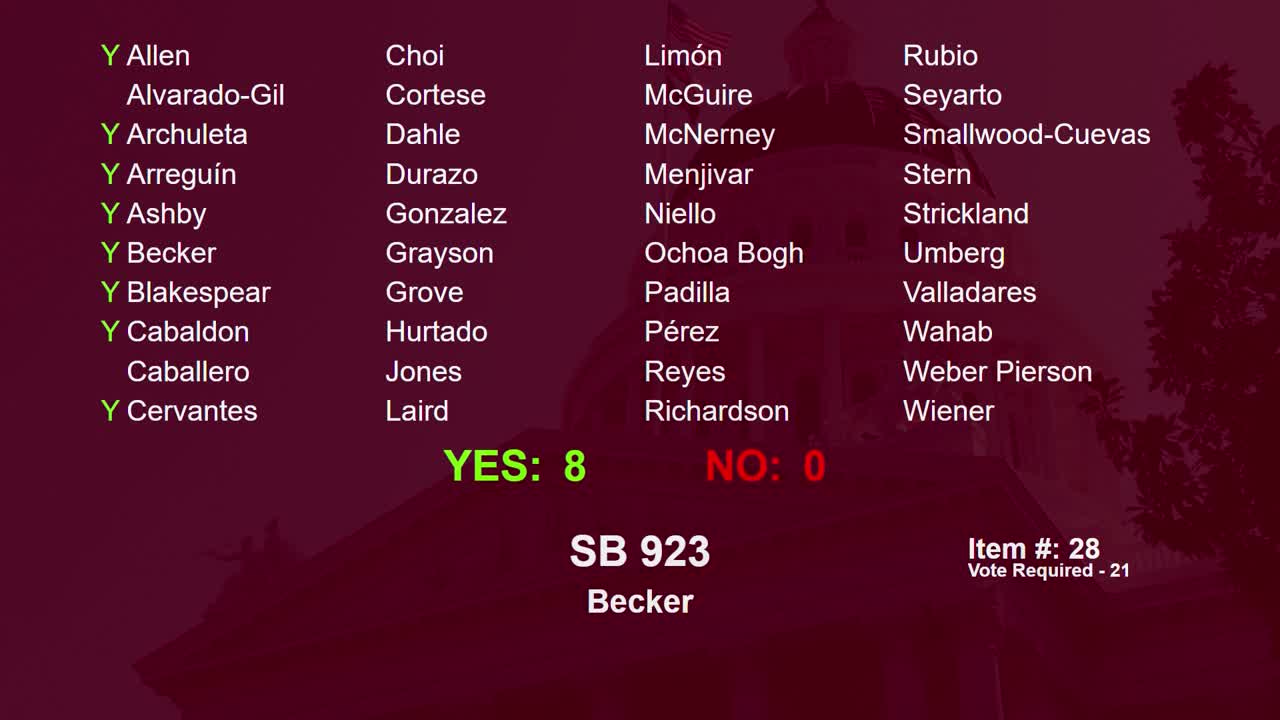 7MIN
Senate Floor
 27MIN
Senate Standing Committee on Transportation
 4MIN
Senate Standing Committee on Transportation
 34MIN
Senate Standing Committee on Environmental Quality
Bill Author

Bill Co-Author(s):