SB 1090: Planning and zoning: housing development projects: urban lot splits: subdivisions: 2025 Eaton Wildfire: Altadena.
- Session Year: 2025-2026
- House: Senate
- Latest Version Date: 2026-09-30
Current Status:
Passed
(2026-09-30: Chaptered by Secretary of State. Chapter 1006, Statutes of 2026.)
Introduced
In Committee
Awaiting First Chamber Vote
Passed First Chamber
In Committee
Awaiting Second Chamber Vote
Passed Second Chamber
Enacted
Under the Planning and Zoning Law, the legislative body of a county or city may adopt ordinances that, among other things, regulate the use of buildings, structures, and land, as provided. The Subdivision Map Act vests the authority to regulate and control the design and improvement of subdivisions in the legislative body of a local agency and sets forth procedures governing the local agencys processing, approval, conditional approval or disapproval, and filing of tentative, final, and parcel maps.
Existing law authorizes a development proponent to submit an application for a housing development project on a subdivided lot, as specified, that meets specified requirements, and requires a local agency to ministerially consider that application, as specified. Existing law requires a local agency to ministerially consider, without discretionary review or a hearing, a parcel map or a tentative and final map for a housing development project that meets specified requirements.
This bill would, until January 1, 2030, provide that the above-described ministerial approval requirements do not apply to an application for a proposed housing development or map located in ZIP Code 91001 or 91003 and submitted on or after October 1, 2026, except as specified.
This bill would make legislative findings and declarations as to the necessity of a special statute for the unincorporated area known as Altadena in the County of Los Angeles.
This bill would incorporate additional changes to Section 65852.28 of the Government Code proposed by AB 2601 and SB 1116 to be operative only if this bill and either or both AB 2601 and SB 1116 are enacted and this bill is enacted last.
This bill would incorporate additional changes to Section 66499.41 of the Government Code proposed by AB 2601 and SB 1116 to be operative only if this bill and either or both AB 2601 and SB 1116 are enacted and this bill is enacted last.
This bill would declare that it is to take effect immediately as an urgency statute.
Under the Planning and Zoning Law, the legislative body of a county or city may adopt ordinances that, among other things, regulate the use of buildings, structures, and land, as provided. The Subdivision Map Act vests the authority to regulate and control the design and improvement of subdivisions in the legislative body of a local agency and sets forth procedures governing the local agencys processing, approval, conditional approval or disapproval, and filing of tentative, final, and parcel maps.
Existing law requires a local agency to consider ministerially a proposed housing development that contains no more than 2 residential units within a single-family residential zone, or to ministerially approve a parcel map for an urban lot split, if the development or parcel map meets specified requirements, as provided. Existing law authorizes a development proponent to submit an application for a housing development project on a subdivided lot, as specified, that meets specified requirements, and requires a local agency to ministerially consider that application, as specified. Existing law requires a local agency to ministerially consider, without discretionary review or a hearing, a parcel map or a tentative and final map for a housing development project that meets specified requirements.
This bill would would, until January 1, 2030, provide that the above-described ministerial approval requirements do not apply to an application for a proposed housing development or map located in ZIP Code 91001 or 91003 and submitted on or after January 1, 2027, and before January 7, 2030, October 1, 2026, except as specified.
This bill would make legislative findings and declarations as to the necessity of a special statute for the unincorporated area known as Altadena in the County of Los Angeles.
This bill would declare that it is to take effect immediately as an urgency statute.
Under the Planning and Zoning Law, the legislative body of a county or city may adopt ordinances that, among other things, regulate the use of buildings, structures, and land, as provided. The Subdivision Map Act vests the authority to regulate and control the design and improvement of subdivisions in the legislative body of a local agency and sets forth procedures governing the local agencys processing, approval, conditional approval or disapproval, and filing of tentative, final, and parcel maps.
Existing law requires a local agency to consider ministerially a proposed housing development that contains no more than 2 residential units within a single-family residential zone, or to ministerially approve a parcel map for an urban lot split, if the development or parcel map meets specified requirements, as provided. Existing law authorizes a development proponent to submit an application for a housing development project on a subdivided lot, as specified, that meets specified requirements, and requires a local agency to ministerially consider that application, as specified. Existing law requires a local agency to ministerially consider, without discretionary review or a hearing, a parcel map or a tentative and final map for a housing development project that meets specified requirements.
This bill would provide that the above-described ministerial approval requirements do not apply to an application for a proposed housing development or map located in ZIP Code 91001 or 91003 and submitted on or after January 7, 2025, 1, 2027, and before January 7, 2030, except as specified.
This bill would make legislative findings and declarations as to the necessity of a special statute for the unincorporated area known as Altadena in the County of Los Angeles.
Under the Planning and Zoning Law, the legislative body of a county or city may adopt ordinances that, among other things, regulate the use of buildings, structures, and land, as provided. The Subdivision Map Act vests the authority to regulate and control the design and improvement of subdivisions in the legislative body of a local agency and sets forth procedures governing the local agencys processing, approval, conditional approval or disapproval, and filing of tentative, final, and parcel maps.
Existing law requires a local agency to consider ministerially a proposed housing development that contains no more than 2 residential units within a single-family residential zone, or to ministerially approve a parcel map for an urban lot split, if the development or parcel map meets specified requirements, as provided. Existing law authorizes a development proponent to submit an application for a housing development project on a subdivided lot, as specified, that meets specified requirements, and requires a local agency to ministerially consider that application, as specified. Existing law requires a local agency to ministerially consider, without discretionary review or a hearing, a parcel map or a tentative and final map for a housing development project that meets specified requirements.
This bill would provide that the above-described ministerial approval requirements do not apply to an application for a proposed housing development or map located in ZIP Code 91001 or 91003 and submitted on or after January 7, 2025, and before January 7, 2030, except as specified.
This bill would make legislative findings and declarations as to the necessity of a special statute for the unincorporated area known as Altadena in the County of Los Angeles.
Existing law describes the rights and obligations of owners of real property, including that the owner of land in fee has the right to the surface and to everything permanently situated beneath or above it.This bill would prohibit any individual or entity that owns, directly or indirectly, 75 or more single-family properties from making an unsolicited offer to purchase, as defined, real property that is located in an area affected by a wildfire disaster for which a state of emergency has been proclaimed by the Governor or the President of the United States. The bill would apply this prohibition for 5 years commencing on the date that the state of emergency is proclaimed. The bill would make its provisions severable.Existing law describes the rights and obligations of owners of real property, including that the owner of land in fee has the right to the surface and to everything permanently situated beneath or above it.
This bill would prohibit any individual or entity that owns, directly or indirectly, 75 or more single-family properties from making an unsolicited offer to purchase purchase, as defined, real property that is located in an area affected by a wildfire disaster for which a state of emergency has been proclaimed by the Governor or the President of the United States. The bill would apply this prohibition for 5 years commencing on the date that the state of emergency is proclaimed. The bill would make its provisions severable.
Existing law describes the rights and obligations of owners of real property, including that the owner of land in fee has the right to the surface and to everything permanently situated beneath or above it.
This bill would prohibit any individual or entity that owns, directly or indirectly, 75 or more single-family properties from making an unsolicited offer to purchase real property that is located in an area affected by a wildfire disaster for which a state of emergency has been proclaimed by the Governor or the President of the United States. The bill would apply this prohibition for 5 years commencing on the date that the state of emergency is proclaimed. The bill would make its provisions severable.
Existing law establishes the Department of Housing and Community Development and requires it to administer various programs intended to promote the development of housing, including the Multifamily Housing Program.Existing law, the Planning and Zoning Law, requires a city or county to adopt a general plan for the land use and development of the county or city that includes, among other things, a housing element. Existing law requires the housing element to consist of an identification and analysis of existing and projected housing needs and a statement of goals, policies, quantified objectives, financial resources, and scheduled programs for the preservation, improvement, and development of housing. This bill would state the intent of the Legislature to enact legislation relating to housing in disaster impacted areas.Existing law establishes the Department of Housing and Community Development and requires it to administer various programs intended to promote the development of housing, including the Multifamily Housing Program.
Existing law, the Planning and Zoning Law, requires a city or county to adopt a general plan for the land use and development of the county or city that includes, among other things, a housing element. Existing law requires the housing element to consist of an identification and analysis of existing and projected housing needs and a statement of goals, policies, quantified objectives, financial resources, and scheduled programs for the preservation, improvement, and development of housing.
This bill would state the intent of the Legislature to enact legislation relating to housing in disaster impacted areas.
It is the intent of the Legislature that:
(a)The provisions of this bill create a moratorium on submitting new townhome development applications under the Starter Home Revitalization Act of 2021 (Chapter 8 (commencing with Section 66499.40) of Division 2 of Title 7 of the Government Code) on sites impacted by the Eaton Fire in the 91001 and 91003 ZIP Codes and only apply prospectively.
(b)The provisions of this bill shall have no force or effect on any application for a Starter Home Revitalization Act of 2021 (Chapter 8 (commencing with Section 66499.40) of Division 2 of Title 7 of the Government Code) development submitted prior to the effective date of the moratorium. The applicants and the sites associated with premoratorium applications are no less entitled to the provisions and privileges of the Starter Home Revitalization Act of 2021 (Chapter 8 (commencing with Section 66499.40) of Division 2 of Title 7 of the Government Code) than any other site in the state that is not located in the 91001 and 91003 ZIP Codes.
SEC. 2.Section 65852.28 of the Government Code is amended to read:65852.28.(a)Except as provided in subdivision (h), a development proponent may submit an application for a housing development project on a lot that is subdivided pursuant to Section 66499.41 and that meets the requirements of this section.
(b)(1)For any housing development on a lot that is subdivided pursuant to Section 66499.41, a local agency may impose objective zoning standards, objective subdivision standards, or objective design standards that are related to the housing development or to the design or improvement of a parcel, and do not conflict with this section or Section 66499.41.
(2)Notwithstanding paragraph (1), a local agency shall not impose on a housing development on a lot that is subdivided pursuant to Section 66499.41 an objective zoning standard, objective subdivision standard, or objective design standard that does or is any of the following:
(A)(i)Physically precludes the development of a project built to densities as specified in subparagraph (B) of paragraph (3) of subdivision (c) of Section 65583.2. This paragraph does not preclude a local agency from adopting an ordinance that allows developments at a density greater than the maximum density specified in subparagraph (B) of paragraph (3) of subdivision (c) of Section 65583.2.
(ii)Notwithstanding clause (i), for a development located on a lot that meets the definition of clause (ii) of subparagraph (A) of paragraph (2) of subdivision (a) of Section 66499.41, a local agency may impose a height limit of no less than the height allowed pursuant to the existing zoning designation applicable to the lot.
(B)Imposes any requirement that applies to a project solely or partially on the basis that the subdivision or housing development receives approval pursuant to this section.
(C)Requires a setback between the units, except as required in the California Building Code (Title 24 of the California Code of Regulations).
(D)Requires that parking be enclosed or covered.
(E)Imposes side and rear setbacks from the original lot line inconsistent with subparagraph (B) of paragraph (2) of subdivision (b) of Section 65852.21.
(F)Imposes parking requirements inconsistent with paragraph (1) of subdivision (c) of Section 65852.21.
(G)(i)For a housing development project consisting of three to seven units, inclusive, impose a floor area ratio standard that is less than 1.0.
(ii)For a housing development project consisting of 8 to 10 units, inclusive, impose a floor area ratio standard that is less than 1.25.
(c)(1)A local agency shall ministerially consider, without discretionary review or a hearing, an application submitted to a local agency pursuant to this section.
(2)A local agency shall approve or deny an application for a housing development project submitted to a local agency pursuant to this section within 60 days from the date the local agency receives a completed application. If the local agency does not approve or deny a completed application within 60 days, the application shall be deemed approved. If the local agency denies the application, the local agency shall, within 60 days from the date the local agency receives the completed application, return in writing a full set of comments to the applicant with a list of items that are defective or deficient and a description of how the applicant can remedy the application.
(d)A local agency may disapprove a housing development project that meets the requirements of this section if it makes a written finding, based upon a preponderance of the evidence, that the proposed housing development project would have a specific, adverse impact, as defined and determined in paragraph (2) of subdivision (d) of Section 65589.5, upon public health and safety and for which there is no feasible method to satisfactorily mitigate or avoid the specific, adverse impact.
(e)A local agency may adopt an ordinance to implement the provisions of this section. An ordinance adopted to implement this section shall not be considered a project under Division 13 (commencing with Section 21000) of the Public Resources Code.
(f)This section shall become operative on July 1, 2024.
(g)The amendments made to this section by the act adding this subdivision shall become operative on July 1, 2025.
(h)(1)Notwithstanding subdivision (a), this section shall not apply to a housing development project that is located in ZIP Code 91001 or 91003 if the application is submitted on or after October 1, 2026.
(2)This subdivision shall not apply to either of the following:
(A)A proposed housing development for which a development application or preliminary application was submitted before October 1, 2026, if all of the following conditions are met:
(i)The applicant submits an application for a development project that includes all of the information required to process the development application consistent with Sections 65940, 65941, and 65941.5 within 180 days after October 1, 2026.
(ii)If the public agency determines that the application for the development project submitted pursuant to clause (i) is not complete, the development proponent shall submit the specific information needed to complete the application within 90 days of receiving the agencys written identification of the necessary information. If the development proponent does not submit this information within the 90-day period, then the application shall expire and have no further force or effect.
(iii)A public agency shall not take any action that would preclude or impair a development proponent that submitted an application before October 1, 2026, from submitting an application pursuant to this subparagraph. For the purposes of this subdivision, an application will be deemed to have been submitted if the applicant submitted the application in writing.
(B)A proposed housing development that meets all of the following criteria:
(i)One hundred percent of the units have an affordable housing cost, as defined in Section 50052.5 of the Health and Safety Code, or an affordable rent, as defined in Section 50053 of the Health and Safety Code.
(ii)The units shall be subject to a recorded deed restriction for a period of at least 55 years for rental units and at least 45 years for owner-occupied units.
(iii)The development proponent is an entity that is at least one of the following:
(I)A community land trust, as defined in clause (ii) of subparagraph (C) of paragraph (11) of subdivision (a) of Section 402.1 of the Revenue and Taxation Code.
(II)A qualified nonprofit corporation, as described in Section 214.15 of the Revenue and Taxation Code.
(III)A nonprofit housing sponsor or nonprofit corporation, as described in Section 50091 of the Health and Safety Code, whose primary purpose is the development, ownership, or operation of affordable rental housing.
(i)This section shall remain in effect only until January 1, 2030, and as of that date is repealed.
SEC. 2.1.Section 65852.28 of the Government Code is amended to read:65852.28.(a)Except as provided in subdivision (h), a development proponent may submit an application for a housing development project on a lot that is subdivided pursuant to Section 66499.41 and that meets the requirements of this section.
(b)(1)For any housing development on a lot that is subdivided pursuant to Section 66499.41, a local agency may impose objective zoning standards, objective subdivision standards, or objective design standards that are related to the housing development or to the design or improvement of a parcel, and do not conflict with this section or Section 66499.41.
(2)Notwithstanding paragraph (1), a local agency shall not impose on a housing development on a lot that is subdivided pursuant to Section 66499.41 an objective zoning standard, objective subdivision standard, or objective design standard that does or is any of the following:
(A)(i)Physically precludes the development of a project built to densities as specified in subparagraph (B) of paragraph (3) of subdivision (c) of Section 65583.2. This paragraph does not preclude a local agency from adopting an ordinance that allows developments at a density greater than the maximum density specified in subparagraph (B) of paragraph (3) of subdivision (c) of Section 65583.2.
(ii)Notwithstanding clause (i), for a development located on a lot that meets the definition of clause (ii) of subparagraph (A) of paragraph (2) of subdivision (a) of Section 66499.41, a local agency may impose a height limit of no less than the height allowed pursuant to the existing zoning designation applicable to the lot.
(B)Imposes any requirement that applies to a project solely or partially on the basis that the subdivision or housing development receives approval pursuant to this section.
(C)Requires a setback between the units, except as required in the California Building Code (Title 24 of the California Code of Regulations).
(D)Requires that parking be enclosed or covered.
(E)Imposes side and rear setbacks from the original lot line inconsistent with subparagraph (B) of paragraph (2) of subdivision (b) of Section 65852.21.
(F)Imposes parking requirements inconsistent with paragraph (1) of subdivision (c) of Section 65852.21.
(G)(i)For a housing development project consisting of three to seven units, inclusive, impose a floor area ratio standard that is less than 1.0.
(ii)For a housing development project consisting of 8 to 10 units, inclusive, impose a floor area ratio standard that is less than 1.25.
(c)(1)A local agency shall ministerially consider, without discretionary review or a hearing, an application submitted to a local agency pursuant to this section.
(2)A local agency shall approve or deny an application for a housing development project submitted to a local agency pursuant to this section within 60 days from the date the local agency receives a completed application. If the local agency does not approve or deny a completed application within 60 days, the application shall be deemed approved. If the local agency denies the application, the local agency shall, within 60 days from the date the local agency receives the completed application, return in writing a full set of comments to the applicant with a list of items that are defective or deficient and a description of how the applicant can remedy the application.
(3)(A)An application for a housing development project submitted pursuant to this section shall be eligible for concurrent processing with an application for a parcel map or a tentative and final map for a housing development project submitted pursuant to Section 66499.41.
(B)(i)A local agency may condition the issuance of a building permit, grading permit, or certificate of occupancy upon the applicant first obtaining approval and recording a parcel map or a tentative and final map for a housing development project pursuant to Section 66499.41.
(ii)A local agency may deem a building permit or other postentitlement permit application incomplete and require revisions to the building permit or other postentitlement permit in response to any comments from the local agency or other reviewing agencies regarding the parcel maps or tentative and final maps compliance with applicable state or local development and building standards.
(d)A local agency may disapprove a housing development project that meets the requirements of this section if it makes a written finding, based upon a preponderance of the evidence, that the proposed housing development project would have a specific, adverse impact, as defined and determined in paragraph (2) of subdivision (d) of Section 65589.5, upon public health and safety and for which there is no feasible method to satisfactorily mitigate or avoid the specific, adverse impact.
(e)A local agency may adopt an ordinance to implement the provisions of this section. An ordinance adopted to implement this section shall not be considered a project under Division 13 (commencing with Section 21000) of the Public Resources Code.
(f)This section shall become operative on July 1, 2024.
(g)The amendments made to this section by the act adding this subdivision shall become operative on July 1, 2025.
(h)(1)Notwithstanding subdivision (a), this section shall not apply to a housing development project that is located in ZIP Code 91001 or 91003 if the application is submitted on or after October 1, 2026.
(2)This subdivision shall not apply to either of the following:
(A)A proposed housing development for which a development application or preliminary application was submitted before October 1, 2026, if all of the following conditions are met:
(i)The applicant submits an application for a development project that includes all of the information required to process the development application consistent with Sections 65940, 65941, and 65941.5 within 180 days after October 1, 2026.
(ii)If the public agency determines that the application for the development project submitted pursuant to clause (i) is not complete, the development proponent shall submit the specific information needed to complete the application within 90 days of receiving the agencys written identification of the necessary information. If the development proponent does not submit this information within the 90-day period, then the application shall expire and have no further force or effect.
(iii)A public agency shall not take any action that would preclude or impair a development proponent that submitted an application before October 1, 2026, from submitting an application pursuant to this subparagraph. For the purposes of this subdivision, an application will be deemed to have been submitted if the applicant submitted the application in writing.
(B)A proposed housing development that meets all of the following criteria:
(i)One hundred percent of the units have an affordable housing cost, as defined in Section 50052.5 of the Health and Safety Code, or an affordable rent, as defined in Section 50053 of the Health and Safety Code.
(ii)The units shall be subject to a recorded deed restriction for a period of at least 55 years for rental units and at least 45 years for owner-occupied units.
(iii)The development proponent is an entity that is at least one of the following:
(I)A community land trust, as defined in clause (ii) of subparagraph (C) of paragraph (11) of subdivision (a) of Section 402.1 of the Revenue and Taxation Code.
(II)A qualified nonprofit corporation, as described in Section 214.15 of the Revenue and Taxation Code.
(III)A nonprofit housing sponsor or nonprofit corporation, as described in Section 50091 of the Health and Safety Code, whose primary purpose is the development, ownership, or operation of affordable rental housing.
(i)This section shall remain in effect only until January 1, 2030, and as of that date is repealed.
SEC. 2.2.Section 65852.28 of the Government Code is amended to read:65852.28.(a)Except as provided in subdivision (i), a development proponent may submit an application for a housing development project on a lot that is subdivided pursuant to Section 66499.41 and that meets the requirements of this section.
(b)(1)For any housing development on a lot that is subdivided pursuant to Section 66499.41, a local agency may impose objective zoning standards, objective subdivision standards, or objective design standards that are related to the housing development or to the design or improvement of a parcel, and do not conflict with this section or Section 66499.41.
(2)Notwithstanding paragraph (1), a local agency shall not impose on a housing development on a lot that is subdivided pursuant to Section 66499.41 an objective zoning standard, objective subdivision standard, or objective design standard that does or is any of the following:
(A)(i)Physically precludes the development of a project that includes at least as many units as the maximum number of parcels that may be subdivided on the lot pursuant to paragraph (3) of subdivision (a) of Section 66499.41.
(ii)Physically precludes a development pursuant to this section from including additional units or floor area where permitted by any objective zoning standards, objective subdivision standards, and objective design standards that uniformly apply to development within the underlying zone.
(iii)This paragraph does not preclude a local agency from adopting an ordinance that allows developments at a density greater than the maximum density specified in this paragraph.
(iv)Notwithstanding clause (i) or (ii), for a development located on a lot that meets the definition of clause (ii) of subparagraph (A) of paragraph (2) of subdivision (a) of Section 66499.41, a local agency may impose a height limit of no less than the height allowed pursuant to the existing zoning designation applicable to the lot. Height limits shall apply exclusively to the physical height of the building and shall not restrict the number of floors.
(B)Imposes any requirement that applies to a project solely or partially on the basis that the subdivision or housing development receives approval pursuant to this section.
(C)Requires a setback between the units, except as required in the California Building Code (Title 24 of the California Code of Regulations).
(D)Requires that parking be enclosed or covered.
(E)Imposes side and rear setbacks from the original lot line inconsistent with subparagraph (B) of paragraph (2) of subdivision (b) of Section 65852.21.
(F)Imposes a front setback from the original lot line greater than 10 feet or internal setbacks between the newly created parcels, except as required in the California Building Standards Code (Title 24 of the California Code of Regulations).
(G)Imposes parking requirements inconsistent with paragraph (1) of subdivision (c) of Section 65852.21.
(H)Imposes a floor area ratio standard that is less than 1.25.
(c)(1)A local agency shall ministerially consider, without discretionary review or a hearing, an application submitted to a local agency pursuant to this section.
(2)A local agency shall approve or deny an application for a housing development project submitted to a local agency pursuant to this section within 60 days from the date the local agency receives a completed application. If the local agency does not approve or deny a completed application within 60 days, the application shall be deemed approved. If the local agency denies the application, the local agency shall, within 60 days from the date the local agency receives the completed application, return in writing a full set of comments to the applicant with a list of items that are defective or deficient and a description of how the applicant can remedy the application.
(d)A local agency may disapprove a housing development project that meets the requirements of this section if it makes a written finding, based upon a preponderance of the evidence, that the proposed housing development project would have a specific, adverse impact, as defined and determined in paragraph (2) of subdivision (d) of Section 65589.5, upon public health and safety and for which there is no feasible method to satisfactorily mitigate or avoid the specific, adverse impact.
(e)A local agency may adopt an ordinance to implement the provisions of this section. An ordinance adopted to implement this section shall not be considered a project under Division 13 (commencing with Section 21000) of the Public Resources Code.
(f)This section shall be interpreted liberally in favor of producing the maximum number of total housing units.
(g)This section shall become operative on July 1, 2024.
(h)(1)The amendments made to this section by the act adding this paragraph shall become operative on July 1, 2025.
(2)The amendments made to this section by the act adding this paragraph shall become operative on January 1, 2027, only with respect to applications received pursuant to this section by a local agency on or after January 1, 2027.
(i)(1)Notwithstanding subdivision (a), this section shall not apply to a housing development project that is located in ZIP Code 91001 or 91003 if the application is submitted on or after October 1, 2026.
(2)This subdivision shall not apply to either of the following:
(A)A proposed housing development for which a development application or preliminary application was submitted before October 1, 2026, if all of the following conditions are met:
(i)The applicant submits an application for a development project that includes all of the information required to process the development application consistent with Sections 65940, 65941, and 65941.5 within 180 days after October 1, 2026.
(ii)If the public agency determines that the application for the development project submitted pursuant to clause (i) is not complete, the development proponent shall submit the specific information needed to complete the application within 90 days of receiving the agencys written identification of the necessary information. If the development proponent does not submit this information within the 90-day period, then the application shall expire and have no further force or effect.
(iii)A public agency shall not take any action that would preclude or impair a development proponent that submitted an application before October 1, 2026, from submitting an application pursuant to this subparagraph. For the purposes of this subdivision, an application will be deemed to have been submitted if the applicant submitted the application in writing.
(B)A proposed housing development that meets all of the following criteria:
(i)One hundred percent of the units have an affordable housing cost, as defined in Section 50052.5 of the Health and Safety Code, or an affordable rent, as defined in Section 50053 of the Health and Safety Code.
(ii)The units shall be subject to a recorded deed restriction for a period of at least 55 years for rental units and at least 45 years for owner-occupied units.
(iii)The development proponent is an entity that is at least one of the following:
(I)A community land trust, as defined in clause (ii) of subparagraph (C) of paragraph (11) of subdivision (a) of Section 402.1 of the Revenue and Taxation Code.
(II)A qualified nonprofit corporation, as described in Section 214.15 of the Revenue and Taxation Code.
(III)A nonprofit housing sponsor or nonprofit corporation, as described in Section 50091 of the Health and Safety Code, whose primary purpose is the development, ownership, or operation of affordable rental housing.
(j)This section shall remain in effect only until January 1, 2030, and as of that date is repealed.
SEC. 2.3.Section 65852.28 of the Government Code is amended to read:65852.28.(a)Except as provided in subdivision (h), a development proponent may submit an application for a housing development project on a lot that is subdivided pursuant to Section 66499.41 and that meets the requirements of this section.
(b)(1)For any housing development on a lot that is subdivided pursuant to Section 66499.41, a local agency may impose objective zoning standards, objective subdivision standards, or objective design standards that are related to the housing development or to the design or improvement of a parcel, and do not conflict with this section or Section 66499.41.
(2)Notwithstanding paragraph (1), a local agency shall not impose on a housing development on a lot that is subdivided pursuant to Section 66499.41 an objective zoning standard, objective subdivision standard, or objective design standard that does or is any of the following:
(A)(i)Physically precludes the development of a project that includes at least as many units as the maximum number of parcels that may be subdivided on the lot pursuant to paragraph (3) of subdivision (a) of Section 66499.41.
(ii)Physically precludes a development pursuant to this section from including additional units or floor area where permitted by any objective zoning standards, objective subdivision standards, and objective design standards that uniformly apply to development within the underlying zone.
(iii)This paragraph does not preclude a local agency from adopting an ordinance that allows developments at a density greater than the maximum density specified in this paragraph.
(iv)Notwithstanding clause (i) or (ii), for a development located on a lot that meets the definition of clause (ii) of subparagraph (A) of paragraph (2) of subdivision (a) of Section 66499.41, a local agency may impose a height limit of no less than the height allowed pursuant to the existing zoning designation applicable to the lot. Height limits shall apply exclusively to the physical height of the building and shall not restrict the number of floors.
(B)Imposes any requirement that applies to a project solely or partially on the basis that the subdivision or housing development receives approval pursuant to this section.
(C)Requires a setback between the units, except as required in the California Building Code (Title 24 of the California Code of Regulations).
(D)Requires that parking be enclosed or covered.
(E)Imposes side and rear setbacks from the original lot line inconsistent with subparagraph (B) of paragraph (2) of subdivision (b) of Section 65852.21.
(F)Imposes a front setback from the original lot line greater than 10 feet or internal setbacks between the newly created parcels, except as required in the California Building Standards Code (Title 24 of the California Code of Regulations).
(G)Imposes parking requirements inconsistent with paragraph (1) of subdivision (c) of Section 65852.21.
(H)Imposes a floor area ratio standard that is less than 1.25.
(c)(1)A local agency shall ministerially consider, without discretionary review or a hearing, an application submitted to a local agency pursuant to this section.
(2)A local agency shall approve or deny an application for a housing development project submitted to a local agency pursuant to this section within 60 days from the date the local agency receives a completed application. If the local agency does not approve or deny a completed application within 60 days, the application shall be deemed approved. If the local agency denies the application, the local agency shall, within 60 days from the date the local agency receives the completed application, return in writing a full set of comments to the applicant with a list of items that are defective or deficient and a description of how the applicant can remedy the application.
(3)(A)An application for a housing development project submitted pursuant to this section shall be eligible for concurrent processing with an application for a parcel map or a tentative and final map for a housing development project submitted pursuant to Section 66499.41.
(B)(i)A local agency may condition the issuance of a building permit, grading permit, or certificate of occupancy upon the applicant first obtaining approval and recording a parcel map or a tentative and final map for a housing development project pursuant to Section 66499.41.
(ii)A local agency may deem a building permit or other postentitlement permit application incomplete and require revisions to the building permit or other postentitlement permit in response to any comments from the local agency or other reviewing agencies regarding the parcel maps or tentative and final maps compliance with applicable state or local development and building standards.
(d)A local agency may disapprove a housing development project that meets the requirements of this section if it makes a written finding, based upon a preponderance of the evidence, that the proposed housing development project would have a specific, adverse impact, as defined and determined in paragraph (2) of subdivision (d) of Section 65589.5, upon public health and safety and for which there is no feasible method to satisfactorily mitigate or avoid the specific, adverse impact.
(e)A local agency may adopt an ordinance to implement the provisions of this section. An ordinance adopted to implement this section shall not be considered a project under Division 13 (commencing with Section 21000) of the Public Resources Code.
(f)This section shall be interpreted liberally in favor of producing the maximum number of total housing units.
(g)This section shall become operative on July 1, 2024.
(h)(1)Notwithstanding subdivision (a), this section shall not apply to a housing development project that is located in ZIP Code 91001 or 91003 if the application is submitted on or after October 1, 2026.
(2)This subdivision shall not apply to either of the following:
(A)A proposed housing development for which a development application or preliminary application was submitted before October 1, 2026, if all of the following conditions are met:
(i)The applicant submits an application for a development project that includes all of the information required to process the development application consistent with Sections 65940, 65941, and 65941.5 within 180 days after October 1, 2026.
(ii)If the public agency determines that the application for the development project submitted pursuant to clause (i) is not complete, the development proponent shall submit the specific information needed to complete the application within 90 days of receiving the agencys written identification of the necessary information. If the development proponent does not submit this information within the 90-day period, then the application shall expire and have no further force or effect.
(iii)A public agency shall not take any action that would preclude or impair a development proponent that submitted an application before October 1, 2026, from submitting an application pursuant to this subparagraph. For the purposes of this subdivision, an application will be deemed to have been submitted if the applicant submitted the application in writing.
(B)A proposed housing development that meets all of the following criteria:
(i)One hundred percent of the units have an affordable housing cost, as defined in Section 50052.5 of the Health and Safety Code, or an affordable rent, as defined in Section 50053 of the Health and Safety Code.
(ii)The units shall be subject to a recorded deed restriction for a period of at least 55 years for rental units and at least 45 years for owner-occupied units.
(iii)The development proponent is an entity that is at least one of the following:
(I)A community land trust, as defined in clause (ii) of subparagraph (C) of paragraph (11) of subdivision (a) of Section 402.1 of the Revenue and Taxation Code.
(II)A qualified nonprofit corporation, as described in Section 214.15 of the Revenue and Taxation Code.
(III)A nonprofit housing sponsor or nonprofit corporation, as described in Section 50091 of the Health and Safety Code, whose primary purpose is the development, ownership, or operation of affordable rental housing.
(i)(1)The amendments made to this section by the act adding this paragraph shall become operative on July 1, 2025.
(2)The amendments made to this section by the act adding this paragraph shall become operative on January 1, 2027, only with respect to applications received pursuant to this section by a local agency on or after January 1, 2027.
(j)This section shall remain in effect only until January 1, 2030, and as of that date is repealed.
SEC. 3.Section 65852.28 is added to the Government Code, to read:65852.28.(a)A development proponent may submit an application for a housing development project on a lot that is subdivided pursuant to Section 66499.41 and that meets the requirements of this section.
(b)(1)For any housing development on a lot that is subdivided pursuant to Section 66499.41, a local agency may impose objective zoning standards, objective subdivision standards, or objective design standards that are related to the housing development or to the design or improvement of a parcel, and do not conflict with this section or Section 66499.41.
(2)Notwithstanding paragraph (1), a local agency shall not impose on a housing development on a lot that is subdivided pursuant to Section 66499.41 an objective zoning standard, objective subdivision standard, or objective design standard that does or is any of the following:
(A)(i)Physically precludes the development of a project built to densities as specified in subparagraph (B) of paragraph (3) of subdivision (c) of Section 65583.2. This paragraph does not preclude a local agency from adopting an ordinance that allows developments at a density greater than the maximum density specified in subparagraph (B) of paragraph (3) of subdivision (c) of Section 65583.2.
(ii)Notwithstanding clause (i), for a development located on a lot that meets the definition of clause (ii) of subparagraph (A) of paragraph (2) of subdivision (a) of Section 66499.41, a local agency may impose a height limit of no less than the height allowed pursuant to the existing zoning designation applicable to the lot.
(B)Imposes any requirement that applies to a project solely or partially on the basis that the subdivision or housing development receives approval pursuant to this section.
(C)Requires a setback between the units, except as required in the California Building Code (Title 24 of the California Code of Regulations).
(D)Requires that parking be enclosed or covered.
(E)Imposes side and rear setbacks from the original lot line inconsistent with subparagraph (B) of paragraph (2) of subdivision (b) of Section 65852.21.
(F)Imposes parking requirements inconsistent with paragraph (1) of subdivision (c) of Section 65852.21.
(G)(i)For a housing development project consisting of three to seven units, inclusive, impose a floor area ratio standard that is less than 1.0.
(ii)For a housing development project consisting of 8 to 10 units, inclusive, impose a floor area ratio standard that is less than 1.25.
(c)(1)A local agency shall ministerially consider, without discretionary review or a hearing, an application submitted to a local agency pursuant to this section.
(2)A local agency shall approve or deny an application for a housing development project submitted to a local agency pursuant to this section within 60 days from the date the local agency receives a completed application. If the local agency does not approve or deny a completed application within 60 days, the application shall be deemed approved. If the local agency denies the application, the local agency shall, within 60 days from the date the local agency receives the completed application, return in writing a full set of comments to the applicant with a list of items that are defective or deficient and a description of how the applicant can remedy the application.
(d)A local agency may disapprove a housing development project that meets the requirements of this section if it makes a written finding, based upon a preponderance of the evidence, that the proposed housing development project would have a specific, adverse impact, as defined and determined in paragraph (2) of subdivision (d) of Section 65589.5, upon public health and safety and for which there is no feasible method to satisfactorily mitigate or avoid the specific, adverse impact.
(e)A local agency may adopt an ordinance to implement the provisions of this section. An ordinance adopted to implement this section shall not be considered a project under Division 13 (commencing with Section 21000) of the Public Resources Code.
(f)This section shall become operative on January 1, 2030.
SEC. 3.1.Section 65852.28 is added to the Government Code, to read:65852.28.(a)A development proponent may submit an application for a housing development project on a lot that is subdivided pursuant to Section 66499.41 and that meets the requirements of this section.
(b)(1)For any housing development on a lot that is subdivided pursuant to Section 66499.41, a local agency may impose objective zoning standards, objective subdivision standards, or objective design standards that are related to the housing development or to the design or improvement of a parcel, and do not conflict with this section or Section 66499.41.
(2)Notwithstanding paragraph (1), a local agency shall not impose on a housing development on a lot that is subdivided pursuant to Section 66499.41 an objective zoning standard, objective subdivision standard, or objective design standard that does or is any of the following:
(A)(i)Physically precludes the development of a project built to densities as specified in subparagraph (B) of paragraph (3) of subdivision (c) of Section 65583.2. This paragraph does not preclude a local agency from adopting an ordinance that allows developments at a density greater than the maximum density specified in subparagraph (B) of paragraph (3) of subdivision (c) of Section 65583.2.
(ii)Notwithstanding clause (i), for a development located on a lot that meets the definition of clause (ii) of subparagraph (A) of paragraph (2) of subdivision (a) of Section 66499.41, a local agency may impose a height limit of no less than the height allowed pursuant to the existing zoning designation applicable to the lot.
(B)Imposes any requirement that applies to a project solely or partially on the basis that the subdivision or housing development receives approval pursuant to this section.
(C)Requires a setback between the units, except as required in the California Building Code (Title 24 of the California Code of Regulations).
(D)Requires that parking be enclosed or covered.
(E)Imposes side and rear setbacks from the original lot line inconsistent with subparagraph (B) of paragraph (2) of subdivision (b) of Section 65852.21.
(F)Imposes parking requirements inconsistent with paragraph (1) of subdivision (c) of Section 65852.21.
(G)(i)For a housing development project consisting of three to seven units, inclusive, impose a floor area ratio standard that is less than 1.0.
(ii)For a housing development project consisting of 8 to 10 units, inclusive, impose a floor area ratio standard that is less than 1.25.
(c)(1)A local agency shall ministerially consider, without discretionary review or a hearing, an application submitted to a local agency pursuant to this section.
(2)A local agency shall approve or deny an application for a housing development project submitted to a local agency pursuant to this section within 60 days from the date the local agency receives a completed application. If the local agency does not approve or deny a completed application within 60 days, the application shall be deemed approved. If the local agency denies the application, the local agency shall, within 60 days from the date the local agency receives the completed application, return in writing a full set of comments to the applicant with a list of items that are defective or deficient and a description of how the applicant can remedy the application.
(3)(A)An application for a housing development project submitted pursuant to this section shall be eligible for concurrent processing with an application for a parcel map or a tentative and final map for a housing development project submitted pursuant to Section 66499.41.
(B)(i)A local agency may condition the issuance of a building permit, grading permit, or certificate of occupancy upon the applicant first obtaining approval and recording a parcel map or a tentative and final map for a housing development project pursuant to Section 66499.41.
(ii)A local agency may deem a building permit or other postentitlement permit application incomplete and require revisions to the building permit or other postentitlement permit in response to any comments from the local agency or other reviewing agencies regarding the parcel maps or tentative and final maps compliance with applicable state or local development and building standards.
(d)A local agency may disapprove a housing development project that meets the requirements of this section if it makes a written finding, based upon a preponderance of the evidence, that the proposed housing development project would have a specific, adverse impact, as defined and determined in paragraph (2) of subdivision (d) of Section 65589.5, upon public health and safety and for which there is no feasible method to satisfactorily mitigate or avoid the specific, adverse impact.
(e)A local agency may adopt an ordinance to implement the provisions of this section. An ordinance adopted to implement this section shall not be considered a project under Division 13 (commencing with Section 21000) of the Public Resources Code.
(f)This section shall become operative on January 1, 2030.
SEC. 3.2.Section 65852.28 is added to the Government Code, to read:65852.28.(a)A development proponent may submit an application for a housing development project on a lot that is subdivided pursuant to Section 66499.41 and that meets the requirements of this section.
(b)(1)For any housing development on a lot that is subdivided pursuant to Section 66499.41, a local agency may impose objective zoning standards, objective subdivision standards, or objective design standards that are related to the housing development or to the design or improvement of a parcel, and do not conflict with this section or Section 66499.41.
(2)Notwithstanding paragraph (1), a local agency shall not impose on a housing development on a lot that is subdivided pursuant to Section 66499.41 an objective zoning standard, objective subdivision standard, or objective design standard that does or is any of the following:
(A)(i)Physically precludes the development of a project that includes at least as many units as the maximum number of parcels that may be subdivided on the lot pursuant to paragraph (3) of subdivision (a) of Section 66499.41.
(ii)Physically precludes a development pursuant to this section from including additional units or floor area where permitted by any objective zoning standards, objective subdivision standards, and objective design standards that uniformly apply to development within the underlying zone.
(iii)This paragraph does not preclude a local agency from adopting an ordinance that allows developments at a density greater than the maximum density specified in this paragraph.
(iv)Notwithstanding clause (i) or (ii), for a development located on a lot that meets the definition of clause (ii) of subparagraph (A) of paragraph (2) of subdivision (a) of Section 66499.41, a local agency may impose a height limit of no less than the height allowed pursuant to the existing zoning designation applicable to the lot. Height limits shall apply exclusively to the physical height of the building and shall not restrict the number of floors.
(B)Imposes any requirement that applies to a project solely or partially on the basis that the subdivision or housing development receives approval pursuant to this section.
(C)Requires a setback between the units, except as required in the California Building Code (Title 24 of the California Code of Regulations).
(D)Requires that parking be enclosed or covered.
(E)Imposes side and rear setbacks from the original lot line inconsistent with subparagraph (B) of paragraph (2) of subdivision (b) of Section 65852.21.
(F)Imposes a front setback from the original lot line greater than 10 feet or internal setbacks between the newly created parcels, except as required in the California Building Standards Code (Title 24 of the California Code of Regulations).
(G)Imposes parking requirements inconsistent with paragraph (1) of subdivision (c) of Section 65852.21.
(H)Imposes a floor area ratio standard that is less than 1.25.
(c)(1)A local agency shall ministerially consider, without discretionary review or a hearing, an application submitted to a local agency pursuant to this section.
(2)A local agency shall approve or deny an application for a housing development project submitted to a local agency pursuant to this section within 60 days from the date the local agency receives a completed application. If the local agency does not approve or deny a completed application within 60 days, the application shall be deemed approved. If the local agency denies the application, the local agency shall, within 60 days from the date the local agency receives the completed application, return in writing a full set of comments to the applicant with a list of items that are defective or deficient and a description of how the applicant can remedy the application.
(d)A local agency may disapprove a housing development project that meets the requirements of this section if it makes a written finding, based upon a preponderance of the evidence, that the proposed housing development project would have a specific, adverse impact, as defined and determined in paragraph (2) of subdivision (d) of Section 65589.5, upon public health and safety and for which there is no feasible method to satisfactorily mitigate or avoid the specific, adverse impact.
(e)A local agency may adopt an ordinance to implement the provisions of this section. An ordinance adopted to implement this section shall not be considered a project under Division 13 (commencing with Section 21000) of the Public Resources Code.
(f)This section shall be interpreted liberally in favor of producing the maximum number of total housing units.
(g)(1)The amendments made to this section by the act adding this paragraph shall become operative on July 1, 2025.
(2)The amendments made to this section by the act adding this paragraph shall become operative on January 1, 2027, only with respect to applications received pursuant to this section by a local agency on or after January 1, 2027.
(h)This section shall become operative on January 1, 2030.
SEC. 3.3.Section 65852.28 is added to the Government Code, to read:65852.28.(a)A development proponent may submit an application for a housing development project on a lot that is subdivided pursuant to Section 66499.41 and that meets the requirements of this section.
(b)(1)For any housing development on a lot that is subdivided pursuant to Section 66499.41, a local agency may impose objective zoning standards, objective subdivision standards, or objective design standards that are related to the housing development or to the design or improvement of a parcel, and do not conflict with this section or Section 66499.41.
(2)Notwithstanding paragraph (1), a local agency shall not impose on a housing development on a lot that is subdivided pursuant to Section 66499.41 an objective zoning standard, objective subdivision standard, or objective design standard that does or is any of the following:
(A)(i)Physically precludes the development of a project that includes at least as many units as the maximum number of parcels that may be subdivided on the lot pursuant to paragraph (3) of subdivision (a) of Section 66499.41.
(ii)Physically precludes a development pursuant to this section from including additional units or floor area where permitted by any objective zoning standards, objective subdivision standards, and objective design standards that uniformly apply to development within the underlying zone.
(iii)This paragraph does not preclude a local agency from adopting an ordinance that allows developments at a density greater than the maximum density specified in this paragraph.
(iv)Notwithstanding clause (i) or (ii), for a development located on a lot that meets the definition of clause (ii) of subparagraph (A) of paragraph (2) of subdivision (a) of Section 66499.41, a local agency may impose a height limit of no less than the height allowed pursuant to the existing zoning designation applicable to the lot. Height limits shall apply exclusively to the physical height of the building and shall not restrict the number of floors.
(B)Imposes any requirement that applies to a project solely or partially on the basis that the subdivision or housing development receives approval pursuant to this section.
(C)Requires a setback between the units, except as required in the California Building Code (Title 24 of the California Code of Regulations).
(D)Requires that parking be enclosed or covered.
(E)Imposes side and rear setbacks from the original lot line inconsistent with subparagraph (B) of paragraph (2) of subdivision (b) of Section 65852.21.
(F)Imposes a front setback from the original lot line greater than 10 feet or internal setbacks between the newly created parcels, except as required in the California Building Standards Code (Title 24 of the California Code of Regulations).
(G)Imposes parking requirements inconsistent with paragraph (1) of subdivision (c) of Section 65852.21.
(H)Imposes a floor area ratio standard that is less than 1.25.
(c)(1)A local agency shall ministerially consider, without discretionary review or a hearing, an application submitted to a local agency pursuant to this section.
(2)A local agency shall approve or deny an application for a housing development project submitted to a local agency pursuant to this section within 60 days from the date the local agency receives a completed application. If the local agency does not approve or deny a completed application within 60 days, the application shall be deemed approved. If the local agency denies the application, the local agency shall, within 60 days from the date the local agency receives the completed application, return in writing a full set of comments to the applicant with a list of items that are defective or deficient and a description of how the applicant can remedy the application.
(3)(A)An application for a housing development project submitted pursuant to this section shall be eligible for concurrent processing with an application for a parcel map or a tentative and final map for a housing development project submitted pursuant to Section 66499.41.
(B)(i)A local agency may condition the issuance of a building permit, grading permit, or certificate of occupancy upon the applicant first obtaining approval and recording a parcel map or a tentative and final map for a housing development project pursuant to Section 66499.41.
(ii)A local agency may deem a building permit or other postentitlement permit application incomplete and require revisions to the building permit or other postentitlement permit in response to any comments from the local agency or other reviewing agencies regarding the parcel maps or tentative and final maps compliance with applicable state or local development and building standards.
(d)A local agency may disapprove a housing development project that meets the requirements of this section if it makes a written finding, based upon a preponderance of the evidence, that the proposed housing development project would have a specific, adverse impact, as defined and determined in paragraph (2) of subdivision (d) of Section 65589.5, upon public health and safety and for which there is no feasible method to satisfactorily mitigate or avoid the specific, adverse impact.
(e)A local agency may adopt an ordinance to implement the provisions of this section. An ordinance adopted to implement this section shall not be considered a project under Division 13 (commencing with Section 21000) of the Public Resources Code.
(f)This section shall be interpreted liberally in favor of producing the maximum number of total housing units.
(g)This section shall become operative on July 1, 2024.
(h)(1)Notwithstanding subdivision (a), this section shall not apply to a housing development project that is located in ZIP Code 91001 or 91003 if the application is submitted on or after October 1, 2026.
(2)This subdivision shall not apply to either of the following:
(A)A proposed housing development for which a development application or preliminary application was submitted before October 1, 2026, if all of the following conditions are met:
(i)The applicant submits an application for a development project that includes all of the information required to process the development application consistent with Sections 65940, 65941, and 65941.5 within 180 days after October 1, 2026.
(ii)If the public agency determines that the application for the development project submitted pursuant to clause (i) is not complete, the development proponent shall submit the specific information needed to complete the application within 90 days of receiving the agencys written identification of the necessary information. If the development proponent does not submit this information within the 90-day period, then the application shall expire and have no further force or effect.
(iii)A public agency shall not take any action that would preclude or impair a development proponent that submitted an application before October 1, 2026, from submitting an application pursuant to this subparagraph. For the purposes of this subdivision, an application will be deemed to have been submitted if the applicant submitted the application in writing.
(B)A proposed housing development that meets all of the following criteria:
(i)One hundred percent of the units have an affordable housing cost, as defined in Section 50052.5 of the Health and Safety Code, or an affordable rent, as defined in Section 50053 of the Health and Safety Code.
(ii)The units shall be subject to a recorded deed restriction for a period of at least 55 years for rental units and at least 45 years for owner-occupied units.
(iii)The development proponent is an entity that is at least one of the following:
(I)A community land trust, as defined in clause (ii) of subparagraph (C) of paragraph (11) of subdivision (a) of Section 402.1 of the Revenue and Taxation Code.
(II)A qualified nonprofit corporation, as described in Section 214.15 of the Revenue and Taxation Code.
(III)A nonprofit housing sponsor or nonprofit corporation, as described in Section 50091 of the Health and Safety Code, whose primary purpose is the development, ownership, or operation of affordable rental housing.
(i)(1)The amendments made to this section by the act adding this paragraph shall become operative on July 1, 2025.
(2)The amendments made to this section by the act adding this paragraph shall become operative on January 1, 2027, only with respect to applications received pursuant to this section by a local agency on or after January 1, 2027.
(j)This section shall become operative on January 1, 2030.
SEC. 4.Section 66499.41 of the Government Code is amended to read:66499.41.(a)Except as specified in subdivision (j), a local agency shall ministerially consider, without discretionary review or a hearing, a parcel map or a tentative and final map for a housing development project that meets all of the following requirements:
(1)(A)The proposed subdivision will result in 10 or fewer parcels and the housing development project on the lot proposed to be subdivided will contain 10 or fewer residential units, except as provided in subdivision (g).
(B)The proposed subdivision may designate a remainder parcel, as defined under Section 66424.6, that retains existing land uses or structures, does not contain any new residential units, and is not exclusively dedicated to serving the housing development project. The remainder parcel shall not be counted against the 10-parcel maximum permitted under subparagraph (A).
(2)The lot proposed to be subdivided meets all of the following sets of requirements:
(A)The lot is one of the following:
(i)Zoned to allow multifamily residential dwelling use.
(ii)Vacant and zoned for single-family residential development. For purposes of this paragraph, vacant means having no permanent structure, unless the permanent structure is abandoned and uninhabitable. All of the following types of housing shall not be defined as vacant:
(I)Housing that is subject to a recorded covenant, ordinance, or law that restricts rent or sales price to levels affordable to persons and families of low, very low, or extremely low income.
(II)Housing that is subject to any form of rent or sales price control through a local public entitys valid exercise of its police power.
(III)Housing occupied by tenants within the five years preceding the date of the application, including housing that has been demolished or that tenants have vacated prior to the submission of the application for a development permit.
(B)(i)A lot zoned to allow multifamily residential dwelling use is no larger than five acres and is substantially surrounded by qualified urban uses.
(ii)A vacant lot zoned for single-family residential development is no larger than one and one-half acres and is substantially surrounded by qualified urban uses.
(iii)For purposes of this subparagraph, the following definitions apply:
(I)Qualified urban use has the same meaning as defined in Section 21072 of the Public Resources Code.
(II)Substantially surrounded has the same meaning as defined in paragraph (2) of subdivision (a) of Section 21159.25 of the Public Resources Code.
(C)The lot is a legal parcel located within one of the following:
(i)An incorporated city, the boundaries of which include some portion of an urbanized area.
(ii)An urbanized area or urban cluster in a county with a population greater than 600,000 based on the most recent United States Census Bureau data.
(iii)For purposes of this subparagraph, the following definitions apply:
(I)Urbanized area means an urbanized area designated by the United States Census Bureau, as published in the Federal Register, Volume 77, Number 59, on March 27, 2012.
(II)Urban cluster means an urban cluster designated by the United States Census Bureau, as published in the Federal Register, Volume 77, Number 59, on March 27, 2012.
(D)The lot was not established pursuant to this section, including a designated remainder parcel described in subparagraph (B) of paragraph (1), or in Section 66411.7.
(3)(A)Except as specified in subparagraphs (B) and (C), the newly created parcels are no smaller than 600 square feet.
(B)If the parcels are zoned for single-family residential use, the newly created parcels are no smaller than 1,200 square feet.
(C)A local agency may, by ordinance, adopt a smaller minimum parcel size subject to ministerial approval under this subdivision.
(4)The housing units on the lot proposed to be subdivided are one of the following:
(A)Constructed on fee simple ownership lots.
(B)Part of a common interest development.
(C)Part of a housing cooperative, as defined in Section 817 of the Civil Code.
(D)Constructed on land owned by a community land trust. For the purpose of this subparagraph, community land trust means a nonprofit corporation organized pursuant to Section 501(c)(3) of the Internal Revenue Code that satisfies all of the following:
(i)Has as its primary purposes the creation and maintenance of permanently affordable single-family or multifamily residences.
(ii)All dwellings and units located on the land owned by the nonprofit corporation are sold to qualified owners to be occupied as the qualified owners primary residence or rented to persons and families of low or moderate income. For the purpose of this subparagraph, qualified owner means a person or family of low or moderate income, including a person or family of low or moderate income who owns a dwelling or unit collectively as a member occupant or resident shareholder of a limited-equity housing cooperative.
(iii)The land owned by the nonprofit corporation, on which a dwelling or unit sold to a qualified owner is situated, is leased by the nonprofit corporation to the qualified owner for the convenient occupation and use of that dwelling or unit for a renewable term of 99 years.
(E)Part of an interest in common, as described in Section 685 of the Civil Code.
(5)The proposed housing development project will, pursuant to the requirements of this division, meet one of the following, as applicable:
(A)If the parcel is identified in the jurisdictions housing element for the current planning period that is in substantial compliance with Article 10.6 (commencing with Section 65580) of Chapter 3 of Division 1, the housing development project will result in at least as many units as projected for that parcel in the housing element. If the parcel is identified to accommodate any portion of the jurisdictions share of the regional housing need for low-income or very low income households, the housing development project will result in at least as many low-income or very low income units as projected in the housing element. These units shall be subject to a recorded affordability restriction of at least 45 years.
(B)(i)If the parcel is not identified in the jurisdictions housing element for the current planning period that is in substantial compliance with Article 10.6 (commencing with Section 65580) of Chapter 3 of Division 1, the housing development project will result in at least 66 percent of the maximum allowable residential density as specified by local zoning or 66 percent of the applicable residential density specified in subparagraph (B) of paragraph (3) of subdivision (c) of Section 65583.2, whichever is greater.
(ii)Where local zoning does not specify a maximum allowable residential density, the housing development project will result in at least 66 percent of the applicable residential density specified in subparagraph (B) of paragraph (3) of subdivision (c) of Section 65583.2.
(iii)The area of any designated remainder parcel described in subparagraph (B) of paragraph (1) shall be excluded from the calculation of residential density under this paragraph.
(6)The average total area of floorspace for the proposed housing units on the lot proposed to be subdivided does not exceed 1,750 net habitable square feet. For purposes of this paragraph, net habitable square feet means the finished and heated floor area fully enclosed by the inside surface of walls, windows, doors, and partitions, and having a headroom of at least six and one-half feet, including working, living, eating, cooking, sleeping, stair, hall, service, and storage areas, but excluding garages, carports, parking spaces, cellars, half-stories, and unfinished attics and basements.
(7)The housing development project on the lot proposed to be subdivided complies with any local inclusionary housing ordinances adopted by the local agency.
(8)The development of a housing development project on the lot proposed to be subdivided does not require the demolition or alteration of any of the following types of housing:
(A)Housing that is subject to a recorded covenant, ordinance, or law that restricts rent to levels affordable to persons and families of low, very low, or extremely low income.
(B)Housing that is subject to any form of rent or price control through a local public entitys valid exercise of its police power.
(C)Housing occupied by tenants within the five years preceding the date of the application, including housing that has been demolished or that tenants have vacated prior to the submission of the application for a development permit.
(D)A parcel on which an owner of residential real property has exercised the owners rights under Chapter 12.75 (commencing with Section 7060) of Division 7 of Title 1 to withdraw accommodations from rent or lease within 15 years before the date that the development proponent submits an application.
(9)The lot proposed to be subdivided is not located on a site that is any of the following:
(A)Either prime farmland or farmland of statewide importance, as defined pursuant to United States Department of Agriculture land inventory and monitoring criteria, as modified for California, and designated on the maps prepared by the Farmland Mapping and Monitoring Program of the Department of Conservation, or land zoned or designated for agricultural protection or preservation by a local ballot measure that was approved by the voters of that jurisdiction.
(B)Wetlands, as defined in the United States Fish and Wildlife Service Manual, Part 660 FW 2 (June 21, 1993).
(C)Within a very high fire hazard severity zone, as determined by the Department of Forestry and Fire Protection pursuant to Section 51178, or within a high or very high fire hazard severity zone as indicated on maps adopted by the Department of Forestry and Fire Protection pursuant to Section 4202 of the Public Resources Code.
(D)A hazardous waste site that is listed pursuant to Section 65962.5 or a hazardous waste site designated by the Department of Toxic Substances Control pursuant to former Section 25356 of the Health and Safety Code, unless either of the following applies:
(i)The site is an underground storage tank site that received a uniform closure letter issued pursuant to subdivision (g) of Section 25296.10 of the Health and Safety Code based on closure criteria established by the State Water Resources Control Board for residential use or residential mixed uses. This section does not alter or change the conditions to remove a site from the list of hazardous waste sites listed pursuant to Section 65962.5.
(ii)The State Department of Public Health, State Water Resources Control Board, Department of Toxic Substances Control, or a local agency making a determination pursuant to subdivision (c) of Section 25296.10 of the Health and Safety Code has otherwise determined that the site is suitable for residential use or residential mixed uses.
(E)Within a delineated earthquake fault zone as determined by the State Geologist in any official maps published by the State Geologist, unless the housing development project complies with applicable seismic protection building code standards adopted by the California Building Standards Commission under the California Building Standards Law (Part 2.5 (commencing with Section 18901) of Division 13 of the Health and Safety Code), and by any local building department under Chapter 12.2 (commencing with Section 8875) of Division 1 of Title 2.
(F)Within a special flood hazard area subject to inundation by the 1-percent annual chance flood (100-year flood) as determined by the Federal Emergency Management Agency in any official maps published by the Federal Emergency Management Agency. If a development proponent is able to satisfy all applicable federal qualifying criteria in order to provide that the site satisfies this paragraph and is otherwise eligible for streamlined approval under this section, a local government shall not deny the application on the basis that the development proponent did not comply with any additional permit requirement, standard, or action adopted by that local government that is applicable to that site. A housing development project may be located on a site described in this subparagraph if either of the following is met:
(i)The site has been subject to a Letter of Map Revision prepared by the Federal Emergency Management Agency and issued to the local jurisdiction.
(ii)The site meets Federal Emergency Management Agency requirements necessary to meet minimum flood plain management criteria of the National Flood Insurance Program pursuant to Part 59 (commencing with Section 59.1) and Part 60 (commencing with Section 60.1) of Subchapter B of Chapter I of Title 44 of the Code of Federal Regulations.
(G)Within a regulatory floodway as determined by the Federal Emergency Management Agency in any official maps published by the Federal Emergency Management Agency, unless the housing development project has received a no-rise certification in accordance with Section 60.3(d)(3) of Title 44 of the Code of Federal Regulations. If a development proponent is able to satisfy all applicable federal qualifying criteria in order to provide that the site satisfies this subparagraph and is otherwise eligible for streamlined approval under this section, a local government shall not deny the application on the basis that the development proponent did not comply with any additional permit requirement, standard, or action adopted by that local government that is applicable to that site.
(H)Land identified for conservation in an adopted natural community conservation plan pursuant to the Natural Community Conservation Planning Act (Chapter 10 (commencing with Section 2800) of Division 3 of the Fish and Game Code), habitat conservation plan pursuant to the federal Endangered Species Act of 1973 (16 U.S.C. Sec. 1531 et seq.), or another adopted natural resource protection plan.
(I)Habitat for protected species identified as candidate, sensitive, or species of special status by state or federal agencies, fully protected species, or species protected by the federal Endangered Species Act of 1973 (16 U.S.C. Sec. 1531 et seq.), the California Endangered Species Act (Chapter 1.5 (commencing with Section 2050) of Division 3 of the Fish and Game Code), or the Native Plant Protection Act (Chapter 10 (commencing with Section 1900) of Division 2 of the Fish and Game Code).
(J)Land under conservation easement.
(10)The proposed subdivision conforms to all applicable objective requirements of the Subdivision Map Act (Division 2 (commencing with Section 66410)), except as otherwise expressly provided in this section.
(11)The proposed subdivision complies with all applicable standards established pursuant to Section 65852.28.
(12)Any parcels proposed to be created pursuant to this section will be served by a public water system and a municipal sewer system.
(13)The proposed subdivision will not result in any existing dwelling unit being alienable separate from the title to any other existing dwelling unit on the lot.
(b)A housing development project on a proposed site to be subdivided pursuant to this section is not required to comply with either of the following requirements:
(1)A minimum requirement on the size, width, depth, frontage, or dimensions of an individual parcel created by the housing development project beyond the minimum parcel size specified in, or established pursuant to, paragraph (3) of subdivision (a).
(2)(A)The formation of a homeowners association, except as required by the Davis-Stirling Common Interest Development Act (Part 5 (commencing with Section 4000) of Division 4 of the Civil Code).
(B)Subparagraph (A) shall not be construed to prohibit a local agency from requiring a mechanism for the maintenance of common space within the subdivision, including, but not limited to, a road maintenance agreement.
(c)A local agency shall approve or deny an application for a parcel map or a tentative map for a housing development project submitted to a local agency pursuant to this section within 60 days from the date the local agency receives a completed application. If the local agency does not approve or deny a completed application within 60 days, the application shall be deemed approved. If the local agency denies the application, the local agency shall, within 60 days from the date the local agency receives the completed application, return in writing a full set of comments to the applicant with a list of items that are defective or deficient and a description of how the applicant can remedy the application.
(d)Any housing development project constructed on the lot proposed to be subdivided pursuant to this section shall comply with all applicable objective zoning standards, objective subdivision standards, and objective design standards as established by the local agency that are not inconsistent with this section and paragraph (2) of subdivision (a) of Section 65852.28.
(e)(1)(A)Except as provided in paragraph (2), no person shall sell, lease, or finance any parcel or parcels of real property resulting from a subdivision under this section separately from any other such parcel or parcels, unless each parcel that is sold, leased, or financed meets one of the following criteria:
(i)The parcel contains a residential structure completed in compliance with all applicable provisions of the California Building Standards Code that includes at least one dwelling unit.
(ii)The parcel already contains an existing legally permitted residential structure.
(iii)The parcel is reserved for internal circulation, open space, or common area.
(iv)The parcel is the only remaining parcel within the subdivision that is not developed with a residential structure that was completed in compliance with all applicable provisions of the California Building Standards Code.
(B)For purposes of this subdivision, parcel or parcels of real property resulting from a subdivision under this section shall not include any designated remainder parcel described in subparagraph (B) of paragraph (1) of subdivision (a).
(C)Violation of this paragraph shall constitute the sale of real property that has been divided in violation of the provisions of this division and shall be subject to the penalties and remedies set forth in Chapter 7 (commencing with Section 66499.30).
(2)A local agency may, by ordinance or map condition, authorize the sale, lease, or finance of any parcel or parcels of real property resulting from a subdivision under this section without compliance with the provisions of paragraph (1).
(f)A local agency may deny the issuance of a parcel map, a tentative map, or a final map if it makes a written finding, based upon a preponderance of the evidence, that the proposed housing development project would have a specific, adverse impact, as defined and determined in paragraph (2) of subdivision (d) of Section 65589.5, upon public health and safety and for which there is no feasible method to satisfactorily mitigate or avoid the specific, adverse impact.
(g)Notwithstanding Article 2 (commencing with Section 66314) or Article 3 (commencing with Section 66333) of Chapter 13 of Division 1, a local agency is not required to permit an accessory dwelling unit or a junior accessory dwelling unit on parcels created through the exercise of the authority contained within this section. If a local agency chooses to permit accessory dwelling units or junior accessory dwelling units, the units shall not count as residential units for the purposes of paragraph (1) of subdivision (a).
(h)(1)Notwithstanding Section 66411.7, a local agency is not required to permit an urban lot split on a parcel created through the exercise of the authority contained within this section.
(2)Notwithstanding Sections 65852.21 and 66411.7, those sections shall not apply to a site that meets both of the following requirements:
(A)The site is located within a single-family residential horsekeeping zone designated in a master plan, adopted before January 1, 1994, that regulates land zoned single-family horsekeeping, commercial, commercial-recreational, and existing industrial within the plan area.
(B)The applicable local government has an adopted housing element that is compliant with applicable law.
(i)A local agency may adopt an ordinance to implement the provisions of this section. An ordinance adopted to implement this section shall not be considered a project under Division 13 (commencing with Section 21000) of the Public Resources Code.
(j)(1)Notwithstanding subdivision (a), and except as specified in paragraph (2), this section shall not apply to a parcel map or a tentative and final map for a housing development project that is located in ZIP Code 91001 or 91003 if the application is submitted on or after October 1, 2026.
(2)This subdivision shall not apply to either of the following:
(A)A parcel map or tentative and final map for a housing development project for which a development application or preliminary application was submitted before October 1, 2026, if all of the following conditions are met:
(i)The applicant submits an application for a development project that includes all of the information required to process the development application consistent with Sections 65940, 65941, and 65941.5 within 180 days after October 1, 2026.
(ii)If the public agency determines that the application for the development project submitted pursuant to clause (i) is not complete, the development proponent shall submit the specific information needed to complete the application within 90 days of receiving the agencys written identification of the necessary information. If the development proponent does not submit this information within the 90-day period, then the application shall expire and have no further force or effect.
(iii)A public agency shall not take any action that would preclude or impair a development proponent that submitted an application before October 1, 2026, from submitting an application pursuant to this subparagraph. For the purposes of this subdivision, an application will be deemed to have been submitted if the applicant submitted the application in writing.
(B)A parcel map or tentative and final map for a housing development project that meets all of the following criteria:
(i)One hundred percent of the units have an affordable housing cost, as defined in Section 50052.5 of the Health and Safety Code, or an affordable rent, as defined in Section 50053 of the Health and Safety Code.
(ii)The units shall be subject to a recorded deed restriction for a period of at least 55 years for rental units and at least 45 years for owner-occupied units.
(iii)The development proponent is an entity that is at least one of the following:
(I)A community land trust, as defined in clause (ii) of subparagraph (C) of paragraph (11) of subdivision (a) of Section 402.1 of the Revenue and Taxation Code.
(II)A qualified nonprofit corporation, as described in Section 214.15 of the Revenue and Taxation Code.
(III)A nonprofit housing sponsor or nonprofit corporation, as described in Section 50091 of the Health and Safety Code, whose primary purpose is the development, ownership, or operation of affordable rental housing.
(k)This section shall remain in effect only until January 1, 2030, and as of that date is repealed.
SEC. 4.1.Section 66499.41 of the Government Code is amended to read:66499.41.(a)Except as specified in subdivision (j), a local agency shall ministerially consider, without discretionary review or a hearing, a parcel map or a tentative and final map for a housing development project that meets all of the following requirements:
(1)(A)The proposed subdivision will result in 10 or fewer parcels and the housing development project on the lot proposed to be subdivided will contain 10 or fewer residential units, except as provided in subdivision (g).
(B)The proposed subdivision may designate a remainder parcel, as defined under Section 66424.6, that retains existing land uses or structures, does not contain any new residential units, and is not exclusively dedicated to serving the housing development project. The remainder parcel shall not be counted against the 10-parcel maximum permitted under subparagraph (A).
(2)The lot proposed to be subdivided meets all of the following sets of requirements:
(A)The lot is one of the following:
(i)Zoned to allow multifamily residential dwelling use.
(ii)Vacant and zoned for single-family residential development. For purposes of this paragraph, vacant means having no permanent structure, unless the permanent structure is abandoned and uninhabitable. All of the following types of housing shall not be defined as vacant:
(I)Housing that is subject to a recorded covenant, ordinance, or law that restricts rent or sales price to levels affordable to persons and families of low, very low, or extremely low income.
(II)Housing that is subject to any form of rent or sales price control through a local public entitys valid exercise of its police power.
(III)Housing occupied by tenants within the five years preceding the date of the application, including housing that has been demolished or that tenants have vacated prior to the submission of the application for a development permit.
(B)(i)A lot zoned to allow multifamily residential dwelling use is no larger than five acres and is substantially surrounded by qualified urban uses.
(ii)A vacant lot zoned for single-family residential development is no larger than one and one-half acres and is substantially surrounded by qualified urban uses.
(iii)For purposes of this subparagraph, the following definitions apply:
(I)Qualified urban use has the same meaning as defined in Section 21072 of the Public Resources Code.
(II)Substantially surrounded has the same meaning as defined in paragraph (2) of subdivision (a) of Section 21159.25 of the Public Resources Code.
(C)The lot is a legal parcel located within one of the following:
(i)An incorporated city, the boundaries of which include some portion of an urbanized area.
(ii)An urbanized area or urban cluster in a county with a population greater than 600,000 based on the most recent United States Census Bureau data.
(iii)For purposes of this subparagraph, the following definitions apply:
(I)Urbanized area means an urbanized area designated by the United States Census Bureau, as published in the Federal Register, Volume 77, Number 59, on March 27, 2012.
(II)Urban cluster means an urban cluster designated by the United States Census Bureau, as published in the Federal Register, Volume 77, Number 59, on March 27, 2012.
(D)The lot was not established pursuant to this section, including a designated remainder parcel described in subparagraph (B) of paragraph (1), or in Section 66411.7.
(3)(A)Except as specified in subparagraphs (B) and (C), the newly created parcels are no smaller than 600 square feet.
(B)If the parcels are zoned for single-family residential use, the newly created parcels are no smaller than 1,200 square feet.
(C)A local agency may, by ordinance, adopt a smaller minimum parcel size subject to ministerial approval under this subdivision.
(4)The housing units on the lot proposed to be subdivided are one of the following:
(A)Constructed on fee simple ownership lots.
(B)Part of a common interest development.
(C)Part of a housing cooperative, as defined in Section 817 of the Civil Code.
(D)Constructed on land owned by a community land trust. For the purpose of this subparagraph, community land trust means a nonprofit corporation organized pursuant to Section 501(c)(3) of the Internal Revenue Code that satisfies all of the following:
(i)Has as its primary purposes the creation and maintenance of permanently affordable single-family or multifamily residences.
(ii)All dwellings and units located on the land owned by the nonprofit corporation are sold to qualified owners to be occupied as the qualified owners primary residence or rented to persons and families of low or moderate income. For the purpose of this subparagraph, qualified owner means a person or family of low or moderate income, including a person or family of low or moderate income who owns a dwelling or unit collectively as a member occupant or resident shareholder of a limited-equity housing cooperative.
(iii)The land owned by the nonprofit corporation, on which a dwelling or unit sold to a qualified owner is situated, is leased by the nonprofit corporation to the qualified owner for the convenient occupation and use of that dwelling or unit for a renewable term of 99 years.
(E)Part of an interest in common, as described in Section 685 of the Civil Code.
(5)The proposed housing development project will, pursuant to the requirements of this division, meet one of the following, as applicable:
(A)If the parcel is identified in the jurisdictions housing element for the current planning period that is in substantial compliance with Article 10.6 (commencing with Section 65580) of Chapter 3 of Division 1, the housing development project will result in at least as many units as projected for that parcel in the housing element. If the parcel is identified to accommodate any portion of the jurisdictions share of the regional housing need for low-income or very low income households, the housing development project will result in at least as many low-income or very low income units as projected in the housing element. These units shall be subject to a recorded affordability restriction of at least 45 years.
(B)(i)If the parcel is not identified in the jurisdictions housing element for the current planning period that is in substantial compliance with Article 10.6 (commencing with Section 65580) of Chapter 3 of Division 1, the housing development project will result in at least 66 percent of the maximum allowable residential density as specified by local zoning or 66 percent of the applicable residential density specified in subparagraph (B) of paragraph (3) of subdivision (c) of Section 65583.2, whichever is greater.
(ii)Where local zoning does not specify a maximum allowable residential density, the housing development project will result in at least 66 percent of the applicable residential density specified in subparagraph (B) of paragraph (3) of subdivision (c) of Section 65583.2.
(iii)The area of any designated remainder parcel described in subparagraph (B) of paragraph (1) shall be excluded from the calculation of residential density under this paragraph.
(6)The average total area of floorspace for the proposed housing units on the lot proposed to be subdivided does not exceed 1,750 net habitable square feet. For purposes of this paragraph, net habitable square feet means the finished and heated floor area fully enclosed by the inside surface of walls, windows, doors, and partitions, and having a headroom of at least six and one-half feet, including working, living, eating, cooking, sleeping, stair, hall, service, and storage areas, but excluding garages, carports, parking spaces, cellars, half-stories, and unfinished attics and basements.
(7)The housing development project on the lot proposed to be subdivided complies with any local inclusionary housing ordinances adopted by the local agency.
(8)The development of a housing development project on the lot proposed to be subdivided does not require the demolition or alteration of any of the following types of housing:
(A)Housing that is subject to a recorded covenant, ordinance, or law that restricts rent to levels affordable to persons and families of low, very low, or extremely low income.
(B)Housing that is subject to any form of rent or price control through a local public entitys valid exercise of its police power.
(C)Housing occupied by tenants within the five years preceding the date of the application, including housing that has been demolished or that tenants have vacated prior to the submission of the application for a development permit.
(D)A parcel on which an owner of residential real property has exercised the owners rights under Chapter 12.75 (commencing with Section 7060) of Division 7 of Title 1 to withdraw accommodations from rent or lease within 15 years before the date that the development proponent submits an application.
(9)The lot proposed to be subdivided is not located on a site that is any of the following:
(A)Either prime farmland or farmland of statewide importance, as defined pursuant to United States Department of Agriculture land inventory and monitoring criteria, as modified for California, and designated on the maps prepared by the Farmland Mapping and Monitoring Program of the Department of Conservation, or land zoned or designated for agricultural protection or preservation by a local ballot measure that was approved by the voters of that jurisdiction.
(B)Wetlands, as defined in the United States Fish and Wildlife Service Manual, Part 660 FW 2 (June 21, 1993).
(C)Within a very high fire hazard severity zone, as determined by the Department of Forestry and Fire Protection pursuant to Section 51178, or within a high or very high fire hazard severity zone as indicated on maps adopted by the Department of Forestry and Fire Protection pursuant to Section 4202 of the Public Resources Code.
(D)A hazardous waste site that is listed pursuant to Section 65962.5 or a hazardous waste site designated by the Department of Toxic Substances Control pursuant to former Section 25356 of the Health and Safety Code, unless either of the following applies:
(i)The site is an underground storage tank site that received a uniform closure letter issued pursuant to subdivision (g) of Section 25296.10 of the Health and Safety Code based on closure criteria established by the State Water Resources Control Board for residential use or residential mixed uses. This section does not alter or change the conditions to remove a site from the list of hazardous waste sites listed pursuant to Section 65962.5.
(ii)The State Department of Public Health, State Water Resources Control Board, Department of Toxic Substances Control, or a local agency making a determination pursuant to subdivision (c) of Section 25296.10 of the Health and Safety Code, has otherwise determined that the site is suitable for residential use or residential mixed uses.
(E)Within a delineated earthquake fault zone as determined by the State Geologist in any official maps published by the State Geologist, unless the housing development project complies with applicable seismic protection building code standards adopted by the California Building Standards Commission under the California Building Standards Law (Part 2.5 (commencing with Section 18901) of Division 13 of the Health and Safety Code), and by any local building department under Chapter 12.2 (commencing with Section 8875) of Division 1 of Title 2.
(F)Within a special flood hazard area subject to inundation by the 1-percent annual chance flood (100-year flood) as determined by the Federal Emergency Management Agency in any official maps published by the Federal Emergency Management Agency. If a development proponent is able to satisfy all applicable federal qualifying criteria in order to provide that the site satisfies this paragraph and is otherwise eligible for streamlined approval under this section, a local government shall not deny the application on the basis that the development proponent did not comply with any additional permit requirement, standard, or action adopted by that local government that is applicable to that site. A housing development project may be located on a site described in this subparagraph if either of the following is met:
(i)The site has been subject to a Letter of Map Revision prepared by the Federal Emergency Management Agency and issued to the local jurisdiction.
(ii)The site meets Federal Emergency Management Agency requirements necessary to meet minimum flood plain management criteria of the National Flood Insurance Program pursuant to Part 59 (commencing with Section 59.1) and Part 60 (commencing with Section 60.1) of Subchapter B of Chapter I of Title 44 of the Code of Federal Regulations.
(G)Within a regulatory floodway as determined by the Federal Emergency Management Agency in any official maps published by the Federal Emergency Management Agency, unless the housing development project has received a no-rise certification in accordance with Section 60.3(d)(3) of Title 44 of the Code of Federal Regulations. If a development proponent is able to satisfy all applicable federal qualifying criteria in order to provide that the site satisfies this subparagraph and is otherwise eligible for streamlined approval under this section, a local government shall not deny the application on the basis that the development proponent did not comply with any additional permit requirement, standard, or action adopted by that local government that is applicable to that site.
(H)Land identified for conservation in an adopted natural community conservation plan pursuant to the Natural Community Conservation Planning Act (Chapter 10 (commencing with Section 2800) of Division 3 of the Fish and Game Code), habitat conservation plan pursuant to the federal Endangered Species Act of 1973 (16 U.S.C. Sec. 1531 et seq.), or another adopted natural resource protection plan.
(I)Habitat for protected species identified as candidate, sensitive, or species of special status by state or federal agencies, fully protected species, or species protected by the federal Endangered Species Act of 1973 (16 U.S.C. Sec. 1531 et seq.), the California Endangered Species Act (Chapter 1.5 (commencing with Section 2050) of Division 3 of the Fish and Game Code), or the Native Plant Protection Act (Chapter 10 (commencing with Section 1900) of Division 2 of the Fish and Game Code).
(J)Land under conservation easement.
(10)The proposed subdivision conforms to all applicable objective requirements of the Subdivision Map Act (Division 2 (commencing with Section 66410)), except as otherwise expressly provided in this section.
(11)The proposed subdivision complies with all applicable standards established pursuant to Section 65852.28.
(12)Any parcels proposed to be created pursuant to this section will be served by a public water system and a municipal sewer system.
(13)The proposed subdivision will not result in any existing dwelling unit being alienable separate from the title to any other existing dwelling unit on the lot.
(b)A housing development project on a proposed site to be subdivided pursuant to this section is not required to comply with either of the following requirements:
(1)A minimum requirement on the size, width, depth, frontage, or dimensions of an individual parcel created by the housing development project beyond the minimum parcel size specified in, or established pursuant to, paragraph (3) of subdivision (a).
(2)(A)The formation of a homeowners association, except as required by the Davis-Stirling Common Interest Development Act (Part 5 (commencing with Section 4000) of Division 4 of the Civil Code).
(B)Subparagraph (A) shall not be construed to prohibit a local agency from requiring a mechanism for the maintenance of common space within the subdivision, including, but not limited to, a road maintenance agreement.
(c)(1)A local agency shall approve or deny an application for a parcel map or a tentative map for a housing development project submitted to a local agency pursuant to this section within 60 days from the date the local agency receives a completed application. If the local agency does not approve or deny a completed application within 60 days, the application shall be deemed approved. If the local agency denies the application, the local agency shall, within 60 days from the date the local agency receives the completed application, return in writing a full set of comments to the applicant with a list of items that are defective or deficient and a description of how the applicant can remedy the application.
(2)An application for a parcel map or a tentative and final map for a housing development project submitted pursuant to this section shall be eligible for concurrent processing with an application for a housing development project or building permit submitted pursuant to Section 65852.28 or 65913.4.5.
(d)Any housing development project constructed on the lot proposed to be subdivided pursuant to this section shall comply with all applicable objective zoning standards, objective subdivision standards, and objective design standards as established by the local agency that are not inconsistent with this section and paragraph (2) of subdivision (a) of Section 65852.28.
(e)(1)(A)Except as provided in paragraph (2), no person shall sell, lease, or finance any parcel or parcels of real property resulting from a subdivision under this section separately from any other such parcel or parcels, unless each parcel that is sold, leased, or financed meets one of the following criteria:
(i)The parcel contains a residential structure completed in compliance with all applicable provisions of the California Building Standards Code that includes at least one dwelling unit.
(ii)The parcel already contains an existing legally permitted residential structure.
(iii)The parcel is reserved for internal circulation, open space, or common area.
(iv)The parcel is the only remaining parcel within the subdivision that is not developed with a residential structure that was completed in compliance with all applicable provisions of the California Building Standards Code.
(B)For purposes of this subdivision, parcel or parcels of real property resulting from a subdivision under this section shall not include any designated remainder parcel described in subparagraph (B) of paragraph (1) of subdivision (a).
(C)Violation of this paragraph shall constitute the sale of real property that has been divided in violation of the provisions of this division and shall be subject to the penalties and remedies set forth in Chapter 7 (commencing with Section 66499.30).
(2)A local agency may, by ordinance or map condition, authorize the sale, lease, or finance of any parcel or parcels of real property resulting from a subdivision under this section without compliance with the provisions of paragraph (1).
(f)A local agency may deny the issuance of a parcel map, a tentative map, or a final map if it makes a written finding, based upon a preponderance of the evidence, that the proposed housing development project would have a specific, adverse impact, as defined and determined in paragraph (2) of subdivision (d) of Section 65589.5, upon public health and safety and for which there is no feasible method to satisfactorily mitigate or avoid the specific, adverse impact.
(g)Notwithstanding Article 2 (commencing with Section 66314) or Article 3 (commencing with Section 66333) of Chapter 13 of Division 1, a local agency is not required to permit an accessory dwelling unit or a junior accessory dwelling unit on parcels created through the exercise of the authority contained within this section. If a local agency chooses to permit accessory dwelling units or junior accessory dwelling units, the units shall not count as residential units for the purposes of paragraph (1) of subdivision (a).
(h)(1)Notwithstanding Section 66411.7, a local agency is not required to permit an urban lot split on a parcel created through the exercise of the authority contained within this section.
(2)Notwithstanding Sections 65852.21 and 66411.7, those sections shall not apply to a site that meets both of the following requirements:
(A)The site is located within a single-family residential horsekeeping zone designated in a master plan, adopted before January 1, 1994, that regulates land zoned single-family horsekeeping, commercial, commercial-recreational, and existing industrial within the plan area.
(B)The applicable local government has an adopted housing element that is compliant with applicable law.
(i)A local agency may adopt an ordinance to implement the provisions of this section. An ordinance adopted to implement this section shall not be considered a project under Division 13 (commencing with Section 21000) of the Public Resources Code.
(j)(1)Notwithstanding subdivision (a), and except as specified in paragraph (2), this section shall not apply to a parcel map or a tentative and final map for a housing development project that is located in ZIP Code 91001 or 91003 if the application is submitted on or after October 1, 2026.
(2)This subdivision shall not apply to either of the following:
(A)A parcel map or tentative and final map for a housing development project for which a development application or preliminary application was submitted before October 1, 2026, if all of the following conditions are met:
(i)The applicant submits an application for a development project that includes all of the information required to process the development application consistent with Sections 65940, 65941, and 65941.5 within 180 days after October 1, 2026.
(ii)If the public agency determines that the application for the development project submitted pursuant to clause (i) is not complete, the development proponent shall submit the specific information needed to complete the application within 90 days of receiving the agencys written identification of the necessary information. If the development proponent does not submit this information within the 90-day period, then the application shall expire and have no further force or effect.
(iii)A public agency shall not take any action that would preclude or impair a development proponent that submitted an application before October 1, 2026, from submitting an application pursuant to this subparagraph. For the purposes of this subdivision, an application will be deemed to have been submitted if the applicant submitted the application in writing.
(B)A parcel map or tentative and final map for a housing development project that meets all of the following criteria:
(i)One hundred percent of the units have an affordable housing cost, as defined in Section 50052.5 of the Health and Safety Code, or an affordable rent, as defined in Section 50053 of the Health and Safety Code.
(ii)The units shall be subject to a recorded deed restriction for a period of at least 55 years for rental units and at least 45 years for owner-occupied units.
(iii)The development proponent is an entity that is at least one of the following:
(I)A community land trust, as defined in clause (ii) of subparagraph (C) of paragraph (11) of subdivision (a) of Section 402.1 of the Revenue and Taxation Code.
(II)A qualified nonprofit corporation, as described in Section 214.15 of the Revenue and Taxation Code.
(III)A nonprofit housing sponsor or nonprofit corporation, as described in Section 50091 of the Health and Safety Code, whose primary purpose is the development, ownership, or operation of affordable rental housing.
(k)This section shall remain in effect only until January 1, 2030, and as of that date is repealed.
SEC. 4.2.Section 66499.41 of the Government Code is amended to read:66499.41.(a)Except as specified in subdivision (k), a local agency shall ministerially consider, without discretionary review or a hearing, a parcel map or a tentative and final map for a housing development project that meets all of the following requirements:
(1)(A)The proposed subdivision will result in 10 or fewer parcels and the housing development project on the lot proposed to be subdivided will contain 10 or fewer residential units, except as provided in subdivision (g).
(B)The proposed subdivision may designate a remainder parcel, as defined under Section 66424.6, that retains existing land uses or structures, does not contain any new residential units, and is not exclusively dedicated to serving the housing development project. The remainder parcel shall not be counted against the 10-parcel maximum permitted under subparagraph (A).
(2)The lot proposed to be subdivided meets all of the following sets of requirements:
(A)The lot is one of the following:
(i)Zoned to allow multifamily residential dwelling use.
(ii)Vacant and zoned for single-family residential development. For purposes of this paragraph, vacant means having no permanent structure, unless the permanent structure is abandoned or does not meet the characteristics in paragraphs (1) to (5), inclusive, of, and paragraph (8) of, subdivision (a) of Section 1941.1 of the Civil Code. All of the following types of housing shall not be defined as vacant:
(I)Housing that is subject to a recorded covenant, ordinance, or law that restricts rent or sales price to levels affordable to persons and families of low, very low, or extremely low income.
(II)Housing that is subject to any form of rent or sales price control through a local public entitys valid exercise of its police power.
(III)Housing occupied by tenants within the five years preceding the date of the application, including housing that has been demolished or that tenants have vacated prior to the submission of the application for a development permit.
(B)(i)A lot zoned to allow multifamily residential dwelling use is no larger than five acres and that meets the requirements of paragraph (3) of subdivision (a) of Section 21080.66 of the Public Resources Code.
(ii)A vacant lot zoned for single-family residential development is no larger than one and one-half acres and that meets the requirements of paragraph (3) of subdivision (a) of Section 21080.66 of the Public Resources Code.
(C)The lot is a legal parcel located within one of the following:
(i)An incorporated city, the boundaries of which include some portion of an urbanized area.
(ii)An urbanized area or urban cluster in a county with a population greater than 600,000 based on the most recent United States Census Bureau data.
(iii)For purposes of this subparagraph, the following definitions apply:
(I)Urbanized area means an urbanized area designated by the United States Census Bureau, as published in the Federal Register, Volume 77, Number 59, on March 27, 2012.
(II)Urban cluster means an urban cluster designated by the United States Census Bureau, as published in the Federal Register, Volume 77, Number 59, on March 27, 2012.
(D)The lot was not established pursuant to this section, including a designated remainder parcel described in subparagraph (B) of paragraph (1), or in Section 66411.7.
(3)(A)Except as specified in subparagraphs (B), (C), and (D), the newly created parcels are no smaller than 600 square feet.
(B)If the parcels are zoned for single-family residential use, the newly created parcels are no smaller than 1,200 square feet.
(C)(i)Notwithstanding subparagraphs (A) and (B), a newly created parcel on a plot zoned for multifamily housing may be as small as 480 square feet, provided that the average size of the newly created parcels is 600 square feet or larger. If the parcels are zoned for single-family residential use, a newly created parcel may be as small as 960 square feet, provided that the average size of the newly created parcels is 1,200 square feet or larger.
(ii)Where lot size averaging is used to create smaller parcels, none of the newly created residential parcels shall be more than 50 percent of the size of the original parcel, except as specified in subparagraph (B) of paragraph (1) of subdivision (a).
(iii)The area of any designated remainder parcel described in subparagraph (B) of paragraph (1) shall be excluded from the calculation of residential density under this paragraph.
(D)A local agency may, by ordinance, adopt a smaller minimum parcel size subject to ministerial approval under this subdivision.
(4)The housing units on the lot proposed to be subdivided are one of the following:
(A)Constructed on fee simple ownership lots.
(B)Part of a common interest development.
(C)Part of a housing cooperative, as defined in Section 817 of the Civil Code.
(D)Constructed on land owned by a community land trust. For the purpose of this subparagraph, community land trust means a nonprofit corporation organized pursuant to Section 501(c)(3) of the Internal Revenue Code that satisfies all of the following:
(i)Has as its primary purposes the creation and maintenance of permanently affordable single-family or multifamily residences.
(ii)All dwellings and units located on the land owned by the nonprofit corporation are sold to qualified owners to be occupied as the qualified owners primary residence or rented to persons and families of low or moderate income. For the purpose of this subparagraph, qualified owner means a person or family of low or moderate income, including a person or family of low or moderate income who owns a dwelling or unit collectively as a member occupant or resident shareholder of a limited-equity housing cooperative.
(iii)The land owned by the nonprofit corporation, on which a dwelling or unit sold to a qualified owner is situated, is leased by the nonprofit corporation to the qualified owner for the convenient occupation and use of that dwelling or unit for a renewable term of 99 years.
(E)Part of an interest in common, as described in Section 685 of the Civil Code.
(5)The site for the proposed housing development project meets one of the following, as applicable:
(A)The base zoning for the project site, independent of any remainder parcel and notwithstanding any density bonuses, local zoning overlays, accessory dwelling unit allowances, or incentive programs, does not allow more than 15 units.
(B)If the local zoning does not specify a maximum number of units, the zoning for the project site, independent of any remainder parcel and notwithstanding any density bonuses, local zoning overlays, accessory dwelling unit allowances, or incentive programs, does not allow for more than 26,250 square feet of residential floor area.
(C)If the lot is identified to accommodate a portion of the jurisdictions share of the regional housing need for low-income or very low income households in the jurisdictions housing element for the current planning period that is in substantial compliance with Article 10.6 (commencing with Section 65580) of Chapter 3 of Division 1, the housing development will result in a proportional amount of low-income or very low income units as projected in the housing element for the project site. These units shall be subject to a recorded affordability restriction of at least 45 years.
(6)The average total area of floorspace for the proposed housing units on the lot proposed to be subdivided does not exceed 1,750 net habitable square feet. For purposes of this paragraph, net habitable square feet means the finished and heated floor area fully enclosed by the inside surface of walls, windows, doors, and partitions, and having a headroom of at least six and one-half feet, including working, living, eating, cooking, sleeping, hall, service, and storage areas, but excluding stairs, enclosed bicycle parking, garages, carports, parking spaces, cellars, half-stories, and unfinished attics and basements.
(7)The housing development project on the lot proposed to be subdivided complies with any local inclusionary housing ordinances adopted by the local agency.
(8)The development of a housing development project on the lot proposed to be subdivided does not require the demolition or alteration of any of the following types of housing:
(A)Housing that is subject to a recorded covenant, ordinance, or law that restricts rent to levels affordable to persons and families of low, very low, or extremely low income.
(B)Housing that is subject to any form of rent or price control through a local public entitys valid exercise of its police power.
(C)Housing occupied by tenants within the five years preceding the date of the application, including housing that has been demolished or that tenants have vacated prior to the submission of the application for a development permit.
(D)A parcel on which an owner of residential real property has exercised the owners rights under Chapter 12.75 (commencing with Section 7060) of Division 7 of Title 1 to withdraw accommodations from rent or lease within 15 years before the date that the development proponent submits an application.
(9)The lot proposed to be subdivided is not located on a site that is any of the following:
(A)Either prime farmland or farmland of statewide importance, as defined pursuant to United States Department of Agriculture land inventory and monitoring criteria, as modified for California, and designated on the maps prepared by the Farmland Mapping and Monitoring Program of the Department of Conservation, or land zoned or designated for agricultural protection or preservation by a local ballot measure that was approved by the voters of that jurisdiction.
(B)Wetlands, as defined in the United States Fish and Wildlife Service Manual, Part 660 FW 2 (June 21, 1993).
(C)Within a very high fire hazard severity zone, as determined by the Department of Forestry and Fire Protection pursuant to Section 51178, or within a high or very high fire hazard severity zone as indicated on maps adopted by the Department of Forestry and Fire Protection pursuant to Section 4202 of the Public Resources Code.
(D)A hazardous waste site that is listed pursuant to Section 65962.5 or a hazardous waste site designated by the Department of Toxic Substances Control pursuant to former Section 25356 of the Health and Safety Code, unless either of the following applies:
(i)The site is an underground storage tank site that received a uniform closure letter issued pursuant to subdivision (g) of Section 25296.10 of the Health and Safety Code based on closure criteria established by the State Water Resources Control Board for residential use or residential mixed uses. This section does not alter or change the conditions to remove a site from the list of hazardous waste sites listed pursuant to Section 65962.5.
(ii)The State Department of Public Health, State Water Resources Control Board, Department of Toxic Substances Control, or a local agency making a determination pursuant to subdivision (c) of Section 25296.10 of the Health and Safety Code, has otherwise determined that the site is suitable for residential use or residential mixed uses.
(E)Within a delineated earthquake fault zone as determined by the State Geologist in any official maps published by the State Geologist, unless the housing development project complies with applicable seismic protection building code standards adopted by the California Building Standards Commission under the California Building Standards Law (Part 2.5 (commencing with Section 18901) of Division 13 of the Health and Safety Code), and by any local building department under Chapter 12.2 (commencing with Section 8875) of Division 1 of Title 2.
(F)Within a special flood hazard area subject to inundation by the 1-percent annual chance flood (100-year flood) as determined by the Federal Emergency Management Agency in any official maps published by the Federal Emergency Management Agency. If a development proponent is able to satisfy all applicable federal qualifying criteria in order to provide that the site satisfies this paragraph and is otherwise eligible for streamlined approval under this section, a local government shall not deny the application on the basis that the development proponent did not comply with any additional permit requirement, standard, or action adopted by that local government that is applicable to that site. A housing development project may be located on a site described in this subparagraph if either of the following is met:
(i)The site has been subject to a Letter of Map Revision prepared by the Federal Emergency Management Agency and issued to the local jurisdiction.
(ii)The site meets Federal Emergency Management Agency requirements necessary to meet minimum flood plain management criteria of the National Flood Insurance Program pursuant to Part 59 (commencing with Section 59.1) and Part 60 (commencing with Section 60.1) of Subchapter B of Chapter I of Title 44 of the Code of Federal Regulations.
(G)Within a regulatory floodway as determined by the Federal Emergency Management Agency in any official maps published by the Federal Emergency Management Agency, unless the housing development project has received a no-rise certification in accordance with Section 60.3(d)(3) of Title 44 of the Code of Federal Regulations. If a development proponent is able to satisfy all applicable federal qualifying criteria in order to provide that the site satisfies this subparagraph and is otherwise eligible for streamlined approval under this section, a local government shall not deny the application on the basis that the development proponent did not comply with any additional permit requirement, standard, or action adopted by that local government that is applicable to that site.
(H)Land identified for conservation in an adopted natural community conservation plan pursuant to the Natural Community Conservation Planning Act (Chapter 10 (commencing with Section 2800) of Division 3 of the Fish and Game Code), habitat conservation plan pursuant to the federal Endangered Species Act of 1973 (16 U.S.C. Sec. 1531 et seq.), or another adopted natural resource protection plan.
(I)Habitat for protected species identified as candidate, sensitive, or species of special status by state or federal agencies, fully protected species, or species protected by the federal Endangered Species Act of 1973 (16 U.S.C. Sec. 1531 et seq.), the California Endangered Species Act (Chapter 1.5 (commencing with Section 2050) of Division 3 of the Fish and Game Code), or the Native Plant Protection Act (Chapter 10 (commencing with Section 1900) of Division 2 of the Fish and Game Code).
(J)Land under conservation easement.
(10)The proposed subdivision conforms to all applicable objective requirements of the Subdivision Map Act (Division 2 (commencing with Section 66410)), except as otherwise expressly provided in this section.
(11)The proposed subdivision complies with all applicable standards established pursuant to Section 65852.28.
(12)Any parcels proposed to be created pursuant to this section will be served by a public water system and a municipal sewer system.
(13)The proposed subdivision will not result in any existing dwelling unit being alienable separate from the title to any other existing dwelling unit on the lot.
(b)A housing development project on a proposed site to be subdivided pursuant to this section is not required to comply with either of the following requirements:
(1)A minimum requirement on the size, width, depth, frontage, or dimensions of an individual parcel created by the housing development project beyond the minimum parcel size specified in, or established pursuant to, paragraph (3) of subdivision (a).
(2)(A)The formation of a homeowners association, except as required by the Davis-Stirling Common Interest Development Act (Part 5 (commencing with Section 4000) of Division 4 of the Civil Code).
(B)Subparagraph (A) shall not be construed to prohibit a local agency from requiring a mechanism for the maintenance of common space within the subdivision, including, but not limited to, a road maintenance agreement.
(c)A local agency shall approve or deny an application for a parcel map or a tentative map for a housing development project submitted to a local agency pursuant to this section within 60 days from the date the local agency receives a completed application. If the local agency does not approve or deny a completed application within 60 days, the application shall be deemed approved. If the local agency denies the application, the local agency shall, within 60 days from the date the local agency receives the completed application, return in writing a full set of comments to the applicant with a list of items that are defective or deficient and a description of how the applicant can remedy the application.
(d)Any housing development project constructed on the lot proposed to be subdivided pursuant to this section shall comply with all applicable objective zoning standards, objective subdivision standards, and objective design standards as established by the local agency that are not inconsistent with this section and paragraph (2) of subdivision (a) of Section 65852.28.
(e)(1)(A)Except as provided in paragraph (2), no person shall sell, lease, or finance any parcel or parcels of real property resulting from a subdivision under this section separately from any other such parcel or parcels, unless each parcel that is sold, leased, or financed meets one of the following criteria:
(i)The parcel contains a residential structure completed in compliance with all applicable provisions of the California Building Standards Code that includes at least one dwelling unit.
(ii)The parcel already contains an existing legally permitted residential structure.
(iii)The parcel is reserved for internal circulation, open space, or common area.
(iv)The parcel is the only remaining parcel within the subdivision that is not developed with a residential structure that was completed in compliance with all applicable provisions of the California Building Standards Code.
(B)For purposes of this subdivision, parcel or parcels of real property resulting from a subdivision under this section shall not include any designated remainder parcel described in subparagraph (B) of paragraph (1) of subdivision (a).
(C)Violation of this paragraph shall constitute the sale of real property that has been divided in violation of the provisions of this division and shall be subject to the penalties and remedies set forth in Chapter 7 (commencing with Section 66499.30).
(2)A local agency may, by ordinance or map condition, authorize the sale, lease, or finance of any parcel or parcels of real property resulting from a subdivision under this section without compliance with the provisions of paragraph (1).
(f)A local agency shall approve or deny an application for a final map for a housing development project submitted to a local agency pursuant to this section within 60 days from the date the local agency receives a completed application. If the local agency does not approve or deny a completed application within 60 days, the application shall be deemed approved. If the local agency denies the application, the local agency shall, within 60 days from the date the local agency receives the completed application, return in writing a full set of comments to the applicant with a list of items that are defective or deficient and a description of how the applicant can remedy the application.
(g)A local agency may deny the issuance of a parcel map, a tentative map, or a final map if it makes a written finding, based upon a preponderance of the evidence, that the proposed housing development project would have a specific, adverse impact, as defined and determined in paragraph (2) of subdivision (d) of Section 65589.5, upon public health and safety and for which there is no feasible method to satisfactorily mitigate or avoid the specific, adverse impact.
(h)Notwithstanding Article 2 (commencing with Section 66314) or Article 3 (commencing with Section 66333) of Chapter 13 of Division 1, a local agency is not required to permit an accessory dwelling unit or a junior accessory dwelling unit on parcels created through the exercise of the authority contained within this section. If a local agency chooses to permit accessory dwelling units or junior accessory dwelling units, the units shall not count as residential units for the purposes of paragraph (1) of subdivision (a).
(i)(1)Notwithstanding Section 66411.7, a local agency is not required to permit an urban lot split on a parcel created through the exercise of the authority contained within this section.
(2)Notwithstanding Sections 65852.21 and 66411.7, those sections shall not apply to a site that meets both of the following requirements:
(A)The site is located within a single-family residential horsekeeping zone designated in a master plan, adopted before January 1, 1994, that regulates land zoned single-family horsekeeping, commercial, commercial-recreational, and existing industrial within the plan area.
(B)The applicable local government has an adopted housing element that is compliant with applicable law.
(j)A local agency may adopt an ordinance to implement the provisions of this section. An ordinance adopted to implement this section shall not be considered a project under Division 13 (commencing with Section 21000) of the Public Resources Code.
(k)(1)Notwithstanding subdivision (a), and except as specified in paragraph (2), this section shall not apply to a parcel map or a tentative and final map for a housing development project that is located in ZIP Code 91001 or 91003 if the application is submitted on or after October 1, 2026.
(2)This subdivision shall not apply to either of the following:
(A)A parcel map or tentative and final map for a housing development project for which a development application or preliminary application was submitted before October 1, 2026, if all of the following conditions are met:
(i)The applicant submits an application for a development project that includes all of the information required to process the development application consistent with Sections 65940, 65941, and 65941.5 within 180 days after October 1, 2026.
(ii)If the public agency determines that the application for the development project submitted pursuant to clause (i) is not complete, the development proponent shall submit the specific information needed to complete the application within 90 days of receiving the agencys written identification of the necessary information. If the development proponent does not submit this information within the 90-day period, then the application shall expire and have no further force or effect.
(iii)A public agency shall not take any action that would preclude or impair a development proponent that submitted an application before October 1, 2026, from submitting an application pursuant to this subparagraph. For the purposes of this subdivision, an application will be deemed to have been submitted if the applicant submitted the application in writing.
(B)A parcel map or tentative and final map for a housing development project that meets all of the following criteria:
(i)One hundred percent of the units have an affordable housing cost, as defined in Section 50052.5 of the Health and Safety Code, or an affordable rent, as defined in Section 50053 of the Health and Safety Code.
(ii)The units shall be subject to a recorded deed restriction for a period of at least 55 years for rental units and at least 45 years for owner-occupied units.
(iii)The development proponent is an entity that is at least one of the following:
(I)A community land trust, as defined in clause (ii) of subparagraph (C) of paragraph (11) of subdivision (a) of Section 402.1 of the Revenue and Taxation Code.
(II)A qualified nonprofit corporation, as described in Section 214.15 of the Revenue and Taxation Code.
(III)A nonprofit housing sponsor or nonprofit corporation, as described in Section 50091 of the Health and Safety Code, whose primary purpose is the development, ownership, or operation of affordable rental housing.
(l)The amendments made to this section by the act adding this subdivision shall become operative on January 1, 2027, only with respect to applications received pursuant to this section by a local agency on or after January 1, 2027.
(m)This section shall remain in effect only until January 1, 2030, and as of that date is repealed.
SEC. 4.3.Section 66499.41 of the Government Code is amended to read:66499.41.(a)Except as specified in subdivision (k), a local agency shall ministerially consider, without discretionary review or a hearing, a parcel map or a tentative and final map for a housing development project that meets all of the following requirements:
(1)(A)The proposed subdivision will result in 10 or fewer parcels and the housing development project on the lot proposed to be subdivided will contain 10 or fewer residential units, except as provided in subdivision (g).
(B)The proposed subdivision may designate a remainder parcel, as defined under Section 66424.6, that retains existing land uses or structures, does not contain any new residential units, and is not exclusively dedicated to serving the housing development project. The remainder parcel shall not be counted against the 10-parcel maximum permitted under subparagraph (A).
(2)The lot proposed to be subdivided meets all of the following sets of requirements:
(A)The lot is one of the following:
(i)Zoned to allow multifamily residential dwelling use.
(ii)Vacant and zoned for single-family residential development. For purposes of this paragraph, vacant means having no permanent structure, unless the permanent structure is abandoned or does not meet the characteristics in paragraphs (1) to (5), inclusive, of, and paragraph (8) of, subdivision (a) of Section 1941.1 of the Civil Code. All of the following types of housing shall not be defined as vacant:
(I)Housing that is subject to a recorded covenant, ordinance, or law that restricts rent or sales price to levels affordable to persons and families of low, very low, or extremely low income.
(II)Housing that is subject to any form of rent or sales price control through a local public entitys valid exercise of its police power.
(III)Housing occupied by tenants within the five years preceding the date of the application, including housing that has been demolished or that tenants have vacated prior to the submission of the application for a development permit.
(B)(i)A lot zoned to allow multifamily residential dwelling use that meets the requirements of paragraph (3) of subdivision (a) of Section 21080.66 of the Public Resources Code.
(ii)A vacant lot zoned for single-family residential development is no larger than one and one-half acres and that meets the requirements of paragraph (3) of subdivision (a) of Section 21080.66 of the Public Resources Code.
(C)The lot is a legal parcel located within one of the following:
(i)An incorporated city, the boundaries of which include some portion of an urbanized area.
(ii)An urbanized area or urban cluster in a county with a population greater than 600,000 based on the most recent United States Census Bureau data.
(iii)For purposes of this subparagraph, the following definitions apply:
(I)Urbanized area means an urbanized area designated by the United States Census Bureau, as published in the Federal Register, Volume 77, Number 59, on March 27, 2012.
(II)Urban cluster means an urban cluster designated by the United States Census Bureau, as published in the Federal Register, Volume 77, Number 59, on March 27, 2012.
(D)The lot was not established pursuant to this section, including a designated remainder parcel described in subparagraph (B) of paragraph (1), or Section 66411.7.
(3)(A)Except as specified in subparagraphs (B), (C), and (D), the newly created parcels are no smaller than 600 square feet.
(B)If the parcels are zoned for single-family residential use, the newly created parcels are no smaller than 1,200 square feet.
(C)(i)Notwithstanding subparagraphs (A) and (B), a newly created parcel on a plot zoned for multifamily housing may be as small as 480 square feet, provided that the average size of the newly created parcels is 600 square feet or larger. If the parcels are zoned for single-family residential use, a newly created parcel may be as small as 960 square feet, provided that the average size of the newly created parcels is 1,200 square feet or larger.
(ii)Where lot size averaging is used to create smaller parcels, none of the newly created residential parcels shall be more than 50 percent of the size of the original parcel, except as specified in subparagraph (B) of paragraph (1) of subdivision (a).
(iii)The area of any designated remainder parcel described in subparagraph (B) of paragraph (1) shall be excluded from the calculation of residential density under this paragraph.
(D)A local agency may, by ordinance, adopt a smaller minimum parcel size subject to ministerial approval under this subdivision.
(4)The housing units on the lot proposed to be subdivided are one of the following:
(A)Constructed on fee simple ownership lots.
(B)Part of a common interest development.
(C)Part of a housing cooperative, as defined in Section 817 of the Civil Code.
(D)Constructed on land owned by a community land trust. For the purpose of this subparagraph, community land trust means a nonprofit corporation organized pursuant to Section 501(c)(3) of the Internal Revenue Code that satisfies all of the following:
(i)Has as its primary purposes the creation and maintenance of permanently affordable single-family or multifamily residences.
(ii)All dwellings and units located on the land owned by the nonprofit corporation are sold to qualified owners to be occupied as the qualified owners primary residence or rented to persons and families of low or moderate income. For the purpose of this subparagraph, qualified owner means a person or family of low or moderate income, including a person or family of low or moderate income who owns a dwelling or unit collectively as a member occupant or resident shareholder of a limited-equity housing cooperative.
(iii)The land owned by the nonprofit corporation, on which a dwelling or unit sold to a qualified owner is situated, is leased by the nonprofit corporation to the qualified owner for the convenient occupation and use of that dwelling or unit for a renewable term of 99 years.
(E)Part of an interest in common, as described in Section 685 of the Civil Code.
(5)The site for the proposed housing development project meets one of the following, as applicable:
(A)The base zoning for the project site, independent of any remainder parcel and notwithstanding any density bonuses, local zoning overlays, accessory dwelling unit allowances, or incentive programs, does not allow more than 15 units.
(B)If the local zoning does not specify a maximum number of units, the zoning for the project site, independent of any remainder parcel and notwithstanding any density bonuses, local zoning overlays, accessory dwelling unit allowances, or incentive programs, does not allow for more than 26,250 square feet of residential floor area.
(C)If the lot is identified to accommodate a portion of the jurisdictions share of the regional housing need for low-income or very low income households in the jurisdictions housing element for the current planning period that is in substantial compliance with Article 10.6 (commencing with Section 65580) of Chapter 3 of Division 1, the housing development will result in for a proportional amount of low-income or very low income units as projected in the housing element for the project site. These units shall be subject to a recorded affordability restriction of at least 45 years.
(6)The average total area of floorspace for the proposed housing units on the lot proposed to be subdivided does not exceed 1,750 net habitable square feet. For purposes of this paragraph, net habitable square feet means the finished and heated floor area fully enclosed by the inside surface of walls, windows, doors, and partitions, and having a headroom of at least six and one-half feet, including working, living, eating, cooking, sleeping, stair hall, service, and storage areas, but excluding stairs, enclosed bicycle parking, garages, carports, parking spaces, cellars, half-stories, and unfinished attics and basements.
(7)The housing development project on the lot proposed to be subdivided complies with any local inclusionary housing ordinances adopted by the local agency.
(8)The development of a housing development project on the lot proposed to be subdivided does not require the demolition or alteration of any of the following types of housing:
(A)Housing that is subject to a recorded covenant, ordinance, or law that restricts rent to levels affordable to persons and families of low, very low, or extremely low income.
(B)Housing that is subject to any form of rent or price control through a local public entitys valid exercise of its police power.
(C)Housing occupied by tenants within the five years preceding the date of the application, including housing that has been demolished or that tenants have vacated prior to the submission of the application for a development permit.
(D)A parcel on which an owner of residential real property has exercised the owners rights under Chapter 12.75 (commencing with Section 7060) of Division 7 of Title 1 to withdraw accommodations from rent or lease within 15 years before the date that the development proponent submits an application.
(9)The lot proposed to be subdivided is not located on a site that is any of the following:
(A)Either prime farmland or farmland of statewide importance, as defined pursuant to United States Department of Agriculture land inventory and monitoring criteria, as modified for California, and designated on the maps prepared by the Farmland Mapping and Monitoring Program of the Department of Conservation, or land zoned or designated for agricultural protection or preservation by a local ballot measure that was approved by the voters of that jurisdiction.
(B)Wetlands, as defined in the United States Fish and Wildlife Service Manual, Part 660 FW 2 (June 21, 1993).
(C)Within a very high fire hazard severity zone, as determined by the Department of Forestry and Fire Protection pursuant to Section 51178, or within a high or very high fire hazard severity zone as indicated on maps adopted by the Department of Forestry and Fire Protection pursuant to Section 4202 of the Public Resources Code.
(D)A hazardous waste site that is listed pursuant to Section 65962.5 or a hazardous waste site designated by the Department of Toxic Substances Control pursuant to former Section 25356 of the Health and Safety Code, unless either of the following applies:
(i)The site is an underground storage tank site that received a uniform closure letter issued pursuant to subdivision (g) of Section 25296.10 of the Health and Safety Code based on closure criteria established by the State Water Resources Control Board for residential use or residential mixed uses. This section does not alter or change the conditions to remove a site from the list of hazardous waste sites listed pursuant to Section 65962.5.
(ii)The State Department of Public Health, State Water Resources Control Board, Department of Toxic Substances Control, or a local agency making a determination pursuant to subdivision (c) of Section 25296.10 of the Health and Safety Code, has otherwise determined that the site is suitable for residential use or residential mixed uses.
(E)Within a delineated earthquake fault zone as determined by the State Geologist in any official maps published by the State Geologist, unless the housing development project complies with applicable seismic protection building code standards adopted by the California Building Standards Commission under the California Building Standards Law (Part 2.5 (commencing with Section 18901) of Division 13 of the Health and Safety Code), and by any local building department under Chapter 12.2 (commencing with Section 8875) of Division 1 of Title 2.
(F)Within a special flood hazard area subject to inundation by the 1-percent annual chance flood (100-year flood) as determined by the Federal Emergency Management Agency in any official maps published by the Federal Emergency Management Agency. If a development proponent is able to satisfy all applicable federal qualifying criteria in order to provide that the site satisfies this paragraph and is otherwise eligible for streamlined approval under this section, a local government shall not deny the application on the basis that the development proponent did not comply with any additional permit requirement, standard, or action adopted by that local government that is applicable to that site. A housing development project may be located on a site described in this subparagraph if either of the following is met:
(i)The site has been subject to a Letter of Map Revision prepared by the Federal Emergency Management Agency and issued to the local jurisdiction.
(ii)The site meets Federal Emergency Management Agency requirements necessary to meet minimum flood plain management criteria of the National Flood Insurance Program pursuant to Part 59 (commencing with Section 59.1) and Part 60 (commencing with Section 60.1) of Subchapter B of Chapter I of Title 44 of the Code of Federal Regulations.
(G)Within a regulatory floodway as determined by the Federal Emergency Management Agency in any official maps published by the Federal Emergency Management Agency, unless the housing development project has received a no-rise certification in accordance with Section 60.3(d)(3) of Title 44 of the Code of Federal Regulations. If a development proponent is able to satisfy all applicable federal qualifying criteria in order to provide that the site satisfies this subparagraph and is otherwise eligible for streamlined approval under this section, a local government shall not deny the application on the basis that the development proponent did not comply with any additional permit requirement, standard, or action adopted by that local government that is applicable to that site.
(H)Land identified for conservation in an adopted natural community conservation plan pursuant to the Natural Community Conservation Planning Act (Chapter 10 (commencing with Section 2800) of Division 3 of the Fish and Game Code), habitat conservation plan pursuant to the federal Endangered Species Act of 1973 (16 U.S.C. Sec. 1531 et seq.), or another adopted natural resource protection plan.
(I)Habitat for protected species identified as candidate, sensitive, or species of special status by state or federal agencies, fully protected species, or species protected by the federal Endangered Species Act of 1973 (16 U.S.C. Sec. 1531 et seq.), the California Endangered Species Act (Chapter 1.5 (commencing with Section 2050) of Division 3 of the Fish and Game Code), or the Native Plant Protection Act (Chapter 10 (commencing with Section 1900) of Division 2 of the Fish and Game Code).
(J)Land under conservation easement.
(10)The proposed subdivision conforms to all applicable objective requirements of the Subdivision Map Act (Division 2 (commencing with Section 66410)), except as otherwise expressly provided in this section.
(11)The proposed subdivision complies with all applicable standards established pursuant to Section 65852.28.
(12)Any parcels proposed to be created pursuant to this section will be served by a public water system and a municipal sewer system.
(13)The proposed subdivision will not result in any existing dwelling unit being alienable separate from the title to any other existing dwelling unit on the lot.
(b)A housing development project on a proposed site to be subdivided pursuant to this section is not required to comply with either of the following requirements:
(1)A minimum requirement on the size, width, depth, frontage, or dimensions of an individual parcel created by the housing development project beyond the minimum parcel size specified in, or established pursuant to, paragraph (3) of subdivision (a).
(2)(A)The formation of a homeowners association, except as required by the Davis-Stirling Common Interest Development Act (Part 5 (commencing with Section 4000) of Division 4 of the Civil Code).
(B)Subparagraph (A) shall not be construed to prohibit a local agency from requiring a mechanism for the maintenance of common space within the subdivision, including, but not limited to, a road maintenance agreement.
(c)(1)A local agency shall approve or deny an application for a parcel map or a tentative map for a housing development project submitted to a local agency pursuant to this section within 60 days from the date the local agency receives a completed application. If the local agency does not approve or deny a completed application within 60 days, the application shall be deemed approved. If the local agency denies the application, the local agency shall, within 60 days from the date the local agency receives the completed application, return in writing a full set of comments to the applicant with a list of items that are defective or deficient and a description of how the applicant can remedy the application.
(2)An application for a parcel map or a tentative and final map for a housing development project submitted pursuant to this section shall be eligible for concurrent processing with an application for a housing development project or building permit submitted pursuant to Section 65852.28 or 65913.4.5.
(d)Any housing development project constructed on the lot proposed to be subdivided pursuant to this section shall comply with all applicable objective zoning standards, objective subdivision standards, and objective design standards as established by the local agency that are not inconsistent with this section and paragraph (2) of subdivision (a) of Section 65852.28.
(e)(1)(A)Except as provided in paragraph (2), no person shall sell, lease, or finance any parcel or parcels of real property resulting from a subdivision under this section separately from any other such parcel or parcels, unless each parcel that is sold, leased, or financed meets one of the following criteria:
(i)The parcel contains a residential structure completed in compliance with all applicable provisions of the California Building Standards Code that includes at least one dwelling unit.
(ii)The parcel already contains an existing legally permitted residential structure.
(iii)The parcel is reserved for internal circulation, open space, or common area.
(iv)The parcel is the only remaining parcel within the subdivision that is not developed with a residential structure that was completed in compliance with all applicable provisions of the California Building Standards Code.
(B)For purposes of this subdivision, parcel or parcels of real property resulting from a subdivision under this section shall not include any designated remainder parcel described in subparagraph (B) of paragraph (1) of subdivision (a).
(C)Violation of this paragraph shall constitute the sale of real property that has been divided in violation of the provisions of this division and shall be subject to the penalties and remedies set forth in Chapter 7 (commencing with Section 66499.30).
(2)A local agency may, by ordinance or map condition, authorize the sale, lease, or finance of any parcel or parcels of real property resulting from a subdivision under this section without compliance with the provisions of paragraph (1).
(f)A local agency shall approve or deny an application for a final map for a housing development project submitted to a local agency pursuant to this section within 60 days from the date the local agency receives a completed application. If the local agency does not approve or deny a completed application within 60 days, the application shall be deemed approved. If the local agency denies the application, the local agency shall, within 60 days from the date the local agency receives the completed application, return in writing a full set of comments to the applicant with a list of items that are defective or deficient and a description of how the applicant can remedy the application.
(g)A local agency may deny the issuance of a parcel map, a tentative map, or a final map if it makes a written finding, based upon a preponderance of the evidence, that the proposed housing development project would have a specific, adverse impact, as defined and determined in paragraph (2) of subdivision (d) of Section 65589.5, upon public health and safety and for which there is no feasible method to satisfactorily mitigate or avoid the specific, adverse impact.
(h)Notwithstanding Article 2 (commencing with Section 66314) or Article 3 (commencing with Section 66333) of Chapter 13 of Division 1, a local agency is not required to permit an accessory dwelling unit or a junior accessory dwelling unit on parcels created through the exercise of the authority contained within this section. If a local agency chooses to permit accessory dwelling units or junior accessory dwelling units, the units shall not count as residential units for the purposes of paragraph (1) of subdivision (a).
(i)(1)Notwithstanding Section 66411.7, a local agency is not required to permit an urban lot split on a parcel created through the exercise of the authority contained within this section.
(2)Notwithstanding Sections 65852.21 and 66411.7, those sections shall not apply to a site that meets both of the following requirements:
(A)The site is located within a single-family residential horsekeeping zone designated in a master plan, adopted before January 1, 1994, that regulates land zoned single-family horsekeeping, commercial, commercial-recreational, and existing industrial within the plan area.
(B)The applicable local government has an adopted housing element that is compliant with applicable law.
(j)A local agency may adopt an ordinance to implement the provisions of this section. An ordinance adopted to implement this section shall not be considered a project under Division 13 (commencing with Section 21000) of the Public Resources Code.
(k)(1)Notwithstanding subdivision (a), and except as specified in paragraph (2), this section shall not apply to a parcel map or a tentative and final map for a housing development project that is located in ZIP Code 91001 or 91003 if the application is submitted on or after October 1, 2026.
(2)This subdivision shall not apply to either of the following:
(A)A parcel map or tentative and final map for a housing development project for which a development application or preliminary application was submitted before October 1, 2026, if all of the following conditions are met:
(i)The applicant submits an application for a development project that includes all of the information required to process the development application consistent with Sections 65940, 65941, and 65941.5 within 180 days after October 1, 2026.
(ii)If the public agency determines that the application for the development project submitted pursuant to clause (i) is not complete, the development proponent shall submit the specific information needed to complete the application within 90 days of receiving the agencys written identification of the necessary information. If the development proponent does not submit this information within the 90-day period, then the application shall expire and have no further force or effect.
(iii)A public agency shall not take any action that would preclude or impair a development proponent that submitted an application before October 1, 2026, from submitting an application pursuant to this subparagraph. For the purposes of this subdivision, an application will be deemed to have been submitted if the applicant submitted the application in writing.
(B)A parcel map or tentative and final map for a housing development project that meets all of the following criteria:
(i)One hundred percent of the units have an affordable housing cost, as defined in Section 50052.5 of the Health and Safety Code, or an affordable rent, as defined in Section 50053 of the Health and Safety Code.
(ii)The units shall be subject to a recorded deed restriction for a period of at least 55 years for rental units and at least 45 years for owner-occupied units.
(iii)The development proponent is an entity that is at least one of the following:
(I)A community land trust, as defined in clause (ii) of subparagraph (C) of paragraph (11) of subdivision (a) of Section 402.1 of the Revenue and Taxation Code.
(II)A qualified nonprofit corporation, as described in Section 214.15 of the Revenue and Taxation Code.
(III)A nonprofit housing sponsor or nonprofit corporation, as described in Section 50091 of the Health and Safety Code, whose primary purpose is the development, ownership, or operation of affordable rental housing.
(l)The amendments made to this section by the act adding this subdivision shall become operative on January 1, 2027, only with respect to applications received pursuant to this section by a local agency on or after January 1, 2027.
(m)This section shall remain in effect only until January 1, 2030, and as of that date is repealed.
SEC. 5.Section 66499.41 is added to the Government Code, to read:66499.41.(a)A local agency shall ministerially consider, without discretionary review or a hearing, a parcel map or a tentative and final map for a housing development project that meets all of the following requirements:
(1)(A)The proposed subdivision will result in 10 or fewer parcels and the housing development project on the lot proposed to be subdivided will contain 10 or fewer residential units, except as provided in subdivision (g).
(B)The proposed subdivision may designate a remainder parcel, as defined under Section 66424.6, that retains existing land uses or structures, does not contain any new residential units, and is not exclusively dedicated to serving the housing development project. The remainder parcel shall not be counted against the 10-parcel maximum permitted under subparagraph (A).
(2)The lot proposed to be subdivided meets all of the following sets of requirements:
(A)The lot is one of the following:
(i)Zoned to allow multifamily residential dwelling use.
(ii)Vacant and zoned for single-family residential development. For purposes of this paragraph, vacant means having no permanent structure, unless the permanent structure is abandoned and uninhabitable. All of the following types of housing shall not be defined as vacant:
(I)Housing that is subject to a recorded covenant, ordinance, or law that restricts rent or sales price to levels affordable to persons and families of low, very low, or extremely low income.
(II)Housing that is subject to any form of rent or sales price control through a local public entitys valid exercise of its police power.
(III)Housing occupied by tenants within the five years preceding the date of the application, including housing that has been demolished or that tenants have vacated prior to the submission of the application for a development permit.
(B)(i)A lot zoned to allow multifamily residential dwelling use is no larger than five acres and is substantially surrounded by qualified urban uses.
(ii)A vacant lot zoned for single-family residential development is no larger than one and one-half acres and is substantially surrounded by qualified urban uses.
(iii)For purposes of this subparagraph, the following definitions apply:
(I)Qualified urban use has the same meaning as defined in Section 21072 of the Public Resources Code.
(II)Substantially surrounded has the same meaning as defined in paragraph (2) of subdivision (a) of Section 21159.25 of the Public Resources Code.
(C)The lot is a legal parcel located within one of the following:
(i)An incorporated city, the boundaries of which include some portion of an urbanized area.
(ii)An urbanized area or urban cluster in a county with a population greater than 600,000 based on the most recent United States Census Bureau data.
(iii)For purposes of this subparagraph, the following definitions apply:
(I)Urbanized area means an urbanized area designated by the United States Census Bureau, as published in the Federal Register, Volume 77, Number 59, on March 27, 2012.
(II)Urban cluster means an urban cluster designated by the United States Census Bureau, as published in the Federal Register, Volume 77, Number 59, on March 27, 2012.
(D)The lot was not established pursuant to this section, including a designated remainder parcel described in subparagraph (B) of paragraph (1), or in Section 66411.7.
(3)(A)Except as specified in subparagraphs (B) and (C), the newly created parcels are no smaller than 600 square feet.
(B)If the parcels are zoned for single-family residential use, the newly created parcels are no smaller than 1,200 square feet.
(C)A local agency may, by ordinance, adopt a smaller minimum parcel size subject to ministerial approval under this subdivision.
(4)The housing units on the lot proposed to be subdivided are one of the following:
(A)Constructed on fee simple ownership lots.
(B)Part of a common interest development.
(C)Part of a housing cooperative, as defined in Section 817 of the Civil Code.
(D)Constructed on land owned by a community land trust. For the purpose of this subparagraph, community land trust means a nonprofit corporation organized pursuant to Section 501(c)(3) of the Internal Revenue Code that satisfies all of the following:
(i)Has as its primary purposes the creation and maintenance of permanently affordable single-family or multifamily residences.
(ii)All dwellings and units located on the land owned by the nonprofit corporation are sold to qualified owners to be occupied as the qualified owners primary residence or rented to persons and families of low or moderate income. For the purpose of this subparagraph, qualified owner means a person or family of low or moderate income, including a person or family of low or moderate income who owns a dwelling or unit collectively as a member occupant or resident shareholder of a limited-equity housing cooperative.
(iii)The land owned by the nonprofit corporation, on which a dwelling or unit sold to a qualified owner is situated, is leased by the nonprofit corporation to the qualified owner for the convenient occupation and use of that dwelling or unit for a renewable term of 99 years.
(E)Part of an interest in common, as described in Section 685 of the Civil Code.
(5)The proposed housing development project will, pursuant to the requirements of this division, meet one of the following, as applicable:
(A)If the parcel is identified in the jurisdictions housing element for the current planning period that is in substantial compliance with Article 10.6 (commencing with Section 65580) of Chapter 3 of Division 1, the housing development project will result in at least as many units as projected for that parcel in the housing element. If the parcel is identified to accommodate any portion of the jurisdictions share of the regional housing need for low-income or very low income households, the housing development project will result in at least as many low-income or very low income units as projected in the housing element. These units shall be subject to a recorded affordability restriction of at least 45 years.
(B)(i)If the parcel is not identified in the jurisdictions housing element for the current planning period that is in substantial compliance with Article 10.6 (commencing with Section 65580) of Chapter 3 of Division 1, the housing development project will result in at least 66 percent of the maximum allowable residential density as specified by local zoning or 66 percent of the applicable residential density specified in subparagraph (B) of paragraph (3) of subdivision (c) of Section 65583.2, whichever is greater.
(ii)Where local zoning does not specify a maximum allowable residential density, the housing development project will result in at least 66 percent of the applicable residential density specified in subparagraph (B) of paragraph (3) of subdivision (c) of Section 65583.2.
(iii)The area of any designated remainder parcel described in subparagraph (B) of paragraph (1) shall be excluded from the calculation of residential density under this paragraph.
(6)The average total area of floorspace for the proposed housing units on the lot proposed to be subdivided does not exceed 1,750 net habitable square feet. For purposes of this paragraph, net habitable square feet means the finished and heated floor area fully enclosed by the inside surface of walls, windows, doors, and partitions, and having a headroom of at least six and one-half feet, including working, living, eating, cooking, sleeping, stair, hall, service, and storage areas, but excluding garages, carports, parking spaces, cellars, half-stories, and unfinished attics and basements.
(7)The housing development project on the lot proposed to be subdivided complies with any local inclusionary housing ordinances adopted by the local agency.
(8)The development of a housing development project on the lot proposed to be subdivided does not require the demolition or alteration of any of the following types of housing:
(A)Housing that is subject to a recorded covenant, ordinance, or law that restricts rent to levels affordable to persons and families of low, very low, or extremely low income.
(B)Housing that is subject to any form of rent or price control through a local public entitys valid exercise of its police power.
(C)Housing occupied by tenants within the five years preceding the date of the application, including housing that has been demolished or that tenants have vacated prior to the submission of the application for a development permit.
(D)A parcel on which an owner of residential real property has exercised the owners rights under Chapter 12.75 (commencing with Section 7060) of Division 7 of Title 1 to withdraw accommodations from rent or lease within 15 years before the date that the development proponent submits an application.
(9)The lot proposed to be subdivided is not located on a site that is any of the following:
(A)Either prime farmland or farmland of statewide importance, as defined pursuant to United States Department of Agriculture land inventory and monitoring criteria, as modified for California, and designated on the maps prepared by the Farmland Mapping and Monitoring Program of the Department of Conservation, or land zoned or designated for agricultural protection or preservation by a local ballot measure that was approved by the voters of that jurisdiction.
(B)Wetlands, as defined in the United States Fish and Wildlife Service Manual, Part 660 FW 2 (June 21, 1993).
(C)Within a very high fire hazard severity zone, as determined by the Department of Forestry and Fire Protection pursuant to Section 51178, or within a high or very high fire hazard severity zone as indicated on maps adopted by the Department of Forestry and Fire Protection pursuant to Section 4202 of the Public Resources Code.
(D)A hazardous waste site that is listed pursuant to Section 65962.5 or a hazardous waste site designated by the Department of Toxic Substances Control pursuant to former Section 25356 of the Health and Safety Code, unless either of the following applies:
(i)The site is an underground storage tank site that received a uniform closure letter issued pursuant to subdivision (g) of Section 25296.10 of the Health and Safety Code based on closure criteria established by the State Water Resources Control Board for residential use or residential mixed uses. This section does not alter or change the conditions to remove a site from the list of hazardous waste sites listed pursuant to Section 65962.5.
(ii)The State Department of Public Health, State Water Resources Control Board, Department of Toxic Substances Control, or a local agency making a determination pursuant to subdivision (c) of Section 25296.10 of the Health and Safety Code has otherwise determined that the site is suitable for residential use or residential mixed uses.
(E)Within a delineated earthquake fault zone as determined by the State Geologist in any official maps published by the State Geologist, unless the housing development project complies with applicable seismic protection building code standards adopted by the California Building Standards Commission under the California Building Standards Law (Part 2.5 (commencing with Section 18901) of Division 13 of the Health and Safety Code), and by any local building department under Chapter 12.2 (commencing with Section 8875) of Division 1 of Title 2.
(F)Within a special flood hazard area subject to inundation by the 1-percent annual chance flood (100-year flood) as determined by the Federal Emergency Management Agency in any official maps published by the Federal Emergency Management Agency. If a development proponent is able to satisfy all applicable federal qualifying criteria in order to provide that the site satisfies this paragraph and is otherwise eligible for streamlined approval under this section, a local government shall not deny the application on the basis that the development proponent did not comply with any additional permit requirement, standard, or action adopted by that local government that is applicable to that site. A housing development project may be located on a site described in this subparagraph if either of the following is met:
(i)The site has been subject to a Letter of Map Revision prepared by the Federal Emergency Management Agency and issued to the local jurisdiction.
(ii)The site meets Federal Emergency Management Agency requirements necessary to meet minimum flood plain management criteria of the National Flood Insurance Program pursuant to Part 59 (commencing with Section 59.1) and Part 60 (commencing with Section 60.1) of Subchapter B of Chapter I of Title 44 of the Code of Federal Regulations.
(G)Within a regulatory floodway as determined by the Federal Emergency Management Agency in any official maps published by the Federal Emergency Management Agency, unless the housing development project has received a no-rise certification in accordance with Section 60.3(d)(3) of Title 44 of the Code of Federal Regulations. If a development proponent is able to satisfy all applicable federal qualifying criteria in order to provide that the site satisfies this subparagraph and is otherwise eligible for streamlined approval under this section, a local government shall not deny the application on the basis that the development proponent did not comply with any additional permit requirement, standard, or action adopted by that local government that is applicable to that site.
(H)Land identified for conservation in an adopted natural community conservation plan pursuant to the Natural Community Conservation Planning Act (Chapter 10 (commencing with Section 2800) of Division 3 of the Fish and Game Code), habitat conservation plan pursuant to the federal Endangered Species Act of 1973 (16 U.S.C. Sec. 1531 et seq.), or another adopted natural resource protection plan.
(I)Habitat for protected species identified as candidate, sensitive, or species of special status by state or federal agencies, fully protected species, or species protected by the federal Endangered Species Act of 1973 (16 U.S.C. Sec. 1531 et seq.), the California Endangered Species Act (Chapter 1.5 (commencing with Section 2050) of Division 3 of the Fish and Game Code), or the Native Plant Protection Act (Chapter 10 (commencing with Section 1900) of Division 2 of the Fish and Game Code).
(J)Land under conservation easement.
(10)The proposed subdivision conforms to all applicable objective requirements of the Subdivision Map Act (Division 2 (commencing with Section 66410)), except as otherwise expressly provided in this section.
(11)The proposed subdivision complies with all applicable standards established pursuant to Section 65852.28.
(12)Any parcels proposed to be created pursuant to this section will be served by a public water system and a municipal sewer system.
(13)The proposed subdivision will not result in any existing dwelling unit being alienable separate from the title to any other existing dwelling unit on the lot.
(b)A housing development project on a proposed site to be subdivided pursuant to this section is not required to comply with either of the following requirements:
(1)A minimum requirement on the size, width, depth, frontage, or dimensions of an individual parcel created by the housing development project beyond the minimum parcel size specified in, or established pursuant to, paragraph (3) of subdivision (a).
(2)(A)The formation of a homeowners association, except as required by the Davis-Stirling Common Interest Development Act (Part 5 (commencing with Section 4000) of Division 4 of the Civil Code).
(B)Subparagraph (A) shall not be construed to prohibit a local agency from requiring a mechanism for the maintenance of common space within the subdivision, including, but not limited to, a road maintenance agreement.
(c)A local agency shall approve or deny an application for a parcel map or a tentative map for a housing development project submitted to a local agency pursuant to this section within 60 days from the date the local agency receives a completed application. If the local agency does not approve or deny a completed application within 60 days, the application shall be deemed approved. If the local agency denies the application, the local agency shall, within 60 days from the date the local agency receives the completed application, return in writing a full set of comments to the applicant with a list of items that are defective or deficient and a description of how the applicant can remedy the application.
(d)Any housing development project constructed on the lot proposed to be subdivided pursuant to this section shall comply with all applicable objective zoning standards, objective subdivision standards, and objective design standards as established by the local agency that are not inconsistent with this section and paragraph (2) of subdivision (a) of Section 65852.28.
(e)(1)(A)Except as provided in paragraph (2), no person shall sell, lease, or finance any parcel or parcels of real property resulting from a subdivision under this section separately from any other such parcel or parcels, unless each parcel that is sold, leased, or financed meets one of the following criteria:
(i)The parcel contains a residential structure completed in compliance with all applicable provisions of the California Building Standards Code that includes at least one dwelling unit.
(ii)The parcel already contains an existing legally permitted residential structure.
(iii)The parcel is reserved for internal circulation, open space, or common area.
(iv)The parcel is the only remaining parcel within the subdivision that is not developed with a residential structure that was completed in compliance with all applicable provisions of the California Building Standards Code.
(B)For purposes of this subdivision, parcel or parcels of real property resulting from a subdivision under this section shall not include any designated remainder parcel described in subparagraph (B) of paragraph (1) of subdivision (a).
(C)Violation of this paragraph shall constitute the sale of real property that has been divided in violation of the provisions of this division and shall be subject to the penalties and remedies set forth in Chapter 7 (commencing with Section 66499.30).
(2)A local agency may, by ordinance or map condition, authorize the sale, lease, or finance of any parcel or parcels of real property resulting from a subdivision under this section without compliance with the provisions of paragraph (1).
(f)A local agency may deny the issuance of a parcel map, a tentative map, or a final map if it makes a written finding, based upon a preponderance of the evidence, that the proposed housing development project would have a specific, adverse impact, as defined and determined in paragraph (2) of subdivision (d) of Section 65589.5, upon public health and safety and for which there is no feasible method to satisfactorily mitigate or avoid the specific, adverse impact.
(g)Notwithstanding Article 2 (commencing with Section 66314) or Article 3 (commencing with Section 66333) of Chapter 13 of Division 1, a local agency is not required to permit an accessory dwelling unit or a junior accessory dwelling unit on parcels created through the exercise of the authority contained within this section. If a local agency chooses to permit accessory dwelling units or junior accessory dwelling units, the units shall not count as residential units for the purposes of paragraph (1) of subdivision (a).
(h)(1)Notwithstanding Section 66411.7, a local agency is not required to permit an urban lot split on a parcel created through the exercise of the authority contained within this section.
(2)Notwithstanding Sections 65852.21 and 66411.7, those sections shall not apply to a site that meets both of the following requirements:
(A)The site is located within a single-family residential horsekeeping zone designated in a master plan, adopted before January 1, 1994, that regulates land zoned single-family horsekeeping, commercial, commercial-recreational, and existing industrial within the plan area.
(B)The applicable local government has an adopted housing element that is compliant with applicable law.
(i)A local agency may adopt an ordinance to implement the provisions of this section. An ordinance adopted to implement this section shall not be considered a project under Division 13 (commencing with Section 21000) of the Public Resources Code.
(j)This section shall become operative on January 1, 2030.
SEC. 5.1.Section 66499.41 is added to the Government Code, to read:66499.41.(a)A local agency shall ministerially consider, without discretionary review or a hearing, a parcel map or a tentative and final map for a housing development project that meets all of the following requirements:
(1)(A)The proposed subdivision will result in 10 or fewer parcels and the housing development project on the lot proposed to be subdivided will contain 10 or fewer residential units, except as provided in subdivision (g).
(B)The proposed subdivision may designate a remainder parcel, as defined under Section 66424.6, that retains existing land uses or structures, does not contain any new residential units, and is not exclusively dedicated to serving the housing development project. The remainder parcel shall not be counted against the 10-parcel maximum permitted under subparagraph (A).
(2)The lot proposed to be subdivided meets all of the following sets of requirements:
(A)The lot is one of the following:
(i)Zoned to allow multifamily residential dwelling use.
(ii)Vacant and zoned for single-family residential development. For purposes of this paragraph, vacant means having no permanent structure, unless the permanent structure is abandoned and uninhabitable. All of the following types of housing shall not be defined as vacant:
(I)Housing that is subject to a recorded covenant, ordinance, or law that restricts rent or sales price to levels affordable to persons and families of low, very low, or extremely low income.
(II)Housing that is subject to any form of rent or sales price control through a local public entitys valid exercise of its police power.
(III)Housing occupied by tenants within the five years preceding the date of the application, including housing that has been demolished or that tenants have vacated prior to the submission of the application for a development permit.
(B)(i)A lot zoned to allow multifamily residential dwelling use is no larger than five acres and is substantially surrounded by qualified urban uses.
(ii)A vacant lot zoned for single-family residential development is no larger than one and one-half acres and is substantially surrounded by qualified urban uses.
(iii)For purposes of this subparagraph, the following definitions apply:
(I)Qualified urban use has the same meaning as defined in Section 21072 of the Public Resources Code.
(II)Substantially surrounded has the same meaning as defined in paragraph (2) of subdivision (a) of Section 21159.25 of the Public Resources Code.
(C)The lot is a legal parcel located within one of the following:
(i)An incorporated city, the boundaries of which include some portion of an urbanized area.
(ii)An urbanized area or urban cluster in a county with a population greater than 600,000 based on the most recent United States Census Bureau data.
(iii)For purposes of this subparagraph, the following definitions apply:
(I)Urbanized area means an urbanized area designated by the United States Census Bureau, as published in the Federal Register, Volume 77, Number 59, on March 27, 2012.
(II)Urban cluster means an urban cluster designated by the United States Census Bureau, as published in the Federal Register, Volume 77, Number 59, on March 27, 2012.
(D)The lot was not established pursuant to this section, including a designated remainder parcel described in subparagraph (B) of paragraph (1), or in Section 66411.7.
(3)(A)Except as specified in subparagraphs (B) and (C), the newly created parcels are no smaller than 600 square feet.
(B)If the parcels are zoned for single-family residential use, the newly created parcels are no smaller than 1,200 square feet.
(C)A local agency may, by ordinance, adopt a smaller minimum parcel size subject to ministerial approval under this subdivision.
(4)The housing units on the lot proposed to be subdivided are one of the following:
(A)Constructed on fee simple ownership lots.
(B)Part of a common interest development.
(C)Part of a housing cooperative, as defined in Section 817 of the Civil Code.
(D)Constructed on land owned by a community land trust. For the purpose of this subparagraph, community land trust means a nonprofit corporation organized pursuant to Section 501(c)(3) of the Internal Revenue Code that satisfies all of the following:
(i)Has as its primary purposes the creation and maintenance of permanently affordable single-family or multifamily residences.
(ii)All dwellings and units located on the land owned by the nonprofit corporation are sold to qualified owners to be occupied as the qualified owners primary residence or rented to persons and families of low or moderate income. For the purpose of this subparagraph, qualified owner means a person or family of low or moderate income, including a person or family of low or moderate income who owns a dwelling or unit collectively as a member occupant or resident shareholder of a limited-equity housing cooperative.
(iii)The land owned by the nonprofit corporation, on which a dwelling or unit sold to a qualified owner is situated, is leased by the nonprofit corporation to the qualified owner for the convenient occupation and use of that dwelling or unit for a renewable term of 99 years.
(E)Part of an interest in common, as described in Section 685 of the Civil Code.
(5)The proposed housing development project will, pursuant to the requirements of this division, meet one of the following, as applicable:
(A)If the parcel is identified in the jurisdictions housing element for the current planning period that is in substantial compliance with Article 10.6 (commencing with Section 65580) of Chapter 3 of Division 1, the housing development project will result in at least as many units as projected for that parcel in the housing element. If the parcel is identified to accommodate any portion of the jurisdictions share of the regional housing need for low-income or very low income households, the housing development project will result in at least as many low-income or very low income units as projected in the housing element. These units shall be subject to a recorded affordability restriction of at least 45 years.
(B)(i)If the parcel is not identified in the jurisdictions housing element for the current planning period that is in substantial compliance with Article 10.6 (commencing with Section 65580) of Chapter 3 of Division 1, the housing development project will result in at least 66 percent of the maximum allowable residential density as specified by local zoning or 66 percent of the applicable residential density specified in subparagraph (B) of paragraph (3) of subdivision (c) of Section 65583.2, whichever is greater.
(ii)Where local zoning does not specify a maximum allowable residential density, the housing development project will result in at least 66 percent of the applicable residential density specified in subparagraph (B) of paragraph (3) of subdivision (c) of Section 65583.2.
(iii)The area of any designated remainder parcel described in subparagraph (B) of paragraph (1) shall be excluded from the calculation of residential density under this paragraph.
(6)The average total area of floorspace for the proposed housing units on the lot proposed to be subdivided does not exceed 1,750 net habitable square feet. For purposes of this paragraph, net habitable square feet means the finished and heated floor area fully enclosed by the inside surface of walls, windows, doors, and partitions, and having a headroom of at least six and one-half feet, including working, living, eating, cooking, sleeping, stair, hall, service, and storage areas, but excluding garages, carports, parking spaces, cellars, half-stories, and unfinished attics and basements.
(7)The housing development project on the lot proposed to be subdivided complies with any local inclusionary housing ordinances adopted by the local agency.
(8)The development of a housing development project on the lot proposed to be subdivided does not require the demolition or alteration of any of the following types of housing:
(A)Housing that is subject to a recorded covenant, ordinance, or law that restricts rent to levels affordable to persons and families of low, very low, or extremely low income.
(B)Housing that is subject to any form of rent or price control through a local public entitys valid exercise of its police power.
(C)Housing occupied by tenants within the five years preceding the date of the application, including housing that has been demolished or that tenants have vacated prior to the submission of the application for a development permit.
(D)A parcel on which an owner of residential real property has exercised the owners rights under Chapter 12.75 (commencing with Section 7060) of Division 7 of Title 1 to withdraw accommodations from rent or lease within 15 years before the date that the development proponent submits an application.
(9)The lot proposed to be subdivided is not located on a site that is any of the following:
(A)Either prime farmland or farmland of statewide importance, as defined pursuant to United States Department of Agriculture land inventory and monitoring criteria, as modified for California, and designated on the maps prepared by the Farmland Mapping and Monitoring Program of the Department of Conservation, or land zoned or designated for agricultural protection or preservation by a local ballot measure that was approved by the voters of that jurisdiction.
(B)Wetlands, as defined in the United States Fish and Wildlife Service Manual, Part 660 FW 2 (June 21, 1993).
(C)Within a very high fire hazard severity zone, as determined by the Department of Forestry and Fire Protection pursuant to Section 51178, or within a high or very high fire hazard severity zone as indicated on maps adopted by the Department of Forestry and Fire Protection pursuant to Section 4202 of the Public Resources Code.
(D)A hazardous waste site that is listed pursuant to Section 65962.5 or a hazardous waste site designated by the Department of Toxic Substances Control pursuant to former Section 25356 of the Health and Safety Code, unless either of the following applies:
(i)The site is an underground storage tank site that received a uniform closure letter issued pursuant to subdivision (g) of Section 25296.10 of the Health and Safety Code based on closure criteria established by the State Water Resources Control Board for residential use or residential mixed uses. This section does not alter or change the conditions to remove a site from the list of hazardous waste sites listed pursuant to Section 65962.5.
(ii)The State Department of Public Health, State Water Resources Control Board, Department of Toxic Substances Control, or a local agency making a determination pursuant to subdivision (c) of Section 25296.10 of the Health and Safety Code, has otherwise determined that the site is suitable for residential use or residential mixed uses.
(E)Within a delineated earthquake fault zone as determined by the State Geologist in any official maps published by the State Geologist, unless the housing development project complies with applicable seismic protection building code standards adopted by the California Building Standards Commission under the California Building Standards Law (Part 2.5 (commencing with Section 18901) of Division 13 of the Health and Safety Code), and by any local building department under Chapter 12.2 (commencing with Section 8875) of Division 1 of Title 2.
(F)Within a special flood hazard area subject to inundation by the 1-percent annual chance flood (100-year flood) as determined by the Federal Emergency Management Agency in any official maps published by the Federal Emergency Management Agency. If a development proponent is able to satisfy all applicable federal qualifying criteria in order to provide that the site satisfies this paragraph and is otherwise eligible for streamlined approval under this section, a local government shall not deny the application on the basis that the development proponent did not comply with any additional permit requirement, standard, or action adopted by that local government that is applicable to that site. A housing development project may be located on a site described in this subparagraph if either of the following is met:
(i)The site has been subject to a Letter of Map Revision prepared by the Federal Emergency Management Agency and issued to the local jurisdiction.
(ii)The site meets Federal Emergency Management Agency requirements necessary to meet minimum flood plain management criteria of the National Flood Insurance Program pursuant to Part 59 (commencing with Section 59.1) and Part 60 (commencing with Section 60.1) of Subchapter B of Chapter I of Title 44 of the Code of Federal Regulations.
(G)Within a regulatory floodway as determined by the Federal Emergency Management Agency in any official maps published by the Federal Emergency Management Agency, unless the housing development project has received a no-rise certification in accordance with Section 60.3(d)(3) of Title 44 of the Code of Federal Regulations. If a development proponent is able to satisfy all applicable federal qualifying criteria in order to provide that the site satisfies this subparagraph and is otherwise eligible for streamlined approval under this section, a local government shall not deny the application on the basis that the development proponent did not comply with any additional permit requirement, standard, or action adopted by that local government that is applicable to that site.
(H)Land identified for conservation in an adopted natural community conservation plan pursuant to the Natural Community Conservation Planning Act (Chapter 10 (commencing with Section 2800) of Division 3 of the Fish and Game Code), habitat conservation plan pursuant to the federal Endangered Species Act of 1973 (16 U.S.C. Sec. 1531 et seq.), or another adopted natural resource protection plan.
(I)Habitat for protected species identified as candidate, sensitive, or species of special status by state or federal agencies, fully protected species, or species protected by the federal Endangered Species Act of 1973 (16 U.S.C. Sec. 1531 et seq.), the California Endangered Species Act (Chapter 1.5 (commencing with Section 2050) of Division 3 of the Fish and Game Code), or the Native Plant Protection Act (Chapter 10 (commencing with Section 1900) of Division 2 of the Fish and Game Code).
(J)Land under conservation easement.
(10)The proposed subdivision conforms to all applicable objective requirements of the Subdivision Map Act (Division 2 (commencing with Section 66410)), except as otherwise expressly provided in this section.
(11)The proposed subdivision complies with all applicable standards established pursuant to Section 65852.28.
(12)Any parcels proposed to be created pursuant to this section will be served by a public water system and a municipal sewer system.
(13)The proposed subdivision will not result in any existing dwelling unit being alienable separate from the title to any other existing dwelling unit on the lot.
(b)A housing development project on a proposed site to be subdivided pursuant to this section is not required to comply with either of the following requirements:
(1)A minimum requirement on the size, width, depth, frontage, or dimensions of an individual parcel created by the housing development project beyond the minimum parcel size specified in, or established pursuant to, paragraph (3) of subdivision (a).
(2)(A)The formation of a homeowners association, except as required by the Davis-Stirling Common Interest Development Act (Part 5 (commencing with Section 4000) of Division 4 of the Civil Code).
(B)Subparagraph (A) shall not be construed to prohibit a local agency from requiring a mechanism for the maintenance of common space within the subdivision, including, but not limited to, a road maintenance agreement.
(c)(1)A local agency shall approve or deny an application for a parcel map or a tentative map for a housing development project submitted to a local agency pursuant to this section within 60 days from the date the local agency receives a completed application. If the local agency does not approve or deny a completed application within 60 days, the application shall be deemed approved. If the local agency denies the application, the local agency shall, within 60 days from the date the local agency receives the completed application, return in writing a full set of comments to the applicant with a list of items that are defective or deficient and a description of how the applicant can remedy the application.
(2)An application for a parcel map or a tentative and final map for a housing development project submitted pursuant to this section shall be eligible for concurrent processing with an application for a housing development project or building permit submitted pursuant to Section 65852.28 or 65913.4.5.
(d)Any housing development project constructed on the lot proposed to be subdivided pursuant to this section shall comply with all applicable objective zoning standards, objective subdivision standards, and objective design standards as established by the local agency that are not inconsistent with this section and paragraph (2) of subdivision (a) of Section 65852.28.
(e)(1)(A)Except as provided in paragraph (2), no person shall sell, lease, or finance any parcel or parcels of real property resulting from a subdivision under this section separately from any other such parcel or parcels, unless each parcel that is sold, leased, or financed meets one of the following criteria:
(i)The parcel contains a residential structure completed in compliance with all applicable provisions of the California Building Standards Code that includes at least one dwelling unit.
(ii)The parcel already contains an existing legally permitted residential structure.
(iii)The parcel is reserved for internal circulation, open space, or common area.
(iv)The parcel is the only remaining parcel within the subdivision that is not developed with a residential structure that was completed in compliance with all applicable provisions of the California Building Standards Code.
(B)For purposes of this subdivision, parcel or parcels of real property resulting from a subdivision under this section shall not include any designated remainder parcel described in subparagraph (B) of paragraph (1) of subdivision (a).
(C)Violation of this paragraph shall constitute the sale of real property that has been divided in violation of the provisions of this division and shall be subject to the penalties and remedies set forth in Chapter 7 (commencing with Section 66499.30).
(2)A local agency may, by ordinance or map condition, authorize the sale, lease, or finance of any parcel or parcels of real property resulting from a subdivision under this section without compliance with the provisions of paragraph (1).
(f)A local agency may deny the issuance of a parcel map, a tentative map, or a final map if it makes a written finding, based upon a preponderance of the evidence, that the proposed housing development project would have a specific, adverse impact, as defined and determined in paragraph (2) of subdivision (d) of Section 65589.5, upon public health and safety and for which there is no feasible method to satisfactorily mitigate or avoid the specific, adverse impact.
(g)Notwithstanding Article 2 (commencing with Section 66314) or Article 3 (commencing with Section 66333) of Chapter 13 of Division 1, a local agency is not required to permit an accessory dwelling unit or a junior accessory dwelling unit on parcels created through the exercise of the authority contained within this section. If a local agency chooses to permit accessory dwelling units or junior accessory dwelling units, the units shall not count as residential units for the purposes of paragraph (1) of subdivision (a).
(h)(1)Notwithstanding Section 66411.7, a local agency is not required to permit an urban lot split on a parcel created through the exercise of the authority contained within this section.
(2)Notwithstanding Sections 65852.21 and 66411.7, those sections shall not apply to a site that meets both of the following requirements:
(A)The site is located within a single-family residential horsekeeping zone designated in a master plan, adopted before January 1, 1994, that regulates land zoned single-family horsekeeping, commercial, commercial-recreational, and existing industrial within the plan area.
(B)The applicable local government has an adopted housing element that is compliant with applicable law.
(i)A local agency may adopt an ordinance to implement the provisions of this section. An ordinance adopted to implement this section shall not be considered a project under Division 13 (commencing with Section 21000) of the Public Resources Code.
(j)This section shall become operative on January 1, 2030.
SEC. 5.2.Section 66499.41 is added to the Government Code, to read:66499.41.(a)A local agency shall ministerially consider, without discretionary review or a hearing, a parcel map or a tentative and final map for a housing development project that meets all of the following requirements:
(1)(A)The proposed subdivision will result in 10 or fewer parcels and the housing development project on the lot proposed to be subdivided will contain 10 or fewer residential units, except as provided in subdivision (g).
(B)The proposed subdivision may designate a remainder parcel, as defined under Section 66424.6, that retains existing land uses or structures, does not contain any new residential units, and is not exclusively dedicated to serving the housing development project. The remainder parcel shall not be counted against the 10-parcel maximum permitted under subparagraph (A).
(2)The lot proposed to be subdivided meets all of the following sets of requirements:
(A)The lot is one of the following:
(i)Zoned to allow multifamily residential dwelling use.
(ii)Vacant and zoned for single-family residential development. For purposes of this paragraph, vacant means having no permanent structure, unless the permanent structure is abandoned or does not meet the characteristics in paragraphs (1) to (5), inclusive, of, and paragraph (8) of, subdivision (a) of Section 1941.1 of the Civil Code. All of the following types of housing shall not be defined as vacant:
(I)Housing that is subject to a recorded covenant, ordinance, or law that restricts rent or sales price to levels affordable to persons and families of low, very low, or extremely low income.
(II)Housing that is subject to any form of rent or sales price control through a local public entitys valid exercise of its police power.
(III)Housing occupied by tenants within the five years preceding the date of the application, including housing that has been demolished or that tenants have vacated prior to the submission of the application for a development permit.
(B)(i)A lot zoned to allow multifamily residential dwelling use that meets the requirements of paragraph (3) of subdivision (a) of Section 21080.66 of the Public Resources Code.
(ii)A vacant lot zoned for single-family residential development is no larger than one and one-half acres and that meets the requirements of paragraph (3) of subdivision (a) of Section 21080.66 of the Public Resources Code.
(C)The lot is a legal parcel located within one of the following:
(i)An incorporated city, the boundaries of which include some portion of an urbanized area.
(ii)An urbanized area or urban cluster in a county with a population greater than 600,000 based on the most recent United States Census Bureau data.
(iii)For purposes of this subparagraph, the following definitions apply:
(I)Urbanized area means an urbanized area designated by the United States Census Bureau, as published in the Federal Register, Volume 77, Number 59, on March 27, 2012.
(II)Urban cluster means an urban cluster designated by the United States Census Bureau, as published in the Federal Register, Volume 77, Number 59, on March 27, 2012.
(D)The lot was not established pursuant to this section, including a designated remainder parcel described in subparagraph (B) of paragraph (1), or in Section 66411.7.
(3)(A)Except as specified in subparagraphs (B), (C), and (D), the newly created parcels are no smaller than 600 square feet.
(B)If the parcels are zoned for single-family residential use, the newly created parcels are no smaller than 1,200 square feet.
(C)(i)Notwithstanding subparagraphs (A) and (B), a newly created parcel on a plot zoned for multifamily housing may be as small as 480 square feet, provided that the average size of the newly created parcels is 600 square feet or larger. If the parcels are zoned for single-family residential use, a newly created parcel may be as small as 960 square feet, provided that the average size of the newly created parcels is 1,200 square feet or larger.
(ii)Where lot size averaging is used to create smaller parcels, none of the newly created residential parcels shall be more than 50 percent of the size of the original parcel, except as specified in subparagraph (B) of paragraph (1) of subdivision (a).
(iii)The area of any designated remainder parcel described in subparagraph (B) of paragraph (1) shall be excluded from the calculation of residential density under this paragraph.
(D)A local agency may, by ordinance, adopt a smaller minimum parcel size subject to ministerial approval under this subdivision.
(4)The housing units on the lot proposed to be subdivided are one of the following:
(A)Constructed on fee simple ownership lots.
(B)Part of a common interest development.
(C)Part of a housing cooperative, as defined in Section 817 of the Civil Code.
(D)Constructed on land owned by a community land trust. For the purpose of this subparagraph, community land trust means a nonprofit corporation organized pursuant to Section 501(c)(3) of the Internal Revenue Code that satisfies all of the following:
(i)Has as its primary purposes the creation and maintenance of permanently affordable single-family or multifamily residences.
(ii)All dwellings and units located on the land owned by the nonprofit corporation are sold to qualified owners to be occupied as the qualified owners primary residence or rented to persons and families of low or moderate income. For the purpose of this subparagraph, qualified owner means a person or family of low or moderate income, including a person or family of low or moderate income who owns a dwelling or unit collectively as a member occupant or resident shareholder of a limited-equity housing cooperative.
(iii)The land owned by the nonprofit corporation, on which a dwelling or unit sold to a qualified owner is situated, is leased by the nonprofit corporation to the qualified owner for the convenient occupation and use of that dwelling or unit for a renewable term of 99 years.
(E)Part of an interest in common, as described in Section 685 of the Civil Code.
(5)The site for the proposed housing development project meets one of the following, as applicable:
(A)The base zoning for the project site, independent of any remainder parcel and notwithstanding any density bonuses, local zoning overlays, accessory dwelling unit allowances, or incentive programs, does not allow more than 15 units.
(B)If the local zoning does not specify a maximum number of units, the zoning for the project site, independent of any remainder parcel and notwithstanding any density bonuses, local zoning overlays, accessory dwelling unit allowances, or incentive programs, does not allow for more than 26,250 square feet of residential floor area.
(C)If the lot is identified to accommodate a portion of the jurisdictions share of the regional housing need for low-income or very low income households in the jurisdictions housing element for the current planning period that is in substantial compliance with Article 10.6 (commencing with Section 65580) of Chapter 3 of Division 1, the housing development will result in a proportional amount of low-income or very low income units as projected in the housing element for the project site. These units shall be subject to a recorded affordability restriction of at least 45 years.
(6)The average total area of floorspace for the proposed housing units on the lot proposed to be subdivided does not exceed 1,750 net habitable square feet. For purposes of this paragraph, net habitable square feet means the finished and heated floor area fully enclosed by the inside surface of walls, windows, doors, and partitions, and having a headroom of at least six and one-half feet, including working, living, eating, cooking, sleeping, hall, service, and storage areas, but excluding stairs, enclosed bicycle parking, garages, carports, parking spaces, cellars, half-stories, and unfinished attics and basements.
(7)The housing development project on the lot proposed to be subdivided complies with any local inclusionary housing ordinances adopted by the local agency.
(8)The development of a housing development project on the lot proposed to be subdivided does not require the demolition or alteration of any of the following types of housing:
(A)Housing that is subject to a recorded covenant, ordinance, or law that restricts rent to levels affordable to persons and families of low, very low, or extremely low income.
(B)Housing that is subject to any form of rent or price control through a local public entitys valid exercise of its police power.
(C)Housing occupied by tenants within the five years preceding the date of the application, including housing that has been demolished or that tenants have vacated prior to the submission of the application for a development permit.
(D)A parcel on which an owner of residential real property has exercised the owners rights under Chapter 12.75 (commencing with Section 7060) of Division 7 of Title 1 to withdraw accommodations from rent or lease within 15 years before the date that the development proponent submits an application.
(9)The lot proposed to be subdivided is not located on a site that is any of the following:
(A)Either prime farmland or farmland of statewide importance, as defined pursuant to United States Department of Agriculture land inventory and monitoring criteria, as modified for California, and designated on the maps prepared by the Farmland Mapping and Monitoring Program of the Department of Conservation, or land zoned or designated for agricultural protection or preservation by a local ballot measure that was approved by the voters of that jurisdiction.
(B)Wetlands, as defined in the United States Fish and Wildlife Service Manual, Part 660 FW 2 (June 21, 1993).
(C)Within a very high fire hazard severity zone, as determined by the Department of Forestry and Fire Protection pursuant to Section 51178, or within a high or very high fire hazard severity zone as indicated on maps adopted by the Department of Forestry and Fire Protection pursuant to Section 4202 of the Public Resources Code.
(D)A hazardous waste site that is listed pursuant to Section 65962.5 or a hazardous waste site designated by the Department of Toxic Substances Control pursuant to former Section 25356 of the Health and Safety Code, unless either of the following applies:
(i)The site is an underground storage tank site that received a uniform closure letter issued pursuant to subdivision (g) of Section 25296.10 of the Health and Safety Code based on closure criteria established by the State Water Resources Control Board for residential use or residential mixed uses. This section does not alter or change the conditions to remove a site from the list of hazardous waste sites listed pursuant to Section 65962.5.
(ii)The State Department of Public Health, State Water Resources Control Board, Department of Toxic Substances Control, or a local agency making a determination pursuant to subdivision (c) of Section 25296.10 of the Health and Safety Code, has otherwise determined that the site is suitable for residential use or residential mixed uses.
(E)Within a delineated earthquake fault zone as determined by the State Geologist in any official maps published by the State Geologist, unless the housing development project complies with applicable seismic protection building code standards adopted by the California Building Standards Commission under the California Building Standards Law (Part 2.5 (commencing with Section 18901) of Division 13 of the Health and Safety Code), and by any local building department under Chapter 12.2 (commencing with Section 8875) of Division 1 of Title 2.
(F)Within a special flood hazard area subject to inundation by the 1-percent annual chance flood (100-year flood) as determined by the Federal Emergency Management Agency in any official maps published by the Federal Emergency Management Agency. If a development proponent is able to satisfy all applicable federal qualifying criteria in order to provide that the site satisfies this paragraph and is otherwise eligible for streamlined approval under this section, a local government shall not deny the application on the basis that the development proponent did not comply with any additional permit requirement, standard, or action adopted by that local government that is applicable to that site. A housing development project may be located on a site described in this subparagraph if either of the following is met:
(i)The site has been subject to a Letter of Map Revision prepared by the Federal Emergency Management Agency and issued to the local jurisdiction.
(ii)The site meets Federal Emergency Management Agency requirements necessary to meet minimum flood plain management criteria of the National Flood Insurance Program pursuant to Part 59 (commencing with Section 59.1) and Part 60 (commencing with Section 60.1) of Subchapter B of Chapter I of Title 44 of the Code of Federal Regulations.
(G)Within a regulatory floodway as determined by the Federal Emergency Management Agency in any official maps published by the Federal Emergency Management Agency, unless the housing development project has received a no-rise certification in accordance with Section 60.3(d)(3) of Title 44 of the Code of Federal Regulations. If a development proponent is able to satisfy all applicable federal qualifying criteria in order to provide that the site satisfies this subparagraph and is otherwise eligible for streamlined approval under this section, a local government shall not deny the application on the basis that the development proponent did not comply with any additional permit requirement, standard, or action adopted by that local government that is applicable to that site.
(H)Land identified for conservation in an adopted natural community conservation plan pursuant to the Natural Community Conservation Planning Act (Chapter 10 (commencing with Section 2800) of Division 3 of the Fish and Game Code), habitat conservation plan pursuant to the federal Endangered Species Act of 1973 (16 U.S.C. Sec. 1531 et seq.), or another adopted natural resource protection plan.
(I)Habitat for protected species identified as candidate, sensitive, or species of special status by state or federal agencies, fully protected species, or species protected by the federal Endangered Species Act of 1973 (16 U.S.C. Sec. 1531 et seq.), the California Endangered Species Act (Chapter 1.5 (commencing with Section 2050) of Division 3 of the Fish and Game Code), or the Native Plant Protection Act (Chapter 10 (commencing with Section 1900) of Division 2 of the Fish and Game Code).
(J)Land under conservation easement.
(10)The proposed subdivision conforms to all applicable objective requirements of the Subdivision Map Act (Division 2 (commencing with Section 66410)), except as otherwise expressly provided in this section.
(11)The proposed subdivision complies with all applicable standards established pursuant to Section 65852.28.
(12)Any parcels proposed to be created pursuant to this section will be served by a public water system and a municipal sewer system.
(13)The proposed subdivision will not result in any existing dwelling unit being alienable separate from the title to any other existing dwelling unit on the lot.
(b)A housing development project on a proposed site to be subdivided pursuant to this section is not required to comply with either of the following requirements:
(1)A minimum requirement on the size, width, depth, frontage, or dimensions of an individual parcel created by the housing development project beyond the minimum parcel size specified in, or established pursuant to, paragraph (3) of subdivision (a).
(2)(A)The formation of a homeowners association, except as required by the Davis-Stirling Common Interest Development Act (Part 5 (commencing with Section 4000) of Division 4 of the Civil Code).
(B)Subparagraph (A) shall not be construed to prohibit a local agency from requiring a mechanism for the maintenance of common space within the subdivision, including, but not limited to, a road maintenance agreement.
(c)A local agency shall approve or deny an application for a parcel map or a tentative map for a housing development project submitted to a local agency pursuant to this section within 60 days from the date the local agency receives a completed application. If the local agency does not approve or deny a completed application within 60 days, the application shall be deemed approved. If the local agency denies the application, the local agency shall, within 60 days from the date the local agency receives the completed application, return in writing a full set of comments to the applicant with a list of items that are defective or deficient and a description of how the applicant can remedy the application.
(d)Any housing development project constructed on the lot proposed to be subdivided pursuant to this section shall comply with all applicable objective zoning standards, objective subdivision standards, and objective design standards as established by the local agency that are not inconsistent with this section and paragraph (2) of subdivision (a) of Section 65852.28.
(e)(1)(A)Except as provided in paragraph (2), no person shall sell, lease, or finance any parcel or parcels of real property resulting from a subdivision under this section separately from any other such parcel or parcels, unless each parcel that is sold, leased, or financed meets one of the following criteria:
(i)The parcel contains a residential structure completed in compliance with all applicable provisions of the California Building Standards Code that includes at least one dwelling unit.
(ii)The parcel already contains an existing legally permitted residential structure.
(iii)The parcel is reserved for internal circulation, open space, or common area.
(iv)The parcel is the only remaining parcel within the subdivision that is not developed with a residential structure that was completed in compliance with all applicable provisions of the California Building Standards Code.
(B)For purposes of this subdivision, parcel or parcels of real property resulting from a subdivision under this section shall not include any designated remainder parcel described in subparagraph (B) of paragraph (1) of subdivision (a).
(C)Violation of this paragraph shall constitute the sale of real property that has been divided in violation of the provisions of this division and shall be subject to the penalties and remedies set forth in Chapter 7 (commencing with Section 66499.30).
(2)A local agency may, by ordinance or map condition, authorize the sale, lease, or finance of any parcel or parcels of real property resulting from a subdivision under this section without compliance with the provisions of paragraph (1).
(f)A local agency shall approve or deny an application for a final map for a housing development project submitted to a local agency pursuant to this section within 60 days from the date the local agency receives a completed application. If the local agency does not approve or deny a completed application within 60 days, the application shall be deemed approved. If the local agency denies the application, the local agency shall, within 60 days from the date the local agency receives the completed application, return in writing a full set of comments to the applicant with a list of items that are defective or deficient and a description of how the applicant can remedy the application.
(g)A local agency may deny the issuance of a parcel map, a tentative map, or a final map if it makes a written finding, based upon a preponderance of the evidence, that the proposed housing development project would have a specific, adverse impact, as defined and determined in paragraph (2) of subdivision (d) of Section 65589.5, upon public health and safety and for which there is no feasible method to satisfactorily mitigate or avoid the specific, adverse impact.
(h)Notwithstanding Article 2 (commencing with Section 66314) or Article 3 (commencing with Section 66333) of Chapter 13 of Division 1, a local agency is not required to permit an accessory dwelling unit or a junior accessory dwelling unit on parcels created through the exercise of the authority contained within this section. If a local agency chooses to permit accessory dwelling units or junior accessory dwelling units, the units shall not count as residential units for the purposes of paragraph (1) of subdivision (a).
(i)(1)Notwithstanding Section 66411.7, a local agency is not required to permit an urban lot split on a parcel created through the exercise of the authority contained within this section.
(2)Notwithstanding Sections 65852.21 and 66411.7, those sections shall not apply to a site that meets both of the following requirements:
(A)The site is located within a single-family residential horsekeeping zone designated in a master plan, adopted before January 1, 1994, that regulates land zoned single-family horsekeeping, commercial, commercial-recreational, and existing industrial within the plan area.
(B)The applicable local government has an adopted housing element that is compliant with applicable law.
(j)A local agency may adopt an ordinance to implement the provisions of this section. An ordinance adopted to implement this section shall not be considered a project under Division 13 (commencing with Section 21000) of the Public Resources Code.
(k)The amendments made to this section by the act adding this subdivision shall become operative on January 1, 2027, only with respect to applications received pursuant to this section by a local agency on or after January 1, 2027.
(l)This section shall become operative on January 1, 2030.
SEC. 5.3.Section 66499.41 is added to the Government Code, to read:66499.41.(a)A local agency shall ministerially consider, without discretionary review or a hearing, a parcel map or a tentative and final map for a housing development project that meets all of the following requirements:
(1)(A)The proposed subdivision will result in 10 or fewer parcels and the housing development project on the lot proposed to be subdivided will contain 10 or fewer residential units, except as provided in subdivision (g).
(B)The proposed subdivision may designate a remainder parcel, as defined under Section 66424.6, that retains existing land uses or structures, does not contain any new residential units, and is not exclusively dedicated to serving the housing development project. The remainder parcel shall not be counted against the 10-parcel maximum permitted under subparagraph (A).
(2)The lot proposed to be subdivided meets all of the following sets of requirements:
(A)The lot is one of the following:
(i)Zoned to allow multifamily residential dwelling use.
(ii)Vacant and zoned for single-family residential development. For purposes of this paragraph, vacant means having no permanent structure, unless the permanent structure is abandoned and or does not meet the characteristics in paragraphs (1) to (5), inclusive, of, and paragraph (8) of, subdivision (a) of Section 1941.1 of the Civil Code. All of the following types of housing shall not be defined as vacant:
(I)Housing that is subject to a recorded covenant, ordinance, or law that restricts rent or sales price to levels affordable to persons and families of low, very low, or extremely low income.
(II)Housing that is subject to any form of rent or sales price control through a local public entitys valid exercise of its police power.
(III)Housing occupied by tenants within the five years preceding the date of the application, including housing that has been demolished or that tenants have vacated prior to the submission of the application for a development permit.
(B)(i)A lot zoned to allow multifamily residential dwelling use that meets the requirements of paragraph (3) of subdivision (a) of Section 21080.66 of the Public Resources Code.
(ii)A vacant lot zoned for single-family residential development is no larger than one and one-half acres and that meets the requirements of paragraph (3) of subdivision (a) of Section 21080.66 of the Public Resources Code.
(C)The lot is a legal parcel located within one of the following:
(i)An incorporated city, the boundaries of which include some portion of an urbanized area.
(ii)An urbanized area or urban cluster in a county with a population greater than 600,000 based on the most recent United States Census Bureau data.
(iii)For purposes of this subparagraph, the following definitions apply:
(I)Urbanized area means an urbanized area designated by the United States Census Bureau, as published in the Federal Register, Volume 77, Number 59, on March 27, 2012.
(II)Urban cluster means an urban cluster designated by the United States Census Bureau, as published in the Federal Register, Volume 77, Number 59, on March 27, 2012.
(D)The lot was not established pursuant to this section, including a designated remainder parcel described in subparagraph (B) of paragraph (1), or in Section 66411.7.
(3)(A)Except as specified in subparagraphs (B), (C), and (D), the newly created parcels are no smaller than 600 square feet.
(B)If the parcels are zoned for single-family residential use, the newly created parcels are no smaller than 1,200 square feet.
(C)(i)Notwithstanding subparagraphs (A) and (B), a newly created parcel on a plot zoned for multifamily housing may be as small as 480 square feet, provided that the average size of the newly created parcels is 600 square feet or larger. If the parcels are zoned for single-family residential use, a newly created parcel may be as small as 960 square feet, provided that the average size of the newly created parcels is 1,200 square feet or larger.
(ii)Where lot size averaging is used to create smaller parcels, none of the newly created residential parcels shall be more than 50 percent of the size of the original parcel, except as specified in subparagraph (B) of paragraph (1) of subdivision (a).
(iii)The area of any designated remainder parcel described in subparagraph (B) of paragraph (1) shall be excluded from the calculation of residential density under this paragraph.
(D)A local agency may, by ordinance, adopt a smaller minimum parcel size subject to ministerial approval under this subdivision.
(4)The housing units on the lot proposed to be subdivided are one of the following:
(A)Constructed on fee simple ownership lots.
(B)Part of a common interest development.
(C)Part of a housing cooperative, as defined in Section 817 of the Civil Code.
(D)Constructed on land owned by a community land trust. For the purpose of this subparagraph, community land trust means a nonprofit corporation organized pursuant to Section 501(c)(3) of the Internal Revenue Code that satisfies all of the following:
(i)Has as its primary purposes the creation and maintenance of permanently affordable single-family or multifamily residences.
(ii)All dwellings and units located on the land owned by the nonprofit corporation are sold to qualified owners to be occupied as the qualified owners primary residence or rented to persons and families of low or moderate income. For the purpose of this subparagraph, qualified owner means a person or family of low or moderate income, including a person or family of low or moderate income who owns a dwelling or unit collectively as a member occupant or resident shareholder of a limited-equity housing cooperative.
(iii)The land owned by the nonprofit corporation, on which a dwelling or unit sold to a qualified owner is situated, is leased by the nonprofit corporation to the qualified owner for the convenient occupation and use of that dwelling or unit for a renewable term of 99 years.
(E)Part of an interest in common, as described in Section 685 of the Civil Code.
(5)The site for the proposed housing development project meets one of the following, as applicable:
(A)The base zoning for the project site, independent of any remainder parcel and notwithstanding any density bonuses, local zoning overlays, accessory dwelling unit allowances, or incentive programs, does not allow more than 15 units.
(B)If the local zoning does not specify a maximum number of units, the zoning for the project site, independent of any remainder parcel and notwithstanding any density bonuses, local zoning overlays, accessory dwelling unit allowances, or incentive programs, does not allow for more than 26,250 square feet of residential floor area.
(C)If the lot is identified to accommodate a portion of the jurisdictions share of the regional housing need for low-income or very low income households in the jurisdictions housing element for the current planning period that is in substantial compliance with Article 10.6 (commencing with Section 65580) of Chapter 3 of Division 1, the housing development will result in for a proportional amount of low-income or very low income units as projected in the housing element for the project site. These units shall be subject to a recorded affordability restriction of at least 45 years.
(6)The average total area of floorspace for the proposed housing units on the lot proposed to be subdivided does not exceed 1,750 net habitable square feet. For purposes of this paragraph, net habitable square feet means the finished and heated floor area fully enclosed by the inside surface of walls, windows, doors, and partitions, and having a headroom of at least six and one-half feet, including working, living, eating, cooking, sleeping, hall, service, and storage areas, but excluding stairs, enclosed bicycle parking, garages, carports, parking spaces, cellars, half-stories, and unfinished attics and basements.
(7)The housing development project on the lot proposed to be subdivided complies with any local inclusionary housing ordinances adopted by the local agency.
(8)The development of a housing development project on the lot proposed to be subdivided does not require the demolition or alteration of any of the following types of housing:
(A)Housing that is subject to a recorded covenant, ordinance, or law that restricts rent to levels affordable to persons and families of low, very low, or extremely low income.
(B)Housing that is subject to any form of rent or price control through a local public entitys valid exercise of its police power.
(C)Housing occupied by tenants within the five years preceding the date of the application, including housing that has been demolished or that tenants have vacated prior to the submission of the application for a development permit.
(D)A parcel on which an owner of residential real property has exercised the owners rights under Chapter 12.75 (commencing with Section 7060) of Division 7 of Title 1 to withdraw accommodations from rent or lease within 15 years before the date that the development proponent submits an application.
(9)The lot proposed to be subdivided is not located on a site that is any of the following:
(A)Either prime farmland or farmland of statewide importance, as defined pursuant to United States Department of Agriculture land inventory and monitoring criteria, as modified for California, and designated on the maps prepared by the Farmland Mapping and Monitoring Program of the Department of Conservation, or land zoned or designated for agricultural protection or preservation by a local ballot measure that was approved by the voters of that jurisdiction.
(B)Wetlands, as defined in the United States Fish and Wildlife Service Manual, Part 660 FW 2 (June 21, 1993).
(C)Within a very high fire hazard severity zone, as determined by the Department of Forestry and Fire Protection pursuant to Section 51178, or within a high or very high fire hazard severity zone as indicated on maps adopted by the Department of Forestry and Fire Protection pursuant to Section 4202 of the Public Resources Code.
(D)A hazardous waste site that is listed pursuant to Section 65962.5 or a hazardous waste site designated by the Department of Toxic Substances Control pursuant to former Section 25356 of the Health and Safety Code, unless either of the following applies:
(i)The site is an underground storage tank site that received a uniform closure letter issued pursuant to subdivision (g) of Section 25296.10 of the Health and Safety Code based on closure criteria established by the State Water Resources Control Board for residential use or residential mixed uses. This section does not alter or change the conditions to remove a site from the list of hazardous waste sites listed pursuant to Section 65962.5.
(ii)The State Department of Public Health, State Water Resources Control Board, Department of Toxic Substances Control, or a local agency making a determination pursuant to subdivision (c) of Section 25296.10 of the Health and Safety Code, has otherwise determined that the site is suitable for residential use or residential mixed uses.
(E)Within a delineated earthquake fault zone as determined by the State Geologist in any official maps published by the State Geologist, unless the housing development project complies with applicable seismic protection building code standards adopted by the California Building Standards Commission under the California Building Standards Law (Part 2.5 (commencing with Section 18901) of Division 13 of the Health and Safety Code), and by any local building department under Chapter 12.2 (commencing with Section 8875) of Division 1 of Title 2.
(F)Within a special flood hazard area subject to inundation by the 1-percent annual chance flood (100-year flood) as determined by the Federal Emergency Management Agency in any official maps published by the Federal Emergency Management Agency. If a development proponent is able to satisfy all applicable federal qualifying criteria in order to provide that the site satisfies this paragraph and is otherwise eligible for streamlined approval under this section, a local government shall not deny the application on the basis that the development proponent did not comply with any additional permit requirement, standard, or action adopted by that local government that is applicable to that site. A housing development project may be located on a site described in this subparagraph if either of the following is met:
(i)The site has been subject to a Letter of Map Revision prepared by the Federal Emergency Management Agency and issued to the local jurisdiction.
(ii)The site meets Federal Emergency Management Agency requirements necessary to meet minimum flood plain management criteria of the National Flood Insurance Program pursuant to Part 59 (commencing with Section 59.1) and Part 60 (commencing with Section 60.1) of Subchapter B of Chapter I of Title 44 of the Code of Federal Regulations.
(G)Within a regulatory floodway as determined by the Federal Emergency Management Agency in any official maps published by the Federal Emergency Management Agency, unless the housing development project has received a no-rise certification in accordance with Section 60.3(d)(3) of Title 44 of the Code of Federal Regulations. If a development proponent is able to satisfy all applicable federal qualifying criteria in order to provide that the site satisfies this subparagraph and is otherwise eligible for streamlined approval under this section, a local government shall not deny the application on the basis that the development proponent did not comply with any additional permit requirement, standard, or action adopted by that local government that is applicable to that site.
(H)Land identified for conservation in an adopted natural community conservation plan pursuant to the Natural Community Conservation Planning Act (Chapter 10 (commencing with Section 2800) of Division 3 of the Fish and Game Code), habitat conservation plan pursuant to the federal Endangered Species Act of 1973 (16 U.S.C. Sec. 1531 et seq.), or another adopted natural resource protection plan.
(I)Habitat for protected species identified as candidate, sensitive, or species of special status by state or federal agencies, fully protected species, or species protected by the federal Endangered Species Act of 1973 (16 U.S.C. Sec. 1531 et seq.), the California Endangered Species Act (Chapter 1.5 (commencing with Section 2050) of Division 3 of the Fish and Game Code), or the Native Plant Protection Act (Chapter 10 (commencing with Section 1900) of Division 2 of the Fish and Game Code).
(J)Land under conservation easement.
(10)The proposed subdivision conforms to all applicable objective requirements of the Subdivision Map Act (Division 2 (commencing with Section 66410)), except as otherwise expressly provided in this section.
(11)The proposed subdivision complies with all applicable standards established pursuant to Section 65852.28.
(12)Any parcels proposed to be created pursuant to this section will be served by a public water system and a municipal sewer system.
(13)The proposed subdivision will not result in any existing dwelling unit being alienable separate from the title to any other existing dwelling unit on the lot.
(b)A housing development project on a proposed site to be subdivided pursuant to this section is not required to comply with either of the following requirements:
(1)A minimum requirement on the size, width, depth, frontage, or dimensions of an individual parcel created by the housing development project beyond the minimum parcel size specified in, or established pursuant to, paragraph (3) of subdivision (a).
(2)(A)The formation of a homeowners association, except as required by the Davis-Stirling Common Interest Development Act (Part 5 (commencing with Section 4000) of Division 4 of the Civil Code).
(B)Subparagraph (A) shall not be construed to prohibit a local agency from requiring a mechanism for the maintenance of common space within the subdivision, including, but not limited to, a road maintenance agreement.
(c)(1)A local agency shall approve or deny an application for a parcel map or a tentative map for a housing development project submitted to a local agency pursuant to this section within 60 days from the date the local agency receives a completed application. If the local agency does not approve or deny a completed application within 60 days, the application shall be deemed approved. If the local agency denies the application, the local agency shall, within 60 days from the date the local agency receives the completed application, return in writing a full set of comments to the applicant with a list of items that are defective or deficient and a description of how the applicant can remedy the application.
(2)An application for a parcel map or a tentative and final map for a housing development project submitted pursuant to this section shall be eligible for concurrent processing with an application for a housing development project or building permit submitted pursuant to Section 65852.28 or 65913.4.5.
(d)Any housing development project constructed on the lot proposed to be subdivided pursuant to this section shall comply with all applicable objective zoning standards, objective subdivision standards, and objective design standards as established by the local agency that are not inconsistent with this section and paragraph (2) of subdivision (a) of Section 65852.28.
(e)(1)(A)Except as provided in paragraph (2), no person shall sell, lease, or finance any parcel or parcels of real property resulting from a subdivision under this section separately from any other such parcel or parcels, unless each parcel that is sold, leased, or financed meets one of the following criteria:
(i)The parcel contains a residential structure completed in compliance with all applicable provisions of the California Building Standards Code that includes at least one dwelling unit.
(ii)The parcel already contains an existing legally permitted residential structure.
(iii)The parcel is reserved for internal circulation, open space, or common area.
(iv)The parcel is the only remaining parcel within the subdivision that is not developed with a residential structure that was completed in compliance with all applicable provisions of the California Building Standards Code.
(B)For purposes of this subdivision, parcel or parcels of real property resulting from a subdivision under this section shall not include any designated remainder parcel described in subparagraph (B) of paragraph (1) of subdivision (a).
(C)Violation of this paragraph shall constitute the sale of real property that has been divided in violation of the provisions of this division and shall be subject to the penalties and remedies set forth in Chapter 7 (commencing with Section 66499.30).
(2)A local agency may, by ordinance or map condition, authorize the sale, lease, or finance of any parcel or parcels of real property resulting from a subdivision under this section without compliance with the provisions of paragraph (1).
(f)A local agency shall approve or deny an application for a final map for a housing development project submitted to a local agency pursuant to this section within 60 days from the date the local agency receives a completed application. If the local agency does not approve or deny a completed application within 60 days, the application shall be deemed approved. If the local agency denies the application, the local agency shall, within 60 days from the date the local agency receives the completed application, return in writing a full set of comments to the applicant with a list of items that are defective or deficient and a description of how the applicant can remedy the application.
(g)A local agency may deny the issuance of a parcel map, a tentative map, or a final map if it makes a written finding, based upon a preponderance of the evidence, that the proposed housing development project would have a specific, adverse impact, as defined and determined in paragraph (2) of subdivision (d) of Section 65589.5, upon public health and safety and for which there is no feasible method to satisfactorily mitigate or avoid the specific, adverse impact.
(h)Notwithstanding Article 2 (commencing with Section 66314) or Article 3 (commencing with Section 66333) of Chapter 13 of Division 1, a local agency is not required to permit an accessory dwelling unit or a junior accessory dwelling unit on parcels created through the exercise of the authority contained within this section. If a local agency chooses to permit accessory dwelling units or junior accessory dwelling units, the units shall not count as residential units for the purposes of paragraph (1) of subdivision (a).
(i)(1)Notwithstanding Section 66411.7, a local agency is not required to permit an urban lot split on a parcel created through the exercise of the authority contained within this section.
(2)Notwithstanding Sections 65852.21 and 66411.7, those sections shall not apply to a site that meets both of the following requirements:
(A)The site is located within a single-family residential horsekeeping zone designated in a master plan, adopted before January 1, 1994, that regulates land zoned single-family horsekeeping, commercial, commercial-recreational, and existing industrial within the plan area.
(B)The applicable local government has an adopted housing element that is compliant with applicable law.
(j)A local agency may adopt an ordinance to implement the provisions of this section. An ordinance adopted to implement this section shall not be considered a project under Division 13 (commencing with Section 21000) of the Public Resources Code.
(k)The amendments made to this section by the act adding this subdivision shall become operative on January 1, 2027, only with respect to applications received pursuant to this section by a local agency on or after January 1, 2027.
(l)This section shall become operative on January 1, 2030.
SEC. 6.The Legislature finds and declares that a special statute is necessary and that a general statute cannot be made applicable within the meaning of Section 16 of Article IV of the California Constitution in order to address the disparity in protection from predatory development practices following the Los Angeles fires for communities in the unincorporated area known as Altadena in the County of Los Angeles that are excluded from the scope of Executive Order No. N-32-25.
SEC. 7.(a)Sections 2.1 and 3.1 of this bill incorporate amendments to Section 65852.28 of the Government Code proposed by both this bill and Assembly Bill 2601. They shall only become operative if (1) both bills are enacted and become effective on or before January 1, 2027, but this bill becomes operative first, (2) each bill amends Section 65852.28 of the Government Code, (3) Senate Bill 1116 is not enacted or as enacted does not amend that section, and (4) this bill is enacted after Assembly Bill 2601, in which case Section 65852.28 of the Government Code, as amended, repealed, and added by Sections 2 and 3 of this bill, shall remain operative only until the operative date of Assembly Bill 2601, at which time Sections 2.1 and 3.1 of this bill shall become operative, Sections 2 and 3 of this bill shall become inoperative, and Sections 2.2, 2.3, 3.2, and 3.3 of this bill shall not become operative.
(b)Sections 2.2 and 3.2 of this bill incorporate amendments to Section 65852.28 of the Government Code proposed by both this bill and Senate Bill 1116. They shall only become operative if (1) both bills are enacted and become effective on or before January 1, 2027, but this bill becomes operative first, (2) each bill amends Section 65852.28 of the Government Code, (3) Assembly Bill 2601 is not enacted or as enacted does not amend that section, and (4) this bill is enacted after Senate Bill 1116, in which case Section 65852.28 of the Government Code, as amended, repealed, and added by Sections 2 and 3 of this bill, shall remain operative only until the operative date of Senate Bill 1116, at which time Sections 2.2 and 3.2 of this bill shall become operative, Sections 2 and 3 of this bill shall become inoperative, and Sections 2.1, 2.3, 3.1, and 3.3 of this bill shall not become operative.
(c)Sections 2.3 and 3.3 of this bill incorporate amendments to Section 65852.28 of the Government Code proposed by this bill, Assembly Bill 2601, and Senate Bill 1116. They shall only become operative if (1) all three bills are enacted and become effective on or before January 1, 2027, but this bill becomes operative first, (2) all three bills amend Section 65852.28 of the Government Code, and (3) this bill is enacted after Assembly Bill 2601 and Senate Bill 1116, in which case Section 65852.28 of the Government Code, as amended, repealed, and added by Sections 2 and 3 of this bill, shall remain operative only until the operative date of Assembly Bill 2601 and Senate Bill 1116, at which time Sections 2.3 and 3.3 of this bill shall become operative, Sections 2 and 3 of this bill shall become inoperative, and Sections 2.1, 2.2, 3.1, and 3.2 of this bill shall not become operative.
SEC. 8.(a)Sections 4.1 and 5.1 of this bill incorporate amendments to Section 66499.41 of the Government Code proposed by both this bill and Assembly Bill 2601. They shall only become operative if (1) both bills are enacted and become effective on or before January 1, 2027, but this bill becomes operative first, (2) each bill amends Section 66499.41 of the Government Code, (3) Senate Bill 1116 is not enacted or as enacted does not amend that section, and (4) this bill is enacted after Assembly Bill 2601, in which case Section 66499.41 of the Government Code, as amended, repealed, and added by Sections 4 and 5 of this bill, shall remain operative only until the operative date of Assembly Bill 2601, at which time Sections 4.1 and 5.1 of this bill shall become operative, Sections 4 and 5 of this bill shall become inoperative, and Sections 4.2, 4.3, 5.2, and 5.3 of this bill shall not become operative.
(b)Sections 4.2 and 5.2 of this bill incorporate amendments to Section 66499.41 of the Government Code proposed by both this bill and Senate Bill 1116. They shall only become operative if (1) both bills are enacted and become effective on or before January 1, 2027, but this bill becomes operative first, (2) each bill amends Section 66499.41 of the Government Code, (3) Assembly Bill 2601 is not enacted or as enacted does not amend that section, and (4) this bill is enacted after Senate Bill 1116, in which case Section 66499.41 of the Government Code, as amended, repealed, and added by Sections 4 and 5 of this bill, shall remain operative only until the operative date of Senate Bill 1116, at which time Sections 4.2 and 5.2 of this bill shall become operative, Sections 4 and 5 of this bill shall become inoperative, and Sections 4.1, 4.3, 5.1, and 5.3 of this bill shall not become operative.
(c)Sections 4.3 and 5.3 of this bill incorporate amendments to Section 66499.41 of the Government Code proposed by this bill, Assembly Bill 2601, and Senate Bill 1116. They shall only become operative if (1) all three bills are enacted and become effective on or before January 1, 2027, but this bill becomes operative first, (2) all three bills amend Section 66499.41 of the Government Code, and (3) this bill is enacted after Assembly Bill 2601 and Senate Bill 1116, in which case Section 66499.41 of the Government Code, as amended, repealed, and added by Sections 4 and 5 of this bill, shall remain operative only until the operative date of Assembly Bill 2601 and Senate Bill 1116, at which time Sections 4.3 and 5.3 of this bill shall become operative, Sections 4 and 5 of this bill shall become inoperative, and Sections 4.1, 4.2, 5.1, and 5.2 of this bill shall not become operative.
SEC. 9.This act is an urgency statute necessary for the immediate preservation of the public peace, health, or safety within the meaning of Article IV of the California Constitution and shall go into immediate effect. The facts constituting the necessity are:
To address the disparity in protection from predatory development practices following the January 2025 Eaton Fire in the unincorporated area known as Altadena, which, despite being devastated by the fire, is not covered by the exemption provided to very high fire severity areas in the statutes enacted by Chapter 783 of the Statutes of 2023 (Senate Bill 684 of the 202324 Regular Session), it is necessary that this act take effect immediately.
It is the intent of the Legislature that:
(a)The provisions of this bill create a moratorium on submitting new townhome development applications under the Starter Home Revitalization Act of 2021 (Chapter 8 (commencing with Section 66499.40) of Division 2 of Title 7 of the Government Code) on sites impacted by the Eaton Fire in the 91001 and 91003 ZIP Codes and only apply prospectively.
(b)The provisions of this bill shall have no force or effect on any application for a Starter Home Revitalization Act of 2021 (Chapter 8 (commencing with Section 66499.40) of Division 2 of Title 7 of the Government Code) development submitted prior to the effective date of the moratorium. The applicants and the sites associated with premoratorium applications are no less entitled to the provisions and privileges of the Starter Home Revitalization Act of 2021 (Chapter 8 (commencing with Section 66499.40) of Division 2 of Title 7 of the Government Code) than any other site in the state that is not located in the 91001 and 91003 ZIP Codes.
SEC. 2.Section 65852.28 of the Government Code is amended to read:65852.28.(a)Except as provided in subdivision (h), a development proponent may submit an application for a housing development project on a lot that is subdivided pursuant to Section 66499.41 and that meets the requirements of this section.
(b)(1)For any housing development on a lot that is subdivided pursuant to Section 66499.41, a local agency may impose objective zoning standards, objective subdivision standards, or objective design standards that are related to the housing development or to the design or improvement of a parcel, and do not conflict with this section or Section 66499.41.
(2)Notwithstanding paragraph (1), a local agency shall not impose on a housing development on a lot that is subdivided pursuant to Section 66499.41 an objective zoning standard, objective subdivision standard, or objective design standard that does or is any of the following:
(A)(i)Physically precludes the development of a project built to densities as specified in subparagraph (B) of paragraph (3) of subdivision (c) of Section 65583.2. This paragraph does not preclude a local agency from adopting an ordinance that allows developments at a density greater than the maximum density specified in subparagraph (B) of paragraph (3) of subdivision (c) of Section 65583.2.
(ii)Notwithstanding clause (i), for a development located on a lot that meets the definition of clause (ii) of subparagraph (A) of paragraph (2) of subdivision (a) of Section 66499.41, a local agency may impose a height limit of no less than the height allowed pursuant to the existing zoning designation applicable to the lot.
(B)Imposes any requirement that applies to a project solely or partially on the basis that the subdivision or housing development receives approval pursuant to this section.
(C)Requires a setback between the units, except as required in the California Building Code (Title 24 of the California Code of Regulations).
(D)Requires that parking be enclosed or covered.
(E)Imposes side and rear setbacks from the original lot line inconsistent with subparagraph (B) of paragraph (2) of subdivision (b) of Section 65852.21.
(F)Imposes parking requirements inconsistent with paragraph (1) of subdivision (c) of Section 65852.21.
(G)(i)For a housing development project consisting of three to seven units, inclusive, impose a floor area ratio standard that is less than 1.0.
(ii)For a housing development project consisting of 8 to 10 units, inclusive, impose a floor area ratio standard that is less than 1.25.
(c)(1)A local agency shall ministerially consider, without discretionary review or a hearing, an application submitted to a local agency pursuant to this section.
(2)A local agency shall approve or deny an application for a housing development project submitted to a local agency pursuant to this section within 60 days from the date the local agency receives a completed application. If the local agency does not approve or deny a completed application within 60 days, the application shall be deemed approved. If the local agency denies the application, the local agency shall, within 60 days from the date the local agency receives the completed application, return in writing a full set of comments to the applicant with a list of items that are defective or deficient and a description of how the applicant can remedy the application.
(d)A local agency may disapprove a housing development project that meets the requirements of this section if it makes a written finding, based upon a preponderance of the evidence, that the proposed housing development project would have a specific, adverse impact, as defined and determined in paragraph (2) of subdivision (d) of Section 65589.5, upon public health and safety and for which there is no feasible method to satisfactorily mitigate or avoid the specific, adverse impact.
(e)A local agency may adopt an ordinance to implement the provisions of this section. An ordinance adopted to implement this section shall not be considered a project under Division 13 (commencing with Section 21000) of the Public Resources Code.
(f)This section shall become operative on July 1, 2024.
(g)The amendments made to this section by the act adding this subdivision shall become operative on July 1, 2025.
(h)(1)Notwithstanding subdivision (a), this section shall not apply to a housing development project that is located in ZIP Code 91001 or 91003 if the application is submitted on or after October 1, 2026.
(2)This subdivision shall not apply to either of the following:
(A)A proposed housing development for which a development application or preliminary application was submitted before October 1, 2026, if all of the following conditions are met:
(i)The applicant submits an application for a development project that includes all of the information required to process the development application consistent with Sections 65940, 65941, and 65941.5 within 180 days after October 1, 2026.
(ii)If the public agency determines that the application for the development project submitted pursuant to clause (i) is not complete, the development proponent shall submit the specific information needed to complete the application within 90 days of receiving the agencys written identification of the necessary information. If the development proponent does not submit this information within the 90-day period, then the application shall expire and have no further force or effect.
(iii)A public agency shall not take any action that would preclude or impair a development proponent that submitted an application before October 1, 2026, from submitting an application pursuant to this subparagraph. For the purposes of this subdivision, an application will be deemed to have been submitted if the applicant submitted the application in writing.
(B)A proposed housing development that meets all of the following criteria:
(i)One hundred percent of the units have an affordable housing cost, as defined in Section 50052.5 of the Health and Safety Code, or an affordable rent, as defined in Section 50053 of the Health and Safety Code.
(ii)The units shall be subject to a recorded deed restriction for a period of at least 55 years for rental units and at least 45 years for owner-occupied units.
(iii)The development proponent is an entity that is at least one of the following:
(I)A community land trust, as defined in clause (ii) of subparagraph (C) of paragraph (11) of subdivision (a) of Section 402.1 of the Revenue and Taxation Code.
(II)A qualified nonprofit corporation, as described in Section 214.15 of the Revenue and Taxation Code.
(III)A nonprofit housing sponsor or nonprofit corporation, as described in Section 50091 of the Health and Safety Code, whose primary purpose is the development, ownership, or operation of affordable rental housing.
(i)This section shall remain in effect only until January 1, 2030, and as of that date is repealed.
SEC. 2.1.Section 65852.28 of the Government Code is amended to read:65852.28.(a)A Except as provided in subdivision (h), a development proponent may submit an application for a housing development project on a lot that is subdivided pursuant to Section 66499.41 and that meets the requirements of this section.
(b)(1)For any housing development on a lot that is subdivided pursuant to Section 66499.41, a local agency may impose objective zoning standards, objective subdivision standards, or objective design standards that are related to the housing development or to the design or improvement of a parcel, and do not conflict with this section or Section 66499.41.
(2)Notwithstanding paragraph (1), a local agency shall not impose on a housing development on a lot that is subdivided pursuant to Section 66499.41 an objective zoning standard, objective subdivision standard, or objective design standard that does or is any of the following:
(A)(i)Physically precludes the development of a project built to densities as specified in subparagraph (B) of paragraph (3) of subdivision (c) of Section 65583.2. This paragraph does not preclude a local agency from adopting an ordinance that allows developments at a density greater than the maximum density specified in subparagraph (B) of paragraph (3) of subdivision (c) of Section 65583.2.
(ii)Notwithstanding clause (i), for a development located on a lot that meets the definition of clause (ii) of subparagraph (A) of paragraph (2) of subdivision (a) of Section 66499.41, a local agency may impose a height limit of no less than the height allowed pursuant to the existing zoning designation applicable to the lot.
(B)Imposes any requirement that applies to a project solely or partially on the basis that the subdivision or housing development receives approval pursuant to this section.
(C)Requires a setback between the units, except as required in the California Building Code (Title 24 of the California Code of Regulations).
(D)Requires that parking be enclosed or covered.
(E)Imposes side and rear setbacks from the original lot line inconsistent with subparagraph (B) of paragraph (2) of subdivision (b) of Section 65852.21.
(F)Imposes parking requirements inconsistent with paragraph (1) of subdivision (c) of Section 65852.21.
(G)(i)For a housing development project consisting of three to seven units, inclusive, impose a floor area ratio standard that is less than 1.0.
(ii)For a housing development project consisting of 8 to 10 units, inclusive, impose a floor area ratio standard that is less than 1.25.
(c)(1)A local agency shall ministerially consider, without discretionary review or a hearing, an application submitted to a local agency pursuant to this section.
(2)A local agency shall approve or deny an application for a housing development project submitted to a local agency pursuant to this section within 60 days from the date the local agency receives a completed application. If the local agency does not approve or deny a completed application within 60 days, the application shall be deemed approved. If the local agency denies the application, the local agency shall, within 60 days from the date the local agency receives the completed application, return in writing a full set of comments to the applicant with a list of items that are defective or deficient and a description of how the applicant can remedy the application.
(3)(A)An application for a housing development project submitted pursuant to this section shall be eligible for concurrent processing with an application for a parcel map or a tentative and final map for a housing development project submitted pursuant to Section 66499.41.
(B)(i)A local agency may condition the issuance of a building permit, grading permit, or certificate of occupancy upon the applicant first obtaining approval and recording a parcel map or a tentative and final map for a housing development project pursuant to Section 66499.41.
(ii)A local agency may deem a building permit or other postentitlement permit application incomplete and require revisions to the building permit or other postentitlement permit in response to any comments from the local agency or other reviewing agencies regarding the parcel maps or tentative and final maps compliance with applicable state or local development and building standards.
(d)A local agency may disapprove a housing development project that meets the requirements of this section if it makes a written finding, based upon a preponderance of the evidence, that the proposed housing development project would have a specific, adverse impact, as defined and determined in paragraph (2) of subdivision (d) of Section 65589.5, upon public health and safety and for which there is no feasible method to satisfactorily mitigate or avoid the specific, adverse impact.
(e)A local agency may adopt an ordinance to implement the provisions of this section. An ordinance adopted to implement this section shall not be considered a project under Division 13 (commencing with Section 21000) of the Public Resources Code.
(f)This section shall become operative on July 1, 2024.
(g)The amendments made to this section by the act adding this subdivision shall become operative on July 1, 2025.
(h)(1)Notwithstanding subdivision (a), this section shall not apply to a housing development project that is located in ZIP Code 91001 or 91003 if the application is submitted on or after October 1, 2026.
(2)This subdivision shall not apply to either of the following:
(A)A proposed housing development for which a development application or preliminary application was submitted before October 1, 2026, if all of the following conditions are met:
(i)The applicant submits an application for a development project that includes all of the information required to process the development application consistent with Sections 65940, 65941, and 65941.5 within 180 days after October 1, 2026.
(ii)If the public agency determines that the application for the development project submitted pursuant to clause (i) is not complete, the development proponent shall submit the specific information needed to complete the application within 90 days of receiving the agencys written identification of the necessary information. If the development proponent does not submit this information within the 90-day period, then the application shall expire and have no further force or effect.
(iii)A public agency shall not take any action that would preclude or impair a development proponent that submitted an application before October 1, 2026, from submitting an application pursuant to this subparagraph. For the purposes of this subdivision, an application will be deemed to have been submitted if the applicant submitted the application in writing.
(B)A proposed housing development that meets all of the following criteria:
(i)One hundred percent of the units have an affordable housing cost, as defined in Section 50052.5 of the Health and Safety Code, or an affordable rent, as defined in Section 50053 of the Health and Safety Code.
(ii)The units shall be subject to a recorded deed restriction for a period of at least 55 years for rental units and at least 45 years for owner-occupied units.
(iii)The development proponent is an entity that is at least one of the following:
(I)A community land trust, as defined in clause (ii) of subparagraph (C) of paragraph (11) of subdivision (a) of Section 402.1 of the Revenue and Taxation Code.
(II)A qualified nonprofit corporation, as described in Section 214.15 of the Revenue and Taxation Code.
(III)A nonprofit housing sponsor or nonprofit corporation, as described in Section 50091 of the Health and Safety Code, whose primary purpose is the development, ownership, or operation of affordable rental housing.
(i)This section shall remain in effect only until January 1, 2030, and as of that date is repealed.
SEC. 2.2.Section 65852.28 of the Government Code is amended to read:65852.28.(a)A Except as provided in subdivision (i), a development proponent may submit an application for a housing development project on a lot that is subdivided pursuant to Section 66499.41 and that meets the requirements of this section.
(b)(1)For any housing development on a lot that is subdivided pursuant to Section 66499.41, a local agency may impose objective zoning standards, objective subdivision standards, or objective design standards that are related to the housing development or to the design or improvement of a parcel, and do not conflict with this section or Section 66499.41.
(2)Notwithstanding paragraph (1), a local agency shall not impose on a housing development on a lot that is subdivided pursuant to Section 66499.41 an objective zoning standard, objective subdivision standard, or objective design standard that does or is any of the following:
(A)(i)Physically precludes the development of a project that includes at least as many units as the maximum number of parcels that may be subdivided on the lot pursuant to paragraph (3) of subdivision (a) of Section 66499.41.
(ii)Physically precludes a development pursuant to this section from including additional units or floor area where permitted by any objective zoning standards, objective subdivision standards, and objective design standards that uniformly apply to development within the underlying zone.
(A)(i)Physically precludes the development of a project built to densities as specified in subparagraph (B) of paragraph (3) of subdivision (c) of Section 65583.2. This(iii)This paragraph does not preclude a local agency from adopting an ordinance that allows developments at a density greater than the maximum density specified in subparagraph (B) of paragraph (3) of subdivision (c) of Section 65583.2. this paragraph.
(ii)(iv)Notwithstanding clause (i), (i) or (ii), for a development located on a lot that meets the definition of clause (ii) of subparagraph (A) of paragraph (2) of subdivision (a) of Section 66499.41, a local agency may impose a height limit of no less than the height allowed pursuant to the existing zoning designation applicable to the lot. Height limits shall apply exclusively to the physical height of the building and shall not restrict the number of floors.
(B)Imposes any requirement that applies to a project solely or partially on the basis that the subdivision or housing development receives approval pursuant to this section.
(C)Requires a setback between the units, except as required in the California Building Code (Title 24 of the California Code of Regulations).
(D)Requires that parking be enclosed or covered.
(E)Imposes side and rear setbacks from the original lot line inconsistent with subparagraph (B) of paragraph (2) of subdivision (b) of Section 65852.21.
(F)Imposes a front setback from the original lot line greater than 10 feet or internal setbacks between the newly created parcels, except as required in the California Building Standards Code (Title 24 of the California Code of Regulations).
(F)(G)Imposes parking requirements inconsistent with paragraph (1) of subdivision (c) of Section 65852.21.
(G)(i)For a housing development project consisting of three to seven units, inclusive, impose a floor area ratio standard that is less than 1.0.(ii)For a housing development project consisting of 8 to 10 units, inclusive, impose a floor area ratio standard that is less than 1.25.(H)Imposes a floor area ratio standard that is less than 1.25.
(c)(1)A local agency shall ministerially consider, without discretionary review or a hearing, an application submitted to a local agency pursuant to this section.
(2)A local agency shall approve or deny an application for a housing development project submitted to a local agency pursuant to this section within 60 days from the date the local agency receives a completed application. If the local agency does not approve or deny a completed application within 60 days, the application shall be deemed approved. If the local agency denies the application, the local agency shall, within 60 days from the date the local agency receives the completed application, return in writing a full set of comments to the applicant with a list of items that are defective or deficient and a description of how the applicant can remedy the application.
(d)A local agency may disapprove a housing development project that meets the requirements of this section if it makes a written finding, based upon a preponderance of the evidence, that the proposed housing development project would have a specific, adverse impact, as defined and determined in paragraph (2) of subdivision (d) of Section 65589.5, upon public health and safety and for which there is no feasible method to satisfactorily mitigate or avoid the specific, adverse impact.
(e)A local agency may adopt an ordinance to implement the provisions of this section. An ordinance adopted to implement this section shall not be considered a project under Division 13 (commencing with Section 21000) of the Public Resources Code.
(f)This section shall be interpreted liberally in favor of producing the maximum number of total housing units.
(f)(g)This section shall become operative on July 1, 2024.
(g)(h)(1)The amendments made to this section by the act adding this subdivision paragraph shall become operative on July 1, 2025.
(2)The amendments made to this section by the act adding this paragraph shall become operative on January 1, 2027, only with respect to applications received pursuant to this section by a local agency on or after January 1, 2027.
(i)(1)Notwithstanding subdivision (a), this section shall not apply to a housing development project that is located in ZIP Code 91001 or 91003 if the application is submitted on or after October 1, 2026.
(2)This subdivision shall not apply to either of the following:
(A)A proposed housing development for which a development application or preliminary application was submitted before October 1, 2026, if all of the following conditions are met:
(i)The applicant submits an application for a development project that includes all of the information required to process the development application consistent with Sections 65940, 65941, and 65941.5 within 180 days after October 1, 2026.
(ii)If the public agency determines that the application for the development project submitted pursuant to clause (i) is not complete, the development proponent shall submit the specific information needed to complete the application within 90 days of receiving the agencys written identification of the necessary information. If the development proponent does not submit this information within the 90-day period, then the application shall expire and have no further force or effect.
(iii)A public agency shall not take any action that would preclude or impair a development proponent that submitted an application before October 1, 2026, from submitting an application pursuant to this subparagraph. For the purposes of this subdivision, an application will be deemed to have been submitted if the applicant submitted the application in writing.
(B)A proposed housing development that meets all of the following criteria:
(i)One hundred percent of the units have an affordable housing cost, as defined in Section 50052.5 of the Health and Safety Code, or an affordable rent, as defined in Section 50053 of the Health and Safety Code.
(ii)The units shall be subject to a recorded deed restriction for a period of at least 55 years for rental units and at least 45 years for owner-occupied units.
(iii)The development proponent is an entity that is at least one of the following:
(I)A community land trust, as defined in clause (ii) of subparagraph (C) of paragraph (11) of subdivision (a) of Section 402.1 of the Revenue and Taxation Code.
(II)A qualified nonprofit corporation, as described in Section 214.15 of the Revenue and Taxation Code.
(III)A nonprofit housing sponsor or nonprofit corporation, as described in Section 50091 of the Health and Safety Code, whose primary purpose is the development, ownership, or operation of affordable rental housing.
(j)This section shall remain in effect only until January 1, 2030, and as of that date is repealed.
SEC. 2.3.Section 65852.28 of the Government Code is amended to read:65852.28.(a)A Except as provided in subdivision (h), a development proponent may submit an application for a housing development project on a lot that is subdivided pursuant to Section 66499.41 and that meets the requirements of this section.
(b)(1)For any housing development on a lot that is subdivided pursuant to Section 66499.41, a local agency may impose objective zoning standards, objective subdivision standards, or objective design standards that are related to the housing development or to the design or improvement of a parcel, and do not conflict with this section or Section 66499.41.
(2)Notwithstanding paragraph (1), a local agency shall not impose on a housing development on a lot that is subdivided pursuant to Section 66499.41 an objective zoning standard, objective subdivision standard, or objective design standard that does or is any of the following:
(A)(i)Physically precludes the development of a project that includes at least as many units as the maximum number of parcels that may be subdivided on the lot pursuant to paragraph (3) of subdivision (a) of Section 66499.41.
(ii)Physically precludes a development pursuant to this section from including additional units or floor area where permitted by any objective zoning standards, objective subdivision standards, and objective design standards that uniformly apply to development within the underlying zone.
(A)(i)Physically precludes the development of a project built to densities as specified in subparagraph (B) of paragraph (3) of subdivision (c) of Section 65583.2. This(iii)This paragraph does not preclude a local agency from adopting an ordinance that allows developments at a density greater than the maximum density specified in subparagraph (B) of paragraph (3) of subdivision (c) of Section 65583.2. this paragraph.
(ii)(iv)Notwithstanding clause (i), (i) or (ii), for a development located on a lot that meets the definition of clause (ii) of subparagraph (A) of paragraph (2) of subdivision (a) of Section 66499.41, a local agency may impose a height limit of no less than the height allowed pursuant to the existing zoning designation applicable to the lot. Height limits shall apply exclusively to the physical height of the building and shall not restrict the number of floors.
(B)Imposes any requirement that applies to a project solely or partially on the basis that the subdivision or housing development receives approval pursuant to this section.
(C)Requires a setback between the units, except as required in the California Building Code (Title 24 of the California Code of Regulations).
(D)Requires that parking be enclosed or covered.
(E)Imposes side and rear setbacks from the original lot line inconsistent with subparagraph (B) of paragraph (2) of subdivision (b) of Section 65852.21.
(F)Imposes a front setback from the original lot line greater than 10 feet or internal setbacks between the newly created parcels, except as required in the California Building Standards Code (Title 24 of the California Code of Regulations).
(F)(G)Imposes parking requirements inconsistent with paragraph (1) of subdivision (c) of Section 65852.21.
(G)(i)For a housing development project consisting of three to seven units, inclusive, impose a floor area ratio standard that is less than 1.0.(ii)For a housing development project consisting of 8 to 10 units, inclusive, impose a floor area ratio standard that is less than 1.25.(H)Imposes a floor area ratio standard that is less than 1.25.
(c)(1)A local agency shall ministerially consider, without discretionary review or a hearing, an application submitted to a local agency pursuant to this section.
(2)A local agency shall approve or deny an application for a housing development project submitted to a local agency pursuant to this section within 60 days from the date the local agency receives a completed application. If the local agency does not approve or deny a completed application within 60 days, the application shall be deemed approved. If the local agency denies the application, the local agency shall, within 60 days from the date the local agency receives the completed application, return in writing a full set of comments to the applicant with a list of items that are defective or deficient and a description of how the applicant can remedy the application.
(3)(A)An application for a housing development project submitted pursuant to this section shall be eligible for concurrent processing with an application for a parcel map or a tentative and final map for a housing development project submitted pursuant to Section 66499.41.
(B)(i)A local agency may condition the issuance of a building permit, grading permit, or certificate of occupancy upon the applicant first obtaining approval and recording a parcel map or a tentative and final map for a housing development project pursuant to Section 66499.41.
(ii)A local agency may deem a building permit or other postentitlement permit application incomplete and require revisions to the building permit or other postentitlement permit in response to any comments from the local agency or other reviewing agencies regarding the parcel maps or tentative and final maps compliance with applicable state or local development and building standards.
(d)A local agency may disapprove a housing development project that meets the requirements of this section if it makes a written finding, based upon a preponderance of the evidence, that the proposed housing development project would have a specific, adverse impact, as defined and determined in paragraph (2) of subdivision (d) of Section 65589.5, upon public health and safety and for which there is no feasible method to satisfactorily mitigate or avoid the specific, adverse impact.
(e)A local agency may adopt an ordinance to implement the provisions of this section. An ordinance adopted to implement this section shall not be considered a project under Division 13 (commencing with Section 21000) of the Public Resources Code.
(f)This section shall be interpreted liberally in favor of producing the maximum number of total housing units.
(f)(g)This section shall become operative on July 1, 2024.
(h)(1)Notwithstanding subdivision (a), this section shall not apply to a housing development project that is located in ZIP Code 91001 or 91003 if the application is submitted on or after October 1, 2026.
(2)This subdivision shall not apply to either of the following:
(A)A proposed housing development for which a development application or preliminary application was submitted before October 1, 2026, if all of the following conditions are met:
(i)The applicant submits an application for a development project that includes all of the information required to process the development application consistent with Sections 65940, 65941, and 65941.5 within 180 days after October 1, 2026.
(ii)If the public agency determines that the application for the development project submitted pursuant to clause (i) is not complete, the development proponent shall submit the specific information needed to complete the application within 90 days of receiving the agencys written identification of the necessary information. If the development proponent does not submit this information within the 90-day period, then the application shall expire and have no further force or effect.
(iii)A public agency shall not take any action that would preclude or impair a development proponent that submitted an application before October 1, 2026, from submitting an application pursuant to this subparagraph. For the purposes of this subdivision, an application will be deemed to have been submitted if the applicant submitted the application in writing.
(B)A proposed housing development that meets all of the following criteria:
(i)One hundred percent of the units have an affordable housing cost, as defined in Section 50052.5 of the Health and Safety Code, or an affordable rent, as defined in Section 50053 of the Health and Safety Code.
(ii)The units shall be subject to a recorded deed restriction for a period of at least 55 years for rental units and at least 45 years for owner-occupied units.
(iii)The development proponent is an entity that is at least one of the following:
(I)A community land trust, as defined in clause (ii) of subparagraph (C) of paragraph (11) of subdivision (a) of Section 402.1 of the Revenue and Taxation Code.
(II)A qualified nonprofit corporation, as described in Section 214.15 of the Revenue and Taxation Code.
(III)A nonprofit housing sponsor or nonprofit corporation, as described in Section 50091 of the Health and Safety Code, whose primary purpose is the development, ownership, or operation of affordable rental housing.
(g)(i)(1)The amendments made to this section by the act adding this subdivision paragraph shall become operative on July 1, 2025.
(2)The amendments made to this section by the act adding this paragraph shall become operative on January 1, 2027, only with respect to applications received pursuant to this section by a local agency on or after January 1, 2027.
(j)This section shall remain in effect only until January 1, 2030, and as of that date is repealed.
SEC. 3.Section 65852.28 is added to the Government Code, to read:65852.28.(a)A development proponent may submit an application for a housing development project on a lot that is subdivided pursuant to Section 66499.41 and that meets the requirements of this section.
(b)(1)For any housing development on a lot that is subdivided pursuant to Section 66499.41, a local agency may impose objective zoning standards, objective subdivision standards, or objective design standards that are related to the housing development or to the design or improvement of a parcel, and do not conflict with this section or Section 66499.41.
(2)Notwithstanding paragraph (1), a local agency shall not impose on a housing development on a lot that is subdivided pursuant to Section 66499.41 an objective zoning standard, objective subdivision standard, or objective design standard that does or is any of the following:
(A)(i)Physically precludes the development of a project built to densities as specified in subparagraph (B) of paragraph (3) of subdivision (c) of Section 65583.2. This paragraph does not preclude a local agency from adopting an ordinance that allows developments at a density greater than the maximum density specified in subparagraph (B) of paragraph (3) of subdivision (c) of Section 65583.2.
(ii)Notwithstanding clause (i), for a development located on a lot that meets the definition of clause (ii) of subparagraph (A) of paragraph (2) of subdivision (a) of Section 66499.41, a local agency may impose a height limit of no less than the height allowed pursuant to the existing zoning designation applicable to the lot.
(B)Imposes any requirement that applies to a project solely or partially on the basis that the subdivision or housing development receives approval pursuant to this section.
(C)Requires a setback between the units, except as required in the California Building Code (Title 24 of the California Code of Regulations).
(D)Requires that parking be enclosed or covered.
(E)Imposes side and rear setbacks from the original lot line inconsistent with subparagraph (B) of paragraph (2) of subdivision (b) of Section 65852.21.
(F)Imposes parking requirements inconsistent with paragraph (1) of subdivision (c) of Section 65852.21.
(G)(i)For a housing development project consisting of three to seven units, inclusive, impose a floor area ratio standard that is less than 1.0.
(ii)For a housing development project consisting of 8 to 10 units, inclusive, impose a floor area ratio standard that is less than 1.25.
(c)(1)A local agency shall ministerially consider, without discretionary review or a hearing, an application submitted to a local agency pursuant to this section.
(2)A local agency shall approve or deny an application for a housing development project submitted to a local agency pursuant to this section within 60 days from the date the local agency receives a completed application. If the local agency does not approve or deny a completed application within 60 days, the application shall be deemed approved. If the local agency denies the application, the local agency shall, within 60 days from the date the local agency receives the completed application, return in writing a full set of comments to the applicant with a list of items that are defective or deficient and a description of how the applicant can remedy the application.
(d)A local agency may disapprove a housing development project that meets the requirements of this section if it makes a written finding, based upon a preponderance of the evidence, that the proposed housing development project would have a specific, adverse impact, as defined and determined in paragraph (2) of subdivision (d) of Section 65589.5, upon public health and safety and for which there is no feasible method to satisfactorily mitigate or avoid the specific, adverse impact.
(e)A local agency may adopt an ordinance to implement the provisions of this section. An ordinance adopted to implement this section shall not be considered a project under Division 13 (commencing with Section 21000) of the Public Resources Code.
(f)This section shall become operative on January 1, 2030.
SEC. 3.1.Section 65852.28 is added to the Government Code, to read:65852.28.(a)A development proponent may submit an application for a housing development project on a lot that is subdivided pursuant to Section 66499.41 and that meets the requirements of this section.
(b)(1)For any housing development on a lot that is subdivided pursuant to Section 66499.41, a local agency may impose objective zoning standards, objective subdivision standards, or objective design standards that are related to the housing development or to the design or improvement of a parcel, and do not conflict with this section or Section 66499.41.
(2)Notwithstanding paragraph (1), a local agency shall not impose on a housing development on a lot that is subdivided pursuant to Section 66499.41 an objective zoning standard, objective subdivision standard, or objective design standard that does or is any of the following:
(A)(i)Physically precludes the development of a project built to densities as specified in subparagraph (B) of paragraph (3) of subdivision (c) of Section 65583.2. This paragraph does not preclude a local agency from adopting an ordinance that allows developments at a density greater than the maximum density specified in subparagraph (B) of paragraph (3) of subdivision (c) of Section 65583.2.
(ii)Notwithstanding clause (i), for a development located on a lot that meets the definition of clause (ii) of subparagraph (A) of paragraph (2) of subdivision (a) of Section 66499.41, a local agency may impose a height limit of no less than the height allowed pursuant to the existing zoning designation applicable to the lot.
(B)Imposes any requirement that applies to a project solely or partially on the basis that the subdivision or housing development receives approval pursuant to this section.
(C)Requires a setback between the units, except as required in the California Building Code (Title 24 of the California Code of Regulations).
(D)Requires that parking be enclosed or covered.
(E)Imposes side and rear setbacks from the original lot line inconsistent with subparagraph (B) of paragraph (2) of subdivision (b) of Section 65852.21.
(F)Imposes parking requirements inconsistent with paragraph (1) of subdivision (c) of Section 65852.21.
(G)(i)For a housing development project consisting of three to seven units, inclusive, impose a floor area ratio standard that is less than 1.0.
(ii)For a housing development project consisting of 8 to 10 units, inclusive, impose a floor area ratio standard that is less than 1.25.
(c)(1)A local agency shall ministerially consider, without discretionary review or a hearing, an application submitted to a local agency pursuant to this section.
(2)A local agency shall approve or deny an application for a housing development project submitted to a local agency pursuant to this section within 60 days from the date the local agency receives a completed application. If the local agency does not approve or deny a completed application within 60 days, the application shall be deemed approved. If the local agency denies the application, the local agency shall, within 60 days from the date the local agency receives the completed application, return in writing a full set of comments to the applicant with a list of items that are defective or deficient and a description of how the applicant can remedy the application.
(3)(A)An application for a housing development project submitted pursuant to this section shall be eligible for concurrent processing with an application for a parcel map or a tentative and final map for a housing development project submitted pursuant to Section 66499.41.
(B)(i)A local agency may condition the issuance of a building permit, grading permit, or certificate of occupancy upon the applicant first obtaining approval and recording a parcel map or a tentative and final map for a housing development project pursuant to Section 66499.41.
(ii)A local agency may deem a building permit or other postentitlement permit application incomplete and require revisions to the building permit or other postentitlement permit in response to any comments from the local agency or other reviewing agencies regarding the parcel maps or tentative and final maps compliance with applicable state or local development and building standards.
(d)A local agency may disapprove a housing development project that meets the requirements of this section if it makes a written finding, based upon a preponderance of the evidence, that the proposed housing development project would have a specific, adverse impact, as defined and determined in paragraph (2) of subdivision (d) of Section 65589.5, upon public health and safety and for which there is no feasible method to satisfactorily mitigate or avoid the specific, adverse impact.
(e)A local agency may adopt an ordinance to implement the provisions of this section. An ordinance adopted to implement this section shall not be considered a project under Division 13 (commencing with Section 21000) of the Public Resources Code.
(f)This section shall become operative on January 1, 2030.
SEC. 3.2.Section 65852.28 is added to the Government Code, to read:65852.28.(a)A development proponent may submit an application for a housing development project on a lot that is subdivided pursuant to Section 66499.41 and that meets the requirements of this section.
(b)(1)For any housing development on a lot that is subdivided pursuant to Section 66499.41, a local agency may impose objective zoning standards, objective subdivision standards, or objective design standards that are related to the housing development or to the design or improvement of a parcel, and do not conflict with this section or Section 66499.41.
(2)Notwithstanding paragraph (1), a local agency shall not impose on a housing development on a lot that is subdivided pursuant to Section 66499.41 an objective zoning standard, objective subdivision standard, or objective design standard that does or is any of the following:
(A)(i)Physically precludes the development of a project that includes at least as many units as the maximum number of parcels that may be subdivided on the lot pursuant to paragraph (3) of subdivision (a) of Section 66499.41.
(ii)Physically precludes a development pursuant to this section from including additional units or floor area where permitted by any objective zoning standards, objective subdivision standards, and objective design standards that uniformly apply to development within the underlying zone.
(iii)This paragraph does not preclude a local agency from adopting an ordinance that allows developments at a density greater than the maximum density specified in this paragraph.
(iv)Notwithstanding clause (i) or (ii), for a development located on a lot that meets the definition of clause (ii) of subparagraph (A) of paragraph (2) of subdivision (a) of Section 66499.41, a local agency may impose a height limit of no less than the height allowed pursuant to the existing zoning designation applicable to the lot. Height limits shall apply exclusively to the physical height of the building and shall not restrict the number of floors.
(B)Imposes any requirement that applies to a project solely or partially on the basis that the subdivision or housing development receives approval pursuant to this section.
(C)Requires a setback between the units, except as required in the California Building Code (Title 24 of the California Code of Regulations).
(D)Requires that parking be enclosed or covered.
(E)Imposes side and rear setbacks from the original lot line inconsistent with subparagraph (B) of paragraph (2) of subdivision (b) of Section 65852.21.
(F)Imposes a front setback from the original lot line greater than 10 feet or internal setbacks between the newly created parcels, except as required in the California Building Standards Code (Title 24 of the California Code of Regulations).
(G)Imposes parking requirements inconsistent with paragraph (1) of subdivision (c) of Section 65852.21.
(H)Imposes a floor area ratio standard that is less than 1.25.
(c)(1)A local agency shall ministerially consider, without discretionary review or a hearing, an application submitted to a local agency pursuant to this section.
(2)A local agency shall approve or deny an application for a housing development project submitted to a local agency pursuant to this section within 60 days from the date the local agency receives a completed application. If the local agency does not approve or deny a completed application within 60 days, the application shall be deemed approved. If the local agency denies the application, the local agency shall, within 60 days from the date the local agency receives the completed application, return in writing a full set of comments to the applicant with a list of items that are defective or deficient and a description of how the applicant can remedy the application.
(d)A local agency may disapprove a housing development project that meets the requirements of this section if it makes a written finding, based upon a preponderance of the evidence, that the proposed housing development project would have a specific, adverse impact, as defined and determined in paragraph (2) of subdivision (d) of Section 65589.5, upon public health and safety and for which there is no feasible method to satisfactorily mitigate or avoid the specific, adverse impact.
(e)A local agency may adopt an ordinance to implement the provisions of this section. An ordinance adopted to implement this section shall not be considered a project under Division 13 (commencing with Section 21000) of the Public Resources Code.
(f)This section shall be interpreted liberally in favor of producing the maximum number of total housing units.
(g)(1)The amendments made to this section by the act adding this paragraph shall become operative on July 1, 2025.
(2)The amendments made to this section by the act adding this paragraph shall become operative on January 1, 2027, only with respect to applications received pursuant to this section by a local agency on or after January 1, 2027.
(h)This section shall become operative on January 1, 2030.
SEC. 3.3.Section 65852.28 is added to the Government Code, to read:65852.28.(a)A development proponent may submit an application for a housing development project on a lot that is subdivided pursuant to Section 66499.41 and that meets the requirements of this section.
(b)(1)For any housing development on a lot that is subdivided pursuant to Section 66499.41, a local agency may impose objective zoning standards, objective subdivision standards, or objective design standards that are related to the housing development or to the design or improvement of a parcel, and do not conflict with this section or Section 66499.41.
(2)Notwithstanding paragraph (1), a local agency shall not impose on a housing development on a lot that is subdivided pursuant to Section 66499.41 an objective zoning standard, objective subdivision standard, or objective design standard that does or is any of the following:
(A)(i)Physically precludes the development of a project that includes at least as many units as the maximum number of parcels that may be subdivided on the lot pursuant to paragraph (3) of subdivision (a) of Section 66499.41.
(ii)Physically precludes a development pursuant to this section from including additional units or floor area where permitted by any objective zoning standards, objective subdivision standards, and objective design standards that uniformly apply to development within the underlying zone.
(iii)This paragraph does not preclude a local agency from adopting an ordinance that allows developments at a density greater than the maximum density specified in this paragraph.
(iv)Notwithstanding clause (i) or (ii), for a development located on a lot that meets the definition of clause (ii) of subparagraph (A) of paragraph (2) of subdivision (a) of Section 66499.41, a local agency may impose a height limit of no less than the height allowed pursuant to the existing zoning designation applicable to the lot. Height limits shall apply exclusively to the physical height of the building and shall not restrict the number of floors.
(B)Imposes any requirement that applies to a project solely or partially on the basis that the subdivision or housing development receives approval pursuant to this section.
(C)Requires a setback between the units, except as required in the California Building Code (Title 24 of the California Code of Regulations).
(D)Requires that parking be enclosed or covered.
(E)Imposes side and rear setbacks from the original lot line inconsistent with subparagraph (B) of paragraph (2) of subdivision (b) of Section 65852.21.
(F)Imposes a front setback from the original lot line greater than 10 feet or internal setbacks between the newly created parcels, except as required in the California Building Standards Code (Title 24 of the California Code of Regulations).
(G)Imposes parking requirements inconsistent with paragraph (1) of subdivision (c) of Section 65852.21.
(H)Imposes a floor area ratio standard that is less than 1.25.
(c)(1)A local agency shall ministerially consider, without discretionary review or a hearing, an application submitted to a local agency pursuant to this section.
(2)A local agency shall approve or deny an application for a housing development project submitted to a local agency pursuant to this section within 60 days from the date the local agency receives a completed application. If the local agency does not approve or deny a completed application within 60 days, the application shall be deemed approved. If the local agency denies the application, the local agency shall, within 60 days from the date the local agency receives the completed application, return in writing a full set of comments to the applicant with a list of items that are defective or deficient and a description of how the applicant can remedy the application.
(3)(A)An application for a housing development project submitted pursuant to this section shall be eligible for concurrent processing with an application for a parcel map or a tentative and final map for a housing development project submitted pursuant to Section 66499.41.
(B)(i)A local agency may condition the issuance of a building permit, grading permit, or certificate of occupancy upon the applicant first obtaining approval and recording a parcel map or a tentative and final map for a housing development project pursuant to Section 66499.41.
(ii)A local agency may deem a building permit or other postentitlement permit application incomplete and require revisions to the building permit or other postentitlement permit in response to any comments from the local agency or other reviewing agencies regarding the parcel maps or tentative and final maps compliance with applicable state or local development and building standards.
(d)A local agency may disapprove a housing development project that meets the requirements of this section if it makes a written finding, based upon a preponderance of the evidence, that the proposed housing development project would have a specific, adverse impact, as defined and determined in paragraph (2) of subdivision (d) of Section 65589.5, upon public health and safety and for which there is no feasible method to satisfactorily mitigate or avoid the specific, adverse impact.
(e)A local agency may adopt an ordinance to implement the provisions of this section. An ordinance adopted to implement this section shall not be considered a project under Division 13 (commencing with Section 21000) of the Public Resources Code.
(f)This section shall be interpreted liberally in favor of producing the maximum number of total housing units.
(g)This section shall become operative on July 1, 2024.
(h)(1)Notwithstanding subdivision (a), this section shall not apply to a housing development project that is located in ZIP Code 91001 or 91003 if the application is submitted on or after October 1, 2026.
(2)This subdivision shall not apply to either of the following:
(A)A proposed housing development for which a development application or preliminary application was submitted before October 1, 2026, if all of the following conditions are met:
(i)The applicant submits an application for a development project that includes all of the information required to process the development application consistent with Sections 65940, 65941, and 65941.5 within 180 days after October 1, 2026.
(ii)If the public agency determines that the application for the development project submitted pursuant to clause (i) is not complete, the development proponent shall submit the specific information needed to complete the application within 90 days of receiving the agencys written identification of the necessary information. If the development proponent does not submit this information within the 90-day period, then the application shall expire and have no further force or effect.
(iii)A public agency shall not take any action that would preclude or impair a development proponent that submitted an application before October 1, 2026, from submitting an application pursuant to this subparagraph. For the purposes of this subdivision, an application will be deemed to have been submitted if the applicant submitted the application in writing.
(B)A proposed housing development that meets all of the following criteria:
(i)One hundred percent of the units have an affordable housing cost, as defined in Section 50052.5 of the Health and Safety Code, or an affordable rent, as defined in Section 50053 of the Health and Safety Code.
(ii)The units shall be subject to a recorded deed restriction for a period of at least 55 years for rental units and at least 45 years for owner-occupied units.
(iii)The development proponent is an entity that is at least one of the following:
(I)A community land trust, as defined in clause (ii) of subparagraph (C) of paragraph (11) of subdivision (a) of Section 402.1 of the Revenue and Taxation Code.
(II)A qualified nonprofit corporation, as described in Section 214.15 of the Revenue and Taxation Code.
(III)A nonprofit housing sponsor or nonprofit corporation, as described in Section 50091 of the Health and Safety Code, whose primary purpose is the development, ownership, or operation of affordable rental housing.
(i)(1)The amendments made to this section by the act adding this paragraph shall become operative on July 1, 2025.
(2)The amendments made to this section by the act adding this paragraph shall become operative on January 1, 2027, only with respect to applications received pursuant to this section by a local agency on or after January 1, 2027.
(j)This section shall become operative on January 1, 2030.
SEC. 4.Section 66499.41 of the Government Code is amended to read:66499.41.(a)Except as specified in subdivision (j), a local agency shall ministerially consider, without discretionary review or a hearing, a parcel map or a tentative and final map for a housing development project that meets all of the following requirements:
(1)(A)The proposed subdivision will result in 10 or fewer parcels and the housing development project on the lot proposed to be subdivided will contain 10 or fewer residential units, except as provided in subdivision (g).
(B)The proposed subdivision may designate a remainder parcel, as defined under Section 66424.6, that retains existing land uses or structures, does not contain any new residential units, and is not exclusively dedicated to serving the housing development project. The remainder parcel shall not be counted against the 10-parcel maximum permitted under subparagraph (A).
(2)The lot proposed to be subdivided meets all of the following sets of requirements:
(A)The lot is one of the following:
(i)Zoned to allow multifamily residential dwelling use.
(ii)Vacant and zoned for single-family residential development. For purposes of this paragraph, vacant means having no permanent structure, unless the permanent structure is abandoned and uninhabitable. All of the following types of housing shall not be defined as vacant:
(I)Housing that is subject to a recorded covenant, ordinance, or law that restricts rent or sales price to levels affordable to persons and families of low, very low, or extremely low income.
(II)Housing that is subject to any form of rent or sales price control through a local public entitys valid exercise of its police power.
(III)Housing occupied by tenants within the five years preceding the date of the application, including housing that has been demolished or that tenants have vacated prior to the submission of the application for a development permit.
(B)(i)A lot zoned to allow multifamily residential dwelling use is no larger than five acres and is substantially surrounded by qualified urban uses.
(ii)A vacant lot zoned for single-family residential development is no larger than one and one-half acres and is substantially surrounded by qualified urban uses.
(iii)For purposes of this subparagraph, the following definitions apply:
(I)Qualified urban use has the same meaning as defined in Section 21072 of the Public Resources Code.
(II)Substantially surrounded has the same meaning as defined in paragraph (2) of subdivision (a) of Section 21159.25 of the Public Resources Code.
(C)The lot is a legal parcel located within one of the following:
(i)An incorporated city, the boundaries of which include some portion of an urbanized area.
(ii)An urbanized area or urban cluster in a county with a population greater than 600,000 based on the most recent United States Census Bureau data.
(iii)For purposes of this subparagraph, the following definitions apply:
(I)Urbanized area means an urbanized area designated by the United States Census Bureau, as published in the Federal Register, Volume 77, Number 59, on March 27, 2012.
(II)Urban cluster means an urban cluster designated by the United States Census Bureau, as published in the Federal Register, Volume 77, Number 59, on March 27, 2012.
(D)The lot was not established pursuant to this section, including a designated remainder parcel described in subparagraph (B) of paragraph (1), or in Section 66411.7.
(3)(A)Except as specified in subparagraphs (B) and (C), the newly created parcels are no smaller than 600 square feet.
(B)If the parcels are zoned for single-family residential use, the newly created parcels are no smaller than 1,200 square feet.
(C)A local agency may, by ordinance, adopt a smaller minimum parcel size subject to ministerial approval under this subdivision.
(4)The housing units on the lot proposed to be subdivided are one of the following:
(A)Constructed on fee simple ownership lots.
(B)Part of a common interest development.
(C)Part of a housing cooperative, as defined in Section 817 of the Civil Code.
(D)Constructed on land owned by a community land trust. For the purpose of this subparagraph, community land trust means a nonprofit corporation organized pursuant to Section 501(c)(3) of the Internal Revenue Code that satisfies all of the following:
(i)Has as its primary purposes the creation and maintenance of permanently affordable single-family or multifamily residences.
(ii)All dwellings and units located on the land owned by the nonprofit corporation are sold to qualified owners to be occupied as the qualified owners primary residence or rented to persons and families of low or moderate income. For the purpose of this subparagraph, qualified owner means a person or family of low or moderate income, including a person or family of low or moderate income who owns a dwelling or unit collectively as a member occupant or resident shareholder of a limited-equity housing cooperative.
(iii)The land owned by the nonprofit corporation, on which a dwelling or unit sold to a qualified owner is situated, is leased by the nonprofit corporation to the qualified owner for the convenient occupation and use of that dwelling or unit for a renewable term of 99 years.
(E)Part of an interest in common, as described in Section 685 of the Civil Code.
(5)The proposed housing development project will, pursuant to the requirements of this division, meet one of the following, as applicable:
(A)If the parcel is identified in the jurisdictions housing element for the current planning period that is in substantial compliance with Article 10.6 (commencing with Section 65580) of Chapter 3 of Division 1, the housing development project will result in at least as many units as projected for that parcel in the housing element. If the parcel is identified to accommodate any portion of the jurisdictions share of the regional housing need for low-income or very low income households, the housing development project will result in at least as many low-income or very low income units as projected in the housing element. These units shall be subject to a recorded affordability restriction of at least 45 years.
(B)(i)If the parcel is not identified in the jurisdictions housing element for the current planning period that is in substantial compliance with Article 10.6 (commencing with Section 65580) of Chapter 3 of Division 1, the housing development project will result in at least 66 percent of the maximum allowable residential density as specified by local zoning or 66 percent of the applicable residential density specified in subparagraph (B) of paragraph (3) of subdivision (c) of Section 65583.2, whichever is greater.
(ii)Where local zoning does not specify a maximum allowable residential density, the housing development project will result in at least 66 percent of the applicable residential density specified in subparagraph (B) of paragraph (3) of subdivision (c) of Section 65583.2.
(iii)The area of any designated remainder parcel described in subparagraph (B) of paragraph (1) shall be excluded from the calculation of residential density under this paragraph.
(6)The average total area of floorspace for the proposed housing units on the lot proposed to be subdivided does not exceed 1,750 net habitable square feet. For purposes of this paragraph, net habitable square feet means the finished and heated floor area fully enclosed by the inside surface of walls, windows, doors, and partitions, and having a headroom of at least six and one-half feet, including working, living, eating, cooking, sleeping, stair, hall, service, and storage areas, but excluding garages, carports, parking spaces, cellars, half-stories, and unfinished attics and basements.
(7)The housing development project on the lot proposed to be subdivided complies with any local inclusionary housing ordinances adopted by the local agency.
(8)The development of a housing development project on the lot proposed to be subdivided does not require the demolition or alteration of any of the following types of housing:
(A)Housing that is subject to a recorded covenant, ordinance, or law that restricts rent to levels affordable to persons and families of low, very low, or extremely low income.
(B)Housing that is subject to any form of rent or price control through a local public entitys valid exercise of its police power.
(C)Housing occupied by tenants within the five years preceding the date of the application, including housing that has been demolished or that tenants have vacated prior to the submission of the application for a development permit.
(D)A parcel on which an owner of residential real property has exercised the owners rights under Chapter 12.75 (commencing with Section 7060) of Division 7 of Title 1 to withdraw accommodations from rent or lease within 15 years before the date that the development proponent submits an application.
(9)The lot proposed to be subdivided is not located on a site that is any of the following:
(A)Either prime farmland or farmland of statewide importance, as defined pursuant to United States Department of Agriculture land inventory and monitoring criteria, as modified for California, and designated on the maps prepared by the Farmland Mapping and Monitoring Program of the Department of Conservation, or land zoned or designated for agricultural protection or preservation by a local ballot measure that was approved by the voters of that jurisdiction.
(B)Wetlands, as defined in the United States Fish and Wildlife Service Manual, Part 660 FW 2 (June 21, 1993).
(C)Within a very high fire hazard severity zone, as determined by the Department of Forestry and Fire Protection pursuant to Section 51178, or within a high or very high fire hazard severity zone as indicated on maps adopted by the Department of Forestry and Fire Protection pursuant to Section 4202 of the Public Resources Code.
(D)A hazardous waste site that is listed pursuant to Section 65962.5 or a hazardous waste site designated by the Department of Toxic Substances Control pursuant to former Section 25356 of the Health and Safety Code, unless either of the following applies:
(i)The site is an underground storage tank site that received a uniform closure letter issued pursuant to subdivision (g) of Section 25296.10 of the Health and Safety Code based on closure criteria established by the State Water Resources Control Board for residential use or residential mixed uses. This section does not alter or change the conditions to remove a site from the list of hazardous waste sites listed pursuant to Section 65962.5.
(ii)The State Department of Public Health, State Water Resources Control Board, Department of Toxic Substances Control, or a local agency making a determination pursuant to subdivision (c) of Section 25296.10 of the Health and Safety Code has otherwise determined that the site is suitable for residential use or residential mixed uses.
(E)Within a delineated earthquake fault zone as determined by the State Geologist in any official maps published by the State Geologist, unless the housing development project complies with applicable seismic protection building code standards adopted by the California Building Standards Commission under the California Building Standards Law (Part 2.5 (commencing with Section 18901) of Division 13 of the Health and Safety Code), and by any local building department under Chapter 12.2 (commencing with Section 8875) of Division 1 of Title 2.
(F)Within a special flood hazard area subject to inundation by the 1-percent annual chance flood (100-year flood) as determined by the Federal Emergency Management Agency in any official maps published by the Federal Emergency Management Agency. If a development proponent is able to satisfy all applicable federal qualifying criteria in order to provide that the site satisfies this paragraph and is otherwise eligible for streamlined approval under this section, a local government shall not deny the application on the basis that the development proponent did not comply with any additional permit requirement, standard, or action adopted by that local government that is applicable to that site. A housing development project may be located on a site described in this subparagraph if either of the following is met:
(i)The site has been subject to a Letter of Map Revision prepared by the Federal Emergency Management Agency and issued to the local jurisdiction.
(ii)The site meets Federal Emergency Management Agency requirements necessary to meet minimum flood plain management criteria of the National Flood Insurance Program pursuant to Part 59 (commencing with Section 59.1) and Part 60 (commencing with Section 60.1) of Subchapter B of Chapter I of Title 44 of the Code of Federal Regulations.
(G)Within a regulatory floodway as determined by the Federal Emergency Management Agency in any official maps published by the Federal Emergency Management Agency, unless the housing development project has received a no-rise certification in accordance with Section 60.3(d)(3) of Title 44 of the Code of Federal Regulations. If a development proponent is able to satisfy all applicable federal qualifying criteria in order to provide that the site satisfies this subparagraph and is otherwise eligible for streamlined approval under this section, a local government shall not deny the application on the basis that the development proponent did not comply with any additional permit requirement, standard, or action adopted by that local government that is applicable to that site.
(H)Land identified for conservation in an adopted natural community conservation plan pursuant to the Natural Community Conservation Planning Act (Chapter 10 (commencing with Section 2800) of Division 3 of the Fish and Game Code), habitat conservation plan pursuant to the federal Endangered Species Act of 1973 (16 U.S.C. Sec. 1531 et seq.), or another adopted natural resource protection plan.
(I)Habitat for protected species identified as candidate, sensitive, or species of special status by state or federal agencies, fully protected species, or species protected by the federal Endangered Species Act of 1973 (16 U.S.C. Sec. 1531 et seq.), the California Endangered Species Act (Chapter 1.5 (commencing with Section 2050) of Division 3 of the Fish and Game Code), or the Native Plant Protection Act (Chapter 10 (commencing with Section 1900) of Division 2 of the Fish and Game Code).
(J)Land under conservation easement.
(10)The proposed subdivision conforms to all applicable objective requirements of the Subdivision Map Act (Division 2 (commencing with Section 66410)), except as otherwise expressly provided in this section.
(11)The proposed subdivision complies with all applicable standards established pursuant to Section 65852.28.
(12)Any parcels proposed to be created pursuant to this section will be served by a public water system and a municipal sewer system.
(13)The proposed subdivision will not result in any existing dwelling unit being alienable separate from the title to any other existing dwelling unit on the lot.
(b)A housing development project on a proposed site to be subdivided pursuant to this section is not required to comply with either of the following requirements:
(1)A minimum requirement on the size, width, depth, frontage, or dimensions of an individual parcel created by the housing development project beyond the minimum parcel size specified in, or established pursuant to, paragraph (3) of subdivision (a).
(2)(A)The formation of a homeowners association, except as required by the Davis-Stirling Common Interest Development Act (Part 5 (commencing with Section 4000) of Division 4 of the Civil Code).
(B)Subparagraph (A) shall not be construed to prohibit a local agency from requiring a mechanism for the maintenance of common space within the subdivision, including, but not limited to, a road maintenance agreement.
(c)A local agency shall approve or deny an application for a parcel map or a tentative map for a housing development project submitted to a local agency pursuant to this section within 60 days from the date the local agency receives a completed application. If the local agency does not approve or deny a completed application within 60 days, the application shall be deemed approved. If the local agency denies the application, the local agency shall, within 60 days from the date the local agency receives the completed application, return in writing a full set of comments to the applicant with a list of items that are defective or deficient and a description of how the applicant can remedy the application.
(d)Any housing development project constructed on the lot proposed to be subdivided pursuant to this section shall comply with all applicable objective zoning standards, objective subdivision standards, and objective design standards as established by the local agency that are not inconsistent with this section and paragraph (2) of subdivision (a) of Section 65852.28.
(e)(1)(A)Except as provided in paragraph (2), no person shall sell, lease, or finance any parcel or parcels of real property resulting from a subdivision under this section separately from any other such parcel or parcels, unless each parcel that is sold, leased, or financed meets one of the following criteria:
(i)The parcel contains a residential structure completed in compliance with all applicable provisions of the California Building Standards Code that includes at least one dwelling unit.
(ii)The parcel already contains an existing legally permitted residential structure.
(iii)The parcel is reserved for internal circulation, open space, or common area.
(iv)The parcel is the only remaining parcel within the subdivision that is not developed with a residential structure that was completed in compliance with all applicable provisions of the California Building Standards Code.
(B)For purposes of this subdivision, parcel or parcels of real property resulting from a subdivision under this section shall not include any designated remainder parcel described in subparagraph (B) of paragraph (1) of subdivision (a).
(C)Violation of this paragraph shall constitute the sale of real property that has been divided in violation of the provisions of this division and shall be subject to the penalties and remedies set forth in Chapter 7 (commencing with Section 66499.30).
(2)A local agency may, by ordinance or map condition, authorize the sale, lease, or finance of any parcel or parcels of real property resulting from a subdivision under this section without compliance with the provisions of paragraph (1).
(f)A local agency may deny the issuance of a parcel map, a tentative map, or a final map if it makes a written finding, based upon a preponderance of the evidence, that the proposed housing development project would have a specific, adverse impact, as defined and determined in paragraph (2) of subdivision (d) of Section 65589.5, upon public health and safety and for which there is no feasible method to satisfactorily mitigate or avoid the specific, adverse impact.
(g)Notwithstanding Article 2 (commencing with Section 66314) or Article 3 (commencing with Section 66333) of Chapter 13 of Division 1, a local agency is not required to permit an accessory dwelling unit or a junior accessory dwelling unit on parcels created through the exercise of the authority contained within this section. If a local agency chooses to permit accessory dwelling units or junior accessory dwelling units, the units shall not count as residential units for the purposes of paragraph (1) of subdivision (a).
(h)(1)Notwithstanding Section 66411.7, a local agency is not required to permit an urban lot split on a parcel created through the exercise of the authority contained within this section.
(2)Notwithstanding Sections 65852.21 and 66411.7, those sections shall not apply to a site that meets both of the following requirements:
(A)The site is located within a single-family residential horsekeeping zone designated in a master plan, adopted before January 1, 1994, that regulates land zoned single-family horsekeeping, commercial, commercial-recreational, and existing industrial within the plan area.
(B)The applicable local government has an adopted housing element that is compliant with applicable law.
(i)A local agency may adopt an ordinance to implement the provisions of this section. An ordinance adopted to implement this section shall not be considered a project under Division 13 (commencing with Section 21000) of the Public Resources Code.
(j)(1)Notwithstanding subdivision (a), and except as specified in paragraph (2), this section shall not apply to a parcel map or a tentative and final map for a housing development project that is located in ZIP Code 91001 or 91003 if the application is submitted on or after October 1, 2026.
(2)This subdivision shall not apply to either of the following:
(A)A parcel map or tentative and final map for a housing development project for which a development application or preliminary application was submitted before October 10, 1, 2026, if all of the following conditions are met:
(i)The applicant submits an application for a development project that includes all of the information required to process the development application consistent with Sections 65940, 65941, and 65941.5 within 180 days after October 1, 2026.
(ii)If the public agency determines that the application for the development project submitted pursuant to clause (i) is not complete, the development proponent shall submit the specific information needed to complete the application within 90 days of receiving the agencys written identification of the necessary information. If the development proponent does not submit this information within the 90-day period, then the application shall expire and have no further force or effect.
(iii)A public agency shall not take any action that would preclude or impair a development proponent that submitted an application before October 1, 2026, from submitting an application pursuant to this subparagraph. For the purposes of this subdivision, an application will be deemed to have been submitted if the applicant submitted the application in writing.
(B)A parcel map or tentative and final map for a housing development project that meets all of the following criteria:
(i)One hundred percent of the units have an affordable housing cost, as defined in Section 50052.5 of the Health and Safety Code, or an affordable rent, as defined in Section 50053 of the Health and Safety Code.
(ii)The units shall be subject to a recorded deed restriction for a period of at least 55 years for rental units and at least 45 years for owner-occupied units.
(iii)The development proponent is an entity that is at least one of the following:
(I)A community land trust, as defined in clause (ii) of subparagraph (C) of paragraph (11) of subdivision (a) of Section 402.1 of the Revenue and Taxation Code.
(II)A qualified nonprofit corporation, as described in Section 214.15 of the Revenue and Taxation Code.
(III)A nonprofit housing sponsor or nonprofit corporation, as described in Section 50091 of the Health and Safety Code, whose primary purpose is the development, ownership, or operation of affordable rental housing.
(k)This section shall remain in effect only until January 1, 2030, and as of that date is repealed.
SEC. 4.1.Section 66499.41 of the Government Code is amended to read:66499.41.(a)A Except as specified in subdivision (j), a local agency shall ministerially consider, without discretionary review or a hearing, a parcel map or a tentative and final map for a housing development project that meets all of the following requirements:
(1)(A)The proposed subdivision will result in 10 or fewer parcels and the housing development project on the lot proposed to be subdivided will contain 10 or fewer residential units, except as provided in subdivision (g).
(B)The proposed subdivision may designate a remainder parcel, as defined under Section 66424.6, that retains existing land uses or structures, does not contain any new residential units, and is not exclusively dedicated to serving the housing development project. The remainder parcel shall not be counted against the 10-parcel maximum permitted under subparagraph (A).
(2)The lot proposed to be subdivided meets all of the following sets of requirements:
(A)The lot is one of the following:
(i)Zoned to allow multifamily residential dwelling use.
(ii)Vacant and zoned for single-family residential development. For purposes of this paragraph, vacant means having no permanent structure, unless the permanent structure is abandoned and uninhabitable. All of the following types of housing shall not be defined as vacant:
(I)Housing that is subject to a recorded covenant, ordinance, or law that restricts rent or sales price to levels affordable to persons and families of low, very low, or extremely low income.
(II)Housing that is subject to any form of rent or sales price control through a local public entitys valid exercise of its police power.
(III)Housing occupied by tenants within the five years preceding the date of the application, including housing that has been demolished or that tenants have vacated prior to the submission of the application for a development permit.
(B)(i)A lot zoned to allow multifamily residential dwelling use is no larger than five acres and is substantially surrounded by qualified urban uses.
(ii)A vacant lot zoned for single-family residential development is no larger than one and one-half acres and is substantially surrounded by qualified urban uses.
(iii)For purposes of this subparagraph, the following definitions apply:
(I)Qualified urban use has the same meaning as defined in Section 21072 of the Public Resources Code.
(II)Substantially surrounded has the same meaning as defined in paragraph (2) of subdivision (a) of Section 21159.25 of the Public Resources Code.
(C)The lot is a legal parcel located within one of the following:
(i)An incorporated city, the boundaries of which include some portion of an urbanized area.
(ii)An urbanized area or urban cluster in a county with a population greater than 600,000 based on the most recent United States Census Bureau data.
(iii)For purposes of this subparagraph, the following definitions apply:
(I)Urbanized area means an urbanized area designated by the United States Census Bureau, as published in the Federal Register, Volume 77, Number 59, on March 27, 2012.
(II)Urban cluster means an urban cluster designated by the United States Census Bureau, as published in the Federal Register, Volume 77, Number 59, on March 27, 2012.
(D)The lot was not established pursuant to this section, including a designated remainder parcel described in subparagraph (B) of paragraph (1), or in Section 66411.7.
(3)(A)Except as specified in subparagraphs (B) and (C), the newly created parcels are no smaller than 600 square feet.
(B)If the parcels are zoned for single-family residential use, the newly created parcels are no smaller than 1,200 square feet.
(C)A local agency may, by ordinance, adopt a smaller minimum parcel size subject to ministerial approval under this subdivision.
(4)The housing units on the lot proposed to be subdivided are one of the following:
(A)Constructed on fee simple ownership lots.
(B)Part of a common interest development.
(C)Part of a housing cooperative, as defined in Section 817 of the Civil Code.
(D)Constructed on land owned by a community land trust. For the purpose of this subparagraph, community land trust means a nonprofit corporation organized pursuant to Section 501(c)(3) of the Internal Revenue Code that satisfies all of the following:
(i)Has as its primary purposes the creation and maintenance of permanently affordable single-family or multifamily residences.
(ii)All dwellings and units located on the land owned by the nonprofit corporation are sold to qualified owners to be occupied as the qualified owners primary residence or rented to persons and families of low or moderate income. For the purpose of this subparagraph, qualified owner means a person or family of low or moderate income, including a person or family of low or moderate income who owns a dwelling or unit collectively as a member occupant or resident shareholder of a limited-equity housing cooperative.
(iii)The land owned by the nonprofit corporation, on which a dwelling or unit sold to a qualified owner is situated, is leased by the nonprofit corporation to the qualified owner for the convenient occupation and use of that dwelling or unit for a renewable term of 99 years.
(E)Part of a tenancy an interest in common, as described in Section 685 of the Civil Code.
(5)The proposed housing development project will, pursuant to the requirements of this division, meet one of the following, as applicable:
(A)If the parcel is identified in the jurisdictions housing element for the current planning period that is in substantial compliance with Article 10.6 (commencing with Section 65580) of Chapter 3 of Division 1, the housing development project will result in at least as many units as projected for that parcel in the housing element. If the parcel is identified to accommodate any portion of the jurisdictions share of the regional housing need for low-income or very low income households, the housing development project will result in at least as many low-income or very low income units as projected in the housing element. These units shall be subject to a recorded affordability restriction of at least 45 years.
(B)(i)If the parcel is not identified in the jurisdictions housing element for the current planning period that is in substantial compliance with Article 10.6 (commencing with Section 65580) of Chapter 3 of Division 1, the housing development project will result in at least 66 percent of the maximum allowable residential density as specified by local zoning or 66 percent of the applicable residential density specified in subparagraph (B) of paragraph (3) of subdivision (c) of Section 65583.2, whichever is greater.
(ii)Where local zoning does not specify a maximum allowable residential density, the housing development project will result in at least 66 percent of the applicable residential density as specified in subparagraph (B) of paragraph (3) of subdivision (c) of Section 65583.2.
(iii)The area of any designated remainder parcel described in subparagraph (B) of paragraph (1) shall be excluded from the calculation of residential density under this paragraph.
(6)The average total area of floorspace for the proposed housing units on the lot proposed to be subdivided does not exceed 1,750 net habitable square feet. For purposes of this paragraph, net habitable square feet means the finished and heated floor area fully enclosed by the inside surface of walls, windows, doors, and partitions, and having a headroom of at least six and one-half feet, including working, living, eating, cooking, sleeping, stair, hall, service, and storage areas, but excluding garages, carports, parking spaces, cellars, half-stories, and unfinished attics and basements.
(7)The housing development project on the lot proposed to be subdivided complies with any local inclusionary housing ordinances adopted by the local agency.
(8)The development of a housing development project on the lot proposed to be subdivided does not require the demolition or alteration of any of the following types of housing:
(A)Housing that is subject to a recorded covenant, ordinance, or law that restricts rent to levels affordable to persons and families of low, very low, or extremely low income.
(B)Housing that is subject to any form of rent or price control through a local public entitys valid exercise of its police power.
(C)Housing occupied by tenants within the five years preceding the date of the application, including housing that has been demolished or that tenants have vacated prior to the submission of the application for a development permit.
(D)A parcel on which an owner of residential real property has exercised the owners rights under Chapter 12.75 (commencing with Section 7060) of Division 7 of Title 1 to withdraw accommodations from rent or lease within 15 years before the date that the development proponent submits an application.
(9)The lot proposed to be subdivided is not located on a site that is any of the following:
(A)Either prime farmland or farmland of statewide importance, as defined pursuant to United States Department of Agriculture land inventory and monitoring criteria, as modified for California, and designated on the maps prepared by the Farmland Mapping and Monitoring Program of the Department of Conservation, or land zoned or designated for agricultural protection or preservation by a local ballot measure that was approved by the voters of that jurisdiction.
(B)Wetlands, as defined in the United States Fish and Wildlife Service Manual, Part 660 FW 2 (June 21, 1993).
(C)Within a very high fire hazard severity zone, as determined by the Department of Forestry and Fire Protection pursuant to Section 51178, or within a high or very high fire hazard severity zone as indicated on maps adopted by the Department of Forestry and Fire Protection pursuant to Section 4202 of the Public Resources Code.
(D)A hazardous waste site that is listed pursuant to Section 65962.5 or a hazardous waste site designated by the Department of Toxic Substances Control pursuant to former Section 25356 of the Health and Safety Code, unless either of the following applies:
(i)The site is an underground storage tank site that received a uniform closure letter issued pursuant to subdivision (g) of Section 25296.10 of the Health and Safety Code based on closure criteria established by the State Water Resources Control Board for residential use or residential mixed uses. This section does not alter or change the conditions to remove a site from the list of hazardous waste sites listed pursuant to Section 65962.5.
(ii)The State Department of Public Health, State Water Resources Control Board, Department of Toxic Substances Control, or a local agency making a determination pursuant to subdivision (c) of Section 25296.10 of the Health and Safety Code, has otherwise determined that the site is suitable for residential use or residential mixed uses.
(E)Within a delineated earthquake fault zone as determined by the State Geologist in any official maps published by the State Geologist, unless the housing development project complies with applicable seismic protection building code standards adopted by the California Building Standards Commission under the California Building Standards Law (Part 2.5 (commencing with Section 18901) of Division 13 of the Health and Safety Code), and by any local building department under Chapter 12.2 (commencing with Section 8875) of Division 1 of Title 2.
(F)Within a special flood hazard area subject to inundation by the 1-percent annual chance flood (100-year flood) as determined by the Federal Emergency Management Agency in any official maps published by the Federal Emergency Management Agency. If a development proponent is able to satisfy all applicable federal qualifying criteria in order to provide that the site satisfies this paragraph and is otherwise eligible for streamlined approval under this section, a local government shall not deny the application on the basis that the development proponent did not comply with any additional permit requirement, standard, or action adopted by that local government that is applicable to that site. A housing development project may be located on a site described in this subparagraph if either of the following is met:
(i)The site has been subject to a Letter of Map Revision prepared by the Federal Emergency Management Agency and issued to the local jurisdiction.
(ii)The site meets Federal Emergency Management Agency requirements necessary to meet minimum flood plain management criteria of the National Flood Insurance Program pursuant to Part 59 (commencing with Section 59.1) and Part 60 (commencing with Section 60.1) of Subchapter B of Chapter I of Title 44 of the Code of Federal Regulations.
(G)Within a regulatory floodway as determined by the Federal Emergency Management Agency in any official maps published by the Federal Emergency Management Agency, unless the housing development project has received a no-rise certification in accordance with Section 60.3(d)(3) of Title 44 of the Code of Federal Regulations. If a development proponent is able to satisfy all applicable federal qualifying criteria in order to provide that the site satisfies this subparagraph and is otherwise eligible for streamlined approval under this section, a local government shall not deny the application on the basis that the development proponent did not comply with any additional permit requirement, standard, or action adopted by that local government that is applicable to that site.
(H)Land identified for conservation in an adopted natural community conservation plan pursuant to the Natural Community Conservation Planning Act (Chapter 10 (commencing with Section 2800) of Division 3 of the Fish and Game Code), habitat conservation plan pursuant to the federal Endangered Species Act of 1973 (16 U.S.C. Sec. 1531 et seq.), or another adopted natural resource protection plan.
(I)Habitat for protected species identified as candidate, sensitive, or species of special status by state or federal agencies, fully protected species, or species protected by the federal Endangered Species Act of 1973 (16 U.S.C. Sec. 1531 et seq.), the California Endangered Species Act (Chapter 1.5 (commencing with Section 2050) of Division 3 of the Fish and Game Code), or the Native Plant Protection Act (Chapter 10 (commencing with Section 1900) of Division 2 of the Fish and Game Code).
(J)Land under conservation easement.
(10)The proposed subdivision conforms to all applicable objective requirements of the Subdivision Map Act (Division 2 (commencing with Section 66410)), except as otherwise expressly provided in this section.
(11)The proposed subdivision complies with all applicable standards established pursuant to Section 65852.28.
(12)Any parcels proposed to be created pursuant to this section will be served by a public water system and a municipal sewer system.
(13)The proposed subdivision will not result in any existing dwelling unit being alienable separate from the title to any other existing dwelling unit on the lot.
(b)A housing development project on a proposed site to be subdivided pursuant to this section is not required to comply with either of the following requirements:
(1)A minimum requirement on the size, width, depth, frontage, or dimensions of an individual parcel created by the housing development project beyond the minimum parcel size specified in, or established pursuant to, paragraph (3) of subdivision (a).
(2)(A)The formation of a homeowners association, except as required by the Davis-Stirling Common Interest Development Act (Part 5 (commencing with Section 4000) of Division 4 of the Civil Code).
(B)Subparagraph (A) shall not be construed to prohibit a local agency from requiring a mechanism for the maintenance of common space within the subdivision, including, but not limited to, a road maintenance agreement.
(c)(1)A local agency shall approve or deny an application for a parcel map or a tentative map for a housing development project submitted to a local agency pursuant to this section within 60 days from the date the local agency receives a completed application. If the local agency does not approve or deny a completed application within 60 days, the application shall be deemed approved. If the local agency denies the application, the local agency shall, within 60 days from the date the local agency receives the completed application, return in writing a full set of comments to the applicant with a list of items that are defective or deficient and a description of how the applicant can remedy the application.
(2)An application for a parcel map or a tentative and final map for a housing development project submitted pursuant to this section shall be eligible for concurrent processing with an application for a housing development project or building permit submitted pursuant to Section 65852.28 or 65913.4.5.
(d)Any housing development project constructed on the lot proposed to be subdivided pursuant to this section shall comply with all applicable objective zoning standards, objective subdivision standards, and objective design standards as established by the local agency that are not inconsistent with this section and paragraph (2) of subdivision (a) of Section 65852.28.
(e)(1)(A)Except as provided in paragraph (2), no person shall sell, lease, or finance any parcel or parcels of real property resulting from a subdivision under this section separately from any other such parcel or parcels, unless each parcel that is sold, leased, or financed meets one of the following criteria:
(i)The parcel contains a residential structure completed in compliance with all applicable provisions of the California Building Standards Code that includes at least one dwelling unit.
(ii)The parcel already contains an existing legally permitted residential structure.
(iii)The parcel is reserved for internal circulation, open space, or common area.
(iv)The parcel is the only remaining parcel within the subdivision that is not developed with a residential structure that was completed in compliance with all applicable provisions of the California Building Standards Code.
(B)For purposes of this subdivision, parcel or parcels of real property resulting from a subdivision under this section shall not include any designated remainder parcel described in subparagraph (B) of paragraph (1) of subdivision (a).
(C)Violation of this paragraph shall constitute the sale of real property that has been divided in violation of the provisions of this division and shall be subject to the penalties and remedies set forth in Chapter 7 (commencing with Section 66499.30).
(2)A local agency may, by ordinance or map condition, authorize the sale, lease, or finance of any parcel or parcels of real property resulting from a subdivision under this section without compliance with the provisions of paragraph (1).
(f)A local agency may deny the issuance of a parcel map, a tentative map, or a final map if it makes a written finding, based upon a preponderance of the evidence, that the proposed housing development project would have a specific, adverse impact, as defined and determined in paragraph (2) of subdivision (d) of Section 65589.5, upon public health and safety and for which there is no feasible method to satisfactorily mitigate or avoid the specific, adverse impact.
(g)Notwithstanding Article 2 (commencing with Section 66314) or Article 3 (commencing with Section 66333) of Chapter 13 of Division 1, a local agency is not required to permit an accessory dwelling unit or a junior accessory dwelling unit on parcels created through the exercise of the authority contained within this section. If a local agency chooses to permit accessory dwelling units or junior accessory dwelling units, the units shall not count as residential units for the purposes of paragraph (1) of subdivision (a).
(h)(1)Notwithstanding Section 66411.7, a local agency is not required to permit an urban lot split on a parcel created through the exercise of the authority contained within this section.
(2)Notwithstanding Sections 65852.21 and 66411.7, those sections shall not apply to a site that meets both of the following requirements:
(A)The site is located within a single-family residential horsekeeping zone designated in a master plan, adopted before January 1, 1994, that regulates land zoned single-family horsekeeping, commercial, commercial-recreational, and existing industrial within the plan area.
(B)The applicable local government has an adopted housing element that is compliant with applicable law.
(i)A local agency may adopt an ordinance to implement the provisions of this section. An ordinance adopted to implement this section shall not be considered a project under Division 13 (commencing with Section 21000) of the Public Resources Code.
(j)(1)Notwithstanding subdivision (a), and except as specified in paragraph (2), this section shall not apply to a parcel map or a tentative and final map for a housing development project that is located in ZIP Code 91001 or 91003 if the application is submitted on or after October 1, 2026.
(2)This subdivision shall not apply to either of the following:
(A)A parcel map or tentative and final map for a housing development project for which a development application or preliminary application was submitted before October 1, 2026, if all of the following conditions are met:
(i)The applicant submits an application for a development project that includes all of the information required to process the development application consistent with Sections 65940, 65941, and 65941.5 within 180 days after October 1, 2026.
(ii)If the public agency determines that the application for the development project submitted pursuant to clause (i) is not complete, the development proponent shall submit the specific information needed to complete the application within 90 days of receiving the agencys written identification of the necessary information. If the development proponent does not submit this information within the 90-day period, then the application shall expire and have no further force or effect.
(iii)A public agency shall not take any action that would preclude or impair a development proponent that submitted an application before October 1, 2026, from submitting an application pursuant to this subparagraph. For the purposes of this subdivision, an application will be deemed to have been submitted if the applicant submitted the application in writing.
(B)A parcel map or tentative and final map for a housing development project that meets all of the following criteria:
(i)One hundred percent of the units have an affordable housing cost, as defined in Section 50052.5 of the Health and Safety Code, or an affordable rent, as defined in Section 50053 of the Health and Safety Code.
(ii)The units shall be subject to a recorded deed restriction for a period of at least 55 years for rental units and at least 45 years for owner-occupied units.
(iii)The development proponent is an entity that is at least one of the following:
(I)A community land trust, as defined in clause (ii) of subparagraph (C) of paragraph (11) of subdivision (a) of Section 402.1 of the Revenue and Taxation Code.
(II)A qualified nonprofit corporation, as described in Section 214.15 of the Revenue and Taxation Code.
(III)A nonprofit housing sponsor or nonprofit corporation, as described in Section 50091 of the Health and Safety Code, whose primary purpose is the development, ownership, or operation of affordable rental housing.
(k)This section shall remain in effect only until January 1, 2030, and as of that date is repealed.
SEC. 4.2.Section 66499.41 of the Government Code is amended to read:66499.41.(a)A Except as specified in subdivision (k), a local agency shall ministerially consider, without discretionary review or a hearing, a parcel map or a tentative and final map for a housing development project that meets all of the following requirements:
(1)(A)The proposed subdivision will result in 10 or fewer parcels and the housing development project on the lot proposed to be subdivided will contain 10 or fewer residential units, except as provided in subdivision (g).
(B)The proposed subdivision may designate a remainder parcel, as defined under Section 66424.6, that retains existing land uses or structures, does not contain any new residential units, and is not exclusively dedicated to serving the housing development project. The remainder parcel shall not be counted against the 10-parcel maximum permitted under subparagraph (A).
(2)The lot proposed to be subdivided meets all of the following sets of requirements:
(A)The lot is one of the following:
(i)Zoned to allow multifamily residential dwelling use.
(ii)Vacant and zoned for single-family residential development. For purposes of this paragraph, vacant means having no permanent structure, unless the permanent structure is abandoned and uninhabitable. or does not meet the characteristics in paragraphs (1) to (5), inclusive, of, and paragraph (8) of, subdivision (a) of Section 1941.1 of the Civil Code. All of the following types of housing shall not be defined as vacant:
(I)Housing that is subject to a recorded covenant, ordinance, or law that restricts rent or sales price to levels affordable to persons and families of low, very low, or extremely low income.
(II)Housing that is subject to any form of rent or sales price control through a local public entitys valid exercise of its police power.
(III)Housing occupied by tenants within the five years preceding the date of the application, including housing that has been demolished or that tenants have vacated prior to the submission of the application for a development permit.
(B)(i)A lot zoned to allow multifamily residential dwelling use is no larger than five acres and is substantially surrounded by qualified urban uses. that meets the requirements of paragraph (3) of subdivision (a) of Section 21080.66 of the Public Resources Code.
(ii)A vacant lot zoned for single-family residential development is no larger than one and one-half acres and is substantially surrounded by qualified urban uses. that meets the requirements of paragraph (3) of subdivision (a) of Section 21080.66 of the Public Resources Code.
(iii)For purposes of this subparagraph, the following definitions apply:(I)Qualified urban use has the same meaning as defined in Section 21072 of the Public Resources Code.(II)Substantially surrounded has the same meaning as defined in paragraph (2) of subdivision (a) of Section 21159.25 of the Public Resources Code.(C)The lot is a legal parcel located within one of the following:
(i)An incorporated city, the boundaries of which include some portion of an urbanized area.
(ii)An urbanized area or urban cluster in a county with a population greater than 600,000 based on the most recent United States Census Bureau data.
(iii)For purposes of this subparagraph, the following definitions apply:
(I)Urbanized area means an urbanized area designated by the United States Census Bureau, as published in the Federal Register, Volume 77, Number 59, on March 27, 2012.
(II)Urban cluster means an urban cluster designated by the United States Census Bureau, as published in the Federal Register, Volume 77, Number 59, on March 27, 2012.
(D)The lot was not established pursuant to this section, including a designated remainder parcel described in subparagraph (B) of paragraph (1), or in Section 66411.7.
(3)(A)Except as specified in subparagraphs (B) and (C), (B), (C), and (D), the newly created parcels are no smaller than 600 square feet.
(B)If the parcels are zoned for single-family residential use, the newly created parcels are no smaller than 1,200 square feet.
(C)(i)Notwithstanding subparagraphs (A) and (B), a newly created parcel on a plot zoned for multifamily housing may be as small as 480 square feet, provided that the average size of the newly created parcels is 600 square feet or larger. If the parcels are zoned for single-family residential use, a newly created parcel may be as small as 960 square feet, provided that the average size of the newly created parcels is 1,200 square feet or larger.
(ii)Where lot size averaging is used to create smaller parcels, none of the newly created residential parcels shall be more than 50 percent of the size of the original parcel, except as specified in subparagraph (B) of paragraph (1) of subdivision (a).
(iii)The area of any designated remainder parcel described in subparagraph (B) of paragraph (1) shall be excluded from the calculation of residential density under this paragraph.
(C)(D)A local agency may, by ordinance, adopt a smaller minimum parcel size subject to ministerial approval under this subdivision.
(4)The housing units on the lot proposed to be subdivided are one of the following:
(A)Constructed on fee simple ownership lots.
(B)Part of a common interest development.
(C)Part of a housing cooperative, as defined in Section 817 of the Civil Code.
(D)Constructed on land owned by a community land trust. For the purpose of this subparagraph, community land trust means a nonprofit corporation organized pursuant to Section 501(c)(3) of the Internal Revenue Code that satisfies all of the following:
(i)Has as its primary purposes the creation and maintenance of permanently affordable single-family or multifamily residences.
(ii)All dwellings and units located on the land owned by the nonprofit corporation are sold to qualified owners to be occupied as the qualified owners primary residence or rented to persons and families of low or moderate income. For the purpose of this subparagraph, qualified owner means a person or family of low or moderate income, including a person or family of low or moderate income who owns a dwelling or unit collectively as a member occupant or resident shareholder of a limited-equity housing cooperative.
(iii)The land owned by the nonprofit corporation, on which a dwelling or unit sold to a qualified owner is situated, is leased by the nonprofit corporation to the qualified owner for the convenient occupation and use of that dwelling or unit for a renewable term of 99 years.
(E)Part of a tenancy an interest in common, as described in Section 685 of the Civil Code.
(5)The site for the proposed housing development project will, pursuant to the requirements of this division, meet meets one of the following, as applicable:
(A)The base zoning for the project site, independent of any remainder parcel and notwithstanding any density bonuses, local zoning overlays, accessory dwelling unit allowances, or incentive programs, does not allow more than 15 units.
(B)If the local zoning does not specify a maximum number of units, the zoning for the project site, independent of any remainder parcel and notwithstanding any density bonuses, local zoning overlays, accessory dwelling unit allowances, or incentive programs, does not allow for more than 26,250 square feet of residential floor area.
(A)(C)If the parcel is identified lot is identified to accommodate a portion of the jurisdictions share of the regional housing need for low-income or very low income households in the jurisdictions housing element for the current planning period that is in substantial compliance with Article 10.6 (commencing with Section 65580) of Chapter 3 of Division 1, the housing development project will result in at least as many units as projected for that parcel in the housing element. If the parcel is identified to accommodate any portion of the jurisdictions share of the regional housing need for a proportional amount of low-income or very low income households, the housing development project will result in at least as many low-income or very low income units as projected in the housing element. element for the project site. These units shall be subject to a recorded affordability restriction of at least 45 years.
(B)(i)If the parcel is not identified in the jurisdictions housing element for the current planning period that is in substantial compliance with Article 10.6 (commencing with Section 65580) of Chapter 3 of Division 1, the housing development project will result in at least 66 percent of the maximum allowable residential density as specified by local zoning or 66 percent of the applicable residential density specified in subparagraph (B) of paragraph (3) of subdivision (c) of Section 65583.2, whichever is greater.(ii)Where local zoning does not specify a maximum allowable residential density, the housing development project will result in at least 66 percent of the applicable residential density as specified in subparagraph (B) of paragraph (3) of subdivision (c) of Section 65583.2.(iii)The area of any designated remainder parcel described in subparagraph (B) of paragraph (1) shall be excluded from the calculation of residential density under this paragraph.(6)The average total area of floorspace for the proposed housing units on the lot proposed to be subdivided does not exceed 1,750 net habitable square feet. For purposes of this paragraph, net habitable square feet means the finished and heated floor area fully enclosed by the inside surface of walls, windows, doors, and partitions, and having a headroom of at least six and one-half feet, including working, living, eating, cooking, sleeping, stair, hall, service, and storage areas, but excluding stairs, enclosed bicycle parking, garages, carports, parking spaces, cellars, half-stories, and unfinished attics and basements.
(7)The housing development project on the lot proposed to be subdivided complies with any local inclusionary housing ordinances adopted by the local agency.
(8)The development of a housing development project on the lot proposed to be subdivided does not require the demolition or alteration of any of the following types of housing:
(A)Housing that is subject to a recorded covenant, ordinance, or law that restricts rent to levels affordable to persons and families of low, very low, or extremely low income.
(B)Housing that is subject to any form of rent or price control through a local public entitys valid exercise of its police power.
(C)Housing occupied by tenants within the five years preceding the date of the application, including housing that has been demolished or that tenants have vacated prior to the submission of the application for a development permit.
(D)A parcel on which an owner of residential real property has exercised the owners rights under Chapter 12.75 (commencing with Section 7060) of Division 7 of Title 1 to withdraw accommodations from rent or lease within 15 years before the date that the development proponent submits an application.
(9)The lot proposed to be subdivided is not located on a site that is any of the following:
(A)Either prime farmland or farmland of statewide importance, as defined pursuant to United States Department of Agriculture land inventory and monitoring criteria, as modified for California, and designated on the maps prepared by the Farmland Mapping and Monitoring Program of the Department of Conservation, or land zoned or designated for agricultural protection or preservation by a local ballot measure that was approved by the voters of that jurisdiction.
(B)Wetlands, as defined in the United States Fish and Wildlife Service Manual, Part 660 FW 2 (June 21, 1993).
(C)Within a very high fire hazard severity zone, as determined by the Department of Forestry and Fire Protection pursuant to Section 51178, or within a high or very high fire hazard severity zone as indicated on maps adopted by the Department of Forestry and Fire Protection pursuant to Section 4202 of the Public Resources Code.
(D)A hazardous waste site that is listed pursuant to Section 65962.5 or a hazardous waste site designated by the Department of Toxic Substances Control pursuant to former Section 25356 of the Health and Safety Code, unless either of the following applies:
(i)The site is an underground storage tank site that received a uniform closure letter issued pursuant to subdivision (g) of Section 25296.10 of the Health and Safety Code based on closure criteria established by the State Water Resources Control Board for residential use or residential mixed uses. This section does not alter or change the conditions to remove a site from the list of hazardous waste sites listed pursuant to Section 65962.5.
(ii)The State Department of Public Health, State Water Resources Control Board, Department of Toxic Substances Control, or a local agency making a determination pursuant to subdivision (c) of Section 25296.10 of the Health and Safety Code, has otherwise determined that the site is suitable for residential use or residential mixed uses.
(E)Within a delineated earthquake fault zone as determined by the State Geologist in any official maps published by the State Geologist, unless the housing development project complies with applicable seismic protection building code standards adopted by the California Building Standards Commission under the California Building Standards Law (Part 2.5 (commencing with Section 18901) of Division 13 of the Health and Safety Code), and by any local building department under Chapter 12.2 (commencing with Section 8875) of Division 1 of Title 2.
(F)Within a special flood hazard area subject to inundation by the 1-percent annual chance flood (100-year flood) as determined by the Federal Emergency Management Agency in any official maps published by the Federal Emergency Management Agency. If a development proponent is able to satisfy all applicable federal qualifying criteria in order to provide that the site satisfies this paragraph and is otherwise eligible for streamlined approval under this section, a local government shall not deny the application on the basis that the development proponent did not comply with any additional permit requirement, standard, or action adopted by that local government that is applicable to that site. A housing development project may be located on a site described in this subparagraph if either of the following is met:
(i)The site has been subject to a Letter of Map Revision prepared by the Federal Emergency Management Agency and issued to the local jurisdiction.
(ii)The site meets Federal Emergency Management Agency requirements necessary to meet minimum flood plain management criteria of the National Flood Insurance Program pursuant to Part 59 (commencing with Section 59.1) and Part 60 (commencing with Section 60.1) of Subchapter B of Chapter I of Title 44 of the Code of Federal Regulations.
(G)Within a regulatory floodway as determined by the Federal Emergency Management Agency in any official maps published by the Federal Emergency Management Agency, unless the housing development project has received a no-rise certification in accordance with Section 60.3(d)(3) of Title 44 of the Code of Federal Regulations. If a development proponent is able to satisfy all applicable federal qualifying criteria in order to provide that the site satisfies this subparagraph and is otherwise eligible for streamlined approval under this section, a local government shall not deny the application on the basis that the development proponent did not comply with any additional permit requirement, standard, or action adopted by that local government that is applicable to that site.
(H)Land identified for conservation in an adopted natural community conservation plan pursuant to the Natural Community Conservation Planning Act (Chapter 10 (commencing with Section 2800) of Division 3 of the Fish and Game Code), habitat conservation plan pursuant to the federal Endangered Species Act of 1973 (16 U.S.C. Sec. 1531 et seq.), or another adopted natural resource protection plan.
(I)Habitat for protected species identified as candidate, sensitive, or species of special status by state or federal agencies, fully protected species, or species protected by the federal Endangered Species Act of 1973 (16 U.S.C. Sec. 1531 et seq.), the California Endangered Species Act (Chapter 1.5 (commencing with Section 2050) of Division 3 of the Fish and Game Code), or the Native Plant Protection Act (Chapter 10 (commencing with Section 1900) of Division 2 of the Fish and Game Code).
(J)Land under conservation easement.
(10)The proposed subdivision conforms to all applicable objective requirements of the Subdivision Map Act (Division 2 (commencing with Section 66410)), except as otherwise expressly provided in this section.
(11)The proposed subdivision complies with all applicable standards established pursuant to Section 65852.28.
(12)Any parcels proposed to be created pursuant to this section will be served by a public water system and a municipal sewer system.
(13)The proposed subdivision will not result in any existing dwelling unit being alienable separate from the title to any other existing dwelling unit on the lot.
(b)A housing development project on a proposed site to be subdivided pursuant to this section is not required to comply with either of the following requirements:
(1)A minimum requirement on the size, width, depth, frontage, or dimensions of an individual parcel created by the housing development project beyond the minimum parcel size specified in, or established pursuant to, paragraph (3) of subdivision (a).
(2)(A)The formation of a homeowners association, except as required by the Davis-Stirling Common Interest Development Act (Part 5 (commencing with Section 4000) of Division 4 of the Civil Code).
(B)Subparagraph (A) shall not be construed to prohibit a local agency from requiring a mechanism for the maintenance of common space within the subdivision, including, but not limited to, a road maintenance agreement.
(c)A local agency shall approve or deny an application for a parcel map or a tentative map for a housing development project submitted to a local agency pursuant to this section within 60 days from the date the local agency receives a completed application. If the local agency does not approve or deny a completed application within 60 days, the application shall be deemed approved. If the local agency denies the application, the local agency shall, within 60 days from the date the local agency receives the completed application, return in writing a full set of comments to the applicant with a list of items that are defective or deficient and a description of how the applicant can remedy the application.
(d)Any housing development project constructed on the lot proposed to be subdivided pursuant to this section shall comply with all applicable objective zoning standards, objective subdivision standards, and objective design standards as established by the local agency that are not inconsistent with this section and paragraph (2) of subdivision (a) of Section 65852.28.
(e)(1)(A)Except as provided in paragraph (2), no person shall sell, lease, or finance any parcel or parcels of real property resulting from a subdivision under this section separately from any other such parcel or parcels, unless each parcel that is sold, leased, or financed meets one of the following criteria:
(i)The parcel contains a residential structure completed in compliance with all applicable provisions of the California Building Standards Code that includes at least one dwelling unit.
(ii)The parcel already contains an existing legally permitted residential structure.
(iii)The parcel is reserved for internal circulation, open space, or common area.
(iv)The parcel is the only remaining parcel within the subdivision that is not developed with a residential structure that was completed in compliance with all applicable provisions of the California Building Standards Code.
(B)For purposes of this subdivision, parcel or parcels of real property resulting from a subdivision under this section shall not include any designated remainder parcel described in subparagraph (B) of paragraph (1) of subdivision (a).
(C)Violation of this paragraph shall constitute the sale of real property that has been divided in violation of the provisions of this division and shall be subject to the penalties and remedies set forth in Chapter 7 (commencing with Section 66499.30).
(2)A local agency may, by ordinance or map condition, authorize the sale, lease, or finance of any parcel or parcels of real property resulting from a subdivision under this section without compliance with the provisions of paragraph (1).
(f)A local agency shall approve or deny an application for a final map for a housing development project submitted to a local agency pursuant to this section within 60 days from the date the local agency receives a completed application. If the local agency does not approve or deny a completed application within 60 days, the application shall be deemed approved. If the local agency denies the application, the local agency shall, within 60 days from the date the local agency receives the completed application, return in writing a full set of comments to the applicant with a list of items that are defective or deficient and a description of how the applicant can remedy the application.
(f)(g)A local agency may deny the issuance of a parcel map, a tentative map, or a final map if it makes a written finding, based upon a preponderance of the evidence, that the proposed housing development project would have a specific, adverse impact, as defined and determined in paragraph (2) of subdivision (d) of Section 65589.5, upon public health and safety and for which there is no feasible method to satisfactorily mitigate or avoid the specific, adverse impact.
(g)(h)Notwithstanding Article 2 (commencing with Section 66314) or Article 3 (commencing with Section 66333) of Chapter 13 of Division 1, a local agency is not required to permit an accessory dwelling unit or a junior accessory dwelling unit on parcels created through the exercise of the authority contained within this section. If a local agency chooses to permit accessory dwelling units or junior accessory dwelling units, the units shall not count as residential units for the purposes of paragraph (1) of subdivision (a).
(h)(1 )(i)(1)Notwithstanding Section 66411.7, a local agency is not required to permit an urban lot split on a parcel created through the exercise of the authority contained within this section.
(2)Notwithstanding Sections 65852.21 and 66411.7, those sections shall not apply to a site that meets both of the following requirements:
(A)The site is located within a single-family residential horsekeeping zone designated in a master plan, adopted before January 1, 1994, that regulates land zoned single-family horsekeeping, commercial, commercial-recreational, and existing industrial within the plan area.
(B)The applicable local government has an adopted housing element that is compliant with applicable law.
(i)(j)A local agency may adopt an ordinance to implement the provisions of this section. An ordinance adopted to implement this section shall not be considered a project under Division 13 (commencing with Section 21000) of the Public Resources Code.
(k)(1)Notwithstanding subdivision (a), and except as specified in paragraph (2), this section shall not apply to a parcel map or a tentative and final map for a housing development project that is located in ZIP Code 91001 or 91003 if the application is submitted on or after October 1, 2026.
(2)This subdivision shall not apply to either of the following:
(A)A parcel map or tentative and final map for a housing development project for which a development application or preliminary application was submitted before October 1, 2026, if all of the following conditions are met:
(i)The applicant submits an application for a development project that includes all of the information required to process the development application consistent with Sections 65940, 65941, and 65941.5 within 180 days after October 1, 2026.
(ii)If the public agency determines that the application for the development project submitted pursuant to clause (i) is not complete, the development proponent shall submit the specific information needed to complete the application within 90 days of receiving the agencys written identification of the necessary information. If the development proponent does not submit this information within the 90-day period, then the application shall expire and have no further force or effect.
(iii)A public agency shall not take any action that would preclude or impair a development proponent that submitted an application before October 1, 2026, from submitting an application pursuant to this subparagraph. For the purposes of this subdivision, an application will be deemed to have been submitted if the applicant submitted the application in writing.
(B)A parcel map or tentative and final map for a housing development project that meets all of the following criteria:
(i)One hundred percent of the units have an affordable housing cost, as defined in Section 50052.5 of the Health and Safety Code, or an affordable rent, as defined in Section 50053 of the Health and Safety Code.
(ii)The units shall be subject to a recorded deed restriction for a period of at least 55 years for rental units and at least 45 years for owner-occupied units.
(iii)The development proponent is an entity that is at least one of the following:
(I)A community land trust, as defined in clause (ii) of subparagraph (C) of paragraph (11) of subdivision (a) of Section 402.1 of the Revenue and Taxation Code.
(II)A qualified nonprofit corporation, as described in Section 214.15 of the Revenue and Taxation Code.
(III)A nonprofit housing sponsor or nonprofit corporation, as described in Section 50091 of the Health and Safety Code, whose primary purpose is the development, ownership, or operation of affordable rental housing.
(l)The amendments made to this section by the act adding this subdivision shall become operative on January 1, 2027, only with respect to applications received pursuant to this section by a local agency on or after January 1, 2027.
(m)This section shall remain in effect only until January 1, 2030, and as of that date is repealed.
SEC. 4.3.Section 66499.41 of the Government Code is amended to read:66499.41.(a)A Except as specified in subdivision (k), a local agency shall ministerially consider, without discretionary review or a hearing, a parcel map or a tentative and final map for a housing development project that meets all of the following requirements:
(1)(A)The proposed subdivision will result in 10 or fewer parcels and the housing development project on the lot proposed to be subdivided will contain 10 or fewer residential units, except as provided in subdivision (g).
(B)The proposed subdivision may designate a remainder parcel, as defined under Section 66424.6, that retains existing land uses or structures, does not contain any new residential units, and is not exclusively dedicated to serving the housing development project. The remainder parcel shall not be counted against the 10-parcel maximum permitted under subparagraph (A).
(2)The lot proposed to be subdivided meets all of the following sets of requirements:
(A)The lot is one of the following:
(i)Zoned to allow multifamily residential dwelling use.
(ii)Vacant and zoned for single-family residential development. For purposes of this paragraph, vacant means having no permanent structure, unless the permanent structure is abandoned and uninhabitable. or does not meet the characteristics in paragraphs (1) to (5), inclusive, of, and paragraph (8) of, subdivision (a) of Section 1941.1 of the Civil Code. All of the following types of housing shall not be defined as vacant:
(I)Housing that is subject to a recorded covenant, ordinance, or law that restricts rent or sales price to levels affordable to persons and families of low, very low, or extremely low income.
(II)Housing that is subject to any form of rent or sales price control through a local public entitys valid exercise of its police power.
(III)Housing occupied by tenants within the five years preceding the date of the application, including housing that has been demolished or that tenants have vacated prior to the submission of the application for a development permit.
(B)(i)A lot zoned to allow multifamily residential dwelling use is no larger than five acres and is substantially surrounded by qualified urban uses. that meets the requirements of paragraph (3) of subdivision (a) of Section 21080.66 of the Public Resources Code.
(ii)A vacant lot zoned for single-family residential development is no larger than one and one-half acres and is substantially surrounded by qualified urban uses. that meets the requirements of paragraph (3) of subdivision (a) of Section 21080.66 of the Public Resources Code.
(iii)For purposes of this subparagraph, the following definitions apply:(I)Qualified urban use has the same meaning as defined in Section 21072 of the Public Resources Code.(II)Substantially surrounded has the same meaning as defined in paragraph (2) of subdivision (a) of Section 21159.25 of the Public Resources Code.(C)The lot is a legal parcel located within one of the following:
(i)An incorporated city, the boundaries of which include some portion of an urbanized area.
(ii)An urbanized area or urban cluster in a county with a population greater than 600,000 based on the most recent United States Census Bureau data.
(iii)For purposes of this subparagraph, the following definitions apply:
(I)Urbanized area means an urbanized area designated by the United States Census Bureau, as published in the Federal Register, Volume 77, Number 59, on March 27, 2012.
(II)Urban cluster means an urban cluster designated by the United States Census Bureau, as published in the Federal Register, Volume 77, Number 59, on March 27, 2012.
(D)The lot was not established pursuant to this section, including a designated remainder parcel described in subparagraph (B) of paragraph (1), or Section 66411.7.
(3)(A)Except as specified in subparagraphs (B) and (C), (B), (C), and (D), the newly created parcels are no smaller than 600 square feet.
(B)If the parcels are zoned for single-family residential use, the newly created parcels are no smaller than 1,200 square feet.
(C)(i)Notwithstanding subparagraphs (A) and (B), a newly created parcel on a plot zoned for multifamily housing may be as small as 480 square feet, provided that the average size of the newly created parcels is 600 square feet or larger. If the parcels are zoned for single-family residential use, a newly created parcel may be as small as 960 square feet, provided that the average size of the newly created parcels is 1,200 square feet or larger.
(ii)Where lot size averaging is used to create smaller parcels, none of the newly created residential parcels shall be more than 50 percent of the size of the original parcel, except as specified in subparagraph (B) of paragraph (1) of subdivision (a).
(iii)The area of any designated remainder parcel described in subparagraph (B) of paragraph (1) shall be excluded from the calculation of residential density under this paragraph.
(C)(D)A local agency may, by ordinance, adopt a smaller minimum parcel size subject to ministerial approval under this subdivision.
(4)The housing units on the lot proposed to be subdivided are one of the following:
(A)Constructed on fee simple ownership lots.
(B)Part of a common interest development.
(C)Part of a housing cooperative, as defined in Section 817 of the Civil Code.
(D)Constructed on land owned by a community land trust. For the purpose of this subparagraph, community land trust means a nonprofit corporation organized pursuant to Section 501(c)(3) of the Internal Revenue Code that satisfies all of the following:
(i)Has as its primary purposes the creation and maintenance of permanently affordable single-family or multifamily residences.
(ii)All dwellings and units located on the land owned by the nonprofit corporation are sold to qualified owners to be occupied as the qualified owners primary residence or rented to persons and families of low or moderate income. For the purpose of this subparagraph, qualified owner means a person or family of low or moderate income, including a person or family of low or moderate income who owns a dwelling or unit collectively as a member occupant or resident shareholder of a limited-equity housing cooperative.
(iii)The land owned by the nonprofit corporation, on which a dwelling or unit sold to a qualified owner is situated, is leased by the nonprofit corporation to the qualified owner for the convenient occupation and use of that dwelling or unit for a renewable term of 99 years.
(E)Part of a tenancy an interest in common, as described in Section 685 of the Civil Code.
(5)The site for the proposed housing development project will, pursuant to the requirements of this division, meet meets one of the following, as applicable:
(A)The base zoning for the project site, independent of any remainder parcel and notwithstanding any density bonuses, local zoning overlays, accessory dwelling unit allowances, or incentive programs, does not allow more than 15 units.
(B)If the local zoning does not specify a maximum number of units, the zoning for the project site, independent of any remainder parcel and notwithstanding any density bonuses, local zoning overlays, accessory dwelling unit allowances, or incentive programs, does not allow for more than 26,250 square feet of residential floor area.
(A)(C)If the parcel is identified lot is identified to accommodate a portion of the jurisdictions share of the regional housing need for low-income or very low income households in the jurisdictions housing element for the current planning period that is in substantial compliance with Article 10.6 (commencing with Section 65580) of Chapter 3 of Division 1, the housing development project will result in at least as many units as projected for that parcel in the housing element. If the parcel is identified to accommodate any portion of the jurisdictions share of the regional housing need for a proportional amount of low-income or very low income households, the housing development project will result in at least as many low-income or very low income units as projected in the housing element. element for the project site. These units shall be subject to a recorded affordability restriction of at least 45 years.
(B)(i)If the parcel is not identified in the jurisdictions housing element for the current planning period that is in substantial compliance with Article 10.6 (commencing with Section 65580) of Chapter 3 of Division 1, the housing development project will result in at least 66 percent of the maximum allowable residential density as specified by local zoning or 66 percent of the applicable residential density specified in subparagraph (B) of paragraph (3) of subdivision (c) of Section 65583.2, whichever is greater.(ii)Where local zoning does not specify a maximum allowable residential density, the housing development project will result in at least 66 percent of the applicable residential density as specified in subparagraph (B) of paragraph (3) of subdivision (c) of Section 65583.2.(iii)The area of any designated remainder parcel described in subparagraph (B) of paragraph (1) shall be excluded from the calculation of residential density under this paragraph.(6)The average total area of floorspace for the proposed housing units on the lot proposed to be subdivided does not exceed 1,750 net habitable square feet. For purposes of this paragraph, net habitable square feet means the finished and heated floor area fully enclosed by the inside surface of walls, windows, doors, and partitions, and having a headroom of at least six and one-half feet, including working, living, eating, cooking, sleeping, stair, stair hall, service, and storage areas, but excluding stairs, enclosed bicycle parking, garages, carports, parking spaces, cellars, half-stories, and unfinished attics and basements.
(7)The housing development project on the lot proposed to be subdivided complies with any local inclusionary housing ordinances adopted by the local agency.
(8)The development of a housing development project on the lot proposed to be subdivided does not require the demolition or alteration of any of the following types of housing:
(A)Housing that is subject to a recorded covenant, ordinance, or law that restricts rent to levels affordable to persons and families of low, very low, or extremely low income.
(B)Housing that is subject to any form of rent or price control through a local public entitys valid exercise of its police power.
(C)Housing occupied by tenants within the five years preceding the date of the application, including housing that has been demolished or that tenants have vacated prior to the submission of the application for a development permit.
(D)A parcel on which an owner of residential real property has exercised the owners rights under Chapter 12.75 (commencing with Section 7060) of Division 7 of Title 1 to withdraw accommodations from rent or lease within 15 years before the date that the development proponent submits an application.
(9)The lot proposed to be subdivided is not located on a site that is any of the following:
(A)Either prime farmland or farmland of statewide importance, as defined pursuant to United States Department of Agriculture land inventory and monitoring criteria, as modified for California, and designated on the maps prepared by the Farmland Mapping and Monitoring Program of the Department of Conservation, or land zoned or designated for agricultural protection or preservation by a local ballot measure that was approved by the voters of that jurisdiction.
(B)Wetlands, as defined in the United States Fish and Wildlife Service Manual, Part 660 FW 2 (June 21, 1993).
(C)Within a very high fire hazard severity zone, as determined by the Department of Forestry and Fire Protection pursuant to Section 51178, or within a high or very high fire hazard severity zone as indicated on maps adopted by the Department of Forestry and Fire Protection pursuant to Section 4202 of the Public Resources Code.
(D)A hazardous waste site that is listed pursuant to Section 65962.5 or a hazardous waste site designated by the Department of Toxic Substances Control pursuant to former Section 25356 of the Health and Safety Code, unless either of the following applies:
(i)The site is an underground storage tank site that received a uniform closure letter issued pursuant to subdivision (g) of Section 25296.10 of the Health and Safety Code based on closure criteria established by the State Water Resources Control Board for residential use or residential mixed uses. This section does not alter or change the conditions to remove a site from the list of hazardous waste sites listed pursuant to Section 65962.5.
(ii)The State Department of Public Health, State Water Resources Control Board, Department of Toxic Substances Control, or a local agency making a determination pursuant to subdivision (c) of Section 25296.10 of the Health and Safety Code, has otherwise determined that the site is suitable for residential use or residential mixed uses.
(E)Within a delineated earthquake fault zone as determined by the State Geologist in any official maps published by the State Geologist, unless the housing development project complies with applicable seismic protection building code standards adopted by the California Building Standards Commission under the California Building Standards Law (Part 2.5 (commencing with Section 18901) of Division 13 of the Health and Safety Code), and by any local building department under Chapter 12.2 (commencing with Section 8875) of Division 1 of Title 2.
(F)Within a special flood hazard area subject to inundation by the 1-percent annual chance flood (100-year flood) as determined by the Federal Emergency Management Agency in any official maps published by the Federal Emergency Management Agency. If a development proponent is able to satisfy all applicable federal qualifying criteria in order to provide that the site satisfies this paragraph and is otherwise eligible for streamlined approval under this section, a local government shall not deny the application on the basis that the development proponent did not comply with any additional permit requirement, standard, or action adopted by that local government that is applicable to that site. A housing development project may be located on a site described in this subparagraph if either of the following is met:
(i)The site has been subject to a Letter of Map Revision prepared by the Federal Emergency Management Agency and issued to the local jurisdiction.
(ii)The site meets Federal Emergency Management Agency requirements necessary to meet minimum flood plain management criteria of the National Flood Insurance Program pursuant to Part 59 (commencing with Section 59.1) and Part 60 (commencing with Section 60.1) of Subchapter B of Chapter I of Title 44 of the Code of Federal Regulations.
(G)Within a regulatory floodway as determined by the Federal Emergency Management Agency in any official maps published by the Federal Emergency Management Agency, unless the housing development project has received a no-rise certification in accordance with Section 60.3(d)(3) of Title 44 of the Code of Federal Regulations. If a development proponent is able to satisfy all applicable federal qualifying criteria in order to provide that the site satisfies this subparagraph and is otherwise eligible for streamlined approval under this section, a local government shall not deny the application on the basis that the development proponent did not comply with any additional permit requirement, standard, or action adopted by that local government that is applicable to that site.
(H)Land identified for conservation in an adopted natural community conservation plan pursuant to the Natural Community Conservation Planning Act (Chapter 10 (commencing with Section 2800) of Division 3 of the Fish and Game Code), habitat conservation plan pursuant to the federal Endangered Species Act of 1973 (16 U.S.C. Sec. 1531 et seq.), or another adopted natural resource protection plan.
(I)Habitat for protected species identified as candidate, sensitive, or species of special status by state or federal agencies, fully protected species, or species protected by the federal Endangered Species Act of 1973 (16 U.S.C. Sec. 1531 et seq.), the California Endangered Species Act (Chapter 1.5 (commencing with Section 2050) of Division 3 of the Fish and Game Code), or the Native Plant Protection Act (Chapter 10 (commencing with Section 1900) of Division 2 of the Fish and Game Code).
(J)Land under conservation easement.
(10)The proposed subdivision conforms to all applicable objective requirements of the Subdivision Map Act (Division 2 (commencing with Section 66410)), except as otherwise expressly provided in this section.
(11)The proposed subdivision complies with all applicable standards established pursuant to Section 65852.28.
(12)Any parcels proposed to be created pursuant to this section will be served by a public water system and a municipal sewer system.
(13)The proposed subdivision will not result in any existing dwelling unit being alienable separate from the title to any other existing dwelling unit on the lot.
(b)A housing development project on a proposed site to be subdivided pursuant to this section is not required to comply with either of the following requirements:
(1)A minimum requirement on the size, width, depth, frontage, or dimensions of an individual parcel created by the housing development project beyond the minimum parcel size specified in, or established pursuant to, paragraph (3) of subdivision (a).
(2)(A)The formation of a homeowners association, except as required by the Davis-Stirling Common Interest Development Act (Part 5 (commencing with Section 4000) of Division 4 of the Civil Code).
(B)Subparagraph (A) shall not be construed to prohibit a local agency from requiring a mechanism for the maintenance of common space within the subdivision, including, but not limited to, a road maintenance agreement.
(c)(1)A local agency shall approve or deny an application for a parcel map or a tentative map for a housing development project submitted to a local agency pursuant to this section within 60 days from the date the local agency receives a completed application. If the local agency does not approve or deny a completed application within 60 days, the application shall be deemed approved. If the local agency denies the application, the local agency shall, within 60 days from the date the local agency receives the completed application, return in writing a full set of comments to the applicant with a list of items that are defective or deficient and a description of how the applicant can remedy the application.
(2)An application for a parcel map or a tentative and final map for a housing development project submitted pursuant to this section shall be eligible for concurrent processing with an application for a housing development project or building permit submitted pursuant to Section 65852.28 or 65913.4.5.
(d)Any housing development project constructed on the lot proposed to be subdivided pursuant to this section shall comply with all applicable objective zoning standards, objective subdivision standards, and objective design standards as established by the local agency that are not inconsistent with this section and paragraph (2) of subdivision (a) of Section 65852.28.
(e)(1)(A)Except as provided in paragraph (2), no person shall sell, lease, or finance any parcel or parcels of real property resulting from a subdivision under this section separately from any other such parcel or parcels, unless each parcel that is sold, leased, or financed meets one of the following criteria:
(i)The parcel contains a residential structure completed in compliance with all applicable provisions of the California Building Standards Code that includes at least one dwelling unit.
(ii)The parcel already contains an existing legally permitted residential structure.
(iii)The parcel is reserved for internal circulation, open space, or common area.
(iv)The parcel is the only remaining parcel within the subdivision that is not developed with a residential structure that was completed in compliance with all applicable provisions of the California Building Standards Code.
(B)For purposes of this subdivision, parcel or parcels of real property resulting from a subdivision under this section shall not include any designated remainder parcel described in subparagraph (B) of paragraph (1) of subdivision (a).
(C)Violation of this paragraph shall constitute the sale of real property that has been divided in violation of the provisions of this division and shall be subject to the penalties and remedies set forth in Chapter 7 (commencing with Section 66499.30).
(2)A local agency may, by ordinance or map condition, authorize the sale, lease, or finance of any parcel or parcels of real property resulting from a subdivision under this section without compliance with the provisions of paragraph (1).
(f)A local agency shall approve or deny an application for a final map for a housing development project submitted to a local agency pursuant to this section within 60 days from the date the local agency receives a completed application. If the local agency does not approve or deny a completed application within 60 days, the application shall be deemed approved. If the local agency denies the application, the local agency shall, within 60 days from the date the local agency receives the completed application, return in writing a full set of comments to the applicant with a list of items that are defective or deficient and a description of how the applicant can remedy the application.
(f)(g)A local agency may deny the issuance of a parcel map, a tentative map, or a final map if it makes a written finding, based upon a preponderance of the evidence, that the proposed housing development project would have a specific, adverse impact, as defined and determined in paragraph (2) of subdivision (d) of Section 65589.5, upon public health and safety and for which there is no feasible method to satisfactorily mitigate or avoid the specific, adverse impact.
(g)(h)Notwithstanding Article 2 (commencing with Section 66314) or Article 3 (commencing with Section 66333) of Chapter 13 of Division 1, a local agency is not required to permit an accessory dwelling unit or a junior accessory dwelling unit on parcels created through the exercise of the authority contained within this section. If a local agency chooses to permit accessory dwelling units or junior accessory dwelling units, the units shall not count as residential units for the purposes of paragraph (1) of subdivision (a).
(h)(1 )(i)(1)Notwithstanding Section 66411.7, a local agency is not required to permit an urban lot split on a parcel created through the exercise of the authority contained within this section.
(2)Notwithstanding Sections 65852.21 and 66411.7, those sections shall not apply to a site that meets both of the following requirements:
(A)The site is located within a single-family residential horsekeeping zone designated in a master plan, adopted before January 1, 1994, that regulates land zoned single-family horsekeeping, commercial, commercial-recreational, and existing industrial within the plan area.
(B)The applicable local government has an adopted housing element that is compliant with applicable law.
(i)(j)A local agency may adopt an ordinance to implement the provisions of this section. An ordinance adopted to implement this section shall not be considered a project under Division 13 (commencing with Section 21000) of the Public Resources Code.
(k)(1)Notwithstanding subdivision (a), and except as specified in paragraph (2), this section shall not apply to a parcel map or a tentative and final map for a housing development project that is located in ZIP Code 91001 or 91003 if the application is submitted on or after October 1, 2026.
(2)This subdivision shall not apply to either of the following:
(A)A parcel map or tentative and final map for a housing development project for which a development application or preliminary application was submitted before October 1, 2026, if all of the following conditions are met:
(i)The applicant submits an application for a development project that includes all of the information required to process the development application consistent with Sections 65940, 65941, and 65941.5 within 180 days after October 1, 2026.
(ii)If the public agency determines that the application for the development project submitted pursuant to clause (i) is not complete, the development proponent shall submit the specific information needed to complete the application within 90 days of receiving the agencys written identification of the necessary information. If the development proponent does not submit this information within the 90-day period, then the application shall expire and have no further force or effect.
(iii)A public agency shall not take any action that would preclude or impair a development proponent that submitted an application before October 1, 2026, from submitting an application pursuant to this subparagraph. For the purposes of this subdivision, an application will be deemed to have been submitted if the applicant submitted the application in writing.
(B)A parcel map or tentative and final map for a housing development project that meets all of the following criteria:
(i)One hundred percent of the units have an affordable housing cost, as defined in Section 50052.5 of the Health and Safety Code, or an affordable rent, as defined in Section 50053 of the Health and Safety Code.
(ii)The units shall be subject to a recorded deed restriction for a period of at least 55 years for rental units and at least 45 years for owner-occupied units.
(iii)The development proponent is an entity that is at least one of the following:
(I)A community land trust, as defined in clause (ii) of subparagraph (C) of paragraph (11) of subdivision (a) of Section 402.1 of the Revenue and Taxation Code.
(II)A qualified nonprofit corporation, as described in Section 214.15 of the Revenue and Taxation Code.
(III)A nonprofit housing sponsor or nonprofit corporation, as described in Section 50091 of the Health and Safety Code, whose primary purpose is the development, ownership, or operation of affordable rental housing.
(l)The amendments made to this section by the act adding this subdivision shall become operative on January 1, 2027, only with respect to applications received pursuant to this section by a local agency on or after January 1, 2027.
(m)This section shall remain in effect only until January 1, 2030, and as of that date is repealed.
SEC. 5.Section 66499.41 is added to the Government Code, to read:66499.41.(a)A local agency shall ministerially consider, without discretionary review or a hearing, a parcel map or a tentative and final map for a housing development project that meets all of the following requirements:
(1)(A)The proposed subdivision will result in 10 or fewer parcels and the housing development project on the lot proposed to be subdivided will contain 10 or fewer residential units, except as provided in subdivision (g).
(B)The proposed subdivision may designate a remainder parcel, as defined under Section 66424.6, that retains existing land uses or structures, does not contain any new residential units, and is not exclusively dedicated to serving the housing development project. The remainder parcel shall not be counted against the 10-parcel maximum permitted under subparagraph (A).
(2)The lot proposed to be subdivided meets all of the following sets of requirements:
(A)The lot is one of the following:
(i)Zoned to allow multifamily residential dwelling use.
(ii)Vacant and zoned for single-family residential development. For purposes of this paragraph, vacant means having no permanent structure, unless the permanent structure is abandoned and uninhabitable. All of the following types of housing shall not be defined as vacant:
(I)Housing that is subject to a recorded covenant, ordinance, or law that restricts rent or sales price to levels affordable to persons and families of low, very low, or extremely low income.
(II)Housing that is subject to any form of rent or sales price control through a local public entitys valid exercise of its police power.
(III)Housing occupied by tenants within the five years preceding the date of the application, including housing that has been demolished or that tenants have vacated prior to the submission of the application for a development permit.
(B)(i)A lot zoned to allow multifamily residential dwelling use is no larger than five acres and is substantially surrounded by qualified urban uses.
(ii)A vacant lot zoned for single-family residential development is no larger than one and one-half acres and is substantially surrounded by qualified urban uses.
(iii)For purposes of this subparagraph, the following definitions apply:
(I)Qualified urban use has the same meaning as defined in Section 21072 of the Public Resources Code.
(II)Substantially surrounded has the same meaning as defined in paragraph (2) of subdivision (a) of Section 21159.25 of the Public Resources Code.
(C)The lot is a legal parcel located within one of the following:
(i)An incorporated city, the boundaries of which include some portion of an urbanized area.
(ii)An urbanized area or urban cluster in a county with a population greater than 600,000 based on the most recent United States Census Bureau data.
(iii)For purposes of this subparagraph, the following definitions apply:
(I)Urbanized area means an urbanized area designated by the United States Census Bureau, as published in the Federal Register, Volume 77, Number 59, on March 27, 2012.
(II)Urban cluster means an urban cluster designated by the United States Census Bureau, as published in the Federal Register, Volume 77, Number 59, on March 27, 2012.
(D)The lot was not established pursuant to this section, including a designated remainder parcel described in subparagraph (B) of paragraph (1), or in Section 66411.7.
(3)(A)Except as specified in subparagraphs (B) and (C), the newly created parcels are no smaller than 600 square feet.
(B)If the parcels are zoned for single-family residential use, the newly created parcels are no smaller than 1,200 square feet.
(C)A local agency may, by ordinance, adopt a smaller minimum parcel size subject to ministerial approval under this subdivision.
(4)The housing units on the lot proposed to be subdivided are one of the following:
(A)Constructed on fee simple ownership lots.
(B)Part of a common interest development.
(C)Part of a housing cooperative, as defined in Section 817 of the Civil Code.
(D)Constructed on land owned by a community land trust. For the purpose of this subparagraph, community land trust means a nonprofit corporation organized pursuant to Section 501(c)(3) of the Internal Revenue Code that satisfies all of the following:
(i)Has as its primary purposes the creation and maintenance of permanently affordable single-family or multifamily residences.
(ii)All dwellings and units located on the land owned by the nonprofit corporation are sold to qualified owners to be occupied as the qualified owners primary residence or rented to persons and families of low or moderate income. For the purpose of this subparagraph, qualified owner means a person or family of low or moderate income, including a person or family of low or moderate income who owns a dwelling or unit collectively as a member occupant or resident shareholder of a limited-equity housing cooperative.
(iii)The land owned by the nonprofit corporation, on which a dwelling or unit sold to a qualified owner is situated, is leased by the nonprofit corporation to the qualified owner for the convenient occupation and use of that dwelling or unit for a renewable term of 99 years.
(E)Part of an interest in common, as described in Section 685 of the Civil Code.
(5)The proposed housing development project will, pursuant to the requirements of this division, meet one of the following, as applicable:
(A)If the parcel is identified in the jurisdictions housing element for the current planning period that is in substantial compliance with Article 10.6 (commencing with Section 65580) of Chapter 3 of Division 1, the housing development project will result in at least as many units as projected for that parcel in the housing element. If the parcel is identified to accommodate any portion of the jurisdictions share of the regional housing need for low-income or very low income households, the housing development project will result in at least as many low-income or very low income units as projected in the housing element. These units shall be subject to a recorded affordability restriction of at least 45 years.
(B)(i)If the parcel is not identified in the jurisdictions housing element for the current planning period that is in substantial compliance with Article 10.6 (commencing with Section 65580) of Chapter 3 of Division 1, the housing development project will result in at least 66 percent of the maximum allowable residential density as specified by local zoning or 66 percent of the applicable residential density specified in subparagraph (B) of paragraph (3) of subdivision (c) of Section 65583.2, whichever is greater.
(ii)Where local zoning does not specify a maximum allowable residential density, the housing development project will result in at least 66 percent of the applicable residential density specified in subparagraph (B) of paragraph (3) of subdivision (c) of Section 65583.2.
(iii)The area of any designated remainder parcel described in subparagraph (B) of paragraph (1) shall be excluded from the calculation of residential density under this paragraph.
(6)The average total area of floorspace for the proposed housing units on the lot proposed to be subdivided does not exceed 1,750 net habitable square feet. For purposes of this paragraph, net habitable square feet means the finished and heated floor area fully enclosed by the inside surface of walls, windows, doors, and partitions, and having a headroom of at least six and one-half feet, including working, living, eating, cooking, sleeping, stair, hall, service, and storage areas, but excluding garages, carports, parking spaces, cellars, half-stories, and unfinished attics and basements.
(7)The housing development project on the lot proposed to be subdivided complies with any local inclusionary housing ordinances adopted by the local agency.
(8)The development of a housing development project on the lot proposed to be subdivided does not require the demolition or alteration of any of the following types of housing:
(A)Housing that is subject to a recorded covenant, ordinance, or law that restricts rent to levels affordable to persons and families of low, very low, or extremely low income.
(B)Housing that is subject to any form of rent or price control through a local public entitys valid exercise of its police power.
(C)Housing occupied by tenants within the five years preceding the date of the application, including housing that has been demolished or that tenants have vacated prior to the submission of the application for a development permit.
(D)A parcel on which an owner of residential real property has exercised the owners rights under Chapter 12.75 (commencing with Section 7060) of Division 7 of Title 1 to withdraw accommodations from rent or lease within 15 years before the date that the development proponent submits an application.
(9)The lot proposed to be subdivided is not located on a site that is any of the following:
(A)Either prime farmland or farmland of statewide importance, as defined pursuant to United States Department of Agriculture land inventory and monitoring criteria, as modified for California, and designated on the maps prepared by the Farmland Mapping and Monitoring Program of the Department of Conservation, or land zoned or designated for agricultural protection or preservation by a local ballot measure that was approved by the voters of that jurisdiction.
(B)Wetlands, as defined in the United States Fish and Wildlife Service Manual, Part 660 FW 2 (June 21, 1993).
(C)Within a very high fire hazard severity zone, as determined by the Department of Forestry and Fire Protection pursuant to Section 51178, or within a high or very high fire hazard severity zone as indicated on maps adopted by the Department of Forestry and Fire Protection pursuant to Section 4202 of the Public Resources Code.
(D)A hazardous waste site that is listed pursuant to Section 65962.5 or a hazardous waste site designated by the Department of Toxic Substances Control pursuant to former Section 25356 of the Health and Safety Code, unless either of the following applies:
(i)The site is an underground storage tank site that received a uniform closure letter issued pursuant to subdivision (g) of Section 25296.10 of the Health and Safety Code based on closure criteria established by the State Water Resources Control Board for residential use or residential mixed uses. This section does not alter or change the conditions to remove a site from the list of hazardous waste sites listed pursuant to Section 65962.5.
(ii)The State Department of Public Health, State Water Resources Control Board, Department of Toxic Substances Control, or a local agency making a determination pursuant to subdivision (c) of Section 25296.10 of the Health and Safety Code has otherwise determined that the site is suitable for residential use or residential mixed uses.
(E)Within a delineated earthquake fault zone as determined by the State Geologist in any official maps published by the State Geologist, unless the housing development project complies with applicable seismic protection building code standards adopted by the California Building Standards Commission under the California Building Standards Law (Part 2.5 (commencing with Section 18901) of Division 13 of the Health and Safety Code), and by any local building department under Chapter 12.2 (commencing with Section 8875) of Division 1 of Title 2.
(F)Within a special flood hazard area subject to inundation by the 1-percent annual chance flood (100-year flood) as determined by the Federal Emergency Management Agency in any official maps published by the Federal Emergency Management Agency. If a development proponent is able to satisfy all applicable federal qualifying criteria in order to provide that the site satisfies this paragraph and is otherwise eligible for streamlined approval under this section, a local government shall not deny the application on the basis that the development proponent did not comply with any additional permit requirement, standard, or action adopted by that local government that is applicable to that site. A housing development project may be located on a site described in this subparagraph if either of the following is met:
(i)The site has been subject to a Letter of Map Revision prepared by the Federal Emergency Management Agency and issued to the local jurisdiction.
(ii)The site meets Federal Emergency Management Agency requirements necessary to meet minimum flood plain management criteria of the National Flood Insurance Program pursuant to Part 59 (commencing with Section 59.1) and Part 60 (commencing with Section 60.1) of Subchapter B of Chapter I of Title 44 of the Code of Federal Regulations.
(G)Within a regulatory floodway as determined by the Federal Emergency Management Agency in any official maps published by the Federal Emergency Management Agency, unless the housing development project has received a no-rise certification in accordance with Section 60.3(d)(3) of Title 44 of the Code of Federal Regulations. If a development proponent is able to satisfy all applicable federal qualifying criteria in order to provide that the site satisfies this subparagraph and is otherwise eligible for streamlined approval under this section, a local government shall not deny the application on the basis that the development proponent did not comply with any additional permit requirement, standard, or action adopted by that local government that is applicable to that site.
(H)Land identified for conservation in an adopted natural community conservation plan pursuant to the Natural Community Conservation Planning Act (Chapter 10 (commencing with Section 2800) of Division 3 of the Fish and Game Code), habitat conservation plan pursuant to the federal Endangered Species Act of 1973 (16 U.S.C. Sec. 1531 et seq.), or another adopted natural resource protection plan.
(I)Habitat for protected species identified as candidate, sensitive, or species of special status by state or federal agencies, fully protected species, or species protected by the federal Endangered Species Act of 1973 (16 U.S.C. Sec. 1531 et seq.), the California Endangered Species Act (Chapter 1.5 (commencing with Section 2050) of Division 3 of the Fish and Game Code), or the Native Plant Protection Act (Chapter 10 (commencing with Section 1900) of Division 2 of the Fish and Game Code).
(J)Land under conservation easement.
(10)The proposed subdivision conforms to all applicable objective requirements of the Subdivision Map Act (Division 2 (commencing with Section 66410)), except as otherwise expressly provided in this section.
(11)The proposed subdivision complies with all applicable standards established pursuant to Section 65852.28.
(12)Any parcels proposed to be created pursuant to this section will be served by a public water system and a municipal sewer system.
(13)The proposed subdivision will not result in any existing dwelling unit being alienable separate from the title to any other existing dwelling unit on the lot.
(b)A housing development project on a proposed site to be subdivided pursuant to this section is not required to comply with either of the following requirements:
(1)A minimum requirement on the size, width, depth, frontage, or dimensions of an individual parcel created by the housing development project beyond the minimum parcel size specified in, or established pursuant to, paragraph (3) of subdivision (a).
(2)(A)The formation of a homeowners association, except as required by the Davis-Stirling Common Interest Development Act (Part 5 (commencing with Section 4000) of Division 4 of the Civil Code).
(B)Subparagraph (A) shall not be construed to prohibit a local agency from requiring a mechanism for the maintenance of common space within the subdivision, including, but not limited to, a road maintenance agreement.
(c)A local agency shall approve or deny an application for a parcel map or a tentative map for a housing development project submitted to a local agency pursuant to this section within 60 days from the date the local agency receives a completed application. If the local agency does not approve or deny a completed application within 60 days, the application shall be deemed approved. If the local agency denies the application, the local agency shall, within 60 days from the date the local agency receives the completed application, return in writing a full set of comments to the applicant with a list of items that are defective or deficient and a description of how the applicant can remedy the application.
(d)Any housing development project constructed on the lot proposed to be subdivided pursuant to this section shall comply with all applicable objective zoning standards, objective subdivision standards, and objective design standards as established by the local agency that are not inconsistent with this section and paragraph (2) of subdivision (a) of Section 65852.28.
(e)(1)(A)Except as provided in paragraph (2), no person shall sell, lease, or finance any parcel or parcels of real property resulting from a subdivision under this section separately from any other such parcel or parcels, unless each parcel that is sold, leased, or financed meets one of the following criteria:
(i)The parcel contains a residential structure completed in compliance with all applicable provisions of the California Building Standards Code that includes at least one dwelling unit.
(ii)The parcel already contains an existing legally permitted residential structure.
(iii)The parcel is reserved for internal circulation, open space, or common area.
(iv)The parcel is the only remaining parcel within the subdivision that is not developed with a residential structure that was completed in compliance with all applicable provisions of the California Building Standards Code.
(B)For purposes of this subdivision, parcel or parcels of real property resulting from a subdivision under this section shall not include any designated remainder parcel described in subparagraph (B) of paragraph (1) of subdivision (a).
(C)Violation of this paragraph shall constitute the sale of real property that has been divided in violation of the provisions of this division and shall be subject to the penalties and remedies set forth in Chapter 7 (commencing with Section 66499.30).
(2)A local agency may, by ordinance or map condition, authorize the sale, lease, or finance of any parcel or parcels of real property resulting from a subdivision under this section without compliance with the provisions of paragraph (1).
(f)A local agency may deny the issuance of a parcel map, a tentative map, or a final map if it makes a written finding, based upon a preponderance of the evidence, that the proposed housing development project would have a specific, adverse impact, as defined and determined in paragraph (2) of subdivision (d) of Section 65589.5, upon public health and safety and for which there is no feasible method to satisfactorily mitigate or avoid the specific, adverse impact.
(g)Notwithstanding Article 2 (commencing with Section 66314) or Article 3 (commencing with Section 66333) of Chapter 13 of Division 1, a local agency is not required to permit an accessory dwelling unit or a junior accessory dwelling unit on parcels created through the exercise of the authority contained within this section. If a local agency chooses to permit accessory dwelling units or junior accessory dwelling units, the units shall not count as residential units for the purposes of paragraph (1) of subdivision (a).
(h)(1)Notwithstanding Section 66411.7, a local agency is not required to permit an urban lot split on a parcel created through the exercise of the authority contained within this section.
(2)Notwithstanding Sections 65852.21 and 66411.7, those sections shall not apply to a site that meets both of the following requirements:
(A)The site is located within a single-family residential horsekeeping zone designated in a master plan, adopted before January 1, 1994, that regulates land zoned single-family horsekeeping, commercial, commercial-recreational, and existing industrial within the plan area.
(B)The applicable local government has an adopted housing element that is compliant with applicable law.
(i)A local agency may adopt an ordinance to implement the provisions of this section. An ordinance adopted to implement this section shall not be considered a project under Division 13 (commencing with Section 21000) of the Public Resources Code.
(j)This section shall become operative on January 1, 2030.
SEC. 5.1.Section 66499.41 is added to the Government Code, to read:66499.41.(a)A local agency shall ministerially consider, without discretionary review or a hearing, a parcel map or a tentative and final map for a housing development project that meets all of the following requirements:
(1)(A)The proposed subdivision will result in 10 or fewer parcels and the housing development project on the lot proposed to be subdivided will contain 10 or fewer residential units, except as provided in subdivision (g).
(B)The proposed subdivision may designate a remainder parcel, as defined under Section 66424.6, that retains existing land uses or structures, does not contain any new residential units, and is not exclusively dedicated to serving the housing development project. The remainder parcel shall not be counted against the 10-parcel maximum permitted under subparagraph (A).
(2)The lot proposed to be subdivided meets all of the following sets of requirements:
(A)The lot is one of the following:
(i)Zoned to allow multifamily residential dwelling use.
(ii)Vacant and zoned for single-family residential development. For purposes of this paragraph, vacant means having no permanent structure, unless the permanent structure is abandoned and uninhabitable. All of the following types of housing shall not be defined as vacant:
(I)Housing that is subject to a recorded covenant, ordinance, or law that restricts rent or sales price to levels affordable to persons and families of low, very low, or extremely low income.
(II)Housing that is subject to any form of rent or sales price control through a local public entitys valid exercise of its police power.
(III)Housing occupied by tenants within the five years preceding the date of the application, including housing that has been demolished or that tenants have vacated prior to the submission of the application for a development permit.
(B)(i)A lot zoned to allow multifamily residential dwelling use is no larger than five acres and is substantially surrounded by qualified urban uses.
(ii)A vacant lot zoned for single-family residential development is no larger than one and one-half acres and is substantially surrounded by qualified urban uses.
(iii)For purposes of this subparagraph, the following definitions apply:
(I)Qualified urban use has the same meaning as defined in Section 21072 of the Public Resources Code.
(II)Substantially surrounded has the same meaning as defined in paragraph (2) of subdivision (a) of Section 21159.25 of the Public Resources Code.
(C)The lot is a legal parcel located within one of the following:
(i)An incorporated city, the boundaries of which include some portion of an urbanized area.
(ii)An urbanized area or urban cluster in a county with a population greater than 600,000 based on the most recent United States Census Bureau data.
(iii)For purposes of this subparagraph, the following definitions apply:
(I)Urbanized area means an urbanized area designated by the United States Census Bureau, as published in the Federal Register, Volume 77, Number 59, on March 27, 2012.
(II)Urban cluster means an urban cluster designated by the United States Census Bureau, as published in the Federal Register, Volume 77, Number 59, on March 27, 2012.
(D)The lot was not established pursuant to this section, including a designated remainder parcel described in subparagraph (B) of paragraph (1), or in Section 66411.7.
(3)(A)Except as specified in subparagraphs (B) and (C), the newly created parcels are no smaller than 600 square feet.
(B)If the parcels are zoned for single-family residential use, the newly created parcels are no smaller than 1,200 square feet.
(C)A local agency may, by ordinance, adopt a smaller minimum parcel size subject to ministerial approval under this subdivision.
(4)The housing units on the lot proposed to be subdivided are one of the following:
(A)Constructed on fee simple ownership lots.
(B)Part of a common interest development.
(C)Part of a housing cooperative, as defined in Section 817 of the Civil Code.
(D)Constructed on land owned by a community land trust. For the purpose of this subparagraph, community land trust means a nonprofit corporation organized pursuant to Section 501(c)(3) of the Internal Revenue Code that satisfies all of the following:
(i)Has as its primary purposes the creation and maintenance of permanently affordable single-family or multifamily residences.
(ii)All dwellings and units located on the land owned by the nonprofit corporation are sold to qualified owners to be occupied as the qualified owners primary residence or rented to persons and families of low or moderate income. For the purpose of this subparagraph, qualified owner means a person or family of low or moderate income, including a person or family of low or moderate income who owns a dwelling or unit collectively as a member occupant or resident shareholder of a limited-equity housing cooperative.
(iii)The land owned by the nonprofit corporation, on which a dwelling or unit sold to a qualified owner is situated, is leased by the nonprofit corporation to the qualified owner for the convenient occupation and use of that dwelling or unit for a renewable term of 99 years.
(E)Part of an interest in common, as described in Section 685 of the Civil Code.
(5)The proposed housing development project will, pursuant to the requirements of this division, meet one of the following, as applicable:
(A)If the parcel is identified in the jurisdictions housing element for the current planning period that is in substantial compliance with Article 10.6 (commencing with Section 65580) of Chapter 3 of Division 1, the housing development project will result in at least as many units as projected for that parcel in the housing element. If the parcel is identified to accommodate any portion of the jurisdictions share of the regional housing need for low-income or very low income households, the housing development project will result in at least as many low-income or very low income units as projected in the housing element. These units shall be subject to a recorded affordability restriction of at least 45 years.
(B)(i)If the parcel is not identified in the jurisdictions housing element for the current planning period that is in substantial compliance with Article 10.6 (commencing with Section 65580) of Chapter 3 of Division 1, the housing development project will result in at least 66 percent of the maximum allowable residential density as specified by local zoning or 66 percent of the applicable residential density specified in subparagraph (B) of paragraph (3) of subdivision (c) of Section 65583.2, whichever is greater.
(ii)Where local zoning does not specify a maximum allowable residential density, the housing development project will result in at least 66 percent of the applicable residential density specified in subparagraph (B) of paragraph (3) of subdivision (c) of Section 65583.2.
(iii)The area of any designated remainder parcel described in subparagraph (B) of paragraph (1) shall be excluded from the calculation of residential density under this paragraph.
(6)The average total area of floorspace for the proposed housing units on the lot proposed to be subdivided does not exceed 1,750 net habitable square feet. For purposes of this paragraph, net habitable square feet means the finished and heated floor area fully enclosed by the inside surface of walls, windows, doors, and partitions, and having a headroom of at least six and one-half feet, including working, living, eating, cooking, sleeping, stair, hall, service, and storage areas, but excluding garages, carports, parking spaces, cellars, half-stories, and unfinished attics and basements.
(7)The housing development project on the lot proposed to be subdivided complies with any local inclusionary housing ordinances adopted by the local agency.
(8)The development of a housing development project on the lot proposed to be subdivided does not require the demolition or alteration of any of the following types of housing:
(A)Housing that is subject to a recorded covenant, ordinance, or law that restricts rent to levels affordable to persons and families of low, very low, or extremely low income.
(B)Housing that is subject to any form of rent or price control through a local public entitys valid exercise of its police power.
(C)Housing occupied by tenants within the five years preceding the date of the application, including housing that has been demolished or that tenants have vacated prior to the submission of the application for a development permit.
(D)A parcel on which an owner of residential real property has exercised the owners rights under Chapter 12.75 (commencing with Section 7060) of Division 7 of Title 1 to withdraw accommodations from rent or lease within 15 years before the date that the development proponent submits an application.
(9)The lot proposed to be subdivided is not located on a site that is any of the following:
(A)Either prime farmland or farmland of statewide importance, as defined pursuant to United States Department of Agriculture land inventory and monitoring criteria, as modified for California, and designated on the maps prepared by the Farmland Mapping and Monitoring Program of the Department of Conservation, or land zoned or designated for agricultural protection or preservation by a local ballot measure that was approved by the voters of that jurisdiction.
(B)Wetlands, as defined in the United States Fish and Wildlife Service Manual, Part 660 FW 2 (June 21, 1993).
(C)Within a very high fire hazard severity zone, as determined by the Department of Forestry and Fire Protection pursuant to Section 51178, or within a high or very high fire hazard severity zone as indicated on maps adopted by the Department of Forestry and Fire Protection pursuant to Section 4202 of the Public Resources Code.
(D)A hazardous waste site that is listed pursuant to Section 65962.5 or a hazardous waste site designated by the Department of Toxic Substances Control pursuant to former Section 25356 of the Health and Safety Code, unless either of the following applies:
(i)The site is an underground storage tank site that received a uniform closure letter issued pursuant to subdivision (g) of Section 25296.10 of the Health and Safety Code based on closure criteria established by the State Water Resources Control Board for residential use or residential mixed uses. This section does not alter or change the conditions to remove a site from the list of hazardous waste sites listed pursuant to Section 65962.5.
(ii)The State Department of Public Health, State Water Resources Control Board, Department of Toxic Substances Control, or a local agency making a determination pursuant to subdivision (c) of Section 25296.10 of the Health and Safety Code, has otherwise determined that the site is suitable for residential use or residential mixed uses.
(E)Within a delineated earthquake fault zone as determined by the State Geologist in any official maps published by the State Geologist, unless the housing development project complies with applicable seismic protection building code standards adopted by the California Building Standards Commission under the California Building Standards Law (Part 2.5 (commencing with Section 18901) of Division 13 of the Health and Safety Code), and by any local building department under Chapter 12.2 (commencing with Section 8875) of Division 1 of Title 2.
(F)Within a special flood hazard area subject to inundation by the 1-percent annual chance flood (100-year flood) as determined by the Federal Emergency Management Agency in any official maps published by the Federal Emergency Management Agency. If a development proponent is able to satisfy all applicable federal qualifying criteria in order to provide that the site satisfies this paragraph and is otherwise eligible for streamlined approval under this section, a local government shall not deny the application on the basis that the development proponent did not comply with any additional permit requirement, standard, or action adopted by that local government that is applicable to that site. A housing development project may be located on a site described in this subparagraph if either of the following is met:
(i)The site has been subject to a Letter of Map Revision prepared by the Federal Emergency Management Agency and issued to the local jurisdiction.
(ii)The site meets Federal Emergency Management Agency requirements necessary to meet minimum flood plain management criteria of the National Flood Insurance Program pursuant to Part 59 (commencing with Section 59.1) and Part 60 (commencing with Section 60.1) of Subchapter B of Chapter I of Title 44 of the Code of Federal Regulations.
(G)Within a regulatory floodway as determined by the Federal Emergency Management Agency in any official maps published by the Federal Emergency Management Agency, unless the housing development project has received a no-rise certification in accordance with Section 60.3(d)(3) of Title 44 of the Code of Federal Regulations. If a development proponent is able to satisfy all applicable federal qualifying criteria in order to provide that the site satisfies this subparagraph and is otherwise eligible for streamlined approval under this section, a local government shall not deny the application on the basis that the development proponent did not comply with any additional permit requirement, standard, or action adopted by that local government that is applicable to that site.
(H)Land identified for conservation in an adopted natural community conservation plan pursuant to the Natural Community Conservation Planning Act (Chapter 10 (commencing with Section 2800) of Division 3 of the Fish and Game Code), habitat conservation plan pursuant to the federal Endangered Species Act of 1973 (16 U.S.C. Sec. 1531 et seq.), or another adopted natural resource protection plan.
(I)Habitat for protected species identified as candidate, sensitive, or species of special status by state or federal agencies, fully protected species, or species protected by the federal Endangered Species Act of 1973 (16 U.S.C. Sec. 1531 et seq.), the California Endangered Species Act (Chapter 1.5 (commencing with Section 2050) of Division 3 of the Fish and Game Code), or the Native Plant Protection Act (Chapter 10 (commencing with Section 1900) of Division 2 of the Fish and Game Code).
(J)Land under conservation easement.
(10)The proposed subdivision conforms to all applicable objective requirements of the Subdivision Map Act (Division 2 (commencing with Section 66410)), except as otherwise expressly provided in this section.
(11)The proposed subdivision complies with all applicable standards established pursuant to Section 65852.28.
(12)Any parcels proposed to be created pursuant to this section will be served by a public water system and a municipal sewer system.
(13)The proposed subdivision will not result in any existing dwelling unit being alienable separate from the title to any other existing dwelling unit on the lot.
(b)A housing development project on a proposed site to be subdivided pursuant to this section is not required to comply with either of the following requirements:
(1)A minimum requirement on the size, width, depth, frontage, or dimensions of an individual parcel created by the housing development project beyond the minimum parcel size specified in, or established pursuant to, paragraph (3) of subdivision (a).
(2)(A)The formation of a homeowners association, except as required by the Davis-Stirling Common Interest Development Act (Part 5 (commencing with Section 4000) of Division 4 of the Civil Code).
(B)Subparagraph (A) shall not be construed to prohibit a local agency from requiring a mechanism for the maintenance of common space within the subdivision, including, but not limited to, a road maintenance agreement.
(c)(1)A local agency shall approve or deny an application for a parcel map or a tentative map for a housing development project submitted to a local agency pursuant to this section within 60 days from the date the local agency receives a completed application. If the local agency does not approve or deny a completed application within 60 days, the application shall be deemed approved. If the local agency denies the application, the local agency shall, within 60 days from the date the local agency receives the completed application, return in writing a full set of comments to the applicant with a list of items that are defective or deficient and a description of how the applicant can remedy the application.
(2)An application for a parcel map or a tentative and final map for a housing development project submitted pursuant to this section shall be eligible for concurrent processing with an application for a housing development project or building permit submitted pursuant to Section 65852.28 or 65913.4.5.
(d)Any housing development project constructed on the lot proposed to be subdivided pursuant to this section shall comply with all applicable objective zoning standards, objective subdivision standards, and objective design standards as established by the local agency that are not inconsistent with this section and paragraph (2) of subdivision (a) of Section 65852.28.
(e)(1)(A)Except as provided in paragraph (2), no person shall sell, lease, or finance any parcel or parcels of real property resulting from a subdivision under this section separately from any other such parcel or parcels, unless each parcel that is sold, leased, or financed meets one of the following criteria:
(i)The parcel contains a residential structure completed in compliance with all applicable provisions of the California Building Standards Code that includes at least one dwelling unit.
(ii)The parcel already contains an existing legally permitted residential structure.
(iii)The parcel is reserved for internal circulation, open space, or common area.
(iv)The parcel is the only remaining parcel within the subdivision that is not developed with a residential structure that was completed in compliance with all applicable provisions of the California Building Standards Code.
(B)For purposes of this subdivision, parcel or parcels of real property resulting from a subdivision under this section shall not include any designated remainder parcel described in subparagraph (B) of paragraph (1) of subdivision (a).
(C)Violation of this paragraph shall constitute the sale of real property that has been divided in violation of the provisions of this division and shall be subject to the penalties and remedies set forth in Chapter 7 (commencing with Section 66499.30).
(2)A local agency may, by ordinance or map condition, authorize the sale, lease, or finance of any parcel or parcels of real property resulting from a subdivision under this section without compliance with the provisions of paragraph (1).
(f)A local agency may deny the issuance of a parcel map, a tentative map, or a final map if it makes a written finding, based upon a preponderance of the evidence, that the proposed housing development project would have a specific, adverse impact, as defined and determined in paragraph (2) of subdivision (d) of Section 65589.5, upon public health and safety and for which there is no feasible method to satisfactorily mitigate or avoid the specific, adverse impact.
(g)Notwithstanding Article 2 (commencing with Section 66314) or Article 3 (commencing with Section 66333) of Chapter 13 of Division 1, a local agency is not required to permit an accessory dwelling unit or a junior accessory dwelling unit on parcels created through the exercise of the authority contained within this section. If a local agency chooses to permit accessory dwelling units or junior accessory dwelling units, the units shall not count as residential units for the purposes of paragraph (1) of subdivision (a).
(h)(1)Notwithstanding Section 66411.7, a local agency is not required to permit an urban lot split on a parcel created through the exercise of the authority contained within this section.
(2)Notwithstanding Sections 65852.21 and 66411.7, those sections shall not apply to a site that meets both of the following requirements:
(A)The site is located within a single-family residential horsekeeping zone designated in a master plan, adopted before January 1, 1994, that regulates land zoned single-family horsekeeping, commercial, commercial-recreational, and existing industrial within the plan area.
(B)The applicable local government has an adopted housing element that is compliant with applicable law.
(i)A local agency may adopt an ordinance to implement the provisions of this section. An ordinance adopted to implement this section shall not be considered a project under Division 13 (commencing with Section 21000) of the Public Resources Code.
(j)This section shall become operative on January 1, 2030.
SEC. 5.2.Section 66499.41 is added to the Government Code, to read:66499.41.(a)A local agency shall ministerially consider, without discretionary review or a hearing, a parcel map or a tentative and final map for a housing development project that meets all of the following requirements:
(1)(A)The proposed subdivision will result in 10 or fewer parcels and the housing development project on the lot proposed to be subdivided will contain 10 or fewer residential units, except as provided in subdivision (g).
(B)The proposed subdivision may designate a remainder parcel, as defined under Section 66424.6, that retains existing land uses or structures, does not contain any new residential units, and is not exclusively dedicated to serving the housing development project. The remainder parcel shall not be counted against the 10-parcel maximum permitted under subparagraph (A).
(2)The lot proposed to be subdivided meets all of the following sets of requirements:
(A)The lot is one of the following:
(i)Zoned to allow multifamily residential dwelling use.
(ii)Vacant and zoned for single-family residential development. For purposes of this paragraph, vacant means having no permanent structure, unless the permanent structure is abandoned or does not meet the characteristics in paragraphs (1) to (5), inclusive, of, and paragraph (8) of, subdivision (a) of Section 1941.1 of the Civil Code. All of the following types of housing shall not be defined as vacant:
(I)Housing that is subject to a recorded covenant, ordinance, or law that restricts rent or sales price to levels affordable to persons and families of low, very low, or extremely low income.
(II)Housing that is subject to any form of rent or sales price control through a local public entitys valid exercise of its police power.
(III)Housing occupied by tenants within the five years preceding the date of the application, including housing that has been demolished or that tenants have vacated prior to the submission of the application for a development permit.
(B)(i)A lot zoned to allow multifamily residential dwelling use that meets the requirements of paragraph (3) of subdivision (a) of Section 21080.66 of the Public Resources Code.
(ii)A vacant lot zoned for single-family residential development is no larger than one and one-half acres and that meets the requirements of paragraph (3) of subdivision (a) of Section 21080.66 of the Public Resources Code.
(C)The lot is a legal parcel located within one of the following:
(i)An incorporated city, the boundaries of which include some portion of an urbanized area.
(ii)An urbanized area or urban cluster in a county with a population greater than 600,000 based on the most recent United States Census Bureau data.
(iii)For purposes of this subparagraph, the following definitions apply:
(I)Urbanized area means an urbanized area designated by the United States Census Bureau, as published in the Federal Register, Volume 77, Number 59, on March 27, 2012.
(II)Urban cluster means an urban cluster designated by the United States Census Bureau, as published in the Federal Register, Volume 77, Number 59, on March 27, 2012.
(D)The lot was not established pursuant to this section, including a designated remainder parcel described in subparagraph (B) of paragraph (1), or in Section 66411.7.
(3)(A)Except as specified in subparagraphs (B), (C), and (D), the newly created parcels are no smaller than 600 square feet.
(B)If the parcels are zoned for single-family residential use, the newly created parcels are no smaller than 1,200 square feet.
(C)(i)Notwithstanding subparagraphs (A) and (B), a newly created parcel on a plot zoned for multifamily housing may be as small as 480 square feet, provided that the average size of the newly created parcels is 600 square feet or larger. If the parcels are zoned for single-family residential use, a newly created parcel may be as small as 960 square feet, provided that the average size of the newly created parcels is 1,200 square feet or larger.
(ii)Where lot size averaging is used to create smaller parcels, none of the newly created residential parcels shall be more than 50 percent of the size of the original parcel, except as specified in subparagraph (B) of paragraph (1) of subdivision (a).
(iii)The area of any designated remainder parcel described in subparagraph (B) of paragraph (1) shall be excluded from the calculation of residential density under this paragraph.
(D)A local agency may, by ordinance, adopt a smaller minimum parcel size subject to ministerial approval under this subdivision.
(4)The housing units on the lot proposed to be subdivided are one of the following:
(A)Constructed on fee simple ownership lots.
(B)Part of a common interest development.
(C)Part of a housing cooperative, as defined in Section 817 of the Civil Code.
(D)Constructed on land owned by a community land trust. For the purpose of this subparagraph, community land trust means a nonprofit corporation organized pursuant to Section 501(c)(3) of the Internal Revenue Code that satisfies all of the following:
(i)Has as its primary purposes the creation and maintenance of permanently affordable single-family or multifamily residences.
(ii)All dwellings and units located on the land owned by the nonprofit corporation are sold to qualified owners to be occupied as the qualified owners primary residence or rented to persons and families of low or moderate income. For the purpose of this subparagraph, qualified owner means a person or family of low or moderate income, including a person or family of low or moderate income who owns a dwelling or unit collectively as a member occupant or resident shareholder of a limited-equity housing cooperative.
(iii)The land owned by the nonprofit corporation, on which a dwelling or unit sold to a qualified owner is situated, is leased by the nonprofit corporation to the qualified owner for the convenient occupation and use of that dwelling or unit for a renewable term of 99 years.
(E)Part of an interest in common, as described in Section 685 of the Civil Code.
(5)The site for the proposed housing development project meets one of the following, as applicable:
(A)The base zoning for the project site, independent of any remainder parcel and notwithstanding any density bonuses, local zoning overlays, accessory dwelling unit allowances, or incentive programs, does not allow more than 15 units.
(B)If the local zoning does not specify a maximum number of units, the zoning for the project site, independent of any remainder parcel and notwithstanding any density bonuses, local zoning overlays, accessory dwelling unit allowances, or incentive programs, does not allow for more than 26,250 square feet of residential floor area.
(C)If the lot is identified to accommodate a portion of the jurisdictions share of the regional housing need for low-income or very low income households in the jurisdictions housing element for the current planning period that is in substantial compliance with Article 10.6 (commencing with Section 65580) of Chapter 3 of Division 1, the housing development will result in a proportional amount of low-income or very low income units as projected in the housing element for the project site. These units shall be subject to a recorded affordability restriction of at least 45 years.
(6)The average total area of floorspace for the proposed housing units on the lot proposed to be subdivided does not exceed 1,750 net habitable square feet. For purposes of this paragraph, net habitable square feet means the finished and heated floor area fully enclosed by the inside surface of walls, windows, doors, and partitions, and having a headroom of at least six and one-half feet, including working, living, eating, cooking, sleeping, hall, service, and storage areas, but excluding stairs, enclosed bicycle parking, garages, carports, parking spaces, cellars, half-stories, and unfinished attics and basements.
(7)The housing development project on the lot proposed to be subdivided complies with any local inclusionary housing ordinances adopted by the local agency.
(8)The development of a housing development project on the lot proposed to be subdivided does not require the demolition or alteration of any of the following types of housing:
(A)Housing that is subject to a recorded covenant, ordinance, or law that restricts rent to levels affordable to persons and families of low, very low, or extremely low income.
(B)Housing that is subject to any form of rent or price control through a local public entitys valid exercise of its police power.
(C)Housing occupied by tenants within the five years preceding the date of the application, including housing that has been demolished or that tenants have vacated prior to the submission of the application for a development permit.
(D)A parcel on which an owner of residential real property has exercised the owners rights under Chapter 12.75 (commencing with Section 7060) of Division 7 of Title 1 to withdraw accommodations from rent or lease within 15 years before the date that the development proponent submits an application.
(9)The lot proposed to be subdivided is not located on a site that is any of the following:
(A)Either prime farmland or farmland of statewide importance, as defined pursuant to United States Department of Agriculture land inventory and monitoring criteria, as modified for California, and designated on the maps prepared by the Farmland Mapping and Monitoring Program of the Department of Conservation, or land zoned or designated for agricultural protection or preservation by a local ballot measure that was approved by the voters of that jurisdiction.
(B)Wetlands, as defined in the United States Fish and Wildlife Service Manual, Part 660 FW 2 (June 21, 1993).
(C)Within a very high fire hazard severity zone, as determined by the Department of Forestry and Fire Protection pursuant to Section 51178, or within a high or very high fire hazard severity zone as indicated on maps adopted by the Department of Forestry and Fire Protection pursuant to Section 4202 of the Public Resources Code.
(D)A hazardous waste site that is listed pursuant to Section 65962.5 or a hazardous waste site designated by the Department of Toxic Substances Control pursuant to former Section 25356 of the Health and Safety Code, unless either of the following applies:
(i)The site is an underground storage tank site that received a uniform closure letter issued pursuant to subdivision (g) of Section 25296.10 of the Health and Safety Code based on closure criteria established by the State Water Resources Control Board for residential use or residential mixed uses. This section does not alter or change the conditions to remove a site from the list of hazardous waste sites listed pursuant to Section 65962.5.
(ii)The State Department of Public Health, State Water Resources Control Board, Department of Toxic Substances Control, or a local agency making a determination pursuant to subdivision (c) of Section 25296.10 of the Health and Safety Code, has otherwise determined that the site is suitable for residential use or residential mixed uses.
(E)Within a delineated earthquake fault zone as determined by the State Geologist in any official maps published by the State Geologist, unless the housing development project complies with applicable seismic protection building code standards adopted by the California Building Standards Commission under the California Building Standards Law (Part 2.5 (commencing with Section 18901) of Division 13 of the Health and Safety Code), and by any local building department under Chapter 12.2 (commencing with Section 8875) of Division 1 of Title 2.
(F)Within a special flood hazard area subject to inundation by the 1-percent annual chance flood (100-year flood) as determined by the Federal Emergency Management Agency in any official maps published by the Federal Emergency Management Agency. If a development proponent is able to satisfy all applicable federal qualifying criteria in order to provide that the site satisfies this paragraph and is otherwise eligible for streamlined approval under this section, a local government shall not deny the application on the basis that the development proponent did not comply with any additional permit requirement, standard, or action adopted by that local government that is applicable to that site. A housing development project may be located on a site described in this subparagraph if either of the following is met:
(i)The site has been subject to a Letter of Map Revision prepared by the Federal Emergency Management Agency and issued to the local jurisdiction.
(ii)The site meets Federal Emergency Management Agency requirements necessary to meet minimum flood plain management criteria of the National Flood Insurance Program pursuant to Part 59 (commencing with Section 59.1) and Part 60 (commencing with Section 60.1) of Subchapter B of Chapter I of Title 44 of the Code of Federal Regulations.
(G)Within a regulatory floodway as determined by the Federal Emergency Management Agency in any official maps published by the Federal Emergency Management Agency, unless the housing development project has received a no-rise certification in accordance with Section 60.3(d)(3) of Title 44 of the Code of Federal Regulations. If a development proponent is able to satisfy all applicable federal qualifying criteria in order to provide that the site satisfies this subparagraph and is otherwise eligible for streamlined approval under this section, a local government shall not deny the application on the basis that the development proponent did not comply with any additional permit requirement, standard, or action adopted by that local government that is applicable to that site.
(H)Land identified for conservation in an adopted natural community conservation plan pursuant to the Natural Community Conservation Planning Act (Chapter 10 (commencing with Section 2800) of Division 3 of the Fish and Game Code), habitat conservation plan pursuant to the federal Endangered Species Act of 1973 (16 U.S.C. Sec. 1531 et seq.), or another adopted natural resource protection plan.
(I)Habitat for protected species identified as candidate, sensitive, or species of special status by state or federal agencies, fully protected species, or species protected by the federal Endangered Species Act of 1973 (16 U.S.C. Sec. 1531 et seq.), the California Endangered Species Act (Chapter 1.5 (commencing with Section 2050) of Division 3 of the Fish and Game Code), or the Native Plant Protection Act (Chapter 10 (commencing with Section 1900) of Division 2 of the Fish and Game Code).
(J)Land under conservation easement.
(10)The proposed subdivision conforms to all applicable objective requirements of the Subdivision Map Act (Division 2 (commencing with Section 66410)), except as otherwise expressly provided in this section.
(11)The proposed subdivision complies with all applicable standards established pursuant to Section 65852.28.
(12)Any parcels proposed to be created pursuant to this section will be served by a public water system and a municipal sewer system.
(13)The proposed subdivision will not result in any existing dwelling unit being alienable separate from the title to any other existing dwelling unit on the lot.
(b)A housing development project on a proposed site to be subdivided pursuant to this section is not required to comply with either of the following requirements:
(1)A minimum requirement on the size, width, depth, frontage, or dimensions of an individual parcel created by the housing development project beyond the minimum parcel size specified in, or established pursuant to, paragraph (3) of subdivision (a).
(2)(A)The formation of a homeowners association, except as required by the Davis-Stirling Common Interest Development Act (Part 5 (commencing with Section 4000) of Division 4 of the Civil Code).
(B)Subparagraph (A) shall not be construed to prohibit a local agency from requiring a mechanism for the maintenance of common space within the subdivision, including, but not limited to, a road maintenance agreement.
(c)A local agency shall approve or deny an application for a parcel map or a tentative map for a housing development project submitted to a local agency pursuant to this section within 60 days from the date the local agency receives a completed application. If the local agency does not approve or deny a completed application within 60 days, the application shall be deemed approved. If the local agency denies the application, the local agency shall, within 60 days from the date the local agency receives the completed application, return in writing a full set of comments to the applicant with a list of items that are defective or deficient and a description of how the applicant can remedy the application.
(d)Any housing development project constructed on the lot proposed to be subdivided pursuant to this section shall comply with all applicable objective zoning standards, objective subdivision standards, and objective design standards as established by the local agency that are not inconsistent with this section and paragraph (2) of subdivision (a) of Section 65852.28.
(e)(1)(A)Except as provided in paragraph (2), no person shall sell, lease, or finance any parcel or parcels of real property resulting from a subdivision under this section separately from any other such parcel or parcels, unless each parcel that is sold, leased, or financed meets one of the following criteria:
(i)The parcel contains a residential structure completed in compliance with all applicable provisions of the California Building Standards Code that includes at least one dwelling unit.
(ii)The parcel already contains an existing legally permitted residential structure.
(iii)The parcel is reserved for internal circulation, open space, or common area.
(iv)The parcel is the only remaining parcel within the subdivision that is not developed with a residential structure that was completed in compliance with all applicable provisions of the California Building Standards Code.
(B)For purposes of this subdivision, parcel or parcels of real property resulting from a subdivision under this section shall not include any designated remainder parcel described in subparagraph (B) of paragraph (1) of subdivision (a).
(C)Violation of this paragraph shall constitute the sale of real property that has been divided in violation of the provisions of this division and shall be subject to the penalties and remedies set forth in Chapter 7 (commencing with Section 66499.30).
(2)A local agency may, by ordinance or map condition, authorize the sale, lease, or finance of any parcel or parcels of real property resulting from a subdivision under this section without compliance with the provisions of paragraph (1).
(f)A local agency shall approve or deny an application for a final map for a housing development project submitted to a local agency pursuant to this section within 60 days from the date the local agency receives a completed application. If the local agency does not approve or deny a completed application within 60 days, the application shall be deemed approved. If the local agency denies the application, the local agency shall, within 60 days from the date the local agency receives the completed application, return in writing a full set of comments to the applicant with a list of items that are defective or deficient and a description of how the applicant can remedy the application.
(g)A local agency may deny the issuance of a parcel map, a tentative map, or a final map if it makes a written finding, based upon a preponderance of the evidence, that the proposed housing development project would have a specific, adverse impact, as defined and determined in paragraph (2) of subdivision (d) of Section 65589.5, upon public health and safety and for which there is no feasible method to satisfactorily mitigate or avoid the specific, adverse impact.
(h)Notwithstanding Article 2 (commencing with Section 66314) or Article 3 (commencing with Section 66333) of Chapter 13 of Division 1, a local agency is not required to permit an accessory dwelling unit or a junior accessory dwelling unit on parcels created through the exercise of the authority contained within this section. If a local agency chooses to permit accessory dwelling units or junior accessory dwelling units, the units shall not count as residential units for the purposes of paragraph (1) of subdivision (a).
(i)(1)Notwithstanding Section 66411.7, a local agency is not required to permit an urban lot split on a parcel created through the exercise of the authority contained within this section.
(2)Notwithstanding Sections 65852.21 and 66411.7, those sections shall not apply to a site that meets both of the following requirements:
(A)The site is located within a single-family residential horsekeeping zone designated in a master plan, adopted before January 1, 1994, that regulates land zoned single-family horsekeeping, commercial, commercial-recreational, and existing industrial within the plan area.
(B)The applicable local government has an adopted housing element that is compliant with applicable law.
(j)A local agency may adopt an ordinance to implement the provisions of this section. An ordinance adopted to implement this section shall not be considered a project under Division 13 (commencing with Section 21000) of the Public Resources Code.
(k)The amendments made to this section by the act adding this subdivision shall become operative on January 1, 2027, only with respect to applications received pursuant to this section by a local agency on or after January 1, 2027.
(l)This section shall become operative on January 1, 2030.
SEC. 5.3.Section 66499.41 is added to the Government Code, to read:66499.41.(a)A local agency shall ministerially consider, without discretionary review or a hearing, a parcel map or a tentative and final map for a housing development project that meets all of the following requirements:
(1)(A)The proposed subdivision will result in 10 or fewer parcels and the housing development project on the lot proposed to be subdivided will contain 10 or fewer residential units, except as provided in subdivision (g).
(B)The proposed subdivision may designate a remainder parcel, as defined under Section 66424.6, that retains existing land uses or structures, does not contain any new residential units, and is not exclusively dedicated to serving the housing development project. The remainder parcel shall not be counted against the 10-parcel maximum permitted under subparagraph (A).
(2)The lot proposed to be subdivided meets all of the following sets of requirements:
(A)The lot is one of the following:
(i)Zoned to allow multifamily residential dwelling use.
(ii)Vacant and zoned for single-family residential development. For purposes of this paragraph, vacant means having no permanent structure, unless the permanent structure is abandoned and or does not meet the characteristics in paragraphs (1) to (5), inclusive, of, and paragraph (8) of, subdivision (a) of Section 1941.1 of the Civil Code. All of the following types of housing shall not be defined as vacant:
(I)Housing that is subject to a recorded covenant, ordinance, or law that restricts rent or sales price to levels affordable to persons and families of low, very low, or extremely low income.
(II)Housing that is subject to any form of rent or sales price control through a local public entitys valid exercise of its police power.
(III)Housing occupied by tenants within the five years preceding the date of the application, including housing that has been demolished or that tenants have vacated prior to the submission of the application for a development permit.
(B)(i)A lot zoned to allow multifamily residential dwelling use that meets the requirements of paragraph (3) of subdivision (a) of Section 21080.66 of the Public Resources Code.
(ii)A vacant lot zoned for single-family residential development is no larger than one and one-half acres and that meets the requirements of paragraph (3) of subdivision (a) of Section 21080.66 of the Public Resources Code.
(C)The lot is a legal parcel located within one of the following:
(i)An incorporated city, the boundaries of which include some portion of an urbanized area.
(ii)An urbanized area or urban cluster in a county with a population greater than 600,000 based on the most recent United States Census Bureau data.
(iii)For purposes of this subparagraph, the following definitions apply:
(I)Urbanized area means an urbanized area designated by the United States Census Bureau, as published in the Federal Register, Volume 77, Number 59, on March 27, 2012.
(II)Urban cluster means an urban cluster designated by the United States Census Bureau, as published in the Federal Register, Volume 77, Number 59, on March 27, 2012.
(D)The lot was not established pursuant to this section, including a designated remainder parcel described in subparagraph (B) of paragraph (1), or in Section 66411.7.
(3)(A)Except as specified in subparagraphs (B), (C), and (D), the newly created parcels are no smaller than 600 square feet.
(B)If the parcels are zoned for single-family residential use, the newly created parcels are no smaller than 1,200 square feet.
(C)(i)Notwithstanding subparagraphs (A) and (B), a newly created parcel on a plot zoned for multifamily housing may be as small as 480 square feet, provided that the average size of the newly created parcels is 600 square feet or larger. If the parcels are zoned for single-family residential use, a newly created parcel may be as small as 960 square feet, provided that the average size of the newly created parcels is 1,200 square feet or larger.
(ii)Where lot size averaging is used to create smaller parcels, none of the newly created residential parcels shall be more than 50 percent of the size of the original parcel, except as specified in subparagraph (B) of paragraph (1) of subdivision (a).
(iii)The area of any designated remainder parcel described in subparagraph (B) of paragraph (1) shall be excluded from the calculation of residential density under this paragraph.
(D)A local agency may, by ordinance, adopt a smaller minimum parcel size subject to ministerial approval under this subdivision.
(4)The housing units on the lot proposed to be subdivided are one of the following:
(A)Constructed on fee simple ownership lots.
(B)Part of a common interest development.
(C)Part of a housing cooperative, as defined in Section 817 of the Civil Code.
(D)Constructed on land owned by a community land trust. For the purpose of this subparagraph, community land trust means a nonprofit corporation organized pursuant to Section 501(c)(3) of the Internal Revenue Code that satisfies all of the following:
(i)Has as its primary purposes the creation and maintenance of permanently affordable single-family or multifamily residences.
(ii)All dwellings and units located on the land owned by the nonprofit corporation are sold to qualified owners to be occupied as the qualified owners primary residence or rented to persons and families of low or moderate income. For the purpose of this subparagraph, qualified owner means a person or family of low or moderate income, including a person or family of low or moderate income who owns a dwelling or unit collectively as a member occupant or resident shareholder of a limited-equity housing cooperative.
(iii)The land owned by the nonprofit corporation, on which a dwelling or unit sold to a qualified owner is situated, is leased by the nonprofit corporation to the qualified owner for the convenient occupation and use of that dwelling or unit for a renewable term of 99 years.
(E)Part of an interest in common, as described in Section 685 of the Civil Code.
(5)The site for the proposed housing development project meets one of the following, as applicable:
(A)The base zoning for the project site, independent of any remainder parcel and notwithstanding any density bonuses, local zoning overlays, accessory dwelling unit allowances, or incentive programs, does not allow more than 15 units.
(B)If the local zoning does not specify a maximum number of units, the zoning for the project site, independent of any remainder parcel and notwithstanding any density bonuses, local zoning overlays, accessory dwelling unit allowances, or incentive programs, does not allow for more than 26,250 square feet of residential floor area.
(C)If the lot is identified to accommodate a portion of the jurisdictions share of the regional housing need for low-income or very low income households in the jurisdictions housing element for the current planning period that is in substantial compliance with Article 10.6 (commencing with Section 65580) of Chapter 3 of Division 1, the housing development will result in for a proportional amount of low-income or very low income units as projected in the housing element for the project site. These units shall be subject to a recorded affordability restriction of at least 45 years.
(6)The average total area of floorspace for the proposed housing units on the lot proposed to be subdivided does not exceed 1,750 net habitable square feet. For purposes of this paragraph, net habitable square feet means the finished and heated floor area fully enclosed by the inside surface of walls, windows, doors, and partitions, and having a headroom of at least six and one-half feet, including working, living, eating, cooking, sleeping, hall, service, and storage areas, but excluding stairs, enclosed bicycle parking, garages, carports, parking spaces, cellars, half-stories, and unfinished attics and basements.
(7)The housing development project on the lot proposed to be subdivided complies with any local inclusionary housing ordinances adopted by the local agency.
(8)The development of a housing development project on the lot proposed to be subdivided does not require the demolition or alteration of any of the following types of housing:
(A)Housing that is subject to a recorded covenant, ordinance, or law that restricts rent to levels affordable to persons and families of low, very low, or extremely low income.
(B)Housing that is subject to any form of rent or price control through a local public entitys valid exercise of its police power.
(C)Housing occupied by tenants within the five years preceding the date of the application, including housing that has been demolished or that tenants have vacated prior to the submission of the application for a development permit.
(D)A parcel on which an owner of residential real property has exercised the owners rights under Chapter 12.75 (commencing with Section 7060) of Division 7 of Title 1 to withdraw accommodations from rent or lease within 15 years before the date that the development proponent submits an application.
(9)The lot proposed to be subdivided is not located on a site that is any of the following:
(A)Either prime farmland or farmland of statewide importance, as defined pursuant to United States Department of Agriculture land inventory and monitoring criteria, as modified for California, and designated on the maps prepared by the Farmland Mapping and Monitoring Program of the Department of Conservation, or land zoned or designated for agricultural protection or preservation by a local ballot measure that was approved by the voters of that jurisdiction.
(B)Wetlands, as defined in the United States Fish and Wildlife Service Manual, Part 660 FW 2 (June 21, 1993).
(C)Within a very high fire hazard severity zone, as determined by the Department of Forestry and Fire Protection pursuant to Section 51178, or within a high or very high fire hazard severity zone as indicated on maps adopted by the Department of Forestry and Fire Protection pursuant to Section 4202 of the Public Resources Code.
(D)A hazardous waste site that is listed pursuant to Section 65962.5 or a hazardous waste site designated by the Department of Toxic Substances Control pursuant to former Section 25356 of the Health and Safety Code, unless either of the following applies:
(i)The site is an underground storage tank site that received a uniform closure letter issued pursuant to subdivision (g) of Section 25296.10 of the Health and Safety Code based on closure criteria established by the State Water Resources Control Board for residential use or residential mixed uses. This section does not alter or change the conditions to remove a site from the list of hazardous waste sites listed pursuant to Section 65962.5.
(ii)The State Department of Public Health, State Water Resources Control Board, Department of Toxic Substances Control, or a local agency making a determination pursuant to subdivision (c) of Section 25296.10 of the Health and Safety Code, has otherwise determined that the site is suitable for residential use or residential mixed uses.
(E)Within a delineated earthquake fault zone as determined by the State Geologist in any official maps published by the State Geologist, unless the housing development project complies with applicable seismic protection building code standards adopted by the California Building Standards Commission under the California Building Standards Law (Part 2.5 (commencing with Section 18901) of Division 13 of the Health and Safety Code), and by any local building department under Chapter 12.2 (commencing with Section 8875) of Division 1 of Title 2.
(F)Within a special flood hazard area subject to inundation by the 1-percent annual chance flood (100-year flood) as determined by the Federal Emergency Management Agency in any official maps published by the Federal Emergency Management Agency. If a development proponent is able to satisfy all applicable federal qualifying criteria in order to provide that the site satisfies this paragraph and is otherwise eligible for streamlined approval under this section, a local government shall not deny the application on the basis that the development proponent did not comply with any additional permit requirement, standard, or action adopted by that local government that is applicable to that site. A housing development project may be located on a site described in this subparagraph if either of the following is met:
(i)The site has been subject to a Letter of Map Revision prepared by the Federal Emergency Management Agency and issued to the local jurisdiction.
(ii)The site meets Federal Emergency Management Agency requirements necessary to meet minimum flood plain management criteria of the National Flood Insurance Program pursuant to Part 59 (commencing with Section 59.1) and Part 60 (commencing with Section 60.1) of Subchapter B of Chapter I of Title 44 of the Code of Federal Regulations.
(G)Within a regulatory floodway as determined by the Federal Emergency Management Agency in any official maps published by the Federal Emergency Management Agency, unless the housing development project has received a no-rise certification in accordance with Section 60.3(d)(3) of Title 44 of the Code of Federal Regulations. If a development proponent is able to satisfy all applicable federal qualifying criteria in order to provide that the site satisfies this subparagraph and is otherwise eligible for streamlined approval under this section, a local government shall not deny the application on the basis that the development proponent did not comply with any additional permit requirement, standard, or action adopted by that local government that is applicable to that site.
(H)Land identified for conservation in an adopted natural community conservation plan pursuant to the Natural Community Conservation Planning Act (Chapter 10 (commencing with Section 2800) of Division 3 of the Fish and Game Code), habitat conservation plan pursuant to the federal Endangered Species Act of 1973 (16 U.S.C. Sec. 1531 et seq.), or another adopted natural resource protection plan.
(I)Habitat for protected species identified as candidate, sensitive, or species of special status by state or federal agencies, fully protected species, or species protected by the federal Endangered Species Act of 1973 (16 U.S.C. Sec. 1531 et seq.), the California Endangered Species Act (Chapter 1.5 (commencing with Section 2050) of Division 3 of the Fish and Game Code), or the Native Plant Protection Act (Chapter 10 (commencing with Section 1900) of Division 2 of the Fish and Game Code).
(J)Land under conservation easement.
(10)The proposed subdivision conforms to all applicable objective requirements of the Subdivision Map Act (Division 2 (commencing with Section 66410)), except as otherwise expressly provided in this section.
(11)The proposed subdivision complies with all applicable standards established pursuant to Section 65852.28.
(12)Any parcels proposed to be created pursuant to this section will be served by a public water system and a municipal sewer system.
(13)The proposed subdivision will not result in any existing dwelling unit being alienable separate from the title to any other existing dwelling unit on the lot.
(b)A housing development project on a proposed site to be subdivided pursuant to this section is not required to comply with either of the following requirements:
(1)A minimum requirement on the size, width, depth, frontage, or dimensions of an individual parcel created by the housing development project beyond the minimum parcel size specified in, or established pursuant to, paragraph (3) of subdivision (a).
(2)(A)The formation of a homeowners association, except as required by the Davis-Stirling Common Interest Development Act (Part 5 (commencing with Section 4000) of Division 4 of the Civil Code).
(B)Subparagraph (A) shall not be construed to prohibit a local agency from requiring a mechanism for the maintenance of common space within the subdivision, including, but not limited to, a road maintenance agreement.
(c)(1)A local agency shall approve or deny an application for a parcel map or a tentative map for a housing development project submitted to a local agency pursuant to this section within 60 days from the date the local agency receives a completed application. If the local agency does not approve or deny a completed application within 60 days, the application shall be deemed approved. If the local agency denies the application, the local agency shall, within 60 days from the date the local agency receives the completed application, return in writing a full set of comments to the applicant with a list of items that are defective or deficient and a description of how the applicant can remedy the application.
(2)An application for a parcel map or a tentative and final map for a housing development project submitted pursuant to this section shall be eligible for concurrent processing with an application for a housing development project or building permit submitted pursuant to Section 65852.28 or 65913.4.5.
(d)Any housing development project constructed on the lot proposed to be subdivided pursuant to this section shall comply with all applicable objective zoning standards, objective subdivision standards, and objective design standards as established by the local agency that are not inconsistent with this section and paragraph (2) of subdivision (a) of Section 65852.28.
(e)(1)(A)Except as provided in paragraph (2), no person shall sell, lease, or finance any parcel or parcels of real property resulting from a subdivision under this section separately from any other such parcel or parcels, unless each parcel that is sold, leased, or financed meets one of the following criteria:
(i)The parcel contains a residential structure completed in compliance with all applicable provisions of the California Building Standards Code that includes at least one dwelling unit.
(ii)The parcel already contains an existing legally permitted residential structure.
(iii)The parcel is reserved for internal circulation, open space, or common area.
(iv)The parcel is the only remaining parcel within the subdivision that is not developed with a residential structure that was completed in compliance with all applicable provisions of the California Building Standards Code.
(B)For purposes of this subdivision, parcel or parcels of real property resulting from a subdivision under this section shall not include any designated remainder parcel described in subparagraph (B) of paragraph (1) of subdivision (a).
(C)Violation of this paragraph shall constitute the sale of real property that has been divided in violation of the provisions of this division and shall be subject to the penalties and remedies set forth in Chapter 7 (commencing with Section 66499.30).
(2)A local agency may, by ordinance or map condition, authorize the sale, lease, or finance of any parcel or parcels of real property resulting from a subdivision under this section without compliance with the provisions of paragraph (1).
(f)A local agency shall approve or deny an application for a final map for a housing development project submitted to a local agency pursuant to this section within 60 days from the date the local agency receives a completed application. If the local agency does not approve or deny a completed application within 60 days, the application shall be deemed approved. If the local agency denies the application, the local agency shall, within 60 days from the date the local agency receives the completed application, return in writing a full set of comments to the applicant with a list of items that are defective or deficient and a description of how the applicant can remedy the application.
(g)A local agency may deny the issuance of a parcel map, a tentative map, or a final map if it makes a written finding, based upon a preponderance of the evidence, that the proposed housing development project would have a specific, adverse impact, as defined and determined in paragraph (2) of subdivision (d) of Section 65589.5, upon public health and safety and for which there is no feasible method to satisfactorily mitigate or avoid the specific, adverse impact.
(h)Notwithstanding Article 2 (commencing with Section 66314) or Article 3 (commencing with Section 66333) of Chapter 13 of Division 1, a local agency is not required to permit an accessory dwelling unit or a junior accessory dwelling unit on parcels created through the exercise of the authority contained within this section. If a local agency chooses to permit accessory dwelling units or junior accessory dwelling units, the units shall not count as residential units for the purposes of paragraph (1) of subdivision (a).
(i)(1)Notwithstanding Section 66411.7, a local agency is not required to permit an urban lot split on a parcel created through the exercise of the authority contained within this section.
(2)Notwithstanding Sections 65852.21 and 66411.7, those sections shall not apply to a site that meets both of the following requirements:
(A)The site is located within a single-family residential horsekeeping zone designated in a master plan, adopted before January 1, 1994, that regulates land zoned single-family horsekeeping, commercial, commercial-recreational, and existing industrial within the plan area.
(B)The applicable local government has an adopted housing element that is compliant with applicable law.
(j)A local agency may adopt an ordinance to implement the provisions of this section. An ordinance adopted to implement this section shall not be considered a project under Division 13 (commencing with Section 21000) of the Public Resources Code.
(k)The amendments made to this section by the act adding this subdivision shall become operative on January 1, 2027, only with respect to applications received pursuant to this section by a local agency on or after January 1, 2027.
(l)This section shall become operative on January 1, 2030.
SEC. 6.The Legislature finds and declares that a special statute is necessary and that a general statute cannot be made applicable within the meaning of Section 16 of Article IV of the California Constitution in order to address the disparity in protection from predatory development practices following the Los Angeles fires for communities in the unincorporated area known as Altadena in the County of Los Angeles that are excluded from the scope of Executive Order No. N-32-25.
SEC. 7.(a)Sections 2.1 and 3.1 of this bill incorporate amendments to Section 65852.28 of the Government Code proposed by both this bill and Assembly Bill 2601. They shall only become operative if (1) both bills are enacted and become effective on or before January 1, 2027, but this bill becomes operative first, (2) each bill amends Section 65852.28 of the Government Code, (3) Senate Bill 1116 is not enacted or as enacted does not amend that section, and (4) this bill is enacted after Assembly Bill 2601, in which case Section 65852.28 of the Government Code, as amended, repealed, and added by Sections 2 and 3 of this bill, shall remain operative only until the operative date of Assembly Bill 2601, at which time Sections 2.1 and 3.1 of this bill shall become operative, Sections 2 and 3 of this bill shall become inoperative, and Sections 2.2, 2.3, 3.2, and 3.3 of this bill shall not become operative.
(b)Sections 2.2 and 3.2 of this bill incorporate amendments to Section 65852.28 of the Government Code proposed by both this bill and Senate Bill 1116. They shall only become operative if (1) both bills are enacted and become effective on or before January 1, 2027, but this bill becomes operative first, (2) each bill amends Section 65852.28 of the Government Code, (3) Assembly Bill 2601 is not enacted or as enacted does not amend that section, and (4) this bill is enacted after Senate Bill 1116, in which case Section 65852.28 of the Government Code, as amended, repealed, and added by Sections 2 and 3 of this bill, shall remain operative only until the operative date of Senate Bill 1116, at which time Sections 2.2 and 3.2 of this bill shall become operative, Sections 2 and 3 of this bill shall become inoperative, and Sections 2.1, 2.3, 3.1, and 3.3 of this bill shall not become operative.
(c)Sections 2.3 and 3.3 of this bill incorporate amendments to Section 65852.28 of the Government Code proposed by this bill, Assembly Bill 2601, and Senate Bill 1116. They shall only become operative if (1) all three bills are enacted and become effective on or before January 1, 2027, but this bill becomes operative first, (2) all three bills amend Section 65852.28 of the Government Code, and (3) this bill is enacted after Assembly Bill 2601 and Senate Bill 1116, in which case Section 65852.28 of the Government Code, as amended, repealed, and added by Sections 2 and 3 of this bill, shall remain operative only until the operative date of Assembly Bill 2601 and Senate Bill 1116, at which time Sections 2.3 and 3.3 of this bill shall become operative, Sections 2 and 3 of this bill shall become inoperative, and Sections 2.1, 2.2, 3.1, and 3.2 of this bill shall not become operative.
SEC. 8.(a)Sections 4.1 and 5.1 of this bill incorporate amendments to Section 66499.41 of the Government Code proposed by both this bill and Assembly Bill 2601. They shall only become operative if (1) both bills are enacted and become effective on or before January 1, 2027, but this bill becomes operative first, (2) each bill amends Section 66499.41 of the Government Code, (3) Senate Bill 1116 is not enacted or as enacted does not amend that section, and (4) this bill is enacted after Assembly Bill 2601, in which case Section 66499.41 of the Government Code, as amended, repealed, and added by Sections 4 and 5 of this bill, shall remain operative only until the operative date of Assembly Bill 2601, at which time Sections 4.1 and 5.1 of this bill shall become operative, Sections 4 and 5 of this bill shall become inoperative, and Sections 4.2, 4.3, 5.2, and 5.3 of this bill shall not become operative.
(b)Sections 4.2 and 5.2 of this bill incorporate amendments to Section 66499.41 of the Government Code proposed by both this bill and Senate Bill 1116. They shall only become operative if (1) both bills are enacted and become effective on or before January 1, 2027, but this bill becomes operative first, (2) each bill amends Section 66499.41 of the Government Code, (3) Assembly Bill 2601 is not enacted or as enacted does not amend that section, and (4) this bill is enacted after Senate Bill 1116, in which case Section 66499.41 of the Government Code, as amended, repealed, and added by Sections 4 and 5 of this bill, shall remain operative only until the operative date of Senate Bill 1116, at which time Sections 4.2 and 5.2 of this bill shall become operative, Sections 4 and 5 of this bill shall become inoperative, and Sections 4.1, 4.3, 5.1, and 5.3 of this bill shall not become operative.
(c)Sections 4.3 and 5.3 of this bill incorporate amendments to Section 66499.41 of the Government Code proposed by this bill, Assembly Bill 2601, and Senate Bill 1116. They shall only become operative if (1) all three bills are enacted and become effective on or before January 1, 2027, but this bill becomes operative first, (2) all three bills amend Section 66499.41 of the Government Code, and (3) this bill is enacted after Assembly Bill 2601 and Senate Bill 1116, in which case Section 66499.41 of the Government Code, as amended, repealed, and added by Sections 4 and 5 of this bill, shall remain operative only until the operative date of Assembly Bill 2601 and Senate Bill 1116, at which time Sections 4.3 and 5.3 of this bill shall become operative, Sections 4 and 5 of this bill shall become inoperative, and Sections 4.1, 4.2, 5.1, and 5.2 of this bill shall not become operative.
SEC. 7.SEC. 9.This act is an urgency statute necessary for the immediate preservation of the public peace, health, or safety within the meaning of Article IV of the California Constitution and shall go into immediate effect. The facts constituting the necessity are:
To address the disparity in protection from predatory development practices following the January 2025 Eaton Fire in the unincorporated area known as Altadena, which, despite being devastated by the fire, is not covered by the exemption provided to very high fire severity areas in the statutes enacted by Chapter 783 of the Statutes of 2023 (Senate Bill 684 of the 202324 Regular Session), it is necessary that this act take effect immediately.
It is the intent of the Legislature that:
(a)The provisions of this bill create a moratorium on submitting new townhome development applications under the Starter Home Revitalization Act of 2021 (Chapter 8 (commencing with Section 66499.40) of Division 2 of Title 7 of the Government Code) on sites impacted by the Eaton Fire in the 91001 and 91003 ZIP Codes and only apply prospectively.
(b)The provisions of this bill shall have no force or effect on any application for a Starter Home Revitalization Act of 2021 (Chapter 8 (commencing with Section 66499.40) of Division 2 of Title 7 of the Government Code) development submitted prior to the effective date of the moratorium. The applicants and the sites associated with premoratorium applications are no less entitled to the provisions and privileges of the Starter Home Revitalization Act of 2021 (Chapter 8 (commencing with Section 66499.40) of Division 2 of Title 7 of the Government Code) than any other site in the state that is not located in the 91001 and 91003 ZIP Codes.
SEC. 2.Section 65852.28 of the Government Code is amended to read:65852.28.(a)Except as provided in subdivision (h), a development proponent may submit an application for a housing development project on a lot that is subdivided pursuant to Section 66499.41 and that meets the requirements of this section.
(b)(1)For any housing development on a lot that is subdivided pursuant to Section 66499.41, a local agency may impose objective zoning standards, objective subdivision standards, or objective design standards that are related to the housing development or to the design or improvement of a parcel, and do not conflict with this section or Section 66499.41.
(2)Notwithstanding paragraph (1), a local agency shall not impose on a housing development on a lot that is subdivided pursuant to Section 66499.41 an objective zoning standard, objective subdivision standard, or objective design standard that does or is any of the following:
(A)(i)Physically precludes the development of a project built to densities as specified in subparagraph (B) of paragraph (3) of subdivision (c) of Section 65583.2. This paragraph does not preclude a local agency from adopting an ordinance that allows developments at a density greater than the maximum density specified in subparagraph (B) of paragraph (3) of subdivision (c) of Section 65583.2.
(ii)Notwithstanding clause (i), for a development located on a lot that meets the definition of clause (ii) of subparagraph (A) of paragraph (2) of subdivision (a) of Section 66499.41, a local agency may impose a height limit of no less than the height allowed pursuant to the existing zoning designation applicable to the lot.
(B)Imposes any requirement that applies to a project solely or partially on the basis that the subdivision or housing development receives approval pursuant to this section.
(C)Requires a setback between the units, except as required in the California Building Code (Title 24 of the California Code of Regulations).
(D)Requires that parking be enclosed or covered.
(E)Imposes side and rear setbacks from the original lot line inconsistent with subparagraph (B) of paragraph (2) of subdivision (b) of Section 65852.21.
(F)Imposes parking requirements inconsistent with paragraph (1) of subdivision (c) of Section 65852.21.
(G)(i)For a housing development project consisting of three to seven units, inclusive, impose a floor area ratio standard that is less than 1.0.
(ii)For a housing development project consisting of 8 to 10 units, inclusive, impose a floor area ratio standard that is less than 1.25.
(c)(1)A local agency shall ministerially consider, without discretionary review or a hearing, an application submitted to a local agency pursuant to this section.
(2)A local agency shall approve or deny an application for a housing development project submitted to a local agency pursuant to this section within 60 days from the date the local agency receives a completed application. If the local agency does not approve or deny a completed application within 60 days, the application shall be deemed approved. If the local agency denies the application, the local agency shall, within 60 days from the date the local agency receives the completed application, return in writing a full set of comments to the applicant with a list of items that are defective or deficient and a description of how the applicant can remedy the application.
(d)A local agency may disapprove a housing development project that meets the requirements of this section if it makes a written finding, based upon a preponderance of the evidence, that the proposed housing development project would have a specific, adverse impact, as defined and determined in paragraph (2) of subdivision (d) of Section 65589.5, upon public health and safety and for which there is no feasible method to satisfactorily mitigate or avoid the specific, adverse impact.
(e)A local agency may adopt an ordinance to implement the provisions of this section. An ordinance adopted to implement this section shall not be considered a project under Division 13 (commencing with Section 21000) of the Public Resources Code.
(f)This section shall become operative on July 1, 2024.
(g)The amendments made to this section by the act adding this subdivision shall become operative on July 1, 2025.
(h)(1)Notwithstanding subdivision (a), this section shall not apply to a housing development project that is located in ZIP Code 91001 or 91003 if the application is submitted on or after January 1, 2027, and before January 7, 2030. October 1, 2026.
(2)This subdivision shall not apply to either of the following:
(A)A proposed housing development for which a development application or preliminary application was submitted pursuant to Section 65941.1 prior to January 1, 2027, if the application for a proposed housing development pursuant to this section or an application for a parcel map or tentative and final map pursuant to Section 66499.41 is submitted within 180 days of the date of submission of the preliminary application. before October 1, 2026, if all of the following conditions are met:
(i)The applicant submits an application for a development project that includes all of the information required to process the development application consistent with Sections 65940, 65941, and 65941.5 within 180 days after October 1, 2026.
(ii)If the public agency determines that the application for the development project submitted pursuant to clause (i) is not complete, the development proponent shall submit the specific information needed to complete the application within 90 days of receiving the agencys written identification of the necessary information. If the development proponent does not submit this information within the 90-day period, then the application shall expire and have no further force or effect.
(iii)A public agency shall not take any action that would preclude or impair a development proponent that submitted an application before October 1, 2026, from submitting an application pursuant to this subparagraph. For the purposes of this subdivision, an application will be deemed to have been submitted if the applicant submitted the application in writing.
(B)A proposed housing development that meets all of the following criteria:
(i)One hundred percent of the units have an affordable housing cost, as defined in Section 50052.5 of the Health and Safety Code, or an affordable rent, as defined in Section 50053 of the Health and Safety Code.
(ii)The units shall be subject to a recorded deed restriction for a period of at least 55 years for rental units and at least 45 years for owner-occupied units.
(iii)The development proponent is an entity that is at least one of the following:
(I)A community land trust, as defined in clause (ii) of subparagraph (C) of paragraph (11) of subdivision (a) of Section 402.1 of the Revenue and Taxation Code.
(II)A qualified nonprofit corporation, as described in Section 214.15 of the Revenue and Taxation Code.
(III)A nonprofit housing sponsor or nonprofit corporation, as described in Section 50091 of the Health and Safety Code, whose primary purpose is the development, ownership, or operation of affordable rental housing.
(i)This section shall remain in effect only until January 1, 2030, and as of that date is repealed.
SEC. 3.Section 66411.7 of the Government Code is amended to read:66411.7.(a)Notwithstanding any other provision of this division and any local law, except as specified in subdivision (p), a local agency shall ministerially approve, as set forth in this section, a parcel map for an urban lot split only if the local agency determines that the parcel map for the urban lot split meets all the following requirements:(1)The parcel map subdivides an existing parcel to create no more than two new parcels of approximately equal lot area provided that one parcel shall not be smaller than 40 percent of the lot area of the original parcel proposed for subdivision.(2)(A)Except as provided in subparagraph (B), both newly created parcels are no smaller than 1,200 square feet.(B)A local agency may by ordinance adopt a smaller minimum lot size subject to ministerial approval under this subdivision.(3)The parcel being subdivided meets all the following requirements:(A)The parcel is located within a single-family residential zone.(B)The parcel subject to the proposed urban lot split is located within a city, the boundaries of which include some portion of either an urbanized area or urban cluster, as designated by the United States Census Bureau, or, for unincorporated areas, a legal parcel wholly within the boundaries of an urbanized area or urban cluster, as designated by the United States Census Bureau.(C)The parcel satisfies the requirements specified in subparagraphs (B) to (K), inclusive, of paragraph (6) of subdivision (a) of Section 65913.4, as that section read on September 16, 2021.(D)The proposed urban lot split would not require demolition or alteration of any of the following types of housing:(i)Housing that is subject to a recorded covenant, ordinance, or law that restricts rents to levels affordable to persons and families of moderate, low, or very low income.(ii)Housing that is subject to any form of rent or price control through a public entitys valid exercise of its police power.(iii)A parcel or parcels on which an owner of residential real property has exercised the owners rights under Chapter 12.75 (commencing with Section 7060) of Division 7 of Title 1 to withdraw accommodations from rent or lease within 15 years before the date that the development proponent submits an application.(iv)Housing that has been occupied by a tenant in the last three years.(E)The parcel is not located within a historical landmark property included on the State Historic Resources Inventory, as defined in Section 5020.1 of the Public Resources Code, or within a site that is designated or listed as a city or county landmark pursuant to a city or county ordinance.(F)The proposed urban lot split does not require demolition or alteration of either of the following:(i)A contributing structure located within either a historic district that is included on the California Register of Historical Resources or within a historic district listed or designated pursuant to a city or county ordinance.(ii)An existing exterior structural wall of a structure located within either a historic district that is included on the California Register of Historical Resources or within a historic district listed or designated pursuant to a city or county ordinance.(G)The parcel has not been established through prior exercise of an urban lot split as provided for in this section.(H)Neither the owner of the parcel being subdivided nor any person acting in concert with the owner has previously subdivided an adjacent parcel using an urban lot split as provided for in this section.(b)An application for a parcel map for an urban lot split shall be approved in accordance with the following requirements:(1)(A)A local agency shall approve or deny an application for a parcel map for an urban lot split ministerially without discretionary review.(B)An application for an urban lot split shall be considered and approved or denied within 60 days from the date the local agency receives a completed application. If the local agency has not approved or denied the completed application within 60 days, the application shall be deemed approved.(C)If a permitting agency denies an application for an urban lot split pursuant to subparagraph (B), the permitting agency shall, within the time period described in subparagraph (B), return in writing a full set of comments to the applicant with a list of items that are defective or deficient and a description of how the application can be remedied by the applicant.(2)A local agency shall approve an urban lot split only if it conforms to all applicable objective requirements of the Subdivision Map Act (Division 2 (commencing with Section 66410)), except as otherwise expressly provided in this section.(3)Notwithstanding Section 66411.1, a local agency shall not impose regulations that require dedications of rights-of-way or the construction of offsite improvements for the parcels being created as a condition of issuing a parcel map for an urban lot split pursuant to this section.(c)(1)Except as provided in paragraph (2), notwithstanding any local law, a local agency may impose objective zoning standards, objective subdivision standards, and objective design review standards that are related to the design or to improvements of a parcel, consistent with paragraph (3) of subdivision (b) and with subdivision (e), and are applicable to a parcel created by an urban lot split that do not conflict with this section.(2)A local agency shall not impose objective zoning standards, objective subdivision standards, and objective design review standards that would have the effect of physically precluding the construction of two units on either of the resulting parcels or that would result in a unit size of less than 800 square feet.(3)(A)Notwithstanding paragraph (2), no setback shall be required for an existing structure or a structure constructed in the same location and to the same dimensions as an existing structure.(B)Notwithstanding paragraph (2), in all other circumstances not described in subparagraph (A), a local agency may require a setback of up to four feet from the side and rear lot lines.(d)Notwithstanding subdivision (a), a local agency may deny an urban lot split if the building official makes a written finding, based upon a preponderance of the evidence, that the proposed housing development project would have a specific, adverse impact, as defined and determined in paragraph (2) of subdivision (d) of Section 65589.5, upon public health and safety for which there is no feasible method to satisfactorily mitigate or avoid the specific, adverse impact.(e)In addition to any conditions established in accordance with this section, a local agency may require any of the following conditions when considering an application for a parcel map for an urban lot split:(1)Easements required for the provision of public services and facilities.(2)A requirement that the parcels have access to, provide access to, or adjoin the public right-of-way.(3)Offstreet parking of up to one space per unit, except that a local agency shall not impose parking requirements in either of the following instances:(A)The parcel is located within one-half mile walking distance of either a high-quality transit corridor as defined in subdivision (b) of Section 21155 of the Public Resources Code, or a major transit stop as defined in Section 21064.3 of the Public Resources Code.(B)There is a car share vehicle located within one block of the parcel.(f)A local agency shall require that the uses allowed on a lot created by this section be limited to residential uses.(g)(1)A local agency shall require an applicant for an urban lot split to sign an affidavit stating that the applicant intends to occupy one of the housing units as their principal residence for a minimum of three years from the date of the approval of the urban lot split.(2)This subdivision shall not apply to an applicant that is a community land trust, as defined in clause (ii) of subparagraph (C) of paragraph (11) of subdivision (a) of Section 402.1 of the Revenue and Taxation Code, or is a qualified nonprofit corporation as described in Section 214.15 of the Revenue and Taxation Code.(3)A local agency shall not impose additional owner occupancy standards, other than provided for in this subdivision, on an urban lot split pursuant to this section.(h)A local agency shall require that a rental of any unit created pursuant to this section be for a term longer than 30 days.(i)A local agency shall not require, as a condition for ministerial approval of a parcel map application for the creation of an urban lot split, the correction of nonconforming zoning conditions.(j)(1)Notwithstanding any provision of Section 65852.21, 65915, Article 2 (commencing with Section 66314) or Article 3 (commencing with Section 66333) of Chapter 13 of Division 1, or this section, a local agency shall not be required to permit more than two units on a parcel created through the exercise of the authority contained within this section.(2)For the purposes of this section, unit means any dwelling unit, including, but not limited to, a unit or units created pursuant to Section 65852.21, a primary dwelling, an accessory dwelling unit as defined in subdivision (a) of Section 66313, or a junior accessory dwelling unit as defined in subdivision (d) of Section 66313.(k)Notwithstanding paragraph (3) of subdivision (c), an application shall not be rejected solely because it proposes adjacent or connected structures provided that the structures meet building code safety standards and are sufficient to allow separate conveyance.(l)Local agencies shall include the number of applications for parcel maps for urban lot splits pursuant to this section in the annual housing element report as required by subparagraph (I) of paragraph (2) of subdivision (a) of Section 65400.(m)For purposes of this section, both of the following shall apply:(1)Objective zoning standards, objective subdivision standards, and objective design review standards mean standards that involve no personal or subjective judgment by a public official and are uniformly verifiable by reference to an external and uniform benchmark or criterion available and knowable by both the development applicant or proponent and the public official prior to submittal. These standards may be embodied in alternative objective land use specifications adopted by a local agency, and may include, but are not limited to, housing overlay zones, specific plans, inclusionary zoning ordinances, and density bonus ordinances.(2)Local agency means a city, county, or city and county, whether general law or chartered.(n)A local agency may adopt an ordinance to implement the provisions of this section. An ordinance adopted to implement this section shall not be considered a project under Division 13 (commencing with Section 21000) of the Public Resources Code.(o)Nothing in this section shall be construed to supersede or in any way alter or lessen the effect or application of the California Coastal Act of 1976 (Division 20 (commencing with Section 30000) of the Public Resources Code), except that the local agency shall not be required to hold public hearings for coastal development permit applications for urban lot splits pursuant to this section.(p)(1)Notwithstanding subdivision (a), this section shall not apply to a parcel map for an urban lot split that is located in ZIP Code 91001 or 91003 if the application is submitted on or after January 1, 2027, and before January 7, 2030.(2)This subdivision shall not apply to either of the following:(A)A parcel map for an urban lot split for a housing development project for which a preliminary application was submitted pursuant to Section 65941.1 prior to January 1, 2027, if the application for a parcel map pursuant to this section or an application for a housing development pursuant to Section 65852.21 is submitted within 180 days of the date of submission of the preliminary application.(B)A parcel map for a housing development project that meets all of the following criteria:(i)One hundred percent of the units have an affordable housing cost, as defined in Section 50052.5 of the Health and Safety Code, or an affordable rent, as defined in Section 50053 of the Health and Safety Code.(ii)The units shall be subject to a recorded deed restriction for a period of at least 55 years for rental units and at least 45 years for owner-occupied units.(iii)The development proponent is an entity that is at least one of the following:(I)A community land trust, as defined in clause (ii) of subparagraph (C) of paragraph (11) of subdivision (a) of Section 402.1 of the Revenue and Taxation Code.(II)A qualified nonprofit corporation, as described in Section 214.15 of the Revenue and Taxation Code.(III)A nonprofit housing sponsor or nonprofit corporation, as described in Section 50091 of the Health and Safety Code, whose primary purpose is the development, ownership, or operation of affordable rental housing.SEC. 3.Section 65852.28 is added to the Government Code, to read:65852.28.(a)A development proponent may submit an application for a housing development project on a lot that is subdivided pursuant to Section 66499.41 and that meets the requirements of this section.
(b)(1)For any housing development on a lot that is subdivided pursuant to Section 66499.41, a local agency may impose objective zoning standards, objective subdivision standards, or objective design standards that are related to the housing development or to the design or improvement of a parcel, and do not conflict with this section or Section 66499.41.
(2)Notwithstanding paragraph (1), a local agency shall not impose on a housing development on a lot that is subdivided pursuant to Section 66499.41 an objective zoning standard, objective subdivision standard, or objective design standard that does or is any of the following:
(A)(i)Physically precludes the development of a project built to densities as specified in subparagraph (B) of paragraph (3) of subdivision (c) of Section 65583.2. This paragraph does not preclude a local agency from adopting an ordinance that allows developments at a density greater than the maximum density specified in subparagraph (B) of paragraph (3) of subdivision (c) of Section 65583.2.
(ii)Notwithstanding clause (i), for a development located on a lot that meets the definition of clause (ii) of subparagraph (A) of paragraph (2) of subdivision (a) of Section 66499.41, a local agency may impose a height limit of no less than the height allowed pursuant to the existing zoning designation applicable to the lot.
(B)Imposes any requirement that applies to a project solely or partially on the basis that the subdivision or housing development receives approval pursuant to this section.
(C)Requires a setback between the units, except as required in the California Building Code (Title 24 of the California Code of Regulations).
(D)Requires that parking be enclosed or covered.
(E)Imposes side and rear setbacks from the original lot line inconsistent with subparagraph (B) of paragraph (2) of subdivision (b) of Section 65852.21.
(F)Imposes parking requirements inconsistent with paragraph (1) of subdivision (c) of Section 65852.21.
(G)(i)For a housing development project consisting of three to seven units, inclusive, impose a floor area ratio standard that is less than 1.0.
(ii)For a housing development project consisting of 8 to 10 units, inclusive, impose a floor area ratio standard that is less than 1.25.
(c)(1)A local agency shall ministerially consider, without discretionary review or a hearing, an application submitted to a local agency pursuant to this section.
(2)A local agency shall approve or deny an application for a housing development project submitted to a local agency pursuant to this section within 60 days from the date the local agency receives a completed application. If the local agency does not approve or deny a completed application within 60 days, the application shall be deemed approved. If the local agency denies the application, the local agency shall, within 60 days from the date the local agency receives the completed application, return in writing a full set of comments to the applicant with a list of items that are defective or deficient and a description of how the applicant can remedy the application.
(d)A local agency may disapprove a housing development project that meets the requirements of this section if it makes a written finding, based upon a preponderance of the evidence, that the proposed housing development project would have a specific, adverse impact, as defined and determined in paragraph (2) of subdivision (d) of Section 65589.5, upon public health and safety and for which there is no feasible method to satisfactorily mitigate or avoid the specific, adverse impact.
(e)A local agency may adopt an ordinance to implement the provisions of this section. An ordinance adopted to implement this section shall not be considered a project under Division 13 (commencing with Section 21000) of the Public Resources Code.
(f)This section shall become operative on January 1, 2030.
SEC. 4.Section 66499.41 of the Government Code is amended to read:66499.41.(a)Except as specified in subdivision (j), a local agency shall ministerially consider, without discretionary review or a hearing, a parcel map or a tentative and final map for a housing development project that meets all of the following requirements:
(1)(A)The proposed subdivision will result in 10 or fewer parcels and the housing development project on the lot proposed to be subdivided will contain 10 or fewer residential units, except as provided in subdivision (g).
(B)The proposed subdivision may designate a remainder parcel, as defined under Section 66424.6, that retains existing land uses or structures, does not contain any new residential units, and is not exclusively dedicated to serving the housing development project. The remainder parcel shall not be counted against the 10-parcel maximum permitted under subparagraph (A).
(2)The lot proposed to be subdivided meets all of the following sets of requirements:
(A)The lot is one of the following:
(i)Zoned to allow multifamily residential dwelling use.
(ii)Vacant and zoned for single-family residential development. For purposes of this paragraph, vacant means having no permanent structure, unless the permanent structure is abandoned and uninhabitable. All of the following types of housing shall not be defined as vacant:
(I)Housing that is subject to a recorded covenant, ordinance, or law that restricts rent or sales price to levels affordable to persons and families of low, very low, or extremely low income.
(II)Housing that is subject to any form of rent or sales price control through a local public entitys valid exercise of its police power.
(III)Housing occupied by tenants within the five years preceding the date of the application, including housing that has been demolished or that tenants have vacated prior to the submission of the application for a development permit.
(B)(i)A lot zoned to allow multifamily residential dwelling use is no larger than five acres and is substantially surrounded by qualified urban uses.
(ii)A vacant lot zoned for single-family residential development is no larger than one and one-half acres and is substantially surrounded by qualified urban uses.
(iii)For purposes of this subparagraph, the following definitions apply:
(I)Qualified urban use has the same meaning as defined in Section 21072 of the Public Resources Code.
(II)Substantially surrounded has the same meaning as defined in paragraph (2) of subdivision (a) of Section 21159.25 of the Public Resources Code.
(C)The lot is a legal parcel located within one of the following:
(i)An incorporated city, the boundaries of which include some portion of an urbanized area.
(ii)An urbanized area or urban cluster in a county with a population greater than 600,000 based on the most recent United States Census Bureau data.
(iii)For purposes of this subparagraph, the following definitions apply:
(I)Urbanized area means an urbanized area designated by the United States Census Bureau, as published in the Federal Register, Volume 77, Number 59, on March 27, 2012.
(II)Urban cluster means an urban cluster designated by the United States Census Bureau, as published in the Federal Register, Volume 77, Number 59, on March 27, 2012.
(D)The lot was not established pursuant to this section, including a designated remainder parcel described in subparagraph (B) of paragraph (1), or in Section 66411.7.
(3)(A)Except as specified in subparagraphs (B) and (C), the newly created parcels are no smaller than 600 square feet.
(B)If the parcels are zoned for single-family residential use, the newly created parcels are no smaller than 1,200 square feet.
(C)A local agency may, by ordinance, adopt a smaller minimum parcel size subject to ministerial approval under this subdivision.
(4)The housing units on the lot proposed to be subdivided are one of the following:
(A)Constructed on fee simple ownership lots.
(B)Part of a common interest development.
(C)Part of a housing cooperative, as defined in Section 817 of the Civil Code.
(D)Constructed on land owned by a community land trust. For the purpose of this subparagraph, community land trust means a nonprofit corporation organized pursuant to Section 501(c)(3) of the Internal Revenue Code that satisfies all of the following:
(i)Has as its primary purposes the creation and maintenance of permanently affordable single-family or multifamily residences.
(ii)All dwellings and units located on the land owned by the nonprofit corporation are sold to qualified owners to be occupied as the qualified owners primary residence or rented to persons and families of low or moderate income. For the purpose of this subparagraph, qualified owner means a person or family of low or moderate income, including a person or family of low or moderate income who owns a dwelling or unit collectively as a member occupant or resident shareholder of a limited-equity housing cooperative.
(iii)The land owned by the nonprofit corporation, on which a dwelling or unit sold to a qualified owner is situated, is leased by the nonprofit corporation to the qualified owner for the convenient occupation and use of that dwelling or unit for a renewable term of 99 years.
(E)Part of a tenancy an interest in common, as described in Section 685 of the Civil Code.
(5)The proposed housing development project will, pursuant to the requirements of this division, meet one of the following, as applicable:
(A)If the parcel is identified in the jurisdictions housing element for the current planning period that is in substantial compliance with Article 10.6 (commencing with Section 65580) of Chapter 3 of Division 1, the housing development project will result in at least as many units as projected for that parcel in the housing element. If the parcel is identified to accommodate any portion of the jurisdictions share of the regional housing need for low-income or very low income households, the housing development project will result in at least as many low-income or very low income units as projected in the housing element. These units shall be subject to a recorded affordability restriction of at least 45 years.
(B)(i)If the parcel is not identified in the jurisdictions housing element for the current planning period that is in substantial compliance with Article 10.6 (commencing with Section 65580) of Chapter 3 of Division 1, the housing development project will result in at least 66 percent of the maximum allowable residential density as specified by local zoning or 66 percent of the applicable residential density specified in subparagraph (B) of paragraph (3) of subdivision (c) of Section 65583.2, whichever is greater.
(ii)Where local zoning does not specify a maximum allowable residential density, the housing development project will result in at least 66 percent of the applicable residential density as specified in subparagraph (B) of paragraph (3) of subdivision (c) of Section 65583.2.
(iii)The area of any designated remainder parcel described in subparagraph (B) of paragraph (1) shall be excluded from the calculation of residential density under this paragraph.
(6)The average total area of floorspace for the proposed housing units on the lot proposed to be subdivided does not exceed 1,750 net habitable square feet. For purposes of this paragraph, net habitable square feet means the finished and heated floor area fully enclosed by the inside surface of walls, windows, doors, and partitions, and having a headroom of at least six and one-half feet, including working, living, eating, cooking, sleeping, stair, hall, service, and storage areas, but excluding garages, carports, parking spaces, cellars, half-stories, and unfinished attics and basements.
(7)The housing development project on the lot proposed to be subdivided complies with any local inclusionary housing ordinances adopted by the local agency.
(8)The development of a housing development project on the lot proposed to be subdivided does not require the demolition or alteration of any of the following types of housing:
(A)Housing that is subject to a recorded covenant, ordinance, or law that restricts rent to levels affordable to persons and families of low, very low, or extremely low income.
(B)Housing that is subject to any form of rent or price control through a local public entitys valid exercise of its police power.
(C)Housing occupied by tenants within the five years preceding the date of the application, including housing that has been demolished or that tenants have vacated prior to the submission of the application for a development permit.
(D)A parcel on which an owner of residential real property has exercised the owners rights under Chapter 12.75 (commencing with Section 7060) of Division 7 of Title 1 to withdraw accommodations from rent or lease within 15 years before the date that the development proponent submits an application.
(9)The lot proposed to be subdivided is not located on a site that is any of the following:
(A)Either prime farmland or farmland of statewide importance, as defined pursuant to United States Department of Agriculture land inventory and monitoring criteria, as modified for California, and designated on the maps prepared by the Farmland Mapping and Monitoring Program of the Department of Conservation, or land zoned or designated for agricultural protection or preservation by a local ballot measure that was approved by the voters of that jurisdiction.
(B)Wetlands, as defined in the United States Fish and Wildlife Service Manual, Part 660 FW 2 (June 21, 1993).
(C)Within a very high fire hazard severity zone, as determined by the Department of Forestry and Fire Protection pursuant to Section 51178, or within a high or very high fire hazard severity zone as indicated on maps adopted by the Department of Forestry and Fire Protection pursuant to Section 4202 of the Public Resources Code.
(D)A hazardous waste site that is listed pursuant to Section 65962.5 or a hazardous waste site designated by the Department of Toxic Substances Control pursuant to former Section 25356 of the Health and Safety Code, unless either of the following applies:
(i)The site is an underground storage tank site that received a uniform closure letter issued pursuant to subdivision (g) of Section 25296.10 of the Health and Safety Code based on closure criteria established by the State Water Resources Control Board for residential use or residential mixed uses. This section does not alter or change the conditions to remove a site from the list of hazardous waste sites listed pursuant to Section 65962.5.
(ii)The State Department of Public Health, State Water Resources Control Board, Department of Toxic Substances Control, or a local agency making a determination pursuant to subdivision (c) of Section 25296.10 of the Health and Safety Code, Code has otherwise determined that the site is suitable for residential use or residential mixed uses.
(E)Within a delineated earthquake fault zone as determined by the State Geologist in any official maps published by the State Geologist, unless the housing development project complies with applicable seismic protection building code standards adopted by the California Building Standards Commission under the California Building Standards Law (Part 2.5 (commencing with Section 18901) of Division 13 of the Health and Safety Code), and by any local building department under Chapter 12.2 (commencing with Section 8875) of Division 1 of Title 2.
(F)Within a special flood hazard area subject to inundation by the 1-percent annual chance flood (100-year flood) as determined by the Federal Emergency Management Agency in any official maps published by the Federal Emergency Management Agency. If a development proponent is able to satisfy all applicable federal qualifying criteria in order to provide that the site satisfies this paragraph and is otherwise eligible for streamlined approval under this section, a local government shall not deny the application on the basis that the development proponent did not comply with any additional permit requirement, standard, or action adopted by that local government that is applicable to that site. A housing development project may be located on a site described in this subparagraph if either of the following is met:
(i)The site has been subject to a Letter of Map Revision prepared by the Federal Emergency Management Agency and issued to the local jurisdiction.
(ii)The site meets Federal Emergency Management Agency requirements necessary to meet minimum flood plain management criteria of the National Flood Insurance Program pursuant to Part 59 (commencing with Section 59.1) and Part 60 (commencing with Section 60.1) of Subchapter B of Chapter I of Title 44 of the Code of Federal Regulations.
(G)Within a regulatory floodway as determined by the Federal Emergency Management Agency in any official maps published by the Federal Emergency Management Agency, unless the housing development project has received a no-rise certification in accordance with Section 60.3(d)(3) of Title 44 of the Code of Federal Regulations. If a development proponent is able to satisfy all applicable federal qualifying criteria in order to provide that the site satisfies this subparagraph and is otherwise eligible for streamlined approval under this section, a local government shall not deny the application on the basis that the development proponent did not comply with any additional permit requirement, standard, or action adopted by that local government that is applicable to that site.
(H)Land identified for conservation in an adopted natural community conservation plan pursuant to the Natural Community Conservation Planning Act (Chapter 10 (commencing with Section 2800) of Division 3 of the Fish and Game Code), habitat conservation plan pursuant to the federal Endangered Species Act of 1973 (16 U.S.C. Sec. 1531 et seq.), or another adopted natural resource protection plan.
(I)Habitat for protected species identified as candidate, sensitive, or species of special status by state or federal agencies, fully protected species, or species protected by the federal Endangered Species Act of 1973 (16 U.S.C. Sec. 1531 et seq.), the California Endangered Species Act (Chapter 1.5 (commencing with Section 2050) of Division 3 of the Fish and Game Code), or the Native Plant Protection Act (Chapter 10 (commencing with Section 1900) of Division 2 of the Fish and Game Code).
(J)Land under conservation easement.
(10)The proposed subdivision conforms to all applicable objective requirements of the Subdivision Map Act (Division 2 (commencing with Section 66410)), except as otherwise expressly provided in this section.
(11)The proposed subdivision complies with all applicable standards established pursuant to Section 65852.28.
(12)Any parcels proposed to be created pursuant to this section will be served by a public water system and a municipal sewer system.
(13)The proposed subdivision will not result in any existing dwelling unit being alienable separate from the title to any other existing dwelling unit on the lot.
(b)A housing development project on a proposed site to be subdivided pursuant to this section is not required to comply with either of the following requirements:
(1)A minimum requirement on the size, width, depth, frontage, or dimensions of an individual parcel created by the housing development project beyond the minimum parcel size specified in, or established pursuant to, paragraph (3) of subdivision (a).
(2)(A)The formation of a homeowners association, except as required by the Davis-Stirling Common Interest Development Act (Part 5 (commencing with Section 4000) of Division 4 of the Civil Code).
(B)Subparagraph (A) shall not be construed to prohibit a local agency from requiring a mechanism for the maintenance of common space within the subdivision, including, but not limited to, a road maintenance agreement.
(c)A local agency shall approve or deny an application for a parcel map or a tentative map for a housing development project submitted to a local agency pursuant to this section within 60 days from the date the local agency receives a completed application. If the local agency does not approve or deny a completed application within 60 days, the application shall be deemed approved. If the local agency denies the application, the local agency shall, within 60 days from the date the local agency receives the completed application, return in writing a full set of comments to the applicant with a list of items that are defective or deficient and a description of how the applicant can remedy the application.
(d)Any housing development project constructed on the lot proposed to be subdivided pursuant to this section shall comply with all applicable objective zoning standards, objective subdivision standards, and objective design standards as established by the local agency that are not inconsistent with this section and paragraph (2) of subdivision (a) of Section 65852.28.
(e)(1)(A)Except as provided in paragraph (2), no person shall sell, lease, or finance any parcel or parcels of real property resulting from a subdivision under this section separately from any other such parcel or parcels, unless each parcel that is sold, leased, or financed meets one of the following criteria:
(i)The parcel contains a residential structure completed in compliance with all applicable provisions of the California Building Standards Code that includes at least one dwelling unit.
(ii)The parcel already contains an existing legally permitted residential structure.
(iii)The parcel is reserved for internal circulation, open space, or common area.
(iv)The parcel is the only remaining parcel within the subdivision that is not developed with a residential structure that was completed in compliance with all applicable provisions of the California Building Standards Code.
(B)For purposes of this subdivision, parcel or parcels of real property resulting from a subdivision under this section shall not include any designated remainder parcel described in subparagraph (B) of paragraph (1) of subdivision (a).
(C)Violation of this paragraph shall constitute the sale of real property that has been divided in violation of the provisions of this division and shall be subject to the penalties and remedies set forth in Chapter 7 (commencing with Section 66499.30).
(2)A local agency may, by ordinance or map condition, authorize the sale, lease, or finance of any parcel or parcels of real property resulting from a subdivision under this section without compliance with the provisions of paragraph (1).
(f)A local agency may deny the issuance of a parcel map, a tentative map, or a final map if it makes a written finding, based upon a preponderance of the evidence, that the proposed housing development project would have a specific, adverse impact, as defined and determined in paragraph (2) of subdivision (d) of Section 65589.5, upon public health and safety and for which there is no feasible method to satisfactorily mitigate or avoid the specific, adverse impact.
(g)Notwithstanding Article 2 (commencing with Section 66314) or Article 3 (commencing with Section 66333) of Chapter 13 of Division 1, a local agency is not required to permit an accessory dwelling unit or a junior accessory dwelling unit on parcels created through the exercise of the authority contained within this section. If a local agency chooses to permit accessory dwelling units or junior accessory dwelling units, the units shall not count as residential units for the purposes of paragraph (1) of subdivision (a).
(h)(1)Notwithstanding Section 66411.7, a local agency is not required to permit an urban lot split on a parcel created through the exercise of the authority contained within this section.
(2)Notwithstanding Sections 65852.21 and 66411.7, those sections shall not apply to a site that meets both of the following requirements:
(A)The site is located within a single-family residential horsekeeping zone designated in a master plan, adopted before January 1, 1994, that regulates land zoned single-family horsekeeping, commercial, commercial-recreational, and existing industrial within the plan area.
(B)The applicable local government has an adopted housing element that is compliant with applicable law.
(i)A local agency may adopt an ordinance to implement the provisions of this section. An ordinance adopted to implement this section shall not be considered a project under Division 13 (commencing with Section 21000) of the Public Resources Code.
(j)(1)Notwithstanding subdivision (a), and except as specified in paragraph (2), this section shall not apply to a parcel map or a tentative and final map for a housing development project that is located in ZIP Code 91001 or 91003 if the application is submitted on or after January 1, 2027, and before January 7, 2030. October 1, 2026.
(2)This subdivision shall not apply to either of the following:
(A)A parcel map or tentative and final map for a housing development project for which a development application or preliminary application was submitted pursuant to Section 65941.1 prior to January 1, 2027, if the application for a map pursuant to this section or an application for a housing development pursuant to Section 65852.28 is submitted within 180 days of the date of submission of the preliminary application. before October 10, 2026, if all of the following conditions are met:
(i)The applicant submits an application for a development project that includes all of the information required to process the development application consistent with Sections 65940, 65941, and 65941.5 within 180 days after October 1, 2026.
(ii)If the public agency determines that the application for the development project submitted pursuant to clause (i) is not complete, the development proponent shall submit the specific information needed to complete the application within 90 days of receiving the agencys written identification of the necessary information. If the development proponent does not submit this information within the 90-day period, then the application shall expire and have no further force or effect.
(iii)A public agency shall not take any action that would preclude or impair a development proponent that submitted an application before October 1, 2026, from submitting an application pursuant to this subparagraph. For the purposes of this subdivision, an application will be deemed to have been submitted if the applicant submitted the application in writing.
(B)A parcel map or tentative and final map for a housing development project that meets all of the following criteria:
(i)One hundred percent of the units have an affordable housing cost, as defined in Section 50052.5 of the Health and Safety Code, or an affordable rent, as defined in Section 50053 of the Health and Safety Code.
(ii)The units shall be subject to a recorded deed restriction for a period of at least 55 years for rental units and at least 45 years for owner-occupied units.
(iii)The development proponent is an entity that is at least one of the following:
(I)A community land trust, as defined in clause (ii) of subparagraph (C) of paragraph (11) of subdivision (a) of Section 402.1 of the Revenue and Taxation Code.
(II)A qualified nonprofit corporation, as described in Section 214.15 of the Revenue and Taxation Code.
(III)A nonprofit housing sponsor or nonprofit corporation, as described in Section 50091 of the Health and Safety Code, whose primary purpose is the development, ownership, or operation of affordable rental housing.
(k)This section shall remain in effect only until January 1, 2030, and as of that date is repealed.
SEC. 5.Section 66499.41 is added to the Government Code, to read:66499.41.(a)A local agency shall ministerially consider, without discretionary review or a hearing, a parcel map or a tentative and final map for a housing development project that meets all of the following requirements:
(1)(A)The proposed subdivision will result in 10 or fewer parcels and the housing development project on the lot proposed to be subdivided will contain 10 or fewer residential units, except as provided in subdivision (g).
(B)The proposed subdivision may designate a remainder parcel, as defined under Section 66424.6, that retains existing land uses or structures, does not contain any new residential units, and is not exclusively dedicated to serving the housing development project. The remainder parcel shall not be counted against the 10-parcel maximum permitted under subparagraph (A).
(2)The lot proposed to be subdivided meets all of the following sets of requirements:
(A)The lot is one of the following:
(i)Zoned to allow multifamily residential dwelling use.
(ii)Vacant and zoned for single-family residential development. For purposes of this paragraph, vacant means having no permanent structure, unless the permanent structure is abandoned and uninhabitable. All of the following types of housing shall not be defined as vacant:
(I)Housing that is subject to a recorded covenant, ordinance, or law that restricts rent or sales price to levels affordable to persons and families of low, very low, or extremely low income.
(II)Housing that is subject to any form of rent or sales price control through a local public entitys valid exercise of its police power.
(III)Housing occupied by tenants within the five years preceding the date of the application, including housing that has been demolished or that tenants have vacated prior to the submission of the application for a development permit.
(B)(i)A lot zoned to allow multifamily residential dwelling use is no larger than five acres and is substantially surrounded by qualified urban uses.
(ii)A vacant lot zoned for single-family residential development is no larger than one and one-half acres and is substantially surrounded by qualified urban uses.
(iii)For purposes of this subparagraph, the following definitions apply:
(I)Qualified urban use has the same meaning as defined in Section 21072 of the Public Resources Code.
(II)Substantially surrounded has the same meaning as defined in paragraph (2) of subdivision (a) of Section 21159.25 of the Public Resources Code.
(C)The lot is a legal parcel located within one of the following:
(i)An incorporated city, the boundaries of which include some portion of an urbanized area.
(ii)An urbanized area or urban cluster in a county with a population greater than 600,000 based on the most recent United States Census Bureau data.
(iii)For purposes of this subparagraph, the following definitions apply:
(I)Urbanized area means an urbanized area designated by the United States Census Bureau, as published in the Federal Register, Volume 77, Number 59, on March 27, 2012.
(II)Urban cluster means an urban cluster designated by the United States Census Bureau, as published in the Federal Register, Volume 77, Number 59, on March 27, 2012.
(D)The lot was not established pursuant to this section, including a designated remainder parcel described in subparagraph (B) of paragraph (1), or in Section 66411.7.
(3)(A)Except as specified in subparagraphs (B) and (C), the newly created parcels are no smaller than 600 square feet.
(B)If the parcels are zoned for single-family residential use, the newly created parcels are no smaller than 1,200 square feet.
(C)A local agency may, by ordinance, adopt a smaller minimum parcel size subject to ministerial approval under this subdivision.
(4)The housing units on the lot proposed to be subdivided are one of the following:
(A)Constructed on fee simple ownership lots.
(B)Part of a common interest development.
(C)Part of a housing cooperative, as defined in Section 817 of the Civil Code.
(D)Constructed on land owned by a community land trust. For the purpose of this subparagraph, community land trust means a nonprofit corporation organized pursuant to Section 501(c)(3) of the Internal Revenue Code that satisfies all of the following:
(i)Has as its primary purposes the creation and maintenance of permanently affordable single-family or multifamily residences.
(ii)All dwellings and units located on the land owned by the nonprofit corporation are sold to qualified owners to be occupied as the qualified owners primary residence or rented to persons and families of low or moderate income. For the purpose of this subparagraph, qualified owner means a person or family of low or moderate income, including a person or family of low or moderate income who owns a dwelling or unit collectively as a member occupant or resident shareholder of a limited-equity housing cooperative.
(iii)The land owned by the nonprofit corporation, on which a dwelling or unit sold to a qualified owner is situated, is leased by the nonprofit corporation to the qualified owner for the convenient occupation and use of that dwelling or unit for a renewable term of 99 years.
(E)Part of an interest in common, as described in Section 685 of the Civil Code.
(5)The proposed housing development project will, pursuant to the requirements of this division, meet one of the following, as applicable:
(A)If the parcel is identified in the jurisdictions housing element for the current planning period that is in substantial compliance with Article 10.6 (commencing with Section 65580) of Chapter 3 of Division 1, the housing development project will result in at least as many units as projected for that parcel in the housing element. If the parcel is identified to accommodate any portion of the jurisdictions share of the regional housing need for low-income or very low income households, the housing development project will result in at least as many low-income or very low income units as projected in the housing element. These units shall be subject to a recorded affordability restriction of at least 45 years.
(B)(i)If the parcel is not identified in the jurisdictions housing element for the current planning period that is in substantial compliance with Article 10.6 (commencing with Section 65580) of Chapter 3 of Division 1, the housing development project will result in at least 66 percent of the maximum allowable residential density as specified by local zoning or 66 percent of the applicable residential density specified in subparagraph (B) of paragraph (3) of subdivision (c) of Section 65583.2, whichever is greater.
(ii)Where local zoning does not specify a maximum allowable residential density, the housing development project will result in at least 66 percent of the applicable residential density specified in subparagraph (B) of paragraph (3) of subdivision (c) of Section 65583.2.
(iii)The area of any designated remainder parcel described in subparagraph (B) of paragraph (1) shall be excluded from the calculation of residential density under this paragraph.
(6)The average total area of floorspace for the proposed housing units on the lot proposed to be subdivided does not exceed 1,750 net habitable square feet. For purposes of this paragraph, net habitable square feet means the finished and heated floor area fully enclosed by the inside surface of walls, windows, doors, and partitions, and having a headroom of at least six and one-half feet, including working, living, eating, cooking, sleeping, stair, hall, service, and storage areas, but excluding garages, carports, parking spaces, cellars, half-stories, and unfinished attics and basements.
(7)The housing development project on the lot proposed to be subdivided complies with any local inclusionary housing ordinances adopted by the local agency.
(8)The development of a housing development project on the lot proposed to be subdivided does not require the demolition or alteration of any of the following types of housing:
(A)Housing that is subject to a recorded covenant, ordinance, or law that restricts rent to levels affordable to persons and families of low, very low, or extremely low income.
(B)Housing that is subject to any form of rent or price control through a local public entitys valid exercise of its police power.
(C)Housing occupied by tenants within the five years preceding the date of the application, including housing that has been demolished or that tenants have vacated prior to the submission of the application for a development permit.
(D)A parcel on which an owner of residential real property has exercised the owners rights under Chapter 12.75 (commencing with Section 7060) of Division 7 of Title 1 to withdraw accommodations from rent or lease within 15 years before the date that the development proponent submits an application.
(9)The lot proposed to be subdivided is not located on a site that is any of the following:
(A)Either prime farmland or farmland of statewide importance, as defined pursuant to United States Department of Agriculture land inventory and monitoring criteria, as modified for California, and designated on the maps prepared by the Farmland Mapping and Monitoring Program of the Department of Conservation, or land zoned or designated for agricultural protection or preservation by a local ballot measure that was approved by the voters of that jurisdiction.
(B)Wetlands, as defined in the United States Fish and Wildlife Service Manual, Part 660 FW 2 (June 21, 1993).
(C)Within a very high fire hazard severity zone, as determined by the Department of Forestry and Fire Protection pursuant to Section 51178, or within a high or very high fire hazard severity zone as indicated on maps adopted by the Department of Forestry and Fire Protection pursuant to Section 4202 of the Public Resources Code.
(D)A hazardous waste site that is listed pursuant to Section 65962.5 or a hazardous waste site designated by the Department of Toxic Substances Control pursuant to former Section 25356 of the Health and Safety Code, unless either of the following applies:
(i)The site is an underground storage tank site that received a uniform closure letter issued pursuant to subdivision (g) of Section 25296.10 of the Health and Safety Code based on closure criteria established by the State Water Resources Control Board for residential use or residential mixed uses. This section does not alter or change the conditions to remove a site from the list of hazardous waste sites listed pursuant to Section 65962.5.
(ii)The State Department of Public Health, State Water Resources Control Board, Department of Toxic Substances Control, or a local agency making a determination pursuant to subdivision (c) of Section 25296.10 of the Health and Safety Code has otherwise determined that the site is suitable for residential use or residential mixed uses.
(E)Within a delineated earthquake fault zone as determined by the State Geologist in any official maps published by the State Geologist, unless the housing development project complies with applicable seismic protection building code standards adopted by the California Building Standards Commission under the California Building Standards Law (Part 2.5 (commencing with Section 18901) of Division 13 of the Health and Safety Code), and by any local building department under Chapter 12.2 (commencing with Section 8875) of Division 1 of Title 2.
(F)Within a special flood hazard area subject to inundation by the 1-percent annual chance flood (100-year flood) as determined by the Federal Emergency Management Agency in any official maps published by the Federal Emergency Management Agency. If a development proponent is able to satisfy all applicable federal qualifying criteria in order to provide that the site satisfies this paragraph and is otherwise eligible for streamlined approval under this section, a local government shall not deny the application on the basis that the development proponent did not comply with any additional permit requirement, standard, or action adopted by that local government that is applicable to that site. A housing development project may be located on a site described in this subparagraph if either of the following is met:
(i)The site has been subject to a Letter of Map Revision prepared by the Federal Emergency Management Agency and issued to the local jurisdiction.
(ii)The site meets Federal Emergency Management Agency requirements necessary to meet minimum flood plain management criteria of the National Flood Insurance Program pursuant to Part 59 (commencing with Section 59.1) and Part 60 (commencing with Section 60.1) of Subchapter B of Chapter I of Title 44 of the Code of Federal Regulations.
(G)Within a regulatory floodway as determined by the Federal Emergency Management Agency in any official maps published by the Federal Emergency Management Agency, unless the housing development project has received a no-rise certification in accordance with Section 60.3(d)(3) of Title 44 of the Code of Federal Regulations. If a development proponent is able to satisfy all applicable federal qualifying criteria in order to provide that the site satisfies this subparagraph and is otherwise eligible for streamlined approval under this section, a local government shall not deny the application on the basis that the development proponent did not comply with any additional permit requirement, standard, or action adopted by that local government that is applicable to that site.
(H)Land identified for conservation in an adopted natural community conservation plan pursuant to the Natural Community Conservation Planning Act (Chapter 10 (commencing with Section 2800) of Division 3 of the Fish and Game Code), habitat conservation plan pursuant to the federal Endangered Species Act of 1973 (16 U.S.C. Sec. 1531 et seq.), or another adopted natural resource protection plan.
(I)Habitat for protected species identified as candidate, sensitive, or species of special status by state or federal agencies, fully protected species, or species protected by the federal Endangered Species Act of 1973 (16 U.S.C. Sec. 1531 et seq.), the California Endangered Species Act (Chapter 1.5 (commencing with Section 2050) of Division 3 of the Fish and Game Code), or the Native Plant Protection Act (Chapter 10 (commencing with Section 1900) of Division 2 of the Fish and Game Code).
(J)Land under conservation easement.
(10)The proposed subdivision conforms to all applicable objective requirements of the Subdivision Map Act (Division 2 (commencing with Section 66410)), except as otherwise expressly provided in this section.
(11)The proposed subdivision complies with all applicable standards established pursuant to Section 65852.28.
(12)Any parcels proposed to be created pursuant to this section will be served by a public water system and a municipal sewer system.
(13)The proposed subdivision will not result in any existing dwelling unit being alienable separate from the title to any other existing dwelling unit on the lot.
(b)A housing development project on a proposed site to be subdivided pursuant to this section is not required to comply with either of the following requirements:
(1)A minimum requirement on the size, width, depth, frontage, or dimensions of an individual parcel created by the housing development project beyond the minimum parcel size specified in, or established pursuant to, paragraph (3) of subdivision (a).
(2)(A)The formation of a homeowners association, except as required by the Davis-Stirling Common Interest Development Act (Part 5 (commencing with Section 4000) of Division 4 of the Civil Code).
(B)Subparagraph (A) shall not be construed to prohibit a local agency from requiring a mechanism for the maintenance of common space within the subdivision, including, but not limited to, a road maintenance agreement.
(c)A local agency shall approve or deny an application for a parcel map or a tentative map for a housing development project submitted to a local agency pursuant to this section within 60 days from the date the local agency receives a completed application. If the local agency does not approve or deny a completed application within 60 days, the application shall be deemed approved. If the local agency denies the application, the local agency shall, within 60 days from the date the local agency receives the completed application, return in writing a full set of comments to the applicant with a list of items that are defective or deficient and a description of how the applicant can remedy the application.
(d)Any housing development project constructed on the lot proposed to be subdivided pursuant to this section shall comply with all applicable objective zoning standards, objective subdivision standards, and objective design standards as established by the local agency that are not inconsistent with this section and paragraph (2) of subdivision (a) of Section 65852.28.
(e)(1)(A)Except as provided in paragraph (2), no person shall sell, lease, or finance any parcel or parcels of real property resulting from a subdivision under this section separately from any other such parcel or parcels, unless each parcel that is sold, leased, or financed meets one of the following criteria:
(i)The parcel contains a residential structure completed in compliance with all applicable provisions of the California Building Standards Code that includes at least one dwelling unit.
(ii)The parcel already contains an existing legally permitted residential structure.
(iii)The parcel is reserved for internal circulation, open space, or common area.
(iv)The parcel is the only remaining parcel within the subdivision that is not developed with a residential structure that was completed in compliance with all applicable provisions of the California Building Standards Code.
(B)For purposes of this subdivision, parcel or parcels of real property resulting from a subdivision under this section shall not include any designated remainder parcel described in subparagraph (B) of paragraph (1) of subdivision (a).
(C)Violation of this paragraph shall constitute the sale of real property that has been divided in violation of the provisions of this division and shall be subject to the penalties and remedies set forth in Chapter 7 (commencing with Section 66499.30).
(2)A local agency may, by ordinance or map condition, authorize the sale, lease, or finance of any parcel or parcels of real property resulting from a subdivision under this section without compliance with the provisions of paragraph (1).
(f)A local agency may deny the issuance of a parcel map, a tentative map, or a final map if it makes a written finding, based upon a preponderance of the evidence, that the proposed housing development project would have a specific, adverse impact, as defined and determined in paragraph (2) of subdivision (d) of Section 65589.5, upon public health and safety and for which there is no feasible method to satisfactorily mitigate or avoid the specific, adverse impact.
(g)Notwithstanding Article 2 (commencing with Section 66314) or Article 3 (commencing with Section 66333) of Chapter 13 of Division 1, a local agency is not required to permit an accessory dwelling unit or a junior accessory dwelling unit on parcels created through the exercise of the authority contained within this section. If a local agency chooses to permit accessory dwelling units or junior accessory dwelling units, the units shall not count as residential units for the purposes of paragraph (1) of subdivision (a).
(h)(1)Notwithstanding Section 66411.7, a local agency is not required to permit an urban lot split on a parcel created through the exercise of the authority contained within this section.
(2)Notwithstanding Sections 65852.21 and 66411.7, those sections shall not apply to a site that meets both of the following requirements:
(A)The site is located within a single-family residential horsekeeping zone designated in a master plan, adopted before January 1, 1994, that regulates land zoned single-family horsekeeping, commercial, commercial-recreational, and existing industrial within the plan area.
(B)The applicable local government has an adopted housing element that is compliant with applicable law.
(i)A local agency may adopt an ordinance to implement the provisions of this section. An ordinance adopted to implement this section shall not be considered a project under Division 13 (commencing with Section 21000) of the Public Resources Code.
(j)This section shall become operative on January 1, 2030.
SEC. 5.SEC. 6.The Legislature finds and declares that a special statute is necessary and that a general statute cannot be made applicable within the meaning of Section 16 of Article IV of the California Constitution in order to address the disparity in protection from predatory development practices following the Los Angeles fires for communities in the unincorporated area known as Altadena in the County of Los Angeles that are excluded from the scope of Executive Order No. N-32-25.
SEC. 7.This act is an urgency statute necessary for the immediate preservation of the public peace, health, or safety within the meaning of Article IV of the California Constitution and shall go into immediate effect. The facts constituting the necessity are:
To address the disparity in protection from predatory development practices following the January 2025 Eaton Fire in the unincorporated area known as Altadena, which, despite being devastated by the fire, is not covered by the exemption provided to very high fire severity areas in the statutes enacted by Chapter 783 of the Statutes of 2023 (Senate Bill 684 of the 202324 Regular Session), it is necessary that this act take effect immediately.
(a)Except as provided in subdivision (m), a proposed housing development containing no more than two residential units within a single-family residential zone shall be considered ministerially, without discretionary review or a hearing, if the proposed housing development meets all of the following requirements:
(1)The parcel subject to the proposed housing development is located within a city, the boundaries of which include some portion of either an urbanized area or urban cluster, as designated by the United States Census Bureau, or, for unincorporated areas, a legal parcel wholly within the boundaries of an urbanized area or urban cluster, as designated by the United States Census Bureau.
(2)The parcel satisfies the requirements specified in subparagraphs (B) to (K), inclusive, of paragraph (6) of subdivision (a) of Section 65913.4, as that section read on September 16, 2021.
(3)Notwithstanding any provision of this section or any local law, the proposed housing development would not require demolition or alteration of any of the following types of housing:
(A)Housing that is subject to a recorded covenant, ordinance, or law that restricts rents to levels affordable to persons and families of moderate, low, or very low income.
(B)Housing that is subject to any form of rent or price control through a public entitys valid exercise of its police power.
(C)Housing that has been occupied by a tenant in the last three years.
(4)The parcel subject to the proposed housing development is not a parcel on which an owner of residential real property has exercised the owners rights under Chapter 12.75 (commencing with Section 7060) of Division 7 of Title 1 to withdraw accommodations from rent or lease within 15 years before the date that the development proponent submits an application.
(5)The development is not located in either of the following:
(A)A contributing structure within a historic district included on the State Historic Resources Inventory, as defined in Section 5020.1 of the Public Resources Code, or historic property or district pursuant to a city or county ordinance.
(B)A parcel individually listed as a historical resource included in the State Historic Resources Inventory, as defined in Section 5020.1 of the Public Resources Code, or within a property individually designated or listed as a city or county landmark under a city or county ordinance.
(b)(1)Notwithstanding any local law and except as provided in paragraphs (2) and (3), a local agency may impose objective zoning standards, objective subdivision standards, and objective design review standards that do not conflict with this section.
(2)(A)The local agency shall not impose objective zoning standards, objective subdivision standards, and objective design standards that would have the effect of physically precluding the construction of up to two units or that would physically preclude either of the two units from being at least 800 square feet in floor area.
(B)(i)Notwithstanding subparagraph (A), no setback shall be required for an existing structure or a structure constructed in the same location and to the same dimensions as an existing structure.
(ii)Notwithstanding subparagraph (A), in all other circumstances not described in clause (i), a local agency may require a setback of up to four feet from the side and rear lot lines.
(3)A local agency shall not impose objective zoning standards, objective subdivision standards, and objective design standards that do not apply uniformly to development within the underlying zone. This subdivision shall not prevent a local agency from adopting or imposing objective zoning standards, objective subdivision standards, and objective design standards on development authorized by this section if those standards are more permissive than applicable standards within the underlying zone.
(4)A local agency may adopt objective standards for the purposes of maintaining the historical value of a historic district listed in the California Register of Historical Resources.
(c)In addition to any conditions established in accordance with subdivision (b), a local agency may require any of the following conditions when considering an application for two residential units as provided for in this section:
(1)Offstreet parking of up to one space per unit, except that a local agency shall not impose parking requirements in either of the following instances:
(A)The parcel is located within one-half mile walking distance of either a high-quality transit corridor, as defined in subdivision (b) of Section 21155 of the Public Resources Code, or a major transit stop, as defined in Section 21064.3 of the Public Resources Code.
(B)There is a car share vehicle located within one block of the parcel.
(2)For residential units connected to an onsite wastewater treatment system, a percolation test completed within the last 5 years, or, if the percolation test has been recertified, within the last 10 years.
(d)Notwithstanding subdivision (a), a local agency may deny a proposed housing development project if the building official makes a written finding, based upon a preponderance of the evidence, that the proposed housing development project would have a specific, adverse impact, as defined and determined in paragraph (2) of subdivision (d) of Section 65589.5, upon public health and safety for which there is no feasible method to satisfactorily mitigate or avoid the specific, adverse impact.
(e)A local agency shall require that a rental of any unit created pursuant to this section be for a term longer than 30 days.
(f)Notwithstanding Article 2 (commencing with Section 66314) or Article 3 (commencing with Section 66333) of Chapter 13, a local agency shall not be required to permit an accessory dwelling unit or a junior accessory dwelling unit on parcels that use both the authority contained within this section and the authority contained in Section 66411.7.
(g)Notwithstanding subparagraph (B) of paragraph (2) of subdivision (b), an application shall not be rejected solely because it proposes adjacent or connected structures provided that the structures meet building code safety standards and are sufficient to allow separate conveyance.
(h)(1)An application for a proposed housing development pursuant to this section shall be considered and approved or denied within 60 days from the date the local agency receives a completed application. If the local agency has not approved or denied the completed application within 60 days, the application shall be deemed approved.
(2)If a permitting agency denies an application for a proposed housing development pursuant to paragraph (1), the permitting agency shall, within the time period described in paragraph (1), return in writing a full set of comments to the applicant with a list of items that are defective or deficient and a description of how the application can be remedied by the applicant.
(i)Local agencies shall include units constructed pursuant to this section in the annual housing element report as required by subparagraph (I) of paragraph (2) of subdivision (a) of Section 65400.
(j)For purposes of this section, all of the following apply:
(1)A housing development contains two residential units if the development proposes no more than two new units or if it proposes to add one new unit to one existing unit.
(2)The terms objective zoning standards, objective subdivision standards, and objective design review standards mean standards that involve no personal or subjective judgment by a public official and are uniformly verifiable by reference to an external and uniform benchmark or criterion available and knowable by both the development applicant or proponent and the public official prior to submittal. These standards may be embodied in alternative objective land use specifications adopted by a local agency, and may include, but are not limited to, housing overlay zones, specific plans, inclusionary zoning ordinances, and density bonus ordinances.
(3)Local agency means a city, county, or city and county, whether general law or chartered.
(k)A local agency may adopt an ordinance to implement the provisions of this section. An ordinance adopted to implement this section shall not be considered a project under Division 13 (commencing with Section 21000) of the Public Resources Code.
(l)Nothing in this section shall be construed to supersede or in any way alter or lessen the effect or application of the California Coastal Act of 1976 (Division 20 (commencing with Section 30000) of the Public Resources Code), except that the local agency shall not be required to hold public hearings for coastal development permit applications for a housing development pursuant to this section.
(m)(1)Notwithstanding subdivision (a), this section shall not apply to a proposed housing development located in ZIP Code 91001 or 91003 if the application is submitted on or after January 1, 2025, 2027, and before January 7, 2030.
(2)This subdivision shall not apply to an application for a proposed housing development for which the property rights have vested. either of the following:
(A)A proposed housing development for which a preliminary application was submitted pursuant to Section 65941.1 prior to January 1, 2027, if the application for a proposed housing development pursuant to this section or an application for a parcel map pursuant to Section 66411.7 is submitted within 180 days of the date of submission of the preliminary application.
(B)A proposed housing development that meets all of the following criteria:
(i)One hundred percent of the units have an affordable housing cost, as defined in Section 50052.5 of the Health and Safety Code, or an affordable rent, as defined in Section 50053 of the Health and Safety Code.
(ii)The units shall be subject to a recorded deed restriction for a period of at least 55 years for rental units and at least 45 years for owner-occupied units.
(iii)The development proponent is an entity that is at least one of the following:
(I)A community land trust, as defined in clause (ii) of subparagraph (C) of paragraph (11) of subdivision (a) of Section 402.1 of the Revenue and Taxation Code.
(II)A qualified nonprofit corporation, as described in Section 214.15 of the Revenue and Taxation Code.
(III)A nonprofit housing sponsor or nonprofit corporation, as described in Section 50091 of the Health and Safety Code, whose primary purpose is the development, ownership, or operation of affordable rental housing.
SEC. 2.Section 65852.28 of the Government Code is amended to read:65852.28.(a)Except as provided in subdivision (h), a development proponent may submit an application for a housing development project on a lot that is subdivided pursuant to Section 66499.41 and that meets the requirements of this section.
(b)(1)For any housing development on a lot that is subdivided pursuant to Section 66499.41, a local agency may impose objective zoning standards, objective subdivision standards, or objective design standards that are related to the housing development or to the design or improvement of a parcel, and do not conflict with this section or Section 66499.41.
(2)Notwithstanding paragraph (1), a local agency shall not impose on a housing development on a lot that is subdivided pursuant to Section 66499.41 an objective zoning standard, objective subdivision standard, or objective design standard that does or is any of the following:
(A)(i)Physically precludes the development of a project built to densities as specified in subparagraph (B) of paragraph (3) of subdivision (c) of Section 65583.2. This paragraph does not preclude a local agency from adopting an ordinance that allows developments at a density greater than the maximum density specified in subparagraph (B) of paragraph (3) of subdivision (c) of Section 65583.2.
(ii)Notwithstanding clause (i), for a development located on a lot that meets the definition of clause (ii) of subparagraph (A) of paragraph (2) of subdivision (a) of Section 66499.41, a local agency may impose a height limit of no less than the height allowed pursuant to the existing zoning designation applicable to the lot.
(B)Imposes any requirement that applies to a project solely or partially on the basis that the subdivision or housing development receives approval pursuant to this section.
(C)Requires a setback between the units, except as required in the California Building Code (Title 24 of the California Code of Regulations).
(D)Requires that parking be enclosed or covered.
(E)Imposes side and rear setbacks from the original lot line inconsistent with subparagraph (B) of paragraph (2) of subdivision (b) of Section 65852.21.
(F)Imposes parking requirements inconsistent with paragraph (1) of subdivision (c) of Section 65852.21.
(G)(i)For a housing development project consisting of three to seven units, inclusive, impose a floor area ratio standard that is less than 1.0.
(ii)For a housing development project consisting of 8 to 10 units, inclusive, impose a floor area ratio standard that is less than 1.25.
(c)(1)A local agency shall ministerially consider, without discretionary review or a hearing, an application submitted to a local agency pursuant to this section.
(2)A local agency shall approve or deny an application for a housing development project submitted to a local agency pursuant to this section within 60 days from the date the local agency receives a completed application. If the local agency does not approve or deny a completed application within 60 days, the application shall be deemed approved. If the local agency denies the application, the local agency shall, within 60 days from the date the local agency receives the completed application, return in writing a full set of comments to the applicant with a list of items that are defective or deficient and a description of how the applicant can remedy the application.
(d)A local agency may disapprove a housing development project that meets the requirements of this section if it makes a written finding, based upon a preponderance of the evidence, that the proposed housing development project would have a specific, adverse impact, as defined and determined in paragraph (2) of subdivision (d) of Section 65589.5, upon public health and safety and for which there is no feasible method to satisfactorily mitigate or avoid the specific, adverse impact.
(e)A local agency may adopt an ordinance to implement the provisions of this section. An ordinance adopted to implement this section shall not be considered a project under Division 13 (commencing with Section 21000) of the Public Resources Code.
(f)This section shall become operative on July 1, 2024.
(g)The amendments made to this section by the act adding this subdivision shall become operative on July 1, 2025.
(h)(1)Notwithstanding subdivision (a), this section shall not apply to a housing development project that is located in ZIP Code 91001 or 91003 if the application is submitted on or after January 1, 2025, 2027, and before January 7, 2030.
(2)This subdivision shall not apply to an application for a housing development for which the applicants property rights have vested. either of the following:
(A)A proposed housing development for which a preliminary application was submitted pursuant to Section 65941.1 prior to January 1, 2027, if the application for a proposed housing development pursuant to this section or an application for a parcel map or tentative and final map pursuant to Section 66499.41 is submitted within 180 days of the date of submission of the preliminary application.
(B)A proposed housing development that meets all of the following criteria:
(i)One hundred percent of the units have an affordable housing cost, as defined in Section 50052.5 of the Health and Safety Code, or an affordable rent, as defined in Section 50053 of the Health and Safety Code.
(ii)The units shall be subject to a recorded deed restriction for a period of at least 55 years for rental units and at least 45 years for owner-occupied units.
(iii)The development proponent is an entity that is at least one of the following:
(I)A community land trust, as defined in clause (ii) of subparagraph (C) of paragraph (11) of subdivision (a) of Section 402.1 of the Revenue and Taxation Code.
(II)A qualified nonprofit corporation, as described in Section 214.15 of the Revenue and Taxation Code.
(III)A nonprofit housing sponsor or nonprofit corporation, as described in Section 50091 of the Health and Safety Code, whose primary purpose is the development, ownership, or operation of affordable rental housing.
SEC. 3.Section 66411.7 of the Government Code is amended to read:66411.7.(a)Notwithstanding any other provision of this division and any local law, except as specified in subdivision (p), a local agency shall ministerially approve, as set forth in this section, a parcel map for an urban lot split only if the local agency determines that the parcel map for the urban lot split meets all the following requirements:
(1)The parcel map subdivides an existing parcel to create no more than two new parcels of approximately equal lot area provided that one parcel shall not be smaller than 40 percent of the lot area of the original parcel proposed for subdivision.
(2)(A)Except as provided in subparagraph (B), both newly created parcels are no smaller than 1,200 square feet.
(B)A local agency may by ordinance adopt a smaller minimum lot size subject to ministerial approval under this subdivision.
(3)The parcel being subdivided meets all the following requirements:
(A)The parcel is located within a single-family residential zone.
(B)The parcel subject to the proposed urban lot split is located within a city, the boundaries of which include some portion of either an urbanized area or urban cluster, as designated by the United States Census Bureau, or, for unincorporated areas, a legal parcel wholly within the boundaries of an urbanized area or urban cluster, as designated by the United States Census Bureau.
(C)The parcel satisfies the requirements specified in subparagraphs (B) to (K), inclusive, of paragraph (6) of subdivision (a) of Section 65913.4, as that section read on September 16, 2021.
(D)The proposed urban lot split would not require demolition or alteration of any of the following types of housing:
(i)Housing that is subject to a recorded covenant, ordinance, or law that restricts rents to levels affordable to persons and families of moderate, low, or very low income.
(ii)Housing that is subject to any form of rent or price control through a public entitys valid exercise of its police power.
(iii)A parcel or parcels on which an owner of residential real property has exercised the owners rights under Chapter 12.75 (commencing with Section 7060) of Division 7 of Title 1 to withdraw accommodations from rent or lease within 15 years before the date that the development proponent submits an application.
(iv)Housing that has been occupied by a tenant in the last three years.
(E)The parcel is not located within a historical landmark property included on the State Historic Resources Inventory, as defined in Section 5020.1 of the Public Resources Code, or within a site that is designated or listed as a city or county landmark pursuant to a city or county ordinance.
(F)The proposed urban lot split does not require demolition or alteration of either of the following:
(i)A contributing structure located within either a historic district that is included on the California Register of Historical Resources or within a historic district listed or designated pursuant to a city or county ordinance.
(ii)An existing exterior structural wall of a structure located within either a historic district that is included on the California Register of Historical Resources or within a historic district listed or designated pursuant to a city or county ordinance.
(G)The parcel has not been established through prior exercise of an urban lot split as provided for in this section.
(H)Neither the owner of the parcel being subdivided nor any person acting in concert with the owner has previously subdivided an adjacent parcel using an urban lot split as provided for in this section.
(b)An application for a parcel map for an urban lot split shall be approved in accordance with the following requirements:
(1)(A)A local agency shall approve or deny an application for a parcel map for an urban lot split ministerially without discretionary review.
(B)An application for an urban lot split shall be considered and approved or denied within 60 days from the date the local agency receives a completed application. If the local agency has not approved or denied the completed application within 60 days, the application shall be deemed approved.
(C)If a permitting agency denies an application for an urban lot split pursuant to subparagraph (B), the permitting agency shall, within the time period described in subparagraph (B), return in writing a full set of comments to the applicant with a list of items that are defective or deficient and a description of how the application can be remedied by the applicant.
(2)A local agency shall approve an urban lot split only if it conforms to all applicable objective requirements of the Subdivision Map Act (Division 2 (commencing with Section 66410)), except as otherwise expressly provided in this section.
(3)Notwithstanding Section 66411.1, a local agency shall not impose regulations that require dedications of rights-of-way or the construction of offsite improvements for the parcels being created as a condition of issuing a parcel map for an urban lot split pursuant to this section.
(c)(1)Except as provided in paragraph (2), notwithstanding any local law, a local agency may impose objective zoning standards, objective subdivision standards, and objective design review standards that are related to the design or to improvements of a parcel, consistent with paragraph (3) of subdivision (b) and with subdivision (e), and are applicable to a parcel created by an urban lot split that do not conflict with this section.
(2)A local agency shall not impose objective zoning standards, objective subdivision standards, and objective design review standards that would have the effect of physically precluding the construction of two units on either of the resulting parcels or that would result in a unit size of less than 800 square feet.
(3)(A)Notwithstanding paragraph (2), no setback shall be required for an existing structure or a structure constructed in the same location and to the same dimensions as an existing structure.
(B)Notwithstanding paragraph (2), in all other circumstances not described in subparagraph (A), a local agency may require a setback of up to four feet from the side and rear lot lines.
(d)Notwithstanding subdivision (a), a local agency may deny an urban lot split if the building official makes a written finding, based upon a preponderance of the evidence, that the proposed housing development project would have a specific, adverse impact, as defined and determined in paragraph (2) of subdivision (d) of Section 65589.5, upon public health and safety for which there is no feasible method to satisfactorily mitigate or avoid the specific, adverse impact.
(e)In addition to any conditions established in accordance with this section, a local agency may require any of the following conditions when considering an application for a parcel map for an urban lot split:
(1)Easements required for the provision of public services and facilities.
(2)A requirement that the parcels have access to, provide access to, or adjoin the public right-of-way.
(3)Offstreet parking of up to one space per unit, except that a local agency shall not impose parking requirements in either of the following instances:
(A)The parcel is located within one-half mile walking distance of either a high-quality transit corridor as defined in subdivision (b) of Section 21155 of the Public Resources Code, or a major transit stop as defined in Section 21064.3 of the Public Resources Code.
(B)There is a car share vehicle located within one block of the parcel.
(f)A local agency shall require that the uses allowed on a lot created by this section be limited to residential uses.
(g)(1)A local agency shall require an applicant for an urban lot split to sign an affidavit stating that the applicant intends to occupy one of the housing units as their principal residence for a minimum of three years from the date of the approval of the urban lot split.
(2)This subdivision shall not apply to an applicant that is a community land trust, as defined in clause (ii) of subparagraph (C) of paragraph (11) of subdivision (a) of Section 402.1 of the Revenue and Taxation Code, or is a qualified nonprofit corporation as described in Section 214.15 of the Revenue and Taxation Code.
(3)A local agency shall not impose additional owner occupancy standards, other than provided for in this subdivision, on an urban lot split pursuant to this section.
(h)A local agency shall require that a rental of any unit created pursuant to this section be for a term longer than 30 days.
(i)A local agency shall not require, as a condition for ministerial approval of a parcel map application for the creation of an urban lot split, the correction of nonconforming zoning conditions.
(j)(1)Notwithstanding any provision of Section 65852.21, 65915, Article 2 (commencing with Section 66314) or Article 3 (commencing with Section 66333) of Chapter 13 of Division 1, or this section, a local agency shall not be required to permit more than two units on a parcel created through the exercise of the authority contained within this section.
(2)For the purposes of this section, unit means any dwelling unit, including, but not limited to, a unit or units created pursuant to Section 65852.21, a primary dwelling, an accessory dwelling unit as defined in subdivision (a) of Section 66313, or a junior accessory dwelling unit as defined in subdivision (d) of Section 66313.
(k)Notwithstanding paragraph (3) of subdivision (c), an application shall not be rejected solely because it proposes adjacent or connected structures provided that the structures meet building code safety standards and are sufficient to allow separate conveyance.
(l)Local agencies shall include the number of applications for parcel maps for urban lot splits pursuant to this section in the annual housing element report as required by subparagraph (I) of paragraph (2) of subdivision (a) of Section 65400.
(m)For purposes of this section, both of the following shall apply:
(1)Objective zoning standards, objective subdivision standards, and objective design review standards mean standards that involve no personal or subjective judgment by a public official and are uniformly verifiable by reference to an external and uniform benchmark or criterion available and knowable by both the development applicant or proponent and the public official prior to submittal. These standards may be embodied in alternative objective land use specifications adopted by a local agency, and may include, but are not limited to, housing overlay zones, specific plans, inclusionary zoning ordinances, and density bonus ordinances.
(2)Local agency means a city, county, or city and county, whether general law or chartered.
(n)A local agency may adopt an ordinance to implement the provisions of this section. An ordinance adopted to implement this section shall not be considered a project under Division 13 (commencing with Section 21000) of the Public Resources Code.
(o)Nothing in this section shall be construed to supersede or in any way alter or lessen the effect or application of the California Coastal Act of 1976 (Division 20 (commencing with Section 30000) of the Public Resources Code), except that the local agency shall not be required to hold public hearings for coastal development permit applications for urban lot splits pursuant to this section.
(p)(1)Notwithstanding subdivision (a), this section shall not apply to a parcel map for an urban lot split that is located in ZIP Code 91001 or 91003 if the application is submitted on or after January 1, 2025, 2027, and before January 7, 2030.
(2)This subdivision shall not apply to an application for a parcel map for an urban lot split for which the applicants property rights have vested. either of the following:
(A)A parcel map for an urban lot split for a housing development project for which a preliminary application was submitted pursuant to Section 65941.1 prior to January 1, 2027, if the application for a parcel map pursuant to this section or an application for a housing development pursuant to Section 65852.21 is submitted within 180 days of the date of submission of the preliminary application.
(B)A parcel map for a housing development project that meets all of the following criteria:
(i)One hundred percent of the units have an affordable housing cost, as defined in Section 50052.5 of the Health and Safety Code, or an affordable rent, as defined in Section 50053 of the Health and Safety Code.
(ii)The units shall be subject to a recorded deed restriction for a period of at least 55 years for rental units and at least 45 years for owner-occupied units.
(iii)The development proponent is an entity that is at least one of the following:
(I)A community land trust, as defined in clause (ii) of subparagraph (C) of paragraph (11) of subdivision (a) of Section 402.1 of the Revenue and Taxation Code.
(II)A qualified nonprofit corporation, as described in Section 214.15 of the Revenue and Taxation Code.
(III)A nonprofit housing sponsor or nonprofit corporation, as described in Section 50091 of the Health and Safety Code, whose primary purpose is the development, ownership, or operation of affordable rental housing.
SEC. 4.Section 66499.41 of the Government Code is amended to read:66499.41.(a)Except as specified in subdivision (j), a local agency shall ministerially consider, without discretionary review or a hearing, a parcel map or a tentative and final map for a housing development project that meets all of the following requirements:
(1)(A)The proposed subdivision will result in 10 or fewer parcels and the housing development project on the lot proposed to be subdivided will contain 10 or fewer residential units, except as provided in subdivision (g).
(B)The proposed subdivision may designate a remainder parcel, as defined under Section 66424.6, that retains existing land uses or structures, does not contain any new residential units, and is not exclusively dedicated to serving the housing development project. The remainder parcel shall not be counted against the 10-parcel maximum permitted under subparagraph (A).
(2)The lot proposed to be subdivided meets all of the following sets of requirements:
(A)The lot is one of the following:
(i)Zoned to allow multifamily residential dwelling use.
(ii)Vacant and zoned for single-family residential development. For purposes of this paragraph, vacant means having no permanent structure, unless the permanent structure is abandoned and uninhabitable. All of the following types of housing shall not be defined as vacant:
(I)Housing that is subject to a recorded covenant, ordinance, or law that restricts rent or sales price to levels affordable to persons and families of low, very low, or extremely low income.
(II)Housing that is subject to any form of rent or sales price control through a local public entitys valid exercise of its police power.
(III)Housing occupied by tenants within the five years preceding the date of the application, including housing that has been demolished or that tenants have vacated prior to the submission of the application for a development permit.
(B)(i)A lot zoned to allow multifamily residential dwelling use is no larger than five acres and is substantially surrounded by qualified urban uses.
(ii)A vacant lot zoned for single-family residential development is no larger than one and one-half acres and is substantially surrounded by qualified urban uses.
(iii)For purposes of this subparagraph, the following definitions apply:
(I)Qualified urban use has the same meaning as defined in Section 21072 of the Public Resources Code.
(II)Substantially surrounded has the same meaning as defined in paragraph (2) of subdivision (a) of Section 21159.25 of the Public Resources Code.
(C)The lot is a legal parcel located within one of the following:
(i)An incorporated city, the boundaries of which include some portion of an urbanized area.
(ii)An urbanized area or urban cluster in a county with a population greater than 600,000 based on the most recent United States Census Bureau data.
(iii)For purposes of this subparagraph, the following definitions apply:
(I)Urbanized area means an urbanized area designated by the United States Census Bureau, as published in the Federal Register, Volume 77, Number 59, on March 27, 2012.
(II)Urban cluster means an urban cluster designated by the United States Census Bureau, as published in the Federal Register, Volume 77, Number 59, on March 27, 2012.
(D)The lot was not established pursuant to this section, including a designated remainder parcel described in subparagraph (B) of paragraph (1), or Section 66411.7.
(3)(A)Except as specified in subparagraphs (B) and (C), the newly created parcels are no smaller than 600 square feet.
(B)If the parcels are zoned for single-family residential use, the newly created parcels are no smaller than 1,200 square feet.
(C)A local agency may, by ordinance, adopt a smaller minimum parcel size subject to ministerial approval under this subdivision.
(4)The housing units on the lot proposed to be subdivided are one of the following:
(A)Constructed on fee simple ownership lots.
(B)Part of a common interest development.
(C)Part of a housing cooperative, as defined in Section 817 of the Civil Code.
(D)Constructed on land owned by a community land trust. For the purpose of this subparagraph, community land trust means a nonprofit corporation organized pursuant to Section 501(c)(3) of the Internal Revenue Code that satisfies all of the following:
(i)Has as its primary purposes the creation and maintenance of permanently affordable single-family or multifamily residences.
(ii)All dwellings and units located on the land owned by the nonprofit corporation are sold to qualified owners to be occupied as the qualified owners primary residence or rented to persons and families of low or moderate income. For the purpose of this subparagraph, qualified owner means a person or family of low or moderate income, including a person or family of low or moderate income who owns a dwelling or unit collectively as a member occupant or resident shareholder of a limited-equity housing cooperative.
(iii)The land owned by the nonprofit corporation, on which a dwelling or unit sold to a qualified owner is situated, is leased by the nonprofit corporation to the qualified owner for the convenient occupation and use of that dwelling or unit for a renewable term of 99 years.
(E)Part of a tenancy in common, as described in Section 685 of the Civil Code.
(5)The proposed housing development project will, pursuant to the requirements of this division, meet one of the following, as applicable:
(A)If the parcel is identified in the jurisdictions housing element for the current planning period that is in substantial compliance with Article 10.6 (commencing with Section 65580) of Chapter 3 of Division 1, the housing development project will result in at least as many units as projected for that parcel in the housing element. If the parcel is identified to accommodate any portion of the jurisdictions share of the regional housing need for low-income or very low income households, the housing development project will result in at least as many low-income or very low income units as projected in the housing element. These units shall be subject to a recorded affordability restriction of at least 45 years.
(B)(i)If the parcel is not identified in the jurisdictions housing element for the current planning period that is in substantial compliance with Article 10.6 (commencing with Section 65580) of Chapter 3 of Division 1, the housing development project will result in at least 66 percent of the maximum allowable residential density as specified by local zoning or 66 percent of the applicable residential density specified in subparagraph (B) of paragraph (3) of subdivision (c) of Section 65583.2, whichever is greater.
(ii)Where local zoning does not specify a maximum allowable residential density, the housing development project will result in at least 66 percent of the applicable residential density as specified in subparagraph (B) of paragraph (3) of subdivision (c) of Section 65583.2.
(iii)The area of any designated remainder parcel described in subparagraph (B) of paragraph (1) shall be excluded from the calculation of residential density under this paragraph.
(6)The average total area of floorspace for the proposed housing units on the lot proposed to be subdivided does not exceed 1,750 net habitable square feet. For purposes of this paragraph, net habitable square feet means the finished and heated floor area fully enclosed by the inside surface of walls, windows, doors, and partitions, and having a headroom of at least six and one-half feet, including working, living, eating, cooking, sleeping, stair, hall, service, and storage areas, but excluding garages, carports, parking spaces, cellars, half-stories, and unfinished attics and basements.
(7)The housing development project on the lot proposed to be subdivided complies with any local inclusionary housing ordinances adopted by the local agency.
(8)The development of a housing development project on the lot proposed to be subdivided does not require the demolition or alteration of any of the following types of housing:
(A)Housing that is subject to a recorded covenant, ordinance, or law that restricts rent to levels affordable to persons and families of low, very low, or extremely low income.
(B)Housing that is subject to any form of rent or price control through a local public entitys valid exercise of its police power.
(C)Housing occupied by tenants within the five years preceding the date of the application, including housing that has been demolished or that tenants have vacated prior to the submission of the application for a development permit.
(D)A parcel on which an owner of residential real property has exercised the owners rights under Chapter 12.75 (commencing with Section 7060) of Division 7 of Title 1 to withdraw accommodations from rent or lease within 15 years before the date that the development proponent submits an application.
(9)The lot proposed to be subdivided is not located on a site that is any of the following:
(A)Either prime farmland or farmland of statewide importance, as defined pursuant to United States Department of Agriculture land inventory and monitoring criteria, as modified for California, and designated on the maps prepared by the Farmland Mapping and Monitoring Program of the Department of Conservation, or land zoned or designated for agricultural protection or preservation by a local ballot measure that was approved by the voters of that jurisdiction.
(B)Wetlands, as defined in the United States Fish and Wildlife Service Manual, Part 660 FW 2 (June 21, 1993).
(C)Within a very high fire hazard severity zone, as determined by the Department of Forestry and Fire Protection pursuant to Section 51178, or within a high or very high fire hazard severity zone as indicated on maps adopted by the Department of Forestry and Fire Protection pursuant to Section 4202 of the Public Resources Code.
(D)A hazardous waste site that is listed pursuant to Section 65962.5 or a hazardous waste site designated by the Department of Toxic Substances Control pursuant to former Section 25356 of the Health and Safety Code, unless either of the following applies:
(i)The site is an underground storage tank site that received a uniform closure letter issued pursuant to subdivision (g) of Section 25296.10 of the Health and Safety Code based on closure criteria established by the State Water Resources Control Board for residential use or residential mixed uses. This section does not alter or change the conditions to remove a site from the list of hazardous waste sites listed pursuant to Section 65962.5.
(ii)The State Department of Public Health, State Water Resources Control Board, Department of Toxic Substances Control, or a local agency making a determination pursuant to subdivision (c) of Section 25296.10 of the Health and Safety Code, has otherwise determined that the site is suitable for residential use or residential mixed uses.
(E)Within a delineated earthquake fault zone as determined by the State Geologist in any official maps published by the State Geologist, unless the housing development project complies with applicable seismic protection building code standards adopted by the California Building Standards Commission under the California Building Standards Law (Part 2.5 (commencing with Section 18901) of Division 13 of the Health and Safety Code), and by any local building department under Chapter 12.2 (commencing with Section 8875) of Division 1 of Title 2.
(F)Within a special flood hazard area subject to inundation by the 1-percent annual chance flood (100-year flood) as determined by the Federal Emergency Management Agency in any official maps published by the Federal Emergency Management Agency. If a development proponent is able to satisfy all applicable federal qualifying criteria in order to provide that the site satisfies this paragraph and is otherwise eligible for streamlined approval under this section, a local government shall not deny the application on the basis that the development proponent did not comply with any additional permit requirement, standard, or action adopted by that local government that is applicable to that site. A housing development project may be located on a site described in this subparagraph if either of the following is met:
(i)The site has been subject to a Letter of Map Revision prepared by the Federal Emergency Management Agency and issued to the local jurisdiction.
(ii)The site meets Federal Emergency Management Agency requirements necessary to meet minimum flood plain management criteria of the National Flood Insurance Program pursuant to Part 59 (commencing with Section 59.1) and Part 60 (commencing with Section 60.1) of Subchapter B of Chapter I of Title 44 of the Code of Federal Regulations.
(G)Within a regulatory floodway as determined by the Federal Emergency Management Agency in any official maps published by the Federal Emergency Management Agency, unless the housing development project has received a no-rise certification in accordance with Section 60.3(d)(3) of Title 44 of the Code of Federal Regulations. If a development proponent is able to satisfy all applicable federal qualifying criteria in order to provide that the site satisfies this subparagraph and is otherwise eligible for streamlined approval under this section, a local government shall not deny the application on the basis that the development proponent did not comply with any additional permit requirement, standard, or action adopted by that local government that is applicable to that site.
(H)Land identified for conservation in an adopted natural community conservation plan pursuant to the Natural Community Conservation Planning Act (Chapter 10 (commencing with Section 2800) of Division 3 of the Fish and Game Code), habitat conservation plan pursuant to the federal Endangered Species Act of 1973 (16 U.S.C. Sec. 1531 et seq.), or another adopted natural resource protection plan.
(I)Habitat for protected species identified as candidate, sensitive, or species of special status by state or federal agencies, fully protected species, or species protected by the federal Endangered Species Act of 1973 (16 U.S.C. Sec. 1531 et seq.), the California Endangered Species Act (Chapter 1.5 (commencing with Section 2050) of Division 3 of the Fish and Game Code), or the Native Plant Protection Act (Chapter 10 (commencing with Section 1900) of Division 2 of the Fish and Game Code).
(J)Land under conservation easement.
(10)The proposed subdivision conforms to all applicable objective requirements of the Subdivision Map Act (Division 2 (commencing with Section 66410)), except as otherwise expressly provided in this section.
(11)The proposed subdivision complies with all applicable standards established pursuant to Section 65852.28.
(12)Any parcels proposed to be created pursuant to this section will be served by a public water system and a municipal sewer system.
(13)The proposed subdivision will not result in any existing dwelling unit being alienable separate from the title to any other existing dwelling unit on the lot.
(b)A housing development project on a proposed site to be subdivided pursuant to this section is not required to comply with either of the following requirements:
(1)A minimum requirement on the size, width, depth, frontage, or dimensions of an individual parcel created by the housing development project beyond the minimum parcel size specified in, or established pursuant to, paragraph (3) of subdivision (a).
(2)(A)The formation of a homeowners association, except as required by the Davis-Stirling Common Interest Development Act (Part 5 (commencing with Section 4000) of Division 4 of the Civil Code).
(B)Subparagraph (A) shall not be construed to prohibit a local agency from requiring a mechanism for the maintenance of common space within the subdivision, including, but not limited to, a road maintenance agreement.
(c)A local agency shall approve or deny an application for a parcel map or a tentative map for a housing development project submitted to a local agency pursuant to this section within 60 days from the date the local agency receives a completed application. If the local agency does not approve or deny a completed application within 60 days, the application shall be deemed approved. If the local agency denies the application, the local agency shall, within 60 days from the date the local agency receives the completed application, return in writing a full set of comments to the applicant with a list of items that are defective or deficient and a description of how the applicant can remedy the application.
(d)Any housing development project constructed on the lot proposed to be subdivided pursuant to this section shall comply with all applicable objective zoning standards, objective subdivision standards, and objective design standards as established by the local agency that are not inconsistent with this section and paragraph (2) of subdivision (a) of Section 65852.28.
(e)(1)(A)Except as provided in paragraph (2), no person shall sell, lease, or finance any parcel or parcels of real property resulting from a subdivision under this section separately from any other such parcel or parcels, unless each parcel that is sold, leased, or financed meets one of the following criteria:
(i)The parcel contains a residential structure completed in compliance with all applicable provisions of the California Building Standards Code that includes at least one dwelling unit.
(ii)The parcel already contains an existing legally permitted residential structure.
(iii)The parcel is reserved for internal circulation, open space, or common area.
(iv)The parcel is the only remaining parcel within the subdivision that is not developed with a residential structure that was completed in compliance with all applicable provisions of the California Building Standards Code.
(B)For purposes of this subdivision, parcel or parcels of real property resulting from a subdivision under this section shall not include any designated remainder parcel described in subparagraph (B) of paragraph (1) of subdivision (a).
(C)Violation of this paragraph shall constitute the sale of real property that has been divided in violation of the provisions of this division and shall be subject to the penalties and remedies set forth in Chapter 7 (commencing with Section 66499.30).
(2)A local agency may, by ordinance or map condition, authorize the sale, lease, or finance of any parcel or parcels of real property resulting from a subdivision under this section without compliance with the provisions of paragraph (1).
(f)A local agency may deny the issuance of a parcel map, a tentative map, or a final map if it makes a written finding, based upon a preponderance of the evidence, that the proposed housing development project would have a specific, adverse impact, as defined and determined in paragraph (2) of subdivision (d) of Section 65589.5, upon public health and safety and for which there is no feasible method to satisfactorily mitigate or avoid the specific, adverse impact.
(g)Notwithstanding Article 2 (commencing with Section 66314) or Article 3 (commencing with Section 66333) of Chapter 13 of Division 1, a local agency is not required to permit an accessory dwelling unit or a junior accessory dwelling unit on parcels created through the exercise of the authority contained within this section. If a local agency chooses to permit accessory dwelling units or junior accessory dwelling units, the units shall not count as residential units for the purposes of paragraph (1) of subdivision (a).
(h)(1)Notwithstanding Section 66411.7, a local agency is not required to permit an urban lot split on a parcel created through the exercise of the authority contained within this section.
(2)Notwithstanding Sections 65852.21 and 66411.7, those sections shall not apply to a site that meets both of the following requirements:
(A)The site is located within a single-family residential horsekeeping zone designated in a master plan, adopted before January 1, 1994, that regulates land zoned single-family horsekeeping, commercial, commercial-recreational, and existing industrial within the plan area.
(B)The applicable local government has an adopted housing element that is compliant with applicable law.
(i)A local agency may adopt an ordinance to implement the provisions of this section. An ordinance adopted to implement this section shall not be considered a project under Division 13 (commencing with Section 21000) of the Public Resources Code.
(j)(1)Notwithstanding subdivision (a), and except as specified in paragraph (2), this section shall not apply to a parcel map or a tentative and final map for a housing development project that is located in ZIP Code 91001 or 91003 if the application is submitted on or after January 1, 2025, 2027, and before January 7, 2030.
(2)This subdivision shall not apply to an application for a parcel map or a tentative and final map for a housing development for which the applicants property rights have vested. either of the following:
(A)A parcel map or tentative and final map for a housing development project for which a preliminary application was submitted pursuant to Section 65941.1 prior to January 1, 2027, if the application for a map pursuant to this section or an application for a housing development pursuant to Section 65852.28 is submitted within 180 days of the date of submission of the preliminary application.
(B)A parcel map or tentative and final map for a housing development project that meets all of the following criteria:
(i)One hundred percent of the units have an affordable housing cost, as defined in Section 50052.5 of the Health and Safety Code, or an affordable rent, as defined in Section 50053 of the Health and Safety Code.
(ii)The units shall be subject to a recorded deed restriction for a period of at least 55 years for rental units and at least 45 years for owner-occupied units.
(iii)The development proponent is an entity that is at least one of the following:
(I)A community land trust, as defined in clause (ii) of subparagraph (C) of paragraph (11) of subdivision (a) of Section 402.1 of the Revenue and Taxation Code.
(II)A qualified nonprofit corporation, as described in Section 214.15 of the Revenue and Taxation Code.
(III)A nonprofit housing sponsor or nonprofit corporation, as described in Section 50091 of the Health and Safety Code, whose primary purpose is the development, ownership, or operation of affordable rental housing.
SEC. 5.The Legislature finds and declares that a special statute is necessary and that a general statute cannot be made applicable within the meaning of Section 16 of Article IV of the California Constitution in order to address the disparity in protection from predatory development practices following the Los Angeles fires for communities in the unincorporated area known as Altadena in the County of Los Angeles that are excluded from the scope of Executive Order No. N-32-25.
(a)Except as provided in subdivision (m), a proposed housing development containing no more than two residential units within a single-family residential zone shall be considered ministerially, without discretionary review or a hearing, if the proposed housing development meets all of the following requirements:
(1)The parcel subject to the proposed housing development is located within a city, the boundaries of which include some portion of either an urbanized area or urban cluster, as designated by the United States Census Bureau, or, for unincorporated areas, a legal parcel wholly within the boundaries of an urbanized area or urban cluster, as designated by the United States Census Bureau.
(2)The parcel satisfies the requirements specified in subparagraphs (B) to (K), inclusive, of paragraph (6) of subdivision (a) of Section 65913.4, as that section read on September 16, 2021.
(3)Notwithstanding any provision of this section or any local law, the proposed housing development would not require demolition or alteration of any of the following types of housing:
(A)Housing that is subject to a recorded covenant, ordinance, or law that restricts rents to levels affordable to persons and families of moderate, low, or very low income.
(B)Housing that is subject to any form of rent or price control through a public entitys valid exercise of its police power.
(C)Housing that has been occupied by a tenant in the last three years.
(4)The parcel subject to the proposed housing development is not a parcel on which an owner of residential real property has exercised the owners rights under Chapter 12.75 (commencing with Section 7060) of Division 7 of Title 1 to withdraw accommodations from rent or lease within 15 years before the date that the development proponent submits an application.
(5)The development is not located in either of the following:
(A)A contributing structure within a historic district included on the State Historic Resources Inventory, as defined in Section 5020.1 of the Public Resources Code, or historic property or district pursuant to a city or county ordinance.
(B)A parcel individually listed as a historical resource included in the State Historic Resources Inventory, as defined in Section 5020.1 of the Public Resources Code, or within a property individually designated or listed as a city or county landmark under a city or county ordinance.
(b)(1)Notwithstanding any local law and except as provided in paragraphs (2) and (3), a local agency may impose objective zoning standards, objective subdivision standards, and objective design review standards that do not conflict with this section.
(2)(A)The local agency shall not impose objective zoning standards, objective subdivision standards, and objective design standards that would have the effect of physically precluding the construction of up to two units or that would physically preclude either of the two units from being at least 800 square feet in floor area.
(B)(i)Notwithstanding subparagraph (A), no setback shall be required for an existing structure or a structure constructed in the same location and to the same dimensions as an existing structure.
(ii)Notwithstanding subparagraph (A), in all other circumstances not described in clause (i), a local agency may require a setback of up to four feet from the side and rear lot lines.
(3)A local agency shall not impose objective zoning standards, objective subdivision standards, and objective design standards that do not apply uniformly to development within the underlying zone. This subdivision shall not prevent a local agency from adopting or imposing objective zoning standards, objective subdivision standards, and objective design standards on development authorized by this section if those standards are more permissive than applicable standards within the underlying zone.
(4)A local agency may adopt objective standards for the purposes of maintaining the historical value of a historic district listed in the California Register of Historical Resources.
(c)In addition to any conditions established in accordance with subdivision (b), a local agency may require any of the following conditions when considering an application for two residential units as provided for in this section:
(1)Offstreet parking of up to one space per unit, except that a local agency shall not impose parking requirements in either of the following instances:
(A)The parcel is located within one-half mile walking distance of either a high-quality transit corridor, as defined in subdivision (b) of Section 21155 of the Public Resources Code, or a major transit stop, as defined in Section 21064.3 of the Public Resources Code.
(B)There is a car share vehicle located within one block of the parcel.
(2)For residential units connected to an onsite wastewater treatment system, a percolation test completed within the last 5 years, or, if the percolation test has been recertified, within the last 10 years.
(d)Notwithstanding subdivision (a), a local agency may deny a proposed housing development project if the building official makes a written finding, based upon a preponderance of the evidence, that the proposed housing development project would have a specific, adverse impact, as defined and determined in paragraph (2) of subdivision (d) of Section 65589.5, upon public health and safety for which there is no feasible method to satisfactorily mitigate or avoid the specific, adverse impact.
(e)A local agency shall require that a rental of any unit created pursuant to this section be for a term longer than 30 days.
(f)Notwithstanding Article 2 (commencing with Section 66314) or Article 3 (commencing with Section 66333) of Chapter 13, a local agency shall not be required to permit an accessory dwelling unit or a junior accessory dwelling unit on parcels that use both the authority contained within this section and the authority contained in Section 66411.7.
(g)Notwithstanding subparagraph (B) of paragraph (2) of subdivision (b), an application shall not be rejected solely because it proposes adjacent or connected structures provided that the structures meet building code safety standards and are sufficient to allow separate conveyance.
(h)(1)An application for a proposed housing development pursuant to this section shall be considered and approved or denied within 60 days from the date the local agency receives a completed application. If the local agency has not approved or denied the completed application within 60 days, the application shall be deemed approved.
(2)If a permitting agency denies an application for a proposed housing development pursuant to paragraph (1), the permitting agency shall, within the time period described in paragraph (1), return in writing a full set of comments to the applicant with a list of items that are defective or deficient and a description of how the application can be remedied by the applicant.
(i)Local agencies shall include units constructed pursuant to this section in the annual housing element report as required by subparagraph (I) of paragraph (2) of subdivision (a) of Section 65400.
(j)For purposes of this section, all of the following apply:
(1)A housing development contains two residential units if the development proposes no more than two new units or if it proposes to add one new unit to one existing unit.
(2)The terms objective zoning standards, objective subdivision standards, and objective design review standards mean standards that involve no personal or subjective judgment by a public official and are uniformly verifiable by reference to an external and uniform benchmark or criterion available and knowable by both the development applicant or proponent and the public official prior to submittal. These standards may be embodied in alternative objective land use specifications adopted by a local agency, and may include, but are not limited to, housing overlay zones, specific plans, inclusionary zoning ordinances, and density bonus ordinances.
(3)Local agency means a city, county, or city and county, whether general law or chartered.
(k)A local agency may adopt an ordinance to implement the provisions of this section. An ordinance adopted to implement this section shall not be considered a project under Division 13 (commencing with Section 21000) of the Public Resources Code.
(l)Nothing in this section shall be construed to supersede or in any way alter or lessen the effect or application of the California Coastal Act of 1976 (Division 20 (commencing with Section 30000) of the Public Resources Code), except that the local agency shall not be required to hold public hearings for coastal development permit applications for a housing development pursuant to this section.
(m)(1)Notwithstanding subdivision (a), this section shall not apply to a proposed housing development located in ZIP Code 91001 or 91003 if the application is submitted on or after January 1, 2027, 2025, and before January 7, 2030.
(2)This subdivision shall not apply to an application for a proposed housing development for which the property rights have vested.
SEC. 2.Section 65852.28 of the Government Code is amended to read:65852.28.(a)Except as provided in subdivision (h), a development proponent may submit an application for a housing development project on a lot that is subdivided pursuant to Section 66499.41 and that meets the requirements of this section.
(b)(1)For any housing development on a lot that is subdivided pursuant to Section 66499.41, a local agency may impose objective zoning standards, objective subdivision standards, or objective design standards that are related to the housing development or to the design or improvement of a parcel, and do not conflict with this section or Section 66499.41.
(2)Notwithstanding paragraph (1), a local agency shall not impose on a housing development on a lot that is subdivided pursuant to Section 66499.41 an objective zoning standard, objective subdivision standard, or objective design standard that does or is any of the following:
(A)(i)Physically precludes the development of a project built to densities as specified in subparagraph (B) of paragraph (3) of subdivision (c) of Section 65583.2. This paragraph does not preclude a local agency from adopting an ordinance that allows developments at a density greater than the maximum density specified in subparagraph (B) of paragraph (3) of subdivision (c) of Section 65583.2.
(ii)Notwithstanding clause (i), for a development located on a lot that meets the definition of clause (ii) of subparagraph (A) of paragraph (2) of subdivision (a) of Section 66499.41, a local agency may impose a height limit of no less than the height allowed pursuant to the existing zoning designation applicable to the lot.
(B)Imposes any requirement that applies to a project solely or partially on the basis that the subdivision or housing development receives approval pursuant to this section.
(C)Requires a setback between the units, except as required in the California Building Code (Title 24 of the California Code of Regulations).
(D)Requires that parking be enclosed or covered.
(E)Imposes side and rear setbacks from the original lot line inconsistent with subparagraph (B) of paragraph (2) of subdivision (b) of Section 65852.21.
(F)Imposes parking requirements inconsistent with paragraph (1) of subdivision (c) of Section 65852.21.
(G)(i)For a housing development project consisting of three to seven units, inclusive, impose a floor area ratio standard that is less than 1.0.
(ii)For a housing development project consisting of 8 to 10 units, inclusive, impose a floor area ratio standard that is less than 1.25.
(c)(1)A local agency shall ministerially consider, without discretionary review or a hearing, an application submitted to a local agency pursuant to this section.
(2)A local agency shall approve or deny an application for a housing development project submitted to a local agency pursuant to this section within 60 days from the date the local agency receives a completed application. If the local agency does not approve or deny a completed application within 60 days, the application shall be deemed approved. If the local agency denies the application, the local agency shall, within 60 days from the date the local agency receives the completed application, return in writing a full set of comments to the applicant with a list of items that are defective or deficient and a description of how the applicant can remedy the application.
(d)A local agency may disapprove a housing development project that meets the requirements of this section if it makes a written finding, based upon a preponderance of the evidence, that the proposed housing development project would have a specific, adverse impact, as defined and determined in paragraph (2) of subdivision (d) of Section 65589.5, upon public health and safety and for which there is no feasible method to satisfactorily mitigate or avoid the specific, adverse impact.
(e)A local agency may adopt an ordinance to implement the provisions of this section. An ordinance adopted to implement this section shall not be considered a project under Division 13 (commencing with Section 21000) of the Public Resources Code.
(f)This section shall become operative on July 1, 2024.
(g)The amendments made to this section by the act adding this subdivision shall become operative on July 1, 2025.
(h)(1)Notwithstanding subdivision (a), this section shall not apply to a housing development project that is located in ZIP Code 91001 or 91003 if the application is submitted on or after January 1, 2027, 2025, and before January 7, 2030.
(2)This subdivision shall not apply to an application for a housing development for which the applicants property rights have vested.
SEC. 3.Section 66411.7 of the Government Code is amended to read:66411.7.(a)Notwithstanding any other provision of this division and any local law, except as specified in subdivision (p), a local agency shall ministerially approve, as set forth in this section, a parcel map for an urban lot split only if the local agency determines that the parcel map for the urban lot split meets all the following requirements:
(1)The parcel map subdivides an existing parcel to create no more than two new parcels of approximately equal lot area provided that one parcel shall not be smaller than 40 percent of the lot area of the original parcel proposed for subdivision.
(2)(A)Except as provided in subparagraph (B), both newly created parcels are no smaller than 1,200 square feet.
(B)A local agency may by ordinance adopt a smaller minimum lot size subject to ministerial approval under this subdivision.
(3)The parcel being subdivided meets all the following requirements:
(A)The parcel is located within a single-family residential zone.
(B)The parcel subject to the proposed urban lot split is located within a city, the boundaries of which include some portion of either an urbanized area or urban cluster, as designated by the United States Census Bureau, or, for unincorporated areas, a legal parcel wholly within the boundaries of an urbanized area or urban cluster, as designated by the United States Census Bureau.
(C)The parcel satisfies the requirements specified in subparagraphs (B) to (K), inclusive, of paragraph (6) of subdivision (a) of Section 65913.4, as that section read on September 16, 2021.
(D)The proposed urban lot split would not require demolition or alteration of any of the following types of housing:
(i)Housing that is subject to a recorded covenant, ordinance, or law that restricts rents to levels affordable to persons and families of moderate, low, or very low income.
(ii)Housing that is subject to any form of rent or price control through a public entitys valid exercise of its police power.
(iii)A parcel or parcels on which an owner of residential real property has exercised the owners rights under Chapter 12.75 (commencing with Section 7060) of Division 7 of Title 1 to withdraw accommodations from rent or lease within 15 years before the date that the development proponent submits an application.
(iv)Housing that has been occupied by a tenant in the last three years.
(E)The parcel is not located within a historical landmark property included on the State Historic Resources Inventory, as defined in Section 5020.1 of the Public Resources Code, or within a site that is designated or listed as a city or county landmark pursuant to a city or county ordinance.
(F)The proposed urban lot split does not require demolition or alteration of either of the following:
(i)A contributing structure located within either a historic district that is included on the California Register of Historical Resources or within a historic district listed or designated pursuant to a city or county ordinance.
(ii)An existing exterior structural wall of a structure located within either a historic district that is included on the California Register of Historical Resources or within a historic district listed or designated pursuant to a city or county ordinance.
(G)The parcel has not been established through prior exercise of an urban lot split as provided for in this section.
(H)Neither the owner of the parcel being subdivided nor any person acting in concert with the owner has previously subdivided an adjacent parcel using an urban lot split as provided for in this section.
(b)An application for a parcel map for an urban lot split shall be approved in accordance with the following requirements:
(1)(A)A local agency shall approve or deny an application for a parcel map for an urban lot split ministerially without discretionary review.
(B)An application for an urban lot split shall be considered and approved or denied within 60 days from the date the local agency receives a completed application. If the local agency has not approved or denied the completed application within 60 days, the application shall be deemed approved.
(C)If a permitting agency denies an application for an urban lot split pursuant to subparagraph (B), the permitting agency shall, within the time period described in subparagraph (B), return in writing a full set of comments to the applicant with a list of items that are defective or deficient and a description of how the application can be remedied by the applicant.
(2)A local agency shall approve an urban lot split only if it conforms to all applicable objective requirements of the Subdivision Map Act (Division 2 (commencing with Section 66410)), except as otherwise expressly provided in this section.
(3)Notwithstanding Section 66411.1, a local agency shall not impose regulations that require dedications of rights-of-way or the construction of offsite improvements for the parcels being created as a condition of issuing a parcel map for an urban lot split pursuant to this section.
(c)(1)Except as provided in paragraph (2), notwithstanding any local law, a local agency may impose objective zoning standards, objective subdivision standards, and objective design review standards that are related to the design or to improvements of a parcel, consistent with paragraph (3) of subdivision (b) and with subdivision (e), and are applicable to a parcel created by an urban lot split that do not conflict with this section.
(2)A local agency shall not impose objective zoning standards, objective subdivision standards, and objective design review standards that would have the effect of physically precluding the construction of two units on either of the resulting parcels or that would result in a unit size of less than 800 square feet.
(3)(A)Notwithstanding paragraph (2), no setback shall be required for an existing structure or a structure constructed in the same location and to the same dimensions as an existing structure.
(B)Notwithstanding paragraph (2), in all other circumstances not described in subparagraph (A), a local agency may require a setback of up to four feet from the side and rear lot lines.
(d)Notwithstanding subdivision (a), a local agency may deny an urban lot split if the building official makes a written finding, based upon a preponderance of the evidence, that the proposed housing development project would have a specific, adverse impact, as defined and determined in paragraph (2) of subdivision (d) of Section 65589.5, upon public health and safety for which there is no feasible method to satisfactorily mitigate or avoid the specific, adverse impact.
(e)In addition to any conditions established in accordance with this section, a local agency may require any of the following conditions when considering an application for a parcel map for an urban lot split:
(1)Easements required for the provision of public services and facilities.
(2)A requirement that the parcels have access to, provide access to, or adjoin the public right-of-way.
(3)Offstreet parking of up to one space per unit, except that a local agency shall not impose parking requirements in either of the following instances:
(A)The parcel is located within one-half mile walking distance of either a high-quality transit corridor as defined in subdivision (b) of Section 21155 of the Public Resources Code, or a major transit stop as defined in Section 21064.3 of the Public Resources Code.
(B)There is a car share vehicle located within one block of the parcel.
(f)A local agency shall require that the uses allowed on a lot created by this section be limited to residential uses.
(g)(1)A local agency shall require an applicant for an urban lot split to sign an affidavit stating that the applicant intends to occupy one of the housing units as their principal residence for a minimum of three years from the date of the approval of the urban lot split.
(2)This subdivision shall not apply to an applicant that is a community land trust, as defined in clause (ii) of subparagraph (C) of paragraph (11) of subdivision (a) of Section 402.1 of the Revenue and Taxation Code, or is a qualified nonprofit corporation as described in Section 214.15 of the Revenue and Taxation Code.
(3)A local agency shall not impose additional owner occupancy standards, other than provided for in this subdivision, on an urban lot split pursuant to this section.
(h)A local agency shall require that a rental of any unit created pursuant to this section be for a term longer than 30 days.
(i)A local agency shall not require, as a condition for ministerial approval of a parcel map application for the creation of an urban lot split, the correction of nonconforming zoning conditions.
(j)(1)Notwithstanding any provision of Section 65852.21, 65915, Article 2 (commencing with Section 66314) or Article 3 (commencing with Section 66333) of Chapter 13 of Division 1, or this section, a local agency shall not be required to permit more than two units on a parcel created through the exercise of the authority contained within this section.
(2)For the purposes of this section, unit means any dwelling unit, including, but not limited to, a unit or units created pursuant to Section 65852.21, a primary dwelling, an accessory dwelling unit as defined in subdivision (a) of Section 66313, or a junior accessory dwelling unit as defined in subdivision (d) of Section 66313.
(k)Notwithstanding paragraph (3) of subdivision (c), an application shall not be rejected solely because it proposes adjacent or connected structures provided that the structures meet building code safety standards and are sufficient to allow separate conveyance.
(l)Local agencies shall include the number of applications for parcel maps for urban lot splits pursuant to this section in the annual housing element report as required by subparagraph (I) of paragraph (2) of subdivision (a) of Section 65400.
(m)For purposes of this section, both of the following shall apply:
(1)Objective zoning standards, objective subdivision standards, and objective design review standards mean standards that involve no personal or subjective judgment by a public official and are uniformly verifiable by reference to an external and uniform benchmark or criterion available and knowable by both the development applicant or proponent and the public official prior to submittal. These standards may be embodied in alternative objective land use specifications adopted by a local agency, and may include, but are not limited to, housing overlay zones, specific plans, inclusionary zoning ordinances, and density bonus ordinances.
(2)Local agency means a city, county, or city and county, whether general law or chartered.
(n)A local agency may adopt an ordinance to implement the provisions of this section. An ordinance adopted to implement this section shall not be considered a project under Division 13 (commencing with Section 21000) of the Public Resources Code.
(o)Nothing in this section shall be construed to supersede or in any way alter or lessen the effect or application of the California Coastal Act of 1976 (Division 20 (commencing with Section 30000) of the Public Resources Code), except that the local agency shall not be required to hold public hearings for coastal development permit applications for urban lot splits pursuant to this section.
(p)(1)Notwithstanding subdivision (a), this section shall not apply to a parcel map for an urban lot split that is located in ZIP Code 91001 or 91003 if the application is submitted on or after January 1, 2027, 2025, and before January 7, 2030.
(2)This subdivision shall not apply to an application for a parcel map for an urban lot split for which the applicants property rights have vested.
SEC. 4.Section 66499.41 of the Government Code is amended to read:66499.41.(a)Except as specified in subdivision (j), a local agency shall ministerially consider, without discretionary review or a hearing, a parcel map or a tentative and final map for a housing development project that meets all of the following requirements:
(1)(A)The proposed subdivision will result in 10 or fewer parcels and the housing development project on the lot proposed to be subdivided will contain 10 or fewer residential units, except as provided in subdivision (g).
(B)The proposed subdivision may designate a remainder parcel, as defined under Section 66424.6, that retains existing land uses or structures, does not contain any new residential units, and is not exclusively dedicated to serving the housing development project. The remainder parcel shall not be counted against the 10-parcel maximum permitted under subparagraph (A).
(2)The lot proposed to be subdivided meets all of the following sets of requirements:
(A)The lot is one of the following:
(i)Zoned to allow multifamily residential dwelling use.
(ii)Vacant and zoned for single-family residential development. For purposes of this paragraph, vacant means having no permanent structure, unless the permanent structure is abandoned and uninhabitable. All of the following types of housing shall not be defined as vacant:
(I)Housing that is subject to a recorded covenant, ordinance, or law that restricts rent or sales price to levels affordable to persons and families of low, very low, or extremely low income.
(II)Housing that is subject to any form of rent or sales price control through a local public entitys valid exercise of its police power.
(III)Housing occupied by tenants within the five years preceding the date of the application, including housing that has been demolished or that tenants have vacated prior to the submission of the application for a development permit.
(B)(i)A lot zoned to allow multifamily residential dwelling use is no larger than five acres and is substantially surrounded by qualified urban uses.
(ii)A vacant lot zoned for single-family residential development is no larger than one and one-half acres and is substantially surrounded by qualified urban uses.
(iii)For purposes of this subparagraph, the following definitions apply:
(I)Qualified urban use has the same meaning as defined in Section 21072 of the Public Resources Code.
(II)Substantially surrounded has the same meaning as defined in paragraph (2) of subdivision (a) of Section 21159.25 of the Public Resources Code.
(C)The lot is a legal parcel located within one of the following:
(i)An incorporated city, the boundaries of which include some portion of an urbanized area.
(ii)An urbanized area or urban cluster in a county with a population greater than 600,000 based on the most recent United States Census Bureau data.
(iii)For purposes of this subparagraph, the following definitions apply:
(I)Urbanized area means an urbanized area designated by the United States Census Bureau, as published in the Federal Register, Volume 77, Number 59, on March 27, 2012.
(II)Urban cluster means an urban cluster designated by the United States Census Bureau, as published in the Federal Register, Volume 77, Number 59, on March 27, 2012.
(D)The lot was not established pursuant to this section, including a designated remainder parcel described in subparagraph (B) of paragraph (1), or Section 66411.7.
(3)(A)Except as specified in subparagraphs (B) and (C), the newly created parcels are no smaller than 600 square feet.
(B)If the parcels are zoned for single-family residential use, the newly created parcels are no smaller than 1,200 square feet.
(C)A local agency may, by ordinance, adopt a smaller minimum parcel size subject to ministerial approval under this subdivision.
(4)The housing units on the lot proposed to be subdivided are one of the following:
(A)Constructed on fee simple ownership lots.
(B)Part of a common interest development.
(C)Part of a housing cooperative, as defined in Section 817 of the Civil Code.
(D)Constructed on land owned by a community land trust. For the purpose of this subparagraph, community land trust means a nonprofit corporation organized pursuant to Section 501(c)(3) of the Internal Revenue Code that satisfies all of the following:
(i)Has as its primary purposes the creation and maintenance of permanently affordable single-family or multifamily residences.
(ii)All dwellings and units located on the land owned by the nonprofit corporation are sold to qualified owners to be occupied as the qualified owners primary residence or rented to persons and families of low or moderate income. For the purpose of this subparagraph, qualified owner means a person or family of low or moderate income, including a person or family of low or moderate income who owns a dwelling or unit collectively as a member occupant or resident shareholder of a limited-equity housing cooperative.
(iii)The land owned by the nonprofit corporation, on which a dwelling or unit sold to a qualified owner is situated, is leased by the nonprofit corporation to the qualified owner for the convenient occupation and use of that dwelling or unit for a renewable term of 99 years.
(E)Part of a tenancy in common, as described in Section 685 of the Civil Code.
(5)The proposed housing development project will, pursuant to the requirements of this division, meet one of the following, as applicable:
(A)If the parcel is identified in the jurisdictions housing element for the current planning period that is in substantial compliance with Article 10.6 (commencing with Section 65580) of Chapter 3 of Division 1, the housing development project will result in at least as many units as projected for that parcel in the housing element. If the parcel is identified to accommodate any portion of the jurisdictions share of the regional housing need for low-income or very low income households, the housing development project will result in at least as many low-income or very low income units as projected in the housing element. These units shall be subject to a recorded affordability restriction of at least 45 years.
(B)(i)If the parcel is not identified in the jurisdictions housing element for the current planning period that is in substantial compliance with Article 10.6 (commencing with Section 65580) of Chapter 3 of Division 1, the housing development project will result in at least 66 percent of the maximum allowable residential density as specified by local zoning or 66 percent of the applicable residential density specified in subparagraph (B) of paragraph (3) of subdivision (c) of Section 65583.2, whichever is greater.
(ii)Where local zoning does not specify a maximum allowable residential density, the housing development project will result in at least 66 percent of the applicable residential density as specified in subparagraph (B) of paragraph (3) of subdivision (c) of Section 65583.2.
(iii)The area of any designated remainder parcel described in subparagraph (B) of paragraph (1) shall be excluded from the calculation of residential density under this paragraph.
(6)The average total area of floorspace for the proposed housing units on the lot proposed to be subdivided does not exceed 1,750 net habitable square feet. For purposes of this paragraph, net habitable square feet means the finished and heated floor area fully enclosed by the inside surface of walls, windows, doors, and partitions, and having a headroom of at least six and one-half feet, including working, living, eating, cooking, sleeping, stair, hall, service, and storage areas, but excluding garages, carports, parking spaces, cellars, half-stories, and unfinished attics and basements.
(7)The housing development project on the lot proposed to be subdivided complies with any local inclusionary housing ordinances adopted by the local agency.
(8)The development of a housing development project on the lot proposed to be subdivided does not require the demolition or alteration of any of the following types of housing:
(A)Housing that is subject to a recorded covenant, ordinance, or law that restricts rent to levels affordable to persons and families of low, very low, or extremely low income.
(B)Housing that is subject to any form of rent or price control through a local public entitys valid exercise of its police power.
(C)Housing occupied by tenants within the five years preceding the date of the application, including housing that has been demolished or that tenants have vacated prior to the submission of the application for a development permit.
(D)A parcel on which an owner of residential real property has exercised the owners rights under Chapter 12.75 (commencing with Section 7060) of Division 7 of Title 1 to withdraw accommodations from rent or lease within 15 years before the date that the development proponent submits an application.
(9)The lot proposed to be subdivided is not located on a site that is any of the following:
(A)Either prime farmland or farmland of statewide importance, as defined pursuant to United States Department of Agriculture land inventory and monitoring criteria, as modified for California, and designated on the maps prepared by the Farmland Mapping and Monitoring Program of the Department of Conservation, or land zoned or designated for agricultural protection or preservation by a local ballot measure that was approved by the voters of that jurisdiction.
(B)Wetlands, as defined in the United States Fish and Wildlife Service Manual, Part 660 FW 2 (June 21, 1993).
(C)Within a very high fire hazard severity zone, as determined by the Department of Forestry and Fire Protection pursuant to Section 51178, or within a high or very high fire hazard severity zone as indicated on maps adopted by the Department of Forestry and Fire Protection pursuant to Section 4202 of the Public Resources Code.
(D)A hazardous waste site that is listed pursuant to Section 65962.5 or a hazardous waste site designated by the Department of Toxic Substances Control pursuant to former Section 25356 of the Health and Safety Code, unless either of the following applies:
(i)The site is an underground storage tank site that received a uniform closure letter issued pursuant to subdivision (g) of Section 25296.10 of the Health and Safety Code based on closure criteria established by the State Water Resources Control Board for residential use or residential mixed uses. This section does not alter or change the conditions to remove a site from the list of hazardous waste sites listed pursuant to Section 65962.5.
(ii)The State Department of Public Health, State Water Resources Control Board, Department of Toxic Substances Control, or a local agency making a determination pursuant to subdivision (c) of Section 25296.10 of the Health and Safety Code, has otherwise determined that the site is suitable for residential use or residential mixed uses.
(E)Within a delineated earthquake fault zone as determined by the State Geologist in any official maps published by the State Geologist, unless the housing development project complies with applicable seismic protection building code standards adopted by the California Building Standards Commission under the California Building Standards Law (Part 2.5 (commencing with Section 18901) of Division 13 of the Health and Safety Code), and by any local building department under Chapter 12.2 (commencing with Section 8875) of Division 1 of Title 2.
(F)Within a special flood hazard area subject to inundation by the 1-percent annual chance flood (100-year flood) as determined by the Federal Emergency Management Agency in any official maps published by the Federal Emergency Management Agency. If a development proponent is able to satisfy all applicable federal qualifying criteria in order to provide that the site satisfies this paragraph and is otherwise eligible for streamlined approval under this section, a local government shall not deny the application on the basis that the development proponent did not comply with any additional permit requirement, standard, or action adopted by that local government that is applicable to that site. A housing development project may be located on a site described in this subparagraph if either of the following is met:
(i)The site has been subject to a Letter of Map Revision prepared by the Federal Emergency Management Agency and issued to the local jurisdiction.
(ii)The site meets Federal Emergency Management Agency requirements necessary to meet minimum flood plain management criteria of the National Flood Insurance Program pursuant to Part 59 (commencing with Section 59.1) and Part 60 (commencing with Section 60.1) of Subchapter B of Chapter I of Title 44 of the Code of Federal Regulations.
(G)Within a regulatory floodway as determined by the Federal Emergency Management Agency in any official maps published by the Federal Emergency Management Agency, unless the housing development project has received a no-rise certification in accordance with Section 60.3(d)(3) of Title 44 of the Code of Federal Regulations. If a development proponent is able to satisfy all applicable federal qualifying criteria in order to provide that the site satisfies this subparagraph and is otherwise eligible for streamlined approval under this section, a local government shall not deny the application on the basis that the development proponent did not comply with any additional permit requirement, standard, or action adopted by that local government that is applicable to that site.
(H)Land identified for conservation in an adopted natural community conservation plan pursuant to the Natural Community Conservation Planning Act (Chapter 10 (commencing with Section 2800) of Division 3 of the Fish and Game Code), habitat conservation plan pursuant to the federal Endangered Species Act of 1973 (16 U.S.C. Sec. 1531 et seq.), or another adopted natural resource protection plan.
(I)Habitat for protected species identified as candidate, sensitive, or species of special status by state or federal agencies, fully protected species, or species protected by the federal Endangered Species Act of 1973 (16 U.S.C. Sec. 1531 et seq.), the California Endangered Species Act (Chapter 1.5 (commencing with Section 2050) of Division 3 of the Fish and Game Code), or the Native Plant Protection Act (Chapter 10 (commencing with Section 1900) of Division 2 of the Fish and Game Code).
(J)Land under conservation easement.
(10)The proposed subdivision conforms to all applicable objective requirements of the Subdivision Map Act (Division 2 (commencing with Section 66410)), except as otherwise expressly provided in this section.
(11)The proposed subdivision complies with all applicable standards established pursuant to Section 65852.28.
(12)Any parcels proposed to be created pursuant to this section will be served by a public water system and a municipal sewer system.
(13)The proposed subdivision will not result in any existing dwelling unit being alienable separate from the title to any other existing dwelling unit on the lot.
(b)A housing development project on a proposed site to be subdivided pursuant to this section is not required to comply with either of the following requirements:
(1)A minimum requirement on the size, width, depth, frontage, or dimensions of an individual parcel created by the housing development project beyond the minimum parcel size specified in, or established pursuant to, paragraph (3) of subdivision (a).
(2)(A)The formation of a homeowners association, except as required by the Davis-Stirling Common Interest Development Act (Part 5 (commencing with Section 4000) of Division 4 of the Civil Code).
(B)Subparagraph (A) shall not be construed to prohibit a local agency from requiring a mechanism for the maintenance of common space within the subdivision, including, but not limited to, a road maintenance agreement.
(c)A local agency shall approve or deny an application for a parcel map or a tentative map for a housing development project submitted to a local agency pursuant to this section within 60 days from the date the local agency receives a completed application. If the local agency does not approve or deny a completed application within 60 days, the application shall be deemed approved. If the local agency denies the application, the local agency shall, within 60 days from the date the local agency receives the completed application, return in writing a full set of comments to the applicant with a list of items that are defective or deficient and a description of how the applicant can remedy the application.
(d)Any housing development project constructed on the lot proposed to be subdivided pursuant to this section shall comply with all applicable objective zoning standards, objective subdivision standards, and objective design standards as established by the local agency that are not inconsistent with this section and paragraph (2) of subdivision (a) of Section 65852.28.
(e)(1)(A)Except as provided in paragraph (2), no person shall sell, lease, or finance any parcel or parcels of real property resulting from a subdivision under this section separately from any other such parcel or parcels, unless each parcel that is sold, leased, or financed meets one of the following criteria:
(i)The parcel contains a residential structure completed in compliance with all applicable provisions of the California Building Standards Code that includes at least one dwelling unit.
(ii)The parcel already contains an existing legally permitted residential structure.
(iii)The parcel is reserved for internal circulation, open space, or common area.
(iv)The parcel is the only remaining parcel within the subdivision that is not developed with a residential structure that was completed in compliance with all applicable provisions of the California Building Standards Code.
(B)For purposes of this subdivision, parcel or parcels of real property resulting from a subdivision under this section shall not include any designated remainder parcel described in subparagraph (B) of paragraph (1) of subdivision (a).
(C)Violation of this paragraph shall constitute the sale of real property that has been divided in violation of the provisions of this division and shall be subject to the penalties and remedies set forth in Chapter 7 (commencing with Section 66499.30).
(2)A local agency may, by ordinance or map condition, authorize the sale, lease, or finance of any parcel or parcels of real property resulting from a subdivision under this section without compliance with the provisions of paragraph (1).
(f)A local agency may deny the issuance of a parcel map, a tentative map, or a final map if it makes a written finding, based upon a preponderance of the evidence, that the proposed housing development project would have a specific, adverse impact, as defined and determined in paragraph (2) of subdivision (d) of Section 65589.5, upon public health and safety and for which there is no feasible method to satisfactorily mitigate or avoid the specific, adverse impact.
(g)Notwithstanding Article 2 (commencing with Section 66314) or Article 3 (commencing with Section 66333) of Chapter 13 of Division 1, a local agency is not required to permit an accessory dwelling unit or a junior accessory dwelling unit on parcels created through the exercise of the authority contained within this section. If a local agency chooses to permit accessory dwelling units or junior accessory dwelling units, the units shall not count as residential units for the purposes of paragraph (1) of subdivision (a).
(h)(1)Notwithstanding Section 66411.7, a local agency is not required to permit an urban lot split on a parcel created through the exercise of the authority contained within this section.
(2)Notwithstanding Sections 65852.21 and 66411.7, those sections shall not apply to a site that meets both of the following requirements:
(A)The site is located within a single-family residential horsekeeping zone designated in a master plan, adopted before January 1, 1994, that regulates land zoned single-family horsekeeping, commercial, commercial-recreational, and existing industrial within the plan area.
(B)The applicable local government has an adopted housing element that is compliant with applicable law.
(i)A local agency may adopt an ordinance to implement the provisions of this section. An ordinance adopted to implement this section shall not be considered a project under Division 13 (commencing with Section 21000) of the Public Resources Code.
(j)(1)Notwithstanding subdivision (a), this section shall not apply to a parcel map or a tentative and final map for a housing development project that is located in ZIP Code 91001 or 91003 if the application is submitted on or after January 1, 2027, 2025, and before January 7, 2030.
(2)This subdivision shall not apply to an application for a parcel map or a tentative and final map for a housing development for which the applicants property rights have vested.
SEC. 5.The Legislature finds and declares that a special statute is necessary and that a general statute cannot be made applicable within the meaning of Section 16 of Article IV of the California Constitution in order to address the disparity in protection from predatory development practices following the Los Angeles fires for communities in the unincorporated area known as Altadena in the County of Los Angeles that are excluded from the scope of Executive Order N-32-25.
(a)A Except as provided in subdivision (m), a proposed housing development containing no more than two residential units within a single-family residential zone shall be considered ministerially, without discretionary review or a hearing, if the proposed housing development meets all of the following requirements:
(1)The parcel subject to the proposed housing development is located within a city, the boundaries of which include some portion of either an urbanized area or urban cluster, as designated by the United States Census Bureau, or, for unincorporated areas, a legal parcel wholly within the boundaries of an urbanized area or urban cluster, as designated by the United States Census Bureau.
(2)The parcel satisfies the requirements specified in subparagraphs (B) to (K), inclusive, of paragraph (6) of subdivision (a) of Section 65913.4, as that section read on September 16, 2021.
(3)Notwithstanding any provision of this section or any local law, the proposed housing development would not require demolition or alteration of any of the following types of housing:
(A)Housing that is subject to a recorded covenant, ordinance, or law that restricts rents to levels affordable to persons and families of moderate, low, or very low income.
(B)Housing that is subject to any form of rent or price control through a public entitys valid exercise of its police power.
(C)Housing that has been occupied by a tenant in the last three years.
(4)The parcel subject to the proposed housing development is not a parcel on which an owner of residential real property has exercised the owners rights under Chapter 12.75 (commencing with Section 7060) of Division 7 of Title 1 to withdraw accommodations from rent or lease within 15 years before the date that the development proponent submits an application.
(5)The development is not located in either the following:
(A)A contributing structure within a historic district included on the State Historic Resources Inventory, as defined in Section 5020.1 of the Public Resources Code, or historic property or district pursuant to a city or county ordinance.
(B)A parcel individually listed as a historical resource included in the State Historic Resources Inventory, as defined in Section 5020.1 of the Public Resources Code, or within a property individually designated or listed as a city or county landmark under a city or county ordinance.
(b)(1)Notwithstanding any local law and except as provided in paragraphs (2) and (3), a local agency may impose objective zoning standards, objective subdivision standards, and objective design review standards that do not conflict with this section.
(2)(A)The local agency shall not impose objective zoning standards, objective subdivision standards, and objective design standards that would have the effect of physically precluding the construction of up to two units or that would physically preclude either of the two units from being at least 800 square feet in floor area.
(B)(i)Notwithstanding subparagraph (A), no setback shall be required for an existing structure or a structure constructed in the same location and to the same dimensions as an existing structure.
(ii)Notwithstanding subparagraph (A), in all other circumstances not described in clause (i), a local agency may require a setback of up to four feet from the side and rear lot lines.
(3)A local agency shall not impose objective zoning standards, objective subdivision standards, and objective design standards that do not apply uniformly to development within the underlying zone. This subdivision shall not prevent a local agency from adopting or imposing objective zoning standards, objective subdivision standards, and objective design standards on development authorized by this section if those standards are more permissive than applicable standards within the underlying zone.
(4)A local agency may adopt objective standards for the purposes of maintaining the historical value of a historic district listed in the California Register of Historical Resources.
(c)In addition to any conditions established in accordance with subdivision (b), a local agency may require any of the following conditions when considering an application for two residential units as provided for in this section:
(1)Offstreet parking of up to one space per unit, except that a local agency shall not impose parking requirements in either of the following instances:
(A)The parcel is located within one-half mile walking distance of either a high-quality transit corridor, as defined in subdivision (b) of Section 21155 of the Public Resources Code, or a major transit stop, as defined in Section 21064.3 of the Public Resources Code.
(B)There is a car share vehicle located within one block of the parcel.
(2)For residential units connected to an onsite wastewater treatment system, a percolation test completed within the last 5 years, or, if the percolation test has been recertified, within the last 10 years.
(d)Notwithstanding subdivision (a), a local agency may deny a proposed housing development project if the building official makes a written finding, based upon a preponderance of the evidence, that the proposed housing development project would have a specific, adverse impact, as defined and determined in paragraph (2) of subdivision (d) of Section 65589.5, upon public health and safety for which there is no feasible method to satisfactorily mitigate or avoid the specific, adverse impact.
(e)A local agency shall require that a rental of any unit created pursuant to this section be for a term longer than 30 days.
(f)Notwithstanding Article 2 (commencing with Section 66314) or Article 3 (commencing with Section 66333) of Chapter 13, a local agency shall not be required to permit an accessory dwelling unit or a junior accessory dwelling unit on parcels that use both the authority contained within this section and the authority contained in Section 66411.7.
(g)Notwithstanding subparagraph (B) of paragraph (2) of subdivision (b), an application shall not be rejected solely because it proposes adjacent or connected structures provided that the structures meet building code safety standards and are sufficient to allow separate conveyance.
(h)(1)An application for a proposed housing development pursuant to this section shall be considered and approved or denied within 60 days from the date the local agency receives a completed application. If the local agency has not approved or denied the completed application within 60 days, the application shall be deemed approved.
(2)If a permitting agency denies an application for a proposed housing development pursuant to paragraph (1), the permitting agency shall, within the time period described in paragraph (1), return in writing a full set of comments to the applicant with a list of items that are defective or deficient and a description of how the application can be remedied by the applicant.
(i)Local agencies shall include units constructed pursuant to this section in the annual housing element report as required by subparagraph (I) of paragraph (2) of subdivision (a) of Section 65400.
(j)For purposes of this section, all of the following apply:
(1)A housing development contains two residential units if the development proposes no more than two new units or if it proposes to add one new unit to one existing unit.
(2)The terms objective zoning standards, objective subdivision standards, and objective design review standards mean standards that involve no personal or subjective judgment by a public official and are uniformly verifiable by reference to an external and uniform benchmark or criterion available and knowable by both the development applicant or proponent and the public official prior to submittal. These standards may be embodied in alternative objective land use specifications adopted by a local agency, and may include, but are not limited to, housing overlay zones, specific plans, inclusionary zoning ordinances, and density bonus ordinances.
(3)Local agency means a city, county, or city and county, whether general law or chartered.
(k)A local agency may adopt an ordinance to implement the provisions of this section. An ordinance adopted to implement this section shall not be considered a project under Division 13 (commencing with Section 21000) of the Public Resources Code.
(l)Nothing in this section shall be construed to supersede or in any way alter or lessen the effect or application of the California Coastal Act of 1976 (Division 20 (commencing with Section 30000) of the Public Resources Code), except that the local agency shall not be required to hold public hearings for coastal development permit applications for a housing development pursuant to this section.
(m)(1)Notwithstanding subdivision (a), this section shall not apply to a proposed housing development located in ZIP Code 91001 or 91003 if the application is submitted on or after January 1, 2027, and before January 7, 2030.
(2)This subdivision shall not apply to an application for a proposed housing development for which the property rights have vested.
SEC. 2.Section 65852.28 of the Government Code is amended to read:65852.28.(a)A Except as provided in subdivision (h), a development proponent may submit an application for a housing development project on a lot that is subdivided pursuant to Section 66499.41 and that meets the requirements of this section.
(b)(1)For any housing development on a lot that is subdivided pursuant to Section 66499.41, a local agency may impose objective zoning standards, objective subdivision standards, or objective design standards that are related to the housing development or to the design or improvement of a parcel, and do not conflict with this section or Section 66499.41.
(2)Notwithstanding paragraph (1), a local agency shall not impose on a housing development on a lot that is subdivided pursuant to Section 66499.41 an objective zoning standard, objective subdivision standard, or objective design standard that does or is any of the following:
(A)(i)Physically precludes the development of a project built to densities as specified in subparagraph (B) of paragraph (3) of subdivision (c) of Section 65583.2. This paragraph does not preclude a local agency from adopting an ordinance that allows developments at a density greater than the maximum density specified in subparagraph (B) of paragraph (3) of subdivision (c) of Section 65583.2.
(ii)Notwithstanding clause (i), for a development located on a lot that meets the definition of clause (ii) of subparagraph (A) of paragraph (2) of subdivision (a) of Section 66499.41, a local agency may impose a height limit of no less than the height allowed pursuant to the existing zoning designation applicable to the lot.
(B)Imposes any requirement that applies to a project solely or partially on the basis that the subdivision or housing development receives approval pursuant to this section.
(C)Requires a setback between the units, except as required in the California Building Code (Title 24 of the California Code of Regulations).
(D)Requires that parking be enclosed or covered.
(E)Imposes side and rear setbacks from the original lot line inconsistent with subparagraph (B) of paragraph (2) of subdivision (b) of Section 65852.21.
(F)Imposes parking requirements inconsistent with paragraph (1) of subdivision (c) of Section 65852.21.
(G)(i)For a housing development project consisting of three to seven units, inclusive, impose a floor area ratio standard that is less than 1.0.
(ii)For a housing development project consisting of 8 to 10 units, inclusive, impose a floor area ratio standard that is less than 1.25.
(c)(1)A local agency shall ministerially consider, without discretionary review or a hearing, an application submitted to a local agency pursuant to this section.
(2)A local agency shall approve or deny an application for a housing development project submitted to a local agency pursuant to this section within 60 days from the date the local agency receives a completed application. If the local agency does not approve or deny a completed application within 60 days, the application shall be deemed approved. If the local agency denies the application, the local agency shall, within 60 days from the date the local agency receives the completed application, return in writing a full set of comments to the applicant with a list of items that are defective or deficient and a description of how the applicant can remedy the application.
(d)A local agency may disapprove a housing development project that meets the requirements of this section if it makes a written finding, based upon a preponderance of the evidence, that the proposed housing development project would have a specific, adverse impact, as defined and determined in paragraph (2) of subdivision (d) of Section 65589.5, upon public health and safety and for which there is no feasible method to satisfactorily mitigate or avoid the specific, adverse impact.
(e)A local agency may adopt an ordinance to implement the provisions of this section. An ordinance adopted to implement this section shall not be considered a project under Division 13 (commencing with Section 21000) of the Public Resources Code.
(f)This section shall become operative on July 1, 2024.
(g)The amendments made to this section by the act adding this subdivision shall become operative on July 1, 2025.
(h)(1)Notwithstanding subdivision (a), this section shall not apply to a housing development project that is located in ZIP Code 91001 or 91003 if the application is submitted on or after January 1, 2027, and before January 7, 2030.
(2)This subdivision shall not apply to an application for a housing development for which the applicants property rights have vested.
SEC. 3.Section 66411.7 of the Government Code is amended to read:66411.7.(a)Notwithstanding any other provision of this division and any local law, except as specified in subdivision (p), a local agency shall ministerially approve, as set forth in this section, a parcel map for an urban lot split only if the local agency determines that the parcel map for the urban lot split meets all the following requirements:
(1)The parcel map subdivides an existing parcel to create no more than two new parcels of approximately equal lot area provided that one parcel shall not be smaller than 40 percent of the lot area of the original parcel proposed for subdivision.
(2)(A)Except as provided in subparagraph (B), both newly created parcels are no smaller than 1,200 square feet.
(B)A local agency may by ordinance adopt a smaller minimum lot size subject to ministerial approval under this subdivision.
(3)The parcel being subdivided meets all the following requirements:
(A)The parcel is located within a single-family residential zone.
(B)The parcel subject to the proposed urban lot split is located within a city, the boundaries of which include some portion of either an urbanized area or urban cluster, as designated by the United States Census Bureau, or, for unincorporated areas, a legal parcel wholly within the boundaries of an urbanized area or urban cluster, as designated by the United States Census Bureau.
(C)The parcel satisfies the requirements specified in subparagraphs (B) to (K), inclusive, of paragraph (6) of subdivision (a) of Section 65913.4, as that section read on September 16, 2021.
(D)The proposed urban lot split would not require demolition or alteration of any of the following types of housing:
(i)Housing that is subject to a recorded covenant, ordinance, or law that restricts rents to levels affordable to persons and families of moderate, low, or very low income.
(ii)Housing that is subject to any form of rent or price control through a public entitys valid exercise of its police power.
(iii)A parcel or parcels on which an owner of residential real property has exercised the owners rights under Chapter 12.75 (commencing with Section 7060) of Division 7 of Title 1 to withdraw accommodations from rent or lease within 15 years before the date that the development proponent submits an application.
(iv)Housing that has been occupied by a tenant in the last three years.
(E)The parcel is not located within a historical landmark property included on the State Historic Resources Inventory, as defined in Section 5020.1 of the Public Resources Code, or within a site that is designated or listed as a city or county landmark pursuant to a city or county ordinance.
(F)The proposed urban lot split does not require demolition or alteration of either of the following:
(i)A contributing structure located within either a historic district that is included on the California Register of Historical Resources or within a historic district listed or designated pursuant to a city or county ordinance.
(ii)An existing exterior structural wall of a structure located within either a historic district that is included on the California Register of Historical Resources or within a historic district listed or designated pursuant to a city or county ordinance.
(G)The parcel has not been established through prior exercise of an urban lot split as provided for in this section.
(H)Neither the owner of the parcel being subdivided nor any person acting in concert with the owner has previously subdivided an adjacent parcel using an urban lot split as provided for in this section.
(b)An application for a parcel map for an urban lot split shall be approved in accordance with the following requirements:
(1)(A)A local agency shall approve or deny an application for a parcel map for an urban lot split ministerially without discretionary review.
(B)An application for an urban lot split shall be considered and approved or denied within 60 days from the date the local agency receives a completed application. If the local agency has not approved or denied the completed application within 60 days, the application shall be deemed approved.
(C)If a permitting agency denies an application for an urban lot split pursuant to subparagraph (B), the permitting agency shall, within the time period described in subparagraph (B), return in writing a full set of comments to the applicant with a list of items that are defective or deficient and a description of how the application can be remedied by the applicant.
(2)A local agency shall approve an urban lot split only if it conforms to all applicable objective requirements of the Subdivision Map Act (Division 2 (commencing with Section 66410)), except as otherwise expressly provided in this section.
(3)Notwithstanding Section 66411.1, a local agency shall not impose regulations that require dedications of rights-of-way or the construction of offsite improvements for the parcels being created as a condition of issuing a parcel map for an urban lot split pursuant to this section.
(c)(1)Except as provided in paragraph (2), notwithstanding any local law, a local agency may impose objective zoning standards, objective subdivision standards, and objective design review standards that are related to the design or to improvements of a parcel, consistent with paragraph (3) of subdivision (b) and with subdivision (e), and are applicable to a parcel created by an urban lot split that do not conflict with this section.
(2)A local agency shall not impose objective zoning standards, objective subdivision standards, and objective design review standards that would have the effect of physically precluding the construction of two units on either of the resulting parcels or that would result in a unit size of less than 800 square feet.
(3)(A)Notwithstanding paragraph (2), no setback shall be required for an existing structure or a structure constructed in the same location and to the same dimensions as an existing structure.
(B)Notwithstanding paragraph (2), in all other circumstances not described in subparagraph (A), a local agency may require a setback of up to four feet from the side and rear lot lines.
(d)Notwithstanding subdivision (a), a local agency may deny an urban lot split if the building official makes a written finding, based upon a preponderance of the evidence, that the proposed housing development project would have a specific, adverse impact, as defined and determined in paragraph (2) of subdivision (d) of Section 65589.5, upon public health and safety for which there is no feasible method to satisfactorily mitigate or avoid the specific, adverse impact.
(e)In addition to any conditions established in accordance with this section, a local agency may require any of the following conditions when considering an application for a parcel map for an urban lot split:
(1)Easements required for the provision of public services and facilities.
(2)A requirement that the parcels have access to, provide access to, or adjoin the public right-of-way.
(3)Offstreet parking of up to one space per unit, except that a local agency shall not impose parking requirements in either of the following instances:
(A)The parcel is located within one-half mile walking distance of either a high-quality transit corridor as defined in subdivision (b) of Section 21155 of the Public Resources Code, or a major transit stop as defined in Section 21064.3 of the Public Resources Code.
(B)There is a car share vehicle located within one block of the parcel.
(f)A local agency shall require that the uses allowed on a lot created by this section be limited to residential uses.
(g)(1)A local agency shall require an applicant for an urban lot split to sign an affidavit stating that the applicant intends to occupy one of the housing units as their principal residence for a minimum of three years from the date of the approval of the urban lot split.
(2)This subdivision shall not apply to an applicant that is a community land trust, as defined in clause (ii) of subparagraph (C) of paragraph (11) of subdivision (a) of Section 402.1 of the Revenue and Taxation Code, or is a qualified nonprofit corporation as described in Section 214.15 of the Revenue and Taxation Code.
(3)A local agency shall not impose additional owner occupancy standards, other than provided for in this subdivision, on an urban lot split pursuant to this section.
(h)A local agency shall require that a rental of any unit created pursuant to this section be for a term longer than 30 days.
(i)A local agency shall not require, as a condition for ministerial approval of a parcel map application for the creation of an urban lot split, the correction of nonconforming zoning conditions.
(j)(1)Notwithstanding any provision of Section 65852.21, 65915, Article 2 (commencing with Section 66314) or Article 3 (commencing with Section 66333) of Chapter 13 of Division 1, or this section, a local agency shall not be required to permit more than two units on a parcel created through the exercise of the authority contained within this section.
(2)For the purposes of this section, unit means any dwelling unit, including, but not limited to, a unit or units created pursuant to Section 65852.21, a primary dwelling, an accessory dwelling unit as defined in subdivision (a) of Section 66313, or a junior accessory dwelling unit as defined in subdivision (d) of Section 66313.
(k)Notwithstanding paragraph (3) of subdivision (c), an application shall not be rejected solely because it proposes adjacent or connected structures provided that the structures meet building code safety standards and are sufficient to allow separate conveyance.
(l)Local agencies shall include the number of applications for parcel maps for urban lot splits pursuant to this section in the annual housing element report as required by subparagraph (I) of paragraph (2) of subdivision (a) of Section 65400.
(m)For purposes of this section, both of the following shall apply:
(1)Objective zoning standards, objective subdivision standards, and objective design review standards mean standards that involve no personal or subjective judgment by a public official and are uniformly verifiable by reference to an external and uniform benchmark or criterion available and knowable by both the development applicant or proponent and the public official prior to submittal. These standards may be embodied in alternative objective land use specifications adopted by a local agency, and may include, but are not limited to, housing overlay zones, specific plans, inclusionary zoning ordinances, and density bonus ordinances.
(2)Local agency means a city, county, or city and county, whether general law or chartered.
(n)A local agency may adopt an ordinance to implement the provisions of this section. An ordinance adopted to implement this section shall not be considered a project under Division 13 (commencing with Section 21000) of the Public Resources Code.
(o)Nothing in this section shall be construed to supersede or in any way alter or lessen the effect or application of the California Coastal Act of 1976 (Division 20 (commencing with Section 30000) of the Public Resources Code), except that the local agency shall not be required to hold public hearings for coastal development permit applications for urban lot splits pursuant to this section.
(p)(1)Notwithstanding subdivision (a), this section shall not apply to a parcel map for an urban lot split that is located in ZIP Code 91001 or 91003 if the application is submitted on or after January 1, 2027, and before January 7, 2030.
(2)This subdivision shall not apply to an application for a parcel map for an urban lot split for which the applicants property rights have vested.
SEC. 4.Section 66499.41 of the Government Code is amended to read:66499.41.(a)A Except as specified in subdivision (j), a local agency shall ministerially consider, without discretionary review or a hearing, a parcel map or a tentative and final map for a housing development project that meets all of the following requirements:
(1)(A)The proposed subdivision will result in 10 or fewer parcels and the housing development project on the lot proposed to be subdivided will contain 10 or fewer residential units, except as provided in subdivision (g).
(B)The proposed subdivision may designate a remainder parcel, as defined under Section 66424.6, that retains existing land uses or structures, does not contain any new residential units, and is not exclusively dedicated to serving the housing development project. The remainder parcel shall not be counted against the 10-parcel maximum permitted under subparagraph (A).
(2)The lot proposed to be subdivided meets all of the following sets of requirements:
(A)The lot is one of the following:
(i)Zoned to allow multifamily residential dwelling use.
(ii)Vacant and zoned for single-family residential development. For purposes of this paragraph, vacant means having no permanent structure, unless the permanent structure is abandoned and uninhabitable. All of the following types of housing shall not be defined as vacant:
(I)Housing that is subject to a recorded covenant, ordinance, or law that restricts rent or sales price to levels affordable to persons and families of low, very low, or extremely low income.
(II)Housing that is subject to any form of rent or sales price control through a local public entitys valid exercise of its police power.
(III)Housing occupied by tenants within the five years preceding the date of the application, including housing that has been demolished or that tenants have vacated prior to the submission of the application for a development permit.
(B)(i)A lot zoned to allow multifamily residential dwelling use is no larger than five acres and is substantially surrounded by qualified urban uses.
(ii)A vacant lot zoned for single-family residential development is no larger than one and one-half acres and is substantially surrounded by qualified urban uses.
(iii)For purposes of this subparagraph, the following definitions apply:
(I)Qualified urban use has the same meaning as defined in Section 21072 of the Public Resources Code.
(II)Substantially surrounded has the same meaning as defined in paragraph (2) of subdivision (a) of Section 21159.25 of the Public Resources Code.
(C)The lot is a legal parcel located within one of the following:
(i)An incorporated city, the boundaries of which include some portion of an urbanized area.
(ii)An urbanized area or urban cluster in a county with a population greater than 600,000 based on the most recent United States Census Bureau data.
(iii)For purposes of this subparagraph, the following definitions apply:
(I)Urbanized area means an urbanized area designated by the United States Census Bureau, as published in the Federal Register, Volume 77, Number 59, on March 27, 2012.
(II)Urban cluster means an urban cluster designated by the United States Census Bureau, as published in the Federal Register, Volume 77, Number 59, on March 27, 2012.
(D)The lot was not established pursuant to this section, including a designated remainder parcel described in subparagraph (B) of paragraph (1), or Section 66411.7.
(3)(A)Except as specified in subparagraphs (B) and (C), the newly created parcels are no smaller than 600 square feet.
(B)If the parcels are zoned for single-family residential use, the newly created parcels are no smaller than 1,200 square feet.
(C)A local agency may, by ordinance, adopt a smaller minimum parcel size subject to ministerial approval under this subdivision.
(4)The housing units on the lot proposed to be subdivided are one of the following:
(A)Constructed on fee simple ownership lots.
(B)Part of a common interest development.
(C)Part of a housing cooperative, as defined in Section 817 of the Civil Code.
(D)Constructed on land owned by a community land trust. For the purpose of this subparagraph, community land trust means a nonprofit corporation organized pursuant to Section 501(c)(3) of the Internal Revenue Code that satisfies all of the following:
(i)Has as its primary purposes the creation and maintenance of permanently affordable single-family or multifamily residences.
(ii)All dwellings and units located on the land owned by the nonprofit corporation are sold to qualified owners to be occupied as the qualified owners primary residence or rented to persons and families of low or moderate income. For the purpose of this subparagraph, qualified owner means a person or family of low or moderate income, including a person or family of low or moderate income who owns a dwelling or unit collectively as a member occupant or resident shareholder of a limited-equity housing cooperative.
(iii)The land owned by the nonprofit corporation, on which a dwelling or unit sold to a qualified owner is situated, is leased by the nonprofit corporation to the qualified owner for the convenient occupation and use of that dwelling or unit for a renewable term of 99 years.
(E)Part of a tenancy in common, as described in Section 685 of the Civil Code.
(5)The proposed housing development project will, pursuant to the requirements of this division, meet one of the following, as applicable:
(A)If the parcel is identified in the jurisdictions housing element for the current planning period that is in substantial compliance with Article 10.6 (commencing with Section 65580) of Chapter 3 of Division 1, the housing development project will result in at least as many units as projected for that parcel in the housing element. If the parcel is identified to accommodate any portion of the jurisdictions share of the regional housing need for low-income or very low income households, the housing development project will result in at least as many low-income or very low income units as projected in the housing element. These units shall be subject to a recorded affordability restriction of at least 45 years.
(B)(i)If the parcel is not identified in the jurisdictions housing element for the current planning period that is in substantial compliance with Article 10.6 (commencing with Section 65580) of Chapter 3 of Division 1, the housing development project will result in at least 66 percent of the maximum allowable residential density as specified by local zoning or 66 percent of the applicable residential density specified in subparagraph (B) of paragraph (3) of subdivision (c) of Section 65583.2, whichever is greater.
(ii)Where local zoning does not specify a maximum allowable residential density, the housing development project will result in at least 66 percent of the applicable residential density as specified in subparagraph (B) of paragraph (3) of subdivision (c) of Section 65583.2.
(iii)The area of any designated remainder parcel described in subparagraph (B) of paragraph (1) shall be excluded from the calculation of residential density under this paragraph.
(6)The average total area of floorspace for the proposed housing units on the lot proposed to be subdivided does not exceed 1,750 net habitable square feet. For purposes of this paragraph, net habitable square feet means the finished and heated floor area fully enclosed by the inside surface of walls, windows, doors, and partitions, and having a headroom of at least six and one-half feet, including working, living, eating, cooking, sleeping, stair, hall, service, and storage areas, but excluding garages, carports, parking spaces, cellars, half-stories, and unfinished attics and basements.
(7)The housing development project on the lot proposed to be subdivided complies with any local inclusionary housing ordinances adopted by the local agency.
(8)The development of a housing development project on the lot proposed to be subdivided does not require the demolition or alteration of any of the following types of housing:
(A)Housing that is subject to a recorded covenant, ordinance, or law that restricts rent to levels affordable to persons and families of low, very low, or extremely low income.
(B)Housing that is subject to any form of rent or price control through a local public entitys valid exercise of its police power.
(C)Housing occupied by tenants within the five years preceding the date of the application, including housing that has been demolished or that tenants have vacated prior to the submission of the application for a development permit.
(D)A parcel on which an owner of residential real property has exercised the owners rights under Chapter 12.75 (commencing with Section 7060) of Division 7 of Title 1 to withdraw accommodations from rent or lease within 15 years before the date that the development proponent submits an application.
(9)The lot proposed to be subdivided is not located on a site that is any of the following:
(A)Either prime farmland or farmland of statewide importance, as defined pursuant to United States Department of Agriculture land inventory and monitoring criteria, as modified for California, and designated on the maps prepared by the Farmland Mapping and Monitoring Program of the Department of Conservation, or land zoned or designated for agricultural protection or preservation by a local ballot measure that was approved by the voters of that jurisdiction.
(B)Wetlands, as defined in the United States Fish and Wildlife Service Manual, Part 660 FW 2 (June 21, 1993).
(C)Within a very high fire hazard severity zone, as determined by the Department of Forestry and Fire Protection pursuant to Section 51178, or within a high or very high fire hazard severity zone as indicated on maps adopted by the Department of Forestry and Fire Protection pursuant to Section 4202 of the Public Resources Code.
(D)A hazardous waste site that is listed pursuant to Section 65962.5 or a hazardous waste site designated by the Department of Toxic Substances Control pursuant to former Section 25356 of the Health and Safety Code, unless either of the following applies:
(i)The site is an underground storage tank site that received a uniform closure letter issued pursuant to subdivision (g) of Section 25296.10 of the Health and Safety Code based on closure criteria established by the State Water Resources Control Board for residential use or residential mixed uses. This section does not alter or change the conditions to remove a site from the list of hazardous waste sites listed pursuant to Section 65962.5.
(ii)The State Department of Public Health, State Water Resources Control Board, Department of Toxic Substances Control, or a local agency making a determination pursuant to subdivision (c) of Section 25296.10 of the Health and Safety Code, has otherwise determined that the site is suitable for residential use or residential mixed uses.
(E)Within a delineated earthquake fault zone as determined by the State Geologist in any official maps published by the State Geologist, unless the housing development project complies with applicable seismic protection building code standards adopted by the California Building Standards Commission under the California Building Standards Law (Part 2.5 (commencing with Section 18901) of Division 13 of the Health and Safety Code), and by any local building department under Chapter 12.2 (commencing with Section 8875) of Division 1 of Title 2.
(F)Within a special flood hazard area subject to inundation by the 1-percent annual chance flood (100-year flood) as determined by the Federal Emergency Management Agency in any official maps published by the Federal Emergency Management Agency. If a development proponent is able to satisfy all applicable federal qualifying criteria in order to provide that the site satisfies this paragraph and is otherwise eligible for streamlined approval under this section, a local government shall not deny the application on the basis that the development proponent did not comply with any additional permit requirement, standard, or action adopted by that local government that is applicable to that site. A housing development project may be located on a site described in this subparagraph if either of the following is met:
(i)The site has been subject to a Letter of Map Revision prepared by the Federal Emergency Management Agency and issued to the local jurisdiction.
(ii)The site meets Federal Emergency Management Agency requirements necessary to meet minimum flood plain management criteria of the National Flood Insurance Program pursuant to Part 59 (commencing with Section 59.1) and Part 60 (commencing with Section 60.1) of Subchapter B of Chapter I of Title 44 of the Code of Federal Regulations.
(G)Within a regulatory floodway as determined by the Federal Emergency Management Agency in any official maps published by the Federal Emergency Management Agency, unless the housing development project has received a no-rise certification in accordance with Section 60.3(d)(3) of Title 44 of the Code of Federal Regulations. If a development proponent is able to satisfy all applicable federal qualifying criteria in order to provide that the site satisfies this subparagraph and is otherwise eligible for streamlined approval under this section, a local government shall not deny the application on the basis that the development proponent did not comply with any additional permit requirement, standard, or action adopted by that local government that is applicable to that site.
(H)Land identified for conservation in an adopted natural community conservation plan pursuant to the Natural Community Conservation Planning Act (Chapter 10 (commencing with Section 2800) of Division 3 of the Fish and Game Code), habitat conservation plan pursuant to the federal Endangered Species Act of 1973 (16 U.S.C. Sec. 1531 et seq.), or another adopted natural resource protection plan.
(I)Habitat for protected species identified as candidate, sensitive, or species of special status by state or federal agencies, fully protected species, or species protected by the federal Endangered Species Act of 1973 (16 U.S.C. Sec. 1531 et seq.), the California Endangered Species Act (Chapter 1.5 (commencing with Section 2050) of Division 3 of the Fish and Game Code), or the Native Plant Protection Act (Chapter 10 (commencing with Section 1900) of Division 2 of the Fish and Game Code).
(J)Land under conservation easement.
(10)The proposed subdivision conforms to all applicable objective requirements of the Subdivision Map Act (Division 2 (commencing with Section 66410)), except as otherwise expressly provided in this section.
(11)The proposed subdivision complies with all applicable standards established pursuant to Section 65852.28.
(12)Any parcels proposed to be created pursuant to this section will be served by a public water system and a municipal sewer system.
(13)The proposed subdivision will not result in any existing dwelling unit being alienable separate from the title to any other existing dwelling unit on the lot.
(b)A housing development project on a proposed site to be subdivided pursuant to this section is not required to comply with either of the following requirements:
(1)A minimum requirement on the size, width, depth, frontage, or dimensions of an individual parcel created by the housing development project beyond the minimum parcel size specified in, or established pursuant to, paragraph (3) of subdivision (a).
(2)(A)The formation of a homeowners association, except as required by the Davis-Stirling Common Interest Development Act (Part 5 (commencing with Section 4000) of Division 4 of the Civil Code).
(B)Subparagraph (A) shall not be construed to prohibit a local agency from requiring a mechanism for the maintenance of common space within the subdivision, including, but not limited to, a road maintenance agreement.
(c)A local agency shall approve or deny an application for a parcel map or a tentative map for a housing development project submitted to a local agency pursuant to this section within 60 days from the date the local agency receives a completed application. If the local agency does not approve or deny a completed application within 60 days, the application shall be deemed approved. If the local agency denies the application, the local agency shall, within 60 days from the date the local agency receives the completed application, return in writing a full set of comments to the applicant with a list of items that are defective or deficient and a description of how the applicant can remedy the application.
(d)Any housing development project constructed on the lot proposed to be subdivided pursuant to this section shall comply with all applicable objective zoning standards, objective subdivision standards, and objective design standards as established by the local agency that are not inconsistent with this section and paragraph (2) of subdivision (a) of Section 65852.28.
(e)(1)(A)Except as provided in paragraph (2), no person shall sell, lease, or finance any parcel or parcels of real property resulting from a subdivision under this section separately from any other such parcel or parcels, unless each parcel that is sold, leased, or financed meets one of the following criteria:
(i)The parcel contains a residential structure completed in compliance with all applicable provisions of the California Building Standards Code that includes at least one dwelling unit.
(ii)The parcel already contains an existing legally permitted residential structure.
(iii)The parcel is reserved for internal circulation, open space, or common area.
(iv)The parcel is the only remaining parcel within the subdivision that is not developed with a residential structure that was completed in compliance with all applicable provisions of the California Building Standards Code.
(B)For purposes of this subdivision, parcel or parcels of real property resulting from a subdivision under this section shall not include any designated remainder parcel described in subparagraph (B) of paragraph (1) of subdivision (a).
(C)Violation of this paragraph shall constitute the sale of real property that has been divided in violation of the provisions of this division and shall be subject to the penalties and remedies set forth in Chapter 7 (commencing with Section 66499.30).
(2)A local agency may, by ordinance or map condition, authorize the sale, lease, or finance of any parcel or parcels of real property resulting from a subdivision under this section without compliance with the provisions of paragraph (1).
(f)A local agency may deny the issuance of a parcel map, a tentative map, or a final map if it makes a written finding, based upon a preponderance of the evidence, that the proposed housing development project would have a specific, adverse impact, as defined and determined in paragraph (2) of subdivision (d) of Section 65589.5, upon public health and safety and for which there is no feasible method to satisfactorily mitigate or avoid the specific, adverse impact.
(g)Notwithstanding Article 2 (commencing with Section 66314) or Article 3 (commencing with Section 66333) of Chapter 13 of Division 1, a local agency is not required to permit an accessory dwelling unit or a junior accessory dwelling unit on parcels created through the exercise of the authority contained within this section. If a local agency chooses to permit accessory dwelling units or junior accessory dwelling units, the units shall not count as residential units for the purposes of paragraph (1) of subdivision (a).
(h)(1)Notwithstanding Section 66411.7, a local agency is not required to permit an urban lot split on a parcel created through the exercise of the authority contained within this section.
(2)Notwithstanding Sections 65852.21 and 66411.7, those sections shall not apply to a site that meets both of the following requirements:
(A)The site is located within a single-family residential horsekeeping zone designated in a master plan, adopted before January 1, 1994, that regulates land zoned single-family horsekeeping, commercial, commercial-recreational, and existing industrial within the plan area.
(B)The applicable local government has an adopted housing element that is compliant with applicable law.
(i)A local agency may adopt an ordinance to implement the provisions of this section. An ordinance adopted to implement this section shall not be considered a project under Division 13 (commencing with Section 21000) of the Public Resources Code.
(j)(1)Notwithstanding subdivision (a), this section shall not apply to a parcel map or a tentative and final map for a housing development project that is located in ZIP Code 91001 or 91003 if the application is submitted on or after January 1, 2027, and before January 7, 2030.
(2)This subdivision shall not apply to an application for a parcel map or a tentative and final map for a housing development for which the applicants property rights have vested.
SEC. 5.The Legislature finds and declares that a special statute is necessary and that a general statute cannot be made applicable within the meaning of Section 16 of Article IV of the California Constitution in order to address the disparity in protection from predatory development practices following the Los Angeles fires for communities in the unincorporated area known as Altadena in the County of Los Angeles that are excluded from the scope of Executive Order N-32-25.
SECTION 1.Chapter 4 (commencing with Section 860) is added to Title 3 of Part 2 of Division 2 of the Civil Code, to read:4.Real Property Damaged by Wildfire Disaster860.(a)For purposes of this section:(1)Institutional investor means, with respect to any taxable year, any individual or entity that owns, directly or indirectly, 75 or more single-family properties.(2)Unsolicited offer to purchase means an offer to purchase real property made by an institutional investor by text message, email, telephone call, mail, or other means of communication, unless there is a public indication that the owner is willing to sell the property at or before the time the unsolicited offer to purchase is made, including, but not limited to, any of the following:(A)The property is listed for sale by the owner or their agent on a multiple listing service or on any publicly available marketing platform.(B)The owner placed a for sale sign on the property.(C)The owner advertised the property for sale in a print publication or a flyer posted in a public place.(b)(1)Subject to paragraph (2), an institutional investor shall not make an unsolicited offer to purchase real property, including, but not limited to, any lot, parcel, or home, that is located in an area affected by a wildfire disaster for which a state of emergency has been proclaimed by the Governor pursuant to Section 8625 of the Government Code or by the President of the United States.(2)The prohibition of paragraph (1) shall apply for five years commencing on the date that the state of emergency is proclaimed for the wildfire disaster.(c)If any part of subdivision (b), or the application of the provision to any person or circumstances, is held invalid, the remainder of the subdivision to the extent it can be given effect, or the application of such provision to persons or circumstances other than those as to which it is held invalid, shall not be affected thereby, and to this end the provisions of this section are severable.(a)(1)Subject For purposes of this section:
(1)Institutional investor means, with respect to any taxable year, any individual or entity that owns, directly or indirectly, 75 or more single-family properties.
(2)Unsolicited offer to purchase means an offer to purchase real property made by an institutional investor by text message, email, telephone call, mail, or other means of communication, unless there is a public indication that the owner is willing to sell the property at or before the time the unsolicited offer to purchase is made, including, but not limited to, any of the following:
(A)The property is listed for sale by the owner or their agent on a multiple listing service or on any publicly available marketing platform.
(B)The owner placed a for sale sign on the property.
(C)The owner advertised the property for sale in a print publication or a flyer posted in a public place.
(b)(1)Subject to paragraph (2), an institutional investor shall not make an unsolicited offer to purchase real property, including, but not limited to, any lot, parcel, or home, that is located in an area affected by a wildfire disaster for which a state of emergency has been proclaimed by the Governor pursuant to Section 8625 of the Government Code or by the President of the United States.
(2)The prohibition of paragraph (1) shall apply for five years commencing on the date that the state of emergency is proclaimed for the wildfire disaster.
(b)For purposes of this section, institutional investor means, with respect to any taxable year, any individual or entity that owns, directly or indirectly, 75 or more single-family properties.(c)If any part of subdivision (a), (b), or the application of the provision to any person or circumstances, is held invalid, the remainder of the subdivision to the extent it can be given effect, or the application of such provision to persons or circumstances other than those as to which it is held invalid, shall not be affected thereby, and to this end the provisions of this section are severable.
(a)(1)Subject to paragraph (2), an institutional investor shall not make an unsolicited offer to purchase real property, including, but not limited to, any lot, parcel, or home, that is located in an area affected by a wildfire disaster for which a state of emergency has been proclaimed by the Governor pursuant to Section 8625 of the Government Code or by the President of the United States.
(2)The prohibition of paragraph (1) shall apply for five years commencing on the date that the state of emergency is proclaimed for the wildfire disaster.
(b)For purposes of this section, institutional investor means, with respect to any taxable year, any individual or entity that owns, directly or indirectly, 75 or more single-family properties.
(c)If any part of subdivision (a), or the application of the provision to any person or circumstances, is held invalid, the remainder of the subdivision to the extent it can be given effect, or the application of such provision to persons or circumstances other than those as to which it is held invalid, shall not be affected thereby, and to this end the provisions of this section are severable.
SECTION 1.It is the intent of the Legislature to enact legislation relating to housing in disaster impacted areas.It is the intent of the Legislature to enact legislation relating to housing in disaster impacted areas.
|
Date
|
Status
|
|---|---|
| Sep 30, 2026 | Chaptered by Secretary of State. Chapter 1006, Statutes of 2026. |
| Sep 30, 2026 | Approved by the Governor. |
| Sep 8, 2026 | Enrolled and presented to the Governor at 4 p.m. |
| Aug 30, 2026 | Assembly amendments concurred in. (Ayes 37. Noes 0. Page 6156.) Ordered to engrossing and enrolling. |
| Aug 30, 2026 | Assembly amendments concurred in. (Ayes 37. Noes 0.) Ordered to engrossing and enrolling. |
| Aug 30, 2026 | Urgency clause adopted. |
| Aug 30, 2026 | Assembly amendments concurred in. (Ayes 36. Noes 0.) Ordered to engrossing and enrolling. |
| Aug 28, 2026 | In Senate. Concurrence in Assembly amendments pending. |
| Aug 28, 2026 | Read third time. Urgency clause adopted. Passed. (Ayes 76. Noes 0. Page 6774.) Ordered to the Senate. |
| Aug 28, 2026 | Read third time. Urgency clause adopted. Passed. Ordered to the Senate. |
| Aug 20, 2026 | Ordered to third reading. |
| Aug 20, 2026 | Read third time and amended. |
| Aug 19, 2026 | Ordered to third reading. |
| Aug 19, 2026 | Read third time and amended. |
| Aug 3, 2026 | Read second time. Ordered to third reading. |
| Jul 2, 2026 | Read second time and amended. Ordered to second reading. |
| Jul 2, 2026 | From committee: Do pass as amended. (Ayes 10. Noes 0.) (July 1). |
| Jul 1, 2026 | From committee: Do pass and re-refer to Com. on L. GOV. (Ayes 11. Noes 1.) (July 1). Re-referred to Com. on L. GOV. |
| Jun 22, 2026 | Assembly Rule 56 suspended. |
| Jun 22, 2026 | From committee with author's amendments. Read second time and amended. Re-referred to Com. on H. & C.D. |
| Jun 17, 2026 | June 24 hearing postponed by committee. |
| Jun 11, 2026 | Re-referred to Coms. on H. & C.D. and L. GOV. pursuant to Assembly Rule 96. |
| Jun 10, 2026 | From committee with author's amendments. Read second time and amended. Re-referred to Com. on JUD. |
| Jun 4, 2026 | Referred to Com. on JUD. |
| May 27, 2026 | In Assembly. Read first time. Held at Desk. |
| May 27, 2026 | Read third time. Passed. (Ayes 30. Noes 9. Page 4480.) Ordered to the Assembly. |
| May 27, 2026 | Read third time. Passed. (Ayes 30. Noes 9.) Ordered to the Assembly. |
| May 27, 2026 | Read third time. Passed. (Ayes 29. Noes 9.) Ordered to the Assembly. |
| Apr 30, 2026 | Read second time and amended. Ordered to third reading. |
| Apr 29, 2026 | From committee: Do pass as amended. (Ayes 11. Noes 2. Page 4085.) (April 28). |
| Apr 29, 2026 | From committee: Do pass as amended. (Ayes 11. Noes 2.) (April 28). |
| Apr 10, 2026 | Set for hearing April 28. |
| Apr 8, 2026 | Re-referred to Com. on JUD. |
| Mar 25, 2026 | From committee with author's amendments. Read second time and amended. Re-referred to Com. on RLS. |
| Feb 26, 2026 | Referred to Com. on RLS. |
| Feb 17, 2026 | From printer. May be acted upon on or after March 16. |
| Feb 13, 2026 | Introduced. Read first time. To Com. on RLS. for assignment. To print. |
|
Date
|
Description
|
Location
|
Votes
|
|
|---|---|---|---|---|
| Aug 30, 2026 | Unfinished Business SB1090 Pérez et al. Urgency Clause Concurrence | Senate Floor |
Passed |
|
| Aug 28, 2026 | SB 1090 Pérez Third Reading Urgency By Harabedian | Assembly Floor |
Passed |
|
| Jul 1, 2026 | Do pass as amended. | Assembly Standing Committee on Local Government |
Passed |
|
| Jul 1, 2026 | Do pass and be re-referred to the Committee on [Local Government] | Assembly Standing Committee on Housing and Community Development |
Passed |
|
| May 27, 2026 | Senate 3rd Reading SB1090 Pérez | Senate Floor |
Passed |
|
| Apr 28, 2026 | Do pass as amended | Senate Standing Committee on Judiciary |
Passed |
This list shows positions taken on this bill by organizations on the date displayed, which is linked to the original source.
Positions by individuals are not included.
|
Organization
|
Position
|
Date
|
|---|---|---|
| 3 individuals | ** Against | |
| 551 Individuals | ** Support | |
| Abundant Housing Los Angeles | ** Against | |
| Abundant Housing Pasadena | ** Against | |
| Alhambra Urbanists | ** Against | |
| Altadena Community | ** Support | |
| Altadena Community Land Trust | ** Support | |
| Altadena Heritage | ** Support | |
| Altadena Recovery Watch | ** Support | |
| Altadena Tenants Union | ** Support | |
| Altadena Tenants Union - If Amended | ** Support | |
| Altadena Town Council | ** Support | |
| Beacon Housing | ** Support | |
| Beacon - If Amended | ** Support | |
| Beautiful Altadena | ** Support | |
| Bow West Capital | ** Against | |
| Buildcasa | ** Against | |
| California Apartment Association | ** Against | |
| California Association Of Realtors | ** Support | |
| California Building Industry Association (CBIA) | ** Against | |
| California Community Land Trust Network | ** Support | |
| California Community Land Trust Network - If Amended | ** Support | |
| California Rural Legal Assistance Foundation, Inc. | ** Support | |
| California YIMBY | ** Against | |
| Casita Coalition | ** Against | |
| Coalition for Humane Immigrant Rights (CHIRLA) - If Amended | ** Support | |
| Council of Infill Builders | ** Against | |
| Day One- If Amended | ** Support | |
| Eaton Fire Collaborative | ** Support | |
| Eaton Fire Survivors Network | ** Support | |
| ENTERPRISE COMMUNITY PARTNERS, INC. | ** Support | |
| Every Fire Survivor’s Network | ** Support | |
| Fieldstead And Company, Inc. | ** Against | |
| Greenline Housing Foundation | ** Support | |
| Greenline Housing Foundation - If Amended | ** Support | |
| Home Ownership Made Easy | ** Against | |
| Housing Action Coalition | ** Against | |
| Inner City Law Center | ** Against | |
| Integrated Community Options | ** Support | |
| Lisc San Diego | ** Against | |
| Los Angeles Area Chamber Of Commerce | ** Against | |
| Los Angeles County | ** Support | |
| Los Angeles County Board of Supervisors | ** Support | |
| Los Angeles County Supervisor Kathryn Barger | ** Support | |
| Nova Cottage Co. | ** Against | |
| Pasadena-Foothills Association of Realtors | ** Support | |
| Public Counsel | ** Support | |
| San Gabriel Valley Community Land Trust | ** Support | |
| Southern California Obtainable Housing | ** Against | |
| Southland HVAC & Construction | ** Against | |
| Southland Hvac & Construction, INC. | ** Against | |
| South Pasadena Residents for Responsible Growth | ** Against | |
| Stone West GP, LLC | ** Against | |
| Sustainable Community Development Corporation | ** Support | |
| The Two Hundred for Homeownership | ** Against | |
| Yimby Action | ** Against |
SENATE RULES COMMITTEE Office of Senate Floor Analyses (916) 651-4171 | SB 1090 |
UNFINISHED BUSINESS
Bill No: SB 1090
Author: Pérez (D), et al.
Amended: 8/20/26
Vote: 27 - Urgency
SENATE JUDICIARY COMMITTEE: 11-2, 4/28/26
AYES: Umberg, Allen, Ashby, Caballero, Durazo, Laird, Reyes, Stern, Wahab, Weber Pierson, Wiener
NOES: Niello, Alvarado-Gil
SENATE FLOOR: 30-9, 5/27/26
AYES: Allen, Archuleta, Arreguín, Ashby, Becker, Blakespear, Cabaldon, Caballero, Cervantes, Cortese, Durazo, Gonzalez, Grayson, Hurtado, Laird, Limón, McGuire, McNerney, Menjivar, Padilla, Pérez, Reyes, Richardson, Rubio, Smallwood-Cuevas, Stern, Umberg, Wahab, Weber Pierson, Wiener
NOES: Alvarado-Gil, Choi, Grove, Jones, Niello, Ochoa Bogh, Seyarto, Strickland, Valladares
NO VOTE RECORDED: Dahle
ASSEMBLY FLOOR: 76-0, 8/28/26 - See last page for vote
SUBJECT: Planning and zoning: housing development projects: urban lot splits: subdivisions: 2025 Eaton Wildfire: Altadena
SOURCE: Los Angeles County Supervisor Kathryn Barger
DIGEST:
This bill places a three-year moratorium on the Starter Home Revitalization Act (SHRA) in two zip codes in Altadena. The moratorium applies to applications submitted after October 1, 2026.
Assembly Amendments
replace the previous version of the bill with the proposed moratorium on the SHRA.
ANALYSIS:
Existing law:
- Establishes the Starter Home Revitalization Act (SHRA), pursuant to SB 684 (Caballero, Chapter 783, Statutes of 2023), and SB 1123 (Caballero, Chapter 294, Statutes of 2024), which creates a ministerial process for the subdivision of a lot zoned for multifamily development, or lots that are vacant and zoned for single-family residential development, to develop up to 10 residential units.
- Requires, pursuant to SB 9 (Atkins, Chapter 161, Statutes of 2021), the streamlined and ministerial approval by a local agency of a duplex in a single-family zone, and the urban lot split of a parcel zoned for residential uses into two parcels.
- Establishes, pursuant to state Accessory Dwelling Unit (ADU) Law, uniform statewide standards that compel every California jurisdiction to ministerially approve ADUs and Junior ADUs (JADUs) on residential lots, by establishing statewide planning standards and review shot clocks, and limiting local discretion. Single‑family lots can now have up to three ADUs: one interior or conversion ADU, one detached ADU, and one JADU. Multifamily properties must allow at least one ADU within existing non‑livable space (or up to 25 % of the number of existing units), two detached ADUs for new construction projects, and up to eight detached ADUs for existing multifamily buildings, so long as the total number of ADUs does not exceed the number of existing units.
- Establishes the Permit Streamlining Act (PSA), which, among other things, establishes time limits within which state and local government agencies must either approve or disapprove permits to entitle a development.
- Establishes standards and requirements for local agencies to review post-entitlement phase permits, including time limits within which local agencies must either approve or disapprove these permits.
- Establishes the Housing Accountability Act (HAA), which establishes requirements for a local agency to approve or disapprove an application for a housing development project, as specified.
- Establishes the Subdivision Map Act (SMA), which governs subdivisions of land, establishes requirements for the mapping of subdivided lands, and establishes requirements for recordation of land maps.
- Establishes the California Emergency Services Act (CESA), which authorizes the Governor to declare a state of emergency and local officials and local governments to declare a local emergency, when specified conditions of disaster or extreme peril to the safety of persons and property exist.
- Establishes the California Environmental Quality Act (CEQA), which requires public agencies with the principal responsibility for carrying out or approving a proposed project to prepare a negative declaration, mitigated negative declaration, or an environmental impact report (EIR) for this action, unless the project is exempt from CEQA.
- Establishes the California Coastal Act (Coastal Act), which provides for the planning and regulation of development within the coastal zone. A person planning to perform or undertake any development in the coastal zone is required to obtain a coastal development permit (CDP) from the California Coastal Commission (CCC) or local government enforcing a local coastal program (LCP) certified by the CCC, as specified.
This bill:
- Renders the SHRA inapplicable in two zip codes in Altadena, California for applications submitted between October 1, 2026 and January 1, 2030.
- Exempts the following sites and applications from the moratorium on SHRA applications noted in 1):
- A proposed housing development for which a development application or preliminary application was submitted before October 1, 2026, subject to the following:
- Provides that the applicant must submit an application for a development project that includes information required to process an application as specified in the PSA within 180 days of October 1, 2026.
- Provides that if the public agency determines that an application pursuant to (i) is not complete, the applicant shall submit the specific information necessary to complete the application within 90 days of receiving the agency’s notice.
- Prohibits a public agency from taking action that would preclude or impair a development proponent that submitted an application before October 1, 2026, from submitting an application as allowed in (i).
- A proposed housing development where one hundred percent of the units are affordable for a period of 55 years, as specified, and that is developed by a developer that is at least one of the following:
- A community land trust, as defined.
- A qualified nonprofit corporation, as defined.
- A nonprofit housing sponsor or nonprofit corporation whose primary purpose is the development, ownership, or operation of affordable rental housing.
- A proposed housing development for which a development application or preliminary application was submitted before October 1, 2026, subject to the following:
- Incorporates chaptering amendments with AB 2601 (Lee) and SB 1116 (Caballero).
Background
Eaton and Palisades Fires. California continues to experience the impacts of climate change with disasters of increasing size and frequency destroying whole communities at an unprecedented scale. In the first month of 2025, major wildfires burned more than 50,000 acres. The Eaton and Palisades fires alone destroyed or damaged more than 18,000 structures including homes, small businesses, schools, and places of worship in Los Angeles County[1]. The destruction of homes in Los Angeles County exacerbates the existing housing crisis facing that region and California as a whole.
Prior to the wildfires, the Los Angeles region already suffered from an acute housing shortage. The sixth Regional Housing Needs Allocation (RHNA) cycle required the unincorporated portions of Los Angeles County to plan for 90,000 units of housing in order to satisfy unmet housing demand. Prior to the conflagration, and roughly halfway through the sixth cycle, the County of Los Angeles had issued 5,100 permits. The estimated 10,000 homes burned in the Eaton Fire alone exceed the number of permits the County of Los Angeles had issued for new housing developments in the current RHNA cycle prior to the fire.[2]
Comments
- Author’s statement. “The people of Altadena are demanding protections from speculators purchasing property from distressed fire survivors and seeking to exploit laws not intended for communities recovering from a major disaster. While I have supported policies increasing California’s housing supply, those laws were designed to encourage gentle urban infill development under normal circumstances, not for a community that suffered a disaster like the Eaton Fire. For example, allowing up to ten homes on a lot that was previously zoned for a single-family residence will overwhelm Altadena’s existing infrastructure and destabilize the community’s long-term recovery. Previous legislation that provided for this development under specific circumstances, SB 684 (2023), included provisions that exempt very high fire severity zones. This exclusion captures the Palisades community, which was devasted by the 2025 Palisades Fire, but Altadena is not captured by this same provision because it is not designated a high fire severity zone, despite experiencing similar devastation from the 2025 Eaton Fire. SB 1090 addresses that discrepancy, by providing a temporary similar accountability for Altadena to help ensure that residents are not pressured into selling their property at a vulnerable moment and that the community can recover on its own terms moving into the future.”
- Governor’s Executive Order Pausing SB 9. Governor Newsom signed EO-32-25 suspending the application of SB 9 in very high fire hazard severity zones within the boundaries of the Eaton and Palisades Fires, essentially exempting the entirety of the Palisades burn scar and a portion of the area burned in the Eaton Fire.[3] Contrary to prior EOs designed to remove permitting barriers and expedite the rebuilding process, EO-32-25 removed the ability to use a CEQA-exempt streamlined housing development process from the rebuilding toolkit.
YIMBY Law challenged the EO and the corresponding local ordinances suspending SB 9 applications in superior court. The cities of Malibu and Pasadena recently settled and agreed to rescind their ordinances and to begin processing SB 9 applications once more. The City of LA and the County of LA continue to defend their ordinances in court.[4]
- LA County’s Mixed Messages on Housing Streamlining. LA County’s view of housing streamlining laws has fluctuated since the wildfire destroyed significant portions of the community. Initially, the county sought relief from nearly all housing streamlining laws as well as a bevy of other state housing laws. The county subsequently promoted some streamlining laws as rebuilding tools available to Eaton Fire survivors. The county then deemed streamlining measures it promoted as inapplicable to areas destroyed in the Eaton Fire. Finally, this bill, sponsored by LA County Supervisor Barger, seeks to put a moratorium on the SHRA in portions of Altadena.
- Barger-Horvath Resolution. Before firefighters managed to extinguish the Eaton Fire, Supervisors Barger and Horvath sponsored a resolution calling on the Governor to exempt fire impacted areas of Los Angeles County from a multitude of state housing laws. The Barger-Horvath resolution was adopted by the LA County Board of Supervisors. The resolution petitioned the state for, among other items, a suspension or moratorium of the following housing laws in areas impacted by the fire:
- Streamlining for SB 9 duplexes and urban-lot splits in VHFHSZs.
- Streamlining for SB 35 affordable and mixed-income infill housing developments and the suspension of every state housing streamlining law that cites to SB 35 in VHFHSZs.
- Streamlining for affordable and mixed-income infill residential developments in commercial zones pursuant to the Affordable Housing and High Roads Jobs Act.
- Requirements for expedited review of ADU applications.
- Application of No-Net-Loss Housing Law.
- Five-year moratorium on the ability of affordable housing developments to use State Density Bonus Law.
- Five-year moratorium on the requirement to make housing an allowable use on commercial sites pursuant to the Middle-Class Housing Act.
- Five-year suspension of the Housing Crisis Act.
- Five-year suspension of the Housing Accountability Act (HAA), with specific reference to a suspension of the Builder’s Remedy and the enforcement provisions of the HAA.
- Five-year suspension of the statutory prohibitions on imposing parking requirements on developments located within ½ mile of transit.
- Five-year suspension of statutory provisions that prohibit the county from imposing a Floor-Area-Ratio (FAR) standard on multifamily parcels that reduce the buildable capacity and density of parcels.[5]
The county’s initial “all of the above” approach appears to have been adopted with understandable haste. Unfortunately, it appears to lack specific justification explaining how waiving policies such as the HAA or the HCA, which relate to general fairness in review of housing applications, would aid wildfire victims seeking to rebuild. This bill takes a more focused approach by identifying one streamlining bill to waive rather than all of them.
- LA County: Streamlining Welcome. With the initial housing law waivers requested in the Barger-Horvath Resolution during the emergency going ungranted, the county appeared to shift tack. In the aftermath of the fire, LA County published a brochure titled: Housing Options for Eaton Fire Survivors. The brochure noted the following:
“The County and State provide tools to increase affordable housing opportunities. These tools, which expand options for fire survivors looking to rebuild, can be characterized by the following:
1. Adding to your lot to rent out units
2. Splitting up your lot to sell portions of land
Whichever tool you decide to use, the county is here to help. Check out these five options!”
The brochure then lists five options, including ADU Law, SB 9, and the SHRA (SB 1123). In detailing the specific statutory pathways available to rebuild, the brochure noted, “Add ONE primary unit and up to Three ADUs on your lot with SB 9… Split Your Lot in up to Ten Lots with SB 1123” (emphasis in original).
- LA County: Streamlining Closed. Despite the seeming encouragement from the county, applicants seeking to use the SHRA reported that the county’s interpretation of the SHRA abruptly shifted earlier this year. One applicant indicated that they submitted an SHRA application in September 2025. The county provided comments identifying technical revisions necessary and met with the applicant on numerous occasions. According to the applicant, six months later, and days prior to the date to submit a revised application, the county decided that SHRA developments are not eligible on sites destroyed by wildfire. Specifically, the county argued that because the parcels adjoining the site of the proposed development were destroyed in the fire and vacant, the site is not eligible for SHRA development because the site is not currently substantially surrounded by urban uses.[6]
It is unclear why the county would invest staff resources encouraging and reviewing a type of development project that it believed was ineligible. The county indicates that it consulted with HCD before it determined that sites are not eligible. However, it remains unclear what prompted the sudden need for a revised interpretation. The HCA and the HAA are designed to protect home builders from the whims of local governments changing development standards to prevent or make projects impossible. In this case, the county is not altering a development requirement; rather, the county is apparently claiming that it only discovered the site was ineligible for the SHRA following six months of review.
This bill would impose a moratorium on the application of the SHRA in two zip codes in Altadena. The Committee may wish to consider why prohibiting SHRA in these zip codes is necessary if LA County already determined that sites destroyed in the Eaton Fire are ineligible for SHRA development.
- Prospective. LA County’s sporadic treatment of SHRA applications leaves a handful of applicants in limbo. The Committee is aware of approximately a dozen properties that were purchased with plans to use the SHRA to place townhomes on destroyed single-family parcels in Altadena.[7] These properties were purchased with a reasonable expectation that the county considered the SHRA to be one of several rebuilding options available to homeowners and developers. To ensure that planned projects are not denied, the Legislature generally ensures that laws that would disqualify planned projects do not apply retroactively.
Assembly Floor Amendments ensure that the moratorium proposed in this bill applies prospectively. This ensures that existing projects have an opportunity to revise their applications and benefit from the SHRA before the door on streamlining for medium-density developments in Altadena is closed for three years. The moratorium is inapplicable to sites with SHRA applications submitted prior to October 1, 2026; any site with an SHRA application submitted prior to that date will be entitled to the benefits of the SHRA as it reads today and as it may be amended during the pendency of the moratorium. This includes changes to the SHRA that will take effect January 1, 2027, if SB 1116 (Caballero), AB 2601 (Lee), or both bills are signed into law. This fact is further solidified in the bill’s intent language; it is also established in the bill’s substantive text, which expressly provides that applications submitted prior to October 1, 2026, are afforded the opportunity to submit a revised application within 180 days of the moratorium’s October 1, 2026, effective date. Sites that do not have applications prior to October 1, 2026, will be temporarily disqualified from using the SHRA as it reads today or as it may be amended.
- Speculative. The bill’s urgency clause states that this bill, which places a moratorium on one type of housing streamlining, is necessary for “protection from predatory development practices.” This implies that some housing streamlining statutes are predatory tools, while others are not. This premise misses an important aspect of the law that is embedded in the SHRA. The Legislature carefully crafted the SHRA to include model anti-displacement language that exists in nearly every other streamlining statute. The anti-displacement language in both the HCA and the SHRA is designed to protect low-income residents by prohibiting projects that require the demolition of deed-restricted or rent-controlled housing. Further, any homes that were occupied by tenants (rather than owner-occupied) are ineligible for SHRA development for five years from the date the last tenant occupant vacated the property. This means that, under current law, any properties that were tenant-occupied on the date of the Eaton Fire are ineligible for SHRA development until 2030. The existing anti-displacement parameters in the law are operating as intended and continue to ensure that developers cannot demolish homes and displace tenants and homeowners to make a profit.
Increasing density in Altadena may change the architectural character of the community, but will increasing the density of Altadena neighborhoods make it less affordable or less feasible for residents to return? The question before the Committee is not whether the SHRA should be amended to prevent displacement. The tragic displacement of Altadena residents already occurred. The question before the Committee is whether streamlined rebuilding options for the community should be limited to exclusively low-density options: single-family homes, ADUs, and the occasional duplex for homeowners who can afford an urban-lot split.
- Streamlining For Me, But Not for Thee. Following a major disaster, the speed of recovery tends to be uneven among affected residents. Naturally, residents with greater financial means and residents who carried higher levels of insurance coverage on their property tend to be able to recover faster than their less affluent neighbors. To help homeowners return to their property more expeditiously, AB 462 (Lowenthal, Chapter 491, Statutes of 2025) allows ADUs to be built on lots without a primary dwelling unit. This change in law allowed many property owners in Altadena to take advantage of streamlined approval processes in state law to build an ADU and reoccupy their property before they finish rebuilding. It is commendable that some residents with financial means or sufficient insurance coverage are able to access streamlined recovery options so they can rebuild their home and their community. However, this same recovery path is not accessible to all Altadena residents.
Altadena’s lower-income homeowners and renters face a more difficult path to recovery. Some residents displaced by the wildfire indicate that underinsurance and a lack of resources make it difficult or impossible for them to return to their homes. Beyond selling their entire property to a developer and leaving the community entirely, some residents are exploring subdividing their single-family lot and selling a portion of the original lot to another individual or developer. SB 9 and SB 1123 currently provide homeowners with the ability to sell a portion of their property, rather than the entire property. Several residents opposed to this bill indicate that selling a portion of their lot will help them bridge the financial gap between their available insurance and savings, and the total cost to rebuild.[8] Unfortunately, for some displaced homeowners, whose property is their primary remaining asset, the ability to sell a portion of that asset rather than their entire asset may be their only opportunity to return home.
- Something Similar. AB 1751 (Quirk-Silva), which is currently pending on the Governor’s desk, would codify the Missing Middle Townhome Ownership Act (MMTOA). That bill would allow for townhome developments of a similar size and density as those authorized by the SHRA on multifamily parcels and vacant single-family parcels (as defined). The MMTOA and the SHRA allow for the creation of a similar end-product (townhomes), and each law carries similar eligibility requirements for sites and developments. However, there are unique MMTOA eligibility requirements, such as inclusionary requirements. Many sites excluded from SHRA development by this bill’s moratorium may still be eligible for townhome development if the sites satisfy the unique requirements of the MMTOA.
FISCAL EFFECT: Appropriation: No Fiscal Com.: No Local: No
SUPPORT: (Verified 8/30/26)
Los Angeles County Supervisor Kathryn Barger (Sponsor)
Altadena Community Land Trust
Altadena Heritage
Altadena Recovery Watch
Altadena Tenants Union
Altadena Town Council
Beautiful Altadena
Eaton Fire Collaborative
Enterprise Community Partners, Inc.
Every Fire Survivor’s Network
Greenline Housing Foundation
Los Angeles County
San Gabriel Valley Community Land Trust
Individuals (more than 650)
OPPOSITION: (Verified 8/30/26)
Abundant Housing Pasadena
Alhambra Urbanists
Bow West Capital
Buildcasa
California Apartment Association
California YIMBY
Casita Coalition
Council of Infill Builders
Fieldstead and Company, Inc.
Housing Action Coalition
Inner City Law Center
Lisc San Diego
Los Angeles Area Chamber of Commerce
South Pasadena Residents for Responsible Growth
Southern California Obtainable Housing
Stone West GP, LLC
The Two Hundred for Homeownership
YIMBY Action
ARGUMENTS IN SUPPORT: This bill is sponsored by LA County Supervisor Kathryn Barger, supported by Los Angeles County, The Altadena Town Council, and hundreds of individual residents from Altadena. They argue that this bill will remove the incentive for speculators to take advantage of distressed wildfire survivors. They claim that these speculators will permanently alter the character of Altadena.
ARGUMENTS IN OPPOSITION: California YIMBY, The Council of Infill Builders, Inner City Law Center, and a coalition of home-building advocates write in opposition. They note that 18 months after the Eaton Fire, only 76 homes have been rebuilt. They argue that for those seeking to rebuild, the SHRA is a pathway to finance reconstruction by selling off land or adding additional homes to their property. They also argue that Eaton Fire survivors should have the flexibility to rebuild in a way that makes sense for them and that they should get help from the state, not additional barriers.
ASSEMBLY FLOOR: 76-0, 8/28/26
Ayes: Addis, Aguiar-Curry, Ahrens, Alanis, Alvarez, Arambula, Ávila Farías, Bains, Bauer-Kahan, Bennett, Berman, Boerner, Bonta, Bryan, Calderon, Caloza, Carrillo, Castillo, Chen, Connolly, Davies, DeMaio, Dixon, Elhawary, Ellis, Flora, Fong, Garcia, Gipson, Jeff Gonzalez, Mark González, Hadwick, Haney, Harabedian, Hart, Hoover, Irwin, Jackson, Johnson, Kalra, Krell, Lackey, Lee, Lowenthal, Macedo, Muratsuchi, Nguyen, Ortega, Pacheco, Papan, Patel, Patterson, Pellerin, Petrie-Norris, Quirk-Silva, Ramos, Ransom, Celeste Rodriguez, Michelle Rodriguez, Rogers, Blanca Rubio, Sanchez, Schiavo, Schultz, Sharp-Collins, Solache, Soria, Stefani, Ta, Tangipa, Valencia, Wallis, Ward, Wilson, Zbur, Rivas
Noes:
No Vote Recorded: Gabriel, McKinnor, Wicks
Prepared by: Hank Brady / HOUSING / (916) 651-4124
8/30/26 19:37:08
**** END ****
CALFIRE, Palisades Fire Incident Update. (10 February 2025). Accessible here: https://www.fire.ca.gov/incidents/2025/1/7/eaton-fire/updates/262ba0be-593a-463c-94b1-a15d1e7f2a1e;
CALFIRE, Eaton Fire Incident Update. (27 January 2025). Accessible here: https://www.fire.ca.gov/incidents/2025/1/7/palisades-fire/updates/fc673f28-0d66-402b-9ebe-2380a9bf3c26 ↑
Sommer, Lauren, National Public Radio. (17 January 2025). Accessible here: https://www.npr.org/2025/01/17/nx-s1-5261859/los-angeles-wildfires-houses-survived-defensible-space#:~:text=More%20than%2010%2C000%20houses%20have,are%20still%20standing%2C%20seemingly%20untouched. ↑
Governor Gavin Newsom Executive Order N-32-25. (30 July 2025). Accessible here: https://www.gov.ca.gov/wp-content/uploads/2025/07/SB-9-EO_Formatted.FINAL_ATTESTED.pdf ↑
Cato Hernández, "Housing Advocates Sued Over Local Duplex Bans After the LA Fires. Now, Two Cities Are Backing Down," Southern California Public Radio (LAist) (31 July 2026), Accessible here: https://laist.com/news/housing-homelessness/california-sb-9-malibu-pasadena-lawsuit-settlement-yimby. ↑
Kathryn Barger et al. to Gavin Newsom (5 February 2025), referencing motion adopted by the Los Angeles County Board of Supervisors, January 28, 2025, https://file.lacounty.gov/SDSInter/bos/supdocs/199963.pdf.
See also: "Resolution of the Board of Supervisors of the County of Los Angeles Delegating Authority to Order Emergency Work Related to the Local Emergency for the January 2025 Windstorm and Critical Fire Events," item 30c (28 January 2025). Accessible here: https://file.lacounty.gov/SDSInter/bos/supdocs/199811.pdf. ↑
Dillon, Liam, "'We Can Have Seven Homes or We Can Have 70.' In Wake of Los Angeles Wildfires, Homeowners and Developers Clash," Politico, (31 July 2026). Accessible here:https://www.politico.com/news/2026/07/31/the-enemy-in-los-angeles-wildfire-recovery-developers-01015796. ↑
Dillon, "Seven Homes or 70." ↑
Post, Andrew. "Let Altadena's Fire Survivors Rebuild." Orange County Register (26 July 2026). Accessible here: https://www.ocregister.com/2026/07/26/let-altadenas-fire-survivors-rebuild/. ↑
SENATE THIRD READING
STR Bill Id:SB 1090
Author:(Pérez)
As Amended Ver:August 20, 2026
2/3 vote. Urgency
SUMMARY
Exempts, from October 1, 2026 through January 1, 2030, the ZIP codes of 91001 and 91003 from new applications for housing development projects related to the 10-unit subdivision and approval provisions of the Starter Home Revitalization Act (SHRA), established by SB 684 (Caballero), Chapter 783, Statutes of 2023, and amended by SB 1123 (Caballero), Chapter 294, Statutes of 2024, as specified, and with certain exceptions.
Major Provisions
- Provides that, from October 1, 2026 through January 1, 2030, the streamlined, ministerial approval provisions for the following project types do not apply to applications submitted during that timeframe in the ZIP codes of 91001 and 91003:
- SHRA housing development projects of up to 10 units; and
- SHRA subdivisions resulting in up to 10 parcels.
- Provides that the provisions of 1) do not apply to either of the following:
- A proposed SHRA housing development or subdivision for which an applicant submits a development application or preliminary application before October 1, 2026 if all of the following conditions are met:
- The applicant submits an application for a development project that includes all of the information required to process the development application within 180 days of October 1, 2026;
- If the public agency determines that the application for the SHRA development project is not complete, the development proponent must submit the information needed to complete the application within 90 days of the agency providing a written list of the necessary information, otherwise the application shall expire; and
- A public agency is prohibited from taking action that would preclude or impair a development proponent that submitted an SHRA application prior to October 1, 2026 from submitting an application for a SHRA development pursuant to 2)a). Provides that an SHRA application will be deemed to have been submitted if the applicant submitted the application in writing.
- 100% affordable housing development proposals for lower- or moderate-income households that are deed-restricted for 45 years (ownership) or 55 years (rental), and proposed by a nonprofit housing developer or a community land trust.
- A proposed SHRA housing development or subdivision for which an applicant submits a development application or preliminary application before October 1, 2026 if all of the following conditions are met:
- Contains an urgency clause.
- Makes findings and declarations that a special statute is necessary to address the disparity in protection from predatory development practices following the Los Angeles fires in Altadena, which is excluded from the scope of the Governor's Executive Order N-32-25.
- Incorporates conforming and chaptering amendments, and makes nonsubstantive changes.
COMMENTS
Starter Home Revitalization Act: The SHRA established a ministerial pathway for qualifying small-scale subdivisions and associated housing development projects intended to facilitate missing middle housing opportunities. The law requires local agencies to ministerially approve qualifying subdivisions of up to 10 parcels and associated housing developments of up to 10 units on eligible residential properties, subject to specified objective standards related to site eligibility, environmental constraints, and development standards. Among other requirements, projects must be located on sites that are substantially surrounded by qualified urban uses. The SHRA prohibits projects in high and very high fire hazard severity zones.
Eaton and Palisades Fires: On January 7, 2025, two wildfires, the Eaton Fire and Palisades Fire, both ignited in Los Angeles County. The Eaton Fire started in Eaton Canyon near Altadena in Los Angeles County, burning more than 14,000 acres, destroying over 9,400 structures. The Palisades Fire began in the Santa Monica Mountains, spreading across more than 23,000 acres and destroying over 6,800 structures, primarily in the Pacific Palisades community of the City of Los Angeles. Both were fully contained by January 31, 2025. With more than 16,000 homes and structures destroyed, these fires were among the most destructive in California's history.
Governor's Executive Orders Following the Los Angeles Fires: Immediately following the Eaton and Palisades fires, Governor Newsom issued a series of executive orders intended to expedite rebuilding and housing recovery efforts in Los Angeles County. One of those was Executive Order N-32-25, issued on July 30, 2025, which temporarily suspended the operation of SB 9 (Atkins) Chapter 162, Statutes of 2021's ministerial duplex and urban lot split provisions within fire-affected areas located in very high fire hazard severity zones, as identified by the State Fire Marshal, in Los Angeles County. The order cited concerns raised by local officials and residents that widespread SB 9 development in neighborhoods recovering from catastrophic wildfire could complicate evacuation planning, strain infrastructure, and interfere with rebuilding efforts in areas already facing heightened wildfire risks. The order initially suspended SB 9 in affected very high fire hazard severity zones through August 6, 2025, and thereafter authorized local governments to exercise broader discretion over SB 9 projects in those areas.
The Executive Order had different effects in the Pacific Palisades and Altadena. Because nearly all of the Pacific Palisades is located within designated very high fire hazard severity zones, the Executive Order effectively suspended SB 9 throughout the community. Similarly, because of the fire risk mapping in the Pacific Palisades, the SHRA largely did not apply in that community prior to the fires. By contrast, substantial portions of the Eaton Fire burn area in Altadena lie outside designated very high fire hazard severity zones. As a result, many fire-affected properties in Altadena remained eligible to utilize SB 9 and the SHRA once rebuilding commenced and there were qualifying surrounding urban uses, while similarly situated properties in the Pacific Palisades could not. According to testimony presented at the Altadena Town Council Meeting on June 16, 2026, community representatives requested that the Governor extend the Executive Order to all fire-affected portions of Altadena, but the Administration declined that request.[1]
The Executive Order affected communities with distinct demographic and socioeconomic characteristics. Altadena has long been recognized for its racial and economic diversity and as a historic center of Black homeownership. According to researchers at UCLA's Latino Policy and Politics Institute, drawing from United States Census data, approximately one-quarter of Altadena households earned less than $65,000 annually before the Eaton Fire, despite a median household income of approximately $129,000, reflecting significant economic diversity within the community.[2] By contrast, Pacific Palisades has a median household income exceeding $200,000, substantially higher home values, and a less diverse population, with a predominantly white population according to Census data.[3] These differences have prompted concerns that rebuilding challenges and displacement pressures may differ significantly between the two communities.
Rebuilding in Altadena: Approximately 6,746 housing units were damaged or destroyed in the Eaton Fire burn area. According to the Los Angeles County Permitting Progress Dashboard, as of June 19, 2026, the County had received 3,443 rebuild applications for properties impacted by the Eaton Fire. Of those applications, 3,172 zoning reviews had been cleared, 2,809 parcels had submitted full building plans, 3,177 building plans had been approved, and 2,845 building permits had been issued.[4] While the Committee does not have complete data on SHRA permits filed, information provided by LA County staff indicates that these types of applications represent a small percentage of overall permits filed by property owners, with less than 20 total applications for the SHRA. Los Angeles County testified at the June 16, 2026, Altadena Town Council meeting that SHRA applications received after the Eaton Fire would not satisfy the law's requirement that a site be substantially surrounded by qualified urban uses because many surrounding structures had been destroyed. However, some community members remain concerned that additional properties could become eligible for SHRA projects as rebuilding progresses and surrounding development is restored.
Los Angeles County previously maintained a brochure on its Eaton Fire recovery website that identified the SHRA as a tool available to support rebuilding efforts. The brochure described the SHRA as a law that could allow eligible properties to be subdivided into as many as ten lots, characterizing both laws as opportunities to expand options for fire survivors seeking to rebuild. According to opponents of this bill, some property owners and developers relied on those representations when evaluating and acquiring fire-affected properties.
This Bill: This bill would temporarily exempt properties located within ZIP Codes 91001 and 91003, which encompass much of the Eaton Fire-affected area in Altadena, from the SHRA. Specifically, for applications submitted more than 180 days after October 1, 2026, and before January 1, 2030, this bill would suspend the applicability of the SHRA's ministerial approval process for qualifying housing development projects and subdivisions of up to 10 units or parcels, within those ZIP codes. As such, property owners in the affected area could not utilize that streamlined approval pathway established by state legislation during the specified period.
This bill would not apply to housing development projects or subdivisions pursuant to the SHRA if a preliminary application or development application is submitted before October 1, 2026, and a development application is submitted within 180 days of October 1, 2026. It includes a process that the public agency and developer must follow for the entitlement review in order to maintain application vesting, including a 90-day timeline for the applicant to submit information addressing any deficiencies identified in the application in writing by the public agency. It also expressly prohibits a public agency from taking action that would preclude or impair a development proponent that submitted an SHRA application prior to October 1, 2026 from submitting an application for a SHRA development pursuant to this bill. It provides that a SHRA application will be deemed to have been submitted if the applicant submitted the application in writing.
Deed-restricted 100% affordable housing development proposals for lower- and moderate-income households for which a nonprofit affordable housing developer or a community land trust is the project applicant are also exempt from the moratorium proposed in this bill. This bill contains an urgency clause and would become law upon receiving the Governor's signature.
According to the Author
"The people of Altadena are demanding protections from speculators who are purchasing property from distressed fire survivor's and seeking to exploit laws that were not intended for communities recovering from a disaster of this magnitude. While I have supported many policies aimed at increasing California's housing supply, those laws were designed to encourage urban infill development under normal circumstances, not for a community that suffered the level of disaster experienced by the Eaton Fire. Allowing up to ten homes on a lot that was previously zoned for a single-family residence is overwhelming Altadena's existing infrastructure and destabilizing the community's long-term recovery. Recognizing these concerns, the Palisades community that was also devastated by a major fire was granted a temporary exemption from these laws through an executive order. Altadena deserves the same protections. SB 1090 would provide disaster-impacted survivors with the stability and certainty they need to focus on rebuilding their homes and lives. By extending the protections provided under the Governor's executive order to the entirety of Altadena for five years, this measure helps ensure that residents are not pressured into selling their property at a vulnerable moment and that the community can recover on its own terms."
Arguments in Support
None on file for current bill version.
Arguments in Opposition
None on file for current bill version.
FISCAL COMMENTS
None.
VOTES
SENATE FLOOR: 30-9-1
YES: Allen, Archuleta, Arreguín, Ashby, Becker, Blakespear, Cabaldon, Caballero, Cervantes, Cortese, Durazo, Gonzalez, Grayson, Hurtado, Laird, Limón, McGuire, McNerney, Menjivar, Padilla, Pérez, Reyes, Richardson, Rubio, Smallwood-Cuevas, Stern, Umberg, Wahab, Weber Pierson, Wiener
NO: Alvarado-Gil, Choi, Grove, Jones, Niello, Ochoa Bogh, Seyarto, Strickland, Valladares
ABS, ABST OR NV: Dahle
ASM HOUSING AND COMMUNITY DEVELOPMENT: 11-1-0
YES: Haney, Patterson, Caloza, Schultz, Kalra, Lee, Quirk-Silva, Ta, Tangipa, Wicks, Wilson
NO: Ávila Farías
ASM LOCAL GOVERNMENT: 10-0-0
YES: Carrillo, Ta, Johnson, Pacheco, Ramos, Ransom, Blanca Rubio, Stefani, Ward, Wilson
UPDATED
VERSION: August 20, 2026
CONSULTANT: Dori Ganetsos / H. & C.D. / (916) 319-2085 FN: 0003922
SENATE THIRD READING
STR Bill Id:SB 1090
Author:(Pérez)
As Amended Ver:August 19, 2026
Majority vote
SUMMARY
Exempts, from October 1, 2026 through January 1, 2030, the ZIP codes of 91001 and 91003 from new applications for housing development projects related to the 10-unit subdivision and approval provisions of the Starter Home Revitalization Act (SHRA), established by SB 684 (Caballero), Chapter 783, Statutes of 2023, and amended by SB 1123 (Caballero), Chapter 294, Statutes of 2024, as specified, and with certain exceptions.
Major Provisions
- Provides that, from October 1, 2026 through January 1, 2030, the streamlined, ministerial approval provisions for the following project types do not apply to applications submitted during that timeframe in the ZIP codes of 91001 and 91003:
- SHRA housing development projects of up to 10 units; and
- SHRA subdivisions resulting in up to 10 parcels.
- Provides that the provisions of 1), above, do not apply to either of the following:
- A proposed SHRA housing development or subdivision for which an applicant submits a development application or preliminary application before October 10, 2026 if all of the following conditions are met:
- The applicant submits an application for a development project that includes all of the information required to process the development application within 180 days of October 1, 2026;
- If the public agency determines that the application for the SHRA development project is not complete, the development proponent must submit the information needed to complete the application within 90 days of the agency providing a written list of the necessary information, otherwise the application shall expire; and
- A public agency is prohibited from taking action that would preclude or impair a development proponent that submitted an SHRA application prior to October 1, 2026 from submitting an application for a SHRA development pursuant to 2)a). Provides that an SHRA application will be deemed to have been submitted if the applicant submitted the application in writing.
- 100% affordable housing development proposals for lower- or moderate-income households that are deed-restricted for 45 years (ownership) or 55 years (rental), and proposed by a nonprofit housing developer or a community land trust.
- A proposed SHRA housing development or subdivision for which an applicant submits a development application or preliminary application before October 10, 2026 if all of the following conditions are met:
- Contains an urgency clause.
- Makes findings and declarations that a special statute is necessary to address the disparity in protection from predatory development practices following the Los Angeles fires in Altadena, which is excluded from the scope of the Governor's Executive Order N-32-25.
- Incorporates conforming and chaptering amendments.
COMMENTS
Starter Home Revitalization Act: The SHRA established a ministerial pathway for qualifying small-scale subdivisions and associated housing development projects intended to facilitate missing middle housing opportunities. The law requires local agencies to ministerially approve qualifying subdivisions of up to 10 parcels and associated housing developments of up to 10 units on eligible residential properties, subject to specified objective standards related to site eligibility, environmental constraints, and development standards. Among other requirements, projects must be located on sites that are substantially surrounded by qualified urban uses. The SHRA prohibits projects in high and very high fire hazard severity zones.
Eaton and Palisades Fires: On January 7, 2025, two wildfires, the Eaton Fire and Palisades Fire, both ignited in Los Angeles County. The Eaton Fire started in Eaton Canyon near Altadena in Los Angeles County, burning more than 14,000 acres, destroying over 9,400 structures. The Palisades Fire began in the Santa Monica Mountains, spreading across more than 23,000 acres and destroying over 6,800 structures, primarily in the Pacific Palisades community of the City of Los Angeles. Both were fully contained by January 31, 2025. With more than 16,000 homes and structures destroyed, these fires were among the most destructive in California's history.
Governor's Executive Orders Following the Los Angeles Fires: Immediately following the Eaton and Palisades fires, Governor Newsom issued a series of executive orders intended to expedite rebuilding and housing recovery efforts in Los Angeles County. One of those was Executive Order N-32-25, issued on July 30, 2025, which temporarily suspended the operation of SB 9 (Atkins) Chapter 162, Statutes of 2021's ministerial duplex and urban lot split provisions within fire-affected areas located in very high fire hazard severity zones, as identified by the State Fire Marshal, in Los Angeles County. The order cited concerns raised by local officials and residents that widespread SB 9 development in neighborhoods recovering from catastrophic wildfire could complicate evacuation planning, strain infrastructure, and interfere with rebuilding efforts in areas already facing heightened wildfire risks. The order initially suspended SB 9 in affected very high fire hazard severity zones through August 6, 2025, and thereafter authorized local governments to exercise broader discretion over SB 9 projects in those areas.
The Executive Order had different effects in the Pacific Palisades and Altadena. Because nearly all of the Pacific Palisades is located within designated very high fire hazard severity zones, the Executive Order effectively suspended SB 9 throughout the community. Similarly, because of the fire risk mapping in the Pacific Palisades, the SHRA largely did not apply in that community prior to the fires. By contrast, substantial portions of the Eaton Fire burn area in Altadena lie outside designated very high fire hazard severity zones. As a result, many fire-affected properties in Altadena remained eligible to utilize SB 9 and the SHRA once rebuilding commenced and there were qualifying surrounding urban uses, while similarly situated properties in the Pacific Palisades could not. According to testimony presented at the Altadena Town Council Meeting on June 16, 2026, community representatives requested that the Governor extend the Executive Order to all fire-affected portions of Altadena, but the Administration declined that request.[1]
The Executive Order affected communities with distinct demographic and socioeconomic characteristics. Altadena has long been recognized for its racial and economic diversity and as a historic center of Black homeownership. According to researchers at UCLA's Latino Policy and Politics Institute, drawing from United States Census data, approximately one-quarter of Altadena households earned less than $65,000 annually before the Eaton Fire, despite a median household income of approximately $129,000, reflecting significant economic diversity within the community.[2] By contrast, Pacific Palisades has a median household income exceeding $200,000, substantially higher home values, and a less diverse population, with a predominantly white population according to Census data.[3] These differences have prompted concerns that rebuilding challenges and displacement pressures may differ significantly between the two communities.
Rebuilding in Altadena: Approximately 6,746 housing units were damaged or destroyed in the Eaton Fire burn area. According to the Los Angeles County Permitting Progress Dashboard, as of June 19, 2026, the County had received 3,443 rebuild applications for properties impacted by the Eaton Fire. Of those applications, 3,172 zoning reviews had been cleared, 2,809 parcels had submitted full building plans, 3,177 building plans had been approved, and 2,845 building permits had been issued.[4] While the Committee does not have complete data on SHRA permits filed, information provided by LA County staff indicates that these types of applications represent a small percentage of overall permits filed by property owners, with less than 20 total applications for the SHRA. Los Angeles County testified at the June 16, 2026, Altadena Town Council meeting that SHRA applications received after the Eaton Fire would not satisfy the law's requirement that a site be substantially surrounded by qualified urban uses because many surrounding structures had been destroyed. However, some community members remain concerned that additional properties could become eligible for SHRA projects as rebuilding progresses and surrounding development is restored.
Los Angeles County previously maintained a brochure on its Eaton Fire recovery website that identified the SHRA as a tool available to support rebuilding efforts. The brochure described the SHRA as a law that could allow eligible properties to be subdivided into as many as ten lots, characterizing both laws as opportunities to expand options for fire survivors seeking to rebuild. According to opponents of this bill, some property owners and developers relied on those representations when evaluating and acquiring fire-affected properties.
This Bill: This bill would temporarily exempt properties located within ZIP Codes 91001 and 91003, which encompass much of the Eaton Fire-affected area in Altadena, from the SHRA. Specifically, for applications submitted more than 180 days after October 1, 2026, and before January 1, 2030, this bill would suspend the applicability of the SHRA's ministerial approval process for qualifying housing development projects and subdivisions of up to 10 units or parcels, within those ZIP codes. As such, property owners in the affected area could not utilize that streamlined approval pathway established by state legislation during the specified period.
This bill would not apply to housing development projects or subdivisions pursuant to the SHRA if a preliminary application or development application is submitted before October 10, 2026, and a development application is submitted within 180 days of October 1, 2026. It includes a process that the public agency and developer must follow for the entitlement review in order to maintain application vesting, including a 90-day timeline for the applicant to submit information addressing any deficiencies identified in the application in writing by the public agency. It also expressly prohibits a public agency from taking action that would preclude or impair a development proponent that submitted an SHRA application prior to October 1, 2026 from submitting an application for a SHRA development pursuant to this bill. It provides that a SHRA application will be deemed to have been submitted if the applicant submitted the application in writing.
Deed-restricted 100% affordable housing development proposals for lower- and moderate-income households for which a nonprofit affordable housing developer or a community land trust is the project applicant are also exempt from the moratorium proposed in this bill. This bill contains an urgency clause and would become law upon receiving the Governor’s signature.
According to the Author
"The people of Altadena are demanding protections from speculators who are purchasing property from distressed fire survivor's and seeking to exploit laws that were not intended for communities recovering from a disaster of this magnitude. While I have supported many policies aimed at increasing California's housing supply, those laws were designed to encourage urban infill development under normal circumstances, not for a community that suffered the level of disaster experienced by the Eaton Fire. Allowing up to ten homes on a lot that was previously zoned for a single-family residence is overwhelming Altadena's existing infrastructure and destabilizing the community's long-term recovery. Recognizing these concerns, the Palisades community that was also devastated by a major fire was granted a temporary exemption from these laws through an executive order. Altadena deserves the same protections. SB 1090 would provide disaster-impacted survivors with the stability and certainty they need to focus on rebuilding their homes and lives. By extending the protections provided under the Governor's executive order to the entirety of Altadena for five years, this measure helps ensure that residents are not pressured into selling their property at a vulnerable moment and that the community can recover on its own terms."
Arguments in Support
None on file for current bill version.
Arguments in Opposition
None on file for current bill version.
FISCAL COMMENTS
None.
VOTES
SENATE FLOOR: 30-9-1
YES: Allen, Archuleta, Arreguín, Ashby, Becker, Blakespear, Cabaldon, Caballero, Cervantes, Cortese, Durazo, Gonzalez, Grayson, Hurtado, Laird, Limón, McGuire, McNerney, Menjivar, Padilla, Pérez, Reyes, Richardson, Rubio, Smallwood-Cuevas, Stern, Umberg, Wahab, Weber Pierson, Wiener
NO: Alvarado-Gil, Choi, Grove, Jones, Niello, Ochoa Bogh, Seyarto, Strickland, Valladares
ABS, ABST OR NV: Dahle
ASM HOUSING AND COMMUNITY DEVELOPMENT: 11-1-0
YES: Haney, Patterson, Caloza, Schultz, Kalra, Lee, Quirk-Silva, Ta, Tangipa, Wicks, Wilson
NO: Ávila Farías
ASM LOCAL GOVERNMENT: 10-0-0
YES: Carrillo, Ta, Johnson, Pacheco, Ramos, Ransom, Blanca Rubio, Stefani, Ward, Wilson
UPDATED
VERSION: August 19, 2026
CONSULTANT: Dori Ganetsos / H. & C.D. / (916) 319-2085 FN: 0003784
SENATE THIRD READING
STR Bill Id:SB 1090
Author:(Pérez)
As Amended Ver:July 02, 2026
Majority vote
SUMMARY
Exempts, from January 1, 2027 through January 7, 2030, the ZIP codes of 91001 and 91003 from new applications for housing development projects related to the duplex and urban lot split requirements of SB 9 (Atkins), Chapter 162, Statutes of 2021, and the 10-unit subdivision and approval provisions of the Starter Home Revitalization Act (SHRA), established by SB 684 (Caballero), Chapter 783, Statutes of 2023, as specified.
Major Provisions
- Provides that, from January 1, 2027 through January 7, 2030, the streamlined, ministerial approval provisions for the following project types do not apply to applications submitted during that timeframe in the ZIP codes of 91001 and 91003:
- SB 9 duplexes in single-family zoning districts;
- SB 9 urban lot splits in single-family zoning districts;
- SHRA housing development projects of up to 10 units; and
- SHRA subdivisions resulting in up to 10 parcels.
- Provides that the provisions of this bill do not apply to either of the following:
- A proposed SB 9 or SHRA housing development or subdivision for which a preliminary application was submitted before January 1, 2027, and a complete application follows within 180 days; or
- 100% affordable housing development proposals for lower- or moderate-income households that are deed-restricted for 45 years (ownership) or 55 years (rental), and proposed by a nonprofit housing developer or a community land trust.
- Makes findings and declarations that a special statute is necessary to address the disparity in protection from predatory development practices following the Los Angeles fires in Altadena, which is excluded from the scope of the Governor's Executive Order N-32-25.
COMMENTS
SB 9: SB 9 established a streamlined, ministerial process allowing qualifying property owners to create up to four residential units on parcels zoned for single-family residential use. Specifically, SB 9 authorizes urban lot splits creating up to two parcels and permits up to two primary dwelling units on each resulting parcel, subject to specified objective standards and eligibility requirements. The law was intended to increase missing middle housing opportunities by allowing modest increases in density within existing single-family neighborhoods. SB 9 also includes environmental and public safety siting criteria, including restrictions on development within very high fire hazard severity zones unless specified fire hazard mitigation requirements are satisfied.
Starter Home Revitalization Act: The SHRA established a ministerial pathway for qualifying small-scale subdivisions and associated housing development projects intended to facilitate missing middle housing opportunities. The law requires local agencies to ministerially approve qualifying subdivisions of up to 10 parcels and associated housing developments of up to 10 units on eligible properties, subject to specified objective standards related to site eligibility, environmental constraints, and development standards. Among other requirements, projects must be located on sites that are substantially surrounded by qualified urban uses. Unlike SB 9, the SHRA prohibits projects in high and very high fire hazard severity zones, without exception.
Eaton and Palisades Fires: On January 7, 2025, two wildfires, the Eaton Fire and Palisades Fire, both ignited in Los Angeles County. The Eaton Fire started in Eaton Canyon near Altadena in Los Angeles County, burning more than 14,000 acres, destroying over 9,400 structures. The Palisades Fire began in the Santa Monica Mountains, spreading across more than 23,000 acres and destroying over 6,800 structures, primarily in the Pacific Palisades community of the City of Los Angeles. Both were fully contained by January 31, 2025. With more than 16,000 homes and structures destroyed, these fires were among the most destructive in California's history.
Governor's Executive Orders Following the Los Angeles Fires: Immediately following the Eaton and Palisades fires, Governor Newsom issued a series of executive orders intended to expedite rebuilding and housing recovery efforts in Los Angeles County. One of those was Executive Order N-32-25, issued on July 30, 2025, which temporarily suspended the operation of SB 9's ministerial duplex and urban lot split provisions (GOV 65852.21 and 66411.7) within fire-affected areas located in very high fire hazard severity zones, as identified by the State Fire Marshal, in Los Angeles County. The order cited concerns raised by local officials and residents that widespread SB 9 development in neighborhoods recovering from catastrophic wildfire could complicate evacuation planning, strain infrastructure, and interfere with rebuilding efforts in areas already facing heightened wildfire risks. The order initially suspended SB 9 in affected very high fire hazard severity zones through August 6, 2025, and thereafter authorized local governments to exercise broader discretion over SB 9 projects in those areas.
The Executive Order had different effects in the Pacific Palisades and Altadena. Because nearly all of the Pacific Palisades is located within designated very high fire hazard severity zones, the Executive Order effectively suspended SB 9 throughout the community. Similarly, because of the fire risk mapping in the Pacific Palisades, the SHRA largely did not apply in that community. By contrast, substantial portions of the Eaton Fire burn area in Altadena lie outside designated very high fire hazard severity zones. As a result, many fire-affected properties in Altadena remained eligible to utilize SB 9 and the SHRA once rebuilding commenced and there were qualifying surrounding urban uses, while similarly situated properties in the Pacific Palisades could not. According to testimony presented at the Altadena Town Council Meeting on June 16, 2026, community representatives requested that the Governor extend the Executive Order to all fire-affected portions of Altadena, but the Administration declined that request.[1]
The Executive Order affected communities with distinct demographic and socioeconomic characteristics. Altadena has long been recognized for its racial and economic diversity and as a historic center of Black homeownership. According to researchers at UCLA's Latino Policy and Politics Institute, drawing from United States Census data, approximately one-quarter of Altadena households earned less than $65,000 annually before the Eaton Fire, despite a median household income of approximately $129,000, reflecting significant economic diversity within the community.[2] By contrast, Pacific Palisades has a median household income exceeding $200,000, substantially higher home values, and a less diverse population, with a predominantly white population according to Census data.[3] These differences have prompted concerns that rebuilding challenges and displacement pressures may differ significantly between the two communities.
Supporters of this bill argue that additional density could create future evacuation and infrastructure challenges, alter neighborhood character during the rebuilding process, and could help to protect Altadena homeowners from "disaster capitalism." Opponents argue that SB 9 and the SHRA are important rebuilding tools that may help property owners finance reconstruction, generate rental income, create multigenerational housing opportunities, or sell portions of their property to offset rebuilding costs. Opponents also maintain that SB 9 and the SHRA can help ensure that renters displaced from Altadena can return to affordable housing options.
Rebuilding in Altadena: Approximately 6,746 housing units were damaged or destroyed in the Eaton Fire burn area. According to the Los Angeles County Permitting Progress Dashboard, as of June 19, 2026, the County had received 3,443 rebuild applications for properties impacted by the Eaton Fire. Of those applications, 3,172 zoning reviews had been cleared, 2,809 parcels had submitted full building plans, 3,177 building plans had been approved, and 2,845 building permits had been issued.[4] While the Committee does not have complete data on SB 9 and SHRA permits filed, information provided by LA County staff indicates that these types of applications represent a small percentage of overall permits filed by property owners, with less than 60 total applications for both SB 9 and the SHRA. With respect to the SHRA, Los Angeles County testified at the June 16, 2026, Altadena Town Council meeting that SHRA applications received after the Eaton Fire would not satisfy the law's requirement that a site be substantially surrounded by qualified urban uses because many surrounding structures had been destroyed. However, some community members remain concerned that additional properties could become eligible for SHRA projects as rebuilding progresses and surrounding development is restored.
Los Angeles County previously maintained a brochure on its Eaton Fire recovery website that identified both SB 9 and the SHRA as tools available to support rebuilding efforts. The brochure described SB 9 as a way to create additional housing units and subdivide lots and described the SHRA as a law that could allow eligible properties to be subdivided into as many as ten lots, characterizing both laws as opportunities to expand options for fire survivors seeking to rebuild. According to opponents of this bill, some property owners and developers relied on those representations when evaluating and acquiring fire-affected properties.
This Bill: This bill would temporarily exempt properties located within ZIP Codes 91001 and 91003, which encompass much of the Eaton Fire-affected area in Altadena, from two missing-middle housing streamlining laws, SB 9 and the SHRA. Specifically, for applications submitted on or after January 1, 2027, and before January 7, 2030, this bill would suspend the applicability of SB 9's ministerial duplex and urban lot split provisions, as well as the SHRA's ministerial approval process for qualifying housing development projects and subdivisions of up to 10 units or parcels, within those ZIP codes. As such, property owners in the affected area could not utilize those streamlined approval pathways established by state legislation during the specified period.
This bill would not apply to housing development projects or subdivisions pursuant to SB 9 or the SHRA if a preliminary application is submitted before January 1, 2027, and a complete application follows within 180 days. Deed-restricted 100% affordable housing development proposals for lower- and moderate-income households for which a nonprofit affordable housing developer or a community land trust is the project applicant are also exempt from the moratorium proposed in this bill.
According to the Author
"The people of Altadena are demanding protections from speculators who are purchasing property from distressed fire survivor's and seeking to exploit laws that were not intended for communities recovering from a disaster of this magnitude. While I have supported many policies aimed at increasing California's housing supply, those laws were designed to encourage urban infill development under normal circumstances, not for a community that suffered the level of disaster experienced by the Eaton Fire. Allowing up to ten homes on a lot that was previously zoned for a single-family residence is overwhelming Altadena's existing infrastructure and destabilizing the community's long-term recovery. Recognizing these concerns, the Palisades community that was also devastated by a major fire was granted a temporary exemption from these laws through an executive order. Altadena deserves the same protections. SB 1090 would provide disaster-impacted survivors with the stability and certainty they need to focus on rebuilding their homes and lives. By extending the protections provided under the Governor's executive order to the entirety of Altadena for five years, this measure helps ensure that residents are not pressured into selling their property at a vulnerable moment and that the community can recover on its own terms."
Arguments in Support
Supporters of this bill, including Los Angeles County Supervisor Kathryn Barger (the bill sponsor), the California Association of Realtors, the Altadena Town Council, local nonprofit and community organizations, service providers, and hundreds of wildfire survivors and Altadena residents, argue that SB 1090 provides a temporary and narrowly tailored response to the unique circumstances facing Altadena following the Eaton Fire. They contend that thousands of residents remain displaced and continue to navigate insurance, financing, permitting, and rebuilding challenges, and that allowing the use of SB 9 and the SHRA during this period could encourage speculative acquisition of fire-damaged properties before former residents have an opportunity to return. Supporters argue that the bill would help prevent displacement, preserve community stability, and provide residents additional time to recover and make long-term decisions about their properties. They further contend that Altadena did not receive the same protections provided to Pacific Palisades under the Governor's post-fire executive orders despite experiencing similar devastation. Supporters emphasize that the bill is temporary, does not prevent homeowners from rebuilding or adding ADUs, and seeks to balance the state's housing goals with disaster recovery and the return of displaced residents.
Arguments in Opposition
Opponents, including housing advocacy organizations and housing industry groups such as the California Apartment Association, California YIMBY, Abundant Housing LA, YIMBY Action, Casita Coalition, the Council of Infill Builders, BuildCasa, Southern California Obtainable Housing, and builders in Los Angeles County, argue that SB 1090 would slow Altadena's recovery by eliminating tools that many fire survivors could use to rebuild, finance reconstruction, or sell their properties. They contend that SB 9 and the SHRA provide homeowners with additional options to generate value from their lots, helping close insurance and financing gaps following the Eaton Fire. Opponents argue that restricting these tools would reduce property values, limit housing production, and make it more difficult for displaced residents to return. They further contend that the bill would disproportionately affect underinsured homeowners, seniors, and long-time Black homeowners and could hinder the production of starter homes, deed-restricted affordable housing, and other missing-middle housing types. Opponents maintain that suspending statewide housing laws in a community facing a severe housing shortage conflicts with the state's housing goals, creates uncertainty for property owners and builders, and establishes a precedent for exempting individual communities from statewide housing policies. They argue that the Legislature should preserve flexibility for property owners and pursue policies that accelerate rebuilding and housing production.
FISCAL COMMENTS
None.
VOTES
SENATE FLOOR: 30-9-1
YES: Allen, Archuleta, Arreguín, Ashby, Becker, Blakespear, Cabaldon, Caballero, Cervantes, Cortese, Durazo, Gonzalez, Grayson, Hurtado, Laird, Limón, McGuire, McNerney, Menjivar, Padilla, Pérez, Reyes, Richardson, Rubio, Smallwood-Cuevas, Stern, Umberg, Wahab, Weber Pierson, Wiener
NO: Alvarado-Gil, Choi, Grove, Jones, Niello, Ochoa Bogh, Seyarto, Strickland, Valladares
ABS, ABST OR NV: Dahle
ASM HOUSING AND COMMUNITY DEVELOPMENT: 11-1-0
YES: Haney, Patterson, Caloza, Schultz, Kalra, Lee, Quirk-Silva, Ta, Tangipa, Wicks, Wilson
NO: Ávila Farías
ASM LOCAL GOVERNMENT: 10-0-0
YES: Carrillo, Ta, Johnson, Pacheco, Ramos, Ransom, Blanca Rubio, Stefani, Ward, Wilson
UPDATED
VERSION: July 02, 2026
CONSULTANT: Dori Ganetsos / H. & C.D. / (916) 319-2085 FN: 0003298
Date of Hearing: July 1, 2026
ASSEMBLY COMMITTEE ON LOCAL GOVERNMENT
Juan Carrillo, Chair
SBPCA Bill Id:SB 1090
Author:(Pérez) – As Amended Ver:June 22, 2026
SENATE VOTE: 30-9
SUBJECT: Planning and zoning: housing development projects: urban lot splits: subdivisions: 2025 Eaton Wildfire: Altadena
SUMMARY: Exempts, from January 7, 2025, through January 7, 2030, the ZIP codes of 91001 and 91003 from the duplex and urban lot split requirements of SB 9 (Atkins), Chapter 162, Statutes of 2021, and the 10-unit subdivision and approval provisions of the Starter Home Revitalization Act (SHRA), established by SB 684 (Caballero), Chapter 783, Statutes of 2023, as specified. Specifically, this bill:
- Voids, from January 7, 2025, through January 7, 2030, the streamlined, ministerial approval provisions for the following project types in the ZIP codes of 91001 and 91003:
- SB 9 duplexes in single-family zoning districts.
- SB 9 urban lot splits in single-family zoning districts.
- SHRA housing development projects of up to 10 units.
- SHRA subdivisions resulting in up to 10 parcels.
- Provides that this bill does not apply to an application for a proposed housing development for which the property rights have vested.
- Finds and declares that a special statute is necessary in order to address the disparity in protection from predatory development practices following the Los Angeles fires for communities in the unincorporated area known as Altadena in the County of Los Angeles that are excluded from the scope of the Governor’s Executive Order N-32-25.
EXISTING LAW:
- Requires, pursuant to SB 9, a local agency to ministerially approve an urban lot split creating up to two parcels, and to ministerially approve up to two residential units on a parcel, if specified criteria are met. [Government Code (GOV) § Sections 66411.7, 65852.21]
- Authorizes local agencies to apply objective zoning, subdivision, and design standards to SB 9 projects, but prohibits standards that would physically preclude the construction of up to two units per parcel or otherwise conflict with state law. (GOV § 66411.7, 65852.21)
- Exempts parcels in very high fire hazard severity zones from the requirements of 1) and 2), unless the sites have adopted fire hazard mitigation measures pursuant to existing building standards or state fire mitigation measures applicable to the development. (GOV § 66411.7, 65852.21)
- Provides that a local agency is not required to permit more than two units on a parcel created through an SB 9 urban lot split, including units created through SB 9, ADUs, or JADUs. (GOV § 66411.7)
- Requires the ministerial approval of qualifying SHRA subdivisions of up to 10 parcels and associated housing development projects of up to 10 units, subject to objective standards and specified eligibility criteria, including the requirement that the lot is substantially surrounded by qualified urban uses. (GOV § 66499.41, 65852.28)
- Requires local agencies to ministerially approve qualifying SHRA housing development projects on subdivided lots within specified timeframes and limits the ability of local agencies to deny such projects except upon a written finding of a specific, adverse impact on public health and safety. (GOV § 65852.28)
- Requires local agencies to issue building permits for qualifying SHRA housing development projects of 10 or fewer units on subdivided lots, subject to compliance with applicable standards and conditions related to subdivision approval. (GOV § 65913.4.5)
- Prevents the use of the SHRA within a high or very high fire hazard severity zone. (GOV § 66499.41)
- Establishes the California Emergency Services Act (CESA) to ensure that preparations within the state will be adequate to deal with the effects of natural, manmade, or war-caused emergencies that result in conditions of disaster or in extreme peril to life, property, and the resources of the state, and generally to protect the health and safety and preserve the lies and property of the people of the state. (GOV § 8550 et seq.)
- Authorizes the Governor to make, amend, and rescind orders and regulations necessary to carry out the provisions of CESA, and provides that any orders and regulations issued during a state of emergency shall take effect immediately. (GOV § 8567)
- Authorizes the Governor, during a state of emergency, to suspend any regulatory statute, or statute prescribing the procedure for conduct of state business, or the orders, rules, or regulations of any state agency, where the Governor determines and declares that strict compliance with any statute, order, rule, or regulation would prevent, hinder, or delay the mitigation of the effects of the emergency. (GOV § 8571)
- Establishes CalOES, within the office of the Governor, and makes CalOES responsible for the state’s emergency and disaster response services for natural, technological, or man-made disasters and emergencies, including the responsibility for activities necessary to prevent, respond to, recover from, and mitigate the effects of emergencies and disasters to people and property. (GOV § 8585)
FISCAL EFFECT: None.
COMMENTS:
- Author’s Statement. According to the author, “The people of Altadena are demanding protections from speculators who are purchasing property from distressed fire survivor’s and seeking to exploit laws that were not intended for communities recovering from a disaster of this magnitude. While I have supported many policies aimed at increasing California’s housing supply, those laws were designed to encourage urban infill development under normal circumstances, not for a community that suffered the level of disaster experienced by the Eaton Fire. Allowing up to ten homes on a lot that was previously zoned for a single-family residence is overwhelming Altadena’s existing infrastructure and destabilizing the community’s long-term recovery. Recognizing these concerns, the Palisades community that was also devastated by a major fire was granted a temporary exemption from these laws through an executive order. Altadena deserves the same protections. SB 1090 would provide disaster-impacted survivors with the stability and certainty they need to focus on rebuilding their homes and lives. By extending the protections provided under the Governor’s executive order to the entirety of Altadena for five years, this measure helps ensure that residents are not pressured into selling their property at a vulnerable moment and that the community can recover on its own terms.”
- SB 9- Duplexes and Subdivisions. In 2021, the Governor signed SB 9 (Atkins), Chapter 162, Statutes of 2021, which allowed up to four homes on lots where currently only one exists. It did so by allowing existing single-family homes to be converted into duplexes. It also allowed single-family parcels to be subdivided into two lots, while allowing for a new two-unit building to be constructed on the newly formed lot. Under SB 9, the total number of units that can be built on a formerly single-family zoned lot is capped at four. Under existing law, ADUs may be built in combination with SB 9 so long as the total number of units on a lot does not exceed four. Property owners may use both SB 9 and ADUs to achieve the maximum allowed density in a configuration that best suits their site and circumstances, for example, two primary units under SB 9 and one ADU per unit. Furthermore, SB 9 explicitly prohibits the owner of the parcel being subdivided from also subdividing the adjacent parcels under SB 9 in order to limit its applicability to a two-lot, four-unit cap.
- Starter Home Revitalization Act. To further facilitate missing middle housing, the SHRA established ministerial approval processes for small lot subdivisions and associated housing development on lots zoned for multi-family use. SB 684 requires cities and counties to ministerially approve the subdivision of a lot into up to 10 parcels, and to ministerially approve housing projects with 10 or fewer total units across those parcels.
To be eligible, the project must meet a list of conditions, including:
- The lot is no larger than 5 acres and located on an infill site in a city or in an urban area in a county with a population greater than 600,000;
- The resulting parcels are at least 600 square feet in size;
- The units are no larger than 1,750 square feet in size, on average;
- The development is not located in an environmentally sensitive area and does not require the demolition or alteration of specified types of housing, including affordable housing and housing occupied by tenants within the past five years;
- The development complies with all other objective requirements imposed by the local agency that do not conflict with the law, including subdivision map act requirements and local inclusionary housing requirements; and
- The project is connected to a public water system and municipal sewer system.
Local governments can impose objective requirements on small lot subdivisions, but cannot impose standards that:
- Physically preclude a project being built to densities that allow housing presumed to be affordable to lower-income households;
- Require a setback between units;
- Require more parking or greater setbacks than certain limits;
- Limit the FAR for these projects to less than specified amounts; and
- Apply requirements to these projects on the basis that they are permitted under state law.
SB 1123 (Caballero) expanded the SHRA to single-family lots, provided that the lot proposed to be subdivided is no larger than 1.5 acres and does not contain any structures, unless those structures are vacant and abandoned.
Most recently, AB 130 (Committee on Budget), Chapter 22, Statutes of 2025, further expanded the sites on which the SHRA could be used by allowing developers to carve off a “remainder parcel” that retains existing land uses or structures, does not contain any new residential units, and is not exclusively dedicated to serving the housing development project. AB 130 excluded the remainder parcel from counting towards the 10-parcel limit in the SHRA.
- Eaton and Palisades Fires. On January 7, 2025, two devastating wildfires, the Eaton Fire and Palisades Fire, both ignited in Los Angeles County. The Eaton Fire ignited in Eaton Canyon near Altadena in Los Angeles County, burning more than 14,000 acres, destroying over 9,400 structures.[1] The Palisades Fire began in the Santa Monica Mountains, rapidly spreading across more than 23,000 acres and destroying over 6,800 structures, primarily in the Pacific Palisades community of the City of Los Angeles.[2] Both fires were fully contained by January 31, 2025. Of the more than 16,000 homes and other structures destroyed, placing these fires among the most destructive in California’s history. The vast majority of the damage occurred in what is referred to as the wildland-urban interface, or WUI.[3] The WUI is where human development meets or mixes with the undeveloped natural environment or wildlands.[4]
- Governor’s Executive Orders Following the Los Angeles Fires. Immediately following the Eaton and Palisades fires, Governor Newsom issued a series of executive orders intended to expedite rebuilding and housing recovery efforts in Los Angeles County. Collectively, these orders suspended or streamlined numerous state and local permitting requirements, including specified California Environmental Quality Act (CEQA) review and California Coastal Act permitting requirements for the reconstruction of damaged structures and related infrastructure, facilitated temporary housing and mobilehomes, extended permit timelines, directed state agencies to identify additional regulatory barriers to recovery, encouraged expedited local permitting processes and preapproved plans, and committed the Administration to pursuing longer-term statutory changes to support rebuilding efforts
- Executive Order Suspending SB 9. On July 30, 2025, Governor Newsom issued Executive Order N-32-25, which temporarily suspended the operation of SB 9's ministerial duplex and urban lot split provisions (Government Code Sections 65852.21 and 66411.7) within fire-affected areas located in very high fire hazard severity zones, as identified by the State Fire Marshal, in Los Angeles County. The order cited concerns raised by local officials and residents that widespread SB 9 development in neighborhoods recovering from catastrophic wildfire could complicate evacuation planning, strain infrastructure, and interfere with rebuilding efforts in areas already facing heightened wildfire risks. The order initially suspended SB 9 in affected very high fire hazard severity zones through August 6, 2025, and thereafter authorized local governments to exercise broader discretion over SB 9 projects in those areas.
- Legislative Response to the Los Angeles Fires. Following the Eaton and Palisades fires, the Assembly, under the leadership of Speaker Robert Rivas, advanced and enacted a package of wildfire-related bills in 2025 intended to support recovery and rebuilding efforts in affected communities. These measures addressed a range of issues, including efforts to expedite rebuilding and permitting, facilitate temporary housing arrangements, provide mortgage and property tax relief, enhance wildfire resilience, promote home hardening and vegetation management, and provide additional support for emergency response personnel. Notably, these legislative efforts were primarily focused on helping homeowners rebuild more quickly and removing governmental barriers to reconstruction. In 2026, members of the Senate Republican Caucus introduced a separate legislative package focused on wildfire risk reduction, recovery, and housing affordability. These efforts reflect an ongoing legislative focus on facilitating recovery in fire-affected communities while also addressing broader policies related to wildfire resilience, rebuilding, and housing supply and affordability.
Rebuilding a home or temporary housing after a natural disaster is generally subject to the same local approval processes that govern all housing development in California, unless otherwise modified by state or local executive orders or actions taken after the disaster occurs. However, state law provides that:
- Coastal development permits aren't required to replace private structures destroyed by a disaster.
- Local agencies can't charge impact fees for the reconstruction of property destroyed by a disaster, but they can charge processing fees.
- The California Environmental Quality Act doesn't apply to repairs and replacement of structures after a disaster.
- Local governments can expedite permits for rebuilding after a disaster, including waiving fees and streamlining requirements.
State and local agencies have taken numerous steps to reduce barriers to rebuilding in the areas burned in the Palisades and Eaton fires. Both the City of Los Angeles and the County of Los Angeles have established expedited procedures for approving temporary housing in the form of manufactured homes, mobilehomes, or RVs on lots that contained dwellings destroyed or severely damaged by the wildfires.
Both the city and the county have also expedited rebuilds—regardless of whether they meet current zoning codes—of "like-for-like" rebuilds of permanent housing: housing built to no more than 110% of the original dwelling size in substantially the same location on the property. While local agencies can waive their zoning codes, structures must be rebuilt to current zoning codes. As an exception to that requirement, Governor Newsom issued Executive Order N-20-25 on February 13th that allows homes in LA County that were originally designed and constructed to the 2019 building code and were destroyed in the disasters to be rebuilt using the same design that met the 2019 codes at the discretion of the local government, rather than having to be redesigned to meet newer building codes.
Property owners seeking to rebuild after a disaster also must receive service from various utilities, including electric utilities. SB 410 (Becker, 2023) and AB 50 (Wood, 2023), directed by the California Public Utilities Commission (CPUC), which regulates investor-owned utilities, to define reasonable energization times for new or upgraded electrical loads and establish a process for reporting delays. On September 12, 2024, the CPUC approved decision D.24.09.020, which established average and maximum timelines for utilities, including a maximum of 45 days to approve or deny an application for energization and nearly one year (306 to 357 days, depending on the type of service) to complete the energization. Special districts that provide services, including electrical service, are subject to different requirements: if they receive an application for service to a housing project, they must respond within 30 business days for projects of 25 units or fewer, and 60 business days for larger projects, and indicate any additional needed information (AB 281, Grayson, 2024).
Since January 1, 2020, the building code has required new construction, including single family homes, to include solar photovoltaic systems (solar panels) that are designed to offset the electrical consumption of the proposed building. However, AB 178 (Dahle, 2019) exempted, until January 1, 2023, residential construction from complying with the solar requirements in the recently adopted building standards when the construction is in response to a disaster in an area in which a state of emergency has been proclaimed by the Governor if certain requirements are met.
- Rebuilding in Altadena. Approximately 5,936 parcels and 6,746 housing units were damaged or destroyed in the Eaton Fire burn area. According to the Los Angeles County Permitting Progress Dashboard, as of June 19, 2026, the County had received 3,443 rebuild applications for properties impacted by the Eaton Fire. Of those applications, 3,172 zoning reviews had been cleared, 2,809 parcels had submitted full building plans, 3,177 building plans had been approved, and 2,845 building permits had been issued.[5] The dashboard further reports that 1,665 new residential units are currently under construction, while 89 new residential units have completed construction.[6] The County reports that the average rebuild permit took 125 business days from application to issuance, with applicants spending an average of 92 business days preparing and responding to requests, and County review accounting for an average of 33 business days.[7]
Los Angeles County has implemented numerous rebuilding initiatives, including expedited like-for-like rebuilding, preapproved plans, AI-assisted plan review through its eCheck pilot, building plan self-certification, temporary housing permits, manufactured and factory-built housing, and a bundled projects pilot program intended to streamline review of multiple homes. The County also offers fee deferrals and refunds for qualifying owner-occupied rebuilds, technical assistance through One-Stop Permit Centers, disaster case management services, resiliency and rebuilding guides, contractor resources, and the creation of an infrastructure financing district to support recovery-related infrastructure improvements.
- Bill Summary. This bill imposes a moratorium on development applications subject to SB 9 and the SHRA in Altadena in zip codes 91001 and 91003 from January 7, 2025 to January 1, 2030. Specifically, this bill would void the streamlined, ministerial approval provisions of applications seeking to build a duplex under SB 9, conducts an urban lots split under SB 9, build up to 10 units under the SHRA, and subdivision resulting in up to 10 parcels under the SHRA.
This bill is sponsored by Los Angeles County Supervisor Kathryn Barger.
- Policy Considerations. The Committee may wish to consider the following:
- Picking Up the Pieces. This Committee has received more than 500 support letters from Altadena residents voicing support of the bill. A vast majority of these letters identify desires to rebuild Altadena in manner that recaptures the neighborhood’s character before the fires. These letters also raise concerns about the pressure from speculative investors seeking to make a profit. However, this activated portion of the Altadena community might not capture all of the residents of Altadena impacted by the fires. Some Altadena residents might not want to rebuild in Altadena for a variety of reasons, including financial considerations. It should be noted that the Committee also received letters in opposition to the bill from individuals noting the potential impact of SB 1090 on property values. This comes at a time when survivors are still waiting for insurance payments, displacement coverages are expiring, and some insurers are delaying and underpaying policyholders.
A survey conducted by the Department of Angels, a nonprofit founded in the immediate aftermath of the Los Angeles Fires, found that 65% of Altadena residents had not returned to their communities and 67% of Altadena residents are still living in temporary housing one year after the fires.[8] The same survey found that 48% of survivors of the Los Angeles fires have depleted a significant portion or all of their savings and 43% of survivors are taking on debt. The survey reports that 76% of survivors would find expanded mortgage relief helpful, which would help homeowners avoid having to pay a mortgage and rent.
According to the California Department of Insurance webpage named “LA County Wildfire Claims Tracker- Insured Losses from the 2025 Palisades and Eaton Wildfires as of March 2026”, 22,890 claims have been filed, and 22,367 claims have been paid or partially paid out to a total of $7,388,086,010 as March 2026 for residential property withing the affected areas of the Eaton Fire. While $7 billion has been paid out by insurers, private donations, and federal, state, and local support, the California Department of Insurance has taken legal action against State Farm General Insurance Company after an investigation uncovered significant mishandling of insurance claims filed by survivors of the Los Angeles Fires. The violations identified by the Department of Insurance indicate that thousands of survivors may have been affected.
The freeze on SB 9 in the affected areas of the fires, as a result of the Governor’s executive order, has raised legal questions and has been identified as a barrier to recovery by some organizations. On December 10, 2025, YIMBY Law brought an action against Governor Gavin Newsom, the State of California, Los Angeles County, Los Angeles Mayor Karen Bass, and the cities and respective councils of Pasadena, Malibu, and Los Angeles to reinstate SB 9 on grounds that the governor’s executive order to suspend SB 9 exceeded the Governor’s emergency authority and violates the California Constitution’s separation of powers doctrine, among other issues. In addition to raising constitutional questions, the petition argues that SB 9 is a tool for homeowners to rebuild by allowing homeowners, who were underinsured and only have the value of the land to put toward rebuilding, to split their lots and sell unused land or build additional units and generate rental income. The Committee may wish to consider if limiting the application of SB 9 and the SHRA could also narrow recovery options for homeowners impacted by the Eaton Fire.
- Parity Across Fire Affected Areas. Many of the letters by residents of Altadena in support of the bill identify a desire that Altadena be exempt from SB 9 in the same manner as the Pacific Palisades.
Executive Order N-32-25 had different practical effects in the Pacific Palisades and Altadena. Because nearly all of the Pacific Palisades is located within designated very high fire hazard severity zones, the executive order effectively suspended SB 9 throughout the community. By contrast, substantial portions of the Eaton Fire burn area in Altadena lie outside designated very high fire hazard severity zones. As a result, many fire-affected properties in Altadena remained eligible to utilize SB 9 and the SHRA, while similarly situated properties in the Pacific Palisades could not.
The differing effect of Executive Order N-32-25 also affected communities with distinct demographic and socioeconomic characteristics. Altadena has long been recognized for its racial and economic diversity and as a historic center of Black homeownership.
According to a white paper by the UCLA Lewis Center for Regional Policy Studies published February 2025, Black residents are overrepresented in the affected areas of the Eaton Fire, and in Altadena more generally.[9] Black residents make up roughly 20% of the population in both Eaton area geographies, more than double the city and county share.
According to researchers at UCLA's Latino Policy and Politics Institute, drawing from U.S. Census data, approximately one-quarter of Altadena households earned less than $65,000 annually before the Eaton Fire, despite a median household income of approximately $129,000, reflecting significant economic diversity within the community.[10] By contrast, Pacific Palisades has a median household income exceeding $200,000, substantially higher home values, and a less diverse population, with a predominantly white population according to Census data.[11] These differences have prompted concerns that rebuilding challenges and displacement pressures may differ significantly between the two communities.
Given this data and Altadena’s unique characteristics, the committee may wish to consider how a moratorium on certain housing types of development might impact Altadena.
- Committee Amendments. The following amendments were proposed as committee amendments in Assembly Housing and Community Development Committee. Due to timing, the amendments will be adopted in this committee:
- Remove the retroactivity provisions and have the moratorium be effective from January 1, 2027, through January 7, 2030, to allow SB 9 and SHRA applications that were submitted under the existing law at the time and before January 1, 2027, to proceed.
- Clarify that development proponents who submit a preliminary application for an SB 9 or SHRA housing development project prior to January 1, 2027, can utilize SB 9 and the SHRA, so long as they submit a complete application within 180 days, pursuant to existing law.
- Exempt deed-restricted 100% affordable housing development projects for lower and moderate-income households proposed by nonprofit housing developers or community land trusts from the SB 9 and SHRA moratorium.
- Related Legislation. AB 1751 (Quirk Silva) establishes the Missing Middle Townhome Ownership Act, creating a streamlined, ministerial approvals pathway for townhome development on residentially zoned lots. This bill is pending on the Senate Floor.
AB 2005 (Ahrens) creates an alternative compliance pathway for the owner-occupancy requirement of SB 9 (Atkins), Chapter 162, Statutes of 2021. This bill is pending in Senate Housing Committee.
AB 2601 (Lee) makes several changes to the permitting and subdivision processes for small-scale and missing middle housing developments. This bill is pending in Senate Local Government Committee.
SB 1116 (Caballero) Makes a series of changes regarding the scope of zoning and subdivision provisions of the Starter Home Revitalization Act (SHRA), established by SB 684 (Caballero) Chapter 783, Statutes of 2023, and later revised by SB 1123 (Caballero), Chapter 294, Statutes of 2024, and voids specified types of covenants that would prohibit SHRA projects. This bill is pending in this committee.
- Arguments in Support. Los Angeles County Supervisor Kathyrn Barger, the sponsor of the bill, writes in support, “SB 1090 offers much needed relief to Altadena residents. In the aftermath of the Eaton and Palisades wildfires, Governor Newsom issued an Executive Order that provided local agencies with the discretion to regulation SB9 projects in Very High Fire Hazard Severity Zones located in the communities of impacted by the Eaton and Palisades Fires from January 2025. However, the majority of Altadena was not covered by the order, since most of the community is not located within a Very High Fire Hazard Severity Zone. Without legislative action, Altadena would remain vulnerable to real estate speculators acquiring properties to pursue outsized development that does not align with the community’s recovery to rebuilding goals and is not supported by necessary public infrastructure.
“SB 1090 addressed this critical issue by exempting the Altadena community from SB 9 (2021) and SB 1123 (2024) for a period of five years, giving wildfire survivors more time to make difficult financial decisions as they navigate their rebuilding and recovery process. I believe this is an effective solution that will remove the incentive for speculators to take advantage of distressed wildfire survivors and to purchase fire damaged lots from property owners who are facing significant financial challenges. Speculators should not be allowed to use provisions of State law, which were intended to produces gentle density through urban infill, to purchase lots from survivors for the purpose of significant subdivision of land and increasing density in ways that local government has not planned for, nor developed the requisite infrastructure to support.
- Arguments in Opposition. The Inner City Law Center and the Alhambra Urbanists write in Opposition, “For many Altadena families, returning and rebuilding is their top priority. For others, selling their property and moving on may be their preferred course of action. Regardless of how they choose to respond, by stripping Eaton Fire survivors of the right to use SB 9 and the Starter Home Revitalization Act (SHRA), as SB 1090 aims to do, helps neither group and would only further delay the reconstruction of Altadena.
“For those seeking to rebuild, these laws create a pathway for homeowners to finance reconstruction by selling off marginal land or adding additional homes to their property—homes that could house their neighbors during subsequent rebuilds. This offers a financial lifeline for the many families who were uninsured, under-insured, or are still fighting to receive a fair payout.
“The direct result of SB 1090 will be to take away this option and make it even harder for Altadena homeowners to return and rebuild.
“For those seeking to sell and move on, these laws allow homeowners to command a higher price by expanding the pool of prospective buyers to include small-scale developers who can add additional homes to the lot. Limiting the buyer pool to those willing to build only a single expensive single-family house will only expand the backlog of lots sitting vacant while sellers await a buyer.
“The direct result of SB 1090 will be to strip Altadena of this option and make it even harder for homeowners to sell their homes, resulting in a lower price on any future sales.
“Before the fires, Altadena was a diverse neighborhood of families at all incomes—and a haven of homeownership for Black Americans. To restore this character, Eaton Fire survivors need flexibility and support above all else. They need the flexibility to rebuild in the way that makes the most sense for them, and they need help from the state in doing so.
“By limiting prohibiting the use of SB 9 and SHRA, SB 1090 undermines the goal, and risks further delaying the revitalization of Altadena.”
- Double-Referral. This bill is double-referred to the Assembly Housing and Community Development Committee.
REGISTERED SUPPORT / OPPOSITION:
Support
Los Angeles County Supervisor, Kathryn Barger [SPONSOR]
Altadena Community
Altadena Community Land Trust - If Amended
Altadena Heritage
Altadena Recovery Watch
Altadena Tenants Union - If Amended
Altadena Town Council
Beautiful Altadena
Beacon - If Amended
California Association of Realtors
California Community Land Trust Network - If Amended
Coalition for Humane Immigrant Rights (CHIRLA) - If Amended
Day One- If Amended
Eaton Fire Survivors Network
Greenline Housing Foundation - If Amended
Integrated Community Options
Los Angeles County
Los Angeles County Supervisor Kathryn Barger
Pasadena-foothills Association of Realtors
Sustainable Community Development Corporation
551 Individuals
Opposition
Abundant Housing LA
Abundant Housing Pasadena
Alhambra Urbanists
Bow West Capital
Buildcasa
California Apartment Association
California Building Industry Association (CBIA)
California Yimby
Casita Coalition
Council of Infill Builders
Home Ownership Made Easy
Inner City Law Center
Lisc San Diego
Nova Cottage Co.
South Pasadena Residents for Responsible Growth
Southern California Obtainable Housing
Southland Hvac & Construction, INC.
The Two Hundred for Homeownership
Yimby Action
3 Individuals
Analysis Prepared by: Linda Rios / L. GOV. / (916) 319-3958
Eaton Fire. California Department of Forestry and Fire Protection (CAL FIRE). https://www.fire.ca.gov/incidents/2025/1/7/eaton-fire ↑
California live fire updates: Flooding, mudflows after rain prompts road, school closures. (2025, January 27). Los Angeles Times. https://www.latimes.com/california/live/la-fire-updates-floods-mud-rain-closures-laguna-eaton-palisades ↑
Kimelman, J. (2025, January 28). The LA County fires devastated homes in the wildland urban interface. Here’s what that is. CalMatters. https://calmatters.org/environment/wildfires/2025/01/la-county-fires-wildland-urban-interface/ ↑
IBID. ↑
Permitting Progress Dashboard – LA County Recovers. (2025). Lacounty.gov; LA County Recovers. https://recovery.lacounty.gov/rebuilding/permitting-progress-dashboard/ ↑
IBID. ↑
IBID. ↑
Community Voices: LA Fire Recovery Report. (2026, January 6). Department of Angels. https://static1.squarespace.com/static/6792c245599ed84703227b1e/t/6959797a4c0de667333503fc/1767471494384/Department+of+Angels+LA+Fire+Recovery+Report_January+2026.pdf ↑
Phillips, S. (2026). The Palisades and Eaton Fires: Neighborhood Data and Potential Housing Market Effects. UCLA Lewis Center for Regional Studies. https://escholarship.org/uc/item/1kg4v5v1 ↑
https://latino.ucla.edu/research/underserved-and-overlooked/ ↑
U.S. Census Bureau release 2019–2023 American Community Survey (ACS) 5-year estimates. ↑
Date of Hearing: July 1, 2026
ASSEMBLY COMMITTEE ON HOUSING AND COMMUNITY DEVELOPMENT
Matt Haney, Chair
SBPCA Bill Id:SB 1090
Author:(Pérez) – As Amended Ver:June 22, 2026
SENATE VOTE: 30-9
SUBJECT: Planning and zoning: housing development projects: urban lot splits: subdivisions: 2025 Eaton Wildfire: Altadena
SUMMARY: Exempts, from January 7, 2025 through January 7, 2030, the ZIP codes of 91001 and 91003 from the duplex and urban lot split requirements of SB 9 (Atkins), Chapter 162, Statutes of 2021, and the 10-unit subdivision and approval provisions of the Starter Home Revitalization Act (SHRA), established by SB 684 (Caballero), Chapter 783, Statutes of 2023, as specified. Specifically, this bill:
- Provides that, from January 7, 2025 through January 7, 2030, the streamlined, ministerial approval provisions for the following project types are void in the ZIP codes of 91001 and 91003:
- SB 9 duplexes in single-family zoning districts;
- SB 9 urban lot splits in single-family zoning districts;
- SHRA housing development projects of up to 10 units; and
- SHRA subdivisions resulting in up to 10 parcels.
- Provides that the provisions of this bill do not apply to an application for a proposed housing development for which the property rights have vested.
- Makes findings and declarations that a special statute is necessary in order to address the disparity in protection from predatory development practices following the Los Angeles fires for communities in the unincorporated area known as Altadena in the County of Los Angeles that are excluded from the scope of the Governor’s Executive Order N-32-25.
EXISTING LAW:
- Requires, pursuant to SB 9, a local agency to ministerially approve an urban lot split creating up to two parcels, and to ministerially approve up to two residential units on a parcel, if specified criteria are met. (Government Code (GOV) Sections 66411.7, 65852.21)
- Authorizes local agencies to apply objective zoning, subdivision, and design standards to SB 9 projects, but prohibits standards that would physically preclude the construction of up to two units per parcel or otherwise conflict with state law. (GOV 66411.7, 65852.21)
- Exempts parcels in very high fire hazard severity zones from the requirements of 1) and 2), unless the sites have adopted fire hazard mitigation measures pursuant to existing building standards or state fire mitigation measures applicable to the development. (GOV 66411.7, 65852.21)
- Provides that a local agency is not required to permit more than two units on a parcel created through an SB 9 urban lot split, including units created through SB 9, ADUs, or JADUs. (GOV 66411.7)
- Requires the ministerial approval of qualifying SHRA subdivisions of up to 10 parcels and associated housing development projects of up to 10 units, subject to objective standards and specified eligibility criteria, including the requirement that the lot is substantially surrounded by qualified urban uses. (GOV 66499.41, 65852.28)
- Requires local agencies to ministerially approve qualifying SHRA housing development projects on subdivided lots within specified timeframes and limits the ability of local agencies to deny such projects except upon a written finding of a specific, adverse impact on public health and safety. (GOV 65852.28)
- Requires local agencies to issue building permits for qualifying SHRA housing development projects of 10 or fewer units on subdivided lots, subject to compliance with applicable standards and conditions related to subdivision approval. (GOV 65913.4.5)
- Prevents the use of the SHRA within a high or very high fire hazard severity zone. (GOV 66499.41)
- Establishes the California Emergency Services Act (CESA) to ensure that preparations within the state will be adequate to deal with the effects of natural, manmade, or war-caused emergencies that result in conditions of disaster or in extreme peril to life, property, and the resources of the state, and generally to protect the health and safety and preserve the lies and property of the people of the state. (GOV 8550 et seq.)
- Authorizes the Governor to make, amend, and rescind orders and regulations necessary to carry out the provisions of CESA, and provides that any orders and regulations issued during a state of emergency shall take effect immediately. (GOV 8567)
- Authorizes the Governor, during a state of emergency, to suspend any regulatory statute, or statute prescribing the procedure for conduct of state business, or the orders, rules, or regulations of any state agency, where the Governor determines and declares that strict compliance with any statute, order, rule, or regulation would prevent, hinder, or delay the mitigation of the effects of the emergency. (GOV 8571)
- Establishes CalOES, within the office of the Governor, and makes CalOES responsible for the state’s emergency and disaster response services for natural, technological, or man-made disasters and emergencies, including the responsibility for activities necessary to prevent, respond to, recover from, and mitigate the effects of emergencies and disasters to people and property. (GOV 8585)
FISCAL EFFECT: This bill has been keyed non-fiscal by the Legislative Counsel.
COMMENTS:
Author’s Statement: According to the author, “The people of Altadena are demanding protections from speculators who are purchasing property from distressed fire survivor’s and seeking to exploit laws that were not intended for communities recovering from a disaster of this magnitude. While I have supported many policies aimed at increasing California’s housing supply, those laws were designed to encourage urban infill development under normal circumstances, not for a community that suffered the level of disaster experienced by the Eaton Fire. Allowing up to ten homes on a lot that was previously zoned for a single-family residence is overwhelming Altadena’s existing infrastructure and destabilizing the community’s long-term recovery. Recognizing these concerns, the Palisades community that was also devastated by a major fire was granted a temporary exemption from these laws through an executive order. Altadena deserves the same protections. SB 1090 would provide disaster-impacted survivors with the stability and certainty they need to focus on rebuilding their homes and lives. By extending the protections provided under the Governor’s executive order to the entirety of Altadena for five years, this measure helps ensure that residents are not pressured into selling their property at a vulnerable moment and that the community can recover on its own terms.”
California’s Housing Crisis: California’s housing crisis is a half-century in the making.[1] After decades of underproduction, supply is far behind demand, and housing and rental costs are soaring. As a result, millions of Californians must make hard decisions about paying for housing at the expense of food, health care, child care, and transportation, directly impacting the quality of life in the state.[2] One in three households in the state doesn’t earn enough money to meet their basic needs.[3] In 2024, over 187,000 Californians experienced homelessness on a given night.[4]
To meet this housing need, HCD determined that California must plan for more than 2.5 million new homes, and no less than one million of those homes must be affordable to lower-income households, in the 6th Regional Housing Needs Allocation (RHNA) cycle. By contrast, housing production in the past decade has been under 100,000 units per year – including less than 10,000 units of affordable housing per year.[5] Increasing the overall supply of housing, both market-rate and deed-restricted affordable, is essential to reducing upward pressure on rents and home prices, and to creating a more stable, accessible housing market for Californians across income levels.
The state’s housing crisis is not equally experienced by all Californians. Testimony by the UC Berkeley Terner Center to this Committee showed that the impacts of the housing crisis are significantly more severe for lower-income individuals, single-earner households, Black and Latino Californians, younger and older populations, and those who reside in, or aspire to live and work in, the state’s highest-cost regions.[6] As it pertains to homeownership, homeownership rates have fallen to historic lows. The median home price in California now exceeds $800,000, effectively locking out many working families from the ownership market.
Recent State Efforts to Address the Housing Crisis: In recent years, the Legislature has enacted numerous laws intended to increase housing production by reducing regulatory barriers and expanding opportunities for residential development. Many of these measures shift housing approvals from discretionary processes to ministerial approvals governed by objective standards, increase allowable residential density, and limit the ability of local governments to deny or reduce the density of qualifying housing developments. The Legislature has also sought to preserve existing development capacity through the Housing Crisis Act of 2019, which generally prohibits affected local governments from downzoning residential property or otherwise reducing a site's residential development capacity, commonly referred to as the Act's "anti-downzoning" provisions. Collectively, these reforms include expanding accessory dwelling unit (ADU) production, reforming single-family zoning, streamlining the approval of qualifying housing developments, facilitating office-to-residential conversions, and increasing allowable residential density in certain locations.
A key legislative strategy to address the housing crisis has been to promote “missing middle” housing typologies in existing neighborhoods. Missing middle housing refers to a range of small-scale, multiunit housing types, such as duplexes, triplexes, fourplexes, townhomes, and cottage courts, that are compatible in scale with single-family neighborhoods while providing more homes at moderate densities, sometimes also referred to as “gentle density.” Two of the Legislature's significant missing middle housing reforms are SB 9 (Atkins), Chapter 162, Statutes of 2021, and the SHRA, both of which are directly affected by this bill.
SB 9: SB 9 established a ministerial process allowing qualifying property owners to create up to four residential units on parcels zoned for single-family residential use. Specifically, SB 9 authorizes urban lot splits creating up to two parcels and permits up to two primary dwelling units on each resulting parcel, subject to specified objective standards and eligibility requirements. The law was intended to increase missing middle housing opportunities by allowing modest increases in density within existing single-family neighborhoods. SB 9 also incorporated environmental and public safety siting criteria, including restrictions on development within very high fire hazard severity zones unless specified statutory fire hazard mitigation requirements are satisfied.
Utilization of SB 9 has been relatively limited since its enactment. Some observers attribute the slow uptake to financing challenges, owner-occupancy requirements, and broader market conditions, including higher interest rates. In response, SB 450 (Atkins), Chapter 286, Statutes of 2024, strengthened and clarified SB 9 by establishing a 60-day approval timeline, limiting local discretion over qualifying projects, and providing HCD with explicit enforcement authority. Those amendments became effective January 1, 2025
Starter Home Revitalization Act: The SHRA established a ministerial pathway for qualifying small-scale subdivisions and associated housing development projects intended to facilitate missing middle housing opportunities. The law requires local agencies to ministerially approve qualifying subdivisions of up to 10 parcels and associated housing developments of up to 10 units on eligible multifamily-zoned or vacant single-family-zoned properties, subject to specified objective standards related to site eligibility, environmental constraints, and development standards. Notably, one of the requirements in the SHRA is that the lot is substantially surrounded by qualified urban uses, as defined. Unlike SB 9, the SHRA prohibits projects located within high and very high fire hazard severity zones and does not include a statutory fire hazard mitigation exception. The SHRA also coordinates subdivision approvals and vertical development under the Subdivision Map Act (SMA), allowing housing development to proceed on newly created lots through a streamlined approval process.
Eaton and Palisades Fires: On January 7, 2025, two devastating wildfires, the Eaton Fire and Palisades Fire, both ignited in Los Angeles County. The Eaton Fire ignited in Eaton Canyon near Altadena in Los Angeles County, burning more than 14,000 acres, destroying over 9,400 structures.[7] The Palisades Fire began in the Santa Monica Mountains, rapidly spreading across more than 23,000 acres and destroying over 6,800 structures, primarily in the Pacific Palisades community of the City of Los Angeles.[8] Both fires were fully contained by January 31, 2025. Of the more than 16,000 homes and other structures destroyed, placing these fires among the most destructive in California’s history. The vast majority of the damage occurred in what is referred to as the wildland-urban interface, or WUI.[9] The WUI is where human development meets or mixes with the undeveloped natural environment or wildlands.[10]
Governor’s Executive Orders Following the Los Angeles Fires: Immediately following the Eaton and Palisades fires, Governor Newsom issued a series of executive orders intended to expedite rebuilding and housing recovery efforts in Los Angeles County. Collectively, these orders suspended or streamlined numerous state and local permitting requirements, including specified California Environmental Quality Act (CEQA) review and California Coastal Act permitting requirements for the reconstruction of damaged structures and related infrastructure, facilitated temporary housing and mobilehomes, extended permit timelines, directed state agencies to identify additional regulatory barriers to recovery, encouraged expedited local permitting processes and preapproved plans, and committed the Administration to pursuing longer-term statutory changes to support rebuilding efforts.
Executive Order Suspending SB 9: On July 30, 2025, Governor Newsom issued Executive Order N-32-25, which temporarily suspended the operation of SB 9's ministerial duplex and urban lot split provisions (GOV 65852.21 and 66411.7) within fire-affected areas located in very high fire hazard severity zones, as identified by the State Fire Marshal, in Los Angeles County. The order cited concerns raised by local officials and residents that widespread SB 9 development in neighborhoods recovering from catastrophic wildfire could complicate evacuation planning, strain infrastructure, and interfere with rebuilding efforts in areas already facing heightened wildfire risks. The order initially suspended SB 9 in affected very high fire hazard severity zones through August 6, 2025, and thereafter authorized local governments to exercise broader discretion over SB 9 projects in those areas.
Executive Order N-32-25 had different practical effects in the Pacific Palisades and Altadena. Because nearly all of the Pacific Palisades is located within designated very high fire hazard severity zones, the executive order effectively suspended SB 9 throughout the community. Similarly, because of the fire risk mapping in the Pacific Palisades, the SHRA largely did not apply in that community. By contrast, substantial portions of the Eaton Fire burn area in Altadena lie outside designated very high fire hazard severity zones. As a result, many fire-affected properties in Altadena remained eligible to utilize SB 9 and the SHRA, while similarly situated properties in the Pacific Palisades could not.
The differing effect of Executive Order N-32-25 also affected communities with distinct demographic and socioeconomic characteristics. Altadena has long been recognized for its racial and economic diversity and as a historic center of Black homeownership. According to researchers at UCLA's Latino Policy and Politics Institute, drawing from U.S. Census data, approximately one-quarter of Altadena households earned less than $65,000 annually before the Eaton Fire, despite a median household income of approximately $129,000, reflecting significant economic diversity within the community.[11] By contrast, Pacific Palisades has a median household income exceeding $200,000, substantially higher home values, and a less diverse population, with a predominantly white population according to Census data.[12] These differences have prompted concerns that rebuilding challenges and displacement pressures may differ significantly between the two communities.
According to testimony presented at the Altadena Town Council Meeting on June 16, 2026, community representatives requested that the Governor extend Executive Order N-32-25 to all fire-affected portions of Altadena so that the community would receive treatment comparable to the Pacific Palisades.[13] According to testimony at that meeting and the author’s office, representatives of the Administration declined that request.[14]
There were mixed reactions to Executive Order N-32-25. Los Angeles Mayor Karen Bass strongly supported the Governor's action and, on the same day the order was issued, signed Emergency Executive Order No. 9 declaring that the City of Los Angeles "will not accept or process applications under Government Code Sections 65852.21 and 66411.7 for any project within a Very High Fire Hazard Severity Zone within the boundaries of the Palisades Fire area."[15] Mayor Bass argued that SB 9 "was never intended to be applied to communities recovering from a natural disaster of this scale" and expressed concern that additional SB 9 development could "drastically further challenge ingress and egress in a Very High Fire Hazard Severity Zone."[16] As a result, the City elected not to permit new SB 9 projects within the affected portions of the Pacific Palisades in accordance with the Governor's executive order.
The Governor's executive order and subsequent local action generated opposition from housing advocates and pro-housing organizations. Critics argued that SB 9 could provide an important rebuilding tool for homeowners who were uninsured or underinsured by allowing them to generate rental income, create multigenerational housing, or sell a portion of their property to help finance reconstruction. In December 2025, the nonprofit organization YIMBY Law filed a lawsuit against Governor Newsom, Mayor Bass, Los Angeles County, and several affected local jurisdictions, alleging that the suspension of SB 9 exceeded the Governor's emergency authority and unlawfully restricted homeowners' ability to rebuild.[17] According to the lawsuit, the Legislature had already considered wildfire risks when enacting SB 9 and chose to allow qualifying projects in fire-prone areas subject to applicable safety requirements.[18] Supporters of the suspension, however, maintained that additional density in very high fire hazard severity zones could worsen future evacuation challenges and strain infrastructure in communities recovering from catastrophic wildfires.
Legislative Response to the Los Angeles Fires: Following the Eaton and Palisades fires, the Assembly, under the leadership of Speaker Robert Rivas, advanced and enacted a package of wildfire-related bills in 2025 intended to support recovery and rebuilding efforts in affected communities. These measures addressed a range of issues, including efforts to expedite rebuilding and permitting, facilitate temporary housing arrangements, provide mortgage and property tax relief, enhance wildfire resilience, promote home hardening and vegetation management, and provide additional support for emergency response personnel.[19] Notably, these legislative efforts were primarily focused on helping homeowners rebuild more quickly and removing governmental barriers to reconstruction. In 2026, members of the Senate Republican Caucus introduced a separate legislative package focused on wildfire risk reduction, recovery, and housing affordability.[20] These efforts reflect an ongoing legislative focus on facilitating recovery in fire-affected communities while also addressing broader policies related to wildfire resilience, rebuilding, and housing supply and affordability.
Rebuilding in Altadena: Approximately 5,936 parcels and 6,746 housing units were damaged or destroyed in the Eaton Fire burn area. According to the Los Angeles County Permitting Progress Dashboard, as of June 19, 2026, the County had received 3,443 rebuild applications for properties impacted by the Eaton Fire. Of those applications, 3,172 zoning reviews had been cleared, 2,809 parcels had submitted full building plans, 3,177 building plans had been approved, and 2,845 building permits had been issued.[21] The dashboard further reports that 1,665 new residential units are currently under construction, while 89 new residential units have completed construction.[22] The County reports that the average rebuild permit took 125 business days from application to issuance, with applicants spending an average of 92 business days preparing and responding to requests, and County review accounting for an average of 33 business days.[23]
Los Angeles County has implemented numerous rebuilding initiatives, including expedited like-for-like rebuilding, preapproved plans, AI-assisted plan review through its eCheck pilot, building plan self-certification, temporary housing permits, manufactured and factory-built housing, and a bundled projects pilot program intended to streamline review of multiple homes. The County also offers fee deferrals and refunds for qualifying owner-occupied rebuilds, technical assistance through One-Stop Permit Centers, disaster case management services, resiliency and rebuilding guides, contractor resources, and the creation of an infrastructure financing district to support recovery-related infrastructure improvements.
With regard to the use of SB 9 and the SHRA in Altadena, while the Committee does not have complete data on permits filed, some letters of support cite that these types of applications represent a small percentage of overall permits filed by property owners. According to testimony presented by Los Angeles County at the Altadena Town Council Meeting on June 16, 2026, the County determined that SHRA applications received after the Eaton Fire would be voided because, following the fire, the affected properties were no longer "substantially surrounded by qualified urban uses," one of the statutory eligibility requirements for the SHRA.[24] However, many community members maintain that the SHRA particularly poses a threat to neighborhood character once more properties in Altadena are rebuilt, potentially making more sites “substantially surrounded by qualified urban uses” and therefore eligible for the SHRA.
One opponent of this bill notes that Los Angeles County previously maintained a brochure on its recovery website titled Housing Options for Eaton Fire Survivors that identified both SB 9 and the SHRA as tools available to support homeowners rebuilding after the Eaton Fire, though that brochure has since been removed from the County's website. The brochure identified SB 9 as a tool to create additional housing units and subdivide lots and identified the SHRA as a tool that could allow eligible properties to be subdivided into up to ten lots, characterizing these laws as opportunities to "expand options for fire survivors looking to rebuild."
The opponent states that it relied on the County's promotion of the SHRA when acquiring fire-affected properties in Altadena and structured its partnerships, infrastructure plans, and affordability commitments around development authorized by the SHRA. According to the opponent, it paid premiums for affected properties based on the expectation that the SHRA would allow multiple homes to be developed on each site, including paying more than $1 million above the estimated pre-fire single-family value of one parcel. The opponent contends that suspending the SHRA after developers have acquired properties in reliance on it could lower the prices that fire survivors are able to obtain when selling affected properties.
This Bill: This bill would temporarily exempt properties located within ZIP Codes 91001 and 91003, which encompass much of the Eaton Fire-affected area in Altadena, from two missing-middle housing streamlining laws, SB 9 and the SHRA. Specifically, for applications submitted on or after January 7, 2025, and before January 7, 2030, for which the property rights have not vested, this bill would suspend the applicability of SB 9’s ministerial duplex and urban lot split provisions, as well as the SHRA’s ministerial approval process for qualifying housing development projects and subdivisions of up to 10 units or parcels, within those ZIP codes. As a result, property owners in the affected area would not be entitled to utilize those streamlined approval pathways established by state legislation during the specified period. This bill would not apply to projects for which property rights have vested, though that term is not defined, and it is unclear which projects in the pipeline would benefit from this exemption, especially since this bill is retroactive to January 7, 2025. This could potentially mean SB 9 and SHRA projects that have received either entitlements (planning approval) or building permits from the LA County Planning Department could still proceed, but the term is undefined. It includes findings and declarations that a special statute is necessary to address a disparity in protections for portions of Altadena that were not covered by Executive Order N-32-25 following the Los Angeles fires.
Gutted. This bill was gutted and amended into a new policy in June of 2026.
Policy Considerations: The Committee may wish to consider the following:
- Equal Treatment of Fire-Affected Communities. The stated purpose of this bill is to extend to Altadena restrictions similar to those imposed in the Pacific Palisades under Executive Order N-32-25. Supporters argue that homeowners whose properties were damaged by the Eaton Fire should receive the same treatment as those impacted by the Palisades fires, regardless of whether their property happened to fall within a state-designated very high fire hazard severity zone. The Committee may wish to consider whether equalizing treatment between the two communities is an appropriate legislative objective, or whether the distinctions drawn by Executive Order N-32-25 based on very high fire hazard severity zones, and the existing statutory language governing the use of SB 9 and the SHRA in fire hazard severity zones, remain relevant following the fires.
- Consistency with Existing State Housing Policy. The Committee may wish to consider how the bill aligns with the Legislature's prior policy decisions regarding housing production in fire-prone areas. When enacting SB 9 and later the SHRA, the Legislature established eligibility criteria and geographic limitations intended to account for wildfire hazards. The Committee may wish to consider whether the circumstances presented by the Eaton Fire justify departing from those statewide policy judgments by imposing additional restrictions on the use of those laws in Altadena.
- Impacts on Property Owners. This bill has received vocal support from more than 650 Altadena residents, and one local elected official, representing a base of homeowners who would like to see Altadena rebuilt to its prior neighborhood character and to curb speculative investor pressures on Altadena residents who lost their homes and are navigating the rebuilding process. However, not all former Altadena residents may wish to rebuild due to a wide variety of factors, and some may wish to take advantage of state laws to build back with additional density to offset construction costs, sell the resulting lot(s), or generate rental income. The Committee may wish to consider the potential impacts of this bill on property owners who do not intend to rebuild their homes in Altadena or who may wish to use SB 9 or the SHRA to rebuild, as advertised by the LA County Planning Department. To the extent that SB 9 and SHRA development opportunities increase the value of affected parcels, temporarily suspending those laws could reduce redevelopment potential and affect the market value of properties owned by individuals who choose not to rebuild, and could preclude homeowners who may otherwise be interested in using these state housing tools in the rebuilding process from doing so.
- Vesting Considerations. The Committee may wish to consider this bill's proposed effective dates and protections for projects already in the pipeline. This bill would exempt two zip codes in Altadena from SB 9 and the SHRA with a retroactivity date of January 7, 2025 (the date that the Eaton Fire began). While this bill does provide an exemption for proposed housing developments “for which the property rights have vested,” that term is undefined. It is unclear whether the intent was to allow projects with formal local approval (e.g., issued entitlements or building permits) to proceed to construction. If some sort of formal local approval is the threshold for vesting, then there is the potential that Los Angeles County could withhold approval from projects in the pipeline until this bill becomes law, in which case those applications for SB 9 and SHRA projects submitted under the regulations at the time, as publicized by the LA County Planning Department, could become nullified. To the extent the Legislature intends to extinguish development rights that property owners or applicants have already acquired under existing law, this bill may raise questions regarding vested rights and, in some circumstances, potential takings claims. Clarifying which projects are intended to proceed notwithstanding this bill could reduce uncertainty for local governments, property owners, and applicants.
- Length of the Moratorium. The Committee may wish to consider whether the January 7, 2030 sunset appropriately balances the stated goals of preserving neighborhood character during recovery and restoring the statewide housing laws once rebuilding has stabilized. It is unclear why the bill selects a five-year operative period from the date of the Eaton Fire, or whether a shorter sunset tied to rebuilding progress or another objective benchmark would accomplish the bill's stated purpose.
- Impacts on Community Efforts Underway. The Committee may wish to consider whether this bill would inadvertently affect nonprofit and community-led rebuilding efforts that rely on SB 9. A coalition of Altadena-based organizations, including community land trusts, affordable housing developers, tenant advocates, and community organizations, argues that while SB 1090 is intended to curb speculative acquisition of fire-affected properties, it would also prevent survivor-led affordable housing projects that rely on SB 9 from moving forward unless the bill is amended. Organizations, including the Altadena Community Land Trust and Greenline Housing Foundation, are currently pursuing community-led rebuilding projects that utilize SB 9 to create permanently affordable (for those earning incomes up to 150% of the area median income) housing for returning fire survivors and displaced Altadena renters. The coalition contends these projects provide the type of "gentle density" that existed in Altadena before the Eaton Fire and differ substantially from the speculative acquisition of burned lots that this bill seeks to address. The coalition further argues that nonprofit and community land trust projects often require longer planning and financing timelines than market-rate developments and that suspending SB 9 without an exemption for qualifying community-led affordable housing projects could halt projects already in predevelopment before they have an opportunity to proceed.
Committee Amendments: The Committee may wish to consider the following amendments to address the aforementioned policy considerations:
- Removing the retroactivity provisions and having the moratorium be effective from January 1, 2027, through January 7, 2030, to allow SB 9 and SHRA applications that were submitted under the existing law at the time and before January 1, 2027, to proceed.
- Allowing development proponents who submit a preliminary application for an SB 9 or SHRA housing development project prior to January 1, 2027, to utilize SB 9 and the SHRA, so long as they submit a complete application within 180 days, pursuant to existing law regarding preliminary and complete applications.
- Exempting deed-restricted 100% affordable housing development projects for lower and moderate income households, proposed by nonprofit housing developers or community land trusts, from the SB 9 and SHRA moratorium.
Arguments in Support: Supporters of this bill, including Los Angeles County Supervisor Kathryn Barger (bill sponsor), the California Association of Realtors, the Altadena Town Council, local nonprofit and community organizations, service providers, and hundreds of wildfire survivors and Altadena residents, argue that SB 1090 provides a temporary and narrowly tailored response to the unique circumstances facing Altadena following the Eaton Fire. They contend that thousands of residents remain displaced and continue to navigate insurance claims, financing challenges, permitting, and rebuilding efforts, and that allowing the use of SB 9 and the SHRA during this period could encourage speculative acquisition of fire-damaged properties and accelerate redevelopment before former residents have an opportunity to return.
Supporters argue that the bill would help prevent displacement, preserve community stability, and provide residents with additional time to recover and make long-term decisions about their properties. Several letters assert that laws intended to promote incremental infill housing are being used by outside investors to pursue higher-density projects in fire-impacted neighborhoods, potentially altering neighborhood character and increasing pressure on infrastructure, evacuation routes, and public services during recovery. Supporters further contend that Altadena did not receive the same protections from the Governor’s post-fire executive orders as Pacific Palisades, despite experiencing similar devastation, and that SB 1090 would create parity between the two communities. They emphasize that the bill is temporary, does not prevent homeowners from rebuilding or adding ADUs, and is intended to balance the state's housing goals with the need to prioritize disaster recovery and the return of displaced residents.
Arguments in Opposition: Opponents, including housing advocacy organizations and housing industry groups such as the California Apartment Association, California YIMBY, Abundant Housing LA, YIMBY Action, the Casita Coalition, the Council of Infill Builders, BuildCasa, Southern California Obtainable Housing, as well as builders in LA County, argue that SB 1090 would slow Altadena’s recovery by removing tools that many fire survivors can use to rebuild, finance reconstruction, or sell their properties. They contend that SB 9 and the SHRA provide homeowners with additional options to generate value from their lots, such as creating additional homes, subdividing property, or selling to buyers who can build more housing, which can help close insurance and financing gaps following the Eaton Fire.
Opponents argue that restricting these tools would reduce property values, limit housing production, and make it more difficult for displaced residents to return to Altadena. Several letters assert that the bill would disproportionately harm underinsured homeowners, seniors, and longtime Black homeowners whose primary asset is their property. Opponents further contend that SB 9 and the SHRA can facilitate the production of starter homes, deed-restricted affordable homes, and other "missing middle" housing types that would otherwise not be feasible. They argue that suspending ministerial housing approvals in a community already facing a severe housing shortage conflicts with the state's housing goals, creates uncertainty for property owners and builders, and establishes a precedent for exempting individual communities from statewide housing laws. Rather than restricting housing options, opponents argue that the Legislature should preserve flexibility for property owners and pursue policies that accelerate rebuilding and housing production in the fire-impacted area.
Related Legislation:
AB 2005 (Ahrens) of this legislative session would establish a new owner-occupancy pathway for SB 9 developments.
AB 2601 (Lee) of this legislative session would require local governments to concurrently process the entitlement and subdivision components of SB 9 and SHRA development projects.
SB 1116 (Caballero) of this legislative session further revises the streamlined and ministerial approval framework created by SB 684/1123, including replacing the requirement that SHRA projects are substantially surrounded by qualified urban uses with a new infill requirement.
SB 450 (Atkins), Chapter 286, Statutes of 2024. Amended the process established by SB 9 (Atkins), Chapter 162, Statutes of 2021 for the ministerial approval of a duplex in a single-family zone and the lot split of a parcel zoned for residential use into two parcels.
SB 9 (Atkins), Chapter 162, Statutes of 2021. Required the ministerial approval by a local agency of a duplex in a single-family zone and the lot split of a parcel zoned for residential use into two parcels.
SB 1123 (Caballero), Chapter 294, Statutes of 2024. Expanded SB 684 (Caballero) to vacant single-family sites and made other changes.
SB 684 (Caballero), Chapter 783, Statutes of 2023. Created a streamlined, ministerial approvals process for the construction of up to 10 residential units on multifamily parcels.
Double-Referred: This bill was also referred to the Committee on Local Government, where it will be heard should it pass out of this Committee.
REGISTERED SUPPORT / OPPOSITION:
Support
Kathryn Barger, Supervisor, 5th District, Los Angeles County (Sponsor)
Altadena Heritage
Altadena Town Council
California Association of Realtors
Integrated Community Options
Los Angeles County Board of Supervisors
Pasadena-foothills Association of Realtors
Sustainable Community Development Corporation
Individuals (654)
Support If Amended
Altadena Community Land Trust
Altadena Tenants Union
Beacon Housing
Beautiful Altadena
California Community Land Trust Network
Coalition for Humane Immigrant Rights
Day One
Greenline Housing Foundation
Opposition
Abundant Housing LA
Abundant Housing Pasadena
Alhambra Urbanists
Bow West Capital
BuildCasa
California Apartment Association
California YIMBY
Casita Coalition
Council of Infill Builders
Home Ownership Made Easy
Inner City Law Center
LISC San Diego
Nova Cottage Co.
South Pasadena Residents for Responsible Growth
Southern California Obtainable Housing
Southland HVAC & Construction
The Two Hundred for Homeownership
YIMBY Action
Analysis Prepared by: Dori Ganetsos / H. & C.D. / (916) 319-2085
California Department of Housing and Community Development, A Home for Every Californian: 2022 Statewide Housing Plan. March 2022, https://storymaps.arcgis.com/stories/94729ab1648d43b1811c1698a748c136 ↑
IBID. ↑
IBID. ↑
U.S. Department of Housing and Urban Development, Point in Time Counts. https://www.huduser.gov/portal/datasets/ahar/2023-ahar-part-1-pit-estimates-of-homelessness-in-the-us.html ↑
https://www.hcd.ca.gov/policy-research/housing-challenges.shtml ↑
UC Berkeley Terner Center Testimony by Ben Metcalf, Managing Director, at the State Housing Production Legislation: Actions, Outcomes, and Opportunities Informational Hearing, February 12, 2025 ↑
IBID. ↑
https://www.latimes.com/california/live/la-fire-updates-floods-mud-rain-closures-laguna-eaton-palisades ↑
https://calmatters.org/environment/wildfires/2025/01/la-county-fires-wildland-urban-interface/ ↑
IBID. ↑
https://latino.ucla.edu/research/underserved-and-overlooked/ ↑
U.S. Census Bureau release 2019–2023 American Community Survey (ACS) 5-year estimates. ↑
June 16 Altadena Town Council Meeting: https://www.youtube.com/live/ROy6FSHFP6o?si=_zXBtw3Geu-umr9Y&t=1852 ↑
IBID. ↑
City of Los Angeles Emergency Executive Order No. 9, Return and Rebuils, Issued July 30, 2025. ↑
https://mayor.lacity.gov/news/mayor-bass-issues-statement-impact-senate-bill-9-palisades-rebuilding ↑
https://www.yimbylaw.org/sb-9-lawsuit ↑
https://www.yimbylaw.org/sb-9-lawsuit ↑
https://speaker.asmdc.org/news/20250917-these-are-wildfire-related-bills-california-legislature-okd-year ↑
https://sr32.senate.ca.gov/content/senate-republicans-introduce-wildfire-risk-reduction-and-affordability-legislation ↑
https://recovery.lacounty.gov/rebuilding/permitting-progress-dashboard/ ↑
IBID. ↑
IBID. ↑
https://www.youtube.com/live/ROy6FSHFP6o?si=_zXBtw3Geu-umr9Y&t=1852 ↑
SENATE RULES COMMITTEE Office of Senate Floor Analyses (916) 651-4171 | SB 1090 |
THIRD READING
Bill No: SB 1090
Author: Pérez (D)
Amended: 3/25/26
Vote: 21
SENATE JUDICIARY COMMITTEE: 11-2, 4/28/26
AYES: Umberg, Allen, Ashby, Caballero, Durazo, Laird, Reyes, Stern, Wahab, Weber Pierson, Wiener
NOES: Niello, Alvarado-Gil
SUBJECT: Offers of purchase: real property damaged by wildfire disaster
SOURCE: Author
DIGEST:
This bill prohibits unsolicited offers to purchase real property in areas affected by a wildfire disaster by an institutional investor, as defined, for five years after the proclamation of the disaster.
ANALYSIS:
Existing law:
- Prohibits unfair, fraudulent, and deceptive practices in contracting, including for real estate transactions. (Civil (Civ.) Code §§ 1573, 1709, 1710.)
- Specifies that a person defrauded in the purchase, sale, or exchange of property is entitled to recover damages from the fraud, as specified. (Civ. Code § 3343.)
- Protects homeowners from certain predatory practices when the homeowner is being foreclosed upon. (Civ. Code §§ 2945 et seq.)
- Places specific duties upon real estate brokers or salespersons, and requires various disclosures and verifications for certain real estate transactions. (Civ. Code §§ 20179 et seq.; Civ. Code §§ 1102 et seq.; Government Code §§ 27201 et seq.)
- Establishes the Real Estate Law to provide for the licensure and regulation of real estate brokers and realtors and prohibits fraudulent, dishonest, or misleading conduct in real estate transactions. (Business & Professions Code §§ 10000 et seq.)
- Prohibits a person from making an unsolicited offer to purchase residential real property in specified ZIP codes in Los Angeles and Ventura counties, until January 1, 2027, and provides various enforcement mechanism for this prohibition. (Civ. Code § 2079.26.)
This bill:
- Prohibits an institutional investor from making an unsolicited offer to purchase real property, including but not limited to, any lot, parcel, or home, that is located in an area affected by a wildfire disaster for which a state of emergency was proclaimed by the Governor or the President of the United States.
- Applies this prohibition for five years from the date that the state of emergency is proclaimed.
- Defines, for its provisions:
- “institutional investor” to mean, with respect to any taxable year, any individual or entity that owns, directly or indirectly, 75 or more single-family properties.
- “unsolicited offer to purchase” to mean an offer to purchase real property made by an institutional investor by text message, email, telephone call, mail, or other means of communication, unless there is a public indication that the owner is willing to sell the property at or before the time the unsolicited offer to purchase is made, including but not limited to, any of the following:
- the property is listed for sale by the owner or their agent on a multiple listing service or on any publicly available marketing platform;
- the owner placed a “for sale” sign on the property; or
- the owner advertised the property for sale in a print publication or a flyer posted in a public place.
FISCAL EFFECT: Appropriation: No Fiscal Com.: No Local: No
SUPPORT: (Verified 4/30/2026)
United States Senator Adam Schiff
California Rural Legal Assistance Foundation, Inc.
Coalition for Humane Immigrant Rights
Public Counsel
OPPOSITION: (Verified 4/30/2026)
California Apartment Association
California Building Industry Association
ARGUMENTS IN SUPPORT: According to the Coalition for Humane Immigrant Rights, which supports this bill:
In January 2025, the Eaton and Palisades Fire ravaged the Los Angeles metropolitan region. Among the challenges that emerged in the aftermath was the increased presence of large-scale investors aggressively pursuing properties at below market prices from devasted wildfire survivors. This dynamic is often described as “disaster capitalism,” and has occurred in several post disaster communities. Following Hurricane Katrina, for example, one investor group purchasing more than 600 homes. After the 2023 Maui Fires, impacted residents reported being aggressively approached with offers to purchase their properties well below market value.
In response to these post disaster threats, local governments and officials adopted executive orders to establish temporary protections including Hawaii after the 2023 Maui Fires, and Florida following Hurricane Ian. In that same spirit, Governor Newsom signed Executive Order N-7-25 on January 14, 2025 to temporarily prohibit predatory real estate speculators from offering less than fair market value for property interest within the disaster impact area until July 1, 2025.5 The order emphasized the need to protect those “especially vulnerable to exploitative practices of unscrupulous individuals who seek to profit from this disaster.” It is also worth noting that recovery from large-scale fires that struck California between 2017-20 has proven to be a long and difficult process, lasting as much as seven years.
While Executive order N-7-25 provided protections, they were temporary but may not have achieved its full intended effect. As residents continue to navigate the rebuilding process, reports indicate that investor representatives have approached Altadena residents affected by the fire with unsolicited and quick low cash offers for their properties. Accounts describe investor representatives attempting to dissuade residents from rebuilding, while urging them to instead accept these low cash offers. Local constituents have also reported investor representatives seeking out survivors at FEMA recovery workshops.
Property purchase trends in Altadena before and after the Eaton Fire show an increased trend of investor activity following the disaster. Although investor ownership already existed in Altadena prior to the fire, investor lot purchases sky rocketed. One report found investors purchased close to 49% of properties from February to July 2025 when the executive order was in effect, compared to only about 10% during this same time span in 2024. Similar trends were observed in property sales in the Pacific Palisades and Malibu.
Predatory real estate speculation can have a ripple effect on the fabric of impacted communities, driving up housing costs, permanently displacing fire victims, and destabilizing communities through gentrification. As the community struggles to rebuild, long term protections against “disaster capitalism” are viewed by many as essential, especially as recovery from the Eaton fire is once again proving that rebuilding following a major fire is a slow and gradual process.
SB 1090 provides long term protections for disaster-impacted residents throughout the rebuilding period by establishing a five-year prohibition on any individual or entity that owns 75 or more single-family properties from making unsolicited offers to purchase real property in areas affected by a wildfire disaster where an emergency has been declared. This bill will provide disaster-impacted survivors the assurance and stability they need to focus on rebuilding their lives without being pressured or hassled to sell their property at an inopportune or inappropriate time.
ARGUMENTS IN OPPOSITION: According to the California Business Industry Association and the California Apartment Association, which oppose this bill:
First, the bill restricts lawful communication and voluntary market activity between willing parties. By prohibiting certain buyers from even making an unsolicited offer, the measure interferes with a property owner’s fundamental right to receive offers in order to dispose of their property as they see fit. This restriction raises significant constitutional concerns, including violations of the First Amendment (commercial speech) and the Fifth Amendment’s protections related to property rights.
Second, SB 1090 limits options for property owners at a time when flexibility is most needed. Following a wildfire disaster, many homeowners face financial uncertainty, insurance challenges, or displacement. Some may actively welcome offers that allow them to move forward quickly. This bill removes a category of potential buyers from the marketplace, reducing competition and directly disadvantaging the very homeowners the bill intends to protect.
Third, the bill represents a clear example of government overreach. It assumes that property owners are unable to evaluate offers or act in their own best interests, effectively substituting the judgment of the state for that of individuals. Californians are fully capable of deciding whether to accept or reject an offer, particularly with the support of existing consumer protection laws and professional advisors. Imposing a blanket prohibition sends the message that individuals cannot be trusted to make their own financial decisions and invites unnecessary “big government” intrusion into private transactions.
Fourth, the bill imposes an arbitrary and overly broad five-year prohibition. Market conditions, recovery timelines, and individual circumstances vary widely after disasters. A one-size-fits-all, multi-year restriction does not reflect the realities of recovery and unnecessarily prolongs government intrusion into private transactions.
Finally, existing laws already address fraud, coercion, and unfair business practices. If the concern is predatory behavior, targeted enforcement of those laws—or narrowly tailored consumer protections—would be a more appropriate and effective approach than a sweeping ban on property offers.
Prepared by: Ian Dougherty / JUD. / (916) 651-4113
5/1/26 13:13:02
**** END ****
Senator Thomas Umberg, Chair
2025-2026 Regular Session
Bill No: SB 1090 (Author:Pérez)
Version: March 25, 2026
Hearing Date: April 28, 2026
Fiscal: No
Urgency: No
Consultant: ID
SUBJECT
Offers of purchase: real property damaged by wildfire disaster
DIGEST
This bill prohibits unsolicited offers to purchase real property in areas affected by a wildfire disaster by an institutional investor, as defined, for five years after the proclamation of the disaster.
EXECUTIVE SUMMARY
In early January 2025, extremely dry conditions and high winds in Los Angeles resulted in two of the worst wildfires in state history: the Palisades and Eaton fires. The fires burned 37,469 acres and damaged or destroyed almost 18,000 structures and resulted in 29 fatalities. Many homeowners were significantly affected by the wildfires, because their properties were covered by hazardous debris and ash, significantly damaged, or completely destroyed by the blazes. For those whose homes were damaged and destroyed, the process of rebuilding will be a long and arduous one. In the aftermath of this tragedy, there have been reports of predatory buyers contacting property owners affected by the fires to make unsolicited offers to purchase their properties, often at prices much lower than the property’s fair market value. SB 1090 would prohibit an institutional investor, defined as a person or entity that owns 75 or more single-family properties, from making an unsolicited offer to purchase real property in an area affected by a wildfire disaster for five years after the disaster, as specified.
SB 1090 is author-sponsored, and is supported by the Coalition for Humane Immigrant Rights and Public Counsel. It is opposed by the California Apartment Association and the California Business Properties Association.
PROPOSED CHANGES TO THE LAW
Existing law:
- Prohibits unfair, fraudulent, and deceptive practices in contracting, including for real estate transactions. (Civ. Code §§ 1573, 1709, 1710.)
- Specifies that a person defrauded in the purchase, sale, or exchange of property is entitled to recover damages from the fraud, as specified. (Civ. Code § 3343.)
- Protects homeowners from certain predatory practices when the homeowner is being foreclosed upon. (Civ. Code §§ 2945 et seq.)
- Places specific duties upon real estate brokers or salespersons, and requires various disclosures and verifications for certain real estate transactions. (Civ. Code §§ 20179 et seq.; Civ. Code §§ 1102 et seq.; Gov. Code §§ 27201 et seq.)
- Establishes the Real Estate Law to provide for the licensure and regulation of real estate brokers and realtors and prohibits fraudulent, dishonest, or misleading conduct in real estate transactions. (Bus. & Prof. Code §§ 10000 et seq.)
- Prohibits a person from making an unsolicited offer to purchase residential real property in specified ZIP codes in Los Angeles and Ventura counties, until January 1, 2027, and provides various enforcement mechanism for this prohibition. (Civ. Code § 2079.26.)
This bill:
- Prohibits an institutional investor from making an unsolicited offer to purchase real property, including but not limited to, any lot, parcel, or home, that is located in an area affected by a wildfire disaster for which a state of emergency was proclaimed by the Governor or the President of the United States.
- Applies this prohibition for five years from the date that the state of emergency is proclaimed.
- Defines, for its provisions, “institutional investor” to mean, with respect to any taxable year, any individual or entity that owns, directly or indirectly, 75 or more single-family properties.
COMMENTS
- Author’s statement
According to the author:
In January 2025, the Eaton and Palisades Fire ravaged Los Angeles County. Among the challenges that emerged in the aftermath was the increased presence of large-scale investors aggressively pursuing properties at below market prices from devasted wildfire survivors. This dynamic is often described as “disaster capitalism,” and has occurred in several post disaster communities. After the 2023 Maui Fires, impacted residents reported being aggressively approached with offers to purchase their properties well below market value. In response to these post disaster threats, local governments and officials adopted executive orders to establish temporary protections. In that same spirit, Governor Newsom signed Executive Order N-7-25 on January 14, 2025 to temporarily prohibit predatory real estate speculators from offering less than fair market value for property interest within the disaster impact area until July 1, 2025.
Unfortunately, executive order N-7-25 provided temporary protections that may not have achieved its full intended effect. As residents continue to navigate the rebuilding process, reports indicate that investor representatives have approached Altadena residents affected by the fire with unsolicited and quick low cash offers for their properties. Accounts describe investor representatives attempting to dissuade residents from rebuilding, while urging them to instead accept these low cash offers. Local constituents have also reported investor representatives seeking out survivors at FEMA recovery workshops. Predatory real estate speculation can have a ripple effect on the fabric of impacted communities, driving up housing costs, permanently displacing fire victims, and destabilizing communities through gentrification. In Altadena, concerns about predatory real estate speculation have led to community advocacy, particularly among residents worried about potential displacement of the area’s historic Black community.
SB 1090 provides long term protections for disaster-impacted residents throughout the rebuilding period by establishing a five year prohibition on any individual or entity that owns 75 or more single-family properties from making unsolicited offers to purchase real property in areas affected by a wildfire disaster where an emergency has been declared. The purpose of this prohibition is to give disaster-impacted survivors the assurance and stability they need to focus on rebuilding their lives without being pressured or hassled to sell their property at an inopportune or inappropriate time.
- The Palisades and Eaton fires
In early January 2025, extremely dry conditions and high winds in Los Angeles resulted in two of the most destructive wildfires in state history. The Palisades fire, which started on January 7th, burned a total of 23,448 acres and damaged or destroyed almost 8,000 structures in the Pacific Palisades and Topanga State Park area of West Los Angeles.[1] That same day, another major fire also broke out in the greater Los Angeles area: the Eaton fire. The Eaton fire consumed 14,021 acres and damaged or destroyed more than 10,000 structures, including significant portions of the city of Altadena.[2] About half of all properties in the Pacific Palisades and Altadena were destroyed by the Palisades and Eaton fires, and both fires together tragically took the lives of 29 civilians and injured a dozen firefighters. Real estate losses have been estimated to be as high as $30 billion, and just under 13,000 households were displaced by the Palisades and Eaton fires.[3] An estimated 9,592 single family homes and condominiums, 678 apartment units, 2,210 duplex and bungalow courts, and 373 mobilehomes were either heavily damaged or destroyed. All told, the January wildfires in Los Angeles were some of the most tragic and destructive wildfires in state history.
Many homeowners were significantly affected by the wildfires. Many had their properties covered by hazardous debris and ash, significantly damaged, or completely destroyed by the blazes. The wildfires also interrupted numerous businesses and many people’s jobs. Homeowners whose homes were damaged or destroyed found themselves searching for temporary housing as they worked to rebuild or clean up their properties, all while still having mortgage payments due and possibly also experiencing interruptions in their employment or income. For homeowners who were uninsured or underinsured, the financial strain of the fires has been even more significant.
- The predatory, unsolicited offers to buy disaster victims’ property after disaster
In the aftermath of this tragedy, affected property owners are incredibly vulnerable to further victimization and harm. This is the exact vulnerability that some have attempted to capitalize upon. Residents within the affected areas of the fires – particularly in Altadena – have reported being solicited almost immediately after the fires to sell their properties.[4] Sometimes, these solicitors try to entice wildfire victims by offering cash for their property, warning that home values will only go down due to the fires or that they will be unable to obtain insurance, or by offering to buy the property in any condition. However, these enticements come with a trade-off: the offers are often far below the market value of the property. Vulnerable homeowners facing the daunting task of rebuilding and additional financial strains from the wildfires may be easily convinced to take these unscrupulous buyers’ offers for the promise of a quick solution or quick cash. When they do, they may lose out on a significant amount of accumulated equity in their homes and the fair market value of the property, and they may be forced ultimately to move out of the community.
For the city of Altadena, a historically African American and working-class city with a strong sense of community, the effects of these predatory property sales may significantly change the community’s identity and result in the displacement of families that have resided in Altadena for generations. These concerns caused some in Altadena to start a movement after the wildfires, the “Altadena Not for Sale” movement, to advocate against the predatory buying up of properties in the city that were impacted by the Eaton fire.[5]
In light of these concerns, the Department of Real Estate issued a consumer alert warning homeowners affected by the wildfires of the risks of predatory buyers.[6] In addition, Governor Newsom issued an Executive Order prohibiting unsolicited offers to buy the property of victims of the wildfires.[7] The Governor’s order prohibits unsolicited offers to purchase property for below the property’s fair market value in zip codes affected by the Los Angeles fires for a period of three months from the order’s issuance. The Governor extended this order to include additional zip codes on February 4th, and in April the timeline for the prohibition was extended to July 1, 2025.[8] In support of his Executive Order, Governor Newsom stated:
[…] as families mourn, the last thing they need is greedy speculators taking advantage of their pain. I have heard first-hand from community members and victims who have received unsolicited and predatory offers from speculators offering cash far below market value – some while their homes were burning. We will not allow greedy developers to rip off these working-class communities at a time when they need more support than ever before.[9]
Unsolicited offers have been part of a trend in Altadena and after other disasters in which corporate investors seek to capitalize upon the distress of homeowners after a disaster. Reports have suggested that at least 40 percent of the property purchases in Altadena since the Eaton fire have been made by investors, a significant increase from normal levels.[10] This is what the author and others call “disaster capitalism,” in which investors engage in speculative property purchases following a disaster, often through aggressive tactics like making unsolicited offers below market value.[11] And this practice is not unique to the Eaton fire; similar reports of speculative property purchases by investors arose after the Maui fire in 2023, as well as other disasters like Hurricane Katrina in 2005 and the Nashville tornadoes in 2020.[12]
- SB 1090 prohibits unsolicited offers by institutional investors after wildfires
SB 1090 aims to limit the most predatory actions of these investors in the wake of a wildfire disaster. It prohibits an institutional investor, defined as an individual or entity that owns 75 or more single-family properties, from making an unsolicited offer to purchase real property that is located in an area affected by a wildfire disaster for which a state of emergency has been proclaimed by the Governor. This prohibition lasts for five years after the proclamation of the emergency.
Last year, the Legislature enacted as an urgency measure AB 851 (McKinnor, Ch. 535, Stats. 2025). AB 851 also prohibited unsolicited offers to purchase property following the Eaton and Palisades fires. However, unlike this bill, AB 851 was specific to the zip codes affected by the Palisades and Eaton fires, and only provides its prohibition until 2027. Moreover, AB 851 included a specific definition of “unsolicited offer,” which was added through amendments taken when the bill was heard before this Committee, and included a requirement that parties to a residential real estate transaction record an attestation that the sale was not the result of an unsolicited offer. It also included various provisions for enforcement that: provided a buyer with a period of time to rescind a sale made through an unsolicited offer; provided civil penalties for a violation, made a violation of the prohibition a misdemeanor; and included consequences for a licensed real estate agent’s licensure if they violate the prohibition.
While SB 1090 need not adopt all of these provisions, it would be useful for the bill to include a definition of unsolicited offer, a clearer delineation of which properties fall within its scope, and an explicit enforcement mechanism. SB 1090 also may present some practice challenges not present in AB 851. Because it is focused on institutional investors, it does not outlaw all unsolicited offers. But determining whether a solicitor is an institutional investor may be difficult, not only because a seller would need to know how many other homes the investor owns, but also because the investor’s true assets may be hidden through a variety of ownership mechanisms or other corporate entities. Lastly, it is unclear how many investors or corporations would qualify under the bill’s prohibition. There are likely many smaller investors who do not own 75 homes who may nonetheless be engaging in predatory practices and making unsolicited offers to survivors of wildfire disasters. If the author’s goal is to prohibit these predatory practices and the purchasing of properties by investors after a disaster, it may be worth considering broadening the definition of institutional investors to which it applies.
- Amendments
The author has agreed to accept amendments that define an unsolicited offer to mean any offer to purchase a property made by any person by text, email, phone call, mail, or other means of communication, unless there are public indications that the owner is willing to sell the property, as specified. A full mock-up of these amendments is attached at the end of this analysis.
- Arguments in support
According to the Coalition for Humane Immigrant Rights, which supports SB 1090:
In January 2025, the Eaton and Palisades Fire ravaged the Los Angeles metropolitan region. Among the challenges that emerged in the aftermath was the increased presence of large-scale investors aggressively pursuing properties at below market prices from devasted wildfire survivors. This dynamic is often described as “disaster capitalism,” and has occurred in several post disaster communities. Following Hurricane Katrina, for example, one investor group purchasing more than 600 homes. After the 2023 Maui Fires, impacted residents reported being aggressively approached with offers to purchase their properties well below market value.
In response to these post disaster threats, local governments and officials adopted executive orders to establish temporary protections including Hawaii after the 2023 Maui Fires, and Florida following Hurricane Ian. In that same spirit, Governor Newsom signed Executive Order N-7-25 on January 14, 2025 to temporarily prohibit predatory real estate speculators from offering less than fair market value for property interest within the disaster impact area until July 1, 2025.5 The order emphasized the need to protect those “especially vulnerable to exploitative practices of unscrupulous individuals who seek to profit from this disaster.” It is also worth noting that recovery from large-scale fires that struck California between 2017-20 has proven to be a long and difficult process, lasting as much as seven years.
While Executive order N-7-25 provided protections, they were temporary but may not have achieved its full intended effect. As residents continue to navigate the rebuilding process, reports indicate that investor representatives have approached Altadena residents affected by the fire with unsolicited and quick low cash offers for their properties. Accounts describe investor representatives attempting to dissuade residents from rebuilding, while urging them to instead accept these low cash offers. Local constituents have also reported investor representatives seeking out survivors at FEMA recovery workshops.
Property purchase trends in Altadena before and after the Eaton Fire show an increased trend of investor activity following the disaster. Although investor ownership already existed in Altadena prior to the fire, investor lot purchases sky rocketed. One report found investors purchased close to 49% of properties from February to July 2025 when the executive order was in effect, compared to only about 10% during this same time span in 2024. Similar trends were observed in property sales in the Pacific Palisades and Malibu.
Predatory real estate speculation can have a ripple effect on the fabric of impacted communities, driving up housing costs, permanently displacing fire victims, and destabilizing communities through gentrification. As the community struggles to rebuild, long term protections against “disaster capitalism” are viewed by many as essential, especially as recovery from the Eaton fire is once again proving that rebuilding following a major fire is a slow and gradual process.
SB 1090 provides long term protections for disaster-impacted residents throughout the rebuilding period by establishing a five-year prohibition on any individual or entity that owns 75 or more single-family properties from making unsolicited offers to purchase real property in areas affected by a wildfire disaster where an emergency has been declared. This bill will provide disaster-impacted survivors the assurance and stability they need to focus on rebuilding their lives without being pressured or hassled to sell their property at an inopportune or inappropriate time.
- Arguments in opposition
According to the California Business Industry Association and the California Apartment Association, which oppose SB 1090:
First, the bill restricts lawful communication and voluntary market activity between willing parties. By prohibiting certain buyers from even making an unsolicited offer, the measure interferes with a property owner’s fundamental right to receive offers in order to dispose of their property as they see fit. This restriction raises significant constitutional concerns, including violations of the First Amendment (commercial speech) and the Fifth Amendment’s protections related to property rights.
Second, SB 1090 limits options for property owners at a time when flexibility is most needed. Following a wildfire disaster, many homeowners face financial uncertainty, insurance challenges, or displacement. Some may actively welcome offers that allow them to move forward quickly. This bill removes a category of potential buyers from the marketplace, reducing competition and directly disadvantaging the very homeowners the bill intends to protect.
Third, the bill represents a clear example of government overreach. It assumes that property owners are unable to evaluate offers or act in their own best interests, effectively substituting the judgment of the state for that of individuals. Californians are fully capable of deciding whether to accept or reject an offer, particularly with the support of existing consumer protection laws and professional advisors. Imposing a blanket prohibition sends the message that individuals cannot be trusted to make their own financial decisions and invites unnecessary “big government” intrusion into private transactions.
Fourth, the bill imposes an arbitrary and overly broad five-year prohibition. Market conditions, recovery timelines, and individual circumstances vary widely after disasters. A one-size-fits-all, multi-year restriction does not reflect the realities of recovery and unnecessarily prolongs government intrusion into private transactions.
Finally, existing laws already address fraud, coercion, and unfair business practices. If the concern is predatory behavior, targeted enforcement of those laws—or narrowly tailored consumer protections—would be a more appropriate and effective approach than a sweeping ban on property offers.
SUPPORT
Coalition for Humane Immigrant Rights (CHIRLA)
Public Counsel
OPPOSITION
California Apartment Association
California Building Industry Association
RELATED LEGISLATION
Pending Legislation: None known.
Prior Legislation:
AB 851 (McKinnor, Ch. 535, Stats. 2025) prohibited a person from making an unsolicited offer to purchase residential real property within certain ZIP codes in Los Angeles and Ventura counties until January 1, 2027, and required a buyer and seller to execute a written attestation affirming compliance with this prohibition, as specified.
SB 641 (Ashby, 2025) would have authorized the Real Estate Commissioner to revoke the real estate license of any realtor who makes an unsolicited offer to an owner of real property to purchase the property for an amount less than the fair market value if the property is located in a declared disaster area, and would have made a violation of that provision a misdemeanor. SB 641 was vetoed by the Governor, stating that “the bill is overly broad, applying to all natural disasters even when housing is unaffected” and that it “also leaves an enforcement gap by regulating licensees only when acting for clients, not for themselves.”
SB 610 (Pérez, Ch. 547, Stats. 2025) required, among other things, that the Commissioner of the Department of Financial Protection and Innovation to coordinate with mortgage lenders and servicers operating in the state to facilitate and monitor the implementation and promotion of mortgage forbearance, foreclosure prevention, and loss mitigation programs available to borrowers who experience a material decrease in household income or an increase in household expenses due to a wildfire, upon the declaration of a state of emergency due to wildfire.
AB 238 (Harabedian, Ch. 128, Stats. 2025) authorized a borrower experiencing financial hardship due to the wildfire disasters in Los Angeles County in January 2025 to request forbearance on their residential mortgage loan, and required a mortgage servicer to offer mortgage payment forbearance of up to an initial 90 days, up to 12 months.
**************
Mock-up of Proposed Amendments for 2025-2026 SB-1090 (Pérez)
(Amendments may be subject to technical changes required by Legislative Counsel)
Mock-up based on Version Number 98 - Amended Senate 3/25/26
The people of the State of California do enact as follows:
SECTION 1. Chapter 4 (commencing with Section 860) is added to Title 3 of Part 2 of Division 2 of the Civil Code, to read:
CHAPTER 4. Real Property Damaged by Wildfire Disaster
860. (a) For purposes of this section:
(1) “institutional investor” means, with respect to any taxable year, any individual or entity that owns, directly or indirectly, 75 or more single-family properties.
(2) “unsolicited offer to purchase” means an offer to purchase real property made by a person by text message, email, telephone call, mail, or other means of communication, unless there is a public indication that the owner is willing to sell the property at or before the time the offer is made, including the following:
(A) The property is listed for sale by the owner or their agent on a multiple listing service or on any publicly available marketing platform.
(B) The owner placed a “for sale” sign for the property.
(C) The owner advertised the property for sale in a print publication or a flyer posted in a public place.
(b) (1) Subject to paragraph (2), an institutional investor shall not make an unsolicited offer to purchase real property, including, but not limited to, any lot, parcel, or home, that is located in an area affected by a wildfire disaster for which a state of emergency has been proclaimed by the Governor pursuant to Section 8625 of the Government Code or by the President of the United States.
(2) The prohibition of paragraph (1) shall apply for five years commencing on the date that the state of emergency is proclaimed for the wildfire disaster.
(b) For purposes of this section, “institutional investor” means, with respect to any taxable year, any individual or entity that owns, directly or indirectly, 75 or more single-family properties.
(c) If any part of subdivision (a), or the application of the provision to any person or circumstances, is held invalid, the remainder of the subdivision to the extent it can be given effect, or the application of such provision to persons or circumstances other than those as to which it is held invalid, shall not be affected thereby, and to this end the provisions of this section are severable.
CalFire, “Palisades Fire,” (3/27/2025) https://www.fire.ca.gov/incidents/2025/1/7/palisades-fire. ↑
CalFire, “Eaton Fire,” (3/04/2025) https://www.fire.ca.gov/incidents/2025/1/7/eaton-fire. ↑
Doug Smith and Sandhya Kambhampati, “Real Estate losses from fires may top $30 billion, from old mobile homes to $23-million mansions,” Los Angeles Times (Feb. 21, 2025) https://www.latimes.com/california/story/2025-02-21/real-estate-losses-from-palisades-and-eaton-fires-top-30-billion#:~:text=Los%20Angeles%20Housing%20Department%20records,the%20city's%20rent%20stabilization%20ordinance. ↑
Amanda Del Cid Lugo, “Altadena residents sift through calls to sell – but the soul is not for sale,” Los Angeles Public Press (Feb. 12, 2025), https://lapublicpress.org/2025/02/altadena-real-estate-not-for-sale-eaton-property/. ↑
Id. ↑
Cal. Dept. of Real Estate, “Public Notice: Los Angeles property owners near wildfires urged to report unsolicited offers to buy their properties under fair market value,” (Jan. 17, 2025), https://www.dre.ca.gov/Consumers/PublicNotice_01172025_LA_Wildfires.html#:~:text=An%20unsolicited%20offer%20is%20an,%2C%20phone%20call%2C%20or%20mail. ↑
Governor Gavin Newsom, Executive Order N-7-25 (Jan. 14, 2025). ↑
See Governor Gavin Newsom, Executive Order N-17-25 (Feb. 4, 2025); Governor Gavin Newsom, Executive Order N-26-25 (Apr. 14, 2025). ↑
Office of the Governor, “Governor Newsom issues order to protect fire victims from predatory real estate speculators” (Jan. 14, 2025), https://www.gov.ca.gov/2025/01/14/governor-newsom-issues-order-to-protect-fire-victims-from-predatory-real-estate-speculators/. ↑
Terry Castleman, “Locals wanted to rebuild Pacific Palisades, Altadena. Then the big investors moved in,” Los Angeles Times (Jan. 8, 2026), https://www.latimes.com/california/story/2026-01-08/locals-wanted-to-rebuild-pacific-palisades-altadena-then-big-investors-moved-in. ↑
Strategic Actions for a Just Economy, Confronting Disaster: Curbing Corporate Speculation in Post-Fire Altadena (Aug. 2025), available at https://www.saje.net/fighting-disaster-capitalism/. ↑
Id. ↑
Discussed in Hearing
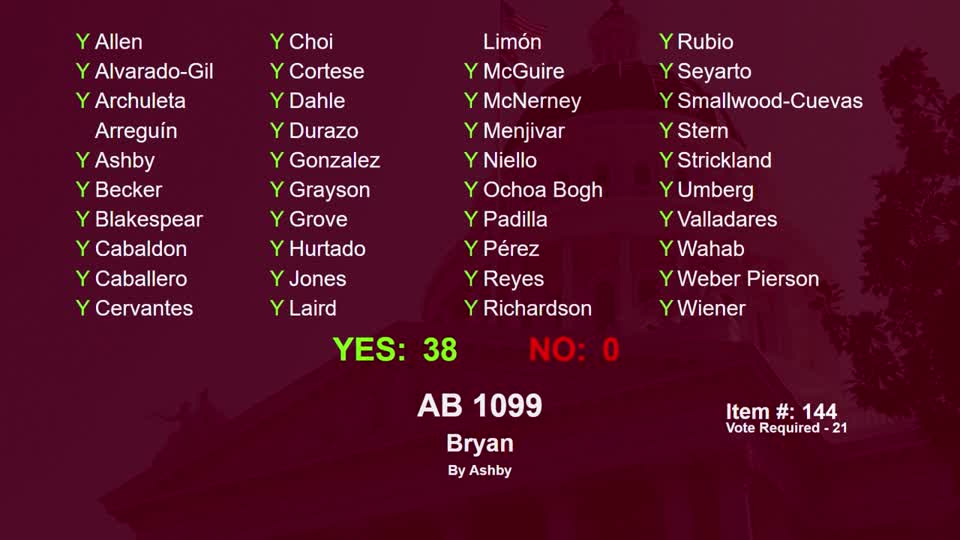 1MIN
Senate Floor
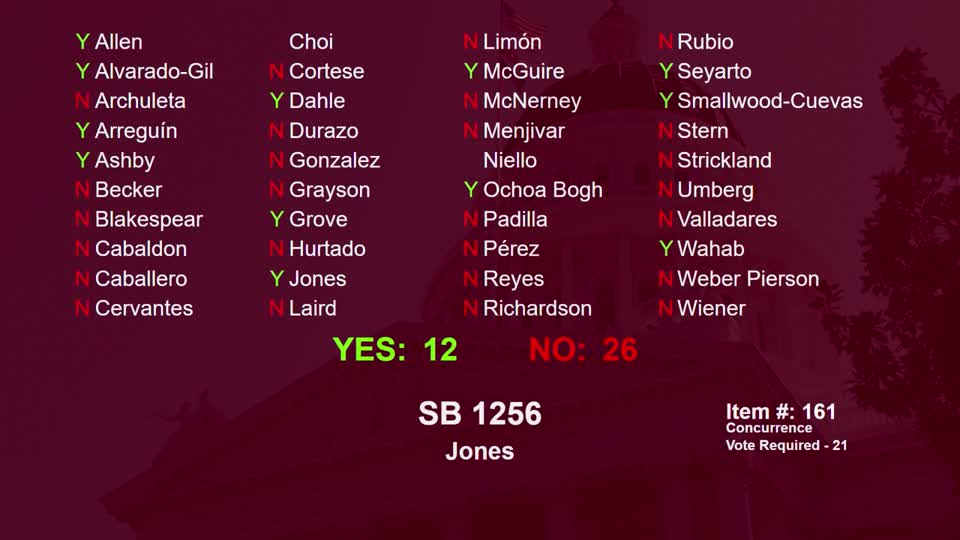 3MIN
Senate Floor
 5MIN
Assembly Floor
 48MIN
Assembly Standing Committee on Housing and Community Development
 23MIN
Assembly Standing Committee on Local Government
 3MIN
Senate Floor
 35MIN
Senate Standing Committee on Judiciary
Bill Author

Bill Co-Author(s):