SB 1097: California Environmental Quality Act: electrical distribution: exemptions.
- Session Year: 2025-2026
- House: Senate
- Latest Version Date: 2026-04-23
Current Status:
In Progress
(2026-05-14: May 14 hearing: Held in committee and under submission.)
Introduced
In Committee
Awaiting First Chamber Vote
Passed First Chamber
In Committee
Awaiting Second Chamber Vote
Passed Second Chamber
Enacted
The California Environmental Quality Act (CEQA) requires a lead agency, as defined, to prepare, or cause to be prepared, and certify the completion of an environmental impact report (EIR) on a project that the lead agency proposes to carry out or approve that may have a significant effect on the environment or to adopt a negative declaration if it finds that the project will not have that effect. CEQA also requires a lead agency to prepare a mitigated negative declaration for a project that may have a significant effect on the environment if revisions in the project would avoid or mitigate that effect and there is no substantial evidence that the project, as revised, would have a significant effect on the environment.
This bill would exempt from CEQA projects that consist of the inspection, maintenance, repair, restoration, reconditioning, reconductoring with advanced conductors, replacement, or removal of a an existing transmission wire or cable used to conduct electricity or other piece of equipment that is directly attached to the wire or cable and that meet certain requirements. requirements, including, among other things, that for a project that is not located on a sensitiva site, the project is undertaken entirely within an existing right-of-way. For projects that are located on a sensitive site, as defined, the bill would also require that the project not increase the footprint of the existing transmission line by more than 10%. In addition to those requirements, for projects that are located within a national park, a national monument, a national wilderness area, or a national recreation area, the bill would also require that the existing right-of-way that the project is undertaken within have a certified EIR, negative declaration, or mitigated negative declaration. For any of these above-described projects that are undertaken within a private right-of-way, the bill would require the project applicant to obtain permission from each underlying property owner to access the property for the project and to enter into an agreement to restore the right-of-way to its condition before the commencement of the project. If a lead agency determines that a project is exempt from CEQA pursuant to the above-described provision, the bill would require the lead agency to file a notice of exemption with the Office of Land Use and Climate Innovation and the county clerk in each county in which the project is located, as provided. By increasing the duties of a lead agency, the bill would impose a state-mandated local program.
This bill would, for a project to construct (1) a solar photovoltaic or terrestrial wind electrical generating powerplant, (2) an energy storage system, (3) a stationary electrical generating powerplant using any source of thermal energy, as provided, or (4) specified overhead electrical transmission lines, establish a modified approval process for a lead agency to follow when approving those projects, as provided. In order to use the modified approval process, the bill would require certain of these projects to not be located on specified lands and, for a project to construct specified overhead electrical transmission lines, to, among other things, not include construction that physically disturbs specified lands, as provided. The bill would, for the above-described projects, require that the lead agency determine, based upon substantial evidence in light of the whole record before the lead agency, that it is more likely than not that a project will have a significant effect on the environment, as defined, for purposes of the preparation of an EIR. Because the bill would require a lead agency to make these determinations, the bill would impose a state-mandated local program.CEQA provides that the existence of a public controversy over the environmental effects of a project shall not require the preparation of an EIR if there is no substantial evidence in light of the whole record before the lead agency that the project may have a significant effect on the environment.This bill would instead provide, for the above-described projects, that the existence of public controversy over the environmental effects of a project shall not require preparation of an EIR if an EIR would not otherwise be required by CEQA. The bill would also require that an action or proceeding brought to attack, review, set aside, void, or annul the adoption of a negative declaration or mitigated negative declaration as described above, or the granting of any project approvals, including any potential appeals to the court of appeal or the Supreme Court, be resolved, to the extent feasible, within 270 days of the filing of the certified record of proceedings with the court.The California Constitution requires the state to reimburse local agencies and school districts for certain costs mandated by the state. Statutory provisions establish procedures for making that reimbursement.
This bill would provide that no reimbursement is required by this act for a specified reason.
The California Environmental Quality Act (CEQA) requires a lead agency, as defined, to prepare, or cause to be prepared, and certify the completion of an environmental impact report (EIR) on a project that the lead agency proposes to carry out or approve that may have a significant effect on the environment or to adopt a negative declaration if it finds that the project will not have that effect. CEQA also requires a lead agency to prepare a mitigated negative declaration for a project that may have a significant effect on the environment if revisions in the project would avoid or mitigate that effect and there is no substantial evidence that the project, as revised, would have a significant effect on the environment.
This bill would exempt from CEQA projects that consist of the inspection, maintenance, repair, restoration, reconditioning, reconductoring with advanced conductors, replacement, or removal of a transmission wire or cable used to conduct electricity or other piece of equipment that is directly attached to the wire or cable and that meet certain requirements. If a lead agency determines that a project is exempt from CEQA pursuant to the above-described provision, the bill would require the lead agency to file a notice of exemption with the Office of Land Use and Climate Innovation and the county clerk in each county in which the project is located, as provided. By increasing the duties of a lead agency, the bill would impose a state-mandated local program.
This bill would, for a project to construct (1) a solar photovoltaic or terrestrial wind electrical generating powerplant, (2) an energy storage system, (3) a stationary electrical generating powerplant using any source of thermal energy, as provided, or (4) specified overhead electrical transmission lines, establish a modified approval process for a lead agency to follow when approving those projects, as provided. In order to use the modified approval process, the bill would require certain of these projects to not be located on specified lands and, for a project to construct specified overhead electrical transmission lines, to, among other things, not include construction that physically disturbs specified lands, as provided. The bill would, for the above-described projects, require that the lead agency determine, based upon substantial evidence in light of the whole record before the lead agency, that it is more likely than not that a project will have a significant effect on the environment, as defined, for purposes of the preparation of an EIR. Because the bill would require a lead agency to make these determinations, the bill would impose a state-mandated local program.
CEQA provides that the existence of a public controversy over the environmental effects of a project shall not require the preparation of an EIR if there is no substantial evidence in light of the whole record before the lead agency that the project may have a significant effect on the environment.
This bill would instead provide, for the above-described projects, that the existence of public controversy over the environmental effects of a project shall not require preparation of an EIR if an EIR would not otherwise be required by CEQA. The bill would also require that an action or proceeding brought to attack, review, set aside, void, or annul the adoption of a negative declaration or mitigated negative declaration as described above, or the granting of any project approvals, including any potential appeals to the court of appeal or the Supreme Court, be resolved, to the extent feasible, within 270 days of the filing of the certified record of proceedings with the court.
The California Constitution requires the state to reimburse local agencies and school districts for certain costs mandated by the state. Statutory provisions establish procedures for making that reimbursement.
This bill would provide that no reimbursement is required by this act for a specified reason.
Existing law vests the State Energy Resources Conservation and Development Commission with exclusive jurisdiction to certify thermal powerplants, as defined.This bill would state the intent of the Legislature to enact subsequent legislation to streamline the permitting of energy generation, storage, and transmission projects given the increasing cost of energy and the need to quickly electrify to mitigate the impacts of climate change.Existing law vests the State Energy Resources Conservation and Development Commission with exclusive jurisdiction to certify thermal powerplants, as defined.
This bill would state the intent of the Legislature to enact subsequent legislation to streamline the permitting of energy generation, storage, and transmission projects given the increasing cost of energy and the need to quickly electrify to mitigate the impacts of climate change.
(a)This For purposes of this section, both of the following definitions apply:
(1)Reconductoring with advanced conductors has the same meaning as the term reconductored with advanced conductors is used in Section 454.58 of the Public Utilities Code.
(2)Sensitive site means any of the following areas:
(A)The state park system, as described in Article 1 (commencing with Section 5001) of Chapter 1 of Division 5.
(B)A wilderness area, as defined in Section 5093.32.
(C)A national park.
(D)A national monument.
(E)A national recreation area.
(F)A national wilderness area.
(G)Habitat for protected species identified as candidate, sensitive, or species of special status by state or federal agencies, fully protected species, or species protected by the federal Endangered Species Act of 1973 (16 U.S.C. Sec. 1531 et seq.), the California Endangered Species Act (Chapter 1.5 (commencing with Section 2050) of Division 3 of the Fish and Game Code), or the Native Plant Protection Act (Chapter 10 (commencing with Section 1900) of Division 2 of the Fish and Game Code).
(H)Lands with a conservation easement, as defined in Section 815.1 of the Civil Code and recorded as required by Section 815.5 of the Civil Code, unless the project is determined by the lead agency to be consistent with the terms or requirements of the easement.
(b)This division does not apply to a project that consists of the inspection, maintenance, repair, restoration, reconditioning, reconductoring with advanced conductors, replacement, or removal of a an existing transmission wire or cable used to conduct electricity or other piece of equipment that is directly attached to the wire or cable and that meets both all of the following requirements:
(1)(A)The For a project that is not located on a sensitive site, the project is undertaken entirely within an existing right-of-way.
(2)For a project that is located on a sensitive site, the project meets both of the following requirements:
(A)The project is undertaken entirely within an existing right-of-way.
(B)The project does not increase the footprint of the existing transmission line by more than 10 percent.
(3)For a project that is located on a national park, a national monument, a national wilderness area, or a national recreation area, the project meets both of the following requirements:
(A)The project is undertaken entirely within an existing right-of-way that has a certified environmental impact report, negative declaration, or mitigated negative declaration.
(B)The project does not increase the footprint of the existing transmission line by more than 10 percent.
(4)For a project that is located on any of the locations listed in paragraphs (1) to (3), inclusive, that is undertaken within a private right-of-way, the project meets both of the following requirements:
(B)For a project undertaken within a private right-of-way, the(A)The project applicant has permission from the each underlying property owner to access the property for the project.
(2)(B)The project applicant enters into a legally binding agreement to restore the right-of-way to its condition before the commencement of the project.
(b)(c)If the lead agency determines that a project is exempt from this division pursuant to this section, the lead agency shall file a notice of exemption with the Office of Land Use and Climate Innovation and with the county clerk in each county in which the project is located in a manner specified in subdivisions (b) and (c) of Section 21108 or subdivisions (b) and (c) of Section 21152.
(c)For purposes of this section, reconductoring with advanced conductors has the same meaning as the term used in subdivision (b) of Section 454.58 of the Public Utilities Code.SEC. 3.Section 21080.80 is added to the Public Resources Code, to read:21080.80.(a)Notwithstanding Sections 21064 and 21064.5, or any other law, the following terms shall apply for the purposes of this section.(1)Mitigated negative declaration means a negative declaration prepared for a project when the initial study has identified potentially significant effects on the environment, but (A) revisions in the project plans or proposals made by, or agreed to by, the applicant before the proposed negative declaration and initial study are released for public review would avoid or mitigate the effects to a point where no significant effect on the environment would occur, as determined by the lead agency based upon substantial evidence in the record, and (B) the lead agency has determined, based upon substantial evidence in the record, that the project, as revised, will not have a significant effect on the environment.(2)Negative declaration means a written statement briefly describing the reasons the lead agency has determined, based upon substantial evidence in the record, that the proposed project will not have a significant effect on the environment and does not require the preparation of an environmental impact report.(3)Significant effect on the environment means that the public agency has determined, based upon substantial evidence in the record, that the proposed project is more likely than not to have a significant effect on the environment.(b)Notwithstanding Section 21080 or any other provision of this division, this section applies to both of the following:(1)A project to construct a new facility if all of the following conditions are met:(A)The project is one of following project types:(i)A solar photovoltaic or terrestrial wind electrical generating powerplant and any facilities appurtenant thereto. (ii)An energy storage system as defined in Section 2835 of the Public Utilities Code. (iii)A stationary electrical generating powerplant using any source of thermal energy, excluding any powerplant that burns, uses, or relies on fossil or nuclear fuels.(B)The project is not located in any of the following locations:(i)The state park system, as described in Article 1 (commencing with Section 5001) of Chapter 1 of Division 5.(ii)A wilderness area, as defined in Section 5093.32.(iii)A marine protected area, as defined in Section 2852 of the Fish and Game Code.(iv)The national park system, as defined in Section 100102 of Title 54 of the United States Code.(v)A national recreation area.(vi)A national monument.(vii)The national wild and scenic rivers system, as defined in Section 1273 of Title 16 of the United States Code.(viii)Any ecological reserve or wildlife management area acquired and managed by the Department of Fish and Wildlife pursuant to Article 2 (commencing with Section 1525) or Article 4 (commencing with Section 1580) of Chapter 5 of Division 2 of the Fish and Game Code.(ix)A hazardous waste site that is listed pursuant to Section 65962.5 of the Government Code or a hazardous waste site designated by the Department of Toxic Substances Control pursuant to Article 5 (commencing with Section 78760) of Chapter 4 of Part 2 of Division 45 of the Health and Safety Code, unless either of the following apply:(I)The site is an underground storage tank site that received a uniform closure letter issued pursuant to subdivision (g) of Section 25296.10 of the Health and Safety Code based on closure criteria established by the State Water Resources Control Board for the use proposed by the project. This paragraph does not alter or change the conditions to remove a site from the list of hazardous waste sites listed pursuant to Section 65962.5 of the Government Code.(II)The State Department of Public Health, State Water Resources Control Board, Department of Toxic Substances Control, or a local agency making a determination pursuant to subdivision (c) of Section 25296.10 of the Health and Safety Code has otherwise determined that the site is suitable for the use proposed by the project.(x)Within a regulatory floodway as determined by the Federal Emergency Management Agency in any official maps published by the Federal Emergency Management Agency, unless the development has received a no-rise certification in accordance with Section 60.3(d)(3) of Title 44 of the Code of Federal Regulations.(xi)Lands under conservation easement.(xii)On, or within a 300-foot radius of, a wetland, as defined in the United States Fish and Wildlife Service Manual, Part 660 FW 2 (June 21, 1993). (xiii)An environmentally sensitive area within the coastal zone, as defined in Section 30107.5. (xiv)Lands identified for protection from development in an adopted natural community conservation plan pursuant to the Natural Community Conservation Planning Act (Chapter 10 (commencing with Section 2800) of Division 3 of the Fish and Game Code), adopted habitat conservation plan pursuant to the federal Endangered Species Act of 1973 (16 U.S.C. Sec. 1531 et seq.), or other natural resource protection plan adopted by the city, county, or city and county.(xv)Within a very high fire hazard severity zone, as determined by the Department of Forestry and Fire Protection pursuant to Section 51178 of the Government Code, or within the state responsibility area, as defined in Section 4102. This subdivision does not apply to sites that have adopted fire hazard mitigation measures pursuant to existing building standards or state fire mitigation measures applicable to the development, including, but not limited to, standards established under all of the following provisions or their successor provisions:(I)Section 4291 of this code or Section 51182 of the Government Code, as applicable. (II)Section 4290. (III)Part 7 of Title 24 of the California Code of Regulations.(xvi)Either prime farmland or farmland of statewide importance, as defined pursuant to the United States Department of Agriculture land inventory and monitoring criteria, as modified for California, and designated on the maps prepared by the Farmland Mapping and Monitoring Program of the Department of Conservation, or land zoned or designated for agricultural protection or preservation by a local ballot measure that was approved by the voters of that jurisdiction.(2)An overhead electrical transmission line carrying electricity from a facility described in clauses (i) to (iii), inclusive, of subparagraph (A) of paragraph (1) that is located within the state to a point of junction with any interconnected electrical transmission system, if all of the following conditions are met:(A)Any portion of the project that is located within a high fire threat district designated a tier 2 or tier 3 fire threat area, as determined by the Public Utilities Commission, complies with the requirements set forth in General Order No. 95 of the Public Utilities Commission.(B)The project does not include construction that physically disturbs any of the following lands:(i)A hazardous waste site that is listed pursuant to Section 65962.5 of the Government Code or a hazardous waste site designated by the Department of Toxic Substances Control pursuant to Article 5 (commencing with Section 78760) of Chapter 4 of Part 2 of Division 45 of the Health and Safety Code, unless either of the following apply:(I)The site is an underground storage tank site that received a uniform closure letter issued pursuant to subdivision (g) of Section 25296.10 of the Health and Safety Code based on closure criteria established by the State Water Resources Control Board for the use proposed by the project. This paragraph does not alter or change the conditions to remove a site from the list of hazardous waste sites listed pursuant to Section 65962.5 of the Government Code.(II)The State Department of Public Health, State Water Resources Control Board, Department of Toxic Substances Control, or a local agency making a determination pursuant to subdivision (c) of Section 25296.10 of the Health and Safety Code has otherwise determined that the site is suitable for the use proposed by the project.(ii)Within a regulatory floodway as determined by the Federal Emergency Management Agency in any official maps published by the Federal Emergency Management Agency, unless the development has received a no-rise certification in accordance with Section 60.3(d)(3) of Title 44 of the Code of Federal Regulations.(iii)On, or within a 300-foot radius of, a wetland, as defined in the United States Fish and Wildlife Service Manual, Part 660 FW 2 (June 21, 1993).(iv)Within an environmentally sensitive area within the coastal zone, as defined in Section 30107.5.(v)Lands under conservation easement for preservation as wildlife habitat or for open-space purposes.(c)(1)Notwithstanding Section 21080 or any other provision of this division, for purposes of this section, if a lead agency determines that a proposed project, not otherwise exempt from this division, would not have a significant effect on the environment, the lead agency shall adopt a negative declaration to that effect. The negative declaration shall be prepared for the proposed project in either of the following circumstances:(A)The lead agency determines, based upon substantial evidence, in light of the whole record before the lead agency, that the project will not have a significant effect on the environment.(B)An initial study identifies potentially significant effects on the environment, but (i) revisions in the project plans or proposals made by, or agreed to by, the applicant before the proposed negative declaration and initial study are released for public review would avoid the effects or mitigate the effects to a point where no significant effect on the environment would occur, as determined by the public agency based upon substantial evidence on the record, and (ii) the lead agency has determined, based upon substantial evidence, in light of the whole record before the lead agency, that the project, as revised, will not have a significant effect on the environment.(2)If the lead agency determines, based upon substantial evidence, in light of the whole record before the lead agency, that it is more likely than not that the project will have a significant effect on the environment, an environmental impact report shall be prepared.(d)Notwithstanding Section 21082.2, for purposes of this section, all of the following shall apply:(1)The lead agency shall determine whether a project is more likely than not to have a significant effect on the environment based on substantial evidence in light of the whole record.(2)The existence of public controversy over the environmental effects of a project shall not require preparation of an environmental impact report if an environmental impact report would not otherwise be required by this division.(3)If the lead agency determines, based upon substantial evidence, in light of the whole record before the lead agency, that it is more likely than not that a project will have a significant effect on the environment, an environmental impact report shall be prepared.(4)Statements in an environmental impact report and comments with respect to an environmental impact report shall not be deemed determinative of whether the project may have a significant effect on the environment.(e)(1)For purposes of this section, substantial evidence includes fact, a reasonable assumption predicated upon fact, or expert opinion supported by fact.(2)Substantial evidence is not argument, speculation, unsubstantiated opinion or narrative, evidence that is clearly inaccurate or erroneous, or evidence of social or economic impacts that do not contribute to, or are not caused by, physical impacts on the environment.(f)As a result of the public review process for a mitigated negative declaration, including administrative decisions and public hearings, the lead agency may conclude that certain mitigation measures identified pursuant to subparagraph (B) of paragraph (1) of subdivision (c) are infeasible or otherwise undesirable. Under those circumstances, the lead agency, before approving the project, may delete those mitigation measures and substitute for them other mitigation measures that the lead agency finds, based upon substantial evidence in the record, after holding a public hearing on the matter, are equivalent or more effective in mitigating significant effects on the environment to a less than significant level and that do not cause any potentially significant effect on the environment. If those new mitigation measures are made conditions of project approval or are otherwise made part of the project approval, the deletion of the former measures and the substitution of the new mitigation measures shall not constitute an action or circumstance requiring recirculation of the mitigated negative declaration.(g)This section does not preclude a project applicant or any other person from challenging, in an administrative or judicial proceeding, the legality of a condition of project approval imposed by the lead agency. If, however, any condition of project approval set aside by either an administrative body or court was necessary to avoid or lessen the likelihood of the occurrence of a significant effect on the environment, the lead agencys approval of the negative declaration and project shall be invalid and a new environmental review process shall be conducted before the project can be reapproved, unless the lead agency substitutes a new condition that the lead agency finds, after holding a public hearing on the matter, is equivalent to, or more effective in, lessening or avoiding significant effects on the environment and that does not cause any potentially significant effect on the environment.(h)The provisions of this division, except for Sections 21064, 21064.5, 21080, and 21080.2, shall apply to the review of a negative declaration or mitigated negative declaration for a project described in subdivision (b) to the extent not inconsistent with this section or with the application of the substantial evidence standard of review.(i)An action or proceeding brought to attack, review, set aside, void, or annul the adoption of a negative declaration or mitigated negative declaration subject to this chapter or the granting of any project approvals, including any potential appeals to the court of appeal or the Supreme Court, shall be resolved, to the extent feasible, within 270 days of the filing of the certified record of proceedings with the court.SEC. 4.SEC. 2.No reimbursement is required by this act pursuant to Section 6 of Article XIIIB of the California Constitution because a local agency or school district has the authority to levy service charges, fees, or assessments sufficient to pay for the program or level of service mandated by this act, within the meaning of Section 17556 of the Government Code.
The Legislature finds and declares both of the following:
(a)The projects listed in subdivision (b) of Section 21080.80 of the Public Resources Code are necessary to achieve the clean energy policy of The 100 Percent Clean Energy Act of 2018 (Chapter 312 of the Statutes of 2018).
(b)Application of the substantial evidence standard of review, instead of the fair argument standard, to the review of negative declarations and mitigated negative declarations for projects described in subdivision (b) of Section 21080.80 of the Public Resources Code furthers Californias clean energy and climate goals, and therefore results in the greatest long-term environmental benefits.
SEC. 2.Section 21080.39 is added to the Public Resources Code, to read:21080.39.(a)This division does not apply to a project that consists of the inspection, maintenance, repair, restoration, reconditioning, reconductoring with advanced conductors, replacement, or removal of a transmission wire or cable used to conduct electricity or other piece of equipment that is directly attached to the wire or cable and that meets both of the following requirements:
(1)(A)The project is undertaken within an existing right-of-way.
(B)For a project undertaken within a private right-of-way, the project applicant has permission from the underlying property owner to access the property for the project.
(2)The project applicant enters into a legally binding agreement to restore the right-of-way to its condition before the commencement of the project.
(b)If the lead agency determines that a project is exempt from this division pursuant to this section, the lead agency shall file a notice of exemption with the Office of Land Use and Climate Innovation and with the county clerk in each county in which the project is located in a manner specified in subdivisions (b) and (c) of Section 21108 or subdivisions (b) and (c) of Section 21152.
(c)For purposes of this section, reconductoring with advanced conductors has the same meaning as the term used in subdivision (b) of Section 454.58 of the Public Utilities Code.
SEC. 3.Section 21080.80 is added to the Public Resources Code, to read:21080.80.(a)Notwithstanding Sections 21064 and 21064.5, or any other law, the following terms shall apply for the purposes of this section.
(1)Mitigated negative declaration means a negative declaration prepared for a project when the initial study has identified potentially significant effects on the environment, but (A) revisions in the project plans or proposals made by, or agreed to by, the applicant before the proposed negative declaration and initial study are released for public review would avoid or mitigate the effects to a point where no significant effect on the environment would occur, as determined by the lead agency based upon substantial evidence in the record, and (B) the lead agency has determined, based upon substantial evidence in the record, that the project, as revised, will not have a significant effect on the environment.
(2)Negative declaration means a written statement briefly describing the reasons the lead agency has determined, based upon substantial evidence in the record, that the proposed project will not have a significant effect on the environment and does not require the preparation of an environmental impact report.
(3)Significant effect on the environment means that the public agency has determined, based upon substantial evidence in the record, that the proposed project is more likely than not to have a significant effect on the environment.
(b)Notwithstanding Section 21080 or any other provision of this division, this section applies to both of the following:
(1)A project to construct a new facility if all of the following conditions are met:
(A)The project is one of following project types:
(i)A solar photovoltaic or terrestrial wind electrical generating powerplant and any facilities appurtenant thereto.
(ii)An energy storage system as defined in Section 2835 of the Public Utilities Code.
(iii)A stationary electrical generating powerplant using any source of thermal energy, excluding any powerplant that burns, uses, or relies on fossil or nuclear fuels.
(B)The project is not located in any of the following locations:
(i)The state park system, as described in Article 1 (commencing with Section 5001) of Chapter 1 of Division 5.
(ii)A wilderness area, as defined in Section 5093.32.
(iii)A marine protected area, as defined in Section 2852 of the Fish and Game Code.
(iv)The national park system, as defined in Section 100102 of Title 54 of the United States Code.
(v)A national recreation area.
(vi)A national monument.
(vii)The national wild and scenic rivers system, as defined in Section 1273 of Title 16 of the United States Code.
(viii)Any ecological reserve or wildlife management area acquired and managed by the Department of Fish and Wildlife pursuant to Article 2 (commencing with Section 1525) or Article 4 (commencing with Section 1580) of Chapter 5 of Division 2 of the Fish and Game Code.
(ix)A hazardous waste site that is listed pursuant to Section 65962.5 of the Government Code or a hazardous waste site designated by the Department of Toxic Substances Control pursuant to Article 5 (commencing with Section 78760) of Chapter 4 of Part 2 of Division 45 of the Health and Safety Code, unless either of the following apply:
(I)The site is an underground storage tank site that received a uniform closure letter issued pursuant to subdivision (g) of Section 25296.10 of the Health and Safety Code based on closure criteria established by the State Water Resources Control Board for the use proposed by the project. This paragraph does not alter or change the conditions to remove a site from the list of hazardous waste sites listed pursuant to Section 65962.5 of the Government Code.
(II)The State Department of Public Health, State Water Resources Control Board, Department of Toxic Substances Control, or a local agency making a determination pursuant to subdivision (c) of Section 25296.10 of the Health and Safety Code has otherwise determined that the site is suitable for the use proposed by the project.
(x)Within a regulatory floodway as determined by the Federal Emergency Management Agency in any official maps published by the Federal Emergency Management Agency, unless the development has received a no-rise certification in accordance with Section 60.3(d)(3) of Title 44 of the Code of Federal Regulations.
(xi)Lands under conservation easement.
(xii)On, or within a 300-foot radius of, a wetland, as defined in the United States Fish and Wildlife Service Manual, Part 660 FW 2 (June 21, 1993).
(xiii)An environmentally sensitive area within the coastal zone, as defined in Section 30107.5.
(xiv)Lands identified for protection from development in an adopted natural community conservation plan pursuant to the Natural Community Conservation Planning Act (Chapter 10 (commencing with Section 2800) of Division 3 of the Fish and Game Code), adopted habitat conservation plan pursuant to the federal Endangered Species Act of 1973 (16 U.S.C. Sec. 1531 et seq.), or other natural resource protection plan adopted by the city, county, or city and county.
(xv)Within a very high fire hazard severity zone, as determined by the Department of Forestry and Fire Protection pursuant to Section 51178 of the Government Code, or within the state responsibility area, as defined in Section 4102. This subdivision does not apply to sites that have adopted fire hazard mitigation measures pursuant to existing building standards or state fire mitigation measures applicable to the development, including, but not limited to, standards established under all of the following provisions or their successor provisions:
(I)Section 4291 of this code or Section 51182 of the Government Code, as applicable.
(II)Section 4290.
(III)Part 7 of Title 24 of the California Code of Regulations.
(xvi)Either prime farmland or farmland of statewide importance, as defined pursuant to the United States Department of Agriculture land inventory and monitoring criteria, as modified for California, and designated on the maps prepared by the Farmland Mapping and Monitoring Program of the Department of Conservation, or land zoned or designated for agricultural protection or preservation by a local ballot measure that was approved by the voters of that jurisdiction.
(2)An overhead electrical transmission line carrying electricity from a facility described in clauses (i) to (iii), inclusive, of subparagraph (A) of paragraph (1) that is located within the state to a point of junction with any interconnected electrical transmission system, if all of the following conditions are met:
(A)Any portion of the project that is located within a high fire threat district designated a tier 2 or tier 3 fire threat area, as determined by the Public Utilities Commission, complies with the requirements set forth in General Order No. 95 of the Public Utilities Commission.
(B)The project does not include construction that physically disturbs any of the following lands:
(i)A hazardous waste site that is listed pursuant to Section 65962.5 of the Government Code or a hazardous waste site designated by the Department of Toxic Substances Control pursuant to Article 5 (commencing with Section 78760) of Chapter 4 of Part 2 of Division 45 of the Health and Safety Code, unless either of the following apply:
(I)The site is an underground storage tank site that received a uniform closure letter issued pursuant to subdivision (g) of Section 25296.10 of the Health and Safety Code based on closure criteria established by the State Water Resources Control Board for the use proposed by the project. This paragraph does not alter or change the conditions to remove a site from the list of hazardous waste sites listed pursuant to Section 65962.5 of the Government Code.
(II)The State Department of Public Health, State Water Resources Control Board, Department of Toxic Substances Control, or a local agency making a determination pursuant to subdivision (c) of Section 25296.10 of the Health and Safety Code has otherwise determined that the site is suitable for the use proposed by the project.
(ii)Within a regulatory floodway as determined by the Federal Emergency Management Agency in any official maps published by the Federal Emergency Management Agency, unless the development has received a no-rise certification in accordance with Section 60.3(d)(3) of Title 44 of the Code of Federal Regulations.
(iii)On, or within a 300-foot radius of, a wetland, as defined in the United States Fish and Wildlife Service Manual, Part 660 FW 2 (June 21, 1993).
(iv)Within an environmentally sensitive area within the coastal zone, as defined in Section 30107.5.
(v)Lands under conservation easement for preservation as wildlife habitat or for open-space purposes.
(c)(1)Notwithstanding Section 21080 or any other provision of this division, for purposes of this section, if a lead agency determines that a proposed project, not otherwise exempt from this division, would not have a significant effect on the environment, the lead agency shall adopt a negative declaration to that effect. The negative declaration shall be prepared for the proposed project in either of the following circumstances:
(A)The lead agency determines, based upon substantial evidence, in light of the whole record before the lead agency, that the project will not have a significant effect on the environment.
(B)An initial study identifies potentially significant effects on the environment, but (i) revisions in the project plans or proposals made by, or agreed to by, the applicant before the proposed negative declaration and initial study are released for public review would avoid the effects or mitigate the effects to a point where no significant effect on the environment would occur, as determined by the public agency based upon substantial evidence on the record, and (ii) the lead agency has determined, based upon substantial evidence, in light of the whole record before the lead agency, that the project, as revised, will not have a significant effect on the environment.
(2)If the lead agency determines, based upon substantial evidence, in light of the whole record before the lead agency, that it is more likely than not that the project will have a significant effect on the environment, an environmental impact report shall be prepared.
(d)Notwithstanding Section 21082.2, for purposes of this section, all of the following shall apply:
(1)The lead agency shall determine whether a project is more likely than not to have a significant effect on the environment based on substantial evidence in light of the whole record.
(2)The existence of public controversy over the environmental effects of a project shall not require preparation of an environmental impact report if an environmental impact report would not otherwise be required by this division.
(3)If the lead agency determines, based upon substantial evidence, in light of the whole record before the lead agency, that it is more likely than not that a project will have a significant effect on the environment, an environmental impact report shall be prepared.
(4)Statements in an environmental impact report and comments with respect to an environmental impact report shall not be deemed determinative of whether the project may have a significant effect on the environment.
(e)(1)For purposes of this section, substantial evidence includes fact, a reasonable assumption predicated upon fact, or expert opinion supported by fact.
(2)Substantial evidence is not argument, speculation, unsubstantiated opinion or narrative, evidence that is clearly inaccurate or erroneous, or evidence of social or economic impacts that do not contribute to, or are not caused by, physical impacts on the environment.
(f)As a result of the public review process for a mitigated negative declaration, including administrative decisions and public hearings, the lead agency may conclude that certain mitigation measures identified pursuant to subparagraph (B) of paragraph (1) of subdivision (c) are infeasible or otherwise undesirable. Under those circumstances, the lead agency, before approving the project, may delete those mitigation measures and substitute for them other mitigation measures that the lead agency finds, based upon substantial evidence in the record, after holding a public hearing on the matter, are equivalent or more effective in mitigating significant effects on the environment to a less than significant level and that do not cause any potentially significant effect on the environment. If those new mitigation measures are made conditions of project approval or are otherwise made part of the project approval, the deletion of the former measures and the substitution of the new mitigation measures shall not constitute an action or circumstance requiring recirculation of the mitigated negative declaration.
(g)This section does not preclude a project applicant or any other person from challenging, in an administrative or judicial proceeding, the legality of a condition of project approval imposed by the lead agency. If, however, any condition of project approval set aside by either an administrative body or court was necessary to avoid or lessen the likelihood of the occurrence of a significant effect on the environment, the lead agencys approval of the negative declaration and project shall be invalid and a new environmental review process shall be conducted before the project can be reapproved, unless the lead agency substitutes a new condition that the lead agency finds, after holding a public hearing on the matter, is equivalent to, or more effective in, lessening or avoiding significant effects on the environment and that does not cause any potentially significant effect on the environment.
(h)The provisions of this division, except for Sections 21064, 21064.5, 21080, and 21080.2, shall apply to the review of a negative declaration or mitigated negative declaration for a project described in subdivision (b) to the extent not inconsistent with this section or with the application of the substantial evidence standard of review.
(i)An action or proceeding brought to attack, review, set aside, void, or annul the adoption of a negative declaration or mitigated negative declaration subject to this chapter or the granting of any project approvals, including any potential appeals to the court of appeal or the Supreme Court, shall be resolved, to the extent feasible, within 270 days of the filing of the certified record of proceedings with the court.
SEC. 4.No reimbursement is required by this act pursuant to Section 6 of Article XIIIB of the California Constitution because a local agency or school district has the authority to levy service charges, fees, or assessments sufficient to pay for the program or level of service mandated by this act, within the meaning of Section 17556 of the Government Code.
SECTION 1.It is the intent of the Legislature to enact subsequent legislation to streamline the permitting of energy generation, storage, and transmission projects given the increasing cost of energy and the need to quickly electrify to mitigate the impacts of climate change.It is the intent of the Legislature to enact subsequent legislation to streamline the permitting of energy generation, storage, and transmission projects given the increasing cost of energy and the need to quickly electrify to mitigate the impacts of climate change.
|
Date
|
Status
|
|---|---|
| May 14, 2026 | May 14 hearing: Held in committee and under submission. |
| May 12, 2026 | Set for hearing May 14. |
| May 11, 2026 | May 11 hearing: Placed on APPR. suspense file. |
| May 4, 2026 | Set for hearing May 11. |
| Apr 23, 2026 | Read second time and amended. Re-referred to Com. on APPR. |
| Apr 22, 2026 | From committee: Do pass as amended and re-refer to Com. on APPR. (Ayes 17. Noes 0. Page 3973.) (April 21). |
| Apr 22, 2026 | From committee: Do pass as amended and re-refer to Com. on APPR. (Ayes 17. Noes 0.) (April 21). |
| Apr 16, 2026 | Set for hearing April 21. |
| Apr 15, 2026 | From committee: Do pass and re-refer to Com. on E., U & C. (Ayes 5. Noes 0. Page 3900.) (April 15). Re-referred to Com. on E., U & C. |
| Apr 15, 2026 | From committee: Do pass and re-refer to Com. on E., U & C. (Ayes 5. Noes 0.) (April 15). Re-referred to Com. on E., U & C. |
| Apr 9, 2026 | Set for hearing April 15. |
| Apr 8, 2026 | Re-referred to Coms. on E.Q. and E., U & C. |
| Mar 25, 2026 | From committee with author's amendments. Read second time and amended. Re-referred to Com. on RLS. |
| Feb 26, 2026 | Referred to Com. on RLS. |
| Feb 17, 2026 | From printer. May be acted upon on or after March 16. |
| Feb 13, 2026 | Introduced. Read first time. To Com. on RLS. for assignment. To print. |
|
Date
|
Description
|
Location
|
Votes
|
|
|---|---|---|---|---|
| May 11, 2026 | Placed on suspense file | Senate Standing Committee on Appropriations |
Passed |
|
| Apr 21, 2026 | Do pass as amended, but first amend, and re-refer to the Committee on [Appropriations] | Senate Standing Committee on Energy, Utilities and Communications |
Passed |
|
| Apr 15, 2026 | Do pass, but first be re-referred to the Committee on [Energy, Utilities and Communications] | Senate Standing Committee on Environmental Quality |
Passed |
This list shows positions taken on this bill by organizations on the date displayed, which is linked to the original source.
Positions by individuals are not included.
|
Organization
|
Position
|
Date
|
|---|---|---|
| 350 Bay Area Action | ** Against | |
| Abundance Network | ** Support | |
| Advanced Energy United | ** Support | |
| American Clean Power- California | ** Support | |
| Anza-Borrego Foundation | ** Against | |
| Biofuelwatch | ** Against | |
| Borrego Village Association | ** Against | |
| California Coastal Protection Network | ** Against | |
| California Energy Storage Alliance | ** Support | |
| California Environmental Justice Alliance Action | ** Against | |
| California Farm Bureau | ** Against | |
| California Land Watch | ** Against | |
| California Native Plant Society | ** Against | |
| California Nurses for Environmental Health & Justice | ** Against | |
| California Overland Desert Excursions | ** Against | |
| California Preservation Foundation | ** Against | |
| California State Association Of Electrical Workers | ** Against | |
| California State Pipe Trades Council | ** Against | |
| california wildlife foundation | ** Against | |
| Center For Biological Diversity | ** Against | |
| Center for Community Action and Environmental Justice | ** Against | |
| Center For Environmental Health | ** Against | |
| Center on Race, Poverty & the Environment | ** Against | |
| Citizens for the Preservation of Parks & Beaches | ** Against | |
| cleanearth4kids.org | ** Against | |
| Clean Water Action | ** Against | |
| Cleveland National Forest Foundation | ** Against | |
| Climate Future California | ** Support | |
| Coalition of California Utility Employees | ** Against | |
| Communities for a Better Environment | ** Against | |
| Defenders Of Wildlife | ** Against | |
| Deploy Action | ** Support | |
| Earthjustice | ** Against | |
| Endangered Habitats League | ** Against | |
| Environmental Center of San Diego | ** Against | |
| Escondido Creek Conservancy | ** Against | |
| Forests Forever | ** Against | |
| Fresh Air Vallejo | ** Against | |
| Friends of Loma Alta Creek | ** Against | |
| Friends of Rose Canyon | ** Against | |
| Friends of the Lost Coast | ** Against | |
| Green Foothills | ** Against | |
| Independent Energy Producers Association | ** Support | |
| Large Scale Solar Association | ** Support | |
| Leadership Council for Justice and Accountability | ** Against | |
| Los Angeles Audubon Society | ** Against | |
| Los Angeles Waterkeeper | ** Against | |
| Napa Solano Audubon Society | ** Against | |
| Napa-Solano Audubon Society | ** Against | |
| National Parks Conservation Association | ** Against | |
| Planning And Conservation League | ** Against | |
| Prosperity Action | ** Support | |
| Rural County Representatives of California | ** Support | |
| San Diego Bird Alliance | ** Against | |
| San Francisco Bay Area Chapter Physicians for Social Responsibility | ** Against | |
| Santa Clara Valley Bird Alliance | ** Against | |
| Save Our Forest and Ranchlands | ** Against | |
| Save Our Heritage Organization | ** Against | |
| Save Palomar Mountain Task Force | ** Against | |
| Sierra Club California | ** Against | |
| Sierra Nevada Alliance | ** Against | |
| SoCal 350 Climate Action | ** Against | |
| Solano County Orderly Growth Committee | ** Against | |
| Solar Energy Industries Association | ** Support | |
| State Building & Construction Trades Council Of California | ** Against | |
| Supervisor John Gioia, Contra Costa County District 1 | ** Support | |
| The California Wind Energy Association (CALWEA) | ** Support | |
| The Urban Wildlands Group | ** Against | |
| Tubb Canyon Conservancy | ** Against | |
| We Advocate Thorough Environmental Review | ** Against | |
| Western States Council Sheet Metal, Air, Rail And Transportation | ** Against | |
| Wholly H2O | ** Against | |
| Youth United for Community Action | ** Against |
SENATE COMMITTEE ON
Senator Sabrina Cervantes, Chair
2025 - 2026 Regular Session
SB 1097 (Wiener) - California Environmental Quality Act: electrical distribution: exemptions
Version: | Policy Vote: |
Urgency: | Mandate: |
Hearing Date: | Consultant: |
Bill Summary:
This bill would establish a CEQA exemption for maintaining, reconductoring or replacing and removing transmission lines that meet certain conditions, including for projects that are located on federally and state protected lands.
Fiscal Impact:
- The California Public Utilities Commission (CPUC) estimates ongoing costs of $30 million annually (ratepayer funds) for 18 positions and consultant resources to review every electric project proposed by a utility. According to the CPUC, the current exemptions in CEQA and GO 131-E are in place to target review of projects that are deemed most impactful. Eliminating existing exemptions would result in project delays, increased costs, negatively impact the achievement of state’s environmental goals, and exacerbate current affordability issues.
- To the extent that the absence of CEQA review for projects that qualify for the exemption established by this bill results in damage to sensitive biological resources, cultural resources, wetlands, and other environmentally sensitive lands, it could result in increased state costs related to mitigation obligations and enforcement proceedings involving agencies such as the California Department of Fish and Wildlife, State Water Resources Control Board, Native American Heritage Commission, and California Coastal Commission.
- To this extent that transmission projects exempted from CEQA by this bill result in impacts to public lands, parks, conservation easements, and other protected landscapes that otherwise would not occur, unknown but potentially significant cost pressures (various funds) related to future restoration funding, habitat acquisition, wildfire risk reduction, erosion control, or species recovery.
- The Governor’s Office of Land Use and Climate Innovation (LCI) anticipates any costs would be minor and absorbable.
Background:
Transmission projects and permitting. Electric transmission lines are generally high voltage lines that move electricity from power plants to substations, which in turn connect to distribution lines in neighborhoods. Companies, usually electric investor-owned utilities (IOUs), proposing the construction of new transmission, are required to obtain a permit from the CPUC for construction of transmission projects. The CPUC reviews permit applications under two concurrent processes: (1) an environmental review pursuant to CEQA, and (2) the review of project need and costs pursuant to Public Utilities Code Section 1001 and General Order (GO) 131-D (CPCN).
As the CPUC conducts the CEQA review, it also reviews the electric IOU’s application for either a CPCN or a Permit to the Construct (PTC). Which application the CPUC pursues depends on the size of the project, specifically:
- Projects below 50 kV are considered distribution projects, rather than transmission projects, and in general do not require CPUC approval.
- Projects between 50 kV and 200 kV require a PTC from the CPUC, which consists primarily of an environmental review pursuant to CEQA. The CPUC process generally does not require a detailed analysis of the need for or economics of these projects.
- Projects over 200 kV require a CPCN from the CPUC. The CPCN process analyzes the need for the project and the economics of the project, as well as the environmental impacts of the project.
The CPUC’s decision on the CPCN or PTC cannot be issued until the environmental review is complete
Most projects are reviewed through the CPUC’s advice letter approval process, which tends to be more simplified and expedient than a full application for a CPCN. According to CPUC data, from 2012 to 2023, 608 projects have been exempted from CEQA, 29 projects have been approved via negative declaration, and 27 have required an EIR.
CEQA and permit streamlining for clean energy and transmission projects. In recent years, the Legislature and Governor’s Office have advanced a suite of policies to streamline clean energy projects and associated transmission lines.
Clean energy projects, including solar and wind projects, energy storage systems, power plants 50 MW or greater using any source of thermal energy, excluding fossil or nuclear fuels, and transmission lines associated with these generating and storage facilities, and facilities that manufacture or assemble clean energy or storage technologies or related components, and hydrogen production facilities that are not derived from fossil fuel are eligible for CEQA streamlining processes.
GO 131-E streamlining for electric transmission lines and existing CEQA exemptions. SB 529 (Hertzberg), Chapter 357, Statutes of 2022, directed the CPUC to revise General Order (GO) 131-D to authorize a utility to use the PTC process or claim an exemption to seek approval to construct an extension, expansion, upgrade, or other modification to its existing transmission facilities regardless of the voltage level.
On January 30, 2025, the CPUC adopted GO 131-E, replacing the previous GO 131-D. The new order establishes updated rules for the permitting, approval, and construction of electric transmission lines, substations, and generation facilities. It also clarifies and streamlines the regulatory process.
Reconductoring of powerlines. Conductors are the wires that carry electricity. Most of the existing electric grid uses conductors with a steel core for strength surrounded by aluminum for the electrical current. More recently, conductor designs (referred to as advanced conductors) with composite or carbon cores, in place of steel, have come into use. Advanced conductors provide a variety of benefits including increased capacity. By increasing the capacity of powerlines it is possible to get more electricity into the grid without the need to build new powerlines. The new composite or carbon cores replacing steel are also lighter, leading to less sag in the line which may reduce the chances of the line connecting with vegetation (which is a fire risk).
Proposed Law:
This bill would establish a CEQA exemption for maintaining, reconductoring or replacing and removing transmission lines that meet certain conditions, including for projects that are located on a sensitive site such as a state or national park, wilderness area, habitat for protected species, or lands with a conservation easement, as specified.
Related Legislation:
SB 607 (Wiener) would have overturned the fair argument standard in CEQA for all projects, among many other substantial changes to CEQA.
SB 529 (Hertzberg, Chapter 357, Statutes of 2022) exempts an extension, expansion, upgrade, or other modification of an existing transmission line or substations from the requirement of a CPCN and directed the CPUC to revise its GO, by January 1, 2024, to instead use its permit to construct process for these approvals.
AB 205 (Committee on Budget, Chapter 21, Statutes of 2022) allows certain energy projects, including electric transmission lines between certain non-fossil fuel energy generation facilities to become certified leadership projects under the Jobs and Economic Improvement Through Environmental Leadership Act of 2021 through a certification process through the CEC. With this certification, actions or proceedings related to the certification of an environmental impact report need to be resolves within 270 days to the extent feasible.
Staff Comments:
CPUC costs. According to the CPUC, there are 300-400 projects each year that are currently exempted from CEQA under the categorical exemption process. The CPUC believes these projects could require CEQA review under SB 1097 as currently written. The view of the CPUC is that language of this bill could be interpreted to require CEQA review for every project on a "sensitive site," which is defined broadly.
Environmental costs and cost pressures. CEQA review typically identifies impacts and requires avoidance, minimization, and mitigation for impacts that, when not mitigated by the project applicant, become operational costs borne by the property owner. While state lands are overseen and stewarded by many departments, California State Parks is probably the most obvious example. State Parks staff have typically identified the following categories of costs that CEQA review and mitigation would normally address:
- Staff time for project monitoring during construction and operation (including inspections that would identify management needs);
- Project inspection costs to verify compliance and site conditions;
- Wildfire fuel treatment and vegetation management in newly cleared areas;
- Invasive species management in disturbed soils and edge habitat;
- Habitat restoration and remediation following ground disturbance.
The absence of CEQA review, these activities could create state cost pressures impacting the department and its already limited resources. Something similar would likely play out across several state departments, including CDFW, CalFire, state conservancies, and the California Coastal Commission.
These risks would be exacerbated in wildfire prone areas where CEQA review often serves as a safeguard. Under this bill, when transmission line voltage or capacity is increased through reconductoring, there would be no attendant CEQA review considering the wildfire ignition risk associated with conductor failures or pole collapses. Such projects could become high risk. Higher probability of a wildfire ignition on state protected lands or sensitive habitat make it more likely that a park or other resource could be devastated by wildfire, which would generate significant fire suppression costs, in addition to the direct habitat loss and future restoration costs.
-- END --
SENATE COMMITTEE ON ENERGY, UTILITIES AND COMMUNICATIONS
Senator Benjamin Allen, Chair
2025 - 2026 Regular
Bill No: Hearing Date: 4/21/2026
Author: | |||
Version: | Amended | ||
Urgency: | Fiscal: | ||
Consultant: | |||
SUBJECT:
DIGEST: This bill creates a California Environmental Quality Act (CEQA) exemption for advanced reconductoring and replacing transmission lines and makes numerous changes to the CEQA process regarding how lead agencies and courts will determine what level of environmental review is appropriate for clean energy projects, overturning the ‘fair argument standard’ in existing law.
ANALYSIS:
Existing law:
- Establishes that U.S. Federal Energy Regulatory Commission (FERC) has exclusive jurisdiction over the transmission of electric energy in interstate commerce. Also establishes the process and procedures for establishing transmission of electric energy in interstate commerce by public utilities, i.e., the rates, terms & conditions of interstate electric transmission by public utilities. (Federal Power Act §§§201, 205, 206 (16 USC 824, 824d, 824e))
- Establishes and vests the California Public Utilities Commission (CPUC) with regulatory authority over public utilities, including electrical corporations. (Article XII of the California Constitution)
- Defines “reconductored with advanced conductors” to mean replacing the existing electric conductor with a conductor that has a direct current electrical resistance at least 10% lower than existing conductors of a similar diameter on the system and may include rebuilding support structures or other associated facilities. (Public Utilities Code §454.58)
- Requires the CPUC, by January 1, 2024, to update General Order (GO)131-D to authorize each public utility electrical corporation to use the permit-to-construct process or claim an exemption under Section III(B) of that general order to seek approval to construct an extension, expansion, upgrade, or other modification to its existing electrical transmission facilities, including electric transmission lines and substations within existing transmission easements, rights of way, or franchise agreements, irrespective of whether the electrical transmission facility is above a 200-kilovolt voltage (kV) level. (Public Utilities Code §564)
- Provides that the CPUC may supervise and regulate every public utility in the state and may do all things, whether specifically designated or in addition, which are convenient and necessary and in the exercise of such power and jurisdiction. (Public Utilities Code §701)
- Prohibits, via the Public Utilities Act, any electrical corporation from beginning the construction of, among other things, a line, plant, or system, or of any extension thereof, without having first obtained from the CPUC a certificate of public convenience and necessity (CPCN) that the present or future public convenience and necessity require or will require its construction, except that the extension, expansion, upgrade, or other modification of an existing electrical transmission facility, including transmission lines and substations, does not require a CPCN. (Public Utilities Code §1001)
- Requires the CPUC, in a proceeding evaluating the issuance of a CPCN for a proposed transmission project, to establish a rebuttable presumption with regard to need for the proposed transmission project in favor of a California Independent System Operator (CAISO) governing board-approved need evaluation if the project meets specified criteria. Specifically:
- The CAISO governing board has made explicit findings regarding the need for the proposed transmission project and has determined that the proposed project is the most cost-effective transmission solution.
- The CAISO is a party to the proceeding.
- The CAISO governing board-approved need evaluation is submitted to the CPUC within sufficient time to be included within the scope of the proceeding.
- There has been no substantial change to the scope, estimated cost, or timeline of the proposed transmission project as approved by the CAISO governing board.
(Public Utilities Code §1001.1)
- Requires the CPUC, in considering an application for a CPCN for an electric transmission facility, to consider cost‑effective alternatives to transmission facilities that meet the need for an efficient, reliable, and affordable supply of electricity, including demand-side alternatives such as targeted energy efficiency, ultraclean distributed generation, as defined, and other demand reduction resources. (Public Utilities Code §1002.3)
- Requires, pursuant to CEQA, lead agencies with the principal responsibility for carrying out or approving a project to prepare a negative declaration (ND), mitigated negative declaration (MND), or environmental impact report (EIR) for the project, unless the project is exempt from CEQA. (Public Resources Code §21000 et seq.). If a project may have a significant effect on the environment, the lead agency must prepare a draft EIR. (CEQA Guidelines §15064(a)(1), (f)(1))
- Establishes, pursuant to AB 205 (Committee on Budget, Chapter 61, Statutes of 2022) an “Opt-in” permitting process, by which authorized persons proposing eligible facilities, including electrical transmission lines carrying electricity from certain generation facilities that are located in the state to a point of junction with any interconnected electrical transmission system, to file applications for certification, on or before June 30, 2029, with the California Energy Commission (CEC) to certify sites and related facilities. Provided that the CEC’s certification of sites and related facilities is in lieu of any permit, certificate, or similar document required by any state, local, or regional agency, except as specified, including the CPUC permit requirements. (Public Resources Code §25545 et seq.)
- Deems the sites and related facilities certified by the CEC as Environmental Leadership Development Projects (ELDPs) and makes them eligible for the judicial streamlining of such projects. (Public Resources Code §25545.13)
- Establishes the Jobs and Economic Improvement Through Environmental Leadership Act of 2021 which authorizes the Governor, until January 1, 2032, to certify ELDPs that meet specified requirements for certain streamlining benefits related to the CEQA. Repeals the Act on January 1, 2032. (Public Resources Code §21178 et seq.)
- Requires the CEQA Guidelines to include a list of classes of projects that have been determined by the Secretary of the Natural Resources Agency to not have a significant effect on the environment and that shall be exempt from CEQA. (Public Resources Code §21084). The list of “categorical exemptions” includes:
- Repair and maintenance of existing public or private facilities, involving negligible or no expansion of use, including existing facilities of both investor and publicly owned utilities used to provide electric power, natural gas, sewerage, or other public utility services. (Guidelines §15301)
- New construction or conversion of small structures, including electrical, gas, and other utility extensions of reasonable length to serve such construction. (Guidelines §15303)
This bill:
- Establishes a CEQA exemption for maintaining, reconductoring or replacing and removing transmission lines that are:
- Undertaken within an existing right of way (ROW), with permission from the property owner if it is a private ROW, on the condition that the applicant restore the ROW to its original condition.
- Requires that the lead agency file a notice of exemption with the Office of Land Use and Climate Innovation and with the county clerk in each county in which the project is located.
- Makes a series of changes to the legal standards by which lead agencies determine which level of environmental review is required for a certain clean energy projects, as defined. In summation, these changes result in overturning the ‘fair argument’ standard in current law, which finds that if there is a fair argument to be made that a project has a significant effect on the environment, the project should be evaluated in an EIR. Instead, a lead agency would determine that a project should do an ND/MND if there is any substantial evidence, as defined, that the project does not have a significant effect on the environment.
- Specifies that the existence of public controversy over the environmental effects of a project shall not require preparation of an EIR if an EIR would not otherwise be required by CEQA.
- Specifies that solar, wind, electric, electrical generating thermal powerplants (other than those relying on fossil or nuclear fuels) and energy storage systems that will be reviewed under the new standards in CEQA described above, shall not be located on:
- A state park, a wilderness area, a marine protected area;
- A national park, recreation area, monument, or national wild and scenic rivers system;
- Any ecological reserve or wildlife management area acquired and managed by the Department of Fish and Wildlife;
- A hazardous waste site unless the site is an underground storage tank site that received a uniform closure letter or The State Department of Public Health, State Water Resources Control Board, Department of Toxic Substances Control, or a local agency has otherwise determined that the site is suitable for the use proposed by the project;
- Within a regulatory floodway;
- Lands under conservation easement;
- On, or within a 300-foot radius of, a wetland;
- An environmentally sensitive area within the coastal zone;
- Lands identified for protection from development in an adopted natural community conservation plan, habitat conservation, or other natural resource protection plan;
- Within a very high fire hazard severity zone, unless the sites have adopted fire hazard mitigation measures pursuant to existing building standards or state fire mitigation measures applicable to the development; or
- Either prime farmland or farmland of statewide importance.
- Specifies that transmission lines that will be reviewed under the new standards in CEQA described above, shall not be located on:
- High fire threat district designated a tier 2 or tier 3 fire threat area;
- A hazardous waste site unless the site is an underground storage tank site that received a uniform closure letter or The State Department of Public Health, State Water Resources Control Board, Department of Toxic Substances Control, or a local agency has otherwise determined that the site is suitable for the use proposed by the project;
- Within a regulatory floodway;
- On, or within a 300-foot radius of, a wetland; or
- Lands under conservation easement for preservation as wildlife habitat or for open-space purposes.
- Requires that a lawsuit brought against the adoption of a ND or MND as described above, including appeals, shall be resolved, to the extent feasible, within 270 days of the filing of the certified record of proceedings with the court.
Background
From the Senate Environmental Quality Committee:
The A, B, C’s of CEQA. CEQA is designed to (a) make government agencies and the public aware of the environmental impacts of a proposed project, (b) ensure the public can take part in the review process, and (c) identify and implement measures to mitigate or eliminate any negative impact the project may have on the environment. CEQA is enforced by civil lawsuits that can challenge any project’s environmental review. Nonprofits, private individuals, public agencies, advocacy groups, and other organizations can all file lawsuits under CEQA.
ND/MND vs. EIR environmental review. Under CEQA, projects (unless they have a specific exemption) must undergo environmental analysis. This process starts with an initial study which determines what level of further environmental review is needed for a given project. If a project has no significant effects on the environment, or if those effects can be fully mitigated, the project can move forward with a ND or MND. If the initial study finds that the project has potential significant effects on the environment, then a full EIR is required. An EIR provides a more thorough environmental review of a proposed project, analyzing the significant direct and indirect environmental impacts of a proposed project on water quality, transportation, air quality and greenhouse gas emissions, terrestrial and aquatic biological resources, surface and subsurface hydrology, land use and agricultural resources, aesthetics, geology and soils, recreation, public services and utilities such as water supply and wastewater disposal, and cultural resources, among other factors. The EIR also includes proposed mitigation measures for any significant effects that it identifies. It also requires consideration of alternatives to the proposed project, and a consideration of cumulative and growth-inducing impacts.
Transmission projects and permitting. Electric transmission lines are generally high voltage lines that move electricity from electric generating facilities to substations, which in turn connect to distribution lines in neighborhoods. Companies, usually electric IOUs or third-party owners, proposing the construction of new transmission, are required to obtain a permit from the CPUC for construction of transmission projects. The CPUC reviews permit applications under two concurrent processes: (1) an environmental review pursuant to CEQA, and (2) the review of project need and costs pursuant to Public Utilities Code §1001 and GO 131-D (CPCN).
As the CPUC conducts the CEQA review, it also reviews the electric IOU’s application for either a CPCN or a Permit to the Construct (PTC). Which application the CPUC pursues depends on the size of the project, specifically:
- Projects below 50 kV are considered distribution projects, rather than transmission projects, and in general do not require CPUC approval.
- Projects between 50 kV and 200 kV require a PTC from the CPUC, which consists primarily of an environmental review pursuant to CEQA. The CPUC process generally does not require a detailed analysis of the need for or economics of these projects.
- Projects over 200 kV require a CPCN from the CPUC. The CPCN process analyzes the need for the project and the economics of the project, as well as the environmental impacts of the project.
The CPUC’s decision on the CPCN or PTC cannot be issued until the environmental review is complete. Most projects are reviewed through the CPUC’s advice letter approval process, which tends to be more simplified and expedient than a full application for a CPCN. According to CPUC data, from 2012 to 2023, 608 projects have been exempted from CEQA, 29 projects have been approved via negative declaration, and 27 have required an EIR.
GO 131-E streamlining for electric transmission lines and existing CEQA exemptions. SB 529 (Hertzberg, Chapter 357, Statutes of 2022), directed the CPUC to revise GO 131-D to authorize a utility to use the PTC process or claim an exemption to seek approval to construct an extension, expansion, upgrade, or other modification to its existing transmission facilities regardless of the voltage level. On January 30, 2025, the CPUC adopted GO 131-E, replacing the previous GO 131-D. The new order establishes updated rules for the permitting, approval, and construction of electric transmission lines, substations, and generation facilities. It also clarifies and streamlines the regulatory process. Some of these reforms include:
- Allow applicant-prepared draft CEQA documents: Applicants may submit draft CEQA documents alongside their applications, providing an alternative pathway that can accelerate environmental review. This approach reduces duplication and allows applicants to complete much of the required analysis in advance, streamlining the overall permitting process;
- Require pre-filing consultation: Applicants are now required to meet with CPUC staff at least six months before submitting their applications. This early engagement is intended to clarify requirements, address potential issues in advance, and support a more efficient and coordinated review process;
- Authorize a pilot program to explore faster CEQA review: A pilot program will be created to track CPUC CEQA review timelines and explore the potential for a faster CEQA review process for certain electric transmission projects;
- Implement presumption of need for projects: A “rebuttable presumption” will be implemented when the California Independent System Operator (CAISO) transmission planning process has already determined that a project is needed. This would streamline the CEQA review by removing CEQA’s alternative analyses for projects already determined to be needed by the CAISO; and
- Limits the range of reasonable alternatives to the proposed project in an initial draft EIR circulated for public comment to alternative routes or locations for construction of the relevant CAISO transmission plan approved electric project and the “no action” alternative.
Reconductoring of powerlines. Conductors are the wires that carry electricity. Most of the existing electric grid uses conductors with a steel core for strength surrounded by aluminum for the electrical current. Advanced reconductoring which is the replacement of a transmission line’s existing conductors with advanced conductors, essentially swapping out the Aluminum Conductor Steel Reinforced (ACSR) for a smaller composite core conductors that enable higher operating temperatures. According to a November 2023 Energy Institute at Haas paper, “Accelerating Transmission Expansion by Using Advanced Conductors in Existing Right-of-Way” by Emilia Chojkiewicz, et al. (Energy Institute WP 343), reconductoring holds significant potential for rapid transmission expansion. The advanced conductors can carry approximately twice as much power as conventional conductors. Advanced conductors use existing transmission towers and rights of way, thereby circumventing the land acquisition and permitting processes that can impede construction of new transmission lines. However, replacing conventional conductors with advanced conductors requires taking circuits out of service during the replacement or conducting live-line work, which carries additional risks, especially safety risks for the workforce and surrounding areas. Either approach can be challenging, and in some cases infeasible, when transmission constraints exist.
Comments
Need for this bill. According to the author:
California must use every lever available to lower energy costs while tackling the climate crisis. The state needs to rapidly ramp up its deployment of clean energy and transmission infrastructure to meet our growing electricity needs, but far too many projects are getting caught up in permitting delays and lawsuits. SB 1097 would expedite advanced reconductoring projects that increase capacity of our existing grid infrastructure and reduce wildfire risk.
SB 1097 is critical to ensuring that California can make the clean energy progress we need to stabilize energy prices and meet our climate goals.
Need for expanded transmission capacity. In order for the state to meet its clean energy goals, including achieving 100 percent clean energy by 2045, electric transmission capacity will likely need to grow significantly. The CAISO conducts its transmission planning process (TPP) to identify potential transmission system limitations as well as opportunities for system reinforcements that improve reliability and efficiency. The annual transmission plan fulfils CAISO’s core responsibility to identify and plan the development of solutions, transmission or otherwise, to meet the future needs of the electricity grid. The CAISO identifies projects that address grid reliability requirements, identify upgrades needed to successfully meet California’s policy goals, and explore projects that can bring economic benefits to consumers. In 2021, the CAISO created a 20-Year Transmission Outlook for the electric grid, in collaboration with the CPUC and the CEC, with the goal of exploring the longer-term grid requirements and options for meeting the state’s SB 100 clean energy objectives reliably and cost-effectively. The 20-Year Transmission Outlook estimates a significant amount, and expense, to construct and expand transmission facilities, including an estimated $10.74 billion in upgrades to existing facilities.
Incoming! Amendments accepted in the Senate Environmental Quality Committee remove most provisions of this bill and recast the remaining proposed section of Public Resources Code §21080.39 which provides exemptions from CEQA for transmission projects that replace, repair, inspect, restore, reconductor with advanced reconductors, remove transmission wire or cable used to conduct electricity on non-sensitive and sensitive lands.
Is a CEQA exemption needed? As noted above, the vast majority of transmission projects are exempted from CEQA. According to the CPUC, only ~5% of transmission projects undergo CEQA review. Within that small subset, Environmental Impact Reports are rare and likely represent only a small fraction (well under 5%) of total projects. The overwhelming majority of projects—primarily reconductoring and upgrades—proceed under CEQA exemptions or streamlined review. Under the recently modified GO-131-E, the CPUC authorized reconductoring to qualify for streamlined permitting, but these projects are not eligible for exemption from environmental review where sensitive natural resources are present (CEQA Guidelines 15300.2).
Amendments. In addition to the amendments accepted in the Senate Environmental Quality Committee, the author and committee may wish to prohibit CEQA exemptions for transmission projects in sensitive areas, including state parks, national parks, national reserves, and other sensitive areas.
Dual referral. This bill passed out of the Senate Environmental Quality Committee on April 15, 2026 with a vote of 5-0.
Prior/Related Legislation
AB 2779 (Petrie-Norris, Chapter 741, Statutes of 2024) required the CAISO, upon approval of the annual transmission plan, to report on any new use of any grid enhancing technology and its associated cost and efficiency savings.
SB 1006 (Padilla, Chapter 597, Statutes of 2024) required electrical transmission utilities, by January 1, 2026, to develop studies on the feasibility of using grid-enhancing technologies and advanced reconductors, and specifies the content and cadence of those studies.
SB 607 (Wiener) of 2025, would have overturned the fair argument standard in CEQA for all projects, among many other substantial changes to CEQA. The bill was changed to a different subject area.
SB 529 (Hertzberg, Chapter 357, Statutes of 2022) exempt an extension, expansion, upgrade, or other modification of an existing transmission line or substations from the requirement of a CPCN and directed the CPUC to revise its GO, by January 1, 2024, to instead use its PTC process for these approvals.
AB 205 (Committee on Budget, Chapter 21, Statutes of 2022) allowed certain energy projects, including electric transmission lines between certain non-fossil fuel energy generation facilities to become certified leadership projects under the Jobs and Economic Improvement Through Environmental Leadership Act of 2021 through a certification process through the CEC. With this certification, actions or proceedings related to the certification of an EIR need to be resolved within 270 days to the extent feasible.
FISCAL EFFECT: Appropriation: Fiscal Com.: Local:
SUPPORT:
Abundance Network (Co-Sponsor)
Prosperity Action (Co-Sponsor)
Rural County Representatives of California (Co-Sponsor)
Supervisor John Gioia, Contra Costa County District 1
Advanced Energy United
Deploy Action
OPPOSITION:
350 Bay Area Action
Anza-Borrego Foundation
Biofuelwatch
Borrego Village Association
California Coastal Protection Network
California Environmental Justice Alliance Action
California Farm Bureau
California Land Watch
California Native Plant Society
California Nurses for Environmental Health & Justice
California Overland Desert Excursions
California Preservation Foundation
California State Association of Electrical Workers
California State Pipe Trades Council
California Wildlife Foundation
Center for Biological Diversity
Center for Community Action and Environmental Justice
Center for Environmental Health
Center on Race, Poverty & the Environment
Citizens for the Preservation of Parks & Beaches
Clean Water Action
CleanEarth4kids.org
Coalition of California Utility Employees
Communities for a Better Environment
Defenders of Wildlife
Earthjustice
Endangered Habitats League
Environmental Center of San Diego
Escondido Creek Conservancy
Fresh Air Vallejo
Friends of Loma Alta Creek
Friends of the Lost Coast
Green Foothills
Leadership Council for Justice and Accountability
Los Angeles Audubon Society
Los Angeles Waterkeeper
Napa-Solano Audubon Society
National Parks Conservation Association
Planning and Conservation League
San Diego Bird Alliance
San Francisco Bay Area Chapter Physicians for Social Responsibility
Santa Clara Valley Bird Alliance
Save Our Heritage Organization
Save Palomar Mountain Task Force
Sierra Club California
Sierra Nevada Alliance
SoCal 350 Climate Action
Solano County Orderly Growth Committee
State Building & Construction Trades Council of California
The Urban Wildlands Group
Tubb Canyon Conservancy
We Advocate Thorough Environmental Review
Western States Council Sheet Metal, Air, Rail and Transportation
Wholly H2O
Youth United for Community Action
ARGUMENTS IN SUPPORT: The sponsors of this bill, The Abundance Network, Prosperity Action, and Rural County Representatives of California, state:
SB 1097 creates a CEQA exemption for advanced reconductoring projects that increase the capacity of existing transmission infrastructure, allowing more electricity to be carried over existing transmission routes by replacing older, inefficient powerlines with newer technologies. …Advanced reconductoring will help California rapidly increase the capacity of its electrical grid to support existing and future energy demand, community development, and attainment of its ambitious clean energy goals. While existing CEQA exemptions apply to the repair or replacement of powerlines, those exemptions are limited to projects that involve negligible or no expansion of use. Advanced reconductoring projects increase the amount of electricity that can flow through existing facilities, thereby boosting capacity with minimal environmental impact. SB 1097’s CEQA exemption for advanced reconductoring is limited to projects undertaken within existing rights-of-way and requires environmental restoration to the conditions that existed before commencement of the project. By increasing the efficiency of existing powerlines and routes, SB 1097 will help offset the need for and environmental impact associated with building new transmission and distribution facilities to meet anticipated demand growth. The exemption will also help projects avoid costly and lengthy CEQA challenges that may be strongly motivated by non-environmental objectives. These benefits will translate into faster energization schedules and lower costs for ratepayers.
ARGUMENTS IN OPPOSITION: The California State Electrical Workers and the Coalition of California Utility Employees state:
[SB 1097 would]…categorically exempt from CEQA any project involving the inspection, maintenance, repair, restoration, reconditioning, reconductoring, replacement, or removal of transmission wires, cables, or directly attached equipment within an existing right-of-way. On its face this sounds narrow. It is not. The practical scope of this exemption is enormous. Transmission lines often cross hundreds or thousands of miles, have the potential to significantly disturb vegetation, wildlife habitat, sensitive soils, water crossings and communities along the corridor. Existing rights-of-way frequently pass through or immediately adjacent to sensitive biological resources, riparian zones and populated neighborhoods. CEQA review of such activities currently serves as an indispensable check on cumulative and site-specific impacts. SB 1097 would eliminate that check entirely.
-- END --
SENATE COMMITTEE ON ENVIRONMENTAL QUALITY
Senator Blakespear, Chair
2025 - 2026 Regular
Bill No: SB 1097
Author: | Wiener | ||
Version: | 3/25/2026 | Hearing Date: | 4/15/2026 |
Urgency: | No | Fiscal: | Yes |
Consultant: | Brynn Cook | ||
SUBJECT: California Environmental Quality Act: electrical distribution: clean energy: exemptions: standard of review
DIGEST: This bill creates a California Environmental Quality Act (CEQA) exemption for advanced reconductoring and replacing transmission lines, and makes numerous changes to the CEQA process regarding how lead agencies and courts will determine what level of environmental review is appropriate for clean energy projects, overturning the ‘fair argument standard’ in existing law.
ANALYSIS:
Existing law:
- Requires, pursuant to CEQA, lead agencies with the principal responsibility for carrying out or approving a project to prepare a negative declaration (ND), mitigated negative declaration (MND), or environmental impact report (EIR) for the project, unless the project is exempt from CEQA. (Public Resources Code (PRC) §21000 et seq.). If a project may have a significant effect on the environment, the lead agency must prepare a draft EIR. (CEQA Guidelines §15064(a)(1), (f)(1))
- Establishes legal standing for the lead agency selecting CEQA documents, specifically:
- NDs and MNDs are held to the “fair argument” standard, which means that if a “fair argument” can be made that a project may have a significant effect on the environment, an EIR shall be prepared even though there may be other substantial evidence that the project will not have a significant effect. (CEQA Guidelines § 15064(f)(1))
- Defines “substantial evidence” to mean that there is enough relevant information and reasonable inferences from this information that a fair argument can be made to support a conclusion, even though other conclusions might also be reached. (CEQA Guidelines § 15384)
- Defines “significant effect on the environment” to mean “a substantial or potentially substantial adverse change in any of the physical conditions within the area affected by the project including land, air, water, minerals, flora, fauna, ambient noise, and objects of historic or aesthetic significance. (CEQA Guidelines § 15382)
- Specifies that the existence of a public controversy over the environmental effects of a project shall not require the preparation of an EIR if there is no substantial evidence in light of the whole record before the lead agency that the project may have a significant effect on the environment. (CEQA Guidelines § 15064 (f)(4))
- Establishes, pursuant to AB 205 (Committee on Budget, Chapter 61, Statutes of 2022) an “Opt-in” permitting process, by which authorized persons proposing eligible facilities, including electrical transmission lines carrying electricity from certain other facilities that are located in the state to a point of junction with any interconnected electrical transmission system, to file applications for certification, on or before June 30, 2029, with the California Energy Commission (CEC)to certify sites and related facilities. Provided that the CEC’s certification of sites and related facilities is in lieu of any permit, certificate, or similar document required by any state, local, or regional agency, except as specified, including the California Public Utilities Commission (CPUC) permit requirements. (Public Resources Code §25545 et seq.)
- Deems the sites and related facilities certified by the CEC as Environmental Leadership Development Projects (ELDPs) and makes them eligible for the judicial streamlining of such projects. (Public Resources Code §25545.13)
- Establishes the Jobs and Economic Improvement Through Environmental Leadership Act of 2021 which authorizes the Governor, until January 1, 2032, to certify ELDPs that meet specified requirements for certain streamlining benefits related to the CEQA. Repeals the Act on January 1, 2032. (Public Resources Code §21178 et seq.)
- Requires the CEQA Guidelines to include a list of classes of projects that have been determined by the Secretary of the Natural Resources Agency to not have a significant effect on the environment and that shall be exempt from CEQA. (PRC 21084). The list of “categorical exemptions” includes:
- Repair and maintenance of existing public or private facilities, involving negligible or no expansion of use, including existing facilities of both investor and publicly owned utilities used to provide electric power, natural gas, sewerage, or other public utility services (Guidelines § 15301)
- New construction or conversion of small structures, including electrical, gas, and other utility extensions of reasonable length to serve such construction. (Guidelines § 15303)
- Requires the CPUC to certify the “public convenience and necessity” of a transmission line over 200 kilovolts (kV) before an investor-owned utility (IOU) may begin construction (Certificate of Public Convenience and Necessity, or CPCN). The CPCN process includes CEQA review of the proposed project. A CPCN confers eminent domain authority for construction of the project. A CPCN is not required for the extension, expansion, upgrade, or other modification of an existing electrical transmission facility, including transmission lines and substations. (Public Utilities Code (PUC) § 1001)
- Requires an IOU to obtain a discretionary permit to construct (PTC) from the CPUC for electrical power line projects between 50-200 kV. A PTC may be exempt from CEQA pursuant to CPUC orders and existing provisions of CEQA. IOU electrical distribution line projects under 50 kV do not require a CPCN or PTC from the CPUC, nor discretionary approval from local governments, and therefore are not subject to CEQA. (PUC General Order (GO) 131-E)
This bill:
- Establishes a CEQA exemption for maintaining, reconductoring or replacing and removing transmission lines that are:
- Undertaken within an existing right of way (ROW), with permission from the property owner if it is a private ROW, on the condition that the applicant restore the ROW to its original condition.
- Requires that the lead agency file a notice of exemption with the Office of Land Use and Climate Innovation (LCI) and with the county clerk in each county in which the project is located.
- Makes a series of changes to the legal standards by which lead agencies determine which level of environmental review is required for a certain clean energy projects, as defined. In summation, these changes result in overturning the ‘fair argument’ standard in current law, which finds that if there is a fair argument to be made that a project has a significant effect on the environment, the project should be evaluated in an EIR. Instead, a lead agency would determine that a project should do an ND/MND if there is any substantial evidence, as defined, that the project does not have a significant effect on the environment. Specifically, these changes to existing definitions include:
- Changing the definition of “mitigated negative declaration” by requiring that lead agencies should do a mitigated negative declaration if the project requires mitigation and substantial evidence shows that it does not have a significant effect on the environment: this overturns the more protective existing standard that “mitigated negative declarations” should be used only if there is no substantial evidence, in light of the whole record, that the project will have a significant effect on the environment;
- Changing the standard of “substantial evidence” from “substantial evidence shall include enough relevant information (facts, reasonable assumptions on the facts, and expert opinion supported by facts) that a fair argument, considering the whole record, can be made to support a conclusion, even though other conclusions might also be reached,” to “substantial evidence includes fact, a reasonable assumption predicated upon fact, or expert opinion supported by fact.” ;
- Changing the definition of “Significant effect on the environment” to mean that the public agency has determined, based upon substantial evidence in the record, that the proposed project is more likely than not to have a significant effect on the environment, replacing the existing definition of "Significant effect on the environment" as a substantial, or potentially substantial, adverse change in any of the physical conditions within the area affected by the project including land, air, water, minerals, flora, fauna, ambient noise, and objects of historic or aesthetic significance. An economic or social change by itself shall not be considered a significant effect on the environment. A social or economic change related to a physical change may be considered in determining whether the physical change is significant.
- Specifies that the existence of public controversy over the environmental effects of a project shall not require preparation of an EIR if an EIR would not otherwise be required by CEQA.
- Specifies that solar, wind, electric, electrical generating thermal powerplants (other than those relying on fossil or nuclear fuels) and energy storage systems that will be reviewed under the new standards in CEQA described above, shall not be located on:
- A state park, a wilderness area, a marine protected area;
- A national park, recreation area, monument, or national wild and scenic rivers system;
- Any ecological reserve or wildlife management area acquired and managed by the Department of Fish and Wildlife;
- A hazardous waste site unless the site is an underground storage tank site that received a uniform closure letter or The State Department of Public Health, State Water Resources Control Board, Department of Toxic Substances Control, or a local agency has otherwise determined that the site is suitable for the use proposed by the project;
- Within a regulatory floodway;
- Lands under conservation easement;
- On, or within a 300-foot radius of, a wetland;
- An environmentally sensitive area within the coastal zone;
- Lands identified for protection from development in an adopted natural community conservation plan, habitat conservation, or other natural resource protection plan;
- Within a very high fire hazard severity zone, unless the sites have adopted fire hazard mitigation measures pursuant to existing building standards or state fire mitigation measures applicable to the development; or
- Either prime farmland or farmland of statewide importance.
- Specifies that transmission lines that will be reviewed under the new standards in CEQA described above, shall not be located on:
- High fire threat district designated a tier 2 or tier 3 fire threat area;
- A hazardous waste site unless the site is an underground storage tank site that received a uniform closure letter or The State Department of Public Health, State Water Resources Control Board, Department of Toxic Substances Control, or a local agency has otherwise determined that the site is suitable for the use proposed by the project;
- Within a regulatory floodway;
- On, or within a 300-foot radius of, a wetland; or
- Lands under conservation easement for preservation as wildlife habitat or for open-space purposes.
- Requires that a lawsuit brought against the adoption of a negative declaration or mitigated negative declaration as described above, including appeals, shall be resolved, to the extent feasible, within 270 days of the filing of the certified record of proceedings with the court.
Background
- The A, B, C’s of CEQA. CEQA is designed to (a) make government agencies and the public aware of the environmental impacts of a proposed project, (b) ensure the public can take part in the review process, and (c) identify and implement measures to mitigate or eliminate any negative impact the project may have on the environment. CEQA is enforced by civil lawsuits that can challenge any project’s environmental review. Nonprofits, private individuals, public agencies, advocacy groups, and other organizations can all file lawsuits under CEQA.
- ND/MND vs. EIR environmental review. Under CEQA, projects (unless they have a specific exemption) must undergo environmental analysis. This process starts with an initial study which determines what level of further environmental review is needed for a given project. If a project has no significant effects on the environment, or if those effects can be fully mitigated, the project can move forward with a negative declaration (ND) or mitigated negative declaration (MND). If the initial study finds that the project has potential significant effects on the environment, then a full EIR is required. An EIR provides a more thorough environmental review of a proposed project, analyzing the significant direct and indirect environmental impacts of a proposed project on water quality, transportation, air quality and greenhouse gas emissions, terrestrial and aquatic biological resources, surface and subsurface hydrology, land use and agricultural resources, aesthetics, geology and soils, recreation, public services and utilities such as water supply and wastewater disposal, and cultural resources, among other factors. The EIR also includes proposed mitigation measures for any significant effects that it identifies. It also requires a consideration of alternatives to the proposed project, and a consideration of cumulative and growth-inducing impacts.
- Legal standing for EIR vs. ND/MND. When a lead agency is determining whether an ND/MND or EIR are appropriate for a project, they follow the evidentiary standards laid out in CEQA.
A lead agency’s determination to use an ND/MNDs or EIR is held to the “fair argument” standard, which means that if a “fair argument” can be made that a project may have a significant effect on the environment, an EIR shall be prepared even though there may be other substantial evidence that the project will not have a significant effect. Only if there are clearly no significant effects and no fair argument to be made that there are significant effects would an ND/MND be used (CEQA Guidelines § 15064(f)(1)). Another way of saying this is that the lead agency can pursue an ND/MND if there is no substantial evidence in light of the whole record before the public agency that the project, as revised, may have a significant effect on the environment” (§21064.5). - Transmission projects and permitting. Electric transmission lines are generally high voltage lines that move electricity from power plants to substations, which in turn connect to distribution lines in neighborhoods. Companies, usually electric investor-owned utilities (IOUs), proposing the construction of new transmission, are required to obtain a permit from the CPUC for construction of transmission projects. The CPUC reviews permit applications under two concurrent processes: (1) an environmental review pursuant to CEQA, and (2) the review of project need and costs pursuant to Public Utilities Code Section 1001 and General Order (GO) 131-D (CPCN).
As the CPUC conducts the CEQA review, it also reviews the electric IOU’s application for either a CPCN or a Permit to the Construct (PTC). Which application the CPUC pursues depends on the size of the project, specifically:
- Projects below 50 kV are considered distribution projects, rather than transmission projects, and in general do not require CPUC approval.
- Projects between 50 kV and 200 kV require a PTC from the CPUC, which consists primarily of an environmental review pursuant to CEQA. The CPUC process generally does not require a detailed analysis of the need for or economics of these projects.
- Projects over 200 kV require a CPCN from the CPUC. The CPCN process analyzes the need for the project and the economics of the project, as well as the environmental impacts of the project.
The CPUC’s decision on the CPCN or PTC cannot be issued until the environmental review is complete
Most projects are reviewed through the CPUC’s advice letter approval process, which tends to be more simplified and expedient than a full application for a CPCN. According to CPUC data, from 2012 to 2023, 608 projects have been exempted from CEQA, 29 projects have been approved via negative declaration, and 27 have required an EIR.
- CEQA and permit streamlining for clean energy and transmission projects. In recent years, the Legislature and Governor’s Office have advanced a suite of policies to streamline clean energy projects and associated transmission lines.
Clean energy projects, including solar and wind projects, energy storage systems, power plants 50 MW or greater using any source of thermal energy, excluding fossil or nuclear fuels, and transmission lines associated with these generating and storage facilities, and facilities that manufacture or assemble clean energy or storage technologies or related components, and hydrogen production facilities that are not derived from fossil fuel are eligible for the following CEQA streamlining processes:
- 270 day environmental review through the AB 205 opt-in process. In 2022, the Legislature passed AB 205 (Committee on Budget, Chapter 21, Statutes of 2022), which created an optional process for clean energy projects to get environmental review and permit streamlining through a one-stop-shop at the CEC, with the CEC as the lead CEQA agency. The Opt-In program requires the CEC to complete an EIR in 270 days, certify compliance with requirements for community benefits agreement, project labor agreements, and economic benefits, and ensure consistency with all laws, ordinances, regulations, and standards (LORS) under the Warren-Alquist Act.
- 270-day judicial review through AB 205 and the SB 149 ELDP process. The same clean energy projects that are eligible for shortened 270-day environmental review are also eligible for CEQA judicial streamlining, meaning that actions or proceedings related to the certification of an environmental impact report need to be resolved within 270 days to the extent feasible. This judicial streamlining is available to clean energy projects that meet high labor and environmental criteria to become certified leadership projects under the Jobs and Economic Improvement Through Environmental Leadership Act of 2021, and projects that go through the AB 205 opt-in process.
- GO 131-E streamlining for electric transmission lines and existing CEQA exemptions. SB 529 (Hertzberg), Chapter 357, Statutes of 2022, directed the CPUC to revise General Order (GO) 131-D to authorize a utility to use the PTC process or claim an exemption to seek approval to construct an extension, expansion, upgrade, or other modification to its existing transmission facilities regardless of the voltage level.
On January 30, 2025, the CPUC adopted GO 131-E, replacing the previous GO 131-D. The new order establishes updated rules for the permitting, approval, and construction of electric transmission lines, substations, and generation facilities. It also clarifies and streamlines the regulatory process. Some of these reforms include:- Allow applicant-prepared draft CEQA documents: Applicants may submit draft CEQA documents alongside their applications, providing an alternative pathway that can accelerate environmental review. This approach reduces duplication and allows applicants to complete much of the required analysis in advance, streamlining the overall permitting process;
- Require pre-filing consultation: Applicants are now required to meet with CPUC staff at least six months before submitting their applications. This early engagement is intended to clarify requirements, address potential issues in advance, and support a more efficient and coordinated review process;
- Authorize a pilot program to explore faster CEQA review: A pilot program will be created to track CPUC CEQA review timelines and explore the potential for a faster CEQA review process for certain electric transmission projects;
- Implement presumption of need for projects: A “rebuttable presumption” will be implemented when the California Independent System Operator (CAISO) transmission planning process has already determined that a project is needed. This would streamline the CEQA review by removing CEQA’s alternative analyses for projects already determined to be needed by the CAISO; and
- Limits the range of reasonable alternatives to the proposed project in an initial draft EIR circulated for public comment to alternative routes or locations for construction of the relevant CAISO transmission plan approved electric project and the “no action” alternative.
- Reconductoring of powerlines. Conductors are the wires that carry electricity. Most of the existing electric grid uses conductors with a steel core for strength surrounded by aluminum for the electrical current. More recently, conductor designs (referred to as advanced conductors) with composite or carbon cores, in place of steel, have come into use. Advanced conductors provide a variety of benefits including increased capacity. By increasing the capacity of powerlines it is possible to get more electricity into the grid without the need to build new powerlines. The new composite or carbon cores replacing steel are also lighter, leading to less sag in the line which may reduce the chances of the line connecting with vegetation (which is a fire risk).
Comments
Purpose of Bill. According to the author, “California must use every lever available to lower energy costs while tackling the climate crisis. The state needs to rapidly ramp up its deployment of clean energy and transmission infrastructure to meet our growing electricity needs, but far too many projects are getting caught up in permitting delays and lawsuits.
SB 1097 would expedite advanced reconductoring projects that increase capacity of our existing grid infrastructure and reduce wildfire risk. SB 1097 will also ensure that common sense, environmentally beneficial clean energy generation, storage, and transmission projects get constructed quickly.
SB 1097 is critical to ensuring that California can make the clean energy progress we need to stabilize energy prices and meet our climate goals”
- CEQA exemption for reconductoring. Reconductoring existing transmission lines can provide important benefits, including environmental benefits. Reconductored transmission lines have increased capacity compared to existing conductors with a steel core, meaning that more electricity can be carried through the same line. Having more power go through one, existing line, can reduce the number of new transmission lines that need to be built.
The CEQA Guidelines already contain two categorical exemptions that would seem to cover reconductoring and replacement for transmission lines, including CEQA exemptions for:
- Repair and maintenance of existing public or private facilities including existing facilities of both investor and publicly owned utilities. (Guidelines 15301)
- New construction or conversion of small structures, including electrical, gas, and other utility extensions of reasonable length to serve such construction. (Guidelines 15303)
However, since these are categorical exemptions, they only apply to projects that are presumed to have no significant effects on the environment (e.g. the exemptions do not apply to a project if there is a reasonable possibility that the activity will have a significant effect on the environment due to unusual circumstances). In this scenario, the CEQA exemption envisioned by SB 1097 would primarily benefit reconductoring for projects that could have a significant effect on the environment.
As written, the CEQA exemption for advanced reconductoring could include replacing the poles or towers that the wires are ‘directly attached to’ with new poles, or even replacing poles with metal towards that have a much larger footprint.
To ensure that reconductoring projects using this new statutory exemption in SB 1097 are not having significant adverse impacts on sensitive and protected lands, the author and committee may wish to amend this exemption to specify that the exemption will have more stringent criteria for projects that go through sensitive sites, as defined. Specifically, the exemption will only apply if the reconductoring does not expand the footprint of the transmission line or if the right of way where the CEQA exemption applies has been previously considered in environmental review under CEQA for projects on sensitive sites. Sensitive sites includes state parks; national parks, wilderness, and recreation areas; habitat for protected species; areas in habitat conservation and natural and community conservation plans, and conservation easements.
- Flipping the “Fair Argument” standard to favor less rigorous environmental review for clean energy projects. Under CEQA today, if there is a “fair argument” based on substantial evidence that a project has significant impacts on the environment, that project would go through the rigorous EIR process, rather than the less rigorous ND/MNDs review. In other words, CEQA errs on the side of requiring EIRs where there is a fair case to be made that the project would have significant impacts. This is an intentional preference for more environmental review when it is likely that there are significant impacts. In these scenarios, further environmental review may be necessary to determine if impacts are significant. It also reflects a consideration that the risk of doing unnecessary environmental review is less important than the risk of leaving environmental impacts undisclosed and unmitigated.
SB 1097 seeks to overturn this standard. It approaches this goal by changing—for the purposes of certain clean energy projects—many of the core definitions of CEQA, including how a ‘mitigated negative declaration’ is defined, how ‘substantial evidence’ is defined, and how “significant effect on the environment” is defined. SB 1097 allows lead agencies to forgo an EIR and instead do an ND/MND as long as there is more evidence than not that the project’s impacts will not be significant.
Put another way, under SB 1097, if a lead agency thinks that there is a 49% likelihood that a project has a significant effect on the environment, and a 51% likelihood that a project does not have a significant effect on the environment, the project would proceed under an ND/MND and not an EIR.
- More ND/MNDs, fewer EIRs: pros and cons. Practically speaking, the outcome of flipping the existing standard of review for EIRs vs. ND/MNDs will be fewer EIRs and more ND/MNDs for clean energy and transmission projects.
If an ND/MND provides sufficient environmental review, then doing the more rigorous and time-consuming EIR would be a waste of time and resources. In addition, lead agencies may currently err on the side of doing EIRs if the project is likely to be challenged since the “fair argument” standing in law today makes it easier to defend the decision to use EIR instead of an ND/MND.
On the other hand, using an ND/MND when there is substantial evidence that the project will have impacts on the environment could mean that significant impacts go undisclosed to decision makers or the public, community input is limited, and those impacts remain unmitigated.
Perhaps most significantly, MNDs do not include analyses of alternatives, or consideration of cumulative and growth-inducing impacts. For large scale projects, considering alternatives is an essential component of ensuring that the project’s site is chosen with environmental parameters in mind. Likewise, clean energy projects are likely to have significant growth-inducing and cumulative impacts that should be considered through an environmental lens.
- Speeding through unchartered waters? SB 1097 creates a new process with new standards for evaluating what environmental review documents should be used under CEQA, likely resulting in those projects moving forward with MNDs rather than with EIRs. This is intended to reduce the amount of time spent reviewing clean energy projects by moving clean energy projects through MD/MNDs, which are only a fraction of the length of EIR documents. If the environmental review done in EIRs is excessive for a given project, and moving environmental review for complex projects from an EIR to an ND/MND, SB 1097 could reduce timelines for clean energy projects: an important goal since the state lags significantly in achieving its clean energy goals.
However, it is not clear if EIRs environmental review is excessive for clean energy or merely appropriate. It is also not clear if moving complex projects that currently require EIRs into ND/MNDs would result in the time savings that apply to current EIRs vs. ND/MNDs, given that ND/MNDs do not currently contemplate such complex projects. ND/MNDs today are significantly shorter than EIRs because the projects they contemplate don’t have any outstanding effects on the environment, not because of some intrinsic property of an MND. Moving projects through MNDs when those projects have a 49% chance of having environmental projects could simply result in bulkier MNDs… and higher chances of litigation since the MND process of review, public engagement, and mitigation is not geared towards projects that still have a not-insignificant (49% or less) chance of having significant impacts on the environment.
Moreover, in changing definitions that have been baked into CEQA for decades for only a portion of the law, with new untested definitions, it is extremely likely that these projects and new standards of review will be subject to litigation, delaying the very projects they are intended to speed up.
Given that the Legislature and GO have recently adopted numerous streamlining measures for clean energy projects that work, SB 1097 creates a new process by which clean energy projects will be likely to have less thorough environmental review, rather than retaining the thorough environmental review in the EIR but moving those projects through faster timelines, as established by recent legislation in AB 205, SB 149, and in GO-131 E.
It is worth considering whether rejecting these very recent streamlining changes for clean energy in favor of new, untested changes to legal standard as proposed in SB 1097, which will take time for lead agencies and courts to become familiar and adept at interpreting, will result in time savings that would not otherwise have been achieved.
As such, the author and committee may wish to strike the portion of SB 1097 that overturns the fair argument standard for clean energy projects and related provisions including judicial streamlining for those clean energy projects with the new evidentiary standards.
DOUBLE REFERRAL:
If this measure is approved by the Senate Environmental Quality Committee, the do pass motion must include the action to re-refer the bill to the Senate Energy Utilities and Communications Committee.
Related/Prior Legislation
SB 607 (Wiener) would have overturned the fair argument standard in CEQA for all projects, among many other substantial changes to CEQA.
SB 529 (Hertzberg, Chapter 357, Statutes of 2022) exempts an extension, expansion, upgrade, or other modification of an existing transmission line or substations from the requirement of a CPCN and directed the CPUC to revise its GO, by January 1, 2024, to instead use its permit to construct process for these approvals.
AB 205 (Committee on Budget, Chapter 21, Statutes of 2022) allows certain energy projects, including electric transmission lines between certain non-fossil fuel energy generation facilities to become certified leadership projects under the Jobs and Economic Improvement Through Environmental Leadership Act of 2021 through a certification process through the CEC. With this certification, actions or proceedings related to the certification of an environmental impact report need to be resolves within 270 days to the extent feasible.
SOURCE:
RCRC
Abundance Network
Prosperity Action
SUPPORT:
Abundance Network
Advanced Energy United
American Clean Power- California
California Energy Storage Alliance
Climate Future California
Deploy Action
Independent Energy Producers Association
Large Scale Solar Association
Prosperity Action
Rural County Representatives of California (RCRC)
Solar Energy Industries Association
The California Wind Energy Association (CALWEA)
OPPOSITION:
350 Bay Area Action
Biofuelwatch
California Coastal Protection Network
California Environmental Justice Alliance (CEJA) Action
California Farm Bureau Federation
California Land Watch
California Native Plant Society
California Nurses for Environmental Health & Justice
California Wildlife Foundation
Center for Biological Diversity
Center for Community Action and Environmental Justice
Center for Environmental Health
Center on Race, Poverty & the Environment
Citizens for the Preservation of Parks & Beaches
Clean Water Action
Cleanearth4kids.org
Cleveland National Forest Foundation
Communities for a Better Environment
Defenders of Wildlife
Earthjustice
Endangered Habitats League
Environmental Center of San Diego
Forests Forever
Fresh Air Vallejo
Friends of Loma Alta Creek
Friends of Rose Canyon
Friends of the Lost Coast
Green Foothills
Leadership Council for Justice and Accountability
Los Angeles Audubon Society
Los Angeles Waterkeeper
Napa Solano Audubon Society
National Parks Conservation Association
Planning and Conservation League
San Diego Bird Alliance
San Francisco Bay Area Chapter Physicians for Social Responsibility
Santa Clara Valley Bird Alliance
Save Our Forest and Ranchlands
Sierra Club California
Sierra Nevada Alliance
Socal 350 Climate Action
Solano County Orderly Growth Committee
The Urban Wildlands Group
We Advocate Thorough Environmental Review
Wholly H2o
Youth United for Community Action
-- END –
Discussed in Hearing
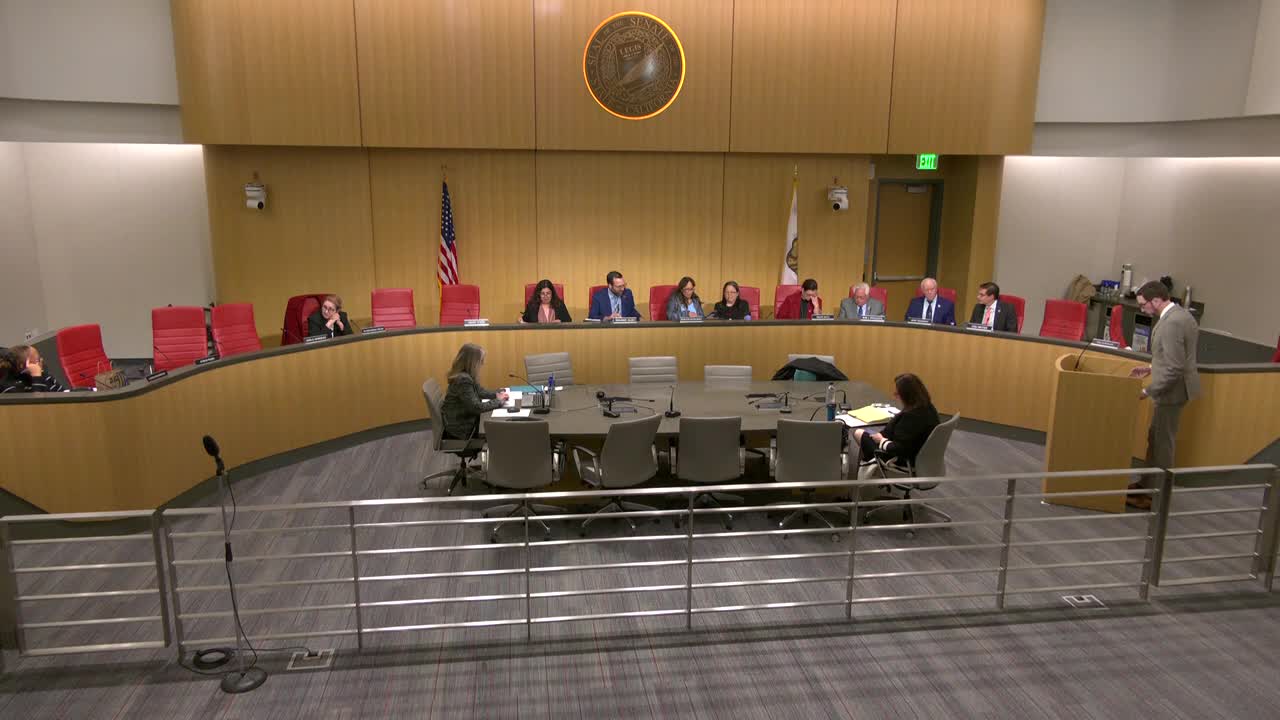 37MIN
Senate Standing Committee on Energy, Utilities and Communications
 43MIN
Senate Standing Committee on Environmental Quality
Bill Author

Bill Co-Author(s):
