SB 1111: Digital replicas.
- Session Year: 2025-2026
- House: Senate
- Latest Version Date: 2026-09-30
Current Status:
Passed
(2026-09-30: Chaptered by Secretary of State. Chapter 862, Statutes of 2026.)
Introduced
In Committee
Awaiting First Chamber Vote
Passed First Chamber
In Committee
Awaiting Second Chamber Vote
Passed Second Chamber
Enacted
Existing law creates a civil cause of action against any person who knowingly uses the name, voice, signature, photograph, or likeness of another person, without their consent, for specified purposes. When a photograph or likeness of an employee of the person using the photograph or likeness appearing in an advertisement or other publication is incidental and not essential to the purpose of the publication, existing law establishes a rebuttable presumption affecting the burden of producing evidence that failure to obtain the consent of an employee was not a knowing use of an employees photograph or likeness.
This bill would clarify that, for purposes of this cause of action, a voice or likeness includes a digital replica, defined to mean a computer-generated, highly realistic electronic representation that is readily identifiable as the voice or visual likeness of an individual in which the actual individual either did not actually perform or appear, or the actual individual did perform or appear, but the fundamental character of the performance or appearance has been materially altered. The bill would also remove the provisions establishing the rebuttable presumption when an employees likeness or photograph appears in an advertisement or other publication.
Existing law prohibits the false impersonation of another person in either their personal or official capacity with the intent to steal or defraud, as specified.
This bill would clarify that false impersonation includes the use of a digital replica with the intent to impersonate another for purposes of these and other criminal provisions.
Existing law, the Contractors State License Law, establishes the Contractors State License Board to license and regulate contractors, as defined. Existing law excludes certain persons from licensure and regulation pursuant to the Contractors State License Law, including, among others, an owner who builds or improves a structure on their property if specified conditions are met.This bill would make nonsubstantive changes to the provision described above that excludes certain persons from licensure and regulation pursuant to the Contractors State License Law.Existing law, the Contractors State License Law, establishes the Contractors State License Board to license and regulate contractors, as defined. Existing law excludes certain persons from licensure and regulation pursuant to the Contractors State License Law, including, among others, an owner who builds or improves a structure on their property if specified conditions are met.
This bill would make nonsubstantive changes to the provision described above that excludes certain persons from licensure and regulation pursuant to the Contractors State License Law.
(a)(1)Any person who knowingly uses anothers name, voice, signature, photograph, or likeness, in any manner, on or in products, merchandise, or goods, or for purposes of advertising or selling, or soliciting purchases of, products, merchandise, goods, or services, without that persons prior consent, or, in the case of a minor, the prior consent of their parent or legal guardian, shall be liable for any damages sustained by the person or persons injured as a result thereof. In addition, in any action brought under this section, the person who violated the section shall be liable to the injured party or parties in an amount equal to the greater of seven hundred fifty dollars ($750) or the actual damages suffered by them as a result of the unauthorized use, and any profits from the unauthorized use that are attributable to the use and are not taken into account in computing the actual damages. In establishing these profits, the injured party or parties are required to present proof only of the gross revenue attributable to the unauthorized use, and the person who violated this section is required to prove their deductible expenses. Punitive damages may also be awarded to the injured party or parties. The prevailing party in any action under this section shall also be entitled to attorneys fees and costs.
(2)In addition to the remedies available in paragraph (1), a party may seek an injunction or temporary restraining order pursuant to Section 527 of the Code of Civil Procedure. If the court grants the applicant an order under subdivision (c) of Section 527 of the Code of Civil Procedure that requires the respondent to remove, recall, or otherwise cease the publication or distribution of the petitioners name, voice, signature, photograph, or likeness, the respondent shall complete the removal or recall, or cease the publication or distribution, within two business days from the day the order is served, unless otherwise required by the order.
(b)As used in this section, photograph means any photograph or photographic reproduction, still or moving, or any videotape or live television transmission, of any person, such that the person is readily identifiable.
(1)A person shall be deemed to be readily identifiable from a photograph when one who views the photograph with the naked eye can reasonably determine that the person depicted in the photograph is the same person who is complaining of its unauthorized use.
(2)If the photograph includes more than one person so identifiable, then the person or persons complaining of the use shall be represented as individuals rather than solely as members of a definable group represented in the photograph. A definable group includes, but is not limited to, the following examples: a crowd at any sporting event, a crowd in any street or public building, the audience at any theatrical or stage production, a glee club, or a baseball team.
(3)A person or persons shall be considered to be represented as members of a definable group if they are represented in the photograph solely as a result of being present at the time the photograph was taken and have not been singled out as individuals in any manner.
(c)For purposes of this section, a use of a name, voice, signature, photograph, or likeness in connection with any news, public affairs, or sports broadcast or account, or any political campaign, shall not constitute a use for which consent is required under subdivision (a).
(d)The use of a name, voice, signature, photograph, or likeness in a commercial medium shall not constitute a use for which consent is required under subdivision (a) solely because the material containing the use is commercially sponsored or contains paid advertising. Rather it shall be a question of fact whether or not the use of the persons name, voice, signature, photograph, or likeness was so directly connected with the commercial sponsorship or with the paid advertising as to constitute a use for which consent is required under subdivision (a).
(e)Nothing in this section shall apply to the owners or employees of any medium used for advertising, including, but not limited to, newspapers, magazines, radio and television networks and stations, cable television systems, billboards, and transit ads, by whom any advertisement or solicitation in violation of this section is published or disseminated, unless it is established that those owners or employees had knowledge of the unauthorized use of the persons name, voice, signature, photograph, or likeness as prohibited by this section.
(f)For the purposes of this section, a voice or likeness includes a digital replica, as defined in Section 3344.1.
(g)The remedies provided for in this section are cumulative and shall be in addition to any others provided for by law.
SEC. 2.Chapter 9 (commencing with Section 540) is added to Title 13 of Part 1 of the Penal Code, to read:9.Offense Involving the Use of Artificial Intelligence Technology540.(a)For the purposes of any provision of this code in which the false impersonation of another is a required element, including, without limitation, Sections 528.5, 529, and 530, false impersonation includes the use of a digital replica with the intent to impersonate another.
(b)For purposes of this section, digital replica has the same meaning as in Section 3344.1 of the Civil Code.
(a)(1)Any person who knowingly uses anothers name, voice, signature, photograph, or likeness, in any manner, on or in products, merchandise, or goods, or for purposes of advertising or selling, or soliciting purchases of, products, merchandise, goods, or services, without that persons prior consent, or, in the case of a minor, the prior consent of their parent or legal guardian, shall be liable for any damages sustained by the person or persons injured as a result thereof. In addition, in any action brought under this section, the person who violated the section shall be liable to the injured party or parties in an amount equal to the greater of seven hundred fifty dollars ($750) or the actual damages suffered by them as a result of the unauthorized use, and any profits from the unauthorized use that are attributable to the use and are not taken into account in computing the actual damages. In establishing these profits, the injured party or parties are required to present proof only of the gross revenue attributable to the unauthorized use, and the person who violated this section is required to prove their deductible expenses. Punitive damages may also be awarded to the injured party or parties. The prevailing party in any action under this section shall also be entitled to attorneys fees and costs.
(2)In addition to the remedies available in paragraph (1), a party may seek an injunction or temporary restraining order pursuant to Section 527 of the Code of Civil Procedure. If the court grants the applicant an order under subdivision (c) of Section 527 of the Code of Civil Procedure that requires the respondent to remove, recall, or otherwise cease the publication or distribution of the petitioners name, voice, signature, photograph, or likeness, the respondent shall complete the removal or recall, or cease the publication or distribution, within two business days from the day the order is served, unless otherwise required by the order.
(b)As used in this section, photograph means any photograph or photographic reproduction, still or moving, or any videotape or live television transmission, of any person, such that the person is readily identifiable.
(1)A person shall be deemed to be readily identifiable from a photograph when one who views the photograph with the naked eye can reasonably determine that the person depicted in the photograph is the same person who is complaining of its unauthorized use.
(2)If the photograph includes more than one person so identifiable, then the person or persons complaining of the use shall be represented as individuals rather than solely as members of a definable group represented in the photograph. A definable group includes, but is not limited to, the following examples: a crowd at any sporting event, a crowd in any street or public building, the audience at any theatrical or stage production, a glee club, or a baseball team.
(3)A person or persons shall be considered to be represented as members of a definable group if they are represented in the photograph solely as a result of being present at the time the photograph was taken and have not been singled out as individuals in any manner.
(c)Where a photograph or likeness of an employee of the person using the photograph or likeness appearing in the advertisement or other publication prepared by or in behalf of the user is only incidental, and not essential, to the purpose of the publication in which it appears, there shall arise a rebuttable presumption affecting the burden of producing evidence that the failure to obtain the consent of the employee was not a knowing use of the employees photograph or likeness. (d)(c)For purposes of this section, a use of a name, voice, signature, photograph, or likeness in connection with any news, public affairs, or sports broadcast or account, or any political campaign, shall not constitute a use for which consent is required under subdivision (a).
(e)(d)The use of a name, voice, signature, photograph, or likeness in a commercial medium shall not constitute a use for which consent is required under subdivision (a) solely because the material containing the use is commercially sponsored or contains paid advertising. Rather it shall be a question of fact whether or not the use of the persons name, voice, signature, photograph, or likeness was so directly connected with the commercial sponsorship or with the paid advertising as to constitute a use for which consent is required under subdivision (a).
(f)(e)Nothing in this section shall apply to the owners or employees of any medium used for advertising, including, but not limited to, newspapers, magazines, radio and television networks and stations, cable television systems, billboards, and transit ads, by whom any advertisement or solicitation in violation of this section is published or disseminated, unless it is established that those owners or employees had knowledge of the unauthorized use of the persons name, voice, signature, photograph, or likeness as prohibited by this section.
(f)For the purposes of this section, a voice or likeness includes a digital replica, as defined in Section 3344.1.
(g)The remedies provided for in this section are cumulative and shall be in addition to any others provided for by law.
SEC. 2.Chapter 9 (commencing with Section 540) is added to Title 13 of Part 1 of the Penal Code, to read:9.Offense Involving the Use of Artificial Intelligence Technology540.(a)For the purposes of any provision of this code in which the false impersonation of another is a required element, including, without limitation, Sections 528.5, 529, and 530, false impersonation includes the use of a digital replica with the intent to impersonate another.
(b)For purposes of this section, digital replica has the same meaning as in Section 3344.1 of the Civil Code.
SECTION 1.Section 7044 of the Business and Professions Code is amended to read:7044.(a)This chapter does not apply to any of the following:(1)An owner who builds or improves a structure on their property, if both of the following conditions are met:(A)None of the improvements are intended or offered for sale.(B)The property owner personally performs all of the work or any work not performed by the owner is performed by the owners employees with wages as their sole compensation.(2)An owner who builds or improves a structure on their property, if both of the following conditions are met:(A)The owner directly contracts with licensees who are duly licensed to contract for the work of the respective trades involved in completing the project.(B)For projects involving single-family residential structures, no more than four of these structures are intended or offered for sale in a calendar year. This subparagraph shall not apply if the owner contracts with a general contractor for the construction.(3)A homeowner improving their principal place of residence or appurtenances thereto, provided that all of the following conditions exist:(A)The work is performed before sale.(B)The homeowner has actually resided in the residence for the 12 months before completion of the work.(C)The homeowner has not availed themselves of the exemption in this paragraph on more than two structures more than once during any three-year period.(4)A nonprofit corporation providing assistance to an owner-builder, as defined in subdivision (a) of Section 50692 of the Health and Safety Code, who is participating in a mutual self-help housing program, as defined in Section 50087 of the Health and Safety Code.(b)In all actions brought under this chapter, both of the following shall apply:(1)Except as provided in paragraph (2), proof of the sale or offering for sale of a structure by or for the owner-builder within one year after completion of the structure constitutes a rebuttable presumption affecting the burden of proof that the structure was undertaken for purposes of sale.(2)Proof of the sale or offering for sale of five or more structures by the owner-builder within one year after completion constitutes a conclusive presumption that the structures were undertaken for purposes of sale.(a)This chapter does not apply to any of the following:
(1)An owner who builds or improves a structure on his or her their property, provided that if both of the following conditions are met:
(A)None of the improvements are intended or offered for sale.
(B)The property owner personally performs all of the work or any work not performed by the owner is performed by the owners employees with wages as their sole compensation.
(2)An owner who builds or improves a structure on his or her their property, provided that if both of the following conditions are met:
(A)The owner directly contracts with licensees who are duly licensed to contract for the work of the respective trades involved in completing the project.
(B)For projects involving single-family residential structures, no more than four of these structures are intended or offered for sale in a calendar year. This subparagraph shall not apply if the owner contracts with a general contractor for the construction.
(3)A homeowner improving his or her their principal place of residence or appurtenances thereto, provided that all of the following conditions exist:
(A)The work is performed prior to before sale.
(B)The homeowner has actually resided in the residence for the 12 months prior to before completion of the work.
(C)The homeowner has not availed himself or herself themselves of the exemption in this paragraph on more than two structures more than once during any three-year period.
(4)A nonprofit corporation providing assistance to an owner-builder, as defined in subdivision (a) of Section 50692 of the Health and Safety Code, who is participating in a mutual self-help housing program, as defined in Section 50078 50087 of the Health and Safety Code.
(b)In all actions brought under this chapter, both of the following shall apply:
(1)Except as provided in paragraph (2), proof of the sale or offering for sale of a structure by or for the owner-builder within one year after completion of the structure constitutes a rebuttable presumption affecting the burden of proof that the structure was undertaken for purposes of sale.
(2)Proof of the sale or offering for sale of five or more structures by the owner-builder within one year after completion constitutes a conclusive presumption that the structures were undertaken for purposes of sale.
|
Date
|
Status
|
|---|---|
| Sep 30, 2026 | Chaptered by Secretary of State. Chapter 862, Statutes of 2026. |
| Sep 30, 2026 | Approved by the Governor. |
| Sep 8, 2026 | Enrolled and presented to the Governor at 4 p.m. |
| Aug 28, 2026 | In Senate. Ordered to engrossing and enrolling. |
| Aug 28, 2026 | Read third time. Passed. (Ayes 77. Noes 1. Page 6775.) Ordered to the Senate. |
| Aug 28, 2026 | Read third time. Passed. Ordered to the Senate. |
| Aug 13, 2026 | Read second time. Ordered to third reading. |
| Aug 13, 2026 | From committee: Do pass. (Ayes 15. Noes 0.) (August 13). |
| Aug 13, 2026 | Assembly Rule 63 suspended. |
| Aug 5, 2026 | August 5 set for first hearing. Placed on suspense file. |
| Jul 1, 2026 | From committee: Do pass and re-refer to Com. on APPR. (Ayes 9. Noes 0.) (June 30). Re-referred to Com. on APPR. |
| Jun 17, 2026 | From committee: Do pass and re-refer to Com. on PUB. S. (Ayes 14. Noes 1.) (June 16). Re-referred to Com. on PUB. S. |
| May 18, 2026 | Referred to Coms. on P. & C.P. and PUB. S. |
| Apr 30, 2026 | In Assembly. Read first time. Held at Desk. |
| Apr 30, 2026 | Read third time. Passed. (Ayes 36. Noes 0. Page 4112.) Ordered to the Assembly. |
| Apr 30, 2026 | Read third time. Passed. (Ayes 36. Noes 0.) Ordered to the Assembly. |
| Apr 23, 2026 | Read second time. Ordered to third reading. |
| Apr 22, 2026 | From committee: Do pass. (Ayes 6. Noes 0. Page 3983.) (April 21). |
| Apr 22, 2026 | From committee: Do pass. (Ayes 6. Noes 0.) (April 21). |
| Apr 14, 2026 | From committee: Do pass and re-refer to Com. on PUB. S. (Ayes 8. Noes 1.) (April 13). Re-referred to Com. on PUB. S. |
| Apr 14, 2026 | From committee: Do pass and re-refer to Com. on PUB. S. (Ayes 8. Noes 1. Page 3843.) (April 13). Re-referred to Com. on PUB. S. |
| Apr 14, 2026 | Set for hearing April 21 in PUB. S. pending receipt. |
| Apr 9, 2026 | Set for hearing April 13. |
| Apr 8, 2026 | Re-referred to Coms. on P., D.T., & C.P. and PUB. S. |
| Mar 24, 2026 | Re-referred to Com. on RLS. |
| Mar 24, 2026 | Withdrawn from committee. |
| Mar 23, 2026 | From committee with author's amendments. Read second time and amended. Re-referred to Com. on B. P. & E.D. |
| Feb 26, 2026 | Referred to Com. on B. P. & E.D. |
| Feb 18, 2026 | From printer. May be acted upon on or after March 20. |
| Feb 17, 2026 | Introduced. Read first time. To Com. on RLS. for assignment. To print. |
|
Date
|
Description
|
Location
|
Votes
|
|
|---|---|---|---|---|
| Aug 28, 2026 | SB 1111 Ashby Senate Third Reading By Bauer-Kahan | Assembly Floor |
Passed |
|
| Aug 13, 2026 | Do pass. | Assembly Standing Committee on Appropriations |
Passed |
|
| Jun 30, 2026 | Do pass and be re-referred to the Committee on [Appropriations] | Assembly Standing Committee on Public Safety |
Passed |
|
| Jun 16, 2026 | Do pass and be re-referred to the Committee on [Public Safety] | Assembly Standing Committee on Privacy and Consumer Protection |
Passed |
|
| Apr 30, 2026 | Senate 3rd Reading SB1111 Ashby | Senate Floor |
Passed |
|
| Apr 21, 2026 | Do pass | Senate Standing Committee on Public Safety |
Passed |
|
| Apr 13, 2026 | Do pass, but first be re-referred to the Committee on [Public Safety] | Senate Standing Committee on Privacy, Digital Technologies, and Consumer Protection |
Passed |
This list shows positions taken on this bill by organizations on the date displayed, which is linked to the original source.
Positions by individuals are not included.
|
Organization
|
Position
|
Date
|
|---|---|---|
| 11:11 Media | ** Support | |
| 11:11 Media Impact | ** Support | |
| 11:11 Media Impact (Sponsor) | ** Support | |
| 1 Private Individual | ** Support | |
| California Federation of Labor Unions, Afl-cio | ** Support | |
| California Initiative for Technology & Democracy, a Project of California Common Cause | ** Support | |
| Chamber Of Progress | ** Support | |
| Common Sense Media | ** Support | |
| RAINN | ** Support | |
| Rape, Abuse and Incest National Network | ** Support | |
| Rape, Abuse, & Incest National Network | ** Support | |
| SAG-AFTRA | ** Support | |
| Transparency Coalition.ai | ** Support |
SENATE THIRD READING
STR Bill Id:SB 1111
Author:(Ashby)
As Amended Ver:March 23, 2026
Majority vote
SUMMARY
Provides that a person's voice or likeness includes a digital replica for purposes of California's "right of publicity" law. Provides that the Penal Code provisions in which false impersonation is a required element include the use of a digital replica with the intent to impersonate another person.
Major Provisions
- Provides, for purposes of California's right of publicity law, that a person's voice or likeness includes a digital replica.
- Removes the rebuttable presumption that an employer's incidental, non-essential use of an employee's photograph or likeness in a publication was not a knowing use made without consent.
- Provides that Penal Code provisions governing false impersonation include the use of a digital replica with the intent to impersonate another.
COMMENTS
This bill updates California's civil and criminal laws relating to likeness rights and false impersonation in order to keep pace with the challenges posed by GenAI. Existing Civil Code section 3344 codifies the right to publicity, imposing liability on any person who knowingly uses another's name, voice, signature, photograph, or likeness, in any manner, on or in products, merchandise, or goods, or for purposes of advertising or selling, or soliciting purchases of, products, merchandise, goods or services, without prior consent. Existing law also prohibits the false impersonation of another person in either their personal or official capacity with the intent to steal or defraud. This bill updates those laws to clarify they apply to digital replicas.
Furthermore, this bill eliminates a rebuttable presumption providing that an employer does not knowingly violate a deceased personality's publicity rights if the use of their likeness is incidental to a publication and part of the employee's job. The presumption, which dates back to 1971, is outdated given the ease with which photographs can now be digitally edited.
The bill is similar to last year's SB 11 (Ashby) of 2025, which was vetoed by the Governor on the basis of a consumer warning requirement that is not in this year's bill.
According to the Author
California is leading the nation in AI regulations. However, a significant gap remains. The lack of a comprehensive legal framework to address the non-consensual creation of AI deepfake images leaves victims with no remedy. While some deepfakes target public figures, AI software now allows users to create content featuring anyone. Often, women are the targeted victims, and the vast majority of incidents are sexually explicit in nature.
SB 1111 creates a framework to hold AI users accountable by establishing clear legal standing for victims and defining the boundaries of AI technology. As technology changes, California must continue to advance the standard for protections against AI violence and those affected by it.
Arguments in Support
11:11 Media, sponsor of the bill, writes:
As artificial intelligence tools become more advanced and more accessible, it has become far too easy to create and spread nonconsensual AI-generated content. A person's voice or likeness can now be copied, manipulated, and used without their knowledge or consent. This abuse can be used to humiliate, harass, exploit, and impersonate people, causing serious emotional, reputational, and financial harm.
This issue is urgent. AI-generated abuse is already being used to create sexually explicit deepfakes, spread false statements, and impersonate real people in deeply harmful ways. California's Department of Justice cites research showing that 90% of victims are women, 93% suffered significant emotional distress, 51% had suicidal thoughts, and 49% reported being stalked or harassed online by people who saw the material. These harms disproportionately affect women and girls and increasingly affect children as well.
Arguments in Opposition
None on file.
FISCAL COMMENTS
According to the Appropriations Committee:
- Potential court cost pressures of an unknown, but likely minor amount (Trial Court Trust Fund (TCTF)), to the extent clarifying that the right of publicity statute reaches digital replicas, and removing the incidental-use presumption, result in additional civil filings or more protracted litigation. Because existing law already provides overlapping civil remedies for unauthorized digital replica uses, including Civil Code section 1708.86 for sexually explicit depictions and section 3344.1 for deceased personalities, the incremental filing volume attributable to this bill is likely modest. Although trial courts are not funded on a workload basis, increased pressure on the TCTF may create demand for increased General Fund support. The state provides approximately $117.3 million in annual General Fund backfill to the TCTF in 2025-26.
- Potential incarceration costs of an unknown amount, likely minor to moderate, to CDCR and the counties (General Fund, local funds). Felony false personation under Penal Code section 529 is generally punishable pursuant to Penal Code section 1170(h) and served in county jail; in practice, however, CDCR admissions data show 56 principal and secondary admissions to state prison in 2025 for violations of section 529, reflecting cases in which prior convictions, disqualifying factors, or accompanying offenses route the sentence to state prison. To the extent this bill's expansion of false personation to encompass the use of digital replicas results in additional felony convictions, a share of those convictions likewise will result in state prison admissions, and any resulting increase in state prison commitments would represent an ongoing General Fund cost. The Legislative Analyst's Office estimates the average annual cost to incarcerate one person in state prison at $128,000; CDCR estimates $135,921. The average annual cost to incarcerate one person in county jail is approximately $29,000, though costs are higher in larger counties. County incarceration costs are not subject to reimbursement by the state. However, overcrowding in county jails creates cost pressure on the General Fund because the state has historically granted new funding to counties to offset overcrowding resulting from public safety realignment.
VOTES
SENATE FLOOR: 36-0-4
YES: Allen, Alvarado-Gil, Archuleta, Ashby, Becker, Blakespear, Cabaldon, Cervantes, Choi, Cortese, Dahle, Durazo, Gonzalez, Grayson, Grove, Hurtado, Jones, Laird, Limón, McGuire, McNerney, Menjivar, Niello, Ochoa Bogh, Padilla, Pérez, Reyes, Richardson, Rubio, Seyarto, Smallwood-Cuevas, Stern, Strickland, Umberg, Weber Pierson, Wiener
ABS, ABST OR NV: Arreguín, Caballero, Valladares, Wahab
ASM PRIVACY AND CONSUMER PROTECTION: 14-1-0
YES: Bauer-Kahan, Macedo, Bryan, Hoover, Irwin, Lowenthal, McKinnor, Ortega, Patterson, Pellerin, Petrie-Norris, Ward, Wicks, Wilson
NO: DeMaio
ASM PUBLIC SAFETY: 9-0-0
YES: Schultz, Alanis, Mark González, Haney, Harabedian, Lackey, Nguyen, Ramos, Sharp-Collins
ASM APPROPRIATIONS: 15-0-0
YES: Wicks, Hoover, Arambula, Calderon, Caloza, Dixon, Fong, Mark González, Krell, Pacheco, Pellerin, Sharp-Collins, Solache, Ta, Tangipa
UPDATED
VERSION: March 23, 2026
CONSULTANT: Josh Tosney / P. & C.P. / (916) 319-2200 FN: 0003489
Date of Hearing: August 5, 2026
ASSEMBLY COMMITTEE ON APPROPRIATIONS
Buffy Wicks, Chair
SBPCA Bill Id:SB 1111
Author:(Ashby) – As Amended Ver:March 23, 2026
Policy Committee: | Privacy and Consumer Protection | Vote: | 14 - 1 |
Public Safety | 9 - 0 | ||
|
|
Urgency: No State Mandated Local Program: No Reimbursable: No
SUMMARY:
This bill provides that a person’s voice or likeness includes a digital replica for purposes of the right of publicity law, and provides that the Penal Code provisions in which false impersonation is a required element include the use of a digital replica with the intent to impersonate another person.
Specifically, this bill:
- Applies the prohibition on the knowing, unauthorized commercial use of another person’s name, voice, signature, photograph, or likeness to digital replicas, as defined in existing law — computer-generated, highly realistic electronic representations readily identifiable as the voice or visual likeness of an individual.
- Removes the rebuttable presumption that an employer’s incidental, non-essential use of an employee’s photograph or likeness in a publication was not a knowing use made without consent.
- Adds Section 540 to the Penal Code, providing that for purposes of any Penal Code provision in which false impersonation is a required element, including credible online impersonation, false personation, and false personation to obtain money or property, false impersonation includes the use of a digital replica with the intent to impersonate another.
FISCAL EFFECT:
- Potential court cost pressures of an unknown, but likely minor amount (Trial Court Trust Fund (TCTF)), to the extent clarifying that the right of publicity statute reaches digital replicas, and removing the incidental-use presumption, result in additional civil filings or more protracted litigation. Because existing law already provides overlapping civil remedies for unauthorized digital replica uses, including Civil Code section 1708.86 for sexually explicit depictions and section 3344.1 for deceased personalities, the incremental filing volume attributable to this bill is likely modest. Although trial courts are not funded on a workload basis, increased pressure on the TCTF may create demand for increased General Fund support. The state provides approximately $117.3 million in annual General Fund backfill to the TCTF in 2025-26.
- Potential incarceration costs of an unknown amount, likely minor to moderate, to CDCR and the counties (General Fund, local funds). Felony false personation under Penal Code section 529 is generally punishable pursuant to Penal Code section 1170(h) and served in county jail; in practice, however, CDCR admissions data show 56 principal and secondary admissions to state prison in 2025 for violations of section 529, reflecting cases in which prior convictions, disqualifying factors, or accompanying offenses route the sentence to state prison. To the extent this bill’s expansion of false personation to encompass the use of digital replicas results in additional felony convictions, a share of those convictions likewise will result in state prison admissions, and any resulting increase in state prison commitments would represent an ongoing General Fund cost. The Legislative Analyst’s Office estimates the average annual cost to incarcerate one person in state prison at $128,000; CDCR estimates $135,921. The average annual cost to incarcerate one person in county jail is approximately $29,000, though costs are higher in larger counties. County incarceration costs are not subject to reimbursement by the state. However, overcrowding in county jails creates cost pressure on the General Fund because the state has historically granted new funding to counties to offset overcrowding resulting from public safety realignment.
COMMENTS:
- Purpose. According to the author:
The lack of a comprehensive legal framework to address the non-consensual creation of AI deepfake images leaves victims with no remedy. While some deepfakes target public figures, AI software now allows users to create content featuring anyone. Often, women are the targeted victims, and the vast majority of incidents are sexually explicit in nature. SB 1111 creates a framework to hold AI users accountable by establishing clear legal standing for victims and defining the boundaries of AI technology.
- Background. Generative artificial intelligence tools have made digital replicas — highly realistic, computer-generated representations of a real person’s voice or visual likeness — inexpensive and widely accessible, enabling nonconsensual sexually explicit deepfakes, financial fraud accomplished through impersonation, and other misuse. The overwhelming majority of victims of nonconsensual deepfake imagery are women and girls, and reported incidents include deepfake nude images of students circulated at California schools. Digital replica technology has also been used to accomplish large-scale fraud, including a 2024 incident in which employees of a multinational company transferred $25.6 million after a video conference in which every other participant, including a digitally recreated chief financial officer, was a deepfake.
Existing law provides civil and criminal frameworks that this bill updates. Civil Code section 3344 codifies the right of publicity, imposing liability, including statutory damages of at least $750, punitive damages, and prevailing-party attorney’s fees, for the knowing, unauthorized commercial use of another’s name, voice, signature, photograph, or likeness. The Penal Code separately criminalizes credible online impersonation and false personation, punishable by fines and county jail terms. This bill clarifies that both frameworks reach conduct accomplished through digital replicas, and removes an incidental-use evidentiary presumption dating to 1971 that predates modern digital editing. The bill defines digital replica by cross-reference to the existing definition in Civil Code section 3344.1, which excludes authorized electronic reproduction, sampling, remixing, and remastering.
This bill is similar to SB 11 (Ashby, 2025), which the Governor vetoed on the basis of a consumer warning requirement. That requirement was a mandated hyperlink disclosure wherever a user may input a prompt, warning users of digital replica tools about potential civil and criminal liability, with civil exposure for technology providers that failed to include the link. The veto message otherwise commended the effort to prepare state law for the challenges posed by highly realistic synthetic content, expressing doubt only that a warning would dissuade wrongdoers. This bill omits the warning requirement, and also omits SB 11’s requirement that the Judicial Council review the impact of artificial intelligence on evidence in court proceedings — a function the Judicial Council’s Artificial Intelligence Task Force, established in May 2024, now performs on the judicial branch’s own initiative.
Analysis Prepared by: Shiran Zohar / APPR. / (916) 319-2081
Date of Hearing: June 30, 2026
Counsel: Kimberly Horiuchi
ASSEMBLY COMMITTEE ON PUBLIC SAFETY
Nick Schultz, Chair
SBPCA Bill Id:SB 1111
Author:(Ashby) – As Amended Ver:March 23, 2026
SUMMARY: Expands the crime of false impersonation to include any use of a digital replica with the intent to impersonate another. Specifically, this bill:
- Includes “digital replicas” in the prohibitions against the unauthorized commercial use of name, voice, signature, photograph, or likeness (referred to as “right of publicity”).
- Removes the rebuttable presumption from the right of publicity statute.
EXISTING LAW:
- Provides that any person who knowingly and without consent credibly impersonates another actual person through or on a website or by other electronic means for purposes of harming, intimidating, threatening, or defrauding another person is guilty of a public offense punishable by a fine not exceeding $1,000 or by imprisonment in a county jail not exceeding one year, or by both that fine and imprisonment. (Pen. Code § 528.5, subd. (a) & (d).)
- States that impersonation is credible if another person would reasonably believe, or did reasonably believe, that the defendant was or is the person who was impersonated. (Pen. Code § 528.5, subd. (b).)
- Provides that every person who falsely personates another in either their private or official capacity, and in that assumed character carries out specified actions, is punishable by a fine not exceeding $10,000, imprisonment in a county jail not exceeding one year, or imprisonment in a county jail for 16 months, 2 or 3 years and/or a fine. (Pen. Code, § 529.)
- Provides that every person who falsely personates another, in either their private or official capacity, and in such assumed character receives any money or property, knowing that it is intended to be delivered to the individual so personated, with intent to convert the same to their own use, or to that of another person, or to deprive the true owner thereof, is punishable in the same manner and to the same extent as for larceny of the money or property so received. (Pen. Code, § 530.)
- Prohibits any person from knowingly using another’s name, voice, signature, photograph, or likeness, in any manner, on or in products, merchandise, or goods, or for purposes of advertising or selling, or soliciting purchases of products, merchandise, goods, or services, without such person’s prior consent, and may be liable for any damages sustained by the person or persons injured as a result thereof. (Civ. Code, § 3344, subd. (a).)
- Defines “digital replica” to mean a computer-generated, highly realistic electronic representation that is readily identifiable as the voice or visual likeness of an individual that is embodied in a sound recording, image, audiovisual work, or transmission in which the actual individual either did not actually perform or appear, or the actual individual did perform or appear, but the fundamental character of the performance or appearance has been materially altered. Excludes electronic reproduction, use of a sample of one sound recording or audiovisual work into another, remixing, mastering, or digital remastering of a sound recording or audiovisual work authorized by the copyright holder from the definition. (Civ. Code, § 3344.1.)
- Defines “artificial intelligence” to mean an engineered or machine-based system that varies in its level of autonomy and that can, for explicit or implicit objectives, infer from the input it receives how to generate outputs that can influence physical or virtual environments. (Civ. Code, § 3110, subd. (a).)
FISCAL EFFECT: Unknown.
COMMENTS:
- Sponsor: 11:11 Media
- Author's Statement: According to the author, “California is leading the nation in AI regulations. However, a significant gap remains. The lack of a comprehensive legal framework to address the non-consensual creation of AI deepfake images leaves victims with no remedy. While some deepfakes target public figures, AI software now allows users to create content featuring anyone. Often, women are the targeted victims, and the vast majority of incidents are sexually explicit in nature.
“SB 1111 creates a framework to hold AI users accountable by establishing clear legal standing for victims and defining the boundaries of AI technology. As technology changes, California must continue to advance the standard for protections against AI violence and those affected by it.”
- False Impersonation: This bill expands the crimes of false impersonation to include conduct that relies on a digital replica. Penal Code section 528.5 punishes any person who knowingly and without consent credibly impersonates another actual person through or on an Internet Web site or by other electronic means for purposes of harming, intimidating, threatening, or defrauding another person. Penal Code section 529 punishes a person who falsely personates another in either his or her private or official capacity, and in that assumed character does any of the following: (a) becomes bail or surety for any party in any proceeding whatever, before any court or officer authorized to take that bail or surety; (b) verifies, publishes, acknowledges, or proves, in the name of another person, any written instrument, with intent that the same may be recorded, delivered, or used as true; or (c) does any other act whereby, if done by the person falsely personated, [they] might, in any event, become liable to any suit or prosecution, or to pay any sum of money, or to incur any charge, forfeiture, or penalty, or whereby any benefit might accrue to the party personating, or to any other person.
An example of false personation would be a person who identified themselves to law enforcement as someone else for purposes of evading criminal liability. (See People v. Chardon (1999) 77 Cal.App.4th 205.) Penal Code section 530 is false personation for purposes of stealing something of value. An example of this would be dressing up like a baggage handler to steal luggage or impersonating a long lost relative to obtain the victim’s money. (People v. Montalvo (2019) 36 Cal.App.5th 597 [defendant dressed up like a police officer to effectuate a robbery].) This bill expands these offenses to include a person who engages in false personation via a digital replica.
- Background on Artificial Intelligence (AI) Issues: Over the past five years, generative AI tools have made the jump from research prototype to commercial product. Generative AI models like OpenAI’s ChatGPT and Google’s Gemini can now generate realistic text and images that are often indistinguishable from human-authored content, with generative AI for audio and video not far behind.
Given these advances, it is not surprising to see AI-generated images of public figures go viral or AI-generated reviews and comments on digital platforms. As such, generative AI models are raising concerns about the credibility of digital content and the ease of producing harmful content in the future. In an article published by the Brookings Institute, it is against the backdrop of technological advances, “civil society and policymakers have taken increasing interest in ways to distinguish AI-generated content from human-authored content.”[1] The Brookings Institute goes on to explain that there are four suggested methods to determine if something is AI-generated[2]:
There are several approaches that have been proposed for detecting AI-generated content. The four most prominent approaches are watermarking (in its various forms), which is the embedding of an identifiable pattern in a piece of content to track its origin; content provenance, which securely embeds and maintains information about the origin of the content in its metadata; retrieval-based detectors, where all AI-generated content is stored in a database that can be queried to check the origin of content; and post-hoc detectors, which rely on machine learning models to identify subtle but systematic patterns in AI-generated content that distinguish it from human-authored content.[3]
AI has created challenges for courts evaluating the admissibility, authenticity, and reliability of evidence. Realistic synthetic content, including deepfakes, AI-generated voice clones, and fabricated images, continues to appear in the courts, requiring courts to consider the reliability and fairness of generative AI material as evidence.
In May 2024, the Judicial Council established the AI Task Force to oversee the development of policy recommendations to the council on the use of AI in the judicial branch and coordinate the timely consideration and development of proposals and potential actions by the judicial branch. On February 21, 2025, the Taskforce provided a presentation to the courts wherein it provided a summary of AI usage in courts: 19 courts are already using generative AI; 19 courts plan to start using generative AI; seven courts did not respond to a request for information. Additionally, six courts have an AI use policy in place; 21 courts are planning to create a policy; and several courts are waiting for a model policy from Judicial Council. Proposed model language includes rejection of any discriminatory generative AI and requires disclosure or watermark if generative AI outputs make up a substantial portion of a written or visual work provided to the public.[4]
The Legislature passed AB 1836 (Bauer-Kahan), Chapter 258, Statutes of 2024, which prohibited a person from producing, distributing, or making available the digital replica of a deceased personality’s voice or likeness in an expressive audiovisual work or sound recording without prior consent from specified persons, essentially the personality’s heirs or their assignees. Damages to an injured party may be for an amount equal to the greater of $10,000 or the actual damages suffered by a person controlling the rights to the deceased personality’s likeness.
- AI Impact on 6th Amendment Right of Confrontation: As noted above, Judicial Council convened a task force on AI in courts and as evidence. However, the use of AI in criminal law may affect the defendant’s right to a fair trial because it may limit the defendant’s ability to cross-examine a witness. In People v. Lopez (2012) 55 Cal.4th 569, the California Supreme Court addressed the impact of machine learning (a rudimentary form of generative AI) in the generation of an expert’s report.
First, the right of confrontation prohibits the prosecution from relying on “testimonial” out-of-court statements unless the witness is unavailable to testify and the defendant had a prior opportunity for cross-examination. (People v. Lopez, supra, at p. 576, citing Crawford v. Washington (2004) 541 U.S. 36.) A statement is “testimonial” if: (a) it is made … by or to a law enforcement agent and (b) describes a past fact related to criminal activity for (c) possible use at a later trial. Conversely, a statement that does not meet all three criteria is not testimonial. (Id., at 577.)
Ultimately, the court in Lopez held that the portions of the expert’s report that were generated by a form of machine learning was not testimonial.
The critical portions of the non-testifying analyst's laboratory report were not made with the requisite degree of formality or solemnity to be considered testimonial. Although a laboratory assistant's notation on a chart linking defendant's name to a particular blood sample was admitted for its truth, it was not testimonial hearsay. The notation was nothing more than an informal record of data for internal purposes, as was indicated by a small printed statement near the top of the chart: "FOR LAB USE ONLY." Because the notation in the non-testifying analyst's laboratory report linking defendant's name to the blood sample was not testimonial in nature, the defendant’s right of confrontation was not violated. (Lopez, supra, at 585.)
Courts will continue to apply the same 6th Amendment right of confrontation analysis for AI. If the properly watermarked and unbiased generative AI is considered testimonial, it will likely not be admissible unless the person who developed the generative AI material is present and available to testify.
- Veto of SB 11: This bill is similar to SB 11 (Ashby) from 2025, which was vetoed by the Governor. In this veto message, he wrote:
I commend the author for working to ensure that our state is prepared for the challenges raised by AI's ability to produce highly realistic digital content. I share the author's concern over the risks posed by synthetic content, including the use of AI to impersonate or appropriate another's likeness without their consent. However, this bill also requires any AI technology that enables a user to create a digital replica to include, wherever a user may input a prompt, a hyperlink to a clear and conspicuous disclosure to warn users of potential civil or criminal liability. Failure to include the hyperlink exposes the technology provider to significant civil liability under this measure.
This year, I have signed bills requiring companion chatbot operators to disclose to users that they are interacting with an artificial system (SB 243, Padilla) and internet companies to warn minors of the potential dangers of social media use (AB 56, Bauer-Kahan). Under certain circumstances, public disclosures and warning labels can play a key role in providing transparency to the public and mitigating harm. In this case, however, it is unclear whether a warning would be sufficient to dissuade wrongdoers from using AI to impersonate others without their consent.
However, this bill, while similar to SB 11, does not require a creator to include a hyperlink to a disclosure regarding civil and criminal liability. It simply includes digital replicas in statutes related to false impersonation and violations of the right of publicity statute.
- Argument in Support: According to 11:11 Media, “As artificial intelligence tools become more advanced and more accessible, it has become far too easy to create and spread nonconsensual AI-generated content. A person’s voice or likeness can now be copied, manipulated, and used without their knowledge or consent. This abuse can be used to humiliate, harass, exploit, and impersonate people, causing serious emotional, reputational, and financial harm.
“This issue is urgent. AI-generated abuse is already being used to create sexually explicit deepfakes, spread false statements, and impersonate real people in deeply harmful ways. California’s Department of Justice cites research showing that 90% of victims are women, 93% suffered significant emotional distress, 51% had suicidal thoughts, and 49% reported being stalked or harassed online by people who saw the material. These harms disproportionately affect women and girls and increasingly affect children as well.
…
“SB 1111 is an important step to ensure California law keeps pace with this growing threat. It reflects a simple principle: people deserve protection when their voice or likeness is used without consent, including through AI-generated digital replicas. As technology moves faster than the law, California must act to protect victims and provide clearer paths to accountability. California has often led the nation in responding to new harms, and this bill continues that leadership. It sends a clear message that innovation cannot come at the expense of safety, dignity, and basic protections.”
- Argument in Opposition: None submitted.
- Related Legislation: SB 11 (Ashby) would have ensured that computer-manipulated or generated content is incorporated into the right of publicity law and criminal false impersonation statutes. This bill requires those making available technology to provide a warning to consumers about liability for misuse, as provided. This bill also requires Judicial Council to review the impact of AI on evidence introduced in court proceedings and to adopt rules of court as necessary. SB 11 was vetoed by the Governor.
- Prior Legislation:
- AB 316 (Krell), Chapter 672, Statutes of 2025, established that in civil actions, where a plaintiff alleges harm caused by AI, a defendant who developed, modified, or used the AI is prohibited from asserting that the AI acted autonomously as a defense.
- AB 1836 (Bauer-Kahan), Chapter 258, Statutes of 2024, established a specific cause of action for beneficiaries of deceased celebrities for the unauthorized use of a digital replica of the celebrity in audiovisual works or sound recordings.
- AB 2602 (Kalra), Chapter 259, Statutes of 2024, limited the unauthorized use of digital replicas by providing that a provision in an agreement between an individual and any other person for the performance of personal or professional services is unenforceable only as it relates to a new performance, fixed on or after January 1, 2025, by a digital replica of the individual if the provision meets all of the specified conditions.
- SB 942 (Becker), Chapter 291, Statutes of 2024, placed obligations on businesses that provide generative AI systems to make accessible tools to detect whether specified content was generated by those systems. These “covered providers” are required to offer visible, and include imperceptible, markings on AI-generated content to identify it as such.
- SB 970 (Ashby), of the 2023-24 Legislative Session, was similar to this bill and was held in the Senate Committee on Appropriations.
- AB 316 (Krell), Chapter 672, Statutes of 2025, established that in civil actions, where a plaintiff alleges harm caused by AI, a defendant who developed, modified, or used the AI is prohibited from asserting that the AI acted autonomously as a defense.
REGISTERED SUPPORT / OPPOSITION:
Support
11:11 Media Impact (Sponsor)
California Federation of Labor Unions, Afl-cio
California Initiative for Technology & Democracy, a Project of California Common CAUSE
Chamber of Progress
Common Sense Media
Rape, Abuse, & Incest National Network
Sag-aftra
Transparency Coalition.ai
1 Private Individual
Opposition
None submitted.
Analysis Prepared by: Kimberly Horiuchi / PUB. S. / (916) 319-3744
Siddarth Srinivasan, Detecting AI fingerprints: A guide to watermarking and beyond (January 4, 2024) Brookings Institution, located at https://www.brookings.edu/articles/detecting-ai-fingerprints-a-guide-to-watermarking-and-beyond/ ↑
Ibid. ↑
Ibid. ↑
https://courts.ca.gov/advisory-body/artificial-intelligence-task-force ↑
Date of Hearing: June 16, 2026
Fiscal:
ASSEMBLY COMMITTEE ON PRIVACY AND CONSUMER PROTECTION
Rebecca Bauer-Kahan, Chair
SBPCA Bill Id:SB 1111
Author:(Ashby) – As Amended Ver:March 23, 2026
SENATE VOTE: 36-0
SUBJECT: Digital replicas
SYNOPSIS
The advent of generative artificial intelligence (GenAI) has led to the widespread availability of consumer-facing website and mobile applications capable of readily creating digital replicas – highly-realistic imagery and video using another person’s voice or likeness – that can depict a person, without their consent, engaging in conduct they never actually engaged in. This has led to a proliferation of deepfakes, including scams and pornography, which can have devastating impacts on the depicted individuals.
This measure seeks to ensure California’s legal framework keeps pace with these developments. First, the bill provides that the state’s “right of publicity” law governing the commercial misappropriation of a person’s name, image, or likeness applies to digital replicas. The bill also eliminates an outdated evidentiary presumption that shields incidental use of an employee’s likenesses. Second, the bill amends the Penal Code to specify that use of a digital replica with intent to impersonate a person constitutes false impersonation under existing criminal statutes. The bill is similar to SB 11 (Ashby, 2025), which was vetoed by the Governor on the basis of a consumer warning requirement that is not in this year’s bill.
The bill is sponsored by 11:11 Media and supported by, among others, the California Initiative for Technology and Democracy, the California Federation of Labor Unions, SAG-AFTRA, and Rape, Abuse, & Incest National Network (RAINN).
If passed by this Committee, the bill will be re-referred to the Judiciary Committee.
EXISTING LAW:
- Defines:
- “Artificial intelligence” as an engineered or machine-based system that varies in its level of autonomy and that can, for explicit or implicit objectives, infer from the input it receives how to generate outputs that can influence physical or virtual environments. (Civ. Code § 3110.)
- “Digital replica” as a computer-generated, highly realistic electronic representation that is readily identifiable as the voice or visual likeness of an individual that is embodied in a sound recording, image, audiovisual work, or transmission in which the actual individual either did not actually perform or appear, or the actual individual did perform or appear, but the fundamental character of the performance or appearance has been materially altered. Excludes electronic reproduction, use of a sample of one sound recording or audiovisual work into another, remixing, mastering, or digital remastering of a sound recording or audiovisual work authorized by the copyright holder from the definition. (Civ. Code § 3344.1.)
- Provides that any person who knowingly uses another’s name, voice, signature, photograph or likeness, in any manner, on or in products, merchandise, or goods, or for the purposes of advertising or selling, or soliciting purchases of, products, merchandise, goods or services, without such person’s prior consent, is liable for statutory damages, actual damages, lost profits, punitive damages, and attorney’s fees and costs. (Civ. Code § 3344(a).)
- Provides that where a photograph or likeness of an employee of the person using the photograph or likeness appearing in the advertisement or other publication prepared by or on behalf of the user is only incidental, and not essential, to the purpose of the publication in which it appears, there is a rebuttable presumption affecting the burden of producing evidence that the failure to obtain consent of the employee was not a knowing use of the employee’s photograph or likeness. (Civ. Code § 3344(c).)
- Provides that any person who knowingly and without consent credibly impersonates another actual person through or on a website or by other electronic means for purposes of harming, intimidating, threatening, or defrauding another person is guilty of a public offense punishable by a fine and/or imprisonment. (Pen. Code § 528.5.)
- Provides that every person who falsely personates another in either his or her private or official capacity, and in that assumed character does certain listed acts, is subject to a fine and/or imprisonment. (Pen. Code § 529.)
- Provides that every person who falsely impersonates another, in either their private or official capacity, and in such assumed character receives any money or property, knowing that it is intended to be delivered to the individual so personated, with intent to convert the same to their own use, or to that of another person, or to deprive the true owner thereof, is punishable in the same manner and to the same extent as for larceny of the money or property so received. (Pen. Code § 530.)
THIS BILL:
- Provides, for purposes of California’s “right of publicity” law under Civil Code section 3344, that a person’s voice or likeness includes a digital replica.
- Removes a rebuttable presumption under section 3344(c), as described above.
- Provides that Penal Code provisions governing false impersonation include the use of a digital replica with the intent to impersonate another.
COMMENTS:
1) Author’s statement. According to the author:
California is leading the nation in AI regulations. However, a significant gap remains. The lack of a comprehensive legal framework to address the non-consensual creation of AI deepfake images leaves victims with no remedy. While some deepfakes target public figures, AI software now allows users to create content featuring anyone. Often, women are the targeted victims, and the vast majority of incidents are sexually explicit in nature.
SB 1111 creates a framework to hold AI users accountable by establishing clear legal standing for victims and defining the boundaries of AI technology. As technology changes, California must continue to advance the standard for protections against AI violence and those affected by it.
2) Background. Artificial intelligence. Artificial Intelligence (AI) refers to the mimicking of human intelligence by artificial systems, such as computers.[1] AI uses algorithms – sets of rules – to transform inputs into outputs. Inputs and outputs can be anything a computer is capable of processing, including numbers, text, audio, video, and movement. AI that are trained on small, specific datasets in order to make recommendations and predictions are sometimes referred to as “predictive AI.” This differentiates them from GenAI, which are trained on massive datasets in order to produce detailed text and images. When Netflix suggests a TV show to a viewer, the recommendation is produced by predictive AI that has been trained on the viewing habits of Netflix users. When DALL-E generates high-resolution, lifelike images, it uses GenAI that has been trained on roughly 250 million text-image pairs.
The creation of text, imagery, video, and audio by GenAI has the potential to change the world by automating repetitive tasks and fostering creativity. When employed by bad actors, however, these capabilities have the potential to invade privacy and disrupt the lives of Californians.
Digital replicas. Technological advances have had major implications for likeness rights. The term “digital replicas” is used to describe computer-generated avatars of an individual’s likeness—including their face, body, voice, movement; indeed, their very identity—that can appear authentic but be manipulated to create entirely new “performances,” even if the actor had no active role in the making of the performance. For example, James Dean, despite passing away over 60 years ago, was cast in a 2019 movie using a digital replica.[2]
Meanwhile, “[a]spiring musicians, actors, and models routinely sign predatory blanket, long-term (sometimes perpetual) assignments and licenses of their publicity rights as a condition of getting representation, a record deal, a role, or a photo shoot,” writes Professor Jennifer Rothman, a leading scholar on the issue. “Similarly, the NCAA has had student-athletes sign contracts as a condition of participation in college athletics that the NCAA claimed assigned to it the perpetual rights to those students’ names and likenesses for use in any context.”[3]
Last session, two bills enacted protections related to digital replicas in the entertainment industry. AB 2602 (Kalra, Stats. 2024, Ch. 259) deemed unenforceable contractual provisions governing digital replicas that (1) do not sufficiently delineate the uses of the digital replica, or (2) for which the performer lacked proper representation, either by an attorney or labor union representative. Additionally, to prevent the unauthorized reanimation of dead celebrities, AB 1836 (Bauer-Kahan, Stats. 2024, Ch. 258) established a specific cause of action for beneficiaries of deceased celebrities for the unauthorized use of a digital replica of the celebrity in audiovisual works or sound recordings.
Deepfake pornography. Since its inception, GenAI has been used to create nonconsensual pornography, more accurately referred to by sexual assault experts as image-based sexual abuse – almost entirely against women and girls.
While high-profile celebrities were most often targeted when this technology was first developed,[4] open-source GenAI models have been exploited to make this technology more accessible and affordable. This has led to a proliferation of websites and phone-based apps – some of which have been promoted on app stores – that offer user-friendly interfaces for uploading clothed images of real people to generate photorealistic nude images of not only adults, but also children. According to a recent New York Times article:
Boys in several states have used widely available “nudification” apps to pervert real, identifiable photos of their clothed female classmates, shown attending events like school proms, into graphic, convincing-looking images of the girls with exposed A.I.-generated breasts and genitalia. In some cases, boys shared the faked images in the school lunchroom, on the school bus or through group chats on platforms like Snapchat and Instagram, according to school and police reports.[5]
In February 2024, deepfake nude images of 16 eighth-grade students were circulated among students at a California middle school.[6] Similar reports of abuses, almost always against girls, have been reported across the country and show no sign of abating.[7] In the first six months of 2024, some of the most popular nudification websites had been visited over 200 million times.[8] Meanwhile, a 2024 study from Center on Democracy and Technology reports that 40% of students were aware of deepfakes being shared at school, 15% of which depicted an individual in a sexually explicit or intimate manner. In over 60% of these cases, the images were distributed via social media.[9] This provides a potent means of amplifying deepfake image-based sexual abuse material, extending the content’s reach by, in effect, crowdsourcing abuse – potentially reaching thousands or even millions of viewers.
Deepfake pornography can inflict profound psychological trauma. In a recent Guardian article, gender equity expert and journalist Luba Kassova argues that “nonconsensual deepfake pornography has become a growing human rights crisis.” She asks readers to:
Imagine finding that someone has taken a picture of you from the internet and superimposed it on a sexually explicit image available online. Or that a video appears showing you having sex with someone you have never met.
Imagine worrying that your children, partner, parents or colleagues might see this and believe it is really you. And that your frantic attempts to take it off social media keep failing, and the fake “you” keeps reappearing and multiplying. Imagine realising that these images could remain online for ever and discovering that no laws exist to prosecute the people who created it.[10]
The problem has become so pervasive that the United States Department of Justice recently launched the first national 24/7 helpline for survivors of image-based sexual abuse.[11] According to RAINN, a non-profit anti-sexual assault organization, more than 100,000 deepfake images and videos are posted on the internet every day.[12] The 2023 State of Deepfakes report found in its survey of American men that 74 percent of deepfake pornography users did not feel guilty about their consumption. According to the report’s authors, this finding suggests deepfake pornographic content is becoming normalized and accepted. Further, of those surveyed almost one-third stated they did not think deepfake pornography hurt anyone as long as it was only used for their personal interest.[13]
In August of 2024, San Francisco City Attorney David Chiu filed a lawsuit against 16 nudification websites.[14] The lawsuit is based on the City Attorney’s general enforcement authority pursuant to California’s Unfair Competition Law (UCL), which prohibits any “unlawful, unfair, or fraudulent business act or practice.” Among the laws the complaint alleges the nudification websites violated is Civil Code section 1708.86.[15] Added by AB 602 (Berman, 2019), section 1708.86 grants a cause of action for an individual depicted in deepfake pornography against a person who intentionally creates or discloses the deepfake pornography without the consent of the individual. AB 621 (Bauer-Kahan, Stats. 2024, Ch. 673) updated this statute to, among other things, expressly apply to nudification websites.
False impersonation. Speech and video created by GenAI is also driving a new era in scamming. These GenAI tools are trained on publicly available data – the more data a target has online, the easier it is to develop a passable imitation of them or their loved ones. This is especially true of wealthy individuals, whose public appearances, including speeches, are often widely available on the internet.[16]
As an example, a complicated scam utilizing both deepfake video and false audio was performed in Hong Kong in early 2024. A multinational company lost $25.6 million after employees were fooled by deepfake technology, with one incident involving a digitally recreated version of its chief financial officer ordering money transfers in a video conference call. Everyone present on the video call, except the victim, was a fake representation of real people. The scammers applied deepfake technology to turn publicly available video and other footage into convincing versions of the meeting’s participants.[17]
AI technology has also been used to impersonate elected officials. In January 2024, between 5,000 and 20,000 New Hampshire residents received AI-generated phone calls impersonating President Biden that told them not to vote in the state’s primary.[18] The call told voters: “It’s important that you save your vote for the November election.” It remains unclear how many people might not have voted based on these calls.
3) What this bill would do. This bill seeks to update California’s civil and criminal laws relating to likeness rights and false impersonation in order to keep pace with the challenges posed by GenAI. Existing Civil Code section 3344 codifies the right to publicity, imposing liability on any person who knowingly uses another’s name, voice, signature, photograph, or likeness, in any manner, on or in products, merchandise, or goods, or for purposes of advertising or selling, or soliciting purchases of, products, merchandise, goods or services, without prior consent.[19] Additionally, existing law prohibits the false impersonation of another person in either their personal or official capacity with the intent to steal or defraud. This bill updates those laws to clarify they apply to digital replicas.
Furthermore, SB 1111 eliminates a rebuttable presumption providing that an employer does not knowingly violate a deceased personality’s publicity rights if the use of their likeness is incidental to a publication and part of the employee’s job. The presumption, which dates back to 1971, is outdated given the ease with which photographs can now be digitally edited.
The bill is similar to last year’s SB 11 (Ashby), which was vetoed by the Governor on the basis of a consumer warning requirement that is not in this year’s bill.
ARGUMENTS IN SUPPORT: 11:11 Media, sponsor of the bill, writes:
As artificial intelligence tools become more advanced and more accessible, it has become far too easy to create and spread nonconsensual AI-generated content. A person’s voice or likeness can now be copied, manipulated, and used without their knowledge or consent. This abuse can be used to humiliate, harass, exploit, and impersonate people, causing serious emotional, reputational, and financial harm.
This issue is urgent. AI-generated abuse is already being used to create sexually explicit deepfakes, spread false statements, and impersonate real people in deeply harmful ways. California’s Department of Justice cites research showing that 90% of victims are women, 93% suffered significant emotional distress, 51% had suicidal thoughts, and 49% reported being stalked or harassed online by people who saw the material. These harms disproportionately affect women and girls and increasingly affect children as well.
REGISTERED SUPPORT / OPPOSITION:
Support
11:11 Media Impact (Sponsor)
California Federation of Labor Unions, Afl-cio
California Initiative for Technology & Democracy, a Project of California Common CAUSE
Common Sense Media
Opposition
None on file.
Analysis Prepared by: Josh Tosney / P. & C.P. / (916) 319-2200
AB 2885 (Bauer-Kahan; Ch. 843, Stats. 2024) defined the AI as “an engineered or machine-based system that varies in its level of autonomy and that can, for explicit or implicit objectives, infer from the input it receives how to generate outputs that can influence physical or virtual environments.” ↑
“James Dean set to star in new film through digital resurrection, horrifying fans” (Nov. 7, 2019) NBC News, https://www.nbcnews.com/pop-culture/celebrity/james-dean-set-star-new-film-through-digital-resurrection-horrifying-n1078051. ↑
Jennifer E. Rothman, The Right of Publicity: Privacy Reimagined for a Public World (Harvard University Press, 2018), p. 117. ↑
Brian Contreras, “Tougher AI Policies Could Protect Taylor Swift—And Everyone Else—From Deepfakes,” Scientific American (Feb. 8. 2024), www.scientificamerican.com/article/tougher-ai-policies-could-protect-taylor-swift-and-everyone-else-from-deepfakes/. ↑
Natasha Singer, “Teen Girls Confront an Epidemic of Deepfake Nudes in Schools,” New York Times (Apr. 8, 2024), https://www.nytimes.com/2024/04/08/technology/deepfake-ai-nudes-westfield-high-school.html. ↑
Mackenzie Tatananni, “ ‘Inappropriate images’ circulate at yet another California high school, as officials grapple with how to protect teens from AI porn created by classmates,” Daily Mail (Apr. 11, 2024), https://www.dailymail.co.uk/news/article-13295475/Inappropriate-images-California-Fairfax-High-School-AI-deepfake.html. ↑
Tim McNicholas, “New Jersey high school students accused of making AI-generated pornographic images of classmates,” CBS News (Nov. 2, 2023), https://www.cbsnews.com/newyork/news/westfield-high-school-ai-pornographic-images-students/; Lauraine Langreo, “Students
Are Sharing Sexually Explicit ‘Deepfakes.’ Are Schools Prepared?” Ed Week (Sept. 26, 2024), https://www.edweek.org/leadership/studentsare-sharing-sexually-explicit-deepfakes-are-schools-prepared/2024/09;
Gabrielle Hunt and Daryl Higgens “AI nudes of Victorian students were allegedly shared online. Howcan schools and parents respond to deepfake porn?,” The Guardian (June, 12, 2024),
https://www.theguardian.com/australia-news/article/2024/jun/12/ai-nudes-of-victorian-students-were-allegedly-shared-online-how-canschools-and-parents-respond-to-deepfake-porn. ↑
People of the State of California v. Sol Ecom, Inc, et al. (2024) Case No. CGC-24-617237, p. 2, https://www.sfcityattorney.org/wp-content/uploads/2024/08/2024-08-16-First-Amended-Complaint_Redacted.pdf. ↑
Elizabeth Laird, Maddy Dwyer and Kristin Woelfel, “In Deep Trouble: Surfacing Tech-Powered Sexual Harassment in K-12 Schools,” Center for Democracy & Technology (Sept. 26, 2024), https://cdt.org/wp-content/uploads/2024/09/FINAL-UPDATED-CDT-2024-NCII-Polling-Slide-Deck.pdf. ↑
Kassova, Luba. “Tech bros need to realise deepfake porn ruins lives – and the law has to catch up,” The Guardian (Mar. 1, 2024), https://www.theguardian.com/global-development/2024/mar/01/tech-bros-nonconsensual-sexual-deepfakes-videos-porn-law-taylor-swift. ↑
Travers, Karen and Emmanuelle Saliba. “Fake explicit Taylor Swift images: White House is ‘alarmed’,” ABC News (Jan. 26, 2024), https://abcnews.go.com/US/white-house-calls-legislation-regulate-ai-amid-explicit/story?id=106718520. ↑
Ibid. ↑
2023 State of Deepfakes: Realities, Threats, and Impact, Home Security Heroes, https://www.homesecurityheroes.com/state-of-deepfakes/#deepfake-porn-survey. ↑
Chase DiFeliciantonio, “S.F. sues websites over explicit, nonconsensual AI-generated nude images,” San Francisco Chronicle (Aug. 16, 2024), https://www.sfchronicle.com/sf/article/s-f-lawsuit-deepfake-ai-19657265.php. ↑
People of the State of California v. Sol Ecom, Inc, et al. (2024) Case No. CGC-24-617237, https://www.sfcityattorney.org/wp-content/uploads/2024/08/2024-08-16-First-Amended-Complaint_Redacted.pdf. ↑
Emily Flitter and Stacy Cowley, “Voice Deepfakes Are Coming for Your Bank Balance,” New York Times, August 30, 2023, www.nytimes.com/2023/08/30/business/voice-deepfakes-bank-scams.html. ↑
Harvey Kong, “Everyone looked real’: multinational firm’s Hong Kong office loses HK$200 million after scammers stage deepfake video meeting,” South China Morning Post, February 4th, 2024, www.scmp.com/news/hong-kong/law-and-crime/article/3250851/everyone-looked-real-multinational-firms-hongkong-office-loses-hk200-million-after-scammers-stage. ↑
Cat Zakrzewski and Pranshu Verma, “New Hampshire opens criminal probe into AI calls impersonating Biden,” Washington Post, Feb. 6, 2024, www.washingtonpost.com/technology/2024/02/06/nh-robocalls-ai-biden/. ↑
Stats. 1971, Ch. 1595. ↑
SENATE RULES COMMITTEE Office of Senate Floor Analyses (916) 651-4171 | SB 1111 |
THIRD READING
Bill No: SB 1111
Author: Ashby (D)
Amended: 3/23/26
Vote: 21
SENATE PRIV., DIGITAL TECH. & CONS. PROT. COMMITTEE: 8-1, 4/13/26
AYES: Cabaldon, Gonzalez, McNerney, Ochoa Bogh, Padilla, Reyes, Umberg, Wiener
NOES: Jones
SENATE PUBLIC SAFETY COMMITTEE: 6-0, 4/21/26
AYES: Arreguín, Seyarto, Caballero, Cortese, Pérez, Wiener
SUBJECT: Digital replicas
SOURCE: Author
DIGEST:
This bill (1) ensures that “digital replicas” are incorporated into the right of publicity law and criminal false impersonation statutes; (2) removes a presumption about incidental use of another’s likeness.
ANALYSIS:
Existing law:
- Establishes California’s right of publicity law, which provides that any person who knowingly uses another’s name, voice, signature, photograph, or likeness, in any manner, on or in products, merchandise, or goods, or for purposes of advertising or selling, or soliciting purchases of, products, merchandise, goods or services, without such person’s prior consent, shall be liable for any damages sustained by the person or persons injured as a result thereof. (Civil (Civ.) Code § 3344(a).)
- Subjects a person in violation to liability to the injured party for the greater of the actual damages suffered or statutory damages of $750, and any profits from the unauthorized use that are attributable to the use and are not taken into account in computing the actual damages. Punitive damages may also be awarded to the injured party or parties. The prevailing party shall also be entitled to attorney’s fees and costs. (Civ. Code § 3344(a).)
- Provides that where a photograph or likeness of an employee of the person using the photograph or likeness appearing in the advertisement or other publication prepared by or on behalf of the user is only incidental, and not essential, to the purpose of the publication in which it appears, there shall arise a rebuttable presumption affecting the burden of producing evidence that the failure to obtain the consent of the employee was not a knowing use of the employee’s photograph or likeness. (Civ. Code § 3344(c).)
- Provides that any person who knowingly and without consent credibly impersonates another actual person through or on a website or by other electronic means for purposes of harming, intimidating, threatening, or defrauding another person is guilty of a public offense punishable by a fine and/or imprisonment. (Penal (Pen.) Code § 528.5.)
- Provides that every person who falsely impersonates another in either their private or official capacity, and in that assumed character carries out specified actions, is punishable by a fine and/or imprisonment. (Pen. Code § 529.)
- Provides that every person who falsely impersonates another, in either their private or official capacity, and in such assumed character receives any money or property, knowing that it is intended to be delivered to the individual so personated, with intent to convert the same to their own use, or to that of another person, or to deprive the true owner thereof, is punishable in the same manner and to the same extent as for larceny of the money or property so received. (Pen. Code § 530.)
- Defines “digital replica” as a computer-generated, highly realistic electronic representation that is readily identifiable as the voice or visual likeness of an individual that is embodied in a sound recording, image, audiovisual work, or transmission in which the actual individual either did not actually perform or appear, or the actual individual did perform or appear, but the fundamental character of the performance or appearance has been materially altered. It does not include the electronic reproduction, use of a sample of one sound recording or audiovisual work into another, remixing, mastering, or digital remastering of a sound recording or audiovisual work authorized by the copyrightholder. (Civ. Code § 3344.1.)
This bill:
- Provides, for purposes of the right of publicity law, that a voice or likeness includes a digital replica, as defined in Section 3344.1.
- Removes the rebuttable presumption from the right of publicity statute.
- Provides that for the purposes of all Penal Code provisions for which the false impersonation of another is a required element, including, without limitation, Sections 528.5, 529, and 530, false impersonation includes the use of a digital replica with the intent to impersonate another. “Digital replica” has the same meaning as in Section 3344.1 of the Civil Code.
Background
Given the recent explosion in generative artificial intelligence (AI) capabilities and its near ubiquitous use, concerns have been raised that existing law must be updated to account for harms associated with its use. The rapid advancement of AI technology has made it drastically cheaper and easier to produce realistic synthetic content that is virtually impossible to distinguish from authentic content. “Digital replicas” are computer-generated, highly realistic electronic representations that are readily identifiable as the voice or visual likeness of an individual embodied in a sound recording, image, audiovisual work, or transmission in which the actual individual either did not actually perform or appear, or the actual individual did perform or appear, but the fundamental character of the performance or appearance has been materially altered.
This bill makes clear that digital replicas are incorporated into existing laws involving false impersonation, or use of likeness, of another, namely the right of publicity law and false impersonation criminal laws. It also removes a presumption regarding incidental use of another’s likeness without their consent.
This bill is supported by various advocacy groups, including 11:11 Media, Transparency Coalition.AI, and the Rape, Abuse, and Incest National Network. No timely opposition was received.
Comment
This bill seeks to ensure that existing laws are equipped to handle the implications of the explosion of AI-generated or manipulated content. This bill is significantly similar to SB 970 (Ashby, 2024), which was held in the Senate Appropriations Committee, and SB 11 (Ashby, 2025), which was vetoed by Governor Newsom.
First, this bill amends California’s right of publicity statute. That law provides that any person who knowingly uses another’s name, voice, signature, photograph, or likeness, in any manner, on or in products, merchandise, or goods, or for purposes of advertising or selling, or soliciting purchases of, products, merchandise, goods or services, without such person’s prior consent shall be liable for any damages sustained by the person or persons injured as a result thereof.
While initially designed for traditional media, the law’s principles have become increasingly relevant in the GenAI era. This bill adds that a voice or likeness includes a digital replica. This bill also removes the following provision from the right to publicity statute:
Where a photograph or likeness of an employee of the person using the photograph or likeness appearing in the advertisement or other publication prepared by or in behalf of the user is only incidental, and not essential, to the purpose of the publication in which it appears, there shall arise a rebuttable presumption affecting the burden of producing evidence that the failure to obtain the consent of the employee was not a knowing use of the employee’s photograph or likeness.
This bill amends the Penal Code to provide that for any provisions therein that have false impersonation as a required element, false impersonation includes the use of a digital replica with the intent to impersonate another.
Both changes rely on the definition of “digital replica” currently provided in Section 3344.1.
According to the author:
California is leading the nation in AI regulations. However, a significant gap remains. The lack of a comprehensive legal framework to address the non-consensual creation of AI deepfake images leaves victims with no remedy. While some deepfakes target public figures, AI software now allows users to create content featuring anyone. Often, women are the targeted victims, and the vast majority of incidents are sexually explicit in nature.
SB 1111 creates a framework to hold AI users accountable by establishing clear legal standing for victims and defining the boundaries of AI technology. As technology changes, California must continue to advance the standard for protections against AI violence and those affected by it.
FISCAL EFFECT: Appropriation: No Fiscal Com.: No Local: No
SUPPORT: (Verified 4/22/26)
11:11 Media Impact
California Initiative for Technology & Democracy
Rape, Abuse, & Incest National Network
SAG-AFTRA
Transparency Coalition.AI
OPPOSITION: (Verified 4/22/26)
None received
ARGUMENTS IN SUPPORT: 11:11 Media Impact writes:
This issue is urgent. AI-generated abuse is already being used to create sexually explicit deepfakes, spread false statements, and impersonate real people in deeply harmful ways. California’s Department of Justice cites research showing that 90% of victims are women, 93% suffered significant emotional distress, 51% had suicidal thoughts, and 49% reported being stalked or harassed online by people who saw the material. These harms disproportionately affect women and girls and increasingly affect children as well.
At 11:11 Media Impact, we are proud to support legislation that addresses technology-facilitated abuse with the seriousness it demands. Survivors should not be left without meaningful recourse when their identities, dignity, and safety are violated.
SB 1111 is an important step to ensure California law keeps pace with this growing threat. It reflects a simple principle: people deserve protection when their voice or likeness is used without consent, including through AI-generated digital replicas. As technology moves faster than the law, California must act to protect victims and provide clearer paths to accountability.
Prepared by: Christian Kurpiewski / P., D.T., & C.P. / (916) 651-1548
4/24/26 11:07:14
**** END ****
SENATE COMMITTEE ON PUBLIC SAFETY
Senator Jesse Arreguín, Chair
2025 - 2026 Regular
Bill No: SB 1111 Hearing Date: April 21, 2026
Author: | Ashby | ||
Version: | March 23, 2026 | ||
Urgency: | No | Fiscal: | No |
Consultant: | AB | ||
Subject: Digital replicas
HISTORY
Source: 11:11 Media
Prior Legislation: SB 11 (Ashby), vetoed , 2025
SB 683 (Cortese), Ch. 590, Stats. of 2025
SB 942 (Becker), Ch. 291, Stats. of 2024
SB 970 (Ashby), held in Senate Appropriations, 2024
AB 1836 (Bauer-Kahan), Ch. 258, Stats. of 2024
AB 2602 (Kalra), Ch. 259, Stats. of 2024
SB 444 (Umberg), died in Assembly Higher Education Committee, 2019
Support: California Initiative for Technology & Democracy; Rape, Abuse and Incest National Network
Opposition: None known
PURPOSE
The purpose of this bill is to specify that use of a digital replica, as defined, is deemed to be a false personation for the purposes of criminal provisions related to false impersonation and to incorporate the use of a digital replica into California’s “right of publicity” law, as provided.
Existing law includes the following relevant legislative findings and declarations regarding artificial intelligence:
- The Legislature recognizes the tremendous potential of artificial intelligence (AI) to improve the lives of its citizens and the functioning of government. However, the Legislature also recognizes that the use of AI must be guided by principles of fairness, transparency, privacy, and accountability to ensure that the rights and opportunities of all Californians are protected in the age of artificial intelligence.
- No individual or group should be discriminated against on the basis of race, gender, age, religion, sexual orientation, or any other protected characteristic in the design, development, deployment, or use of AI systems. The unprecedented speed of innovation and deployment of generative artificial intelligence (GenAI) technologies necessitates proactive guardrails to protect against potential risks or malicious uses, as specified.
- The Legislature affirms the importance of transparency in the use of GenAI systems. The public has the right to know when they are interacting with GenAI being used by the state and to have an accessible identification of that interaction.
- The Legislature recognizes that the use of GenAI systems must be consistent with the protection of privacy and civil liberties and must be guided by a commitment to equity and social justice. It is the intent of the Legislature in enacting this legislation that all GenAI systems be designed and deployed in a manner that is consistent with state and federal laws and regulations regarding privacy and civil liberties and minimizes bias and promotes equitable outcomes for all Californians. (Gov. Code, § 11549.63.)
Existing law, operative January 1, 2026, requires persons that create, code or otherwise produce a GenAI system that has over 1,000,000 monthly visitors or users, as specified, to make available an AI detection tool that allows users to assess whether an image, video or audio content was created or altered by AI, and provides other detection functions, as specified. (Bus. & Prof. Code, § 22757.2.)
Existing law, operative January 1, 2026, requires persons that create, code or otherwise produce a GenAI system that has over 1,000,000 monthly visitors or users, as specified, to offer users the option to include a manifest disclosure in image, video, or audio content created or altered by the person’s GenAI system that identifies the content as AI-generated, as specified. (Bus. & Prof. Code, § 22757.3.)
Existing law requires specified political advertisements to include, in a clear and conspicuous manner, the following disclosure: “Ad generated or substantially altered using artificial intelligence.” (Gov. Code, § 84514.)
Existing law, for the purposes of the provisions above, defines “artificial intelligence” as an engineered or machine-based system that varies in its level of autonomy and that can, for explicit or implicit objectives, infer from the input it receives how to generate outputs that can influence physical or virtual environments. (Civ. Code, § 3110, subd. (a); Gov. Code, §§ 11549.64, 84514, subd. (d).)
Existing law provides that a person who uses a deceased personality’s name, voice, signature, photograph, or likeness, in any manner, on or in products, merchandise, or goods, or for purposes of advertising or selling, or soliciting purchases of, products, merchandise, goods, or services, without prior consent from the deceased individual’s estate shall be liable for any damages sustained by the person or persons injured as a result thereof. (Civ. Code, § 3344.1, subd. (a)(1).)
Existing law provides that a person who produces, distributes, or makes available the digital replica of a deceased personality’s voice or likeness in an expressive audiovisual work or sound recording without prior consent from the person’s estate shall be liable to any injured party in an amount equal to the greater of ten thousand dollars ($10,000) or the actual damages suffered by a person controlling the rights to the deceased personality’s likeness, except when use of the digital replica meets specified criteria, in which case a digital replica may be used without consent. (Civ. Code, § 3344.1, subd. (a)(2).)
Existing law defines “digital replica” as a computer-generated, highly realistic electronic representation that is readily identifiable as the voice or visual likeness of an individual that is embodied in a sound recording, image, audiovisual work, or transmission in which the actual individual either did not actually perform or appear, or the actual individual did perform or appear, but the fundamental character of the performance or appearance has been materially altered, but specifies that “digital replica” does not include the electronic reproduction, use of a sample of one sound recording or audiovisual work into another, remixing, mastering, or digital remastering of a sound recording or audiovisual work authorized by the copyright holder. (Civ. Code, § 3344.1, subd. (a)(2)(B)(ii).)
Existing law establishes California’s right of publicity law, which provides that any person who knowingly uses another’s name, voice, signature, photograph, or likeness, in any manner, on or in products, merchandise, or goods, or for purposes of advertising or selling, or soliciting purchases of, products, merchandise, goods or services, without such person’s prior consent, shall be liable for any damages sustained by the person or persons injured as a result thereof. (Civ. Code, § 3344, subd. (a)(1).)
Existing law subjects a person in violation to liability to the injured party for the greater of the actual damages suffered or statutory damages of $750, and any profits from the unauthorized use that are attributable to the use and are not taken into account in computing the actual damages. Punitive damages may also be awarded to the injured party or parties. The prevailing party shall also be entitled to attorney’s fees and costs. (Civ. Code, § 3344, subd. (a)(1).)
Existing law provides that in addition to the remedies above, a party may seek an injunction or temporary restraining order to enjoin such conduct, and that if the court grants the application of such an order requiring the removal, recall or other cessation of the publication or distribution of the petitioner’s name, voice, signature, photograph, likeness, the enjoined party shall comply within 2 business days from the day the order is served, as specified. (Civ. Code, § 3344, subd. (a)(2).)
Existing law provides that where a photograph or likeness of an employee of the person using the photograph or likeness appearing in the advertisement or other publication prepared by or on behalf of the user is only incidental, and not essential, to the purpose of the publication in which it appears, there shall arise a rebuttable presumption affecting the burden of producing evidence that the failure to obtain the consent of the employee was not a knowing use of the employee’s photograph or likeness. (Civ. Code § 3344, subd. (c).)
This bill removes the rebuttable presumption from the right of publicity law, and provides that, for the purposes of that statute, a voice or likeness includes a “digital replica” as that term is defined in existing law.
Existing law provides that every person who falsely personates another, and in such assumed character marries or pretends to marry, or to sustain the marriage relation towards another, with or without the connivance of such other, is guilty of a felony. (Pen. Code, § 528)
Existing law provides that any person who knowingly and without consent credibly impersonates another actual person through or on a website or by other electronic means for purposes of harming, intimidating, threatening, or defrauding another person is guilty of a public offense punishable by a fine and/or imprisonment in county jail for up to one year. (Pen. Code, § 528.5.)
Existing law provides that every person who falsely impersonates another in either their private or official capacity, and in that assumed character carries out specified actions, is punishable by a fine and/or imprisonment in county jail for up to one year, or for 16 months, 2 years or 3 years, as provided. (Pen. Code, § 529.)
Existing law provides that every person who falsely impersonates another, in either their private or official capacity, and in such assumed character receives any money or property, knowing that it is intended to be delivered to the individual so personated, with intent to convert the same to their own use, or to that of another person, or to deprive the true owner thereof, is punishable in the same manner and to the same extent as for larceny of the money or property so received. (Pen. Code, § 530.)
This bill provides that for the purposes of any provision of the Penal Code in which false impersonation of another is a required element, including sections 528.5, 529, and 530, false impersonation includes the use of a digital replica with the intent to impersonate another.
This bill, for the purposes of the above provision, specifies that “digital replica” has the definition as set forth in existing law related to the use of a deceased person’s likeness.
COMMENTS
- Need for This Bill
According to the author:
California is leading the nation in AI regulations. However, a significant gap remains. The lack of a comprehensive legal framework to address the non-consensual creation of AI deepfake images leaves victims with no remedy. While some deepfakes target public figures, AI software now allows users to create content featuring anyone. Often, women are the targeted victims, and the vast majority of incidents are sexually explicit in nature.
SB 1111 creates a framework to hold AI users accountable by establishing clear legal standing for victims and defining the boundaries of AI technology. As technology changes, California must continue to advance the standard for protections against AI violence and those affected by it.
- Background on AI-Generated Content
GenAI is a type of artificial intelligence that can create new content, including text, images, video, computer code, music, and other media via the application of user-generated “prompts” to a vast existing database of “training data.” GenAI models, such as Open AI’s ChatGPT, Google’s Gemini, and Anthropic’s Claude, can produce realistic and novel artifacts that resemble the data they were trained on, but do not copy it. For example, GenAI models can write a poem,
draw a picture, or compose a song based on a given prompt or theme. The GenAI process involves the use of artificial neural networks, a subset of machine learning that aims to mimic the functionality of a biological brain, to identify the patterns and structures within existing data to generate new and original content.[1]
Since the launch of publicly-available GenAI models, their capacity and scope have expanded rapidly, impacting how we communicate, educate, interact, transact, travel, and consume media. Moreover, a wide range of industries, both public and private, have increasingly integrated GenAI into their operations in order to increase productivity, lower costs, and improve user and consumer experience. According to a recent Brookings Institution Publication:
Over the last year, generative AI tools have made the jump from research prototype to commercial product. Generative AI models like OpenAI’s ChatGPT and Google’s Gemini can now generate realistic text and images that are often indistinguishable from human-authored content, with generative AI for audio and video not far behind. Given these advances, it’s no longer surprising to see AI-generated images of public figures go viral or AI-generated reviews and comments on digital platforms. As such, generative AI models are raising concerns about the credibility of digital content and the ease of producing harmful content going forward. Against the backdrop of such technological advances, civil society and policymakers have taken increasing interest in ways to distinguish AI-generated content from human-authored content.[2]
There are various methods for deciphering AI-generated or altered content, although none are foolproof and all require updates as technology advances:
The four most prominent approaches are watermarking (in its various forms), which is the embedding of an identifiable pattern in a piece of content to track its origin; content provenance, which securely embeds and maintains information about the origin of the content in its metadata; retrieval-based detectors, where all AI-generated content is stored in a database that can be queried to check the origin of content; and post-hoc detectors, which rely on machine learning models to identify subtle but systematic patterns in AI-generated content that distinguish it from human-authored content.[3]
Several recent bills have sought to regulate the use of AI in the criminal law context, including SB 524 (Arreguin) Chapter 587, Statutes of 2025, which imposed various minimum standards on the use of AI technology in conjunction with the production of police reports, and SB 1381 (Wahab), Chapter 929, Statutes of 2024, which expanded existing crimes related to child pornography to include content that is digitally altered or generated via AI. A related measure, AB 621 (Bauer-Kahan), Chapter 673, Statutes of 2025, expanded civil liability for nonconsensual pornography involving “deepfakes,” which are images or recordings that have been convincingly altered and manipulated – often via AI technology – to misrepresent someone as doing or saying something that was not actually done or said.
- False Personation and Effect of This Bill
A host of California statutes prohibit various conduct that can be categorized as “false personation” (which is essentially synonymous with “false impersonation”), which is generally defined as the illegal use of someone else’s name, image or likeness to cause harm or gain a benefit.[4] Existing law prohibits several types of false personation and related conduct, including impersonating another on the internet or via other electronic means, impersonating another on or via written instrument, gaining a benefit or incurring a loss while impersonating another, impersonating a public official, law enforcement officer or firefighter, and forging documents related to or facilitating false impersonation.[5] This bill seeks to ensure that these laws are equipped to handle the implications of the explosion of AI-generated content. Specifically, the bill provides that for the purposes of criminal offenses where the false personation of another is an element of the offense, the use of a digital replica with the intent to impersonate another is deemed to be false personation.
- Prior Legislation and Governor’s Veto
This bill is the third attempt by this author to incorporate digitally-created content into California’s “right of publicity” law and false personation statutes. SB 970, introduced in 2024, passed out of this committee on a vote of 5-0, but was ultimately held in the Senate Appropriations Committee. Last year, the author advanced SB 11, which was substantially similar to this bill except that it included a provision requiring certain AI technology providers to include a consumer warning with their product admonishing users that unlawful use of the technology depicting another person without prior consent may result in criminal or civil liability. SB 11 passed out of this committee on a vote of 6-0 but was ultimately vetoed by the Governor, who indicated in his veto message:
I commend the author for working to ensure that our state is prepared for the challenges raised by AI's ability to produce highly realistic digital content. I share the author's concern over the risks posed by synthetic content, including the use of AI to impersonate or appropriate another's likeness without their consent. However, this bill also requires any AI technology that enables a user to create a digital replica to include, wherever a user may input a prompt, a hyperlink to a clear and conspicuous disclosure to warn users of potential civil or criminal liability. Failure to include the hyperlink exposes the technology provider to significant civil liability under this measure.
This year, I have signed bills requiring companion chatbot operators to disclose to users that they are interacting with an artificial system and internet companies to warn minors of the potential dangers of social media use. Under certain circumstances, public disclosures and warning labels can play a key role in providing transparency to the public and mitigating harm. In this case, however, it is unclear whether a warning would be sufficient to dissuade wrongdoers from using AI to impersonate others without their consent.
This bill addresses the Governor’s concerns by simply omitting the consumer warning requirement from its provisions.
- Double Referral
In addition to the false personation provision, this bill incorporates the use of a digital replica into California’s “right of publicity” law a provision that falls outside the jurisdiction of this committee. Accordingly, this bill was double referred to the Senate Committee on Privacy, Digital Technologies, and Consumer Protection, where the bill was heard on April 13. For an discussion of the “right of publicity” law provision, see the analysis produced by that committee.
- Argument in Support
According to the Rape, Abuse & Incest National Network:
This legislation is a vital step in modernizing California’s laws to protect individuals from the growing threat of technology-enabled abuse and non-consensual digital exploitation. As technology evolves, so do the tactics of abusers. At RAINN, we hear from survivors every day whose abuse has no end because it continues online. The rise of synthetic nonconsensual intimate images—highly realistic digital replicas of a person’s voice or likeness—have become a pervasive tool for image-based sexual abuse. These replicas are frequently used to create additional non-consensual sexual content, which causes devastating and permanent harm to survivors, including as the basis of sextortion and other coercive efforts. For survivors of sexual violence, the unauthorized creation and distribution of their likeness is a profound violation of bodily autonomy and privacy. SB 1111 provides the necessary legal framework to hold offenders accountable and offers survivors the tools they need to seek justice in the digital age.
-- END --
For additional information on the mechanics of GenAI and neural networks, see https://www.elastic.co/what-is/generative-ai ↑
Siddarth Srinivasan, Detecting AI fingerprints: A guide to watermarking and beyond (January 4, 2024) Brookings Institution. https://www.brookings.edu/articles/detecting-ai-fingerprints-a-guide-to-watermarking-and-beyond/ ↑
Ibid. ↑
Pen. Code, § 529; People v. Vaughn (1961) 196 Cal.App.2d 622. ↑
See Pen. Code, §§ 528-539. ↑
SENATE PRIVACY, DIGITAL TECHNOLOGIES, AND CONSUMER PROTECTION COMMITTEE
Senator Christopher Cabaldon, Chair
2025-2026 Regular Session
Bill No: SB 1111 (Author:Ashby)
Version: March 23, 2026
Hearing Date: April 13, 2026
Fiscal: No
Urgency: No
Consultant: CK
SUBJECT
Digital replicas
DIGEST
This bill ensures that “digital replicas” are incorporated into the right of publicity law and criminal false impersonation statutes. The bill removes a presumption about incidental use of another’s likeness.
EXECUTIVE SUMMARY
Given the recent explosion in generative AI capabilities and its near ubiquitous use, concerns have been raised that existing law must be updated to account for harms associated with its use. The rapid advancement of AI technology has made it drastically cheaper and easier to produce realistic synthetic content that is virtually impossible to distinguish from authentic content. “Digital replicas” are computer-generated, highly realistic electronic representations that are readily identifiable as the voice or visual likeness of an individual embodied in a sound recording, image, audiovisual work, or transmission in which the actual individual either did not actually perform or appear, or the actual individual did perform or appear, but the fundamental character of the performance or appearance has been materially altered.
This bill makes clear that digital replicas are incorporated into existing laws involving false impersonation, or use of likeness, of another, namely the right of publicity law and false impersonation criminal laws. It also removes a presumption regarding incidental use of another’s likeness without their consent.
This bill is supported by 11:11 Media, Transparency Coalition.AI, and the Rape, Abuse, and Incest National Network. No timely opposition was received by the Committee. If passed by this Committee, this bill will then be referred to the Senate Public Safety Committee.
PROPOSED CHANGES TO THE LAW
Existing law:
- Establishes California’s right of publicity law, which provides that any person who knowingly uses another’s name, voice, signature, photograph, or likeness, in any manner, on or in products, merchandise, or goods, or for purposes of advertising or selling, or soliciting purchases of, products, merchandise, goods or services, without such person’s prior consent, shall be liable for any damages sustained by the person or persons injured as a result thereof. (Civ. Code § 3344(a).)
- Subjects a person in violation to liability to the injured party for the greater of the actual damages suffered or statutory damages of $750, and any profits from the unauthorized use that are attributable to the use and are not taken into account in computing the actual damages. Punitive damages may also be awarded to the injured party or parties. The prevailing party shall also be entitled to attorney’s fees and costs. (Civ. Code § 3344(a).)
- Provides that where a photograph or likeness of an employee of the person using the photograph or likeness appearing in the advertisement or other publication prepared by or on behalf of the user is only incidental, and not essential, to the purpose of the publication in which it appears, there shall arise a rebuttable presumption affecting the burden of producing evidence that the failure to obtain the consent of the employee was not a knowing use of the employee’s photograph or likeness. (Civ. Code § 3344(c).)
- Provides that any person who knowingly and without consent credibly impersonates another actual person through or on a website or by other electronic means for purposes of harming, intimidating, threatening, or defrauding another person is guilty of a public offense punishable by a fine and/or imprisonment. (Pen. Code § 528.5.)
- Provides that every person who falsely impersonates another in either their private or official capacity, and in that assumed character carries out specified actions, is punishable by a fine and/or imprisonment. (Pen. Code § 529.)
- Provides that every person who falsely impersonates another, in either their private or official capacity, and in such assumed character receives any money or property, knowing that it is intended to be delivered to the individual so personated, with intent to convert the same to their own use, or to that of another person, or to deprive the true owner thereof, is punishable in the same manner and to the same extent as for larceny of the money or property so received. (Pen. Code § 530.)
- Defines “digital replica” as a computer-generated, highly realistic electronic representation that is readily identifiable as the voice or visual likeness of an individual that is embodied in a sound recording, image, audiovisual work, or transmission in which the actual individual either did not actually perform or appear, or the actual individual did perform or appear, but the fundamental character of the performance or appearance has been materially altered. It does not include the electronic reproduction, use of a sample of one sound recording or audiovisual work into another, remixing, mastering, or digital remastering of a sound recording or audiovisual work authorized by the copyrightholder. (Civ. Code § 3344.1.)
This bill:
- Provides, for purposes of the right of publicity law, that a voice or likeness includes a digital replica, as defined in Section 3344.1.
- Removes the rebuttable presumption from the right of publicity statute.
- Provides that for the purposes of all Penal Code provisions for which the false impersonation of another is a required element, including, without limitation, Sections 528.5, 529, and 530, false impersonation includes the use of a digital replica with the intent to impersonate another. “Digital replica” has the same meaning as in Section 3344.1 of the Civil Code.
COMMENTS
- Blurring reality: AI-generated content
The world has been in awe of the powers of generative AI since the widespread introduction of AI systems such as ChatGPT. However, the capabilities of these advanced systems lead to a blurring between reality and fiction. The rapid advancement of AI technology has created unprecedented challenges in protecting individuals’ identities and likenesses. Deepfakes and AI-generated content can now convincingly mimic a person's voice, appearance, and mannerisms, making impersonation easier and more convincing than ever before. The Brookings Institution lays out the issue:
Over the last year, generative AI tools have made the jump from research prototype to commercial product. Generative AI models like OpenAI’s ChatGPT and Google’s Gemini can now generate realistic text and images that are often indistinguishable from human-authored content, with generative AI for audio and video not far behind. Given these advances, it’s no longer surprising to see AI-generated images of public figures go viral or AI-generated reviews and comments on digital platforms. As such, generative AI models are raising concerns about the credibility of digital content and the ease of producing harmful content going forward.
Against the backdrop of such technological advances, civil society and policymakers have taken increasing interest in ways to distinguish AI-generated content from human-authored content.[1]
- Ensuring “digital replicas” are incorporated into existing legal frameworks
This bill seeks to ensure that existing laws are equipped to handle the implications of the explosion of AI-generated or manipulated content. The bill is significantly similar to SB 970 (Ashby, 2024), which was held in the Senate Appropriations Committee, and SB 11 (Ashby, 2025), which was vetoed by Governor Newsom.
First, the bill amends California’s right of publicity statute. That law provides that any person who knowingly uses another’s name, voice, signature, photograph, or likeness, in any manner, on or in products, merchandise, or goods, or for purposes of advertising or selling, or soliciting purchases of, products, merchandise, goods or services, without such person’s prior consent shall be liable for any damages sustained by the person or persons injured as a result thereof.
While initially designed for traditional media, the law’s principles have become increasingly relevant in the GenAI era. The bill adds that a voice or likeness includes a digital replica. The bill also removes the following provision from the right to publicity statute:
Where a photograph or likeness of an employee of the person using the photograph or likeness appearing in the advertisement or other publication prepared by or in behalf of the user is only incidental, and not essential, to the purpose of the publication in which it appears, there shall arise a rebuttable presumption affecting the burden of producing evidence that the failure to obtain the consent of the employee was not a knowing use of the employee’s photograph or likeness.
The bill amends the Penal Code to provide that for any provisions therein that have false impersonation as a required element, false impersonation includes the use of a digital replica with the intent to impersonate another.
Both changes rely on the definition of “digital replica” currently provided in Section 3344.1.
According to the author:
California is leading the nation in AI regulations. However, a significant gap remains. The lack of a comprehensive legal framework to address the non-consensual creation of AI deepfake images leaves victims with no remedy. While some deepfakes target public figures, AI software now allows users to create content featuring anyone. Often, women are the targeted victims, and the vast majority of incidents are sexually explicit in nature.
SB 1111 creates a framework to hold AI users accountable by establishing clear legal standing for victims and defining the boundaries of AI technology. As technology changes, California must continue to advance the standard for protections against AI violence and those affected by it.
- Stakeholder positions
11:11 Media Impact writes in support:
This issue is urgent. AI-generated abuse is already being used to create sexually explicit deepfakes, spread false statements, and impersonate real people in deeply harmful ways. California’s Department of Justice cites research showing that 90% of victims are women, 93% suffered significant emotional distress, 51% had suicidal thoughts, and 49% reported being stalked or harassed online by people who saw the material. These harms disproportionately affect women and girls and increasingly affect children as well.
At 11:11 Media Impact, we are proud to support legislation that addresses technology-facilitated abuse with the seriousness it demands. Survivors should not be left without meaningful recourse when their identities, dignity, and safety are violated.
SB 1111 is an important step to ensure California law keeps pace with this growing threat. It reflects a simple principle: people deserve protection when their voice or likeness is used without consent, including through AI-generated digital replicas. As technology moves faster than the law, California must act to protect victims and provide clearer paths to accountability.
SUPPORT
11:11 Media Impact
Rape, Abuse, & Incest National Network
Transparency Coalition.AI
OPPOSITION
None received
RELATED LEGISLATION
SB 11 (Ashby, 2025) See Comment 2. The Governor focused his veto message on a provision not included in this bill regarding consumer warnings.
SB 683 (Cortese, Ch. 590, Stats. 2025) clarifies that a plaintiff in a right of publicity lawsuit may seek injunctive relief prior to the entry of judgment, and sets forth the timeframe for a defendant to comply with a temporary restraining order entered in such a case.
SB 942 (Becker, Ch. 291, Stats. 2024) places obligations on businesses that provide generative AI systems to make accessible tools to detect whether specified content was generated by those systems. These “covered providers” are required to offer visible, and include imperceptible, markings on AI-generated content to identify it as such.
SB 970 (Ashby, 2024) See Comment 2. This bill died in the Senate Appropriations Committee.
AB 1836 (Bauer-Kahan, Ch. 258, Stats. 2024) prohibits a person from producing, distributing, or making available the digital replica of a deceased personality’s voice or likeness in an expressive audiovisual work or sound recording without prior consent, except as provided.
AB 2602 (Kalra, Ch. 259, Stats. 2024) provides that a provision in an agreement for the performance of personal or professional services that contains a provision allowing for the use of a digital replica of an individual’s voice or likeness is unenforceable if it does not include a reasonably specific description of the intended uses and the individual is not represented by legal counsel or by a labor union, as specified.
**************
Siddarth Srinivasan, Detecting AI fingerprints: A guide to watermarking and beyond (January 4, 2024) Brookings Institution, https://www.brookings.edu/articles/detecting-ai-fingerprints-a-guide-to-watermarking-and-beyond/#:~:text=Google%20also%20recently%20announced%20SynthID,model%20to%20detect%20the%20watermark [as of April 7, 2026]. ↑
Discussed in Hearing
 2MIN
Assembly Floor
 9MIN
Assembly Standing Committee on Public Safety
 9MIN
Assembly Standing Committee on Privacy and Consumer Protection
 2MIN
Senate Floor
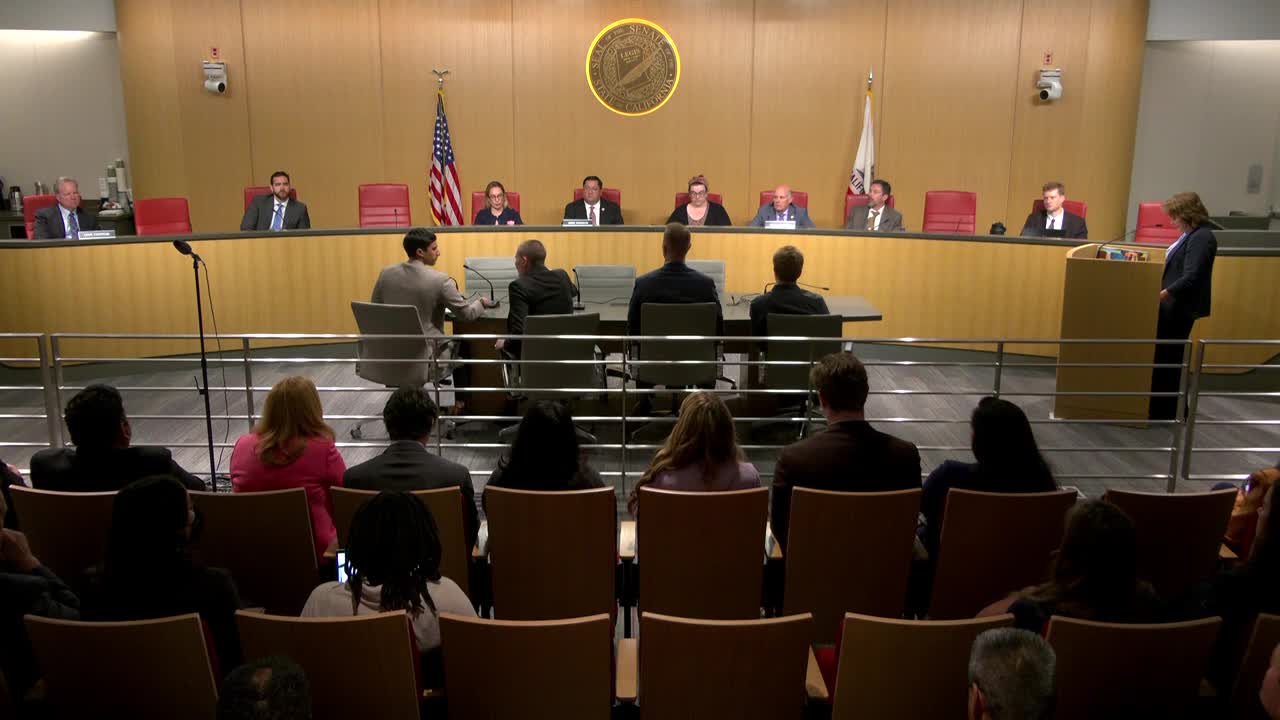 10MIN
Senate Standing Committee on Public Safety
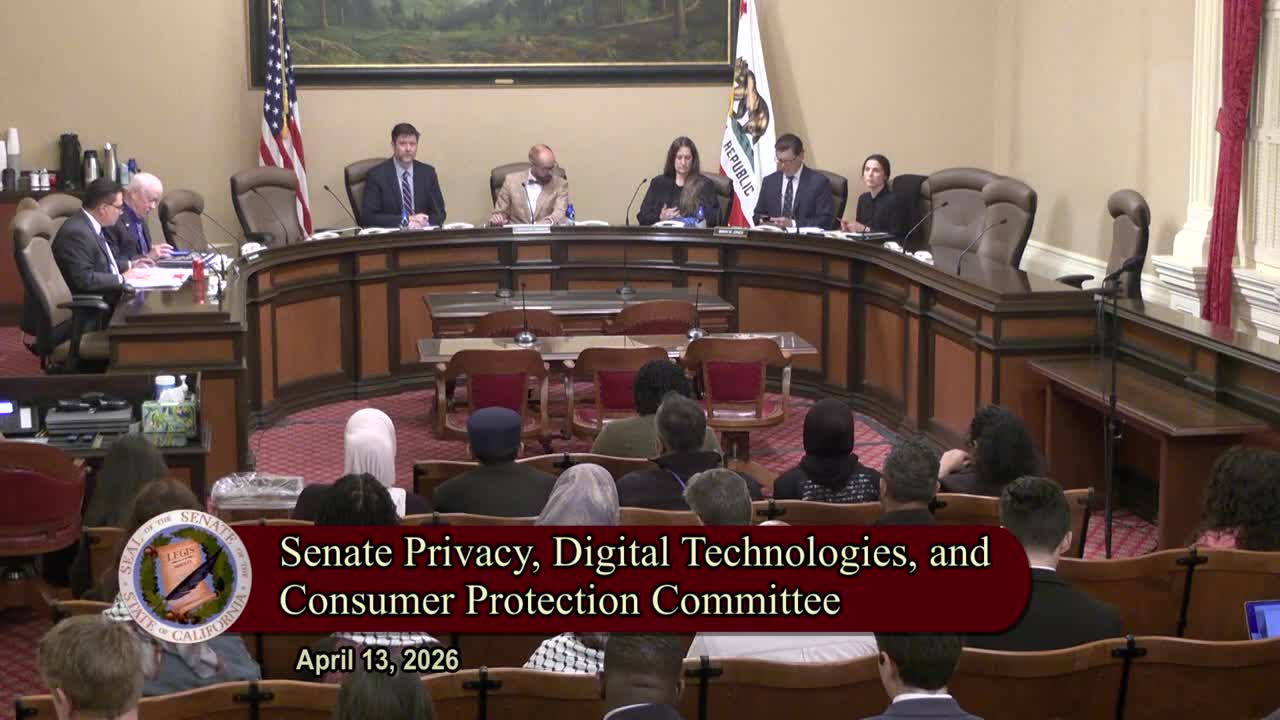 7MIN
Senate Standing Committee on Privacy, Digital Technologies, and Consumer Protection
Bill Author
Bill Co-Author(s):